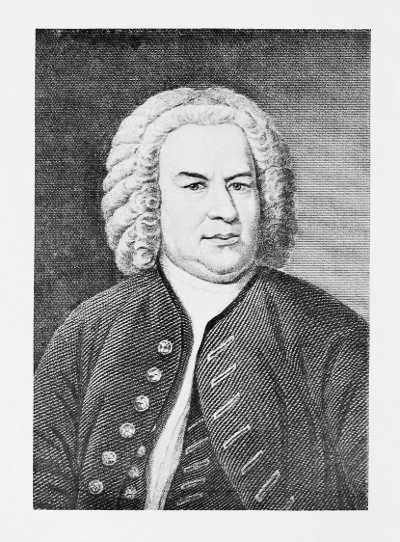
The reasons which determined Bach to leave Weimar
are not quite clear. He was in fact one of those quick-tempered
men whom a small irritation might kindle
to a resolve of disproportionate gravity. In the present
case he had a real grievance in the appointment of a
son as successor to the old capellmeister, whose work
Bach had done for a long time and the reversion of
whose office he might reasonably have counted upon.
Leopold, the reigning prince of Anhalt-Coethen was no
stranger at Weimar. A family alliance connected the
two courts, and it is likely that he had heard Bach
there. In any case Bach was known to him by report,
and in 1717 was invited to take the post of capellmeister
at Coethen.
The six years that Bach spent in the service of this
prince make a kind of pause or breathing-space in his
life. It is not that he was idle during this period: his
work was different. He had, as it were, stepped aside
from the road upon which he had journeyed all the
years of his manhood, to follow a by-lane where he
might loiter if it pleased him. And if this short abandonment
of his peculiar art, dedicated to the service of
the church, in favour of the writing of suites for strings
or clavichord, hardly needs apology, it remains remarkable
that Bach consented to take a position in
which church music or even organ-playing had no
place. In no one of the three churches in Coethen
had he any control; perhaps he was not sorry in the
present case, since two of them, with the bulk of the
population, belonged to (his special aversion) the reformed
or Calvinistic sect.22 The Castle Church could
boast but an indifferent organ and was unprovided
with a choir; so that even had Bach wished to overstep
the limitations of his duty, there were no opportunities,
but rather discouragement, in Coethen for him to
return to his old work.
He was designated Capellmeister and Director of his
Highness’s Chamber Music, but in the peculiar situation
of the Coethen court the title imperfectly describes
the nature of his post. Leopold was a young bachelor
who gave to music the loving worship he had not yet
consecrated to a woman. He cultivated his art with
an eager enthusiasm, sang a full bass, and was no
mean performer on violin, viola-da-gamba, and clavichord.
He welcomed Bach as a brother in the craft,
and not only employed him to compose for his varied
requirements, but took him into his familiar fellowship,23
played with him, sang with him, insisted on his company
whenever, as was his habit, he journeyed abroad.
Before this he had learned some knowledge of the
world, had travelled in England and Italy, and made
acquaintance with the music of Rome and Venice. For
the future we find him and Bach making repeated
visits to Karlsbad and other distant places, and the
obedient capellmeister sometimes perhaps a little
ennuyé, if we may credit a story which relates that on
one of these journeys he consoled himself for the lack
of all musical instruments by striking off the greater
part of the Wohltemperirte Clavier. The incongruous
performance recalls the tale of the famous printer,
Henry Estiennes, that he divided the New Testament
into verses, the verses which we still retain, on a ride
from Paris to Lyons.
In spite of the widened experience, it was in truth a
narrowing life to Bach. He was not one of a musical
group as at Weimar; there is no record of his having
any friends in the place. If he had the pleasantness of
the grateful appreciation of the Prince, he had no
public to sustain his ambition. His days were divided
between his house and the music-room of the castle;
and he only came into contact with the musical society
outside by the custom which he still maintained of
employing his holiday in the autumn to visit towns
where he was known, where he was invited to try organs
and exhibit his skill, or to produce occasional cantatas.
Once he went to Leipzig to prove the new organ at
the University Church, another time, as has been
already mentioned, to Hamburg. Once again he
travelled to Halle in the hope of making Handel’s
acquaintance, but just missed him.
A visit with Prince Leopold to Karlsbad in 1720,
was sadly memorable to Bach. For while he was on
his way home and no news could reach him, his wife
suddenly fell sick and died. He arrived only to learn
that she was already buried. How deep a grief this
was to the family—the mother was but thirty-five—we
know from the recollection of it which the second son,
Philipp Emanuel, then a child of six, bore more than
thirty years later. His tender, flexible nature reflected
hers closely, as his elder brother Friedemann’s robust
vigour did that of his father. And the fact that the
two most striking figures, as also the most musical,
among Bach’s twenty children sprang from this marriage
may be taken in evidence of the near sympathy
subsisting between the parents. Else we know nothing
of Maria Barbara, and one is apt to depreciate her by
comparison with the more gifted woman whom Bach
chose for his second wife.
His care was now mainly for the children, four of his
seven alone surviving their infancy. The eldest was a
daughter, Katharina Dorothea, whom we shall hereafter
meet again as helping with her voice in the family
concerts; then came three sons, the two already
mentioned, and Johann Gottfried Bernhard.24 It was
Wilhelm Friedemann, now a lad of ten, who claimed
his father’s most anxious attention; and never was a
charge fulfilled with greater love and willingness. In
later life Bach’s relation to him was one of intimate
friendship; already the promise of his musical skill
aroused the keenest hopes of his father. He showed
afterwards that he had all the characteristics of Sebastian
accentuated: stolid independence was carried into
wilful obstinacy, hotness of temper into a confirmed
irascibility, morose when not violent. At present he
was only the hopeful eldest son, for whose sake Bach
developed a complete scheme of musical training,
beginning with a Clavier-Büchlein of easy pieces, as
early as January, 1720. There is an air of tenderness
for the small fingers he loved, and longed to educate, in
the ladder of difficulties he so carefully constructed, and
in the little preface, in nomine Jesu. This was followed
by Inventions in two and three parts, designed to
cultivate an equable strength and free motion in all
the fingers. The title was apparently chosen to indicate
that beyond this he sought to teach in these pieces the
elements of musical taste, invention in the scholastic
sense being a compound of just disposition of the members
and appropriate expression.25 The third stage in
the course of instruction was constituted by the preludes
and fugues of the Wohltemperirte Clavier, in which
technical execution is combined with beauty of form
and expression, each in its finest development. One of
the points on which Bach insisted was that the practice
of the clavichord should from the outset go hand in
hand with composition. He assumed that no one should
learn to play who could not think musically, as he
expressed it; and he never allowed a pupil to compose
at the instrument. He would not, he said, have him
to be a piano-hussar, a taunt that might well be
taken to heart by some of our modern composers. A
parallel system of training for the organ was also
primarily intended for Friedemann; and both alike
shew the clearness and penetration with which Bach
understood the functions of a teacher.
In after-years the rector of his school at Leipzig,
between whom and Bach there was no love lost, said of
him that he was a bad teacher and could not keep order
in class. The latter is likely enough, and the former may
not be without foundation in the particular case. A man
of Bach’s extreme sensibility would certainly appear at
his worst in the irritating surroundings of a rude
schoolroom. That he could teach, however, and
teach better than any man of his time, is proved by
the string of distinguished names that appear among
his scholars and by the unbroken succession of pupils
whom he had in his house from his marriage almost to
his death, the applicants increasing in his later days
until he was continually forced to turn them back.
To his chosen pupils he was kind and genial, and full
of encouragement. You have five as good fingers on
each hand as I have, was his answer to complaints of
difficulty. He never set himself up as a model to
which others could not attain: I was obliged, he would
say, to be industrious; whoever is equally industrious
will succeed as well. From these glimpses of his bearing
we may readily conceive the love and enthusiastic
reverence which he aroused in his pupils, and as for
his irritability, the common failing of great artists,
experience shews that at least it does not make a man
a bad teacher in private, however much it may militate
against his success in a school.
Bach did not remain long a widower. The tradition
of his ancestors contained no law requiring a year of
mourning; indeed his father married again in seven
months. Sebastian was more patient, waited nearly
a year and a half, and chose wisely. His new wife,
Anna Magdalena Wuelken, held a position as singer
at the Coethen court; her father was trumpeter in
that of the Duke of Saxe-Weissenfels. She was
twenty-one, fifteen years younger than her husband.
The marriage, which took place on the third of
December, 1721, was entirely happy. Anna Magdalena
proved herself no mere hausfrau, but a real
companion to Bach in all his tastes, a helper in work
and a sharer in all his pleasures. She had a fine
soprano voice, for which her husband delighted to
arrange songs and recitatives. Often she copied them
out for herself, and besides this her clear well-formed
hand, closely resembling Bach’s, occurs constantly in
the collections of his manuscripts. On his side he
helped her to master the clavichord. Two Clavier-Büchleins,
written for her, exist in his autograph, and
to judge by their handsome bindings and the inscriptions
in them, were intended as gifts to her, one
just after their marriage, in 1722, the other in 1725.
She used and added to them afterwards as a sort of album.
They contain a great part of what we now know as
the French suites, with a variety of preludes, arrangements
of airs from his cantatas, &c., and also a set of
rules for thorough-bass. It is plain that if the one
was an indulgent teacher, the other was a ready and
diligent pupil.
The beginning of Bach’s new happiness was soon
attended with an unexpected drawback. Prince
Leopold married a week after his capellmeister, and
from this time forth his interest in music declined.
His wife, so unlike Bach’s, cared nothing for music
the concerts were still attended, but no longer listened
to, and Bach’s work became more and more irksome
to him. He had no outside public to take the place
of the now indifferent court. He continued, however,
for a year, until the death of Kuhnau, the learned and
original cantor of the Thomasschule at Leipzig, offered
to him an opportunity of returning to that work in the
service of the church for which he must have longed
all these years. He left Coethen in the summer of
1723, having first composed two church cantatas, as
evidence of his fitness for the post. It is probable
that, in the hope of the election taking place before
Easter, he wrote the S. John Passion Music to grace
his arrival, as though to prove that the divorce from
sacred music which he had supported for so long a
time had made his fertility and creative force only
the more abundant. But the delay of the Leipzig
authorities postponed the production of this masterpiece.
By a coincidence the Princess of Coethen, the
determining course of Bach’s removal, died just before
he left. Perhaps for the moment he regretted the
step he had taken: to us that step is the most
fortunate act in his life and the herald of his greatest
triumphs.
As we considered the Weimar time as representative
of Bach’s career as an organist, so Coethen is the scene
of his most extensive production for the clavichord, for
the chamber, and for the orchestra. We may therefore
here enumerate the compositions that belong to
these classes, reserving for the present the great
collections of fugues contained in the Wohltemperirte
Clavier, of which the second half falls under a later date
when the first was alone entirely rearranged and partly
rewritten, and the Kunst der Fuge which was the
achievement of Bach’s last years.
The clavichord works admit of a double classification.
On the one hand we have independent
compositions, of which the idea is mostly derived from
the organ-style; on the other stand the suites, or sets
of pieces in dance-measures, which are moulded upon
Italian models. Both alike are adapted by Bach to
the clavichord in such a manner that they are completely
naturalised in their new-found country. To
the former class belong the following works arranged
in conformity with Dr. Spitta’s critical results; the
numbers refer to Peters’ cheap edition:—
A. Weimar Period.
1. Four Fantasias, in D, A minor, G minor, and B
minor (211, p. 28; 215, pp. 3, 30; 216, p. 9):26
2. Four Toccatas, in E minor, D minor, Gr minor
and major (210, pp. 3, 30; 211, p. 4; 215, p. 17):
3. Six Fugues, two in A, and two in A minor (212,
p. 10; 216, p. 20; 212, p. 14; the fourth in MS. at
Berlin), together with two, in A and B minor, on
subjects taken from Albinoni (216, p. 25; 214, p. 12):
4. One Prelude and Fugue in A minor (211, p. 14):
to these we may perhaps add the well-known one in
B flat of which the subject is on the (German) notes
contained in the name Bach (B flat, A, C, B natural)
but of which the genuineness is suspicious (212,
p. 24).
B. Coethen Period.
1. A Fantasia in C minor (212, p. 2).
2. Four Fantasias and Fugues, in D minor (the
famous Chromatic Fantasia), B flat, and D (207, p. 20;
212, pp. 28, 32).
3. Two Toccatas, in F sharp minor and C minor
(210, pp. 10, 20.)
4. A Prelude in C (printed among the organ works,
series v. 8. 3), and two sets of twelve and six little
preludes for beginners (200, pp. 3, 14).
5. Five Fugues, in C minor, two in C, and two in
D minor (200, pp. 20, 22, 24; 212, pp. 3, 5).
6. Four Preludes and Fugues in D minor, E minor,
and two in A minor (200, pp. 26, 28, 33; 207, p. 36).
C. Leipzig Period.
Two Fantasias and Fugues in A minor and C minor
(208, p. 22; 207, p. 32 and 212, p. 22, the two parts are
separated in the edition).
To this list must be added the two sets of inventions
(201) written at Coethen; and the four great Duets
(208 p. 36) in which the idea of the invention (or
sinfonia) is treated on a much larger scale.27 The duets
were written at Leipzig, and it has always been
claimed that no skill could possibly add a third real
part to them.
In a similar intermediate position stand the two
sets of Variations, one in A minor, a Weimar composition,
headed alla maniera Italiana (215, p. 10),
the other a great series of thirty variations in G, of
which notice will be taken in connexion with Bach’s
life at Leipzig (209).
The Suites begin at Coethen with the six so-called
French Suites (202) and three single sets which probably
belong together (214, pp. 18, 26, 32). A solitary
suite, in F, bears traces of having been written
at Weimar (215, p. 25). At Leipzig Bach produced
six Great Suites, known as the English (203, 204),
and an equal number of sets of Partitas (205, 206).
Another partita of the same period, in B minor, is
known from its opening as the French Overture (208,
p. 4).28
At Coethen Bach also wrote three sonatas, in A minor,
C, and D minor (213, pp. 2, 16, 24), with a fourth which
remains only a fragment (212, p. 18).29 These sonatas,
the title being to some extent interchangeable with
suite, have little in common with the form to which
Bach’s son Philipp Emanuel, Haydn, and Mozart (Beethoven
can of course not come into the comparison) developed
it. The parent of this exists also among
Bach’s works, but it has a different name, being distinguished
as the Italian Concerto (207, p. 4). It is
remarkable that it should bear a designation properly
true of an orchestral composition, as though in prevision
of the unlimited development of which the
form was susceptible.30 But the feeble internal resources
of the clavichord, Bach’s chosen instrument
for study—the harpsichord was too hard, and the
infant pianoforte too coarse for him—prevented him
from himself following up the conception. He preferred
to write music which was independent of so
imperfect an exponent; and his clavichord works are
characterised by freedom and delicacy of melody, infinite
fancy, and, as we see specially in his fugues, the
fullest solidity and richness of structure, rather than
by any effects which need a responsive sympathy in
the instrument. It is as such that we ought to judge
them, however much their life is broadened by performance
on the piano.
It is difficult to separate Bach’s chamber compositions
from those for orchestra. The orchestras of that
day were very small, that at Weimar consisted but of
sixteen performers, and Bach’s matured scheme for
the production of his church music at Leipzig asked
only for a band of twenty. It is wholly uncertain
how far it was usual, or considered necessary, to
multiply with the parts; in any case chance might often
reduce the small orchestra to numbers more consistent
with chamber music. That this happened in the concertos
which Bach conducted in his own house we may be
pretty sure. There is, therefore, little objection to
our enumerating both forms of composition in one
section.
The Concertos are written on various scales, the use
of one instrument concertante being extended to Concerti
Grossi requiring as many as four. For the harpsichord
there exists six; for two harpsichords two, and
for three again two. In another concerto he has combined
the harpsichord with two flutes, and in two
more with flute and violin, as the three obbligato
instruments.
For the violin Bach composed three concertos, besides
one apiece for two violins, for violin and hautboy,
for two flutes and violin, and for flute, violin, hautboy,
and trumpet.
Orchestral works, but for an orchestra of very
various constitution, are three of the so-called Brandenburg
Concertos,31 and four parties or suites which rank
among the most flexible and melodious of all Bach’s
creations.32 The list would be increased by nearly
thirty works if we added the instrumental symphonies
which occur in the course of his cantatas.
As strict chamber music we may reckon his three
sonatas or trios, in which the harpsichord combines
respectively with two flutes, flute and violin,33 and two
violins. For harpsichord and flute there are six
sonatas; for harpsichord and violin a like number,
together with three separate pieces, a sonata, a partie,
and a fugue; finally, three sonatas for harpsichord and
viola-da-gamba.
The list of Bach’s instrumental works is completed
by two sonatas for obsolete instruments, one for the
lute, the other for his own invention, the viola pomposa,
and by the memorable sets, of six sonatas each, for
the violin and violoncello, which are well enough
known in England to render an account of them
superfluous.
But a few words are needed in conclusion to mark
Bach’s position in reference to the clavichord. In the
first place, being acutely sensible of the least falsity
of tune, he always tuned the instrument himself, a
process which never cost him more than a quarter of
an hour. In this art he introduced a great reform,
that of tuning on a basis of equal temperament.
Without such a reform his chromatic music, and
notably his Chromatic Fantasia and the Wohltemperirte
Clavier, would have been impossible. Another instance
of his fastidious taste is that no one but himself
could adjust the quills of a harpsichord to his satisfaction.
He took great pains in improving the action
of the clavichord, and invented a new instrument,
the lute-harpsichord (lauticlavicymbel), with a surprising
brilliancy of tone; but the difficulty of tuning
it led to its abandonment.
It would demand too technical a discussion if we
were to analyse the method of playing which Bach
introduced. That he was the first to insist upon an
equal use of the thumb with the rest of the hand, and
to act upon the principle that touch proceeds from the
lower joints of the fingers, and not from the wrist or
arm, makes him the founder of the modern art of
piano-playing. It is said of him that he “played with
so easy and small a motion of the fingers that it was
hardly perceptible. Only the first joints of the fingers
were in motion; the hand retained, even in the most
difficult passages, its rounded form; the fingers rose
very little from the keys, hardly more than in a shake,
and when one was employed, the others remained still
in their position. Still less did the other parts of his
body take any share in his play, as happens with many
whose hand is not light enough.”34 His playing was
light, smooth, swift—powerful or expressive, as he
chose—but always without display or the appearance
of effort.