I
So they were married. Graystone Hall at last had a
mistress worthy of its architect and decorator
when—love and affection and other good considerations
moving thereto, as the law hath it—the new Mrs. Rawn
moved into the place of the old Mrs. Rawn. Thereafter
matters went at least as merry as most marriage
bells celebrating the nuptials of middle age and youth,
of wealth and beauty.
As Mr. Rawn had spent a million dollars to free
himself from one wife, he seemed willing to spend
much more in the process of taking on another. It
became current rumor that the one great diamond show
of the western city was Virginia Rawn. The sobriquet,
"The Lady of the Lightnings," passed from New
York to Chicago and became permanent there. Not
that that lady delighted in display; but there were
occasional operatic or theatrical events which demanded
compliance with her husband's wishes, in which event
she blazed almost better than the best.
But, gradually, she showed the tastes of the aristocrat,
as alien to vulgar display as to crude manners.
Gradually the tone, color, atmosphere, of Graystone
Hall began to change. The porcelains which
Virginia Rawn purchased were not large and gorgeous,
but a connoisseur would have called them worthy.
The vast and brilliantly framed paintings came down
one by one, and one by one masterpieces went up,
selected by one who knew. The walks, the grounds,
took on simpler and cleaner lines. Rawn of the
International got a new credit as a person of taste. He
was accepted as a collector, a patron of the arts, a
connoisseur, in fact, yet more a worthy and a rising
citizen.
The hospitality of Mr. Rawn's mansion house also
now increased perceptibly, and, delighted that at last
numbers came to see him, Mr. Rawn at first did not
analyze those numbers very closely. Even the fastidious,
many of whom came to be amused, were unanimous
in the feeling that Mr. Rawn's house, its furnishings,
its decorations, its pictures, its works of art, its
hospitality also, were beyond reproach. The trace of
gaucherie was gone. The spirit of the place was
delicately reserved, dignified, yet well assured. The seal
of approval was placed upon Graystone Hall. Who,
indeed, should smile at the man who had made so
meteoric a rise, who had by a few years of labor become
master of this mansion, its furnishings and its
mistress? Who, upon the other hand, might smile at that
mistress, whose appearance upon the front page of the
leading journals of the city became now a matter of
course—a lady of such reserved tastes as led her to
forsake the larger marts, and to set the seal of fashionable
approval upon a little florist, a little modiste, a
little milliner all her own—even a little surgeon
hither-to unknown, who honored a little hospital and made it
fashionable, by taking there this distinguished patient
for a little operation?
II
Rawn himself expanded in all this social success.
He saw doors hitherto closed, opening before him, saw
his future unrolling before him also like a scroll. A
hundred times a week he walked to his young wife,
caught her in his arms, uxoriously infatuated with her
youth, her beauty, her aplomb, her fitness for this life
which he had chosen. For once he almost forgot to
regard himself as a collector of beautiful objects, although
the truth was that his wife, Virginia, became more
beautiful each day, more superb of line, more calmly
easy in air, more nearly faultless of garb and demeanor.
She took her place easily and surely among the
young matrons of the wealthier circles of the western
city. Whereas thousands of auto-cars had passed by
Graystone Hall and only a dozen stopped, scores now,
of the largest, drove up its winding walks and halted
at its doors. The dearest dream of both seemed
realized. The hunt in couple had won! They had gained
what they desired; that is to say, self-indulgence, ease,
idleness, adulation, freedom from care. What more
is there to seek? And is not this America?
Gradually John Rawn had been losing the rusticity
which had accompanied him well up to middle age.
The city now began to leave its imprint. The waistcoat
of Mr. Rawn gradually attained a curve unknown
to it in earlier years, so that his watch fob now hung in
free air when he stood erect. His face was perhaps
more florid, his hair certainly more gray. His skin
remained fresh and clean, and always he was
well-groomed, having the able assistance of his wife now
in the selection of his tailoring, as well as her coaching
in social usage. They always looked their part. At
morning, at noon, or at dewy eve, in any assemblage
or any chance situation, they both played in the rôle
assigned to them in their own ambitions. Born of
environment wholly unconventional, they now took on
that of conventionality as though born to that instead.
You could not have found a more perfect type of
respectability than John Rawn, a more absolutely valid
exemplar of good social form than his wife, Virginia.
All things prospered under their magic touch, the genii
of the lamp seemed theirs. No problems remained for
them to solve. They had in their own belief attained
what may be attained in American life, and they
were happy. Or, that is to say, they should at least
have been happy, if their theory of life and success,
and of those like to theirs, be correct. At least they
were what they were—products of a wonderful
country which makes millionaires overnight and
produces out of bakeries women of one generation fit to
be the wives of princes born of forty kings.
III
We are, some of us at least, accustomed to worship
such as these as they ride by upon the high car of
success, accustomed to envy and to emulate them. If that
vehicle be the car of Juggernaut, crushing under its
wheels multitudes of those who worship, it is no
concern of those who sit aloft. For a long time Mr. Rawn
and his wife remained ignorant of the fact that one
victim under the wheels of their success was none other
than Mr. Rawn's daughter, Grace.
Alas! for that young lady. She unfortunately had
been now for almost a year an aspirant in her own
right to a seat upon the car of ease and luxury; yet
here she saw herself swiftly supplanted, and worse
than that, swiftly forgotten! Her year of quasi-place
and power had left her unwilling to return to her own
humble home. She remained on at Graystone Hall,
now rarely visited by her husband. She found herself
calmly accepted, yet calmly neglected as well. Very
naturally she hated the new Mrs. Rawn with all her
soul; a hatred which that lady repaid with nothing
better than a straight look into Grace's dark eyes, a
look innocent, calm, and wholly fearless. Grace must
now see the very jewels her own mother should have
worn, blazing at the neck and hands of her stepmother;
must see that lady taking assuredly and as of right,
what Grace could now never ask or expect for herself.
With an unapproachable and wholly hateful air of
distinction and good breeding which rankled most of all
in crude Mrs. Halsey's heart, Virginia Rawn sat high
on the car of Juggernaut; and the car of Juggernaut
passed on. In pride and delight over his young wife,
John Rawn really forgot his daughter. The young
new wife did the same, or appeared to do so.
IV
John Rawn had told the truth to his wife when first
he had declared his sentiments toward her—he never
before that time really had known love, or at least had
not known infatuated love such as that he felt for her.
He exulted in the vistas of delight which he saw before
them, fancying them endless. The very sight of his
wife, cool, faultless, self-possessed, haughty, filled him
with a sense of his own importance, making him feel
that he was one of God's chosen. She was his, he had
found her, discovered her, collected her. She was his
to put upon a pedestal, to admire, to display, to
worship, to load down with jewels. He had something
now which other men coveted and envied. He flaunted
his ownership of such a woman in their faces. What
more can a rich man do than that same? Is that not
the dream and test of power—to secure what others
may not have, to secure special privileges in this life?
And is not the quest of beauty the first business of him
who has attained power? Of all these special
privileges which had come to John Rawn so swiftly in
these late rapid years, none so delicately and warmly
filled his heart as that of being able to call Virginia
Rawn his own. Why blame him? The sultans of thirty
or forty generations have devised nothing better than
this test of power.
John Rawn, with all properly aristocratic leanings
toward sultanry, lacked certain elements of sultanhood
in strength, but had others in weakness. He did not
know that in reality he was in the hands of a stronger
nature than his own. "She's got him jumping through
hoops," was the comment of one young man. "He'll
sit up and bark whenever she gives the word!" But
Rawn did not know that he was barking and jumping,
his tongue hanging out excitedly. In all his mental
pictures of himself he fancied himself to be a figure of
dignity, of strength, indeed of majesty.
I
Happy in his newly-found domestic delights,
Mr. Rawn was perhaps more careless than otherwise
he would have been regarding business affairs, and that
at a time when they needed care. The truth was that
matters still lagged at the factory, as Rawn ought to
have known. Indeed, he did know; but always his
curious helplessness in regard to Halsey—who alone
knew the last secrets of the most intricate devices of
the company's property—continued to oppress him.
And always here was his wife to console him and to
interest him.
The distance between Graystone Hall and the
factory apparently was becoming greater from month to
month. Sometimes Halsey came to visit his wife, but
these visits of late became fewer and fewer, as that lady
became more and more discontented, less and less
eager to receive the attentions of him who had so
signally failed to place her where Virginia sat in power.
This alone left Halsey none too happy himself at the
prospect of any of his perfunctory calls; and moreover,
he found himself expected now to be more careful in
his attire, in his conduct about Graystone Hall, where
full evening dress tacitly was desired at dinner, and
where an aristocratic chill was habitual at any hour;
things not customary in Ann Sullivan's household on
the factory side of the city. Not that Halsey needed to
excite social misgivings. He was a clean-faced, manly
chap, lean, sinewy and strong, and might, save for his
rather toil-marked hands, have passed for any of the
throng of young men who at times came under one
pretense or other to visit Mr.—and Mrs.—Rawn.
II
These, in company with Grace, he one evening found
alone, seated on the wide gallery that overlooked the
lake front. He did notice then, as he never before at
any time had noticed, a singular truth—Virginia
Rawn's eyes seemed almost reluctant to leave him. He
was half her husband's age. Moreover, there was
something in the somber glow of his eye, in the occasional
look of his face—rapt, absorbed, remote, pondering on
things not made patent to all about him—which held
for her ever a stronger fascination. She wondered if
things were known in his philosophy no longer
reckoned in her own; but which once might have been
germane to her as well. She often looked at him.
The evening was clear and cool, the lake stirred with
no more than a gentle breeze. The silver ladder of
the moon's light was flung down across the gently
moving waters. The breath of flowers was all about.
Calm, ease, assuredness were here. The voice of the
hostess was delightfully low and sweet. All things
seemed in keeping.
Rawn welcomed his son-in-law with his customary
largeness of air. "Come on out, Charles," said he,
"join us; the evening is pleasant. Won't you have a
cigar?" He fetched with his own hands the box of
weeds—"Take several, my boy, take as many as you
like. I give two dollars apiece for these by the box at
my club, and you can't beat them in the city or
anywhere else."
Halsey listened almost absent-mindedly, and Rawn
returned to his seat near his wife, a little apart on the
gallery. The master of Graystone Hall was intoxicated
more than usually this evening with her. She
sat now in the dim light, a cool, dainty and beautiful
picture, in blue and ivory Duchesse satin and filmy
laces, gowned fit for a wedding or a ball, as she always
was of an evening at home, with just a gem gleaming
here and there in the occasional glimpse of light which
broke through the windows at the back of the gallery
as their curtains shifted in the breeze. At that moment
John Rawn would have been glad to have the entire
world share boxes of cigars with him. John Rawn,
collector—what man on all the North Shore Drive at
that moment could claim such surroundings as these?
"I thank you, Mr. Rawn," said Halsey, taking a
single cigar from the box which his host had placed
upon the near-by tabouret. "I think I'll be content with
one. I mustn't get into bad habits; I'm afraid Jim
Sullivan and I can't afford them at two dollars apiece
just yet!"
III
He moved now quietly and dutifully apart toward
the end of the gallery where sat a less resplendent
figure, that of his wife, Grace. She had not risen to
meet him.
"Well," said he, as he sank into a seat beside her.
"Well, then?" she answered, and turned upon him a
face dour, inexpressive, pasty, almost frowning.
"Is that all you have to say to me?" she began later,
as he sat smoking.
"I haven't had much chance yet," he commented.
"No, I should say not! This is the first time you've
been here for four weeks! Have you stopped to think
of that? You seem to care little enough how I get
on!"
Halsey paused for a moment before replying. "That
hardly seems fair to me."
"Why isn't it fair? It's the truth."
"Well, I've been busy all the time, as you know.
Besides again, when it comes to that, it doesn't seem to
me that you've been altogether anxious to have me
come."
"You talk as though you worked day and night
and had nothing else to do."
"Well, I suppose I could come over—every night
after dinner—wash the soot and the cinders from me,
get out my four-hundred-dollar go-cart, and come over
here to call on my wife in my thirty-dollar evening
togs, couldn't I? She lives in Graystone Hall. Where
do I live? What do I get out of life, when it comes to
that, Grace? When I do come here, you begin to
nag me before I get settled down. I always used to
say when I was a young man, that if I ever found
myself married to a nagging woman, I'd just quit her!"
"What do you mean by that?" she demanded imperiously.
IV
Again Halsey was deliberate, although he half
sighed as he replied: "Pretty much what I say,
Mrs. Halsey, since you ask me. The truth is, you quit me
when I needed you. I have had worry enough from
this business at the factory. I don't particularly care
to have all other kinds of worry on top of that. You
had all this place to fall back on. Your father's taken
care of you. But he hasn't taken care of me very well.
The fact is, I've been scapegoat about long enough!"
"You seem to have learned the factory ways of talking!"
"Yes, I don't know but I am getting rather plain,
and common, and vulgar. It's a little different
here—even from Kelly Row, let alone our place on the West
Side. I fancy you're getting the North Shore accent,
along with other things.—It all only means that we're
that much further apart, Grace. Did you ever stop to
think of that?"
"I've had time to think of plenty of things," she
answered bitterly.
"You had plenty of time to think of some of them
before you came over here," he rejoined. "You didn't
like what your husband could offer you, and you chose
something better which your father did offer you.
You've quit me, practically. You've not been in our
home twice since you came to live here. I've seen that
poor baby of ours only once in a while since you left
our home for this. You've not been a wife to me.
That's the truth about it—I might as well not be
married! That comes mighty near being the situation,
since you put it up to me to answer."
"Then what do you mean?"
"The courts would make it a case of desertion, if
you force me to say that," answered Halsey. "Now,
I don't want to live on this way for ever! I'm a young
man, and my career's ahead of me! I've got to choose
regarding my life before long! And I'm going to
choose. I'm not going to let things run on in this way
any further."
"That's what my father always said! Your career;
your life! Where does your wife come in?"
"You come in precisely where you say you want to
come in, Grace. We get what we earn in this world.
If you leave me and take up a life which I can't share,
if you leave my house and don't care for what I can
give you—why there's not much left to talk about as to
where you come in. You come in here. I belong over
there."
"You're selfish! All men are, I think."
"I'm not going to argue about that in the least,
Grace, except to say that it's the Rawn half of you that
said that. The Rawn half of you can't see anything
but its own part of the world. It wasn't the Rawn
half of you that I married. You were different, then.
You're not much like your mother, Grace! And I
married the part of you that was like your mother. She
was a good woman, and a good wife."
"You must not speak of her!"
"Oh, yes, I must, and I shall when I like. It's all
in evidence. There's the record." He nodded toward
the two dim figures at the other end of the gallery.
"She's very beautiful, yes, very beautiful!" His eyes
lingered on the figure of Virginia Rawn, faintly
outlined, cool in satin and laces.
"She'd like to hear you say that!" sneered his wife.
"I perceive, my dear, that you two love each other
very much. But as I was saying, you don't seem to
me, Grace, to be much like your own mother—you're
more like your stepmother, over there, in some ways.
Your mother didn't change. She made good—if you'll
let me use some more factory slang—on the old ways,
on her own old lines. That's what I call class,
breeding, blood, if you like—just plain North American
sincerity and simplicity. She didn't pretend, she didn't
try to climb where she knew she couldn't go. That's
what I call blood!"
"Thank you! You're sincere also, at least."
V
He seemed not to hear her. He went on. "But
you've changed. You dropped me. Your head was
turned with all this sort of thing.... Since these
things are true, are you coming back to me?" He found
himself wrenching his eyes away from the cool dim
figure far down the long gallery.
She straightened up suddenly, pale. "Back!—to
that? To live in that hole—?"
"Yes, just back to that, Grace. It's all I have to
offer you. Just that hole."
"I'm not happy here."
"Then why do you stay here? Why don't you come
back to me?"
"Because I couldn't be happy over there any more,
either! I know it. I admit it. It's got me—I couldn't
go back to the old ways, the ways we'd have to live.
Why can't you come here—why doesn't Pa give us
money enough—"
He turned to her now gravely. "I suppose it's the
pace—yes, it's got you, and a lot of others. But I'm
not taking that sort of money just yet. And that
doesn't answer my question. I've come over to-night
to arrive at some understanding about us two. I
want to know where I am. There are going to be
changes, one way or another."
She turned to him suddenly again. "What's wrong
over at that factory, Charley?" she asked. "Why
haven't you made good before this? My father has
been on the point of tearing up things a dozen times!
He's sore at you—awfully sore."
"Yes? How do you know I haven't made good?"
"Then why has Pa talked so?"
"For the very good reason that he doesn't know any
better than to talk that way. He hasn't got any more
sense. He didn't talk that way to me."
"Then you have got it—you've made the discovery—it'll
work?"
"Our machines not only will work, but have been
working," said he calmly. "I haven't seen fit to tell
your father. I'm going to tell you, however, that all
this was my idea from the first. If I haven't been a
competent manager, let him get some one more competent.
I'll take what I know with me in my own head.
I'm saying to you, his daughter, that I worked out
this idea, myself, and all he did was to get the money
in the first place for it. For that reason I call this
discovery mine, to do with as I like. I haven't been
bought and paid for, myself. I don't want money
when it costs too much. I've just begun to understand
things lately."
"Yes, I've worked it out into practical form," he
concluded, as she sat silent. "Your father never did
and never can. He's got to come to me, to me, right
here. Since you drive me to it, I'll just tell you one
thing. I've had this whole thing in my own hands
for more than eight months! The company doesn't
know it, he doesn't know it, no one knows it. I've
been just waiting—to see whether I had a wife or
not."
"You never told? Then you've been disloyal, you've
been a coward! You took his money—"
"All right," said Halsey suddenly, grimly, "that's
all I need. I see, now. I know what to do now."
"But you didn't tell father!" she went on fiercely.
"And we all knew how much has been depending on
that factory. Weren't we all in that—didn't we all
help, from the very first? Didn't I?"
"Yes, you did, you and your mother," said Halsey.
"You've had or will have all you earned. She got
divorced from her husband, you may get divorced
from me! It's a fine world, isn't it? We've all been
chasing for more money. Well, here we are! There's
a couple over there, here's another one here. Fine,
isn't it?"
VI
"But, Charles!" She moved toward him and laid
a hand on his arm. "You don't stop to reflect on
what you are saying! If you have that secret in your
hands, why, don't you see—don't you see—"
"What do you mean?"
"Why, even Pa will have to come to you! You
won't be poor then."
"I should say he would have to come to me!" said
Charles Halsey slowly. "Yes, I dare say. I dare say,
also, I could make a lot of money whether he did or
didn't."
"Listen, Charley. He's got everything, and he
wants everything. He's my father, but he doesn't care.
He—he sold me out. What do we owe to him and
her? What did he do to my mother? I tell you, he
thinks of no one but himself. Yet you and I—we
who found that idea and worked it out, who have it in
our own hands now, as you say—you and I have got
the whip in our own hands now, it seems to me."
"You talk excellent business sense, Mrs. Halsey. I
compliment you. It seems that you begin to discover
something in your husband and his possibilities. It's
a trifle late, but you delight me!"
"Well, I didn't know, you see," she murmured, pawing
at him vaguely, in a fitful and inefficient essay at
some coquettish art, grotesque in these conditions.
She was a woman of small feminine charm at best.
She sat there now, angular, stiff, unbeautiful, the sort
of woman no clothes can make well-dressed. Already
she had disclosed somewhat of her soul. What appeal,
then, physical, emotional, moral, could she make to
him—a student, a visionary, an idealist—at such a
moment? And did there not remain that same cool distant
figure from whom he had so constantly to wrench his
eyes—and his heart? Yes; and his heart! Halsey's
face was dull red. He was unhappy. The world
seemed to him only a hideous nightmare, full of
disappointments, injustices, of wrongs that cried aloud for
righting. Ah, the comparison now was here, fair and
full and unavoidable!
VII
"No, you didn't know," said he slowly. "A lot of
people don't. Now let me tell you a few things more.
You didn't know that something like a year ago your
father told me that he'd make me a present of
fifty-thousand dollars the day I could run a car from the
factory to this place on a charge taken from our own
overhead receiver-motors."
"A start for a million dollars!" she murmured.
"You get that—when you succeed?"
"Yes, that is to say, I could have had that any day
in the week these past eight months—if he really has
got that much left where he can realize on it. He's
pretty well spread out."
"Then you have had it—what have you done with
the money?"
"I presume I look as though I'd spent or could
spend a mere fifty thousand dollars or so, don't I?"
was his quiet answer. "No, I didn't have it, and I
haven't got it. I'll say this much to you, however,
that I ran my little old car over here to-night on a
charge taken out of one of the overhead receiver-motors
of the International Power Company—a motor
completed on my own ideas, and by my own hands.
It's mine, I tell you—mine!"
"Charley!" She caught him by the wrists, with
both hands, eagerly. "You can give me the things
I've got used to having! I'll go back—oh! I'll go
back—we'll go on together! I hate her so—you don't
know!"
"That's nice of you, Grace; but you've guessed
wrong. I've not got that fifty thousand yet."
"But you can have."
"Yes, I can. What could I buy with it? For one
thing, I could buy back my wife?"
"But Charley! We're rich! You've succeeded!"
"No, I am poor, I've failed. I'm just beginning to
see how much I've failed!"
"If you don't tell me the truth about this I'll do it
myself!" she exclaimed fiercely. "You've not been
loyal—you've taken pay!"
"Your father took his pay from me," was his half-savage
answer. "He's been paid enough! As for me,
I don't want any more of this sort of pay."
"What are you going to do—you're not going to
sell out to some one else?"
"No, my dear, I'm not going to do precisely what
you suggested I should do just a moment ago. I'm not
going to sell out. I could do that, too, and make more
than any fifty thousand. The foreman in our
factory, who knows very little, can sell out to-morrow
morning for ten thousand dollars, maybe double or
treble that now. The watchman on our door can sell
out when he likes. We can all sell out, any of us sell
out. But we haven't! If there has been any selling
out it has been done by those who built this place
here—the place which you found better than the best home
I could offer you."
She sat back stiff, silent, somber. "You—you never
mean that you are going to throw this away, then!"
she asked at length. "What earthly good will that do?
Pa'll have it out of you somehow! I'll—I'm going to
tell him!"
"Try it," said Charles Halsey easily.
She had courage. "Father," she called out. "Pa!
Come here—at once!"
VIII
Rawn rose suddenly up from his chair at the startling
quality in her voice. "What's that, Grace?" he
called across the long gallery.
"Come here, I want you! We've got something to
say to you."
Halsey sat motionless.
Rawn approached slowly, obviously annoyed. "If
it's important—" he began. He had found love-making
to his young wife especially delicious this evening,
although he mistook her strange silence and
preoccupation merely for wifely coyness.
"It is important!" Grace exclaimed; and rising,
clutched at his arm.
"Well, then, what's it all about, what's it about?
Come, come!"
"Charley's done it, he's got it—he's got the machines
finished—over there—!" Her voice was almost a
scream, hoarse, croaking. She stood bent, tense.
"What's that?" demanded Rawn. "What do you
mean? Is that the truth, boy?"
"He came over in his own car, under International
overhead—he told me so, right now," she went on,
half hysterically. "You owe him money—a lot, a pile
of money—he told me so right now—it's worth more
than any fifty thousand. Oh, we're going to have
money too. You see!"
Rawn shook off her arm and half flung her back in
her chair. "What's this about, Halsey?" he said. "Is
it true?"
Halsey nodded calmly, but said nothing.
Rawn half-assailed him, his large hand on his shoulder.
"Did you get the current?" he demanded. "Did
you really come over under power out of one of our
overheads?"
"Yes, to-night," said Halsey calmly. "Often before."
IX
"Why, my boy, my boy!" began John Rawn. At
once he stood back, large, complaisant, jubilant. "My
boy!" was all he could say. Not even his soul could at
once figure out in full acceptance all the future which
these quiet words implied.
"Come!" he explained after a moment, excitedly.
"Let's get to the telephone! I want the wires right
away! I'll make a million out of this before morning!"
"And write me a check for my fifty thousand
to-night?" smiled Halsey.
"Surely I will—I've told you I would—I'll do more
than that—I'll make it a twenty-five thousand extra
for good measure. I'll have the check taken care of
to-morrow at my bank, as soon as I can get down-town!
Oh, things'll begin to happen now, I promise
you!"
"I wouldn't be in too big a hurry to use the wire,
Mr. Rawn," said Charles Halsey quietly. "And never
mind about your check."
"What do you mean? You're going to try to hold
me up?"
"No, I'm not going to try to hold you up at all. If
there's any question about that possibility, I can get
a million to-morrow as easily as I can any fraction of
a million to-night, Mr. Rawn, and it's just as well you
should know that, perhaps."
"A million?" croaked John Rawn. "You'd sell us out?"
"No, I said. I'm not going to sell you out, Mr. Rawn.
And you're not going to buy me out."
"Of course not, of course not," laughed Rawn
hoarsely. "You didn't understand me."
"You haven't understood me either, Mr. Rawn.
Now, what would you do if I told you that after taking
my charge for the little car yonder I turned about
and dismantled every motor in the shop—destroyed
them all—locked up the secret, ended the whole game
now—to-night? What would you say to that?"
"By God! I'd kill you!" said John Rawn.
I
On this very beautiful evening, in this very beautiful
scene—as beautiful as any to be found in all
that luxurious portion of a great city representing the
flower of a great country's civilization—Graystone
Hall was a double stage. At the back of the tall
mansion house countless auto-cars passed in brilliant
procession, carrying countless men and women, personal
evidences of all the ease and luxury that wealth can
bring; and of these who passed, the most part looked
in with envy at the tall mansion house beyond the
curving lines of shrubbery, brilliantly illuminated now,
the picture of beauty and ease, of peace and content.
More than one soft-voiced woman murmured, "Beautiful!"
as she passed. More than one man, more than
one woman, envied the owners of this palace.
"He's awfully gone on his wife, they say,"
commented one young matron, much as many did. "Not
that I see much in her myself—although she seems to
have a sort of way about her, after all."
"Lucky beggar!" growled her husband.
"Yes, they're both lucky."
That both Mr. and Mrs. Rawn were lucky seemed to
be the consensus of opinion of the procession of those
passing at this moment along the great driveway, and
hence looking upon the rear stage of the drama then
in progress. But they saw no drama. The evening
was beautiful. The spot was one of great beauty.
Apparently all was peace and content. There was no
drama visible, only a stage set for a scene of happiness.
Yet, two hundred yards from the point of this belief,
on the stage of the dimly-lighted gallery facing
the lake, the comedy of life and ambition, of success
and sorrow, moved on briskly; moved, indeed, to its
appointed and inevitable end.
II
Rawn's voice, harsh, half animal in its savagery,
wakened some sudden kindred savagery in young
Halsey's soul. In a flash the spark rose between steel
and flint. The accumulated resentment of many days
made tinder enough for Halsey now.
"All right, Mr. Rawn," said he, his head dropping,
his chin extended. "Go on with the killing now, if
you like. I'm going to tell you right here, that sort of
talk will do you no good. If you kill me you kill my
secret. It isn't yours, and neither you nor any other
man is apt to set it going again."
"You hound, you cur!" half sobbed Rawn. His
daughter stood, tense, silent, unnoticed at his elbow.
"Thank you! Now, I'll tell you. I dismantled every
motor, and I'm never going to build them again for
you. I meant every word of what I said. Also I mean
this!"
As he spoke he rose and struck Rawn full in the
face with his half-clenched hand. The sound of the
blow could have been heard the whole length of the
gallery—was so heard. An instant later, half roaring,
John Rawn closed with the younger man....
The women, plucking at their arms, could do nothing
to separate the two, indeed were not noticed in
the struggle. As to that, the whole matter was over
in an instant. Halsey was far the stronger of the two.
He caught the right wrist of Rawn as he smote down
clumsily, caught his other wrist in the next instant,
and then slowly, by sheer strength, forced him back
and down until at last he crowded him into the chair
which Grace a moment earlier had vacated. The bony
fingers of his hand worked havoc on John Rawn's
wrist, on his twisted arm. Halsey was not so long
from his college athletics, where he had been welcome
on several teams. He was younger than Rawn, his
body was harder from hard work and abstemiousness.
He was the older man's master.
"Sit down!" he panted. "I don't think you'll do this
killing very soon!"
III
Rawn, for the first time in his life, faced a situation
which he could not dominate by arrogance and bluster.
For the first time in his life he had met another
man, body to body, in actual physical encounter; and
that man was his master! All at once the consciousness
of this flashed through every fiber of him, bodily
and mental. He had met a man stronger than
himself—yes, stronger both in body and in mind. The
consciousness of that latter truth also sank deep into
his heart. It was a moment of horror for him. He,
John Rawn, master of this place, rich, happy,
prosperous—he, John Rawn, beaten—subdued—it could
not be! Heaven never would permit that!
They all remained tense, silent, motionless, for just
half an instant; it seemed to them a long time. Halsey
at length straightened and turned toward the door.
"I'm going," said he dully. "Good by, Grace."
Rawn turned, confused, distracted. He cared for no
more of the physical testing of this difference. But he
saw Success passing in the reviled figure of his son-in-law.
"No, no!" he cried—"Jennie—he fouled me—but
don't let him go—he'll ruin us, do you hear?"
Halsey was within the tall glass doors and passing
toward the front entry. He heard the rustle of skirts
back of him and felt a light hand upon his shoulder.
"Well," he began; and turning, faced young Mrs. Rawn!
IV
"I'm sorry," he stammered, "it's disgraceful. I beg
your pardon with all my heart. But I couldn't help it.
He struck me first with what he said. He threatened
me. Let me go. I'll never come back here again. I'm
sorry—on your account—"
"Charles," she said softly, "Charley, wait. Where
are you going?"
"To the divorce courts, and then to hell."
"But you mustn't go away like this. I'm sorry, too.
Wait!"
Suddenly moved by some swift, irresistible impulse,
perhaps born of this unregulated scene where all seemly
control seemed set aside, she put both her white bare
arms about his neck and looked full into his eyes, her
own eyes bright. He caught her white wrists in his
hands; but did not put away her arms. He stood
looking at her, frowning, uncertain. His blood flamed.
"It's disgrace," he said, "I admit it. I can't square
it any way in the world. I'm sorry on your account—awfully
sorry!" His blood flamed, flamed.
"Listen!" she said, panting, eager, her voice with
some strange, new, compelling quality in it, foreign to
her as to himself. "You mustn't go. You mustn't
ruin the future of us all in just a minute of temper.
Yen mustn't ruin yourself, or—me. Besides, there's
Grace!"
"Oh, Grace!"
"But she's your wife."
"Not any longer. She's chosen for herself. She left
me and would not come back. I'm going now. I'm
on my own from this time."
"Why not?" she asked coolly. "But why wreak
ruin on us all? You don't stop to think!"
"Yes, it will set him back pretty badly—" Halsey
nodded toward the bowed frame of Rawn, dimly visible,
in the gallery's shade, through the tall glass doors.
"Yes," she said slowly, "he's my husband, surely."
—"Who has given you everything."
She nodded, her arms still about his neck. "Let me
think this out for all of us, Charley. Keep matters as
they are until I have time to think—won't you do that
much—just that little—for me?"
His hands were still upon her wrists as he looked
down upon her from his height, his eyes angry, his
face frowning, disturbed. Worn almost to gauntness,
tall, sinewy, of a certain distinction in look, as he
stood there before her now an ignorant observer might
have thought the two lovers, he her lover, not her
stepson, she at the least his younger sister, surely not
his mother by mixed marriage.
V
As they stood thus, Rawn turning, saw them through
the tall glass door. His face grew eager. "He's not
gone," he whispered hoarsely to his daughter, who
stood rigid, close at his arm. "She's got him! By
Jove! She's a wonder—my wife, my wife—she'll land
him yet—she will!"
"Do you see that?" hissed Grace at last, pointing at
the door.
"Do I see it—didn't you hear me? Yes, of course I
see it!"
"And you'll allow that, between your wife and my
husband?"
"Allow it—wife!—why! damn you, girl, what are
you talking about—wives and husbands?—what's that
to do with this? There's many a million dollars up
now, I tell you, on those two standing there. You make
a move now—say a word—and I'll wring your neck,
do you hear?" He caught her by the wrist. She sank
into a chair, sobbing bleakly.
A moment later the two figures beyond the door
stood a trifle apart. The arms of Virginia Rawn
dropped from Halsey's neck. She laid a hand upon his
arm and, side by side, neither looking out toward the
gallery, they drew deeper into the room, behind the
shelter of a heavy silken curtain which shut off the
view.
It was a beautiful night. The long ladder of the
moon still lay across the gently rippling lake, which
murmured at the foot of Graystone Hall's retaining
sea-wall. The scent of flowers was about. It was a
scene of peace and beauty and content. John Rawn
and his daughter remained upon the gallery for a time.
I
"Charles," said Virginia Rawn, "Charley—" And
always her white hand touched his shoulder,
his arm, his hand—"You really mustn't go. Believe
me, you'll both be sorry to-morrow. You don't
know what you're doing! You're only angry now.
You'll both be sorry." Her eyes glowed, evaded.
Halsey shook his head. "It's all over, so far as I'm
concerned." His eyes, glowing, sought hers.
"Why, Charley, boy, that's all foolishness. Don't
you know how wrong it is to talk in that way? What
hasn't Mr. Rawn done for you? And she's your wife!"
"He has done little for me and much for himself," he
answered hotly. "As for her, his daughter, she left
me for him and what he could give her. She liked this
sort of thing rather better than what I could do for
her. She weighed it up, one side against the other,
and she chose this. Most women would, I suppose."
"Charley, how you talk!" Her voice, reproving,
none the less was very gentle, very soft. "One would
think you were a regular misanthrope. The next thing,
you'll be saying that I was that sort of a woman
because I live here. Of course, other things being equal,
any woman likes comfort. But you seem to think that
we all would choose luxury to love."
"Don't you—don't you all?" demanded the unhappy
youth. "Some do, of course. Would you? Haven't
you?" He was reckless, brutal, now. The young
woman before him started, shivered. She passed a
hand gropingly across her bosom, across her brow.
II
There was a strained, very strong quality in the
air of Graystone Hall that evening. Thought seemed
to leap to thought, mind to mind, swiftly, without
trouble for many words. These two at last looked at each
other face to face, deliberately, she gazing beneath
heavy, half-closed lids, a superb, a beautiful woman,
a creature for any man's admiration. He was a manly
young chap. He stood a victor, as she had seen but
now. He gazed at her out of eyes open and direct.
Reckless, brutal in his despair, he now allowed—for the
first time in all their many meetings—his heart to show
through his eyes. For the first time, their eyes met full.
"You must not ask that," said she quickly. "I
wouldn't want to tell you anything but the truth
about it." She was breathing faster now.
"What is the truth about it? I want to know if any
woman is worth while. I'm down and out myself, and
it doesn't matter for me. I just wondered."
"I used to see you often about the office," said she
irrelevantly, "when you came in to see Mr. Rawn. I
rather thought Grace was lucky, then! I was just a
girl then, you know, Charley."
"What do you mean, Mrs. Rawn?"
"Nothing. What did you think I meant?"
"I didn't know. I've never dared think much. I
supposed everything was going to come out right
somehow. Now it's come out wrong. I don't know
just where it began. Don't you see, Mrs. Rawn, it's
all like a faulty conclusion in logic? It builds up fine
for a long time. Then all at once things go wrong—it's
absurd, and you wonder why. Well, it's because
there's what you call a faulty premise somewhere down
close to the start. If that's the case, there isn't anything
in all the world is ever going to make a conclusion
come out right. I reckon there's a wrong premise
somewhere down in my life, or ours, or in this!"—He
swept an arm, indicating Mr. Rawn's opulent
surroundings.
"I'm only a woman, Charley. Maybe I don't understand you."
"Well, I'll tell you. There's wealth, luxury,
everything here. Where did they get it? They took more
than their share."
"Now you're talking like a Socialist. Mr. Rawn
tells me you are a Socialist, Charley."
"I don't believe I am. But I believe a good many
would be if they'd gone through what I have. Now,
what those two took, they took from me—what you've
got here you got from me. I don't mind that. The
big trouble is—the wrong premise about it is—that
what they took they took from this people, this
country. And there are so many who even are hungry."
"Oh, we'd never get done if we began that way!
All success does that way, you know that. Not all
can be rich." Her eyes still came about to him.
"Yes, all success succeeds—until that wrong premise
comes out. Then there's trouble!"
III
"Are you going to sell us out, Charley?" she
demanded suddenly.
"I never sold out anybody. I'm the one that's been
sold out."
"Aren't we your real friends?"
"No. You ought to be, but you aren't. The only
friends I've got are over there in the factory—Jim and
Ann Sullivan, Tim Carney—a few of the working-men
that stuck it through. They've killed five men for us
over there. Their sluggers are out all the time. As for
me, I don't fit in, either there or here. Look here,
Mrs. Rawn," he went on, turning upon her suddenly and
placing his hand impulsively on hers. "Let me tell
you something. I haven't sold out—I'm not going to.
Where do you stand yourself?"
Her eyelids fluttered. "Charley," said she, "you
know better than to ask me that."
"Yes, I suppose I do," he answered slowly and
bitterly. "You stand for this place, for everything that
money can buy. Have they made you happy? I often
wonder—does money really make people happy? Are
you happy?" His eyes were very somber, very direct.
"I wonder if I am," said she suddenly; "and I wonder
how you dare ask me. Oh, I'll admit to you I've
been ambitious, and always will be. But do you know,
some time I'd like to talk with your friend—with Ann
Sullivan!"
"Then you'd begin to get at life. You'd be getting
down to premises, then, that aren't wrong—with Ann
Sullivan and her sort!"
"What do you mean?"
"Oh, well, I reckon you'd only find a little sincerity
and honesty, and, well—maybe—love, that's all. Just
the things I didn't get myself. Have you?"
"Why didn't you?" She ignored his brutal query.
"Because I'm a theorist. Because I'm a visionary
and a fool, I reckon. Because I like to see fair play
even in a dog fight, and the people of this country
aren't getting fair play. Because I'm the sort of fool
that Mr. Rawn isn't. There's the difference!
"Are you happy, Mrs. Rawn?" again he demanded
suddenly, since she still was silent. "Tell me the truth.
I think you know I'm not going to talk. I'm going
away somewhere—anyhow for the summer. I suppose,
maybe, this is the last time I'll ever see you—in all my
life."
She felt the candor of his speech and replied in like
kind, smiling slowly. "No use my lying," she said.
"You know I'm not happy. And, yes, I know you'll
not talk. Who is happy? We all just get on just the
best we can. I can take my joy in making other women
envy me. Isn't that about what all women want? Isn't
that the height and limit of their ambition? Isn't that
success, so far as a woman is concerned? Don't they
cling to it, all of them—till they get old? I suppose so,
but I know it isn't happiness. Yes, I'll admit to you I
do miss something." His eyes rested upon her,
searching.
Unconsciously she looked down at her wrists. The
red mark of his fingers still lingered there. "I'll have
to ask Ann Sullivan some time," she laughed.
"One thing," answered Halsey. "She'd tell you that
she isn't trying to get the envy of her neighbors. I
don't believe she'd be happy in that!"
"Oh, but she's fresh over—she's not American yet,
don't you see? She hasn't had a chance—you can't
tell what she would do if she were rich."
IV
"There are two ways of looking at it," said Halsey
musingly, his anger passing, now leaving him meditative,
relaxed. They were talking now as though there
were not two others, unhappy, waiting on the gallery
near by. "I'll tell you something, if you'll let me talk
about myself, Mrs. Rawn."
"Go on; I'm glad!"
"I don't suppose you care for things that interest
me. You called me a Socialist. I'll admit that I
studied a lot about that, attended their meetings, all
that sort of thing. Maybe that made me think. It
seems to me that money is rolling up too fast in this
country now—we're all mad about money. It's like
the big apple with no taste to it. I had it offered me to
choose between those two, and I took the little apple
that to me seemed sweeter.
"Now, I've perfected that invention. It'll make
somebody rich any time I say the word—any time I
like that big apple and not the little one—any time I
like that success which comes from outside and not
from inside. But I've figured that that doesn't mean
happiness. Maybe I'm wrong. I don't know. Somehow
I believe that Abraham Lincoln, or John Ruskin,
or Jim Sullivan, or Tim, or Ann, or Sir Isaac
Newton—any thinking person—any philosopher—would come
in with me about this. I broke up the machines."
"Why—where it meant ruin?"
"Because they'd tighten up the grip of a few men on
the neck of the people! I don't know whether you call
that being a Socialist or not, and I don't care. Change
is coming. It's not the fault of the poor that it's coming.
It's the fault of the rich. I broke them up—because
things can't go on this way, money rolling Up all the
time for a few, and life getting harder all the time for
so many. God didn't make the rivers and the mountains
and the forests for that purpose—to give them
to a few. We've got to make changes, and big ones, in
this government, or we're gone. I'm no Socialist at all.
I don't want what some one else has won—if he's won
it fair. But the wrong is in our government—the very
one of all on earth that meant fair play. We don't get
it—now. Some day we must. I don't see what
difference it makes what name you give the new form of
government. There must be change, that's all; or else
we're gone!
"Well now, what they wanted me to do was to give
that all to a few. I couldn't do it! By God!
Mrs. Rawn, I faced it and I tried, and I couldn't do it!
Maybe I was wrong. Anyhow, here I stand."
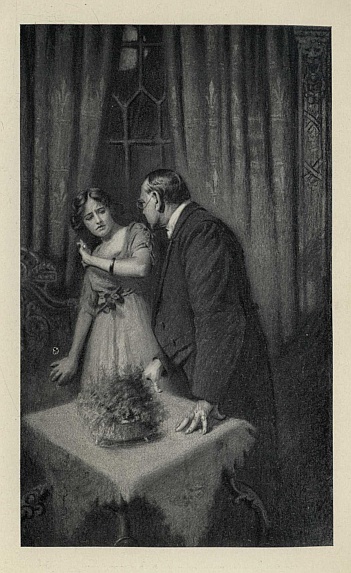
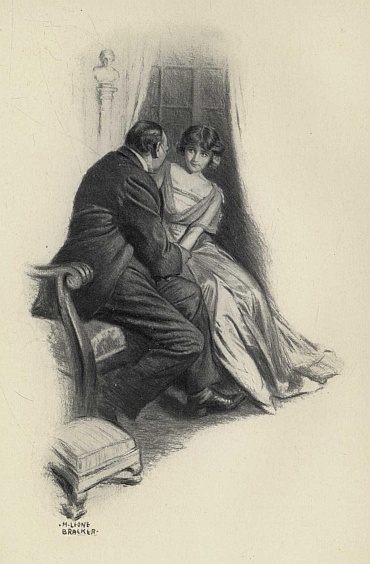
(Rawn and Virginia)
V
"Do you know," she said at length, slowly, "these
are things that never came to my mind in all my life?
I never in all my life thought of any of these things.
I only wanted—"
"You wanted to win. You wanted what most
American women do—money—station—power—to be
envied; that's what you played for. Well, you've
won! Look at all this about you. I don't suppose
there's a woman in this town more admired by men or
more envied by women than you. You've got what
you craved, I reckon."
"I thought I had. But now, to-night, I'm not so
sure!"
"You couldn't give it up," he sneered, "any more
than Grace could, and she couldn't any more than a
leopard could change its spots. It goes too deep.
You couldn't expect anything different.
"I told you I was a student, Mrs. Rawn," he went
on after a time. "I haven't got much mind. But
somehow, while I don't suppose religion can change
business very much, I think of those twelve disciples and
their Master, trying to lift the load off of human
beings, trying to lift the people of the world up above
the day of tooth and claw. I don't reckon they can do
it. But you see, each fellow has to choose for himself.
I've had this put before me. I could have thrown
in with Rawn—-I can do so yet, right here, now, as
you know. I can hold him up, as he would hold me
up, or any one else—I can take his money—fifty-thousand,
a million—I don't think he's really got as
much money as most people think. He's in debt, deep.
That's all right so long as your credit is good. He has
had all sorts of credit—and it depended on me—on my
invention. It wasn't his. It isn't going to be. I've
told you why.—But you see, I could make him divide
even with me—make him take a third, a fourth, of
what I'd won. He'd have to come to terms. He
knows that. All right, I'm not going to do it!
Failure as I am, I've got a few ideas which I think are
right. Maybe I got them from Ann Sullivan—I don't
know! Go ask her about things."
"And you won't put back the machines? Not even
for me?"
"Not even for you," he smiled. "Not that I know
what you mean by that." He looked at her keenly. His
toil-stained hands twitched uneasily in his lap.
VI
"You're talking about things that never came into
my thoughts in all my life," said she, with the same
strange deliberation, the same strange direct look at
him. "But you couldn't expect an ignorant woman to
learn it all in one night, could you?"
"I'm not trying to convert you, Mrs. Rawn. I'm
going to leave this place. You'll not see me again.
But I'm not trying to change you. I wouldn't—"
"Listen!" she broke out sharply. "I'm set to do
that for you—I'm expected by him, out there, to
change you. Isn't that the truth? Didn't you see?"
"Yes, it's easy to see," he answered grimly. "It's
up to you."
"It's up to you and me, Charley, yes. You can
ruin me and all of us by walking out that door. You
can break the lives of those two people out there, and
mine, yes, of course you can, and your own.—You can
do all that. You can make me come down from this
place where you say everybody envies me, and you can
have everybody laughing at me and forgetting me in
less than six months' time. You can get me snubbed,
if you like; you can make me wretched and miserable,
if you like. Of course you can. Do you want to
do that?"
"It isn't fair to put it before me in that way."
"I do put it before you in that way. But that isn't
the worst of what you could do—you'd leave me
unsettled and unhappy for ever if you went away to-night
that way—Charley!—"
"What can you mean—?"
"Things are moving fast to-night, Charley, and
we're discussing matters pretty openly—"
"Yes," he nodded. "I don't want to set a wife
against her husband. Neither must you. But the
truth is, Mr. Rawn is not what a good many think he
is—"
VII
"Do you think that's news to me?" she asked of him,
and looked full into his eyes.
"Good God, Mrs. Rawn! What do you mean?"
"Much what you do!"
"But you loved him—you married him!"
"Oh, yes, surely. That was some months ago. But
you see, there's a distinction between master and
superior."
"I'm very miserable," was his simple answer.
"Things are getting too much confused for me. And
now you say you'd never be happy if I left you now,
to-night—"
"Then why go, so long as we are so confused?
Why don't you wait? I've asked you to! Do you
expect to settle all this in a half-hour's time, in a
passion of anger? Now listen. Although he's my
husband, and she's your wife, I don't blame you. I'm
only asking you to wait a little. I'm making it
personal, Charley!"
"How dare you do that, Mrs. Rawn?"
"Because I have the right to do it! I don't intend
to have you make me more unhappy than I am. I've
just told you I'm not happy. I don't know—" she
laughed a little amused ripple of laughter—"but I'd
have been happier if he had handled you as you did
him! I'm not talking just the way I meant to when
I came through those doors to stop you. I'm like
you—it's all confusing—I'll have to wait, the same as
you. There's a lot of things to be figured out! I'm
covetous of everything in the world—that any woman
ever had—from the Queen of England to Ann Sullivan!
Yes, I'm ambitious, I'll admit that. And you've
set me thinking—I'm wondering—wondering what
really is the best a woman can get out of life."
"Mrs. Rawn, you've got success as you understand
it, by marrying a middle-aged man. You're young."
She shook her head. "It isn't possible," said she
frankly, catching his thought. "I'm far enough along
to see that!"
"You know what Mr. Rawn did when he wished
to change—he put away what he had, and reached out
for that which he had not. For my own part, I don't
see how any woman could be happy with him. He
ruined the life of one woman, his wife; of another, his
daughter. Now, you tell me he hasn't made an
absolutely happy life for yet another woman—yourself.
Oh, it's brutal for me to say it, but it's true, and you've
just said it's true."
"If only it could come to the question of what a
woman really wanted—" she resumed, pondering.
"That's for each woman to figure out for herself,
Mrs. Rawn. I've only said what most American
women want. We're living in a wholesome and
beautiful age, Mrs. Rawn!"
"I thought I was right!" said she suddenly, looking
up. "Now I believe I was wrong. Charley!—"
VIII
"It's in the air," she said, as though to herself, after
a time, finding him silent, troubled, pale. "Don't you
know, Charley—" She turned to him.
He leaned toward her now, his lined young face
illuminated with sudden emotion. "I wish I could
explain that to you, Mrs. Rawn," said he. "I feel it,
too! Now maybe we can understand! How did I
drive my car over here, charged from one of our
overhead motors? Ah, that's my secret. But I took it
out of the air! That motor of ours was in tune with
it—the great power that's in the air, everywhere.
Mrs. Rawn, it's getting in tune with the world that
makes you happy. Nothing else is going to do it!
Get in tune with the plan! All I've ever done in my
receiving-motor has been to get in tune with the hills
and the rivers and the forests—with life."
IX
She leaned toward him now, that on her face which
he had never seen there before. He looked her fair
in the eyes and went on, firmly, strongly.
"I've done that; and I've said to myself that I
wasn't going to throw that away and give it to a few,
when it belonged to everybody. I am unhappy as you
are; more so. I'm not in tune with life as we live it.
No, I certainly am not. But I know that to be perfectly
happy we've got to get in tune with the purpose
of the world. What is it? What is that second
current? I don't know. What is it? You tell me—"
"I'll tell you what I believe," said Virginia Rawn
slowly, her hands dropping in her lap, her face pale.
"I shouldn't wonder if it was—love!"
"And that belongs to everybody, not just a few—to
every one—not just to the rich men, with money
to buy what they want?" He was looking at her keenly
now.
"To everybody?" She shook her head. "Not
always, Charley."
"Why not—Virginia?"
I
"Well, he's gone, then?"
Rawn turned toward his wife a face years
older than it had been an hour ago, a face haggard and
lined, pasty in color. His bitter agitation was evident
in his voice, in his expression, in the stoop of his
shoulders—in a score of signs not usual with him.
Virginia was even more noncommittal than her wont
as she faced him. Grace had disappeared.
"What did you do—how did you handle him, Jennie?"
he began—"you were talking for over an hour
there! Did you manage to hold things together—will
he let up?"
She faced him full now, as he stood in the blaze of
the electric lights in the interior of the house, where
Halsey had left her, in the chair from which she had
not moved since his departure. Every delicate, clear-cut
feature was fully visible now. Her lips just parted
to show the double row of her white teeth in a faint
smile. Her chin was a trifle up, her head high.
"He will wait a little while," she answered quietly.
"At least, I think so."
"Good! Fine! I knew you'd do it, Jennie! You're
a wonder!—I don't think there's a woman in all the
world like you!" He advanced toward her.
"Don't paw me over!" she exclaimed, drawing back.
"Well, now, then—I only meant—"
"I don't want to talk," she said. "He's gone, yes,
and he'll not do anything for a little while, I think.
It's enough for to-night—I'm tired. This has been a
horrible evening for me. I never thought to see a time
like this!"
"Horrible for all of us!" exclaimed John Rawn.
"That man took advantage of me out there—I ought
to have wrung his neck for him, and I would have
done it if it hadn't been for you two women. Of
course, we don't want scenes if they can be avoided,
for there's no telling what talk might run into if it
got out. But just the same, Jennie, don't you see—"
and his face assumed a still more anxious look—"he
can ruin us all whenever he gets ready, and he's wise
enough to know that. I can't do anything with him
now. Something's gone wrong with him, and I don't
know what!"
II
"No, you don't know what," she said slowly. "I
don't think you in the least imagine what!"
"Do you, then?" he demanded. "If you do, why
don't you tell? Do you know that everything we've
got in the world is up at stake on this? He can kill
my credit, he can split this company wide open, he
can break me in spite of all. See what he's done in
return for what I've done for him! Sometimes I
wonder if there's such a thing as honor left in the
world!"
"So! Do you?" She rose now, and would have
left him.
"Well, I want to talk this over with you. Please,
Jennie. Sit down," he said. "Tell me what you said.
I want to know where things are, so I can act
to-morrow—or maybe even before to-morrow. You don't
realize what a hole I'm in."
"What did I say to him?" she repeated, looking
down at her wrists. "Nothing very much. I told him
if he went on he'd ruin us all; that it wasn't right for
him to do it. I told him we wanted him—I wanted
him—to wait—for my sake."
"For your sake?"
"Yes, I did," she answered calmly. "I said that."
"It was best!" he cried, rising and walking up and
down excitedly. "What a mind you have, Jennie—what
a woman you are! Where'd I be without you, I
wonder now? Why, of course, that was the way!
Any man will do anything that you tell him to,
especially a young man—of course, of course!"
"Thank you," she commented coldly; "thank you
very much."
III
He sought to put a consoling or an explanatory
hand on her shoulder, but she shook him off, shivering.
"I don't mean anything," he began confusedly.
"Get me straight, now. I only wanted to say that
when you work for me in this you are working for
your own sake also. It's all up to you, Jennie, right
now. If you can't land him, we're gone—it's no use
my trying to do anything with him. Do you know,
I'm going to send you out after him."
"Send me out?"
"Yes; things have to be done the best way they can
be done. That fellow can say one word which'll ruin
us in one day's time. He can break the values in
International more than we can mend in months.
Our men would begin to cover as soon as they caught
a hint that anything was really wrong. As for me,
I'm spread out for millions in the general market.
If they began to hammer me I couldn't come through—I
wouldn't last a week. The thing to do is to keep
this news safe until I can protect myself—until I can
protect us all. Now it's you, Jennie, that's got to do
that—it's you! I'm sending you out after him."
"I always thought, Mr. Rawn," said she, "that you
played a dangerous game, so long as you simply
trusted that he'd do anything you told him."
"Yes, I see it now. But he always was odd—he
always held something back. I tell you, he's crazy!
Now, he's either just crazy over his fool Socialist
ideas, or else he's going to hold out for a squeeze. In
the first case you can handle him. In the second, I
can.
"You see—I couldn't tell our directorate," he went
on; "but there was always something lacking which I
couldn't handle myself. We need him, and we've got
to have him! You can get him, I know you can. You
can do anything you like. You're wonderful!"
She sat and looked at him, her lips still parted in
the same enigmatic smile which he did not like to see;
but she made no answer.
"What's wrong with him?" he went on immediately.
"What does he say is the trouble, anyway? And is it
the truth that he's got the overhead current?"
She nodded. "Of course, I know something about it
from my work in the office. Yes, he told me that he
had done what you have all been trying to do so long.
He said he came over under power from the
overhead—just as he told you."
"He may be lying, for all we know. You can't look
at a car and tell where its charge came from. Electricity
is electricity, to all intents and purposes. What
I want to know is, what he's got against us, anyhow,
Jennie?"
"Well, for one thing, he seemed troubled because
Grace would not go back with him. He seemed to
think that you and the life you could give her had been
the reason for her abandoning him."
"Why, what nonsense! Grace hasn't abandoned
him! And I only got her over here because I needed
her myself—before—well, before we were married.
Who was to take care of me, I'd like to know? And
you say he complains of that!"
"That was one of the things."
"But Grace would go back! She's none too well
pleased now, since you and I have taken charge
here. She'd go back to Charley to-morrow if he asked
her—why, I'd make him take care of her, of course.
The trouble with him is, he values his own personal
affairs too much. That's no way to begin in the
business world. A man has to bend everything to the one
purpose of success. Look at me, for instance."
IV
She did look at him, calmly, coldly, without the
tremor of an eyelid, without raising a hand to touch
him as he stood close by, without indeed making any
verbal answer. A slight shudder passed over her,
visible in the twitch of her shoulders.
"It's getting cooler!" he exclaimed. "I'll fetch a
wrap for you." And so hastened away, obsequious,
uxorious, as he always was with her.
"But Charley never would take any counsel from
anybody," resumed he presently. "He's always been
tractable enough, that's true; never raised much of a
disturbance until to-night—I don't see why he cut up
so ugly now. He's not crazy over Grace, and if the
truth be told, Grace isn't the sort of girl that a man
would get crazy over. You're that sort."
"Perhaps not," she smiled faintly. "Just the same,
Grace's attitude may have started him to thinking.
When he began thinking he seemed to conclude that all
the world was wrong."
"And he's starting in to set it right! He's going
in for the uplift stunt, eh? That's the way with a lot
of these reformers! They want to set the world right
according to their own ideas. They don't pay any
attention to the men who keep them from starving. I
made that boy—what he's got he owes to me."
"Indeed! How singular! He says that it's just the
other way about; that what you have you took from
him! He says you want to take more—more than your
share—from things that belong to everybody."
"What's that! What's that! Well, now, of all the
insane idiocy I ever heard! Good God, what next!
Him, Charles Halsey, the man I brought up with me!
Jennie, I never heard the like of that in all my time."
"But if that's the way he feels, now's not the time to
argue that with him!"
"But, good God, the effrontery—"
"All the world is full of effrontery, Mr. Rawn," she
said—continuing to address him formally, as she
always did. "It's buy and sell. Everything we get we
pay for in one way or another. Even if we took power
out of the air by our overhead motors, we'd pay for
that, one way or another—nothing comes from
nothing—we pay, we pay all the time, Mr. Rawn!"
"You don't need to go into theories and generalizations,"
said he testily. "We've had enough of that
from him. We are both practical. You simply get that
man and bring him back into the fold, that's all! Do
your share."
V
"My share? It's easy, isn't it?" She smiled at him
again annoyingly.
"But you can do it?"
"Yes, I can do it. But I can't evade the truth I just
told you. I'd have to pay. You'd have to pay."
"We're beggars, and can't choose," said John Rawn
savagely. "Besides, there's no harm done—I'm not
asking you to do anything improper, anything to
compromise yourself—but get him, that's all! And when
we've got him in hand—when I know what I want to
know—I'll wring him dry and throw him on the scrap
heap. That's what I'll do with him!"
"Yes, I think you would," she said.
"It's the only right thing to do," Rawn fumed. "He'll
get what's coming to him. He's been throwing down
his one best friend."
"Are there any best friends in business, Mr. Rawn?"
she asked.
"Of course there are. Haven't I been a friend to
him; haven't I got a lot of friends of my own?"
"What would they do for you to-morrow, Mr. Rawn?"
"Well, that's a different matter; they might take
care of themselves—I would take care of myself. But
this fool here that I'm asking you to handle isn't
taking care of himself or any one else. He's crazy, that's
all about him! Did he hand you out any of this talk
about the rights of man? I more than half suspect
him of sympathizing with these labor unions. He's a
Socialist at heart, that's what he is!"
She nodded her head a little. "Names don't make
much difference in such matters."
VI
"Isn't it a funny thing," he rejoined, turning to her
in his walk, "that the very men who have failed, the
very ones who most need help themselves, are the ones
who are out to help everybody else! The blind always
want to lead the blind! These labor unions depend on
us for their daily bread and butter, yet they want to
fight us all the time. There's no trust in this country
so big as the labor trust, and there's no ingratitude in
the world like that of the laboring man's.
"Why, look at me, Jennie—you know something of
my plans. This very month I was going to put fifty
thousand dollars more into my cooperative farm in
the South, a thing I have been working out for the
benefit of my laboring people. I'm going to do more
than old Carnegie has done! You and I ought to have
set up some kind of prizes, medals—start some sort
of hero competition. Helping colleges is old, and so
are libraries old. I don't place myself any station
back of Rockefeller himself. The Rockefeller Foundation
was a great idea. Just wait! I'll raise him out
of the game! When I get all my plans made, they'll
speak of John Rawn when they mention philanthropy!
"And just to think, Jennie," he went on excitedly,
"that all such big plans as that, plans for the good of
humanity, should come to nothing! To be held up and
handicapped by the folly of a man who has never been
able to do anything for himself or any one else! It
makes me sick to think of it. He claims to be a friend
of the laboring people, and here he's tying the hands
of the greatest friend of the laboring men in this town
to-day—myself, John Rawn, standing here! Why, if
I'd hand this country the John Rawn Foundation for
industrial assistance, all thought out, all financed, all
ready to go to work to-morrow, that crazy fool there,
with his Socialist ideas, would block it all. He's going
to block it all.
"Now, it's up to you. You're the only one that can
keep him from doing that very thing. Don't you see,
it isn't just you and me he's ruining. It isn't himself
he's ruining. He's going to hurt the whole country.
Jennie, there's a considerable responsibility on you
to-night. Where he is wrong is in thinking that the weak
can help the weak. It's the other way about—it's the
strong that can help—Power!—that's what counts!
It's for you to show him that. Jennie, girl—it's not so
much myself. But think of your country."
"Yes," she nodded, "that's precisely it!"
"But he didn't affect you in the least, Jennie—he
didn't get you going with that kind of foolishness."
"I never heard any one talk just as he did, before,"
said she slowly. "You see, I hadn't thought of these
things myself, for I'm only a woman. He said that
all this power, taken from the hills and the forests and
the air and the rivers, belongs to everybody—to all
the world—"
"But he didn't impress you with that nonsense,
Jennie?"
"He said things—I told him that I'd never thought
of life just that way. And I haven't, Mr. Rawn. I
told him, as I admit to you, that I hadn't thought of
anybody much but myself—I just tried to climb. I
think all women do."
"It's right they should, it's the only way. Selfishness
is the one great cause of the world's progress, my
dear."
"Well, I told him that his way of thinking was so
new to me, that I needed time to think it over."
"But you didn't believe a word he said—you never
would!"
VII
"Mr. Rawn," said she, looking him full in the face,
"we've both of us climbed pretty fast. I always put
my family out of memory all I could. But somehow
I seem to recollect that my father used to talk of
things a good deal as Mr. Halsey does. I begin to
realize what I told you a while ago—no matter how
or where we climb, we pay for what we get, sometime,
somewhere, somehow!
"But listen," she leaned toward him with some sudden
access of emotion. "I can do this much! I'll agree
to bring in Charley Halsey, bound hand and foot! You
can throw him and me, too, on the scrap heap when
the time comes! It's a game. I'll play it. I'll take my
chance." She half rose, thrilling, vibrant.
"I knew you would, Jennie."
"Yes, but you'll have to pay."
"Have I ever said I wouldn't? Didn't I just get
done telling him I'd make him rich the minute he said
the word?"
"It doesn't seem to be money he wants.
I—don't—believe—that's what the pay would have to be."
"What do you mean? You're getting too deep for
me now. I'm only a plain man, my girl!"
She smiled at him, still enigmatic, still cool and
calm, still almost insolent, as she often was with him.
"He's been talking all sorts of folly about getting
things in tune—getting gravitation in tune with
labor—all sorts of abstractions. Well, don't you see, if
I got in tune with his notions, I might be able to
influence him!"
Rawn grew cold and hard. "There's one thing we
can't do, Jennie," said he. "We can't side in with any
of his socialistic talk. What he wants to do is to give
to the people of this country for nothing what this
International Power Company is planning to sell them
for ever. What we want is monopoly! I've been
gambling everything I've got on the certainty of that
monopoly. I'm in soak, in hock, up to my eyes on the
market, this minute. I'm margined to the full extent
of my credit. The biggest men of America are back
of me. I'll be rich if this thing goes through—one of
the richest men in America. But I'd almost rather lose
it all than to see you side in with him, or listen for
five minutes to his rotten talk about the 'rights of
man.' There are no rights of man except what each
man can take for himself! As for him, I'd kill him,
or get him killed, if I knew first how he got that
current through the receivers. Give me that, and I'll let
the rights of man wait a while. I'll show them a thing
or two!
"But of course," he added, frowning again in helpless
perturbation, "we've got to get him in hand.
Grace couldn't do it."
"No; on the contrary. I can—if I pay!"
"Then pay!" he snarled suddenly, his voice harsh,
half choking. "What's the price—nothing worth
mentioning. But it's got to be paid, no matter what it is.
We're caught, and we're squeezed! We've got to pay,
no matter what it is, Jennie!"
"Is it no matter to you, Mr. Rawn?"
"How can it be? I'm almost crazy to-night! Do it,
that's all, and draw on me to the limit!"
"To the limit, Mr. Rawn?"
"To the limit!" He looked her straight in the eye,
and she met his gaze fully. She shivered slightly
again, but her delicately clean-cut face showed no
further sign. Only she shivered, and pulled her wrap a
trifle closer about her shoulders.
"Very well," she said. "I may have to draw on
you—and myself, too."
"It's all in the game, Jennie—we've got to play it
together—we're two of the same sort—we've got to
climb, to succeed. We run well together. One must
help the other's hand."
"Yes, it's a game," she answered; and so rose, and
left him without further word.
VIII
John Rawn followed her up the stair, mumbling
some sort of conjugal affection, but she left him at
the landing and passed toward her own apartments
down the hall, giving him hardly even a look of farewell.
He followed her with his eyes, standing a little
time, his hand resting on the lintel of his own door.
Alone, Rawn seated himself in the Elizabethan armchair
devised by his most favored decorator as fitting
for this Elizabethan room. A vast oak bed, heavily
carved, with deep and heavy curtains, represented the
decorator's idea of what the Virgin Queen preferred.
The walls were deeply carved in wainscot and cornice.
A rude attempt was made at strength and simplicity
in this, the sanctum of the master of Graystone Hall.
Granted the aid of a lively imagination, this might
have been the apartment of some feudal lord of another
day; as the designer and architect had not failed
delicately to suggest to Mr. Rawn.
It is possible that in the time of Elizabeth pier
glasses with heavily carved frames were not common
in the size affected by Mr. Rawn in his private
apartment. He stood before the great glass now and gazed
at what he saw; a face haggard and lined, shoulders
stooping a little forward, body a little stooped, a little
heavy, a little soft; the watch charm hanging in free
air—the figure of a man no longer athletic, if ever so.
Rawn stood engaged in his regular nightly
devotions—he made no prayers of eventide beyond that to
his mirror. But now something he saw caused him to
fling himself into a seat at a smaller glass, where the
light was better. He gazed into this also, intently.
Something seemed strange about his eyes, about his
mouth. He turned his face slightly sidewise and
studied the deep triangular lines at the corner of the
chin. He saw a roll of fat at the back of his neck, and
observed a certain throatiness, a voluminousness of
flesh below the chin. The latter stood out distinct,
pushing forward;—the rich man's chin, the old man's
chin. He lifted a finger and touched the arteries on
his temples. They were firmer to the touch than once
they had been. He looked at the veins on his hands,
and realized that they stood fuller than was once the
case. His nose, large, just a trifle bulbous, seemed to
him to have gained somewhat in color in late years.
He looked at his eyes in eager questioning. Yes, they
belonged to him! But for some reason they lacked
brilliance and fire. They were colder, less impressive,
less responsive;—the rich man's eyes, the old man's
eyes. He looked at his hair, now almost white at the
temples. He hesitated for a moment, then picked up
a hand glass and deliberately turned his back to the
mirror. Yes, it was there, a shiny spot of naked
epidermis. He knew that, but always he shunned the
knowledge and the proof. For many years his thick
mane of wiry hair had been his pride.
John Rawn turned and put the hand mirror on the
dresser top again. He looked full into the glass at his
image once more. His pendulous lower lip drooped,
tremulously. He saw his eyes winking. He saw something
else. Yes, to his wonder, to his gasping horror,
he saw something strange and revolutionary! A tear
was standing in the corner of his eye! It dropped, it
trickled down his cheek.
John Rawn for the first time in his life was learning
what the one game is—and learning that time is
the one winner in that one game! He was old.
I
It must surprise those simple folk, Messieurs
Washington, Jefferson, and their like, were they to
return to life at this advanced day and gaze upon the
admirable republic which they fancied to be founded
on immutable principles. As in politics to-day those
principles would seem proved to have been not quite
immutable, so, in commerce, men and methods would
appear wholly different from those known in that
earlier day. For instance, in commercial matters, the
men of that day would now find in daily application
a fourth dimension of affairs once wholly unknown;
the sixth sense of the modern business man, a
delicately differentiated faculty evolved in the holy of
holies where events cast their financial shadows far
in advance of themselves. John Jay, or any financier
of Revolutionary time, very likely lacked in that
regard, and had but his five senses.
This keen sense of prophecy, property of modern
leaders in finance, was not lacking in the case of the
directors of the International Power Company, all and
several; and more especially several. Capitalists hunt
in packs—but only up to a certain point. The sauve
qui peut has small chivalry about it even in the holy
of holies.
Within a few days after the turbulent scenes which
took place in the quiet surroundings of Graystone
Hall, there was held, quite informally, indeed on a
wholly impromptu basis, a meeting of the greater
portion of the directors of the International Power
Company. It was a meeting not called by the president,
and the president knew nothing of it. It was not set
for the usual headquarters in the East; on the
contrary, by merest chance, these keen-witted men met
by accident in the western city where were located the
works and central operating offices of the International
Power Company. They made their stopping place, as
usual, at the National Union Club, where they were
less certain to become the prey of prying reporters—a
breed detested above all things by these and their
like.
II
There was, this afternoon, casually present, a
certain gray-haired, full-bodied man, of full beard and
rather portly body. He was speaking with President
Standley, of St. Louis, who also by merest chance
happened to be in town. To them presently came the
former general traffic manager of Mr. Standley's road,
Ackerman, also present by merest accident. Two or
three others, moreover, by mere accident, joined them,
figures which were familiar at the long table in the
New York headquarters. They looked at one another
frankly, and laughed without much reservation.
"Well," said Ackerman, after a time, "let's sit down
and have a little powwow—informally, you know."
The gray-haired man grinned pleasantly again and
said nothing, but drew up a chair.
"Of course, you know," said Standley, as he seated
himself, "that our dissatisfied friend, Van, is here in
town to-day?"
The full-bearded man nodded, and an instant later
jerked his head toward the door. "He's here in the
club, too," said he, and smiled. "Just happened in, I
suppose." Indeed, as they turned to look they saw
advancing, talking animatedly, a rather slender,
youngish man of brown eyes and pointed beard; none less
than the disgruntled director who had long ago been
so summarily handled by John Rawn, president of the
International Power Company.
"Hasn't he got the nose for news, though?"
commented Standley admiringly. "Now, who told him
there was anything doing!"
"He didn't need to have anybody tell him," growled
Ackerman. "He can take care of himself. And by
Jove! I'm half inclined to think that he was the lucky
one—to get out the way he did, and when he did."
"Yes, he's lucky," said Standley gravely. He turned
to see the vast round belly of the gray-bearded man
heaving in silent mirth. The railway magnate
obviously was amused.
"I don't know!" remarked Ackerman suddenly.
"Others, eh?"
III
"Well, boys, why not admit it?" rejoined the older
man. "We all know the facts. We all know why we're
here. As you said, Ack, let's hold a little informal
meeting, and talk over what we had better do!"
"How much did you sell!" demanded Standley
casually.
"Twenty thousand last week. You sold about
double that."
"Yes, it's leaking out, no use denying that! You
don't need to list this thing—it leaks!"
"Of course, Van's buying it," said Standley,
nodding toward the slender figure of the ex-director.
"First time I ever knew him to go out for revenge.
It doesn't very often pay."
"Well, I can't figure it out," ventured Ackerman.
"The stock won't do him any more good than it does
us. He can't get the control over that old bonehead
Rawn—I mean our respected president—anyhow, any
more than we can. He's sitting tight, with the papers
in his box. I admit that I let go a little, because I
figured it was time we were doing something better than
six per cent. with that stock, and all Rawn has done
is to make one explanation on top of another. He can't
keep on putting that across with me, anyhow. But
he can sit there, as I say, with the control in his hands,
looking at those nice pictures of the Lady of the
Lightnings, which he had engraved as our trademark."
"He's awfully gone on her," spoke up one. "Not
that I blame him, either. I hate to sell my stock,
because I like the looks of our engraved goddess so
much!"
"There's most always a lady standing around
somewhere, with the lightning in her hands," ventured the
gray-bearded man solemnly. They looked at one
another again suggestively, but no one spoke more
definite words than that.
IV
"Well, we've had high-sounding talk put up to us
about long enough," commented Ackerman, at length.
"I was one of the first to go in for this, and I believe
in it yet, but I don't want this thing with Rawn in
control. Why, look at him,—he was just a clerk when he
came to us, and here he's putting on more side than
any other man in the town. He's taken advantage of
his situation to play the market in and out, all the
time, which he couldn't have done if it hadn't been for
friends like us. He squeezed us into backing him—after
we gave him that first little flyer in Rubber, and
some Oil—that hadn't cost us anything and didn't look
worth anything. In return he's handed us promises
and explanations and hot air, and nothing else. I've
just got an idea that there's a man-sized nigger
somewhere around this woodpile. For me, I prefer being
hung as a little lamb rather than as a full-sized goat.
Yes, I let go a little International—to Van—I'll
admit. Time enough to get back into the game when
we've put Rawn out!"
Standley nodded slowly. "That's a good deal the
way I felt about it," he said. "It riles me to see the
airs that fellow puts on. I remember him when he
didn't have two suits of hand-me-down clothes to his
name, and now he seems to have a hundred, all done
by the best tailors in New York. He used to tie his
drawers with white tape strings, and now he wears
specially shaped silks. Where'd he get it? You talk
about the Keeley motor—this thing has got it beat a
mile for mystery. And we fellows have been
standing for that! That is, unless we can stand from
under, somehow."
"Yes, seemingly," ventured the last speaker. "But
how is that somehow? There isn't any market for
International."
The gray-bearded man laughed jubilantly at this.
"Have you found that out?"
"Yes, I certainly have found it out. Of course, the
market has been Van yonder. But he won't take on
over a certain amount. He wants to break the control,
of course. But he's going to wait until he gets up to
the point and then do something quick. He's not
going to hold our bag for us—oh, no! Not him!"
"Well, I've a suspicion," said the older man finally,
"that that secret we've been after has been in the hands
of our superintendent for a long time."
"Why didn't Rawn tell us, then?" demanded one of
his companions. "Has he sold us out?"
"No, Rawn hasn't sold us out. At least I don't think
so."
"Who has, then?"
"I don't know. The young man who made the
wheels go for us whenever Rawn wanted him to—he's
the real key to this situation, if I'm a good guesser.
There's your contraband, and you can locate him
somewhere in this particular woodpile, or I'm no
judge."
"Rawn's pretty well spread out in the general
market," quite irrelevantly suggested Standley.
"I should say he was!" growled Ackerman. "He's
been in on all the good things in the last two or three
years. He must have made millions—I don't know
how much."
"In the general market—not International, of
course. He's got all his holdings in that. He has been
spending money, though!" Standley wagged his head.
"For instance, on the Lady of the Lightnings?"
suggested Ackerman, grinning amiably.
"Yes, on his young wife, and his new house, and his
boats, and his automobiles, and all the regular things.
He can't have done it out of International dividends,
that's sure!"
"All the better that he hasn't," ventured Standley.
The old man nodded.
"Go over there and call Van," he said simply.
V
The slender man with pointed beard came up pleasantly,
his eyes twinkling. "Well, my fellow sports and
department heads!" he said. "What's the good word
this morning?"
"Sit down," said the gray-bearded man. "We know
why you're here, and why you've been hanging around
here for the last six months. It's foolish of you, son,
to be out for revenge—nothing in that!"
"I'm not after revenge," smiled the other, his eyes
still twinkling. "I've made my peace!"
"Yes," commented Ackerman. "The friendship of
some of you gladiators is surely a wonderful thing!
Rawn hates you, and you hate Rawn. Don't your ears
burn?"
"No, my heart!" He laid a hand on that organ with
mock gravity.
"What could you do with the Lady of the Lightnings,
Van?" asked Standley discreetly.
"Nothing, absolutely nothing."
"Hasn't she any social instincts?"
"Plenty, but all gratified; that's the trouble. There
isn't anything those people want that they haven't got.
No, I must say his position is pretty strong."
"But it's not impregnable, Standley," cut in the
gray-bearded man, stopping the twiddling of his
fingers above his round-paunched body. "Now, look here,
we're all friends together, when it comes to that. You
belong with us a lot more than you do with that
Jasper from the country. Of course, you split with us,
got mad, took your dolls and all that sort of thing—we're
all used to that—and we all sat tight because it
looked good. It looked better than it does now. So,
we're friends again."
"Of course," nodded the slight man. "I understand
that."
"Sure you do! Now, it's plain that when it comes to
being on the inside, you're there as an ex-director
just as much as we are as real directors—maybe more
so, for all I know."
"Maybe more, yes, that's so," smiled the slender
man, his brown eyes twinkling yet more.
"How much more, then?"
"Why, a whole lot more!"
"What do you know?"
"I know what I've learned for myself and by myself.
Gentlemen, it's on the table! Play the game! I
did. I've had some of those college professors at work
for me—they're the people that first got us locoed,
anyhow. Rawn, or rather his son-in-law, got his first
notion from his own professor in his college."
VI
"The real trouble with business to-day," interrupted
the gray-bearded man, reverting to his universal and
invariable grievance, "is that things are all going
wrong with the American people. These Progressives
down there at Washington have set this whole
country by the ears—not even the Supreme Court can
square things any more. The suspiciousness of the
average man is getting to be almost criminal, that's
what it is. The public thinks every man with money is
a rascal. The public is damnably ungrateful. Look
what we have done for this country, this little set of
men sitting right here—what we've built for them,
what we've paid out to them for wages! What are we
getting in return? They envy us our daily bread, and
by the Eternal! they'll come near putting us where
we can't get that much longer! Look at the railway
rate cases—it's robbery of the railways. Capital hasn't
any chance any more! The public seems to be getting
ready for anarchy; that's all."
"Isn't it the truth?" remarked the slender man
sympathetically. "Still, we have to handle men as we find
them, my friends. In my own case, I've been fighting
the devil with a little of his own fire."
"How's that?"
"Well, for instance, I went out to see if I couldn't
land that little secret of the receiving motor myself,
as I just told you. If International doesn't want to
take me in, or if I can't break in, maybe there can be
another company formed—there's considerable
corporation room left in New Jersey. You folks on the
International have been having your own troubles with
labor, haven't you?"
"Well, rather!" growled Ackerman. "We put that
up to old Colonel J. R. Bonehead, our president! He
seems to have got in about as nearly wrong as any one
could with our esteemed friends of the labor unions!"
"Naturally; well, I'll make a confession, since we're
all friends together—I've had men conferring with
your horny-handed citizens and suggesting that the
International Power Company was 'unfair,' and a bad
outfit to work for!"
"That was nice of you!" growled Ackerman, getting
red in the face. "Fine business, for you to come
snooping around our works."
The slender man smiled at him pleasantly. "How
else could I get information?" he inquired. "You must
remember that I'm no longer on the board! But you
must remember, also, that of late I have picked up an
occasional dollar's worth of International. I wanted
to know how about certain things!"
"Well, how about them, then?" demanded Standley
fiercely. "Where do we stand?"
"You want me to incriminate myself!"
"Oh, fiddlesticks about incrimination! Cut out that
part of it!"
"All right, I will," said the other grimly. "Well,
then, I've tried my best to bribe your people, and I've
got little out of it. I've tried the foreman, the night
watchman, and everybody else. I've had a dozen of
your workmen slugged for scabbing, and four or five
of them shot, one or two at least, for a good,
permanent funeral. And I paid the funeral expenses! You
didn't know that? Well, that's the truth of it!"
"Well, what do you know about that!" gasped
Standley, aghast.
"I know a good deal about it, my Christian friend,"
said the slender man relentlessly. "I can tell you what
you already know, that your motors are dismantled
to-day. I can tell you also that there's a very good
chance that the secret we've been after is in the hands
of one man, and he's holding it up for some reason
best known to himself. We've got nothing on him!
I can also tell you that if he won't give up—though
why he won't, I can't imagine—it's possible we can
work out a receiver of our own elsewhere, without
him."
VII
"Well, what does he want?" This from the old man.
"That's the everlasting mystery and puzzle of it.
He doesn't want anything, so far as I can learn.
There's some factor in him that I can't get my hands
on, try the best that I can. Not that I don't expect to
break you wide open eventually, my friends."
"Now why do you want to do that?" asked the older
financier. "Why not join in with us and break the
bonehead?"
"Fine! But how can we do that? He's sitting
pretty tight. The man's played in fine luck. I admit
I rather admire him."
"Bah, that's the way with all the new ones; they all
play in luck for a time. Each Napoleon has his boom,
but after a time boom values shrink—they always do.
This chap'll find his level when we get ready to tell
him."
"For instance?"
"Well, for instance, then! He's sitting there with
a small margin of control in the International. That
gave him his start, and he's wise enough to hang on
to that. But it didn't give him his money—he's only
made dividend money out of that; and who cares for
dividend money? He doesn't own control in the
Guatemala Oil Company, does he? He's made a lot
out of Arizona and Utah coppers, but he doesn't own
control in a single company there, does he? He's in
with the L.P., but he borrowed to get in. He's made
a big killing in Rubber, but he doesn't own any Rubber
control of his own, does he? Now, you follow him
out in every deal he's made—-iron, copper, steel, oil,
rails, timber, irrigation, utilities, industrials—and
you'll find he's simply been banking on his inside
information and his outside credit. Who gave him both
of those things?—Why, we did, didn't we? All right!
Suppose we withdraw our credit. What happens?"
VIII
They went silent now, and grouped a little closer
about the tabouret which stood between them. The
old man's voice went on evenly, with no excitement.
Their conversation attracted the attention of none in
the wide lounging room, where large affairs more than
once had been discussed—even the making of Senators
to order.
"I'll tell you what happens," the old man resumed.
"He quits using us for a stalking horse, and he comes
down to his own system. He's spread out. Banks are
all polite, but—well, he has to put up collateral; and
then some more. If he doesn't want to put up International,
he's apt to find that a bunch of automobiles is
poor property when sold at twenty per cent. their cost.
He turns off two or three butlers, but still that doesn't
serve for margins. The market doesn't suit his book
any more.
"He's discovering now the great truth of something
any old friend Emory Storrs used to say—Emory
always was in debt, or wanted to be, and says he:
'There's no trouble about prosperity in this country;
there's plenty of money—the only trouble is in the
confounded scarcity in collateral.' Well, he goes over
to this young man, who is standing out for some
reason best known to himself, and he tries to get him to
come through, and he doesn't come through. What's
left? Why, the diamond lightnings of the Lady of the
Lightnings—and his International Power stock.
"Meantime, all this thing can't be kept entirely
secret; that is to say, the market part of it can't be.
But we sit tight, all of us. We hold our regular
directors' meetings of the International board, and we
smile, and look pleasant. We don't know a thing
about his hot water experiences in the open market.
He explains to us why this and that happens, or doesn't
happen, in International; and we smile and look
pleasant, and we don't know a thing. After a time it's up
to him and the Lady of the Lightnings. Something
pops! He's up against it, all except his International
Power. Then Van, and you, Standley, and you, Ack,
and you, and you and I, and all of us—why we're still
pleasant as pie to him and we say, 'Well, Mr. John
Rawn, if you'd only sell us two or three shares of
International, we'd pay you twenty times what it's
worth—but it's very much cheaper now—by reason of Van's
competing company!'
"That's about all, I think!"
The others nodded silently. The game was not new
to them, and even in its most complicated features
might have been called simple, with resources such as
theirs. If these resources had made Rawn, they could
unmake him. It was all in the day's work for them.
"So I'll tell you what we'll do," concluded the old
financier after a time. "We'll just let you and Van
look around here a little bit and see what more you
can learn. You're one of the real directors of
International Power to-day, Van. Mr. Rawn is on the
minority and the toboggan list, or is going to be there.
We'll take the first steps when we see the boys down
East. The country's getting right now for a little
speculation—things have been dead long enough.
There'll be a market. When the market starts, I think
you know which way it will go for a certain person I
needn't name."
IX
They rose, stood about loungingly for a time, and
at length slowly separated, the older man and the
ex-director with the pointed beard falling back of the
others for just an instant.
"What's the truth about the row, Van?" demanded
the old man, laying a large, pudgy hand on the other's
shoulder.
"I don't know, honestly, what it is. I can tell you
this much—your factory is closed. Your superintendent,
Halsey, has quit his work and left his old
residence. Didn't Rawn tell you that?"
"No! What's up now—some trouble with a
woman? Wasn't he married to Rawn's daughter?"
"Yes, and she went to live with Papa. Papa had
the coin."
"And the superintendent is going the chorus girl
route here or in New York?"
"No, sir, not in the least,—nothing of the sort. You
can't guess where he's gone."
The other shook his head.
"Well, I'll tell you then, since you are one of the
directors of the International and I'm not! He's gone
and taken his other pair of pants and his celluloid
collar, and moved over to the North Shore! He's
living in the same house with Papa J. Rawn right
now;—that is to say, he has been for two or three weeks."
"Well, what do you know about that, too!"
commented his friend.
"I don't know much about it. As I told you, there's
something in here I don't understand. I can't for the
life of me figure out that chap Halsey's motives or
his moves. But I don't care about him. It's Rawn I'm
after—and I'm going to get him!"
I
The information given by the ex-director in
regard to the whereabouts of Charles Halsey was
substantially, if not circumstantially, correct. He had,
indeed, done the most unlikely thing. He had taken up
his abode, for the time at least, at the very place to
which he might have seemed least apt to return; that
is to say, the home of his father-in-law, John Rawn.
Many things moved Halsey to this action. In the
first place, having ended his labors, he found no
reason for any pretense of continuing them. Again,
although he fully intended to bring divorce proceedings,
and fully intended to leave the city, he was unwilling
to depart without seeing once more his wife and their
child, because news came to him of the little cripple's
serious and continued illness. In point of fact, Grace
Halsey, unhappy, morose, and now jealously suspicious,
had brooded over her unfortunate situation in
life until she also really was ill. Halsey grieved over
this, in spite of all. As to the little hunchback, Laura,
she had known only illness all her life; and Halsey,
father after all, felt some foreboding which made him
unready to leave for yet a time.
Halsey, in spite of his own bitterness of soul,
realized that Rawn himself was well-nigh crazed by the
business situation, and his conscience misgave him
when he reflected upon the sudden consequences of
his own acts. His sense of business honor and of
personal justice told him he owed even so unreasonable a
man as Rawn some sort of definite accounting for his
own stewardship, unwelcome as another meeting
between them must be to both.
Lastly, it may be added, Virginia Rawn had sent for
him.
When he received her message he spent a night
resolving that he would not go, that he would never
again see either her or Grace; never again would set
foot on ground belonging to John Rawn, come what
could, let be lost what any of them all might lose. In
the morning he changed his resolution. By evening of
the next day he was at Graystone Hall.
To his surprise, he found it not immediately
necessary to patch a peace with the master of Graystone
Hall, for Rawn was absent. The great mansion seemed
strangely and suddenly changed. An air of anxiety
hung over all, the place was oddly silent. The
servants went slipshod about their duties, and their
mistress did not chide them. Swift disintegration of the
domestic machine seemed to threaten; mysterious
danger seemed to menace the very structure itself, long
of so bold and indomitable front. Halsey still
hesitated—and still remained.
II
Rawn customarily divided his time between the
operating headquarters in the western city and the
general offices in the eastern capital, but now he had
found it needful immediately to transfer all his activities
to the latter scene. He did not know of his wife's
invitation to Halsey, for he had started from his office,
without even advising her of his intention, and even
without conversation with her by telephone. He
telegraphed from the train, stating that he had been
called East on urgent matters. After that, no word at
all came from him. It was not known when he would
return. Halsey could only wait. In truth, he was
little better than a man gone mad himself, and Rawn
was worse than such.
Gradually, day by day, hour by hour, the terrible
strain of this suddenly developed situation began to
show its effects upon Rawn. He slept but little after
his arrival in the East, showed himself more and more
untidy in personal habits; and lastly, began to seek
the false strength of intoxicating drink. His demeanor
in his relations with his urbane associates daily lost
its usual arrogance. John Rawn, late dictator, became
explanatory, conciliatory—a change of mind which had
visible physical tokens. His eye became weaker and
more watery, his shoulders more drooped, his voice
more quavering, his address less abrupt and domineering.
John Rawn was a broken man, and began to show
it. Wherefore his late friends exulted. The wolves,
ranged in circle, lick their chops when the wounded
bull totters upon his uncertain legs. Certain large
financial figures in the eastern city licked their chops,
and smiled grimly, wolfishly, in contemplation of John
Rawn as he tottered.
III
Yet Rawn himself could get no direct proof of the
identity of those now secretly assailing him. At the
directors' meetings of the International he was
received politely and respectfully—with too much
politeness and respect, as he felt, although himself unlike
the man once wont to rule there with an iron hand.
He did not dare tell them of Halsey's defection, could
not doubt that they already knew of it; but he met no
queries regarding that or anything else in the conduct
of the western factory's business. No one seemed to
know that the most important of all their factories
was closed, after a tedious term spent in incompletion.
His associates all were as polite as himself,
indeed, more so; as ready as himself to discuss gravely
and earnestly any detail of the business which now, as
all politely agreed, seemed "somewhat involved," or
"somewhat delayed." No one offered any criticism of
the executive.
But, what was far more deadly to him, the market
seemed most onerously and cruelly oppressive upon
the outside investments of John Rawn. International
Power was not hammered, for the reason that there
was little of it out to hammer. The Rawn stock in
International, of course, did not come upon the market.
Rawn intended to hold on to that grimly, fighting for
it to the last gasp, trusting to chance to mend matters
for him at the eleventh hour. But ruin in the general
market faced him; and he knew that, with credit gone,
the courts would take for his former creditors
whatever property he could be shown to have. He saw the
shadowy circle of the wolves of high finance. Almost
he felt their fangs snapping at his hamstrings.
IV
In these savage hours the mind of John Rawn cast
about for rescue, for hope. No rescue, no hope,
appeared except one last desperate alternative,
purchasable not now with cash or power or influence—since
these were gone—but with what other and dearer
things remain to a man—things some men, not rotted
with the love of self, keep through any or all disaster,
prize, even above life and all a life's business success.
Halsey! Ah! Halsey was the savior of Rawn—Halsey,
the man who had humiliated him in his own home.
How could Halsey be secured? There might be
brought to bear upon him one influence—that of a
beautiful and fascinating woman! What matter if the
one woman, was his wife, Virginia Rawn? He had
already hinted to her of her duty. He wondered
now continually whether she had really and fully
understood. He wondered what she was doing with
Halsey.
As to Halsey, who knew little or nothing of all these
turbulent emotions, all these crowding incidents, he
found his situation in the great house of John Rawn
one wholly to his dislike. He saw little of his wife
Grace after the first conventional greeting on his
arrival, and as to the young mistress of Graystone Hall,
she seemed so regularly to have matters demanding
her own presence elsewhere, was so busy with other
matters, as to have small time for him. The disturbed
condition of the stock market was creating a furor
in the business world, reflected, of course, in the daily
markets of the western city; but Halsey had never
had many investments, had watched the markets
little; and now, isolated at Graystone Hall almost as
much as though upon a desert island, and too much
disturbed and distracted in his own mind to find any
definite interest in business matters, was hardly
conscious of the storm that raged. He simply waited on,
unhappily. It seemed to him there was no place for him
in all the world. Why did Virginia remain aloof?
Rawn, absent in New York, imagined his wife
engaged continuously in the struggle of persuading
Charles Halsey to see the light of reason, although he
did not know Halsey was living under the same roof
with her. As a matter of fact, Halsey and she met
but rarely. Virginia breakfasted for the most part in
her own rooms, and found, or pretended to find,
something to occupy her for the most part of the day. Not
once did she ask his attendance, not once did she speak
with him, when by chance she saw him, upon any but
casual or conventional matters. She seemed always
to evade him; and because she did this, he, rebelling,
sought her out all the more, even while continually
resolving to take his departure, and never again to
see this place, or her, again. He wondered at her
reticence, her avoidance of him. He wondered why she
was so pale. He loitered about, unhappily, in this or
that common meeting ground of the great mansion
house, waiting to hear the rustle of a gown upon the
stair, the sound of a light foot on a floor, the touch
of a white hand, the sound of a voice—all things
belonging, not to his wife, but to his young stepmother
by law.
V
Yes. Without his wish, in spite of her wish, these
had become things desired, the only things desirable any
more in his distracted life. He lived under the same
roof with two women, saw either rarely, and rarely
thought of but one—the wrong one. To atone, Halsey
lavished all his time and care on his little hunchback
daughter, and had her with him as much as the nurse
and doctor would allow. The child, undersized, pale,
deformed, silent and wistful, and pathetic always, now
was listless and weak, obviously very seriously ill. It
wrung her father's heart to see her. But Charles
Halsey wanted it wrung. He wanted to do bitterest
penance for what he now knew was his secret sin. So the
ways of inordinate power, the consequences, for this
one or that one, which follow on inordinate greed,
worked themselves on out toward their sure and logical
ending, the mill of fate grinding those primarily,
secondarily, even incidentally guilty.
At this time, had Virginia Rawn asked of him to
recant, to relent, to change, there is likelihood he
would have done so. John Rawn, cuckold, was right
in his despicable reasoning. There are many prices
which purchase principles. The weakness which had
prompted Halsey to remain at Graystone Hall on such
a tenure—which held him there now, waiting for a
voice, listening for a footfall—was the ancient
weakness of youth before youth, of strength before beauty,
of the empty heart before one offering love, of the
mind finding perfect echo in another mind.
With all his starved heart, all his repressed soul, all
his mutinous body, Charles Halsey loved Virginia
Rawn.
I
As at last the news of John Rawn's collapse broke
full and fair—disastrous enough to please even his
late warmest friends. The stock markets, East and
West, became scenes of riot. The truth, of course, had
leaked out regarding Rawn's fight in the last ditch. The
newspapers swarmed upon Graystone Hall, besieging
any who could be found. Halsey refused to talk, and
moreover, Rawn could not be found. This threw them
upon their own resources, and what they did not know
they imagined. Even thus, the wildest of them all could
not imagine half; the shrewdest of the journalists
could not get their hands on the "inside story" here.
No one in or around or back of the stock exchanges
could be found possessed of secret information which
he was willing to impart. Throughout wild hours of
hurrying, telegraphing, investigating, the papers kept
up their frenzied search for the truth, and found it not,
and knew they had not found it.
Halsey, one morning after a sleepless night, more
than a week after Rawn's departure to New York,
secured copies of each of the morning papers. He stood
uncertain, in the great central room of Graystone Hall,
with these black and frowning messengers of fate in
his hands, scarce daring to look at them. He felt some
sense of definite disaster at hand. He glanced at last
at one, and started as though struck. Calling a
servant, he sent word to Mrs. Rawn inquiring if he might
meet her at once.
She joined him presently, smiling faintly, giving
him her hand, then leading him to a breakfast table on
the long gallery facing the lake front, a favorite spot
with her. She gave the butler orders to serve them
breakfast here at once; for she now learned Halsey
had neither slept nor eaten. Halsey did not learn that
the same also was true of her.
II
They seated themselves and for the time said
nothing, each gazing out over the lake. The morning was
calm and beautiful. The blue lake, just dotted with
little whitecap rolling waves, seemed in amiable mood,
and purred gently along the sea-wall, below the green
and curving terrace which ran down from the gallery
front. A bird chirped here and there.
Little enough the peaceful scene reflected the
feelings of these, its only human figures. Virginia Rawn
was pale. Dark rings showed below her eyes. Her
mouth drooped just a trifle, plaintively, in a way not
usual with her. She was pale, paler than her usual
clean and clear ivory. Yet she was coolly beautiful
in her morning gown of light figured lawn, with its
wide, flowing sleeves, showing her round white arms.
Halsey, frowningly serious, felt the charm of her rise
about him, overwhelm him. He knew that the hour
had come for him in more ways than one; that hers,
for ever, was the one face and figure and voice and
presence for him, hopeless and unhappy, and doomed
for ever so to remain. She was not his wife. She was
the wife of another man—of his enemy; the man in all
the world least like himself; the man who, by virtue
of that unlikeness, had won this woman for his own.
What hope for him, Charles Halsey, for whom was no
place in the world?
III
Without much comment he placed before her the
morning papers, with their glaring head-lines.
"Well," said he, "it is the end."
"Yes?" said she, smiling; "I suppose now we can
learn all about our earlier life and career?"
"Quite so. Here is the entire history of Mr. Rawn's
career—what he did when he was a young man, where
he came from, how he rose to power, how he failed
and fell—it's all here. Here's the story of the
International Power Company—they claim it was intended
as a merger of all the traction companies of the eight
leading cities of the country! Bond issue one to eight
billion dollars, capitalization one to two hundred
billion in stocks—you can take your choice in crazed
figures. Here are biographical histories of all the known
and unknown stock-holders. Here, Mrs. Rawn, is a
picture of yourself, as well as one of Mr. Rawn and
one more of the house here—a new view, I think. The
photographer must have made a flashlight of the
grounds."
She smiled as he tried to jest, following his pointing
finger along the blurred, brutal head-lines, shrieking
their discordant, impossible and inconsistent tales.
The first paper, the Forum, declared the ruin of John
Rawn's fortune to be now beyond all hope of repair.
Rawn himself—really at that time often in a helpless
stupor in a New York hotel room—was reported to
have fled the country. Halsey, his son-in-law, and
Halsey's wife, who really had only denied themselves
to visitors and reporters—were declared to be in
hiding in some secret apartments of the great castle on
the North Shore, a place actually but little known to
any member of the select North Side society in which
Rawn had been, more or less on sufferance, received.
Rawn's wife was also located here, in a condition
verging on insanity; according to the imagination of
the writers, which, after all, was fatefully near to the
truth.
Virginia Rawn smiled, and turned the pages. The
next journal had little else but detailed discussion of
the Rawn collapse. It also asserted the scheme of the
International Power Company was the most bold and
rapacious fraud of the day. With journalistic vaticination
it insouciantly declared that the intention of
the company was to establish central distributing
points for power stolen from the public's great water
powers, and the retail of what the journal in the argot
of the day called canned power, in cheap and portable
small motors applicable to countless semi-mechanical
uses, all with an end of abolishing the need for horse
power and for man power alike. The result, it pointed
out, would be the throwing out of work of countless
thousands of laboring men by the use of electricity
stolen from the people themselves. The gigantic
combination already was covering the main water powers.
The people's present openly had been disregarded,
the people's future openly and patently had been
put in the gravest of peril. The entire system of
government had been laid by the heels. The name
of the republic had been made a mockery. Above all,
it was asserted, the most intimate intent of the
International Power Company had been the throttling of the
labor unions—against which John Rawn was known
to be personally bitterly opposed—the very essence
and soul of the conspiracy having been this device
whose aim was to wipe out the need of unskilled labor,
and to make useless and unpaid the power of human
brawn.
IV
Following these assertions—which after all were not
in the least bad journalism, however good or bad had
been the design of International Power—the same
journal exultantly declared that labor need not yet despair,
for that the gigantic conspiracy now had fallen in
ruins; its leader had abdicated and fled, and his
ill-gotten gains had been dissipated in his last desperate
attempt to save his holdings in other stocks. In his
ultimate fight he had surrendered the control of the
International, so long and desperately held in his
ownership, and now was ousted from the presidency, other
managers being left in charge of the wreck of a
desperate marauder's attempt to throttle a republic and
to rule a country. And so forth, to many extra pages,
all deliciously explicit, and wondrous welcome alike to
those who purchase and those who purvey the news.
The chronicle of all this was accompanied in this
journal not only with pictures of Graystone Hall, but
of the abandoned factory of the International Power
Company; also with portraits of Rawn and his wife
and of Charles Halsey, late superintendent of the
company; as well as those of Jim Sullivan, the
foreman, Ann Sullivan, his wife, and other labor leaders
sometimes concerned about the mysterious factory
which had housed the desperate secret of International
Power. As it chanced, the portraits of Ann Sullivan
and Virginia Rawn had been exchanged, so that the
beautiful Mrs. Rawn appeared as a hard-featured Irish
woman of more than middle age; whereas Mrs. Sullivan,
wife of the well-known labor leader, presented a
somewhat distinguished figure in her eminently
handsome gown and obviously valuable jewels.
V
Virginia Rawn looked calmly, smilingly, over these
and many other varying details of these closing scenes
in her career. "Very well," said she, pointing to the
likeness accredited to her name, "this is the last time
my portrait will appear in print, I suppose. What
difference does it make? The older and uglier I am, the
better the story! Perhaps for once Mrs. Sullivan,
when she sees her picture—young, rich, with plenty of
jewels—will think her dreams have come true! Maybe
she's dreamed—I know I did; and I know what I am.
The names and pictures are right, just as they are.
She wins, not I.
"But yes, I suppose this is the end of it all, as you
say," she added wearily, almost indifferently. "Of
course, we've known it was coming. I suppose there
was nothing else could come of it all."
Halsey at first could make no answer except to drop
his face in his hands. A half groan escaped him, in
spite of his attempt to rival her courage or her
indifference, whichever it might be.
"I've done this," he said at last; "I've brought all
this on you. It's all my fault, and it's too late now for
me to help it. We couldn't straighten out things in
the business now, even if I went back to work. It's too
late. I've ruined you, Mrs. Rawn."
"Yes, that's plain," she answered quietly. "But
isn't this just what you wanted? Haven't you always
resented the success of others, deprecated the wish of
some men to get money at any cost? Aren't you a
Socialist at heart? Didn't you want this—just this?"
"Want it? No! How could I want anything which
meant harm for you? If only you had come to me and
asked me to go back—asked me to get into line!"
"You'd have done it, wouldn't you, Charley—for
me?" She smiled at him, her small, white teeth showing.
But back of her smile he felt the pulse of a mind.
"I don't know—how could I have helped it?"
"Then you'd have forgotten all your loyalty to those
people over there? You'd have forgotten all about the
rights of man of which you told me, and your devotion
to the principles of this republic of which you talked—is
that true? You'd have forgotten all, everything, for
me?"
VI
"Yes, I would!" He looked her fair in the eye,
truthfully. "I know that, now—I didn't know it then,
but I do now. Yes, I would. Just as I told him—Mr. Rawn."
"You told him, what?"
"Why, that we all have our price. I suppose I had
mine."
"So you'd have done that if I had asked you?"
"Then in God's name why did you not ask me? At
least, I'd have saved you this!" He smote on the
paper with his clenched fist. "Why didn't you ask me
to save you this humiliation?"
"I did not, because I knew all along what you'd do
if I did ask you."
Silence fell between them now. "Why didn't you?"
he once more demanded, half-whispering. "You'd
already won. You'd have won me—my principles—my
honor."
"Because I did not want to win!" she answered
sharply.
"Win what?"
"I was sent to bring you into camp, to 'get' you,
Charley. I did not want to—I did not! I was afraid
I would!"
"I don't think I quite understand."
His face was white, his voice low and clear, his eye
full on hers.
"I was sent out for you, Charley—by my own husband!
You know it, we both knew it. I suppose he's
been waiting somewhere for me to get word to him
that I had done what I was told to do—that I had got
you in hand, willing to renounce everything that you
held good in your own life. Well, it's too late, now!
I'm glad!"
"He sent you out after me!—With what restrictions—?"
"None. He didn't care how. He told me he didn't.
That's why I've been keeping away from you. I was
afraid I'd win—I was afraid I'd save all this."
She nodded her head, including the splendors of
the mansion house, its view of the lake, all the
gracious, delicate ministries of Wealth.
VII
"Good God!" Halsey broke out. "The man who
would do that is not worth a woman's second thought."
"Of course not. And the woman who would do
that—?"
"Don't ask me about that; I can't think. All I know
is that if you had asked me to do anything in the
world, I think I'd have said yes."
"For me?"
"Yes, for you. It's the truth. It's all out, at last!
There's the whole story now of John Rawn—all of it,
in black and white! Here's all my story—to you.
You must have known—"
"Yes," she nodded; "of course. That was why, I
said, that I've evaded you so long. It was very hard
to do, Charley; a hundred times I've been on the point
of sending for you. But I didn't."
"I'm glad, too," he said simply, seeing it was to
be soul facing soul, between them now. "I've missed
you. I've never passed such days in my life as I have
here. There's Grace hating me, you ought to hate
me—I ought to hate you! Oh, Rawn, man! Where
would you have stopped, to get money, to get power?
Oh, excellent!—to set your wife as a trap for another
man! But it worked! It could have been done!" He
looked her frankly in the face as he finished. "I love
you, Virginia," he said simply. "I suppose I have all
along. It's cheap, after all—at this price. But for all
this, I never could have told you.
"But one thing I will say,"—the unhappy young
man added, after a long time; "it's the one thing I
can claim for an excuse. My price was love for you,
and good love. It was the whole love of man for
woman—I never knew before what that meant! It
wasn't for money, but for you. That great, mysterious
second current—what you yourself said was the one
vast power of all the universe—that belonged to
everybody—love—love—I thought that belonged to me, too.
I can't see even now where that is wrong. I can't
think, I don't know. If it is wrong, then I've been
wrong. We're down in the mire together! I dragged
you there. And once I dreamed of doing something
to lift people up—that was why I mutinied and tore
up the motors. And I had my own selfish price....
I can never lift up my head again. But I love
you!"
VIII
She looked at him, her lips parted, her bosom agitated
now, her eyes large, her color slowly increasing.
"You must not!—Stop, we must think! Charley—"
"But why didn't you?" he demanded fiercely. "Why
didn't you finish your work as you promised?"
"I never promised. I didn't finish it—because I
knew I could. I told you—it was—Charley—yes—it
was—love!"
"For me?"
He half started up now, but she raised a hand to
restrain him.
"The servants!" she whispered. Indeed, even as
she spoke she saw the livery of the butler disappearing
at the tall glass doors letting out to the gallery. She
did not know that the butler had seen much and heard
somewhat; that being a butler he was wise.
"But it's got to be—we've got to go through now!"
he went on savagely. "Why did you start this, then?
Why did you let me know?"
"It was he who started it in me—ambition! No, I
always had it. From the day I was born I wanted to
climb, to win, to be rich, to have things in my hands.
All girls want that, I suppose, till they know how little
it is. So I married him—I tried to, and I did. I knew
he had money.... But then there was more I wanted,
after all. I only wanted that something else, too, that
any woman wants—what she's got to have, once in
her life, rich or poor, because she's a woman—some
one who truly loves her for herself as she is, because
she is what she is—because she's a woman!
"Oh, I looked all around me here, a long time after
I came here, for what I'd missed. I've never been
happy here. I didn't have it. I wanted it. At last
I saw it. I wanted it. Its price is ruin—for two,
you and me. I'm like you. If it's wrong, I don't
know where the wrong began! I didn't mind, so far
as I was concerned. Let a woman love you, and she'll
do anything, no matter how it hurts—herself. But
not you—not the man she loves and wants to respect,
Charley."
"But—me? I am not good enough for you!"
"Oh, boy! How sweet that sounds to me! Say it
over again to me! You make me think I might some
day be worth a man's love. It's got away from us
now. It's all too late. Everything's too late. When
he—Mr. Rawn—comes back, we've got to tell him.
I've done what I was set to do—but not the way he
thought, not the way any of us thought!"
IX
"Yes, he must know!" Halsey nodded. He held her
hand now in his own. They swept on, as upon some
vast wave, helpless, clinging to each other, he doing
what he could to save her.
"I don't know how to tell him," she wailed. "There
was something Pagan in me and I didn't know it. I
thought I was in hand, but I wasn't! I started low,
and I wanted to climb up—and up—and up! Oh,
Charley, look!" She leaned toward him across the
table, pleading. "I was just ambitions, just like any
American girl—like every woman in the world, I
suppose. If I sold out, I didn't know it. I didn't want
you to care for me. But you did, you do! I kept
away from you, so that you wouldn't, so that we
couldn't—so that I'd always feel that you, at least—"
"Where can it end?" he asked quietly.
"I don't care where it ends, that's the worst of it;
I don't care! One thing only is to my credit. I've
kept my bargain—with him. I've paid the price I
agreed to give. There is no scandal about me—yet.
And there might have been!"
"Yes."
"But some way, when he sent me out for you, talked
to me as he did, treated me like a piece of merchandise
as he did—for once I wavered. For once, Charley,
it seemed to me that I was released from all obligations
to him, that I was where I ought to have a chance
for my own hand, to see life as life could be for itself,
to have the love that's life for a woman. I wanted to
be wooed and won by some one who loved me, just as
any woman wants to be, Charley, some time! And I
wasn't—I wasn't.... It was horrible.... It
was horrible.... I wanted to give love for love.
I wanted what I couldn't get, and saw it was too late
to get it fair. And when I saw that you—that even
you'd sell out for me—why, where was the good, clean
thing left in all the world? I couldn't tell. I didn't
know what to do. I don't know now. But you put
these papers before me now, and you expect me to
shed tears over them. I can't. I don't care. The
worst was over for me before now. It came when I
knew you'd love me if I'd raise a finger to you. Why
didn't you make me love you first—long ago? Then
all would have come right. Back there—at first—"
"They'll say that when your husband lost his fortune
he lost his wife. Yes—" he nodded. "They'll
say that and believe it! That isn't true!"
"No, that isn't true. I was done with him the
moment he set this errand for me. No woman can
love a man who will do that. But I was done with
him—from the first I never loved him, I never did—I
only married him! I sold out—what I had to sell,
myself, my fitness for a place like this. That was what
I called success! I wanted to be some one in the
world! Look at me now—"
X
They sat, two figures in an inexorable drama that
swept relentlessly forward; tasting of a part of
ambition's ripened fruit; yet hungering with the vast,
pitiful, merciless human hunger for that other fruit
that hung in a garden once not lost.
"If it costs my soul, I'll stand by you," he said at
last; and he reached out a hand to her suddenly.
"No, no!" she cried. "Wait! Wait! I want to
think!"
A discreet cough sounded. The butler approached
bearing coffee. He wore a half sneer on his face now,
the sneer of the unpaid mercenary. He doubted, and
had cause to doubt, whether the last month's salary
would be forthcoming; for butlers read morning
papers. "Ah, er, Mrs. Rawn—" he began.
"What do you want? How dare you speak to me!"
she rejoined. "I do not care to be disturbed! You
may go!"
He did go; and this was on an errand of his own,
an errand which ended in Grace Halsey's chambers.
For butlers sometimes take ingenious revenge.
XI
Halsey and Virginia Rawn sat on for a time at the
table, the almost untasted breakfast before them. The
sun grew warmer. After a time she rose, and they
passed from the gallery toward the interior of the
house. The tray upon the hall table held a scanty
morning load for it—one letter and a telegram; the
former addressed to Mrs. Charles Halsey, the latter
to herself.
"Shall I?" she asked, and tore the envelope across.
"It must be from him," he said. She tossed it to
him.
"Home to-night. JOHN RAWN."
I
The blood of youth is hot. He followed her, in
spite of all, forgetting all. They had advanced
across the hall toward the gold room, or library.
"Oh, Charley, Charley! Don't begin, wait a little,"
she wailed. "At least till to-night, till afternoon. I
don't know what to say yet. I don't know what to
do! Let us see him first, and tell him."
"Look about you," he commented grimly. "You're
going to lose all this—all these splendid, beautiful
things."
"I don't mind losing them. I want to be poor. Oh,
my God! Just to be loved, and clean! Charley, can
we?"
"But why choose me? There are so many others!"
"All like Mr. Rawn himself—men crazed of money,
power, selfishness. I wanted something different. Do
you think it could have been my father's old ideas
coming out in me, so late? He came of a family of
revolutionists—independents; 'Progressives,' they call
them now. Something of his beliefs—I don't know
what it was—"
"But you'll have to leave him in any case. Divorce
is simple enough. You know what I would have done,
and done, also, in any case. Grace and I—"
"Yes, I know all about everything. Everything's
past," she said despairingly. "We're dead. It's all
over!"
"I ought to go?" he asked vaguely.
"Yes, pretty soon. But I suppose you'll have to see
Grace, and—to-night I'll have to see—"
He bowed his head. "Yes, we've got to pay that
part first. The best we can do and all we can give
ought to be enough for him."
II
She turned, left him, passing through the great
doors to the central rooms within. Following her
still, he found her at the stair and joined her. There
approached them now, with hasty tread and face
somewhat excited, the medical man who had been for so
many days now in attendance upon Grace Rawn and
her child. He had come on his morning visit
unnoticed by them.
"Ah," he began, "I'm glad to find you, Mrs. Rawn—and
you, Mr. Halsey—I've been looking for you—Come!
Come quickly!" His face showed plainly his
agitation.
"Is there anything wrong?" demanded Halsey
sharply. "What's the trouble?"
"It is my duty to tell you the truth," began the
doctor. "Your wife is a very sick woman, indeed."
"I know that, yes."
"But not the worst until this morning, until just
now. Something—"
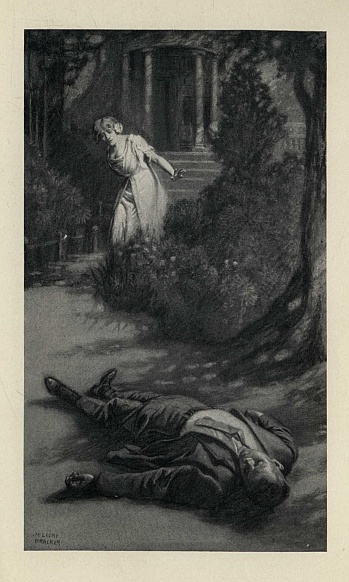
(Virginia and Halsey)
"I've been here in the house waiting—why did you
not call me?" began Halsey clumsily.
"You must not wait!" the doctor interrupted him,
taking him by the arm and hastening toward the
stairway.
They followed him up the stair, down the upper
hall, to the rooms which had been set apart of late
days for Grace and her child, quarters all too
unfamiliar to Halsey himself.
They found Grace Halsey, faint and gasping, half
sitting in her bed, clasping the child in her arms,
herself too weak now longer to hold it up. Halsey,
stricken with sudden horror, ran to take the child in his own
arms.
The truth was obvious. Even as he lifted the poor
crippled form in his arms, the head fell back, helpless.
The eyes glazed, turned back uncovered. Halsey cried
out aloud. He turned about, dazed; horror and
helplessness were on his face. It was to Virginia Rawn he
turned, as to the other part of himself.
It was Virginia Rawn who took from him the feeble,
misshapen body, gathering it into her own arms. She
gazed intently, frowning, grieving a woman's grief
over suffering, bending over its face; her own face
held back over it when she saw the truth. Then she
passed him and placed the body of the child upon its
cot near-by, covering it gently.
III
"Grace, Grace!" sobbed Halsey. He fell upon his
knees at his wife's bedside. She did not see him, did
not recognize him, although she turned a questioning
face toward him. "Me, too!" he cried. "I want to go!
I want to die and end it! Everything's wrong..."
"Come," said the doctor presently; "it's too late
now. I'll call for you after a time." He took Halsey
by the arm and led him from the room. Returning, he
signed for Virginia Rawn also to leave the sick chamber.
Left alone, the medical man turned to the professional
nurse in attendance. "Keep it quiet," he said.
"It would hurt my practice—do you hear?"
He kicked beneath the bed a small broken vial, and
wiped away the stain from the lips of the dying
woman.
The doctor, of course, had his guess, the public its
guess, the daily papers theirs. The truth was, Grace
Halsey, by butler route, had learned of the tête-à-tête
of her husband and her stepmother a half hour before
this time.
I
Grace Halsey, dead, her crippled child dead
beside her, never knew the contents of the letter
which had been received for her that morning. It still
laid on the hall table unnoticed. There was almost
none to pay attention to the many duties of the
household. The last servants had begun to pass, scenting
disaster even as had others. The magic which had
builded this mansion house now lacked strength to
hold its tenantry. There remained now only one
man—the butler, lingering for his pay. Only two persons
might still be said to be actuated by any sense of
loyalty or duty to Graystone Hall and its
owner—Halsey and Virginia Rawn.
Of duty—to what and to whom? They dared not
ask, dared not think. They waited, they knew not for
what. The master of this mansion house was forth
upon his business. Somewhere, he was hastening
toward his home. When he might be expected they
did not know. Nor did the master know what news
awaited him upon his coming.
II
The evening dailies came out upon the streets, reeling
and reeking with the last accumulating sensations
of the Rawn disasters. The business world continued
to rub its eyes, the social world continued to exult.
Many and many a woman smiled that evening as she
contemplated proofs of the downfall of one whom
once she had envied. The Rawns, it now seemed, had
all along been known, by everybody who was anybody,
to have been nobody at all. They who had sown the
wind, had the whirlwind for their reaping. This was
the general day of harvest for Graystone Hall.
But the day passed on. Shadows lengthened beyond
the tall towers and softened as they fell toward
the east. The soft airs of evening, turning, came in
across the open gallery front. Night came, night
unbroken by more than a few lights in all the myriad
windows of this stately monument which John Rawn
had builded as proof of his personal success. Vehicles,
passing slowly, held occupants staring in curiosity at
this vast, vacant pile. Human sympathy lacked,
human aid there was not.
III
Thus it chanced easily that there passed up the long
driveway of Graystone Hall, almost unnoticed, a
vehicle carrying one who seemed a stranger there; an
elderly, rather tall woman of gray hair and unfashionable
garb, who made such insistence with the servant
at the door that at length she won her way through.
Her errand seemed not one of curiosity, nor did she
lack in decision. She left upon the table an old-fashioned
reticule, and following the advice given her, in
reply to her question, passed up the stair and down the
upper hall, to the room where lay Grace Halsey and
her child. There, unknown by any of the household
and accepted by those whose professional duties took
them thither, she remained for many hours. Halsey
and Virginia Rawn did not know of her coming.
It was a cold home-coming, also, which awaited John
Rawn. But he came at last, to meet that which was
for him to encounter. It was night. The lights were
few and dim. None greeted him at his own gate, none
even at his own door, which was left unguarded. At
length he found the solitary footman-butler, asleep in
a chair, the worse for wine.
"Where is she?" he demanded. "Where is Mrs. Rawn?"
He turned before he could be coherently answered,
and passed down the hall toward the library, through
whose closed doors he saw a faint light gleaming.
IV
Something impelled John Rawn to hesitate. He
stood, himself the very picture of despair, his face
drawn, haggard, unshaven, his hair disordered, his
hands twitching. He must find his wife, he said to
himself; he must ask her what success she had had
with their last hope. Yes, yes, it must be true! With
Halsey's aid he would yet win! If she had won—Halsey
would yet be on his side—Halsey would tell
him—Halsey would go back to the factory—
But John Rawn hesitated at this door. He felt,
rather than knew, believed rather than was advised,
that his wife was beyond that door. He waited,
apprehensive, but kept up with himself the pitiful pretense
of self-deception. Ah, power, control, command!—those
were the great things of the world, he reasoned.
True, he knew his daughter lay dead in her room on
the floor above—the paper he held in his hand told
him that; for at last the doctor had prepared his
statement regarding Mrs. Halsey's death by "heart
failure"—the rich and all akin to them always die respectably,
in a house so large as Graystone Hall. But it was too
late to save her, Rawn reasoned. Let the dead bury
the dead. The larger things must outweigh the small.
He first must know what his wife had done with
Halsey.
To the tense, strained nerves of John Rawn the
truth was now as apparent as it had been to the
sensibilities of all these others, late friends, servants,
sycophants. Ruin was here, in his citadel, his castle of
pride. Only one thing could save him.... He
hesitated at the door, held back from that which he
knew he was about to face.... But no, he
reasoned, she was there alone, he must see her!
He flung open the folding doors and stood holding
them apart.
V
Yes, she was there! John Rawn's face drew into a
ghastly smile. Yes, she had won! She, the wonderful
woman, had triumphed as he had planned for her
to triumph. She had won! ...
They stood before him, those two, silent, face to
face, embraced; their arms about each other even as
he flung wide the door. They turned to him now,
stupefied, so weary, so overstrained, that their arms
still hung, embraced. The face of each was white,
desolate, unhappy; more hopeless and desperate than
terrified, but horrible. They were lovers. They loved,
but what could love do for them, so late? They had
paid—but what right had they to love, so late?
John Rawn, the man who had wrought all this,
stood and gazed, ghastly, smiling distortedly, at his
wife's face. Why, then, should she be unhappy?
What was to be lost save that which he, John Rawn,
was losing—or had been about to lose?
But he was startled, stupefied, himself, for one
moment. He turned back, hesitating; and so tiptoed
away, leaving them, although the joint knowledge of
all was obvious. They had not spoken a word, had not
started apart, had only gazed at him like dead persons,
white, silent, motionless—not lovers; no, not lovers.
For one-half instant, alone in the wide and darkened
hall, Rawn straightened himself up, threw his chest
out. Yes, she had won—she had done her task! She
held Charles Halsey fast—there—in her embrace. He,
John Rawn, multimillionaire, collector of rare objects,
one of God's anointed rich, had the shrewdest wife the
world had ever seen, the most beautiful, the most
successful!
Had he not seen—was it not there before his
eyes? She had his one enemy netted, in her
power—there—had he not seen? She brought him, bound
hand and foot, to him, John Rawn! Could a man
doubt his eyes? They had hunted well in couple, he
and his wife, and now she had pulled down their latest
victim! ...
What mattered the means?—there was but one great
thing. And the great things must outweigh the small.
He was a man of power. He had been born for
success. He was—
VI
He stood, half in the shadow, hesitant. Then he
heard other feet approaching him slowly. His wife,
Virginia, came and took him by the arm and had him
within the door; closed it back of him; and, leaving
him, advanced to where Halsey stood. She took
Halsey by the hand.... It seemed a singular thing
to Rawn, this performance; in fact, almost improper,
if the truth were known.... So it seemed to John
Rawn's mind, a trifle clouded with distress and drink.
"Well," said she apathetically; and held her peace
as he frowned and looked at her dumbly.
"Well!" he broke out at last; "I'm back
again!— You're here, I see." This last to Halsey.
They two stood and regarded him without comment.
Halsey kept his eye on Rawn's hand, expecting
some sudden movement for a weapon. He was incredulous
that any man could sustain Rawn's attitude
toward him. War, and nothing but war, seemed
inevitable between himself and Rawn, the man whom he
had wronged, the man who had wronged him.
"I suppose—I see—" began Rawn clumsily, after
a while. "Of course, you have probably been here all
the time, Charley. I came back as soon as I could.
I've been having all kinds of trouble in St. Louis and
New York. Everything's all gone to pieces."
They did not answer him, and he shuffled.
"Have you anything to say?" he demanded of his
wife; "Has Mr. Halsey—Charley—agreed?—Have
you persuaded him to—"
"You wish to know, whether I have done what I
was told to do—is that it?" she demanded of him
coldly.
"Yes; have you?"
"I have. Here is Mr. Halsey. I have kept my
word. You have seen. I told you I could bring him
in, bound hand and foot. Kiss me, Charley," she
cried. "Oh! kiss me!" And he did kiss her. Cold,
white, hand in hand, dead, they then faced him again.
VII
"Is it true?" began Rawn. His eyes lighted up
suddenly. "He has agreed?"
Halsey broke in now. "It is true, Mr. Rawn," said
he. "I love her. I love your wife; I can't help it. I
have told her so. You see."
"You love her!" John Rawn burst out into a great,
croaking-laugh. "You love her? I say, that's good!
That's good news to tell me, isn't it? Why—I sent
her—I used her, to make you love her! You see
reason now at last, do you?—every man does at
last—every man has his price. You'll go back to work
to-morrow? There's a lot to do, but we can save it all
yet. We can whip them, I tell you—we'll get everything
back in our own hands before to-morrow night!"
"—But, Mr. Rawn! Listen! You do not know!
Surely you do not understand—"
"Understand? What is there left to understand?
Didn't I see you both just now? Didn't you—right
now—haven't you got to come across now? Hasn't
she done what I told her to do; what she said she'd
do? I told her to bring you back to us again, and
she's done it, hasn't she?
"But come on, now," he resumed, as though reluctantly—"I
suppose we've got to go up there—Grace—?
Too bad.... But I wanted to see Jennie first."
"My God!" whispered Virginia Rawn, shuddering.
"Oh, my God!"
VIII
"Rawn," said Halsey directly, abandoning even any
pretense at courtesy; "the end of the world has come
for you, for us all. My wife is dead—she's lucky! My
child is dead, too, and that's lucky. It had no life to
live, crippled as it was. She killed herself and the
baby. I don't seem to care as I ought to care. And
now your wife has told me that she loves me. It's
true! She doesn't love you; she never has. She has
not taken me a prisoner any more than I have her.
We're both in this to-night. We're both to blame.
But, at the bottom, you are to blame—for all of this."
"Of course! Of course!" smiled John Rawn
sardonically. "What would you expect? I am sorry.
But I'll never tell any one about it, you can depend on
that!"
"You'll never tell!" went on Charles Halsey slowly.
"You'll never need to tell. But here's what I want to
tell you, once more. Whatever this is—and it's about
bad enough—it's come because of you. You—you
were the cause of this!"
"You blame me—why, what do you mean!" burst
out John Rawn. "Where have I been to blame, I'd
like to know! What do you mean, young man?"
"Every word I have told you, and more than I can
tell you. You'll not think—you don't dare to face the
truth; but there's the real truth. If you can't
understand that, take what you can understand. Your wife
isn't to blame—I'm to blame. Love is to blame. I
love her. I've done this."
"You have done—what?"
"I've taken your wife away from you, can't you
understand, you fool? She's going to marry me as
soon—"
"Jennie!—what's this fellow talking about?" The
veins on John Rawn's forehead stood high and full.
IX
"He is only telling you the truth," she said calmly,
wearily. "I don't care one picayune whether or not
you know it, whether or not the world knows it! I'm
tired! I'm done with all this sort of thing! Yes, I'm
going to marry him as soon as we can get away. As
soon as it's decent, if anything's decent any more!"
"And you love him, you'll rob me, you'll leave
me—you'll—why, are you all crazy? What are you talking
about? When I've given you everything you've
got—when you were so much to me! Jennie!"
"No, no!" she raised a hand. "Don't talk about
that! It's all over now."
She tore at her throat, at her fingers, heaped up in
his hands the gems she wore even then, the gems she
had put upon her person to protect them from
uncertain servants, gems which left her blazing like some
waxen queen in her tomb—white, dead, enjeweled.
"Take them!" she cried. "I don't want them." She
went on, piling his hands full of glittering, flashing
things. He stood gazing at her, stupefied. Then,
slowly, the burden of years, the burden of business
failure, and lastly this—the burden of the worst of
man's discomfiture, the worst of a man's possible
losses—began to weigh down upon him. He shortened
visibly; shriveled; drooped.
X
They had no pity for him. Youth has no pity for
age, love no pity for a mate's inefficiency; but after all
some sort of contempt, at least, seemed due him.
"Rawn," said Halsey, "it's pretty hard. We're all
of us paying a hard, heavy price for what we thought
we had. But we can't evade it, any part of it. It was
your fault that Grace left me. We were going to part.
You sent your wife after me, as you call it. I suppose
Grace found that out. You know what she did then.
I said I blame you, and so I do. But I was going to
get a divorce—"
"Divorce!—you divorce my daughter! John
Rawn's daughter!"
"Did you not divorce her mother—you, yourself?"
"But I loved—my wife—I mean, this woman—Jennie, here!"
"So do I love her; more than you do or ever will
know how to do! What you have done we'll do. Is
it worse for us than it was for you? What's the
difference?"
"But she's my wife! Why, Jennie!" He held out
a hand to her.
"So was Laura Rawn your wife, my wife's mother,"
went on Halsey. "What's the difference?"
Virginia Rawn stepped between the two. "I'm as
much to blame as any one of us all," she said quietly.
"I sold out to you, didn't I, Mr. Rawn—down there
in New York? I married you, didn't I? Very well,
what you did, I have done. No more, and not without
equal cause. I love him. I'm going to marry him.
You and I are going to be divorced—if we were not
I'd go to him anyhow. I hate you, I loathe you! My
God! how I detest and loathe the sight of you! Go
away—go away from us! You're not any part of a
man!"
XI
"It's true!" gasped John Rawn to himself; "My
God, it's true! She said that—I heard her—to me?
What have I done to deserve this? ... I ought to
kill you," said he to Halsey slowly.
"Of course you ought," said Halsey. "If you were
any portion of a man you would. But you've tried
that, and you know where you ended."
"But Halsey—Charley!—you don't stop to think!"
began Rawn pitifully. "You will go back—you will
go back to the factory, in the morning? You will help
me pull it together, won't you?"
"No, not one step back to the factory—never in the
world! I'm done with that. I'm going away somewhere,
and she's going with me, I don't know where.
Let some one else work out what you thought we could
do, and let some one else take the consequences—it's
not for me. You've got what you earned—I suppose
I'll get what I've earned, too. I don't care about that
any more."
Rawn could not answer the young man as he went
on, slowly, dully, bitterly. "If I've been traitor to any
of my own creed I reckon God'll punish me. Very
well; I will take my punishment on my shoulders.
I've no apologies to make in a place like this.
"Haven't you gone up—oughtn't we to go up now—up-stairs?"
he added at last. He put down Virginia's
arms from his shoulders; for once more she had come
to him.
Rawn sighed. "I suppose I must go up there," he
said vaguely.
He turned and walked away, heavy, stumbling.
I
Halsey turned toward Virginia. They did not
again embrace, but stood silent, almost apathetic
now. Passion was far away from them, indeed had
never fully seized them. The despair in human love
was theirs; and love is half despair. She might have
been some beautiful statue in white marble, so cold was
she; and as for the man who faced her, his anger gone,
he himself might have been the image of hopelessness.
Central figures of an irreparable ruin, and seeing no
avenue to happiness, for the time neither had word for
the other.
At last Halsey raised his head, as some sound
caught his ear. "What's that?" he said.
"I heard it," said she. "I think it's some one
coming up the walk."
"Yes," he answered. "Listen! Why, it sounds like
a crowd. What can that mean, now? Wait."
He left her and hastened out to the front door. He
stood there, outlined fully by the hall lights behind
him. Those who approached recognized him. He
was greeted by a derisive shout, half-maudlin, scarce
human in its quality. The solitary servant rushed up,
excited. "What is it, Mr. Halsey?" he quavered. "Is
there going to be any trouble? Oh, I ought to have
gone away with the others!"
"Get out of the way," replied Halsey calmly. "Get
back behind the door. I'll go out and meet them."
"Here, you men!" he called out in sudden anger to
the visitors. "What do you mean, coming here this
way?" He was advancing toward them now, down
the steps, into the curving walk, almost to the rim of
the circle of light cast by the house lights.
"Don't you know any better than to come here at
this time, you people? There's trouble in this house.
There's death in here. Go on away, at once!"
II
The leader of the scattered group of ill-dressed men
stepped forward. "No, we'll not go on away at once.
We know who you are, all right, Mr. Halsey. Trouble!
We're in trouble, too! We're lookin' for some more
trouble, now."
"Well, I'm not to blame for that. What do you
mean? Who are you, anyway?"
"You ought to know us! We've done up some of
your damned sneaks. You cut your workmen down to
the last copper in wages, and you didn't pay them that.
Then when the pinch came, you shut the doors and
slunk off, like the coward you was! Then they came
over to us, at last! Your scabs is in the unions now."
"I haven't done anything of the kind!" retorted
Halsey hotly. "I haven't been to the factory for days.
When I left there, every cent was paid up. That
wasn't any of my business anyhow—I was not cashier,
but factory superintendent."
"It's a lie, you know it's a lie! We've come to show
you up. We've come to take old man Rawn and you
out of this place. We ought to ride him on a rail, and
you with him! That's what we ought to do! We
want that money." The leader advanced toward him
menacingly.
"Why, men, I have not got your money—" expostulated
Halsey. "If I had, this isn't the way to get it
from me! I've always used you fellows square!
You've got to act that way with me. I'm in trouble
now, I tell you. My wife's dead, and my baby—to-day—in
here. You are accusing the best friend you have
got! Where's Jim Sullivan? Where's Tim Carney?
Where's any of you men that used to work with me
there in the factory? Any one of you ought to know
better."
"They ain't here; but don't talk that to us! We
know what you was doing with them machines. We
know what you was up to. You wanted to take the
bread out of our mouths! We seen it all in the papers,
the whole thing, plain enough. No wonder you kept it
all blind as you could—you wanted to put us off the
earth."
"It's a lie!" cried Halsey sternly. "I broke them
up. I threw up my job. I quit because I didn't want
to see the bread taken out of your mouths. I stood
between the company and just what you say. I
wouldn't allow them to make it harder for you than it
was. I never lost you a cent of wages—I stood for
you all the time, I'm with you now. Why, men, I've
been at your meetings, I'm one of you! Don't you
know? Don't you remember? You've never asked a
thing of me I haven't tried to do, that was in reason.
You know me! What difference about the union if
I'm your sort?"
"Yes, ve do know you!" broke in a squat and pallid
Jew, forcing himself through the thick to the front,
and usurping the place of the wavering leader. "By
Gott, ve do know you, Mister Halsey! You'fe lied
to us, that's vat you'fe done! You'fe been to our
meetings, yess, but you'fe betrayed us! I seen you
there, yess!"
"That's not true!" answered Halsey hotly. "There
isn't a word of truth in it! I've lost everything in
the world I've got just because that isn't true. My
wife's lying dead in that house back there—just
because of that! My child's dead there too—just
because of that—I've lost everything in the world I have
got—just because that isn't true!"
III
The Jew shrieked aloud, half-insane. "To hell vith
this country!" he said. "To hell vith the rich that
rob us. If your vife's dead, it iss vat's right. My
vife, she'll die too, she's starring. To hell vith Rawn
and all like him!"
"Look here, my men, that's about enough of that!"
rejoined Halsey. "You're drunk or crazy, and we're
not going to stand for that here. It's no place for this
kind of talk. I tell you, I've done all I could for you.
I haven't sided with Rawn. If I had, I could be rich
to-day."
"You are rich!" cried the Jew; "and ve are poor.
You eat fat, you sleep soft. You are rich! But vat
do ve get? I'm hungry! My folks—they are starfing!
Ve haf no money. Ve get no money for vork ve did
so long. It buys us nothing now. Meat is no more for
us; breat, hardly. This iss no country for the people.
This iss no land vere laws are just. This iss no
republic of man. Jehovah, send Thy power! Smite
and spare not, this so wrong a land!"
"You damned fanatic, shut up!" began Halsey savagely.
"Get on out of here. You don't know your own
friends! Who's to blame for your troubles? Haven't
you got heads of your own? Haven't you got votes
of your own? Can't you right your own wrongs, the
first minute you get ready to do it, I'd like to know?
I'm for you, do you understand; but you make it hard
for any one to help you. You've had sluggers after
our men all the time over there, and now you come and
want us to pay you for that. You're over here to make
trouble to-night, maybe slug me—perhaps that's what
you are trying to do to me—and you want us to pay
you for that. You talk about monopolies and trusts—what
you're trying to do is to make the worst trust in
the country—a monopoly in ignorance and savagery.
Go on home and let me alone! I tell you, my wife is
dead. I am going back to her!"
"He's lying to us!" cried out a voice in the crowd.
"He's trying to get us sorry for him!"
"That's it!" screamed the Jew, who had edged to the
front and who now stood crouched, menacing, not far
from Halsey's erect and irate frame. "That's vhat
he iss. He'ss only trying to fool us. Kill him! Ve've
vaited long enough! Gif it to him!" He sprang to one
side, crouching.
IV
Those back of them, at the gallery, in the rear of
the entry, heard some sort of scuffle, a snarling of
voices, curses. There were sounds of blows. Then
came a flash, a shocking report; after that, a
half-instant of silence, and the sound of scattering and
departing footsteps.
There remained only one figure, lying outstretched
on the gravel. To render succor to this, to offer aid,
there was now only one human being left in all that
place—she who now came hurrying forward.
Virginia Rawn half raised Halsey as he lay. "Charley!"
she said quietly. "Can you talk?"
He gasped and nodded. "Through here!" He
touched his chest. "I guess I'll not—be able—"
She called out, to any back of her, for aid. The
frightened servant came, and between them they got
him somehow into the house, dragging him to the
gold-room library which they had but lately left. They
placed him there upon a couch. Virginia Rawn rose
and waved the man away. He hurried after help.
"Charley!" she said, turning to him; "can you talk?"
"A little. What is it, Jennie?"
"You're hurt bad—very bad."
"Through here," he said again, and touched his
chest. His breath was hard. His garments were
soaked with blood. His face was bluish-gray.
V
She looked into his soul the query of her own.
Perhaps there was something not wholly unworthy in the
bond between them, since now it enabled them to talk,
one soul with the other, almost without words....
The great, secret, all-powerful, world current,
interstellar, not international, the one great power—of love,
as she once said—was theirs.... Yes, it was theirs,
if only for a little while.
"They've killed me," he began after a time—"I
tried to do something for them. He—Rawn—would
have used it for himself. I didn't want to....
"Jennie," he said, after a time; "I beg pardon,
Mrs. Rawn—I forgot—would you take the doll, the
little rubber one on the table there, up to the baby?
Poor little thing! Oh, well! ..."
He sighed. She quietly laid him back upon the
couch. She heard the blood drip, drip, through and
across the brocaded couch, falling at the edge of the
silken rug, on the polished floor, eddying there;
thickening there.
I
Far off, deep in the underground regions of the
city at the focus of the republic's vast industrialism,
the presses were reeling and clanging again,
heavy with their story of disaster. The civilization of
the day went on.
Somewhere out upon the mountain tops, somewhere
in the forests, the forces of nature gathered, marched
on toward the sea. Somewhere dumbly, mutely,
uncomplaining, the great river and its mate the great
power, inter-stellar, not international—they two, as he
but now vauntingly had dreamed, erstwhile silent
partners of John Rawn—did their work.... For
whom? For what? Answer that, my brothers.
The answer is your own. As you and I shall speak in
that answer, so shall our children eat well sleep well, in
days yet to come, in this country which we still call
our own, now all too little ours.
II
It was far past midnight when John Rawn again
came down the stair, sobered and whitened by what
he had seen in the death chamber. He tiptoed now
back to the library door, through which and beneath
whose silken curtains still there pierced a little shaft of
light. He opened the door, peered in.
He saw Virginia sitting there silent, white,
unagitated, her features cameo-sharp, her skin waxen,
indeed marble white, a woman as motionless, as silent,
apparently as little animate as the one he had left
behind him in the death chamber beyond the stair. She
turned her eyes, not her face, toward him, but did not
speak. The edge of her gown was moist, stained.
John Rawn looked in turn at the long figure upon
the couch, motionless, silent, its hands folded. Neither
did it speak to him. Suddenly oppressed, suddenly
afraid, he turned once more away. Irresolution was in
his soul, uncertainty.
Rawn was hardly sure that he still lived, that he
still was the same John Rawn he once had known. It
seemed impossible that all these things could have
fallen upon him, who had not deserved them! He
pitied himself with a vast pity, revolting at the many
injustices of fortune now crowding upon him, a wholly
blameless man. Why, a day before, he had held in his
hand power such as few men could equal; had had,
presently before him, power none other ever could
hope to equal. That opportunity still existed. But how
now could he avail himself of that opportunity, how
could he go on to be the great John Rawn, if this
figure on the couch could not arise, could not speak
to him, could not perform the obvious duty of rendering
needful assistance to him, John Rawn? The cruelty
of it all rankled in the great and justice-loving
soul of Mr. Rawn. Why, he was penniless—he—John
Rawn! He was not even sure about his wife, yonder.
She had said things to him he could not understand,
could not believe.
He left the room, and walked still farther down the
hall, his head sagging, his lower lip pendulous, his
face warped into a pucker of self-pity—so absorbed,
that at first he did not heed an approaching footfall.
He paused almost in touch of some one who
approached him in the half-lighted hall; some one who
was coming down the stair and along the hall with
steady tread.
III
There stood before him now the same tall,
gray-haired, unfashionably dressed woman whom so
recently he vaguely had noted at a distance in the hall
above; some woman apparently busy with duties
connected with the death chamber, as he had reflected
when he saw her; some neighbor, he presumed, and
certainly useful! It was kind of her to come at this
time. He could not, at the time, recollect that he had
seen her before. Yes, he would reward her—he would
express his thanks.
He looked up at her now sharply, and gasped.
"Laura!" he exclaimed. "Is it you?"
"Why, yes, John," answered the tall, gaunt woman
gently. "Didn't you see me, up there? I suppose you
were too much troubled to notice me, John. Yes, I'm
here. I thought maybe I ought to come.
"But you see—this—" she held out to him the letter
she had picked up from the hall table. "This didn't
get to her—Grace—not in time. She died this
morning, before noon, they tell me. She never knew her
mother was coming to her when she was in trouble.
She hadn't seen my letter to her, telling I was coming.
I knew she was in trouble—and I saw all the stories
in the papers. I thought I'd tell her I was coming to
her—and you, John. She was my girl, after all! I
knew she was in trouble."
"How did you know?"
"Why, she wrote to me, of course. A girl always
writes to her mother when she's in trouble. She wrote
to me right often. She wasn't—well, she wasn't happy,
John, and she often told me that. Something wrong
was going on between her and Charley, I don't know
what."
He stood looking at her, stupefied, as she went on,
simply.
IV
"John, married folks oughtn't to be apart too much.
They sort of get weaned from each other. Grace was
too ambitious. She'd got, here, what she thought her
husband couldn't get, what she'd come to think she
had to have. I might have told her better, but I wasn't
here. Not that I'm reproving you, John, not at all.
Besides, we have all got to go, some day. But I loved
her.... And the baby."
"So did I love her, and the baby," he began. Tears
were in his eyes. "Laura, I have had nothing but
trouble. And now you have come here—"
"Yes, I know; it must seem a little queer to you,
John; so I'm going right away again, to-night—before
morning, if there's any way I can get down-town."
"Yes, yes!"
"—Because, I know if I was seen around here, and
people found out who I am, who I—was—there might
be some sort of talk which would be hard for you,
John. I reckon you have trouble enough without that.
I didn't want to bother you. I came mostly because
of Grace. But—John, I always did like to tell the
truth, and I have got to tell it now—I came a little,
too, because of you!"
"Of me? Why Laura!"
"Yes, I did. I read the papers, of course, all the
time. I have known about you, although you haven't
heard of me. You have moved up in the world, John,
and as for me—well, I have just gone back to Kelly
Row, where we used to live. Of course, I'm glad you
have been lucky. But then, lately, the papers all
began to say you were in trouble. I've read all kinds of
things about you. I heard you were ruined—that you
hadn't a dollar left in all the world!"
"It's true," he growled; "as near as I know, it's
true. There is no hope for me now. It's all up!"
"But, John, you had so much money!"
"Yes, but it's gone now. It doesn't take it long to
go when it starts the other way. The market makes a
man, and it breaks him just as quick, and a lot quicker.
It's done me, Laura. I'm ruined. I haven't a thing
left in the world; not even my wife. Have you come
here to twit me with it? What do I owe you, that I
have to listen to you?"
"Why, nothing, John, that's true; nothing at all, not
in the least. I have no right here at all, I know that.
I understood that, when I—when—I went away from
here. But that wasn't why I came back to-night."
"Then why did you come? You always had the faculty,
Laura, of doing the wrong thing. You've been a
curse to me all my life!"
"Some of that's true, John," she answered simply,
"and a good deal of it isn't. Maybe I said the wrong
thing sometimes, or did the wrong thing. I never had
much training. I was meant for Kelly Row, I reckon—I'd
never have fitted in here. We tried it! But I
didn't come to glorify myself because you've lost this
place, and everything you had. I just thought—"
"Well, Laura, what was it that you just thought?
I can't stand here talking all the time. It isn't right, it
isn't proper. I'm worn out!"
"Of course it isn't, John. I'm going right away.
But you see, when I came away I just thought this
way—here am I, an old woman that don't need much
money any more. And there's Grace;—and maybe
now John has need for money when everybody's
turned against him. And if he does need money,
why—"
V
"What do you mean, Laura?" gasped John Rawn.
"What's that you said about money?"
"How much would do you any good, John?" she
asked, fumbling in her bulging hand-bag.
"I might as well wish for the moon as for a dollar,"
he said bitterly. "If I had a million, or a half million,
to-morrow, I'd pull it all together, even yet."
"A half million, John?" she said, taking out of her
bag a little, wrinkled, flat porte-monnaie such as women
sometimes use for carrying change in their marketing;
but still continuing her fumbling at the portly bag.
"Yes, if I had a half million I could put this
company on its feet, even yet—the secret's out that
Halsey had,—but I'd get it somewhere. I more than half
believe those fellows have got it, somewhere else,
somehow—that fellow Van's deep. You see, they've
been fighting me, Laura—made up a gang against me!
I know who it was. If I had a half million I'd throw
in with Van—he's got this secret somehow—he knows
something about it. I'd throw in with him, and we'd
whip the others, even yet! I'd get it all back in my
hands even yet, I tell you!
"But my God! Why do I stand talking about such
things? What's the use? I'm down and out! I'd just
as well be dead!"
"Well, John, what I always said of you was, that
you seemed to know how to get things around the way
you wanted them. I said to myself, what a shame it
was he should have no money, when he needed it, and
I should have so much when I didn't need it. I've got
enough set aside to keep me, I reckon, for my few
years. And here's what you gave me;—although,
Grace—of course, John, I want enough used to put
Grace and the baby away. The rest is yours."
He stood looking at her dumbly, as at last she
extricated from the bag a thick bundle of folded papers,
green, brown, pale pink.
"I got the bank to keep them for me," she said
simply. "It is what you gave me—when—when I left
here—"
He still stood looking at her, choking.
"Laura!" said he. "Has God come to my aid?
This—I can't believe it! It's a million dollars! It's
a million dollars!" His voice rose, breaking almost
to a shriek. "It's a— It's—a—million—dollars!"
"Well, take it, John, it's yours; you're welcome to it.
I don't want it. It's done me no good. It's done none
of us any good. All I want is, that you should take
care of Grace's funeral, for that's only right, John.
She was my girl, my baby, my baby! Take care of
her. John, I have got to go back—home!"
VI
In the next ensuing moment or so, what swift
changes now were wrought in the late despair of our
friend and hero, Mr. John Rawn, master of the
International Power Company, already in imagination
controlling in good part the destinies of a people—the
great John Rawn, philanthropist, kindly employer,
wise friend of the less favored ones of earth; the
beneficent, kindly, omnipotent John Rawn? Why had
he despaired, why had he ever doubted, why had he
ever set himself even momentarily apart from that
original destiny which always he had accorded to
him-self? Was he not a leader—had he not been devised
to be so in the plans of the immortal gods, ages ago?
Was he not one of the few select ones assigned to
rule his fellow-men?
John Rawn stood before the old, gray woman, and
scarcely heard her last words. He sighed deeply. His
self-respect was coming back to him in waves, great,
recurrent waves. At last a smile crossed his face. The
imperious glance of the born ruler, of one better than
his fellow-men, the look of the man set apart and
licensed to rob and rule—returned once more to his eye.
VII
"It's a million dollars!" he cried aloud, exultantly,
once more. "It's God has sent it to me! I'll take it as
a sign. Watch me in the morning! I'll make them
hunt their holes yet. By God! I will!"
"John, John, you mustn't swear, it isn't right!
John!"
"I beg your pardon—er—er—Laura," he rejoined,
with fine condescension, every instant now becoming
more himself. "In fact, I want to thank you—it's clever
of you, I must say. It isn't every woman who'd have
done what you have done, I'm sure."
"Why wouldn't they, John? It isn't money a woman
wants to make her happy. I've tried that. Grace tried
it. It doesn't work. It takes something else besides
money, I reckon. We're lucky when we find that, any
of us, I reckon. If we don't, we've got to take just
what God gives us. But money doesn't buy everything
in the world. John, sometimes I think it buys about as
little as anything you can think of!" She gulped just
a little in her thin throat.
"All the same," said he firmly and generously, by
this time almost fully the great John Rawn once more,
"it was very decent of you, Laura."
"Well, never mind about that, John. It was you
who made it. I never did understand how you earned
it so fast. I'm glad if it will do you any good—if you're
sure it will do you any good. And see, John," she
added shyly, fumbling again in her bag, "I brought
you a little present, John. I've been doing these, you
see. I make quite a lot out of it. I never used any of
that money you gave me, at all—I did these things—the
way I did before, when we were getting our start
together, John, you know. I thought—maybe—you'd
like a pair."
VIII
She held out to him a pair of braces, embroidered
carefully in silks. He took them in his hand. She also
looked at them closely, in professional scrutiny, her
steel bowed spectacles on nose. She pronounced them
good.
"But, John," she added curiously—"you know,
while I was up there, doing what I could for Grace and
the baby—it seemed to me like as if I heard some
funny sort of noise down here—something like a shot.
What was it?"
"It was some of those confounded laboring people,"
said John Rawn, frowning. "Yes—they came here
after Halsey."
"Yes? But was anybody hurt?"
"Well," said John Rawn, "Halsey—Charley Halsey—you
remember him, I believe? Well, they shot him.
—"Good-night, Laura," he added suddenly, and held
out his hand to her, generously, nobly. "I'm very
sleepy. I've been up so long—and I've a lot to do
to-morrow. After all, there's no use in our having hard
feelings. Good-by."
THE END