Larger versions of most illustrations may be seen by right-clicking them
and selecting an option to view them separately, or by double-tapping and/or
stretching them.
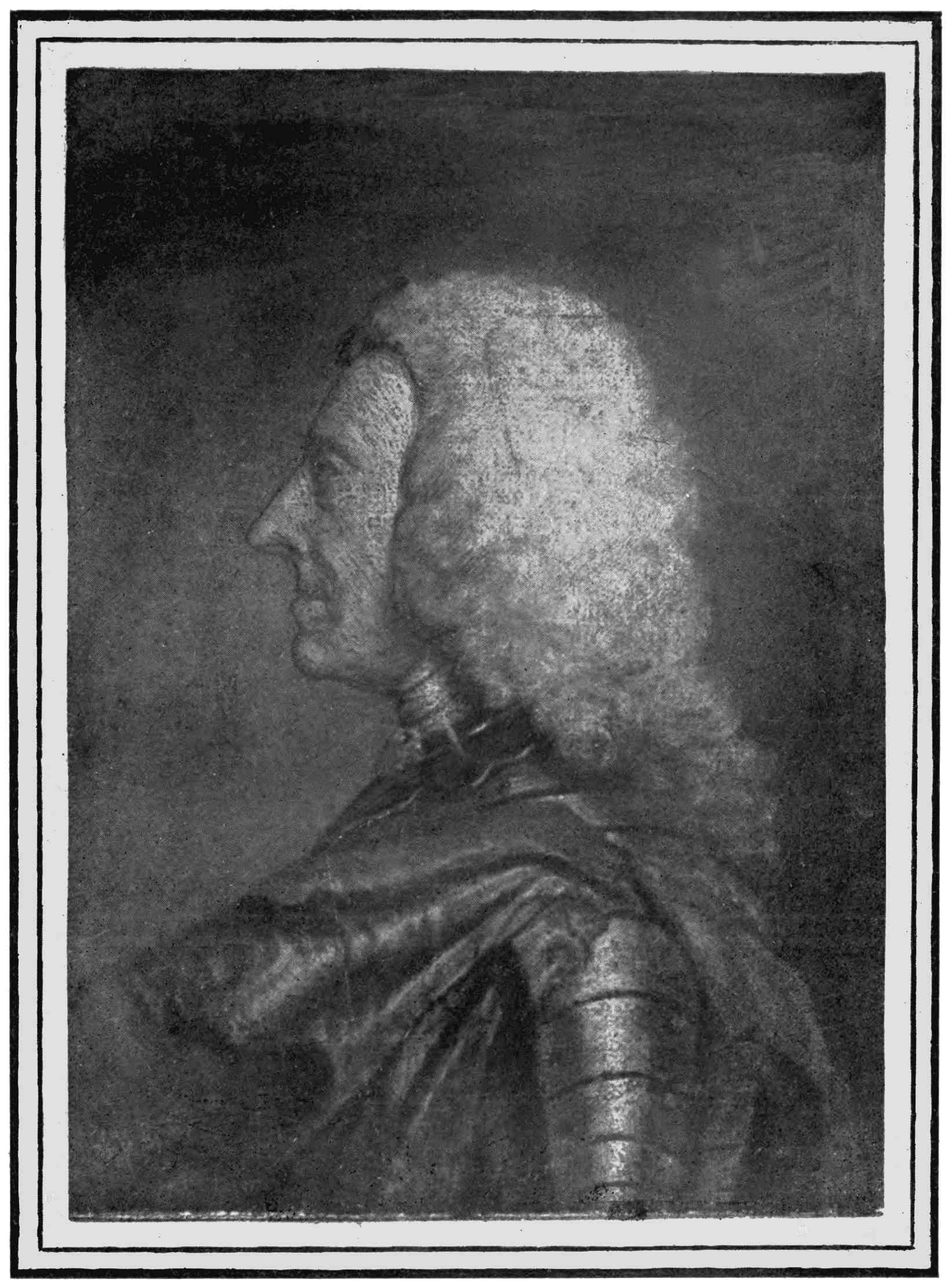
Copyright.][Emery Walker.
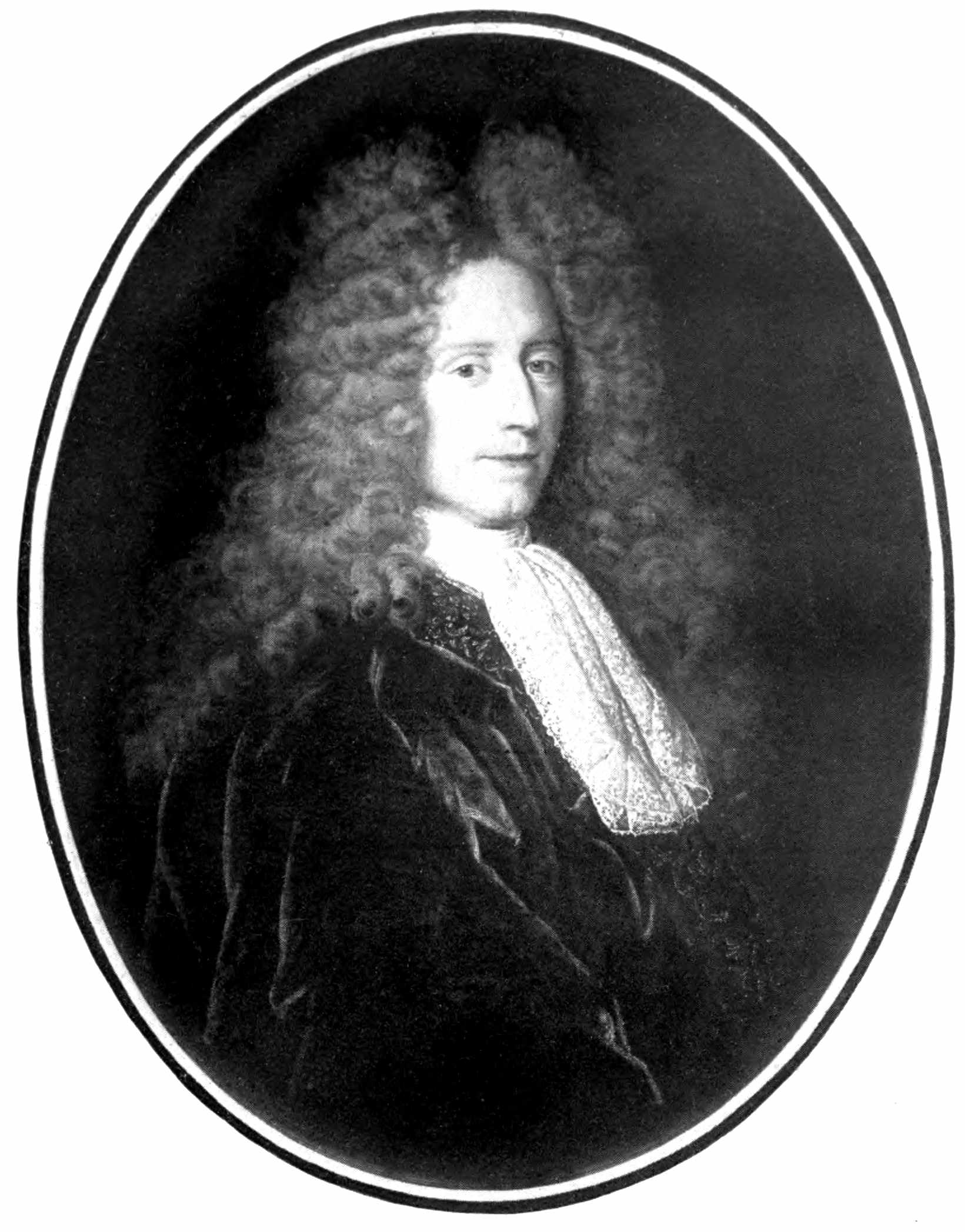
JOHN LAW OF LAURISTON.
From a portrait in the National Portrait Gallery, London.
John Law of Lauriston
Financier and Statesman
FOUNDER OF THE BANK OF FRANCE, ORIGINATOR OF THE
MISSISSIPPI SCHEME, ETC.
By A. W. WISTON-GLYNN, M.A.
EDINBURGH
E. SAUNDERS & Co., 52 NORTH BRIDGE STREET Also at London and Dublin
Inscribed
to
My Wife.
PREFACE
The career of John Law is one of the most striking
and romantic in a period teeming with great
and historic personages, and provides in the annals
of the early part of the 18th century a chapter
dealing with a series of exciting events which, in
their character, their intensity, and their influence
upon the French people, were almost revolutionary.
As a financial genius he was incomparably
the greatest man of his age. His schemes,
original in their conception, and vast in their
operation, captivated by their brilliance a nation
already on the brink of ruin, and eager to embrace
any possible means by which it might rehabilitate
its shattered fortunes. His gigantic joint-stock
undertakings, his sweeping financial proposals
culminating in the discharge of the whole National
Debt of France, his gradual increase of power
and influence, and latterly his virtual control of
the government of France, made him a man of
international importance—a man to be respected,
flattered, and feared.
It is, accordingly, a somewhat striking circumstance
that, with the exception of the short account
of Law’s career by John Philip Wood issued so
long ago as 1824, no adequate biography of the
great financier has yet appeared in this country.
While essays, and critical articles have, no doubt,
appeared in abundance in numerous publications,
and while his phenomenal career has even been
pressed into the service of fictional literature, it
has only been possible to obtain a comprehensive
impression of the man and his work by reference
to the numerous treatises dealing with his system
published in France during the 18th century, to the
voluminous memoirs of the time, and last but not
least to the state and official documents in which
his various schemes are considered. In preparing
the following pages, therefore, it has been necessary
to deal with a considerable mass of unsifted
material, no small portion of which seems to have
been neglected by previous writers, although
valuable and requisite for forming a just and impartial
estimate.
Amongst the authorities to which I have been
most indebted for guidance are the following,—“Histoire
du Système des Finances pendant les
années, 1719 and 1720,” by Duhautchamps;
“Vue génèrale du Système de M. Law,” by
Fourbonnais; “Correspondence of the 2nd Earl
of Stair, in the Hardwicke State papers;”
“Memoirs de Saint-Simon;” “Law et son
système des Finances,” by Thiers; “Recherches
historiques sur le systême de Law,” by Levasseur;
and “Law, son systême et son époque,” by Cochut.
Law’s own writings have, of course, also furnished
valuable material, and particularly his “Proposals
and Reasons for constituting a Council of Trade in
Scotland,” and his “Money and Trade Considered.”
His later writings form part of Daire’s
“Collection des Principaux Economistes.”
Standard of criticism hitherto applied to John Law.—Birth and ancestry.—Education.—Death of father.—Early devotion to study of finance.—Manner and appearance.—Visits London.—Duel with Beau Wilson.—Tried for murder.—Escapes to France.—Meets Lady Catherine Knollys.—Career of gambling on the Continent.—Studies banking.—Formulates new principles of finance.—Returns to Scotland.
Unsettled condition of Scottish politics in 1700.—Financial and commercial insecurity of country.—Law’s solution of difficulties.—Land Bank.—Supported by Court party.—Rejected by Parliament.—Again resorts to gambling.—Returns to Continent.—Expelled from Holland.—Visits Paris.—Discusses finance with Duc d’Orleans.—Expelled by Lieutenant General of Police.—Submits proposals to Louis XIV. without success.—Again attempts to secure adoption of proposals by France.—Financial condition of France.—Earl of Stair’s friendship with Law.
Accession of Louis XV.—National debt of France.—Debasement of coinage.—Arraignment of tax collectors.—Council of Finances consider Law’s proposals unfavourably.—Petition for permission to establish private bank granted.—Constitution of the Bank.—Its Success.—The “Pitt” diamond and its purchase.
Law’s notes become official tender.—The Mississippi Scheme projected.—Early explorers of Mississippi territory.—Establishment of the West India Company.—Its absorption of depreciated billets d’état.—D’Argenson appointed Chancellor of France, and attempts extinction of National Debt.—Law innocently involved in D’Argenson’s fatal scheme.—Saved from arrest by Regent.—The brothers Paris and an anti-system.
Exaggerated accounts of resources of Louisiana.—Law’s judgment at fault.—His ultimate aim.—He creates an artificial rise in the value of Company shares.—His unsuccessful efforts to gain influence over Saint-Simon.—Acquisition of Tobacco monopoly.—Absorption of other companies.—Reconstitution of West India Company.—Parliamentary opposition overcome.—“Mothers” and “Daughters”.—Excited speculation in shares.—Issue of notes to colonists.—A pioneer’s account of Louisiana.
Company acquires right of coinage.—Issue of fresh stock and rise in price.—Attempts made to discredit Law.—Stair’s account of the situation.—Law defeats the anti-scheme.—The concluding proposal of his schemes.—The Company’s capital and sources of revenue.—Report of directors for 1719.—Law’s bank converted into a Royal bank against Law’s wish.—The Regent divests notes of the bank of their most valuable features.—Provincial branches established.—Restriction of gold and silver tender.—Extravagance of successful speculators.
Hotel Mazarin acquired as office of Company and of Bank.—Excitement of crowds in the Rue Vivienne and the Rue Quincampoix.—Curious sources of fortune.—Instances of enormous fortunes acquired by members of the nobility.—Enormous influx of foreign speculators into Paris.
Law’s importance causes him to be courted by all classes.—Socially ostracised by nobility.—Law’s conversion to Roman Catholicism.—The part of the Abbé Dubois and the Abbé Tencin in the conversion.—Difficulties in its accomplishment.—Law becomes naturalised.—Law appointed Controller-General of Finance.—Regent celebrates appointment by a distribution of pensions.—Law honoured with the freedom of the City of Edinburgh.—Elected member of Academy of Sciences.—William Law brought to France and made Postmaster-General.—Law’s private investments.—His fiscal reforms.—His introduction of free university education.
Law’s designs against England’s political and industrial position.—Earl of Stair’s correspondence with Mr. Secretary Craggs.—Stair accused by Law of threatening the safety of the Bank.—Stair’s recall intimated.—Lord Stanhope sent to conciliate Law.—Threatened rupture between England and France over question of evacuation of Gibraltar.—Stair endeavours to justify his hostile attitude towards Law.—His apprehensions as to Law’s purpose in acquiring South Sea stock.—The humiliating nature of Stair’s dismissal.
The beginning of Law’s difficulties.—The Bank’s reserve of specie begins to be depleted.—Law attempts a remedy by altering the standard of the coinage, and restricting the currency of specie.—Temporary success of remedy.—Domiciliary visits resorted to for detection of hoarded specie.—Bank and Company United.—Discharge of National Debt.—Use of the Rue Quincampoix prohibited as a stock market.—The assassination of a stock-jobber by the Comte des Horn, and the latter’s execution.
New measures prove ineffectual.—New edict issued fixing price of shares and depreciating value of notes.—Authorship of edict.—People hostile to edict.—Parliament refuses to register it, and a revocation is issued.—Law deposed from office of Controller-General.—D’Aguessau reinstated in his former office.—New schemes for absorption of bank-notes.—Widespread distress produced amongst community.—Law’s person in danger.—Stock-jobbers establish themselves in the gardens of the Hotel de Soissons.—Parliament exiled to Pontoise, and Bank closed for an indefinite period.
Starvation produced amongst poorer classes by issue of new edict.—Law’s expulsion from France demanded.—Law resigns all his offices and leaves for Venice.—Privileges of Company withdrawn.—Commission appointed to value unliquidated securities.—Law in vain applies for recovery of a portion of his wealth.—His death at Venice.—Attitude of French people towards Law.—Circumstances to be considered in passing judgment.
John Law of Lauriston — CHAPTER I
Standard of criticism hitherto applied to John Law.—Birth and ancestry.—Education.—Death
of father.—Early devotion to study of finance.—Manner
and appearance.—Visits London.—Duel with Beau Wilson.—Tried
for murder.—Escapes to France.—Meets Lady Catherine
Knollys.—Career of gambling on the Continent.—Studies banking.—Formulates
new principles of finance.—Returns to Scotland.
Ithas been the fate of most
men who have left their name
upon the pages of political
history to have their conduct
scrutinised with a degree of
ethical fineness which happily
is denied those whose records
have not risen above the commonplace. Such a
standard of criticism has been invariably applied
in instances where origin of birth would hardly
justify anticipations of pre-eminent greatness—and
especially where the circumstances that have
fostered its rise lie outside the beaten track, and
possess the inviting charm of novelty. Reputation
acquired in the steady, patient pursuit of a
purpose is not more likely to reach the level of
permanent fame, than one of which spasmodic
progress forms the outstanding element. Where
brilliance of meteoric splendour appears in any
sphere of life, but chiefly in the region of national
politics, a curiosity which otherwise would be
escaped is aroused by reason of its suddenness,
and attempts are made to discover unworthy
motives behind each act. While these attempts
can only have a problematic value in absence of
any true disclosure of motive, judgment is not infrequently
passed with an air of authority that seems
to exclude refutation. Nor is it an uncommon
occurrence for contemporary opinion, prejudiced
and perhaps unjust, to distort the estimates of
subsequent writers. Exemplification of this is in
some degree to be found in the case of John Law
of Lauriston, the founder of the Mississippi
Scheme, whose chequered and questionable career
before his elevation to a position of national
importance in the government of France, furnished
excellent material for a sinister interpretation of
his intentions by his detractors.
By birth, Law belonged to a family which held
a position of considerable social rank and influence
in the Scottish capital. He was born at
Edinburgh, on the 21st of April, 1671, and his
father, William Law, described in the records of
his time as a goldsmith carrying on business in
the capital, followed a profession more nearly
allied to that of banking as now understood.
Some conflict appears to have existed as to his
lineage, but on the authority of Walter Scott,
Writer to the Signet, father of Sir Walter Scott,
who acted for some time as agent for the family,
it may be taken that Law was the grandson of
James Law of Brunton, in Fife, by Margaret,
daughter of Sir John Preston, Bart. of Prestonhall,
and great-great-grandson of James Law,
Archbishop of Glasgow from 1615 to 1632. The
claim of his mother, Jane Campbell, to relationship
with the ducal house of Argyll may have
been somewhat remote, but is not at all improbable.
With a view no doubt to educating his son to a
career which the fortunes of the family were
sufficient to enable him to follow, and perhaps
because he early perceived evidences of uncommon
capacity, William Law embraced every
opportunity which the educational facilities of the
time afforded. In order to put him beyond the
possible prejudicial influences of the city, he sent
young Law at an early age to Eaglesham, where
he was placed under the care of the Rev. James
Hamilton, whose son subsequently married his
eldest sister. There he received his early education
in a school established by the Rev. Michael
Rob, the first Presbyterian minister ordained after
the liberty.
Unfortunately for the future of his promising
son, William Law died in 1684, and to his mother’s
care, but probably less restraining influence,
young Law was now entirely entrusted. In the
year preceding his death, however, William Law
had acquired territorial dignity by the purchase of
the estates of Lauriston and Randleston, situated
along the Firth of Forth a few miles west of
Edinburgh, the right to which was taken in
life-rent for himself and his wife, and in fee to
John Law, their eldest son.
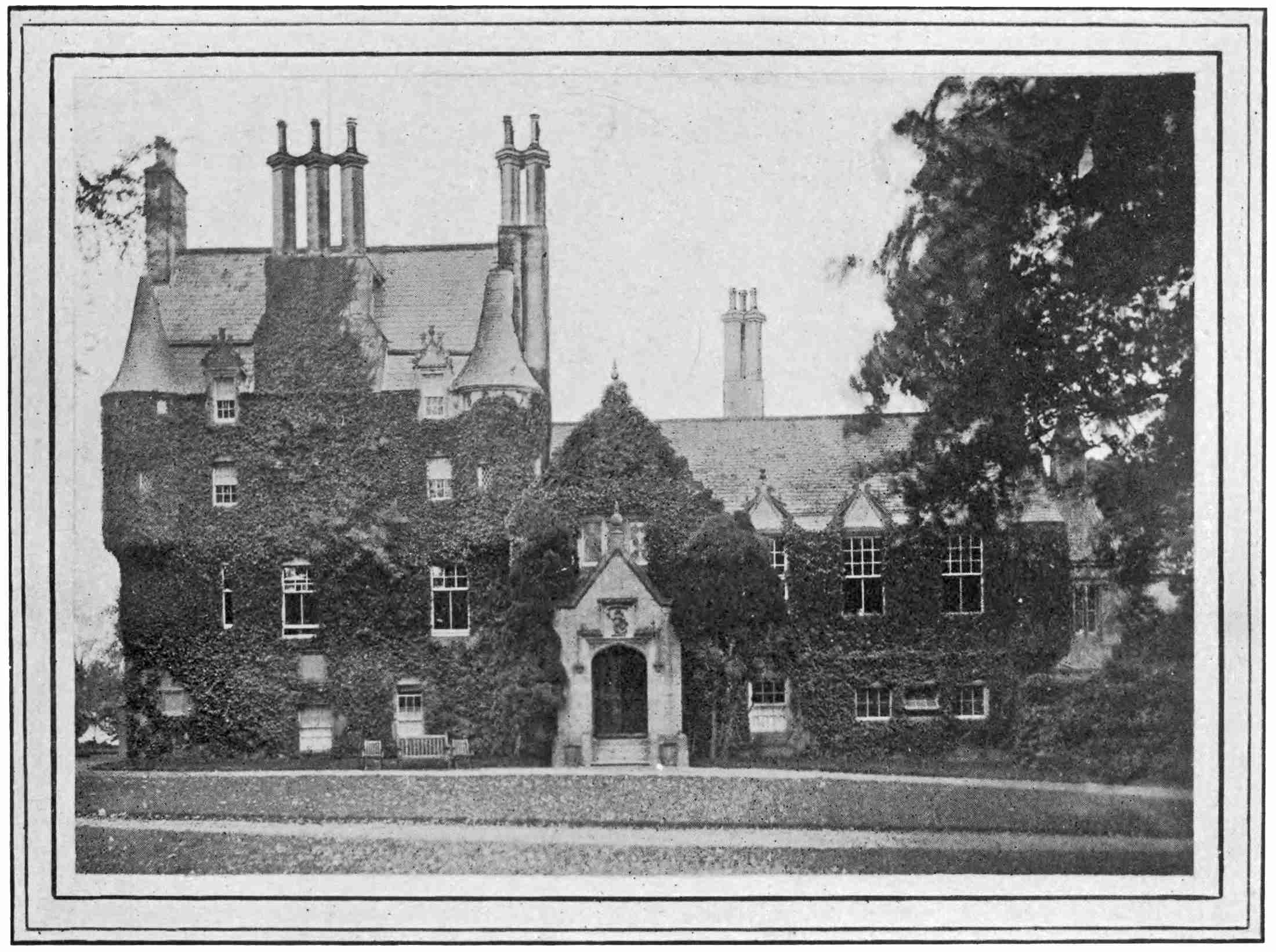
From a Photograph.
LAURISTON CASTLE.
Law’s mother, although no more than an
ordinary degree of womanly grace and force
of character can be attributed to her, possessed
what was of equal, if not of greater, value at
such a juncture as this, when the loss of the head
of a family may mean so much—a capacity to
direct with prudence, tact, and business capacity
the affairs of her estate. The family was large;
of eleven children nine survived, and the burden
imposed upon her resources by the education
and maintenance of so many, without entailing
at least outward change of appearance, is
eloquent testimony to her cautious and careful
management. Upon Law himself she bestowed
the greatest concern, continuing his education
upon the lines directed by his father, and in
particular giving him every encouragement
towards the study of mathematics, in which his
youthful mind took the deepest delight. At an
age when the majority of children have merely
mastered the preliminary stages of a branch of
knowledge presenting so many difficulties—and
seldom indeed caring or willing to go beyond its
threshold—Law was able to find the most genial
occupation in solving the most complicated
problems in geometry, and in comprehending the
subtleties of algebraic formulæ. At a time also
when political economy as a science was undeveloped,
and when the dominating principle of
finance consisted of meeting daily exigencies by
daily expedients, Law devoted a considerable
portion of his time to inquiring into the basis of
national and private credit, the laws governing
the currency of money, the problems of taxation,
and generally all the intricacies of economic
phenomena that presented themselves to his
observation. The theories which he formulated
as scientific explanations of these phenomena
indicate a philosophic grasp of mind, although
they may now appear crude and untenable, and
bear the marks of his proneness to hasty conclusion.
They soon, however, procured for him distinction
as an economist of novel ideas, and formed the
foundation for the development of the various
schemes by which he afterwards acquired a
European reputation.
Added to his undoubted intellectual abilities,
Law possessed an engaging manner, a generous
disposition, and a handsome personal appearance.
By his fastidiousness in dress, he gained a degree
of notoriety amongst his fellows, and was known
amongst the ladies of his acquaintance by the
appellation of Beau Law, whilst the gentlemen
of the city conferred upon him the nickname of
Jessamy John.
When twenty-one years of age, Law, with the
feeling of independence due to the competency
with which he had been provided by his father,
desired to find a wider field for the proper display
of his various accomplishments, and accordingly
found his way to London, whence he made frequent
visits to Tunbridge Wells, Bath, and other
popular places of pleasure of the day. There he
mixed with the highest social and political circles,
to which his talents obtained him ready access,
but in a society where gambling, hard drinking,
and general dissipation were marks of distinction,
Law’s popularity made serious inroads in a very
short time upon his pecuniary position. An
accumulation of debts necessitated a re-arrangement
of the fee of Lauriston in order to provide
for their payment. This he conveyed to his
mother in consideration of her advancing the
requisite sum, and whatever other money he
required for immediate and legitimate purposes.
The burden thus imposed upon the estate, however,
was not to be allowed to remain. By
severe economy his mother was able within a
comparatively short period to remove it, and to
secure the estate free of encumbrance in entailed
succession to her family.
An event, however, shortly occurred, which
almost resulted in an ignominious termination to
Law’s career, but, as it happened, he succeeded in
escaping its consequences although it necessitated
his departure from the country. As an exponent
of masculine fashions, he had a rival in one Edward
Wilson, a younger son of a Leicestershire landlord.
Their rivalry, as may be judged, did not conduce
to friendly relations, and ill-concealed feelings of
hatred existed between the two. This Wilson
had been an ensign in Flanders, but having
resigned his commission—from what cause it is
not known, whether it was that his daintiness
rebelled against the roughness of soldiery or that
his courage was not equal to its dangers—he
found his way to London, and there was a
source of the greatest mystery to his friends and
associates. Possessed of little or no patrimony,
he yet maintained a magnificent establishment with
an army of servants, and drove a coach and six.
His lavish entertainments, and his social
splendour, were the envy of the wealthiest.
With unlimited credit, he nevertheless incurred
no debts but were speedily paid, and on his death
left no estate or evidence of the source of his
abundant means.
With Wilson, Law had a serious difference, in
which a Mrs. Lawrence, according to one account,
and according to another Miss Elizabeth Villiers,
afterwards Countess of Orkney, was concerned,
and satisfaction could only be obtained by resorting
to a duel. They met at midday on 9th April, in
1699, in Bloomsbury Square, and Wilson receiving
a fatal wound, Law was arrested on a charge
of having “of his malice aforethought and assault
premeditated, made an assault upon Edward Wilson
with a certain sword made of iron and steel of
the value of five shillings, with which he inflicted
one mortal wound of the breath of two inches, and
of the depth of five inches, of which mortal wound
the said Edward Wilson then and there instantly
died.” Law was tried on the 18th, and two
following days of the same month at the Old
Bailey, before the King’s and Queen’s Commissioners,
but notwithstanding the most skilful
defence, was found guilty of murder, and condemned
to be hanged.
His popularity with persons of rank now stood
him in good stead at this critical juncture. The
acquaintanceships he had assiduously cultivated
during his brief stay in London were not without
their value, and enabled him to draw upon their
influence to serviceable purpose. The King’s
mercy was invoked, and pardon was extended to
the condemned man. His release, however, was
not to bring him absolute freedom. An appeal
was immediately made by Wilson’s brother to the
Court of King’s Bench to have this apparently
wrongful exercise of royal clemency cancelled.
So general was the impression that justice had
been flagrantly abused, that Law was again
arrested and thrown into prison during the dependence
of the appeal. Numerous technical
objections were taken to the grounds of the
charge, but all without success, and fortune seemed
at last to have handed him over to the doom
already pronounced against him. But expedients
for escape had not been all exhausted. With the
assistance of his friends he contrived, two days
before his execution, to regain his liberty, and
place his recapture beyond possibility. After
overcoming his guard by the use of an opiate, and
removing the irons with which he had been fettered
by means of files surreptitiously conveyed to
him, he climbed the high wall encircling the prison
buildings, and, in the company of sympathetic
associates, succeeded in reaching the Sussex
coast, where a boat had been held in readiness to
convey him over to France. The authorities
made no serious effort to prevent his flight.
Rather does it appear that, under the influence
which formerly secured his pardon, they connived
at his escape. Strength is given to this hypothesis
by the misleading description of Law in the announcement
offering a reward for the capture of
the fugitive, which appeared in the London
Gazette of 7th January, 1695, to the effect that
“Captain John Lawe, a Scotchman, lately a
prisoner in the King’s Bench for murther, aged 26,
a very tall, black, lean, man, well shaped, above
six foot high, large pock-holes in his face, big
high nosed, speaks broad and loud, made his
escape from the said prison. Whoever secures
him, so as he may be delivered at the said prison,
shall have fifty pounds paid immediately by the
Marshall of the King’s Bench.”
Having arrived in safety upon French territory,
Law made his way to that haven of refuge for all
needy Scotsmen of birth and influence, the Court
of St. Germains. Here he hoped to recover his
lost position and fortunes by placing the services
of his naturally great abilities at the disposal of a
Court to whom they could not but be of some
advantage if properly directed. His efforts to
secure a place were unsuccessful, but it was
probably at this time that he met the lady who
was afterwards to be his wife, although for a time
she lived with him as such while yet she was the
wife of another. Lady Catherine Knollys, sister
of the fourth Earl of Banbury, was the wife of
a gentleman called Senor or Seignieur. Law’s
attractions were probably too captivating to be
resisted, with the result that she “liked him so
well as to pack up her alls, leave her husband, and
run away with him to Italy.”
The moral obliquity of the incident lends colour
to the unsparing attacks of his enemies, and
certainly cannot be extenuated even according to
the loose standards of his day. The gravity
of the offence he could not be ignorant of,
notwithstanding his youth. His finer susceptibilities,
however, had been impaired by the
contagion of vice, which led him to embark
upon risks, especially of gallantry, from mere
impulsiveness, and regardless of consequence.
What little credit can be extended to Law in
connection with this affair, he derives from
having remained faithful to her to the last, while
the death of her husband, shortly after, relieved
him of possible embarrassment during his
subsequent visits and residence in Paris.
Unsuccessful in his appeal to the Court at
St. Germains to secure official employment, he
resumed his old career of gambling, and made
the principal cities of the Continent the field of
his operations for the next three or four years.
His movements at this time are somewhat
difficult to trace. No authentic record of his
peregrinations have come down to us. It is
tolerably clear, however, that he resided for short
periods at Genoa, Rome, Venice and Amsterdam,
and may also have visited Florence and Naples.
Gambling in his case was no mere means of
satisfying an uncontrollable passion. He did not
conduct it promiscuously. He based his speculations
upon a system which he had developed for
his own guidance after the most careful study of
the laws of chance. Although success did not
invariably attend his play, the balance of
probability was so frequently in his favour that
he was not only able to maintain his position as a
gentleman of worth, but to amass a considerable
fortune in an incredibly short period of time. No
doubt the cool, calculating Scotsman, apart from
any merit his system of play may have possessed,
was more likely to rise from the tables with success
than those with whom he would choose to gamble.
Not only would his confidence and boldness irritate
and excite his opponents, but the reputation his
skill had acquired for him would be in itself a
disturbing element to their minds, and render
them unequal to his superior play.
Notwithstanding his propensities in this
direction, Law also devoted his abilities and
his keen powers of observation to another and
more creditable study. The subject of banking,
the mysteries of credit, and all the intricacies of
financial problems appealed to his strongly
mathematical mind, and of the advantages
afforded him, whilst on the Continent, for an
intimate acquaintance with the various systems
of his time he was not slow to avail himself.
At this period there were several banking
companies in Europe, and of these the banks
of Venice, Genoa, and Amsterdam were the
chief. The first two owe their origin to
the financial difficulties of the Venetian and
Genoese Republics, and had been in existence
since 1157 and 1407 respectively. The Bank of
Amsterdam, on the other hand, was of more
modern growth, having been established in 1609
in order to minimise the confusion continually
arising from the unsteady value of the currency by
placing the coinage upon a fixed and more
permanent basis. Law, accordingly, utilised his
stay in these three cities to gaining an insight
into their methods of business. At Venice, we
are told, he constantly went to the Rialto at
Change time, and no merchant upon commission
was more punctual. He observed the course of
exchange all the world over; the manner of
discounting bills at the bank; the vast usefulness
of paper credit; how gladly people parted with
their money for paper, and how the profits
accrued from this paper to the proprietors. At
Amsterdam, where he was employed as secretary
to the British Resident in Holland, “he made
himself acquainted on the spot with the famous
bank of that city; with its capital, its produce, its
resources; with the demands individuals had
upon it; with its variations, its interests; with
the mode of lowering or raising its stock, in order
to withdraw the capital, that it might be
distributed and circulated; with the order that
bank observed in its accounts and in its offices;
and even with its expenditures and its form of
administration.”
The varied information which Law in this way
acquired during his residence on the Continent,
and especially in the great banking centres, he did
not store as a mere mass of bare interesting facts.
Whether the investigations he assiduously pursued
were the outcome of a design to develop a new
system of banking, or proceeded merely from the
attraction of the subject, is matter of doubt. But
it is clear that he abstracted certain principles of
finance from the data he had gathered, and that
these principles were heterodox according to the
opinions of his contemporaries. Our judgment
upon Law must be largely determined by our
impression as to whether these principles were
logically deduced explanations of the financial
phenomena he observed, or whether they were
the fanciful ideas of his own imagination for the
justification of which he sifted his phenomena. It
is extremely difficult to arrive at any definite
conclusion. His own published writings give no
guiding clue, and the records of his time confuse,
rather than enlighten, by their contradictory and
varied explanations of his schemes. It is probable
that the principles upon which they were founded
possessed an element of both possibilities. His
observations on the one hand would seem to
indicate to his mind some underlying law; and on
the other hand his mind, impressed with the beauty
and simplicity of some vast ambitious scheme of
finance, would readily discover support in its
favour from the deductions he had made. At no
time did Law attempt to build up a system of
financial philosophy, but he must be given due
praise for laying down propositions bearing upon
the subject of credit and of the use of paper
money which have stood the test of time and
received recognition from political economists of
our own day. He must also be raised to a higher
level than a mere financial schemer. His proposals
were more than plausible. They had an
element of practicability, in which he demonstrated
his own belief by his readiness to put them to test
under private direction before they were launched
with sovereign authority and under public control.
Convinced so thoroughly as he was with the
soundness of his theories, and with the possibilities
they opened up, if adopted, of infusing new life
and new energy into the commercial world of his
day, he regarded himself as a man with an
important mission.
His own country seemed to offer a suitable field
for his financial ability, and we find him back in
Edinburgh in the closing year of the seventeenth
century, the legislative independence of Scotland
affording him all necessary safety against arrest
for the murder of which he had been guilty five
years previously.
CHAPTER II
Unsettled condition of Scottish politics in 1700.—Financial and commercial
insecurity of country.—Law’s solution of difficulties.—Land Bank.—Supported
by Court party.—Rejected by Parliament.—Again resorts
to gambling.—Returns to Continent.—Expelled from Holland.—Visits
Paris.—Discusses finance with Duc d’Orleans.—Expelled by
Lieutenant General of Police.—Submits proposals to Louis XIV.
without success.—Again attempts to secure adoption of proposals by
France.—Financial condition of France.—Earl of Stair’s friendship
with Law.
Scotland at the time of Law’s
return was in a very unsettled
condition, politically and commercially.
The projected
union of the two Kingdoms
was beginning to emerge
from the sphere of discussion
into that of practical politics. The change was
recognised as likely to be attended with results
of the greatest consequence, but was not by
any means enthusiastically supported by public
opinion. What, however, was obviously impossible
by means of conviction, was ultimately
accomplished by methods of bribery, and the Act
of Union stands as a striking instance of the great
success of a policy universally condemned, but
carried by dishonourable means in spite of the
opposition of those who were chiefly concerned.
The minds of the people, however, in 1700
were more disturbed by the feeling of financial
insecurity that was gradually asserting itself.
The air had been for some years laden with all
kinds of fanciful schemes advanced by men who
had the public ear, and who had succeeded in
calling up visions of easily won wealth in the
imaginations of a nation at that time, as now,
characterised by caution and business prudence
to the degree of frugality. Banks, colonisation
schemes, and all sorts of extravagant and even
ridiculous proposals followed close upon one
another in one continuous stream, but almost
invariably bringing ruin in their train. The most
notable, as it was the most disastrous of these,
was the Darien Scheme launched by William
Paterson, founder of the Bank of England.
Patronised by all the nobility and people of money
as well as by numerous public bodies, and possessing
all the superficial elements of success, it
produced a fever of financial excitement and a
mad race for the acquisition of holdings in its
capital. Its collapse caused widespread disaster,
and was in reality a national calamity, entirely
destroying that confidence essential to industrial
and commercial stability.
Law found in the condition of his native
country a congenial subject for treatment
according to the economic theories he had
developed during his stay on the Continent. In
the beginning of 1701 he published his
“Proposals and Reasons for Constituting a
Council of Trade in Scotland.” In it he
advocated changes of a very drastic and radical
character, and while they were without question
too advanced and impracticable for his day, at
least for adoption in their entirety, they show that
he was by no means a Utopian theorist, but
possessed the insight and foresight of a statesman.
He advocated the establishment, under statutory
authority, of a Council of Trade entrusted with
the sole administration of the national revenue,
bringing under that denomination the king’s
revenues, the ecclesiastical lands, charitable
endowments, and certain other new impositions,
such as a tax of one-fortieth on all grain grown
in the country, one-twentieth of all sums sued for
by litigants, and a legacy duty of one-fortieth.
The Council of Trade would control the national
treasury and would direct the national expenditure.
The uses to which he suggested the moneys
thus collected should be directed were all devised
in the interests of promotion of trade. After
allowing a sufficient sum for the Civil List, the
Council were to discover proper means of
employing the poor and preventing idleness;
establish national granaries; improve the mines
and develop the mineral wealth of the country;
restore the fisheries to their flourishing condition
of the reign of James I.; reduce the interest of
money; abolish monopolies; and encourage
foreign trade, which was at a very low ebb.
Notwithstanding the vigour with which Law
advocated his proposals, and notwithstanding the
brilliant hopes he held out by their adoption, they
received little or no countenance from public
opinion, and were regarded as wholly
impracticable by Parliament.
During the five years that followed his first
unsuccessful incursion into the domain of practical
politics, Law was engrossed in the development
of a new and more brilliant project. He gave it
to the world in 1705 in a volume which bore the
title, “Money and Trade considered, with a
Proposal for Supplying the Nation with Money.”
It displayed a remarkable grasp of the theory of
credit, and evidenced the inborn financial genius
of its author. Although its proposals and the
propositions upon which they were based can
hardly bear judgment according to the standards
of present-day political economy, it must be
remembered that up to that time no attempt had
been made in the formulation of the principles
of that science. The difficulties he had to
encounter were great, but the manner in which
he surmounted them was not only a tribute to his
clearness of mind, but showed a judicial capacity
to a remarkable extent in marshalling masses of
disjointed facts.
He proposed the establishment of a Land
Bank, with power to issue to landlords notes
secured upon their estates, and having a forced
currency at their face value. The extent of each
issue was to be determined in one of three ways:
1. As an ordinary heritable loan, not exceeding
the maximum of two-thirds of the value of the
property; 2. As a loan up to the full value of the
property, but with a fixed period of redemption;
or 3. As an irredeemable purchase for value.
The adoption of his proposal would have had the
effect, he submitted, of relieving the commercial
tension due to the insufficiency of specie by
supplying a medium of currency of a non-fluctuating
value. Though forced, the notes
would not in any way have been mere
accommodation paper, but would always be for
value or security received. Confidence would
thus have been maintained, and the risk of panic
amongst holders avoided.
Law had succeeded in interesting the Court
party and a considerable number of influential
politicians in favour of his suggested scheme. It
appealed to them less upon its merits than upon
its probable effect of reducing the estates of the
kingdom to dependence upon the Government.
The Duke of Argyll, supported by his sons the
Marquis of Lorne and Lord Archibald Campbell,
and by the Marquis of Tweeddale, submitted
the proposal to the Scottish Parliament. An
opposition, however, led by the Lord Chancellor,
proved strong enough to reject it by a large
majority, and passed a resolution “that the
establishing of any kind of paper credit, so as to
oblige it to pass, was an improper expedient for
the nation.” It is evident that the ground of the
opposition, which was ostensibly the chimerical
nature of the scheme, but really the fear that the
Government of the country would be placed in
the hands of the Court by its adoption, was not
the concealed intention of Law in its formulation.
The possibility of this consequence only emerged
in the course of discussion, and in the knowledge
of the composition of Parliament the opponents of
the scheme were strongly justified in regarding
the possible result as a certain probability. From
Law’s point of view, however, the scheme only
attempted what is successfully followed by banking
institutions of the present day, with the difference
that the latter have a reserve of gold against their
notes, whereas the former would have had the
landed property of the country.
Law’s hopes of being able to realise his
ambitions in his native land were now at an end.
He saw no prospect of attaining that position in
the control of public affairs to which he aspired,
and for which he considered himself eminently
fitted. He was, accordingly, compelled to fall
back upon his old gambling career, which had
been practically suspended since his return to
Scotland. To such advantage did he indulge his
skill in this direction, that in the course of a few
months he found himself an extremely wealthy
man, amongst his gains being the estate of Sir
Andrew Ramsay of a yearly value of £1200
Scots, and an annuity of £1455 Scots secured
upon the estate of Pitreavie in Fife, purchased in
1711 by Sir Robert Blackwood from the Earl of
Rosebery.
The negotiations for the Union of the two
kingdoms were now fast approaching a successful
conclusion. Law felt his safety in a somewhat
precarious condition, the death of Wilson still
rendering him liable to arrest should he cross the
Border, and the Union in all probability likely to
remove the element of safety from his residence in
Scotland. He petitioned the Crown for a pardon,
but Wilson’s brother, an influential banker of
Lombard Street, protested against its being
granted, thus leaving no excuse upon which a
pardon might be extended, had the royal prerogative
been inclined in his favour.
The Continent furnished the only safe asylum,
and thither Law removed himself in 1707, or
at the latest, early in 1708. He seems first to
have taken up residence at the Hague, and
then at Brussels, living in luxurious fashion,
and impressing every one by his extravagance
and apparently inexhaustible resources.
With a keen eye for the weaknesses of a
people, Law introduced the Dutch to the exciting
possibilities of the lottery system. So
far was he received into their good favour that
not only was a State lottery established, but
every town of any consequence had a smaller
lottery of its own. The lottery was to be the
great panacea for all financial embarrassments,
national and municipal. Law, however, was not
a disinterested participant in all these dazzling
schemes. His suggestions, if worth adoption,
were worth remuneration, but unfortunately he
did not himself disclose the source of it, with
results which necessitated his removal from the
country. “Mr. Hornbeck, Great Pensionary of
Holland, being also a nice calculator, finding out
that Mr. Law had calculated these lotteries
entirely to his own benefit, and to the prejudice of
the people, having got about 200,000 guilders by
them, Mr. Law was privately advised by the
States to leave their dominions.”
On his expulsion from Holland, Law abandoned
himself to the life of a rover amongst the various
Continental cities, and to all the attractions they
offered. For six years he exercised with
profitable results his skill as a gambler, and
quickly gained a notoriety throughout Europe as
a player of remarkable and unvarying success in
every game of chance. He seems first to have
gone to Paris, which afforded a rich and extensive
field for gambling operations, and his good
fortune brought around him a cringing crowd of
followers, hoping to attract to themselves some of
the glamour that surrounded the person of their
idol. In his train were to be found the flower of
the French nobility. He spent his time in the
houses of the aristocracy of the day, of whom he
was at all times a favoured guest, not less by his
skilful play than by his pleasant, affable manner,
and brilliant conversation and wit. Faro was the
game in which he most delighted, and at the
houses of Poisson, Duclos, and at the Hotel de
Gesvres, he held a sort of faro bank, and the
entree to these houses was considered a matter of
the greatest favour. In the fashionable crowd of
excited gamesters Law was the only one who
remained absolutely cool whatever the fortunes
of the game. His operations were conducted
upon a most extensive scale, and necessitated the
employment of considerable sums of money. It
was no uncommon circumstance for Law to carry
with him 100,000 livres or more in gold. So
cumbrous did this become, that he conceived and
carried out the idea of utilising counters, which
were valued at eighteen louis each, and proved
more convenient than the coin they represented.
During this first visit of Law to Paris, which
apparently lasted not more than a year, Law
succeeded in gaining the good favour of the Duc
de Chartres, afterwards, as Duc d’Orleans,
Regent of France during the minority of Louis
XV., and of Chamillard, the Comptroller-General.
With these he had frequent conversations concerning
the embarrassed condition of the French
Treasury, and discussed proposals for its improvement.
He captivated them by the apparent
soundness of his knowledge of finance, and by his
brilliant theories for the establishment of the
National Exchequer on a stable foundation.
Every opportunity was embraced by Law for
holding these discussions, and although they
had no immediate effect beyond securing the
adherence of two of the most powerful men in
the Government, they laid the foundation of his
future greatness. Unfortunately, however, for
Law, the continuity of his acquaintance with the
man with whom he desired most to cultivate
friendship was rudely and unexpectedly suspended.
D’Argenson, Lieutenant-General of Police, was
suspicious of Law and his methods. His reports
to the Government were unfavourable and framed
with a view to Law’s expulsion from Paris. This
he ultimately succeeded in getting authority to do,
and Law was immediately served with a notice to
leave the capital within twenty-four hours on the
ground “that he knew how to play too well at
the games he had introduced.”
For a considerable time Law remained away
from Paris, visiting the principal cities of Italy,
Hungary, and Germany, and in all leaving behind
him the reputation of being one of the most
remarkable men of his age. He became a
frequent and well-known visitor at all the
gambling resorts on the Continent. His progress
from city to city resembled the progress of
a royal court, and rumour preceded him to herald
his coming. He was no common gambler. He
was an accomplished man of the world, exquisitely
courteous, and with interests that rose
above the sordid pursuits from which he derived
his pecuniary prosperity. His political instincts
were always allowed free play, and by close
observation he acquired the amplest knowledge
of the industrial and economic conditions of the
various countries he visited.
Law was now becoming anxious to secure an
opportunity of putting into practice the schemes
he had mentally constructed for the improvement
of trade and commerce. The more he observed
the prevailing unhealthiness of industry, and the
more he satisfied himself as to the apparent
causes of industrial depression, the more did he
feel that his scheme was the only royal remedy.
He accordingly returned to Paris shortly before
the close of the reign of Louis XIV., purposing
to gain the support of that monarch for the
adoption of his system in France. Chamillard
did not now occupy the office of Comptroller-General,
but Law through the influence of the
Abbé Thesul was received by Desmarets his
successor, who not only discussed in thorough
detail the scheme laid before him by Law for
the rehabilitation of the financial condition of the
country, but became so enamoured of it that he
decided upon submitting it to the King himself.
Louis XIV., however, was not a man of large
mental horizon. His decisions were often the
outcome of the impulse of the moment. Frequently
they were determined by religious bias,
even where religious scruples were wholly foreign
to the matter under consideration. Law’s
proposal seems to have been placed under the
latter category by Louis XIV. Report has it
that the bigoted monarch was more anxious to
learn the faith to which the Scotsman belonged
than to know the merits of his scheme, and that
on being informed Law was not a Catholic, he
brushed aside the matter and refused to accept
his services.
Disappointed, but not discouraged, Law was
more determined than ever to have his system
put to practical test. If France did not accept
salvation at his hands, he doubted not some other
country would. He accordingly approached the
King of Sardinia, one of the needy sovereigns
of the day. Law’s proposal to him was the
establishment of a land-bank, which he held out
in glowing terms as the certain foundation of
great national prosperity, but the wily monarch
was not to be drawn, and with a touch of sarcasm
recommended Law again to urge his scheme
upon France. “If I know,” he said, “the
disposition of the people of that kingdom, I am
sure they will relish your schemes; and, therefore,
I would advise you to go thither.”
The close of 1714 saw Law for the third time
in Paris. Whether his return to France was
due to the suggestion of the King of Sardinia,
or to his having perceived a possibility of his
system being yet adopted by France, whose
crippled financial condition was becoming more
serious as time went on, and demanded some
drastic remedy to relieve the intolerable burden
upon the Treasury, we cannot judge. He
probably considered that, with bankruptcy
hanging over the French nation like a grim
spectre, necessity, if not conviction, would induce
the acceptance of his theories. The nation’s
indebtedness had now outgrown its resources.
Every conceivable device had been resorted to
for the purpose of meeting the most pressing
obligations. Provision for the future was regardlessly
sacrificed to the needs of the moment, and
ingenuity was devoted only to keeping the evil
day afar off. Every one feared the worst. No
one was able to grapple with the difficulty in a
broad, statesmanlike fashion, and to carry out a
bold policy of national economy. The Treasury
had to face the payment of exorbitant rates of
interest upon loans, the full value of which had
not been received. The coinage was debased to
an extent altogether out of proportion to its face
value. Lotteries were organised on an extensive
scale as a means of appealing to the gambling
instincts of the community, and as a method of
applying indirect taxation without the hateful
element of compulsion. Billets d’état were foisted
upon unwilling creditors in almost unlimited
amounts, and formed a paper currency that
had difficulty in changing hands at even
10 per cent. upon its value of issue. To
crown all, titles were sold as mere articles of
commerce, sinecures created with high-sounding
designations that roused the ridicule of the
multitude, but helped to provide the King with
money, and monopolies granted to the highest
bidder. Yet all these devices failed their
purpose, and the insatiable hunger of the
Treasury was still far from being appeased.
Financial paralysis was creeping over the nation,
and threatened the gravest consequences.
Here was such a field as Law alone could
fully appreciate. Fortune at last seemed about
to smile upon him. His star was about to
assume a meteoric brilliance, and to mount
towards its zenith with marvellous rapidity.
Circumstances moulded themselves to his successful
progress; and with rare capacity Law
took full advantage of every opportunity. In
order to remove as far as possible, social obstacles
to his easy access to Court, he took up
residence in a fine mansion, and lived as a man
with unlimited means at his disposal. He
entertained, in the extravagant way that marked
his previous visits to Paris, all those whom he
thought he could utilise for his own advancement;
and the death of Mr. Segnior enabled him
to marry the latter’s widow, with whom he had
hitherto been living, thus removing the taint of
illicitness from his cohabitation with her, and
legitimatising his family.
Law’s objective was the good favour of the
Duc d’Orleans. He recognised the importance
of obtaining the support of the man who
promised to occupy the Regency within a very
short time, and who would thus possess sufficient
power to impose upon the Government any
scheme towards which he was favourably
inclined. With great prudence Law did not
seem to be over-anxious in the prosecution of his
aim, lest he might induce suspicion as to his
disinterestedness. He, accordingly, devoted himself
at first to the entertainment of the Prince by
bringing into play all his varied gifts, and by
gratifying his tastes for gambling and pleasure as
far as he was able. “His good address and
skill at play, made him particularly taken notice
of by the Regent, who used to play with him at
baggammon, a game the Regent likes mightily,
and Mr. Law plays very well at.” By this
process, Law succeeded in placing his intimacy
with the Duc upon a solid foundation, and in
securing his influence when the opportune
moment arrived for its exercise.
Law’s fame as a potential financier of national
grasp was at this time exercising the minds of the
British Government of the day. The Earl of
Stair had been newly appointed Ambassador to
the Court of France, and was so impressed with
Law’s ability that he recommended him to Lord
Halifax and to Secretary Stanhope as a man who
might be useful in suggesting some means of
liquidating the debts of the British Treasury,
which at that time were somewhat complicated
and assuming enormous proportions. On Feb.
12, 1715, Stair wrote to Stanhope:—
“... There is a countryman of mine named
Law of whom you have no doubt often heard.
He is a man of very good sense, and who has a
head fit for calculations of all kinds to an extent
beyond anybody.... Could not such a man be
useful in devising some plan for paying off the
national debts? If you think so, it will be easy
to make him come. He desires the power of
being useful to his country. I wrote about him
to Lord Halifax.... The King of Sicily
presses him extremely to go into Piedmont, to
put their affairs upon the foot they have already
spoken of. I have seen the King’s letters to
Law, which are very obliging and pressing. I
would not venture to speak thus to you of this
man had I not known him for a long time as a
person of as good sense as I ever knew in my
life, of very solid good sense, and very useful;
and in the matters he takes himself up with,
certainly the cleverest man that is.”
Shortly before this date Stair had written to
Halifax in similar terms, and received the
following reply of date February 14, 1715:
“I had the honour to know Mr. Law a little at
the Hague, and have by me some papers of his
sent to Lord Godolphin out of Scotland, by
which I have a great esteem for his abilities, and
am extreme fond of having his assistance in the
Revenue. I have spoke to the King and some
of his Ministers about him, but there appears
some difficulty in his case, and in the way of
having him brought over. If your Lordship can
suggest anything to me that can ease this matter,
I should be very glad to receive it.”
The latter portion of this letter obviously refers
to Law’s conviction of murder by the English
courts, which Law had failed to obtain pardon
for. On April 30, 1715, Stanhope replied to
Stair in the following terms:—
“Though I have not hitherto, in my returns to
your Lordship’s letters, taken notice of what you
have writ to me once or twice about Mr. Law,
yet I did not fail to lay it before the King. I am
now to tell your Lordship that I find a disposition
to comply with what your Lordship proposes,
though at the same time it has met, and does
meet, with opposition, and I believe it will be no
hard matter for him to guess from whence it
proceeds.”
Lord Stair’s admiration of Law was very
considerable, and so intimate was their friendship
that we find the first entry in Stair’s Journal upon
his arrival as British Ambassador in Paris in 1715
to be:—“Wednesday, January the 23rd, at night,
arrived at Paris; saw nobody that night but Mr.
Law.” Lord Stair’s strong recommendations of
Law to the British Government were based upon
his fixed belief that his services would be of
incalculable value. Law, himself, however, was
not by any means anxious that they should be
accepted. He saw greater scope in France for
his financial schemes, and therefore, while permitting
these friendly negotiations to proceed, he
was somewhat indifferent as to their result.
He did not abate, on the other hand, his
assiduous cultivation of the Duc d’Orleans; nor
did he fail to please Desmarets, who, as
Comptroller-General was in such a position as
likely to become a powerful support in carrying
out his plans. His relations with the Comptroller-General
were also strengthened by the representations
made to him by the Regent to
encourage Law as a man whose advice at that
critical period might prove of the utmost value.
By his diplomatic conduct Law succeeded in
having his proposal for the establishment of a
land-bank brought under discussion by the
Council of Ministers. The result, however, was
again unfavourable, the ground of rejection of the
scheme, according to Stair’s Journal, being that
there was no foundation for such a bank in a
country where everything depended on the
King’s pleasure.
CHAPTER III
Accession of Louis XV.—National debt of France.—Debasement of
coinage.—Arraignment of tax collectors.—Council of Finances consider
Law’s proposals unfavourably.—Petition for permission to
establish private bank granted.—Constitution of the Bank.—Its
Success.—The “Pitt” diamond and its purchase.
Louis XIV.died on 1st
September, 1715, and was
succeeded by his great-grandson
Louis XV., then
a mere boy of five years
old. The Duc d’Orleans
was called to the Regency,
and wielded the power of an absolute monarch.
He brought to his office the singular gifts of a
statesman, and man of affairs, modified by the
vices and indifference of a debauchée. The Duc
de Saint-Simon speaks of the “range of his mind,
of the greatness of his genius, and of his views,
of his singular penetration, of the sagacity and
address of his policy, of the fertility of his
expedients and of his resources, of the dexterity
of his conduct under all changes of circumstances
and events, of his clearness in considering objects
and combining things; of his superiority over his
ministers, and over those that various powers
sent to him; of the exquisite discernment he
displayed in investigating affairs; of his learned
ability in immediately replying to everything
when he wished.” No doubt this high estimate
is the eulogium of a courtier, and requires to be
discounted to some extent, but, on the whole,
with little modification it may be considered a
fair representation of the abilities of the man who
was about to place Law in practical command of
the government of France.
One of the first, as it also was one of the most
important and pressing, matters to which the
Regent’s attention was demanded, was the
financial condition of the country. The adoption
of drastic measures was imperative. The
national debt amounted to 3500 millions of livres,
and while the revenue produced 145 millions, the
expenditure of the Government absorbed 142
millions, leaving 3 millions with which to liquidate
interest upon the national debt, or 1-10th per
cent. A deficit of 150 to 200 millions was thus
accumulating each year, and every resource which
ingenuity could conceive having long ago been
exhausted, the situation was daily becoming more
difficult. The Regent, shortly after his accession,
called a meeting of the Council for the purpose of
devising a means of relieving the intolerable
strain. National bankruptcy was suggested by
a few of its members, notably the Duc de Saint-Simon.
The Regent would give no ear to such
a course, and waved the suggestion aside as alike
dishonourable and disastrous to all possibility of
good government. No one, however, seemed
capable of offering any plan of permanent value.
The schemes proposed were merely expedients
promising temporary relief, and no other policy
but one of despair being apparent at the moment,
the Regent was eager for their immediate
execution.
A commission or visa was appointed to
investigate the nature of the national debt, and,
by classifying the claims, to bring order out of
chaos. By methods, in many instances more
rigorous than just, the national debt was reduced
by 1500 millions, and interest was made uniform
at the rate of four per cent. Of the 2000
millions at which the debt now stood, 1750
millions were funded, and the balance of 250
millions was converted into a general floating
debt represented by billets d’état. A substantial
reduction was thus made in the amount of interest
payable by the Treasury; but, without an increase
of permanent revenue, which, if it were to be
accomplished by the imposition of fresh taxation,
neither the Regent nor his Councillors would
face, or without a reduction in expenditure to an
extent which would have rendered the public
service inefficient, the solution of the financial
difficulty was as distant as ever. Recourse was
accordingly had to two measures, which served
the purpose of the moment. The first was the
old expedient of debasing the coinage. With the
ostensible object of having a new currency
with the new king’s effigy, the old coinage
was recalled. The fresh issue, however, was
depreciated in the process to the extent of about
30 per cent., and the Government profited by the
transaction sufficient to liquidate one year’s
interest of the National Debt. The second
device for replenishing the Exchequer was the
establishment of a Chamber of Justice, a kind of
inquisition for the investigation of the conduct
of the tax-collectors. These men by their unscrupulous
dealings, had come to be regarded as
the evil genii of the French peasantry. Like
vampires, they had for years been sucking the very
life-blood of the nation. No redress was open to
their victims, and resistance only had the effect
of increasing the burdens laid upon their shoulders.
The institution of the Chamber of Justice was
accordingly received with unbounded joy. Every
tax-farmer was arraigned before this tribunal.
The most searching investigation was made, not
only into his own dealings, but also into the
dealings of the hordes of satellites whom he
employed to bleed his unfortunate victims.
Where information was withheld, or even where
it was suspected that the information given was
tainted with inaccuracy, encouragement was given
to informers by holding out promises of 20 per
cent. of any fines that might be levied. Such a
system, of course, was bound to bring evils in its
train as great as those it was intended to remove.
A reign of terror set in amongst the farmers-general.
No sympathy was extended to them by
their judges. All confidence in their honesty
had long ago been destroyed. They were
already prejudged. No effort on their part could
by any possibility ward off the weight of accusation
against them. Prison accommodation was
soon taxed beyond its capacity. Those who
were fortunate enough to escape this Jeddart
justice by bribery, by payment of enormous fines,
or by quietly submitting to wholesale confiscation,
left the country as a measure of personal safety.
The records of the period teem with the
decisions of the Chamber of Justice and their
consequences. Most of the cases reflect a degree
of moral obliquity on the part of the judges not
less than on the part of the accused. We are
told of one instance where a contractor had been
taxed, in proportion to his wealth and guilt, at
the sum of twelve millions livres. A courtier,
possessing considerable influence with the
Government, offered to procure a remission of
the fine for a bribe of one hundred thousand
crowns. “You are too late, my friend,” replied
the contractor, “I have already made a bargain
with your wife for fifty thousand.” In the course
of a few weeks almost the whole of the fraternity
had run the gauntlet of the Chamber of Justice.
They had been stript of their power, their
influence and their possessions. The country
had been effectively cleared of their presence,
but to comparatively small advantage. The
total fines and confiscations amounted to one
hundred and eighty million livres, of which the
Government received only one half, and its
parasites the other. As a consequence, its career
was brought to a close, and with it the ingenious
financial devices of the Council of Ministers.
Law was an amused spectator of the puerile
efforts of the Regent and his advisers to restore
financial stability to their country. He regarded
them no less with scorn, and probably rejoiced in
the futility of their efforts, in the hope that each
successive step they took would bring the
realisation of his own ambition within measurable
distance. The position he occupied, however,
was one of difficulty, and demanded a display
of considerable tact and judgment. He had
educated the Regent up to the point of implicit
confidence in his scheme, but there still remained
a dead weight of opposition in the Council, and
without the support of both the ground was very
uncertain.
No time was lost by Law in an attempt to
bring his proposals to a head. He repeatedly
interviewed the Regent within the first few weeks
after the death of Louis XIV., and submitted
definite schemes for relieving the situation. He
urged that by the adoption of a system of paper
credit, not necessarily for supplanting, but for
supplementing, the coinage in currency, not only
would the trade of the country increase in volume,
but the national debt would be effectively dealt
with. He based his argument upon the principle
that the quantity of money in circulation in
a country determines its industrial activity.
Recognising that money, whether it be specie or
paper, is not itself the wealth of a country, but
only the measure of its wealth, and that in whatever
form it exists it must represent either the whole
or part of that actual wealth, he conceived the idea
of issuing the notes against the landed property
of France, and the ordinary State revenues. He
pointed out, as examples in support of his
proposals, the immense benefits which had flowed
from the adoption of a similar system by
England, Holland, Venice, and Genoa. The
Regent, convinced before by Law’s arguments,
was now determined to put them into operation.
He convened the Council of Finances, and invited
to its deliberations the principal bankers and
merchants of Paris and of the provinces.
The sederunt took place on 24th October, 1715,
only eight weeks after the King’s death, but the
Regent had personally interviewed beforehand
several of the members to secure their support
for Law. To this assembly Law unfolded the
general outline of his proposals. “He was
listened to as long as he liked to talk. Some,
who saw that the Regent was almost decided,
acquiesced; but the majority opposed.” The
precise ground of opposition is nowhere recorded,
but probably the fear, expressed at the former
Council in July, had not been dissipated, that the
system would lend itself to abuse at the hands of
an absolute monarch, and might bring in its train
greater evils than those it was intended to
remedy. The letters patent of 2nd May, 1716,
granting private banking privileges to Law, refers
to the decision of this assembly, but being
couched in the language of official ambiguity,
gives no clue to the reasons which actuated the
rejection of the scheme. “Mr. Law having some
time since proposed a scheme for erecting a bank,
which should consist of our own money, and be
administered in our own name, and under our
authority, the project was examined in our
Council of Finances, when several bankers,
merchants and deputies from our trading cities
being convened and required to give their advice,
they were unanimous in the opinion that nothing
could be more advantageous to our kingdom,
which, through its situation and fertility, added to
the industry of its inhabitants, stood in need of
nothing more than a solid credit for acquiring the
most extensive and flourishing commerce. They
thought, however, that this present conjunction
was not favourable for the undertaking; and this
reason, added to some particular clauses of the
project, determined us to refuse it.”
Law was thus foiled again, but weakness of
purpose was far from being a feature of his character.
Irrefragable determination steeled him
against all rebuffs. He saw more than ever that
France was his last and only opportunity. He
saw that the plastic minds of most of the ministers
were susceptible to the pressure of the Regent’s
influence if applied with sufficient strength. This
was not difficult of operation. The Regent’s
influence was at Law’s command, and he made
unsparing use of it. With prudent calculation,
however, of the future, should his plans fail in
their object by some mishap, he modified his
scheme to the extent of petitioning for permission
to establish a private instead of a national bank.
In order, too, that the members of the Council
and those who would be called to the deliberations
in connection with his proposal should have some
more definite and complete knowledge of his
theories than could be conveyed in conversation,
or in course of an address at the Council table,
Law translated his book on Money and Trade,
published in Edinburgh in 1705, supplementing
what he had written there by separate papers
giving his maturer ideas.
Early in 1716 every preparation had been
made, and all contingencies provided against.
The Regent called again the Assembly of the
previous October. The scheme was solemnly
discussed. Opposition dwindled to a mere
shadow. The scheme was passed, and remitted
to the Regency Council for final ratification.
This last stage in the process is well described
by the Duc de Saint-Simon, whose opposition
not even the Regent could overcome.
M. le Duc d’Orléans took the trouble to speak
in private to each member of the council, and gently
to make them understand that he wished the bank to
meet with no opposition. He spoke his mind to
me thoroughly; therefore a reply was necessary. I
said to him that I did not hide my ignorance or my
disgust for all finance matters; that nevertheless, what
he had just explained to me appeared good in itself,
that without any new tax, without expense, and without
wronging or embarrassing anybody, money should
double itself at once by means of the notes of this bank,
and become transferable with the greatest facility.
But along with this advantage I found two inconveniences,
the first, how to govern the bank with
sufficient foresight and wisdom, so as not to issue
more notes than could be paid whenever presented:
the second, that what is excellent in a republic, or in a
monarchy where the finance is entirely popular, as in
England, is of pernicious use in an absolute monarchy
such as France, where the necessities of a war badly
undertaken and ill sustained, the avidity of a first
minister, favourite or mistress, the luxury, the wild
expenses, the prodigality of a King, might soon exhaust
a bank, and ruin all the holders of notes, that is to say
overthrow the realm. M. le Duc d’Orléans agreed to
this; but at the same time maintained that a King
would have so much interest in never meddling or
allowing minister, mistress, or favourite to meddle with
the bank, that this capital inconvenience was never to
be feared. Upon that we for a long time disputed
without convincing each other, so that when, some few
days afterwards, he proposed the bank to the regency
council, I gave my opinion as I have just explained it,
but with more force and at length: and my conclusion
was to reject the bank, as a bait the most fatal, in an
absolute country, while in a free country it would be a
very good and very wise establishment.
Few dared to be of this opinion: the bank passed.
M. le Duc d’Orléans cast upon me some little reproaches
but gentle, for having spoken at such length. I based
my excuses upon my belief that by duty, honour, and
conscience, I ought to speak according to my persuasion,
after having well thought over the matter, and explained
myself sufficiently to make my opinion well understood,
and the reason I had for forming it. Immediately after,
the edict was registered without difficulty at the Parliament.
This assembly sometimes knew how to please
the Regent with good grace in order to turn the cold
shoulder to him afterwards with more efficacy.
Letters patent were issued on 2nd and 28th
May, 1716, incorporating the Bank, and three
days after the latter date, these letters were
registered in the Parliamentary journals. The
Bank was formed under the name of the General
Bank of Law & Company, the principal partners
being Law himself and his brother William.
The capital was fixed at six million livres, a sum
approximately equal to £300,000, divided into
1200 shares of 5000 livres each. The price of the
shares allotted to subscribers was payable in four
equal instalments of which only one required to
be in cash, the balance being in billets d’état.
The management of the Bank and its general
policy was placed in the hands of the shareholders
themselves, the extent of their voting interest being
determined by the number of their individual
shares, each five shares conferring one vote.
A bi-yearly audit was to be made of the
Bank’s financial position, and shareholders
were to be convened at least twice a year. The
business of the Bank was similar in its nature
to ordinary banking business of the present day,
and wise provision was made against engaging
in commercial undertakings. In short, the
regulations were modelled upon the soundest
principles of finance. The one great feature of
the Bank, however, and a feature that displayed
Law’s remarkable foresight, because its establishment
was only the first step in the development of
his vast designs whose ultimate accomplishment
depended upon present success, consisted in the
character of the note issue. All notes were
drawn at sight to bearer, and were promises to
pay in coin of the weight and standard of the day
of issue. Here rested the foundation of the
Bank’s phenomenal success. The coinage had in
previous years been subject to sudden and
arbitrary changes of relative value, and consequently
its purchasing power was always of a
speculative character. But, further, as the
Government alone secured the profit upon
depreciation of the coinage, each alteration
brought with it dislocation of commercial
transactions and indirectly affected the volume
of trade of the country. Law’s notes in a very
short time established themselves in the confidence
of all classes. Their value was permanent
and unaffected by any fluctuations in the coinage.
Credit business was rendered possible where
before it had been folly. Industry in general
experienced the stimulus of financial stability, and
underwent remarkable expansion. The notes,
and not the current coinage, became the medium
of exchange, and soon acquired a value in excess
of the specie they nominally represented. To
these advantages Law was careful to add ease of
immediate conversion. Although the capital
payable in cash only amounted to £75,000, yet
the large deposits, and the extensive floating
business of the Bank, together with the high
estimate in which the notes were held, combined
to make the risk of inability to convert the notes
a very remote contingency.
In view of all these substantial advantages,
the success of Law’s scheme came in a measure
as a matter of course. Business of the most
profitable nature flowed into the Bank. By
enabling commercial men to trade upon their
securities at a low rate of interest, not only did he
usurp the functions of the usurer, functions which
the bad policy of the Government had placed in
his hands, but the ramifications of the Bank
spread throughout the whole country, and made
its beneficent influences felt in a striking degree.
Law himself very shortly became the supreme
protector of industrial prosperity. His statesmanlike
instincts led him to revive many branches
of trade which had degenerated, and to induce
the establishment of others for which he saw
the resources of France were eminently suited.
In order to facilitate the business of the Bank he
opened in the principal centres branch establishments
which acted both as feeders and as
outlets for the central institution. No one was
more surprised than the Regent himself at the
extraordinary measure of success which had
attended Law’s scheme. Law accordingly
occupied more than ever a high position in the
Regent’s estimation. He was regarded as the
financial saviour of France, a heaven-sent
legislator before whom the hereditary advisers of
the Crown were small and paltry. Law was
sufficiently astute to press the advantage he had
gained, and judging from the conduct of the Duc
D’Orleans at this time, he evidently had the
latter under his control. Saint-Simon tells us of
the forced interviews he was compelled by the
Regent to grant to Law in order that he might
be tutored into approval, if not appreciation, of
the new state of affairs. The wily courtier was
impervious, however, to the blandishments of
his tutor. He only deferred to the wish of the
Regent, and merely gave a courteous acquiescence
to the arguments and statements that were
showered upon him. The object of these
interviews obviously was to capture the confidence
of Saint-Simon who had been sufficiently
courageous on previous occasions to thwart Law’s
designs in face of the Regent’s wishes, and who
might prove an awkward element in accomplishing
the development of his plans for the
future. There was, however, a subsidiary
purpose, and Saint-Simon was not slow to
recognise it. “I soon knew,” says Saint-Simon,
“that if Law had desired these regular visits at
my house, it was not because he expected to
make me a skilful financier, but because, like a
man of sense—and he had a good deal—he
wished to draw near a servitor of the Regent
who had the best post in his confidence, and who
long since had been in a position to speak to him
of everything and of everybody with the greatest
freedom and the most complete liberty, to try
by this frequent intercourse to gain my friendship,
inform himself by me of the intrinsic qualities
of those of whom he only saw the outside, and by
degrees to come to the Council; through me, to
represent the annoyances he experienced, the
people with whom he had to do, and, lastly to
profit by my dislike to the Duc de Noailles, who,
whilst embracing him every day, was dying of
jealousy and vexation, and raised in his path,
underhand, all the obstacles and embarrassments
possible, and would have liked to stifle him.
The Bank being in action and flourishing, I
believed it my duty to sustain it. I lent myself,
therefore, to the instructions Law proposed, and
soon we spoke to each other with a confidence I
never have had reason to repent.”
Notwithstanding the pressure of work upon
Law’s shoulders at this period when the
enormous amount of details consequent upon
the establishment of the Bank required his
unremitting attention, he yet found ample time
for indulging in those trifling matters which bulk
so largely in the estimation of a courtier, and,
especially if they entail extravagant expenditure,
often cloud his limited horizon to the exclusion
of affairs of greater importance.
The Duc de Saint-Simon, with a fine eye and
a keen judgment for the dainty trifles of this
world, had set his mind upon the purchase for the
King of a priceless diamond which had come into
the market early in 1717. This gem, variously
known as the “Pitt” or “Regent” diamond,
possessed a rather questionable history. It had
been discovered in 1701 in the Parteal mines
of the Great Mogul by a slave, who immediately
decamped with his precious find to the coast.
Here he negotiated a sale with an English
captain, who sold it to the Governor of Fort St.
George, an office held at that time by Thomas
Pitt, grandfather of the first Earl of Chatham.
A model of it was made and shown to Law, who
had been approached with a view to using his
influence with the Regent for its purchase. The
price, however, was a stumbling-block, and Law
at once requested the assistance of the Duc de
Saint-Simon. The Duc, who was always superior
to any trifling financial difficulty, thought “that
it was not consistent with the greatness of a King
of France to be repelled from the purchase of an
inestimable jewel, unique of its kind in the world,
by the mere consideration of price, and the
greater the number of potentates who had not
dared to think of it, the greater ought to be his
care not to let it escape him.” Saint-Simon’s
record of his interview with the Regent is an
excellent example of the arguments the extravagant
spendthrift makes use of to salve his
conscience when any whim is to be satisfied.
The Regent “feared blame for making so considerable
a purchase, while the most pressing
necessities could only be provided for with much
trouble, and so many people were of necessity
kept in distress. I praised this sentiment, but I
said that he ought not to regard the greatest
King of Europe as he would a private gentleman,
who would be very reprehensible if he threw
away 100,000 livres upon a fine diamond, while
he owed many debts which he could not pay;
that he must consider the honour of the crown,
and not lose the occasion of obtaining a priceless
diamond which would efface the lustre of all
others in Europe! that it was a glory for his
Regency which would last for ever; that, whatever
might be the state of the finances, the
saving obtained by a refusal of this jewel would
not much relieve them, for it would be scarcely
perceptible; in fact, I did not quit M. le Duc
d’Orléans until he had promised that the diamond
should be bought. M. le Duc d’Orléans was
agreeably deceived by the applause that the
public gave to an acquisition so beautiful and so
unique.... I much applauded myself for
having induced the Regent to make so illustrious
a purchase.” Through Law the price was fixed
at two millions, or, approximately, £150,000.
So reduced, however, was the exchequer that
payment was impossible at the time, and thus
an additional debt was added to an already
over-burdened Treasury. The purchase of the
gewgaw was a simple matter, and Saint-Simon
was eminently capable for this portion of the
negotiations. The payment was more difficult,
and was postponed to be dealt with by Law
himself.
CHAPTER IV
Law’s notes become official tender.—The Mississippi Scheme projected.—Early
explorers of Mississippi territory.—Establishment of the West
India Company.—Its absorption of depreciated billets d’état.—D’Argenson
appointed Chancellor of France, and attempts extinction
of National Debt.—Law innocently involved in D’Argenson’s
fatal scheme.—Saved from arrest by Regent.—The brothers Paris
and an anti-system.
Lessthan one year’s operations
were sufficient to disclose the
superior value of Law’s Bank
as an institution of national
importance. Its remarkable
success was not attributable
to factitious or ephemeral circumstances,
but to the confidence inspired by the
soundness of the methods upon which its business
was conducted. Law’s powerful grasp of financial
principles, and his striking capacity for their
practical application, were evidenced in the
masterly manner that characterised his management
at this period. If anything was wanting to
its complete success, it was recognition by the
Government of the Bank as the official channel
for the national revenues to reach the Treasury.
This came before the first year expired. On
10th April, 1717, the Council decreed that the tax
collectors should treat Law’s notes as legal tender
at their full face value. The effect of this, of
course, was to extend the demand for so stable a
medium of currency to districts as yet outside the
sphere of the Bank’s operations. Law’s position
was now one of the first magnitude. So far-reaching
was his influence that the industrial
welfare of France was bound up to a large extent
with his fortunes, and would have been seriously
menaced by its withdrawal. The stimulus of his
activity was felt throughout the whole country,
and secured for him the greatest authority and
respect.
Law now considered himself in a position to
develop another stage at least of his great scheme
for the commercial regeneration of France. Not
only was the moment opportune, but the principles
he had been advocating in theory had operated so
well in practice that he entertained no doubt that
certain success would follow his new enterprise.
Credit, and especially that phase of credit
represented in paper currency, was capable, in his
opinion, of unlimited expansion so long, at least,
as there was an apparent foundation of security.
With an available cash capital of only £75,000 he
had been able to float and to give stability of
value to 60,000,000 livres, or approximately
£4,500,000. Why, therefore, not centralise the
whole wealth of France and establish upon it a
huge currency of notes, by means of which
industrial growth and prosperity would be
fostered?
Dominated by this one purpose, he projected
his famous Mississippi scheme during the summer
of 1717, a scheme which was at once to raise him
to the highest pinnacle of fame and to prove his
undoing.
LA SALLE,
The French Explorer of the Mississippi territory from 1676 to 1682.
France at this time possessed the vast American
territories which are watered by the Mississippi.
In 1674, Jolliat, who had been sent by the Count
de Fontenac to discover if possible a passage
through the Bay of California into the South Sea,
came upon the great river, but did not attempt to
explore it. This was accomplished by La Salle,
one of the greatest French explorers of the
American continent. He went out two years
after Jolliat, and after many adventures and
hardships, succeeded in navigating the Mississippi
to its mouth, where he set up the French flag on
9th April, 1682, claiming the whole of the vast
territory he had traversed for his native country.
On making known his success to Louis XIV., he
was furnished by that monarch with three ships
and a man-of-war for the purpose of establishing
a French colony in the region he had annexed, in
order to establish the right of France to the
newly-acquired territory. Unfortunately, La
Salle was unable to again locate the mouth of the
Mississippi, and, after several months of vain
wanderings in quest of his destination, he was
murdered by some of his followers, who had been
exasperated by his ineffectual efforts, and goaded
into revolt by his harsh and domineering
disposition. D’Iberville, a French Canadian, who
took up the task of exploration in succession to
La Salle, enjoyed, however, greater success, and
erected a French fort at the mouth of the river in
1712.
As yet no actual development of resources had
been seriously attempted, but the glowing account
of the vast riches of Louisiana given by
D’Iberville had the effect of inducing a wealthy
merchant, by name Antoine Crozat, to acquire
the monopoly of its trade and of exploiting its
natural wealth. Louis XIV. granted him this
privilege for a period of sixteen years from 1712.
Whether by bad management, by bad fortune, by
reason of the vastness of the undertaking, or by
a combination of all three circumstances, Crozat,
soon found he had entered upon a task, the magnitude
of which was altogether beyond his capacity.
In 1717, accordingly, he endeavoured to get rid
of the burden he had so easily assumed, but could
not so easily throw off. He naturally turned to
Law, the man who loomed so large in the world
of speculation, the one man who seemed able to
evolve success from failure. Law regarded with
favour the advances made by him, and created no
little astonishment by announcing his decision to
take over the monopoly and privileges which
hung like a mill-stone round Crozat’s neck. He
intimated his decision to the Regent, and
explained the course he intended to pursue in the
development of his new proposal. The Regent,
who was of course controlled in all financial
matters by Law, was readily willing to comply
with his wishes and countenanced the vigorous
prosecution of the scheme.
In August, 1717, by letters patent, a trading
corporation under the name of the West India
Company was established. To it was given a
grant of the whole of Louisiana, and for a period
of twenty-four years from 1st January, 1718, it was
to possess the sole rights of trading with the
colony, and the company was generally to regard
the undertaking as a huge commercial enterprise,
in the management of which they would not be
trammelled by State interference. For these
privileges no payment was made to the State, but
no act was to be allowed which might prejudice
the sovereignty of France in Louisiana, and the
company was under an obligation to furnish at its
own expense all necessary military and naval
protection. The capital of the company was fixed
at 100 million livres, divided into 200,000 shares
of 500 livres each.
Although no price was payable to the State for
the apparently valuable rights acquired by the
company, the ingenuity of Law had devised an
indirect consideration of great importance. We
have already seen how the Bank had absorbed
depreciated billets d’état at their face value to the
extent of 4½ millions. But a bolder stroke was now
conceived by Law. It was no less than to make
the whole of the share capital of his new company
payable in the State notes, which were then
standing at a discount of 65 per cent. These
billets d’état formed part of the converted stock of
the previous year, and bore interest at the rate of
4 per cent. The company scrip which was given
in exchange for the billets d’état was charged with
a fixed permanent interest at the same rate, and
in addition a contingent interest dependent upon
the profits of each year. The effect of this
financial juggle, was on the one hand, to transfer
a twentieth part of the national debt from the
State to a private company, and, on the other
hand, to reduce the number of the nation’s
creditors by several thousands. The advantage
was primarily in favour of the State, and as will
be seen later, was the first step towards the total
extinction of the nation’s paper then in currency,
by a method which in reality was repudiation of
liability, though at this stage it could not have been
foreseen as such either by Law or by the Regent.
The influential position to which Law had now
attained was naturally productive of great heart-burning,
not only amongst those whose power
he had virtually usurped, but also amongst the
army of tax-farmers whose opportunities he had
seriously curtailed. D’Aguessau, the Chancellor
of France, was particularly envious of Law, and
had used all his influence with the Regent
against the new regime. Law, however, was
paramount in the Regent’s favour, and secured the
summary dismissal of the undesirable Chancellor.
In January, 1718, D’Argenson, Lieutenant of
Police, a weak and pliable creature, was installed
in his place, and a pretext was also discovered for
requiring the resignation of the Duke of Noailles,
chief of the Council of Finance, in order to
combine the two offices in the person of
D’Argenson. These appointments practically
left the Government in the hands of the Regent,
Law, and the Abbé du Bois, the Minister for
Foreign Affairs. The elevation of D’Argenson
was a move on the part of Law to secure the
adoption of all his suggestions without encountering
the opposition he would have met at the
hands of a strong and independent Minister.
His duties were to be merely clerical, and his
services were to be at all times at the command of
Law. D’Argenson, however, was of a suspicious
disposition. Accustomed to being his own master
in his former office, and active, though somewhat
officious, in the administration of its functions, he
fretted under the domination of his imperious
master. He had been accustomed to the flattery
of the great, and had become imbued with a
sense of his own importance. To assume a
position of inactivity, and to be deprived of all
authority, were conditions much too humiliating
to the self important Chancellor, and he
endeavoured to surround his new office with an
air of fictitious responsibility. While Lieutenant
of Police he had been accustomed to give
audiences at all times of the night and day, and
this furnished him with an idea as to the possibility
of impressing the people with the false
notion that he was more than ever immersed in
public business. He made appointments at the
most inconvenient hours, mostly after midnight or
in the early morning, and those who were favoured
with admittance carried away an exaggerated
idea of the tremendous load of responsibility upon
the shoulders of the new Chancellor, from a pre-arranged
theatrical display of work in which he
might be seen dictating to innumerable secretaries
in the midst of a veritable ocean of papers and
documents requiring attention. So far, indeed,
did he carry this ludicrous performance, that he
is said to have driven through the streets in the
evenings with a lighted carriage in order to
maintain the appearance of requiring to employ
every moment of the day for overtaking the
stupendous volume of work.
Behind all this mummery, however, there was
a determination in the mind of D’Argenson
to counteract the influence of Law, if not to
supersede him altogether. With this object in
view he conceived a bold plan for outbidding
Law in his financial proposals. This was no less
than the extinction of the floating national debt,
and the means for its accomplishment was
depreciation of the coinage. Law had provided
for the absorption of 100 million livres in his
Western Company, so that D’Argenson had set
himself the task of taking up the balance of the
State notes, amounting to 150 millions. His proposal
was not only of the crudest, but it displayed
an utter disregard for the industrial interests of
France, and even he could not fail to have been
impressed with the highly injurious effects upon
trade of arbitrarily tampering with the currency.
He secured, however, the adoption of his proposal,
and on 10th May, 1718, a decree was issued
debasing the coinage to the extent of 50 per cent.
upon the depreciation which took place in
December, 1715. The silver marc was now
raised from 40 to 60 livres, and the crown piece
of 3 livres 10 sous, which weighed one ounce in
1715, now weighed less than half an ounce. In
anticipation of his scheme, D’Argenson had
purchased very cheaply a large quantity of silver
for coinage purposes, and the Mint now issued
60 livres, weighing 8 ounces, in exchange for 48
livres of the old coinage and 12 livres in billets
d’état. In order, therefore, to absorb all the
floating paper, D’Argenson required to issue
750,000,000 livres, upon which the State realised
a profit of 250,000,000, so that after the
cancellation of the notes there would therefore
have remained a balance of 100,000,000. This
high-handed proceeding created a deep feeling of
resentment throughout the community, and
Parliament, deferring to the wishes of the
traders and of those who were affected by the
change, issued on 15th June a decree practically
annulling the whole of the new coinage. The
Regent, whose authority was thus threatened,
was in despair. He endeavoured to stem the
tide of opposition by ordering the destruction of
all copies of the decree, and forbidding its
publication. Not to be outdone, however, the
Parliament employed the services of men who
were willing to expose themselves to the risk of
being shot down by the soldiery whilst engaged
in placarding the decree all the city of Paris.
From Paris the opposition spread throughout the
whole of France, and became almost revolutionary
in its intensity.
Law’s position had now unexpectedly become
precarious. The outcry was directed towards
him no less than the Regent, and D’Argenson,
the real initiator of the fatal policy, was unconnected
in the public mind with the agitation.
Parliament, in the exuberance of its temporary
success, resolved upon further measures. It
instructed the collectors to refuse payment of
taxes in bank notes; it prohibited all foreigners
from any share in the management of the
national finances; and it withdrew the privileges
of the bank in so far as these related to the
administration of the Treasury. The climax
was reached when Law was charged with the
instigation of all the disastrous effects of
D’Argenson’s policy, and was under immediate
danger of being arrested and forthwith hanged
at the gates of the Palais de Justice.
It was now imperative that something should
be done by the Regent. He felt that not only
was he bound to save his favourite, but that, if
Parliament were allowed without check to pursue
its will, he also would lose his authority and
mastery over the realm. Accordingly, a consultation
was held on 19th August at the house
of the Duc de Saint-Simon. “In this conference
at my house the firmness of Law, hitherto so
great, was shaken, so that tears escaped him.
Arguments did not satisfy us at first, because the
question could only be settled by force, and we
could not rely upon that of the Regent. The
safe-conduct with which Law was supplied would
not have stopped the Parliament an instant. On
every side we were embarrassed. Law, more
dead than alive, knew not what to say; much
less what to do. His safety appeared to us the
most pressing matter to ensure. If he had been
taken, it would have been all over with him
before the ordinary machinery of negotiation
(delayed, as it was likely to be, by the weakness
of the Regent) could have been set in motion;
certainly, before there would have been leisure
to think of better, or to send a regiment of
Guards to force open the Palais de Justice; a
critical remedy at all times, and grievous to the
last degree, even when it succeeds; frightful, if
instead of Law, only his suspended corpse had
been found!”
Law, knowing the intensity of feeling with
which Parliament was moved, and the certainty
of their threat being carried out should they
succeed in arresting him, was greatly concerned
for his personal safety. A secure and ready
asylum was at hand. The Regent placed at
his disposal a chamber in the Palais Royal, an
astute move on the part of those who suggested
it, not only because it removed the possibility of
Law’s arrest, but because it would have the affect
of strengthening the Regent’s determination to
undermine the authority of that insubordinate
assembly. The suggestion emanated from the
Dukes de Saint-Simon, and De la Force, and
Fagon, one of the counsellors of state, all three
virulent opponents of Parliamentary institutions.
The presence of Law in the royal palace and the
inadvisability of surrendering him to the tender
mercies of the irate House were both strong
incentives to the Regent to act at once with
decision so as to secure the freedom of the
powerful financier. A Bed of Justice was agreed
upon by the Regent and his advisers as the only
possible means of annulling the decrees of
15th June. The difficulties, however, in the way
of its being held were great and required the
utmost tact and secrecy. The Duc de Maine,
suspected as the prime instigator of the parliamentary
resolutions, and the Marechal de
Villeroy, a servile supporter of all the former’s
proposals, were regarded as possible successful
opponents of a session of a Bed of Justice. Both
were guardians of the young king, and as his
presence was necessary to setting the seal of
authority to the results of the deliberations of
this body, the Regent feared they would place
obstacles in the way. But the Duc de Saint-Simon
was equal to the emergency, and, in his
own voluble and consequential way, has recorded
with much detail the measures he adopted for
carrying out the proposal. He assumed responsibility
for all the arrangements, and with gossipy
fulness tells how he prepared for holding the Bed
of Justice at the Tuileries, keeping it a profound
secret until the very morning it was to be
convened, and how the summons to attend was
only to be issued a few hours before. The
precautions although somewhat elaborate were
all required. The step was highly critical for
the Regent. It involved not only the recognition
of his authority as Regent, but, in the event of its
being unsuccessful, his deprivation of the Regency
itself. In short, it could only be justified by
a successful conclusion, a result which was
ultimately attained, although by means of a
high-handed and arbitrary nature. Throughout
the whole of the proceedings, the Regent displayed
a firmness and resolution which can only
be attributed to the desperation of his position.
They were sufficient, however, to the end he
had in view, although by no means features
characteristic of his general conduct. The
Parliament was over-awed; the decree was
abrogated; and Law once more regained his
freedom. Thus was Law the innocent instrument
of the degradation of the French Parliament, and
the establishment of a despotism oriental in its
thoroughness and far-reaching in its effects.
Law’s escape from the violent intentions of the
angry Parliament was however but a prelude to
other difficulties and opposition. D’Argenson,
smarting under the feelings of jealously engendered
by the subordinate position he was
compelled to play to a foreigner, and actuated by
an exaggerated conceit of his abilities, conceived
the notion of meeting Law on his own ground
and damaging the importance of the latter by
the adoption of a scheme which might supersede
Law’s by its brilliance and attract to himself the
admiration of the financial world. Depreciated
securities issued by the various government departments
were afloat to incredible amounts.
Their value was purely speculative, and any
tendency to fluctuation was usually downward,
so that unfortunate holders were always
uncertain of the extent to which they
might be calculated as realisable assets.
Here was the groundwork of a scheme for the
display of financial genius which might eclipse
the schemes of Law by converting them at face
value into securities of a more substantial and
liquid character. The idea of conversion was of
course merely an adaptation of Law’s methods,
but D’Argenson was bent on something less
speculative, and so far as prospects were concerned,
less remote, if not less illusory, than the
Mississippi Scheme. He found ready instruments
for his purpose in the four brothers Paris, great
government contractors, men of considerable
wealth, but most unscrupulous in the manner of
their dealings. Not only were they envious of
Law, but they feared a restriction of their own
field of operations should his influence be left
unchecked. With them therefore D’Argenson
conspired in the initiation of a bold Anti-Système.
Their scheme was the formation of a company
to take over a large proportion of the national
revenues, and in payment of the shares, of which
there were 100,000, of 1000 francs each, to take
the depreciated securities of the public service at
their full value. This company was to guarantee
a revenue of 48 millions per annum, derivable
from the sources of taxation allotted to them, and
the treasury were to hold in security of their
carrying out their obligation the 100 millions of
depreciated securities which the company would
absorb. The company would of course proceed
in the manner usual to all farmers of the public
revenue, and exact from the public taxation
exorbitantly in excess of what was payable to the
treasury. D’Argenson and the brothers knowing
that the holders of the depreciated securities were
thoroughly acquainted with the profitable nature
of the business in which the company was to
engage would only be too ready to convert their
securities into the company’s shares. The
brothers Paris had a reputation for want of any
quality of mercy in the levy of taxation, and the
shareholders would require no assurances as to the
probable returns upon their investments or as to
the probable permanence of these returns.
Alluring advertisements in praise of the company’s
sources of income were quite unnecessary as in the
case of the Mississippi scheme projected by Law.
These unfortunately were patent to every one, but
fortunately for those who would have been the
victims of such a scheme, and fortunately also for
the country at large, already suffering sufficiently
from the insatiable rapacity of the tax-gatherers,
the formation of the company did not commend
itself to the Regent and his advisers, so once more
Law was delivered from the jealousies of his
rivals.
CHAPTER V
Exaggerated accounts of resources of Louisiana.—Law’s judgment at fault—His
ultimate aim.—He creates an artificial rise in the value of
Company shares.—His unsuccessful efforts to gain influence over
Saint-Simon.—Acquisition of Tobacco monopoly.—Absorption of
other companies.—Reconstitution of West India Company.—Parliamentary
opposition overcome.—“Mothers” and “Daughters”.—Excited
speculation in shares.—Issue of notes to colonists.—A
pioneer’s account of Louisiana.
Lawwas now free to direct his
thoughts to the business of the
bank and the development of
his original ideas with reference
to the West India
Company. Although the
latter had been established in
August, 1717, nothing had yet been accomplished
in the direction of actual business. The capital
had been issued to an over-eager public, but unless
a revenue were forthcoming the consequences
would be grave for its originators. It was not
sufficient that the flourish of trumpets with which
he heralded the boundless possibilities of wealth
of the vast and unknown territories of the
Mississippi should die away with its last faint
echoes. He must at once give evidence that the
promises would bear fruit. The situation was
difficult, but his ingenuity was equal to the task
imposed upon him.
Since the establishment of the company, France
had been deluged with books, pamphlets, engravings,
and all kinds of advertisements and
prospectuses descriptive of the extent and wealth
of Louisiana. Exaggerated accounts were
published of its riches, of its mineral resources,
and of its people. One picture would exhibit
mountains declared to be “full of gold, silver,
copper, lead, and quicksilver. As these metals
are very common, and the savages know nothing
of their value, they exchange lumps of gold and
silver for European manufactures, such as knives,
cooking utensils, spindles, a small looking-glass, or
even a little brandy.” Another, designed to invest
the natives with a highly religious disposition,
would show them performing humble obeisance to
the priests, and have accompanying letterpress to
the effect that “the idolatrous Indians earnestly
pray that they may receive baptism. Great care
is taken of the education of their children.”
Glittering accounts such as these appealed to
the speculative instincts of everyone. All sorts
and conditions of people sold their lands and
purchased shares; ships were bought to carry
intending emigrants; and transportation was
substituted for all other penalties for criminals in
order that a supply of manual labour might be
furnished in opening up the newly acquired
territories. Louisiana however was to prove a
bitter disappointment to those who expected to
find a country where hardships and difficulties
were absent, where without trouble or labour
fortunes were to be amassed in the shortest time,
and where without stint the pleasures and luxuries
of home could be enjoyed to the fullest.
The brilliant pictures that were drawn of the
capacities of Louisiana were undoubtedly largely
exaggerated so far as its condition was at the time.
With the knowledge of subsequent years they
were however substantially accurate, but the
development of these capacities required the
expenditure of vast sums of capital and the lapse
of many years of hard and continuous labour of an
imported population. The concessions made to
the company on its incorporation were of enormous
ultimate value, and under different conditions,
conditions which would have imported fewer
elements of speculation and introduced more
administrative patience and moderation, might
have proved a national asset of great importance
instead of a disastrous enterprise the magnitude
of which had the effect of paralysing for several
generations the commercial and industrial stability
of France. The concessions were co-extensive
with virtual sovereignty over the vast territories
included in the grant, and unlimited freedom of
administration was conferred.
While it is evident that Law anticipated that
Louisiana would in reality be a possession which
would yield to his company a large annual revenue
and prove an exceedingly profitable investment to
its shareholders, it is equally evident that he
recognised that this result could not be accomplished
at once. He was probably mistaken as to
the length of time that would be required, and, if
so, he was only guilty of a fault of judgment
attributable to the inadequacy of contemporary
knowledge of these far distant lands as well as to
the fact that experience of developing companies,
such as the Western Company, was then in its
extreme infancy. Until operations could proceed
on a sufficiently extensive scale, the only immediate
income derivable by the company consisted of the
annuities payable by the Treasury, the amount of
which was equivalent to interest at the rate of
four per cent. upon the 100 million livres of State
notes absorbed at the time of incorporation.
From the fact that the first year’s annuities of
four million livres were to be devoted to the
general purposes of the company, and that the
succeeding years’ annuities were to be placed to
the dividend fund, it would seem that Law was
under the impression that he could sufficiently
develop the company’s territories within a year to
admit of further drafts upon the treasury payments
being unnecessary.
On the other hand, the Western Company was
but one element in the ultimate scheme which
Law was ambitious to attain. His aim was to
embrace in one vast undertaking not only the
whole foreign trade of France, but also the large
revenue departments of the government, such as
the mint, and the collection of the national
taxation. To these would be added the Bank,
the success of which, in its present form, was now
assured and had inspired the confidence of French
people and foreigners alike. With these under
one control, and all working together with one
definite purpose, national prosperity might be
placed upon a sound practical basis, trade in
general be fostered and guided along lines of
greatest development, and the circulation of
money be more ample by the issue of notes to
the extent of the real or approximate value of the
incorporated assets.
During the early months of 1718, accordingly,
he was engaged in laying plans for the acquisition
of several monopolies and companies then in
existence, but, by reason of indifferent management,
not productive to their fullest capacity. In
the meantime, however, the public required consideration
at his hands. The shares of the
Western Company were at a discount of 50 per
cent., and he foresaw the necessity before proceeding
further of adopting measures to create a rise
in their value to par at least, and if possible to a
premium. His proposals would demand further
appeals to investors, and their decision would
inevitably be determined by the value in the
open market of the stock he had already launched.
The method he pursued to bring about this
object was as ingenious as it was original. He
offered to buy at six months’ date in practically
unlimited quantities shares of the Western
Company at the minimum price of par and in
many cases at a price in excess of par to the
extent of 20, 30, and even 40 per cent. This
proceeding naturally roused intense excitement,
coming as it did from the prime mover in all the
great financial operations which had so recently
been agitating the community and been promising
so great results. The consequence was as Law
had hoped. The value of the shares was revived,
the public were eager to join in the speculative
fever that was produced, and Law not only
employed their eagerness to his own advantage
but succeeded in spreading and strengthening his
already marvellous influence.
While Law was publicly carrying through
transactions in such a manner as to rouse
enthusiasm and inspire confidence in his projects,
he was also at the same time engaged in securing
by every possible means the good offices of those
in high places without whose favourable support
his plans would not likely reach maturity. The
Duc de Saint-Simon reveals the nature of the
efforts by which Law endeavoured to engage the
good opinion of himself and others. “Law,” he
says, “often pressed me to receive some shares
for nothing, offering to manage them without any
trouble to me, so that I must gain to the amount
of several millions. So many people had
already gained enormously by their own exertions
that it was not doubtful Law could gain for me
even more rapidly. But I never would lend
myself to it. Law addressed himself to Madame
de Saint-Simon, whom he found as inflexible.
He would have much preferred to enrich me than
many others, so as to attach me to him by interest,
intimate as he saw me with the Regent. He
spoke to M. le Duc d’Orléans, even so as to
vanquish me by his authority. The Regent
attacked me more than once, but I always eluded
him. At last, one day when we were together
by appointment at Saint Cloud, seated upon the
balustrade of the orangery, which covers the
descent into the wood of the goulottes, the
Regent spoke again to me of the Mississippi,
and pressed me to receive some shares from
Law.
“The more I resisted the more he pressed me
and argued. At last he grew angry, and said that
I was too conceited, thus to refuse what the king
wished to give me (for everything was done in
the king’s name), while so many of my equals in
rank and dignity were running after these shares.
I replied that such conduct would be that of a
fool, the conduct of impertinence, rather than of
conceit; that it was not mine, and that since he
pressed me so much I would tell him my reasons.
They were, that since the fable of Midas, I had
nowhere read, still less seen, that anybody had
the faculty of converting into gold all he touched;
that I did not believe this virtue was given to
Law, but thought that all his knowledge was a
learned trick. A new and skilful juggle, which
put the wealth of Peter into the pockets of Paul,
and which enriched one at the expense of the
other; that sooner or later the game would be
played out, that an infinity of people would be
ruined finally, that I abhorred to gain at the
expense of others, and would in no way mix
myself up with the Mississippi Scheme.
“M. le Duc d’Orléans knew only too well how
to reply to me, always returning to his idea that I
was refusing the bounties of the king. I said
that I was so removed from such madness that I
would make a proposition to him, of which
assuredly I should never have spoken but for his
accusation.
“I related to him the expense to which my
father had been put in defending Blaye against
the party of M. le Prince in years gone by; how
he had paid the garrison, furnished provisions, cast
cannon, stocked the place, during a blockade of
eighteen months, and kept up, at his own expense,
within the town, five hundred gentlemen whom
he had collected together; how he had been
almost ruined by the undertaking, and had never
received a sou, except in warrants to the amount
of five hundred thousand livres, of which not one
had ever been paid, and that he had been compelled
to pay yearly the interest of the debts he
had contracted, debts that still hung like a
millstone upon me. My proposition was—that
M. le Duc d’Orléans should indemnify me for this
loss, I giving up the warrants, to be burnt before
him.
“This he at once agreed to. He spoke of it the
very next day to Law; my warrants were burnt
by degrees in the cabinet of M. le Duc d’Orléans,
and it was by this means I was paid for what I
had done at La Ferté. M. le Duc d’Orléans also
distributed a large number of the Company’s
shares to the general officers and others employed
in the war against Spain.”
Law was by these means assured of the
certainty of his coming proposals meeting with
public approval, and the only step now remaining
was to mature as speedily as circumstances would
permit the arrangements he had been busily
negotiating with the Regent and his advisers on
the one hand and with the companies and the
lessees of the various monopolies on the other.
The Tobacco monopoly was the first of the
privileges to be acquired by the company.
Although by no means an extensive trade, it was
an important and lucrative one. The transfer
was effected on 4th September, 1718, under
burden of an annual charge of 4,000,000 livres
payable to the king. Shortly after, arrangements
were completed for the absorption of the Guinea
Company, whose business was largely composed of
slave-dealing on the West Coast of Africa. This
was finally carried through on 15th December of the
same year. Then came the fusion of the French
East India Company, established in 1664 by
Colbert, and also a dormant monopoly issued in
1713 conferring the sole privilege of carrying on
trade with China.
The company was now assuming bulky proportions,
and a re-arrangement of its capital was
necessitated by the requirements of its wide and
varied interests, and by the prospect of still
further acquisitions under negotiation. Accordingly
in May, 1719, a decree was published which
conferred upon the Company the new and more
pretentious title of the Company of the Indies;
permission was given to increase the capital; and
to the rights already possessed was added the
monopoly of trade “from Guinea to the Japanese
Archipelago, of colonising especially the Cape of
Good Hope, the East Coast of Africa, that which
is washed by the Red Sea, all the known islands
on the Pacific, Persia, the Mougal Empire, the
Kingdom of Siam, China, Japan, and South
America.” The increase of capital was fixed at
27,500,000 livres divided into 50,000 shares of 550
livres each, payable in monthly instalments of 27½
livres per share.
The magnitude of these transactions was now
so great and unprecedented as to blind the public
entirely to all other considerations, and enthusiasm
for the foreigner was more than ever highly
pitched. A mad scramble soon ensued for
possession of shares which would produce so
handsome returns as those promised by the great
financier. Dividends of 200 per cent. were
indicated as certain to accrue from the company’s
operations, and it is said that no fewer than
300,000 applications for shares were received from
eager crowds of speculators. An unfortunate hitch,
however, postponed the allotment to successful
applicants. Parliament was still unwilling to
follow Law into all his schemes. They were
always ready to place obstacles in his path.
Accordingly the decree authorising the issue of
additional capital was refused endorsement, and
six weeks elapsed before the difficulty could be
removed. This untoward incident, however, by
no means dampened the ardour of Law or of the
general public. The previously issued shares of
the company which Law had been himself under
necessity of converting from a discount to a
premium were now in so great demand that they
rose without his interference in the market.
Artificial gave way to natural inflation of value
through keen competition from without, and Law
with that capacity for using every advantage with
quick and ready skill turned the public feeling to
immediate account. On 20th June he placed an
absolute condition upon the acquisition of the
newly authorised shares. With the ostensible
object of laying down a standard for distribution
of the new shares amongst applicants, but really of
maintaining and if possible of increasing the price
of the old shares, he expressed his intention of
allotting the new shares in the proportion of one
to four of the old shares held by the applicant.
The purchase of the requisite amount of the original
issue was a necessary preliminary to a favourable
consideration of a further subscription. A great
demand for original shares at once followed the
issue of this decree, and accordingly the prices
rose to double their face value within a comparatively
few days. These shares were popularly
known as the Mothers and the shares of the new
issue as the Daughters. The excitement and
competition was intense. The whole business of
Paris seemed to be concentrated on the purchase
and sale of Indian stock. From the highest
down through every grade of the community to
the lowest, every one talked and thought of
nothing else. Visions of untold wealth were
conjured up by rash participants in the race of
reckless speculation, and the good fortune of
many adventurers only served to stimulate those
who as yet lagged far behind.
Forbonnais describes the effect of the decree.
“When no more daughters were to be found, the
western shares were sought for at any price.
They were bought for ready money, or on credit
with a premium on the price agreed on. Some
sold so as to make sure of a large profit, and then
seeing that the shares still went up, bought again.
In such a state of fermentation, the quickness of
the transactions did not admit of the employment
of coin; the note was preferred to it; and so that
the public might not want that, they did not put
too high a price on it.”
On the other hand, the absolute confidence
which the Regent placed in the Mississippi
Company, and his strong intention to render
every assistance to the new colonists in the
development of its resources, are seen in his
consistent attitude of approval of all Law’s
proposals at this period. One of the difficulties
with which the colonists had to contend was the
absence, or at least scarcity, of a medium of
exchange. Barter was much too cumbrous and
inconvenient a method of exchange, and
operated as a serious check upon freedom
of commerce. Law’s solution was the issue
of bank notes. The Royal Charter granted
at this time made provision for this, and the
grounds upon which the Regent, in name of the
King, authorised the issue, although probably
inspired by Law himself, show also the steps the
company were taking for the exploitation of its
territories. “The King having by his Letters
Patents of the month of August, 1717, established
a Trading company, under the name of the West
India Company; and by his edict of May last,
remitted to the said Company the trade to the
East Indies and China; His Majesty sees with
great satisfaction that that Company takes the
best measures for securing the success of its
establishment; that they send a great number of
inhabitants to the country Louisiana, which was
granted them; that many private persons make
settlements in that colony, and send thither
husbandmen, tillers, and other handicraftsmen,
to manure and improve the land, sow corn, plant
tobacco, breed silk-worms, and do whatever is
necessary to improve the country. Furthermore
His Majesty being informed that the said
Indian Company is at great charge for transporting
the said inhabitants, and furnishing the
colony with meal and other necessaries, until the
land affords a sufficient quantity of provisions for
their subsistence; that the company sends thither
all sorts of goods and merchandise, to render the
life of the inhabitants more comfortable; and that
for preventing of abuses, too frequent in colonies,
they have taken care to settle the price thereof
at a moderate rate, by a general tariff, which
dispositions have appeared so wise and necessary
that His Majesty is resolved to favour the
execution thereof; and knowing that the exchanging
of goods not being sufficient to carry on
commerce in its full extent, it is necessary in the
beginning of establishments of this nature, to give
them all possible protection and countenance,
His Majesty is resolved to supply the said
company with a sum of bank bills, to enable the
inhabitants of Louisiana to trade amongst themselves,
and bring into France the fruits of their
labour, industry and economy, without any risk
or charge.”
The effect of the deep interest taken by the
Regent in the fortunes of the Company was
twofold. It inspired confidence in the mind of
the public at home. Of that and of its results
special mention will require to be made. It also
directed the eyes of suitable colonists to the
new El Dorado, and set in motion a stream of
emigration from the shores of France. Expeditions
were fitted out by Law, and for these
numerous vessels were both purchased and built.
Everything was done on a scale in keeping with
the dignity and magnitude of the Company.
One of the pioneers, writing in 1721, has left
on record an account of his experiences. The
faintheartedness, however, which determined his
speedy return, can hardly be attributed to his
having been misled as to the character of the
country, as he would wish us to believe, but
rather to disappointment that the riches in quest
of which he had gone could only be acquired
by strenuous labour and after suffering many
privations. “Our first embarkation for the
Mississippi was at St. Malo; we were twelve
ships, and carried with us agents, clerks,
labourers, some troops, and provisions. After
a tedious voyage, we arrived at Hispaniola, in
the bay, and took Pensicola from the Spaniards
on the Continent, being necessary for securing
our navigation into the river, it lying almost
at the mouth of it; the bay, which makes the
mouth of the river Mississippi, is wider than
from Orfordness to the North Foreland, and
fuller of banks and shoals; so that it is very
difficult for ships of any burthen to get into it,
without very skilful pilots, of which there are
none as yet; it hath three large openings, and
one can hardly judge which is the mouth, though
they all three come out of it, except by Mons.
D’Ibberville’s Fort, which one hardly sees, till
you are just upon it. After you have got into
the river, it is still very shoal, though broad, till
you get up to Monsieur D’Ibberville’s second
Fort, at both of which we are to begin our
factories and carry them higher, as our people
increases. Our Fort lies in about 28 degrees
of latitude; the country is prodigiously sandy;
and, I must say, they might as well have sent
us to the deserts of Libia, or Barco, to have
settled a colony, as thither; we met with no
inhabitants near the sea-side, nor indeed for a
great many leagues up the river; if you believe
some people from Canada, that came to us, their
navigation down this river was from 42 degrees
to 28, directly south and north; the mountains,
water-falls, on the way from Canada, and lakes
are incredible; one lake, called Illinois, is so
large, that they sailed 40 leagues over it. The
different nations up the country, running along
the back of the English plantations, I leave to
others to describe, that is no part of my business;
but the Iroquois, who we were told in France
were the inhabitants, are not within a thousand
miles of it, nor any other inhabitants. I saw for
many hundred miles but here and there some
straggling Indians, natives of Florida, and poor,
innocent, harmless people. I went up the river
in a canoe for some hundred of miles, without
seeing the country mend, and after three months
stay embarked again for France.”
CHAPTER VI
Company acquires right of coinage.—Issue of fresh stock and rise in
price.—Attempts made to discredit Law.—Stair’s account of the
situation.—Law defeats the anti-scheme.—The concluding proposal
of his schemes.—The Company’s capital and sources of
revenue.—Report of directors for 1719.—Law’s bank converted
into a Royal bank against Law’s wish.—The Regent divests notes
of the bank of their most valuable features.—Provincial branches
established.—Restriction of gold and silver tender.—Extravagance
of successful speculators.
TheIndian Company had only
yet touched the fringe of the
monopolies Law intended it
to embrace. It had embarked
upon a sea of dazzling
speculation, but its journey
was only at its commencement.
Its destination, however, was by no means
uncertain in the mind of the great financier, and
this he was to reach in the space of four months.
The first great acquisition of value and importance
was the transfer to the Company of the
right of coinage. This was effected on 25th July,
1719. The right was to extend over a period of
nine years, and the price was fixed at 50,000,000
livres, payable within fifteen months of the date
of the grant. To place the Company in a
position to carry out the bargain a fresh issue
of shares was made, and Law on this occasion
took greater advantage of public enthusiasm than
he did on the occasion of the previous issue. In
the latter case the shares were offered at a
premium of ten per cent., the public, although
paying 550 livres, receiving stock only of the
value of 500 livres. In the present instance the
500 livres share was to be allotted on payment
of 1000 livres, thus necessitating the issue of
only 50,000 shares. In addition to enacting a
premium, Law employed a device he had before
resorted to. He made it a condition that
subscribers should be already possessors of
previously issued shares to the extent of five
times more than the number of new shares they
desired to have allotted to them. The effect of
this was magical. The demand for old shares
was so intense that they rose immediately to
2000 livres, and the rapidity of the rise only
served to widen the circle of speculators. Law
was thus bringing within his grasp practically
the whole of the nation as participants in his
schemes.
The universal enthusiasm, however, was not
unmixed. The unaccustomed magnitude of
Law’s transactions was productive in certain
quarters of considerable misgivings, and not a
few were able amidst the general excitement to
regard his schemes with more than usual calmness.
Amongst those, of course, were found the
financier’s bitterest enemies. To discredit Law,
and to baulk him in his efforts, they lost no
opportunity; and to instil doubt in the public
mind as to the sanity of their speculations was by
no means a difficult task. It was only necessary
to secure the support of a few in order to depress
the value of the Mississippi stock. Extensive
sales, ostensibly for the purpose of saving a further
loss, but really for the purpose of undermining the
market, produced in the following month a sharp
reaction. The Earl of Stair writing to Secretary
Craggs on 20th August, 1719, remarks in the
course of his letter upon this sudden and disturbing
attitude of the public. He says:—
“Mississippi begins to stagger; the actions fall
and there are no more buyers; which has happened
by Law’s imprudence, and boundless desire for
gain. He had raised the actions to such a price
that it required above forty millions to pay the
interest at four per cent. When the French, by
degrees, began to make this calculation, and
found that it was impossible that even the King
could find his account to furnish such a sum
annually to support Mississippi, they found
themselves cheated; and they are now crowding
to sell out. Law will do what he can to support
the actions, but the thing is impossible. The
mystery of the matter is this: in the original
fund of one hundred millions, the King and the
Regent had about forty millions; and the same
proportion of additional subscription of fifty
millions. The company bought the coinage of
the King at fifty millions, to be paid in fifteen
months. Besides these fifty millions, the King
or the Regent, by selling out when the actions
were at four hundred, might have got two
hundred millions; at which rate they might have
been supported. But by buoying them up to six
hundred, to make the Regent win three hundred
millions, Law risks to have the whole fabric tumble
to the ground. For the French, who run on
boldly and impetuously in the beginning of all
enterprises, run back with the same impetuosity
when once they are rebuffed. I do not know
if I have explained this matter to you, so as that
you will be able to understand. It is, certainly,
something more extravagant and more ridiculous
than anything that ever happened in any other
country. I wish for your diversion I could but
talk one hour to you upon that subject.”
Law, however, was equal to the opposition of
his enemies, and treated their efforts to undermine
his position with the utmost indifference and
contempt. He proceeded apace with the
completion of his schemes, and was now
approaching the zenith of his power. All that
now remained for him to accomplish of his
original plans was the purchase of the great farms
and several other smaller sources of the national
revenues.
The anti-scheme attempted by the brothers
Paris, under the auspices of D’Argenson, had
been carried out to the extent of a lease of the
great revenue farms having been granted to
Aymard Lambert, D’Argenson’s valet-de-chambre,
but had not been put into operation.
Law now came forward and secured the lease on
behalf of the Western Company, accomplishing
the three-fold object of acquiring a valuable asset
for the company, relieving the taxpayers from
the intolerable exactions of the farmers, and, lastly,
humiliating D’Argenson for the part he took in
the anti-scheme. The grant of the great farms
was formally made on 27th, and of the other
departments of taxation on 31st August. The
treasury had derived from these sources the
annual revenue of 48,000,000 livres, but Law
offered a further sum of 3,500,000 livres for the
privilege which was to extend over a period of
nine years. The Company now declared its
ability to pay a dividend of 200 livres upon its
shares, or 40 per cent. upon its capital. Such a
declaration at once counteracted the devices of
Law’s opponents to lower the price of the shares,
and within a few days they rose to a premium of
1000 per cent., at which extravagant price it
was even extremely difficult to make substantial
purchases. The demand was also created by the
condition that allotment of the recently issued
shares would only be in favour of those already
possessed of stock. “The public,” says Lord
Stair, “has run upon this new subscription with
that fury that near the double of that sum is
subscribed for; and there have been the greatest
brigues and quarrels to have place in the
subscription, to that degree, that the new
submissions are not yet delivered out, nor is the
first payment received. Mr. Law’s door is shut,
and all the people of quality in France are on
foot, in hundreds, before his door in the Place
Vendôme.”
Law now made the concluding proposal of his
schemes. The absorption of billets d’état by the
Company, although extensive, had not yet exhausted
them. There still remained almost 1500
million livres in circulation, and Law was anxious to
have them liquidated. He accordingly proposed to
lend the King a sum of money sufficient for the
purpose at 3 per cent. per annum, and at the same
time to reduce the interest upon the 100 millions
previously advanced at 4 per cent. to a similar
rate; and in return for an offer so advantageous,
he secured an extension of the various grants
to the Company for the uniform period of fifty
years. To carry through this, the largest and
most important transaction upon which the
Company had entered as yet, an issue of 300,000
new shares was made at a price of 5000 livres,
thus yielding a premium of 4500 livres. These
shares, however, were not to be allotted to the
public. The Regent was fully alive to the
possibility of enriching himself by securing the
whole of the issue and profiting by the rise
which would certainly take place in their value.
He already was holder of 100,000 of previously
issued shares, and of the whole capital of the
company only 200,000 were in the hands of the
public. The supply was accordingly unequal to
the demand, and in the course of two months the
shares reached the incredible price of 10,000 livres.
A kind of madness had seized the nation. A
royal road to fortune had been opened up by the
ingenious foreigner; and had lured along its easy
path an excited throng of princes and people,
peers and commoners, clergy and laity, rich and
poor—in short all who by any means could
hope to secure the coveted scrip. The memoirs
of the period teem with instances of the excessive
folly and rashness which characterised these
halcyon days of the scheme, and display a want of
balance on the part of the French nation entirely
beyond belief.
That the public should thus have allowed their
excitement of feelings to destroy their judgment
so far as to ignore the primary elements of
caution and of foresight can hardly be attributed
to Law. No evidence can be brought of any
intention on his part to utilize his financial genius
for the purpose of blinding the nation to its own
interests, and turning it merely to his own
exclusive advantage. The effect of his schemes
was entirely beyond his control. So far as the
reception they would receive from the French
nation was concerned, his own anticipations were
only too clearly exceeded. He undoubtedly perceived
the dangerous courses upon which the public
had entered, but it would have been imprudent on
his part to have endeavoured by any arbitrary act
to check it. He firmly believed in the adequacy
of his system to accomplish the objects which he
stated he had in view. He may have been, and
was, somewhat over-sanguine, but that was merely
a fault of temperament, not a consequence of
sinister motive. He may have been extravagant
in praise of the possibilities of his schemes, but
that was due to intensity of confidence in their
efficacy, not to any deliberate intention to deceive.
The total capital of the company was now
300,000,000 livres, and to pay the promised
dividend of 200 livres per share would require
profits of at least 120,000,000 livres. Those
profits were drawn principally from the interest
payable by the State upon the advances made
by the Company for the purposes of liquidating
the national debt, from the coinage, from the
tobacco monopoly, from the great farms, from
the collection of general taxes, and from their
general commerce. Amongst these the only
leakage which could occur would be in the latter,
and Law’s estimate of the profits derivable from
it were placed at one-third of the whole. Such
an estimate, however, may have been so wide of
the mark that the expenditure incurred in the
administration of the Company’s commercial
transactions might possibly have been so great
as to absorb the whole of the surpluses accruing
from the other departments. Time, however,
could alone supply the test of this, but the
downfall of the system anticipated the opportunity.
Other contingencies arose, foreign to the business
of the Company, which struck at its stability and
brought its career to an unexpected end.
The closing months of 1719, and the opening
months of 1720, saw the system at the height of its
prosperity. Everything proceeded smoothly.
Nothing ruffled the high hopes entertained by all
as to its future. At the General Assembly of
the proprietors of the Company held, on 30th
December, 1719, for the purpose of communicating
its position since the previous assembly,
and of submitting the accounts for this year, it
was reported that, although an accurate balance
could not be struck owing to the overwhelming
duties of the directors in carrying through the
extensive negotiations of the previous months,
“the proprietors may be assured that everything
passes for the good and advantage of the
Company; that the colonies of Louisiana are
going on prosperously; that the trade to India,
and that to Africa, and to the north, are assuming
new vigour; that the produce of the Farms General
is visible increasing; that there will be very considerable
profits arising from the administration
and striking of the coin and from the refining of
the materials; that the Company wish to
economize the expenses of taxations, and of the
emoluments given to the Receivers General of
Finance, so that the dividend of the old shares of
the Western Company might be fixed at present
at the proportion of 40 per cent. and a like
dividend for the hundred and fifty millions of the
new shares in the India Company.”
The board of directors consisted of thirty
members, each of whom was obliged to deposit
200 shares as security for his good administration.
Their salaries were originally fixed at
6000 livres, but at the same meeting were
increased to 30,000 livres, by no means an
exorbitant sum in view of the magnitude of their
labours and the greatness of their responsibility.
Interesting as had been the progress of the
Company during the past year, the Bank which
Law had founded had also undergone a great
and momentous change. Since its institution in
May, 1716, its operations had met with great
success, and had secured the utmost confidence of
the public, not only because of the soundness of
the principles which dominated its administration,
but also because of its careful and cautious
management. The currency became more stable
than it hitherto had been, and foreign trade
developed where before it had been impossible by
reason of the great uncertainty of the rates of
exchange. The Regent, influenced by its success
and labouring under the idea that this success
could be permanently maintained even though its
principal features were radically changed, determined
to take control of Law’s bank, and convert
it from a private into a royal institution.
Accordingly, on 4th December, 1718, the General
Bank of Law and Company was proclaimed a
Royal Bank, to be administered in future by the
King and his advisers. This change was opposed
by Law, who, knowing the character of the
Regent, foresaw the possibility of disastrous
results, but the Duc d’Orleans had decided upon
the step, and opposition was of no avail. The
new ordinance was to come into force on 1st
January, 1719. The King reimbursed in specie
the holders of the shares, and guaranteed the due
payment of the notes in circulation which at that
date amounted to 59,000,000 livres. The proprietors,
who had, as already seen, only paid
one fourth of their holding in specie and the
remaining three fourths in depreciated billets d’état,
thus realised their investment in cash to the
face value of their securities. Law was appointed
Director-General of the Bank, acting under the
instructions of the King through the Regent.
Thus the King by this change became the sole
proprietor of the Bank, and the dignity he
conferred upon it secured it even more, if that
were possible, in the good favour of his people.
It has already been stated that the notes of the
General Bank were always convertible at sight
into coin of the weight and standard of the day of
issue, and that here lay its strength and security.
The Regent, however, in all probability unwilling
to restrict himself from taking advantage of
depreciating the coinage at any time a favourable
opportunity should present itself, divested the
notes of the Bank of this excellent feature, and in
the future they bore that. “The Bank promises
to pay the bearer, at sight, —— livres in silver
coin, value received.” This change, also opposed
by Law, struck at the very root principle of good
credit. It endeavoured to make paper the
standard of currency, while no guarantee was
given that the coinage would remain of a fixed
and unvarying value. No legislative decree, no
royal proclamation, can place an artificial value
upon the medium of currency, unless there is also
present the indispensable element of public
confidence. A paper currency can only circulate
at its nominal value if there is behind it the
security of a fixed coinage and a fund of specie in
reserve for conversion. The Regent in issuing
his new notes offered neither of these, but on
account of the favour into which the Bank had
been brought by Law, the confidence of the
public remained as yet at least unshaken. We will
see, however, at a later stage the consequences
which this disastrous change involved.
A further important step in the development of
the Bank was the establishment of branches in
the five important centres—Lyons, La Rochelle,
Tours, Orleans, and Amiens. Those towns,
which enjoyed the privilege of local parliaments,
such as Toulouse, Bordeaux, Rouen, Grenoble,
Dijon and Metz, were carefully avoided by the
Regent, who anticipated that the extension of the
Bank to them might provoke unpleasant opposition.
Other towns, again, where no provincial parliaments
existed to consult, had otherwise displayed
hostility to the Bank, and these also were not
honoured by the presence of its branches.
“Lisle, Marseilles, Nantz, Saint Malo, and
Bayonne, were distinguished by this prudent
exclusion.” At the same time it was decreed that
where branches of the Bank existed specie should
only be legal tender up to 600 livres, notes being
necessary for amounts beyond that sum, and that
gold and silver were on no account, unless by
special permission of the Bank authorities, to be
transmitted to such towns. By these restrictions
it was hoped that specie as a medium of currency
would fall into desuetude and notes alone become
recognised for purposes of exchange. This hope
was expressed in the decree of 22nd April, 1719,
which authorised the issue of 100,000,000 additional
notes. “These cannot be subject to any
diminution, as the specie is, inasmuch as the
circulation of the Bank bills is more useful to the
subjects of his Majesty, than that of the specie of
gold and silver, and that they deserve a particular
protection, in preference to the coin made of
materials brought from foreign countries.”
Before the close of the year, fresh issues were
made to the extent of 900,000,000 livres; and on
21st December, silver and gold suffered further
restriction as tender, the former being limited to
ten livres and the latter to three hundred. The
purpose of this was to force a paper currency, and
as far as possible discourage the use of specie.
By reducing to so low a limit the tender of gold
and silver, a demand was created for the notes of
the Bank, and very shortly the Bank had attracted
to itself a large proportion of the coinage then in
currency. People “ran there in crowds, conjuring
and imploring the clerks to receive their specie,
and thinking themselves happy when they
succeeded. Upon which, a merry fellow wittily
called out to those who were the most forward;
‘Don’t be afraid, gentlemen, that your money
should remain on your hands; it shall all be taken
from you.’”
The effect was to a large extent as the Regent
had wished. Paper circulated with the greatest
freedom, and the highly speculative mood in which
the people indulged was productive of an appearance
of peculiarly false prosperity. Money as
represented in notes became exceedingly abundant
because of the manner in which it was distributed.
Everyone spent with a lavish hand, regardless of
the possibility of Law’s schemes receiving a
sudden and unexpected check, thus bringing about
a dislocation of the supply of money. Luxuries
became necessaries, and domestic life displayed the
grossest degrees of unbridled extravagance. To
supply the great demand for rich cloths, costly
furniture, and all the various luxuries which only
find a ready market when prosperity spreads over
a whole community, new industries arose throughout
the country, and labour not only became
scarce but was able to command in some cases
four times its previous value. A taste arose too
for works of art, and the best of the continent was
sent into France where fabulous prices were
obtained with a readiness proportionate to the
ease with which the fortunes of the investors were
made. Duhautchamp, in his History of the
Scheme, gives several instances of this extravagance
on the part of the nouveaux riches. Of one
he says that, “He carried his magnificence so far,
that most of the deeds related of him appear
fabulous. His hotel in Paris, his gardens, his
furniture, his equipage, the number of his servants
of all degrees and professions, equalled those of
the greatest princes. A certain jeweller declares
that he supplied him with more than three
millions worth of precious stones, without reckoning
the beautiful diamond of the Count de Nocé,
for which he paid 500,000 livres, and a girdle
buckle which a Jew sold him for the same sum.
With regard to his furniture, being a connoisseur
of good taste, he had selected the whole so
well, that, to form an idea of the magnificence of
his apartments, we must have recourse to descriptions
which are used of fairy palaces. Not content
with 4000 marcs of silver and silver gilt service
which he had first ordered, he found means to
carry off from the jeweller’s that which had been
made for the King of Portugal, under pretext
that the agents of that prince had been wanting
in punctuality of payment. Besides this magnificent
table service, he furnished himself with
stands, mirrors, braziers, orange-tree cases, flower
pots, &c. Lastly all his cooking utensils were of
silver. As for his upholstery, he took everything
which could be imagined of that kind that was
most precious. He had no less than eighty
horses in his stables—his equipages equalled in
number those of the grand Sultan. The number
of his servants was nearly ninety, amongst whom
were comprised intendant, secretaries, steward,
surgeon, valets de chambre, upholsterers, four
young ladies as chamber maids, and for his grooms
four footmen of birth very superior to that of
their master. Even when he went to dine away
from home, he had his own table served as
sumptuously as if he were present. It was served
with everything most exquisite, principally during
the year 1720. He was supplied with young
peas which had cost 100 pistoles the pint.
Nothing was wanting that the most voluptuous
gourmet could think of. The desserts that were
served were fitted to surprise the most expert
mechanicians. Large fruits, which would have
deceived the eyes of the most clear sighted, were
so artistically contrived that when anyone,
surprised at seeing a beautiful melon in winter,
attempted to touch it, he caused a number of
little fountains to spring up of different sorts of
spirituous liquors which delighted the sense of
smell, whilst the master of the house, pressing his
foot on a concealed spring, made an artificial
figure walk round the table and pour out nectar
to the ladies, before whom he was made to stop.
In a word I doubt whether the famous feasts of
Antony and Augusta, so vaunted in history, had
anything more rare than those which our fortunate
millionaire took a pleasure in giving.”
CHAPTER VII
Hotel Mazarin acquired as office of Company and of Bank.—Excitement
of crowds in the Rue Vivienne and the Rue Quincampoix.—Curious
sources of fortune.—Instances of enormous fortunes acquired by
members of the nobility.—Enormous influx of foreign speculators
into Paris.
Inorder that the Company and
the Bank might be housed
in a style of magnificence
befitting the brilliance of their
careers, the Hotel Mazarin
had been purchased at a cost
of one million livres. Both
were now under one roof, and Law was thus
enabled to devote himself, with greater ease and
less inconvenience, to their management. This
was all the more necessary since the Bank and
the Company, although nominally distinct and
separate undertakings carrying on different classes
of business, were yet in reality part and parcel of
the same system, engaged in accomplishing the
same ultimate objects and working in co-operation
in all their transactions. Of both, Law was the
controlling spirit. The Bank, now the property
of the Crown, was placed entirely under the
management of its founder upon whom no
restrictions were laid, and the Company although
under the directorate of thirty proprietors was
equally in his hands. Their will was invariably
his wish, and in everything they yielded with ready
compliance to the suggestions of the great financial
genius.
While the Hotel Mazarin was the centre from
which the fuel for the prevailing excitement was
distributed, its intensity was only really felt and
displayed in another quarter. When the day of
issue of shares arrived, the Rue Vivienne in
which the Company’s offices were situated, and all
the adjoining streets and squares, were crowded by
speculators of all degrees. Unseemly rushes
took place amongst the throng. Each one
regarded his neighbour as a rival for the possession
of the coveted scrip, and crushed and
jostled himself though the crowd towards the
enchanted building so that he might be amongst
the first to enter when its doors were opened to
hand over the shares to successful applicants.
Lemontey compared them to a phalanx which
“advanced for several days and nights towards
the Exchange office, like a compact column, which
neither sleep, hunger, nor thirst could destroy.
But at the fatal cry which announced the delivery
of the last share, the whole vanished at once.”
So great was the number of applicants that on
several occasions considerable difficulty and delay
were experienced in compiling the lists of
allottees. Public patience at these times was
thoroughly exhausted, and gave way to frantic
disorder and not infrequently to scenes of violence.
The aristocracy, in order that they might not be
compelled to mix with the crowds on the street
in their patient wait to know the result of their
efforts to secure allotment, rented rooms and
houses in the Rue Vivienne, and so great was the
demand for accommodation that fortunate proprietors
were in a position to charge the most
exorbitant rates.
The excitement and frenzy however reached its
highest point in the Rue Quincampoix. Here
was the Stock Exchange of the day. A short
narrow street of fifty yards in length and two or
three in breadth, it ran from the Rue aux Ours
to the Rue Aubry-le-Boucher, and contained
the offices and houses of the bankers of the
period. So confined was it that the crowds of
speculators entirely blocked it as a thoroughfare,
and drivers were prohibited from making use of
it. Gates were erected at each end, and guards
with drums were stationed to inform people when
the street was opened or closed for business.
Other restrictions were imposed upon the use of
the street. The entrance by the Rue Aubry-le-Boucher
was reserved for members of the
aristocracy, and that by the Rue aux Ours for all
others, but inside the gates no distinction of rank
was respected. On Sundays and fête days the
street was closed altogether, and in order that
business might not proceed to hours which would
disturb the rest of those who resided in the
neighbourhood the guards were ordered to clear
the speculators from the street at a reasonable
hour in the evening.
As in the case of the tenants and proprietors
of houses in the Rue Vivienne, opportunity to
even greater extent was afforded those who
resided in the Rue Quincampoix to let their
houses as dwellings or offices to the infatuated
crowd of speculators. A house for which a rent
of eight hundred livres per annum was paid
secured without difficulty for its occupier a
return of 5000 to 12,000 livres per month, single
rooms in many cases returning as much as 1500
livres per month. Fortunes were made by many
people who anticipated the demand for accommodation
and secured a number of houses at little
above their normal rent for the purpose of letting
at these extravagant figures. Curious, too, were
the methods adopted by some for the making of
money. We read of a hunchback who converted
his deformity to the original and profitable use of
a writing-desk. In a very few days he had
accumulated the sum of 150,000 livres from the
fees he received from the speculators who took
advantage of the novel purpose to which he put
his hunch. The same eccentric occupation
enabled a soldier, possessed of very broad
shoulders, to obtain his discharge from the army
and purchase an estate in the provinces to which
he prudently retired before the fever of speculation
had enthralled him. We read too of a cobbler who
plied his trade in a very primitive manner under
four planks secured to a wall. The crowds of
ladies who were drawn to the Rue Quincampoix
as interested spectators in its exciting scenes
suggested to the cobbler the means of gaining in a
short time more than the labour of a lifetime
could secure for him. He furnished his diminutive
stall with chairs, and these he let out to ladies at
exorbitant charges gladly paid. He then added
to his stock a supply of pens and paper which
were taken advantage of by brokers and others
who resorted to his stall to carry out their transactions.
By these means he drew an income of
50,000 livres per month.
But these and other similar methods of
acquiring fortunes were only incidental to the
main business of the Rue Quincampoix. Great
and unexpected fortunes were made by speculators
in the Company’s shares, and these
by no means were confined to the wealthy
capitalists or even persons possessed of moderate
sums available for operation. The methods
provided for exchange were of the crudest description,
and provided means of amassing wealth
for those who were absolutely without capital but
were unscrupulous enough to take advantage of the
opportunities that were opened up to them. Innumerable
instances are recorded where servants,
the most menial, enriched themselves in this way.
One shareholder desirous of disposing his holding
was too unwell to carry out the sale himself and
sent his servant to carry through the transaction.
He was instructed to sell two hundred and fifty
shares at 8000 livres per share. On arrival at
the Rue Quincampoix, he found the shares had
meanwhile risen to 10,000 livres. The difference
of 500,000 livres he retained, and with it speculated
further until he succeeded in multiplying it four
times, when he retired from the scene of his good
fortune to enjoy the fruits of his ill-earned money.
Another, who had been entrusted with the
realisation of two hundred shares, took advantage
of the rapidly rising market to postpone the
disposal of them until the price enabled him to
obtain 1,000,000 livres beyond their value on the
day upon which they were handed to him, and
this he regarded as his own, only paying to his
principal the price they would have brought had
they been immediately realised.
Amusing too, are many of the stories of those
who found themselves so suddenly raised from
extreme indigence to excess of wealth. Carriages
thronged the streets whose occupants were
formerly coachmen and footmen, cooks and
scullery-maids, butlers and valets. A footman
who had established himself in a palatial residence
betrayed his former station by mounting behind
his own carriage instead of entering it, and when
reminded of his mistake excused himself by the
remark that he wished to engage more footmen,
and desired to know if there were room for them.
Another footman, according to the Regent’s
mother, was in the habit of doing the same thing,
but in his case intentionally, in order that he
might the more experience the pleasure of the
change his newly gained wealth had brought
to him. Amongst menials none were more
fortunate than those who were in attendance on
Law himself. It is said that his coachman, having
made for himself a competency, desired to leave
the financier’s service, and on expressing his desire
to Law was allowed to do so on condition that he
provided a substitute. This was naturally easily
complied with, and in a short time he returned
with two suitable men, of whom he offered one to
Law, mentioning that he intended retaining the
other for himself.
DUC D’ORLEANS,
Regent of France during the minority of Louis XV.
It was, however, amongst the higher ranks of
society that the greatest scramble for wealth took
place, and amongst the entourage of the court
that the deepest gambling in shares was indulged
in. Peers, court favourites, ladies of fashion,
judges, bishops, and practically everyone of
standing in society or in the public service, were
to be found day after day in the Rue Quincampoix,
engaged in the purchase and sale of the
Mississippi stock. The Regent himself was one
of the most successful participants in the national
gamble, and with princely and lavish generosity,
marked his sudden and easy access of enormous
wealth. Amongst charitable institutions he distributed
several million livres, giving in particular
one million each to the Hotel-Dieu, the Hospital
General, and the Foundlings. The debts of
prisoners to the extent of one and a half millions
were discharged, and to many of his friends he
gave gifts of varying, but extravagant, amounts.
The Marquis de Nocé, the Count de la Motte,
and the Count de Roie, were each recipients of
100,000 livres, and the Count de la Marche, a
child of thirteen years, son of the Prince de Conti,
had conferred upon him a pension of 60,000 livres.
He also increased by 130,000 livres, the pension
enjoyed by his mother, the Princess Palatine, who
wrote in her letters that “we hear nothing but
millions spoken of now; my son has given me two
millions in shares, which I have distributed among
my household. The King has also taken some
millions for his household. All the royal household
have received some, all the children of
France, the grandchildren of France, and the
Princes of the blood.”
The Duke of Bourbon, son of Louis XIV. and
Madame de Montespan, repaired his broken
fortunes, liquidated his enormous debts, and in the
course of several successful strokes of speculation,
acquired a fortune of twenty million livres. He
purchased large estates in Picardy, and acquired
all the most valuable land between the Oise and
the Somme. The castle at Chantilly was rebuilt
on a scale of regal magnificence, and an extensive
zoological collection was brought together as a
feature of attraction to his territorial possessions.
Anxious to improve the breed of horses in France,
he also imported 150 race-horses from England,
and thus established one of the finest stables on
the continent of Europe. And then, “to pay his
court to the Regent, who was passionately fond of
his daughter, the Duchess of Berry, he gave that
Princess, who was eager after pleasure, a superb
festival, which lasted four or five days, and cost
an immense sum of money.”
Among other nobles whose dilapidated fortunes
were restored at this time, were the Dukes
D’Antin, de Guiche, de la Force, the Marshal
D’Estrées, Madame de Vérue and the Princes de
Rohan and de Poix. But many foreigners were
no less successful, and of one, Joseph Gage,
brother of Viscount Gage, who had acquired an
exceedingly large fortune, we are told that, having
aspirations to kingly rank, he offered the King
of Poland three millions if the latter would resign
his crown in his favour, and meeting with an unfavourable
reply, endeavoured to negotiate a
similar transaction with reference to Sardinia, but
with no greater success.
Fortune, however, did not shine on all the
members of the nobility of France. Many were
unable or unwilling to take advantage of the
opportunities offered them for enrichment. Of
the latter the most conspicuous were Chancellor
D’Aguessau, the Duc de Saint-Simon, the Duc
de la Rochefoucauld, Marshal de Villeroy and
Marshall de Villars. For the former other means
were discovered for acquiring wealth than direct
speculation, means less creditable, if not more
discreditable. The institution of marriage was
utilized by the poor nobility to replenish their
finances. Many of the nouveaux riches were only
too pleased to endow a prospective noble son-in-law
with wealth sufficient to enable him to live
according to his station, so that they too might be
able to number themselves among the aristocracy.
Until the advent of Law, marriages of this kind
were not only unusual, but so strict was the line
of division which separated the nobility from all
inferior ranks, that when they were celebrated,
they invariably brought social ostracism. The
charms of wealth, however, removed all scruples
of caste, and we find, for instance, that the
marriage of Mlle. de Sainte-Hermine, a near
relation of the Duc de la Vrilliere, Secretary of
State, whose consent was willingly given, to a
parvenu of the name of Panier, was celebrated
without any reflection on the ground of misalliance.
But marriages of a very different class from these
were brought into favour amongst this class of
suitor during these days of financial excitement.
These were known as marriages à réméré,—marriages
with right of redemption,—the distinctive
feature of which consisted in the right
of the noble husband to cancel the marriage at a
future date. Marais instances the case of “the
Marquis D’Oise, of the house of Villars-Brancas,
who entered into a proposal of marriage with a
little girl of two years old, daughter of André the
Mississippian. The betrothal was made with the
consent of the two families. The Marquis was to
have an annuity of 20,000 livres until the marriage
took place, and even in case it never took place.
If it took place, the dowry was to be four millions.
Little girls would no longer have dolls, but
asked for “Marquises of Oise to play with.”
This marriage, however, did not take place, the
pretext for its cancellation being found in the
subsequent fall of André on the collapse of the
scheme. The marriage of the Count D’Evreux
was of the same class. His wife was a young girl
of twelve, daughter of the famous Crozat. The
Count received a sum of 2,000,000 livres on the
marriage, but, subsequently gaining enormous
profits on successful share transactions, repaid
the dowry and obtained release from the nuptial
tie.
During these months of excitement, Paris was
a centre of a attraction equally for the foreigner
as for the Frenchman. The brilliance of the
capital was dazzling, and the facilities for spending
money were even greater than those for
making it. The influx was from all nations and
drawn from every grade. The sovereigns even
of foreign countries did not disdain to engage in
the general business of share speculation, and
sent to Paris specially appointed agents for the
purpose, or made use of their ministers already
at the French court. Britain too supplied its
quota of speculators. The Earl of Ilay, a friend
of Law’s, and anxious to benefit his friends
at home by turning his friendship to account, in
writing to Mrs. Howard in Sept., 1719, said, “I
have laid out the money you bid me. It is very
difficult in a letter to give you an idea of the
funds of this country; but in fact everybody has
made estates that have been concerned in them
for four or five months. As a little instance of
this, cousin Jack has got, I believe, near £10,000,
and has lost the half of that sum by a timorous
silly bargain he made; for my part, I came after
all was in a manner over, and as I never meddle
with these matters, I do nothing but buy books
and gimcracks. It is true it is now very late,
and yet, by what I am informed by him who
knows all, and does all, I am of opinion that
whatever sum you remit here may be turned to
great profit. The stocks are now at 950, and
if no accidents happen of mortality, it is probable
they will be 1500 in a short time. The money
I laid out for you was 5000 livres, as a subscriber
to the fifty millions of stock lately added, of
which the tenth part only is paid down, so that
5000 is the first payment of 50,000 livres. The
subscription was full, but Mr. Law was so kind
as to allow it me; some of the subscribers have
already sold their subscriptions for 230, that is
their own money back again and 130 per cent.
profit. Whatever you think fit to do, you may
bid Middleton remit to me as many livres. I shall
acknowledge the receipt of them and do the best
I can. You will think that the levity of this
country has turned my head when I tell you your
master might, within these few months, have
made himself richer than his father.”
It was estimated that at the end of 1719, no
fewer than 305,000 foreigners were in Paris,
drawn there in the hope of securing immediate
wealth. So large an accession to the population
had the effect of stimulating business. Housing
accommodation became exceedingly scarce, and
every available out-house was utilised as a
temporary place of abode. Not only did the
necessaries of life rise greatly in price, but all
articles of luxury shared in the general increase
of value. The effect was to create an appearance
of great prosperity which permeated every class
of the community, and elicited expressions of
deep respect and admiration for the man who
had inaugurated this new era of apparent greatness
for France.
CHAPTER VIII
Law’s importance causes him to be courted by all classes.—Socially
ostracised by nobility.—Law’s conversion to Roman Catholicism.—The
part of the Abbé Dubois and the Abbé Tencin in the conversion.—Difficulties
in its accomplishment.—Law becomes naturalised.—Law
appointed Controller-General of Finance.—Regent celebrates
appointment by a distribution of pensions.—Law honoured with the
freedom of the City of Edinburgh.—Elected member of Academy
of Sciences.—William Law brought to France and made Postmaster-General.—Law’s
private investments.—His fiscal reforms.—His
introduction of free university education.
Inthe midst of all this excitement,
gaiety and brilliance,
Law himself stood out as
the one great and prominent
figure in the kingdom. Court
was paid to him by all the
most influential personages in
France; and by the multitude he was regarded
with feelings of awe and admiration. His
chambers were crowded day after day by those
who at other times would have been in attendance
upon their sovereign. Every excuse and
artifice was employed in order to obtain an
interview with the great man. “I have seen
an hundred coaches at his levee in a morning,
and dukes and peers waiting for hours together
to speak with him, and could not get within
two rooms of him for the crowd.” Yet through
the whole of this period of flattery and adulation
he maintained the same cool unaffected
demeanour which had always characterised him,
and although given at times to treat his
importunate visitors with haughtiness and curtness,
yet he was noted for his general suavity
and affability when receiving those who were
strangers to him, and who had sought introductions
without credentials merely for the purpose
of obtaining pecuniary assistance. When he
passed along the streets, he was followed by
crowds by whom he was greeted with cries of
“Long live Mr. Law.” Ladies of the highest
rank kissed their hands to him, and even princes
rendered him obeisance in public. In fact so
important had Law become in the eyes of everyone,
that he allowed himself to indulge in conduct
of a somewhat shameless character, although it
was attributed simply to boldness by those who
encouraged him in it. The latter—and they
were more often than not of the gentler sex—thought
they excused their conduct in endeavouring
to give it the character of a joke, and the
nobility of the period, ready at all times to
sacrifice their lives to their honour, scrupled not
to sacrifice their honour to their fortune.
The determination of many ladies to have the
honour, as they considered it, of speaking with
Law, led to many amusing if not ridiculous
incidents. One lady, who had waited without
success at his house for an interview, instructed
her coachman to overturn her carriage if on any
occasion when driving her he chanced to meet
the great financier. For several days she drove
through the streets of Paris he was most in the
habit of frequenting, and at last her patience was
rewarded. On the approach of Law her coachman
upset the carriage, and the lady who was
carried into a neighbouring house by the object
of her attentions confessed the purpose of her
stratagem, and extracted a promise from him
that her application for shares would be granted.
Not so successful, however, was the ruse of
another lady who had failed to secure an invitation
to the house of Madame de Simiane where
Law was to dine. Driving to the house when
all were seated at dinner, she bade her coachman
and footman to shout “Fire,” at which the guests
all rushed into the street. On seeing the lady
leave her carriage to meet him, Law at once
perceived the object of the false alarm and fled
before she had an opportunity of speaking to him.
At Law’s house was always to be found the
most exclusive society in Paris, and it is related
that the Regent, expressing the desire on one
occasion to find a Duchess to whom he could
depute the duty of accompanying his daughter to
Modena, mentioned to the Abbé Dubois that he
did not exactly know where to find one, to which
the latter remarked, “I can tell you where to find
every duchess in France: you have only to
go to Mr. Law’s; you will see them every one in
his ante-chamber.”
One incident, however, serves to show that
there was no desire on the part of the nobility to
admit Law to their ranks, and that their conduct
in apparently placing him on their own social
level was merely dictated by the possibility of
utilising their friendship for financial gain. The
Maréchal de Villeroi had arranged a ballet in
which the young king was to appear. Such
ballets had been common during the reign of
Louis XIV., and were considered part of a
nobleman’s education, which then chiefly consisted
in “grace, address, exercise, respect for
bearing, graduated and delicate politeness,
polished and decent gallantry,” but had fallen
entirely into disuse during the Regency. Great
difficulty was accordingly experienced by the
Maréchal in obtaining a sufficient number of
dancers amongst the nobility who alone were
formerly privileged to take part in the royal
entertainment. Many were admitted who would
not otherwise have been allowed to join in the
ballet, and Law requested the Regent to obtain
the honour for his son of being allowed to join
the company. The Maréchal was unable to
refuse the Regent’s request, but the idea of a
commoner’s son occupying a place in a royal
ballet so scandalised the feelings of social
propriety of the privileged circle that “nothing
else was spoken of for some days; tongues
wagged freely, too; and a good deal of dirty
water was thrown upon other dancers in the
ballet.” The success of the ballet was thus
threatened, and the whole project promised to be
a total failure when it was announced that Law’s
son had fallen ill from small-pox. The cause of
all the difficulties having thus been removed, the
high-born courtiers displayed their undisguised
satisfaction and proceeded with calmer feelings to
carry out the first and only Court ballet which
graced the reign of Louis XV.
While Law’s influence at this time was all-powerful
in the government of France, he was
without any of the outward symbols of authority.
He held no office, and his influence accordingly
could only be exercised indirectly. He enjoyed
the splendour of the position to which
he had attained, but did not possess any official
mark of greatness. Two obstacles existed to
official advancement. His religion was not that
recognised by the State; and his nationality was
foreign. Both of these he was now prepared to
renounce. The abjuration of his religion was a
step which required to be accomplished with the
utmost caution. All the elements of sincerity
were lacking, and Law’s conversion was likely to
be regarded as a merely political move. There
was danger moreover of the public regarding the
conversion of Law under royal auspices in the
light of a highly scandalous proceeding, and
considering that it might derogate from the high
office to which he was destined and for which
the abjuration of his religion was a necessary
preliminary. There was a circumstance also in
Law’s career which under ordinary conditions
would have militated against his admission to
the Roman Catholic communion, and therefore
required delicate treatment. Law had not been
legally married to the lady whom he passed off as
his wife, and the law of the Church strictly
required cessation of all relations with her. This,
naturally, was a course to which Law would not
assent since by her he had a son and a daughter,
and since her husband Senor was now dead for
many years. It was accordingly necessary to
have a very indulgent converter, one who would
not only attest sincere conversion but would at
the same time refrain from interfering with
Law’s connubial relations. An accommodating
instrument had therefore to be found, and Dubois
was ready to supply him in the person of a
certain Abbé Tencin. “I shall give you,” said
Dubois, “neither a curé nor a habitué de paroisse:
they are too much bound by formularies, maxims,
and rigid rules; you will have the Abbé Tencin,
a man of considerable talent whom I know
intimately; he can convert and receive into the
Church Mr. Law and all his family.” The Abbé
was undoubtedly a man of talent, ambitious and
witty, but unfortunately had acquired a reputation
for unscrupulousness, and a degree of dishonesty
inconsistent with his high professions. Regarded
with suspicion, and denied the friendship of those
with whom his calling would have brought him
into contact, he devoted himself to intriguing on
behalf of politicians and others to whom a man of
the ability and cunningness of the Abbé was
indispensable. To Dubois he was invaluable,
but he also had that minister under his control
through his having compromised himself with
Madame de Tencin. The Abbé found in this a
powerful lever, and unfailingly turned it to his
own advantage at every opportunity. Law’s
conversion was such an opportunity, and one
which opened out a prospect of enrichment he
had not as yet enjoyed.
With the approval of the Regent, the Abbé
was accordingly deputed to perform the delicate
task of making Law a Catholic. A short time
was allowed to elapse before the actual ceremony
took place, and in the interval it was supposed
that Law, under the spiritual guidance of the
Abbé, was preparing himself for the solemn and
important step he was about to take. But by no
ingenious form of deception, however mild, was
the Abbé able to give even a colour of sincerity
to Law’s conversion, and he was therefore placed
under the necessity of choosing some other place
than Paris for the performance of the ceremony
lest the people, outraged in their notions of
religious propriety, should resort to forcible
measures to prevent the ceremony from taking
place. The Church of the Récollets in Melun was
accordingly chosen as a sufficiently safe and
retired scene for the abjuration, and on 17th
September, 1719, the necessary formalities were
performed, the Abbé retiring from “his pious
task with many shares and bank-notes.” The
event was made the occasion of sarcastic verse of
which a few fragments still survive. The
following fragment preserved in the “Memoris
du Maréchal Duc de Richelieu” celebrates the
bestowal of the title of Primate of the Mississippi
upon the Abbé by the Colonel of the Regiment
of Skull-Caps, a burlesque association which
jested on all events:—
Nous Colonel de la Calotte,
Pour empêcher par tous moyens,
Que l’erreur des Luthériens
Et que la Doctrine Huguenotte
N’infecte notre Régiment
D’un pernicieux sentiment;
Et pour mettre dans la voye,
Quiconque seroit fourvoyé,
Et seroit devenu la proye
De l’Hérétique Devoyé.
A ces causes, vu la science,
Bonnes mœurs, doctrine, éloquence
Et zele que l’Abbé Tencin
A fait paroître sur-tout autre;
Pour le salut de son prochain,
Nous lui donnons Lettre d’Apôtre,
Et de convertisseur en chef;
D’autant qu’en homme apostolique,
Il a rendu Law Catholique:
En outre par le même bref,
Voulant illustrer la soutane,
Et donner du poids aux Sermons
Dudit Abbé; nous le nommons
Primat de la Louisiane.
De plus, quoique l’Abbé susdit,
Plein d’un évangélique esprit,
Meprise les biens de ce monde,
Et que même contre eux il fronde.
De notre libéralité
Pour soutenir sa dignité,
En conséquence du systême
Lui déléguons dîme on dixieme
Sur les brouillards dudit pays,
Qui du systême sont le prix;
Espérant qui la Cour de Rome
Donnera les Bulles gratis.
An unexpected difficulty, however, now arose.
Law’s parish church was the church of Saint-Roch,
and the Curé, refusing to credit the
sincerity of the conversion, would not recognize
Law as a duly converted Catholic. This was a
serious difficulty since Law had renounced his
old faith and, while having complied with all the
outward formalities necessary for reception into
the new, was denied admission. The realisation
of his ambition was thus threatened, and the
situation demanded the employment of measures,
extreme if necessary, but sufficient at least to
overcome the scruples of the recalcitrant Curé.
Tencin, as intermediary in the negotiations which
followed, had full and ample powers to treat with
the Curé. The wily Abbé, knowing that
corruption was closed to him as an avenue of
successful approach to the Curé, adopted the
useful method, but one none the less corrupt
because it does not personally benefit the
recipient, of offering on behalf of his principal to
subscribe lavishly to the funds of the church, and
to give substantial assistance towards its
construction. The Curé yielded readily to the
temptation, and it was thereupon arranged that
Law should communicate and make the bread
offering at High Mass on Christmas-day with all
due solemnity. His donations were attributed to
a sense of religious duty, and as a thank-offering
for the privilege of being received into the
Catholic communion. The ceremony was performed
before a crowded and fashionable
congregation, who had flocked from Paris to
witness the interesting event, and Law was now
able to take out letters of naturalisation.
Law, however, was not permitted to escape so
easily from public reflection upon the apparent
motives of his action. A heated controversy
arose between Jansenites, who, influenced only
by rigid principle, were indignant at the manner
in which a sacred rite had been in their opinion
grossly abused, and the Jesuits, who, inclined to
place more weight upon outward ceremony, were
convinced, or at least declared they were
convinced, of the sincerity of the conversion.
Nor were matters improved when during the
controversy all the compromising features of
Law’s past life were diligently gathered and as
diligently published to a curious and interested
community.
But Law chose to treat the matter in a spirit of
indifference, and by refraining from making any
attempt to refute or explain the statements of his
opponents the storm subsided from mere
exhaustion.
A few days after the ceremony at Saint-Roch,
on 5th January, 1720, Law was named Controller
General of Finance in place of D’Argenson,
whose tenure of office was wholly at Law’s mercy.
Law had merely to create difficulties for his
nominee, in order to obtain his resignation, and
D’Argenson wise enough to perceive the futility
of opposing the designs of Law readily yielded up
the most important office in the national
administration. As Voltaire remarks, Law had
in the space of four years developed from a
Scotsman into a Frenchman; from a Protestant
into a Catholic; from an adventurer into a lord of
the fairest lands of the kingdom; and from a
banker into a minister of state. His phenomenal
rise from obscurity to the highest office, and that
in a foreign country, was an apparent witness to
the truth of his theories, and the circumstance that
he did not allow himself to be overcome by overestimation
of his own importance, but maintained
an unassuming and unpretentious manner
throughout the whole of this period secured for
him the personal attachment and admiration of
the whole nation, and for his opinions a greater
degree of implicit faith than probably they would
otherwise have received.
The Regent was himself delighted with the
preferment he was thus easily enabled to confer
upon his favourite, and marked the occasion by a
lavish distribution of grants and pensions to
numerous courtiers and relations. Of these the
Duke of Saint-Simon mentions grants of 600,000
livres to La Fare, captain of the guard; 100,000
livres to Castries, chevalier d’honneur to
Madame la Duchesse d’Orléans; 200,000 to the
Prince de Courtenay; and 60,000 livres to the
Comte de la Marche, the infant son of the Prince
de Conti. Saint-Simon then adds that “seeing
so much depredation, and no recovery to hope
for, I asked M. la Duc d’Orléans to attach
12,000 livres, by way of increase, to my government
of Senlis, which was worth only 1000 livres,
and of which my second son had the reversion. I
obtained it at once.”
Two other honours of a different character were
also conferred upon Law during these few
months of greatness. One came from his native
city, which was now anxious to do homage to
the man of whom it formerly had reason to be
somewhat ashamed. This consisted of the
freedom of Edinburgh, presented to him in a gold
casket of magnificent workmanship, which had
cost the municipal treasury the sum of £300.
The other consisted in his election as an honorary
member of the Academy of Sciences, an honour
of the highest order and conferred only upon
Frenchmen of outstanding ability. In this latter
condition was found the excuse for purging his
name from the roll on his downfall, his election
which took place on 2nd December, 1719, having
preceded his naturalisation.
The magnitude and diversity of interests to
which Law’s time and attention was now devoted
were such as to cause him to enlist the services of
his brother, William Law, a man of parts but
much inferior in ability to his more brilliant brother.
William Law was first appointed representative
of the Bank on the London Exchange, and so
great was the standing of the Bank in the opinion
of English commercial circles that the bulk of
remittances for France passed through his hands.
His business capacity, however, was such as to
warrant Law in bringing his brother over to Paris,
and accordingly a London office was established
in the Strand under the management of one
George Middleton. Before setting out for Paris,
William Law had made arrangements for the
importation into France of considerable numbers
of skilled workmen, chiefly gold and silver smiths.
It had always been one of Law’s objects to
develop France into a great industrial nation, and
one of the methods he adopted to accomplish this
end was to rob England of its best workmen by
offering substantial inducements. A factory was
established at Versailles in which it was intended
to carry on, on a large scale, a business which
would gradually absorb certain classes of trade
that had hitherto been practically the monopoly
of British manufacturers. Success however did
not come as Law had anticipated. No doubt his
efforts were a stimulating influence, but he was to
discover that trade, which was not of natural
growth, seldom prospered by purely artificial
means.
William Law on his arrival in Paris was received
with that welcome which his relationship
with the Comptroller-General naturally secured
for him. He was introduced immediately to the
Regent, and was not only made one of the
directors of the Bank, but was also appointed to
the office of Postmaster-General—a circumstance
which alone indicates the commanding influence
Law exercised over the Regent and the government
of France. These two brothers lived in
princely fashion in Paris, honoured and courted
by everyone from the Regent downwards. Each
accumulated enormous wealth, but directed its
investment into different channels. William
purchased land and estates in his native country,
not that he foresaw the possibility of the collapse
of his brother’s schemes, but because he had no
desire to permanently settle in France. John, on
the other hand, with the intention of becoming a
Frenchman so far as that was possible in spite of
his origin, acquired great estates throughout the
land of his adoption, and thus incidentally evinced
his confidence in the sterling value of his financial
schemes. His nephew compiled a list of his
more important investments, aggregating almost
8,000,000 livres:—
La Marquisat d’Effiat
800,000
livres.
La Terre de la Rivière
900,000
„
La Marquisat de Toncy
160,000
„
La Terre de la Marche
120,000
„
La Terre de Roissy
650,000
„
La Terre d’Orcher
400,000
„
Terre et Bois de Brean
160,000
„
Marquisats de Charleville et Bacqueville
330,000
„
La Terre de Berville
200,000
„
La Terre de Fontaine Rome
130,000
„
La Terre de Serville
110,000
„
La Terre d’Yville
200,000
„
La Terre de Serponville
220,000
„
La Terre de Tancarville
320,000
„
La Terre de Guermande
160,000
„
Hotel Mazarin, et Emplacemens Rue Vivienne
1,200,000
„
Emplacemens Rue de Varenne
110,000
„
Emplacemens de la Place Louis le Grand
250,000
„
Partie du fief de la Grange Batelière
150,000
„
Marais on Chartiers du Fauxbourg St. Honore
160,000
„
Maisons, surtout dans Paris
700,000
„
Les Domains de Bourget
90,000
„
Quelques petites terres, comme Valançay, St. Suplice, etc.
350,000
„
Not by any means a strikingly large list for the
man who had in so few years enabled the Regent
and innumerable members of the aristocracy to
accumulate vast wealth and rehabilitate the
fortunes which successive generations had
squandered in reckless extravagance.
That Law did not merely use the great power
and influence he had acquired in the government
of France for the purpose of promoting his own
financial schemes and his own personal advantage
is evident from the radical reforms he accomplished
in the fiscal arrangements of that country. The
principles upon which he based his fiscal policy
were of the most advanced and enlightened
character. They were liberal, and consequently
had strict equality for their object. The system of
taxation which prevailed not only showed many
anomalies but lent itself to the grossest abuse.
Monopolies of every description abounded.
Officials swarmed throughout the country, and
by their extortionate levies upon every branch of
trade checked industrial progress in every direction.
It is said that in Paris itself the number of
officials equalled the number of people engaged
in the various trades they were supposed to
supervise in the interests of the nation. Free
trading intercourse was also limited by the
existence of a system of provincial protection
which sought to prevent the goods of one
province from entering, except under payment of
prohibitive dues, the markets of another province.
Law was alive to the prejudicial effects of all
these factors upon the industrial prosperity of the
country, and also upon the general well-being of
the people, and endeavoured as far as possible to
remove or at least to modify them. His ideal
was the adoption of a single tax to be levied in
proportion to the wealth of the individual. Too
many vested interests existed however for the
accomplishment of so sweeping a reform, and he
had to satisfy himself with measures more
moderate in their sweep. It is a tribute to his
fearlessness that during the winter of 1719–20 he
introduced innumerable changes in the method
and incidence of taxation, and that in spite of the
overwhelming opposition of those who were thus
deprived of continuing the old extortionate system
to their own pecuniary gain. By wholesale
modification of duties and charges, he succeeded
in effecting substantial reductions in the price of
such necessaries as grain, corn, coal, wood, butter,
cheese, and eggs. Inland protective duties were
abolished on all articles classed as necessaries or
as raw material, and on one item of import—English
coal—the tariff was removed for the
benefit of French manufacturers, whom Law was
most anxious to encourage.
But Law’s horizon was not bounded by the
commercial and industrial interests of the country.
He recognised the great part which education
plays in the progress of a nation, and determined
to give such facilities as would place the highest
education within the reach of every one. He
accordingly appropriated a twenty-eighth part of
the postal revenue for the endowment of free
education in the University of Paris. He thus
conferred upon France a benefit of the most
invaluable character, and by this measure alone
merited the reputation of an enlightened and broad-minded
statesman.
CHAPTER IX
Law’s designs against England’s political and industrial position.—Earl of
Stair’s correspondence with Mr. Secretary Craggs.—Stair accused
by Law of threatening the safety of the Bank.—Stair’s recall
intimated.—Lord Stanhope sent to conciliate Law.—Threatened
rupture between England and France over question of evacuation
of Gibraltar.—Stair endeavours to justify his hostile attitude
towards Law.—His apprehensions as to Law’s purpose in acquiring
South Sea stock.—The humiliating nature of Stair’s
dismissal.
Theyear 1720 was a momentous
one in the history
of the Mississippi Scheme.
Its commencement was full
of promise from many points
of view. It witnessed the
realisation of Law’s ambition
to gather into his hands the reins of government
in practically every department of the
administration. It witnessed also the zenith of
prosperity for all those gigantic schemes and
undertakings which were to make France the
great centre of trade and finance for the world.
But the promise for the future which these
circumstances seemed to contain was only of few
months’ duration. Yet these few months saw
Law the most striking and commanding figure of
his time throughout Europe. We have already
seen the position to which he had attained in the
internal affairs of France itself; how the government
of that country was practically under his
control; and how by sheer energy and force of
character he had extended his influence over
every class of society. His fame however reached
far beyond the confines of France. He was regarded
as an international force by other nations.
Not only was his system copied by other countries,
but he was bent on following a line of foreign policy
for France which threatened the political and industrial
prospects of these countries, and caused
them great alarm, temporary no doubt, probably
foolish, but real while it lasted.
Law’s designs were chiefly directed against the
power of England. The English government
recognised this, and considered Law a person to
be conciliated. Their attitude towards him was
peculiarly weak, and led to the recall of the
minister at the French court, the Earl of Stair.
That minister on his arrival in Paris in 1715
had called upon Law, not only as a friend,
but because he adjudged him even then as
a man of great importance. Their friendship
however was of short duration. It rapidly
degenerated into merely formal intercourse, and
then into active hostility. The latter stage was
reached in 1719, when we find Lord Stair
intriguing against Law in his attempt to displace
Dubois, foreign minister of France, by Torcy,
who would have been a more pliable instrument
for the carrying out of his designs. Lord Stair’s
letters to Mr. Secretary Craggs at this time are
full of interest, and show the nature of the
hostility between himself and Law, and the progress
of their quarrel. On August 30th, 1719,
he writes—“In a long conversation I had with
the Abbé (Dubois) to-night, he seems apprehensive
that Torcy gains ground, and that there may
be a close connection betwixt Law and Torcy, with
views to turn the Abbé out. I am afraid this
apprehension of the Abbé is not without ground;
but, however that may be, I am persuaded we
shall quickly see this court take airs which will
not be easy to bear; and I am not a little
apprehensive that we shall very quickly see them
come into measures that we shall have no reason
to like. If this should be true, we must not, in
my poor opinion, seem to take any notice of it;
but at the same time, it will behove us to exert
ourselves to find out ways, without loss of time,
to get rid of the pressure of the public debts.”
A few days later Lord Stair had apparently
concluded that he was powerless to stem the
advance of Law’s influence, and writes accordingly—“Supposing
I had talents, and that I
were fitter to serve you at this court than
another; you will be obliged to change your
minister. You may depend on it, this court,
with their fortune, will change their measures
(i.e., their foreign policy); and they will desire to
have a man here that they may be either able to
gain or impose upon. You must henceforth look
upon Law as the first minister, whose daily discourse
is, that he will raise France to a greater
height than ever she was, upon the ruin of
England and Holland. You may easily imagine
I shall not be a minister for his purpose. He is
very much displeased with me already, because
I did not flatter his vanity by putting in
Mississippi. I did not think it became the King’s
Ambassador to give countenance to such a thing,
or an example to others to withdraw their effects
from England, to put them into the stocks here;
which would have been readily followed by many.
I have been in the wrong to myself, to the value
of thirty or forty thousand pounds, which I might
very easily have gained if I had put myself, as
others did, into Mr. Law’s hands; but I thought
it was my duty, considering my position, not to
do so.
“The Abbé told me, that if some people prevailed,
measures would be changed; that Torcy
of late took the ascendant very much; and that
the Regent discovered a great partiality towards
him; and that, if it continued a little longer, he,
the Abbé, would lay down. I am sure Law is in
this thing, for he will be for removing everything
that does not absolutely depend on him, and that
can, in any manner, stand in his way to hinder
him to be first minister. Law’s heart has been
set upon that from the beginning; and we stand
too directly in the way of his ambitious views,
for France to imagine that a good understanding
can subsist long between the nations, if he comes
to govern absolutely.”
On 9th September, Lord Stair returns to the
question of the displacement of Dubois, and seeks
to impress the government with what he conceives
to be the gravity of the situation. “I told
you, in my former letter, what the Abbé Dubois
said to me upon the subject of Torcy’s taking the
ascendant over him in the Regent’s favour, and
of the close connection he, the Abbé, apprehended
was between Torcy and Law. He has since
confirmed the same thing to me in several conversations;
and seemed to be in very great concern,
and to have thoughts of laying down, which
I advised him not to do. The Abbé likewise
told me that there were many things which were
hid from him; and that he apprehended there
was some change of measures.
“I come now to take notice of another thing to
you, which in my opinion is very much to be
minded; and that is the spirit, behaviour and
discourse of the man whom, from henceforth, you
must look upon as the first minister, and that is
Mr. Law. He, in all his discourse, pretends that
he will set France higher than ever she was
before, and put her in a condition to give the law
to all Europe; that he can ruin the trade and
credit of England and Holland whenever he
pleases; that he can break our Bank whenever he
has a mind, and our East India Company. He
said publicly the other day at his own table,
when Lord Londonderry was present, that there
was but one great kingdom in Europe, and one
great town; and that was France and Paris. He
told Pitt that he would bring down our East
India stock, and entered into articles with him
to sell him at twelve months hence a hundred
thousand pounds of stock at eleven per cent.
under the present current price.
“You may imagine what we have to apprehend
from a man of this temper, who makes no scruple
to declare such views, and who will have all the
power and all the credit at his court.”
Later in the same month he says, “I hope our
good friends in the North will make our affairs in
Parliament easy. We must in that case exert
ourselves to do something decisive towards the
payment of the public debts, if we do not intend
to submit ourselves to the condition in which Mr.
Law pretends to put all Europe. He says, il
rendra la France si grande que toutes les nations
de l’Europe, enverront des Ambassadeurs à Paris,
et le roy n’enverra que des couriers.”
From opposition on the ground of policy alone
to personal differences was an easy stage. Law,
conscious of his own power, had been hitherto
somewhat indifferent to the efforts of Lord Stair
to weaken his direction of the foreign policy of
France. A rumour, however, which gained circulation
towards the end of the year determined
him to rid the French court of a man who he
thought was moved not less by personal enmity
than by the interests of the country he represented.
Two circumstances had happened of an alarming
nature which threatened the safety of the Bank
and the value of Mississippi stock. A run had
been made upon the Bank, and an attack upon
the market had been organised with a view to
depreciating the price of shares. These disturbing
events had been attributed to Lord Stair, and
Law at once informed the Regent to whom the
matter was of great concern. Lord Stair was
innocent of the charge, and naturally sought an
interview with the Regent in order to disabuse
his mind. The result was satisfactory so far as
the assurances of the Regent went, but displayed
the latter’s duplicity since he was throughout unquestionably
on the side of Law. Stair’s letter
descriptive of the interview was dated 11th
December. “Several days ago I was informed
on very good authority, that Mr. Law told the
Duke of Orleans that it was I who had latterly
been the cause of the attack on the Bank. I
thereupon resolved to clear myself with him, and
I turned the conversation in such a way that he
mentioned he had been told that I had been the
cause of the attack. I said to him, ‘My Lord, I
understand that Mr. Law has had a talk with you,
and I am very pleased to have the opportunity of
proving to you that he is absolutely false in all his
statements. It is true that the subjects of the
King, my master, have considerable wealth in this
country, which it would have been very easy for
me to have used to the prejudice of the Bank.
But if it is true that neither I nor any other
subject of the King had taken billets in order to
have them changed at the Bank; if we have not
placed shares on the market in order to depreciate
them; if it is true that I have had no communication
with those who have run on the Bank, you
ought to be convinced that Mr. Law’s talk is not
only false but is the most atrocious calumny and
the most unworthy; a calumny which does not
tend only to deceive you on my account, a trustworthy
servant at all times, through gratitude and
through affection; but which tends to embroil you
with my master, the King, who is your best friend
and ally; for I know that Mr. Law stated at the
same time that what I did in this respect I did
by order of my court.
“Now, if Mr. Law cannot prove to you that one
of these three points is true, since I boldly submit
to you that all three are false, he ought to be
considered by you as a calumniator who desires to
deceive in things of great importance. But it is
not merely of recent date that I know the good
intentions of Mr. Law for his country, and the
designs he has to set the King at variance with
you. It is only eight days since Mr. Law
publicly threatened, in presence of several subjects
of the King, my master, to write a book for the
purpose of convincing the world that Great Britain
could not possibly pay her debts. Such are the
ordinary and public discourses of Mr. Law. You
can judge what effect that can produce when
a man who pretends to be your first minister
delivers such discourses. I have known it for a
long time, but I have refrained from saying anything
to you because I was persuaded that Great
Britain would not think the same; and because I
regarded these discourses as the effects of the
foolish vanity and inebriation of Mr. Law whose
head I have noticed for some time, has been
turned.’ I then told the Duke of Orleans many
discourses of a similar nature. The Duke listened
with surprise. At last he said to me, ‘My Lord,
they are truly the discourses of a fool.’ I replied,
‘I say nothing to you that I would not say in Mr.
Law’s presence, and that I could not prove; you
can now judge if it would have been astonishing
if I had really acted in the way Mr. Law led you
to believe I had done, but I am guided by the
respect I have always had for your interests.’
“The Duke of Orleans told me finally that he
was quite satisfied with what I had just told him;
that he had always looked on me as his friend,
and that he had difficulty in believing that I
wished to prejudice his operations. That is
substantially all that passed between the Duke
and myself on the subject of Mr. Law. You
can make the necessary reflections. There is
no need of comment.”
Stair’s following letter communicates an apparent
determination of the Regent to exclude
Law from any influence on the relations of
France with England, but also indicates his hesitation
to place too much reliance upon the Regent’s
assurances. “The Regent,” he writes, “so
strongly perceived the dangers into which Law
would precipitate him, that some days ago he
repeatedly spoke very strongly to me of the
vanity, presumption, and insolence of this man.
He said he knew Law to be a man whose head
had been turned by excessive vanity and ambition;
that nothing could satisfy him except to be
absolute master; that he had so great conceit of
his own abilities and so great contempt for the
talents of other men that he was impracticable
with every one; that he had tried to make him
work with the cleverest men in France, and that
he could not agree with them for two consecutive
days, always being impatient at the slightest
obstacle or contradiction. He told me that he
had rated Law soundly for his insolent discourses
which alarmed everyone in such a way that he
had reason to believe that Law would contain
himself; but that he saw clearly no bridle could
hold him. ‘But,’ said the Regent, ‘believe me,
I shall arrange matters so that there will be no
risk of Law embroiling me with the King nor
separating me from my allies. He is necessary
to me in my financial affairs, but he will not be
listened to in political matters, and I shall be on
my guard against his mischievous designs.’ I
should like to believe that the Regent said what
he thinks, and that he really thought it at the
moment he spoke to me; but, with all that, a
great treasurer, such as Law, is first minister
wherever he chances to be in office; and if Law’s
system is established we are equally lost sooner
or later. Further, believe me, we ought to be
aware of this nation; we can never, with safety,
count on their friendship, inasmuch as you could
be a dangerous enemy to them, and can bring
home to them the great injury we could cause
them if they disagreed with us. On this account
their friendship will be assured; but we shall
miscalculate every time we depend on them in
time of need. You will have received a
messenger from the Abbé Dubois, who would
inform you that I told him last Thursday that
I would ask to be recalled. It is not from
pique; but I see by the course things are taking
that I shall no longer be able to render any
service to the King at this court.”
In the middle of January, 1720, Lord Stanhope
intimated the recall of Lord Stair to the French
minister, and a few days afterwards it was known
throughout Paris. The manner of his recall was
by no means courteous, but Lord Stair received
the news with apparently unruffled temper, and
expressed no regret in dimitting office since he
recognised the difficulty and the delicacy of
the position in which he had placed himself.
Notwithstanding, however, the manner of his
discharge—a discharge which was virtually a
disgrace—he declared that it would not alter his
unchangeable devotion to the service of his King
and country. So serious a view did the English
government take of the probable consequences
of Stair’s efforts to circumvent Law that they
deemed it necessary to send Lord Stanhope
himself to Paris in order to conciliate Law and
to disclaim any animosity on the part of England
towards him. Such a step showed at once a
callous indifference to the feelings of Lord Stair,
and greatly gratified Law, who seemingly
occupied the proud position of being able to
bring England to the humiliating necessity of
asking his pardon for the hostility to him of
her minister. Stanhope also promised to give
Law’s son a regiment, and to secure that a writ
of summons should be issued calling Lord
Banbury, his brother-in-law, to the House of
Lords, a question as to his title having arisen
which had hitherto denied him this privilege.
Lord Stair refers to this step by his government
in a letter dated 14th February, 1720. “As to
Lord Stanhope, I have ever had a very great
value and esteem for him; and I have upon all
occasions endeavoured to give him the sincerest
proofs of my friendship and faithful attachment
to him; and I dare say it, with great truth, that
I have not given him the least reason to complain
of me personally. I am sorry if I have not been
able to deserve his esteem, but I am sure I have
deserved his friendship, at least his good-will.
What has happened lately, I own to you, has
piqued me very much, especially the manner of
doing it; but I reckon that has proceeded from
his views as a minister, in which I think he has
been very much mistaken. I shall readily agree
with you that if his lordship has gained Mr. Law,
and made him lay aside his ill-will and ill-designs
against his country, he did very right to make
all sorts of advances to him, to give his son a
regiment, to engage to bring Lord Banbury into
the House of Lords, to sacrifice the King’s
ambassador to him. If I had thought Mr. Law
to be gained, I should very readily have advised
to do all these very things and a great deal more.
But if his lordship has not gained Mr. Law
I am afraid we shall not find our account in
Lord Stanhope’s supporting, when he is ready
to fall, in making him first minister, and in
destroying the personal credit I had with the
Regent, and recalling me from this court, when
my long stay should have enabled me to be
better able to judge of their designs and of their
ways of working than a stranger of greater
capacity could probably be. A little time will
show who has judged right. I do most
heartily wish, for the good of my country, that
I may be found to have framed a wrong
judgment; but I own to you I have seen
nothing yet to make me change my opinion, but
on the contrary, new things every day do confirm
me that Mr. Law’s designs and the views of
this court are just what I represented them to
be. You do me great wrong if you say that
I advised to break with the Regent if he did not
agree to part with Mr. Law. You will find no
such thing in any of my letters. You will find
then, that I thought it was useful to endeavour
to shake Mr. Law’s credit with his master, to
make his master jealous of Mr. Law’s ambition,
and apprehensive of the dangers his presumption
might lead him into; and that I thought it was
fit to stand in his way, as much as it was possible,
to hinder him to gain an absolute power over
the Regent’s mind, and to obstruct his becoming
first minister. I thought it was fit to make
Mr. Law lose his temper and to make him act
in passion and rage. I had not succeeded in all
these views when Lord Stanhope arrived and
thought fit to demolish me and all my works at
once. As to Mr. Law, I have no ill-will to him,
but as I take him to be a dangerous enemy to
my country, I am afraid time will but too
plainly show that I have judged right in this
matter. As to my revocation, if it was possible
I should have a mind to stay in this country,
you have made it impracticable. You have
taken all effectual ways that could be thought
of to destroy the personal credit I had with
the Regent. You have made it plain to him
that I have no credit with the King, that is to
say with his ministers. Lord Stanhope has
declared to Mr. Law that I shall be recalled, so
that is no longer a question. You are under the
necessity of sending another minister to this
court.”
A new element of concern for Lord Stair now
introduced itself, and bulked largely in his subsequent
correspondence up to the time of
his departure from Paris. The occupation of
Gibraltar by Britain was a sore point with France
and Spain, and many efforts were made at various
times to obtain her dislodgment. Lord Stanhope’s
visit to Paris at this time was taken advantage of
by the Regent and Dubois for the purpose of
negotiating its evacuation if possible, and, according
to Stair, he had given some hope of this being
brought about. On the faith of this, the Regent
had apparently assured the King of Spain that
Gibraltar would be given up, and felt that his
honour was now involved in this hope being
realised. It was soon evident however that the
English government had no intention at any time
of entertaining proposals for its evacuation, and
alarm was felt that a rupture might take place.
Law, we are informed by Stair, was anxious to
declare war, and was confident that the resources
of France, owing to the operation of his system,
were sufficient to result in a successful issue. He
became very bitter in his conversation about
England, and spoke with a degree of insolence,
revolting even to the French. One evening he
invited to dinner Lord Bolingbroke, and so fierce
was his denunciation of the English that the latter
vowed he would never again set foot in Law’s
house. On the same occasion one of Stair’s
friends had said to Law, “Sir, what is this
rumour which runs through Paris about us going
to have war? I am persuaded that you have
nothing to do with it. A man who thinks of
making a flourishing state by commerce, and by
the establishments which require peace, does not
think of war.” Law replied coldly to him, “Sir, I
do not wish war, but I do not fear it.”
Lord Stair’s conclusions were undoubtedly
biassed by the deep feelings of resentment he
naturally fostered towards the man who had
accomplished his downfall, and he was too ready to
make use of any rumour which in any degree gave
colour to the character of the designs he attributed
to Law. There is no substantial evidence that
Law really went so far as Stair would have us
believe, and was using every means in his power
to induce the Regent to make the question of
Gibraltar an occasion for hostilities. It is impossible
to say more than that Law was merely
an interested spectator, but not an active participant
during the progress of the affair. As first
minister, he would be under the necessity of
guarding his opinions when expressed upon the
subject, but there is no reason to believe that he
meant more than he said when he stated he did
not wish war, but did not fear it. Yet Stair sees
underlying this remark the insolence of Law
with which he has been endeavouring to impress
the government at home, and points out that if
this be his attitude when his system is likely to
fall to pieces, what would it be if his system yet
proved a success.
Notwithstanding Stair’s efforts, however, the
English government were not inclined to adopt
his views as to Law’s designs, and indicated that
he had simply allowed himself to be carried away
by pique and bad temper. Stair could not of
course allow an accusation such as this to pass
unchallenged and replied, “God knows, that I
was only actuated by feelings of zeal and of
attachment towards my King and to my country.
I have spoken truly, as a clear-headed man, whilst
you have treated me as a dreamer; although I
can say, without conceit, that you have reason to
trust me and to distrust those to whom you have
given trust. I do not speak of Lord Stanhope.
I know him to be an honest man, and a faithful
servant of the King. I respect him and honour
him; and although I have had cause to complain
of him, I have no resentment against him. He
believed he was serving the State in humiliating
me. He was deceived. Any man can be
deceived. I’ll be bound for it, if you had left it
to me, Law would have been lost at the present
moment, and the understanding between the King
and the Duke of Orleans would have been closer
than ever. At the present time it is necessary to
think as soon as possible about sending another
minister to this court. For God’s sake, send an
honest man here before everything; and a clever
man if you can find him.”
Stair seems to have created an impression in
the mind of his government that he wished the
King to demand from the Regent a promise that
he would depose Law from office at the risk of
going to war; and early in March, Mr. Secretary
Craggs wrote that the King would not entertain
such a proposal. Stair had not, however, reduced
the matter to such an issue, and on 12th March
stated clearly the position he had taken up. “I
must beg pardon,” he wrote, “to say two things,
first that I never did put things upon that issue,
and in the next place, that there was no need of
putting things upon that issue. You will find in
my letters that I represented to the Duke of
Orleans that Law, by his vanity and presumption,
was leading him into great dangers and inconveniences,
both at home and abroad; that Law, by
going too fast, and by taking arbitrary measures,
was in a way to ruin his Royal Highness’s credit
with the nation, and to overturn the whole system
of the finances; and that, at the same time, Law
was, by his discourse and conduct, doing everything
that lay in his power to destroy the good understanding
between the King and the Regent, and
between the Regent and the rest of his allies, and I
bade the Regent beware how he trusted the reins of
his chariot to that Phæton Law, because he would
overturn it. The answer the Regent made me
to these representations was, that he knew that
vanity and ambition had turned his head; but
that he, the Regent, would take care to keep a
hand over him, and to contain him within bounds
in the management of the finances; that he should
have nothing to say in public affairs; that, if he
pretended to meddle, the Regent would not listen
to him; and that I might be well assured that it
should not be in his power to create an ill understanding
between him and the King.
“I believe nobody can fairly say that there is
anything in my representations which imported
that the King would quarrel with the Regent if
he did not lay Law aside. Nor can they say that
there is anything in the Regent’s answer which
imports that he took what I said in that sense.
On this foot things stood. I spoke very freely to
the Regent what I had to say on the subject of
Mr. Law, and His Royal Highness received what
I said in a very friendly manner.
“When Lord Stanhope arrived, he thought fit to
acknowledge Mr. Law as first minister, and to
consider him as a much greater man than ever
Cardinal Richelieu or Cardinal Mazarin had been;
to tell the Regent that the King was very well satisfied
with Mr. Law, and did not in any manner
complain of him; that what I had said was entirely
out of my own head, and without, and even contrary
to orders; and that for so doing I should be
recalled. Since that time Mr. Law has acted
as First Minister, and I have had no intercourse
with the Regent but in formal audiences, to deliver
such messages as I received from Court, and to
receive short and formal answers.
“In what manner Mr. Law has acted as First
Minister, I may save you the trouble of telling
you. You have seen it and felt it.
“For me; there was nothing left for me to do,
but to desire to be recalled, unless I could have
prevailed with myself to have acted the part of a
fool, or of a knave, or of both. What I have said
above, I believe, is sufficient to prove that things
were not brought to that extremity that there was
a necessity to declare war against France, or to
make humble submission to Mr. Law.
“What has happened of late may convince you,
I am sure it will the world, that I knew Mr. Law
and this court better than other people do. Neither
vanity or resentment prompts me to say this.
“As to the charge you bring against me, that I
have exclaimed against the minister personally,
and against these measures, it does not lie against
me. I have behaved myself with great modesty
and moderation on this side. I have never spoken
of Lord Stanhope but with respect and esteem.
I have writ upon that subject to yourself with
great freedom, and to no other man living, my
uncle Sir David excepted, to whom I endeavoured
to clear myself of the heavy charge you brought
against me. I shall not compare my behaviour
with that of other people’s. I know how I have
been represented to my master and my country.
I propose no other revenge to myself than to show
by my conduct that they have been unjust to me,
and that I deserved fairer usage.
“If the charge you mention is laid against
our ministry, viz., ‘That Law is for setting up the
Pretender, and they are setting up Mr. Law;
that the Regent will play us false; and that I
have been ill-treated for penetrating these
designs; that we are in the hands of France and
dare not own it; that he understands himself
with Spain, and that we shall be the dupes of
this alliance, and of this war.’ If this charge is
laid against the Ministers, it shall not be laid
against them by my words. I shall content myself
to shew my conduct, that no part of that charge
lies against me.
“Believe me, my dear Craggs, I have no design
to enter into any cabals, nor to make any broils in
the state. If I endeavour to show you are wrong,
it is with a design that you may get into the right
way again as soon as possible, that you may not
continue to deceive yourselves. Ask and take the
assistance of people who love the King and his
government. You shall always be sure of my
little help to support this ministry. I am not for
changes; nor can I be influenced by private
resentment, which, I declare to you upon my
honour, I am ready to forget, as if I never had
any reason to complain. My dear Craggs, take
my word for it, Mr. Law’s plan is formed to
destroy the King and his government and our
nation; and he will certainly bring his Master into
it; nor is there any other way to divert him from
that design but my showing his Master that it is
dangerous for him to attack us. There is nothing
but an appearance of strength and firmness on our
side, or the miscarriage of Law’s system on this
side, can save us from a war with France. No
personal credit that anybody may flatter themselves
they have with the Duke of Orleans, will signify
anything to divert it. Your letter about Gibraltar
was very well writ, and it was very right to write
it; but I will give you my word for it, it will have
no manner of weight here if Law’s system takes
place. If they can bully the Ministry, or buy a
party in England, we must part with Gibraltar;
and when we have parted with it we shall be
every way as little secure of peace as we are at
present; and upon many accounts less able to
support a war.”
JOHN, 2ND EARL OF STAIR.
From a Portrait in The National Portrait Gallery, Edinburgh.
Fresh apprehension seems to have been
aroused in Stair’s mind as to Law’s apparently
deep designs for the accomplishment of some
great injury to English interests by the fact that
Law about this time had purchased large
quantities of South Sea stock. He communicated
his apprehension to Craggs, who was not disposed
to lay great stress upon the circumstance. This
seems to have somewhat allayed his fears, and he
accordingly wrote on 30th April:
“I am glad you do not apprehend that Mr. Law is in a
condition to do us any great hurt by what he gets by
the rise of our South Sea Stock. Though I know that
Law will brag, yet I own to you I did apprehend that
he had gained considerably and that he might be able to
do us a good deal of mischief by withdrawing a very
great sum himself, and by tempting other foreigners to
follow his example. I suppose you know the great sums
Mr. Law pretends to have in our stocks were bought in
Holland.
It seems to me to be a very dangerous thing in such
a country as ours, where things are so very uncertain
and fluctuating, to have foreigners masters of such vast
sums of money, as they must needs have at present, by
the rise of our stocks. This is a terrible handle to
hurt us by, in the hands of such a man as Law. I wish our
monied men may be attentive enough to the security
of the nation in this point; and that they may not let
themselves be blinded by the flattering appearances of
present gains.
I am very glad to see you think so sanguinely as to
the payment of our national debts. It will be very
important to give the world such impressions of our
situation. By several letters I have seen from very
understanding men in Holland, I should be afraid
that such impressions might prevail there and at
Geneva, which would be very hurtful to us, for both
the Dutch and the Geneve have very great sums in
our stocks.
I am afraid we have not money enough, either in
coin or in paper, to move so vast a mass as our South
Sea Company now comes to be. The national bank
would have been a very great help. I must own I
apprehend that if that matter is not settled at this time,
you will meet with great opposition at any other time
by the South Sea Company, which, from this time
forward, we are to look upon as a very powerful body.
I am afraid our people in England think too neglectfully
of Mr. Law’s schemes. I own to you, that, as this
kingdom is disposed, there is a great odds to be laid
that it will miscarry; but it is not impossible, far from it,
that it may hold long enough to do us a good deal of
mischief. Another thing I dare be bold to say—it cannot
succeed without undoing us; and if Mr. Law can
compass our ruin, I think he is in a fair way to carry
through his project in France. I know Mr. Law
himself thinks so too, and that being the case we
may be very sure he will do us all the mischief in his
power. You cannot think that power is small,
considering the absolute authority he has acquired over
the Regent. That being so I am sure you will agree
with me that we cannot be too attentive to discover,
prevent, and defeat the designs he may form against us.
His designs are no trifling ones; they strike at the root.
As to the behaviour of this court towards ours, it will
depend entirely upon what happens in Sicily, and upon
the King of Spain’s disposition towards the Regent,
which is naturally bad, and which, I have reason to
think will not be made better by the advice he receives
from France. As to our friend the new Archbishop of
Cambray, (the Abbé Dubois) he will do Law all the
hurt he can, because he is firmly persuaded that Law is
determined to turn him out. The truth of the matter is
that Law does hate and despise him exceedingly, and it
is no less true, that the Abbé has but very little credit
at present with his master, though his master affects to
say the contrary. The Abbé, with all the desire he has
to flatter himself, sees through the disguise.”
The closing letter of this correspondence shows
how humiliating was the dismissal of Lord Stair,—humiliating
even to the extent of his being
denied the usual privilege of seeing his sovereign
on his return—and how complete was the triumph
of Law over his former friend.
“I see plainly I shall not be able to see the King of
England. It is a great while ago since Mr. Law told
his friends here, that I should not be allowed to have
the honour of seeing the King. It is pretty hard to
digest I own, if, after serving the King very faithfully,
very zealously, and with some success, I should have the
mortification not so much as to have my master’s good
countenance. However that happens to be, I am very
glad His Majesty’s affairs go so very well, and that there
is so good an understanding amongst them that serve
him.
I shall be able to tell a good many curious
particulars concerning the state of affairs here, which are
not so very proper to be put into a letter. Mr. Law
still brags that he will make our stocks humble, by
withdrawing the French effects. He seems more bent
than ever to do us mischief, believing it the only way
he has left to save himself and his system. How far he
may be able to draw his master into his notions, God
knows. His master professes the best intentions
imaginable. In the meantime they go on with the new
levies with all the application imaginable; and I am
assured they are giving out commissions for levying
some more German regiments in Alsace. All over
France they talk of a war with Britain, and the Jacobites
are in greater numbers at Paris, and more insolent.
They talk of great changes at this court; and that the
Archbishop of Cambray is to be sent to his diocese.
Law’s friends give out that he has more credit than
ever at the Palace Royal. That may be; but I dare
swear he has lost a great part of his master’s good
opinion, though, at the same time, he is very unwilling
to renounce the fine views Law had given him. I
think we have nothing to fear from France at present
but by surprise; but, in my opinion, it will behove
us to be very attentive against something of that kind.
It is plain the Jacobites have their heads filled with
some such notion.
As soon as Sir Robert arrives, I shall certainly set out
and leave some friends to take the best care they can to
my effects.”
Thus was brought to a close an embassy which
offered at its outset so bright promises, but which
ended in virtual disgrace. It is very questionable
if any other result could have been possible. Lord
Stair possessed all the necessary qualifications for
a successful ambassador, and his failure can hardly
be said to have been due to want either of ability
or of tact. Rather was it due to the integrity of
his motives and to the high estimate he had of
his office. Had he yielded to the temptation
which Law set before him to enrich himself by
speculation in Mississippi stock, his difference with
him might never have originated, and his mission
might have had a happy ending. But it is futile
to speculate on probable consequences had events
been other than they really were. On the other
hand it is a tribute to Lord Stair’s foresight
that he always predicted the downfall of Law’s
schemes, and this he did even when they were at
the height of their prosperity and gave every
indication of probable success.
CHAPTER X
The beginning of Law’s difficulties.—The Bank’s reserve of specie begins
to be depleted.—Law attempts a remedy by altering the standard of
the coinage, and restricting the currency of specie.—Temporary
success of remedy.—Domiciliary visits resorted to for detection of
hoarded specie.—Bank and Company United.—Discharge of
National Debt.—Use of the Rue Quincampoix prohibited as a stock
market.—The assassination of a stock-jobber by the Comte de
Horn, and the latter’s execution.
Eventsnow very rapidly developed
in the history of the
Bank and of the West India
Company. Law’s accession
to power marked the beginning
of his difficulties—difficulties
which taxed his
judgment to the utmost and forced him into the
employment of expedients which he himself foresaw
could not permanently ward off injury to
his schemes. He thought, however, they might
serve their purpose until his schemes assumed a
less fluid condition, and that their establishment
in good working order would render them proof
against attack from such outside forces as might
array themselves against him.
The first indications of danger were becoming
apparent in December, and by the following
month had assumed an alarming aspect. Shares
had been selling at the very high price of 10,000
livres each, but by concerted action amongst
several large holders and speculators that price
was gradually forced up until it reached the
unprecedented figure of 20,000 livres. This was
now their opportunity. Artificial inflation could
not be carried to greater lengths, and accordingly
a process of extensive unloading commenced.
These speculators, however, suspicious of the
stability of the new system, were not satisfied with
holding notes, the value of which might depreciate
at any moment, and immediately presented them
at the Bank for their equivalent in specie. Law
perceived that such a process if allowed to run
unchecked would soon deplete the Bank of all its
available resources. Refusal to exchange would
be suicidal, and if public confidence could not be
maintained without recourse to artificial means, the
currency of the notes would require to be forced
directly or indirectly.
One of the chief offenders was the Prince de
Conti, a near relative of the Regent. This nobleman
had amassed great wealth through engaging
in speculation under Law’s guidance, but had
alienated the latter by his insatiable appetite for
still greater fortune. Unable again to enlist the
services of Law in his interests, he evinced
towards him that bitterest form of ingratitude,
the ingratitude of the man who is favoured to
him who does the favour. He attacked Law in
his most sensitive part by realising great quantities
of stock, and converting the notes he received in
payment into money at the Bank, an operation
which required the aid of three waggons. Many
speculators who had preferred specie to paper
transmitted their money abroad for safe investment,
and in the course of a few weeks several
hundred millions of livres were sent out of the
country. A few also hoarded their wealth in
secret places until the time would come when they
could without fear employ it openly.
The first step taken by Law with a view to
placing a check upon this continuous drain on the
reserves of the Bank was the issue of a decree on
28th January, depreciating the coinage by raising
the price of the silver marc to 54 livres. At the
same time the interest of money was reduced
from 4 to 2 per cent. Many people refused to
bring their specie to the Bank for recoinage, and
then commenced that system of domiciliary visits
which under subsequent decrees worked with so
much tyranny and for a time absolutely destroyed
not only public but also domestic confidence.
The result of the decree was not so satisfactory
as had been anticipated, and in quick succession
other decrees were issued introducing alterations
in the standard of the coinage. The purpose of
this was to discredit specie as far as possible as a
medium of exchange, and by giving the note the
appearance of fixity in value to raise its credit for
currency purposes. Payments in specie were only
allowed to the extent of 300 livres in gold, and of
10 livres of silver, sums respectively equivalent to
£12 10s. and 8s. 4d. in our money. Public offices
could only receive payments in bank notes, except
where the amounts of these or the balances were
less than the lowest denomination of the note.
And then the employment of gold and silver for
other than coinage purposes was strictly prohibited
without the royal license. These measures, however,
were still unequal to restoring public confidence
in the paper of the Bank, although in
addition to those already specified, decrees were
published fixing the value of paper at five per
cent. and then at ten per cent. above the
corresponding nominal value of specie. Trade
was now beginning to experience the bad effects
of a restricted currency, and representations were
strongly made to Law and to the Regent to
restore the currency to its previous position.
This of course Law was unable to do without facing
the consequences of seeing the bulk of the specie
withdrawn altogether not only from circulation
but from the country. A financial and industrial
crisis would have at once been precipitated. To
meet the situation, Law resolved upon bold and
extreme measures. On the pretext that there
were 1,200,000,000 livres in specie lying idle in
the hands of financiers and successful speculators,
an edict of Council was published on 27th
February, which ordered “that no person, of
whatever estate or condition, not even any
religious or ecclesiastical community, should keep
more than 500 livres in coined money or ingots,
under pain of confiscation of the excess, and of a
fine of 10,000 livres.” All payments exceeding
100 livres in amount were to be made without
exception in paper, and the purchase of jewellery,
plate and precious stones was declared illegal if
made for purposes of investment. To provide
against concealment of specie informers were
promised a reward of half the sums disclosed, and
all government officials were ordered to make
search wherever ordered by the directors of the
Bank. This decree was followed on 5th March
by one which further debased the currency by
raising the price of the silver marc to 85 livres,
and on 11th March by a third, by which gold
specie was to be withdrawn from the currency
from and after 1st May following, and silver
specie, except the smaller pieces which were
necessary for odd change, from and after 1st
August following.
These various decrees wrought a revolution in
the fiscal arrangements of the country. No one
appreciated more fully their danger than Law
himself, but extraordinary circumstances such as
those with which he was forced demanded the
employment of extraordinary methods to
counteract them. He was presented with the
alternative of certain collapse of his schemes if he
did not resort to arbitrary measures, or of a possible
chance of saving the situation if he could force
the currency of paper by withdrawing all the specie
from circulation and holding it in the hands of the
Bank. Had he succeeded in doing this,
confidence in the notes of the Bank would
undoubtedly have largely been restored since that
depends entirely upon the knowledge of the
public that behind them there are liquid reserves
available for conversion whenever required. It is
questionable if any other methods could have
been devised than those followed by Law, and in
judging their character it is necessary to bear in
mind the ultimate object he had in view.
It was natural that these tyrannical steps should
have had the immediate effect of rousing a storm
of opposition amongst the public towards Law,
and if we are to believe Lord Stair, they also
prejudiced him in the eyes of the Regent, to
whom the hostile attitude of the people was a
matter of grave concern. On the day following
the issue of the decree of 11th March, he wrote
to Craggs, “The rage of the people is so
violent, that, in the course of one month, he will
be pulled to pieces; or his master will deliver
him up to the rage of the people. You may
depend upon it that he is mightily shaken in his
master’s good opinion, who, within these few days
last past, has used him most cruelly to his face,
and called him all the names that can be thought
of, ‘Knave and madman,’ &c. He told him he
did not know what hindered him to send him to
the Bastille; and that there never was anyone
sent thither deserved it half so well. To make
matters better, Law’s head is so heated that he
does not sleep at nights, and he has formal fits of
phrenzy. He gets out of bed almost every night
and runs, stark staring mad, about the room
making a terrible noise; sometimes singing and
dancing, at other times swearing, staring and
stamping, quite out of himself. Some nights ago
his wife, who had come into the room upon the
noise he made, was forced to ring the bell for
people to come to her assistance. The officer of
Law’s guard was the first that came, who found
Law in his shirt, who had set two chairs in the
middle of the room and was dancing round them,
quite out of his wits. This scene the officer of
the guard told Le Blanc, from whom it came to
me by a very sure conveyance. Le Blanc is in
despair about the state of Law’s health and
discredit in which he stands with the Regent.
At the same time, there is a most formidable
party formed against him, and almost everyone
who held their tongues out of fear, now take
courage to speak to the Regent upon his character;
so that they believe the Regent is only withheld
by shame from sacrificing him to the resentment
of the nation. Law, on the other hand, says,
that if they will give him but a little time, he will
set everything to rights; that he will raise the
credit of the stocks; turn the course of the
exchange; sink the stocks in England, and put
everything in that country into such disorder
that it shall plainly appear that he can do everything
in that country he pleases. In order to
that, he has prevailed with Croisset, André, and
several other people, who had very great sums in
our stocks, to withdraw their money and to remit
the greater part of it back into France; with the
rest, he proposes to turn the course of the
exchange and to carry on his other designs. He
proposes further, in order to alter the course of
the exchange, to lower the value of the specie in
France, till the crown is brought down by degrees
to three livres; and this arret is to come out in a
few days.”
Law’s object was to a large extent gained so
far as it aimed at replenishing the reserves of coin
at the Bank. During the month of March no
less than 300,000,000 livres were deposited, a
sum undoubtedly large but still short of being an
adequate security against the enormous mass of
paper afloat, which has been estimated at 2,600,000,000
livres. These deposits were at the same
time maintained in full strength by the operation
of the decree of 27th February, which relieved
the Bank of the necessity of repaying at any time
more than 500 livres in specie. Success however
limited as it was, was only secured at considerable
cost to Law’s reputation. The domiciliary visits
which were made use of for detecting hoarded
coin created widespread and bitter resentment.
A feeling of deep distrust, of insecurity, and of
fear crept through the community. The reward
for information was so great that sons betrayed
their parents, brothers their sisters, servants their
masters. Friend betrayed friend, and enemies
had an effective instrument of revenge. “Never
before had sovereign power been so violently
exercised, never had it attacked in such a manner
the temporal interests of the community. Therefore
was it by a prodigy, rather than by any effort
or act of the government, that these terribly new
ordinances failed to produce the saddest and most
complete revolutions; but there was not even talk
of them; and although there were so many
millions of people, either absolutely ruined or
dying of hunger, and of the direst want, without
means to procure their daily subsistence, nothing
more than complaints and groans was heard.”
Among those who were ruined in their fortunes
at this time was one of the directors of the Bank
itself. A domiciliary visit, prompted by one of
his enemies, resulted in the discovery of 10,000
crowns, which were confiscated. For failure to
declare his hoard and deposit it in the Bank he
was fined 10,000 livres and lost his appointment.
The brothers Pâris were also among the sufferers.
They were detected in the act of conveying
7,000,000 livres into Lorraine, and a visit to
their residences brought into the coffers of the
Bank an additional sum of like amount. These
confiscations and many others of more or less
substantial sums were published abroad in order
to induce others to conform to the edict from fear,
and in many cases the prospect of loss of fortune
was regarded a less evil than possibility of
discovery with all its attendant penalties. There
is in fact every reason to believe that neither Law
nor the Regent anticipated recourse to harsh
measures in carrying out their decree. They
relied upon the fear which would be created by
its publication serving their purpose, and in order
the better to accomplish it arranged with several
well-known prominent men to allow themselves to
become apparent victims. Thus were many of
the courtiers and public officials intimidated into
divesting themselves of their accumulated wealth,
and into exchanging it for paper which was so
soon to lose its value. The largest capture which
was made was that of ex-Chancellor Pontchartrain
whose cellars disgorged the enormous sum of
57,000 louis d’or or considerably over
£10,000,000. The deep dislike the Regent had
for his own decree is also evinced by his conduct
towards the President Lambert de Vernon, who
had sought an interview for the purpose of
informing against some one who was possessed
of 500,000 livres in gold. On hearing his
message, the Regent in horror enquired, “What
d—d sort of a trade have you taken to?” The
President replied, “Sir, I do nothing more than
obey the law, and it is that which you indirectly
treat with such an appellation. As for the rest,
your Royal Highness need not be alarmed, and
may do me more justice. It is myself I come to
inform against, in the hope of being allowed to
keep at least a part of this sum, which I prefer to
all the bills of the Bank.” As a result of his
appeal, the President was allowed the reward of
an informer and permitted to retain half his
fortune.
Law himself was the victim of a somewhat
amusing result of his own methods about this
time. Some months before he negotiated with
the President of Novion the purchase of his
estates for £400,000 francs. The President
required payment to be made in silver, and Law,
who was anxious to impress everyone with the
advantages to be gained by the use of paper
alone, could not of course refuse, declaring that
he preferred to be rid of a metal which was to
him a burden on account of its bulk, and of the
embarrassment it caused him. Unfortunately
Law was compelled afterwards to re-transfer the
estates to the President’s son to whom the right
of pre-emption had been reserved, and received
back the price in notes which he was bound to
accept according to his own decree. Nor could
Law complain of the advantage that had been
taken of him without depreciating the value of
his own paper.
A measure of vastly greater importance and
destined to lead to much graver consequences
than even those already mentioned was the union
of the Royal Bank and the Indian Company.
A meeting was held on 22nd February at the
Bank to which had been called the principal
shareholders of the Company, the proposal being
formally made and agreed to. Since the General
Bank had been converted, in December, 1718, into
a Royal institution, it had carried on its business for
the benefit of the Royal revenues alone. The notes
in circulation carried the guarantee of the King, a
guarantee which was still to remain notwithstanding
the amalgamation. For the ostensible purpose
of preventing unlimited issue of additional
notes it was provided that authority must in all cases
be first obtained from the Council. Since the
Council was in all its deliberations under the
influence of the Regent, it will be seen later how
worthless such a provision proved as an effective
check to arbitrary fabrication of paper. During
the period of the Bank’s existence as a Royal
establishment, it had carried on business with
great success, its balance sheet showing on paper
a profit 120,000,000 livres of profit. This profit
it was also arranged should be transferred intact
to the company for the benefit of its shareholders.
The object which Law had in view in bringing
about the union could only have been one of
expediency. It contained no feature which
promised permanent success to the undertaking,
and showed a singular lack of foresight and real
business capacity. Undoubtedly it gave encouragement
to speculators, who were carried
away by the apparent increase of stability given
to the Company by the amalgamation. But even
this was of short duration. It was impossible to
conceal for long the elusory nature of the transaction,
and it soon became clear that a false step
had been taken inasmuch as the fortunes of the
Bank were now altogether bound up with those
of the Company.
Previously to the date of the incorporation of the
Bank and the Company, the note issue in circulation
amounted to about 600,000,000 livres.
Within three months after that date, an additional
2,000,000,000 livres were fabricated and set
afloat. The bulk of the fresh issues was utilised
for the purpose of discharging the national debt,
one of the great objects which Law had in view
at the initiation of his financial schemes. The
national creditors were now become creditors of
the Company in respect of the notes they held;
and the state had now nominally discharged her
debts in full.
One of the difficulties created by the publication
of the various decrees limiting the currency
of coin was that of scarcity of notes of small
denomination. On 19th April, accordingly, a
decree was registered by which no less than
438,000,000 livres in notes of 10 to 1000 livres
each were issued in order to facilitate the changing
of notes of greater value and the carrying out of
transactions of small amounts.
Although all these expedients failed in their
object, the extent to which speculation was
carried was very little affected. The time for
suddenly made fortunes had now gone, but
sufficient excitement remained to render the
purchase and sale of shares an occupation attractive
to thousands of speculators. The tendency
of the market was distinctly downwards, but there
were intervening fluctuations, which maintained
the mania in almost all its former strength. The
Rue Quincampoix was still crowded from
morning till evening. So great were the crowds
on many occasions that scenes of confusion were
frequent and sometimes developed into scenes of
violence. It formed a happy hunting ground for
the lowest classes in the community. Robberies
and even murders took place so often that special
precautions had necessarily to be taken by those
who carried money on their person. So dangerous
had the street and its environs become that
on 22nd March, the council published an edict
prohibiting its use as a stock market, and requiring
all houses and offices wherein share transactions
had been hitherto usually negotiated to
be closed in future for such business. No other
locality was assigned to the speculators, and for
two months they had no recognised place of
meeting. The wisdom of this decree was
dictated by an unhappy occurrence that took
place on the morning of the day of its issue, in
which was involved a young foreigner of noble
family, Comte de Horn, son of Prince Philippe
Emmanuel who had served in France at the
sieges of Brizac and of Landau, and at the battles
of Spire and of Ramillies. According to the
account given of the incident by Duclos, it
appears that the Count, who had been living a
riotous life in Paris for some time and had contracted
extensive debts, along with two companions,
Laurent de Mille, and a sham knight
named Lestang, plotted the assassination of a
rich stock-jobber and the theft of his pocket-book
in which he was known to carry large sums
of money in paper. They resorted to the Rue
Quincampoix, and under the pretext of negotiating
the purchase of 100,000 crowns worth of
shares, took the stock-jobber to a tavern in the
Rue de Venise and stabbed him there. The unfortunate
stock-jobber, in defending himself, made
sufficient noise to attract the attention of a waiter,
who, passing at the moment the door of the
room, opened it. Seeing a man lying in a pool
of blood, he immediately closed and locked the
door and shouted murder.
The assassins, finding retreat closed against
them, escaped through the window. Lestang,
who had been keeping watch on the staircase,
rushed off on hearing the shouts of the waiter to
the lodging house in the Rue de Tournon, where
the three of them boarded, took the most
portable luggage and fled. Mille dashed through
the crowds in the Rue Quincampoix, but followed
by the people, was at last arrested at the markets.
The Comte de Horn was seized on jumping from
the window. Believing his two accomplices to
have succeeded in saving themselves, he had
enough presence of mind to say that he feared he
himself would also have been murdered in trying
to defend the stock-jobber. His ruse, however,
proved valueless by the arrest of Mille, who,
having been brought back to the tavern, confessed
all. The Comte declared to no purpose he did
not know Mille; and the Commissary of Police
took him to prison. The crime being fully
established, the trial did not last long, and on
26th March both were broken alive on the wheel
in the Place du Grève. The Comte was
apparently the author of the plot; for, while he
was still breathing on the wheel, he demanded
pardon for his accomplice, who was executed
last.
Before the execution had been carried out, the
strongest efforts had been made to influence the
Regent to grant a pardon, or at least a
commutation of the punishment. The crime was
so atrocious that they did not insist on the first,
but redoubled their solicitations for the latter.
They represented that the execution by the wheel
was so ignominious, that no daughter of the house
of Horn could, until the third generation, enter
any convent. The Regent rejected all prayers for
pardon. They appealed to him on the ground
that the culprit was allied to him, but he replied,—“I
shall partake of the shame. That ought to
console the other relatives.” He repeated the
words of Corneille: “The shame is in the crime,
not in the scaffold.” The Regent was inclined
however to commute the punishment, but Law
and the Abbé Dubois impressed him with the
necessity of preserving the public safety at a time
when everyone carried his wealth about with him.
They pointed out to him that the people would
not be satisfied, and would consider themselves
humiliated by a distinction of punishment for a
crime so atrocious.
When his parents lost all hope of pardon from
the Regent, the Prince de Robec Montmorency,
and the Marechal d’Isenghen, found means of
securing admission to the prison. They brought
poison with them and exhorted him to take it in
order to avoid the shame of the execution, but he
refused. “You wretch,” they declared, leaving
him with indignation, “you are only worthy to die
by the hands of the executioner.”
CHAPTER XI
New measures prove ineffectual.—New edict issued fixing price of shares
and depreciating value of notes.—Authorship of edict.—People
hostile to edict.—Parliament refuses to register it, and a revocation
is issued.—Law deposed from office of Controller-General.—D’Aguessau
reinstated in his former office.—New schemes for absorption
of bank-notes.—Widespread distress produced amongst
community.—Law’s person in danger.—Stock-jobbers establish
themselves in the gardens of the Hotel de Soissons.—Parliament
exiled to Pontoise, and Bank closed for an indefinite period.
Theefforts of Law and of the
Regent having as yet proved
insufficient to rectify the balance
between the notes in
issue and the amount of specie
in the country, the adoption of
some final drastic measure
was rendered imperative. A step was taken
which has given rise to much controversy
as to its authorship. On 21st May an edict
of Council was issued, the provisions of which
were designed to adjust the finances of the
realm by one sweeping process, irrespective of the
interests of individuals, and of a character so
radical and effective as to exclude the possibility
of the whim of the speculator from defeating
its object. It not only covered the relations
which were to obtain between the value of notes
and specie, but also fixed the price of shares so
that they should not disturb by their fluctuations
the arrangements of the Bank. It enacted that
on the date of publication of the decree bank-notes
of all denominations should suffer depreciation to
the extent of 20 per cent. of their value, and that
on the first of each month, from 1st July to 1st
December, further depreciation should take place
to the extent of 500 livres on notes of the nominal
value of 10,000 livres, and proportionately on the
smaller notes. Shares were to undergo a similar
diminution in value, starting from 8000 livres as
at 21st May. On 1st December therefore, all
notes would have reached a discount of 50 per
cent., and shares would possess a fixed value of
5000 livres each. These regulations were to
apply to all financial and industrial negotiations;
but one exception was granted in the case of
payment of Royal revenues, and purchase of state
securities such as annuities, where until 1st
December all notes would be received at their full
face value. As a possible steadying influence in
so disturbing and so confusing a change, the
repeal of the edict prohibiting the currency of
specie was to be withdrawn, and the standard
value of the specie was again to be increased to a
more normal ratio, the silver marc to stand at the
value of 30 livres.
In the confusion of authorities it is extremely
difficult to apportion the blame for the publication
of the edict. On the one hand, it is stated
that the enemies of Law were the instigators of
it, and among them in particular Dubois and
D’Argenson. These two ministers, desiring
nothing more than the downfall of their rival, had
suggested two courses by either of which the
great disproportion between the notes and specie
might be immediately accomplished. They
pointed out to the Council that as the notes in
issue were double in value the amount of specie,
equality could be obtained by halving the value
of the former or by doubling the value of the latter.
Their suggestion possessed the element of
simplicity and appealed very strongly to the other
members, who, after serious discussion, and in
spite of the remonstrances of Law as to its fatal
consequences, determined upon dealing with the
notes and leaving the specie at its present standard.
On the other hand, it has been argued that the
edict was really the work of Law and bears
evident marks of his financial handiwork. Before
the date of the decree, shares were at 10,000
livres in price, and the marc was valued at 85
livres. Consequently a share at that price
represented almost 120 marcs. At the date of
the last reduction, shares of 5000 livres would,
with the increased ratio of value, return
approximately 165 marcs to the holder, or a net
gain of 45 marcs. The decree, therefore, which
seemed to threaten the financial stability of the
nation, would in reality have resulted not only in
removing the difficulties due to the inflated issue
of notes, but in benefiting materially all the
shareholders of the company.
It is difficult to believe that Law on such a
ground as this was the author of the decree.
There is no contemporaneous evidence of its having
been at any time advanced by himself or his
friends in order to make the decree acceptable to
the public, and it had the additional disadvantage
of being unlikely to inspire any confidence. The
immediate result of the decree, and not its
probable result in the future, would be the
determining factor in the attitude of the public
towards it, and no one would understand this
better than Law himself. It is more likely that
Dubois and D’Argenson were accountable
altogether for the decree, hoping thereby to secure
his removal from office and to destroy the influence
he had acquired in the government of the country.
Law had made himself obnoxious to both. He
had sought to undermine the authority of Dubois,
and had deposed D’Argenson from the office of
Comptroller General. Their personal jealousy of
the great foreigner was therefore sufficiently deep
to take advantage of such an opportunity as they
now had to avenge themselves.
The publication of the edict created universal
consternation. The community were paralysed.
The last shred of confidence in Law was utterly
destroyed, and national bankruptcy was feared to
be imminent. The attitude of the people was one of
intense hostility, and threatened to break out at
any moment into active riot. Multitudes flocked
to the Bank, and the protection of the troops was
required to maintain order. Nor was the fury of
the mob appeased by the knowledge that the
Duke of Bourbon, the Prince of Conti, and
Marshall Villeroi, were strenuously opposed to
the edict and demanded its withdrawal. Posters
were exhibited all over the city calling upon the
citizens to resist, even to the extent of using force.
Hand-bills were distributed in thousands, foreboding
a step of revolution. “This is to give you
notice,” they ran, “that a St. Bartholomew’s day
will be enacted again on Saturday or Sunday, if
affairs do not alter. You are desired not to stir, you
nor your servants. God preserve you from the
flames. Give notice to your neighbours.”
In the midst of this disorder the First President
called Parliament together to consider the situation,
and with prompt decision announced to the
Regent their refusal to register the edict. The
Regent, delighted to have this opportunity of
reconciling himself with his Parliament, especially
when the occasion allowed him to follow his own
desires, received the parliamentary deputation
with the greatest deference, and gave them
assurance of his sympathy. He, accordingly, sent
La Vrillière, one of the Secretaries of State, later
on the same day to announce to the President his
intention to withdraw the edict, and as far as
possible restore the status quo which had been so
ruthlessly disturbed. An edict was then published
on 27th May, revoking that of 22nd May, by
which shares and notes were allowed to remain at
their previous value. Unfortunately, however, it
was now impossible to restore public confidence.
That was irretrievably lost. A blow had been
struck at the system from which it never recovered.
Its collapse may be dated from the ill-conceived
edict of 22nd May, and its subsequent history is
merely a record of measures of despair resorted to
for the purpose of saving if possible some portion
of the national credit.
Holders of bank-notes now thought to avail
themselves of the possibility of securing some
portion at least of their paper changed into silver,
but Law had foreseen the danger of allowing
unlimited demands being made on the Bank, and
suspended payment in order as he declared to
enable him to investigate the circumstances of
numerous frauds of which the Bank’s officials had
been guilty. This proceeding, while demanded
by the exigencies of the moment, merely added
fuel to the fire, and the frenzied multitude only
awaited the word of command from a leader to
break out into open revolt. The notes in
circulation were practically valueless for purpose
of currency, and the greatest distress accordingly
prevailed. The situation could not continue for
many days in its present condition, and Law,
in order to relieve the distress which was now
universal, caused several thousand livres in specie
to be sent to each of the commissaries in the city
for exchange, but only to be given to those who
satisfied the distributing authority that they
required the specie for immediate wants. Thus
again for a few days at least the inevitable liquidation
was postponed.
The Regent was naturally much alarmed at
the situation which had been created. He felt
that his own position was largely bound up with
that of Law, and that the hostile attitude of the
community might also be directed against himself.
He was urged by Dubois and other influential
advisers to sacrifice Law, and thus secure the
good favour of the community. The Regent,
however, was unwilling to sever in a summary
manner his intimacy with Law, but Law himself
communicated his readiness to be discharged from
office if the Regent thought it prudent in the
interests of himself and of the nation. On 29th
May, accordingly, the Regent through Le Blanc
announced to Law that he no longer held the
position of Comptroller General of Finances, but
that his services would still be retained as director
of the Company and as a member of the Council.
At the same time he informed Law that he
intended to provide for his personal safety by
giving him the protection of a detachment of Swiss
Guards under the command of Benzualde. This
precautionary measure was by no means superfluous.
Law had been threatened by the mob
and would have been stoned on one occasion
while driving in his carriage had he not at the
moment been near his own house and thus
escaped. His family had also been subjected to
similar treatment. The provision of a guard was
therefore an act of kindly consideration for the
deposed minister. On the day following his
discharge, Law was taken to the Palais Royal by
the Duke de la Force, but the Regent, in order
to maintain the appearance of having disgraced
him, refused to see him. The same evening,
however, Law was sent for, and admitted by a
secret door, and thus had the desired interview.
Two days after these somewhat peculiar
proceedings, Law and the Regent appeared
together in public at the opera, the necessity
for continuing the pretence of disgrace having
evidently been regarded as needless.
Law, who acted at this critical period with great
good sense, determined upon advising the Regent
to reinstate D’Aguessau in the office of
Chancellor from which he had been instrumental
in removing him. With the assistance of Dubois,
to whom Law had communicated his proposal and
who strongly approved of its wisdom, as a prudent
concession to public opinion, the appeal to the
Regent was successful. Since his deposition, the
ex-chancellor had lived in retirement on his estate
at Frênes. Thence Law himself, and the
Chevalier de Conflans, an officer of the Regent’s
household, were despatched in order to convey the
command of the King to resume his office.
D’Aguessau at first refused to accept the honour,
but after considerable pressure and on representations
that the interests of the government lay
with his acceptance, he agreed to receive the
seals. D’Argenson was at the same time
deprived of office, but retained all the honours
and the position it had conferred upon him. Law’s
own successor was Pelletier des Forts, and associated
with him as colleagues were D’Ormesson and
Gaumont. These three formed a commission of
finance, and to them was entrusted the
responsibility of adjusting the finances of the
kingdom.
As with Law, the supreme object of the new
commission of finance was the reduction of the
volume of bank-notes in circulation and the
establishment of the shares upon a more stable
foundation in order to prevent the extravagant
fluctuations to which they had hitherto been
subjected. In their deliberations they were joined
by five deputies of Parliament,—a suggestion of
the Regent who wished to impress the public with
the idea that all the measures which might be
taken to deal with the crisis had the approval of
that body. The result of their deliberations was
the creation of twenty-five million livres of
annuities secured upon the revenues of Paris.
These annuities, which bore interest at the rate of
2½ per cent., were purchasable in notes, which were
received at their nominal value, and the notes
thus utilised were to be burnt publicly at the
Town Hall. At the same time it was determined
to effect a wholesale reduction of the capital of the
Company. The King was proprietor to the
extent of 100,000 shares, and the Company itself
held 300,000 shares which had been bought in
during February and March at the rate of 9000
livres per share. These were now to be cancelled,
and 200,000 new shares were to be issued in
place of the 200,000 shares to which the capital
was now reduced. The new shares were to be
given to holders of the latter, share for share, with
a liability of 3000 livres payable in notes or at
the rate of two new shares for three old shares,
and were to carry a fixed dividend of 360 livres
per share. To induce the commercial community
to make use of the facilities which the Bank were
willing to afford, it was also arranged to open
credit accounts for their benefit upon which they
could operate to the extent of any deposits they
might make in notes. It was hoped that these
accounts would absorb at least 600,000,000 livres
in notes, but so little advantage was taken of
them that only about 250,000,000 livres were
deposited.
These schemes, however, were only directed to
absorption of paper. They were valueless as
means of relieving the distress of those who were
in immediate need of money to satisfy the pressing
wants of the moment. The price of food not
only rapidly rose, but shop-keepers would only
accept notes in payment at very high rates of
discount, and in many cases refused to sell unless
payment was made in specie. The distribution
of silver by the commissaries had been of a very
limited character, and merely served for the day
upon which it was made. The probability of
disturbances arising was strongly impressed upon
the commission of finances unless provision was
immediately made for extensive conversion of
notes. It was accordingly arranged that the Bank
should again be opened on 10th June for exchanging
notes of 10 livres, and that on 11th June notes
of 100 livres should also be exchanged for those
of 10 livres. No more than one note of 10 livres
was convertible into specie for each person, nor of
100 livres into small notes. These arrangements,
designed with the best intentions, led unfortunately
to a very alarming situation. The Bank
was besieged by thousands of people during the
few hours its doors were open, and a guard was
stationed within the building to regulate the flow
of the eager and excited multitude. Many were
injured and crushed to death in the vast and
unwieldy crowds, and the exasperating slowness
of the process of exchange, by which only an
insignificant portion of the crowd was satisfied
each day, culminated not infrequently in attacks
upon the soldiery who were thus under the
necessity of charging them in order to prevent the
possibility of the Bank being wrecked.
To relieve the Bank, recourse was had again to
the employment of the district commissaries, whose
offices were open on Wednesdays and Saturdays,
but the same scenes were enacted there as at the
bank itself. “The doors,” says Buvat, “were
only half open, so that the money seekers should
only enter one by one, and none got in but the
strongest. Most of them brought away nothing
but sweat and fatigue instead of money, because
the preferences that the commissaries gave to their
friends had exhausted the funds, and they reserved
a portion for themselves.” This system of decentralising
the distribution of specie was,
however, of short duration, the Regent and his
advisers fearing that the creation of numerous
centres of disturbance might at any moment lead
to widespread revolt.
Although the distribution of coin continued for
several weeks, the needs of the community were
still far from satisfied, and the crowds, instead of
diminishing, grew larger each day. On the
morning of 17th July, the crowd, who had
commenced to gather at three o’clock, found their
approach to the Bank protected by barricades so
as to render the task of the guard less difficult in
arranging the people in file. This measure of
safety, however, only incited the people to
violence, and determined them to destroy it. In
the rush, by which it was hoped to carry away the
barricades, a large number were seriously injured,
and twelve were killed. Three of the bodies
were forthwith carried to the Palais Royal,
followed by a concourse of three or four thousand
people thirsting for vengeance, and demanding the
lives of Law and the Regent, both of whom were
conceived to be the cause of the prevailing distress.
The scene was impressive, and Paris seemed
ready to rise in arms, but Le Blanc was equal to
the situation and acted with promptness and tact.
He ordered the guard at the Tuilleries to proceed
at once to the Palais Royal. He himself reached
the palace after the utmost difficulty, and with
the greatest coolness informed the people who he
was and that he had come to plead their case
before the Regent. Addressing himself to those
who had carried the bodies, he said, “My children,
take these bodies, carry them to a church, and
return to me immediately for payment.” Surprised
by the calmness of the Minister, they
obeyed in spite of themselves, and a considerable
portion of the crowd followed them, partly from
curiosity and partly in hope of also participating
in the reward. During their absence the guard
arrived and dispersed the crowd without difficulty,
the force of their demonstration having been
destroyed by the removal of the bodies.
At ten o’clock on the same day Law drove
to the Palais Royal to speak with the Regent.
On the way he was recognised by the widow of
one of those who had lost their lives earlier in the
morning. At once the people surrounded his
carriage and threatened to kill him. By
preserving his usual coolness, however, he
succeeded in reaching his destination without
injury. The Regent, after the interview, would
not allow Law to return home, and his carriage
on making its appearance on the streets was again
attacked and broken to pieces, the coachman
barely escaping with his life. The news
immediately spread through the city, and the
First President who had left the chamber where
Parliament was deliberating, hearing it rushed
back to inform the members of what had
happened. They rose to their feet and in excitement
asked if Law too had been torn to pieces,
but on the President replying that he was ignorant
of all that had occurred, they adjourned the sitting
in order that they might carry the news to their
friends.
Since the Rue Quincampoix had been closed
to the stock-jobbers no place had been allotted
to them for carrying on their business.
Transactions, however, were not less numerous
now than they were before, and the events of the
past few months did not destroy speculation in
the shares of the company. The extreme
inconvenience of having no recognised place for
meeting induced the Regent to consider the
appeals made to him, and accordingly on 2nd
June they were allowed to establish themselves
in the Place Vendôme. In the beautiful open
square, of which the Place Vendôme consisted,
assembled daily the fashionable Parisians of the
day. Tents were erected for the accommodation
of stock-jobbers, and the host of gamesters,
saloon-keepers and others who catered for the
pleasures of the crowd. The noise however of
the great multitude of people proved a source of
much annoyance to the Chancellor whose court
was held in the vicinity, and on his complaint
being made to the Regent it was necessary to
arrange for the removal again of the place of
exchange. Thereupon the Prince de Carignan
sold to Law his Hotel de Soissons at the price of
1,400,000 livres, reserving the gardens which
extended to several acres. In these the Prince
erected a large number of tents for the jobbers
which he let at 500 livres per month, the revenue
from all producing about 500,000 livres per
annum. In order to secure that the tents should
be utilised, the Prince succeeded in obtaining an
edict prohibiting the conclusion of any transaction
except in one of them, and this was done under
pretext of providing against the loss and theft of
pocket-books containing money. For three
months the stock-exchange of Paris was held in
the gardens of the Hotel de Soissons, and on
29th October, stock-jobbing was entirely
prohibited, a penalty of 3000 livres being imposed
upon any one found dealing in shares or notes.
A few days before the outbreak at the Palais
Royal, the Regent on the advice of Law had
drawn up an edict, conferring in perpetuity upon
the Company the whole commercial rights and
privileges of the kingdom on condition that it
liquidated within a year 600,000,000 livres of
bank notes by monthly instalments of 50,000,000
livres each. The operation of this edict would
have had the effect of re-establishing the Company
as a sound commercial undertaking and of
removing from circulation the unsecured paper
issue afloat, but this would only have been
possible at the cost of ruining the whole
community of private traders or at least of
placing them at the mercy of the Company which
might exercise their proposed privileges in an
arbitrary and despotic manner. On the 16th of
July the draft-edict was submitted for approval to
the Council of the Regency, and this body agreed
to send it for registration to the Parliament. The
following day accordingly it was deliberated upon
by that assembly, who refused to give it effect,
148 members going so far as to support a proposal
that it should be returned to the Regent without
acknowledgment or reply.
CARDINAL DUBOIS.
This unexpected check to the plans of the
Regent and of Law produced the greatest
consternation at court. They feared that the
people would by the refusal infer the sympathy of
Parliament with their position and might be
encouraged to break out into revolt, although the
refusal had not proceeded from motives so high
and disinterested, but from feelings of opposition
to Law and to every proposal he might suggest
that would tend to rehabilitate confidence in the
Company. The Regent, with Law, Dubois, and
Le Blanc, then resolved in secret council upon
the banishment of Parliament to Blois. The
musketeers with four thousand soldiers were
immediately put in readiness to accompany the
refractory assembly on its journey on the following
day. The musketeers were to surround the
resident of the First President, and the soldiers
were to take possession of the Grand Chamber
early in the morning, and orders were to be
conveyed to all the members that they were to
betake themselves to their place of exile within
48 hours. At the last minute, however,
D’Aguessau prevailed upon the Regent to send
the members to Pontoise, a place within easy
reach of Paris, instead of to Blois where it was
hoped they would have sooner submitted to his
wishes by reason of the many discomforts and
inconveniences they would undergo owing to its
greater distance from the capital. The members,
accordingly, proceeded on 21st July to Pontoise
in a body without demur, determined to maintain
their authority and equally determined to enjoy
the term of their exile. The change of place of
exile and all the circumstances connected with it
converted what was intended as a punishment
into proceedings of a highly ridiculous character.
In order to assist those who might require money
for their journey, the Regent sent to the Attorney
General 100,000 livres in silver and a similar
amount in notes. The First President was
allowed a considerable sum in addition for his own
expenses and drew from the Regent no less than
500,000 livres in all. “He kept open table for
the Parliament; all were every day at liberty to
use it if they liked, so that there were always
several tables all equally, delicately, and splendidly
served. He sent, too, to those who asked for
them, liquors, &c., as they could desire. Cooling
drinks and fruits of all kinds were abundantly
served every afternoon, and there were a number
of little one and two horse vehicles always ready
for the ladies and old men who liked a drive,
besides play-tables in the apartments until supper
time. A large number of the members of the
Parliament did not go to Pontoise at all, but took
advantage of the occasion to recreate themselves
in the country. Only a few of the younger
members mounted guard in the assembly, where
nothing but the most trivial and make-believe
business was conducted. Everything important
was deliberately neglected. The Parliament, in a
word, did nothing but divert itself, leave all
business untouched, and laugh at the Regent and
the government.” The Parliament adhered to
their resolution to refuse to register the edict, and
remained in exile till 17th December.
Thus the final grand expedient of Law to
restore the Company’s fortunes was destroyed.
On the 17th of July an edict was published
which prohibited the people from assembling in
crowds, under pain of heavy penalties, and it was
also declared to be necessary in the interests of
public peace and safety to close the Bank for an
indefinite period, and that no further notes could
be received there for conversion into coin.
CHAPTER XII
Starvation produced amongst poorer classes by issue of new edict.—Law’s
expulsion from France demanded.—Law resigns all his offices and
leaves for Venice.—Privileges of Company withdrawn.—Commission
appointed to value unliquidated securities.—Law in vain applies for
recovery of a portion of his wealth.—His death at Venice.—Attitude
of French people towards Law.—Circumstances to be considered
in passing judgment.
Thecreation of 25 millions of
perpetual annuities at 2½ per
cent. and 4 millions of life
annuities at 4 per cent. in
June as a means of absorbing
notes to that extent was not
attended with the success
which had been anticipated. While the interest
was small, it yet offered greater security than the
notes themselves afforded, and on that ground
alone ought to have appealed to holders of large
amounts who were debarred by edicts from
employing their paper in other directions for
investment. Only a few possessed sufficient
confidence to take advantage of the annuities, and
the issue was accordingly of very insignificant
amount. Law, however, was determined to
secure the issue of the whole amount, and if
necessary to do so by artificial means. His
determination was made the stronger by the
refusal of Parliament to agree to his last proposal.
Accordingly, on 15th August, an edict was
published which declared that all notes of 1000
livres in value and upwards should have no
currency and would be regarded as cancelled,
except those which were utilised either for
purchase of annuities, or for opening credit
accounts at the Bank, or for the payment of the
uncalled liability on the new shares issued by the
Company. This was followed by a second edict
on 10th October, containing provisions of a
similar nature with reference to all other notes,
and requiring their utilisation before 1st November.
These drastic regulations had the effect of
withdrawing from circulation a large quantity of
paper, but still there were many holders who
refused to part with their notes although rapidly
becoming valueless. Some refused in the belief
that their wealth might probably in the future
become more liquid at its nominal value; others
because their paper was required for ordinary
daily purposes and could not therefore be spared
for permanent investment. As a result, the
country found itself at 1st November in possession
of notes of enormous aggregate value which had
automatically become absolutely worthless. Since
the issue of the edicts, the trading community
refused to accept payment in notes of goods
supplied except at ruinous rates of discount,
amounting in instances to 80 and 90 per cent.
Provisions and all classes of necessaries reached
extravagant prices, and being unattainable by the
poorer people, starvation reigned in the homes of
thousands not only in Paris itself but also in the
provinces. Decrees were issued fixing the
maximum prices of food, but these were openly
disregarded by every merchant, who could not
have sold at the prices named without incurring
loss to themselves. The difficulty in securing
food and other necessaries had also been increased
by the operations of wealthy speculators, who
during the previous months of the year had
purchased all available supplies with the paper in
their possession and stored them in secret places
or transported them from the country for realisation
and for investment of the proceeds in foreign
securities. Complaints, accordingly, continually
reached the Government from those who were
unable to satisfy the demands of the traders, and
the Government was compelled to visit the
culprits with the penalties they had power to
impose, which included not only physical punishment
but confiscation of all their goods, and
frequently the payment of a heavy fine. The
bakers of Paris suffered most from the tyrannical
edicts, and on one occasion no fewer than eighteen
were fined, placed in the stocks, and had their
goods confiscated.
The final edict, published during the period of
Law’s management of the Bank and of the
Company, appeared on 24th October, which
directed that all the original shareholders of the
Company who still retained their shares should
deposit these with the Company, and that those
who had sold the whole or part of their shares
should now purchase the necessary number from
the Company to make up the total of their
original holdings at the price of 13,500 livres per
share. To provide for the new purchases which
this edict required an additional 50,000 shares
were created, so that on the assumption that this
number represented the minimum necessary to
make up the deficiencies of holdings the Company
would have absorbed over 600,000,000 livres of
depreciated paper. But the edict contained the
elements of its own destruction. It was impossible
of accomplishment. The victims refused
to purchase from the Company shares for 13,500
livres which were obtainable in the market for a
mere tithe of that sum, and many of them immediately
prepared to leave the country with all their
belongings. So general were these preparations
that no person was allowed to cross the frontier
without the permission of the Regent on pain of
death. The closest watch was kept upon all the
main highways, and numerous arrests were made
of suspected emigrants. Many millions of livres
and considerable quantities of plate and jewellery,
which their possessors attempted to smuggle
across the frontiers, were seized and appropriated,
the culprits being sent back to Paris to undergo
punishment. In no case however was the extreme
penalty imposed, confiscation and ruin being
mercifully judged sufficient punishment.
Law’s position was now becoming highly
critical. On the one hand the people were
clamouring for his expulsion from the country,
and even for his life. On the other hand, the
Parliament, still at Pontoise, had not forgotten the
author of their exile. His ingenuity had been
used to the utmost to escape from the daily
accumulating complications which surrounded
him. All his efforts had failed in their purpose,
and now he was resourceless. He stood alone a
foreigner in a hostile country. His erstwhile
friends had now deserted him, the tie of friendship
broken by his inability to further increase their
fortunes. One man, and one alone, the Regent
himself, remained faithful to the last, and yet not
openly. The safety of the crown forbade the
Regent from employing his influence and power
in order to retain the financier in his service, and
prohibited him from ignoring indefinitely the
demands of the people.
Law, accordingly, perceiving the extreme folly
and danger of further continuing to direct the
affairs of the Bank and of the Company, resolved
after consultation with the Regent to resign the
offices he still retained. He was anxious to leave
the country at the same time, but the Regent
considered such a step impolitic and refused to
grant permission. He was allowed, however, to
leave Paris, and retire to his estate at Guermande,
which he did on 13th December. At the interview
he had with the Regent before his departure,
he advised the appointment of Pelletier de la
Houssaye as Controller General of Finances, and
in referring to the failure of his schemes is said to
have remarked, “I confess I have committed
many faults. I committed them because I am a
man, and all men are liable to error; but I
declare to you most solemnly that none of them
proceeded from wicked or dishonest motives, and
that nothing of that kind will be found in the
whole course of my conduct.” Two days after his
departure, Law received from the Regent a letter
according permission to depart from the kingdom,
and informing him that the Duke of Bourbon had
been ordered to send him the necessary passports
and such money as he might require for his
journey. Two messengers arrived at Guermande
on the following day, bringing the passports and
a large sum of money, but Law respectfully
refused to accept the latter. The postchaise of
Madame de Prié, with an escort of six horse
guards was also sent for his conveyance, and in
it he set out with his son for Brussels on 16th
December. On his way Law was unfortunately
recognised by the Governor of Valenciennes
and arrested as an ordinary fugitive from the
kingdom. This was due to Law having offered
passports drawn in another name, his identity being
known to the Governor. He thereupon produced
a second passport in his own name, but this only
served to increase the perplexity of the Governor,
who replied that the authorities frequently granted
to men such as he, passports of convenience,
because they had not the courage to refuse and
that therefore he was still bound to prevent his
departure. Law then produced a letter from the
Regent to the Duke of Bourbon, in which the
passports had been forwarded, and having thus
satisfied the Governor of their genuineness he
was allowed to proceed. On arrival at Brussels,
on 22nd December, he was welcomed by the
Marquis de Prié, Governor of the Imperial Low
Countries, and enjoyed his hospitality while he
rested before resuming his journey to Venice. Of
all his vast wealth he took with him into exile
the small sum of 36,000 livres, and two diamond
rings of great value, one of which he sent to
Madame de Prié on returning her carriage to her
from Brussels. Law’s wife and daughter remained
in Paris for a short time after his
departure, but joined him later in Venice after
having realised sufficient to discharge all household
debts due by them.
The rumour of Law’s flight soon spread
throughout Paris, and the Duke of Bourbon was
saddled by the community with the responsibility
of allowing his escape. The Regent, who had
instructed permission to be given, had by acting
through the Duke relieved himself, so far as the
public were concerned, of any blame in the
matter. He had displayed considerable astuteness
in thus shifting the responsibility, but he had
not been altogether disinterested in the safety of
the fugitive, and had not acted from motives of
friendship alone. The meeting of the Regency
Council held, on 26th January, to consider the
financial situation, disclosed a set of circumstances
of a highly incriminating character against the
Regent, and revealed the extreme advisability on
his part of securing the departure of Law before
the return of Parliament to Paris, lest that
assembly should cause him to be arrested. The
new Controller General had since his appointment
on 12th December been occupied in the attempt
to unravel the complicated finances of the kingdom,
and had prepared a report for submission to
the Council. This was in fact the first occasion
upon which the members had been fully acquainted
with the actual position, their complete
subservience to the Regent having hitherto caused
them to acquiesce in all the proposals presented
to them for approval.
La Houssaye reported that since the 22nd of
May 600,000,000 livres of bank notes had been
issued by Law for which there had been no
authorisation by the Council, or by the proprietors
of the Bank. The question was discussed as to
whether the State or the Bank were in the
circumstances debtors to the holders, since the
liability should be determined according as they
agreed that Law had issued them as Controller
General or as manager of the Bank. The Duke
of Bourbon took the side of the Bank and was
supported in his contention by the Prince of
Conti. La Houssaye, however, was firm in his
opinion that the excess of notes should be met by
the Bank, although it appeared that decrees had
been issued by the Regent of which the Council
were ignorant. The Regent, pressed by the
Duke to give an explanation of his proceedings,
stated that Law had created the notes on his own
authority alone and that in order to save him
from the possible consequences of his action, he
had validated the notes by antedated decrees.
“Then,” replied the Duke, “Law in reality
created these notes by your orders; otherwise you
would not have allowed him to leave the kingdom
and escape the consequences of a capital crime.”
The Regent retorted, “It was you who handed
him the passports.” “It is true,” said the Duke,
“but it was you who sent them to me. I never
asked for them; you wished that he should leave
the kingdom; and I can very easily explain the
circumstances to the King and to the Council. I
never advised that Law should depart, but I was
opposed to his being handed over to the Parliament,
because I believed that it was not to your
interest to sanction this after having made use of
him as you had; but I never asked you to let him
leave the realm, and I beg you in presence of the
King and before all these gentlemen to say if I
ever did.” “At least,” said the Regent, “I
did not order you to lend him your carriage, nor
a guard to escort him; you interested yourself
more in him than it was my intention. I allowed
him to leave because his presence might have
injured public credit and prejudice our recovery
from the misfortunes into which we have fallen.”
It was clear to all those who were present that
both the Duke and the Regent were equally
afraid to have left Law to the mercy of the
Parliament, as he might have proved them
authors and accomplices of all that he had done.
In their own interests, they had both played their
parts badly at the Council table, but all recognised
that the Duke only played a very minor part in
the affair, and that the Regent throughout had
been the real culprit, having compelled Law to
issue the notes in order that he might satisfy his
own extravagant pleasures.
Notwithstanding the efforts of the Duke of
Bourbon and of the Prince of Conti to make the
government responsible for the excess of notes,
and thus relieve the shareholders by increasing
the free assets upon which they could claim in
liquidation, La Houssaye gained his point, and
reported that the public debt including the shares
of the Company amounted to over thirty-one
hundred million livres and bore interest to the
extent of almost a hundred million livres per
annum. So great a charge upon the revenues of
the State could not be faced by the Government,
but he recognised it was necessary to minimise as
far as possible the loss which would require to be
borne by the shareholders and possessors of bank
notes, who, it was estimated numbered no less
than 100,000 families. He accordingly proposed
to withdraw all the privileges of the Company as
far as these related to the management of the
national revenues, and reduce it to the position of
a mere trading concern. He would submit to the
closest scrutiny the history of every individual
holding either shares or notes and those which
were tainted with speculation would be subject to
cancellation. A commission would be appointed
under whose supervision the work of investigation
would be carried on, and all those who failed to
submit their securities for adjudication before 1st
August would be deprived entirely of any right
to have a value placed upon their securities.
A decree to this effect was issued on 4th
February, and immediately thereafter the
Commission set to work. The task of investigation
which covered transactions over half a million
in number, and of a value of over 3000,000,000
livres, was entrusted to the brothers Paris, who
employed for the purpose a staff of 800 clerks.
To simplify the gigantic task, securities were cast
into five categories according as they were
(1) Reimbursements made by the King,
(2) Reimbursements between private individuals,
(3) Sales of real property, (4) Sales of personal
property, (5) Purely speculative transactions.
All securities embraced in the fifth class were
cancelled without consideration. The first were
untouched because of their origin. The other
three classes were subjected to reduction, ranging
from five to ninety-five per cent. By the end of
1721, the Commission were in a position to deliver
their decision upon the first batch of securities,
and by the end of the following year to finally
bring their work to a conclusion. As a result of
the investigation, 1000 million livres of securities
were altogether cancelled, leaving a public debt of
2000 million livres bearing annual interest
amounting to 48 million livres. The capital of
the Company which had before the commission
amounted to 200,000 shares was reduced to 56,000
shares of the value of 500 livres each, bearing a
fixed dividend of 100 livres for the first year, and
150 livres during subsequent years, guaranteed
by the Government and subject to increase, should
the profits of the Company warrant it.
In the fifth category of securities the brothers
Paris caused the whole of the properties belonging
to Law and to his brother William to be classed,
an act of revenge for the failure of the Anti-Scheme
with which they had identified themselves
three years before. Law made several efforts to
recover at least a portion of his wealth, but they
were of no avail, and the subsequent years of his
life were years of misery and often times direst
poverty. After wandering about the Continent
for several months, he returned to England in
October, 1721, and resided in London until 1725,
in which year he returned to Venice, whither he
had proceeded on his departure from France.
Here he remained until his death on 21st March,
1729, leading the precarious life of a gambler and
general speculator and leaving at his death the
valuable ring which alone had escaped the
arbitrary and cruel proceedings of his enemies in
France.
For several generations after the downfall of
the System, Law was held in deep and bitter
hatred by the people of France. The name of
the author of the System was associated, not
unnaturally, with the financial ruin which it
brought to so many individuals, and it was
convenient that those who were really responsible
for its disastrous end should foster that attitude
of hostility to the man who was now unable to
appeal to the better reason of the people. It is
perfectly clear that at no time did Law seek to
advance alone his own material interests by the
schemes he put into operation. No circumstance
reveals this more clearly than the fact that at the
date of his flight all his possessions were in
France and that no attempt was made by him
during the latter half of 1720 to transfer any part
of his wealth to foreign countries for safety,
although events were at that period rapidly
leading to a financial collapse and determining
many to pursue such a course as a measure of
prudent provision for the future. Law himself puts
this very forcibly in a letter written on 15th
October, 1724, to the Duke of Bourbon, in which
he seeks that nobleman’s interest on his behalf in
his efforts to secure the restitution of at least a
portion of the wealth he left behind him. The
Company owes its birth to me. “For them I have
sacrificed everything, even my property and my
credit, being now bankrupt, not only in France,
but also in all other countries. For them I have
sacrificed the interest of my children, whom I
tenderly love, and who are deserving of all my
affection; these children, courted by the most
considerable families in France, are now
destitute of fortune and of establishments. I
had it in my power to have settled my daughter
in marriage in the first houses of Italy, Germany,
and England; but I refused all offers of that
nature, thinking it inconsistent with my duty to,
and my affection for, the state in whose service I
had the honour to be engaged. I do not assume
to myself any merit from this conduct, and I
never so much as spoke upon the subject to the
Regent. But I cannot help observing that this
mode of behaviour is diametrically opposite to
the idea my enemies wish to impute to me; and
surely all Europe ought to have a good opinion
of my disinterestedness, and of the condition to
which I am reduced, since I no longer receive
any proposals of marriage for my children.
“My Lord, I conducted myself with a still
greater degree of delicacy, for I took care not to
have my son or my daughter married even in
France, although I had the most splendid and
advantageous offers of that kind. I did not
choose that any part of my protection should be
owing to alliances, but that it should depend
solely upon the intrinsic merits of my project.”
In passing judgment upon Law, it is necessary
to remember that the principles upon which he
proceeded while he had himself absolute control
of the management of his System were
economically sound. Elements of unsoundness
only appeared from the time when the
management passed under the supervision of the
Regent. He it was who insisted upon the
adoption of measures which to Law appeared
fraught with the gravest consequences and which
he was unable to resist. Had Law been able to
work out his own designs, unhampered by the
dictation of the Regent, it is conceivable that
he might in time have realised his ambition of
placing the finances of his adopted country upon
a just and stable foundation. Even as it was he
succeeded to an extent surprising in the circumstances.
Financial corruption was no longer
possible to the great extent to which it proceeded
in the days of Louis XIV. Numerous offices in
the patronage of the Government to which large
emoluments and no duties were attached, and
many privileges and monopolies which had
hitherto checked the progress of industry, were
abolished never to be revived. Agriculture
improved, new industries arose, valuable public
works were undertaken, and in general, a healthier
industrial atmosphere was created throughout the
country. That France did not take full advantage
of the great principles of sound industrial progress
which were formulated for them and advocated
by Law was neither the fault of him nor of his
System. It was the fault of the people themselves,
who were yet to find that resort to violence was
to prove the only means of removing the great
obstacles which stood in the way of their
advancement as a nation.
The End
W. JOLLY & SONS, PRINTERS, ABERDEEN
Transcriber’s Notes
Punctuation, hyphenation, and spelling were made
consistent when a predominant preference was found
in the original book; otherwise they were not changed.
Simple typographical errors were corrected; unbalanced
quotation marks were remedied when the change was
obvious, and otherwise left unbalanced.
Illustrations in this eBook have been positioned
between paragraphs and outside quotations. In versions
of this eBook that support hyperlinks, the page
references in the List of Illustrations lead to the
corresponding illustrations.
The illustrations at the beginnings of the
chapters are decorative. They are not illustrated
letters, but simple line drawings within “L”-shaped
borders.
The text uses “Orléans” and “Orleans”
with about equal frequency, so both have been
retained here. Other frequent omissions of
accent marks have been corrected only when there
was a predominant pattern to their usage.