Of all the countries on our globe, Norway, in some
respects, must rank as the most wonderful. From
the North Cape to its most southern limit the distance
is about eleven hundred miles. Nearly one-third of this
great area lies within the Arctic circle. One would expect
its climate to be that of
Greenland; but Nature
saves it, as a habitation
for the race, by sending
thither the mysterious
Gulf Stream, which crosses
the Atlantic for five
thousand miles, and,
although far spent on that
distant shore, fulfills its
mission, transforming, by
its still warm breath, an
otherwise barren region to
a fertile land. But this is
only the beginning of Norway's
wonders. Exposed
to all the fury of the North Sea, Arctic and Atlantic, the
navigation of its coast would be well-nigh impossible had not
indulgent Nature made here countless breakwaters, by means
of a vast fringe of islands more than a thousand miles in
length, behind which are smooth, sheltered channels for the
largest ships.
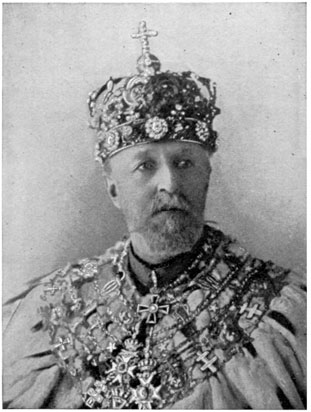
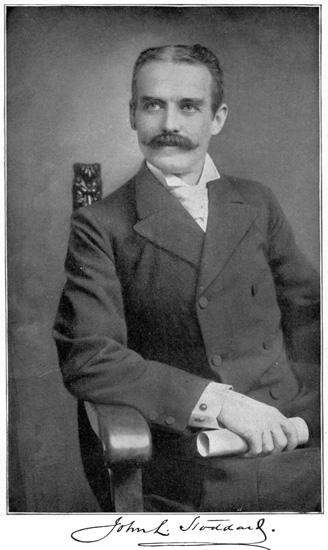
KING OSCAR II.
Again, Norwegian mountains come directly to the sea.
On this account, one might suppose that the interior would
be inaccessible. But Nature does here one more act of kindness,
and penetrates these mountain walls at many points
with ocean avenues, sometimes a hundred miles in length,
and with such depth that, at their farthest limits, steamers
may come directly to the shore. Moreover, to enhance its
mystery and beauty, Nature bestows on this, her favorite,
a day that is a summer long,—a light that never elsewhere
was on land or sea,—and
makes its
splendid vistas still
more glorious by a
midnight sun.
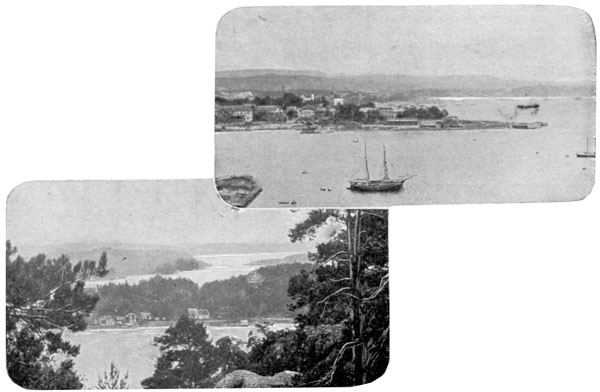
THE HARBOR OF CHRISTIANIA.
There have been
few experiences in
my life more joyous
and exhilarating
than my arrival
in Christiania. It
was six o'clock in
the morning as our
steamer glided up its noble harbor. The sky was cloudless;
the water of the deepest blue; a few white sails rose here and
there, like sea-gulls, from the waves. The forest-covered
islands, emerald to the water's edge, seemed gems upon the
bosom of the bay. Beyond, were mountains glistening in
an atmosphere, the like of which, for clearness, I had never
seen: while the first breath of that crisp, aromatic air (a
most delicious blending of the odors of mountain, sea, and
forest) can never be forgotten.
"This, this
is Norway!"
we exclaimed,
"and it is all
before us; first,
in the joy of
exploration; then
in the calmer,
though perpetual,
pleasure of
its retrospection."
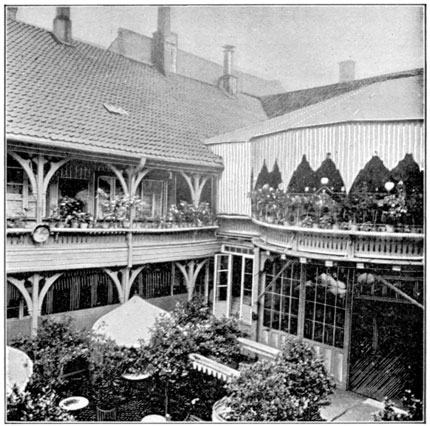
THE VICTORIA HOTEL.
Excited by
our anticipations,
we disembarked
as
speedily as possible, and hastened to the Hotel Victoria. It
is a well-kept, comfortable hostelry, whose chief peculiarity
is a spacious courtyard, where frequently, in summer, table
d'hôte is served beneath a mammoth tent of gorgeous colors.
Moreover, it is a pleasant rendezvous for travelers; for
while some tourists are here setting forth upon their inland
journey, others have just completed it,
and with bronzed faces tell strange
stories of the North, which sound like
tales invented by Munchausen.
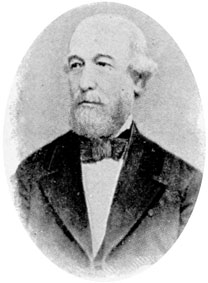
MR. BENNETT,
THE TRAVELER'S FRIEND.
Impatient to arrange our route, after
a breakfast in the hotel courtyard we
went directly to the individual known
as "Bennett." "Bennett? Who is
Bennett?" the reader perhaps exclaims.
My friend, there is but one Norway,
and Bennett is its prophet. Bennett
is the living encyclopædia of Norway;
its animated map; its peripatetic guide-book. Nor is this
all. He is the traveler's guide, philosopher, and friend.
He sketches lengthy tours back and forth as easily as sailors
box the compass; tells him which roads to take and which
to avoid; sends word ahead for carriages and horses;
engages rooms for him within the Arctic circle; forwards
his letters, so that he may read them by the midnight
sun; gives him a list of carriage-coupons which the
coachmen cry for; and (more important still) so plans his
numerous arrivals and departures on the
coast that he may always find a train or steamer there
awaiting him. This is a most essential thing in Norway.
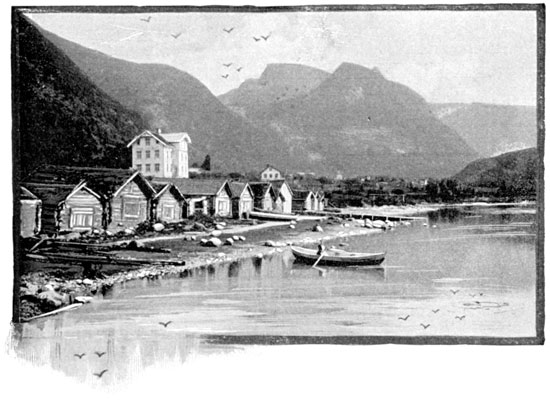
A NORTHERN LANDSCAPE.
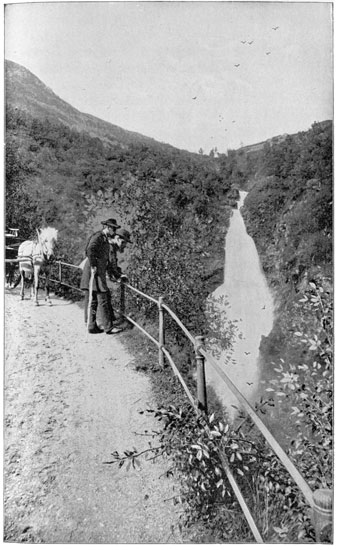
IN NORWAY.
As a rule, Norwegian time-tables are about as difficult
to decipher as the inscriptions on a Chinese tea-caddy. Even
Bradshaw, the author of that English railway guide which
is the cause of so much apoplexy, came here to Norway
a few years ago, and died in trying to make out its post-road
and railway system. Some think that it was a judgment
upon him. At all events, his grave is near Christiania, and he
sleeps, while the "globe-trotter," whom he long befriended,
still rushes to and fro.
Although an Englishman by birth, "Bennett" has been
for fifty years a resident of Norway, and is a blessing to all
travelers in that country. At first he gave his services gratuitously;
but as the tourists began to multiply, he found that
such disinterestedness was impossible. He at length made
a business of it, and year by year it has steadily increased.
A new edition of his guide-book comes out every season;
and to still further help the public, he has begotten four
young Bennetts, who act as courteous agents for their
father, in Bergen, Trondhjem, and Christiania. He has
no "personally conducted
parties." He has no wish
to go outside of Norway.
But here, on account of
the peculiar style of traveling,
and the difficulty of the
language, it certainly is a
great convenience to employ
him.
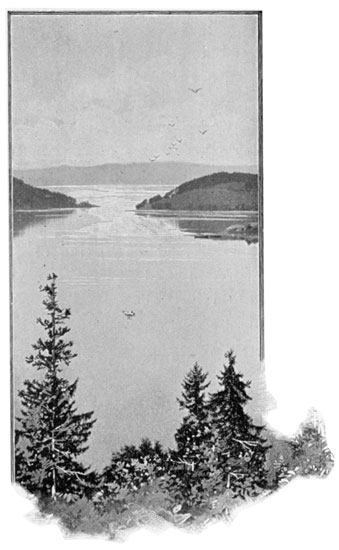
CHRISTIANIA FJORD.
Our arrangements with
this guardian of Norwegian
tourists having at length
been concluded, we strolled
for some time through
Christiania's streets.
It is a clean
and cheerful city, though it
can boast of little architectural
beauty. The Royal
Palace is its finest building,
but even this, on close inspection,
proves to be more
useful than ornamental,
and
well suited to a
nation forced to
practice strict
economy. In
inspecting the
structure it is
interesting to
remember how
independent
Norway is of Sweden, although both countries are governed
by one King. The Parliament in Christiania is wholly separate
from that of Stockholm. No Swede may hold political
office here. Even the power of the King is limited; for
if a bill is passed three times in the Norwegian Parliament,
then, notwithstanding the royal veto, it becomes law.
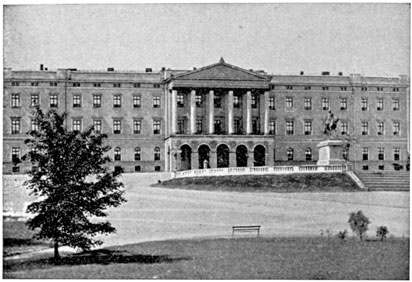
THE PALACE AT CHRISTIANIA.
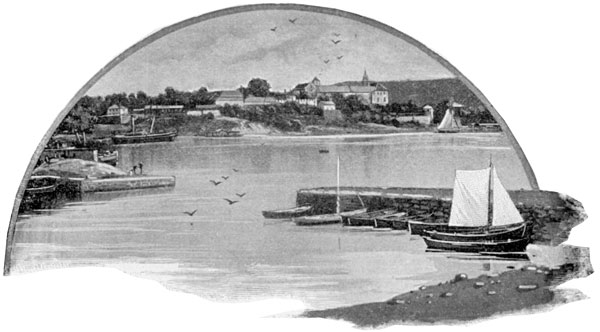
A VIEW NEAR CHRISTIANIA.
Moreover, in accordance with the Constitution, the King
of Sweden and Norway must be crowned in Norway; he must
reside here three months in the year; here, also, he must
open Parliament in person, and hold receptions, for no Norwegian
wishes to go to Stockholm for a presentation to
his sovereign. In this portion of his realm, also, he must
be addressed as "King of Norway and Sweden," not of
"Sweden and Norway." A
certain rivalry still exists
between
these two
nations. Norwegians
sometimes say: "We love
the English, and drink
tea; the Swedes love
the French, and drink
coffee!"
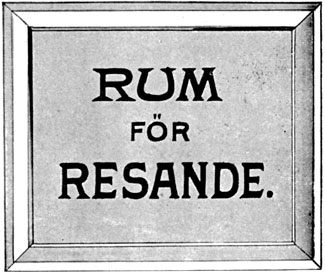
AN AMBIGUOUS SIGN.
One of the first things
that attracted my attention
in my walks through
Christiania was the peculiar
sign, "Rum för
Resande." Judge not, however, from appearances in this
strange language of the north. It is said that not long ago
an English-speaking traveler of strong prohibition principles
was horrified at seeing this announcement frequently displayed.
"What does that last word 'Resande' mean?" he asked
suspiciously.
"Travelers," was the reply.
"Rum for travelers!" he exclaimed. "Oh, this is terrible!
What an insult to the traveling public! Now I, for one,
protest against such misrepresentation. I am a traveler, but
I never take a drop of rum."
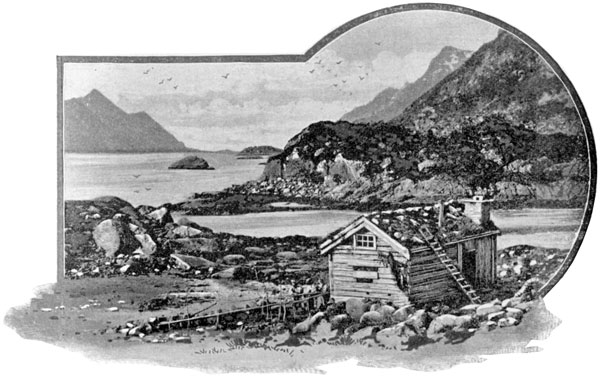
A BIT OF NORWAY.
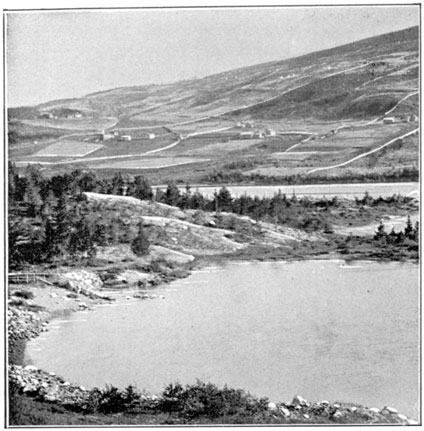
LAKE MJÖSEN.
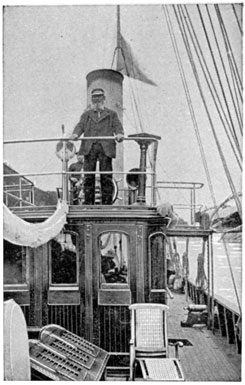
A WISE CAPTAIN.
"Not quite
so fast," rejoined
a Norwegian,
who
was laughing
heartily; "that
first word
means, not
rum, but rooms;
the whole sentence,
therefore,
merely
signifies, 'lodging
for travelers.'"
Eager
to start upon
our northward journey, we left some interesting features in
Christiania for a later visit, and on a beautiful June morning
set out for the coast. The train conveyed us in two
hours to Lake Mjösen, where we embarked upon a little
steamer. From that time on, although
continually traveling, we
saw no more railways for a month.
This lovely sheet of water has a
marvelous depth, its bed, in places,
being one thousand feet below the
level of the sea. This fact grows
more mysterious when we remember
that on the occasion of the
Lisbon earthquake, in 1755, the
waters of this lake, although so
remote from Portugal, were so terribly
disturbed, that they rose
suddenly to the height of twenty
feet, and then as
suddenly subsided.
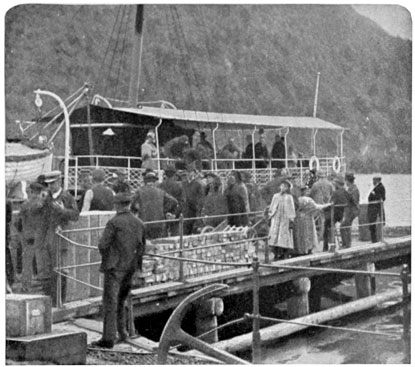
A LANDING PIER.
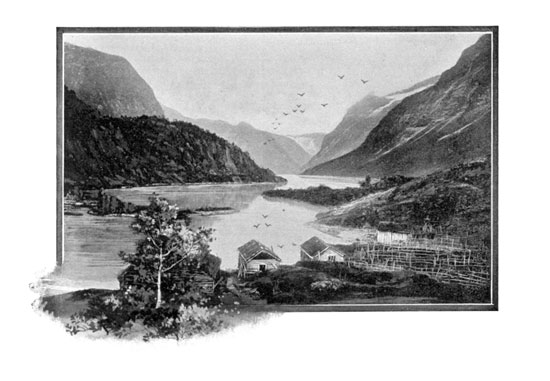
IN THE HEART OF NORWAY.
It was while
sailing on the
waters of Lake
Mjösen that we
had another curious
linguistic experience.
Next
to Norwegian or
Swedish, English
is best understood
and spoken
by the natives, especially among the seafaring population.
We did not know this fact at first, and as we had just come
from Germany, it seemed more natural to address the people
in the Teutonic tongue. You know the German word for
bright or clear is "hell." Accordingly, desiring to ask the
captain if he thought that the weather would be fine, my friend
stepped up to him, and pointing to the sky, said interrogatively,
"Hell?"
"No," replied the captain, in perfectly good English,
"hell doesn't lie in that direction!"
A sail of several hours here through charming scenery
brought us at last to the place where we were to disembark.
Hardly had I set foot upon the pier, when a man accosted
me in good, familiar English:
"Just step this way, sir, if you please," he said; "the carriage
ordered for you by Mr. Bennett is all ready."
This surely was a pleasant introduction. There was no
trouble whatsoever—no bargaining, no delay. In fifteen
minutes we had started on our four days' journey to the sea.
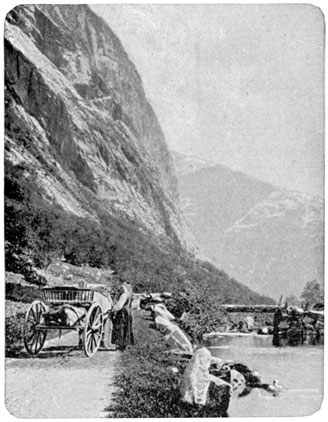
A LOVELY DRIVE.
Between Christiania and the western coast is a broad
mountain range extending hundreds of miles north and south.
No railroad crosses that
gigantic barrier. True,
the town of Trondhjem,
in the north, can now be
reached circuitously by
rail. But all the great
southwestern coast, including
the towns of Bergen
and Molde, and the
large fjords, can only be
approached by several
magnificent highways, of
which the finest here
awaited us, the one extending
for a hundred
and sixty miles from Lake
Mjösen to the Songe fjord. And here one naturally asks,
"What is the mode of traveling in Norway? Where do you
eat? Where do you sleep? Do you take horses for the entire
journey, or from day to day?" It is easily explained. All
these Norwegian highways are divided into sections, each
about ten miles long. These sections have at one extremity
a "station"
(usually a farm-house),
the owner
of which is
obliged by law
to give to travelers
food and
lodging, and also
to supply them
with fresh horses
to the next station.
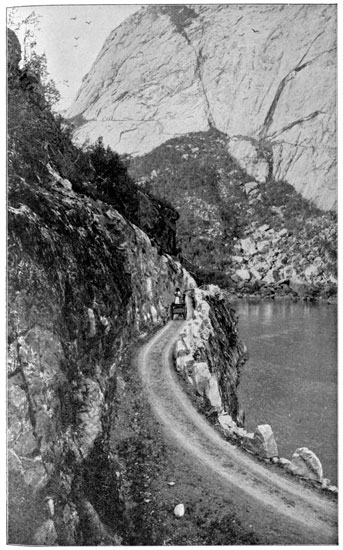
SÆTERSDALEN
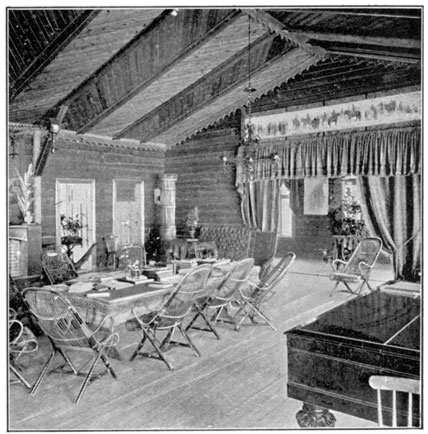
FINE NORWEGIAN STATION.
These Norwegian
post-houses
are invariably
made of
wood, sometimes elaborately carved and decorated. As you
approach the door, some member of the family greets you,
frequently in English, since many of these people have been in
America. If you desire to spend the night, you ask for rooms.
If you merely require dinner, you can be quickly served;
or if your purpose is to drive on still farther, you simply
order fresh horses. For these we never waited more than
fifteen minutes, though sometimes, in the height of the season,
serious delays take place. On this account it is better to precede
the crowd of tourists, and visit Norway early in the
summer. Such has been my experience, at least; and judging
from some stories I have heard of tourists sleeping
on the floor and dressing on the back piazza, I should emphatically
recommend this rule to all adventurers in the land
of Thor.
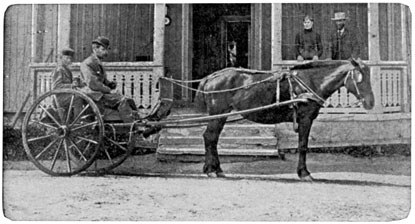
A CARIOLE.
But speaking
of Norwegian
post-stations reminds
one of the
characteristic vehicle
of Norway,—the
cariole.
This is by no
means a "carry-all."
It is a little gig, intended for only one person. True,
the boy (or, in some instances, the girl) who takes the horse
back after you have done with it, rides behind. His seat is
your valise, and his weight determines the subsequent condition
of its contents! There is a charming lightness in these
carioles. The springs are good, and the seat is easy. A
leather apron reaches to your waist to shield you from the
dust or rain; and, drawn by a Norwegian pony, such a drive
is wonderfully exhilarating.
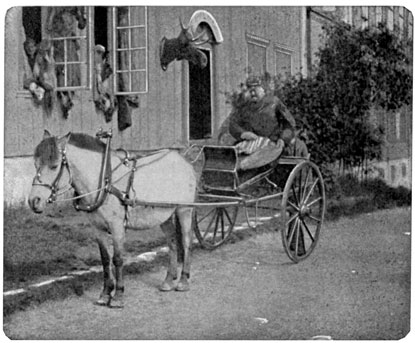
THE NATIONAL VEHICLE.
These little carriages have, however, one great fault,—their
want of sociability. The linguistic powers of a Norwegian
post-boy are extremely limited; and when you have
ridden ten hours
a day, unable to
exchange a word
with your friends
except by shouting,
the drive becomes
a trifle
wearisome. But
the reader may
ask: "Is there
not sometimes
great discomfort
in traveling by
carioles in rainy
weather?" Assuredly
there is.
But in such
weather one is
not obliged to
take a cariole.
Norway has
other vehicles.
We drove, for
example, about a hundred and thirty miles in a sort of
victoria, the rear of which could be entirely covered in
case of rain. This, all in all, I hold to be the best conveyance
for the tourist in Norway, especially when ladies
are of the party. I know that such a carriage is considered
too luxurious by the English; but I am sure that American
ladies will gain more pleasure and profit from Norwegian
travel if they do not attempt to drive all day in carioles;
and if beneath the canopy provided they keep their clothing
dry.
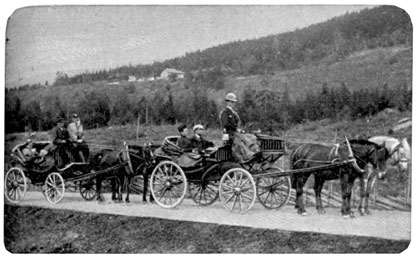
LUXURY IN NORWAY.
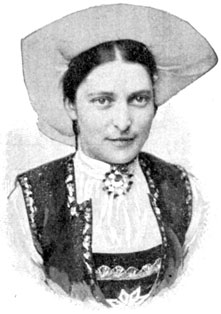
A PEASANT GIRL.
At home we would not think of driving forty miles a day
in an open wagon through the rain; why, then, should
we do it unnecessarily in Norway,
where showers are proverbially both
frequent and copious? As for the fun
and novelty of cariole-riding, these
can always be had, for several hours
at a time, between one station and
another, even if one has engaged a
larger carriage for the entire journey,
for the cost of a cariole and pony for
half a day is ludicrously small, and
the change to it, occasionally, well
repays the slight expenditure.
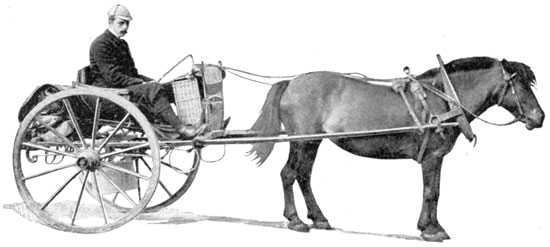
A NORWEGIAN PONY.
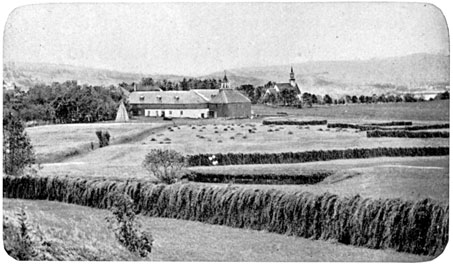
A FARM SCENE.
But in thus speaking of the cariole, I have unwittingly
put the cart before the horse. A word of praise must certainly
be given to the usual Norwegian steed. Of all the ponies I
have ever seen, these of Norway are at once the strongest,
prettiest, and most lovable. They are usually of a delicate
cream color, with one dark line along the back, the mane
being always closely cut. These ponies are employed in Norway
almost universally, being not only less expensive but really
more enduring
than
the larger
horses. For
weeks we
drove behind
these little
animals, till
we had tested
certainly
seventy-five
of them, and never once did we observe in any of them the
slightest ugliness or a vicious trait. They are, moreover, wonderfully
sure-footed. I never saw one stumble or go lame.
Possibly, later in the season, when much over-worked, they
may not have the spirit which we found in them; but in our
drives of more than two hundred miles there was not one
which did not cheerfully respond
to any call.
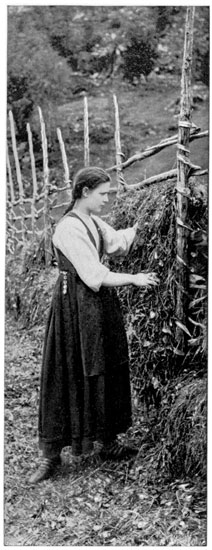
A MAUD MULLER
This being premised, let
us really begin our journey.
At first we found the
scenery more beautiful than
grand. In many places I
could have believed myself
in portions of either of the
American states of New
Hampshire or Vermont.
Across the fields I often
noticed long, dark lines
which, in the distance, looked
like hedges. On examination,
however, these
proved to be wooden fences,
covered with new-mown
grass; for, in this way, Norwegian
farmers "make hay
while the sun shines." Some
of these fences are very low,
but others have considerable
height. Norwegian farmers
claim that grass hung thus,
and thoroughly exposed to
wind and sun, will shed the
rain and dry more quickly
than if left upon the ground.
Their theory seems reasonable, and the extent of the hay
crop, which is very important, further justifies it. There is
one other argument in favor of these hay-racks,—during
all other seasons of the year they serve as clothes-lines for
the family washing. But even more peculiar than the fences
were the vehicles used for hauling the hay into Norwegian
barns. We
laughed at first
sight of these
rustic carts.
They are only a
trifle larger than
a good-sized
cradle, and are
perched upon
the smallest
wheels I ever
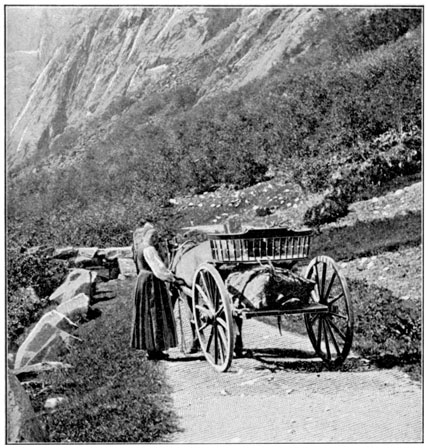
saw on anything except a toy. Yet there is good reason
for their use, for on Norwegian farms the loads are drawn,
not by stout oxen, but by little ponies.
Moreover, the grass is often cut from
the edge of precipices, or in deep
ravines, and these low carts are
certainly better adapted than high
and heavy ones for locomotion in
such regions.
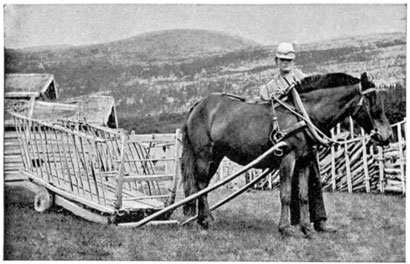
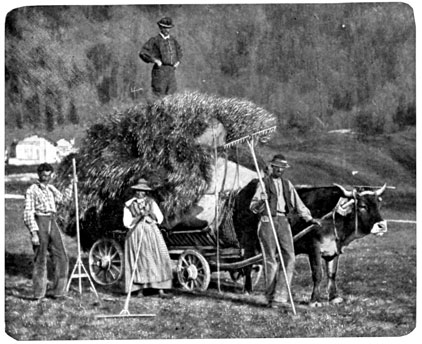
A HAY CART.
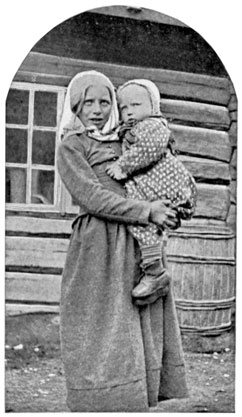
AT A FARM HOUSE.
While thus absorbed in agricultural
reflections, we drove up to
the house where we were to take
supper. A pleasant-featured girl,
with a baby in her arms, invited
us to enter. She spoke English
perfectly, having been born,
as we learned, in Minneapolis.
I shall never forget that first Norwegian supper. The name
for the evening meal in Norway is "aftenmad," but often-mad
would better express it in English. First, there were
placed before us five different kinds of cheese, the most
remarkable of which was a tall monument of chocolate-colored
substance made from goat's milk. This, by Norwegians,
is considered perfectly delicious; but for a month I shuddered
at it regularly three times a day. Next was brought in a jar
containing fish. At this my friend smiled joyfully.
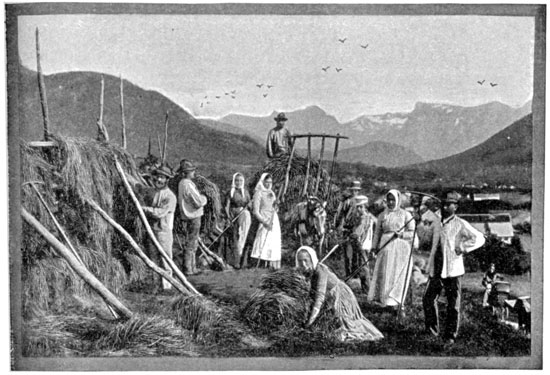
A NORWEGIAN HAY-FIELD.
"Ah," he exclaimed, "here is fish! Anything in the
line of fish I can eat with a relish."
He drew a specimen from the jar, and put a portion
of it in his mouth. A look of horror instantly overspread
his face, and, covering his features with a napkin, he left
the room in haste. I quickly followed him, and found him
in the back yard gazing mournfully at some Norwegian swine.
"What is the matter?" I asked, "do you prefer pork
to fish?"
"I believe I do," he rejoined. Then turning to the girl,
who had followed us, he inquired, "What is the Norwegian
word for pork?"
"Griss,"[A] was
the reply.
"Thank you,"
he faltered, "I
don't think I
will take any to-day."
"Eh" (in an
aside to me),
"hadn't we better
drive on?"
"Drive on?"
I cried. "Drive
on, when there
is plenty of fish, which you always eat with so much relish?"
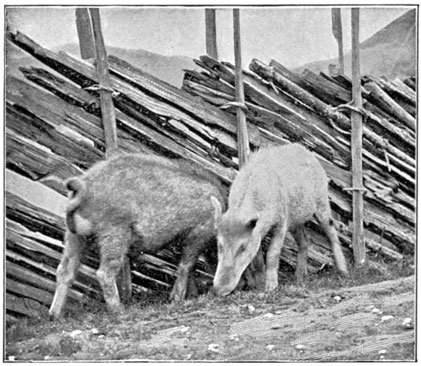
"DO YOU PREFER PORK TO FISH?"
"Great heavens!" he groaned, "that was too much even
for me. It was a raw anchovy dipped in vinegar."
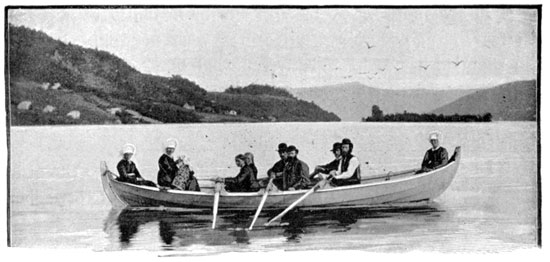
NORWEGIAN PEASANTS.
While this colloquy was taking place, we re-entered the
dining-room and asked for bread. We were amazed to see
what this request brought forth. Upon a plate almost
as large as the wheel of a Norwegian hay-cart was brought
to us a mound of circular wafers nearly three feet in circumference,
and each about as thick as one of our buckwheat cakes.
They were made of rye meal and water (chiefly water), and
were so crisp that they would break to pieces at a touch.
This is called "flatbrod," and it is certainly in every sense the
flattest article ever invented for the human stomach. The
people, however, are fond of it, and I saw horses eat it frequently,
mistaking it (quite naturally, I am sure) for tablets
of compressed hay.
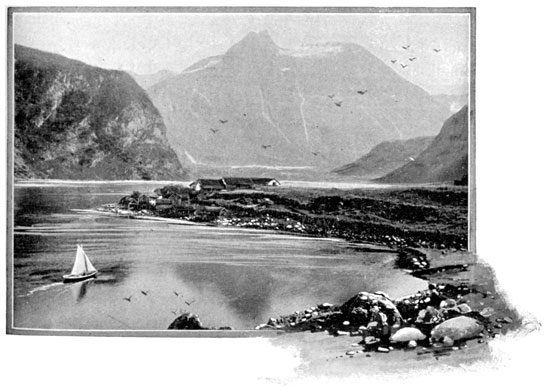
NORWAY SCENERY.
But here I shall probably be asked, "Is this the usual
state of things in Norway?" No, this first station was
unusually poor. The staple article of food in Norway
(always fresh and good) is salmon. Milk and sweet butter
can also be had, and eggs ad libitum. In fact, the abundance
of eggs here is probably responsible for the atrocious
witticism often perpetrated by Norwegian tourists, to the
effect that "if the sun does not set in Norway, hens do."
Mutton and beef are not obtainable, save at the large hotels,
their places being usually supplied by veal, sausage meat,
or reindeer hash. I met, while traveling here, an Englishman,
who said to me, "I did intend to drive on to Christiania;
but I really can't, you know; another month of this would
kill me. In the last two weeks I have eaten so many of these
'blasted eggs' that I'm ashamed to look a hen in the face!"
Yet, notwithstanding the hardships which the traveler meets
in Norway in regard to food, he will find all discomforts
easily outweighed
by the enjoyment
of the
trip. The constant
exercise in
the open air
gives powers
of digestion
hitherto unknown,
preceded
by an appetite
which
laughs at everything,
...
save cheese. Of
course, being so
far from any city, one cannot look for luxuries at these
small stations; indeed, I was surprised to find that the
peasants knew enough to give us, during a meal, several
knives and forks, hot plates, and other features of a well-served
table. And as far as prices are concerned, they are so
moderate as to provoke a smile from any one accustomed to
travel in other parts of Europe.
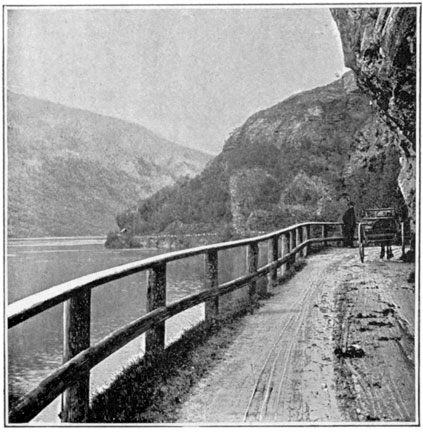
A TRAVELER'S PARADISE.
Yes, all ordinary discomforts sink into insignificance,
as I recall those memorable drives, day after day and hour
after hour, over lofty mountains, through noble forests, and
beside stupendous cliffs, the only sounds about us being
the songs of birds and the perpetual melody of numberless
cascades. Moreover, this mode of travel gave us the energy
of athletes. For how can I describe the invigoration and
sweetness of the air of Norway,—pure from its miles of
mountains,—rich with the fragrance of a billion pines, and
freshened by its passage over northern glaciers and the Arctic
sea?
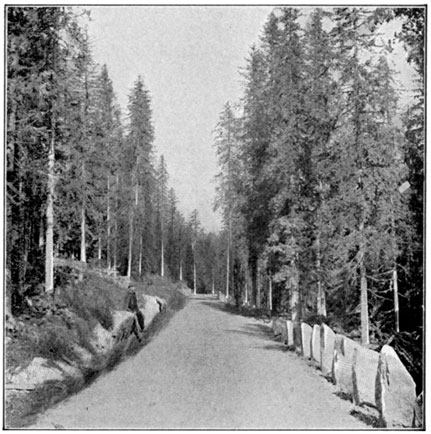
A NORWEGIAN HIGHWAY.
As for Norwegian roads, they are among the finest in the
world. The majority of them are flanked with telegraph-poles;
for not only are these routes magnificent specimens of man's
triumph over nature, but the lightning also is controlled here,
and, swift as
light, thought
wings its way upon
a metal wire
through this inland
waste,—a
marvel always
wonderful and
ever new. Nature
has given
to these scenes
the trees and
rocks which
yield to nothing
but the wintry
blasts. Man
has suspended
here a thread of steel, which thrills responsive to the thoughts
of thousands, transmitting through the gloomiest gorges the
messages of love, hope, exultation, or despair. Hence one can
never feel completely isolated here. That little wire enables
him at any point to vanquish space, and by placing, as it were,
a finger on the pulse of life, to feel the heart-beats of the
world.
In 1888, two American gentlemen were traveling in Norway,
one of whom grew depressed at his apparent isolation from
humanity. His comrade, to astonish and console him, telegraphed
from one of the post-houses where they had stopped
for dinner, to the American consul at Christiania. The
message which he sent was this:
"Who was the Democratic nominee for President yesterday
in Chicago?"
Before the meal was finished, the answer had arrived:
"Grover Cleveland."
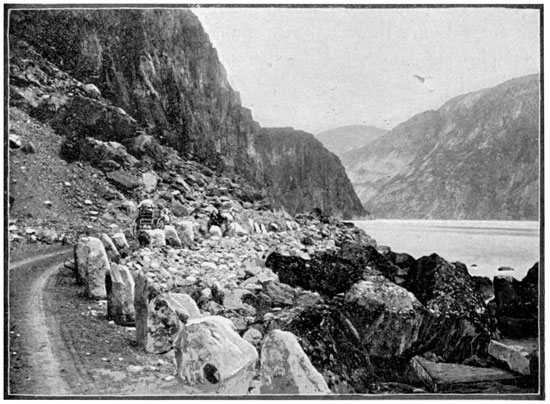
APPARENT ISOLATION.
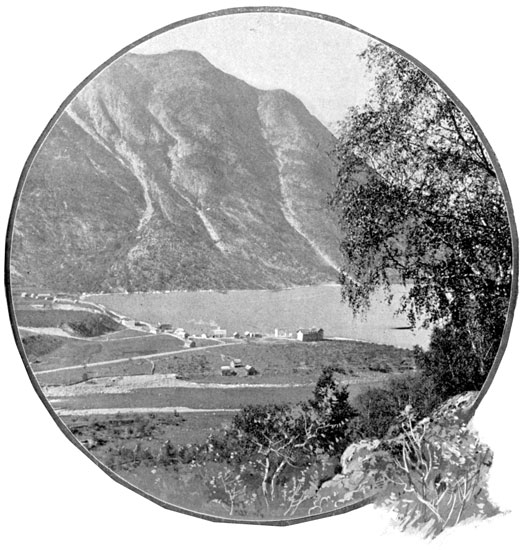
A LAND OF PERPETUAL SUNLIGHT.
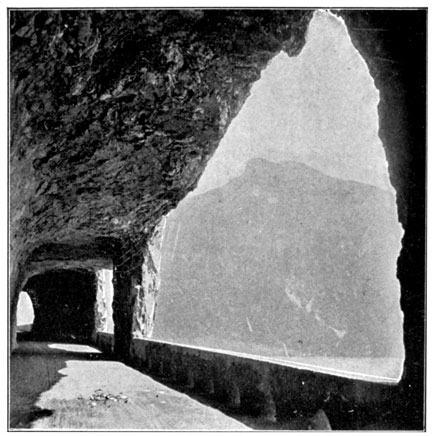
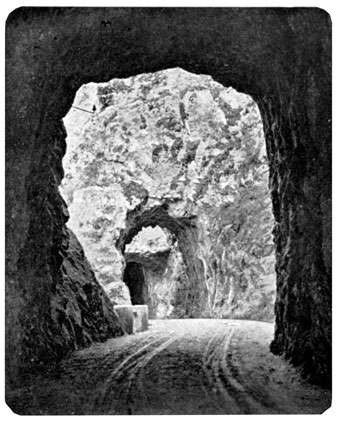
Some of the roads on which we traveled here are cut
directly through the mountains. We found such tunnels
quite agreeable, since they furnished the only genuine darkness
to be found. So far as light is concerned, one may drive
through Norway in the summer just as well by night as by
day. Early and late indeed are words which in this region
grow meaningless. I could not keep a diary in Norway, so
difficult was it to tell when yesterday ended and to-day
began. At first this seemed a great economy of time. We
felt that we were getting some advantage over Mother
Nature. "Why not drive on another twenty miles?" we
asked; "we can enjoy the scenery just as well;" or, "Why
not write a few letters now? It
is still light. In fact, why
go to bed at all?"
But after
a time
this everlasting
daylight grew
a trifle wearisome.
It thoroughly demoralized both our brains and our stomachs,
from the unheard of hours it occasioned for eating and
sleeping. Steamers will start in Norway at five o'clock
in the morning, or even at midnight. I once sat down
to a table d'hôte dinner at half-past nine, and on another
occasion ate a lunch in broad daylight at two o'clock in the
morning. Moreover, even when we went to bed the sun's
rays stole between
our eyelids,
and dispelled
that
darkness which
induces slumber.
For,
strangely
enough, there
are rarely any
blinds or shutters
to Norwegian
windows.
Only a thin,
white curtain
screened us
usually from the glare of day. After a while, therefore, I
could sympathize with an American lady, whom I heard
exclaim, "O, I would give anything for a good, pitch-dark
night twenty-four hours long!"
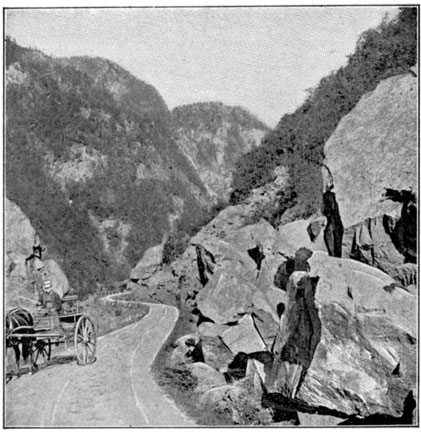
NORWEGIAN BOULDERS.
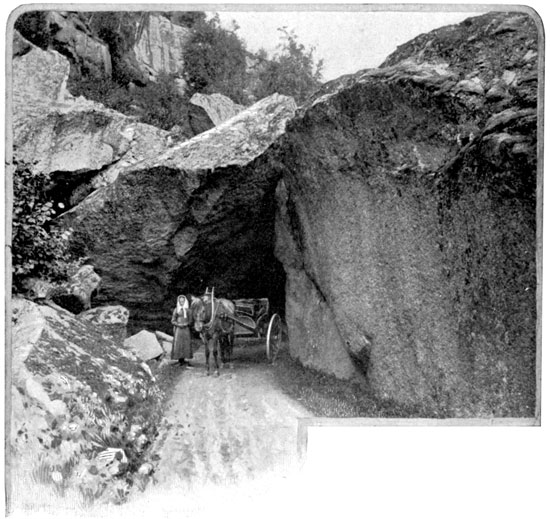
DISINTEGRATED MOUNTAINS.
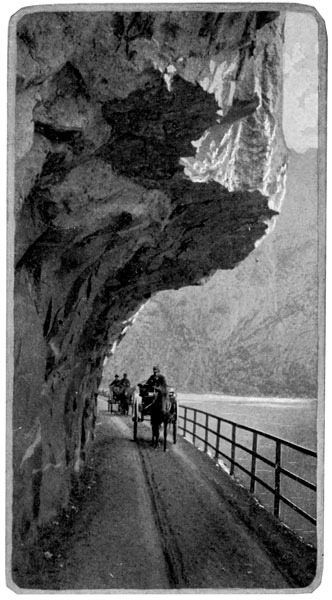
A NORWAY PRECIPICE.
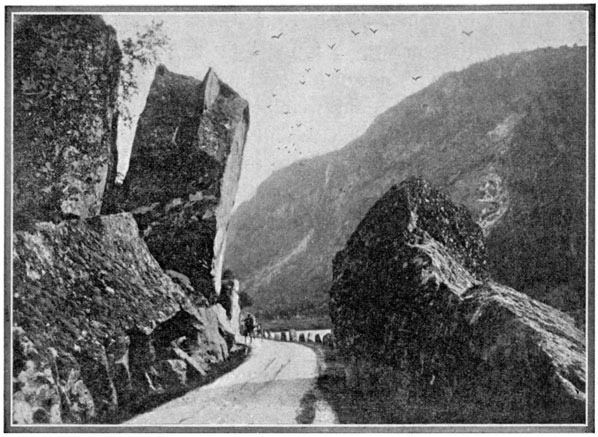
One characteristic of these roads made on my mind a
profound impression,
namely, the
boulders that have
been split off from
overhanging peaks
by frost and avalanche.
This is a
feature of Norwegian
scenery that
I have never seen
equaled in the
world. Sometimes
we drove through
such débris for half
an hour. Nor is
there the least exaggeration
in the
statement that
these boulders are
in many instances
as large as a house;
yet, when compared
with the gigantic
cliffs from which
they came, even
such monsters
seemed like pebbles. Some of these cliffs were frightful in
appearance. Again and again, when we had passed beneath
some precipice, one third of whose mass seemed only waiting
for a thunder-peal to bring it down, my friend and I would
draw a long, deep breath, and exchange glances of congratulation
when we had
escaped its terrors.
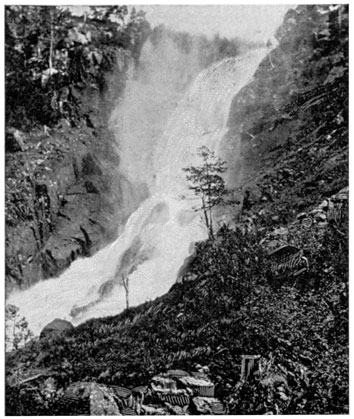
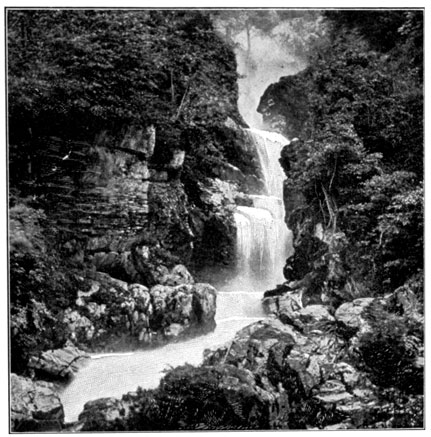
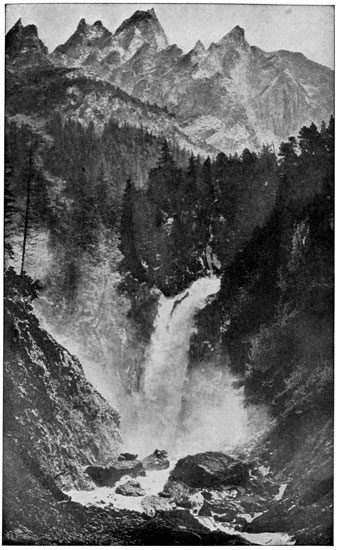
A CHARACTERISTIC CASCADE.
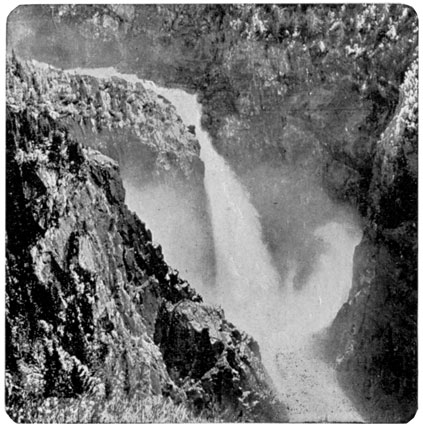
A still more wonderful
feature of Norwegian
scenery is found
in its imposing waterfalls.
Nothing in Norway
so astonished me
as the unending number
and variety of its
cascades,—ribbons of
silver, usually, in the
distance, but foaming
torrents close at hand.
On any of these roads,
halt for a moment and
listen, and you will often hear a sound like that of the
surf upon the shore. It is the voice of falling water.
A THING OF BEAUTY.
On our journey
toward the
coast, during a
drive of three
days we counted
one hundred
and sixty separate
falls, and
eighty-six in
the previous
ten hours. This
was an average
of more than
two in every
fifteen minutes.
True, we saw
these cascades in the month of June, when snow was melting
rapidly on the heights; but even in midsummer they must
far outnumber those in any other part of Europe.
VIEW NEAR BORGUND.
In fact, although familiar with the Alps, and having driven
twice through all the valleys of the Pyrenees, I never knew
how many waterfalls one country could possess until I went
to Norway. There are, of course, magnificent falls in Switzerland,
and a great number of them in the Pyrenees; but where
you there see one cascade,
in Norway you
see twenty; and many
a Norwegian cataract
which would in Switzerland
draw thousands
of admiring tourists,
and make the fortune
of hotel proprietors, is
here, perhaps, without
a name, and certainly
without renown.
BORGUND CHURCH.
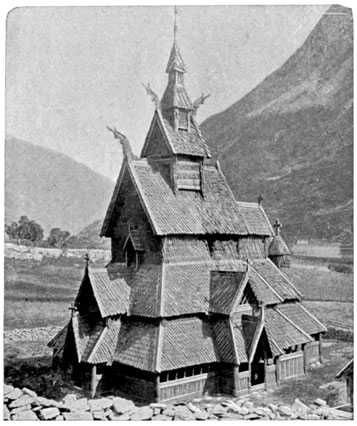
On our last day's
journey toward the
sea, we came in sight
of an extraordinary
building, on which we gazed in great astonishment, for it
seemed more appropriate to China than to Norway, and
was apparently completely out of place in this wild,
desolate ravine. It was the famous Borgund Church, a
place of early Christian worship, built about eight hundred
years ago. It therefore ranks (unless one other similar church
be excepted) as the oldest structure in all Norway. It is so
small that one could almost fancy it a church for dwarfs.
Around the base is a kind of cloister, from which the dim
interior receives its only light. Within is one small room,
scarcely forty feet long, containing
now no furniture save
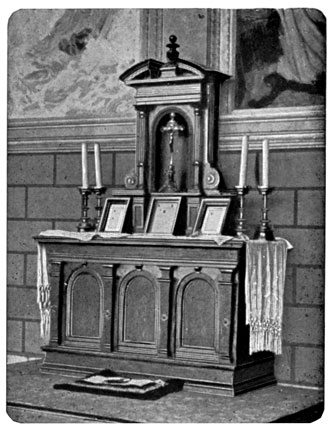
a rough-hewn altar. As for
its various roofs and pinnacles,
marked now by crosses,
now by dragons' heads, nothing
could be more weirdly
picturesque, especially as the
entire edifice is black,—in
part from age, but chiefly
from the coats of tar with
which it has been painted for
protection.
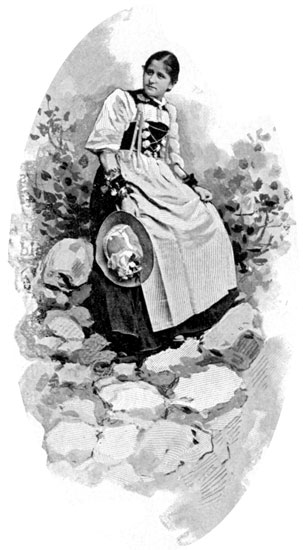
A GIRL OF NORWAY.
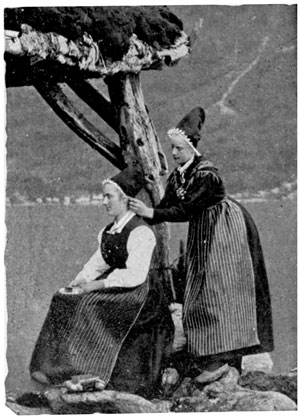
AN OPEN-AIR BOUDOIR.
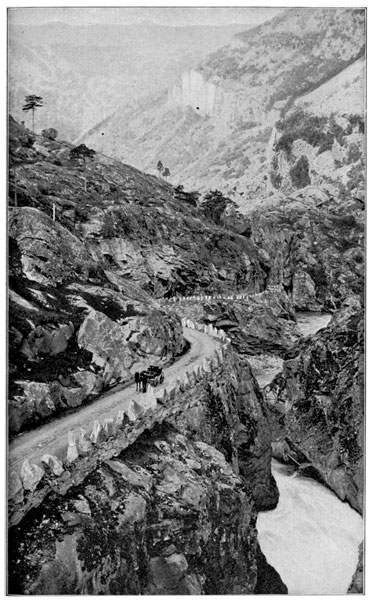
SELTUNSAASEN IN LAERDAL.
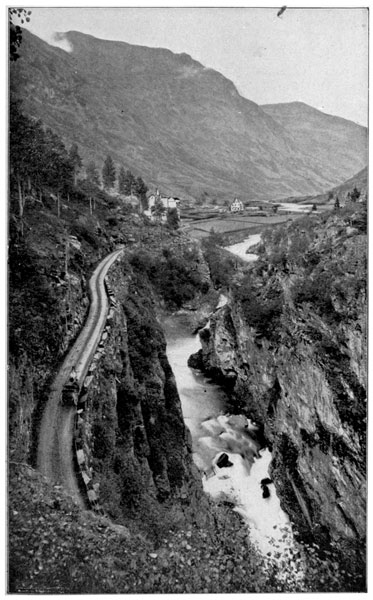
Leaving this ancient church,
we soon found ourselves in one
of the most stupendous of Norwegian gorges. It is hardly
possible for any view to do it justice. But for awe-inspiring
grandeur I have never seen its magnificence surpassed, even
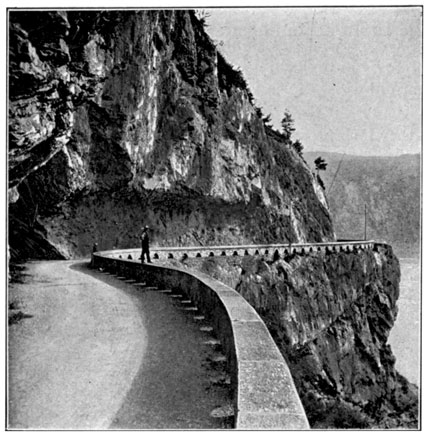
in the Via Mala. For miles
the river Laerdal makes
its way here through gigantic
cliffs, which rise on
either side to a height of
from four thousand to five
thousand feet. The space,
however, between these
mountain sides is barely
wide enough for the river,
which writhes and struggles
with obstructing boulders,
lashing itself to creamy
foam, and filling the chasm
with a deafening roar. Yet,
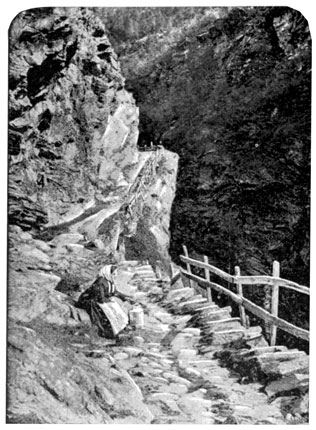
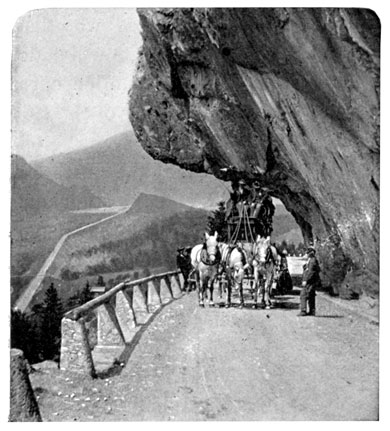
above the river, a roadway
has been hewn
out of the mountain-side
itself,
which is lined
with parapets of
boulders. When
marking out the
route the engineers
were often
lowered over
the precipice by ropes. One can imagine nothing more
exciting than this drive. When mountains did not actually
overshadow us, in looking aloft we could discern only a
narrow rift of sky, like a blue river, curbed by granite banks.
Below us was the seething flood, at once terrible and glorious
to look upon. Shut in by these huge, somber walls, we
followed all the windings of the stream, whirling about their
corners at a speed which seemed the more terrific from our
wild surroundings. There are few things in life that have
affected me so powerfully as the Laerdal gorge, and I would
once more go to Norway for that drive alone. Certain it is
that at the end of it we found ourselves exhausted, not physically,
but nervously, from the tremendous tension and
excitement of the last few hours in this wild ravine. Finally,
leaving this sublime mountain scenery, we saw between us
and the coast our destination—the little town of Laerdalsören.
Thrilled though we were with memories of what we
had just seen, and grateful, too, that our long drive from
sea to sea had been successfully completed, our serious
reflections vanished at the threshold of this village. My
companion had found it hard to be so long deprived of
news from home. Accordingly, he remarked to me as we
came in sight of Laerdalsören:
"I somehow feel to-day a great anxiety about my boys,
William and Henry. I am not superstitious, but I have
a presentiment that they need me. Hark!" he said suddenly,
"what's that?"
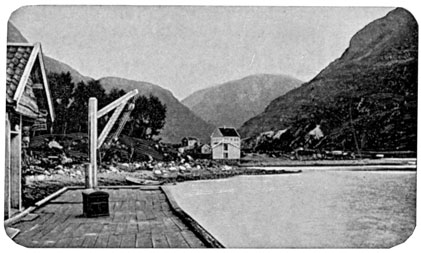
A LANDING PLACE.
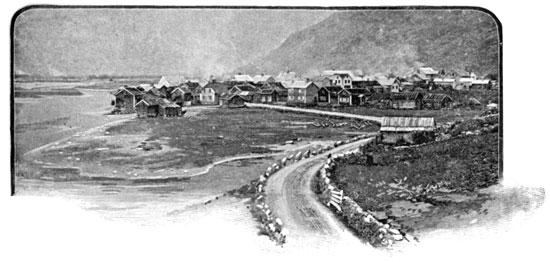
LAERDALSÖREN.
We stopped the vehicle and listened. It was the music
of an English hand-organ; and I am speaking only the literal
truth when I say that the tune which we then heard it play
was that of "Father, dear father, come home with me now."
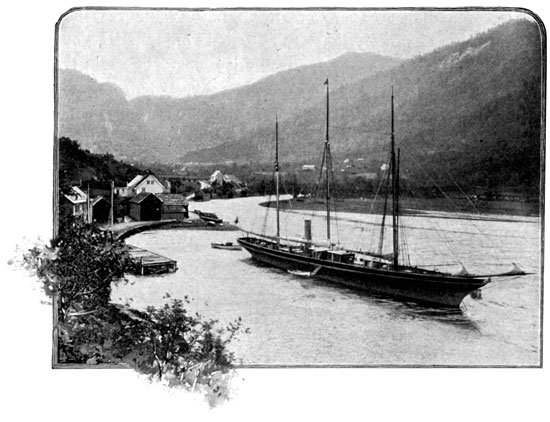
WAITING FOR TOURISTS.
Early next morning we left our good hotel and hastened
to the steamer which awaited us upon the fjord. "What,
precisely, is a fjord?" some may inquire. In briefest terms,
it is a mountain gorge connected with the ocean, a narrow
arm of the sea extending inland, sometimes for one hundred
miles. Moreover, to carry out the simile, at the extremity of
every such long
arm are "fingers;"
that is,
still narrower extensions,
which
wind about the
bases of the
mountains till
they seem like
glittering serpents
lying in
the shadow of
tremendous
cliffs.
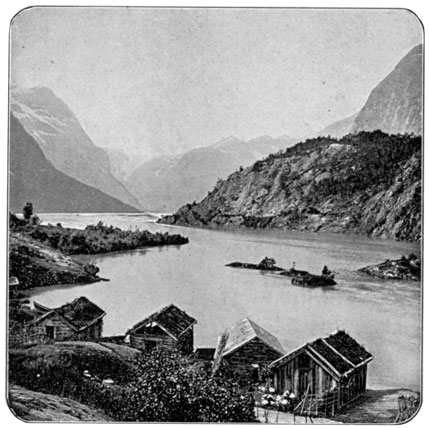
A FJORD.
Thus in one
sense, here at
Laerdalsören, we had reached the sea, but in another, it
was still eighty-five miles away. Yet we were now to
embark on a large ocean steamer, lying but a few yards
from the shore, for these mysterious fjords are sometimes
quite as deep as the mountains over them are high. They
open thus the very heart of Norway to the commerce
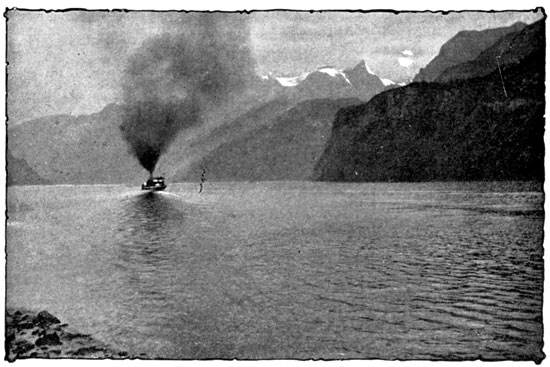
of the world. And as our steamer glided from one mountain-girdled
basin into another, I realized why this western
coast of Norway is one of the most remarkable land-formations
on the globe. If we were able to look down upon it
from an elevation, we should perceive that from the mountain
chain, which forms, as it were, the backbone of the country,
a multitude of grooves stretch downward to the shore
between the elevations, like spaces between the teeth of a comb.
Into these mountain crevices, formed in the misty ages of the
past, the sea now makes its way, continually growing narrower,
until at last it winds between frowning cliffs of fearful height,
down which stream numerous waterfalls, the spray from which
at times sweeps
over the steamer
as it glides along.
Traveling, therefore,
on these
ocean avenues
is like sailing
through Switzerland.
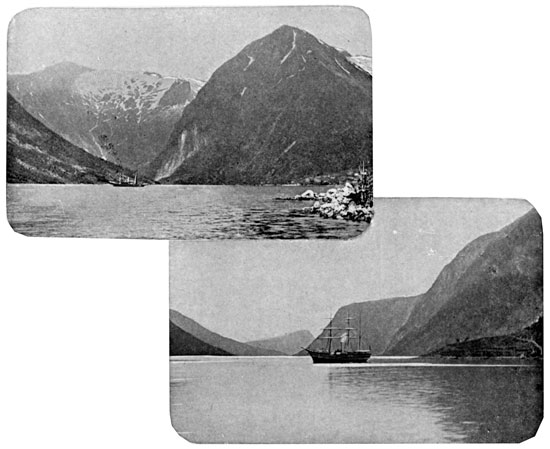
AN ARM OF THE SEA.
SAILING THROUGH SWITZERLAND.
Delighted beyond
measure
with this new experience,
some
two or three
hours after leaving
Laerdalsören, we gradually approached the most sublime
of all these ocean highways,—the Naerofjord. No general
view can possibly portray its grandeur. The only way to
appreciate the vastness of its well-nigh perpendicular cliffs
is to compare them with some objects on the banks. In
many places, for example, cattle grazing on the shore, compared
with their giant environment, seemed like mice, and a
church steeple appeared no larger than a pine-cone.
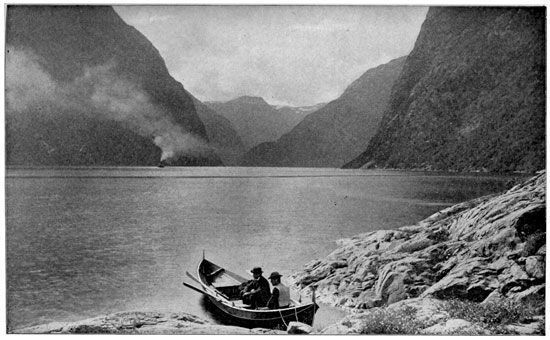
THE NAEROFJORD.
As we sailed further up this beautiful expanse, it was
difficult to realize that we were floating on an arm of the
Atlantic. It had the appearance rather of a gloomy lake
shut in by mountains never trodden by the foot of man.
On either side was a solemn array of stupendous precipices—sheer,
awful cliffs—refusing even the companionship of pines
and hemlocks, and frequently resembling a long chain of icebergs
turned to stone. The silence, too, was most impressive.
There was, at times, no sign of life on sea or shore. The influence
of this was
felt upon the
boat, for if any
of us spoke, it
was in a tone
subdued by the
solemnity of our
surroundings.
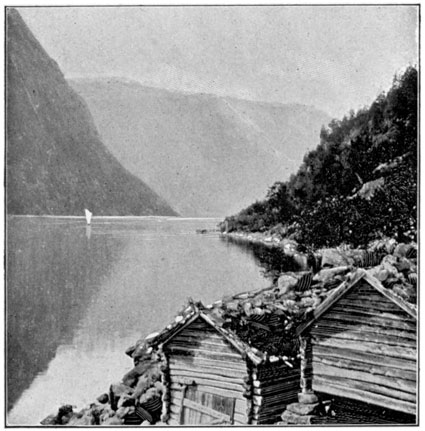
CONTINUALLY GROWING NARROWER.
As we pursued
our way,
sometimes we
could discern no
outlet whatever;
then, suddenly,
our course
would turn, and
another glorious vista would appear before us. We sat
at the prow of the boat; and there, with nothing but the
awe-inspiring prospect to contemplate, we sailed along in silence
through this liquid labyrinth. So close together were the cliffs,
that when, for the sake of the experiment, I lay down on the
deck and looked directly upward, I could at the same instant
see both sides of the fjord cutting their outlines sharply on the
sky! Mile after mile, these grim, divided mountains stood
gazing into each other's scowling faces, yet kept apart by this
enchanting barrier of the sea, as some fair woman intervenes
between two opposing rivals, each thirsting for the other's
blood. It is such scenery as Dante might describe and Doré
illustrate. We wondered what such ravines would look
like without water.
They would be terrible
to gaze
upon. They would resemble
gashes in a dead man's face,
or chasms on the surface of
the moon, devoid of atmosphere
and life. But water
gives to them vitality, and
lights up all their gloomy gorges with a silvery flood, much
as a smile illumines, while it softens, a furrowed face.
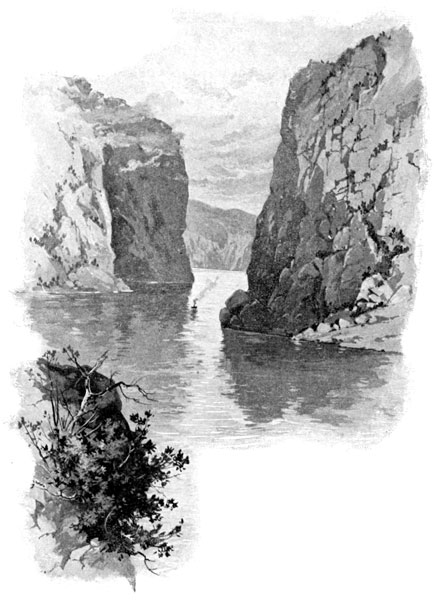
WALLS OF A FJORD.
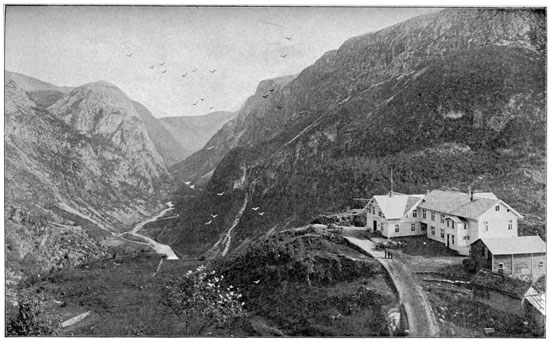
NÆRÖ VALLEY.
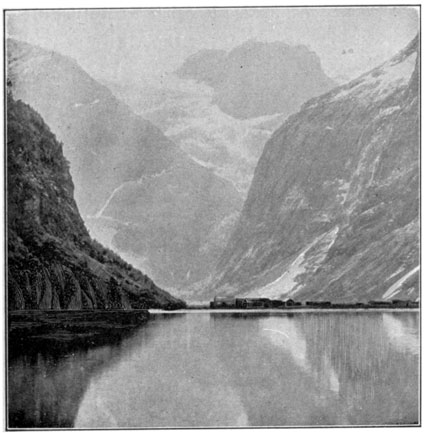
HEIGHTS AND DEPTHS.
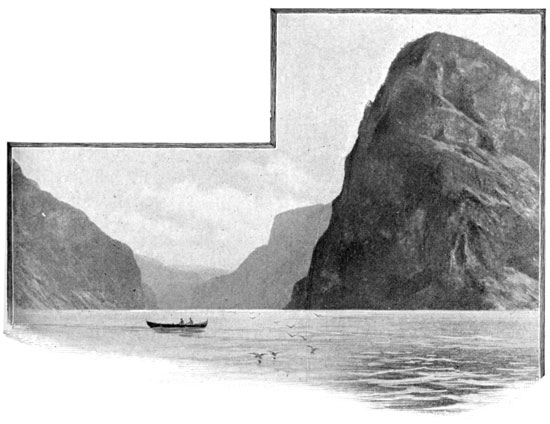
AN OCEAN AVENUE.
Nor is the
water in these
fjords less marvelous
than the
land. Its depth,
in places, is estimated
at three
thousand feet.
When we sailed
up the Naerofjord,
its color
was so green,
and its surface
so completely
motionless, that
we seemed to
be gliding over a highway paved with malachite. Whether
the coloring of these ocean avenues is due to their great depth,
to the crystal clearness of the atmosphere, or to the reflection
of the forests on their banks, certain it is that I have nowhere
else (save in the blue grotto
at Capri) seen water tinted
with such shades of robin's-egg
blue and emerald green.
In confirmation of this fact,
we noticed with astonishment
that whenever the white seagulls,
wheeling round our boat, would
sink breast downward toward
the waves, the color of the sea
was so intense, that their white
wings distinctly changed their
hue in the reflected light, assuming
a most delicate tint, which
gradually vanished as they rose
again!
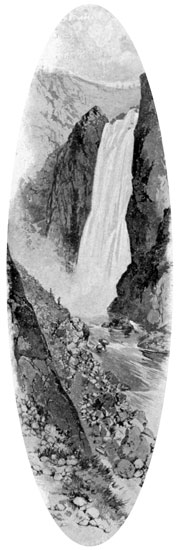
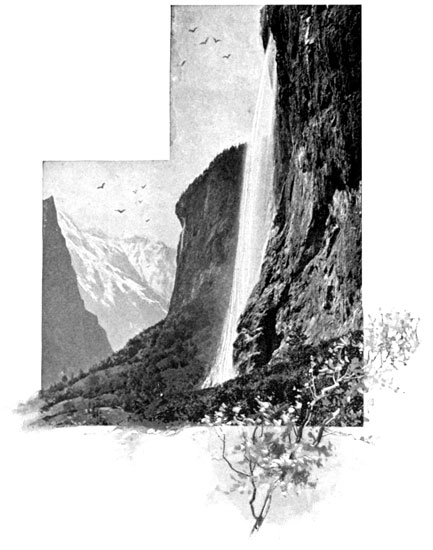
A SUBLIME WATERFALL.
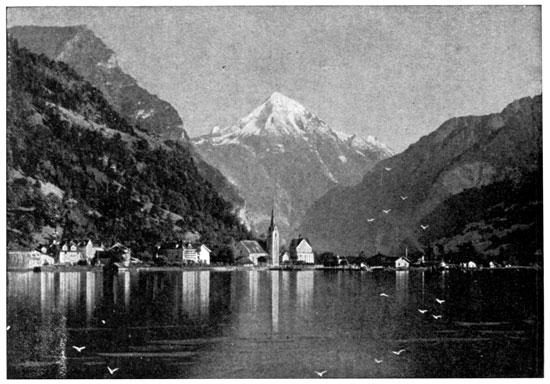
After a sail of several hours,
we approached the terminus of
the Naerofjord, at which is located
the little hamlet of Gudvangen.
So narrow is the valley
here, that through the winter
months no ray of sunlight falls
directly on the town, and even in
the longest day in summer it can
receive the sunshine only for a
few hours. It seemed depressing
to remain in such eternal shadow.
Accordingly, we halted only a
few moments at the place, and
taking a carriage which awaited
us, we drove beyond the village
into the ravine so celebrated for
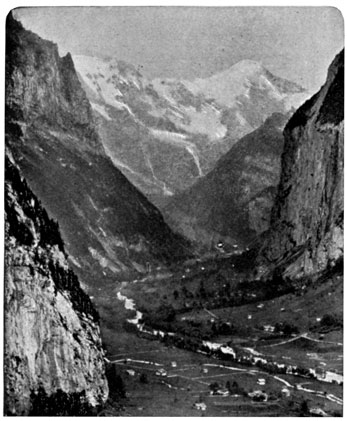
its grandeur—the Naerodal. One
sees at once that this is really a
continuation of the Naerofjord
without the water. There can
be little doubt that, formerly, the
ocean entered it, and one could
then have sailed where we now had to drive. And what
is true of the Naerodal is also true of other such ravines. In
every case the grooved hollows continue inland and upward,
but the gradual elevation of the coast has caused the ocean
to retreat. This is a place of great sublimity. On either
side rise mountains from four to five thousand feet in height—sometimes
without a vestige of vegetation on their precipitous
sides—which
are, however,
seamed with
numberless cascades,
apparently
hung upon
the cliffs like
silver chains.
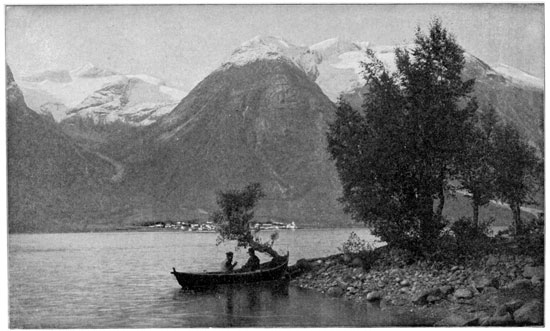
FJORD SCENERY.
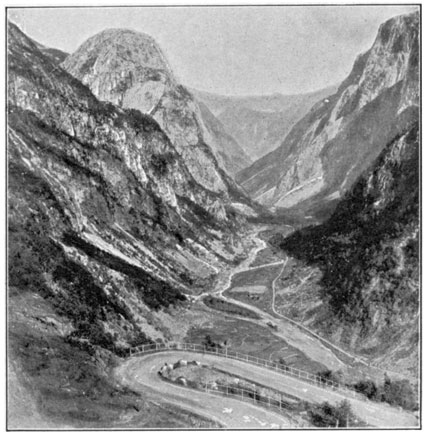
THE NAERODAL.
The most
remarkable object
in the valley
we found to
be a peculiarly
shaped mountain,
called the
Jordalsnut. Its
form is that of
a gigantic thimble, and as its composition is a silvery feldspar,
it fairly glitters in the sun, or glows resplendent in the
evening light,—an object never to be forgotten. Those who
have looked upon this dome by moonlight say that the effect
is indescribable; and, in fact, moonlight in these awful gorges
and fjords must give to them a beauty even more weird and
startling than that of day. Of this, however, I cannot speak
from experience, since moonlight is in summer very faint
in Norway, and it is only earlier or later in the year that
one can see this wonderful country thus transfigured.
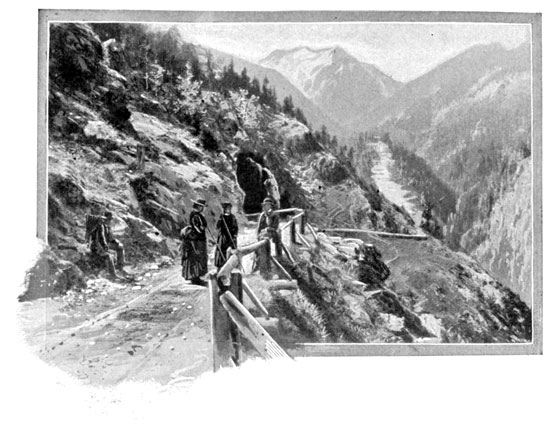
In driving up the Naerodal, one sees, at the head of the
valley, what looks like an irregular chalk-line on a blackboard.
It is a famous carriage-road, which has been blasted out of the
mountain-side, and built up everywhere with solid masonry.
Even now it is so difficult of ascent for horses that every traveler
who is able
usually climbs
that curving
road on foot.
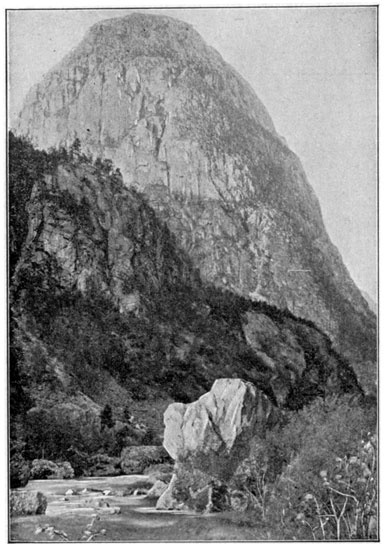
THE JORDALSNUT.
In doing so,
we stopped at
intervals to enjoy
the marvelous
scenery, and
especially to behold
the two attractive
features
of the mountain.
For this grand
terminus of the
Naerodal is
flanked on either
side by a magnificent
waterfall;
and since the
path continually
curves, one or
the other of these torrents is constantly visible. Either of
them is the equal of any Swiss cascade I ever saw, and makes
even the famous Giessbach sink into insignificance, and yet
these are not ranked among the best Norwegian specimens.
We could not, however, appreciate them as we should have
done if they had been the first that we had seen; for when a
tourist has counted eighty-six cascades in one day's drive,
and has just run
the gauntlet of
some twenty
more, in sailing
through the
Naerofjord, he
becomes surfeited
with such
splendor, and
cannot properly
realize what a
glorious wealth
in this respect
Norwegian scenery
possesses.
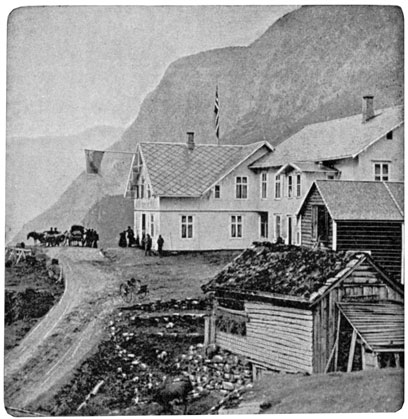
STALHEIM.
Upon the
summit of the wooded cliff toward which this driveway leads,
is a speck which at a distance resembles a white flag outlined
on the forest background. It is the Hotel Stalheim.
As we approached it, a man stepped up to us and exclaimed:
"Hullo, strangers;
are you
Americans?"
"I am glad to
say that we are,"
was my reply.
He instantly
stretched out
his hand and
said "Shake!"—"What
kind of
business are you
in?" he presently
inquired.
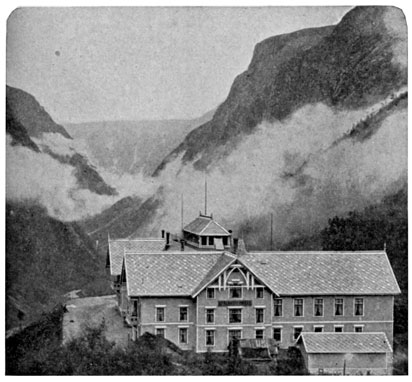
THE VIEW FROM STALHEIM.
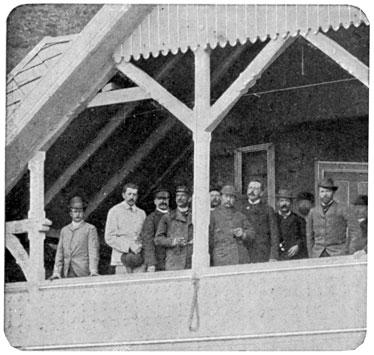
THE KAISER AT STALHEIM.
We told him.
"Well," he remarked,
"I'm a
manufacturer of barrel
hoops. Norway's
all right. I took
an order for forty
thousand yesterday."
At the dinner
table, where he had
greatly amused every
one by his stories, he
suddenly called out:
"Waiter, is there anything worth seeing on that 'ere road
down there?"
"It is one of the finest drives in Norway, sir," replied the
waiter.
"Well, I reckon I'll have to do it, then," he ejaculated:
and soon after
dinner he departed
in a cariole.
An hour
later, as I was
sitting on the
piazza gazing on
the glorious
prospect, I saw
him coming
back. "How is
this?" I exclaimed;
"I
thought you
were going to
Gudvangen."
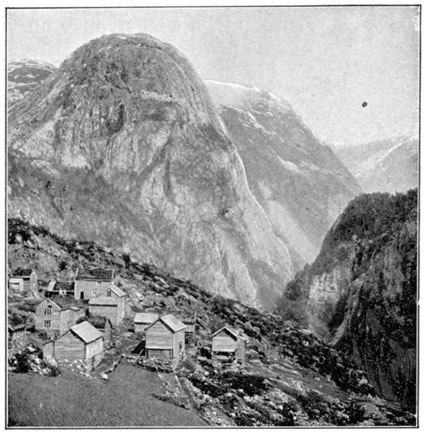
A SCENE NEAR STALHEIM.

A LOVELY CASCADE.
"No," he replied; "I got down here a piece, and met a
boy. 'Bub,' says I, 'what is there to see down here, anyway?'
"'Waterfalls,' said he.
"'Waterfalls!' says I, 'I don't want any more waterfalls.
I've seen ten thousand of them already. Why, our
Niagara wouldn't roar one mite louder, if the whole lot
of these Norwegian falls were chucked right into it.'"
I must not fail to add that there was an extremely pretty
girl at the hotel, to whom our eccentric compatriot paid much
attention. Some English travelers, therefore, looked greatly
puzzled when they heard him say to her on taking leave:
"Good-by! I hope I'll strike you again somewhere on the
road!"
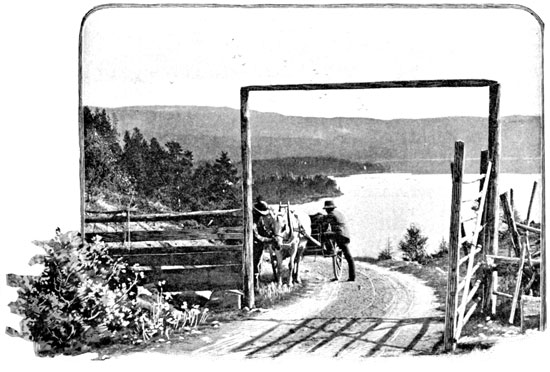
"GATES AJAR."
After supper that evening we took an extended walk. It
was eleven o'clock, and yet the snow-capped mountains which
surrounded us were radiant with the sunset glow. We presently
encountered two young peasants returning from their
work. To them we spoke a few Norsk words that we had
learned since coming to Norway, whereupon one of the lads
drew from his pocket a pamphlet and presented it to me with
a polite bow. It proved to be a book of phrases, half-English
and half-Norsk, designed to help Norwegian emigrants
on landing in
America. Not
knowing, however,
what it
was at first, I
opened it and
could hardly believe
my eyes,
when, in this
lonely valley in
the heart of
Norway, and by
the light of a
midnight sun,
I read these
words: "Wake
up! Here we are in Chicago!" "Change cars for Omaha
and the West!" "Don't lean out of the window, or you'll
have your head knocked off!"
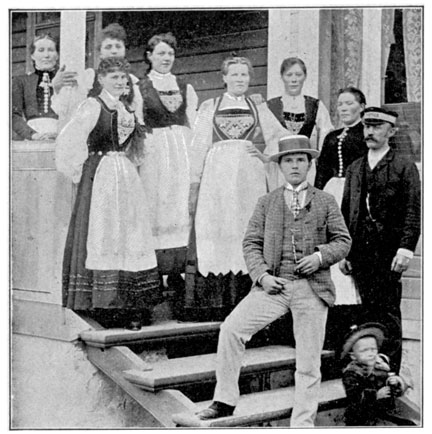
ALL READY TO "SHAKE HANDS."
Both of these bright boys hoped the next summer to
"wake up in Chicago." It is, in fact, the great desire of
Norwegian youths to go to America, and some are brave
enough to do so with a capital of only twenty-five dollars.
Their knowledge of the United States is, of course, limited,
but one place there is known to all of them. Again and
again we were subjected to the following questions: "Are
you English?"
"No."
"Americans?"
"Yes."
"Chicago?"
That was the place for them, evidently. New York is better
than nothing, but Chicago is the El Dorado of the Scandinavians,
for to that place they usually buy through-tickets,
as to the doorway of the great Northwest.
Leaving the Hotel Stalheim, after a short stay, a glorious
drive awaited us down to the Hardanger Fjord. At frequent
intervals along this route we encountered gates designed to
keep the cattle within certain limits. Women and children
usually stood near-by to open them, expecting in return a
trifling payment. Yet when I offered them a coin, I was
sometimes surprised to see their hands still lingering near my
own. At first I thought
that they, like Oliver Twist,
were asking for more, but
presently I discovered that
they merely wished to shake
hands and say good-by, for
hand-shaking in Norway is
universal. If you bestow a
fee upon your cariole-boy,
your boot-black, or your
chambermaid, each will offer
his or her hand to you and
wish you a happy journey.
A pleasant custom, truly,
but, on the whole, it is advisable
for travelers in Norway
to wear gloves. I usually responded cheerfully to this
mode of salutation, though sometimes, when I saw what
kind of a hand the peasant "held,"—I "passed!"
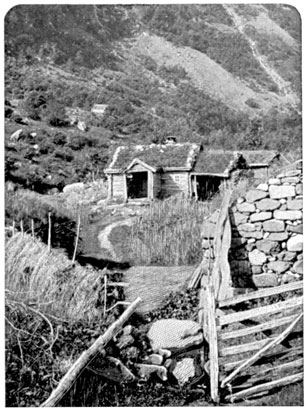
A PEASANT'S COTTAGE.
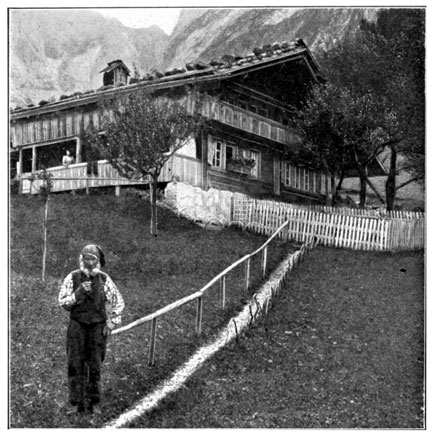
As we drove on, we noticed here and there the houses of
the poorer farmers. They are invariably made of wood, and
some, constructed out of huge spruce logs, look as enduring
as the hills that surround them. The roofs are covered
first with pieces of birch-bark, laid on the logs like shingles.
On these are placed two layers of sod—the upper one with
its grassy surface toward the sky. This grass is sometimes
mown for hay. Occasionally a homœopathic crop of grain
will grow here.
In almost every
case the top of
the house looks
like a flower-garden;
and I
once saw a
bearded goat
getting his
breakfast on his
master's roof.
RURAL LIFE.
Occasionally,
a little distance
from the house,
we saw another
smaller structure,
built beside
a river; for the water-power of Norway is made use of
in some simple way by almost all the country people. Many
a peasant has a tiny water-wheel which turns a grindstone,
or even a mill, and thus his scythes are sharpened and his
grain is ground on his own premises. Such farmers, therefore,
are their own millers, and frequently their own blacksmiths,
too, and they can shoe their ponies with considerable
skill.
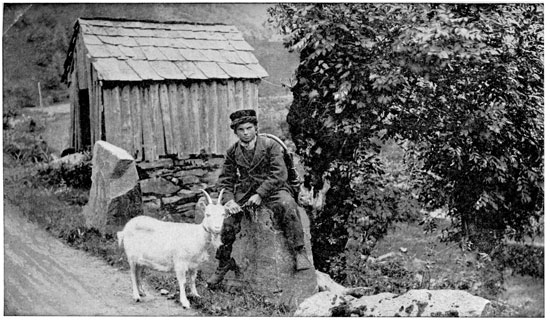
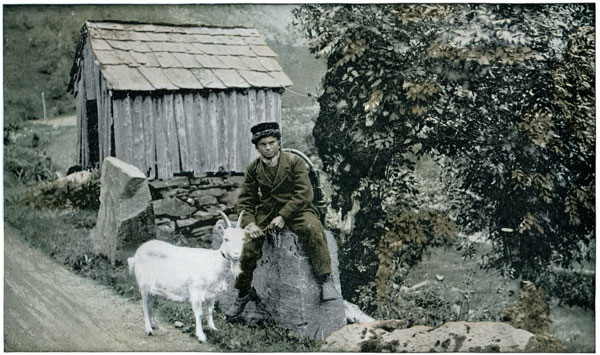
A NORWEGIAN YOUTH.
In traveling through Norway it is most interesting to
observe how the people utilize every available portion of the
land. Wire ropes extend from the valleys up the mountain
sides, and are used for letting down
bundles of compressed hay, after it has
been reaped, gathered, and packed on
some almost inaccessible plateau. On
elevations, where it seems well-nigh
impossible for man to gain a foothold,
people will scramble, at the hazard of
their lives, to win a living from the
little earth that has there found lodgment.
Seeing with our own eyes these
habitable eyries, we could well believe
what we were told, that goats, and even
children, are often tied for safety to the
door-posts, and that the members of a
family who die on such elevated farms
are sometimes lowered by ropes a thousand feet down to the
valley or fjord.
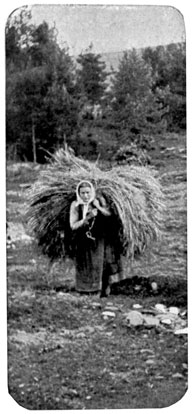
A BEAST OF BURDEN.
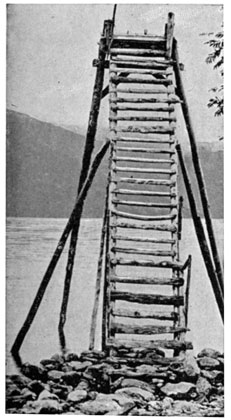
A FISHING STATION.
It was on this journey that I took my first and never-to-be-forgotten
cariole-ride in Norway.
On this occasion, my driver was a
small boy, ten years old, just young
and mischievous enough to laugh at
danger and be reckless. I noticed
that his mother cautioned him before
we started. She evidently
understood him. I did not. Accordingly,
while I took the reins, I
gave him the whip. Springing like
a monkey into his place behind me,
he cracked his whip and off we
went. The road was good, and for
half an hour I thoroughly enjoyed
it. Then we began to descend,
and suddenly dashed across a bridge
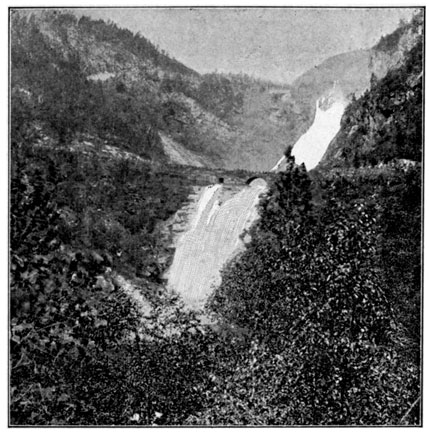
beneath which was a foaming cataract. I naturally reined
the pony in. But, to my surprise, the more I pulled, the
faster went the pony. "Whoa!" I exclaimed; "whoa!"
but whether prolonged or uttered with staccato emphasis
that word made no apparent difference in the pony's gait.
"Whoa," was evidently not in its vocabulary. My hair
began to stand on end. Perceiving this, the demon of a
boy commenced to utter the most unearthly yells, and to
crack his whip until he made the pony actually seem to fly.
THE SCENE OF AN ADVENTURE.
"Go slowly," I exclaimed. Crack, crack, went the whip.
"Stop that, you young rascal." Crack, crack, crack! I
tried to seize the whip, but my tormentor held it far behind
him. I sought to turn and petrify him with a look, but it
was like trying to see a fly between my shoulder-blades. I
saw that I was only making faces at the mountains.
A CHARACTERISTIC LANDSCAPE.
ENGINEERING SKILL.
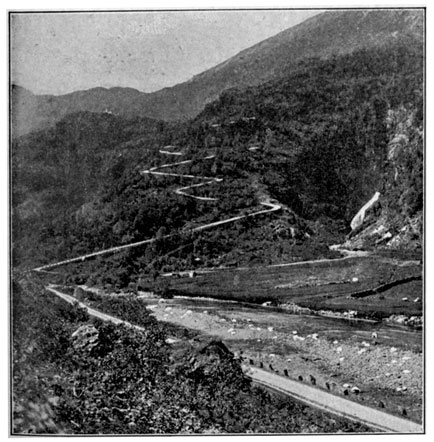
To appreciate my feelings, one should perceive the winding
road along which I was traveling. It was a splendid
specimen of engineering
skill,
but after twenty-seven
of
these curves, I
felt that I was
getting cross-eyed.
Fancy
me perched, as
it were, upon
a good-sized
salad-spoon,
flying around
the mountain
side, with one
wheel in the air
at every turn, at the rate of the Chicago Limited going
round the Horse-shoe Bend. I looked back at my companion,
whose
horse, excited
by my own,
was just behind
me. His face
was deathly
pale. Anxiety
was stamped
on every feature.
His lips
moved as if
entreating me
to slacken this
terrific speed.
Finally, he
faintly cried:
"If you escape, ... give my
love ... to my children, ...
William and Henry!"
A VIKING SHIP.
At last I saw, some little
way ahead, a cart half-blocking
the road. "Great heavens!" I
thought, "here comes a collision!
Well, it might as well end this way
as any other. No more lectures
for me!" But, lo! there issued
from the small boy's lips the
sound, "Purr-r-r!" The effect
was instantaneous. The horse at
once relaxed his speed, and in a
moment came to a full stop. For
"purring" is to a Norwegian pony
what the Westinghouse air-brake is to an express train. This
secret learned, we had no further trouble. For "purr," when
uttered by American lips, proved always as effectual as by
Norwegian.
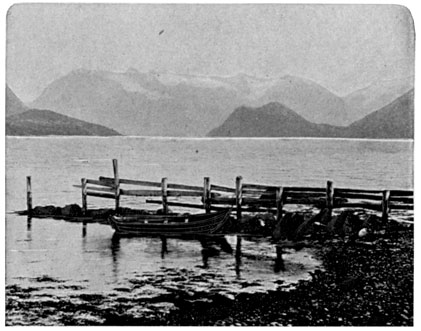
A LONELY POINT.
A few hours after that eventful ride, we found ourselves
upon the great
Hardangerfjord,
which, with its
branches, has a
length of one
hundred and
forty miles.
These ocean
avenues possess
not merely natural
beauty:
they also have
historic interest.
This part of Norway, for example, is old Viking ground.
Not far from here lived Rollo, conqueror of Normandy;
and from these fjords a thousand years ago went forth
those dauntless warriors of the north, who for two hundred
years not only ravaged England, France, and Ireland,
but even crossed the Atlantic to America hundreds of years
before Columbus sailed from Spain.
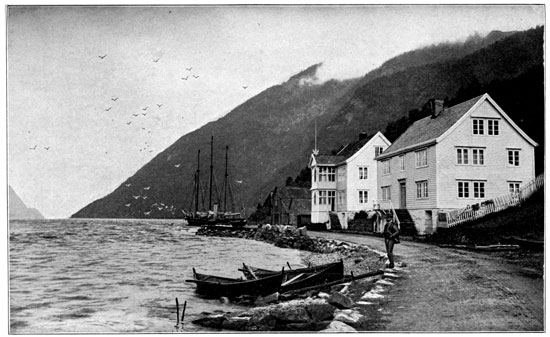
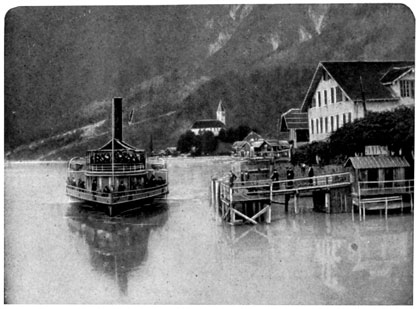
EIDFJORD IN HARDANGER—EXCURSION BOAT.
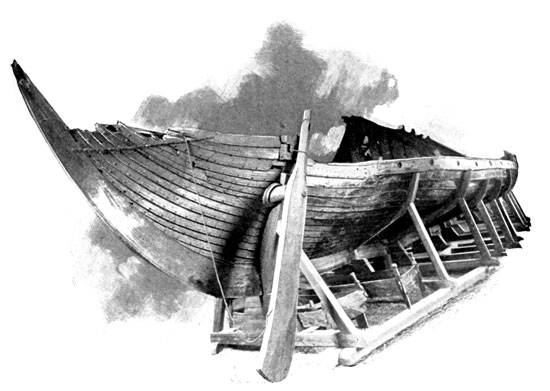
AN ANCIENT BOAT OF NORWAY.
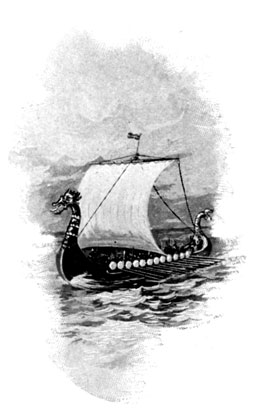
In this connection, therefore, let me say that, to me, the
most interesting object in Christiania was its Viking ship. This
most impressive relic of the past was found some fourteen years
ago within an ancient mound beside the sea. It had reposed
there for ten centuries, owing its preservation to the hard, blue
clay in which it was entombed. It was made entirely of oak,
and was propelled sometimes by oars, sometimes by a sail.
Within it was discovered a well-carved wooden chair, in which,
no doubt, the chieftain sat. Some kettles, too, were here,
and plates and drinking-cups, used by the Vikings when they
landed to prepare a meal. But, more remarkable still, this
boat contained some human bones. For in those early days
such boats were often used as funeral barges for their brave
commanders. The vessel, even when buried, was always
headed toward the sea, so that when called by Odin once
more into life, the chief whose body was thus sepulchered
might be ready to start at once and sail again the ocean he
had loved so well.
Occasionally, however, a Viking had a grander form of
burial. Sometimes, when an old Norwegian chieftain felt
that he was dying, he ordered that his body, when lifeless,
should be placed within his boat, which was then filled with
light materials and set on fire. The large sail was then spread,
and the dead warrior drifted out before the wind, his gallant
vessel for a funeral pyre, and for his liturgy the chanting of
the waves. As for the Viking himself, he doubtless had faced
death, sustained by an unfaltering belief which, had he been
more cultivated, might have thus expressed itself:
"If my bark sink, 'tis to another sea."
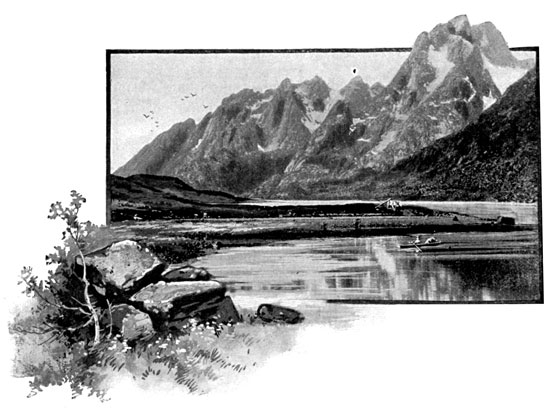
THE LAND OF THE VIKINGS.
At the extremity of one of the branches of the Hardangerfjord
is the little town of Odde. This was the only place in
Norway where we had any difficulty in securing rooms. As
the boat neared the wharf, I heard a dozen ladies whisper to
their husbands: "Now, dear, you stay and look after the
luggage, and I'll run on and get the rooms." Accordingly,
I used the same words to my friend, with the exception of the
endearing epithet. I was afraid that might make him homesick.
Then I took my position near the gang-plank.
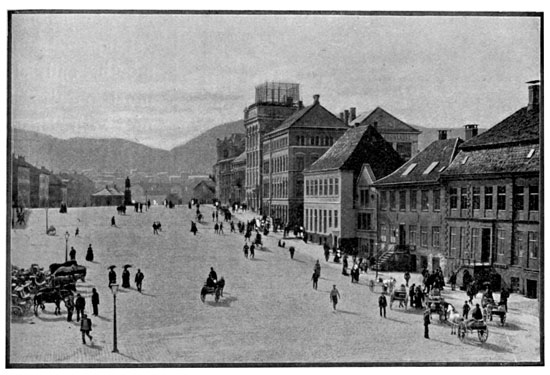
A STREET IN BERGEN.
When we arrived, I was the first to step ashore, and I
started at a brisk walk toward the hotel. Behind me I could
hear the rustling of many skirts, but, hardening my heart like
Pharaoh, I kept on. At last, forgetting drapery and dignity,
the ladies passed me on the run. This time I gallantly gave
way, and when, a moment later, I reached the hotel office,
I could have fancied myself on the floor of the Stock Exchange,
since every lady there was fighting nobly for her
children and her absent lord.
"I want two beds," cried one.
"I wish for five beds," screamed another.
"Give me a room with blinds," exclaimed a third.
The female clerk, meantime, having completely lost her
head, was calling off numbers like an auctioneer. Suddenly
she turned to
me, who had not
yet opened my
mouth, and almost
paralyzed
me with these
words:
"Number 20
will do for you,
three beds and
one cradle!"
When I recovered
from my
swoon, I found
that my friend
had come up
quietly after the battle, and had secured two single rooms.
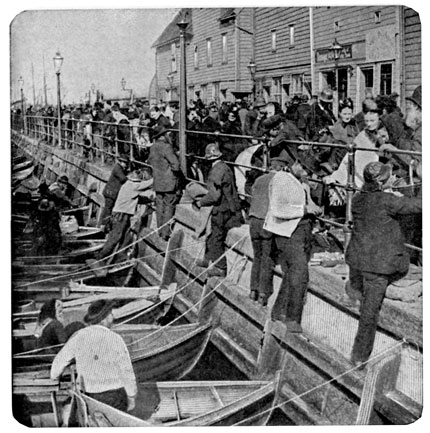
THE BERGEN FISH MARKET.
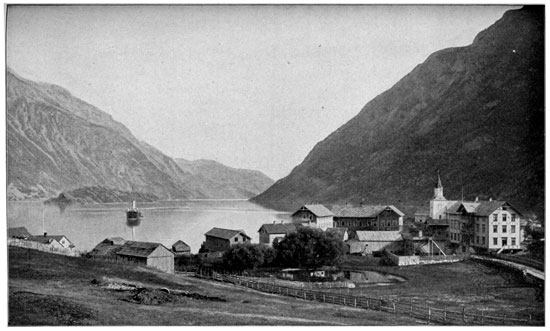
ODDE.
Saying farewell to Odde, a day's delightful sail between
majestic mountains brought us to one of Norway's most
important cities—Bergen. Although we lingered here three
days, we had the wonderful experience of continual sunshine.
I rightly call it wonderful; for Bergen is the rainiest city in the
world and is sarcastically called "The fatherland of drizzle."
The people in Christiania claim that in Bergen when a horse
sees a man without an umbrella, he shies! It is also said that
a sea-captain, who was born in Bergen, and all his life had
sailed between his native city and the outer world, came one
day into its harbor when by chance the sun was shining.
At once he put about and set forth to sea again, believing that
he had made a mistake in his port. As we approached the
pier at Bergen, I saw what, in the distance, appeared to be
a mob. It proved, however, to be the usual crowd which
gathers round the Bergen Fish Market.
This is not, after all, so strange if we reflect that fish is the
great commodity of Bergen, and that this city is the chief
distributing station for Norwegian fish to the entire world.
Several centuries ago, a company of German merchants, who
formed the famous Hanseatic League, established themselves
here and held for years within their hands the monopoly of
all the fishing trade of Norway, compelling even the Norwegian
fishermen to send their catch of fish to Bergen for reshipment
to other ports of Europe. It is true the league
exists no longer,
but its influence
still survives,
and nothing can
divert the trade
from following
in its ancient
channel. Over
the hills that rise
above the city
a splendid driveway
has been
made. A Bergen
resident spoke of
it to me as "The
Drink Road."
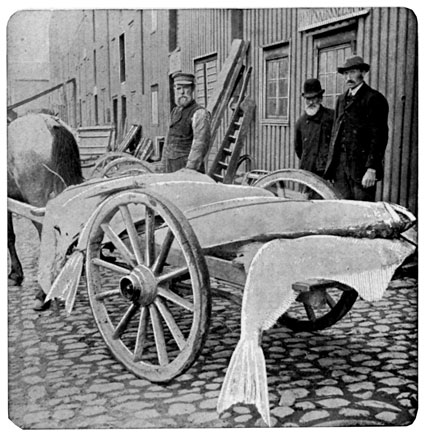
MONSTERS OF THE DEEP.
"What is the meaning of so strange a title?" I inquired.
"It is so called," he said, "because it is constructed
wholly out of the profits derived from the sale of ardent
spirits." Observing my astonishment, he added: "Do you
not understand our famous liquor law in Bergen?"
I confessed
my ignorance.
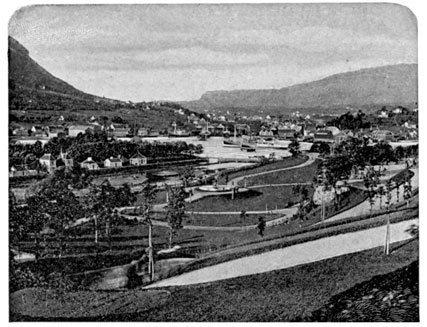
BERGEN'S "DRINK ROAD."
"Then let
me explain it
to you," he exclaimed.
"Perhaps
I can best
do this," he
added, "by
pointing out to
you that melancholy
individual
standing by the gang-plank. He used to be a liquor-seller
here, but he has lost his 'spirits,' for our municipal government
now has the sale of liquors entirely in its own hands.
It first decides how many licenses are needed, and then,
instead of giving them to private individuals, it grants them
only to a responsible stock company. The books of this
company must be at all times open to inspection, and all
its rules are strictly under government control. Moreover,
the company is not allowed to make more than five per cent.
on its invested
capital. All
profits over that
amount are
given to public
improvements,
roads, parks,
schools, or hospitals."
I asked if
the law gave
general satisfaction.
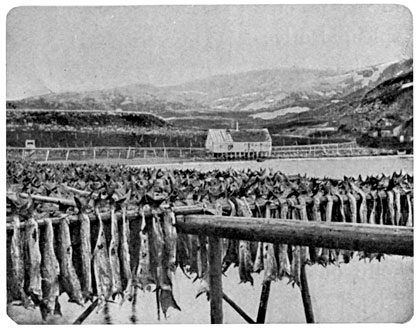
CURING FISH.
"We are delighted with it," was the answer. "It is
now thirteen years since it was started, and all the prominent
towns in Norway, except three, have followed our example.
The liquors, in the first place, are all carefully selected.
Secondly, the bars are not attractive gin-palaces, but plain
rooms, with no seats for customers. No loitering on the
premises is allowed. Only a small amount is sold at any one
time. Children are not allowed to serve as messengers.
Even the bartenders
are appointed
by the
government, and
wear a uniform
and a number,
by which they
can be easily
identified in case
of complaint;
and as a practical
result," he
added, "by taking
the liquor
traffic out of
the hands of
irresponsible
agents the annual amount of ardent spirits sold has been
reduced from twelve and a half to five and a half million
quarts; and yet our Bergen company has earned each year
a net profit of one hundred and twenty-five per cent., one
hundred and twenty of which is, as I have said, applied to
public charities!"
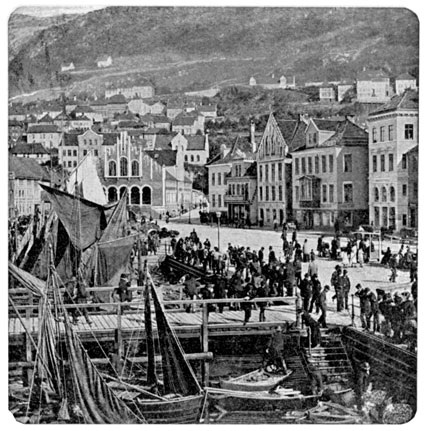
A BUSY DAY IN BERGEN.
But to me the most interesting sight in Bergen was the
grave of the Norwegian violinist, Ole Bull. His last appearance
in America was in 1879—too long ago perhaps for many
to recollect him—for, alas! even those who entertain the
public best are soon forgotten. But some of my readers
no doubt recall that Paganini of the North, tall and erect,
with large blue eyes and flaxen hair—the personification
of a valiant Norseman, whose fire and magnetism in this nineteenth
century displayed themselves in music rather than in
maritime adventure. As his old Viking ancestors had no doubt
wielded sword and battle-ax, so his bow was of such unusual
length that no
one of inferior
strength and
stature could
have used it advantageously.
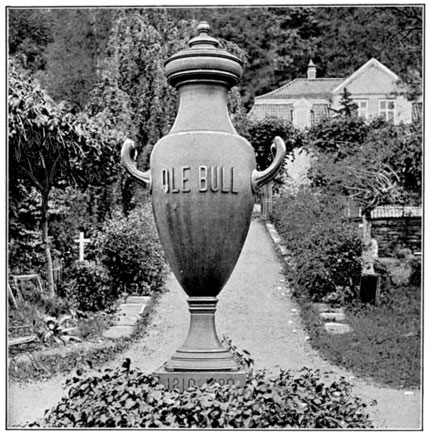
THE GRAVE OF OLE BULL.
From this
musician's
grave one looks
off over the
lovely bay of
Bergen. This
peaceful view,
which he so
loved, produced
upon my mind,
in the soft
evening light, the same effect as did the music of that skillful
hand which now reposed beneath the flowers. To me his
playing was enchanting, and unlike that of any other violinist
I have ever heard. There was a quality in the tones that he
would call forth from his violin, which seemed as weird and
fascinating as the poetry of the sagas, and as mysterious as
the light which lingered on his mountains and fjords. What
wonder that his death in 1880 was deplored in Norway as a
national calamity?
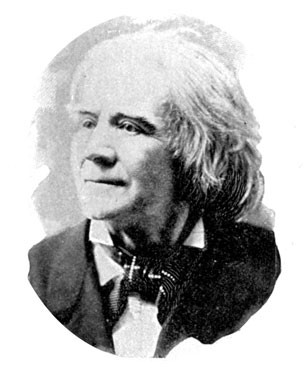
OLE BULL.
Taking our leave reluctantly of
Bergen, we entered on what proved
to be one of the most delightful
features of our tour in Norway, a
sail of twenty-four hours along the
coast to the town of Molde. How
can I adequately describe that
most unique and memorable
journey? Our entire course lay
through a labyrinth of islands,
beyond which, every now and
then, we gained a glimpse of the
Atlantic rolling away toward the
horizon. The proximity and number of these islands astonished
me. For, hour after hour, they would come into
sight, wheel by us slowly, and then disappear, to be succeeded
by their counterparts. We went down to dinner or to our
staterooms, yet when we came on deck again, islands
still surrounded us. We saw them glittering in the sunset
ere we went to sleep, and in the morning we were once more
environed by them. Sometimes I could have fancied that
they were sailing with us, like a vast convoy of protecting
gunboats, moving when we moved, halting when we halted,
patient and motionless till we resumed our voyage.
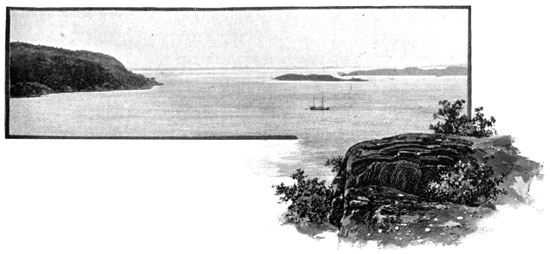
THE NORWEGIAN COAST.
Meantime, just opposite these islands, is the coast,—a
grand succession of bold headlands and dark, gloomy mountains,
beyond which always are still higher summits capped
with snow. At frequent intervals some beautiful fjord leads
inward, like the entrance to a citadel; and here and there,
within a sheltered nook, we see some fishing hamlet crouching
on the sand. This is surely the perfection of ocean
travel. For, though this mountain-bordered channel is hundreds
of miles in length, the sea within it is as smooth as a
canal. Once only throughout the day was the great swell
of the Atlantic
felt, when for a
little space the
island breakwater
was gone.
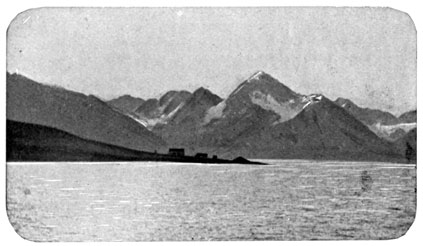
A WONDERFUL PANORAMA.
Our sail along
the coast had,
late at night, a
most appropriate
ending in
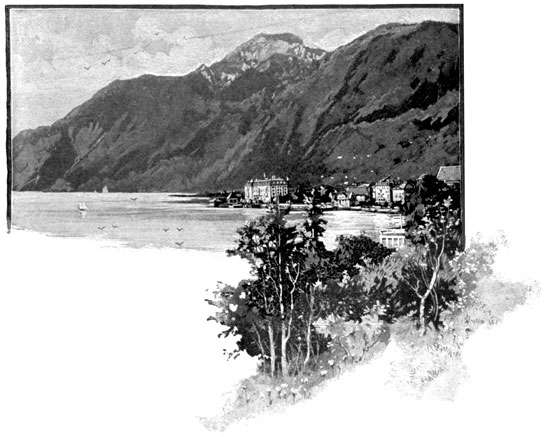
our arrival at Molde. There are few places in the world
more beautiful. It lies upon the bank of a fjord, on the
opposite side of which is an array of snowy mountains forty
miles in length. Molde is sometimes called the "Interlaken
of Norway," but that does not by any means describe
it. For here there is no single mountain, like the Jungfrau,
to compel our homage, but rather a long series of majestic
peaks, resembling a line of icebergs drifting in crystal splendor
from the polar sea.
Filled with enthusiasm over this splendid spectacle, we
left the steamer, and soon found ourselves within a comfortable
hotel. It was the hour of midnight, but, far from
being dark, the eastern sky was even then brightening with
the coming dawn. A party of excursionists was just returning
from a mountain climb. Some passengers were embarking
on the steamer we had left. Supper or breakfast (I know not
which to call it) was awaiting us. Under such circumstances
it seemed ridiculous to go to bed. Accordingly, we laughed
and chatted on the balcony, until a wretched man thrust out
his head from an adjoining window, and remarked:
"My friends, I am glad to see you happy, but I have just
returned from the North Cape. I haven't slept for eight
nights. It seems quite dark here by comparison, and I was
hopeful of a good night's rest. Would you just as lief postpone
your fun until you get inside the Arctic circle?"
This pathetic appeal could not be resisted, and asking his
forgiveness, we retired.
Taking leave of Molde one pleasant afternoon, we sailed
across its beautiful fjord to explore the snow-capped mountains
opposite. It was upon this voyage that I was taught
the bitter lesson never to trust my baggage to a Norwegian,
merely because he claims to be able to speak English. Upon
the deck of our little steamer stood that day a man, upon
whose hatband I read the legend that he was the proprietor
of a hotel at Veblungsnäs, where we proposed to spend the
night. Approaching him, therefore, I inquired:
"Can you speak English?"
He smiled upon me sweetly, and replied, "O, yes."
Innocent of the awful fact that this was the whole extent
of his vocabulary, I continued:
"When we arrive, will you bring my valise ashore, while
I go at once to the hotel to secure rooms?"
"O, yes."
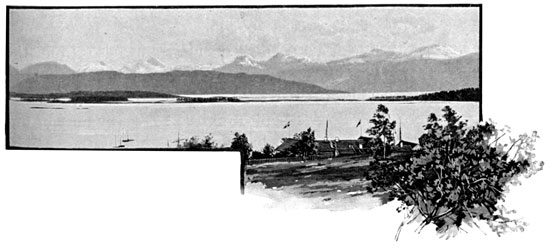
MOLDE.
Ten minutes later we reached our landing pier. I left the
boat, as I had said, and hurried on to the hotel. I presently
beheld the old proprietor coming from the wharf, but without
my satchel.
"What does
this mean?" I
cried; "did you
not bring my
valise off the
steamer?"
"O, yes."
"Where is it,
then? Is it not
on there still?"
"O, yes."
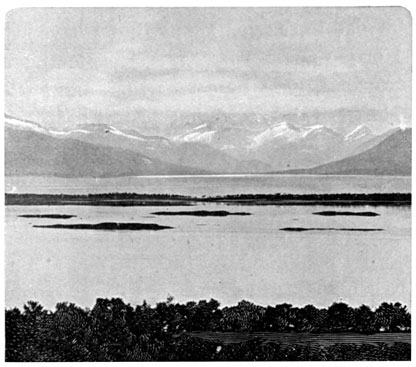
VIEW FROM MOLDE.
"Mercy on
me! Is not that
the steamer going off with my valise on board?"
"O, yes!"
"Well, are you not a monumental idiot, then?"
"O, yes!"
It took me three days to recover that valise; and the important
lesson of "O, yes," was effectually learned.
Early next morning we took leave of Veblungsnäs, and
drove directly towards the Romsdal, one of the finest valleys
in all Norway. Before us, like a mighty sentinel, the imposing
Romsdalhorn rose, dark with somber shadows, to an
altitude of five thousand and ninety feet. The peak itself,
five hundred feet in height, is said to be almost as dangerous
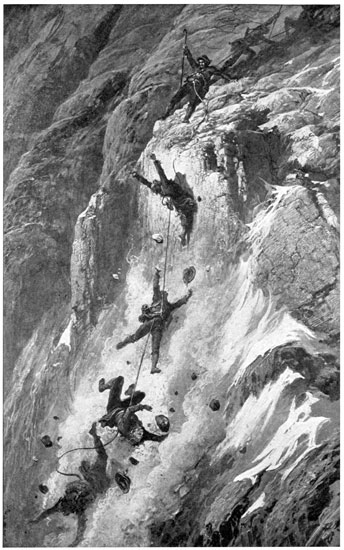
to ascend as the appalling Matterhorn, not only
on account of its perpendicular sides, but also from the
crumbling nature of the rock, which renders it impossible to
fasten iron bars in its surface.
Some years ago, an English tourist, after a number of unsuccessful
efforts, finally reached the summit of this mountain.
He was, of course, exultant. The inhabitants of the
valley had told him that the conquest of the Romsdalhorn
was hopeless, and no tradition existed among them that its
ascent had ever been made. Nevertheless, when the successful
climber finally stood upon the mountain's crest, he found
to his astonishment and regret that he was not the first
man who had gained this victory. A mound of stones,
heaped up there as a monument, proved beyond doubt that
at some unknown epoch some one had been there before him.
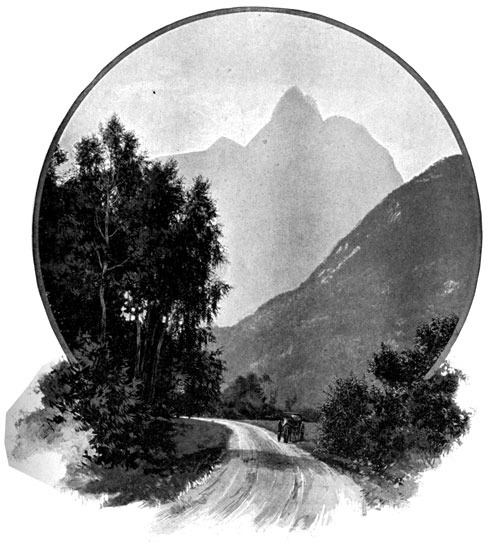
THE ROMSDALHORN.
Driving around the base of this majestic mountain, we
found ourselves within a narrow gorge shut in by savage
cliffs, with barely space enough between them for the carriage-road
and a wild torrent rushing toward the sea. One wall of
this ravine is singularly weird and
awe-inspiring. A multitude
of crags and
pinnacles, splintered and shattered by the lightning's bolts,
stand out in sharp relief against the sky, as if some monsters,
hidden on the other side, were raising o'er the brink of these
stupendous precipices their outstretched hands and tapering
fingers in warning or in supplication. These strange, fantastic
forms are in the evening light so ghostly and uncanny, that they
appear to the Norwegian peasants like demons dancing gleefully
upon the
mountain tops.
Hence the pinnacles
are called
the "Witches'
Peaks."
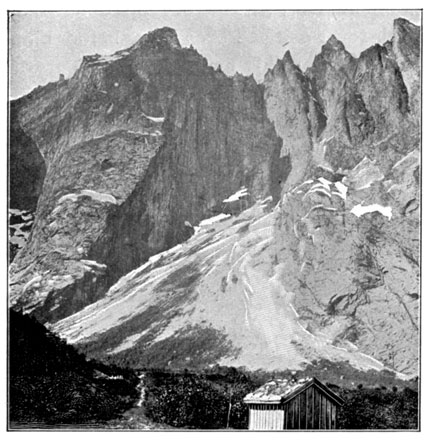
THE WITCHES' PEAKS.
It was while
riding through
this gorge that
I heard a tourist
complaining
that Norway
had no ruins.
In one sense
this is true, for,
owing to the fact
that the feudal system never existed here, castles and strongholds
are nowhere to be found. But Norway surely can dispense
with any crumbling works of man. Amidst the ruins
of her everlasting mountains and stupendous fjords, grooved
by the glaciers when the earth was young, all remnants
of man's handiwork would seem like ant-hills made but an
hour ago.
Toward evening, at the head of the Romsdal Valley, we
reached the station of Stuflaaten, where we were to sleep.
Our spirits sank as we approached it. Nothing, apparently,
could be less inviting. But here, as in so many other instances,
we found the
accommodations
excellent. It is
true, the beds
possessed the
usual Norwegian
fault—an insufficient
length.
Tall travelers,
who object to
having their
limbs closed
under them at
night, like the blades of a jack-knife, frequently sleep on
the floor in Norway.
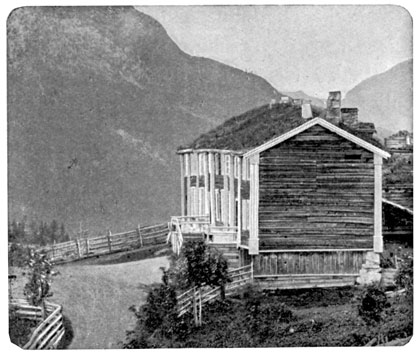
STUFLAATEN.
"I cannot lie in one of these beds," exclaimed my friend;
which, for a lawyer, seemed to me a remarkable admission!
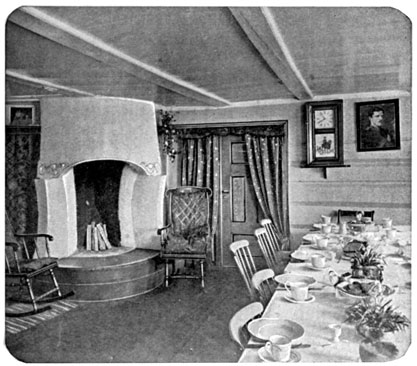
A NEW ENGLAND SOUVENIR.
Never shall I forget the dining-room at Stuflaaten. Here
we were first attracted by the fireplace. It was a chimney
built out from the corner, with space behind for a warm cupboard.
The
opening for fuel
was so narrow
that sticks were
placed upright
upon the hearth.
Beside this were
two rocking-chairs
(almost
unheard of luxuries
in any part
of Europe), and
sinking into
these, we thought
of home. The influence of that American article of furniture
was, I fear, depressing, for soon my friend remarked:
"How far we are from dear New England! If I could
only see one object here which really came from there, how
happy I should be!"
"Look at that clock upon the wall," I responded; "that
has a familiar look. Perhaps that came from 'dear New
England!'"
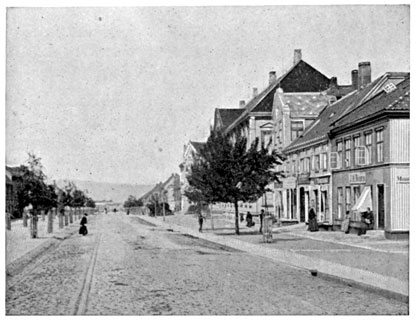
TRONDHJEM.
"Nonsense," he answered; "how could anything made
in New England
find its way here
almost within the
Arctic circle?"
"Well," I exclaimed,
"where
is the land that
Yankee inventions
have not
entered? Let us
put it to the
test." Accordingly,
stepping to the clock, I opened it and read these words:
"Made by Jerome & Co., New Haven, Conn."
Returning once more through the Romsdal, Veblungsnäs,
and Molde, we sailed again, for twelve hours, along the Norway
coast to reach the city of Trondhjem. Although less beautifully
situated than Bergen, Molde, or Christiania, in point of
historic interest, Trondhjem is superior to them all. For here
lived the old Norwegian kings, and the town can boast of a continuous
existence for a thousand years. It also enjoys the proud
distinction of having the most northern railway station in the
world, for from this city, which is in the latitude of Iceland,
a railroad now extends three hundred and fifty miles southward
to Christiania.
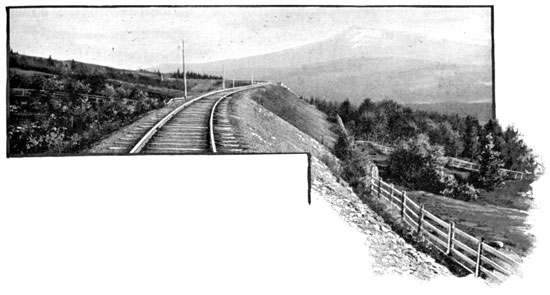
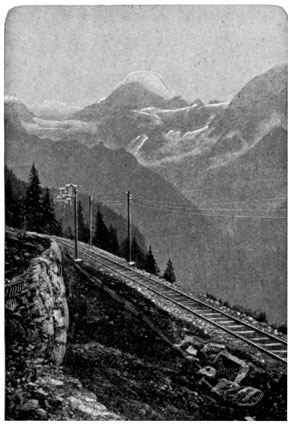
A NORWEGIAN RAILWAY.
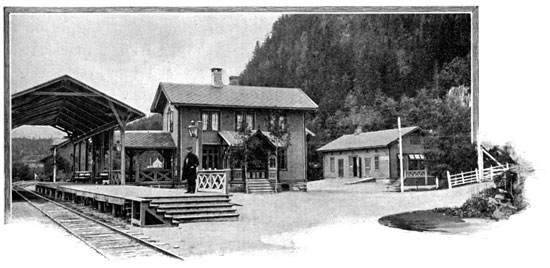
A RAILWAY STATION.
Upon this road are run some
cars which are facetiously called
"sleepers"; but they are such as
Mr. George M. Pullman would see only in
an acute attack of nightmare. The road
being a narrow-gauge one, the car is not much wider than an
omnibus. The berth (if the name can be applied to such a
coffin-like contrivance) is formed by pulling narrow cushion-seats
together. On these is placed one pillow, but no blanket
and no mattress,—simply a pillow,—nothing more! From the
feeling, I should say that my pillow consisted of a small boulder
covered with cotton. But what, think you, is the upper berth?
It is a hammock, swung on hooks, and sagging down to within
a foot of the lower couch. Now, it requires some skill to get
into a hammock anywhere; but to climb into one that is hung
four feet above the floor of a moving railroad car, calls for the
agility of an acrobat. After my experience that night, I feel
perfectly qualified to perform on the trapeze, for since I weighed
but one hundred and forty pounds, while my friend tipped the
scales at two
hundred and
fifty, I thought
it was safer for
me to occupy
the upper story.
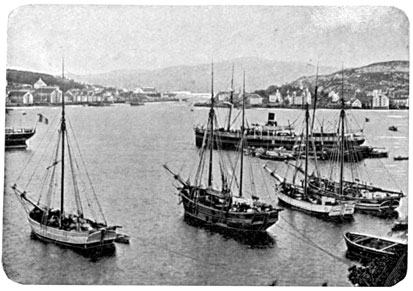
A NORWEGIAN HARBOR.
Another difficulty
met with
in that memorable
journey was
to keep covered
up. There was
no heat in the car. At every respiration, we could see our
breath. This was, however, a consolation, since it assured
us that we were still alive. Wraps of all kinds were needed,
but the space was limited. There was, for example, in my
hammock, room for myself alone; or without me, for my
traveling-rug, overcoat, and pillow. But when we were
all in together, the hammock was continually overflowing.
Accordingly, every fifteen minutes during that awful night,
my friend would start up in abject terror, dreaming that he
was being buried beneath a Norway avalanche.
I never think of Trondhjem without recalling, also, an
experience in a Norwegian barber-shop. I knew that it was
tempting Providence to enter it, for shaving in Norway is
still a kind of surgical operation. But for some time a coldness
had existed between my razors and myself. The edge
of our friendship had become dulled. Accordingly, I made
the venture. Before me, as I entered, stood a man with a
head of hair like Rubenstein's, and a mouth like a miniature
fjord.
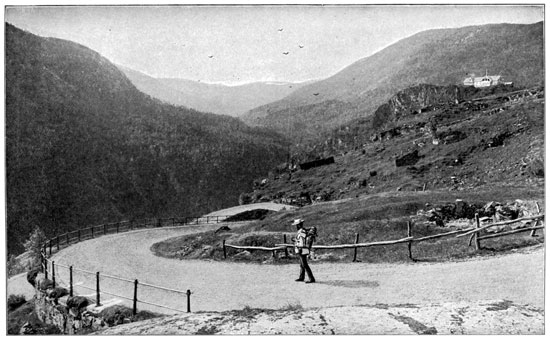
TOURING ON FOOT.
"Do you speak English?" I began.
"Nay."
"Sprechen sie Deutsch?"
"Nay."
"Parlez-vous Français?"
"Nay."
"Parlate Italiano?"
"Nay."
"Well, one thing is sure, then," I said; "you will not talk
me to death, anyway!"
Having made the most graceful gestures of which I was
capable to indicate what I wanted, I settled myself in a hard
chair and laid my head against a rest resembling the vise furnished
by a photographer when he asks you "to look pleasant."
The preliminaries being over, the Norwegian Figaro
took his razor and made one
awful never-to-be-forgotten
swoop at my cheek as if he
were mowing grain with a
scythe! I gave a roar like
a Norwegian waterfall and
bounded from the chair in
agony! When I had fully
wiped away my blood and
tears, I asked him faintly:
"Have you any ether?"
"Nay."
"Any laughing-gas?"
"Nay."
"Any cocaine?"
"Nay."
"Well, then," I exclaimed, "will you please go over
there and 'nay' by yourself while I finish this operation with
my own hands?"
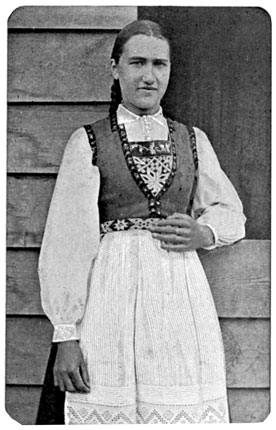
A VILLAGE MAIDEN.
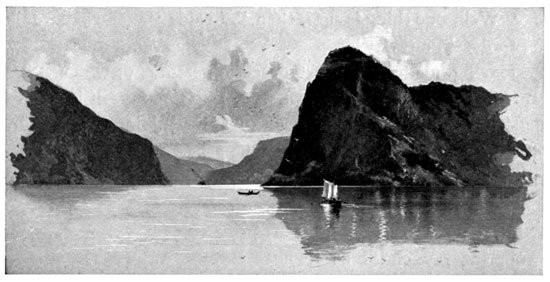
ENTRANCE TO A FJORD.
He seemed to understand me, and retreated to a corner.
When all was over, he pointed to a bowl at which I saw
my friend gazing with that peculiarly sad expression which he
invariably assumed when thinking of his family. I soon discovered
the cause, for from the centre of this wash-bowl rose
a little fountain about a foot in height, which seemed to
him a facsimile of the one on Boston Common. I comprehended
that I was to wash in this fountain; but how to do
it was a mystery. At last I cautiously thrust one side of my
face into it, and instantly the water shot up over my ear and
fell upon the other side. I turned my face, and the ascending
current carromed on my nose, ran down my neck, and made
a change of toilet absolutely necessary. When, therefore,
my friend had called a cab to take me home, I asked the
barber what I should pay him. By gestures he expressed to
me the sum equivalent to three cents.
"What," I exclaimed, "nothing extra for the court-plaster?"
"Nay."
"And nothing for the privilege of shaving myself?"
"Nay."
"And you don't charge for the fountain, either?"
"Nay."
"Well," I exclaimed as I rode away, "I can truly say
that never before have I received so much for my money."
This city of the north has one extremely interesting
building—its cathedral. As a rule, Scandinavian churches are
not worth a visit; but this is a notable exception. More
than three hundred years before Columbus landed on San
Salvador this building held a proud position. Its finest carving
dates from the eleventh century. At one time pilgrims
came here from all northern Europe, and laid their gold and
jewels on its shrines. But at the period of the Reformation all
this was changed. Iconoclasts defaced its carving, cast down
its statues, sacked the church, and packed its treasures in a
ship, which, as if cursed by an offended Deity, foundered
at sea.
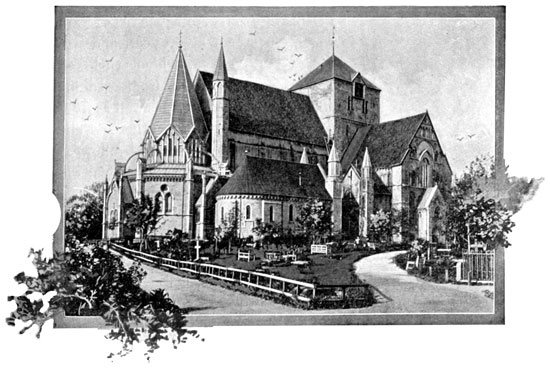
TRONDHJEM CATHEDRAL.
On entering the ancient edifice, we were delighted with its
delicate stone-tracing. The material is a bluish slate, which
gives to the whole church a softness and a beauty difficult to
equal, and blends most admirably with its columns of white
marble. A part of the cathedral was, however, closed to us,
for all the ruin once wrought here is being carefully effaced
by systematic restoration. The government contributes for
this purpose a certain
sum every year, and private
individuals help on
the work from genuine
love of art, as well as from
patriotic motives. The
old designs are being followed,
and hence, in time, this old
cathedral will in every feature come to be a reproduction of
the original structure.
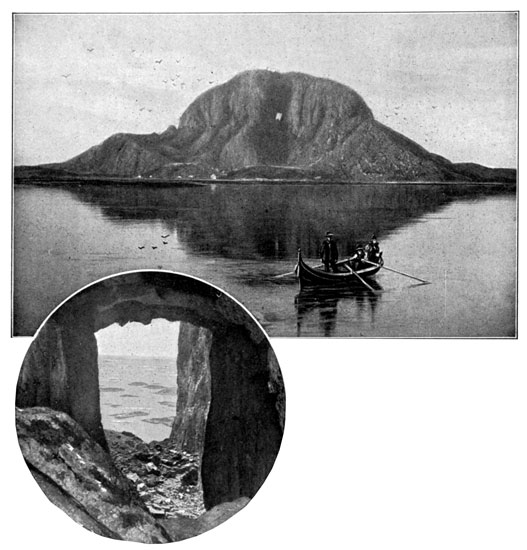
THE TUNNEL AT TORGHÄTTEN.
A few days after reaching Trondhjem, we found ourselves
embarking for another ocean journey. This time our destination
was the northern limit of the continent. For a Norwegian
tour naturally divides itself into three parts. The first
consists of driving through the mountainous interior; the
second is the exploration
of its
noble fjords;
the third is the
voyage from
Trondhjem to
the North Cape.
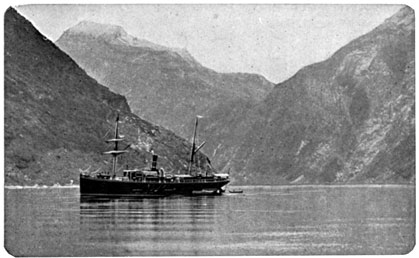
AN EXCURSION STEAMER.
This voyage,
in fast excursion
steamers, is now
made in about four days, an equal number being occupied in
returning. "Eight days?" the reader will perhaps exclaim;
"why, that is longer than a voyage across the Atlantic." In
actual duration, yes; but otherwise the two excursions are
entirely different. For almost all the way you follow so
closely the fringe of islands that there is little danger of
rough weather, while the mainland is constantly in sight.
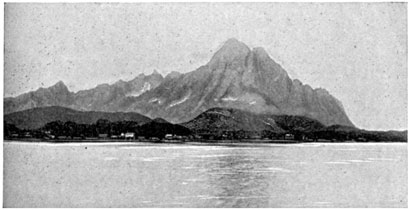
ONE OF THE LOFFODENS.
Some twenty-four hours after leaving Trondhjem, our
steamer halted at an island, up whose precipitous side we
climbed five hundred feet to view a natural tunnel perforating
an entire mountain. Through this we gained a charming
telescopic vista of the ocean and its island belt. The tunnel
is six hundred feet in length, and in some places two hundred
feet in height. So smooth and perpendicular are its
walls, that it appears almost incredible that human agency
has not assisted
in this strange
formation. But
scientists say
that it was
accomplished
entirely by the
waves, when all
this rock-bound
coast was covered by the sea. Leaving this curious freak of
nature, another memorable feature of our northern voyage
soon greeted us,—the Loffoden Islands. These form a
broken chain one hundred and thirty miles in length. The
scenery in their vicinity is perhaps the finest on the Norway
coast, and as we watched it with delight, the captain told us
of his voyages here in winter, and I now learned, to my astonishment
that freight-steamers make their regular trips, all
winter long, round the North Cape to Vadso, on the Arctic
coast. They encounter fearful storms at times, but rarely any
icebergs. We have, it seems, a monopoly of these floating
monsters on our side of the Atlantic, borne west and south
by the current off the coast of Greenland.
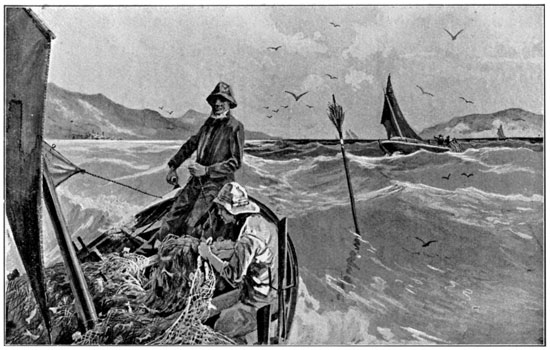
FISHING ON THE COAST.
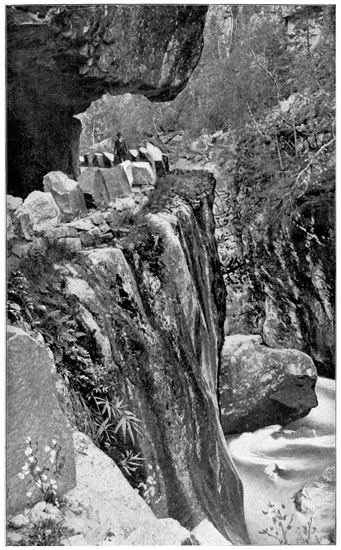
SCENE FROM BROTHANSDALEN.
Of course, these wintry voyages are performed in darkness,
for Night then reigns here with as much supremacy as
Day in summer. The lights on the steamers are, therefore,
kept constantly burning. Yet, strange to say, this is the
period of greatest activity among these islands. Winter is the
Norwegian fisherman's harvest-time. The only light necessary
to carry on
the work is that
of the Aurora
Borealis and the
brilliant stars.
From twenty to
twenty-five millions
of cod are
captured here
each winter,
and twenty-five
thousand people
are employed in
the trade.
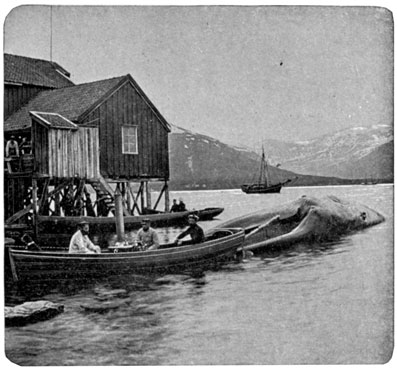
TROMSÖ.
Soon after leaving the Loffodens we arrived at Tromsö,
the city of the Lapps. It had the appearance of a pretty
village as we viewed it from a distance; but soon the sense
of sight was wholly lost in the prominence given to another
of our senses. The carcass of a whale was floating in
the harbor. It had been speared and towed in hither to be
cut in pieces. The blubber was being
boiled in kettles on the shore. The
impression which this made on my
olfactory nerves is something for which
language is inadequate. The odor was
as colossal as the fish itself. I never
sympathized sufficiently with Jonah till
I went to Tromsö!
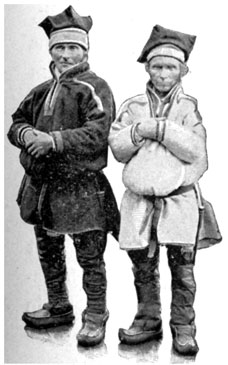
LAPLANDERS.
Soon after landing here, a walk of
an hour brought us to a settlement of
Lapps, consisting of some very primitive
tents. My first impression of these
people was, and still is, that any one of
them could have effectually concealed
his identity by
taking a bath.
They all have
dirty, wizened faces, high cheekbones, flat noses, and mouths
that yawn like caverns. Their beards are so peculiarly tufted
that they look like worn-out Astrachan fur. I could almost
suppose that in rigorous winters the reindeer, while their masters
slept, had nibbled at their cheeks. The men are about
five feet high, the women four;
but they are tough and hardy,
like most dwarfs. Dickens
could have found among them
countless models for his hideous
Quilp.
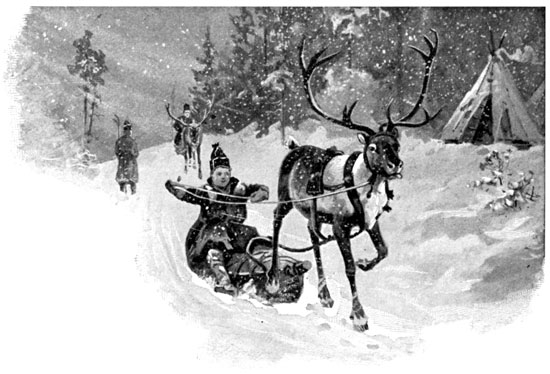
REINDEER
AND SLEDGE.
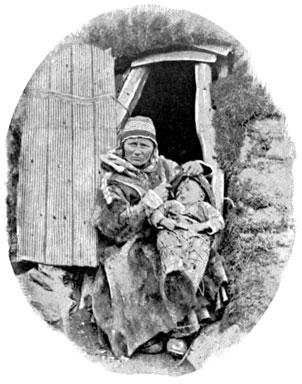
A LITTLE LAPP.
Advancing to one of their
huts, we peered into the interior.
Upon the ground was
smoldering a small fire, part
of the smoke from which escaped
through an opening in
the roof. The inmates scarcely
noticed us, until my artist produced
his camera. Then there was instantly a general stampede.
One woman seized her baby and rushed forth, as if a demon
had molested her. The cause of this confusion, however, was
not fear, nor even modesty, but avarice, pure and simple.
They understood perfectly what the camera was, and wanted
a good price for being photographed. Three shillings was
at first demanded for a picture, but finally we compromised
by giving half that sum.
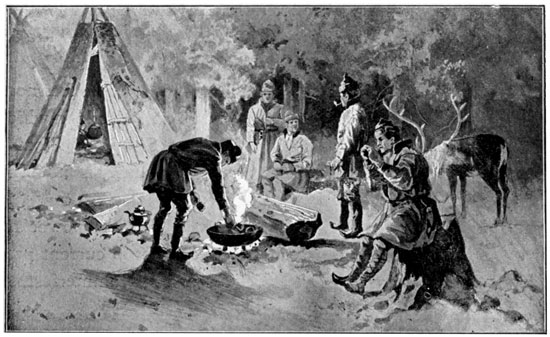
LIFE IN LAPLAND.
Among these Laplanders, the clothing of both men and
women is made of reindeer skin, worn with the hardened pelt
outside. These garments last indefinitely, and are sometimes
bequeathed from one generation to another. The Lapp complexion
looks like leather. Even the babies have a shriveled
look, resembling that of monkeys. This is not strange, however,
for both men and women are great consumers of
tobacco. Their huts are always full of smoke, till finally the
inmates become smoke-dried within and without. This, in
turn, produces thirst. Hence we were not surprised to learn
that they are inordinately fond of ardent spirits. In fact,
when a Norwegian wishes to remonstrate with a friend who is
inclined to drink to excess, he will often say to him, "Don't
make a Lapp of yourself!"
Bidding farewell to Tromsö and the Laplanders, the next
day brought us to the most northern town in the world—Hammerfest.
It was a great surprise to me to see, in such
proximity to the North Pole, a town of about three thousand
inhabitants, with schools, a church, a telegraph station, and a
weekly newspaper! The snow-streaked mountains in the distance
gave me the only hint of winter that I had; and I could
hardly realize that I was here two hundred miles farther north
than Bering's Strait, and in about the same latitude in which,
on our side of the Atlantic, the gallant Sir John Franklin
perished in the ice. The cause of this, however, is not difficult
to trace.
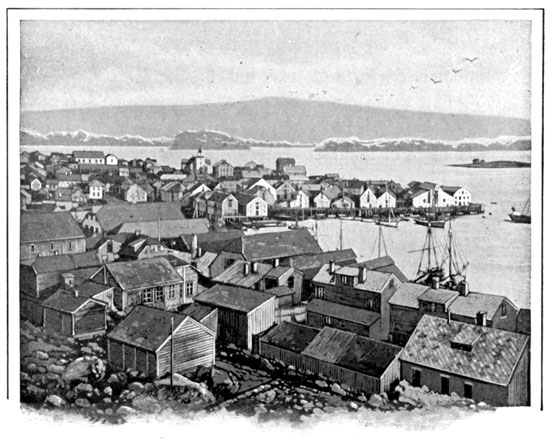
HAMMERFEST.
The influence of the Gulf Stream is felt powerfully
even here. For here it is that the great ocean current practically
dies, bequeathing to these fishermen of Hammerfest, for
their firewood, the treasures it has so long carried on its bosom,
such as the trunks of palm-trees, and the vegetation of the
tropics. It is an
extraordinary
fact that while
the harbor of
Christiania, one
thousand miles
farther south,
is frozen over
three months
every winter,
this bay of Hammerfest, only sixty miles from the North
Cape, is never closed on account of ice.
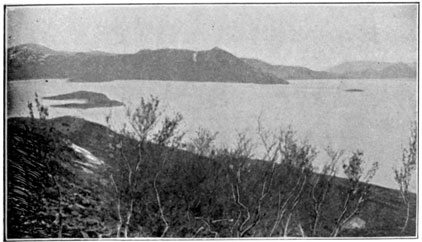
THE GULF STREAM'S TERMINUS.
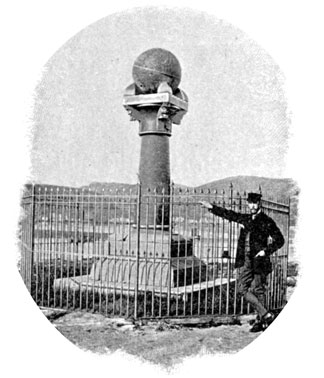
THE MERIDIAN SHAFT.
An interesting object in Hammerfest is the meridian shaft,
which marks the number of degrees between this town and
the mouth of the Danube, on the Black Sea. The mention
made upon this column of that
other terminus of measurement,
so far distant in the
South of Europe, reminded us
by contrast of one more advantage
which this high latitude
possesses—the greater
rapidity of its vegetation.
When the sun once appears
within this polar region, it
comes to stay. Nature immediately
makes amends for
her long seclusion. For three
months the sunshine is well-nigh
incessant. There is no
loss of time at night. The flowers do not close in sleep. All
vegetation rushes to maturity. Thus vegetables in the Arctic
circle will sometimes grow three inches in a single day, and
although planted six weeks later than those in Christiania,
they are ready for the table at the same time.
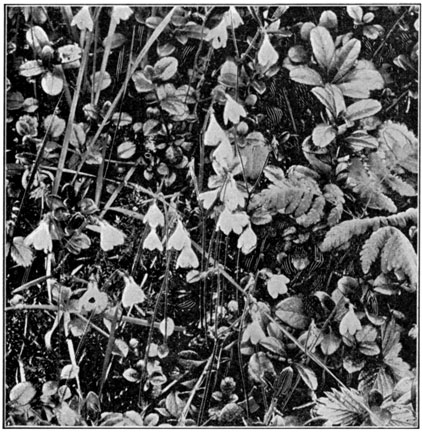
NORWEGIAN FLORA.
Sailing finally from Hammerfest, a voyage of seven hours
brought us to our destination—the North Cape. I looked
upon it with that
passionate eagerness
born of long
years of anticipation,
and felt at
once a thrill of
satisfaction, in
the absence of
all disappointment.
For my
ideal of that
famous promontory
could not be
more perfectly
realized than
in this dark-browed,
majestic
headland, rising with perpendicular cliffs, one thousand feet
in height, from the still darker ocean at its base. It is, in
reality, an island, divided from the mainland by a narrow
strait, like a gigantic sentinel stationed in advance to guard
the coast of Europe from the Arctic storms.
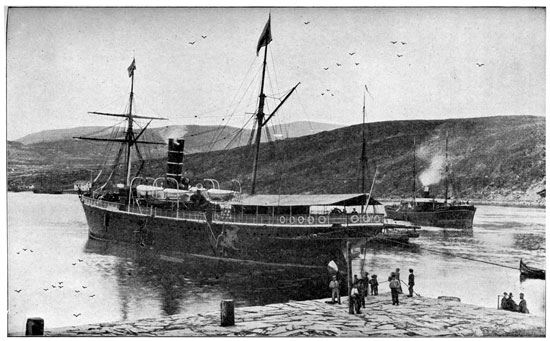
HARBOR OF HAMMERFEST.
Embarking here in boats, we drew still nearer to this
monstrous cliff. From this point it resembles a stupendous
fortress surmounted by an esplanade. For in that prehistoric
age, when northern Europe was enveloped in an icy
mantle, huge glaciers in their southward march planed down
its summit to a level surface. The climbing of the cliff,
though safe, is quite exhausting. Ropes are, however, hung
at different points, and, holding on to these, we slowly crept
up to its southern parapet. Thence a laborious walk of fifteen
minutes brought us at last to the highest elevation,
marked by a granite monument erected to commemorate
King Oscar's visit to the place in 1873.
It is a wonderfully impressive moment when one stands
thus on the northern boundary of Europe, so near and yet so
far from the North Pole. It seemed to me as if the outermost
limit of our planet had been reached. Nowhere, not
even in the desert, have I felt so utterly remote from civilization,
or so near to the infinitude of space.
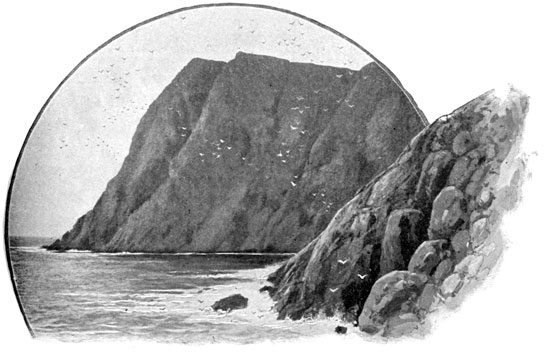
NORTH CAPE.
But presently from our steamer, anchored near the base,
some rockets rose and burst in fiery showers far below us. It
was a signal for us to be on our guard. I looked at my
watch. It was exactly five minutes before midnight. Advancing,
therefore, to the edge of the cliff, I looked upon a unique
and never-to-be-forgotten scene. Below, beyond me, and on
either side, lay in sublime and awful
solitude the Arctic sea,
stretching away
to that still undiscovered
region
of the
north, which,
with its fatal
charm, has lured
so many brave
explorers to
their doom.
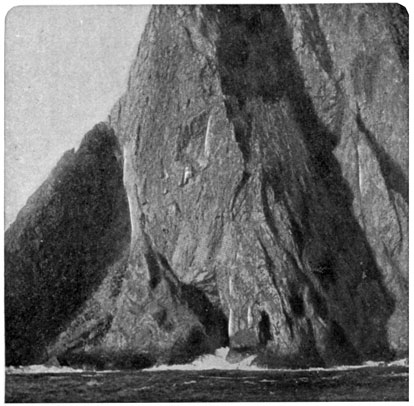
STUPENDOUS CLIFFS.
Straight from
the polar sea,
apparently, the
wondrous northern
light (an
opalescent radiance
born of the twilight and the dawn) came stealing o'er
the waters like a benediction; and to enhance its mystery
and beauty, when I looked northward over the rounded
shoulder of the
globe, I saw the
Midnight Sun.
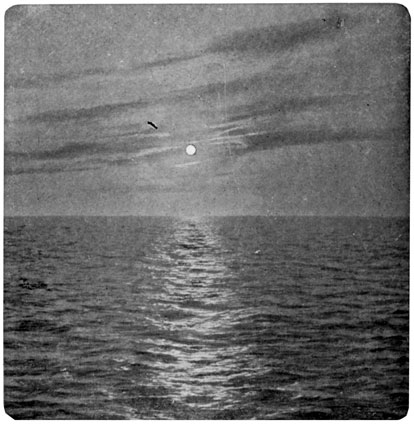
THE MIDNIGHT SUN.
At this great
height and
northern latitude
it did not
sink to the horizon,
but merely
paused, apparently
some twenty
feet above the
waves, then
gradually rose
again. It was
the last of countless
sunsets which had that day been following each other
round the globe. It was the first of countless sunrises which,
hour after hour, in so many continents would wake to life
again a sleeping world. I have seen many impressive sights
in many lands, but nothing, until Time for me shall be no
more, can equal in solemnity the hour when, standing on this
threshold of a continent, and on the edge of this immeasurable
sea, I watched, without one moment's interval of darkness,
the Past transform itself into the Present, and Yesterday
become To-day.
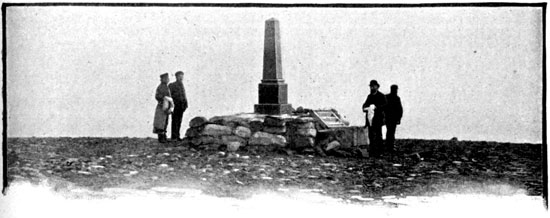
KING OSCAR'S MONUMENT—NORTH CAPE.
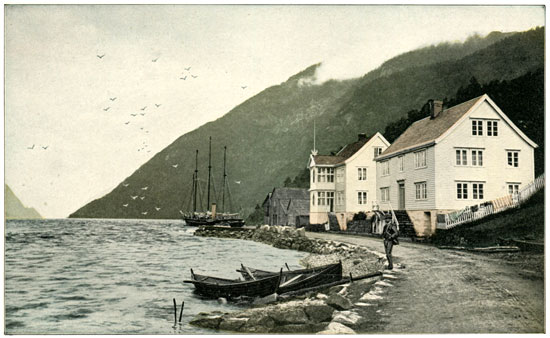
EIDFJORD IN HARDANGER—EXCURSION BOAT.