The Story of a Spectator
The paper which follows is a composite, embodying many incidents and
facts connected with the Jasper sensation, and designed to reflect, so
far as possible, the impression made by the fiery old philosopher upon
those who though out of sympathy with his astronomical notions fell as
helpless victims beneath the spell of his eloquence and honesty.
For quite a while the Jasper sensation had grown acute in Richmond.
Beginning as a freak, it bloomed into a fad, got in the air, and
actually invaded private homes. It was a pentecost for the curious, a
juicy apple for the hard-driven reporter, a festival for the scoffer,
and a roaring financial bonanza for the saints of Sixth Mount Zion.
I confess that, for my part, it struck me as a ridiculous business
at best, the big bubble of an hour, and that if not caught at the
exact moment it would speedily disappear, and while I was a sprig of
a reporter it was the sort of thing which did not come my way. Being,
however, of a prying and curious turn of mind I determined to take
one glimpse at the black elephant. It took time, however, to get my
purpose into working order, but my day came in due course. I awoke one
morning to find the Saturday papers “festering” with Jasper. He was in
the advertisements, in the communications, and in the local columns,
and the show was to come off the next day. They told once more of his
astronomical absurdities, as I believed them to be, and informed me
that the exhibition would come off at 3 P. M. on the next
afternoon. At noon, I dropped into Reugers’ for my lunch, and a table
of hayseed legislators were filling the room, with noisy gabble about
Jasper and his planetary crochets. I found that some of them had signed
a paper asking for the approaching Jasperian exhibition, and others of
them were twitting and punching them for their folly; but I found that
both sides of them were going.
Later in the day, I got into a West Main Street car and found a seat
next to three ladies who evidently had a serious attack of Jasper,
and they, too, were bargaining to go. At the supper table in my
boarding-house that evening I found a sickly old Yankee minister
loafing in Richmond for his health, in a swivet of excitement about
Jasper and his coming oration. My landlady’s fourteen year old boy told
me that his mother had promised that he should go to hear Jasper, on
the hampering condition that he could get some gentleman to go with
him, and his appeal for my company would have beaten Jasper in the
point of passionate eloquence. To me, it all seemed a stew of folly,
and yet I found myself gratified to have this earnest lad as an excuse
in favour of my going.
I finally bargained with the eager youngster that I would waylay him
the next morning on his early escape from the Sunday-school, and we
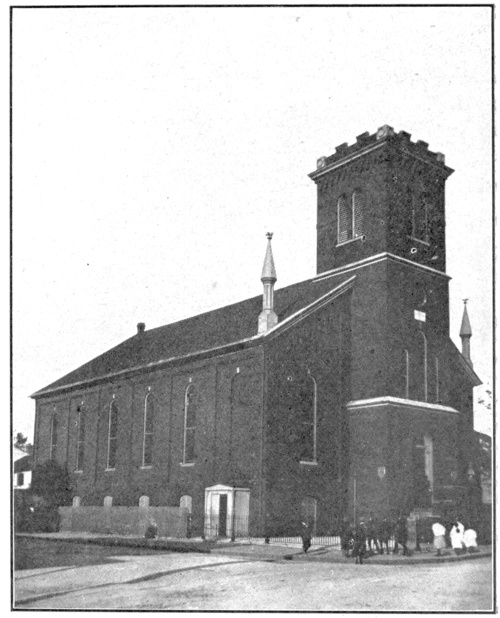
would stroll out into the vicinity of the Sixth Mount Zion Church, and
make a preliminary reconnaissance of the general situation. We did not
find it quite a well-odoured stroll at all points, particularly as we
got in the neighbourhood of the church, for we encountered a tangle of
streets and alleys some of which were not in the best condition.
Not long after crossing Broad Street we began to run afoul of squads
and groups of coloured people, and the total strain of their chat was
Jasper and what was coming later on. The nearer we came to the church,
the combat, as the poet said, deepened, that is, the groups multiplied
and the Jasperian element grew. A huge negro woman hanging on a
side-gate on Clay Street was shouting in a piping voice about Jasper
and the sun, and telling to several dumb listeners that “she wuz gwine
ter be dar ef de Lord ‘sparred’ her an’ it wuz de las’ thing she done
on de yerth.”
I observed also several of those Virginia solons already
mentioned,—those big footed, badly shaven, and consequential
legislators,—prowling in the neighbourhood of the church, as if they
were studying and planning for burglaries. As we meandered the crooked
streets which admitted us to a sight of the great Sixth Mount Zion,
we saw in every direction the sign of a prodigious expectancy. Front
yards, streets, and alleys had their contingents, and you could not get
within ear-shot without getting some novel and surprising hints as to
John Jasper and the Solar System. We could hear singing in the church,
and we assumed that something in the way of worship was in process.
That, however, was not IT. That was a tame and pithless performance,
and if Jasper was in it at all he was evidently resting his better
forces for the bigger battle at three o’clock in the impending
afternoon.
The attraction on the inside was out of gear and didn’t draw. My young
companion, who was vastly my superior as to the Jasper situation,
informed me with marked conviction that the thing for us to do, and
to do at once and with a rush, was to go back to the house, swallow
our dinner, and get back with the utmost speed. We did not get away,
however, before we noted that all avenues in the vicinity of the church
seemed to be filling. Some were coming and going; some were knotted
into groups looking very solemn and apparently awestruck, and some
were crowding in like late comers at a circus; but whenever you caught
a word it had to do with Jasper. As we walked away, the son of my
landlady, full of the fidgets and outraged by my slow motion remarked
sagely: “Ain’t he got ’em?” I had to admit it; he had ’em,—by a grip
tighter than if he had ’em by the nape of the neck. Evidently enough,
he had them, and in a bunch as big as the town.
But I didn’t know it fully then. Being untutored in Jasper’s holding
power, I was fresh enough to suppose that all that buzzing, swarming
gang of negroes would scatter away to their frugal Sunday meal, and
that the alleys and streets would empty into their usual vacancy,
though the boy’s mien of hurry and eagerness was warning me to the
contrary. He mentioned several times that from what other boys had told
him we must go very early, and in order to gratify him we got out of
the boarding-house at a quarter after one, and we needed only fifteen
minutes of quiet walking to get a front seat.
Shades of the Pharaohs and shadows of the Pyramids! As we headed
towards the seat of planetary conflict the streets looked like black
rivers. Great lines of blacks, relieved here and there by companies of
whites, thronged the sidewalks. Were Hannibal’s Carthagenian legions
being turned loose in Richmond? Or had some mighty earthquake ripped
open the foundations of Richmond, and were the people, caked with the
soot, fleeing for life? It was more tranquil than that, thank heaven!
It was however the town, upheaved and agitated, striving fiercely for
Sixth Mount Zion, to hear the supreme sensation of all his race,—as
I now began to realize he was. Squares before we got to the church we
collided with the returning tide. “No use of going,” they said,—“house
already packed; streets full, men fighting and women fainting,” and a
deal more of the same sort.
But these appalling things only urged me on. If there was to be a
congestion or a catastrophe, it was just to my taste as well as to
my profession to attend. Besides, I had in me a desperate purpose to
get into that house, and I promised the boy that we’d sink or swim
together. I understood it was perfectly scriptural to rip off the roof
as the last resort. The occasion had jumped the common road, and it
was folly to falter now before any obstacle. The fight through that
mob has left me some marks to be noticed when I am dressed for my
burial. My toes were tramped into jelly. At one time I was lifted by a
rush, and one of my knees aches yet in bad weather as a consequence.
Several times I thought the landlady’s boy was doomed to become an
unrecognizable mangle. It began to sift into me that Jasper was more
than a man, and nothing short of an entire situation and a public
menace. My business was more and more to see him.
The church, when first seen, looked like a tall boat borne on the heads
of thousands, and yet I pushed along. Now, right here, I have to drop
my honesty and become a hypocrite. How I got into that house must not
be told. There is a muscular, ginger-bread fellow who stays in the
office down town, and he broke all rules and I know not how many bones,
and, miraculous as it was, landed me and the boy into the pulpit with
blood on the boy’s nose.
Now, excuse me from describing the music and the praying, though I
would like to mention that the song that the old darkey in the Amen
corner with the white nape and the quivering voice started up, and
which it looked to me like all the people in the world were singing,
rather jerked me out of myself and took me off on its waves, and when I
got back I had to use my handkerchief in an unusual way.
Jasper made a prayer also, and the way he talked to the Lord about his
own meanness and his ignorance, knocked out of me about half of my
notion that he was a dribbling old egotist and numbskull. He caused
cold chills to pass up my back by several surprising things which he
said to the Lord in a most serious way, and I have to own that by the
time he said “Amen,” I was a little prejudiced in his favour.
Further, allow me to say right here that I know positively that I
never saw so many people in a house of that size at one time as was in
the church that afternoon. Women sat in each other’s laps, the pulpit
was piled up, and all the spaces chinked, packed, and doubled up. I
ought to add that the look of eagerness, expectation, and attention
was oppressive. No whispering, no looking around; only silence, except
when Jasper started them. Then you felt the mastery and the subduing
sovereignty of the man. I saw that the white people had been favoured
in getting seats, and there were hordes of them. The legislators
abounded, and there were preachers, lawyers, notable men, fashionable
women, and not a few strangers in Richmond, all herding together and
very serious. It wasn’t, I confess, what I expected. I looked for a
circus, and had hooked a funeral,—no, not a funeral; it wasn’t dismal
enough for that, but far more thoughtful and wakeful than a funeral can
be.
I looked Jasper over with a critical eye, and before he began to
preach I had his age down for sixty-two, but when he began to career
over the pulpit I knocked off ten years. He had an unattractive bulge
on his face around his cheekbone, but his head looked like an alpine
cliff. His eye, I noted, was an all sufficient redeemer, and its flash
and laugh would cover acres of ugliness. His whiskers were decidedly
undistinguished, except in their cut, and I marked his blood as
unmixed. He dressed in a manner best suited to prevent people from
noticing how he dressed, and his tall form and alert action made him
attractive in the pulpit.
During the sermon he had something to say about himself. “I’ll be
sixty-six years old on de fo’th day uv dis coming July. I set out ter
seek de salvation uv my Gord in 1839. I have never been in any school,
but I spent some months trying ter learn ter spell. I wuz converted in
Marse Sam Hargrove’s terbakur fac’try in dis city, on de 25th day uv
July, 1839, and frum dat day I have know’d dat Gord had anintid me wid
de Holy Ghost ter preach de Gorspil uv His Son.”
You couldn’t hear Jasper say that and doubt. He seemed to assert a
mastery over me from the start as to his sincerity. It was impossible,
moreover, to question the honesty of anything he said. He made another
remark at the outset which made everybody smile, but it was not a
frivolous smile by a long shot. He said he was so ignorant when he
first felt he must preach that he thought maybe God wouldn’t want a man
to preach who could not read, and that maybe the devil had put that
notion into him. Then he stopped, and with a decided smile he said, “I
got a notion dat ef de debbul put dis thing in me, den he wuz a bigger
fool dan I ever thought he cud be. I don’t think he hav made much by
settin’ me out ter preach ef he did fer I done knocked his kingdom hard
blows many a day, but arter more dan forty years servin’ my Gord I know
who I hev b’lieved. I feel dat wenever I stan’ up in His name, de Lord
is wid me.”
After these remarks he gave out his text and started in.
“Ef I don’t prove ter you by de word uv my Gord ter day dat de sun do
move, den I ergree never ter preach agin es long es my head is ’bove
de clods. I spek ebbry lady an’ gentl’man presunt dis evenin’ ter say
wedder wat I say is so or not, arter dey hear wat I hav ter say. I’ll
speak out’n de Bibul, an’ I want evrybody ter mark de words dat I giv
’em.”
I found that Jasper had a keen eye for business. He did things
according to the book. He had ferreted out of the Bible every passage
that bore upon the motions of the sun, and he had them all printed in a
sort of tract. A copy of these passages he placed in the hands of every
one who could read and wished to follow him. He stumbled considerably
over the big words, but he skipped none, and kept along, and when he
would read a passage he would ask to be corrected if, in any small
degree, he had not read it as it ought to be. He was greatly set on
doing clean work, and not seeming to be willing to fool anybody.
After reading a passage, then “the fun” would begin. He would pluck out
of it the part that helped his argument, and it was a sight to see him
with this passage as if it were a broad sword. He would charge upon his
antagonists, shouting and laughing, and whacking them as he went until
he would close that part of his work in a storm of eloquence. How he
did move the people! He moved with the stride of the conqueror.
I am not skilled in religious reporting and cannot undertake to follow
Jasper in that fusillade of comment and criticism with which, for a
full hour and a half, he bore down upon his adversaries, crashing and
scattering them as he went. A few of his sayings, however, stuck. He
drove them into my flesh like fangs, and possibly a concrete show of
them may help outsiders towards a conclusion as to what Jasper is after.
His text, so far as I could see, was not within ninety-five millions
of miles of the question as to the movement of the sun. It did however
suit exactly for that part of his sermon which had to do with the Lord
as the defender of His ancient people. He grew vivid in picturing
ancient Israel travelling through the great wilderness, and in showing
how God delivered them from all their foes.
His wonder as an orator broke out in unmeasured splendour as he
portrayed the power of God at the crossing of the Red Sea. A pathetic
spectacle were the Hebrew slaves, as they fled out of Egypt pursued by
the embattled legions of Pharaoh. As the Lord’s people, as he called
them, got hemmed up with the sea in front of them and the great armies
charging in the rear, he actually made the people cry in dread and
terror lest these refugees should be totally extinguished. The scene
was so lifelike and overmastering that shudders swept through the
crowd, and women were wild with actual fright. Then when Moses came;
when the rod was stretched over the sea and the waters, as if appalled
by the presence of the Lord God, began to part and roll back until they
left a clear passage between;—why everybody could see it. It was as
plain as a great road in the broad daylight, and as the Hebrews, with
revived hope, in solid columns, moved across, his people took fire;
they literally shouted the children of Israel over. Jasper himself was
leading the host, cheering, shouting to them not to be afraid, and
telling them that God would bring them safely through. It looked to me
as if half of the women were clapping their hands or dancing, and the
other half were rolling off the benches in the excess of their rapture,
as the last of the children of Israel came trudging out upon the banks.
But instantaneously Jasper brought a revulsion of feeling. He
discovered the vast host of Pharaoh marching with music and with
banners through the parted walls of the Red Sea. They were coming
too! After all, the people had shouted too soon. The triumphant
Egyptians would soon be upon them, and the chosen of the Lord, after
all, must be destroyed.
Why, look! The host is half-across; three-fourths now, getting nearer
and nearer. “Oh, my God,” Jasper cried, with a shriek of despair.
“Help! help! or Thy people will be blotted out.”
All over the house there were sobs and groans and cries of fright. Once
more the hand of the master was upon them, and he swayed them as he
would. Then with a shout he cried: “De walls of de Red Sea are fallin’!
De partid waturs rush inter each udder’s imbrace. Oh, ye heavens, shout
an’ let de earth be glad. Let hell ter its mos’ remotes’ dep’s quake
and cry: ‘De Lord Gord is a man uv war. De Lord is His name!’ Tell de
tidin’s. Shout it everywhar dat Gord hav’ delivured His people.”
I have always liked fine speaking. Oratory has a resistless charm
for me. I bow to the man who thrills me. If Jasper wasn’t the soul
of eloquence that day, then I know not what eloquence is. He painted
scene after scene. He lifted the people to the sun and sank them down
to despair. He plucked them out of hard places and filled them with
shouting. As long as I live all that Red Sea business, with Egypt and
the fleeing Hebrews and Pharaoh and his great legions and the sea and
the ruin and the great deliverance, are mine to keep as long as my
mental powers can act. True, Jasper made me ridiculous three or four
times by so convulsing me with laughter that I wanted to roll on the
floor, but it didn’t make me frivolous a bit. I never knew that wit was
such a deep and serious thing before.
The old orator had to stop “to blow” awhile, and it was a strictly
original noise he made, as he refilled his exhausted lungs with a
fresh supply of oxygen. The rush of air fairly shook the glass in the
windows and could have been heard perhaps for a square off. All at once
his face began to brighten with a smile, which almost amounted to an
illumination. He said it “kinder ’mused him ter ubsurv Gord’s keen way
uv wurryin’ Pharo’ inter lettin’ His people go.”
I am a failure on dialect, but this part of the afternoon’s
entertainment came with such surprise that it was photographed on my
memory in a way it can never be blotted out. Jasper took up the several
plagues which he asserted that God sent upon the Egyptian monarch,
declaring that as Pharo’ was too much of a brute to hear reason, or to
feel afraid, the Lord decided to tease and torment him with reptiles
and insects, and then he added: “I tell yer, my brudderin, dis skeme
did de buzniss fer Pharo’. He kum frum ridin’ one day an’ wen he git in
de pallis de hole hall is full uv frogs. Dey iz scamperrin’ and hoppin’
roun’ tel dey farly kivur de groun’ an’ Pharo’ put his big foot an’
squash’d ’em on de marbul flo’. He run inter his parler tryin’ ter git
away frum ’em. Dey wuz all erroun’; on de fine chars, on de lounges,
in de pianner. It shocked de king til’ he git sick. Jes’ den de dinner
bell ring, an’ in he go ter git his dinner. Ha, ha, ha! It’s frogs,
frogs, frogs all erroun’! Wen he sot down he felt de frogs squirmin’
in de char; de frogs on de plates, squattin’ up on de meat, playin’
ovur de bred, an’ wen he pick up his glas ter drink de watur de little
frogs iz swimmin’ in de tum’ler. Wen he tried ter stick up a pickul
his fork stuck in a frog; he felt him runnin’ down his back. De queen
she cried, and mos’ faintid an’ tol’ Pharo’ dat she wud quit de pallis
befo’ sundown ef he didn’t do somthin’ ter cler dem frogs out’n de
house. She say she know wat iz de mattur; twuz de Gord uv dem low-down
Hebrews, an’ she wantid him ter git ’em out uv de country. Pharo’ say
he wud, but he wuz an awful liar; jes’ es dey tel me dat mos’ uv de
pollitishuns iz.”
Just then my vagrant eye caught the string of legislators who had high
seats in the synagogue and it looked to me as if every Senegambian in
that seething herd was sampling those rustic statesmen while they took
on an awfully silly look; or rather I think it was on most of them
before. “I can’t pikshur up all dem plagues, but I mus’ giv you more
’sperunce uv dem brutish people in de pallis dat wuz so cruel ter de
Hebrew folk. One mornin’ de king wake up an’ he wuz ackin’ from bed
ter foot. He farly scratch’d his skin off his body, an’ out he jumps,
an’ as I liv’ he finds hisse’f farly civured ovur wid vermin. ’Bout
dat time de queen, she springs up, an’ sich scratchin’ an’ hollerrin’
Pharo’ nevur herd frum her befo’, an’ when he look at her dey is
crawlin’ all over her an’ she, fergitten her queenship, iz dashin’
erroun’ de room shakin’ her rappurs an’ scratchin’ and screamin’ tel
presn’tly she brek loose on de king agin. ’Bout dat time dar wuz a yell
in de nussery, an’ in kums de little Pharoes an’ dey runs scratchin’
and hollerin’ an’ kickin’ ter der mudder. Der heds wuz full wid ’em;
dere hands wuz all bit an’ swell’d, an’ wen der mudder jerk’d off der
nite gowns jes’ thousans uv ’em iz runnin’ over ’em frum hed ter foot.
Pharo’ wuz rich, but riches don’t kill fleas. Pharo’ had big armis,
but soljeers can’t conquer an army of lice. Pharo’ had servunts by
de thousans, but all uv ’em put togedder cudn’t pertek’ dem little
Pharoes an’ princesses frum dat plague dat an angry Gord sent ter
skurge Pharo’ an’ mek ’im willin’ ter let His chil’n go.”
This is a sample. Jasper’s imagination was like a prairie on fire. The
excitement in the congregation was of a new order; he was tickling
them in a new spot, or rather in forty spots at once, and the noise
in the house was almost like the roar of a tempest. I never was in
such a conglomerate mood. His picture of the plagues convulsed me with
laughter,—would have killed me dead, I verily believe, but for the
counteracting effect of the horror excited in me. And more than that,
the trials of the Hebrew slaves loomed up before me all the time. I
was subconsciously pitying them, and anxious to get my fingers on the
damnable throat of the tyrant. I never knew what it was, until that
day, to have all sorts of feelings at the same time. It seemed to me
that the strain would have to be ended without going further.
But Jasper wasn’t done, and things were coming on which it was
impossible to foresee. Suddenly I found Jasper on a new trail. This
time it was what he called the assassination of Isaac. I discovered
that Jasper could talk quite grammatically when he was on his dignity;
but, when he struck the abandon and lawlessness of his imagination, he
dropped back into his dialect and then he was at his greatest. I found
also that he delighted in ponderous and sesquipedalian words. He rolled
them under his tongue,—save when the words themselves sometimes rolled
his tongue up,—and when he hit assassination, the pronunciation would
have made a thoughtful mule smile. But the word was simply a bit of
dynamite to blow up his crowd and to kindle new flames in his fancy.
Jasper’s picture of Abraham had the flavour of a poem. He stood him up
on a lofty pedestal, painted him as a man without a vice;—the pink of
a gentleman, the prince of his tribe, the companion of the Lord God,
the faithful father and the Father of the Faithful. Since that day,
whenever I get tired or feel that I have done something mean, and want
to give my moral nature a set up, I recall Jasper’s poem on Abraham.
The incident upon which he fastened was the tragical story of the
sacrifice of Isaac. He told how the Lord waked Abraham up at night and
tickled the old gentleman with the thought that there were some new
honours coming on for Isaac, and then in a flash, commanded him to take
the boy and go on a three days’ run to a mountain and kill and burn him
up. The way he portrayed the mental and emotional conflicts of Abraham
during those days was like a steel pointed plow in the soil of the
soul. Then when they got in sight of the mountain and Abraham halted
the cavalcade, and he and the boy, parting from the rest, set out to
climb the mountain alone I got mad and felt like ripping the whole
schedule into fragments. There was a deadly hush on the crowd. The air
was tense, and all who were capable of it turned pale. Just then Jasper
gave a slight jerk to the turn of things and came to my relief.
“Why yer reckin Gord try dis thing on Abraham?” Jasper asked in a
singularly cool manner. “I tell yer why. Gord not only wants ter know
His people iz all rite, but He wants de wurl’ ter know dat dey iz all
rite, an’ more dan dat, He wants His people ter hev de comfut dat dey
is all rite too. Over in de Hebrews, most near de en’ uv de Bibul, we
iz inform’d dat by faith Aberham, wen he wuz tried, offur’d up Isuk.
God know’d dat Aberham lov’ Isuk better dan anything on de earth, an’
dat he got mity big hopes ’bout his son’s futur. So de Lord broke on
’im onexpectid an’ order’d ’im ter git out ter Mount Morier an’ put
his son ter death. It look mity hard an’ strange ter Aberham, but he
wuk’d it out. He say ef Gord es gwine ter carry out de plan ’bout Isuk
raisin’ a gret nashun an’ he kill Isuk, den de Lord hay ter rais’ ’im
up agin, an’ so he say I’ll do wat de Lord tel me an’ ax no questions.
“By de way, yonder dey iz, on de top uv de mountin. Aberham put up thar
a big altur an’ he done tuk dat wood dat Isuk kerried an’ put it under
de altur to start de fire. He also got de knife laid out dar shinin’
in de sun, sharp es a razer. He call Isuk an’ Isuk walk up pert an’
willin’ an’ mity intristid in wat’s gwine on, an’ wonderrin’ whar his
father gwine to git an offrin’, whar de lam’ fer de slaughter wuz. Den
Aberham ondress Aisuk an’ tie his feet an’ han’s an’ lay ’im up on dat
altur. Solem time, I tell yer. Den he turn roun’ an’ pick up dat blade
an’ he turn roun’ ter de altur an’ up he lif’ his gret arm high over
his hed wid de knife in his han’. It stay up dar a sekkun’, an’ den wid
a suddin flash down it starts.
“Oh, my Gord! Aberham’s han’ ’s parrerlized; fer de earth farly shuk
wid de mity vois uv de Lord Gord: ‘Aberham, Aberham, hol’ on! Lay not
thy han’ erpon de chile uv de Promis’. I jes’ wan’ ter try yer!’ Wat
dat out dar in de brush erblatin’ and erscramblin’? Gord had prepar’d
de sacrerfice, an’ Aberham, undoin’ de boy’s han’s an’ feet, hugs ’im
ter his hart and cries and shouts tell it look lik de pillers uv de
heavens trimbul’d wid de joy.”
Now this is the way I remember it, but Jasper was never put on paper.
If you were not there, you don’t understand. Of course, it was foolish
in me, but that great crowd was in such a tumult, and John Jasper
seemed in some way so transfigured, and, without knowing why, I was
greatly tempted to let out one tremendous yell. There was something in
me that needed to be let off, and I cannot tell what I really did, and
no matter any way. The strain was so pitiless that I wanted fresh air
and would probably have gone out, except that it was the one thing that
was physically impossible.
Yet another scene comes back to me. Jasper had paraded his Scriptures
in long array in support of his view, that the sun do move, and he
had such a tempestuous sense of victory that he turned loose all
of his legions upon his scientific antagonists. He called them his
“Ferloserfers” and talked hotly about the books which they were all the
time sending him. He said that he would like to “huddle all dese books
in a pile an’ cornsine ’em ter de flames. Dat’s wat ought ter be done.
Dey ar weppuns wid wich Satun wud ’stroy de Word uv Gord.”
The approval of this radical proceeding was accentuated with groans,
and shouts, and scornful laughter, which surged through the house
like a maddened river. As a fact, I am not much ahead of Jasper in
scientific knowledge, but I am not one of those flabby sort who jumped
up to say that Jasper was simply voicing what they had believed all the
time. Through it all, I kept on believing in the rotation of the earth,
just as I had before, and I really thought before I got there that I
would get enough fun out of the occasion to supply me for scores of
Sundays. The curious result of it all was that Jasper didn’t convert
me to his theory, nor did he convert me to his religion, but he did
convert me to himself. I found myself turning to him with a respect and
kindliness of feeling that greatly surprised me. I felt his greatness.
I believed in his sincerity, and to me he was a philosopher, sound in
his logic, mighty in his convictions, though he might be wrong in his
premises.
Now in plain contradiction of what I have said I must make an
admission. In the triumph of his ending Jasper polled his crowd to see
how his theory was prospering. He bade everybody who really endorsed
his theory that the sun moved to show the hand. I stretched up my arm
about four feet, and would have punched the ceiling with my fingers if
it could have been done. Yes, I voted that the earth was flat and had
four corners, and that the sun drove his steeds from the gates of the
morning over to the barns in the West, and I never asked the question
for a moment as to how the team was got back during the night. Call me
a hypocrite, if it will comfort you to do it; that’s a very gentle way
to speak to a reporter, but I was dead sincere. My vote was in favour
of Jasper’s logic, his genuineness, his originality, his philosophic
honesty, and his religion. If it was hypocrisy to hold up the hand on
that occasion, then there was a mammoth pile of hypocrites; for it
seemed to me that there were forty hundred of the Brirareus family
present and that the last one of them tried to hold up each one of his
hands higher than all of his other hands and higher than anybody else’s
hands.
I got full wages for my vote. To look at old Jasper with his parted
lips, his smile, which belied every sign of his oratorical ferocity and
vengefulness, and his unspeakable aspect of conquest and glory as the
people wrung his hand and poured their happy benedictions upon him.
After the sermon the old brother, with the snow-capped head and the
shaking voice, struck up one of the prayer-meeting choral songs. He
spun it out rather thin, but reinforcements came in, and by the time
they struck the chorus the tramp of the feet all in unison seemed to
me strong enough to crash down the bridge over Niagara, and as for the
singing, its appeal was to the imagination,—at least to mine,—and I
actually fancied that I could hear the invisible choirs in which armies
of angels and nations of the ransomed were joining with full voice.
I had Jasper for breakfast, dinner, and supper that week. Down at
the office they called me “Jasper,” and up at the boarding-house the
landlady’s boy, who stayed in bed next day from his bruises, was
constantly singing, and making me help him, the choral song with which
the meeting broke up and the old Yankee preacher and the inevitable
boy had me telling all the time of the multitudinous things that
happened at Jasper’s church.
Months and months have since gone. The Jasperian uproar has ebbed, and
I am still the bad reporter, and latterly have changed my desk and work
on Sunday, but often and often I dream about Jasper, and every time I
dream I fancy that I have joined his church and that he and I shouted
when he baptized me. No, I have never been back. I do not wish to build
on to my experience, and I do not want it marred by finding Jasper less
commanding and kinglike than he was on that spring time Sabbath that
afternoon of ’78.