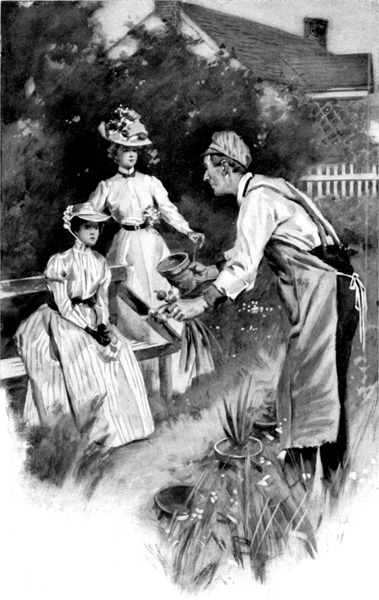
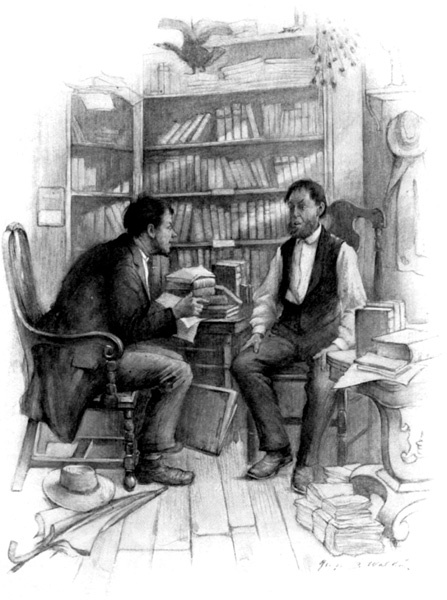
The rose-vines were running riot over the old garden
wall, and as it was now midsummer and the
season of their full bloom had passed, John Gayther
set to work one morning to prune and train them.
The idea of doing this was forcibly impressed upon
his mind that day by the fact that the Mistress of the
House had returned the evening before, and he knew
that she would notice the untidy appearance of the
rose-vines as soon as it should please her to come into
the garden. The family had been at the sea-shore for
nearly two weeks, and the gardener had missed them
sorely, especially the Daughter of the House. They
had now all returned, and the butler had told him
that they had brought with them a visitor, a Frenchman.
John Gayther, whose mind was always full of
the Daughter of the House, immediately inquired if
he was young; but the butler's answer was unsatisfactory,
as he said the gentleman was neither young nor
old, and talked queer English. As the butler himself—who
was English—talked what seemed to the gardener
queer English, John did not lay much stress
upon that statement.
He was soon to make his own observations, however,
for a sweet voice he knew well called out to him:
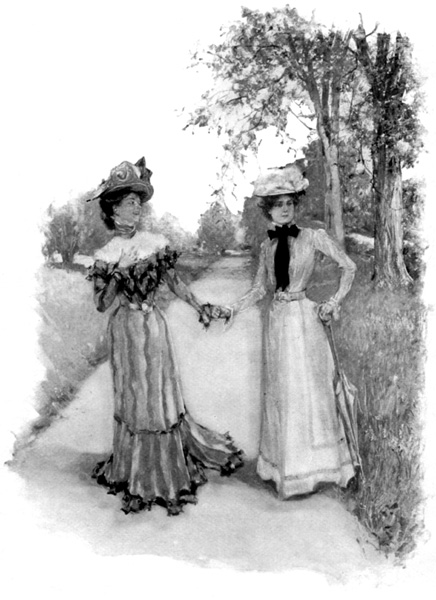
"We are all back, John, in the dear old garden!"
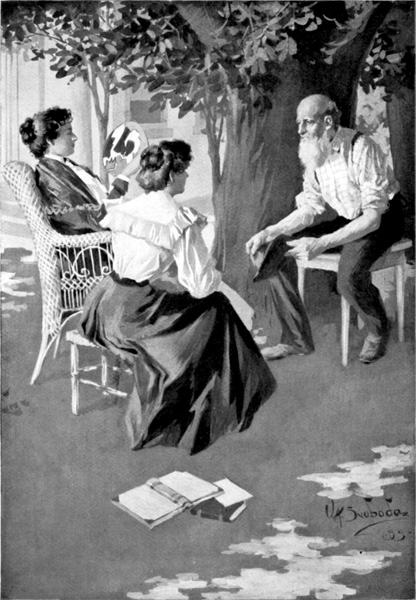
John turned, and found four persons had come up
quietly and were watching his work. He returned
the cordial greetings of the family, and then the Master
of the House informally introduced their companion.
"We have a foreign gentleman with us,
John; he belongs to the same nation as your great
hero Lafayette, and therefore I know you will be
pleased to have him join our story-telling party. For
it has been decided by the ruling power in this house
that a story is to be told this morning; so leave your
vines, and come with us."
John was obliged to follow as the party took the
path to the summer-house, but he went unwillingly.
Lafayette was a great and good man, but it did not
follow that all his countrymen were of that sort;
and, in fact, John knew but little about Frenchmen.
He immediately conceived a dislike to this one as he
saw him walking by the side of the Daughter of the
House and evidently pleased with her company. He
greatly disliked the idea of telling a story to this
stranger, and determined it should not be made
interesting.
There was nothing in the Frenchman's appearance
to excite this dislike. There was nothing striking
about him. He was a good-looking man verging on
middle age perhaps, with a rather short little figure
and an airy walk.
"Now," said the Master of the House, when the
party were all disposed to the best advantage, and the
Frenchman had gone into an ecstasy over the view
from the summer-house, "John Gayther, you are to
listen carefully to this story, for I am going to tell it
myself, being moved thereto by the story my wife
told here."
John, greatly relieved by this announcement, signified
his cordial approbation, and the captain began
his relation:
"Captain Abner Budlong was a retired sailorman.
He was rather small of stature, with mild blue eyes,
and a little gold ring in each of his ears. He was in
the prime of life, and had been so often wet with
salted water and dried by salted winds that he looked
as though he might last forever.
"He had ceased to sail in ships, because his last
vessel, of which he had been part-owner, had positively
declined to sail any longer under him. When
this misguided craft decided to go to the bottom of
the sea, Captain Abner, in a little boat, accompanied
by his crew, betook himself to the surface of the land,
and there he determined to stay for the rest of his life.
His home was on the sea-shore. In the summer-time
he fished and took people out to sail in his boat; and
in the cold weather he generally devoted himself to
putting things into his house, or arranging or rearranging
the things already there. He himself was
his family, and therefore there was no difference of
opinion as to the ordering of that household.
"The house was divided through the middle by a
narrow hallway; that part to the right as one entered
the front door was called by Captain Abner the
'bachelor side,' while the portion to the left he designated
as the 'married side.' The right half might
have suggested a forecastle, and was neat and clean,
with sanded floors and everything coiled up and
stowed away in true shipshape fashion. But the
other half was viewed by Captain Abner as something
in the quarter-deck style. Exactly half the hall was
carpeted, and the little parlor opening from it was
also carpeted, painted, and papered, and filled with a
great variety of furniture and ornaments which the
captain had picked up by sea and land. Everything
was very pretty and tasteful, according to the captain's
ideas of taste and art, and everything was sacred;
no collector could have bought anything out of
that little parlor, no matter how much money he
might offer.
"This parlor and the room above had been furnished,
decorated, and ornamented for the future
mistress of Captain Abner's household, and he was
ready to dedicate them to her services whenever he
should be so lucky as to find her. So far, as he sometimes
expressed himself, he had not had a chance to
sing out, 'There she blows!'
"One afternoon, when Captain Abner was engaged
in dusting the ornaments in the parlor, his good
friend Samuel Twitty stood in the doorway and accosted
him. Sam Twitty had been mate to Captain
Abner, and as he had always been accustomed to
stand by his captain, he stood by him when he left
the sea for the land; although they did not live
in the same house, they were great cronies, and were
always ready to stand by each other, no matter what
happened. Sam's face and figure were distinguished
by a pleasant plumpness; he was two or three years
the junior of Captain Abner, and his slippered feet
were very flat upon the ground. He held his pipe
behind his back in such a position that it hung over
the uncarpeted part of the hallway. A pipe in the
married part of the house was never allowed.
"'Sam,' said Captain Abner, 'you've hove in sight
jes at the right minute, for I'm kind o' puzzled. Here's
this conch-shell, which is the biggest I ever seed, and
a king conch-shell at that, and I can't make up my
mind whether she'd like it here in the middle of the
mantelpiece, or whether she'd like to have the gilded
idol here, where it would be the fust thing she'd see
when she came into the room. Sometimes I'm inclined
in the way of the heathen idol, and sometimes
in the way of the king conch-shell. And how am I to
know which she likes? What do you think about it?'
"'Well, now, Cap'n Abner,' said Sam, his head
cocked a little to one side, 'that's a pretty hard
question to answer, considerin' I don't know who she
is and what kind o' taste she's got. But I'll tell you
what I'd do if I was you. I'd put that king conch-shell
on the mantelpiece, or I would put the gilded
idol there, it wouldn't matter much which, and then
I'd put the other one handy, so that when she fust
come in, and you could see she didn't like whatever it
was that was in the middle of the mantelpiece, you
could whip it off and put the other thing there almost
afore she knowed it.'
"'Sam,' said Captain Abner, 'that's a real good rule
to go by, and it looks to me as if it might fit other
things besides gilded idols and conch-shells. And now
that you're here I'd like you to stay and take supper
with me. I've got something to tell you.'
"After the evening meal, which was prepared by
Captain Abner and his guest, who were both expert
maritime cooks and housekeepers, these two old
friends sat down to smoke their pipes, the parlor
door having been carefully shut.
"'Sam,' said the captain, 'I've got everything ready
for her that I can think of. There isn't anything
more she'd be likely to want. So now I'm goin' after
her, and I'm goin' to start on Monday mornin'.'
"Sam Twitty was astonished. He had had an idea
that Captain Abner would go on preparing for her to
the end of his days, and it was a shock to him to hear
that the work of preparation, in which he had been
interested for so many years, and in which he had so
frequently assisted, should now be brought suddenly
to a close.
"'Ready!' he ejaculated. 'I wouldn't have believed
it if ye hadn't told me yourself. And yet,
come to think of it, I can't see for the life of me what
else you can do for her.'
"'There ain't nothin' else,' said Abner, 'and on
Monday mornin' I'm settin' out to look for her.'
"'Do you go by land or by water?' asked Sam.
"'Land,' was the answer. 'There ain't no chance
of runnin' across her by sea.'
"'And how are you goin'? Walkin'?'
"'No, sir,' said Abner. 'I'm goin' to hire a horse
and a buggy. That's how I'm goin'.'
"'And where are you goin' to steer fust?' asked
Sam.
"'I'm goin' fust to Thompsontown, and after I've
took my observations there I'll fetch a compass and
sail every which way, if need be. There's lots of
people of all sorts in Thompsontown, and I don't see
why she shouldn't be one of them.'
"'No more do I,' said Sam Twitty. 'I think it's
more'n likely she'll be one of them.'
"Very early the next morning, almost before the
first streaks of dawn, Captain Abner was awakened
by a voice under his window.
"'Shipmate ahoy!' said the voice, which was Sam
Twitty's. In a moment Abner's head was out of the
window.
"'Cap'n Abner,' said Sam, 'I'm goin' with you.'
"Abner did not immediately answer, but presently
he replied: 'Look here, Sam Twitty; you come around
after breakfast and tell me that ag'in.'
"Promptly after breakfast Sam appeared.
"'Look a' here,' said Captain Abner, when they had
lighted their morning pipes, 'that ain't a bad notion
of yours. Somethin' might turn up when I'd want
advice, and you might give me some like you gave
me about the king conch-shell and the gilded idol.
It ain't a bad idea, and, as you say so, I'd like you to
come along.'
"Sam did not reply with the alacrity that might
have been expected of him. He puffed silently at
his pipe and gazed upon the ground. 'You said you
was a-goin' in a buggy,' he remarked.
"'Yes; that's what I'm expectin' to do.'
"'Then how am I to get back?' inquired Sam.
"'That's so,' said Abner. 'I never thought of that.'
"'Look a' here, cap'n,' said Abner; 'what do you
say to a spring-wagon with seats for four, two in front,
and two behind?'
"This suited Captain Abner, and Sam went on to
say: 'There'll be another good thing about that; if
you get her and bring her back—'
"'Which is what I'm goin' for and intend to do.'
"'Then,' continued Sam, 'you two could sit on the
back seat, and I could sit in front and drive.'
"'Did you ever drive, Sam?' asked Captain Abner.
"'Not yet; but I wouldn't mind l'arnin'.'
"'But you won't l'arn with me and her,' said Captain
Abner.
"'How are you goin' to manage it, then?' asked
Sam. 'You won't want me and her to sit on the
back seat, and it wouldn't look jes right for you an'
her to be in front, and me behind all by myself, as if
I was company.'
"'Don't know,' said Captain Abner. 'We'll get
her fust, and then let her sit where she wants to.'
"'There's one thing I wouldn't like to see,' said
Sam Twitty, 'and that's you and me sittin' behind, and
her a-drivin'.'
"'There won't be none of that,' said Captain Abner;
'that ain't my way.'"
"Is that a good beginning?" asked the Master of
the House, suddenly addressing his wife.
"Yes," she replied, "very good; and I see this is to
be a real man's story."
"And so it should be, mamma," said the Daughter of
the House. "Men know more about men than they
do about women."
"Don't be too sure of that," said her father. "But
no matter. The two friends started out on Monday
morning after breakfast for Thompsontown. Considerable
delay was occasioned at the livery-stable by
certain pieces of advice which Sam Twitty offered
to Captain Abner. In the first place, he objected to
a good black horse which had been attached to the
wagon, giving it as his opinion that that looked too
much like a funeral, and that a cheerful-colored horse
would be much better adapted to a matrimonial expedition.
A gray horse, slower than the black one,
was substituted, and Sam was quite satisfied. Then
a great many things in the way of provisions and
conveniences came into his mind which he thought
would be well to take on the voyage, and he even
insisted upon rigging up an extension at the back of
the wagon on which her trunk could be carried on
the home journey.
"At last they got away, and as they drove slowly
out of the little village not one of the inhabitants
thereof knew anything about their intended journey,
except that they were going to Thompsontown; for
Captain Abner and Sam Twitty would have as soon
thought of boring a hole in the bottom of a boat in
which they were to sail as of telling their neighbors
they were going to look for her and to bring her back
in that spring-wagon.
"The old gray horse jogged very comfortably over
the smooth road until a toll-gate was perceived near by.
"'Now, then, cap'n,' said Sam, as they drew up in
front of the little house by the roadside, 'whatever
you pay here you ought to charge to the expense of
gettin' her.'
"'That's so,' said his companion; 'but if she's all
right I ain't goin' to mind no tolls.'
"A pleasant-faced woman now came to the door of
the little house and stood expectant, while Captain
Abner thrust his hand into his pocket.
"'How much is it?' said he.
"'It's ten cents,' said she.
"Then Sam Twitty, who did not wish to sit silent,
remarked that it was a fine day, and the toll-gate
woman said that indeed it was. Captain Abner was
now looking at some small change in the palm of his
hand.
"'I ain't got ten cents,' said he. 'Here's only six,
and I can't scrape up another copper. Sam, can you
lend me four cents?'
"Sam searched his pockets. 'Haven't got it,' said
he. 'Them little things we bought jes afore we
started cleaned me out of change.'
"'The same thing's happened to me, too,' said Abner;
'and, madam, I'll have to ask you to change a five-dollar
note, which is the smallest I've got.'
"The toll-gate woman said she was very sorry, but
indeed she had not five dollars in change, either at
the toll-gate or in the house where she lived just behind
in a little garden. The day before she had had
a good deal of change, but she had paid it all into the
company.
"'Then what are we goin' to do?' asked Sam. 'I
suppose you won't let us go through without
payin'?'
"The woman smiled and shook her head. 'I
couldn't do that; it's against the rules. Sometimes
when people come along and find they have nothin'
to pay toll with they go back and get the money
somewhere. It's our rules, and if I broke them I
might lose my place.'
"'Which we wouldn't think of makin' you do,'
remarked Sam.
"'But that's one thing I can't do,' said Captain
Abner. 'I can't turn round and go back. If the
folks knew I was turned back because I couldn't pay
toll I'd never hear the end of it.'
"'That's so,' agreed Sam. 'It would never do to
go back.'
"The toll woman stood and looked at them and
smiled. She was a pleasant personage, not inclined
to worry over the misfortunes of her fellow-beings.
"'Isn't there a place somewhere near here where I
could get a note changed?' asked Abner.
"'I can't say,' answered the toll woman. 'I don't
believe any of the houses along the road has got five
dollars in change inside of them, and even if you went
across the country to any of the farm-houses, you
wouldn't be likely to find that much. But if you
are not in a hurry and wouldn't mind waitin', it's as
like as not that somebody will be along that's got five
dollars in change. You don't seem to know this part
of the country,' she added.
"'No,' said Abner; 'when me and my mate travels
we generally take the public conveyances. This is
the fust time we've druv on this road.'
"Then up spoke Sam Twitty: 'Does you and your
husband live here and keep the toll-gate, ma'am?'
"The woman looked as though she thought the
plump person a little inquisitive, but she smiled and
answered, 'My husband used to keep the toll-gate,
but since he died I've kept it.'
"Captain Abner looked troubled. 'I don't mind
so much waitin' myself,' said he, 'but it's the horse
I'm thinkin' about. I promised I'd have him fed at
twelve o'clock sharp every day I have him. He's
used to it, and I don't want him givin' out afore I'm
through with him.'
"'When horses is used to bein' fed at regular times,'
said the toll-gate woman, 'they do show it if they
don't get fed. But, if you don't mind, I've got a little
stable back there, and some corn, and if you choose to
drive your horse into the yard and give him a feed
I'll charge you jes what anybody else would. And
while he's a-feedin' most likely somebody'll come
along that's got five dollars in change.'
"For some minutes Sam Twitty had not said a word,
but now he most earnestly advised his friend to accept
this offer, and, jumping to the ground, he hurried
to open the gate so that Captain Abner might drive
in. Abner had not yet made up his mind upon the
subject, but, as Sam stood there by the open gate, he
drove in.
"'Look a' here!' said Sam, as they stood by the
stable door. 'This is a jolly good go! Did you take
notice of that toll-gate woman? She's tiptop to
look at. Did you see how clean she is, and what a
nice way of smilin', an' a good deal of red in her
cheeks, too, and jes about old enough, I should say,
if I was called upon. And, more than that, I should
say, judgin' from what I've seen of her, she's as likely
to be as accommodatin' as any person I ever did see
that I had seed for so short a time. I jes put her
into my mind a-goin' into your parlor and sayin' that
conch-shells was jes what she liked on mantelpieces.
And I could put her in jes as well with the gilded idol.'
"'You seem to do a lot of thinkin' in a mighty short
time,' said Abner. 'But what's all that got to do with
anything?'
"'Do!' exclaimed Sam. 'It's got lots to do. Why
wouldn't she be a good one for her? I don't believe
you'd find a better one in Thompsontown.'
"'Sam Twitty!' exclaimed Abner, rather testily,
'what are you talkin' about? Do you suppose I'd
paint and paper and clean up and furnish one side of
my house for her, and then start out on a week's cruise
to look for her, and then take and put in her place
and give everything I've been gettin' for her for so
many years to the fust woman I meet, and she a toll-gate
woman at that?'"
The Frenchman, who had been listening with great
apparent interest, now looked so inquiringly at the
Master of the House that he paused in his story.
"Excuse my interrupt," he said apologetically;
"but what is toll-gate woman?"
"My conscience!" exclaimed the captain, "you
haven't understood a word of my story!" He then
proceeded to explain a toll-gate and its office and
emoluments; but it was at once evident that the
Frenchman knew all about the thing—he did not
know the English words which expressed it; and he
had a clear comprehension of the narrative.
"Those two men pull two ways," he said gleefully;
"ought to make a good story."
"It is a good story if my papa tells it," spoke up
the Daughter of the House. And John Gayther was
pleased to note a sharpness in her voice.
"Yes, miss; that is just what I say—a very much
good story. I long for the end to come."
"Not exactly the compliment intended," remarked
the Mistress of the House, with a smile.
"How do you think it will end?" asked the Daughter
of the House, impulsively, addressing the Frenchman.
"It is not polite to imagine," he replied.
"But I want to know," she persisted. "It is not
impolite to guess."
"Well, then, miss, he marry nobody. Too many
women in that Villa Thompson. But we sadly interrupt!
Beg pardon, captain."
"The captain I am telling about in my story," said
the Master of the House, resuming his narrative,
"could not silence Sam Twitty.
"'Now I tell you, cap'n,' he said, as he assisted in
taking the horse out of the wagon, 'don't you go and
miss a chance. Here's a fust-rate woman, with red
cheeks and mighty pretty hair, and a widow, too.
Even if you don't take her now, it's my advice that
you look at her sharp with the idea that if things
don't turn out in Thompsontown as you'd like them
to, it would be mighty comfortin' to you to pick her
up on your way back.'
"When Captain Abner and Sam returned from the
stable they looked up and down the far-stretching
road, and then, at the invitation of the toll-gate woman,
they seated themselves on a bench at the back of the
toll-house.
"''Tisn't a very good time for people to be passin','
said she. 'Not many folks is on the road between
twelve and one. They're generally feedin' themselves
and their horses. But if you can make yourselves
comfortable here in the shade, I don't think you'll
have to wait very long. I'll jes step in and see if
my dinner ain't cooked. There ain't nobody in sight.'
"Sam Twitty rubbed his hands together. 'In my
opinion,' said he, 'that woman is a fust-class housekeeper.'
"In a very few minutes she returned. 'If you gentlemen
don't mind,' said she, 'I can give you your
dinner here at the same price you'd have to pay anywhere
else. I always cook a lot on Mondays, so's I
can have something cold for the rest of the week.
It's on the table now, and you can go in and wait on
yourselves.'
"Sam gave a quick glance at Abner. 'You go in
with her,' said he, 'and eat your dinner. I'm not
hungry, and I'll wait out here and keep the toll-gate.
Afterwards I'll get a bite.'
"The toll-gate woman smiled. 'Perhaps it would
be better for me to go in and wait on one of you at a
time; but I don't think it's likely there'll be anybody
passin'.'
"Abner did not object—he was hungry; and he
followed the toll-gate woman into her house. Sam
Twitty made a motion as if he would dance a little in
his slippered feet.
"'That's jes like runnin' across a dead whale what's
jes expired of too much fat. All you've got to do is
to cut it up and try it down. The fust thing Cap'n
Abner does is to run into a widow woman that'll suit
him, I believe, better than anybody he'll meet, if he
cruises around Thompsontown for a week.'
"Sam sat down on the bench and pictured things in
his mind: he took the toll-gate woman all over Captain
Abner's house, even into the unmarried part, and
everywhere he saw her the same bright-cheeked,
pleasantly smiling woman she was here in her own
house. The picture pleased him so much that he
withdrew his senses from the consideration of everything
else, and therefore it was he did not hear wheels
on the road, and was awakened from his pleasant
dreams by a voice outside the door. He bounced to
his slippered feet, and entered the toll-house.
"On the roadway was a buggy and a horse, and in
the buggy sat a smiling young woman. Why she
smiled Sam could not imagine; but then, he could not
see the comical expression on his own face on being
thus suddenly aroused to a sense of his duty.
"'How much is the toll?' said the young woman,
still smiling.
"Sam looked at her; she was a good-looking young
person, and he liked her smile, for it betokened a
sense of humor, and that pleased him. 'How much?'
he repeated. 'A vehicle, a man, and a horse—'
"'But this is a girl and a mare,' she interrupted.
'How much is that?'
"Sam looked up and smiled. This young person
certainly had a sense of humor. 'I wonder how much
that would be,' he said. 'I guess I'll have to get a
pencil and paper and work it out.'
"The girl laughed. 'You are not the toll-gate
keeper?' she asked.
"'No,' replied Sam. 'I'm keepin' it for her. She's
eatin' her dinner. Don't you know the toll yourself?
You've paid it before, haven't you?'
"'No, I haven't,' she replied. 'I am visiting in the
neighborhood. But I won't haggle about being a
girl. I'll pay the price for a man, if you will let me
know what it is.'
"An idea came suddenly into Sam Twitty's head:
this was a very bright girl, a very attractive girl,
who was visiting in the neighborhood, and he determined
to keep her at the toll-gate a few minutes if
he could.
"'I don't want to make any mistake,' he said
quickly. 'I'll jes pop into the house and see what
the toll really'll be for you.'
"'Oh, you needn't do that,' said the young woman.
'Of course it is the same—'
"But Sam was gone; and she laughed and said to
herself that the deputy toll-gate keeper was a very
funny person. Sam ran to the house, panting. He
beckoned to Captain Abner to step outside.
"'Look a' here,' he said; 'you hurry out to the gate
and take a good long look at the girl that's there.
She's a-visitin' in the neighborhood. Now mind
you take a good look at her, and I'll be there in a
minute.'
"Without exactly understanding the reason for this
earnest injunction, Abner went to the gate. He was
accustomed to taking Sam's advice if he saw no good
reason against it.
"The toll-gate woman was on her feet, but Sam
detained her, and said something about the relation
between sex and toll.
"'Well, well,' said the woman, 'she must be a queer
one. I'll go out to her.'
"'Oh, no,' cried Sam. 'Sit here and finish your
dinner. He's comin' right back, and I'll collect the
toll.' Half-way to the toll-house Sam met Abner.
'What do you think of her?' he asked hurriedly.
'Did you take a good look at her?'
"'Yes, I did,' replied his friend, 'and I don't think
nothin' of her. What is there to think about her?'
"'Go back to your dinner,' cried Sam. 'I've got to
collect her toll.'
"'I want you to tell me,' said the girl, not smiling
now, 'do you keep a detective here? Do you think
I want to cheat the road out of its toll? I am ready
to pay the charge, whatever it is.'
"'Detective!' exclaimed Sam.
"'Yes,' said she; 'that little brown man who came
out here and looked at me as if he were determined
to know me the next time he saw me.'
"'Oh, him!' said Sam. 'That's a friend of mine,
Cap'n Abner Budlong. He's no detective, nor nothin'
like one. He jes came out to see who was passin'
while I was findin' out about the toll. He's always
fond of seein' people.'
"'I should think he was,' said the young woman.
'In fact, I think you are a funny lot, toll-gate woman
and all. Now here is a quarter; please take the toll
and give me the change, that is, if you know how to
calculate.'
"Sam took the money, but he did not immediately
make the change. 'I don't want you to think hard
of any of us,' said he, 'on account of your bein' kept
here a little longer than common. But specially I
don't want you to think hard of my friend Cap'n
Abner Budlong, the gentleman who stepped out here
to see who was passin'. Bless your soul, he's no detective!
He's one of the finest fellows I know, and
you jes ought to see his house at Shamrick. It's filled
with more things that's nice to look at and things
that's comfortable to use than any other house in
that region. Everything's jes as clean and shipshape—'
"'He must have a good wife,' the young woman
interrupted.
"'He hasn't got no wife at all,' said Sam, delighted
to get in this piece of information. 'Never had one.'
"The girl looked at him, and then she laughed
merrily. 'I really must go on,' she said. 'You truly
are a funny lot, all of you.' And as she drove on she
looked back, still laughing.
"Sam Twitty rubbed his hands together quite cheerfully,
and went into the house to get his dinner.
"'Did that woman change your five-dollar note?'
asked the keeper of the toll-gate.
"'Bless my soul!' exclaimed Sam. 'I never
thought to ask her.'
"'What did you ask her?' cried the woman. 'She
was out there for the longest time, and I thought of
course you was gettin' your note changed.'
"Sam smiled. 'She was very interesting,' said he."
"What a treasure Sam Twitty would be in a matrimonial
bureau!" exclaimed the Mistress of the House.
"Provided he exercised a little more caution in the
selection of his specimens," suggested John Gayther,
respectfully. "Some might be too green and some
the other way, you know; he didn't seem over-particular."
"Three travellers passed through," continued the
Master of the House, "but not one of them could
change a five-dollar note; and Abner chafed at the
delay.
"'I don't like wastin' time like this,' said he to
Sam, as the two smoked their after-dinner pipes.
"'Wastin'!' exclaimed Sam. 'I don't call this
wastin' time. We didn't start till late this mornin',
and here we've got sight of two of her a'ready.
Here's this one, as red-cheeked and sociable as anybody
could expect, and then there's that gal in the
buggy.'
"'Gal in the buggy!' exclaimed Abner. 'What on
earth are you talkin' about her for?'
"'Why shouldn't I?' asked Sam. 'I tell you,
Cap'n Abner, she's the prettiest and the liveliest
young woman you'd be likely to meet if you cruised
for a year, and she's visitin' right in the neighborhood,
and can't be far from Shamrick.'
"'Codwollops!' said Abner, contemptuously.
"In the course of an hour old Joshua Asbury drove
up in his farm-wagon, and changed the five-dollar
note, and was glad to do it, for he did not like to
carry so much inconvenient silver and copper in his
pocket. The two friends now made ready to depart.
"'Let's hurry up,' said Sam. 'We've done fust-rate
so far, and maybe we'll sight one or two more afore
bedtime.'
"'When you come back,' said the woman, 'I'd be
glad to have you stop and rest, and give your horse a
feed if you want to.'
"Sam Twitty assured her most earnestly that they
certainly would stop, whether they wanted rest and a
feed or not; and he thanked her warmly as he paid for
the kind entertainment she had given them.
"'Sam,' said Abner, when they were on the road,
'the trouble with you is, you're too quick. If you
was at the tiller you'd run into the fust port you come
to, and there wouldn't be no v'yage at all.'
"'There's no knowin' when a fellow may want to
run into port,' replied Sam, 'and it's a good thing to
find out all about them as you're coastin' along.'
"A few miles from the toll-gate they came to the
bottom of a long hill, and half-way up it they saw,
going in the same direction as themselves, a man
walking vigorously.
"'By the general cut of his clothes,' said Sam, 'I'd
say he is a minister.'
"'I expect you're right,' said Abner. 'Most likely
fillin' some fishin' minister's pulpit Sunday, and
walkin' home Monday.'
"The pedestrian clergyman walked more slowly as
he neared the top of the hill, and the gray horse
gradually overhauled him.
"'Look a' here,' said Sam, nudging his companion,
'let's give him a lift. He must be dreadfully hot.
And then, by George, Cap'n Abner, jes think what a
jolly thing it'll be—goin' after her, and takin' a
minister along, sittin' comfortable on the back seat!
That's like holdin' a landin'-net ready to scoop her
up the minute you get her to the top of the water.'
"They stopped and asked the clergyman if he were
going to Thompsontown, and when he said he was,
they invited him to get in and take the unoccupied
seat. He proved to be an agreeable companion; he
was young and very grateful. Sam soon fell into a
very friendly conversation with him, and two or three
times, when Abner thought that his friend was on the
point of saying something that bore too directly on
the object of their journey, he pressed his port boot
gently upon Sam's starboard slipper.
"Toward the middle of the afternoon they reached
Thompsontown, where the young clergyman said he
was going to stop for the night, and go on by train
the next day. Sam Twitty was glad to hear this, and
advised him to stop at the Spinnaker Boom, where he
and Captain Abner intended to stay until they finished
the business which brought them to Thompsontown.
"Thompsontown was a seaside resort, and rather a
lively place in the season. There was a large hotel
for summer visitors who could afford to pay good
prices, and several smaller houses of entertainment,
such as the Spinnaker Boom, where people of moderate
means were made very comfortable.
"It was much too early for supper, and Captain
Abner and Sam took a long walk on the beach, and
at their invitation the young clergyman joined them.
This gentleman, who did not seem to know any one in
Thompsontown, proved to be a thorough landsman;
but as he was chatty and glad to acquire knowledge,
it gave Captain Abner and Sam a great deal of pleasure
to talk to him on nautical points and thereby
improve his mind. On their return, Sam stopped
with a start, and almost dropped his pipe.
"'What's the matter?' cried Captain Abner. 'Did
you see her spout?'
"Sam made no answer, but stood with his mouth
open. He had remarkably good vision. The clergyman
stopped and looked at him inquiringly.
"'They are coming, both of them!' said Sam.
"'Both of who?' asked Abner.
"'The gal in the buggy, and the toll-gate woman.'"
"If I were telling this story," here interrupted the
Daughter of the House, excitedly, "I really do not
know which one I would marry to Captain Abner!"
"Thank you for the compliment, my dear," said her
father.
"Well, there they both were: side by side they
were walking along the smooth beach and approaching
our three men. Sam's eyes sparkled. The toll-gate
woman appeared much more comely and attractive
than when engaged in her professional duties
earlier in the day. She was now attired in fresh-looking
summer clothes, and wore a pretty straw hat.
As for the girl of the buggy, she was quite another
person. It would have been impossible for any one
who had merely seen her within the limited confines
of a small vehicle to form any idea of the
buoyant air and the lively step of this handsome
young woman.
"'Upon my word!' exclaimed Sam Twitty, advancing
toward them. 'Who would have expected to
meet you two here!'
"At this meeting all our characters were variously
affected. The toll-gate woman beamed with pleasure;
the young woman of the buggy looked as if she were
about to laugh; the young minister looked very much
interested, although he could have given no good
reason why he should be; the countenance of Captain
Abner Budlong betrayed no interest whatever; and
Sam Twitty was in a glow of delight.
"'I suppose you are surprised to meet me here,'
said the toll-gate woman, 'but this is the way of it:
a neighbor and his wife came along soon after you
left, and offered to bring me to Thompsontown; and
of course I jumped at the chance, and left the toll-gate
in charge of my brother, who lives hard by. And in
the town, at the house of a friend, I met this young
lady, and—' glancing at her companion, she added: 'I
really did not catch the name.'
"'Miss Denby,' stated the young person referred to.
"The three men here bowed to Miss Denby; then,
stepping nearer to Sam, the toll-gate woman asked in
a low voice, 'Who is the minister?'
"'I don't know his name,' said Sam, 'but I'll find
out in a minute.' And then he approached the girl
of the buggy. 'I am so glad to see you,' he said.
"She laughed outright. 'It is awfully funny,' answered
she, 'that you care whether you see me or not.'
"'I don't think it's funny at all,' said Sam. 'But
jes let me ask you one thing: what's the name of the
toll-gate woman?'
"'Well, I declare!' she exclaimed. 'From the way
she talked about you I thought you were old friends.
Her name is Mrs. Sickles.'
"Sam skipped over to the young clergyman and
put his question: 'Mr-r-r.?'
"'Rippledean,' said the young man.
"In an instant the quick-slippered Sam had joined
the party in the bonds of conventional acquaintanceship,
having added to the rest of his information the
fact that he was Samuel Twitty of Shamrick.
"'You are the funniest people I ever met,' exclaimed
the lively Denby girl. 'None of you seems to
know the rest.'
"'It is very pleasant to know each other, I am
sure,' remarked the toll-gate woman; 'and if I had
anything to say about what would be agreeable on
such a breezy afternoon as this, now that there's a
party of us, I would say it would be to get a boat and
take a sail on this sparkling water.'
"'A sail!' cried Sam. 'Why, that will be the best
thing in the world, and if you'll wait ten minutes I'll
get a boat. Cap'n Silas Peck is a friend of mine, and
has got two boats that ain't likely to be out. I'll run
down and get one, and have it here in no time.'
"In less than a quarter of an hour the party was
seated in Captain Peck's sail-boat, Captain Abner at
the tiller, and Sam Twitty in charge of the sheet.
They decided to sail out to an island about three
miles from shore. A stiff breeze was blowing, and
Captain Abner was in his glory. The wind was much
too high for ordinary pleasure-boats, and there were
no other sails upon the bay; but summer visitors and
seafaring men stood along the beach and watched
the admirable manner in which that little craft was
handled. Word was passed from one to another that
it was Captain Abner Budlong of Shamrick who
was at the tiller; many of the watchers had heard of
Captain Abner and what he had done in days gone
by, and they were proud to see what their neighbor
of Shamrick was doing now.
"Mrs. Sickles sat beaming, both hands grasping the
rail and her feet firmly braced, but with an expression
of perfect trust, as she gazed from Captain Abner
to Sam Twitty, which would have been edifying to
any one of weak habits of faith. The younger woman's
hat was off, and her hair was flying like a streamer
from a masthead. She drank in the salt breeze with
delight, and her eyes sparkled as the boat dipped at
the turn of Captain Abner's tiller until the rail cut
under the surface of the water as if it were skimming
a pan of milk. She looked upon the bright-eyed
sailor at the helm as though he were some sort of a
salt-water deity whom it was suitable to worship. It
was better than sparkling wine to her to dash over
the sparkling water.
"The island shore drew near; the little boat bore
bravely down upon it, and then with a beautiful sweep
fell into the wind; her great wing dropped and hung
listless, and her keel gently grazed the sand."
"Very beautiful! Oh, so fine a turn to words!"
exclaimed the Frenchman, who was very intent upon
the story.
"My papa is a sailor," said the Daughter of the
House, proudly. "You should see him bring around
a great vessel with a grand sweep, so quietly and so
gracefully!"
"You never saw me do anything of the kind," said
her father, in surprise.
"I have never seen you," she admitted reluctantly,
"but I know just how you would do it."
Her father smiled and laid a hand on her head.
"Well, my dear," he said, "what Sam Twitty told
the inmates of the boat was this: 'If there was an
egg-shell 'twixt her bow and the beach, Cap'n Abner
wouldn't have smashed it.'
"The captain stemmed the praises which now
poured upon him, with a jerk of the head. 'That's
all very well,' said he, 'but I'm goin' to give Sam
Twitty a chance; he'll sail you back.'
"When the party was on shore and the boat safely
moored, Sam Twitty began to jump about like a collie
dog in charge of a flock of sheep. He had said little
in the boat, but his mind had been busily at work
with the contemplation of great possibilities. There
was much to be done, and but little time to do it in,
but Sam's soul warmed up to its work. Casting a
rapid glance around, he singled out Captain Abner,
and, dashing into the little party, cut him off from
his companions, and drove him out of ear-shot.
"'Now, Cap'n Abner,' said he, 'your time's come,
and the quicker you get to work the better.'
"'Work!' cried Abner. 'What work have I got
to do!'
"'Do!' exclaimed Sam. 'You've got lots to do.
Look at that sun. It's settin' jes as steady as if it
was bein' towed into port, and you'll never get another
chance like this. Here's two women to pop
your question to; here is a minister on hand; here's
me and the young woman what don't get chosen, for
witnesses; here's all them white caps skippin' over the
water; and here's this clean stretch of sand. There
couldn't be a better place for a sailor to be married in
than jes here.'
"'But I tell you, Sam,' said Abner, a little querulously,
'I didn't come here to marry one of them
women. I didn't start on this trip to make fast to
the fust female person I might fall in with. I set out
on a week's cruise, and I want to see a lot of them
afore I make a ch'ice.'
"'I tell you, cap'n,' said Sam, very earnestly, 'it
won't do. You might hang round Thompsontown for
a year, and you wouldn't find any two such women as
them two. Here they are, two kinds to pick from:
one of them as ripe as a peach, and the other like a
cross between a cricket and a blossom. And you've
got no time to fool away. When the sun goes down
you've got to sail back to Thompsontown, and then
one will go one way and the other another, and where
the minister will go to, nobody knows. They'll all be
scattered and out of sight, and this glorious chance
you've got might as well be at the bottom of the sea.
Now, cap'n, I tell you, this thing that's right afore you
is what you come for. Jes you listen to what I say
to you: you go to that Mrs. Sickles and let her see
how you're standin' and what your course is. She's
no fool, and she can see the sense of gettin' over a sandbar
at high tide jes as well as you can.'
"Captain Abner hesitated a moment. 'She's a
mighty fine woman, Sam,' said he, 'but if I go and set
the case afore her, and she agrees to ship with me,
then I can't ask the other one, and there might as well
be no other one; and she's as pert a little clipper
as ever I seed, Sam, and she likes sailin', that she does.'
"'Now don't you worry about that,' said Sam.
'You jes say all you've got to say to her, and hear all
she's got to say, but don't sign no papers and take
her aboard until you talk to that other girl. Now
hurry up, and walk along the beach a little further
off.'
"Without waiting for an answer, Sam Twitty galloped
away, or that was what he would have done
had he been a sheep-dog. He darted in between Mrs. Sickles
and her companions; he turned her down the
beach; he talked to her in rapid snaps about the sea,
the sky, the sand, and before she knew it he had
driven her alongside of Captain Abner. Then, with
what might have been compared to a bark of satisfaction,
he bounced away to join the others, who were
looking for shells.
"In about ten minutes Sam Twitty's port eye told
him that Captain Abner and the toll-gate woman
were approaching, but in Abner there were signs
of a disposition to fall back. In an instant he had
bounded between them and was showing shells to the
widow. Then, letting her go on by herself, he turned
sharply upon Abner.
"'Well,' said he, their heads close together, 'what
did she say? Is she all right?'
"Captain Abner threw a glance over the water as if
his soul were yearning for the fancied possibilities of
Thompsontown. 'Oh, it's all right enough, so far as
she counts,' said he. 'I went straight at it, and put
the whole thing afore her. I told her about the house
and the two parts to it and what they was for, and
she said that was charmin'. And I told her about
the king conch-shell and the gilded idol, and she said
she thought either one of them would be jes lovely,
and nothin', she thought, could be better on mantelpieces
than gilded idols and king conch-shells. And
everything else was jes as slick and smooth as if she
was slidin' off the stocks. She's good-lookin' enough,
Sam, but she ain't got no mind, and I didn't fix up
that house, and bother myself year in and year out
a-gettin' it all right, to take it and give it to a woman
what's got no mind. She'd be jes as well satisfied to
see me a-settin' up on the mantelpiece as if the gilded
idol or the king conch-shell was there.'
"'And she don't suit you?' asked Sam, eagerly.
"'No, sir,' replied the other; 'she don't suit.'
"'All right!' exclaimed the ever-ready Sam; 'jes
you wait where you are one minute.' In less than that
time the agile Sam had rounded up Miss Denby and
had her walking along the beach by the side of Captain
Abner, and whether she thought that skilful
skipper was going to show her some rare seaweed or
the state of his mind, Sam considered not for one
minute. He had brought the two together, and that
was all he cared about.
"The good Mrs. Sickles was standing alone, reflectively
gazing upon the little waves, so Sam had no
trouble in carrying off the minister to a little distance
for confidential remarks.
"'I want you to tell me, sir,' said he, 'if there is
any law ag'in' your marryin' a party on the sea-shore,
especially when one of them is a sailor?'
"Mr. Rippledean laughed. 'As I am a regularly ordained
minister, I can perform a marriage anywhere,'
said he, 'provided the parties are of legal age, and
there are no objections. But what are you talking
about? Who wants to be married?'
"'I can't say jes now,' answered Sam; 'matters
isn't settled yet: but everything is goin' ahead lively
with a stiff breeze, and I guess we'll get into soundin's
pretty soon. I only spoke to you to know if you'd
be all right when the couple's ready.'
"'There is nothing the matter with me,' said the
young man; 'but I would like to know—'
"'Jes you lay to for a while,' said Sam, 'and I'll
tell you all about it.' And then, noticing that Mrs. Sickles
was glancing toward the captain and his companion
as if she thought to join them, he dashed out
upon her to cut her off.
"Meanwhile Miss Denby, with glowing eyes, was
saying: 'Yes, I do love to sail, and to sail in a small
boat, close to the water, almost as if I were in it, skimming
like a bird with my wings dipping. Oh, it is
grand! And you have a sail-boat?'
"And the captain answered: 'Indeed I have, and
there's none better, either for sailing on the wind, or
before the wind, or with next to no wind at all.'
"'How wonderfully you must sail it! I could not
keep my eyes off you as you brought us over here.
It was grand! You made her do anything you
pleased.'
"The captain smiled and nodded. 'But I think of
my house as much as I do of my boat, miss,' said he.
'I've got a mighty nice parlor that's as good as any
ship's cabin. And now let me put this p'int to you:
if you had a big king conch-shell, the prettiest you
ever seed, and it was on the middle of the mantelpiece,
and you had a gilded idol in another place,
would you put the idol where the conch-shell was,
and the conch-shell where the idol was, or would you
leave 'em both jes where they was afore?'
"The young woman laughed merrily. 'What kind
of an idol would it be?' she asked. 'A beautiful
piece of carving?'
"''Tain't that,' said Captain Abner; 'it's jes a piece
of wood whittled out by a heathen; but it used to be
in a temple, and it's gilded all over.'
"'Oh, dear!' said she, 'I don't think much of that
sort of an idol. I might like to be a gilded idol myself,
if I had the right person to worship me. But as
for a wooden idol, I wouldn't put that on the mantelpiece,
and I am of the same opinion as to the conch-shell.'
"'But it's a king conch-shell,' said the captain.
"'I don't care,' said she; 'king or queen, it would be
all the same to me. But if I were you I think I'd be
most of the time in the boat. What is a house, no
matter what it has in it, compared to a boat dancing
over the waves and speeding before the wind?'
"Captain Abner looked at her. 'I expect you'd
like to learn to steer, wouldn't you?'
"'Indeed I would,' she answered. 'There is nothing
I would like better.'
"Captain Abner put his hands into his pockets and
gently whistled, and, leaving him, Miss Denby ran to
join the toll-gate woman. Down swooped Sam Twitty.
"'Is it all right?' he whispered to Abner.
"'All up,' the other answered, 'and I'm glad of it.
She don't want no gilded idol, and she don't want
no king conch-shell. She wants her hand on the
tiller, that's what she wants. She's got too much
mind for me. After I've been workin' year in and
year out a-gettin' my affairs the way I wants them,
I don't fancy anybody comin' down on me and takin'
the tiller out of my hands.'
"Sam made two or three steps forward, and then
he stood gazing in the direction of the setting sun.
Resting on one slippered foot and extending the other
before him, he folded his arms and remained a few
moments wrapped in thought. Suddenly he turned.
"'Cap'n Abner,' he cried, 'it won't do to sink this
chance! It'll never pop up ag'in. You must have
spoke pretty plain to that toll-gate woman, considerin'
the way she's been turnin' it over in her
mind.'
"'Yes, I did,' said Captain Abner, 'and that's the
way I found out what she was. But I didn't ask her
to ship with me.'
"'And you don't want her to?' said Sam.
"'No, I don't.'
"'And you don't want the other one, nuther?'
"'No, I don't,' replied Captain Abner, doggedly.
'I don't want nuther of 'em. And I say, Sam, the
sun's gettin' down and it's about time for us to be
settin' sail.'
"'There's a good stretch of sky under that sun yet,'
said Sam, 'and jes you wait a bit, cap'n.'
"Sam Twitty walked slowly along the sandy beach;
he looked as a sheep-dog might look who was wondering
within himself whether or not he had brought
back from the fields as many sheep as he had taken
out. He stopped, and looked about at the party.
Captain Abner was walking toward the boat; the
minister and the Denby girl were standing together,
comparing shells; the toll-gate woman was strolling
by herself a little higher up the beach, still in a reflective
mood. Sam gazed from his companions to
the sky, the water, the beautiful glistening sands.
"'It's a shame to lose all this,' he said to himself;
'it's a burnin' shame to sink it all.' Then suddenly,
as if his master had whistled, he sped to the side of
Mrs. Sickles. Backward and forward these two
walked, Sam talking earnestly and the toll-gate
woman listening with great interest. Captain Abner
now and then gave them an impatient glance, but
the other couple did not regard them at all.
"'But, Mr. Twitty,' said Mrs. Sickles, 'this is so unexpected.
I had an idea of the kind about Cap'n
Abner, for I could not help it, but you—really! I've
heard of you often, Mr. Twitty, but I never saw you
until to-day.'
"'Now, Mrs. Sickles,' said Sam, 'you couldn't have
had a better day to see me in, if you'd waited a year;
and a-speakin' quick and sharp as I've got to do, for
the sun's keepin' on goin' down, there couldn't be a
better day to marry me in.'
"'Oh, Mr. Twitty!' cried Mrs. Sickles, with flushed
face.
"'There couldn't be a better time or a better place,'
said Sam, 'and a minister right here, and two witnesses.'
"'But, Mr. Twitty,' said she, 'I really thought that
Cap'n Budlong—and from what he told me about his
house and his things—'
"'Cap'n Abner is one of the finest men in this
world,' interrupted Sam, 'and he's got a fust-class
house, and I ain't got none, and he's got all sorts of
things from all parts of the world that he's put in it.
But I can get a house and things to put in it, and I
can do without gilded idols and king conch-shells,
and, what's still more to the p'int, Mrs. Sickles, I
wants you, and he don't.'
"'There's something in that,' said the toll-gate
woman, and then she added: 'but as to marryin' you
here and now, Mr. Twitty, it's not to be thought of.'
"Sam walked slowly away; one might have thought
his head drooped under a rebuke. He approached
the young minister and the girl of the buggy.
"'Look a' here,' said he to the former; 'you don't
mean to say, sir, that you'd back out of marryin' a
couple right here and now, that was growed up and
of full age, and nothin' to hinder.'
"'Marry!' cried Miss Denby. 'A wedding right
here on this beautiful island! Oh, that would be
glorious! Who wants to be married?'
"'I do,' said Sam.
"They both laughed. 'But the other person?'
asked Mr. Rippledean. 'There must be a bride if
you want a wedding.'
"'Oh, the bride'll be Mrs. Sickles,' said Sam. 'But
the trouble is she ain't altogether willin'.'
"'I told you,' said the merry Miss Denby—'you
know I told you that you are the funniest people I
ever met, and you truly are. People generally come
to an agreement between themselves before they speak
to the clergyman.'
"'Mr. Twitty,' said the clergyman, 'I strongly
advise you to give up your present notions of immediate
matrimony, and wait at least until all parties
agree upon time and place and upon the other circumstances
of this union for which you seem so impatient.'
"'Hello, Sam!' shouted Captain Abner from the
water's edge, 'ain't you comin' along?'
"Sam made no answer to any one. He walked
silently down toward the boat. Everything seemed
to be breaking loose from him, and slipping away.
His old friend, who had so long wanted her, and who
had prepared his house for her, and had set out to
look for her, had declined to take her when he saw
her; and he, Sam, who had so thoroughly understood
the opportunities which had been spread before the
little party that afternoon, and who knew what would
happen if these opportunities were allowed to slip out
of sight, had been set aside by one woman, laughed at
by another, had been advised by a clergyman, and
had been scolded by Captain Abner. His soul resented
all this, and he saw that the edge of the sun
was nearly touching the rim of the distant sea. With
a great slap upon his thigh, he sprang to the side of
the boat, and turned and faced the others, all of
whom were now approaching him.
"'I am to sail this boat back to Thompsontown,' he
cried. 'It's been agreed I'm to do it, and I'm goin'
to do it; but one thing I'll tell you—the sun can go
down, the night can come on, and you can all stay
here till mornin' if you like, but this boat don't leave
this island with me at the helm till I'm a married
man!' With this he skipped on board, sat down in
the stern, and clapped his broad hands on the tiller.
"There was a burst of astonishment from the rest
of the party as Sam thus seated himself at bay. Even
the girl of the buggy did not laugh.
"'But I must go home,' she cried, 'before it is any
later. My friends will be waiting supper for me.'
"'Don't matter,' said Sam. 'Supper can wait.'
"'Look a' here,' said Captain Abner.
"'I don't want to look a' here,' said Sam. 'I'm
a-lookin' a different way, and it's Mrs. Sickles I'm
lookin' at. And you needn't none of you look cross
at me. I'm to steer this boat home, that's settled,
and I don't steer her an inch till I'm a married man.'
"The others gathered together on the beach and
gazed with varied emotions upon the determined
figure of Sam as he sat in the stern, his arm resting
upon the tiller and one leg crossed leisurely over the
other, his protruding slipper lighted up by the rays
of the setting sun.
"'What is the matter with him?' asked Mr. Rippledean.
'Is he crazy? Does he really think of
forcing us to remain here until he shall be married?
I never heard anything—'
"'So delightfully absurd,' interrupted Miss Denby.
"'There's nothin' crazy about Sam Twitty,' said
Captain Abner. 'He's as sound as a nut, body and
soul. But when Sam makes up his mind he sticks to
it. Now sometimes when I make up my mind I don't
stick to it. He's a good man all around, and he's got
enough to live on, though he never was a cap'n; but
you couldn't find a better fust mate than him, or a
better sailor, except perhaps somebody what's had a
leetle more experience. Sam made up his mind that
we was all comin' out here for a weddin', everything
fallin' together exactly to suit, wind and tide and
everything else. But Sam ain't goin' to force nobody
to do nothin'; he ain't that kind. All he's goin' to
do is to stay here till he's married.'
"The girl of the buggy clapped her hands. 'Oh,
that is fine!' she cried. 'It is like lifting you up on a
horse and dashing away with you. Oh, dear Mrs. Sickles,
take pity on him and on all of us. If you do
not, I shall have to talk to him myself and see if I—'
"Mrs. Sickles was not inclined to give attention to
any such idle words as these, and she stepped up to
Captain Abner.
"'You seem to think very well of Mr. Twitty, sir,'
she said.
"'Indeed I do,' he answered. 'There ain't nobody
I think more of, on watch or below, in storm or fine
weather, take him as you find him, than I do of him.'
"Sam Twitty had not heard any of the remarks
which had been made on shore; he had been communing
with himself: but now his active mind would
no longer permit him to sit still. Springing to his
feet, he stepped forward and stood up in the bow of
the boat, and cast his eye over the little party in
front of him. Then he spoke:
"'Mrs. Sickles, I want to put a p'int to you that's
been put to you afore, but I want to put it a little
different. If there was a gilded idol and a king
conch-shell that you knowed of, and you was asked
which of them you would like to have for your own,
and you only could have one—'
"'Oh, dear!' exclaimed Miss Denby, 'here is that
delightful gilded idol and conch-shell again! I wonder
what they will do now!'
"The toll-gate woman was paling and flushing, and
these changes of countenance, combined with her becoming
summer dress and her straw hat, made her
very attractive to the eye. Without waiting for Sam
to finish his remarks, she spoke:
"'I am very sure, Mr. Twitty, that both the things
you mention, from what I have heard of them, would
be very nice and pleasant; but you see, Mr. Twitty,
I don't—'
"Sam suddenly stepped upon the rail, steadying
himself by the mast. 'Mrs. Sickles,' he cried, 'I'll
put it plainer to you: supposing you couldn't get
the gilded idol?'
"Mrs. Sickles now saw very clearly that there was
no more time for hesitation. She stepped a little forward.
"'In that case,' she said, 'I'd take the conch-shell.'
"With a bound, Sam Twitty sprang from the shore,
and the next moment he had seized the blushing Mrs. Sickles
by the hand. For a moment he gazed proudly
around, the sunset light casting a ruddy glow upon
his countenance which made it almost as rosy as that
of his companion. Then he tucked her under his
arm and turned toward the minister.
"'Please step this way, Mr. Rippledean,' he said.
'That little bluff there, with grass on it, is the place
I've picked out for the ceremony. And, Cap'n Abner,
I'll ask you and that young woman to follow along
after us and stand up for witnesses.'
"Just as the upper edge of the sun disappeared
beneath the glowing sea, the name of Sickles departed
from observation and recognition on that line of
longitude. But in the glow upon the faces of Mr.
and Mrs. Twitty there was nothing to remind one of
a sunset sky. It might have been supposed, rather,
that they were gazing eastward, and that the morn
was glorious.
"Having gravely saluted his bride, Sam lifted up
his voice. He was used to that sort of thing, for he
had been a boatswain. 'Cap'n Abner Budlong,' he
exclaimed, 'step aft and kiss the bride!'
"When this command had been obeyed with urbane
alacrity, Sam called out again, very much as if he
were piping all hands to osculation: 'Rev. Mr. Rippledean,
step aft and kiss the bride!'
"When the minister had retired from the performance
of his duty, Sam cast a speaking glance in the
direction of Miss Denby. He looked as if he would
say that on this occasion it was a great pity that
any one should be left out. The girl of the buggy
understood his glance, and lifted up her voice in
laughter.
"'Oh, no, Mr. Twitty,' said she, 'it is not the custom
to kiss witnesses.'
"'Oh, no,' answered Mrs. Twitty, in tones of approbation;
and these were the first words she spoke after
she had ceased to be Sickles.
"As that boat of blissfulness sped across the bay,
speeding along under a strong breeze from the west,
under a sky full of orange-colored clouds, Sam
Twitty's strong hand grasped the tiller with an
energy which would have been sufficient for the
guidance of a ship of the line. As the thin sheets of
water curled over the lee scuppers of the boat, the
right hand which held Sam's left never trembled
nor tightened its hold; and when the clergyman, sitting
by Miss Denby, asked her if she felt at all afraid,
she cheerily replied:
"'Not with the gilded idol and the king conch-shell
both on board—no, not I!'
"The honeymoon of Mr. and Mrs. Twitty was spent
in Thompsontown, and lasted three days; for at the
end of that time the bride's brother demanded to be
released from the care of the toll-gate, having other
duties which were incumbent upon him. But when
Sam and his wife spoke of leaving the Spinnaker
Boom, Captain Abner was perfectly willing to go with
them. His face bore an expression of contented resignation.
"'I will drive you two back, Sam,' said he.
''Tain't no more use for me to stay here. I don't
believe I'll find her, and I give it up.'
"On the way home the happy Mr. Twitty burst out
laughing. 'It do seem awful comical, Cap'n Abner,'
said he, 'that, after all we said about comin' home,
that me and her should be a-settin' on the back seat
and you a-drivin' in front alone.' And when this
remark was explained to Mrs. Twitty she laughed
very heartily indeed.
"Sam did not go directly back to Shamrick. His
wife had a good house, and could not, without due
notice, give up her public office, and so he determined
to remain, for the present, in the very pleasant quarters
thus afforded him. But he vowed with considerable
vehemence that Mrs. Twitty should keep the
toll-gate no more; this duty, so long as it had to be
performed, he would take upon himself, and he found
it a most congenial and interesting occupation.
"'Like it!' he exclaimed to his wife, after his first
day's experience. 'It's as interestin' as readin' the
weekly paper. Everybody that comes along seems
ready for some different kind of chat. And when
that young woman with the buggy happens to be
drivin' this way, she don't pay no toll. I'll pay for
her myself, every time, on account of her services as
witness.'
"'No, you don't, Sam Twitty,' remarked his consort;
'that young woman pays her own toll, every time.
While I'm here I don't want no changes in the customs
of this toll-gate.'
"It was about a fortnight after Sam Twitty's wedding
that that well-satisfied individual, being called
to the gate by the sound of wheels, beheld a buggy,
and Miss Denby sitting therein. In answer to Sam's
cheerful greeting, she did not laugh, nor even smile.
"'I saw your friend Captain Abner about a week
ago,' she said, 'as I drove through Shamrick, and he
looked dreadfully solemn. I think his disappointment
is wearing on him. It is a great pity that a
man who can sail a boat as he can should have a
moment's sorrow on this earth. It almost made me
feel sorry he found out I wanted to learn to steer.
I think that was the only barrier between us.
And he would have taken me out sailing every fine
day!'
"'Oh, no, no,' said Sam; 'that would never have
done. You could never have kept your hands off the
tiller. If he had known what was good for him he
would have married her.' These words he spoke in
a confidential tone, and pointed with his thumb behind
him. 'But he had the chance, and he didn't
take it, and now I don't wonder he's doleful.'
"'You ought to go and try to cheer him up,' said
Miss Denby, gathering up the reins. 'Do you expect
to go on keeping this toll-gate, Mr. Twitty?'
"'I'd like to,' said Sam, 'if you're goin' to keep on
travellin' this way.'
"'Oh!' said Miss Denby, with a reproving smile.
"'Yes, indeed,' said Sam; 'for it reminds me of such
a happy day.'
"'Oh!' said Miss Denby, as she drove away with her
nose in the air.
"A few days after this Sam did go to Shamrick,
and walking on the street he met Captain Abner; but,
to his surprise, that individual did not look at all
doleful. There was a half-smile on his lips, and his
step was buoyant. The two old friends clasped hands
with much heartiness.
"'You are as gay as a pot of red paint,' said Sam.
'You must be feelin' well.'
"'I should say so,' said Abner; and then, after a
portentous pause, he added: 'I've got her.'
"'Got her!' exclaimed Sam, in amazement. 'Where
did you get her?'
"'Got her here.'
"'And who is it you've got?'
"'Susan Shellbark.'
"'Susan Shellbark!' cried Sam. 'You don't mean
to say that!'
"'It's Susan Shellbark, and I do mean to say that.'
"'Why, you've known her all your life,' said Sam.
"'All my life,' was the answer.
"'Then why didn't you take her afore?' asked his
friend.
"'Because I hadn't been to Thompsontown to see
what I could get there. Of course I didn't want to
take anybody here until I found out what there was
in Thompsontown. Now I know there ain't nothin'
for me there.'
"'And so you take Susan Shellbark!' interrupted
Sam.
"'And so I take Susan Shellbark.'
"Sam looked at his friend for a moment, and then
burst out laughing. 'Give me your hand,' he cried.
'I'm mighty glad you've got Susan Shellbark, and
I'm mighty glad you went to Thompsontown.'
"'So am I,' said Captain Abner. 'If I hadn't gone
to Thompsontown I'd never have got Susan Shellbark.'
"'That's so,' cried Sam. 'And if you hadn't made
up your mind to go to Thompsontown, you and me'd
never got stuck at the toll-gate with nothin' but a
five-dollar note. I'm mighty glad we was stuck,
Cap'n Abner; I'm mighty glad we was stuck!'
"Thereupon the two friends shook hands again.
"'But there is one thing I want to ask,' said Sam.
'What about the gilded idol and the king conch-shell?'
"'Oh, that's all right,' said Captain Abner; 'they're
both to go on to the mantelpiece, one on one end,
and t'other on the other. That's to be the way with
everything we've got. You've knowed Susan Shellbark
as long as I have, Sam, and you know she'll stick
to that bargain.'
"'That's so,' said Sam; 'she'll stick to that bargain.
Both of you'll be on the mantelpiece, one on one end,
and the other on t'other.'"
"And what became of the girl in the buggy?" asked
the Mistress of the House.
"Her later history is unknown to me," said the
Master of the House.
"I have not made up my mind about that story,
papa," said the Daughter of the House. "It is not
altogether satisfactory."
"But very much what usually happens," said John
Gayther, in an undertone.
THIS STORY IS TOLD BY
THE FRENCHMAN
AND IS CALLED
MY BALLOON HUNT