CHAPTER I. ROUND THE WORLD FOR JESUS.
23
A. D. 1886–1893. ÆT. 62–69.
From 1886 to 1892.—Tour Round the World.—Fire-Arms and
Intoxicants.—International Prohibition Proposed.—Deputies
to America.—Samoan Converts.—America and Hawaii.—San
Francisco.—Salt Lake City.—Chicago.—Niagara.—Pan-Presbyterian
Council at Toronto.—The Ruthven Imposture.—Sabbath
Observance.—Rochester.—New York.—Public
Petitions.—Washington.—The Presbyterian Assembly.—President
Cleveland.—France’s Withdrawal.—Dr.
Joseph Cook.—Dr. Blank.—Second Probation.—Chicago
Exhibition.—Canadian Presbyterian Church.—Two
months’ Rush of Meetings.—Incidents of Travel.—Impressions
of Canada and the States.
From 1886 till 1892 my days were occupied, in
the various Colonies of Australasia, and in occasional
visits to the New Hebrides, practically in the
same way as set forth again and again in the preceding
Chapters. Colony after Colony, and Congregation
after Congregation listened with ever-deepening interest
to the narrative of God’s dealings with the
Islanders, and to the record of the effects produced by
my relating these incidents wherever my steps had
been led in the interests of Missionary Enterprise. If
I have accomplished nothing else by all these travels
and toils, this at least has been accomplished, and I
write it down to the praise of my blessed Redeemer—there
24are Missionaries at this day laboring in every
Heathen Land, who have assured me that they first
gave themselves away to the glorious work, while
drinking in from my poor lips the living testimony
from the New Hebrides that the Gospel is still the
power of God and the wisdom of God unto Salvation;
and there are individual Christians, and sometimes
also Congregations of the Lord, now zealously supporting
Missionaries to the Heathen in all the great
Mission fields of the world, who, till they heard the
story of Cannibals won for Christ by our noble Missionaries
on the New Hebrides, had foolishly branded
the modern Christian Mission to the Heathen as the
greatest imposture and failure of the Century. God
has filled the ear and the eye of Christendom with the
story of one of the smallest, yet most fruitful, Missions
in one of the hardest and darkest fields on this Earth;
and the whisper of “imposture” has died for shame,
while the arm of the scoffer falls paralyzed, and can no
longer sling its stones of abuse. “Failure” has been
blotted from the vocabulary of Missions and their
Critics by the Story of the New Hebrides.
But in 1892, events which had been maturing
through many years came to a crisis, the issue of
which was that I was sent a Tour Round the World
in the Cause of Jesus, and for the sake of our beloved
Islanders. A broadly-drawn picture of these things,
without any attempt at details, seems all that is called
for here. This I now set myself to give to the patient
and indulgent reader of these pages, which after all
25contain only brief and fragmentary scenes out of a
crowded and hurried life.
The occasion was this: The sale of Intoxicants,
Opium, Fire-Arms and Ammunition, by the Traders
amongst the New Hebrideans, had become a terrible
and intolerable evil. The lives of many Natives, and
of not a few Europeans, were every year sacrificed in
connection therewith, while the general demoralization
produced on all around was painfully notorious. Alike
in the Colonial and in the Home Newspapers, we exposed
and condemned the fearful consequences of
allowing such degrading and destructive agencies to
be used as barter in dealing with these Islanders. It
is infinitely sad to see the European and American
Trader following fast in the wake of the Missionary
with opium and rum! But, blessed be God, our
Christian Natives have thus far, with very few exceptions,
been able to keep away from the White
Man’s Fire-Water, that maddens and destroys. And
not less cruel is it to scatter fire-arms and ammunition
amongst Savages, who are at the same time to be
primed with poisonous rum! This were surely Demons’
work.
To her honor, be it said, that Great Britain prohibited
all her own Traders, under heavy penalties,
from bartering those dangerous and destructive articles
in trade with the Natives. She also appealed to the
other trading Nations, in Europe and America, to
combine and make the prohibition “International,”
with regard to all the still unannexed Islands in the
26Pacific Seas. At first America hesitated, owing to
some notion that it was inconsistent with certain
regulations for trading embraced in the Constitution
of the United States. Then France, temporizing, professed
willingness to accept the prohibition when
America agreed. Thus the British Trader, with the
Man-of-War and the High Commissioner ready to enforce
the laws against him, found himself placed at an
overwhelming disadvantage, as against the neighboring
Traders of every other Nationality, free to barter
as they pleased. More especially so, when the things
prohibited were the very articles which the masses of
the Heathen chiefly coveted in exchange for their
produce; and where keen rivals in business were ever
watchful to inform and to report against him. If
illicit Trading prevailed, under such conditions, no
one that knows average Human Nature can feel any
surprise.
By-and-bye, the Australian New Hebrides Company,
with two Steamers plying betwixt Sidney and the New
Hebrides, took up the problem. Having planted
Traders and Agents on the Islands, they found themselves
handicapped in developing business, and began
a brisk agitation in the Australasian and English Press,
either to have the Prohibition applied all round, or
completely rescinded. We have never accepted that
alternative, but resolutely plead for an International
Prohibitive law, as the only means under God to prevent
the speedy sweeping off into Eternity of these
27most interesting Races by the tide of what is strangely
styled Civilization.
At length Sir John Thurston, Her Majesty’s High
Commissioner for the Western Pacific, whose sympathies
all through have been on our side, advised that
the controversy in the Newspapers cease, and that
our Missions and Churches send a deputation to
America to win the assent of the United States. Consequently,
the next Federal Assembly of the Australasian
Presbyterian Churches instructed two of its Professors
in the Divinity Hall of Victoria, who were then
visiting Britain, to return by America, and do everything
in their power to secure the adhesion of the
United States Government to the International proposal.
Lest, however, these Deputies found themselves
unable to carry out their instructions, the same
Assembly appointed me as Deputy, with identical instructions,
to undertake the task during the succeeding
year.
Meanwhile, the General Assembly of Victoria appointed
the Rev. Professor Rentoul, D. D., Ormond
College, the Rev. Jas. M’Gaw and myself, to represent
them at the Pan-Presbyterian Council to be held at
Toronto in September, 1892, and thus was I altogether
unexpectedly launched on what proved to be the biggest
of all my Missionary journeys. I received three
several Commissions. But that from my own Church
of Victoria, signed by the Moderator of the General
Assembly and the Convener of our Foreign Mission
Committee, bears most closely on the succeeding narrative.
28It set forth that, besides being appointed by the
Federal Assembly to the Council at Toronto, I was
empowered to use all legitimate influence with the
Government of the United States “for the suppression
of the trade in Fire-Arms, Intoxicating Liquors, and
Opium, in the New Hebrides Islands and other unannexed
Groups in the Western Pacific.” I was also
“authorized to procure two Missionaries to serve in
the New Hebrides Islands under this Church,” and to
receive, on behalf of the Committee, “any contributions
offered for its Foreign Missions.” So that I acted,
and had good right to act, in the name and by the
authority of my own Church, and of the Federated
Churches of Australasia.
With my Fellow-Deputies, and accompanied so far
on the journey by my wife and our beloved daughter,
we sailed from Sydney for San Francisco per s. s. Monowai,
on 8th August, 1892. We had a very agreeable
voyage, Captain Carey and all on board striving to
make others happy. At Auckland, on the 13th, we
had the great delight of spending a few hours with
our very dear friends, Mr. and Mrs. Mackie, while the
ship was discharging and receiving cargo and mails;
and, as she was leaving, several Ministers and other
kind friends bade us Godspeed. Again, at Samoa, on
the 18th, we had a few hours to spend, and were immensely
gratified with the appearance of the Natives.
They had a bright and healthy look as they came
amongst the passengers with shells, operculums, and
fans, their manner being characterized by a gentle
grace, that comes only with the coming of Christ into
a Savage man or woman. These, and the Raratongans,
and the people of Savage Islands, were amongst
the first whom the London Missionary Society saw
“flocking as the doves to their windows,” from the
hordes of Cannibalism. They are tall, vigorous and
alert; and many of them are now teachers for Jesus,
and preachers of the Gospel in New Guinea and other
Heathen Islands. My heart overflows with love and
praise whenever I gaze on such trophies of Redeeming
Grace.
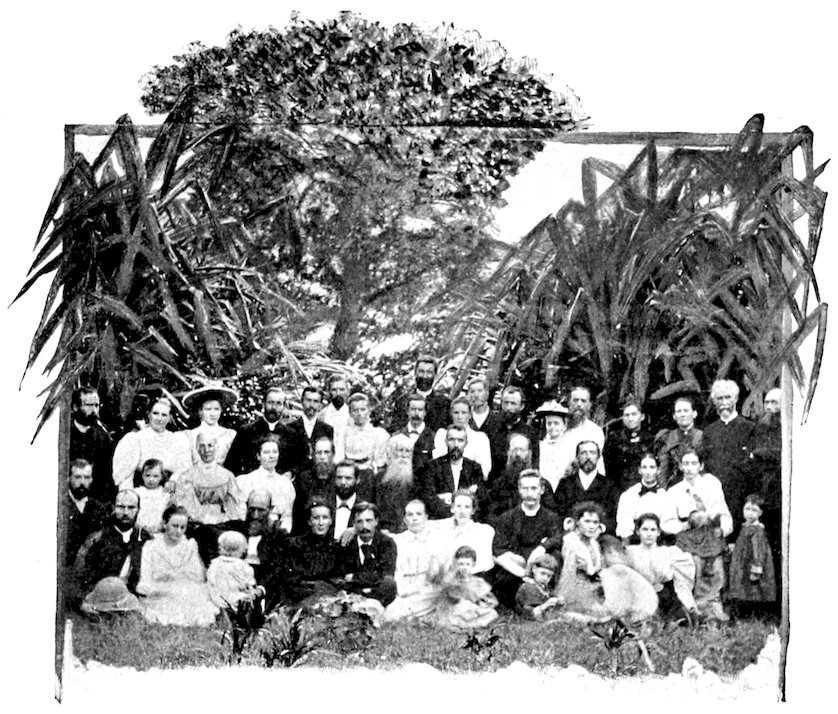
MEMBERS OF THE NEW HEBRIDES MISSION SYNOD, 1898.
Rev. John G. Paton, D.D., in the center.
29We reached Honolulu, the Hawaiian Capital, on the
25th, and spent nearly a whole day on shore. By a
circuitous drive, and on remarkably good roads, we
ascended a considerable hill and beheld the City spread
before us with its Palace, Government Buildings, Mansions
and Villas. Large and beautiful trees surrounded
them all. Two Men-of-War and many other ships
swung at anchor in the harbor, and the shimmering
Sea completed a charming panorama. Smart and
diligent Chinese were at work on every hand, side by
side with the busy representatives of almost every
Nationality, eager to profit by the passing visitors.
The larger portion of the wharf seemed to be covered
with Bananas for San Francisco, the bunches carefully
bound up in dry leaves for shipping. I had never seen
so many in all my life thus gathered together.
The Queen had been deposed or deprived of power.
National interests were sacrificed in self-seeking and
partisanship. One could not but sigh for some strong
30and righteous Government. They are a people capable
of great things. Everything seems to invite America
to annex the group; and it would be for the permanent
welfare of all concerned.
On 2d September, we arrived at San Francisco,
after a delightful voyage. The society on board was
most congenial. We had happy daily Religious Services,
and I managed to secure about eight hours to
myself out of every twenty-four for copying out translations,
finishing my Dictionary of the Aniwan language,
and other Mission work on which I was constantly
engaged.
San Francisco is beautifully situated. Many of its
streets run up and down what seemed very steep hills,
and the principal highways are well supplied with
Electric Cars. Your own language is spoken, indeed,
but you feel at every turn, for all that, you are in a
Foreign City. On Sabbath morning, the first thing I
marked on leaving our Hotel was the joiners busy
with saw and plane, as on any other day! The next
was a multitude of people flocking to a place of Public
Amusement, while others were going to Church. The
mass of the inhabitants were either in pursuit of pleasure,
or following their usual avocations. Even the
City scavengers turned out with their carts, and were
cleaning the streets on the Lord’s Day!
Yet we soon learned that even there the Lord Jesus
has many faithful servants living and working for His
glory. Several Ministers, hearing of our arrival,
found out our Hotel, and had us to assist them in their
31Services. I delivered three Addresses, walking considerable
distances between, and refusing to use public
conveyances, or deprive man or beast of rest for my
convenience,—to the great astonishment of my guides
and friends.
On Monday morning we visited the famous Seal
Rocks, a short distance from the city. There you see
them, under protection, safely wobbling up on the
rocks and basking contentedly in the sunshine, or
tumbling delightedly into the Sea. From a considerable
distance you hear the strange, half-barking sound
of their voices, like muzzled dogs. From the plateau
and promenade of a lovely private Garden near by and
open to the public, we had a magnificent view of the
Sea and all the surrounding scenery.
The same day, our whole party were invited to address
a meeting of Lady Workers, who carry on a
Mission in the Chinese quarter of the City. A report
was given, and some Converts from the Flowery Land
sang hymns to Jesus. It was joyful to see this spiritual
life;—for tokens were not awanting of a darker
and sadder picture all around us, in the dens of vice
and misery.
Guided, but not very wisely, by Cook’s representative,
we left San Francisco on 5th September. Though
now travelling night and day, we halted a few hours at
the famous Mormon Settlement on 7th September.
While looking at the grave of Brigham Young, a well-dressed
old lady approached us and volunteered much
information about her departed husband. He was one
32of the first settlers in the Salt Lake District, and had
taken an active part in the building of the city and the
Temple. She herself was a Mormon, and mourned
that their glory was departing under the influence of
the American laws. She was fervent in her defence
of polygamy, but I noted that, with the Mormons as
with the South Sea Savages, a separate house had to
be provided for each wife! We saw their vast Temple,
said to accommodate 15,000 persons, with tradesmen
toiling busily to finish it, for the reception of
Brigham Young on his speedy return to this Earth.
Replenishing our provision basket, as it was too expensive
to take all our meals on board the train, our
next run was to Chicago, which we reached on 10th
September, and where we rested at a Hotel on the
Sabbath Day. It was a day of tremendous storm and
rain and no one of us ventured out even to Divine
Service, especially as no Place of Worship was nigh at
hand. Amongst our fellow-passengers from San Francisco
had been a very kindly Christian man belonging
to Chicago. He gave us every information, and on
Monday showed us round the whole City by boat and
car. We saw the Exhibition Buildings, lavishly expensive.
The Horticultural Gardens were extensive
and most interesting. In the Zoological Enclosure we
saw a few remaining specimens of the Buffaloes, which
once in myriads roamed the Prairies, but which Civilization
has swept away.
Leaving Chicago, we arrived at Buffalo on the evening
of the 13th September, and returned next day to
33Niagara, whence by train and steamboat we were
bound for Toronto. We had already had a glimpse of
the Falls, where the train halted for a few minutes at a
convenient spot, and the view was grand! When next
I gazed on the spectacle, nigh at hand, I am afraid
almost to admit that I was rather disappointed. Too
transcendent expectations beforehand, I suppose!
I left Mrs. Paton and our daughter at the Falls for a
day, whilst I went on to Toronto to arrange for accommodation.
What a blessing that I was guided to do so!
A great Agricultural Show was being held there; and,
on arriving in the evening, I found every Hotel and
Lodging so crowded that I walked till midnight from
one end of the City to the other, seeking in vain for a
bed. At last one manager of a Hotel proposed to
give me a “shake-down” in a Common Room, where
twenty-two were to sleep that same night. But the
Hotel-Keeper taking pity, and protesting that he could
not allow me to “tumble into that crowded place,”
gave me the address of a private family who took
in lodgers, to whom he commended me. With much
difficulty, at that late hour, I found the street and the
number. The owner, on hearing my appeal, said he
had already “turned away thirteen,” and that he had
not a corner to receive me. I offered to pay him the
highest charges, “merely to rest in the Hall all
night,” rather than to tramp the streets. Calling his
wife, he said: “I have not the heart to turn this old
man away! May he not sleep on the floor of our new
empty Room?” Her answer was: “I have neither
34bed, nor bedclothes, nor even a pillow to give him.”
But I was glad of the shelter over my head. A chair
was brought in and placed in the middle of the floor.
Kneeling, I thanked the Lord, and my hosts. Then,
utterly worn out, I placed my travelling handbag for a
pillow, rolled my clothes tightly round me, lay down,
and enjoyed a most refreshing sleep.
Next morning I found my way to the Presbyterian
Church Offices, where a cordial welcome awaited me,
and news of ample accommodation for our comfort, all
generously provided. Several invitations were pressed
on me, but I accepted that of Mrs. Park, who had in
the old days been a member of my Bible-class in the
Green Street Mission, Glasgow, and it was a great joy
to meet once more her sister and herself. The attention
of many other friends was also very great, and
far too devoted, making us feel ashamed at the love
lavished on us.
At the Pan-Presbyterian Council I met and became
acquainted with representative Ministers and Laymen
from all parts of the world, but in specially large numbers
from Canada and the United States. Along with
Fellow-Deputies, I addressed the Assembly on Foreign
Missions, and on the urgent reasons for my present
visit to America. A Minister from the United States at
once rose and protested that there must be some mistake,
that it was “an insult to their honor” to insinuate
that they declined to join with Britain in such an International
Prohibition! I repeated my statements,
showed my Commission, and affirmed that it was
35certainly as I had represented. He telegraphed to
the Authorities at Washington, and next day he
courageously stood up in his place and admitted that
he was wrong, and that I had correctly stated the
facts. The action of that good and brave man, once
for all, made the issue plain and cleared my future
course.
I was proud of our Professor Rentoul, of Ormond
College. He at once took a leading place in the
Council. In wisdom, in vast learning, and in eloquent
debate, he was the equal of the best men from all
Presbyterian Christendom. I envied the Students
who sit at the feet of such a noble Master in the
School of Christ.
In response to my appeals, Ministers from Canada
and the United States began informing me how many
collections they had given “for the New Hebrides
Mission,” and subscriptions “for building the new
Mission Ship.” I had never heard of these, and inquired
to whom they had been given. They replied
that it was my “alternate,” commissioned from the
Presbyterian Church of Victoria! I assured them that
my Church appointed no alternate, and that this person
must be an impostor. A Committee was appointed
to look into the matter. The eloquent
pleader turned out to be a Roman Catholic student
who had joined the Victorian Church, had been
licensed and ordained as a Minister, had broken down
in character, and disappeared from the Colony. Now,
under a false name and forged credentials, representing
36himself as a Minister in full and honorable standing,
and a Missionary who had been thirteen years in
the New Hebrides, he was raising large sums of
money ostensibly for our Mission, but applying it all
to his own uses. His lectures were cleverly compounded
out of my Autobiography, with wild adornments
and fancies of his own. He had Collecting
Cards for children and for adults, the minimum subscription
on the latter being half-a-dollar! His New
Ship was to be sheathed in brass, and every subscriber
of not less than $5 was to have his name engraved
thereon! One man informed us of giving $25 to have
his Family Register completed on the sheath of brass!
Dr. Rentoul, by appointment, officially exposed and
denounced this impostor on the floor of the Council.
But, in these vast countries, a lie is hard to overtake
and to extinguish. Letters continued to reach me
from many quarters, and urgent appeals that I should
sanction his arrest. At one place he drank for a week,
after a series of Mission Meetings. The Ministers of
Buffalo at length caused him to be arrested; and the
Public Attorney, founding on his so-called credentials
as my assistant, summoned me to appear before the
Grand Jury at his trial. In a “blizzard,” I travelled
two nights and a day—one night the severest and
coldest I ever endured—and reached my destination in
time.
Having answered all questions by the Attorney and
the Grand Jury, they asked me to see the prisoner,
and testify whether he was the ex-Priest Riordan, now
37giving his name as Ruthven. I thereon handed the
Attorney a pamphlet exposing the evils and errors of
Popery, being three Lectures by V. H. Riordan, with
his portrait on the front page. They all at once
recognized him by this likeness. Nevertheless, I was
enjoined to go and see him, and report what took
place. He was behind an iron-grated door, and two
ladies were conversing with him from without. Addressing
him at once by his name, I said: “It grieves
me to see you here in these circumstances, Mr.
Riordan.” Completely off his guard, he at once
answered to his own name, and addressed me by
mine: “And I am very sorry, Dr. Paton, to be here
in such circumstances.” This was enough! I reported
what transpired, and the Jury took a hearty
laugh at the simplicity of the interview. I was dismissed
for the time.
In answer to the Prosecutor, he explained that when
he renounced the errors of Popery, he assumed his
mother’s name for life—Ruthven; yet there they had
his own pamphlet, with his real name, printed in
Philadelphia less than two years before! Being committed
for trial before the Supreme Court, he spent his
time of waiting in abusing me from his cell through
the pages of a Sunday newspaper, as “a drunkard”
debauching my Sacred Office, and “a hireling” living
by commission on the moneys raised for the Mission.
So madly did he rage, that some suspected he was put
up to do so, in order that his agent might work up a
plea of insanity, if the case at last went against him.
38At his trial, which occupied the greater part of three
days, I was again cited to appear. The Jury found
him “guilty,” but strangely enough recommended
him to mercy, and his lawyer pled for a money fine as
the penalty. The Judge sternly refused. He had
been found guilty in every count. His sentence would
be “twelve months in prison with hard labor.” That
was “extreme leniency.” It should have been “three
years.”
One would have thought that this should have extinguished
him. But no! His imprisonment has expired.
He is again at his lecturing and lying. Quite
lately I saw a report of his appearing at a place called
Dunmore. The Romanists mobbed him. In reply to
their eggs and snowballs he fired a pistol into the
crowd. The cry then rose, “Lynch the Renegade!”
Ruthven, bounding through an open door, scaling
fences, and crossing lots, managed to escape. But a
warrant was at once issued for his apprehension, and
doubtless he is proving the truth of one text, which
he has listened to in vain: “The way of transgressors
is hard.”
During the Pan-Presbyterian Council, I addressed
many meetings in the churches of Toronto and its
suburbs, receiving, on one occasion, by the kindness
of Dr. Parsons, a collection of two hundred dollars for
our Mission. And, by the urgent request of many
Ministers, I spent a considerable time after the Council
in visiting the chief towns of Ontario, where I was
39cordially received everywhere, and had very great
pleasure throughout the whole circuit.
Never, since I left the Christian Islands on the New
Hebrides, such as Aniwa and Aneityum, have I seen
the Sabbath Day kept so well, and the Churches so
largely attended, as at Toronto and in the chief towns
of Ontario. In that Capital, the Public-Houses are
closed from seven o’clock on Saturday night till eight
o’clock on Monday morning. No confectioners, tobacconists,
fruiterers, or the like, are open on the
Lord’s Day. The street Electric Car, and the Omnibus
are at rest. All workmen are enjoying their Sabbath
privilege, like other Citizens. And all this is
carried through by the will of the People themselves,
and by the vigilance and influence of the servants of
God. Surely, men of Christian principle, of grit, and
of public spirit, could, by keeping their hand on the
helm, secure in the same way the blessed Day of Rest
for all, in every City throughout the Christian World.
By cordial invitations from many men of the highest
rank in the Church of God throughout the States,
I was pressed to occupy their Pulpits, and tell the story
of our Mission to the Cannibals of the New Hebrides.
They also formed a Committee of their own number
to advise and help me in promoting the prohibition
against trading with the Natives in Intoxicants and
Fire-Arms. And the great-hearted Dr. John Hall, in
order to give me a good start in New York, offered
me his Pulpit for my first Sabbath there.
On the way, I had promised to spend an afternoon
40and evening at Rochester, with the Rev. Principal
Osgood of the Baptist College. An extraordinary
spirit of consecration seemed to rest on Professors and
Students alike. My heart was overflowing with joy,
to think of the type of Ministers and Missionaries certain
to go forth from such a Home of Piety and of
Learning.
Never can I express how much I owe to the genuine
and brotherly friendship of Dr. Sommerville of New
York, and his devoted lady. Not simply did they
make their House my very Home, whensoever I chose
to return to it, but they heaped on me every token of
consideration and of helpful sympathy. Amidst his
many cares, as a Minister of the Covenanting Church,
and his literary labors, as Editor of the Herald of
Mission News, he became Honorary Treasurer for me
in the States, and according to his utmost ability
opened up all my way, and helped me at every turn.
They are forever my dearly beloved friends in the
bonds of Jesus Christ.
After my first two Sabbaths in New York, one in
Dr. John Hall’s Church, and one in Dr. Sommerville’s,
I had no difficulty in arranging for as much work,
Sunday and Saturday alike, as my strength could overtake.
One lady, who heard me in Dr. Hall’s, sent me
one thousand dollars, as from “Elizabeth Jane.” In
addressing the Chamber of Commerce, the Doctor
himself announced clearly the special object of my
visit to America, and described the features of our
Mission. This, being fully reported in the Public
41Press, woke a widespread interest, and invitations
poured in upon me from all branches of the Church,
excepting only the Romish and the Unitarian.
The way to Washington, and to influence with the
Governing Authorities, was prepared for me thus.
Being a stranger and only a poor Missionary, I asked
every Public Meeting, held on any day except Sabbath,
to forward a Petition to the President and the
Congress, signed by the Chairman, in favor of the
Prohibition of Intoxicants and Fire-Arms, as barter by
American Traders on the New Hebrides, or other unannexed
Islands in the Pacific. The Daily Press reported
all these Petitions. The Public became thoroughly
interested. And even the Authorities were
expecting my appeal in person. Nay, I cannot but
regard it as of the Lord that my first Sabbath in
Washington happened to be in the pulpit of Dr.
Bartlet, where I, altogether unknown to myself, was
pleading the cause before the Chief Secretary of the
Government. He sent me fifty dollars for the Mission,
invited me to lunch with his family, and gave me
ample opportunity, by answers to many questions, to
state all the case, and to deepen all round the growing
interest in our Mission.
On the forenoon of the following Sabbath, I occupied
the pulpit of Dr. Hamlin, and the President of
the United States heard my story and appeal. Many
Senators and Members of Congress, having matters
thus rehearsed, were able to weigh the question carefully,
before I made my official statement at all. The
42President declared himself quite frankly to be deeply
interested, and willing to expedite in every possible
way the negotiations with Britain. It emerged that in
the British reply there was a new clause, empowering
one of the contracting parties to license Traders, under
certain circumstances, to sell Intoxicating Drinks.
The President struck his pen through that clause, and
at once returned it, insisting on its excision. Had
Britain agreed to this, President Harrison would then
have signed the Treaty. But, alas, week after week
elapsed, and no reply came. A new Election took
effect, and President Cleveland was installed at the
White House.
My Advisory Committee in America now insisted
that I must wait till the new Government’s arrangements
were all completed, and once more press my
appeal. I resumed my work of addressing Public
Meetings every week day, and Congregations every
Sabbath Day, always sending, from the former, Petitions
to the President and Congress regarding the proposed
Prohibition on the Islands. I had also private
interviews with many leading Politicians. To all I
pointed out that, as America was now united with
Britain in the Dual Protectorate of Fiji, we only sought
the extension of prohibition on that Group to the
Group of the New Hebrides.
Constantly engaged in these Mission interests, I
planned my second visit to Washington to take place
at the same time as the General Assembly of the
Presbyterian Church of the United States. I had the
43honor to address it on Foreign Missions, and to preach
before a number of Congregations during its sittings,
for a very deep interest was manifested in the wondrous
workings of God on the New Hebrides.
I was introduced to the new President, when the
General Assembly went in procession to do him honor.
Both he and Mrs. Cleveland welcomed me to America,
and, a few days after, they invited me to lunch at the
White House, privately, that they might question me
freely regarding the Islanders and our work. They both
seemed to me to be genuine followers of the Saviour,
and sincerely interested in the salvation of the Heathen
World.
The Presbyterian Assembly thereafter appointed a
large Deputation of its leading men to accompany me
in laying officially before the Government our grievance
regarding Fire-Arms and Intoxicants, and pleading
that the United States should unite with Britain in
the Prohibition of all trading with Natives in the same.
In order to save time, and secure lucidity, Professor
Hodge carefully prepared and read our statement.
The President expressed himself as deeply interested,
and requested the document to be left with him for
reference. We anxiously awaited the result; but the
final reply from Britain was still delayed. Our hearts
grew sore with hope deferred!
In course of time I was informed at the British
Colonial Office in London, that as France and Russia
had withdrawn from the proposal, the negotiations
were for the present suspended. France, for years,
44postured before the world as ready to enforce this prohibition,
if America would; and now, when America
was ready, France withdrew! Still, on the highest of
all moral grounds, let us plead with America, Germany,
and Britain, already united in their triple Protectorate
of Samoa, to extend the same prohibition to
the New Hebrides, and the other unannexed Islands
in the Western Pacific. If they would do so, the
other Powers interested could scarcely fail to agree,
and France would be ashamed to stand before the
world as the only Civilized Nation, exploiting the
bodies and souls of poor Savages by trading with
them in Fire-Arms and Drink for mere godless greed
of gold.
In Boston, the Ministers of all the Reformed
Churches, having formed a representative Committee,
organized a series of meetings, and cordially invited me
to address them. Dr. Joseph Cook and his gifted
wife gave me a public reception, to which many of the
leading Citizens, as well as Professional men, were invited,
and where I answered all sorts of questions regarding
Missions in general, and the New Hebrides in
particular. I was also twice introduced to the audiences
at his famous Monday Lectures; and my
replies to testing problems, there submitted, were
printed in Our Day, and woke not a little interest in
the work of God amongst the Cannibals of the
Southern Seas. To all these generous friends at
Boston, I am forever indebted, but very specially to
John Gilchrist, Esq., an office-bearer in the Presbyterian
45Church, who toiled in the cause incessantly, and
whom may the Lord Jesus richly recompense!
One curious experience befell me there, outside the
range of my ordinary work. A “Temperance Union”
of Women engaged me to address a Working Folks’
Meeting on a Sabbath afternoon, in what they called
the Peoples’ Church. When I arrived, nearly half of
the large Platform was occupied with ladies scraping
away and tuning their violins, large and small! A
lady occupied the chair, and introduced Dr. Blank, a
Unitarian or rather an Infidel, who was to speak for
ten minutes, and then leave the meeting in my hands.
He knew that I had to leave within an hour, and drive
to another meeting, but he went on and on, tracing a
Carpenter all through his life to exhausted old age,
manifestly stirring up class against class, and sowing
the seeds of infidelity. At last, he wound up by
picturing the Carpenter, outworn and ready to die, sitting
with his wife and children around the table at
their evening meal, taking the bread and breaking it
and saying: “Eat ye all of it, for this is my body
broken for you; this do in remembrance of me, for I
have worn out my life for your sakes.” Whereon, his
wife poured out the tea, and said: “If the bread is
your body broken for us, this tea is my blood shed for
you; drink ye all of it in remembrance of me, as I have
spent my life in toiling for you.”
Being able to stand it no longer, I turned to the
ladies behind us and said aloud: “Who is this blasphemer
that you have set up to speak to the people?
46He is simply belching out Infidelity, and setting man
against man. This is a black disgrace to you all!”
He paused a moment, and then said: “I wish this
Congregation to understand that, in what I have just
said about the Carpenter and his bread, I throw no slight
on the name or memory of one who thus parted from
his followers long ago”—and thereon he resumed his
seat, having spoken for nearly the whole hour. Reply
was impossible for lack of time, and my expected
Address was crushed aside. But, ere I left the Platform,
I uttered a few burning words, and the whole
audience seemed to go with me. I denounced all setting
of the poor against the rich, as alien to the spirit
of Jesus. I branded as an insult to the Divine Saviour
of the world the blasphemer’s parody of the Lord’s
Supper, to which we had been treated. I warned these
Temperance workers that, in bringing such a teacher
of Abstinence before the people, they were degrading
the cause which they desired to promote. And finally,
I summoned them to remember that we must all
appear before the Judgment Seat of Christ, and implored
them, and Dr. Blank amongst the rest, to seek
pardon and acceptance at the feet of Jesus now, that
they might find their Judge was also their Saviour in
the last awful day! A hasty Benediction was pronounced,
at the Chairwoman’s request. I hurried from
the Church, greatly shocked, but encouraged by the
handshake and the “God bless you!” of many whom
I passed. There was one small consolation which I
47unfeignedly enjoyed—the fiddling ladies had no opportunity
of displaying their skill on that Lord’s Day!
While I was in America many minds were being
troubled with ideas regarding what is styled the
“Second Probation.” At one of his famous Monday
Lectures, Dr. Joseph Cook put to me, on the Platform,
the following amongst other questions: “How would
Missionaries, teaching the Second Probation, succeed
with the Cannibals on your Island?” My reply was:
“How can they succeed on such terms anywhere?
Our Cannibals would say,—If we have a second
chance hereafter, let us enjoy our present pleasures
and risk the future!” Again he asked: “How
would Missionaries holding that doctrine, but promising
not to teach it, succeed amongst them?” I replied:
“Hypocrites are a poor set everywhere, but
especially in the Mission Field. How could a man
succeed in teaching what he did not believe? Cannibals,
like Children, are quick to discern insincerity;
and such a man could do no good, but only evil
amongst them.” Joseph Cook and his like-minded
wife appeared to be noble instruments in the hand of
God, for the defence of truth and righteousness.
During this supplementary series of Meetings I
happened to reach Chicago during the Great Exhibition.
Dr. Macpherson greatly helped me, and
arranged all my work. The City was crowded with
visitors from all the World. There were many things
in the Big Show that one would have liked to see;
but when I learned how its Directors, in violation of
48their agreement with the Government, opened it on
Sabbath, and turned the Lord’s Day into a Saturnalia
of sports and amusements, I positively declined to
enter within its gates. They made a huge noise
about accommodating the working men, but they
really sought mere selfish gains. They filled the
streets with advertising cars, with flags flying from
each, announcing their theatres and shows, desecrating
the Holy Day. Thank God such Heaven-defying conduct
was condemned from many a Protestant Pulpit,
and the Congregations warned against countenancing
such a sinful and shameful Vanity Fair!
The Directors, having secured President Cleveland
to open the Exhibition, desired him to go from Washington
by special train on the Sabbath Day. Their
plan was to utilize the occasion by enormous Excursions
from all quarters on the Day of Rest. But the
God-fearing Presbyterian President went with a usual
train on Saturday, took up his residence at a Private
Hotel, and showed his disapproval of their tactics by
declining their projected ovation. On Sabbath morning
he attended worship at Dr. Macpherson’s Church.
A Baptismal Service was intimated for the afternoon.
The President again attended. He opened the Exhibition
officially, but left the City as privately as he
had come to it, and this rebuke was not misunderstood
by the Community, and was greatly appreciated by
decided Christians, to whom the rest of the Day of God
is a Heavenly heritage for all the creatures of Earth,
which no man may lawfully alienate or impair.
49To a man like myself, the results brought a certain
retributive joy. The rush of Foreigners, after the first
two or three Sabbaths, was soon over. Then it was
discovered that the masses of the Working People of
Chicago absented themselves on the Lord’s Day,
knowing well that it was not for their benefit that this
thing was done, but merely to coin money out of
them. Finding that, instead of a gain, the opening on
the Sabbath was a deadly loss, the Managers proposed
to close it, but found themselves tied hand and foot by
their own past action at law. Conspicuously, the City
suffered through the vices and crimes thereby fostered;
and will continue to suffer; for such evil cannot be
swept away with the temporary buildings of the
Exhibition. Doom seemed to overtake the authors
speedily. One of the leaders was cruelly shot; and
the gates were at last closed in silence, and apparently
in shame!
Very varied were the means adopted, by interested
friends, to arrest attention on the New Hebrides, and
create enthusiasm in their cause. One very memorable
occasion was at Pittsburg, where J. I. Buchanan, Esq.,
gave a great dinner, to which he invited the Owners and
Editors of all the local Newspapers, to meet the New
Hebrides Missionary. After I had addressed them,
they tackled me with questions regarding the Islanders,
and on all conceivable aspects of work for Christ
amongst Cannibals. Most of them got deeply interested;
and, next day, the whole Press of the City was
full of the Mission, and of the reasons for our seeking
50the Prohibition of Fire-Arms and Intoxicants as articles
of trade amongst the Natives.
I had now visited the leading Towns in all the
Northern States, and not a few on the borders of some
of the Southern States, being everywhere received by
Ministers and People with exceeding kindness and exceptional
liberality. My next anxiety was to be present
at the Assembly of the Canadian Presbyterian
Church, and I therefore decided to leave the work
undone, which was daily being pressed upon me
throughout the States, and to hasten thither. This
was surely of God’s guidance; at least I reverently
think so; for I reached the Assembly Hall, all unknown
to myself, on the night of their Foreign Mission
Report; and the first thing I heard was an “Overture”
from Nova Scotia, urging the Assembly to hand
over their three Missionaries on the New Hebrides to
the Australian Churches, which were now “both able
and willing to support them”!
The Assembly received me very cordially. The
Moderator invited me to speak immediately after the
Overture had been presented. I conveyed to them
the greetings of our Church, and of our Synod on the
Islands, and reported in general terms on the Home
and Foreign Missions in Australasia. Then I turned
to the Moderator, and asked on whose authority it
was declared that the Australian Churches were both
able and willing to take over the Nova Scotian Mission
on the New Hebrides, with its annual cost of
about £1300. The question was put to the Assembly.
51There was a significant silence for several moments,
and then some one feebly replied: “On Dr. Geddie’s.”
I retorted, that surely the author of the Overture was
ashamed of it, when he sought to palm it on the
honored father of our Mission, now many years resting
in his grave! I demonstrated, by irrefragable
facts and figures, that the Australian Churches were in
no position to undertake this additional expense; and,
further, I insisted that to give up this specially-honored
Mission would be one of the greatest losses
to the spiritual life of their own Congregations and
Sabbath Schools. It was the Mother of all their
Missions! It was the Mission which had awakened
in them all the Missionary spirit they now possessed!
The Moderator emphatically protested, from the
Chair, that he hoped the General Assembly “would
hear no more of such a proposal.” Yet the agitation
is carried on, from what creditable motive it is very
hard to see. The Editor of their Mission Record, with
a few men of similar spirit at his back, seems to have
determined to cut the connection betwixt Nova Scotia
and the New Hebrides, and to close by violence one
of the noblest chapters in that Church’s history. They
have written to the Australian Churches on the matter,
and I venture to predict that their answers will be more
emphatic than even my instantaneous protest. The
nobler spirits in Nova Scotia ought to squelch out this
miserable agitation, which is killing the Missionary enthusiasm
and curtailing the liberality of their Church.
Surrounded by a multitude of devoted Ministers and
52Elders, I agreed to remain two months in Canada, and
address as many Meetings every day of the week as
could possibly be crowded into time and space. To
relieve the pressure on Mission Funds in Nova Scotia,
I offered to give up twenty days entirely to them, with
all the proceeds from every Meeting. They received,
I understand, above £500; and I trust that by my
Addresses, one at least every day and four or five
every Sabbath, all the Funds of all these Congregations
prospered and continue to prosper; for I humbly and
gratefully recognize the fact that God has used me not
for one Mission but for all Missions, and not through
one Church but through all His Churches.
The series of Meetings, up to Quebec, was mapped
out at the Assembly, and the whole of the arrangements
were entrusted to the Rev. J. W. Mitchell of
Thorold, a man of deep devotion and of untiring zeal.
Our Treasurer was A. K. Macdonald, Esq., Toronto, to
whose kindness also we were profoundly indebted.
Countless applications poured in upon us. It was no
uncommon thing to address two or even three Meetings
daily, and to travel long distances between them
by conveyance and rail. On Sunday we delivered
never less than three Addresses, but more frequently
five, and sometimes even seven, including the Bible
Classes and Sabbath Schools. It was dreadfully exhausting
work. Sometimes I hesitated, fearing every
day would be my last. But again my vigor returned,
and my heart hungered to overtake all that I possibly
could, knowing that the time was short. Besides, in
53this tour as always, the getting of Collections, however
anxiously desired for our Mission, was never my primary
aim; but always the saving of souls, by the
story of the New Hebrides. For that cause I would
gladly die. But I did not die; and there was given a
new illustration of the meaning of that inspired saying—“The
joy of the Lord is your strength”—the work,
which is our joy, uplifts rather than oppresses us!
The incidents of these journeys would fill a goodly
volume. But I had neither the leisure nor the inclination
to record them day by day. One or two specially
impressed themselves on my memory, however, and
may here be glanced at.
On one occasion, after a long Railway ride, I found
myself set down on the wrong side of a flooded River,
the bridge having been swept away. The Station-Master
pointed us to a boat, kept by a farmer, which,
if we reached, might ferry us over. But two huge
fields betwixt us and the spot were flooded with the
overflow, and these had to be crossed. A young lady,
a gentleman, and I, all equally eager to get to the
other side, resolved to try. We waded to the Boat-Landing,
and reached it in a very bedraggled state.
There the boat had been left, awaiting some one’s return,
but the farmer was across the River. None of
us felt very brave about the experiment of rowing
across the racing current! Our fellow traveller, nevertheless,
resolved to try. Minimizing my warning
about rowing a long way up in the quieter water, and
then slanting across with the sweep of the current, he
54went up only a little, and quickly plunged in. His
boat was whirled away like a cork. We held our
breath, while the young farmer on the opposite bank
kept shouting and gesticulating, running down the
River, and guiding the rower as best he could. It was
with a sigh of thankful relief that we saw the traveller
stand up at last on the farther side, safe but badly
shaken.
The farmer now took the oars in hand, and with his
great strength and greater skill ferried first one and
then the other across in safety, but not without peril.
In a high light cart he mounted us and bore us securely
across another field, through three feet of water if not
more, and planted us gladly at his fireside. There the
lady waited, that her dripping clothes might be dried,
and the other traveller found his way to his desired
haven. But, the hour of my Meeting having already
arrived, I hastened to address them, with clothes
soaked through and through, and was immediately
thereafter driven to another town at a distance of
several miles. Without any opportunity of proper refreshment,
or of getting clothes dried or changed, I
spoke for an hour and a half to a large Public Meeting
there, and then retired for the night. My clothes
were hung up to dry. I had to start by train very early
next morning. When I dressed, the damp of yesterday’s
drenching still hung about them, and made me
shiver. For two days my bones and muscles felt very
sore, and the dread of severe rheumatic fever hung
over me. But I sustained myself with the assurance
55that the Great Physician would take care of me, since
none of this had been brought on by selfish pleasure,
or self-willed obstinacy, but in devotion to His Will
and in doing His work. I suffered no further harm,
and carried through all the Meetings, praising Jesus
my Saviour.
On another occasion I was for a time seriously perplexed.
A kind Minister drove me, after conducting
several Meetings under his charge, to join the Night
Train at a lonely crossing. Arrangements had been
made at Headquarters to set me down, pick me up,
and set me down again at such places, in order to
reach certain Meetings, and thence go on my way to
others, with the least possible loss of time. Being
duly despatched by my friend, I was set down, in the
darkness, at such a crossing, where was neither sight
of any house, nor sound of any human being. The
Guard, in manifest pity, exclaimed, “I don’t know, sir,
what you can do here! I am extremely sorry to leave
you. But, for God’s sake, keep off the line. The Express
follows. The rails are wet, and you might never
hear her! Some one will surely meet you. Goodbye!”
His Train soon disappeared into the darkness. I
tried to rest, sitting on my travelling bag, but it was
too cold, and rain began to fall. Marching about to
keep up the circulation, I kept hallooing as loudly as
I could every few moments, but no sound came in reply.
Worn out and greatly disheartened, I at last put
both hands to my mouth and began the Australian
56Koo-ee! Koo-ee! and sustained it with all the breath
and strength I possessed. By-and-bye, in the pauses,
I heard a faint and far reply, like the echo of my own
voice. It drew nearer and nearer in response to my
cry, and at last grew into the salutation of a glad human
voice. It was the Minister, appointed to meet
me, who now emerged out of the darkness. There
were two crossings in the district, and they had left me
at the wrong one! He had tied his horse to the fence,
and followed my cries through the night. We stumbled
our way back, and were ere long welcomed to his
cozy Manse; and I tucked myself into a warm bed
as soon as possible. Not without praising our Heavenly
Guide, I soon fell into a deep and sweet sleep,
and felt able next Sabbath morning for any amount of
Meetings. The Holy Day proved to be exceptionally
busy, and exceptionally happy; for I was with a good
and true Minister of Jesus Christ, and that transforms
all work into joyful fellowship.
Once the shaft of our engine broke, and the train
stood still. The Guard advised all the passengers to
leave and take to the fields across the fence. I decided
to stick by the train. A messenger started on
the rails behind and another in front, and each ran
with all his might, waving the red flag and shouting.
But the Engineers never lost their heads for a moment.
They screwed and hammered and chiselled; they unloosed
one part and pitched it up among the coals;
they fixed and adjusted another, in the most mysterious
ways, as it seemed to me. And in a very short
57time, to the delight and amazement of all, that train
began to move slowly ahead, and crept on steadily to
the nearest Station, one side of the engine only being
in working order. The alarm of all was very great, as
an Express was due behind us and might any moment
have crashed upon the scene. “Our Father
knoweth.”
At another time I was travelling, by rail, a great
distance to address a Mid-Day Meeting. Only one
hour was free, and then I must join another train.
Two or three Stations before reaching the former destination,
a gentleman surprised me, exclaiming, “Dr.
Paton, here is your Lunch! You will not have a
minute for food either before or after the Meeting.
Leave the jug and plates at any Station, and they will
be returned. Goodbye and God bless you!” I
looked on this excellent meal with very curious sensations,
as if it had dropped to me out of the Hand
that feeds the ravens; and I prayed my Saviour to
bless the good-hearted giver.
I may here record that this period of my life was
fuller of constant stir and excitement, rushing from
Meeting to Meeting, and from Town to Town, than
any other through which, heretofore, I had ever
passed, without one single day of rest, or almost an
hour of breathing space. I do not think it is exaggeration
to say that, on an average, during these months,
I must have addressed ten Meetings on the ordinary
days of the week and five every Sunday. I certainly
know that, during many special weeks, the numbers
58far exceeded these. Blessed be God, who so marvellously
sustained me through it all. When my throat
got a little husky, my only medicine was a sip of pure
Glycerine, a little bottle of which I always carried with
me. My daily diet was always, by choice, the simplest
and homeliest food which I could obtain—a plate of
porridge with milk, a cup of tea with bread and butter,
and a very moderate amount of flesh meat of any
kind, often for days together none at all. And my
only stimulant was—the ever-springing fountain of
pure joy in the work of my Lord and Saviour Jesus
Christ!
One thing was at first a great worry to me, but at
length solved itself very happily. I cannot, with any
conscience, use cars, cabs, trains, or steamboats on the
Lord’s Day, except under such an emergency of
“necessity or mercy,” that my Lord, if He met me on
the way, would declare me “blameless.” On beginning
in America, it was enforced on me from every
quarter that I must use these conveyances on the
Sabbath, owing to enormous distances, or find my
mission an utter failure. My one answer was: “No
working man or woman shall ever accuse me at the
Bar of God for needlessly depriving them of their Day
of Rest, and imperilling or destroying their highest
welfare.” Shoulders were shrugged knowingly, heads
shaken rather pityingly, and gentle appeals made to
yield for the sake of the higher interests of the Mission.
But I held my ground unfalteringly. It became known
that I would not use such conveyances, and that I
sturdily trudged from Meeting to Meeting on foot, all
through the Lord’s day. Immediately the private
carriages of friends of Jesus and His Mission were
placed largely at our disposal; and, in all cases, I pled
for such arrangements as gave the horse its rest, and
the man his opportunity of worship. Whensoever I
was necessitated to hire for the Lord’s Day, it was invariably
so planned that not only was proper food duly
provided for man and beast, but the driver was invited
and encouraged to join the Service of the House of
God. I pray my Lord to accept my lifelong testimony
and practice on this supremely important matter,
and to use it for the preservation of the blessed
Day of Rest as the inalienable heritage of all His toiling
creatures,—next to the gift of His own Son, one
of the most priceless of all His boons to the Human
Race!
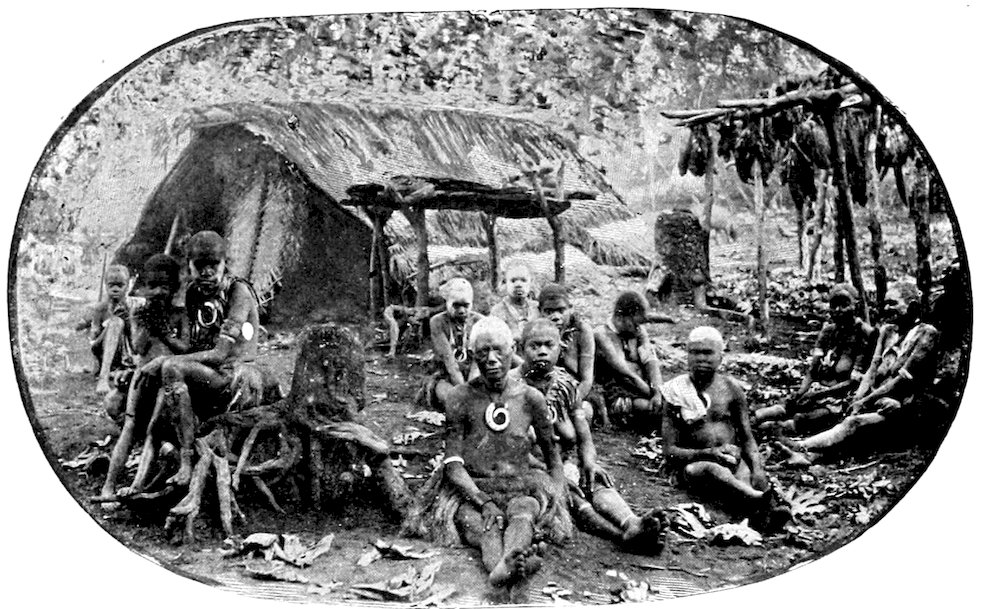
HEATHEN NATIVES OF AMBRIM.
Heads and faces of women are covered with lime as sign of mourning.
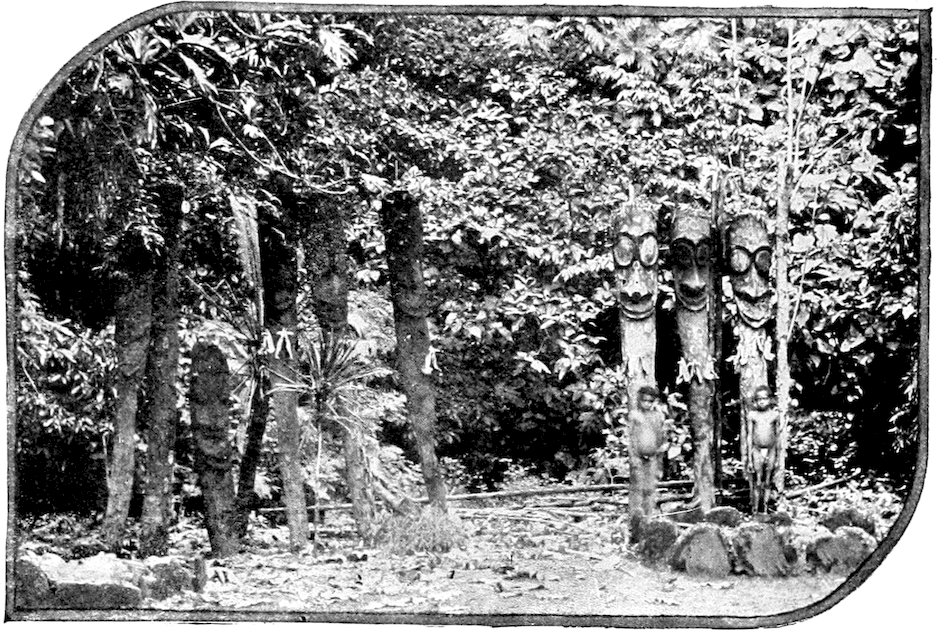
MEMORIALS OF THE DEAD, AMBRIM.
Stone Altar in front is one on which pigs are killed.
59The time had come that I must say farewell to
Canada and the States. It was the first time I had
ever seen these new and marvellous Lands. My soul
was not unaware of their beauties, nor unresponsive to
their grandeur of scenery. But my whole time and
strength were otherwise required; and I turned not
aside from the call of my Lord. He knows that my
heart rejoices in all the wonders of His Power, not the
less that I spend myself in proclaiming the greater
wonders of His Grace. All my recollections of intercourse
with the Ministers and the People of the New
World are abidingly sweet, and move me to bless the
Lord for the God-fearing, Bible-loving, and Sabbath-keeping
60Nations that have sprung from our British
Race. From the highest to the humblest they received
me with royal welcome, and heard me with loyal sympathy.
Their help was generous, and was gladly
given. Their interest in the work of God was genuine,
and was frankly displayed. And their delight in listening
to the story of the salvation of the South Sea
Cannibals, made me firm in the assurance that they
themselves already know within their own souls the
unspeakable worth of Jesus!
CHAPTER II. THE HOME-LANDS AND THE ISLANDS.
63
A.D. 1894–1897. ÆT. 70–73.
Arrival in Great Britain.—Requisitions.—Professors and Students.—Dayspring
Scheme.—Ten Years’ Delay.—Gideon’s
Fleece Experiment.—Two Memorable Checks.—The
“John G. Paton Mission Fund.”—The Dayspring Disaster.—Mission
Work on all the Islands.
I embarked from New York for Liverpool, per
the new and magnificent s. s. Campania. The
vibrations of that vessel were more fearful than anything
I had ever experienced in all my travels. There
was some defect, which I hear has since been remedied.
I was scarcely conscious of ever sleeping at all, and
the ship seemed to be constantly on the eve of shaking
herself into fragments! On the voyage I made
the acquaintance of very dear friends, bearing my own
name; whose Home at Liverpool by-and-bye received
me lovingly; and where also I met the learned and
honored Principal Paton of Nottingham.
My arrival in Britain revealed to me, immediately
and amazingly, how times had changed since my previous
visit, only ten years before. Then I had many
difficulties to face in arranging for public meetings,
especially in England, as set forth in a previous Chapter.
64Many a weary day’s tramping I had, even in
Scotland where something was known about the Mission
to the New Hebrides, passing from Minister to
Minister, and pleading, frequently all in vain, for the
use of their Pulpits and for access to their Congregations.
But since then, by my brother’s insistence, the
story of my life had gone through the Land in my
Autobiography. I was no longer treated as a stranger,
but as the dearly beloved friend of every one who had
read my book. Blessed be God, who used it for His
glory, and gave our Mission appeal everywhere an
open door, such as never in my most hopeful hours
had my faith even dreamed!
Now, hundreds of invitations poured in on my
British Committee, all Honorary Helpers who grudged
no amount of labor and pains. I found a Series of
Meetings already arranged for me, covering the principal
towns and cities of the United Kingdom,—Mr.
Watson of Belfast taking charge in Ireland, Mr.
Langridge in England, and my brother James, with
his Honorary Secretary, arranging for Scotland, and
acting as General Director of the Mission. When
those had been fairly overtaken, the additional applications
had risen to several hundreds more than could
possibly be faced, unless I prolonged my stay for
years. My Committee at one time found themselves
dealing with a mass of 500 invitations! A selection
had to be made of the more important and populous
centres for the Services on the Lord’s Day, and one or
two Meetings each day during the week in the smaller
65surrounding towns; but even then the disappointments
were many and grievous; and not more so to them
than to me; for I did passionately desire to tell every
human being the story of the Gospel on the New
Hebrides, that other and still other souls might be won
thereby for Jesus my Lord.
One very precious feature of my tour was this:—the
manner in which Ministers and Christian workers of
all the Churches united to welcome me, and gave very
practical support to this Presbyterian Mission. Frequently,
the invitation was signed by all the Ministers
of the district, excepting only the Roman Catholic;
and my prayers rose daily to my Lord that my
humble presence might be one of the means in His
loving hand of paving the way for a closer union
amongst the Members of His Redeemed Flock. I
was much touched by the requisition that came to me
from my well-beloved Dumfries, with the names of all
the Ministers, and full of tender references to my early
associations with the Queen of the South, as in our
boyhood we loved to call her!
The Congregations, on week days not less than on
Sabbaths, filled the largest Public Halls and Churches
in each locality; with frequent overflow Meetings at
which I had to speak for fifteen minutes or so, and
then leave them in the hands of others, whilst I drove
or ran to the principal Meeting, now opened and
awaiting my Address. During the two years of my
Tour, I addressed very nearly 1400 audiences, ranging
from a few hundreds to five and six thousand each,
66and in doing so I travelled over many thousands of
miles, on foot and in every kind of conveyance that is
used in the English-speaking world.
The Chairmen at my various Meetings represented
every type of Christian worker, and all social grades,
from the godly Tradesman, evangelizing in his quiet
Mission Hall, up through Ministers and Mayors,
Provosts and Members of Parliament, Bishops and
Archbishops, to Lords and Dukes and other Peers of
the Realm. Under this rush of the Missionary Spirit,
many conventional barriers were broken down, so that
I was, even on Sunday, invited to give my Address
from the very Pulpit in Episcopal Churches, as for example
in the Pro-Cathedral at Manchester. On week
days, this was a not infrequent experience.
These things, and all my opportunities of usefulness,
thus unexpectedly thrust upon me, at the close of a
long life of toil and self-denial and sacrifice for Jesus, I
devoutly laid at His feet, and implored Him to use me
only for His glory. And I can truly say that I never
felt more deeply humbled, all my days, than at the
close of some of those almost unparalleled Missionary
Meetings, when I was alone with my Saviour after all
was over, and thinking of my lowly Home and all the
way by which the God of my father had led me, from
these hours of hardship to this day of triumph. Fame
and influence laid me lower and lower yet, at the feet
of Jesus, to whose grace alone everything was due.
Never were these feelings more present with me
than when I was called upon to tell the story of our
67Mission before the learned Professors and eager
Students, at so many Universities, Colleges, Theological
Halls, and similar Institutes. I have a note of at
least sixty-three Seats of Learning, including Princeton
and the most famous Colleges in America, as well as
Oxford and Edinburgh, Cambridge and Glasgow at
Home, where some of the greatest living Masters in
every department, such as my own world-famous Professor,
the now venerable Lord Kelvin, listened to my
testimony as to the power of the Gospel to make new
Creatures of the South Sea Cannibals and build them
up into the likeness of Jesus Christ. I trespassed not
into their spheres, where I would have been a child
and an ignoramus compared with them; and they, on
the other hand, treated me with profound respect, and
even occasionally with demonstrative appreciation, in
that sphere of the moral and spiritual, the work of the
Christ-Spirit and its influence on the lowest and most
degraded of human beings, wherein I had some right
to speak with authority. This was my “one” talent,
in the presence of such men; and I “traded” with it,
that the Name of my Saviour might be honored more
and more, in the Halls of Letters, and in the Temples
of Art and Science.
By the general desire of my fellow Missionaries on
the New Hebrides, I had visited Britain ten years before,
for the express purpose of raising if possible
£5,000 for a new Dayspring, larger than the old, and
with Steam Auxiliary Power. By the blessing of God
on my humble pleading, and very largely in direct answer
68to prayer, for I called on no one privately for donations,
there came to us in twelve months the large
sum of £10,000, of which more than one half reached
us by post. My Church in Victoria, to whom I rendered
an account of all, set apart £6,000 for the new
Mission Vessel, the interest to be added to capital till
such time as she might be built; while the remaining
£4,000 were devoted to the obtaining and supporting
of additional Missionaries for the New Hebrides.
But a new difficulty had emerged, and created not
only delay all these years, but no small measure of
regrettable dissension; and that was how to maintain
the Ship, and keep her floating in the service of the
Mission; for the Dayspring, not being allowed to
trade, had been wholly maintained by the Sabbath
Schools of the Churches having Missionaries on the
New Hebrides. The sum which they had raised annually,
each Church in its allotted proportion, amounted
to £1,500, or rather more; and it was manifest that
the Steam Auxiliary would cost at least £1,000 extra
per annum. Unfriendly critics doubled that charge,
and some prophesied even treble; but level-minded
experts limited it to £1,000, and the actual facts of
experience, as to cost of maintaining the Morning
Star and the Southern Cross, in these same Pacific
Seas, tallied with their estimates.
The burning question, therefore, had been how to
raise this extra sum for Dayspring Maintenance. Our
Victorian Church proposed to increase her quota from
£500 to £750, and issued appeals to the other coöperating
69Churches to make a similar advance. It did
not seem too much to expect, in the interests of the
Mission, all whose operations had trebled since the
original responsibility was allocated; but they pled
inability to comply, and so the project hung fire for
ten years and more, experiments being meanwhile
made in other arrangements for the Maritime Service
of the Mission, and new interests of various kinds being
thereby created, which have not tended to unity
and peace in the management of the New Hebrides.
There is peril also incurred to the highest spiritual interests
of the Mission, which I daily pray God, in His
loving kindness and mercy, to be pleased to avert!
Without ascribing anything but the most ordinary
motives in the world to those who opposed the getting
of a new Dayspring, the situation that thus grew up is
perfectly transparent. The Australian New Hebrides
Company was employed to do the work of our Mission
by their Trading Ships. In 1805—e.g., we paid
to them the large sum of £2,451, 8s. 1d.; all found
money, for, without us, these Ships in their outgoing
trip to the Islands would have sailed comparatively
empty. To secure a Ship of our own would be, therefore,
to deprive the Company of this handsome subsidy;
and it is but Human Nature, and implies no
necessary dishonor, that the shareholders and their
Ministerial and Missionary friends should have become
the keenest and even bitterest opponents of the new
Dayspring. Further, the headquarters of the Company
being at Sydney, and the subsidy for our Mission,
70as well as the money for the upkeep of our Missionaries
and their families, being consequently expended
almost exclusively there, it is, from the world’s point
of view, equally natural to anticipate that the very
heart and centre of the opposition has been in New
South Wales, and has concentrated itself in the Advisory
Committee which sits at Sydney and is known as
The Dayspring Board. All this, I say, was only to be
expected, if the whole transaction is to be weighed
and measured by the standards of men of the World,
instead of being put into the balances of Jesus Christ,
and estimated in the light of the spiritual and eternal
interests of the Islanders whom He has committed to
our care.
With great plausibility, this selfish opposition sought
to commend itself to a wilder circle by a Patriotic plea.
If we did not support the Trading Company, it would
fail, and the French might come on the scene and
annex the New Hebrides! The facts of history were
forgotten or ignored, with their ominous lesson, that
other influences than trade must be brought into action
to save these Islands from France. Did the tide of
British trade, on the Loyalty Islands, on Madagascar,
and the like, prevent their annexation by France?
Certainly not! True, it will be a terrible calamity, not
only to our Mission but to Australasia, if France is
permitted to annex the New Hebrides; but while she
is openly preparing the way for that fatal step, Britain
and her Colonies mock at all our warnings, and treat
the whole matter with indifference, if not contempt.
71New South Wales and Victoria have even withdrawn
those modest subsidies from Colonial Trading Ships,
whereby their Governments might have continued to
manifest some little desire to save the New Hebrides
from the maw of Popish France!
Even if the horror of French Annexation were to
overtake us, it might be rationally contended that our
Mission, instead of being implicated with the existence
of a rival Trading Company, would receive more
favorable consideration, if we had a Steam Auxiliary
Ship devoted entirely to spiritual services, ministering
to, say, twenty-four Mission Families, with their Lay
Assistants and all belongings and dependents.
But, after all, such reasonings do not even touch the
very heart of the matter; and men who never go
deeper than these cannot understand our aims, and
are in no position to criticise them, however loudly
they may abuse or oppose us. It is the spiritual and
eternal welfare of our poor Islanders that is at stake, in
the question of Dayspring or no Dayspring; at least
that is my immovable conviction, and, apart from that,
no argument on the other side has or can have much
consideration at my hands. With a Mission Ship of
our own, for the New Hebrides, as for every other
Mission in these Pacific seas, we can visit our Stations,
as the interests of God’s work may require; we can
visit and cheer the Native Teachers at their lonely outposts
amongst Heathen Villages; we can deliberately
visit and open up Pioneer Stations, where Heathenism
still reigns, and plant there our young Missionaries
72and their Helpers; we can dissociate our Ship and her
crew from the drunkenness, profligacy, and profanity
of the ordinary crews of Trading Vessels; we can prevent
the sale of Fire-Arms and Intoxicants, in barter
with the Natives; and, in a single word, we can make
the Mission Ship, in all her ways and surroundings, an
adjunct to the work of the Missionary, and a herald of
the Kingdom of God among the Islanders, alike on
God’s Day of Rest, and on every day of the week—and
all this in a manner and to a degree, that is not
within human possibility if we be deprived of our own
Dayspring, and thrown back upon ordinary Trading
Ships. This, and this alone, goes to the bottom of the
whole controversy.
Consequently, the men who opposed us never
seriously denied what we here affirm, or attempted to
answer our arguments. On the contrary, they practically
gave away the whole case by perilling everything
on the question of expense. All we urged
might be unassailably true, but the cost was prohibitory!
The money could not be raised, or, if it
could, it would be positively sinful to spend so much
on such a Mission! My blood often tingled to my
finger tips, to hear this urged by self-indulgent and
purse-proud men, who spent every year, on the pleasures
of this perishing life, more than all that was required
for the Dayspring and the four and twenty
Mission Families, and the hundred thousand New
Hebrideans, to whom she was to minister as the white-winged
Servant of the Gospel of Jesus. Nor was my
73mood much calmer when this same thing was urged
by Ministers and Office-Bearers of the Church, at Home
and in the Colonies, who carry on their labors amidst
the inspiring surroundings and associations of their
happier lot; who criticise Missions and their management
from the safe and cozy retreat of their libraries
and armchairs; who by post and telegraph are in
touch with those most dear to them every day, yea,
every hour; and many of whom never denied themselves
one of the necessities of life, nor one of their
own perhaps foolish luxuries, for the sake of the Lord
Jesus and His cause,—never allowed themselves to
suffer, even to the extent of one poor pennyworth,
even for the length of one passing day, for the love
they bore to God or to their fellows. I fear that I am
an impatient reasoner, when creatures of this type cross
my path. Alas, they too much abound, to the shame
of the Church, and for the scorn of the World!
Coming back, therefore, to Britain, with these ten
years of delay to be accounted for, I did in all my Addresses
frankly avow, that, in my judgment the main
obstacle, if not the only one, was the lack of this extra
£1,000 per annum for Maintenance. Friends on
every side started up, and thrust upon me the proposal,
that those who had subscribed the money to build the
ship were quite willing to subscribe yearly to assist in
maintaining her. I took the whole matter to my Lord
in special prayer. It was borne in upon me to let the
proposal be fully known, and I felt myself bound to
conclude that if, in a spontaneous way, the sum of
74£1,000 were provided, with any hope of permanent
interest, to renew it from year to year, that would be
to me at least the demonstration of the Gideon’s
Fleece, that God, who had through His people presented
the Ship to our Mission, was opening up a way
for her yearly Maintenance.
A Circular Letter on the Dayspring Maintenance
Fund was accordingly drawn up, and issued to all correspondents
and supporters by my British Committee.
Certificates for Three-Penny Shares in the Dayspring,
to be renewed annually, were widely circulated in Sabbath
Schools. And, without further organization or
appeal, the answer to our prayers was almost instantaneously
forthcoming. My Honorary Treasurer had
the needed £1,000 already paid, and sufficient promises
for the immediate future. We were empowered
to promise this for Maintenance, if the Dayspring
were duly placed on the scene. If not, the money
was to be returned to the donors, or by them allocated
to other departments of the Mission enterprise. If, in
all this, we had not the guidance of God, I know not
how to trace His hand!
Other Providential signs were not awanting. I called
one day, at Liverpool, on a generous Christian gentleman,
to thank him personally for a sum of £50 sent
to the Mission. The thought or purpose of seeking
more money from him had never once entered my
brain! He questioned me carefully about the needs
of the Mission, the accommodation of the proposed
Ship, and all our plans. Then he closed our interview
75thus: “I am convinced that you cannot buy or build
a sufficient Mission Vessel for £6,000, and I wish you
to add this in order to secure a larger and a better
Ship.” He handed me his check for £1,000! In
tears of joy, I thanked God and His dear servant, but
hinted something about preferring it rather for the first
year’s Maintenance Fund, but he repeated that this
was to secure a larger and better Ship, adding: “Receive
this as from God, and the other will come also.”
Again, my dear friend Lord Overtoun, who had
presided over two Meetings that were addressed by
me, entered one morning into a Railway Car by which
I was travelling, and sat down beside me. At the close
of a happy and very friendly conversation, he added:
“Lady Overtoun and I gave you £200 toward the
building of the Mission Ship; and now, after talking
the matter over, we have resolved to give you £100
per annum for five years to help to pay for her Maintenance.”
My soul overflowed with praise to God, and with
thanks to those whose hearts were thus in His keeping.
To me, and to all my fellow Helpers, it seemed
to be plainly the will of the Lord. We reverently believed
that this was God’s doing, and no mere plan of
ours. He had given the Dayspring in a present to
the New Hebrides; and now He had provided for her
Maintenance. We were convinced at that time, and,
despite all that has happened since, we are still convinced,
that the Divine voice was infallibly saying,
Go forward!
76I returned to Victoria in the autumn of 1894. To
the Assembly of the Presbyterian Church at Melbourne
I gave my first public account of my Tour
Round the World as their Missionary and Representative.
At the close of my address, I handed to the
Moderator a check for £12,527, 4s. 2d., as the fruit of
the Collections and Donations at my Public Meetings—the
offerings of the people of God from all these
lands, to be used for completing the evangelization of
the New Hebrides. To this I added a deposit of
£1,000,—part of the profits of my book, but for
the time locked up in our Australian Banks. As
this money all came to me through those Congregations
and Assemblies which I addressed as Missionary
Representative of the Church in Victoria, I regarded
it as belonging to my Church and as placed entirely
under their control. I had no right to exercise any
further authority over it, save only thus far, that it
could not honorably be spent in any other way than
on the New Hebrides Mission. The donors had again
and again protested that they wanted to hear me on
that Mission and on nothing else—that they had many
other opportunities of giving to the other great Missions
in India, China, and Africa, and that what they
gave through me was for the New Hebrides. I
handed over the money; I delivered their message;
and there, so far, my responsibility ceased.
But that sum, vast as it may seem, represented only
half the generosity of the Churches of Britain and
America during these three fruitful years. Side by
77side with Public Collections and the like, another
stream of liberality had been constantly flowing. The
readers of my Autobiography responded liberally to
the appeal of my British Committee, and poured donations
into their hands or mine, almost entirely by
post, till, from readers of my book alone, The John
G. Paton Mission Fund, gave me on leaving a check
for £12,000. These donations were placed entirely at
my personal disposal, under one condition only—that
I must use them for the extension of Mission work on
the New Hebrides. For the management of this sum,
I obtained the sanction of the General Assembly to
the preparation of a legal Deed. It is held by the
Finance Committee of the Victorian Church, under
those conditions,—that I only can operate on it for
the extension of the work of God on the New Hebrides,
while I live; and that after my decease they can
use it, but only for these same purposes; thus fulfilling,
as faithfully as may be, the wishes of those Christian
souls who sent this money to me from all corners
of the world.
In addition to these two large branches of our General
Fund, there had come to myself or to my British
Committee very considerable sums for Special Funds.
Notably these two:—the Native Teachers’ Fund, designed
to pay a small yearly salary, formerly of £6, but
now beginning at that figure and after two years’ faithful
service rising to £8, to each of those Converts to whom
God had given the capacity and the call to become
Helpers to the Missionary in School and Church, and
78in many cases Pioneers of the Cross where no white
Missionary had ever gone: and also, the Dayspring
Maintenance Fund, already referred to and described.
The latter of these two was, of course, retained in the
hands of the British Committee at my call, till such
time as the Churches and the Mission Synod decided
for or against a Mission Vessel. The former they continue
to administer, at my direction and under my
sanction, through one of the Missionaries on the Islands,
who acts as their treasurer and agent. So far
as the annual donations will allow, we freely grant to
every Missionary all the assistance in our power for
the training and maintaining of these Native Evangelists,
many of whom are destined to become the future
Pastors of the people. Up till now our difficulty has
been to find enough of suitable and reliable Native
Teachers to be allocated to the Churches, Bible Classes,
Sunday Schools, and individual Christians, willing to
support them. But we hope for great things from the
Training College recently opened on Tangoa under
Dr. Annand, one of our ablest and most devoted Missionaries;
and my British Committee have undertaken
to pay the salary of his Assistant, £150 per annum,
with my cordial approval. Many prayers are uplifted
daily for this Missionary Institute on the New Hebrides,
at the very heart and centre of these Cannibal
Isles, that the Lord God would own it and send forth
thence trained and consecrated Evangelists to build up
and to rule the New Hebridean Church of Christ in
the days that are to be,—no longer under European
79tutelage, but under Native Pastors. We would glory
to lead on to that consummation, and then to pass to
other fields of labor!
It is but right for me to mention, though most
readers are already aware of it, that all my Helpers
and Fellow Workers at Home and in America give
their time and strength freely and gladly, without
thought of any reward except the joy of the service.
All actual outlays incurred in the on-carrying of the
various schemes are, of course, met out of what we
call the General Fund; but every other penny, that
comes to them or to me, goes directly to the extension
of the Gospel on the New Hebrides. Each donation
or subscription is acknowledged in our little quarterly
magazine known as Jottings, a copy of which is posted
to all our correspondents and supporters, and which is
now the bond whereby God keeps us together and
sustains our interest in this work—another development,
not so much of our seeking, as rather thrust
upon us by the necessities of the work of the Lord,
which so increased that my Helpers could in no other
way overtake the correspondence, or circulate the
Mission news so eagerly desired. It is thus that those
who unfeignedly seek to serve are led on by the Master
Himself. The Pillar of Cloud and Fire still marches
before us; but, alas, how many have lost the power to
behold it!
I praise God every day of my life for all these dear
supporters and correspondents, far scattered in every
Land, but one in heart for the salvation of the New
80Hebrides. Through their generosity, my British Committee
with my joyful approval have undertaken, in
addition to the support of Native Teachers and the
subsidy for Maintenance of Dayspring, to defray the
entire cost of two Missionaries and their wives, and
also two Lay European Assistants. Nay, if the generosity
of friends should continue, they are at the
moment of my writing hopefully contemplating the
support of a third Missionary, with, if possible, a Lay
Assistant also. These are surely God-honoring fruits
from the planting of my humble book in hearts that
love the Lord, and from the zeal and devotion and
extraordinary gifts of our Honorary Organizing Secretary—with
whom, and with all our Helpers everywhere,
we reverently say, Glory to God and not unto
us!
Our loving God orders everything well. But for
that Fund handed over by me to the Victorian
Church, I know not what would have become of the
New Hebrides Mission during the intervening years,
since the crash of our Australian Banks and the consequent
terrible financial depression. Thousands and
tens of thousands of our people were literally ruined.
Money could not be obtained, even for the ordinary
and inevitable expenses of our Congregations. Ministers’
stipends were, on almost every hand, temporarily
reduced. The Foreign Mission Committee’s income
fell so terribly, that nearly everything was consumed
in meeting the claims of the Mission to the Aborigines
and to the Chinese. In 1895 the contributions to the
81Dayspring Fund fell in Victoria from £500 to £200,
and even that was raised with difficulty. In fact, but
for our Fund, the salaries of several of the Missionaries
and Native Teachers would of necessity have been
cancelled, and our forces withdrawn from the field.
God be praised, that calamity was averted! All our
Army for Jesus have been maintained at their posts;
nay, additional Pioneers have actually, despite these
depressions, gone forth and pierced the Kingdom of
Darkness here and there with shafts of Gospel light.
On my return to Victoria all these schemes, and
particularly the new proposals as to the Dayspring,
were fully laid before the General Assembly of the
Presbyterian Church at Melbourne. Though the
Ship was offered as a free gift to the Mission, and
the additional £1,000 per annum was now provided,
without laying one farthing of financial burden
on them or on any of the Churches concerned, yet our
Victorian Church resolved to proceed with great deliberation,
and to carry, if possible, the approval of all
parties concerned. They entered into correspondence
with each of the seven other Churches coöperating
in the New Hebrides, and with each of the Missionaries
on the Islands, and agreed to instruct the building
of the Ship only if all, or a clear majority, cordially
approved. More than ten years ago, all had
sanctioned the raising of the money for a new and
larger Steam Auxiliary Ship, and that sanction had
never been withdrawn. But many things had happened
since then; and it was at least brotherly and
82considerate, if not absolutely obligatory, to confer with
them all ere proceeding further.
The vast majority of the Missionaries at once reaffirmed
their approval of the scheme. All the
Churches concerned, except one, either cordially approved
or left the matter to the free decision of the
Australasian Churches and the Missionaries on the
field, in which decision they intimated that they would
heartily concur. The one exception was the Church
of New South Wales, influenced, as already indicated,
by its close association with the Trading Company,
though doubtless from motives entirely honorable, so
far as individuals were concerned. What is known as
The Dayspring Board, with its headquarters at Sydney,
was also strongly opposed, and for similar reasons, too
manifest to need specification here. But I cannot regard
the opposition of that Board as either defensible
or requiring to be taken into account at all. It is
simply an Advisory Committee. It neither raises any
money for the Ship nor for the Mission. It is the
Executive, at most, of the Mission Synod and the
Churches concerned; and its proper and only function
is to carry out, in a helpful and business-like way, the
instructions received from the Missionaries. It is
absurd, therefore, that such a Board should have any
vote on the question of a Dayspring or no Dayspring,
any more than would a paid Agent executing the
orders of the Missionaries for articles of merchandise.
A delicate sense of honor should have made them feel
this, and act accordingly, instead of becoming, as they
83did, not only avowed opponents of the scheme,
but, in some cases, even bitter partisans and unscrupulous
antagonists. For myself, I frankly say that the
opposition of a Board so constituted should not only
be discounted, but should be wholly ignored.
The Victorian Church, therefore, through its Foreign
Mission Committee, ordered the Dayspring. She was
built by Messrs. Mackie & Thomson on the Clyde, under
the instructions and the personal supervision of John
Stephen, Esquire, of Linthouse. Better, more skilled,
more reliable advice could not be obtained in Britain.
It was all gratuitously and ungrudgingly given for the
sake of the Mission, and we felt deeply indebted for
the same. The new Steam Auxiliary Dayspring, on
her completion, was exhibited to friends, subscribers,
and Sabbath Scholars, at Glasgow, at Ayr, at Belfast,
at Douglas, and at Liverpool. Thousands upon thousands
of people flocked to see the little Missionary
Ship, and to wish her Godspeed. She was universally
admired. The Public Press commented on her trim
appearance, substantial workmanship, and perfect
adaptation to the service for which she was destined.
She had been built and equipped within the £7,000 set
apart for her construction. She had every necessary
accommodation for Officers and Crew, for Missionaries
and their Families, and for Native Teachers; and
when she sailed away from Liverpool, the representatives
of my British Committee, upon whom had lain
the heavy burden of all the details, praised God that
the plans and toils of so many years had at last been
84brought to so auspicious an issue. It marked the beginning
of a new era, it was hoped, in the Conversion of
the New Hebrides, and the little Ship was borne away
on the wings of prayer and praise!
She performed the Ocean voyage to the highest
satisfaction of all her Officers. At Melbourne she was
welcomed with much enthusiasm. On her first trip to
the Islands, the hearts of our Natives thrilled with
great joy at the sight of their own Gospel Ship. On
her second visit, her powers and capacities were most
severely tested, and her adaptability to the needs of
the Mission. She had to call at all our Stations, and
carry up to Aneityum all the members of the Mission
for the Annual Synod in the month of May. She had
on board fifty passengers, forty adults, and ten children,
exclusive of the Native Teachers and their
families, and, after the Synod, she had to carry all
these back again to their several scattered Stations.
It was the unanimous and decided opinion of all concerned,
that, during no previous Synod Trip under
any service, had we ever enjoyed the same comfort
and the same happiness. There was thanksgiving, on
every hand. The dissensions of the past were buried.
The Mission Synod had now their own Ship; and
they unitedly resolved to turn her to the best possible
account in the Cause of Jesus and for the speedy
Evangelizing of the New Hebrides. Our hearts were
at rest. We turned aside to other labors, thanking
God that in all this many prayers had been answered,
many tears had borne precious fruit. The Dayspring
85was the crown and complement of our Missionary
Enterprise for the salvation of these Islands—God bless
her!
Our dear little Mission Ship performed her third trip
also with perfect safety, and with much satisfaction to
all the Missionaries. Her new Captain, who had
formerly been her first Officer, and who in his earlier
days had sailed these same Seas in the Southern Cross,
was a great favorite alike amongst the Missionaries
and the Natives; thoroughly capable, firm yet gentle,
deserving and commanding universal respect. The
Ship had, as the result of experience, been in some
matters overhauled and readjusted, to meet special
requirements; and her fourth Voyage was entered upon
with hope and joy. She was loaded with provisions
for the Missionaries and their Families, with wood for
the building of their Houses and Schools, and with
whatsoever was most urgently required by them for
three months to come. So that at every Station, on
every Island, the eyes of our beloved Missionaries and
their Converts were eagerly looking out across the
Seas for the flag of the dear little Dayspring.
Alas, they looked in vain! She struck on an uncharted
reef, not far from New Caledonia,—a disaster
against which no skill and no experience could guard,
in those not yet thoroughly explored and ever-changeful
Seas. Her Officers and Crew did everything that
men could do to save her, and struggled on till all hope
had perished. With sore hearts, they at last provisioned
and manned the two boats, and committed
86themselves to the deep—agreeing on certain general
lines of action, that, please God, they might again
come together and be rescued. In a very short time,
after they had withdrawn, a high wind and a heavy
sea working together completed her destruction, and
they beheld the dear little Dayspring plunging head-foremost
from the reef into the Sea, and disappearing,
masts and all, within the hungry Ocean.
The Captain’s boat ran to an island for safety, and
was, ere long, picked up, and he and all his men safely
returned to Australia. The other boat had a dreadful
voyage. More than once she was overturned, and left
them all struggling in the Sea. For fourteen days
and nights, without almost any food, without any possibility
of rest, bareheaded in a broiling sun, the poor
fellows endured suffering and untold distress; till, at
length, by a well-nigh miraculous Providence, they ran
ashore on the coast of Queensland, and were saved.
Blessed be God, though our dear little Dayspring, with
all her belongings, her Library, her Mission Harmonium,
Lord Kelvin’s magnificent Compass, and the
books, the furnishings, and the food of our beloved
Missionaries, lay sleeping in the Ocean’s bed—no
father’s or mother’s heart was wrung with the memory
of some precious Son buried with her there. We
were all spared that agony, and we continue to praise
God that the wreck of the Dayspring cost not a single
human life.
It does not need that I should inform the Reader of
the preceding pages that this wreck was, in all the
87circumstances, one of the bitterest sorrows of my life.
I am not ashamed, considering my views of its spiritual
value as the Handmaid of the Gospel in completing
Christ’s Mission on the New Hebrides, to confess
that I showed as much emotion, though in a different
way, when I heard the sorrowful news, as did the
Christian Natives at Lenukel, when they rolled themselves
in anguish on the sands, and set up a deathwail
as if they had lost their dearest friend. It requires
very little imagination to realize the scene, as
the news was borne from Isle to Isle, and to hear one
long, deep, and heart-breaking cry resounding throughout
the New Hebrides—“Alas for the Gospel Ship!
Alas for our dear little Dayspring! Alas for the
white-winged Herald of the Cross!”
For one, though firmly believing that her loss was
a great blow to all the higher interests of our Mission,
I was able to say: “The Lord gave and the Lord
hath taken away:”—but yet, God forgive me, it was
very hard to add: “Blessed be the Name of the Lord.”
But never, in my deepest soul, did I for a moment
doubt that in His hands all must be well. Whatever
trials have befallen me in my Earthly Pilgrimage, I
have never had the trial of doubting that perhaps, after
all, Jesus had made some mistake. No! my blessed
Lord Jesus makes no mistakes! When we see all
His meaning, we shall then understand, what now we
can only trustfully believe, that all is well—best for us,
best for the cause most dear to us, best for the good
of others and the glory of God. Still, my tears would
88flow when I thought of the dear little Dayspring, the
fruit of ten years of prayers and toils, the gift of God’s
people throughout the world to our beloved Mission,
tumbled from that reef and lying at the bottom of the
Sea. And I felt comforted to think that He, who
wept with the mourning Sisters at the grave of Lazarus,
did not rebuke their tears, but soothed them by
weeping with them—“Jesus wept.”
Wisely or otherwise, all parties seemed to embrace
at once the conclusion that this Shipwreck should
furnish the occasion for reconsidering the whole question
of a Mission Vessel or no Mission Vessel for the
New Hebrides. For the time, arrangements had
again to be resumed for the services of the Trading
Company; and the interval was to be utilized in consulting
the Mission Synod on the Islands, and the
Churches concerned, in the light of the experience
gained, whether another Dayspring should be built or
not. I must openly affirm that this policy never commended
itself to my judgment, nor even yet can I see
its wisdom. With the Insurance, though limited to
the inadequate sum of £2,000 much against my will
by the Committee at Melbourne, and with the other
Funds for the Dayspring still on hand, besides the
Free-Will Offerings that poured in on us from friends
everywhere, we could have ordered and paid for a
New Ship without one hour’s delay. We had the
assent of the Churches and the approval of the Missionaries,
and should have gone forward, as if the
wreck had never happened. God seemed Himself to
89be clearly pointing the way. Within a few hours,
after the disaster was cabled to Britain, a lady in London
sent a check for £1,000 to my Home Committee,
“to build or buy a new and larger ship!” Other
generous offers were also pressed upon us; and the
money is at this moment lying in the Bank awaiting a
decision. We could then, and can now, present to the
Mission another Dayspring, as a free gift from those
throughout the world to whom God has endeared the
Mission on the New Hebrides.
But I was powerless to resist the policy of delay, the
consequences of which I cannot but fear, whatever the
ultimate decision may be, as highly disastrous to our
Mission. Should the vote be in favor of another Ship,
the delay will have so damped the interest of supporters,
that my British Committee may find it extremely
difficult to revive subscriptions and secure the promised
£1,000 per annum towards the Maintenance Fund.
Should the vote be unfavorable, the dissension amongst
the Missionaries and the Churches, and the seesaw
policy in the Management of the Mission, will so
shake the confidence of the Christian Public, that all
our funds are bound to suffer, and the welfare of the
Mission be seriously crippled. I do, therefore, most
earnestly pray and hope that there may be unity, at
whatever cost to my personal predilections; for the
spectacle of a disloyal Minority, undermining and
destroying the work of the Majority, is enough to
bring on our cause the contempt of men, if not also
the curse of God. And at the same time, I cannot
90but fervently desire that the mind of the Synod on the
Islands and of the Churches in the Colonies, at Home,
and in Nova Scotia, may be clear and decided in
favor of a Mission Ship, for the highest welfare of the
Church of God on the New Hebrides.[2]
Experience has demonstrated that a perfectly suitable
Vessel can be constructed for, say £8,000, that is,
fifty tons larger than the Ship we have lost. Experience
has further demonstrated that she can be
maintained for £2,500 per annum, or even less. Our
opponents must therefore lay aside their speculative
figures, and cease to say that her building may cost
£10,000, and her yearly maintenance not less than
£5,000. The Dayspring lived long enough to slay
these two wild fabrications. Now then, let them be
buried with her in the Sea! It is purely and simply a
question of whether, in the interests of the Kingdom
of God on the New Hebrides, and in order to cut off
our work there from all degrading association with
Sabbath-breaking and grog-selling Trading Ships, we
should or should not accept the free-will offerings of
the People at Home to build for us, and to help us to
maintain, a Mission Ship of our own. I never can believe
it possible to imagine any other answer but one—if
that issue were clearly contemplated, and judgment
pronounced, apart from all other considerations,
whether personal, self-interested, or merely worldly.
Thus far, as part of my Life-Story, and that every
91reader may comprehend my aims, it seemed necessary
to explain, to argue, and even to criticise. But all
further reference here is needless. Ere this page is
published, the final decision will probably have been
announced. I can truly say that my Lord knows how
sincerely I desire a clear and final decision, whether
for or against another[3] Dayspring; and that, such
having been given, I pledged myself beforehand to
accept it as His will, and, under it, to do all that in me
lies to promote during my remaining days, the true
welfare of the Mission of Christ to the New Hebrides.
Dayspring, or no Dayspring, these souls must be won
for Jesus!
And now, since this in all human probability is the
closing Chapter of my humble Life, so far as it shall
ever be written by me, therefore ere I lay down my
pen, let me dwell with unalloyed delight on a few
pictures of facts that rise before me, illustrative of the
work of God at large throughout the New Hebrides.
In all my journeyings, and in all my talks and writings,
though of necessity personal experiences bulked somewhat
largely, yet every candid hearer or reader will
bear witness that I was eager and careful to pay unstinted
honor to all my fellow laborers on these Islands;
many of whom, men and women too, I truly regard
before God as amongst the noblest Servants of the
Lord Jesus that I have ever known, or expect to know,
92on this Earth. God be with them, one and all; and
though, on questions of policy and management, some
of them may differ from me, I would gladly spend my
last ounce of strength in promoting the spiritual interests
of their work at every Station, and contributing to
their personal happiness and prosperity, if it be in my
power in any way to do so. All this, on both sides,
we thoroughly know and understand, as becometh the
Ambassadors of Christ to the Heathen World. I am
never happier than when, as now, I try to picture the
work of God on all the Isles of the New Hebrides, and
show our friends and supporters in every Land some
of the fruits of their money and their prayers.
At North Santo, we see Mr. Noble Mackenzie and
his wife with hope and faith unfurling the Banner of
the Cross; and Dr. and Mrs. Sandilands at Port Philip,
Big Bay, on the same great Island, by healing and by
teaching, pioneering for Jesus. Mr. Bowie and his
wife, from the Free Church of Scotland, are taking
possession of South Santo in the name of Christ; and
if the Mission Synod agrees to plant his brother, Dr.
Bowie, along with his wife, sent out this year by my
British Committee, on East Santo, as seems desired—this,
the largest and most northerly island of the
Group, with its many languages and its unknown thousands
of inhabitants, will at last be ringed round with
fire,—the fire of love to Jesus and to the souls of the
Heathen.
Another great Island, with several languages, has in
recent years been surrounded by the soldiers of the
93Cross, and claimed for Christ—Mr. Watt Leggatt and
his devoted wife at Aulua, Mr. Frederick J. Paton at
Pangkumu, and Mr. Boyd at South West Bay—uniting
their threefold forces to bring vast and populous
Malekula to the feet of Jesus. Already most hopeful
beginnings have been made. Christian Churches, with
a few Converts, have been planted at these three Stations—the
nucleus, we trust, of living branches on
Earth of the Living Body of our Living Lord in the
Heavenly World.
Tanna, also, has been afresh assaulted, in the name
of God. Mr. Gillies and his wife are on their way
to assist and to succeed Mr. Watt at Kwamera and
Port Resolution; Mr. Thomson Macmillan has entered
upon the field at Wiasisi, from which Mr. Gray
had to retire; and Mr. Frank H. L. Paton and his devoted
wife, along with their Lay Assistant, Mr. Hume,
have opened a Pioneering Mission at Lenukel, on the
Western coast, entirely supported by the funds of my
British Committee. And our hopes beat high that
Tanna, often described as the hardest Mission field in
the Heathen World, is on the eve of surrendering to
the Gospel of Jesus, which the fierce Tannese have so
long and so savagely resisted.
To join the noble band of younger Missionaries,
Dr. Agnew has also gone to the New Hebrides, an
experienced and gifted and most attractive Missionary
at Home, and destined, we believe, to be a fruitful
worker for Jesus in the Foreign field. The preliminary
expenses connected with several of these, such as
94Medical and other outfit, passage money to Australia,
and the like, have been gladly borne by my British
Committee, thereby relieving the Churches of all initial
outlays, and encouraging them to undertake their
permanent support. We press forward still, never
thinking we can lawfully rest till every Tribe on the
New Hebrides shall have heard, each in their own
language, in their Mother Tongue, the old and ever
new and deathless story of Redeeming Love.
These, however, are but beginnings. Our older
Stations showed, in 1895, a record of work done and
sufferings borne for Jesus that might well make all
Christians thrill with praise. Take a few examples
only.
During the year, Mr. Michelsen of Tongoa, one of
the most successful Missionaries in the field, baptized
and admitted to the Lord’s Table 200 Converts; while
200 more under his tuition and that of Mrs. Michelsen
were being prepared for the same holy privileges.
God has given them in all nearly 2,000 Converts from
amongst these Cannibals, who are being built up into
the faith and service of Jesus Christ. Alas, since the
Queensland Government, in defiance of the solemn
Protest of the Chiefs, opened this Island to the Labor-recruiting
Ships, hundreds of their best and most
hopeful Native Helpers have been seduced as Kanakas
to the Sugar Plantations—and the Missionary and
the Islanders alike regard them as virtually dead; so
very few will ever return! Mr. Michelsen has thirty
Native Teachers or Evangelists, with 1,850 pupils attending
95the Mission Schools. During the same year,
the Converts collected from amongst themselves £25,
and handed it over for the promotion of the Gospel of
Christ; so that the labors of this devoted servant of
God, for sixteen years, are being crowned with many
tokens of blessing.
It is believed amongst us that few Missions in the
World show more interesting fruits of Evangelistic enterprise
than Nguna and its Islets, under the fostering
pastorate of Mr. Milne and his most devoted and gifted
wife. There are 750 Communicants on the Church’s
Roll, 1,700 regularly attending the Worship of God,
and at least 2,000 in all who have turned from Heathenism
and adopted the habits of Christian Civilization.
There are thirty Native Teachers, for whose support
the Native Church raised £155, 8s. 11d. in 1895, besides
giving Arrowroot for Mission purposes valued
at £120. They had thirty-seven Christian Marriages
during the year, and 100 Candidates for Membership
in the Communicants’ Class. Nay, most marvellous
of all, the Church of Nguna has thirty-eight of its married
couples who have gone forth as Native Teachers
and Mission Helpers to other Islands—a Missionary
Church called out of Heathenism, thus joyfully and instinctively
sending forth from its own bosom Missionaries
into the Heathenism beyond. Surely I am warranted
in saying, to the praise of Jesus and of His
servants, that this is a glorious record for five and
twenty years!
On Epi, Mr. Fraser, having labored fourteen years,
96had 137 Members on his Communion Roll, and 128
Candidates in his Communicants’ Class; 27 Native
Teachers, with 1,000 at the Day Schools, and 1,250 at
the Sabbath Schools; and his people collected amongst
themselves £34 for Mission purposes. Since then,
and every day, the tide of prosperity is rising on the
side of Christianity, and all these figures are steadily
increasing. Mr. Smail is on the other side of the same
Island, and has, as the result of six years’ devotion to
his work, 36 Communicants in his Church, 13 Candidates
for Membership, 14 Native Teachers, and 500
daily attending their Schools. They gave £7 for the
work of the Mission.
Erromanga, where five Missionaries were murdered,
and two of them devoured by the Cannibals, is now a
Christian Island. There are 300 Communicants, 12
Elders, 40 Native Teachers, and 1,750 attending the
Schools—practically the whole population. Mr. Robertson
and his devoted wife have been honored of God,
in completing this grand work, during the last four and
twenty years.
And so on all round the Group, Island after Island
being brought by patient, devoted, and rational expenditure
of time, and affection, and all Gospel influences,
to the knowledge of the Christian life, and thereby to
Civilization. There are still four or five great Centres
of Heathenism untouched. When God sends us Missionaries
for these, it will then only be a question of
time coupled with pains and prayer, till all the New
Hebrides in all their Babel tongues, shall be heard singing
the praises of Redeeming Love. May my blessed
Saviour spare me to see the full Dawn, if not the perfect
Noon, of that happy Day!
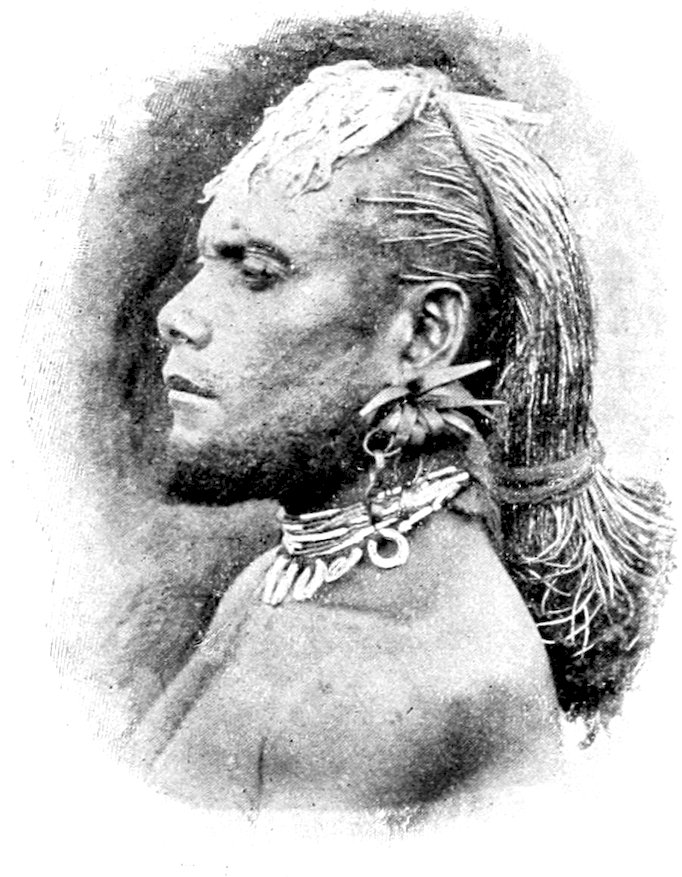
A HEATHEN CHIEF OF FUTUNA.
Showing the hair divided in many locks, tortoise-shell earrings, bead and shell necklace.
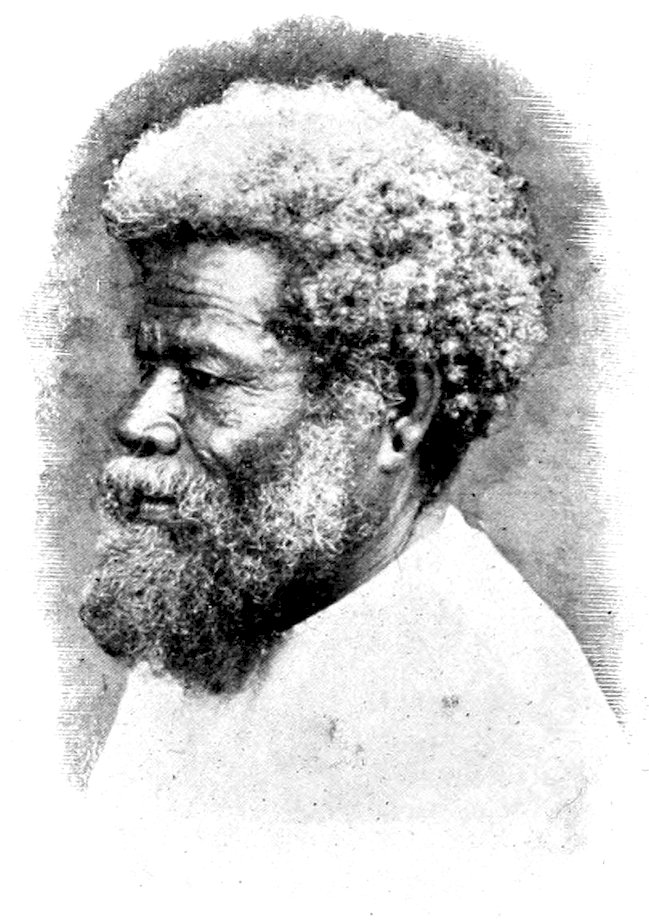
EPETENETO,
The first native pastor in the New Hebrides
97It is easy to raise the shallow cry that the New
Hebrides Mission is overmanned, as compared with
India, China and Africa, as some, and very specially
the same men who most keenly oppose the Dayspring,
are persistently doing. We might answer by
retort,—Your own Towns and Villages are overmanned;
why not resign your charges, and go to the
millions of Heathendom? But we leave that retort
to others, and reply: There are differences in all these
fields of enterprise, which demand specific adaptation
of means to ends, and we fearlessly declare, in the face
of all Christendom, that God Himself has approved of
our system by the almost unparalleled results. We
plant down our European Missionary with his staff
at a given Station. We surround him with Native
Teachers, who pioneer amongst all the Villages within
reach. His life-work is to win that Island, or that
People, for God and Civilization. He masters their
Language, and reduces it to writing. He translates
and prints portions of the Bible. He opens Schools,
and begins teaching the whole population. He opens
a Communicants’ Class, and trains his most hopeful
Converts for full membership in the Church. And
there he holds the fort, and toils, and prays, till the
Gospel of Jesus has not only been preached to every
creature whom he can reach, but also reduced to practice
in the new habits and the new religious and social
98life of the Community. In this way has Aneityum
been won for Christ, and thoroughly Christianized;
and Aniwa, and Erromanga, and Efatè, and Nguna, and
Tongoa, and several adjoining Isles. And, humanly
speaking, there is no other way in which these Tribes
and Peoples can be evangelized. The next stage will
be that of the Native Pastorate, with a very few superintending
European Missionaries—a stage on which,
for instance, my own Aniwa has long since practically
entered, the Elders carrying on all the work of the
Church, with an occasional visit from a neighboring
Missionary. But the foundations of Civilization and
of Christianity must either be laid and solidly built up
by a Missionary for each of these Peoples, or they will
never be laid at all.
Let our Churches then go forward on the lines which
God the Lord hath blessed. Complete the pioneering
work on the New Hebrides, bring the Gospel within
reach of every creature there, and then set free your
money and your men to do the same elsewhere. But
even in India and in China and in Africa, with their
countless millions, learn a lesson from the work on the
New Hebrides. Plant down your forces in the heart
of one Tribe or Race, where the same Language is
spoken. Work solidly from that centre, building up
with patient teaching and lifelong care a Church that
will endure. Rest not till every People and Language
and Nation has such a Christ-centre throbbing in its
midst, with the pulses of the New Life at full play.
Rush not from Land to Land, from People to People,
99in a breathless and fruitless Mission. Kindle not your
lights so far apart, amid the millions and the wastes
of Heathendom, that every lamp may be extinguished
without any of the others knowing, and so leave the
blackness of their Night blacker than ever. The consecrated
Common-sense that builds for Eternity will
receive the fullest approval of God in Time.
Oh that I had my life to begin again! I would consecrate
it anew to Jesus in seeking the conversion of
the remaining Cannibals on the New Hebrides. But
since that may not be, may He help me to use every
moment and every power still left to me to carry forward
to the uttermost that beloved work. Doubtless
these poor degraded Savages are a part of the Redeemer’s
inheritance, given to Him in the Father’s
Eternal Covenant, and thousands of them are destined
through us to sing His praise in the glory and the joy
of the Heavenly World! And should the record of
my poor and broken life lead any one to consecrate
himself to Mission work at Home or Abroad that he
may win souls for Jesus, or should it even deepen the
Missionary spirit in those who already know and serve
the Redeemer of us all—for this also, and for all
through which He has led me by His loving and gracious
guidance, I shall, unto the endless ages of Eternity,
bless and adore my beloved Master and Saviour
and Lord, to whom be glory forever and ever.
Selections from
Fleming H. Revell Company’s
Missionary Lists
New York: 158 Fifth Avenue
Chicago: 63 Washington Street
Toronto: 154 Yonge Street
The Personal Life of David Livingstone.
Chiefly from his unpublished journals and correspondence
in the possession of his family. By W. Garden Blaikie,
D.D., LL.D. With Portrait and Map. New, cheap edition.
508 pages, 8vo, cloth, $1.50.
“There is throughout the narrative that glow of interest which
is realized while events are comparatively recent, with that also
which is still fresh and tender.”—The Standard.
David Livingstone.
His Labors and His Legacy. By A. Montefiore, F.R.G.S.
Missionary Biography Series. Illustrated. 160 pages,
12mo, cloth, 75c.
David Livingstone.
By Mrs. J. H. Worcester, Jr., Missionary Annals Series.
12mo, paper, net, 15c.; flexible cloth, net, 30c.
Reality vs. Romance in South Central Africa.
Being an Account of a Journey across the African Continent,
from Benguella on the West Coast to the mouth of
the Zambesi. By James Johnston, M.D. With 51 full-page
photogravure reproductions of photographs by the
author, and a map. Royal 8vo, cloth, boxed, $4.00.
The Story of Uganda
And of the Victoria Nyanza Mission. By S. G. Stock.
Illustrated. 12mo, cloth, $1.25.
“To be commended as a good, brief, general survey of the
Protestant missionary work in Uganda.”—The Literary World.
Robert Moffat,
The Missionary Hero of Kuruman. By David J. Deane.
Missionary Biography Series. Illustrated. 25th thousand.
12mo, cloth, 75c.
Robert Moffat.
By M. L. Wilder. Missionary Annals Series. 12mo,
paper, net, 15c.; flexible cloth, net, 30c.
The Congo for Christ.
The Story of the Congo Mission. By Rev. John B. Myers.
Missionary Biography Series. Illustrated. Tenth thousand.
12mo, cloth, 75c.
On the Congo.
Edited from Notes and Conversations of Missionaries, by
Mrs. H. Grattan Guinness. 12mo, paper, 50c.
Samuel Crowther, the Slave Boy
Who became Bishop of the Niger. By Jesse Page. Missionary
Biography Series. Illustrated. Eighteenth thousand.
12mo, cloth, 75c.
“We cannot conceive of anything better calculated to inspire
in the hearts of young people an enthusiasm for the cause.”—The
Christian.
Thomas Birch Freeman.
Missionary Pioneer to Ashanti, Dahomey and Egba. By
John Milum, F.R.G.S. Missionary Biography Series. Illustrated.
12mo, cloth, 75c.
“Well written and well worth reading.”—The Faithful Witness.
Seven Years in Sierra Leone.
The Story of the Missionary Work of Wm. A. B. Johnson.
By Rev. Arthur T. Pierson, D.D. 16mo, cloth, $1.00.
Johnson was a missionary of the Church Missionary Society in
Regent’s Town, Sierra Leone, Africa, from 1816 to 1823.
Among the Matabele.
By Rev. D. Carnegie, for ten years resident at Hope Fountain,
twelve miles from Bulawayo. With portraits, maps
and other illustrations. Second edition. 12mo, cloth, 60c.
Peril and Adventure in Central Africa.
Illustrated Letter to the Youngsters at Home. By Bishop
Hammington. Illustrated. 12mo, cloth, 50c.
Madagascar of To-Day.
A Sketch of the Island. With Chapters on its History and
Prospects. By Rev. W. E. Cousins, Missionary of the
London Missionary Society since 1862. Map and Illustrations.
12mo, cloth, $1.00.
Madagascar.
Its Missionaries and Martyrs. By Rev. W. J. Townsend,
D.D. Missionary Biography Series. Illustrated. Tenth
thousand. 12mo, cloth, 75c.
Madagascar.
By Belle McPherson Campbell. Missionary Annals Series.
12mo, paper, net, 15c.; flexible cloth, net, 30c.
Madagascar.
Country, People, Missions. By Rev. James Sibree,
F.R.G.S. Outline Missionary Series. 16mo, paper, 20c.
Chinese Characteristics.
By Rev. Arthur H. Smith, D.D., for 25 years a Missionary
in China. With 16 full-page original Illustrations, and
index. Sixth thousand. Popular edition. 8vo, cloth,
$1.25.
“The best book on the Chinese people.”—The Examiner.
A Cycle of Cathay;
Or, China, South and North. With personal reminiscences.
By W. A. P. Martin, D.D., LL.D., President
Emeritus of the Imperial Tungwen College, Peking.
With 70 Illustrations from photographs and native drawings,
a Map and an index. Second edition. 8vo, cloth
decorated, $2.00.
“No student of Eastern affairs can afford to neglect this work,
which will take its place with Dr. William’s ‘Middle Kingdom,’ as
an authoritative work on China.”—The Outlook.
Glances at China.
By Rev. Gilbert Reid, M.A., Founder of the Mission to
the Higher Classes. Illustrated. 12mo, cloth, 80c.
Pictures of Southern China.
By Rev. James MacGowan. With 80 Illustrations. 8vo,
cloth, $4.20.
A Winter in North China.
By Rev. T. M. Morris. With an Introduction by Rev.
Richard Glover, D.D., and a Map. 12mo, cloth, $1.50.
John Livingston Nevius,
For Forty Years a Missionary in Shantung. By his wife,
Helen S. C. Nevius. With an Introduction by the Rev.
W. A. P. Martin, D.D. Illustrated. 8vo, cloth, $2.00.
The Sister Martyrs of Ku Cheng.
Letters and a Memoir of Eleanor and Elizabeth Saunders,
Massacred August 1st, 1895. Illustrated, 12mo, cloth,
$1.50.
China.
By Rev. J. T. Gracey, D.D. Seventh edition, revised.
16mo, paper, 15c.
Protestant Missions in China.
By D. Willard Lyon, a Secretary of the Student Volunteer
Movement. 16mo, paper, 15c.
MISSIONS, CHINA AND FORMOSA.
James Gilmour, of Mongolia.
His Diaries, Letters and Reports. Edited and arranged
by Richard Lovett, M.A. With three photogravure
Portraits and Illustrations. 8vo, cloth, gilt top, $1.75.
“It is a vivid picture of twenty years of devoted and heroic
service in a field as hard as often falls to the lot of a worker in foreign
lands.”—The Congregationalist.
Among the Mongols.
By Rev. James Gilmour. Illustrated, 12mo, cloth, $1.25.
James Gilmour and His Boys.
Being Letters to his Sons in England. With facsimiles of
Letters, a Map and other Illustrations. 12mo, cloth,
$1.25.
Griffith John,
Founder of the Hankow Mission, Central China. By
William Robson. Missionary Biography Series. Illustrated.
12mo, cloth, 75c.
John Kenneth Mackenzie,
Medical Missionary to China. With the Story of the first
Chinese Hospital. By Mrs. Mary I. Bryson. With portrait.
12mo, cloth, $1.50.
The Story of the China Inland Mission.
By M. Geraldine Guinness. Introduction by J. Hudson
Taylor, F.R.G.S. Illustrated, 2 volumes, 8vo, cloth,
each, $1.50.
From Far Formosa:
The Island, its People and Missions. By Rev. G. L.
Mackay, D.D., 23 years a missionary on the island. Well
indexed. With many Illustrations from photographs by
the author, and several Maps. Fifth thousand. Popular
edition. 8vo, cloth, $1.25.
China and Formosa.
The Story of the Mission of the Presbyterian Church of
England. By Rev. James Johnson, editor of “Missionary
Conference Report, 1888.” With 4 Maps and many
illustrations, prepared for this work. 8vo, cloth, $1.75.
In the Tiger Jungle.
And Other Stories of Missionary Work among the Telugus.
By Rev. Jacob Chamberlain, M.D., D.D., for 37 years a
Missionary in India. Illustrated. 12mo, cloth, $1.00.
“If this is the kind of missionary who mans the foreign stations,
they will never fail for lack of enterprise.... The book is withal
a vivid and serious portrayal of the mission work, and as such
leaves a deep impression on the reader.”—The Independent.
The Child of the Ganges.
A Tale of the Judson Mission. By Prof. R. N. Barrett,
D.D. Illustrated. 12mo, cloth, $1.25.
Adoniram Judson.
By Julia H. Johnston. Missionary Annals Series. 12mo,
paper, net, 15c.; flexible cloth, net, 30c.
Once Hindu, now Christian.
The Early Life of Baba Padmanji. An Autobiography,
translated. Edited by J. Murray Mitchell, M.A. 16mo,
cloth, 75c.
William Carey.
The Shoemaker who became “the Father and Founder of
Foreign Missions.” By Rev. John B. Myers. Missionary
Biography Series. Illustrated. Twenty-second thousand.
12mo, cloth, 75c.
William Carey.
By Mary E. Farwell. Missionary Annals Series. 12mo,
paper, net, 15c.; flexible cloth, net, 30c.
Alexander Duff.
By Elizabeth B. Vermilye. Missionary Annals Series.
12mo, paper, net, 15c.; flexible cloth, net, 30c.
Reginald Heber,
Bishop of Calcutta, Scholar and Evangelist. By Arthur
Montefiore. Missionary Biography Series. Illustrated.
12mo, cloth, 75c.
Heavenly Pearls Set in a Life.
A Record of Experiences and Labors in America, India,
and Australia. By Mrs. Lucy D. Osborn. Illustrated.
12mo, cloth, $1.50.
MISSIONS, PERSIA AND INDIA.
Persian Life and Customs.
With Incidents of Residence and Travel in the Land of the
Lion and the Sun. By Rev. S. G. Wilson, M.A., for 15
years a missionary in Persia. With Map, and other Illustrations,
and Index. Second edition, reduced in price.
8vo, cloth, $1.25.
Justin Perkins,
Pioneer Missionary to Persia. By his son, Rev. H. M.
Perkins. Missionary Annals Series. 12mo, paper, net,
15c.; flexible cloth, net, 30c.
Women and the Gospel in Persia.
By Rev. Thomas Laurie, D.D. Missionary Annals Series.
12mo, paper, net, 15c.; flexible cloth, net, 30c.
Henry Martyn, Saint and Scholar.
First Modern Missionary to the Mohammedans. 1781–1812.
By George Smith, author of “Life of William Carey,”
“The Conversion of India,” etc. With Portrait, Map,
and Illustrations. Large 8vo, cloth, gilt top, $3.00.
“This excellent biography, so accurately written, so full of
interest and contagious enthusiasm, so well arranged, illustrated,
and indexed, is worthy of the subject.”—The Critic.
Henry Martyn.
His Life and Labors: Cambridge—India—Persia. By Jesse
Page. Missionary Biography Series. Illustrated. Eleventh
thousand. 12mo, cloth, 75c.
Henry Martyn.
Missionary to India and Persia. 1781–1812. Abridged
from the Memoir by Mrs. Sarah J. Rhea. Missionary
Annals Series. 12mo, paper, net, 15c.; flexible cloth,
net, 30c.
The Conversion of India.
From Pantænus to the Present Time, A. D. 193–1893. By
George Smith, C.I.E., author of “Henry Martyn.” Illustrated.
12mo, cloth, $1.50.
The Cross in the Land of the Trident.
By Rev. Harlan P. Beach, Educational Secretary of the
Student Volunteer Movement. 5th thousand. 12mo,
paper, net, 25c.; cloth, 50c.
Rambles in Japan,
The Land of the Rising Sun. By Rev. Canon H. B.
Tristram, D.D., F.R.S. With forty-six illustrations by
Edward Whymper, a Map, and an index. 8vo, cloth,
$2.00.
“A delightful book by a competent author, who, as a naturalist,
writes well of the country, while as a Christian and a humanitarian
he writes with sympathy of the new institutions of new Japan.”—The
Independent.
The Gist of Japan:
The Islands, their People, and Missions. By Rev. R. B.
Peery, A.M., Ph.D., of the Lutheran Mission, Saga. Illustrated.
12mo, cloth decorated, $1.25.
This book does not pretend to be an exhaustive treatise of an
exhaustless topic; it does pretend to cover the subject; and
whosoever is eager to know the “gist” of those matters Japanese
in which Westerners are most interested—the land, the people,
the coming of Christianity, the difficulties and prospects of her
missions, the condition of the native Church—will find it set down
in Dr. Peery’s book in a very interesting, reliable, instructive,
and condensed form.
The Ainu of Japan.
The Religion, Superstitions, and General History of the
Hairy Aborigines of Japan. By Rev. John Batchelor.
With 80 Illustrations. 12mo, cloth, $1.50.
“Mr. Batchelor’s book, besides its eighty trustworthy illustrations,
its careful editing, and its excellent index, is replete with
information of all sorts about the Ainu men, women, and children.
Almost every phase of their physical and metaphysical life has been
studied, and carefully noted.”—The Nation.
The Diary of a Japanese Convert.
By Kanzo Uchimura. 12mo, cloth, $1.00.
“This book is far more than the name indicates. It is the only
book of its kind published in the English language, if not in any
language. It is something new under the sun, and is as original as
it is new. It has the earmarks of a strong and striking individuality,
is clear in diction, forceful in style, and fearless in criticism.”—The
Interior.
A Maker of the New Japan.
Joseph Hardy Neesima, the Founder of Doshisha University.
By Rev. J. D. Davis, D.D., Professor in Doshisha. Illustrated.
Second edition. 12mo, cloth, $1.00.
“The life is admirably and spiritedly written, and its hero
stands forth as one of the most romantic and inspiring figures of
modern times, a benefactor to his own country and an object of
tender regard on our part; for it was to the United States that
Mr. Neesima turned for light and help in his educational plans.”—The
Examiner.
MISSIONS, PACIFIC ISLANDS.
John G. Paton,
Missionary to the New Hebrides. An Autobiography,
edited by his brother. With an Introductory Note by Rev.
A. T. Pierson, D.D. Illustrated. Tenth thousand. 2 vols.,
12mo, cloth, gilt top, boxed, net, $2.00; cheaper edition,
1 vol., 12mo, cloth, $1.50.
“We commend to all who would advance the cause of Foreign
Missions this remarkable autobiography. It stands with such books
as those Dr. Livingstone gave the world, and shows to men that
the heroes of the cross are not merely to be sought in past ages.”—The
Christian Intelligencer.
Bishop Patterson,
The Martyr of Melanesia. By Jessie Page. Missionary
Biography Series. Illustrated. Thirteenth thousand.
12mo, cloth, 75c.
James Calvert;
Or, From Dark to Dawn in Fiji. By R. Vernon. Missionary
Biography Series. Illustrated. Tenth thousand.
12mo, cloth, 75c.
From Darkness to Light in Polynesia.
With Illustrative Clan Songs. By Rev. William Wyatt
Gill, LL.D. Illustrated. 12mo, cloth, $2.40.
John Williams,
The Martyr Missionary of Polynesia. By Rev. James J.
Ellis. Missionary Biography Series. Illustrated. Thirteenth
thousand. 12mo, cloth, 75c.
Among the Maoris;
Or, Daybreak in New Zealand. A Record of the Labors
of Marsden, Selwyn, and others. By Jessie Page. Missionary
Biography Series. Illustrated. 12mo, cloth, 75c.
Pioneering in New Guinea,
1877–1894. By James Chalmers. With a Map and 43
Illustrations from Original Sketches and Photographs.
8vo, cloth, $1.50.
“It reveals a splendid character, and records a noble apostolic
work. It is a notable addition to our missionary literature of the
high class.”—The Standard.
James Chalmers,
Missionary and Explorer of Rarotonga and New Guinea.
By William Robson. Missionary Biography Series. Illustrated.
Fourteenth thousand. 12mo, cloth, 75c.
On the Indian Trail,
And Other Stories of Missionary Work among the Cree
and Saulteaux Indians. By Egerton R. Young. Illustrated
by J. E. Laughlin. 12mo, cloth, $1.00.
Mr. Young is well known to readers of all ages as the author
of “By Canoe and Dog Train,” “Three Boys in the Wild North
Land,” and other very popular books describing life and adventure
in the great Northwest. The stories in this new book tell of some
very exciting incidents in his career, and describe phases of life
among the American Indians which are fast becoming things of
the past.
Forty-two Years Among the Indians and Eskimos.
Pictures from the Life of the Rt. Rev. John Horden, first
Bishop of Moosonee. By Beatrice Batty. Illustrated.
12mo, cloth, $1.00.
Vikings of To-Day;
Or, Life and Medical Work among the Fishermen of
Labrador. By Wilfred T. Grenfel, M.D., of the Deep
Sea Mission. Illustrated from Original Photographs.
Second edition. 12mo, cloth, $1.25.
“The author has been in charge of the work since its inception,
and writes, accordingly, with special authority and wealth of detail,
both as to the methods of work and as to the people—the fearless,
patient Vikings—to whom he has dedicated his life.”—The Examiner.
Amid Greenland Snows;
Or, The Early History of Arctic Missions. By Jesse Page.
Missionary Biography Series. Illustrated. Tenth thousand.
12mo, cloth, 75c.
Kin-da-Shon’s Wife.
An Alaskan Story. By Mrs. Eugene S. Willard. Illustrated.
Third edition. 8vo, cloth, $1.50.
“From beginning to end the book holds the attention. Mrs.
Willard has shown herself peculiarly well qualified to write such
a book.”—Public Opinion.
David Brainerd,
The Apostle to the North American Indians. By Jesse
Page. Missionary Biography Series. Illustrated. Twelfth
thousand. 12mo, cloth, 75c.
South America, the Neglected Continent.
By Lucy E. Guinness and E. C. Millard. With a Map
in colors and many other Illustrations. Small 4to, paper,
50c.; cloth, 75c.
- Typos fixed; non-standard spelling and dialect retained.