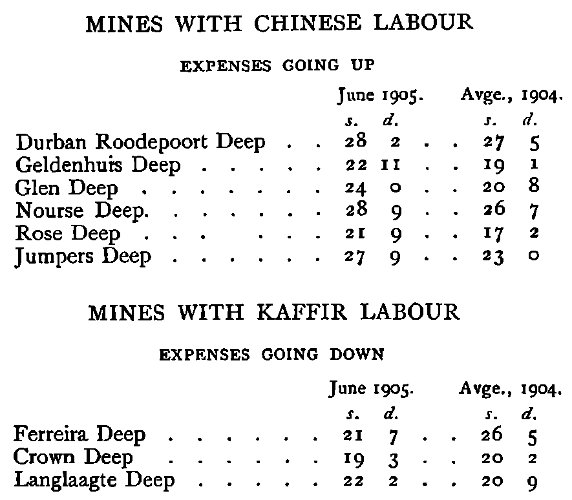
"It must be admitted that the lot of the Chinese labourer does not
promise to be very gay or very happy from our point of view" (extract
from The Times).
Experience has shown that it is not economical to employ Chinese under
the only conditions in which public opinion will allow them to be used,
that is, under semi-servile conditions. This was the experience of all
other parts of the Empire, but it was the last thing to have any weight
with the mine owners. Their one idea of economy was to get labour cheap.
If you deduct 33 to 40 per cent. from the money that has to be paid in
wages, that 33 to 40 per cent. is money saved—is money which will go
to swell the dividends to an amount, so it had been estimated, of two
and a half millions.
The simplicity of this calculation should have given them pause.
Financiers, at least, should be aware that nothing is so untrustworthy
as the abstract profit and loss account. Men who had used figures to
such good advantage should have understood that while on paper the
difference between the price paid to the Chinese and the price paid to
the white or black labourer was profit, in actual practice it would
prove nothing of the sort.
The mine owners have learnt this lesson by now. They have discovered
that Chinese labour is an economical failure.
But in the summer of 1904 they were all eagerness for the coming of the
yellow man. To their imaginations these men were to be nothing better
than slaves. They were to work as long as they wanted them to work at
prices which they would settle themselves. Craftily-concocted laws
enabled them to bring the same sort of brutal pressure to bear upon the
yellow man as the slave owner of old brought upon the black man. He
could be fined, flogged, driven, coerced by all means to tear the gold
from the bowels of the earth at whatever rate the masters might wish.
They had treated the black men pretty much as they liked. But the black
men had the knack of dying in thousands under such treatment (thereby,
as I have already noted, affording hearty amusement for gatherings of
the Chamber of Mines), or of throwing up their work and going back to
their native kraals.
The Rand lord had not had complete control of the black man. Foolish
people at home, influenced by what Lord Milner once called Exeter Hall
sentiments, had insisted that the black man must possess those personal
rights of liberty and freedom which, until recently, were given to all
races who paid allegiance to the Sovereign of the British Dominions
beyond the Seas.
For the first time the mine owner was to have forty to fifty thousand
men who were to live under strict surveillance in a sort of prison
yard, who were to be absolutely at his mercy and at his will, who were
to work every day of the week, Sundays included—the evangelizing
enterprise of the Rector of St. Mary's, Johannesburg, did not seem to
have run to indoctrinating the Rand lords or their slaves with the
principles of the Fourth Commandment—who were to be forced into doing
whatsoever their masters wished by all sorts of ingenious punishments
and penalties.
They of course forgot the all-important factor in this dream of theirs
that a Chinaman will willingly consent to an arrangement which, as The
Times admitted, would make their lot neither very gay nor very happy.
But none the less this was the spirit in which the Chinaman was
recruited in China and first treated on his arrival.
Quite the most frivolous of all the pledges given by Mr. Lyttelton on
behalf of the Rand lords, was one in which he solemnly declared that
to every Chinese labourer recruited from his native land the Ordinance
would be carefully explained by the recruiting officer.
I do not recollect that the House of Commons was moved to an outburst
of Olympian mirth at this most ridiculous statement. If I recollect
aright, the statement was received with that solemn British expression
of approval, "Hear, hear!"
"The Ordinance," said Mr. Lyttelton, "will be explained carefully to
each labourer before he consents to embark for South Africa."
Now, the Ordinance is a long and complicated document. It would be
impossible to explain it to the most intelligent Chinaman in under an
hour. Actually, it would probably take him a whole day to completely
understand the sort of life he was going to lead on the Rand. For one
man to explain the Ordinance to 40,000 of them would have taken about
nine years. At the recruiting offices established in China for the
purpose of obtaining these yellow slaves, it would have taken at least
three years to make all the forty to fifty thousand Chinamen still
working on the Rand to thoroughly understand the Ordinance.
This was a reductio ad absurdum argument, which one would have
thought must have occurred to the minds of the Government, but if it
did occur to them they kept it in the background with due solemnity.
Seeing that the recruiting and sending over to South Africa of more
than 40,000 Chinamen occupied less than a year, it is clear that this
pretence of allowing the Chinaman to enter upon his engagement with
the Rand lords with his eyes open was a pretence, and nothing else.
But even if the simplest arithmetical calculation failed to convince
the Government, their knowledge of human nature should have made them
realize the absurdity of imagining that the recruiting of these men
would be carried out on such principles. The recruiter, whether for the
Army, or for any other purpose, is very much like a barrister with a
brief. He has only to see one side of the argument; he has to close his
mind firmly to all considerations other than the fact that it is his
duty to get men for the particular purpose for which he is recruiting.
Whoever found the recruiting-sergeant telling an embryo Tommy Atkins
about the hardships of a life in the Army, of the punishments to which
he renders himself liable, of the powers of a court-martial, and the
like? He only tells him of the splendid chance he has of serving his
King and country; of his handsome uniform; of the influence of that
uniform on the female breast, and the like. I have met men who have
recruited in South Africa for the Philippines, who have recruited in
England for revolutionary committees for some of the South American
republics, and I know that the one picture that these men do not paint
to their recruits is the picture of their possible hardships. If the
white recruiter acts like this to men of his own colour, how was he
likely to act towards men of a different colour whom centuries of
traditional prejudice led him to regard with contempt and dislike?
I am convinced that ninety-nine out of every hundred of the Chinamen at
present working on the Rand neither knew then nor know now the exact
terms on which they were brought from their homes. Again, it is well
known that the Chinaman has a hereditary dislike to forfeiting his
freedom of action. However bad his Government may be, he has the same
instinct for freedom as the white man in Great Britain. All the best
authorities on China agree that he would never of his own free-will
have consented to bind himself to the Rand lords on the terms set forth
in the Ordinance.
What happened, of course, was that the Chinese local authorities, when
asked to assist in the recruiting of men for the Rand, made out a
list of all the wastrels, semi-criminals and hooligans who kept their
Governments in a state of anarchy and unrest, and forced these men
to indenture themselves. In fact, the situation on the Rand is very
much as if we had emptied our prisons and turned out all our thieves,
murderers and hooligans loose on the veld.
One cannot blame the Chinese Government for so acting. It is a proof
rather that that ancient empire still retains, amidst a great deal that
is bad and corrupt, a spirit of elementary justice.
It would have been criminal to have sent Chinese citizens to the
Transvaal. It was quite another matter to send batches of criminals.
The ease with which men were recruited and shipped to the Transvaal
seemed to confirm the Rand lords in their delusion that at last they
had got hold of people who would increase their dividends for them
without demanding rights and privileges.
The Times had called them masculine machinery. Lord Selborne had
said that they would be crammed in loose-boxes and taken over. When
at first the long procession of pigtails and blue shirts appeared at
Johannesburg they certainly seemed to be so much masculine machinery,
so much cattle to be crammed into cattle-trucks at one port and
unshipped at another.
But all delusions or illusions were soon destroyed.
It was found that the Chinaman actually thought for himself; that he
had a sense of fair play, and that he was not prepared to work like a
horse for a shilling or so a day.
The compounds in which these yellow slaves were herded together are
pieces of land in close proximity to the mine, surrounded by a high
fence, guarded by armed police. They look exactly what in fact they
are—prisons, and nothing else. Hospitals have been erected in each
of the compounds, and an ample supply of gods have been procured for
the Chinamen, possibly as a set-off to the evangelistical zeal of the
Rector of St. Mary's, for there is no knowing what a Chinaman might do
if he became thoroughly inculcated with the doctrines of love and mercy
which were preached in the Sermon on the Mount.
The compound in other respects is very like a village. No one can
go into this village unless he has got some special business or
has obtained a permit. These restrictions serve a double purpose.
They prevent the possibility of a white man or a white woman being
insulted by the slaves, and also put a check upon that inquiry into the
treatment of the yellow men which the Rand lords are moving heaven and
earth to baulk.
The huts in which labourers live are identical with those made for
Kaffirs. They hold one or two, as the case may be.
The labourers have to work day and night in shifts of eight hours. When
it is time for a batch of labourers to begin their shift, they are
herded together and marched off to the mine, care being taken to keep
them quite apart from the Kaffirs and whites.
At the pit mouth they are driven into the cage and dropped down into
the bowels of the earth. When the cage is opened the Chinaman is driven
out, and if he show some hesitation about leaving the cage, he is
kicked out as if he were an animal. At least, that is the treatment to
which they were at first subjected. Now, however, their treatment in
the mine is hardly so severe. Indeed, it would not be too much to say
that the Chinaman now does his share of the "kicking." For example,
on September 23 last, the Chinese at the Lancaster Mine attempted to
murder the skipman by placing a beam in the path of the descending
skip—a collision with which, as a writer in the Daily Mail lately
pointed out, "would have sent the skip a drop of a thousand feet." The
obstruction was noticed. When the skipman got out he was assaulted, but
managed to escape.
The white overseer at first felt that instinctive fear of and dislike
for the Chinaman that is peculiar to all Englishmen. He was one man
against hundreds. In the majority of cases he had been bitterly opposed
to the introduction of Chinese labour. He realized by the restrictions
that had been placed by the Ordinance on the Chinamen that they were
feared, and, in turn, he feared them himself. It was his duty to see
that they worked. It was his duty to make them work. Unable to speak
their language, instinctively disliking them, he used the only means
of asserting his authority which came to his hands: that was generally
a boot or a crowbar. Physical fear is the power by which nearly all
primitive communities are ruled. The white races look upon the Chinamen
as belonging to a primitive community, forgetting that they are the
children of a civilization thousands of years older than any that
exists in Europe.
The white man soon dropped trying to rule by force. The Chinaman showed
him that he feared blows as little as he feared death. If he didn't
want to work he wouldn't work, and showed that fear was not the basis
of Chinese morals. Once in the mine the docile, tractable Chinaman of
the Rand lords' dream did just as he liked, and continues to do just as
he likes.
When he leaves the compound he, perhaps, takes with him half a loaf
of bread. When he feels hungry, he stops work, coils himself upon the
ground, and takes his meal. Let the language of the white man be as
terrible as he is capable of, let him rain blows upon the Chinaman's
back, the Chinaman takes no notice, but continues his meal. When he
has finished his bread he rolls a cigarette, and smokes in calm and
indifferent quietness. If the Englishman remonstrates with him, John
Chinaman replies, "Me get one little shilling. Me do plenttee work for
me pay."
And he speaks the truth. He does quite enough work for a shilling a
day. There is a wide difference between what he considers sufficient
work and what the Rand lords consider sufficient. There is the increase
of two and a half millions which the cosmopolitan mine owner hopes to
make by using the Chinaman as a slave, and which he never will make
either with the Chinaman or the black man. He does his best, however.
The idea that this heathen, whom he has brought over with so much
difficulty, in the face of so much opposition, should actually refuse
to work like a machine, but should have ideas about the time when he
wants to eat, and should even demand a few minutes' quiet smoke after
eating, drives him almost to the point of insanity. It is almost as bad
as those white workmen, who have a mania for forming trade unions and
require fair wages for fair work.
In the face of this Chinese intractableness while working in the
mines, the Rand lords have urged on the white overseers to force the
Chinese to do their work. When the overseer points out that if he
resorts to violence his life will not be worth a moment's purchase, he
is met with the reply that it is his duty to see that the Chinaman does
his work, and if he cannot do that they must find somebody else to take
his place. Under this threat of dismissal, the overseer has had only
one resource. He has had to raise up a race feud, from which he stands
apart.
The Kaffirs already hate the yellow man, realizing that they have
deprived them of their work. The white overseer has fomented this
racial animosity. When the Chinaman has proved recalcitrant and
disobedient, when he has refused to do more than a certain quantity
of work, the overseer turns the black man on to him to force him once
again to his task.
The result is bloodshed and murder of black men and Chinamen.
It is the old problem of leading a horse to the water and trying to
make him drink.
The Chinaman has been dragged from his native land in the face of
the opposition of the whole Empire to increase the dividend paying.
But he won't hurry, he won't work too hard, and in the mine he will
do, as I have said, exactly as he pleases. All illusions as to the
Chinaman's capacity for hard work have vanished. Even Mr. S. B.
Joel—one of the Rand lords—practically admitted as much in his speech
at the annual meeting of the Johannesburg Consolidated Investment
Company on November 23. With much reluctance, as may be imagined, the
light-hearted "Solly" admitted that "the Chinese had not yet proved
quite so suitable for underground work as natives"—but, lest this
statement might affect the market price of the shares, the chairman
of "Johnnies" expressed the hope that they would attain greater
efficiency. No—the Chinaman does not work hard. It is true that he
takes his employment seriously, and that what he does he will do well
and with a certain efficiency. But he is not the masculine machinery or
the cattle of Lord Selborne's imagination. He has enough intelligence
to realize that he is the man who is wanted, and acts accordingly. If
he works for a shilling a day he will only do a shilling's worth of
work. He knows that he must be employed; nobody else can be got to do
his job, and he acts, in fact, just as the Rand lords feared the white
labourer would act. He won't be bullied into doing any more work than
he wants to do. True, he forms no trade unions such as the white men
form, but there is among all the Chinese a much more powerful weapon
of opposition than the trade unions. Every Chinaman has his secret
society, and these societies act together as one man. If the society
decides to stop work, they stop work, and neither the fear of death nor
the most callous or brutal treatment can move them from their purpose.
He hates the white man with the same intensity as the white man hates
him. If he can get the white man into any difficulty he will do so.
His ingenuity for creating trouble is worthy of a better cause. With a
sort of diabolical foresight he realizes exactly the complaints that
will be showered upon the overseer's head by the masters of the mines.
If the output falls, he knows that there will be trouble for the white
man, so he stops work. He squats down and smokes cigarettes, realizing
that by so doing he will be laying up a store of trouble for the
overseer.
To show how much the Chinaman is now the master of the situation on
the Rand I may quote the following instance—On the night of October
24, the Chinese at the Jumpers Deep Mine refused to work until two
of their compatriots, who had been arrested for an infringement of
the mining regulations, were released. Every artifice was resorted
to to get the stubborn Chinamen to resume their toil, but in vain.
Eventually, the Government superintendent of the Chinese, acting under
recently-extended powers, had forty of the head men arrested. Twenty
of these were afterwards sentenced, some to two and others to three
months' hard labour—sentences which probably moved to quiet mirth the
parties most concerned, who could do that sort of punishment "on their
head," so to speak.
It has been said, of course, that the miners along the reef have always
worked against the Chinese. It is not to be wondered at if they have.
Nobody could reasonably blame them—except the Rand lords. But so far
from this being true, the white miners have done their best to work
with them. Even the chairman of the Chamber of Mines has confessed that
the innumerable riots that have occurred down in the mines were not the
result of the white men's machinations. The white man does his best,
but under circumstances without parallel in the history of labour. He
works always with the certain knowledge that at any moment he may be
killed. To him the yellow terror is not a myth or the dream of fiction
writers. He knows what it means. It is present with him every hour
of his work. Down the mine in the stopes a white man has under him
thirty or forty Chinese. If any grievance, real or imaginary, arose,
the Chinese could turn round and take his life. He has no protection
whatever. He has to stand by and listen as best he can to the insults
heaped upon him by the children of the Celestial Empire; and insults
heaped not only upon him but upon his womenfolk. He has to see that
the work is done efficiently, or he is dismissed from his employment.
But there is little wonder that his anger or fear gets the better of
his discretion. It is bad enough that Chinamen are doing the work that
should be done by white men, but it becomes even a greater scandal
when the white men, who sacrificed so much blood and treasure for the
Transvaal, should be insulted by these yellow slaves.
The low-class Chinaman is probably the most bestial and degrading
brute on this earth. He is intelligent enough, but his mind is as vile
and unwholesome as a sewer. The bestial insults which he heaps upon
the white overseers, and, indeed, upon every white man that he comes
across, three years ago would not have been tolerated in any quarter
of the British Empire. It is tolerated to-day in the Transvaal by the
sanction of German Jews and un-British Gentiles.
Lord Selborne, when the matter was brought to his notice, declared—"No
wonder a white miner who has had such language said to him would fail
to have roused within him feelings which would take a certain natural
direction of satisfying themselves. But where has the Chinaman learnt
this kind of language? he did not come here knowing it."
Lord Selborne's implication was, of course, that the Englishmen, in
their conversation in the presence of Chinamen, were accustomed to use
this bestial talk.
I don't pretend that the conversation of miners is always savoury. I am
sure that the method of conversation in vogue in some of the Yorkshire
and Lancashire factories would scandalize decent, quiet-living people,
but such language on the part of the British workman is the result of
his inability to express himself properly. What he says is said for
emphasis. He does not, like a more educated man, add vigour to his
conversation by making use of the endless variations of his mother
tongue; he simply peppers his talk with epithets which in no way are
used in their original meaning. If they were used in their original
meaning, if the British workman really meant what he said, all the
deadly sins in thought or in practice would be committed millions
and millions of times a day. But the Chinaman is noted for his taste
for all the most bestial vices which the imagination of man has ever
conceived. What the miner may say in a coarse moment the Chinaman will
commit without any hesitation.
Lord Selborne asked where the Chinamen learnt this kind of language,
and added that they did not come to the Transvaal knowing it. If Lord
Selborne visited some of the treaty ports in China he would soon become
aware that the Chinaman has added to his taste for committing all the
vile and bestial vices, a knowledge of how to express these vices in
all the vile and bestial language of Europe. As most of the criminal
classes are to be found within the fringe of European civilization, and
as, moreover, the Chinese Government has drafted, with a certain grim
humour, a large number of the criminal classes into the Transvaal, I
think the question as to where the Chinaman learnt his bestial language
is answered equally as well as the statement, that he did not come to
the Transvaal knowing it, is contradicted.
This is the state of affairs in the mines themselves. But if these
yellow slaves are intractable in the mines, they are even more
intractable in the compounds.
What they want to do that they will do, and not all the prisons and
ingeniously-compiled penal laws can prevent them. They soon realized
that if they wished they could be masters of the Rand. They foresaw
that the Rand lord would be chary of using force, would hesitate to put
into execution his slave-owning ideals, for fear of public opinion at
home; that is to say, to put them into full force.
But the Rand lords were not the type of men who would be chary of
impressing upon the Chinamen in secret the full meaning of their
position on the Rand.
As it is the case in the mines, so is it the case in the compounds.
The white man not only hates the yellow man, but fears him. He knows
that at any moment he may be murdered, and with this fear in his heart
has resorted to all sorts of brutality.
The Chinamen can be flogged by law for almost any act. The Ordinance
says that a Chinaman cannot leave the compound without a permit, and
prescribes his life for him on absolute machine-like lines. The amended
Ordinance of July 1904 says that he can be flogged in cases of assault
with intent to commit any offence. Of course, an assault with intent
to commit any offence might consist in hustling his neighbours in an
attempt to escape from his compound, in pushing against the white
overseer, in refusing to work. In short, the law was so ingeniously
amended that the Chinaman could be flogged for anything.
But the law was really not needed. The manager of the Crœsus Mine
admitted that when he considered a Chinaman wrong he had flogged him;
that it might be against the law to flog him, but he had done so, and
would continue to do so.
And he was not only flogged for disobeying the regulations under
which—knowingly, it is said—he had indentured himself, but for
refusing to work. An Ordinance might substitute corporal punishment for
imprisonment in the case of misdemeanours on the part of the Chinaman
and so escape the title of slavery; but to force a man to work by
corporal punishment is nothing but the essence of slavery. And yet
these yellow men have been whipped to their work again and again.
But flogging is no new thing on the Rand, nor is it confined to the
Chinaman. The native knows the sjambok of the Rand lord well enough. "I
well recollect," says Mr. Douglas Blackburn (lately assistant editor of
the defunct Johannesburg Daily Express), writing to The Times on
November 4,—"I well recollect seventy-two boys being flogged before
breakfast one morning in Krugersdorp gaol for the crime of refusing to
work for £2 per month, after being promised £5 by the labour agent."
While these facts are well known in Johannesburg, while there are many
people who openly admit that they have thrashed the coolie, or ordered
him to be thrashed for refusing to do sufficient work, the Rand papers,
which are absolutely under the control of the mine owners, denied
again and again that flogging took place. It was only Mr. Lyttelton's
announcement that flogging must cease that at last compelled them to
admit that flogging had taken place. Mr. Lyttelton had himself denied
on several occasions that the Chinaman was flogged, and his command
therefore that flogging must cease was quite as amazing to the members
of the House of Commons as it was to the Rand lords.
To anybody who has witnessed the development of Chinese slavery on the
Rand, it is almost incomprehensible that there should be any people
at home who deliberately refuse to believe that the Chinaman has been
treated otherwise than as a human being, made in the image of God, with
the rights that belong to all men of justice and freedom. The subject
is as openly discussed, and regarded as a matter of fact on the Rand,
as the Lord Mayor's Show.
I cannot do better than quote from the now famous letters of Mr. Frank
C. Boland to the Morning Leader. These letters show the development
of yellow slavery in a nutshell, show how from flogging the yellow man
to his work the Rand lords finally resorted to torture:—
"At the Nourse Deep severe punishment was meted out. Every boy who
did not drill his thirty-six inches per shift was liable to be, and
actually was, whipped, unless he were ill, and could show that it was a
physical impossibility for him to do a day's work. A sjambok was used;
it was laid on relentlessly by Chinese policemen, the part of the body
selected being the muscles and tendons at the back of the thighs. Even
the sight of blood did not matter. The policeman would go right on to
the last stroke. Having been thus punished, the coolie would walk away;
but after sitting down for a time the bruised tendons would refuse to
work. Many of the coolies were sent to hospital to recover.
"At a later date at this mine strips of rubber were substituted for a
sjambok. This rubber, while causing very sharp pain, does not cut.
"After a time the mine officials found that the coolies were not
maintaining the monthly increase, and the management urged the Chinese
controller to 'do something.' He refused to thrash the coolies unless
they had committed some crime; and being informed by the manager
that his policy would not suit, he gave two months' notice of his
resignation.
"Meanwhile, the management issued instructions, because of advice from
England, that flogging should be stopped as far as possible, but asking
that other forms of punishment should be substituted.
"Thereupon certain forms of torture well known in the Far East were
adopted. One of these was to strip erring coolies absolutely naked,
and leave them tied by their pigtails to a stake in the compound for
two or three hours. The other coolies would gather round and laugh and
jeer at their countrymen, who stood shivering in the intense cold.
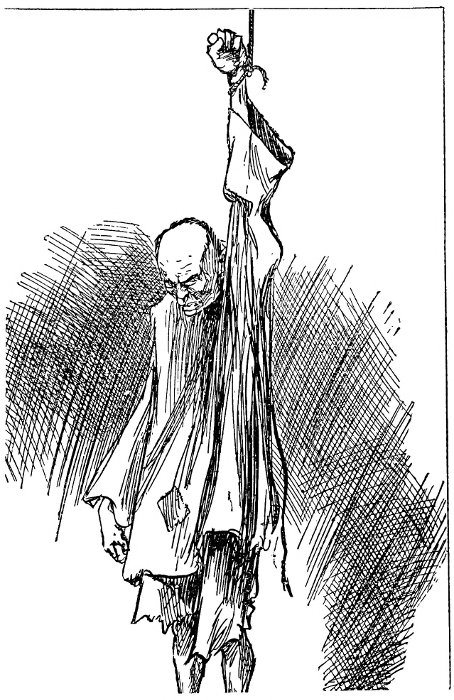
"A more refined form of torture was to bind a coolie's left wrist with
a piece of fine rope, which was then put through a ring in a beam about
nine feet from the ground. This rope was then made taut, so that the
unhappy coolie, with his left arm pulled up perpendicularly, had to
stand on his tip-toes. In this position he was kept, as a rule, for two
hours, during which time, if he tried to get down on his heels, he must
dangle in the air, hanging from the left wrist.
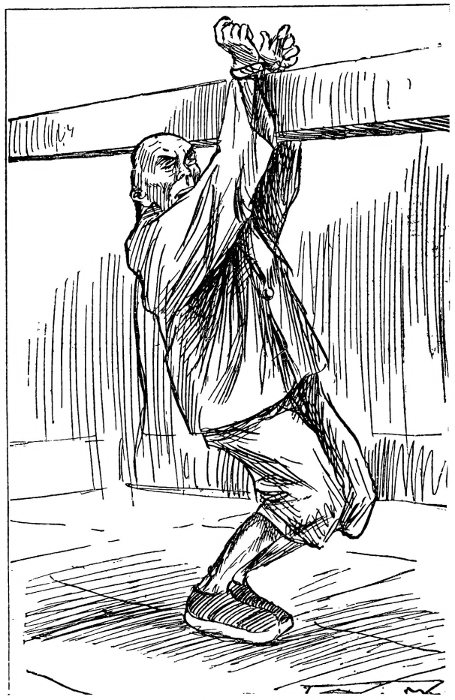
"Every mine has its lock-up for malingerers, deserters, and others. At
the Witwatersrand the coolies are handcuffed over a horizontal beam.
"The floor is of concrete, and they may sit down, but the beam is so
far from the floor that it is impossible for any but exceptionally
tall men to sit while handcuffed. They must therefore squat, and for a
change raise themselves in a semi-standing posture.
INSTEAD OF FLOGGING.
"When released, these prisoners stagger about until they regain the use
of their legs; then they take their skoff and go below to work.
"With the abolition of flogging, compound managers are now inventing
other forms of punishment. In future, also, there will be an
extensive system of fines, and food will be withheld.
"Meanwhile, with all these methods of punishment, the coolies are
still turbulent. Last Monday practically every boy on the Nourse
Deep—seventy-five in all—was sent to gaol for seven days. This step
is certain to foment trouble in the near future."
It was this sort of inquisition that Great Britain had set up at the
point of her bayonets.
Well might the Australian Government say in their letter of
protest—"Australia has been told that the war was a miners' war but
not for Chinese miners, a war for the franchise but not for Chinese
franchise. The truth, if it had to be told, would have presented a
very different aspect, and would have made a very different appeal to
Australia."
It would, indeed, have made a very different appeal to the British
public. Would there have been so much killing of Kruger with our mouths
had we known that a white proletariat would not be wanted—in Lord
Milner's words—that the white labourer was not to be allowed into
the Transvaal because his trade unions would shackle the enterprise
of the Rand lords; that yellow slaves would have to be introduced
in the disguise of indentured labour; that these labourers would be
whipped and tortured into doing their work? Had they known that on the
Witwatersrand the average number of Chinamen flogged daily for one
month was forty-two—Sundays included—would there have been so much
Rule Britannia and music-hall Jingoism?
It is quite true, of course, that had the British people accepted the
principle of importing Chinese labour into the Transvaal it would be
quite fair to blame, as Lord Salisbury was always so fond of blaming,
the system for the cruelty that inevitably followed. But the British
public have never accepted the principle of importing Chinese labourers
into the Transvaal. They have always been deliberately opposed to
it, as has every part of the British Empire. They are not to blame,
therefore, for the state of affairs on the Rand.
As to the insane flogging administered for an offence, it cannot be
better described than by giving another quotation from Mr. Boland's
letter to the Morning Leader. Here is the method of procedure:—
"A coolie is reported either by a white shift boss or by a head-man for
an offence. He is called into the compound manager's office, charged,
and given a fair trial (except where the compound manager does not know
the Chinese language, and has to trust to his yellow interpreter). Then
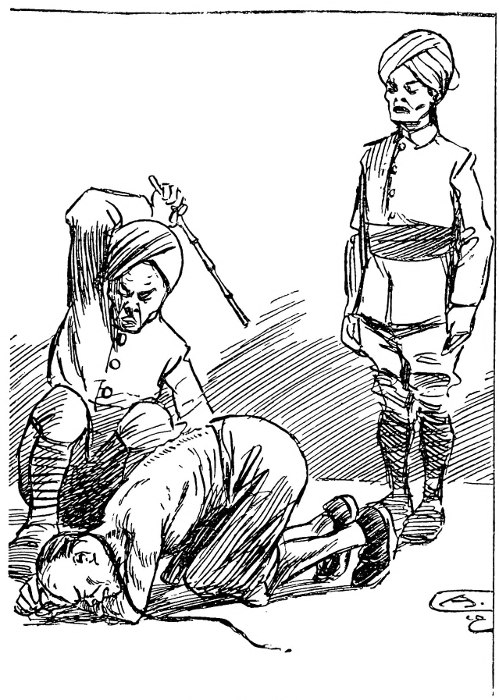
the sentence is passed by the compound manager—ten, fifteen, or twenty
strokes, according to the crime. The coolie, with a Chinese policeman
on either side of him, is taken away about ten paces. Then he stops,
and at the word of a policeman drops his pantaloons, and falls flat on
his face and at full length on the floor. One policeman holds his
feet together; another, with both hands pressed firmly on the back of
his head, looks after that end of his body. Then the flagellator, with
a strip of thick leather on the end of a three-foot wooden handle,
lays on the punishment, severely or lightly, as instructed. Should
the prisoner struggle after the first few strokes, another policeman
plants a foot in the middle of his back until the full dose has been
administered.
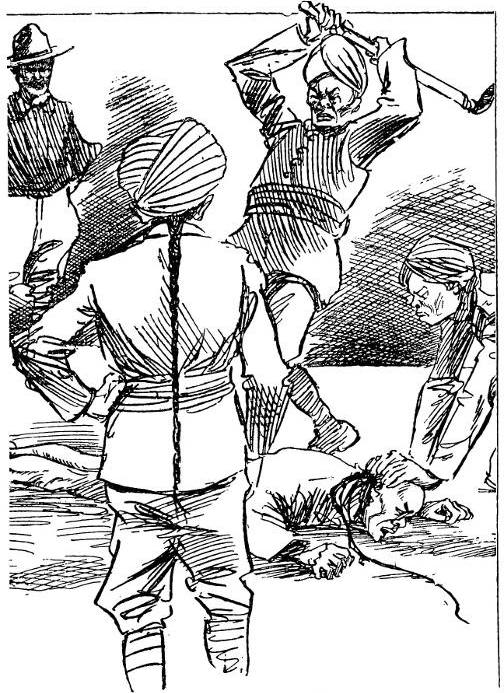
LAYING ON THE PUNISHMENT.
"In another form of flogging practised, a short bamboo was used. The
coolie would strip to the waist and go down on his knees with his head
on the floor. His castigator would then squat beside him, and strike
him across the shoulders with lightning rapidity. The blows, though
apparently light, always fell on the one spot, and raised a large red
weal before cutting the flesh. During the first quarter of this year no
fewer than fifty-six coolies were whipped, after 8 p.m. one evening, at
the Witwatersrand Mine, the dose varying from five to fifteen strokes."
In Mr. Douglas Blackburn's letter to The Times, from which I quoted
just now, we are told that much of the resultant mischief was due
to the incompetence and mismanagement of the men in charge of the
compound. "I assert unequivocally," he says, "that most of the white
interpreters and compound managers had not a working acquaintance
with the Chinese language, and, therefore, frequently misunderstood
the complaints and requests made to them by the coolies.... This is
no place for detail, but the following incident, which occurred in
my presence, may be accepted as typical and illustrative. A compound
manager was examining the passes of a number of coolies. When we
left the compound we were followed by two Chinamen who shouted and
gesticulated violently, and clutched at the arm of the manager. I could
see that he failed to understand them, for he shouted wildly in return,
exhibited signs of great alarm, and eventually knocked them both down,
called the guard, had the pair locked up, and later in the day he
flogged them for insubordination. Next day he confided to me that he
was in fault. He had inadvertently put the passes into his pocket and
misinterpreted the clamouring request for their return into threats
against himself. That manager is now seeking another engagement."
The twenty thousand soldiers who went to their death fighting what they
imagined was for their country, might well, instead of singing "God
save the King" and the like, have marched to the battle-fields of the
Transvaal and the Orange River Colony crying, like the old gladiators,
"Ave, Crœsus, morituri te salutant."
CUTTING THE FLESH.