THE LIFE OF JOHN KNOX.
At the Reformation one half of the lands of Scotland
were the property of the church. David I.
had made over almost the whole of those belonging
to the crown, and his example was imitated, not
only by many of his successors, but by all orders
of men, with whom the founding a monastery, or
endowing a church, was thought to be a sufficient
atonement for the breach of every command in
the decalogue.
Besides the influence derived from the nature
and extent of their property, generally let on lease,
on easy terms, to the younger sons and dependants
of great families, the weight the clergy had in Parliament
was very considerable. The number of temporal
barons being extremely limited, and the lesser
barons and representatives of boroughs looking upon
it as a hardship to attend, combined with the mode
of choosing the Lords of the Articles. Its proceedings
in a great measure were left under their direction
and control.
The Lords of the Articles were a Committee
whose business it was to prepare and digest all matters
that were to be laid before Parliament. Every
motion for a new law was made in this committee,
and approved or rejected by the members of it;
what they approved was formed into a bill, and
presented to Parliament; what they rejected could
not be introduced into the house. This committee
owed the extraordinary powers vested in it to the
military genius of the ancient nobles, and in this
way not only directed all the proceedings of Parliament,
but possessed a negative before debate. It
consisted of eight temporal and eight spiritual lords,
of eight representatives of boroughs, and of eight
great officers of the crown, and when its composition
is considered, it will easily be seen how much
influence it would add to the already too great power
of the clergy.
Their character also was held sacred; neither
were they subject to the same laws, nor tried by
the same judges as the laity, a remarkable instance
of which occurred on the trial of the murderers of
Cardinal Beaton, one of whom was a priest. He
was claimed by a delegate from the clerical courts,
and exempted from the judgement of Parliament
on that account.
By their reputation for learning, they almost
wholly engrossed the high offices of emolument and
trust in the civil government; but even this was
not for acting in their capacity of confessors, they
made use of all these motives which operate so
powerfully on the human mind, to promote the interest
of the church, so that few were allowed to
leave the world without bestowing on her some
marks of their liberality, and where credulity failed
to produce this effect, they called in the aid of law.
(When a person died intestate, by the 22d Statute
of William the Lion, the disposal of his effects was
vested in the bishop of the diocese, after paying his
funeral charges and debts, and distributing among
his kindred the sums to which they were respectively
entitled, it being presumed that no Christian
could have chosen to leave the world without destining
some of his substance to pious purposes.)
Their courts had likewise the cognisance of all testamentary
deeds and matrimonial contracts, and
to these engines of power, and often in their hands
of oppression, they super-added the sentence of excommunication,
which besides depriving the unhappy
victim on whom it fell of all Christian privileges,
cut him off from every right as a man or
citizen. To these, and other causes of a similar
nature, may be ascribed the power of the Popish
church; and to these, also, combined with the celibacy
to which by the rule of their church they were
restricted, may be attributed the dissolute
and licentious lives of the clergy, which in the end destroyed
that reputation for sanctity, the people had
been accustomed to attach to their character.
According to the accounts of the reformers, confirmed
by several popish writers, the manners of the
Scottish clergy were indecent in the extreme. Cardinal
Beaton celebrated the marriage of his eldest
daughter with the son of the Earl of Crawford,
with an almost regal magnificence, and maintained
a criminal correspondence with her mother to the
end of his days. The other prelates were not more
exemplary than their primate, and the contrast between
their lives, and those of the reformers, failed
not to make a considerable impression on the minds
of the people. Instead of disguising their vices the
Popish clergy affected to despise censure; instead
of endeavouring to colour over the absurdity of the
established doctrines, or found them on Scripture,
they left them to the authority of the church and
decrees of the councils; the only apology they have
ever been able, even to the present day, to offer for
the monstrous absurdity of their system. The duty
of preaching was left to the lowest and most illiterate
of the monks.
The following anecdote will give a lively idea of
their mode of preaching:—The prior of the
Black Friars at Newcastle, in a sermon at St Andrews,
asserted that the Paternoster should be said
to God only, and not the saints. This doctrine not
meeting the approbation of the learned of that city,
they appointed a Gray Friar to refute it, who choose
for his text, “Blessed are the poor in spirit,” which
he illustrated in this manner. Seeing we say,
good day, father, to any old man in the street, we
may call a saint pater, who is older than any alive;
and seeing they are in heaven, we may say to any
of them, “Our father who art in heaven;” seeing
they are holy, we may say, “hallowed be thy name;”
and, since they are in the kingdom of heaven, may
add, “thy kingdom come;” and as their will is
God’s will, “thy will be done;” but when he come
to “give us this day our daily bread;” he was much
at a loss confessing it was not in the power of the
saints to give us our daily bread; “yet they may
pray to God for us,” he said, “that he may give
us our daily bread.” The rest of his commentary
being not more satisfactory, set his audience a
laughing and the children on the streets calling after
him, Friar Paternoster, he was so much ashamed
that he left the city.
The only device by which they attempted to
bring back the people to their allegiance was equally
unfortunate and imprudent; they had recourse
to false miracles, which the vigilance of the reformers
detected and exposed to ridicule. The bare-faced
impositions that were practised by the monks
on the credulous, are almost inconceivable.—Among
other customs of those times, it was common for
them to travel to Rome and come home laden with
relics, blessed by his holiness, dispensations for sin,
by which they wheedled the credulous out of their
money. One of these, on a holiday, endeavouring
to vend his wares to the country people, among
other things shewed them a bell with a rent in it,
possessing the virtue of discovering the truth or
fallacy of an oath; for, as he pretended, if any one
swore truly, with his hand on the bell, he could
easily remove it, without any change; but if the
oath was false, his hand would stick to it, and the
bell rent asunder. A farmer, rather more shrewd
than the rest of his auditors, suspecting the truth
of this assertion, asked liberty to take an oath in
the presence of those assembled, about an affair
which nearly concerned him. The monk could not
refuse; and the farmer addressing the crowd, said,
“Friends, before I swear, you see the rent, how
large it is, and that I have nothing on my fingers
to make them stick to the bell.” Then laying his
hand on it, he took this oath.—“I swear, in the
presence of the living God, and before these good
people, that the pope of Rome is Antichrist, and
that all the rabble of his clergy, cardinals, archbishops,
bishops, priests, monks, with all the rest of
the crew, are locust, come from hell, to delude the
people, and to withdraw them from God; moreover,
I promise they will all return to hell;” and lifting
his hand he added. “See, friends, I have lifted
my hand freely from the bell, and the rent
is no larger, this sheweth that I have sworn the
truth.”
The cause of reformed religion, was powerfully
supported by the ambition of the Queen-dowager.
(Mary of Guise) After the death of James V. her
husband, the Earl of Arran, was appointed Regent
of the kingdom during the minority of her
daughter; and from that situation she wished to exclude
him, that she might enjoy the first honours
of the state alone, and promote the designs of her
brothers upon Scotland. For this purpose she applied
to the favourers of the Reformation, as being
the most numerous of the Regent’s enemies, and
forming a respectable body in the state; and although
her promises of protection were insincere,
they, in a very considerable degree, abated the fury
of persecution.
John Knox, who contributed so much, both by
precept and example, to work out the Reformation
from Popery; was the descendant of an ancient
family, and born at Gifford, near Haddington, in
1505. On finishing his education at the grammar
school, he was removed to St. Andrew’s, to complete
his studies under the celebrated John Mair,
by whose instructions he made such progress that
he received orders before the time prescribed by the
rules of the church. After this, he quitted scholastic
learning, so much in reputation at that period,
and applied himself with diligence to the reading
of the fathers of the church, particularly St Angustine,
from which, attending the preaching of one
Thomas Enillam, a Black Friar, and the conversation
of Mr George Wishart, a celebrated reformer,
who came from England in 1545 with the commissioners
sent by Henry VIII. to conclude a treaty
with the Earl of Arran, after the death of James
V. he attained a more than ordinary degree of scriptural
knowledge, and entirely renounced the Roman
Catholic religion.
On leaving St Andrew’s, Mr Knox acted as tutor
to the sons of Douglas of Longniddry, and
Cockburn of Ormiston, whom, besides the different
branches of common education, he carefully instructed
in the principles of the reformed religion, having
composed a catechism for their use, besides reading
lectures to them on various portions of the scriptures.
In this practice he continued till Easter 1547,
when werried out by the repeated persecutions of
Cardinal Beaton, he left Longniddry for St. Andrew’s,
resolved to visit Germany, the state of England
proving unfavourable to his views. Against
taking this step, however, he was persuaded by the
gentlemen whose children he had the charge, to remain
in St. Andrews, the castle of that place being
in the hands of the reformers.
Here he continued to teach his pupils in the usual
manner, but his lectures were now attended by
a number of people belonging to the town, who
earnestly intreated him to preach in public. This
task he at first declined, but afterwards accepted a
call from the pulpit, and in his very first sermon
discovered such zeal, learning, and intrepidity, as
evinced the prudence of their choice, and how eminently
qualified he was for the discharge of those
duties. This success caused such alarm among the
Popish clergy, that a letter was sent to the sub-prior
by the abbot of Paisley, natural brother of the
Regent, who had been nominated to the archbishopric
reproving him for his negligence, in allowing
such doctrines to be taught without opposition. A
meeting of the clergy was held in consequence, and
every scheme they could devise put in practice to
hurt Mr Knox’s usefulness; but, in a public disputation,
he replied to all their arguments with so
much acuteness as completely to silence them, and
gained many proselytes, who made prefession of their
faith by partaking of the communion openly, which
he was the first to administer in the manner practised
at present.
This success was not of long duration, for a body
of French troops was sent to besiege the castle, and
it was compelled to surrender on the 23d July,
when he, along with the garrison, was sent prisoner
to France, and confined in the gallies till the
year 1549. On obtaining his liberty he retired to
England, where he preached sometime at Berwick,
afterwards at Newcastle and London, and was at
last chosen one of the itinerants appointed by Edward
VI. to preach the Protestant doctrine through
England. Upon the death of that prince, on the
6th July, 1553, he went to Geneva, where he resided
when he was chosen by the English church
at Frankfort, on the 24th September, 1554, to
be their pastor, a situation he accepted by the advice
of the celebrated John Calvin, but which he
did not long enjoy, for having opposed the introduction
of the English liturgy, and refused to celebrate
the communion according to the forms prescribed
by it, he was deprived of his office; and,
such was the malice of his enemies, that, taking
advantage of a passage in his “Admonition to
England,” wherein he compares the Emperor to
Nero, and the Queen of England to Jezebel, they
accused him to the magistrates of treason. These
gentlemen perceiving the spirit by which his accusers
were actuated, found means to apprise him
of his danger; and on the 26th march, 1555, he
left Frankfort for Geneva, from whence he proceeded
to Dieppe, and shortly afterwards to Scotland, where
he arrived in the month of August.
On his arrival he found the reformers much increased
in number, and after assisting them to rectify
some errors which had crept into their practice,
accompanied John Erskine of Dun to his seat in
the Mearns, where he continued a month, preaching
to the principle people in that country. He afterwards
resided at Calder-house, the residence of Sir
James Sandilands, where he was attended by a
number of personages of the first rank; and, among
others, by the prior of St Andrew’s afterwards
earl of Moray. During the winter he visited
Edinburgh; preached in many places of Ayrshire;
and in the beginning of 1556, at the request
of the earl of Glencairn, administered the
sacrament of the Lord’s Supper to his lordship’s
family, and a number of friends, at his seat of Finlayston.
In this way did Mr Knox continue preaching,
sometimes in one place, and sometimes in another,
when his success excited so much attention that the
Popish clergy summoned him to appear before them,
on the 15th of May, in the church of the Black
Friars in Edinburgh. He did appear, but attended
by such a number of followers that the clergy
deemed it prudent to desist from their intended
prosecution; and that same day he addressed a
much greater audience than ever he had done on
any prior occasion, and continued to do so for ten
days.
The earl of Glencairn, one of his firmest friends,
prevailed on the earl Marshal, and Mr Henry
Drummond, to attend one of Mr Knox’s sermons,
they were so highly gratified with it that they persuaded
him to address a letter to the Queen, in the
hope she also might be induced to hear the doctrine
of the reformers. In this letter, contending for
the truth of what he taught, he says, “Albeit,
Madam, that the messengers of God are not sent
this day with visible miracles, because they teach
no other doctrine than that which is confirmed with
miracles from the beginning of the world, yet will
not he (who hath promised to take charge over his
poor and little flock to the end) suffer the contempt
of their ambassage to escape punishment and vengeance,
for the truth itself hath said, ‘he that heareth
you heareth one, and he that contemneth you
contemneth one.’ I do not speak unto you, Madam,
as Pasquillus doth to the Pope and his carnal
cardinals, in the behalf of such as dare not utter
their names, but I come in the name of Christ Jesus;
affirming, that the religion ye maintain is
damnable idolatry, which I offer myself to prove,
by the most evident testimony of God’s Scriptures;
and in this quarrel I present myself against all the
Papists in the realm, desiring no other armour but
God’s holy word, and the liberty of my tongue.”
It was delivered to the Queen by the earl of Glencairn,
and by her to the bishop of Glasgow,
(
nephew of Cardinal Beaton) with this observation,
“Please you, my lord, to read a pasquil,” which
coming to the ears of Mr Knox, was the occasion
of his making a number of additions when the letter
was printed afterwards at Geneva.
At this time he received letters from the English
church at Geneva, which had separated from
the one at Frankfort, commanding him, “in God’s
name, as he was their chosen pastor, to repair to
them for their comfort.” Having preached in almost
every congregation he had formerly visited,
and sent his wife and mother-in-law before him to
Dieppe, he sailed from Scotland in the month of
July for Geneva. No sooner had he left the kingdom
than the bishops summoned him to answer a
charge of heresy; and, on his non-appearance,
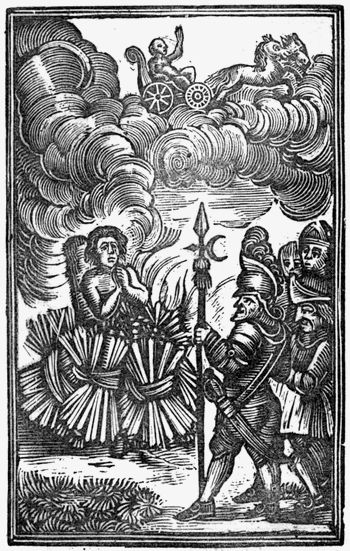
burnt him in effigy at the cross of Edinburgh. Against
this sentence, in 1558, he published his
“Appellation,” addressed to the “Nobility and
Estates of Scotland.” In this composition, which
has been much admired, after appealing “to a lawful
and general council,” and requiring of them that
defence which, as princes of the people, they were
bound to give him, he adds, “these things
I require of your honours to be granted unto me,
viz. that the doctrine which our adversaries condemn
for heresy may be tried by the plain and simple
word of God; that the just defences be admitted
to us that sustain the battle against this pestilent
battle of Antichrist; and that they be removed
from judgment in our cause, seeing that our
accusation is not intended against any one particular
person, but against that whole kingdom which
we doubt not to prove to be a power usurped against
God, against his commandments, and against the
ordinance of Christ Jesus, established in his church
by his chief apostles; yea, we doubt not to prove
the kingdom of the Pope to be the kingdom and
power of Antichrist, and therefore, my lords, I cannot
cease, in the name of Christ Jesus, to require
of you that the matter may come to examination,
and that ye, the estates of the realm, by your authority,
compel such as will be called bishops, not
only to desist from their cruel murdering of such as do
study to promote God’s glory, in detecting and disclosing
the damnable impiety of that man of sin the
Roman Antichrist; but, also, that ye compel them
to answer to such crimes as shall be laid to their
charge, for not righteously instructing the flock
committed to their care.”
In March, 1557, sensible of his importance, a
letter, subscribed Glencairn, Erskine, Lorn, and
James Stuart, was transmitted to Mr Knox at
Geneva, entreating him to return home. Having
communicated its contents to his congregation, for
which he provided another minister, and taking the
advice of John Calvin, and other ministers, he set
out for Scotland.
Addressing himself to the lords who had invited
his return, Mr Knox expostulates with them on
their rash conduct, as having a tendency to cause
both them and him to be evil spoken of.—“For
either,” said he, “it shall appear that I was marvellous
vain, being so solicited, where no necessity
required, or else that such as were my movers thereto
lacked the ripeness of judgment in their first vocation.”
Along with this letter he sent one to the
whole nobility, and others to particular gentlemen,
advising them in what manner they ought to proceed.
On their receipt a new consultation was held,
and a bond subscribed at Edinburgh on the 13th
December, 1557, whereby they agreed to “forsake
and renounce the congregation of Satan, with
all the superstitious abominations and idolatry thereof.”
From this period those subscribing, and their
adherents, were known by the title of the Congregation.
Previous to this agreement, however, a
number of letters were sent off to Mr Knox, and
to John Calvin, that he might use his influence in
persuading him to return.
This year (1558,) the Queen Regent, through
the concurrence of the Protestant party in Parliament,
obtained an act to be passed, conferring the
matrimonial crown on the Dauphin, the husband
of her daughter, the unfortunate Mary. They had
been induced to forward her views in this favourite
scheme, that they might obtain from her an exemption
from that tyranny with which the ancient
laws armed the ecclesiastics against them, and enjoy
the free exercise of their religion. No sooner,
however, had she obtained the gratification of her
wishes, than the accomplishment of a new scheme,
the placing her daughter on the throne of England,
and to which she had been prompted by the
ambition of her brothers, the princes of the house
of Lorraine, at that time in the plenitude of their
power at the Court of France, rendered an union
with the Catholics necessary. It was vain to expect
the assistance of the Scots Protestants to dethrone
Elizabeth, whom all Europe considered as
the most powerful defender of the Reformed faith.
She therefore began to treat them with coldness and
contempt, and not only approved the decrees of a
convocation of the Popish clergy, in which the principles
of the Reformation were condemned, but at
the same time issued a proclamation enjoining the
observance of Easter according to the ritual of the
Romish church.
Alarmed at these proceedings, and still more at
an order summoning all the Reformed clergy in the
kingdom, to attend a court of justice at Stirling, on
the 10th May, 1559, the earl of Glencairn, and
Hugh Campbell of Louden, were deputed to wait
on her and intercede in their behalf. On urging
their peaceable demeanour, and the purity of their
doctrine, she said, “In despite of you, and your
ministers both, they shall be banished out of Scotland,
albeit they preached as true as ever did St.
Paul.” And on pleading her former promises of
protection, she replied, “The promises of princes
ought not to be too carefully remembered, nor the
performance of them exacted unless it suits their
convenience.”
Perth, in the meantime, having embraced the
Reformed religion, added to the rage which agitated
the Queen against the Protestants, and she
commanded the provost (Patrick Ruthven,) to suppress
all their assemblies. The answer of this gentleman
deserves to be recorded for its manly freedom.
“I have power over their bodies and estates,”
said he, “and these I will take care shall
do no hurt; but have no dominion over their consciences.”
The day of trial now approached, and
the town of Dundee, and the gentlemen of Angus
and Mearns, in comformity of an old custom which
prevailed in Scotland, resolved to accompany their
pastors to the place of trial. Intimidated by their
numbers, though unarmed, she prevailed on John
Erskine of Dun, a person of great influence among
them, to stop them from advancing nearer to Stirling,
while she, on her part, promised to take no
further steps towards the intended trial. This proposition
was listened to with pleasure, the preachers
and some of the leaders remained at Perth, and
the multitude quietly dispersed to their respective
homes.
Notwithstanding this promise, on the 10th May,
the queen proceeded to the trial of the persons summoned;
and, on their failing to appear, sentence
of outlawry was pronounced upon them. This open
and avowed breach of faith added greatly to the
public irritation, and the Protestants boldly prepared
for their defence. Mr Erskine having joined
his associates at Perth, his representation of the
Queen’s irreconcilable hatred so inflamed the people,
that scarcely the authority of the magistrates,
or the exhortations of their preachers, could prevent
them from proceeding to acts of violence.
At this juncture, Mr Knox landed in Scotland
from France, and, after residing two days in Edinburgh,
joined his brethren in Perth, that he might
aid them in their cause, and give his confession along
with theirs. On the 11th, the day after the
sentence of outlawry was pronounced, he made a
vehement discourse against idolatry, and while the
minds of the people were yet in a state of agitation,
from the impression made upon them by his sermon,
a priest prepared to celebrate mass, which
made a youth observe, “This is intolerable, that
when God in his word hath plainly condemned
idolatry we shall stand and see it used in despite.”
The irritated priest struck him a blow on the ear,
and the youth in revenge threw a stone at him,
which broke an image of one of the saints. This
was the signal of tumult, and ere two days had
elapsed, all the churches and convents about Perth
were destroyed. Such was the anger of the Queen
on receiving this intelligence, that she avowed to
reduce Perth to ashes, and ordered M. D’Ossal,
the commander of a corps of French auxiliaries, at
that time in the service of Scotland, instantly to
march, and carry her threats into execution. Both
parties, however, were desirous of accommodation,
and a treaty was concluded, in which it was stipulated
that the two armies should be disbanded, the
gates of Perth set open to the queen, but that none
of her French soldiers should approach within three
miles of that city, and that a Parliament should
be immediately held to settle the remaining differences.
No sooner were the Protestant forces disbanded,
than the Queen violated every article of the treaty.
In consequence of which the earl of Argyle, and
the prior of St Andrew’s, who had been her commissioners
for settling the peace, with some other
gentlemen, openly left her. Having warned the
confederates of her intention to destroy St Andrew’s
and Cupar, a considerable army was soon assembled,
which assaulted Crail, broke down the altars and
images, and proceeded thence to St Andrew’s, where
they levelled the Franciscan
and Dominican monasteries
to the ground. The Queen immediately
gave orders to occupy Cupar, with the intention of
attacking them at St Andrew’s, but in this she was
anticipated, an army equal to her own having occupied
the place two days before. Finding herself
too weak to encounter them in the field, she had
again recourse to negotiation; but mindful of her
former duplicity, the Protestants would only agree
to a truce for eight days, by which the Duke of
Chatelherault and D’Ossal became bound to transport
all the French soldiers to the other side of the
Frith, and send commissioners to St Andrew’s with
full powers to conclude a formal treaty of peace.
Several days elapsed without any person appearing
on the part of the queen, and suspecting some
new plan to entrap them, the Protestants, after
concerting measures to expel the French garrison
from Perth, wrote to her Majesty, complaining that
the terms of the first treaty were still unfulfilled,
and begging her to withdraw her troops from that
city in conformity with its stipulations. Their letters
remaining unnoticed, they laid siege to Perth,
which surrendered, after a feeble resistance, on the
26th June, 1559.
Being informed that the Queen resolved to seize
Stirling, and cut off the communication between the
reformers on the opposite sides of the Frith, by a
rapid march they frustrated her plans, and in three
days, after they had made themselves masters of
Perth, the victorious reformers entered Edinburgh.
The Queen on their approach retired to Dunbar,—where
she amused them with hopes of an accommodation,
in the expectation of being joined with reinforcements
from France. Intelligence, in the
meantime, was received of the death of the French
king, which, while it was favourable to the cause of
the reformers, rendered their leaders more negligent
and secure. Numbers of them left the city on their
private affairs, their followers were obliged to disperse
for want of money, and those who did remain
were without discipline or restraint. The Queen
receiving advice of this, by means of her spies, marched
with all the forces she could muster directly to
Edinburgh, and possessed herself, on the 25th of
July, of Leith. She consented, however, to a
truce, to continue till the 5th January, 1560, by
which liberty of conscience was secured; Popery
was not to be established again where it had been
suppressed, the reformers were not to be hindered
from preaching wherever they might happen to be,
and no garrison was to be stationed within the city.
These terms were preserved till she received the
expected reinforcements, when she fortified Leith,
from which all the efforts of the reformers were unable
to dislodge her troops. A mutiny also breaking
out among their soldiers for want of pay, and
having been defeated in two skirmishes with the
French troops, it was resolved, by a majority of the
lords of the congregation, to retire to Stirling. This
rash step was productive of great terror and confusion,
and contrary to the advice of Knox; who, notwithstanding,
followed the fortunes of his friends,
animating and reviving them by his discourses, and
exhorting them to constancy in the good cause.
At a meeting held shortly after their arrival at
Stirling, it was resolved, to despatch William Maitland,
who had lately deserted the Queen’s party to
England, to implore the assistance of Queen Elizabeth,
and a treaty was at last concluded, by which
a body of troops was sent to their assistance. These
being joined by most of the Scottish nobility, a peace
was established on the 8th July, 1560, by which
the reformed religion was fully established in Scotland.
On the abolition of Popery, the form of church
goverment establishment in Scotland was, upon the
model of the church at Geneva, warmly recommended
to his countrymen by Knox, as being farthest
removed from all similarity to the Romish church;
and at his suggestion, likewise, the country was
divided into twelve districts, for the more effectually
propagating the doctrines of the Reformation, of
which Edinburgh was assigned to his care. Knox,
assisted by his brethren afterwards composed a confession
of Faith, and compiled the first books of
discipline for the government of the church. These
were ratified by a convention of Estates, held in the
beginning of the following year (1571), and an act
passed prohibiting mass and abolishing the authority
of the Pope.
On the return of Mary, daughter of Mary of
Guise, from France, and so well known afterwards
throughout all Europe for her beauty, her accomplishments,
and her misfortunes, after the death of
her husband Francis II. the celebration of mass in
the chapel royal excited a great tumult, many crying
out, “The idolatrous papist shall die the death,
according to God’s law;” and John Knox, in a
sermon preached the Sunday following after showing
the judgments inflicted on nations for idolatry,
added, “one mass is more fearful to me than if ten
thousand armed enemies were landed in any part
of the realm, of purpose to suppress the whole religion.”
In consequence of this language he was
sent for by the queen, who accused him of endeavouring
to excite her subjects to rebellion, of having
written against her lawful authority, and of being
the cause of great sedition. To this he answered,
among other things, “that if to teach the word of
God in sincerity, if to rebute idolatry, and to will
a people to worship God according to his word, be
to raise subjects against their princes, then cannot
I be excused; for it hath pleased God in his mercy
to make me one amongst many to disclose unto this
realm the vanity of the papistical religion.—And
touching that book, that seemeth so highly to offend
your majesty, it is most certain that if I wrote it I
am content that all the learned of the land should
judge of it. My hope is, that, so long as ye defile
not your hands with the blood of the saints of God,
that neither I nor that book shall either hurt you
or your authority; for, in very deed, Madam, that
book was written most especially against that wicked
Mary of England.” To a question by the
Queen, if subjects, having power, may resist their
princes? He boldly answered they might, “if
princes do exceed their bounds.” The following
part of the dialogue will give a good idea of the
character of Knox, and the freedom of his speech:
Speaking of the church, the Queen observed, “but
ye are not the church of Rome, for I think it is
the true church of God.” “Your will, Madam,”
said he, “is no reason; neither doth your thought
make that Roman harlot to be the immaculate
spouse of Jesus Christ. And wonder not, Madam,
that I call Rome an harlot, for that church
is altogether polluted with all kinds of spiritual
fornication, as well in doctrine as in matters.” He
had afterwards two other conferences with the queen,
at the last of which she burst into tears, crying
out, “Never prince was used as I am.”
Knox’s situation became very critical in April,
1571, when Kircaldy received the Hamiltons, with
their forces, into the castle. Their inveteracy
against him was so great, that his friends were
obliged to watch his house during the night. They
proposed forming a guard for the protection of his
person when he went abroad; but the governor of
the castle forbade this, as implying a suspicion of
him, and offered to send Melvil, one of his officers,
to conduct him to and from church. “He wold
gif the woulf the wedder to keip,” says Bannatyne.
Induced by the importunity of the citizens, Kircaldy
applied to the Duke and his party for a special
protection to Knox; but they refused to pledge
their word for his safety, because “there were many
rascals and others among them who loved him not,
that might do him harm without their knowledge.”
Intimations were often given him of threatenings
against his life; and one evening, a musket ball was
fired in at his window, and lodged in the roof of the
apartment in which he was sitting. It happened
that he sat at the time in a different part of the
room from that in which he had been accustomed to
take his seat, otherwise the ball, from its direction,
must have struck him. Alarmed by these circumstances,
a deputation of the citizens, accompanied
by his colleague, waited upon him, and renewed a
request which they had formerly made, that he
would remove from Edinburgh, to a place where his
life would be in greater safety, until the Queen’s
party should evacuate the town. But he refused
to yield to them, apprehending that his enemies
wished to intimidate him into flight, that they
might carry on their designs more quietly, and then
accuse him of cowardice. Being unable to persuade
him by any other means, they at last had recourse
to an argument which prevailed. Upon this
he consented, “sore against his will,” to remove
from the city.
In May, 1571, at the desire of his friends, and
for greater security, he left that city for St Andrew’s,
where he remained until the August following.
The cause that forced him to change his residence
having ceased to operate, at the express desire
of his congregation he again returned, but could
not long continue to preside over it, on account of
the exhausted state of his health; and on the 9th
November, abmitted Mr James Lawson, formerly
professor of philosophy at Aberdeen, to be his
successor.
From this time till the 24th of the same month,
when he expired, about eleven o’clock at night, in
the 67th year of his age; his principal employment
was reading the Scriptures and conversing with his
friends; and over his remains, which were accompanied
to the churchyard by the Earl of Morton,
the Regent, and a number of other noblemen, and
people of all ranks, his lordship pronounced the following
eulogium: “Here lies a man, who in his
life never feared the face of man; who hath been
often threatened with dag and dagger, but yet hath
ended his days in peace and honour.”
FINIS.
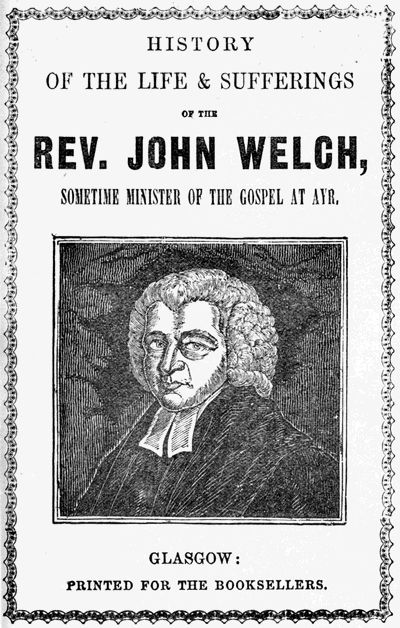
THE LIFE OF JOHN WELCH.
Mr. John Welch was born a gentleman, his father
being laird of Colieston, (an estate rather competent,
than large, in the shire of Nithsdale) about
the year 1570, the dawning of our reformation
being then but dark. He was a rich example of
grace and mercy, but the night went before the
day, being a most hopeless extravagant boy: it was
not enough to him, frequently when he was a young
stripling to run away from the school and play the
truant; but after he had passed his grammar, and
was come to be a youth, he left the school, and his
father’s house, and went and joined himself to the
thieves on the English border, who lived by robbing
the two nations, and amongst them he stayed till
he spent a suit of clothes. Then he was clothed
only with rags, the prodigal’s misery brought him
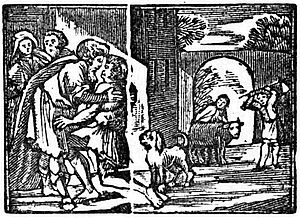
to the prodigal’s resolution, so he resolved to
return to his father’s house, but durst not adventure,
till he should interpose a reconciler. So in
his return homeward, he took Dumfries in his way
where he had an aunt, one Agnes Forsyth, and with
her he diverted some days, earnestly entreating her
to reconcile him to his father. While he lurked in
her house, his father came providentially to the
house to salute his cousin, Mrs. Forsyth; and after
they had talked a while, she asked him, whether he
had ever heard any news of his son John; to her
he replied with great grief, O cruel woman, how
can you name his name to me? The first news I
expect to hear of him, is, that he is hanged for a
thief. She answered, many a profligate boy had
become a virtuous man, and comforted him. He
insisted upon his sad complaint, but asked whether
she knew his lost son was yet alive. She answered,
Yes, he was, and she hoped he should prove a better
man than he was a boy, and with that she called
upon him to come to his father. He came weeping
and kneeled, beseeching his father, for Christ’s
sake, to pardon his misbehaviour, and deeply engaged
to be a new man. His father reproached him
and threatened him. Yet, at length, by the boy’s
tears, and Mrs. Forsyth’s importunities, he was
persuaded to a reconciliation. The boy entreated
his father to send him to the college, and there to
try his behaviour, and if ever thereafter he should
break, he said he should be content his father should
disclaim him for ever: so his father carried him
home, and put him to the college, and there he
became a diligent student, of great expectation,
and shewed himself a sincere convert, and so he
proceeded to the ministry.
His first post in the ministry was at Selkirk,
while he was yet very young, and the country rude;
while he was there, his ministry was rather admired
by some, than received by many; for he was
always attended by the prophet’s shadow, the
hatred of the wicked; yea, even the ministers of
the country, were more ready to pick a quarrel
with his person, than to follow his doctrine, as may
appear to this day in their synodical records, where
we find he had many to censure him, and only some
to defend him; yet it was thought his ministry in
that place was not without fruit, though he stayed
but a short time there. Being a young man unmarried,
he lodged himself in the house of one
Mitchelhill, and took a young boy of his to be his
bed-fellow, who to his dying day retained both a
respect to Mr. Welch and his ministry, from the
impressions Mr. Welch’s behaviour made upon his
mind though but a child.
The special cause of his leaving Selkirk, was a
profane gentleman in the country (one Scot of
Headschaw, whose family is now extinct) but
because Mr. Welch had either reproved him, or
merely from hatred, Mr. Welch was most unworthily
abused by the unhappy man, amongst the rest
of the injuries he did him, this was one, Mr. Welch
kept always two good horses for his use, and the
wicked gentleman when he could do no more,
either with his own hand, or his servants, cut off
the rumps of the two innocent beasts, upon which
followed such effusion of blood, that they both died,
which Mr. Welch did much resent, and such base
usage as this persuaded him to listen to a call to
the ministry at Kirkcudbright, which was his next
post.
But when he was about to leave Selkirk, he
could not find a man in all the town to transport
his furniture, except one Ewart, who was at that
time a poor young man, but master of two horses,
with which he transported Mr. Welch’s goods, and
so left him, but as he took his leave, Mr. Welch
gave him his blessing, and a piece of gold for a
token, exhorting him to fear God, and promised he
should never want, which promise, providence made
good through the whole course of his life, as was
observed by all his neighbours.
At Kirkcudbright he stayed not long; but there
he reaped a harvest of converts, which subsisted
long after his departure, and were a part of Mr.
Samuel Rutherfoord’s flock, though not his parish,
while he was minister at Anwith: yet when his
call to Ayr came to him, the people of the parish
of Kirkcudbright never offered to detain him, so
his transportation to Ayr was the more easy.
Mr. Welch was transported to Ayr in the year
1590, and there he continued till he was banished,
there he had a very hard beginning, but a good
ending; for when he came first to the town, the
country was so wicked, and the hatred of godliness
so great, that there could not be found one in all
the town, that would let him a house to dwell in,
so he was constrained to accommodate himself in
the best he might, in a part of a gentleman’s house
for a time, the gentleman’s name was John Stewart,
he was an eminent Christian, and a great assistant
of Mr. Welch.
And when he had first taken up his residence in
that town, the place was so divided into factions,
and filled with bloody conflicts, a man could hardly
walk the streets with safety; wherefore Mr. Welch
made it his first undertaking to remove the bloody
quarrelings, but he found it a very difficult work;
yet such was his earnestness to pursue his design,
that many times he would rush betwixt two parties of
men fighting, even in the midst of blood and wounds.
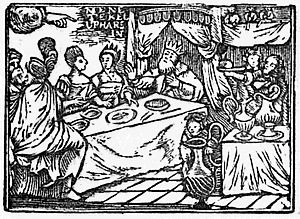
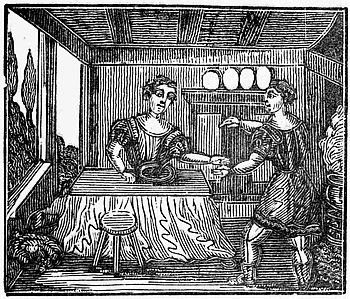
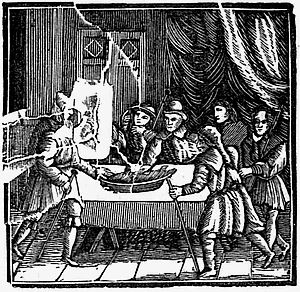
His manner was, after he had ended a skirmish
amongst his neighbours, and reconciled these bitter
enemies, to cause them to cover a table upon the
street, and there brought the enemies together, and
begining with prayer he persuaded them to protest
themselves friends, and then to eat and drink
together, then last of all, he ended the work with
singing a psalm: after the rude people began to
observe his example, and listen to his heavenly
doctrine, he came quickly to that respect amongst
them that he became not only a necessary counsellor,
without whose counsel they would do nothing,
but an example to imitate, and so he buried the
bloody quarrels.
He gave himself wholly to ministerial exercises,
he preached once every day, he prayed the third
part of his time, was unwearied in his studies, and
for a proof of this, it was found among his papers,
that he had abridged Suarez’s metaphysics, when
they came first to his hand, even when he was well
stricken in years. By all which, it appears, that
he has not only been a man of great diligence but
also of a strong and robust natural constitution,
otherwise he had never endured the fatigue.
But if his diligence was great, so it is doubted
whether his sowing in painfulness, or his harvest
in his success was greatest; for if either his spiritual
experiences in seeking the Lord, or his fruitfulness
in converting souls be considered, they will be
found unparalleled in Scotland: and many years
after Mr. Welch’s death, Mr. David Dickson, at
that time a flourishing minister at Irvine, was
frequently heard to say, when people talked to him
of the success of his ministry, that the grape
gleanings in Ayr, in Mr. Welch’s time, were far
above the vintage of Irvine, in his own. Mr.
Welch, in his preaching, was spiritual and searching,
his utterance tender and moving; he did not much
insist upon scholastic purposes, he made no shew
of his learning. I once heard one of his hearers
say, That no man could hear him and forbear
weeping, his conveyance was so affecting.
There is a large volume of his sermons, now in Scotland,
wherein he makes it appear, his learning was
not behind his other virtues: this also appears in another
piece, called Dr. Welch’s Armagaddon, printed,
I suppose, in France, wherein he gives his meditation
upon the enemies of the church, and their destruction;
but the piece itself is rarely to be found.
Sometimes before he went to sermon, he would
send for his elders, and tell them, he was afraid to
go to pulpit because he found himself sore deserted;
and thereafter desire one or more to pray, and then
he would venture to pulpit. But, it was observed,
this humbling exercise used ordinarily to be followed,
with a flame of extraordinary assistance: so
near neighbours are many times contrary dispositions
and frames. He would many times retire to
the church of Ayr, which was at some distance
from the town, and there spend the whole night in
prayer: for he used to allow his affections full expression,
and prayed not only with audible, but
sometimes, loud voice, nor did he irk, in that
solitude, all the night over, which hath, it may be,
occasioned the contemptible slander of some
malicious enemies, who were so bold as to call him
no less than a witch.
There was in Ayr, before he came to it, an aged
man a minister of the town, called Porterfield, the
man was judged no bad man, for his personal inclinations,
but so easy a disposition, that he used
many times to go too great a length with his
neighbours in many dangerous practices; and
amongst the rest, he used to go to the bow-butts
and archery, on Sabbath afternoon, to Mr. Welch’s
great dissatisfaction. But the way he used to
reclaim him, was not bitter severity, but this gentle
policy; Mr. Welch together with John Stewart,
and Hugh Kennedy, his two intimate friends, used
to spend the Sabbath afternoon in religious conference
and prayer, and to this exercise they invited
Mr. Porterfield, which he could not refuse, by
which means he was not only diverted from his
former sinful practice, but likewise brought to a
more watchful, and edifying behaviour in his course
of life.
He married Elizabeth Knox, daughter to the
famous Mr. John Knox, minister at Edinburgh,
the apostle of Scotland, and she lived with him
from his youth till his death. By her I have heard
he had three sons: the first was called Dr. Welch,
a doctor of medicine, who was killed in the low
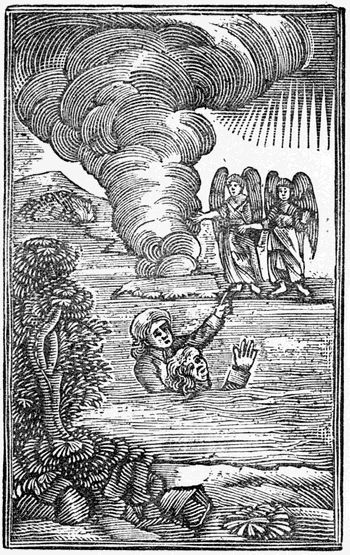
countries, and of him I never heard more. Another
son he had most lamentably lost at sea, for when
the ship in which he was embarked was sunk, he
swam to a rock in the sea, but starved there for
want of necessary food and refreshment, and when
sometime afterward his body was found upon the
rock, they found him dead in a praying posture
upon his bended knees, with his hands stretched
out, and this was all the satisfaction his friends and
the world had upon his lamentable death, so bitter
to his friends. Another he had who was heir to
his father’s grace and blessings, and this was Mr.
Josias Welch, minister at Temple-Patrick in the
north of Ireland, commonly called the Cock of the
Conscience by the people of that country, because
of his extraordinary wakening and rousing gift: he
was one of that blest society of ministers, which
wrought that unparalleled work in the north of
Ireland, about the year 1636, but was himself a
man most sadly exercised with doubts about his
own salvation all his time, and would ordinarily
say, That ministers was much to be pitied, who
was called to comfort weak saints and had no
comfort himself. He died in his youth, and left
for his successor, Mr. John Welch minister at Iron-Gray
in Galloway, the place of his grandfather’s
nativity. What business this made in Scotland, in
the time of the late Episcopal persecution, for the
space of twenty years, is known to all Scotland.
He maintained his dangerous post of preaching the
gospel upon the mountains of Scotland, notwithstanding
of the threatnings of the state, the hatred
of the bishops, the price set upon his head, and all
the fierce industry of his cruel enemies. It is well
known that bloody Claverhouse upon secret information
from his spies, that Mr. John Welch was to
be found at some lurking place at forty miles
distance, would make all that long journey in one
winter’s night, that he might catch him, but when
he came he always missed his prey. I never heard
of a man that endured more toil, adventured upon
more hazards, escaped so much hazard, not in the
world. He used to tell his friends who counselled
him to be more cautious, and not to hazard himself
so much, That he firmly believed dangerous undertakings
would be his security, and when ever he
should give over that course and retire himself, his
ministry should come to an end; which accordingly
came to pass, for when after Bothwell bridge, he
retired to London, the Lord called him by death,
and there he was honourably buried, not far from
the king’s palace.
But to return to our old Mr. Welch; as the duty
wherein he abounded and excelled most was prayer,
so his greatest attainments fell that way. He used
to say, He wondered how a Christian could lie in
bed all night, and not rise to pray, and many times
he watched. One night he rose from his wife, and
went into the next room, where he stayed so long
at secret prayer, that his wife fearing he might
catch cold, was constrained to rise and follow him,
and as she hearkened, she heard him speak as by
interrupted sentences, Lord wilt thou not grant me
Scotland, and after a pause, Enough, Lord, enough,
and so she returned to her bed, and he following
her, not knowing she had heard him, but when he
was by her, she asked him what he meant by saying,
Enough, Lord, enough. He shewed himself dissatisfied
with her curiosity, but told her, he had
been wrestling with the Lord for Scotland, and
found there was a sad time at hand, but that the
Lord would be gracious to a remnant. This was
about the time when bishops first overspread the
land, and corrupted the church. This was more
wonderful I am to relate, I heard once an honest
minister, who was a parishioner of Mr. Welch
many a day, say, ‘That one night as he watched in
his garden very late, and some friends waiting upon
him in his house and wearying because of his long
stay, one of them chanced to open a window toward
the place where he walked, and saw clearly a strange
light surrounding him, and heard him speak strange
words about his spiritual joy,’ I do neither add nor
alter, I am the more induced to believe this that I
have heard from as good a hand as any in Scotland,
that a very godly man, though not a minister, after
he had spent a whole night in a country house, in
the muir, declared confidently, he saw such an
extraordinary light as this himself, which was to
him both matter of wonder and astonishment.
But though Mr. Welch had upon the account of his
holiness, abilities, and success, acquired among his
subdued people, a very great respect, yet was he
never in such admiration, as after the great plague
which raged in Scotland in his time.
And one cause was this: The magistrates of Ayr,
forasmuch as this town alone was free, and the
country about infected, thought fit to guard the
ports with sentinels, and watchmen; and one day
two travelling merchants, each with a pack of cloth
upon a horse, came to the town desiring entrance
that they might sell their goods producing a pass
from the magistrates of the town whence they came
which was at that time sound and free; yet not
withstanding all this the sentinels stopt them till
the magistrates were called; and when they came,
they would do nothing without their minister’s
advice: so Mr. Welch was called, and his opinion
asked; he demurred, and putting off his hat with
his eyes toward heaven for a pretty space, though
he uttered no audible words, yet continued in a
praying gesture: and after a little space told the
magistrates they would do well to discharge these
travellers their town, affirming with great asseveration,
the plague was in their packs, so the magistrates
commanded them to be gone, and they went
to Cumnock, a town some twenty miles distant,
and there sold their goods, which kindled such an
infection in that place, that the living were hardly
able to bury their dead. This made the people
begin to think Mr. Welch as an oracle. Yet as he
walked with God, and kept close with him, so he
forgot not man, for he used frequently to dine
abroad with such of his friends, as he thought were
persons with whom he might maintain the communion
of the saints; and once in the year he used
always to invite all his familiars in the town to a
treat in his house, where there was a banquet of
holiness and sobriety.
And now the scene of his life begins for to alter;
but before his blessed sufferings, he had this strange
warning.
One night he rose from his wife, and went into
garden, as his custom was, but stayed longer than
ordinary, which troubled his wife, who, when he
returned, expostulated with him very hard, for his
staying so long to wrong his health; he bid her be
quiet, for it should be well with them. But he
knew well, he should never preach more at Ayr;
and accordingly before the next Sabbath, he was
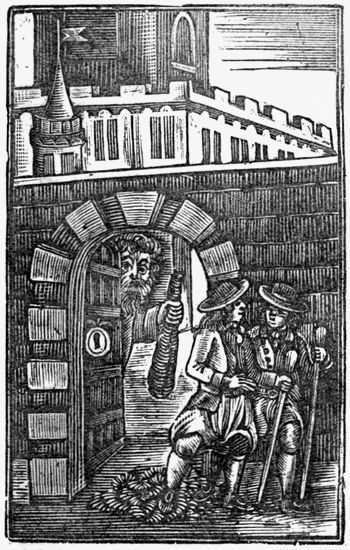
carried prisoner to Blackness castle. After that,
he, with many others were brought before the
council of Scotland, at Edinburgh, to answer for
their rebellion and contempt, in holding a general
assembly, not authorised by the king. And because
they declined the secret council, as judges competent
in causes purely spiritual, such as the nature
and constitution of a general assembly is, they were
first remitted to the prison at Blackness, and other
places. And thereafter, six of the most considerable
of them, were brought under night from
Blackness to Linlithgow before the criminal judges,
to answer an accusation of high treason, at the
instance of Sir Thomas Hamilton, king’s advocate,
for declining, as he alledged, the king’s lawful
authority, in refusing to admit the council judges
competent in the cause of the nature of church
judicatories; and after their accusation, and answer
was read, by the verdict of a jury of very considerable
gentlemen, condemned as guilty of high
treason, the punishment continued till the king’s
pleasure should be known, and thereafter their
punishment was made banishment, that the cruel
sentence might someway seem to soften their severe
punishment as the king had contrived it.
But before he left Scotland, some remarkable
passages in his behaviour are to be remembered.
And first when the dispute about church-government
began to warm; as he was walking upon the
street of Edinburgh, betwixt two honest citizens,
he told them, they had in their town two great
ministers, who were no great friends to Christ’s
cause, presently in controversy, but it should be
seen, the world should never hear of their repentance.
The two men were Mr. Patrick Galloway,
and Mr. John Hall; and accordingly it came to
pass, for Mr. Patrick Galloway died easing himself
upon his stool; and Mr. John Hall, being at that
time in Leith, and his servant woman having left
him alone in his house while she went to the
market, he was found dead all alone at her return.
He was sometime prisoner in Edinburgh castle
before he went into exile, where one night sitting at
supper with the lord Ochiltry, who was an uncle to
Mr. Welch’s wife, as his manner was, he entertained
the company with godly and edifying discourse,
which was well received by all the company save
only one debauched popish young gentleman, who
sometimes laughed, and sometimes mocked and
made faces; whereupon Mr. Welch brake out into
a sad abrupt charge upon all the company to be
silent, and observe the work of the Lord upon that
prophane mocker, which they should presently
behold; upon which immediately the prophane
wretch sunk down and died beneath the table, but
never returned to life again, to the great astonishment
of all the company.
Another wonderful story they tell of him at the
same time; the lord Ochiltry the captain, being
both sons to the good lord Ochiltry, and Mr. Welch’s
uncle in law, was indeed very civil to Mr. Welch,
but being for a long time, through the multitude
of affairs, kept from visiting Mr. Welch in his
chamber, as he was one day walking in the court,
and espying Mr. Welch at his chamber window
asked him kindly how he did, and if in any thing
he could serve him. Mr. Welch answered him,
He would earnestly entreat his lordship, being at
that time to go to court, to petition king James in
his name, that he might have liberty to preach the
gospel; which my lord promised to do. Mr. Welch
answered, my lord, both because you are my
kinsman, and other reasons, I would earnestly
entreat, and obtest you not to promise except you
faithfully perform. My lord answered, He would
faithfully perform his promise; and so went for
London. But though at his first arrival he was
really purposed to present the petition to the king,
but when he found the king in such a rage against
the godly ministers, that he durst not at that time
present it, so he thought fit to delay it, and thereafter
fully forgot it.
The first time that Mr. Welch saw his face after
his return from court, he asked him what he had
done with his petition. My lord answered he, had
presented it to the king, but that the king was in
so great a rage against the ministers at that time,
he believed it had been forgotten, for he had gotten
no answer. Nay said Mr. Welch to him, My lord
you should not lye to God, and to me, for I know
you never delivered it, though I warned you to
take heed not to undertake it, except you would
perform it; but because you have dealt so unfaithfully,
remember God shall take from you both
estate and honours, and give them to your neighbour
in your own time: which accordingly came to
pass, both his estate and honours were in his own
time transmitted to James Stewart son to captain
James, who was indeed a cadet, but not the lineal
heir of the family.
While he was detained prisoner in Edinburgh
castle, his wife used for the most part to stay in
his company, but upon a time fell into a longing
to see her family in Ayr, to which with some
difficulty he yielded; but when she was to take her
journey, he strictly charged her not to take the
ordinary way to her own house, when she came to
Ayr, nor to pass by the bridge through the town, but
to pass the river above the bridge, and so get the
way to her own house, and not to come into the
town, for, said he, before you come thither, you
shall find the plague broken out in Ayr, which
accordingly came to pass.
The plague was at that time very terrible, and
he being necessarily separate from his people, it
was to him the more grievous; but when the
people of Ayr came to him to bemoan themselves,
his answer was, that Hugh Kennedy, a godly
gentleman in their town, should pray for them, and
God should hear him. This counsel they accepted,
and the gentleman convening a number of the
honest citizens, prayed fervently for the town, as
he was a mighty wrestler with God, and accordingly
after that the plague decreased.
Now the time is come he must leave Scotland,
and never to see it again, so upon the seventh of
November 1606 in the morning, he with his
neighbours took ship at Leith, and though it was
but two o’clock in the morning, many were waiting
on with their afflicted families, to bid them farewell.
After prayer, they sung the xxiii psalm, and so
set sail for the south of France, and landed in
the river of Bourdeaux. Within fourteen weeks
after his arrival, such was the Lord’s blessing
upon his diligence, he was able to preach in
French, and accordingly was speedily called to
the ministry, first in one village, then in another;
one of them was Nerac, and thereafter settled in
Saint Jean d’ Angely, a considerable walled town,
and there he continued the rest of the time he sojourned
in France, which was about sixteen years.
When he began to preach, it was observed by some
of his hearers, that while he continued in the
doctrinal part of his sermon, he spoke very correct
French, but when he came to his application and
when his affections kindled, his fervour made him
sometimes neglect the accuracy of the French
construction: but there were godly young men who
admonished him of this, which he took in very good
part, so for preventing mistakes of that kind, he
desired the young gentlemen, when they perceived
him beginning to decline, to give him a sign, and
the sign was, that they were both to stand up upon
their feet, and thereafter he was more exact in his
expression through his whole sermon; so desirous
was he, not only to deliver good matter, but to
recommend it in the neat expression.
There were many times persons of great quality
in his auditory, before whom he was just as bold
as ever he had been in a Scots village; which
moved Mr. Boyd of Trochrig once to ask him,
(after he had preached before the university of
Samure with such boldness and authority, as if he
had been before the meanest congregation) how he
could be so confident among strangers, and persons
of such quality! to which he answered, That he
was so filled with the dread of God, he had no
apprehension from man at all; and this answer,
said Mr. Boyd, did not remove my admiration, but
rather increased it.
There was in his house amongst many others,
who tabled with him for good education, a young
gentleman of great quality, and suitable expectations,
and this was the heir of the lord Ochiltry,
who was captain of the castle of Edinburgh. This
young nobleman, after he had gained very much
upon Mr. Welch’s affections, fell sick of a grievous
sickness, and after he had been long wasted with
it, closed his eyes, and expired as dying men used
to do, so to the apprehension and sense of all spectators,
he was no more but a carcase, and was
therefore taken out of his bed, and laid upon a
pallat on the floor, that his body might be the more
conveniently dressed, as dead bodies used to be.
This was to Mr. Welch a very great grief, and
therefore he stayed with the young man’s dead
body full three hours, lamenting over him with
great tenderness. After twelve hours, the friends
brought in a coffin, whereunto they desired the
corps to be put, as the custom is: but Mr. Welch
desired, that for the satisfaction of his affections,
they would forbear the youth for a time, which
they granted, and returned not till twenty four
hours, after his death, were expired; then they
returned, with great importunity the corps might
be coffined, that it might be speedily buried, the
weather being extremely hot; yet he persisted in his
request, earnestly begging them to excuse him for
once more; so they left the youth upon his pallat
for full thirty six hours: but even after all that,
though he was urged, not only with great earnestness,
but displeasure, they were constrained to forbear
for twelve hours yet more; and after forty eight
hours were past, Mr. Welch was still where he was,
and then his friends perceived that he believed the
young man was not really dead, but under some
apoplectic fit, and therefore proponed to him for
his satisfaction, that trial should be made upon his
body by doctors and chirurgeons, if possibly any
spark of life might be found in him, and with this
he was content: so the physicians are set on work,
who pinched him with pincers in the fleshy parts
of his body, and twisted a bow string about his
head with great force, but no sign of life appearing
in him, so the physicians pronounced him stark
dead, and then there was no more delay to be
desired; yet Mr. Welch begged of them once more,
that they would but step into the next room for an
hour or two, and leave him with the dead youth,
and this they granted: Then Mr. Welch fell down
before the pallat, and cried to the Lord with all
his might, for the last time and sometimes looked
upon the dead body, continuing in wrestling with
the Lord till at length the dead youth opened his
eyes, and cried out to Mr. Welch whom he distinctly
knew, O Sir, I am all whole, but my head and legs:
and these were the places they had sore hurt, with
their pinching.
When Mr. Welch perceived this, he called upon
his friends, and shewed them the dead young man
restored to life again, to their great astonishment.
And this young nobleman, though he lost the estate
of Ochiltry, lived to acquire a great estate in
Ireland, and was lord Castlestewart, and a man of
such excellent parts, that he was courted by the earl
of Stafford to be a counsellor in Ireland, which he
refused to be, and then he engaged, and continued
for all his life, not only in honour and power, but
in the profession and practice of godliness, to the
great comfort of the country where he lived. This
story the nobleman communicated to his friends in
Ireland, and from them I had it.
While Mr. Welch was minister in one of these
French villages, upon an evening a certain popish
friar travelling through the country, because he
could not find lodging in the whole village, addressed
himself to Mr. Welch’s house for one night. The
servants acquainted their master and he was content
to receive this guest. The family had supped
before he came, and so the servants convoyed the
friar to his chamber, and after they had made his
supper, they left him to his rest. There was but
a timber partition betwixt him and Mr. Welch,
and after the friar had slept his first sleep, he was
surprized with the hearing of a silent, but constant
whispering noise, at which he wondered very much,
and was not a little troubled with it.
The next morning he walked in the fields, where
he chanced to meet with a country man, who
saluting him because of his habit, asked him where
he lodged that night? The friar answered he had
lodged with the hugenot minister. Then the
country man asked him what entertainment he
had? The friar answered, Very bad; for, said he,
I always held there were devils haunting these
ministers houses, and I am persuaded there was
one with me this night, for I heard a continual
whisper all the night over, which I believe was no
other thing, than the minister and the devil conversing
together. The country man told him, he was
much mistaken, and that it was nothing else, but
the minister at his night prayer. O, said the friar,
does the minister pray any? Yes, more than any
man in France, answered the country man, and if
you please to stay another night with him you may
be satisfied. The friar got home to Mr. Welch’s
house, and pretending indisposition, entreated
another night’s lodging, which was granted him.
Before dinner, Mr. Welch come from his chamber,
and made his family exercise, according to
his custom. And first he sung a psalm, then read
a portion of scripture, and discoursed upon it,
thereafter he prayed with great fervour, as his custom
was, to all which the friar was an astonished
witness. After the exercise they went to dinner,
where the friar was very civilly entertained, Mr.
Welch, forbearing all questions and dispute with
him for the time; when the evening came, Mr.
Welch made his exercise as he had done in the
morning, which occasioned yet more wondering in
the friar, and after supper to bed they all went;
but the friar longed much to know what the night
whisper was, and in that he was soon satisfied, for
after Mr. Welch’s first sleep, the noise began, and
then the friar resolved to be sure what it was, so
he crept silently to Mr. Welch’s chamber-door, and
there he heard not only the sound, but the words
distinctly, and communications betwixt man and
God, and such as he knew not had been in the
world. Upon the next morning, as soon as Mr.
Welch was ready, the friar went to him, and told
him, that he had been bred in ignorance, and lived
in darkness all his time, but now he was resolved to
adventure his soul with Mr. Welch, and thereupon
declared himself Protestant: Mr. Welch welcomed
him and encouraged him, and he continued a constant
protestant to his dying day. This story I
had from a godly minister, who was bred in Mr.
Welch’s house, when in France.
When Lewis XIII. king of France, made war
upon the Protestants there, because of their religion,
the city of St. Jean d’ Angely, was by him
and his royal army besieged, and brought into
extreme danger, Mr. Welch was minister in the
town, and mightily encouraged the citizens to hold
out, assuring them, God should deliver them. In
the time of the siege a cannon ball pierced the
bed where he was lying, upon which he got up, but
would not leave the room, till he had by solemn
prayer acknowledged his deliverance. During the
siege, the townsmen made stout defence, until
one of the king’s gunners planted a great gun so
conveniently upon a rising ground, that therewith
he could command the whole wall, upon which the
townsmen made their greatest defence. Upon this
they were constrained to forsake the whole wall in
great terror, and though they had several guns
planted upon the wall, no man durst undertake to
manage them. This being told Mr. Welch with
great affrightment, he notwithstanding encouraged
them still to hold out, and running to the wall
himself, found the cannonier, who was a Burgundian,
near the wall, him he entreated to mount the
wall, promising to assist him in person, so to the
wall they got. The cannonier told Mr. Welch,
that either they behoved to dismount the gun upon
the rising ground, or else they were surely lost;
Mr. Welch desired him to aim well, and he should
serve him, and God would help him; so the gunner
falls a scouring his piece, and Mr. Welch runs
to the powder to fetch him a charge; but as soon
as he was returning, the king’s gunner fired his
piece, which carried both the powder and ladle out
of Mr. Welch’s hands, which yet did not discourage
him, for having left the ladle, he filled his hat
with powder, wherewith the gunner loaded his
piece, and dismounted the king’s gun at the first
shot, so the citizens returned to their post of defence.
This discouraged the king so, that he sent to the
citizens to offer them fair conditions, which were,
That they should enjoy the liberty of their religion,
their civil privileges, and their walls should not be
demolished: only the king desired for his honours
that he might enter the city with his servants in a
friendly manner. This the city thought fit to
grant, and the king with a few more entered the
city for a short time.
But within a short time thereafter the war was
renewed, and then Mr. Welch told the inhabitants
of the city, that now their cup was full, and they
should no more escape; which accordingly came
to pass, for the king took the town, and as soon as
ever it fell into his hand, he commanded Vitry,
the captain of his guard, to enter the town, and
preserve his minister from all danger; and then
were horses and waggons provided for Mr. Welch,
to remove him and his family for Rochel, where
he remained till he obtained liberty to come
to England, and his friends made hard suit,
that he might be permitted to return to Scotland;
because the physicians declared there was
no other way to preserve his life, but by the
freedom he might have in his native air. But
to this king James would never yield, protesting
he should never be able to establish his
beloved bishops in Scotland, if Mr. Welch were
permitted to return thither; so he languished at
London a considerable time, his disease was judged
by some to have a tendency to a sort of leprosy;
physicians say he had been poisoned; a langour he
had, together with a great weakness in his knees,
caused by his continual kneeling at prayer: by
which it came to pass, that though he was able to
move his knees, and to walk, yet he was wholly
insensible in them, and the flesh became hard like
a sort of horn. But when in the time of his weakness,
he was desired to remit somewhat of his excessive
painfulness, his answer was, He had his life
of God, and therefore it should be spent for him.
His friends importuned king James very much,
that if he might not return to Scotland, at least he
might have liberty to preach at London, which
king James would never grant, till he heard all
hopes of life were past, and then he allowed him
liberty to preach, not fearing his activity.
Then as soon as ever he heard he might preach,
he greedily embraced this liberty, and having access
to a lecturer’s pulpit, he went and preached both
long and fervently: which was the last performance
of his life; for after he had ended his sermon, he
returned to his chamber, and within two hours
quietly and without pain, he resigned his spirit
into his Maker’s hands, and was buried near Mr.
Deering, the famous English divine, after he had
lived little more than fifty-two years.
FINIS
THE LIFE AND PROPHECIES OF ALEXANDER PEDEN.
That most excellent minister of the gospel, and
faithful defender of the Presbyterian Religion,
Mr. Alexander Peden, was born in the parish
of Sorn, near Ayr. After his course at the College,
he was sometime school-master, precentor,
and session-clerk to Mr. John Guthrie, minister
of the gospel at Tarbolton. When he was about
to enter on the ministry, a young woman fell
with child, in adultery, to a servant in the house
where she stayed; when she found herself to be
so, she told the father thereof, who said, I’ll run
for it, and go to Ireland, father it upon Mr. Peden,
he has more to help you to bring it up (he
having a small heritage) than I have. The same
day that he was to get his licence, she came in
before the Presbytery and said, I hear you are to
licence Mr. Peden, to be a minister; but do it
not, for I am with child to him. He being
without at the time, was called in by the moderator;
and being questioned about it, he said, I
am utterly surprised, I cannot speak; but let none
entertain an ill thought of me, for I am utterly
free of it, and God will vindicate me in his own
time and way. He went home, and walked at a
water-side upwards of 24 hours, and would neither
eat nor drink, but said, I have got what I
was seeking, and I will be vindicated, and that
poor unhappy lass will pay dear for it in her life,
and will make a dismal end; and for this surfeit
of grief that she hath given me, there shall never
one of her sex come into my bosom; and, accordingly
he never married. There are various reports
of the way that he was vindicated; some
say, the time she was in child-birth, Mr. Guthrie
charged her to give account who was the father
of that child, and discharged the women to be
helpful to her, until she did it: some say, that
she confessed: others, that she remained obstinate.
Some of the people when I made enquiry
about it in that country-side, affirmed, that the
Presbytery had been at all pains about it, and
could get no satisfaction, they appointed Mr.
Guthrie to give a full relation of the whole before
the congregation, which he did; and the
same day the father of the child being present,
when he heard Mr. Guthrie begin to speak, he
stood up, and desired him to halt, and said, I am
the father of that child, and I desired her to father
it on Mr. Peden, which has been a great
trouble of conscience to me; and I could not get
rest till I came home to declare it. However it
is certain, that after she was married, every thing
went cross to them; and they went from place to
place, and were reduced to great poverty. At
last she came to that same spot of ground where
he stayed upwards of 24 hours, and made away
with herself!
2. After this he was three years settled minister
at New Glenluce in Galloway; and when
he was obliged, by the violence and tyranny of
that time, to leave that parish, he lectured upon
Acts xx. 17. to the end, and preached upon the
31st. verse in the forenoon, ‘Therefore watch,
and remember that for the space of three years I
ceased not to warn every one, night and day,
with tears:’ Asserting that he had declared the
whole counsel of God, and had kept nothing back
and protested that he was free of the blood of all
souls. And, in the afternoon he preached on the
32d verse, ‘And now, brethren, I commend you
to God, and to the word of his grace, which is
able to build you up, and to give you an inheritance
among all them that are sanctified.’
Which was a weeping day in that kirk; the greatest
part could not contain themselves. He many
times requested them to be silent; but they sorrowed
most of all when he told them that they
should never see his face in that pulpit again.
He continued until night; and when he closed
the pulpit-door he knocked hard upon it three
times with his Bible, saying three times over, I
arrest in my Master’s name, that never one enter
there, but such as come in by the door, as I did.
Accordingly, neither curate nor indulged minister
ever entered that pulpit, until after the revolution,
that a Presbyterian minister opened it.
3. After this he joined with that honest and
zealous handful in the year 1666, that was broken
at Pentland-hills, and came the length of Clyde
with them, where he had a melancholy view of
their end, and parted with them there. James
Cubison, of Paluchbeaties, my informer, to whom
he told this, he said to him, ‘Sir, you did well
that parted with them, seeing you was persuaded
they would fall and flee before the enemy.—Glory
glory to God, that he sent me not to hell immediately!
for I should have stayed with them
though I should have been cut all in pieces.’
4. That night the Lord’s people fell, and fled
before the enemy at Pentland-hills, he was in a
friend’s house in Carrick, sixty miles from Edinburgh;
his landlord seeing him mightily troubled
enquired how it was with him; he said, ‘To-morrow
I will speak with you,’ and desired some candle.
That night he went to bed. The next
morning calling early to his landlord, said, ‘I
have sad news to tell you, our friends that were
together in arms, appearing for Christ’s interest,
are now broken, killed, taken, and fled every
man.’—the truth of which was fully verified in
about 48 hours thereafter.
5. After this, in June 1673, he was taken by
Major Cockburn, in the house of Hugh Ferguson,
of Knockdow, in Carrick, who constrained
him to tarry all night. Mr. Peden told him that
it would be a dear night to them both. Accordingly
they were both carried prisoners to Edinburgh,
Hugh Ferguson was fined in a thousand
merks, for resetting, harbouring, and conversing
with him. The Council ordered fifty pounds
sterling to be paid to the Major out of the fines,
and ordained him to divide twenty-five pounds
sterling among the party that apprehended him.
Some time after examination he was sent prisoner
to the Bass, where, and at Edinburgh, he remained
until December, 1668, that he was banished.
6. While prisoner in the Bass, one Sabbath-morning
being about the public worship of God,
a young lass, about 13 or 14 years of age, came
to the chamber-door mocking with loud laughter:
He said, ‘Poor thing, thou mocks and
laughs at the worship of God, but ere long God
shall write such a sudden, surprising judgment
on thee, that shall stay thy laughing, and thou
shalt not escape it.’ Very shortly after, she was
walking upon the rock, and there came a blast
of wind and sweeped her into the sea, where she
perished. While prisoner there, one day walking
upon the rock, some soldiers passing by him, one
of them said, Devil take him. He said, ‘Fy, fy,
poor man, thou knowest not what thou art saying;
but thou wilt repent that.’—At which word the
soldier stood astonished, and went to the guard
distracted, crying aloud for Mr. Peden, saying,
the devil would immediately take him away. He
came to him again, and found him in his right
mind under deep convictions of great guilt. The
guard being to change, they desired him to go
to his arms; he refused, and said, he would lift
no arms against Jesus Christ his cause, and persecute
his people, he had done that too long. The
governor threatened him with death, to-morrow
about ten of the clock; he confidently said, three
times, though he should tear all his body in pieces,
he should never lift arms that way. About
three days after, the governor put him out of the
garrison, setting him ashore. He having a wife
and children, took a house in East Lothian,
where he became a singular Christian. Mr. Peden
told these astonishing passages to the foresaid
John Cubison and others, who informed
me.
7. When brought from the Bass to Edinburgh
and sentence of banishment passed upon
him, in Dec. 1678. and sixty more fellow-prisoners,
for the same cause, to go to America, never
to be seen in Scotland again, under the pain
of death; after this sentence was past, he several
times said, that the ship was not yet built that
should take him and these prisoners to Virginia;
or any other of the English plantations in America.—One
James Kay, a solid and grave
Christian, being one of them, who lives in or
about the Water of Leith, told me, that Mr. Peden
said to him, ‘James, when your wife comes
in, let me see her;’ which he did.—After some
discourse, he called for a drink, and when he
sought a blessing, he said. ‘Good Lord, let not
James Kay’s wife miss her husband, till thou return
him to her in peace and safety; which we
are sure will be sooner than either he or she is looking
for.’ Accordingly, the same day-month that
he parted with her at Leith, he came home to
her at the Water of Leith.
8. When they were on shipboard at the Water
of Leith, there was a report that the enemies
were to send down thumbkins to keep them from
rebelling; at the report of this, they were discouraged:
Mr. Peden came above the deck and
said, ‘Why are ye discouraged? You need not
fear, there will neither thumbkins nor bootkins
come here: lift up your hearts and heads, for the
day of your redemption draweth near; if we were
once at London, we will be set at liberty.’—And
when sailing on the voyage, praying publicly, he
said, ‘Lord, such is the enemies hatred at thee
and malice at us for thy sake, that they will not
let us stay in thy land of Scotland, to serve thee,
though some of us have nothing but the canopy
of thy heavens above us, and the earth to tread
upon; but, Lord, we bless thy name, that will
cut short our voyage, and frustrate thy enemies
of their wicked design, that they will not get us
where they intend; and some of us shall go richer
home than we came from home.’ James
Pride, who lived in Fife, an honest man, being
one of them, he said many times, he could assert
the truth of this, for he came safely home; and
beside other things, he bought two cows: and before
that, he never had one. I had these accounts
both from the foresaid James Kay and Robert
Punton, a known public man, worthy of all credit,
who was also under the same sentence, and lived
in the parish of Dalmeny, near Queensferry.
9. When they arrived at London, the skipper
who received them at Leith, was to carry them no
further. The skipper who was to receive them
there, and carry them to Virginia, came to see
them, they being represented to him as thieves,
robbers, and evil-doers; but when he found they
were all grave Christian men, banished for Presbyterian
principles, he said he would sail the sea
with none such. In this confusion: that the one
skipper would not receive them, and the other
would keep them no longer, being expensive to
maintain them they were all set at liberty. Some
reported that both skippers got compliments from
friends at London; however, it is certain they
were all set free without any imposition of bonds
or oaths; and friends at London, and on their
way homewards, through England shewed much
kindness unto them.
10. That dismal day, June 22d. 1679, at
Bothwel-bridge, that the Lord’s people fell, and
fled before the enemy, he was forty miles distant,
near the border, and kept himself retired until the
middle of the day, that some friends said to him,
‘Sir, the people are waiting for sermon.’ He
said, ‘Let the people go to their prayers; for
me, I neither can nor will preach any this day;
for our friends are fallen, and fled before the
enemy at Hamilton; and they are hanging and
hashing them down, and their blood is running
like water!’
11. After this, he was preaching in Galloway:
in the forenoon he prayed earnestly for the prisoners
taken at and about Bothwel; but in the afternoon,
when he began to pray for them, he
halted and said, ‘Our friends at Edinburgh, the
prisoners, have done something to save their lives
that shall not do with them, for the sea-billows
shall be many of their winding-sheets; and the
few of them that escape, shall not be useful to
God in their generation.’ Which was sadly verified
thereafter. That which the greatest part of
these prisoners did, was the taking of that bond,
commonly called the Black Bond, after Bothwel,
wherein they acknowledged their appearance in
arms, for the defence of the gospel and their own
lives, to be rebellion; and engaged themselves
never to make any more opposition: upon the doing
of which, these perfidious enemies promised
them life and liberty. This with the cursed and
subtile arguments and advices of ministers, who
went into the New Yard, where they were prisoners,
particularly Mr. Hugh Kennedy, Mr.
William Crighton, Mr. Edward Jamieson, and
Mr. George Johnston; these took their turn in
the yard where the prisoners were, together with
a letter that was sent from that Erastian meeting
of ministers, met at Edinburgh in August 1679,
for the acceptance of a third indulgence, with a
cautionary bond. Notwithstanding of the enemies’
promise, and the unhappy advice of ministers
not indulged, after they were ensnared in
this foul compliance, they banished 255, whereof
205 perished in the Orkney-sea. This foul step,
as some of them told, both in their life, and when
dying, lay heavy upon them all their days; and
that these unhappy arguments and advices of ministers,
prevailed more with them than the enemies’
promise of life and liberty. In August
1679, fifteen of the Bothwel-prisoners got indictments
of death. Mr. Edward Jamieson, a
worthy Presbyterian minister, as Mr. Woodrow
calls him, was sent from that Erastian meeting
of ministers into the Tolbooth to these fifteen,
who urged the lawfulness of taken the bond to
save their lives; and the refusal of it would be a
reflection to religion, and the cause they had appeared
for, and a throwing away their lives, for
which their friends would not be able to vindicate
them. He prevailed with thirteen of them, which
soured in the stomachs of some of those thirteen,
and lay heavy upon them both in their life and
death. The prisoners taken at and about the
time of Bothwel, were reckoned about fifteen
hundred. The faithful Mr. John Blackader did
write to these prisoners, dissuading them from
that foul compliance; and some worthy persons
of these prisoners, whom he wrote to, said to me
with tears, that they slighted his advice, and
swallowed the unhappy advices of these ministers
who were making peace with the enemies of
God, and followed their foul steps, for which they
would go mourning to their graves. I heard the
same Mr. Blackader preach his last public sermon
before falling into the enemies’ hands in the
night-time in the fields, in the parish of Livingstone,
upon the side of the Muir, at New-house,
on the 23d. of March, after Bothwel, where he
lectured upon Micah iv. from the 9th. verse, where
he asserted, That the nearer the delivery, our
pains and showers would come thicker and sorer
upon us; and that we had been long in the fields,
but ere we were delivered, we would go down to
Babylon; that either Popery would overspread
this land, or be at the breaking in upon us like
on inundation of water. And preached upon
that text, ‘Let no man be moved with these
afflictions, for ye yourselves know, that ye are appointed
thereunto.’ Where he insisted on what
moving and shaking dispensations the Lord had
exercised his people with in former ages, especially
that man of God, that went to Jeroboam at
Bethel, and delivered his commission faithfully,
and yet was turned out of the way by an old lying
prophet; how moving and stumbling the
manner of his death was to all Israel! And earnestly
requested us to take good heed to what
ministers we heard, and what advice we followed.
When he prayed, he blessed the Lord that
he was free of both band and rope: and that he
was as clearly willing to hold up the public blest
standard of the gospel as ever: And said, The
Lord rebuke, give repentance and forgiveness to
these ministers that persuaded these prisoners to
take that bond. For their perishing by sea was
more moving and shocking to him, than if some
thousands of them had been slain in the field.
He was thereafter taken, the 6th. of April, by
Major Johnston, in Edinburgh, and detained
prisoner in the Bass, where he died. As the interest
of Christ lay near his heart through his life,
amongst his last words he said, The Lord will defend
his own cause.
17. Shortly after that sad strode at Bothwel,
he went to Ireland, but did not stay long at that
time. In his travels through Galloway, he came
to a house, and looking in the goodman’s face, he
said, ‘They call you an honest man, but if you
be so, you look not like it, you will not long
keep that name, but will discover yourself to be
what you are.’ And shortly after, he was made
to flee for sheep-stealing. In that short time he
was in Ireland, the Governor required of all
Presbyterian ministers that were in Ireland, that
they should give it under their hand, that they
had no accession to the late rebellion at Bothwel-bridge,
in Scotland, and that they did not approve
of it; which the most part did; and sent Mr.
Thomas Gowans, a Scotsman, and one Mr. Paton,
from the north of Ireland to Dublin, to present
it to the Lord Lieutenant: the which when
Mr. Peden heard, he said, Mr. Gowans and his
brother Mr. Paton are sent and gone the devil’s
errand but God will arrest them by the gate.
And accordingly, Mr. Gowans, by the way, was
struck with a sore sickness, and Mr. Paton fell
from his horse, and broke or crushed his leg; and
both of them were detained beyond expectation.
I had this account from some worthy Christians
when I was in Ireland.
18. In the year 1682. he married John Brown
in Kyle, at his own house in Priesthall, that singular
Christian, upon Marion Weir. After marriage;
he said to the bride, Marion, you have
got a good man to be your husband, but you
will not enjoy him long: prize his company, and
keep linen by you for his winding-sheet, for you
will need it when you are not looking for it, and
it will be a bloody one. This came sadly to pass
in the beginning of May, 1685, as afterwards
shall appear.
19. After this, in the year 1682, he went to
Ireland again, and came to the house of William
Steel, in Glenwharry, in the county of Antrim;
he enquired at Mrs. Steel if she wanted a servant
for threshing victual? She said they did, and enquired
what his wages were a-day, or a-week.
He said, the common rate was a common rule;
to which she assented.—At night he was put to
bed, in the barn, with the servant-lad; and that
night he spent in prayer and groaning, up and
down the barn. On the morrow he threshed victual
with the lad, and the next night he spent the
same way. The second day, in the morning, the
lad said to his mistress, this man sleeps none,
but groans and prays all night; I get no sleep for
him: he threshes very well, and is not sparing of
himself, tho’ I think he has not been used with it,
for he can do nothing to the botteling and ordering
of the barn; and when I put the barn in order,
he goes to such a place, and there he prays
for the afflicted Church of Scotland, and names
so many in the furnace.—He wrought the second
day, and his mistress watched and overheard him
praying, as the lad had said.—At night she desired
her husband to enquire if he was a minister,
which he did, and desired him to be free with
him, and he should not only be no enemy to him,
but a friend. Mr. Peden said, he was not ashamed
of his office; and gave an account of his circumstances.
He was no more set to work, nor to
lie with the lad; and he staid a considerable time
in that place, and was a blessed instrument in the
conversion of some, and civilizing of others,
though that place was noted for a wild rude people,
and the fruit of his labour appears unto this
day. There was a servant-lass in that house,
that he could not look upon but with frowns: and
sometimes, when at family-worship, he said, pointing
to her with a frowning countenance. You
come from the barn and from the byre reeking in
your lusts, and sits down among us; we do not
want you, nor none such. At last he said to
William Steel and his wife, Put that unhappy
lass from your house, for she will be a stain to
your family, for she is with child, and will murder
it, and will be punished for the same. Which
accordingly came to pass, and she was burnt at
Carrickfergus, which is the punishment of murderers
of children there. I had this account from
John Muirhead, who staid much in that house,
and other Christian people, when in Ireland.
20. After this, he longed to be out of Ireland,
through the fearful apprehensions of that
dismal day of rebellion in Ireland, that came upon
it four years thereafter, and that he might
take part with the sufferers in Scotland. He
came near the coast one morning: John Muirhead
came to him; lying within a hedge: he
said, Have you any news, John? John said,
There is great fear of the Irish rising. He said,
no, no, John, the time of their arising is not yet;
but they will rise, and dreadful will it be at last.
He was long detained waiting for a bark, not daring
to go to public parts, but to some remote
creek of the sea. Alexander Gordon of Kinstuir,
in Galloway, had agreed with one, but Mr. Peden
would not sail the sea with him, having some
foresight of what he did prove afterwards.—In
the beginning of August before this, Kinstuir was
relieved at Enterken-path, going from Dumfries
to Edinburgh prisoner; when the news of it came
to Ireland, our Scots sufferers, their acquaintance,
were glad of the news, especially that Kinstuir
had escaped. Mr. Peden said, What means all
this Kinstuiring?—There is some of them relieved
there, that one of them is worth many of
him; for ye will be ashamed of him ere all be
done. Being in this strait, he said to Robert
Wark, an old worthy Christian, worthy of credit,
Robert, go and take such a man with you and
the first Bark ye can find, compel them, for they
will be like the dogs in Egypt, not one of them
will move their tongue against you. Accordingly
Robert and his comrade found it so and brought
her to that secret place where he was. When
Robert and his comrade came and told him, he
was glad and very kind and free; but he seemed
under a cloud at that time. He said lads, I have
lost my prospect wherewith I was wont to look
over to the bloody land, and tell you and others
what enemies and friends were doing; the devil
and I puddles and rides time-about upon one another:
but if I were uppermost again, I shall ride
hard, and spurgaw well. I have been praying
for a swift passage over to the sinful land, come
of us what will: and now Alexander Gordon is
away with my prayer-wind; but it were good for
the remnant in Scotland he never saw it; for as
the Lord lives, he shall wound that interest ere
he go off the stage.—This sadly came to pass in
his life, and was a reproach to it at his death. A
little before they came off, he baptised a child to
John Maxwell, a Glasgow man, who was fled
ever from the persecution: in his discourse before
baptism, he burst out into a rapture, foretelling
that black day that was to come upon
Ireland, and sad days to Scotland, and after all
there was to come good days. Mrs. Maxwell, or
Mary Elphingston, the mother of the child, yet
alive in Glasgow, told me this, That in the time
he was asserting these things, she was thinking
and wondering what ground of assurance he had
for them, when he cried aloud shaking his hand
at her, woman, thou art thinking and wondering
within thyself, whether I be speaking these things
out
of the visions of my own head, or if I be taught
by the Spirit of God;
I tell thee, woman, thou
shalt live and see that I am not mistaken. She
told me, that she was very lately delivered, and
out of her great desire to have her child baptised
before he came off, that she took travail too soon;
and being weak, and so surprised with his telling
her the thoughts of her heart, that she was in
danger of falling off the chair. At this exercise
also he told them, that he could not win off till he
got this done, and this was all the drink-money,
he had left in Ireland, and to the family (pointing
to the landlord) for all the kindness he had met
with from them. After baptism they got breakfast;
there was plenty of bread upon the table,
seeking a blessing, he put his hand beneath the
bread, and holding it up with much affection and
tears, said, “Lord there is a well covered table,
and plenty of bread: but what comes of the poor
young, kindly, honest hearted lad Renwick, that
shames us all, in starving and holding up his
fainting mother’s head, when of all the children
she has brought forth, there is none will avowedly
take her by the hand: and the poor, cold, hungry
lads on the hills? For honour of thine own
cause, let them not starve: thou caused a ravenous
bird, greedy of flesh itself, to feed Elijah:
and thou fed thy people in the wilderness with
angel’s food: and blessed a few loaves and small
fishes, and made them sufficient for many; and
had experience of want, weariness cold and hunger,
and enemies daily hunting for thy life, while
in the world; look to them, and provide for them.”
The Waiters being advertised of the bark being
in that place, they and other people came upon
them, which obliged them that were to come off,
to secure the Waiters and people altogether, for
fear of the garrison of Carrickfergus apprehending
them, being near to it, which obliged them
to come off immediately, twenty-six of our Scots
sufferers came aboard, he stood upon the deck and
prayed, there being not the least wind, where he
made a rehearsal of times and places, when and
where the Lord had heard and answered them in
the days of their distress and how they were in a
great strait.—Waving his hand to the west, from
whence he desired the wind, he said, ‘Lord give a
loof-full of wind: fill the sails Lord and give us a
fresh gale, and let us have a swift passage over
to the bloody land, come of us what will.’—John
Muirhead, Robert Wark, and others who were
present, told me, that when he began to pray, the
sails were all hanging straight down, but ere he
ended, they were all like blown bladders. They
put out the Waiters and other people and got a
very swift and safe passage.—The twenty-six
Scots sufferers that were with him, having provided
themselves with arms, and being designed to
return to Scotland, there being then such a noise
of killing; and the report was no greater than the
deed, it being then in the heat of killing time, in
the end of Febuary 1685. when at exercise in the
bark, he said, ‘Lord thou knowest these lads are
hot spirited, lay an arrest upon them, that they
may not appear; their time is not yet; though
Monmouth and Argyle be coming, they will work
no deliverance.’ At that time there was no report
of their coming, for they came not for ten
weeks thereafter.—In the morning after they
landed, he lectured before they parted, sitting upon
a brae-side, where he had fearful threatenings
against Scotland saying, the time was coming
that they might travel many miles in Galloway
and Nithsdale, Ayr and Clydesdale, and not see
a reeking house, nor hear a cock crow.
28. When the day of his death drew near, and
not being able to travel, he came to his brother’s
house, in the parish of Sorn, where he was born.
He caused dig a cave with a saughen bush covering
the mouth of it, near to his brother’s house
and the enemies came and searched the house
narrowly many times. In the time that he was
in this cave, he said to some friends, 1. That
God shall make Scotland a desolation. 2. There
shall be a remnant in the land, whom God should
spare and hide. 3. They should lie in holes and
caves of the earth, and be supplied with meat
and drink: And when they come out of their
holes, they shall not have freedom to walk, for
stumbling on the dead corpses. 4. A stone cut
of a mountain, should come down, and God shall
be avenged on the great ones of the earth, and
the inhabitants of the land, for their wickedness,
and then the church should come forth with a
bonny bairn-time of young ones at her back.
He wished that the Lord’s people might lie hid
in their caves, as if they were not in the world,
for nothing would do it, until God appeared with
his judgments, and they that wan through the
bitter and sharp, short storm, by the sword of
the Frenches, and a set of unhappy men, taking
part with them, then there would be a spring-tide
day of the plenty, purity and power of the gospel:
Giving them that for a sign, If he were but
once buried, they might be in doubts; but if he
were oftener buried than once, they might be persuaded
that all he had said would come to pass:
And earnestly desired them to take his corpse
out to Airdsmoss, and bury them beside Richy
(meaning Mr. Cameron) that he might get rest
in his grave, for he had gotten little through his
life; but he said he knew they would not do it.
29. Within forty-eight hours he died, January
28th. 1686, being past sixty years; and
was buried in the Laird of Afflect’s Isle. The enemies
got notice of his death and burial, and sent
a troop of dragoons, and lifted his corpse and
carried him to Cumnock-gallows foot, and buried
him there (after being forty days in the grave)
beside others. His friends thereafter laid a
grave-stone above him, with this inscription:
HERE LIES
Mr. ALEXANDER PEDEN,
A Faithful Minister of the Gospel,
at Glenluce,
Who departed this life January 28, 1686,
And was raised after six weeks
Out of his Grave,
And buried here out of contempt.
FINIS.
THE LIFE OF MR DONALD CARGILL.
Mr Cargill seems to have been born some time
about the year 1610. He was eldest son of a
most respected family in the parish of Rattray.
After he had been some time in the schools of
Aberdeen, he went to St Andrew’s, where having
perfected his course of philosophy, his father
pressed upon him much to study divinity, in order
for the ministry; but he thought the work
was too great for his weak shoulders, and requested
to command him to any other employment he
pleased. But his father still continuing to urge
him, he resolved to set apart a day of private
fasting, to seek the Lord’s mind therein. And
after much wrestling with the Lord by prayer,
the third
chapter of Ezekiel, and chiefly these
words in the first verse, “Son of man, eat this roll
and go speak unto the house of Israel”, made a
strong impression on his mind, so that he durst
no longer refuse his father’s desire, but dedicated
himself wholly unto that office.
After this, he got a call to the Barony Church
of Glasgow, It was so ordered by Divine providence,
that the very first text the presbytery
ordered him to preach upon, was these words in
the third of Ezekiel, already mentioned, by which
he was more confirmed, that he had God’s call
to this parish. This parish had been long vacant,
by reason that two ministers of the Resolution party,
viz. Messrs Young and Blair, and still
opposed the settlement of such godly men as had
been called by the people. But in reference to
Mr Cargill’s call, they were in God’s providence,
much bound up from their wonted opposition.
Here Mr Cargill, perceiving the lightness and
unconcerned behaviour of the people under the
word, was much discouraged thereat, so that he
resolved to return home, and not accept the call,
which, when he was urged by some godly ministers
not to do, and his reason asked, he answered
they are a rebellious people. The ministers
solicited him to stay, but in vain. But
when the horse was drawn, and he just going to
begin his journey, being in the house of Mr
Durham, when he had saluted several of his
Christian friends that came to see him take horse,
as he was taking farewell of a certain godly
woman, she said to him, “Sir, you have promised
to preach on Thursday, and have you appointed
a meal for poor starving people, and will
you go away and not give it? If you do, the curse
of God will go with you.” This so moved him,
that he durst not go away as he intended; but
sitting down, desired her and others to pray for
him. So he remained and was settled in that
parish, where he continued to exercise his ministry
with great success, to the unspeakable satisfaction
both of his own parish, and all the godly
that heard and knew him, until that, by the unhappy
Restoration of Charles II. Prelacy was
again restored.
Upon the 26th of May following, the day consecrated
in commemoration of the said Restoration,
he had occasion to preach in his own church,
it being his ordinary week-day’s preaching, when
he saw an unusual throng of people come to hear
him, thinking he had preached in compliance with
that solemnity. Upon entering the pulpit, he
said, ‘We are not come here to keep this day upon
the account for which others keep it. We
thought once to have blessed the day, wherein
the King came home again, but now we think
we shall have reason to curse it; and if any of
you come here in order to the solemnizing of this
day, we desire you to remove.’ And enlarging
upon these words in the 9th of Hosea, Rejoice
not, O Israel, &c. he said, ‘This is the first step
of our going a-whoring from God; and whoever
of the Lord’s people this day are rejoicing, their
joy will be like the crackling of thorns under a
pot, it will soon be turned to mourning; he (meaning
the king) will be the wofullest sight ever the
poor church of Scotland saw; wo, wo, wo unto
him, his name shall stink while the world stands
for treachery, tyranny, and lechery.’
This did exceedingly enrage the malignant
party against him, so that being hotly pursued,
he was obliged to abscond, remaining sometimes
in private houses, and sometimes lying all night
without, among broom near the city, yet never
omitting any proper occasion of private preaching,
catechising, and visiting of families, and other
ministerial duties, but at length, when the churches
were all vacated of Presbyterians by an act of
Council, 1662, Middleton sent a band of soldiers
to apprehend him, who, coming to the church,
found him not, he having providentially just stepped
out of the one door a minute before they came
in at the other; whereupon they took the keys of
the church door with them, and departed.—In
the mean while the Council passed an act of confinement
banishing him to the north side of the
Tay, under penalty of being imprisoned, and
prosecuted as a seditious person.—But this sentence
he no ways regarded.
During this time, partly by grief for the ruin
of God’s work in the land, and partly by the toils
and inconveniences of his labours and accommodation,
his voice became so broken, that he could
not be heard by many together, which was a sore
exercise to him, and discouragement to preach in
the fields; but one day Mr Blackatter coming to
preach near Glasgow, he essayed to preach with
him, and standing on a chair, as his custom was,
he lectured on Is. xliv. 3. “I will pour water on
him that is thirsty, &c.” The people were much
discouraged, knowing his voice to be sore broken,
lest they should not have heard by reason of the
great confluence. But it pleased the Lord to
loose his tongue, and to restore his voice to such
a distinct clearness, that none could easily exceed
him; and not only his voice, but his spirit was
so enlarged, and such a door of utterance given
him, that Mr Blackatter, succeeding him, said
to the people, ‘Ye that have such preaching,
have no need to invite strangers to preach to you;
make good use of your mercy.’ After this he
continued to preach without the city, a great multitude
attending and profiting by his ministry,
being wonderfully preserved in the midst of dangers,
the enemy several times sending out to watch
him, and catch something from his mouth whereof
they might accuse him, &c.
In October 1665, they made a public search
for him in the city. But he, being informed,
took horse, and rode out of town, and at a narrow
pass of the way, he met a good number of
musqueteers. As he passed them, turning to another
way on the right-hand, one of them asked
him, Sir, what o’clock is it? he answered, It is
six. Another of them knowing his voice, said,
There is the man we are seeking.—Upon hearing
this, he put spurs to his horse, and so escaped.
For about three years he usually resided in the
house of one Margaret Craig, a very godly woman,
where he lectured morning and evening to
such as came to hear him. And tho’ they searched
strictly for him here, yet providence so ordered
it, that he was either casually or purposely absent,
for the Lord was often so gracious to him,
that he left him not without some notice of approaching
hazard. Thus, one Sabbath, as he
was going to Woodside to preach, as he was
about to mount his horse, having one foot in the
stirrup, he turned about to his man, and said, I
must not go yonder to-day.—And in a little a
party of the enemy came there in quest of him;
but missing the mark they aimed at, they fell upon
the people, by apprehending and imprisoning
several of them.
Another of his remarkable escapes was at a
march made for him in the city, where they came
to his chamber, and found him not, being providentially
in another house, that night.—But
what is most remarkable, being one day preaching
privately in the house of one Mr Callander,
they came and beset the house; the people put
him and another into a window, closing the window
up with books. The search was so strict,
that they searched the very ceiling of the house,
until one of them fell through the lower loft.—Had
they removed but one of the books, they
would certainly have found him. But the Lord
so ordered that they did it not; for as one of the
soldiers was about to take up one of them, the
maid cried to the commander, that he was going
to take her master’s books, and he was ordered
to let them be. Thus narrowly he escaped this
danger.
Thus he continued until the 23d of November
1667, that the Council, upon information of a
breach of his confinement, cited him to appear
before them on the 11th of January thereafter.
But when he was apprehended, and compeared
before the Council and strictly examined, wherein
he was most singularly strengthened to bear
faithful testimony to his Master’s honour, and
his persecuted cause and truths; yet by the interposition
of some persons of quality, his own
friends, and his wife’s relations, he was dismissed,
and presently returned to Glasgow, and there
performed all the ministerial duties.
Some time before Bothwell, notwithstanding
all the searches that were made for him by the
enemy, which were both strict and frequent, he
preached publicly for eighteen Sabbath-days to
multitudes, consisting of several thousands, within
a little more than a quarter of a mile of the
city of Glasgow; yea, so near it, that the psalms,
when singing, were heard through several parts,
of it; and yet all this time uninterrupted.
At Bothwell, being taken by the enemy, and
struck down to the ground with a sword, seeing
nothing but present death for him having received
several dangerous wounds in the head, one of the
soldiers asked his name; he told him it was Donald
Cargill; another asked him, if he was a minister?
He answered, he was; whereupon they let
him go. When his wounds were examined, he
feared to ask if they were mortal, desiring, in admission
to God, to live, judging that the Lord
had yet further work for him to accomplish.
Some time after the battle at Bothwell, he
was pursued from his own chamber out of town,
and forced to go through several thorn hedges.
But he was no sooner out, than he saw a troop
of dragoons just opposite to him; back he could
not go, soldiers being posted every where to catch
him; upon which he went forward, near by the
troop, who looked to him, and he to them, until
he got past. But coming to the place of the water
at which he intended to go over, he saw another
troop standing on the other side, who called to
him but he made them no answer. And going
about a mile up the water, he escaped, and preached
at Langside next Sabbath, without interruption.
At another time, being in a house beset
with soldiers, he went through the midst of them,
they thinking it was the goodman of the house
and escaped.
After Bothwell, he fell into a deep exercise
anent his call to the ministry; but, by the grace
and goodness of God, he soon emerged out of
that, and also got much light anent the duty of
the day, being a faithful contender against the
enemy’s usurped power, and against the sinful
compliance of ministers, in accepting the indulgence,
with indemnities, oaths, bonds, and all
other corruptions.
There was a certain woman in Rutherglen,
about two miles from Glasgow, who, by the instigation
of some, both ministers and professors,
was persuaded to advice her husband to go but
once to hear the curate, to prevent the family being
reduced; which she prevailed with him to do.
But going the next day after to milk her cows,
two or three of them dropt down dead at her feet,
and Satan, as she conceived, appeared unto her;
which cast her under sad and sore exercises and
desertion; so that she was brought to question
her interest in Christ, and all that had formerly
passed betwixt God and her soul, and was often
tempted to destroy herself, and sundry times attempted
it: Being before known to be an eminent
Christian, she was visited by many Christians;
but without success: still crying out she was undone;
she had denied Christ, and he had denied
her. After continuing a long time in this exercise,
she cried for Mr Cargill, who came to her,
but found her distemper so strong, that for several
visits he was obliged to leave her as he found
her to his no small grief. However, after setting
some days apart on her behalf, he at last came
again to her; but finding her no better, still rejecting
all comfort, still crying out, that she had
no interest in the mercy of God, or merits of
Christ, but had sinned the unpardonable sin; he,
looking in her face for a considerable time, took
out his Bible, and naming her, said, “I have this
day a commission from my Lord and Master, to
renew the marriage contract betwixt you and
him; and if ye will not consent, I am to require
your subscription on this Bible, that you
are willing to quit all right, interest in, or pretence unto him:”
and then he offered her pen and ink for that purpose.
She was silent for some time; but at last
cried out, “O! salvation is come unto this house.
I take him; I take him on his own terms, as he
is offered unto me by his faithful ambassador.”
From that time her bands were loosed.
One time Mr Cargill, Mr Walter Smith, and
some other Christian friends, being met in a
friend’s house in Edinburgh, one of the company
told him of the general bonding of the Western
gentlemen for suppressing field meetings, and
putting all out of their grounds who frequented
them. After sitting silent for some time, he answered,
with several heavy sighs and groans,
“The enemy have been long filling up the cup;
and ministers and professors must have time to
fill up their’s also; and it shall not be full till enemies
and they be clasped in one another’s arms;
and then, as the Lord lives, he will bring the
wheel of his wrath and justice over them altogether.”
Some time after the beginning of the year 1680,
he retired toward the Frith of Forth, where he
continued until that scuffle at Queensferry, where
worthy Haugh-head was killed, and he sorely
wounded. But escaping, a certain woman found
him in a private place, to the south of the town,
and tying up his wounds with her head-cloths,
conducted him to the house of one Robert Runtens,
in Carlowrie, where a surgeon dressed his
wounds and Mrs Puntens gave him some warm
milk, and he lay in their barn all night. From
thence he went to the south, and next Sabbath
preached at Cairnhill, somewhere adjacent to
Loudon, in his blood and wounds; for no danger
could stop him from going about doing good.
His text was in Heb. xi. 32. And what shall I
more say, for time would fail me to tell of Gideon,
&c. At night, some persons said to him, We
think, Sir, preaching and praying go best with
you when your danger and distress are greatest.
He said, it had been so, and he hoped it would
be so, the more that enemies and others did thurst
at him that he might fall, the more sensibly the
Lord had helped him; and then (as it had been
to himself) he repeated these words, The Lord is
my strength and song, and has become my salvation,
in the 118th Psalm, which was the psalm
he sung upon the scaffold.
After this, he and Mr Richard Cameron met
and preached together in Dermeid-muir, and
other places, until that Mr Cameron was slain
at Airs-moss, and then he went north, where, in
the month of September following, he had a
most numerous meeting at the Torwood, near
Stirling, where he pronounced the sentence of
excommunication, against some of the most violent
persecutors of that day, as formally as the
present state of things could then permit. Some
time before this, it is said, he was very remote,
and spoke very little in company; only to some
he said, he had atout to give with the trumpet
that the Lord had put in his hand, that would
sound in the ears of many in Britain, and other
places in Europe also. It is said, that no body
knew what he was to do that morning, except
Mr Walter Smith, to whom he imparted the
thoughts of his heart. When he began, some
friends feared he would be shot. His landlord,
in whose house he had been that night, cast his
coat and ran for it. In the forenoon, he lectured
on Ezek. xxi. 25. &c. and preached on 1 Cor.
v. 13. and then discoursed some time on the nature
of excommunication, and then proceeded to
the sentence: after which, in the afternoon, he
preached from Lam. iii. 31, 32. For the Lord will
not cast off for ever.
The next Lord’s day, he preached at Fallowhill,
in the parish of Livingstone. In the preface,
he said, “I know I am and will be condemned
by many, for excommunicating those
wicked men, but condemn me who will, I know
I am approven of by God, and am persuaded,
that what I have done on earth, is ratified in
heaven; for, if ever I knew the mind of God,
and was clear in my call to any piece of my generation-work,
it was that. And I shall give you
two signs, that ye may know I am in no delusion;
(1.) If some of these men do not find that
sentence binding upon them, ere they go off the
stage, and be obliged to confess it, &c. (2.) If
these men die the ordinary death of men, then
God hath not spoken by me.”
About the 22d of October following, a long
and severe proclamation was issued out against
him and his followers, wherein a reward of 5000
merks was offered for apprehending him, &c.—Next
month, Governor Middleton, having been
frustrated in his design upon Mr Cargill at
Queensferry, laid another plot for him, by consulting
one James Henderson in Ferry, who, by
forging and signing letters, in the name of Bailie
Adam in Culross, and some other serious Christians
in Fife, for Mr Cargill to come over, and
preach to them at the hill of Beith. Accordingly,
Henderson went to Edinburgh with the letters,
and, after a most diligent search, found him
in the West Bow. Mr Cargill being willing to
answer the call, Henderson proposed to go before,
and have a boat, ready at the Ferry when
they came; and that he might know them, he
desired to see Mr Cargill’s cloth, Mr Skeen and
Mr Boig being in the same room. In the mean
time, he had Middleton’s soldiers lying at the
Mutton-hole, about three miles from Edinburgh.
Mr Skeen, Archibald Stuart, Mrs Muir, and
Marion Hervey, took the way before, on foot:
Mr Cargill and Mr Boig being to follow on horseback.
Whenever they came to the place, the
soldiers spied them; but Mrs Muir escaped and
went and stopped Mr Cargill and Mr Boig, who
fled back to Edinburgh.
After this remarkable escape, Mr Cargill, seeing
nothing but the violent flames of treachery
and tyranny against him, above all others, retired
for about three months to England, where the
Lord blessed his labours to the conviction and
edification of many. In the time of his absence
that delusion of the Gibbites arose, from one
John Gib sailor In Borrow-stounness, who, with
other three men, and twenty six women, vented
and maintained the most strange delusions. Some
time after, Mr Cargill returned from England,
and was at no small pains to reclaim them, but
with little success. After his last conference
with them, at Darngavel, in Cambusnethen parish,
he came next Sabbath, and preached at the
Underbank wood, below Lanark, and from thence
to Loudon-hill, where he preached upon a fast
day, being the 5th of May. Here he intended
only to have preached once, and to have baptized
some children. His text was, ‘No man that
hath followed me in the regeneration, &c.’ When
sermon was over, and the children baptized, more
children came up; whereupon friends pressed him
to preach in the afternoon; which he did, from
these words, ‘Weep not for me,’ &c. In the mean
while the enemy at Glasgow getting notice of
this meeting, seized all the horses in and about
the town, that they could come by, and mounted
in quest of him; yea, such was their haste and
fury, that one of the soldiers, who happened to
be behind the rest, riding furiously down the
street called the Stockwell, at mid-day, rode over
a child, and killed her on the spot. Just as Mr
Cargill was praying at the close, a lad alarmed
them of the enemy’s approach. They having no
sentinels that day which was not their ordinary,
were surprised, so that some of them who had
been at Pentland, Bothwell, Airs-moss, and other
dangers, were never so seized with fear,
some of the women, throwing their children from
them. In this confusion Mr Cargill was running
straight on the enemy; but Gavin Wotherspoon
and others haled him to the moss, unto
which the people fled. The dragoons fired hard
upon them, but there were none either killed or
taken that day.
About this time, some spoke to Mr Cargill of
his preaching and praying short. They said,
“O Sir, it is long betwixt meals, and we are in
a starving condition; all is good, sweet, and
wholesome, that you deliver, but why do you so
straiten us?” He said, “Ever since I bowed a
knee in good earnest to pray, I never durst
preach, and pray with my gift; and when my
heart is not affected, and comes not up with my
mouth, I always think it time to quit it. What
comes not from the heart, I have little hope it
will go to the hearts of others:” Then he repeated
these words in the 51st psalm, “Then will I
teach transgressors thy way, &c.”
From Loudon hill he took a tour through
Ayrshire to Carrick and Galloway, preaching,
baptizing, and marrying some people; but staid
not long until he returned to Clydesdale. He
designed, after his return, to have preached one
day at Tinto-hill, but the Lady of St John’s
Kirk gave it out to be at Home Common. He
being in the house of John Liddel, near Tinto,
went out to spend the Sabbath morning by himself;
and seeing the people all passing by, he inquired
the reason; which being told, he rose and
followed them five miles. The morning being
warm, (about the 1st of June,) and the heights
steep, he was very much fatigued before he got
to the place, where a man gave him a drink of
water out of his bonnet, and another between sermons;
this being the best entertainment he got
that day, for he had tasted nothing in the morning.
Here he lectured on the 6th of Isaiah, and
preached on these words, “Be not high minded,
but fear, &c.” From thence he went to Fyfe,
and baptised many children, and preached one
day at Daven common, and then returned to the
Benry-bridge in Cambusnethan, where he received
a call from the hands of two men, to come
back to Galloway, but got it not answered.
Mr Cargill in that short time, had run very
fast towards his end, which now hastens apace.
Having left the Benry-bridge, he preached one
day at Auchingilloch, and then came to preach
his last sermon on Dunsyre common, between
Clydesdale and Lothian, upon the text Is. xxvi.
20. “Come my people and enter into your chambers,
&c.”
Some time that night, through the persuasion
of Mr Smith and Mr Boig, he went with the
Lady of St. John’s Kirk, as far as Covington
mill, to the house of one Andrew Fisher. In
the mean time, James Irvine of Bonshaw, having
got a general commission, marched with a
party of dragoons from Kilbride, and next morning,
by sun-rising, came to St John’s Kirk, and
having searched it, he searched also the house of
one Thomson, and then came to Covington-mill,
and there apprehended him, Mr Smith, and Mr
Boig. Bonshaw, when he found them, cried
out, O blessed Bonshaw! and blessed day that
ever I was born! that has found such a prize!
a prize of 5000 merks for apprehending him this
morning! They marched hard to Lanark and
put them in jail, until they got some refreshment
and then brought them out in haste, got horses
and set the prisoners on their bare backs. Bonshaw
tied Mr Cargill’s feet below the horse’s
belly, with his own hand, very hard; at which
this man looked down to him, and said, “Why
do you tie me so hard, your wickedness is great.
You will not long escape the just judgement of
God; and, if I be not mistaken it will seize you
in this very place.” Which accordingly next
year came to pass: for having got this price of
blood, one of his comrades, in a rage ran him
through with a sword at Lanark: and his last
words were, “G—d d——n my soul eternally,
for I am gone.” Mischief shall hunt the violent
man.
They came to Glasgow in haste, fearing a
rescue of the prisoners: and while waiting at the
tolbooth, till the magistrates came to receive
them, one John Nisbet, the Archbishop’s factor,
said to Mr Cargill in ridicule, three times over,
Will you give us one word more? (alluding to
an expression he used sometimes when preaching);
to whom Mr Cargill said with regret,
“Mock not, lest your lands be made strong.
The day is coming, when you shall not have one
word to say though you would.” This also came
quickly to pass; for, not many days after, he fell
suddenly ill, and for three days his tongue swelled,
and though he was most earnest to speak, yet he
could not command one word, and died in great
torment, and seeming terror.
From Glasgow they were taken to Edinburgh,
and, July 15th, were brought before the Council.
Chancellor Rothes (being one of those
whom he excommunicated at Torwood) raged
against him, threatening him with torture and a
violent death. To whom he said, “My Lord
Rothes, forbear to threaten me, for die what death
I will, your eyes shall not see it.”—Which accordingly
came to pass; for he died the morning of
that day, in the afternoon of which Mr Cargill
was executed.
When before the Council, he was asked, if he
acknowledged the King’s authority, &c. he answered
as the magistrate’s authority is now established
by act of parliament, and explanatory
act, that he denied the same. Being also examined
anent the excommunication at Torwood,
he declined to answer, as being an ecclesiastical
matter, and they a civil judicatory. He owned
the lawfulness of defensive arms, in cases of necessity,
and denied that those that rose at Bothwell,
&c. were rebels: and being interrogated
anent the Sanquhar declaration, he declined to
give his judgment until he had more time to consider
the contents thereof. He further declared,
he could not give his sense of the killing of the
Bishop; but that the scriptures say, upon the
Lord’s giving a call to a private man to kill, he
might do it lawfully; and gave the instances of
Jael and Phinehas. These were the most material
points on which he was examined.
While he was in prison, a gentlewoman who
came to visit him, told him, weeping, “That
these Heaven daring enemies were contriving a
most violent death for him; some, a barrel with
pikes to roll him in; others an iron-chair, red-hot,
to roll him in,” &c. But he said, “Let you
nor none of the Lord’s people be troubled for
these things, for all that they will get liberty to
do to me, will be to knit me up, cut me down,
and chop off my old head, and then fare them
well; they have done with me, and with them for
ever.”
He was again before the Council on the 19th,
but refusing to answer their questions, except
anent the excommunication. There was some
motion made to spare him, as he was an old man,
and send him prisoner to the Bass during life;
which
motion being put to a vote, was, by the
casting vote of the Earl of Rothes, rejected;
who doomed him to the gallows, there to die like
a traitor.
Upon the 26th he was brought before the justiciary,
and indicted in common form. His confession
being produced in evidence against him,
he was brought in guilty of high treason, and
condemned, with the rest, to be hanged at the
cross of Edinburgh, and his head placed on the
Nether Bow. When they came to these words
in his indictment, viz. having cast off all fear of
God, &c. he caused the clerk to stop, and, pointing
to the Advocate, Sir George M’Kenzie,
said, “The man that hath caused that paper to
be drawn up hath done it contrary to the light
of his own conscience, for he knoweth that I
have been a fearer of God from mine infancy;
but that man, I say, who took the Holy Bible in
his hand, and said, It would never be well with
the land, until that book was destroyed, &c. I
say, he is the man that hath cast off all fear of
God.” The Advocate stormed at this, but could
not deny the truth thereof.
When they got their sentence announced by
sound of trumpet he said, “That is a weary sound,
but the sound of the last trumpet will be a joyful
sound to me, and all that will be found having
on Christ’s righteousness.”
Being come to the scaffold, he stood with his
back to the ladder, and desired the attention of
the numerous spectators; and after singing from
the 16th verse of the 118th psalm, he began to
speak to three sorts of people; but being interrupted
by the drum, he said, with a smiling countenance,
“Ye see we have no liberty to speak
what we would, but God knoweth our hearts.”
As he proceeded, he was again interrupted.
Then, after a little pause or silence, he began to
exhort the people; and to show his own comfort
in laying down his life, in the assurance of a
blessed eternity, expressing himself in these
words: “Now, I am as sure of my interest in
Christ, and peace with God, as all within this
Bible and the Spirit of God can make me; and
I am fully persuaded, that this is the very way
for which I suffer, and that he will return gloriously
to Scotland; but it will be terrifying to
many; therefore, I entreat you, be not discouraged
at the way of Christ and the cause for which
I am to lay down my life, and step into eternity,
where my soul shall be as full of him as it can
desire to be; and now this is the sweetest and
most glorious day that ever mine eyes did see.
Enemies are now enraged against the way and
people of God, but ere long they shall be enraged
one against another, to their own confusion.”
Here the drums did beat a third time.
Then setting his foot on the ladder, he said,
“The Lord knows I go on this ladder with less
fear, and perturbation of mind, than ever I entered
the pulpit to preach.”—When up, he sat
down, and said, “Now I am near the getting of
the crown, which shall be sure, for which I bless
the Lord, and desire all of you to bless him, that
he hath brought me here, and made me triumph
over devils, men, and sin. They shall wound
me no more. I forgive all men the wrongs they
have done me; and I pray the sufferers may be
kept from sin, and helped to know their duty.”
Then having prayed a little within himself, he
lifted up the napkin, and said, “Farewell all relations
and friends in Christ; farewell acquaintances
and earthly enjoyments; farewell reading and
preaching, praying and believing, wanderings,
reproach, and sufferings. Welcome Father, Son,
and Holy Ghost; into thy hands I commit my
spirit.” Then he prayed a little, and the executioner
turned him over as he was praying; and
so he finished his course, and the ministry that he
had received of the Lord.
Take his character from Sir Robert Hamilton
of Preston, who was his contemporary. He was
affectionate, affable, and tender-hearted, to all
such as he thought had any thing of the image
of God in them; sober and temperate in his diet,
saying commonly, It was well won that was won
off the flesh; generous, liberal and most charitable
to the poor; a great hater of covetousness; a
frequent visitor of the sick; much alone, loving
to be retired; but when about his Master’s public
work, laying hold of every opportunity to edify;
in conversation, still dropping what might
minister grace to the hearers: his countenance
was edifying to beholders; often sighing with
deep groans: preaching in season, and out of
season, upon all hazards; ever the same in judgment
and practice. From his youth, he was
much given to the duty of secret prayer, for whole
nights together; wherein it was observed, that,
both in secret and in families, he always sat
straight upon his knees, with his hands lifted up;
and in this posture (as some took notice) he died
with the rope about his neck.
Besides his last speech and testimony, and
several other religious letters, with the lecture,
sermon, and sentence of excommunication at Torwood,
which, are all published, there are also
several other sermons, and notes of sermons,
interspersed among some peoples hands, in print and
manuscript, some of which have been published.
Yet if we may believe Walker, in his remarkable
passages, &c. who heard severals of them preached,
they are nothing to what they were when delivered;
and however pathetical, yet doubtless far
inferior to what they would have been, had they
been corrected and published by the worthy author
himself.
AN ACROSTIC ON HIS NAME.
Most sweet and savoury is thy fame,
And more renowned is thy name,
Surely than any can record,
Thou highly favoured of the Lord.
Exalted thou on earth didst live;
Rich grace to thee the Lord did give.
During the time thou dwelt below,
On in a course to heaven didst go.
Not casten down with doubts and fears,
Assur’d of heaven near thirty years.
Labour thou didst in Christ’s vineyard;
Diligent wast, no time thou spar’d.
Christ’s standard thou didst bear alone,
After others from it were gone.
Right zeal for truth was found in thee,
Great sinners censurd’st faithfully.
In holding truth didst constant prove,
Laidst down thy life out of true love.
June 21, 1741. W. W.
FINIS.
THE BATTLE OF DRUMCLOG. — LONG CREDIT. — DEATH OF A WATCH. — CAPTAIN SILK. — FOOTNOTE:
The following Account of the Battles of Drumclog and Bothwell
Bridge, is taken from an American Newspaper, entitled
the ‘National Gazette.’ It is written by the Laird of Torfoot,
an officer in the Presbyterian army, whose estate is at
this day in the possession of his lineal descendants of the fifth
generation.
“It was a fair Sabbath morning, 1st June 1679,
that an assembly of the Covenanters sat down on the
heathy mountains of Drumclog. We had assembled
not to fight, but to worship the God of our fathers.
We were far from the tumult of cities.—The long dark
heath waved around us; and we disturbed no living
creatures, saving the pees-weep and the heather-cock.
As usual, we had come armed. It was for self-defence.
For desperate and ferocious bands made bloody raids
through the country, and, pretending to put down
treason, they waged war against religion and morals.
They spread ruin and havoc over the face of bleeding
Scotland.
The venerable Douglas had commenced the solemnities
of the day. He was expatiating on the execrable evils
of tyranny. Our souls were on fire at the rememberance
of our country’s sufferings and the wrongs of the
church. In this moment of intense feeling, our watchman
posted on the neighbouring heights fired his carabine
and ran towards the congregation. He announced
the approach of the enemy. We raised our eyes to the
minister. “I have done,” said Douglas with his usual
firmness—“You have got the theory,—now for the
practice; you know your duty; self-defence is always
lawful. But the enemy approaches.” He raised his eyes
to heaven and uttered a prayer—brief and emphatic—like
the prayer of Richard Cameron, “Lord, spare the
green, and take the ripe.”
The officers collected their men, and placed themselves
each at the head of those of his own district. Sir
Robert Hamilton placed the foot in the centre, in three
ranks. A company of horse, well armed and mounted,
was placed on the left; and a small squadron also on the
left. These were drawn back, and they occupied the
more solid ground; as well with a view to have a more
solid footing, as to arrest any flanking party that might
take them on the wings. A deep morass lay between
us and the ground of the enemy. Our aged men, our
females and children retired; but they retired slowly.
They had the hearts and the courage of the female and
children in those days of intense religious feeling and of
suffering. They manefested more concern for the fate
of relatives, for the fate of the church than for their own
personal safety. As Claverhouse descended the opposite
mountain, they retired to the rising ground in the rear
of our host. The aged men walked with their bonnets
in hand. Their long grey hairs waving to the breeze.
They sang a cheering psalm. The music was that of
the well-known tune of “The Martyrs;” and the sentiment
breathed defiance.—The music floated down on
the wind,—our men gave them three cheers as they
fell into their ranks. Never did I witness such animation
in the looks of men. For me, my spouse and my
little children were in the rear. My native plains, and
the hills of my father, far below, in the
dale of Aven, were in full view from the heights which we occupied.
My country seemed to raise her voice—the bleeding
church seemed to wail aloud. ‘And these,’ I said, as,
Clavers and his troops winded slowly down the dark
mountain’s side, ‘these are the unworthy slaves, and
bloody executioners, by which the tyrant completes our
miseries.’
Hamilton here displayed the hero. His portly figure
was seen hastening from rank to rank. He inspired
courage into our raw and undisciplined troops. The
brave Hackstone, and Hall of Haughhead, stood at the
head of the foot, and re-echoed the sentiments of their
Chief. Burley and Cleland had inflamed the minds of
the horsemen on the left to a noble enthusiasm. My
small troop on the right needed no exhortation; we
were a band of brothers, resolved to conquer or fall.
The trumpet of Clavers sounded a loud note of defiance—the
kettle drum mixed its tumultuous roll—they halted—they
made a long pause. We could see an officer
with four file, conducting 15 persons from the ranks, to
a knoll on their left. I could perceive one in black: it
was my friend King, the Chaplain at Lord Cardross,
who had been taken by Clavers at Hamilton. ‘Let
them be shot through the head,’ said Clavers, in his
usual dry way, ‘if they should offer to run away.’ We
could see him view our position with great care. His
officers came around him. We soon learned that he
wished to treat with us. He never betrayed symptoms
of mercy or of justice, nor offered terms of reconciliation,
unless when he dreaded that he had met his match;
and, even then, it was only a manœuvre to gain time or
to deceive. His flag approached the edge of the bog.
Sir Robert held a flag sacred; had it been borne by
Clavers himself he had honoured it. He demanded the
purpose for which he came. ‘I come,’ said he, ‘in
the name of his sacred Majesty, and of Colonel Graham,
to offer you a pardon, on condition that you lay down
your arms, and deliver up your ringleaders.’—‘Tell
your officer,’ said Sir Robert, ‘that we are fully aware
of the deception he practices. He is not clothed with
any powers to treat, nor was he sent out to treat with
us, and attempt reconciliation. The Government against
whom we have risen, refuses to redress our grievances,
or to restore to us our liberties. Had the tyrant wished
to render us justice, he had not sent by the hand of such
a ferocious assassin as Claverhouse. Let him, however,
show his powers, and we refuse not to treat; and we
shall lay down our arms to treat, provided that he also
lay down his. Thou hast my answer.’—‘It is a perfectly
hopeless case,’ said Burley, while he called after
the flag-bearer.—‘Let me add one word by your leave,
General. Get thee up to that bloody dragoon, Clavers,
and tell him, that we will spare his life, and the lives of
his troops, on condition that he, your Clavers, lay down
his arms, and the arms of these troops. We will do
more, as we have no prisoners on these wild mountains,
we will even let him go on his parole, on condition that
he swear never to lift arms against the religion and the
liberties of his country.’ A loud burst of applause re-echoed
from the ranks; and after a long pause in deep
silence, the army sung the following verses of a psalm:—
‘The arrows of the bow he brake:
The shield, the sword, the war.
More glorious thou than hills of prey,
More excellent art far.
Those that were stout of heart are spoil’d,
They sleep their sleep outright;
And none of these their hands did find,
That were the men of might.’
When the report was made to Claverhouse, he gave
word with a savage ferocity, ‘Their blood be on their
own heads. Be—no quarter—the word this day.’ His
fierce dragoons raised a yell, and ‘No quarter’ re-echoed
from rank to rank, while they galloped down the mountain
side. It is stated, that Burleigh was heard to say,
‘Then be it so, even let there be ‘no quarter’—at least
in my wing of the host. So God send me a meeting,’
cried he aloud, ‘with that chief under the white plume.—My
country would bless my memory, could my sword
give his villainous carcase to the crows.’
Our raw troops beheld with firmness the approach of
the foemen; and at the moment when the enemy halted
to fire, the whole of our foot dropped on the heath.
Not a man was seen down when the order was given to
rise, and return the fire. The first flank fired, then
kneeling down while the second fired. They made each
bullet tell. As often as the lazy rolling smoke was
carried over the enemy’s head, a shower of bullets fell
on his ranks. Many a gallant man tumbled on the
heath. The fire was incessant. It resembled one blazing
sheet of flame, for several minutes, along the line of
the Covenanters. Clavers attempted to cross the morass,
and break our centre. ‘Spearmen! to the front,’—I
could hear the deep-toned voice of Hamilton say, ‘Kneel,
and place your spears to receive the enemy’s cavalry;
and you, my gallant fellows fire—God and our country
is our word.’—Our officers flew from rank to rank. Not
a peasant gave way that day. As the smoke rolled off,
we could see Clavers urging on his men with the violence
of despair. His troops fell in heaps around him, and
still the gaps were filled up. A galled trooper would
occasionally flinch; but ere he could turn or flee, the
sword of Clavers was waving over his head. I could
see him in his fury, strike both man and horse. In the
fearful carnage he himself sometimes reeled. He would
stop short in the midst of a movement, then contradict
his own orders, and strike the man, because he could
not comprehend his meaning.
He ordered the flanking parties to take us on our
right and left. “In the name of God,” cried he,
“cross the bog, and charge them on the flanks till we
get over the morass. If this fail we are lost.”
It now fell to my lot to come into action.—Hitherto
we had fired only some distant shot. A gallant officer led
his band down to the borders of the swamp, in search
of a proper place to cross. We threw ourselves before
him, a severe firing commenced. My gallant men fired
with great steadiness. We could see many tumbling
from their saddles. Not content with repelling the foemen,
we found an opportunity to cross, and attack
sword in hand. The Captain, whose name I afterwards
ascertained to be Arrol, threw himself into my path. In
the first shock, I discharged my pistols. His sudden
start in the saddle, told me that one of them had taken
effect. With one of the tremendous oaths of Charles
II. he closed with me. He fired his steel pistol. I was
in front of him;—my sword glanced on the weapon, and
gave a direction to the bullet, which saved my life. By
this time my men had driven the enemy before them,
and had left the ground clear for the single combat. As
he made a lounge at my breast, I turned his sword
aside, by one of those sweeping blows, which are rather
the dictate of a kind of instinct of self-defence, than a
movement of art.—As our strokes redoubled, my antagonist’s
dark features put on a look of deep and settled
ferocity. No man who has not encountered the steel
of his enemy, in the field of battle, can conceive the
looks and the manner of the warrior, in the moments of
his intense feelings. May I never witness them again!
We fought in silence. My stroke fell on his left shoulder;
it cut the belt of his carabine, which fell to the ground.
His blow cut me to the rib, glanced along the bone, and
rid me also of the weight of my carabine. He had now
advanced too near me to be struck with the sword. I
grasped him by the collar. I pushed him backwards;
and, with an entangled blow of my Ferrara, I struck him
across his throat. It cut only the strap of his head-piece,
and it fell off. With a sudden spring, he seized
me by the sword belt. Our horses reared, and we both
came to the ground. We rolled on the heath in deadly
conflict. It was in this situation of matters, that my
brave fellows had returned from the rout of the flanking
party, to look after their commander. One of them was
actually rushing on my antagonist, when I called on him
to retire. We started to our feet. Each grasped his
sword. We closed in conflict again. After parrying
strokes of mine enemy, which indicated a hellish ferocity,
I told him, my object was to take him prisoner; that
sooner than kill him, I should order my men to seize him.
“Sooner let my soul be brandered on my ribs in hell,”
said he, “than be captured by a Whigmore.
‘No quarter’ is the word of my Colonel, and my word.
Have at the Whig—I dare the whole of you to the
combat.”—“Leave the mad man to me—leave the
field instantly,” said I to my party, whom I could
hardly restrain. My sword fell on his left shoulder.—His
sword dropped from his hand.—I lowered my sword,
and offered him his life. ‘No quarter,’ said he, with
a shriek of despair. He snatched his sword, which I
held in my hand, and made a lounge at my breast. I
parried his blows till he was nearly exhausted; but,
gathering up his huge limbs, he put forth all his energy
in a thrust at my heart.—My Andro Ferrara received
it, so as to weaken its deadly force; but it made a deep
cut. Though I was faint with loss of blood, I left him
no time for another blow. My sword glanced on his
shoulder, cut through his buff coat, and skin, and flesh;
swept through his jaw, and laid open his throat from
ear to ear. The fire of his ferocious eye was quenched
in a moment. He reeled, and falling with a terrible
clash, he poured out his soul with a torrent of blood on
the heath. I sunk down, insensible for a moment.
My faithful men, who never lost sight of me, raised me
up. In the fierce combat, the soldier suffers most from
thirst. I stooped down to fill my helmet with the
water which oozed through the morass. It was deeply
tinged with human blood, which flowed in the conflict
above me. I started back with horror; and Gawn
Witherspoon bringing up my steed, we set forward in
the tumult of the battle.
All this while, the storm of war had raged on our
left. Cleland and the fierce Burley had charged the
strong company sent to flank them. These officers permitted
me to cross the swamp, then, charged them
with a terrible shout. ‘No quarter,’ cried the dragoons.
‘Be no quarter to you, then, ye murderous loons,’ cried
Burley; and at one blow he cut their leader through
the steel cap, and scattered his brains on his followers.
His every blow overthrew a foeman. Their whole forces
were now brought up, and they drove the dragoons of
Clavers into the swamp. They rolled over each other.
All stuck fast. The Covenanters dismounted, and fought
on foot. They left not one man to bear the tidings to
their Colonel.
The firing of the platoons had long ago ceased, and
the dreadful work of death was carried on by the sword.
At this moment, a trumpet was heard in the rear of our
army. There was an awful pause, all looked up. It
was only the gallant Captain Nesbit, and his guide,
Woodburn of Mains; he had no reinforcements for us,
but himself was a host. With a loud huzza, and flourish
of his sword, he placed himself by the side of Burley,
and cried, ‘jump the ditch, and charge the enemy.’
He and Burley struggled through the marsh. The men
followed as they could. They formed and marched on
the enemy’s right flank.
At this instant, Hamilton and Hackstone brought
forward the whole line of infantry in front. ‘God and
our Country’ re-echoed from all the ranks—‘No quarters’
said the fierce squadrons of Clavers.—Here commenced
a bloody scene.
I seized the opportunity this moment offered to me of
making a movement to the left of the enemy to save my
friend King and the other prisoners.—We came in time
to save them. Our sword speedily severed the ropes
which tyranny had bound on the arms of the men. The
weapons of the fallen foe supplied what was lacking of
arms; and with great vigour we moved forward to
charge the enemy on the left flank. Claverhouse formed
a hollow square—himself in the centre; his men fought
gallantly; they did all that soldiers could do in their
situation. Wherever a gap was made, Clavers thrust
the men forward, and speedily filled it up. Three times
he rolled headlong on the heath as he hastened from
rank to rank, and as often he remounted. My little
band thinned his ranks. He paid us a visit. Here I
distinctly saw the features and shape of this far-famed
man. He was small of stature, and not well formed.
His arms were long in proportion to his legs; he had a
complexion unusually dark; his features were not lighted
up with sprightliness, as some fabulously reported; they
seemed gloomy as hell: his cheeks were lank and deeply
furrowed; his eye-brows were drawn down and gathered
into a kind of knot at their junctions, and thrown up at
their extremeties; they had, in short, the strong expression
given by our painters to those on the face of
Judas Iscariot, his eyes were hollow, they had not the
lustre of genius nor the fire of vivacity; they were
lighted up by that dark fire of wrath which is kindled
and fanned by an internal anxiety, and conciousness of
criminal deeds; his irregular and large teeth were presented
through a smile, which was very unnatural on
his set of features; his mouth seemed to be unusually
large from the extremeties being drawn backward and
downward—as if in the intense application to something
cruel and disgusting; in short, his upper teeth projected
over his under lip, and on the whole, presented to my
view the mouth on the image of the Emperor Julian the
Apostate.—In one of his rapid courses past us, my
sword could only shear off his white plumb and a fragment
of his buff coat. In a moment he was at the other
side of the square. Our officers eagerly sought a meeting
with him. ‘He has the proof of lead,’ cried some
of our men.—‘Take the cold steel or a piece of silver.’
‘No,’ cried Burley, ‘It is his rapid movement on that
fine charger that bids defiance to any thing like an aim
in the tumult of the bloody fray. I could sooner shoot
ten heather cocks on the wing, than one flying Clavers.’
At that moment Burley, whose eye watched his antagonist,
pushed into the hollow square. But Burley was
too impatient. His blow was levelled at him before he
came within its reach. His heavy sword descended on
the head of Clavers’ horse and felled him to the ground.—Burley’s
men rushed pell-mell on the fallen Clavers,
but his faithful dragoons threw themselves upon them,
and by their overpowering force drove Burley back,
Clavers was in an instant on a fresh steed. His bugleman
recalled the party who were driving back the flanking
party of Burley. He collected his whole troops to
make his last and desperate attack. He charged our
infantry with such force, that they began to reel. It
was only for a moment. The gallant Hamilton snatched
the white flag of the Covenant, and placed himself in
the fore front of the battle. Our men shouted ‘God
and our country,’ and rallied under the flag. They
fought like heroes. Clavers fought no less bravely.
His blows were aimed at our officers. His steel fell on
the helmet of Hackstone, whose sword was entangled
in the body of a fierce dragoon, who had just wounded
him. He was
borne by his men into the rear. I
directed my men on Clavers. ‘Victory or death,’
was their reply to me. Clavers received us. He
struck a desperate blow at me as he raised himself,
with all his force, in the saddle. My steel cap resisted
it. The second stroke I received on my Ferrara and
his steel was shivered to pieces. We rushed headlong
on each other. His pistol missed fire—it had been
soaked in blood. Mine took effect. But the wound
was not deadly. Our horses reared. We rolled on the
ground. In vain we sought to grasp each other. In
the mêlée, men and horse tumbled on us. We were for
a few moments buried under our men, whose eagerness
to save the respective officers brought them in multitudes
down upon us. By the aid of my faithful man Gawn,
I had extricated myself from my fallen horse; and we
were rushing on the bloody Clavers, when we were
again literally buried under a mass of men; for Hamilton
had by this time brought up his whole line, and he
had planted his standard where we and Clavers were
rolling on the heath. Our men gave three cheers and
drove in the troops of Clavers. Here I
was borne along with the moving mass of men; and, almost suffocated
and faint with the loss of blood, I knew nothing more
till I opened my eye on my faithful attendant. He had
dragged me from the very grasp of the enemy, and had
borne me into the rear, and was bathing my temples
with water. We speedily regained our friends; and
what a spectacle presented itself!—It seemed that I
beheld an immense moving mass heaped up together in
the greatest confusion.—Some shrieking, some groaning,
some shouted, horses neighed and pranced, swords rung
on the steel helmets. I placed around me a few of my
hardy men, and we rushed into the thickest of the enemy
in search of Clavers, but it was in vain. At that
instant, his trumpet sounded the loud notes of retreat;
and we saw on a knoll Clavers borne away by his men.
He threw himself on a horse, and without sword, without
helmet, he fled in the first ranks of their retreating
host. His troops galloped up the hill in the utmost
confusion. My little line closed with that of Burley’s,
and took a number of prisoners. Our main body pursued
the enemy two miles, and strewed the ground with
men and horses. I could see the bare-headed Clavers
in front of his men, kicking and struggling up the steep
sides of Calder hill. He halted only a moment on the
top to look behind him, then plunged his rowels into his
horse, and darted forward; nor did he recover from his
panic till he found himself in the city of Glasgow.
‘And, my children,’ the Laird would say, after he
had told the adventures of this bloody day, ‘I visited
the field of battle next day; I shall never forget the
sight. Men and horses lay in their gory beds. I turned
away from the horrible spectacle. I passed by the spot
where God saved my life in the single combat, and
where the unhappy Captain Arrol fell, I observed that,
in the subsequent fray, the body had been trampled on
by a horse, and his bowels were poured out. Thus, my
children, the defence of our lives, and the regaining of
our liberty and religion, has subjected us to severe trials.
And how great must be the love of liberty, when it
carries men forward, under the impulse of self-defence,
to witness the most disgusting spectacles, and to encounter
the most cruel hardships of war!’
BATTLE OF BOTHWELL BRIDGE.
“Heu! victa jacet pietas.”
* * * After the ranks of the patriotic Whigs were
broken by overwhelming forces, and while Dalzell and
Clavers swept the south and west of Scotland like the
blast of the desert, breathing pestilence and death—the
individual wanderers betook themselves to the caves and
fastnesses of their rugged country. This was their
situation chiefly from A. D. 1680, to the Revolution.
The Laird spent his days in seclusion; but still he fearlessly
attended the weekly assemblies in the fields, for
the worship of Almighty God. What had he to fear?—His
estate had been confiscated. His wife and babes
stript by the life guards of the last remnant of earthly
comfort which they could take away; and himself
doomed as an outlaw, to be executed by the military
assassins when taken. He became reckless of the
world.
‘I have lived,’ said he in anguish, ‘to see a Prince,
twice of his own choice, take the oath of the covenants
to support religion, and the fundamental laws of the
land. I have lived to see that Prince turn traitor to
his country, and, with unblushing impiety order these
covenants to be burned by the hands of the executioner.
I have seen him subvert the liberty of my country, both
civil and religious.—I have seen him erect a bloody inquisition.
The priest imposed on us by tyranny, instead
of wooing us over by the loveliness of religion, have
thrown off the bowels of mercy. They occupy seats in
the bloody Council. They stimulate the cruelties of
Lauderdale, M’Kenzie and York. Their hands are
dipt in blood to the wrests. This Council will not permit
us to live in peace. Our property they confiscate.
Our houses, they convert into barracks. They drag
free men into chains. They bring no witnesses of our
guilt.—They invent new tortures to convert us. They
employ the thumb-screws and bootkins. If we are silent
they condemn us. If we confess our Christian
creed, they doom us to the gibbet. Not only our sentence,
but the manner of our execution is fixed before
our trial. Clavers is our judge; his dragoons are our
executioners; and these savages do still continue to
employ even the sagacity of blood hounds to hunt us
down.—My soul turns away from these loathsome
spectacles.’
At this moment his brother John entered, with looks
which betrayed unusual anxiety. ‘My brother,’ said
he, ‘a trooper advances at full speed, and he is followed
by a dark column. We have not even time to fly.’—The
mind of the laird like those of the rest of the wanderers,
always brightened up at the approach of danger.
‘Let us reconnoiter,’ said he, ‘what do I see, but one
trooper. And that motely crowd is but a rabble—not
a troop. That trooper is not of Clavers’ band; nor
does he belong to Douglas—nor to Ingles—nor to
Strachan’s dragoons. He waves a small flag. I can
discover the scarlet and blue colour of the Covenanters
flag. Ha! welcome you, John Howie of Lochgoin.—But
what news?—Lives our country? Lives the good
old cause?’—‘Glorious news,’ exclaimed Howie,
‘Scotland for ever! She is free. The tyrant James
has abdicated. The Stuarts are banished by an indignant
nation, Orange triumphs, our wounds are binding
up.—Huzza! Scotland, and King William and the
Covenant for ever!’
The Laird made no reply. He laid his steel cap on
the ground, and threw himself on his knees; he uttered
a brief prayer, in which this was the close: ‘My bleeding
country, and thy wailing kirk, and my brethren in
the furnace, have come in remembrance before thee.
For ever lauded be thy name.’—‘Hasten to the meeting
at Lesmahagow. Our friends behind me, you see, have
already set out,’ said Howie. And he set out with enthusiastic
ardour to spread the news.
‘These news,’ said the Laird, after a long pause while
his eyes followed the courser over the plains of Aven—‘these
news are to me as life from the dead. I have
a mind to meet my old friends at Lesmahagow. And
then, when serious business is despatched, we can take
Bothwell field in our return. It will yield me at least
a melancholy pleasure to visit the spot where we
fought, I trust, our last battle against the enemies of
our country, and of the good old cause.’
Serious matters of church and state having been discussed
at the public meeting, the brothers found themselves,
on the fourth day, on the battle ground of Bothwell.
‘On that moor,’ said the Laird, after a long silence—and
without being conscious of it, he had, by a kind
of instinct, natural enough to a soldier, drawn his
sword, and was pointing with it—‘On that moor the
enemy first formed under Monmouth. There, on the
right, Clavers led on the life-guards, breathing fury,
and resolute to wipe off the disgrace of the affair of
Drumclog. Dalzell formed his men on that knoll. Lord
Livingstone led the van of the foemen. We had taken
care to have Bothwell Bridge strongly secured by a
barricade, and our little battery of cannon was planted
on the spot below us, in order to sweep the bridge. And
we did rake it. The foemen’s blood streamed there.
Again and again the troops of the tyrant marched on,
and our cannon annihilated their columns. Sir Robert
Hamilton was our Commander-in-Chief.—The gallant
general Hackston stood on that spot with his brave
men. Along the river, and above the bridge, Burley’s
foot and Captain Nisbet’s dragoons were stationed. For
one hour we kept the enemy in check; they were defeated
in every attempt to cross the Clyde. Livingstone
sent another strong column to storm the bridge. I shall
never forget the effect of one fire from our battery, where
my men stood. We saw the line of the foe advance in
all the military glory of brave and beautiful men, the
horses pranced—the armour gleamed. In one moment
nothing was seen but a shocking mass of mortality.
Human limbs, and the bodies and limbs of horses were
mingled in one huge heap, or blown to a great distance.
Another column attempted to cross above the bridge.
Some threw themselves into the current. One well-directed
fire from Burley’s troops threw them into disorder,
and drove them back. Meantime, while we
were thus warmly engaged, Hamilton was labouring to
bring down the different divisions of our main body into
action; but in vain he called on Colonel Cleland’s troop—in
vain he ordered Henderson’s to fall in—in vain he
called on Colonel Fleming’s. Hackstone flew from troop
to troop—all was confusion; in vain he besought, he
intreated, he threatened. Our disputes and fiery misguided
zeal, my brother, contracted a deep and deadly
guilt that day. The Whig turned his arm in fierce
heat that day against his own vitals. Our Chaplains,
Cargil and King, and Kid, and Douglas, interposed
again and again, Cargil mounted the pulpit; he preached
concord; he called aloud for mutual forbearance. ‘Behold
the banners of the enemy,’ cried he, ‘hear ye not
the fire of the foe, and of our brethren? Our brothers
and fathers are fallen beneath their sword. Hasten to
their aid. See the flag of the Covenant. See the
motto in letters of gold—“Christ’s Crown and the Covenant.”
Hear the wailings of the bleeding Kirk.
Banish discord. And let us, as a band of brothers present
a bold front to the foeman—Follow me all ye who
love your country and the Covenant. I go to die in
the fore-front of the battle.’ All the ministers and
officers followed him, amidst a flourish of trumpets; but
the great body remained to listen to the harangues of
the factious.—We sent again and again for ammunition.
My men were at the last round. Treachery, or a
fatal error, had sent a barrel of raisins instead of powder.
My heart sunk within me while I beheld the
despair on the faces of my brave fellows, as I struck
out the head of the vessel. Hackstone called his officers
to him. We threw ourselves around him.—‘What
must be done?’ said he in an agony of despair. ‘Conquer
or die,’ we said, as if with one voice. ‘We have
our swords yet. Lead back the men to their places
and let the ensign bear down the blue and scarlet colours.
Our God and our country be the word.’ Hackstone
rushed forward. We ran to our respective corps—we
cheered our men but they were languid and disspirited.
Their ammunition was nearly expended, and
they seemed anxious to husband what remained. They
fought only with their carabines. The cannons could
no more be loaded. The enemy soon perceived this.
We saw a troop of horse approach the bridge. It was
that of the life-guards. I recognised
the plume of Clavers. They approached in rapid march. A solid
column of infantry followed. I sent a request to Captain
Nesbit to join his troop to mine. He was in
an instant with me.—We charged the life-guards.
Our swords rung on their steel caps.—Many of our
brave lads fell on all sides of me. But we hewed down
the foe. They began to reel.—The whole column was
kept stationary on the bridge. Clavers’ dreadful voice
was heard—more like the yell of a savage, than the
commanding voice of a soldier. He pushed forward his
men, and again we hewed them down. A third mass
was pushed up. Our exhausted dragoon fled.—Unsupported,
I found myself by the brave Nesbit, and
Paton, and Hackstone. We looked for a moment’s
space in silence on each other. We galloped in front
of our retreating men. We rallied them. We pointed
to the General almost alone. We pointed to the white
and to the scarlet colours floating near him. We cried,
‘God and our Country.’ They faced about. We charged
Clavers once more.—‘Torfoot,’ cried Nesbit, ‘I dare
you to the fore-front of the battle.’ We rushed up at full
gallop. Our men seeing this followed also at full speed.—We
broke down the enemy’s line, bearing down those
files which we encountered. We cut our way through
their ranks. But they had now lengthened their front.
Superior numbers drove us in. They had gained entire
possession of the bridge. Livingstone and Dalzell were
actually taking us on the flank.—A band had got between
us and Burley’s infantry. ‘My friends,’ said
Hackstone to his officers, ‘we are last on the field. We
can do no more.—We must retreat.—Let us attempt,
at least, to bring aid to the deluded men behind us.
They have brought ruin on themselves and on us. Not
Monmouth, but our own divisions have scattered us.’
At this moment one of the life-guards aimed a blow
at Hackstone.—My sword received it—and a stroke
from Nesbit laid the foeman’s hand and sword in the
dust. He fainted and tumbled from the saddle. We
reined our horses, and galloped to our main body. But
what a scene presented itself here! These misguided
men had their eyes now fully opened on their fatal
errors. The enemy were bringing up their whole force
against them. I was not long a near spectator of it;
for a ball grazed my courser. He plunged and reared—then
shot off like an arrow. Several of our officers
drew to the same place. On the knoll we faced about—the
battle raged below us. We beheld our commander
doing every thing that a brave soldier could do
with factious men against an overpowering foe. Burley
and his troops were in close conflict with Clavers’
dragoons. We saw him dismount three troopers with
his own hand. He could not turn the tide of battle,
but he was covering the retreat of these misguided men.
Before we could rejoin him, a party threw themselves
in our way. Kennoway, one of Clavers’ officers led
them on. ‘Would to God that this was Grahame himself,’
some of my comrades ejaculated aloud. ‘He falls
to my share,’ said I, ‘whoever the officer be.’—I advanced—he
met me, I parried several thrusts, he received
a cut on the left arm; and the sword by the
same stroke, shore off one of his horse’s ears; it plunged
and reared. We closed again. I received a stroke on
the left shoulder. My blow fell on his sword arm. He
reined his horse around, retreated a few paces, then returned
at full gallop. My courser reared instinctively
as he approached; I received his stroke on the back of
my ferrara, and by a back stroke, I gave him a deep
cut on the cheek. And before he could recover a position
of defence, my sword fell with a terrible blow on
his steel cap. Stunned by the blow, he bent himself
forward—and, grasping the mane, he tumbled from his
saddle, and his steed galloped over the field. I did not
repeat the blow. His left hand presented his sword;
his right arm was disabled; his life was given to him.
My companions having disposed of their antagonists,
(and some of them had two a-piece,) we paused to see
the fate of the battle. Dalzell and Livingstone were
riding over the field like furies, cutting down all in their
way. Monmouth was galloping from rank to rank, and
calling on his men to give quarter. Clavers, to wipe
off the disgrace of Drumclog, was committing dreadful
havoc. ‘Can we not find Clavers,’ said Halhead,
‘no,’ said Captain Paton, ‘the gallant Colonel takes care
to have a solid guard of his rogues about him. I have
sought him over the field; but I found him, as I now
perceive him, with a mass of his guards about him.’
At this instant we saw our General, at some distance,
disentangling himself from the men who had tumbled
over him in the mêlée. His face, his hands, and clothes,
were covered with gore. He had been dismounted, and
was fighting on foot. We rushed to the spot, and
cheered him. Our party drove back the scattered bands
of Dalzell. ‘My friends’ said Sir Robert, as we
mounted him on a stray horse, ‘the day is lost! But—you
Paton; you Brownlee of Torfoot, and you Halhead;
let not that flag fall into the hands of these incarnate
devils. We have lost the battle, but by the
grace of God, neither Dalzell, nor Clavers shall say that
he took our colours. My ensign has done his duty. He
is down. This sword has saved it twice. I leave it
to your care. You see its perilous situation.’ He
pointed with his sword to the spot.—We collected
some of our scattered troops, and flew to the place. The
standard bearer was down, but he was
borne upright by the mass of men who had thrown themselves in fierce
contest around it. Its well known blue and scarlet colours,
and its motto, ‘Christ’s Crown and Covenant,’
in brilliant gold letters, inspired us with a sacred enthusiasm.
We gave a loud cheer to the wounded ensign,
and rushed into the combat. The redemption of that
flag cost the foe many a gallant man. They fell beneath
our broad swords; and, with horrible execrations
dying on their lips, they gave up their souls to their
Judge.
Here I met in front that ferocious dragoon of Clavers,
named Tam Halliday, who had more than once, in his
raids, plundered my halls; and had snatched the bread
from my weeping babes. He had just seized the white
staff of the flag. But his tremenduous oath of exultation,
(we of the covenant never swear)—his oath had
scarcely passed its polluted threshold, when this Andrew
Ferrara fell on the guard of his steel and shivered it to
pieces. ‘Recreant loon!’ said I, ‘thou shalt this day
remember thy evil deeds.’ Another blow on his helmet
laid him at his huge length, and made him bite the dust.
In the mêlée that followed, I lost sight of him. We
fought like lions—but with the hearts of Christians.
While my gallant companions stemmed the tide of battle,
the standard, rent to tatters, fell across my breast.
I tore it from the staff, and wrapt it round my body.
We cut our way through the enemy, and carried our
General off the field.
Having gained a small knoll, we beheld once more
the dreadful spectacle below. Thick volumes of smoke
and dust rolled in a hazy cloud over the dark bands
mingled in deadly fray. It was no longer a battle, but a
massacre. In the struggle of my feelings I turned my
eyes on the General and Paton. I saw, in the face of
the latter, an indiscribable conflict of passions. His long
and shaggy eye-brows were drawn over his eyes. His
hand grasped his sword. ‘I cannot yet leave the field’
said the undaunted Paton—‘With the General’s permission,
I shall try to save some of our wretched men
beset by those hell-hounds. Who will go?’—At Kilsyth
I saw service. When deserted by my troops, I
cut my way through Montrose’s men, and reached the
spot where Colonels Halket and Strachan were. We left
the field together. Fifteen dragoons attacked us. We
cut down thirteen, and two fled. Thirteen next assailed
us. We left ten on the field, and three fled. Eleven
Highlanders next met us. We paused and cheered each
other: ‘Now, Johnny,’ cried Halket to me, ‘put
forth your metal, else we are gone,’ nine others we sent
after their comrades, and two fled—‘Now, who will
join this raid!’[A] ‘I will be your leader,’ said Sir Robert,
as we fell into the ranks.
We marched on the enemy’s flank. ‘Yonder is
Clavers,’ said Paton, while he directed his courser on
him. The bloody man was, at that moment, nearly
alone, hacking to pieces some poor fellows already on
their knees disarmed, and imploring him by the common
feelings of humanity to spare their lives. He had just
finished his usual oath against their ‘feelings of humanity,’
when Paton presented himself. He instantly let
go his prey and slunk back into the midst of his troopers.
Having formed them, he advanced.—We formed,
and made a furious onset. At our first charge his troop
reeled. Clavers was dismounted.—But at that moment
Dalzell assailed us on the flank and rear.—Our
men fell around us like grass before the mower. The
buglemen sounded a retreat. Once more in the mêlée
I fell in with the General and Paton, we were covered
with wounds. We directed our flight in the rear of
our broken troops. By the direction of the General I
had unfurled the standard. It
was borne off the field flying at the sword’s point. But that honour cost me
much. I was assailed by three fierce dragoons; five
followed close in the rear. I called to Paton,—in a
moment he was by my side. I threw the standard to
the General, and we rushed on the foe. They fell beneath
our swords; but my faithful steed, which had
carried me through all my dangers was mortally wounded.
He fell. I was thrown in among the fallen enemy.
I fainted. I opened my eyes on misery. I found
myself in the presence of Monmouth—a prisoner—with
other wretched creatures, awaiting, in awful suspense,
their ultimate destiny. * * * *
W. C. B.
Soon after the battle of Preston, two Highlanders,
in roaming through the south of Mid-Lothian, entered
the farm-house of Swanston, near the Pentland Hills,
where they found no one at home but an old woman.
They immediately proceeded to search the house, and
soon finding a web of coarse home-spun cloth, made no
scruple to unroll and cut off as much as they thought
would make a coat to each. The woman was exceedingly
incenced at their rapacity, roared and cried, and
even had the hardihood to invoke divine vengeance upon
their heads. “Ye villains!” she cried, “ye’ll ha’e to
account for this yet!”—“And when will we pe account
for’t?” asked one of the Highlanders.—“At the
last day, ye blackguards!” exclaimed the woman.
“Ta last tay!” replied the Highlander: “Tat pe
cood long credit—we’ll e’en pe tak a waistcoat too!”
at the same time cutting off a few additional yards of
the cloth.
After the battle of Falkirk, in 1746, a Highlandman
was observed extracting a gold watch from the fob of
an English officer who had been killed. His comrade
viewed him with a greedy eye; which the man taking
notice of, said to him “Tamn you gapin’ creedy bitch,
gang an’ shoot a shentleman for hersel’, an no envie
me o’ my pit watch.” Next morning finding his watch
motionless, and meeting his comrade, says to him,
“Och! she no be care muckle about a watch, an’ you
be like mine what will you gie me for her?” The other
replied, “I be venture a kinny.”—“Weel then,” said the
other, “Shust tak her, an’ welcome, for she be die
yester night.”
In a party of ladies, on it being reported that a Captain
Silk had arrived in town, they exclaimed, with one
exception, ‘What a name for a soldier!’ ‘The fittest
name in the world,’ replied a witty female, ‘for Silk
never can be Worsted!’
A WEDDING-RING, FIT FOR THE FINGER. — LADY FRETFUL,
A Sermon on Genesis ii. 18.
And the Lord God said, it is not good that the man
should be alone; I will make him a help-meet
for him.
Human misery is to divine mercy, as a black soil
to a sparkling diamond; or as a sable cloud to the
sun-beams, Psalm viii. 4.—Lord, what is man, that
thou art mindful of him?
Man is, in his creation, angelical; in his corruption,
diabolical; in his renovation, theological;
in his translation, majestical.
There were four silver channels in which the
chrystal streams of God’s affection ran to man in
his creation.
1. In his preparation. 2. In his Assimilation.
3. In his coronation. 4. In his Association.
1. In his preparation. Other creatures received
the character of their beings by a simple fiat; but
there was a consultation at his forming; not for
the difficulty, but for the dignity of the work.
The painter is most studious about that which he
intends to make his master-piece. The four elements
were taken out of their elements to make up
the perfection of man’s complexion: the fire was
purified, the earth was refined. When man was
moulded, heaven and earth was married; a body
from the one was espoused to a soul from the other.
2. In his assimilation. Other creatures were
made like themselves, but man was made like
God, as the wax hath the impression of the seal
upon it. It is admirable to behold so fair a picture
in such coarse canvas, and so bright a character
in so brown paper.
3. In his coronation. He that made man, and
all the rest, made man over all the rest; he was
a little lord of a great lordship: this king was
crowned in his craddle.
4. In his association. Society is the solace of
humanity; the world would be a desert, without a
comfort.
Most of man’s parts are made in pairs; now he
that was double in his perfection, must not be
single in his condition.
And the Lord said, &c. These words are like
the iron gate that opened to Peter of its own accord,
dividing themselves into three parts:—
1. An Introduction: And the Lord God said.
2. An Assertion: It is not good that man should
be alone. 3. A Determination: I will make an
help-meet for him.
In the first there is a majesty proposed. In the
second there is a malady presented. In the third
there is a remedy provided.
Once more let me put these grapes into the press.
1. The sovereignness of the expression: And
the Lord God said. 2. The solitaryness of the
condition: It is not good, &c. 3. The suitableness
of the provision; I will make, &c.
In the first there is the worth of veracity. In
the second, there is the want of society. In the
third, there is the work of divinity. Of these in
their order. And first of the first.
1. The sovereignness of the expression: And the
Lord God said, &c.
Luke i. 70. “As he spoke by the mouths of his
prophets.” In other scriptures he used their mouths,
but in this instance he makes use of his own;
they were the organs, and he the breath; they the
streams, and he the fountain. How he spake, it is
hard to determine: whether eternally, internally,
or externally. We are not to inquire into the
manner of speaking, but into the matter that is
spoken; which leads me, like a directing star, from
the suburbs to the city, from the porch to the palace,
from the founder of the mine, to the treasure that
is in it: It is not good, &c.
In which we have two things:—
1. The Subject. 2. The Predicate.
The subject, Man alone. The predicate, It is
not good, &c. 1. The subject, Man alone. Take
this in two branches.
1. As it is limited to one man.
2. As it is lengthened to all men.
First, As it is limited to one man: And so it is
taken particularly: Man, for the first man. When
all other creatures had their mates, Adam wanted
his; though he was the emperor of the earth, and
the admiral of the seas, yet in Paradise without a
companion; though he was truly happy, yet he
was not fully happy; though he had enough for
his board, yet he had not enough for his bed;
though he had many creatures to serve him, yet
he wanted a creature to solace him; when he was
compounded in creation, he must be completed by
conjunction; when he had no sin to hurt him, then
he must have a wife to help him: It is not good
that man should be alone.
Secondly, As it is lengthened to all men: And
so it is taken universally, Heb. xiii. 4. Marriage is
honourable unto all. It is not only warrantable,
but honourable. The whole trinity hath conspired
together to set a crown of glory upon the head of
matrimony.
1. God the Father. Marriage was a tree planted
within the walls of Paradise; the flower first grew
in God’s garden.
2. The Son. Marriage is a crystal glass, wherein
Christ and the saints do see each other’s faces.
3. The Holy Ghost, by his overshadowing of the
blessed virgin. Well might the world when it saw
her pregnancy, suspect her virginity; but her matremonial
condition was a grave to that suspicion:
without this, her innocency had not prevented her
infamy; she needed a shield to defend that
chastity abroad which was kept inviolable at home.
Too many that have not worth enough to preserve
their virginity, have yet will enough to cover
their unchastity; turning the medicine of frailty
into the mantle of filthiness. Certainly she is mad
that cuts off her leg to get her a crutch; or that
venoms her face to wear a mask.
Paul makes it one of the characters of those that
should cherish the faith, 1 Tim. iv. 3. not to forbear
marriage; which is not only lawful but also
honourable; to forbid which, is
damnably sinful, and only taught by the influence of devils. One of
the Popes of Rome sprinkles this unholy and impure
drop upon it, Carnis pollutionem et immundiliem.
It is strange that should be a pollution which
was instituted before corruption; or that impurity
which was ordained in the state of innocency; or
that they should make that to be a sin, which they
make to be a sacrament; strange stupidity!—But
a bastard may be laid at the door of chastity,
and a leaden crown set upon a golden head. Bellarmine
(that mighty atlas of the Papal power)
blows his stinking breath upon it: “Better were
it for a priest to defile himself with many harlots,
than to be married to one wife.”—These children
of the purple whore prefer monasteries before marriages,
a concubine before a companion.—They use
too many women for their lusts, to choose any for
their love.—Their tables are so largely spread that
they cannot feed upon one dish. As for their exalting
of a virgin-state, it is like him that commanded
fasting, when he had filled his belly. Who
knows not, that virginity is a pearl of a sparkling
lustre? but the one cannot be set up, without the
other be thrown down: No oblation will pacify the
former, but the demolishing of the latter. Though
we find many enemies to the choice of marriage,
yet it is rare to find any enemies to the use of
marriage. They would pick the lock that wants
the key, and pluck the fruit that do not plant the
tree. The Hebrews have a saying, “that he is
not a man that hath not a wife.” Though they
climb too high a bough, yet it is to be feared that
such flesh is full of imperfection, that is, not tending
to propogation: though man alone may be good,
yet, It is not good that man should be alone. Which
leads me from the subject to the predicate, It is
not good.
Now, it is not good that man should be in a
single condition on a threefold consideration.
1. In respect of sin, which would not else be
prevented: Marriage is like water, to quench the
sparks of lust’s fire, 1 Cor. vii. 2. Nevertheless, to
avoid fornication, let every man have his own wife,
&c. Man needed no such physic when he was in
perfect health. Temptations may break nature’s
best sense, and lay its Paradise waste; but a single
life is a prison of unruly desires, which is daily
attempted to be broken open. Some, indeed force
themselves to a single life, merely to avoid the
charges of a married state; they choose rather to
live in their own sensuality, than to extinguish
those flames with an allowed remedy: It is better
to marry than to burn:—to be lawfully coupled,
than to be lustfully scorched. It is best to feed
these flames with ordinate fuel.
2. It is not good in respect of mankind, which
then would not be propagated. The Roman historian,
relating the ravishing of the Sabine women,
excused them thus, ‘Without them mankind would
fall from the earth, and perish.’ Marriages do
turn mutability into the image of eternity: it
springs up new buds when the old are withered.
It is a great honour for a man to be the father of
one son, than to be the master of many servants.
Without a wife, children cannot be had lawfully;
without a good wife, children cannot be had comfortably.
Man and woman, as the flock and the scion,
being grafted in marriage, are trees bearing fruit to
the world. Augustine says, ‘They are the first link
of human society, to which all the rest are joined.’
Mankind had long ago decayed, and been like a
taper fallen into the socket, if those breaches which
are made by mortality were not repaired by matrimony.
3. It is not good in regard of the church, which
could not then have been expatiated. Where there
is no generation, there can be no regeneration.
Nature makes us creatures before grace makes us
Christians. If the loins of men had been less
fruitful, the death of Christ would have been less
successful. It was a witty question that one put to
him that said, “Marriage fills the earth, but virginity
fills the heavens:” How can the heavens be full
if the earth be empty? Had Adam lived in innocency
without matrimony, there would have been
no servants of God in the church militant, nor no
saints with God in the church triumphant. But I
will not sink this vessel by the over-burthen of it,
nor press this truth to death by laying too great
a load upon its shoulders. There is one knot which
I must untie, before I make a farther progress, viz.
1 Cor. vii. 1. It is good for a man not to touch
a woman. Do all the scriptures proceed out of the
same mouth; and do they not all speak the same
truth? The God of unity will not indite discord;
and the God of verity cannot assert falsehood. If
good and evil be contraries, how contrary then are
these two scriptures? Either Moses mistakes God,
or Paul mistakes Moses, about the point of marriage.
To which I shall give a double answer.
1. There is a public and a private good. In
respect of one man, it may be good not to touch a
woman; but in respect of all men, It is not good
that man should be alone.
2. Moses speaks of the state of man created;
Paul of the state of man corrupted: Now, that
which by institution was a mercy, by corruption
may become a misery; as pure water is tainted by
running through a miry channel, or as the sun-beams
receive a tincture by shining through a
coloured glass. There is no print of evil in the
world, but sin was the stamp that made it. They
that seek nothing but weal in its commission, will
find nothing but woe in the conclusion. Which
leads me from the solitariness of the condition,
Man alone, to the suitableness of the provision, I
will make an help-meet for him.
In which we have two parts, 1. The Agent, I
will make. 2. The Object, An help.
1. The Agent, I will make. We cannot build
a house without tools, but the Trinity is at liberty.
To God’s omniscience there is nothing impossible.
We work by hands, without; but he works without
hands. He that made man meet for help,
makes a meet-help for man. Marriages are consented
above, but consumated below, Prov. xviii. 22.
Though man wants supply, yet man cannot supply
his wants, James i. 17. Every good and perfect
gift comes from above, &c. A wife, though she
be not a perfect gift, yet she is a good gift. These
beams are darted from the Son of Righteousness.
Hast thou a soft heart? It is of God’s breaking.
Hast thou a sweet wife? She is of God’s making.
Let me draw up this with double application.
1. When thou layest out for such a good on
earth, look up to the God of heaven; let him make
thy choice for thee, who made his choice of thee.
Look above you, before you, about you; nothing
makes up the happiness of a married condition,
like the holiness of a mortified disposition: account
not those the most worthy, that are the most
wealthy. Art thou matched to the Lord? Match
in the Lord. How happy are such marriages
where Christ is at the wedding! Let none but
those who have found favour in God’s eyes, find
favour in yours.
2. Give God the tribute of your gratulation for
your good companions. Take head of paying your
rent to a wrong landlord: when you taste of the
stream, reflect upon the spring that feeds it. Now
thou hast four eyes for thy speculation, four hands
for thy operation, four feet for thy abulation, and
four shoulders for thy sustentation. What the sin
against the Holy Ghost is, in point of divinity,
that is unthankfulness, in point of morality, an
offence unpardonable. Pity it is, but that moon
should be ever in an eclipse, that will not acknowledge
her beams to be borrowed from the sun. He
that praises not the giver, prizes not the gift. And
so I pass from the Agent to the Object, A help.
She must be so much, and no less; and so much,
and no more. Our ribs were not ordained to be
our rulers. They are not made of the head, to
claim superiority; but out of the side, to be content
with equality. They desert the Author of
nature, who invert the order of nature. The
woman was made for the man’s comfort, but the
man was not made for the woman’s command.
Those Shoulders aspire too high, that content not
themselves with a room below their heads. It is
between a man and his wife in the house, as it is
between the sun and the moon in the heavens,
when the greater light goes down the lesser light
gets up; when the one ends in setting, the other
begins in shining. The wife may be a sovereign in
her husband’s absence, but she must be subject
in her husband’s presence. As Pharaoh said to
Joseph, so should the husband say to his wife,
“thou shalt be over my house, and according
to thy word shall all my people be ruled, only on
the throne will I be greater than thou,” Gen. xli.
40. The body of that household can never make
any good motion, whose bones are out of place.
The woman must be a help to the man in these
four things:—1. To his piety. 2. To his society.
3. To his progeny. 4. To his prosperity. To his
piety, by the ferventness of her excitation. To his
society, by the fragrantness of her conversation.
To his progeny, by the fruitfulness of her education.
To his prosperity, by her faithful preservation.
1. To his piety, by the ferventness of her excitation,
1 Pet. ii. 7. Husband and wife should be
as the two milch-kine, which were coupled together
to carry the ark of God; or as the two cherubims,
that looked one upon another, and both upon the
mercy-seat; or as the two tables of stone, on each
of which were engraven the laws of God. In some
families married persons are like Jeremiah’s two
basket of figs, the one very good, the other very
evil; or like fire and water, whilst the one is
flaming in devotion, the other is freezing in corruption.
There is a two-fold hinderance of holiness:
1. On the right side. 2. On the left. On the
right side; when the wife would run in God’s way,
the husband will not let her go; when the fore-horse
in a team will not draw, he wrongs all the
rest; when the general of an army forbids a march,
all the soldiers stand still. Sometimes on the left:
How did Solomon’s idolatrous wife draw away his
heart from heaven? A sinning wife was Satan’s
first ladder, by which he scaled the wall of Paradise,
and took away the fort-royal of Adam’s heart
from him. Thus she, that should have been the
help of his flesh, was the hurt of his faith; his
nature’s under-proper, became his grace’s under-miner;
and she that should be a crown on the
head, is a cross on the shoulders. The wife is often
to the husband as the ivy is to the oak, which draws
away his sap from him.
2. A help to his society, by the fragrantness of
her conversation. Man is an affectionate creature;
now the woman’s behaviour should be such towards
the man, as to requite his affection by increasing
his delectation; that the new-born love may not
be ruined before it be rooted. A spouse should
carry herself so to her husband, as not to disturb
his love by her contention, nor to destroy his love
by her alienation. Husband and wife should be
like two candles burning together, which makes
the house more lightsome; or like two fragrant
flowers bound up in one nosegay, that augments its
sweetness; or like two well-tuned instruments,
which sounding together, make the more melodious
music. Husband and wife, what are they but as
two springs meeting, and so joining their streams,
that they make but one current? It is an unpleasing
spectacle to view any contention in that
conjunction.
3. To his progeny, by the fruitfulness of her
education; that so her children in the flesh may
be God’s children in the spirit, 1 Sam. i. 11.
Hannah she vows, if the Lord will give her a son,
she would give him to the Lord, to serve him. A
spouse should be more careful of her children’s
breeding, than she should be fearful of her children’s
bearing. Take heed, lest these flowers grow
in the devil’s garden.—Though you bring them out
in corruption, yet do not bring them up to damnation!—Those
are not mothers but monsters, that
whilst they should be teaching their children the
way to heaven with their lips, are leading them
the way to hell with their lives. Good education
is the best livery you can give them living; and it
is the best legacy you can leave them dying. You
let out your cares to make them great, O lift up
your prayers to make them good, that before you
die from them, you may see Christ live in them.
Whilst these twigs are green and tender, they
should be bowed towards God. Children and
servants are in a family, as passengers in a boat;
husband and wife, they are as a pair of oars, to
row them to their desired haven. Let these small
pieces of timber be hewed and squared for the
celestial building. By putting a sceptre of grace
into their hands, you will set a crown of glory upon
their heads.
4. A help to his prosperity, by her faithful preservation,
being not a wanderer abroad, but a worker
at home. One of the ancients speaks excellently:
She must not be a field-wife, like Dinah; nor a
street-wife, like Thamar; nor a window-wife, like
Jezabel. Phildeas, when he drew a woman, painted
her under a snail-shell; that she might imitate
that little creature, that goes no further than it can
carry its house upon its head. How many women
are there, that are not labouring bees, but idle
drones; that take up a room in the hive, but bring
no honey to it; that are moths to their husbands’
estates, spending when they should be sparing.
As the man’s part is, to provide industriously, so
the woman’s is, to preserve discreetly; the one
must not be carelessly wanting, the other must not
be causelessly wanting; the man must be seeking
with diligence, the woman must be saving with
prudence. The cock and hen both scrape together
in the dust-heap, to pick up something for the
little chickens. To wind up this on a short bottom.
1. If the woman be a help to the man, then let
not the man cast dirt on the woman.
Secundus being asked his opinion of a woman,
said, Viri naufragium, domus tempestas, quietus
impedimentum, &c. But surely he was a monster
and not a man; fitter for a tomb to bury him,
than a womb to bear him. Some have styled them
to be like clouds in the sky; like motes in the
sun; like snuffs in the candle; like weeds in the
garden. But it is not good to play the butcher
with that naked sex, that hath no arms but for
embraces. A preacher should not be silent for
those who are silent from preaching: because they
are the weaker vessels, shall they be broken all to
pieces? Thou that sayest women are evil, it may
be thy expression flows from thy experience; but
I shall never take that mariner for my pilot, that
hath no better knowledge than the splitting of his
own ship. Wilt thou condemn the frame of all,
for the fault of one? As if it were true logic, because
some are evil therefore none are good. He
hath ill eyes that disdains all objects. To blast
thy helper is to blame thy Maker. In a word, we
took our rise from their bowels, and may take our
rest in their bosoms.
2. Is the woman to be a help to the man? Then
let the man be a help to the woman. What makes
some debtors to be such ill pay-masters, but because
they look at what is owing to them, but not at
what is owing by them. If thou wouldst have
thy wife’s reverence, let her have thy respect.
To force a tear from this relation, is that which
neither benefits the husband’s authority to enjoin,
nor the wife’s duty to perform. A wife must
not be sharply driven, but sweetly drawn. Compassion
may bend her, but compulsion will break
her. Husband and wife should act towards each
other with consent, not by constraint. There are four
things wherein the husband is a meet-help to
the wife.
1. In his protection of her from injuries. It is
well observed by one, that the rib of which woman
was made, was taken from under his arm: As the
use of the arm is to keep off blows from the body,
so the office of the husband is to ward off blows
from the wife. The wife is the husband’s treasury,
and the husband the wife’s armoury. In darkness
he should be her sun, for direction; in danger he
should be her shield for protection.
2. In his providing for her necessities. The
husband must communicate maintenance to the
wife, as the head conveys influence to the members;
thou must not be a drone, and she a drudge. A
man in a married estate, is like a chamberlain in
an inn, there is knocking for him in every room.
Many persons in that condition, waste that estate
in luxury, which should supply their wife’s necessity.
They have neither the faith of a Christian, nor the
love of a husband! It is a sad spectacle to see a
virgin sold with her own money unto slavery, when
services are better than marriages; the one receives
wages, whilst the other buy their fetters.
3. In his covering of her infirmities. Who
would trample upon a jewel, because it is fallen
in the dirt, or throw away a heap of wheat for a
little chaff, or despise a golden wedge, because it
retains some dross? These roses have some prickles.
Now husbands should spread a mantle of charity
over their wives’ infirmities. They be ill birds that
defile their own nests. It is a great deal better
you should fast than feast yourselves upon their
failings. Some husbands are never well longer
than they are holding their fingers in their wife’s
sores. Such are like crows, that fasten only upon
carrion. Do not put out the candle because of the
snuff. Husbands and wives should provoke one-another
to love; and they should love one-another
notwithstanding of provocation. Take heed of
poisoning those springs from whence the streams
of your pleasure flow.
4. By his delighting in her society: a wife takes
sanctuary not only in her husband’s house, but in
his heart. The tree of love should grow up in the
family, as the tree of life grew up in the garden of
Eden. They that choose their love, should love
their choice. They that marry where they affect
not, will affect where they marry not. Two joined
together without love, are but tied together to
make one another miserable. And so I pass to
the last stage of the text, A help-meet.
‘A help,’ there is her fallness; ‘A meet-help,’
there is her fitness. The angels were too much
above him; the inferior creatures too much below
him; he could not step up to the former, nor could
he stoop down to the latter; the one was out of
his reach, the other was out of his race; but the
woman is a parallel line drawn equal with him.
Meet she must be in three things.
1. In the harmony of her disposition. Husband
and wife should be like the image in a looking-glass,
that answers in all properties to the face that
stands before it; or like an echo, that returneth
the voice it receiveth. Many marriages are like
putting new wine into old bottles. An old man is
not a meet-help for a young woman: He that sets
a grey head upon green shoulders, hath one foot in
the grave and another in the cradle: Yet, how
many times do you see the spring of youth wedded
to the winter of old age?—A young man is not a
meet-help for an old woman; raw flesh is but an
ill plaister for rotten bones. He that in his non-age
marries another in her dotage, his lust hath one wife
in possession, but his love another in reversion.
2. In heraldry of her condition. Some of our
European nations are so strict in their junctions,
that it is against their laws for the commonality to
couple with the gentry. It was well said by one,
“If the wife be too much above her husband, she
either ruins him by her vast expenses, or reviles him
with her base reproaches; if she be too much below
her husband, either her former condition makes
her too generous, or her present mutation makes
her too imperious.”—Marriages are styled matches,
yet amongst those many that are married, how few
are there that are matched! Husbands and wives
are like locks and keys, that rather break than
open, except the wards be answerable.
3. In the holiness of her religion. If adultery
may seperate a marriage contracted, idolatry may
hinder a marriage not perfected. Cattle of divers
kinds were not to ingender. 2 Cor. vi. 14. Be not
unequally yoked, &c. It is dangerous taking her
for a wife, who will not take God for a husband.
It is not meet that one flesh should be of two spirits.
Is there never a tree thou likest in the garden but
that which bears forbidden fruit? There are but
two channels in which the remaining streams shall
run:—1. To those men that want wives, how to
choose them. 2. To those women who have
husbands, how to use them.
Marriage is the tying of such a knot, that
nothing but death can unloose. Common reason
suggests so much, that we should be long a-doing
that which can but once be done. Where one
design hath been graveled in the sands of delay,
thousands have been split on the rock of
precipitance. Rash adventures yield gain. Opportunities
are not like tides, that when one is past,
another returns; but yet take heed of flying
without your wings; you may breed such agues in
your bones, that may shake you to your graves.
1. Let me preserve you from a bad choice. 2.
Present you with a good one. To preserve you
from a bad choice, take that in three things: 1.
Choose not for beauty. 2. Choose not for dowry.
3. Choose not for dignity. He that loves to beauty,
buys a picture; he that loves for dowry, makes a
purchase; he that leaps for dignity, matches with
a multitude at once. The first of these is too blind
to be directed; the second too base to be accepted;
the third too bold to be respected. 1. Choose not
by your eyes. 2. Choose not by your hands. 3. Choose
not by your ears.
1. Choose not by your eyes, looking at the beauty
of the person. Not but this is lovely in a woman;
but that this is not all for which a woman should
be beloved. He that had the choice of many faces
stamps this character upon them all, favour is
deceitful and beauty is vain. The sun is more
bright in a clear sky, than when the horizon is
clouded; but if a woman’s flesh hath more of
beauty than her spirit hath of christianity, it is
like poison in sweet-meats, most dangerous: “The
sons of God saw the daughters of men, that they
were fair,” Gen. vi. 2. One would have thought
that they should rather have looked for grace in
the heart, than for beauty in the face: take care
of running at the fairest signs; the swan hath
black flesh under her white feathers.
2. Choose not by your hands, for the bounty of
the portion. When Cato’s daughter was asked
why she did not marry? she thus replied, she could
not find the man that loved her person above her
portion. Men love curious pictures, but they
would have them set in golden frames. Some are
so degenerate as to think any good enough, who
have but goods enough. Take heed, for sometimes
the bag and baggage go together. The person
should be a figure, and the portion a cypher, which
added to her, advances the sum, but alone signifies
nothing. When Themistocles was to marry his
daughter, two suitors courted her together, the one
rich and a fool, the other wise but poor; and being
asked which of the two he had rather his daughter
should have? he answered Mallem virum fine
pecuni: ‘I had rather she should have a man
without money, than money without a man.’
3. Choose not by your ears, for the dignity of
her parentage. A good old stock may nourish a
fruitless branch. There are many children who
are not the blessings, but the blemishes of their
parents; they are nobly descended, but ignobly
minded: Such was Aurelius Antonious, of whom
it was said, that he injured his country of nothing,
but being the father of such a child. There are
many low in their descents, that are high in their
deserts; such as the cobler’s son, who became a
famous captain; when a great person upbraided
the meanness of his original, “My nobility,” said
he, “began with me, but thy nobility ends with
thee.” Piety is a greater honour than parentage.
She is the best gentlewoman that is heir of her
own deserts, and not the degenerate offspring of
another’s virtue. To present you with a good
choice in three things.
1. Choose such a one as will be a subject to
your dominion. Take heed of yoking yourselves
with untamed heifers.
2. Choose such a one as may sympathize with
you in your affliction. Marriage is just like a sea
voyage, he that enters into this ship, must look to
meet with storms and tempests, 1 Cor. vii. 20.
They that marry shall have trouble in the flesh.
Flesh and trouble are married together, whether
we marry or no; now a bitter cup is too much to
be drunk by one mouth. A heavy burthen is easily
carried by assistance of other shoulders. Husband
and wife should neither be proud flesh, nor dead
flesh. You are fellow-members, therefore you should
have a fellow-feeling. While one stands safe on
the shore, pity should be shown to him that is
tost on the sea. Sympathy in suffering is like a dry
house in a wet day.
3. Choose such a one as may be serviceable to
your salvation. A man may think he hath a saint,
when he hath a devil; but take heed of a harlot,
that is false to thy bed; and of a hypocrite, that is
false to thy God.
2. To those women who have husbands, how to
use them. In two things.
1. Carry yourselves towards them with obedience.
Let their power command you, that their praise
may commend you. Though you may have your
husband’s heart, yet you should love his will.
Till the husband leaves commanding, the wife
must never leave obeying. As his injunctions
must be lawful, so her subjection must be loyal.
2. With faithfulness. In creation, God made
not woman for many men, or many women for one
man. Every wife should be to her husband as
Eve was to Adam, a whole world of women; and
every husband should be to his wife as Adam was
to Eve, a whole world of men. When a river is divided
into many channels, the main current starves.
To conclude, Good servants are a great blessing;
good children a greater blessing; but a good wife
is the greatest blessing: And such a help let him
seek for her that wants one, let him sigh for her
that hath lost one, let him take pleasure in her
that enjoys one.
Where there is nothing but a picture of virtue,
or a few shadowy qualities that may subsist without
any real excellency, death will hide them for ever
in the night of despair. The blackness of darkness
will close upon the naked and wandering ghost;
whilst its loathsome remains are consigned to
oblivion and putrefaction in the prison of the grave,
with the prospect of a worse doom hereafter. But
where there is a living image of true goodness
begun in this state, death will deliver it with safety
into the finishing hand of eternity, to be produced
with every mark of honour in the open view of
heaven; where its now mortal partner, rescued
from the dishonours of the dust, and brightened
into the graces of eternal youth, shall rejoin it in
triumph, to suffer the pangs of separation no more.
Everlasting Jehovah! what a crown of joy will
it confer on the preacher in that day, if this little
service shall be rewarded with the reflection of
having contributed to the salvation or improvement
of any of these young persons whom he now
addresses! If ever thine ear was open to my cry,
hear me, O Lord! hear me in their behalf. What
cannot thy spirit perform, perform by the weakest
hand? May that spirit seal them to the day of
redemption. At that glorious period, may I meet
you all amongst the redeemed of the Lord, happy
to see you shining with immortal splendour in the
general assembly and church of the first born,
transported to think that I shall live with you for
ever, and joining in the gratulations of your fellow-angels
around the throne of God, when He shall,
in the sight of all, clothe you with the garment of
salvation, and cover you with the robe of righteousness,
as a bridegroom is decked with ornaments,
and as a bride is adorned with her Jewels. Amen.
A SKETCH FROM REAL LIFE.
Her general style of conversation runs on the
inconveniences to be expected from this or that
circumstance, and no one is so ingenious in extracting
unsuspected evil from plans of the fairest
promise. Is the weather fine, and a walk mentioned—It
is hot—it is dusty—the wind is in the
east—there was rain in the morning—it will be
dirty—or it will rain before we reach home. Is
she to go out in the carriage; one road is too long
for the horses—another is unpleasant—another
unsafe—and, in short, none are exactly right.
Yet she goes on these proposed expeditions,
after all possibility of pleasure has been reasoned
and anticipated away. If she is going out to dinner,
she is sure the company will be unpleasant—the
servants will get drunk—she shall be robbed, or
overturned in coming home. If she is to have a
party at home, she knows every thing will go
wrong—nobody will be amusing—the time will
hang heavy—the people will go away, execrating
the stupidity of the visit. If she sees any lady
employed about a piece of work, she prognosticates
it will be unfashionable before it is finished,
she sees any one reading, she never new any good
come of reading, but to make young people unfit
for conversation. If her husband is going a hunting,
she hates hunting, it is so dangerous. If he
goes for a ride, she is surprised he can take pleasure
in sitting on his horse for hours together. If he is
in his library, she never saw such a book-worm.
If he sits in the parlour, she hates men always at
their wive’s apron strings. Thus does she sour
every common occurance of life by the most ingenious
optical delusion, looking at every thing in
the worst point of view.
What absurdity to imbitter one’s alloted portion
of happiness by so obstinately persisting to anticipate
inconvenience! Why not be disposed to
think fair appearances promise fair conclusions?
Why, if the sun shines in the morning, be unwilling
to enjoy it then? And, if it rains, why not be
always inclined to hope the weather will brighten?
The progress of the Pilgrim is here represented
by Christian leaving the City of Destruction,
in terror and alarm at its fate. He is met by
Evangelist, who, directed him to fly from
the wrath to come; and keep yonder shining light in
his eye, where it should be told him what to do.
Christian had not proceeded far, till he fell into
the slough of Despond, and was relieved by
one called Help, who set him on his way. He
was afterwards beguiled by Worldly-wiseman;
but was again put right way by Evangalist.
Christian at length arrived at the gate, upon
which was inscribed “knock and it shall be opened.”
He knocked and it was opened by one
Goodwill, who let him in. Beelzebub as he entered
gave him a pull but Christian escaped.
Christian having fairly escaped Beelzebub
and his emissaries; was kindly welcomed by
Goodwill, and shewed many rare sights by Interpreter:
he passed the walls of salvation and
came to a cross, where his bundle dropped off.
Christian now being rid of his burden, pushed
on more lightly, and took the narrow path up the
hill, and struggled hard till he arrived at the arbour,
prepared by the Lord of the place for weary
pilgrims, where he sat and refreshed himself.
When Christian had got to the top of the hill
he met two men running, named Timorous and
Mistrust; who said they had been bound for
Mount Zion, but meeting with two Lions, they
were afraid: Christian passed the Lions, who,
being chained, could not hurt him.
When Christian lift up his eyes, he beheld the
Palace of Beautiful; and after a few interrogations,
was admitted by a damsel called Discretion,
who with her two sisters, Piety and
Prudence, he held a long conversation.
After leaving these good damsels, Christian
passed on his way; and in the middle of the
valley of Humiliation, he met with Apollion,
with whom he had a bloody struggle; Apollion
throwing darts as thick as hail: but at last Christian
overcame.
Now at the end of this valley was another called
the valley of the shadow of death; in the
midst of which he perceived the mouth of hell;
from which flame and smoke issued out in such
abundance, that he was obliged to put up his
sword and betake himself to All-prayer.
Shortly after this he came up with Faithful;
with whom he held sweet converse till they came
to Vanity Fair. A merchant asking what they
would buy, they said the truth; which he took
amiss, and raised a hubbub; so that they were
both taken up and put in a cage, for public view.
Christian and Faithful were brought before Mr.
Hategood, to stand their trial. Envy, Superstition,
and Hypocrisy, were brought forward
as evidences, who did not fail to tell a partial
story; which a partial jury confirmed; and Faithful
was condemned to die at the stake.
Faithful was then brought out and suffered at
the stake: Thus came he to his end, but there
stood behind the multitude a chariot, and horses
into which he was taken up and carried through
the clouds. Christian escaping went on his way.
Christian soon fell in with Hopeful, another
pilgrim, with whom he journeyed; and they having
slept in the policies of Doubting Castle, were
taken prisoners, by Giant Despair, who treated
them harshly: a key found in Christian’s bosom,
opened the doors, and they made their escape.
Having escaped from Giant Despair, they soon
met with the Shepherds of the Delectable Mountains.
Leaving this country, they came to the
enchanted ground, where they fell in with some
of the shining inhabitants, of the City.
Christian and Hopeful drawing nigh to the
Celistial City, beheld the streets were paved with
pure gold, but there was a very deep river through
which they must pass the Pilgrims were alarmed
and begun to sink; but rose again and were welcomed
on the other side by two glorious persons.
Christian’s wife and children wept for him,
until a heavenly messenger gave her a letter to
follow her husband, and live with him for ever.
At first she was overcome, but taking the road
with all her children they fell in with Mercy, and
went toward the wicket gate.
After they had got safely through the Slough
of Despond, they arrived at the gate, where they
knocked a long time, till at length the keeper
called out “Who’s there,” and opened the gate,
and taking Christiana by the hand welcomed them
saying “Suffer little children to come unto me.”
With some difficulty Mercy was admitted, and
they safely arrived at Interpreter’s house; supper
being ready, and thanks given, they partook
of a hearty repast; Interpreter asked how she
became a pilgrim, she said, it was by the loss of
her husband, and a letter from the King of Zion.
In the morning they were much refreshed.
Greatheart was sent along with them to guide
them on their way. They passed the place
where the load fell from Christian’s back; and
came to the place where Simple, Sloth, and Presumption
were hanging in chains.
They soon arrived at the Hill of Difficulty;
Greatheart shewed them the spring where Christian
drank; they then begun to ascend the hill, but
Christiana began to pant and want rest; but
Greatheart encouraged them, telling them they
were near the Arbour, where they would find rest.
Being refreshed at the Arbour, and approaching
Doubting Castle, Greatheart determined to
level it with the ground. He and the giant had a
severe fight, but the giant was overcome. They
then demolished the Castle, and released many
prisoners, where many strange sights were seen.
They still persevered on in their journey by
the straight way, and narrow path of pilgrims;
occasionally meeting with difficulties and encouragement,
till they arrived at the land of Beulah,
where the sun shines night and day; and here
they betook themselves to rest.
Now while they lay here there was a post came
from the Celestial City, with a letter
to Christiana: the contents were “Hail good woman!
I bring thee good tidings that the master calleth
for thee, and expecteth that thou shouldst stand
in his presence within these ten days.”
Now the day drew on that Christiana must be
gone. So the road was full of people to see her
take her journey. So she came forth and entered
the river with a beckon of farewell to those
that follow her to the river side. The last words
she was heard to say, were, “I come, Lord, to
be with thee, and bless thee.”
So her children and friends returned to their
place; for those that waited for Christiana had
carried her out of their sight. So she went and
called and entered in at the gate with all the
ceremonies of Joy that Christian had done before
her.
FINIS.
THE PLANT OF RENOWN. — SERMON I. — SERMON II.
Ezekiel, xxxiv. 29.
And I will raise up for them a Plant of Renown.
If we cast our eyes back upon the foregoing part
of this chapter, we shall find a very melancholy
scene casting up; we shall find the flock and heritage
of God scattered, robbed and peeled by the
civil and ecclesiastical rulers that were in being in
that day; a day much like to the day wherein we
live: the ruin of the church of Christ in all ages
and periods of the world, has been owing to combinations
betwixt corrupt churchmen, and corrupt
statesmen; and so you will find it. In the preceding
part of this chapter there is a high charge
brought in against the Shepherds of Israel, and a
terrible and awful threatening denounced by the
great and chief shepherd against them, for the bad
treatment that the flock of Christ had met with in
their hands: However the sheep of Christ may be
fleeced, and scattered, and spoiled, yet the Lord
looks on them; and many great and precious promises
are made for their encouragement in that
evil day; you may read them at your own leisure,
for I must not stay upon them just now. But
among all the rest of the promises that are made,
Christ is the chief; Christ is the To-look of the
church, whatever trouble she be in. In the 7th
chapter of Isaiah, the church had a trembling heart,
God’s Israel was shaken as ever you saw the leaves
of the wood shaken by the wind, by reason of two
Kings combining against them: Well, the Lord
tells them, “A Virgin shall conceive and bear a
Son, and call his name Immanuel.” But, might not
the church say, what is that to us? What encouragement
doth this afford in the present distress?
Why, the Messiah is to come of the tribe of Judah
and the family of David; and therefore that tribe
and family must be preserved, in order to the
accomplishment of that promise. Whatever distance
of time, suppose hundreds or thousands of
years, may intervene before the actual coming of
the Messiah; yet the promise of his coming, as it
is the ground of your faith for eternal salvation, so
it is a security for the present, that the enemy
shall not prevail, to the total ruin of Judah and
the royal family of David. In all the distresses of
the church, Christ is always presented to her, in
the promise, as the object of her faith, and the
ground of her consolation; and accordingly, “They
looked to him,” in the promise, “and were lightened;
and their faces were not ashamed.” He is
here promised under the notion of God’s Servant;
and, in the words of the text, he is promised as a
Renowned Plant, that was to rise in the fulness of
time. And, blessed be God, he has sprung up,
and is in heaven already, and has overtopt all his
enemies, and all his enemies shall be his foot-stool.
First, Here then, you have a comfortable promise
of the Messiah; where, again, you may notice the
promiser: I, I will raise up, &c. It is a great I,
indeed; it is Jehovah, in the person of the
Father: It was he that in a peculiar manner,
sent him; “God so loved the world, that he gave
his only begotten Son, that whosoever believeth in
him should not perish, but have everlasting life.—In
the fulness of time he sent forth his Son, made
of a woman, made under the law, to redeem them
that were under the law, that we might receive
the adoption of Sons.” God promised to send
him, and accordingly he has actually fulfilled his
promise. Again,
Secondly, We may notice the blessing promised,
and that is, a Plant of Renown.—Christ gets a great
many metaphorical names and descriptions in
Scripture:—Sometimes he is called a Rose, sometimes
he is called a Sun, and sometimes he is
called a Door; sometimes he is called the Tree of
Life; sometimes he is called one thing, and sometimes
another; And he is content to be called
any thing, to make himself known to us; and
here he is called a Plant, and a Renowned Plant;
but more of this afterwards. But then,
Thirdly, We have the production of this Plant,
I will raise him up. Hell will endeavour to keep
him down; the Devil and his Angels will endeavour
to smother him, when he sets his head above
ground: So we find Satan sends Herod, and Herod
sends the Bloody Dragoons to murder him, when
he came into the world: But let hell do its utmost,
as it hath done in all ages, and is doing this day,
to smother that plant, up it will be; I will raise
him up, and therefore he shall prosper. But then
again,
Fourthly, We may notice here, for whom, or
for what end, for whose use and benefit it is: I
will raise up for them a Plant of Renown. Who
these are, you will see by casting your eye on the
former part of this chapter; it is for the Lord’s
flock, his oppressed heritage, that are borne down
by wicked rulers, civil and ecclesiastic: I will
raise up for them a Plant of Renown, and he will
be their deliverer.
The doctrine that naturally arises from this first
clause of the verse, is in short this, “That Christ
is a Plant of Renown, of God’s raising up, for the
benefit and advantage of his people, or for their
comfort and relief in all their distresses; he is a
Renowned Plant of God’s raising up.”
Now, in discoursing this doctrine, if time and
strength would allow, I might,
First, Premise a few things concerning this
blessed Plant.
Secondly, I might enquire, why he is called a
Plant of Renown?
Thirdly, Speak a little to the raising up of this
Plant.
Fourthly, For whom he is raised up.
Fifthly, For what end. And then,
Lastly, Apply.
As to the first of these, namely,
First, To premise a few things concerning this
blessed Plant.
First, I would have you to know what is here
attributed and ascribed to Christ: It is not to be
understood absolutely of him as God, but officially
as he is Mediator and Redeemer. Considering
him absolutely as God, this cannot be properly
said of him, that he was raised up: for he is God
co-equal and co-essential with the Father; But
viewing him as Mediator, he is a Plant, as it were
of God’s training. You will see from the context,
all that is said of Christ has a respect to him as a
Mediator, that he was to be God’s Servant to do
his work: In that consideration he is here called a
Plant, and a Plant of Renown. Hence, Zacharias,
when speaking of him, has a phrase much to the
same purpose; “He hath raised up a Horn of
Salvation for us in the house of his servant David.”
Again,
Secondly, Another thing I would have you to
remark, is, That this Plant is but small and little
in the eyes of a blind world. He was little looked
upon when he sprung up in his Incarnation; and
when he was here in a state of humiliation, men
looked upon him “as a Root sprung up out of a dry
ground; they saw no comeliness in him why he
should be desired.” And to this day, though he
be in a state of exaltation at the right hand of God,
yet he is little thought of, and looked upon, by the
generality of mankind, and the hearers of the
gospel; He is despised and rejected of men. But
then,
Thirdly, Another thing I would have you to
remark, is, That however contemptible this Plant
of Renown is in the eyes of a blind world, yet he
is the tallest Plant in all God’s Lebanon, there is
not the like of him in it, “He is fairer than the
children of men;” and, “He is as the apple-tree
among the trees of the wood,” If ever you saw
him, you will be ready to say so too, and with David,
“Whom have I in heaven but thee? and there is
none upon the earth that I desire besides thee.”
Again,
Fourthly, Another thing I remark, is, That this
blessed Plant of Renown, he was cut down in his
death, and sprung up gloriously in his resurrection;
the sword of divine justice hewed down this Plant
upon Mount Calvary, but within three days he
sprung up again more glorious and more beautiful
and amiable than ever; and “He was declared to
be the Son of God with power, according to the
Spirit of holiness, by his resurrection from the
dead.”
Lastly, I would have you to remark, that all
the little plants in the garden are ingrafted in this
Plant of Renown: “I am the Vine, ye are the
branches; he that abideth in me, and I in him,
the same bringeth forth much fruit: For without
me ye can do nothing—I am a green fir tree, from
me is thy fruit found.” If you be not ingrafted
firs, in this Plant, you will never grow; and all
the trees that are not planted in him, they are all
but weeds. There is a time coming when all the
weeds will be plucked up, and therefore take heed
that you be ingrafted in him by a faith of God’s
operation. So much for the first thing I proposed.
The second thing was to shew, that he is a
Renowned Plant. He is renowned in heaven, and
he is renowned on earth, and will be so, For his
name shall endure for ever, Psal. lxxii. 17. O he is
renowned!
For what, say you, is he renowned? I might
here enter upon a very large field; I shall only
tell you,
1. That he is renowned in his Person. There
was never the like of him! The two natures, God
and Man, are joined together in one, in him: Did
you ever see that? If you have not seen that, you
have not seen the Mystery of Godliness: He is the
most renowned person in heaven; but he is Immanuel,
God manifested in the flesh.—Then he is,
2. Renowned for his Pedigree: Who can declare
his Generation? Considering him as God,
his eternal generation from the Father cannot be
told. We can tell you he is the only begotten of
the Father, but we cannot tell you the manner of
his generation; it is a secret that God has drawn
a vail upon, and it is dangerous to venture into a
search of it; and they that have attempted it,
have commonly been boged into Arian, Arminian,
and Sabellian errors. Considering him as
man, he is sprung of a race of ancient Kings, a
famous catalogue of them you read of in first
of Matthew.—And who can declare his generation
even as man? For he was born of a Virgin, and
conceived by the overshadowing power of the
Highest. Then,
3. He is renowned for his name.—“He hath a
Name above every name that can be named,
whether in this world or that which is to come.”
4. He is renowned for his Wisdom.—For, “All
the treasures of wisdom and knowledge are in
him.”
5. He is renowned for his Power.—For he is
not only the Wisdom of God, but the Power of God.
He is “the Man of God’s right hand, even the
Son of Man, whom he hath made strong for himself.”
6. He is renowned for his Veracity and Fidelity.
For, “Faithfulness is the girdle of his loins.”
Have you got a word from him? Depend upon it,
it is a sicker word, it does not fail: The word of
the Lord endures for ever, when heaven and earth
shall pass away.
7. He is renowned for his Righteousness. For,
“He hath brought in an everlasting Righteousness,
whereby the Law is magnified and made
honourable;” and by the imputation of which, the
guilty transgressors are acquitted: “He was made
sin for us, who knew no sin, that we might be
made the Righteousness of God in him:” That is
His name, The Lord our Righteousness.
8. He is renowned for his fulness.—For, “All
the fulness of the Godhead dwells bodily in him:”
He is full of grace and truth; full of all created
and uncreated excellencies.
9. He is renowned for his Love.—What but
love brought him out of the bosom of the Father
to this lower world? What but love made him lay
down his life for his people?
10. He is renowned for his Liberality. He has
a full hand and a free heart, as we use to say; he
gives without money, and he invites all to come
and share of his fulness.
11. He is renowned for his Constancy. He is
“Jesus Christ, the same to-day, yesterday and for
ever.” The best of men, will fail us when we trust
them; they will run like splinters into our hands,
when we lean upon them: But, sirs, you will find
Christ always the same, to-day, yesterday and for
ever. And then,
12. He is renowned for his Authority and Dominion.
It is great, and extends far and wide,
whether in heaven above, or in the earth beneath:
And his dominion reaches “from sea to sea, and
from the river unto the ends of the earth:” And
all the kings of the earth are but his vassals.
Thus, I say, Christ in every respect is renowned.
But here, to keep by the phraseology of the text,
He is a renowned Plant: Wherein is he renowned?
First, I say he is renowned for his Antiquity:
“I was set up from everlasting, from the beginning,
or ever the earth was,” &c. All the plants
in the higher and lower gardens of God, they are
but just upstarts in comparison of him: Angels
and Arch-angels, and the greatest Seraphims are
but of yesterday, in comparison of this Plant. He
is renowned for his Antiquity, for he is, “The
Ancient of days, and the Everlasting Father,”
Isaiah, 9th chapter.
N.B.—Here he was desired to conclude his Discourse,
in respect the Work in the Church was
over, and that he might give way to another
Minister that was to preach the Evening Sermon.
Ezekiel, xxxiv. 29.
And I will raise up for them a Plant of Renown.
I had occasion, upon a solemnity of this nature,
not long ago, to enter upon these words, but had
not time to go far into the import of them. After
I had traced the connection of the words a little, I
took them up in the few following particulars.
1. We have here a great blessing promised unto
the church; and that is none other than Christ,
under the notion of a Prince, and A Plant of Renown.
2. We have the Party by whom this promise is
made, in the pronoun I,—I Jehovah, the Eternal
God, I will raise up for them a Plant of Renown.
3. We have the way how this Plant of Renown
is raised; And I will raise him up. I that am the
great Husbandman of the vineyard, I will raise up
for them, &c. Then,
4. I noticed the persons to whom the promise is
made, I will raise up for them; that is, for his
Church, for his people that are brought into a very
low condition; as you will see by reading the preceding
part of the chapter. The flock of Christ
were scattered by the shepherds of Israel; they
were torn, they were devoured, and under manifold
trials; Well, what will the Lord do for his flock in
that condition? He says, I will raise up for them
a Plant of Renown, and they shall hunger no more.
The observation is much the same with the
words themselves, namely, “that our Lord Jesus
Christ is a Plant of Renown of his Father’s upbringing:”
I will raise up for them a Plant of
Renown. In prosecution of this doctrine, I proposed
to observe the order and method following.
First, To premise a few things concerning this
blessed Plant.
Secondly, To shew that indeed he is a Plant of
Renown. And then,
Thirdly, To speak a little concerning the raising
up of this Plant.
Fourthly, For whom he is raised up.
Fifthly, For what good, or for what benefit and
advantage he is raised up. And,
Lastly, To apply the whole.
As to the first, I spoke to it, and premised a few
things concerning this blessed Plant; therefore I
shall not stay to resume what was said on that
Head. I likewise entered upon the second, and
shewed that Christ is A Plant of Renown in several
respects: I mentioned eleven or twelve particulars
wherein Christ is renowned, but I shall not resume
these neither: I shall only tell you a few things
wherein this blessed Plant is renowned.
1. In the first place, this blessed Plant, he is
renowned for his antiquity. There are many
other plants in God’s garden, as angels, seraphims,
cherubims, saints militant and triumphant, they
are all but upstarts in comparison of him; for he
was set up before ever the earth was. You will
see that one name of this Plant of Renown is, The
Everlasting Father, or, “The Father of Eternity,”
as it may be rendered.
2. As he is renowned for his antiquity, so for
his Beauty: he is the most beautiful Plant in all
the garden of God; “I am the Rose of Sharon,
and the Lily of the valleys.—He is the apple-tree
among the trees of the wood.” He is renowned I
say, for his beauty and his glory; for the glory of
a God is in him. Is there any glory in his eternal
Father? Why, that glory shines in our Immanuel,
in the very brightness of it, Heb. i. 3. “He is the
brightness of the Father’s glory, and the express
image of his person.” Now, sirs, if ever your eyes
were opened by the Spirit of God, to take up the
glory of this Plant, his glory has just dazzled your
very eyes! You that never saw any glory in him,
you never saw him to this very day: Pray that
the light of the glory of God, in the face of Jesus
Christ, may yet shine into your hearts. It would
make a heartsome Sacrament, if this Plant were
displayed in his glory among us. Sirs, have you
come to see him in his glory? O give God no rest
till he make a discovery of himself to your souls.
Then,
3. He is renowned for his verdure, for his perpetual
greenness. Other plants are fading; you
and I are fading plants; “All flesh is grass, and
all the goodliness thereof is as the flower of the
field:” He is a Tree ever green, he never fades,
summer nor winter, and shall be ever a green
Plant to the Saints as it were to eternity! When
millions of ages, yea, myriads of ages are past in
heaven, he will be as fresh and green to the believer,
as when he first saw him, or the first moment
the saint entered glory: therefore it is, that
the songs of the redeemed in glory are always new;
and throughout eternity, will be new, because they
will constantly see matter of a new song; and the
more they see, they will wonder the more at him
throughout eternity! Again,
4. This Plant is renowned not only for his
verdure, but for his virtue. We read, Rev. xxii.
“That the leaves of the Tree of Life were for the
healing of the nations.” That Tree of Life is the
very same with this Plant of Renown; the leaves
of this Plant are for the healing of the nations;
and we that are ministers are come this day to
scatter the leaves of this Tree of Life, of this Plant
of Renown; try if you can get a leaf of it applied
and set home upon your souls. Depend upon it,
there is virtue in every word of his. Sirs, mingle
faith with a word, and you will find that it will
have the same efficacy with you as it had with
the poor woman with the bloody issue, that was
healed with a touch of the hem of his garment,
who had spent all her living on doctors. O see if
you can find him! I assure you he is here; he is
behind the door of every man’s heart: “Behold I
stand (says he,) at the door and knock! If any
man hear my voice, and open the door, I will
come in to him, and sup with him, and he with
me.” And O let him in! there is virtue in him
for curing you all, though there were ten thousand
millions of you more than there are; there is
virtue in him for healing every one of you. But
then,
5. This blessed Plant is not only renowned for
his virtue, but likewise for his fertility. He is
not a barren Plant; he would not be renowned if
he were barren: He brings forth all manner of
fruit every month; yea, I may add, every day,
every moment. You read in Rev. xxii. of the
Tree of Life that brings forth twelve manner of
fruits every month; that is to say, he brings forth
all fruit that is necessary for a poor soul: whatever
thy soul stands in need of, is to be found in him;
see then and gather, see if you can gather some of
it. There is the fruit of his incarnation; there is
the fruit of his death; there is the fruit of his
resurrection; there is the fruit of his ascension;
there is the fruit of his intercession, and sitting at
the right hand of God; there is the fruit of his
prophetic office; there is the fruit of his priestly
office; there is the fruit of his kingly office;
there is the fruit of his appearing within the
vail; there is the fruit of what he did without
the vail, and without the camp. O what fruit is
here! Here is wisdom for fools; here is justification
for the condemned soul; here is sanctification for
the polluted soul, and clothing for the naked;
riches for the poor, bread for the hungry, drink for
the thirsty. All manner of fruit is here, and we are
trying, sirs, to shake the Tree of Life among you;
and blessed be God, they may be gathered: O
sirs! they are dropping among you; O gather,
gather, for salvation is in every word that drops
from him; for his words are the words of eternal
life. But, in the
6. Place, this blessed Plant is renowned for his
scent and pleasant savour. O sirs! there is such
a blessed savour in this Plant of Renown, as has
cast a perfume through all the Paradise above!
He has cast a perfume through the church militant,
which in Isaiah v. is called God’s vineyard. O
sirs! do you find any thing of the scent of this
Plant? I can tell you, if ever you have been made
to know him, it will be so: “because of the savour
of thy good ointment, thy name is as ointment
poured forth, therefore do the Virgins love thee.”
The believer he finds a scent about him, he draws
a savour from him. What
is the design of us ministers, but to cast abroad his scent, and it is by
this we win souls; and they that cast out and drop
the Plant of Renown out of their sermons, no
wonder their sermons stink, and they shall stink
to eternity, that throw Christ out of their
sermons. The great business of ministers is
to cast forth the scent of Christ to the people.
I shall read you a word to this purpose, in 2
Cor. ii. 14—16. “Now, thanks be unto God,
which always causeth us to triumph in Christ.”
The apostle triumphs in him, and all other honest
ministers will triumph in him too; and all Christians
that know him, triumph in him. “And maketh
manifest the savour of his knowledge by us in
every place. For we are unto God a sweet savour
in Christ, in them that are saved, and in them that
perish. To the one we are the savour of death
unto death; and to the other, the savour of life unto
life; and who is sufficient for these things?” Who is
able to tell the sweet savour that is in him? Again,
7. This blessed plant in my text, is not only renowned
for his savour, but likewise for his shadow.
Song, i. 3. “I sat down under his shadow with great
delight;” the shadow of the Plant of Renown. You
are all sitting there or standing, but are you sitting
under the Plant of Renown? Jonah’s gourd did him
service against the scorching heat of the sun, that
was like to take away his life; but alas! that soon
failed him, for God sent a worm and smote it that
it withered; and the worm of death will soon
smite and wither you and me: O get in under the
shadow of this Plant of Renown, and ye are secured
against death and vindictive wrath for ever. Get
in under his shadow; the shadow of his intercession,—the
shadow of his power,—the shadow of
his providence,—the shadow of his faithfulness:
O sit under his shadow, and you will find shelter
there against all deadly; whatever blasts come,
you will find safety there. Would you be shadowed
from the king of terrors? Death is a terror to many,
O if you be shadowed against the awful terrors of
death and God’s vengeance, get in under this
shadow, and you are safe.
8. This Plant is renowned for his stature. He
is a high Plant, he is a tall Plant: you see the
heavens above you, but they are but creeping things
in comparison of him; for this glorious Plant is,
The high and lofty One that inhabits eternity. You
can never see his height; your eye will look high,
and your thought will reach higher, but neither
your eye nor thought will reach unto him; he is
taller than all the cedars in the Lebanon of God:
“Eye hath not seen, nor hath ear heard, neither
hath it entered into the heart of man,” to think of
the height and glory of this Plant of Renown!
And,
Lastly, This Plant is renowned not only for his
stature, but for his extent also: he is a broad
Plant, he was planted in the first promise in Paradise;
he spread through the old testament church;
he came the length of filling the land of Judea;
and, at length, this Plant has spread itself among
us: And O that I could open the leaves of this
Plant to take you in; he is a broad Plant, he will
serve you all. We read of the Tree of Life being
on every side of the river: there is a great river
betwixt us and heaven, and that is death; and we
are all running into this river of death. As one
well observes on the place, this Tree is in the
middle of the river; he is on this side of time, and
he is on that side of time. Now, this Plant is on
both sides of the river; though you were going to
the wastes of America, you will find him there as
well as here, if you have but the art of improving
him. And this Plant will spread himself through
all kingdoms, “The earth shall be filled with the
knowledge of the Lord, just as the waters cover
the sea.” He will not only fill the earth, but the
whole heavens throughout eternity! O but he is
a broad Plant, that will extend himself both to
heaven and earth! And this shall serve for the
second thing proposed, namely, To show that this
Plant is indeed a most Renowned Plant.
The third thing I proposed in the prosecution of
this doctrine, was, concerning the raising or upbringing
of this Plant. You see it is no other
than the Great God, that raised up this Plant.
I find the Great Jehovah glorying in his skill
and wisdom in the raising up of this Plant for the
use of the church. In Psalm lxxxix. 19. says the
Lord, “I have laid help upon one that is mighty;
I have exalted one chosen out of the people; I
have raised up David my servant; with my holy
oil have I anointed him.” Here he glories in it
that he had raised up this glorious Plant of Renown.
I will tell you a few things with reference to the
raising up of this blessed Plant.
1. He was raised up in the counsel of God’s
peace from eternity. The Trinity sat in council
anent the upbringing of him; “The counsel of
peace was between them both,” Zech. vi. 13. The
Father and the Son agreed upon it, that in the
fulness of time the Son should come into the world.
2. He was raised up in the first promise to Adam
and Eve. Till this Plant was discovered to them,
they were like to run distracted: And indeed, sirs,
if Christless sinners saw where they were, and the
wrath of God that is hanging over their heads,
they would be ready to run distracted, till a revelation
of Christ was made to them. All the promises,
all the prophecies, all the types, and all the
doctrines of the old testament, they were the
gradual springings of this Plant: but it was under
ground until,
3. His actual manifestation in the flesh, when,
in the fulness of time he appeared: “In the fulness
of time, God sent forth his Son, made of a
woman, &c.”
4. This Plant was raised up even in his death
and resurrection, by which he was declared to be
the Son of God with power, by the spirit of holiness.
And,
Lastly, This Plant of Renown will be raised up
in the songs of the redeemed through endless eternity.
Thus you see, Christ is a Plant of Renown,
and what way he is raised up.
The next thing I proposed was, for whom is it
that this Plant is raised up? O! may some poor
thing say, Was he ever raised up for me? I tell
you, sirs, he was never raised up for the fallen
angels; “For he took not on him the nature of
angels, but he took on him the seed of Abraham.”
Our nature was highly honoured at first, but it soon
sunk below the beast that perisheth; but the
second Adam took our nature upon him, and raised
it to a higher dignity than the very angels; for to
which of the angels did this honour appertain, to be
united to the eternal Son of God? So that, I say,
this Plant of Renown is raised up for mankind-sinners,
not for angel-kind sinners; and every
mankind-sinner that hears tell of him, they should
lay claim to him, as in Isaiah, ix. 6, “To us a
Son is given, to us this Child is born; and the
government shall be upon his shoulder: And his
name shall be called Wonderful, Counsellor, the
Mighty God, the Everlasting Father, the Prince
of Peace.” To us he is given, unto us he is born.
I thought to have gone through what I designed
on this subject, but time will not allow. The
Lord bless his word.
A DYING CHRISTIAN’S PRAYER.
“Receive my spirit,” was the prayer of Stephen
to Jesus Christ, to receive his departing soul; and,
brethren, I think you will feel in a dying hour,
that your departing soul needs a Divine Saviour.
You have one in Jesus Christ. You may call upon
him then, even as now. His ear will not be heavy,
though yours may, when death is sealing up your
faculties. His eye will not have lost its power of
gazing affectionately on you, when yours is becoming
dim and closed. His hand will not be shortened,
in the hour when yours will have become
tremulous and feeble. But lift up the hand, the
heart, the eye, the soul, in prayer to him then,
and you will find him a very near and present help
in that your time of trouble.
Brethren, a Christian should die praying. Other
men die in different ways, according to their character
and temper. Julius Cesar died adjusting
his robes, that he might fall gracefully. Voltaire,
with mingled imprecations and supplications;
Paine, with shrieks of agonizing remorse. Multitudes
die with sullenness, some with blasphemies
faltering on their tongue. But, brethren, the
humble Christian would die praying. Well says
the poet:
“Prayer is the Christian’s vital breath,
The Christian’s native air;
His watch-word at the gates of death,
He enters heaven with prayer!”
But, observe for what Stephen prayed. “Lord
Jesus receive my spirit!” This is the prayer of
faith, commending the immortal spirit to the
covenant care of Jesus. The spirit does not die
with the body. None but God, who gave, can
take away the soul’s existence, and he has declared
that he never will. Would that bad men would
think on that! You cannot get rid of your soul’s
existence: you cannot cease to be: you may wish
it; though the wish is monstrous and unnatural.
But there is no annihilation for any soul of man.
Oh, come to our Saviour! give him your guilty
soul, to be justified through his atonement, washed
in his blood, regenerated by his Spirit. Make to
him now that surrender of your soul, for which he
calls. Renew this happy self-dedication every
day, very especially every Sabbath, and most
solemnly, from time to time at the Lord’s Supper.
And then, when you come to die, it will only be,
to do once more, what you have so often done in
former days,—again to commend your soul very
humbly, believingly, and affectionately, under the
faithful care of Jesus Christ.
THE HOUSE OF GOD.
The church was pleasantly situated on a rising
bank, at the foot of a considerable hill. It was
surrounded by trees, and had a rural retired appearance.
In every direction the roads that led to
this house of God, possessed distinct but interesting
features. One of them ascended between several
rural cottages from the sea-shore, which adjoined
the lower part of the village-street. Another
winded round the curved sides of the adjacent hill,
and was adorned, both above and below, with
numerous sheep feeding on the herbage of the
down. A third road led to the church by a gently
rising approach, between high banks, covered with
young trees, bushes, ivy, hedge-plants, and wild
flowers.—From a point of land, which commanded
a view of all these several avenues, I used sometimes,
for a while, to watch my congregation gradually
assembling together at the hour of Sabbath
worship. They were in some directions visible for
a considerable distance. Gratifying associations
of thought would form in my mind, as I contemplated
their approach and successive arrival within
the precincts of the house of prayer.—One day as
I was thus occupied, during a short interval
previous to the hour of divine service, I reflected
on the joy, which David experienced at the time
he exclaimed, “I was glad when they said unto
me, Let us go into the house of the Lord. Our
feet shall stand within thy gates, O Jerusalem.
Jerusalem is built as a city that is compact together;
whither the tribes go up, the tribes of the
Lord, unto the testimony of Israel, to give thanks
unto the name of the Lord.” I was led to reflect
upon the various blessings, connected with the
establishment of public worship. “How many
immortal souls are now gathering together to perform
the all-important work of prayer and praise—to
hear the word of God—to feed upon the bread
of life! They are leaving their respective dwellings,
and will soon be united together in the house
of prayer.” How beautifully does this represent
the effect produced by the voice of the “Good
Shepherd,” calling his sheep from every part of
the wilderness into his fold! As those fields, hills,
and lanes, are now covered with men, women, and
children, in various directions, drawing nearer to
each other, and to the object of their journey’s end;
even so, “many shall come from the east, and
from the west, and from the north, and from the
south, and shall sit down in the kingdom of God.”
Who can rightly appreciate the value of such hours
as these?—hours spent in learning the way of holy
pleasantness, and the paths of heavenly peace—hours
devoted to the service of God, and of souls;
in warning the sinner to flee from wrath to come;
in teaching the ignorant how to live and die; in
preaching the gospel to the poor; in healing the
broken-hearted; in declaring “deliverance to the
captives, and recovering of sight to the blind.”
“Blessed is the people that know the joyful sound;
they shall walk, O Lord, in the light of thy countenance.
In thy name shall they rejoice all the
day, and in thy righteousness shall they be exalted.”
This train of reflection, at intervals, occurred powerfully
to my feelings, as I viewed that very congregation
assembled together in the house of God,
whose steps, in their approach to it, I had watched
with prayerful emotions.—“Here the rich and
poor met together,” in mutual acknowledgement
that “the Lord is the maker of them all,” and
that all are alike dependent creatures, looking up
to one common Father to supply their wants, both
temporal and spiritual.—Again, likewise, shall
they meet together in the grave, that undistinguishing
receptacle of the opulent and the needy.—And
once more, at the judgment-seat of Christ, shall
the rich and poor meet together, that “every one
may receive the things done in his body, according
to that he hath done, whether it be good or bad.”
How closely connected in the history of man, art
these three periods of a general meeting together.
The house of prayer—the house appointed for all
living—and the house not made with hands eternal
in the heavens.—May we never separate these
ideas from each other, but retain them in a sacred
and profitable union! So shall our worshipping
assemblies on earth be representative of the general
assembly and church of the first-born, which are
written in heaven.
FINIS.
Honey from the Rock of Christ.
CHRISTIAN READER,
I find, in this latter day, the love of the Lord
shining in some measure with its pleasant beams
into my heart, warming my affections, inflaming
my soul not only to give a spiritual echo in soul
duty to so great a lover as my Saviour is, whose
transcendent love passeth knowledge, Eph. iii. 19.
but also the loving and wishing well to all Sion’s
heaven-born children; for I find, in this day,
many poor souls tossed to and fro, ready to be
carried away with every wind of doctrine, by the
sleight of men and cunning craftiness, whereby
they lie in wait to deceive, Eph. iv. 14: and that
there are many foundations to build upon that are
false, upon which much labour is spent in vain;
that men are not speaking the truth in love;
neither are they growing up unto him in all
things, which is the head Christ, Eph. iv. 15.
There cannot be a growing in Christ, without a
union with him. Thou wilt find, therefore,
gentle reader, this ensuing little treatise, if the
Lord be pleased to bless the reading of it unto
thee, as a still voice behind thee saying, “This is
the way, walk in it, that thou turn not to the
right hand or the left.”—The way into that
pleasant path of soul justification before God is
in and through the righteousness of Jesus Christ,
for all our self-righteousness is as filthy rags:
surely shall one say, “In the Lord shall all the
seed of Israel be justified, and shall glory,”
Isai. xlv. 25. It is only the dying of that
Just One, for us unjust ones, that must bring us
to God. He that knew no sin was made sin for
us; that we who were nothing but sin, might
be made the righteousness of God in him, 2 Cor.
v. 21.
Christian Reader, let all that is of old Adam
in thee fall down at the foot of Christ. He only
must have the pre-eminence;—all the vessels of
this new spiritual covenant temple, from the cups
to the flagons, must be all hung upon Christ;
he is to build the temple of the Lord, and is to
bear the glory; he, by his Father’s appointment,
is the foundation-stone, the corner-stone, and
the top-stone; he is the Father’s fulness of
grace and glory: whatever thy wants be, thou
mayest come to him; there is balsam enough in
him fit for a cure.
Reader, the good Lord help thee to experience
the ensuing word of advice, that it may be made
by God unto thee like honey, sweet to thy soul,
and health to thy bones, and thy soul shall rejoice
within thee. Thy brother in the faith and
fellowship of the gospel,
THOMAS WILCOCKS.
A CHOICE DROP OF HONEY
FROM THE
ROCK CHRIST.
A word of advice to my own heart and thine:—Thou
art a professor, and partakest of all ordinances:
Thou dost well, they are glorious
privileges. But if thou hast not the blood of
Christ at the root of thy profession, it will wither,
and prove but painted pageantry to go to hell in.
If thou retain guilt and self-righteousness
under it, those vipers will eat out all the vitals of
it at length.—Try and examine with the greatest
strictness every day, what foundation thy profession
and thy hope of glory is built upon,
whether it was laid by the hand of Christ; if not,
it will never be able to endure the storm that
will come against it. Satan will throw it all
down, and great will be the fall thereof, Matt.
vii. 27.
Glorious professor! thou shalt be winnowed,
every vein of thy profession shall be tried to purpose!
It is terrible to have it all come tumbling
down, and to find nothing but it to rest upon.
Soaring professor! see to thy waxen wings betimes,
which will melt with the heat of temptations.
What a misery it is, to trade much, and
break at length, and have no stock, no foundation
laid for eternity in thy soul!
Gilded professor! look if there be not a worm
at the root, that will spoil all thy fine gourd, and
make it die about thee in a day of scorching. Look
over thy soul daily, and ask, “Where is the blood
of Christ to be seen upon my soul? What righteousness
is it that I stand upon to be saved? Have
I got off my self-righteousness?”—Many eminent
professors have come at length to cry out in the
sight of the ruin of all their duties, Undone,
undone, to all eternity!
Consider, the greatest sins may be hid under the
greatest duties, and the greatest terrors. See the
wound that sin hath made in thy soul be perfectly
cured by the blood of Christ; not skinned over
with duties, humblings, enlargements, &c. Apply
what thou wilt besides the blood of Christ, it will
poison the sore. Thou wilt find that sin was never
mortified truly; that thou hast not seen Christ
bleeding for thee upon the cross; nothing can kill
it, but the beholding of Christ’s righteousness.
Nature can afford no balsam fit for soul cure.
Healing from duty and not from Christ, is the
most desperate disease. Poor ragged nature,
with all its highest improvements, can never spin
a garment fine enough, without spot, to cover
the soul’s nakedness. Nothing can fit the soul
for that use, but Christ’s perfect righteousness.
Whatsoever is of nature’s spinning must be all
unravelled, before the righteousness of Christ can
be put on; whatsoever is nature’s putting on,
Satan will come and plunder it every rag away,
and leave the soul naked and open to the wrath
of God. All that nature can do will never make
up the least drachm of grace, that can mortify
sin, or look Christ in the face even for one day.
Thou art a professor, goest on hearing, praying,
and receiving, yet miserable thou mayest be.
Look about thee; did thou ever yet see Christ to
this day in distinction from all other excellencies
and righteousness in the world, and all of them
falling before the majesty of his love and grace?
Is. ii. 17.
If thou hast seen Christ truly, thou hast seen
pure grace, pure righteousness in him, every
way infinite, far exceeding all sin and misery.
If thou hast seen Christ, thou canst trample upon
all the righteousness of men and angels, so as to
bring thee into acceptance with God. If thou
hast seen Christ, thou wouldst not do a duty
without him for ten thousand worlds, 1 Cor. ii. 2.
If ever thou sawest Christ, thou sawest him a
Rock, higher than self-righteousness, Satan, and
sin, Ps. lxi. 2; and this Rock doth follow thee,
1 Cor. x. 4; and there will be continual dropping
of honey and grace out of that Rock to satisfy
thee, Ps. lxxxi. 16. Examine if ever thou hast
beheld Christ as the only-begotten of the Father,
full of grace and truth, John, i. 14, 16, 17. Be
sure thou art come to Christ, that thou standest
on the Rock of Ages, hast answered to his call to
thy soul, hast closed with him for justification.
Men talk bravely of believing, but whilst whole
and sound few know it. Christ is the mystery of
the Scripture: Grace the mystery of Christ. Believing
is the most wonderful thing in the world.
Put any thing of thine own to it, and thou spoilest
it; Christ will not so much as look at it for believing.
When thou believest and comest to
Christ, thou must leave behind thee thine own
righteousness, and bring nothing but thy sin.
(O that is hard!) Leave behind thy holiness,
sanctification, duties, humblings, &c., and bring
nothing but thy wants and miseries, else Christ
is not fit for thee, nor thou for Christ. Christ
will be a whole Redeemer and Mediator, and
thou must be an undone sinner, or Christ and
thou will never agree. It is the hardest thing to
take Christ alone for righteousness: that is, to
acknowledge him Christ. Join any thing to him
of thine own, and thou
dost un-Christ him.
Whatever comes in when thou goest to God
for acceptance besides Christ, call it anti-Christ
bid it begone; make only Christ’s righteousness
triumphant; all besides that is Babylon, which
must fall if Christ stand; and thou shalt rejoice
in the day of the fall thereof, Is. xiv. 10, 11, 12.——Christ
alone did tread the wine-press, and
there was none with him, Is. lxiii. 3. If thou
join any thing to Christ, Christ will trample
upon it in fury and anger, and stain his raiment
with the blood thereof.——Thou thinkest it easy
to believe; was ever thy faith tried with an hour
of temptation, or with a thorough sight of sin?
Was it ever put to wrestle with Satan, and the
wrath of God lying upon the conscience? When
thou wast in the mouth of hell and the grave,
then God shewed thee Christ, a ransom, a
righteousness, &c. Then if thou couldst say,
Oh, I see grace enough in Christ, thou mayest
say that which is the biggest word in the world,
Thou believest. Untried faith is uncertain faith.
To believing, there must go a clear conviction
of sin, and the merits of the blood of Christ, and
of Christ’s willingness to save upon this consideration
merely, that thou art a sinner; things
all harder than to make a world. All the powers
in nature cannot get up so high in a storm of sin
and guilt, as really to believe there is any grace,
any willingness, in Christ to save. When Satan
charged sin upon the conscience, then for the
soul to bring it to Christ, that is gospel-like.
That is to make him Christ, he serves for that
use. To accept Christ’s righteousness alone, his
blood alone, for salvation, that is the sum of the
gospel. When the soul, in all duties and distresses,
can say, Nothing but Christ, Christ
alone for righteousness, justification, sanctification,
redemption, 1 Cor. i. 30; not humblings,
nor duties, nor graces, &c., that soul hath got
above the reach of the billows.
All temptations, Satan’s advantages, our complainings,
are laid in self-righteousness, and self-excellency:
God pursueth these, by setting Satan
upon thee, as Laban did Jacob for his images;
these must be torn from thee, he is unwilling as
thou wilt; these hinder Christ from coming in;
and till Christ come in, guilt will not come out;
and where guilt is, there is hardness of heart;
and therefore much guilt argues little if any
thing of Christ.
When guilt is raised up, take heed of getting
it allayed any way but by Christ’s blood, that
will tend to hardening. Make Christ thy peace,
Eph. i. 14, not thy duties, thy tears, &c. Thou
mayest offend Christ by duties as well as sins.
Look at Christ, and do as much as thou wilt.
Rest with all thy weight upon Christ’s righteousness;
take heed of having one foot on thine
own righteousness and another on Christ’s. Till
he come and sit on high, upon a throne of grace
in the conscience, there is nothing but guilt,
terror, secret suspicions, the soul hanging betwixt
hope and fear, which is an un-gospel-like state.
He that fears to see sin’s utmost vileness, the
utmost hell of his own heart, suspects the
merits of Christ. Be thou never such a great
sinner, 1 John, ii. 1; try Christ, to make him thy
advocate, and thou shalt find him Jesus Christ
the righteous. In all doubtings, fears, storms of
conscience, look at Christ continually. Do not
argue it with Satan, he desires no better. Bid him
go to Christ, and he will answer him. It is his
office to be our advocate, 1 John, ii. 1. His
office is to answer the law as our surety, Heb.
vii. 22; his office to answer justice, as our
Mediator, Gal. iii. 20; 1 Tim. ii. 5. And he is
sworn to that office, Heb. vii. 20, 21. Put Christ
upon it. If thou wilt do any thing thyself to satisfaction
for sin, thou renouncest Christ the
righteous, who was made sin for thee, 2 Cor. v. 21.
Satan may alledge, and corrupt scripture, but
he cannot answer scripture. It is Christ’s word
of mighty authority. Christ foiled Satan with
it, Matt. iv. 10. In all the scripture there is not
an ill word against a poor sinner stripped of self-righteousness;
nay, it plainly points out this
man to be the subject of the grace of the gospel,
and none else. Believe but in Christ’s willingness,
and that will make thee willing. If thou
findest thou canst not believe, put him upon it;
he works to will and to believe, put him upon it;
he works to will and to do of his own pleasure,
Phil. ii. 13. Mourn for thy unbelief, which is
a setting up of guilt in the conscience above
Christ, an undervaluing of the merits of Christ,
accounting his blood an unholy, a common, and
unsatisfying thing.
Thou complainest much of thyself.—Doth thy
sin make thee look more at Christ, less at thyself!
That is right, else complaining is but
hypocrisy. To be looking at duties, graces, enlargements,
when thou shouldst be looking at
Christ, that is pitiful. Looking at them will
make you humble. By grace ye are saved, Eph.
ii. 5, 8. In all thy temptations be not discouraged,
James, i. 2. Those surges may be not to drown
thee, but to cast thee on the Rock Christ.
Thou mayest be brought low, even to the
brink of hell, yet there thou mayest cry, there
thou mayest look towards the holy temple,
Jonah, ii. 14. Into that temple none might enter
but purified ones, and with an offering too, Acts,
xxi. 26. But now Christ is our temple, sacrifice,
altar, and high-priest to whom none must come
but sinners, and that without any offering but
his own blood once offered. Heb. vii. 27.
Remember all the patterns of grace that are in
heaven. Thou thinkest, “Oh what a monument
of grace shall I be!” There are many thousands
as rich monuments as thou canst be. The greatest
sinner did never surpass the grace of Christ. Do
not despair: hope still. When the clouds are
blackest, even then look towards Christ, the
standing pillar of the Father’s love and grace,
set up in heaven, for all sinners to gaze upon
continually. Whatsoever Satan or conscience
say, do not conclude against thyself. Christ
shall have the last word; he is judge of quick
and dead, and must pronounce the fatal sentence.
His blood speaks reconciliation, Col. i. 20;
cleansing, 1 John, i. 7; purchase, Acts xx. 28;
redemption, 1 Pet. i. 9; purging, Heb. v. 13, 14;
remission, verse 22; liberty, Heb. x. 19; justification,
Rom. v. 9; nearness to God, Eph. ii. 13.
Not a drop of this blood shall be lost. Stand
and hearken what God will say, for he will
speak peace to his people, that they return
no more to folly, Psal. lxxxv. 8. He speaks
grace, mercy, and peace, 2 Tim. i. 2. That is
the language of the Father and of Christ. Wait
for Christ’s appearing, as the morning star, Rev.
xxii. 19. He shall come as certain as the morning,
as refreshing as the rain, Hos. vi. 3.
The sun may as well be hindered from rising,
as Christ the sun of righteousness, Mal. iv. 2.
Look not a moment off Christ. Look not upon
sin, but look upon Christ first: when thou
mournest for sin, if thou dost not see Christ,
then away with it, Zech. ii. 20. In every duty
look at Christ; before duty, to pardon; in duty,
to assist; after duty, to accept. Without this it
is but carnal careless duty. Do not legalise the
gospel, as if part did remain to thee to do and
suffer, and Christ were but an half mediator;
and thou must bear part of thine own sin, and
make part satisfaction. Let sin break thy heart,
but not thy hope in the gospel.
Look more at justification than sanctification.
In the highest commands consider Christ, not as
an exactor, to inquire, but a debtor and undertaker,
to work. If thou hast looked at workings,
duties, qualifications, &c., more than at the
merits of Christ, it will cost thee dear; no
wonder thou goest complaining; graces may be
evidences, the merits of Christ alone, without
them, must be the foundation of thy hope to rest
upon. Christ only can be the hope of glory,
Col. i. 27.
When we come to God, we must bring nothing
but Christ with us. Any ingredients, or any
previous qualifications of our own, will poison
and corrupt faith. He that builds upon duties,
graces, &c., knows not the merits of Christ; this
makes believing so hard, so far from nature. If
thou believest, thou must every day renounce as
dung and dross, (Phil. iii. 7, 9,) thy privileges,
thy qualifications, thy baptism, thy sanctification,
thy duties, thy graces, thy tears, thy meltings,
thy humblings, and nothing but Christ must be
held up. Every day thy workings, thy self-sufficiency
must be destroyed. Thou must take
all out of God’s hand. Christ is the gift of God,
John, iv. 10. Faith is the gift of God, Eph. ii. 1.
Pardon a free gift, Rom. v. 16. Ah, how nature
storms, frets, rages at this, that all is of gift, and
it can purchase nothing with its actings, and
tears, and duties; that all workings are excluded,
and of no value in heaven!
If nature had been to contrive the way of salvation,
it would rather have put it into the hands
of saints or angels to sell it, than the hands of
Christ, who gives freely, whom therefore it
suspects; nature would have set up a way to
purchase by doing; therefore it abominates the
merits of Christ, as the most destructive thing to
it. Nature would do any thing to be saved,
rather than go to Christ, or close with Christ,
and owe all to him. Christ will have nothing;
but the soul will force somewhat of his own upon
Christ. Herein is that great controversy.—Consider—didst
thou ever yet see the merits of
Christ, and the infinite satisfaction made by his
death? Didst thou see this when the burden of
sin and the wrath of God lay heavy on thy
conscience? That is grace. The greatness of
Christ’s merit is not known but to a poor soul in
deep distress! Slight convictions will but have
slight low prizings of Christ’s blood and merits.
Despairing sinner! Thou lookest on thy right
hand, and on thy left, saying, “Who will shew
us any good?” Thou art looking over all thy
duties and professions to patch a righteousness to
save thee. Look at Christ now; look to him
and be saved all the ends of the earth, Is. xlv.
22. There is none else. He is a Saviour, and
there is none besides him, xliii. 11. Look any
where else, and thou art undone. God will look
at nothing but Christ, and thou must look at
nothing else. Christ is lifted up on high, as the
brazen serpent in the wilderness, that sinners at
the end of the earth, at the greatest distance, may
see him, and look towards him, John, iii. 14, 15.
The least sight of him will be saving, the least
touch healing to thee; and God intends thou
shouldst look on him, for he hath set him upon
a high throne of glory, in the open view of all
poor sinners. Thou hast infinite reason to look
on him: no reason at all to look off him; for he
is meek and lowly of heart, Matt. xi. 29. He
will do that himself which he requires of his
creatures; viz. bear with infirmities, Rom. xv. 1.
Not pleasing himself, nor standing upon points of
law, ver. 2; he will restore with the spirit of
meekness, Gal. vi.; and bear thy burdens,
ver. 2. He will forgive not only till seven
times, but seventy times seven, Matt. xviii. 21,
22. I put the faith of the apostles to it to believe
this, Luke, xvii. 4, 5. Because we are hard to
forgive, we think Christ is hard.
We see sin great, we think Christ doth so, and
measure infinite love with our line, infinite
merits with our sins, which is the great pride and
blasphemy, Ps. ciii. 11, 12; Is. x. 15. Hear
what he saith: I have found a ransom, Job xxxiii.
24; in him I am well pleased, Matt. iii. 18.
God will have nothing else; nothing else will do
thee good, or satisfy conscience, but Christ who
satisfied the Father. God doth all upon the
account of Christ. Thy deserts are hell, wrath,
rejection. Christ’s deserts are life, pardon, and
acceptance. He will not only shew thee one,
but he will give thee the other. It is Christ’s
own glory and happiness to pardon. Consider,
whilst Christ was upon the earth, he was more
among publicans and sinners, than among scribes
and pharisees, his professed adversaries, for they
were righteous ones: it is not as thou imaginest,
that his state in glory makes him neglected,
scornful to poor sinners; No. He hath the same
heart now in heaven; he is good, and changeth
not; he is the Lamb of God that taketh away
the sins of the world, John, i. 20. He went
through all thy temptations, dejections, sorrows,
desertions, rejections, Matt. iv. 3 to 12 and 26;
Mark, xv. 24; Luke, xxii. 44; Matt. xxiv. 38.
And he hath drawn the bitterness of the cup, and
left thee the sweet: the condemnation is out;
Christ drank up all the Father’s wrath at one
draught, and nothing but salvation is left for thee.
Thou sayest thou canst not believe, thou canst
not repent. Fitter for Christ if thou hast nothing
but sin and misery. Go to Christ with all thy
impenitence and unbelief, to get faith and repentance
from him—that is glorious: Say unto
him, Lord, I have brought no righteousness of
grace to be accepted in or justified by; I am
come for thine. We would be bringing to Christ,
which must not be; grace will not stand with
works, Tit. iii. 5; Rom. xi. 6. Self-righteousness
and self-sufficiency are the darlings of
nature, which she preserves as her life; that
makes Christ obnoxious to nature; nature cannot
desire him; he is just directly opposite to all
nature’s glorious interests. Let nature make a
gospel, and it would make it contrary to Christ.
It would be to the just, the innocent, the holy,
&c. Christ made the gospel for thee, that is, for
needy sinners, the ungodly, the unrighteous, the
accursed. Nature cannot endure to think the
gospel is only for sinners; it will rather choose to
despair than go to Christ upon such terrible
terms. When nature is opposed to guilt or
wrath, it will go to its own haunts of self-righteousness,
self-goodness, &c. An infinite power
must cast down those strong holds. None but
the self-justiciary stands excluded out of the
gospel. Christ will look at the most abominable
sinner before him, because to such a one Christ
cannot be made justification—he is no sinner. To
say in compliment, I am a sinner, is easy; but to
pray with the publican indeed, Lord be merciful
to me a sinner, is the hardest prayer in the
world. It is easy to profess Christ with the
mouth, but to confess him with the heart, as
Peter, (to be the Christ, the Son of the living
God, the alone Mediator,) that is above flesh and
blood. Many call Christ Saviour; few know him
to be so. To see grace and salvation in Christ,
is the greatest sight in the world; none can do
that, but at the same time they shall see that
glory and salvation to be theirs. I may be
ashamed to think, in the midst of so much profession,
that I have little of the blood of Christ,
which is the main thing of the gospel. A Christless
formal profession will be the blackest sight
next to hell. Thou mayest have many good
things, and yet one thing may be wanting that
may make thee go away sorrowful from Christ.
Thou hast never sold all thou hast, never parted
with all thine own righteousness, &c. Thou
mayest be high in duty, and yet a perfect enemy
and adversary to Christ, in every prayer, in every
ordinance.
Labour after sanctification to thy utmost, but
make not a Christ of it to save thee; if so,
it must come down one way or other.
Christ’s infinite satisfaction, not thy sanctification,
must be thy justification before God. When
the Lord shall appear terrible out of his holy
place, fire shall consume that as hay and stubble.
This will be found true religion, to rest all upon
the everlasting mountains of God’s love and grace
in Christ; to live continually in the sight of
Christ’s infinite righteousness and merits, (they
are sanctifying; without them the heart is carnal,)
and in those sights to see the full vileness of sin,
and to see all pardoned; in those sights to pray,
hear, &c., seeing thy polluted self, and all thy
weak performances accepted continually; in those
sights to trample upon all thy self-glories,
righteousness, and privileges, as abominable,
and be found continually in the righteousness of
Christ only; rejoicing in the ruins of thy own
righteousness, the spoiling of all thy own excellencies,
that Christ’s alone, as Mediator, may
be exalted on his throne: mourning over all thy
duties (how glorious soever) which thou hast not
performed in the sight and sense of Christ’s love.
Without the blood of Christ on the conscience, all
this is dead service, Heb. ix. 14.
That opinion of free will, so cried up, will be
easily confuted, as it is by scripture, in the heart
that hath had any spiritual dealings with Jesus
Christ, as to the application to its merit, and subjection
to his righteousness. Christ is every way
too magnificent a person for a poor nature to
close withal or to apprehend. Christ is so infinitely
holy, nature durst never look at him; so
infinitely good, nature can never believe him to
be such, when it lies under a full sight of sin.
Christ is too high and glorious for nature so much
as to touch. There must be a divine nature first
put in the soul, to make it lie on him, he lies so
infinitely beyond the sight or reach of nature.
That Christ, which natural free will can
apprehend, is but a natural Christ of a man’s
own making, not the Father’s Christ, nor Jesus
the Son of the living God, to whom none can
come without the father’s drawing, John, vi. 44.
46. Finally, search the scriptures daily, as
mines of gold, wherein the heart of Christ is laid.
Watch against constitutional sins, see them in
their vileness, and they shall never break out
into act. Keep always an humble, empty,
broken frame of heart, sensible of any spiritual
miscarriage, observant of all inward workings,
fit for the highest communications. Keep not
guilt in the conscience, but apply the blood
of Christ immediately. God chargeth sin and
guilt upon thee, to make thee look to Christ.
Judge not Christ’s love by providences, but by
promises. Bless God for shaking off false
foundations, and for any way whereby he keeps
the soul awakened and looking after Christ.
Better sicknesses and temptations than security
and slightness.
A slighting spirit will turn a profane spirit,
and will sin and pray too. Slighting is the bane
of profession; if it be not rooted out of the heart,
by constant and serious dealings with, and beholdings
of Christ in duties, it will grow more
strong and more deadly by being under church
ordinances. Measure not thy graces by other
attainments, but by Scripture trials. Be serious
and exact in duty, having the weight of it upon
the heart; be as much afraid of taking comfort
from duties as from sins. Comfort from any
hand but Christ’s is deadly. Be much in prayer,
or you will never keep up much communion with
God. As you are in closet prayer, so you will
be in all other ordinances.
Reckon not duties by high expression, but by
low frames, and the beholdings of Christ.
Tremble at duties and gifts. It was a saying of
a great saint, he was more afraid of his duties
than his sins; the one often made him proud,
the other always made him humble. Treasure
up manifestations of Christ’s love, they make the
heart low for Christ, too high for sin. Slight
not the lowest, meanest evidences of grace; God
may put thee to make use of the lowest as thou
thinkest, even that, 1 John, iii. 14, may be worth
a thousand worlds to thee.
Be true to truth, but not turbulent and scornful.
Restore such as are fallen; help them up again
with all the bowels of Christ. Set the broken
disjointed bones with the grace of the gospel.
High professor, despise not weak saints. Thou
mayest come to wish to be in the condition of the
meanest of them. Be faithful to others’ infirmities,
but sensible of thy own. Visit sick
beds and deserted souls much, they are excellent
schools in experience. Abide in your calling.
Be dutiful to all relations as to the Lord. Be
content with little of the world; little will serve.
Think every little of the earth much, because
unworthy of the least. Think much of heaven,
not little, because Christ is so rich and free.
Think every one better than thyself, and ever
carry self-loathing about thee, as one fit to
be trampled upon by all saints. See the vanity
of the world, and the consumption there is upon
all things, and love nothing but Christ. Mourn
to see so little of Christ in the world, so few
needing him: trifles please them better. To a
secure soul Christ is but a table, the scripture but
a story. Mourn to think how many there are
under baptism and church order, that are not
under grace, looking much after outward duties,
little after Christ, little versed in grace. Prepare
for the cross; welcome it, bear it triumphantly
like Christ’s cross; whether scoffs, mockings,
jeers, contempt, imprisonment, &c. But see it
be Christ’s cross, not thine own.
Sin will hinder from glorying in the cross of
Christ. Omitting little truths against light may
breed guilt in the conscience, as well as committing
the greatest sins against light. If thou
hast been taken out of the belly of hell into
Christ’s bosom, and made to sit among princes in
the household of God, oh how shouldst thou live
as a pattern of mercy? Redeemed, restored soul,
what infinite sums dost thou not owe to Christ!
With what singular frames must thou walk, and
do every duty! On sabbaths, what praising days,
singing hallelujahs, should they be to thee!
Church fellowship: what a heaven, a being with
Christ, and angels, and saints in communion;
what a bathing of the soul in eternal love; what
a burial with Christ, and dying to all things
beside him! Every time thou thinkest of Christ,
be astonished, and wonder; and when thou seest
sin, look at Christ’s grace which did pardon it;
and when thou art proud, look at Christ’s grace,
that shall humble and strike thee down in the
dust.
Remember Christ’s time of love, when thou
wast naked, Ezekiel, xvi. 8, 9, and then he chose
thee. Canst thou ever have a proud thought?—Remember
whose arms supported thee from
sinking, and delivered thee from the lowest hell,
Ps. lxxxvi. 13: and shout in the ears of angels
and men, Ps. cxlviii. and for ever sing, “Praise,
praise, grace, grace.” Daily repent and pray;
and walk in the spirit of grace as one that hath
the anointing of grace upon thee. Remember
thy sins, Christ’s pardoning; thy deserts, Christ’s
merits; thy weakness, Christ’s strength; thy
pride, Christ’s humility; thy many infirmities,
Christ’s restorings; thy guilt, Christ’s new applications
of his blood; thy failings, Christ’s
raisings up; thy wants, Christ’s fulness; thy
temptations, Christ’s tenderness; thy vileness,
Christ’s righteousness.
Blessed soul! whom Christ shall find not
trusting in his own righteousness, Phil. iii. 9,
but having his robes washed and made white in
the blood of the Lamb, Rev. vii. 14. Woeful,
miserable professor, that hath not the gospel
within! Rest not in church trials; thou mayest
pass them, and be cast away in Christ’s day of
trial. Thou mayest come to baptism, and never
come to Jesus and the blood of sprinkling, Heb.
xii. 24. Whatever working or attainments, short
of Christ s blood, merits, righteousness, (the
main object of the gospel) fall short of the truth,
and leave the soul in a condition of doubtings
and questionings; and doubtings, if not looked
into betimes, will turn to a lightness of spirit,
one of the most dangerous of frames.
Trifle not with ordinances. Be much in meditation
and prayer. Wait diligently upon all
hearing opportunities. We have need of doctrine,
reproof, exhortations, consolation, as tender
herbs and the grass hath of the rain, the dew, the
small rain, and the showers, Deut. xxxii. 2. Do
all thou doest as soul-work unto Christ, Zech.
vi. 5, 6; as immediately dealing with Christ
Jesus; as if he were looking on thee, and thou
on him, and get all thy strength from him.
Observe what holy motions you find in your
soul to duties; prize the least good thought thou
hast of Christ, the least good word thou speakest
of him sincerely from thy heart. Rich mercy!
Oh! bless God for it! Observe if every day
you have the Day-spring from on high, with his
morning dews of mourning for sin, constantly
visiting thee, Luke, i. 78. Have you the bright
Morning-star, with fresh influences of grace and
peace, constantly arising, Rev. xxii. 16, and
Christ sweetly greeting the soul in all duties?
What duty makes not more spiritual, will make
more carnal; what doth not quicken and humble,
will deaden and harden.
Judas may have the outward privilege of
baptism, the supper, church-fellowship, &c., but
John leaned on Christ’s bosom, John, iii. 23;
that is the gospel-ordinance posture, in which
we should pray and hear, and perform all duties.
Nothing but lying in that bosom will dissolve
hardness of heart, and make thee to mourn
heartily for sin and cure lightness and indifference
of spirit, that gangrene to profession; that will
humble indeed, and make the soul cordial to
Christ, and sin vile to the soul; yea, transform
the ugliest place of hell into the glory of Christ.
Never think thou art right as thou shouldst be,
a Christian of any attainment, until thou come to
this, always to see and feel thyself lying in the
bosom of Christ, who is in the bosom of his
Father, John, i. 18. Come and pray the Father
for views of Christ, and you will be sure to
speed. You can come with no request that
pleaseth him better. He gave him out of his
own bosom for that very end, to be held up
before the eyes of sinners, as the everlasting
monument of his unspeakable love.
Looking at the natural sun weakens the eye.
The more you look at Christ, the Sun of righteousness,
the stronger and clearer will the eye of
faith be. Look but at Christ, you will love him,
and live upon him. Think on him continually,—keep
the eye constantly upon Christ’s blood, or
every blast of temptation will shake you. If you
see sin’s sinfulness, to loath it and mourn, do not
stand looking upon sin, but look upon Christ
first, as suffering and satisfying for it. If you
would see your graces, your sanctification, do
not stand gazing upon them, but look at Christ’s
righteousness in the first place,—see the Son,
and you see all,—look at your graces in the
last place.
Go to Christ in sight of your sin and misery,
not of your grace and holiness. Have nothing to
do with thy graces and sanctification, they will
but veil Christ, till thou hast seen Christ first.
He that looks upon Christ through his graces, is
like one that sees the sun in water, which
wavereth, and moves as the water doth. Look
upon Christ only as shining in the firmament of
the Father’s love and grace, you will not see him
but in his own glory, which is unspeakable.
Pride and unbelief will put you upon seeing
somewhat in yourself first, but faith will have to
do with none but Christ, who is unexpressibly
glorious, and must swallow up thy sanctification
as well as thy sin: for God made him both for
us, and we must take him for both, 1 Cor. i. 30,
2 Cor. v. 21. He that sets up his sanctification
to look at, to comfort him, he sets up the greatest
idol, which will strengthen his doubts and fears.
Do but look off Christ, and presently, like Peter,
you sink in doubt.
A Christian never wants comfort but by
breaking the order and method of the gospel,
looking on his own, and looking off Christ’s perfect
righteousness, which is, to choose rather to
live by candlelight than by the light of the sun.
The honey that you suck from your own righteousness
will turn into perfect gall; and the light
that you take from that to walk in will turn into
black night upon the soul. Satan is tempting
thee, by putting thee to plod about thine own
grace, to get comfort from that; then the Father
comes and points thee to Christ’s grace, as rich
and glorious, infinitely pleasing to him; and
biddest thee study Christ’s righteousness; and
his biddings are enablings; that is, a blessed
motion, a sweet whispering, checking thy belief—follow
the least hint, close with much prayer,
prize it as an invaluable jewel; it is an earnest
of more to come. Again,
If you will pray, and cannot, and are so discouraged,
see Christ praying for you, using his
interest with the Father for you. What can you
want? John, xiv. 7, and chap. xvii. If you
be troubled, see Christ your peace, Eph. ii. 14.
Leaving you peace when he went up to heaven,
again and again charging you not to be troubled;
no, not in the least sinfully troubled; so as
to obstruct the comfort of thy believing, John,
xiv. 1, 27. He is now upon the throne, having
spoiled upon his cross, in the lowest state of his
humiliation, all whatsoever can hurt or annoy
thee; he hath borne all thy sins, sorrows,
troubles, and temptations, and is gone to prepare
mansions for thee.
Thou who hast seen Christ all, and thyself
absolutely nothing who makest Christ all thy
life, and art dead to all righteousness besides,
thou art a Christian, one highly beloved, and
who hath found favour with God, a favourite of
heaven. Do Christ this one favour for all his
love to thee; love all his poor saints and
churches, the meanest, the weakest, notwithstanding
any difference in judgment, they are
engraven on his heart, as the names of the
children of Israel on Aaron’s breast-plate; Ex.
xxviii. 21. Let them be so on thine. Pray for
the peace of Jerusalem; they shall prosper that
love thee, Ps. cxxii. 6.
THE END
SINS AND SORROWS SPREAD BEFORE GOD.
Job xxiii. 3, 4.
Oh that I knew where I might find him! that I
might come even to his seat! I would order
my cause before him, and fill my mouth with
arguments.
There is such a thing as converse with God in
prayer, and it is the life and pleasure of a pious
soul; without it we are no Christians; and he
that practises it most, is the best follower of
Christ, for our Lord spent much time in converse
with his heavenly Father. This is the balm
that eases the most raging pains of the mind,
when the wounded conscience comes to the mercy-seat,
and finds pardon and peace there. This
is the cordial that revives and exalts our natures,
when the spirit, broken with sorrows and almost
fainting with death, draws near to the almighty
Physician, and is healed and refreshed. The
mercy-seat in heaven is our surest and sweetest
refuge
in every hour of distress and darkness on
earth; this is our daily support and relief, while
we are passing through a world of temptations
and hardships in the way to the promised land.
“It is good for us to draw near to God.” Psal.
lxxiii. 28.
And yet so much is human nature sunk down
and fallen from God, that even his own children
are ready to indulge a neglect of converse with
him, if their souls are not always upon the watch.
But let it be remembered here, that so much as
we abate of this divine entertainment among the
vanities or amusements of the world, the businesses
or burdens of life; so much we lose of the
glory and joy of religion, and deprive our souls
of the comfort that God invites us to receive.
Job was encompassed with sorrows all around,
and his friends had censured him as a vile hypocrite,
and a great sinner, because he was so terribly
afflicted by the hand of God: whither
should he run now but to his heavenly Father,
and tell him of all his sufferings?
From the practice of this holy man, I thought
we might have sufficient warrant to draw this inference,
viz. that when a saint gets near to God
in prayer, he tells him all his circumstances, and
pleads for help. And this is the doctrine which
I am endeavouring now to improve. O if I could
but come near him; I would spread all my concerns
before his eye, and I would plead with him
for relief; I would fill my mouth with arguments.
Four things I proposed in the prosecution of
this doctrine.
I. To consider what it is for a soul to get
near to God in prayer.
II. What particular subjects doth a soul, thus
brought near to the mercy-seat, converse with
God about.
III. Why he causes to tell all his circumstances
and his sorrows to God, when he is thus near
him.
IV. How he pleads for relief.
I. We have already considered what it is for
a soul to get near to the seat of God, and what
are the usual attendants of such a privilege. At
such a season the holy soul will have an awful
and adoring sense of the majesty of God, a becoming
fear of his terrors, and some sweeter taste
of his love. There will be a divine hatred of
every sin, and a sensible virtue and influence proceeding
from a present God, to resist every temptation;
there will be a spiritual and heavenly
temper diffusing itself through the whole soul,
and all the powers of it; a fixedness of heart
without wandering; and a liveliness without tiring;
no weariness is felt in the spirit at such a
season, even though the flesh may be ready to
faint under the overpowering sweetness; then the
soul with freedom opens itself before the eye of
God, and
melts and flows in divine language,
whether it complain or rejoice. But I have finished
this head, and repeat no more.
II. What are some of the particular circumstances
or subjects of complaint, that a saint
brings to God when he comes near to him.
In general, a saint, when he is near to God,
has all the fulness of his heart breaking out into
holy language; he pours out his whole self before
his God and his Father; all the infinite affairs
that relate to the flesh and spirit, to this life and
that which is to come; all things in heaven, and
all things on earth, created or uncreated, may, at
one time or other, be the subjects of converse
between God and a holy soul. When the question
is asked by a carnal man, “What can a Christian
talk with God so long and so often about?”
The Christian, in a divine frame, answers, “He
that hath matter enough for converse with God,
to wear out time, and to fill up eternity.” It
may as well be asked on the other side, What
has he not to say? What is there that relates
to God, or to himself, to the upper, or the lower
world, that he may not at some time say to his
God?
But I must confine myself from wandering in
so large a field, that I may comport with the design
of my text. Though a good man, in devout
prayer often spreads his hopes and his joys before
the Lord as well as his sorrows, fear, and distresses;
yet I shall at present endeavour to set
forth only the mournful and complaining representations
of his circumstances that he makes before
the throne of God.
1. If I could but come near the mercy-seat,
I would confess how great my sins are, and I
would pray for pardoning grace. I would say,
“How vile I am by nature;” I would count my
original descent from Adam the great transgressor,
and humble myself at the foot of a holy
God, because I am the descent of such a sinner.
I would tell him how much viler I have made
myself by practice: “I have been an enemy in
my mind by nature, and guilty of many wicked
works, whereby I have farther estranged myself
from him.” I would tell my God how multiplied
my transgressions have been before I knew him,
and how aggravated they have been since I have
been acquainted with him. I would acquaint
him with the frequency of my returning guilt,
how I have sinned against mercies, against reproofs,
against warnings received often from his
word, and often from his providence.
I may appeal to the souls of many present,
whether they have not had the greatest freedom
of confession of their sins when they have been
nearest to God, even though he be a God of
holiness. At other times they have not only
been averse to confess to any friend, but even
unwilling to talk over to themselves the aggravation
of their iniquities, or to mention them in
prayer; but when they are brought thus near the
throne of God, they unbosom themselves before
him, they pour out their sins and their tears together,
with a sweet and mournful satisfaction.
“I behold (says the saint) the great atonement,
the blood of Jesus, and therefore I may
venture to confess my great iniquities, for the
satisfaction is equal to them all. When I behold
God upon his seat, I behold the Lamb in the
midst of the throne as it had been slain, and he
is my Peace-maker. I see his all-sufficient sacrifice,
his atoning blood, his perfect, his justifying
righteousness.” The soul then answers the call
of God with great readiness, when God says in
Isaiah i. 18. “Come let us reason together;
though your sins have been as scarlet, they shall
be as wool.” “I am ready (says the soul) to
enter into such reasonings; I am ready to confess
before thee, that my sins are all crimson and
scarlet, but there is cleansing blood with thy
Son. Blood that has washed the garments of a
thousand sinners, and made them as white as
snow; and it has the same virtue still to wash
mine too; I trust in it, and rejoice when I behold
that blood sprinkled upon the mercy-seat, and
therefore I grow confident in hope, and draw yet
nearer to God, a reconciled God, since his throne
has the memorials of a bleeding sacrifice upon
it.”
2. If I could get nearer the seat of God I
would tell him how many my enemies are, and
how strong; how malicious, and how full of rage.
And I would beg strength against them, and victory
over them. I would say as David, “Many
there be that hate me, many there be that rise
up against me, and many there be that say of my
soul, There is no help for him in God; but thou,
O God, art my glory, my shield, and the lifter
up of my head,” Psal. iii. Then, says the soul,
I would complain to God of all my indwelling
corruptions, of the body of death that dwells in
me, or in which I dwell; and say; “O wretched
man that I am, who shall deliver me!” I would
tell him then of the secret working of pride in my
heart, though I long to be humble; of the rising
of ambition in my soul, though I would willingly
maintain a middle state amongst men, and not
aim and aspire to be great. I would acquaint
him of the vanity of my own mind, though I am
perpetually endeavouring to subdue it. I would
tell him, with tears, of my sinful passions, of my
anger and impatience, and the workings of envy
and revenge in me; of the perpetual stirrings of
disorderly appetites, whereby I am led away from
my God; I would tell him of the hardness of my
heart, and the obstinacy of my temper. I would
open before his eyes all the vices of my constitution;
all those sacred seeds of iniquity that are
ever budding and blossoming to bring forth fruit
to death. These things are fit to mourn before
the Lord, when the soul is come near to his seat.
I would complain of this sore enemy, the world,
that is perpetually besetting me, that strikes upon
all my senses, that by the ears, and the eyes,
and all the outward faculties, draws my heart
away from God my best friend. I would tell
him of the rage of Satan, that watchful and malicious
adversary; that I cannot engage in any
duty of worship but he is ready to throw in some
foolish or vain suggestion to divert me; and I
would look forward, and point to my last enemy,
death, and beg the presence of my God with me,
when I walk through the dark valley; “Lord,
when I enter into that conflict, assist me, that I
may fear no evil, but be made more than a conqueror
through him that has loved me.”
3. I would tell him what darkness I labour
under, either in respect of faith or practice. If I
am perplexed in my mind, and entangled about
any of the doctrines of the gospel, I would tell
them my God what my entanglements are, where
the difficulty lies; and I would beg, that by his
Spirit and his word, he would solve the controversy,
and set his own truth before me in his
own divine light. And then in point of practice,
what darkness lies upon the spirit at such a time,
is revealed before God: “My way is hedged up,
I know not what path to chuse; it is very hard
for me to find out duty; show me, O Lord, the
way wherein I should walk, and mark out my
path plain for me.”
4. I would mourn, and tell him how little
converse I have with himself, how much he is
hidden from me; I would complain to him, how
far off I am from him the most part of my life,
how few are the hours of my communion with
him, how short is the visit, how much his face is
concealed from me, and how far my heart is
divided from him. A soul then says, “Surely
there is too great a distance between me and my
God, my heavenly Father;” and cries out with
bitterness, “Why is God so far from me, and
why is my heart so far from God? How often
do I wait upon him in his own sanctuary, and
among his saints, but I am not favoured with a
sight of his power and glory there! And how
often do I seek him in my secret retirements, but
I find him not! I would tell him how often I
read his promises in the gospel, and taste no
sweetness; I go frequently to those wells of consolation
and they seem to be dry; then I turn my
face, and go away ashamed.”
5. I would tell him too of my temporal troubles,
if I get near to God, because they unfit me
for his service, they make me uncapable of honouring
him in the world, and render me unfit for
enjoying him in his ordinances; I would tell him
how they damp my zeal, how they bow my spirit
down, and make me go mourning all the day long,
to the dishonour of Christianity, which is a dispensation
of grace and joy. Thus I might complain
before God of pains, of weakness, of sickness,
of the disorders of my flesh; I might complain
there too of the weakness of all my powers,
the want of memory, the scatterings and confusions
that are upon my thoughts, the wanderings
of my fancy, and the unhappy influence that a
feeble and diseased body has upon the mind: “O
my God, how am I divided from thee by dwelling
in such a tabernacle! Still patching up a
tottering cottage, and wasting my best hours
in a painful attendance on the infirmities of the
flesh!”
I might then take the liberty of spreading before
my God all the sorrows and vexations of
life, that unhinge my soul from its centre, that
throw it off from my guard, and hurry and expose
me to daily temptations. I might complain
of my reproaches from friends and enemies;
because these, many times, wear out the
spirit and unfit it for acts of lively worship.
These are my weekly sorrows and groans, these
are my daily fears and troubles; and these shall
be spread before the eyes of my God, in the
happy hour when I get near him.
Lastly, I would not go away without a word
of pity and complaint concerning my relations,
my friends and acquaintance, that are afar off
from God. I would put in one word of petition
for them that are careless unconcerned for themselves;
I would weep a little at the seat of God
for them: I would leave a tear or two at the
throne of mercy, for my dearest relatives in the
flesh, for children, brothers or sisters, that they
may be brought near to God, in the bonds of the
Spirit. Then would I remember my friends in
Christ, my brethren and kindred in the gospel;
such as labour under heavy burdens, languish
under various infirmities of life, or groan under
the power of strong temptations. When God
indulges me the favour of his ear, I would spread
their wants and sorrows before him, together
with my own, and make supplication for all the
saints. I would leave a petition at the mercy-seat
for my native country, that knowledge and
holiness may overspread the nation; that our king
may be a nursing-father to the church, and our
princes may be blessings to the land. And while
I send up my request for the British Islands, I
would breathe out many a sigh for Zion, that she
may be the joy of the whole earth.—I proceed
now to.
III. The third head of inquiry, which is this:
Why does a saint, when he gets near to God delight
to tell him all his circumstances, and all his
sorrows?
In general I might say this, because it is so
seldom, at least in our day, that a saint gets very
near to God; therefore when he finds that happy
minute, he says to his God all he wants to say;
he tells him all his heart; he pours out all his
wants before him; because these seasons are very
few. It is but here and there an extraordinary
Christian, who maintains constant nearness to
God; the best complain of too much distance
and estrangement. But to descend to particulars.
1. He is our chief friend, and it is an ease to
the soul to vent itself in the bosom of a friend,
when we are in his company. More especially
as it was in the case of Job, when other friends
failed him when he began to tell them some of
his sorrows, and withal maintained his own integrity;
they would not believe him, but became
his troublers instead of his comforters; “My
friends, scorn me,” saith Job, ch. xvi. 20, “but
mine eye pours out tears to God.” I go to my
best friend, my friend in heaven, when my friends
here on earth neglect me.
Man is a sociable creature, and our joys and
our sorrows are made to be communicated, that
hereby we may double the one and alleviate the
other. There is scarce any piece of human nature,
be it ever so stupid, but feels some satisfaction
in the pleasure of a friend, in communicating the
troubles and the pleasures that it feels; but those
that have God for their highest and best friend,
they love to be often exercising such acts of
friendship with him, and rather with him than
with any friend besides, rather with him than all
besides him. This is the noblest and highest
friendship; all condescension and compassion on
the one side, and all infirmity and dependance on
the other! and yet both joined is mutual satisfaction.
Amazing grace of God to man! The
Christian rejoices in this admirable divine indulgence,
and delights in all opportunities to employ
and improve it.
Besides, this is the way to maintain the vigour
of piety, and keep all the springs of divine love
ever open and flowing in his own heart; therefore
he makes many a visit to the mercy-seat, and
takes occasion from every troublesome occurence
in life, to betake himself to his knees, and improves
every sorrow he meets on earth, to increase
his acquaintance with heaven. He delights
to talk all his grievances over with his
God. Hannah, the mother of Samuel, is a
blessed example of this practice, 1 Sam. i. 10.
When she was in bitterness of soul, by reason of
a sore affliction, and the teazing humour of her
rival, she prayed to the Lord, and wept sore,
and when she had left her sorrows at the mercy-seat,
she went away, and did eat, and her countenance
was no more sad, ver. 18. So saith the
Christian, “I commit my sorrows to my God,
he is my best friend, and I go away, and am no
more sad; I have poured out my cares into his
ear, and cast my burdens upon him, and I leave
them there in peace.”
2. The saint knows God will understand him
right, and will judge right concerning his case
and his meaning. Though the expression (it
may be) are very imperfect, below the common
language of men, and propriety of speech, yet
God knows the meaning of the soul, and he
knows the mind of his Spirit, Rom. viii. The
friends of Job perverted his sense; therefore he
turns aside to God, for he knows God would understand
him. It is a very great advantage,
when we spread our concerns before another person,
to be well assured that person will take us
right, will take in our meaning fully, and judge
aright concerning our cause. Now we may be
assured of this when we speak to our God; he
knows our thoughts afar, off, and all our circumstances,
better infinitely than we can tell him.
These our poor imperfect expressions of our
wants, shall be no hinderance to his full supplies,
nor any bar to his exercise of friendship
toward us.
3. A saint pours out his soul before God,
because he is sure of secrecy there. How many
things are there transacted between God and a
holy soul, that he could never publish to the
world! and many things also that concern his
conduct in life, his embarassment of spirit, his
difficulties, his follies, or the obstinacy, guilt, or
follies of his friends or relatives, which prudence
or shame forbid him to tell his fellow creatures:
and yet he wants to spread them all before God
his best friend, God his dearest relative, the friend
nearest to his heart. There may be many circumstances
and cases in life, especially in the
spiritual life, which one Christian could hardly
communicate to another, though under the strictest
bonds and ties of natural, and civil, and sacred
relation; though we may communicate these very
affairs, these secret concerns, with our God, and
unburden our souls of every care, without the least
public notice.
We cannot be perfect secure of this with regard
to any creature; for when we have experienced
the faithfulness of a friend many years, he may
possibly be at last unfaithful: unfaithfulness is
mingled with our nature since the fall, and it is
impossible any person can be infallibly secure from
it. Psal. lxii. 9. Men of low degree are vanity,
and great men are a lie; but we may leave our
case with our God, as secure as though we had
communicated it to none: nay, we may be easily
secure and free in speaking, because God knows
all before-hand. Our complaint adds nothing to
his knowledge, although it eases our souls, and
gives us sweet satisfaction in having such a friend
to speak to.
4. A saint believes the equity, faithfulness,
and the love of God; therefore he spreads his case
before him. His equity, that the judge of all the
earth will do right; the righteous may plead with
him. His faithfulness, that he will fulfil all his
promises; and his love, that he will take compassion
on those who are afflicted; he will be tender
to those who are miserable. David takes occasion
from this to address God under his sufferings
and sorrows: Psal. lxii. 1, 2. “He is my rock,
and my salvation, and my defence; I shall not
be moved; therefore my soul waits upon God;
my refuge is in him; he is a God that hears
prayer, therefore unto him shall all flesh come,”
Psal. lxv. 1. God will not account our complaints
troublesome, though they be never so often
repeated; whereas men are quickly wearied
with the importunities of those who are poor and
needy. Great men are ready to shut their doors
against those who come too often for relief; but
God delights to hear often from his people, and
to have them ask continually at his door for mercy.
Though he has almighty power with him, saith
Job, yet he will not plead against me with his
great power; no, but he would put strength in
me; he would teach me how I should answer
him; how I should answer his justice, by appeals
to his mercy; and how I should speak prevailingly
before him.
5. Lastly, A saint tells God all his circumstances
and sorrows at such a season, because he
hopes for relief from him, and from him only; for
it is impossible creatures can give relief under
any trouble, unless God make them instruments
of relief. And there are some troubles in which
creatures cannot be our helpers, but our help must
come only from God, and that in a more immediate
way. Whatsoever be our distress, whether
it arise from past guilt and the torments of an
anxious and troubled conscience, or whether it arise
from the working of indwelling sin, the
strength of temptation, or the violence of temporal
afflictions, still God is able and willing to
give relief. “Call upon me (saith the Lord) in
the day of trouble, I will deliver thee, and thou
shalt glorify me;” Psal. 1. 12. And he hath
never said to the seed of Jacob, seek ye my face
in vain, Isa. xlv. 19.
IV. The fourth general head of discourse
which I proposed, is to shew how a saint, near
the mercy-seat, pleads with God for relief.
Holy Job tells us in this text, that if he was
got near to the seat of God, he would fill his
mouth with arguments.
Not as though he would inform God of the necessity,
or the justice of his cause, beyond what
he knew before; no, this is impossible; he that
teacheth man all things, shall he not know?
Psal. xciv. 9, 10. He who orders all the circumstances
of our lives, and every stroke of his own
rod, can he be unacquainted with any thing that
relates to our sorrows?
Nor can we use arguments with God to awaken
his ear, or move his compassion, as though
he had neglected us or forgotten our distress; for
all things are for ever naked and open before the
eyes of him with whom we have to do. The
shepherd of Israel cannot slumber; nor does his
mercy want our awakenings.
But in this sort of expressions, the great God
condescends to talk, and to transact affairs with
us, and permits us to treat with him in a way
suited to our weakness; he would have us plead
and argue with him, that we may show how deep
a sense we have of our own wants, and how entirely
we depend on his mercy. Since we cannot
converse with him in a way equal to his own
majesty and Godhead he stoops to talk with us
in such a way as is most agreeable to our state,
and most easy to our apprehension, he speaks
such language as we can understand, and invites
us to humble conference with him in the same
way. Come, says God to his people, by Isaiah
his prophet, Come now, and let us reason together,
Isa. i. 18. And he often in holy scripture,
represents himself as moved and influenced
by the prayers and pleadings of his afflicted saints;
and he has ordained before hand, that the day
when he prepares their hearts to pray, shall be
the day when his ear shall hear the desire of the
humble, and shall be the season of their deliverence,
Psal. x. 17.
If you inquire, how a Christian pleads with
his God, and whence does he borrow his arguments;
I answer, that according to the various
sorrows and difficulties which attend him, so
various may his pleadings be for the removal of
them. There is not a circumstance which belongs
to his affliction, but he may draw some argument
from it to plead for mercy; there is not
one attribute of the divine nature, but he may
use it with holy skill, and thereby plead for
grace; there is not one relation in which God
stands to his people, nor one promise of his covenant,
but may at some time or other afford an
argument in prayer. But the strongest and
sweetest argument that a Christian knows, is the
name and mediation of Jesus Christ his Lord.
It is for the sake of Christ, who has purchased
all the blessings of the covenant, that a saint
hopes to receive them; and for the sake of Christ,
he pleads that God would bestow them.
But having treated largely on this subject, it
remains that I make a few useful reflections on
the whole foregoing discourse.
REFLECTION I.
What a dull and uncomfortable thing is religion
without drawing near to God! for this is the
very business for which religion is designed; the
end and aim of religion is getting nigh to God;
if it attain not this end it is nothing.
O the madness of hypocrites, who satisfy themselves
to toil in long forms of worship, and appear
perpetually in the shapes of religion, but unconcerned
whether they ever get near to God by it
or no! They lose the end and design for which
religion was made. What if we know all the
doctrines of the gospel; what if we can talk rationally
about natural religion; what if we can
deduce one truth from another, so as to spread a
whole scheme of godliness before the eyes or ears
of those we converse with; what if we can prove
all the points of Christianity, and give uncontestable
arguments for the belief of them; yet
we have no religion if our souls never get near to
God by them. A saint thinks it a very melancholy
thing when he is at a distance from God,
and cannot tell God his wants and sorrows.
Though he be never so much studied in divinity,
and the deep things of God, yet if God be not
with him, if he does not come near to his mercy-seat,
so as to converse with him as his friend, the
soul is concerned and grieved, and never rests till
this distance be removed. It is to little purpose
all these forms are maintained, if we have not the
substance and the power of godliness; if our
God be not near us, if we never get near to God.
REFLECTION II.
How happy are we under the gospel, above
all ages and nations besides us, and before us!
For we have advantages of getting near to God,
beyond what any other religion has; above what
the heathen world ever enjoyed; for their light
of nature could never show them the throne of
grace; above what the
ancient patriarchs had, though God came down in visible shapes, and
revealed and discovered himself to them as a man
or an angel; above what the Jews had, though
God dwelt among them in visible glory in the
holy of holies. The people were kept at a distance,
and the high-priest was to come thither
but once a-year; and their veil, and smokes, and
shadows, did, as it were, conceal God from them,
although they were types of a future Messiah; and
even their Shekinah itself, or cloud of glory,
gave them no spiritual idea or notion of Godhead,
though it was a shining emblem of God dwelling
among them.
REFLECTION III.
Lastly, That future state of glory must be
blessed indeed where we shall be ever near to
God, even to his seat, and have no sorrows to tell
him of. If it be so delightful a thing to come
near the seat of God here upon earth, to mourn
before him, and to tell him all our circumstances,
and all our sorrows, how pleasurable a blessedness
must that of heaven be, where we shall be ever
rejoicing before him, as Christ Jesus was before
the world was made, rejoicing daily before him;
and our delight shall be with that God who
created the sons of men; where we shall be for
ever telling him of our joys, and our pleasures,
with humble adoration of his grace, and everlasting
gratitude.
O that I could raise your souls, and mine, to
blessed breathings after this felicity, by such representations!
But how infinitely short must the
brightest descriptions fall of this state and place!
May you and I, who speak and hear this, may
every soul of us be made thus happy one day, and
learn the extent and glory of this blessedness, by
sweet and everlasting experience. Amen.
FINIS.
A TOKEN FOR MOURNERS. &c.
2. Kings, iv. 26.
And she answered, It is well.
Short words, soon spoken; but to have a suitableness
of heart to them is one of the highest
attainments of faith. To be sure, “It is well;”
we think so, when all things go according to our
wish; when there is nothing in Providence that
crosses our desires, that thwarts our designs, that
sinks our hopes, or awakens our fears; Submission
is easy work then; but to have all things
seemingly against us, to have God smiting in
the tenderest part, unravelling all our schemes,
contradicting our desires, and standing aloof from
our very prayers; how do our souls behave then?
This is the true touchstone of our sincerity and
submission; “Here,” as it is said, Rev. xiii. 10,
“is the patience and faith of the saints;” this
shews what they are made of, what they are
within; but instances there are many in the book
of God, wherein we find this sweet frame prevailing,
as Abraham, Job, David, and the Shulamite
in my text, than whose story we meet
with few things in Providence more affecting. If
you look back a little, you may see what were her
circumstances, and those of her family. She was
a “great woman,” says verse 8, and that she was
a “good woman,” the whole context shews, her
husband and she wanted but one thing to make
them as happy as the vanity and uncertainty of
all human affairs would admit of. They had
enough of the world, and they seem to have had
the enjoyment of it; for when Elisha, to requite
her kindness, asks; “What shall be done for
thee? Wouldst thou be spoken for to the king?
&c.” she answers, “No, I dwell among mine
own people,” “I seek nothing greater than
what I have:” only (as Gehazie learned from
her) they wanted a child to comfort them now,
and to inherit what they had when they were
gone. God in a miraculous way, gives this request.
This child grows up, and was no doubt
the delight of its parents. Just at the time of life
when children are most engaging, before they are
capable of doing any great thing to grieve their
parents, God lays his hand suddenly upon him
and takes him away. The dearest comforts are
but short lived, and the dearer they are when living,
the deeper they cut when they are removed.
Many of you can judge what the loss of a son, an
only son, must be, and when there is no hope of
a Seth instead of Abel. But, behold, “he taketh
away, and who shall hinder him?” Well:
What does the mother do now? One would
think all her hope is cut off, and all her comfort
dried up: No, it is far otherwise. The same
power that gave him could also raise him; in faith
of this, she lays him upon the prophet’s bed, and
makes all the haste to him she could. She concealing
what had happened (as it is probable)
from her husband, he objects to her going to the
prophet, ver. 23, “Wherefore wilt thou go to
him to-day? It is neither new-moon nor Sabbath.”
And she said, “It shall be well.” Faith sets aside
every obstacle: “It shall be well: the end will
be peace;” “God is with me, and he will make
all things work together for good.” Commentators,
in general, make very light of this, and
her answer to Elisha’s message in my text. Some
suppose she has a reserve in her breast, when
Gehazi asks after her family, that this “well”
only refers to her husband and herself. Others
think it is but a transition to something farther,
which she was in haste to say; as if she had said,
“All is well do not hinder me, I have urgent business
with your master Elisha, and cannot stay to
talk farther with you upon any matters.” This
is the sense which most annotators incline to,
which, I confess, I the more wonder at, because
all agree, that the apostle’s words in part refer to
this story, Heb. xi. 35. “Women received their
dead raised to life again.” How they received
them is there specified; namely, by or “through
faith.” Faith, not as some carry it, in the prophet,
but in the persons who had their dead restored
to them; or else there would have been no
need to make mention of any by name. Now
wherein this woman’s faith appeared, my text and
context make manifest. Here was a dependance
upon God’s promise, an abiding by that, God
had promised her a son; a son, not to lose him
but to have comfort in him; and, as if she had
said, “As for God, his work is perfect, he does
not use to raise his people’s expectations for nothing;
to give and immediately take away again.
My son is dead, but God, all sufficient liveth;
why should I mourn as though I had no hope?
As for God’s power and faithfulness there is no
abatement in them.” Therefore, she makes no
preparation for his burial tells her husband nothing
of his death, but seeks to God by the prophet,
and expects help from him, See how she
expresses herself: “Is it well with thee?” (and
says Gehazzi,) “Is it well with thy husband?
Is it well with the child?” and she answered, “It
is well”. Here is the greatest submission in the
greatest distress: Her son, her only son, the son
of all her love, the son of her old age, he is taken
away with a stroke, and yet all is well. There is
nothing amiss in the dispensation; had she been
to choose it, it is well; she has nothing to object.
Here are submission and faith both discovered in
their sweet exercise; submission to what God hath
done; faith in what he is able to do, and in what
she believed he would do: “By faith women received
their dead raised to life again;” so that
the words, thus explained, afford us this plain and
useful observation.
Observ. Faith in God’s promise and power
will bring a man to submit to the sorest and most
trying dispensations of his Providence; or thus,
Faith where it is in exercise, will teach a Christian
to say of all God does, “It is well.”
In discoursing on
this proposition, I will endeavour
to show what submission is, or how and
in what sense we are to understand the expression
in my text, “It is well.”
This “well” dost not suppose there is nothing
in providential dispensations, which to flesh and
sense appears evil. Submission quiets under an
affliction, but it does not take away our sense and
feeling of the affliction. The apostle speaks
what is every believer’s experience, Heb. xii. 11.
“No chastening for the present seemeth to be
joyous, but grievous.” Whatever be spoken of
the good of it, it presents itself unto us with a
very different face; it is matter of present grief
and sorrow to them that are chastised; nor are
we blamed for our feeling and sense of it. Our
blessed Lord himself wept at the grave of his dear
friend, John xi. 35. And at the approach of his
last sufferings, “his soul was exceeding sorrowful,
even unto death,” Matt. xxvi. 38. “yet he
was led as a lamb to the slaughter; he opened
not his mouth”: there was patience and quiet
submission under all his sorrows, while nature
had some vent; for groans are sometimes an
easement to our grief. Thus it is said of the good
woman, “that her soul was bitter within her,”
ver. 27. Elisha saw her agony in her looks,
though he knew not the cause of it; and yet
“All is well.” When Job lost his substance and
his children, and was smitten in his body with sore
boils; when Heman, and when the church in the
Lamentations were deprived of the consolations
from God, when the Comforter, who would relieve
their souls, was far from them; when David
also was cursed by Shimei, and turned out
of doors by his own son; can you think that in
all these there was no feeling? Had there been
none, there could have been no profit by any of
the dispensations. Unless we realize our trials indeed,
what are we the better for them? This
would be to despise the chastening of the Lord, to
be above correction, to be smitten and not grieve,
is one of God’s sorest judgments, and always argues
a soul ripe for ruin: this “well” does not
suppose us insensible of the evil of afflicting.
Though we believe all that befals us is well,
this does not forbid our inquiring into the reasons
of God’s providential dispensations, and a searching
out the cause for which they come upon us.
Every rod hath a voice in it, and the “man of
understanding will hear it,” and “see the name
of God in it,” Micah vi. 9. what God intends by
it, what is his ends and design in it; for he does
not afflict willingly, nor grieve the children of
men, Lam. iii. 33. There is a “need be” in
every dispensation that befals us: 1 Pet. i. 6.
“Wherein ye greatly rejoice, though now for a
season” (if need be) “ye are in heaviness through
manifold temptations.” God acts with judgment
in proportion to our needs; there is a conveniency
and fitness, nay, there is an absolute necessity in
the case; it must be that we are in heaviness and
that through manifold temptations. One single
trial oftentimes will not do, to empty us of self,
to wean us from the world, to shew us the vanity
of the creature, the sinfulness of sin, &c.; it must
be repeated or others joined with it, so fast are
our affections glued to the things of time and
sense. Now, what this need is in us, what this
intention and end is in God, the Christian will
and ought to be searching out, and inquiring daily
into. This was Job’s frame, (and ye have
heard, as says the apostle, of the patience of
Job.) Job xxxiv. 31. 32. “Surely it is meet
to be said unto God I have
borne chastisement, I will not offend any more. That
which I see not, teach thou me; if I have done iniquity, I
will do no more.” Sin lies deep, it must be searched
after in the deep and secret corners of the
heart; there is so much self-love and self-flattery
hid there, that a man cannot judge aright of
himself, or of God without divine teachings.
“
It is meet to be said unto God, I have
borne chastisement.” Sirs, it is one thing to be chastised,
and another thing to bear chastisement; to
behave aright under it; to be patient, submissive,
thankful; to have a frame of heart suited to the
dispensation, whatever it is. This is to bear chastisement:
and wherever this is, the language of
the soul will be, “That which I see not teach
thou me; I
have done iniquity, I will do no more.”
When an affliction is sanctified, it always begets
godly fear and jealousy. A man is then most afraid
of his own heart, lest that should deceive
him; lest he should come out of the furnace unpurged,
unrefined; lest the end of God’s visitation
upon him should be unattained. And this is well
consistent with our believing all that God does is
well done. Once more,
A soul may say in a becoming frame, and in
the exercise of suitable affections, “It is well,”
and yet long, and pray, and wait from the trial.
Submission to the will of God, under awful dispensations,
is not inconsistent with earnest prayer
for a gracious and speedy issue to these very dispensations.
“It is well,” says this good woman
in my text; and yet how does she plead for the
life of the child, ver. 28. “Did I desire a son of
my lord? Did not I say do not deceive me?” As
if she had said, “I asked it not, I could scarce
believe it when it was promised me; God raised my
expectations himself, he encouraged my hopes,
and surely he will not go back from his own word.”
It was a wonderful act of faith; but the promises
of God can never lie long unfulfilled: when he
has prepared the heart to pray, his own ear
is open to hear. He has not called himself “I am
that I am,” for nothing. Abraham staggered
not at the promise through unbelief, no more does
the daughter of Abraham here: it is blessed pleading,
“Did not I say, do not deceive me?” “May
I trust? May I venture? He has given me the
faithful word of God to rely on; here my faith
resteth.” And a son came in due season. Now she
looks to God, the author of the mercy, and applies
to the prophet, who was the revealer of it.
He sends Gehazi with his staff, but this will not
content her, except Elisha goes himself: she knows
that he was great with God; she will therefore
have his prayers and presence “As the Lord liveth,
and as thy soul liveth, I will not leave thee,”
ver. 30. All this argues the strong desires of her
heart after the return of the child’s life, though
still she says, “All is well.” While, we bear chastenings,
we may pray, and pray hard that God
would take them off. “If it be possible,” (says
innocent aggrieved nature in the man Christ,)
“let this cup pass from me,” Matthew xxvi. 26.
Opening our mouth against God is our sin, but
it is our duty to open our mouths and our hearts
to him. In the former sense, says David, “I
was dumb, I opened not my mouth, because thou
didst it,” Psal. xxxix. 9.; and yet, with the same
breath, he adds, “Remove thy stroke away from
me: I am consumed by the blow of thine hand,”
ver. 10. Was a child under the direction of a
parent to intimate no desire of his forbearance,
should we not rather account him stubborn than
submissive? In like manner, not to ask of God
release from troubles, is as offensive as to mourn
at them. It is the token of a proud heart and a
relentless spirit. God expects other things at our
hands; even of the wicked he says, “In their
affliction they will seek me early;” much more
shall his own people, who have known his name,
and put their trust in him; who have known the
advantage of prayer, and been so often set at liberty
by it from all their fears. If these are silent,
they cannot be sensible nor submissive. Only in
all their prayers, when they are most earnest and
vehement, “If it be consistent with the will of
God,” and there will be no limiting him as to
time or way.
These things are neither of them inconsistent
with the soul’s saying, under the most awful rebukes,
“All is well.”
Now, what is included in this “well” in my
text, or what is this submission to the will of
God? It takes in, as I apprehend, these three
things:
1. A justifying God in all he does “It is
well;” God cannot do amiss; he worketh all
things after the counsel of his own will, to the
praise of his glory. “And after all that is come
upon us,” says the Church, Ezra ix. 13. “thou,
our God, hast punished us less than our iniquities
deserve; thou hast taken vengeance according
to the desert of our sins.” When sin appears
to be what it is in itself, exceeding sinful, affliction
will appear light, and not till then. Wherefore,
says the church, Lam. iii. 39, “wherefore, does
a living
man complain, for the punishment
of his sins?” So long as we are out of hell, God
punishes less than our iniquities deserve.
Whatever be our trial, it comes from God: he
is the author, whoever be the instrument, therefore,
“it is well,” He cannot do iniquity: David
had not one word to say, by way of complaint,
when he saw God’s hand in the affliction: yea,
let him curse, for “the Lord hath bid Shimei
curse David,” 2 Sam. xvi. 12. We may puzzle
and distress ourselves about instruments and second
causes, but no quiet no rest can we have,
till we are led to the first. “He performeth
the thing appointed for me;” that settles the soul,
but nothing else will do it. “Be still and know
that I am God,” Psal. xlvi. 10. If thy children
are taken, thy substance fails, thy body is
sore vexed, thy comforts, and even the presence
of thy God leaves thee; yet be still, that is, do
not say a word against the dispensation, do not
fret, do not censure and condemn Providence. I
am God, thy God in all; and a covenant God
cannot do amiss. God will be glorified and exalted,
that’s enough for us. This, “It is well,”
implies in it, not in some things, but in all.
2. This submission implies in it, our approving
of all God does; not only it is not amiss, but
it is right; it is the best way, the only sure way
to bring about our good. Therefore holy Job
blesses God in all, chap. i. 21. “Naked came
I out of my mother’s womb, and naked shall I
return thither: the Lord gave and the Lord hath
taken away; blessed be the name of the Lord.”
He had the same great and good thought of God
as ever he had; God was his God still, and the
God of his mercy. He should have an expected,
a desired end; that he believed still, still, because
God’s thoughts were the same they ever were;
that is thoughts of peace and not of evil. And
this is the frame in which we find the poor saints,
that were scattered up and down throughout the
whole world almost, 1 Pet. i. 6. “who are kept
by the power of God through salvation, ready to
be revealed in the last time, wherein ye greatly
rejoice,” &c. They were far from one another to
avoid persecution, it was in their way: but none
of these things moved them. There was joy in
their expected rest in happiness at last, though
there was great pain and heaviness in the way to
it: the way was rough, but right; therefore they
approved of it, they acquiesced in it; nay, herein
“they greatly rejoiced.” Thus the saints of
old took joyfully the spoiling of their goods, and
were tortured, not accepting deliverance, because
they knew in themselves, “that they had in
heaven a better and an enduring substance,”
Heb. x. 34. O that blessed knowledge! it comforts,
refreshes, it fills the soul, and lifts a man
above himself.
Every path which God takes is right then
and the believer chooses to walk in it: His God,
his Father, has marked it out, and nothing goes
so against the grain, but that “all is well,”
which his Father does: His will is brought to be
one with God’s; the soul approves of all God
does.
3. This submission implies in it our cleaving
to God in all. To be pleased with God as a
friend, when he seems to be coming forth against,
us as an enemy; to lean upon a promise, when all
the ways leading to the performance are shut up;
to rejoice in God when we have nothing left beside
to rejoice in, and faith is hard put to it to
call God ours. Thus, to cleave to God when
we do not find comfort from him, this is believing
indeed; to love the hand that smites, this is true
grace and great grace. A noble act of faith was
that, Job xiii. 15. “though he slay me, yet will
I trust in him;” So “Abraham staggered not
at the promises
through unbelief,” Rom. iv. 20.
He brought God’s promises and faithfulness close
together, and considered none of the difficulties
nay absurdities, which came between them: It
was not—“Is this reasonable? What probability
is there in that? How can these things be?”
&c. but being not weak in faith, he considered
not his own body now dead, neither yet the deadness
of Sarah’s womb, but was strong in faith,
giving glory to God; he clave to him, abode by
his promise in a way of faith and firm dependance.
This is the true nature of submission, and is contained
in that expression in my text, “It is well.”
A word of use.—
Use 1. Wonder not at your trials, be they
never so strange: “All is well;” some secret end
is to be answered which you see not; God is in
all; the hand and love of a Father is there. They
are to purge from sin, to wean from the world, to
bring you from the foot of God, to shew you that
your rest is not here, that it lies beyond the
grave. What though they make you smart,
they do you the more good: this argues your sensibleness
under the rod; that is not a rod which
does not cause smart; the sharpest physic does
most service, because it reaches the inward, hidden
cause, not one of our many trials which we
could well spare.
Use 2. Do not think any trial sanctified,
till you have a suitable frame to the trial, whatever
it be. Are you humbled? Are you prayerful?
Are you submissive? Have you looked
inward, and confessed your sin, saying, Take
away all iniquity? If the affliction has not
brought you to this, it hath done you no good.
For all you may have borne, his anger is not
turned away, but his hand is stretched out still.
Use 3. Do not think of other means, whereby
God’s end in visiting you might have been as
well answered; that is, in fact, to quarrel with
God in what he has done, or is doing. Have
a care of your thoughts; unsubmission slips in
at that door before one is aware. “It is well,”
is the only soul quickening and God-glorifying
frame. God
that has appointed the end, has
settled, and he will order the means: Rest there,
and “all is well.”
HINTS TO THE AFFLICTED.
What fatal mischiefs would follow, if there was no
variety in our experience! There are so many
remains of depraved nature in the hearts of the
saints, that if the warm sun of prosperity did always
shine upon the Lord’s garden, the weeds
would quickly multiply, the choicest flowers wither,
and an army of caterpillars devour the pleasant
fruits. To prevent these, God will not suffer his
people to enjoy uninterrupted prosperity, but wisely
appoints seasons of affliction and trouble.
On the other hand, were we to groan under perpetual
adversity, our souls perhaps would suffer
equal prejudice. Our heavenly father will not always
chide; he remembers that we are but dust,
and that our flesh is not like brass or iron. Were
we never in the fire, our dross would not be consumed,
and were we always to be in the fire, our
silver and gold would be wasted.
Hereby God takes a proper method for the exercise
and improvement of the graces of his children.
Without such a mixed condition, there
could be no room for many of them, and not room
enough for any of them to appear in their glory
and beauty. Were it always a day of prosperity
where would be the proof of their faith, hope and
patience?—the evil day brings thee to rest. To
possess our souls in patience, in the day of trouble
to believe the good will and fatherly love of God
even when he smites, is a point of no small difficulty.—But,
were we never to enjoy a season of
prosperity, where would be the evidence of our
humility, heavenly mindedness, and contempt of a
present world? Variety adds a beauty and lustre
to providence. In the day of prosperity therefore,
we ought to rejoice with trembling, and in the day
of adversity, to consider and faint not; for “God
hath set one against the other, to the end that no
man might find any thing after him,” Eccl. vii. 14.
While in this valley of tears, it is not wonderful
that believers should be often called to weep.
To mingle their tears with those of their brethren—or
in the words of the apostle, to “weep with
those that weep,”—is a part of the holy fellowship
they are called to by the gospel.
At present, the way of providence in general
is dark and mysterious. There is a depth in it,
for which we have no line. There are many seals
on it, not fit as yet to be opened. But when the
Lamb who is in the midst of the throne, shall open
the seals, and shew the meaning of all the dark
passages in that mysterious book, and every one is
made to view that part of it that related to the
way in which they were brought through manifold
tribulations to the kingdom, when they will all
strike up on the highest key, and sing “He
hath done all things well!”
Believers ought to comfort one another with
these words. It is heartsome for travellers on
the road in a dark night, and going to the same
place, to speak to each other in the language of
the country to which they are going, and to say,
“What of the night! what of the night!” And
to encourage one another, by often reiterating
that animating reply, “The morning cometh.”
The shadows of the evening are daily growing
longer with all the travellers to the heavenly
Sion. But at evening time it shall be light.
The bright shining of the sun of Righteousness
will make even the passage through the dark valley
of the shadow of death lightsome and pleasant.
Faith can see eternal day at the farther end of it.
Jesus went through the Jordan of death when it
overflowed all its banks, and was brimful of the
curse. But his death drank up the curse, and left
nothing but a blessing to all his redeemed: and his
sweet and cheering voice is still to be heard in the
passage—“Fear not! I am He that liveth, and
was dead; and behold I am alive for evermore;
and have the keys of hell and of death!”
“If their uncircumcised hearts,” said
the Lord respecting ancient Israel, “be humbled,
and they ACCEPT of the punishment of their iniquity,
then will I remember my covenant with
Jacob,” &c. Lev. xxvi. 41.—of the punishment
of their iniquity! that is, bear it willingly
contentedly. It is a happy state of mind when
our trials are ACCEPTED ones: when God’s chastening
hand is even esteemed a kindness.—Lord!
may the believer say, I will not puzzle myself
with hows, and whys, and yets. Thou hast
done it; I rest there. It seemed good in thy sight
that is a sufficient reason. Let God choose my
portion; I am sure it will be best in the end.—Even
when He acts as a Sovereign, he forgets
not his relation as a father.
SCRIPTURE PROMISES.
Psalm 68—6. A father of the fatherless, and
a judge of the widow is God in his holy habitation.
Jeremiah 49—11. Leave thy fatherless children,
I will preserve them alive; and let thy widows
trust in me.
Job 5—17. Happy is the man whom God
correcteth: therefore despise not thou the chastening
of the Almighty. Verse 18. For he
maketh sore, and bindeth up; he woundeth, and
his hands make whole.
Psalm 119—67. Before I was afflicted I
went astray; but now have I kept thy word
Verse 71. It is good for me, that I have been
afflicted; that I might learn thy statutes. 75.
I know, O Lord, thy judgements are right, and
thou in faithfulness hast afflicted me.
2. Corinthians 4—16. For which cause we
faint not; but though our outward man perish,
yet the inward man is renewed day by day.
Verse 17. For our light affliction which is but
for a moment, worketh for us a far more exceeding
and eternal weight of glory.
Hebrews 21—6. Whom the Lord loveth he
chasteneth, and scourgeth every son whom he
receiveth. Verse 7. If ye endure chastening,
God dealeth with you as with sons; for what
son is he whom the father chasteneth not? 10.
They verily, for a few days chastened us after
their own pleasure; but he for our profit, that we
might be partakers of his holiness. 11. Now
no chastening for the present seemeth to be joyous,
but grievous: nevertheless, afterward it
yieldeth the peaceable fruits of righteousness,
unto them which are exercised thereby.
Deut. 8—5. As a man chasteneth his son,
so the Lord thy God chasteneth thee.
Job 36—8. And if they be bound in fetters,
and be holden in cords of affliction. Verse 9.
Then he sheweth them their work and their transgressions,
that they have exceeded. 10. He
openeth also their ear to discipline, and commandeth
that they return
from iniquity.
Psalm 94—12. Blessed is the man whom
thou chastenest, O Lord and teachest him out of
thy law. Verse 13. That thou mayest give
him rest from the days of adversity, until the pit
be digged for the wicked.
Romans 5—3. We glory in tribulation also,
knowing that tribulation worketh patience, and
patience experience, and experience hope.
Job 19—26. Though after my skin worms
destroy this body, yet in my flesh shall I see
God. Verse 27. Whom I shall see for myself,
and mine eyes shall behold, and not another,
though my reins shall be consumed within me.
Isaiah 26—19. Thy dead men shall live,
together with my dead body shall they arise. Awake
and sing, ye that dwell in the dust: for thy
dew is as the dew of herbs: and the earth shall
cast out the dead.
PRAYER-BOOK.
The following admonition read occasionally before Family-worship,
is very proper to produce seriousness of mind, and
to keep up a godly jealousy, lest hypocrisy and formality
should render this important duty of no use.
My Friends and Fellow-Christians,
We, dust and ashes, are assembled to speak unto the
holy Lord God of heaven and earth, our Maker and our
Judge, who deserves from us all possible reverence whenever
we presume to call upon Him. We are going to
pray to that God who strictly charges us to take heed
that we draw not nigh to him with our lips, whilst our
hearts are far from him—to that God who is of purer
eyes to regard our services without the meditation of the
Holy One and the Just, who died for our sins, but hath
promised to give us whatever we shall ask of him in his
name, and to perform all our petitions.
Now, therefore, let us lift up our hearts to him that
he may fill us with reverence and godly fear, with sincerity
and lowliness of mind, with lively faith in the
blood and prevailing intercession of Jesus, and with assurance
that we shall receive whatever we ask according
to his will. With these holy dispositions we should always
desire to bow down our knees before God.
A FAMILY MORNING PRAYER.
O Thou, Father of our Lord, Jesus Christ, and God
of glory, who hast so loved the world as to give thy
only-begotten Son, to the end, that all who believe in
him should not perish but have everlasting life, mercifully
regard us merciful sinners. Thou seest how slow
of heart we are to believe the record thou hast given of
thy Son. Though we read of his glory, how little
does it affect us! Though he has a name which is
above every name in heaven or earth, how little affiance
do we feel in him! or consolation from all that he hath
done and suffered!
Have compassion upon us, O Lord, and help us.
Give us what thou hast most graciously promised, the
Spirit of truth to open our understanding, that we may
understand the things which are spoken of thy Son in
the scriptures. O give us the spirit of wisdom and revelation
in the knowledge of him; of his person and his
office; of his love and power towards all that hear his
voice and follow him; that so we may abound in clear,
magnificent, and endearing thoughts of Jesus Christ the
Lord; that he may be no less precious to us than he
was to the glorious company of the Apostles, and the
noble army of the martyrs. Thou, O God, hast declared
that thy Son shall be exalted and extolled, and
shall be very high. Help us, we earnestly pray thee,
to give him the honour day by day, more perfectly.
Enable us to comprehend with all saints the immeasurable
extent of his love; the breadth and length, the
height and depth thereof.
We beg this of thee, O our God, in order that we
may have our affections raised up to heaven, where
Christ sitteth on thy right hand; that we may grow
more dead to the world, and walk more becoming our
Christian character: that we may be enriched as much
as possible with light and grace, joy and peace in this
present life; and to shew forth the praise of Him who
hath called us out of darkness into marvellous light.
We beseech thee, that the excellency of our knowledge
of Christ may be evidenced to others, by our adding
day by day to our faith a noble Christian courage,
in defence of his truth, honour, and government: by a
constant victory over our corrupt affections; by a moderate
use of all lawful comforts; by a meek and quiet
spirit under all our trials, and by resignation to the will
of our heavenly Father.
Grant, O Lord, that our knowledge of the redemption
that is in Jesus may work effectually this day upon
our hearts. Let the Saviour’s love to us be the pattern
of ours to all that are round about us; let it make us
zealous to embrace all opportunities of ministering to the
happiness of one another. If we cannot assist the needy
by our alms, or protect the oppressed by our power, O
let us diligently exercise love, in abstaining from all uncharitableness
of speech, from
all forwardness and evil tempers: let us look upon the failings of others with
pity, as if they were our own: make us kind and tender
hearted, forbearing and forgiving all, as thou, for
Christ’s sake, hast forgiven us. Banish from our dwelling
all variance, whisperings, heart-burnings, and evil
surmisings. Let peace and gentleness, meekness and
goodness, be exercised by all of us one towards another,
and the only contention in our family be this, who shall
conform most to the will of God, by abounding in
brotherly kindness and fervent charity. Thou, O God,
that makest men to be of one mind that dwell together,
inspire us with a spirit of concord, and harmonize all
our naturally selfish tempers. O let this benefit at least
be found from our family-devotion, that we may agree
better together, and live more in peace and quietness,
than those who call not upon thee; who lie down and
rise up like the herd of the stall, never saying, Where is
God the Maker!
Continue, we beseech thee, if it seemeth good to thee,
the voice of health and strength amongst us, and the
favour of thy prosperous providence; but give us grace
to expect and to be ready for a change. And, as in a
day, nay, in an hour, our prosperity may be turned
by thee into deep affliction, our health into pining sickness,
our ease into tormenting pain, and our life into
death. O Lord God, establish us in Christ Jesus, and
give the earnest of thy spirit in our hearts, that, whatever
we are called to suffer, we may not be afraid with
any amazement, but bear our cross cheerfully, to the
edification of those around us.
Comfort and protect continually all our near relations
and dear friends. Sanctify to them their present circumstances
whatever they are. May they mind the
things of the Spirit, and never be deluded by things of
time and sense. Be their guide through life, and at
death give them admission into thy kingdom and glory.
Promote, O God, the peace and welfare of this our
country. Let thy servant, our most gracious King, be
continually, guided by thy counsel, and reign over us in
righteousness. May he and his Ministers with unwearied
labour, seek to promote thy glory and his
people’s good.
Free and relieve all who are distressed or oppressed;
regard their hearts, bear their sighs and make them to see
their sin in their suffering, to humble themselves under
thy hand, and find that it is good for them to be
afflicted. Bless our enemies; do good to them who
hate us; and ever enable us to return good-will for
evil.
Accept our praises for our continued preservation by
thy goodness, who has first brought us into being; for
sleep upon our beds, for the return of the day after the
shades of darkness, for the use of our reason, the comfort
of this opportunity of worshipping thy name, and
above all, for the light of life, the Son of Righteousness,
Christ Jesus; for whom, with all that is within us,
we should bless thy name; in whom we command ourselves
and our services to thee; and to whom, with thyself
and the Holy Ghost, one God over all, be all honour
and praise, love and obedience, for evermore.
Our Father which art in Heaven, hallowed be thy
name. Thy kingdom come. Thy will be done on
earth as it is in heaven. Give us this day
our daily bread. And forgive us our trespasses, as we forgive
them that trespass against us; and lead us not into
temptation, but deliver us from evil. For thine is the
kingdom, and the power, and the glory, for ever and
ever. Amen.
A FAMILY EVENING PRAYER.
Blessed and holy Lord God, who
didst make all things by thy power, who rulest all things by thy providence,
and fillest all things by thy presence, we, thy
unworthy creatures, beseech thee to fill our hearts with
an awful sense of thee, and with humility, sincerity, and
faith in Christ in our approaches to thee.
We thankfully acknowledge our absolute dependence
upon thee; for our lives, and all the comforts of them,
we are indebted to thy bounty. Thy hands have
fashioned us in the womb, brought us into this world,
and ever since we saw the light, filled us with variety
of good. We adore thy sparing mercy. Justly mightest
thou have brought upon us all the curses written in
the book of thy law against thy transgressors: and had
thy ways been as our ways, and thy thoughts like our
thoughts towards our enemies, we had long since been
past the power of offering to thee our thanks and praise,
beyond the benefit of prayer, or the hope of pardon.
We confess, O Lord, we have been transgressors of
thy law, in thought, word, and deed. We are chargeable
with the workings and defilements of pride and
hypocrisy, of uncharitableness and sensuality of self-love,
and worldliness of heart, notwithstanding all the methods
thou hast taken to heal these diseases of our souls. We
have sinned against the clear revelation of thy will, and
the strongest obligations binding us to comply with it.
We have sinned against thy most inviting promises, and
thy most dreadful threatenings: against the frequent
warnings of thy Word, the renewed motions and powerful
convictions of thy Spirit, and the precious blood of
Christ. We have sinned against the light of our understanding,
against promises and purposes of obedience,
and against the strongest remonstrances of our own conscienses.
O God, we cannot recount the number of our sins,
nor fully set in order all their aggravations. We should
not therefore presume to ask for thy pardoning mercy,
if we do not trust that thy Spirit has created within us
a holy mourning for all our wickedness, and for that
corruption of our nature, from whence as their fountain,
all these poisonous streams have flowed. O humble
us effectually, and place before us all the detestable
qualities which meet together in every act of sin, that
injustice and contempt towards thee, that rebellion and
ingratitude which prevail in it. And oh! most merciful
Father, speak peace to our souls, weary and heavy
laden with guilt, through the death and sufferings of
thy dear Son, and for the sake of his precious sacrifice,
avert the punishment from us. Increase in us the faith
whereby we only can be justified, and have peace with
thee, through our Lord Jesus Christ.
Accompany thy pardoning mercy with thy purifying
grace. Help us, O Father, thou God of all power and
might, to put of the old man, which is corrupt, according
to the deceitful lusts, and to put on the new man
which is created after thine own image, in righteousness
and true holiness. Give us a new heart and put within
us a new spirit. O grant us a mind weaned from
the pomps and pleasures, the profits and honours, and
all the transitory enjoyments of the flesh; but hungering
and thirsting after righteousness. Prevent us by
thy grace, that we may never more commit sin with
the deceitful hope of gaining advantage by it. Impress
us continually with the conviction, that the gaining of
the whole world can be of no recompense for the loss of
the soul.
O let that solemn account we must ere long give,
when the throne shall be set, the books be opened, and
the dead, small, and great, stand before God, influence
the whole course of our lives; O let us so believe and
so obey, that when Christ shall come in the clouds with
power and great glory, we may then cry out in holy
raptures. Lo, this is our God, we have waited for him,
and he will save us! This is the Lord, we will be glad
and rejoice in his salvation!
In thy merciful protection, O God, we humbly commit
ourselves, our dear friends and relations this night.
The darkness is no darkness with thee, but the night is
as clear as the day. Defend, we beseech thee, our
persons, our dwellings, and our possessions. Refresh
us with sweet sleep; and with the health and strength
of our bodies, and the vigour of our minds, let us serve
thee all our days, till through the gate of death we
enter into that blessed kingdom, where there is no night;
where we all receive the end of our faith, even the salvation
of our souls, through Jesus Christ; in dependence
upon whose righteousness and intercession we
farther pray: Our Father, &c.
FOR THE LORD’S DAY MORNING.
Thanks be unto thee, O most merciful and gracious
God, for having devoted this day to thy service. Never
can we sufficiently express the obligations we owe thee
for this stated season of rest from labour; for this delightful
opportunity afforded us of imitating the heavenly
host, whilst we assemble ourselves with one heart and
voice to glorify thee, O God, our heavenly Father; and
thee O Christ, our Advocate, Righteousness, and Life;
and thee, O eternal Spirit, the Comforter and Sanctifier
of the Church of God.
We praise thee, who instead of loathing our persons
for our sinful pride and stubborn forgetfulness of thee,
hast taken the most effectual methods to teach us the
knowledge and plant in us the love of thy name. We
praise thee that thou hast commanded us to make, on
this day, public confession of our guilt, and of thy hatred
of sin; of our disobedience and the riches of thy forbearance
towards us; of our weakness, depravity, and need
of thy perpetual grace to help us. We praise thee for
commanding us to make public intercession for all sorts
and conditions of men, in order that our hearts may be
the more enlarged towards them, and our hands the
more ready to minister to their necessities. We praise
thee for this opportunity of hearing thy holy scripture,
which is profitable for our reproof, for our correction,
and for our instruction in righteousness.
We bless thee that we have our habitation fixed in
the land of liberty, under the bright beams of thy glorious
gospel; that we can worship thee according to our
conscience, no one making us afraid; that we are not
required to pay adoration to those who by nature are
not gods, nor compelled to bow down at the altar of
idols. We praise thee that we are in health and strength
to use the sacred opportunity of going with the multitude
that keep thy holy day, into the house where thou
hast recorded thy name, and promised to meet and bless
us. How amiable are thy dwellings, O Lord of hosts;
one day employed in them is better than a thousand engrossed
by the business of the world.
We praise thee also for passing by all the provocations
and insults which we have offered unto thee by
abusing and profaning this holy day, by our detestable
presumption in compassing thee about with deceit and
lies. O how often have we rushed into the courts of
thy house without meditation, without prayer, without
any desire to worship thee with an holy worship! how
often have we dissembled and pretend to give thee glory,
when we were yet living in our sins,
making thee angry with us every day, and casting thy law behind us!
O, our God, let the time past suffice for us to have
entered into thy courts thoughtless and unhumbled, self-satisfied,
and self-sufficient. Now teach us effectually
to reverence thy sanctuary: make us feel awful conceptions
of the God with whom we have to do, and of the
infinite importance of the holy exercises in which we
are going to engage. Thou knowest our souls cleave
to the very dust of the ground. O send thy quickening
Spirit to raise our thoughts and desires up to thee in
every part of thy holy worship. Shield us on every
side from the flesh, the world, and the devil, that they
may have no power to fill us with sinful distractions, and
make us absent in spirit while we are presenting our
bodies in thy temple.
While we confess our guilt, open thou our understanding,
we beseech thee, that we may understand all
the aggravations of our wickedness. Call back to remembrance
whatever at any time has made us appear
most vile in our own eyes, that we may now feel a
godly sorrow, and be really ashamed and confounded at
the sight of our iniquity.—Accompany, we beseech thee,
the reading of thy most holy word with the power of
thy own Spirit, that so the practice of thy saints, and
thy peculiar favour towards them, may stir us up to be
diligent followers of their examples: that we may receive
the strong consolation from thy promises, which
in Christ Jesus are all sure and infallibly certain, and,
by hearing the gospel proclaimed, attain to clearer views
of thy great salvation. When we are offering up our
intercession to thee, give us to feel tenderness of heart,
melting pity towards all our fellow creatures in distress,
and very fervently desire that thou wouldst immediately
appear for their relief. When we ask for mercy and
forgiveness, strength and holiness of heart, may we ask
with an earnestness suited to the value of these gifts,
and with a strong conviction of our unavoidable misery,
if our suit is rejected.
When we join in giving thanks unto thy name, O
make all thy goodness to pass before us. Excite in us
such a lively remembrance of the multitude of thy
mercies towards us, as shall fill our souls as it were
with marrow and fatness, whilst our mouths are praising
thee with joyful lips.—From the beginning to the
conclusion of the service of thy sanctuary, by the perpetual
influence of thy free Spirit, do thou uphold us,
that we may be satisfied with the pleasures of thy house,
and offer to thee a pure offering in righteousness.
And, as thou, O Lord, hast ordained that the people
should seek thy law at the mouth of thy ministers, do
thou fill them with knowledge and sound doctrine; that
they may preach not themselves, but Christ Jesus, the
Lord. Under their instructions delivered according to
thy will, may our ignorance be dispelled, our slothful
hearts quickened, our fears removed, our hope encouraged,
and our souls established in grace.
Finally, we beseech thee, O God, to incline our
hearts to sanctify this whole day. Make it our delight
to employ our time in reading thy word, in meditation
and privacy, not yielding to the sinfulness of our
hearts, or the custom of the world, in speaking our own
words, in thinking our own thoughts, and finding our
own pleasure on thy holy day. And grant us grace so
to use this day of rest and of public worship in this life
that we may none of us fail of having a part in the
everlasting adoration, praise, and love of thy name in
the life to come, through Jesus Christ our Lord. Amen.
A FAMILY PRAYER ON THE EVENING
OF THE LORD’S DAY.
O Lord, thou art great, wonderful, and holy. Thou
art exalted far above all blessing and praise which can
ever be afforded to thee by the angels of light; yet
such is thy condescending mercy, that the door of thy
house has been open this day to us, vile dust and miserable
sinners. We have been waiting on thee in the
ordinances of thy own appointment; and as we implore
the comfort and help of thy spirit before we present ourselves
in thy courts, so now, as becometh us in bounded
duty, we desire to return thee our most hearty
thanks and praise, if we have found any deliverance
from the hardness, unbelief, distraction, and deceitfulness
of our depraved hearts, whilst we were offering our
vows unto thee.
Not unto us, but to the influence of thy Spirit
be the praise, if we have confessed our sins this day
with any self-loathing, and being melted into contrition
for our offences; if the forbearance thou hast
shown towards us, and thy tender pity in sparing us
though so richly deserving damnation, have been sensible
to our hearts, whilst we were accusing ourselves before
thee. We praise thee if we have sanctified this
day, and our holy services in it, to the honour of our
Lord Jesus Christ, by looking only to the virtue of his
atonement for the remission of our sins. We bless thee
if we have found thy word sweet unto us, and the increasing
discovery of thy love delightful
to our hearts; if we have been filled with faith, and experience in our
hearts the Spirit of Grace, of prayer and supplication;
so that instead of saying, When will the Sabbath be
gone, that we may buy and sell and get gain? we have
found the spiritual provisions of thy house a feast indeed
to our souls. We thank thee if thy word preached
hath searched us, making any hidden corruption; if it
has been for our edification, exhortation, and comfort in
Christ Jesus. We thank thee, if it has been a pleasant
and joyful thing to us to be thankful, to speak
good of thy name, and to declare thy goodness towards
the children of men.
Lord, increase and stir up within us evermore devote
affections when we call upon thee: and in whatsoever
we have displeased thee this day, O do thou pardon us.
Overlook what has been wanting, forgive what has been
amiss, though we are too blind ourselves to perceive it.
There is iniquity in our most holy offering. Purge away,
we beseech thee, the defilement of them in the fountain
opened for sin and for uncleanness. Accept our devotions
at the hands of our faithful and merciful High-priest,
and may our sacrifices be perfumed with the
sweet incense of his merits.
For his sake fulfil all the requests we have this day
made known unto thee. O give us strength and power
to live more according to thy will, in all righteousness
and holiness. Let the benefit and success of our public
worship be manifested in our whole deportment; and
the influence of the good impressions made upon us in
thy house, appear in our sincere love both to God and
man, in our abhoring all that is evil, and cleaving to
that which is good. Let every heavenly and Christian
temper we have this day requested shine in our conversation,
and our lives be a transcript of the graces we
ask in our prayers. May we return again to our respective
employments armed with the whole armour of
God, and determined in nothing wilfully to offend thee.
May thy praise and love, thy power and glory, and the
mightiness of thy kingdom, be much in our thoughts,
till at length we are brought to that everlasting sabbath
where we shall no more need the use of these means;
no more behold thee our God at a distance, and through
ordinances darkly, but see thee face to face, and know
thee even as we are known.
We desire now particularly to recommend to thy
mercy all who are united to us by the ties of kindred or
special friendship. Let none of them slightly estimate
this holy day, or blindly think it enough to be merely
present at the assemblies of thy people. May they ever
worship thee in spirit and truth, and esteem this day
their delight.
We beg thy mercy upon all those nations which yet
sit in darkness and the shadow of death, that the Sun
of Righteousness may arise upon them to guide their
feet into the way of peace. O hasten the time, when
all thou hast promised concerning the church in the last
days shall be accomplished; bring in the fulness of the
Gentiles, and let all Israel be saved. Revive and cause
to flourish in all places upon earth pure and undefiled
religion. Let the power of godliness prevail, and daily
obtain victory over the formality and hypocrisy of mere
nominal Christians.
Particularly we recommend to thy protection and
tenderest care, the kingdom in which we dwell. We
entreat thee to direct, sanctify, and govern the heart
of our Sovereign Lord, the King. Prosper all his counsels
for the good of his subjects. May he live dear to
thee, beloved of his people, and receive at thy hands,
after death, a crown of glory. Bless the Royal Family,
and all that are in authority over us.
Take us this night, O our God, under thy protection.
Watch over us whilst we sleep; if we wake in the
night season, may our meditation of thee be sweet and
our souls be glad in the Lord. If we are spared to see
the light of the returning day, may we rise from our
beds to give all diligence to walk before thee to all well-pleasing.—And
whether we wake or sleep, live or die,
may we be the Lord’s. To him, with thee, O Father,
and the Holy Ghost, be ascribed, as most due, everlasting
praise, might, majesty, and dominion.
A PRAYER TO BE USED WHEN ANY
MEMBER OF THE FAMILY IS SICK.
Either entire as a Morning or evening Prayer for the Family or occasionally
with some of the Family, or in part, paragraphs, selected from it
being added to the usual family devotions.
O thou infinitely great and glorious God, thou killest
and makest alive. Thou woundest and thy hands make
whole. Thou bringest down to the grave, and bringest
back again. Thou dost according to thy will in the
armies of heaven, and among the inhabitants of the
earth; and none can stay thine hand or say unto thee,
What dost thou? yet righteous art thou in all thy
ways, and holy in all thy works. Even when thou
afflictest, and causest trouble and heaviness to fall upon
us, it is that we may learn righteousness from thy judgments,
and receive profit from thy correction.
Wherefore, though thou hast not visited our house
with sickness, and art calling us to humiliation for our
sins, yet we would still speak good of thy name, and
love and bless thee. We desire at this season to remember
all the past mercies with which thou hast been
pleased to bless us and our household. God forbid that
our present grief should make us unmindful of the constant
benefits we have enjoyed. How long has each
of our family lain down and risen up, gone out and come
in, in health, strength, and peace? How long has the
candle of the Lord shone upon us without intermission?
For these multiplied favours, blessed, O Lord, be thy
good and holy name; since the smallest of benefits is
more than we deserve, and the sharpest affliction less.
To us, on account of transgressions, is most justly
due, indignation and wrath, tribulation and anguish.
Wherefore then should living men complain, men and
transgressors, for the punishment of their sin? Shall
we receive so much good at the hand of the Lord, and
shall we not receive evil? patiently and contentedly
receive evil also; this temper we know, O Lord, is our
bounding duty; O form it in us. And as in great
compassion to us, thou hast opened a way of relief for
us under every trouble, by directing, commanding, and
encouraging us in all our afflictions to pour out our
complaints unto thee, and tell thee of all we fear and
feel; to thee, O Father of mercies, do we make our
supplications at this time. O Lord be not far from us.
In entire submission to thy most wise and holy will,
we do now most earnestly pray for that person whose
sickness fills us with so much concern. O look upon
him (or her) in his low estate; suffer not we beseech
thee, his disorder to proceed, and let not his sickness be
unto death, but be for the manifestation of thy grace
towards us all. Thou knowest, Lord, his frame; lay
no more upon him than thou wilt enable him to bear
with patience and quietness of mind. And O, thou
great Physician, without whom all others are of no
value, do thou direct to the most proper medecines, and
bless the art of healing to his body, and our great comfort.
In thy due time restore thy servant to health
and strength again, that he may have a longer day of
grace and salvation, prove more useful, and do more
good in
his generation.
In the meantime, however, thou shalt think fit to
dispose of him, O sanctify unto him this affliction; work
in him deep humiliation for his sin; bless him with repentance
unto life; enable him by faith to behold the
Lamb of God, and to trust in the fountain opened in
his blood for the remission of sins, that, being justified
through faith, he may have peace with God through
Jesus Christ our Lord. Make all his bed in his sickness,
and let patience have its perfect work in his soul.
Raise him up to praise thy name, to pay those vows he
makes in trouble before the assembly of thy saints, and
to walk in newness of life. But if thou dost not see fit
to spare thy servant, whom we are now remembering
before thee, O prepare every one of this family according
to our several relations, for the awful stroke. With
respect to himself, if the time of his departure draweth
nigh, O let his heart be comforted by the promises in
Christ, and taste that thou art gracious unto him. May
his soul be safe and happy at the hour of death; and in
the great day of the Lord Jesus Christ may be found
among those who died for him.
And help us all, who are now in health, to improve
this loud and solemn call to prepare for our own sickness
and disease. Let us not abuse our bodily strength to
encourage ourselves in sinful security and impenitence.
Grant that we may always be ready, by performing the
will of our Lord, that whensoever he shall come, we
may be found of him in peace and enter into his joy;
that whenever our health is turned into sickness, and
our strength into weakness, and our ease into sharp
pain, we may not be cast down or perplexed, but feel
in our souls those supports and consolations, which the
world cannot give, nor death itself take away.
Hear us, O Lord our God, in these our humble requests;
forgive us our sins; and accept our persons
and our services, through Jesus Christ our Lord. Amen.
A THANKSGIVING FOR THE RECOVERY
OF A SICK MEMBER.
Most gracious and holy, good and merciful God! we
have heard, we have seen, we have experienced thy
love. Blessed, for ever blessed be thy name, that instead
of being known to us by the judgments our sins
have deserved, thou art manifested to us as the God
willing to forgive all our iniquities. Thou hast delivered
our eyes from tears, and our hearts from anguish. Thy
servant, whom thou hast lately afflicted, is now a monument
of thy sparing mercy. Thou hast chastised and
corrected him, (or her) but thou hast not delivered him
over unto death. Thou hast turned our mourning into
joy, and our fears into songs of praise.
O may this thy servant have been spared in order to
live hereafter to the glory of thy name.—We beseech
thee, perfect all that concerns his recovery; and grant
that this gracious interposition may properly effect both
him and every one of us in this family. From henceforth
may we all more entirely depend upon thee for the
continuance and preservation of our dearest earthly
comforts: may we consider them as thy free gifts, O
Lord, and know that they alone makest every earthly
blessing be to us what it is.
And give us grace so to use and enjoy all our temporal
comforts, as those who know that the fashion of
this world passeth away. Grant we may learn, from
this late affliction in our family, to live more like persons
who are soon to be separated by death, and to
give all diligence to grow rich towards God, that we
may be better prepared for a breach in our family whenever
it shall come. And whensoever, O God, thou
shalt be pleased to call any of us away, though for a
season our family may thus be separated, may we all be
united again in heaven, and be for ever with the Lord
and with one another.
That we may none of us fall short of so glorious an
end, O give us a clear knowledge of the excellency of
our God, and a firmer dependence upon the word of thy
grace. Grant us a strong love to the Lord Jesus Christ,
and a greater resemblance of him; that each of us in
our particular station may be zealous for God, full of
mercy and justice towards men, and possess every temper
whereby God can be glorified in us.
Fill our minds with a more cheerful and lively sense
of our obligations to thee, especially for this late additional
mercy: write it, we beseech thee, on our hearts,
so that no temptation from without, or corruption from
within, may make us ever act as if we forgot it.
And now, O Lord, we again present both ourselves
and family, all we have and all we are, a lively sacrifice
unto thee for all our remaining days. Be with us when
we are passing through the valley of the shadow of
death; may we then fear no evil, nor have cause to
fear any. Guard us through the gloomy passage, and
bring us safe to thine eternal kingdom and glory. We
humbly ask all these blessings, though utterly unworthy
ourselves of any notice, in the name of Jesus Christ our
Lord, who ever liveth to make intercession for us. Amen.
FOR THE DUE DISCHARGE OF DOMESTIC
DUTIES.
O Lord and heavenly Father, who has commanded
us concientiously to discharge each duty we owe one to
another, take away, we beseech thee, from us all stubbornness,
pride, and self-conceit; all envy, hatred, and
ill-will, which would lead us to despise thy gracious
restraints, and destroy that harmony which thou wouldest
have to reign in every family. From the least to the
greatest member of each house, give them grace to walk
before thee unto all well-pleasing.
Teach and incline servants to do their work with
singleness of eye, as unto Christ: to be ambitious of
serving their masters with all fidelity, and of preventing
all just cause of anger or rebuke from them for obstinacy,
sloth, or carelessness. Grant them wisdom to
consider their station not as any hardship, much less any
disgrace to them, but as the post which thy fatherly love
hath appointed them to fill. Give them to understand,
to their great peace and strong consolation, that by doing
their work from a principle of faith and love to Christ
Jesus, they may stand as high in thy favour, and grow
as rich towards God, as if their condition entitled them
to all respect from the world. And may they never
imagine they are religious and Christians altogether,
any longer than they abstain from all those frauds and
deceits which they are tempted to use for filthy lucre’s
sake.
Be merciful and gracious, O God, to all heads and
governors of families. Save them from haughtiness of
carriage, from passionate reproaches, and every kindred
unchristian treatment of their inferiors and dependents.
O! convince the rich that it is not their merit, but thy
providence alone that makes the difference of station,
and appoints the subordination: not that they should
be as tyrants in their houses, and imperious to their
servants, but that they should add to the comfort of
those who are under them. Enable them, therefore,
carefully to avoid hurting those who labour for them,
by
their forwardness and behaving towards them with
such rudeness, as they would be ashamed to shew to
any equal. Imprint upon their minds a lively remembrance
that they have a master in heaven, who is no
respecter of the persons of men, before whom both
masters and servants must give a strict and solemn account
of their behaviour to each other. Inspire all who
preside in families not only with justice, but with mercy
and piety towards their servants. Like the good centurion,
whose praise is in the gospel, may they sympathize
with them in all their afflictions, be glad to alleviate
their burden, when sickness and old age oppress
them, and to sweeten the bitter cup that is appointed
them to drink. Give them grace to teach their servants
the fear of the Lord by their own example, and to let
their light so shine before them, that they may be led
to glorify God also, in whose hands is their breath, and
whose are all their ways.
Dispose, O Lord, the hearts of all parents to receive
and obey the commands addressed in a peculiar manner
to them. Teach them always to regard their children
as immortal souls intrusted to their care, and for whose
nurture and admonition in the fear of the Lord they are
strictly answerable; and may they esteem it their
greatest pleasure, and their highest honour, to be teaching
their children the sacred truth, when they sit with
them in the house, and when they walk by the way,
when they lie down, and when they rise up. Give them
to observe with hearts sensibly affected, the natural depravity
too apparent in every one of their offsprings, and
to be solicitous to bring them by early discipline and
instruction to him who alone can deliver from it. Make
them vigilant to check the first sallies of their vile affections,
to furnish them with the means of knowing God
and Jesus Christ whom he hath sent, and to habituate
them from their childhood to some profitable employment
of their time, and their understanding, as they are able
to bear it. Keep all parents from setting a bad example
before the eyes of their children, and so teaching them
an evil lesson against themselves. And may they dread
nothing more than the insupportable doom of being condemned
as accessaries to the damnation of their own
children by their worldliness, sensuality and neglect of
their souls. And as thou knowest that no parents are
of themselves sufficient to educate their children according
to thy will, O! do thou fill them with wisdom and
discretion. Guide them continually with thine eye,
between the extremes of shewing a false indulgence or
an irksome severity to the fruit of their own bodies.
Bless altogether the relation thou hast established between
them, so that parents may have the joy of seeing
their children growing up as pleasant plants before thee,
and children have reason to rise up and call their parents
blessed, and to praise God for them in time and in eternity.
And thou, O God, so influence and form the minds
of all children, and turn their hearts towards their parents,
that they may behave towards them with all
reverence, obedience and love; not stubborn when corrected
for their faults, not heedless when instructed, not
ungrateful to forget how much they are bound to administer
to the comfort of their parents and to requit
them.
In an especial manner we beg of thee, O God, that
we of this family, who are now kneeling before thee
may be forgiven for Christ’s sake, all the instances of
which we have been guilty, of irreverence, unkindness,
and passion one towards another. Make us sensible of
our transgressions, heartily sorry for them, and more
vigilant for the future. O give unto us, and every
family, more of thy grace and power, that we may be
of one mind, who dwell together in one house on earth;
that at the last day, when we appear to take our trial
at the bar of God, we may not be accusers of each other,
for exercising any malevolence of temper, but witnesses
of the grace of our common Lord in making us dwell
together in perfect amity and Christian Love. Grant,
O God, these our petitions, and let us all perceive the
accomplishment of them by the increase of harmony,
peace, and love amongst ourselves. We ask it for the
sake, and through the intercession of our Lord and Saviour,
Jesus Christ. Amen.
UPON THE OCCASION OF A DEATH OR
FUNERAL.
May all the appointments of thy providence, O Lord,
be profitable to the souls of thy people. Visit the members
of this house of mourning with thy favour, and let
them know and feel, that thou art an all-sufficient help,
in time of trouble. Knowing that we have no continuance
in this life, but pass our days, as a tale, which has
been told, may we act a wise and a worthy part, that
we may find peace to our souls, in every time of review,
and have good hopes in the prospect of the world to
come.
Be as a Father to the fatherless, the protector of the
widow, and the orphan’s stay. Bless those who are
intimately, and feelingly connected, with the present
dispensation of thy providence, and according to the
circumstances of their lot, grant them consolation. As
the depth and the length of their sorrows have been, so
do thou comfort them and wipe away their tears. By
the sadness of the countenance may the affections become
better, and the conduct improved, that the heart may
be spiritually glad. Give them an interest in the blessings
of redeeming love, and let the assurance of everlasting
life pour joy into their afflicted souls. Forgive,
O Lord, the manifold transgressions of those who mourn,
and the multiplied sins of all thy children, and accept
of us, and thy penitent people every where, according
to thy mercies in Christ our Lord and Saviour.
FOR A SICK CHILD.
Almighty and most merciful Father, have compassion
upon us in the day of trouble, and let this child live,
by whose afflictions we are afflicted. Suffer not the
hope of thy servants to be disappointed, but if death be
in the cup, sanctify the dispensation, comfort the
mourner, and receive the departing spirit into the fellowship
of the saints on high. If life shall be prolonged,
let gratitude prevail in the hearts of those, who are
nearly connected, and let all diligence be given to train
up the child, in the paths of wisdom and piety, and may
every endeavour to promote a virtuous and holy life be
successful, through Christ our Lord.
THE LORD’S PRAYER.
Our Father, who art in heaven, hallowed be thy name,
thy kingdom come, thy will be done on earth as it is in
heaven. Give us day by day our daily bread; forgive
us our tresspasses, as we forgive those who have trespassed
against us; and lead us not into temptation, but
deliver us from evil; for thine is the kingdom and the
power and the glory for ever. Amen.
GRACES FOR YOUNG PERSONS.
If said by an Individual, the Singular must be used instead of the Plural.
BEFORE MEAT.
The eyes of all things wait upon thee, O Lord, and
thou givest them their food in due season. Enable us
to receive all thy blessings with becoming affections of
mind; and sanctify the present instance of thy bounty
through Jesus Christ our Lord. Amen.
OR THUS:
Thy mercies, O Lord, are renewed unto us day by
day, though by our sinfulness and disobedience, we are
unworthy of thy favour. But do thou forgive our manifold
transgressions, sanctify us in all our undertakings,
and bless the offered mercies, through Christ our Lord
and Saviour. Amen.
AFTER MEAT.
We thank thee, O Lord, for the continued bounty of
thy providence, and while our bodies are strengthened
by their daily food, cherish our souls by thy heavenly
grace. Forgive, we beseech thee, our numerous sins,
and accept of our acknowledgments for this and every
instance of thy goodness, through Christ our Lord.
Amen.
OR THUS:
We give thee praise, O Lord, for all the blessings of
this life, and for the hopes of future glory. Accept of
our thanks for every mercy we receive, and to thy name,
through Christ the Lord, be ascribed the praise, now
and for ever. Amen.
THE NEW PICTORIAL BIBLE
|
1 |
The Creation of Light. |
|
|
Gen. i. 1-3. |
In the beginning God created the heaven and the earth.
And the earth was without form, and void; and darkness was
upon the face of the deep: and the Spirit of God moved upon the
face of the waters. And God said, let there be light: and there
was light.
| 2 |
The Division of the Waters. |
|
|
Gen. i. 6, 7. |
And God said, Let there be a firmament in the midst of the
waters, and let it divide the waters from the waters. And God
made the firmament, and divided the waters which were under
the firmament from the waters which were above the firmament;
and it was so.
|
3 |
Woman formed. |
|
|
Gen. ii. 22, 23, 25. |
And the rib, which the Lord God had taken from man, made
he a woman, and brought her unto the man. And Adam said,
This is now bone of my bones, and flesh of my flesh: she shall
be called Woman, because she was taken out of man. And
they were both naked, the man and his wife, and were not
ashamed.
| 4 |
Adam naming the creatures. |
|
|
Gen. ii. 19, 20. |
And out of the ground the Lord God formed every beast of
the field, and every fowl of the air, and brought them unto Adam,
to see what he would call them: and whatsoever Adam called
every living creature, that was the name thereof. And Adam
gave names to all cattle, and to the fowl of the air, and to every
beast of the field.
| 5 |
The serpent deceiveth Eve. |
|
|
Gen. iii. 4, 6. |
And the serpent said unto the woman, Ye shall not surely
die. And when the woman saw that the tree was good for
food, and that it was pleasant to the eyes, and a tree to be
desired to make one wise, she took of the fruit thereof and
did eat; and gave also unto her husband with her, and he did
eat.
| 6 |
Adam and Eve driven from the garden. |
|
|
Gen. iii. 23, 24. |
Therefore the Lord God sent him forth from the garden of
Eden, to till the ground from whence he was taken. So he
drove out the man: and he placed at the east of the garden of
Eden cherubims and a flaming sword which turned every way, to
keep the way of the tree of life.
| 7 |
Noah entering the ark. |
|
|
Gen. vii. 7-10. |
And Noah went in, and his sons, and his wife, and his sons’
wives with him, into the ark, because of the waters of the flood.
Of clean beasts, and of beasts that are not clean, and of fowls,
and of every thing that creepeth upon the earth. There went
in two and two unto Noah into the ark, the male and the
female, as God had commanded Noah.
| 8 |
Babel built. |
|
|
Gen. xi. 4, 8. |
And they said, Go to, let us build us a city, and a tower
whose top may reach unto heaven; and let us make us a name,
lest we be scattered abroad upon the face of the whole earth.
So the Lord scattered them abroad from thence upon the face
of all the earth: and they left off to build the city.
| 9 |
Lot and his Daughters leave Sodom. |
|
|
Gen. xix. 15, 30. |
And when the morning arose, then the angels hastened Lot
saying, Arise, take thy wife and thy two daughters, which are here,
lest thou be consumed in the iniquity of the city. And Lot
went up out of Zoar, and dwelt in the mountain, and his two
daughters with him; for he feared to dwell in Zoar: and he
dwelt in a cave, he and his two daughters.
| 10 |
Abraham offereth Isaac. |
|
|
Gen. xxii. 10-12. |
And Abraham stretched forth his hand, and took the knife to
slay his son. And the angel of the Lord called unto him
out of heaven, and said, Abraham, Abraham. And he said, Here
am I. And he said, Lay not thine hand upon the lad, neither
do thou anything unto him; for now I know that thou fearest
God, seeing thou hast not withheld thy son, thine only son
from me.
| 11 |
Joseph is cast into the pit. |
|
|
Gen. xxxvii. 23, 24. |
And it came to pass, when Joseph was come unto his brethren,
that they stripped Joseph out of his coat, his coat of
many colours, that was on him. And they took him, and cast
him into a pit; and the pit was empty, and there was no water
to it.
| 12 |
Joseph tempted by Potaphar’s Wife. |
|
|
Gen. xxxix. 7, 10, 12. |
And it came to pass after these things, that his master’s wife
cast her eyes upon Joseph; and she said, Lie with me. And
it came to pass, as she spake to Joseph day by day, that he
hearkened not unto her, to lie with her, or to be with her. And
she caught him by his garment, saying, Lie with me: and he left
his garment in her hand, and fled, and got him out.
| 13 |
The finding of Moses. |
|
|
Exod. ii. 5, 6. |
And the daughter of Pharaoh came down to wash herself at
the river; and her maidens walked along by the river’s side:
and when she saw the ark among the flags, she sent her maid to
fetch it. And when she had opened it, she saw the child: and,
behold, the babe wept. And she had compassion on him, and
said, This is one of the Hebrew’s children.
| 14 |
Moses smiteth the rock. |
|
|
Exod. xvii. 5, 6. |
And the Lord said unto Moses, Go on before the people, and
take with thee of the elders of Israel; and thy rod, wherewith
thou smotest the river, take in thine hand, and go. Behold, I will
stand before thee there upon the rock in Horeb; and thou shalt
smite the rock, and there shall come water out of it, that the
people may drink. And Moses did so in the sight of the elders
of Israel.
| 15 |
Moses receiveth the Tables. |
|
|
Exod. xxxiv. 1, 4. |
And the Lord said unto Moses, Hew thee two tables of stone
like unto the first; and I will write upon these tables the words
that were in the first tables, which thou brakest. And he
hewed two tables of stone, like unto the first: and Moses rose
up early in the morning, and went up into Mount Sinai, as the
Lord had commanded him, and took in his hand the two tables
of stone.
| 16 |
Jericho compassed. |
|
|
Josh. vi. 12, 13. |
And Joshua rose early in the morning, and the priests took
up the ark of the Lord. And seven priests, bearing seven trumpets
of rams’ horns before the ark of the Lord, went on continually,
and blew with the trumpets: and the armed men went
before them; but the reward came after the ark of the Lord,
the priests going on, and blowing with the trumpets.
| 17 |
The sun and moon stand still. |
|
|
Josh. x. 12, 13. |
Then spake Joshua to the Lord, in the day when the Lord
delivered up the Amorites before the children of Israel, and he
said in the sight of Israel, Sun, stand thou still upon Gibeon;
and thou, Moon, in the valley of Ajalon. And the sun stood
still, and the moon stayed, until the people had avenged themselves
upon their enemies.
| 18 |
Samson’s Death. |
|
|
Judges xvi. 29, 30. |
And Samson took hold of the two middle pillars upon which
the house stood, and on which it was borne up, of the one
with his right hand, and of the other with his left. And Samson
said, Let me die with the Philistines. And he bowed himself
with all his might; and the house fell upon the lords, and upon
all the people that were within.
| 19 |
David Killeth Goliath. |
|
|
1 Sam. xvii. 49, 51. |
And David put his hand in his bag, and took thence a stone,
and slung it, and smote the Philistine in his forehead, that the
stone sunk into his forehead; and he fell upon his face to the
earth. Therefore David ran, and stood upon the Philistine, and
took his sword, and drew it out of the sheath thereof, and slew
him, and cut off his head therewith.
| 20 |
Absalom caught up in the oak. |
|
|
2 Sam. xviii. 9. |
And Absalom rode upon a mule, and the mule went under the
thick boughs of a great oak, and his head caught hold of the
oak, and he was taken up between the heaven and the earth;
and the mule that was under him went away.
| 21 |
Solomon’s Judgement. |
|
|
1 Kings iii. 25, 26. |
And the King said, Divide the living child in two, and give
half to the one, and half to the other. Then spake the woman
whose the living child was unto the king, (for her bowels yearned
upon her son,) and she said, O my lord, give her the living
child, and in no wise slay it: but the other said, Let it be
neither mine nor thine, but divide it.
| 22 |
Solomon’s Temple. |
|
|
1 Kings vi. 2, 3. |
And the house which king Solomon built for the Lord, the
length thereof was threescore cubits, and the breadth thereof
twenty cubits, and the height thereof thirty cubits. And the
porch before the temple of the house, twenty cubits was the
length thereof, according to the breadth of the house; and ten
cubits was the breadth thereof before the house.
| 23 |
Elijah fed by ravens. |
|
|
1 Kings xvii. 3, 4, 6. |
Get thee hence, and turn thee eastward, and hide thyself by
the brook Cherith, that is before Jordan. And it shall be, that
thou shalt drink of the brook; and I have commanded the
ravens to feed thee there. And the ravens brought him bread
and flesh in the morning, and bread and flesh in the evening;
and he drank of the brook.
| 24 |
The Assyrians Overthrown. |
|
|
1 Kings xx. 20, 21. |
And they slew every one his man: and the Syrians fled, and
Israel pursued them; and Ben-hadad the king of Syria escaped
on a horse with the horsemen. And the king of Israel went
out, and smote the horses and chariots, and slew the Syrians
with a great slaughter.
| 25 |
Elijah is taken up into heaven. |
|
|
2 Kings ii. 11, 12. |
And it came to pass, as they still went on, and talked, that
behold there appeared a chariot of fire, and horses of fire, and
parted them both assunder; and Elijah went up by a whirlwind
into heaven. And Elisha saw it, and he cried, My father, my
father! the chariot of Israel, and the horsemen thereof.
| 26 |
Jezebel eaten by dogs. |
|
|
2 Kings ix. 35, 36. |
And they went to bury Jezebel; but they found no more of
her than the scull, and the feet, and the palms of her hands.
Wherefore they came again, and told him; and he said, This is
the word of the Lord, which he spake by his servant Elijah the
Tishbite, saying, In the portion of Jezreel shall dogs, eat the
flesh of Jezebel.
| 27 |
Belshazzar’s Feast. |
|
|
Dan. v. 3-5. |
The king and his princes, his wives and his concubines, drank
wine, and praised the gods of gold, and of silver, of brass, of
iron, of wood, and of stone. In the same hour came forth fingers
of a man’s hand, and wrote over against the candlestick
upon the plaster of the wall of the king’s palace; and the king
saw the part of a hand that wrote.
| 28 |
Daniel cast into the den of lions. |
|
|
Dan. vi. 21, 22, 23. |
Then said Daniel unto the king, O king, live for ever. My
God hath sent his angel, and hath shut the lions’ mouths, that
they have not hurt me: forasmuch as before him innocency was
found in me; and also before thee, O king, have I done no
hurt. Then was the king exceeding glad for him, and commanded
that they should take Daniel up out of the den.
| 29 |
Jonah is swallowed by a fish. |
|
|
Jonah i. 17. ii. 10. |
Now the Lord had prepared a great fish to swallow up Jonah.
And Jonah was in the belly of the fish three days and three
nights. And the Lord spake unto the fish, and it vomited out
Jonah upon the dry land.
| 30 |
The Salutation. |
|
|
Luke i. 30, 31, 32. |
And the angel said unto her, Fear not, Mary, for thou hast
found favour with God. And, behold, thou shalt conceive in
thy womb, and bring forth a son, and shalt call his name Jesus.
He shall be great, and shall be called the son of the Highest:
and the Lord God shall give unto him the throne of his father
David.
| 31 |
Wise men enquire after Christ. |
|
|
Matt. ii. 11, 12. |
And when they were come into the house, they saw the
young child with Mary his mother, and fell down and worshipped
him: and when they had opened their treasures, they
presented unto him gifts; gold, and frankincense, and myrrh.
And being warned of God in a dream that they should not
return to Herod, they departed into their own country another
way.
| 32 |
The baptism of Jesus. |
|
|
Luke iii. 21, 22. |
Now when all the people were baptised, it came to pass, that
Jesus also being baptised, and praying, the heaven was opened,
And the Holy Ghost descended in a bodily shape, like a dove,
upon him; and a voice came from heaven, which said, Thou art
my beloved Son; in thee I am well pleased.
| 33 |
John Baptist Beheaded. |
|
|
Matt. xiv. 6, 7, 8. |
But when Herod’s birth-day was
kept, the daughter of Herodias danced before them, and pleased Herod. Whereupon
he promised with an oath to give her whatsoever she would ask.
And she, being before instructed of her mother, said, Give me
John Baptist’s head in a charger.
| 34 |
The Good Samaritan. |
|
|
Luke x. 33, 34. |
A certain Samaritan, as he journeyed, came where he was;
and when he saw him, he had compassion on him, And went
to him, and bound up his wounds, pouring in oil and wine, and
set him on his own beast, and brought him to an inn, and took
care of him.
| 35 |
Christ’s sermon on the mount. |
|
|
Matt. v. 1, 2, 3, 4. |
And seeing the multitudes, he went up into a mountain: and
when he was set,
his disciples came unto him: And he opened
his mouth, and taught them, saying, Blessed are the poor in
spirit: for theirs is the kingdom of heaven. Blessed are
they that mourn: for they shall be comforted, &c. &c.
| 36 |
The Tempest |
|
|
Mark iv. 37, 38, 39. |
And there arose a great storm of wind, and the waves beat
into the ship, so that it was now full. And he was in the
hinder part of the ship, asleep on a pillow; and they awake
him, and say unto him, Master, carest thou not that we perish?
And he arose, and rebuked the wind, and he said unto the sea,
Peace, be still. And the wind ceased, and there was a great
calm.
| 37 |
Christ healeth a bloody issue. |
|
|
Luke viii. 47, 48. |
And when the woman saw that she was not hid, she came
trembling, and, falling down before him, she declared unto him
before all the people for what cause she had touched him, and
how she was healed immediately. And he said unto her,
Daughter, be of good comfort: thy faith hath made thee whole;
go in peace.
| 38 |
The prodigal son. |
|
|
Luke xv. 21, 22, 23. |
And the son said unto him, Father, I have sinned against
Heaven, and in thy sight, and am no more worthy to be called
thy son. But the father said to his servants, Bring forth the
best robe, and put it on him; and put a ring on his hand, and
shoes on his feet. And bring hither the fatted calf, and kill it;
and let us eat and be merry.
| 39 |
The Parable of Lazarus |
|
|
Luke xvi. 20, 21, 22. |
And there was a certain beggar named Lazarus, which was
laid at his gate, full of sores. And desiring to be fed with
the crumbs which fell from the rich man’s table: moreover, the
dogs came and licked his sores. And it came to pass, that the
beggar died, and was carried by the angels into Abraham’s
bosom.
| 40 |
The Last Supper. |
|
|
Matt. xxvi. 26, 27, 28. |
And as they were eating, Jesus took bread, and blessed it,
and brake it, and gave it to the disciples, and said, Take, eat;
this is my body. And he took the cup, and gave thanks, and
gave it to them saying, Drink ye all of it: For this is my blood
of the New Testament, which is shed for many for the remission
of sins.
|
41 |
Jesus is accused before Pilate. |
|
|
Luke xxiii. 1, 2, 3. |
And the whole multitude of them arose, and led him unto
Pilate. And they began to accuse him, saying, We found this
follow perverting the nation, and forbidding to give tribute to
Cesar, saying that he himself is Christ a King. And Pilate
asked him, saying, Art thou the King of the Jews? And he
answered him and said, Thou sayest it.
| 42 |
The Crucifixion. |
|
|
Mark xv. 24, 25, 26, 27. |
And when they had crucified him, they parted his garments,
casting lots upon them, what every man should take. And it
was the third hour, and they crucified him. And the superscription
of his accusation was written over, The King of the Jews.
And with him they crucify two thieves; the one on his right hand,
and the other on his left.
| 43 |
The Ascension. |
|
|
Luke xxiv. 50, 51, 52. |
And he led them out as far as to Bethany; and he lifted up
his hands, and blessed them. And it came to pass, while he
blessed them, he was parted from them, and carried up into
heaven. And they worshipped him, and returned to Jerusalem
with great joy.
| 44 |
The Apostles speak divers languages. |
|
|
Acts ii. 2, 3, 4. |
And suddenly there came a sound from heaven, as of a rushing
mighty wind, and it filled all the house, where they were sitting.
And there appeared unto them cloven tongues, like as of fire,
and it sat upon each of them. And they were all filled with the
Holy Ghost, and began to speak with other tongues, as the
Spirit gave them utterance.
| 45 |
Saul called to the Apostleship. |
|
|
Acts ix. 3, 4, 5. |
And as he journeyed, he came near Damascus; and suddenly
there shined round about him a light from heaven. And he fell
to the earth, and heard a voice saying unto him, Saul, Saul, why
persecutest thou me? And he said, Who art thou, Lord? And
the Lord said, I am Jesus, whom thou persecutest. It is hard
for thee to kick against the pricks.
| 46 |
The Last Day. |
|
|
Matt. xxv. 31, 32, 33. |
When the Son of Man shall come in his glory, and all the
holy angels with him, then shall he sit upon the throne of his
glory: And before him shall be gathered all nations; and he
shall separate them one from another, as a shepherd divideth his
sheep from the goats: And he shall put the sheep on his right
hand, and the goats on his left.
The History of Abraham, Isaac, & Jacob
Sarah promised a Son.
Hagar being returned to Abram’s house, soon
bore a son, who was called Ishmael. Thirteen years
after, God appeared to Abraham to renew his covenant,
and instituted circumcision as a token of the
covenant, and promised him a son who should be
the father of many kings. Abraham laughed to
think that Sarah, ninety years old, should bear. A
while after, as Abraham was sitting in the tent door
he saw three men coming, and as his charity suffered
none to pass without a refreshment, he ran to
meet them. After they had eaten, they asked for
Sarah, when the men, (who were angels) assured
him that she would bear a son. Sarah overheard
what was said, and laughed within herself, saying,
After I am waxed old, shall I have pleasure—my
Lord being old also. The angels reproved Sarah
for laughing, which she denied: they stated nothing
was too hard for the Lord. They then rose up,
and Abraham with them went on their way.
Lot entertains two Angels at Sodom.
After God’s promise to Abraham, that Sarah
would shortly bear him a son, he was warned that
Sodom was to be destroyed. Lot, seeing two angels
coming to Sodom, ran to meet them, and entreated
them to lodge with him. The angels at first refused,
but Lot earnestly pressed them to come in.
The men of Sodom surrounded the house, and demanded
of Lot to deliver up the men, that they might
satisfy their lust with them. He resisted them with
all his powers, but still they insisted. Lot, pierced
with sorrow, was on the point of delivering them up,
had not the angels put forth their hand, and pulled
him in; and having shut the door, they smote the
men that were without with blindness: yet with all
this it reclaimed not their fury; for they still sought
to satisfy themselves, and they laboured hard to find
the door to effect their purpose.
Lot and his Two Daughters.
The angel having warned Lot of his danger of
remaining among the Sodomites, hastened him to
depart from the city with his wife and two daughters,
that they might not be consumed. They laid
hold of him by the hand, ordering him to escape,
and not to look behind him. Lot requested leave
of the angels to retire to Zoar; and he had no
sooner entered Zoar, than the Lord rained fire and
brimstone on Sodom and Gomorrah from heaven.
Lot’s wife, alarmed at a sudden noise, looking back,
became a pillar of salt. Lot, affrighted, went up
and dwelt in a mountain, his two daughters imagining
that they and their father were the only remains
of the inhabitants of the earth, thought it
their duty not to suffer the generation of men to
perish, made their father drink wine, and did not
stop to commit incest in hopes of being mothers;
and though we cannot think on that action without
horror, yet
their innocence did much lessen the guilt of it.
Abimelech afflicted by God.
Abraham being obliged, soon after the overthrow
of Sodom, to quit his former abode, came to Gerar,
where he was exposed to some danger by the king
of that city, on account of his wife, as he had been
by the king of Egypt. Abimelech, king of Gerar,
sent and took Sarah, who called herself Abraham’s
sister, as she had done in Egypt. But God, who
was the protector of Sarah’s chastity, threatened
that prince in the night-time, telling him he was a
dead man if he offered to touch Sarah, for she was
Abraham’s wife. Abimelech was horror-struck at
having nearly committed so great a crime, and terrified
by the threats of God, called all his officers and
servants together, as also Abraham, and reproved
him sharply for concealing the truth, to make him
and his kingdom guilty of so great a sin. Abraham
replied, that they were both of one father but different
mothers.
Hagar and Ishmael cast out.
God fulfilled his promise to Sarah, and she brought
forth a son in her old age. Abraham called him
Isaac, and circumcised him the eight day. Sarah
suckled him herself, though a great princess; and when
the time of weaning Isaac was come, Abraham made
a great feast to express his joy. In the mean time,
while Sarah had so much reason to rejoice, Hagar’s
son became cause of great trouble to her. This lad,
disappointed in his hopes by the birth of Isaac,
could not endure to see his father and mother delight
so much in him, and began to behave himself
abusively towards him. Sarah foresaw the fatal
consequences of this hatred, and entreated Abraham
to cast out the bond-woman and her son. This request
greatly afflicted Abraham, but God advised
him to do as Sarah had said. They were forthwith
cast out; but an angel appeared and spoke comfortably
to them in the wilderness, assuring her, her
son would be the father of a great nation.
Abraham offereth up Isaac.
Isaac being now arrived at the age of twenty-seven,
God, to try Abraham, commands him to take his
son, whom he loved, and offer him up upon a mountain.
He remembered he had received his son
from God, and his great faith stifled all the thoughts
which did arise in him about the divine promises so
often repeated to him, that from the very Isaac
whom he was now about to offer, his posterity should
be multiplied as the stars of heaven. Accordingly
he rises early in the morning, and takes Isaac his
son, and two servants, cleaves the wood for the
burnt-offering, and binding Isaac his son, laid him
on the altar, and stretching forth his hand, took the
knife to slay him. God, seeing constancy in the
father, stops his hand by an angel from heaven.
Hereupon Abraham, seeing a ram caught in a
thicket by the horns, offered him up to God instead
of his son, and returned to his house.
The Death and Burial of Sarah.
Isaac being restored to his parents by the command
of him who first bestowed him, he was the
comfort of his mother in her old age, who, being
arrived at the age of one hundred and twenty-seven
years, died. Abraham having wept over her some
time, considers of providing a burying place for her.
He addresses the children of Heth, stating he was
a stranger, and that he wished a burying place to
bury the dead, out of his sight, which was kindly
granted, requesting him to take choice of all their
sepulchres. Abraham, who would not be beholden
to any man, entreated them to sell him a field
which had a double cave, but they wanted him to
accept of it as a free gift, but Abraham was immoveable,
and forced Ephron to tell him that the
field was worth four hundred shekels of silver, which
Abraham paid down, and there he buried Sarah.
Isaac’s Marriage with Rebekah.
Abraham being old, and thinking to take a wife
for his son Isaac, resolves not to allow him to marry
any of the daughters of the Canaanites; but despatches
Eliezer his steward to Mesopotamia to take
a wife for his son. Being come near the city of
Nahor, he prayed that God would direct him to the
person he had allotted to be his master’s son’s wife, by
this token, that the damsel he should ask to draw
water for himself and his camels, should do it
frankly. Rebekah came, and Eliezer ran to meet
her, and desired water to drink, which she readily
gave him, and hasted to draw for his camels. This
faithful servant, satisfied that she was the person,
presents her with many presents, when she ran
home to her brother, who instantly ran to meet
Abraham’s servant, brought him home, and set
down meat before him but would eat none till he
got an answer to his business. A favourable answer
being given, he prepared to return home.
Esau sells his Birthright to Jacob.
After the happy consummating of Isaac’s marriage
with Rebekah, Abraham lived many years, till at
length transported to that better and heavenly
country; having spent one hundred and seventy-five
years in the exercise of holy virtues and graces.
God, after his death, multiplied his blessings on
Isaac his son. But they had been twenty years
married without having any children, when Isaac
prayed the Lord for his wife’s sake for children, and
he was heard, and Rebekah was delivered of male
twins. The Divine oracle stated that the elder
should serve the younger. When these two children
were grown up, Jacob, the youngest,
on a time sold lentil pottage, and Esau, returning from hunting,
extremely hungry, with greediness desired this pottage;
which Jacob perceiving, would not part with
it till he had promised to sell him his birthright in
consideration thereof,
to which Esau agreed.
Isaac blesseth Jacob instead of Esau.
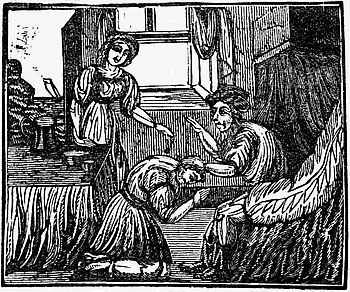
Esau having sold Jacob his birthright, Rebekah,
who had a tender love for Jacob, ratified the right
by a holy piece of craft. Isaac being sensible of
his great age, and willing to bless his children ere
he died, called Esau his eldest, whom he loved, to
him, to hunt some venison, and make savoury meat
that he might bless him. Rebekah told Jacob to
fetch two kids, that she might make savoury meat
to Isaac. She then dressed Jacob in Esau’s dress
and put the skins of the kids upon his hands and
smooth of his neck, that his father might suppose
him to be Esau, which had the desired effect; for
he received his father’s blessing by this deception.
Scarcely had he made an end of blessing Jacob,
when Esau came in from hunting, prepares his
savoury meat, brings it to his father, and desires
him to eat that he might bless him. The holy
patriarch, perceiving the deception, trembled, and
Esau cryed bitterly. Isaac, moved with his cries,
blesseth him also, but subjects him to Jacob.
Jacob’s Mystical Ladder.
The anger of Esau against Jacob was too visible
to be hid from Rebekah; and the tender love she
had for Jacob caused her to send him away for a
time, though grieved to let him out of her sight.
To reconcile her husband Isaac to it, she spoke of
his marriage—how grieving it would be if her son
Jacob would marry any of the daughters of the land
of Canaan, as Esau had done against their wish.
Jacob was sent away, more like a fugitive than the
son of a rich person. Being overtaken by night,
he was obliged to take up his lodgings upon the
earth, with no softer pillow than stone. Here he
dreamed that he saw a ladder, the top of which
reached to heaven, and the angels of God ascending
and descending upon it. He was the Lord
above it, who encouraged him to proceed on his
journey, and promised that his seed should be as
the dew of the earth, as in him should all nations
of the earth be blessed.
Jacob serveth for Rachel and Leah.
Jacob assured by the vision of the Divine protection,
went cheerfully on his way to Haran, and
meeting some shepherds near a well, which had a
great stone at the mouth thereof, asked them
whither they knew one Laban, a grandchild of
Nahor. They answered, yes; and that Rachel his
daughter was coming thither with his sheep. Jacob
no sooner saw her, then he went and rolled the stone
from the mouth of the well, watered his sheep,
kissed her, and made himself known to her. She
ran with the tidings to her father, who came forth,
kissed him, and brought him to his house. Jacob
told him of his brother’s fury, stating that he wished
to serve him; to which Laban agreed, that
Jacob should serve him seven years for Rachel,
which term he finished; but Leah was falsely put
into Jacob’s bed, which displeased Jacob; but
Laban appeased him by promising him Rachel at
the end of other seven, which he also completed.
Jacob’s return to his birth-place.
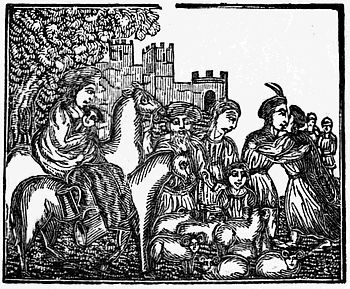
The blessings that God so plentifully showered
down upon Jacob excited Laban’s envy, so that he
perceived it prudent to leave Mesopotamia. For
this purpose he calls his two wives, and tells them
of his design, which they approving of, he went off
privately, taking family and possessions. Laban,
informed of their sudden departure, and missing
some of his idols, pursues them seven days. As
soon as he overtook them, he reproached Jacob for
stealing his daughters; and however right it might
be to return to his country; it was very unjust to
steal the idols. Jacob declared his ignorance of
any such thing, whereupon Laban examined his
whole effects, and at last enters Rachel’s tent; but
before his coming she hid them in the camel’s furniture,
and sat upon them; and desired her father
not to take it ill that she did not rise, as she was
unwell. Laban, forced to return without them,
made a covenant with Jacob, after which they lovingly
took leave of each other.
Jacob wrestleth with an Angel.
Jacob having thus escaped the hands of Laban,
began to think how he might escape those of Esau,
whereupon he sent messengers before him that he
might find grace in his sight.
Upon their return they declared that he was at the head of four hundred
men coming to meet Jacob, which filled him
with extreme fear. Jacob, to soften his brother’s
heart, prepared great presents to him, left orders
for his wives and children to pass over the brook
Jabbok by night, while he remained on the other
side. He betakes himself to prayer for a happy
meeting with his brother, when an angel appeared
unto him, and wrestled with him until day, when
the angel touched the hollow of his thigh, and
caused him to halt, and gave him the new name of
Israel, with the assurance that he had nothing to
fear from men, and in particular from his brother
Esau.
Jacob’s sons kill all the people of Shechem.
When Jacob was returned from Mesopotamia, a
city of the Shechemites, an accident happened which
caused him a great deal of sorrow. Dinah being
gone abroad to see the daughters of the land, their
king took her by force, and ravished her; but
desired to get her to wife. Jacob was grieved at
his daughter’s defilement; and his sons, dissembling
their rage, requested the Shechemites to be circumcised,
that the mutual intercourse they proposed
should take place. They consented; and on the
third day, when their pain was most sensible, Simeon
and Levi took their swords, and came upon them,
and slew all the males, without sparing the king
himself or his son, whose unlawful lust caused this
bloodshed. The rest of Jacob’s sons pillaged the
city, and carried all the spoil along with them,
taking all their little ones and their wives captives.
Jacob was extremely troubled at this, their revenge.
AN ACCOUNT OF JONAH’S MISSION
TO THE
NINEVITES.
Jonah was the son of Amittai, a prophet of Gath-hepher
in Galilee. Some Jews would have him to
be the son of the widow of Sarepta, raised to life by
Elijah, but the distance of time renders it almost
impossible; nor is it a whit more certain that he
was the son of the Shunamite restored to life by
Elisha, or the young prophet who anointed Jehu.
It is certain, that he predicted that God would
restore to the Hebrews, the cities which the Syrians
had taken from them during the reigns of Ahab,
Jehoram, Jehu, and Jehoahaz, 2 Kings, xiv. 25.
He restored the coast of Israel from the entering of
Hamath unto the sea of the plain, according to the
word of the Lord God of Israel, which he spake by
the hand of his servant Jonah, the son of Amittai
the prophet which was of Gath-hepher. We have
also the book of Jonah, where God ordered him to
go to Nineveh and warn the inhabitants of their
approaching destruction.
Nineveh was the capital of Assyria, and built by
Asshur the son of Shem; Genesis, x. 11, “Out of
that land went forth Asshur, and builded Nineveh.”
It was one of the largest cities in the world. In
Jonah’s time it was a city of three day’s journey, or
would require him three days to go through it,
proclaiming its overthrow. It then had about one
hundred and twenty thousand infants in it, whom we
cannot suppose above the eighth or tenth part of its
inhabitants: one learned writer says it was sixty
miles in circumference; and another writer says it
was larger than Babylon. It was surrounded by a
wall about two hundred feet high, and so thick,
that three chariots abreast might have been driven
along the top: on the wall were built one thousand
five hundred towers, each two hundred feet higher
than the wall; this city was very early noted for
wealth, idolatry, and whoredom.
Fearing that the Lord might forbear punishing
them if they repented, and so seemingly tarnish
his honour, Jonah shipped himself at Joppa for
Tarshish, when a storm quickly pursued the ship
wherein he was. The heathen mariners awaked him,
and required him to call on his God for deliverance.
Lots being cast to discern for whose sake the storm
arose, the lot fell on Jonah, who with shame confessed
his guilt to the mariners, and desired them
to cast him into the sea, that the storm might be
stayed, which with reluctance, they were at last
obliged to do; whereon the storm immediately ceased.
A large fish swallowed up Jonah, and retained him
safe in her belly for three days. There he earnestly
prayed to the Lord, at whose command the fish
vomited him alive on dry land. His orders to warn
the Ninevites of
their approaching destruction were
immediately renewed, and all obedient, he hasted to
that vast city, and travelled in it above a day’s journey
denouncing their ruin if they did not repent within
forty days. When the inhabitants heard this,
they were greatly afflicted; a fast of three days both
for man and beast was appointed, and they cried
mightily to God for the preventing of this stroke;
he heard their prayers, and long delayed their ruin.
Displeased with the divine mercy, Jonah angrily
wished to die, rather than live and see his prediction
unfulfilled. While he sat without the city, waiting
for his desired view of Nineveh’s ruin, God caused
a gourd quickly to spring up to overshadow him
from the scorching heat of the sun, but next day,
a worm having bitten its root, it suddenly withered.
The scorching sun and blasting wind vehemently
beating on Jonah, he fainted and angrily wished to
die, and averred to God himself that he was right in
doing so. The Lord bid him think, if he had pity on
the short-lived gourd, was there not far more reason
for his and their maker to pity the penitent inhabitants
of Nineveh?
Nineveh at last was destroyed about one hundred
years after Jonah. The Medes and Persians had
several times laid siege to it, but were diverted by
various accidents; but after the massacre of the
Tartars in Media, they repeated the siege, Cyaxares
and Nebuchadnezzar being the commanders: after
they had lain before it three years, the river Tigrus
or Sycus, being exceedingly swollen, washed away
two and a half miles of the wall; when the waters assuaging
the besiegers rushed into the city, and murdered
the inhabitants, who lay buried in their drunkeness,
occasioned by an advantage which they had
just before gained over the enemy. When the king,
whose name we suppose was Sardanapalus, heard the
city was taken, it is said, he shut up himself, family,
and wealth to the value of about twenty-five thousand
millions sterling, in the palace, and then set
fire to it, and destroyed all that was in it, and it was
fifteen days before the flames were quenched.
It is hard to say what was the gourd that covered
Jonah’s head at Nineveh: Jerome says, it was a
small shrub, which, in the sandy places of Canaan,
grows up in a few days to a considerable height, and
with its large leaves forms an agreeable shade. It
is now generally thought to be the Palma Christi,
which is somewhat like a lily, with large smooth and
black spotted leaves; one kind of it grows to the
height of a fig-tree, and whose branches and trunk are
hollow as a reed; there is also the wild gourd, which
creeps along the surface of the earth, as those of cucumbers;
its fruit is of the size and form of an orange,
containing a light substance, but so excessively bitter
that it has been called the gall of the earth.
I have now given you a short account of the
History of Jonah, which could be greatly enlarged
if space would permit—also the command given by
God to preach at Nineveh—Jonah’s disobedience to
that command—the pursuit and arrest of him for
that disobedience by a storm, in which he was asleep—the
discovery of him and his disobedience to be
the cause of the storm—the casting of him into the
sea, for the stilling of the storm—the miraculous
preservation of his life there in the belly of a fish,
which was his preservation for further services. We
have also Jonah’s praying unto God: in his prayer
we have, the great distress and danger he was in—the
despair he was thereby almost reduced to—the
encouragement he took to himself in this deplorable
condition—the assurance he had of God’s favour to
him—the warning and instruction he gives to
others—the praise and glory of all given to God—his
deliverance out of the belly of the fish—and his
coming safe and sound upon dry land again—his
mission renewed—and the command a second time
given him to go preach at Nineveh—his message to
Nineveh faithfully delivered, by which its speedy
overthrow was threatened—the repentance, humiliatian,
and reformation of the Ninevites hereupon—God’s
gracious revocation of the sentence passed
upon them, and the preventing of the ruin threatened.
We have also Jonah’s repining at God’s mercy to
Nineveh, and the fret he was in about it—the gentle
reproof God gave him for it, Jonah’s discontent
at the withering of the gourd, and justifying of
himself in that discontent—God’s improving of it
for his conviction, that he ought not to be angry at
the sparing of Nineveh. Man’s badness and God’s
goodness serve here for a foil to each other, that the
former may appear the more exceeding sinful, and
the latter the more exceeding gracious.
From all this we may learn, First, that though
God may suffer his people to fall into sin, yet he
will not suffer them to lie still in it, but will take a
course effectually to show them their error, and to
bring them to themselves, and to their right mind
again. We have reason to hope that Jonah, after
this, was well reconciled to the sparing of Nineveh,
and was as well pleased with it, as ever he had been
displeased.
Second, that God will justify himself in the
methods of his grace toward repenting returning
sinners, as well as in the course his justice takes with
them that persist
in their rebellion, though there are
those that murmur at the mercy of God, because
they do not understand it, (for his thoughts and
ways therein are as far above ours as heaven is above
the earth) yet he will make it evident that therein
he acts like himself, and will be justified when he
speaks. See what pains he takes with Jonah, to
convince him that it was very fit that Nineveh
should be spared. Jonah had said, I do well to be
angry, but he could not prove it; God says, I do
well to be merciful, and proves it; and it is a
great encouragement to poor sinners to hope that
they shall find mercy with him, that he is so ready
to justify himself in showing mercy, and to triumph
in those whom he makes the monuments of it, against
those who is evil because he is good; such murmurers
shall be made to understand this doctrine,
that how narrow soever their souls and their principles
are, and how willing soever they are to engross
divine grace to themselves, and those of their
own way, their is one Lord over all, that is rich in
mercy to all that call on him, and in every nation,
Nineveh as well as in Israel, he that fears God, and
works righteousness, is accepted of him, and he that
repents and turns from his evil way shall find mercy
with him.
Did not the fate of this prophet typify our Saviour’s
being cast into the raging sea of divine wrath;
his lying a part of three days in the grave; his glorious
resurrection from the dead; and the publication of
his gospel to multitudes of perishing sinners that
followed.
We cannot close more fitly, perhaps than by extracting
a few lines from the powerful summing up
by the poet Young.
“What am I? and from whence?—I nothing know,
But what I am: and since I am, conclude
Something eternal: had there e’er been nought,
Nought still had been: eternal there must be.
But what eternal?—Why not human race?
And Adam’s ancestors without an end?
That’s hard to be conceiv’d. Yet grant it true,
Whence earth and these bright orbs?—Eternal too?
Grant matter was eternal, still these orbs
Would want some other father;—much design
Is seen in all their motions, all their makes:
Design implies intelligence, and art;
That can’t be from themselves, or man; that art
Man scarce can comprehend, could man bestow?
Who motion, foreign to the smallest grain,
Shot through vast masses of enormous weight?
Who bade brute matter’s restive lump assume
Such various forms, and gave it wings to fly?
Has matter innate motion? then each atom,
Asserting its indisputable right
To dance, would form an universe of dust:
Has matter none? Then whence these glorious forms
And boundless flights, from shapeless, and repos’d?
Has matter more than motion?—has it thought,
Judgment, and genius?—is it deeply learn’d
In mathematics? Has it fram’d such laws,
Which but to guess a Newton made immortal?—
If so, how each sage atom laughs at me,
Who thinks a clod inferior to a man!
If art to form, and counsel to conduct,
And that with greater far than human skill,
Resides not in each block—a Godhead reigns—
And if a God there is, that God how great!”
The History of Moses
The finding of Moses.
Exodus ii. 1.
Moses was the son of Amram and Jochebed, of the
tribe of Levi, and was born in Egypt. In consequence
of the decree of Pharaoh for putting the
male children of the Hebrews to death, his mother
seeing that he was a goodly child, hid him three
months. At length when she could no longer hide
him, she made for him with her own hands a little
cradle of bulrushes, which she daubed with slime
and pitch to keep out the water, and having put
the child into it, she laid it among the flags by the
edge of the river Nile. She then left his sister at
a little distance from the spot to watch the cradle.
A short time after Jochebed had left her child, the
daughter of Pharaoh came down to bathe herself in
the river, and when she saw the little ark, she sent
her maid to fetch it. And when she opened it, she
saw the child, and behold the child wept. And she
had compassion on him, and said, “This is one of
the Hebrew’s children.” And the sister of the child,
who had seen all that had passed, came to the
princess, and said to her, “Shall I go and call thee
a nurse of the Hebrew women, that she may nurse
the child for thee?” And Pharaoh’s daughter said
to her, “Go:” and the maid went and called the
child’s mother. And the woman took the child and
nursed it. And we read that the child grew under
the tender care of his mother, and that she took him
when he was old enough unto Pharaoh’s daughter,
who brought him up as her own son. And she
called his name Moses, which, in the Egyptian
tongue, means one saved out of the water.
As the son of Pharaoh’s daughter, Moses was
educated in a magnificent and princely manner, yet
Moses did not forget his own people, or his father’s
house. In his visits to his own people, Moses saw
and pitied the miseries which they had to bear from
the cruelty of King Pharaoh. He saw their sufferings,
and could no longer be happy in the court of
Egypt, among the enemies of his people and of their
religion. His faith made him more proud of the
name of Israelite then he had ever been of being
called the adopted son of King Pharaoh’s daughter.
Once more among his own people, he found it very
difficult to see with patience all that they had to
bear; and on one occasion we read that he saved
a Hebrew from the hand of an Egyptian who was
smiting him, and slew the Egyptian. When Pharaoh
heard this thing, he sought to slay Moses. And
Moses fled from the face of Pharaoh, and dwelt in the
land of Midian, and lived several years with Jethro,
who gave him one of his daughters for his wife.
The burning Bush.
Exodus iii. 1.
One day, when Moses was keeping the flock of
his father-in-law, the angel of the Lord appeared
unto him in a flame of fire, out of the midst of a
bush. And Moses said, “I will now turn aside,
and see this great sight, why the bush is not burnt.”
Then God called unto him out of the midst of the
bush, and said, draw not nigh hither; put off thy
shoes from off thy feet, for the place whereon thou
standest is holy ground. And the Lord commissioned
him to deliver his people Israel. But Moses
was afraid when he heard what God commanded
him to do; because he thought himself unworthy
of such an office, and unfit for it. But it pleased
God to assure him, that he would be with him,
to guide and protect him.
The Plagues of Egypt.
Exodus viii. 1.
Now Moses and Aaron went as the Lord commanded
them, and told the people all that the Lord
had spoken unto Moses, and did wonders before
them. And Moses and Aaron went in and said to
King Pharaoh, “Thus saith the Lord God of Israel,
‘Let my people go, that they may hold a feast unto
me in the wilderness.’” And Pharaoh said, “Who
is the Lord that I should obey his voice to let Israel
go? I know not the Lord, neither will I let Israel
go.” And from that day Pharaoh made the children
of Israel work harder than they had ever done
before, desiring that they might no longer have
straw given them to make their bricks of, but that
they should from that time be obliged to find their
own straw, and at the same time get done as much
work as they did when they had straw given them.
Then when God saw the hardness of Pharaoh’s
heart, he commanded Moses to go to Pharaoh in
the morning, when he took his walk by the river,
and to take his rod in his hand, and to smite the
waters of the river before him, which should all be
turned into blood. And the fish that were in the
river died, and the river stank, and the Egyptians
could not drink of the water of the river; and there
was blood throughout all the land of Egypt. Seven
days did this sad change in the waters last; but
still Pharaoh would not listen to the voice of Moses
and Aaron. Then God told Moses to stretch forth
his hand over the river, and over all the waters,
and to bring frogs over all his people: and Moses
did so; and frogs came over all the land of Egypt,
as the Lord said. Then Pharaoh sent for Moses and
Aaron, and said, “Entreat the Lord, that he may
take away the frogs from me, and from my people;
and I will let the people go, that they may so
sacrifice unto the Lord.” But no sooner did the
Lord hear the voice of Moses, and take away this
evil from Pharaoh and his people, than the king
forgot what he had suffered, and would not let
the Israelites go. Great and dreadful were the
plagues that the Lord brought upon the land of
Egypt before the King would let the children of
Israel go. At one time, he covered the whole land,
both man and beast, with the most disgusting
kind of insects—at another, he sent grievous
swarms of flies to torment them—now, he sent
mighty hails, and thunderings, and rains upon
the land, which were exceeding terrible, filling
the hearts of the people with fear—then, he
destroyed all the first-born of the land, both man
and beast.
The Passover.
Exodus xii. 3.
On the evening before the Passover God commanded
that every family of Israel should slay a lamb, and
sprinkle the door-posts before the houses with the
blood of the lamb; that so, when the angel of the
Lord came down to destroy the first-born of Egypt,
he might know the houses of Israel from those of
Egypt, and pass over them, and save those that
dwelt in them from death. This lamb was to be
called the Passover, because God should pass over
those houses whose doors were sprinkled with its
blood. This was the last supper which the children
of Israel were ever to eat in Egypt, even the feast
of the Passover. They kept up this feast every
year, in order that they might remember the night
when the Lord smote the Egyptians.
The passage of Israel through the Red Sea.
Exodus xiv. 15.
We now see the children of Israel, delivered by
the almighty power of God from Egypt and from
Pharaoh, travelling towards the land that God had
promised to their fathers. The Lord went before
them by day in a pillar of a cloud, to lead them
the way, and by night in a pillar of fire, to give
them light. When they had thus got as far as
Pi-hahiroth, which borders on the Red Sea,
they lifted up their eyes, and behold the Egyptians
marched after them. So hardened was king Pharaoh’s
heart, that scarcely had the Israelites gone out
of Egypt before he was sorry that he had let them
go. And he took six hundred chosen chariots, and
all the chariots of Egypt and captains over every
one of them, and passed after the children of Israel,
and overtook them by the sea, beside Pi-hahiroth.
Then the children of Israel were sore afraid, and
cried unto the Lord. The Red Sea before them, the
Egyptians behind, they saw no hope of safety; and
they were full of anger against Moses, for having
brought them out of Egypt. But the Lord said
unto Moses, “Lift up thy rod, and stretch out thine
hand over the sea, and divide it; and the children
of Israel shall go on dry ground through the midst
of the sea.” And the angel of the Lord, which
went before the camp of Israel, removed and went
behind them, and came between the camp of the
Egyptians and the camp of Israel; so that the one
came not near the other all the night. And Moses
stretched out his hand over the sea, and the Lord
caused the sea to go back by a strong east wind all
that night, and made the sea dry land, and the waters
were divided. But that foolish and wicked man
Pharaoh, still set himself against God, and madly
pursued the Israelites into the midst of the sea.
But so soon as the Israelites had passed over on dry
land, and safely reached the shore, the Lord said
unto Moses, “Stretch out thine hand over the sea,
that the waters may come again upon the Egyptians,
upon their chariots, and upon their horsemen.”
And Moses stretched forth his hand over the sea,
and the sea returned to his strength when the
morning appeared, and the Egyptians fled against
it; but the Lord overthrew them in the midst of
the sea, and the waters returned, and covered the
chariots and the horsemen, and all the host of
Pharaoh that came into the sea after them; there
remained not so much as one of them: and Israel
saw their dead bodies upon the sea shore. Thus
the Lord saved Israel that day out of the hand of
the Egyptians.
Israel fed from Heaven.
Exodus xvi. 1.
We read in the Bible, that after they had crossed
the Red Sea, they came into the wilderness of Chur.
While travelling onwards through the wilderness of
Sin they suffered from hunger, and murmered against
Moses and Aaron. But again God heard their cries,
and sent them bread from heaven to eat. The
Lord said unto Moses, “Behold I will rain bread
from heaven for you; and the people shall go out
and gather a certain rate every day—at even ye
shall eat flesh, and in the morning ye shall be filled
with bread.” And in the morning there lay a small
round thing, as small as the hoar-frost, on the ground.
And when the children of Israel saw it, they said one
to another, “It is manna.” And Moses said, “This
is the bread which the Lord hath given you to eat.”
Moses Smiting the Rock.
Exodus xvii. 1.
We now find the children of Israel travelling
from the wilderness of Sin, and, according to the
commandment of the Lord, pitching their camp
at Rephidim. There being no water here, we
find those stubborn and rebellious people, saying
unto Moses, “Give us water that we may drink;
wherefore is this that thou hast brought us up out of
Egypt, to kill us, and our children, and our cattle,
with thirst?” The Lord had shewed them signs
and mighty wonders in the land of Egypt—he had
delivered their children from the sword of the destroying
angel, when all around them was anguish
and dismay—he heard them when they cried and
groaned under the lash of the oppressor, amid the
brick-kilns of Egypt, and emancipated them from
the same—he opened a passage for them in the
mighty waters at the Red Sea, when about to fall
a prey to the rage and fury of Pharaoh king of
Egypt—moreover, he had given them bread to eat
in the wilderness when they hungered for the same;
and was still able to give them what they now
desired. But they, instead of praying to the Lord
that he would once more condescend to look down
with compassion upon them, and grant them their
request, reproached, and murmured against Moses,
the servant of the Lord. And Moses said unto
them, “Why chide ye with me? wherefore do
ye tempt the Lord?” Moses tired of their complaints
and discontent, felt that he could do
nothing with the people under his care; but
knew that the Lord could either quench there
thirst, or put a stop to their rage. He, therefore,
cried unto the Lord, and said, “What
shall I do unto this people? they be almost ready
to stone me.” Nor did he cry in vain, for the
Lord said unto him, “Go on before the people, and
take with thee of the elders of Israel; and thy
rod wherewith thou smotest the river, take in
thine hand and go. Behold, I will stand before
thee there upon the rock in Horeb, and thou shalt
smite the rock, and there shall come water out
of it, that the people may drink.” And Moses
did so in the sight of the elders of Israel. Thus
did God open streams in the desert—he clave
the hard rocks in the wilderness, and gave
them drink thereof, as it had been out of the
great depth—he brought waters out of the
strong rock, so that it gushed out like rivers:
and this he did although his people had sinned
against him, and provoked the Most High in the
wilderness.
The Law given from Mount Sinai.
Exodus xix. 10.
Now the children of Israel encamped before
Mount Sinai. Then God desired that the people
would put away all their usual employments, and
spend the next two days in preparing to appear
before him. And on the third day Moses brought
forth the people out of the camp to meet with God;
and Mount Sinai was altogether on a smoke; because
the Lord descended upon it in fire, and the whole
mount quaked greatly. And when the voice of the
trumpet sounded long, and waxed louder and louder,
Moses spake, and God answered him by a voice.
And the Lord called Moses up to the top of the
mount. Then Moses went up and heard God himself
speak the Ten Commandments which we have
in the twentieth Chapter of Exodus.
The Israelites worshipping the golden calf.
Exodus xxxii. 1.
Now Moses was forty days and forty nights in the
mount with God; and the people had began to
wonder what had become of him, and to be tired of
waiting and looking for his return. Although the
glory of the Lord still rested on the mount, and the
presence of the Lord was clearly there, they pretended
to think that God and Moses had left them,
and they said one to another, “Let us make us
gods which shall go before us.” And they made
them a golden calf, and said, “These be thy gods,
O Israel, which brought thee out of the land of
Egypt.” And they worshipped the golden calf which
they had set up, although God had positively forbidden
them to make any graven image to worship,
or the likeness of any thing in heaven above, or in
the earth beneath, or in the water under the earth.
But so evil were their hearts, so ready to wander
from God, so quick to forget his mercies, that
having been left only for a few short days to themselves,
they set up a golden calf to worship. And
the Lord said unto Moses, “Go, get thee down;
for thy people have corrupted themselves: they
have turned aside quickly out of the way which
I commanded them; they have made them a
molten calf, and have worshipped it: let me
alone that my wrath may consume them, and I
will make of thee a great nation.” But Moses
loved the people of Israel; and he prayed earnestly
for them, unto the Lord his God. And
the Lord who is abundant in mercy, graciously
heard his prayer; so as not to destroy them
altogether in a moment. And Moses went down
from the mount, and as soon as he came nigh
unto the camp, he saw the calf, and the dancing;
and his anger waxed hot, and he cast the tables
out of his hands, and break them beneath the
mount. And he took the calf which they had
made, and burnt it in the fire, and ground it to
powder, and strewed it upon the water, and made
them drink of it. And he stood in the gate of the
camp, and said, “Who is on the Lord’s side? let him
come unto me.” And all the sons of Levi gathered
themselves together unto him. Then Moses, by
the command of God, desired the sons of Levi to
take their swords and go in amongst the people,
and kill them: and they did so; and there fell of
the people that day about three thousand. And to
the rest of the people Moses said, “Ye have sinned
a great sin; and now will I go up unto the Lord;
peradventure I shall make an atonement for your
sin.”
Nadab and Abihu burnt by fire.
Leviticus x. 1.
Nadab and Abihu, the sons of Aaron, took either
of them his censer, and put fire therein, and put
incense thereon, and offered strange fire before the
Lord, which he commanded them not. And there
went out fire from the Lord, and devoured them,
and they died before the Lord. Then Moses said
unto Aaron, “This is it that the Lord spake, saying,
I will be sanctified in them that come nigh me, and
before all the people I will be glorified.” And
Aaron held his peace. And Moses called Mishael
and Elzaphan, the sons of Uzziel, the uncle of Aaron,
and said unto them, “Carry your brethren from before
the sanctuary out of the camp.” So they
carried them, as Moses had said; And Moses said
unto Aaron, and unto his sons, “Uncover not your
heads, neither rend your clothes, lest ye die.”
The Spies return from surveying Canaan.
Numbers xiii. 1.
The children of Israel were thus wonderfully
led by the Lord throughout all their journeys,
until they arrived safely on the borders of the land
of Canaan. There God desired Moses, to send men
to search the land of Canaan. And Moses sent
twelve men, one man from each of the tribes or
families of Israel, and said unto them, “Go, see
the land what it is, and the people that dwell therein,
whether they be strong or weak, few or many;
and what the land is that they dwell in, whether it
be good or bad. And be ye of good courage, and
bring of the fruit of the land.” Now the time was
the time of the first ripe grapes. So they went up
and searched the land; and they came to a brook
or valley, afterward called Eshcol. And so beautiful
were the fruits they found in this fertile valley
of Eshcol, that they cut down there a bunch of
grapes so large that two men were obliged to
carry it between them on a stick: they took also
of the pomegranates and the figs. After forty
days spent in searching the land, they went back
to Moses and Aaron, and all the people, and
shewed them the fruit of the land; and they told
them that such were the fruits of the land of
Canaan, and that it was certainly a land flowing
with milk and honey; but in other respects these
men gave a very evil account of the land itself, and
a very frightful one of the people that dwelt there,
whom they called giants; saying, “That by the side
of them they seemed to themselves as grasshoppers.”
But two of the children of Israel, named Caleb
and Joshua, who were of the twelve who had
been sent into the land, declared unto all the people
that what the others had told them was not true.
But the people would not listen to Caleb and Joshua,
nor believe what they said; for their hearts were
exceedingly perverse towards God. And the anger
of the Lord was exceeding great against the children
of Israel; and because they had acted in this wicked
manner, God said they should not see the land which
he had promised them; no, not one of them should
enter that land, excepting his servants Caleb and
Joshua; but that the rest of the people should die in
the wilderness, and that their children should wander
there, until all those who had now and so often
before sinned against the Lord had died and were
buried. Then God said to this wicked people,
“Turn you, and get you into the wilderness, by the
way of the Red Sea.” Now Moses told these sayings
to the people of Israel, and they murmured
greatly.
He that violated the Sabbath is stoned.
Numbers xv. 32.
On one occasion some of the children of Israel
found a man gathering sticks upon the sabbath day.
And they put him in ward, because it had not been
declared what should be done to him. And the Lord
said unto Moses, “The man shall be surely put to
death: all the congregation shall stone him with
stones without the camp.” And all the congregation
brought him without the camp, and stoned him
with stones, and he died; as the Lord commanded
Moses. And the Lord spake unto Moses, saying,
“Bid them make fringes in the border of their
garments, throughout their generations, and put
upon the fringe of the borders a ribband of blue;
that they may remember, and do all my commandments,
and be holy unto their God.”
The earth swalloweth up Korah.
Numbers xvi. 1.
Now Korah, Dathan, and Abiram, took men;
and they rose up before Moses, with certain of the
children of Israel, two hundred and fifty princes of
the assembly. And they gathered themselves together
against Moses and Aaron, and said unto
them, “Ye take too much upon you, seeing all the
congregation are holy, every one of them, and the
Lord is among them; wherefore then lift ye up
yourselves above the congregation of the Lord?”
And when Moses heard it, he fell upon his face;
and he spake unto Korah, and all his company,
saying, “Even to-morrow, the Lord will shew who
are his, and who is holy; and will cause him to
come near unto him. This do; take you censers,
Korah and all his company; and put fire therein,
and put incense in them before the Lord to-morrow,
and it shall be, that the man whom the Lord doth
choose, he shall be holy.” And they took every man
his censer, and put fire in them, and laid incense
thereon, and stood in the door of the tabernacle
of the congregation with Moses and Aaron. And
Korah gathered all the congregation against them,
and the glory of the Lord appeared unto all the
congregation. And the Lord spake unto Moses and
unto Aaron, saying, “Separate yourselves from
among this congregation, that I may consume them
in a moment.” But Moses and Aaron fell upon
their faces, and entreated the Lord to spare the
congregation. And the Lord commanded Moses
to speak unto them, and say, “Get you up from
about the tabernacle of Korah, Dathan, and
Abiram.” So Moses spake these words unto them,
and they obeyed him, and departed from the tabernacle
of Korah, Dathan, and Abiram. Then Moses
said unto them, “If these men die the common death
of all men, then the Lord hath not sent me; but
if the Lord open the mouth of the earth, and
swallow them up, and all that pertaineth unto them,
then ye shall know that these men have provoked
the Lord.” And it came to pass, as he had made
an end of speaking these words, that the ground
clave asunder under them; and the earth opened
her mouth, and swallowed them up, and their houses,
and all the men that appertained unto Korah.
And there came out fire from the Lord and consumed
the two hundred and fifty men that offered
incense. Then the congregation murmured against
Moses, saying, “Ye have killed the people of the
Lord.” And the Lord was angry with the children
of Israel, and smote them with a plague; which,
however, was stayed by the intercession of Aaron.
The Brazen Serpent.
Numbers xxi. 6.
The children of Israel being obliged to take a
longer journey than they expected before they were
permitted to enter the promised land, murmured
against the Lord and against Moses. Then the
Lord in his anger sent fiery serpents among the
people, which bit them; and much people of Israel
died. And Moses prayed for the people. And the
Lord said unto Moses, “Make thee a fiery serpent,
and set it upon a pole; and it shall come to pass,
that every one that is bitten, when he looketh upon
it, shall live.” And Moses made a serpent of brass,
and put it upon a pole, and it came to pass, that if
a serpent had bitten any man, when he beheld the
serpent of brass, he lived. The children of Israel
continued their journey towards the promised land;
none of them, however, who had left the land of
Egypt, save Joshua the son of Nun, and Caleb the
son of Jephunneh, were permitted to enter it, for
having sinned so often against the Lord. Even
Moses the servant of the Lord, though permitted
to see it from the top of Mount Nebo, was not permitted
to enter; but died in the land of Moab,
when he was an hundred and twenty years of age.
And the children of Israel wept for Moses thirty
days.
FINIS.
The History of Joseph & his Brethern
JOSEPH’S FIRST DREAM.
In Canaan lived a man of righteousness,
Whom the great God in love was pleas’d to bless
With twelve sweet sons, one Joseph called by name.
Whose worthiness we’ll to the world proclaim.
Being endued with blessings from above,
He gained the favour of his father’s love,
Now while his brothers hated him, behold!
He dream’d a dream, which unto them he told;
Saying, “As we were binding in the field
Our sheaves of wheat, it was to me revealed
That mine arose upright, and yours around,
Stood making low obedience to the ground.”
These words of his, they did anger breed;
They say, must you reign over us indeed?
The like of this was never known before,
Thus for his dreams they hated him the more.
HIS SECOND DREAM.
Soon after this as Joseph sleeping
Free from the toils and troubles of the day,
He dreamed a second dream, and told the same
Unto his brothers, as to them he came;
Saying, in sleep appeared before my eyes,
The sun, the moon, the seven stars likewise,
All making their obedience unto me,
With meek and humble humility.
He told it likewise to his father dear,
Who chid him, saying, what is this I hear?
Must I, thy mother, and thy brothers too,
Be all obliged to bow the knee to you,
Low on the earth, as if you reigned and ruled:
’Tis very hard that aged parents should
A meek and lowly veneration pay
To you who ought to honour and obey.
HE IS PUT INTO A PIT.
This very paragraph will clearly show
How they did seek young Joseph’s overthrow,
His father sent him to the rural plain,
Where with their flocks his brothers did remain.
When afar off young Joseph they espied,
Behold, here comes the dreamer now, they cried
Let us conclude to take his life away,
And cast him in a pit without delay,
Then see how all his dreams will come to pass:
But Reuben, Reuben pitied him, alas!
And hid him in the pit, there to remain,
Till he might safe conduct him home again.
What mortal man is able to express,
Poor Joseph’s grief when in the wilderness
He lay confined? no doubt his present fears
Caused his youthful eyes to flow with tears.
HE IS SOLD INTO EGYPT.
While in the pit young Joseph lay confined,
They sat them down to eat, and ere they dined
Some Ishmaelites from Egypt passed by;
Then Judah made his brothers this reply,
“What shall it profit to us now, I pray,
If we should take this precious life away?”
They all consented to the same with speed,
For loth they were to see their brother bleed.
Then from the lonesome pit the child they drew,
And sold him to those trading merchants, who
A score of silver pieces for him paid,
And then to Egypt he was soon conveyed.
When Reuben found him not, how did he grieve
The rest contrive their father to deceive,
By staining Joseph’s coat with purple blood,
Which caused poor Joseph many a weeping flood.
TEMPTED BY POTIPHAR’S WIFE.
When Joseph to the land of Egypt came,
One Potiphar a man of noted fame,
Bought him with silver and preferred him straight
Making him steward of his whole estate.
On whom his mistress cast her wanton eyes,
And he reproved her, and said, be wise,
And cast, henceforth, these idle thoughts away—
How can I do that wicked thing, I pray?
Now finding her entreaties would not do,
She went to seize him, but away he flew,
Leaving his garment in her hand also:
Now from that time she proved his mortal foe:
She said, my lord, (when he returned at night,)
Thy Hebrew strove with all his might,
To mock thy lady, but was ne’er the near,
I cried, he fled, and left his garment here.
CAST INTO THE DUNGEON.
No sooner had she made this false report
Of Joseph’s coming in so vile a sort,
But Potiphar immediately he flew
Into a sad and cruel passion too,
And cast him into prison where he lay
Till the chief butler and the baker, they
By Pharaoh’s strict command were sent to be
Confined from their former liberty.
The baker and the butler both, we find
With dreams one night were much disturbed in mind,
When they to Joseph did themselves apply,
He told them what their dreams did signify;
One he restores unto his former place,
The other, he must die in sad disgrace;
The butler must his former place supply,
The baker by the laws be doomed to die,
HE IS MADE LORD OF THE LAND.
Still Joseph lay confined in prison fast,
Until two tedious years were gone and past.
At length Pharaoh dreamed, but none in the land
Could his dream interpret or understand.
Then the chief butler to the king did say,
“I needs must own my faults this day:
In prison lies a Hebrew servant there,
Who will the truth of all your dreams declare:”
Then from a prison to a palace straight,
Joseph was brought, and Pharoah did relate
His dreams, and did full satisfaction find,
Which eased the grief and anguish of his mind:
He gave such satisfaction to the king,
That from his royal hand he drew a ring,
And gave it Joseph, saying, “Thou shalt be
Next to myself in royal dignity.”
His Brethren going to buy Corn.
Behold the dreams of Pharoah did fortell,
A mighty famine, which at length befell;
Joseph in Egypt was head ruler over all;
But when his brothers came, and seemed to fall
Before him, straight his dreams came in his mind
Yet he spoke rough, and seemed most unkind:
You’re spies said he, they answered, no,
We are true men, my lord, pray say not so,
Sons of one man, we twelve in number were,
The youngest now under his father’s care
Remains at home, the other he is not.
He knew them, yet his anger seemed hot,
And for three days they were in prison cast,
Confined they lay, yet Joseph came at last,
And laid upon them all a strict command,
To bring their young brother out of hand.
THE CUP IN BENJAMIN’S SACK.
When they had eaten up their slender store
Jacob he needs must send them down for more;
But knowing that his youngest son must go,
His eyes with melting tears did overflow.
With presents then they did return again,
And Joseph doth them kindly entertain.
When he his brother Benjamin beheld,
His bowels yearned, his heart with joy was filled;
But here’s a grief which did them all surround,
The nightly lord, his silver cup was found
On Benjamin; this made them sore afraid,
That for that crime they would be captives made:
Then to the house of Joseph they returned,
Judah he pleaded, till his bowels yearned,
To be a captive in his brother’s room,
Lest he should see his father’s threatened doom.
JOSEPH DECLARETH HIMSELF.
“My lord, hear thy servant now I pray,
Our father, when we brought the child away
Expressed such grief and sorrow for his sake,
That if he stay, his aged heart will break:
Seeing his tears, which fell like showers of rain,
I promised then he should return again.
Therefore, my lord, pray let him go, for I
Am loth to live to see my father die.”
Joseph from tears could now no longer hold:
He said, “I am your brother whom you sold
To Egypt, when on me your anger fell;
And is my father yet alive and well?”
Then on each other’s necks they wept amain.
Their cries were heard, from tears could not refrain
“O fetch my father hither,” Joseph cried,
“That for the family I may now provide.”
JACOB’S JOURNEY INTO EGYPT.
The sons of Jacob Pharaoh did command,
To take both food and waggons from the land
Of Egypt, to fetch their father straight;
They did, and poor old Jacob’s joy was great
He said, still as his spirits did revive,
It is enough, Joseph is yet alive,
The son for whom I mourned, therefore I
Will go and see him now before I die.
Then on his journey still he doth proceed,
And in the land of Goshen, there indeed
Joseph did meet him, whom he straight did bring
Into the royal presence of the king.
When Jacob before king Pharaoh stood,
His age one hundred and thirty years, a good
Old man was he; Pharaoh gave to his race,
The land of Goshen for a dwelling-place.
JOSEPH VISITS HIS FATHER.
When Joseph knew his pious father lay
On his sick bed, to him he hastes away,
Joseph he brought Manasseh and Ephraim,
Placed them before his father’s eyes now dim,
At sight of them, cries Jacob, “Who are these?”
“My sons,” says Joseph, “from between my knees.”
When near, he kissed them, and with sweet embrace
Admires his GOD before his Joseph’s face.
These boys of thine which were in Egypt born,
They shall be mine, not orphans or forlorn.
Manasseh he blest, commended to his GOD,
Bids him to mark the steps that Abraham trod,
Displeased was Joseph to see his elder son
Put by, and the younger the blessing won;
But Jacob replied, “Son, I know it well,
For Ephraim shall unto great nations swell.”
JACOB BLESSETH HIS SONS.
Jacob he calls his first born, Reuben, near,
Weak as the water from the fountain clear;
Simeon and Levi, men of cruelty,
They smote a man, and caused him so to die.
Judah’s bright sceptre shan’t from him depart
Till Shiloh come rejoicing every heart.
Zebulun’s a small port where tall ships may pass,
Issachar well resembles the couchant ass.
Dan as a judge will do his people right,
Gad by a troop at last will win the fight;
Asher his bread is fat, and of a dainty sort,
Naphtali’s a hind loosed for the hunter’s sport.
Joseph’s a bough laden with pleasent fruit,
Near to a well, whose branches sap recruit:
Benjamin like a ravenous wolf doth slay,
Devours his prey, then bears the spoil away.
JOSEPH’S LOVE TO HIS FATHER.
Filial affection’s to old Jacob good,
When Canaan’s land lay destitute of food,
Then Joseph kind his aged father fed,
When thousands daily starved for want of bread;
His love expressed with mind sedate and calm,
Then with rich spices did his corpse embalm;
When breathless lay upon a bed of down,
He treats blest Jacob, father of renown;
Falls on his clay and with a kind embrace,
Salutes the late most venerable face
Of Pious Jacob, now growing stiff and cold.
It must be so when life is charged to mould,
Plenty of tears did from his eye balls flow,
To show mankind he did his duty know,
That nought’s too much to pay a parent dear,
From children that the awful GOD do fear.
JACOB’S FUNERAL.
When seventeen long years Jacob had dwelt,
Behold, the fatal hand of death he felt:
To Joseph he commits the special care
Of his great funeral, and tells him where
He would be laid, which was fulfilled at large,
According to the tenor of his charge;
For having yielded up his vital breath,
He dropped into the frozen arms of death.
Numbers of mourning coaches out of hand
Prepared were; thus to his native land
He was conveyed a sleeping-place to have,
Near to the borders of his father’s grave.
Upright he was, and just in all his ways;
Pray now observe the number of his days,
He was, when he dropt off this earthly stage,
One hundred and forty-seven years of age.
THE
LIFE OF ST. PAUL.
Saint Paul, though not one of the twelve, yet for
his great eminence in the ministry of the gospel,
had the honour to be styled an apostle, particularly
above all the rest that were not of the number, and
hath justly the next place to St. Peter allotted to
him, both in regard they were so conversant in
their lives, and inseparable in their deaths. He
was born at Tarsus, not only of Jewish parents,
but originally descended from an ancient Jewish
family of the tribe of Benjamin in Judea, where
he had his education, which was a flourishing
Academy, whose scholars (as Strabo testifies) excelled
those of Alexandria, and even Athens itself.
In the schools of this city, he was brought up from
his childhood, and became an excellent proficient in
all the polite learning of the ancients, yet at the same
time he was brought up to a manual trade, as even
the most learned of their Rabbins were, for enabling
them to get a livelihood if occasion required it; it
being a maxim (especially amongst the Jews,) that
he who teacheth not his son a trade, teacheth him
to be a thief; for learning of old was not made an
instrument to get a maintenance by, but for the
better polishing the mind; so that the learned
among the Jews were frequently denominated (as
Drusius observes,) from some one or other handy-craft
trade, as Rabbie Judah, the baker; Rabbie
Jochanan, the Shoemaker, &c.
Having at Tarsus attained to a great perfection
in the liberal arts and sciences. He was sent to
Jerusalem to be instructed in the knowledge of the
laws; and for the better accomplishing him in that
study, was put under the tuition of Raban Gamaliel
the son of Simon, (the same probably that took up
our Saviour in his arms.) He was an eminent
doctor of the law, one of the families of the schools
at Jerusalem, and a person of principal note and
authority in the Jewish Sanhedrim, in which that
grave and prudent speech, mentioned in the Acts
of the Apostles, which he made on behalf of the
apostles and their doctrine, took great effect. At
the feet of this great doctor St. Paul was brought
up, as he himself testifies; and by his instructions
he soon advanced to that degree, that he gained himself
a reputation above all his fellow scholars.
Moreover he was a strict professor of the sect of
the Pharisees, which of all others amongst the Jews,
was the severest and most magisterial; and the
professors thereof, generally great applauders of
themselves for their sanctity, despising and censuring
all others as reprobates, and unworthy of their
society, and presuming (as Josephus writes) to
govern even princes themselves. With the fiery
genius of this sect, our apostle was too deeply infected,
which made him a most zealous persecutor
of the Saints; so that when the blood of the martyr
Stephen was shed, I (saith he with sorrow after his
conversion) was standing by, consented to his death,
and kept the raiment of them that slew him. Nay,
of all the apparators, and inquisitors, employed by
the Sanhedrim, to execute their warrants; upon
those upstart heretics, as they called them, who
preached against the law of Moses, and the tradition
of the fathers; he was the man that strove to be
the forwardest. In this zeal to execute his office,
as he was on his way to Damascus, with some other,
of his fellow officers, breathing out vengeance and
destruction against the poor Christians, their was
on a sudden a most glorious light shot full upon
him, and the rest that were with him, so that they
fell to the ground in great amazement, and at the
same time a voice from heaven was directed to him,
saying, “Saul, Saul, why persecutest thou me?”
to which, amazed as he was, he answered, Lord
who art thou? the voice replying, that it was Jesus
whom he persecuted, and that it was hard for him
to kick against the pricks. He again desired further
instructions; Lord, said he, what wilt thou have me
to do; upon which he was bid to rise, and go to
Damascus, and there expect what should be further
revealed to him; rising from the ground he found
his sight gone. In this plight being led to Damascus,
he was there three days fasting, and probably
then he saw that celestial vision mentioned by him,
wherein he heard and saw things past utterance,
and those divine revelations, which gave him
occasion to say, that the gospel he preached, he was
not taught by man, but had it revealed to him by
Jesus Christ. The three days being expired,
Ananias, a devout man, and one of the seventy
disciples came to him, according to the command
he had received from our Lord, who appeared to
him, to go and enquire for one Saul of Tarsus, and
having laid his hands on him, told him his message,
upon which his sight was restored to him, and the
gift of the Holy Ghost conferred on him; presently
after he was baptized, and made a member of the
church, to the great joy of the rest of the disciples,
that he should become not only a professor, but a
preacher of that faith, which he so lately was a
bitter persecutor of. His stay at this time at Damascus
was not long, for being warned away by a
vision from heaven, he took a journey into Arabia,
where he preached the gospel for three years, and
then returned to Damascus, where the unconverted
Jews eagerly sought his ruin, endeavouring to seize
him, but he escaped through the help of the disciples,
and the rest of his friends who were zealous for
his safety.
Thus far we have made an entrance into the life
and acts of this great apostle, with which there is
scarcely any thing equally memorable in history,
nor could the further prosecution thereof have been
omitted, but that all the travels of this apostle in
the pursuance of his ministry, from the time of his
conversion to the last of his being at Rome, with
the most principal transactions, and the severest
accidents that happened to him therein, are already
related in the exposition of the map of the voyages
of the apostles, and more particularly those of St.
Paul, in which, for avoiding needless repetitions,
the sequel of his life may not unfitly be referred.
We shall therefore make some enquiry into the
time and occasion of the several epistles wrote to
the several churches; as also unto the time and
manner of his death.
When he went from Athens to Corinth, it is said
he wrote his first epistle to the Thessalonians,
which he sent Silas and Timothy, who returned
during his stay, and before his departure he wrote
his second epistle to them, to excuse his not coming
to them as he promised in his first. Not long after
at Ephesus, he is said to have written his epistle to the
Galatians; and before he left Ephesus, he wrote
his first epistle to the Corinthians. Moreover, he
sent from thence by Apollos and Silas to Titus,
whom he left in that island to propagate the faith,
and had him made bishop thereof, in which he
gives him advice for the better execution of his
episcopal office. At Macedonia, whither he went
from Ephesus, having by Titus received an account
of the church of Corinth’s present state of affairs,
he sent by him at his return, when he was accompanied
by St. Luke, his second epistle to the
Corinthians; and about the same time he wrote his
first epistle to Timothy, whom he had left at
Ephesus. From Corinth he went to Macedon,
whither he sent his epistle to the Romans, by
Phebe, a deaconess of the Church of Cenchrea, not
far from Corinth. Going thence to Rome, he sent
his epistle to the Phillipians by Epaphroditus, who
had been sent from them with relief, not knowing
to what straits he might be reduced by his imprisonment
at Rome. In the next place, he sends
by Tychicus his epistle to the Ephesians. Not
long after, (if not about the same time) he wrote
his epistle to the Colossians, and sent it by
Epaphras, his fellow-prisoner for some time at
Rome. As for his second epistle to Timothy,
there is some dispute about the time of his writing
it; only it seems probable by authentic authors,
that it was written after the Philippians and
Ephesians. As for the epistle to the Hebrews, it
is not known when, or from whence written, and
rather conjectured than certainly known to have
been St. Paul’s. Tertulliah judgeth it to be written
by Barnabas; but the most received opinion
is, that it was St. Paul’s, but written by him in
Hebrew, and so sent to the Jews; but for the better
publishing it to the Gentiles, translated into Greek,
some say by St. Luke, and others by St. Clement,
for the style of whose epistles to the Corinthians
and Ephesians is observed by St. Jerome to come
very near the style of this epistle, and to contain a
purer vein of Greek than is found in the rest of St.
Paul’s epistles.
Our apostle having been now two years a prisoner
at Rome, is at length set free, and soon after departs
to visit other parts of the world, for the
further divulging the gospel, but into what particular
parts is variously conjectured; some think
into Greece, and some parts of Asia, where he had
not yet been; others will have it that he went
preaching, as well into the Eastern as Western
parts of the world; for in his epistle to the Corinthians
it is said, that Paul being a preacher both
Eastward and Westward, taught righteousness to
the whole world, and went to the utmost bounds of
the West. That he went into Spain, may be
gathered both from his own words, as intimating
so to do, and also from the testimony of other
authors, as Theodoret, who writes, that he not only
went into Spain to preach, but brought the gospel into
the isles of the sea, and particularly into our
island of Britain; and more particularly in another
place, he reckons up the Gauls and the Britons
amongst those people to whom the apostles, and
especially the tent-maker, as he calls him, had
divulged the Christian faith.
Farther mention of St. Paul we find none till his
next and last coming to Rome, which is said to be
about the 8th and 9th years of Nero’s reign; and
he came in the fittest time to suffer martyrdom he
could have chosen; for whereas at other times, his
privilege of being a Roman citizen gained him
those civilities which common morality could not
deny him, he had to do with a person with whom
the crime of being a Christian weighed down all
apologies that could be alledged; a person whom
lewdness and debauchery had made seven times
more a Pagan than any custom or education could
have done. What his accusation was, cannot be certainly
determined, whether it was his being an
associate with St. Peter in the fall of Simon Magus,
or his conversion of Poppæa Sabina, one of the
Emperor’s concubines, by which he was curbed in
the career of his insatiate appetite. Neither can it
be resolved how long he remained in prison, what
the certain time of his suffering was, and whether
(according to the custom) he was first scourged;
only Barentons speaks of two pillars in the church
of St. Mary, beyond the bridge in Rome, to which
both he and St. Peter were bound, when they were
scourged.
It is affirmed that St. Paul and St. Peter suffered
upon the same day, though different kinds of death.
Others will have it that they suffered on the same
day of the year, but at a year’s distance; and others
affirm that St. Paul suffered several years after St.
Peter; but all agree that Paul, as a Roman, had
the favour to be beheaded, and not crucified. His
execution was at the Aquæ Salviæ, 3 miles from
Rome; and he is said to have converted the three
soldiers that guarded him thither, who also suffered
for the faith. Some of the fathers add, that upon
his death there flowed from his veins a liquor more
like milk than blood, the sight whereof (saith St.
Crysostom) converted the executioner.
He was buried about two miles from Rome, in
the way called Via Ostiensis, where Lucina, a noble
Roman matron, not long after settled a farm for
the maintenance of the church. Here he lay but
indifferently entombed for several ages, till the
reign of Constantine the Great, who in the year of
our Lord, 318, at the request of Sylvester, bishop
of Rome, built a very sumptuous church, supported
with a hundred stately pillars, and beautified with
a most rare and exquisite workmanship, and after
all richly gifted and endowed by the emperor himself.
Yet was all this thought too mean an honour
for so great an apostle by the emperor Valentinian,
who sent an order to his Præfect Salustinus, to
take that church down, and to erect in its room one
more large and stately, which, at the instance of the
Pope Leo, was richly adorned, and endowed by the
Empress Placidia, and doubtless, hath received
great additions ever since, from age to age.
Thus was brought up, became converted, and a
preacher of the gospel, and thus was put to death
and buried, this great apostle of the Gentiles,
superior in learning and natural parts, and not
inferior in zeal to any of the rest of the apostles.
THE LOST AND UNDONE SON OF PERDITION.
It is to be observed, that the Scripture makes mention
of three Judases; the first is Judas Maccabeus;
the second Judas the son of Joseph, the reputed
father of our Lord; and third, Judas Iscariot, the
son of a Tanner, living in repute at Joppa, or Japho,
a beautiful sea-port on the west of Canaan, about
thirty-four miles North west of Jerusalem, from
which it was seen, as it stood on a hill amidst a
delightful plain. Here Peter restored Dorcas to
life, and received the messages of Cornelius. In
the time of the Antichristian war of the Croisades,
or Crusades, Lewis of France, and Godfrey of
Boulogne, and others, repaired and adorned it;
but in these unhappy times, what was one year a
beautiful city, was oft in the next a heap of ruins.
At present, and for ages past, it hath but a bad
harbour, and is remarkable for nothing but ruinous
remains of antiquity. This Judas who betrayed
our Lord, was his mother’s first child, who dreamed
that the child in her womb would prove both a
thief and a murderer, and bring her and her generation
to shame and disgrace: which so terrified her,
that she was like to go distracted; but her husband
strove to pacify her, bidding her leave it to God the
wise disposer of all things, who may take it away in
its infancy or endue it with more grace than ever
to be guilty of such dishonourable actions.—This
somewhat quieted her, and she was soon after delivered
of a lovely male child; but under his left
breast was the following curious marks viz. a cross,
a gallows, two daggers, and several pieces of money:
this likewise terrified his mother, who concealed it
from her husband, determining, as soon as she was
able, to go to a magician and know the signification
of these surprising marks. The child being circumcised,
and she purified, according to the old Jewish
custom, she dressed herself in disguise, put a veil on
her face, and taking with her a kinswoman, went to
the magician’s, and being introduced to him, she related
her dream, her fears and the marks upon her
son, desiring the interpretation of the dream, and
the signification of the marks.
The magician replied, I am no interpreter of
dreams, neither do I justly know the signification of
marks; and the whole of your story appears as
strange to me, as it can be amazing to you; but if
you can tell me when the child was born, I will calculate
its nativity, and see what it pretends. He
then called for pen, ink, and paper, and sitting down,
calculated his nativity; and when he had finished it,
he shook his head, and his countenance waxed pale;
which being perceived by Judas’s mother, she said
unto him, do not deceive me, but tell me true, hide
nothing from me, whether it be good or evil.—Then,
said the magician, to your sorrow, I have seen the
rules of the planet that reigned predominant at your
son’s birth, that he would prove a thief and a murderer,
and what is worse, he will, for lucre, betray
the Lord of Life; for which act he will afterwards
despair of mercy, lay violent hands on himself and
come to a shameful end.—These words pierced the
mother’s heart, who wringing her hands, wished she
had never been born, rather than to have been the
mother of such an unhappy child; and asked the
magician what she could do to prevent the bringing
of shame or disgrace on her family? He told her he
knew no way of prevention, but by laying violent
hands on it, which might be now easily done in its
infancy and in a manner so as not to be discovered.
To this she replied, that she would not for ten thousand
worlds commit such an act of violence on her
son; for if her husband had the least suspicion of it,
he was so fond of Judas, that he would never be reconciled
to her any more; yet for the sake of her
family, she would by some means or other prevent it
without destroying it; and then told the magician,
that if she had a small boat made like a shell, with
a cover to go down close that no water might get in,
and a little vent to let in air at the top, and room in
it to lie soft and easy, she might without danger send
him down the river Jordan, and so commit him
wholly to the protection of providence, which might
conduct him to some distant shore, into the hands
of some tender persons, and thereby preserve his
life; and if he afterwards commits those base actions
the shame will fall on his own head, as no one will
know from whom he is descended. The magician
highly commended her for her invention, and said
he would procure such a boat for her; and she promising
him a good reward for his assistance, returned
home. After she was gone, the magician
sent for one Rot, a very cunning Artist, a Joiner by
trade, who undertook to make the boat, drawing
out with his pencil, the form of it, carried it home
with him, wrought upon it in private, and having
soon finished it, brought it to the magician’s house,
who paid him largely for it, and sent a servant to
the house of Simon, who told Judas’s mother, that
the matter which his master and she spoke of was
now finished. She understanding him, went next
morning to the magician’s house, viewed the boat,
and liked it well, saying it was very convenient for
the end intended, but seemed perplexed how she
should do it privately, and keep it from discovery,
as death was the consequence thereof. Her kinswoman
begged her to leave that to her, and all
should be safe enough; for we will feign the child
sick for a day or two, in the meantime we will make
some inquiry in the city for the dead body of some
poor male child which we will buy of its parents,
and have it privately brought to our house to be
buried; in the meantime we will dispatch your son
to sea, and make him believe the other child to be
his, and that he died during his absence; so having
it buried, the matter can never be brought to light.
The mother liked the contrivance, and going
home with a promise Of a great reward, and her
friendship for life, she swore her servants to secrecy,
and then said she, we must act in this manner.
When your master comes home at night, I shall
put on very dejected looks, and When he asks the
cause, I shall tell him that Judas is not well, and
that I am apprehensive of his death, which you
must all testify and confirm. She accordingly put
this scheme into practice at night, when her husband
did all he could to comfort her, telling her that
they were young, they might, be parents of many
children: and going up stairs to see the child, the
maid then pinched its neck till it was black in the
face, and thinking it in convulsions, gave it over
to death. As soon as he was gone out in the
morning, the mother and kinswoman took the child
and went to the magician’s house, in order to put
the child to sea. They put on him many warm
and rich garments, with an upper coat of oil, that
no water might penetrate it; and the magician, on
a piece of parchment, wrote the following words:
MY NAME IS JUDAS.
which his mother sewed round his neck and put
him into the boat, and shut down the cover. At
parting with the child the mother was almost distracted,
wringing her hands and weeping bitterly,
but being comforted by the magician and her kinswoman
she was at last pacified, and desired to go
home, as she could not bear to see the child put into
the water, so she and her kinswoman departed home.
The magician then took the boat and carried it
down to his own garden, at the foot of which ran
the river Jordan, and putting it in where a strong
stream ran, it was soon carried out of sight.
The mother when she got home fainted away,
but was revived by being informed by her maid
servant, that during her absence they had almost
brought the matter to a close, having found a neighbour’s
male child, who had died the day before, and
was just of the same age as Judas, for whose body
they had given the parents a small sum of money,
and paid the expense of burying a coffin full of
bones, by way of a blind: and the only thing that
remained was to deceive her husband, and get this
child buried under the sanction of Judas’s body.
The father coming home at night, and finding
his wife in tears, soon guessed the dismal cause;
and inquiring of the servants, they with dissembled
grief informed him, that the child died in the
morning soon after his departure. The man was
much affected with the loss of his child, and thinking
to prevent his wife’s grief by the sight of the
body he had it removed to a kinsman’s house, and
in a day or two interred it from thence, supposing
it to be his son Judas.
By this time Providence had conducted Judas,
alive and well, unto the coast of Iscariot, a kingdom
in Palestine, where Pheophilus the king often
used to recreate himself, in beholding the ships
pass and repass at sea. It happened that the very
day that Judas was cast on the coast, the king and
his nobles came on that diversion, and as they were
standing on the top of the rock, looking into the
sea, the king espied a little boat floating upon the
water, and thinking it to be a chest of some wrecked
ship, he ordered a servant to put out a boat and
fetch it; which being done, and brought to the
king, he ordered it to be broken open; when to
their great surprise, they found a lovely babe, who
look’d up, and smiled in the king’s face. Then
said the king to the child, welcome as my own child;
and expressed much joy in being providentially
sent to preserve the babe’s life, and taking it up in
his arms, said if thou wert a child begat by me, I
could not esteem or value thee more. Then he
espied about its neck the aforementioned parchment,
viz:
MY NAME IS JUDAS.
Well, said the king, as thy name is Judas, I will
now double name thee, and then called him Judas
Iscariot, because he found him near the coast of
that name. He was then brought to court, treated
as the king’s own child, and at a proper age educated
well, and at last became a man of learning and
genius and behaved himself so wisely, that the king
made him his principal steward.
Judas being arrived at this rank, still coveted
greater, and remembering the queen one day said,
that if the prince, her son died, Judas should be
her heir, he therefore set about contriving to kill
him, accordingly he professed great love and friendship
for him; and one day being walking together,
Judas took occasion to quarrel with the prince, and
maliciously slew him, thinking all would go well
with him if he was dead.
Behold the serpent, which the king
Long nourished in his breast,
Grown warm, strikes forth his baneful sting,
And robb’d him of his rest.
Though none accused him of the murder, yet his
conscience so stung him, that he soon quitted the
kingdom, leaving all his pomp and finery behind
him, and changing his name, took upon him the
mean employ of a servant, wandering about from
place to place, until at length he arrived at Joppa,
the place of his nativity; here he soon got a place
in a nobleman’s family, where he behaved so well
as to gain the esteem of his lord and lady, and all
that knew him. One day it happened that as his
lady was walking abroad big with child, she longed
for some fruit, which she saw in Judas’s father’s
garden, bidding him go and buy her some. He
took the money, but was resolved to steal the fruit;
and going to the garden, broke down the fences,
which as he was doing his father came out, and
seized him for the robbery; and Judas to extricate
himself from the hand of justice murdered his
father upon the spot, and immediately escaped to
Theba, a city about seventy-six leagues distance.
Here he continued four years, in which time the
noise of the murder being blown over, he returned
back again, and got another place in a nobleman’s
family, where he lived sometime, till his own mother
accidentally seeing him fell in love with and married
him.
About five years after they had been married,
one morning in bed Judas’s shirt bosom lay open,
when she saw under his left breast the marks he
was born with; upon which she waked him in an
agony, and told him the whole story of his birth,
and the part she had acted therein. Judas heard
this with wonder and astonishment, and on his part
confessed to her the many crimes he had been guilty
of; after which she desired him to depart from her,
and seek mercy of God in another country; protesting
she would never be carnally known to him any
more.
Judas full of grief and remorse of conscience, left
Joppa, and wandered about like a pilgrim, till he
heard of a mighty prophet, called Jesus of Nazareth,
in the land of Judea, who wrought many miracles,
and wonderful works; to him he went, and liking
his doctrine and seeing his miracles, he begged of
our Lord to be admitted one of his followers: Our
Saviour chose him to be one of his disciples, and
gave him the charge of what money or provision
he carried about with him. There is no evidence
that his religious instructions, or his preaching
the word, or miracles, were inferior to those of his
brethren: but covetousness still reigned in his
heart. Notwithstanding all this Judas could not
forget his covetousness, for when Mary Magdalene
brought a box of costly ointment, to anoint our dear
Lord’s feet, at the house of Simon the Leper, Judas
was highly offended thereat, because the value
thereof was not put into his bag. But our Lord
knowing his covetous and wicked heart, sharply rebuked
him; at which he was so enraged, that he
in revenge premeditated, and put into execution,
the worst action of all his life, and going to the
chief priests and elders, he said unto them, what
will you give me, and I will betray him they call
Jesus into your hands? And they agreed with
him for thirty pieces of silver; or £3, 8s. 5d.
English money.
The love of money is a rock
Which causes care and trouble,
And he that hasteth to be rich,
He makes his sorrows double.
Money’s a most alluring bait,
Conducive unto evil,
For this base Judas sold his God,
Himself unto the devil.
When our Lord was instituting his last supper,
he said unto his disciples, I have chosen you twelve,
but one of you is a devil. And again, Verily I say
unto you, one of you this night shall betray me, and
he it is unto whomsoever I shall give a sop: then
giving a sop unto Judas, he said unto him what
thou dost do quickly. With the sop the devil entered
into Judas, and he went out from amongst
them.—Judas then went to the chief priests, and
received the thirty pieces of silver; so taking with
him an armed band of men, to apprehend his master,
He led them to the Garden, of Gethsemane
where Jesus was wont to retire for his devotion;
he went telling them, that whomsoever he should
kiss, the same was he, hold him fast. There our
Lord beheld his adversaries coming with burning
torches and lanterns, and weapons to apprehend
him; then spake he to his disciples, and said,
“Rise let us go; behold he is at hand that will betray
me.” And while he was speaking, came Judas
the traitor, saying, Hail, Master, and kissed him.
For it is written, that it was the manner and custom
of our Lord Jesus towards his disciples, that when
at any time he had sent them out, at their return
again, he would receive them with a loving kiss.
Then they laid hands on the Lord, and bound him
as a thief and a murderer, and led him away to
the high Priest and Elders, who asked him many
questions; to which our Lord gave them no answer,
but stood like a lamb dumb before his shearers.
And here let us behold our Lord Jesus, how patiently
and meekly he receives that false and treacherous
kiss from that unfaithful disciple, whose feet
he had vouchsafed to wash with his own hands,
and whom out of his unspeakable charity he refused
not to feed with the precious food of his blessed
body. Consider likewise how meekly he suffered
himself to be taken, bound, struck, and furiously
dragged away, as if he had been a thief, or the
most wicked person in the world, void of power to
help himself. Contemplate also the great sorrow
and inward affliction he had of his disciples, who
fled and left him in the hands of those ravenous
wolves. And on the other side, consider the grief of
their hearts, since the cause of their leaving him was
not the perversity of their will, but the frailty of
their weak nature: for which they heartily mourn
and sigh, like poor orphans that know not what they
do, or whither to go; and their sorrow was so much
the greater, as they knew in what villanous manner
their Lord and master would be treated and
abused. Nevertheless, the whole assembly, though
they found nothing worthy of death in him, one by
one passed the following sentences on him.
JERUSALEM’S
BLACK TRIBUNAL;
OR THE
BLOODY SENTENCE OF THE JEWS,
AGAINST
OUR BLESSED LORD AND SAVIOUR,
JESUS CHRIST.
CAIPHAS.
Better one man should die, than all perish.
JEHOSOPHAT.
Let him be bound, and kept fast in chains.
RAPHAR.
Let us put him to death.
FAREAS.
Let us banish him, or he will destroy our country.
DIARRHIAS.
He is worthy of death, because he seduceth the people.
RABINTH.
Guilty or not, let the seducer die.
LESSA.
Let us banish him for ever.
CHIERIES.
If he be innocent he shall die, because he stirreth up the people.
PTOLEMEUS.
Guilty or not guilty, let us sentence him to death or punishment.
TERAS.
Either banish him, or send him unto Cæsar.
LEMECH.
Punish him with death.
POTIPHARES.
Let him be banished for seducing the people.
The mob also cried out to Pontius Pilate, if you
let this man go, you are not Cæsar’s friend; therefore,
crucify him! crucify him!
THE
SENTENCE OF DEATH
PASSED ON
JESUS CHRIST
BY
PONTIUS PILATE.
I Pontius Pilate, Judge in Jerusalem under the
most potent Tiberius, happy and prosperous be his
reign, having heard and known the accusation of
Jesus of Nazareth, whom the Jews brought bound,
to pronounce his sentence; seeing he, by presumptuous
expressions, called himself the Son of God
and the King of the Jews, and said he would destroy
the Temple of Solomon. Let him be condemned to
the cross with the two Thieves.
Thus was the Lord of Life condemn’d,
On Calv’ry’s mount to die,
As Moses’ Serpent so was he
There lifted up on high.
’Twas not for sins that were his own,
He there shed forth his blood,
But that such sinners vile as we,
Might be brought near to God.
Let us obey the gospel call,
Now while it is to-day,
Lest ere to-morrow Death should cry,
To judgment come away.
MISERABLE AND AWFUL END OF THE TRAITOR JUDAS.
Now Judas, the Traitor, had no sooner seen
his master condemned by the Jewish council, than
his conscience upbraided him; he brought back the
thirty pieces of silver, and confessed he had betrayed
his innocent master. But the Jewish rulers
replied, that that was none of their business, he
might blame himself. And he threw back the
thirty pieces of silver and went out and hanged himself;
but the rope breaking, or the tree giving way,
he fell and his body burst asunder, and his bowels
gushed out. Then the Jews, as they thought the
price of blood was not fit for the Treasury, they, as
agents for Judas, gave it for the Potters-field to
bury strangers in.
Tho’ Judas ’mongst the Apostles was
And with them took his part,
His awful end proved him to be
A traitor in his heart.
On the Evening after our Lord’s resurrection he
appeared unto ten of the apostles, Judas being dead,
and Thomas absent: he renewed their mission, and
breathed on them, as a token of his sending the
Holy Ghost. After giving them repeated proofs of
his resurrection, he just before his ascension gave
them a formal commission, saying, “Go ye therefore,
and teach all nations, baptising them in the name of
the Father, and of the Son, and of the Holy Ghost;
Teaching them to observe all things whatsoever I have
commanded you: and, lo, I am with you alway, even
unto the end of the world. Amen.” After they had
witnessed their master’s departure to the heavenly
mansions, Peter proposed, that one who had been a
constant witness of his marvellous sufferings and
conduct, should be chosen to fill the room of Judas.
The disciples chose Barsabas and Matthias for the
candidates. As the office was extraordinary, and
perhaps the votes equal, the final determination,
which of the two should be the apostle, was left to
the decision of God by the lot. After prayer, the
lots were cast, and it fell upon Matthias: he was
therefore numbered with the eleven apostles.
On the day of Pentecost, a feast appointed to
commemorate the giving of the law, the Holy Ghost,
in the shape of cloven tongues of fire, descended on
each of them; rendered them bold and infallible
in preaching the gospel; qualified them with power,
to speak in every language, to discern men’s tempers,
and to confer the miraculous influence of
speaking with tongues on others, by the laying on
of hands.
Learn hence a lot’s a sacred thing,
Let’s not it vanity use,
Since God thereby has oft thought fit,
To choose and to refuse.
Let’s be content with what’s our lot,
Since God to us it gave,
Let’s pray that Christ may be the gift,
Greater can’t sinners have.
Correspondent to the twelve patriarchs, or twelve
tribes of Israel, our Saviour, in the second or third
year of his public ministry, first appointed, and then
sent forth twelve of his followers, whom he named
Apostles. These he sent out by two’s,
SIMON PETER, and ANDREW his brother;
JAMES the son of ZEBEDEE, and JOHN his
brother;
PHILIP, and BARTHOLOMEW;
THOMAS, and MATTHEW;
JAMES the son of ALPHEUS, and JUDE his
brother;
SIMON the Canaanite, and JUDAS ISCARIOT;
MATTHIAS, succeeded Judas after the resurrection
of our Lord.
ASCENSION
OF
OUR LORD AND SAVIOUR JESUS CHRIST.
Touching the wonderful ascension of our Lord
Jesus, it behoves thee, pious reader, to awaken thy
heart, and render thyself with more than ordinarly
attention to all that is here said or done, relating
to this subject, if thou desire to feed thy soul with
heavenly comfort, and reap the spiritual unction,
which plentifully flows from the devout contemplation
of so divine a subject.
On the fortieth day after the resurrection, our
Lord Jesus, knowing that his time was now come to
depart from this world, and to pass hence to his
Father, taking with him the holy patriarchs, prophets,
and others, who after his resurrection were
in the terrestrial paradise, and blessing Enoch
and Elias, who remained there still alive, he came,
to his apostles, who were gathered together on
Mount Sion, which was the place where he made
his last supper the night before his passion. There
were likewise with the apostles at this place, the
blessed Virgin, and many other disciples; and our
Lord appearing to them said, that he would eat
with them before he departed from them, as a
special token and memorial of the love he bore them.
And as they were all eating, being full of joy and
spiritual comfort at this last refection of our Lord
Jesus, he said to them, “The time is now come in
which I must return again to him that sent me:
but you shall remain in the city till you are clothed
with the virtue descending from above; for within
a few days you shall be filled with the Holy Ghost,
as I before promised you. After which, you shall
be dispersed throughout the whole world, to preach
my gospel, baptizing all that shall believe in me, so
that you shall be my witnesses to the utmost confines
of the earth.” He likewise reproved them
for their incredulity in not believing them who had
seen him rise, that is the angels. This he chose to
do at the time he was speaking to them of preaching
his gospel, to give them to understand, that
they ought to have believed the angels, even before
they saw him, much sooner than they ought to
be believed by those to whom they were to preach,
who, nevertheless, would believe them (the apostles)
though they should not see him, (Jesus Christ.)
And this he did, that by knowing their fault they
might remain humble; shewing them at his departure
how much he admired that virtue, and that
he recommended it to them in a singular manner.
They asked him concerning many things that were
to come to pass; but he would not resolve them, inasmuch
as it was not necessary for them to know
the secrets of God, which his father had reserved
in his own power, to fulfill at his own will and
pleasure. And thus they continued discoursing and
eating together, with great comfort and satisfaction,
occasioned by the presence of their Lord; yet their
comfort was mixed with some grief, by reason of his
departure from them. For they loved him so tenderly,
that they could not hear him speak of leaving
them without heaviness and sorrow.
And what can we think of his blessed Mother?
May we not devoutly imagine that, sitting near
him, and hearing what he said concerning his departure,
she was moved with the tenderness of her
motherly affection; and that overcome with grief,
which suddenly seized, and oppressed her blessed
soul, she inclined her head towards him, and rested
it upon his sacred breast! For, if John the
Evangelist at the last supper, took this freedom,
with much more reason may we suppose her to do
the same on this doleful occasion. Hence, then,
with tears, and many sighs, she spoke to him in
this manner: “Oh my beloved son, I beseech thee
not to leave me; but if thou must depart, and return
again to thy heavenly Father, take me, thy
afflicted Mother, along with thee!” But our blessed
Lord endeavoured to comfort her, and said, “Grieve
not, oh beloved parent, at my leaving you because
I go to my Father; and it is expedient that you remain
here a short time longer, to confirm in their
faith, such as shall be converted, and believe in me,
and afterwards I will come again, and take you with
me, to be a partaker of my glory.” To whom again,
our Lady replied, “My beloved Son, may thy will
always be fulfilled in all things, for I am not only
contented to remain here during thy pleasure, but
also, to suffer death for love of those souls, for which
thou hast so willingly vouchsafed to lay down thy
life: this, however, I beseech thee, be thou ever
mindful of me.” Our Lord then again comforted
her, with the disciples, and Mary Magdalene, saying,
“Let not your hearts be troubled, nor fear ye
any thing, I will not leave you desolate; I go, but
will shortly return again to you, and will remain
always with you.” At length he bid them remove
from thence, and go to Mount Olivet, because from
that place he would ascend into heaven, in the
presence of them all: saying this, he disappeared.
His holy Mother, with the rest of the company,
without any delay, hastened to the said mount, about
a mile distant from Jerusalem, as he had appointed
them, where our Lord again soon appeared to them.
Behold on this day we have two different apparitions
of our Lord. Thus being all together, our Lord
embraced his holy Mother, and she again embraced
him in a most tender manner, taking leave of each
other. And the disciples, Mary Magdalene, and the
rest falling down to the ground, and weeping with
tenderness, kissed his blessed feet, and he, raising
them up, embraced all his apostles most lovingly.
Let us now, pious reader, diligently consider
them, and devoutly contemplate all that is here
done; and amongst the rest, let us behold the holy
Fathers, who being there present though invisible,
joyfully admire, and inwardly praise the blessed
Virgin, by whom they received so great a benefit as
their salvation. They behold with pleasing admiration,
the glorious champions, and leaders of God’s
hosts, the apostles, whom our Lord Jesus had chosen
from among all others, to conquer and subdue the
world, and bring it over to the belief of his holy
doctrine.
At length, when the mysteries were all fulfilled
and completed, our Lord Jesus began gradually to
raise himself up before them, and to ascend by his
own virtue and power into heaven. And then the
blessed Virgin, with the rest, fell down and devoutly
worshipped him. And our Lady said, “O my beloved,
I beseech thee to be mindful of me,” and
with this she burst into tears, not being able to
refrain, when she reflected on his departure, yet
was she full of inward joy, to see her blessed Son
thus gloriously ascend into heaven. His disciples
also, when they beheld him ascending, said, “Thou
knowest, O Lord, that we have renounced all things
for thee, wherefore, we beseech thee not to forget
us, but be ever mindful of us, for whom we have
forsaken all.” Then our Lord lifting up his hands,
with serene and pleasing aspect, crowned with glory,
victoriously ascended into heaven, but first blessing
them, he said, “Be stedfast, and fight courageously,
for I shall always be with you, even to the end of
the world.”
Thus, our Lord Jesus, ascended into heaven,
fulfilling that which the prophet Micah had said
long before his ascension; And their King shall pass
before them, and the Lord at the head of them. So
that they all followed him with unspeakable joy,
and never-ending felicity.
And Michael, the prince of God’s celestial host,
going before, carried the joyful tidings of their
Lord’s ascending, at which the whole heavenly court
of celestial spirits came forth to meet their Lord,
and with all worship and reverence, they led him
with hymns and songs of jubilation, repeating with
inexpressible joy, Alleluia, Alleluia, Alleluia.
Having paid their due reverence to the Lord, and
ended the joyful canticles, which related to his
glorious Ascension, the angels began to rejoice with
each other. And what tongue can express, or mind
conceive, that which passed between them at this
happy meeting? The blessed spirits began to congratulate
them on their arrival, saying: “Ye princes
of God’s people, you are welcome to our eternal
habitation, and we rejoice and are glad at your
arrival: you all are gathered together, and wonderfully
exalted with our God; Alleluia. Therefore
rejoice and sing to him who so gloriously ascended
into heaven, and above the heaven of heavens:
Alleluia.”
To which the Fathers again joyfully replied,
“To you, princes of God’s people, Alleluia: Our
guardians and helpers, Alleluia: Joy and peace for
ever, Alleluia: Let us sing and make mirth to our
King and our Saviour, Alleluia, Alleluia, Alleluia.
Now we joyfully enter into the house of our Lord,
Alleluia: to remain for ever in the glorious city of
God, Alleluia. As sheep of our Lord’s pasture we
enter his gates, Alleluia: With hymns and canticles,
Alleluia: For the Lord of power is with us, Alleluia,
Alleluia, Alleluia.” For according to the prophet,
The Lord is ascending in shouts of joy, and the
Lord in the sound of a trumpet.
Our Lord Jesus ascended visibly for the greater
comfort of his mother and disciples, that they might
see him as far as they could. And behold a cloud
received him out of their sight, and in an instant they
were present in heaven! And as the blessed Virgin
and the disciples were looking still up to heaven,
two angels stood beside them in white garments,
who began to comfort them, telling them not to
look longer after his body, which they saw ascend
so gloriously into heaven, for that they should not
see him any more in that form till the day of
Judgment, when he should come to judge the quick
and the dead. They bid them return into the city
again, and
there to expect the coming of the Holy
Ghost, as he himself had told them. His blessed
Mother spoke to the angels, desiring them to recommend
her to her blessed son; who profoundly
inclining to her, promised gladly to fulfil her commands.
And the apostles and Mary Magdalene recommended
themselves in the same manner. After
this, the angels departing, they went according as
they had been appointed into the city, unto Mount
Sion, and waited there the coming of the Holy
Ghost.
FINIS.