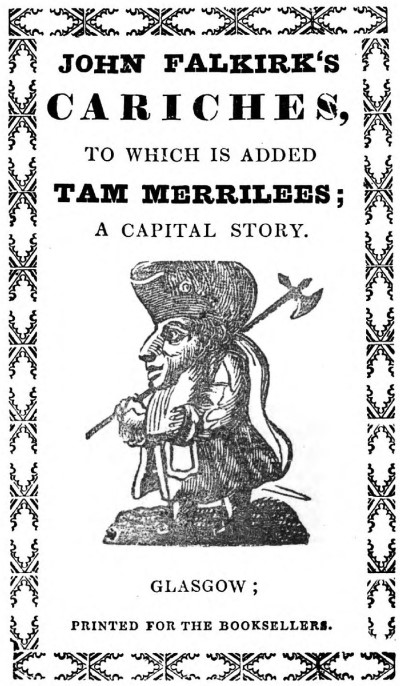
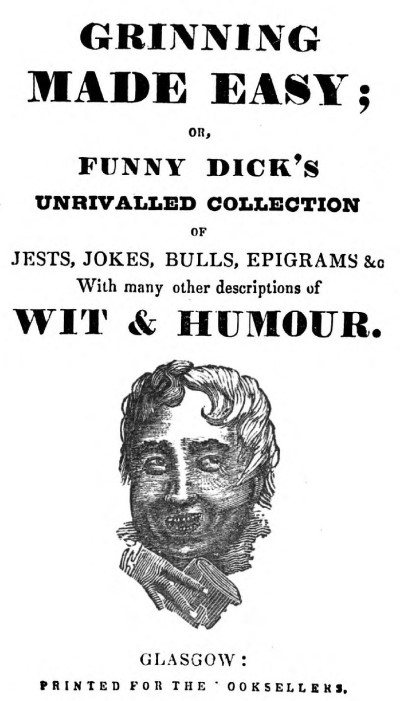
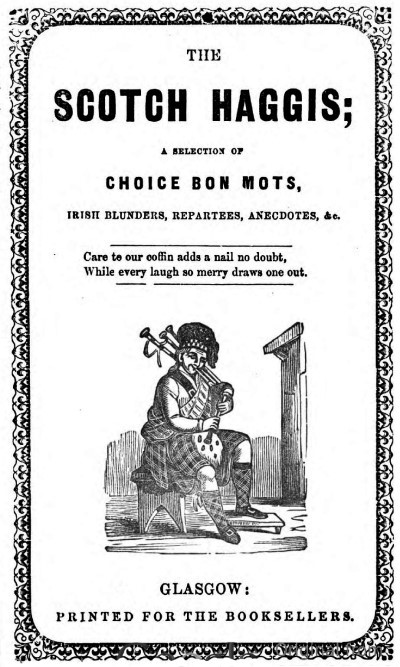
This book is a collection of nineteen separate ‘Chap-books’, with
an introduction on the life of Dougal Graham. Each Chap-book
has its own page numbering from 1 to 24. (It so happens they are all
24 pages in length.)
The three Footnote anchors are denoted by [A], [B] and [C],
and they have been placed at the end of their section.
The cover image was created by the transcriber
and is placed in the public domain.
Many minor changes to the text are noted at the end of the book.
A name is very often only a definition of a thing
in one of its aspects—generally the most obvious to
ordinary observation, though not always the most
comprehensive or characteristic. The name Chap-book
is an example of names of this class, and owes
its origin to the fact that the tracts which we now
recognise by it were first—and, indeed, during the
whole time of their circulation as popular literature—sold
by chapmen, or pedlars. With the extinction of
these itinerants, the popular circulation of chap-books
has ceased; and it seemed as if—from the flimsy
nature of their get-up—this form of literature was
about to vanish, like the compositions of our earliest
minstrels, when a taste for collecting specimens sprung
up among the curious in literature. To meet the
demand for collections which the spread of this taste
originated, the present issue has been projected.
What purpose, it may be asked, does their preservation
serve? Of no class might this be more
properly inquired than of the Religious, which may
be supposed to admit of less scope for originality
of treatment than any other; yet an examination of a
few of the tracts under this head soon shows us the
popular creed in forms of thought and illustration
quite unexpected, and with a definiteness and force
the originality of which cannot be mistaken. The
same character, of course, applies in a more marked
degree to classes where the composer was less influenced
by prepossessed ideas, and where his only
boundaries were the limits of his own imagination,
and the deference which he was careful to pay to the
prejudices of his readers.
That these carelessly got-up publications constituted
the popular literature of the peasantry and a large part
of the urban population of Scotland for about half a
century, is a fact which no student of our recent
history will wisely ignore. They possess one advantage
over the sensational reading of the present day
penny journals, in that they represent the opinions
and manners of those who read them, and, consequently,
have a truthfulness and reality of which their
London-manufactured substitutes are entirely destitute.
The Chap-book is a mirror of rural opinions and
manners; the Penny Sensational is only evidence of
a vitiated popular taste.
These remarks are chiefly applicable to the chap-books
of Scottish production, which, along with those
adopted from foreign sources, but so naturalized as to
language and characters as to pass for productions of
home growth—in reference to the purposes of this
issue—are by far the most important. Keeping this
purpose in view, there is no call here to apologise for
their coarseness and indelicacy, for which, on the
score of taste and morals, from a popular point of
view, there is no defence; but their real value to us
consists in their being true delineations of the manners
and ways of thinking of low rural life, whose grossness
was rather the result of the buoyancy of animal vigour
than of the indulgence of vicious passions.
The English ones are very varied in character, and
have been chosen with considerable judgment, to suit
the taste and understanding of those for whom they
were selected. Their circulation in Scotland has been
so large that we are justified in including them in a
collection of Scottish peasant literature.
The original Scottish chap-books attributed to the
pen of Dougal Graham are so decidedly superior, that
a sketch of his life, containing all that is known of
him, has been considered the most fitting introduction
to the present issue. The earliest literary inquiry into
his history was made by Motherwell, the poet, who
contributed a sketch of him and his writings to the
Paisley Magazine of January, 1829, based upon information
derived from George Caldwell, bookseller,
Paisley, who knew Dougal well, and was the chief
publisher of his “penny histories.” Some further
information regarding him, and corrections of mistakes
in Motherwell’s article, are given in an appendix to
the 1830 edition of M’Ure’s History of Glasgow, very
possibly from the pen of M’Vean, its publisher, who
was a collector of Dougal’s tracts. A more recent life
of him—chiefly based on those already mentioned—forms
chap. iii. of Scottish Chap-books, by John Fraser—a
dissertation which brings into one view the gist of
what has been written on this subject by Scott,
Motherwell, Strang, Strathearn, and others.
That any other chapmen contributed to the series
is not known, nor very probable, if we except two or
three pieces that have been adopted from the writings
of Wilson the ornithologist. That the calling afforded
excellent opportunities for observing country life and
manners is amply testified by those sketches of
Graham’s, which in their graphic pictures of low life
and morals are unsurpassed, unless in the Jolly Beggars.
That a chapman’s opportunities may be employed in
observing the finer traits of humble life is exemplified
in the case of Alexander Laing of Brechin, whose
Wayside Flowers contain touches of pathos, delicacy
of sentiment, and refinement of feeling that rank him
as high above Dougal in these respects as he is surpassed
by him in force, breadth, and keenness of wit
and humour.
The present issue of the Chap-books is printed from
plates that have been used in producing the texts of
chap circulation, and are the veritable impressions of
these, with “all their imperfections on their heads.”
The classification is an innovation, which, it is expected,
will at least please the studious collector; and the
extra margins, the want of which is the great difficulty
in binding stray collections, should be welcomed by
all who dislike to see the text stitched into the back
of the binding.
THE LIFE OF DOUGAL GRAHAM. — FOOTNOTES:
It has been observed, by nearly every one who has
written on the subject of Scottish chap-books, that, as
truthful delineations of the manners and ways of thinking
of native peasantry, they excel those of most other
nations. There is an equal unanimity of opinion that
this superiority of the Scottish chap-books is due to the
penetrating observation, the broad humour, and the
truthful adherence to nature of Dougal Graham—a
genius of a somewhat grotesque type, whose literary
ambition it was to make his writings “acceptable,
especially, to those of common education” like himself;
and whose social aspirations were satisfied by
the appointment of skellat bellman to the city of
Glasgow.
Dougal was born in the small hamlet known by the
Celtic name of Raploch, situated at the western base
of the romantic rock on which stands Stirling Castle;
and now in a most tumble-down condition, characteristically
abandoned to the natives of Erin. The exact
date of his birth is unknown, but is placed in or about
the year 1724. Nothing is recorded of his boyhood
and youth, except that he learned no trade, it is said,
on account of the poverty of his parents, but probably
as much on account of physical deformities, which
rendered him unsuitable for most mechanical labour.
His education does not appear to have gone beyond
reading and writing; for his composition shows no
traces of his having been taught any other grammar
than that which regulates the conversation of the class
whose manners he so faithfully sketches. It is related
that he tried farm service for some time at Campsie,
in the west of Stirlingshire, but soon found it incompatible
with his physical constitution and the restlessness
of his disposition.
If the date assigned to his birth be correct, he was
only twenty-one when the rebellion of 1745 awoke the
martial ardour of the youth of Scotland, and Dougal,
notwithstanding his incapacity for bearing arms, had
his love of adventure fired by the popular enthusiasm
evoked by the romantic enterprise of “Prince Charlie.”
The Fords of Frew, on the Forth—the Rubicon
crossed by the Highland army in its march into the
Lowlands—are only a few miles to the west of Dougal’s
birthplace; and it was here that he appears to have
embarked in the popular cause, with what purposes it
would be difficult to say. In his metrical History of
the Rebellion, although he writes in the first person,
he makes no mention of any adventures personal to
himself; he records only what he saw, and in the
preface he says “that he had been an eye witness of
most of the movements of the Highland army from
the crossing of the Fords of Frew till the final defeat
at Culloden.” Nor does he make any allusion to the
capacity in which he observed the movements of the
army; and, as it is every way improbable that he gave
the Jacobites any other assistance than that of sympathy,
the conjecture almost amounts to a certainty
that he followed them as a sutler. He had sufficient
pride not to mention the fact in his writings; yet, no
doubt, a man of his genial and outspoken disposition
must often have referred to the incidents of his campaigning
among his boon companions. We are disposed
to think, considering the circumstances, that he
must have been born earlier than 1724; for the coolness
and self-confidence, not to say the indifference,
with which he regarded the success or failure of either
side, the impartiality of his narrative, and, it is conjectured,
his dealing with either side, according as it
suited his convenience or his safety, argue greater
experience of the world than could reasonably be expected
of a person of such limited education at the
age of twenty-one. It is true he was born within
hearing of the muster trumpet of Stirling Castle, and
must, from his boyhood, have been sufficiently familiar
with the garrison exercises to make him at home in
the bustle of a camp; but there is the fact, that, almost
before the smoke of the rebellion was extinguished, his
metrical History, consisting of over five thousand lines,
Hudibrastic metre, is announced in the Glasgow
Courier as “A full and particular account of the late
rebellion, in the years 1745 and 1746, beginning with
the Pretender’s embarking for Scotland, and then, an
account of every battle, siege, or skirmish that has
happened in either Scotland, or England; to which is
added several addresses and epistles to the Pope,
Pagans, Poets, and Pretender; all in metre; price
fourpence.” After stating that any bookseller of packman
might have it on easier terms from James Duncan,
or the author, D. Graham, it is added:—“The like
has not been done since the days of David Lindsay.”
The book appeared in September, 1746, and has been
so popular, that by 1828 it reached its twentieth
edition. The first edition is now supposed to be
extinct; yet so late as 1830 a copy was in the possession
of Sir Walter Scott, which he intended publishing,
in facsimile, for the Maitland Club.
The statement in the advertisement, that dealers
might have copies from the author, points to his having
a place of business or residence in Glasgow; but
this does not appear to have been the case, then at
least, for in the preface he tells his readers that it was
“Composed by the Poet, Dougal Graham;
In Stirlingshire he lives at hame.”
The probability is that he made his father’s house at
Raploch his home, whence he started on his journeys,
as a chapman, through the counties of Stirling, Lanark,
and Dumbarton, more rarely over the three Lothians,
and occasionally into Fifeshire. Glasgow would, of
course, be his purchasing market, which he would frequently
visit for replenishing his stock; and, while
there, his resort would be well known to his confrères
in the “travelling line.” He continued thus for
several years, after the publication of his history, compiling
chap-books, and writing poems and songs, for
which there seems to have been an eager competition
among the booksellers of Glasgow, Paisley, Stirling
and Falkirk, until, by his industry and saving, he accumulated
sufficient capital to set up a printing office
in the “Salt Mercat” of Glasgow.
Dougal did not make a fortune by his campaigning,
any more than the chiefs whose wake he generally
followed; but he was at least more fortunate than
most of them, in getting back to where he might begin.
At first he appears to have encountered some
hardships for want of money, and, possibly from the
dislike of Jacobitism, and all who “melled with the
rebels,” for which Glasgow was distinguished; and the
exasperation caused by these difficulties he ventilates
on the heads of the Papists, to whom, with bad rhyme,
and worse reason, he attributes the general scarcity of
money, and his own in particular:
“You Papists are a cursed race,
And this I tell you to your face;
And your images of gold so fine,
Their curses fall on me and mine.
Likewise themselves at any rate,
For money now is ill to get.
I have run my money to an en’,
And have nouther paper nor pen
To write thir lines, the way you see me,
And there’s none for to supplie me.”
As may be inferred from his having soon after set up
in business, his finances did not remain long in the condition
implied in the above doggerel; and in 1752, in
the preface to a second edition of his History, he styles
himself “merchant,” a title which ambitious pedlars
assumed on finding themselves progressing in business
and wealth, which many of them did, to the extent of
making large fortunes, and founding establishments
whose present owners are merchant princes of Glasgow.
Whether the phrase “me and mine” in the above
quotation means a wife and children, as it is usually
understood, or dependent parents, or whether mine is
a mere expansion for rhyme’s sake, is uncertain; for
there is no authentic account of his having ever married;
but an advertisement which appeared in the Glasgow
Journal of 14th June, 1764, crying down the credit “of
Jean Stark, spouse of Dougal Graham, ale seller above
the Cross, Glasgow,” for having parted from her
husband, has raised some doubts about his having
always retained his single blessedness. There is, however,
no other evidence than the coincidence of his
name with that of a less fortunate clansman, to identify
the real Dougal with the “ale seller above the Cross.”
The fact that a namesake was such, would naturally
lead to a confounding of his name with the better
known of the two; and out of the confusion of names
would originate the tradition that Dougal the poet was
Dougal the ale seller.
When he learned printing, and the date of his setting
up in that art, in the Saltmarket, are not known.
A second edition of his “History of the Rebellion”
having been published in 1752, it is very natural to
suppose that he learned type-setting and the other
details necessary for printing the class of publications
in which he dealt, during its progress through the press.
Like his better known predecessor, Ramsay, whom
he resembled in many traits of character, he relinquished
the reputedly less respectable profession as
soon as he found that he could depend upon the
more dignified one of printer. It is obvious, also,
that, to a person of his constitution, travelling must
have been attended with difficulties which would
create a strong desire to quit it as soon as possible.
The next event in Dougal’s career of which we have
any information, and that which, it is most likely, he
would himself consider the crowning success of his
life, is his appointment as bellman to the city of
Glasgow. Of this it might be thought that the date,
or a close approximation to it, might be found in some
of the public records of the city, for at that time the
office was one of considerable importance; and many
duties connected with the municipality, as the ringing
of the Skellat bell and attending the meetings of the
Town Council, in the livery of his office, were discharged
by the bellman. The emoluments also were
considerable, for, besides his official salary of ten
pounds, and many valuable perquisites, the bellman
was then the chief advertising medium. The year
1772 is assigned as the most probable date of the
election; and as the candidates for the office were
unusually numerous, the competition was keener than
ordinary. As the selection was to be made after a
public trial of the fitness of the candidates before the
magistrates, the arrangement was all in Dougal’s
favour, for he was just the man to undergo such an
ordeal triumphantly. But his connection with the
Rebellion, and suspicions, not without foundation,
that he still sympathized with the Jacobite cause,
were election weapons not likely to be overlooked by
his opponents, to rouse the Hanoverianism of the
magistrates against him, so that, notwithstanding the
toning down of political asperity, and Dougal’s
advances in popular favour, as a poet and a wit, it
needed all his address to overcome what George
Caldwell, his Paisley publisher, called the ill brew
(ill will) of the Glasgow bailies against Highlanders
and anybody that melled (associated) with the rebels.
The trial of skill took place in the court behind
the old Town’s Hospital, near the Clyde; and the
popular traditional account of the event represents
Dougal as the hero of the occasion. After the other
candidates had tried the strength of their lungs and
the reach of their voices on the announcement of
“Fresh herrings at the Broomielaw,” he sang out at
the top of his voice, with simulated gravity, in a
manner that put them all in the shade—
“Caller herring at the Broomielaw,
Three a penny, three a penny.”
But remembering that it was not the season for fresh
herring, he added, with the comic confidence for
which he was distinguished—
“But indeed, my friends, it is a’ a blawflum,
For the herring’s no catch’d and the boat’s no come.”
Dougal was elected unanimously, and the traditional
fame of his bellmanship leaves no doubt that he discharged
the duties of the office to the satisfaction of
the magistrates, and the advantage and entertainment
of the public. He was imbued with all the love of
fun and drollery of an Irishman, and all the pawky
sarcastic humour, and independent sagacity of a Scot;
and invariably drew large crowds to hear his rhymed
or otherwise queerly-worded notices, to which his
laugh-provoking manner gave additional point.
His appointment as bellman did not necessitate
the giving up of his business; and he still continued
to write and print with unabated vigour; indeed, some
of the most popular productions of his pen are
assigned to this date. In 1774 he issued a third
edition of his History of the Rebellion, with “amendments,”
and the addition of “a description of the
dangers and travels of the Pretender through the
Highland isles after the break at Culloden.” It
extends to 189 pages, and contains plans of the
battles of Prestonpans, Clifton, Falkirk, and Culloden;
with a full-length woodcut portrait of the author, in
his bellman costume, fronting the title-page; and bears
to have been printed by John Robertson, Glasgow.
This edition, there is every probability in supposing,
was the last issued during his lifetime, for between it
and the second there is a space of twelve years, and,
allowing for his increased popularity, six years is a
short enough time to allow for the disposal of it. We
are unable to get any trace of the fourth—the third, of
which, probably, there was a much larger edition,
being the oftenest met with of the early editions; but
the fifth, we learn from Campbell’s History of Scottish
Poetry, was issued by John Robertson in 1787, eight
years after the author’s death, and is, no doubt, along
with the fourth, a reprint of the third. Besides
the additions already indicated, this last has a new
preface, very much in Ramsay’s style, in which he
gives his motives for having written the book. “First,
then, I have an itch for scribbling; and having wrote
the following for my pleasure, I had an ambition to
have this child of mine placed out in the world; expecting,
if it should thrive and do well, it might bring
credit or comfort to the parent. For it is my firm
opinion that parental affection is as strong towards
children of the brain as those produced by ordinary
generation. I have wrote it in vulgar rhyme, being
not only what pleased my own fancy, but what I have
found acceptable to the most part of my countrymen,
especially those of common education like myself. If
I have done well, it is what I should like; and if I
have failed, it is what mankind are liable to. Therefore,
let cavilers rather write a better one, than pester themselves
and the public with criticisms on my faults.”
The half-apologetic reason for having written in
vulgar rhyme, coupled with the addenda in the advertisement
of the first edition, “the like has not been
done since the days of David Lindsay,” almost lead
to the inference that he was acquainted with Lindsay’s
works; while the reference to “those of common
education like myself,” does not support the assertion
that “he got no education.” The disappearance of
the first and second editions makes it impossible to
ascertain the extent of the “amendments” which he
made on their texts; but they are said to be in the
way of toning down the Jacobite leanings, in deference
to the Hanoverianism of his patrons, the Glasgow
magistrates. On this is founded a charge of trimming,
which, the impossibility presently existing of comparing
the two texts, prevents our either verifying or
refuting. We must therefore suspend our judgment
until a copy of either of the lost editions turns up—if
that should ever happen. Meanwhile, it may be
observed that the edition “amended,” as he himself
calls it, was published two years after his appointment
as bellman, and could no way influence his preference
to that office. If made in remembrance of past
favours, it at least shows a sense of gratitude; but this
is proverbially not a strong motive; and as to future
favours, there is every reason to think that Dougal’s
ambition in that direction was already satisfied. If
we also take into consideration that the History was
written when he was little over twenty-one, and published
within a few months of the last and misguided
struggle of the clans, too soon to admit of the events
truthfully recorded being impartially judged, and before
the lapse of time admitted of their being seen in
their true bearings, that, nearly thirty years afterwards,
“amendments” were made on some of his early
judgments, need excite no suspicion that they went
beyond the real change in his convictions.
We have no wish to claim for Dougal, and it would
be unfair to exact of him a high moral standard: he
had been all his life too much under the stern discipline
of circumstances, and saw too much of its
levelling effects to have retained—if he ever possessed—any
sympathy for that scrupulosity of thought and
conduct which constitutes a high principled character.
But we see nothing in his behaviour which betrays
any lack of spirit or independence; the quotations
from his preface are the expression of sober self-respect,
without egotism; conveyed in quaint, but
appropriate language, and full of good common sense.
We have dwelt upon the “History of the Rebellion,”
not because we think it the greatest—though by far
the largest of his works—but, because its history is
almost the only authentic nucleus round which the
events of his life cluster; the only “child of his
brain,” of which he himself acknowledges the fatherhood.
For this reason, and because of the disappearance
of first editions, it has been found impossible to
determine the date, or even his authorship, of many
popular chap-books ascribed to his pen. Fortunately,
the authorship of the best of them rests upon the
authority of Motherwell the poet, whose information,
derived, as it is, direct from his “intelligent” friend,
George Caldwell, the chief publisher of Dougal’s
“Penny Histories,” is of the most reliable kind. His
article in the Paisley Magazine of January, 1829, on
“Dougald Graham” being the stimulus and groundwork
of all subsequent investigations on the subject.
The incidents of Dougal’s official life being committed
to the keeping of tradition, have faded out of
public memory with the generation whose sides were
tickled by his jokes; but a list of his chap-books
made by Motherwell, lets us see how he employed his
literary leisure, and the date of publication of the last
but one on the list, brings us to the date of his exit from
the scene which his pen and his voice helped so much
to enliven. It is generally agreed that “Jockie and
Maggie’s Courtship” is the first of his original prose
compositions; and that it was written some time after
his having set up in business as a printer. He appears
to have previously devoted his pen entirely to the
service of the poetic muses; and is the originator
of those comic, but harmless satires on the simplicity
and imperfect English of Highlanders, of which
his John Hielandman and Turnimspike are the
prototypes. But, like his greater countryman, and it
may be added, his greatest extinguisher, Scott—and
much about the same age—after he had worked out the
poetic vein, he discovered a prose one, equally prolific,
and of richer ore; but of which, like the “Great
Unknown,” he preferred to be the unknown excavator.
It is an odd coincidence that, like Scott, too, he frequently
wrote under cognomens, as John Falkirk, or
The Scots Piper. The following is Motherwell’s list
of his prose tracts, with the dates of the earliest
editions which he was able to obtain:—Leper the
Tailor, Part II. only, being a first edition.
1. Jockie and Maggie, five parts, 1783; 2. Paddy
from Cork, 1784; 3. Lothian Tom, six parts, 1793;
4. John Cheap (The Chapman), three parts, 1786; 5.
John Falkirk, 1779; 6. John Falkirk’s Cariches; 7.
Janet Clinker’s Orations; sometimes published under
the title of Granny M’Nab’s Lectures in the Society of
Clashing Wives; 8. Leper the Tailor, parts I. and II.,
1779; 9. Simple John and His Twelve Misfortunes.
Motherwell is of opinion that George Buchanan, The
Coalman’s Courtship, and the History of Buckhaven,
are his also; and questions the existence of any of
them before his time. These three are also found attributed
to him by M’Vean, a Glasgow antiquarian
bookseller, in a MS. list of Dougal’s publications quoted
by Dr Strang,[A] which, in addition to those in Motherwell’s
list, contains: The History of the Haverel Wives,
The Grand Solemnity of the Tailor’s Funeral, &c.;
The Remarkable Life and Transactions of Alexander
Hamwinkle, &c.; The Dying Groans of Sir John
Barleycorn, &c.; A Warning to the Methodist
Preachers; A Second Warning to the Methodist
Preachers. Mr Fraser, who has, perhaps, given
more consideration to the subject than any of his
predecessors, besides having the benefit of their
labours,[B] gives a classified list of his publications
under four heads.
1. The Works of Dougal Graham. 2. Works Probably
Written by Graham. 3. Works Compiled or Edited by
Graham. 4. Works attributed to Graham. Under the
first head he adopts Motherwell’s list, substituting
for Paddy from Cork and Simple John, The Coalman’s
Courtship, and Simple Tam, which is the Scotch introduction
to Simple John; and adding, The Grand
Solemnity of the Tailor’s Funeral, Turnimspike, John
Hielandman, Proverbs on the Pride of Women, and The
History of the Haverel Wives. Under the second he
gives: Dugald M’Taggart, in verse; Verses on the
Popular Superstitions of Scotland; Rythmical Dialogue
between the Pope and the Devil; An Epitaph on the
Third Commandment; Alexander Hamwinkle; Warning
to the Methodist Preachers; and A Second
Warning. Under the third he places Paddy from
Cork; Simple John; John Falkirk; and John
Falkirk’s Cariches; and under the fourth, Sir John
Barleycorn; The History of Buckhaven; and Verses
on the Pride of Women; he should also have added
George Buchanan. Of the History of Buckhaven;
George Buchanan; and Simple John, except the Scotch
introduction, Mr Fraser thinks it extremely improbable,
judging from internal evidence, that they were composed
by Graham, though he may have sold them to
the publishers as his own composition. “For,” he
adds, regarding the two first, “there is not a single
sentence in either of them that might not have been
written by anyone else.” Then why not by Graham?
We wonder whether Mr Fraser has read the History
of Buckhaven through, or whether he is thinking of
some other tract.
What Mr Fraser says as to their facetiæ—including
that of Paddy from Cork—being found in the facetiæ
of almost every country in Europe, may be true—as
Motherwell also states in almost the same words; but
Mr Fraser does not contend for originality in the incidents,
if the composition be imbued with the
national spirit and adapted to the manner of thought
and language of Scotchmen. George Buchanan is
thoroughly Scotch in spirit, and its language is such
as an ordinary Scotchman of common education
would use in writing of events that happened out of
Scotland, and where the use of his native dialect was
inappropriate. The same may be said—of the
language only—of Paddy from Cork, which Mr Fraser
places under the third head, and we see no improbability
in the composition of both tracts being
Graham’s. Mr Fraser seems to forget that Dougal could
write in other styles than that of Jockie and Maggie—that,
no doubt, is his best—but his preface to the
third edition of his History, Turnimspike, &c., and his
denunciations of the Papists, display a versatility as to
style which makes it difficult to except almost anything
in chap literature from his authorship.
Leper the Tailor, Part II. (as has been already observed),
the only first edition in Motherwell’s list, bears
date 1779; and on the 20th July, of that year,
Dougal died (if the date of his birth given be correct)
at the age of 55,[C] and while his literary powers
were in unabated vigour. The cause of his death
is not recorded, and no obituary of him appeared
in any of the local papers of the time; but an
elegy “On the much-lamented Death of the Witty
Poet and Bellman,” from the pen of some unknown
admirer, has been preserved. We quote two stanzas
which bear contemporary evidence to his humanity
and wit:
“Ye mothers fond! Oh! be not blate
To mourn poor Dougal’s hapless fate;
Oft times, you know, he did you get
Your wandered weans;
To find them out both air and late
He spared no pains.”
“Of witty jokes he had such store,
Johnson could not have pleased you more;
Or, with loud laughter, made you roar
As he could do;
He still had something ne’er before
Exposed to view.”
To judge Dougal’s character by any fastidious
standard of manners and morals would be unfair; but,
making a reasonable allowance for the unfavourable
nature of the times, and his surroundings, there is
nothing known of him inconsistent with the character of
a well-intentioned, self-respecting citizen; who thought
it no sin to make his lines pleasanter for himself, by
contributing to the enjoyment of his fellow-countrymen.
His History of the Rebellion abounds with instances
of the fairness and impartiality of his judgment,
and the humanity of his sentiments; and is
full of examples of his quaint and grotesque,
yet mostly shrewd reflections on events which he
seldom fails to place distinctly before his readers.
Dr Robert Chambers, whose opinion, as the writer of
an excellent history of the Rebellion, is entitled to
all respect, in his Lives of Eminent Scotsmen, says of
it:—“The poetry is of course in some cases a little
grotesque, but the matter of the work is valuable. It
contains—and in this consists the chief value of all
such productions—many minute facts, which a work
of more pretensions would not admit.”
Sir Walter Scott, writing to Dr Strang, of Glasgow,
in 1830, in reference to his notice of Graham, says:—“Neither
had I the least idea of his being the
author of so much of our Bibliotheque Blue as you
ascribe to him, embracing, unquestionably, several
coarse, but excessively meritorious, pieces of popular
humour. The Turnimspike, alone, was sufficient to
entitle him to immortality. I had in my early life a
great collection of these chap books, and had six
volumes of them bought before I was ten years old,
comprehending most of the rare and curious of our
popular tracts.” Motherwell, besides calling him the
“Scottish Rabelais” and the “Vulgar Juvenal of his
age,” in the article already referred to, reviewing his
history and his tracts, says:—“However slightingly
we esteem his metrical power, we really believe he
has conscientiously and honestly detailed the events
that came under his observation. It is not, however,
on the merits of this work that Graham’s fame rests.
Had he written only it, we believe he never would
have occupied our thoughts for a moment; but as one
who, subsequently, contributed largely to the amusement
of the lower classes of his countrymen, we love
to think of the facetious bellman. To his rich vein
of gross comic humour, laughable and vulgar description,
great shrewdness of observation, and strong
though immeasurably coarse sense, every one of us,
after getting out of toy books and fairy tales, has
owed much. In truth, it is no exaggeration, when we
state that he who desires to acquire a thorough
knowledge of low Scottish life, vulgar manners, national
characteristics, and popular jokes, must devote his days
and nights to the study of John Cheap, the Chapman,
&c., &c., &c., all the productions of Dougal’s fertile
brain, and his unwearied application to the cultivation of
vulgar literature. To refined taste Dougal had no
pretensions. His indelicacy is notorious, his coarseness
an abomination, but they are characteristic of the
class for whom he wrote. He is thoroughly imbued
with the national humours and peculiarities of his
countrymen of the humblest class; and his pictures of
their manners, modes of thinking, and conversation,
are always sketched with a strong and faithful pencil.
Indeed, the uncommon popularity his chap books
have acquired, entitles them in many a point of view
to the regard of the moralist and the literary historian.
We meet them on every stall and in every cottage.
They are essentially the library of entertaining knowledge
to our peasantry; and have maintained their
ground in the affections of the people, notwithstanding
the attempt of religious, political, or learned associations
to displace them by substituting more elegant
and wholesome literature in their stead.” It is now
about fifty years since Motherwell wrote the article
quoted; and the Waverley Novels, Chambers’ Journal,
and The Tales of the Borders have accomplished what
the religious and learned societies failed in doing.
Of Dougal’s personal appearance some particulars
have been already noted, but an edition of John
Falkirk’s Cariches, which appeared soon after his
death, contains a prefatory notice, in which, under the
cognomen of John Falkirk, commonly called the
Scots Piper, the popular contemporary ideal of him
is given as “a curious, little, witty fellow, with a
round face and a broad nose. None of his companions
could answer the many witty questions he
proposed to them—therefore he became the wonder
of the age in which he lived. Being born of mean
parents, he got no education; therefore, his witty
invention was truly natural; and being bred to no
business, he was under the necessity of using his
genius in the composition of several small books, of
which the following Cariches was one, which he disposed
of for his support.”
[B] Scottish Chap-Books, by John Fraser, New York, 1873.
[C] Motherwell calculates his age to have been 65, supposing him
to have lived to 1787.
THE WITTY EXPLOITS OF MR GEORGE BUCHANAN. — PART I. — PART II. — WILL SCOTT — GRAVE-DIGGER OF SORN.
THE
WITTY AND ENTERTAINING
EXPLOITS OF
GEORGE BUCHANAN,
COMMONLY CALLED
THE KING’S FOOL.
GLASGOW:
PRINTED FOR THE BOOKSELLERS.
Mr. George Buchanan was a Scotsman born, and
though of mean parentage, made great progress in
learning. As for his understanding and ready wit
he excelled all men then alive in the age, that ever
proposed questions to him. He was servant or
teacher to king James the VI., and one of his private
counsellors; but publicly acted as his fool.
1. It happened one day that a young airy nobleman
went into the king’s garden to pull a flower
for a young lady he fancied; George followed at a
distance, so when the young man found a flower he
fancied, he would not pull it himself, but to find it
again, without farther search, he covered it with his
hat, and went away for his sweatheart. No sooner
was he gone, but up goes George, lifts his hat, and
pulls the flower, then eases himself on the spot,
covers it with the hat again, and away he goes.
Soon after, the young gentleman returned, leading
his sweatheart to pull the flower below the hat;
but as soon as he lifted the hat, and saw what was
below it, he looked like a fool; and the lady flying
in a passion, sets off, and would never countenance
him any more. The young gentleman being sadly
vexed an this affront given to him by George, sent
him a challenge to fight him, appointing day and
place where they were to meet. Being to fight on
horseback, George gets an old stiff horse, and for
harnessing, covers him about with blown bladders,
with small stones in each, without either sword or
spear; and away to the field he goes, where the
duel was appointed. So when George saw his
enemy coming against him, all in glittering armour,
armed with sword and spear, he made up to
him with all the speed his horse could carry him;
when the small stones in the bladders made such
a rattling noise, that the gentleman’s fine gelding
would not stand the battle, but ran away, and
threw his master to the ground: which caused all
the spectators to laugh, and say, the gentleman was
more fool than George. The gentleman being still
more enraged at this second affront, he would fight
with George on foot; but his friends persuaded him
that it would be no honour for him to fight and kill
the king’s fool; and far less to be killed by the fool.
So they were advised both to agree. But the gentleman
would try another exploit with George, for
to have it said he was still the cleverest man,
viz:—To hold him a jumping-bout publickly, the
next day thereafter. With all my heart, says
George, and we will end in and about where we
began, they not knowing his meaning in this.
The place and hour being set, where they were to
meet next morning. George in the night-time,
caused a deep pit to be made, and the earth of it
carried away; then filled it up with dung from a
p——, and covered it over with a green turf, that
it might not be known by the other ground. So,
according to promise, they both met in the morning
against the appointed time. Now, George
being the oldest man, and by them counted the
greatest fool, the young spark permitted him to
jump first, which he according to order did, and
jumped within a foot of the place where the ground
was falsified. The young man seeing this, made
his performance with great airs, and all his might,
so that he jumped a foot over George, but, up to
the oxters among clean dung! whereat, the whole
multitude of spectators cried out with huzzas and
laughter. Now, says George, I told you we would
end in and about where we began, and that is in
clean dirt.
2. On a time after this, the king and his court
were going into the country, and they would have
George to ride before them in the fool’s dress;
whereunto he seemed unwilling, but it was the
king’s pleasure. So George was mounted upon an
old horse, with a pair of old riven boots, the heels
hanging down, and a palmer coat, patched over
with pictures of divers kinds. George rode before
them in this posture which caused great laughter
and diversion, until they came to an inn, where
they alighted to dine, and in the time they were
at dinner, George went into the stables, and with
a knife cut all their horses’ chafts, not sore, but so
as they might bleed. Now, as soon as dinner was
over, and they mounted on their horses again,
George riding before them as usual, in his palmer
coat and old boots, they began to make their game
of him: then George turning about suddenly, and
clapping his hands with a loud laughter, the king
asked him what made him laugh so? Laugh, says
George, how can I but laugh, when horses cannot
hold their peace? O my sovereign, says he, don’t
you see how your horses have rent their chafts
laughing at my old boots! Then, every man looking
at his horse’s mouth, they were all in a rage
against George. The king, causing George to
dismount directly, and charged him never to let
him see his face on English ground. Now, George
knowing that nothing could reconcile the king at
this time, he came away to Scotland, and caused
them to make a pair of great boots, and put a
quantity of Scottish earth in each of them, and
away he goes for London, to see the king once
more. He hearing the king and his court was to
pass through a town, George places himself up in
an old window, and sets up his bare a——, to the
king and his court as they passed. The king being
greatly amazed to see such an unusual honour done
to him, was curious to know the performer: so he
called unto him, desiring him to come down; and
finding it to be George, sir, says the king, did
not I charge you never to let me see your face
again? True my sovereign, says George, for
which cause I let you see my a——. But says the
king, you was never to come on English ground
again. Neither I did, says George, pulling off
his boots before the king, behold, my Sovereign,
it is all Scots earth I stand upon. The king and
his court being greatly diverted with this merry
joke, George was admitted again to the king’s
favour.
3. After this there arose a debate betwixt the
king and the queen about votes in the parliament;
as the king had two votes, the queen would have
one, and would needs be a parliamenter, or no
peace without preferment. This matter was committed
to George by the king; so it was agreed
among the parliamenters, that the queen should
be admitted into parliament for a day. Accordingly
she came, and was received with all the
honour and congratulations that was due and
becoming her high station: but before any matter
of consequence was brought to the board, George
seated himself hard by the queen’s seat; all being
silent, he rose up very quickly, lifted one of his
legs, let a loud f——t, which set the whole house
a-laughing; whereat the queen was greatly offended,
and said, go, take the rogue and hang him, to
which George answered, a fine parliamenter indeed,
to hang a man for a sinless infirmity, and
that’s a f——t. The queen being enraged at the
affront put on her first appearance in parliament,
went off in a passion, and never would countenance
them more. But yet to be revenged on George,
she would never give the king rest, till he delivered
George into her hands, that he might be punished
at her pleasure; which the king accordingly commanded
to be done, knowing that George would
rescue himself by some intrigue or other. No
sooner was he delivered into her hands, but she
and her maids of honour pronounced his doom,
which was as follows:—As he had affronted the
queen among so great an equipage, who ought to
be honoured in chief above all women in the
nation, that he should be stoned to death by the
hands of women. Now the time being come that
he had to die, according to their appointment, he
was taken into a park, where a great number of
women were waiting for him, with their aprons
full of stones, to fall upon him, and put him to
death according to the queen’s appointment.
GEORGE’S SPEECH TO HIS EXECUTIONERS.
Here’s a female band with bags of stones
To kill a man for rumple groans:
I’m clean of rapine, blood, and thefts,
Could I convert my f——s to rifts?
Since I, the first for f——s do die,
Close up the place from whence they fly,
To commit my crime, I think ye’ll scarce,
If once you do cork up your a——.
And now since women stones do carry,
Men need not in the world tarry,
Judge if such women be chaste complete,
With forty stones between their f——;
But since ’tis so ye will come on,
The greatest w—— throw the first stone.
When he had ended with these words, “The
greatest w—— throw the first stone,” every one
put it to another to cast the first stone, but knowing
they would attain the character of a w—— for
so doing, they all refused till the dying hour was
past, and then he took a protest against them, and
by that means he gained his life. After this he
was admitted into the queen’s favour and presence,
and attended the court as formerly.
4. About this time, the French king, in order
to pick a quarrel with the court of Britain, sent a
letter to the king, desiring it to be read before the
parliament: and the writing was as follows; “Will
I come? Will I come? Will I come?”—This
letter being read before the king and his courtiers,
they all concluded that the French king designed
to invade England; therefore they ordered an
answer to be wrote, upbraiding him with the
breach of peace, and putting him in mind of the
last treaty. The answer being read before the
king and his nobles, they all agreed that it should
be sent off. But George, smiling, and shaking
his head, cried out,
Many men, many minds,
Who knows what he designs?
Then they asked George what the French king
meant by such a letter? to which he answered, I
suppose he wants an invitation to come over to
dine with you, and then return in a friendly manner;
but you are going to charge him with a breach
of peace, before he has given any signal of offence
or war: his letter is indeed dark and mystical, but
send him an answer according to his question.
Now, George being ordered to write the answer, it
was as follows:—“And ye come—And ye come—And
ye come.” This being sent to the French
king, he admired it beyond expression, saying, it
was an answer more valiant and daring than he
expected. So the enmity he intended was extinguished,
and turned into love.
5. It happened once, that a malignant party in
Scotland sent up a great spokesman to the king
and parliament, for the reducing of the church;
George hearing of his coming, went away and met
him on the bridge, and the salutation that he gave
him was the cutting off his head, and throwing it
over the bridge! He then ran to the king with
all his might, and fell down before him, pleading
most heartily for a pardon, or without it he was a
dead man. The king most seriously asked him
what he had done now? To which he answered,
he had only thrown the Scots Bishop’s hat over
the bridge, which made the king to laugh, to hear
him ask pardon for such a small fault; but he had
no sooner got the pardon sealed by the king’s hand,
than he said, indeed my sovereign, I threw his
hat over the bridge, but his head was in it. O
Geordie, Geordie, says the king, thou wilt never
give over till thou be hanged.
6. A nobleman in England agreed with the
king how to put a trick upon George, to try his
manly courage, in sending him to a certain place
for a bag of money. On his way home, through
St James’ park, they caused a sturdy fellow to go
and set upon him by the way, and take the money
from him. The fellow being armed with sword
and pistol, came up quickly, and attacked George
with these words, You, sir, deliver what money
you have, or you are a dead man. To which
George answered, sir, I have some indeed, but
’tis not my own, and therefore do not like to part
with it: nevertheless, since being determined as
you are, to exchange blows for it, pray do me the
favour to fire your pistol through the flap of my
cloak, that the owners may see I have been in
danger of my life before I parted with it, which
he accordingly did. No sooner had he fired the
pistol, than George whipt out his hanger from
below his cloak and with one stroke cut off his
right hand, wherein he held his sword, so that both
his sword and the hand fell to the ground; but
George lifted his hand and carried it to the king.
No sooner did he come before them, but they
asked him, saying, well, George, did you see any
body to trouble you by the way? None, said he,
but one fellow, who was going to take the money
from me, but I made him give me his hand he
would not do the like again. You did? says the
fellow’s master. Yes, I did, says George; let
work bear witness, throwing down the fellow’s
hand on the table before them all.
7. Now, this last exploit of George’s caused
many of the English to hate him; and, among the
rest, a young nobleman fell a joking of George,
saying, he would be as famous a champion for
Scotland as Sir William Wallace was. Ay, ay,
says George, Wallace was a brave man in his
time.—True indeed, says the young nobleman,
but when he came to London, we did him all
manner of justice, and for honour of the Scots,
we have his effigy in the s—— to this very day.
And do you know the reason of that, says George?
No, I don’t, says he. Well, I’ll tell you, says
George: he was such a terror to Englishmen,
when he was alive, that the sight of his picture
yet makes them p—— themselves. The English
took this answer as a great affront, and forthwith
caused Wallace’s picture to be taken out of all
their s——.
8. A young English girl falling in love with a
Scotchman, she petitioned him several times for to
marry her: which he refused. So, to be revenged
on him, she went to a Justice, and swore a rape
against him, which is death by the law. George
hearing of this, went to the prison where the young
man was, and instructed him how to behave before
the judge. So in the time of the trial George
came in while the judge was crying to the man,
but never a word he could get him to answer, to
tell whether he was guilty or not. After the justice
had given him over for deaf and dumb, others
fell a shouting in his ears, but never a word he
would speak. Then the judge, perceiving George,
called him, saying, George, do you know what is
the matter with this man? Yes, I do very well,
says George. What is it? says the judge. Why,
says George, the woman made such a noise and
crying when he was ravishing her, it has put the
poor man quite deaf, I assure you. Is it so? says
the justice. No, no, says the woman, my Lord
Justice, you may believe me, I lay as mute as a
lamb, and never spoke a word all the time. Very
well confessed, said the justice, and you have
sworn a rape upon him. Take the w—— to
prison, and let the poor man go about his business,
and so it ended.
George happened one time to be in company with
a bishop, and so they fell to dispute anent education,
and he blanked the bishop remarkably, and
the bishop himself owned he was worsted.—Then
one of the company addressed himself to him in
these words: thou, Scot, said he, should not have
left thy country. For what? says he, because thou
has carried all the wisdom that is in it thither
with thee. No, no, says he, the shepherds in
Scotland will dispute with any bishop in London,
and exceed them very far in education. The
bishops then took this as an affront, and several
noblemen affirmed it to be as the Scot had said:
bets were laid on each side, and three of the bishops
were chosen, and sent away to Scotland to
dispute it with the shepherds, accompanied with
several others, who were to bear witness of what
they should hear pass between them. Now, George
knowing which way they went, immediately took
another road and was in Scotland before them.
He then made an acquaintance with a shepherd
on the border whose pasture lay on the wayside
where the bishops were to pass: and there he
mounted himself in shepherd’s dress: and when
he saw the bishops appear, he conveyed his flock
to the roadside, and fell a chanting at a Latin
ballad. When the bishops came up to George,
one of them asked him in French what o’clock
it was? To which he answered in Hebrew, it
is directly about the time of the day it was
yesterday at this time. Another asked him, in
Greek, what countryman he was? To which he
answered in Flemish, if ye knew that, you would
be as wise as myself. A third asked him, in Dutch,
where was you educated? To which he answered,
in Earse, herding my sheep between this and
Lochaber. This they desired him to explain into
English, which he immediately did. Now, said
they one to another, we need not proceed any
farther. What, says George, are you butchers?
I’ll sell you a few sheep. To this they made no
answer, but went away shamefully, and said, they
believed the Scots had been through all the nations
in the world for their education, or the devil had
taught them. Now, when George had ended this
dispute with the bishops, he stripped off his shepherd’s
dress, and up through England he goes, with
all the haste imaginable, so that he arrived at the
place from whence they set out, three days before
the judges, and went every day asking if they were
come, so that he might not be suspected. As soon
as they arrived, all that were concerned in the dispute,
and many more, came crowding in, to hear
what news from the Scottish shepherds, and to
know what was done. No sooner had the three
gentlemen declared what had past between the
bishops and the shepherds, whom they found on
the Scots border, but the old bishop made answer,
and think you, said he, that a shepherd could answer
these questions? It has been none else but
the devil; for the Scots ministers themselves could
not do it; they are but ignorant of such matters,
a parcel of beardless boys. Then George thought
it was time to take speech in hand. Well, my
lord bishop, says George, you call them a parcel of
ignorant beardless boys. You have a great long
beard yourself, my lord bishop, and if grace were
measured by beards, you bishops and the goats
would have it all, and that will be quite averse to
Scripture. What, says the bishop, are you a Scot?
Yes, says George, I am a Scot. Well, says the
bishop, and what is the difference between a Scot
and a sot? Nothing at present, says George, but
the breadth of the table, there being a table betwixt
the bishop and George. So the bishop went off in
a high passion, while the whole multitude were
like to split their jaws with laughter.
2. About this time there was an act of parliament
for the benefit of murderers, that any person,
who committed murder, if they forfeited five hundred
marks, which went under the name of Kinboot,
because, so much of this went to the murdered
person’s nearest relations, as the price of
blood, the murderer got a remit. Now George
knowing this to be contrary to Moses’ laws, was
very much grieved to see so many pardons sealed
by the king’s hand for murder, almost one every
week; it being so usual for the king to subscribe
them, that he would not read them, nor enquire
what they were; for which cause, George writes a
writ to the crown, and sent it to the king to be
subscribed, which he actually did, and never looked
what it was, returned it to George. No sooner
had he received it, but he goes to the king and
told him it was not time for him to be sitting
there, whereat, the king greatly amazed, started
up; then George in great haste, sets himself down
in the king’s chair, forthwith declaring himself
king, saying, you who was king must be my fool,
for I am now the wisest man. The king at this
was greatly offended, until George shewed him his
seal and superscription. But from that day forth
the king knew what he subscribed.
3. The next pardon that came to be sealed by
the king, was a gentleman who had killed two men
before, and had got pardons for them by money.
This being the third, the king was very silent in
looking over the petition: George standing by,
asked the king what he was going to seal now?
To which he answered, it is a remit for a man who
has killed three men at sundry times, I gave him
two remits before. O! says George; he has killed
but one man. And who killed the other two
says the king. You did, says George, for if you
had given him justice when he had killed the first,
he had killed no more. When the king heard
these words he threw down the pen, and declared
that such an act to save a murderer, should be
null ever after by him.
4. One day, George having no money, he goes
away and gets a pick and a spade, and then falls a
digging at a corner of the king’s palace; which the
king perceiving from his window, calls what he was
wanting there? Are you going to undermine my
house, and make it fall? No, my sovereign, says
George, but it is verily reported that there is plenty
of money about this house, and where can it be?
says George, I cannot find it, for it is not within
the house to do me service, then surely it must be
below it. O George! says the king, that is a crave
after the new fashion, what money you want I’ll
order for you. Then, my sovereign, says George,
I’ll dig no more.
5. One time George being in the country, he
came to an inn, where he alighted to refresh himself
and his horse. The innkeeper charged him
double price for every thing he called for.—George
never grumbled at this, but gave him all demands,
and away he goes on his journey. At the inn
where he quartered the following night he was
used after the same manner, if not worse. Having
little farther to go, he returned next day, and
came that night to the inn where he refreshed
himself the day before. So, when he alighted,
the boy asked him what he would give his horse?
What you will, said he. When he had gone to
his room, the waiter enquired what he would have
to drink? What you will, says he. The master
of the inn came into his room before supper, and
enquired what he would have for supper? What
you will landlord, says he. After supper, and a
hearty bowl to put all over, he went to bed. On
the morrow, he rose very early, and called for the
boy to make ready his horse in all haste, for he
was designed to mount and go directly. Soon
after, he went into the stable where the boy was,
calling for his horse, when he mounted with all
the speed he could, and gave the boy a piece of
money, saying, here my boy, this is for taking
care of my horse; I have paid for all I have
ordered in the house, and off he goes. About
mid-day he alighted again at an inn to refresh
himself and his horse, and there he chanced to be
in company with his other landlord where he was
the night before, and charged him with the double
reckoning: so he addressed himself to him in the
following manner.—Sir, says he, I do believe I
was in your house yesternight; O yes Sir, says he,
I mind of you pretty well. And where was you
last night? Last night, says George, I was in one
of the finest inns, and the civilest landlord I ever
had in my life: they brought all things that I
stood in need of unto me, without calling for them;
and when I came off this morning, they charged
me nothing, and I paid nothing but sixpence to
the boy for dressing my horse.—Blood and wounds!
said the old fellow, then I’ll go there this night.
Ay, says George, do; and mind this, when they
ask you what you will have for yourself and your
horse, answer nothing but What you will, Sir.
George smiling within himself, to think how he
had got the one extortioner to take amends of the
other. So this innkeeper set off on his journey,
and rode so late that night that he might reach
the cheap inn, that most of the people were gone
to bed before he arrived. As soon as he dismounted
from his horse, the boy enquired at him, What
shall I give your horse, master? To which he
answered, What you will, boy. The boy hearing
this, runs away, (leaving him and his horse to
stand at the door,) up stairs to his master’s room,
crying, master, master, What-you-will is come
again:—O the rogue, cries he, where is he?—I’ll
cane him—I’ll what you will him by and by.
Then to him he runs with his cane, licks, and
kicks him until he was scarce able to mount his
horse, and would give him no entertainment there,
which caused him to ride the whole of a cold winter
night, after he had got his bones all beat and
bruised. So the one pursued the other as a murderer;
and his defence was, that he was a cheat
and a scorner of his house, until the truth was
found out.
6. About this time, the French king sent, and
demanded from the king of England, three men
of different qualities. The first was to be a mighty
strong man; the second a very wise man; and the
third, a very great fool; so that he might have
none in all France to match them. So, accordingly,
there were two men chosen; the one a
strong man, and the other a very wise man, but
George was to act as the fool; nevertheless he
was the teacher of the other two. On their way
to France George asked the strong man, what will
you answer the French king, when he asks if you
be a strong man? Why, says he, I’ll say I am.
Then, says George, he’ll possibly get a stronger
man than you, who will kill you, and affront your
country: what shall I say then, said the strong
man?—Why, says George, tell him you are strong
enough untried. Then said he to the wise man,
and what will you say to the king when he asks if
you are a wise man? Why, I’ll tell him I am,
and answer him all the questions I know:—Very
well, says George, but what if he asks you what
you do not know? then you’ll affront your country,
and be looked upon as a greater fool than me:
well, and what shall I answer then? said the wise
man. Why, says George, tell him he is only a
wise man that can take care of himself: and I
shall come in after you, and take care of you altogether.
As soon as they arrived at the king of
France’s palace, the king sent for them, to try
them. The strong man was first called for, and
in he went; then the king asked him if he was a
strong man? to which he answered, O king! I am
strong enough untried. Very well, said the king.
After him the wise man was called; and the king
asked him if he was a wise man? to which he
answered, he is only a wise man that can take
care of himself. Very well, says the king. On
which, George pushed up the door, and in he went
with loud laughter, and p—— directly in his
Majesty’s face, which blinded both his eyes, and
put the whole court in amaze. Now, now, said
his Majesty, it is true enough what the wise man
says, for if I had taken care of myself, I need not
have been p—— upon by the English fool. O
ho, says George, fools always strive to make fools
of others, but wise men make fools of themselves.
By this, his Majesty seemed to think he was made
the greatest fool, and charged them to go home,
for he wanted no more of England’s strength,
wisdom, or folly.
7. One night, a Highland drover chanced to
have a drinking-bout with an English captain of
a ship, and at last they came to be very hearty
over their cups, so that they called in their servants
to have a share of their liquor. The drover’s
servant looked like a wild man, going without
breeches, stockings, or shoes, not so much as a
bonnet on his head, with a long peeled rung in
his hand. The captain asked the drover, how
long it was since he catched him? He answered,
it is about two years since I hauled him out of the
sea with a net, and afterwards ran into the mountains,
where I catched him with a pack of hounds.
The captain believed it was so, but says he, I have
a servant the best swimmer in the world. O but,
says the drover, my servant will swim him to death.
No, he will not, says the captain, I’ll lay two hundred
crowns on it. Then says the drover, I’ll hold
it one to one, and staked directly, the day being
appointed when trial was to be made. Now the
drover, when he came to himself, thinking on what
a bargain he had made, did not know what to do,
knowing very well that his servant could swim
none. He hearing of George being in town, who
was always a good friend to Scotsmen, he went
unto him and told him the whole story, and that
he would be entirely broke, and durst never return
home to his own country, for he was sure to lose
it. Then George called the drover and his man
aside, and instructed them how to behave, so that
they should be safe and gain too. So accordingly
they met at the place appointed. The captain’s
man stript directly and threw himself into the sea,
taking a turn until the Highlandman was ready,
for the drover took some time to put his servant
in order. After he was stripped, his master took
his plaid, and rolled a kebbuck of cheese, a big
loaf, and a bottle of gin in it, and this he bound
on his shoulders, giving him directions to tell his
wife and children that he was well, and to be sure
he returned with an answer against that day
se’nnight. As he went into the sea, he looked
back to his master, and called out to him for his
claymore. And what waits he for now? says the
captain’s servant. He wants his sword, says his
master. His sword, says the fellow: What is he
to do with a sword? Why, says his master, if he
meets a whale or a monstrous beast, it is to defend
his life: I know he will have to fight his way
through the north seas, ere he get to Lochaber.
Then cried the captain’s servant, I’ll swim none
with him, if he take his sword. Ay, but says his
master, you shall, or lose the wager; take you
another sword with you. No, says the fellow I
never did swim with a sword, nor any man else,
that ever I saw or heard of, I know not but that
wild man will kill me in the deep water; I would
not for the whole world, venture myself with him
and a sword. The captain seeing his servant
afraid to venture, or if he did, he would never see
him again alive; therefore he desired an agreement
with the drover, who at first seemed unwilling,
but the captain putting it in his will, the drover
quit him for half the sum. This he came to
through George’s advice.
8. George was met one day by three bishops,
who paid him the following compliments; says the
first, good-morrow, father Abraham; says the second,
good-morrow, father Isaac; says the third,
good-morrow father Jacob. To which he replied,
I am neither father Abraham, father Isaac, nor
father Jacob; but I am Saul, the Son of Kish,
sent out to seek my father’s asses, and, lo! I have
found three of them. Which answer fully convinced
the bishops that they had mistaken their
man.
9. A poor Scotchman dined one day at a public
house in London upon eggs and not having money
to pay, got credit till he should return. The man
being lucky in trade, acquired vast riches; and
after some years happening to pass that way, called
at the house where he was owing the dinner of
eggs. Having called for the innkeeper, he asked
him what he had to pay for the dinner of eggs he
got from him such a time? The landlord seeing
him now rich, gave him a bill of several pounds;
telling him, as his reason for so extravagant a
charge, that these eggs had they been hatched,
would have been chickens; and these laying more
eggs, would have been more chickens: and so on
multiplying the eggs and their product, till such
time as their value amounted to the sum charged.
The man refusing to comply with this demand, was
charged before a judge. He then made his case
known to George, his countryman, who promised
to appear in the hour of cause, which he accordingly
did, all in a sweat, with a great basket of
boiled pease, which appearance surprised the judge,
who asked him what he meant by these boiled
pease? says George I am going to sow them. When
will they grow? said the judge. They will grow,
said George, when sodden eggs grow chickens.
Which answer convinced the judge of the extravagance
of the innkeeper’s demand, and the Scotsman
was acquitted for twopence halfpenny.
George, one day easing himself at the corner of
a hedge, was espied by an English squire who began
to mock him asking him why he did not keckle
like the hens? But George, whose wit was always
ready, told him he was afraid to keckle, lest he
would come and snatch up the egg, which rebuff
made the squire walk off as mute as a fish.
George was professor of the College of St Andrews,
and slipt out one day in his gown and slippers,
and went on his travels through Italy, and
several other foreign countries and after seven
years, returned with the same dress he went off
in; and entering the college, took possession of his
seat there; but the professor in his room quarreling
him for so doing. Ay, says George, it is a very
odd thing that a man cannot take a walk out in
his slippers, but another will take up his seat.
And so set the other professor about his business.
Two drunken fellows one day fell a beating one
another on the streets of London, which caused a
great crowd of people to throng together to see
what it was. A tailor being at work up in a garret,
about three or four stories high, and he hearing
the noise in the street, looking over the window,
but could not well see them; he began to
stretch himself, making a long neck, until he fell
down out of the window, and alighted on an old
man who was walking on the street; the poor tailor
was more afraid than hurt, but the man he fell on
died directly. His son caused the tailor to be
apprehended, and tried for the murder of his
father; the jury could not bring it in wilful murder,
neither could they altogether free the tailor;
the jury gave it over to the judges, and the judges
to the king. The king asked George’s advice in
this hard matter. Why, says George, I will give
you my opinion in a minute; you must cause the
tailor to stand in the street, where the old gentleman
was when he was killed by the tailor, and
then let the old gentleman’s son the tailor’s adversary,
get up to the window from whence the tailor
fell, and jump down, and so kill the tailor as he
did his father. The tailor’s adversary hearing this
sentence past, he would not venture to jump over
the window, and so the tailor got clear off.
George went into the mint one day, when they
were melting gold. One of them asked George, if
he would have his hat full of gold? George readily
accorded, but it burnt the bottom out of his hat, as
they knew it would, and for the bout foiled George.
However, George, to be up with them, bought a
fine large hat, and caused a plate of copper to be
put betwixt the hat and the linen; and returning
next day they jestingly asked him, if he would
have another hat full of gold? He said he would:
They gave it red hot, and George now laughed at
them in his turn; telling them, that his new hat
was a good one, and stood fire better than the old
one, and so carried it off honestly, and being afterwards
prosecuted for to return it, he excused himself,
telling the judge, that he took nothing but
was given him, and therefore he was honourably
acquitted, and the other heartily laughed at.
George being now far advanced in years, and
being weary of the great fatigue and folly of the
court fashions, a short time before his death, he
had a great desire to visit his native country, and
the place of his nativity. Therefore he petitioned
the king for permission to do so which was
granted. So he set out for Scotland, and went to
the parish of Buchanan, in Dumbartonshire,
where he visited all his relations and friends.—But
George staying longer from court than the
time allowed, the king sent him several messages
to return, to which he returned no answer. At
last the king sent him a letter threatening, that if
he did not appear before him in the space of
twenty days he would send his Lyon Heralds for
him; to which George returned the following
answer.
My honour’d Liege, and sovereign King,
Of your boasting great I dread nothing:
On your feud or favour I’ll fairly venture;
Or that day I’ll be where few kings enter.
And also gave him many good admonitions and
directions concerning the government of his kingdom
and the well being of his soul; which drew
tears from the king’s eyes when he read it.
A celebrated attendant upon the Sheriff, well
known for his activity in the execution of his
orders, as well as for taking a bit comfortable
guzzel when finances would afford it, was one
Sabbath day snugly seated in the pew behind the
Bailies at church. Will had not been there long
till he was soon lull’d into sweet slumbers, and
fancied himself seated along with his companions
over a good Imperial Half-mutchkin, and in a
short time the reckoning came a-paying, when
some of the party insisted it was already paid;
however, Will happened not to be of that opinion,
and true to his integrity, bawled out with all his
might in the midst of the sermon, “No, no, by
my faith it’s no pay’t, we have had just a’e half-mutchkin,
an’ twa bottles o’ ale and there’s no a
fardin o’t pay’t.”
The Grave-digger of Sorn, Ayrshire, was as
selfish and as mean a sinner as ever handled
mattock, or carried mortcloth. He was a very
quarrelsome and discontented old man, with a voice
like the whistle of the wind thro’ a key-hole. On
a bleak Sunday afternoon in the country, an acquaintance
from a neighbouring parish accosted
him one day, and asked how the world was moving
with him, “Oh, very puirly, sir, very puirly indeed,”
was the answer, “the yard has done
naething ava for us this summer, if ye like to
believe me, I havna buried a levin’ soul this sax
weeks.”
THE END.
ADVENTURES OF BAMFYLDE MOORE CAREW. — Carew’s first adventure in his new profession. — Carew made King of the Beggars. — AN IRISH WAGER. — A SAD MISTAKE. — SCOTCH ANECDOTE. — AMERICAN WIT. — A BRIGHT IDEA.
A BRIEF RELATION
OF THE
ADVENTURES
OF
BAMFYLDE MOORE CAREW,
WHO WAS FOR MORE THAN FORTY YEARS
KING OF THE BEGGARS.
GLASGOW:
PRINTED FOR THE BOOKSELLERS.
Mr. Bamfylde Moore Carew was the son of a
clergyman near Tiverton, in Devonshire, and born
in 1693. He was tall and majestic, his limbs
strong and well proportioned, his features regular,
and his countenance open and ingenious, bearing
the resemblance of a good-natured mind. At twelve
years old he was put to Tiverton school, where he
soon got a considerable knowledge of the Latin and
Greek tongues, so as to be fitted for the University,
that in due time he might be fitted for the church,
for which his father designed him; but here a new
exercise engaged his attention, namely, that of
hunting, in which he soon made a prodigious progress.
The Tiverton scholars had command of a
fine cry of hounds, which gave Carew a frequent
opportunity of exercising his beloved employment,
and getting acquainted with John Martin, Thomas
Coleman, and John Escott, young gentlemen of the
best rank and fortune. One day a farmer came to
the school and complained of a deer, with a collar
round his neck, that he had seen running through
his grounds, and had done him much damage, desiring
them to hunt it down and kill it. They,
wishing for no better sport, on the next day put the
old farmer’s request into execution, in doing of
which they did much damage to the neighbouring
grounds, whose owners, together with Colonel Nutcombe,
to whom the deer belonged, came and complained
to the schoolmaster of the injuries they had
suffered by his scholars: they were very severely
reprimanded, and hard threatened for the same.
The resentment of the present reproof, and the fear
of future chastisement, made them abscond from
the school; and going into a brick alehouse, about
half a mile from Tiverton, there they accidentally
fell in company with some gypsies, who were then
feasting and carousing. This company consisted
of seventeen, who were met on purpose for festivity
and jollity; which, by plenty of meat, fowl, flowing
cups of beer, cider, &c., they seemed to enjoy to
their hearts’ content. In short, the freedom, mirth,
and pleasure that appeared among them, invited
our youngsters to enlist into their company; which
on communicating to the gypsies, they would not
believe them, as thinking they jested; but on tarrying
with them all night, and continuing in the
same mind next morning, they at length thought
them serious, and encouraged them; and, after
going through the requisite ceremonials, and administering
to them the proper oath, they admitted
them into their number.
The reader will no doubt wonder to hear of the
ceremonials and oaths among gypsies and beggars,
but that will cease on being informed, that these
people are subject to a form of government and
laws peculiar to themselves, and pay due obedience
to one who is styled their king; to which honour
Carew in a short time arrived, after having by many
acts proved himself worthy of it. The substance
of them is this:—strong love and mutual regard
for each member in particular, and the whole community
in general; which being taught them in
their infancy, grows up with them, prevents oppression,
frauds, and overreaching one another, which
is common among other people, and tends to the
very worst of evils. This happiness and temper of
mind so wrought on Carew, as to occasion the
strongest attachment to them for forty years, refusing
very large offers that had been made to him to
quit their society.
Being thus initiated into the ancient society of
gypsies, who take their name from Egypt, a place
well known to abound in learning, and the inhabitants
of which country travel about from place to
place to communicate knowledge to mankind.—Carew
did not long continue in it before he was
consulted in important matters; particularly Madam
Musgrove, of Monkton, near Taunton, hearing of
his fame, sent for him to consult him in an affair
of difficulty. When he was come, she informed
him, that she suspected a large quantity of money
was buried somewhere about her house, and if he
would acquaint her with the particular place, she
would handsomely reward him. Carew consulted
the secrets of his art on this occasion, and, after a
long study, he informed the lady, that under a
laurel tree in the garden lay the treasure she sought
for; but that she must not seek it till such a day
and hour. The lady rewarded him with twenty
guineas; but, whether Carew mistook his calculation,
or the lady mistook her lucky hour, we cannot
tell; but truth obliges us to say, the lady having
dug below the root of the laurel tree, she could not
find the treasure.
When he was further initiated, he was consulted
in important matters and met with better success;
generally giving satisfaction by his wise and sagacious
answers. In the mean time his parents
sorrowed after him, as one that was no more, having
advertised him in all the public papers, and sent
messengers after him to almost every part of the
kingdom; till about a year and a half afterwards,
when Carew, hearing of their grief, and being struck
with tenderness thereat, repaired to his father’s
house. He was so disguised they did not know
him, but when they did their joy was beyond expressing,
tenderly embracing him, bedewing his
cheeks with tears and kisses; and all his friends
and neighbours shewed every demonstration of joy
at his return. His parents did every thing to render
home agreeable to him; but the uncommon
pleasure he had enjoyed in the community he had
left, their simplicity, freedom, sincerity, mirth, and
frequent change of habitation, and the secret presages
of the honour he has since arrived at, sickened
and palled all other diversions, and at last prevailed
over his filial duty; for one day without taking
leave of his friends or parents, he went back to
them again, where he was heartily welcomed, both
to his own and their satisfaction, they being glad
to regain one who was likely to become so useful a
member of their community.
Carew being again initiated among them, at the
first general assembly of the gypsies, took the oaths
of allegiance to their sovereign, by whom he was
soon sent out on a cruise against their enemies.
Carew now set his wits to work how to succeed: so
equipping himself with an old pair of trowsers, a
piece of a jacket, just enough to cover his nakedness,
stockings full of holes, and an old cap, he
forgot both friends and family, and became nothing
more or less than an unfortunate shipwrecked seaman.
In this, his first excursion, he gained much
credit, artfully imitating passes and certificates that
were necessary for him to travel unmolested. After
a month’s travel he happened to meet with his old
school-fellow Coleman, who had once left the gypsies’
society, but for the same reason as himself, returned
to them again. Great was their joy at meeting, and
they agreed to travel some time together; so entering
Exeter, they in one day raised a contribution
of several pounds.
Having obtained all he could from this stratagem,
he then became a plain, honest farmer, whose
grounds had been overflowed, and cattle drowned;
his dejected countenance and mournful tale, together
with a wife and seven helpless infants being partakers
of his misfortunes, gained him both pity and
profit.
Having obtained a considerable booty by these
two stratagems, he returned to his companions,
where he was received with great applause; and,
as a mark of their respect, seated him next the
king. He soon became a great man in the profession,
and confined not himself from doing good to
others, when it did not infringe upon the community
of which he was a member.
His next stratagem was to become a mad-man;
so stripping himself quite naked, he threw a blanket
over him, and then he was, “Poor mad Tom, whom
the foul fiend has led through fire and through
flame! through fire and whirlpool, over bog and
quagmire; that hath laid knives under his pillow,
and halters in his pew; set ratsbane for his porridge,
and made him proud at heart to ride on a bay trotting-horse
over four-inch bridges; to curse his own
shadow for a traitor; who eats the swimming-frog,
the toad, the tadpole, the wall-newt, and the water-newt;
that in the fury of his heart, when the foul
fiend rages, swallows the old rat and ditch dog;
drinks the green mantle of the standing pool;
And mice and rats, and such like gear,
Have been Tom’s food for seven long year.
O do de, do de, do de! bless thee! from whirlwind,
star-blasting, and taking! Do poor Tom some
charity, whom the foul fiend vexes—There I could
have him now—and there!—and there!—and here
again!—and there!—Through the sharp hawthorn
blows the cold wind—Tom’s a cold!—who gives
any thing to poor Tom?”
In this character, with such-like expressions, he
entered the houses of both small and great, claiming
kindred to them, and committing all kinds of frantic
actions, such as beating himself, offering to eat
coals of fire, running against the wall, and tearing
to pieces whatever garments were given to him to
cover his nakedness; by which means he raised
considerable contributions.
He never was more happy than when he was
engaged in some adventure; therefore he was always
very diligent to enquire when any accident happened,
especially fire, to which he would immediately
repair, and, getting information of the causes, names,
trades, and circumstances of the unhappy sufferers,
he would assume one of them, and burning some
part of his clothes, by way of demonstration, run
to some place distant, pass for one of them, gain
credit, and get much profit. Under this character
he had once the boldness to address a justice, who
was the terror and professed enemy to all the gypsies,
yet he so well managed the affair, that in a
long examination he made him believe he was an
honest miller, whose house, mill and substance had
been consumed by fire, occasioned by the negligence
of the apprentice; and accordingly, got a bountiful
sum for his relief, the justice not in the least suspecting
a defraud.
He had such wonderful facility in every character
he assumed, that he even deceived those who thought
themselves so well acquainted with him, that it was
impossible for him to impose on them.
Coming one day to ‘Squire Portman’s house at
Blandford, in the character of a rat-catcher, with a
hair cap on his head, a buff girdle about his waist,
a little box by his side, and a tame rat in his hand,
he goes boldly up to the house, where he had been
well known before, and meeting the ’squire, Parson
Bryant, and one Mr. Pleydell, of Milbourn, and
some other gentlemen, he asked them if they had
any rats to kill. “Do you understand the business
well?” says the ’squire. “Yes, an please your
honour,” replied Carew, “I have been a rat-catcher
for many years, and have been employed in his
Majesty’s yards and ships.” “Well,” says the
’squire, “go in and get some victuals, and after
dinner we will try your abilities.” He was accordingly
called into the parlour, where were a large
company of gentlemen and ladies. “Well, honest
rat-catcher,” says the squire, “can you lay any
scheme to kill the rats without hurting my dogs?”
“Yes, yes,” cries Carew, “I can lay it where even
the rats cannot climb to reach it.”—“What countryman
are you?”—“A Devonshireman, an please
your honour.” “What is your name?” Here our
hero began to perceive that he was discovered, by
the smilings and whisperings of several gentlemen,
and he very composedly answered,—“My name is
Bamfylde Moore Carew.” This occasioned much
mirth, and Mr. Pleydell expressed extraordinary
pleasure. He had often wished to see him, but
never had.—“Yes you have,” replied Carew, “and
given me a suit of clothes. Do you not remember
meeting a poor wretch one day at your stable door,
with a stocking round his head, an old mantle over
his shoulders, without shirt, stockings, or scarce
any shoes, who told you he was a poor unfortunate
man, cast away upon the coast, with sixteen more
of the crew, who were all drowned; you, believing
this story, generously relieved me with a guinea
and a good suit of clothes.” “I well remember it,”
said Mr. Pleydell, “but, on this discovery, it is
impossible to deceive me so again, come in whatever
shape you will.” The company blamed him for
thus boasting, and secretly prevailed upon Carew
to put his art in practice to convince him of the
fallacy thereof: to which he agreed, and in a few
days after appointing the company present to be at
Mr. Pleydell’s house, he put the following scheme
into execution.
He shaved himself closely, and clothed himself
in an old woman’s apparel, with a high-crowned
hat, and a large dowdy under his chin; then taking
three children from among his fraternity, he tied
two on his back and one under his arm. Thus
accoutred, he comes to Mr. Pleydell’s door, and
pinching one of the brats, set it a roaring; this
gave the alarm to the dogs, who came out with open
mouths, so that the whole company was soon
alarmed. Out came the maid, saying, “Carry
away the children, good woman, they disturb the
ladies.” “God bless their ladyships,” said Carew,
“I am the poor unfortunate grandmother of these
helpless infants, whose mother and all they had
were burnt at the dreadful fire at Kirkton, and
hope the good ladies, for Heaven’s sake, will bestow
something on the poor famishing, starving infants.”
In goes the maid with this affecting story to the
ladies, while Carew keeps pinching the children
to make them cry, and the maid soon returned with
half-a-crown and some good broth, which he thankfully
received, and went into the court-yard to sit
down to sup them, as perceiving the gentlemen were
not at home. He had not long been there before
they came, when one of them accosted him thus:
“Where do you come from, old woman?” “From
Kirkton, please your honours,” said he, “where
the poor unhappy mother of these helpless infants
was burnt in the flames, and all she had consumed.”
“There has been more money collected for Kirkton
than ever Kirkton was worth,” said the gentleman.
However, they gave the supposed old grandmother
a shilling, commiserating the hard case of her and
her poor helpless infants, which he thankfully
received, pretending to go away; but the gentlemen
were hardly got into the house, before their ears
were suddenly saluted with a “tantivy, tantivy,”
and a “halloo” to the dogs; on which they turned
about, supposing it to be some other sportsmen;
but seeing nobody, they imagined it to be Carew,
in the disguise of the old Kirkton grandmother; so
bidding the servants fetch him back, he was brought
into the parlour among them all, and confessed
himself to be the famous Mr. Bamfylde Moore
Carew, to the astonishment and mirth of them all;
who well rewarded him for the diversion he had
afforded them.
In like manner he raised a contribution twice
in one day of Mr. Jones, near Bristol. In the
morning, with a sooty face, leather apron, a dejected
countenance, and a woollen cap, he was generously
relieved as an unfortunate blacksmith, whose all had
been consumed by fire. In the afternoon he exchanged
his legs for crutches, and, with a dejected
countenance, pale face, and every sign of pain, he
became a disabled tinner, incapable of maintaining
a wife and seven small children, by the damps and
hardships he had suffered in the mines; and so
well acted his part, that the tinner got as well
relieved in the afternoon as the blacksmith in the
morning.
These successful stratagems gained him high
applause and honour in the community of gypsies.
He soon became the favourite of their king, who
was very old and decrepid, and had always some
honourable mark of distinction assigned him at
their assemblies.
Being one morning near the seat of his good
friend Sir William Courtney, he was resolved to
pay him three visits that day. He therefore puts
on a parcel of rags, and goes to him with a piteous,
mean, dismal countenance, and deplorable tale, and
got half-a-crown from him, telling him he had met
with great misfortunes at sea. At noon he puts on
a leather apron scorched with fire, and with a dejected
countenance goes to him again, and was
relieved as an unfortunate shoemaker, who had been
burnt out of his house and all he had. In the
afternoon he goes again in trimmed clothes, and
desiring admittance to Sir William, with a modest
grace and submissive eloquence, he repeats his misfortunes,
as the supercargo of a vessel which had
been cast away, and his whole effects lost.
Sir William, seeing his genteel appearance and
behaviour, treated him with respect, and gave him
a guinea at his departure. There were several
gentlemen at dinner with Sir William at that time,
none of whom had any knowledge of him except
the Rev. Mr. Richards, who did not discover him
till he was gone; upon which a servant was
despatched to desire him to come back, which he
did; and when he entered the room they were very
merry with him and requested him to give an
account how he got his fine clothes, and of his
stratagems, with the success of them. He asked
Sir William if he had not given half-a-crown in
the morning to a beggar, and about noon relieved
a poor unfortunate shoemaker. “I did,” said Sir
William. “Behold him before you,” said Carew,
“in this fine embroidered coat, as a broken merchant.”
The company would not believe him; so,
to convince them, he re-assumed those characters
again, to their no small mirth and satisfaction.
On the death of the king of the gypsies, named
Clause Patch, our hero was a candidate to succeed
him, and exhibited to the electors a long list of
bold and ingenious stratagems which he had executed,
and made so graceful and majestic an appearance
in his person, that he had a considerable
majority of voices, though there were ten candidates
for the same honour; on which he was declared
duly elected, and hailed by the whole assembly—King
of the Gypsies. The public register of their
acts being immediately committed to his care, and
homage done him by all the assembly, the whole
concluded by rejoicings.
Though Mr. Carew was now privileged, by the
dignity of his office, from going on any cruise, and
was provided with every thing necessary, by the
joint contribution of the community, yet he did not
give himself up to indolence. Our hero, though a
king, was as active in his stratagems as ever, and
ready to encounter any difficulty which seemed to
promise success.
Mr. Carew being in the town of South Molton,
in Devonshire, and having been ill-used by an officer
there, called the bellman, resolved on the following
stratagem, by way of revenge. It was at that time
reported that a gentleman of the town, lately buried,
walked nightly in the church-yard; and as the
bellman was obliged by his nightly duty to go
through it just at the very hour of one, Mr. Carew
repaired thither a little before the time, and stripping
in his shirt, lay down upon the gentleman’s
grave. Soon after, hearing the bellman approach,
he raised himself up with a solemn slowness, which
the bellman beholding, by the glimmerings of the
moon through a dark cloud, was terribly frightened,
so took to his heels and ran away. In his fright
he looked behind him, and seeing the ghost following
him, dropped his bell and ran the faster; which
Carew seized on as a trophy, and forbore any
further pursuit. The bellman did not stop till he
reached home, where he obstinately affirmed he had
seen the gentleman’s ghost, who had taken away
the bell, which greatly alarmed the whole town.
Coming to the seat of ’Squire Rhodes, in Devonshire,
and knowing he had lately married a Dorsetshire
lady, he thought proper to become a Dorsetshire
man of Lyme, the place of the lady’s nativity;
and meeting the ’squire and his bride, he gave them
to understand that he was lost in a vessel belonging
to Lyme, Captain Courtney commander. The
’squire and his lady gave him half-a-crown each, for
country sake, and entertained him at their house.
Our hero exercising his profession at Milbury,
where the ’squire’s father lived, and to whom the
son was come on a visit, Mr. Carew made application
to him, and knocking at the door, on its
being opened, saw the young ’squire sitting alone,
whom Mr. Rhodes interrupted by saying he was
twice in one day imposed on by that rogue Carew,
of whose gang you may likely be: besides, I do
not live here, but am a stranger. In the mean
time comes the old ’squire, with a bottle of wine in
his hand, giving Carew a wink to let him understand
he knew him, and then very gravely enquired
into the circumstances of his misfortunes, and also
of the affairs and inhabitants of Dartmouth, from
whence he pretended to have sailed several times,
of all which he gave a full and particular account:
whereupon the old ’squire gave him half-a-crown,
and the young one the same; on which Carew and
the old man burst into laughter, and discovered
the whole affair, at which ’Squire Rhodes was a
little chagrined at being imposed on a third time;
but on recollecting the expertness of the performer,
was well satisfied, and they spent the remainder of
the day in mirth and jollity.
At Bristol he dressed himself like a poor mechanic,
and then going out into the streets, acted the
religious madman, talking in a raving manner
about Messrs. Whitfield and Wesley, as though he
was disordered in his mind by their preaching;
calling in a furious manner, every step, upon the
Virgin Mary, Pontius Pilate, and Mary Magdalene,
and acting every part of a man religiously mad.
Sometimes walking with his eyes fixed upon the
ground, and then on a sudden he would break out
in some passionate expressions about religion.
This behaviour greatly excited the curiosity and
compassion of the people; some of them talked to
him, but he answered every thing they said in a
wild and incoherent manner; and as compassion
is generally the forerunner of charity, he was
relieved by most of them.
Next morning he appeared in a morning gown,
still acting the madman, and addressed himself to
all the posts of the street, as if they were saints,
lifting up his hands and eyes to heaven, in a fervent
but distracted manner, and making use of so many
extravagant gestures, that he astonished the whole
city. Going through Castle Street, he met the
Rev. Mr. B——e, whom he accosted with his
arms thrown round him, and insisted, in a raving
manner, he should tell him who was the father of
the morning star; which frightened the parson so
much, that he took to his heels and ran for it,
Carew running after him, till the parson was obliged
to take shelter in a house.
Having well recruited his pocket by this stratagem,
he left Bristol next day, and travelled towards
Bath, acting the madman all the way till he came
to Bath: as soon as he came there, he enquired
for Dr. Coney’s, and being directed to his house,
found two brother mendicants at the door. After
they had waited some time, the servant brought
out each of them a halfpenny, for which his brother
mendicants were very thankful. But Carew gave
his halfpenny to one of them; then knocking at
the door, and the maid coming out again, “Tell
your master” says he, “I am not a halfpenny man,
but that my name is Bamfylde Moore Carew, king
of the mendicants;” which being told, the doctor
came out with one of his daughters, and gave him
sixpence and a mug of drink, for which he returned
them thanks.
Mr. Carew happening to be in the city of Wells
on a Sunday, was told the bishop was to preach
that morning: on which he slipped on a black
waistcoat and morning gown, and ran out to meet
the bishop as he was walking in procession, and
addressed himself to him as a poor unhappy man,
whose misfortunes had turned his brains; which
the bishop hearing gave him half-a-crown.
It was in Newcastle-upon-Tyne that he became
enamoured with the daughter of Mr. G——y, an
eminent apothecary and surgeon there. This young
lady had charms sufficient to captivate the heart of
any man susceptible of love; and they made so
deep an impression upon him, that they wholly
effaced every object which before had created any
desire in him, and never permitted any other to
raise them afterwards; for, wonderful to tell! we
have, after about thirty years’ enjoyment, seen him
lament her occasional absence almost with tears,
and talk of her with all the fondness of one who
has been in love with her but three days. Our
hero tried all love’s persuasions with his fair one
in an honourable way; and as his person was very
engaging, and his appearance genteel, he did not
find her greatly averse to his proposals. As he
was aware that his being of the community of
gypsies might prejudice her against him, without
examination he passed with her for the mate of a
collier’s vessel, in which he was supported by Captain
L——n, in whose vessel they set sail; and the
very winds being willing to favour these happy
lovers, they had an exceedingly quick passage to
Dartmouth, where they landed. In a few days
they set out for Bath, where they lawfully solemnized
their nuptials with great gaiety and splendour;
and nobody at that time could conjecture
who they were, which was the cause of much speculation
and false surmises.
Some time after this, he took his passage at
Folkstone, in Kent, for Boulogne, in France, where
he arrived safe, and proceeded to Paris, and other
noted cities of that kingdom. His habit was now
tolerably good, his countenance grave, his behaviour
sober and decent—pretending to be a Roman Catholic,
who had left England, his native country, out
of an ardent zeal for spending his days in the bosom
of the Catholic church. This story readily gained
belief: his zeal was universally applauded, and
handsome contributions made for him. But, at the
time he was so zealous a Roman Catholic, with a
little change of habit, he used to address those
English he heard of in any place, as a protestant,
and shipwrecked seaman; and had the good fortune
to meet with an English physician at Paris, to
whom he told this deplorable tale, who not only
relieved him very handsomely, but recommended
him to that noble pattern of unexhausted benevolence,
Mrs. Horner, who was then on her travels,
from whom he received ten guineas, and from some
other company with her five more.
It was about this time he became acquainted
with the Hon. Sir William W——m, in the following
manner:—Being at Watchett, in Somersetshire,
near the seat of that gentlemen, he resolved
to pay him a visit. Putting on, therefore, a jacket
and a pair of trousers, he made the best of his way
to Sir William’s seat, and luckily met Sir William,
Lord Bolingbroke, and several other gentlemen and
clergy, with some commanders of vessels, walking
in the park. Carew approached Sir William with
a great deal of seeming fearfulness and respect; and
with much modesty acquainted him he was a
Silverton man, that he was the son of one of his
tenants named Moore—had been to Newfoundland,
and in his passage homeward, the vessel was run
down by a French ship in a fog, and only he and
two more were saved; but being put on board an
Irish vessel, were carried into Ireland, and from
thence landed at Watchett. Sir William hearing
this, asked him a great many questions concerning
the inhabitants of Silverton, who were most of them
his own tenants, and of the principal gentlemen in
the neighbourhood; all whom Carew was well
acquainted with, and therefore gave satisfactory
answers. Sir William at last asked him, if he knew
Bickley, and if he knew the parson thereof? Carew
replied, that he knew him very well, and so indeed
he might, as it was no other than his own father!
Sir William then enquired what family he had, and
whether he had not a son named Bamfylde, and
what became of him. “Your honour,” replied he,
“means the beggar and dog-stealer—I don’t know
what has become of him, but it is a wonder if he
is not hanged by this time.” “No, I hope not,”
replied Sir William, “I should be glad, for his
family’s sake, to see him at my house.” Having
satisfactorily answered many other questions, Sir
William generously relieved him with a guinea,
and Lord Bolingbroke followed his example; the
other gentlemen and clergy contributed according
to their different ranks. Sir William then ordered
him to go to his house, and tell the butler to entertain
him, which he accordingly did, and set himself
down with great comfort.
Having heard that young Lord Clifford, his first
cousin, (who had just returned from his travels
abroad,) was at his seat at Callington, about four
miles from Bridgewater, he resolved to pay him a
visit. In his way thither resided parson C——,
who being one whom nature had made up in a
hurry without a heart, Mr Carew had never been
able to obtain any thing of him, even under the
most moving appearance of distress, but a small
cup of drink. Stopping now in his way, he found
the parson was gone to Lord Clifford’s; but being
saluted at the door by a fine black spaniel, with
almost as much crustiness as he would have been
had his master been at home, he thought himself
under no stronger obligation of observing the strict
laws of honour, than the parson did of hospitality;
and therefore soon charmed the crossness of the
spaniel, and made him follow him to Bridgewater.
Having secured the spaniel, and passed the night
merrily at Bridgewater, he set out the next morning
for Lord Clifford’s, and in his way called upon the
parson again, who very crustily told him he had
lost his dog, and supposed some of his gang had
stolen him: to which Mr. Carew very calmly replied,
What was he to his dog, or what was his dog to
him? if he would make him drink it was well, for
he was very dry: at last with the use of much
rhetoric, he got a cup of small drink; then, taking
leave of him, he went to the Red-Lion, in the same
parish, where he staid some time. In the mean
time, down ran the parson to my Lord Clifford’s, to
acquaint him that Mr. Carew was in the parish,
and to advise him to take care of his dogs; so that
Mr. Carew, coming down immediately after, found
a servant with one dog in his arms, and another
with another: here one stood whistling and another
calling, and both my lord and his brother were
running about to seek after their favourites.
Mr. Carew asked my lord what was the meaning
of this hurry, and if his dogs were cripples, because
he saw several carried in the servant’s arms; adding,
he hoped his lordship did not imagine he was come
to steal any of them. Upon which his lordship
told him, that parson C—— had advised him to be
careful, as he had lost his spaniel but the day before.
“It may be so,” replied he, “the parson knows but
little of me, or the laws of our community, if he is
ignorant that with us ingratitude is unknown, and
the property of our friends always sacred.” His
lordship, hearing this, entertained him very handsomely,
and both himself and his brother made him
a present.
On his return home, he reflected how idly he had
spent the prime of life; and recovering from a
severe illness, he came to a resolution of resigning
the Egyptian sceptre. The assembly finding him
determined, reluctantly acquiesced, and he departed
amidst the applause and sighs of his subjects.
Our adventurer, finding the air of the town not
rightly to agree with him, and the death of some
of his relations rendering his circumstances quite
easy, he retired to the western parts, to a neat
purchase he had made, and there he ended his days,
beloved and esteemed by all; leaving his daughter
(his wife dying some time before him) a genteel
fortune; who was married to a neighbouring young
gentleman.
Two natives of the Emerald Isle, who were
travelling together, finding their means run short,
and being in want of a “dhrop of the craythur,”
devised the ways and means for raising a supply.
Catching a frog in a ditch, one of them went on
with it in advance of his companion, and stopping
at the first public-house he came to, asked the
landlord if he could tell what sort of an animal that
was? “What sort of an animal?” exclaimed Boniface,
“why, you booby, it’s a frog, to be sure.”
“Booby here, booby there,” said Pat, “it strikes
me you’re mistaken, for as ’cute as you think yourself,
I’ll bet you the price of a pint of whisky it’s a
mouse; and I’ll lave it to the first traveller that
comes up to decide between us.” “Agreed,” said
the landlord. Pat’s confederate came up; and
being required to say what sort of an animal it was,
after much examination and deliberation, declared
it to be a mouse; and thus the landlord, in spite
of the evidence of his senses, had to pay the wager.
A farm servant in Strathearn having intimated
to his master that it was his intention “to take
unto himself a wife,” and being rather a bit of a
favourite, was ordered to take a greybeard and go
to Perth for a gallon of whisky, for the purpose of
adding to the hilarity of the occasion. The lad
willingly did as ordered; and when the marriage
company were about starting to meet the bride,
stalked majestically into the middle of the room,
with glass in hand, and the greybeard under his
arm, and filling a bumper, handed it to the nearest
person, who hurriedly swallowed it, but instantly
shaking his head, gravely remarked, that it was
“shurely some o’ the new-fangled mixture graith.”
Being in too great haste to give the observation
that attention it merited, the second was instantly
filled and tasted; but how aghast did the company
look when the recipient roared out in a voice of
horror, “L—d, Jock, that’s uily!” And “uily”
it was. The bridegroom, on going to St. Johnston,
had taken the wrong jar, and having requested the
shopman to “fill that wi’ the auld thing,” the wary
functionary, to catch the plain meaning, smelled
the jar, and implemented the order accordingly.
Although the mistake was felt severely at the time,
we are happy to say that a good horse speedily bore
the needful from a neighbouring public-house, and
everything afterwards went on with a spirit which,
instead of being damped, appeared to have been
augmented by the mischance.
An anxious Scotch mother was taking leave of
her son on his departure for England, and giving
him all good advice. “My dear Sauny, my ainly
son, gang south and get all the siller from the
southerns, take every thing you can, but the English
are a braw boxing people, and take care of them
Sauny. My dear son Sauny, never fight a bald
man, for you cannot catch hold of him by the hair
of his head.”
“Master, if that house cost five hundred dollars,
and a barrel of nails five dollars, what would a good
sizeable pig come to? Do you give it up? Well,
he’d come to a bushel of corn.”
“What is light?” asked a school-master of the
booby of the class. “A sovereign that isn’t full
weight is light.”
FINIS.
DANIEL O’ROURKE’S Wonderful Voyage to the Moon. — Master and Man; OR, The Adventures of Billy Mac Daniel.
Daniel O’Rourke’s
WONDERFUL
VOYAGE TO THE MOON.
ALSO,
Master and Man;
OR,
The Adventures of Billy Mac Daniel.
GLASGOW:
PRINTED FOR THE BOOKSELLERS.
People may have heard of the renowned adventures
of Daniel O’Rourke but how few are there
who know that the cause of all his perils, above
and below, was neither more nor less than his
having slept under the walls of the Phooka’s
tower. I knew the man well; he lived at the bottom
of Hungry Hill, just at the right hand side
of the road as you go towards Bantry. An old
man was he at the time that he told me the story,
with gray hair, and a red nose; and it was on the
25th of June, 1813, that I heard it from his own
lips, as he sat smoking his pipe under the old poplar
tree, on as fine an evening as ever shone from
the sky. I was going to visit the caves in Dursey
Island, having spent the morning at Glengariff.
‘I am often axed to tell it, sir,’ said he, ‘so
that this is not the first time. The master’s son,
you see, had come from beyond foreign parts in
France and Spain, as young gentlemen used to
go, before Buonaparte or any such was heard of;
and sure enough there was a dinner given to all
the people on the ground, gentle and simple, high
and low, rich and poor. The ould gentlemen
were the gentlemen, after all, saving your honour’s
presence. They’d swear at a body a little, to
be sure, and, may be, give one a cut of a whip
now and then, but we were no losers by it in the
end;—and they were so easy and civil, and kept
such rattling houses, and thousands of welcomes,
and there was no grinding for rent, and few agents;
and there was hardly a tenant on the estate that
did not taste of his landlord’s bounty often and
often in the year;—but now it’s another thing;
no matter for that, sir, for I’d better be telling
you my story.
‘Well, we had every thing of the best, and
plenty of it; and we ate, and we drank, and we
danced, and the young master by the same token
danced with Peggy Barry, from the Bothereen—a
lovely young couple they were, though they
are both long enough now. To make a long
story short, I got, as a body may say, the same
thing as tipsy almost, for I can’t remember ever
at all, no ways, how I left the place; only I did
leave it that’s certain. Well, I thought, for all
that, in myself, I’d just step to Molly Cronohan’s,
the fairy woman, to speak a word about the
bracket heifer that was bewitched; and so as I
was crossing the stepping stones at the ford of
Ballyashenogh, and was looking up at the stars
and blessing myself—for why? it was Lady-day.—I
missed my foot, and souse I fell into the water.
‘Death alive!’ thought I, ‘I’ll be drowned
now!’ However, I began swimming, swimming,
swimming away for the dear life, till at last I got
ashore, somehow or other, but never the one of
me can tell how, upon a dissolute island.
‘I wandered and wandered about there, without
knowing where I wandered, until at last I
got into a big bog. The moon was shining as
bright as day, or your fair lady’s eyes, sir, (with
your pardon for mentioning her,) and I looked
east and west, and north and south, and every
way, and nothing did I see but bog, bog, bog;
I could never find out how I got into it, and my
heart grew cold with fear, for sure and certain I
was that it would be my barrin place. So I sat
down upon a stone which, as good luck would
have it, was close by me, and I began to scratch
my head and sing the Ullagon—when all of a
sudden the moon grew black, and I looked up,
and saw something for all the world as if it was
moving down between me and it, and I could
not tell what it was. Down it came with a
pounce, and looked at me full in the face; and
what was it but an eagle? as fine a one as ever
flew from the kingdom of Kerry. So he looked
at me in the face, and says he to me, ‘Daniel
O’Rourke,’ says he, ‘how do you do?’ ‘Very
well, I thank you, sir,’ says I: ‘I hope you’re
well;’ wondering out of my senses all the time
how an eagle came to speak like a Christian.
‘What brings you here, Dan?’ says he. ‘Nothing
at all, sir,’ says I: ‘only I wish I was safe
home again.’ ‘Is it out of the island you want
to go, Dan?’ says he. ‘’Tis sir,’ says I: so I up
and told him how I had taken a drop too much,
and fell into the water; how I swam to the island;
and how I got into the bog and did not know my
way out of it. ‘Dan,’ says he, after a minute’s
thought, ‘though it is very improper for you to
get drunk on Lady-day, yet as you are a decent
sober man, who tends mass well, and never flings
stones at me or mine, nor cries out after us in
the fields—my life for yours,’ says he; ‘so get
up on my back, and grip me well for fear you’d
fall off, and I’ll fly you out of the bog,’—I am
afraid, says I, your honour’s making game of me;
for who ever heard of riding a horseback on an
eagle before? ‘Pon the honour of a gentleman,
says he, putting his right foot on his breast I am
quite in earnest: and so now either take my offer
or starve in the bog—besides, I see that your
weight is sinking the stone.
It was true enough as he said, for I found the
stone every minute going from under me. I had
no choice: so thinks I to myself, faint heart never
won fair lady, and this is fair persuadance;—I
thank your honour, says I, for the load of your
civility: and I’ll take your kind offer: I therefore
mounted upon the back of the eagle, and held
him tight enough by the throat, and up he flew
in the air like a lark. Little I knew the trick he
was going to serve me. Up—up—up—God
knows how far up he flew. Why, then said I to
him—thinking he did not know the right road
home—very civilly, because why?—I was in his
power entirely;—sir, says I, please your honour’s
glory, and with humble submission to your better
judgment, if you’d fly down a bit, you’re now
just over my cabin, and I could be put down
there, and many thanks to your worship.
Arrah, Dan, said he, do you think me a fool?
Look down in the next field, and don’t you see
two men and a gun? By my word it would be
no joke to be shot this way, to oblige a drunken
blackguard, that I picked up off a could stone in
a bog. Bother you, said I to myself, but I did
not speak out, for where was the use? Well, sir,
up he kept, flying, flying, and I asking him every
minute to fly down, and all to no use. Where
in the world are you going, sir? says I to him.—Hold
your tongue, Dan, says he; mind your own
business, and don’t be interfering with the business
of other people.—Faith, this is my business,
I think, says I. Be quiet, Dan, says he; so I
said no more.
At last where should we come to, but to the
moon itself. Now you can’t see it from this, but
there is, or there was in my time, a reaping-hook
sticking out of the side of the moon, this way
(drawing the figure on the ground, with the end
of his stick.)
Dan said the eagle. I’m tired with this long
fly; I had no notion ’twas so far. And my lord,
sir, said I, who in the world axed you to fly so
far—was it I? did not I beg, and pray, and beseech
you to stop half an hour ago? There’s no
use talking, Dan, said he; I’m tired bad enough,
so you must get off, and sit down on the moon
until I rest myself. Is it sit down on the moon?
said I; is it upon that little round thing, then?
why; then, sure I’d fall off, in a minute, and be
kilt and split, and smashed all to bits; you are a
vile deceiver,—so you are. Not at all, Dan, said
he: you can catch fast hold of the reaping-hook,
that’s sticking out of the side of the moon, and
’twill keep you up. I won’t, then, said I. May
be not, said he, quite quiet. If you don’t, my
man, I shall just give you a shake, and one slap
of my wing, and send you down to the ground,
where every bone in your body will be smashed
as small as a drop of dew on a cabbage-leaf in
the morning. Why, then, I’m in a fine way,
said I to myself, ever to have come alone with
the likes of you, and so giving him a hearty curse
in Irish, for fear he’d know what I said, I got oft
his back with a heavy heart, took a hold of the
reaping-hook, and sat down upon the moon, and
a mighty cold seat it was, I can tell you that.
When he had me there fairly landed, he turned
about on me, and said, Good morning to you,
Daniel O’Rourke, said he; I think I’ve nicked
you fairly now. You robbed my nest last year,
(’twas true enough for him, but how he found it
out is hard to say,) and in return you are freely
welcome to cool your heels dangling upon the
moon like a cockthrow.
Is that all, and is this the way you leave me,
you brute, you? says I. You ugly unnatural
baste, and is this the way you serve me at last?
Bad luck to yourself, with your hooked nose, and
to all your breed, you blackguard. ’Twas all to
no manner of use: he spread out his great big
wings, burst out a laughing, and flew away like
lightning. I bawled after him to stop; but I
might have called and bawled for ever, without
his minding me. Away he went, and I never
saw him from that day to this—Sorrow fly away
with him! You may be sure I was in a disconsolate
condition, and kept roaring out for the bare
grief, when all at once a door opened right in
the middle of the moon, creaking on its hinges
as if it had not been opened for a month before.
I suppose they never thought of greasing ’em,
and out there walks who do you think but the
man in the moon himself? I knew him by his
busk.
Good morrow to you, Daniel O’Rourke, said
he; How do you do? Very well, thank your
honour, said I. I hope your honour’s well.
What brought you here, Dan? said he. So I
told him how I was a little overtaken in liquor at
the master’s, and how I was cast on a dissolute
island, and how I lost my way in the bog and
how the thief of an eagle promised to fly me out
of it, and how instead of that he had fled me up
to the moon.
Dan, said the man in the moon, taking a pinch
of snuff when I was done, you must not stay here.
Indeed, sir, says I, ’tis much against my will I’m
here at all; but how am I to go back? That’s
your business, said he, Dan: mine is to tell you
that here you must not stay, so be off in less
than no time. I’m doing no harm, says I, only
holding on hard by the reaping-hook, lest I fall
off. That’s what you must not do, Dan, says
he. Pray, sir, says I, may I ask how many you
are in family, that you would not give a poor
traveller lodgings; I’m sure ’tis not so often
you’re troubled with strangers coming to see you,
for ’tis a long way. I’m by myself, Dan, says
he; but you’d better let go the reaping-hook.
Faith, and with your leave, says I, I’ll not let
go the grip, and the more you bids me, the more
I won’t let go: so I will. You had better, Dan,
says he again. Why, then, my little fellow, says
I, taking the whole weight of him with my eye
from head to foot, there are two words to that
bargain; and I’ll not budge, but you may if you
like. We’ll see how that is to be, says he; and
back he went, giving the door such a great bang
after him, (for it was plain he was huffed,) that
I thought the moon and all would fall down with
it.
Well, I was preparing myself to try strength
with him, when back again he comes, with the
kitchen cleaver in his hand, and without saying
a word, he gives two bangs to the handle of the
reaping-hook that was keeping me up, and whap!
it came in two. Good morning to you, Dan,
says the spiteful little old blackguard, when he
saw me cleanly falling down with a bit of the
handle in my hand; I thank you for your visit,
and fair weather after you, Daniel. I had no
time to make any answer to him, for I was tumbling
over and over, and rolling and rolling at
the rate of a fox-hunt. God help me, says I,
but this is a pretty pickle for a decent man to be
seen in at this time of night; I am now sold fairly.
The word was not out of my mouth when whiz!
what should fly by close to my ear but a flock of
wild geese; all the way from my own bog of
Ballyasheenough, else how should they know
me? the ould gander, who was their general,
turning about his head, cried out to me, Is that
you, Dan? The same, said I, not a bit daunted
now at what he said, for I was by this time used
to all kinds of bedevilment, and, besides, I knew
him of ould. Good morrow to you, says he,
Daniel O’Rourke: how are you in health this
morning? Very well, sir, says I. I thank you
kindly, drawing my breath, for I was mightily
in want of some. I hope your honour’s the
same. I think ’tis falling you are, Daniel, says
he. You may say that sir, says I. And where
are you going all the way so fast? said the gander.
So I told him how I had taken the drop,
and how I came on the island, and how I lost
my way in the bog, and how the thief of an eagle
flew me up to the moon, and how the man in the
moon turned me out. Dan, said he, I’ll save
you: put your hand out and catch me by the leg,
and I’ll fly you home. Sweet is your hand in a
pitcher of honey, my jewel, says I, though all the
time I thought in myself that I don’t much trust
you; but there was no help, so I caught the gander
by the leg, and away I and the other geese
flew after him as fast as hops.
We flew, and we flew and we flew, until we
came right over the wide ocean. I knew it well,
for I saw Cape Clear to my right hand, sticking
up out of the water. Ah! my lord, said I to the
goose, for I thought it best to keep a civil tongue
in my head any way, fly to land if you please.
It is impossible, you see, Dan, said he, for a
while, because you see we are going to Arabia.
To Arabia! said I; that’s surely some place in
foreign parts, far away. Oh! Mr Goose: why
then, to be sure, I’m a man to be pitied among
you.—Whist, whist, you fool, said he, hold your
tongue: I tell you Arabia is a very decent sort
of place, as like West Carbery as one egg is like
another, only there is a little more sand there.
Just as we were talking, a ship hove in sight,
scudding so beautiful before the wind: Ah! then,
sir, said I, will you drop me on the ship, if you
please? We are not fair over it, said he. We
are, said I. We are not, said he: If I dropped
you now, you would go splash into the sea. I
would not, says I; I know better than that, for
it is just clean under us, so let me drop now at
once.
If you must, you must said he. There, take
your own way; and he opened his claw, and
faith he was right—sure enough I came down
plump into the very bottom of the salt sea! Down
to the very bottom I went, and I gave myself
up then for ever, when a whale walked up to me,
scratching himself after his night’s rest, and looked
me full in the face, and never the word did he
say; but lifting up his tail, he splashed me all
over again with the cold salt water, till there
wasn’t a dry stitch upon my whole carcase;
and I heard somebody saying—’twas a voice I
knew too—Get up, you drunken brute, out of
that: and with that I woke up, and there was
Judy with a tub full of water, which she was
splashing all over me;—for, rest her soul! though
she was a good wife, she never could bear to see
me in drink, and had a bitter hand of her own.
Get up, said she again; and of all places in
the parish, would no place sarve your turn to lie
down upon but under the ould walls of Carrigaphooka?
an uneasy resting I am sure you had of
it. And sure enough I had; for I was fairly
bothered out of my senses with eagles, and men
of the moons, and flying ganders, and whales,
driving me through bogs, and up to the moon,
and down to the bottom of the great ocean. If
I was in drink ten times over, long would it be
before I’d lie down in the same spot again, I know
that.
Billy Mac Daniel was once as likely a
young man as ever shook his brogue at a patron,
emptied a quart, or handled a shillelagh; fearing
for nothing but the want of drink; caring for nothing
but who should pay for it; and thinking of
nothing but how to make fun over it; drunk or
sober, a word and a blow was ever the way with
Billy Mac Daniel; and a mighty easy way it is
of either getting into or of ending a dispute.
More is the pity that, through the means of his
thinking, and fearing, and caring for nothing,
this same Billy Mac Daniel fell into bad company;
for surely the good people are the worst
of all company any one could come across.
It so happened that Billy was going home one
clear frosty night not long after Christmas; the
moon was round and bright; but although it was
as fine a night as heart could wish for, he felt
pinched with the cold. By my word, chattered
Billy, a drop of good liquor would be no bad thing
to keep a man’s soul from freezing in him; and
I wish I had a full measure of the best.
Never wish it twice, Billy, said a little man in
a three-cornered hat, bound all about with gold
lace, and with great silver buckles in his shoes,
so big that it was a wonder how he could carry
them and he held out a glass as big as himself,
filled with as good liquor, as ever eye looked on
or lip tasted.
Success, my little fellow, said Billy Mac Daniel,
nothing daunted, though well he knew the little
man to belong to the good people; here’s your
health, any way, and thank you kindly; no matter
who pays for the drink; and he took the glass
and drained it to the very bottom, without ever
taking a second breath to it.
Success, said the little man: and you’re heartily
welcome, Billy; but don’t think to cheat me
as you have done others,—out with your purse
and pay me like a gentleman.
Is it I pay you? said Billy; could I not just
take you up and put you in my pocket as easily
as a blackberry?
Billy Mac Daniel, said the little man, getting
very angry, you shall be my servant for seven
years and a day, and that is the way I will be
paid; so make ready to follow me.
When Billy heard this, he began to be very
sorry for having used such bold words towards
the little man; and he felt himself, yet could not
tell how, obliged to follow the little man the live-long
night about the country, up and down, and
over hedge and ditch, and through bog and
brake without any rest.
When morning began to dawn, the little man
turned round to him and said, You may now, go
home, Billy, but on your peril don’t fail to meet
me in the Fort-field to-night; or if you do, it may
be the worse for you in the long run. If I find
you a good servant, you will find me an indulgent
master.
Home went Billy Mac Daniel, and though he
was tired and weary enough never a wink of sleep
could he get for thinking of the little man; but
he was afraid not to do his bidding, so up he got
in the evening, and away he went to the Fort-field.
He was not long there before the little
man came towards him and said, Billy, I want to
go a long journey to night; so saddle one of my
horses and you may saddle another for yourself,
as you are to go along with me, and may be tired
after your walk last night.
Billy thought this very considerate of his master,
and thanked him accordingly: But, said he
If I may be so bold, sir, I would ask which is
the way to your stable, for never a thing do I
see but the fort here, and the old thorn-tree in
the corner of the field, and the stream running
at the bottom of the hill, with the bit of bog over
against us.
Ask no questions, Billy, said the little man,
but go over to that bit of bog, and bring me two
of the strongest rushes you can find.
Billy did accordingly, wondering what the little
man would be at; and he picked out two of the
stoutest rushes he could find, with a little bunch
of brown blossom stuck at each side of each, and
brought them back to his master.
Get up, Billy, said the little man, taking one
of the rushes from him and stridding across it.
Where shall I get up, please your honour?
said Billy.
Why, upon horseback, like me, to be sure, said
the little man.
Is it after making a fool of me you’d be, said
Billy, bidding me get a horse-back upon that bit
of a rush? May be you want to persuade me that
the rush I pulled but while ago out of the bog
over there, is a horse?
Up! up! and no words, said the little man,
looking very angry; the best horse you ever rode
was but a fool to it. So Billy, thinking all this
was in joke, and fearing to vex his master, straddled
across the rush; Borram! Borram! Borram!
cried the little man three times, (which, in English,
means to become great,) and Billy did the
same after him; presently the rushes swelled up
into fine horses, and away they went full speed;
but Billy, who had put the rush between his legs,
without much minding how he did it, found himself
sitting on horseback the wrong way, which,
was rather awkward, with his face to the horse’s
tail; and so quickly had his steed started off with
him, that he had no power to turn round, and
there was therefore nothing for it but to hold on
by the tail.
At last they came to their journey’s end, and
stopped at the gate of a fine house: Now, Billy,
said the little man, do as you see me do, and follow
me close: but as you do not know your
horse’s head from his tail, mind that your own head
does not spin round until you can’t tell whether
you are standing on it or on your heels for remember
that old liquor, though able to make a
cat speak, can make a man dumb.
The little man then said some queer kind of
words, out of which Billy could make no kind of
meaning; but he contrived to say them after him
for all that and in they both went through the
key-hole of the door, and through one key-hole
after another, until they got into the wine-cellar
which was well stored with all kinds of wine.
The little man fell to drinking as hard as he
could, and Billy, no way disliking the example,
did the same. The best of masters are you,
surely, said Billy to him; no matter who is the
next; and well pleased will I be with your service
if you continue to give me plenty to drink.
I have made no bargain with you, said the little
man, and will make none; but up and follow
me. Away they went, through key-hole after
key-hole; and each mounting upon the rush which
he left at the hall door, scampered off, kicking
the clouds before them like snow-balls, as soon
as the words, Borram, Borram, Borram, had
passed their lips.
When they came back to the Fort-field, the
little man dismissed Billy, bidding him to be there
the next night at the same hour. Thus did they
go on, night after night, shaping their course one
night here, and another night there—sometimes
north, and sometimes east, and sometimes south,
until there was not a gentleman’s wine-cellar in
all Ireland they had not visited, and could tell
the flavour of every wine in it as well—ay, better
than the buttler himself.
One night when Billy Mac Daniel met the
little man as usual in the Fort-field and was going
to the bog to fetch the horses for their journey,
his master said to him, Billy, I shall want another
horse to-night, for may be we may bring
back more company with us than we take. So
Billy, who now knew better than to question any
order given to him by his master, brought a third
rush, much wondering who it might be that
would travel back in the company, and whether
he was about to have a fellow servant. If I have,
thought Billy, he shall go and fetch the horses
from the bog every night; for I don’t see why I
am not, every inch of me, as good a gentleman
as my master.
Well, away they went, Billy leading the third
horse, and never stopped till they came to a snug
farmer’s house in the country Limerick, close
under the old castle of Carrigoggunniel, that was
built, they says by the great Brian Bora. Within
the house there was a great carousing going
forward, and the little man stopped outside for
some time to listen; then turning round all of a
sudden, said, Billy, I will be a thousand years
old to-morrow!
God bless us, sir, said Billy, will you?
Don’t say these words again, Billy, said the
little man, or you will be my ruin for ever.—Now,
Billy, as I will be a thousand years in the
world to-morrow, I think it is full time for me to
get married.
I think so too, without any kind of doubt at
all, said Billy, if ever you mean to marry.
And to that purpose, said the little man, have
I come all the way to Carrigoggunniel: for in this
house, this very night, is young Darby Riley going
to be married to Bridget Rooney; and as she
is a tall and comely girl, and has come of decent
people, I think of marrying her myself, and taking
her off with me.
And what will Darby Riley say to that? said
Billy.
Silence! said the little man, putting on a mighty
severe look; I did not bring you here with me to
ask questions; and without holding farther argument,
lit began saying the queer words, which
had the power of passing him through the key-hole
as free as air, and which Billy thought himself
mighty clever to be able to say after him.
In they both went; and for the better viewing
the company, the little man perched himself up
as nimbly as a cock-sparrow upon one of the big
beams which went across the house overall their
heads, and Billy did the same upon another facing
him; not being much accustomed to roosting
in such a place, his legs hung down as untidy as
may be, and it was quite clear he had not taken
pattern after the way in which the little man had
bundled himself up together. If the little man
had been a tailor all his life, he could not have
sat more contented by upon his haunches.
There they were, both master and man, looking
down upon the fun going forward—and under
them were the priest and piper—and the father
of Darby Riley, with Darby’s two brothers
and his uncle’s son—and there were both father
and the mother of Bridget Rooney, and proud
enough the old couple were that night of their
daughter, as good right they had—and her four
sisters with bran new ribbons in their caps, and
her three brothers all looking as clean and clever
as any three boys in Munster—and there were
uncles and aunts, and gossips and cousins enough
besides to make a full house of it—and plenty
was there to eat and drink on the table for every
one of them, if they had been double the number.
Now it happened, just as Mrs Rooney had
helped his reverence to the first cut of the pig’s
head which was placed before her, beautifully
bolstered up with white savoys, that the bride
gave a sneeze which made every one at the table
start, but not a soul said “God bless us.” All
thinking that the priest would have done so, as
he ought if he had done his duty, no one wished
to take the word out of his mouth, which unfortunately
was preoccupied with pig’s head and
greens. And after a moment’s pause the fun and
merriment of the bridal feast went on without the
pious benediction.
Of this circumstance both Billy and his master
were no inattentive spectators from their exalted
stations. Ha! exclaimed the little man, throwing
one leg from under him with a joyous flourish,
and his eye twinkled with a strange light, whilst
his eyebrows became elevated into the curvature
of Gothic arches—Ha! said he, leering down at
the bride, and then up at Billy, I have half of
her now, surely. Let her sneeze but twice more,
and she is mine, in spite of priest, mass-book and
Darby Riley.
Again the fair Bridget sneezed; but it was
so gently, and she blushed so much, that few
except the little man took, or seemed to take
any notice; and no one thought of saying, “God
bless us.”
At this critical moment the bride gave a third
sneeze, and Billy roared out with all his might,
“God save us!” No sooner was it uttered, than
the little man, his face glowing with rage and
disappointment, sprung from the beam on which
he had perched himself, and shrieking out in the
shrill voice of a cracked bagpipe, I discharge you
my service, Billy Mac Daniel—take that for your
wages, gave poor Billy a most furious kick in the
back, which sent his unfortunate servant sprawling
upon his face and hands right in the middle
of the supper table.
If Billy was astonished, how much more so
was every one of the company into which he was
thrown with so little ceremony; but when they
heard his story, Father Cooney laid down his
knife and fork, and married the young couple out
of hand with all speed; and Billy Mac Daniel
danced the Rinka at their wedding, and plenty
did he drink at it too, which was what he thought
more of than dancing.
FINIS.
THE COMICAL TRICKS OF LOTHIAN TOM. — PART II. — PART III. — PART IV. — PART V. — MARCH OF INTELLECT. — HOW TO READ A SIGN-BOARD. — ADDITION.
THE
COMICAL TRICKS
OF
LOTHIAN TOM,
WITH A
SELECTION OF ANECDOTES.
GLASGOW:
PRINTED FOR THE BOOKSELLERS.
This Thomas Black, vulgarly called
Lothian Tom, because he was of that
country, was born about four miles from
Edinburgh; his father being a wealthy
farmer, gave him a good education, which
he was very awkward in receiving, being a
very wild mischievous boy.
When he was about ten years of age, he
was almost killed by the stroke of a horse’s
foot, which his father had who had a trick of
kicking at every person that came behind
him. But when Tom got heal of the dreadful
wound, whereof many thought he would
have died, to be even with the horse, he gets
a clog, or piece of tree which was full of
wooden pins, such a thing as the shoe makers
use to soften their leather on, and with a rope
he tied it to the couple-bauk in the stable
directly opposite to the horse’s tail, then gets
on the bauk, and gives it a swing, so that the
pikes in the end of it, came with full drive
against the horse’s backside, which made
him fling, and the more he flung and struck
at it, it rebounded back, and struck him
again; the battle lasted with great fury for
a long time, which was good fun for Tom,
until his father hearing some noise in the
stable, came to know the matter, and was
surprised to see the poor animal tanning his
own hide, with his legs all cut and bloody!
he cut the rope and the battle was ended;
but the poor horse would never afterwards
kick at any thing that came behind him.
It happened one day that Tom went a fishing,
and brought home a few small fish,
which his grandmother’s cat snapt up in the
dark. So Tom to have justice of the cat for
so doing, catches her, and put her into a little
tub, or cog, then sets her adrift in a small
mill-dam, ordering her to go a fishing for
herself; then set two or three dogs upon her,
and a most terrible sea fight ensued, as ever
was seen on fresh water; for if any of the
dogs, when attempting to board her, set up
their noses, baudrins came flying to that
place, to repulse them with her claws; then
the vessel was like to be overset by the weight
of herself, so she had to flee to the other, and
finding the same there from thence to the
middle, where she sat mewing always turning
herself about, combing their noses with
her foot. The old woman being informed
of the dangerous situation of her dearly beloved
cat, came running with a long poll to
beat off the dogs and haul her ashore. What
now, says Tom, if you be going to take part
with my enemies, you shall have part of their
reward; then gives the old woman such a
push that she tumbled into the dam over
head and ears, beside her beloved cat, and
would undoubtedly have perished in the water
had not one of the people who was there looking
at the diversion, come to her relief.
After this Tom was sent to school to keep
his hand out of an ill turn; and having an old
canker’d, crab-witted fellow for his dominie,
they were always at variance; for if Tom
had got his whips, which he often deserved,
he was sure to be revenged upon his master
again for it. So Tom perceived his master
had a close-stool in a little closet within the
school, where he went and eased himself
when need was: Tom gets a penny-worth
of gun-powder, and sprinkled it on the
ground directly before the seat, and lays a
little of it along in a train to the fireside;
then perceiving when his master went into
it, and as he was loosing down his breeches
sets fire to the train, which blew it all about
his master’s backside, which scorched him
terribly, besides the fright, for which Tom
was severely whipt. Yet, in a little after,
he began to study revenge on his master.
So it happened one day as Tom was in
the master’s house, his wife was stooping into
a big meal-barrel, to bring out some meal:
then he takes her by the feet, and coups her
up into the barrel with her head down and
her bare backside uppermost; then runs into
the school, crying O master, master! the
de’il’s looking out o’ your meal stand; wi’ a
fat face and a black ill-farr’d mouth; yon’s
just Auld Nick if he be living. So the
master ran out with all speed he could, for
to see what it was; and found it to be his
own wife, speechless, and almost smothered
to death; but as she could not tell who did it,
Tom got clear off: yet he was not satisfied
without some more revenge on the old fellow:
and knowing his master had a fashion, when
he was going to whip the boys if they would
not loose their breeches willingly, he drew
his knife and cut them threw the waistband
behind: So Tom goes to a butcher, and
gets a raw pudding, and fills it with blood
and water, and puts it within the waistband
of his breeches, then goes to the school next
day, and as his master was sitting with his
back to the fire, Tom lights a piece of paper,
and sets his wig in a low, which burnt for
some time unperceived, until the flames came
fizzing about his ears; he first put out the
flames by tramping on the wig, and being
informed that Tom did it, flies to him in a
rage, ordering him to loose his breeches, but
Tom told him he was never so mad.—Then
he drew his knife, whips poor Tom over his
knee, and with a great struggle cuts the
waistband of his breeches; but thro’ pudding
and all, so that the blood gushed out, and
Tom cried out Murder! Murder! Murder!
and down he fell.
The poor Dominie ran out of the school
crying and wringing his hands. Word flew
about that he was sticked by the Dominie,
which made the people come running from
several parts of the country round about to
see how it was: but upon searching him,
they found the empty pudding, which discovered
all the fraud. Then two men had
to get horses and ride after the poor Dominie,
who had by this time got two or three miles
away; and when he saw them riding after
him crying to stop and come back again,
he ran the faster until he could run no more,
but fell down on the road, and prayed them
to let him go, for, if he was taken back, he
was sure to be hanged: and would not be
persuaded that Tom was alive, until they
forced him back, and he saw him. But he
would be Tom’s teacher no longer; so Tom’s
father had to seek another master for him.
There was a young woman, servant to
Tom’s father, whom Tom had offended by
some of his tricks, and she, to be up with
Tom again, one night spread a handful of
short nettles in his bed, between the sheets
which stung his legs and thighs so much,
that he was obliged to quit his bed for some
part of the night; for such he resolved to be
revenged, whenever a proper opportunity
offered. It happened in a few days after,
that she was invited to a wedding, where the
dancing and diversions induced her to stay
all night, and on coming home in the morning,
she fell a washing some clothes. But
being fatigued with her night’s diversion and
for want of rest, fell fast asleep with her hands
extended in the tub, and standing on her feet,
with her belly leaning on the tub; Tom perceiving
this, slips her petticoat and smoke
over her head, facing the highway; several
people passing by, while she continued in
this posture, some of them were diverted with
the sight, and others were ashamed at it;
but a poor cadger had the misfortune to be
coming that way at the time, and his horse
taking fright at this unusual sight threw of
his creels, and broke the poor man’s eggs all
to smash; which so enraged him that he
lashed her buttocks with his whip, in such
an unmerciful manner, that with the smart
and shame together, she had not the least
inclination to sleep for the remaining part of
the day.
Tom being grown up to years and age of
man, thought himself wiser and slyer than
his father: and there were several things
about the house which he liked better than
to work; so he turned to be a dealer amongst
brutes, a cowper of horses and cows, &c.,
and even wet ware, amongst the brewers
and brandy shops, until he cowped himself
to the toom halter, and then his parents would
supply him no more. He knew his grandmother
had plenty of money, but she would
give him none; but the old woman had a
good black cow of her own, which Tom went
to the fields one evening and catches, and
takes her to an old waste house which stood
at a distance from any other, and there he
kept her two or three days, giving her meat
and drink at night when it was dark, and
made the old woman believe somebody had
stolen the cow for their winter’s mart, which
was grief enough to the old woman, for the
loss of her cow. However she employs Tom
to go to a fair that was near by, and buy her
another; she gives him three pounds which
Tom accepts of very thankfully, and promises
to buy her one as like the other as
possibly he could get; then he takes a piece
of chalk, and brays it as small as meal, and
steeps it in a little water, and therewith rubs
over the cows face and back, which made
her baith brucket and rigget. So Tom in
the morning, takes the cow to a public house
within a little of the fair, and left her till the
fair was over, and then drives her home before
him; and as soon as they came home,
the cow began to rout as it used to do, which
made the old woman to rejoice, thinking it
was her own cow but when she saw her
white, sighed and said, Alas! thou’ll never
be like the kindly brute my Black Lady,
and yet ye rout as like her as ony ever I did
hear. But says Tom to himself, ’tis a mercy
you know not what she says, or all would be
wrong yet. So in two or three days the old
woman put forth her bra’ rigget cow in the
morning with the rest of her neighbour’s
cattle, but it came on a sore day of heavy
rain, which washed away all the white from
her face and back; so the old woman’s Black
Lady came home at night, and her rigget
cow went away with the shower, and was
never heard of. But Tom’s father having
some suspicion, and looking narrowly into
the cow’s face, found some of the chalk not
washed away and then he gave poor Tom a
hearty beating, and sent him away to seek
his fortune with a skin full of sore bones.
Tom being now turned to his own shifts,
considered with himself how to raise a little
more money; and so gets a string as near
as he could guess to be the length of his
mother, and to Edinburgh he goes, to a
wright who was acquainted with his father
and mother. The wright asked him how he
did; he answered him, very soberly, he had
lost a good dutiful mother last night, and
there’s a measure for the coffin. Tom went
out and staid for some time, and then comes
in again, and tells the wright he did not
know what to do, for his father had ordered
him to get money from such a man, whom
he named, and he that day was gone out of
town.—The wright asked him how much he
wanted? To which he answered a guinea
and a half. Then Tom gave him strict
orders to be out next day against eleven
o’clock with the coffin, and he should get his
money altogether. So Tom set off to an ale-house
with the money, and lived well while
it lasted. Next morning the wright and his
two lads went out with the coffin; and as
they were going into the house they met
Tom’s mother, who asked the master how
he did, and where he was going with that
fine coffin? not knowing well what to say,
being surprised to see her alive, at last he
told her, that her son brought in the measure
the day before, and had got a guinea and a
half from him, with which he said he was to
buy some necessaries for the funeral. O the
rogue! said she, has he play’d me that?
So the wright got his lent money, and so
much for his trouble, and had to take back
his coffin with him again.
Tom being short of money, began to think
how he could raise a fresh supply; so he went
to the port among the shearers, and there he
hired about thirty of them, and agreed to
give them a whole week’s shearing at ten-pence
a-day which was two-pence higher than
any had got that year; this made the poor
shearers think he was a very honest generous
and genteel master, as ever they met with;
for he took them all into an ale-house, and
gave them a hearty breakfast. Now says
Tom when there is so many of you together,
and perhaps from very different parts, and
being unacquainted with one another I do
not know but there may be some of you
honest men and some of you rogues; and as
you are all to lie in one barn together, any
of you who has got money, you will be surest
to give it to me and I’ll mark it down in
my book, with your names, and what I receive
from each of you, and you shall have
it all again on Saturday night when you
receive your wages. O! very well goodman,
there’s mine, take mine said every one
faster than another. Some gave him five,
six, seven and eight shillings even all that
they had earn’d thro’ the harvest, which
amounted to near seven pounds sterling.
So Tom having got all their money, he goes
on with them till about three miles out of
town, and coming to a field of standing corn
tho’ somewhat green, yet convenient for his
purpose, as it lay at some distance from any
house; so he made them begin work there,
telling them he was going to order dinner
for them, and send his own servants to join
them. Then he sets off with all the speed
he could, but takes another road into the
town lest they should follow and catch him.
Now when the people to whom the corn belonged,
saw such a band in their field they
could not understand the meaning of it: so
the farmer whose corn it was, went of crying
always as he ran to them, to stop; but they
would not, until he began to strike at them
and they at him, he being in a great passion,
as the corn was not fully ripe; at last, by
force of argument, and other people coming
up to them the poor shearers were convinced
they had got the bite, which caused them to
go away sore lamenting their misfortune.
Two or three days thereafter, as Tom was
going down Canongate in Edinburgh, he
meets one of his shearers, who knew and
kept fast by him, demanding back his
money, and also satisfaction for the rest.
Whisht, whisht, says Tom and you’ll get
yours and something else beside. So Tom
takes him into the jail, and calls for a bottle
of ale and a dram, then takes the jailor aside,
as if he had been going to borrow some money
from him; and says to the jailor, this man
is a great thief, I and other two have been
in search of him these three days, and the
other two men have the warrant with them;
so if you keep this rogue here till I run and
bring them you shall have a guinea in reward.
Yes, says the jailor, go and I’ll
secure the rogue for you. So Tom got off,
leaving the poor innocent fellow and the jailor
struggling together, and then sets out for
England directly.
Tom having now left his own native
country, went into the county of Northumberland,
where he hired himself to an old
miser of a farmer, where he continued for
several years, performing his duty in his
service very well, tho’ sometimes playing
tricks on those about him; but his master
had a naughty custom, he would allow
them no candle at night, to see with when
at supper. So Tom one night sets himself
next his master, and as they were all about
to fall on, Tom puts his spoon into the heart
of the dish, where the crowdy was hottest,
and claps a spoonful into his master’s mouth.
A pox on you for a rogue, cried his master,
for my mouth is all burnt. A pox on you
for a master, says Tom, for you keep a house
as dark as Purgatory, for I was going to
my mouth with the soup, and missed the way,
it being so dark, don’t think master, that I
am such a big fool as to feed you while I have
a mouth of my own. So from that night
that Tom burnt his master’s mouth with the
hot crowdy, they always got a candle to show
them light at supper, for his master would
feed no more in the dark while Tom was
present.
There was a servant girl in the house,
who always when she made the beds, neglected
to make Tom’s, and would have him do it
himself. Well then, says Tom, I have
harder work to do, and I shall do that too.
So next day when Tom was at the plough,
he saw his master coming from the house towards
him, he left the horses and the plough
standing in the field, and goes away towards
his master. Who cried, what is wrong? or
is there any thing broke with you? No,
no, says Tom, but I am going home to
make my bed, it has not been made these
two weeks, and now it is about the time the
maid makes all the rest, so I’ll go and make
mine too. No, no, says his master, go to
your plough, and I’ll cause it to be made
every night. Then, says Tom, I’ll plough
two or three furrows more in the time, so
Tom gained his end.
One day a butcher came and bought a fine
fat calf from Tom’s master, and Tom laid
it on the horse’s neck, before the butcher:
when he was gone; Now, says Tom, what
will you hold master but I’ll steal the calf
from the butcher before he goes two miles
off? Says his master, I’ll hold a guinea
you don’t. Done, says Tom. Into the
house he goes, and takes a good shoe of his
master’s and runs another way across a field,
till he got before the butcher, near the corner
of a hedge, where there was an open and
turning of the way; here Tom places himself
behind the hedge, and throws the shoe
into the middle of the highway; so, when
the butcher came up riding, with his calf
before him, Hey, said he to himself, there’s
a good shoe! if I knew how to get on my
calf again, I would light for it, but what
signifies one shoe without its neighbour? So
on he rides and lets it lie. Tom then slips
out and takes up the shoe, and runs across
the fields until he got before the butcher, at
another open of a hedge, about half a mile
distant, and throws out the shoe again on
the middle of the road; then up comes the
butcher, and seeing it, says to himself; now
I shall have a pair of good shoes for the lifting;
and down he comes, lays the calf on
the ground, and tying his horse to the hedge,
runs back thinking to get the other shoe, in
which time, Tom whips up the calf and shoe,
and home he comes demanding his wager,
which his master could not refuse, being so
fairly won. The poor butcher not finding
the shoe, came back to his horse, and missing
the calf, knew not what to do; but
thinking it had broke the rope from about
its feet, and had run into the fields, the
butcher spent the day in search of it,
amongst the hedges and ditches, and returned
to Tom’s master’s at night intending
to go in search again for it next day; and
gave them a tedious relation how he came to
loose it by a cursed pair of shoes, which he
believed the devil had dropped in his way,
and taken the calf and shoes along with him;
but he was thankful he had left his old horse
to carry him home. Next morning Tom
set to work, and makes a fine white face on
the calf with chalk and water: then brings
it out and sells it to the butcher; which was
good diversion to his master and other servants,
to see the butcher buy his own calf
again. No sooner was he gone with it, but
Tom says, now master, what will you hold
but I’ll steal it from him again ere he goes
two miles off? No no, says his master, I’ll
hold no more bets with you; but I’ll give
you a shilling if you do it. Done, says Tom,
it shall cost you no more; and away he runs
through the fields, until he came before the
butcher, hard by the place where he stole the
calf from him the day before; and there he
lies down behind the hedge, and as the
butcher came past, he put his hand on his
mouth and cries baw, baw, like a calf. The
butcher hearing this, swears to himself that
there was the calf he had lost the day before:
down he comes, and throws the calf on the
ground, gets thro’ the hedge in all haste,
thinking he had no more to do but to take it
up; but as he came in at one part of the
hedge, Tom jumped out at another, and gets
the calf on his back; then goes over the
hedge on the other side, and thro’ the fields
he came safely home, with the calf on his
back, while the poor butcher spent his time
and labour in vain, running from hedge to
hedge, and hole to hole, seeking the calf.
So the butcher returning to his horse again,
and finding his other calf gone, he concluded
that it was done by some invisible spirit,
about that spot of ground; and so went home
lamenting the loss of his calf. When Tom
got home he washed the white face off the
stolen calf, and his master sent the butcher
word to come and buy another calf, which
he accordingly did in a few days after, and
Tom sold him the same calf a third time,
and then told him the whole affair as it was
acted, giving him his money again. So the
butcher got fun for his trouble.
There was an old rich blind woman, who
lived hard by, that had a young girl, her
only daughter, who fell deep in love with
Tom, and he fell as deep in love with the
money, but not with the maid. The old
woman gave Tom many presents, and
mounted him like a gentleman; but he
used every method to put off the marriage,
pretended he still wanted something, which
the old woman gave the money to purchase
for him, until he had got about thirty pounds
of her money and then she would delay the
marriage no longer. Tom then took the old
woman and girl aside, and made the following
apology: Madam, said he, I am very
willing to wed with my dear Polly, for she
appears as an angel in my eyes, but I am
sorry, very sorry to acquaint you, that I am
not a fit match for her. What, child, says
the old woman, there is not a fitter match in
the whole world for my Polly, I did not think
your country could afford such a clever youth
as what I hear of you to be, you shall neither
want gold nor silver, nor a good horse to
ride upon, and when I die, you shall have
my all.
O but, says Tom; Madam, that’s not
the thing, the stop is this: When I was in
Scotland, I got a stroke from a horse’s foot,
on the bottom of the belly, which has quite
disabled me below, that I cannot perform a
husband’s duty in bed. Then the old woman
clapt her hands and fell a crying, O! if it
had been any impediment but that, but that,
but that wofu’ that! which gold and silver
cannot purchase, and yet the poorest people
that is common beggars have plenty of it.
The old wife and her daughter sat crying
and wringing their hands, and Tom stood
and wept lest he should get no more money,
O, said Polly, mother, I’ll wed him nevertheless,
I love him so dearly! No you foolish
girl, said her mother, would you marry a
man and die a maid? You don’t know the
end of your creation; it is the enjoyment of
a man in bed that makes women to marry,
which is a pleasure like Paradise, and if you
wed this man you will live and die, and never
feel it. Hoo, Hoo, says Tom, if I had got
money I needed not been this way till now.
Money you fool, said the old woman, there’s
not such a thing to be got for money in all
England. Ay, says Tom there’s a doctor
in Newcastle, will make me as able as any
other man for ten guineas. Ten guineas,
said she, I’ll give him fifty guineas if he will.
But here is twelve and go to him directly,
and see what he can do, and then come again
and wed my child or she and I will both die
for thy sake. Tom having now got twelve
guineas more of their money, got all things
ready, and early next morning set out for
Newcastle, but instead of going there he
came to old Scotland, and left Polly and
her mother to think upon him. In about
two weeks thereafter, when he was not like
to return, nor so much as any word from
him, the old woman and Polly got a horse,
and came to Newcastle in search of him,
went thro’ all the doctors’ shops, asking if
there came a young man there, about two
weeks ago, with a broken —— to mend?
Some laughed at her, other’s were like to
kick her out of doors, so they had to return
without getting any further intelligence of
him.
Now after Tom’s return to Scotland, he
got a wife, and took a little farm near Dalkeith,
and became a very douse man, for
many years, following his old business the
couping horses and cows, and feeding veals
for the slaughter, and the like. He went
one day to a fair and bought a fine cow from
an old woman; but Tom judged from the
lowness of the price, that the cow had certainly
some very great faults. Tom gives the
wife the other hearty bicker of ale, then says
he, gudewife the money is yours and the cow
is mine, you maun tell me ony wee faults it
has. Indeed, says the goodwife, she has na
faut but ane, and if she wanted it, I wad
never a parted wi’ her. And what’s that
gudewife, said he. Indeed said she, the
filthy daft beast sucks ay hersel’. But says
Tom if that be all, I’ll soon cure her of
that. O! can you do’t, said she, if I had
kent what wad don’t I wadna sold her. A-well,
says Tom, I’ll tell you what to do, tak’
the price I gave you just now, and tie it hard
and fast in your napkin, and give it to me,
through beneath the cow’s wame, and I’ll
give you the napkin again o’er the cow’s
back, and I’ll lay my life for it, that she’ll
never suck hersel’ in my aught. I wat well
said she I’se do that, an’ there should be
witchcraft in’t. So Tom got it thro’
below the cow’s wame, he takes out his
money, and gave the wife her napkin over
the cow’s back, as he promised, saying,
Now, wife, you have your cow and I my
money, and she will never suck herself in
my aught, as I told you. O dole! dole!
cried the wife, is that your cure? you’ve
cheated me, you’ve cheated me.
Tom being very scarce of money one time
when he had his rent to pay, and tho’ he was
well acquainted with the butchers in Edinburgh,
and tried several of them, yet none of
them would lend him as much, he was known
to be such a noted sharper. So Tom contrived
a clever trick, to give them all the
bite in general, who thus refused him; in he
comes next day, (for they had all heard of
the fine calf he was feeding,) and tells one
of the butcher’s who dealt with him that he
was going to sell the calf he had at home.
Well said the butcher, and what will you
have for it? Just thirty-five shillings, says
Tom. No, says the butcher, but by what
I hear of it I’ll give you thirty. Na, says
Tom you must remember, that it is not the
price of it, but you may give me twenty
shillings just now and send out your lad to-morrow,
and we’ll perhaps agree about it.
Thus Tom went through ten of them in one
day, and got twenty shillings from each of
them, and kept his speech against the law,
for whatever they offered him for his calf he
told them to remember, that was not to be
the price of it, but give me twenty shillings
just now and send out your lad to-morrow
and perhaps we will agree, was all that passed.
So Tom went home with his ten pounds
and paid his rent. Early next morning the
fleshers came to Tom’s house for the calf,
and every one called for his calf, but Tom
had only one to serve them all. Now, says
Tom, whoever will give most, and speediest
shall have it, I will put it to a roup. What,
said one of them, my master bought it yesterday.
Then, said Tom, you would be a
great fool to buy it to-day, for it is fashious
to lead and heavy to carry.
ANECDOTES.
Two country carters, passing the entrance
to the Arcade, Argyll street, Glasgow, observed
painted on the wall, “No Dogs to
enter here.” “No Dogs to enter here!”
exclaimed one of them, “I’m sure there’s
nae use for that there.” “What way,
Jock,” replied the other. “’Cause dogs
canna read signs,” said he. “Ha, ha,
Jock, ye’re may be wrang, I’se warran ye
gentle folk’s dogs ’ill ken’t brawley, for
there’s schools, noo, whar they learn the
dumb baith to read an’ speak.”
A Highland Drover passing through a
certain town, noticed a Sign-board above an
entry, with the following inscription:
Green Teas, Raw Sugars, Marmalades,
Jellies, Capped Biscuits, and all sorts of
Confectionary Goods, sold down this entry.
read it as follows:—
Green Trees, Raw Sodgers, Mermaids,
Jades, Scabbed Bitches, and all sorts of
Confusionary Goods, sold down this entry.
A farmer’s Son, who had been some time
at the university, coming home to visit his
father and mother; and being one night
with the old folks at supper, on a couple of
fowls, he told them, that by the rules of
logic and arithmetic, he could prove these
two fowls to be three.—“Well, let us hear,”
said the old man; “Why this,” said the
scholar, “is one, and this,” continued he,
“is two, two and one, you know make three.”—“Since
ye hae made it out sae weel,”
answered the old man, “your mother shall
hae the first fowl, I’ll hae the second, and
the third you may keep to yoursell.”
FINIS.
THE COMICAL HISTORY OF THE KING AND THE COBBLER. — CHAP. II. — CHAP. III. — CHAP. IV. — CHAP. V. — CHAP. VI. — ANECDOTE. — THE TWO BEARS.
THE
COMICAL HISTORY
OF THE
KING AND THE COBBLER;
CONTAINING
The Entertaining and Merry Tricks, and Droll
Frolics, played by the Cobbler.—How he got
acquainted with the King, became a great man,
and lived at Court ever after.
GLASGOW:
PRINTED FOR THE BOOKSELLERS.
How King Henry VIII, used to visit the watches
in the city, and how he became acquainted with
a merry jovial Cobbler.
It was the custom of King Henry the Eight, to
walk late in the night into the city disguised, to
observe and take notice how the constables and
watch performed their duty, not only in guarding
the city gates, but also in diligently watching
the inner parts of the city, that so they might, in
a great measure, prevent those disturbances and
casualties which too often happen in great and
populous cities in the night; and this he did oftentimes,
without the least discovery who he was,
returning home to Whitehall early in the morning.
Now, on his return home through the Strand,
he took notice of a certain cobbler who was constantly
up at work, whistling and singing every
morning. The king was resolved to see him,
and be acquainted with him, in order to which
he immediately knocks the heel of his shoe by
hitting it against a stone, and having so done,
he bounced at the cobbler’s stall.
Who’s there? cries the cobbler.
Here’s one, cries the king. With that the
cobbler opened the stall door, and the king asked
him if he could put the heel on his shoe.
Yes, that I can, says the cobbler: come in,
honest fellow, and sit thee down by me, and I
will do it for thee straight, the cobbler scraping
his awls and old shoes to one side to make room
for the king to sit down.
The king being hardly able to forbear laughing
at the kindness of the cobbler, asked him if
there was not a house hard by that sold a cup of
ale, and the people up?
Yes said the cobbler, there is an inn over the
way, where I believe the folks are up, for the
carriers go from thence very early in the morning.
With that the king borrowed an old shoe of
the cobbler, and went over to the inn, desired the
cobbler would bring his shoe to him thither as
soon as he had put on the heel again. The
cobbler promised he would; so making what haste
he could to put on the heel, he carries it over to
the king, saying, honest blade, here is thy shoe
again, and I warrant thee it will not come off in
such haste again.
Very well, says the king, what must you have
for your pains?
A couple of pence, replied the cobbler.
Well, said the king, seeing thou art an honest
merry fellow, there is a tester for thee; come, sit
down by me, I will drink a full pot with thee;
come, here’s a good health to the king.
With all my heart, said the cobbler, I’ll pledge
thee were it in water.
So the cobbler sat down by the king and was
very merry, and drank off his liquor very freely;
he likewise sung some of his merry songs and
catches, whereat the king laughed heartily, and
was very jocund and pleasant with the cobbler,
telling him withal that his name was Harry Tudor,
that he belonged to the court, and that if he
would come and see him there, he would make
him very welcome, because he was a merry companion,
and charged him not to forget his name,
and to ask any one for him about the court, and
they would soon bring him to him; for, said the
king, I am very well known there.
Now the cobbler little dreamt that he was the
king that spake to him, much less that the king’s
name was Harry Tudor. Therefore, with a
great deal of confidence, he stands up and puts off
his hat, makes two or three scrapes with his foot,
and gives the king many thanks, also telling him
that he was one of the most honest fellows he
ever met with in all his life time, and although
he never had been at court, yet he should not be
long before he would make a holyday to come
and see him.
Whereupon the king, paying for what they
had drunk, would have taken his leave of the
cobbler; but he, not being willing to part with
him, took hold of his hand, and said, by my faith
you must not go, you shall not go, you shall first
go and see my poor habitation, I have there a
tub of good brown ale that was never tapped
yet, and you must go and taste it, for you are
the most honest blade I ever met withal, and I
love an honest merry companion with all my
heart.
How the Cobbler entertained the King in his
cellar, and of the disturbance they had like to
have had by his wife Joan.
So the cobbler took the king with him over
the way, where he had his cellar adjoining the
stall, which was handsomely and neatly furnished
for a man of his profession. Into the cellar he
took the king; there, said he, sit down, you are
welcome; but I must desire you to speak softly,
for fear of waking my wife Joan, who lies hard
by, (shewing the king a close bed made neatly
up at one corner of the cellar, much like a closet,)
for if she should wake she will make our ears
ring again.
At which speech of the cobbler’s the king
laughed, and told him he would be mindful and
follow his directions.
Whereupon the cobbler kindled up a fire, and
fetched out a brown loaf, from which he cut a
lusty toast, which he sat baking at the fire; then
he brought out his Cheshire cheese. Now, says
he, there is as much fellowship in eating as in
drinking.
Which made the king admire the honest freedom
of the cobbler. So having eaten a bit the
cobbler began. A health to all true hearts and
merry companions; at which the king smiled,
saying, friend I’ll pledge thee.
In this manner they ate and drank together
till it was almost break of day; the cobbler being
very free with his liquor, and delighting the
king with several of his old stories, insomuch that
he was highly pleased with the manner of his
entertainment; when, on a sudden, the cobbler’s
wife Joan began to awake. I’faith, says the cobbler,
you must begone, my wife Joan begins to
grumble, she’ll awake presently, and I would not
for half the shoes in my shop she should find you
here.
Then taking the king by the hand, he led him
up the stairs, saying, farewell honest friend, it
shan’t be long before I make a holyday to come
and see thee at court.
Thou shalt be kindly welcome, replied the
king.
So they parted the king on his way to Whitehall,
and the cobbler to his cellar, and there putting
all things to rights before his wife Joan got
up, he went to work again, whistling and singing
as merry as he used to be, being much satisfied
that he happened on so good and jovial a companion,
still pleasing himself in his thoughts how
merry he should be when he came to court.
How the Cobbler prepared himself to go to court,
and how he was set out in the best manner by
his wife Joan.
Now as soon as the king came home, he sent
out orders about the court, that if any one enquired
for him by the name of Harry Tudor,
they should immediately bring him before him,
whatever he was, without any further examination.
The cobbler thought every day a month till
he had been at court to see his new acquaintance,
and was troubled how he should get leave of his
wife Joan, for he could not get without her knowledge,
by reason he did resolve to make himself
as fine as he could, for his wife always keeped
the keys of his holyday clothes; whereupon one
evening, as they sat at supper finding her in a
very good humour, he began to lay open his
mind to her, telling her the whole story of their
acquaintance, repeating it over and over again,
that he was the most honest fellow that ever he
met withal. Husband, quoth she, because you
have been so ingenious as to tell me the whole
truth, I will give you leave to make a holyday,
for this once you shall go to court, and I will
make you as fine as I can.
So it was agreed that he should go to court
the next day; whereupon Joan rose betime the
next morning to brush up her husband’s holyday
clothes, and made him as fine as she could. She
washed and ironed the lace-band, and made his
shoes shine that he might see his face in them;
having done this she made her husband rise and
pull off his shirt. Then she washed him with
warm water from head to foot, putting on him a
clean shirt; afterwards she dressed him in his
holyday clothes, pinning his laced band in prim.
The Cobbler’s reception at court, with the manner
of his behaviour before the King.
The Cobbler being thus set forth, he strutted
through the street like a crow in a gutter, thinking
himself as fine as the best of them all.
In this manner he came to the court, staring
on this body and that body as he walked up
and down, and not knowing how to ask for Harry
Tudor. At last he espied one, as he thought,
in the habit of a servant-man, to whom he made
his address, saying,
Dost thou hear, honest fellow, do you know
one Harry Tudor who belongs to the court.
Yes, said the man, follow me, and I will bring
you to him.
With that he had him presently up into the
guard chamber, telling one of the yeomen of the
guard there was one that enquired for Harry Tudor.
The yeoman replied; I know him very well,
if you please to go along with me, I’ll bring you
to him immediately.
So the cobbler followed the yeoman, admiring
very much the prodigious finery of the rooms
which he carried him through. He thought
within himself, that the yeoman was mistaken in
the person whom he inquired for; for, said he,
he whom I look for is a plain, merry, honest
fellow, his name is Harry Tudor; we drank two
pots together not long since. I suppose he may
belong to some lord or other about the court.
I tell you, friend, replied the yeoman, I know
him very well, do you but follow me, and I shall
bring you to him instantly.
So going forward, he came into the room
where the king was accompanied by several of
his nobles, who attended him.
As soon as the yeoman had put up by the arras,
he spoke aloud, may it please your Majesty,
here is one that inquires for Harry Tudor.
The cobbler hearing this, thought he had committed
no less than treason: therefore he up with
his heels and ran for it: but not being acquainted
with the several turning and rooms through
which he came, he was soon overtaken and
brought before the king, whom the cobbler little
thought to be the person he inquired after, therefore
in a trembling condition, he fell down on his
knees, saying,
May it please your Grace, may it please your
Highness, I am a poor cobbler, who inquired for
one Harry Tudor, who is a very honest fellow,
I mended the heel of his shoe not long since, and
for which he paid me nobly, and gave me two
pots to boot: but I had him afterwards to my cellar,
where we drank part of a cup of nappy ale,
and were very merry, till my wife Joan began to
grumble which put an end to our merriment, for
that time, but I told him I would come to the
court and see him, as soon as conveniently I
could.
Well, said the king, don’t be troubled, would
you know this honest fellow again, if you could
see him?
The cobbler replied, Yes, that I will among
a thousand.
Then said the king, stand up, and be not
afraid, but look well about you, peradventure
you may find the fellow in this company.
Whereupon the cobbler arose, and looked
wishfully upon the king and the rest of the nobles,
but it was to little or no purpose; for though
he saw something in the king’s face which
he thought he had seen before, yet he could not
be Harry Tudor, the heel of whose shoe he
had mended, and who had been so merry a companion
with him at the inn, and at his own cellar.
He therefore told the king he did not expect
to find Harry Tudor among such fine folks as he
saw there, but that the person he looked for was
a plain honest fellow. Adding withal, that he
was sure that did Harry Tudor but know he was
come to court, he would make him very welcome:
for, says the cobbler, when we parted he charged
me to come to court soon and see him, which I
promised I would, and accordingly I have made
a holyday on purpose to have a glass with him.
At which speech of the cobbler’s the king had
much ado to forbear laughing out, but keeping
his countenance as steady as he could before the
cobbler, he spoke to the yeoman of the guard.
Here, said he, take this honest cobbler down
into my cellar, and let him drink my health; and
I will give orders that Harry Tudor shall come
to him presently.
So away they went, the cobbler being fit to
leap out of his skin for joy, not only that he had
come off so well, but that he should see his friend
Harry Tudor.
The Cobbler’s entertainment in the King’s
Cellar.
The cobbler had not been long in the king’s
cellar, before the king came to him in the same
habit that he had on when the cobbler mended
his shoe; whereupon the cobbler knew him immediately,
and ran and kissed him, saying, honest
Harry, I have made an holyday on purpose
to see you, but I had much ado to get leave of
my wife Joan, who was loath to lose so much
time from my work; but I was resolved to see
you, and therefore I made myself as fine as I could.
But I’ll tell thee, Harry, when I came to court
I was in a peck of troubles how to find you out;
but at last I met with a man who told me he knew
you very well, and that he would bring me to
you, but instead of doing so, he brought me before
the king which almost frightened me out of
my seven senses; but faith I’m resolved to be
merry with you now, since I have met you at
last.
Aye, that we shall replied the king, we shall
be as merry as princes.
Now after the cobbler had drunk about four
or five good healths, he began to be merry, and
fell a-singing his old songs and catches, which
pleased the king very much, and made him laugh
heartily.
When on a sudden several of the nobles came
into the cellar, extraordinary rich in apparel, and
all stood uncovered before Harry Tudor, which
put the cobbler into a great amazement at first,
but presently recovering himself, he looked more
wishfully upon Harry Tudor, and soon knowing
him to be the king, whom he saw in his presence
chamber, though in another habit, he immediately
fell upon his knees saying,
May it please your Grace, may it please your
Highness, I am a poor honest cobbler and mean
no harm.
No, no, said the king, nor shall receive any
here, I assure you.
He commanded him therefore to rise, and be
as merry as he was before; and though he knew
him to be the king, yet he should use the same
freedom with him as he did before, when he
mended the heel of his shoe.
This kind speech of the king’s and three or
four glasses of wine, made the cobbler be in as
good humour as before, telling the king several
of his old stories and singing some of his best
songs, very much to the satisfaction of the king
and all his nobles.
THE
COBBLER’S SONG
IN THE
KING’S CELLAR.
Come let us drink the other pot,
our sorrows to confound.
We’ll laugh and sing before the King,
so let his health go round;
For I am as bold as bold can be,
no cobbler e’er was ruder;
Then here good fellow here’s to thee,
(remembering Harry Tudor.)
When I’m at work within my stall,
upon him I will think;
His kindness I to mind will call,
whene’er I eat or drink;
His kindness was to me so great,
the like was never known,
His kindness I shall still repeat,
and so shall my wife Joan.
I’ll laugh when I sit in my stall,
and merrily will sing.
That I with my poor last and awl,
am fellow with the king.
But it is more I must confess,
than I at first did know,
But Harry Tudor ne’ertheless,
resolves it shall be so.
And now farewell unto Whitehall,
I homeward must retire,
To sing and whistle in my stall,
my Joan will me desire:
I do but think how she shall laugh,
when she hears of this thing,
That he that drank her nut-brown ale,
Was England’s Royal King.
How the Cobbler became a Courtier.
Now the king considering the pleasant humour
of the cobbler, how innocently merry he was, and
free from any design; that he was a person that
laboured very hard, and took a great deal of pains
for a small livelihood, was pleased, out of his
princely grace and favour, to allow him a liberal
annuity of forty merks a year, for the better support
of his jolly humour, and the maintenance of
his wife Joan, and that he should be admitted one
of his courtiers, and that he might have the freedom
of his cellar whenever he pleased.
Which being so much beyond expectation, did
highly exalt the cobbler’s humour, much to the
satisfaction of the king.
So after a great many legs and scrapes, he returned
home to his wife Joan, with the joyful
news of his reception at court; which so well
pleased her, that she did not think much at the
great pains she took in decking him for the
journey.
When Charles II was on a progress through
his dominions, he was waited upon by the magistracy
of a certain city in the north of England.
The Mayor had prepared with no little
study a splendid oration for so memorable an occasion.
Kneeling down to deliver his address
the worthy Magistrate (who was excessively fat)
commenced by a feu dejoy of rather a singular
nature: whether he deemed an expression of loyalty
tantamount to a royal salute of the present
day, history is silent: certain it is, he felt greatly
embarrassed, and blundered his oration most woefully.
“I have, please your Majesty, begun at
the wrong end,” cried the good Mayor, endeavouring
to apologize for the incoherency of his
speech. “So I remarked,” replied the facetious
monarch, “but I fear the mistake can’t now be
corrected:—Rise up, Sir Walter Cannon.”
Two very intimate friends, one a painter, the
other a goldsmith, travelling together, were benighted
near a convent of religious christians,
where they were entertained with great humanity.
As those travellers wanted money to continue
their journey, the painter, who was a proficient
in his art, offered to work for the monastery.
He soon possessed his hosts with a high
opinion of his talents, and even inspired them
with a confidence, which they had soon too much
reason to repent.
The monks having one night left the sacristy
of their church open, the painter and his friend
the goldsmith went in; and, after taking out all
the vessels of gold and silver which they found
there, they ran away as fast as possible. Possessed
of so great a booty, they determined to return
to their own country. When they arrived
there, fearing lest the robbery should be discovered,
they put all their riches into a chest, and
made an agreement that neither should take any
out, without informing the other.
Soon after the goldsmith married, and became
the father of two children. To supply his expenses,
which increased with his family, he appropriated
the greatest part of the treasure in the
chest to his own use. The painter perceived his
treachery, and reproached him with it. The
other absolutely denied the fact.
The painter, provoked at his perfidy, determined
to punish him for it; but, to be more certain
of his revenge, he pretended to believe every
thing his associate swore. With this view he applied
to a huntsman, a friend of his, to procure
him two young bears alive. When he had them
in his possession, he ordered a wooden statue to
be made so much resembling the goldsmith in
every respect, that the eye was deceived. After
having thus prepared every thing necessary to his
design, he accustomed the bears to eat out of the
hands of the statue. He led them every morning
into the room where he kept it; and, as soon as
they saw it, they always ran and ate the victuals,
which had been put in its hands.
The painter employed many weeks in teaching
them this exercise every day. As soon as he saw
the two bears were perfect in their parts, he invited
the goldsmith and his two children to supper.
The feast being prolonged till midnight,
the goldsmith and his two children lay at their
host’s. At day-break the painter dexterously
conveyed away the two children, and in their
place substituted the two bears.
How much was the father, on waking, surprised
to find them in his room instead of his
children! He cried out most dreadfully. The
painter ran to him, and appeared greatly astonished:
“Perhaps,” said he, “you have deserved
so great a punishment as this metamorphosis
from heaven, for some very extraordinary crime.”
The goldsmith was not to be deceived by what
his friend said; but being convinced that he was
the author of the metamorphosis, he obliged him
to appear before the cadi; and there accused him
of having stolen his children. “My lord,” said
the painter, “It is very easy for you to know
the truth; order the two bears to be brought
here; and if, by their gestures and caresses, they
distinguish the goldsmith from the rest of the
company, you cannot doubt their being really his
children.”
The cadi consented to make this trial. As soon
as the two little bears, whom the painter had
made to fast two days before, saw the goldsmith,
they ran to him, and licked his hands. So extraordinary
a sight astonished the cadi, who was
so embarrassed that he durst not pronounce sentence.
The goldsmith confused, returned to the painter,
and on his knees confessed his treachery, conjuring
him to pray to God to restore his children
to their natural form. The painter pretending
to be affected with what he said, passed the night
with him in prayers. He had before taken away
the two bears, and in their place conveyed the
two children, whom he had hid till then. The
painter conducted their father into the room
where they were; and returning them to him,
said, “God has heard my feeble prayers, learn
from this time to keep strictly to your engagements.”
HISTORY OF JOHN CHEAP. — PART I. — PART II. — PART III.
ENTERTAINING
HISTORY
OF
JOHN CHEAP
The Chapman;
CONTAINING
Above a Hundred Merry Exploits done by him
and his fellow traveller and companion, Drouthy
Tom, a sticked shaver.
IN THREE PARTS
GLASGOW:
PRINTED FOR THE BOOKSELLERS.
The following Relation is taken from his own
mouth verbatim.
John Cheap, the chapman, was a comical,
short, thick fellow, with a broad face and a long
nose; both lame and lazy, and something lecherous
among the lasses. He chose rather to sit
idle than work at any time, as he was a hater of
hard labour. No man needed offer him cheese
and bread after he cursed he would not have it;
for he would blush at bread and milk when hungry,
as a beggar doth at a bawbee. He got the
name of John Cheap, the Chapman, by selling
twenty needles for a penny, and twa leather laces
for a farthing.
I was born at the Hottom, near the Habertehoy
Mill. My father was a Scotch Highlander,
and my mother a York-shire Wench, which
causes me to be of a mongrel kind; I made myself
a chapman when very young, in hopes of
being rich when I became old.
My first journey was through Old Kilpatrick,
I got no meat nor money until the evening I began
to ask for lodging, then every wife to get me
away would either give me a cogful of kail, or a
piece of cake. Well says I to myself, if this be
the way, I shall begin in the morning to ask for
lodging, or any time when I am hungry. Thus
I continued going from house to house, until my
belly was like to burst, and my pockets could
hold no more; at last I came to a farmer’s house,
but thinking it not dark enough to prevail for
lodging, I sat down upon a stone at the end of the
house, till day light would go away; and as I
was getting up to go into the house, out comes
the goodwife, and sat down at the end of the
stone. I being at the other, there she began to
let off her water with full force, which I bore
with very modestly, till near an end; then she
made the wind follow with such force, as made,
as I thought the very stone I leaned upon to
move, which made me burst out into laughter;
then up gets the wife and runs for it; I followed
hard after into the house, and as I entered the
door, I heard the goodman saying, Ay, ay, goodwife,
what’s the haste, you run sae fast.
No more passed, until I addressed the goodman
for quarters; which he answered, ‘indeed
lad, we hae nae beds but three, my wife and I
ourselves twa, and the twa bits o’ little anes,
Willy and Jenny lie in ane; the twa lads, our
twa servant men, Willy Black and Tom I’ve, lie
in anither; auld Maggs my mither, and the lass
Jean Tirrem lie thegither, and that fills them
a’.’ O but, says I, goodman, there is some of
them fuller than others, you may let me lie with
your mither and the lass; I shall lie heads and
thraws wi’ them, and keep on my breeks. A
good keep me, quo’ the lass frae a’ temptations
to sin, although thou be but a callan, heth I’ll
rather lie wi’ Sannock Garnor. Hout awa, quo,
the auld wife, the poor lad may lie an a bottle o
straw beyond the fire. No, no, cries the goodwife,
he’s no be here the night, or I’se no be here.
Dear goodwife, said I, what ails you at me! If
you will not let me stay, you’ll not hinder me to
go where I please. Ay, ay, said she, gae where
you like; then I got in beyond the fire, beside
the goodman. Now, said I goodwife, I like to
be here. A d——l be here, and ye be here the
night, said she. Ho, ho, said I, but I’m here
first and first comed, first served, goodwife; but
if the ill thief be a friend of yours, you’ll hae room
for him too. Ye thief-like widdifu’ said she, are
ye evening me to be sib to the foul thief; tis weel
kend I am com’d o’ gude honest folks. It may
be so, goodwife, said I, but ye look rather the
other way, when you would lodge the devil in
your house, and ca’ out a poor chapman to die,
such a stormy night as this. What do ye say,
says she, there wasna a bonnier night since winter
came in than this? O goodwife, what are ye
saying, do ye no mind when you and I was at
the east end of the house, such a noise of wind
and water was then. A wae worth the filthy
body, said she, is not that in every part? What,
said the goodman; I wat weel there was nae rain
when I came in. The wife then pushes me out,
and bolted the door behind me. Well, said I,
but I shall be through between thy mouth and
thy nose ere the morn. It being now so dark,
and I a stranger, could see no place to go to,
went into the corn yard, but finding no loose
straw, I fell a drawing one of their stacks, sheaf
by sheaf, until I pulled out a threave or two,
and got into the hole myself, where I lay as warm
as a pye. The goodman, on the morning, perceiving
the heap of corn sheaves, came running
to carry it away, and stop the hole in the stack
wherein I lay with some of the sheaves, so with
the steighling of the straw, and him talking to
others, cursing the thieves who had done it, swearing
they had stole six sheaves of it; I then skipped
out of the hole, ho, ho, said I, goodman,
you’re not to bury me alive in your stack: he then
began to chide me, vowing to keep my pack for
the damage I had done; whereupon I took his
servants witnesses he had robbed me; when hearing
me urge him so, he gave me my pack again,
and off I came to the next house, and told the
whole of the story.
After this I travelled up by the water of Clyde,
near the foot of Tintock hill, where I met with a
sweet companion, who was an older traveller than
I, and he gave me some information how to blow
the goodwife, and sleek the goodman; with him
I kept company for two months; and as we travelled
down Tweed towards the border, we being
both hungry, and could get nothing to buy for
the belly, we came unto a wife who had been
kirning, but she would give us nothing, nor sell
so much as one halfpenny worth of her sour milk:
Na, na, said she, I’ll neither sell butter, bread
nor milk, ’tis a’ little enough to sair my ain family;
ye that’s chapman may drink water, ye dinna
work sair. Ay, but goodwife, said I, I have
been at Temple-bar, where I was sworn ne’er to
drink water if I could get better. What do ye
say, said she, about Temple-bar! a town just about
twa three miles and a bittock frae this; a
thief ane was to swear you there, an’ it wasna
auld Willy Miller the cobbler the ill thief, a nither
minister nor a magistrate ever was in it a’. O but,
says the other lad, the Temple-bar he means by
is at London. Yea, yea, lad, an’ ye be com’d
frae Lunun ye’re little worth. London, said he,
is but at home to the place he comes from. A
dear man, quoth she, and where in the warl’ comes
he frae? All the way from Italy, where the Pope
of Rome dwells, says he. A sweet be wi’ us,
quoth she, for the fouks there awa is a’ witches
and warlocks, deils, brownies, and fairies. Well
I wat that’s true, said I, and that thou shalt
know, thou hard hearted wretch, who would have
people to starve, or provoke them to steal. With
that I rose, lifts twa or three long straws, and
casting knots on them, into the byre I went, and
throws a knotted straw on every cow’s stake, saying,
thy days shall not be long. The wife followed,
wringing her hands, earnestly praying for
herself and all that was hers. I then came out
the door, and lifted a stone, and threw it over
the house, muttering some words, which I knew
not myself, and concluded with these words;
thou monster, Diable, brother to Beelzebub, god
of Ekron, take this wife’s kirn, butter, and milk,
sap and substance, without and within, so that
she may die in misery, as she would have others
to live.
The wife hearing the aforesaid sentence, clapt
her hands; and called out another old woman as
foolish as herself, who came crying after us to
come back; back we went, where she made us
eat heartily of butter and cheese; and earnestly
pleaded with me to go and lift my cantrips, which
I did, upon her promising never to deny a hungry
traveller meat nor drink, whether they had
money to pay for’t or not; and never to serve the
poor with the old proverb, “Go home to your own
parish,” but gave them less or more as you see
them in need. This she faithfully promised to
do while she lived, and with milk we drank to
the cow’s good health and her own, not forgetting
her husband’s and the bull’s, as the one was goodman
of the house, and the other of the byre; and
away we came in all haste, lest some of a more
understanding nature should come to hear of it,
and follow after us.
In a few days thereafter we came to an ale
house in a muir far distant from any other, it being
a sore day of wind and rain, we could not
travel, but were obliged to stay there: and the
house being very throng, we could get no beds
but the servant lass’s, which we were to have for
a penny worth of pins and needles, and she was
to lie with her master and mistress. But as we
were going to bed, in comes three Highland
drovers on their way from England; the landlord
told them that the beds were all taken up
but one, that two chapmen were to lie in: one of
them swore his broad sword should fail him if a
chapman lay there that night. They took our
bed and made us sit by the fire all night; I put
on a great many peats, and when the drovers
were fast asleep I put on a big brass pan full of
water and boiled their brogs therein for the space
of half an hour, then lays them as they were,
every pair by themselves; so when they rose,
every one began to chide another, saying, “Hup,
pup, ye spewing a brog:” for not one of them
would serve a child ten years old, being so boiled
in. The landlord persuaded them that their
feet were swelled with the hard travelling, being
so wet the last night, and they would go on well
enough if they had travelled a mile or two. Now
the Highlandmen laughed at me the night before
when they lay down in the bed I was to have;
but I laughed as much to see them trot away in
the morning with boiled brogues in their hands.
We again came to a place near Sutry-hill,
where the ale was good, and very civil usage,
and our drouth being very great, the more we
drank the better we loved it. Here we fell in
company with a Quack Doctor, who bragged us
with bottle about for two days and two nights;
only when one fell drunk, we pushed and pricked
him up with a big pin to keep him from sleeping;
he bought of our hair, and we of his drugs,—he
having as much knowledge of the one as we
had of the other; only I was sure I had as much
as would set a whole parish to the midden or
mug all at once; but the profit, though all to
come, went to the landlady to make up the loss
of having the lime pished off the door cheeks.
But at last our money ran short, and the landlady
had no chalk or faith to credit us, seeing by
our coats, courage, and conduct, that we would
little mind performance against the day of payment;
so that we began to turn sober and wise
behind the hand, and every one of us to seek supply
from another; and then we collected all the
money we had amongst us on the table, it was
but four pence halfpenny, which we lovingly divided
among us, being only three bawbees apiece;
and as drouthy Tom’s stock and mine was
conjunct, we gave the Quack again his sh—ng
stuff and his stinking mugs, and he gave us our
goods and pickles of hair, which we equally divided
betwixt us, the whole of it only came to
eighteen shillings and sixpence prime cost, and
so we parted, I went for East Lothian and Tom
for the West; but my sorting of goods being unsuitable
for the country, I got little or no money
next day; and it being Saturday, I prevailed to
get staying in a great farmer’s house, about two
miles from Haddington; they were all at supper
when I came in; I was ordered to go round the
servants and collect a soup out of every cog, which
was sufficient to have served three men: the goodwife
ordered me to be laid in the barn all night,
but the bully-faced goodman swore he had too
much stuff in it to venture me there; the goodwife,
said I should not lie in the house, for I
would be o’er near the lasses’ bed; then the lads
swore I would not go with them, for I was a for-jesket
like fellow, and who kens whether I was
honest or not; he may fill his wallet wi’ our claes
and gang his wa’ or day light. At last I was
conducted out to the swine’s stye, to sleep with
an old sow and seven pigs, and there I lay for
two nights. Now I began to reflect on the sour
fruits of drinking, and own all the misery just that
was come upon me. In the night the young pigs
came grunting about me very kindly, thinking I
was some friend of their mother’s come to visit
them; they gave me but little rest, always coming
kissing me with their cold noses, which caused
me to beat them off with my staff, which made
them to make a terrible noise, so that the old mother
came up to argue the matter, running upon
me with open mouth, but I gave her such a rout
over her long snout, as caused her to roar out
murder in her own language, and alarmed the
servants, who came to see what was the matter.
I told them their old sow was going to swallow
me up alive, bid them go and bring her meat,
which they did, and the brute became peaceable.
On the Sabbath morning I came into the
house, the goodman asked me if I could shave
any: yes, said I, but never did on the sabbath
day. I fancy, said he, you are some Westland
Whig? Sir, said I, you may suppose me to be
what you think proper to-day, but yesternight
you used me like a Tory, when you sent me into
the sty to lie in your sow’s oxter, who is a fitter
companion for a devil than any human creature;
the most abominable brute upon the earth, said
I, who was forbidden to be eaten under the law,
and cursed under the gospel. Be they cursed or
be they blessed, said he, I wish I had anew of
them: but an’ ye will not take aff my beard, ye’se
get nae meat here the day; then said I, if ye will
not give me meat and drink for money, until the
sabbath be past, I’ll take on my wallet, and go
along with you to the kirk, and tell your minister
how you used me as a hog. No, said the
goodwife, you will not want your crowdle, man.
But my heart being full of sorrow and revenge a
few of them sufficed me, whereon I passed over
that long day, and at night went to sleep with
my old companions, which was not sound, being
afraid of mistress sow coming to revenge the quarrel
we had the night before.
On the morning I went into the house, the
goodman ordered me the pottage pot to lick; for,
says he, it is an old property of chapmen. Well,
I had no sooner began to it, than out came a
great mastiff dog from below the bed, and grips
me by the breast, then turns me over upon my
back, and takes the pot himself. Ay, ay, said the
goodman, I think your brother pot-licker and
you cannot agree about your breakfast. Well,
said I, goodman, you said that pot-licking was a
chapman’s property, but your dog proves the contrary.
So away I comes, and meeting the goodwife
at the door, bade her farewell for ever; but
what, said I, is your husband’s name? to which
she answered, John Swine: I was thinking so,
said I, he has such dirty fashions; but whether
was yon his mother or his sister I lay with these
two nights?
All that day I travelled the country west from
Haddington, but could get no meat; when asked if
they had any to sell, they told me they never did
sell any bread, and I found, by sad experience,
they had none to give for nothing. I came into
a little country village, and went through it all,
house after house, and could get neither bread nor
ale to buy. At last I came into a poor weaver’s
house, and asked him if he would lend me a hammer:
Yes, said he: what are ye going to do with
it? Indeed, said I, I am going to knock out all
my teeth with it, for I can get no bread to buy
in all the country, for all the stores and stacks
you have in it. What, said he, was you in the
minister’s? I know not, said I, does he keep an
alehouse? O no, said he, he preaches every sunday;
and what does he preach? said I, is it to
harden your hearts? haud well together? have
no charity? hate strangers? hunger the poor?
eat and drink all yourselves? better burst your
bellies than give it to beggars, or let good meat
spoil? If your minister be as haughty as his
people, I’m positive he’ll drive a louse to London
for the hide and tallow. Here I bought the
weaver’s dinner for twopence, and then set out
again, keeping my course westward. It being now
night, I came to a farmer’s house south from Dalkeith;
the goodman being very civil, and desirous
of news, I related the whole passages of the two
days and nights by-past, whereat he was greatly
diverted, and said, I was the first he heard of, that
ever that man gave quarters to before, though he
was an elder in the parish. So the goodman and
I fell so thick, that he ordered me to be laid on
a shake-down bed by the fire, where I lay more
snug than among the swine. Now there were
three women lying in a bed in the same apartment,
and they not minding that I was there,
first one of them rose and let her water go below
the chimney grate, where I had a perfect view of
her bonny thing, as the coal burned so clearely
all the night; and then another rose and did the
same; last of all got up the old matron, as she
appeared to be, like a second handed goodwife,
or a whirled o’er maiden, six times overturned,
and as she let her dam go, she also, with full force,
when done, let a f—t like the blast of a trumpet,
which made the ashes on the hearth stone to fly
up like dust about her buttocks, whereat I was
forced to laugh out, which made her to run for it,
but to smother the laughter I stapt the blankets
in my mouth; she went to bed and awakened the
other two, saying, O dole! what will I tell you?
yon chapman body has seen a’ our a—ses the
night! Shame fa’ him, said they, for we had nae
mind he was there; I wat weel, says one of them,
I’se no rise till he be awa’: but said the old woman,
gin he has seen mine, I canna help it, it’s
just like other folk’s, an’ feint a hair I care. On
the morning the old matron got up first, and ordered
up the house, then told me to rise now, for
chapmen and every body were up; then she asked
me if I had a custom of laughing in my sleep?
Yes, said I, when I see any daft like thing I can
look and laugh at it as well sleeping as waking.
A good preserve us, said she, ye’r an unco body;
but ye needna wait on your porridge time, I’se
gie you cheese and bread in your pouch; which
I willingly accepted, and away I came.
Then I kept my course west by the foot of
Pentland hills, where I got plenty of hair, good
and cheap, besides a great plenty of old brass,
which was an excellent article to make my little
pack seem big and weighty. Then I came into
a little country village, and going in by the side
of a house, there was a great big cat sitting in a
weaver’s window, beiking herself in the sun, and
washing her face with her feet; I gave her a civil
knap on the nose, which made her turn back in
through the window, and the weaver having a
plate full of hot pottage in the innerside to cool,
poor baudrins ran through the middle of them,
burnt her feet, and threw them on the ground, ran
through the house crying fire and murder in her
own language, which caused the weary wicked
wabster to come to the door, where he attacked
me in a furious rage, and I, to avoid the first
shock, fled to the top of the midden, where, endeavouring
to give me a kick, I catched him by
the foot, and tumbled him back into the midden-dub,
where both his head and shoulders went under
dirt and water; but before I could recover my
elwand or arms, the wicked wife and her twa sons
were upon me in all quarters, the wife hung in
my hair, while the twa sons boxed me both behind
and before, and being thus overpowered by
numbers, I was fairly beat by this wicked wabster,
his troops being so numerous.
On the Saturday night thereafter, I was like
to be badly off for quarters, I travelled until many
people were going to bed; but at last I came to
a farmer’s house asked what they would buy, naming
twenty fine things which I never had, and
then asked for quarters, which they very freely
granted, thinking I was some genteel packman,
with a rich pack; and being weary with travel
could take but little supper; being permitted to
lie in the spence beside the goodman’s bed, the
goodwife being very hard of hearing, she thought
that every body was so, for when she went to bed,
she cries out A how hearie goodman, is na yon a
braw moderate chapman we hae here the night,
he took just seven soups o’ our sowens, and that
fill’d him fu’; a’ dear Andrew man, turn ye about
an’ tak my cauld a—se in your warm lunchoch.
On the morrow I went to the kirk, with the goodman,
and I missed him about the door, went into
the middle of the kirk, but could see no empty
seats but one big firm, where none sat but one
woman by herself, and so I set myself down beside
her, not knowing where I was, until sermon
was over, when the minister began to rebuke her
for using her Merry-bit against law or license;
and then she began to whinge and yowl like a
dog, which made me run out cursing, before the
minister had given the blessing.
I travelled then west by Falkirk, by
the foot of the great hills; and one night after I
had got lodging in a farmer’s house, there happened
a contest between the goodman and his
mother, he being a young man unmarried, as I
understood, and formerly their sowens had been
too thin; so the goodman, being a sworn birly-man
of that barony, came to survey the sowens
before they went on the fire, and actually swore
they were o’er thin; and she swore by her conscience
they would be thick enough, if ill hands
and ill een bade awa frae them. A sweet be here,
mither, said he, do you think that I’m a witch?
Witch here, or witch there, said the wife, swearing
by her saul, and that was nae banning, she
said, they’ll be gude substantial meat;—a what
say you chapman? Indeed, goodwife, said I, sowens
are but saft meat at the best, but, if you make
them thick enough, and put a good lump of butter
in them, they’ll do very well for a supper. I
trow sae lad, said she, ye ha’e some sense: so the
old woman put on the pot with her sowens, and
went to milk the cows, leaving me to steer; the
goodman, her son, as soon as she went out, took
a great cogful of water, and put it into the pot
amongst the sowens, and then went out of the
house and left me alone: I considering what sort
of a pish-the-bed supper I was to get if I staid
there, thought it fit to set out, but takes up a
pitcher of water, and fills up the pot until it was
running over, and then takes up my pack, and
comes about a mile farther that night, leaving the
honest woman and her son to sup their watery
witched sowens at their own pleasure.
The next little town I came to, and the very
first house that I entered, the wife cried out,
‘Plague on your snout, sir, ye filthy blackguard
chapman-like b——h it ye are, the last time ye
came here ye gart our Sandy burn the gude bane
kame it I gid a saxpence for in Fa’kirk, ay did
ye, ay, sae did ye een, and said ye wad gie him
a muckle clear button to do it.’ Me, said I, I
never had ado with you a’ the days of my life,
and do not say that Sandy is mine. A wae worth
the body, am I saying ye had ado wi’ me, I wadna
hae ado wi’ the like o’ you, nor I am sure wi’
them I never saw. But what about the button
and the bane kame, goodwife? Sannock is na
this the man? Ay is’t, cried the boy, gie me my
button, for I burnt the kame, and she paid me
for’t. Gae awa, sir, said I, your mother and you
are but mocking me. It was either you or ane
like you, or some other body. O goodwife, I
mind who it is now; ’twas just ane like me, when
ye see the tane ye see the tither; they ca’ him
Jock Jimbither. A wae worth him, quoth the
wife, if I dinna thrapple him for my gude bane
kame. Now, said I, goodwife, be good, bridle
your passion, and buy a bane kame and coloured
napkin, I’ll gie you a whaukin’ penny-worth, will
gar you sing in your bed, if I should sell you the
tae half and gift you the tither, and gar you pay
for every inch o’t sweetly or a’ be done. Hech,
man, said she, ye’re a hearty fallow, and I hae
need o’ a’ these things, but a bane kame I maun
hae; for our Sannock’s head is a’ hotchen, and our
John’s is little better, for an’ let them alane but
ae eight days, they grow as grit as grossets. And
here I sold a bane kame and a napkin, for she
believed such a douse lad as I had no hand in
making the boy burn the bone comb.
The next house I came into, there was a very
little tailor sitting on a table, like a t—d on a
trencher, with his legs plet over other, made me
imagine he was a sucking three-footed tailor; first
I sold him a thimble, and then he wanted needles
which I showed him, one paper after another; he
looked their eyes and trying their nibs in his sleeve,
dropt the ones he thought proper on the ground
between his feet, where he sat in a dark corner
near the fire, thinking I did not perceive him. O
said he them needles of yours are not good, man,
I’ll not buy any of them. I do not think you
need, said I, taking them out of his hand, and
lights a candle that was standing near by; come,
said I, sit about, you thieving dog, till I gather
up my needles, then gathers up ten of them.
Come, said he, I’ll buy twa penny worth of
them frae ye, I hae troubled you sae muckle; no,
said I, you lousied dog, I’ll sell you none, if there’s
any on the ground, seek them up and stap them
in a beast’s a—se; but if ye were a man, I would
burn you in the fire, though it be in your own
house; but as you are a poor tailor, and neither
a man nor a boy, I’ll do nothing but expose you
for what you are. O dear honest chapman, cried
his wife, ye maunna do that, and I’se gie you
cheese and bread. No, no, you thieves, I’m for
nothing but vengeance; no bribes for such. So
as I was lifting up my pack, there was a pretty
black cat which I spread my napkin over, took
the four corners in my hand, carrying her as a
bundle, until I came about the middle of the town,
then provoking the dogs to an engagement with
me, so that there came upon me four or five collies,
then I threw the poor tailor’s cat in the midst of
them, and a terrible battle ensued for some time,
and baudrins had certainly died in the field, had
I not interposed and got her off mortally wounded.
The people who saw the battle alarmed the
tailor, and he sallied out like a great champion,
with his elwand in his hand. Go back, said I,
you lousie dog, or I’ll tell about the needles; at
which word he turned about. I travelled down
the side of a water called Avon; and as I was
coming past a mill-dam, there was a big clownish
fellow lifting a pitcher of water out of the dam, so
he dipt it full and set it down on the ground,
staring at me he rumbled in himself out of sight
o’er head and ears, and as soon as he got out, I
said,—Yo ho, friend, did you get the fish? What
an a fish, ye b——h? O, said I, I thought you
had seen a fish, when you jumped in to make it
jump out. What a d——l, sir, are you mocking
me?—runs round his pitcher, and gives me a kick
on the a—e, so that I fell designedly on his pitcher,
and it tumbled down the bank and went in
pieces: his master and another man looking and
laughing at us, the poor fellow complained of me
to him, but got no satisfaction.
The same evening as I was going towards the
town of Linlithgow, I met an old crabbed fellow
riding upon an old glaid mare, which he always
was thrashing upon with his stick. Goode’en to
you, goodman, said I, are you going to the bull
wi’ your mare? What do you say sir? they gang
to the bull wi’ a cow, you brute. O yes, goodman,
you are right, said I; but what do they ca’
the he-beast that rides on the mare’s back? They
ca’d a cusser, sir: a well then, goode’en to you,
master cusser. He rides a little bit, then turns
back in a rage, saying, I say, sir, your last words
are waur than your first: he comes then to ride
me down, but I struck his beast on the face, and
in a short turn about it fell, yet, or I could get
my pack to the ground, he cut me on the head
at the first stroke; I then getting clear of the
pack, played it away for some time, till by blows
on the face, I made him bleed at both mouth and
nose; then he cried out, Chapman, we are baith
daft, for we’ll kill oursells and mak naething o’t;
we had better ’gree: with all my heart, said I;
and what will you buy? nothing but a pair of
beard shears, said he, and give me them cheap;
so I sold him a pair of B. shears, for three half-pence,
and give him a needle, then parted good
friends after the battle was over.
So I went to Linlithgow that night, where I
met with Drouthy Tom, my sweet and dear
companion, and here we held a most terrible encounter
with the tippenny for twa nights and a
day; and then we set out for Fife, on the hair order,
by the way of Torryburn and Culross; and
came up to a parcel of women washing by a water-side,
I buys one of their hair: the time I was
cutting it off, Tom fell a courting and kissing
and clapping one of them, what happened I know
not, but she cried out, Ye mislear’d filthy fallow,
ye put your hand atween my feet. Daft jade,
canna ye haud your tongue when it’s your ain
shame that ye speak. Filthy body, the last
chapman that kissed me had a horse pack, but
he’ll hae naething in his Pack but auld breeks,
hare skins, mauken skins, or ony trash that fills
the bag and bears bouk, and yet he wad kiss and
handle me! I was made for a better fallow.
FINIS.
COMICAL HISTORY OF SIMPLE JOHN, AND HIS TWELVE MISFORTUNES. — MISFORTUNE I. — MISFORTUNE II. — MISFORTUNE III. — MISFORTUNE IV. — MISFORTUNE V. — MISFORTUNE VI. — MISFORTUNE VII. — MISFORTUNE VIII. — MISFORTUNE IX. — MISFORTUNE X. — MISFORTUNE XI. — MISFORTUNE XII.
THE
COMICAL HISTORY
OF
SIMPLE JOHN
AND HIS
TWELVE MISFORTUNES,
WHICH HAPPENED ALL IN TWELVE DAYS AFTER THE UNHAPPY
DAY OF HIS MARRIAGE.
GLASGOW:
PRINTED FOR THE BOOKSELLERS.
Simple John was a widow’s son,
and a coarse country weaver to his
trade. He made nothing but such as
canvas for caff-beds, corn and coal
sacks, drugget and harn was the finest
webs he could lay his fingers to: he was
a great lump of a lang, lean lad, aboon
sax feet afore he was aughteen years
auld; and, as he said himsel, he grew
sae fast, and was in sic a hurry to be
high, that he did not stay to bring a’
his judgment with him, but yet he
hoped it would follow him, and he
would meet wi’t as mony a ane does
after they’re married. He had but ae
sister, and she had as little sense as
himsel’, she was married on Sleeky Willie,
the wylie weaver; his mither was a
rattling rattle-scull’d wife, and they lived
a’ in ae house, and every body held
them as a family of fools. When John
came to man’s estate, to the age of
twenty-one years, he told his mither
he would hae a wife o’ some sort, either
young or auld, widow or lass, if they
had but heads and lips, tongue and tail,
he should tak them, and weel I wat,
mither, quoth he, they’ll get a lumping
penny-worth o’ me, get me wha will.
His mither tells him o’ the black
butcher on Ti’ot-side, wha had three
doughters, and every ane o’ them had
something, there was Kate, Ann, and
Girzy, had a hundred merks the piece.
Kate and Ann had baith bastards.
Girzy the eldest had a humph back, a
high breast, baker legged, a short wry
neck, thrawn mouth, and goggle ey’d;
a perfect Æsop of the female kind, with
as many crooked conditions within as
without, a very lump of loun-like ill-nature,
row’d a’ together, as if she had
been nine months in a haggis, a second
edition of crook backed Richard,
an old English King, that was
born with teeth to bite a’ around about
him, and yet the wight gaed mad
to be married.
John’s mither told him the road
where to go, and what to say, and accordingly
he sets out wi’ his Sunday’s
coat on, and a’ his braws, and a pair
of new pillonian breeks o’ his mither’s
making. In he comes and tells his
errand before he would sit down,
says good day to you, goodman, what
are you a’ doing here? I am wanting
a wife, an’ ye’re a flesher, and has a gude
sorting aside you, my mither says ye
can sair me or ony body like me, what
say ye till’t, goodman? How mony
douchters hae ye? Are they a’ married
yet? I fain wad tak a look o’ some
o’ them gin ye like.
A wow, said the goodwife, come in
by, honest lad, and rest ye, an ye be
a wooer sit down and gie’s a snuff—A
deed, goodwife, I hae nae mills but
my mither’s, and it’s at hame.—Whare
win ye, I’se no ken ye? I wat, quoth
he, my name’s Jock Sandyman, and they
ca’ me Simple John the sack weaver.
I hae nae tocher but my loom, a pirn-wheel,
a kettle, pat, a brass pan, twa
pigs, four cogs, and a candlestick, a
good cock, a cat, twa errocks new begun
to lay; my sister Sara is married
on Sleeky Willie the wylie weaver, and
I maun hae a hagwife or my mither
die, for truly she’s very frail, and ony
harl o’ health she has is about dinner
time; what say ye till’t, goodman? can
ye buckle me or not?
Goodman. A dear John, ye’re in an
unco haste, ye wadna hae your wife
hame wi’ ye? they’re a’ there before
ye, which o’ them will ye tak?
Hout, tout, says John, ony o’ them
will sair me, but my mither says there is
twa o’ them has fauts. And what is
their fauts? says the goodwife. Hout,
said John, it’s no meikle faut, but I
dinna like it, they got men or they
were married. And what shall I do wi’
them? said the goodman.
John. A deed, goodman, as ye’re ay
dealing among dead beasts and living
beasts, I wad put them awa among
ither beasts, or gin ye be aun ony penny,
let somebody tak them up o’ desperate
debt, I sud flie the fykes frae
them, they anger’d you, and sham’d
you baith with their bastards, a wheen
daft jades it gets men or they be married,
and bairns or they get bridals.
Goodwife. A wat weel that’s true,
lad.
Girzy. A weel, John, then, will ye
tak me; I hae nae bastards; how will
you and I do?
John. I wat na gin ye be able to get
a bastard, yet ye may hae some waur
faut; but ye maun be my pennyworth,
for ye’re unco little, and I’m o’er muckle,
and gin ye and I war ance carded
through ither, we may get bonny weans
o’ a middlen mak. I hae nae fauts to
ye, but ye hae a high breast, a humph
back, a short neck, and high shouthers,
the hands and legs may do, tho’ your
mouth be a wee to the tae side it will
lie weel to the rock, and I hae a hantle
o’ tow to spin, will be baith sarks
and sacks till us, ye’ll be my soncy
dauty, up and down; a perfect beauty,
wi’ cat’s yellow een, black brous, and
red lips, and your very nose is a purple
colour; ye hae nae fauts at a’. Now,
whan will we be married?
Girzy. Ha, ha, John lad, we maun
think on that yet.
John. What the yeltow, lass, should
na ye be ready whan I’m ready, and
every body says that the woman’s aye
ready.
Goodman. Ye’ll hae to come back
and bring somebody wi’ you, and we’ll
gree about it, and set the day whan
ye’ll be married.
John. A weel, goodman, I’ll tell my
mither o’t, and come back on Monday,
and we’ll hae a chappin o’ ale, and
roasted cheese on the chance o’t, but
I maun hae a word o’ the bride out by,
to convoy me, and a quiet speak to hersel
about it.
Goodwife. A wow na, John, the
daft loons will laugh at you, and she’ll
think shame, gang ye out by, and
she’ll speak to you through the gavel
window.
Out goes John, and the bride, and
her twa sisters goes to the window
within to hear the diversion, and what
he would say. Now says John, Girzy
my dear, my braw pretty woman, an ye
be in earnest, tell me, for by my suth
I’m no scorning.
Girzy. Indeed, John, I’m very willing
to tak ye, but ye needna tell every
body about it.
John. Then gie me a kiss on that.
He shoves his head in at the window,
making a lang neck to win down to
her, and she stood on a little stool to
win up to him. O, cries he, an ye
were good flesh I could eat you a’, I like
you sae weel; it’s a pity there is sic a
hard wa’ between us, I’se tell my mither
sae bonny as ye are: O, gie me anither
kiss yet, and then I’ll go. One of her
sisters standing by in a dark corner,
gets haud o’ a cow’s head, which wanted
a’ the skin but about the mouth,
and shoves it towards his mouth, which
he kissed in the dark. O, cries he, your
mouth be cauld since I kissed ye last,
and I think ye hae a beard, I saw nae
that before, or is’t wi’ spinning tow that
maks your mouth sae rough at e’en.
Hame he comes, and tells his mither
the speed and properties of the marriage.
All things was got ready, and next week
Sleeky Willie the weaver and him came
to gree the marriage, and stay all night
with the bride, and teach John good
manners, for when John was hungry,
he minded his meat mair than his good
behaviour, and he never was fu’ till
the dish was tume. Willie the weaver
was to tramp on his fit when he
thought he had suppet aneugh; so all
things being agreed, upon short and
easy terms, and the wedding day set,
they were to be three times cried on
Sunday, and quietly married on Monday,
neither piper nor fiddler to be
employ’d, but sweith awa hame frae the
Minister, and into the bed amang the
blankets; ha, ha, cried John, that’s the
best o’t a’.
Now every thing being concluded
and proposed, the supper was brought,
a large fat haggis, the very smell wad
a done a hungry body gude, but John
had only got twa or three soups, until
one of the butcher’s meikle dogs tramped
on John’s fit, which he took to be
the weaver, and then he would eat nae
mair. After supper they went to bed
John and the weaver lay together, and
then he abused the weaver for
tramping sae soon, which he denied;
but O, said John, there’s a hantle o’t
left, and I saw whare it was set; they are
a’sleeping, I’ll go rise and tak a soup o’t
yet. Aye, een do sae, said Sleeky Willie,
and bring a soup to me too. Away
then John goes to the amry, and lays
to the haggis, till his ain haggis could
haud nae mair; then brought some to
Sleeky Willie; but, instead of going to
the bed where he was, goes to the bed
where the bride and the twa sisters lay,
they being fast asleep, speaks slowly,
Will ye tak it, will ye tak it; but they
making no answer, he turns up the
blankets to put a soup into Willie’s
mouth, but instead of doing so, he puts
a great spoonful close into one of their
backsides. Sleeky Willie hears a’ that
past, comes out the bed, and sups out
the remainder, and sets up the dish
where it was, leaves the amry door open
to let the cats get the blame of supping
the haggis, and away they go to
bed; but poor John could get nae sleep
for drouth; up he gets in search of the
water-can, and finding an empty pitcher,
puts in his hand to find if there
was any water in it, but finding nane
he closed his hand when it was within
the pitcher, and then could not get it
out, goes to the bed and tells Sleeky
Willie what had happened him, who
advised him to open the door, and go
out to a knocking-stane that stood before
the door, and break it there, to
get out his hand, and not to make a
noise in the house. So out he goes,
and the bride’s sister who had gotten
the great spoonful of the haggis laid
to her backside, was out before him,
rubbing the nastiness (as she took it to
be) off the tail of her sark, and she
being in a louting posture, he took her
for the knocking-stane, and comes ower
her hurdies with the pitcher, till it flew
in pieces about her, then off she runs
with the fright, round a turf-stack, and
into the house before him. John came
in trembling to the bed again, wi’ the
fright, praying to preserve him, for sic a
knocking-stane he never yet saw, for it
ran clean awa when he broke the pig
upon it.
Now John was furnished in a house
by his father-in-law; the bed, the loom,
heddles, treadles, thrumbs, reed, and
pirn-wheel, was a’ brought and set up
before the marriage, which was kept
a profound secret; so that John got
the first night of his ain wife, and his
ain house at ae time. So, on the next
morning after the marriage, John and
his wife made up some articles, how
they were to work, and keep house;
John was to keep the house in meat,
meal, fire, and water; Girzy was to mak
the meat, and keep the house in clothes;
the father-in-law to pay the rent for
three years; they were to hae nae servants,
until they had children; and
their first child was to be a John, after
its ain Daddy, get it wha will, if a
boy; and if a girl, Girzy, after its ain
minny, as she said, wha wrought best
for’t.
Then she ordered John to rise and
begin his wark, by putting on a fire,
and to tak the twa new pigs and gang
to the well for water. No sooner had
John opened the door, and gone out
with a pig in every hand, than a’ the
boys and girls being gathered in a crowd
to see him, gave a loud huzza: and clapping
their hands at him, poor John,
not knowing what it meant, thought it
was fine sport, began to clap his hands
too, and not minding the twa pigs,
clashes the tane against the tither, till
baith went to pieces, and that was a
cheerful huzza to baith young and auld
that was looking at him; Girzy the
wife draws him into the house, and to
him she flies with the wicked wife’s
weapon, her Tongue and Tangs, and
made his ribs to crack, saying, “They
told me ye war daft, but I’ll ding the
daffing out o’ ye, I’ll begin wi’ you as
I’ve a mind to end wi’ you.” Poor
John sat crying and clawing his head.
“Ha, ha,” said he, “its nae bairn’s
play to be married, I find that already.”
His mother-in-law came in and made
up peace, went to a cooper, and got
them a big wooden stoop to carry in
their water.
Next morning, John was sent to the
Flesh-market an errand to his Father-in-law,
who gave him a piece of flesh
to carry home, and as he was coming
out of the market, he saw six or seven
of the flesher dogs fall on and worry at
a poor country colly dog; “Justice, justice,”
cries John to the dogs, “ye’re
but a wheen unmannerly rascals, that
fa’s a’ on ae poor beast, heth ye should
a’ be put in the toubuoth, and ta’en to
the bailies, and hanged for the like o’
that; its perfect murder;” and in he
runs amongst the dogs, “And be hanged
to you a’ thegither, What’s the quarrel?
What’s the quarrel?” John flings
down the flesh he had carrying, and
grips the colly, who took John for an
enemy too, and bites his hands till the
blood followed, the whole of the tykes
comes a’ on poor John, till down he
goes in the dirt amongst their feet, and
one of the dogs runs off with the flesh,
so John went hame both dirty and
bloody and without his flesh, told Girzy
how it happened, who applied her old
plaister, her Tangs and Tongue, made
John to curse the very minister that
married them, and wished he might
ne’er do a better turn.
Next morning, John was sent to the
well with the great stoup to bring in
water for breakfast; and as he was pulling
the stoup out of the well, in he tumbles
and his head down, the well being
narrow, he couldna win out: some people
passing by chance heard the slunge,
cried, and ran to his relief, hauled him
out half dead, and helped him into the
house; and after getting a dry sark, he
was comforted with the old plaister,
her Tongue and hard Tangs.
Next day, she says, John, I must
go to the market myself, for if you go
you’ll fight wi’ the dogs, and let them
run awa wi’ ony thing you buy: see
that ye put on the pat, hae’t boiling
again I come hame. John promised
weel, but performs very badly. She’s
no sooner gone, than he puts on the
new pat without any water in it, and
a good fire to make it boil, and away
he goes to the unhappy well, fills his
stoup, and sets it down to look at a
parcel of boys playing at cat and dog,
they persuaded John to take a game wi’
them, on he plays, till ane o’ the boys
cries, Hey John, yonders your Girzy
coming. John runs into the house
wi’ the water, and the pat being red-hot
on the fire, he tumes in the cauld
water into it, which made the pat flee
all in pieces, just as she was entering
the door. John runs for it, and she
runs after him, crying catch the thief,
some persons stopped him; she comes
up, and then she laboured him all the
way hame, and he crying, “O Sirs, ye
see what it is to be married!” The
mither-in-law had to make up peace
again, and he promised good behaviour
in time to come.
On the next morning she sent him to
the water to wash some cow’s puddings
and turn them on a spindle, showing
him how he was to do or he went away.
John goes to the water very willingly,
and as he turned and washed them, he
laid them down behind him, where one
of his father-in-law’s big dogs stood,
and ate them up as fast as he laid them
down, till all was gone but the very
last ane, which he carried hame in his
hand, crying like a child, and underwent
a severe tost of the old plaister
before any mercy was shown.
His father-in-law, next day, sent him
away to bring home a fat calf he had
bought in the country, and tied up the
money in a napkin, which he carried in
his hand for fear he should lose it. Being
very weighty, as it was all in half-pence,
and as he was going alongst a
bridge, he meets a man running after a
horse, who cries to John to stop the
horse; John meets him on the top of
the bridge, and when he would not be
stopped for him, he knocks the horse
on the face with the napkin and the
money, so the napkin rave, and most of
the half-pence flew over the bridge in
the water, which made poor John go
home crying very bitterly for his loss,
and dread of the old plaister, which he
got very sickerly.
On the next morning, she sent him
again to the bridge, to see if he could
find any of it in the water, and there he
found some ducks swimming, and ducking
down with their heads below the
water, as he thought, gathering up his
money, he kills one of them, and rips
her up, but found none of it in her guts
or gabbie; then says he, they have been
but looking for it, I’ll go do as they did,
strips off his clothes and leaves them on
the bridge, goes in a ducking, in which
time, a ragman came past, and took away
all his clothes. So he went home
naked to get a bath of the old plaister.
The next morning, she sent him to a
farm-house for a pigful of buttermilk,
and as he was returning through the
fields, the farmer’s bull and another bull
were fighting; the farmer’s bull being
like to loss, John runs in behind him, and
sets his head to the bull’s tail, on purpose
to help him to push against the
other; but the poor bull thought John
was some other bull attacking him behind,
fled aside, and the other bull came
full drive upon John, pushed him down,
broke the pig, and spilt the milk. So
John went home to get his auld plaister,
which began to be a usual diet to
him, and so he regarded it the less.
His mother-in-law, with several auld
witty wives, held a private council on
John’s conduct, and bad luck, and concluded
he was bewitched. John was
of the same opinion, and went to the
Minister, and told him he was the cause
of a’ his misfortunes, ca’d him a warlock
to his face, and said, he had put
such a black bargain into his hand, that
he was ruined for ever; insisted either
to unmarry them again, or send death
and the bellman to take her awa, for
she has a lump of mischief on her back
and anither on her breast, and the rest
of her body is a clean de’il. The Minister
began to exhort him to peace and
patience, telling him that marriages
were made in heaven: “ye’re a baist
liar,” says John, “for I was married in
your ain kitchen, and a’ the blackguards
in the town were there, an it had a
been a heaven they wadna win in, yet
tell me that matrimony was sic a happy
state, but had ye gotten as mony weel
pay’d skins as I hae gotten, ye wad a
kend what it was; ill chance on you, sir;”
and out he goes cursing like a madman,
throwing stanes and breaking the Minister’s
windows for which he was caught
and put twa hours in the stocks, and at
last his lump of corruption came and
rubbed his lugs, drew his nose, got him
out, and drove him home before her,
took a resolution never to set him about
any business in time coming, but keep
him on his loom.
Now she gave him no sleep all that
night for scolding. John got up in
the morning lang or day, and left his
Tormenter in bed, fell asleep upon his
loom wi’ the candle in his hand, and
so set the web, heddles, reed, and treadle
cords in a fire. By chance his old
Viper looked out of the bed, or the
whole house had been gone. Up she
gets, and with her cries alarmed the
neighbourhood who came to her relief;
but poor John underwent a dreadful
swabbing for this.
After the former hurry and beating
being over, his work being stopt, he
went to bed and slept a’ that day, and
following night. On the next day,
having nothing to do, she sent him in
search of a hen’s nest, which had ta’en
some by-place to lay her eggs in: so as
poor John was in an auld kill searching
a’ about the walls, the kill-ribs broke,
and down he goes with a vengeance
into the logie, cutted and bruised himself
in a terrible manner; up he could
not win, but had to creep out at the
logie below, scarce able to get hame,
his face and nose all running of blood.
In this condition she pitied and lamented
for him very much, tied his
sores and laid him in bed; then sat
down very kindly, saying, “My dear,
and my lamb, do you think there is ony
of your banes broken; and what part
of you is sairest? And what will I get
to do good?” “Oh!” said he, “Girzy,
I’m a’ brizzled atween the feet.” “Are
ye indeed?” quoth she, “then I wish
ye had broken your neck, that I might
a gotten anither, useless ae way, and
useless mae ways, upo’ my word, ye’s
no be here, gang whare ye like.”
Now, as poor John was turned out
o’ doors next morning, to go awa’ hirpling
on a staff; one came and told him
his mother had died last night. Oh
hoch! said John, and is my mither clean
dead! O an she wad but look down
through the lift, and see how I’m guided
this morning, I’m sure she wad send
death for me too. I’m out o’ a mither
and out o’ a wife, out o’ my health and
strength, and a’ my warklooms. His
mother-in-law came and pleaded for
him: Haud your tongue, mither, said
Girzy, if ye kent what ail’d him ye wadna
speak about him, he’s useless, no
worth the keeping in a house, but to ca’
him to die like an auld beast at a dyke-side.
Hout tout, co’ the auld wife, we’ll
mak o’ him and he’ll mend again. So
John got peace made up after a’, and
he was easier mended than the burnt
web; got all his treadles and warklooms
set in order, the wife’s tongue excepted,
which was made of wormwood, and the
rest of her body of sea water, which is
always in a continual tempest.
So John appeals to a Jedburgh Jury
if it be not easier to deal wi’ fools than
headstrong fashious fouks; owns he has
but an empty skull, but his wicked wife
wants wit to pour judgment into it,
never tells him o’ danger till it comes
upon him, for his mother said he was a
biddable bairn, if ony body had been to
learn him wit.
FINIS.
THE MERRY TALES OF THE WISE MEN OF GOTHAM — TALE I. — TALE II. — TALE III. — TALE IV. — TALE V. — TALE VI. — TALE VII. — TALE VIII. — TALE IX. — TALE X. — TALE XI. — TALE XII. — TALE XIII. — TALE XIV. — TALE XV. — TALE XVI. — TALE XVII. — TALE XVIII. — TALE XIX. — TALE XX.
THE
MERRY TALES
OF THE
WISE MEN
OF
GOTHAM.
Of merry Books this is the chief,
’Twill make you laugh your fill.
GLASGOW: PRINTED FOR THE
BOOKSELLERS.
There were two men of Gotham, and
one of them was going to Nottingham
market to buy sheep, and both met together
on Nottingham bridge. Well
met, said one to the other; whither are
you going? said he that came from Nottingham.
Marry, said he that was going
thither, I am going to the market
to buy sheep. Buy sheep! said the other,
which way will you bring them
home? Marry, said the other, I will
bring them over this bridge. By Robin
Hood, said he that came from Nottingham,
but thou shalt not. By my maid
Margery, said the other, but I will.
You shall not, said the one. I will,
said the other. Then they beat their
staves one against the other, and then
against the ground, as if a hundred
sheep had been betwixt them. Hold
there, said the one. Beware of my
sheep leaping over the bridge, said the
other. I care not, said the one. They
shall all come this way, said the other.
But they shall not, said the one. Then
said the other, if thou makest much
ado, I will put my finger in thy mouth.
A turd thou wilt, said the other. And
as they were in contention, another
wise man that belonged to Gotham,
came from the market with a sack of
meal on his horse; and seeing his
neighbours at strife about sheep and
none betwixt them, said he, Ah fools!
will you never learn wit! Then help
me, continued he, to lay this sack upon
my shoulder; they did so, and he went
to the side of the bridge and shook out
the meal into the river, saying, How
much meal is there in my sack, neighbour?
Marry, said one, there is none.
Indeed, replied this wise man, even
so much wit is there in your two heads
to strive for that you have not. Now
which was the wisest of these three,
I leave thee to judge.
There was a man of Gotham that rode
to the market with two bushels of
wheat, and lest his horse should be
damaged by carrying too great a burden
he was determined to carry the corn
himself, upon his own neck, and still
kept riding upon his horse till he arrived
at the end of his journey. I will
leave you to judge which was the wisest,
his horse or himself.
On a time the men of Gotham fain
would have pinned in the cuckoo that
she might sing all the year; and in the
midst of the town they had a hedge
made round in compass, and got a cuckoo
and put her into it, and said, Sing
here, and thou shalt lack neither meat
nor drink all the year. The cuckoo,
when she found herself encompassed
by the hedge, flew away. A vengeance
on her, said these wise men, we did not
make our hedge high enough.
There was a man of Gotham who
went to Nottingham market to sell
cheese; and going down the hill to Nottingham
bridge, one of his cheeses fell
out of his wallet and ran down the hill.
Whoreson, said the man, can you run
to the market alone? I’ll now send one
after another. Then laying his wallet
down, and taking out the cheeses, he
tumbled them down the hill one after
another. Some ran into one bush and
some into another. He charged them,
however, to meet him at the market
place. The man went to the market
to meet the cheeses, and staying till the
market was almost over, then went and
inquired of his neighbours if they saw
his cheeses come to the market? Why,
who should bring them? says one;
Marry, themselves, said the fellow,
they knew the way very well. A vengeance
on them, they ran so fast, I
was afraid they would run beyond the
market; I am sure they are by this
time as far as York. So he immediately
rode to York, but was much disappointed.
And to add to it, he never
found nor heard of one of his cheeses.
A man of Gotham bought, at Nottingham
market, a trevet of bar iron; and
going home with it, his feet grew weary
with the carriage. He set it down, and
seeing it had three feet, said, Whoreson,
thou hast three feet and I but two;
thou shalt bear me home if thou wilt, so
he set himself down upon it, and said to
it, bear me as long as I have done thee,
for if thou dost not thou shalt stand
still for me. The man of Gotham saw
his trevet would not move. Stand still
said he, in the Mayor’s name, and follow
me if thou wilt, and I can shew
you the right way. When he went
home, his wife asked where the trevet
was? He said it had three legs, and
he had but two, and he had taught him
the ready way to his house, therefore
he might come himself if he would.
Where did you leave the trevet? said
the woman. At Gotham bridge, said
he. So she immediately ran and fetched
the trevet herself; otherwise she
must have lost it on account of her husband’s
want of wit.
A certain smith of Gotham had a
large wasp’s nest in the straw at the
end of the forge, and there coming one
of his neighbours to have his horse
shod, and the wasps being exceeding
busy, the man was stung by one of
them. The man, being grievously
affronted, said, Are you worthy to keep
a forge or not, to have men stung with
these wasps? O neighbour, said the
smith, be content, and I will put them
from their nest presently. Immediately
he took a coulter, and heated it red
hot, and thurst it into the straw at the
end of his forge, and set it on fire, and
burnt it up. Then, said the smith,
I told thee I’d fire them out of their
nest.
On Good Friday the men of Gotham
consulted together what to do with
their white herrings, sprats, and salt
fish, and agreed, that all such fish
should be cast into a pond or pool, in
the midst of the town, that the number
of them might increase the next year.
Therefore every one that had any fish
left, did cast them immediately into
the pond. Then said one, I have gotten
left so many red herrings. Well,
said another, and I have left so
many whitings. Another cried out, I
have as yet gotten so many sprats left.
And, said the last, I have gotten so
many salt fishes, let them go together
in the great pond, without any distinction,
and we may be sure to fare like
lords the next year. At the beginning
of the next Lent, they immediately
went about drawing the pond, imagining
they should have the fish, but were
much surprised to find nothing but a
great eel. Ah! said they, a mischief on
this eel, for he hath eaten up our
fish. What must we do with him? said
one; chop him in pieces, said another.
Nay, not so, said another, but let us
drown him. Be it accordingly so, replied
they all. So they went immediately
to another pond, and cast the eel
into the water. Lay there, said these
wise men, and shift for thyself, since
you may not expect help from us.
So they left the eel to be drowned.
On a time the men of Gotham had
forgotten to pay their rents to their
landlord; so one said the other, to-morrow
must be pay-day, by whom can
we send our money? So one said, I
have this day taken a hare, and she
may carry it, for she is very quick footed;
be it so, replied the rest; she shall
have a letter, and a purse to put our
money in, and we can direct her the
way. When the letter was written
and the money put into a purse, they
tied them about the hare’s neck, saying,
You must first go to Loughborough,
and then to Leicester, and at
Newark is our landlord; then commend
us to him, and there is his due.
The hare, as soon as she got out of
their hands, ran quite a contrary way.—Some
said, Thou must first go to
Loughborough; others said, Let the
hare alone, for she can tell a nearer
way than the best of us; let her go.
A man of Gotham, that went mowing
in the meadow, found a large grasshopper
He instantly threw down his
scythe, and ran home to his neighbour,
and said that the devil was at work in
the field, and was hopping among the
grass. Then was every man ready
with their clubs, staves, halberts, and
other weapons, to kill the grasshopper.
When they came to the place where
the grasshopper was, said one to the
other, let every man cross himself
from the devil, for we will not meddle
with him. So they returned again,
and said, We are blest this day that
we went no farther. O ye cowards!
said he that left the scythe in the meadow,
help me to fetch my scythe. No,
answered they, it is good to sleep in a
whole skin. It is much better for thee
to lose thy scythe than to mar us all.
On a certain time there were twelve
men of Gotham that went to fish;
some waded in the water, and some
stood on dry land. In going home,
one said to the other, we have ventured
wonderfully in wading, I pray God
that none of us did come from home
to be drowned. Nay, marry, said one
to the other, let us see that, for there
did twelve of us come out. Then they
told themselves, and every one told eleven.
Said the one to the other, there
is one of us drowned. They then
went back to the brook, where they’d
been fishing, and sought up and down
for him that was drowned, making
great lamentation. A courtier coming
by, asked what it was they sought for,
and why they were sorrowful. Oh,
said they, this day we went to fish in
the brook; twelve of us came out together,
and one is drowned. The
courtier said, tell how many there be
of you. One of them told eleven, but
he did not tell himself. Well, said
the courtier, what will you give me,
and I will find the twelfth man? All
the money we have got, said they.
Give me the money, said he. He
began with the first, and gave him a
stroke over the shoulders with his
whip, that made him groan, saying,
here is one, and so he served them
all, and they groaned at the matter.
When he came to the last, he
paid him well, saying, here is the
twelfth man. God’s blessings on thee
said they, for finding our brother.
A man of Gotham, riding along the
highway, saw a cheese, so drew his
sword and pricked it with the point, in
order to pick it up. Another man
who came by, alighted, picked it up,
and rode away with it. The man of
Gotham rides to Nottingham to buy a
long sword to pick up the cheese, and
returning to the place where it did lie,
he pulled out his sword, pricked the
ground, and said, if I had had but
this sword I should have had the
cheese myself, but now another has
come before me and got it.
A man in Gotham, that did not love
his wife, and she having fair hair, he
said divers times he would cut it off,
but durst not do it when she was
awake, so he resolved to do it when
she was asleep; therefore, one night he
took a pair of shears and put them under
his pillow, which his wife perceiving,
said to her maid, go to bed to my
husband, to-night, for he intends to cut
off my hair; let him cut off thy hair,
and I will give thee as good a kirtle as
ever thou didst see. The maid did so,
and feigned herself asleep, which the
man perceiving, cut off her hair, wrapped
it about the shears, and, laying them
under the pillow, fell asleep. The
maid arose, and the wife took the hair
and shears, and went to the hall and
burnt the hair. The man had a fine
horse that he loved, and the goodwife
went into the stable, cut off the hair
of the horse’s tail, wrapped the shears
up in it, and laid them under the
pillow again.—Her husband, seeing
her combing her head in the morning,
marvelled thereat. The girl, seeing
her master in a deep study, said,
What ails the horse in the stable, he
has lost his tail? The man ran into
the stable, and found the horse’s tail
was cut off; then going to the bed,
he found the shears wrapped up in
his horse’s tail. He then went to
his wife, saying, I crave thy mercy,
for I intended to cut off thy hair,
but I have cut off my own horse’s
tail. Yea, said she, self do self have.
Many men think to do a bad turn,
but it turneth oft times to themselves.
A man of Gotham laid his wife a wager
that she could not make him a
cuckold. No! said she, but I can.
Do not spare me, said he, but do what
you can. On a time she had hid all
the spigots and faucets, and going into
the buttery, set a barrel of broach,
and cried to her spouse, Pray, bring
me a spigot and faucet, or else the ale
will all run out. He sought up and
down, but could not find one. Come
here then, said she, and put thy finger
in the tap-hole. Then she called
a tailor with whom she made a bargain.
Soon after she came to her husband,
and brought a spigot and a faucet,
saying, Pull thy finger out of the
tap-hole, good cuckold. Beshrew your
heart for your trouble, said she, make
no such bargain with me again.
A man of Gotham took a young buzzard,
and invited four or five gentlemen’s
servants to the eating of it; but
the wife killed an old goose, and she
and two of her gossips ate up the buzzard,
and the old goose was laid to
the fire for the gentlemen’s servants.
So when they came the goose was set
before them. What is this? said one
of them. The goodman said, a curious
buzzard. A buzzard! why, it is
an old goose, and thou art a knave to
mock us, and so departed in great anger.
The fellow was sorry that he had
affronted them, and took a bag and
put the buzzard’s feathers in it; but
his wife desired him, before he went,
to fetch a block of wood, and in the
interim she pulled out the buzzard’s
feathers, and put in the goose’s. The
man, taking the bag, went to the gentlemen’s
servants, and said, Pray, be
not angry with me, you shall see I
had a buzzard, for here be the feathers.
Then he opened the bag, and took
out the goose’s feathers; upon which
one of them took a cudgel, and gave
him a dozen of stripes, saying, Why,
you knave, could you not be content
to mock us at home, but you are come
here to mock us also.
A man’s wife of Gotham was brought
to bed of a male child, and the father
invited the gossips, who were children
of eight or ten years of age. The eldest
child’s name was Gilbert, the second’s
name was Humphrey, and the
godmother was called Christabel.
Their relations admonished them divers
times, that they must all say after
the parson. And when they were
come to church, the priest said, Be you
all agreed of the name? Gilbert, Humphrey,
and Christabel, said the same.
The priest then said, Wherefore came
you hither? They immediately said
the same. The priest being amazed,
could not tell what to say, but whistled
and said Whey, and so did they.
The priest being angry, said, Go home,
you fools, go home. Then Gilbert,
Humphrey, and Christabel, did the
same. The priest then provided god-fathers
and god-mothers himself.
A young man of Gotham went a wooing
a fair maid: his mother warned
him before-hand, saying, whenever you
look at her, cast a sheep’s eye at her,
and say, How dost thou my sweet Pigmy?
The fellow went to a butcher and
bought seven or eight sheep eyes. And
when this lusty wooer was at dinner,
he would look upon the fair wench, and
cast in her face a sheep’s eye, saying,
How dost thou do, my sweet Pigmy?
How I do, said the wench; Swine’s
face, what do you mean by casting a
sheep’s eye at me? O! sweet Pigmy
have at thee with another. I defy thee
Swine’s face, said the wench, What
my sweet old Pigmy, be content, for
if you live till next year you will be a
foul sow. Walk, knave, walk, said she,
for if you live till next year you will be
a fool.
There was a man of Gotham who
would be married, and when the day
of marriage was come, they went to
church. The priest said, Do you say
after me. The man said, Do you say
after me. The priest said, Say not after
me such like, but say what I shall tell
you; thou dost play the fool to mock
the holy Scriptures concerning matrimony.
The fellow said, Thou dost
play the fool to mock the holy Scriptures
concerning matrimony. The
priest wist not what to say, but answered,
What shall I do with this fool? and
the man said, What shall I do with this
fool? So the priest took his leave, and
would not marry them. The man was
instructed by others how to do, and
was afterwards married. And thus the
breed of the Gothamites has been perpetuated
even unto this day.
There was a Scotsman who dwelt at
Gotham, and he took a house a little
distance from London, and turned it
into an inn, and for his sign he would
have a boar’s head, accordingly he went
to a carver, and said, Can you make me
a bare head? Yes, said the carver.
Then said he, make me a bare head, and
thou’se hae twenty shillings for thy hire.
I will do it, said the carver, on St Andrew’s
day, before Christmas, (called
Yule in Scotland,) the Scot came to
London for his boar’s head. I say,
speak, said the Scotsman, hast thou
made me a bare head? Yes, said the
carver. He went and brought a man’s
head of wood that was bare, and said,
Sir, there is your bare head. Ay
said the Scot the meikle de’il! is this
a bare head! Yes, said the carver. I
say, said the Scotsman, I will have a
bare head like the head that follows a
sow with gryces. What, whoreson,
know you not a sow that will greet and
groan and cry a-week, a-week. What,
said the carver, do you mean a pig!
Yes, said the Scotsman, let me have
her head made of timber, and set on
her a scalp, and let her sing—Whip
whire. The carver said he could not.
You whoreson, said he, gar her as she’d
sing whip whire.
In old times, during these tales the
wives of Gotham were got into an alehouse,
and said they were all profitable
to their husbands. Which way, good
gossips! said the ale-wife. The first
said, I will tell you all, good gossips
I cannot brew nor bake, therefore I
am every day alike, and go to the alehouse
because I cannot go to church;
and in the alehouse I pray to God to
speed my husband, and I am sure my
prayers will do him more good than my
labour. Then said the second, I am
profitable to my husband in saving of
candle in winter, for I cause my husband
and all my people to go to bed by
day-light and rise by day-light. The
third said, I am profitable in sparing
bread, for I drink a gallon of ale, and
I care not much for meat. The fourth
said, I am loath to spend meat and
drink at home, so I go to the tavern at
Nottingham and drink wine, and such
other things as God sends me there.
The fifth said, A man will ever have
more company in another’s house than
his own, and most commonly in the
ale-house. The sixth said, My husband
has flax and wool to spare, if I
go to other folk’s houses to do their
work. The seventh said, I spare my
husband’s wood and clothes, and sit all
day talking at other folks’ fires. The
eighth said, Beef, mutton, and pork
are dear, I therefore take pigs, chickens,
conies, and capons, being of a lesser
price. The ninth said, I spare my
husband’s soap, for instead of washing
once a week, I wash but once a quarter.
Then said the ale-wife, I keep
all my husband’s ale from souring; for
as I was wont to drink it almost up,
now I never leave a drop.
On Ash Wednesday, the minister of
Gotham would have a collection from
his parishioners, and said unto them,
My friends, the time is come that you
must use prayer, fasting, and alms, but
come ye to shrift, I will tell you more
of my mind. But as for prayer, I
don’t think that two men in the parish
can say their Paternoster. As for fasting,
ye fast still, for ye have not a good
meal’s meat in the year. As for alm-deeds,
what should they give that have
nothing? In Lent you must refrain
from drunkenness and abstain from
drink. No not so, said one fellow, for
it is an old proverb, that fish should
swim. Yes, said the priest, they must
swim in the water. I crave thy mercy,
quoth the fellow, I thought it should
have swam in fine ale, for I have been
told so. Soon after the men of Gotham
came to shrift and being seven, the
priest knew not what penance to give.
He said, if I enjoin you to pray, you
cannot say your Paternoster. And it
is but folly to make you fast, because
you never eat a meal’s meat. Labour
hard and get a dinner on Sunday, and
I will partake of it. Another man he
enjoined to fare well on Monday, and
another on Tuesday, and another on
Wednesday, and so on one after another,
that one or other should fare well
once in the week that he might have
part of their meat, on every day during
the week. And as for your alm-deeds,
the priest said, ye be but beggars all,
except one or two, therefore bestow
your alms on yourselves.
FINIS.
THE LIFE OF MANSIE WAUCH. — CALF-LOVE. — PUSHING MY FORTUNE. — MANSIE WAUCH’s FIRST AND LAST PLAY. — PHILISTINE IN THE COAL-HOLE.
THE
LIFE OF
MANSIE WAUCH
TAILOR IN DALKEITH.
For a tailor is a man, a man, a man,
And a tailor is a man.
GLASGOW;
PRINTED FOR THE BOOKSELLERS
I was born during the night of the 15th of October,
1765, in that little house, standing by itself,
not many yards from the eastmost side of
the Flesh-Market Gate, Dalkeith. Long was
it spoken about that something mysterious would
happen on that dreary night; as the cat, after
washing her face, gaed mewing about, with her
tail sweeing behind her like a ramrod; and a corbie,
from the Duke’s woods, tumbled down Jamie
Elder’s lum, when he had set the little still a-going—giving
them a terrable fright, as they took
it for the deevil and then for an exciseman—and
fell with a great cloud of soot, and a loud skraigh,
into the empty kail-pot.
The first thing that I have any clear memory
of, was my being carried out on my auntie’s
shoulder, with a leather cap tied under my chin,
to see the Fair Race. Oh! but it was a grand
sight! I have read since then, the story of Aladdin’s
Wonderful Lamp, but this beat it all to
sticks. There was a long row of tables, covered
with carpets of bonny patterns, heaped from one
end to the other with shoes of every kind and
size, some with polished soles, and some glittering
with sparribles and cuddyheels; and little
red worsted boots for bairns, with blue and white
edgings, hinging like strings of flowers up the
posts at each end;—and then what a collection
of luggies! the whole meal in the market sacks
on a Thursday did not seem able to fill them:
and horn spoons, green and black freckled, with
shanks clear as amber,—and timber caups,—and
ivory egg-cups of every pattern. Have a care
of us! all the eggs in Smeaton dairy might have
found resting places for their doups in a row.
As for the gingerbread, I shall not attempt a discription.
Sixpenny and shilling cakes, in paper,
tied with skinie; and roundabouts, and snaps,
brown and white quality, and parliaments, on
stands covered with calendered linen, clean from
the fold. To pass it was just impossible; it set
my teeth a-watering, and I skirled like mad, until
I had a gilded lady thurst into my little nieve;
the which after admiring for a minute, I applied
my teeth to and of the head I made no bones: so
that in less than no time, she had vanished, petticoats
and all, no trace of her being to the fore,
save and except long treacly daubs, extending
east and west from ear to ear, and north and
south from cape nep of the nose to the extremity
of beardyland.
But what, of all things, attracted my attention
on that memorable day, was the show of
cows, sheep and horses, mooing, baaing, and
neighering; and the race—that was best! Od,
what a sight!—we were jammed in the crowd of
auld wives, with their toys and shining ribbons;
and carter lads, with their blue bonnets; and
young wenches, carrying home their fairings in
napkins, as muckle as would hold their teeth going
for a month;—there scarcely could he muckle
for love, when there was so much for the
stomach;—and men with wooden legs, and brass
virls at the end of them, playing on the fiddle,—and
a bear that roared, and danced on its hind
feet, with a muzzled mouth,—and Punch and
Polly,—and puppie-shows and mair than I can
tell,—when up came the horses to the starting-post.
I shall never forget the bonny dresses of
the riders. One had a napkin tied round his
head, another had on a black velvet hunting-cap
and his coat stripped O! but he was a brave lad
and sorrow was the folks for him, when he fell
off in taking ower sharp a turn, by which auld
Pullen, the bell-ringer wha was holding the post
was made to coup the creels. And the last was
all life, as gleg as an eel. Up and down he went
and up and down gaed the beast on its hind-legs
and its fore-legs, funking like mad; yet tho’ he
was not aboon thirteen, or fourteen at most, he
did not cry out for help more than five or six
times, but grippit at the mane with one hand
and at the back of the saddle with the other, til,
daft Robie, the hostler at the stables claught hold
of the beast by the head, and off they set. The
young birkie had neither hat nor shoon but he did
not spare the stick; round and round they flew
like daft. Ye would have thought their een
would have loupen out, and loudly all the crowd
were hurraing, when young hatless came up foremost,
standing in the stirrups, the long stick between
his teeth, and his white hair fleeing behind
him in the wind like streamers on a frosty night.
Just after I was put to my ’prenticeship, having
made free choice of the tailoring trade, I had
a terrible stound of calf-love. Never shall I forget
it. I was growing up, long and lank as a
willow-wand, brawns to my legs there were none,
as my trowsers of other years too visibly effected
to show. The long yellow hair hung down, like
a flax-wig, the length of my lantern jaws, which
looked, notwithstanding my yapness and stiff appetite,
as if eating and they had broken up acquaintanceship.
My blue jacket seemed in the
sleeves to have picket a quarrel with the wrists,
and had retreated to a tait below the elbows.
The haunch-buttons, on the contrary appeared
to have taken a strong liking to the shoulders, a
little below which they showed their tarnished
brightness. At the middle of the back the tails
terminated, leaving the well-worn rear of my corduroys,
like a full moon seen through a dark
haze. Oh! but I must have been a bonny
lad.
My first flame was the minister’s lassie, Jess,
a buxom and forward queen, two or three years
older than myself. I used to sit looking at her
in the kirk, and felt a droll confusion when our
een met. It dirled through my heart like a dart,
and I looked down at my psalm-book sheepish
and blushing. Fain would I have spoken to her,
but it would not do; my courage aye failed me
at the pinch, though she whiles gave me a smile
when she passed me. She used to go to the
well every night with her twa stoups, to draw
water after the manner of the Israelites at gloaming;
so I thought of watching to give her the
two apples which I had carried in my pouch for
more than a week for that purpose. How she
laughed when I stappit them into her hand, and
brushed by without speaking? I stood at the
bottom of the close listening, and heard her
laughing till she was like to split. My heart
flap flappit in my breast like a pair of fanners.
It was a moment of heavenly hope; but I saw
Jamie Coom, the blacksmith, who I aye jealoused
was my rival, coming down to the well. I
saw her give him one of the apples: and hearing
him say with a loud gaffaw, “Where is the tailor?”
I took to my heels, and never stopped till
I found myself on the little stool by the fireside,
and the hamely sound of my mother’s wheel bum-bumming
in my lug, like a gentle lullaby.
Every noise I heard flustered me, but I calmed
in time, though I went to my bed without
my supper. When I was driving out the gaislings
to the grass on the next morn, who was it
my ill fate to meet but the blacksmith. “Ou,
Mansie,” said Jamie Coom, “are ye gaun to
take me for your best man? I hear you are to be
cried in the kirk on Sunday?”
“Me!” answered I, shaking and staring.
“Yes!” said he, “Jess the minister’s maid
told me last night, that you had been giving up
your name at the manse. Ay, it’s ower true—for
she showed me the apples ye gied her in a
present. This is a bonny story, Mansie, my
man, and you only at your ’prenticeship yet.”
Terror and despair had struck me dumb. I
stood as still and as stiff as a web of buckram.
My tongue was tied and I couldna contradict him.
Jamie faulded his arms, and gaed away whistling,
turning every now and then his sooty face over
his shoulder, and mostly sticking his tune, as he
could not keep his mouth screwed for laughing.
What would I not have given to have laughed
to!
There was no time to be lost; this was the Saturday.
The next rising sun would shine on the
Sabbath. Ah, what a case I was in I could
mostly have drowned myself, had I not been
frighted. What could I do? My love had vanished
like lightning: but oh, I was in a terrible
gliff! Instead of gundy, I sold my thrums to
Mrs Walnut for a penny, with which I bought
at the counter a sheet of paper and a pen; so that
in the afternoon I wrote out a letter to the minister,
telling him what I had been given to hear,
and begging him, for the sake of mercy, not to
believe Jess’s word, as I was not able to keep a
wife, and as she was a leeing gipsy.
The days of the years of my ’prenticeship having
glided cannily over on the working board of
my respected maister, James Hosey, where I sat
working cross-legged like a busy bee, in the true
spirit of industrious contentment, I found myself
at the end of the seven year, so well instructed
in the tailoring trade, to which I had paid a near-sighted
attention, that, without more ado, I girt
myself round about with a proud determination
of at once cutting my mother’s apron string, and
venturing to go without a hold. Thinks I to
myself “faint heart never won fair lady;” so,
taking my stick in my hand, I set out towards
Edinburgh, as brave as a Hielander in search of
a journeyman’s place. I may set it down to an
especial providence, that I found one, on the very
first day, to my heart’s content in by at the
Grassmarket, where I stayed for the space of six
calendar months.
Had it not been from a real sense of the duty
I owed to my future employers, whomsoever
they might be, in making myself a first-rate
hand in the cutting, shaping, and sewing line, I
would not have found courage in my breast to
have helped me out through such a long and
dreary time.
Never let us repine, howsomever, but consider
that all is ordered for the best. The sons of
the patriarch Jacob found out their brother Joseph
in a foreign land, and where they least expected
it: so it was here—even here where my
heart was sickening unto death, from my daily
and nightly thoughts being as bitter as gall—that
I fell in with the greatest blessing of my
life, Nanse Cromie!
In the flat below our workshop lived Mrs
Whitterraick, the wife of Mr. Whitterraick, a
dealer in hens and Hams in the poultry market,
who coming from the Lauder neighbourhood
had hired a bit wench of a lassie that was to
follow them come the term. And who think ye
should this lassie be, but Nanse Cromie, afterwards,
in the course of a kind providence, the
honoured wife of my bosom, and the mother of
bonny Benjie.
In going up and down the stairs,—it being a
common entry, ye observe—me may be going
down with my every day hat on to my dinner,
and she coming up, carrying a stoup of water, or
half a-pound of pouthered butter on a plate, with
a piece of paper thrown over it,—we frequently
met half-way, and had to stand still to let one
another pass. Nothing came of these forgetherings,
howsomever, for a month or two, she being
as shy and modest as she was bonny, with her
clean demity short gown, and snow-white morning
mutch, to say nothing of her cherry mou,
and me unco douffie in making up to strangers.
We could not help, nevertheless, to take aye a
stoun look of each other in passing; and I was a
gone man, bewitched out of my seven senses, falling
from my claes, losing my stomach, and over
the lugs in love, three weeks and some odd days
before ever a single syllable passed between us.
If ever a man loved and loved like mad, it was
me, Mansie Wauch,—and I take no shame in the
confession; but, kenning it all in the course of
nature, declared it openly and courageously in
the face of the wide world. Let them laugh who
like; honest folk, I pity them;—such know not
the pleasures of virtuous affection. It is not in
corrupted sinful hearts that the fire of true love
can ever burn clear. Alas, and ohon orie! they
lose the sweetest, completest, dearest, truest
pleasure that this world has in store for its children.
They know not the bliss to meet, that
makes the embrace of separation bitter. They
never dreamed the dreams that make awakening
to the morning light unpleasant. They never
felt the raptures that can dirl like darts through
a man’s soul from a woman’s ee. They never
tasted the honey that dwells on a woman’s lip,
sweeter than yellow marygolds to the bee; or
fretted under the fever of bliss that glows through
the frame on pressing the hand of a suddenly met,
and fluttering sweetheart. But tuts-tuts—hech-how!
my day has long since past; and this is
stuff to drop from the lips of an auld fool. Nevertheless,
forgive me, friends: I cannot help all-powerful
nature.
Nanse’s taste being like my own, we amused
one another in abusing great cities: and it is curious
how soon I learned to be up to trap—I mean
in an honest way; for, when she said she was
wearying the very heart out of her to be home
again to Lauder, which, she said, was her native
and the true land of Goshen, I spoke back to her
by way of answer—“Nancy my dear,” says I,
“believe me that the real land of Goshen is out
at Dalkeith; and if ye’ll take up house wi’ me,
and enter into a way of doing, I daursay in a
while ye’ll come to think so too.”
What will you say there? Matters were by-and-by
settled full tosh between us; and though
the means of both parties were small, we were
young, and able and willing to help one another.
For two three days, I must confess, after Nanse,
and me found ourselves in the comfortable situation
of man and wife, I was a dowie and disponding,
thinking we were to have a’ numerous small
family and where work was to come from; but
no sooner was my sign nailed up, with four iron
haudfasts by Johnny Hammer, painted in black
letters, on a blue ground, with a picture of a jacket
on one side and a pair of shears on the other,
and my shop door opened to the public with a
wheen ready-made waistcoats, gallowses, leather-caps,
and Kilmarnock cowls, hung up at the window,
than business flowed in upon us in a perfect
torrent. First one came in for his measure,
and then another; a wife came in for a pair of
red worsted boots for her bairn, but would not
take them for they had not blue fringes. A bare-headed
lassie, hoping to be hansel, threw down
twopence, and asked tape at three yards a halfpenny.
The minister sent an old black coat beneath
his maid’s arm, prinned up in a towel, to
get docked in the tails down into a jacket: which
I trust I did to his entire satisfaction, making it
fit to a hair. The Duke’s butler himself patronised
me, by sending me a coat which was all
hair powder and pomate, to get a new neck put
to it.
No wonder than we attracted customers, for
our sign was the prettiest ye ever saw, though
the jacket was not just so neatly painted, as for
some sand-blind creatures not to take it for a
goose. I daresay there were fifty half-naked
bairns glowring their een out of their heads at it,
from morning till night: and, after they all were
gone to their beds, both Nanse and me found ourselves
so proud of our new situation in life, that
we sliped out in the dark by ourselves, and had
a prime look at it with a lantern.
Mony a time and often had I heard of play-acting,
and of players making themselves kings
and queens, and saying a great many wonderful
things; but I had never before an opportunity
of making myself a witness to the truth of these
hearsays. So Maister Glen, being as fu’ of nonsense,
and as fain to have his curiosity gratified,
we took upon us the stout resolution to gang our
thegither, he offering to treat me, and I determined
to run the risk of Maister Wiggie, our
minister’s rebuke, for the transgression, hoping
it would make na lasting impression on his mind,
being for the first and only time. Folks shouldna
at a’ times be ower scrupulous.
After paying our money at the door, never,
while I live and breathe, will I forget, what we
saw and heard that night; it just looks to me, by
a’ the world, when I think on’t, like a fairy dream.
The place was crowded to the ee, Maister Glen
and me having nearly got our ribs dung in, before
we fand a seat, and them behint were obliged to
mount the back benches to get a sight. Right
to the fore hand of us was a large green curtain,
some five or six ells wide, a guid deal the waur
of the wear, having seen service through two or
three simmers, and just in the front of it were
eight or ten penny candles, stuck in a board fastened
to the ground, to let us see the players’ feet
like, when they came on the stage, and even before
they came on the stage, for the curtain being
scrimpit in length, we saw legs and feet moving
behind the scenes very neatly, while twa
blind fiddlers, they had brought with them, played
the bonniest ye ever heard. Odd, the very
music was worth a sixpence of itsell.
The place, as I said before, was choke full,
just to excess, so that ane could scarcely breathe.
Indeed I never saw ony pairt sae crowded, not
even at a tent-preaching, when Mr Roarer was
giving his discourses on the building of Solomon’s
Temple. We were obligated to have the
windows opened for a mouthful of fresh air, the
barn being as close as a baker’s oven, my neighbour
and me fanning our red faces with our hats
to keep us cool, and, though all were half stewed,
we had the worst o’t, the toddy we had ta’en
having fomented the blood of our bodies into a
perfect fever.
Just at the time that the twa blind fiddlers
were playing the Downfall of Paris, a hand-bell
rang and up goes the green curtain, being hauled
to the ceiling, as I observed wi’ the tail o’ my ee,
by a birkie at the side, that had haud o’ a rope.
So, on the music stopping and all becoming as
still as that you might have heard a pin fall, in
comes a decent old gentleman, at his leasure,
weil powdered, wi’ an auld-fashioned coat, and
waistcoat wi’ flap pockets, brown breeches, with
buckles at the knees, and silk stockings, with red
gushets on a blue ground. I never saw a man
in sic distress; he stampit about, and better stampit
about, dadding the end of his staff on the
ground, and emploring all the powers of heaven
and yearth to help him to find out his run-awa’
daughter, that had decampit wi’ some neerdowell
loon of a halfpay captain, that keppit her in his
arms frae her bed-room window, up twa pair o’
stairs. Every father and head of a family maun
hae felt for a man in his situation, thus to be rubbit
of his dear bairn, and an only daughter too,
as he tell’t us ower and ower again, as the saut
tears ran gushing down his withered face,
and he aye blew his nose on his clean callendered
pocket napkin. But, ye ken, the thing was absurd
to suppose, that we should ken ony thing about
the matter, having never seen either him or
his daughter between the een afore, and no kenning
them by head mark; so, though we sympathised
with him, as folks ought to do with a
fellow-creature in affliction, we thought it best to
haud our tongues, to see what might cast up better
than he expected. So out he gaed stamping
at the ither side, determined, he said, to find them
out, though he should follow them to the world’s
end, Johnny Groat’s House, or something to that
effect.
Hardly was his back turned, and amaist before
ye could cry Jack Robinson, in comes the birkie
and the very young leddy the auld gentleman
described, arm and arm thegether, smoodging
and lauching like daft. Dog on it, it was a
shameless piece of business. As true as death,
before all the crowd of folk, he pat his arm round
her waist, and caad her his sweetheart, and love,
and dearie, and darling, and every thing that is
sweet. If they had been courting in a closs thegether,
on a Friday night, they couldna hae said
mair to ane anither, or gaen greater lengths. I
thought sic shame to be an eewitness to sic on-goings,
that I was obliged at last to haud up my
hat afore my face and look down, though, for a’
that, the young lad, to be sic a blackguard as his
conduct showed, was weil enough faured and had
a guid coat on his back, wi’ double-gilt buttons,
and fashionable lapells, to say little o’ a very
weil-made pair of buckskins, a lettle the waur o’
the wear to be sure, but which, if they had been
cleaned, would hae looked amaist as good as
new. How they had come, we never could
learn, as we neither saw chaise nor gig; but,
from his having spurs on his boots, it is mair
than likely that they had lighted at the back door
of the barn frae a horse, she riding on a pad behint
him, may be with her hand round his waist.
The faither lookit to be a rich auld bool, baith
from his manner of speaking, and the rewards
he seemed to offer for the apprehension of his
daughter; but, to be sure, when so many of us
were present that had an equall right to the
spulzie, it wad na be a great deal a thousand
pounds when divided, still it was worth the looking
after; so we just bidit a wee.
Things were brought to a bearing, whosoever,
sooner than either themsells, I daur say, or onybody
else present seemed to hae the least glimpse
of; for just in the middle of their fine going-on,
the sound of a coming fit was heard, and the
lassie taking guilt to her, cried out, “Hide me,
hide me, for the sake of gudeness, for yonder
comes my old father!”
Nae sooner said than done. In he stappit her
into a closet; and, after shutting the door on her,
he sat down upon a chair, pretending to be asleep
in a moment. The auld faither came bouncing
in, and seeing the fellow as sound as a tap,
he ran forrit and gaed him sich a shake, as if he
wad hae shooken him a’ sundry, which sune made
him open his een as fast as he had steekit them.
After blackguarding the chield at no allowance,
cursing him up hill and down dale, and caaing
him every name but a gentleman, he haddit his
staff ower his crown, and gripping him by the
cuff o’ the neck, askit him what he had made o’
his daughter. Never since I was born did I ever
see sich brazen-faced impudence! The rascal
had the brass to say at ance, that he hadna seen
word or wittens o’ his daughter for a month,
though mair than a hundred folk sitting in his
company had seen him dauting her with his arm
round her jimpy waist, not five minutes before.
As a man, as a father, as an elder of our kirk,
my corruption was raised, for I aye hated leeing,
as a puir cowardly sin, and an inbreak on the ten
commandments: and I fand my neebour Mr
Glen, fidgetting on the seat as weel as me; so I
thocht, that whaever spoke first wad hae the best
right to be entitled to the reward; whereupon,
just as he was in the act of rising up, I
took the word out of his mouth, saying, “Dinna
believe him, auld gentleman, dinna believe
him, friend; he’s telling a parcel of lees. Never
saw her for a month! It’s no worth arguing,
or caaing witnesses; just open that press door,
and ye’ll see whether I’m speaking truth or no.”
The auld man stared, and lookit dumb-foundered:
and the young man, instead of rinning forrit
wi’ his double nieves to strike me, the only
thing I was feared for, began a laughing, as if I
had dune him a gude turn. But never since I
had a being, did I ever witness an uproar and
noise as immediately took place. The haill
house was sae glad that the scoundrel had been
exposed, that they set up siccan a roar o’ lauchter,
and thumpit away at siccan a rate at the
boards wi’ their feet, that at lang and last, wi’
pushing, and fidgetting, and hadding their sides,
down fell the place they ca’ the gallery, a’ the
folk in’t being hurled tapsy-turvy, head foremost
amang the saw-dust on the floor below; their
guffawing sune being turned to howling, ilka ane
crying louder than anither at the tap of their voices,
“Murder! murder! haud off me; murder!
my ribs are in; murder! I’m killed—I’m speechless!”
and ither lamentations to that effect; so
that a rush to the door took place, in which
everything was overturned—the door keeper being
wheeled away like wildfire—the furms strampit
to pieces—the lights knockit out—and the
twa blind fiddlers dung head foremost ower the
stage, the bass fiddle cracking like thunder at
every bruise. Siccan tearing, and swearing, and
tumbling, and squeeling, was never witnessed in
the memory of man, sin the building of Babel;
legs being likely to be broken, sides staved in,
een knocked out, and lives lost; there being only
ae door, and that a sma’ ane: so that when we
had been carried off our feet that length, my wind
was fairly gane, and a sick dwam cam ower me,
lights of a’ manner of colours, red, blue, green,
and orange dancing before me, that entirely deprived
me o’ common sense, till, on opening
my een in the dark, I fand mysell leaning wi’
my braid side against the wa’ on the opposite side
of the close. It was some time before I mindit
what had happened; so, dreading scaith, I fand
first the ae arm, and then the ither, to see if they
were broken—syne my head—and syne baith o’
my legs; but a’, as weel as I could discover, was
skinhale and scart free. On perceiving which,
my joy was without bounds, having a great notion
that I had been killed on the spot. So I
reached round my hand, very thankfully, to tak
out my pocket-napkin, to gie my brow a wipe,
when lo and behold the tail of my Sunday’s coat
was fairly aff and away, dockit by the haunch
buttons.
It was about the month of March, in the year
of grace anno domini eighteen hunder, that the
haill country trummelled, like a man ill of the interminable
fiver, under the consternation of Bonapartie,
and all the French vagabonds emigrating
ower, and landing in the firth. Keep us a’! the
folk, dydit bodies, pat less confidence than became
them in what our volunteer regiments were able
and willing to do; though we had a remnant amang
us of the true bluid, that with loud lauchter
lauched the creatures to scorn, and I for ane,
keepit up my pluck, like a true Hielander. Does
ony leeving soul believe that Scotland could be
conquered, and the like o’ us sold, like Egyptian
slaves, into captivity? Fie, fie,—I could spit on
siccan haevers. Are ye no descended, faither
and son, frae Robert Bruce and Sir William
Wallace, having the bright bluid of freemen in
our veins and the Pentland hills, as weel as our ain
dear hames and firesides, to fight for? The
fief that wadna gie cut-and-thrust for his country,
as lang as he had a breath to draw, or a leg
to stand on, should be tied neck and heels, without
benefit o’ clergy, and thrown ower Leith pier,
to swim for his life like a mangy dog!
It was sometime in the blasty month of March,
the weather being rawish and rainy, wi’ sharp
frosty nights, that left all the window-soles white-washed
ower with frost-rind in the morning, that,
as I was going out in the dark, afore lying doun
in my bed, to gie a look into the hen-house door,
and lock the coal cellar, so that I might pit the
bit key intil my breek pouches, I happened to
gie a keek in, and, lo and behold, the awfu’ apparition
of a man wi’ a yellow jacket, lying sound
asleep on a great lump o’ parrot-coal in a corner.
In the hurry of my terror and surprise, at seeing
a man with a yellow jacket, and a blue foraging-cap
in such a situation, I was like to drap
the guid two-penny candle, and feint clean away;
but comming to mysell in a jiffy, I determined,
in case it might be a high-way rubber, to thraw
about the key, and, rinning up for the firelock,
shoot him through the head instantly, if found
necessary. In turning round the key, the lock
being in want of a feather o’ oil, made a noise,
and waukened the puir wretch, who jumping to
the soles of his feet in despair, cried out in a
voice that was like to break my heart, though I
coudna make out ae word of his paraphernally.
It minded me, by a’ the world, of a wheen cats
fuffing and feighting through ither, and whiles
something that sounded like “Sugar, sugar,
measure the cord,” and “dabble, dabble.” It
was waur than the maist outrageous Gaelic ever
spoken in the height o’ passion by a Hieland
shearer.
‘Oho!’ thinks I, ‘friend, ye cannot be a Christian
from your lingo, that’s one thing poz; and
I would wager tippence you’re a Frenchy. Who
kens keep us all, but ye may be Bonaparte himself
in disguise, come over in a flat-bottomed
boat, to spy the nakedness of the land. So ye
may just rest content, and keep your quarters
good till the morn’s morning.’
It was a wonderful business, and enough to
happen to a man, in the course of his lifetime, to
find Mounseer from Paris in his coal-neuk, and
have the enemy of his country snug under lock
and key; so, while he kept rampaging, fuffing,
stamping, and diabbling away, I went in, and
brought out Benjie with a blanket rowed round
him, and my journeyman, Tommy Bodkin,—who
being an orphan, I made a kind of parlour
boarder of, be sleeping on a shake-down beyond
the kitchen fire—to hold a consultation, and be
witness of the transaction.
I got my musket, and Tommy Bodkin armed
himself with the goose, a deadly weapon, whoever
may get a clour with it, and Benjie took
the poker in one hand and the tongs in the other;
and out we all marched briskly, to make
the Frenchman, that was locked up from the light
of day in the coal house surrender. After hearkening
at the door for a while, and finding all
quiet, he gave a knock to rouse him up, and see
if we could bring anything out of him by speering
him cross-questions. Tammy and Benjie
trembled from top to toe, like aspen leaves, but
fient a word could we make common sense of it
all. I wonder wha edicates thae foreign creatures?
it was in vain to follow him, for he just gab,
gabbled away like ane o’ the stone-masons at the
tower of Babel. At first I was completely bamboozled,
and amaist dung stupid, though I kent
a word of French which I wantit to pit till him,
so I cried through, “Canna you speak Frencha,
Mounseer?”
He hadna the politeness to stop and mak answer,
but just gaed on wi’ his string of havers,
without either rhyme or reason, which we could
mak neither tap, tail, nor main o’.
It was a sair trial to us a’, putting us to our
wits end, and hoo to come on was past all visible
comprehension; when Tammy Bodkin gieing
his elbow a claw said, “Odd maister, I wager
something that he’s broken loose frae Pennycuick.
We have him like a rotten in a fa.” On Pennycuick
being mentioned we heard the foreign crature
in the coal house groaning out, ‘och’ and
‘ohone,’ and ‘parbleu,’ and ‘Mysie Rabbie,’—that
I fancy was his sweetheart at hame, sum bit
French queen that wondered he was never like
to come frae the wars and marry her. I thocht
on this, for his voice was mournfu’, though I
couldna understand the words; and kenning he
was a stranger in a far land, my bowels yearned
within me with compassion towards him.
I wad hae gien half-a-crown, at that blessed
moment, to hae been able to wash my hands free
o’ him; but I swithered, and was like the cuddie
between the twa bundles of hay. At lang and
last a thocht struck me, which was to gie the deluded
simple cratur a chance of escape; reckoning
that if he fand his way hame, he wad see the
shame and folly of feighting against us ony mair;
and, marrying Maysie Rabbie, live a contented
and peacefu’ life under his ain feg and bey tree.
So, wishing him a sound sleep, I cried through
the door,—“Mounseer, gooda nighta;” decoying
away Benjie and Tammy Bodkin into the
house, and dispatching them to their beds like
lamp-lighters, bidding them never, fash their
thumbs, but sleep like taps, as I would keep a
sharp look-out till morning.
As soon, hoosomever, as I fand a’ things snug,
I slippit awa to the coal hole, and gien the key
a canny turn in the lock, I went to my bed beside
Nanse.
At the dawn o’ day, by cock-craw, Benjie and
Tammy Bodkin, keen o’ the ploy, were up and
astir as anxious as if their life depended on it, to
see that all was safe and snug, and that the prisoner
hadna shot the lock. They agreed to march
sentry over him, half an hour the piece, time about,
the ane stretching himsell out on a stool
beside the kitchen fire, by way of a bench in the
guard-house, while the other gaed to and fro like
the ticker of a clock.
The back window being up a jink, I heard the
twa confabbing. ‘We’ll draw cuts,’ said Benjie,
‘which is to walk sentry first; see, here’s
twa straes, the langest gets the choice,’ ‘I’ve
won,’ cried Tammy, ‘so gang you in a while,
and if I need ye, or grow frightened, I’ll beat
leather-ty-patch wi’ my knuckles on the back
door. But we had better see first what he is about,
for he may be howking a hole through aneath
the foundations; thae fiefs can work like
moudiewards.’—‘I’ll slip forrit,’ said Benjie,
‘and gie a peep,’—‘Keep to a side,’ cried Tammy
Bodkin, ‘for, dog on it, Moosey’ll maybe
hae a pistol;—and, if his birse be up, he would
think nae mair o’ shooting ye as dead as a mawkin
than I would do of taking my breakfast.’
‘I’ll rin past, and gie a knock at the door
wi’ the poker to rouse him up?’ askit Benjie.
‘Come away then,’ answered Tammie, ‘and
ye’ll hear him gie a yowl, and commence gabbling
like a goose.’
As all this was going on, I rose and took a
vizzy between the chinks of the window-shutters;
so, just as I got my neb to the hole, I saw
Benjie, as he flew past, give the door a drive.
His consternation, on finding it flee half open,
may be easier imagined than described, for, expecting
the Frenchman to bounce out like a roaring
lion, they hurried like mad into the house,
couping the creels ower ane anither, Tammie
spraining his thumb against the back door, and
Benjie’s foot going into Tammie’s coat pocket,
which it carried away with it, like a cloth sandal;
what became o’ the French vagrant is a matter
o’ surmise,—nae mortal kens.
FINIS.
THE WHOLE PROCEEDINGS OF JOCKEY AND MAGGY’S COURTSHIP. — PART I. — PART II. — PART III.
THE
WHOLE PROCEEDINGS
OF
JOCKY AND MAGGY’S
COURTSHIP,
WITH
THE GREAT DIVERSION THAT ENSUED AT THEIR BEDDING.
IN THREE PARTS.
GLASGOW:
PRINTED FOR THE BOOKSELLERS.
Jockey. Hey, Maggy, wiltu stay and tak
kent folks hame wi’ ye the night.
Maggy. Wiltu come awa’ then Johnnie, I fain
wad be hame or the kie come in; our mickle
Riggy is sic a rummeling royte she rins aye
thro’ the byre, and sticks a’ the bits of couties;
my mither isna able to haud her up to her ain
stake.
Jock. Hute, we’ll be hame in braw time woman.
And how’s a’ your folks at hame?
Mag. Indeed I canna weel tell you man; our
gude-man is a’ gane wi’ the gout; my mither is
very frail, my father he’s aye wandering about,
and widdling amang the beasts.
Jock. But dear, Maggy, they tell me we’re
gaun to get a wedding of thee and Andrew
Merrymouth, the Laird’s young gardener.
Mag. Na, na, he maun hae a brawer lass to
be his wife than the like of me; but auld Tammy
Tailtree was seeking me; my father wad a
hane me to tak him, but my mither wadna let me,
there was a debate about it, my guidame wad a
sticket my mither wi’ the grape, if my father
hadna chanced to founder her wi’ the beetle.
Jock. Hech, woman, I think your father was
a fool for fashing wi’ him, auld slavery dufe, he
wants naething of a cow but the clutes; your
guidame may tak him hersel, twa auld tottering
stumps, the taen may sair the tither fu’ weel.
Mag. Hech, man! I wad a tane thee or ony
body to hane them greed again; my father bled
my guidame’s nose, and my guidame brak my
mither’s thumb, the neighbours came rinning in,
but I had the luck to haud my father’s hands,
till yence my guidame plotted him wi’ the broe
that was to mak our brose.
Jock. Dear Maggy, I hae something to tell
you, and ye wadna be angry at it.
Mag. O Johnny, there’s my hand I’se no be
angry at it, be what it will.
Jock. Indeed, Maggy, the fouk of your town
and the fouk of our town says we are gaun to
be married. What sayest thou?
Mag. I wish we ne’er do waur, man. O
Johnny, I dream’d of you langsyne, and I liket
you aye after that.
Jock. O Maggy, Maggy, dost thou not mind
since I came to your father’s bull wi’ my mother’s
cow, ye ken she wadna stand, and ye helped
me to haud her; aye after that they scorn’d me,
that I wad be married to you.
Mag. It’s very true man, it’ll be an odd
thing and it be; but it’ll na fa’ back at my door,
I assure you.
Jock. Nor at mine—But my mither bade me
kiss ye.
Mag. Indeed sall ye. Johnny, thou’s no
want twa kisses, ane on every side of the mouth,
man.
Jock. Ha, ha, Maggy, I’ll hae a merry night
of kissing you shortly.
Mag. Ay, but Johnny, you maun stay till
that night come; it’s best to keep the feast till
the feast day.
Jock. Dinna be angry, Maggy, my wife to
be; for I have heard my mither say in her daffin,
that fouk sud aye try gin their house will haud
their plenishing.
Mag. Ay, but Johnny, a wife is ae thing
and a house anither; a man that’s a-mind to
marry a woman, he’ll no make her a whore.
Jock. ’Tis a’ true, Maggy, but fouks may
do it ance or they be married, and no hae nae ill
in their minds.
Mag. Aha, Johnny, mony a ane has been
beguiled wi’ ance; and do it ance, ye may do it
aye. What an ye get a bystart, and hae to suffer
for the foul act of fornication.
Jock. Ay, but my mither says, if I dinna get
thee wi’ bairn, I’ll no get thee, for ’tis the surest
way of wooing.
Mag. Indeed, Johnny, I like you better nor
ony lad I see; an I sall marry you an ance my
faither’s muck were out; my mither downa work
at the midden.
Jock. Ah Maggy, Maggy! I’m feared ye
beguile me, and then my mither will murder me
for being so silly.
Mag. My jo, Johnny, tell your mither to
provide a’ things for the bridal and I sall marry
you in three ouks after this; but we maun gie in
siller to the Precentor, a groat and a drink to the
bellman, and then the kirk wa’s maun hear o’t
three Sundays or it come.
Jock. But Maggy, I’m not to mak a blind
bargain wi you nor nae body; I maun ken of
your things, and you sall ken of mine.
Mag. I ken well what I was to get, and gin
my mither likes the bargain weel, she’ll mak it
better; but an my father be angry at the bargain,
I darna speak of marrying.
Jock. I seena how he can be angry. I wat
well I’m a gay sturdy fallow, when I laid a bow
and five pecks of beer on the Laird’s Bawsy, and
he’s as bilshy a beast as in a’ the barony.
Mag. Ay, but my mither is aye angry at ony
body that evens themselves to me, an it binna
them she likes, indeed she bade me tak ony body,
if it wasna auld tottering Tammy; for his beard
is aye brown wi’ sucking tobacco, and slavers a’
the breast of his fecket.
Jock. O Maggy take me, and I’ll tell you
what I hae. First my father left me, when he
died fifty merks, twa sacks, twa pair of sunks;
the hens and the gaun gear was to be divided
between me and my mither, and if she died first,
a’ her gear was to come in among mine, and if I
died before her, a’ my gear was to come back to
her again, and her to marry anither man, if she
could get him. But since ’tis happened sae, she
is to gie me Brucky and the black mare, the half
of the cogs, three spoons, four pair of blankets,
and a cannas: she’s to big a twabey to her ain
gavel, to be a dwelling house to me and my wife,
and I’m to get the wee byre at the end of the
raw, to haud my cow and twa couties; the half
of the barn, and a bed of the kail-yard, as lang
as she leaves, and when she dies, I’m to pay for
the yerding of her honestly, and a’ the o’ercome
is to be my ain; and by that time I’ll be as rich
as e’er my father was before me.
Mag. Truly, Johnnie; I’se no sae meikle to
the contrair, but an ye hae a mind to tak’ me wi’
what I hae, tell me either now or never, for I’se
be married or lang be.
Jock. I wat weel I’m courting in earnest tell
me what you hae, an we’ll say na mair but marry
ither.
Mag. I’se tell you a’ I ken of, whate’er my
guidame gies ye’s get it.
Jock. That’s right, I want nae mair, ’tis an
unco thing to marry a naked woman, and get
naething but twa bare legs.
Mag. O Johnny, ye’re in the right o’t, for
mony a ane is beguiled and gets naething, but
my father is to gie me forty pound Scots that
night I am married, a lade of meal, a furlot of
groats: auld Crummie is mine since she was a
calf, and now she has a stirk will tak the bill ere
Belten yet; I hae twa stane of gude lint, and three
pockfu’s of tow, a gude ca’f bed, twa bousters and
three cods, with twa pair of blankets, and a covering,
forby twa pair to spin, but my mither wadna
gie me creesh to them, and ye ken the butter
is dear now.
Jock. Then fareweel the night, Maggy; the
best of friends maun part.
Mag. I wish you well, Johnny, but say nae
mair till we be married, and then, lad.
Hame gaed Maggy and telled her Mither.
Mag. O mither! I hae something to tell ye,
but ye maunna tell my father.
Mith. Dear Maggy and what is that?
Mag. Deed, Mither, I’m gaun to be married
an the muck were out.
Mith. Dear, Maggy, and wha’st thou gaun
to get, ’tis no auld bubly Tammie?
Mag. Na, na, he’s a braw young man, and
I’ll tell you, ’tis Johnny Bell; and his mither sent
him to the market just to court me ance errand.
Mith. Deed, Maggy, ye’ll no be ill yoked
wi’ him, he’s a gay well gaun fellow, right spruce,
maist like an ill-faured gentleman. Hey gudeman,
do you hear that our Maggy is gaun to be
married an the muck were a’ ance out.
Fath. Na, na, I’ll no allow that until the
peats be custen and hurled.
Mag. O father! ’tis dangerous to delay the
like of that, I like him and he likes me; ’tis best
to strike the iron when ’tis het.
Fath. And wha’s she gaun to get, gudewife?
Mith. And wha think ye gudeman?
Fath. A what wat I, here and she please
hersel, I’m pleased already.
Mith. Indeed she’s gaun to get Johnny Bell,
as clever a little fellow as in a’ the parony whare
he bides.
Fath. A-weel, a-weel, herie, she’s yours as
well as mine, gie her to wha you please.
Mith. A-weel Maggy, I’se hae all things
ready, to hae thee married or a month.
Mag. Thanks to ye mither, mony a guid
turn hae ye done me, and this will be the best.
Hame gaed Jocky to his mither crying.
Jock. Mither! mither I made it out, her
mouth is sweeter than milk; my heart play’d
a’ whilkie whaltie whan I kissed her.
Mith. Fair fa’ thee, my son, Johnny, thou’s
gotten the geat o’t at last. And whan art thou
gaun to be married?
Jock. Whan I like, mither; but get the masons
the morn to big me my house, for I’ll hae
a’ things in right good order.
Mith. Thou’s want for naething, my bairn,
to get thee ready for marriage.
The wooing being over and the day being
set, Jockey’s mither killed the black boul horned
yeal ewe, that lost her lamb the last year, three
hens and a gule-fitted cock; to prevent the ripples,
5 pecks of maut masked in the muckle kirn,
a pint of treacle, to mak it thicker, and sweeter,
and mamier for the mouth; 5 pints of whisky,
wherein was garlic and spice, for raising the
wind, and the clearing their water. The friends
and good neighbours went wi’ John to the Kirk,
where Maggy chanced to meet him, and was
married by the minister. The twa companies
joined the gither, and came hame in a crowd;
and at every change-house they chanced to pass
by, Providence stopt their proceeding with full
stoups, bottles, and glasses, drinking their healths,
wishing them joy, ten girls and a boy. Jockey
seeing so many wishing well to his health, coupt
up what he got for to augment his health, and
gar him live long, which afterwards couped him
up, and proved detrimental to the same.
So hame they came to the dinner, where his
mither presenting to them a piping het haggis,
made of the creesh of the black boul horned ewe,
boiled in the meikle pot, mixt with bear-meal,
onions, spice, and mint. This haggis being supt
warm, the foaming swats and spice in the liquor
set John’s belly a-bizzing like a working fat; and
he playing het-fit to the fiddler, was suddenly
seized with a bocking and rebounding, which
gave his dinner such a backward ca’, that he lost
a’ but the girt bits, which he scythed thro’ his
teeth. His mither cried to spence him, and bed
him with the bride. His breeks being filed, they
washed both his hips and laid him in his bed.
Pale and ghostly was his face, and closed were
baith his een. Ah, cries his mither, a dismal
day indeed; his bridal and his burial may be in
ae day. Some cuist water in his face, and jag’d
him wi a needle, till he began to rouse himself
up, and then lisp out some broken words.
Mither, mither! cries Jockey, whar am I now?
Whar are you now, my bairn, says his mither,
ye’re bedet, and I’ll bring the bride to you.
Beded, says Jockey, and is my bridal done else?
Ay is’t, said his mither, and here’s the bride come
to lie down beside you, my man. Na na, mither,
says Jockey, I’ll no lie wi an unco woman indeed,
and it binna heads and thraws, the way that I
lie wi’ you, mither. O fy, John, says his mither,
dinna affront yoursel’ and me baith, tak her in
o’er the bed ayont ye, and kiss her, and clap
her, and daut her till ye fa’ asleep. The bride
fa’s a-crying out, O mither! mither! was this the
way my father guided you the first night? Na,
na, thy father was a man of manners, and better
mettle; poor thing, Meg, thou’s ca’d thy hogs
to a bonny market. A bonny market! says
Jockey’s mither; a shame fa’ you and her baith,
he’s wordy of her though she were better nor
what she is, or e’er will be.—His friends and
her friends being a mixed multitude, some took
his part, some took hers, there did a battle begin
in the clap of a hand, being a very fierce
tumult, which ended in blood; they struck so
hard with stones, sticks, beetles, and barrow
trams; pigs, pots, stoups, and trenchers, were
flying like bombs and granadoes; the crook,
bouls, and tangs, were all employed as weapons
of war, till down came the bed, with a great mou
of peats! So this disturbed a’ the diversion at
Jockey’s bedding, and the sky was beginning to
break in the east before the hurly-burly was
over.
Now, though all the ceremonies of Jockey and
Maggy’s wedding were ended, when they were
fairly bedded before a wheen rattling unruly witnesses,
who dang down the bed aboon them; the
battle still increased, and John’s work turned out
to be very wonderful, for he made Janet, that
was his mithers servant lass the last year, grew
like an elshen haft and got his ain, Maggy wi’
bairn forby. The humsheughs were very great,
until auld uncle Rabby came in to redd them;
and a sturdy auld fallow he was; he stood lively
with a stiff rumple, and by strength of his arms
rave them aye sundry, flinging the taen east and
the tither wast, till they stood a’ round about
like as many for-foughten cocks and no ane durst
steer anither for him. Jockey’s mither was caed
o’er a kist and brokit a’ her hip on a round heckle,
up she gat, and running to fell Maggy’s
mither with the ladle, swearing she was the mither
of a’ the mischief that happened. Uncle Rabby
ran in between them, he having a muckle nose,
like a trumpet, she recklessly came o’er his lobster
neb a drive wi’ the laddle, till the blood came,
ran down his old grey beard, and hang like snuffy
bubbles at it. O then he gaed wud, and looked
as waefu’ like as he had been a tod-lowrie come
frae worrying lambs, with his bloody mouth.
With that he gets an auld flail and rives awa’ the
supple, then drives them a’ to the back of the
door, but yet nane wan out; then wi chirting
and claping down comes the clay hallen, and
the hen bawk wi Rab Reid the fiddler, who had
crept up beside the hens, for the preservation of
his fiddle.
Ben comes the bride, when she got on her coat,
clappet Rabby on the shouther, and bade him
spare their lives, for there was blood enough shed
in ae night, quoth she; and that my beard can
witness quoth he. So they all came in obedience
to uncle Rabby, for his supple made their pows
baith saft and sair that night; but daft Maggy
Simpson sat by the fire and picked banes a’ the
time of the battle. Indeed, quoth she, I think
ye’re a’ fools, but myself, for I came here to get
a good supper, and ither folk hae gotten their skin
well paid.
By this time up got Jock, the bridegroom,
that was Jockey before he was married, but couldna
get his breeks; yet wi a horse-nail he tacked
his sark-tail between his legs, that nane might
see what every body should hide; and ramplingly
he cries, Settle ye, or I’ll gar my uncle settle
ye, and saften your heads wi an auld supple.
Poor Rab Reid, the fiddler, took a sudden
blast; same said he was maw-turned wi the fa’,
for he bocked up a’ the barley, and then gar’d
the ale gae like a rainbow frae him, as brown as
wort-brose.
The hurley-burly being ended, and naething
but fair words and shaking of hands, which was
a sure sign of an agreement, they began to cow
their cutted lugs, and wash their sairs, a’ but
Jockey’s mither, who cried out. A black end to
you and your wedding baith, for I hae gotten a
hunder holes dung in my arse wi’ the round heckle
teeth.
Jockey answers, A e’en haud you wi’ them then,
mither, ye will e’en be the better sair’d.
Up gets auld Rabby, and auld Sandy, the
souter of Seggyhole, and put every thing in order;
they prapet up the bed wi’ a rake, and rippling
kame; the stoops being broken, they made
a solid foundation of peats, laid on the caff bed
and bowsters, and Jockey and Maggy were bedet
the second time.
Jockey not being used to lie wi’ a naked woman,
except heads and thraws wi’ his mither,
gets his twa hands about the bride’s neck, and
his hough out-o’er her hurdies, saying, I ne’er
kist wife nor lass naked before, and for fainness
I’ll bite you, &c.
Naething mair remarkable happened till about
half a year and four oukes thereafter, when in
comes Marion Mushet, rinning barefitted and
barelegged, wi’ bleart cheeks and a watery nose,
cursing and banning greeting and flyting.
(Marion enters, crying,) And whar’s John?
Mith. Indeed he’s out in the yard pouing
kail runts.
Mar. A black end on him and his runts baith,
for he’s ruined me and my bairn.
Mith. Ruined you! it canna be; he never
did you ill, nor said you ill, by night nor by day,
what gars you say that?
Mar. O woman! our Jenny is a rowing like
a pack of woo; indeed she’s wi’ quick bairn, and
your John is the father o’t.
Mith. Our John the father o’t! haud, there’s
enough said, lieing lown? I trow our John was
ne’er guilty of sic a sinfu’ action. Daft woman,
I trow it’ll be but wind, that hoves up the lasses
wame; she’ll hae drucken some sour drink, raw
sowens, or rotten milk, makes her so ill.
Mar. A wae be to him and his actions baith,
he’s the father o’t, fornicator dog that he is, he’s
ruined me and my bairn; I bore her and brought
her up honestly, till she came to you: her father
died, and left me wi’ four o’ them; there wasna
ane o’ them could pit on anither’s claes, or tak
a louse aff ither.
Mith. I bid you haud your tongue, and no
even your bystarts to my bairn, for he’ll ne’er
tak wi’t: he, poor silly lad, he wad ne’er look to
a lass, be’s to lay her down. Fy, Maggy, cry
in John and let’s ratify’t wi’ the auld ruddoch
aye, ye’re no blate to say sae.
Mar. Be angry or be well pleased, I’ll say’t
in of your faces, and I’ll call you before your
betters ere lang gae.
John enters. A what want ye now! our brose
ready yet?
Mith. Ay, brose! black brose indeed for thee,
my bairn; here’s Marion Mushet saying ye hae
gotten her dochter wi’ bairn.
Jock. Me, mither! I never lay in a bed wi’
her dochter a’ my days; it’ll be the young Laird’s
for a saw him kiss her at the Lammas-fair and
let glaum at her nonsense.
Mith. Ay, ay, my man, Johnny, that’s the
way she has gotten her belly full of bairns; ’tis
no you, nor the like of you, poor innocent lad,
that gets bastard weans; ’tis a wheen rambling
o’erfull lowns, ilka ane of them loups on anither,
and gies the like of you the wyte o’t.
Mar. Ye may say what you like about it ’tis
easy to ca’ a court whar there’s nae body to say
again; but I’ll let you ken about it; and that is
what she tell’t me, and you gudewife tell’t me
some o’t yoursel’; and gin you hadna brought in
Maggy wi her muckle tocher atween the twa,
your Jocky and my Jenny wad hae been man
and wife that day.
Jock. I wat weel that’s true.
Mith. Ye filthy dog that ye are, are ye gaun
to confess wi a bystards, and it no yours? Dinna
I ken as well as ye do wha’s aught it, and wha
got the wean.
Jock. Aye, but mither, we may deny as we
like about it, but I doubt it will come to my door
at the last.
Mith. Ye silly sumph, and senseless fellow,
had ye been knuckle deep wi’ the nasty drab, ye
might hae said sae, but ye tell’t me langsyne
that ye couldna lo’e her, she was sae lazy and
lown like, besides her crooket fit and bowed
legs.
Jock. Ay, but mither, do ye mind since ye
sent me out to gie her the parting kiss at the
black hole of the peat-stack; she rave the button
frae my breeks, and wad gar me do’t; and could
flesh and blood refuse to do’t; I’m sure mither,
I could ne’er get her wi’ bairn wi’ my breeks on.
Mith. Na, na, poor simple silly lad; the
wean’s no yours, ilka ane loups on o’ anither, and
ye’ll get the wyte of a’ the bytarts that are round
about the country.
Up gets Maggy wi’ a roar, and rives her hair,
and cries, O her back! her belly! and baith her
sides! The weed and gut gaes through my flesh
like lang needles, nails, or elshin irons! Wae
be to the day that e’er I saw his face. I had
better married a tinkler, or followed the sodgers,
as mony an honest man’s dochter has done, and
lived a better life than I do.
Up gets Jockey, and rins over the rigs for John
Rodger’s wife, auld Katty and howdy; but or he
wan back, she parted wi’ Patrick through perfect
spite, and then lay twa-fauld o’er a stood in a
swoon.
Jock. A-weel, a-weel, sirs, though my first-born
is e’en dead without seeing the light of the
warld, ye’s a’ get bread and cheese to the blythe-meat,
the thing we should a waured on the
bauket will sair the burial, and that will aye be
some advantage; and should Maggy die, I maun
een tak Jenny, the taen is as far a length as the
tither; I’se be furnished wi’ a wife between the
twa.
But Maggy grew better the next day, and
was able to muck the byre; yet there gaed sic a
tittle-tattlin through the town, every auld wife
tell’d anither o’t, and a’ the light-hippet hissies
that rins between towns at e’en tugging at their
tow rocks, spread it round the kintry, and every
body’s mouth was filled wi’ Jockey and Jenny
and how Maggy had parted with bairn.
At last Mess John Hill hears of the foul fact,
and sends the Elder of that quarter, and Clinkum-Bell,
the grave-maker to summon Jockey and
Jenny, to the Session, and to see how the stool
of repentance wad set them. No sooner had
they entered the door, but Maggy fa’s a greeting
and wringing her hands! Jockey’s mither fell
a-flyting, and he himself a-rubbing his lugs, and
riving his hair, crying out, O gin I were but
half an ell higher, I sud be a sodger or it be
lang; and gie me a good flail or a corn fork, I
sud kill Frenchmen anew, before I gade to face
yen flyting Ministers, and be set up like a warld’s
wonder, on their cock-stool, or black stool; and
wha can hide the shame when every body looks
to them, wi’ their sacken sarks, or gowns, on
them, like a piece of auld canvas prickt about a
body, for naething but what every body does
amaist or they are married; as well as me.
Mith. My man, Johnnie, ye’re no the first
that has done it, and ye’ll no be the last; e’en
mony of the ministers hae done it themselves;
hout aye, e’en your father and I did it mony a
time.
Mag. Aye, aye, and that gars your son be so
good o’t as he is; the thing that’s bred in the
flesh, is ill to pit out of the bane.
Mith. Daft woman, what way wad the warld
stand if folks wadna mak use of ither; ’Tis the
thing that’s natural bairns getting; therefore it’s
no to be scunner’d at.
Mag. Aye, aye, but an they be for the like
of that, they should marry.
Mith. But I think there’s little ill though
they try it ance or twice or they be married; ’tis
an unco thing for a body to be bound to a business
or they ken whether they be able for it or
no.
Mag. Aye, aye, that’s your way of doing
and his, but it’s no the way of ither honest fouk;
see what the Minister will say to it.
Mith. The Minister is but a mortal man,
and there’s defections in his members as well as
in mine.
Mag. Aye, but fouk should aye strive to
mortify their members.
Mith. Aye, aye mortify their members that’s
your Whiggery, indeed; But will you or ony
body else, wi your mortifying of your members
prevent what’s to come to pass? I wish I saw
the Minister and his Elders, I’se gie them Scriptures
for a’ his done yet. Tell nae me about the
mortifying of members, gin he has gotten a bystart,
let her and him feed it between them, and
they gie’t soup about; but she maun keep it the
first quarter, and by that time muckle black Lady
will be cauft; we sall sell the cauf and foster the
wean on the cow’s milk; that’s better mense for
a faut, than a’ your repenting-stools; a wheen
Papist rites, and rotten cerimonies, fashing fouks
wi sack gowns and buttock-mails, and I dinna
ken what. But bide ye till I see the Minister.
Now Jockey and his mither went into the little
byre and held a private meeting, nane present
but auld Bruckie and the twa brutes, the bits of
couties, that she might give him counsel how to
behave when he appeared before Mess John, to
answer for his bastard; which concludes the third
and last part.
Aff he goes to the minister, and owns a’ his
faut to him; and Mess John desired him to appear
before the congregation the next Sabbath,
to be rebuked for his fau’t.
Jock. Indeed, Sir, I wad think naething to
stan’ a time or twa on the black stool, to please
you, if there were naebody in the kirk, on a ouke-day,
but you and the elders to flyte a wee on
me; but ’tis waur on a Sunday to have a’ bodies
looking and laughing at me, as I had been codding
the peas, sipping the kirn, or something
that’s no bonny, like pissing the bed.
Minist. Aweel John, never mind you these
things, but come ye to the stool it’s nothing
when it’s over, we cannot say o’er muckle to you
about it.
Upon Sunday thereafter, John comes with
Uncle Rabby’s auld wide coat, a muckle grey
lang-tail’d wig, and a big bonnet, which covered
his face, so that he seemed more like an old Pilgrim
than a young fornicator! mounts the creepy
wi’ a stiff, stiff back, as he had been a man of
sixty! Every one looked at him, thinking he
was some old stranger, who knew not the stool
of repentance by another seat, so that he passed
the first day unknown but to very few; yet, on
the second it came to be well known, that the
whole parish and many more, came to see him
which caused such a confusion, that he was absolved,
and got his children baptised the next
day.—But there happened a tullie between the
twa mothers’ who would have both their names
to be John. A-weel says auld John their father
to the Minister, A-deed, Sir, ye maun ca’ the
tane John and the tither Jock, and that will
please baith these enemies of mankind.
Minist. Now John, you must never kiss another
Woman but your own wife; live justly, like
another honest man, and you’ll come to die well.
Jock. A black end on a me, Sir, if ever I lay
an unlawfu’ leg upon a hissy again, an’ they sud
lie down to me, as lang as our Maggy lasts; and
for dying, there’s nae fear of that, or I’ll no get fair
play, if ye an’ a’ the aulder folk in the parish be
not dead before me. So I hae done wi’ ye now,
fareweel Sir.
THE COALMAN’S COURTSHIP — PART II. — PART III — ANECDOTE.
THE
COALMAN’S COURTSHIP
TO THE
CREEL-WIFE’S DAUGHTER.
IN THREE PARTS.
I.—Containing a very curious dialogue between the Carter
and his Mother, who instructs him in the true art of
Courtship.
II.—Sawny’s Visit to his sweetheart, and what passed
betwixt them. With the curious house where Sawny got
drunk—and an account of the terrible misfortunes he met
with in consequence.
III.—Description of his second Visit to his intended
bride—what passed between them; and how Sawny was in danger
of losing his sweetheart. How her mother got all parties
pleased again: with an account of the Wedding of the happy
Couple—the whole abounding with the most laughable
occurrences.
GLASGOW:
PRINTED FOR THE BOOKSELLERS.
TO THE
CREEL-WIFE’S DAUGHTER.
All that are curious of Courtship, give attention
to the history of Mary and her son Sawney, a
young Coalman, who lived in the country, a few
miles from Edinburgh.
Mary, his mither, was a gay hearty wife; had
mair wantonness than wealth; was twelve years
a married wife, nine years a widow, and was very
chaste in her behaviour wi’ her ain tale, for want
o’ chargin’, for all the time of her widowhood
there was never a man got a kiss of her lips, nor
laid a foul hand on her hind quarters.
Sawny, her son, was a stout young raw loon,
full fac’d, wi flabby cheeks, duddy breeks and a
ragget doublet; gade always wi’ his bosom bare
sometimes ae garter, a lingle or strae rape was
gude enough for Sawny. His very belly was a’
sunburnt like a piper’s bag, or the head of an
auld drum, and yet his beard began to sprout out
like herring banes. He took thick brose to his
breakfast, and baps and ale through the day, and
when the coals selled dear, and the win’ was cauld,
bought an oven-farl, and twa Dunbar Wadders,
or a Glasgow Magistrate, which fish-wifes ca’s a
wastlin herrin’.
His mither, auld Mary, plagued him ay in the
morning; she got up when the hens keckled, riping
the ribs, blew her snotterbox, primed her nose,
kindled her tobacco-pipe, and at every puff
breathed out frettings against her hard fortune and
lanely single life. O but a widow be a poor
name; but I live in a wilderness in this lang-lonen,
mony a man gaes by my door, but few
folks looks in to poor Mary. Hoch hey, will I
never win out of this wearied life. Wa Sawny,
man, wilt thou not rise the day; the sun’s up,
and a’ the nibours round about; Willie and Charlie
is on the hill an hour syne, and half gate hame
again. Wilt thou rise an gie the beasts a bite,
thou minds na them, I wat man. Grump grump,
quo Sawny, they got their supper an hour after
I got mine. Shut to dead come on them every
ane an they get a bit frae me till they work for’t.
Sawny. But mither I’ve been dreaming that
I was married, an’ in the bed aboon the bride:
I wonder gin it be true? Od, I ne’er got sic fun:
what will’t be, think ye? how auld am I mither?
do you think I could man a hissy yet? fegs I
have a mind to try; but the saucy hissies will na
hae me, I ken weel enough.
Mither. Say you lad, ay mony a hungry heart
wad be blythe o’ you, but there was never a sca’d
Jockey but there was a scabbed Jenny till him
yet: dinna be scar’d lad.
Sawny. A hech, mither, I’se no be lordly an’
I sud tak a beggar wife aff the hi’ gate; but I’ll
tell ye something that I’m ay thinking on, but
ye maun na tell the neighbours, for the chiels
wad aye jaw me wi’t.
Mither. Wad I tell o’ thee lad? I wad tell o’
mysel as soon.
Sawny. Do ye mind mither, that day I gade
to the Pans I came in by auld Mattie’s your
countrywoman, the Fife wife, it cam’ out o’ the
town ye cam frae, the wife that says Be-go laddies,
I gade there, an she was unco kind, and
made me fat brose out of the lee side o’ her kail-pot:
there was baith beef and paunches in’t; od
they smell’d like ony haggis, and shined a’ like
a gould fac’d waiscoat: fegs I suppit till I was
like to rive o’ hem and had a rift o’ them the
morn a’ day; when I came out I had a kite like
a cow wi’ calf; she spiered for you, mither, and
I said ye was gaily; and she looked to me, and
leuch, and gripped my shakle-bane, and said I
would be a sturdy fallow yet—I looked to her,
and thought I liked her, and thinks on’t aye since
syne: she leugh, and bade me seek out a coal
driver for her, for she didna like to carry a fish
creel.
Mither. Forsooth, Sawny, I’ll gie my twa
lugs for a lav’rock’s egg if she binna in love wi’
thee, and that will be a bargain.
Sawny. An upon my word mither, she’s a
sturdy gimmer, well worth the smoaking after;
she has a dimple on every cheek, an haunches
like a sodjer’s lady’s hoop, they hobble when she
shakes, and her paps play nidlety nod when she
gangs; I ken by her keckling she has a conceit
of me.
Mither. But Sawney man, an thou see her
mither Matty in the town, auld be-go laddie as
you ca’ her, gie her a dram, she likes it weel;
spout ye a mutchkin of molash in her cheek,
ye’ll get her mind, and speed the better.
Sawny. But mither, how sud I do when I
gang to court her? will I kiss her, an kittle her
and fling her o’er as the chiels do the hisses
amang the hay. I’ve seen them gang owre ither,
and owre ither, and when they grip them by the
wame, they’d cry like a maukin.
Mither. Hout awa, daft doug it thou is, that’s
no the gate; thou maun gang in wi’ braw good
manners, and something manfu’, put on a Sunday’s
face, and sigh as ye were a saint, sit down
beside her, as ye were a Mess John, keek aye
till her now and then wi’ a stowen look, and haud
your mouth as mim and grave as a May-puddock,
or a whore at a christening; crack well o’ our
wealth, and hide our poverty.
Sawny. Ay, but mither there is some ither
way in courting nor that, or the lassies would na
couple so close to them.
Mither. Ay, but Sawny man there’s a time
for every thing, and that too; when ye sit where
naebody sees you, you may tak her head in your
oxter like a creesh pig; dab nebs wi’ her now
and then; but be sure you keep a close mouth
when you kiss her, clap her cheeks and straik
her paps, but for your drowning gang na farther
down; but fouks that’s married can put their hand
to ony part they like.
Sawny. Aha but mither I didna ken the first
word o’ courting, the lassie’ll no ken what I’m
com’d about.
Mither. Ay will she lad, wink and keek well
to her, she’ll hae a guess, seek a quiet word of
her at the door, and gin it be dark, gie her a bit
wee kiss when ye hae tell’d her your errand, and
gin they gie you cheese and bread, or ony meat,
be sure you ca’t guid, whether it be sae or no;
and for my blessing, be mensfu wi your mouth,
and dinna eat unca muckle, for I’ve seen you sup
as mony milk brose as would have saired twa men
to carry on a barrow.
Sawney. Aha, but mither you’re lying now,
for I never did it but ance, but an they set meat
afore me an I be hungry, deil claw the clungest
an I binna upsides with it for the same. Adeed
mither, fouk maun hae meat an they should neer
get wives, and there some of them no worth cursing,
an a body werna setting an oath whether or
no; a hear ye that now, when ye put me till’t,
and gar me speak, ay by my sooth, I would rather
hae a bit good poney and a pund of cheese, or I
were bound to bab after ony hizzies buttocks I
see yet.
Mither. Wa Sawny man, thou’s a fool, an
that’s a fault; gin every ane were as easy about
women as thou is, the warld wad be a wilderness
in a wee time, there wad be nae body to inhabit
the earth but brute beasts; cats and dogs wad be
worrying ither, and every thing wad gae to confusion.
Gae to the courting, ye dog that ye
are, and either do something or naething at a’.
END OF PART I.
Up got Sawney in the morning, and swallowed
owre sodded meat flag by flag; and aff he goes
to the coals and the courting, lilting and singing
like a laverock in a May morning—O to be married
if this be the way.
The colliers wondered a’ to see him sae well
buskit wi a pair of wally side auld-fashioned
leather breeks of his father’s, and an auld creeshy
hat, mair like a fryingpan than ony thing else;
a lang cravat like a minister or Baillie Duff at a
burial, a clean face and hands, and nae less than
a gun-sleeved linen sark on him, which made his
cheeks to shine like a sherney weight, and the
colliers swore he was as braw as a horse gaun to
a cow’s dredgy.
But Sawny came off wi his coals, whistling
and whipping up the poor beasts, even as outrageous
as ony ram at riding time; well might ony
body see there was a storm in Sawny’s nose, light
where it like; for no sooner had he selled his
coals, than he left his horse to come hame wi a
nibour callan, and gad keekin up the Cowgate,
and through the closses, seeking auld Be-go, his
guid-mither to be; then in through the fish-market,
where he bought twa lang herrin, and twa
baps, a pair of suter’s auld shoon, greased black
and made new again, to make his feet feasible
like, as he kend the lass would look at them (for
his mither tell’d him the women looked ay to
the mens legs or they married them, and the
weel-legged loons gade ay best aff.)
So Sawny came swaggering through a the
shell wives, but she was no there, going down
the town below the guard he met auld Be-go
just in the teeth, an she cries, Hey laddie my
dow, how’s your mither honest Mary? Thank
you, quo’ Sawny, she’s meat hale, aye working
some—how’s a at hame, is Kate and the laddie
weel?
Matty. Fu’ weel, my dow: ye’re a braw
sonsy dog grown, a wallie fa’me gin I kend ye.
Come, come, quo’ Sawny, and I’ll gie ye a
nossack to heat your wame, it is a cauld day,
and ye’re my mither’s countrywoman.
Na, fair fa’ you, Sawny, I’ll nae refus’t; a
dram’s better the day than a clap on the arse wi’
a cauld shule, sae follow me, my dow.
So awa’ she took me, quo’ Sawny, down a
dark stair, to ane o’ the houses beneath the yird,
where it was mirk as in a coal heugh, and they
had a great fire. Sweet be wi me quo’ Sawny, for
it minds me of the ill part; an a muckle pot has
a little cauldron, seething kail and roasting flesh,
the wife forked them out as fast us she could into
coags and caps, for there came in a wheen sutor
like fallows, with black thumbs and creeshy aprons,
that cutted them all up in a wee time, but
they never fashed with us, nor we with them; we
first got a gill, and then got a het pint. A vow
quoth I, Matty, is Kate gaun to get a man yet?
Matty. A man laddie, wha wad hae her? a
muckle, lazy, useless jade; she can do naething
but work at husband wark, card and spin, wash
ladies rooms, and a gentleman’s bonny things:
she canna tak a creel on her back, and apply to
merchandizing as I do, to win a man’s bread.
Sawny. I think some of the fishers and her
might mak it up.
Matty. A fisher, laddie! haith the fishers wad
rather hae a pickle good bait to their hooks, and
twa three bladders to their lines, than put up wi’
the like of her, a stinking prideful jade, altho’ I
bore her, ay scourin and washin at hersel, prickin
and prinnin keeps, her face ay like a Flander’s
baby, and naeless than ribbons and rings, and her
shoon made of red clouts; a devil stick pride,
when our auld guidams ran barefoot, and our
gutchers gade wi bare hips. Gie her a man! ill
thief stap a gouk in her arse first, that may cry
cuckow when e’er she speaks o’t; she can do naething
but scour ladies pishpots, and keep clean
the tirlie-wherlies that hang about the fire: haith
she’s o’er gentle brought up to be a poor man’s
penny-worth.
Heigh how, quo’ Sawny, and ’tis e’en a great
pity, for she’s weel-far’d lusty hissie; he had a
great kindness for her.
Matty. A well-a-wat she’s no lingletailed, she
may be a caff bed to a good fallow, but an thou
had but seen me at her age, I was a sturdy gimmer;
there was nae a Hynd in a Dubbyside could
lay a corpen to a creel wi me, the fint a fallow
in a Fife but I wad a laid on the bread of his
back, and a’ his gear uppermost, I was na a chicken
to chatter wi indeed laddie, for I had a flank
like an ox, and a pair of cheeks like a chapmans
arse.
Sawny. Nae doubt but ye had a pair of beefy
buttocks, for your very cheeks hings like leather
bags to this day; but I’ll tell you what I’m gaun
to tell you—do ye think that your Kate wad tak
me, an I would come to court her?
Matty. Tak you, laddie, tak you, faith she’ll
tak you, for she would tane a poor button thing
of a half blind tailor, wartna me, a poor, blind,
bowly, scabbit like creature; I’ve seen the day I
wad hae carried him in my pouch. Wode I’se
warrant her jump at you, like a fish at a flee, wad
I say tak you, and she winna tak you, I’se tak
you mysel, but she an I cust out the day about
her cockups and black caps, gar’d me say muckle
of her; but she’s my sonsy dawty for a that;
weel-a wat she’s a weel-natured lassie, and gin
she turn an illnatured wife I canna tell.
Sawny. A well then I’ll venture on her as
she is, for my mither’s pleased; an ye’re pleased,
an I’m pleased; wode I am sure to get her, an
the taylor has nae bridled her; or tane a trying
trot o’ her.
Matty. But Sawny, man, I’ll tell you what
we’ll do, I’ll hame and broach her the night on’t,
an come ye the morn, we’ll male it fu’ fast in a
wee time, so thou’s get mair tocher than a Cramon,
gammon to gammon; she has baith blankets
and sheets, a covering, and twa cods o’ caff, a
caff bed and bowster, and hear’st thou’ my laddie,
I hae a bit auld hogger, and something in’t, thou’s
get it when I die; but by my sooth it will be the
last thing that I’ll part wi’, I kenna what I may
need yet—it is an auld wife that kens her ain weird.
On this they paid their spout and parted; but
when Sawny came out, he stoited and staggered
like a sturdy stot: molash was chief commander,
for Sawny thought every body had twa heads
and four een, and more noses than they needed,
while in the dark house he sometimes thought it
was the morning of a new day: a hech, said he,
when was I a night frae my mither before; she’ll
think I am put in the guard, tane wi’ the deil or
the doctors, or else married, and working at the
wanton trade of weans making.
Matty. Hute, daft laddie, the soup drink’s in
your head, and gars ye think sae, this day and
yesterday is ae day: ye’ll be hame in braw time
yet.
Sawny. A well, a well then, good day to you,
good mither; ye maun gar Kate tak me, or thief
tak you a thegither: I’ll hame and tell the length
it’s come, and if it comes nae farther, it maun e’en
stick there.
Off he goes, tacking about like a ship against
the wind, as if he would knock holes in the walls
and windows wi’ his elbows; he looked as fierce
as a lion, with a red face like a trumpeter, and his
nose was like a bubbly jock’s neb, as blue as a
blawart: but or he wan half way hame his head
turned heavier than his heels and mony a filthy
fa’ he got, through thick and thin he plashed, till
hame he gets at last, grunting and gaping by
the wall, when auld Mary thought it was their
nibours sow, he was sae bedaubed wi dirt; by the
time she got him to bed, he was in a boiling-barrel
fever, and poor Mary grat wi grief.
Sawny. Hech, hey! but courting be a curst
wark, and costly too: an marrying be as mortifying
and murdering, the deil be married for me.
Mither. Wa Sawny, man, what’s come o’er
thee now? thou hast gotten skaith, some auld
wife has witcht thee, or the deil has dung thee
o’er in some dirty midden; where hast thou been,
or what hast thou seen; thae een reel like a wild
cat’s, and the sweat is hailing o’er thy nose;
thou’s witcht, thou’s witch’t, O man, what will
I do.
Bock, bock, gaed Sawney; but it could na
win up for bubbles and herrin banes. Oh, quo’
he, keep me in my bed for my days will soon be
done; a curse on your courting wark, for it has
killed me, and wives are but wicked things, I
ken by the same.
Mither. O dole, dole, my bairn has gotten
poison, for the smell of it is like to poison me.
Sawny. Gin herring and het ale be poison,
there’ll no be mony left alive. Bock, bock, Oh,
quo, Sawney the bed’s filed!
Mither. O my bairn, thou was ay a cleanly
bairn till now; thou’s surely lost thy senses when
thou files where thou lies, like the brute beasts:
thou never did the like of this before since thou
left rocking of the cradle.
Poor Sawny had a terrible night o’t, wi a
sair head and a sick heart, his eyes stood in his
head, his wame, caddled like ony cow’s milks, and
puddings crocket like a wheen puddocks in a
pool; his mither rocket and wrung her hands,
crying, a wae be to the wife that brewed it, for
I hae lost a weel foster’d bairn wi’ their stinking
stuff, a meikle deil ding the doup out of their
caldron, my curse come on them and their whisky-pots,
it’s brunt him alive; ay, ay, my bairn he’s
gone.
But about the break of day, his wind brak like
the bursting of a bladder, O happy deliverance,
cried Mary his mither; tho’ dirt bodes luck, and
foul farts file the blankets, I wish ne’er waur be
among us. The next thing that did Sawny
good, was three mutchkins of milk made into
thin brose, and a pickle fine pepper in them, yet
he had a soughing in his lugs like a saw-mill,
and every thing gade round about wi’ him a’ that
day; his mither gat him out of bed, and put him
in the muckle chair wi a’ pair of blankets about
his shoulders, a cod at his back, and a het brick
to his soles, to gar him trow he was nae well,
and there he sat like a lying-in wife, cracking
like a Holladdie, and ate twa dead herrin’ and
a crust, telling a the outs and ins about the bridal,
and when it was to be, for he had gotten
every body’s consent but the bride’s about it.
Mither. But Sawny, man, that’s the main
thing; ye maun hae that too.
Sawny. Na, na, mither, I’m the main thing
myself, aye she’s but a member; the men maun
aye be foremost—gang what way it will, I’se aye
be uppermost.
Mither. But Sawny man, what way is thou
gaun to do? will ye make a penny wedding; or
twa or three gude neebours, a peek of meal baken,
wi a cheese and a barrel of ale; will that do?
Sawny. Na na mither, I’ll take a cheaper
gate nor ony of them; I’ll gar-a-crown and half
a mutchkin, or a rake of coals do it a’, then a
body has nae mair to do but piss and tumble into
bed.
Mither. Na na, my man Sawny, I hae mony
a time heard thy honest father say, that never a
ane would do well that capstrided the kirk or
cuckold the minister.
Sawny. A tell nae me, mither, of the minister,
they’re aye for their ain end as well as ither
fouk, and if a poor beggar body had a bit wean
to christen, the deil a bait they’ll feike him o’t.
Mither. Hute awa man, there’s na body has
weans but what has siller to pay the christening
of them; or if they be that poor, they sudna get
nae weans, and they wadna be fashed syne.
Sawny. Ha ha mither, the poor fouk, like
the lice, ay when they meet they marry, and maks
mae of them: and I think the ministers might
christen their bits of weans for naething, the
water’s no sae scant; they are weel paid for their
preaching, they may very weel baith marry and
christen a’ the poor fouks into the bargain, by
the way of a maggs.
Mither. Ay, ay, my man Sawny, marriage is
a sweet thing for young fouk, and the bed undefiled.
Sawny. What the vengeance, mither, do ye
think a body’s to file the bed every night because
they did it ance.
Mither. Na, na that’s no what I mean; it is
the happiness that fouk hae that’s married, beside
the lonesome life that I hae, lying tumbling and
gaunting in a bed my lane: O sirs, but a man in
bed be a useful body, an it were but to claw anes
back, as for a body’s foreside they can claw it
themselves.
Sawny. Ah mither, mither, ye hae fun a string
again; I think ye might a wanted all your days,
when ye hae wanted sae lang: ye hae plenty of
baith milk and meal, snuff and tobacco; but ye
smell at the crack of a whip, I kend my mither
wad ride yet, for I’ve seen her fit waggan this
lang time.
Mither. A dear Sawny man, an thou were
ance fairly aff the fodder, I’ll be cast into a hole
of a house by mysel, where I’ll just lye and
break my heart, and weary myself to death; but
an I could get a bit honest weaver, a cobbler, or
some auld tailor by the tail, I would tackle to him
yet, let the country clash as they please about it.
Sawny. A well, a well mither, tak your ain
flight, there’s nae fool like an auld fool; for the
morn I’ll be aff or on wi’ the hissie I hae in hand.
So on the morrow Sawny got all his claes cleaned,
his hair camed and greased with butter, and
his face as clean as if the cat had licked it, and
away he goes singing.
I will buy a pound of woo’,
I will wash’t and mak a plaidy,
I’m gaun ower the muir to woo’,
Carlin, is your daughter ready.
Now poor Sawny, although he sang, he was
as pale as a ghost from the grave; his face was
whitely white, like a weel bleached dishclout,
and he looked as if he had been eaten and spued
again; but at length he came to the bride’s door,
and in he goes with a brattle, crying, how’s all
here the day? and what’s comed of thy mither
lassie? O Saunders, quo the bride she’s awa to
the town: what came of ye yesterday, she waited
on you the whole day, ye gart her lose a day’s
trade lad, and she is awa this morning cursing
like a heathen, and swearing Be-go that ye hae
gien her the begunk.
Sawny. A dole woman, I took a sudden blast
in the hame gaun and was never sae near dead in
my life.
And wha think you was in company wi Kate
the bride, but the wee button of a tailor, who sat
and sewed on a table, cocking like a t—d on a
trencher; but when he kent wha was come, he
leaped down on the floor, coost a dash of pride
like a little bit prince, bobbet about, and so out
he goes, with the tear in his eye, and his tail between
his feet, like a half worried dog.
Sawny. Now, Katie, do ye ken what I’m
comed about?
Kate. O yes, my mither tell’d me: but I’m
no ready yet, I hae twa gowns to spin and things
to make.
Sawny. Hute, things to make, ye hae as
mony things as ye’ll need, woman; canna ye spin
gowns in your ain house wi me, as weel as here,
wi an auld girning mither?
Kate. But dear Saunders, ye maun gie a
body time to think on’t—’twad be ill-far’d to rush
the gither just at the first.
Sawny. And do ye think I hae naething ado
but come here every ither day hoiting after you,
it will no do! I maun be either aff or on wi’ you,
either tak me or tell me, for I ken of ither twa,
and some of you I’ll hae, for as I’m a sinner, my
mither is gaun to be married too, an she can get
ony bit man of ony shape or trade.
Kate. Indeed, then, Saunders, since you’re
in such haste, ye maun e’en tak them that’s readiest,
for I’m no ready yet.
Sawny. Dear woman, when your mither and
my mither’s pleased, and I am willing to venture
on ye, what a sorrow ails you?
Kate. Na, na, I’ll think on’t twa or three
days; its o’er lang a term to see without a
thought.
Sawny. Wode I think ye’re a camstrerie piece
of stuff; it’s true enough what your mither said
of ye, that ye’re no for a poor man.
Kate. And what mair said she of me?
Sawny. Wode, she said ye could do naething
but wash mugs, and scour gentleman’s bonny
things, but hissies that is bred amang gentle
houses, minds me of my mither’s cat; but ye’re
far costlier to keep, for the cat wastes neither
sape nor water, but spits in her loof, and washes
her ain face, and wheens of you can do nae ither
thing; and up he gets.
Kate. O Saunders, but ye be short, can ye
no stay till my mither come hame?
Sawny. I’ve staid lang enough for ony thing
I’m to be the better; and I’m nae sae short as
your totum of a tailor, that I could stap in my
shoe, sae could I e’en.
Hame he goes in a passion, and to his bed he
ran, crying, O death! death! I thought the jade
wad a jumped at me: no comfort nor happiness
mair for me. O mither, gae bake my burial
bread, for I’ll die this night, or soon the morn.
But early next morning in comes auld Be-go his
guid mither, wha had left her daughter in tears
for slighting of Sawny, and hauls him and his
mither awa’ to get a dinner of dead fish; where
a’ was agreed upon, and the wedding to be upon
Wednesday, no bridal fouks but the twa mithers,
and themselves twa.
So according to appointment, they met at
Edinburgh, where Sawny got the cheap priest,
who gave them twa three words, and twa three
lines, took their penny and a guid drink, wished
them joy, and gade his wa’s. Now, said auld
Be-go, if that be your minister, he’s but a drunken
b—h, mony a ane drinks up a’, but he leaves
naething; he’s got the penny for diel a hate, ye
might cracket lufes on’t, tane ane anither’s word,
a kiss and a hoddle at a hillock side, and been as
weel, if no better: I hae seen some honest man
say mair o’er their brose nor what he said a’ the
gither; but an ye be pleased, I’m pleased; about
in the bed ends a’, and makes sure wark—so
here’s to you, and joy to the bargain—its ended
now, well I wat.
Lewis XI. although an unprincipled Prince,
(of whom it was remarkable, that he did not
scruple to perjure himself, except when he swore
by the leaden Image of the Virgin) was yet very
attentive to every circumstance that could increase
the wealth and happiness of his subjects.
He behaved with the greatest affability to such
merchants whose superior knowledge could suggest
any means of extending the benefits of commerce;
and that he might engage them to be
more communicative, he frequently invited them
to his table. A merchant, named Mr. John, intoxicated
by the familiarity of the King, who
very often admitted him in particular to dine with
him, took it in his head one day, to request his
Majesty to grant him letters of nobility. The
King did not refuse his request; but when the
new nobleman appeared at court, he affected not
to know him. Mr. John, surprised at this unexpected
reception, could not forbear complaining
of it: “Go about your business, Mr. John, I
mean my Lord,” said the King: “When I used
to invite you to my table, I considered you as
the first of your profession; but now I would
insult my nobles, if I would treat you with the
same distinction.”
THE END.
THE HISTORY OF BUCHAVEN.
THE HISTORY OF
BUCHAVEN
IN FIFESHIRE,
CONTAINING THE WITTY AND ENTERTAINING EXPLOITS OF
WISE WILLIE,
AND
WITTY EPPY,
THE ALE WIFE.
WITH A DESCRIPTION OF THEIR COLLEGE, COAT OF ARMS, &C.
ADORNED WITH WOODCUTS.
PRINTED FOR THE BOOKSELLERS.
In the county of Fife, on the sea-cost,
there stands a little town, inhabited by
few but fishers, called Buckey harbour,
because of sea buckies and shells to be
found so plenty on the rocks about that
place. There is little mention made of
this town by historians, to know its original
extraction and antiquities, but in
their own Burges-ticket, which was
partly truth, but more of it by way of
lampoon. This Ticket was dated the
two and thirtieth day of the month of
Julius Cæsar. Their Coat of Arms was
two hands gripping each other over a
Scate’s rumple. Their oath was, “I
wish that de de’il may tak me an I binna
an honest man to you, an ye binna de
like to me.” An article of good neighbourhood
they had, whoever was first
up in a good morning, was to raise all
the rest to go to sea; but if a very bad
morning, piss and go to bed again till
break of day, then raise wise Willy,
who could judge of the weather by the
blawing of the wind. Their freedoms
were to take all sorts of fish contained
in their tickets, viz.:—Lobsters, partens,
podles, spout-fish, sea-cats, sea-dogs,
fluks, piks, dick-puddocks, and p—fish.
Again, these people are said to have
descended from one Tom and his two
sons, who were fishers on the coast of
Norway, who, in a violent storm, were
blown over, and got a-shore at Buck-harbour,
where they settled; and the
whole of his children were called Thomsons,
and soon became a little town by
themselves, as few of any other name
dwelt among them. This is a traditional
story handed down from one generation
to another.—They kept but little communication
with the country people
about them, for a farmer, in those days,
thought his daughter cast away, if she
married one of the other hand; Witty
Eppie the ale-wife, wad a sworn Bugo,
laddie, I wad rather see my boat and a’
my three sons daded against the Bass
or I saw ony ane o’ them married to a
muck-a-byre’s daughter; a wheen useless
tawpies, it can do naething but rive
at a tow-rock and cut corn, they can
neither bait a hook nor redd a line, hook
sand-eels, nor gather pirriwinkles.
Now, Wise Willie and Witty Eppie the
ale-wife, lived there about a hundred
years ago. Eppie’s chamber was their
College and Court-House where they
decided controversies, and explained
their wonders; for the house was like a
little kirk, had four windows and a gavle
door: the wives got leave to flyte their
fill, but fighting was prohibited, as Eppie
said, up-hands was fair play. Their
fines was a pint o’ ale, and Eppie sold
it at a plack the pint. They had neither
minister nor magistrate, nor yet a
burly bailie, to brag them wi’ his tol-booth.
The Lord o’ the manor decided
all disputable points, and Wise Willie
and Witty Eppie were the rulers of the
town.
Now Eppie had a daughter, she ca’d
Lingle-tail’d Nancy, because of her
feckless growth; her waist was like a
twitter, had nae curpen for a creel,
being Edinburgh bred, and brought up
wi’ her Louden aunty, was learned to
read and sew, make coarse claiths and
calicoe mancoes; there was nae scholar
in the town but hersel, she read the
bible, and the book of kirk sangs that
was newly come in fashion. Willie and
Eppie tell’d them aye what he meant,
and said a’ the letters in it was litted
by my Lord, for they saw him hae a
feather that he dipt in black water, and
made crooked scores, just like the same;
and then he spake o’er again, and it
tell’d him what to say.
It happened on a day that two of
their wives near the town, found a horse
shoe, and brought it home and sent for
Willie to see what it was; Willie comes
and looks at it; Indeed, co’ Willie, its
a thing and holes in’t. I kent, co’ they,
he wad get a name till’t. A’ ho’! co’
Willie, whar did ye find it? Aneath
my Lord’s ain house, Willie. Adeed,
said Willie, it’s the auld moon, I ken
by the holes in’t, for nailing it to the
left; but I winder if she fell in Fyfe,
for the last time I saw her, she was
hinging on her back aboon Edinburgh.
A-hech, co’ Willie, we’ll set her upon
the highest house in the town, and we’ll
hae moonlight o’ our ain a’ the days o’
the year. The whole town ran to see
the moon! Honest tout, said Witty
Eppie, ye’re but a’ fools thegither; its
but ane o’ the things it my Lord’s mare
wears upon her lufe.
At another time one of the wives found
a hare with its legs broken, lying among
her kail in the yard. She not knowing
what it was, called out to her neighbours
to see it; some said it was a gentleman’s
cat, or my lady’s lap dog, or a
sheep’s young kittlen, because it had
saft horns. Na, na, cried Wise Willie,
its ane o’ the maukins that gentlemen’s
dogs worie, what will we do wi’t?
Faith, co’ they all, we’ll singe the woo
aff, and make fish and sauce o’t to my
Tammy’s parritch. Na, na, said Witty
Eppie, better gie’t to my Lord, and
he’ll stap an iron stick through the
guts o’t, and gart rin round afore the
fire till it be roasted.
It happened on a dark winter morning,
that two of their wives were going
to Dysart to sell their fish; and on the
road side there happened to be some
tinker’s ass teeth red. The poor ass
seeing the two wives coming with the
creels, thought it was the tinkers coming
to flit or relieve him, fell a-crying, the
two wives threw their fish a’ awa’, and
ran hame like mad persons, crying they
had seen the deil, ay, the very horned
deil, and that he spoke to them but they
didna ken what he said, for it was waur
than a highlandman’s; the whole town
was in an uproar; some would go with
picks and spades, and hagg him to
pieces; others would go and catch him
in a strong net, and then they would
either hang or drown him. Na, na,
co’ Wise Willie, we manna cast out wi’
him at the first, as he’s gotten the twa
burden’s o’ fish, he’ll e’en gang his wa,
and no fash us nae mair; he is o’er
souple to be catch’d in a net; a’ your
pith will neither hang nor drown him,
and the kintra he comes frae is a’ het
coals, he’d never burn. We’ll gae to
him in a civil manner, and see what he
wants. Get out Witty Eppie and lingle-tail’d
Nancy wi’ the Bible and Psalm-book.
So aff they came in a crowd, either
to kill the deil, or catch him alive; and
as they came near the place, the ass fell
a-crying, which caused many of them
to faint and run back. Na, na, co’
Willie, that’s no the deil’s words at a’,
its my Lord’s trumpeter, routing on his
brass whistle. Willie ventured till he
saw the ass’s twa lugs. Now, said Willie,
come forward, an’ haud him fast, I see
his twa horns; hech, sirs, he has a white
beard like an auld man. So they inclosed
the poor ass on all sides, thinking it
was the deil; but when Wise Willie
saw he had nae cloven feet, he cried
out, Scarna lads, this is not the deil, it’s
some living beast; it’s neither cow nor
horse. An’ what is’t then, Willie? Indeed,
co Willie, it’s the father of the
maukins, I ken by its lang lugs.
Now some say this history is too satirical,
but it is according to the knowledge
of those times, not to say one
place by another. The old wives
will tell you yet of many such stories of
the devil appearing to their grandfathers
and grandmothers, and dead
wives coming back again to visit their
families long after being dead. So this
Buchaven was once noted for droll exploits;
but it is now become better
known, and a place that produces the
hardiest sailors of any town on the Scots
coast. Yet many of the old people in
it still retain the old tincture of their
ancient and uncultivated speech, such
as Be-go, laddie; they are also of a fiery
nature, for if you ask any of their wives
where their college stands, they’ll tell
you, if your nose was in their a—e, your
mouth would be at the door of it.
Now, it happened when Wise Willie
turned old, he took a great swelling in
his wame, and casting up his kail, collops,
and cauld fish, that nothing could
stand on his stomach; and a stout
stomach he had for crabs heads, and
scate broo, or brose in a bridal morning;
yet it fail’d him, and he fell sick. None
could cure him, nor tell what ail’d him,
till a mountebank stage doctor came to
Kircaldy that could judge by people’s
piss the trouble of their person. Wise
Willie hearing of his fame, pissed into
the bottle, and sent it away with his
daughter. The bottle being uncorked,
his daughter spilt it by the way, and
to conceal her sloth in so doing, pissed
in it herself, and on she goes till she
came to the stage-doctor, when she
cried out aloud, Sir Doctor, Sir Doctor,
here is a bottle of my father’s wash, he
has a sair guts, and needs na drite ony,
but spues a’ he eats. It’s true I tell
you, my dow. The doctor looks at it,
then says, it’s not your father’s surely,
it’s your mither’s. The deil’s in the
man, said she, divna I ken my father
frae my mother. Then, said he, he is
with child. The deil’s in the man,
co’ she, for my mither bare a’ de bairns
before; dat’s no true, sir, fegs ye’re a
great liar. Hame she comes, and tell’d
Willie, her father, that the doctor said
he was wi’ bairn. O waes me, co’
Willie, for I hae a muckle wame, an’ I
fear its owre true. O plague on you,
Janet, for ye’re the father o’t, an’ I am
sure to die in the bearing o’t. Witty
Eppie was sent for, as she was a houdie,
an’ she fand a’ Willie’s wame, to be sure
about it. Indeed, co’ Eppie, ye’re the
first man ere I saw wi’ bairn before.
and how ye’ll bare it, troth I dinna ken,
but I would drink salt sea-water and
drown it in my guts—for if men get
ance the gate o’ bearing weans themselves,
they’ll need nae mair wives. So
Willie drank sea-water till his guts was
like to rive, and out he got to ease himself
among the kail; and with the terrible
noise of his farting, up starts a
maukin behind him, who thought it
was shot. Willie seeing her jump o’er
the dyke, thought it was a child brought
forth, and cried out, come back, my
dear, and be christened, and dinna rin
to the hills to be a pagan. So Willie
grew better every day thereafter, being
brought to bed in the kail yard; but
his daughter was brought to bed some
months after, which was the cause of
the doctor’s mistake.
Now Wise Willie had a daughter
called Rolling Coughing Jenny, because
she spak thick, sax words at
three times, half sense and half nonsense,
as her own records will bear witness.
She being with child, and delivered
of a bonnie lassie; and all the wives
in the town cried out be-go, laddie, it’s
just like its ain father, lang Sandy Tason
(or Thomson), we ken by his lang
nose; for Sandy had a great muckle
red nose, like a labster’s tae, bowed at
the point like a hawk’s neb, and Sandy
himself said that it was surely his, or
some other body’s; but he had used
a’ his bir at the getting o’t to try his
abilities, being the first time ever he
was at sic a business before; and when
he had done a’ that man could do at it,
he said it was nonsense; and shame fa’
him, but he would rather row his boat
round the Bass and back again, or he’d
do the like again; for Wise Willie gade
wude at the bairn, and said it had mair
ill nature than the auldest wife in the
town, for it pissed the bed, skirl’d like a
wild cat, & kept him frae his night’s rest;
the auld hags about the town ca’d him
Sandy the bairn’s daddy; and a’ the
young gillie-gaukies o’ lasses held out
their fingers and cried, Ti hi hi, Sandy,
the Kirk will kittle your hips for that:
And after a’ the blear-eye’d bell-man
came bladering about the buttock meal,
summoned him and her before the haly
band—a court that was held in the Kirk
on Saturday morning—and all the herd
laddies round about cried, Ay, ay, Sandy,
pay the bull-siller, or we’ll cut the
cow’s tail awa’. So poor Sandy suffered
sadly in the flesh, besides the penalty
and Kirk penance.
But Wise Willie had pity on them,
and gade wi’ them to the Kirk-court,
what learned fouk call the Session.
Jenny was first called upon, and in she
goes where a’ the haly band was convened,
elders and younger deacons,
and dog payers, keeping the door, the
cankerdest carles that could be gotten
between Dysart and Duddy-side—white
heads and bald heads sitting
wantin’ bonnets, wi’ their white headed
staffs, and hodden grey jockey-coats
about them.
Mess John says, come away, Janet,
we’re waiting on you here.
Min.—Now, Janet, where was this
child gotten? you must tell us this
plainly.
Jan.—Adeed sir, it was gotten at
the black stanes, at the cheek of the
crabb holes.
Mess John stares at her, not knowing
the place, but some of the elders
did. Then said he, O Janet, but the
devil was busy with you at that time!
Jan.—A, by my fegs sir, that’s a
great lie ye’re telling now, for the deil
wasna there that I saw, nor ony body
else, to bid us do ae thing or anither:
we lo’ed ither unco weel for a lang
time before that, an syne we tell’d
ither, and agreed to marry ither, like
honest fouk; then might na we learn
to do the thing married fouk do, without
the deil helping us.
Whisht, whisht, cried they, ye should
be scourged, sausie loon quien that thou
is, ye’re speaking nonsense.
Jan.—De deil’s i’ the carles, for
you and your ministers are liars, when
ye say it is de deil it was helping
Sandy and me to get de bairn.
Come, come, said they, pay down
the Kirk-dues, and come back to the
stool the morn; the price is four
pound, and a groat to the bell-man.
Jan.—The auld thief speed the
darth o’t, sir, far less might sair you
and your bell-man baith. O but this
be a world indeed, when poor honest
fouk maun pay for making use o’ their
ain a—! Ye misca the poor deil a-hint
his back, an’ gies him the wyte of
a de ill in de kintry, bastard bairns and
every thing; and if it be say as ye say,
ye may thank de deil for that four
pound and a groat I hae gien you;
that gars your pat play brown, an gets
you jockey-coats, and purl-handed
sarks, and white-headed staves, when
my father’s pot wallops up nought but
bear and blue water.
The woman is mad, said they, for this
money is all given to the poor of the
parish!!
Jan.—The poor of the parish! Feint
a hate ye gie to them but we pickles o’
pease-meal, didna I see their pocks?
an’ the minister’s wife gies naething
ava to unco beggars, but bids them
gae to their ain parishes; and yet ye’ll
tak the purse frae us for naething but
playing the loon a wee or we be married,
and syne cock them up to be
looked on, and laugh’d at by every
body: a deil speed you and your justice,
sir. Hute tute, ye’re a’ coming
on me like a wheen colly dogs, hunting
awa a poor raggit chapman frae
the door. So out she goes cursing and
greeting.
Sandy is next called upon, and in he
goes.
Min.—Now, Saunders, you must tell
us how this child was gotten.
San.—A now, Mess John, sir, ye hae
bairns o’ your ain, how did ye get
them? But yours are a’ laddies, and
mine is but a lassie; if you tell me
how you get your laddies, I’ll tell you
how I got my lassie, and then we’ll be
baith alike good o’ the business.
The minister looks at him and says,
Hute, tute, Saunders, lay down four
pund and a groat, and come back the
morn to the stool, and give satisfaction
to the congregation; you had more
need to be seeking repentance for that
abominable sin of uncleanness than
speaking so to me.
San.—Well, here’s your siller, sir, I
hae gotten but poor penny-worths
for’t, an’ ye tell me to repent for’t;
what, the auld thief, needs I repent!
when I’m gaun to marry the woman,
an’ then I’ll hae to do’t o’er again every
day, or there’ll be nae peace in the
house; figs, it’s nonsense to pay siller,
repent, and do’t again, too: a fine
advice, indeed, master minister! and
that’s the way the like o’ you live.
Now, sir, says Wise Willie, ye manna
put them on the black creepy till they
be married; they’ve suffered enough at
ae time.
A-weel, a-weel, said they, but they
must marry very soon.
I, true, says Sandy, ye’ll be wanting
mair clink; foul haet ye do for naething
here.
The next exploit was an action at
law against the goodman of Muiredge,
a farmer, who lived near by, that kept
sheep and swine. His sheep came
down and broke their yards, and ate
up their kail. The wild hares they
thought belonged to the man, as they
ran to his house when they were
hunted. The swine came very often
in about their houses, seeking fish guts,
and ony thing they could get. So
it happened, when one of the children
was sitting easing itself, that one of
the swine tumbled it over, and bit a
piece out of its backside! The whole
town rose in an uproar against poor
grunkie, as they called her, and takes
her before Wise Willie. Willie took
an axe and cut two or three inches off
her long nose. Now, says Willie, I
trow I hae made thee something like
anither beast: thou had sic a lang
mouth before, it wad a frighted a very
deil to look at ye; but now your fac’d
like a little horse or cow. The poor sow
ran home roaring, all blood, and wanting
the nose; which caused Muiredge
to warn them in before my Lord. So
the wives that had their kail eaten appeared
first in the court, complaining
against Muiredge. Indeed, my Lord,
said they, Muiredge is no a good man,
when he is sic an ill neighbour. He
keeps black hares an’ white hares, little
wee brown-backed hares wi’ white arses,
and loose waggin horns; they creep in
at our gush-holes, an’ does the like;
when we cry, pussie, pussie, they rin
hame to Muiredge: but I’ll gar my
colly had them by the foot, an’ I’ll had
them by the horn, an’ pull the hair aff
them, and send ’em hame wanting the
skin, as he did Sowen Tammie’s wee
Sandy, for codin o’ his pease, he took
aff the poor laddie’s coat, and sae did
he e’en. And Willie said, if ye were a
sow, my Lord, and me sitting driting,
and you to bite my arse, sudna I hae
amends o’ you for that? Odd, my
Lord, ye wadna hae a bit out o’ your
arse for twinty marks. Ye maun e’en
gar Muiredge gie ten marks to buy a
plaster to heal the poor bit wean’s arse
again.
Well said, Willie, says my Lord;
but who put on the sow’s nose again.
A, fegs, my Lord, said Willie, she’s
honester like wantin’t, an’ she’ll bite
nae mair arses wi’t. An ye had hane
a nose, my Lord, as lang as the sow,
ye’d been obliged to ony body it wad
cut a piece aft.
A gentleman coming past near their
town, asked one of their wives where
their college stood? Said she, gie me
a shilling an’ I’ll let you see baith sides
o’t. He gives her the shilling, thinking
to see something curious. Now, says
she, there’s the one side of your shilling,
and there’s the other; so it is mine
now.
There was a custom in Buckey-harbour,
when they got a hearty drink,
that they went down to dance among
the boats; two or three of the oldest
went into a boat to see the residence,
and when they admitted a burgher,
there was also a dance. One day they
admitted gly’d Rob, who was a
warlock, and made them all stop their
dancing, for which he was carried before
Wise Willie to answer for that, for
which he was banished to the Isle of
May, to carry coals to the Light
House.
THE DOMINIE DEPOSED, — PREFACE. — PART I. — PART II. — PART III. — THE SEQUEL. — ELEGY ON MAGGY JOHNSTON,
WITH THE SEQUEL.
BY WILLIAM FORBES, A.M.
LATE SCHOOLMASTER AT PETERCOULTER.
TO WHICH IS ADDED,
MAGGY JOHNSTON’S ELEGY.
GLASGOW:
PRINTED FOR THE BOOKSELLERS.
If this offend when ye peruse,
Pray, reader, let this me excuse,
Myself I only here accuse,
Who am the cause,
That e’er ye had this piece of news
To split your jaws.
For had I right the gully guided,
And wi’ a wife mysel’ provided,
To keep me frae that wae betide it,
That’s kent to a’,
I’d stay’d at hame, or near beside it;
Now that’s awa’.
Be wiser then, and do what’s right,
And mind your business wi’ might,
Lest unexpected gloomy night,
Should you surround
An’ mingle a’ your pleasure bright,
Wi’ grief profound.
And, bonny lasses, mind this rhyme,
As true as three and sax mak nine,
If ye commit ye ken what crime,
And turn unweel,
There’ll something wamble in your wame
Just like an eel.
THE
DOMINIE DEPOSED.
Some Dominies are sae bias’d,
That o’er the dyke themsells they cast,
They drink an’ rant, an’ live sae fast,
This drives them on,
To draw a weapon at the last,
That sticks Mess John.
Thus going on from day to day,
Neglecting still to watch and pray,
And teach the little anes A, B, C,
An’ Pater Noster,
Quite ither thoughts our Lettergae,
Begins to foster.
For, laying by baith fear and shame,
They slily venture on that game,
All Fours, I think, they call’t by name,
Baith auld an’ rife,
Than in the play, Mess John is slain
Wi’ his ain knife.
’Tis kind, therefore, I winna strive
My doughty deeds here to descrive,
A lightsome life still did I thrive,
Did never itch,
By out an’ in abouts to drive,
For to mak rich.
I ne’er laid money up in store,
Into a hole behind the door,
A shilling, penny, less or more,
I aye did scatter,
’Tis just, now, I should drink, therefore,
Sma’ beer or water.
I never sooner siller got,
But a’ my pouches it would plot,
And scorch them fair, it was sae hot;
Then to get clear
Of it, I swill’d it down my throat,
In ale or beer.
Thus, a’ my failing was my glass,
An’ anes to please a bonny lass,
I, like a silly amorous ass,
Drew forth my gully,
An’ through an’ through at the first pass,
Ran Mr. Willy.
Sae far this mad, though merry fit,
I was sair vexed, and forced to flit,
They plagu’d me sae wi’ pay and sit,
Quo’ they, You thief,
How durst you try to steal a bit
Forbidden beef?
O then, I humbly plead that vos,
Would make it your continual mos,
Wi’ hearts sincere an’ open os,
You’d often pray,
A tali malo libera nos,
O Dominie.
For, hark, I’ll tell you what they think,
Since I left handling pen an’ ink:
Wae worth that weary soup o’ drink
He lik’d sae weel,
He drank it a’, left not a clink
His throat to swill.
He lik’d, still sitting on his doup,
To view the pint or cutty stoup,
And sometimes lasses overcoup,
Upo’ their keels,
This made the lad at length to loup,
And tak his heels.
Then was it not a grand presumption,
To ca’ him doctor o’ the function?
He dealt too much in barley-unction
For his profession:
He never took a good injunction
Frae kirk or session.
An’ to attend, he was not willing,
His school, sae lang’s he had a shilling,
But lov’d to be where there was filling
Good punch or ale,
For him to rise was just like killing
Or first to fail.
His fishing-wand, his sneeshing box,
A fowling piece, to shoot muir cocks,
An’ hunting hare through craigs and rocks,
This was his game,
Still left the young anes, so the fox
Might worry them.
When he committed a’ these tricks,
For which he weel deserv’d his licks,
Wi’ red-coats he did intermix,
When he foresaw
The punishment the kirk inflicts
On fowks that fa’.
Then to his thrift he bade adieu,
When wi’ his tail he stopp’d his mou’,
He changed his coat to red and blue,
An’ like a sot
Did the poor Clerk convert into
A Royal Scot.
An’ now fowks use me at their wills,
My name is blawn out o’er the hills,
At banquets, feasts, a’ mouths it fills,
’Twixt each, Here’s t’ thee,
’Tis sore traduc’d at kilns and mills,
And common smithy.
Then, Dominies, I you beseech,
Keep very far from Bacchus’ reach,
He drown’d a’ my cares to preach,
Wi’ his ma’t-bree,
I’ve wore sair banes by mony a bleech
O’ his tap-tree.
If venus does possess your mind,
Her antics ten times warse ye’ll find,
For to ill tricks she’s sae inclin’d,
For praticks past,
She blew me here before the wind:
Cauld be her cast.
Within years less than half a dizen,
She made poor Maggy lie in jizen,
When little Jock brake out of prison
On gude yule-day,
This of my quiet cut the wisen,
Whan he wan gae.
Let readers then tak better heed,
For fear they kiss mair than they read,
In case they wear the sacken weed,
For fornication,
Or leave the priest-craft shot to dead
For procreation.
The maist o’ them, like blind an’ lame,
Have nae aversion to the game,
But better ’twere to tak her hame,
Their pot to cook,
An’ teach his boys to write a theme,
And mind their book.
Then may they sit at hame, an’ please,
Themselves wi’ gathering in their fees,
While I must face mine enemies,
Or shaw my dock:
There’s odds ’twixt handling pens wi’ ease
An’ a firelock.
Sae shall they never mount the stool,
Whereon the lasses greet an’ howl,
Tho’ deil a tear, scarce fair or foul,
Comes o’er their cheeks;
Their mind’s not there, ’tis spinning wool,
Or mending breeks.
The Kirk then pardons no such prots,
They must tell down good five pounds scots,
Though they should pledge their petticoats,
An’ gae arse bare;
The least price there is twenty groats,
An’ prigging fair.
If then the lad does not her wed,
Poor Meg some feigned tears maun shed,
Her minny crooks her mou’ and dad,
They fart an’ fling;
“O wow that e’er I made the bed,”
Then does she sing.
Thus for her Maidenhead she moans,
Bewailing what is past;
Her pitcher’s dash’d against the stones,
And broken at the last.
A’ Maids, therefore, I do bemoan,
Betwixt the rivers Dee and Don,
If anes they get a taste o’ yon,
Though by the laird,
The toy-mutch maun then gae on,
Nae mair bare-hair’d.
Yet wanton Venus, that she-b—h,
Does a’ our senses sae bewitch,
An’ fires our blood wi’ sic an itch,
That aftentimes,
There is nae help but to commit,
Some ill-far’d crimes.
Yet some they are sae very willing,
At ony time they’ll tak’ a shilling,
But he that learnt them first that spelling,
Or Meg or Nell,
Be sure, to him they’ll lay an egg in;
This some can tell.
Unthinking things! it is their creed,
If some sic things be done wi’ speed,
They’re safe, ’tis help in time o’ need,
Nae after-claps:
Tho’ nine months aft brings quick or dead,
Into their laps.
Experience thus makes me speak,
I ance was hooked wi’ the cleek,
I almost had beshit my breek,
When Maggy told,
That by her saul, not e’en a week
Young Jack would hold.
She was sae stiff she cou’d not loot;
Your pranks she says, are now found out,
The kirk and you maun hae a bout;
Ill mat you fare,
’Tis a’ your ain, you need na doubt
Ilk hilt an hair.
Alas that e’er I saw your face,
I can nae langer hide the case;
Had I foreseen this sad disgrace,
Nae man nor you,
Shou’d e’er hae met me in yon place,
Or kiss’d my mou’.
O Dominie, you’re dispossest,
Ye hae defil’d your holy nest,
The warld sees ye hae transgrest,
I’m at my time,
Ye dare nae mair, now do your best
Let gae the rhyme.
Ohon! how weel I might hae kent,
When first to you I gae consent,
Wi’ me to mak your merriment,
How a’ would be:
Alas! that e’er my loom I lent
That day to thee.
Wae to the night I first began
To mix my moggans wi’ thee man:
’Tis needless now to curse or ban,
But deil hae me,
Ye’ll pay an’ sit, for sit ye can,
An’ that ye’ll see.
I heard her as I heard her not,
But time and place had quite forgot,
I guess’d Young Jack fell to my lot;
For I could tell,
It was too short her petticoat,
By half an ell.
Wi’ blubber’d cheeks, and watry nose,
Her weary story she did close;
I said the best, and aff she goes
Just like a thief,
An’ took a glass to interpose,
’Twixt mirth and grief.
Yet would hae gi’en my ha’f year’s fee,
Had Maggy then been jesting me,
Had tartan purry, meal an’ bree,
Or buttr’y brose,
Been kilting up her petticoats
Aboon her hose.
But time that tries such praticks past,
Brought me out o’er the coals fu’ fast;
Poor Maggy took a sudden blast,
And o’er did tumble,
For something in her wame at last
Began to rumble.
Our folk ca’d it the windy gravel,
That grips the guts beneath the navel,
But laith was she for to unravel
Their gross mistake,
Weel kend she, that she was in travail,
Wi’ little Jack.
But, to put matters out of doubt,
Young John within would fain been out,
An’ but an’ ben made sic a rout
Wi’ hands and feet,
That she began twa-fauld about
The house to creep.
Then dool an’ sorrow interveen’d;
For Jack nae langer could be screen’d,
My lass upon her breast she lean’d,
An’ gae a skirl.
The canny wives came there conveen’d,
An’ in a whirl.
They wrought together in a crowd;
By this time I was under cloud;
Yet bye and bye I understood,
They made one more,
For Jack he tun’d his pipe, and loud
Wi’ cries did roar.
Wi’ that they blam’d the Session-Clark;
Where is the lown hid in the dark?
For he’s the father o’ this wark:
Swear to his mither,
He’s just as like him as ae lark
Is like anither.
About me then there was a din,
They sought me out through thick an’ thin,
Wi’ deil hae her, an deil hae him,
He’s o’er the dyke;
Our Dominie has now dung in
His arse a pike.
Ye may weel judge I was right sweer,
This uncouth meeting to draw near,
Yet forc’d I was then to appear,
Altho’ perplex’d;
But listen how, and ye shall hear,
The hags me vex’d.
The carlings Maggy had sae cleuked,
Before young Jack was rightly hooked,
They made her twice as little booked,
But to gae on,
O then! how like a fool I looked,
When I saw John.
The Cummer then came to me bent,
And gravely, did my son present;
She bade me kiss him, be content,
Then wish’d me joy;
An’ tauld it was—what luck had sent,
A waly boy.
In ilka member, lith an’ lim’,
Its mouth, its nose, its cheeks, its chin,
’Tis a’ like daddy, just like him,
His very self,
Though it look’d cankered sour and grim,
Like ony elf.
Then whisp’ring now to me she harked,
Indeed your hips they should be yarked,
Nae mair Mess John, nor dare ye Clarkit,
Faith ye hae ca’d
Your hogs into a bonny markit,
Indeed my lad.
But tell me, man, (I should say master,)
What muckle deil in your way chas’d her?
Lowns baith! but I think I hae plac’d her,
Now on her side,
My coming here has not disgrac’d her,
At the Yule-tide.
An’ for yoursell, ye dare na look
Hereafter ever on a book,
Your mou’ about the psalms to crook;
Ye’ve play’d the fool,
Anither now your post maun bruik,
An’ you the stool.
She bann’d her saul, and then she blest it,
That in the Kirk-books it would be lifted,
An’ thus the weary wife insisted,
Our Lettergae
Will sit whar he will not be pish’t at
By dogs some day.
She wrung her hands until they cracked,
An’ sadly me she sham’d an’ lacked—
Ah, man! the Priest, how will he tak’ it,
Whan he hears tell,
How Maggy’s mitten ye hae glacket,
Ye ken yoursell.
The Session-Clark to play such prankies,
Ye’ll stan’ I fear upon your shankies,
An’ maybe slaver in the brankies;
It could na miss,
But lifting o’ the killimankies,
Would turn to this.
A toothless Howdy, auld and teugh,
Says, Cummer husht, we hae eneugh,
Thirsh mony ane has touch’d the pleugh,
As gude ash he,
An’ yetsh gane backlensh o’er the heugh,
Shae let him be.
Hesh no, quoth she, though he’sh be lear’d,
That ye ken what, they hae crept near’t,
Far you an I hash aft-times heard
O’ nine or ten,
Wha thush the clergy hath beshmear’d
Wi’ their ain pen.
The auld mou’d wives thus did me taunt,
Though a’ was true, I must needs grant,
But ae thing maistly made me faint,
Poor Meg lay still,
An’ look’d as loesome as a saint
That kend nae ill.
Then a’ the giglets young and gaudy,
Sware by their sauls, I might be wady,
For getting sic a lusty laddy,
Sae like mysell;
An’ made me blush wi’ speaking baudy,
’Bout what befel.
Thus auld an’ young their verdict had,
’Bout Maggy’s being brought to bed,
I thought my fill, yet little said,
Or had to say,
To reap the fruit o’ sic a trade,
On gude-yule day.
What sometimes in the mou’ is sweet,
Turns bitter in the wame;
I grumbled sair to get the geet,
At sic a merry time.
Now Maggy’s twasome in a swoon,
A counsel held condemns the loon,
The cushle mushle thus gaed roun’,
Our bonny Clark,
He’ll get the dud an’ sarken gown,
That ugly sark.
Consider, sirs, now this his crime,
’Tis no like hers, or yours, or mine,
He’s just next thing to a divine,
An’ vow, ’tis odd,
Sic men should a’ their senses tine,
An’ fear o’ God.
’Tis strange what mak’s kirk folk sae stupit,
To mak or meddle wi’ the fuca’it,
Or mint to preach in sic a pu’pit,
The senseless fools,
Far better for them hunt the tyouchot,
Or teach their schools.
They hunt about frae house to house,
Just as a tailor hunts a louse,
Still girding at the barley-juice
An’ aft get drunk,
They plump into some open sluice,
Where a’ is sunk.
A plague upo’ that oil o’ ma’t,
That weary drink is a’ their fau’t,
It made our Dominie to hal’t;
The text fulfil,
Which bids cast out the sa’rless sa’t,
On the dunghill.
They are sae fed, they lie sae saft,
They are sae hain’d, they grow sae daft;
This breeds ill wiles, ye ken fu’ aft
In the black coat,
Till poor Mess John, and the priest-craft,
Gaes to the pot.
I tald them then, it was but wicked
To add affliction to the afflicted,
But to it they were sae addicted,
They said therefore,
The clout about me should be pricked,
At the kirk-door.
But yet not kirk nor consterie,
Quoth they, can ask the taudy fee,
Tell them in words just twa or three,
The deil a plack,
For tarry-breeks should ay gae free,
An’ he’s the Clark.
I then was dumb! how I was griev’d!
What would I gi’en to be reliev’d!
They us’d me waur than I had thiev’d,
Some strain’d their lungs,
An’ very loud they me mischiev’d
Wi’ their ill tongues.
Had you been there to hear and see
The manner how they guided me,
An’ greater penance wha could dree!
A Lettergae,
Wi’ sic a pack confin’d to be,
On gude Yule-day.
Young Jack wi’ skirls he pierc’d the skies,
I pray’d that death might close his eyes,
But did not meet with that surprise,
To my regret,
Sae had nae help, but up an’ cries
Het drinks to get.
This laid their din; the drink was stale,
An’ to’t they gaed wi’ tooth an’ nail,
An’ wives whase rotten tusks did fail
Wi’ bread an’ cheese,
They birl’d fu’ fast at butter’d ale,
To gie them ease.
They ca’ upon me, then dadda,
Come, tune your fiddle, play us a
Jigg or hornpipe, nae mair SOL FA,
My bonny cock;
The kirk an’ you maun pluck a craw
About young Jock.
Play up, Sae merry as we hae been,
Or, Wat ye wha we met yestreen,
Or, Lass will ye lend me your leam?
Or, Soups o’ brandy,
Or, Gin the kirk wad let’s alane,
Or, Houghmagandy.
Sic tunes as these, yea, three or four,
They call’d for, ill mat they cour,
Play, cries the cummer, wi’ a glour,
The wanton toudy,
Wha’ did the Dominie ding o’er,
Just heels o’er goudy.
O’ music I had little skill,
But as I could, I played my fill,
It was my best to shaw good will;
Yet a’ my drift,
Was best how I might win the hill
The wives to shift.
Sae leaving them to drink het ale,
I slipt awa’, an’ let them rail:
Then running till my breath did fail,
I was right glad
Frae kirk and wives to tak’ leg bail,—
Nae doubt they said.
The Lettergae has plaid the fool,
And shifted the repenting-stool.
To kirk and session bids good-day,
He’ll o’er the hills and far away.
Now, loving friends I hae you left,
Ye ken I neither stole nor reft,
But when I found myself infeft,
In a young Jack,
I did resolve to change the haft
For that mistak’.
An’ reasons mae I had anew,
For I had neither horse nor cow;
My stock took wings an’ aff it flew,
Sae a’ was gone,
An’ deil a flee had I was new
Except young John.
Too aft my thirsty throat to cool,
I went to visit the punch bowl,
Which makes me now wear reddish wool
Instead o’ black;
Or I must foot the cutty stool
Wi’ deil a plack.
The chappen-stoup, the pint an’ gill,
Too aft I caused for to fill,
Ay loving those wha would sit still,
An’ wet the mouth,
Ne’er minding that the Tullo-hill,
Leads people south.
O but that loving laird Kingswells
My blessings flow where his foot swells,
Lang life to him whate’er befals,
God be his guide,
He’s cured a thousand thirsty sauls,
An’ mine beside.
O had I but thae days again,
Which I sae freely spent in vain,
I’d strive some better for to ken.
What future chance
Should blaw me here out o’er the main,
An’ sae near France.
But since that ills maun ay befall
The chiel that will be prodigal;
When wasted to the very spaul
He turns his tusk,
For want o’ comfort to his saul,
On hungry husk.
Now since I’m aff sae mony a mile,
There’s naething got without some toil,
I’ll wait; cross fortune yet may smile,
Come want, come wealth,
I’ll tak’ a pint in the mean while,
To Heilden’s health.
Sae, for a time, friends fare ye weel,
My pot companions, true and leel,
I wish ye all a merry yule,
Much mirth and glee
Nae mair young Jacks into the creel
That day for me.
Some other Yule may yet cast up,
When we again shall meet,
To drown our sorrows in a cup,
In case we live to see’t.
Who died Anno Domini, 1711
Auld Reeky mourn in sable hue,
Let fouth o’ tears dreep like May dew,
To bra’ tippeny bid adieu,
Which we wi’ greed,
Bended as fast as she could brew,
But now she’s dead.
To tell the truth now, Maggy dang,
O’ customers she had a bang;
For lairds an’ sutors a’ did thrang
To drink bedeen;
The barn an’ yard was aft sae thrang,
We took the green.
An’ there by dizens we lay down,
Syne sweetly ca’d the healths aroun’,
To bonny lasses, black or brown,
As we lo’ed best;
In bumpers we dull cares did drown,
An’ took our rest.
When in our pouch we fand some clinks,
An’ took a turn o’er Bruntsfield Links,
Aften in Maggy’s, at Hay-jinks,
We guzzl’d scuds,
Till we could scarce, wi’ hale-out drinks
Cast aff our duds.
We drank an’ drew, an’ fill’d again,
O wow! but we were blythe an’ fain:
When ony had their count mistane,
O it was nice,
To hear us a’ cry pick your bane,
An’ spell your dice.
Fou close we us’d to drink an’ rant,
Until we baith did glowr and gaunt,
An’ pish, an’ spue, an’ yesk, an’ maunt,
Right swash I trow,
Then aff auld stories we did chaunt,
Whan we were fou.
Whan we were wearied at the gouff,
Then Maggy Johnston’s was our houff,
Now a’ our gamesters may sit douff,
Wi’ hearts like lead.
Death wi’ his rung reach’d her a youff,
An’ sae she’s dead.
Maun we be forc’d thy skill to tine,
For which we will right sair repine?
Or hast thou left to bairns o’ thine,
The pauky knack,
O brewing ale amaist like wine,
That gar’d us crack?
Sae brawly did a pease-scon toast.
Biz i’ the quaff, and flee the frost,
There we gat fu’ wi’ little cost,
An’ muckle speed;
Now wae worth death, our sport’s a’ lost,
Since Maggy’s dead.
Ae summer night I was sae fu’,
Amang the riggs I gaed to spew,
Syne down on a green bank I trow,
I took a nap,
An’ sought a night balillilu,
As soun’s a tap.
An’ whan the dawn began to glow,
I hirsled up my dizzy pow,
Frae ’mang the corn like worry-kow,
Wi’ banes fu’ sair,
An’ kend nae mair than if a yow,
How I came there.
Some said it was the pith o’ broom,
That she stow’d in her masking loom,
Which in our heads rais’d sic a foom,
Or some wild seed,
Which aft the chappen-stoup did toom,
But fill’d our head.
But now since ’tis sae that we must,
Not in the best ale put our trust,
But when we’re auld return to dust,
Without remead;
Why should we tak’ it in disgust,
Since Maggy’s dead.
O’ wardly comforts she was rife,
An’ liv’d a lang and hearty life,
Right free o’ care, or toil, or strife,
Till she was stale;
An’ kend to be a canny wife
At brewing ale.
Then farewell Maggy, douce and fell,
O’ brewers a’ ye bore the bell;
Let a’ your gossips yelp and yell,
An’ without feed,
Guess whither ye’re in heaven or hell,
They’re sure ye’re dead.
FINIS.
A GROAT’S-WORTH OF FUN FOR A PENNY.
ODDS AND ENDS,
OR, A
GROAT’S-WORTH OF FUN
FOR A PENNY.
Being a Collection of the best Jokes, Comic
Stories, Anecdotes, BonMots, &c.
The Piper who was carried away for dead during the Plague
in London, but revived before interment.—See p. 22.
PRINTED FOR THE BOOKSELLERS.
A Sailor taking a walk in a field, observed a
bull rapidly advancing towards him—‘Helm a-lee,
messmate,’ he cried out at the top of his voice.
The bull, however, probably not comprehending
the injunction, speedily levelled his adviser with
the ground. ‘There, you stupid,’ said the tar,
as he raised himself, evidently more in sorrow
than in anger, on his elbow, ‘didn’t I tell you
you’d run foul of me.’
The Grey Ass.—Shortly after the Battle of
Waterloo, and while the Duke of Wellington
was at the height of his popularity, the Boniface
of a village inn somewhere in England, whose
establishment flourished under the name of ‘The
Grey Ass,’ resolved to add to the popularity of
his house by substituting a painting of the Great
Captain, for the one which had so long dangled
above his door. So resolved, so done. A travelling
artist was employed; the ‘Grey Ass’ was
obliterated; and the Duke ‘reigned in his stead.’
Alas, however, for the uncertainty of human calculations;
this event, to which he had looked
forward with the certainty of its increasing his
business, and consequently his coffers, proved to
our landlord a source of bitter vexation and disappointment;—a
rival in the village had adopted
his discarded sign, and as the country bumpkins
were better acquainted with their old friend the
Ass, than with his new successor, the consequence
was that they followed their old acquaintance and
left the Duke ‘alone with his glory.’ This was not
to be borne; our landlord, having nothing else to
do, put his brains to steep to devise some plan to
counteract his fatal error; and the result of his
cogitations appeared shortly after in an addition
to his signboard, immediately under the figure of
the Duke, on which was painted, in large letters,
the significant intimation—‘This is the Old Grey
Ass.’ Whether the exhibition of the Duke of
Wellington, with such an addition to his titles,
produced the desired effect, we have not learned.
A person desiring to be witty at the expense
of a Jew whom he met, accosted him thus—‘’Tis
a wonder, Isaac, that we never hear of the death
of a Jew, or a Jack-ass; how does it happen, eh?’
‘Well, mishter,’ replied Isaac, ‘I does’nt rightly
know; but perhaps you and I will be the first in
this neighbourhood.’
The following exquisite lines, the result of a
true appreciation of the sublime and beautiful in
nature, are copied from the Album kept at a small
inn on the Banks of the Windermere, in Cumberland—
I never eats no meat,
Nor drinks no beer,
But sighs and ruminates
On Windermere.
Mr. Ogilvie, minister of the parish of Lunan, in
the county of Forfar, had a great deal of eccentricity
in his composition. One Sunday an old woman,
who kept a public-house in the parish, with
whom Mr. Ogilvie was well acquainted, fell asleep
in the church during sermon—not an uncommon
occurrence. Her neighbour kept jogging in order
to awake her. Mr. Ogilvie observing this, cried
out, ‘Let her alane, I’ll waken her mysel’, I’ll
warrant ye.’—‘Phew! phew! (whistling) a
bottle o’ ale an’ a dram, Janet.’—‘Comin’ Sir.’
was instantly replied.—‘There now,’ says the
minister, ‘I tald ye it wadna be lang afore that I
waken’d her!’
An Obedient Wife.—A Mr. P——n, of
Dublin, was one morning boasting among his
friends that he had the best wife in the world,
and the reason he gave was, that she did every
thing that he bid her. ‘By Jasus,’ said one of
the party, ‘I’ll bet a dinner for the present party,
that she will not boil a roasting pig.’ ‘Done,’
said the husband. To market a messenger was
despatched to buy the pig, the company taking
care that the husband should have no means of
communication with home. The pig being
brought, was sent to his house with this message,
‘that Mrs. P——n was to have the roasting pig
boiled, and sent to a certain tavern in time for
dinner!’ The messenger, on delivering the pig to
cookee, was accosted with, ‘sure now, the master
is mad!—boil a roasting pig!—By Jasus, I’ll not
boil the pig! Sure and now you have made a big
blunder! Boil a roasting pig, indeed! But, however,
a pig is a pig, and I’ll take it to the mistress;
and sure and now it is a big blunder! Boil a
roasting pig! Was ever such a matter as that?’
At the hour appointed came the dish under a
cover; and as cookee passed up the room to place
it on the table, ‘is the pig boiled or roasted?’
whispered every body in his ear. Not a word
spake cookee; but, on uncovering the dish, the
roasting pig was boiled sure enough; and Mrs
P——n pronounced universally ‘to be the most
obedient wife in Dublin.’—(A true story, as Pat
would say.)
March of Intellect.—A gentleman the
other day visiting Mr. Wood’s school in Edinburgh,
had a book put into his hand for the purpose of
examining a class. The word inheritance occurring
in the verse, the querist interrogated the
youngster as follows:—‘What is inheritance?’
A. ‘Patrimony.’ ‘What is patrimony?’ A.
‘Something left by a father.’ ‘What would you
call it if left by a mother?’ A. ‘Matrimony.’
What colours were the winds and waves the
last tempest at sea? Answer—The winds blew
and the waves rose.
A gentleman walking along Parliament-street,
towards the Abbey, overtook a butcher who had a
tray filled with sheeps’ heads on his shoulder;
the butcher was humming a tune, and his lightheartedness
induced the gentleman to observe to
him, that he had more brains than most men.
‘Yes, Sir,’ said the butcher, ‘I am carrying them
to the House of Lords.’ ‘Aye, aye,’ said a by-stander,
they are very much wanted there.
Sir Isaac Newton was once riding over Salisbury
plain, when a boy keeping sheep called to
him, ‘Sir, you had better make haste on, or
you will get a wet jacket.’ Newton, looking
round, and observing neither clouds nor a speck on
the horizon, jogged on, taking very little notice of
the rustic’s information. He had made but a
few miles, when a storm suddenly arising wetted
him to the skin. Surprised at the circumstance,
and determined, if possible, to ascertain how an
ignorant boy had attained a precision and knowledge
in the weather, of which the wisest philosophers
would be proud, he immediately rode back,
wet as he was. ‘My lad,’ said Newton, ‘I’ll
give thee a guinea if thou wilt tell me how thou
canst foretel the weather so truly.’ ‘Will ye,
Sir? I will then,’ said the boy, scratching his
head, and holding out his hand for the guinea.
‘Now, Sir,’ having received the money, and pointed to
his sheep, ‘when you see that black ram turn
his tail towards the wind, ’tis a sure sign of rain
within an hour.’ ‘What! exclaimed the philosopher,
‘must I, in order to foretel the weather,
stay here and watch which way that black ram
turns his tail?’ ‘Yes Sir.’ Off rode Newton
quite satisfied with his discovery, but not much
inclined to avail himself of it or recommend it to
others.
Military Manœuvre.—A few days since
a gallant and distinguished military officer, who,
though unlike Falstaff in one respect, possesses
among other characteristics of that celebrated person,
his facetious disposition, and goodness of
heart, was passing along Deansgate, when he
observed a crowd surrounding a shop door, and
inquired the cause. He was told that an unlucky
urchin had just fractured a pane of glass, and that
the shopkeeper was detaining him in pledge for
the payment of the damage. ‘How much is it?’
inquired the son of Mars.—‘Half-a-crown,’ was
he answer.—‘Oh, is that all?’ rejoined the officer,
and thereupon unbuttoned one of his breeches’
pockets which the unwitting shopkeeper considered
as an indication that the money was forthcoming,
and with this pleasing anticipation let off the boy,
who was soon out of the way. The gallant tactician
observing the success of his plan, and having
now had his hand in his pocket a sufficient length
of time, deliberately re-buttoned up his treasure,
and with suitable nonchalance laughed and rode
away, to the no small amusement of the spectators,
who raised a loud shout at the painful expense of
the disappointed tradesman.
Being in company, and the ‘Tuscan grape’
producing more riot than concord, Foote saw one
gentleman so far gone in debate as to throw the
bottle at his antagonist’s head, upon which,
catching the missile in his hand, he restored the
harmony of the company, by observing, that if the
bottle was passed so quickly, not one of them
would be able to stand out the evening.
A lady, seeing her lover running in great haste to
meet her, observed to him, that he must be in a
very great hurry to run so fast. ‘Madam,’ replied
the lover, ‘I was following my inclination.’
THE WEEPING WIDOW.
Lady B——, who, in public, bewails her dead spouse,
While in private, her thoughts on another are turning;
Reminds us of lighting a fire with green boughs,
Which weep at one end, while the other is burning.
A Lord Lieutenant, going over to Ireland with
his lady and family, was in his passage, overtaken
by so violent a storm, that the mariners themselves
gave the vessel over for lost, and expected every
minute that she would either founder or go ashore.
At this juncture a sailor observing one of the menials
standing pale with fear at the cabin door,
came up to him, and asked him if ever he had
lain with the duchess. ‘No,’ says the poor
fellow, frightened at such waggery in such a
dangerous time. ‘Why then,’ says the tar, ‘you
have that pleasure to come; for by G——, we
shall lie with her grace in less than half an hour.’
The duke, who overheard this, when the storm
was abated, and the danger was over, sent the
fellow a handsome present, and forgave him the
impudence of the jest.
Accommodation.—The following curious
notice was affixed to the residence of a gentleman,
whose premises had suffered by some nightly depredators.—‘Notice,
those persons who have been
in the habit of stealing my fence for a considerable
time past, are respectfully informed, that if agreeable
to them it will be more convenient to me if
they steal my wood, and leave the fence for the
present, and as it may be some little inconvenience
getting over the paling, the gate is left open for
their accommodation.
Anonymous Baptism.—The late Mr. M’Cubbin
of Douglas, a most happy humourist, and
who was seldom outwitted, had his gravity severely
put to the test upon one occasion when officiating
in a neighbouring congregation, by a rustic who
was no less impudent than ignorant. After having
administered the vows, and received the satisfactory
nods, the clown reached up the child towards the
pulpit to receive the initiatory sprinkling without
either whispering the name or tendering a line to
that effect. The minister had for a considerable
time bent his head, and inclined his head to no
purpose; until at last his patience beginning to
fail, he addressed the sponsor in rather a surly
tone, ‘Your child’s name?’ Not a syllable from
the man! Mr. M’Cubbin repeated very audibly,
‘Your child’s name, Sir?’ ‘Ye’ve naething
ado wi’ that,’ rejoined the fellow, ‘gie ye’t its
water,’ which the good man was obliged to do, to
the no small merriment of the gaping congregation.
Daniel Purcel, the Hibernian punster, going
along with a great mob of spectators assembled
to see a culprit pass to his execution at Tyburn,
asked a genteel person, who was standing in
the crowd, what was the name of the fellow going
to be hanged. He answered, ‘One Vowel.’
‘Ah!’ said Purcel, ‘Do you know which of them
it is, for there are several of that name?’ ‘No,’
returned the other, ‘I do not.’ ‘Well,’ said the
wag, ‘this however is certain, and I am very glad
of it, that it is neither U nor I.’
When the Leith Docks were to be opened, old
Gow’s band was summoned to play some appropriate
air, and Sir Walter Scott suggested ‘Water
parted from the sea.’
Military Etiquette.—During the late rebellion
in Ireland, General Berresford (now
Peer and Field-Marshal) commanded a district,
and, upon one occasion, proceeded to inspect a
country Corps of Yeomanry, drawn up for that
purpose. On riding up to their front, instead of
being received with ‘presented arms,’ he found the
corps ‘standing at ease.’ The Captain had, in
fact, on first seeing the General, given the word
‘attention,’ to which no attention was paid—but,
pressed by the General’s rapid approach, he proceeded
to the next order of his formula, ‘shoulder
arms.’ To add to his embarrassment, however,
the arms moved not. The General, with his
characteristic good-nature, suggested to the Commandant
to speak in a louder tone, who, not a
little indignant, repeated with a Stentorian voice,
‘shoulder arms,’ but all to no purpose; there stood
the corps, dogged and motionless. Such a total
apparent ignorance of the manual exercise, naturally
excited the chagrin of the Captain, and the
astonishment of the General, to whom the former
only a few days before had been puffing off the
discipline of his corps. At length, the General
having intimated his intention of reporting the
corps, was about to leave the field, when a Serjeant
with his ‘halbert recovered,’ stepped in front
of the ranks, and addressed the General in the
following terms:—‘Plase your honour, General;
don’t think the corpse does not know its exercise
as well as any sojers in the land. There is not
min in the country knows how to use their arms,
aye and their legs, too, bitter than those afore you;
but since you must know the thruth, Sir, the min
and the Captain of late have not been on spaking
terms.’
Who and Hoo.—A little girl lately brought a
volume to a Glasgow librarian, with the following
message:—‘John sent me wi’ this book, and he
wants the next ane.’ ‘And who is John,’ questioned
the man of books, to which the girl very
readily answered, ‘he’s gettin better.’
A Certificate Easily Got.—As the late Mr
G——, farmer at Duddingstone, once stood at his
gate, an Irish lad came up to him and requested
to be employed.
Mr. G.—Go away, sir, I will never employ
any of your country again.
Irishman.—Why, your honour? sure we are
good workers? God bless you, do give me a job.
Mr. G.—No, sir, I wont; for the last Irishman
I employed died upon me, and I was forced to
bury him at my own charge.
Irishman.—Ah! your honour, you need not
fear that of me, for I can get you a certificate that
I never died in the employment of any master I
ever served.
There was no resisting. Poor Paddy got employed
at once, and remained a faithful servant
until his master’s death.
A Lazy Horse.—Some time ago, a jolly farmer
from D—— went to Falkirk for ‘sax furlots o’
beans,’ which he had trysted from a Carse farmer,
near B——. After spending the day in dram-drinking
and fun with his cronies, about the going
down of the sun’ he bethought himself of stepping
home. The landlord of the S—— public
house, with the assistance of his stable-boy, got
the beans, and what was more difficult still, the
‘gudeman himsel’’ on horseback. So off Saunders
got almost galloping. Unluckily, however, at a
sharp turning of the road on his route, down came
our hero, beans an’ a’. The whisky (wae be
till’t) had so deranged his powers of perception,
that he mounted his bean-sack instead of his mare,
that was standing at some distance, no doubt well
pleased to see her master belabouring the bean-sack
instead of her own bony protuberances. At
this moment up comes one of his neighbours, who
had, like himself, staid too long in Falkirk, and
seeing a man riding on a sack in the middle of the
road, at that time of the night, made a solemn
pause. After listening a while, he began to conjecture
who it was, and venturing a little nearer he
exclaims,—‘Preserve us, what are you doing
here?’—‘What am I doing here!’ says Saunders,
‘I’ve been fechtin’ this twa hours wi’ that stupid
mare o’ mine, and deil ae fit she’ll lift yet.’
MY SHIRT.
As Bayes, whose cup with poverty was dash’d,
Lay snug in bed, while his one shirt was wash’d;
The dame appeared, and holding it to view,
Said, ‘If ’tis washed again, ’twill wash in two.’
‘Indeed,’ cried Bayes; then wash it, pray, good cousin,
And, wash it, if you can, into a dozen!’
A farmer who regularly attends Devizes market,
some short time since, (finding the article unsaleable)
gave another farmer 100 bushels of potatoes,
which he was to send for, and on meeting there,
the following dialogue took place:—‘How did the
’taties turn out?’ ‘Oh, main, good; I never eated
better uns for the time o’ year, and they are pretty
nigh gone.’ ‘Well, thee may ha’ some more on
um if thee likest.’ ‘Why if I do, thee and me
must ha’ a fresh agreement.’ ‘Fresh agreement!
why dint I gie thee the ’taties?’ ‘Ah, but I can’t
afford to ha’ ony more if thee don’t pay one of the
pikes!’ The waggon had to pass two turnpike
gates, the toll at one was 4d. and the other 4½d.
The Bane and Antidote.—The town bellman
of Kirriemuir having received a written advertisement
to that effect, proclaimed in the midst of the
assembled multitude, on a fair day, in that ancient
burgh of regality or barony, as follows:—‘Notish—All
persons driving their cattle through the lands
of Logie, to or from the market, will be prosecuted
with the utmost rigour of law.’ And, immediately
after, by way of sedative to the natives, exclaimed—‘Ye
needna mind a’ this, lads; it’s only a haver
o’ the grieve’s!’
A simple Highland girl, on her way home for
the north, called, as she passed by Crieff, upon an
old master with whom she had formerly served.
Being kindly invited by him to share in the family
dinner, and the usual ceremony of asking a blessing
having been gone through, the poor girl, anxious
to compliment, as she conceived, her ancient host,
exclaimed, ‘Ah, master, ye maun hae a grand
memory, for that’s the grace ye had when I was
wi’ you seven years ago.’
A Last Century Anecdote.—Mr. Ross, Pitcalnie,
an ingenious humourist, who spent his latter
years chiefly in Edinburgh, was one night
(about the year 1780) reeling home in a state of
intoxication through St. Andrew-Square, when
his fancy suggested to him the following amusing
hoax upon Sir Lawrence Dundas. It occurred to
his remembrance, on seeing Sir Lawrence’s fine
house (now the office of the Royal Bank of Scotland),
that that gentleman was then known to be
engaged in the laudable business of prevailing upon
the members of the town council of Edinburgh to
elect him their representative in parliament, and
that he had already secured the approbation of so
many of these worthy trustees of the public interest
that, but for one recusant deacon, he was
certain of his election. It was known that Sir
Lawrence had tried every possible means to bring
over this dissentient voice, but hitherto without
success; and there was some reason to apprehend
that, after all the pains he had expended upon the
rest, the grand object would not eventually be accomplished.
Pitcalnie bethought him to assume
the name of the deacon, to enter the house of the
candidate, call for what entertainment he pleased,
and, finally, as Sir Lawrence was confined to bed
with gout, to go away without being discovered.
No sooner had he settled the plan in his own mind
than he proceeded to put it in execution. Reeling
up to the door he rung the bell with all the
insolent violence which might have been expected
from so consequential a person as the individual he
wished to personate, and presently down came a
half-dressed lacquey, breathing curses, not loud but
deep, against the cause of this unseasonable annoyance.
‘Tell your master,’ said Pitcalnie, ‘that
Deacon —— (mentioning the name of the important elector)
wishes to see him.’ When the man
went up, and told Sir Lawrence that Deacon —— had
come drunk to the door, wishing to see
him, the heart of the old gentleman leapt within
him, and he instantly sent down his compliments
to his respected visitor, begging him to excuse his
non-appearance, which was only owing to extremity
of illness, but entreating that he would enter,
and in every respect use the house as his own.
Pitcalnie grunted out an assent to the last part of
the message, and, being shown into a room, began
to call lustily about him. In the first place he
ordered a specimen of Sir Lawrence’s port, next
of his sherry, then of his claret, and lastly of his
champagne. When he had drunk as much as he
could, and given a most unconscionable degree of
trouble to the whole household, he staggered off,
leaving it to Sir Lawrence to come, next day, to
the best explanation he could with the deacon.
‘If Britannia rules the waves,’ said a qualmish
writing-master, going to Margate in a storm, ‘I
wish she’d rule them straighter.’
An Irishman having a looking glass in his hand,
shut his eyes, and placed it before his face; another
asking him why he did so, ‘Upon my soul,’ says
Teague, ‘it is to see how I look when I am asleep.’
A lady that had married a gentleman who was
a tolerable poet, one day sitting alone with him,
said, ‘come my dear, you write upon other people—prithee,
write something for me: let me see what
epitaph you’ll bestow on me when dead.’ ‘Oh!
my dear,’ replied he, ‘that’s a melancholy subject!
don’t think of it.’ ‘Nay, upon my life, you shall,’
says she; ‘come, I’ll begin: Here lies Bid.’ To
which he answered, ‘Ah! I wish she did.’
Mr. O’Connel, who is remarkable for the successful
verdicts he obtains, having been lately
robbed of his wardrobe, replied to a friend that
was lamenting his loss, ‘Never mind, my dear Sir;
for surely as I have gained so many suits, I can
afford to lose a few.’
The late Mr. Murray, who was of a very credulous
disposition, was telling a very strange and
improbable story, when he observed Fawcett cast
a very doubtful eye. ‘Zounds, Sir,’ says he, ‘I
saw the thing happen.’ ‘If you did,’ says Fawcett,
‘I must believe it; but by —— I would not
have believed it if I had seen it myself.’
A countryman busy sowing his ground, two
smart fellows riding that way, one of them called
to him with an insolent air, ‘Well, honest fellow,’
said he, ‘’tis your business to sow, but we reap the
fruits of your labour.’ To which the countryman
replied, ‘’Tis very like you may, for I am sowing
hemp.’
Lady Carteret, wife of the Lord Lieutenant of
Ireland, in Swift’s time, said to him, ‘the air of this
country is good.’ ‘For God’s sake, Madam,’ said
Swift, ‘don’t say so in England; if you do, they
will certainly tax it.’
When Mr. Wilberforce was a candidate for
Hull, his sister, an amiable and witty young lady,
offered the compliment of a new gown to each of
the wives of those freemen who voted for her
brother, on which, she was saluted with a cry of
‘Miss Wilberforce for ever!’ when she pleasantly
observed—‘Thank you, gentlemen, but I cannot
agree with you, for, really, I do not wish to be
Miss Wilberforce for ever.’
An elderly man, from the Braes of Athol, who
had never seen either a ship or sea in his life, once
chanced to be crossing from Kinghorn to Leith on
a very stormy day, and as the vessel heeled terribly,
he ran to the cords and held down with his
whole vigour, to keep her from upsetting. ‘For
to sake of our lhives, shentles, come and hold
town!’ cried he; ‘or if you will nhot pe helping
mhe, I’ll lhet you all go to te bhottom in one
mhoment. And you ploughman tere, cannot you
kheep te howe of te furr, and no gang ower te
crown of te rhiggs avaw? Heich?’ The steersman
at this laughing aloud, the Highlander was
irritated, and with one of the levers he ran and
knocked him down. ‘Nhow! laugh you nhow?’
said he; ‘and you weel deserve it all, for it was
you who put her so mhad, kittling her thail with
tat pin.’
There is but one instance known, in which
King James II. made a reply of wit and humour.
After King William had landed, it was announced
to James II.: ‘Sire, such a great lord has left you,
and has gone over to King William.’ Prince
George of Denmark, exclaimed, ‘est il possible!’
Again it was announced to James, that another
great lord had gone over to William: ‘est il possible!’
again exclaimed Prince George: and so
he did always—exclaiming, ‘est il possible!’ upon
every new defection. At last, Prince George
himself went over to William; and when his defection
was announced to James II., ‘What,’ said
the King, is ‘est il possible’ gone too.
A Highlander from the small isles, who had
never been in a church, or heard a sermon in his
life, came over to a sacrament on the mainland,
and the service being in his native tongue, he paid
great attention till the psalm was given out, for he
had missed the first one. When the precentor
fell a-bawling out, Donald could not comprehend
that, and called to some to stop him; but how
was he astounded, when the whole congregation
fell a-gaping and bawling with all their energy!
Donald, conceiving it altogether a fit of madness,
of which the precentor was the primary cause,
bustled up to him, and gave him a blow on the
side of the head, till the book dropped from his
hand. ‘What do you mean, sir,’ said the clerk.
‘Humph! pe you taking tat,’ said Donald; ‘for
you was te pekinner of tis tamn toohoe!’
George the Fourth, when Prince of Wales,
meeting Mr. Colman at a convivial party, composed
of the first wits of the day, gaily observed,
that there were two George the Youngers in company.
‘But,’ continued his royal highness, ‘I
should like to know who is George the Youngest?’
‘Oh!’ replied Colman, very happily, ‘I could
never have had the rudeness to come into the
world before your royal highness.’
Foote and Carrick were at a tavern together,
at the time when the gold coin was regulated.
Foote taking out his purse to pay his reckoning,
asked Carrick what he should do with a light
guinea. ‘Pshaw! it is worth nothing,’ said Carrick;
‘so fling it to the devil.’ ‘Well, David,’
said Foote, ‘you are an ingenious fellow, as I always
thought you; ever contriving to make a
guinea go farther than any other man.’
One day Bannister was obliged to take shelter
from the rain in a comb-maker’s shop, in Holborn,
where an old man was at work. ‘I am sorry,’
said he, ‘that a person of your time of life should
suffer so much pain.’ ‘Pain! I have no pain,
thank God!’ said the man. ‘Surely you must,’
said the wit, ‘are you not cutting your teeth?’
Coming into a coffee-house one stormy night,
Bannister said, ‘I never saw such a wind in my
life.’ ‘Saw a wind,’ said a friend; ‘pray what
was it like?’ ‘Like,’ answered Bannister, ‘like
to have blown my hat off.’
EPIGRAM.
‘Is my wife out of spirits,’ said Sir John, with a sigh;
(For he fear’d that a tempest was forming:)
‘Quite out, sir, indeed,’ said her maid in reply,
‘She finished the brandy this morning.’
One day going to Holland House, by the Hammersmith
stage, Rogers was mortified to find that
by the delay of the coachman he had missed
meeting with the noble proprietor. ‘Why, bless
my heart,’ said he, looking at his watch, ‘you
have been considerably more than an hour bringing
me here! What do you call your coach?’
‘The Regulator, Sir,’ said the man. ‘The Regulator!’
replied Rogers; ‘it is a very proper title—for
all the other stage coaches go by it.’
A lady observing Mr. Jekyll directing some
letters, one of which was addressed to ‘Mr. ——,
Solicitor;’ and another to ‘Mr. ——, Attorney;’
inquired what was the difference between an attorney
and a solicitor. ‘Much the same, my
dear Madam,’ replied the wit, ‘as there is between
a crocodile and an alligator.’
Poor Laws.—A man in the last stage of destitution,
came before the sitting Magistrate, at
Lambeth Street, and stated that having by the
operation of the new Poor Laws, been suddenly
deprived of parish assistance, he was reduced to
such extremity, that if not instantly relieved he
must be driven to do a deed that his soul abhorred.
The worthy Magistrate instantly ordered him five
shillings from the poor-box, and after a suitable
admonition against giving way to despair, asked
him what dreadful deed he would have been impelled
to, but for this seasonable relief; ‘To
work,’ said the man with a deep sigh as he left
the office.
Scotch Frugality.—A commercial traveller
having got a settlement of his account with a
shopkeeper in Falkirk, invited him to dinner at
the inn. ‘Na, na,’ said he, ‘I never gang to an
inn; I’ll no gang. But just tell me how muckle
it would cost you gi’eing me my dinner at the inn
as ye ca’d?’ ‘Oh! never mind that,’ said the traveller.
‘Aye, but I want to ken—just tell me,’
added he behind the counter. ‘Oh,’ said the traveller,
‘perhaps six or seven shillings.’ ‘Very
weel, then,’ replied the curmudgeon, ‘just gi’e me
the seven shillings.’
A Man of Family.—A decent highlander in
Badenoch called lately upon the minister of the
parish, and making his bow, hoped ‘that Mr
—— would look in at his house some day and
christen a few bairns for him.’ ‘A few bairns!’
exclaimed the minister, ‘what way is that to speak,
Donald; how many have you got?’ ‘Why, sir,’
replied the other, ‘there were three when I left
the house, but I canna tell how many there may
be since.’
Blessings of Primogeniture.—A countryman
whose master had two sons, being asked one
day whether the youngest was married? replied,
‘Yes.’ ‘Is the oldest married too? ‘Na,’ said
the sagacious servant, ‘ye ken he’s the young
laird; he canna get a wife till his father dies.’
A certain worthy divine from the north, who
visits the general assembly of the kirk of Scotland
every year, has for time immemorial taken up his
annual abode in a certain tavern in Edinburgh.
This healthy mountaineer has an instinctive horror
at all deleterious mixtures in human food,
whether solid or liquid; and the reason he assigned
for frequenting the above tavern was, that he could
always command the luxury of fresh eggs to breakfast.
These he always boiled himself, and would
take none except he found them hot from the nest.
This year he appeared as usual, like the bittern
at her appointed time; but, unfortunately, he laid
his forepaw on a couple of plump eggs, but quite
cold, and apparently not laid yesterday. The
man of the church waxed wroth, and summoned
the waiter. Betty assured him they were fresh,
but could not explain why they were cold. The
landlady was next taken to task, and threatened
with the loss of a customer unless this suspicious
phenomenon was satisfactorily cleared up. ‘’Deed,
sir,’ replied the hostess, ‘I am unco sorry for’t;
but to tell Gude’s truth, sir, I couldna get the cat
to sit on them this morning.’
A Sailor’s Notion.—A Sailor, seeing some
of our domestic slave-traders driving coloured men,
women, and children on board a ship for New
Orleans market, shook his head and said, ‘Jim,
if the devil don’t catch them fellows, we might as
well not have any devil.’
An American paper says—‘Travellers should
be careful to intrust their baggage to proper persons
only, as a gentleman a few days since, on
alighting from a stage-coach, intrusted his wife to
a stranger, and she has not been heard of since.’
Montaigne retained during the whole of his
life an elderly female in his service, who had been
the nurse of his childhood, and to whom he was in
the habit of reading his compositions, on the principle
that if she could understand them everybody
else must. On one occasion the philosopher,
whilst sipping his morning dish of coffee, accosted
her as follows:—‘Nurse, I have made a deep discovery
this morning.’ ‘Indeed,’ replied the old
lady; ‘what is that?’ ‘Why, nurse, you need
not tell any one, but I have actually found out
what no one else could suspect.’ ‘And what is
that, Sir.’ ‘Why, that I am an old fool.’ ‘La!
Sir! is that all?’ observed the good woman; ‘if
you had but asked me I could have told you that
20 years ago—I have seen it all along.’
The Bagpiper.—During the great plague of
London, carts were sent round the city each night,
the drivers of which rung a bell, as intimation for
every house to bring out its dead. The bodies
were then thrown promiscuously into the cart,
conveyed to the suburbs, and buried. A piper
had his constant stand at the bottom of Holborn,
near St Andrew’s Church. He became well known
about the neighbourhood. A certain gentleman,
who never failed in his generosity to the piper,
was surprised, on passing one day as usual, to miss
him from his accustomed place:—upon inquiry,
he found that the poor man had been taken ill in
consequence of a very singular accident. On the
joyful occasion of the arrival of one of his countrymen
from the Highlands, the piper had in fact
made too free with the contents of his keg; these
so overpowered his faculties, that he stretched
himself out upon the steps of the church, and fell
fast asleep. He was found in this situation when
the dead cart went its rounds; and the carter,
supposing that the man was dead, made no scruple
to put his fork under the piper’s belt, and hoisted
him into his vehicle, that our Scottish musician
should share the usual brief ceremonies of interment.
The piper’s faithful dog protested against
this seizure of his master, jumped into the cart after
him, to the no small annoyance of the men,
whom he would not suffer to come near the body;
he further took upon himself the office of chief
mourner, by setting up the most lamentable howling
as they passed along. The streets and roads
by which they had to go being very rough, the
jolting of the cart, added to the howling of the dog,
had soon the effect of awakening our drunken musician
from his trance. It was dark; and the piper,
when he first recovered himself, could form no idea
either of his numerous companions, or his conductors.
Instinctively, however, he felt for his
pipes, and playing up a merry Scottish tune, terrified
in no small measure the carters, who fancied
they had got a legend of ghosts in their conveyance.
A little time, however, put all to rights;—lights
were got, and it turned out that the noisy
corpse was the well known living piper, who was
joyfully released from his awful and perilous situation.
The poor man fell badly ill after his
unpleasant excursion, and was relieved during his
malady by his former benefactor, who, to perpetuate
the remembrance of so wonderful an escape,
resolved, as soon as his patient recovered, to employ
a sculptor to execute him in stone. The
statue represents a bagpiper in a sitting posture,
playing on his pipes.
Puffing in Style.—A few days ago a hawker,
while cheapening his haberdashery wares, was
bawling out, ‘Here’s the real good napkins; they’ll
neither tear, wear, ruffle, nor rive; throw in the
washing, nor go back in the pressing. All the water
between the rocks of Gibralter and the Cape of Good
Hope will not alter the colour of them. They
were woven seven miles below ground by the light
of diamonds; and the people never saw day-light
but once in the seven years. They were not woven
by a brosy clumsy apprentice boy, but by a
right and tight good tradesman, who got two eggs,
and a cup of tea, and a glass of whisky to his
breakfast; and every thread is as long and strong
as would hang a bull, or draw a man-of-war ship
into harbour.’
Highland Simplicity.—A poor simple Highlander,
who last week made his appearance at
Stirling shore and purchased a cart of lime, met
with an adventure sufficiently untoward. Donald
had no sooner got his cart well filled, than he
turned his own and his horse’s head to his own
dear Highland hills. He had not, however, got
far beyond Stirling bridge, when a smart shower
of rain came on. The lime began to smoke.
Donald, who was sitting on the front of his cart,
at first supposed it to be nothing but a whiff of
mountain mist, but at last becoming enveloped in
the cloud, and no longer able to see his way before
him, he bethought him it was time to cast a
look behind, and was not a little amazed to discover
that the whole cause of the annoyance proceeded
from his cart of lime. It was on fire, but
how was beyond his comprehension. He stopt
his horse and stood still, in hopes the rain would
quench the intruding element, but remarking no
abatement, he next drove his cart to a stream at a
short distance, and taking his shovel, began busily
to throw water upon his smoking load. This
speedily brought Donald’s difficulties to a crisis,
for his steed, unaccustomed to the heat which
threatened to deprive aim of his tail, began now
to exhibit symptoms of open rebellion. Besides,
seeing that his cart was in danger of being burnt
to a cinder, and not knowing but the horse might
take it into his head to commence burning too,
he was resolved the bewitched load and ‘the puir
beast and braw bit cart’, should instantly be disunited.
He accordingly unyoked the impatient
animal, and immediately buried the smoking lime
in the stream, triumphantly exclaiming as the hissing
mass yielded to the overpowering element,
‘the deil’s in her if she’ll burn noo.’
COMICAL SAYINGS OF PADDY FROM CORK. — PART I. — PART II. — PART III. — A NEW CATECHISM, &c. — PADDY’S HUMBLE PETITION, OR SUPPLICATION.
THE
COMICAL SAYINGS
OF
PADDY FROM CORK,
WITH HIS
Coat Buttoned Behind.
BEING AN ELEGANT CONFERENCE BETWEEN
ENGLISH TOM AND IRISH TEAGUE;
WITH PADDY’S CATECHISM,
And his Supplication when a Mountain Sailor.
GLASGOW:
PRINTED FOR THE BOOKSELLERS.
Tom. Good morrow, Sir, this is a very cold day.
Teag. Arra, dear honey, yesternight was a very cold
morning.
Tom. Well brother traveller of what nation art thou?
Teag. Arra dear shoy, I came from my own kingdom.
Tom. Why, I know that, but where is thy kingdom?
Teag. Allelieu dear honey, don’t you know Cork is in
Ireland?
Tom. You fool, Cork is not a kingdom but a city.
Teag. Then dear shoy, I’m sure it is in a kingdom.
Tom. And what is the reason you have come and left
your own dear country?
Teag. Arra dear honey, by shaint Patrick, they have
got such comical laws in our country, that they will put
a man to death in perfect health; so to be free and plain
with you, neighbour, I was obliged to come away, for
I did not choose to stay among such a people that can
hang a poor man when they please, if he either steals,
robs, or kills a man.
Tom. Ay, but I take you to be more of an honest
man, than to steal, rob, or kill a man.
Teag. Honest, I am perfectly honest, when I was but
a child, my mother would have trusted me with a house
full of mill-stones.
Tom. What was the matter, was you guilty of nothing?
Teag. Arra, dear honey, I did harm to nobody, but
fancied an old gentleman’s gun, and afterwards made it
my own.
Tom. Very well boy, and did you keep it so?
Teag. Keep it, I would have kept it with all my heart
while I lived, death itself could not have parted us, but
the old rogue, the gentleman, being a justice of peace
himself, had me tried for the rights of it, and how I came
by it, and so took it again.
Tom. And how did you clear yourself without punishment?
Teag. Arra dear shoy, I told him a parcel of lies, but
they would not believe me; for I said that I got it from
my father when it was a little pistol, and I had kept it
till it had grown a gun, and was designed to use it well
until it had grown a big cannon, and then sell it to the
military. They all fell a laughing at me as I had been
a fool, and bade me go home to my mother and clean
the potatoes.
Tom. How long is it since you left your own country?
Teag. Arra, dear honey, I do not mind whether it be
a fortnight or four months, but I think myself, it is a
long time; they tell me my mother is dead since, but I
wont believe it until I get a letter from her own hand,
for she is a very good scholar, suppose she can neither
write nor read.
Tom. Was you ever in England before?
Teag. Ay, that I was, and in Scotland too.
Tom. And were they kind to you when you was in
Scotland?
Teag. They were that kind that they kick’t my arse
for me, and the reason was because I would not pay the
whole of the liquor that was drunk in the company,
though the landlord and his two sons got mouthful about
of it all, and I told them it was a trick upon travellers,
first to drink his liquor, and then to kick him out of
doors.
Tom. I really think they have used you badly, but
could you not beat them?
Teag. That’s what I did, beat them all to their own
contentment, but there was one of them stronger than me,
who would have killed me, if the other two had not pulled
me away, and I had to run for it, till his passion was
over, then they made us drink and gree again; we shook
hands, and made a bargain, never to harm other more;
but this bargain did not last long, for, as I was kissing
his mouth, by shaint Patrick, I bit his nose, which
caused him to beat me very sore for my pains.
Tom. Well Paddy, what calling was you when in
Scotland?
Teag. Why sir, I was no business at all, but what
do you call the green tree that’s like a whin bush,
people makes a thing to sweep the house of it!
Tom. O yes, Paddy, they call it the broom.
Teag. Ay, ay, you have it, I was a gentleman’s broom,
only waited on his horses, and washed the dishes for the
cook: and when my master rode a hunting, I went behind
with the dogs.
Tom. O yes, Paddy, it was the groom you mean.
But I fancy you was cook’s mate, or kitchen boy.
Teag. No, no, it was the broom that I was, and if
I had staid there till now, I might have been advanced
as high as my master, for the ladies loved me so well,
that they laughed at me.
Tom. They might admire you for a fool.
Teag. What sir, do you imagine that I am not a fool?
no, no, my master asked counsel of me in all his matters,
and I always give him a reason for every thing: I told
him one morning, that he went too soon to the hunting,
that the hares were not got out of their beds, and neither
the barking of horns, nor the blowing of dogs could make
them rise, it was such a cold morning that night; so
they all ran away that we catched, when we did not
see them. Then my master told my words to several
gentlemen that were at dinner with him, and they admired
me for want of judgment, for my head was all of
a lump: adding, they were going a-fishing along with
my master and me in the afternoon; but I told them
that it was a very unhappy thing for any man to go
a hunting in the morning, and a fishing in the afternoon;
they would try it, but they had better staid at home,
for it came on a most terrible fine night of south west rain,
and even down wind; so the fishes got all below the
water to keep themselves dry from the shower, and we
catched them all but got none.
Tom. How long did you serve that gentleman, Paddy?
Teag. Arra, dear honey, I was with him six weeks,
and he beat me seven times.
Tom. For what did he beat you? was it for your
madness and foolish tricks?
Teag. Dear shoy, it was not; but for being too inquisitive,
and going sharply about business. First, he
sent me to the post-office to enquire if there were any
letters for him; so when I came there, said I, is there
any letters here for my master to-day? Then they
asked who was my master; sir, said I, it is very bad
manners in you to ask any gentleman’s name; at this
they laughed, mocking me, and said they could give me
none, if I would not tell my master’s name; so I returned
to my master and told him the impudence of the
fellow, who would give me no letters unless I would
tell him your name, master. My master at this flew
in a passion, and kicked me down stairs, saying, go you
rogue, and tell my name directly, how can the gentleman
give letters when he knows not who is asking for
them. Then I returned and told my master’s name, so
they told me there was one for him. I looked at it,
being very small, and asking the price of it, they told
me it was sixpence: sixpence, said I, will you take
sixpence for that small thing, and selling bigger ones for
twopence; faith I am not such a big fool; you think
to cheat me now, this is not a conscionable way of dealing,
I’ll acquaint my master with it first; so I came
and told my master how they would have sixpence for
his letter, and was selling bigger ones for twopence; he
took up my head and broke his cane with it, calling me
a thousand fools, saying, the man was more just than to
take any thing but the right for it; but I was sure there
was none of them right, buying and selling such dear
penny-worths. So I came again for my dear sixpence
letter; and as the fellow wus shuffling through a parcel
of them, seeking for it again, to make the best of a dear
market, I pict up two, and home I comes to my master,
thinking he would be pleased with what I had done;
now, said I, master, I think I have put a trick upon
them fellows, for selling the letter to you. What have
you done? I have only taken other two letters: here’s
one for you master, to help your dear penny-worth, and
I’ll send the other to my mother to see whether she be
dead or alive, for she’s always angry I don’t write to
her. I had not the word well spoken, till he got up
his stick and beat me heartily for it, and sent me back
to the fellows again with the two. I had a very ill will
to go, but nobody would buy them of me.
Tom. Well, Paddy, I think you was to blame, and
your master too, for he ought to have taught you how
to go about these affairs, and not beat you so.
Teag. Arra dear honey, I had too much wit of my
own to be teached by him, or any body else; he began
to instruct me after that how I should serve the table,
and such nasty things as those: one night I took ben a
roasted fish in one hand, and a piece of bread in the
other; the old gentleman was so saucy he would not
take it, and told me I should bring nothing to him without
a trencher below it. The same night as he was
going to bed, he called for his slippers and pish-pot, so
I clapt a trencher below the pish-pot, and another below
the slippers, and ben I goes, one in every hand; no
sooner did I enter the room than he threw the pish-pot
at me, which broke both my head and the pish-pot at
one blow; now, said I, the devil is in my master altogether,
for what he commands at one time he countermands
at another. Next day I went with him to the
market to buy a sack of potatoes, I went to the potatoe-monger,
and asked what he took for the full of a Scot’s
cog, he weighed them in, he asked no less than fourpence;
fourpence, said I, if I were but in Dublin, I
could got the double of that for nothing, and in Cork
and Linsale far cheaper; them is but small things like
pease, said I, but the potatoes in my country is as big as
your head, fine meat, all made up in blessed mouthfuls;
the potatoe-merchant called me a liar, and my master
called me a fool, so the one fell a-kicking me, and the
other a cuffing me, I was in such bad bread among them,
that I called myself both a liar and a fool to get off
alive.
Tom. And how did you carry your potatoes home from
the market.
Teag. Arra dear shoy, I carried the horse and them
both, besides a big loaf, and two bottles of wine; for I
put the old horse on my back, and drove the potatoes
before me, and when I tied the load to the loaf, I had
nothing to do but to carry the bottle in my hand: but
bad luck to the way as I came home, for a nail out of
the heal of my foot sprung a leak in my brogue, which
pricked the very bone, bruised the skin, and made my
brogue itself to blood, and I having no hammer by me,
but a hatchet I left at home, I had to beat down the
nail with the bottom of the bottle: and by the book,
dear shoy, it broke to pieces, and scattered the wine in
my mouth.
Tom. And how did you recompense your master for
the loss of the bottle of wine?
Teag. Arra dear shoy, I had a mind to cheat him
and myself too, for I took the bottle to a blacksmith,
and desired him to mend it that I might go to the butcher
and get it full of bloody water, but he told me he
could not work in any thing but steel and iron. Arra,
said I, if I were in my own kingdom, I could get a
blacksmith who would make a bottle out of a stone, and
a stone out of nothing.
Tom. And how did you trick your master out of it?
Teag. Why the old rogue began to chide me, asking
me what way I broke it, then I held up the other as
high as my head, and let it fall to the ground on a stone,
which broke it all in pieces likewise: now said I, master,
that’s the way, and he beat me very heartily until
I had to shout out mercy and murder all at once.
Tom. Why did you not leave him when he used you
so badly.
Teag. Arra, dear shoy, I could never think to leave
him while I could eat, he gave me so many good victuals,
and promised to prefer me to be his own bone-picker.
But by shaint Patrick, I had to run away
with my life or all was done, else I had lost my dear
shoul and body too by him, and then come home much
poorer than I went away. The great big bitch dog,
which was my master’s best beloved, put his head into
a pitcher, to lick out some milk, and when it was in he
could not get it out; and I to save the pitcher got the
hatchet and cut off the dog’s head, and then I had to
break the pitcher to get out the head; by this I lost
both the dog and the pitcher. My master hearing of
this swore he would cut the head off me, for the poor
dog was made useless, and could not see to follow any
body for want of his eyes. And when I heard of this,
I ran away with my own head, for if I had wanted it
I had lost my eyes too, then I would not have seen the
road to Port Patrick, through Glen-nap; but by shaint
Patrick I came home alive in spite of them.
Tom. O rarely done, Paddy, you behaved like a
man! but what is the reason that you Irish people
swear always by saint Patrick?
Teag. Arra dear honey, he was the best shaint in
the world, the father of all good people in the kingdom,
he has a great kindness for an Irishman, when he hears
him calling on his name.
Tom. But, Paddy, is saint Patrick yet alive?
Teag. Arra dear honey, I don’t know whether he be
dead or alive, but it is a long time since they killed him;
the people all turned heathens, but he would not change
his profession, and was going to run the country with it,
and for taking the gospel away to England, so the
barbarous tories of Dublin cutted off his head; and he
swimmed over to England, and carried his head in his
teeth.
Tom. How did you get safe out of Scotland?
Teag. By the law dear honey, when I came to Port
Patrick, and saw my own kingdom, I knew I was safe
at home, but I was clean dead, and almost drowned before
I could get riding over the water; for I with nine
passengers more, leapt into a little young boat, having
but four men dwelling in a little house, in the one end
of it, which was all thacked with deals: and after they
had pulled up her tether-stick, and laid her long halter
over her mane, they pulled up a long sheet, like three
pair of blankets, to the riggen of the house, and the wind
blew in that, which made her gallop up one hill and
down another, till I thought she would have run to the
world’s end.
Tom. Well Paddy, and where did you go when you
came to Ireland again?
Teag. Arra dear honey, and where did I go but to
my own dear cousin, who was now become very rich by
the death of the old buck his father; who died but a few
weeks before I went over, and the parish had to bury
him out of pity, it did not cost him a farthing.
Tom. And what entertainment did you get there?
Teag. O my dear shoy, I was kindly used as another
gentleman, and would have staid there long enough, but
when a man is poor his friends think little of him: I told
him I was going to see my brother Harry: Harry, said
he, Harry is dead; dead said I, and who killed him?
Why, said he, death: Allelieu, dear honey, and where
did he kill him? said I. In his bed, says he. Arra
dear honey, said I, if he had been upon Newry mountains
with his brogues on, and his broad sword by his
side, all the death’s in Ireland had not have killed him:
O that impudent fellow death, if he had let him alone
till he died for want of butter milk and potatoes, I am
sure he had lived all the days of his life.
Tom. In all your travels when abroad, did you never
see none of your countrymen to inform you of what
happened at home concerning your relations?
Teag. Arra, dear shoy, I saw none but Tom Jack,
one day in the street; but when I came to him, it was
not him, but one just like him.
Tom. On what account did you go a travelling?
Teag. Why a recruiting sergeant listed me to be a
captain, and after all advanced me no higher than a
soldier itself, but only he called me his dear countryman
recruit; for I did not know what the regiment was
when I saw them. I thought they were all gentlemen’s
sons, and collegioners, when I saw a box like a
bible upon their bellies; until I saw G for King George
upon it, and R for God bless him: ho, ho, said I, I
shan’t be long here.
Tom. O then Paddy you deserted from them?
Teag. That’s what I did, and ran to the mountains
like a buck, and ever since when I see any soldiers I
close my eyes, lest they should look and know me.
Tom. And what exploits did you when you was a
soldier?
Teag. Arra, dear honey, I killed a man.
Tom. And how did you do that?
Teag. Arra, dear honey, when he dropt his sword I
drew mine, and advanced boldly to him, and then
cutted off his foot.
Tom. O then what a big fool was you; for you
ought first to have cut off his head.
Teag. Arra, dear shoy, his head was cutted off before
I engaged him, else I had not done it.
Tom. O then Paddy you acted like a fool: but you
are not such a big fool as many take you to be, you
might pass for a philosopher.
Teag. A fulusipher, my father was a fulusipher, besides
he was a man under great authority by law, condemning
the just and clearing the guilty. Do you know
how they call the horse’s mother?
Tom. Why they call her a mare.
Teag. A mare, ay, very well minded, my father was
a mare in Cork.
Tom. And what riches was left you by the death of
your mother?
Teag. A bad luck to her own barren belly, for she
lived in great plenty, and died in great poverty; devoured
up all or she died but two hens, and a pockful of potatoes,
a poor estate for an Irish gentleman, in faith.
Tom. And what did you make of the hens, and
potatoes, did you sow them?
Teag. Arra, dear shoy, I sowed them in my belly,
and sold the hens to a cadger.
Tom. What business did your mother follow after?
Teag. Greatly in the merchant way.
Tom. And what sort of goods did she deal in?
Teag. Dear honey, she went through the country and
sold small fishes, onions and apples, bought hens and
eggs and then hatched them herself. I remember of a
long-necked cock she had, of an oversea brood, that
stood on the midden and picked all the stars out of the
north-west, so they were never so thick there since.
Tom. Now Paddy, that’s a bull surpasses all: but is
there none of that cock’s offspring alive now.
Teag. Arra, dear shoy, I don’t think there are, but
it is a pity but they had, for they would fly with people
above the sea, which would put the use of ships out of
fashion, and nobody be drowned at all.
Tom. Very well Paddy, but in all your travels did
you ever get a wife?
Teag. Ay, that’s what I did, and a wicked wife too,
and my dear shoy, I can’t tell whether she is gone to
Purgatory, or the parish of Pig-trantrum; for she told
me she should certainly die the first opportunity she
could get, as this present evil world was not worth
the waiting on, so she would go and see what good
things is in the world to come; so when that old rover
called the Fever came raging over the whole kingdom,
she went away and died out of spite, leaving me nothing.
Tom. O but Paddy, you ought to have gone to a
doctor, and got some pills and physic for her.
Teag. By shaint Patrick, I had as good a pill of my
own as any doctor in the kingdom could give her.
Tom. O you fool, that is not what I mean; you
ought to have brought the doctor to feel her pulse, and
let blood of her if he thought it needful.
Teag. Yes that’s what I did, for I ran to the doctor
whenever she died, and sought something for a dead or
dying woman; the old foolish devil was at his dinner,
and began to ask me some dirty questions, which I answered
distinctly.
Tom. And what did he ask Paddy?
Teag. Why, he asked me, How did my wife go to
stool? to which I answered, the same way that other
people go to a chair: no, said he, that’s not what I
mean, how does she purge? Arra, Mr. Doctor, said
I, all the fire in Purgatory wont purge her clean; for
she has both a cold and stinking breath. Sir, said he,
that is not what I ask you; whether does she shit thick
or thin? Arra, Mr. Doctor, said I, it is sometimes so
thick and hard, that you may take it in your hand, and
cut it like a piece of cheese, or pudding, and at other
times you may drink it, or sup it with a spoon. At
this he flew into a most terrible rage, and kicked me
down stairs, and would give me nothing to her, but
called me a dirty vagabond for speaking of shit before
ladies.
Tom. And in what good order did you bury your wife
when she died.
Teag. O my dear shoy she was buried in all manner
of pomp, pride, and splendour: a fine coffin with cords
in it, and within the coffin along with herself, she got a
pair of new brogues, a penny candle, a good hard-headed
old hammer, with an Irish sixpenny piece, to pay her
passage at the gate, and what more could she look for.
Tom. I really think you gave her enough along with
her, but you ought to have cried for her, if it was no
more but to be in the fashion.
Teag. And why should I cry without sorrow? when
we hired two criers to cry all the way before her to keep
her in the fashion.
Tom. And what do they cry before a dead woman?
Teag. Why they cry the common cry, or funeral
lament that is used in our Irish country.
Tom. And what manner of cry is that Paddy?
Teag. Dear Tom, if you don’t know I’ll tell you, when
my person dies, there is a number of criers goes before,
saying, Luff, fuff, fou, allelieu, dear honey, what aileth
thee to die! it was not for want of good buttermilk and
potatoes.
Tom. Well Paddy, and what did you do when your
wife died?
Teag. Dear honey, what would I do? do you think I
was such a big fool as to die too, I am sure if I had I
would not have got fair play when I am not so old yet
as my father was when he died.
Tom. No, Paddy, it is not that I mean, was you
sorry, or did you weep for her?
Teag. Weep for her, by shaint Patrick I would not
weep, nor yet be sorry, suppose my own mother and all
the women in Ireland had died seven years before I was
born.
Tom. What did you do with your children when she
died?
Teag. Do you imagine I was such a big fool as bury
my children alive along with a dead woman; Arra, dear
honey, we always commonly give nothing along with a
dead person, but an old shirt, a winding sheet, a big
hammer, with a long candle, and an Irish silver three-penny
piece?
Tom. Dear Paddy, and what do they make of all
these things?
Teag. Then Tom, since you are so inquisitive, you
must go ask the Priest.
Tom. What did you make of your children Paddy?
Teag. And what should I make of them, do you
imagine that I should give them into the hands of the
butchers, as they had been a parcel of young hogs: by
shaint Patrick I had more unnaturality in me, than to
put them in an hospital as others do.
Tom. No, I suppose you would leave them with your
friends?
Teag. Ay, ay, a poor man’s friends is sometimes worse
than a profest enemy, the best friend I ever had in the
world was my own pocket while my money lasted; but
I left two babes between the priest’s door and the parish
church, because I thought it was a place of mercy, and
then set out for England in quest of another fortune.
Tom. I fancy, Paddy, you came off with what they
call a moon-shine flitting.
Teag. You lie like a thief now, for I did not see sun,
moon, nor stars, all the night then: for I set out from
Cork at the dawn of night, and I had travelled twenty
miles all but twelve, before gloaming in the morning.
Tom. And where did you go to take shipping?
Teag. Arra, dear honey, I came to a country village
called Dublin, as big a city as any market-town in all
England, where I got myself aboard of a little young
boat, with a parcel of fellows, and a long leather bag.
I supposed them to be tinklers, until I asked what they
carried in that leather sack; they told me it was the
English mail they were going over with; then said I, is
the milns so scant in England, that they must send over
their corn to Ireland to grind it, the comical cunning
fellows persuaded me it was so: then I went down to a
little house below the water, hard by the rigg-back of
the boat, and laid me down on their leather sack, where
I slept myself almost to death with hunger. And dear
Tom to tell you plainly when I waked I did not know
where I was, but thought I was dead and buried, for I
found nothing all round me but wooden walls and timber
above.
Tom. And how did you come to yourself to know
where you was at last?
Teag. By the law, dear shoy, I scratched my head
in a hundred parts, and then set me down to think upon
it, so I minded it was my wife that was dead and not
me, and that I was alive in the young boat, with the
fellows that carries over the English meal from the Irish
milns.
Tom. O then Paddy, I am sure you was glad when
you found yourself alive?
Teag. Arra, dear shoy, I was very sure I was alive,
but I did not think to live long, so I thought it was
better for me to steal and be hanged, than to live all my
days and die directly with hunger at last.
Tom. Had you no meat nor money along with you?
Teag. Arra, dear shoy, I gave all the money to the
captain of the house, or gudeman of the ship, to take me
into the sea or over to England, and when I was like to
eat my old brogues for want of victuals I drew my
hanger and cut the lock of the leather sack to get a lick
of their meal; but allelieu, dear shoy, I found neither
meal nor seeds, but a parcel of papers and letters—a
poor morsel for a hungry man.
Tom. O then Paddy you laid down your honesty for
nothing.
Teag. Ay, ay, I was a great thief but got nothing to
steal.
Tom. And how did you get victuals at last?
Teag. Allelieu, dear honey, the thoughts of meat and
drink, death and life, and every thing else was out of
mind, I had not a thought but one.
Tom. And what was that Paddy?
Teag. To go down among the fishes and become a
whale; then I would have lived at ease all my days,
having nothing to do but to drink salt water, and eat
caller oysters.
Tom. What was you like to be drowned again?
Teag. Ay, ay, drowned, as cleanly drowned as a fish,
for the sea blew very loud, and the wind ran so high,
that we were all cast safe on shore, and not one of us
drowned at all.
Tom. Where did you go when you came on shore?
Teag. Arra, dear honey, I was not able to go any
where, you might cast a knot on my belly, I was so
hollow in the middle, so I went into a gentleman’s house
and told him the bad fortune I had of being drowned
between Ireland and the foot of his garden; where we
came all safe ashore. But all the comfort I got from
him was a word of truth.
Tom. And what was that Paddy?
Teag. Why he told me, if I had been a good boy at
home, I needed not to have gone so far to push my fortune
with an empty pocket; to which I answered, and
what magnifies that, as long as I am a good workman
at no trade at all.
Tom. I suppose, Paddy, the gentleman would make
you dine with him?
Teag. I really thought I was, when I saw them
roasting and skinning so many black chickens which was
nothing but a few dead crows they were going to eat;
ho, ho, said I, them is but dry meat at the best, of all
the fowls that flee, commend me to the wing of an ox:
but all that came to my share was a piece of boiled herring
and a roasted potatoe, that was the first bit of bread
I ever eat in England.
Tom. Well, Paddy, what business did you follow
after in England when you was so poor.
Teag. What sir, do you imagine I was poor when I
came over on such an honourable occasion as to list, and
bring myself to no preferment at all. As I was an able
bodied man in the face, I thought to be made a brigadeer,
a grandedeer, or a fuzeleer, or even one of them blew
gowns that holds the flerry stick to the bung-hole of the
big cannons, when they let them off, to fright away the
French; I was as sure as no man alive ere I came from
Cork, the least preferment I could get, was to be riding-master
to a regiment of marines, or one of the black
horse itself.
Tom. And where in England was it you listed?
Teag. Arra, dear shoy, I was going through that
little country village, the famous city of Chester, the
streets were very sore by reason of the hardness of my
feet, and lameness of my brogues, so I went but very
slowly across the streets, from port to port is a pretty
long way, but I being weary thought nothing of it; then
the people came all crowding to me as I had been a
world’s wonder, or the wandering jew; for the rain blew
in my face, and the wind wetted all my belly, which
caused me to turn the backside of my coat before, and
my buttons behind, which was a good safeguard to my
body, and the starvation of my naked body, for I had not
a good shirt.
Tom. I am sure then, Paddy, they would take you
for a fool?
Teag. No, no, sir, they admired me for my wisdom,
for I always turned my buttons before, when the wind
blew behind, but I wondered how the people knew my
name and where I came from: for every one told another,
that was Paddy from Cork: I suppose they knew my
face by seeing my name in the newspapers.
Tom. Well, Paddy, what business did you follow in
Chester?
Teag. To be sure I was not idle, working at nothing
at all, till a decruiting seargeant came to town with two
or three fellows along with him, one beating on a fiddle,
and another playing on a drum, tossing their airs thro’
the streets, as if they were going to be married. I saw
them courting none but young men; so to bring myself
to no preferment at all, I listed for a soldier,—I was too
big for a grandedeer.
Tom. What listing money did you get, Paddy?
Teag. Arra, dear shoy, I got five thirteens and a pair
of English brogues; the guinea and the rest of the gold
was sent to London, to the King, my master, to buy
me new shirts, a cockade, and common treasing for my
hat, they made me swear the malicious oath of devilrie
against the King, the colours, and my captain, telling
me if ever I desert, and not run away, that I should be
shot, and then whipt to death through the regiment.
Tom. No Paddy: it is first whipt and then shot you
mean.
Teag. Arra, dear shoy, it is all one thing at last, but
it is best to be shot and then whipt, the cleverest way
to die I’ll warrant you.
Tom. How much pay did you get, Paddy?
Teag. Do you know the little tall fat seargeant that
feed me to be a soldier?
Tom. And how should I know them I never saw you
fool.
Teag. Dear shoy, you may know him whether you
see him or not, his face is all bored in holes with the
small pox, his nose is the colour of a lobster-toe, and
his chin like a well washen potatoe, he’s the biggest
rogue in our kingdom, you’ll know him when you meet
him again: the rogue height me sixpence a day, kill or
no kill: and when I laid Sunday and Saturday both
together, and all the days in one day, I can’t make a
penny above fivepence of it.
Tom. You should have kept an account, and asked
your arrears once a month.
Teag. That’s what I did, but he reads a paternoster
out of his prayer book, wherein all our names are written;
so much for a stop-hold to my gun, to bucklers, to a
pair of comical harn-hose, with leather buttons from top
to toe; and worst of all, he would have no less than a
penny a week, to a doctor; arra, said I, I never had
a sore finger, nor yet a sick toe, all the days of my life,
then what have I to do with the doctor, or the doctor
to do with me.
Tom. And did he make you pay all these things?
Teag. Ay, ay, pay and better pay: he took me before
his captain, who made me pay all was in his book.
Arra, master captain, said I, you are a comical sort of
a fellow now, you might as well make me pay for my
coffin before I be dead, as to pay for a doctor before I
be sick; to which he answered in a passion, sir, said he,
I have seen many a better man buried without a coffin;
sir, said I, then I’ll have a coffin, die when I will, if
there be as much wood in all the world, or I shall not
be buried at all. Then he called for the sergeant, saying,
you sir, go and buy that man’s coffin, and put it in
the store till he die, and stop sixpence a week of his pay
for it: No, no, sir, said I, I’ll rather die without a coffin,
and seek none when I’m dead, but if you are for clipping
another sixpence off my pay, keep it all to yourself, and
I’ll swear all your oaths of agreement we had back again,
and then seek soldiers where you will.
Tom. O then Paddy, how did you end the matter?
Teag. Arra, dear shoy, by the nights of shaint Patrick
and help of my brogues, I both ended it, and mended it,
for the next night before that, I gave them leg bail for
my fidelity, and went about the country a fortune-teller,
dumb and deaf as I was not.
Tom. How old was you Paddy when you was a soldier
last?
Teag. Arra, dear honey, I was three dozen all but
two, and it is only two years since, so I want only four
years of three dozen yet, and when I live six dozen more,
I’ll be older than I am, I’ll warrant you.
Tom. O but Paddy, by your account, you are three
dozen of years old already.
Teag. O what for a big fool are you now Tom, when
you count the years I lay sick; which time I count no
time at all.
Tom. Of all the opinions professed in religion tell me
now, Paddy, of what profession art thou?
Teag. Arra, dear shoy, my religion was too weighty
a matter to carry out of mine own country: I was afraid
that you English Presbyterians should pluck it away from
me.
Tom. What, Paddy, was your religion such a load
that you could not carry it along with you?
Teag. Yes, that it was, but I carried it always about
with me when at home my sweet cross upon my dear
breast, bound to my dear button hole.
Tom. And what manner of worship did you perform
by that?
Teag. Why I adored the cross, the pope, and the
priest, cursed Oliver as black as crow, and swears myself
a cut throat against all Protestants and church of
Englandmen.
Tom. And what is the matter but you would be a
church of Englandman, or a Scotch Presbyterian yourself,
Paddy?
Teag. Because it is unnatural for an Irishman: but
had shaint Patrick been a Presbyterian, I had been the
same.
Tom. And for what reason would you be a Presbyterian
then, Paddy?
Teag. Because they have liberty to eat flesh in lent,
and every thing that’s fit for the belly.
Tom. What, Paddy, are you such a lover of flesh that
you would change your profession for it?
Teag. O yes, that’s what I would, I love flesh of all
kinds, sheep’s beef, swine’s mutton, hare’s flesh, and
hen’s venison; but our religion is one of the hungriest in
all the world, ah! but it makes my teeth to weep, and
my belly to water, when I see the Scotch Presbyterians,
and English churchmen, in time of lent, feeding upon
bulls’ bastards, and sheep’s young children.
Tom. Why Paddy, do you say the bull is a fornicator
and gets bastards?
Teag. Arra, dear shoy, I never saw the cow and her
husband all the days of my life, nor before I was born,
going to the church to be married, and what then can
his sons and daughters be but bastards?
Tom. What reward will you get when you are dead,
for punishing your belly so while you are alive?
Teag. By shaint Patrick I’ll live like a king when
I’m dead, for I will neither pay for meat nor drink.
Tom. What, Paddy, do you think that you are to
come alive again when you are dead?
Teag. O yes, we that are true Roman Catholics
will live a long time after we are dead; when we die
in love with the Priests, and the good people of our
profession.
Tom. And what assurance can your priest give you
of that?
Teag. Arra, dear shoy, our priest is a great shaint,
a good shoul, who can repeat a pater-noster and Ave
Maria, which will fright the very horned devil himself,
and make him run for it, until he be like to fall and
break his neck.
Tom. And what does he give you when you are dying
that makes you come alive again?
Teag. Why he writes a letter upon our tongues, sealed
with a wafer, gives us a sacrament in our mouth, with
a pardon, and direction in our right hand, who to call for
at the ports of Purgatory.
Tom. And what money design you to give the priest
for your pardon?
Teag. Dear shoy I wish I had first the money he
would take for it, I would rather drink it myself, and
then give him both my bill and my honest word, payable
in the other world.
Tom. And how then are you to get a passage to the
other world, or who is to carry you there?
Teag. O my dear shoy, Tom, you know nothing of
the matter: for when I die, they will bury my body,
flesh, blood, dirt, and bones, only my skin will be blown
up full of wind and spirit, my dear shoul I mean; and
then I will be blown over to the other world on the
wings of the wind; and after that I’ll never be killed,
hanged nor drowned, nor yet die in my bed, for when
any hits me a blow, my new body will play buff upon it
like a bladder.
Tom. But what way will you go to the new world,
or where is it?
Teag. Arra, dear shoy, the priest knows where it is
but I do not, but the Pope of Rome keeps the outer-port,
shaint Patrick the inner-port, and gives us a direction
of the way to shaint Patrick’s palace, which stands
on the head of the Stalian loch, where I’ll have no more
to do but chap at the gate.
Tom. What is the need for chapping at the gate, is
it not always open?
Teag. Dear shoy, you know little about it, for there
is none can enter but red hot Irishmen, for when I call
Allelieu, dear honey, shaint Patrick countenance your
own dear countryman if you will, then the gates will be
opened directly for me, for he knows and loves an Irishman’s
voice, as he loves his own heart.
Tom. And what entertainment will you get when you
are in?
Teag. O my dear, we are all kept there untill a general
review, which is commonly once in the week; and then
we are drawn up like as many young recruits, and all
the blackguard scoundrels is pict out of the ranks, and
one half of them is sent away to the Elysian fields, to
curry the weeds from among the potatoes, the other half
of them to the River sticks, to catch fishes for shaint
Patricks table, and them that is owing the priests any
money is put in the black-hole, and then given to the
hands of a great black bitch of a devil, which is keeped
for a hangman, who whips them up and down the smoky
dungeon every morning for six months.
Tom. Well Paddy, are you to do as much justice to
a Protestant as a Papist?
Teag. O my dear shoy, the most justice we are commanded
to do a Protestant, is to whip and torment them
until they confess themselves in the Romish faith; and
then cut their throats that they may die believers.
Tom. What business do you follow after at present?
Teag. Arra, dear shoy, I am a mountain sailor and
my supplication is as follows.
Good Christian people, behold me a man! who has com’d
through a world of wonders, a hell full of hardships,
dangers by sea, and dangers by land, and yet I am alive;
you may see my hand crooked like a fowl’s foot, and
that is no wonder at all considering my sufferings and
sorrows. Oh! oh! oh! good people. I was a man
in my time who had plenty of the gold, plenty of the
silver, plenty of the clothes, plenty of the butter, the
beer, beef, and biscuit. And now I have nothing:
being taken by the Turks and relieved by the Spaniards,
lay sixty-six days at the siege of Gibralter, and got
nothing to eat but sea wreck and raw mussels; put to
sea for our safety, cast upon the Barbarian coast, among
the wicked Algerines, where we were taken and tied
with tugs and tadders, horse-locks, and cow-chains:
then cut and castrate yard and testicle quite away, put
in your hand and feel how every female’s made smooth
by the sheer bone, where nothing is to be seen but what
is natural. Then made our escape to the desart wild
wilderness of Arabia; where we lived among the wild
asses, upon wind, sand, and sapless ling. Afterwards
put to sea in the hull of an old house, where we were
tossed above and below the clouds, being driven through
thickets and groves by fierce, coarse, calm, and contrary
winds: at last, was cast upon Salisbury plains, where
our vessel was dashed to pieces against a cabbage stock.
And now my humble petition to you, good Christian
people is, for one hundred of your beef, one hundred of
your butter, another of your cheese, a cask of your biscuit,
a tun of your beer, a keg of your rum, with a pipe
of your wine, a lump of your gold, a piece of your silver,
a few of your half-pence or farthings, a waught of your
butter-milk, a pair of your old breeches, stockings, or
shoes, even a chaw of tobacco for charity’s sake.
THE MERRY TRICKS OF LEPER THE TAILOR. — PART II. — INCONVENIENCE OF A PETITION. — DUKE OF BUCCLEUGH. — A BANE TO PIKE. — SEEING ONE DRUNK.
FUN UPON FUN:
OR
LEPER,
THE TAILOR.
IN TWO PARTS,
WITH A
Selection of Entertaining Anecdotes.
GLASGOW:
PRINTED FOR THE BOOKSELLERS.
Leper’s father lived in a village about six
miles from Glasgow, and died when he was
but very young; he left a widow and three
children, two daughters and a son; Leper
being the youngest, was greatly idolized by
his mother, who was a good soft-natured
woman, very industrious, and followed the
bleaching of cloth.
As Leper grew up he grew a very mischievous
boy, playing many tricks on the
neighbourhood, such as tying cats to dogs
tails, breaking hens legs, stopping peoples
lums, or chimney-tops; so that his poor
mother was sadly vexed with complaints
against him.
To get him kept from mischief, she prevailed
with a Tailor to take him an apprentice;
he settled, and was very peaceable for
some time, until he got as much of his trade
on his finger ends as he might pass for a
journeyman, and then he was indifferent
whether he staid with his master or not;
his mistress gave him but very little meat
when he wrought at home, so he liked best
to be in other houses, where he got meat
and diversion.
Leper being resolved on revenge against
his mistress for her thin kail, no kitchen,
and little bread; for though flesh was boiled
in the pot none for poor Leper and his master,
but a little bit on Sundays, and all the bones
were kept and put in the pot, to make the
broth through the week. Leper perceived
always when she took of the pot, she turned
her back and took out the flesh, and set it
on a shelf in her own bed-room; one night
after work, he steals out a pan, cuts a piece
of flesh out of a dead horse, and then goes
to a lime kiln, and boils it; next day his
master being from home, his landlady and
him being in the house, after she had set of
the pot as usual, and taken out her bit of
good beef, he goes out for some time and
then comes in, saying, the minister’s lass is
wishing to see you, to go directly and speak
to her mistress. Off she goes in all haste,
Leper runs and takes away her bits of good
meat, and lays down his horse flesh; and
knowing she would return in a passion, and
sit down with a soss in her cushion chair, as
she used, he takes a large pin, and staps it
straight through the cushion with its head
on the chair and the point to her backside.
So in she comes in a rage, and down she
sits with all her weight on the pin point,
and she roars out murder! murder! for she
was sticket in the a—e: the neighbours
came running in, and Leper went out with
his bit of good beef, leaving the wives to
doctor his landlady’s doup, as they pleased;
he still denied the doing of it, and his master
believed it might happen accidently, but
the houdie was very oft to be had before it
was got hale again; and his landlady by
eating of the horse beef, took such a loathing
at flesh, that Leper and his master got
all the beef ever after, and his landlady
turned one of the kindest mistresses a prentice
could wish for.
There was a neighbour wife on whom
Leper used to play tricks sometimes, for
which she came and complained to his master
and had him severely beaten several
times, Leper resolved to be revenged on
her, so one night he came to the backside
of the house, (no one being in but herself)
and took up a big stone, and runs along the
rough wall with all his strength, which roared
like thunder in the inside of the house,
and frighted the wife so, that she thought
the house was tumbling down about her ears,
and she ran out and sat down at a distance,
looking every minute when the house would
fall down, till her husband came home and
persuaded her to go in, to whom she told
the above story; ‘hout tout, daft tapie,’ said
he, ‘the house will stand these hundred
years.’ Leper knowing they were both in,
comes and plays the same trick over again,
which also frightened the goodman so much,
that he cried out—‘run Maggy, run, for
my heart plays pitty patty.’ And they
would not lodge in the house any more, till
the masons convinced them of its sufficiency.
There was another neighbour who had a
snarling cur dog, which bit Leper’s leg;
Leper resolved to be revenged on the dog,
and so one night he catches the dog, and
carries him to the kirk where the rope of the
bell hung on the outside, so with his garter
he tied the dog’s fore foot to the rope, and
left him hanging; the dog struggling to get
free set the bell a ringing, which alarmed
the whole village, every one cried out ‘wonderful
fire! wonderful fire! the devil is ringing
the bell.’ When they saw the black
colly hang at the rope, I trow it set the
minister and all the people to their prayers:
but Leper fearing he would be detected by
his garter, came to the minister’s side, and
asked the reverend gentleman what was the
matter; indeed my bairn, said he, ’tis the
deil ringing the kirk bell; says Leper, I’ll
go and see him, for I never saw the devil;
the minister cried stop the mad laddie, but
Leper ran and loosed the dog, crying it’s
such a man’s dog, which had the rope in its
teeth; they all cried out, ‘the deil’s i’ the
cur, the deil’s i’ the dog,’ then took up stone
and felled poor colley, and the devil got the
blame of making the dog ring the bell.—This
spread Leper’s fame, for being one of
the wisest and most courageous tailors that
was in all the kingdom; and many shaking
their heads, said, ‘it was a pity he was a
tailor, but a captain or general of an army,
as the devil could not fear him.’
After this a farmer in the neighbourhood
hearing the fame of Leper, how he had
frighted the deil frae being a bellman, sent
for him to an alehouse, and drank with him
very heartily, and told him he was sadly
borne down by a spirit of jealousy against
his wife; and a suspicion of her being too free
with a servant lad he had before; and if he
would keep it a secret and learn him to find it
out, he would give his mother a load of meal,
to which Leper agreed; so he gave the poor
supposed cockold instructions how to behave.
So home he goes, and feins himself very sick,
and every day worse and worse, taking
death to him; blesses his three small children,
and charges his wife not to marry
until his children could do something for
themselves, this hypocritical woman takes a
crying, Aha! marry, she would never marry!
no no there should never a man lie by
my side, or kiss my lips, after thee, my ain
dear lamb Johnny. Then he acts the dead
man as well as he possibly could, the neighbours
were called in, and he’s fairly o’erseen,
as the old saying is, before good neighbours.
The sorrowful widow made sad
lament, wrung her hands and tore her hair.—The
reverend women about began to dress
the corpse, asked her for a shirt. Ay, ay,
said she, he has twa new linen sarks, and
there is an auld ane in the bottom o’ the
kist, that nae body can wear, ony things
good enough for the grave; well, said
they, we must have some linen for a winding
sheet, a weel, quo’ she, I ha’e twa cut
o’ linen i’ the kist neuk, but there’s a pare
o’ auld linen sheets, hol’d i’ the middle,
may do well enough, I had need to be carefu’,
I’m a poor widow the day, wi’ three sma’
bairns.
Well, the corpse is dressed, and laid on
the tap of the big chest, while neighbours
sat by her condoling her misfortune, and
how the funeral raisins were to be provided,
said one the coffin must need be seen about
first. Ay ay, he has some new deals in the
barn, he bought them to make a bed o’,
but we’ll no break them, there’s the auld
barn door, and the caff kist will do well
enough, ony thing’s gude enough to gang
to the grave wi’; but O quo’ she send for
Sandy, my honest auld servant, and he’ll
see every thing right done; I’ll tell him
where he’ll get siller to do any thing wi’,
he’s the lad that will not see me wrang’d;
then Sandy comes wrying his face, and
rubbing his eyes. O Sandy, there’s a sad
alteration here, and ba-a she cries like a
bitten calf, O sirs, will ye gang a’ butt the
house till I tell ye what to do; butt they
went, and there she fell a kissing of Sandy,
and said, now, my dear, the auld chattering
ghaist is awa and we’ll get our will o’ ither;
be as haining of every thing as ye can, for
thou kens it’s a’ thy ain; but the corpse’
sister and some other people coming in, ben
they came to see the corpse, lifts up the
cloth off his face, and seeing him all in a
pour of sweat, said heigh he’s a bonny corp,
and a lively like colour. When he could no
longer contain himself to carry on the joke,
but up he got among them, a deal of people
ran for it, and his wife cried out, O my dear
do you ken me? Ay you base jade and
whore, better than ever I did. Jumps on
the floor, gets his staff and runs after Sandy,
and catches him in the fields, a little from
the house;—ate and drank with his sister
and neighbours who came to see his corpse,
and poor Sandy went home with a skin full
of terror, and a sorting of sore bones, took a
sore fever and died a few days after, so he
got quit of his cockolder, and Leper’s mother
got her load of meal.
Leper’s mother was a careful industrious
wife, but as the bye-word is, ‘a working
mother makes a dally daughter,’ and so it
happened here, for she had two gleakit sluts
of daughters, that would do nothing but lie
in their bed in the morning, till, as the saying
is, ‘the sun was like to burn a hole in
their backsides.’ The old woman, who was
bleaching some cloth, was very early at
work in the mornings, and Leper’s patience
being worn out with the laziness of his two
sisters, he resolved to play a trick on them,
for their reformation, so he goes and gets a
mortcloth, and spread it on the bed above
them, and sends the dead bell through the
town, inviting the people next day at four
o’clock afternoon to the burial of his two
sisters, for they had died suddenly; this
brought all the neighbouring wives in, who
one after another lifted up the mortcloth,
and said, with a sigh, they’ve gone to their
rest, a sudden call indeed! Their aunt
hearing of this sudden news, came running
in all haste, and coming where the jades’
mither was at work, and was ignorant of the
story, she cries out, Fye upon ye, woman,
fye upon ye! What’s the matter, sister,
says she, what’s the matter! I think you
might let your wark stand for a’e day, when
your daughters are baith lying corpse. My
bairns corpse! I am certain they went to
bed hale and fair last night. But I tell
you, says the other, the dead bell has been
thro’ warning the folks to the burial, then
the mother cries out, O the villian! O the
villian that he did not send me word.—So
they both ran, and the mother as soon as
she entered the house, flies to the bed, crying,
O my bairns, my dear bairns; on
which the sluts rose up in a consternation,
to the great surprise of the beholders, and
the great mortification of the girls, who
thought shame to set their noses out of doors,
and to the great diversion of the whole
town.
Leper and his master went to a gentleman’s
house to work, where there was a
saucy house-keeper, who had more ignorance
and pride than good sense and manners;
she domineered over her fellow servants
in a tyrannical manner. Leper resolved to
mortify her pride; so he finds an ant’s nest,
and takes their white eggs, grinds them to
a powder, and puts them into the dish her
supper sowns was to be put in. After she
had taken her supper, as she was covering
the table, the imnock powder began to
operate, and she let a great f—: well done
Margaret, said the Laird, your a— would
take a cautioner. Before she got out of the
chamber door she let fly another crack;
then she goes to order her fellow servant to
give the Laird his supper, but before she
could give the necessary directions, she gave
fire again, which set them all a laughing;
she runs into a room herself, and there she
played away her one gun battery so fast,
that you would have thought she had been
besieging the Havannah. The Laird and
Lady came to hear the fun, they were like
to split their sides at proud Maggy. So
next morning she left her place, to the great
satisfaction of all her fellow servants.
Leper’s landlady became very harsh to
his master, and very often abused him exceedingly
sore with her tongue and hands,
and always called upon him for more money,
and to have all the money in her keeping;
which Leper was sorry for. It so happened
on a day that the tailor had got a hearty
drubbing both with tongue and tongs, that
he pouched his thimble and was going to
make a queen of her: when she saw that,
she cried out, O! will you leave a poor tender
dying woman. But Leper knowing the
cause of her ill nature better than his master
did, advised him to take her on a fine day,
like a mile out of town, and give her a walk,
and he would stay at home and study a
remedy for her disorder.—Away they both
go; but as she was always complaining for
want of health, and that she was very weak,
she cried frequently out, O! ’tis a crying
sin to take a woman in my condition out o’er
a door. During their absence, Leper goes
and searches the bed, and below the bolster
gets a bottle of rare whisky, of which he
takes a hearty pull, and then pisses in it to
make it up; gets a halfpenny worth of
snuff, and puts it in also, shakes all together,
and so sets it in its place again.—Home
they came, and she was exceedingly
distressed as a woman could be, and cried
out, it was a horrid thing to take her out of
the house. The tailor seeing her so bad,
thought she would have died, ran as fast as
he could for a dram, but she in her hypocrisy
pretended she could not take it, and
called on him to help her to bed, into which
he lays her; she was not well gone when
she fell to her bottle, taking two or three
hearty gluts, then she roars out murder,
I’m poisoned, I’m poisoned. Bocking and
purging began, and the neighbours were
called in; she lays her blood upon poor
Leper, and tells how such an honest woman
brought her a’e bottle as another was done,
and the murdering loon had stolen it and
put in a bottle of poison instead of it. Leper
took to his heels, but was pursued and
carried before a justice of the peace, where
he told all he had done, which made the
justice laugh heartily at the joke; and the
tailor’s wife was well purged from her feigned
sickness, laziness, and cursed ill nature;
for always when she began to curl her nose
for the future, the tailor had no more to say,
but Maggy mind the bottle.
Leper was working with a master-tailor
in Glasgow, who hungered his men; and
one morning, just when breakfast was set
on the table, in comes a gentleman to try
on a suit of clothes; the master being
obliged to rise desired the lads to say the
grace themselves. Every one refused it,
and put it to his neighbour, till Leper undertook
it, and said with an audible voice,
that the stranger gentleman might overhear
him as follows:—‘Och, hoch! we are
a parcel of poor beastly bodies, and we are
as beastly minded; if we do not work we
get nothing to eat; yet we are always eating
and always fretting; singing and half
starving is like to be our fortune; scartings
and scrapings are the most of our mouthfuls.
We would fain thank thee for our
benefactors are not worthy the acknowledging;—hey.
Amen.’ The gentleman
laughed till his sides were like to burst, and
gave Leper half-a-crown to drink.
Leper was not long done with his apprenticeship
till he set up for himself, and
got a journeyman and an apprentice, was
coming into very good business, and had
he restrained his roguish tricks, he might
have done very well. He and his lads being
employed to work in a farmer’s house,
where the housewife was a great miser, and
not very cleanly in making meat, and
sneeveled through her nose greatly when
she spoke.—In the morning, when she went
to make the potage, she made a fashion of
washing the pot, which to appearance seemed
to him to have been among the first that
had been made; then sets it before the fire
till she went to the well, in which time
Leper looking into it, sees two great holes
stapped with clouts, he takes up his goose,
and holds it as high as his head, then lets
it drop into the pot, which knocked out the
bottom of it; presently in comes the wife
with the water, and pours it into the pot,
which set the fireside all in a dam, for still
as she poured in, it ran out: the wife being
short-sighted, or what they call sand blind,
looks into the pot, holds up both her hands
and cries, ‘Losh preserve me, sirs, for the
grip atween the twa holes is broken.’ Says
Leper, the pot was old enough; but do you
not ken that tailors potage is heavier than
other mens. Indeed lad I believe it, but
they say ye’re a warlock; its Wednesday
all the world o’er, and a waefu’ Wednesday
to me indeed, my pot might ha’e
served me this fifty year, a sae wad it
e’en.
This sport diverted Leper and his lads
through the day; and after supper, knowing
he was to get some dirty bed, as the
cows and the people lived all in one apartment,
he choose rather to go home; and
knowing the moon was to rise a little after
midnight, he sat by the fire, told them many
a fine story to drive away the time, and
bade the wife make the bed to see how it
might be: to save candle she made it in
the dark, directly on the floor behind where
they sat, shaking down two bottles of straw;
a calf which chanced to be lying on that
place, and which the wife did not notice was
covered with the straw, and the bed clothes
spread over it. The most of the family being
in bed, the wife told them to go to bed
also, but Leper knowing of the calf, said
I’ll make my bed come to me, on which the
wife began to pray for herself and all that
was in the house; so up he gets his elwand,
and gives a stroke on the bed which caused
the brute to rise, and not seeing where to
go, it fell a crying and turned round, which
set the whole house a roaring out murder in
their own tongue. The goodwife ran to
the bed above the goodman, and the whole
family cried out, not knowing what it was;
but Leper and his two lads whipt off the
blankets, and the brute ran in among the
rest unperceived; then Leper lighted a candle,
and all of them got out of bed, paid
Leper for his work, and more if he pleased,
and begged him to go away, and take
the devil with him. So home he went,
but never was employed by that wife any
more.
Leper had a peal of the best customers
both in town and country; so one time he
had occasion to go to the parish of Inchinan,
to make a wedding suit for a gentleman,
after they were finished he desired drink
money for his lads, which the gentleman
refused: Leper resolved to be even with
him, so he goes to the hay loft where the
groom slept, and takes his stockings,
breeches, and jacket, sewed them together,
and stuffs them full of hay; makes a head,
puts a rope about the neck, and hangs it on
a tree, opposite to the lairds window; then
goes to the laird and tells him that his
groom had hanged himself, and that if he
would open his window he would see him
hanging; the laird was struck with astonishment,
and knew not what to do; Leper
advises him to bury him privately. The
laird said he had not a servant he could
trust, so begged Leper to do it. Leper refuses,
till the laird promises him a load of
meal, then Leper pulls out all the hay out
of the groom’s clothes; goes and gets his
load of meal, and sends it to Glasgow,—then
goes to the groom, and says, lad thy
master is wanting thee. So the lad in all
haste runs to see what his master wanted,
the laird no sooner saw him open the door,
than he cried out, Avoid thee Satan, avoid
thee Satan! The lad says, what’s the matter?
Did not you hang yourself this morning?
Lord forbid! said the lad. The laird
says if thou be an earthly creature, take
that tankard and drink: which he did; then
says he to his master, Leper called me up,
and said you wanted me in all haste. Ho,
ho, said the laird, I find out the story now,
if I had Leper I would run my sword thro’
him; but Leper before that was gone for
Glasgow with his meal.
Leper was in use to give his lads their
Sunday’s supper, which obliged him to stay
from the kirk in the afternoon, he having
neither wife nor servant maid; so one Sunday
afternoon as he was cooking his pot,
John Mucklecheek, and James Puff-and-blaw,
two civileers, having more zeal than
knowledge, came upon him, and said—What’s
the matter, sir, you go not to the
kirk? Leper replied, I’m reading my book
and cooking my pot, which I think is a
work of necessity. Then says the one to
the other, don’t answer that graceless fellow,
we’ll make him appear before his betters;
so they took the kail pot, and puts a staff
through the bools, and bears it to the Clerk’s
chamber. Leper who was never at a loss
for invention, goes to the Principal of the
College’s house, no body being at home but
a lass roasting a leg of mutton; Leper
says, my dear, will you go and bring me
a drink of ale, and I’ll turn the spit till
you come back. The lass was no sooner
gone, than he runs away with the leg of
mutton, which served his lads and him for
their supper. When the Principal came
home, he was neither to haud nor to bind
he was so angry; so on Monday he goes
and makes a complaint to the Lord Provost,
who sends two officers for Leper, who came
immediately. My Lord asked him how he
dared to take away the Principal’s mutton?
Leper replied, how dared your civileers to
take away my kail pot? I’m sure there is
less sin in making a pot full of kail, than
roasting a leg of mutton, law makers should
not be law breakers, so I demand justice on
the civileers. The Provost asked him what
justice he would have? says he, make them
carry the pot back again; and to the Principal,
a leg of mutton will not make him
and me fall out; so they were forced to
carry the pot back again, and Leper caused
the boys to huzza after them to their disgrace.
There was a barber who always plagued
Leper, and called him prick-the-louse.—Leper
resolved to be even with him, so he
goes and buys three sheep heads, and sends
for the barber, and told him, that there
were three fine Southland gentlemen just
come to his house, which much wanted to
be shaved, and he assured him he would receive
sixpence for each one of them;—this
good news made the shaver send for a
dram;—Leper was still praising them for
quiet good natured gentlemen. So Leper
takes him to the bed where the sheep heads
lay covered, and desired him to awaken
them for they would not be angry, or say
an ill word to him, the barber lifts the covering
and sees the sheep heads, runs out
cursing and swearing, and Leper crying
after him, sheep head barber.
The barber resolved to be revenged on
Leper, so when he was shaving Mess John,
he tells him that Leper was the drunkenest
fellow in the parish. So Mess John warns
him to the session; Leper comes and says,
what do you want with me, Sir? Come
away Leper, says Mess John, I hear a bad
report of you; me Sir, I am sure they were
not my friends that told you that.—Indeed,
I am informed you are a drunkard.—I a
drunkard you have not a soberer man in
your parish: stop Sir, I will tell you how
I lead my life—in the morning I take a
choppin of ale and a bit of bread, that I call
my morning; for breakfast I generally
take a herring and a choppin of ale, for I
cannot sup brose like my lads; the herring
makes me dry, so at eleven hours I take a
pint, and sometimes three choppins; at
supper I take a bit of bread and cheese and
a pint, and so go to bed. Mess John says,
its extravagant Sir, its excessive drinking,
I allow you one half of it for a quarter of a
year. Says Leper, I’ll try it, Sir, and
come back and tell you. At the end of the
quarter he draws out his account, and goes
to Mess John, who was sitting with his
elders in the Session-house, and says; Sir
I have a demand on you; on me, Sir;
Yes, on you, Sir; don’t you remember you
allowed me so much drink for a quarter of a
year and I want the money. Am I to pay
your reckoning, Sir. You allowed it, and
if you wont pay it I’ll take you before the
Provost. The elders advised him to pay
it or he would be affronted; so Leper got
the money. When he was at the door,
he says, Sir, will you stand another quarter:
Get away, says Mess John, and don’t
trouble me. Leper says, I am sure you
may, for I am always twopence to your
penny.
THE END.
ANECDOTES.
A reverend Gentleman, when visiting
his parishioners, was in one house first saluted
with the growling of a dog, and afterwards
by the cheering voice of a female,
d—ning the dog for his ill-breeding. He
advanced and enquired for the master of the
house. “What do ye want wi’ that?” said
the female. “We are wishing to see him,”
said the Reverend Gentleman, “will ye be
so good as bring him to us?” “I’ll gang
nae sic an errand,” said she; “ye may
gang doon to the market yoursel’, an’ ye’ll
see him there: they’re thrang killin’ the
day. But what are ye wanting wi’ Pate,
if a body micht speir.” “This is the minister,”
said the elder who accompanied him,
“he is wishing to have some conversation
with Peter, and to put up a petition.” “A
petition! a petition!” exclaimed the matron,
“ye’ll put up nae petition here; the
house is wee eneugh already, an’ wha do ye
think’s gaun to be fashed wi’ masons an’
wrights an’ a’ thae clamjamfray about their
house? Faith no—the devil a petition will
be putten up in this house, as langs am in’t
we’re gaun to flit at Whitsunday, so ye may
come then an’ put up as mony petitions as
ye like.”
Henry, Duke of Buccleugh was greatly
beloved by his numerous tenantry. One of
his small tenants, Jamie Howie by name,
had a son about four years of age, who,
having heard much of a great Duke of
Buccleugh, was very anxious to see him.
Honest Jamie, in a few days, was honoured
with a visit from the duke, when Jamie,
doffing his bonnet, and making a reverential
bow, says “O my Lord! ye maunna be
angry wi’ me, but it’s God’s truth, my
Lord, there’s a daft we callant o’ mine that
canna rest, nor let others rest nicht nor day;
he has ta’en in his head sic a notion o’ seeing
what like ye are, Gudesake, my Lord, I
dinna think he has ony yedea ye are a man
at a’ but some far awa, outlandish, ower
sea creature.” The Duke mightily tickled
with this fancy, desired Jamie to bring the
youngster into his presence forthwith. Out
comes the juvenile inquisitor, with his finger
in his mouth, and cautiously reconnoitres the
personage before him. At last quoth the
urchin, “Can ye soom?” “No my little
fellow,” replied his grace, “I canna soom.”
“Can ye flee?” “No, I canna flee.”
“Weel, man, for as muckle’s ye’re I wadna
gie ane o’ my father’s dukes for ye, for they
can baith soom an’ flee.”
Some boys diverting themselves in one
of the streets of Edinburgh, observed on a
door, a brass plate with Al—x—nd—r
Guthrie, W. S. engraved on it. In their
diverson, they broke a pane of glass in one
of the windows, upon which Mrs. Guthrie
and the maid sallied forth and seized one of
the delinquents. “Ye young rascal, what’s
ye’r name?” says the lady, “Saundy,” replied
the boy. “What’s ye’r ither name?”—“Guthrie.”—“Wha’s
ye’r mither?”—“My
mither sells burd’s cages.”—“Whar
does she live?”—“I’ the Patter Raw.”—“Wha’s
ye’r father?”—“I dinna ken.”—“Do
ye no ken ye’r father?”—“Na!
he ne’er comes but whan it’s dark, an’ naebody
kens bit my mither.” Upon hearing
this, the lady in a passion let go her victim,
and running into the room where her husband
was sitting, fell a-scolding him like a
fury about his infidelity towards her. The
young rogue laughed heartily at the success
of his fraud, and turning to his companions,
said to them, “I think I’ve gi’en her a bane
to pike!”
The late Rev. Mr.—— of D——
Aberdeenshire was fond of his friend and a
bottle; he sacrificed so often and so freely
to the jolly god, that the presbytery could
no longer overlook such proceedings, and
summoned him before them to answer for
his conduct.—One of the elders, and constant
companion in his social hours, was cited
as a witness against him. “Well, John
(says one of the presbytery to the elder) did
you ever see the Rev. Mr. C—— the worse
of drink?” “Weel a wyte no: I’ve mony
a time seen him the better o’t, but I ne’er
saw him the war o’t.” “But did you never
see him drunk?” “That’s what I’ll ne’er
see, for before he be half slockened, I’m aye
blind fu’.”
JOHN FALKIRK’S CARICHES. — THE STRANGE ADVENTURES OF TAM MERRILEES A True Story.
JOHN FALKIRK’S
CARICHES,
TO WHICH IS ADDED
TAM MERRILEES;
A CAPITAL STORY.
GLASGOW;
PRINTED FOR THE BOOKSELLERS.
Question, What is the wisest behaviour of ignorant
persons?
Answer, To speak of nothing but what they
know, and to give their opinion of nothing but
what they thoroughly understand.
Ques. What time is it when a scolding wife
is at her best?
Ans. When she is fast asleep.
Q. What time is a scolding wife at the worst?
A. When she is that wicked as to tear the hair
out of her head, when she cannot get at her
neighbours, and through perfect spite bites her
own tongue with her own teeth.—My hearty wish
is, that all such wicked vipers may ever do so.
Q. What is the most effectual cure and infallible
remedy, for a scolding wife?
A. The only cure is to get out of the hearing
of her; but the infallible remedy is to nail her
tongue to a growing tree, in the beginning of a
cold winter night, and so let it stand till sun-rising
next morning, then she’ll become one of the
peaceablest women that ever lay by a man’s side.
Q. What time of the year is it that there are
most holes open?
A. In harvest when there are stubbles.
Q. What time is a cow heaviest?
A. When the bull’s on her back.
Q. Who was the goodman’s muckle cow’s
calf’s mother?
A. The muckle cow herself.
Q. What is the likeliest thing to a man on a
horse?
A. A Tailor on a mare.
Q. What is the hardest dinner that ever a
Tailor laid his teeth to?
A. His own goose, tho’ ever so well boiled
or roasted.
Q. How many toads’ tails will it take to
reach up to the moon?
A. One, if it be long enough.
Q. How many sticks gangs to the digging of
a craw’s nest?
A. None, for they are all carried.
Q. How many whites will a well made pudding-prick
need?
A. When well made it will need no more.
Q. Who was the father of Zebedee’s children?
A. Zebedee himself.
Q. Where did Moses go when he was full
fifteen years old?
A. Into his sixteenth.
Q. How near related is your aunty’s goodbrother
to you?
A. He is my father.
Q. How many holes are there in a hen’s
doup?
A. Two.
Q. How prove you that?
A. There is one for the dung and another for
the egg.
Q. What is the best method of catching
rogues?
A. There is none so fit as a rogue himself.
Q. Where was the usefulest fair in Scotland
kept?
A. At Mullgay.
Q. What sort of commodities were there?
A. Nothing but ale and wicked wives.
Q. How was it abolished?
A. Because those that went to it once would
go to it no more.
Q. For what reason?
A. Because there was no money to be got for
them but fair barter, wife for wife; and he who
put away a wife for one fault, got another for
her with two as bad.
Q. What was the reason, that in those day
a man could put away his wife for pissing the bed,
but not for sh——g it?
A. Because he could push it away with his
foot and lie down.
Q. What is the reason now a-days, that men
court, cast, marry, and re-marry so many wives,
and only but one in public at last?
A. Because private marriage is become as
common as smuggling, and cuckolding no more
thought of than for a man to ride a mile or two
upon his neighbour’s mare: men get will and
wale of wives; the best portion and properest person
is preferred, the first left the weak to the
worst; and she whom he does not love he puts away,
and lies down with whom he pleases.
Q. How will one know the bairns of our town
by all others in the kingdom?
A. By their ill-breeding and bad manners.
Q. What is their ill-breeding and bad manners?
A. If you ask them a question in civility, if
it were but the road to the next town, they’ll tell
you to follow your nose, and if you go wrong
curse the guide.
Q. Are young and old of them alike for ill
breeding?
A. All the odds lies in the difference, for if
you ask a child to whom he belongs, or who is
his father, he’ll bid you kiss his father’s arse and
then you’ll ken.
Q. What sort of creatures are kindliest when
they meet?
A. None can exceed the kindness of dogs
when they meet in a market.
Q. And what is collie’s conduct when there?
A. First, they kiss other’s mouths and noses,
smell all about, and last of all, they are so kind
as to kiss each other below the tail.
Q. What is the coldest part of a dog?
A. His nose.
Q. What is the coldest part of a man?
A. His knees.
Q. What is the coldest part of a woman?
A. Her backside.
Q. What is the reason that these three parts
of men, women, and dogs are coldest?
A. Fabulous Historians, says, that there were
three little holes in Noah’s Ark; and that the
dog stopt his nose in one, and the man put
his knee in another, and into the third and biggest
hole, the woman bang’d her backside: and
these parts being exposed to the cold blast, is
the cause which makes them cold ever since.
Q. What remedy does the man take for to
warm his cold knees?
A. He holds them towards the fire, and
when in bed, draws his shirt down over them.
Q. What does the women do, to warm their
cold part.
A. The married women put their backsides
into their husbands’ arms:—Virgins, and those
going mad for marriage, their maidenhead keeps
them warm:—old matrons, and whirl’d-o’er
maidens, and widows bewitched, hold their coldest
parts to the fire.
Q. And what remedy does the poor dog
take for his cold nose?
A. He staps it below his tail, the hotest bit
in his body.
Q. What is the reason the dogs are worst
on chapmen than on any other strangers?
A. It is said, the dogs have three accusations
against the chapman, which has been handed
down from father to son, or from one generation
of dogs to another: the first is as old as Æsop,
the great wit of Babylon.—The dogs having a
lawsuit against the cats, they gained the plea:
one of the dogs coming trudging home with the
Decreet below his tail, a wicked chapman threw
his ell-wan at him, and he let the Decreet fall
and so lost their great privileges thereby. The
second is, because in old times the chapmen
used to buy dogs and kill them for their skins.
The third reason is, when a chapman was quartered
at a farmer’s house, that night the Dog
lost his right of licking the pot.
Q. What creature resembles most a drunken
Piper?
A. A Cat when she sips milk, for then she
always sings, and so does a piper when he drinks
good ale.
Q. What is the reason a dog runs twice round
before he lies down?
A. Because he does not know the head of
his bed from the foot of it.
Q. What creature resembles most a long
lean, ill-looking greasy-faced lady, for pride?
A. None so much as a cat, who is continually
spitting in her lufe and rubing her
face, as many such ladies do the brown leather
of their wrinkled chafts.
Q. Amongst what sort of creatures will you
observe most of a natural law, or instinctive
knowledge?
A. The Hart and the Hind meet on one certain
day in the year; the Brood Goose, lays her
first egg on Eastern’s Even, old stile; the Crows
begin to build their nest about the first of March
old stile; the Swans, observe matrimony, and if a
female die, the male dare not take up with another
or the rest will put him to death; all the
Birds in general join in pairs and keep so; but
the Dove resembles the adulterer, when the hen
grows old he puts her away and takes another;
the Locusts observe military order, and march
in bands; the Frogs resembles gipsies and pedlers,
for the young ones ride the old ones to
death.
Q. Who are the merriest and heartiest people
in the world?
A. The Sailors, for they’ll be singing and
cursing and daming one another when the waves
(their graves,) are going over their heads.
Q. Which are the disorderliest creatures in
battle?
A. Cows and dogs; for they all fall on them
that are neathmost.
Q. What are the vainest sort of people in the
world?
A. A Barber, a Tailor, a young Soldier, and a
poor dominie.
Q. What is the great cause of the barber’s
vanity.
A. Because he is admitted to trim Noblemen’s
chafts, thake their sculls, take Kings by
the nose, and hold a razor to their very throats,
which no other subject dare presume to do.
Q. What is the great cause of the Tailor’s
pride?
A. His making of peoples new clothes, of
which every person, young and old is proud.
Then who can walk in a vainer show than a
tailor carrying home a gentleman’s new clothes?
Q. What is the cause of a young soldier’s
pride?
A. When he lists, he thinks he is free of his
mother’s correction, the hard usage of a bad master,
his liberty to curse, swear, whore, and do
every thing, until he be convinced by four halberts
and the drummer’s whip, that he has now got
both a civil and military law above his head, and,
perhaps, far worse masters than ever.
Q. What is the cause of the poor dominie’s
pride?
A. As he is the teacher of the young and
ignorant, he supposes no man knows what he
knows; and because boys call him master, therefore
he thinks himself a great man.
Q. What song is it that is sung without a
tongue, and yet its notes are understood by people
of all nations?
A. It is a fart every one knows the sound of.
Q. What is the reason that young people are
vain, giddy-headed and airy, and not so obedient
as the children of former years?
A. Because they are brought up and educated
after a more haughty strain, by reading fables,
plays, novels, and romances; gospel books, such
as the Psalm-book, Proverbs, and Catechisms,
are like old almanacks; there is nothing in vogue
but fiddle, flute, Troy and Babylonish
tunes; our plain English speech is corrupted with
beauish cants, such as dont, wont, nen, and ken;
a jargon worse than the Yorkshire dialect or the
Hottentot gibberish.
Q. Why is swearing become so common among Scotch people?
A. Because so many lofty teachers came from
the south amongst us, where swearing is practised
in its true grammatical perfection! Hot oaths,
new struck, hath as bright a lustre as a new
quarter guinea just come from the mint.
Q. How will you know the bones of a mason’s
mare at the back of a dyke, amongst the bones of
a hundred dead horses lying in the same place?
A. Because it is made of wood.
Q. What are the two things not to be spared,
but not to be abused?
A. A soldier’s coat and a hired horse.
Q. How is a man in debt like a nobleman?
A. Because he has many to wait on and call
for him.
Q. How is swearing like a shabby coat?
A. Because it is a bad habit.
Q. How is a bad pen like a wicked and profligate
man?
A. Because it wants mending.
Q. Why is a church bell like a story that is
handed about?
A. Because it is often toll’d.
Q. What is a man like that is in the midst of
a river and cannot swim?
A. He is like to be drowned.
Q. Why is a drawn tooth like a thing that is
forgot?
A. Because it is out of one’s head.
Q. Why is a book like a tree?
A. Because it is full of leaves.
Q. Why is a good sermon like a plump
pudding?
A. Because there is reasons in it.
Q. How is a whorish woman like a charitable
person?
A. Because she brings her husband to a piece
of bread.
Q. How is a lawyer like a contentious woman?
A. Because he breeds wrangling and jangling.
Q. Who is the greatest fool in the world?
A. A whore; for she hazards soul and body
for a miserable livelihood.
Q. Who are the two greatest thieves in
Great Britain?
A. Tea and Tobacco, for they pick the pockets
of the whole nation.
Q. What is the difference between Ale-drapers
and Linen-drapers?
A. Only this, the one cheats you with froth
and the other with cloth.
Q. If Extortioners cannot enter the Kingdom
of Heaven, where will Usurers, Tallymen, and
Pawn-brokers go?
A. The same road with Extortioners.
Q. What is the consequence of immoderate
gaming?
A. By cards and dice, a man is ruin’d in a
trice, for gaming and whoring often hang together.
Q. What employments are likest to one another?
A. Soldiers and Butchers are bloody near relations,
for they both live by slaughtering and
killing.
Q. What are the two hardest things to be
found, and yet they are both good in their kind?
A. Good women, and good small beer.
Q. Who is the likest to a Boatman?
A. An hypocrite, who always looks one way
and rows another, in all his transactions.
Q. What are the five greatest rarities to be
found in the world?
A. A black Swan, a Phœnix, an Unicorn,
the Philosophers’ Stone, and a maiden at sixteen.
Q. What is the greatest folly that sensible
people can be guilty of?
A. To go to law about trifles, for whatever
way the plea end, the lawyers will be the greatest
gainers.
Q. Who has the honestest trade in the world?
A. Ballad-singers; for they always deal with
ready-money: and it is as ancient as the Siege
of Troy, for Homer was a ballad-singer.
Q. What is the surest method for one to become
both rich and respectable?
A. To be sober and industrious.
Q. What is the best method of overcoming
the argument of a positive person?
A. Either to say with him, or give him no
answer.
Q. What is the wisest course to be followed
by a man who has a brawling and scolding wife?
A. To keep silent, and then she’ll bite her
own fingers with anger.
Q. What thing is that which is lengthened
by being cut at both ends?
A. A Ditch.
Q. What is that which was born without a
soul, lived and had a soul, yet died without a
soul.
A. The whale that swallowed Jona.
Q. What is the longest and the shortest thing
in the world? the swiftest and the slowest? the
most indivisible and the most extended? the least
valued and the most regretted? without which
nothing can be done? which devours all that is
small, yet gives life and spirit to all that is great?
A. Time.
Q. What creatures are those which appear
closely connected, yet upon examination are found
to be three distinct bodies, with eight legs, five
on one side, and three on the other; three mouths,
two straight forwards, and the third on one side;
six eyes, four on one side, two on the other; six
ears, four on one side, and two on the other?
A. A Man and Woman on horseback.
Q. Why is a churchyard like an inn?
A. Because it receives weary travellers.
Q. Why is a carrotty lady like a troop of
soldiers.
A. Because she bears fire-locks.
Q. What did Adam first set in the garden
of Eden?
A. His foot.
Q. How is it that a clergyman’s horse is
like a King?
A. Because he is guided by a minister.
Q. What is the difference between a boiled
sheep’s, head and a sheep’s head boiled?
A. In the first the sheep is boiled and in the
last the head is boiled.
Q. What kind of snuff is that, the more that
is taken the fuller the box is?
A. It is the snuff off the candle.
Q. What relation is that child to its own
father who is not its father’s own son?
A. Surely his daughter.
Q. What is that which is often brought to
table, always cut, but never eaten?
A. A pack of cards.
Q. Where was Peter when his candle went
out?
A. He was in the dark.
Q. What relation is your uncle’s brother to
you who is not your uncle?
A. He must be your father.
Q. What difference is there between twice
five and twenty and twice twenty five?
A. The former is 30, the later is 50.
Q. Why is a brewer’s horse like a tap-ster?
A. Because they draw drafts of drink.
END OF THE CARICHES.
Some years ago there dwelt in the “south side”
of the gude town of Edinburgh a wight of the
name of Tam Merrilees, who, saving that he
occasionally took rather more of “strong waters”
than he could walk steadily under, generally got
the name of an honest, industrious, hard-working
man. It happened one evening that Tam, in going
home, met with an old crony of his, who vehemently
pressed him to adjourn to a favourite
haunt of their’s to wit a well frequented taproom
in the neighbourhood. As Tam had an unfortunate
weakness of never being able to withstand
the pressing solicitations of a friend “to tak a
gill wi him,” he was in the present instance constrained
to accept Jock Thomson’s invitation,
more especially as Jock declared that “he would
stand the damage himsel”. Whether they exceeded
the original stipulation of “just one gill”
or Tam had been previously refreshing himself
I cannot say, certain it was, that when the
friends parted, Tam found it extremely difficult
to walk in a straight line.
It was considerable past the witching hour of
night that Tam Merrilees proceeded towards his
house, rather a little in dread of a curtain lecture.
The night was dark; and the wind blowing hard
in his teeth, added to his unsteadiness, caused
him several times to reel against the sides of the
houses, as he passed the Chapel of Ease. One
of these unlucky staggers brought his shoulder to
bear full against the door which led into the kirk-yard.
To Tam’s great astonishment it flew open;
and having lost his equilibrium, he made a
sort of semicircular movement, and found himself
standing in the midst of tombs and headstones.
“Hech,” said he, “the door open at this hour
o’ the night! that’s extraordinar’—its incomprehensible.
What in a’ the warld’s that?” continued
he, perceiving something at his feet.
Upon stooping down he discovered that the object
of which had arrested his attention was a
wheelbarrow, having upon it a dead body,
thurst neck and heels into a sack. Tam lifted
up his hands in amazement, and stepping forward
perceived at the other end of the ground some
men engaged in filling up the grave from which
the corps had been taken. “Resurrectioners,
as I’m a living man!” he exclamed. “Wha
wad hae thought it?—but I’ll gi’e the devils
such a fright as they never got the like o’t.”
The whiskey had undoubtedly raised his courage
to the highest pitch; for, untying the sack, he
drew the body from it and carrying it on his
back to the opposite side of the church-yard, he
reared it upright against the wall. He then returned
to the barrow, and having placed the sack
upon it, he crept in and disposed himself in the
same manner as he found the body.
He had scarcely laid down when the men approached.—They
spoke a few words sufficient
for him to discover that one of the party was the
sexton himself. The barrow was wheeled off,
and he heard the gate locked immediately. As
the wheelbarrow rattled over the rough causeway,
Tam’s stomach began to feel rather queer—he
nevertheless resolved to lie quiet until they should
stop. After a short time, however, he became
aware that, if his jolting was not put an end to,
his stomach would be speedily emptied of the
contents.—In short, he found it almost impossible
any longer to refrain from vomiting. He had
therefore no alternative but to raise himself up in
the vehicle; and accordingly, he suddenly started
up, and stretching out his arms with great violence
soon disencumbered the upper part of his body
from the sack in which he had been inveloped.
The consternation of the body-lifters may be imagined.
The one who was wheeling the barrow
suddenly let go his hold, by which means it upset,
and both taking to their heels, they ran as if
the evil one himself had been in chase of them.
By the upsetting of the barrow, Tam Merrilees
was rolled upon the ground: however, having
managed to get entirely free from the sack; and
regain his legs, he found himself at the end of the
Cross causeway, near St. Leonard’s. He scratched
his head, and taking a snuff, began to consider
how he was to dispose of the barrow. “It
is no sic a bad wheelbarrow,” said he; “I’ll just
tak it hame wi’ me;” so throwing into it the sack,
he made the best of his way home, feeling a good
deal soberer for his adventure.—On his arrival at
home he deposited the barrow in a small yard at
the back of the house; and without facing his expectant
spouse, he proceeded straightway to the
dwelling of Maister Peter Mitchell, an old acquaintance,
and moreover an elder of the kirk.
On his road thither he indulged in no very gentle
denunciations against the sexton. “A fine
fellow to trust folks’ bodies wi’! I’se warrant all
the corpses that’s been buried thonder for the last
twalvemonth hae gaen the same gate as that yin
wad if I had na’ prevented it. It’s an awfu’ thing
that folk canna get leave to rest in their graves
now-a-daye for thae doctors.” Tam’s reflections
were interrupted by his arrival at the elder’s
house; the inmates were all gone to bed, with
the exception of the elder himself, who was doubtless
rather surprised at so late, or rather early, a
visit from his friend Tam Merrilees. (It was,
now between one and two of the morning.) ‘Mr.
Merrilees!’ exclaimed he, ‘what was brought
you here at this time of the night? Nothing
serious, I hope.’ ‘Serious enough,’ muttered
Tam. ‘I’m just come, Maister Mitchell, ye see,
about an unco queer kind o’ a circumstance.’
Aye, Mr. Merrilees, what is it? Sit down and
lets hear it.’ ‘I’ll just speer at ye a sma’ question
first,’ answered Tam.—‘What kind o’ a body is
that grave-digger o’ yours?’ ‘Is it Willie
Scrymgeour ye mean?’ asked the elder. ‘Aye,
man, its just him; dy’e think he’s an honest
man?’ ‘An honest man!’ echoed Mr. Mitchell
‘what should make you ask that; he’s no been
stealing surely.’ ‘I’m no saying that,’ responded
Tam, ‘but div ye think he wad lift a corpse
or any thing o’ that kind?’ ‘Surely not, Mr.
Merrilees,’ said the anxious elder, drawing his
chair closer? ‘you do not mean body-lifting—the
man that’s trusted with the keys of the burial-ground!’
‘I’m no saying, Mr. Mitchell, that he
lifts bodies. I’ll no say that the noo; but I’ll
tell ye what, he disna mak them bide in their
graves. What will ye wager, Mr. Mitchell, that
there’s no a dead woman standing up against the
wa’, in the kirk-yard?’ ‘The man’s daft!’ uttered
the astonished Mr. Mitchell. ‘Gang awa’
hame to your wife, Tam Merrilees, and sleep yourself
sober.’—‘Sober,’ said Tam, very dryly,
‘did ye say sober? Hum! that’ll be just as muckle
as saying that I’m fou’; may be I am, may be no,
but if you think sae, Mr. Mitchell, that’ll no
hinder ye fra taking a bet upon it.’ After a
lengthened parley, in which Tam strenuously
supported his assertion, Maister Mitchell, in order
to get rid of his visitor’s company, was fain to
accept a bet of a dozen of ‘strong ale’ that no
such thing existed, save in Tam’s imagination;
and it was agreed that the two should call at the
sexton’s house at seven o’ clock, and procure the
keys, after which they were to proceed to the
scene of dispute. Who can imagine the amazement
of the horror-struck elder, at perceiving the
corps of a woman standing upright against the
wall, in the very identical spot that Tam had described?
It was some time ere he could sufficiently
compose himself to interrogate Tam upon so mysterious
an affair. On his explaining the whole
circumstance, the elder’s risibility was not a little
raised at Tam’s description of the jolting he had
suffered, while his indignation was as much roused
against the dishonest Willie Scrymgeour. ‘Well.
Mr. Merrilees,’ said he, ‘you have been soberer
last night than I thought you were; and as for
that worthless grave digger, he has had these keys
too long already; but he has now seen the last
of them.’ The elder was as good as his word;
the sexton was dismissed, and his place filled by
a more trust-worthy individual, while the dozen
of ‘strong ale’ was drank with much glee.
FINIS.
GRINNING MADE EASY.
GRINNING
MADE EASY;
OR,
FUNNY DICK’S
UNRIVALLED COLLECTION
OF
JESTS, JOKES, BULLS, EPIGRAMS &c
With many other descriptions of
WIT & HUMOUR.
GLASGOW:
PRINTED FOR THE BOOKSELLERS.
Mr. Serjeant Gardner, being lame of one leg,
and pleading before the late Judge Fortescue, who
had little or no nose, the judge told him, he was
afraid he had but a lame cause of it. Oh! my lord,
said the serjeant have but a little patience, and I’ll
warrant I prove every thing as plain as the nose on
your face!
Hume the historian, passing one day by the back
of Edinburgh Castle, where the ground is very
swampy, and the foot path narrow, inadvertently
tumbled into the bog, where he stuck, not being
able to extricate himself. A washer-woman happening
to pass at the time, looked at him, and was
travelling on, when he shouted after her to lend him
her assistance. Na, na, (replied the woman) you
are Hume the Deist. Well, well, no matter, replied
he—you know, good woman, your Christian
charity commands you to do good even to your enemies.
Na, I winna, said she, unless you will first
repeat the Creed and the Lord’s Prayer. Having
no alternative, he was forced to accede to the pious
woman’s terms.
Two English gentlemen, some time ago, visited
the field of Bannockburn, so celebrated for the total
defeat of the English army, by Robert the Bruce,
with an army of Scottish heroes, not one fourth
their number. A sensible country man pointed
out the positions of both armies, the stone where
the Bruce’s standard was fixed during the battle,
&c.—Highly satisfied with his attention, the gentlemen,
on leaving him, pressed his acceptance of a
crown-piece,—Na, na, said the honest man, returning
the money, keep your crown-piece—the English
have paid dear enough already for seeing the
field of Bannockburn.
Judge Toler, afterwards Lord Norbury, whose
severity was at one time proverbial, was at a public
dinner with Curran the celebrated Irish lawyer.
Toler observing Curran carving a piece of corned
beef, told him, if it was hung beef he would try it.
If you try it, my Lord, replied Curran, I am sure
it will be hung.
A gentleman coming into a coffee-room one stormy
night, said. He never saw such a wind in his
life. Saw a wind, says a friend, I never heard of
such a thing as seeing a wind; pray, what was it
like? Like answered the Gentleman, like to have
blown my hat off.
A young lady going into a barrack-room at Fort
George, saw an officer toasting a slice of bread on
the point of his sword. On which she exclaimed,
I think, Sir, you have got the staff of life on the
point of death.
One day, Socrates, having for a long time endured
his wife’s brawling, went out of his house,
and sat down before the door, to rid himself of her
impertinence. The woman, enraged to find all her
scolding unable to disturb his tranquility, flung the
contents of a chamber-pot on his head. Those that
happened to see it, laughed heartily at poor Socrates;
but this philosopher observed, smiling, “I
thought, indeed, after so much thunder we should
have rain.”
A clergyman chose for his text the following
words: “Which of you will go up with me to Ramoth-Gilead?”
Then pausing, he again and again repeated
the words, when a gallant tar started from
his seat, and looking round him with an eye full of
indignation, he exclaimed, Will none of you go up
with the worthy gentleman; Then, d—n me, I
will go myself.
An old beggar, pretending to be dumb, was
thrown off his guard by the question, How many
years have you been dumb; and answered, Five
years last June, please your honour.
A countryman sowing his ground, two smart
fellows riding by, one of them called to him with
an insolent air, Well honest fellow, ’tis your business
to sow, but we reap the fruits of your labour. To
which the country man replied, ’Tis very likely you
may, for I am sowing hemp.
One told another, who did not use to be very
well clothed, that his new coat was too short for
him: That’s true, answered he but it will be long
enough before I get another.
A proud parson and his man, riding over a common,
saw a shepherd tending his flock, in a new
coat. The parson asked, in a haughty tone, who
gave him that coat? The same people, (said the
shepherd) that clothe you—the parish. The parson
nettled a little, rode on murmuring a considerable
way, and sent his man back to ask the shepherd,
if he would come and live with him, for he
wanted a fool. The man went to the shepherd accordingly,
and delivered his master’s message, concluding
that his master really wanted a fool. Are
you going away then? said the shepherd. No, answered
the other. Then you may tell your master,
replied the shepherd, that his living won’t maintain
THREE of us.
An arch prisoner, who had an unfavourable
countenance, being brought to the bar to be tried for
horse-stealing, the judge immediately cried, Oh,
here is a noted villain, I am sure! Why, Sir I
can see the rogue in your face. Ah, my Lord,
says the fellow, I wonder at that: I did not know
my face was a looking-glass till now.
Mr Hare, formerly the envoy of Holland, had
apartments in the same house with Mr Fox, and,
like his friend Charles, had frequent dealings with
the monied Israelites. One morning, as he was
looking out of his window, he observed several of
the tribe assembled at the door for admittance.
Pray, gentlemen, says he, are you Fox hunting,
or Hare hunting this morning?
An Irish officer had the misfortune to be dreadfully
wounded at Waterloo. As he lay on the
ground, an unfortunate soldier, who was near him,
and was also severely wounded, made a terrible howling,
when the officer exclaimed, D—n your eyes,
what do you make such a noise for? Do you
think there is nobody killed but yourself?
When Mr. Horne Tooke was called before the
commissioners to give an account of the particulars
of his income; having answered a question which
was asked, one of the wise men said, peevishly, that
he did not understand his answer—Then, said
Tooke, as you have not half the understanding of
another man, you ought at least to have double the
patience.
When the Scotch Court of Justiciary passed
sentence of fourteen years banishment on Mr
Muir, some persons in the gallery began to hiss.
The Lord Justice Clerk turned round in a great
fury, and ordered the macer, who stood behind his
chair, to take the persons that were hissing into
custody. The macer, with great coolness, answered,
My Lord, they are all hissing.
Sir Boyle Roach, in one of the debates on the
question of the Union, made a speech in favour of
it, which he concluded by saying, that it would
change the barren hills into fruitful vallies.
A man walking along after a woman, whose elegant
shape excited his admiration, was not a little
disappointed when he got up with her and saw her
ordinary face—If, Madam, said he, you were as
handsome before as you are behind, I would kiss
you. You may, replied the lady, kiss where you
think I am handsomest.
When Buchanan was tutor to James I. he
found it necessary, one day, to give his most sacred
Majesty a flogging. A lady of the court, being in
the next room, and overhearing what passed, ran in,
and catching the young king in her arms, asked
Buchanan how he could lift his hand against the
Lord’s anointed: to which he replied, with great
coolness, Madam, I have whipped his arse, you
may kiss it if you please.
Alphonso, King of Arragon, to whom a Jew
wished to sell a picture of our Saviour for five hundred
ducats, said, “You are much more unconscionable
than your ancestors, who sold the original
for thirty pieces.”
A man and his wife, as a proof of their fondness
for each other, made a mutual vow, that, on either
of their deaths, the survivor should remain in a state
of celibacy. The husband having died, the widow
kept her vow, religiously, for about a twelvemonth.
At the end of this period, however, she began to
repent of it, and being a Catholic, she applied to
the priest, to know whether she could not be released
from it. This having, as might be expected,
been negatived, the good woman thought of appealing
to a higher power, and accordingly she daily
paid her devotions to an image of the Virgin, who
she hoped would, by some sign, sanction her second
marriage. On one of those occasions, when, as
usual, she fervently asked the Virgin whether she
might not lawfully marry a second time, a wag,
who had concealed himself under the image, answered,
No!—On which the devotee immediately
replied. Hold your tongue, you bastard; I am speaking
to your mother.
The Captain of one of the British frigates a man
of undaunted bravery, had a natural antipathy to a
cat. A sailor, who from misconduct had been ordered
a flogging, saved his back by presenting to
his Captain the following petition:
By your Honour’s command,
A culprit I stand—
An example to all the ship’s crew;
I am pinion’d and stript,
And condemn’d to be whipt;
And, if I am flogg’d ’tis my due
A cat, I am told,
In abhorrence you hold;
Your Honour’s aversion is mine!
If a cat with one tail
Makes your stout heart to fail,
O, save me from one that has NINE!
Two boys, belonging to the chaplains of two different
men of war, entertaining each other with an
account of their respective manners of living—How
often, Jack, says the one, do you go to prayers?
Why, answered Jack, we pray when we are afraid
of a storm, or going to fight! Aye, quoth the
other, there is some sense in that; but my master
makes us go to prayers when there is no more occasion
for it than for my jumping overboard.
A man having been capitally convicted at the
Old Bailey, was, as usual, asked what he had to
say why judgement of death should not pass against
him? Say! replied he, why I think the joke has
been carried far enough already, and the less that
is said about it the better—If you please, Sir, we’ll
drop the subject.
Advertisement from a London Paper—Wanted
for a wine-merchant’s house in the city, as a porter,
an athletic man, of a serious countenance, a
character, and of the Protestant religion; must attend
prayers twice a day, and divine worship four
times on Sunday; be able to bear confinement, have
the fear of God before his eyes, and be master for
two hundred weight. Wages fourteen shillings a
week, and find himself.
A man seeing in the street an old woman who
drove some asses, said, Adieu, mother of asses.
Adieu, adieu, my son, answered she.
A Quaker was examined before the Board of
Excise, respecting certain duties; the Commissioners
thinking themselves disrespectfully treated by
his thee- and thouing, one of them with a stern
countenance, asked him—Pray, Sir, do you know
for what we sit here? Yea, replied Nathan, I
do—some of you for a thousand, and others for
seventeen hundred and fifty pounds a year.
Comparisons of Drunkenness.—A man is said to
be as drunk as an owl, when he cannot see—as
drunk as a sow, when he wallows in the dirt—as
drunk as a beggar, when he is very impudent—as
drunk as the devil, when he is inclined to mischief,
and—as drunk as a Lord, when he is every thing
that is bad.
Walking Stewart having given an account of
his being cast away on an unknown coast, thus expresses
himself: ‘After walking a considerable
way up the country, we saw, to our inexpressible
satisfaction, a man hanging on a gibbet. This delight
affored us by this cheering sight is inconceivable,
for it convinced us that we were in a civilized
country.’
When the Earl of Clancartie was Captain of a
man of war, he lost his Chaplain. The First
Lieutenant, a Scotchman, announced his death to
his Lordship, adding, he was sorry to inform him
that the chaplain died a Roman Catholic. Well,
so much the better, said his Lordship. Oot awa
my Lord, how can you say so of a Breetish Clergyman?
Why, replied his Lordship, because I
believe I am the first Captain that ever could boast
of a Chaplain who had any religion at all.
An attorney being employed to draw the Testament
of a rich man, was requested to word it in
such a manner, that no room might be left for contestation
among his heirs. That quoth the man of
law, is imposible. Can I go beyond our Saviour
whose Testament has been a perpetual source of contest
for these eighteen hundred years?
The late learned Lord Kames, one day, after
coming out of the Court of Edinburgh, went to
make water at a place where the centinel on duty
assumes a power of levying a fine for such transgression.
My Lord said the soldier, you are fined.
For what? For pissing at this place. How much?
Threepence, my Lord. There is six-pence for you,
then, Sir; and remember you owe me a piss.
Mr Ogilvy, a Scottish Clergyman, at Lunan,
in Forfarshire, had a great deal of eccentricity in
his character and manner.—One Sunday when he
was in the middle of his sermon, an old woman, who
kept an alehouse in the parish, fell asleep. Her
neighbour jogged her, in order to awaken her. The
Minister seeing this, said, I’ll waken her fast enough;
and immediately giving a loud whistle, cried
out ‘Janet! a bottle of ale and a dram!’
‘Coming, Sir,’ said the old lady, starting out of
her nap.
The Sexton of a parish-church in Shropshire insisted
on a poor man, who had lost his leg by amputation,
paying sixteen pence for burying it. The
man appealed to the Rector, who said that he could
not relieve him in the present case; but he would
consider in his fees when the remainder of his body
came to be buried.
Epitaph on a Physician.
Here Docter Fisher lies interr’d,
Who filled the half of this church-yard.
A certain bruising Parson having been examined
as a witness in the Court of King’s Bench, the
adverse Counsel attempted to browbeat him: I
think you are the bruising Parson, said he. I am,
said the divine; and if you doubt it, I’ll give it you
under my hand.
A gentleman happening to be in the stable belonging
to an inn in London, met a most active fellow
officiating as hostler. The gentleman enquired
where he came from? Yorkshire, was the reply.
How long have you been here as ostler?
Thirteen years. What! you a Yorkshireman, and
so long a servant: why, I should have supposed you
would have been master ere this time. Ay, Sir,
but master is Yorkshire too.
Hugo Arnot, author of the History of Edinburgh,
&c. was a perfect walking skeleton. One
day he was eating a split dried haddock, or, as it
is called in Scotland, a spelding, when Harry Erskine
came in. You see, said Hugo, I am not
starving. I must own, replied the other, that you
are very like your meat.
An Irish soldier once returning from battle in
the night, marching a little way behind his companion,
called out to him, Hollo, Pat, I have catch’d
a Tartar! Bring him along then! bring him along!
Aye, but he won’t come. Why, then, come away
without him. By Saint Patrick, but he won’t let
me.
Lord Somers, when Chancellor, hired a small
box near Twickenham common, in which parish Mr
Johnson, secretary of state for Scotland, built a
beautiful villa. The chancellor of England invited
the secretary of Scotland to a convivial dinner;
and Johnson, as the glass was circulating, told a
long tale of a countryman of his own, and wound
up his story by saying that the person was a d—d
knave. The chancellor stared at him, and exclaimed,
It is strange for you, Mr Johnson, to call a
Scotchman a knave.—Take no heed to that, said
the secretary, for you may depend on it, that we
have more knaves in Scotland that ye have honest
men in England.
A gentleman being asked his opinion of the singing
of a lady who had not the purest breath, said,
that the words of the song were delightful, but he
did not much admire the air.
What objection can you have to me (said a wife of
Bath to her husband) it is absolutely impossible
for two people to be more of one mind—you want
to be master, and so do I?
Macklin the player, once going to one of the fire
offices to insure some property, was asked by the
clerk how he would please to have his name entered?
Entered, replied the veteran, why, I am only
plain Charles Macklin, a vagabond, by act of
Parliament; but, in compliment to the times, you
may set me down Charles Macklin, Esq. as they
are now synonymous terms.
A celebrated physician being sent for by a lady
who imagined herself very ill, she slept too sound,
and had a very uncommon flow of spirits. Make
yourself perfectly easy Madam, said the doctor, follow
my prescription, and you shall soon have none
of these things to complain of.
Two friends, who had not seen each other a great
while, meeting by chance, one asked the other how
he did? He replied, that he was not very well,
and was married since they had last met. That is
good news indeed. Nay, not so very good neither,
for I married a shrew. That is bad, too. Not so
bad, neither, for I had two thousand pounds with
her. That is well again. Not so well neither,
for I laid it out in sheep, and they all died of the
rot. That was hard, in truth. Not so hard neither,
for I sold the skins for more than the sheep cost me.
Aye that made you amends. Not so much amends
neither, for I laid out my money in a house, and it
was burned. That was a great loss, indeed. Not
so great a loss, neither—for my wife was burned
in it!
A religious English gentleman lately advertised
for a coachman, and had a great number of applications.
One of them he approved of, and told
him, if his character answered, he would take him
on the terms which they had agreed: But, said
he, my good fellow, as I am rather a particular
man, it may be proper to inform you, that every
evening, after the business in the stable is done, I
shall expect you to come to my house for a quarter
of an hour, to attend family prayers—to this I suppose
you can have no objection? Why, as to that,
Sir, (replied the fellow) I does not see much to say
against it, but I hope you’ll consider it in my
wages.
An English gentleman being taken ill of the yellow
fever at Jamaica, a lady, whom he had married
in that island, indirectly hinted to him, in the
presence of an Irish physician, who attended him,
the propriety of making his will, in a country where
people are so apt to die. The physician, thinking
his judgement called in question, tartly replied, Truly,
Madam, I wish you would tell me that country
where people do not die, and I will go and end my
days there.
A man being asked by his neighbours, how his
wife did? made this answer: Indeed, neighbour,
the case is pitiful, my wife fears she shall die, and
I fear she will not die, which makes a most disconsolate
house.
A great crowd being gathered about a poor cobbler
who had just died in the street, a man asked
Alexander Stevens what was to be seen? Only a
Cobler’s End, replied he.
Bayle says that a woman will inevitably divulge
every secret with which she is intrusted, except one,
and that is—her own age.
An Irish soldier, who came over with General
Moore, being asked if he met with much hospitality
in Holland? O yes, replied he, too much: I was
in the hospital almost all the time I was there.
The Duchess of York being in want of a laundress,
desired the housekeeper to look out for some
person to fill that situation. A decent looking woman
was accordingly recommended; but the housekeeper
objected to her, and, in the Duke’s presence
observed, that she was a soldier’s wife, and that
these people were generally bad characters. What’s
that you say, (replied the Duke) a soldier’s wife!
pray what is your mistress?—Engage the woman
this instant.
In a great storm at sea, when the ships crew
were all at prayers, a boy burst into a violent fit of
laughter; being reproved for his ill-timed mirth,
and asked the reason of it, Why, said he, I was
laughing to think what a hissing the boatswain’s
red nose will make when it comes into the water.
This ludicrous remark set the crew a-laughing, inspired
them with new spirits, and by a great exertion
they brought the vessel safe into port.
The following curious paragraph, in honour of
the Dutch physicians, was lately inserted in one of
the London Paper:—“The mortality in Groningen,
Delft, and Rotterdam, was at first very great; but
after the death of the three physicians, it is stated
to have abated very considerably.”
Chateauneut, keeper of the seals of Louis XIII.
when a boy of only nine years of age, was asked
many questions by a bishop and gave very prompt
answers to them all. At length the prelate said, I will
give you an orange if you will tell me where God
is?—My Lord, replied the boy, I will give you
two oranges, if you will tell me where he is not!
During the great Frederick of Prussia’s last painful
illness, that eminent physician Dr Zimmerman,
of Hanover, attended him. One day, when he
waited upon his Majesty, the King said to him,
You, Sir, I suppose, have helped many a man into
another world. Not so many, replied the doctor,
as your Majesty, nor with so much honour to myself.
An apothecary in Durham has the following
words written in his shop-window: “Dying stuffs
sold here.”
A stranger, who had acquired the habit of standing
long on one leg, came to Lacedemon to see the
city. Exhibiting this trick to a Spartan, he told
him, vauntingly, You could not preserve that posture
so long. I know that, replied the Lacedemonian,
but a goose can.
Mrs Siddons, in performing the character of
Jane Shore, having arrived at the conclusion of that
affecting tragedy, where she says, “Now I die! I
die!” falls down, nature being supposed entirely exhausted.—A
sailor, perched on the front of the
shilling gallery, forgetting that the distress of the
actress was feigned roared out to the pit, “Ho! why
don’t some of you lubbers in that there hold hand
the poor woman a can of grog, since she is so badly?”
Dr Franklin, when last in England, used pleasantly
to repeat an observation of his negro-servant,
when the Doctor was making the tour of Derbyshire,
Lancashire, &c. “Every thing, Massa,
work in this country; water work; wind work; fire
work; smoke work; dog work; (he had noticed the
last at Bath) man work; bullock work; horse work;
ass work; every thing work here but the hog; he
eat, he drink, he sleep, he do nothing all day, he
walk about like a gentleman!”
One of the people called Quakers, equally remarkable
for his gallantry to the fair sex, as for his
urbanity of manners, was one day walking in the
streets of Edinburgh with a handsome young lady
who remarked to him, that the heat of the day was
oppressive; on which the Quaker recommended her
to throw off a petticoat. The lady replied, Between
you and I, friend G——s, I have but one
on. And between thee and me, replied broad-brim,
even that is one too many!
A very young officer, striking an old grenadier
of his company for some supposed fault in performing
his evolutions, was unable to reach any higher
than his legs. The grenadier, upon this infantine
assault, gravely took off his cap, and holding it over
the officer by the tip, said, Sir, if you were not my
officer, I would extinguish you.
Francis I, having imposed a new tax it was reported
to him, as a treasonable offence, that the
people murmured so much as not even to spare his
sacred person. Poh! answered Francis, why
should they not have amusement for their money?
A citizen dying greatly in debt, it coming to
his creditors’ ears, Farewell, said one there is so
much of mine gone with him. And he carried so
much of mine, said another. One hearing them
make their several complaints, said, Well, I see
now, that tho’ a man can carry nothing of his own
out of the world, yet he may carry a great deal of
other men’s.
A young fellow in the country, after having an
affair with a girl in the neighbourhood, said, What
shall I do, Bess, if you prove with child? Oh!
very well, said she for I am to be married to-morrow.
A Bachelor friend of ours had a fine tortoise,
which was allowed to creep about the kitchen. Some
time ago he hired a raw country girl, who never had
seen nor had of a tortoise in her life. One day he
says to her, ‘Marget, what’s become of the tortoise?—I
have not seen it for some days.’ But
Marget ‘didna ken ought about it.’ ‘You had
letter light a candle, and see if it has not got into
the coal-hole: poor thing! it will be starving for
want of meat.’ A candle was accordingly lighted,
and looking over her shoulder, he observed it, as he
had expected, snug among the coals. ‘Ah, there
it is, poor creature!’ said he: ‘take it out, and
place it near the fire.’ ‘Is that what ye ca’ the
tortoise?” quoth Marget in astonishment: ‘Od,
Sir, I’ve been breaking the coals wi’t this fortnight
past!’
A few days ago a hawker, while cheapning his haberdashery
wares, was bawling out, ‘Here’s the
real good napkins: they’ll neither tear, wear, ruffle,
nor rive; throw in the washing, or go back in the
pressing. All the water between the rocks of Gibraltar
and the Cape of Good Hope will not alter
the colour of them. They were woven seven miles
below ground by the light of diamonds; and the
people never saw day light but once in the seven
years. They were not woven by a brosy clumsy
apprentice boy, but by a right and tight good
tradesman, who got two eggs, and a cup tea, and a
glass of whisky to his breakfast; and every thread
is as long and strong as would hang a bull, or draw
a man-of-war ship into harbour.’
A man in the last stage of destitution, came before
the sitting Magistrate, at Lambeth Street, and
stated that having by the operation of the new
Poor Laws, been suddenly deprived of parish assistance,
he was reduced to such extremity, that if
not instantly relieved he must be driven to do a
deed that his soul abhorred. The worthy Magistrate
instantly ordered him five shillings from the
poor-box, and after a suitable admonition against
giving way to despair, asked him what dreadful
deed he would have been impelled to do, but for
this seasonable relief; ‘To work,’ said the man,
with a deep sigh, as he left the office.
One day, at the table of the late Dr. Pearse,
(Dean of Ely,) just as the cloth was removing, the
subject of discourse happened to be that of an extraordinary
mortality amongst the lawyers. ‘We
have lost,’ said a gentleman, ‘not less than six
eminent barristers in as many months.’—The Dean,
who was quite deaf, rose as his friend finished his
remark, and gave the company grace—‘For this,
and every other mercy, the Lord’s name be praised!’
In Salem, Massachusets, after the heavy and
deep snow fall, a man was discovered sticking sticks
into a huge ‘winter bank of snow.’ On being
asked why he amused himself thus? ‘Amuse!’
said he, with a voice which betrayed the deepest
anxiety of mind, ‘fine amusement! I have lost my
shop—it used to stand somewhere near this spot.’
During the last Assizes, in a case of assault and
battery, where a stone had been thrown by the defendant,
the following clear and conclusive evidence
was drawn out of a Yorkshireman:—Did you see
the defendant throw the stone?—I saw a stone,
and I’ze pretty sure the defendant throwed it.—Was
it a large stone?—I should say it war a largeish
stone.—What was its size?—I should say
sizeable stone.—Can’t you answer definitely how
big it was?—I should say it wur a stone of some
bigness.—Can’t you give the jury some idea of
the stone?—Why, as near as I recollect, it wur
something of a stone.—Can’t you compare it to
some other object?—Why, if I wur to compare it,
so as to give some notion of the stone, I should say
it wur as large as a lump of chalk.
FINIS.
THE SCOTCH HAGGIS; A SELECTION OF CHOICE BON MOTS, — ENGLISHMAN AND HIGHLANDMAN. — DUKE OF BUCCLEUGH. — PARAGRAPH ON PARRITCH. — A GOOD WIFE — A WEATHER-MASTER. — EPITAPH ON GABRIEL JOHN. — A POWERFUL PREACHER. — EPITAPH. — ENTRIES OF THE NAMES OF CUSTOMERS. — THE MINISTER AND HIS THREE SONS. — MATRIMONY. — ARABIAN PROVERB. — THE WICKEDEST MAN. — NOT LOST BUT DROWNED. — THE RED NOSE. — THE DEVIL DEFINED. — MARK ME WELL. — SCOTTISH ATMOSPHERE. — LIBERTY OF THE PRESS. — RESTLESS HAGGIS. — THE KELLOCHSYDE GRACE. — PATRIMONY AND MATRIMONY. — THE LIGHT GUINEA. — ELDER’S HOURS. — THE THISTLE. — SAGE INSTRUCTIONS. — DEATH OF A WATCH. — LUMP OF OLD WOOD. — SCOTCH PARROT. — LONG CREDIT. — A BRUSH FOR THE BARBER. — HOW TO FIND WORK. — DONALD AND THE LAIRD. — GRAVE-DIGGER OF SORN. — EXPENCE OF A WIFE. — CHARITY. — DISTINCTION OF SONS AND DAUGHTERS. — BIRD’S NEST. — THE GREAT WANT. — CAPTAIN SILK. — MARCH OF INTELLECT. — HOW TO READ A SIGN-BOARD. — ADDITION.
IRISH BLUNDERS, REPARTEES, ANECDOTES, &c.
Care to our coffin adds a nail no doubt,
While every laugh so merry draws one out.
GLASGOW:
PRINTED FOR THE BOOKSELLERS.
ANECDOTES.
An English vessel passing up the Clyde
fell in with a Highland Sloop coming down
which the captain of the former hailed with
the usual salutation of “Sloop ahoy!” when
the following conversation took place:—
Captain. What’s your cargo? Highlander. Penlomon. Cap. Where are you bound for? High. Potatoes. Cap. What’s your Captain’s name? High. Proomala. Cap. Where do you come from? High. Yes; it’s a fine poat. Cap. Will you take us on board? High. Yesterday.
Henry, Duke of Buccleugh, was greatly
beloved by his numerous tenantry. One of
them yclept Jamie Howie, had a son about
four ears of age, who having heard much
of a great Duke of Buccleugh, was very
anxious to see him. Honest Jamie, in a few
days, being honoured with a visit from the
Duke, doffed his bonnet, made a profound,
reverential bow, and said, “O, my lord,
ye maunna be angry wi’ me, but it’s a
Heeven’s truth, my lord, there’s a daft wee
callant o’ mine that canna rest nor let ithers
rest nicht nor day, he has ta’en in his head
sic a notion o’ seein’ what like you are, gude
sake, my lord; I dinna think he has ony
yedeea ye are a man at a’, but some far-awa,
outlandish, ower-the-sea creature.” The
Duke, mightily tickled with this fancy,
desired Jamie to bring the youngster into his
presence forthwith. Out comes the juvenile
inquisiter with his finger in his mouth, and
cautiously reconnoitres the personage before
him. At last quoth the urchin, “Can ye
soom?” “No, my little fellow,” replied
his Grace, “I canna soom.” “Can ye
flee?” “No, I canna flee.” “Well, man,
for as muckle’s ye’re, I wadna gi’e ane o’
ma fayther’s dukes for ye; for they can
baith soom an’ flee!”
Once upon a time, a worthy tradesman
who had his “wonn” in a certain populous
city “i’ the wast,” was in the habbit of
nightly indulging a predilection for a comfortable
lounge in an auction-room, where
he managed to procure a fund of ease and
amusement sufficient to dissipate the effects
of the dry details of the day. On one occasion,
while paying a tribute of more than
ordinary attention to a string of elaborate
eulogia on the merits of some article of sale,
delivered by the eloquent lips of him of the
hammer, his ears were suddenly assailed by
the well known voice of his son, a boy of
five years of age, who had been charged with
a message of special importance from the
guidwife, to the frequenter of the nocturnal
howff. “Fayther!” vociferated the unceremonious
rascal, “yer parritch is ready!”
Honest Thomas looked certain “unutterable
things,” as the eyes of a hundred individuals
were simultaneously directed first to the
quarter whence the salute proceeded, and
then to the subject of the address. He
cleared the mob in one step—bolted from the
threshold in another, and finished a third
with a smart application of a weighty tacketted
shoe to the astonished retreater’s seat
of honour, while he grinned out, “Ye
deevil’s Jawcobeet! the next time ye come
wi’ sic an eerand, say a Gentleman’s waitin
on me.” An opportunity soon occurred for
a display of the urchin’s new-acquired
politesse;—two evenings afterwards he was
observed popping in his antiquated phiz,
and magnanimously bawling the intelligence
regarding the gentleman in waiting. He
was answered with a complaisant “Vera
weel,” and a promise of immediate attendance.
A new turn in the business of the
lounge, banished the circumstance from the
father’s recollection—the boy returned in
breathless haste to repeat the requisition,
which he did in a clearer, louder, and more
anxious tone than ever—true, withal, to the
late hint on etiquette—Fayther! If ye
dinna come quick, the Gentleman’ll be
quite cauld!
Should be like three things; which three
things she should not be like.
First.—She should be like a snail,
always keep within her house:—but she
should not be like a snail, to carry all she
has upon her back.
Secondly.—She should be like an echo,
speak when she is spoken to:—but she should
not be like an echo, always to have the last
word.
Thirdly.—She should be like a town-clock,
always keep time and regularity:—but
she should not be like a town-clock, to
speak so loud that all the town may hear
her.
An Irish pastor, when applied to by one
of his flock for a shower of rain, said he
should be happy to oblige him, but he had
several previous applications for dry weather;
and as it would be impossible for him to disoblige
any of his congregation, he was under
the necessity of declining to interfere.
Here lies the body of Gabriel John
Who died in the year 1001.
Pray for the soul of Gabriel John;
You may, if you please,
Or let it alone;
For it’s all one
To Gabriel John,
Who died in the year 1001.
“Ah, Sir!” exclaimed the elder in the
tone of pathetic recollection,—“our late
minister was the man! He was a poorfu’
preacher; for i’ the short time he delivered
the word amang us, he knock’d three pupits
to pieces, and dang the guts out o’ five
Bibles.”
I, Sir John Trollop,
Made these stones roll up;
When God shall take my soul up,
My body shall fill this hole up.
The following entries of the names of
customers were found in the books of a grocer,
in a neighbouring city, on his insolvency:—“Woman
on the Key. Jew Woman.
Coal Woman. Old Coal Woman. Fat
Coal Woman. Market Woman. Pale
Woman. A Man. Old Woman. Little
Milk Girl. Candle Man. Stable Man.
Coachman. Big Woman. Lame Woman.
Quiet Woman. (!!!) Egg Man. Little
Black Girl. Old Watchman. Shoemaker.
Little Shoemaker. Short Shoemaker. Old
Shoemaker. Little Girl. Jew Man. Mrs
in the Cart. Old Irishwoman. Woman
in Corn-street. A Lad. Man in the
Country. Long Sal. Woman with Long
Sal. Mrs Irishwoman. Mrs Featherbonnet.
Blue Bonnet. Green bonnet. Green
Coat. Blue Breeches. Big Breeches. The
Woman that was married. The Woman
that told me of the man.”
Jolly dame who kept the principal carvansary
at Greenlaw, in Berwickshire, had
the honour to receive under her roof a very
worthy clergyman, with three sons of the
same profession, each having a cure of souls;
be it said, in passing, none of the reverend
laity were reckoned powerful in the pulpit.
After dinner, the worthy senior, in the pride
of his heart, asked Mrs Buchan whether she
ever had such a party in her house before.
“Here sit I,” said he, “a placed minister
of the kirk of Scotland, and here sit my
three sons, each a placed minister of the
same kirk.—Confess, Luckie Buchan, you
never had such a party in your house before.”
The question was not premised by
any invitation to sit down and take a glass
of wine or the like, so Mrs B. answered
dryly, “Indeed sir, I cannot just say that
ever I had such a party in my house before,
except once in the forty-five, when I had a
Highland piper here, with his three sons,
all Highland pipers; and de’il a spring
they could play amang them.”
One of the towns’ officers of Ayr, was
struck severly by accident on the head by
his wife.—After the fray was adjusted, the
wife said to her husband, H——, had I
killed you, and I been hanged for it, would
you marry Kate M’Lauchlan.
Let him that would be safe avoid seven
things:—wasps, spiders, hyænas, crocodiles,
effs, adders, and fine women!
A clergyman, who wished to know whether
the children of the parishioners understood
their bibles, asked a lad that he one day
found reading the Old Testament, who was
the wickedest man? Moses, to be sure, said
the boy.—Moses, exclaimed the parson, how
can that be? Why, said the lad, because
he broke all the commandments at once!
A Leith merchant being on his usual ride
to the south, came to the ford of a dark river,
at the side of which a boy was diverting himself.
The traveller addressed him as follows;—“Is
this water deep?” “Ay, gaen deep,”
answered the boy. “Is there ever any person
lost here?” “No,” replied the boy,
“there was never any lost; there has been
some drowned, but we aye get them again.”
A West Indian, who had a remarkably
fiery nose, having fallen asleep in his chair,
a negro boy who was in waiting, observed
a musquitto hovering round his face. Quasi
eyed the insect very attentively, at last he
saw him alight on his master’s nose, and
immediately fly off. ‘Ah! d——n your
heart,’ exclaimed the negro, ‘me d——n
glad see you burn your foot.’
The Reverend Mr Shirra, burger minister
in Kirkcaldy, once gave the following curious
defination of the Devil:—“The Devil,
my brethern, is ill ony way ye’ll tak him.
Tak the D from his name, he’s evil; tak
the E from his name, he’s vil; tak the V
from his name he’s il.” Then, shrugging
up his shoulders, and lengthening his sanctified
snout, he said, with peculiar emphasis,
“he’s naething but an il, vil, evil, Devil,
ony way ye’ll tak him!”
A gentleman having missed his way, fortunately
overtook a boy going with a pot of
tar to mark his master’s sheep, asked the
road to Banff, but was directed by so many
turnings, right and left, that he agreed to
take the boy behind him on the horse, as he
was going near to the same place. Finding
the boy pert and docile, he gave him some
wholesome advice relative to his future conduct,
adding occasionally, “Mark me well,
my boy.”—“Yes, Sir, I do.” He repeated
the injunction so often, that the boy at last
cried out, “Sir, I have no more tar!”
An English Gentleman on a tour through
Scotland, was unfortunately accompanied by
wet weather most of the time. When he
set out from Glasgow to Greenock, the
morning was very fine; however, before he
had proceeded half way, he was overtaken
by a heavy shower. “Boy,” (says he to a
little fellow herding near the road side)
“does it always rain in this country!”
“Na,” replied the boy, “it sometimes
snaws.”
A master tailor in Glasgow, lately reading
the News-papers to his family, and when
expressing the title, Liberty of the Press in
France, one of his daughters interrupted him,
by asking what the Liberty of the Press
meaned? “I’ll soon answer that question,”
said he; “you know when your mother goes
but, and leaves the key in the cupboard door,
where the bread, butter, and sugar lies, then
you have access:—That’s the Liberty o’ the
Press.”
Daft Will Callender, lived with his sister
Babie, in Port-Glasgow: Babie kept
lodging house for Sailors. On Saturday
night Babie was making a Haggis, for
Sunday’s dinner, when one of her lodgers
put four ounce of quicksilver into the Haggis,
unknown to Babie. On Sunday, Will was
left at home to cook the dinner; but when
the pot began to boil, the Haggis would be
out of the pot; Will faithful to his charges
held the lid on the pot until his patience was
exhausted—at last Will ran off to the church
for Babie; she sat on one of the back pews;
Will beckoned to her two or three times, Babie
as often nodded and winked to Will to be quiet;
at last he bawled out, “Babie come hame,
for I believe the deil’s got into the Haggis,
it’ll no bide in the pat, it’s out dancing on
the floor, and if I had not locked the door,
I think it would have been at the kirk as
soon’s mysel.”
The following is preserved traditionally
as the grace of the farmer of Kellochsyde or
Killocsyde, in Clydesdale:—O Lord, we’r
ay gangan, and we’r ay gettan. We soud
ay be cuman to thee, but we’r ay forgettan.
We leive in the gude mailen o’ Kellochsyde,
suppan thy gude peisie kale, puir sinfou sons
of —— that we are. Monie mercies we receive,
gude trowth: and we’r little thankfou
for them, gude feth. Janet, rax by the
spunes; and aw praise and glory sall be
thine. Amen.
At an examination of a school in Edinburgh,
a gentleman asked one of the scholars
by what name they called property that
descended from a father? “Patrimony,”
answered the scholar: and what do you call
it, when descended from a mother? “Matrimony,”
was the reply.
An Irishman one day walking on the
streets of Glasgow, found a light guinea,
and got 18s for it: next day he was
walking and sees another, Allelieu dear
honey, says he, I’ll have nothing to do with
you, for I lost 3s by your brother yesterday.
A cunning carle, invested with the semi-sacred
office of “Ruling Elder,” or practically
seemingly identified with that office,
in order to gratify an inclination, scratched,
wi’ the neb o’ a fork, the figure 10, on the
one side of his outer door, and the figure 11,
on the other. By which plan he was able
to say wi’ “a good conscience,” at a’ times
and on a’ occasions, that he came ay hame
atween ten and eleven.
A few Scotch and English travellers being
met together, an Englishman took it
upon him to run down the Thistle, exclaimed
against the empty boast of its motto;
“Nemo me impune lacesset;” when a
Scotchman present observed, “The Thistle,
sir, is the pride of the Scottish nation, but it
is nothing in the mouth of an Ass.”
A labouring Highlandman, who lived in
the upper parts of Perthshire, whose wife was
taken in labour, wished him to retire out of
the house. Janet says to him.—“Oh!
you be gang awa’, Duncan, gang awa’!”
The man however kept loitering about the
door, seemingly impressed with something of
great importance. At last he cries to his
wife, “You speak a me, Shanet! you speak
a me!” The wife asks, “What you say,
Duncan?”—“Gie the cummer (the midwife)
a dram, Shanet, gie the cummer a dram!”—“What
for Duncan?” “Gie the cummer
a dram, Shanet an’ tell him to mak her a
laddie.”
After the battle of Falkirk, in 1746, a
Highlandman was observed extracting a
gold watch from the fob of an English
officer who had been killed. His comrade
viewed him with a greedy eye; which the
man taking notice of said to him “Tamn
you gapin’ creedy bitch, gang an’ shoot a
shentleman for hersel’, an’ no envie me o’
my pit watch.” Next morning finding his
watch motionless, and meeting his comrade,
says to him, “Och! she no be care muckle
about a watch, an’ you be like mine what
will you gie me for her?” The other replied,
“I be venture a kinny.”—“Weel
then,” said the other, “Shust tak her, an’
welcome, for she be die yester night.”
An aged man, named Thomas Wood,
sitting on a high three footed stool in the
gallery of the Old Church of Falkirk, during
divine service, happened to fall asleep,
tumbled on the floor with a great noise.
The preacher stopped, and demanded the
reason of the noise. “Nothing, Sir,” cries
a wag, “But a lump of Old Wood fallen
down.”
A Parrot perched upon a pole at a cottage
door, basking itself in the sun, was observed
by a rapacious Hawk which happened to be
passing over it, and suddenly dived down
and seized poor Poll by the back, away the
Hawk flew with his prey; when passing over
the garden, Polly observed his old friend the
Gardener, and exclaimed, I’m ridin’ noo,
John Laurie: Hawky alarmed at hearing a
voice so near, darted into a tree for safety,
when, after recovering a little, commenced
to devour poor Poll, when it roared out with
all its might, “will you bite you b——.”
The Hawk terrified out of its wits, flew off
with a birr, leaving Poll to proceed homewards
at pleasure.
Soon after the battle of Preston, two
Highlanders, in roaming through the south
of Mid-Lothian, entered the farm-house of
Swanston, near the Pentland Hills, where
they found no one at home but an old
woman. They immediately proceeded to
search the house, and soon finding a web of
coarse home-spun cloth, made no scruple to
unroll and cut off as much as they thought
would make a coat to each. The woman
was exceedingly incenced at their rapacity,
roared and cried, and even had the hardihood
to invoke divine vengeance upon their heads.
“Ye villians!” she cried, “ye’ll ha’e to
account for this yet!”—“And when will
we pe account for’t?” asked one of the
Highlanders.—“At the last day, ye blackguards!”
exclaimed the woman. “Ta last
tay!” replied the Highlander: “Tat pe
cood long credit—we’ll even pe tak a waistcoat
too!” at the same time cutting off a
few additional yards of the cloth.
A Highlander who sold brooms, went into
a barber’s shop in Glasgow, a few days
since to get shaved. The barber bought
one of his brooms, and after having shaved
him, asked the price of it; “Twopence,”
said the highlander; “No, no,” said the
barber, “I’ll give you a penny, if that
does not satisfy you, take your broom again.”
The Highlander took it, and asked what he
had got to pay? “A penny,” said Strap.
“I’ll gi’e ye a baubee,” said Duncan, “an
if that dinna satisfy ye, put on my beard
again.”
A Slater being employed by a gentleman
to repair his house in the country, took
along with him a Prentice: when they set
to work, and continued to work for some
days, the gentleman having no conception
the job was to be of such duration, came out
one morning, and found the apprentice at
work alone, when he expressed himself as
surprised at the continuation of them working
so long, and enquired what had become of
his master: to which the boy replied, “that
he’s awa to Glasgow to look for a Job, and
if he got ane, this ane would be done the
morn, and if he didna get ane, he didna ken
when it would be done.”
A Scottish Laird and his man, Donald,
travelling southward: at the first English
inn, the room in where they were to sleep,
containing a bed for the master and a truckle
for the man, which drew forth from beneath
the larger couch. Such furniture being
new to the Highlanders, they mistook the
four posted pavilion for the two beds, and
the Laird mounted the tester, while the man
occupied the comfortable lodging below.
Finding himself wretchedly cold in the
night, the Laird called to Donald to know
how he was accommodated. “Ne’er sae
weel a’ my life,” quoth the gilly. Ha,
man, exclaimed the Laird, “If it was na
for the honour of the thing, I could find in
my heart to come down.”
The Grave-Digger of Sorn, Ayrshire,
was as selfish and as mean a sinner as ever
handled mattock, or carried mortcloth. He
was a very quarrelous and discontented old
man, with a voice like the whistle of the
wind thro’ a key hole. On a bleak Sunday
afternoon in the country, an acquaintance
from a neighbouring parish accosted him
one day, and asked how the world was
moving with him, “Oh, very puirly, sir,
very puirly indeed,” was the answer, “the
yard has done naething ava for us this Summer,
if ye like to believe me, I havna buriet
a leevin’ soul this sax weeks.”
An old bachelor who lived in a very
economical style, both as regards food and
clothing, and not altogether so very trig as
some bachelors sometimes appear, was frequently
attacked by his acquaintances on
the propriety of taking a wife; he was very
smartly set upon one day, and told how
snod a wife would keep him, and many
other fine things to induce him to take a
wife, and among the rest, what a comfort it
would be to him, if it was for nothing else,
but to mak his puritch in the morning;
says he, “I dinna doubt but she wad mak
my puritch, put the plauge is, she wad be
fair to sup the half o’ them.”
A person who resides in the ancient town
of Killwinning, proverbial for his liberality
in meat and drink, to friends and acquaintances;
strangers too, seldom passed without
experiencing a due share of his kindness;
lately while feasting nearly a dozen of
random visitors on “Pat Luck,” a beggar
called at the door soliciting charity, when he
very good humouredly called out, “I canna
help you the day, I hae plenty o’ your kin
here already.”
About the year thretty-sax, a company
differed, “Whether it was better for a man
to hae sons or daughters?” They cou’dna
gree, but disputed it pro and con. At last,
one of them said to Graham of Kinross,
(wha hadna yoked wi’ them in the argument,)
“Laird, what’s your opinion?”
Quo he, “I had three lads and three lasses;
I watna whilk o them I liked best sae lang
as they sucket their mither; but de’il hae
my share o’ the callants, when they came to
suck their father.”
The mother of a respectable Grocer in a
town in the west, called her son to her,
while on her death-bed, and declared to him
that his reputed father was not really his
father; but that such a one (nameing him)
really was his father; and that the deed was
done one night while journeying from
Greenock, when at the Clun-Brae-Head;
this story got wing, and ran through the
town like wildfire, and was a fine source of
amusement for some time. One day, a boy
vulgarly named the “Linty,” went into
the said Grocer’s shop to purchase some article,
when he was assailed with “Weel,
Linty, whar is tu gaun to big thy nest the
year?” The boy replied, “I was thinkin’
to big it down about the Clun-Brae-head.”
A female pauper, lately made a very
strong and forcible appeal to the elders and
heritors of a certain parish, for an advance
of 4s. 6d.—Some one of the grave quorum
enquired what made her so urgent on this
occasion, when she had lately got a supply
of coals, shoes, &c., to this she replied—“Why,
deed sirs, it’s just to buy a pair o’
corsets to my daughter Tibboc, ilk lass
that’s ocht respectable has them but hersel’,
so ye see she canna do wantin them, an’ ye
maun e’en let me ha’t sirs.”
In a party of ladies, on it being reported
that a Captain Silk had arrived in town,
they exclaimed, with one exception, ‘What
a name for a soldier!’ ‘The fittest name
in the world,’ replied a witty female, ‘for
Silk never can be Worsted!’
Two country carters, passing the entrance
to the Arcade, Argyll street, Glasgow, observed
painted on the wall, “No Dogs to
enter here.” “No Dogs to enter here!”
exclaimed one of them, “I’m sure there’s
nae use for that there.” “What way,
Jock,” replied the other. “’Cause dogs
canna read signs,” said he. “Ha, ha,
Jock, ye’re maybe wrang, I’se warran ye
gentle folk’s dogs ’ill ken’t brawley, for
there’s schools, noo, whar they learn the
dumb baith to read an’ speak.”
A Highland Drover passing through a
certain town, noticed a Sign-board above an
entry, with the following inscription:
Green Teas, Raw Sugars, Marmalades,
Jellies, Capped Biscuits, and all sorts of
Confectionary Goods, sold down this entry.
read it as follows:—
Green Trees, Raw Sodgers, Mermaids,
Jades, Scabbed Bitches, and all sorts of
Confusionary Goods, sold down this entry.
A farmer’s Son, who had been some time
at the university, coming home to visit his
father and mother; and being one night
with the old folks at supper, on a couple of
fowls, he told them, that by the rules of
logic and arithmetic, he could prove these
two fowls to be three.—“Well, let us hear,”
said the old man; “Why this,” said the
scholar, “is one, and this,” continued he,
“is two, two and one, you know make three.”—“Since
ye hae made it out sae weel,”
answered the old man, “your mother shall
hae the first fowl, I’ll hae the second, and
the third you may keep to yoursell.”
FINIS.
TRANSCRIBER’S NOTE
Obvious typographical errors and punctuation errors have been
corrected after careful comparison with other occurrences within
the text and consultation of external sources.
Several missing opening quotation marks have been inserted; many
missing closing quotation marks have been inserted.
Except for those changes noted below, all dialect in the text,
all misspellings, and inconsistent or archaic usage, have been
retained.
Witty Sayings and Exploits of George Buchanan. Pg 7: ‘was she delivered’ replaced by ‘was he delivered’.
Adventures of Bamfylde Moore Carew. Pg 20: ‘bnt being saluted’ replaced by ‘but being saluted’.
Daniel O’Rourke’s Voyage to the Moon. Pg 5: ‘bog, bog; could’ replaced by ‘bog, bog; I could’. Pg 5: ‘Daniel O’Rouke,’ replaced by ‘Daniel O’Rourke,’. Pg 20: ‘and conld tell’ replaced by ‘and could tell’. Pg 23: ‘was preocoupied with’ replaced by ‘was preoccupied with’.
The Comical Tricks of Lothian Tom, &c. Pg 12: ‘lamenting there’ replaced by ‘lamenting their’. Pg 13: ‘is a great theif’ replaced by ‘is a great thief’.
Comical History of the King and the Cobbler. Pg 3: ‘casualities which’ replaced by ‘casualties which’. Pg 8: ‘his Chesire cheese’ replaced by ‘his Cheshire cheese’. Pg 8: ‘Joan begings to’ replaced by ‘Joan begins to’. Pg 10: ‘pull of his shirt’ replaced by ‘pull off his shirt’. Pg 12: ‘replied the yoeman’ replaced by ‘replied the yeoman’. Pg 12: ‘to him instanly’ replaced by ‘to him instantly’. Pg 15: ‘loath to loose’ replaced by ‘loath to lose’. Pg 21: ‘supply his expences’ replaced by ‘supply his expenses’. Pg 22: ‘ran and eat’ replaced by ‘ran and ate’. Pg 23: ‘so embarassed that’ replaced by ‘so embarrassed that’.
John Cheap, the Chapman. Pg 13: ‘but yesternigh’ replaced by ‘but yesternight’. Pg 13: ‘take on my waller’ replaced by ‘take on my wallet’. Pg 16: ‘country villiage,’ replaced by ‘country village,’. Pg 17: ‘this wicked webster’ replaced by ‘this wicked wabster’.
Simple John and his Twelve Misfortunes. Pg 2: ‘as monv a ane’ replaced by ‘as mony a ane’. Pg 7: ‘back on Mononday’ replaced by ‘back on Monday’. Pg 10: ‘ano then he’ replaced by ‘and then he’. Pg 10: ‘could naud nae’ replaced by ‘could haud nae’. Pg 23: ‘pleaded for im’ replaced by ‘pleaded for him’.
The Wise Men of Gotham. Pg 9: ‘At the begining’ replaced by ‘At the beginning’.
Mansie Waugh, Tailor in Dalkeith. Pg 4: ‘searcely could he’ replaced by ‘scarcely could he’. Pg 7: ‘of heavenly bope’ replaced by ‘of heavenly hope’. Pg 8: ‘spirit of industrous’ replaced by ‘spirit of industrious’. Pg 11: ‘an houest way’ replaced by ‘an honest way’. Pg 14: ‘au auld-fashioned’ replaced by ‘an auld-fashioned’. Pg 15: ‘the saut saut tears’ replaced by ‘the saut tears’. Pg 15: ‘cry Jack Robison’ replaced by ‘cry Jack Robinson’. Pg 17: ‘The rascel had’ replaced by ‘The rascal had’. Pg 19: ‘Are e no descended’ replaced by ‘Are ye no descended’. Pg 19: ‘as weel as ou ain’ replaced by ‘as weel as our ain’. Pg 22: ‘a I wonder’ replaced by ‘all. I wonder’. Pg 23: ‘a sound aleep’ replaced by ‘a sound sleep’.
Jockey and Maggie’s Courtship. Pg 5: ‘but foulks may’ replaced by ‘but fouks may’. Pg 13: ‘So this distubed’ replaced by ‘So this disturbed’. Pg 16: ‘Mith. O woman!’ replaced by ‘Mar. O woman!’. Pg 19: ‘that are rouud’ replaced by ‘that are round’. Pg 22: ‘which coucludes the’ replaced by ‘which concludes the’. Pg 23: ‘a tims or twa’ replaced by ‘a time or twa’.
The Coalman’s Courtship. Pg 5: ‘tell the neihbours’ replaced by ‘tell the neighbours’. Pg 7: “the lassie I’ll” replaced by “the lassie’ll”.
History of Buckhaven: Wise Willy and Witty Eppy. Pg 11: ‘say one one place’ replaced by ‘say one place’. Pg 21: ‘do for naethig’ replaced by ‘do for naething’. Pg 24: ‘before Wise Wille’ replaced by ‘before Wise Willie’.
The Dominie Deposed. Maggie Johnston’s Elegy. Pg 6: “his ma’t-brec” replaced by “his ma’t-bree”. Pg 23: the last word on each of the first two lines was unclear; they have been rendered as: Whan we were wearied at the gouff, Then Maggy Johnston’s was our houff,
A Groat’s Worth of Fun for a Penny. Pg 2: ‘Helm-a lee, messmate’ replaced by ‘Helm a-lee, messmate’. Pg 6: ‘and point-to’ replaced by ‘and pointed to’. Pg 6: ‘Military Monœuvre’ replaced by ‘Military Manœuvre’. Pg 17: ‘gone to’ replaced by ‘gone too.’. Pg 23: ‘he first recoverd’ replaced by ‘he first recovered’. Pg 23: ‘ago a nawker’ replaced by ‘ago a hawker’.
The Comical Sayings of Paddy from Cork. Pg 1: ‘FOR THE BOOKSELERS’ replaced by ‘FOR THE BOOKSELLERS’. Pg 3: ‘Cork iu Ireland?’ replaced by ‘Cork is in Ireland?‘. Pg 4: ‘grown a a big’ replaced by ‘grown a big’. Pg 5: ‘the hairs were not’ replaced by ‘the hares were not’. Pg 16: ‘was a great theif’ replaced by ‘was a great thief’. Pg 18: ‘a good safegaurd’ replaced by ‘a good safeguard’. Pg 23: ‘blackgaurd scoundrels’ replaced by ‘blackguard scoundrels’. Pg 24: ‘cut and castcate’ replaced by ‘cut and castrate’.
Fun upon Fun; or, Leper the Tailor, &c. Pg 5: ‘strugling to get’ replaced by ‘struggling to get’. Pg 6: ‘gave thee poor’ replaced by ‘gave the poor’. Pg 11: ‘had been beseiging’ replaced by ‘had been besieging’. Pg 23: ‘reconnitres the’ replaced by ‘reconnoitres the’.
John Falkirk’s Cariches. Pg 3: ‘infalible remedy is’ replaced by ‘infallible remedy is’. Pg 8: ‘and and when in bed’ replaced by ‘and when in bed’. Pg 8: ‘a lawsuit aganst’ replaced by ‘a lawsuit against’. Pg 14: ‘to one anther’ replaced by ‘to one another’. Pg 19: ‘steping forward’ replaced by ‘stepping forward’. Pg 21: ‘the evil on himself’ replaced by ‘the evil one himself’. Pg 22: ‘who was doubtess’ replaced by ‘who was doubtless’.
Grinning made Easy,—Funny Dick’s Jokes. Pg 5: ‘your buisness to’ replaced by ‘your business to’. Pg 6: ‘unfavourable countence’ replaced by ‘unfavourable countenance’. Pg 8: ‘coolness, answer-’ replaced by ‘coolness, answered,’. Pg 12: ‘a perpetual soure’ replaced by ‘a perpetual source’. Pg 13: ‘ou a Physician’ replaced by ‘on a Physician’. Pg 15: ‘are now synonimous’ replaced by ‘are now synonymous’. Pg 16: ‘said the docter’ replaced by ‘said the doctor’. Pg 16: ‘English geutleman’ replaced by ‘English gentleman’. Pg 18: ‘want of a laundres’ replaced by ‘want of a laundress’. Pg 19: ‘trelate said’ replaced by ‘the prelate said’. Pg 20: ‘friend G......s’ replaced by ‘friend G——s’. Pg 23: ‘and and stated that’ replaced by ‘and stated that’. Pg 23: ‘was quiet deaf’ replaced by ‘was quite deaf’.
The Scotch Haggis; or, Choice Bon-Mots. Pg 9: ‘your honse before’ replaced by ‘your house before’. Pg 9: ‘the the wife said’ replaced by ‘the wife said’. Pg 10: ‘of the parishoners’ replaced by ‘of the parishioners’. Pg 13: ‘but four ounce of’ replaced by ‘put four ounce of’. Pg 14: ‘the cemi-sacred’ replaced by ‘the semi-sacred’. Pg 14: ‘indentified with that’ replaced by ‘identified with that’. Pg 15: ‘mak her laddie’ replaced by ‘mak her a laddie’.