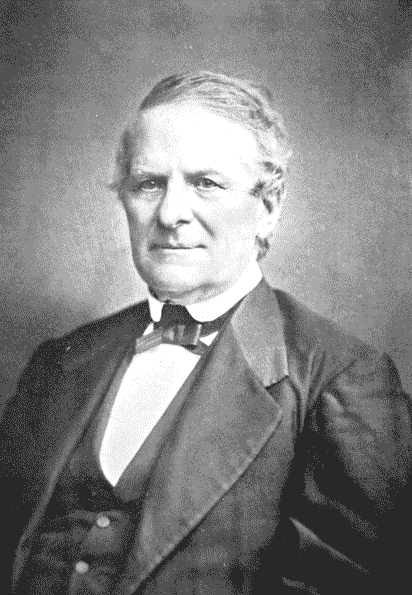
CHAPTER I. PHILADELPHIA. THE HISTORIC SITE.
Throngs of people daily pass along two of Philadelphia's most imposing
highways. Broad Street spans the entire city from north to south.
Chestnut Street is the Quaker City's most brilliant thoroughfare,
stretching between the Delaware and the Schuylkill. Those who traverse
either may see the great twenty story building wherein is made and
published the North American, the oldest daily newspaper on the
continent. Northward from Broad and Chestnut, rise the imposing
municipal buildings, on the crest of whose mountain of stone and peak
of metal is visible the bronze statue of William Penn, founder of the
City of Brotherly Love. Though this son of a Dutch mother was the
beginner of the City of Homes, yet there have been many other makers of
Philadelphia.
Not least among those who have builded the unseen but nobler city,
and who have stamped their names indelibly upon human hearts and
lives, even unto the third and fourth generation of its citizens, is
John Chambers. During forty-eight years he was pastor of the First
Independent Church, whose second edifice stood from 1831 to 1899 on the
site of the twenty-storied "sky-scraper" at Broad and Sansom streets.
Happily, in the eternal fitness of things, history and sentiment were
not ignored in the uprearing of the mighty structure, whose cornice is
not far from the clouds. In the two lower stories of the façade is a
happy reminder of the old brown stone church of pillared front. Most
felicitously does memory find here a sermon in stone and a stimulus in
architecture. Indeed, a former worshipper walking on the other side
of the street, who chanced to look no higher than the old familiar
altitudes, might imagine that the house of prayer, with its Ionic
columns, still stood to bless its worshippers. Even of the same hue and
tint as in childhood's days, eight columns of fluted brown sandstone
renew in verisimilitude the old architecture. Thus the mighty edifice
enshrines upon its front, in imperishable masonry, suggestions, at
least, of former history.
To be exact, whereas there were in old times six round fluted Ionic
columns, resting on high square bases, supporting a simple but
imposing pediment, there are to-day eight front columns supporting an
architrave, with two mightier upholding pillars within.
At first thought, men might be tempted to see in this colossal
structure, whose roof is so much nearer the sky a symbol of "the power
of the press," which is alleged to be more influential than the pulpit.
One political gentleman whom I knew well—even he who in 1893, raised
the stars and stripes over Hawaii—affirmed in my hearing, that "one
newspaper was equal to three pulpits". Yes, but that depends on which
newspaper and which pulpit. It is certain that in the eyes of some,
printing machinery and type, and daily square miles of inked paper,
for which whole forests have been destroyed, have more moral potency
than worship, prayer, and preaching. Yet against this modern parable
of the mustard seed become a tree, phenomenal and imposing, we have
happily also the Master's parable of the leaven, or of might unseen,
of a kingdom coming "without observation". "Things seen", even when
dazzling are not really as potent as those which transform the life. It
could add little or nothing to the reputation of John Chambers, to put
on paper with ink his words that kindled our souls. Yet, "did not our
hearts burn within us" when we heard? Can we forget them? Was not his
a life unto life? "He being dead yet speaketh."
So then, whether standing in the shadow of the great edifice—typical
of the soaring twentieth century—or setting foot on its roof high in
air, many fathoms higher in the deeps of space than where once we sat
or stood, and thence gazing upon the sea of humanity beneath, or over
the great city set between the two silver streams, and ever fascinating
and beautiful with boyhood's memories, let us stop to recall the past.
Let us think of that busy and potent life of John Chambers (1797-1875),
and of that First Independent Church (1825-1873), which, like a
spiritual storage battery, still supplies the power that pulses in many
thousand souls. Man and edifice, though vanished from earth, give by
their visible potencies or inspiring memories, in churches and Sunday
Schools, in hallowed homes and beautiful careers of men and women, even
to the fourth generation, the shining and convincing evidence of an
earthly immortality, of life unto life. In the ever widening circles of
eternity, that unspent influence will be felt.
Let us now descend from the mountain to the plain. Until the first
early autumn of the twentieth century, one could see also on the east
side of Thirteenth Street, north of Market and within a few feet of
Filbert Street, a four-sided, plain gray stone or marble post, in
which even a casual passer-by could detect a survival. It was an
old-timer, battered, rubbed, and chipped. Evidently it had once been
a hitching post. Then, after sundry paintings and daubings, it had
served for various advertising purposes, setting forth the changing
business carried on in the dwelling place itself, in front of which it
stood, or, in the cellar of the same. The Belgian block pavements, the
flagstone sidewalks, the great Reading Railway Terminal, not far away,
and the lofty business edifices of steel and stone, with a thousand
modern suggestions, all seem by their contrast to suggest antiquity in
that horse post, and possibly its descent from once more noble uses.
When, however, to the evidence of eyesight, was added the play of
memory and imagination, then there rose upon the mind's vision the
little brick church, the Church of the Vow, that stood directly
opposite, where John Chambers, master of hearts and transformer of
human lives, wrought and taught. Within its now vanished walls the
sunny pastor, the shining ornament in social life, the soul-stirring
preacher, the unquailing soldier, who fought evil in every form,
prayed, preached, and labored with men. Here he communicated quickening
impulses not yet spent, but ever urging on to vaster issues. Yes, there
is where the old church stood.
But this old battered horse-post,—so close by the curb stone as to
wear ever fresh marks of tar and grease from passing wagon wheel
hubs—what has it to do with John Chambers and the First Independent
Church of Philadelphia, which is almost forgotten before a brood of
lusty children and vigorous grandchildren that now train thousands in
the ways of holiness? Especially may we ask the question, since the
church and the post were on opposite sides of the street, here a few
feet wide.
Well, hereto hangs not only a tale, but literally, there hung a chain,
with associations. Before the First Independent Church—that church
which, according to scripture and reality, though not in common
parlance, is not an edifice, but a company of believers—was formed, in
1825, there stood at Thirteenth and Filbert streets, a comparatively
new building. It had been reared in fulfilment of a vow made during a
storm on the Atlantic by a holy woman of prayer, whose life was saved.
Those who carried out her purpose were Irish refugees, seeking freedom
in America. Being intense Sabbatarians, they would have no sound of
passing wheel or hoof on the Lord's Day, for theirs was the age, also,
of Delaware river cobble stones, and of iron tires. No pneumatic or
sound deadening rubber-swathed wheels existed then. Hence, to warn
off all matutinal disturbers of the solemnity of worship, and evening
passers on wheels, an iron chain was stretched across the street,
guarding either side, north or south, of the holy edifice. Thus, in
quiet, the people within could worship God. The same rule held in other
neighborhoods as in this congregation, and in front of the Presbyterian
church edifice at Fourth and Arch, as the pictures show, a similar
stout iron chain was stretched. It was the rule in Sabbath-keeping
Philadelphia, according to the vigorous law of 1798.
Philadelphia was, early in the last century, a little place, of only
tens of thousands, and so long as there were but few churches, the
chains seemed appropriate. As the city grew, the problem for the
firemen, mail wagons, and ambulances increased. In time not a single
street running north or south, even in case of a fire, was open to the
firemen, who were apt to make quick work in removing obstacles. A snow
storm of petitions, for and against the repeal of the Acts of 1798 and
the removal of the street chains, fell on the legislature and the law
ceased to be operative, March 15, 1830. The old stone posts remained
and occasionally one may be recognized by the keen-eyed antiquarian in
dear old Philadelphia.
Both the first and second edifices, in which John Chambers labored
in the Gospel, have been levelled and their sites built upon. That
old post, effective Sabbath guardian, has gone; the First Independent
Church, in edifice or organization, is no more. Nevertheless, its
spirit lives. Like Huldah's home, our old church in its "second
quarter" was a "college," and, fellow alumni, we shall try to tell the
story of our Alma Mater, "mother of us all," and sketch the life and
work of the great and good man, with whom the First Independent Church
began, continued, and ended. Both church and pastor have become as
leaven that transforms, and in leavening is itself transformed,—lost
to form and view, while yet potent. "The eagle's cry is heard even
after its form disappears behind the mountain," says the Chinese
proverb.
The "three measures of meal" still abide. From them is still supplied
the bread of life to thousands. To change from metaphor to facts
that are as hard as stone, and as enduring as human character, there
are, first in point of time, the Bethany Mission Sunday-school and
the Bethany Presbyterian Church; the John Chambers Memorial Church,
an offshoot and outgrowth from the Bethany Church; the Presbyterian
Church at Rutledge, Pa.; the St. Paul's Presbyterian Church in West
Philadelphia; and the magnificent edifice and active congregation
of the Chambers-Wylie Memorial Church on Broad below Pine Street,
which enshrines the name not only of John Chambers, but of T. W. J.
Wylie—two noble preachers of the gospel, sons of thunder and also of
consolation.
Shall we attempt to measure influence, by even suggesting how three
churches, one Presbyterian, one Baptist, and one Lutheran grew up out
of the early prayer meetings before 1840, sustained chiefly by John
Chambers' young men? Shall we hint at the missionary and educational
impulses given at "the ends of the earth" by missionaries, or of
lives nourished or transformed in our home land by the forty or more
ministers of the gospel, who call John Chambers their father in God?
Nay, our dear under-shepherd himself, were he with us, would say, "Not
unto us O Lord, not unto us, but unto thy name give glory, for thy
mercy and thy truth's sake."
Nisi Dominus Frustra.
CHAPTER II. IRELAND. A BONNY BAIRN.
Many a chairman, clerical or lay brother, in introducing John Chambers
to an always delighted audience, referred to his "big Irish heart,"
and indeed he had in him all the winning and fascinating elements
which make the jolly Irishman. He was emotional, clear-brained, rich
in personal magnetism, and in general a "good fellow". He had in him
also those traits which characterize the strong, clean, God-fearing
and man-loving Puritan, whose career so often illustrates the highest
type of manhood. Of superb and commanding figure, six feet high, and
the most imposing individual known in the Chambers clan, he had an open
illuminated face, and eyes that penetrated one's inmost nature. He was
skilled in the handshake or shoulder pat, that warmed one's entire
being into personal loyalty and were inspirations to friendship for the
man and his Master. His face made you believe in the immortality of
the soul. To these physical traits may be added an absolutely fearless
mien and a flashing eye, that made his enemies fear him, even when they
most hated his ways and words. With leonine countenance and majestic
presence, was a tongue that beat the blarney stone, and yet was made,
under God, a unerring instrument in winning souls. Some one has written
of "The Pastor as Praiser". John Chambers by praising a boy made him a
hero. Often a word from him came as Paul's clarion call, "Stand fast".
In brief, John Chambers possessed in person, bearing, and
characteristics, the noble heritages of that Scottish race which
settled in north Ireland, and which has shown itself, especially
in America, one of the most distinctive of stocks, rich in mental
initiative and nervous energy, with power of manifold adaptation and
persistency. In America the Scotch-Irish have certainly influenced,
with power second to that of no other strain or nationality, the making
of the American republic.
The people of north Ireland were noted for their Calvinism, which in
practice is only another word for an inextinguishable love of freedom
and democracy. Their faith fruited in free schools, popular education,
family worship, familiarity with the Bible, hatred of priest-craft,
Romanism, and British cruelty and oppression. In their Christianity,
some Jewish notions in survival were perhaps put on a level with the
teachings of Jesus, and their passionate devotion to Sabbath-keeping
seemed sometimes to run into idolatry. They were not at all disinclined
to controversy, and many of them were rather fond of a bit of a fight.
Among the less sanctified, religion of a certain narrow sort and the
contents of the whiskey bottle were very much in demand.
Naturally the British government with its aristocracy and political
church, its absentee-landlordism and its corrupt parliament—which in
the eighteenth century represented land rather than people—had much
trouble with this insular people of many virtues and some glaring
defects. The more oppressive measures of the first half and middle of
the eighteenth century sent tens of thousands of emigrants to America,
where they settled, especially in New Hampshire, the Carolinas, and
western Pennsylvania. Only too glad to take up arms against the
British, they furnished from their ranks for the Continental army and
patriot partisan bodies, probably a larger proportion of soldiers than
those of any other nationality among the colonists.[1] Many thousands
of the "Yankees" of New England were Irishmen. In North Carolina
they were the Regulators whom "Bloody Billy" Tryon slaughtered. In
Sullivan's Expedition of 1779, one of the most important campaigns of
the Revolution, four of the five generals, and possibly a majority of
the rank and file, were born in Ireland, or were of Irish stock. At the
banquet held in the forest, on the Chemung River on the site of Elmira,
N. Y., on Saturday September 25, 1779, in the pavilion of greenery, one
of the thirteen toasts drunk was this,—"May Ireland merit a stripe in
the American standard."[2]
The general dissatisfaction in Ireland, not only among the Catholics
who suffered from oppressive penal statutes, but also among the
Protestants, broke out in 1798 into a rebellion fomented by the
numerous secret societies then in the island. To read this page of
history brings us to the parentage and birth of John Chambers, who
sprung not from "illiterate" folk, as some have ignorantly imagined,
but from intelligent and educated as well as patriotic parentage and
ancestry.
William Chambers, the father of our American John, was born in 1768
of fairly well-to-do parents, and had a good education. One of his
ancestors was an officer in the British navy. When about twenty-seven
years of age, he married a Miss Smythe, or Smith, who was traditionally
descended from Robert the Bruce, being one of a family which has
furnished a long succession of Presbyterian ministers in Scotland,
Ireland, and the United States. Their first son and eldest child, they
named James. Their second son, John, is the subject of our biography.
John Chambers was born on September 19, 1797 in Stewartstown, Tyrone
county, Ireland.
There are four towns of this name in the United States, settled
probably by Irishmen, and the original place in Ireland, in 1880,
contained 931 souls.
William Chambers was a hot-headed, impulsive man of great physical
vigor, a superb horseman, and a leader in athletic sports. In early
manhood he was powerfully influenced in his political opinions and
action by the ideas exploited in both the American and the French
Revolutions. A fierce patriot, he became a follower of the famous Wolf
Tone, and in their ups and downs on the wheel of politics, both master
and disciple found themselves in prison within a few days of each
other. William Chambers by some means escaped, but was soon involved in
trouble with the British authorities, and so engaged passage to America.
Theobald Wolf Tone (1763-1798), orator and advocate of the freedom of
Ireland, was educated at Trinity College, Dublin. He wrote pamphlets
exposing British misgovernment, joined Protestants and Catholics in
political fraternity, and founded at Belfast the first Society of
United Irishmen, which William Chambers promptly joined. It is believed
that at this time the green flag of Ireland was adopted, by uniting
the orange and the blue. It is certain that at this time, green became
the national color, although an emerald green standard was used in the
sixteenth century.
One of these United Irishmen was Samuel Brown Wylie, who became the
celebrated pastor, preacher, and Doctor of Divinity in Philadelphia.
He left Ireland in 1797. In God's providence, exactly one century
afterwards, the names of Chambers and Wylie were united in Philadelphia
in that of a memorial church.
Wolf Tone, as secretary of the Roman Catholic committee, had already
entered into secret negotiations with France and had to fly to the
United States in 1795. He was afterwards captured on one of the ships
of the French squadron, which was to invade Ireland.
The French having occupied Holland, had had a great fleet built in the
Zuyder Zee to co-operate with the United Irishmen, but at the battle
of Camperduin, off the coast of North Holland, October 11th, 1797, the
British Admiral Duncan destroyed the French and Dutch fleet, and the
high hopes of those who looked for Irish independence were dashed to
the ground. Hundreds of them fled.
Tried and sentenced to death, Wolf Tone committed suicide in his cell,
November 19th, 1798. His son afterwards served in the armies of France
and the United States and wrote the biography of his father. Ever since
1797, the British navy has had a ship named "Camperdown".
In Scotland I have had the pleasure of visiting the Duncan estate near
Dundee, and in Holland of seeing Camperduin and its vicinity, both of
land and water.
The defeat of the French fleet and the imprisonment, trial, and
sentence of their leader, Wolf Tone, drove the United Irishmen into an
insurrection of despair. At the battle of Vinegar Hill, in May, 1798,
the revolt was crushed and the French general Humbert surrendered.
Forthwith the British constables began their hunt for each one and all
of the United Irishmen to land them in prison.
William Chambers was, as we have seen, arrested and thrown into prison
at Stewartstown. In some way he escaped and eluded those who were
seeking him, until he made his way down to the ship, on which his
family was leaving Ireland for America. Besides his wife with her
little boys, James and John, the latter an infant of three months at
the breast, were other emigrants on board. In the hold, there was a
stock of cabbages and down among these vegetables the refugee father
hid himself. The British officers came on board and searched the ship
from stem to stern to find their man, but his wife had encouraged him
to get so deeply under the material for sauerkraut, and had covered him
up so well, that, unable to find him, they imagined he must have fled
elsewhere. It was not until the ship was well out at sea that William
Chambers rose up from among the cabbages and made himself visible. In
later years, John Chambers visited the Stewartstown prison in which his
father had been incarcerated.
In the slow ship they were knocked about on the wintry Atlantic during
a stormy voyage of fourteen weeks, but happily arrived in the Delaware
Bay, just when the buds were bursting, and the landscape of spring time
putting on its fresh mantle of green. After their sea weariness the
peach-orchards of Delaware must have looked as "fair as a garden of the
Lord."
The Mayflower, which in 1620 bore the Pilgrims to America, was bound
for the same beautiful region, then vaguely called "Virginia" but these
people in 1799 were pilgrims bound to the forests of Ohio, the first of
the Pilgrim states beyond the Alleghenies.[3]
Landing at Newcastle, William Chambers and his little family soon
joined a great party of emigrants who were turning their faces
westward. Ohio was then, except for the river valleys and old maize
lands of the Indians, an almost unbroken forest. In those days, when
there was neither canal, railway nor trolley, such roads as existed,
traversed chiefly the long stretches of dark woods. They were made of
corduroy, or logs laid crosswise, with a surface covering of earth.
Very few counties were as yet named or laid out in the Buckeye State,
for it was only five years after General Anthony Wayne's great victory
at Maumee Rapids over the Indians, and many of the red men were still
in the land. Frontier life was still very rough, both as respects
material comfort and the relations of the settlers with the Indians.
The second stage of territorial life was entered upon in this same
year, 1799, and the State Legislature had met for the first time in
Cincinnati.
Slowly and painfully the caravan of home seekers made its way through
Pennsylvania over the great road through Harrisburg and the Juniata
valley, Hollidaysburg and Pittsburg, where Scotchmen and Irishmen
were still very numerous. Thence floating down the Ohio River, they
reached the first county on the western side, which was later named
after Thomas Jefferson, third president of the United States. The Irish
pioneer from Stewartstown helped to lay out the original townships of
the county, in which Warren Ridge was situated, often going ahead to
blaze some trees along the future road. Later, in 1799, he settled at
Smithfield, and ultimately at Mount Pleasant. It was to this last named
place that the visits of John Chambers, notably in 1843 and 1861, were
made.
CHAPTER III. OHIO. LIFE IN A LOG CABIN.
The little baby boy John's first American home was a log cabin and his
cradle was made of part of a hollowed-out tree trunk. When he began
noticing things from the doorway, his eyes took in a great space filled
with a multitude of stumps, the dark and lonely forest, the new and
strange fields of Indian corn, the tender green of spring, the gold of
autumn, and the great white landscape of winter. When he was but three
years old, Ohio became a state.
Remembering the witticism, so common a generation ago, that "some men
are born great, and some are born in Ohio", we may believe that John
Chambers came very near a double inheritance, though failing in but one
share; for, to the end of his days, he boasted that he was by birth an
Irishman.
Among his earliest playthings were the "buckeyes", or horse-chestnuts,
from the particular tree, so plentiful in the new land. As the Bible
was then, besides being in supreme honor as the Word of God, the one
familiar volume, library, reference, and text-book, source of literary
and intellectual recreation, John, as he learned to read, was as
much delighted to find the popular name of "Ohio" in the Bible, as
American tourists in Japan are, to hear the sound of this good State's
name, in the Japanese for "good morning".[4]
In after years, in the freshness of his metropolitan fame, John
Chambers visited several times his old home, the log cabin in which he
grew up. The house is now a weather-boarded dwelling place, but in the
wooden walls is still to be seen the little hollow place or alcove,
where were kept the decanters or glasses, containing cherry brandy
and whiskey, which were so popular and in such general use in those
early days before teetotalism, or prohibition or no license was known.
During the war of 1812, this house was used as a recruiting station for
volunteers, and here the young soldiers pledged their glass in token of
their patriotism and comradeship. Against this phase of social life,
the boy John set his face from the first.
William Chambers lived the life of a pioneer in the American forest.
He gained his bread by tilling the soil, and a little ready money by
burning the timber and leaching the potash out of the ashes, and by
other industries common to the forest. Indian cooking was soon learned
and the food of the red man became popular. In fact there are very
few purely American dishes, which are not evolutions from the Indian
originals. Sugar was plentiful from the maple trees, but salt was very
costly and hard to get. By boring wells, brine was found from which
good salt could be made.
Life on the frontier was necessarily rude in some points, especially
in moral relations with the Indians. As pretty much all Irishmen are
very fond of religion and whiskey and a bit of a fight, there were
often rough scenes. William Chambers was a strong character and his hot
temper was easily roused, but his wife, an equally strong character,
but with finer strength, was cool-headed and made a good balance for
her husband. She was a noted nurse and especially skillful in the
sickroom. Hence she was often called upon for help by both friends and
strangers in time of pain and misfortune. Malaria and homesickness were
common woes. Devoutly pious, she trained up her children in the fear
and love of God, and by them and even by later generations her memory
is treasured.
The religion of these pioneers may have been narrow, but it was strong
and deep. It was based on a first-hand knowledge of the English
Bible. Even in his early life, as I remember Mr. Chambers saying, he
revolted against bigotry and the kind of religion that was not rich in
love to one's neighbor. These were psalm-singers and not hymn-using
Christians, but the Methodist preachers and Christians of other sorts
than Scotch-Irish Presbyterians were in the land. The boy John once
heard an old gentleman say that he would as soon sit down to the Lord's
Supper with a horse-thief, as with a man who sang Dr. Watts' version of
the Psalms.
Little John also refused to touch liquor, for he saw the awful effects
of its use, and grew to have a hatred of it. On one occasion, the
little fellow rebuked a crowd of men, including his own father, for
their drinking habits whereby the parent, William Chambers was greatly
affected. "The heart of the child three years old is in the heart of
the sage of sixty," as says the Japanese proverb, was true of John
Chambers, the metropolitan preacher, but it was in childhood that God
began to shape this bonnie bairn for a long life of usefulness. The boy
in the Ohio forests was a hearty hater of all bickering and squabbling.
He was often called upon to settle differences. He came to be known
among neighbors and friends as "the little peacemaker." "The child is
father to the man," and all his life John Chambers was mighty as a
reconciler.
John Chambers's boyhood was thus spent in the wilderness in continuous
hard work, by which he toughened his thews and kept his cheeks rosy,
rising into brave, pure, and clean manhood. He took his part in the
hard work of the farm, even to clearing the forest. He knew what it
was to "lift up axes against thick trees." With his other brothers and
sisters, he enjoyed life to the full. Politically, in this Jeffersonian
era, his parents took the Democratic view of things, so that their
offspring had the spirit of democracy in their veins. All his life the
intensely patriotic John followed the faith of his father, and was, as
he called himself, a Constitutional State-Rights Democrat.
He was taught to read and write at home, but with that true instinct
for education, which is inborn with Calvinists and the Scotch-Irishmen,
his parents wished to have him better educated. They sent him,
therefore, when he was but fifteen years of age, to Baltimore, where
lived some of their relatives. A journey over the mountains in the
early nineteenth century was like a trip to the Philippines in our
days, but John gladly set out on horseback, with a party, in the spring
of 1813, to the city on the Patapsco.
It seems that he had no special purpose of remaining permanently there,
but Providence made his a stay of twelve years. After some experience
at school, he decided to learn the jeweler's trade. Thus with business,
and later with love, and then a call to the ministry, Baltimore was to
be the city in which his mind was shaped, and which all his life was to
him, socially, as magnet and star.
Patriotism, too, had something to do with making the Monumental City
his home. It was war time, and the second struggle with Great Britain
was on. As a municipality, the young city, but sixteen years old, had
already become a famous place for the building of ships, the timber
being floated down from the heart of New York state and from northern
Pennsylvania, along the old line of Sullivan's march of 1779, by
way of the Susquehanna River. Immediately on the declaration of war
by Congress, a swarm of privateers sailed out of the Patapsco and
Chesapeake to prey on Great Britain's commerce, especially in the West
Indies. Hence the British government early decided that one of the
first places to be occupied was Baltimore. The stalwart youth from
Ohio arrived in good time to hold a shovel and dig earth to throw up
entrenchments, over which waved "The Star-Spangled Banner". He worked
several days in the trenches. In September, 1814, the British forces
made their attack under Col. Ross, a veteran under Sir John Moore and
Wellington. Their commander was killed and the assault given up. The
next day Admiral Cockburn's fleet bombarded Fort McHenry in vain. The
attack from ship by water was as ignominious a failure as was the
attempt by land. The happy result was the deliverance of the city and
the birth of America's national song, "The Star-Spangled Banner".
Francis Scott Key, detained against his will on the deck of the British
man-of-war Minden, was an indignant spectator of the bombardment, but
in the morning of September 14th, saw his country's flag "in full glory
reflected ... on the stream". In 1876 a bronze statue to his memory was
erected and Old Defenders' Day keeps alive the stirring memories of
September 11th, 1813.
CHAPTER IV. MARYLAND. STUDENT DAYS IN BALTIMORE.
Soon after coming to Baltimore John Chambers became a member of the
Associate Reformed Presbyterian Church, of which the Rev. John Mason
Duncan was pastor. Under the preaching of this eminent prophet, the
mind of the young man expanded. Indeed it was so shaped and moulded
by Dr. Duncan, that we may consider him as the greatest of all John
Chambers' teachers, and his direct influence as greater than all
subsequent schools and teachings. "My honored father in Christ" was
Mr. Chambers' designation. Dr. Duncan saw in the young Ohio lad "an
eloquent man and mighty in the scriptures". He persuaded him to study
for the ministry, which John, soon after uniting with the church,
determined to do.
In pursuance of his plan, the lad entered the Classical Academy of the
Rev. James Gray, D.D., formerly of Philadelphia, who had established in
Baltimore one of the numerous first-class schools in the South, almost
every one of which was founded by people of Scotch-Irish descent.
When it came to the study of theology and practical training for
the pastorate, John Chambers followed the method which was then the
common one in America. Very few theological seminaries then existed
in the country. That at New Brunswick, N. J., probably the oldest,
was scarcely fifteen years of age; that at Princeton hardly over two
years old. There were one or two in New England. For a young man
having the ministry in view, it was the usual custom to study under
his own pastor, a method not without great benefits, especially in
this instance, as Dr. Duncan was one of the most eloquent ministers
in the country. John Chambers learned how to preach by preaching. He
was successful with human beings because he knew them so well. He
was a master of the scriptures "in the original English". Only those
who afterward sat for years under John Chambers' preaching so long as
to be saturated with his ideas, to know the basic principles of his
thought and the workings of his mind, and have also read and studied
Dr. Duncan's works, can realize how greatly the pupil was indebted to
his great master.
In fact it was John Mason Duncan who gave the keynote of the gospel
message as to its form, and it was John Chambers who filled out the
strain. The theme was set in Baltimore, the variations given in
Philadelphia. The pupil followed the master very closely in practical
organization and discipline also. Dr. Duncan was suspicious of all
creeds and confessions of faith when made instruments of ecclesiastical
power. His trust in the people was sincere, profound, intense, and
practical. In theology he ever laid stress on "the mediatorial reign of
Christ and his absolute ability and willingness to save all mankind",
which willingness it was his delight to demonstrate from the Scriptures
and "to rescue the Gospel call from false philosophy". Dr. Duncan was
jealous, almost to hostility, of theological seminaries, and also of
the growing usurpations of power by synods. He dubbed America "the
land of synods". He wrote at the time when even the liberty of the
presbyteries seemed endangered by the centralizing power of the synods:
"To persevere in such a course is to raise up a class of men who, from
the nature of the case, must be destitute of sympathy with the people;
who will rise above the people as being their superiors and governors,
and who will ultimately distract and divide the church by their
philosophic subtleties and literary distinction".
Verily the writer of those words was a prophet.
Dr. Duncan's trust in the people was so great because, as he believed
and taught, "the Bible is addressed to the people".
All of this John Chambers believed, carrying out, even to a fuller
logical conclusion, his teacher's doctrines.
In his book entitled "An Essay on the Origin, Character and the
Tendency of Creeds and Confessions of Faith as Instruments of
Ecclesiastical Power", Dr. Duncan showed in his first chapter that "the
intention of this essay, strictly political in character, involves the
great question of human liberty to think, speak, to write, to act".
He delivered also a course of lectures on "The General Principles in
Moral Government", as they are exhibited in the first three chapters of
Genesis, in which the same ideas are more fully carried out.
Here is one of his passages:
"Supposing then a minister—blameless, faithful, apt to teach,
believing in the great truths now defined, i.e. 'the Word made
flesh'—should come to preach, who has a right to prevent him, or
to refuse to recognize him as a true bishop and to stigmatize him
as a heretic? The apostle John says he is of God, and any trial to
which the statute in question would subject him must result in the
equivocal recognition of that fact. Presbyteries, as they are now
constructed, will not and cannot admit such a man to ministerial and
church fellowship without violating the principles of their party. They
will not and cannot ordain such a man without something more.... What
mischief would the most extensive liberality produce?"
In a biography of John Chambers we shall see the pertinence of this
quotation when we come to the story of his ordination.
The instructor of young Chambers was the Rev. James Gray, D.D., who
published a book entitled "The Mediatorial Reign of the Son of God,
or the Absolute Ability and Willingness of Jesus Christ to Save all
Mankind, Demonstrated from the Scriptures—an Attempt to Rescue the
Gospel Call from False Philosophy", in which the grandeur, glory and
all-embracing nature of the divine call to salvation is set forth.
This Dr. Gray, born in Ireland on Christmas day, 1770, had come
to America in 1797, two years before his pupil, John Chambers.
Probably he had been one of the United Irishmen. After preaching
at Washington, N. Y., he settled, in 1808, in Philadelphia, over
the Spruce Street Associate Reformed Church. In the Quaker City he
became a very popular leader in many good things. He helped to found
the Philadelphia Bible Society and received the degree of Doctor of
Divinity from the University of Pennsylvania. With Rev. S. B. Wylie
(father of the Dr. Wylie, whose name is embalmed in the title of the
Chambers-Wylie Memorial Church), he opened a Classical Academy which
became famous. After a few years he removed to Baltimore. Besides his
study of theology and writing of the book on which his reputation
rests—the Mediatorial Reign of the Son of God—(a favorite phrase
of Mr. Chambers, even as the book was known by heart), he started a
theological review which lived but a year. He died at Gettysburg, Pa.,
September 20, 1824.
It will be easily seen that under such teachers as Duncan and Gray,
men of national repute, the Ohio boy received no mean training. On
Garfield's theory, that a seat on a log, at the other end of which
Mark Hopkins was teacher, might outrank the most showy university and
apparatus, John Chambers was a college bred man. Under such direct,
constant and personal influence as the Ohio boy in Baltimore received,
the value of the quality of his education cannot be over estimated.
It is very certain that no number of brick or stone edifices on a
university campus, or profusion of apparatus in the laboratories, or
comforts and luxuries in the student's room of to-day, can take the
place of the personal influence of great teachers. Nor can these turn
out men who excel in character and abilities the leaders of men in the
United States of America in the early nineteenth century, among whom
the home-bred John Chambers was a characteristic specimen.
Yet, though favored with such acute, learned, and inspiring teachers,
and kindled by fervor with ideas that made heat as well as light in his
soul, John Chambers' idea of the religion of Jesus was, that first of
all it must be practical. There was no special division of it called
"applied Christianity." To him it was all application. How it could
ever be printed in a catechism and exist apart from life, he refused to
see. He scorned professions of orthodoxy or of doctrine that did not
quickly and permanently bear fruit in holy living, and in service for
souls. With five or six other young men, he started prayer meetings and
evangelistic labors.
When ready for examination for the ministry Mr. Chambers made his
appearance before the Second Presbytery of Philadelphia, and in May,
1824, received his license to preach the Gospel and to accept a call to
the pastorate. This body of ministers and elders which licensed him was
dissolved in the autumn of 1824, and Mr. Chambers was then received as
a licentiate under the care of the Presbytery of Baltimore.
It was about ten months after his first visit to Philadelphia to
receive license, that is in March, 1825, that Mr. Chambers was invited
to preach in the Margaret Duncan (Associate Reformed) Church in
Philadelphia. The little brick edifice had been erected in compliance
with the will of, and as a gift from, the grandmother of Dr. John Mason
Duncan, and the latter as well as Mr. Chambers' preceptor, Dr. James
Mason Gray, had taken part in the dedicatory services in 1815.
The church itself at this time, 1825, was a struggling one. The
edifice was in a poor and thinly inhabited part of the city. There was
no fund for the support of the building, and the Associate Reformed
denomination in the United States was weak and poor, with a scarcity
of ministers. Happily other Presbyterians gave assistance and supplied
the pulpit; otherwise, the building would have been often closed for
long periods at a time. The first regular pastor was the Rev. Thomas
Gilfillan McInnis, who was called to the service early in 1822. He
died on the 26th of August, 1824, and the flock was left shepherdless.
There was even better provision for the dead than for the living. On
the 7th of October, 1824, Robert A. Caldcleugh and wife presented to
the minister, elders, and fifty-two church members, a lot of ground, on
the South side of Race street between what was the "Schuylkill Third"
and "Schuylkill Fourth" streets, now Nineteenth and Twentieth, for a
cemetery. This lot is eighteen feet six inches wide and one hundred and
twenty-nine feet deep.
This was the situation, when Mr. Chambers was called, in March, 1825,
to preach as a candidate. He came on from Baltimore and on two Sundays
in April told the people of God's love in Christ Jesus. His sermons
were as a mighty stack of fuel, with the breath of the Lord on the
first Sabbath kindling it, and the wind of the Holy Spirit on the
second Lord's Day turning it into vehement flame. A triple fire of love
to God, of the people to the young pastor, and of his young heart to
them began its glow, which paled not until after fifty years of beacon
glory it was quenched by death.
"The flashes thereof are as flashes of fire
A very flame of Jehovah
Many waters cannot quench love,
Neither can floods drown it."
CHAPTER V. NEWTOWN. REJECTED OF MEN.
Since out of the Margaret Duncan Church, or "Church of the Vow", have
grown, it is believed, at least ten other churches, and since the
tradition of her ocean experiences has taken varied shapes and forms in
its transmission, we shall give a narrative which is probably the most
in accordance with fact.
Mrs. Margaret Duncan, on the death of her husband, a prosperous
merchant of Philadelphia, determined to visit old friends in
Stewartstown, Tyrone County, Ireland, in which she had been born. She
took with her her little grandson, who was to become the famous Dr.
John Mason Duncan. Returning across the ocean in the autumn of 1798,
the ship sailing from Belfast, Ireland, was loaded heavily with many
passengers, most of them poor emigrants, but had little cargo in the
hold. It is said that the captain had never crossed the Atlantic.
The compass was out of order, and with head winds and wet and foggy
weather, the voyage was dangerously prolonged. The passengers were put
on short allowance and there was no water. It is even said that in
a severe storm the captain and crew deserted the vessel. The people
suffered from agonizing thirst. They even talked of drawing lots to see
who should be put to death and give his own flesh as food to the others.
Mrs. Duncan was then a woman between seventy and eighty years of age.
Late tradition says the lot was drawn and she drew it and expected to
be a victim. Mr. Chambers, though often referring to her experiences on
the sea, makes no mention of the lot or of this dire extremity. Going
into her cabin she gave herself to prayer, and vowed before God that
if He would avert the impending blow and in mercy save her life and
the ship's company she would forever consecrate herself and all that
she had to His service; that she would erect a church edifice for the
congregation of the Associate Reformed people in Philadelphia with whom
she worshipped, and that she would give and educate her little grandson
for the Gospel ministry.
Not long after this, rain fell, and the agonizing thirst of those in
the ship was relieved. Soon the shout, "sail ho" was heard from the man
aloft. A vessel hove in sight and rescued them all. The ship entered
the Delaware river and all reached Philadelphia in safety.
True to her vows, Margaret Duncan educated her grandson John Mason
Duncan to preach the good news of God. Dying Nov. 16th, 1802, she
left her money by will for the erection of a house of worship, which
she minutely described, specifying that it was to be of the Associate
Reformed communion. By various names, the "Margaret Duncan Church," or
"The Vow Church," or "Saint Margaret's Church," the brick edifice on
Thirteenth street near Filbert on the west side, stood until some time
in the fifties. I can remember as a little boy going to see the debris
of the ruins, the piled up old brick partially cleaned of mortar, the
dust and the broken bits of lime, and the great hollow place where the
cellar had been. In 1875, Mr. Chambers spoke of "the little church
where we worshipped so long.... It is a shame that the church was ever
destroyed. However it was torn down, and we have nothing more to do
with it".
His was the language of affection. As matter of cold fact, the "house
was of plain brick, without the least trace of ornament and for many
years was one of the gloomiest looking churches in the city. The
dimensions were fifty by sixty feet." The edifice was opened for
worship on the 26th of November, 1815. The dedication sermon was
preached by the son of the vow, and the grandson of her who made it,
Rev. John Mason Duncan. As before stated, Rev. James Gray, D.D., then
with Dr. Wylie at the head of a classical school in Philadelphia, also
took part.
Having been called to be the pastor of this church, Mr. Chambers
surveyed his field to see what resources there were for sustaining
permanent gospel work. He found no organized effort. There was no
prayer-meeting, no Sunday School, not a man to lead in public prayer,
and the three elders were all superannuated. The congregation was made
up of humble people, poor, hard-working, industrious, with only here
and there one among them who might be called rich; nor was there a
family in which family worship was held. It was necessary therefore
that the young man from Baltimore, who did not know ten people in
Philadelphia when he first arrived, should borrow two devout men,
Presbyterians, Wilfrid Hall and Hiram Ayres, to help him in meetings
for social prayer. He then made application to Mr. Hall for the use of
a room on Market street near what is now Seventeenth, in a district of
vacant lots. Very few people were then living west of Broad street,
and most of the streets now well known were not yet "cut through". He
knew not whether any one would come to the meeting called for prayer,
but God gave him a gracious surprise. When he arrived near the hour,
"there was scarcely a spot for a human being to stand on". There and
then began the Holy Spirit's workings which resulted in a whole family
of Christian churches.
These prayer meetings were begun, according to due announcement,
on the fourth Sunday in May. Their good influences were seen in
the immediate enlargement of the church audience. By the beginning
of July, there were four men ready to speak or lead in prayer. By
August 1st, over forty persons, many of them young men and women, had
declared their faith in Christ, and were ready for Christian work. Mr.
Chambers found a friend in Rev. Dr. Stiles Ely, a New England man, the
principal founder of the Jefferson Medical College, and editor of The
Philadelphian. From 1801 he had been pastor of the old Pine street
Church, and was at that time moderator of the Presbyterian General
Assembly. As Mr. Chambers was not yet ordained, Dr. Ely preached the
sermon and administered the Lord's Supper, when the new converts were
received.
As Dr. Chambers told the story in 1875, "The next move was for a
Sabbath School, and the marvel was with what eagerness they took hold
of it ... and carried it on with vigor, procured rooms and Sabbath
School scholars and teachers and entered their names, and we went on
and on from that very day after the institution of the prayer meeting,
and the consequence was that we very soon felt that God was with us".
When the people of the Ninth Presbyterian, or Margaret Duncan Church
on Thirteenth street, met together to vote a call to John Chambers, it
was under the care of the First Presbytery of Philadelphia. Of course,
therefore, the call must be approved at the regular meeting of the
presbytery, and only after the usual examination of the candidate.
Mr. Chambers came on from Baltimore, having accepted the call, and
began his work as pastor and preacher-elect on the 9th day, or second
Sabbath, in May, 1825. The presbytery was to meet in October in its
semi-annual gathering. By a strange coincidence this was at Newtown,
near the Neshaminy stream, in Bucks county, Pa.—the field of the
evangelical and revival labors of the ancestor of his betrothed, of
whom more anon. Was the young preacher's imagination busy with the
scenes of a century before?
The glories of autumn made lovely the landscape of this affluent
agricultural county lying along the bend of the Delaware, rich in
fruit, in Pennsylvania Germans, in English Quakers, and in Scotch-Irish
people. Its name, that of Penn's county in England, is suggestive of
the old world, and it is historically famous for being on the line of
Washington's march to his great victory over the Hessians at Trenton,
and through it part of Sullivan's men had moved for the chastisement of
the Iroquois tribes at Newtown, near Elmira, N. Y., in 1779. Yet the
historical associations uppermost in the mind of the young licentiate
must have been those with the great-grandfather of his betrothed, who
in this very region and near this very house of worship, had labored
with Gilbert Tennant in the gospel.
The young minister's call and the letter announcing it, from the hands
of the elders of the Ninth Church, Messrs. Ross, Hogg, and Reed, in the
name of the congregation, was handed in to the assembled authorities.
No doubt the document was on genuine honest rag paper, the only kind
then known, and on a letter sheet, folded and dovetailed together and
closed with sealing wax or wafer, without an envelope, directed on
the outside and carried to him by stage coach. No doubt he himself
had to go to the office in Baltimore to get it. In compliance with
its request, the young licentiate's journey would be by stage through
Elkton and Wilmington to Philadelphia. From Philadelphia to Newtown,
twenty-seven miles northeast of Philadelphia, the route would probably
be up the well-known road crossing the Neshaminy Creek.
The young licentiate, accustomed to do his own thinking, appeared with
clean papers from the Presbytery of Baltimore, and asked that he might
be taken under the care of the First Presbytery of Philadelphia, with
a view to ordination and installation as pastor of the Ninth Church.
Nevertheless, although he might be punctual and his papers clean,
Dame Rumor had arrived before him. Several of her thousand tongues
had declared, and even asseverated vehemently, that John Chambers was
that strange, curious, and ever-changing thing called a "heretic."
Often that undefined thing is a babe thrust into the cradle, while the
orthodoxy of yesterday is turned out. A "heretic," as Saint Paul was
once called, even as Jesus was before him, is very apt to be crucified
to-day and glorified to-morrow. Indeed, "heresy" is almost as protean
and as undefinable as "orthodoxy" itself. We shall see what kind of
a "heretic" John Chambers was. His life for fifty years revealed the
reality.
Within that little company gathered at Newtown there was, in the
language of old times many a "heresio-mastix" or scourger of heresy,
and a majority of the ministers present were already pre-determined
to "hereticate" the young licentiate, who had already made the bounds
of the little brick church on Thirteenth street too small to hold his
hearers. Nevertheless our sympathies go out to all church bishops,
whose duty it is to show that sudden popularity is no proof of fitness
or character.
It developed during the examination that the head and front of the
young man's offending was his belief in the Bible as an all sufficient
rule of faith and practice. In this position, he was confirmed by
the fact that the Westminster standards, the Confession of Faith,
the Larger and Shorter Catechisms, teach that the Bible is the only
infallible rule of faith and obedience. These all unite in declaring
that the Scriptures are "given by inspiration of God to be the rule
of faith and life", "the rule of worship", the only rule of faith and
obedience; which teach "what man is to believe concerning God, and
what duty God requires of man", and form "the rule given us of God to
direct us how we may glorify and enjoy Him."
In a word, to an independent thinker, loyal to the Bible as the word
of God, as John Chambers was, the Westminster standards contain their
own reductio ad absurdum to any one who puts creed, catechism, or
confession above the Holy Scriptures, or who makes certain parts, or
even a collection of parts, greater than the whole. Mr. Chambers, using
his own words, believed that nothing could exceed infallibility, and
was therefore satisfied with the infallible rule of the Scriptures.
There was not then the freedom of faith, and the liberty of private
interpretation of Holy Scripture and the Westminster symbols that is
now happily the rule in the Presbyterian churches. The fault, if fault
it were, was not solely on the young man's part.
The eyes of the "fathers and brethren" were opened and the "heretic"
stood revealed. One of the members, the Rev. Dr. Ely, then proposed
that the moderator should ask Mr. Chambers whether at the time of his
licensure he subscribed to the Confession of Faith. He answered that he
did not. When the second question was proposed, "Are you prepared to do
so now?" he answered firmly, "I am not".
A motion was then made by Dr. Ely that Mr. Chambers and his papers be
referred back to the Presbytery of Baltimore, and that the pulpit of
the Ninth Church be declared vacant. Rev. Messrs. Patterson and Hoff
were appointed a committee to perform the duty.
On Thursday evening of the same week, which was the regular evening for
the weekly lecture, the committee of the Presbytery, which had met at
Newtown, appeared at the church.
Although there were no telegraphs in those days, it was quickly
known in Philadelphia, and to all the people of the Ninth Church,
that Mr. Chambers, the man whom they had learned to love, had been
rejected by the Presbytery. The preaching of the young minister had
already resulted, under God, in a deep and strong religious interest.
Consequently there was a large attendance and not a little excitement
in the little brick edifice, so much so, indeed, that some of the
congregation had quietly resolved to put the committee out in the
street should they attempt to go into the pulpit.
Punctuality with the young pastor had already settled into what proved
to be a life-long habit. He was at the church in good season. Finding
the committee already there, he explained to the two men the situation
and told them what the consequences would be if they attempted to
fulfil their mission. Happily, however, both gentlemen being more
concerned with the coming of the kingdom of God than about obeying
the letter of their orders, did indeed go into the pulpit, but it was
at the request of Mr. Chambers, who made them his firm friends for
life. When there they co-operated with him, assisting to conduct the
services, and not a word was said about the pulpit being vacant. Thus
God, through his servant, quieted the Irishmen, and then and there
magnified this man who had a genius for friendship and was an expert
peacemaker; all of which was for the coming of the kingdom and the good
of souls.
As days passed by, the people of the congregation, realizing that if
they wanted to have a minister they would have to be an independent
church, took prompt action. After due notice had been given, a
congregational meeting was held. By a vote of four to one the people
declared themselves independent of all church courts, with only Christ
as their Master. By another vote, equally large, they resolved to
retain John Chambers as their minister.
The minority, led by Mr. Moses Reed, one of the elders, withdrew, and
in a room on Race street organized themselves as the Ninth Presbyterian
Church. In the law suit that followed, the seceders won their case.
With the edifice, given up in 1830, went the possession of the small
burying ground on Race street, above Nineteenth, in which sleeps the
dust of the Ross family and the father of the renowned soldier's
friend, Miss Anna Ross, whom defenders of the Union from 1861 to 1865,
and the survivors of the Grand Army remember so well. In the writer's
memory her name and face are not forgotten, for she was his Sunday
School teacher.
CHAPTER VI. NEW ENGLAND. ORDINATION AT NEW HAVEN.
In Nevins' Presbyterian Encyclopedia, which contains a brief sketch
of the career of John Chambers and a wood-cut portrait of him in his
prime, it is stated, that "When Mr. Duncan about this time renounced
the jurisdiction of the Presbyterian Church into which the Associate
Reformed, with Dr. Mason and others had been merged, Dr. Chambers
followed his example, from sympathy with his teacher". Was the pupil's
"sympathy" stronger than were the preacher's convictions?
Meanwhile the young minister, then twenty-seven years old, returned
to Baltimore to meet the Presbytery and seek ordination. Here again
another obstacle arose. The theologians on the Patapsco declared that
Mr. Chambers was no longer a licentiate under their care, and handed
him back his papers. Again was John Chambers preacher of the gospel
rejected of men. Was ecclesiasticism good order in this case? Did the
true cause of this rather rough treatment lie in this, that he had been
a pupil of John Mason Duncan, the independent?
What should the young man do? Disowned of presbyteries and looked at
suspiciously by the fathers and lords in the church, where should he
go? As he himself wrote on his fiftieth anniversary, May 9th, 1875:
"The prospect, therefore, was rather chilly. I had left my home of many
years in the city of Baltimore, where I received all the education
that ever was bestowed upon me, and where I sat at the feet of that
Gamaliel, the Reverend John Mason Duncan, to whom under God, I am
indebted, entirely by His grace, for the position I occupy to-day. My
heart had been much interested in religious matters for two or three
years before I left Baltimore. There were five or six of us young men,
as students of Mr. Duncan, and we had organized some meetings through
the city of Baltimore, and God was with us; and the warm heart—if I
had any warm heart at all—that I brought to Philadelphia, was kindled
at the altar of those dear young brethren. How much we are indebted
to God for young men! How much, my brethren, are the eldership, are
you, am I, indebted to young men!" Dr. Chambers's last words in this
paragraph are especially appropriate, because it is the tendency of
most theologians and elderly men to teach that God was, not that he
is. With young men, God's existence is more likely to be in the present
tense.
The ecclesiastical orphan, thus cast fatherless and friendless upon the
wide world, began to inquire whither he should go to seek ordination.
Happily there were other bodies of Christians and a living church of
Christ, besides the one which had withheld its blessing. Happily too,
there were men in the Presbyterian Churches of Philadelphia, warm
friends, who were able to direct him wisely, one of them being the
large-hearted scholar, James Patriot Wilson, D.D., pastor of the First
Presbyterian Church, predecessor of Albert Barnes, and then fifty-six
years old. The other was Rev. Thomas Harvey Skinner, D.D., pastor of
the Fifth Presbyterian Church in Locust street, and who, twenty-six
years afterwards, became the famous professor in Union Theological
Seminary of New York City. Both of these men were in hearty sympathy
with those views of truth afterwards called the "New School". These
brethren with Dr. Duncan, advised Mr. Chambers to go into Yankee land
and there be ordained by Congregational clergymen. They gave him
letters of introduction to the Rev. Nathaniel W. Taylor, the famous
exponent of "the new divinity" and then of the theological department
of Yale College.
It was not Presbyterianism only that was at this era being rocked on
the waves of progress by the gales of the Spirit. About this time, or
shortly afterwards, Connecticut Congregationalism was being excited
and lifted out of torpor and routine by the breezy discussions of
"Taylorism" and "Tylerism". The former expressed the views of Dr.
Nathaniel William Taylor, the successor of Moses Stuart, and then
holding the Dwight professorship in the Theological Department of Yale
College. The young seminary opened in 1822 was therefore but three
years old when Mr. Chambers appeared to be ordained. Whatever may be
the true label we put upon Dr. N. W. Taylor, he was one of the greatest
of America's theologians when the appeal was being taken from Calvin to
Christ. He taught a modification of Hopkinsism which many Presbyterians
regarded as hostile to Calvinism and many New Englanders as "unsound".
As Mr. Chambers had already done, Dr. Taylor repudiated the words
"predestinate" and "decreed" and used the word "purposed" concerning
God's desire to save men. Before he died, in 1858, he had trained over
seven hundred ministers. Ex-President Dwight, in his recent book on Men
and Memories of Yale, presents him felicitously in word and picture.
About the time also of rising "Taylorism" the new methods of preaching
and revival used by Rev. C. G. Finney, afterwards president of
Oberlin College, excited much alarm among the men of the old school.
How strange are the variations and how curious is the progress of
orthodoxy! Most of the great revivalists of this country were nourished
in the Congregational churches; and, from Finney to Moody, they were at
first looked upon with suspicion. Later they were welcomed and lauded
as the saviors of orthodoxy. Verily the "earthen vessel" is sometimes
more in evidence than the "heavenly treasure".
To combat the views of Dr. Taylor, Dr. Bennett Tyler, ex-president of
Dartmouth College, and then pastor at Portland, Me., was hailed as the
champion by all the leading spirits among the "conservatives", though
both of these great teachers had modified the original Calvinism. Of
Dr. Tyler it has been well said that "In forming his system he began
not with mind, but with the Bible, and he looked for no advances in
theology except such as come from a richer Christian experience". Dr.
Tyler founded a theological institute at East Windsor, Conn., in 1834,
so long and ably presided over by the cultured Philadelphian, Chester
D. Hartranft, D.D., brother of Pennsylvania's soldier and governor.
The monuments of these controversies between "Taylorism" and
"Tylerism", now forgotten, are seen in the superb theological
seminaries of New Haven and Hartford, but the points of difference,
as now discoverable only under the microscope of research, are of
no practical importance. Hardly any one except the hair-splitting
philosophers can state them. They have been forgotten in the larger
vision of advancing Christianity. So will it be with most of the
controversies of to-day, especially those centering in the "higher
criticism".
It was to Dr. N. W. Taylor, that Mr. Chambers had letters, as well as
to Dr. Leonard Bacon, afterwards the famous opponent of slavery, and
author, in 1833 of the hymn,
"O God beneath thy guiding hand
Our exiled fathers crossed the sea,
And when they trod the wintry strand
With prayer and psalm they worshipped thee."
For over twenty years Dr. Bacon was pastor of the First Congregational
Church in New Haven, one of the professors in Yale Divinity School,
and the progenitor of a remarkably intellectual family. Until his
death, the day before Christmas of 1881, he was a commanding figure in
American history. Of the council which ordained Mr. Chambers he was the
scribe. It will be seen at a glance that the ecclesiastical exile from
Philadelphia and Baltimore was to stand before giants. If these mighty
men of God could give him ordination, why need he mourn the loss of
clerical favor nearer home?
Thus armed with letters of commendation, the young Irish-American
proceeded to the City of Elms, in the opening week of December, 1825.
It was the first year of John Quincy Adams's administration, and the
Erie Canal had joined the waters of the great lakes with the Atlantic.
It was an era of mighty conquests over nature, and the heart of the
young man who was thrilling with the spirit of the age and of the ages,
beat high with hope. He, too, wanted to do great things for God and
help in making the world better. He sought out those addressed, and
handed to them his letters. Two days afterwards, the Association of
Congregational ministers of the Western District of New Haven County
was called together by the Moderator, and eight ministers were present
in the assembly which was held in the Centre Church.
Of the meeting, the following official record was copied out for the
biographer, at the request of Rev. Dr. T. T. Munger, author of The
Freedom of Faith, and through the courtesy of Rev. Franklin Dexter,
librarian of Yale University.
"At a Special Meeting of the Association of the Western District of New
Haven County, convened by letters from the Moderator and holden in New
Haven, December 7th, 1825.
Present—Messrs. S. W. Stebbins, J. Day, D.D., E. Scranton, S. Merwin,
J. Allen, E. T. Fitch and L. Bacon.
Mr. Stebbins was chosen Moderator, and Mr. Bacon, Scribe. The session
was opened with prayer.
Mr. John Chambers, a licentiate of the late second Presbytery of
Philadelphia, now dissolved, being introduced to the Association by Mr.
Merwin, requested to be ordained to the ministry of the Gospel, and
producing proper testimonials of his standing as a member of the church
of Christ; of his regular license to preach the Gospel, and of his
having passed through a period of probation, with proper acceptance,
the Association, after examining him as to his belief in the doctrines
of the Gospel, his experimental acquaintance with religion, and his
motives in desiring the work of the ministry,
Voted to proceed to his ordination this evening at half-past six
o'clock.
Voted that the parts be performed as follows: The introductory prayer
to be offered by Mr. Scranton; the sermon to be preached by Professor
Fitch; the ordaining prayer to be offered by Mr. Merwin, during which
Messrs. Stebbins, Fitch and Merwin to impose hands; the charge to be
given by Mr. Stebbins; the right hand of fellowship by Mr. Bacon; the
concluding prayer to be offered by Mr. Allen. Adjourned to meet in the
Centre Meeting-house at half-past six o'clock.
Met according to adjournment. The ordination took place according to
the preceding votes.
Mr. Chambers, at his request, was admitted a member of the Association.
The minutes were read and accepted.
Leonard Bacon, Scribe."
[Test]
The ordination sermon was duly preached in the evening by the Rev.
Professor Eleazer T. Fitch, D.D., Livingstone Professor of Divinity in
Yale College, and then Mr. Chambers was ordained by the laying on of
hands of the three appointed ministers of the Association.
According to Congregational usage an Association of ministers does
not ordain to the ministry, but a Council does. The Association may
transform itself into a Council for the time being. In Connecticut
the Consociation, or standing council, performed this function. In
any event, John Chambers was properly ordained to the Gospel ministry
according to due Congregational call, form, and precedent.
Furthermore, by his own request, he became a member of the Association.
This did not make him a "Congregationalist", but it showed his hearty
sympathy with the principles and ideas of his fellow members. For
forty-eight years, his only ministerial standing and connection was
in the Congregational body as an independent minister, though his
church was governed according to Presbyterian form and usage. So
strong and deep was his faith in the validity of non-Episcopal and
non-Presbyterian ordination that he showed it all his life by his
works. He ordained during the course of his ministry several young
men to the work of the gospel. One of these impressive ceremonies I
myself witnessed, probably about 1859. After preaching a sermon and
reading the papers or certificates of the candidate, Mr. Chambers
called his elders, those grand men of God, Burtis, Luther, Steinmetz,
and Walton around him. Then upon the head of the kneeling young man he
and they laid their hands, solemnly ordaining him to the gospel in true
apostolic style.
Years afterwards, in 1892, one of his own boys, even the biographer,
delivered the Dudleian lecture at Harvard University in Appleton Chapel
on "The Validity of non-Episcopal Ordination", or, more exactly, the
validity of ordination by the congregation, according to the method of
the primitive Christian Churches[5]. By a strange coincidence, it was
on the same night, Dec. 7, on which Mr. Chambers was ordained, and thus
the sixty-seventh anniversary of his ordination.
Mr. Chambers left New Haven the next morning, Dec. 8th, 1825. The elms
were leafless, but his heart was happy and his face radiant with joy.
Coming back to minister to his constantly increasing flock, he baptized
on the first Sunday in January, 1826, several new communicants and
administered for the first time the memorial supper of Jesus. It was a
day long to be remembered, for between seventy and eighty souls were on
this occasion added to the church, and the young pastor, in the joy of
his initial service, baptized the first child that ever received the
dedicating waters from his hands, John Chambers Arrison, the first of a
mighty host.
In 1875, the white-haired pastor who had welcomed 3,585 members into
his church, said: "Thus it seemed that the tide of God's favor was
taken at the flood, and it has brought us to where we are to-day".
CHAPTER VII. HOME AND CHURCH. LOVE AND WORK.
Let us now look into John Chambers's inner life,—of the heart as well
as the intellect. We have seen how the vigorous and lusty twig which
grew up in the classical academy of Baltimore began to bend away from
certain statements and formulæ in the Westminster symbols, as then
interpreted to him, which gave the afterwards robust and widespreading
tree a tremendous inclination. "As a man thinketh in his heart, so is
he." John Chambers's convictions shaped his message and colored all
his preaching. There were probably reasons, other than those merely
intellectual, for the young man's tremendous antipathy to the idea that
the fullness of the Christian life and the message of Jesus could be
compressed into the mathematical statements made at Westminster during
the days of the British Commonwealth.
When I was a student at Rutgers College, New Brunswick, New Jersey,
from 1865 to 1869, I was asked, as an incoming freshman, by the
president, Rev. William H. Campbell, D.D., LL.D., concerning my
religious training. I told him how much I owed to John Chambers in
Philadelphia. A bland light overspread the full expanse of that face,
so seamed with thought and studious toil and which nothing but warm
affection could call handsome. Indeed, it seemed as though every
wrinkle was smoothed out, as a prairie-like smile suffused its whole
area. Then, laughing heartily, he said, "Well, I can remember when he
had orthodoxy taught him with the sole of a slipper." Evidently then,
according to the accepted and supposedly wholesome custom of the times,
the future preacher received at intervals what was expected to be a
physical aid to faith, though in reality the result was the reverse of
what was expected. Whether the slipper was applied to the lad before
or after intellectual defection, its use induced reaction. Whether,
as is probable, the correction by leather came from the employer to
whom the apprentice was bound, or from the schoolmaster is not known.
The boy would not accept Westminsterism whole, certainly not as then
interpreted.
Above all, this young Irish-American lad had a big, warm heart. As he
read the Scriptures for himself he was early filled with that idea,
which afterwards he infused into the lives of thousands, that the
gospel is a glorious message to the individual, that the Christian life
is a Way, as well as a belief, that there are elements in religious
life and experience which do not submit to exact definitions, and
that the mercy of God is the largest factor of the Divine life toward
wrong-doing man. In this the time of his youth, as well as all through
his life, he felt deeply rather than thought coolly. Whether we must
ascribe most or all of the results to the towering personality of his
teacher, John Mason Duncan, and of his long continued training at a
most susceptible age under so forceful a master, certainly, whatever
our philosophy of the known facts may be, he was filled with an
antipathy to creeds. In a time and climate of theological severity, and
amid the rancor of controversy, he was, among his clerical brethren who
set higher value than he did, upon "the form of sound words" or logical
formulas, verily a pilgrim and stranger upon the earth. He rejoiced to
see by faith the day we live in, even the work of the General Assembly,
and of the Synods and Presbyteries of 1903.
Ever hoping and praying for the day to come when the creeds, especially
of the Presbyterian body of churches, in which he had been educated,
would be revised, he lived and "died in faith, not having received the
promises, but having seen them and greeted them from afar". The change
of theological climate, the revision of the Westminster symbols and the
simplification of theology into which we, in this twentieth century
have come, even the work of the General Assembly, that met in New York
in 1902, and in Los Angeles in 1903, was what he in hope long ago
looked for. He believed in expressing forms of faith in the language of
living men, not of dead ones, for he ever taught not only that God was,
but that He is.
To recapitulate, John Chambers left the classical academy in 1818,
after five years' instruction. He remained seven years longer in
Baltimore, active in church life and work. During this time, he was
occupied also in business, thus earning his livelihood, for he had
learned the trade of a jeweler. During these years, his life was made
rich and joyous by one who had crossed his path, and who was to be to
him his beloved wife, Miss Helen McHenry. She was the first of three
noble specimens of womanhood who were to light his household fire,
irradiate his home, double and share his joys and sorrows. How often
and how tenderly did "our pastor" refer to "the partner of his life",
the beloved "companion of his bosom!" What a refining power, what a
potent influence, stimulating to marital purity and mutual "love that
lightens all distress", was his steadfast example. It was his frequent
felicitous use of passages from the Song of Songs, that so impressed
one boy's mind that, despite his vow, registered in college, never
to write a "commentary", he composed and published "The Lily Among
Thorns".[6]
Let us look at the heredity of his affianced. As early as 1735, Francis
McHenry, an ordained minister of the Presbyterian church came from
Ireland to America and was associated with Gilbert Tennant in the Deep
Run, or Neshaminy, churches in Bucks County, Pennsylvania, and also in
the beginnings of the Log College, which by direct evolution became the
great Princeton University.
His grandson was Francis Dean McHenry, a shipping merchant of
Baltimore, whose daughter Helen was born in September, 1805, when the
boy in Ohio was nearly seven years old. When he met her in Baltimore,
he had the lover's "three T's" or elements of success—propinquity,
opportunity, and importunity. Those who knew John Chambers in later
life will not marvel why he won her, rather might they wonder how any
maiden could resist the urgency of the warm-hearted and handsome youth,
who was the largest and handsomest of the Chambers family. As matter of
fact, she made capitulation in due time and was led to the altar.
It was but a very short time after John Chambers had reached the first
stadium in his successful career and was an ordained minister, that the
marriage took place in Baltimore, March 14th, 1826.
The young preacher brought his bride to Philadelphia and enjoyed just
three years and six months of wedded happiness with the companion of
his youth. Those who remember Mrs. Chambers speak of her beauty and
animation, and of her whole-hearted sympathy with her husband's work,
but her life was destined to be brief. The first child born of the
union was John Mason Duncan Chambers, whom the happy father joyfully
named after his spiritual father, under whom his soul life had opened
and ripened in Baltimore. His second child, a daughter, Helen Frances
Chambers, now Mrs. James Hackett, living at Pomfret Centre, Conn.,
still survives him.
John Mason Duncan Chambers, born March 15, 1827, married Miss Emma Ward
of Winchester, Virginia, in October, 1851. He died November, 1857,
leaving three children, of whom Helen McHenry is the only survivor. She
is married to Mr. George Lothrop Bradley, of Pomfret Centre, Conn., and
Washington, D. C.
Helen Frances Chambers, born April 25, 1829, was married July 17, 1849,
to Mr. James Hackett, of Baltimore. Their one surviving child, Helen
McHenry Hackett, married George F. Miles. With Mrs. Hackett, these two
grandchildren are the only descendants of John Chambers.
The pastor, elect and ordained, brought his bride to Philadelphia and
took a house on Thirteenth street, below Walnut, and there began his
home. Being on the same street as his church, he had not been many
months at work before scores of people living on Thirteenth, or streets
parallel and crossing it, were attracted to become worshippers with
him as their pastor. As one lady, still lovely in her eighty years of
life, tells the story from girlhood's memories, the "Chamberites", as
they were at first called, were every Sunday morning seen to be moving
with their faces set northward toward "the Church of the Vow"; and
the preacher, being from the first the soul of promptness, "led the
procession".
Between Thirteenth and Broad streets and Walnut and Locust, had grown
up "the Village", where for lack of accommodation in the church
edifice, the Sunday School was established. On Sabbath afternoons, the
whole school adjourned bodily to the church, walking up Thirteenth
street to Filbert.
Yet even with a growing Sunday School and enlarging church membership,
the way of the young pastor was far from smooth, and the First
Independent Church of Philadelphia was in no danger of being smothered
with kindness. Almost as a matter of course, an industrious army of
prophets arose to foretell failure to a church founded on the Bible
alone. Rather, instead of "prophets", we should say a busy host of
fortune-tellers, since the Hebrew and Biblical word, prophet, does not
mean predicter, but the utterer of truth. The little ecclesiastical
infant, rather foundling, needed much warmth of prayer and devotion,
certainly during its first decade. With shakings of the head and
emphatic use of the hands in dreadful warning of calamity, the
Philadelphia variety of soothsayers declared that in two or three
years, the First Independent Church would go to pieces. Both laymen and
ministers were loud in declaring that such a church, without a "creed,"
(though the Bible is a very library of creeds), could not thrive or
live. The idea of success in rearing a church, with the Holy Scriptures
only as a rule of faith and practice, was scoffed at. In our day, it
does indeed seem strange that Protestant ministers should so talk, but
experience, the great teacher, showed "the divine sufficiency of the
Bible as a rule of faith and practice, and ... also a bond of union
holding together a large and flourishing congregation in Christian love
and harmony". So wrote John Chambers in 1859.
However, "liberal", or, rather scriptural, in his theological opinions,
the young minister was, since especially he cared nothing for any man's
boasted "predestination" or "election" to eternal life, unless that
same man showed the fruits of faith in holy living, he was anything but
liberal in his ideas of morals, or as related to amusements, or the
keeping of the Christian day of rest. We shall see this clearly when we
note how he dealt with one of his theatre-going elders.
In his fortieth anniversary sermon, May 14th, 1865, which was printed,
Mr. Chambers referred to this experience, stating that during the
two-score years of his ministry no word of disagreement, or of an
unpleasant character with his fellow-presbyters, had ever been spoken,
with the exception that we are about to describe, and which, in order
to make a perfectly correct record, Mr. Chambers himself would not omit.
Shortly after administering his first communion, the young pastor
found that "one of the original elders was in the habit of attending
theatrical amusements and of taking his children with him". What
resulted from this discovery is given in his own words:
"This conduct was so directly in opposition to what were then my
convictions of what was right, and which opinion I still hold—so
directly in the face of the teachings of the Bible, that I could not
remain silent under it, but at once sought Mr. ——, in order that we
might have a mutual explanation of our views. Upon my putting the
question to him, as to whether he thought his course was a proper
one—whether it was the love of Christ which induced him to frequent
such places, and if in so doing he was bringing up his children in
the nurture and admonition of the Lord by making them his companions
on such occasions, I found that he was obstinate in his determination
to adhere to his own course of action. I referred him to Second
Corinthians, sixth chapter, fourteenth to eighteenth verse, and then
told him that I could not and would not serve with him in the Session;
that either he or I must resign, and proposed that it should be left to
the vote of the Church. If the Church advocated or permitted indulgence
in theatrical amusements, if it was considered a means of grace and
the proper school in which children were to be trained up for God,
there was
but one path for me to pursue—to dissolve my connection
with them at once. If on the contrary they sustained me in my views,
Mr. —— must resign. He was unwilling to submit the matter to the vote
of the congregation, knowing only too well that their standard of piety
was a high one, and that his conduct would meet with their severe
displeasure. Consequently he resigned his office of elder in the spring
of 1826, and from that day to this neither elder nor lay member has
advocated visits to the theatre as the way to heaven, and I am sure
with the Bible as their rule of life, never will".
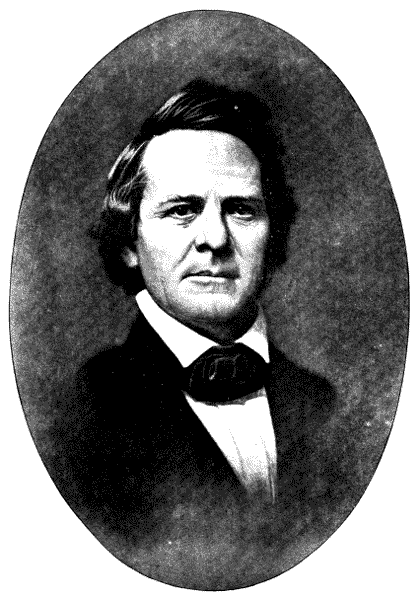
JOHN CHAMBERS.
About 1856.
It soon became very evident that the young minister and his people
were Separatists of a strict sort. They believed in being "in the
world", but not "of the world". The passages in Corinthians which had
been quoted, "Wherefore come out from among them and be ye separate",
was one on which the pastor preached many times in the course of his
ministry. His insistence was from the first that Christian people ought
to find their enjoyment in religion and be visibly different from those
who had no scruples against cards, dancing, gaming, or the theatre.
Was not John Chambers right? He had a just fear of the real influence
of these methods of killing time. Furthermore, those who can remember
the Chestnut street, of even as late as the sixties, need not wonder
at his earnest and pointed preaching—for every sermon-bullet of John
Chambers hit the target, and usually the bull's eye. In language not
to be mistaken and often with tears, he called upon young men and
women to rise upon higher levels into a more spiritual life than
was then common. A realistic description of the vice, that openly
flaunted itself on Philadelphia's gayest street, would not here be in
good taste, or be relished if given; but it was something horrible.
Whether the world, on the whole, is getting better or worse, it is
quite certain that the houses of ill-fame, the midnight street-walkers
and the pictures once visible in public places and in the saloons,
inexpressibly obscene as they were, are not found at the present time,
or if so, are much more concealed, for they have at least been driven
to cover. It seemed to be the idea of the young minister that he ought
to know what was going on in the world, and to teach his people to
know, while yet choosing the pure, and avoiding the impure. He was
liberal enough in his attitude to his brethren of other names, always
working with them in practical religion.
Some of the years of his first marriage were spent on Arch street, near
13th street. In later years he lived on Walnut above Broad on the south
side. From about the time of "the war" and until his death, he dwelt at
the corner of 12th and Girard street north of Chestnut. Thus his whole
pastoral life was spent in the very heart of the city, seeing things
as they were, and with his eyes open to the manner in which the people
amused themselves.
CHAPTER VIII. "THE WAR HORSE OF THE TEMPERANCE CAUSE."
A large number, and probably a majority of the large congregation
which soon gathered around John Chambers, were people from Scotland or
Scottish-Ireland, and, like most of this sturdy race, were very fond of
both religion and whiskey. The customs of society in the thirties made
the social glass very frequent. The chief decoration of the sideboard
was usually a decanter and glasses. Even a funeral was not considered
complete in all its appointments, unless there was plenty of liquor
drunk before the corpse was taken out of the house, much more being
consumed when the company came back.
From the very first, the young pastor took a firm stand against
indulgence in any intoxicating liquor, and spoke his mind most freely,
in favor not only of temperance but also of total abstinence. He
determined to use his oratorical talents in arousing public sentiment
against the drinking habits of his day, and he presided over the first
public temperance meeting held in Philadelphia. He went further. He
gave notice from his pulpit that he should enter no house where liquors
were provided, not even to hold services over the dead.
This announcement made a tremendous sensation, and no doubt some
thought that the foundations of society were endangered. Soon after
this ultimatum, the pastor repaired to a house to conduct services over
the dead, and found that liquors were being served. Instantly going out
doors, he remained standing in a drenching rain, refusing to officiate,
until the corpse had been brought to him.
Throughout his long ministry, he continued this work, seeking by
sermons, addresses, prayers, the taking of pledges, the assistance of
reformed inebriates, the training of young men, and by every other
lawful means to promote temperance and total abstinence. Not always
abstemious in his language, he made bitter enemies among the liquor
dealers, but although of superb physical frame and excellent muscular
power he used no physical force or carnal methods of defence, with
possibly one exception. Once a publican seized him by the collar, as
he was walking along the street, and swore vociferously at him. Pretty
soon he had abused his victim so exhaustively, that he was himself out
of breath. At the end of this verbal discharge, Mr. Chambers who had
listened quietly, lifted his hat, thanked him, said "good morning,"
and went his way. In 1849 he was introduced to an audience as "the
war-horse of the temperance cause." Ever after this he was known as
"the war-horse." One elder left his church on this liquor issue.
It began to look as if an independent church (which is very far from
being a Congregational Church) was, as some had predicted, "anything
that John Chambers chose to make it." Certainly under the dominating
personality of so bold and yet so tender a soldier of Christ, the
church quickly rose to be one of the most aggressive in the city of
Penn.
After ten or fifteen years of service, when his congregation had
increased and lads and lassies were multiplied, he organized in 1840
the Youth's Temperance Society. It was made up of young people. Once a
month or every two months, alternating with the Missionary Society, the
afternoon Sunday School service took the form of a temperance meeting;
at which, besides prayer and singing, addresses were made by speakers,
either from the congregation or without. There were also occasionally
recitations, but the crowning event of the year, for which preparations
were made often weeks in advance, was the anniversary. This was held
on the evening of Washington's Birthday, February 22d, either in the
church edifice or at Concert Hall on Chestnut Street, which is now
occupied by the Public Library.
Exquisitely lovely in memory rises the scene, when after duly
committing to memory and practicing, cutting down to the right length
and repeatedly rehearsing the speeches, the dialogues and the musical
parts, the boys and the girls, in a glow of excitement, gathered in
the rooms below the stage. The little maidens in their best clothes
and most bewitching adornments in hair and dress and slippers, seemed
to me most radiantly lovely. The boys who were to be speakers had on
their coats a rosette of quilled ribbon, in the center of which was
a tinsel star, from which gushed forth a cataract of red, white, and
blue satin pendants or streamers. How gay and happy we all were! How
heaven-like it all appeared! Except for the thumping of one's heart
under his ribs, it seemed positive rapture to hear one's name announced
by the superintendent, Aaron H. Burtis—that superb re-incarnation, as
we thought, of George Washington. To make one's bow before a thousand
human beings, to speak his piece with high pulse and magnetic thrills,
were delights that filled a few triumphant moments. Stirring are the
memories of the genial pastor, ever ready to cheer the boys, the
portly form of Robert Luther, the happy faces of John Yard, Francis
Newland, Daniel Steinmetz and Rudolph S. Walton, and the younger but
constantly efficient Robert H. Hinckley, Jr. The Youth's Temperance
Society flourished until the close of Mr. Chambers' ministry. Although
all of the lads trained under John Chambers did not as they grew up,
become Prohibitionists, yet a small army of good citizens, earnest in
temperance reform, owe their strength of conviction to their noble
pastor.
In this temperance work as in his preaching, and his attacks on evil of
any sort John Chambers was as bold as a lion. He spent much time and
travelled to many places in order to take part in temperance meetings
and encourage the workers. In Neil Dow's reminiscences, page 416, is
an account of a great temperance meeting in New York on February 19th,
1852, at which the Philadelphia pastor was present. Dr. Crowell tells
of another held at Chester, Pa. Dr. A. A. Willetts and Dr. Theodore
Cuyler were often with the "War Horse" in his campaigns.
On one occasion when a barkeeper repeatedly sold liquor to one who was
near and dear to the pastor and already a victim to physical decay
and disease, induced by his drinking habits, Mr. Chambers went into
the saloon, stated the exact case to the barkeeper and warned him not
to sell any more liquor to the patient. Escaping from his nurse, the
wretched man entered the saloon, again procured liquor and became
decidedly worse. Finding what had been done, Mr. Chambers went to the
barkeeper in fiery anger and said: "Didn't I warn you not to sell
liquor to ——?" Then seizing him by his shoulders, he gave the publican
a vigorous shaking, and again warned him, threatening a severe penalty.
The barkeeper was so mightily impressed, that he is said to have sold
no more to the patient.
During all these early years, Mr. Chambers kept his young men busy in
active evangelical work, especially in the holding of neighborhood
prayer meetings on what were then the outskirts of the city. In 1875,
Rev. J. J. Baker, pastor of a Baptist Church at Navesink, N. J.,
testified at the jubilee meeting to the intense activity of the young
men of the church, with which he had united in 1829. Four whom he
named, Summers, Burnham, Hunterson, and Town entered the ministry.
He told of the zeal and activity of elders Hibbert and Arrison. "The
young men of that time were interested in two prayer meetings, one held
in the 'old frame,' as it was called—a barn down town, out of which
effort grew 'The Cedar Street Presbyterian Church.' The other prayer
meeting was held in 'The Girard School House,' out of which grew two
churches, one Lutheran and one Baptist."
John Chambers was also a rigid Sabbatarian, and in this, it was
not difficult to find an enthusiastic following, for main in
his congregation, who remembered the strictness and severity of
sabbath-keeping in the old countries, warmly seconded his efforts to
train the young people after their ideas of how the Lord's day should
be kept in America. Doubtless in the majority of the thousands of this
Israel, the usual custom was to have baths, washings, the polishing
of boots, and the preparation of outer clothing done on Saturday; but
a still grander triumph was won by the new pastor and a precedent set
for fifty years to come. Sunday funerals had been the rule, even to
occasional disgusting excesses, both in prolonging the preservation by
"icing" the corpse, and in the intemperate feasting and drinking after
the return of the "mourners"—often a very mixed company.
John Chambers saw the folly and the wickedness of unnecessary Sunday
funerals. He exposed their true inwardness and refused to attend them.
This, of course, angered some of his people, and a few left the church.
But how could they stay away? Out of love to Christ and for the good
of the working man and of horses, John Chambers had acted. His motives
were pure. He went after his offended brethren and won them back. So
the peacemaker, true child of God, led his flock—so well indeed that
"his boys", when pastors, had to do the same thing. They couldn't help
it. History repeated itself. It was first firmness in the pulpit, then
offense, next fair scripture argument and personal appeal, followed by
reconciliation, with the result that God and His Sabbath were honored.
It was God's pathetic appeal with Jonah over again—"and also much
cattle." Even a horse should rest on Sunday. The fullness of energy
could thus be given to divine worship and to the complete enjoyment of
a day, so different from all the other six days.
The Sabbath, as I remember it in church and home, was a rubric on our
week's page. The normal family in the Chambers church, of which ours
was one, were all ready at home on Sunday morning so as to be punctual
at church. After a good breakfast, including the traditional "Dutch
cake and coffee" for the elders and grownups, and plenty of the same
sweet and nourishing food, saving the Mocha, for the young folks,
we started off from home so as to be at Sunday school a few minutes
before nine o'clock. The session lasted until quarter past ten, which
gave ample time for the breaking up and dismissing of the classes, the
social greetings of friends, and a comfortable interval for getting
into the larger auditorium above, where service began punctually at
10:30.
The Sunday school had been started as a novelty in the days of the old
Thirteenth Street Church by the pastor shortly after his coming to
Philadelphia. Although I do not remember that he ever taught a class
himself, or ever heard of his doing so, yet there was one feature of
his connection with and interest in the Sunday School which has been to
me and to many an inspiration for life. Not long after the preliminary
devotional exercises were over, our handsome leader, of stately port
and mien, appeared on the scene. Going to each class he shook hands
heartily with each and every teacher, and often saluted, or in some
way noticed, the children of the class, speaking a pleasant word, or
inquiring after sister or brother, parent or relative. Often to their
delight he called the pupils by their first names, for he was able to
do this. Both teachers and scholars would look for the appearing of
this grand man as regularly as they awaited the sunlight. The pastor
kept ever in vital touch with the Sunday School, generally remaining
until near the time for his engagement upstairs. Thus he inaugurated a
custom which was life-long and inspiring, and which many another active
pastor has followed in true apostolical succession.
Would my readers wish to have a specimen of John Chambers's preaching
even in his early days? To do this by presenting simply ink and paper
is not to reveal "thoughts that breathe and words that burn". It is
simply to point to a pressed flower, bleached of its tints and with all
its perfume exhaled, for the sermon was the man himself. Nevertheless,
a faded and time-stained pamphlet of fifteen pages, entitled "Sermon
by the Rev. Mr. John Chambers, delivered at the Presbyterian Church in
Thirteenth Street, Philadelphia, on the evening of December 2, 1827",
when Universalism was then new and in the air, from these words, "Ye
shall not surely die", gives some idea of the general style and quality
of the young preacher. The discourse was "taken in shorthand by M. T.
C. Gould, Stenographer".
Let us in imagination take our seat in the little brick church among
his audience and listen to the discourse. Even the stenographer, owing
to the crowd, was, as he says, in "a very unfavorable position for
hearing." But who could not hear such a voice?
The sermon is a vigorous setting forth of religion in the genuine
old-fashioned style, in a torrent of emotional and not particularly
logical oratory. It is an assault upon the notions of those "who would
persuade you that the idea of future punishment is only the visionary
dream of fanatics". The especial reference is to "those emissaries who
are so industriously engaged in seeking to destroy the souls of men:
they are laboring by all the ingenuity of the arch fiend himself, who
first presented the forbidden fruit under such bewitching charms".
The new pastor believes that this system "leads to the destruction
of all morality and religion". By him the Eden narrative is read
as a literal fact. The young orator quotes from Montesquieu, Lord
Bolingbroke (though the reporter could not catch either the point or
the words) and Hume, by which he would prove that "this system leads
to the destruction of civil society and civil government". Warming to
his theme, he declares that "all vice is the immediate offspring of the
dogmas of Universalism.... The doctrine of universal salvation leads
to all the vices and abominations under heaven". Reference is made to
the fact that "New York tells a mournful tale in consequence of this
doctrine"—the allusion being to a recent duel between a citizen of New
York and a citizen of Philadelphia. The preacher even declares that "a
man holding such sentiments should never be entrusted with any civil
office".[7]
Against the background of "fire and brimstone and an horrible tempest
upon the wicked and ungodly" he pressed the invitation to come to "the
Redeeming Saviour, the Divine Saviour, the Glorified Saviour". The
eloquent preacher closes his discourse, which is from beginning to end
directed to the conscience, with a good, warm, direct appeal to his
hearers for personal decision.
Enough of proof is here given that from the first, even to the last
year, if not the latest moment of his life, John Chambers never lost
sight of the needy, sinful, human soul, and that he always closed
with a tender and affectionate personal appeal. Men might be as
steel against his logic, but their hearts melted under his winning
importunity.
One great landmark in John Chambers's life was his visit to Europe
in 1830. His excessive labors and long-continued use of his voice in
public discourse compelled him to cease both preaching and pastoral
work. As he said in 1875:
"In the year 1830 I lost my voice so that I could not have been heard
twenty paces from where I am now if you had given me the world. My
physician ordered me away and I was gone fourteen months. When the
announcement was made to my brethren that I had to go they instantly
made arrangements. They put into my purse twenty-five hundred dollars,
and into the hand of my dear friend and brother, Rev. Dr. Ludlow, the
father of Judge Ludlow, one thousand dollars to preach on the Sabbath
for one year, making thirty-five hundred dollars down at once. It was a
noble and generous act on their part".
Such generosity was as surprising to the young pastor as it was
creditable to the people themselves. To see the great ocean and the Old
World at a time of the fullness of his manly vigor and professional
success, travelling in a first-class steamer, compelled contrast with
his first crossing of the ocean as a helpless baby and with a father
who was an exile and political refugee. In England he was so fortunate
as to see the royal maiden who had just been in 1830 made heiress
presumptive to the Crown on the accession of William IV. Possibly it
was at this time that he made the acquaintance of Richard Vaux, then
secretary of the American legation, whom I remember well in his later
life as a prominent Democratic politician and mayor of the city of
Philadelphia. With his long, flowing, curled hair,—pronounced dress
and astonishing necktie, Mr. Vaux was a picturesque figure in the
Quaker City. He often boasted of having danced with the lady who became
Queen Victoria, though this was before she assumed the crown on June
28th, 1838. While in Scotland Mr. Chambers visited the Free Mason's
lodges and enjoyed the mysteries of the Scottish rite. In Ireland he
visited his native place, Stewartstown, the house in which he was born,
and the prison in which his father had been incarcerated and from
which he escaped. He was absent in all fourteen months, and came back
refreshed in body and enlarged in mind.
In physical righteousness John Chambers stood before his boys and young
men as an inspiring exemplar. He neither "drank, chewed, smoked, or
swore." For fifty years he put to confusion those who preached the
necessity or justified the use of alcohol or tobacco. Over six feet
high, in superb health and vigor, always invitingly clean in person,
he reinforced every day the teaching of good fathers and mothers who
strove to lead their sons to noble manhood.
CHAPTER IX. THE MASTER OF HEARTS.
In John Chambers, sanctified common sense was combined with spiritual
fervor. As a young pastor, he had right ideas about finance and the
honest support of a church. Money was needed for the salaries and
expenses of keeping the edifice comfortable and in repair. Before the
first year had passed by, it was evident to the "Chamberites", that
a new building would be necessary, even if the law suit had gone in
their favor. The voices of the croakers and prophets of evil, at first
loud and thunderous, had sunk to the "peep and mutter" stage and were
rapidly approaching silence.
In a new field, larger financial resources would be necessary, but
from the first, only manly, honorable, and truly scriptural methods
of providing revenue were employed. Never in all the history of the
First Independent Church was there a fair or supper to which admittance
was charged. Those methods of raising money, too often associated
with religious societies, to the scandal of faith, the equipment
of the jester, and the furnishing of the ungodly with excuse for
self-righteousness, were tabooed by Mr. Chambers. He believed both
that the laborer was worthy of his hire, and that men ought to pay
for their religious privileges. He was so successful in this policy
that within six years, having paid all debts, his people in the spring
of 1830 bought at Broad and George (now Sansom) streets, that lot of
land for four hundred dollars, which afterwards was sold for over four
hundred thousand dollars. The land and house of worship, the subsequent
enlargement and repairs, as well as the running expenses of the church,
so long as it was independent, were paid for by subscriptions. "We
have never in our lives," said John Chambers in 1875, "gone abroad for
means to help us."
The region west of Broad street was then "out in the country". Green
fields, or vacant lots, stretched to the Schuylkill River. At Broad and
Market were the Water Works. When afterwards these were removed and the
pumps and reservoir were established at Fairmount, four small parks,
with their trees and green sward, made one of the city's breathing
spaces. Even then Broad Street was considered the western boundary of
the city of Philadelphia.
Bright and happy was that February morning of 1830 when the young
pastor, with many of his flock around him, took his place on the green
sward at Broad and Sansom streets. With his long hair brushed into
lively motion by the matin breezes, he poured out a prayer to Heaven
for the blessing of the triune God. "Like all Irishmen, John Chambers
knew how to handle the spade", and handle it well he did on that day
when he turned up the first spadeful of earth. After the diggers
came the masons, who built honestly a solid foundation, and then the
corner-stone laying in March, 1830, and finally the dedication in June,
1831. Dr. John Mason Duncan preached first in the new house in the
morning and the sermon was royally long. One little boy, now an honored
pastor of eighty, remembers that it ended at half-past one! Alas, that
Saint Paul's faults, like that at Troas, should be more imitated by
us preachers than his virtues! In the afternoon Rev. James Arbuckle
preached. "The house was crowded to excess all day."
How one family, and indeed a group of families allied by blood or
marriage, came to be life-long supporters of and worshippers in the
First Independent Church, we must now tell. We shall speak of one
member named Mary.
It was in 1832, the winter in which the famous English actress, Fannie
Kemball, sister of Mrs. Sartoris (whose grandson, in our day, married
Nellie, the daughter of General Grant) was starring in Philadelphia in
the old Chestnut street theatre, on the South side of Philadelphia's
most fashionable street, above Sixth. Mary had spent a winter of great
gaiety, revelling in the joys of the dance, the theatre and every sort
of worldly amusement—much to the grief of her mother, a woman of
unaffected piety, who was praying that her daughter might look less at
things perishing and more at the eternal.
Yet no message from the Unseen, sent through a human preacher, had
yet reached the ears of Mary's inner being. It was while the anxious
mother was most earnestly praying, that Mary was invited by a maiden
friend, whom she had met at a picnic and with whom she had formed
a warm friendship, to visit her and go to hear the new minister on
Thirteenth street. Mary came, and saw, and heard, and was conquered. At
the first sermon she hung spell-bound on the lips of the emotional and
electrifying young orator, who during all his ministrations had also
that peculiar unction, without which, preaching, however logical and
learned, avails little.
On coming home, after the service in the new church on Broad street,
Mary told her mother that she would never go to the theatre again; she
had heard the grandest speaker that she had ever looked upon in her
life; who outshone every actor she had ever seen, and whose message
had more charms for her than the theatre itself. Soon after this Mr.
Chambers with his wife made his first pastoral call at Mary's home.
About this time, late in the winter and toward the spring, there was
a revivalist assisting Mr. Chambers, who to eloquence and magnetic
power, added the power of the draughtsman. He was an artist in words
and with the chalk also. He drew a cross on the blackboard, and without
the element of color, but with the aid of music moved the emotions
mightily. He called upon the congregation, led by sweet voices, to
sing, "Alas! And Did My Saviour Bleed". His appeals, tender and
powerful, were responded to. Many were brought "under conviction" and
declared themselves from that time followers of Jesus Christ. On the
day that Mary united with the church, one hundred persons were received
at the communion table and into membership.
This is one sample picture of many of dissolving views of souls in Mr.
Chambers's ever enlarging congregation. His ministry was from the first
one of direct appeal. It was emotional, the personal element being
powerful always, but there was no leaving of the converts to themselves
or to neglect. Behind and above the Celtic fire and enthusiasm of John
Chambers, was the life of the Spirit moving them through him. The
converts were looked after. They were personally warned, exhorted,
instructed, and taught. During this first year, yes, during fifty
years, John Chambers seemed an incarnation of Paul's scripture: "Whom
we preach, warning every man and teaching every man that we may present
every man perfect in Christ Jesus". No extra or special meetings
were held in these early years, and none that we can recall in the
later days, but the regular services were steadily "the occasions of
converting power."
I have intimated that the secret of the great preacher's power cannot
be discovered by mere logical analysis. One might as well try to
explain John Chambers's influence over human hearts and lives by his
printed words alone or through mere description, as to attempt to show,
by a simple knowledge of the properties of lead alone, the astounding
effects of a Krag army rifle. The venerable Dr. Henry Clay Trumbull,
veteran editor of the Sunday School Times, writes under date of June
11, 1903:
"An orator's or a preacher's power sometimes depends largely on his
intensity of utterance or of manner. He can actually throw himself into
his hearers so that they will, for the time, think or feel as he does,
even beyond the meaning of his words. Thus it was said of Whitefield
as a preacher that he could move an audience to tears by saying the
word 'Mesopotamia'. One who has felt the power of some preachers can
understand the force of that statement.
"Rev. John Chambers was a man of power in this line beyond any other of
the preachers I have heard in my more than seventy years. I sometimes
came from Hartford to Philadelphia to hear him in his church on Broad
street. His voice would ring out with such intensity, and his words
would so thrill through every nerve of my being that it seemed to me
that a more than human being was making an appeal. On more than one
occasion I have taken out my pencil to note such an utterance which
had seemed to be inspired, but there was actually nothing to write
down. No period could give the ring or the thrill. It was simply George
Whitefield saying 'Mesopotamia'. It was an element of John Chambers's
power. But I love to tell of that power".
The communion seasons were from the first occasions of the
manifestation of spiritual power. Often the minister himself would be
almost overcome by his own feelings, or, perhaps we should say, by the
vividness of his vision of the crucified Lover of our souls. Often in
such a case it was his habit, during a pause in the rush of feeling
to sit down upon his chair, throw his head back and completely cover
his face with his handkerchief, his hands resting upon the arms of
his chair until his tears and the storm of emotion had swept by. These
over, he emerged as the embodiment of quiet grace, dignity, and calm
strength, the master of the assembly.
After the darkening of his home through the removal from it by death
of his wife, Mr. Chambers, left with two little children, found
consolation in even profounder consecration to the work of leading
souls into the Way. His own spiritual life was deepened and his
sympathies with suffering humanity widened by his own sorrows. He had
always a message for those, who like himself, knew the weight of known
griefs or secretly borne crosses. In later years he was to lose his
only son. My own recollections of the young physician, whom my pastor
always so tenderly referred to as "my son Duncan", are of a handsome
and promising man, whose life was all too short. I remember how keen
and warm were the sympathies of great congregations, during the time
when the father's heart was wrung with grief, as the telegrams and
letters told of the ravages of disease and the approaching end.
The biographer never saw the first Mrs. Chambers, who is described
by those who knew her as very lovely in person and manner, but her
children and the other "partners in life"—his favorite phrase—are
well remembered.
The second marriage of Mr. Chambers was on September 30th, 1834, to
Martha, the widow of Silas E. Weir, a merchant of Philadelphia and the
daughter of Alexander Henry, a merchant in Philadelphia, and aunt to
Mayor Alexander Henry.
My impressions of Martha Chambers extend from the month of March, 1855,
until a short time before her death, on Friday, March 16, 1860. I have
dim remembrances of my being a very little boy, when an august lady,
who wore her hair in bands low down on her cheeks, as the fashion
then was, with a very sweet smile, spoke kindly to me in the Broad
street Church. I recall how every Sunday morning and afternoon, the
stately man of God with his "companion in life", a lady of equally
imposing appearance with himself moved up the middle aisle and, if I
am not mistaken, often arm in arm, until reaching the space opposite
the pew. Then the pastor would with his left hand, open the door. After
ceremoniously seeing his consort well inside, he would shut the pew
door and then move briskly forward and up the pulpit steps to the sofa.
Thus happy in his home life, rich in sweet domestic influences having
ever a true "help meet for him", John Chambers, during most of his
mature life, was helped not only of God but by woman's finer strength.
He was the master of hearts also in his home, having Browning's "two
soul sides". Martha Chambers once told my mother that she envied even
the washerwoman that washed her husband's clothes. In Philadelphia
to-day there are many daughters and grand-daughters that do
excellently, and they have "Martha Chambers" in their name.
Of each one of three noble specimens of womanhood, in their appropriate
time and sphere, it could be said,
"Her husband is known in the gates, when he sitteth among the elders of
the land".
CHAPTER X. BOYHOOD'S MEMORIES.
My earliest remembrances of the first church edifice on Broad
street, except the grand pulpit and a general glory of galleries and
chandeliers, are rather dim. The auditorium seemed to be a vast and
awful place, where a little boy would not like to be left alone in the
twilight or the darkness. Nevertheless all my daylight memories of it
are of the most genial sort. The great middle aisle, so well-fitted for
a marriage or wedding parade, but which afterwards, when as a preacher,
from the marble memorial pulpit, I looked down into its sheer length
and emptiness, I considered as a tunnel of waste space, was carpeted
red. The enamel-white pew-doors, with white porcelain number plates,
bright red pew facings and cushions, and the lines of black silk hats
of the gentlemen, laid just outside the pew doors, made a morning
picture in which color was not lacking. In the afternoons, the aisles,
occupied by eager hearers, were crowded with settees and chairs, so the
silk hats of pew owners had to be kept, literally, indoors. On week
nights I was often a witness of the ceremonies, in which several of the
twenty-five hundred or more couples which were yoked in wedlock by John
Chambers during his pastorate, received the nuptial benediction, and
the bride the pastor's kiss.
At the orient end of the aisle, before the enlargement of 1853, rose
the great mahogany pulpit, which swelled out in its capacious center
and then rounded out with a still more generous curve at either end,
from which rose two short pillars, as imposing to my youthful mind
as those of Hercules. I remember how much I wondered, my infantile
intellect being confused, when my father pointed out the "pillars" on
the Spanish silver dollars, that two things so different, coin marks
and pulpit ornaments should be called by the same name. On the top of
these pillars at first was a globe lamp filled with oil, though in the
march of progress, wick and chimney gave way to gas burners. Even to
this day, my mental associations of the "lamps", in the parable of the
ten virgins, are those of my boyhood's days in Chambers Church. Great
crimson velvet curtains hung from near the ceilings, and shining brass
bands on the carpet of the pulpit stairs are also in my recollection.
My next impression of the dear old house of worship was in 1853, when
not quite ten years old, and living on Girard avenue, in the northern
part of the city, I was taken "down town" to the sacred edifice when
it was undergoing a process of enlargement and change. The fashions
of 1831 were to give way to those of 1853. There was another great
curtain, this time not of velvet, but, if I remember right, of coarse
canvas, which separated from, but also allowed a partial view into a
space in which masons, plasterers and carpenters were at that time more
familiar than were sitters and worshippers.
In the twenty-one years of its history, the large building erected
in 1831 had become too strait. By resolution of the annual meeting
in April, 1853, the old pulpit had been taken away, the eastern wall
knocked out, and the whole edifice changed in appearance by making an
oriental extension of fifteen feet, while in front, on Broad street,
the portico, with its imposing platforms, pillars and pediment were
added. During the interim, when homeless, the congregation worshipped
in Concert Hall, on Chestnut street. When I saw again the old church
home, simplicity had given away to luxury. It was like the exchange
from Ben Franklin's two-penny earthen porringer and pewter spoon for
china and silver.
The enlargement at both ends gave fifty-four additional pews in the
audience chamber and more abundant space in the new Sunday School room,
which, though a basement, was well lighted through plenty of windows on
three sides. There was also a large "infant school" room, or primary
department, over which my mother presided for several years, besides
the large committee room, afterwards used for meetings of the Session,
and also as a Bible class conducted during many years by Mr. Rudolph
S. Walton. These rooms fronted on Sansom Street. On the north side,
lighted from the alley, straatje, or little street, as the Dutch
would say, were the library rooms.
In a word, the building had been modernized, with improved furnaces and
gas lighting apparatus, new carpets, new cushions and large galleries,
etc., so that when again I saw the edifice some months later it seemed
not only a new and more gorgeous house of worship, with the glory as
of the second temple, but everything was so shining and and clean,
that it struck me as being an unusual sin to do what the small boy is
so tempted to do,—to scratch the varnish on the pew backs. It is true
that the very brightness of that varnish challenged the average urchin
to see if he had not about him a pin, or the nib of a broken steel pen,
to make his initials visible, or possibly some music. No carpet, or
terry, or pew cushions ever seen on earth before, as I imagined, could
be of a richer red, and beside the white enamelled front of the pulpit
platform, nothing ever appeared whiter or glossier. The pulpit itself
was carved in foliations, all as glistening white as if, though in
reality wood, it were polished marble. In later years this altar-like
pulpit gave way to a square structure of more massive dimensions,
Doric in outline and simplicity, that extended across the whole space
between the columns.
That end of the sacred edifice to which our eyes first turned
and longest dwelt, seemed to have passed through a veritable
transfiguration. My boyish fancy, struck by the biblical phrase,
suggested its shining whiteness as having been blanched by "fuller's
earth"—to me an entirely unknown and mystic substance. As for the red
velvet, on which the big Bible lay open, nothing before or since seemed
to have richer gloss or texture, or more strikingly huge tassels. Two
fluted white marble Ionic columns rose from the pulpit floor space to
the ceiling. Back against the wall, instead of the old sofa, ten or
twelve feet long, of veneered mahogany, with cushions covered with
horse hair cloth, was a modern and more jauntily carved article of half
the old length and apparently less comfortable. But what has comfort to
say, as against fashion? Hanging beside the sofa, against the wall, on
a white porcelain knob, was the very large oval fan of crow feathers,
which, while to the ungodly it represented a rather narrow handled ace
of spades, was then the thoroughly orthodox ornament of a pulpit, with
which the preacher was expected to cool his brow without chilling his
zeal on hot days in summer. Indeed there were some very hot days, when,
glued to the overheated cushion, the small boy envied "the freedom of
irreligion of the flies." As to the physical activity of the pastor,
while preaching it was very vigorous, but it was too graceful to
approach closely the reputed ideal of Abraham Lincoln, who liked to
have a parson discourse "as if he were fighting bees". Nevertheless
the fan, at restful moments, when he was seated, came into requisition
as often as did the historic white handkerchief in time of oratorical
action.
To the right and left of the pulpit were two high windows, with panes
of colored glass. Rather long and narrow, each consisted of two
upright sashes or divisions, like casements, which could be easily
opened in summer for ventilation. So much color, even to frivolity in
the eyes of some, looked positively gay and suggested modern luxury
more than ancestral simplicity.
Above the level of the floor and middle aisle was a large platform two
steps high and probably six or eight feet wide, on which was marshalled
the range of chairs for the pastor and his elders, who had ample room
on it, even with the communion table set about the middle of the
stage. At either end of this platform was a line of pews, five or six
in number, at right angles with the eastern wall and entered from the
west. In later years, these gave way to a screen of white painted wood
and ground glass, covering stairways into the lower room. As for the
ceiling, it was truly imposing in its great central countersunk rotunda
and depressed squares, which showed how grandly the architect had
treated this portion of the edifice.
The cost of the improvements was nearly fifteen thousand dollars,
but the number of pews became 242 and the capacity, including the
galleries, had increased so as to seat fifteen hundred persons.
Nevertheless, for many years, it was not uncommon, as I clearly
remember, to pack together under the one roof twenty-five hundred
auditors. This was done by sitting and standing, by stowing away the
children upon laps and down on hassocks, filling the aisles with
seats, having rows of human wall flowers blooming upright all along
the gallery, aisles, passage ways, and steps, and by cramming the
vestibule, which was often completely occupied by settees or with a
standing crowd. Happily no fire broke out or panic ensued during these
dangerous jams. After the benediction the trustees, church officers,
and boys and men were only too glad to volunteer as ushers, sextons,
or laborers. "Amen, Jacob, carry out the benches", was less a jest
than a reality which we boys liked. Give a boy some muscular as well as
spiritual occupation and he can stand the long services.
The most impressive scenes in the regular church services were those
of the last Sundays in March, June, September, and December, when the
memorial supper of the Lord, as instituted by Him, was enjoyed. This
celebration of Holy Communion was an intensely dramatic as well as a
moving scene. Indeed, sometimes, on the highly wrought imagination,
and under the melting appeals of the man who saw, felt, and lived the
truth, it was powerfully remindful of the ultimate division between the
sheep and the goats. All the lower part of the church was reserved for
and occupied by the communicants. In addition, as I remember seeing
more than once, the aisles were thronged even to the pulpit stairs. Of
the thirteen hundred and more members the overwhelming majority was
likely to be present at communion seasons. The gallery was reserved
and usually filled, yes, often packed, with the "sinners", to whom, in
the course of the services, with streaming eyes and imploring hands,
John Chambers would make intensely personal and moving appeals, which,
perhaps in hundreds of cases, wrought decision. To this day "the
galleries" in any edifice have to me a suggestion of impenitence about
them. Nevertheless how, and particularly why, as I read, the king was
"held captive in the galleries" (Song vii., 5), was utterly beyond my
boyish comprehension.
One of these seasons, which marked my own first participation in the
sacrament, I well remember, being but fourteen years old, the number
uniting at this time being about forty-four. We made two lines along
the pew fronts on either side of the aisle.
Another famous occasion was that of June, 1858, in the time of the
great revival which swept over the land, and especially Philadelphia.
Of seventy new members added, twenty-seven were baptized by the pastor.
Of the seventy, sixty-seven were received on first confession of faith
after examination and three by letter.
A writer in the Christian Observer of Philadelphia describing the
scene, remarks: "The pastor administered the ordinance of baptism.
The charges he gave them severally, as he baptized them into the
name of the Father, and the Son, and the Holy Ghost, were various,
scriptural, appropriate—words of hallowed counsel, touching the great
end of life—are never to be forgotten. As the seventy stood before
that immense audience, professing their faith in Christ, their ever
living, reigning Saviour, and as the pastor addressed them and the
large assembly of communicants in words of life and truth, in which
all seemed to feel a living interest, the scene was solemn, grand, and
glorious. We were ready to exclaim: 'This is none other but the house
of God and this is the gate of Heaven'. The distribution of the bread
and the wine to the thousand or twelve hundred communicants occupied
nearly an hour. The church was then briefly addressed by Dr. Converse
and again by the pastor. All were reminded that as members of the
church they were not their own; they had been bought with a price;
redeemed not with silver and gold, but with the precious blood of
Christ".
On his fiftieth anniversary, Dr. Chambers said: "The ordinance of the
Lord's Supper has been administered every quarter of a year for the
last fifty years, and there has been but one communion during the whole
time when there were not additions, and that was one of the quarters
when I was in Europe. We have never received at any single time fewer
than seven, and no more at one time than one hundred and twenty to the
communion. I state these facts that you see how good God has been to
us, and how great our debt is."
I am very frank to say that, as a small boy, the moment of dismission
from the church service, after three hours indoors, was a very happy
one, and the event usually awaited with pleasure as the crowning
circumstance of the function. Truth compels me to state that my
facility and celerity in covering the distance along the north side
aisle, between the pew door and the vestibule, was something that often
amazed my elders. Our pew was third from the front, but I reached
the doorway, not wholly out of breath, nor usually mixed up in the
crowd. I always did have an admiration for Elijah who could outrun
Ahab's chariot and horses. The truth also compels me to add that my
idea of happiness, at 12 M., was to join that amazingly large
"curbstone committee" of boys and men, often three or four deep, which
gathered on the edge of the pavement, among and in front of the "tree
boxes"—for Broad Street was lined with trees then—in order to see the
thousand or more people come out of the vestibule and down two sets
of steps to the pavement. This was the time when, in my eyes, young
girls were the prettiest,—even more than they have ever been since,
and nearly everything in the world was usually bright and glorious,
even though I had many boyish sorrows unknown to the world. I must be
self-righteous to confess that often it chanced, that while I had been
genuinely "at church" and inside of it, not a few of the "curbstone
committee" were young men (with some older ones) who had not been in
church at all, but had come to escort the pretty girls home, or to
meet their friends; though of course the great majority around the
"tree boxes" had been listeners, if not worshippers within. Usually on
the large stone platform, between the entrance door and the columns,
the pleasant friendly interviews and final handshakes with pastor and
parishioners and friends in general, took place.
It was about half past twelve when we arrived home, on Twentieth street
four doors south of Chestnut. Father, mother and seven children,
the normal family, and often with guests, enjoyed, after due thanks
to God, the bountiful fare, and the one hour of the week when the
head of the house was present at the mid-day meal. Then about 1:40
P.M., we were off again to Sunday School which opened at
two o'clock, and which once a month took the form of a Temperance or
a Missionary meeting. At times, besides the appropriate singing and
special addresses, often from the Master's envoys abroad, but home on a
furlough, we had the missionary news from all parts of the world read
to us. I remember particularly the presence and words of two Christian
Indians from Kansas. One speaker, among many, whom I well remember
hearing, was Rev. Wilder, the founder of the Week of Prayer. Among
other enterprises, in which my boyish energies were enlisted, was that
of securing contributions in money for the equivalent of one or more
bricks in the American Sunday School Union building on Chestnut Street.
Another was the financing of two and a half shares in the missionary
ship Morning Star. I remember how the pastor thrilled us with the
news of the Reed treaty of 1858, saying "China is open to the gospel".
The Yedo embassy of 1861, giving me my first sight of men from the
Mikado's empire—and especially as I saw "Tommy" and others at short
range on Chestnut street—powerfully impressed my imagination. I little
knew at the time that I should be an educational pioneer in the then
distant archipelago.[8]
The afternoon Sunday School over, the preaching and worship in the
auditorium above usually attracted a much larger crowd than in the
morning. Often I have seen every available space in the aisles,
stairways, vestibule and pulpit platform taken up.
The afternoon exit to the small boy was even more interesting than in
the morning, for the pavement and "church parade" show was greater.
Hence, also, for purposes other than of strict devotion the said
small boy usually took his seat in the gallery, near the head of the
stairs. The benediction over, he was promptly on the side walk to see
the largest number of pretty girls, and other people more or less
interesting.
At home, from half past five until seven o'clock was a happy time,
sitting on father's knee, while he told us stories of his voyages
to Manila or Africa, or Holland, or of his travels on different
continents, and among many kinds of people. As we grew older the
interesting library book, and the bright chat and pleasure round the
supper table made the time fly until 7:10 or 7:15, when we started
for the prayer meeting, which, year after year, was as I remember it,
held in the lower room. It was attended by from four hundred to seven
hundred people, frequently every seat being occupied, with settees down
the aisles to hold those who could not get in the cushioned pews.
The old, long and imposing mahogany pulpit from the old church
auditorium, but without its stairways, had been set into the lecture
room of the new and enlarged building. While the leader of the prayer
meeting occupied the space up and inside, Dr. Chambers sat below and in
front on a large chair, immediately outside the pulpit, his head being
just under the crimson velvet cushion on which the Bible rested. The
front row of seats, as I remember, was usually filled by a dozen or
so, more or less, of devoted women, who probably, next after God and
as His most trusted representative on earth, worshipped their pastor.
To the left, or eastward on the first seat, sat Mr. Newland, the choir
master, who started the tunes.
The storage battery of power was in the half-dozen or so pews running
north and south over in the northeast corner, at right angles to the
general line of seats. Crowded with twenty to forty out of the nearly
one hundred men in the church, young and old, who could and would take
part in the prayer meeting, they formed a reserve force of which any
pastor might be proud. Those not sitting in these special pews were
usually ranged somewhere near that famous corner, though occasionally,
for best effect, they chose seats more generally distributed throughout
the audience. Men like Burtis, Steinmetz, Smith and Walton, as I
remember, were always clear, strong, edifying, speaking out of fullness
as well as conviction. Some of their prayers will never be forgotten.
As the alabaster cruse of memory breaks from time to time into
recollection, the sweet aroma fills all the house of the soul.
Among those in this citadel and stronghold of these delightful meetings
who used most warmly to pray was an Irish brother, who once petitioned
most fervently that upon the pastor might descend "the fullness of the
godhead bodily". There were exaggerations in the old church, but they
were usually on the right side.
Bliss, Wanamaker, Seldomridge and other young men, as I see them in my
mind's eye, often sat on the western side.
Almost invariably in times of spiritual interest, which was, as
it seems to me, pretty frequent, constant and general, and almost
certainly so in the midwinter, the pastor, toward the end of the hour
would retire into the committee room—not then called "inquiry room".
Those who wished to meet him, or rather could not resist his appealing
invitations, would rise from their places and reach their waiting and
praying leader. This they did by passing westward, either through the
southern or the northern door and rooms leading out from the prayer
meeting room. After traversing some yards of a space, short and direct
on the south side, longer and more diagonal on the north side, "the
trembling sinner in whose breast a thousand thoughts revolve", reached
the friend of their souls. Sometimes, indeed, Mr. Chambers had no one
to meet him, but usually there were from two to twenty persons with
whom he had a word and perhaps a prayer. In that room hundreds of
decisions were made which affected souls for eternity. I shall never
forget my journey thither and the warm words that welcomed, warned,
and secured decision. That night the hymn was "O, to grace how great
a debtor". Nor could I, even if I would, let slip into oblivion the
meeting of the Session a few evenings later in the same room. The
decision of the boy to "turn to the right and go straight ahead",
seemed too sudden for one elder, and he spoke against immediate
reception and advised postponement. So quick a change from mischief to
seriousness seemed suspicious, if not dangerous.
God bless Rudolph S. Walton, transparent in his honesty as Japanese
crystal! How often we laughed over it afterwards—his brief mistrust of
me—as "holding forth the word of life" we cheered each other on in the
Christian Way.
Although the Sabbaths were thus filled up and strictly kept, no days
seemed more sunny and joyous. The weeknight services were the lecture
on Wednesday evening and prayer meeting on Friday. Often the first
service took the form of a big social Bible class, when in the
Socratic way, by question and answer, we learned more of God and of His
wonderful Word.
"All this work was made easy by the inspiration of our pastor....
No one could continue long a member of this church without finding
something to do."
Nor was this all. Besides "the untiring industry, the earnest manner
and the burning eloquence" of the pastor, he made us all as one family,
by his own fine manners and his training of us in sociability. We had
to be hospitable and act towards the unknown stranger, in each case,
as if we might possibly entertain an angel unawares. I remember once
seeing, about 1856, I think, a slender, bashful young man come to our
Sunday School. He carried his lunch in his pocket, so as to attend both
sessions, and church also, for between 12 and 2, there was not time
to walk to and back from his home far distant in the south end of the
city, somewhere near "the Neck." My mother spoke to him and invited him
to our house to dinner. I learned to know well, to honor and to love
the young man, looking up to him for inspiration and cheer. He became
one of John Chambers's "three big W's." He is now one of Philadelphia's
merchant princes, a maker of the new Quaker city, a tireless worker for
God and man.
CHAPTER XI. THE MASTER OF ASSEMBLIES.
Though active in the multifarious duties of the pastorate and along
many lines of activity and reform in a large city, always foremost,
both on the firing line, or in the charge, in that unending battle
against evil, John Chambers made the pulpit his first thought. He did
this in his own way and according to his own methods. He rarely if ever
wrote out his sermons. After due preliminary study and renewing of his
strength by waiting, in prayer, upon God, he entered the pulpit. He
depended largely upon being in first class physical condition, upon the
inspiration of the moment, gaining much by induction from his audience
and the circumstances, while trusting heartily in the presence and
blessing of the Holy Spirit, upon whom he continually waited.
John Chambers believed in thorough public announcement. A true herald,
he first made sure of calling together the assembly. By this he
sometimes set as much store, as he did upon the proclamation of the
message itself. On himself he laid the responsibility of his hearers'
attention. In the main, his preaching was of the character expressed by
the New Testament Greek word kerusso (proclaim), as well as by the
word evangelizo.
John Chambers was the first minister in Philadelphia to advertize
the subjects of his sermons as well as the hour and place of their
delivery. He thus initiated for their publishers a line of profitable
revenue. In the Public Ledger, especially, one may, by looking over
the files, see the range and timeliness of his discourses. The topics
were "sensational", in the best meaning of that term.
Being himself "of infinite wit", the pastor had an eye and a feeling
for the humor of some of the situations which he created by his pulpit
advertising. As a matter of course and of human nature, around so
superb a beacon, many bats and strange birds flitted. Parasites and
hangers-on, as well as men and women who wished to exploit themselves
financially and for their own glory, and rise into notoriety on his
fame, sometimes pestered him. For example, on seeing in the Saturday
morning's Public Ledger, that the theme of the popular preacher in
the First Independent Church was to be "On the importance of a man's
having his life insured", one youth resolved to make gain of godliness.
Mr. Chambers, while in his study, a front room in his house at Twelfth
and Girard streets, which opened into the hall near the front door,
was surprised to have ushered in upon him a young man with a small arm
load of insurance literature and advertisements. The visitor strove to
prove that a certain insurance company of Philadelphia was the best in
the world. Having expected to get Mr. Chambers to recommend from the
pulpit this particular corporation, he went away sorrowful, for he had
had great expectations. Nevertheless from the tact, worldly wisdom,
persistence and importunity of even the average life insurance agent,
what lazy Christian cannot learn a lesson?
Mr. Chambers always knew of the great preachers, not only in
Philadelphia, but in other cities. Although, very properly, he never
recommended his members to attend on the ministry of others, he did
warmly urge his nephew, Milner, when visiting Philadelphia, to go and
hear Philips Brooks, and he himself went with him to listen to Dr.
Talmage.
When the grand rector of Holy Trinity called on me in Boston, as he did
more than once (for he, too, loved Japan), and saw hanging on the wall
of my study a certain portrait of his Philadelphia neighbor and friend,
he cried out: "What a Grand old Roman! Did you know John Chambers?"
Then he burst forth into hearty panegyric of the old "war horse", and
seemed delighted that I was one of his boys. Later on, when our people
in the Shawmut Church helped a native missionary to Japan and several
Japanese lads from the U. S. White Squadron, then in Boston harbor,
were present, Dr. Phillips Brooks spoke to my people.
After my address in the Chambers-Wylie Memorial Church on the
"Historical Night", December 11, 1901, I gave my people in Ithaca an
account of the great Philadelphia pastor. The brief notice of John
Chambers in the Cyclopedia of Temperance and Prohibition (New York,
1890), is also from the biographer.
It is only fair history to set down that in sermon preparation the
pastor and his pen were not always closely acquainted with each other.
No two men were more different in this respect than Albert Barnes
and John Chambers. Much as they loved and admired each other, their
habits were very unlike. The former spent from five o'clock until nine
every morning of his life in his study searching the oracles of God in
languages old and new. It was his habit to throw down his pen in the
middle of a sentence, or even a word, on the clock stroke. The popular
preacher made light of spending too much time in the study and urged
more personal work with men. More than once Mr. Chambers passed his
joke with the scholar.
Yet to-day Albert Barnes is still teaching the Gospel through his
commentaries, in many tongues and countries, almost "all nations",
after having educated a whole generation of American ministers and
Sunday School teachers. On the other hand John Chambers still preaches
in the lives of his disciples, in the church edifices which they have
reared, in the congregations they have gathered, and in ever expanding
circles of unseen but potent influence.
As a boy, when Albert Barnes, aged and venerable, almost blind through
his long-continued labors which had so tried his eyes, met me on the
street and asked me some question as to the place and person of the
funeral of a friend mutually dear, I remember with what reverence I
looked up to the great scholar and the fearless champion of spiritual
freedom. I realized even then the shade of difference in feeling from
that which I nourished toward my grand pastor. Nevertheless, God needs
both kinds of servants. The suggestions of Socrates, as to writing both
on the skins of animals and on the tablets of the human heart, are in
point here.
The comparison made between Albert Barnes and John Chambers is much
like that in the modern story of "Verbeck of Japan" and of Samuel R.
Brown, "A Maker of the New Orient", perhaps, also, as the parable of
the leaven in each case.
These were the days of the infidel's Bible as well as the saints' Word
of God, the era of King James's Version and of the old crude theories
of verbal inspiration. It was on such theories and on such alone, that
such unlearned men, meretricious platform speakers, and ephemeral
secularists, as Joseph Barker, Robert Ingersoll, and Charles Bradlaugh
could thrive. The climates, both of popular and orthodox theology and
of infidelity, were somewhat different from the cosmic influences of
to-day. The arguments of unfaith were, for the most part at least, the
old common, shallow, and blatant ones. The theological parasites and
bacilli were as harmful, and in God's providence as useful, then as
now, but I think popular orthodoxy and the average pulpit furnished
much of the food for the obnoxious microbes, and even made congenial
"cultures" for the peculiar varieties existing then.
The unbeliever fed his mind and starved his soul on the arguments of
Mr. Paine,—not the Thomas Paine of the American War of Independence,
when he sounded the trumpet for freedom, but the Thomas Paine of the
French Revolution, who, long after his stirring appeals to American
patriotism, wrote the Age of Reason. In view of the fact that the
little thoroughfare in old New York, named in his honor, Reason Street,
has long since become corrupted into Raisin street, (wherein we read
a parable) Mr. Paine's arguments seem jejune enough. For Paine the
patriot and public servant, all Americans should have the highest
respect. I remember that my English grand-father, Captain John L.
Griffis, of the Mariner's Society of Philadelphia which usually met in
historic Carpenters' Hall, received his certificate of membership from
Thomas Paine, the secretary. He had then no taint of theological rancor
associated with his name, which clericals, who are not necessarily
better Christians than laymen, are too apt to shorten to "Tom".
There was a society of biblical critics and amateur theologians,
commonly called infidels or even "atheists", who gathered under the
name of the Sunday Institute. These worthies met together on the Lord's
Day in a hall in Sixth street above Race, and frequently discussed
the themes and sermons of Mr. Chambers, sometimes, as it seemed, in
a blasphemous as well as irreverent style. Like Mr. Chambers, they
advertised their subjects in the Public Ledger. I remember one of them,
seeing I was a "Chamberite", pointed out to me the "discrepancies"
of the Bible, such as apologists on the one hand were in those days
continually trying to "explain", while the sceptic on the other
enlarged them under his microscope. This old scorner called my
attention to the fact that "artillery" (I Samuel XX: 40) was mentioned
in the Bible as belonging to those early days. Hence it could not be
inspired of God! He prophesied that Christianity as a delusion would
soon pass away, and he recommended me to read Volney's "Ruins". How
tired such men must be waiting for the religion of Jesus to die! Alas,
for them, the corpse always fails to be ready!
Many a time have I seen in the church gallery a Voltairean looking old
gentleman, who took notes and seemed to be immensely tickled at some
of the denunciations of himself and his fellows by the pulpit orator.
Dr. Chambers was rather free in handling the English Philosopher,
whom he usually spoke of as "Tom Paine" thereby making at least one
boy determined that, if ever he became a minister, he would give, if
possible, even the devil his due and speak of doubting Thomas with his
full name.
The Sunday Despatch was the first newspaper in Philadelphia to
practice seven days' journalism, thereby shocking the feelings of
those who could conscientiously read a Monday morning paper printed
during Sunday hours. Of course the preacher fulminated against this
innovation. It is a curious commentary on the change in public
sentiment and practice, that on the spot in which Sunday journalism
was so often and perhaps righteously denounced, there is published the
popular newspaper which knows no Sabbath in its issues.
The days either of the destructive higher criticism of consecrated
critical scholarship had not yet come to this side of the Atlantic, nor
had the grand work been done by Dr. Charles A. Briggs, the pioneer,
and the host of consecrated biblical scholars after him, which has cut
the ground from under the feet of Ingersollism. Practically unanimous
in brushing away the cobwebs of scholasticism and tradition, these
consecrated men have helped, by God's blessing, to make the Bible the
Heavenly Father's book as fresh as if written yesterday. They have
driven infidelity out of its old strongholds and compelled doubt and
unbelief to find new excuses and fortifications.
In the wars of the Lord the pastor liked nothing better than opposition
and obstacles, especially such as could be overcome by spiritual
weapons. With the inheritance of his fighting ancestors he had the true
Irishman's instinct for the martial fray; only his inheritances were
turned to a nobler use and grandly were they consecrated. His preaching
was just of the sort to equip his average hearer against the insidious
attacks of unbelief, the freezing effects of conventionalism, and the
paralysis of sinful pleasure. Many a mighty blow was delivered against
the literature that undermined faith and morals. I need not speak of
the obscene books and papers which had not then met their Comstock.
Against such soul-destroying devices and their makers, John Chambers
was as an unchained lion.
I remember how Renan's Life of Jesus carried captive many a weak
intellect. Though manifestly few men of discernment would be likely to
misunderstand its animus, some were mistaken as to its true import.
One lady who gave me a copy, said as she handed it to me, "Will, this
is a beautiful life of Christ. I hope it will lead you to Jesus". I
need hardly say that in my work of leading men to the Master and into
truth, I have never recommended this shallow romance, medicated with
a "religious" purpose, which turns historic reality into cunningly
devised fables. Against such insidious trash, even under so grand a
title, and the writings which were the vehicles of sensuality more or
less veiled, the great pastor guided his flock into purity and strength
of life.
Perhaps the best idea of the general scope and tenor of the stated
preaching of John Chambers in his prime, and the general method of his
presentation of truth, may be gained by collating from the advertising
columns of the Public Ledger, his announcements made on Saturdays,
say, from April 3rd, 1858, until the breaking out of the Civil War.
Only the afternoon subject was announced. The pastor's idea was that
in the morning edification, thorough expository preaching and pastoral
counsels to his own flock should be the rule, while the second service
might serve for stimulus, appeal to the public conscience, and the
discussion of a wider range of subjects. Usually the text was given
with the topic.
Behold here a selection of topics from the Ledger announcements.
I could greatly increase the list from my own diary, but a few will
suffice as specimens:
Is the religious movement of the day, of God? Acts V.: 33, 34.
Two sermons were especially for the benefit of those likely to be
influenced by the Sunday Institute:
1. Infidels. The malignant deception of infidels against Christianity.
2. Christianity. Opposition to Christianity has always been malignant
and unreasonable. Matthew XXVII: 19, 20.
This was the year of the spiritual refreshing following, as great
revivals in America generally do, a financial panic—that of 1857.
Revival. How God's people must work that the revival cease not.
Previous to the war, John Chambers was exceedingly popular with most of
the public bodies of men, especially with the volunteer firemen.
Sermon to firemen. By request of the Y. M. C. A. in National Hall,
Sunday Evening, May 22nd.
Like all of God's true children in Christ Jesus, John Chambers longed
for the unity of the church, and, as I think, did far more by his
spirit and life for its accomplishment than most of those who talk much
on this subject.
Query. Can the world be converted until the Church is united?
Three famous June sermons were on the Divinity of Christ.
A champion of lay preaching and evangelism, he treated the question: Is
religious teaching to be confined to the ministry?
Are the objections made to persons letting their religious wants be
publicly known Scriptural?
In 1859, beginning with October, we find the following:
By request, a sermon on II Peter: II, 20. Annihilation. The doctrine
that gives great encouragement for the wicked to live in sin.
How the Apostolic Church lived and acted and the results which
followed. Acts II, 41-47.
Prayer. Whom God will hear when they pray.
Why are men so bitterly opposed to the religion of the Bible?
Early in the year 1861, when the clouds of impending civil war were
lowering to blackness, some of the sermon themes reveal the situation.
One can easily "read between the lines".
Robbery. Will a man rob God?
Liberty of Speech.
Religion. The incompatibility between Religion as taught in the Bible
and the lives of professed Christians.
Prejudice. The effects of prejudice on the interests of Christianity.
Civil War. Is there anything in the commission given by Christ to
ministers that justifies them in encouraging civil war?
In March a notable course was given on the rearing of children.
The proper training of children.
How are children to be trained?
By whom and for what are children to be trained?
If children are properly trained will they depart therefrom when old?
How are the young men and lads who congregate about dram shops, street
corners, engine houses, etc., etc., to be saved?
Not a little of his morning preaching was, as we have said, in the
line of expository discourse. This, from a coldly critical point of
view, could not be called scholarly, and was rather repetitious, but
it was thoroughly practical and characteristic, and the love which the
overwhelming majority of the people bore to their pastor made every
word tell, so that defects were largely forgotten. He had certain
pet words which he rather overworked, and, to say the least, some
mannerisms. His method was to quote frequently from the scriptures,
and, in his later days, with many a page turned down at the corners
of the big pulpit Bible. We can see him yet, as with one hand on his
eye glasses and nose near the page, he quickly found the various
texts desired to support his arguments. Mr. Chambers, as Mr. Moody
would put it, was a master of "the original English" of King James's
Version of the Scriptures. Occasionally he slipped on a word, the
double p's seeming especially to bother him at times. His particular
bête noire was the tenet of the limited atonement, and if there was
anything he loved to pound at, it was this. What he gloried in was
the proclaiming and strengthening, with proof texts, of the doctrine
of the universal atonement, such as I John, ii., 2. In one instance,
after the word "propitiation" had on his, for once recalcitrant tongue,
reached no further than the first syllable, the full word came out as
"appropriation", which was not so far from the idea of the apostle
after all.
He was especially impressive in the reading of hymns, and he was so,
because as it seemed to us, he felt so deeply the sentiment expressed
in the words. Memory will never allow us to forget his frequent
rendering of "Oh to grace how great a debtor!" His favorite term for
his Best Beloved was "Our Lord and Master," but whatever name he used,
one always knew that our pastor was in close and daily touch with Him
and that was the secret of his godly life and his power for good.
Other hymns, "There is a holy city", "My days are gliding swiftly by"
(to the tune "Shining Shore") and some that are rarely heard now,
were also favorites. There is proof to the memory that "history is a
resurrection."
John Chambers was not only a natural orator and master in the pulpit,
but he also made an admirable presiding officer. This was not only on
account of his superb and commanding figure, his leonine countenance
and his eagle eye, but also because of his ability to understand an
audience and take in all the possibilities. He knew just at what moment
to test its powers. His glance seemed to be an individual recognition
of every face. It was not until he was well into the fifties that he
ever used spectacles or eye-glasses, and even when his brows were
frosty he was able, by employing the best oculists and the right
lenses, to see apparently everything and everybody in the house. Many a
time he turned what threatened to be a total failure of a meeting into
a brilliant success. By some witty remark, a thrilling announcement,
a touch of blarney—of which he was always easy master, or a dramatic
action accompanying some winsome invitation, he made himself master
of the assembly. By original and ingenious methods of silencing,
shortening, or politely extinguishing bores, "platform burglars" or
a long-winded or unskilful speaker, he saved the day, or rather the
night. He was always the refresher of weary audiences.
I remember when a certain one of a delegation on some really worthy
charitable enterprise, after addressing an audience not specially
interested in the matter presented to them, made the remark (in
conclusion) that "thus far what they had received had not paid their
travelling expenses". This roused the big heart of John Chambers, and
when that was warmed Christians had to look out for their pocket-books.
Striding forward from the sofa, he cried out: "Why, brethren, this will
never do! Let the trustees come right up and empty out the baskets" [a
collection had already been taken] "and go round again". A burning plea
of but two or three minutes for the cause followed from his lips. Then
the previous contribution was tumbled out of the boxes on the carpet,
and a new and magnificent offering was made, which happily proved a
superb precedent, so that the delegation went back happy.
As to the personal appearance of the preacher, let us recall that in my
childhood the stock and rolling collar were in fashion. The former made
of black satin was stiffened and made to spring on the neck with wire.
Some of the old leathern stocks were still visible among elderly men,
many of whom still wore also the flap-front breeches and were unable
to approve of the newer style. Usually this outer conservatism of
dress, was the index of inner conservatism of opinions, theological or
otherwise. Dr. Chambers made slight change in the cut of his clothes
as he grew older, yet somehow seemed always, as to his outer garb, a
man of his age. It was the era also of gold headed canes and of watch
fob pockets in men's trousers, outside of which hung the watch chain or
ribbon, with gold buckle or seal, which, by an Americanism, is called
the fob itself. Most ministers, and among them Mr. Chambers, wore
in the pulpit, a dress coat and a low cut vest showing considerable
expanse of white shirt bosom, which then had pleats an inch or so in
width. The watch and "fob" were taken out at the opening of the sermon,
laid on the cushion and invariably put back just before the sermon
ended, a sign which we small boys of course welcomed. As a rule, it
was coarse manners to snap a hunting case watch in John Chambers's
presence, for rarely did the pastor pass the bound of appointed time,
for he believed that punctuality was righteousness. He kept within
limits and his moderation was known to all men.
I do not remember that our pastor carried a gold headed cane, though
I think he possessed one or two. His boots were always immaculate
and shining. Standing up in black and white, a commanding figure,
with ruddy, or rather roseate face, and stroking his hand through his
magnificent hair, which in later years he wore behind his ears, the
form and mien of John Chambers are imperishable pictures in memory.
In hot weather it was his custom, on going home in the morning, to
change his underclothing, from socks to collar, throughout. Though on
oppressively hot days one might occasionally, after a service, see him
with a wilted collar, yet year in and year out, the impression derived
was of a physical personality as sweet as that attributed to Alexander
the Great, whose close acquaintance with water, in its cuticular
application, was held up to us youngsters as a delectable example.
CHAPTER XII. TRUE YOKE-FELLOWS.
One secret of the success of John Chambers lay in the power which he
had under God of attracting good men, capable and faithful men as
helpers, and inspiring them with loyalty to himself. They followed
him as he followed Christ. Though independent in action, his was the
co-operative type of mind which was grandly shown in the continuous and
faithful toil necessary for the growth and life of a church.
The government of the First Independent Church was Presbyterian in cast
and form. Indeed it is very doubtful whether a Congregational Church,
strictly so called, could have been carried on by the people of such
intensely Presbyterian training and inheritance as most of his people
were. The congregation held a business meeting once a year and the
trustees, elected by the pew holders, took charge of the property, the
edifice, and the finances. The elders were elected for life by the vote
of the membership. There were no deacons. "All the elders added to the
eldership since 1825 have been active praying men" said our pastor, in
1875.
Of the first elders I have no remembrance, though I think Matthew
Arrison and Thomas Hibbert, ordained to the eldership in 1827, were,
though aged men, in active service when I was a little child. I have
dim remembrances of these two veterans, and certainly from very early
days their names in our home were household words, so that I associate
them with the aroma of things happy and lovely. At the name of Robert
Buist, a dignified looking gentleman as I remember him, and who married
the sister of Mr. Chambers, there rise up visions of seeds, bulbs,
flowers, and gardens, for he kept, on Chestnut, or Market Street,
a seed warehouse; and I am bound to say (for we tried them in our
gardens), that his seeds would grow. In 1852, he removed from the city
and resigned his eldership. In 1857, two years after I entered the
Sunday School, the Session consisted of Robert Luther, Aaron H. Burtis,
John Yard, Jr., Francis Newland, Daniel Steinmetz, and Rudolph S.
Walton. After the death of Mr. Burtis, Joseph B. Sheppard was elected
to fill his place. I remember the election, on Wednesday evening,
December 19th, 1860, and that I voted for the successful candidate,
who had been nominated by Mr. Chambers. After the resignation of four
elders in 1861, Richard Smallbrook, Thomas P. Dill, Alexander Brown
and Edward H. Lawyer filled the places left vacant. Of Messrs. Broome,
Brown, and Smallbrook, I have no clear remembrance, being, after 1861,
only a visitor, though a very interested one, at the old home church.
Robert Luther was for forty-three years elder. He was a mason and
builder with both bricks and men. My mind's photograph of him shows
a very portly man, weighty in both body and mind. My awe of his
person was tempered by a knowledge of his perpetual kindness. As
master builder of the edifice on Broad Street, he "wrought with sad
sincerity" equal to him who "groined the aisles of Christian Rome" and,
like him, "builded better than he knew". His son, Rev. Robert Maurice
Luther is the well known Baptist pastor, missionary to Burmah, and
professor of theology. He is proud, like myself, to call himself an
alumnus of the First Independent Church, and has cheered me in this
work of portraying our under-shepherd who led us to the Bishop of our
souls.
John Yard, Jr., was much smaller in figure and of quiet dignity. Joseph
B. Sheppard, always very neatly dressed, I associated with manly
repose, fine language, and a most attractive store on Chestnut street,
where beautiful lustrous Irish linens were sold. Somehow in my childish
memories, there are blended with Mr. Sheppard's name and personality,
memories of those elegant tea parties, made elegant, I mean, by the
sparkling wit and grace of the guests who gathered in my father's home,
and over which my mother presided with such ease. I can truly boast
that our modest dwelling was often irradiated by those we were able to
attract to it. At one of these occasions, on April 30, 1855, "The Young
Ladies' Association" presented their "Directress", at the hands of the
pastor, with a handsome copy of "The Republican Court"—a book which
tells much of Philadelphia society in the days of President Washington,
and of those men and women of national fame, whom not a few of the
very elderly persons in our congregation remembered. As a little boy,
I always enjoyed the permission accorded me of coming in, after the
best part of the supper was over, and listening to the conversation of
the gentlemen and ladies, who seemed to me like so many princes and
princesses, and from whose intellectual conversation, I am sure I often
profited.
My mother taught during many years, a large Bible class of young
ladies, which met in the Sunday School room at the right of the
pulpit, between that and the northwest door. It afterwards grew so
large that teacher and pupils had to occupy a separate room. Looking
along the perspective of years I can think of no faces more lovely or
countenances more animated; no dresses prettier and no hats smarter
than those of these young maidens of marriageable age or near it. To
see them and their teacher when the pastor came around for his morning
greeting and handshake with the "Directress" was a sight worthy of a
painter.
I fear that my readers will charge me with putting undue emphasis upon
the material loveliness of what I saw and felt, but then we were all
taught by the grand man to be happy. He used to insist that God wanted
us to enjoy everything, and for the good reason that He had made all
things richly for us to enjoy. He believed in love and marriage, and in
happiness as a thing to be pursued and cultivated. He taught also that
the richest, deepest, most constant enjoyment was most certainly found
in a holy Christian life, and that a fruitful human career redounded
to God's glory. The blessings of the 128th Psalm were often insisted
on. He said, when fifty years a pastor: "I have married 2,329 couples.
I was not responsible for their future happiness, but I believe and
trust that in the main they have all been happy. If they were not happy
the fault is their own. There is no reason why men and women cannot be
happy when they ought to be".
Concerning pre-eminence among the elders, I feel sure that none will
charge me with partiality when I record my impressions that in physical
presence, in dignity and polish of manner, and in spirituality, Aaron
H. Burtis led them all. He seemed a veritable re-incarnation of George
Washington, though possibly with more personal magnetism and easy
familiarity than even the Father of his Country is credited with.
In any company his was a marked form, while in the gatherings for
social worship his words, whether addressed to the Heavenly Father in
adoration or to the people in exhortation, or in opening the treasury
of the Scriptures, which he knew so well how to do with point and
grace, were always acceptable.
Francis Newland was long the Asaph of the house of God, and lover not
only of music but of all good things, tolerant and charitable, patient
with the silliness of the young, a noble father and friend, a most
winsome saint, having many lines of conviction diverging from those
of the pastor, liberal in his thinking, yet ever loving and beloved
by John Chambers. I may truly say that he gave out stimulating and
purifying influences like a mountain. I saw him last on earth when in
Boston he visited his daughter and the Shawmut Congregational Church,
of which I was pastor. I remember that the sermon was on Elisha and the
Shunammite woman's son. He was then nearly blind. Yet, very curiously,
he had on his retina a single spot still sensitive, by which, holding
the dial of his watch in a certain position, he could read the time of
day. In the case of Messrs. Luther, Burtis, and Newland I felt that
they were such good men largely because they had such good wives.
Of all the elders, Daniel Steinmetz seemed to me most steadily worth
hearing in the prayer and missionary meeting. Steinmetz always had
ideas. He was a Bible student and knew how to present a thought with
admirable clearness and close practical adaptation to every day life.
He was an intense, ardent patriot, and a useful man in both private and
public life. He was one of that noble stock of cultured Pennsylvania
Germans that has so enriched our national inheritance.
Rudolph Schiller Walton was for many years my Sunday School teacher to
whom I owe a debt of gratitude, though when I grew up and could think
for myself and read the Bible in the original tongues and draw upon
the resources of scholarship, I frankly disagreed with him upon some
questions of church policy and the attitude of Christians toward that
critical scholarship which produced under Luther and Calvin one great
Reformation, and is yet to produce, by God's blessing and purpose, a
still greater one. Foreseeing easily in the early eighties what many
Presbyterian laymen could not then see, that before many years the
substance of the truth, as held in cumulative unanimity by scholars,
would be accepted by the Presbyterian Church as it has been in these
years 1902 and 1903, I could afford to wait until we should see eye
to eye. I knew him first as a teacher of a large class of unusually
wriggly and often badly behaved boys. They were such real boys that I,
with a touch of Pharasaism, believed them to be much worse, in every
way, than those who made up our class, which, for a time, was taught by
Mr. Charles Painter, a bookbinder.
When Mr. Walton in 1860, took his class out of the main school room
into the separate southwest corner room, I entered as one of his
scholars.
In the afternoons we went through Old Testament history getting pretty
well through the period covered by the Book of Kings and Chronicles.
To this hour these parts of Holy Scripture are as vivid to me as
Durer's pictures, because of Rudolph S. Walton's teaching. We studied
the Bible itself, and not lesson helps. One reason to-day why there
is such a gulf between the Sunday School and the pulpit, and why the
average scholar and even teacher is so apt to be scared at the "higher
criticism"—even if indeed he knows what it is—is because he is fed,
not on the Divine Word itself, but on those dilutions of it, and those
plates of hash called lesson helps. Instead of the pure milk and meat
of the Gospel, even the teachers stuff themselves with pre-digested
food and machine-prepared aliment of all sorts.
For years while Mr. Walton lived, I often dropped in at Wanamaker's
Grand Depot at Thirteenth and Market (1876-1896), when in Philadelphia,
and always enjoyed his pleasant welcome and a handshake. He sold hats
for a living, but his calling was to serve Christ. If ever a man loved
his fellow men and wanted to do them good, it was Rudolph S. Walton.
As a benefactor, dispenser of cheer and sunshine, helper of all good
causes, and a citizen of renown, his name will live. He died in 1902,
at the age of seventy-four, leaving his fortune to help his fellow men.
Mr. Thomas P. Dill was hard of hearing, but his spiritual hearing
was like that of Samuel or Paul. He was very tender hearted, ever
faithful and true, making every talent that he possessed, whether one
or more, tell to the glory of his Master. He seemed never to weary in
following me up, cheering and encouraging me, expressing his personal
appreciation, and joining also with me in sounding the praises of "our
pastor" and the dear old church. Whether I went to college at New
Brunswick, or came back from Japan to live in New York, or preached
the Gospel at Schenectady or in Boston, "Brother Dill", who was a
commercial traveller, always sought me out to bring sunshine and
delightful chatty news from the old bee-hive in Philadelphia.
Edward S. Lawyer was a man of God and the loving servant of his fellow
church members, and I recall his sunshiny presence. He seemed always
so buoyant in spirit, so young in his feelings, so active in his
sympathies, that it was long before I could think of him as an "elder".
Of him I have the pleasantest associations. Besides passing the money
box in making the usual collections on Sundays, he was always active,
nimble, and ready to help his pastor. As the years increased, he seemed
to grow in divine grace and in all winning human graces.
Of John C. Hunter, modesty forbids me to speak at length, as he was
my uncle, having married Miss Sarah Clark, who in the thirties had
accompanied Mr. and Mrs. Chambers on their visit to Ohio, establishing
a union Sunday School at Mount Pleasant, the first in the place. With
his wife, Mr. Hunter became deeply interested in Chambers Church. A
man of wealth and generous in his gifts, besides being very devout and
of simple and unaffected piety, he was a valuable addition to the board
of elders and among the trustees. The son of John C. Hunter, named
after the senior elder, Aaron Burtis, entered the Episcopal ministry,
and is now, as he has been for years, the efficient principal of St.
Augustine's School, at Raleigh, N. C., the director and manager of this
industrial and religious settlement which is doing so much to elevate
the negroes.
Of Fred. J. Buck (one of that great family that came from Bucksport,
Me., one of whom I knew as a professor of Sanscrit and another as the
United States Minister to Japan) I have also pleasant recollections,
as of a family physician, and of a friendship extending through many
years, as well as of fraternal participation in the life of the church.
He was a cultivated gentleman and an able physician, as well as helpful
elder.
Of Robert H. Hinckley, Jr., who I believe at this writing is the only
surviving presbyter of the college of elders, I have memories going
back to the time when we were both boys in the Sunday School, where
he was noted always for his punctuality, activity, and willingness to
serve. Of the depth and tenacity of his friendships, of his varied
abilities, of his untiring service as a practical worker in the
Master's vineyard, of his wisdom in council, propriety forbids me to
speak in other than very general terms. After a friendship of fifty
years, we both agree, as fellow alumni of Chambers Church, in our high
estimate of the great preacher.
Other remembered friends and brethren were Mr. Purdy, Mr. Biles,
and others of whom I cannot say my recollection is very clear. Many
excellent brethren have come and gone since the time of my active
connection with the church, so I am unable to do them justice. Mr.
and Mrs. Biles had a most interesting family of sons and daughters,
who were ever faithful workers in the church. Most of them I had the
honor of knowing, and one of them, Charles, was a warm friend. Their
daughters still follow the Master in unwearying service. Another friend
and man of force in the prayer-meeting was William Smith, whose sister
is one of the good city missionaries of my native city. To this day, I
remember many of his clear and earnest words.
On the occasion of the fiftieth anniversary or jubilee of the pastor,
in 1875, the two great white columns were festooned with greenery, and
above the pulpit desk rose a great arch of flowers and foliage with
potted plants at the base. Behind the open Bible was the pastor, the
veteran and leader, his hair a veritable crown of glory as he stood
under the arch, which was itself surmounted with a crown of fragrant
flowers. On the platform sat in the historic chair, (which is still
preserved in the Chambers-Wylie Memorial,) Francis Newland, the senior
elder and on his right hand in order, seven of the church officers,
and on his left the same number, making fifteen in all. The elders
were Messrs. Newland, Hunter, Buck, Dill, Lawyer, and Hinckley. The
trustees, (not naming those who were also elders) who served within
my recollection were George I. Young, George F. Nagle, Charles Yard,
John M. Snyder, Samuel Campbell, Harrison Purdy, James Evans, John T.
Beatty, Henry Myers, Isaac Bruce, Joseph T. Biles, Charles D. Supplee,
Eliashib Tracy, William S. Williams, Charles D. Marrott, Augustus
Somers, George Allen, Edwin West, J. B. Johnson, Henry Leslie, etc.
In his semi-centennial anniversary sermon Dr. Chambers said "We have
sent out from our church between thirty and forty young men who are in
the ministry, two of whom are in the pulpit with me this morning.... A
number of them have paid the debt of nature and gone home, after they
renounced the cross to have a crown". It was during this memorable
week that under arch and crown of greenery and between wreathed
columns, standing behind the pulpit, while his elders and trustees—a
noble band of helpers—sat or stood on the platform beneath, that the
last photograph of John Chambers was taken.
Happily for the present writer and for future historians the Session
of the Church, through their committee, Francis Newland and Robert
H. Hinckley, Jr., secured a record of the sermon and "Commemorative
Services" and published a neat volume of one hundred and three pages,
which issued from the Inquirer press and was presented to the
pastor's friends as a keepsake.
Dr. Chambers' third wife Matilda, who survived him, was the widow of
Dr. Stewart, and a daughter of Peter Ellmaker. She had been reared
in the Episcopal Church. One of her sayings, told in confidence to a
friend who has told it to me, was that she admired the ritual forms
of "the church," in which she had been reared, but had known many
ecclesiastical dignitaries, who became smaller as she knew more of
them as men. It came rather as a surprise to her that in a church
where so little store was set on outward forms, human character tended
to enlarge. As for her husband, his true greatness steadily grew
upon her mind as well as affections. It was through her influence
that the degree of Doctor of Divinity was conferred on him by the
Jefferson Medical College of Philadelphia. For a number of years, the
most attractive courses of sermons were those to medical students.
Frequently as many as twelve hundred students, by actual count, were
present on these occasions.
Yet no appraisal of the value of the services rendered by the comrades
and helpers of "the pastor" could possibly be complete, without a warm,
hearty and sincere tribute to the noble women of the First Independent
and the Chambers Presbyterian Church. It is for me to make reference
only. Justice in detail I cannot do. Without their zeal, devotion and
tireless consecration, there would have been no such church as that
which became the mighty mother of many children in God. To-day the
majority of them have "fallen asleep". A few still remain on earth with
us, in vigor of body and mind, some with the white light of Heaven's
morning on their hair. They are "only waiting" the call of Him who has
"forgotten to forget" them, or their unselfish service of love. In His
Name they toiled. In His Name they still serve by waiting. "Faint, yet
pursuing", a handful even yet follow the Undiscouraged One, in active
service for souls.
Of the old mother church it could ever be said:
"The Lord giveth the word.
The women that publish the tidings are a great host."
Does the reader complain that this chapter is already too long? Yet
must I not omit the pastor's assistant "at the other end"—William
Weaver. I cannot tell how long or in how many edifices, old or new, he
served as sexton, but "I knew him well and every truant knew." He had
stricter notions on the subject of behavior at any and all times than
some of us boys had, and his discipline occasionally was according to
seventeenth century spirit and methods. I cannot say that we boys made
his life a burden or shortened it untimely, for he lived to a good
old age. Honored be his name and green his memory, for he believed
in plenty of light, fresh air, comfort, cleanliness and order—the
primitive articles of a sexton's creed, and he honored his Master and
the house of God by his faithfulness.[9]
CHAPTER XIII. CHURCH LIFE. MINOR PERSONALITIES.
These were the days, also, "before the war", when expansion was the
law of woman's apparel. The hoop skirt had reached its maximum of
periphery. Many colors were mingled on the same dress. The ladies wore
"shoot-the-moon" bonnets, with small sized flower gardens stuffed
inside the brim, between face and frame, and the ribbons necessary
for adornment and fastening ran into yard lengths. Besides ribbon on
the top of the head gear, there must be great bows on either side
of the chin. Many a time I remember seeing the choir singers untie
their bonnet strings when they would praise God with the voice and
understanding; or, to be more scientific, they unlatched the hook and
eye, which really did the business of fastening, the bows being for
ornament rather than utility, reminding one of Gothic architecture made
of timber in lieu of stone. It was a grand thing, at least one boy
thought, to go to a morning or noon wedding within a private house,
where at 10 A.M. the windows were shut tight and the gas
lighted. The girls were all in voluminous circles of flounced silks.
Their bonnets spread out on the bed of the dressing room were veritable
parterres, with ribbons half a foot wide and a yard long.
Inside the house of God the fripperies of fashion were as rampant then
as now. In one stylish family, albeit, according to common rumor of
humble origin, whose pew was near ours, but further to the east, there
was the father, who was a dandy in his dress. He always sat during the
sermon and those parts of the service not calling for a bowed head
or the grasping of a hymn book, holding his ridiculous little cane,
which had for its handle a lady's foot carved in ivory. Her toes were
always in his mouth, and the diligence with which he sucked that
cane impressed a certain boy, who passes over further description, of
oiled and perfumed ringlets, amazing necktie or diamond-studded cravat
and other vanities of life. I never frankly accepted the statement of
Ecclesiastes, until I saw this gentleman's cane and neck gear. It must
be confessed that the amount of time sometimes spent by young men on
their neckties, then often three or four inches wide and made to stick
out so that the ends were continuous with the shoulders, is a secret
not to be told to the present generation lest we corrupt the youth.
But the psychical moment to the small boy was when the very stylish
daughter of the family aforesaid with her sublunar bonnet, her gorgeous
mantilla, her mighty collar of lace and resplendent brooch sailed up
the aisle, sending many a black silk hat spinning on its richochetting
way before her. When about two fathom's distance from the pew door,
which stood at right angles to the long aisle, she would seize a
handful of the various concentric steel circles of her dress, and
slightly tilting the metal bands would sail into her pew with as little
collision against the wooden sides as possible. Within a busy period,
of possibly less than five minutes, she was able to accommodate her
crinoline to the dimensions allowed and get her spirit in tune with the
sacredness of the hour and place.
Nevertheless when in later days, sorrow came to that same daughter,
now bereaved and fatherless, she rose by divine grace into a very
transfiguration of character, through sisterly and filial devotion.
Life is too short to tell of all the oddities and curious situations
into which the hoop skirt led its wearer, and one must read Edward
Everett Hale's amusing story of "The Skeleton in the Closet",
to see what dire mischief these inventions of the evil one were
capable of wreaking, even when discarded. They did indeed seem to be
indestructible.
What glistening starry eyes, what dewy and rosy cheeks, what lovely
faces dwelt inside of those bonnets! Even to-day in life's dusty
pathway, sweet influences like the breath of a May morning come back
with the happy memories of Sabbath days, that were as "the bridal
of the earth and sky", with the trees in white blossoms standing as
bridesmaids. In memory's glow the returning vision of youth make what
the Deuteronomist calls "the days of heaven upon earth". It was in that
wonderful training school on Broad street, that so many lovely maidens
were taught how, by divine grace, to be noble wives and mothers, and
useful women and workers for the coming of the kingdom of heaven, and
from which so many alumni went forth, young men to preach the good
news of God. On the missionary field, or at home, in bustling cities,
or in quiet country charges, many there are who to-day amid monotony
and toil, refresh their spirits at the fountains of memory, taking
inspiration from the past and its great personality, thanking God and
taking courage.
"The traveller owns the grateful sense
Of sweetness near, he knows not whence,
And pausing takes with forehead bare
The benediction of the air."
They were not all sunny days for "the pastor", but rather many a "dark
and cloudy day", for not all of the seed of the sower fell into good
and honest hearts. Too many trusted in themselves and falling, wallowed
in the mire. One favorite text and a very sincere utterance of both
the Christ's first John and one of his latest disciples so named, was
this: "I have no greater joy than to hear that my children walk in
truth". When, on the contrary, his quondam church members dishonored
their Lord, then "the pastor's" heart was wrung—alas, too often—with
anguish.
Among memory's dissolving views is one of a young man who had been
brought into the church and for a time gave promise of manly piety
and a fruitful Christian career, but, falling into habits of worldly
pleasure he seemed to lose in girth of soul as he became larger in
body. He once boasted to me of his finely developed muscle, ascribing
his physical enlargement and, as he thought, improvement to "good
liquor and good women," saying it without a blush, and in such a
statement horribly abusing the English language as I knew and felt it.
When the war broke out he became captain in a regiment which was made
up chiefly of Roman Catholic Irish soldiers from Philadelphia, men as
devout in one way as they were reckless in another. In leading them
to the charge in their first battle, he noticed not only how their
faces turned pale as the spirit conquered the flesh, but also how each
man crossed himself, and how, as he described it, the advance of his
company into the thick of the fight could be traced by the packs of
cards which they threw away. They did not wish to lose their lives,
but they relished even less the idea of being found dead with these
instruments of pleasure and of evil in their knapsacks. The handsome
young captain, after going to moral wreck, was mortally wounded in
battle. When his body was brought home and laid in Laurel Hill, I
remember the impressive final words of his saddened and disappointed
pastor as he committed "to the care of the Resurrection and the Life"
the relics of a once noble form:
"Alas! there are wrecks on humanity's sea
More awful than any on ocean can be".
Yet the preacher's burning denunciations of sin and his praise of
holiness helped us all to keep step with the Infinite and hold to the
right path. Whether in formal discourse or in the reading of a hymn he
lost no opportunity to make sinners and false professors uncomfortable
and to cheer well doers.
Rev. James Crowell, D.D., writes, in 1902:
"I remember going in to hear Rev. Dr. Chambers one Sabbath afternoon,
and being much struck with a remark that he made while reading a hymn.
It was characteristic of the plain, straightforward way in which he
would sometimes rebuke what he thought was wrong among the people. He
was reading the hymn
'My soul, be on thy guard
Ten thousand foes arise,'
and when he came to the last verse, beginning,
'Fight on, my soul, till death
Shall bring thee to thy God,'
he suddenly laid down the hymn-book and said, 'Bring whom? Bring that
cruel rum-seller, who sells damnation to his fellow men for the sake of
paltry gain? Bring that lazy lounging Christian who was at church this
morning, but is now taking a nap in bed, at home, instead of being in
the house of God? No!'"
"Dr. Chambers was very active and prominent in connection with the
Noon-day prayer meeting in the old Sansom Street Baptist Church,
at the corner of Ninth and Sansom. He attended that meeting with
undeviating punctuality, always insisted upon the exercises beginning
exactly upon the hour, and upon a strict adherence to the rule which
required prayers and remarks to be limited to three minutes. He was an
inspiration in that meeting, and by his spirit and his eloquent voice
added much to its enthusiasm and success.
"I remember when I was a little boy attending school at the West
Chester Academy, an announcement was made at one time that a great
temperance meeting was to be held in Everhart's Grove, a little piece
of woods about half a mile from the end of the town. The meeting
was held on Saturday afternoon, and going down, with a few of my
schoolmates to attend the meeting, upon reaching the outskirts of the
town, when yet more than a quarter of a mile distant from the place
of meeting in the woods, I heard Dr. Chambers' clarion voice most
distinctly, as he was engaged in speaking.
"He was for many years a leader in aggressive movements in the
temperance cause, and by his faithfulness in denouncing those who were
engaged in the traffic he did much to promote the interests of that
great reform. He was also exceedingly faithful as a pastor in looking
after the absentees from worship. It was said that he could always mark
those who were absent from the House of God on the Sabbath, and that
his rule was on Monday to look them up and ascertain the reason of
their absence. He was an earnest and faithful and aggressive worker in
the cause of his Master, and by his eloquence and fervor succeeded in
retaining his hold upon the large congregation that worshipped in the
old church at the corner of Broad and Sansom streets".
I can add to Dr. Crowell's testimony my own as to Mr. Chambers's
inspiring presence at the Union prayer meetings in the Sansom Street
Baptist Church for I attended many of them. Once when the hymn "Oh for
a thousand tongues to sing" had been finished he rose up and told us in
a few burning words that we need not pray for "a thousand tongues", but
that one tongue was enough, if each used his aright. His knowledge of
the presence or absence of his parishioners was nearly infallible. Once
when a very useful lady member had been absent during several weeks at
"revival" meetings in another church, her pastor said to her of her
absence: "It was like pouring melted lead down my back". Mr. Chambers
did not believe in extra meetings, but in live ones all the time.
CHAPTER XIV. THE CIVIL WAR.
The great Civil War, which divided the nation and the states, families
and households, struck the First Independent Church like a hurricane.
In a sense, the Scripture was fulfilled as to the smiting of the
shepherd and the scattering of the flock. The result was to be a
distinct lessening of John Chambers's influence upon the city of
Philadelphia, at least, and his relegation to a comparatively limited
sphere of influence. One of his alumni writes: "If he had been in
sympathy with the North in the Civil War, I believe he would have
attained a national reputation. As events turned out, his Southern
affiliations and sympathy displaced him somewhat from his niche of
peculiar influence in Philadelphia, and relegated him to a work of
lessening circumference". The biographer would gladly pass over the
whole subject, but true history requires that a just statement of the
facts should be given. Whatever be the judgment, all acknowledge that
John Chambers acted with a good conscience. Deo Vindice.
Despite his passionate love of liberty and his democratic sympathies,
he had imbibed in Baltimore and held in Pennsylvania the general ideas
of the South concerning slavery. This "institution" was considered as
orthodoxy itself. It was defended from the pulpit and set forth as
divinely ordained. Mr. Chambers sincerely believed that the black man
must ever be "a servant of servants unto his brethren". His passionate
appeals to the supremacy of the Constitution as against the "higher
law", and his hearty profession of admiration for the law-abiding
citizen were all on the side of upholding and protecting slavery as an
American "institution" to be sacredly safe-guarded. Just before the
war, when calling at our home and finding the book "Uncle Tom's Cabin"
lying upon the sofa and bearing evidences of being well perused, he
condemned the reading of such a "vile" work in no measured terms.
By nature a sincere man of peace and in practical life a consummate
peacemaker, our pastor professed great abhorrence of war. Nevertheless,
these denunciations of slaughter and his oft-expressed horror of
"brethren imbruing their hands in each other's blood", were discounted
in the minds of those who knew his bitter denunciations of all things
British and monarchial, and remembered his keen interest in the Mexican
war. Some hostile critic of our national policy with Mexico, on seeing
the Philadelphia recruits marching away to serve under General Scott,
called them "dough faces". Mr. Chambers heard of this and, on the
contrary, praising warmly the bold soldier boys of 1846 said that "if
the body of the man who had called such soldiers 'dough faces' were
made into bread, there wouldn't be a dog in Philadelphia that would eat
a pound of it".
The slow coming events cast long and great shadows which rapidly
shortened as the year 1861 drew near. The situation was critical
and the political sky was fast gathering blackness. In politics
John Chambers was a strong Democrat, sympathizing strongly with the
president, James Buchanan, "Pennsylvania's favorite son", with whom he
was personally acquainted, as well as with his niece, Harriet Lane, of
whose decease I read in July, 1903. He spent several summers with the
president at Bedford Springs, was often a guest at Wheatland, and at
Washington was known at the White House, and once, at least, opened the
House of Representatives with prayer.
It is certain that our pastor suffered greatly in his mind over the
thought of a disruption of the Union. Thanksgiving day was the
elect season at which preachers discussed political themes, and Dr.
Chambers's sermon of November 24, 1859, was printed in a pamphlet.
I remember the occasion as if it were yesterday. His rendering of the
eighth chapter of Deuteronomy was with such impressive power that to
this day I feel as if no other chapter ought to be read on similar
occasions. He also read the second chapter of First Timothy, after
which he offered his fervent prayer. As I peruse again the printed
discourse I can hear his ringing voice and see the superb and graceful
gestures. This was his opening sentence:
"I have announced to you my purpose to relieve my heart of a burden
that has long oppressed me. As an American citizen, an American
minister of the Gospel, I love this Bible; and the God of the Bible.
My country, its constitution, and its laws, I love. As a man of peace
I have a heart for the nation.... I love it as a unit. I am ready to
live by it as a unit; and am ready to put the blood of my heart fresh
upon its altar rather than see it anything else than a unit". He then
went on to dwell on the worth of the Union to ourselves and the world
of mankind, and upon the jealousy which European nations, especially
the monarchies, and more particularly England, had of us. Their hope of
"triumphing over this Western continent was by triumphing over us".
He then dwelt upon the importance, solemnity and value of an oath,
declaring that one of the most alarming signs of the times was the
utter indifference to the value of an oath.
"Now, for example, the Constitution most positively and absolutely, in
the plainest and most unmistakable manner provides that a fugitive from
labor escaping from one state to another shall be delivered up. This
is the Constitution. I am not to-day touching slavery right or wrong.
I am looking as a practical man at things as they are." Every citizen
who winks at its evasion, "if he aids or abets the fugitive in his
flight, he is before heaven a perjured man and the waters of the ocean
could not wash out the stain."
The fugitive slave law had been often resisted in Philadelphia, as I
remember well. In the same city, the first anti-slavery society had
been formed, and within its present limits the first ecclesiastical
protest ever raised against slavery was signed in the Mennonite meeting
house in Germantown, where in summer I sometimes worshipped. The
agitation of the abolitionists, and the burning down of Pennsylvania
Hall were all matters of fresh memory to adult listeners in 1859.
"I now take up that question of questions—can this Union be
perpetuated? I answer 'yes'. Take the Bible for our rule and guide. Let
it be the sheet anchor of our hope.... No tempest that crowned heads
or despotic sceptres can invoke will ever throw our ship upon the lee
shore or put out the light of this American Union".
After a fling, by the way, at the divine right of kings, "a right which
God gave in his wrath", he quoted the legend of Franklin's calling
for prayer in the constitutional convention, noted the incident of
Jesus and the tribute to Cæsar, and then dwelt on the necessity of the
adopted citizen, especially, keeping his oath. He intimated that those
immigrants who did not like our constitution "had better pack up and go
home.... The constitution and laws of this country are our Cæsar and on
us rests the solemn duty of obedience". He then passed to the duties
of husbands and wives, of children to their parents, and to the duty
of training the youth to speak with respect of rulers and laws. His
final exhortation was to the sacred obligation to obey the constitution
and the laws. He pointed out the danger of the dissolution of the
Union, showing that the peril was great "unless our pulpits cease their
clamor against the constitution and the laws". Ministers must not
urge "the higher law (as they call it) of instinct, but preach God's
revealed word, and cease, too, from declaring from the altar that it is
better to put into a man's hand a rifle, a death weapon, rather than a
mother's Bible". He urged that we cease the agitation and abuse, that
arrays state against state, and that sectionalism be abandoned. The
conclusion was made with tremendous effect. "If I were on the banks of
the Potomac, standing by that vault at Mount Vernon, I would say it
over the sacred dust of the immortal Washington, the man that would
labor or would wish for the dissolution of the American Union, let him
be "anathema, maranatha".
But neither rhetoric, nor eloquence, nor professions of loyalty to the
constitution could prevent secession, or that firing of the shot on
Sumter which unified the North. The news of this overt act of hostility
at once sharply divided the congregation, and a number of the very best
men and women in the church, some of them Mr. Chambers's oldest and
warmest supporters, withdrew into other churches, mostly Presbyterian,
or united themselves with the Central Congregational Church, where they
and their children and grandchildren form a notable element in that
honored church. Others, like Anna Ross, the soldiers' friend, became
actively identified with patriotic measures. The loss to the First
Independent church was a rich gain to other churches. Four out of six
of his elders, Daniel Steinmetz, Joseph B. Sheppard, Rudolph S. Walton,
and John Yard, Jr., among his ablest laymen, withdrew into Presbyterian
churches to help build them up with their talents, generosity, and
consecration, or initiated new enterprises. Others, though they did
not take away their letters of membership, never again or rarely,
worshipped in the church edifice. Probably the number thus lost to
the congregation ran into the hundreds, but the break was because of
conscience and conviction.
Nevertheless God was glorified and Christ honored even in farewells.
The partings were in friendship. These were not personal quarrels,
and the relations between man and man for Christ's sake were always
maintained. John Chambers's own testimony on this point is clear.
In 1875 he said "We did not dispute. They treated me and they have
always treated me with the greatest respect and they were among our
most useful men ... and we have been on the terms of the most perfect
friendship since.... We did not have any trouble with each other—we
parted in peace."
The most striking manifestation of the sentiment hostile to the pastor
was shown by some of the trustees, yet in a way not approved of by the
congregation. There was possibly some ground for the apprehension felt
by the trustees, as one of them told me, that Southern sympathizers
might get control of the property of the "copperhead church."
Therefore, a flagstaff was erected on the roof and the stars and
stripes were unfurled, and for some months waved in the breeze from
morning till sunset. I was passing down Chestnut street that very
morning, just as the flag was run up and a few gentlemen standing on
the tin roof gave three cheers. It was a surprise and not wholly a
pleasant one to me. This procedure hurt Mr. Chambers's feelings, but
he said little about it. Not a few others, including the biographer,
thought that peculiar kind of patriotism was, in its manifestation,
entirely unwarranted. At the next election, the trustees most prominent
in the flag pole business were quietly dropped. The excitement about
the "copperhead church" died away, and the pole was taken down and
disposed of, the flag ever remaining in honor.
On the other hand Mr. Chambers did some things which his friends
deemed highly unwise. On one occasion, it is said, he paraded publicly
with the Keystone Club, a prominent political organization, which had
been influential in the nomination of James Buchanan. None of the
young men of his church who enlisted in the Union army received any
encouragement from their pastor, who was never known in his public
prayers to pray for the success of the national cause in arms, though
always petitioning the throne of grace in behalf of the Union of the
States. One after another and sometimes groups of young patriots
together would put on the national uniform, shoulder their muskets and
march off to battle, quite frequently never to return again. On one
occasion, being called on for public prayer in the large Wednesday
night meeting, though but eighteen years of age (Mr. Chambers always
encouraged his young men to pray publicly) I petitioned the Father of
us all, as was my daily custom privately, and as some of the others
of us did occasionally in public, for the success of the Union arms
in the field, and the defeat of the slave-holder's rebellion, and
that "their covenant with death might be annulled and their agreement
with hell not stand". I meant of course slavery and slavery only, but
perhaps particular offence was taken by the pastor, because William
Lloyd Garrison had in these words characterized the Constitution of
the United States. Mr. Chambers was visibly displeased and afterwards
referred to the prayer in terms of rebuke.
It was in the first year of the war, on Sunday, May 5, that either a
company or a regiment, or portion of one—my diary says "part of the
Scott Legion and the National Guard" came to our church to worship
before going to the front. I do not know just how or why the invitation
was sent or accepted. Probably it was to draw out the exact sentiment
of John Chambers. In any event the patriots ready to die for their
country received no direct encouragement (except to maintain the
constitution and laws of the country), but rather, as we all thought,
discouragement, when the pastor told them he could not encourage them
to go forth to shed their brother's blood.
When Robert Lee, with his Confederate veterans, invaded Pennsylvania,
and was statesman as well as general enough to give battle on northern
soil at Gettysburg, Philadelphia was in a white heat of excitement.
Captain Griffiths, one of the handsomest men in the congregation, whose
pew was directly in front of ours, received his death wound in this
battle.
In June, 1863, I was in Baltimore visiting at my uncle's and trying to
recuperate after an attack of chills and fever, resulting from spending
a summer on the other side of the Delaware. (I am now thoroughly
persuaded, by the way, of the efficiency of mosquito's as carriers
of malarial poison). I had recovered, but on hearing that Lee's army
had marched towards Pennsylvania, my native state, I immediately
resolved to go home and enlist in the army. Riding into the city and
through the barricades guarded by Union soldiers, I took the train
for Philadelphia, reaching my house on late Saturday night. Early
Monday morning I enlisted in Company H of the Merchants' Regiment,
44th Pennsylvania Militia. Within a day or two I received uniform and
arms and was on my way to Camp Curtin at Harrisburg, ready to march
to the fords of the Potomac. Before leaving I called to see my former
minister, John Chambers, to tell him what I was about to do, hoping
to receive his blessing. As yet Vicksburg seemed impregnable, and
apparently Lee was to march victoriously through Pennsylvania. Mr.
Chambers argued against the possibility of putting down the rebellion,
and descanted upon the impregnability of the terrific fortifications at
Vicksburg, which were able, as he thought, to bid defiance to any force
that could be brought against them.
Our interview was ended by the entrance of his friend the Rev. Dr.
William Swan Plumer, a handsome man of magnificent bearing, whose white
beard swept his breast and whom I had more than once heard preach.
He was a voluminous and popular writer, who had held pastorates in
Richmond, Baltimore, and Allegheney City, Pa. From the close of the war
until 1880 he was professor in the theological seminary at Columbia,
S. C. Before I had been a day in Camp Curtin at Harrisburg, Lee was
driven back from Gettysburg, and our war-governor himself in the camp
announced to us the fall of Vicksburg. Years afterward in Ithaca, I
wrote ex-governor Curtin a sympathizing letter on the death of his
daughter, Mrs. William H. Sage, of our little city. He replied in a
long letter full of appreciation and memories of 1861-'65.
No memorial tablet was ever put up in the Chambers's church to the
memory of the young men from the congregation who gave their lives to
their country.
It is perhaps on the whole better to dwell lightly upon the record of
John Chambers during the war, partly because it is a blessed thing to
know how to forget. Even the battlefields "nature has long since healed
and reconciled to herself in the sweet oblivion of flowers". We have
now a united country, the ulcer of slavery is a thing of long ago, and
some things are seen more clearly. Possibly brethren of John Chambers
who publicly refused to shake hands with him have since been sorry.
It is also quite certain that in the days of heat and bitterness, Mr.
Chambers was held responsible for some things which members of his
family, or relatives, said or did, and not himself. Afterwards, when
charged with holding certain sentiments, or appealed to to vindicate
his reputation, he refused, as he said "to hide himself behind a
woman". He was too much of a man to say "women did it".
Mrs. Martha Chambers, his second wife, had died in March, 1860.
During the war or most of it, he was a widower. Within this period,
his daughter-in-law, a Virginia lady, the wife of Duncan Chambers,
presided over his household. Our pastor's nephew, Duncan Chambers
Milner (now pastor at Joliet, Ill.) a soldier in the Union army, was
wounded, and spent some time during his convalescence in his uncle's
home, afterwards entering upon the work of the United States Christian
Commission. He bears witness how his uncle, with rock-like convictions,
strove, in spite of the obloquy of enemies and the coldness of friends,
to be patriot, pastor, and Christian, bearing all things, hoping all
things, enduring all things, in a trying time, when political slander
was busy, going on with his work as usual.
In all the separations and differences between the great pastor and
some members of his flock, there was no personal bitterness or angry
word. It was only on questions of national policy that they differed.
Their brotherly regard remained the same, and God was glorified. This
certainly was true. John Chambers, the hero quailed not before threats
of being hanged at the lamp post. He went about his duties as usual.
Like most men whose lives are threatened, our pastor died quietly in
his bed.
Rev. Thomas DeWitt Talmage came to Philadelphia during the war, in
1862, and at once attracted much attention and great crowds to the
church edifice on Seventh Street above Brown. I was one of the number
who was drawn under his influence, and, from patriotic and personal
reasons, I took my letter away from the First Independent Church to
unite with the Second Reformed (Dutch) Church, of which Dr. Talmage was
pastor. I met him in camp when he was a chaplain of the Coal Regiment,
raised in Philadelphia during Lee's invasion. No one could ever doubt
Talmage's loyalty to the Federal cause. In the darkest days of the war,
when it seemed as though the slave owners' rebellion would succeed he
uttered a fervent prayer for the Union, winding up with the petition,
"Blast the Southern Confederacy". These were the days when on each
Sunday, one went to the house of God, expecting to see a new widow in
black and freshly made orphans in the congregation.
I saw Mr. Talmage first and heard him speak on the platform in Concert
Hall, where also sat John Chambers. I remember how he sent some old
ladies home to hunt for "the sixth chapter of the book of Nicodemus".
Mr. Talmage quickly found out who were the popular preachers of
Philadelphia—Phillips Brooks, Herrick Johnson, A. A. Willetts, John
Chambers, and others. He was so struck with Dr. Chambers's position of
influence that he made investigation into his methods and hired a man
to look over the files of the Public Ledger to make a list of the
subjects on which he had preached in previous years. All this was very
interesting to Mr. Chambers when told him by his nephew, to whom the
facts were communicated by Mr. Talmage himself.
Famous visitors to the church and preachers in the pulpit of the First
Independent Church made variety. Some of these sermons heard I can
never forget, such as that by the Rev. Dr. Schenck, who set forth the
example of Caleb, "faithful found among the faithless, faithful only
he". The Rev. Henry Grattan Guinness impressed me more with his fluency
than his ideas. Dr. Daniel March, whose Night Scenes of the Bible I
read with delight, and who replied so spiritedly to Hepworth Dixon's
foolish charges, I met again in Boston, after his tour around the world
in the late eighties, and from him I have lately heard in praise of
his old theological friend. Dr. Plumer gave us good biblical sermons.
So did Dr. Leyburn. Dr. Neill, a Methodist, always pleased and fed us.
Professor W. G. Fisher, ever popular, and author of many well-known
tunes, was also frequently seen by us.
I have felt free to mention the faults, failings, and defects of the
man we all loved so well, partly because he himself instilled early in
us the love of absolute truth, and because his career is in itself a
mighty lesson to all young men. It is a story that shows self-conquest
and mastery of difficulties, for John Chambers was ever rising on
stepping stones of his dead self to higher things. Out of his own
faults, by God's grace, he made a ladder by which he mounted up to God.
It is because his strength was made perfect in weakness that his life
speaks even yet so powerfully. Though he has been dead much more than a
quarter of a century, his influence is to-day like wave on wave of ever
widening circles, and the force of his life is reproduced in scores of
other human lives in all parts of the earth.
Even in intellectual edification he "builded better than he knew".
When the "higher criticism" came, with its imaginary terrors, as of
hoof, horn, and teeth, I for one, felt able to tame, manage, and use
it as a faithful beast of burden, both for the history of Japan and
of Israel, largely because John Chambers used to say to me: "Will,
study the Bible, and don't be afraid of what you find there". Where
some see only the chestnut burr, I have found food and sweetness. "Out
of the eater has come forth meat, and out of the strong, sweetness,"
largely because of the atmosphere which John Chambers suffused around
my youthful head.
Mr. Chambers's fortieth anniversary sermon on May 14, 1865, was
published in a neat pamphlet, with a sketch of the history of the
church. He was then in his sixty-eighth year and in vigorous health.
About eight or ten of his original parishioners out of the seventy-one
who, in April, 1825, had voted to call him to be their pastor, still
survived. Despite the subtraction of removals, dismissals and deaths
the church rolls showed an active membership of twelve hundred. The
church edifice, on a lot seventy-six by one hundred feet, had cost,
for building and enlargement, about fifty thousand dollars, all raised
by direct subscription. About three thousand persons had been received
into membership, nine-tenths on confession of faith. Other statistics
are interesting—2,509 funerals, 6,247 sermons, 2,400 funeral
addresses, 3,000 addresses on missionary, temperance and Sunday School
subjects, and about 28,000 pastoral calls. In forty years, excepting
his absence in Europe, he had been out of the pulpit for ill health
only three times. In the foulness of strength and prosperity the spirit
of this discourse is best set forth as he expressed it, "Oh, to grace
how great a debtor" and "Hitherto the Lord hath helped us."
The salary of our pastor, at first very modest, had been increased to
$1,500, then to $2,500, and for a few later years, he received $4,000.
It was about this time, 1865, that the gentlemen of the congregation
presented him with a tea set of silver.
Almost as a matter of course, John Chambers was often approached by
pastorless church committees seeking a popular and efficient leader;
but never, for one moment, did he encourage the thought of leaving his
people for another field. Nevertheless the gossips sometimes imagined
otherwise. Concerning one particular instance, which was the occasion
of a witty and very remarkable sermon, my fellow-alumnus, Rev. Dr.
Robert Maurice Luther, writes me, under date of July 16, 1903:
"As a preacher, Dr. Chambers was, by voice and personal presence most
attractive. His voice was indescribably rich, full and sonorous. He was
frequently charged with taking lessons from celebrated actors. This he
indignantly and most emphatically denied, frequently in my hearing. On
the other hand, I more than once heard an actor of some prominence,
afterward a teacher of elocution, assert that he was in the habit of
attending the First Independent Church, for the purpose of getting
hints on the management of his voice, from Dr. Chambers's method.
One sermon, much criticised, I remember distinctly, to-day. It must
have been delivered about the year 1856. The occasion was a persistent
report, widely circulated, that Dr. Chambers was about to accept a call
to a more largely remunerated pastorate in Baltimore. The theme was
"The Immortality of the Scandal Monger." The text was, "It is reported
among the heathen, and Gashmu saith it." Neh., vi, 6. The pastor said
that Gashmu had never been heard of before, and did not appear again,
yet he was immortal.
I. How an unknown man may become immortal.
Does any one of you say that the work of the Lord offers no
compensation in the way of personal fame? He is correct in the main.
Do your work as faithfully as you may, and the probability is that you
will die, and the world will give your memory not a second thought. Men
will forget where you are buried. The newspapers will not stop their
presses long enough to record the fact of your death unless they are
paid for it. Wicked men will say, There, we told you so! That foolish
fellow who made himself, and all good fellows miserable by his religion
is dead at last. He caught a cold going to prayer-meeting, and he is
gone, religion and all. The world will not greatly concern itself about
you, or your memory. But just invent a new lie about one of God's
saints. It may be as improbable as this one which Gashmu invented,
that the Jews were about to rebel, and at once you take your position
among the famous men. Your name will go down to posterity, as one whom
the world will not willingly forget. Unborn generations will read your
name, and believe the lie which you invented.
II. How should the Christian man meet scandal?
In the way in which Nehemiah met it. He said nothing to refute the
scandal. He kept right along, doing the work of the Lord. He knew that
any attempt to answer the charge would only give advantage to the
enemy. If a dog barks at you in the street, it is bad policy to turn
round and bark back at him. The dog is always a better barker than you
are. If you lower yourself to his level, you must not complain if he
beats you at his own game. Keep on doing the Lord's work. They sent
for Nehemiah to come down and have an interview with them at one of
the villages of the plain of Ono, but he replied "O no! I am doing a
great work: I cannot come down." Imitate Nehemiah. You may not have the
immortality of Gashmu, but that is an immortality of infamy. Better be
remembered by God, than by His enemies.
The effect of this sermon was immense and immediate. The daily press
took it up, and made frequent and pungent comments, but the sharp wit
of the good preacher had forestalled all criticism.
There were many special sermons, about election time, and in civil
crises, which were equally bright and witty. It was not by these that
the reputation of the good man was made, however. None who heard, can
ever forget his sermons for the young. As a rather dull boy of nine, or
ten, I listened as if he were talking directly to me. Hearing once a
pretentious young man, criticising Dr. Chambers, and saying that he was
not an intellectual preacher, my wonder was what "intellectual" meant:
and I was greatly helped by my mother, who told me that the young
man did not know enough to be able to understand our pastor. After
all these years, I am inclined to think that my mother was entirely
right. His sermons for the culture of the Christian Life, I have never
heard equalled. He anticipated everything in this line which Drummond
afterward wrote.
After fifty years, his form, his face, his voice, are all as vividly
present as they were in my childhood, and I am sure that the spiritual
lessons of his life, survive just as strongly in the hearts of hundreds
of us boys of the old First Independent Church.
John Chambers was much more than a preacher. His pastoral work, and his
intimate personal knowledge of each member of his large congregation,
were as remarkable as his pulpit utterances. Thursday was his day
for coming to our house, and it seems to me now, that he came every
Thursday, but that is, of course, impossible. However, we children
always expected to see him on Thursday, and usually at dinner. I
well remember the homelike frankness with which he would express his
appreciation of some of the dishes which my mother, who was a notable,
and old-time housewife, would have prepared for him. I remember even
more distinctly how it seemed to me that he knew everything that went
on at our school and the events of our little cosmos. He seemed to
be as much interested in them as we boys were. He seemed to know
everything that we did. The only time in my boyhood that I went to
Welch's circus, down Walnut street, I became disgusted with some coarse
jokes of the clown, and went out before the performance was over. I ran
down the stairway from the dress circle, out of the door, and plump
into the arms of Dr. Chambers! Did he scold me? Not much. He simply
said in that voice of his, the tones of which were like an organ, "My
boy! You in that place! Come now, you did not like it, did you? I
should not think that you would care for such things. I should think
your telescope would show you finer sights than anything you would see
there."
How did he know that I had a telescope, and that I had made it myself,
and that I used to be up on the roof of our old home all night, only
creeping into bed just in time to avoid being caught? I never told him.
I went no more to the circus.
In our church life it was the same. On the Sunday on which I united
with the church, there were seventy-two who were received; yet this
great man found time to say to the boy of fifteen, as we left the
church, that he would expect me to take part, preferably by engaging in
prayer, in the Sunday night prayer service, a fortnight from that day."
CHAPTER XV. LIGHT AT EVENING TIME.
In the seven or eight decades of work for the Master by John Chambers
and his alumni, besides those who have finished their work on earth
and whose names I do not remember, not having known them, or known
them but slightly, there are others, preachers of the Gospel, probably
twenty or more, still in active career. It is interesting to look down
the list of those who are, with the writer, fellow alumni of the First
Independent Church, and to see also in what varied paths of service
they follow the Master. In the list of eighteen Christian ministers
known to the writer, six are Presbyterian, two are Methodists, three
Baptists, two Congregationalists, and three Episcopal. The first of
those attracted to the gospel ministry by the pastor was Thomas Irvine,
who died about 1827 or 1828. The second was the Rev. Charles Brown, who
united with the church October 1, 1826, and was ordained June 30, 1833.
Thus began, in true apostolical succession, a line of prophets of the
good word of God.
It was one of the unanswerable proofs of the genuineness of John
Chambers's Christianity, that he taught the religion of Jesus as
something more than a set of opinions, or even of convictions. He
showed us all how to agree to disagree, to be friends, and keep "the
unity of the Spirit in the bonds of peace", even when we could not see
eye to eye. He cared very little what denomination "his boys" entered
as preachers of the Gospel. What he rejoiced in was their bearing
witness to Christ. Intense as he was, in his ethical earnestness and
in the reality of religion, tenacious of his own ideas as is ivy to
the wall, he accorded the same liberty of conscience and action to
others that he allowed himself. In this, our leader was large minded as
well as big hearted. I am inclined to think that his real generosity
of mind and breadth of theological sympathy were greater than those of
many laymen, whose mental view and habits have long been fixed. For an
absolutely judicial opinion on this subject, I should trust the men in
the pulpit rather than those in the pew. If this view seems a novelty,
let us turn to the Rev. Dr. Edgar Levy, the venerable pastor of the
Berean Baptist church of West Philadelphia. Now over four score, he
united with the church about 1835. He said at the semi-centennial or
jubilee of May, 1875:
"Dr. Chambers has always been the counsellor and friend of young men.
What pastor ever had the power of drawing around him, to the same
extent, the young men of our city? Eternity alone will disclose the
army of young men who have lighted their torches at this altar, and who
have gone forth to enlighten and save a dying world.
"Many of these young men have entered other denominations; but our
pastor never seemed otherwise than glad that they had found fields of
usefulness in other directions. His only concern seemed to be that
they might be true men, useful men, faithful to God and to duty. And
here, I cannot refrain from an allusion to my own change of church
relations, as illustrative of his generosity. When I felt called upon
to leave this home of my youth and unite with another people who bear
a different name, I called on him to tell him of my purpose. And while
he could not accept of my views, I shall never forget with what a
largeness of heart he took my hand in both of his, and bade me go and
preach the everlasting Gospel to perishing men."
Our great teacher was a man of continuous spiritual growth, in his old
age ripening in the wisdom that helped and in the faith that makes
faithful. Some things were seen by himself more clearly when God had
given him the perspective of experience. This was so notable, that it
excited the surprise of those who remembered only the former fiery
days. He became less impetuous and abusive of his enemies. One alumnus
writes, "A few years before his death, I asked him (Dr. Chambers) why
he had fallen away from his strenuous and frequent utterances in behalf
of total abstinence. He replied that experience had taught him that to
make a man 'every whit whole' was almost as easy as to save him from a
single evil habit, or to correct a single fault, and that he had come
to feel that the utterance of a complete gospel was more necessary than
preaching temperance. I think that this showed Mr. Chambers to be a
less narrow-minded man than he had sometimes appeared to be".
His nephew writes: "After I graduated at college in 1866, I went to the
Union Theological Seminary and visited him a number of times. I was not
quite clear about entering the Presbyterian ministry. He urged me to
do so and told me confidentially the plans to get his own church into
the Presbytery before his death. When I asked him how he could advise
me to subscribe to the Westminster Confession when he could not do it
himself, he said: "My son, I can swallow some things now I could not
forty years ago"!
In a word, John Chambers saw as clearly as Whittier:
"The letter fails and systems fall,
And every symbol wanes;
The Spirit overbrooding all
Eternal Love remains."
With prophetic eye he perceived also that "the individualism of the
middle of the nineteenth century" was soon to belong to the past, and
that unity and co-operation were to prevail over competition and
independency. Yet to suppose John Chambers was ever a sectarian would
be to misjudge him wholly. His very life breathed out the prayer:
"O Lord and Master of us all!
Whate'er our name or sign,
We own thy sway, we hear thy call,
We test our lives by thine."
During the last decade of his life Dr. Chambers withdrew somewhat from
public speaking outside of his own pulpit. About four years before
his death came a stroke of paralysis which somewhat weakened him. His
physician was the celebrated specialist and author who, like Dr. Oliver
Wendell Holmes, has enriched both science and literature. Dr. S. Weir
Mitchell. The patient was particularly touched by the tender solicitude
of his Quaker friends, whose meeting house on Twelfth street was just
across from his home. On recovery he sent out to his host of enquiring
friends a circular containing his thanks in print as follows:
A CARD FROM THE REV. JOHN CHAMBERS.
"For many days my mind has been exercised how I could in the
most Christian and modest way reach the eye and ear of a very
large number of friends whose solicitude for my restoration to
health and continued life has been so marked. I have concluded
that a simple card, sent out through the press, from an honest
heart, would be acceptable to all.
First, then, I owe a debt of undying gratitude to the Ministers
of the Prince of Peace, who came like doves to the windows of
my tabernacle with the inquiry late and early: 'How is he; any
change for the better?'
Again my gratitude is due to a large number of God's Israel,
who called again and again without any other object than to
know whether the light was beginning to burn brighter in the
house of sorrow. How Christian-like was this!
Then, again, I wish to acknowledge, as best I can, my debt of
gratitude to that large class of my fellow-citizens, beginning
with the learned jurist and reaching down to the humblest
man of toil. In this enumeration I take more than ordinary
pleasure in including a large number of the Society of Friends,
especially the members of the Twelfth Street Meeting. While
memory lasts those fond inquiries of old and young will not be
forgotten. Kind words never die. As to my own beloved people
I may say of them, as Jesus said of the faithful woman: 'They
have done what they could'. There has been nothing left undone
to relieve the anxiety of a pastor's heart.
The Press, too, has been most kind and generous, for which I
thank them. Nor can I pass unnoticed the eminent services of my
physician, S. Weir Mitchell, M.D., whose skill and devotion,
under God, have brought me into a state of convalescence.
Glorious Christianity! How unlike all other systems of religion.
John Chambers.
Philadelphia, March 28, 1871."
On reaching his seventy-sixth year, in 1874, the young people of the
congregation planned a delightful surprise, of which he thus told, at
the semi-centennial of his pastorate: "They converted these two figures
'7—6' into gold dollars, and they presented me the '76' beautifully
made up of gold dollars, containing one hundred and eleven in all."
"The glory of young men is their strength" and hope. It would hardly
be fair to expect an old man of seventy-two, who had borne the heat
and burden of the day, and was already broken in health and by many
sorrows, to feel as hopeful and buoyant concerning things at the end
of the earth as a young man not yet thirty. Yet none more than himself
felt humiliated and took rebukes gladly, when he realized that he had
not honored his Master by as large a measure of faith as he ought to
have done.
Late in 1870, just before leaving for Japan, to which country I had
been invited by the lord of Echizen, to organize the education of
the lads of his province according to Occidental principles and in
modern methods,[10] I called on my old pastor to receive his blessing
and take farewell. Always hearty in his welcome and kindly in his
interest, I felt that his faith was not as strong concerning the
educational and missionary conquest of the Far East, as his preaching
and long-continued interest had led me to expect. As with the war for
freedom and national life, so in the war for the Everlasting Kingdom,
it seemed to me he took a too local view of a great subject. I was
genuinely surprised that, instead of heartily cheering me, he seemed
to discourage me. He spoke gloomily of the vast masses of untouched
heathenism and said that anything I could do was only as a drop in the
bucket.
Nevertheless, by the grace of God, I intended to make that drop tell,
and I felt that what man could not do, God would. I entered the
Japan, in which no native Christian dared then to make confession of
his faith, in which no more converts to Reformed Christianity than
could be enumerated on the fingers of one hand were known, and in
which descendants of the Roman Catholics of the early seventeenth
century were still in the crypts, undiscovered yet, even by the French
missionaries then on the soil. At that time, 1870, feudalism with
its mediæval ideals was the rule of society. A half dozen government
schools on Western principles, and only one or two of missionary
origin, were in their infancy. I went out to live four years in the
East, one of them as a lone exile in Fukui. This was the Japan which
Verbeck, Brown, and Hepburn by Christian teaching and healing, which
Satow, Aston, and Chamberlin through scholarship, and which Kido,
Okubo, and Iwakura by political action were reconstructing, and where
all the fascinations and horrors of the pagan world were rampant. No
life insurance company in America would then insure my life, except at
a heavy premium.
When I came back home in 1874, and in the still grandly attended Friday
night meeting spoke to Dr. Chambers' people, I told them of Christian
churches with nearly a thousand members enrolled, of Christian schools
and hospitals, and of a new Japan. I called the attention of the now
venerable pastor to this fresh illustration of the truth he had so
often proclaimed, how much greater God was than our feeble faith,
and how superbly the kingdom of heaven was marching on. After the
benediction, a hearty right hand shaken and left shoulder patted in the
ancient style, with words of glowing friendship, made for my soul a
picture set in diamonds of delight—the last of the great man that has
framed itself in my memory.
CHAPTER XVI. TRANSFER OF THE CHURCH TO THE PRESBYTERY.
For forty-eight years the congregation to which John Chambers
ministered had formed an Independent Church. The time had now come
when the same company of Christian believers, which had been the Ninth
Presbyterian Church, was to enter upon the third stage of its history,
and become the Chambers Presbyterian Church.
On the 9th of May, 1825, Mr. Chambers had received his call. Amid all
vicissitudes, the removing to a new neighborhood, the building first,
and then the enlarging, of the church edifice, the terrible storm
of the Civil War, and the removal of a large number of his people
elsewhere, nothing had seriously interfered with his work or threatened
its stability or continuance, but in 1874 the pastor began to think
seriously about the future of his flock. The whole trend of population
in all three directions, north, south, and west was away from Broad and
Sansom, while business was steadily encroaching upon the neighborhood
once wholly occupied by homes. John Chambers had overstepped the limits
of three score years and ten. A stroke of paralysis was nature's first
warning that the best days of his strength were over. The time seemed
now to have come when an independent church, of the type which had for
nearly half a century demonstrated its power to live and grow, was
no longer needed. It was not self-conceit, but dire necessity that
compelled John Chambers to reflect and to ask the question whether,
after the removal of his own personality and the snapping by death of
the ties which bound three generations to him in love and loyalty, the
church could exist as an independent body. Long he pondered the matter.
He breathed his thoughts at first to no one, not even to his wife, but
looked to God for light. He waited for the vision. While he was musing,
the fire burned. He has himself told the story:
"For a whole year I did not even say to the beloved companion of
my bosom what my object was, what I was thinking about, but I was
casting around to know what was to become of this house. I thought
of that little house down at the eastern end of Girard street, where
the venerable and godly Samuel Wylie, D.D., lived and preached Jesus
Christ, and I remembered the degradation which afterward fell upon
it. I remembered the beautiful church on Seventh street, below Arch,
where our honored friend, Dr. Beadle, preached, and I remembered that
it was converted into a place for negro minstrels. I recollected the
house where my once remarkable and eloquent and noble friend, Thomas
H. Stockton, preached Christ Jesus, and how it was desecrated from the
service of Almighty God to the service of the devil, and I said one
morning, as I sat upon the summit of a hill away off yonder in the
state of New York, just as the sun was going down, and I looked out
upon that beautiful country: 'God helping me, when I go home I will
tell my brethren the conclusion I have reached after a whole year's
study and thought and prayer.' That conclusion that I had come to was
that we would go into the Presbyterian Church of Philadelphia, we would
change our charter, and we would put this church in such a chartered
position that we should never lose it, but it should stand firm and
fixed upon the immutable principles of the Lord God, firmly consecrated
to the holiness of the atonement and the blood of the saints. We did
it. We went into the Presbyterian Church. Those men of God threw their
arms around us, almost with shouts of hallelujah, in the room just
back of our house. The Presbytery met us and welcomed us, and I had
the satisfaction of seeing this church taken into fellowship with that
denomination where they are to-day, and where I trust the church will
ever abide and prosper under God's blessing. I say devoutly that we
did not lose our membership by the change. I believe there were two
communicants who took some offense. One of them, poor fellow, has gone
to Heaven, I believe, but there were but those two who left us, and I
am as certain as I can be that if that dear brother had lived, they
would have, both husband and wife, been with us now".
It is very certain that the step was a wise one. It is still more
certain that had such a transfer taken place before, or during the war,
there would have been a much larger procession of members into the
Congregational Church, wherein scores of "Chamberites" could from the
opening of the war be counted. Deeply indoctrinated in primitive and
apostolic ideas, they who remained with the pastor until 1874 would,
if the change had been made twenty years earlier, have gone like those
who in 1861 went out from the First Independent Church, largely because
of their ideas as to Union and secession, and entered the Central
Congregational Church.
The Presbytery "dealt very leniently", as a Doctor of Divinity told me
in 1903, "with the old 'War Horse'".
Dr. Herrick Johnson tells us that when, at the Presbytery's invitation,
John Chambers gave his reminiscences of fifty years' service for God
in Philadelphia, the address was a revelation and inspiration and a
benediction. We insert here his letter to Dr. Chambers's nephew:
|
1070 North Halsted Street,
Chicago, Jan. 1st, 1903. |
 |
Dear Dr. Milner:
My personal knowledge of the Rev. John Chambers is limited to
the later years of his life. During my Phila. pastorate, he
held a unique and conspicuous place in the city, as pastor of
an independent Presbyterian Church, Presbyterian in its form of
Government, yet independent of ecclesiastical authority.
He grew some great men in that period. He was the sturdy
champion of some great causes. His intense and stalwart
contention for civic and social righteousness could always be
counted on. The rush and force and downright abandon with which
he flung himself against every form of evil made him a leader
of men and a winner of victories.
He was as bold as a lion, and had the heart of a child.
His emotions were not born blind, and therefore, while
intense, were under curb and bit. His preaching was often
"the quiescence of turbulence". He himself might well be
characterized "a phlegmatic fanatic". His talk before our
ministers' meeting one day, after he had returned to the
Presbyterian fold, and when he had been invited to give
us some reminiscences of his fifty years service for God
in Philadelphia, was a revelation, an inspiration and a
benediction. We felt there was but one John Chambers, whom God
had sent into this world, marked 'not transferable' and 'good
for this trip only'".
Herrick Johnson.
It was soon after this event, that he received the title of Doctor of
Divinity, and henceforth we called him "Doctor Chambers".
A Congregational minister, one of the alumni of John Chambers
Independent Church writes:
"I think he must have been pained when he turned his church over to the
Presbyterians. Yet here was practical wisdom. At his death there was no
longer room for an independent church in Philadelphia of the type of
the church which he had founded. He did not lack practical wisdom."
CHAPTER XVII. THE SEMI-CENTENNIAL AND FAREWELL.
When, like Ruth leaving her native land to dwell with Naomi—mother in
love, as well as in law—John Chambers plighted his troth to the church
that became orphan for his sake; he made Ruth's words his own, and in
his heart said to his people: "The Lord do so to me and more also, if
aught but death part thee and me."
For fifty years his one congregation was his first and only love. Deaf
to all calls—and they were many—his one answer to his people was
Ruth's to Naomi, and to those seeking him, the Shunammite's, "I dwell
among mine own people." "How often have I heard him say," said Dr. Levy
in 1875, "that though you could give him only a crust of bread and a
cup of cold water, he would continue to be your pastor." Love begets
love, and "unfailing confidence, tender sympathy and ardent love ...
made this union enduring and fruitful of everything sweet and precious".
It was in the year 1875 that, after long preparation, the pastor's
semi-centennial anniversary was celebrated. We here reproduce the
programme as printed:
1825
1875
COMMEMORATIVE SERVICES
ON THE
SEMI-CENTENNIAL ANNIVERSARY
OF PASTORATE OF
REV. JOHN CHAMBERS, D.D.
OVER ONE CONGREGATION
MAY 9TH TO 14TH, 1875
Sabbath Day, May 9th, 10½ A.M.—Anniversary Sermon—Rev.
John Chambers, D.D.
Service 4 P.M., Sermon, Rev. T. J. Sheppard, D.D.
Service 7½ P.M., Sermon, Rev. Wm. Blackwood, D.D.
Monday Evening, May 10th, Services 7½.—Reminiscences of
Early Days—Short addresses by Rev. Edgar Levy, D.D., Rev.
Joseph Baker, Rev. John Bliss, Rev. Thomas J. Brown, and Rev.
R. G. S. McNeille, who were formerly members of the church.
Tuesday Evening, May 11th, 1875.—Sabbath School Jubilee. Half
past seven o'clock—Singing and Addresses. Half past eight
o'clock—Refreshments for Scholars of Sabbath School.
Wednesday Evening, May 12th at 7 o'clock. Social Re-union with
a Festival, for Members of the Church and Congregation, at
Horticultural Hall.
Thursday Evening, May 13th, 7½ o'clock. General Praise and
Thanksgiving meeting—participated in by Ministers of different
denominations.
Friday Evening, May 14th, 8 o'clock. The Congregational Prayer
Meeting, in the body of the church.
In a sermon marked by the usual graces of delivery, Dr. Chambers, as he
was then, recounted in a touching manner the wonderful goodness of God
enjoyed during a half century. He was surrounded by his church officers
and congregation and his young alumni in the ministry. His old friend,
Rev. Dr. T. J. Sheppard, with singular grace and power, preached from
the fitting text: "He shall be like a tree planted by the rivers of
water that bringeth forth his fruit in his season; his leaf also shall
not wither". Monday evening was devoted to epistolary communications or
addresses by pastors who had formerly been members of the church, such
as the Rev. Charles Brown, Rev. Dr. Levy, Rev. Joseph J. Baker, Rev.
William J. Paxson, Rev. John C. Bliss, Rev. S. P. Kelley, and Rev. R.
G. S. McNeille. Tuesday evening was for the participation of the Sunday
School children in the jubilee service. On Wednesday evening the social
reunion at Horticultural Hall took place, when besides the singing, led
by Prof. William G. Fisher, and appropriate words from Rev. Dr. Eva
and Rev. William R. Stockton, Francis Newland, the life-long friend
and elder of the church, presented in the name of the people a golden
tribute in the form of one thousand dollars. One of his young men,
John Wanamaker, on the eve of his departure for Europe, had the day
before sent his pastor a five hundred dollar bill on the United States
Treasury. The audience, numbering a thousand, after promenading and
shaking hands with their beloved minister, partook of refreshments,
each lady receiving a handsome memorial bouquet. On Thursday evening
there was another feast of reason and flow of soul in the greetings by
pastors of neighboring churches. Rev. George Dana Boardman was in the
chair, and Rev. Dr. Breed, Rev. Dr. Newton, Dr. Hatfield, and William
R. Stockton showed by word and look their love and fellowship. Dr.
Breed, in the course of his address, read the following original lines:
A stranger boy from Erin came—
He made our land his chosen home.
He heard the Master's gracious call,
He seized the banner, climbed the wall,
He blew the trumpet, drew the sword,
He fired the shot, he preached the word
By grace divine, thro' toils and tears,
With ardent hopes, defying fears,
In holy scorn of scoffs and jeers
He's held the fort for fifty years!
And if the God whom we adore,
But grant what thousand hearts implore,
He'll hold it yet for many more!
Amen and amen!
The time honored Friday evening prayer meeting was held this week on
May 14 in the upper auditorium and Rev. Dr. Plumer of Columbia, S. C.,
and Rev. Charles Brown of Philadelphia made addresses.
It was at the "golden jubilee", as we have shown, that Dr. Chambers
having on other occasions recounted the gifts of his people to their
pastor—the furnishing of his house, the table set of silver, the
expense money for a trip to Europe, the carpeting of his house, study
and parlors by the ladies, the young people's birthday offering of $111
in gold pieces was treated to a fresh surprise, the "golden token"—one
thousand dollars. In the grand old pastor's speech in response to his
unexpected golden shower, he made it clear "what radiance it throws
around this old man's evening of life".
Entering upon his seventy-eighth year, Dr. Chambers still kept up his
abundant labors, though it was manifest, especially after the funerals
of old and beloved parishioners and the great drain on his sympathies,
that his powers were failing fast. In the month of August, 1875,
he had an attack of paralysis of the bladder, which induced severe
inflammation of the kidneys, resulting in blood poisoning, from which
he died in his home, at Girard and Twelfth streets, after an illness of
several weeks, at 11.15 P. M., September 22, 1875. It was on
Communion Sunday, the last of the month, that asleep in God his mortal
remains awaited their burial. His body was brought to the church, and
thence from the spot where he had, a few weeks before, celebrated his
golden anniversary. The last words uttered by him and set to music were
sung by the quartet as the remains of John Chambers were taken from the
church:
"Farewell, farewell, farewell,
We meet no more on this side of Heaven.
Our parting scene is o'er,
Our last fond look is given.
Farewell, farewell, farewell."
I have copied these words as kindly contributed by one of the original
quartet, Mr. A. Gunning.
Dr. Chambers died September 22, 1875, four months after his fiftieth
anniversary. His successors in the pastorate have been Rev. Henry C.
Westwood, D.D., 1876-1878; Rev. J. M. B. Otts, D.D., 1879-'83; Rev.
Thomas A. Hoyt, D.D., 1884-1902. On this very day, June 30, as I finish
revision of the manuscript to hand to the printer, July 1st, 1903, I
read of his decease yesterday.
The executor of the estate of John Chambers, Robert H. Hinckley, Jr.,
attended to the settlement of the earthly affairs of his teacher and
friend, including the distribution among his grandchildren of the
pieces in the set of silver presented by the congregation in 1865.
In the central part of Laurel Hill Cemetery, in a small lot just off
the main driveway, with four granite posts to mark the corners, is the
very modest monument made of three blocks of granite, set one upon
another, the whole indicative of solidity, strength and symmetry. The
top piece is uninscribed. On the center piece one reads:
REV. JOHN CHAMBERS
"FOR FIFTY YEARS PASTOR OF CHAMBERS PRESBYTERIAN CHURCH,
Dec. 19, 1797. Sept. 22nd, 1875."
(On the ground block is inscribed,)
"They that turn many to righteousness shall shine as the stars forever and ever."
(On the other side, on same block with the name is:)
"I am the resurrection and the life."
"MATILDA P. CHAMBERS
Wife of Rev. John Chambers
Died March 4, 1877."
CHAPTER XVIII. THE CHILDREN OF THE MOTHER.
John Chambers used to boast of his three big W's—Walton, Wanamaker,
and Whitaker. The two first-named are known to most of my readers. The
third, who made a vow to give to the Lord all he had or made over the
amount of sixty thousand dollars, was a generous helper of the pastor.
The first great offshoot from the mother church on Broad Street is the
Bethany Presbyterian Church, in which Messrs. Wanamaker and Walton,
were generously interested and unceasingly active.
In 1875 Mr. Chambers said, "Connected with our movements as a
church, no single event in our history exceeds in point of grandeur
or importance Bethany mission, ... A very few, some thirty, of the
young workers of our church headed by that remarkable young man, John
Wanamaker, left us and after there being a selection made in the
southwestern part of the city, they started a Sabbath School in the
working room of a little Irish shoemaker, with some ten little ragged
children to begin with, and in the course of a very few weeks they
had to take all the room in the little Irishman's home, pretty much,
and then they had not enough. A tent was erected that would contain
some four or five hundred, and then the congregation agreed that there
should be a house put up, and a one-story house was put up that would
contain some five or six hundred".
It seems almost like a fairy tale when one contrasts the condition of
things in the Bethany neighborhood, as I first saw it in 1855, and as
it is now. After our family had moved from Girard Avenue to the house
on 20th street four doors below Chestnut on the east side, my mother
took me one day to enter the public school situated, I believe,
at 22nd and Shippen. Just as we turned the corner at Twentieth and
Pine Street, I looked across to the southwest. For many hundred of
acres, there was an expanse of vacant lots occupied here and there
with squatters' cabins, goose pastures and roaming cows, the streets
not being yet "cut through". Still in the days of the volunteer
fire company, with all its lawlessness and also of abundance, yes,
superabundance, of liquor saloons, it seemed one of the least promising
portions of the city. Now, it is densely built up with elegant homes
and is the center of wealth, comfort, and culture.
I remember well, too, when the first band of workers went out from the
mother church and on the 14th of February, 1858, in two second story
rooms of the house at No. 2135 South Street, began a Sunday School,
with twenty-seven scholars and two teachers, the seating capacity being
eked out, if I remember rightly, with rough scantling brought up out of
the cellar and laid upon bricks. Long before hot weather, the rooms,
halls, and stairway were crowded, so on the 18th of July a tent was set
up on the North side of South street. After a summer under canvas, the
corner stone for a chapel was laid on the 18th of October, Dr. Chambers
with his brethren, Leyburn, Brainerd, and McLeod making addresses. The
chapel which measured 40 by 60 feet was dedicated on January 27th,
1859, and on January 4th, 1862, Rev. Augustus Blauvelt began his labors
as city missionary, becoming after a year a missionary to China. I
remember him as preaching a remarkable sermon on the kingdom of Satan.
He died in April, 1900.
The growth of Bethany was continuous and surprising. I remember how
those most interested conversed with each other about the name of the
child now fully born and ready for its clothing and christening. The
walks and talks and experiences by the way, in going from the old home
to the new enterprise, called up the words of the Scripture: "He led
them out as far as Bethany and lifted up his hands and blessed them".
So the name of Bethany was decided upon.
On September 25, 1865, the enterprise was organized into a Presbyterian
Church under the care of the Presbytery of Philadelphia, Old School.
The lot at the southeast corner of Twenty-second and Bainbridge
streets, 112 by 138½ feet, was purchased, and on February 13, 1870,
the new and commodious edifice was dedicated.
To-day, with its large eldership, boards of trustees and deacons, its
doormen and tithemen, its leaders of Christian bands, its college
established in 1881—the first of its kind in Philadelphia, and of
which for many years its vice-president, Rudolph S. Walton, was chief
friend and benefactor, Bethany is a center of blessing to thousands.
Of the Deaconesses' Home, the Men's Friendly Inn, and other details of
the great work we have not space to speak. At his decease in November,
1900, Mr. Walton left about $200,000 for the erection of a new college
building.
No sooner was Bethany Church grown to adult life than it began to send
forth colonies. The Bethany Mission was its first namesake. By this
time, in the twentieth century, the boy that I once knew as no richer
or poorer than the average, had become one of Philadelphia's princely
merchants, with hand ever open for gifts and help. A lot at the
northeast corner of Twenty-eighth and Morris streets, measuring 114 by
136 feet, was secured. It was far away from any human dwelling, but it
was in the direction of growth. The skilled fishers of men let down the
net just where they knew the fishes would be in shoals—a method and
policy following out that of their great teacher, Jesus Christ, and of
their earthly exemplar, John Chambers. On this lot Mr. John Wanamaker
and Mrs. Wanamaker (at whose wedding I remember being present, as a
boy), in gratitude to God for the wonderful preservation from fire of
the great Wanamaker store, have erected, since the streets were opened,
a superb edifice with all modern equipments and furnishing. This, at
the present time, serves as a church and Sunday School and for social
gatherings. The main church edifice is to be erected later on the
southern portion of the still unoccupied lot.
How gratifying this was to the Presbytery of Philadelphia is seen in
the records given below. From the minutes of October 30, 1901, we make
extracts of the
PROCEEDINGS OF THE TRUSTEES OF THE PRESBYTERY OF PHILADELPHIA.
Mr. Robert H. Hinckley presented the following preamble and resolution:
"As a member of the special committee who reported June 1, 1899 (see
folio 228) on the proposed location of a church at 28th and Morris
Streets, I desire to report that in accordance with the permission
therein granted, Mr. John Wanamaker has erected and dedicated to the
memory of the late Rev. John Chambers a church building on the North
East corner of 28th and Morris Sts., which affords ample space for a
congregation of fifteen hundred worshippers, also for a large Sabbath
school and several large rooms suitable for reading rooms and for the
general purposes of an institutional church. The ground and building
cost Mr. Wanamaker over eighty thousand dollars, all of which has been
paid and the building was dedicated during the third week of October,
free of debt, as The John Chambers Memorial Church. I suggest,
therefore, that we recommend to Presbytery the following Resolution:
Resolved, That a special Committee of three members of this
Presbytery be appointed to wait on Mr. John Wanamaker and extend to
him the thanks and appreciation of the Presbytery for his princely
liberality and his magnificent recognition of the work and services of
one of our most devoted ministers who has long since been called to his
reward".
This was unanimously agreed to and the Committee appointed.
In the above record, the name of Robert H. Hinckley is that of
the surviving elder of the Chambers Presbyterian Church and still
an indefatigable worker in Christ's name. On Saturday afternoon
early in May, 1901, in the presence of a large gathering of Bethany
Church people and about five hundred children, ground was broken
at Twenty-eighth and Morris streets. Besides addresses from John
Wanamaker, Rev. Messrs. Wm. Patterson, John Thompson, George Van Deurs,
and the laymen Edwin Adams, Robert Boyd, and R. M. Coyle, there were
prayer and singing.
I visited this as yet unbuilt portion of the city on Friday, Jan.
23rd, 1903, which, besides being the 324th anniversary of the Union of
Utrecht, our great national precedent for federal government and the
date of the dinner of the Holland Society of Philadelphia, was for me a
veritable John Chambers day.
Starting from Thirteenth and Filbert, the site of the old Church of the
Vow, and moving through the City Hall buildings and Wanamaker's Grand
Depot and big store, I came to Broad and Sansom, where in 1830, towards
the setting sun, there were but unoccupied lots, or only a few scanty
buildings. Further down Broad Street, near Spruce, I passed, having
already studied the interior of, the new and imposing structure, the
Chambers-Wylie Memorial Church. Thence southwestwardly, I walked to
Bethany Presbyterian Church which, when started, was amid brickyards,
vacant lots, and with a great area of the open country stretching to
the southwest. I then boarded a Gray's Ferry car and rode past the
United States Arsenal and into a region where the streets had only very
recently been cut through, and were but partially paved or curbed.
I found the Church of the Love of God, the John Chambers Memorial
Church, standing alone in its glory. No human dwellings were nearer
than a quarter of a mile, though houses of worship could be discerned
rising out of the fringe of dwellings. But this pioneering, "preparing
in the desert a highway for our God", was exactly what the First
Independent Church people and the Bethany Mission colony of 1858,
had done before. It was simply planting the standard for the hosts
to follow. What grand faith to go ahead of population and to be
literally a forerunner of the gospel! Outwardly the edifice, built of
a combination of light brick, Scotch granite, and terra cotta, seemed
but little "like a church", yet only, as it were, to impress upon
the mind the absurdity of ever calling an edifice—a thing built by
masons and carpenters—a "church", which is a company of human souls
called to do God's will. Yet for such uses, and for such a company,
and intended to be helpful to the education and training of the young
in social holiness and for the worship of God, what could be better?
In the basement was a gymnasium, with generous facilities for physical
exercise, and that which is next to godliness. There were also a
great entertainment room, a kitchen, tea room, and apartments for the
janitor and his family. Upstairs, on the first or main floor was the
great Sunday School room proper, divisible, by movable partitions
and curtains, into class rooms and able to hold in unity about twelve
hundred people. Offices, reading rooms, places for mothers' meetings,
and, oh blessed modern addition—fulfilling at least one pastor's
dreams—rooms, where invalids or mothers with small children might
come, see the minister but not be seen by the congregation, stay as
long as they could and leave, whenever they wished, through a side door
without disturbing any one. Kindergarten rooms and also those for the
junior classes completed this "modern instance" of consecrated common
sense expressed in a building.
After the courteous janitor had shown me about, I went up on the roof,
whence projects many feet in the air a rotating star with electric
lights showing at night, the red, white, and blue in alternation, while
east and west along the ridge pole rises in large letters, electrically
illuminated at night, the "Church of the Love of God"—though the
corporate name of the completed enterprise is to be the John Chambers
Memorial Church. On the roof also is a great bell cast at the McChane
foundry, in Baltimore. This is the gift of Miss Kate Wentz, who, with
her aunt Miss Cousty, were as I remember, among the most faithful
worshippers during many years in the old church. Its silvery tones made
the air quiver with melody first on Christmas Eve. Facing the south and
the sunny hours is a superb stained-glass window, with the medallion
portrait of the great pastor, as he looked in his prime, when his hair
was just beginning to turn gray.
Thus, in a southwesterly line, through the city of Philadelphia, from
near the spot where to-day stands the great Reading Terminal, has
issued a chain of sweet influences, which, like those of the Pleiades,
cannot be bound.
The dedicatory services of the John Chambers Memorial Church, erected
as a thanksgiving offering to the praise and glory of God, and in
memory of the life and good works of his servant, the Rev. John
Chambers, were held during the week beginning October 19, 1902, on
entering the new house of the Lord. The published pamphlet, which is
richly illustrated with portraits and pictures of the church edifices,
is a valuable souvenir of both old times and new.
Yet this is not all. On June 9, 1898, some of the Christian workers
of Bethany Church began services in a tent in West Philadelphia, near
Baltimore avenue and Fiftieth street, and out of that beginning has
grown Saint Paul's Presbyterian Church, which flourishes with high
promise. Its edifice was dedicated March 24, 1901. Here again the great
pastor is commemorated by a superb memorial window which sheathes the
light and color that set forth most gloriously the Good Shepherd. It
has been reared to the memory of John Chambers by Mrs. John Hunter,
the widow of Mr. John C. Hunter, so long the faithful elder in the old
Broad Street Church.
The basement of Saint Paul's Church, furnished and fitted up by the
Brotherhood of Andrew and Philip, is named Walton Hall and contains a
marble tablet in memory of Rudolph S. Walton, which reads as follows:
IN LOVING REMEMBRANCE OF
RUDOLPH S. WALTON.
A wise counsellor. A loving friend. A just man.
Unto the life beyond—November 10th, 1900.
"For I know whom I have believed, and am persuaded that He is
able to keep that which I have committed unto Him against that
day."
—II Timothy, i:12.
Still further at Rutledge, Delaware county, Pa., is another Chambers
Memorial Church, established and carried on chiefly by young men
and women who are alumni of the First Independent Church and of the
Chambers Presbyterian Church. It has been liberally assisted by the
trustees of the Chambers-Wylie Church and contains stained glass
memorial windows in honor of the pastor and also of the elders of the
old Broad Street Church.
In the handsomely printed and illustrated pamphlet, entitled
"Dedication Souvenir of the Chambers-Wylie Memorial Presbyterian
Church", prepared by Rev. Thomas A. Hoyt, D.D., pastor emeritus, and
published for the Building Committee in 1901, one will find much
interesting information concerning the two churches merged into one and
still occupying a home in the commodious edifice on Broad street, below
Spruce.
After due conference the two congregations executed formal articles
of agreement May 27, 1897, and their action was ratified by the
Presbytery. For a short time they both become one, worshipped in the
edifice of the Chambers Church, and when that was sold and torn down,
the old Epiphany Church building at Fifteenth and Chestnut streets
(wherein so long Dr. Richard Newton, a favorite writer of children's
books, ministered), then owned by Mr. John Wanamaker, was made use of.
From this temporary abiding place the united congregation moved into
their new and splendid temple, enjoying the first dedicatory services
on the Sabbath day, December 8, 1901, and continuing them during the
five succeeding evenings.
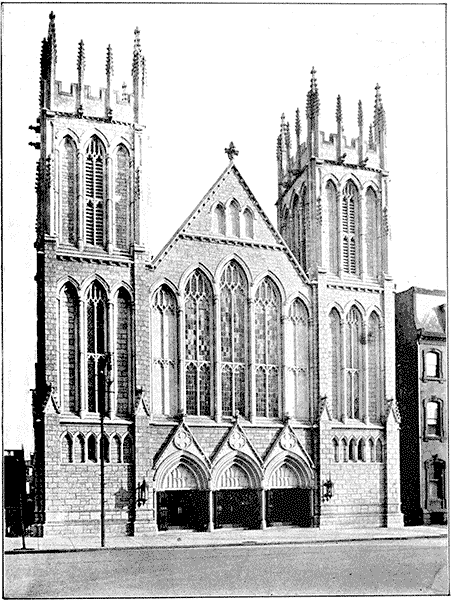
THE CHAMBERS-WYLIE MEMORIAL CHURCH.
The principal dates and items of financial interest are as follows: Of
the sum of $412,500 received from the sale of the property at Broad
and Sansom Streets, the sum of $200,000 was set aside as a perpetual
endowment for the use
of the Chambers-Wylie Church, and $60,000 were
applied to extinguish the mortgage debt. The sum of $6,000 was given to
the Rutledge Presbyterian Church.
On December 26th, 1899, the congregation instructed the Board of
Trustees to proceed with the erection of a new church edifice,
according to an estimate submitted by J. E. & A. L. Pennock, the cost
of same to be $101,000 and in April, 1900, the erection of the building
was begun. On August 8th, 1900, the corner stone was laid and on the
first Sunday of December, 1901, the Church building was formally
dedicated, the Rev. Thomas A. Hoyt, D.D., preaching in the morning, and
Rev. Henry C. Minton, D.D., in the evening.
The entire cost of the church building was $103,915.66. The cost of
Organ, $10,000; Cost of Pews, $3,260; Pulpit Furniture, $600; Stained
Glass, $1,500; Heating System, $2,400; Carpets, $3,457.
Within two years after preaching the dedication sermon, the pastor
emeritus fell asleep in God, and funeral services were held in the new
edifice.
The Board of Trustees of the Chambers-Wylie Memorial Church met in
the pastor's study, at noon on the same day, and passed the following
resolution:
"The Rev. Thomas A. Hoyt, D.D., our Pastor Emeritus and for seventeen
years our pastor, whose death occurred in Bryn Mawr on Monday, June
29th, was beloved by us all and by the church we represent. He came to
us in 1883 and by his untiring devotion to the interests of this church
and his skill in carrying into effect the union of the two churches
now one in this present organization has made possible our present
prosperity and position of influence."
Now, during the pastorate of Rev. E. Trumbull Lee, with a few of the
old "Chamberites" and many new followers of the Master the work goes
on. God bless and prosper them one and all.
"Not unto us, O Lord, not unto us, but unto thy name give
glory, for thy mercy, and for thy truth's sake."