The cover image has been created by the transcriber from the title page of the original.
Obvious typographical errors have been corrected.
Inconsistencies in spelling and hyphenation have been retained from the original.
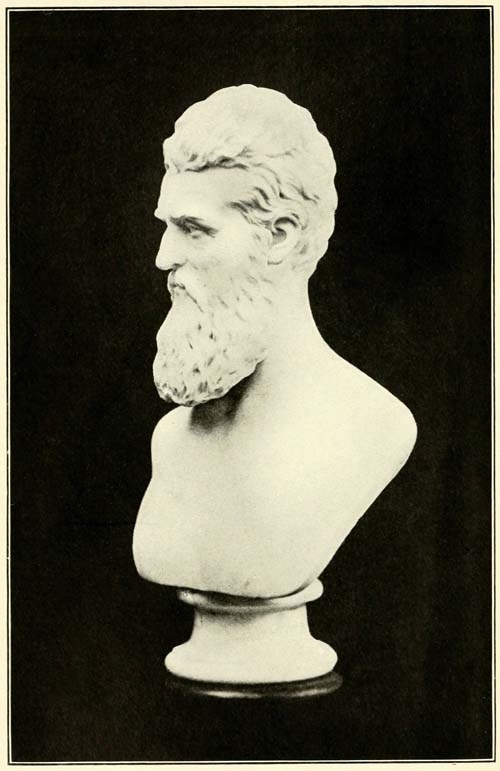
Bust of John Brown.
(See Note.)
Personal Reminiscences
BY
J. W. WINKLEY, M.D.,
Editor of Practical Ideals and Author of "First
Lessons in the New Thought."
WITH AN INTRODUCTION BY
FRANK B. SANBORN
ILLUSTRATED
BOSTON
JAMES H. WEST COMPANY
Copyright, 1905
By James H. West Company
PREFACE
THE sub-title, "Personal Reminiscences,"
is rightly appended
to this volume. The old saying,
"Much of which I saw, and part
of which I was," the author can truthfully
apply to himself in connection
with the interesting and stirring occurrences
here recorded. He relates
the events because they were, in large
measure, personal experiences. And
the narrative is made up, for the most
part, of historical matter which has
not been presented heretofore by any
writer. In other words, it is history
at first hand.
Another and more particular reason
for the preparation of this little volume
is because it is believed by the
writer that these narrations will serve
to throw some especially valuable
side-lights upon the subject of them.
John Brown was one of the most
unique characters in all our American
history, and an original factor in an
important part of that history.
The volume will surely be welcome
to all admirers of Brown, and it should
be of considerable interest to the general
public.
It hardly needs mentioning here
that the standard work on John Brown,
giving very fully his life and letters,
is that of the Hon. Frank B. Sanborn,
who kindly contributes the Introduction
to the present volume.
The frontispiece to this volume is a representation
of a bust of Captain Brown, conveying in
so far a correct idea of the exterior man.
This excellent bust, the best representation of
him extant, was made from measurements taken
by the sculptor in the Charlestown (Va.) prison,
while Brown was awaiting trial there. The
photograph was courteously furnished by the
present owner of the bust, Mr. F. P. Stearns,
of Medford, Massachusetts, whose father, Mr.
Henry Stearns, a life-long friend of Brown,
caused the bust to be made.
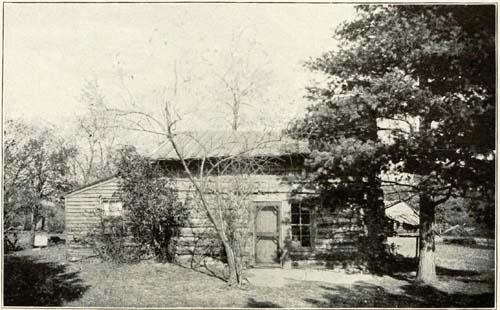
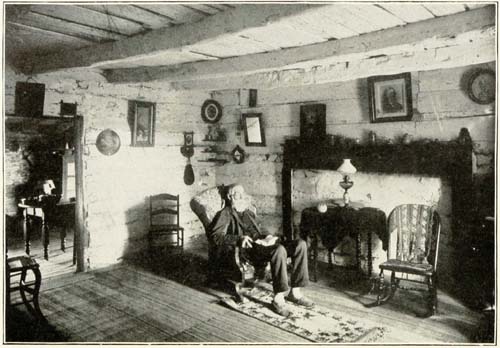
In other places in the volume are pictures
of the log cabin of the Adair family, one an
exterior view of it, the other an interior, for
which we are indebted to Mr. F. B. Sanborn.
Under this modest roof Brown often sought
and never failed to find welcome resting-place
and hospitality. Mrs. Adair was his half-sister;
her husband, a Methodist clergyman, ministered
to the spiritual needs of a scattered flock in the
territory.
The writer, on the occasion of a visit a few
years since to Kansas to view the old familiar
spots, found the cabin, almost the last of its
race, not much changed outside or within from
what it was in the former days. It is owned
and occupied, as is the farm on which it stands,
by a son of the pioneer minister.
INTRODUCTION
THE interest attaching to this
little book demands from me
some notice of its author, and
of my indebtedness to him while preparing,
twenty years ago, a "Life and
Letters of John Brown," which has
since become the basis of several
biographies of that hero. Dr. J. W.
Winkley, long a citizen of Boston,
was one of those who, in 1856, became
a Free State colonist of Kansas Territory,
then the skirmish-ground of the
long conflict between free labor and
Negro slavery. His residence there
was brief (1856 and 1857), as was
that of many who went out in the years
1855-'58 to take part on one side or the
other of the contest; but he had the
good fortune, as a youth, in the perceptive
and receptive period of life, to come
under the influence of a hero; and
this book portrays the incidents of
that interesting acquaintance. Nearly
thirty years later he communicated
to me this story, and I succinctly
mentioned it in my book. But it
required a fuller statement; especially
since it seems largely to have escaped
the notice of the chroniclers of that disturbed
and confused period of 1856.
The partisan movements here described
came in between two of
Brown's famous fights,—that of
Black Jack, in early June, when he
captured the Virginian captain, Pate,
and that in the end of August, when
he repelled the formidable attack of
the Missourians upon the small settlement
of Osawatomie. The brothers
Winkley and their comrades took up
arms in the neighborhood of Osawatomie,
after the engagements of the
first two weeks in August, which culminated
in the capture of several
camps or "forts" of the Southern
invaders of eastern Kansas, August
14 and 16. Fort Saunders, not far
from Lawrence was taken by a Free
State force under General Lane,
August 14. On the 16th, another
Pro-slavery "fort," garrisoned by a
Colonel Titus, was captured, near
Lecompton. The reason for these
attacks was thus given by John
Brown, Jr., then a prisoner at Lecompton,
guarded by Captain Sackett
with a force of United States dragoons
(August 16, 1856):
"During the past month the Ruffians
have been actively at work, and
have made not less than five intrenched
camps, where they have, in
different parts of the Territory, established
themselves in armed bands,
well provided with arms, provisions,
and ammunition. From these camps
they sally out, steal horses, and rob
Free State settlers (in several cases
murdering them), and then slip back
into their camp with their plunder.
Last week, a body of our men made
a descent upon Franklin (four miles
south of Lawrence) and, after a skirmishing
fight of about three hours,
took their barracks and recovered
some sixty guns and a cannon, of
which our men had been robbed some
months since, on the road from Westport.
Yesterday our men invested
another of their fortified camps, at
Washington Creek.... Towards
evening the enemy broke and fled,
leaving behind, to fall into the hands
of our men, a lot of provisions and
100 stand of arms.... This morning
our men followed Colonel Titus
closely, and fell upon his camp (near
Lecompton), killed two of his men,
liberated his prisoners, took him and
ten other prisoners, and with a lot of
arms, tents, provisions, etc., returned,
having in the fight had only one of
our men seriously wounded....
This series of victories has caused
the greatest fear among the Pro-slavery
men. Great numbers are
leaving for Missouri.... I see by
the Missouri papers that they regard
John Brown as the most terrible foe
they have to encounter. He stands
very high with the Free State men
who will fight, and the great majority
of these have made up their minds
that nothing short of war to the death
can save us from extermination."
Immediately following the date of
this letter of young John Brown came
the adventures which Dr. Winkley so
well describes. They may have had
no other chronicler; and it is well
that the testimony of an eye-witness
should at last be given, ending with
the striking incident, just following
the Osawatomie fight of August 30,
when young Winkley, in the log-cabin
of the missionary Adair, husband of
Brown's half-sister, saw John Brown
sternly mourning over the body of his
son Frederick, killed on the morning
of the fight, on the high prairie above
Osawatomie. I visited Mr. Adair in
this cabin, in 1882, and talked with
him on the events of that year of contention,
and the pictures here printed
of his prairie home are true to the
fact as I then saw it. Two weeks
after the burial of Frederick Brown, as
mentioned by Dr. Winkley (September
14, 1856), Charles Robinson, who had
commissioned John Brown as captain
nine months earlier, wrote to him by
that title from Lawrence, and said in
his letter:
"Your course has been such as to
merit the highest praise from every
patriot, and I cheerfully accord to you
my heartfelt thanks for your prompt,
efficient, and timely action against the
invaders of our rights and the murderers
of our citizens. History will
give your name a proud place on her
pages, and posterity will pay homage
to your heroism in the cause of God
and humanity."
Robinson was at this time the nominal
leader of the Free State settlers,
being their duly chosen State Governor
under the Topeka Constitution;
and he became the first actual Free
State Governor in 1861, when Kansas
was admitted to the Union under
another Constitution. Many years
later, at the dedication of a monument
commemorating the Osawatomie fight
(August 30, 1877), Charles Robinson
said, among other things:
"The soul of John Brown was the
inspiration of the Union armies in the
emancipation war; and it will be the
inspiration of all men in the present
and the distant future who may revolt
against tyranny and oppression; because
he dared to be a traitor to the
government that he might be loyal to
humanity."
Dr. Winkley agrees in this statement
of Robinson; and his portrayal
of the man as he was in the midst of
surprises and responsibilities, but ever
the same intrepid and resourceful
leader, will add a new picture to those
we already had of John Brown in
action. Active or in chains, in the
battlefield or in his Virginia prison, he
always commanded attention, and received
the applause of those who
knew him.
The verdict of the world has confirmed
this praise; and of all the men
connected with the dark and bloody
story of Kansas, from 1854 till the
close of the Civil War, Brown's name
is the most widely known. Blame
has been mingled with praise; but
the involuntary tribute paid, by the
natural human heart, to invincible
courage and unwearied self-sacrifice
will insure the prevalence of praise
over blame. Those who cannot approve
all his acts, as Dr. Winkley
cannot, are yet convinced generally
of the high purpose and grand result
of his arduous life. Richard Mendenhall,
a Kansas Quaker, who knew him
well but "could not sanction his mode
of procedure," yet said, after Brown's
death in Virginia:
"Men are not always to be judged
so much by their actions as by their
motives. I believe John Brown was
a good man, and that he will be remembered
for good in time long hence
to come."
Quite recently an English author,
William Stevens, writing a history of
slavery and emancipation, has occasion
to name John Brown, and the warmth
of his eulogy does not satisfy the cool
judgment of that most reflective journal,
the London Spectator, which says:
"Mr. Stevens asks if Brown did
not see the forces moving towards
abolition more clearly than did his
friends who protested against the
daring of his schemes: yet he emphasizes
too much, surely, the forlorn
recklessness of the man's methods.
But a more fearless, resolute, and
cooler-headed man never lived. His
family life, the devotion of his own
flesh and blood to him, and his tenderness
were indications of a character
intensely human, but also of a man
who had counted the cost and knew
that the individual must yield to the
race. He lit, not a candle, but a
powder-magazine; and his last words
prove that he foresaw, as plainly as
man ever saw sunrise follow dawn,
that blood, and blood alone, would
loosen the shackles of the slave."
Events, in fact, followed the track
which Brown pointed out, and with a
swiftness that startled even such as
accepted his clear insight of the
national situation. There was something
prophetic in his perception of
the future; he could not see well
what was directly before him, but of
the consequences of his action, and
of that of other men, he had the most
piercing and sagacious view. Such
men appear on earth but rarely; when
they come, it is as martyrs and seers.
Fatal are their perceptions, and to
themselves as well as to the order of
things they subvert. But it is more
fatal to disregard the warning they
give. Their remedy for existing ills,
sharp as it must be, is for the healing
of the nations and for the relief of
man's estate.
F. B. Sanborn.
Concord, January, 1905.
I A Call for Aid
JOHN BROWN THE
HERO
Personal Reminiscences
IT was of an August morning in
that eventful year of Kansas history,
1856, in the gray of the
earliest dawn, that a horseman came
riding at full speed up the creek, the
south branch of the Pottawatomie,
from the direction of the lower settlements,
and halted before our cabin
door.
The animal he rode was all afoam,
and gave other signs of having been
urged hard and over a long distance.
As the rider dismounted, his nervous
and excited manner told us he
was the bearer of ill tidings or that
he was on some errand of unusual
importance.
"What news below?" was asked
the stranger.
"Bad news," he replied quickly.
"The Ruffians are over the border
upon us again, in strong force; and
they are bent on 'cleaning us out'
this time. If they keep on they
won't leave a cornstalk standing to
show where our crops grew."
There is every reason to conclude
that our informant was no other than
James Montgomery, then all unknown
to fame, but who was later to distinguish
himself as a leader in the Kansas
struggle for freedom.
As the writer remembers him as he
appeared that morning, he gave evidence
of being a man of intelligence
and character. He was tall,—some
six feet in height,—rather slender in
build, and of dark complexion. This
answers the description given of
Montgomery by those who knew him
well.
Montgomery afterward gained well-earned
distinction by leading Free
State settlers, banded together for
self-defense, to fire upon United States
troops, putting them to rout. He
became, still later, a colonel in the
Northern army at the outbreak of the
Civil War.
The trooper's story was soon told,
as it needed to be, for there was no
time to be lost. He was a messenger
from the Middle River region, so-called,
dispatched to us by his comrades
in distress. He had come
twenty-five miles through the night
and darkness, in an almost incredibly
short time, stopping by the way only
to arouse the scattered Free State
men to arms.
He had been sent to ask help.
The need was pressing. The invaders
were many, defiant, and reckless.
They had encamped in the
neighborhood, were burning haystacks,
foraging their horses in the
cornfields, hunting down Free State
men, and sending terror to the hearts
of women and children. Detachments
of marauders were sent out
here and there on these errands of
mischief. They had even penetrated,
not twelve hours before, to within ten
miles of the spot where we stood;
had made prisoner and borne away a
pronounced Free State man; and, in
addition to that, had besieged other
Northerners in their log cabins and
destroyed their property by pillage
or fire,—as we shall see further on
in our story.
II The Prairie Wonder
BY this recital of the messenger
our sympathies were sufficiently
enlisted; but if anything additional
were needed, further to gain
our attention, it was given then and
there.
As the speaker drew his narration
to a close, all present instinctively
turned their eyes in the direction
whence he had come: namely, toward
the south-east. There a sight met
our gaze that riveted us to the spot—a
spectacle as marvelous as it was
beautiful, and singularly confirmatory
of our informer's words. To our utter
astonishment we looked directly, at
that moment, into the enemy's camp
twenty miles away, though seemingly
less than a quarter of that distance.
It was one of those peculiar
phenomena, rarely seen on the water
and less frequently on the land, and
more wonderful in the latter case
when it does thus appear, because
more perfect and on a grander scale:
the mirage.
The prairie mirage is of wondrous
beauty. It is usually in the autumn,
when all the atmospheric conditions
are favorable, that these strange illusions
take place on the prairie ocean.
Along the eastern horizon, near sunrise,
a narrow belt of silver light
appears. As it grows broader the
silvery gray of its lower side changes
slightly golden. Fleecy clouds above
the belt take on a yellow red. The
grayish shadows of the dawn lift
slowly from the earth. Just before
the red disk of the sun peers above
the horizon-line, one sees in the sky
the landscape of trees, of waving
grasses or grain, of rocks and hills,
held together as it were by threads
of yellow and gray and azure. The
earth stands inverted in the air.
The groundwork of this illusion is
a grayish, semi-opaque mist; and the
objects are seen standing or moving
along in it. The feet of animals and
of men, the trunks of trees, the rocks
and hillocks, are set in this aqueous
soil. When the conditions are perfect,
objects far beyond the range of
vision over the prairie are brought
near and into plain view of the beholder.
That morning was such a time and
afforded such a scene. There was
the camp of the enemy,—miles
away, as has been said,—mirrored
perfectly and beautifully on the sky,
every feature of it traced with the
minuteness of a line-engraving. By
the aid of our military field-glass we
could see the early risers moving
through the camp-ground; the horses,
standing patiently outside awaiting
their morning meal; the positions of
the pickets keeping guard; the tent-doors
flapping in the slight breeze or
swaying back and forth as the men
made egress or entrance. Here and
there were knots of soldiers,—of
two or three or four men each,—apparently
discussing the situation
or lighting the early camp-fires for
breakfast. Even the curling smoke
of the newly kindled flame, as it ascended
upward, curiously traced itself
visibly to the eye.
But, what was of yet more interest
and practical moment to us, we beheld
the stacks of arms, the rifles and shot-guns,
of our foe, reflecting their burnished
steel, and the army-wagons for
bearing their luggage and provisions,
stretched along the exposed sides of
their position to serve as barricades
for defense in case of attack. Moreover,
there were the evidences on
every side of wanton and cruel destruction,—whole
cornfields stripped
or trodden into the dust, and the
blackened sites or yet smoking remains
of burned houses, corn-bins,
and wheat-stacks, the property of the
Northern settlers.
Here we had, right before our
eyes, direct demonstration of the
truth that had just been told us.
Deeply impressive was it indeed, and
well calculated to fire us and to spur
us to the rescue.
Surely that effect it had.
III The Night March
IT would perhaps suffice here, so far
as the main point in our story is
concerned, simply to say: We went
to their relief. But I am tempted to
give a brief account of that march,
and of the incidents by the way, as
affording the reader some idea of the
difficulties and vicissitudes of that
Western-border, Kansas warfare.
In the settlement of the South
Pottawatomie river there were thirty-six
men and boys, all told, capable of
bearing arms. They had been organized
into a company, and were
officered and drilled ready for emergencies.
But, inasmuch as they were
scattered up and down the creek over
a distance of some miles, to inform
all, and for each to make ready, and
for all to get together occupied the
swift hours of nearly the entire day.
Ammunition was to be collected;
provisions were to be packed for the
journey; horses were to be gathered
up from the prairie and bridled and
saddled. And, withal, preparations
were to be made for home defense
and for the care of the women and
children to be left behind. These,
though few, were all the more
precious. The males who were sick
or wounded, lame or otherwise disabled,
constituted the "Home Guard."
Finally, the leave-taking of wives
and little ones, though hastily made,
also consumed time, so that the sun's
rim already dipped the western horizon
before we were well under way.
The march thus taken up was one
into a night of terror of which we
little dreamed when we set out.
We had not gone far before darkness
settled down upon us. The sky,
cloudless through the day, became
overcast, and one could hardly see
his hand before him. Only with
great difficulty could we keep our
direction and follow the trail over the
prairie.
But the possibility of losing our
way was the least of our troubles.
In marching at all that dark night
we ran fearful risks. Of that fact
we were perhaps only too unduly
conscious. Fortunately, however, the
perils we feared we did not encounter.
Some of them we escaped by the
merest and luckiest chance. And
some of the dangers were wholly
imaginary, though they were none the
less harassing on that account. To
our excited minds, a foe lurked behind
every bush; in every thicket and
cluster of underbrush was the enemy
in ambush.
Our apprehensions were augmented
by the rumor which twice met us
that the "Border Ruffians" had commenced
their march up the creek at
nightfall, as we began ours down.
The terribly anxious, distracted state
of mind we were in it is difficult to
portray to the reader. It was mainly
owing to the doubt and uncertainty
as to everything.
This is the case, naturally, in all
such warfare. It is otherwise where
there are regularly organized military
operations. In the latter case, by a
proper system of spies and scouts,
the general is of course kept informed
of the whereabouts of the enemy, of
their numbers, and of their movements.
With us it was wholly different.
The air was full of rumors,—all
perhaps unreliable; yet it was not
safe to let them go unheeded. If we
gave no heed to the reports we might
find ourselves attacked wholly unexpectedly.
We were not cowards, I will venture
to assert, and as the sequel will
abundantly show; but such uncertainty
and suspense were terribly trying
to the nerves, especially on such
a night, and in such darkness;—ten
times more so than real battle would
have been. With open daylight and
a fair field we would not have hesitated
a moment to fight double our
own number. But the thought of
being mowed down in the darkness
by an ambushed foe, without the
chance of striking back in defense,
was truly a harrowing situation.
On the way we had several lesser
or larger streams to ford; and, in
that prairie country, all such were
densely wooded. At any of these
points, a dozen men well posted would
have been equal to six times their
number, and could have cut us off
almost to a man.
Every unusual noise grated upon
our senses. Twice we halted and
prepared to repel an attack. But the
alarms were needless: one was occasioned
by a drove of cattle crossing
the prairie, the other by a herd of
wild deer startled from their lair.
Twice we took a vote whether we
should continue our march, or intrench
in a good position and await
patiently the enemy or the daylight.
Once the ballot was a tie, and only
by the casting vote of our commander,
Captain Anderson, was it
decided to proceed.
IV A Siege and its Heroine
THE population of the region,
friends and foes, were now up
in alarm. Reports met us of
the outrages of the Ruffians upon
Free State settlers the night previous.
Here is the story of one of the
depredations, detailed to us at one
of our halts.
It was upon a stanch old German
and his family, settled near the junction
of the North and South branches
of the Pottawatomie. Old Kepler,
as he was nicknamed, had not taken
any leading or even active part in the
"troubles" (as they were termed),
but his strong anti-slavery sentiments
had cropped out and were known to
the enemy.
They now made directly for his
cabin, evidently resolved, as the opportunity
might offer, to force him to
declare himself for one side or the
other. No man, in fact, in those
days of the Kansas conflict,—partisan,
bitter, bloody,—could long
occupy anything like neutral ground.
If one undertook to "sit on the
fence," he soon became a target for
both parties and was relentlessly dislodged.
It was not the nature of the old
German to dissemble, when the trial
came. On the approach of the Ruffians
he prepared for the worst, as he
expected no favor. He barricaded
his cabin door and refused their demand
for admittance. They burned
his wheat and hay stacks, and all his
outbuildings, and then called upon
the besieged to surrender.
It was believed, probably rightly,
by the assailants, that the old man
was possessed of considerable money,
brought with him from the old country.
This lent incitement to their
attack; while, if true, the fact was
undoubtedly an additional motive on
his part for keeping the invaders at
a distance.
Brave old Kepler was quite advanced
in years. He was about three
score and ten, but all the old valorous
Teutonic blood in his veins was
aroused, and he prepared to resist
the spoilers even to the death, if
need be. His wife, partner of his
New World adventures and toils, had
succumbed not long before to the
frontier hardships and had passed on.
He had one son, a chip of the old
block, brave, strong, and inured to
the rough Western life, equally interested
with the father in carving out
their fortunes in this new country,
and in the making of their Western
prairie home.
And there was an only daughter,
alike the support and solace of both
father and brother;—the light, indeed,
of the household and of the
neighborhood.
I must interpolate a word here, in
passing, descriptive of this daughter,—the
worthy heroine of the event,
as we shall see. She was a light-haired,
blond-complexioned young
girl, with all the proverbial German
fairness,—bright and handsome as
a prairie flower. And she had the
German habit of taking a share in
the work in the open field. Often
was she seen by the passers up and
down the creek, "chopping in corn"
(as they call it in the West),—keeping
even step in the row with her
robust brother; or now driving the
cattle while he held the plough; then
changing work with him, guiding the
share while he drove the oxen.
Her household duties, however, were
not neglected meanwhile. Doubtless
the brother, in return, here gave her
a helping hand. Nowhere else on
the road (as the writer can testify
from personal experience) did the
weary and hungry traveler find such
bread as when thrown upon the
Keplers' hospitality,—bread of this
young girl's manufacture.
Besides all this,—and appropriately
to be said in this connection,—this
fair maiden could handle a rifle
on occasion, as we shall presently
see. Such ability was often a quite
useful accomplishment for the gentler
sex on our wild Western border. It
proved eminently so in the case before
us.
The yelling, hooting, and now
drunken mob began at length to fire
upon the cabin at its vulnerable
points. The heroic inmates returned
the shots through the holes between
the logs in the loft, and not without
effect. One of the assailants was
seriously wounded and several others
less so. The battle grew warm, the
effusion of blood thus far serving
only to increase the wild fury of the
besiegers.
The father and son stood with
their guns at the openings, while the
young girl loaded the pieces for them
as fast as they were emptied. At
length the baffled and maddened
crowd changed their tactics. They
managed to pile wood, logs, and rubbish
against the cabin, hoping to fire
the building. There was danger that
the dastardly effort would prove only
too successful. The flames began to
crackle. All now seemed lost, when
suddenly the brave daughter unbarred
the cabin door and sprang forth with
a bucket of water in her hand to dash
out the newly kindled flames. This
was done from the girl's own impulse
at the moment. Had they divined
her intention, the father and brother
would not have allowed it. The feat,
however, strange to say, was as successful
as it was heroic and perilous.
The surprised besiegers were not
actually cowardly and base enough to
fire upon the unarmed, defenseless
girl. However, one of them sprang
from his covert behind a tree to seize
her. But the old backwoodsman
father, watching breathlessly the
scene below from his post in the
loft,—his hand and eye steadied to
perfect accuracy by the imminent
danger,—sent a rifle-bullet straight
to the heart of the venturesome
wretch, and he fell forward dead at
the maiden's feet.
The girl regained the door and,
with the aid of her brother, who
hastened to her assistance, rebarred
it securely. All was now again safe
for the time being,—and permanently,
as it proved. The marauders,
overawed by this episode and by the
generally unexpected course of affairs,—one
of their number being actually
killed and several others more or less
severely wounded,—hastily fell back
to a safe distance and finally beat a
retreat from the neighborhood.
V The March Resumed
IT did not require the narration of
this stirring tale to nerve our forward
movement, but it certainly
increased our determination to proceed
at all hazard.
Our next halt was made at the
cabin, some miles further on, from
which, as mentioned in the first chapter,
the young man whom we all knew
and counted as one of us had been
borne off a prisoner. As soon as it
was made known, by the usual signs,
that we were friends, we were joyfully
if tearfully greeted. The family,
consisting of aged parents, sister,
brother's wife and little children, were
in despair. Dreadful anxiety filled
their minds. It was an illustration
of the saying that "to know the worst
is better than suspense." If in the
great cause then firing their hearts
this family had seen that son and
brother shot down before their eyes,
they would have borne the affliction
silently and with submission. But
the terrible uncertainty as to his fate
wrought upon them. A price had
previously been set upon the young
man's head, and they had reason to
fear the worst for him.
It must be added, in passing, that
his beloved ones never saw him again
alive. The good fortune fell to us to
liberate him the next day from his
captors, when we found him bound
upon his horse, with his hands lashed
behind him and his feet tied together
under the animal; but, alas! his liberation
gave him only a short respite
from death. He fell, only a few days
after, heroically fighting at the battle
of Osawatomie.
Some miles beyond we had to
make that ford of the Pottawatomie
river of unenviable fame, and which
we looked upon as the danger-point
of all others in our journey; for there
our enemy, we thought, would most
likely be in ambush. But we swam
the swift, dark, muddy stream, swelled
by recent rains to a flood, with the
water up to our horses' backs, luckily
without hindrance or serious mishap.
That ford was the notorious Dutch
Henry's crossing, so-called,—surely
a gloomy, gruesome, and dreaded spot
at that dark midnight hour. There,
close by, had been enacted, just
two months prior, the rightly named
Pottawatomie tragedy, which made
that locality, on account of this
bloody event, verily for the time the
"storm center" of the Kansas conflict.
But, terrible as it was, it served
a great purpose and was speedily
followed by good.
The hero of our sketch was the
central figure in this tragic act of the
Kansas drama, as he was in most
others at this trying period. Brown
was the cyclonic force, the lightning's
flash in the darkness, that cleared
and lighted the way for the men of
that day.
Despite all delays on the way, we
made our forced night-march of
twenty-two or more miles in remarkably
good time, and arrived at our
destination about two o'clock in the
morning, as weary, exhausted, and
hungry a set of troopers as ever drew
rein and slipped stirrup to seek rest
and refreshment.
The Adair Log Cabin.
It will be of interest to our readers
to learn here that, a couple of miles
from the town,—our halting place,—we
passed the log cabin of the Adair
family, which has such historic interest
gathered about it, and which we
shall have occasion to mention again
later.
It so happened, as we learned afterward,
that the hero of our story lodged
under that roof that night. He was
aroused from his slumbers and watched
us from the window as we marched
past,—having been reliably assured,
by our advanced guard, that we were
no threatening foe, but his firmest
and safest friends.
A photographic view of the cabin's
exterior is given on the opposite page,
as it appears to-day; and nearly the
same as it existed at that early date,
now almost fifty years ago.
The town referred to was Osawatomie,
soon to be made famous by
the man who is the principal subject
of these sketches.
We were challenged by friendly
pickets on guard, who escorted us to
the old "block-house" reared for
town defense, where we were glad to
find shelter, and especially to find
food, for hungry we were indeed.
To what a sumptuous feast were
we welcomed on that occasion! And
yet, strange to relate, the recollection
of it is not calculated to make one's
mouth water. It so happened that a
side of bacon and a barrel of hardtack
were stored there, for just such
emergencies as the present one, and
these were now pressed into our
service.
Their edible condition was such as
naturally to suggest certain Scripture
phrases as descriptive thereof;—of
the bacon, "ancient of days"; and of
the biscuit, "fullness of life." As we
crunched the latter between our teeth,
the peculiar, fresh, sweet-and-bitter
taste, commingling at every mouthful,
told us too well of the "life"
ensconced therein. No comments
were made, however, except the ejaculation
occasionally, by one and another,
"Wormy!" " Wormy!"
However, nothing daunted, we
paused not in our eating till our
ravenous hunger was appeased. And
then, on the bare floor of boards,
rived roughly out of forest trees,—though
it was a little difficult to fit
our forms to their ridges and hollows,—we
gained a few hours of as sweet
and refreshing slumber as ever visited
mortal eyes.
VI Seeking the Enemy
IT will be asked, perhaps, why we
came to this particular place. In
this little town were encamped, at
this particular time, Captain John
Brown and his daring and trusty
band of men.
"Old Brown," as he was most
often called, was a tower of strength
in time of need. He had become by
that time a veritable terror to the
enemy. Tell a Border Ruffian:
"John Brown is coming," and he
would shake in his shoes, or would
run away had he strength enough left
for locomotion. Missouri mothers
frightened their babies to sleep or
to quietude by the sound of his
name.
If our information were correct,
the foe we sought largely outnumbered
us. What more natural than
that we should, under the circumstances,
desire the counsel of the
stanch old man, and his help, if
needed.
He had not looked for an invasion
from the direction at present threatened,
but was daily expecting one
from another quarter. He detailed
two small companies, Captain Shore's
and Captain Cline's,—two-thirds of
his own command,—to join our
force; then bade us seek the enemy,
with the direction, if we found them
too strong for us, to send back word
to him, whereupon he would come
to our aid. Meanwhile, he said, he
would stay with the remainder of his
men and guard the town.
We set out in the morning, early
and hopefully. Scouts with fleet
horses were dispatched in advance,
and we rapidly followed after. Rumors
of all wild and exaggerated sorts
met us as we went. First, it was
said, there were three hundred of the
enemy, well armed and mounted;
then there were five hundred men,
strongly intrenched to receive our
attack; later, there were a thousand,
coming to meet us.
At last we began to be a little
apprehensive, possibly a grain frightened.
In the uncertainty, a messenger
was sent back to Captain
Brown to say that probably we should
need his help.
But we resolutely pushed on, if
with somewhat slackened speed. Presently
a scout returned bearing reliable
tidings. The position and strength
of the invaders had been quite accurately
ascertained. They were about
three hundred in number, quietly
encamped, and as yet unaware of our
approach.
Our officers decided not to wait for
Captain Brown to come up, but to
press forward to the attack and by
celerity of movement gain what advantage
was possible.
One point was, nevertheless, taken
into consideration. We were but
about sixty in number, all told. We
were prepared and determined to do
some hard fighting if necessary; but,
it was argued, if we could take the
enemy by surprise, victory would be
more fully assured us, and much
needless spilling of blood might be
avoided.
We therefore proceeded cautiously
till we arrived within two miles of
the hostile force, where our advanced
scouts had taken up position and were
actually looking down with spy-glasses
into the enemy's camp and watching
their every movement. The foe
seemed wholly unconscious of any
impending danger.
VII The Battle
IN less time than it takes to relate
it, the plan of battle was arranged.
Our men were divided into three
companies. Two divisions were to
make flank movements, one on the
right and the other on the left of the
foe, while the third was to assault
directly in front. The plan of attack
was well conceived and as successfully
executed.
We had a circuit of some miles to
make to gain the flank positions. It
was quickly and silently traveled. In
our division, detailed on the left flank,
hardly a word was spoken during a
two hours' march. Each man was
busy with his own thoughts. It is
said that persons in critical situations
will sometimes have their whole lives
pass before them. I believe that
most of us, during this march, recalled
nearly all we had ever done
or seen, known or felt.
We were suddenly awakened, at
length, from such reveries, by the
crack of rifles and the clash of musketry,
and by bullets actually whizzing
about our ears. So closely had
we stolen the march on them that
when we opened fire we were actually
more in danger from the guns of our
friends than from those of our foes.
The enemy were taken completely
by surprise. As prisoners whom we
took told us afterward, they thought
that "Old Brown" was surely upon
them; and their next and only
thought was of escape. They left
all, and ran for dear life, some on
foot, shoeless and hatless; others
springing to their horses, and, even
without bridle or saddle, desperately
making the trial of flight. Perfectly
bewildered, they ran this way and
that; and naturally, as our forces
were positioned, many ran directly
into our hands.
The one thing they did not do well
was to fight, except in the case of a
few desperate ones and of the leaders,
who called in vain upon their men to
rally. Then they gave up all for
lost, and each looked out for himself.
Many discharged their pieces at the
first onslaught, but so much at random
that not a man of our number
was fatally injured, though several
were more or less severely wounded.
We took many prisoners, and captured
some thirty horses, all the
enemy's wagons and luggage, and
much ammunition and arms. The
victory was complete.
Not until all was over did Captain
Brown and his reserve come up,
though they had ridden hard to lend
us a helping hand. He warmly congratulated
us, however, upon our good
success, saying that he could not have
done it better himself, and that he
was just as glad and proud of our
victory as though he had won it.
VIII A Scene for a Painter
THERE were incidents not a few,
connected with the day and with
the central figure of our sketch,
which would add interest to our pages.
One there was which especially impressed
itself upon all witnesses of
it.
This relates to one of the enemy
who was fatally wounded in the
battle. He desired very much, he
said, to see "Old Brown" before he
died.
Captain Brown was informed of
the wish, whereupon he rode up to
the wagon which served as ambulance,
and, with somewhat of sternness in
his manner, said to the prisoner,
"You wish to see me. Here I am.
Take a good look at me, and tell
your friends, when you get back to
Missouri, what sort of man I am."
Then he added in a gentler tone,
"We wish no harm to you or to your
companions. Stay at home, let us
alone, and we shall be friends. I
wish you well."
The prisoner meanwhile had raised
himself with great difficulty, and
viewed the old man from head to
foot as if feasting his eyes on a great
curiosity. Then he sank back, pale
and exhausted, as he answered, "I
don't see as you are so bad. You
don't talk like it."
The countenance of Brown as he
viewed the sufferer had changed to a
look of commiseration. The wounded
man saw it, and, reaching out his
hand, said, "I thank you." Brown
tenderly clasped it, and replied, "God
bless you," while he turned with
tears in his eyes and rode away.
The present writer was standing
within a few feet of Brown at the
time, and naturally drank in the scene
with a boy's eager curiosity and susceptibility
to impression.
It was a scene for a painter, and
the artist could with appropriateness
have called his work, "The Conqueror
Conquered."
But it was perfectly illustrative of
the man and of the hero. Brown
was as brave as a lion. He seemed
absolutely not to know fear. Yet
withal he possessed a heart tender
as a child's or as the tenderest
woman's.
IX Brown's Night Appointment
WE gathered together the spoils
and took up our march on
the backward track toward
home, discussing the exciting events
of the day and recounting to each
other our individual experiences, adventures,
and "hairbreadth escapes."
When we had thus proceeded some
three miles, it was nearing sundown,
and we halted for supper and to determine
our course for the night.
Meanwhile we had learned an
important fact from our prisoners,
namely: that we had not met all of
our enemies. A part of them, quite
a large force, had gone north that
morning, and might be at that very
moment ravaging our own homes
which we had left behind the evening
before. Naturally, these unwelcome
tidings cast a cloud across our rejoicings.
They might after all be turned
to mourning!
Having nearly finished our meal,
and while we were yet speculating on
the situation, Captain Brown hastily
rose to his feet and called upon all
those, who were ready to go with him,
to mount their horses. Forty or
more men instantly sprang into their
saddles, and others were about to do
the same, when the old man cried,
"Enough—and too many." He
thanked them for their readiness, and
then selected thirty of the number,
tried and trusted men who had followed
him before, and without asking
why or whither. In the present instance
also they ventured not a question.
Brown seldom disclosed his intention
or plans to any one. He wished
no man with him who was not absolutely
reliable. He required the
implicit confidence of his followers
and unquestioning obedience to his
commands. Whoever put himself
under his leadership took his life in
his hand and followed whithersoever
he was led.
On this occasion some not acquainted
with his habits plied him
with queries as to where he was going
and what he would do. He only
answered, characteristically, that he
"had an appointment with some
Missourians and must not disappoint
them." One ventured jocosely to
ask further, concerning the appointed
place of meeting. He replied, they
had not been kind enough to fix upon
the precise spot, but he felt bound,
out of courtesy, inasmuch as they
came from a distance, to hold himself
in readiness when wanted. This left
us, of course, wholly in the dark as
to his movements.
With some words of advice to
those of us remaining,—that we
would better seek our homes, be
prepared to defend them, and ready
for any action when needed,—he
gave the command, "Ready! Forward!"
and, with a wave of his
hand, led his Knights Errant away.
After they had departed it was
decided that it would be advisible for
us to return to the camping-ground
of the enemy and pitch our tents
there for the night; because, it was
argued, when the detached force gone
north returned, they would naturally
seek their friends in the camp where
they left them.
Accordingly, though weary near to
exhaustion, we returned and camped
there, threw out our pickets, and
made every preparation to give the
marauders a warm reception should
they appear. We slept on our arms,
ready for any emergency, but the
night passed and we were undisturbed.
The next morning dawned on us
clear and beautiful. All our apprehensions
of danger had passed with
the darkness. Our pickets were withdrawn.
The scouts, who had been
sent out to gather news of the scattered
settlers, had come back with no
tidings of the foe we had awaited.
Consequently, relieved of all military
restraint, we gave ourselves up for
the time to the preparation and enjoyment
of an early breakfast.
The wagons were unpacked of
their provisions. The horses were
picketed, or were turned loose for
grazing. The prisoners, disarmed,
were allowed comparative freedom.
Fires were lighted here and there for
cooking. And thus we were spread
out over a large area, forgetful of
the enemy, without a thought of an
attack, and bent only on making
ready to satisfy the cravings of
hunger.
X An Intrepid Charge
THEN occurred the scene which
gives us one of the glimpses of
John Brown for the sake of
which these reminiscences have been
written.
Suddenly, over the hill or rising
ground some half or third of a mile
away, two horsemen came up at full
speed.
"Look! look!" was whispered in
suppressed voices from one to another
of our party, and all eyes were upturned
in that direction.
Observing us, the horsemen as
suddenly turned on their heels, and
disappeared the way they came, leaving
us stupefied with doubt and
wonder.
In a moment more, however, the
heads of a whole troop rose in sight,
and the cry, "The Missourians!
the Missourians!" rang through our
camp in startling accents.
We were in dismay, for we were
entirely unprepared for attack and
there was no time to make ready.
We were apparently caught just as
our enemy had been surprised by
ourselves. Men sprang, some for
their arms, some for their horses.
Whether to fight or to try to escape
was uppermost in their minds,—each
could settle that question only for
himself. At any rate, every one felt
that a daring and determined foe,
apparently numbering a hundred,
which was double our own number,
could, in the condition in which we
were, utterly cut us to pieces and
destroy us at a blow.
What grave emotions that thought
aroused! It is difficult for one,
never thrown into any such situation,
to realize or in any degree even imagine
the feelings that may surge
through the bosom of men thus
placed. Accounts have been given
of what panic-stricken crowds or
armies will sometimes do, but a
description of what they feel on
such occasions of disaster was never
yet fully penned or painted by
man.
Meanwhile, some of our number,
who had been cool enough to observe
the fiercely advancing cavaliers, perceived
that they were friends, not
foes. It was old Captain Brown
himself and his trusty band. With
joy, this news rang through our
ranks. All eyes were then directed
toward them, enchained and enchanted.
It was a splendid sight.
They at first, naturally, took us
for enemies, not dreaming but that
we were miles away, where they left
us the evening before. They suspected
us to be the force, encamped
there, which they had been riding all
night to overtake,—the same force
we had awaited.
They came swiftly up over the
brow of the hill, in full view, with
Brown at their head, and, without
halting or even slackening their
speed, swung into line of battle.
Only thirty men! yet they presented
a truly formidable array. The line
was formed two deep, and was
stretched out to give the men full
room for action. Brown sprang his
horse in front of the ranks, waving
his long broadsword, and on they
came, sweeping down upon us with
irresistible fury.
It was indeed a splendid and fearful
sight, never to be forgotten by
the beholders. Only thirty men!
yet they seemed a host. In their
every action, in their entire movements,
seemed emblazoned, as in
their determined souls it was written,
"Victory or death!"
Their leader looked the very impersonation
of Battle. Many of us
had seen John Brown before, some
of us a number of times, and under
trying circumstances. But now all
felt that the real man we had never
before beheld. The daring, the intrepidity,
the large resources of the
man, none of us had imagined till
that moment.
Not a gun was discharged, their
commander having given to his men
the same strict orders that were
given at Bunker Hill of old, that
they should "reserve their fire till
they could see the whites of their
enemy's eyes." But before they
had quite gained that very dangerous
proximity to us, we succeeded
in making them understand that we
were their friends.
Then such a glad shout as rent
the air from both sides was seldom
ever heard, we believe, on any field
even of victory. They were as glad
to find that we were their friends,
as we, in our helpless condition, were
glad to learn that they were not our
enemies.
The full intrepidity of Brown and
his men, though it appeared to us
astounding, was not fully appreciable
till we came to look at it somewhat
from their own view-point.
We were actually about eighty
men, prisoners and all. But, spread
out as we were, with the many
horses grazing, the scattered and
unpacked wagons, numerous camp-fires,—widely
separated for convenience,—arms stacked in some
places, and men gathered in groups
in others, we presented altogether a
formidable appearance. What was
more, this was enhanced by our
peculiar position, so that, to them,
our numbers and strength were exaggerated,
while our weakness and
confusion were concealed. Brown
admitted to us himself, afterward,
that he thought he was undertaking
to whip a force of two or three hundred,
while his men declared that
they believed they were actually
charging upon not less than a thousand.
Brown's quick military eye took in,
at the first, the supposed situation;
and, as in a flash, he decided what to
do. All depended, he concluded, upon
rapidity of action. His only hope
lay in striking a sudden and crushing
blow, for which we were unprepared,
and from which we could not
recover till he had made victory sure.
From the time Brown's forces came
in sight over the hill, till they were
within gunshot of us, hardly thirty
seconds elapsed,—a very short notice
in which to prepare for action, even
if an attack were expected.
XI Brown to Our Prisoners
AFTER mutual congratulations
over the bloodless and happy
conclusion of the adventure, we
set our friends down with us to eat the
interrupted breakfast, to which they
were prepared to do ample justice.
They had ridden all night, some forty
or fifty miles, in pursuit of the enemy,—had
ridden all night, without rest or
food, from the time they left us, at dusk
of evening, till they surprised us that
morning with their dauntless charge.
Another incident in connection
with the events described it seems
fitting to mention, as affording a very
interesting side-glance at the character
of our hero. After the meal,
Captain Brown was asked by our
officers to give a talk to the prisoners
taken the day before, who were now
drawn up in line for parole. He
responded without an instant's hesitation
or a moment to think what
he should say.
He spoke to them in a plain, simple,
unpretentious way, but with a
directness, a force, and an eloquence
withal, which doubtless wonderfully
impressed those addressed, as certainly
it held spell-bound all others
who listened. Such vivid and indelible
impression did this speech
of Brown make on the mind of the
present writer that, even after the
lapse of these many years, he is able
to reproduce it, not only in substance,
but almost word for word;
and he has no doubt of its exceptional
character. Perhaps it was
second only to that immortal address
which the hero made three years
later to the court at his trial in
Virginia, which Emerson pronounced
one of the three most remarkable
addresses in the world.
On the latter occasion, however,
instead of a few plain, simple, rough
and ready, but intensely admiring
followers, he had almost the whole
civilized world eagerly to hear and
sacredly to preserve his utterance.
Brown's speech to the prisoners
was probably not over five minutes
long in its delivery, but it lasted
those forty trembling men a lifetime.
It was not known that one of them
ever afterward ventured over the
Missouri border into the Kansas
territory.
The address was as follows:
"Men of Missouri, one of your
number has asked to see John Brown.
Here he is. Look at him, and hereafter
remember that he is the enemy
of all evil-doers.
"And what of you yourselves,
men! You are from a neighboring
State. What are you here for? You
are invaders of this territory,—and
for evil purposes, you know as well
as we know. You have been killing
our men, terrorizing our women and
children, and destroying our property,—houses,
crops, and animals. So
you stand here as criminals.
"You are fighting for slavery.
You want to make or keep other
people slaves. Do you not know that
your wicked efforts will end in making
slaves of yourselves? You come
here to make this a slave State. You
are fighting against liberty, which our
Revolutionary fathers fought to establish
in this Republic, where all men
should be free and equal, with the
inalienable rights of life, liberty, and
the pursuit of happiness. Therefore,
you are traitors to liberty and to your
country, of the worst kind, and deserve
to be hung to the nearest
tree.
"But we shall not touch a hair
of your heads. Have no fear. You
are deluded men. You have been
deceived by men who are your elders
but not your betters. You have
been misled into this wrong, by
those your leaders; thus, they are
the real criminals and worse than
traitors, and, if we had them here
instead of you, they would not find
such mercy at our hands.
"You we forgive. For, as you
yourselves have confessed, we believe
it can be said of you that, as was said
of them of old, you being without
knowledge, 'you know not what you
do.' But hereafter you will be without
excuse.
"Go in peace. Go home and tell
your neighbors and friends of your
mistake. We deprive you only of
your arms, and do that only lest some
of you are not yet converted to the
right. We let you go free of punishment
this time; but, do we catch
you over the border again committing
depredations, you must not expect,
nor will you receive, any mercy.
"Go home, and become liberty-loving
citizens of your State and
country, and your mistakes and misdeeds,
as also the injuries which you
have inflicted upon us, will not have
been in vain."
XII Hard Lines
THE personal experiences here
related are of interest and have
a value mainly as they throw
somewhat of fresh light upon the
character of the subject of this work,
Captain Brown, and upon the events
and times in which he was the leading
actor.
Those were troublous times,—times
that indeed "tried the men's
souls" who experienced them. The
hardships were severe. Danger and
disease, death by ruthless hands, and
even death from starvation, often
stared us in the face. At one time
we lived six weeks solely on Indian-meal
mixed with water and dried
before the fire, and that without even
a condiment. This was our common
fare in times of scarcity. Bacon and
molasses, and tea without milk or
sugar, were our luxuries in times of
plenty.
For months, in the summer of '56,
the men in our settlement never had
their clothes off, day or night, unless
torn or worn off. On a trip early in
the summer mentioned, made by a
companion and myself to Kansas
City for provisions, we chanced to
come across John Brown and his
company encamped in the woods on
a river-bank. After we made ourselves
known as friends we were
invited into their camp. A more
ragged set of men than we found
were rarely, we believe, ever seen,—Brown
worst off of all, for he
would not fare better than his men.
They had no shirts to their backs,
and their outer clothing was worn
or torn to tatters. While in camp,
they were going barefoot to save the
remnants of their worn-out shoes for
emergencies. And withal, they were,
they said, on short rations, having
no bread, but only Indian-meal and
water. They were glad of the opportunity
to engage us to bring them
provisions on our return, but they
confessed they were as short of
money as they were of provisions,
which simply meant that we must
share ours with them.
The men of our company worked
hard by day to raise crops, with their
rifles near at hand, and slept in the
"bush" at night to avoid surprise
and capture in their cabins. Only
the women and children ran the risk
of remaining in the houses, in their
defenselessness trusting to the mercy
of the enemy. That border life invited
sickness, especially the malaria of the
low prairie. Our cabins were roughly
made, and so open that when it rained
it was about as wet inside of them as
outside.
We had not time to dig wells, and
in mid-summer the rivers were low
and the water so stagnant that we
had to brush the green scum from
the surface when we dipped the water
to drink or for other uses. Every
man, woman, and child of the settlement
was ill with the "fever and
ague," so termed. There came near
being an exception to the rule. One
man kept so full of whiskey, continuously,
that the ague didn't seem to
have even a fighting chance; but at
length the liquor fell short, and the
ague then found its opportunity and
even made up for lost time.
As for fire-arms with which to
defend ourselves, we were not well
off. The famous Sharpe's rifles—"Beecher's
Bibles," so-called, from
the great preacher's contribution of
them—won Kansas to freedom in
large measure; but more by their
terrible name than by virtue of any
large number of the weapons themselves.
The Free State men in
Kansas actually had few of them.
When my older brother, with whom
I went to the territory, and myself
called on Theodore Parker in Boston,—for
one thing to ask him if those
going to Kansas would be helped to
fire-arms,—he said he was sorry that
his previous contributions had left
him "nary red" which he could give
for the purpose, and he referred
us to the Aid Society. We concluded,
however, to depend on our
own means, though slender, and so
bought, to use between us, one
Sharpe's rifle for twenty-five dollars.
We thought it might be useful to bring
down prairie hens and wild turkeys,
if not needed for more serious use.
This was the only Sharpe's rifle
owned in our settlement of thirty-six
men and youth able to bear arms.
The members of our company, in
fact, at this early period in the
Kansas troubles of which we write,
were very slimly accoutered for warfare,
and the writer actually went into
the battle of Sugar Mound, described
in previous pages, with an old, worn-out
flint-lock rifle, being a boy put off
with the poorest weapon, which, with
the greatest care, he could not discharge
more than once in a half-dozen
times' trying. And it was the
only weapon he had until he made
prisoner a Missourian and possessed
himself of better arms.
XIII A Government Musket
WHAT does the reader suppose
these arms were? The one
of interest was a United
States army musket, altered over from
a "flint-lock" to a modern "percussion-cap,"—a
very effective fire-arm. It
will be seen that we had to contend
not only with the Border Ruffian, but
with the greater ruffian at that time
behind him, the United States Government
itself, which was covertly lending
its influence and even its arms on the
side of slavery. Those Government
guns were stored at Fort Scott, on
the Missouri border, and the Pro-slavery
men were allowed to help
themselves to them.
That Government musket I intended
to keep as a souvenir of
Kansas times; but later, on the
occasion of coming down the Missouri
river, when boarding the steamboat
with this musket in a common
gun-case, I thoughtlessly, on entering
the main saloon, stood it in a
conspicuous corner. It was soon
afterward noticed,—"spotted," as
the phrase went,—and I heard some
one whisper, "Kansas." A rough-looking
passenger approached the
piece, removed its case in examining
it, and inquired in a loud voice for
its owner. Everybody was now all
interest. It was a time when the
Kansas excitement was at its height,
and passions ran wild.
The cry, "Yankee! Yankee!"
burst from the crowd. "Overboard
with him! Overboard! Overboard!"
was howled, and "Yankee! Yankee!"
again rang out in hot, angry tones.
The subject of these gentle remarks,
it goes without saying, was
surely one of the most interested
spectators of the scene of all the
members of the crowd, and, as was
quite politic, joined in the outcries.
The odds seemed to be decidedly
against him, and dissent was surely
unwise. Apparently there was not
another Eastern man on board, and
this one felt—as once a Western
man said he did when expecting to
be lynched by a howling mob—"a
little lonesome." Very fortunately
for him, no one observed that he was
in any way connected with the interesting
implement of warfare. Had
it been discovered that he was the
owner of that musket,—well! he
would probably not be here now to
tell his story. If the possessor of
it, on the contrary, had proved to
be a "Pro-slavery" from the territory,
he would immediately have
been lionized as a hero.
"All's well that ends well." The
only matter of regret to the owner
was that he lost sight and possession
forever, that troublous night, of his
souvenir musket. It was secretly
made away with by some one's hands,
under cover of the darkness.
An incident in the story of the
musket we may here relate, on account
of its probable significance,
not apparent at that time, but revealed
at a later date.
As we were making our way
leisurely from the battlefield at Sugar
Mound, the opportunity was afforded
me to show Captain Brown my share
of the trophies of our recent victory.
He seemed rather indifferent as he
looked at the revolvers, the fine
powder-horn, the shot-bag, and the
cartridge-pouch; but when he caught
sight of the musket he grasped it
eagerly and scrutinized it with intense
interest. On the gun-stock was inscribed:
"Made at the U. S. Armory,
Harper's Ferry, Va.,"—or words to
that effect.
When, three years later, occurred
that startling episode in our history
at Harper's Ferry, Brown's scrutiny
of the musket was recalled by me
and apparently found its explanation.
It raises the question, How long had
he contemplated carrying the war
into Africa?
In Brown's view, slavery was war,
aggressive and in actual operation.
Therefore, any attack on the institution
was virtually defensive warfare,
legitimate and justifiable. He was
a worshiper, heart and soul, at liberty's
shrine, and to his mind no
sacrifice in its cause was too great or
costly. In that light must be interpreted
his hard saying: "It would
be better that a whole generation of
men, women, and children should be
sacrificed than have liberty perish
from the earth."
XIV An Unfailing Guide
THE youngest male member of
our Kansas party, hardly more
than a boy, was possessor of
a peculiar psychical faculty—very
fortunately for us during all our
troublous experiences in the territory.
It was a modest gift, but an
exceedingly useful one to us under
the exceptional circumstances in
which we often found ourselves, and
this not alone to its owner, but to the
whole company. It cannot be better
designated, in brief, than as the faculty
of "finding the way," the term
usually employed in speaking of it.
It probably will not lessen the
interest of the reader in the matter
if he is here told that the writer of
this account himself was the happy
possessor of this useful power. From
a boy, a mere child, he may say, it
was known among his playmates
that he could lead them safely and
surely to any place or object, when
there was doubt about its locality,
and could also discover the whereabouts
of things lost. The shyness
of the boy led him to keep his gift
in the background.
In Kansas it was as suddenly as
remarkably made prominent perforce.
It came into use the first day after
we set out on our journey over the
prairie. We had not gone far from
the borders of civilization,—only far
enough for its objects to be out of
view,—when our whole caravan of
travelers, their teams, horses, oxen,
and wagons, came to a full stop.
The trail over the prairie branched
into two, and all were in doubt which
was the right one to take. The
clouds had shut in the sun, and the
boundless prairie stretched out on
all sides, with not an object, house
or tree, hill, or even a rock, in view,
as a landmark by which we could
aim our course. One of the party,
with a little experience in traveling
on the prairie, warned us that an
error made here might mislead us a
whole day's journey.
The situation began to be a little
distressing; whereupon the older
brother of the psychic boy said:
"Call up my brother. He will tell
you which trail to take." Accordingly,
the boy was summoned to the
front; and to the older heads, waiting
there with amused smiles on their
faces for the decision, he pointed
out what, in his belief, was the right
trail. Being wholly in doubt, they,
with their smiles deepening to laughter,
said they might as well follow
the trail he indicated. It turned out
to be the correct one.
During the following ten or a
dozen days' journey, as many times
at least the youth was summoned to
the front, and his psychical faculty
put to the test. Its possessor was
made happy, and his companions
were equally gratified, that his power
in no instance failed him.
These trails, mere wagon-tracks
across the country, ran in almost all
directions, crosswise, parallel, and at
all angles, and were enough to puzzle
the very elect,—the elect being in
this instance the psychic youth. The
earnest wish to find the way in any
case—and the stronger and more
earnest the wish the better—seemed
to be a sort of mainspring to the
action of the power to insure its
success.
This gift was brought into play
many times during the two years of
Kansas events sketched here, and
served us well; was often invaluable.
The fact just mentioned, that the
strong wish insured its effectiveness,
was often clearly shown. For instance,
on the occasion referred to
in a previous chapter, of our happening
upon Captain Brown's camp in
an out-of-the-way spot on our trip
for provisions, there was a strong
desire on our part, excited, perhaps,
much by curiosity, to see Brown and
his men at that particular time in
their temporary hiding-place; and
seemingly by this intense desire inciting
the psychic power, we were
led to the spot,—for it had taken
us, as we found afterward, quite a
number of miles out of our direct
course.
In passing, we will here digress a
little from our story to say that, at
this time of our visit, Brown was
being hunted down, like a criminal
or a wild beast, by the Government
military as well as by his other
enemies, and was all the time liable
to betrayal into their hands.
I remember well, in this connection,
how we found him armed that
day. He carried about his person
not less than twenty shots with
which to defend himself did it
become necessary: a Remington
repeater—six shots; a brace of revolvers—six-shooters;
and a pair
of pistols. He had also a long knife
or dirk, and his usual trusty old
broadsword. Most of these arms,
he seemed to take pains to inform
us, were presented to him by his
friends. Particularly did the old
man impress me, while showing us
the weapons, when he quietly remarked:
"Our enemies would like
much, no doubt, to get hold of me;
but," he added with sternness, "I
will never be taken alive, and I warn
them I shall punish them to the
extent of my power if they attempt
my capture."
To return from this digression, it
was a perilous thing in those days
for one to venture out alone on the
prairie. It was perilous to life, and
perhaps still more dangerous to the
property of him who ventured,—at
least in some ways. For one thing,
we did not dare to risk our horses.
Horses were valuable, and the enemy
considered them as legitimate contraband
of war. The luckless horseman
caught abroad by his foes was
simply ordered to dismount. His
horse, saddled and bridled, was led
off, and the owner was left to make
his way on foot, no matter how far
the distance. When a team without
a load was overtaken by our opponents,
the horses were appropriated
and the wagon left standing on the
prairie. Were the wagon loaded with
valuables, both animals and wagon
were confiscated, and their owner
was told, very likely with rifles
pointed at him, to run for life till
out of sight. In such cases, were
one found with money or other valuables
on his person, he was summarily
relieved of them. Sometimes
we sewed our money within the
lining of our clothes, for safety; but
that device for concealment had its
risks. One was liable to be stripped,
and to have his clothing cut or torn
to shreds in the hurried search for
the money.
XV Hazardous Journeys
SUCH were some of the hazards
of travel at that time, when the
new territory was indeed "bleeding
Kansas."
Journeys, nevertheless, had to be
made, and long ones, and many of
them from sheer necessity. We
were obliged to buy in a distant
market all the food we ate, with all
other necessaries of life. Shipment
of goods must be made by ox-teams—the
use of horses being out of
the question, for the reasons mentioned;
and the ox-team was rather a
slow means of transportation. Some
ten days were necessary to make the
journey from our settlement to the
nearest good market, Kansas City,
and return.
There was another matter we had
to consider. The journeys were
hazardous to men as well as to
horses. Men were valuable and
scarce. Not more than two at most
were ever allowed to go on these
dangerous errands, and usually one
only.
It is not strange, as will readily
be understood, that the boy who
could "find his way" was for that
reason chosen to make these trips,
and he generally went alone. Another
reason for this choice was that
the settlers would not run the risk
of sacrificing their mature, strong
male members in this service, could
it be avoided. This youth—because
a youth, with no one, wife or
children, dependent upon him—would
not be so great a loss to the
community if capture, imprisonment,
or death befell him! He was, however,
inspired by, and felt not a little
pride because of, the confidence reposed
in his ability to perform the
difficult and dangerous task assigned
him.
Quite a number of these trips I
made alone, and in not one did I
lose my way. On one occasion the
guiding faculty was put to a severe
test. At the end of a day's travel
the oxen were freed as usual from
the wagon for two or three hours,
in order that they might graze.
Meanwhile, strict watch of them
was necessary, lest they should
wander away. That night, through
much exhaustion and lack of rest, it
was my misfortune to fall asleep.
When I awoke, long past midnight,
the cattle were gone. The full
moon shone brightly overhead, lighting
up the horizon far away on all
sides; but, far and wide as the eye
could reach, no sight or sign of the
animals was visible on that prairie
ocean.
A serious state of things this appeared
to be, at first thought, and
it awakened serious apprehensions.
Far from home, I was left with my
valuables on the prairie, bereft of all
means of taking them to their destination.
But upon second thought,
often the better, I calmly fell back,
for rescue, on my humble psychic
faculty. Humble and inconsequential
I had held it, but, if it served
me true this time, it never again
should be lightly valued.
It proved as true as the needle
to the pole.
It seemed to me that the cattle
had gone in a certain direction; and
in that direction I went, in a straight
line over the prairie, three or four
miles, directly to them. There they
were, quietly feeding, close to a
stream at which they had evidently
quenched their thirst. They were
led, doubtless, to find this water, in
their need that night, by an instinct
similar to, and equally as unerring
as, that possessed by their owner
which he had used to find them.
Whether the same instinct that
"found the way" in the instances
related served to secure successful
avoidance of the enemy on these
journeys will not be asserted; but
this interesting fact can be affirmed,
namely, that, happily for the lone
teamster and for the settlers whose
property, whether money or purchases,
was intrusted to his care,
not once were dangerous foes encountered
on these trips, and only
in one instance was there a near
approach to it.
One day three horsemen appeared
on the horizon in the rear, bearing
down upon me. When we have not
strength sufficient, we are prone to
resort to strategy for protection or
to extricate ourselves from difficulty.
On board my wagon, the usual large
"prairie-schooner," covered with canvas,
was a box of firearms which,
with foolhardiness, I had undertaken
to deliver in Osawatomie. For one
to transport arms was to invite the
services of the executioner.
I had reason that day, however,
to thank my foolhardiness. At first
sight of the approaching horsemen I
sprang into the cart, forced off the
box-cover, and stuck several of the
gun-muzzles out under the sides of
the wagon-canopy.
And another reason I had for
thankfulness that day. It had been
my good fortune that summer, while
lying ill of the ague, to learn a little
of the ventriloquist's art from a half-breed
Indian. The accomplishment
served me well now. As the strange
horsemen closely approached, I was
busy carrying on a conversation,
ventriloquist-wise, with my imaginary
companions inside the covered wagon.
"Lie still and make up your sleep.
Lie still. No danger."
"Who is it?" (from the wagon.)
"They are travelers," was answered;
"friendly, no doubt. Lie
still and get your sleep."
(From inside the wagon) "Whistle
if you want us."
Answer: "O yes, I will. Lie still.
No danger,—they're friends."
By this time the troopers were
alongside. They looked hard at me,
but harder at the gun-muzzles, made
the usual "good-day" greeting, asked
a few questions, and rode on. My
little artifice had worked like a
charm. My visitors, I felt little
doubt, had planned and meant mischief;
had probably been in search
of my team, possibly for days, incited
by hope of rich plunder.
This record of personal experiences
will serve the main purpose
for which it is written if it lays bare
to the reader in some degree the
difficulties and dangers, the trials
and sacrifices, of the Free State
settlers whom John Brown led at
last to victory in the Kansas struggle
for freedom.
In closing this chapter, I will give
my readers the only explanation I
am able to proffer of the strange
faculty of localization which has been
mentioned. No voice is heard, nothing
like an impression is felt, there
is no experience of any occult power
of vision. Indeed, I have already
stated all that I am conscious of, in
the words, "it seems to me" that
the object of quest, or the locality
sought, lies in a certain direction
or place, whenever this faculty is
brought into play to find it.
XVI The Osawatomie Battle
THE engagement at Sugar Mound
(also called Middle Creek) took
place on Monday, the 25th of
August. Five days later, on Saturday,
August 30th, was fought the
really famous battle of Osawatomie,
the Bunker Hill of the Kansas
struggle.
In the early dawn of that day
some four hundred of the enemy,
well mounted and equipped,—with
their bayonets glistening in the morning
sun,—bore down upon the devoted
town and its stanch defenders.
There, in that day's notable battle,
John Brown showed that he possessed
real military talent. In this
case he was acting on the defensive,
and manifested coolness and caution
equal in effectiveness to the dash and
daring displayed on other occasions.
To our settlement on the South
Pottawatomie, the same thing occurred
on this memorable occasion
as on the earlier one already described.
A rider came up the creek
twenty miles, asking for our aid.
This time the messenger was sent
by Brown himself, and there was a
similar ready and willing response to
the call, even though we had so lately
arrived home. There was the same
eager hurrying to and fro to get our
force together, the same quick preparations,
hasty leave-taking, setting
out at dusk, and the like night-march.
We made all possible haste to the
rescue.
Before midnight, however, when
we had covered only half the distance
to our friends in distress, a
scout met us with unwelcome news,
which, to our dismay, ran: "Battle
at Osawatomie, John Brown killed,
Free State men defeated, and the
town burned to ashes." Moreover,
our informant thought it probable
that the victors were on their way
to lay waste our settlement.
The only thing now to be done
was to return to our homes, and to
make ready, if the need came, to
defend them. One prior thing it
was decided it would surely be well
to do, namely: dispatch two scouts
to our friends at the scene of disaster
and get accurate information of their
fate or fortune.
The choice fell upon the two
brothers, the writer and his older
brother, and for the reason (comforting
to them) that, being the youngest
men, with none dependent upon them,
their loss, were they killed, would be
less to the community than the loss
of older men. And besides, one of
them was good at "finding the way"
and the other had won a reputation
for extra courage and trustiness in
emergencies. We were assigned, to
say the least, a rather delicate and
hazardous duty, and probably there
were few men in the company that
night anxious or willing to undertake
it.
Bidding our comrades adieu, we
mounted two of our best horses and
proceeded on through the night.
Being obliged, for safety, to avoid
both the "open" and the main road,
we could make our way but slowly,
and so did not reach the vicinity of
Osawatomie till daylight. We kept
in hiding during the day, spying
around the city of desolation and
trying to learn of the presence of
foes or if any of our friends were
still alive. After nightfall we cautiously
approached the log-cabin on
the outskirts of the town, where, if
anywhere, we knew we should most
likely find friends. It was the home
of the Adairs, relatives of John Brown.
There we learned from them the
story of recent events. Captain
Brown had not been killed, as was
reported, though he was wounded;
but there in that humble cottage,
folded in the embrace of death, lay
one of his sons, the tall, handsome
Frederick Brown, as noble-looking as
he was noble of soul, the fourth of
that now historic band of six hero-sons,
worthy scions of their hero-father.
As the Pro-slavery invaders were
marching into Osawatomie, two of
their scouts, at some distance from
the town, met this son of Brown
with a companion named Garrison,
and in cold blood, without provocation,
shot down the unarmed men.
Their whole force of four hundred
or more horsemen then trampled
over the bodies, leaving them to lie
there all day in the hot August sun.
Late that same night, Sunday evening,
as we lingered in conversation
with the family, the old father, having
learned of the death of his son,
returned to take a last look at his
remains. Here again, surely, was a
scene for a painter, in that lowly cabin
that night. If a picture of it, as those
bright young eyes saw it in all its
realistic setting and color, could have
been faithfully depicted on the artist's
canvas, and thus preserved for us
to-day, it could not fail to be of more
than common historic interest.
Interior of the Adair Log Cabin.
As Brown bent over the lifeless
form of his boy, there was not a
word of complaint from his lips, nor
any look of revenge on his face,—only
deep, silent grief, and falling
tears, and humble submission to the
Almighty will. Then he hurried away
to the morrow's duty, after expressing
his wishes as to the disposal of the
remains of his son.
Yes, one thing more, doubtless.
He carried away in his heart that
night a deeper abhorrence of the
institution which had virtually inspired
the blow and aimed the bullet
that had ended that young life.
The scene in that lowly cabin that
night was to remain, at any rate,
ineffaceable in the memory of the
few who were witnesses to it.
On the opposite page is given an
interior view of the Adair log-cabin,
taken while Mr. Adair was still living,
and representing him sitting in his
accustomed chair in the main room
of the house,—the room where lay
the body of Brown's son, Frederick,
and where the father sadly viewed it.
The battle of Osawatomie was
surely a remarkable engagement.
Brown, with a handful of men hastily
gathered together and placed in
position, kept long at bay more than
ten times their number. The stand
was made in the edge of the timber,
on the near bank of the river.
"There," said Brown modestly in
his account of the battle, "we had
exceptional opportunity to annoy the
enemy."
The first onslaught of their foes,
who marched gaily as if to sure victory,
was met by a steady, determined
fire from Brown and his men,
so destructive as to make the ranks
of their assailants reel, break, and
then hastily retreat. Again and yet
again they re-formed their broken
lines, and renewed the attack, suffering
terrible punishment each time,
till their leaders could rally them no
longer.
At that time the gallant little
band of defenders, out of ammunition
and with their ranks sadly thinned,
thought it wise to retire across the
river. Their foes, crippled and shattered,
had no heart to follow, and
the battle ended. It only remained
for spite and revenge to find vent
in the burning of the town.
We need not recite details here;
they are matters of history. And
yet some uncertainty has hung over
that engagement. The invaders, in
the chagrin and shame of their more
than failure, proceeded to conceal or
falsify the facts. And never was
there greater temptation to falsification.
The certainty of Brown's annihilation
at their hands they had loudly
trumpeted beforehand, but their own
defeat had occurred instead.
The account of the battle written
soon after by Brown to his family
was near to the truth, and is borne
out by all reliable testimony. About
thirty of the assailants were killed,
and the usual ratio of wounded would
be some seventy-five or eighty.
XVII Conclusion
IN concluding these reminiscences
it only remains to be said, of the
subject of them, that in the writer's
opinion John Brown was a great man;
and he believes that this will be the
verdict of the future upon him when
misconceptions and prejudice are
blown to the winds. John Brown is
one of the most unique characters
in all our history. In a way, he
stands almost alone, and deserves, if
only for that reason, a place in the
Hall of Fame far more than many
a one who has been given a niche
therein.
John Brown was a hero. Our
country has brought forth no greater
one. He was of the very substance
and essence of self-sacrifice. What
higher can be said of any one of
our humankind? Everything, possessions,
reputation, life, he was ready
to throw into the scales against
wrong and for the cause of human
liberty, human rights, and justice,
which were to him as sacred, as
divine, as the God he worshiped.
Love of them was the consuming
passion of his soul, and to fight for
them, to live and die for them, was
to him the highest duty of man.
The ablest minds have been the
most appreciative of the high qualities
of John Brown,—for example, Ralph
Waldo Emerson, of our own country,
and Victor Hugo, of France. It is
Edward Everett Hale who has pronounced
him "our great American
martyr." Nothing could be finer than
Thomas Wentworth Higginson's tribute:
"It must be conceded that John
Brown was the most eloquent of all
our great Abolitionists, for his was
the eloquence of a life."
Let not our readers conclude that
we are attempting to glorify Brown's
militant course, or that we would
inspire the spirit of war. We celebrate
the great soul.
John A. Andrew said: "Whatever
might be thought of John Brown's
acts, John Brown himself was right."
That sentiment so touched the popular
heart at the time that it went
far to make Andrew governor.
We may accept fully and wholly
the man, though we approve not his
methods. Brown derived his ideal,
in its spirit, so to speak, from the
New Testament; but his ideal of
action was rooted in the Old Dispensation.
The one is wholly worthy
our following, the other is not.
One can allow that this is true,
though he hold that the old or past
was inevitable, and that Brown did
the best possible at the time and
under the circumstances. That is no
reason why we should go on imitating
his example; but we cannot be
enough filled with his spirit.
The truth, we think, may be told
in a word: John Brown belonged to
the "old order," which is passing
away. Heaven speed its end! He
was a man of war, whatever else he
might be; though it seems surely to
be shown that he was much besides.
While we would do him full justice,
while we glorify the spirit he was of,
we must turn to our higher ideal,—those
of the "new order," the men of
peace. The spirit of both may be the
same, their methods are as opposite
as the poles.
Tolstoi has given us the key that
opens to us the coming ideal: "It
is better to suffer wrong, even without
limit, than to do wrong even in
the least."
This represents the meaning of
Tolstoi, though it may not be expressed
in just his words. That ideal
is far in advance of mankind in general
to-day, but the world is moving
surely if slowly toward it. The spirit
that actuated John Brown—that of
self-sacrifice for what he believed to
be the good and true, and his entire
devotion to liberty and right—is to
be more and more alive, and more
truly than ever "marching on."
The North will more and more
appreciate and honor John Brown,
as time goes on; and we shall not
wonder very much if even the South
some day builds a monument to his
memory. For it is simple justice, and
not flattery, to say that no men ever
lived who possessed higher courage
or had a finer sense of what is heroic
than the true Southerner.