In the thirtieth year of Mr. Black's ministry a considerable religious
movement took place in Winnipeg and the neighboring country. Mr. Black's
interest in vital religion was ever one of his outstanding features. His
conception of the Christian minister was that he was in reality a
shepherd of the flock. It was his high mission to study the times and
the seasons and to avail himself of any wise and timely circumstances
which might arise in connection with the religious life of the parish.
The influx of a large number of new settlers can hardly be said to have
had a favorable influence on the Highland parish. The life of the
colonist or settler, even when he is well disposed, is likely to lead to
carelessness in religious things, to laxity in the observance of the
Sabbath, and to exposure to many temptations. Kildonan parish, being
near Winnipeg, and much in touch with the new settlers, was thus exposed
to hurtful influences. As a wise watchman, the pastor of Kildonan saw
this, and gladly welcomed tokens of spiritual revival, and took part
very heartily in the movement to have special services in his beloved
parish. We are fortunate in having a sermon of the pastor on the
subject of revivals, published some years before the time of which we
are speaking.
Referring to
Mr. Black says: "Happy the ministers thus privileged to be instruments
in God's hand. Happy the souls who plentifully partake of this
extraordinary grace! And it is well worth remembering how beautifully
this mode of dealing with men is adapted to the wants and weaknesses of
the race.
"Not only do spiritual affections become languid and require to be
freshened with new life, but even the very ideas and impressions of a
spiritual and eternal world wax dim upon the soul through the lapse of
time, and the influence of the world and something extraordinary is
required to renew these—some fresh testimony that there is a God and an
eternity.
"It must be familiar to all, how events and appearances, however
stupendous in themselves, lose their impressions by such regular
recurrence as renders them familiar to our minds. What, for instance,
can present a more magnificent spectacle than the passage of the sun
through the heavens on a clear summer day? Yet so familiar are we with
the spectacle that we scarcely think of it. It is a part of the regular
operations of nature and passes unobserved.
"But suppose some day that the sun should appear of double size, or that
another sun of equal brilliancy were to traverse the heavens from north
to south, then all would be struck and filled with amazement—it may be
with alarm—for then it would appear that there is some power superior
to nature that can interfere with its regular course when he will. God
would thus be brought near.
"So it is in spiritual things; however mightily the work of God might be
carried on, men would soon begin to forget God in it, and to attribute
the deep and earnest religious feelings prevailing to natural causes,
and so something higher still would be needed to prove that the work was
of God. Much more is this needed in a time of comparative indifference
to bring palpably before men's minds that there is a God and a spiritual
world. Men require something uncommon to stir them up from to time. Our
private devotions would be more ready to sink into coldness and apathy
were they not quickened by the public services of the sanctuary, and the
Sabbath services would also degenerate, were we not stirred up by the
occasional occurrence of Sacramental services. So God's ordinary
dealings require the aid of these seasons of revival."
The meetings, as conducted by the evangelist in Kildonan church, were
attended with good. There was much in the manner of the professional
evangelist that did not commend itself to the more staid religious
customs of Kildonan, but Dr. Black and his session, being in earnest in
the cure of souls, overlooked the defects and sought to make the most of
the efforts of the messenger of God sent amongst them. A considerable
quickening took place among the young people, and the older people were
helped as well. This was a great joy to the pastor. The strain upon the
faithful minister in his person was, however, very great. The frequency
of the services and the feeling of responsibility told upon his deeply
moved nature, and by the time the meetings were ended the godly man was
prostrated in body. Rest was tried, and a visit to the Province of
Ontario was undertaken, but without very much permanent benefit.
The good old apostle took advantage of his eastern visit to attend the
meeting of the General Assembly in Kingston in 1881. He was expected to
be present at it, and it seemed to be the desire of the leading
ministers of the Church that the honor of the Moderatorship should be
conferred on Dr. Black, as no less than ten presbyteries had nominated
him. On the opening of Assembly a letter was read from Dr. Black,
declining, on account of his poor health, to be put in nomination for
this exalted position.
The grounds for the proposed honor were not only the fact that John
Black was the first missionary to the Red River, but that he had so well
fulfilled the functions of pastor, preacher, and leader. Few had,
indeed, heard the apostle of Red River, but it was well-known that he
was a preacher of no mean order. His reputation as a theologian was well
established, an evangelical tone was highly characteristic of his
sermons, and his fervid appeals and denunciation of wrong-doing were
telling, while a poetic and eloquent power of expression was certainly
possessed by him in his nobler efforts. As an example of his successful
preaching, we may refer to a very effective and touching sermon
delivered by him in the earlier part of his ministry.
Among the youths who had gone from Red River to study, we have already
mentioned Donald Fraser. He was a young man of singularly attractive
disposition, who as a boy had suffered from a disease in the hip joint.
Recovering somewhat, he had gone on with his education, and had in 1854
entered Knox College, Toronto, where he continued a student for three
years. It is said of him that in addition to his more than ordinary
ability and diligence, he was distinguished for "his deep and steady,
yet gentle, cheerful, unobtrusive piety." On his return to Red River,
the disease increased, and attended by the kindly and continuous
spiritual care of his minister, in the late winter he passed away,
joyfully exclaiming, "I am going to glory." Ardently attached to his
young friend, the Kildonan pastor preached a beautiful sermon on Rev.
vii. 1, 3, 14, entitled,
We may well give an extract or two:
"How many have been thus removed who seemed the very men to labor for
God here! This is the Lord's doing. It is marvellous in our eyes." It is
mysterious, yet we can see reason in it—the Lord will show that He is
not dependent on men. And there is mercy in it—He spares the green and
takes the ripe. To our departed brother the change is unspeakable
gain—he is gone forth out of all his tribulations. Faith is changed
into sight, hope into enjoyment. He is gone to see the Saviour, whom
long he had trusted and long loved. Faith, we may be well sure (a
favorite form of speech of John Black), had many a struggle to realize a
present Redeemer; but now there is no struggle; he sees Him as He is,
and is like Him. We are left. His form is no longer before our eyes. But
in his meekness and gentleness of disposition, in his Christian
consistency and cheerfulness, in his patience under suffering, in his
prayerfulness and faithfulness, and in his kindness of heart and
spirituality of mind, he has left us an example which woe unto us if we
forget. And in his happy, joyful deathbed, unvisited by doubt or fear,
we have another blessed evidence of the reality of religion and the
faithfulness of God. To the family the loss is great, but their sorrow
is mingled with joy, for not the shadow of doubt is left upon their
minds. To myself the loss is also great. There I found sympathy,
counsel, encouragement, prayer. But that heart and those lips are now still.
"See these glorious, these shining ones, walking in brightness the
golden streets of the New Jerusalem. They are clothed in white
robes—angels' garments. Such was the clothing of our Lord on the day of
His transfiguration, and such was the clothing of the angel that rolled
the stone away from the door of His tomb."
The white robe without signifies the pure and holy heart within. These
are purified, holy souls. In them has been fulfilled to the utmost,
David's prayer: "Purge me with hyssop and I shall be clean; wash me and
I shall be whiter than snow." No stain of guilt now remains upon their
consciences, no stain of corruption now defiles their hearts; no sinful
desire, no vile or tumultuous passion now agitates their minds. Their
thoughts are all pure; their affections are all heavenly; they are
conformed to the image and the will of God. Not the smallest thing in
them is out of keeping with the holy heaven in which they now dwell.
It is the wedding garment—the dress of the bride, the Lamb's wife—the
garment of the guests that sit at the heavenly banquet. The white robe
without signifies the joyful heart within. And, oh, a happy company are
all these white-robed ones in their Heavenly Father's home! The sorrows
of earth are all left behind, and not even the shadow of evil now
obscures the sunshine of their holy joys. No sin, no sorrow, no care, no
toil, no fear, no conflict; but purity, peace, delight—their Father's
smile, their Saviour's presence, the society of the redeemed and of holy
angels, the sight of heavenly beauty, the sounds of heavenly music, the
fragrance of celestial flowers, the sweetness of the water of life, the
exercises of heavenly devotion, all conspiring to fill their minds with
gladness ineffable. The marriage robe without is the emblem of the
joyful heart within.
It was worn by those who after victory returned to the Imperial city and
passed in triumphal procession through the crowded streets, and the
admiring and shouting multitudes. Those who have entered the New
Jerusalem have gained the victory; they now enjoy the triumph. They have
fought the good fight; they have finished their course, they have kept
the faith; henceforth they are to enjoy their crowns of righteousness,
their white robes, and their evergreen palms. Long and hard was the
conflict; many and fierce were their enemies; but now the victory is
won—sin, Satan and the world are subdued; and the sword and the
breastplate, the buckler and the shield have been exchanged for the
white robes of victory and of peace. "They hang their trumpet in the
hall and study war no more."
"Many are the afflictions of the righteous, but the Lord delivereth him
out of them all." They were in pain, in sickness, in poverty, in hunger,
thirst, and nakedness; they were exposed to shame, they were oppressed
by tyranny; they have been captives, slaves, victims of cruelty and
injustice; they have seen their dearest snatched from their embraces,
they have passed through the trials which are common to man, and many
peculiar to themselves; but they have come out of all their
tribulations—sickness and pain, captivity and bereavement, oppression
and suffering are now forever ended, and God has wiped away all tears
from their eyes.
We have before us another address of Mr. Black worthy of being quoted.
This was delivered on the death of one of his best beloved elders, John
Pritchard. This elder was the son of an English fur trader of the same
name, who had been in the service of the Northwest Fur Company, and
afterward acted as Lord Selkirk's agent. The tender heart of John Black
comes out in his words for his departed friend: "John Pritchard was a
man of God. In him we have lost a man of much prayer—of deep humility,
and one who knew well how to speak the truth in love, and who in his
deportment beautifully mingled the gravity and the cheerfulness of true
religion—a gravity without gloom or austerity—a cheerfulness without
levity—a mingling or union of qualities which gave him at once the
respect of the aged and the confidence of the young.
"In him his family have lost a wise, faithful, loving head—a large
connexion has lost one of its most beloved members—society has lost a
man of much usefulness and Christian worth—for myself, I have lost a
good counsellor and a faithful and confiding friend; and you, as a
congregation, have lost an office-bearer whose place it will not be easy
to supply.
"How often in private have many of you heard his earnest counsels; at
how many sickbeds and deathbeds have you been comforted by his
consolations; how often, here and elsewhere, have we heard his earnest
pleading voice in prayer; and how often has that voice been lifted up in
wrestling intercession for us all, when there was no ear to hear but
that of our Father in Heaven."
It was in April, 1881, that Mr. Black so felt the need of rest that he
obtained leave of absence from the Presbytery of Manitoba and went to
Ontario and to his old home in New York State, seeking health. After
spending some months in the east and being present at the meeting of the
General Assembly, he returned to Manitoba, feeling much improved.
Unfortunately he caught a severe cold on his return journey and was
again reduced in strength. Reaching Kildonan he sought to minister to
his devoted people, but after a few Sabbaths was again compelled to make
application to the presbytery for relief. This was granted most
willingly, but at the same time with a feeling of great anxiety on the
part of his brethren. It seemed the presage of the approaching end. The
affectionate attention of friends and relations was given him, but he
remained very weak. Reclining on his sofa, he received his ministerial
and other friends, and still with clear mind discoursed on the topics
of the day and on the blessedness of the service of Christ with the
great future rewards of the people of God. Even in the time of declining
strength his was no weak or halting faith, but a strong and unwavering confidence.
The old year passed away and the opening days of January saw no marked
change. His interest in the affairs of the parish did not flag, but he
was patiently resigned in his weakening strength. At last as the opening
hours of the second Sabbath, 12th, of February, 1882, were approaching,
the spirit of the devoted minister passed away to its eternal rest. The
event, though somewhat expected, yet produced a shock in the parish, and
on the word reaching Winnipeg references were made in the city pulpits
on that day to the departure of the good man.
The tributes of kind friends came from all directions. The leading
newspaper of the province referred to the great service he had rendered
the whole Northwest, and said: "In the midst of his many duties he was
able in a wonderful degree to keep abreast of the literature of the day.
Although occupying so remote a field, he was remarkable for the
superiority of his scholarship, so that he enjoyed an eminent reputation
as a man of learning and particularly as a theologian."
On the following Wednesday the funeral took place, the service being
held in Kildonan church. The day was one of the most bitterly cold days
of the season. Yet the people of all denominations were there, and
representatives from the river parishes and Winnipeg, so that the church
was pretty well filled with men and women. Several of the oldest
members of the presbytery were absent from the province at the time, and
were prevented from paying their last tokens of respect to the departed
leader. Rev. Professor Hart, who had been for ten years intimately
acquainted with Mr. Black, took the service and made the address. In the
course of his remarks he said: "In reference to Dr. Black's public life,
I have only a word or two to say. As a preacher he was well known to us
all as being clear, forcible, simple, impressive and eloquent in his
exposition of divine truths; as a pastor he was indefatigable, visiting
regularly in succession all the families in his parish, especially in
times of sickness, distress or in death. He was active in forwarding the
interest of the Sabbath-school and also of the Bible Society, of which
for years he was president.
"Every good cause found in him a faithful and zealous advocate. As a
friend, the departed was judicious, faithful, steadfast and true. His
whole course among us was, I may add, such as became a true and faithful
man of God. When work was to be done he did it up to the measure of his
strength and even beyond it. Hence, though naturally of a strong and
healthy constitution, he succumbed—not to old age, but to excess of
work. He was worn out by his exertions, and his death took place at a
time when in his prime, intellectually, years of activity and usefulness
might be looked forward to.
"The All Wise Disposer of events seemed to say that our friend's work on
earth was done, and called for him from labour and trial here to the
rest that remains for the just. The last illness of our brother (and
father), though protracted to nearly a year, was not during the latter
portion of it accompanied with much pain. To the end his faith remained
unshaken, his hope undimmed, his peace of mind undisturbed. That end
came quietly. He sweetly fell asleep in the arms of Jesus. Just as that
day he loved the best was being ushered in, just as that earthly Sabbath
dawned, he passed away to the enjoyment of an eternal Sabbath in the
courts above."
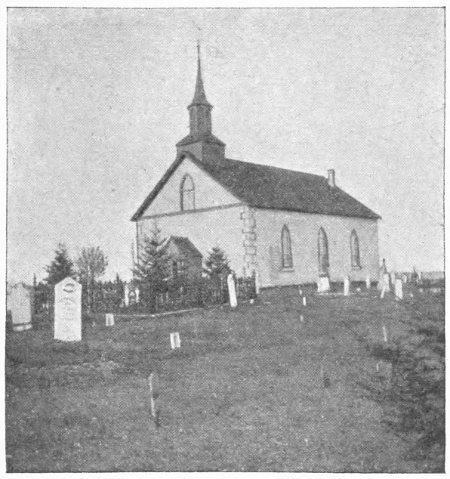
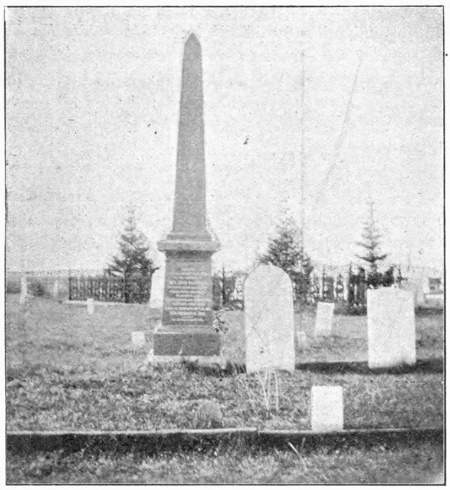
PUBLIC MONUMENT ERECTED TO REV. JOHN BLACK, D.D.
In Kildonan churchyard.
The Rev. Alexander Matheson, a native of Kildonan, then led in prayer;
the Rev. C. B. Pitblado, the minister of the new St. Andrew's
congregation of Winnipeg, pronounced the benediction; the Rev. Alexander
Campbell was also present, and the Rev. R. Y. Thompson took the service
at the grave.
We have now completed our long journey from Garwaldshields farm in
Eskdale Muir, where John Black was born, to Kildonan kirkyard, where his
honoured bones now lie. Sixty-four years was his alloted span, and no
one who has followed our story can fail to admit that the character and
life described are those of a true man.
Born among the shepherd people of the region that has been made historic
by the names of Thomas Boston, James Hogg, Edward Irving and Thomas
Carlyle, the worthy lad of Eskdale very early showed the features of a
religious and deep-laid character. What he would have been had he
remained in the land of his birth we can only conjecture, but it is
certain that wherever he was to dwell his earnest, manly, studious
boyhood was the promise of a useful life.
Perhaps nothing shows the chivalry of his nature more than his
surrendering all the bright hopes of a student life, and the career of a
successful teacher, in order that he might with his family, which had
suffered losses, seek a New World home to better their condition. His
unselfish devotion led to his becoming the mainstay in the counsels of
the family as they settled in the State of New York. Years afterwards we
find his love of his aged parents in the Catskills a matter for
consideration in choosing where his lot should be cast.
The return of John Black to the Canadian branch of the Church of his
fathers illustrates two or three points in his character. There was in
him a strong attachment to old associations. The Scottish type of
Presbyterianism was to him the best, and he sought his defence in the
shelter of the "burning bush." His characteristic discrimination and
determination to follow his convictions were shown in his choice of the
newly formed Free Church, while his love of the past and strong personal
attachment would have led him to cling to the Church of Scotland. His
love of country was also strong, and there can be no doubt that he
greatly preferred the shadow of the Union Jack to that of any other flag.
His student and missionary life were characterized by great thoroughness
and enthusiasm. While strongly evangelical, and counting all things
other than the Gospel as "wood and hay and stubble," yet he valued
knowledge, and laid the foundation of subsequent excellence in Latin,
Greek, History, and English Literature. His missionary life in Brock, in
Upper Canada, in the district of Montreal, and on behalf of the French
Canadian Society, all indicates the spirit of thorough consecration,
which is the beauty and strength of the aspirant to the Christian
ministry. The most critical time in the life of John Black was his
reception of the command, for it was nothing else, of Dr. Burns to go to
Red River Settlement. Those who knew Dr. Burns can easily imagine the
ardency and enthusiasm with which he would argue the case. He was a man
of strong personality, and to him his opinions had all the strength of
principles. Mr. Black could not resist what was put to him as the call
of duty. It is somewhat remarkable to see, however, that year after year
he was not convinced that the Red River was to be his permanent sphere
of labor. This no doubt arose from a certain sensitiveness of
disposition, and an unwillingness to stand in the way of what he thought
was the highest spiritual good of his people. And yet it was as all his
friends said it would be: God's finger pointed out the Red River
unmistakably as his lifelong sphere.
The founding of a new cause among a people who, for thirty or forty
years had been without their own form of faith, was a great work. The
church building, the alarming flood which hindered his work, the severe
task of supplying, while still alone, the small groups of Presbyterians
outside of Kildonan, the anxiety about the spiritual condition and
insobriety of so many of the native people about him, cases of
discipline which required at the same time firmness and tact—all these
filled up the measure of his busy life.
The effect of the arrival of an additional laborer in the person of Rev.
James Nisbet, in 1862, can hardly be estimated by us now. The fact that
another clergyman may arrive now in the field of Manitoba missions is an
everyday occurrence, and gives rise to little comment; but when the
arrival of a laborer doubled the available missionary force it made it
an event of first importance. When, four years later, James Nisbet began
the Indian missions of the Church it was something, too, of immense
moment. John Black's dream of fifteen years was then realized, and he
saw in the future the vista of a reclaimed and civilized race in place
of the helpless and sin-afflicted savages by whom he was surrounded.
When the stirring days of the Riel Rebellion were over, there came the
rush of immigration, which startled the quiet solitudes of the Red River
prairies. It was to Mr. Black, as to the older people of the country, a
time of change, but the religious needs of the new settlements were well
looked after, and the movement begun of the mission advance, which has
been so notable a feature of the Presbyterian cause in the Northwest,
and has led to the Church, which John Black came to the west to found,
becoming much the largest and most influential body of the prairies.
Not only in Winnipeg, with its thoroughly organized body of
communicants, and in Portage la Prairie, Brandon, Regina and Calgary
have the Presbyterian views of church doctrine and life become
potential; but, in more than a score of towns, such as Morden, Pilot
Mound, Deloraine, Carman, Glenboro, Treherne, Holland, Miami, Minnedosa,
Russell, Rapid City, Gladstone, Moosomin, Prince Albert, Edmonton,
Souris, Virden, Boissevain, Emerson, Keewatin, Rat Portage, Fort
William, and Port Arthur have strong self-sustaining churches been
established. Notably is the Church strongly ensconced in the affections
of the agricultural communities spread over the prairies. It would
gladden the heart of John Black to-day could he see the presbytery of
which he was the first moderator now developed into two synods with
fourteen presbyteries, and could he realize how "the little one has
become a thousand."
As an educationist, we have shown the really fundamental work of Mr.
Black in the cause of education. It is very rare to see the men who lay
foundations equally strong on the missionary and on the educational
sides. It shows the even balance of his mind, that Mr. Black was as
much interested in one direction as in the other. Manitoba College is
the outcome to-day of the hopes and pleadings and plans of this scion,
transplanted from the parish schools of Scotland, and of the early love
of knowledge of the Presbyterianism of Canada, which took root in the
favorable soil of the Red River, Assiniboine, and Saskatchewan valleys.
These are the memorials of the Apostle of Red River. We are not carried
away by any absurd sentiment which would lead us to make John Black a
hero. As a rule the surroundings of his life were not of an exciting
kind. The Red River community was isolated, its opportunities of
communication with the outer world were small; for two-thirds of the
life of John Black upon the Red River there was little increase in the
population, but during his thirty years of Northwest life we see in him
the white lily of a blameless life, we see the spirit of an ardent
social reformer, we see the public sentiment leading him to labor for
the educational good of his people, we see the exercise of a diligent
pastorate, and the attainment of honorable distinction as a preacher—in
short, we see in him the embodiment of high domestic, social, public and
Christian virtues. We shall cherish the memory of "the Apostle of the
Red River."
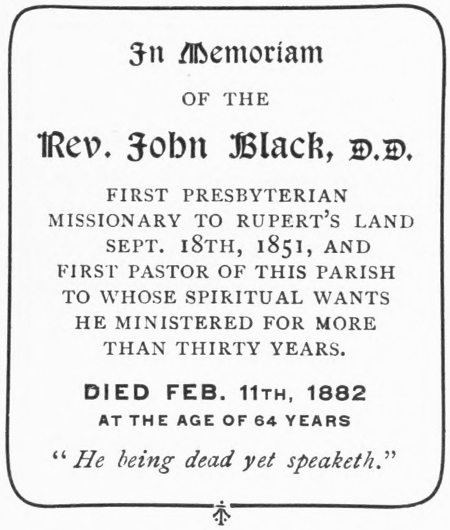
TABLET IN KILDONAN CHURCH.