Johann Sebastian Bach THE ORGANIST AND HIS WORKS FOR THE ORGAN
Transcriber's Notes: Obvious printer errors have been corrected
without note. Click on the [Listen] link to hear the music in MP3 format, or
on the [MusicXML] link to download the notation. These links may not work if
you are reading this e-book in a format other than HTML. The Errata have been
incorporated into the music files. Any additional corrections to the music are noted
in the MusicXML files.
"If Beethoven appears to our generation as a Greek statue, Bach, on
the contrary, impresses us as one of those Sphinxes of Egypt whose
towering head commands the wide expanse of the desert."
The comparison is imaginative, but seems to me only partially just.
Sphinx in vastness of proportions, I admit; but the image is
destroyed when character is taken into consideration. Bach is
indisputably the mightiest of musicians; one is seized with awe in
perusing the extraordinary catalogue of his works, so seemingly
impossible are its dimensions; in casually looking over those forty
and more folio volumes; in pausing for an instant to examine more
closely any one of the pages, where the smallest detail seems to have
been long considered and predetermined, while over all soars the
essential thought, always profound and original. But was there ever a
thinker less enigmatical?
Surely this majestic figure dominates his surroundings; but that
frank look, those luminous, kindly eyes, are hardly those of a
Sphinx. It is rather the heroic statue of Common Sense.
An eminent virtuoso recently declared to me that he should be more or
less uncomfortable in dining alone with Beethoven; "but with 'Father
Bach,' how different! With him I see myself perfectly at home, pipe
in mouth, elbows upon the table; chatting informally about a thousand
and one interesting things, over a big stein of beer, as in the good
old days." How true!
Bach was a good citizen, an admirable father, as M. Prudhomme would
say, a devoted friend; socially affable, and possessed of a rare
artistic modesty. Were he asked how he had attained such heights, he
would answer: "I was obliged to work; whoever will strive as I did,
will succeed as well." He availed himself of every opportunity to
become familiar with the works of other composers; Händel he esteemed
highly, Couperin interested him; when accorded three weeks' leave
that he might hear Buxtehude, Bach so far forgot himself as to allow
three months to go by while listening, from a secluded corner of the
church, to the justly celebrated organist of St. Mary's in Lübeck.
Bach was a great and good man; never did a more marvellous mechanism
perform the functions of a human brain; never has been known a mind
that was sounder, better balanced, contained in a more robust body;
never were a musician's nerves better controlled.
It required the atrocious harmonizations of Görner to cause Bach
one day to turn upon him and hurl his wig at the face of the poor
accompanist: "Sie sind ein Schuster" (You are a bungler)!
These fits of anger were, however, rare, despite the astonishing
vitality of his constitution; for Bach was naturally patient and
kind-hearted.
Note him with his pupils; during the first year nothing but
exercises—trills, scales, passages in thirds and sixths, practice
in changing fingers—work of every description to insure the
equability of the hand. He supervised everything, devoting the
minutest attention to the clearness and precision of the touch. If
one pupil or the other became discouraged, he good-naturedly wrote
little pieces containing in a disguised form the difficulties to be
surmounted.
When Bach became organist of the New Church in Arnstadt—he was very
young, but eighteen years of age—he had studied the compositions and
methods of the following celebrated clavecinists of his time:
Froberger (1615[?]-1667), a protégé of Emperor Ferdinand
III., by whom he had been sent, in early life, to study with
Frescobaldi in Rome.
Fischer, Capellmeister to the Margrave of Baden.
Johannes Caspar Kerl, a rival of Froberger, also under the
protection of Ferdinand III., and entrusted to the care of Carissimi
in Rome.
Pachelbel (1653-1706), formerly assistant organist of St.
Stephen's in Vienna, then successively organist at Eisenach, Erfurt,
Stuttgart, and Nuremberg.
Buxtehude (1637-1707), the celebrated organist at Lübeck.
Bruhns, his pupil.
Böhm, organist of St. John's Church in Lüneburg.
It was through Froberger and Kerl that Bach became acquainted with
Frescobaldi's works, and the Italian school; the sonata form was
revealed to him by the French "suites" played by the orchestra of the
ducal court at Celle, an organization which greatly interested him;
but the greatest influence upon his youth was exercised by Buxtehude.
It was from him that Bach learned in their integrity the old German
traditions.
When, at Hamburg, the aged Reinken heard Bach improvise for more than
a half-hour upon the chorale An Wasserflüssen Babylons, he cried
out, embracing him, "I thought that this art were dead; but I see
that in you it still lives."[1]
These traditions he handed down later to his two oldest sons, Wilhelm
Friedemann and Carl Philipp Emanuel—two musicians whose merit is
universally recognized,—and to a whole galaxy of brilliant pupils:
Johannes Caspar Vogler, a musician whom Mattheson considered
more able than Bach himself. Vogler was organist at Weimar. Some
preludes of his are published and written in the form of chorales for
two manuals and pedal.
Homilius, of Dresden, a composer of church music.
Transchel, of Dresden, a distinguished clavecinist.
Goldberg, of Königsberg, composer of pieces called
"Bagatelles pour dames," which no one could play, such was their
difficulty. (He frequently found amusement in playing music of every
variety from the inverted score.)
Krebs, organist at Altenburg; not only a performer of the
first rank, but a prolific composer. For nine years he enjoyed the
invaluable supervision of Bach.
Altnikol, organist at Naumburg; Bach's son-in-law.
Agricola, composer to the King of Prussia, known through his
theoretical works.
Müthel, of Riga.
Kirnberger, court musician at Berlin. "He loved his art
with a fervor at once enthusiastic and sincere," says Forkel. "Not
only has he informed us in detail as to Bach's methods of teaching
composition, but the musical world is still his debtor for the first
logical system of harmony, founded upon the works of his master. The
first of these sources of information is his book, Die Kunst des
reinen Satzes; the second, Grundsätze zum Gebrauch der Harmonie.
He furthered the interests of musical art by other treatises as well
as by his compositions. Particularly charming are his works for the
clavecin. Princess Amelia of Prussia was one of his pupils."
Kittel, organist at Erfurt. He was the only one of Bach's
pupils still living at the time Forkel, himself an organist and the
director of music at the University of Göttingen, wrote his Ueber
J.S. Bach's Leben, Kunst und Kunstwerke (Leipzig, 1802). [The Life,
Art, and Works of J.S. Bach.]
Forkel was intimately associated with Wilhelm Friedemann and
Philipp Emanuel Bach, and with Agricola, Kirnberger, and several
others of Sebastian Bach's illustrious pupils. He collaborated with
Schicht, a man of education and a distinguished harmonist, who later
became Cantor of St. Thomas's Church. With him Forkel undertook
the publication of works by Bach for organ and for clavecin, an
enterprise to which frequent allusion is made in his book. Forkel
had accumulated a fine musical library; with the aid of this and
of that of the University of Göttingen he was enabled to procure
a considerable amount of material for his Geschichte der Musik
[History of Music], which was to comprise six volumes; of which,
however, only the first two appeared.
Forkel reserved for the last volume of this compilation the memoranda
concerning Bach and his works; but "foreseeing the impossibility of
completing during his life this veritable encyclopædia of music, he
appears, at least in his book upon the life and works of Bach, to
have been desirous of losing no time in rendering to that great man a
sincere and merited tribute of homage and gratitude...."
Kittel (1732-1802) was Rinck's teacher; the latter relates that his
master invariably ended his conversations upon Bach with the words
Ein sehr frommer Mann, "a very good man."
Dr. Fétis, of Brussels, while teaching me the principles of
counterpoint and fugue, often spoke of Rinck, whom he had visited;
of Kittel, his musical father, and of their great common ancestor,
Sebastian Bach. Rinck, when asked the cause of his neglect of the
fugue form, would reply: "Bach is a Colossus, dominating the musical
world; one can hope to follow him in his domain only at a distance,
for he has exhausted all resources, and is inimitable in what he has
done. I have always considered that if one is to succeed in composing
something worthy of being heard and approved, one's attention must be
turned in another direction."
Poor Rinck!
We are to study in this work only the organist Bach. Since M.
André Pirro has so conscientiously analyzed the specific work of
the master, I have to concern myself only with his technique as a
virtuoso.
Bach played the clavecin in the following manner: "The five fingers
so curved that their tips fell perpendicularly upon the keys, over
which they formed a parallel line, ever ready to obey. The finger
was not raised vertically upon leaving the key, but was drawn back,
almost gliding toward the palm of the hand; in the passage from one
key to another this sliding motion seemed to impart to the succeeding
finger exactly the same degree of pressure, thereby ensuring perfect
equality; a touch neither 'heavy,' nor yet dry (sec)." This we
learn from Philipp Emanuel.
Bach's hand was comparatively small; the movement of his fingers was
hardly perceptible, extending only to the first joints. His hand
preserved its rounded shape even in the most difficult passages,
Forkel tells us; the fingers were raised very little above the
keyboard, hardly more than in a trill; as soon as a finger was no
longer needed, he took pains to replace it in its normal position....
"The other parts of his body took no part in the performance,
contrary to the habit of many people whose hands are incapable of
sufficient agility."
To-day we no longer play the harpsichord; and the pianoforte, which
has happily replaced it, makes demands never dreamed of in those days.
As to the character of organ touch, no change has taken place in
two centuries. Possibly at the time of Bach the keys of the pedals
were slightly different from those of our day; undoubtedly in his
youth he made much less use of the heel than of the toe, since the
pedal-keys were extremely short. But he soon recognized the necessity
of perfecting the bass keyboard of the organ both by extending its
compass and by lengthening the pedal-keys to their present dimensions.
He played with the body inclined slightly forward, and motionless;
with an admirable sense of rhythm, with an absolutely perfect
polyphonic ensemble, with extraordinary clearness, avoiding extremely
rapid tempi; in short, master of himself, and, so to speak, of the
beat, producing an effect of incomparable grandeur.
His contemporaries speak enthusiastically of his exquisite taste in
the combination of registers, and of his manner of treating them, at
once so unexpected and original.
Nothing could escape him which was related to his art, adds Forkel.
He observed with the most minute attention the acoustic properties
of the room where he was to play. On his visit to Berlin in 1747, he
was conducted to the auditorium of the new opera house. He recognized
at a glance the advantages and defects of this monumental edifice,
in its relation to music. He was shown the grand foyer adjacent.
Standing in the mezzanine gallery, he glanced up toward the ceiling
and remarked immediately, without giving himself the trouble of
further examination, that in it the architect had constructed "a work
of great merit," perhaps unawares.
The foyer was in the form of a parallelogram; if a person standing
in a corner of it, face toward the wall, spoke a few words, another
person standing in the same position in the corner diagonally
opposite could distinctly hear them, while the public, scattered here
and there through the hall, would be unable to catch anything of this
dialogue.
When distinguished strangers asked to hear Bach at the organ, at
times other than during services, he usually selected some theme
and amused himself by treating it in various ways, perhaps playing
without interruption for over an hour. First he made use of the
subject for a prelude and fugue, upon the foundation stops of the
chief manual, thereafter deftly varying his registration through a
series of episodes in two, three, or four parts. Then came a chorale,
the melody of which was interrupted here and there by fragments of
the original subject; and he finally concluded with a fugue for full
organ,[2] in which "he contented himself with treating the subject
either alone, or in combination with other themes derived from it."
And if he tried a new organ? He first drew all the registers and
played upon the principal manual (with all couplers), "in order to
test the lung-power of the instrument," as he laughingly expressed
it. Then he proceeded to a detailed inspection of every part of the
organ. This expert examination once over, he gave free rein to his
fancy. And now he showed himself truly "the prince of all virtuosi
of the universe, upon the harpsichord and organ," as he was one day
hailed by his amazed colleague, the organist Sorge, of Lobenstein, in
an outburst of enthusiasm.
No, the art of organ playing has not changed since Johann Sebastian
Bach; but, on the other hand, our organs are growing distinctly
better. Go and listen to those of Saint-Sulpice, of Notre-Dame, in
Paris; hear the instrument of Saint-Ouen, at Rouen!
In the organs of Bach's time the reeds were scarcely used except in
the capacity of basses, reinforcing the pedal; or as solo registers,
for instance, hautbois and cromornes; our profusion of sonorous
clarions, trumpets, and bombardes was totally unknown. Organo
pleno did not signify a full battery of 4, 8, 16, and 32-foot stops,
but simply the combination of some prestants and mixtures with a
diapason or a bourdon.[3] As for a means of varying the intensity of
the same tone, such a thing was never thought of.
As I have said elsewhere, it is hardly farther back than to the end
of the last century that we trace the invention of the "swell-box,"
the English contrivance which the aged Händel pronounced admirable,
and which Abbé Vogler recommended to the German builders some years
later.
To-day, to non-professionals, our instruments appear to have become
capable of nearly as much expression as the orchestra.
But this is a serious error. I repeat here: that expression which
is a characteristic of the modern organ can but be subjective; it
is born of mechanical means and possesses nothing of spontaneity.
While the stringed and wind instruments of the orchestra, the
pianoforte, and the voice, hold sway only by their instantaneity of
accent, by the unexpectedness of their attack, the organ, limited
to the confines of its own inherent majesty, speaks with the voice
of philosophy. Of all instruments, it is the only one which can
indefinitely prolong the same volume of sound, and thus create the
religious impression of the infinite.
A serious organist will never avail himself of these means of
expression, unless architecturally; that is to say, by straight
lines and by designs. By lines, when he passes slowly from
piano into forte, by a gradient almost imperceptible, and in
constant progression, without break or jolt. By designs, when
he takes advantage of a second of silence to close the swell-box
abruptly between a forte and a piano.
Seek to reproduce the expressive quality of an E-string, or of the
human voice, and we shall no longer hear an organ; it will have
become an accordeon.
The most striking characteristic of the organ is grandeur; that is
to say, determination and power. Every illogical variation in the
intensity of the sound, every nuance which, graphically, cannot be
represented by a right line, is a crime, the offence of artistic
lèse-majesté.
In fact, we should declare to be criminals, and hold up to the
contempt of the public, those who make an accordeon of the organ;
those who arpeggiate, who do not play legato, whose rhythm is but
passable.
With the organ, as in the orchestra, precision must rule; the
perfect ensemble of feet and hands is absolutely necessary, whether
in attacking or leaving the keyboard. All notes placed in the same
perpendicular by the composer must be made to speak and to cease
speaking at the same time, obedient to the bâton of a single
conductor. Here and there are still seen unfortunates who suffer
their feet to trail along the pedals, and who forget them and leave
them there, although the piece is long since finished. It reminds us
of the old viola player at the Opéra, who regularly went to sleep
during the fourth act, to be charitably wakened by his comrades at
the end of the evening. It was a tradition. But one fine day the
management changed hands; tradition had to change, too, and it was
forbidden to waken the sleeper. They were giving "The Prophet."
Neither the crash of the introduction, the collapse of the Palace
blown up with dynamite, the din of the orchestra, nor the tumult of
players and audience leaving the theatre, could cut short his dreams.
When he finally opened his eyes in the profound darkness, he believed
himself, like Orpheus, in the infernal regions, and on attempting
to make his exit pitched head-foremost into the kettledrums, which
collapsed. The next day his eligibility to retirement was recognized.
I should like to know what an orchestral conductor would say, after
having given the last stroke of his bâton, if his third trombone
player should permit himself tranquilly to continue to prolong his
note? From what savage cave can such a barbarous custom have emerged?
Yet some years ago it was a generally prevailing fashion, a veritable
epidemic.
Culpable are the organists who do not play the four parts of the
polyphony with a rigorous legato, tenor as well as soprano, the
alto like the bass. Examine Bach's gigantic series of works; in
them all you will find but two or three passages, but two or three
measures exceeding the limitations of the hand. But admire the skill
of the great man; an instant before, a second after, pauses are
cleverly inserted; that is, opportunities to withdraw and then again
to add the 16-foot registers of the pedal, in order that in the
interim the notes which cannot be played smoothly by the hands may
be performed by the pedals, coupled to the manuals. Save for these
two or three exceptions, which themselves are fully justified by the
progression of the parts, all of Bach's works are admirably written,
from this point of view as well as from others.
Here begins a parenthesis; it concerns the Phrasing.
A pianoforte hammer may strike a string ten times per second, and our
ear will still easily perceive the ten attacks, the sound immediately
decreasing in intensity; with the organ, that we may clearly hear the
repetitions of a note in a quick movement, or even in moderate tempo,
there must intervene between the repetitions periods of silence equal
to the duration of the sound; from which we may formulate this law:
every repeated note loses one-half of its value.
taking great pains to allow to rests of equal value uniform duration.
The free staccato is not admissible upon the organ. Here every
detached note becomes a staccato one, as in the case of instruments
played with a bow; that is to say, a series of equal tones separated
from each other by rests of like duration. The staccato is executed
by holding the fingers as near as possible to the keys, the wrist
slightly depressed.
A moment ago, in my category of crimes against Art, I included that
of indifference to rhythm.
What is rhythm?
The constant manifestation of determination, or will, upon the
periodical recurrence of the accented beats. It is only by
rhythm that one wins attention. Particularly with the organ, all
accents, all effects are dependent upon it. You may bear upon the
keyboard with the weight of pounds, with all the strength of your
shoulders—you will gain nothing by it. But delay by a tenth of a
second the attack of a chord, or prolong this same chord the very
least, and judge of the effect produced! Upon a manual not provided
with a swell-box one may obtain a crescendo without the aid of a
mechanism of any kind: by the simple augmentation of the duration
allowed successive chords or detached phrases.
To play upon an organ is to deal with chronometric values.
Woe be unto you if your tempo is not absolutely regular, if your will
does not manifest itself at every breathing-point of the phrase, at
every "lift"; if you unconsciously permit yourself to "hurry"!
Would you like a lesson in rhythm? Listen to those immense
locomotives dragging behind them tons of merchandise; admire the
formidable piston stroke which marks every recurrence of the accent,
slowly but relentlessly; well may you believe that you hear the march
of Fate itself. It causes one to shudder.
To be master of one's self it is necessary to abstain from every
superfluous movement, from any displacement of the body. A good
organist sits firmly, well-balanced upon his bench, inclining
slightly towards the manuals, never permitting his feet to rest upon
the frame which surrounds the pedals, but letting them glide lightly
along over the keys; heels and knees riveted, so to speak, together.
Nature has vouchsafed us two guides of the greatest value; with the
heels pressed one against the other, the maximum separation of the
other extremities of the feet gives us a fifth; with the knees held
similarly together, the maximum interval obtainable should be an
octave.
Precision and confidence will never be obtained except by adopting
this method; holding the two limbs as if bound together, the two feet
unceasingly in contact with each other.
The foot should not attack the pedal vertically, but from well to
the rear towards the front, as close to the key as possible; gliding
slightly, or "skating," the toe to within a half-inch of the black
keys.
Considering the degree of perfection attained in our contemporary
manufacture, we must be careful not to become dazzled in the midst of
the wealth of resources thereby offered us, and thus led far astray
from the right path. Let us not forget that upon the organ, as in the
orchestra or chorus, all music is based upon the quartet. It is
the true foundation of the language. With the organ, our quartet is
embodied in the noble and flowing sonority of the 8-foot foundation
stops. The basso continuo of certain organists, who have fallen
asleep over their pedals, soon becomes an intolerable nuisance for
the audience. We should go wild at a performance of a symphony in
which the double-basses played uninterruptedly from the first note to
the last. Plain-song itself, thus interpreted, loses its eloquence;
although the apparent monotony of its design, closely confined within
the limits of an octave, would, above all, seem to be better adapted
than any other form of music to a continuous bass.
But not at all! This apparent monotony exists in reality only for
those who see not with their eyes, neither hear with their ears.
Plain-song is of a complex species; it has two faces, like Janus.[4]
To be understood, it must be listened to at once from a literary and
a musical standpoint. It is this synthesis which the "decadent" poets
or musicians have, in late years, striven to revive.
The superb rhythm of the pedal when the organ responds to the
choir[5] should emphasize the text, sustain it in outbursts of
exaltation, and not vulgarize it by a continual and unintelligent
abuse.
The organ is a wind instrument; it requires opportunity to take
breath. Like the literary sentence, the musical phrase has its
commas, its periods, its paragraphs. As a speaker changes his
intonation, so must the organ vary its "designs." Is anything more
exasperating than an improvisation in four parts, wandering now here,
now there—monotonous in color, devoid of determination, repose,
contrast, or purpose, having neither beginning, middle, nor end? A
veritable macaroni au fromage!
Cornets and mixtures, and the other registers of the organ of
Bach's time—these furnish the proper tone-material for Plain-song,
assimilating perfectly with the polyphony of the masters of the
sixteenth century.
Distributed to a certain extent over all lands, coming originally
from Athens, Jerusalem, and Rome, Plain-chant is our heritage from
the Middle Ages, assiduously cultivated within that sunny domain of
counterpoint, of which Palestrina was the last custodian. As it has
been bequeathed to us by the old masters, so must we preserve it for
our descendants. The teachings of the Paris Conservatory during the
past fifty years will always be perpetuated; the treatment in florid
counterpoint, be the melody in soprano or bass, or the accompaniment
in strict counterpoint, note against note, as in the Church.
Some of our contemporary organ builders in France have made a serious
mistake in regarding as a foregone conclusion the undesirability of
perpetuating the characteristics of registration of earlier days, and
in thus considering them hardly worthy of further notice. What a pity!
In July of this year at Notre-Dame, whose superb instrument has just
been restored by Cavaillé-Coll, we admired the effect produced by
different specimens of those mutation stops, producing in the Pedal
a fundamental of 32, upon the Bombarde one of 16, and upon the
Grand-Chœur one of 8-foot pitch. Indescribable is the effect
of the Chorales of the great Sebastian Bach, reverberating with
crystalline sonority under those wonderful arches.
The days of "deluges" upon the organ are over; of thunder and
tremulants, of choruses of goats called the vox humana, and all
such childish trifles. "At the opening of the organ in X, Mr. Z.
contributed to the programme a tempest, which he really should have
prefaced by a few flashes of genius!..."
For the great advancement achieved by French workmanship in our day,
we are indebted to Cavaillé-Coll and his masterpieces, which lend
themselves to the perfect expression of any idea, be it of the past
or of the present.
Since Cavaillé-Coll, the study of Bach has begun. Will you believe
that sixty years ago one would have searched Paris in vain to find
two organists who knew the fugue in B minor? I know of none but
conscientious Boëly, of Saint-Germain-l'Auxerrois; the published
compositions bear witness to the ideal of those times, an ideal
without a name.
Finally becoming disgusted with this state of affairs, a few young
men, more curious than their elders, began to inquire into the
contents of the dusty volumes of the great Sebastian; they seemed
to them at first somewhat dry, although interesting, at least in
point of execution. One might learn something in that direction! And
soon they were greatly surprised to find their souls touched, while
working with their fingers. And when, acquiring a taste for further
search, they went through the volumes of Chorales, and finally
arrived at the Cantatas...!
I shall never forget the hours devoted by the Concordia, whose
conductor I was, to the study and performance, at the Conservatoire,
of that splendid series of lyric works, which we crowned with the
"Passion according to Saint Matthew...."
In justice to our elders it must be said that in Germany as well Bach
had been long neglected. All honor to Mendelssohn, who conducted this
prodigious work at the Singakademie in Berlin, March 29, 1829; it
had been sleeping in the depths of a library for just one hundred
years, the first performance of the work having been on Good Friday,
1729, in Leipzig.
In 1840 Mendelssohn gave an organ concert in St. Thomas's Church upon
the instrument which so long before had been played by the great
Bach himself; the object of the concert was the augmentation of the
subscription for a monument to his memory.
The following was the programme:
Fugue in E flat.
Improvisation upon themes from Bach.
Prelude and Fugue in A minor.
Passacaglia.
Pastorale. Toccata.
Fantasia upon some of the chorales.
April 4th of the following year, in the same church, Mendelssohn
conducted the St. Matthew Passion, from the same spot where Bach
himself had directed it, 112 years before.
Finally, on March 23, 1843, a great symphony concert was given:
1. Orchestral Suite (overture, arioso, gavotte, trio, bourrée, and gigue).
2. Motet for double chorus a cappella.
3. Concerto for harpsichord (the solo part of which Mendelssohn himself played).
4. Aria from the St. Matthew Passion (Ich will bei meinem Jesu wachen).
5. Fantasia upon a theme by Bach (performed by Mendelssohn).
6. Cantata (for the election of the Stadtrath [council] of the city of Leipzig).
7. Prelude for violin (played by Ferdinand David).
8. Sanctus (from the Mass in B minor).
The subscription had resulted successfully, and the monument had been
erected.
Following the concert, the draperies were withdrawn which concealed
the bust of the master of masters.
Ch.-M. Widor.
Introduction
The author of this study does not assume to have discovered Bach, of
whom the world has already heard; but of such men there is always
something to be learned; many new facts of interest concerning the
great Cantor of Leipzig will be brought out by others after us. What
we here wish to consider is the compositions of Bach for the organ.
If, perhaps, we have confined ourselves to æsthetic considerations of
a nature which may appear general, we trust that we may be pardoned;
a perusal of this little book will demonstrate that it is not the
fault of the man who suddenly surpassed all that had been done before
him, while at the same time anticipating all that was to be written
in the future.
Bach was not without predecessors; we may not ascribe to him the
honor of having invented an alphabet, but it must be recognized that
he was the author of a grammar. This conclusion is apparent upon a
study of "Johann Sebastian Bach, the Organist"; it would undoubtedly
be no less convincing upon the consideration of all his works as a
whole.
Since we must confine ourselves to observation from a particular
point of view, we shall indeed be happy if our labor, based entirely
upon recognized authorities, shall make easier to the student the
task of playing Bach "in the Bach spirit."
A. Pirro.
Wüstweiler, September 27, 1894.
ERRATA IN MUSICAL EXAMPLES.
Page 6, second brace, meas. 2, upper part: First half-note d″
should be c″.
Page 8, meas. 3, upper part: Add tie between third and fourth notes
from end.
Page 16, second brace, meas. 2, upper part: Third 16th-note a′
should be c″♯.
Page 18, second brace, meas. 1: Add tie between last note (f) in
third part and the following note.
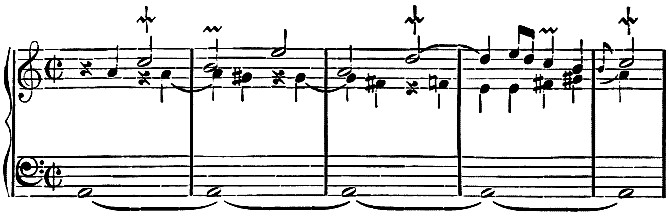
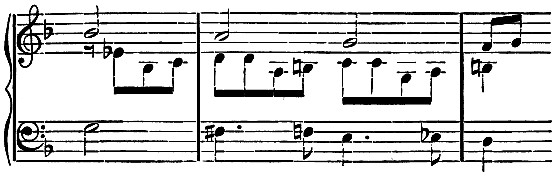
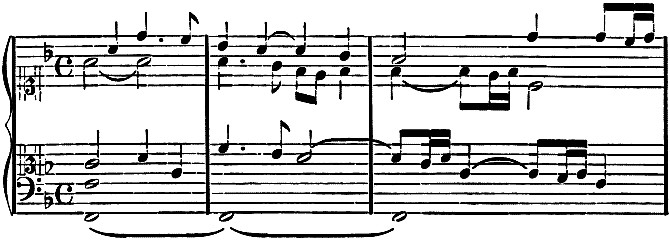
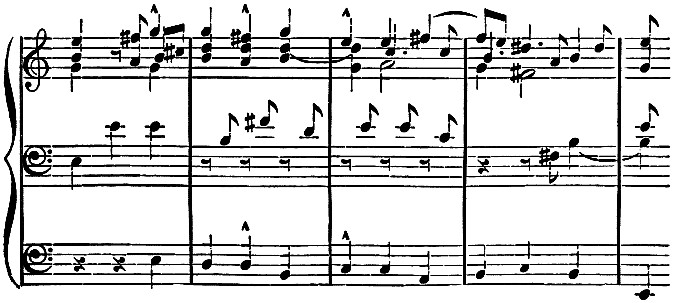
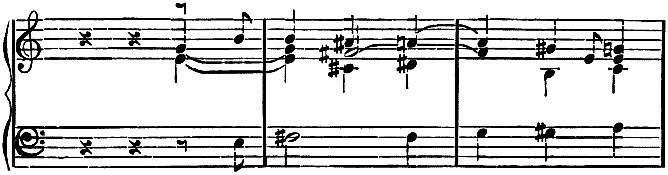
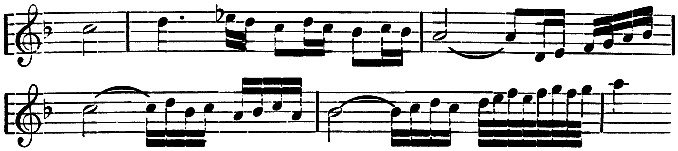
Page 32, Example 2, last meas. et seq. should read thus:
Page 43, Example 2, meas. 2, upper part: The sixth note (g′♯)
should be an eighth-note.
Page 44, Example 1, meas. 2, second part: Last note should be
g♮.
Page 47, Example 1, meas. 2, upper part: First note, e″, should be
f″.
Page 47, Example 1, meas. 2: Add tie between last note in third part
and the following note.
Page 91, Example 2, second part: Third note from end should be
f′♯.
Johann Sebastian Bach, The Organist
THE PRECURSORS OF BACH FRESCOBALDI—FROBERGER—PACHELBEL—BUXTEHUDE — II — III — IV
Frescobaldi was born at Ferrara in 1583, and the same year at his
baptism in the Cathedral received the Christian names Girolamo and
Alessandro.
His first teacher was his father, who was organist at one of the
churches in Ferrara. According to his own testimony he afterward
studied under the direction of Luzzasco Luzzaschi,[6] to whom Claudio
Merulo, himself an excellent organist and thus a competent judge,
accorded the title of the "first organist in Italy"; Vincenzo Galilei
ranked Luzzaschi among the four greatest musicians of his day. To
the instruction given by this master, well known for the clear and
thoughtful conception of his works, were added the counsels of
Francesco Milleville,[7] likewise an organist at Ferrara. Milleville
was of French descent, brought up upon the old traditions of the
Flemish contrapuntists, and the part which he played in the musical
development of young Girolamo is worthy of emphasis; for this
interchange or commerce of ideas between the northern countries and
Italy produced the greatest musicians of the sixteenth century.
Josquin de Près,[8] born at Cambrai in 1445, and a pupil of Ockeghem,
completed his education at Rome while he was a member of the papal
choir. Willaert, born in Flanders, studied in Rome, and in Venice
became the head of the Flemish school. Finally, Palestrina was a
pupil of Goudimel, a Frenchman.
Frescobaldi was not destined to depart from the footsteps of such
illustrious predecessors; desiring to pursue further the studies for
which he had acquired a taste from Milleville, he, too, set out for
Flanders while still young.[9] The exact date of that journey has
never been determined; it seems probable that it was in the year
1607. For in that year Cardinal Guido Bentivoglio, archbishop of
Rhodes and legate of Pope Paul V., was sent to the Netherlands (Guido
Bentivoglio was born at Ferrara in 1579); and, moreover, on January
10, 1608, Frescobaldi dedicated to him one of his finest works, a
collection of five-part madrigals, which was published by Peter
Phalesius in Antwerp. Again, it would not be strange if Frescobaldi,
in 1607, had followed to another country a compatriot whom he
regarded as his protector. According to Fétis (preface to Trésor
des Pianistes, by Farrenc), Frescobaldi occupied from this time the
position of organist at the Church of St.-Rombaut, in Malines.
But he did not retain this position long, for in 1608 we find him
again in Milan. From this time the events of his life are unknown
until 1614, when upon the death of Ercole Pasquini, organist of St.
Peter's in Rome, Frescobaldi became his successor. If we may believe
Abbé Baini, the fame of Frescobaldi was already so widespread that
upon the day when he assumed his new duties he played to thirty
thousand people.
Musical criticism at the time, represented by Della Valle and Lelio
Guidiccioni, records that while his style was less profound, it was
more elastic and agreeable than that of his predecessors. Such a
criticism, especially coming from Guidiccioni, who was most exacting
upon the subject of technique,[10] would indicate that Frescobaldi
possessed a genuine advantage over his contemporaries. At the present
day one would say that he played the organ with a pianist's touch;
if one replace this criticism in its historic frame, one may imagine
the continuous use of trills, scales, mordents and appoggiaturas: an
inheritance from the German "colorists." While perhaps a mistaken
usage, how else could one have made one's self heard throughout the
immense nave of St. Peter's, upon an organ of fourteen registers,
with but one manual and an incomplete pedal? Boldness and dash, that
which we understand by brio, had to compensate for paucity of tone.
Although he was comparatively sparing of ornaments in his
compositions, particularly those destined especially for
religious services, he never departed from a florid style in his
improvisations, which bristled with feats of skill and agility of
technique. Abbé Maugars, who knew him at Rome in 1639, still praised
the ornamentation and the marvellous cleverness of his improvised
Toccatas.
In 1643 Frescobaldi retired, having already enjoyed leave of absence
from 1628 to 1633; these years he spent at Florence, in the service
of Ferdinand II., Grand Duke of Tuscany.
He did not long survive his retirement in 1643, which, however, was
not absolute, for he took up the position of organist at the little
Church of St. Lawrence in montibus. He died March 2, 1644; and was
buried in the Church of the Holy Apostles.
Frescobaldi's works—which cover the entire period of his life—are
very numerous;[11] they were written, as a rule, for organ or
harpsichord indifferently; one of his compositions, published at
Rome in 1638, even bears the following title, "Canzoni a 1, 2,
3, 4 voci, written to be sung or to be played by all varieties
of instruments." In some of his works a certain predetermination
is nevertheless evident, recognizable either through their
appropriateness for religious service, or by their obbligato pedal
part, as in the Toccatas.
The collection of Fiori musicali[12] belongs to this category,
for, with the exception of such pieces as the Bergamasca or the
Girolameta, it contains only selections designed for performance
during church service.
Apart from their intrinsic value, these compositions comprising the
Fiori musicali bear for us this very potent interest: they are,
without exception, copied entirely by the hand of Bach;[13] which
shows the importance he attached to them and the pains he took to
study them.
This collection includes three masses: the Missa della Domenica,
delli (sic) Apostoli, and della Madonna, each one consisting of
a Toccata for a prelude, of the versets of the Kyrie, and of pieces
written to correspond to the various portions of the office, suitably
designated; thus (p. 49), Recercar cromaticho post il Credo, or (p.
77), Canzon dopo la pistola (sic).
The versets of the Kyrie, in the three masses, are for the greater
part more properly "Ecclesiastical songs without words," as Ambrose
said, than compositions of a purely instrumental character; in fact,
they are written strictly within the compass of the voice, and only
the long duration of single notes (as in the alto on page 7, or in
the soprano on page 8) precludes the possibility of their being sung.
Curious is the effect of the pedal notes, sustained from the
beginning to the end of a verse; and we find remarkable examples of a
polyphonic accompaniment to the text, doubly interesting because of
the continual reappearance of the theme, either in its integrity or
slightly modified.
Further, while making use of the accidentals required by the
modulation of the parts in the counterpoint, and especially in
cadences, Frescobaldi respects as much as possible the diatonic
character of the Gregorian scale; he adheres to it with as little
variation as possible, particularly when he brings it into
prominence. The mode, the Dorian, remains uppermost in the mind of
the auditor, and the counterpoint is most often derived from the same
tone, sometimes in imitation, at others in ingenious inversions of
the melody which it accompanies. One of the more elaborate of these
versets, the Kyrie ultimo of the Missa della domenica, ends with
an allegro, a veritable alla breve.[14]
If in nature these versets partake somewhat of the character of
compositions for voices, we find in other numbers of the Fiori
musicali a very close affiliation with vocal music. We refer to
that grace and flexibility of proportion which prompts us to say of
this theme, of that counterpoint, "It is musical!" Especially in the
canzoni do we find these expressive qualities.
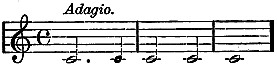
It is well known that the instrumental fugue was born of this
species of composition, which was also called canzon francese; the
responses to a subject, sometimes of popular origin, and most often
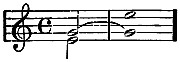
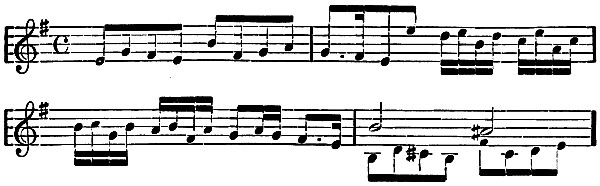
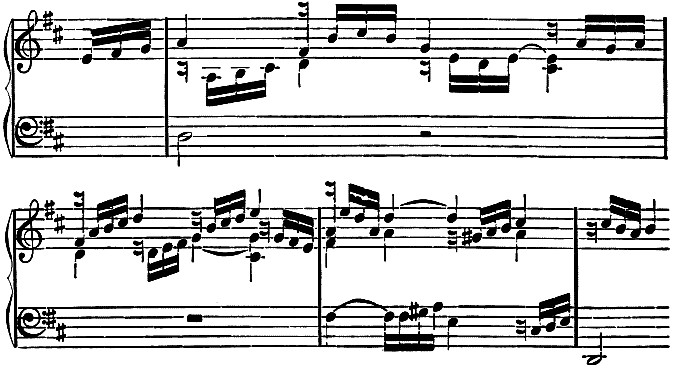
in this rhythm (a traditional one):
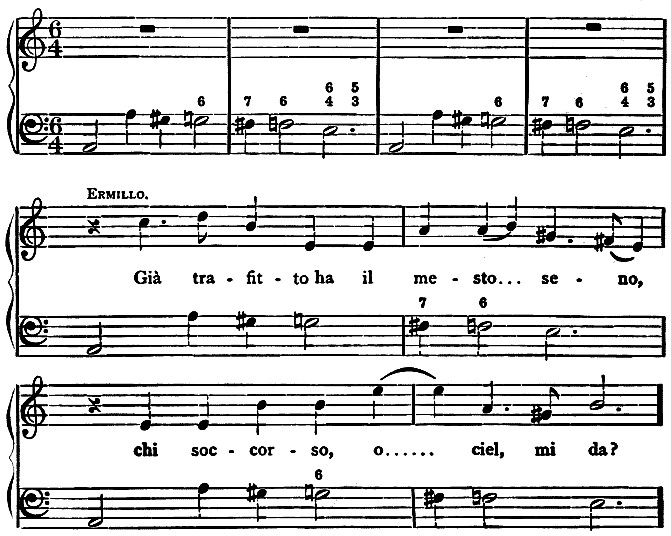
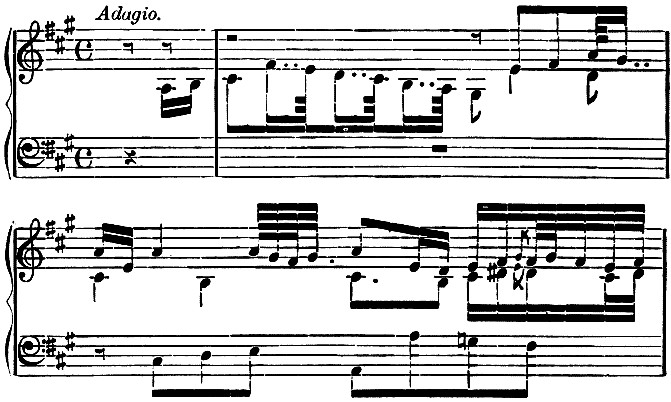
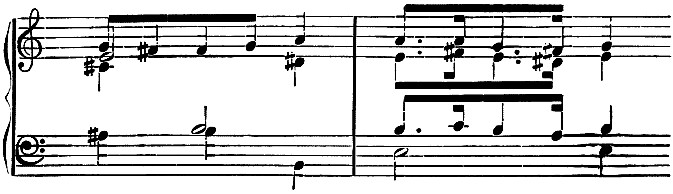
[MusicXML]
became answers, and the
alternation of double with triple rhythm gave rise to the fugue in
several movements, such as Buxtehude, in particular, often wrote.
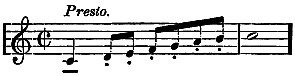
The steps of this transformation may be traced in the canzoni of
Frescobaldi: the canzone in the fourth mode of the Fiori musicali
(p. 66) is an instance of an altered answer to a subject, and the
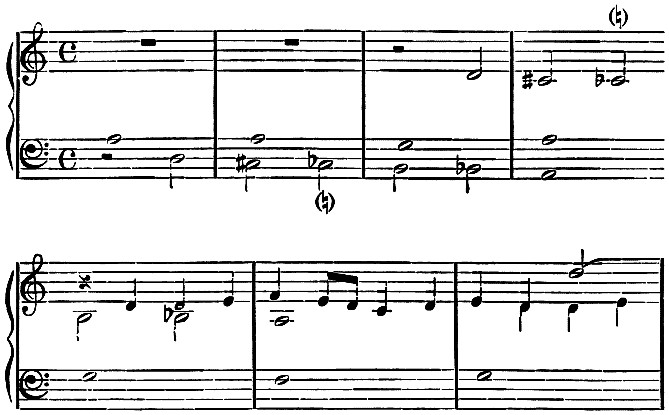
Canzone IV (p. 53) of the second book (Toccatas, Canzoni,
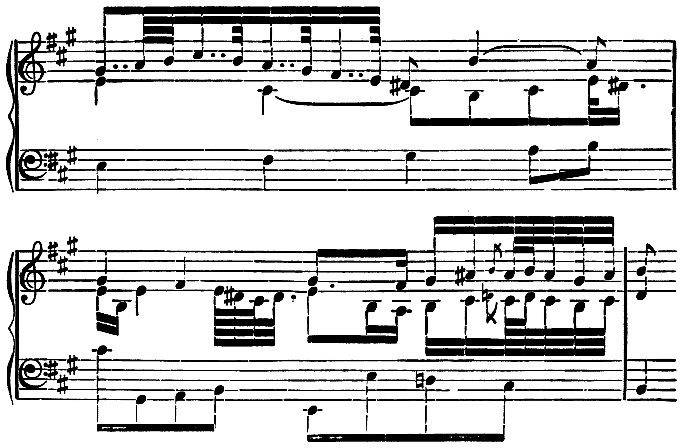
etc.[15]) begins like a veritable fugue:
For us the recercare possess an interest of another kind;
Frescobaldi had introduced an innovation in creating the initial form
of the fugue, unconsciously guided by the necessity of establishing
the modern tonality which forced itself upon his senses; particularly
in the Ricercatas and in certain of the Toccatas he contrives to
become master of a new resource, which had suggested this tonality to
him: the chromatic scale.
This enables him to discover new harmonies, although he is sometimes
led astray, and to modulate with endless freedom. The dissonance is
no longer a "necessary evil" to him; it is an important factor in
new effects. With his absolute command of the instrument and his
marvellous facility of improvisation, this ability to distance his
contemporaries in a field which up to this time no one had had the
courage to explore, places the organist of St. Peter's in a position
closely allied to that occupied by the Cantor of Leipzig; at least
considering what Frescobaldi was able to accomplish in his time,
obliged to create a new language for himself, as it were; and he
sometimes lost his way, in propounding to himself problems which were
insoluble in the existing stage of musical advancement.
Possibly Frescobaldi realized this impossibility of a personal
participation in something which he foresaw, as yet only in a
confused way, but whose advent he regarded as a certainty. For since
he could neither ordain a "music of the future," to use an expression
already more or less familiar, nor define its fundamental principles,
he was often obliged to deny himself any part in even the development
of his art, confined as he was to the limits of obsolete rules; did
he also conclude that his too fertile imagination would lead him into
extravagances, and did he voluntarily restrain this creative faculty,
confining it to the laborious construction of too subtle enigmas?
Certain of his compositions suggest such a condition of mind; above
all, the Recercar con obligo di cantare la Quinta Parte senza
toccarla (Fiori musicali, p. 84).[16]
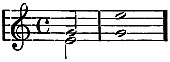
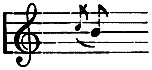
At the head of this composition stands the following motive, like a
motto:
upon which, moreover, is based the entire Ricercata.
But this piece is in duple time, and this fifth part is in 3/1, the
tempus perfectum of mensurable music, indicated by a circle.[17]
Where could the entrances be effected? This the performer must decide
for himself, for Frescobaldi never did anything to assist him in
his decision; "intenda mi chi può, che m'intend' io" ("let him
comprehend me who can, I understand myself"), he tells us. We find
the same challenge at the beginning of one of his caprices, the tenth
in the first book[18] (pp. 77-86).
This same volume contains a Ricercata upon the hexachord (pp. 1-14),
remarkably developed, and exhibiting a determination suggestive of
scholastic restraint; and a recercar with four subjects (p. 137).
In the Canzoni, grace and interest of movement particularly are
revealed; in some pieces expressive themes of a chromatic character
lend a certain sentimental charm, while others, for instance those
of which mention has already been made, serve chiefly as examples of
ingenuity and cleverness. But the Toccatas of Frescobaldi combine
all these characteristics, sometimes contrasted with or dominated
by, in addition, a stately dignity, an incomparable breadth. And,
moreover, they were conceived expressly for the organ, in their more
lofty character, and written upon the staff then in use for that
instrument.[19] They display all its resources, within a legitimate
compass, although limited by the ability of the executants and by
the deficiencies of the Italian organ manufacture of the period;
the performers being little accustomed to the use of the pedal, and
the Italian manufacture less advanced than that of the Germans. In
fact, little could be demanded of the organist beyond long-sustained
pedal-notes; and never do these works indicate that organs with
several manuals were at that time constructed in Italy.
While in the Toccatas[20] the themes are developed noticeably in
what we may term sections or plans, these are strictly contrasts of
movement rather than of intensity of sound.
Frescobaldi placed more confidence in the finger dexterity of his
pupils than in their facility with the pedals. To the more apt ones
among them were addressed these words: "Chi questa Bergamasca
sonerà, non pocho imparerà," written at the beginning of his
variations upon the popular melody of the "Bergamasca";[21] and,
again, at the end of the ninth Toccata in the second book: "Non
senza fatiga si giunge al fine."
As examples of another style must also be mentioned the Pastorale,
or rather the Capriccio fatto sopra la Pastorale, the themes of
which were borrowed later by Händel from the same popular source from
which Frescobaldi obtained them; this caprice has a pedal part, which
proves it to have been expressly designed for the organ.[22]
The picturesque quality reappears in the imitative trumpet-calls in
the Battaglia, while in the numerous partite, or suites upon the
Romanesca, the Frescobalda, the Aria di Monicha,[23] the
Aria di Ruggiero, Frà Jacopino,[24] Frescobaldi acceded to the demands
of the times for transcriptions and variations upon popular tunes.[25]
In several cases Frescobaldi gives us hints as to the execution
of his works: "music in this style is not to be performed with
invariable strictness of tempo...." he says in the preface to the
second volume of toccatas, etc.[26] (1637). "It should be played
slowly at the beginning, and in an arpeggiated manner, the tempo then
being gradually accelerated. The end of a trill or phrase should be
marked by the prolongation of the last note, that one phrase may be
separated from the other. Cadences, even though written in short
notes, should be retarded more and more toward the end.... If it
be necessary to play a trill in one hand against a phrase in the
other, the trill should be performed not note against note with the
passage in the other hand, but independently; the phrase being played
with repose and expression. Passages in eighth- or sixteenth-notes
written for both hands must not be taken at a too rapid tempo; of
two sixteenth-notes the second should always be slightly dwelt upon.
In quick passages for two hands, hold back a little upon the next to
the last beat; then finish brilliantly, displaying the agility of
the hand. For the Partitas, which are characterized by expressive
subjects, it will be well to adopt a broad tempo, as well as for the
Toccatas; such of the latter as are not too exacting in their demands
upon technique maybe taken faster; here the choice of tempi is left
to the ready discernment and good taste of the performer...."
We perceive that Frescobaldi demanded the same qualities of
imagination for the performance of his works that he exercised in
their composition. They are, in fact, an example of a continual
rubato. In the preface to the first book of caprices he gives us
similar directions; adding: "movements in 3/1 and 6/2 should be taken
adagio (he wrote adasio); those in 3/2 a little faster, those
in 3/4 allegro." He also charges the performer to conform to the
style of his works; serious in the Ricercatas, more brilliant in the
Caprices.
"Frescobaldi marks one of the turning-points in the evolution of
Music, and is himself the personification of the successful and
unsuccessful endeavors, of the victories and defeats, of these
periods of transition. His works, upon which is imprinted the stamp
of genius, appear as classics in comparison with the inefficient
products of that reign of Monody.... That with one hand they point
backward to a great Art-epoch just terminated, while with the other
they point forward to the hopeful future of a new Musical Art, lends
to them an individual and wondrous charm."
This judgment of Ambros[27] sums up in a remarkable manner the rôle
which Frescobaldi fills in the history of music. In the history
of organ music, taken alone, he more than represents a period of
transition; he stands as a creator, who brought into view, although
framed in obsolete mannerisms, a whole hereafter; his inability to
partake of which is the cause of the melancholy regret which he
often unsuccessfully attempts to cloak under a certain amount of
affectation.
Johann Jakob Froberger, the son of a cantor in Halle, was born in
that city; the exact date of his birth is uncertain, but may perhaps
be fixed at between 1610 and 1620.[28]
A Swedish ambassador, temporarily in Halle, took Froberger with him
to Vienna, says Walther (Lexicon, Leipzig, 1732); he was charmed
with the fine voice of the youth—who was fifteen years of age—and
astonished at his rare musical talent. Soon Froberger became a member
of the imperial choir. In the treasury records of the Hofburg we
find him designated as organist of the palace from January 1, 1637,
to September 30 of the same year.[29] After this he left Vienna for
Rome to study with Frescobaldi. This move had previously been decided
upon; the records above mentioned contain the following entry upon
the subject: "J.J. Froberger requests that he be sent to Rome, to
Frescobaldi, as he was promised. The sum of 200 florins is granted
him." After four years of study he resumed his service at court,
April 1, 1641. In 1645 he obtained leave of absence. Where did he
pass this time? Perhaps he remained in Vienna, where his ability as
a clavecinist was highly appreciated; at any rate he was there in
1649. William Swann, chevalier lettré et grand amateur de musique,
wrote from Vienna, September 15, 1649, to Constantin Huygens,[30] a
councillor to the Prince of Orange, that he was sending him "some
pieces given me by a Monsieur Froberger, who has great talent for the
spinet."[31]
Still further, the manuscript of the second volume of Froberger's
compositions is dated "Vienna, li 29 Settembre 1649."[32] This book
he dedicated to Emperor Ferdinand III.,[33] his patron; this act of
homage perhaps gave him an opportunity to beg for the extension of
his leave.[34]
Froberger took this occasion to go to Brussels; witness to his
presence there is borne by the following record, found upon one of
the Toccatas: "fatto a Bruxellis, anno 1650." This toccata is
included in a manuscript collection preserved in Paris, together
with other pieces, one of which[35] indicates that he went to Paris
at about the same period. His stay there brought him into touch
with Galot and Gautier, whose style of playing the harpsichord he
acquired, Mattheson tells us. Thus he endowed the German school with
that profusion of ornaments which characterized the performance of
these virtuosi, renowned for their skill in playing the lute.[36]
April 1, 1653, Froberger again assumed his duties as organist,
retaining his position until June 30, 1657. It is said that he was
obliged to retire, having fallen into disgrace; the death of his
patron, Ferdinand III., which occurred the same year, may also have
led him to decide to leave the court, where he no longer enjoyed the
favor which he had been accustomed to receive from the Emperor.
Several years were devoted to travels; he visited Mayence and
England, being in the latter country at the time of the marriage of
Charles II. in 1662.
This journey to England has inspired a certain romance, very free in
its details. It may be admitted that Froberger was shipwrecked on
the way; but something which passes the bounds of probability and
becomes but an absurd fable is the representation that, having been
relieved of his money by pirates, he was forced to apply for the
position of organ-blower at Westminster—he, who had been organist
to the Imperial Court in Vienna! Moreover, Froberger did not fail
to establish certain relations in England, particularly through the
intermediation of Chevalier Swann, of whom we have already spoken.
His last years were spent with the Dowager Princess Sibylle de
Montbéliard,[37] born Duchess of Württemberg. An attack of apoplexy
ended his life May 7, 1667, at Héricourt; he was buried at Bavilliers
(Department of Belfort).
In his compositions Froberger was the lineal descendant of
Frescobaldi; but his conception of his art was not that of his
master. Despite his more elaborate style and his more fully developed
technique, especially in the fugue form, he never attained the
classic beauty, the impressive repose, which characterized the works
of the latter. Froberger was essentially a court musician; as such,
he strove to please. Furthermore, his musical character was wholly
superficial. What he feared above all things was that his music
should be tedious, a judgment which has since often been passed upon
it. Under his touch the rhythm would become more flexible; he would
delight the listener, holding his attention by cleverly combined
modulations; but his labors were devoted to the development only of
forms already established—at least, upon the organ. The literature
of the harpsichord is naturally more indebted to him, considering
his temperament. He was one of the first to give to this instrument
an individual style, by writing the Suites; an inheritance from the
Partitas of Frescobaldi, it is true, but more closely forerunners of
the sonata. In general, these suites[38] consist of an Allemande,
a Courante, a Sarabande, and a Gigue, sometimes all upon a
single theme, and often, as is noteworthy from the standpoint of
the development of this style of music, connected simply by their
tonality.
From a general point of view, Froberger's importance is due to
his having brought into South Germany the style of Frescobaldi,
as well as something of French music. And his works are worthy of
perpetuation less because of their intrinsic value than for the
influence they exercised.
This influence did not make itself felt until long after his death.
Save for a few manuscripts (among them those in Vienna and Paris,
which were little used, and a few pieces published separately; for
example, the caprice upon the hexachord[39] brought out in 1650 by
P. Athanasius Kircher in the Musurgia universalis), the
"Diverse Ingegniosissime, Rarissime et non may più viste Couriose Partite, di
Toccate, Canzoni, Ricercate, Alemande, Correnti, Sarabande et Gigue
di Cembali, Organi et Instromenti" were not published until 1693, by
Louis Burgeat, in Frankfort.
Of chief interest to us are the Toccatas in this volume, since they
were written more specifically for the organ. Froberger here recalls
his master only in certain details; it is more the work of a great
virtuoso who, when he writes, always keeps in view the display of his
own facility of execution.
His ingenious chatter, interesting combinations, and novelty of
rhythm and of cadences,[40] attracted even Bach, Adlung[41] tells
us: "Bach, of Leipzig, now deceased, always admired the compositions
of J.J. Froberger, although they are somewhat antiquated."[42]
We have remarked that Froberger's importance is derived especially
from his introduction of the traditions of Frescobaldi, although
he impressed upon them the stamp of his own individuality and less
exalted ambitions.
Johann Pachelbel was also destined to absorb some of the reflected
genius of the great organist, two generations later; but he availed
himself of it in a wholly individual manner, imbuing it with his own
keen sense of the religious. Caspar Kerl,[43] who had studied in Rome
at a time when the influence of Frescobaldi was still potent, gave
Pachelbel his first insight into the characteristics of the master's
work.
They became acquainted in Vienna; Kerl was organist at St. Stephen's,
and Pachelbel was sufficiently advanced in his art to warrant
his engagement as substitute for the former. Excepting his stay
in Vienna, Pachelbel led a somewhat restless life, although in a
smaller circle than that traversed by Froberger. Born at Nuremberg
(September 1, 1653), he learned the elements of composition from
Prentz, at Regensburg, after which he occupied several positions
as organist, the succession of which is not accurately known, as
regards dates; we know, however, that he was at Eisenach from 1675
to 1678. The other years were divided between Erfurt, Stuttgart, and
Gotha; finally, upon the death of the organist Wecker, he settled in
Nuremberg, in 1695. He died there March 3, 1706.
Despite this apparent restlessness, Pachelbel's life was quiet, full
of that peace of mind which is characteristic of a profoundly pious
nature.
His works betray the influence of such a sentiment, although he
did not force upon his compositions that religious tone which a
more studied method of procedure would have imparted to them. Their
inherent character is purely emotional. To his chorale-preludes he
lends a mystical significance, a devotional intimacy which was then
unparalleled. While following the example of Scheidt in announcing
or accompanying every melodic phrase by a counterpoint based upon
a fragment of the phrase itself, he greatly improved the whole by
making the movement more flowing; again, by a more intelligent choice
of themes he attained the unity of expression demanded by the true
sentiment of the chorale. These counterpoints are often symbolic in
nature, as is so often the case with Bach; and the harmony is most
expressive of that calm and plenitude which suggests the infinite,
the essence of all religious music.
Pachelbel rarely varied the melody of the chorale. Heralded by the
figuration of the accompanying parts, the cantus establishes itself
over all, intensifying in its progression in even notes (for the most
part diatonic) the exalted seriousness of the sacred text.
The Chorale is charged with having accustomed the German people,
for the past three hundred years, to express their sorrows and
their rejoicings in the same tone;[44] especially is ascribed to it
that heavy rhythm, which has been likened to a "parade step." But
precisely from this contrast between a melody which moves, wholly
impersonally, ever onward upon its dignified course, while the
sentiments of joy, of sadness are expressed in the embellishing
counterpoint, is the inherent grandeur of such compositions derived.
The versets of Frescobaldi alone succeeded in suggesting to Pachelbel
the idea of this form; up to this time none of the German organists
had understood how to give such importance to a liturgical melody,
despite the resources of their instruments with several manuals;
the chorale-preludes of S. Scheidt (1587-1654) were of an analogous
character, it is true; but they lacked the serenity of Pachelbel's
compositions in this form, and most of the other musicians were still
under the influence of the bad taste of the "colorists," seeking to
impart to the melody, by means of diminutions and florid ornaments,
the very expressiveness which they were incapable of taking away from
it.
The following is an example of the manner in which Pachelbel wrote
his chorales; it is the beginning of the first verse of "Vater unser
im Himmelreich,"[45] the melody of which was used by Mendelssohn
as the subject of his sixth organ sonata. Each verse is similarly
introduced by a few measures in fugued style, the subject of which
was borrowed from the corresponding portion of the melody.
When, in connection with Bach, we speak of Chorales conceived in the
style of Pachelbel, it is to this type that we refer:
In addition to numerous chorales we have quite a number of fugues by
Pachelbel.
Here is noticeable this great advance step: the majority are tonal.
Their subjects are broader, and of a melodic character which
distinguishes them from the themes of their contemporaries, which
were simple phrases, or parts of a progression, with no "respiration."
Thus, while in the sixth Toccata of Muffat,[46] one of the most
remarkable composers of his time, we find this scanty theme (we have
chosen it from among the better developed ones of that epoch),
The developments, too, are more consistently polyphonic in nature;
they are more extended, by the simple logic of musical speech,
without having recourse to foreign devices.
In his Toccatas, Pachelbel generally presents to us passages in
sixths or tenths for the hands, firmly sustained by pedal notes of
long duration, sometimes with changes of rhythm of extremely happy
effect. One among others[47] contains a pastoral theme; and this is
not an isolated example, for Pachelbel seems to have been fond of
popular melodies. Some of these subjects, with their 12/8 rhythm,
express the good-nature and simplicity of rustic tunes.
The greater part of Pachelbel's compositions may be found in the
first volume of the Musica sacra. Others are published in various
collections; we would mention in particular a Toccata and a Ciaccona,
until now never published, which G.A. Ritter presents in his work
Zur Geschichte des Orgelspiels.
Thanks to these publications, we may form an opinion of Pachelbel's
music, always conservative and markedly religious in character.
Pachelbel had many pupils; so great was his fame that many organists,
desirous of making a name for themselves, claimed to have been under
his tutelage; but "every one cannot have been a pupil of Pachelbel,"
said Mattheson in the course of a celebrated discussion with one of
them, the organist Buttstedt.[48]
This honor (of so much importance to us is this fact) did fall to the
lot of Christoph Bach, elder brother of Johann Sebastian, and from
whom the latter received his first lessons.
In bringing to a close this study of the precursors of Bach, it
remains for us to speak of Buxtehude, the master of his choice.
Dietrich Buxtehude was a Dane. He was born in 1637, at Helsingör,
where his father was organist to the Church of St. Olaf, and also
was probably his only teacher. At about the age of thirty years the
younger Buxtehude went to Lübeck, where he succeeded Tunder, organist
of the Marienkirche.[49]
The organ of St. Mary's was one of the most famous of that time; its
specification comprised fifty-four stops, divided among three manuals
and the pedals, and the position was lucrative. And Buxtehude did not
seek to exchange for another place a post so favorable; he retained
it until his death, the 9th of May, 1707.
Thanks to the edition of Philipp Spitta,[50] Buxtehude's works have
been brought within the reach of all; it is thus possible for every
one to consult them at leisure, and to make one's own technical
analysis of them. But meanwhile I shall endeavor to establish the
affiliation between Buxtehude and Bach through a study of certain
characteristics of their works.
And this we will not attempt to achieve through the medium of a
general comparison from all points of view, which at best is but
vague and indefinite. That Bach was richer in inspiration, that his
work in point of breadth and imagination stands upon a relatively
higher plane, are facts universally recognized, even though they are
difficult to define, to prove specifically; we will concern ourselves
only with the matter of structure. Take, for instance, the second
chaconne of Buxtehude.
From the very first measures polyphonic interest asserts itself;
the pedal, although impassive, so to speak, with its half- and
quarter-notes, progresses in the dignified manner peculiar to the
chaconne, the upper parts accompanying it in a timid figuration;
sometimes leading it, sometimes characterized by clever retardations
in dotted notes, unobtrusive and thoughtful in their imitative
response, ... and that the theme may be well established in its
progression and in the general plan, the sixty-four measures, less
one note, transposed with such charm, are repeated like an echo,
in the exquisite puerility of a design at once simple and devoid
of affectation. Later on, toward the end of this little poem, the
continuity of this angular theme is broken; it appears in fragments
in the upper parts, affecting cleverness, and always easily
recognized by an ear ever so little attentive, ... but, before he
allows himself to indulge in such boldness—for boldness it was at
that time—Buxtehude exhausts to a certain degree in the other parts
every resource of movement and of melody; and it is when their voices
subside to little more than whispers or subdued murmurs that the bass
makes itself heard, forgetful of the quiet hitherto enjoined upon it,
and becomes more free and animated, almost to the point of becoming
divided into sixteenth-notes; striking tones which are repeated, and
are no longer sustained, as if this sudden power were the product of
its long restraint or the force of a malicious will....
We can hardly justify ourselves in designating as variations the
changes undergone by the chaconne after this new exposition of the
fundamental theme; the tie which binds its different portions is too
inflexible. Try to take one of them away, attempt an interpolation,
and you will be unsuccessful. While the various sections are distinct
from each other, it is like a gradation of colors whose harmony
arises only from the order of their selection. This series of strokes
produces something more than the feeling of continuity, it frees
itself of an intensity of expression which is increased at every
measure; but the climax is attained with stately chords, in five real
parts, the bass emphasizing them by a quarter-note upon each beat.[51]
The following page contains rapid and brilliant passages of many
notes, which the pedal, at present omitted, could not follow, until
finally the pace is slackened, and the movement becomes quiet; a
plaintive harmonic progression is welcomed as a peaceful, serious
word, when suddenly the movement is again quickened, even involving
the pedal, then abandoning it, only to take it up again just before
the cadence in major, which is now awaited.
By the side of a study of this little lyric, for such the chaconne
is, together with the Passacaglia, we must point out the exuberant
imagination displayed in the preludes and fugues. These compositions,
moreover, partake of a definite design, evolved from the canzone
in so far as that the same subject serves for various developments,
clothed in different rhythms. Often even the various themes succeed
each other, leaving to the ensemble only unity of tonality. Thus the
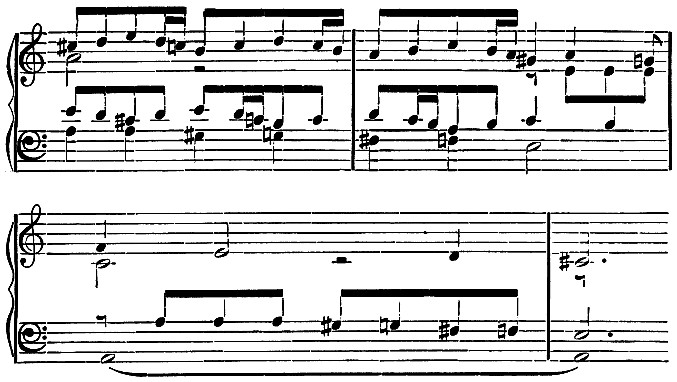
fugue in E minor has successively three themes:[52]
Each of these fugues is connected with the others by those
brilliantly florid interludes for which Bach derived a taste, at
least in his earlier years, from the influence of his studies of
Buxtehude.
In the chorale, Buxtehude does not interest us in so great a degree
as does Pachelbel; he is another of the "colorists." Furthermore, he
was always more worldly than religious, even transforming St. Mary's
Church into a concert-hall—for sacred concerts, if you will. But
churches are not temples erected to the Fine Arts; while it may be
true that the latter approach most closely the divine spirit, yet it
must be recognized that pantheism, a philosophic teaching, has never
been followed as a religion.[53]
THE PRELUDES AND FUGUES OF J.S. BACH TOCCATAS—FANTASIAS—THE PASSACAGLIA—THE SONATAS — I — II — III
The organ compositions of J.S. Bach (especially such of them as are
free in style, and in which he made no use of the chorale) may be
classified under three chronological periods, according to their
structural characteristics.
It is of great interest to note the continued conquests which
Bach placed to his credit; his first productions saying little
that had not been said by others, but establishing, as it were,
the specification of actual resources of which he might avail
himself. The latest works, on the other hand, complete and final in
their authority, demonstrate the prodigious career based upon that
beginning, and thus define the exact measure of all that properly may
be attributed to the author of Die Kunst der Fuge.
It would be puerile to ask one's self if Bach proposed to create,
or even to reform; these chronological periods, which prescribe
for us the limits of an historical and æsthetic analysis, are but
the expression of our own conception. Although in the beginning
Bach imitated his contemporaries or his precursors, he was unable
to produce at once positive results in a branch of art in which
technique alone holds so important a place. Besides, let us
suppose that he had retained in his own possession these first
attempts, permitting us to become acquainted only with his greater
compositions, in which he could appear in his full strength—the
earlier works being regarded as mere studies or sketches—then
undoubtedly we should behold a spectacle which would astound the
historians: the sudden production of such works in a state of
perfection. Bach did not gratify his amour propre in this manner,
he never dreamed of doing so; we realize that this little German
organist, who was content modestly to produce a chorale or a fugue
each Sunday, simply did the best he knew, always happy and interested
in his work; and one day we see his genius fully established, as
the result of all this previous and conscientious labor, together
with something which he added to it—something of himself. With this
element, which is characteristic of genius, we wish to become more
intimately acquainted; but alas! as in every analysis, we cannot
penetrate its being, and we must be satisfied to regard it from an
objective point of view.
During the first period Bach assembled his resources; of his
fellow-countrymen he acquired, from Buxtehude some characteristics
of movement, his picturesqueness of rhythm, from Pachelbel that
personal quality which is not unlike what we describe as "German" in
speaking of certain popular Lieder. From the French he borrowed the
ornaments, more artificial than spontaneous, and that splendor, often
majestic, which recalls, in this case as well, the "Grand Roi";
from the Italians, gracefulness and perfection of proportions: the
invaluable inheritance from antiquity, never cut off.
We repeat that these first productions are in nature a sort of
assembling of resources; it matters little whether they be considered
as pasticcii or as centoni;[54] as little, perhaps, as to know
that the child Michael Angelo often copied this or that antique
statue; although with this difference, that the latter may have
despaired of attaining such heights, while Bach, for aught we know,
may have considered that what had already been achieved in his art
was, after all, little more than so many sketches.
To Buxtehude, Pachelbel, Froberger, F. Couperin, Frescobaldi, and
still others—why name them all here?—belongs the proud distinction
of having provided a medium for Bach; and still their importance
is not lessened by such a fact any more than is Bach's; in any case,
it is very difficult to judge a man of genius without reference to
chronological succession. Neither in the domain of art nor of science
is furnished an example of a man creating a standard, of which his
original conception has not been aided by one influence or another.
Did Aristotle invent the syllogism, or did he not merely gather from
about him some fragments of rudimentary procedure? And is not Bach
the Aristotle of music, the master of musical reasoning, giving
speech to his syllogisms in a form beautiful in itself, without
taking into consideration the thought which it clothes? And is a
fugue anything but a syllogism? Jenner (and we voluntarily take as
examples fame become banale) did not intuitively discover vaccine.
By a happy chance he established the fact that certain herds were
immune from small-pox; accidentally hit on the truth, by following
his conclusion to its cause. The man of genius is undeniably Pasteur,
who generalizes a century later, assisted by the addition to the
literature upon the subject of a mass of treatises, those of Davaine,
of Villemain.... To cite Jenner in connection with our subject is
more than amusing; but consider Frescobaldi—is he not the Jenner of
the Fugue?...
But let us avoid the necessity of classifying great men in the order
of their merit; it is the evolution of Bach's genius which we wish
to study. There is in this field an aspect of psychological analysis
which we trust will prove of interest; but it is by no means our wish
that any inference shall be drawn from the foregoing which could lead
to an undervaluation of the originality of Johann Sebastian Bach.
Now as to the first period. Bach studied daily the technical methods
of Buxtehude, or those of Pachelbel. He availed himself of these
methods, he copied Pachelbel, he copied Buxtehude; furthermore, he
imitated their pupils, and even those of lesser ability among them.
He did not yet generalize. If at this moment he should disappear,
should cease to write, his work would present no other characteristic
than the decided manifestation of a temperament remarkably capable of
assimilation. This interest will become augmented, if we scrutinize
what comes later; therefore we may legitimately consider as embryonic
that which, at this epoch, proceeds from his individuality.
The second period is one of formation; Bach begins to generalize.
One of the compositions of this epoch, taken by itself, will not
so strongly recall the work of his forerunners. Imitative in nature
as they are, drawn from such various sources, and so composite,
containing in one mosaic nuances of such different character, yet the
whole is moulded by a hand whose touch is already characteristic,
and over which skill is dominant. What Bach has dissected, he now
reconstructs after a diathesis of his own. As an artist exhumes
the fragments of an ancient reredos, primitive in sculpture, his
personality betrays itself in the new connection which he establishes
between these relics of a past age, which dictate to him no
relationship incapable of alteration. And thus with Bach.... Still
more, as the painter who would wrest from every form of human beauty
whatever it possesses of the superhuman, seeking absolute beauty as
his aim in the selection of a type.
Was Apelles able to portray a divine image, working upon human lines?
His contemporaries claim that he was; and we know nothing about
it, so subjective is history, reduced to testimonies from various
sources. We have to go but a step further, and we find in the works
of Bach, particularly in those of the last period, the evidence that
from all these sources he evolved at least that which no one else
could wrest from him, for since his time no one has been able even to
follow him in his own domain, I will not say to equal him. As with
the symphonies of Beethoven, he himself closed that particular way,
and forced his disciples who would be masters in their particular
realms to develop other lines.
We will proceed by chronological analysis, as far as it is possible
to fix the succession, to demonstrate to the reader the ground for
the classification of Bach's works which we are now to study; it
being fully understood that these limits are in no way absolute,
serving rather as dividing points in our work.
While the first period apparently ends during the early years at
Weimar, about 1712—later we will explain why—it is difficult to
fix definitely the date of its commencement, which perhaps takes us
back to the years of study at Lüneburg. To this witness is borne by
a prelude and fugue in C minor.[55]
The inexperience of the young composer betrays itself in every
measure; the timidity with which he availed himself of the resources
of the organ indicates even more the fear of venturing beyond the
limits of a virtuosity which, while perhaps precocious, was not
yet master of the instrument. Observe the treatment of the pedal,
the touchstone of an organist; in the prelude it serves only as a
foundation for the harmony, often doubling the notes given to the
left hand. And truly is it not a weak artifice, this recitative
upon which reliance is placed from the beginning, as if to attract
notice to a certain technical dexterity which is suddenly forced to
labor strenuously, as soon as the attention is distracted by the
entrance of the other parts? And likewise in the fugue; the pedal
does not take up the theme (truly one of a funeral march, with its
doleful recurrence of the same figure, now interrupted, now repeated
in different positions) until after the entire polyphony is at an
end; it seems to appear only as an indication of the conclusion,
which is, moreover, retarded by a sort of ill-timed coda. As to the
workmanship of the fugue, it is far from perfect; the parts are built
up one upon the other, the subject always being allotted to the
higher part, thinly accompanied by the others; without being long, it
is wearisome, and interest is awakened only by the entrance of the
pedal, when the fugal character is no longer predominant.
The tonality of C minor, expressive of profound sadness, was
apparently a favorite one with Bach at that time; another fugue in
the same key[56] appears to be contemporaneous with the foregoing.
The same general characteristics are noticeable; the pedal is even
more insignificant; but in the poetical conception of the piece, even
in its incompleteness, there is a world of meaning.
While leaving to Schubert the "Signification of Tonalities," and
not without distrusting this hobby—so absurd at times are the
results of the analysis of every piece of music by reducing it to
its exterior characteristics—still we cannot deny that to a certain
extent this fugue is the reflex of everything of indecision in the
life of Bach up to this time. The rhythm of the theme is established
only at the end of the third measure, and each of its fragments
serves to mark the close of a harmonic progression, despite the fact
that the general tonality does not make itself plainly felt. This
twofold ambiguity lends to the whole a touch of undefined regret, of
a desire whose very existence is not suspected. Is this not wholly
characteristic of the temperament of a youth?
We are reminded of Pachelbel by these two works, in their general
lines, through this same exaggeration of an innate emotion into a
condition of melancholy, a tendency peculiar to Bach. In point of
technique the works sustain this reminiscence: the counterpoint is
not yet fully developed. Further, compare them (particularly the
second fugue) with certain of Pachelbel's compositions, especially
with the fugue in E minor, whose theme we cited in our chapter upon
this musician.
Other similarities appear in the variations in tempo with which these
works are brought to a close; these new forms were of the North
German school, whose illustrious representatives were Reinken and
Buxtehude.
Bach had obtained of Boehm the key to their style; no composition of
Pachelbel did he ever imitate with the zeal with which he set out to
copy the preludes and fugues of Buxtehude; perhaps because he was
already more like the former in point of natural qualities.
Even before his journey to Lübeck Bach began to write pieces in this
style of several movements. We will examine a prelude in G major,[57]
and a fugue in A minor accompanied by a prelude in the same key.[58]
The prelude in G major seems to us to date further back than Bach's
study of Buxtehude, from the fact of its evident inspiration by a
prelude of Bruhns, written in the same key.[59]
It is true that Bruhns was one of Buxtehude's best pupils, but he was
nothing more; it would seem as if Bach, appreciating the value of the
master, did not gauge with sufficient accuracy the capabilities of
the pupils.
We find the same spirit, the same cheerfulness as in Bruhns's
compositions; but the piece is less abrupt, and, by way of contrast,
is interrupted by moments of sadness. In the expression of joy, was
it Bach's intention to remind us that happiness is never complete,
that it is always accompanied by mourning?
These few measures, in a minor and not even the relative tonality,
in syncopated rhythm, come suddenly upon us in the midst of all this
joyfulness, like a memento mori; and they suffice to alter the
effect of the second part of this work, to the benefit of a more
lofty ideal. When the joyous motive reappears, it is no longer with
the same worldly bearing; restricted to a series of imitations which
only render it indefinite, moderating the swiftness of movement in
favor of breadth of tone, it seems rather to be proclaiming a peace
which will know no end.
This prelude is already of much importance from an artistic
standpoint; but we cannot say as much of the prelude and fugue in A
minor which we mentioned at the same time. There is no doubt that
it also dates back further than the journey in 1705; Bach must have
sadly misconstrued the true significance of Buxtehude's works to have
indulged in plagiarism so unskilfully.
He reproduced only the faults of his model; he followed him only
into the by-ways, augmenting his mistakes by the awkwardness with
which he set about his task. In fact, the work is little more than an
omnium-gatherum of ideas picked up at random and strung together
upon the mere excuse of a tonality. After a short prelude devoid of
interest, we find the theme of the fugue to be of peculiar dryness,
supported by equally barren counterpoint. The interlude which follows
is a succession of incorrect harmonic progressions, peculiarly
disagreeable in effect;—even as he thought to imitate Buxtehude's
freedom of movement[60] in the restlessness of the prelude and
fugue, so Bach hoped to acquire the expressiveness of his harmonic
progressions, so audacious for their time[61]—and introduces a new
treatment of the fugue, monotonous, but finally coming to a close in
a more interesting fashion.
More happily inspired in his emulations, or better served by his
talents, we behold Bach in a composition in three movements, little
known up to this time: a "Fantasie" in G major.[62]
The first two movements are still rather weak, perhaps influenced by
the Italian music heard and played during the few months preceding,
when Bach was a violinist in the orchestra of Prince Ernest of Weimar.
The third movement is remarkable, at least with regard to its depth
of thought, and to its adoption of all that was most to be desired
in Buxtehude's style. The upper parts cross each other upon the
scale given out by the bass, as in a Chaconne; it is the resistance
of surging waves to the slow rising of the stream, expressed by the
implacable repose of the fundamental theme, whose intensity, with its
own imperturbable repetitions, overcomes all resistance.
In many of Bach's works we encounter these ascending and descending
scales, but they are of varying significance. We find them again
in a piece closely allied to the foregoing: a Fantasia,[63] also
in G major, where the diatonic scale serves as the foundation of
harmonies, whose interest, cleverly held in check, is augmented by
the uninterrupted progression of five real parts.
These works are no longer mere plagiarisms; a glimmer of
individuality discloses itself. For example, let us look at the
prelude and fugue in E minor.[64] If Buxtehude is here brought in
mind, it is because of that quality of his which is most neutral, and
no longer through his peculiar originality, his personal resources;
in trying to avoid which a mere imitator must always come to grief.
Many a detail in construction is derived from the Lübeck organist;
for instance, those detached chords, which so successfully set off
that plaintive syncopated progression, the sobbing of whose notes is
thereby rendered always more intense; the last sections repeating the
first, now broken into two still more earnest entreaties.
And of this fugal theme, beginning in two separate fragments upon
the dominant, we have seen examples in Buxtehude; but there this
repetition of the subject expressed in its intensity a joyous
declaration.[65]
It is here a tremulous, hesitating interrogation, which seems to
dread its answer; the prelude is full of lonely sadness, as deep as
it is despairing; in the fugue it converses in dialogue with itself,
one might say in accents which proclaim a public misfortune.
But if one may not seek "in a musical work the expression of
any condition of the soul, or the narration of any story of the
heart,"[66] one can hardly deny that music expresses "the being, even
the personal will"[67] of psychological phenomena, at least in the
sense that the interest of certain works of art, aside from every
æsthetic consideration, is correlative to the mental condition in
which one receives them. This may explain the position occupied among
the works of Bach by this piece, whose many weaknesses are revealed
to us by a technical analysis.
This intimate nature finds an antithesis in the Toccata and Fugue in
D minor,[68] which belongs chronologically to the same period; it
is still Buxtehude, but it is conceived throughout in a picturesque
style. It lacks only an argument to establish by every right its
character as "program music." The two rapid and dazzling flashes, a
peal of thunder, rumbling heavily in the reverberations of a chord
slowly broken, and above the vibration of the deep pedal, augmented
in intensity by its duration; wind, then hail;—we are in the midst
of the classic tempest. Entirely a thing of virtuosity, appreciated
even by those who take account of nothing in the arts but the
illusion gained, the Toccata earned brilliant success for Bach upon
his journey to the smaller German courts, and contributed in large
measure toward the extension of his fame.
This composition belongs to a whole series of virtuosic works, as
well as the prelude and fugue,[69] in E major in the edition of W.
Rust (Bach-Gesellschaft), and in C in Griepenkerl's (Peters); and,
above all, the celebrated fugue in D major.[70]
Despite the advance in technique, this prelude and fugue are still
in the earlier manner; certain characteristics, such as the division
into several movements, indicate that the early influences which
governed Bach are still potent. Nevertheless, there is in the stately
prelude something of the dignity of the French overture; in the Alla
Breve[71] a recollection of the Italian compositions of the same
name is natural. Thus later studies betray themselves more in certain
details than in the work as a whole; the subject of the fugue reveals
its similarity to Buxtehude in its general style, and in its movement
(see the theme in F quoted previously).
Another inheritance from Buxtehude is the prelude and fugue in G
minor;[72] especially the prelude, with its wealth of harmonies
suddenly broken off, hardly to be employed again; the fugue, with
the repeated notes in its subject. An advance over all the fugues of
which we have thus far spoken, this one is notable for its strict
maintenance of four-part polyphony; the facility and the spirit which
we observe in the counterpoint, especially at the entrances of the
subject, and the flexibility of the imitations, indicate the presence
of a new wealth of resource, and a surety of technique which is
master of itself.
We must also include in the product of this period a set of eight
preludes and fugues,[73] which, although very simple, are already the
work of a fine hand. They are undoubtedly compositions which Bach
destined for his pupils.
Bach is now about to cast himself free from the restrictions placed
about him by the study of his first masters; finally in possession
of all their resources, he will acquire those of others, enlarging
his field of vision, already marvelously well-prepared by his earlier
labors to make room for the results of his search after new conquests.
During Bach's first years in Weimar a new factor enters into his
evolution, or rather forces itself upon it, quite without seeking on
his part; it is simply the result of the experience gained in the
fulfilment of his new duties.
Ever since this epoch Weimar has been distinguished among the German
courts by a more refined culture, a taste for art which up to the
present time has never diminished.
In this instance the impetus did not emanate from the reigning
prince. Wilhelm Ernst was a man of education, it is true, and in his
service were good artists; but, absorbed in a solitary life[74] of
exceeding piety, and occupied with good works, the duke entrusted to
his nephew, Johann Ernst,[75] the duty of encouraging his musicians.
Johann Ernst was skilled in music, playing the harpsichord and
the violin; he had even studied the elements of composition with
Walther;[76] music was made to cater to his sickly constitution,
especially the Italian chamber music, for solo instruments and
orchestra, whose subtle charm was well suited to this invalid; for he
himself could take part in its performance.
Bach's temperament, so entirely different, was certain to draw its
lesson from association with such works; the precise moment has now
arrived when, by his own determination, he shall profit by it; he
is master of his own virtuosity; and both his manual dexterity and
his present position make it possible for him to choose what he
will retain of the ideas which crowd upon his imagination in such
profusion. To succeed in such a choice were already to produce a work
of art; but to bring these ideas into their proper relative order,
the selection once made, is the achievement of a great artist.
The Italians had for a long time possessed precisely this sense of
correct succession; this architectural aspect of the art could not
fail to attract, by its harmony of proportions, those who had always
displayed so much taste in works of sculpture.
It is particularly to be noted that what the Germans were able
to acquire from these composers, they derived from the concerted
music for stringed instruments. In fact, it may be said without
exaggeration that, while the Germans were well-informed, not only
upon organ composition, but upon vocal writing as well, still they
possessed no violinists,[77] in the sense that among them there was
no one who wrote for that instrument with the clearness or sentiment
which it demanded. The Italians brought them something more, if
not something essentially different: the interesting and varied
movements, the perfect balance between the musical phrases, the
elaboration and refinement of design for which they always strove;
for it was with them that monody first dawned, and was afterwards
developed. It is easy to conceive that with instruments the
conditions are varied; although that is not saying that a manner of
writing suited to one instrument may not also be fitted to another;
in writing for strings the same style recommended itself to the
Italians as that which had enriched the school of organ composition.
We refer particularly to the sonatas and concertos.
While the sonata still lacked that unity resulting from the
development and ingenious combination of two themes of necessary
co-relationship, which P.E. Bach was to impart to it later, it
already possessed three well-defined divisions at least, as is
indicated by the variety of the movements: the first one rapid in
tempo, assertive; the second slow, full of sentiment; while the third
finished gaily, often recalling the rhythms of popular dances.
As to the concerto, it was on the whole nothing more than a sonata
for one, sometimes for more than one solo instrument, accompanied
by the orchestra, whose interludes produced new effects through the
contrast between the soli and the tutti.
The facilities offered by the organ, with its several keyboards,
for the delineation of these designs, rendered it particularly
appropriate that they should be transcribed for that instrument.
This Bach did. In addition to sixteen transcriptions for the
harpsichord, he left us arrangements for the organ of three of
Vivaldi's[78] concertos, and the first movement of a fourth.[79] They
are arrangements, rather than integral reproductions; and if we take
a certain interest in this transcription for the organ, by special
methods, of works not originally intended for that instrument, it is
an interest like that inspired by a well-made translation.
Possibly Bach regarded it in another light; for him it may have been
a means of penetrating to the core of such compositions, of analyzing
their inherent qualities.
We now see him quite preoccupied with this three-movement form; take,
for instance, the Toccata in C major.[80]
The Prelude itself is subdivided. First we find an introduction,[81]
free in style; then an Allegro, built, as is very important to
notice, upon two different and well-defined themes.[82]
An Adagio follows; a sort of instrumental solo sustained by a
homophonic accompaniment, examples of which are comparatively rare
in Bach; and accentuated by a continuo, like the pizzicato of
the orchestra. A short succession of chords à la Buxtehude and
quasi-recitativo[83] separates this Adagio from the fugue; the
rapid tempo of this latter is still of the earlier period, and
recalls, in its progressions in thirds, various subjects of Buxtehude.
Bach was not content with writing in the Italian forms. In the fugue
in B minor[84] he borrowed themes from the Corelli[85] sonatas, and
in the one in C minor[86] he levied tribute upon works of Legrenzi;
upon which one of the latter is not definitely known.
In this connection we see what further profit Bach derived from
his study of Italian chamber music, not only in the logic
of composition in general, but in certain species of writing,
particularly in that in three parts.
But all this did not satisfy him; he wished to know the organ works
of Italian composers. We have seen that he copied with his own hand
the Fiori musicali of Frescobaldi.
This copy is dated 1714; it thus belongs to the Weimar period. The
canzona in D minor[87] must have been written shortly after the
completion of this task; at any rate, it is interesting to trace the
characteristics of this piece to that source.
Notice first of all the theme; it is found in the Canzon Dopo la
Pistola (sic), on page 77 of the Fiori musicali (edition of 1635),
where it appears as the answer to the principal subject. Frescobaldi
presents it in this form:
Further, in comparing the sixth measure of this Christe with the
tenth part of the Canzona of Bach, we see why these two themes,
although quite in the style of Bach, still are obviously the
result of his study of Frescobaldi; in fact, this measure contains
a fragment of the theme just quoted, with the very alteration
afterwards made by Bach.
In this present case of the employment of a chromatic countersubject
Bach evidently had Frescobaldi in mind; considering, and rightly,
the frequent use of motives of this kind to be characteristic of the
latter. But while Bach believed himself in so far indebted to an
Italian master, he was in reality only following the traditions of
Sweelinck,[88] who had already furnished him noteworthy examples of
this style.
In fact, Frescobaldi acquired these resources during his stay in
Flanders; perhaps he obtained them from Sweelinck himself, whom he
undoubtedly knew in Amsterdam. A Fantasie by Sweelinck, edited by R.
Eitner,[89] is written wholly upon this form of the Ionic tetrachord:
These characteristics of treatment found great favor with Flemish
organists, by whom they were introduced. Peter Philipps, an organist
of Soignies, makes use of them in a "Gagliarda," and in the
"Pavana dolorosa"; composed in prison, according to an addition in
a strange hand in the manuscript. S. Scheidt, a pupil of Sweelinck,
avails himself of them in various instances (Fantaisie super "Io son
ferito casso", "Fuga quadruplici," etc.).
This mannerism prevailed for some years; we again find it in the
works of Froberger (Toccata fatto a Bruxellis Anno 1650) and in a
fugue in E flat by Christopher Bach, of which the following is the
subject:
In secular music composers exhibited the same fondness for this
chromatic style of progression, employed to express sorrow or dread
(it is interesting to note that at every musical epoch this or that
motive or chord, later certain instruments, express certain definite
emotions).
Thus, in the following example from G. Andrea Bontempi, taken from
the opera "Paride" produced at Dresden in 1662:
Purcell,[92] in the "Orpheus brittanicus" (London, 1706) gives us
still further examples of this character. Among others, "O let me
weep" (Book I, p. 171),
We repeat, it is undoubtedly in intentional recollection of the
"Fiori musicali" that Bach here makes use of a mannerism which,
moreover, was so familiar to him; it is through details of this sort
that one is able to gain the mastery of a style which one desires
to imitate. As for that, we must not forget that Bach wrote after
nearly a century had elapsed. If you will, it is like an ancient
painting copied by a modern master, who, although able to correct
the perspective, would cause the picture to lose none of its archaic
charm, while he would impart to it a certain quality of warmth. Thus,
in the canzona, notice that progression of the soprano (beginning
at the 48th measure) which ascends like the broad sweep of violins,
then falls gracefully back upon a well-rounded line—a contrast
expressing great tenderness, compared with the austere rigidity of
the scholastic rhythm with which the countersubject at the same time
pursues its heavy course, in an obsolete style of counterpoint.
Here is truly the cantable,[93] as Bach called it, never hesitating
to coin French words; the second part of the Canzona which follows
this species of march is written in 3/2 time, after the established
rule; it is more abstract, and not without prolixity.
If all the grace, the melodic freedom of the Canzone of Frescobaldi
are surpassed in this work, an Alla Breve[94] in D major reminds
us more of the studied style, of the continuous movement of the
Ricercare, with some reminiscence of a piece which Pachelbel wrote
under the same title and in the same key.[95]
The Passacaglia[96] again exemplifies the discreet cleverness which
Bach henceforth displays in his imitations; he realizes that he has
risen above his models, and he now chooses his colors with a critical
eye. In this instance he takes us back to Buxtehude.
Among the works of the latter are various pieces of this same order,
Passacaglias or Chaconnes, written over an ostinato; which is not
necessarily confined to the bass in its original form, but which
modulates here and there into closely related keys, or appears in
other parts.
The seriousness of the beginning of the Bach Passacaglia cannot
cause us to forget that calm entrance, in its very reserve so sad, of
the Passacaglio (sic) of Buxtehude (ed. Spitta, No. I, p. 1):
finally the sixteenth-notes in triplets (Passacaglio, p. 4).
The idea of joining a fugue to the Passacaglias was also derived from
Buxtehude, who united a chaconne and a fugue (ibid., No. V).
All this is only incidental, it is true; and we recognize Bach in
the length of the work (293 measures) and especially in the skilful
counterpoint of the fugue.
From our point of view, the Passacaglio and the Canzone express
the whole philosophy of this second period. Bach attains, in these
two works, the highest point which it was then possible for him to
reach; he comes into his first maturity in treating, it is true,
established forms, through which he acquires the necessary mastership
for the exploration of new fields.
From this moment progress is manifest. Take the prelude and fugue in
F minor;[97] no more superfluous ornaments in the prelude, and,
what is especially noteworthy, it is founded entirely, not yet upon
a clearly defined subject, but still upon a figure which affects the
whole ensemble, imparting to it added coherency.
Up to this time Bach had not achieved such unity, such directness of
meaning; and the rapid, stormy passage at the end is more than a mere
brilliant cadence: it bears the musical distinction of adding to the
dignity of the peroration by emphasizing the tonality, the threads of
which are thus united.
In the two preludes in C minor which bear the title of
Fantaisies[98] these characteristics are still more pronounced; it
is from a veritable subject that they derive the somewhat elegiac
character common to both, as well as certain details and even the
general outlines; the one is, nevertheless, somewhat more individual
because of the use of two themes. Less varied, the character of the
other is more intimate, although more uniform.
To the three fugues which we have mentioned must undoubtedly be
added two others, from a chronological point of view, belonging to
preludes of a later date; they are the fugues of the Toccata in F
major,[99] and of a prelude in C minor.[100] There is truly a
remarkable analogy between these five fugues, both in the character
of their themes—no longer agitated in movement, but approaching in
a slight degree the melodious seriousness of the chorale—and in
their treatment. In each of them the interest increases with the
development, and the introduction of an accessory subject toward the
middle portion (afterwards related to the principal theme), either as
a countersubject or for the purpose of preparing the reëntrance of
the principal theme, is common to them all.
The Toccata[101] in the Dorian mode and the accompanying fugue
are perhaps contemporary; this imposing composition still partakes
of that character of studied virtuosity which Bach was destined
completely to abandon in his later years.
After resigning his post at the palace in Weimar, Bach never again
occupied an official position as organist. Not that he renounced the
instrument which he so loved to play, but he was no longer obliged to
fulfil the requirements of regular service; his earlier compositions
he could gather together and correct at his ease, and finally bring
out no new ones that were not thoroughly in accordance with his
ideals.
The number of these new organ compositions also diminished in an
extraordinary degree; for from all the thirty-three years embraced in
this last period, but about twenty works exist for our study.
Although Bach no longer bore the title of organist while at Cöthen,
it must not be inferred that access to the organs of the town was
denied him; for instance, to the instrument in the St. Agnuskirche,
the pedal of which was unusually extended in compass. We learn, in
fact, from a work of C.F. Hartmann's,[102] published at the beginning
of this century, that the pedal of this organ was two and a half
octaves in range, extending up to f'♯[103] inclusive, while
the organs of that period usually possessed but two octaves in the
pedal, from C to c', with sometimes c'♯ and d' in
addition.
This instrument, although of modest dimensions, responded to the
touch with remarkable precision and promptness. And we have good
reason for believing that Bach had it in mind when he wrote the
Toccata in F major;[104] this piece has always been played,
traditionally, at a very rapid tempo; and one encounters at various
points high f's and e's in the pedal part. If Bach, who was
continually seeking new instruments or improvements hitherto ignored,
had not had at his disposition a pedalier upon which he could play
this pedal part, he undoubtedly would have so written it as to make
it generally practicable for performance. It seems evident, on the
contrary, that he composed this work only in order to take advantage
of a resource which he had not encountered before; thus the date
of this Toccata appears to be between the years 1717 and 1723, the
period of Bach's residence in Cöthen.
While remarkably brilliant, this work bears the stamp of a certain
dryness; it is somewhat too much of a "show-piece,"[105] perhaps
the best one of this type which Bach wrote; quite different, in so
far, from the fugue in A major joined to the prelude in the same
key.[106]
This fugue (also from the Cöthen period, as well as the prelude,
to judge them by the pedal, which extends to e') occupies an
entirely individual position among the works of Bach—one which is
shared by no other work. One would say that in writing this fugue he
had relaxed from the severity which the grandeur of the instrument
inspired in him, lending to the work the intimate charm of a somewhat
effeminate grace of movement.
The elusive rhythm of the subject, and even the theme in its entirety
(though a different way), bear a strange resemblance to this fugue
subject:
given out by the oboe, repeated first by the flute, then by the
viola d'amore, and finally by the viola da gamba, above the
continuo in the cantata "Tritt auf die Glaubensbahn."[107]
Certain portions of the fugue in A major, further, produce the
effect of concerted music, conceived for different tone-colors,
rather than that of a polyphony of like sounds, especially where
broken chords occur in the counterpoint. At other times, when the
pedal is silent, a trio-sonata is suggested. This does not surprise
us; Bach was still preoccupied with the forms of Italian chamber
music. We have noted the transformation which his preludes underwent
under this influence, they now being constructed upon distinct
subjects; and we have seen in the Toccata in C how Bach sought to
write a work in three movements, each one of a different character
and tempo, in imitation of the concertos and sonatas. Here and there
again, as in this instance, we find attempts at three-part writing
clearly defined;[108] not merely because the pedal remains silent,
but by reason of a plainly indicated design.
Bach aligned these endeavors in definite order, classified their
essentials, and embodied them in the sonatas, or rather trios, for
two manuals and pedal.[109]
Play these trios upon the organ, and you will divert them from their
original destination. Bach composed them for the clavecin with two
manuals and pedal, between the years 1722 and 1727,[110] for the
purpose, Forkel tells us, of instructing his eldest son, Wilhelm
Friedemann, in organ-playing, through their use in home practice.
The structure of these sonatas is analogous to that of the six
violin sonatas of Bach with clavecin accompaniment; they still lack
the definite form of the modern sonata;[111] they are more, as has
been said, "lyric pieces."
If Bach wrote these trios to accustom his son to the technical
difficulties of the organ, perchance considering them only a set
of studies, and for himself an interesting occupation by which he
might profit, his motives in writing the Fantasie and Fugue in G
minor[112] were, apparently, very different, and may be definitely
connected with the journey which he made to Hamburg in 1720. This is
an hypothesis which is sustained by a whole chain of circumstances.
First of all, Mattheson, in his treatise upon thorough-bass,[113]
furnishes the ground for our premise; he cites the following fugue
subject as having been given to a candidate who was undergoing an
examination for an organ position:
He adds that this theme was well known, and that it had been chosen
to assist the candidate in his task, since he would already have had
an opportunity of hearing it treated; he says, further, that its
origin was not unknown, and that it was well known who had been the
first to make use of it with success.
Mattheson, who wrote this about 1725, seems to be speaking of
a theme unusually familiar. Was it not from Bach himself—the
examination took place at Hamburg—that the candidate, who was from
that city or a neighboring locality, would probably have heard a
fugue composed upon this same subject?
Moreover, an examination of the prelude will confirm this opinion.
Through his study of the works of Buxtehude and of Reinken, the
venerable organist, Bach had possessed himself of all their secrets.
The opportunity had come for him to demonstrate to the organists of
Hamburg how, in imitating them, he could surpass them on their own
ground.
For the characteristics of the prelude resemble those of the works
of these men; recitatives, rapid passages which cover the entire
compass of the manuals; chord progressions with bold, unforeseen
modulations; subjects treated in imitation. But the recitatives
are of an expressive, declamatory character which was then unheard
of; the rapid passages are the forerunners of "those scales, those
tremendous ascending and descending scales which rise and fall like
the waves of the sea in a storm,"[114] which Mozart wrote in the
overture to Don Giovanni; the chord progressions, with a daring
which had never been exceeded, leading to that gigantic passage
(measures 31 to 40), a veritable orchestral crescendo, where all
resources of sonority deploy themselves in radiation, taking on new
force with each strong beat; it serves also as an example of the
crescendo which may be obtained upon the organ without recourse to
modern appliances. Finally, the motive treated in imitation (measures
9 to 13) vouchsafes us a period of repose, corresponding to a point
of temporary rest in the midst of chaotic agitation; it is the
calm supplication of prayer which alternates with the power of the
elements freed from their fetters.
The opposition of these varied means of expression imparts to this
piece a value which the works of Buxtehude, despite their valuable
qualities, will never possess. I refer to those designs, in the
absence of which music stifles, giving the impression of a drawing
without perspective; such qualities are essential, especially in
music composed for the organ, whose manuals, of different intensity,
so easily accomplish the display of the various phases, emphasizing
one subject while leaving another in the background.
Pölchau, in the 18th century, declared that the fugue accompanying
this prelude was the "best work with pedal ever written by Bach." It
is rarely allowable to pronounce such absolute judgments, or even to
subscribe to them; that it is one of the best, however, there can be
no doubt; still greater through that unity of opposition, through the
effect of continuity which it produces, like the uninterrupted course
of a great river, contrasted with the boiling torrent which terrifies
our imagination.
It now remains for us to speak only of the prelude and fugue in
E flat major, and of the six preludes and fugues which have been
surnamed "the great." These latter, which are found together in the
manuscript, were, perhaps, assembled by Bach for publication; that
was not, however, accomplished.
Of all the compositions which we have cited thus far, only the
prelude and fugue in E flat were published during the composer's
life.
The prelude stands at the head of the third part of the
Clavierübung[115] and the fugue ends that volume. In any case,
there is no doubt that these two pieces belong together. Griepenkerl,
who in his edition[116] united them for the first time, declares that
he did not do so arbitrarily, but that he was justified by Forkel,
who in turn derived his authority from Bach's sons.
Moreover, a comparison of these two pieces will show their
similarity; while the prelude is more grandiose, the character of
the fugued portions is quite the same in the one as in the other;
moreover, the polyphony, in each case in five parts, indicates an
evident unity of composition.[117]
The publication of the Clavierübung may be fixed at about the year
1739. The prelude and fugue in E minor[118] are probably anterior
to this work; a minute study of the autographs has given Ph. Spitta
reason to place the composition between 1727 and 1736.
In the strict succession broadly established by a prelude developed
at length (137 measures), follows the fugue, of still greater
dimensions (231). It is the longest of all the Bach fugues, but,
despite its proportions, the interest does not flag for a moment.
Here again Bach constructed his subject upon that same chromatic
progression to which he already owed so many expressive combinations;
but the theme soon retires into the background of this fugue; it is
but the excuse for a counter-theme of singular pathos, which assumes
the importance of a symphonic subject, freely treated.
We should place by the side of this masterpiece the prelude and
fugue in B minor.[119] The beauties of this composition are of a
character quite as lofty, to which no analysis can do justice. It is
a sort of soul-language, of which Hegel says, in his Aesthetik:
"If we consider all intercourse of the soul with the beautiful as a
deliverance, as a release from all trouble, it is in music that we
must seek the completeness of that liberation."
Undoubtedly it is also "that internal harmony which lifts us for an
instant out of the infinite depths of longing, which delivers the
soul from the oppression of the will, which diverts our attention
from all that is importunate, showing us things divested of all the
influences of anticipation, of every personal interest, becoming
objects of disinterested contemplation, and not of covetousness;
thus this repose, vainly sought along the open paths of desire, but
which has always eluded us, appears to us, as it were, of its own
volition, and vouchsafes the realization of peace in plenty. This
free condition of sadness Epicurus pronounced the chief of all good,
the happiness of the gods."[120]
To the six greater preludes and fugues also belong the prelude in
C major[121]—which, reproduced in an altered form by Bach himself
upon another occasion, recalls in both its forms the beginning of
the Concerto in C major for two clavecins—and the prelude in C
minor,[122] the fugue of which (as we have already seen) must be
earlier in date. Otherwise the great fugue in A minor,[123] the
prelude of which, included with the fugue in this series, is still
replete with souvenirs of Buxtehude, and would thus revert to the
Weimar period.
Finally, we would mention the prelude in C major in 9-8 time[124];
it recalls in its movement a fantasia by Froberger.
It is curious to observe that the fugue which follows it played a
part in the inspiration of Die Meistersinger, in its analogous
figures, and in resuming the subject at the close, this time in
augmentation, like a chorale melody.
Is it not of some interest to see brought together, in a work of
Bach's, these extremes in music? Froberger, with all his inheritance
of past centuries; Wagner, proclaiming the dawn of a new art?
THE CHORALE PRELUDES ( VORSPIELE )—TRIOS—FANTASIAS—FUGUES — I — II — III
We have seen to what an early period of Bach's life his first free
compositions revert; perhaps of still earlier origin are the works
which the Chorales inspired in him.
Liturgical in character, and thus all the more closely identified
with the popular sources from which he sometimes drew his own
inspirations in order to idealize them mystically in a sort of
"procession en Dieu," the chorale is the soul of Lutheran religious
music. Far more; this universal prayer, the spiritualized communion
of the faithful (their sole participation, really, in a dogma freely
interpreted), passed from the inner temple to the outer court, like
the reading of Holy Writ; the Bible was the book of the family, the
volume of chorales its musical breviary.
The very first arrangements of chorales made by Bach convey a little
of that intimate charm, of that impression of "home" and its domestic
circle, where in the evening the hymns are sung between the reading
of two chapters from the Evangelists; it would seem as though the
young man, an orphan, in imparting to them their expression of quiet
sympathy, desired that they should take the place of those same
intimate pleasures which had been denied him.
In fact, the "Partite," these two sets of variations upon
"Christ, der Du bist der helle Tag" and "Gott, Du frommer Gott,"[125] lend
themselves but poorly to the somewhat formal solemnity of a public
service.
The influence of the style of G. Böhm, which betrays itself from
one end to the other of these compositions, and their resemblance
to clavecin pieces, would seem to indicate that they belong to the
Lüneburg period, when Bach had but rarely, at best, an organ at his
disposal. Here we find heavy, solid chords, undoubtedly intended to
augment the tone of the weak instrument, as the profuse ornaments
were to prolong it. They are written without pedal, or, at most, in
one variation, for the pedal of a clavecin; for the pedal part of
this last variation of Christ, der Du bist der helle Tag cannot
be played upon the organ as it is written; the whole design of
the sixteenth-notes in the left hand would be covered up. On the
contrary, entrusted to the basses of the clavecin, which do not
prolong the tone, they merely serve to accentuate the rhythm.
The chorale Christ lag in Todesbanden[126] is analogous in
character, and doubtless belongs to the same period.[127]
Among the chorales of the earlier years should be included a prelude
in G major upon Wie schön leuchtet der Morgenstern.[128] This
work dates, perhaps, from Arnstadt; three other chorales, published
by Commer,[129] and similar to those of Christopher Bach, are of
still earlier origin.
Aside from these chorales, which are separate, and a few others
equally isolated, of which we shall speak in their proper place,
the greater part of the Bach chorales have been brought together in
various collections, although some have been published separately.
In chronological order, the first of these collections is the
Orgelbüchlein.[130]
Because this collection was made at Cöthen, it must not be supposed
that the chorales which it comprises were composed only during the
period of Bach's service to Prince Leopold of Anhalt; Bach rather
made a practical arrangement of them, whereby they might serve as a
useful work for his pupils.
It comprises forty-five chorales, of which a goodly portion
undoubtedly belong to the years in Weimar—perhaps to a still earlier
period.
These chorales are generally written after the models furnished by
Pachelbel; but where Pachelbel is merely calmly devout, or placidly
harmonious, Bach, with a more exalted piety and distinctly more
poetic, lends to them whatever of mystic character he could derive
from the text of the hymns; in addition, he imbues them with all the
picturesqueness suggested by the sense of the words.
And what variety in the choice of means to be employed! Sometimes
there are progressions which fairly chill us, simply the result of
a note purposely prolonged, or a succession of chords strikingly
disjointed, which seem to clash with incompatible harmonies, as at
the close of Alle Menschen müssen sterben; or a false relation
seems fraught with fatality, as well as with complete desolation,
as in O Mensch, bewein' dein' Sünde gross. At other times will be
found motives whose symbolic character is not the result of chance;
for example, all the irreparability of the primeval fall of man[131]
is symbolized by diminished sevenths, pitching obliquely downwards,
as if in a veritable vertigo; or the gliding of scales in opposite
directions depicts the balancing of a flying object hovering in
space—skimming over the earth, and already out of range, while, in
the repetitions, the flapping of wings emphasizes the rhythm.
Certain rhythms also assist Bach in his task; to express the fulness
of joy in the chorale In Dir ist Freude, Bach constructed his
prelude upon a chaconne movement, a carillon theme, repeated
unceasingly by the bass; the sole subject perceptible, of which the
other parts are but an indistinct reflection; even the melody of
the chorale is lost sight of in the vibrations of the bass, but,
nevertheless, it presents itself in the voices, which repeat it
in fragments, sometimes with elaboration, like the hum of a great
people celebrating a festival, who emerge in vast throngs from the
church whence the final reverberations of the organ still voice its
rhythm,[132] and who betake themselves, thenceforth busy with their
pleasures, to the sunny square now invaded by the sound of the bells
ringing their full peals.
Certain chorales are expressive enough to pass as paraphrases;
Bach did not err in judgment, and reserved for them a discreet
accompaniment, which is sustained very softly, asserting itself only
to provide for the melody a "breathing space," as it were, after
which it may reappear with increased breadth.
This is exemplified in Herzlich thut mich verlangen, a favorite
chorale with Bach, with its gloomily suspensive ending, expressive
of desire or of doubt in its employment of the Phrygian mode, which
supports the harmonies, delicately ambiguous in the irresolution of a
petition.
This mystical fervor, intensified by Bach, was foreign to the
conception of the composer of this melody; Hans Leo Hassler, as he
wrote it, saw in it nothing of a chorale, still less of a hymn, but
designed it simply for the words of a five-part madrigal:[133]Mein G'müth ist mir verwirret, a poem dedicated to a certain "Maria," the
initial letters of the five verses forming the acrostic of her name.
Meanwhile, the producers of religious songs soon laid hold of this
one; to this secular music was adapted, in 1613, the translation
made by Paul Gerhardt of the Salve caput cruentatum,[134] written
by St. Bernard; it thus became the hymn of Holy Week. During the
century, certain publishers (Rhamba-Görlitz) still further distorted
its meaning; it was henceforth heard at funerals, expressing the
longing to leave the earth, whereas formerly it had served to salute
the bloodstained face of the Saviour, while, in the by-ways, amorous
lute-players languished to its tones in "courtly diminutions."
But had not Luther said, "Why should the Devil have all the best
tunes?"
The canon form inspired Bach to compose some curious arrangements of
chorales. He commanded so many artifices, could devise such ingenious
counterpoints with which to create interest, to overcome the rigidity
of scholastic practices, and in addition could clothe the composition
in so rich an "orchestration," that it becomes a pleasure to play
something so erudite, so natural does it sound to the ear. This
double interest offered to the mind and to the ear is exemplified
in a canon upon Hilf Gott, dass mir gelinge, where, interlacing
itself amid the imitations in the fifth, a sustained movement in
triplets runs through the entire compass of the keyboard. In In
Dulci Jubilo, similar triplets, liquidly intangible, imperceptibly
disintegrate the rhythm, soften its somewhat harsh character. This
chorale recalls Bach's stay in Cöthen by the unusual compass of its
pedal part, which extends upward to F sharp; so, for the same
reason, does the chorale Gottes Sohn ist kommen, also written in
canon.
Of the other chorales in the Orgelbüchlein, a small number, it is
true, recall chorales by the organists of the North German school;
as examples of this style we would cite Wenn wir in höchsten Nöthen
sein and Wer nur den lieben Gott lässt walten, both, in the
ornamentation of their melodies, characteristic of the Reinkens and
Buxtehudes.
Finally, we would call attention, in Ich ruf' zu Dir, Herr Jesu
Christ, to a form of writing truly instrumental, at the same time as
analogous to the style of the Adagio (in A minor) of the Toccata
in C major, as the repetitions of notes are characteristic of G.
Böhm.[135]
The chorales of the Orgelbüchlein were compiled by Bach for
purposes of instruction, as we have seen. It is not known
whether it was his intention to publish them, or the eighteen
Choralvorspiele[136]—sixteen autographs and two copies in
Altnikol's hand—the MSS. of which are preserved in Berlin. In any
case, these latter would have been rather for personal use than to
serve as exercises for his pupils.
In this collection a form of chorale arrangement is found which we
did not encounter in the Orgelbüchlein, the trio.[137] From a
subject taken from a chorale melody, Bach forms a figure, which
he develops in three parts in the style of the sonatas for two
manuals and pedal; fragments of the cantus firmus recur in these
arabesques, sometimes repeated upon one after another of the manual
keyboards, as an echo; or perhaps the pedal finally lays hold of
them, entirely reconstructing the chorale—a stately cadence.
What Bach calls a "Fantasia"[138] is of analogous character; the
difference being, that the parts are more numerous, and no longer
confined to a strictly continuous design.
A fusion of Pachelbel's style with that of the organists of the
North, although modified, furnishes a new type: the melody is
figured, it is true, but very discreetly; and the phrases of which
it is composed are treated separately, each being preceded by a
counterpoint derived from itself. The chorale An Wasserflüssen
Babylons[139] (super flumina Babylonis), for example, is thus
written. The cantus firmus is sustained by the tenor, almost
without elaboration, supported by rich polyphonic imitations of these
various motives.
In the same style of composition, born of a poetic imagination, is
the chorale-prelude Schmücke dich, O liebe Seele.
"Schmücke dich, O liebe Seele!" Adorn thyself, O dear soul; be
full of virtue, to please God; yet, however pure, may thy virtue
be natural and effortless! Be full of grace, and may thy virtue be
a very beautiful thing; doubtless thou hast never sinned, and thus
there is no question of repentance ... that would evoke some feeling
of sadness, and no sadness whatsoever can exist here; thou art
already very noble, and thou must become still more noble; already
very limpid, thou must become still more limpid; although far from
the earth, arise now towards the heavens.... Sublime as thou art,
thou must become divine. Let thy virtue be a very beautiful thing!
"Schmücke dich, o liebe Seele!" Adorn thyself, O dear soul! And
Johann Sebastian treats a single line of the very calm and too
austere chorale. Its robes of sackcloth being somewhat too severe, he
bedecks it with simple and suave ornaments, like lilies which would
live on a plain and naked altar. So might a learned and holy priest
speak those words which at once charm and sanctify; and his hands do
not remain crossed upon his breast, but his gesture mounts upwards
towards God, scarcely saddened by a separation which soon will cease
... virtue is a joyful thing!
"Schmücke dich, o liebe Seele!" Adorn thyself, O dear soul. And
now, suddenly, upon a distant manual, the calm and less severe
chorale is heard. Do those voices mount towards God, or do they call
from heaven? Is it a prayer which rises, or the dew of a grace which
softly falls like the rain? And the suave ornaments of a simple
melody thus live like lilies, and breathe no sadness. For virtue
is beautiful and joyous.... "Schmücke dich, o liebe Seele!" Adorn
thyself, O dear soul!
Bach wrote this chorale on a Sunday, as a pious man conceives in his
heart a beautiful and childlike prayer, for the heavens are very pure
on that day, and one's soul is wholly sincere.[140]
At the end of this volume are the variations in canon form upon
the Christmas hymn Vom Himmel hoch da komm' ich her.[141] The
combinations in which Bach involves this chorale melody, already
often treated by him, might well dismay a contrapuntist; we wish
to note here only that original melodic richness, often touching,
under which is concealed such arduous labor leading to inconceivable
results. Fatigued in following their intricacy, powerless to unravel
the inextricable network, the mind clings to these threads, though
still indefinite—music now superhuman in the swishing of invisible
wings as they fold, or rustle like silk in their contact;—or
gliding, rather, without conjuring up any special sound, but leaving
to the fancy the whole halo of harmonies; or like an echo, as if
fragments caught here and there repeated the song which spirit-voices
pray—the white souls of the pure in heart—these voices in peaceful
chords, strangely sustained, or so gently persistent that the saints
must hear them, in ecstasies which one feels as in a dream; the song
which the stars revealed, murmured to the Child, who was lulled by
the incommensurable rhythm of the universal concert emanating from
God.[142]
The Third Part of the Clavierübung contains twenty-one arrangements
of chorales.[143] The "Hymns of the Catechism" and the Creed furnish
twelve of them, each melody treated twice, with or without pedal.
These chorales may be cited as examples of certain well-defined
types; it is unnecessary to identify each one of them separately,
rather will we leave to the reader the task of such a classification.
Some of them, however, are deserving of special mention; the
Vater unser im Himmelreich (treated in canon), for its extended
proportions, for the fulness of its harmony; the Aus tiefer Noth
(de Profundis) in six parts, with double pedal, noteworthy in that
it appears to have been written for two pedal-keyboards of different
intensity, the melody dominating by its power, crying out amidst the
symbolical chaos of this gigantic polyphony.
We shall not again touch on that faculty which Bach possessed
of translating into music the words of the chorales, whether in
their most obscure meaning, or in their most obviously picturesque
significance. Ein' feste Burg ist unser Gott, "A mighty fortress
is our God," sings Luther, and Bach emphasizes the suggestion of
impregnability by supporting the melody upon the deepest basses of
the organ; but this firmness reveals itself only after the repulse of
an attack, after the warring of the counterpoints below the ramparts.
It is the same procedure as in the Reformation Cantata Und wenn
die Welt voll Teufel wär', "And were the world of devils full," as
Luther's song runs; "on a sudden, figures of infernal aspect, issuing
from unknown depths, rush to the assault upon the noble melody of the
chorale."[144]
But such agencies partake rather of an instrumental style,
interesting in an organ prelude, where they are more in place; in
the cantata these counterpoints are entrusted to a bass voice; while
putting the singer out of breath, they impress upon the audience a
sort of wearisome anxiety; "without doubt," says Hanslick, "Bach
obeys a fine symbolic instinct in entrusting the calm and steadfast
melody of the chorale to one voice, while the other, in elaborate
design, creeps about it; but not everything of symbolic significance
must, for that reason, be beautiful in itself."
It is known that the last work of Bach was a chorale-prelude upon
the melody of Wenn wir in höchsten Nöthen sein, or
Vor deinen Thron trete ich,[145] which he dictated upon his deathbed to his
son-in-law, Altnikol. This composition was added to the plates of
Die Kunst der Fuge (the Art of Fugue), unfortunately lost, which
Bach had had prepared at the time.
"To replace the unfinished portion of the last fugue, the work has
for a supplement a four-part chorale, Wenn wir in höchsten Nöthen
sein, which Bach dedicated some days before his death to his
son-in-law, Altnikol. I will not dwell on the art which he displays
here, for the profound science of music had been so mastered by the
author that he could exercise it even in illness; but the expression
of pious resignation and devotion with which it overflows has touched
me deeply every time I have played it; and I cannot say which I would
rather do without, this chorale, or the ending of the fugue."[146]
The text of this chorale was, moreover, singularly appropriate to
Bach's condition when he composed it, viewed as a lament amid the
terrors of death, or as a declaration of readiness to appear before
the throne of that God whose aid he invoked at the head of his
compositions.[147]
This chorale has been called the "Swan-song."
In completing this study we must mention the chorale-accompaniments
which Bach wrote to sustain the singing of the congregation, which
are found in a manuscript of Kittel (P. v, Appendix, Nos. 1, 3, 6, 7,
and last) and in a copy by Forkel (P. vi, 26).
They are quite different from those which he wrote in 1706, upon his
return from Lübeck, and which so scandalized the parish, confusing
the congregation by their ornamentation.
REGISTRATION AND ORNAMENTS OF BACH’S ORGAN WORKS — I — II — III — IV
It is well known how important is the rôle played in the execution
of organ music by the registration, and the skilful combination of
the keyboards.
Bach left but few directions upon this subject; but with their
aid, and the assistance of other hints derived from tradition or
found in works of that period, and by placing before the reader the
specifications of the principal organs which Bach may have had at his
disposal during his long career, we will try to form an idea of what
Forkel calls "the exquisite art with which he combined the various
registers of the organ, and his manner of treating them."[148]
And our task is now the more delicate, because we cannot draw
our conclusions from expressions which bore, at Bach's time, a
significance quite different from that which we ascribe to them
to-day. Furthermore, we would not lay down any absolute rules in
the matter, which in truth is, above all, subjective, the artistic
province of the executant. We shall simply point out what Bach
indicated in certain definite instances; and, on the other hand, that
which was customary at his time. In fact, in authoritative works of
the centuries just past, veritable methods of registration exist; and
without reverting to the documentary evidence (valuable, though too
concise), inserted ad hoc by Scheidt at the end of his Tabulatura
nova (Hamburg, 1624), we often find, at the head of pieces written
at the end of the seventeenth, or during the eighteenth century,
indications of the registration to be employed; given by composers
less discreet than Bach. Among the number are not a few Frenchmen,
and those men not to be despised; on the contrary, we shall prove
how Bach frequently borrowed from their highly picturesque art of
registration. No wonder if he provoked a renewed interest in their
original "mélanges."
He copied a suite in A major by Nicolas de Grigny, organist at
Rheims, and a suite in F minor by Dieupart,[149] and added to them
a table of twenty-nine ornaments, with their interpretation. And he
was acquainted with the works of Marchand, Nivers, d'Anglebert, and
particularly of François Couperin. I doubt whether the intrinsic
value of these compositions, despite their entertaining nature in
some cases (for instance, Couperin's descriptive pieces), succeeded
in holding his attention for any length of time; Bach could learn
nothing from their technique, so often elementary; but he knew how to
draw profit from their accessory qualities. Certain combinations of
registers seem to us, in fact, to have been directly inspired by the
study of their livres d'orgues, just as certain ornaments appear to
have been borrowed from the "Agrémens" of their clavecin pieces.
We have said that one must not invariably interpret, by their present
meaning, certain expressions whose significance is no longer the same
as when Bach wrote.
First of all, the term Organo pleno, sometimes the sole indication
given by Bach for preludes, fugues, or fantasies; one is often
tempted to interpret it, on modern organs, by calling into
requisition the uproar of all the registers combined, to whatever
family they may belong.
Let us see what was understood in Bach's time by organo pleno, or
volles Werk. "The volles Werk," says Mattheson,[150] "consists of
principals, Sordunen (the bourdons of to-day), salicionals, octaves,
quints, mixtures, Scharffen (small-scale mixtures of three ranks),
of the quintadena, cymbale, nazard,[151] twelfth, sesquialtera,[152]
and of super-octaves; with the Posaunen in the pedal, but not upon
the manual; for the Posaunen are reeds, which are not drawn upon
the manual with full organ, where, on account of the higher pitch,
they would be too rasping; in the pedal, on the contrary, through the
sonority of their tones, they produce a majestic effect, especially
if the mouths of the pipes are covered, as is desirable."
In a former work, Mattheson had laid down the following rule for
omitting the reeds from the ensemble of the registers:[153] "A
reed-stop may not be drawn with the flutes upon the same keyboard,
unless it be in the pedal." He makes an exception only in case the
organ is not sufficiently powerful to keep a choir from wandering
from the pitch and into chaos, when advantage must be taken of all
resources.
The combination indicated above was, moreover, in accordance with
general usage;[154] it corresponded to what the French called the
plein-jeu. Nivers,[155] for instance, wrote: "The plein-jeu is
composed of the Prestant, the Bourdon, the Doublette, the Cymbale,
and the Fourniture; to those may be added the other sixteen- and
eight-foot stops, if any there be; if there be no Prestant, the Flute
may be drawn."
The same combinations are found in Le Bègue, Clairembault, André
Raison. The last-named presents a curious example of the contrast of
the plein-jeu to the reeds, in the "Kyrie in the first mode for the
plein-jeu accompanied on the pedal by a Trompette en taille."[156]
This absence of the reeds from the volles Werk, to which other
writers also bear witness, is, from a practical point of view, worthy
of perpetuation, especially if we consider the very considerable
place in certain modern organs occupied by this family, and the
intensity of timbre due to their harmonic construction.
These registers were not numerous in organs of that time, at least in
Germany, and, it must be added, badly voiced; they were often nothing
but antiquated imitations of the thin and shrill Regal.
Andreas Werckmeister, known through his works upon the temperament of
tones as applied to the organ, wrote (Orgelprobe, 1681):
Schnarrwerk
Ist unterweilen Narrwerk;
Ist es aber frisch und guth,
So erfrischt es Herz und Muth.[157]
In old-fashioned proverbial guise Werckmeister shows us quite
well what was expected from this class of stops; slow of speech,
of a sharp, cutting timbre, they would not have blended with the
foundation stops combined with the mixtures—an ensemble which
lends extraordinary harmonic fulness to the polyphony when the
combinations are judiciously made. The reeds were fitted rather
to voice a serious and quiet melody, as a solo. Thanks to their
sometimes strange tones, which seem, as Goethe said, to herald the
advent of past centuries, echoes of supernatural voices, where the
human voice, with its individual character, would lose the power of
expression—the antique chorale-melody is illuminated, detached from
the accompaniment, and comes as from on high; it is the gold and
scarlet illumination of the missals, whereon the sacred words are
brought into relief, themselves devoid of ornament, in their regular
lines, but interlaced by ingenious arabesques of a softer tone,
almost effaced by the brightness of the whole.
One direction of Bach's proves that he adopted this usage: in No.
2 of the Orgelbüchlein (Gottes Sohn ist kommen) the chorale is
played upon the eight-foot trumpet in the pedal; the chorale In
Dulci Jubilo, composed about the same time, undoubtedly demands the
same registration.
It is well known that these two chorales possess a pedal-part
extending unusually high (F and F sharp); this was the Cöthen
pedal. In playing them upon an ordinary instrument, Bach undoubtedly
played the pedal an octave lower, with a four-foot register. The
organs of that period usually contained a four-foot reed-stop on
the pedal, called a Cornet (which must not be confounded with the
mixture of that name), or a Chalumeau (Schalmey), sometimes
even of two feet. This use of stops of a higher pitch in the pedal
was an old tradition; Samuel Scheidt availed himself of them in
playing the chorale, and we find them expressly called for in several
of six chorales published at Zella by Schübler, with the Bach
annotations.[158]
Besides the reeds—trumpet, chalumeau, clarion, or vox
humana—other combinations were permitted for the execution upon
one manual of an accompanied solo. Mattheson (Der vollkommene
Kapellmeister) gives us some examples; among others, the viola da
gamba played alone, the eight-foot principal, and the cornet, the
Flauto traverso, the eight-foot bourdon, and a two-foot Waldflöte.
By their particular qualities, these different combinations of
registers, now in higher, now in lower relief, were suited to the
performance even of the chorales. In fact, it may be said that
without doubt the reeds were reserved, within the limits which
we have defined, for the joyous chorales of the feast-days; the
organists were governed by the necessity of adapting their manner
of playing to the joyful or mournful solemnities of the liturgical
year. "One plays much stronger at Easter," says Adlung,[159] "than
for the funeral service; for Good Friday one must, if possible, use
still more discretion." The employment of softer registers for the
more serious chorales, and for funeral chants, is also recommended by
Christoph Raupach, of Stralsund.[160]
We know how Bach brought out the significance of these chorales,
interpreted with such supereminence, by the deft combination of the
parts. The execution of a design did not make him oblivious of the
interest attached to the coloring. We have already spoken of the
chorale In dir ist Freude; who knows whether Bach did not intend
still further to accentuate its joyous character by picturesque
registration? Adlung speaks of the carillon (Glockenspiel) as
being particularly fitted to symbolize gladness; and says that
use was made of it only at the most joyous festivals. Mark the
spiritedness of this chorale; and, further, the repetition of the
chaconne subject presented in the bass, singularly suggestive of
a chime of bells; and consider the period to which this composition
belongs, bearing in its form the distinct impress of the organists
of the North. Without serious error, could we not ascribe it to the
years 1708 or 1709, the time when Bach, occupied with the restoration
of the organ in Mühlhausen, wished to add, in the pedal, a carillon
of his own invention? Would not the contrast of those metallic tones
of four-foot pitch[161] with the deep resonance of the Untersatz of
thirty-two, which he also demanded, have produced all the harmonic
overtones of real bells?... But this is only an hypothesis, though a
plausible one, and one which it would be amusing to justify by trying
its effect in actual performance.
Gathered from the indications of J.G. Walther, the registration
of another chorale appears to bear the marks of more positive
authenticity. We refer to the Lutheran chorale, Ein' feste Burg ist
unser Gott, mentioned in a previous chapter. Walther thus annotates
it: "Für 3 clav."; for the left hand he directs "Fagotto"; for
the right, "Sesquialtera." First of all must we notice this
combination of a mutation stop with a reed; it is derived directly
from the French organists. In Grigny,[162] for instance—we cite
him especially because of Bach's study of his works—may be found
in various instances a Bass Trumpet, or Cromorne en taille,
accompanied by the Tierce or Cornet.[163] To a certain extent
the Fagotto corresponds to the Cromorne, whose tone appeared
somewhat veiled. This register, which Adlung tells us bore various
names—Portunen, Dulcian, or Basson, among others—was
sometimes added to the lower half of the great organ only, and was
"of good effect in playing the basso continuo." Moreover, it
was of small scale; even on the pedal it was not a noisy stop. As
for the Sesquialtera, composed of the fifth and the tenth, it
resembled more or less certain mutation stops of old French organs.
It is noteworthy that the employment of a reed with a mixture is
not mentioned by contemporary German writers; on the other hand, it
would seem from the context[164] that this piece was played at the
inauguration of the Mühlhausen organ, for whose restoration Bach had
prepared the plans. He had demanded, among other improvements, that
a Tierce be added to one of the manuals, in order that, by drawing
it with a Quint, a good Sesquialtera might be produced; this in
order to carry out all sorts of musical inventions of his own.
It is interesting to learn the details of this project, which, it is
true, was not realized in its integrity; and it furnishes us with the
most curious data upon the subject of Bach's ideas on registration
and organ-building, and his own tastes.
Here it is in full:
Disposition of the new repairs upon the organ of St. Blasius.
1. Three new bellows, carefully installed, should insure a
sufficiency of wind to feed the great organ, the choir, and the new
swell.
2. The pressure should be increased in the four old bellows, to give
speech to the new Subbass of thirty-two feet, and to the lower pipes
of the other stops.
3. The old soundboards of all the bass pipes to be renewed, and the
wind-supply so to be regulated that when playing with only a single
stop drawn all the remaining registers may be brought on suddenly
without producing unsteadiness, as has been the case up to the
present time; this being of the greatest importance.
4. To be added is the Subbass of thirty-two feet, called the
Untersatz, which will be made of wood, to serve as the best
possible foundation for the weight of the ensemble. These pipes
should have a special soundboard.
5. The Bombarde is to be furnished with new and larger resonators,
and the mouths of the pipes shaped differently, in order to obtain
more roundness in the emission of the tone.
6. As to the new features—the Glockenspiel on the pedal, composed
of twenty-six bells of four-foot pitch, desired by the parishioners,
who will have them made at their own expense; while the manufacturer
must see that they are rendered playable.
As to the great organ, the Trumpet, which is to be removed, will be
replaced by:
7. A Fagotto (Bassoon) of sixteen feet, which will permit of all
sorts of new combinations, and whose tone is to be very délicat for
the musique.[165]
In place of the Gemshorn (Chamois horn) which will also be removed:
8. A Viol da Gamba of eight feet, which will blend admirably with
the four-foot Salicional in the choir.
Item, if the Quint of three feet be removed, it may be replaced by
9. A Nassat of three feet.
All the other stops of the great, and all those of the choir organ,
may be retained, provided they be revoiced.
in good tin of 14 "loth" [i.e., 14 parts pure tin to 2 parts alloy].
2. Octave of two feet,
}
3. Chalumeau of eight feet,
}
4. Mixture of three ranks,
}
5. A Tierce, with which can be formed, by adding certain other stops, a fine Sesquialtera.
6. Fleute douce (sic—a soft flute) of four feet; and, finally,
7. Stillgedackt (a species of Bourdon) of eight feet, which will blend perfectly with the "music."[167] As it will be made of good wood, it will be much more resonant than if of metal.
11. Between the swell[168] and the great organ a coupler shall be
constructed. Finally, the whole instrument shall be revoiced, and the
tremulant made to vibrate regularly.
The document just cited, which is preserved in the archives of
Mühlhausen, is full of interest; we will now make a further study of
two of its sections, which treat of the same subject.
I refer to the combination of organ with orchestra in the performance
of the cantatas.
First, Bach speaks of the Fagotto, whose tone so easily assimilated
with that of instruments; here he agrees with his contemporaries, who
recommended the use of a sixteen-foot stop of more definite timbre
than the bourdons, although not stronger,—it was also called
Dulcian,—"dolce suono,"—in performing the basso continuo.
The employment of the Stillgedackt, the softest stop in the organ,
interests us in its use as a means of filling out this same figured
bass. Such a register evidently lacked power, but was sought for
that quality of indefiniteness, even of vacuity, which it possessed
(still, in German, means quiet); this produced more the effect of
diaphony, of a harmonic filling-in, like the sostenuto of certain
of our wind-instruments, than of polyphony in real parts, which one
could not distinguish.
These lines of J. Th. Mosewius[169] will give us, further, an idea
of the rôle which the organ played in the orchestras of Bach and
Händel: "It is a widely prevailing impression, and one confirmed by
the new instrumentation which Mozart and Mosel made for the Händel
oratorios, that by their use of the organ these two masters (Bach and
Händel) supplied those features of our instrumentation which were
then lacking. Such an opinion is correct, if nothing more is meant
than that in concert rooms where no organ is available, it must be
replaced by other instruments.[170] It must not be inferred that this
new instrumentation maintains reciprocal relations with the original
accompaniment. In the former it is the string-quartet which serves as
the foundation of the harmony, and it is only the wind-instruments
which affect the color. With Händel (and Bach) the organ, which
fills out the figured bass, serves as a background for all the other
instruments; the color is added by all the other voices of the
orchestra, whether strings or wind."
Nothing could be more just than this statement of Mosewius; the
organ serves to combine all the parts of the orchestra, unifying
them without betraying its agency by any too assertive quality; a
gray background, if you will, upon which some livelier colors are
displayed, as in paintings of the school of Panselinos.
This testimony of Bach himself, specifying in his plans stops of a
very soft and well-rounded quality for the accompanying organ, is
corroborated by his contemporaries.
Scheibe, Adlung, and others permitted in the accompaniment of arias
and recitatives but a single bourdon of eight feet, called, from
its use for such purposes, Musikgedackt. A recitative, especially,
was to be sustained lightly, for fear of covering the voice of the
singer; a few prolonged notes to guide him, occasional soft chords,
and, curiously enough, if one believe in the strict treatment of the
organ, arpeggios, as upon a clavecin.
The staccato was generally employed in playing the bass; but this
license stopped here, and for ordinary organ pieces Bach exacted from
his pupils the strictest legato.
Even in playing in the choruses, and with full orchestra, the organ
had to be content with the "half-tone" tint; neither reeds nor
mixtures, said Schröter,[171] organist in Nordhausen; Petri[172] made
a similar recommendation.
Moreover, the accompaniment, at least such of it as was contrapuntal
in nature or consisted of successive chords, was played usually upon
the positif (choir), whose pipes were less powerful than those of
the great organ; the bass was executed upon the latter manual in
the manner already indicated, sometimes also legato. The pedal
itself might be added here; in certain passages it only marked the
accents with stops of more emphatic quality, when it was desirable to
emphasize the breadth of the rhythm, or to avoid confusion, when the
movement was too rapid. This is confirmed by Saint-Lambert (Traité
d'accompagnement, p. 58): "When the tempo is so rapid," says he,
"that the accompanist cannot conveniently play all the notes, it
will suffice if he play and accompany only the first notes of each
measure, leaving to the basses the task of performing all the notes,
which they will be able to accomplish much more easily, having no
accompaniment to play in addition. Very rapid tempi are not suited
to accompanying instruments; on this account, if particularly quick
passages are encountered, even in a slow movement, the accompagneur
(sic) may leave them to the other instruments; or, if he play them
himself, he may so modify them as to play only the principal notes
of such passages; that is to say, the notes which fall upon the
principal beats of the measure."
Again, the organist was obliged to take into consideration the small
number of orchestral players and of voices. Bach, in a memorandum
of August 23, 1730, enumerates twelve singers and eighteen players,
besides the organist; the Kapelle over which Gerlach held sway in
the new Protestant church at Leipzig, was still smaller: four singers
and ten players.
It is true that Bach, first of all an organist himself, did not
always bequeath such an ungrateful task to the organ; besides the
organ of accompaniment, he gives us examples of what he calls organo
obligato. Numerous cantatas furnish such instances; we find one in
the Passion according to St. Matthew, with the added interest of an
indication of the registration. It is where the chorus, in unison,
sings the chorales, O Lamm Gottes, unschuldig, and O Mensch,
bewein' dein' Sünde gross.[173] The register which Bach prescribes
here is the Sesquialtera, undoubtedly in combination with some
foundation stops. The character of this register, thus particularly
selected, seems to call for the tasto solo; without doubt Bach
demanded it because of its decisive quality, for the purpose of
bringing out the chorale sung by the ripieno against the other two
choruses and the two orchestras, which he treated independently. The
brightness of the Sesquialtera would seem to recommend it also
for the sinfonie, or prelude, of the cantata composed for the
election of the Council[174] (August, 1731). This idea is supported
by the fact that a Sesquialtera was undoubtedly added to the
positif of the organ in St. Thomas' Church in 1730 or 1731, by the
organ-builder, J. Scheibe.
A register of quite opposite effect was used to support the whole
orchestra in the Reformation Cantata[175] (1717). The Luther
chorale-melody is here entrusted to the sixteen-foot Bombarde on
the pedal, accompanied in the orchestra by the violoncello and the
violone, a similar instrument.
In these particular instances we see that Bach departed from the
general custom of omitting the reeds and mutation stops;[176] but
here the organ derived from its own resources sonorities most
individual in character, the accompaniment being furnished by
a second instrument (the orchestra). Moreover, as W. Rust, the
authorized editor of the Bach cantatas, says, "When the organ is
obbligato it does not present itself in a polyphonic capacity, for
then it would cover up all the other instruments; but it should be
treated as a solo part, like a flute or an oboe."[177]
With regard to Bach's orchestra, we should remember that the cantata
Die Himmel erzählen ("The heavens declare the glory of God")
suggests the registration for the first movement of the sonata in
E minor. True, it will be said that Bach wrote these trios for
pedal-clavecin; but their performance upon the organ, too, should
not be neglected. Certain adagios, by reason of their long-sustained
notes, demand an instrument capable of prolonging the tone. This
first movement, in fact, is but a transcription of the Sinfonie
(adagio and vivace) which serves as an overture to the cantata
just mentioned. The instrumentation: Oboe d'amore, Viola da gamba,
and continuo. These are timbres to be found in all organs; we may
add that the Viola da gamba of the organ was one of Bach's favorite
stops. It is not unwarranted to consider that in many chorales the
cantus, placed in the tenor, was played with this register upon a
separate manual, just as Bach would have given it to the violoncellos
in the orchestra.
For we must take into consideration this practice of Bach's
of transferring to the organ resources of the orchestra, to
the orchestra those of the organ. Thus, in the Pastorale
(Hirtengesang) of the Christmas Oratorio, Bach produces the effect
of an organ whose manuals respond to each other, the one with
foundation stops contrasted with the chorus of oboes upon another.
This passing from one manual to another Bach seldom indicates in his
organ compositions; one piece, however, furnishes us with directions
which are authentic beyond question, and extremely interesting. It
is the great prelude in E flat major, published in Part III of
the Clavierübung. On comparing these indications with others,
particularly with those in the D minor (Doric) Toccata, one may
decide to play upon the great manual (Oberwerk)[178] all that is
written with pedal; where the pedal is silent, one may change to the
choir (Rückpositif). In carrying this deduction to its limits, one
might even formulate the rule that when the parts are reduced to two,
they should be played upon the swell (Brustwerk).
In connection with the foregoing it will be interesting to learn the
specifications of the principal organs of which Bach was able to
avail himself during his long career. We find details concerning them
in various works, notably in Adlung (Musica mechanica organoedi),
or in the supplement which J.F. Agricola, an esteemed pupil of Bach,
added to this work, published after the death of its author; and in
the contemporary writings of local historians.
The organ at Arnstadt, the first at which Bach held the position of
organist, possessed twenty-four registers, divided among two manuals
and the pedal:[179]
The organ in the palace at Weimar contained the following stops,
according to A. Wette:[182]
Great.
1. Principal,
8'
2. Quintatön,
16'
3. Gemshorn,
8'
4. Gedackt,
8'
5. Quintatön,
4'
6. Octave,
4'
7. Mixture, 6 ranks
8. Cymbel, 3 ranks
9. Glockenspiel
Choir.
1. Principal,
8'
2. Violdigamba,
8'
3. Gedackt,
8'
4. Trompete,
8'
5. Kleingedackt (small bourdon),
4'
6. Octave,
4'
7. Waldflöte
2'
8. Sesquialtera
Pedal.
1. Gross-Untersatz,
32'
2. Subbass,
16'
3. Posaun-Bass,
16'
4. Violon-Bass,
16'
5. Principal-Bass,
8'
6. Trompeten-Bass,
8'
7. Cornett-Bass,
4'
We have mentioned the special feature of the organ in Cöthen: a
pedal which boasted of two octaves and a half, from great C to
f' sharp; we should further emphasize in this organ, otherwise not
especially noteworthy, the quality of the Principal[183] in the
great organ, and of the eight-foot Trumpet in the pedal.
The organ in the University church in Leipzig, of which Bach made an
expert examination December 17, 1717, was a remarkable instrument,
which he was very fond of playing. It was one of the masterworks of
the manufacturer Scheibe. It had the following registers:
Finally, the specification of the principal organ in the
Thomaskirche in Leipzig, installed in 1525, twice rebuilt during
the seventeenth century, enlarged in 1670; and considerably repaired,
in 1721, by Johann Scheibe:[185]
The St. Thomas church possessed in addition a small organ. This
instrument, at one time abandoned, and later again brought into
service, stood at Bach's time in a gallery, opposite the large organ.
It possessed a stop called Trichter-Regal, a sort of Vox humana.
This organ was used in performance of the St. Matthew Passion music,
in coöperation with the other.
When Bach played for strangers, he was fond of astonishing them by
his originality in registration. "After having first of all censured
as ill-advised the combination of certain stops," says Forkel,[188]
"the listeners were greatly surprised upon hearing the admirable
effect produced by these very combinations, suddenly drawing from the
organ a sonority at once original and varied, whose attainment might
have been vainly sought by following older methods....
"In trying an unfamiliar organ, his first step was to draw all the
registers and to play upon the great manual with all couplers. He was
in the habit of saying, jestingly, that he wished at the outset to
know if the instrument possessed good lungs."
With this art in registration was combined the greatest facility in
improvisation.
"It was often the case," writes Kirnberger,[189] "that friends asked
Bach to play to them at times other than during religious service.
Then he would choose some theme and treat it in every form of organ
composition, playing without interruption for two hours or more, yet
without exhausting his resources. Perhaps he made use of his subject
first in a prelude and fugue for all the foundation stops. Then his
genius in registration was displayed in a movement in three, or in
four, parts, always upon the same theme. Now followed a chorale,
and the subject served as a counterpoint to the chorale-melody, in
ingenious imitations in three or four voices. Finally he concluded by
a fugue for organo pleno, based upon the same subject, interweaving
the previous variations of it he had made."
In a technical work compiled for his son Friedemann, Bach left us
an explanation of the signs employed by him to indicate the various
ornaments which he calls Manieren. They are thus illustrated:
Trillo. Mordant. Trillo u. Mordant. Cadence. Doppelcadence.
idem. Doppelcadence und Mordant. idem. Accent steigend. (rising.)
Accent fallend. (falling.) Accent u. Mordant. Accent u. Trillo. idem.
The greater number of these ornaments,[190] as we see by the table,
do not begin upon the given note. However, if a turn occur at the
beginning of a piece, or if it ornament a characteristic interval
(as, for example, in the fugue in F minor), the essential note
should be struck first; even if such a rendering produce a discord
with the other parts.
The mordent—it is the pincé simple or the "pluck" of
Chambonnières, Couperin, and Le Bègue, who had borrowed it from
lute-players[191]—is generally diatonic, although with this
exception: if the note which it affects be marked with an accidental
in the same measure, the accidental must be observed in executing the
mordent.
These ornaments should be played "with regard for their value and
upon the beat";[192] however, an excessive rigor in this respect
should not be affected; Bach did not exact such precision, and did
not attach to these figures such great importance that he did not
feel at liberty to substitute for them, in copies of these same
pieces made by himself, other and practically equivalent ones.
Certain of them are, moreover, quite rare; for example, the accent.
We find it employed, at least in the organ compositions, only in
an arrangement of the chorale Allein Gott in der Höh' sei Ehr'
(Gloria in excelsis). No piece could be more elaborated than this
one; and in it are introduced a majority of the signs employed by
Bach; we borrow from Mr. E. Dannreuther's interesting work, "Musical
Ornamentation,"[193] the transcription of the first six measures
of this chorale, fully written out. Such an example will be more
instructive than all we could say upon this subject, if the reader
will take pains to compare this interpretation with the musical text
as found in the well-known editions:[194]
This is evidently a species of appoggiatura, as also in the chorale
Vater unser im Himmelreich (Clavierübung, Part III). But in this
case, Bach uses a special notation:
In his Method for clavecin Ph. E. Bach, in speaking of a similar
figure, thus explains it: "The first note of this figure must not
be made too short, if the tempo be slow or moderate; for the second
would then be held too long. It should be gently dwelt upon, not
suddenly hammered."
"Play flautato," says W. Rust[195] upon the subject of such a fugue
in an orchestral part; one should thus anticipate the beat with the
flutist's stroke of the tongue, according to Quantz (Essai d'une
méthode pour apprendre à jouer de la Flûte traversière. Berlin,
1752); that is to say, that the first of the two notes should be
considered as written thus:
In a solfeggio lesson by J.G. Walther,[196] written in 1708, this
indication, called punctus serpens, signifies that the notes
are to be slurred; that is, bound together, two by two. This
is, undoubtedly, the most correct interpretation, which fairly
corresponds to what S. Scheidt calls "imitatio violistica."
Analogous notations of Frescobaldi[197] and Muffat[198] indicate a
similar manner of execution.
Appendix
To facilitate the perusal of our work, we will close with a short
sketch of J.S. Bach's life.
Bach was born March 21, 1685, at Eisenach. His father, Ambrosius
Bach, was a musician of the town; his uncle, Johann Christoph Bach,
an organist.[199]
When Bach was nine years of age his mother died; the next year
followed the decease of his father, and the boy was taken in by his
elder brother, organist at Ohrdruf. Here he attended the Lyceum,
where the teaching of music held an important place; the chorus,
formed of the pupils, was renowned. Young Sebastian, gifted with a
good soprano voice, was a member of this chorus; and in addition
studied the clavecin under the direction of his brother, a pupil of
Pachelbel. With such zeal did he devote himself to these studies,
that he copied by moonlight a volume of pieces which he had been
forbidden to play, his brother wishing to reserve for himself the
right to conquer their difficulties.
He did not remain long under the charge of his brother, whose
family was gradually increasing. In 1700, undoubtedly upon the
recommendation of Elias Herda, cantor of the school in Ohrdruf, Bach
was admitted to St. Michael's School in Lüneburg; but he was now no
longer a pupil, for in return for the general instruction which he
received he was obliged to act as a sort of assistant chorusmaster
for his comrades; at least as a leader. When his voice changed, which
soon came about, he was charged with the clavecin accompaniment at
chorus rehearsals, or with playing a violin part in the orchestra. He
had, in fact, studied that instrument since his earliest childhood,
his father having been a good violinist. He profited in his new
surroundings by the advice of Georg Böhm, organist of St. John's
Church in Lüneburg, and a musician of merit, whose influence upon
Bach is apparent in many of the latter's earlier compositions,
especially in the chorales.
The location of Lüneburg permitted him also, from this time on,
to make trips on foot to Hamburg, where he heard Adam Reinken and
Vincent Lübeck, or to Celle, where the orchestra of the ducal court
performed French music; then the fashion, complains Mattheson, not
because of a value whose existence this German critic denied, but
simply—the final misfortunes of the reign of Louis XIV. had not yet
dimmed this glory—because it was French.
In 1703 Bach left St. Michael's School; he had been so busily
occupied with music while there, that he very likely had been unable
to exhaust the depths of the general curriculum, which in itself
was rather limited. Not that they had been satisfied with giving
him instruction of a too elementary nature; but Bach, in point
of intellectual culture, was much inferior to most of the great
musicians of his time, Mattheson and Händel, for instance, both of
whom had attended the University.
In any case, Bach's scant means would have forbidden his availing
himself of a university education. On leaving St. Michael's School
he was obliged to provide for himself; but here his talent for the
violin came to his aid, and procured him admission, at Weimar, not
only to the court orchestra, but to an orchestra which Johann Ernst,
the brother of the reigning Duke Wilhelm Ernst, maintained at his own
expense. He did not remain there long; in the summer of 1703, as a
result of a journey to Arnstadt, where he was heard upon the organ
of the New Church,[200] the position of organist of this parish was
offered him. The place was a modest one (seventy thalers salary),
but advantageous for Bach, who at his leisure could perfect himself
in organ-playing and practise vocal composition, having a choir to
conduct; his first cantata dates from Arnstadt.
Besides, meagre as was his salary, he could save enough for a
journey to Lübeck to hear Buxtehude, whom he had long desired to
know; for while his brother Christoph had taught him Pachelbel's
methods, Georg Böhm, of another school, had already impressed on
him that dualism whence was born, when another element was added to
it, his own originality. Receiving the favor of a leave of absence
for one month, Bach betook himself from Arnstadt to Lübeck the last
of October, 1705; he did not return until February, 1706. From this
journey he brought back a new virtuosity and the susceptibility of a
young artist who from that moment felt himself a master; the former
singularly disappointed the parish. He now accompanied the chorale
with Buxtehude's exaggerated freedom; the ears of the faithful
could not follow such elaborations, and, still worse, their voices
lost the clue, and the choir fell into confusion. Hence a scandal,
and thereupon a reprimand from the vestry. Moreover, had not Bach
singularly outstayed his leave of absence? And again, why should
he now neglect his choir? Why no more "music"? and still other
grievances. Stung to the quick, Bach answered them by thenceforth
affecting the very excesses in accompaniment which had met with such
opposition, and by leaving entirely to themselves his choristers,
whose sottise and coarseness disgusted him. As to the rest, he
explained nothing, but sought another place; more than a year passed
in these troubles. Upon the death of G. Ahle, organist of the church
of St. Blasius in Mühlhausen, he applied for this position; it fell
to his lot as the result of a competition, and he entered upon his
duties during the summer of 1707. The same year (October 17) he
married his cousin, Maria Barbara Bach.
From a pecuniary point of view the situation was not bad,[201]
but the organ was detestable. Bach gave himself no rest until he
accomplished its restoration by the council; he himself drew up a
scheme for this, which was found to be so practical that it was
adopted. But scarcely had the work been commenced, when the Duke
of Saxe-Weimar, Wilhelm Ernst, offered him the position of court
organist (1708). Bach accepted; Mühlhausen was then the scene of
sectarian dissensions, pietists and orthodox were in open strife, in
which were lost the efforts of Bach to establish a "regular style of
music wholly to the glory of God,"[202] as he himself said; to which,
moreover, the pietists were by doctrine[203] opposed. An aggravating
circumstance was that Frohne, the Oberintendant of the church of
St. Blasius, was one of the most ardent disciples of Spener, the
founder of the pietists' sect; and Bach had chosen, as godfather for
his first child, Eilmar, pastor of the Church of the Blessed Virgin
Mary, who was the defender of the older traditions, to which Bach was
devotedly attached.
Bach spent nine years at Weimar; for him this period was the
complement of his finished years of study, and was the most brilliant
in his career as a virtuoso. He played at neighboring courts, and his
reputation was sufficiently great to put to flight Marchand (who was
called "le grand Marchand"), who had been invited in 1717 to meet
him in a sort of musical tournament. Numerous cantatas, as well as
some chamber music, date from this period. In fact, during the last
years of his residence in Weimar, Bach had undertaken the duties,
without the title, of director of chamber music to the court, in
addition to his vocation as organist; succeeding the aged Drese, who
was too old to fill the position effectively. Upon the death of the
latter, late in 1716, Bach expected the appointment; but nothing came
of it, and this lack of recognition caused him to accept the offer he
received next year from the Prince of Anhalt-Cöthen.
At Cöthen there was no more organ playing to be done; no more church
music to direct—the prince was a Calvinist. As to his duties, for
which he had been well prepared by his recent experience at Weimar,
Bach was content with the composition of most of the suites and
sonatas for violin, viola da gamba, flute, and clavecin; further,
the first part of the Well-tempered Clavichord dates from Cöthen.
This is worthy of note, because of the relationship which can be
established between certain organ works and some of those in this
volume.
A life which might thenceforward have been so quiet, Bach being
treated as a friend by his prince, and having no further care than
the performance of music in an intimate manner, was in 1720 crossed
by a sudden misfortune; upon his return from a journey to Carlsbad,
Bach found his home desolate; his wife, Maria Barbara, was dead.
Despite his grief, Bach recovered himself in a comparatively short
time, for in November of the same year he went to Hamburg to conduct
the cantata Wer sich selbst erhöhet, der soll erniedriget werden;
he drew from Adam Reinken, by his improvisations upon the organ, an
outburst of enthusiasm which the old man had never entertained for
anyone but himself.
Left alone with his children, who were still young, Bach lost no time
in remarrying (December 3, 1721); this time a good musician, Anna
Maria Wülken, who acted as his copyist, and for whom he wrote several
pieces.
Upon the death of Kuhnau, cantor at St. Thomas' School in Leipzig
(1722), Bach advanced his candidacy. He was not unknown in Leipzig,
where enough confidence had been reposed in him to cause his summons
as an expert, in 1717, to examine with Kuhnau the organ in the
University Church.
Meanwhile there were delays; Bach was not installed until May 31,
1723. Beside music lessons, and the direction of the choirs in St.
Thomas' and St. Nicholas' Churches, the cantor (the third in the
school by order of precedence) was still charged with certain duties
of supervision, and in addition had a course in Latin to conduct; the
latter Bach avoided as much as possible.
In itself it was not, on the whole, a very advantageous position
for Bach, nor one where his independence would be respected; many
annoyances, besides an almost overwhelming amount of labor, were
caused him by the director, or more indirectly by envious musicians.
Despite all these mortifications, and the difficulties of his
situation—mitigated, it is true, as long as the celebrated Gessner
was at the head of the school—Bach never left it; in soliciting
it, he had taken into consideration the advantages it offered for
bringing up his family, which was steadily increasing.
We have commented upon the relatively small number of organ
compositions which date from this period, but this is not the case
with the other religious works; of 295 cantatas, divided among
five liturgical years, about 266 were written in Leipzig; five
settings of the Passion, the Christmas Oratorio (1734), the Easter
(1736), that of the Ascension, and a number of motets, composed
between 1723 and 1734—only a few of these are to-day complete;
others are apocryphal—four "Missae breves" (short masses), the
Mass in B minor, composed between 1730 and 1737, testify to
his prodigious activity in this style of music. Further, he did
not rest without writing numerous secular works, in particular
the concertos for several clavecins; he published some technical
studies which he engraved himself; and he completed the second part
of the Well-tempered Clavichord. If we add to the time devoted to
the composition of these works that given to the duties of his
position—to lessons, rehearsals, etc.—and to numerous pupils, we
shall realize why this last period is less productive of biographical
incidents of note. We may finally mention the famous journey to
Berlin in 1740, the last triumph of "Old Bach."
In consequence of this excess of fatigue, Bach was destined to lose
his sight during the last years of his life; the unskilfulness of the
surgeons did the rest.
Bach passed away July 28, 1750. His remains were interred in St.
John's cemetery; but the location of his grave is to-day unknown,
because of the transformation which this burying ground underwent at
the end of the last century.[204]
Catalogue OF THE COMPLETE WORKS OF JOHANN SEBASTIAN BACH — FIRST YEAR. — Church Cantatas. Vol. I. — SECOND YEAR. — Church Cantatas. Vol. II. — THIRD YEAR. — Pianoforte Works. Vol. I. — FOURTH YEAR. — FIFTH YEAR. — First Issue: Church Cantatas. Vol. III. — Second Issue: — SIXTH YEAR. — SEVENTH YEAR. — Church Cantatas. Vol. IV. — EIGHTH YEAR. — NINTH YEAR. — Chamber-music. Vol. I. — TENTH YEAR. — Church Cantatas. Vol. V. — ELEVENTH YEAR. — First Issue: — Second Issue: — TWELFTH YEAR. — First Issue: — Second Issue: Church Cantatas. Vol. VI. — THIRTEENTH YEAR. — First Issue: Marriage Cantatas. — Second Issue: Pianoforte Works. Vol. II. — Third Issue: — FOURTEENTH YEAR. — Pianoforte Works. Vol. III. — FIFTEENTH YEAR. — Organ Works. Vol. I. — SIXTEENTH YEAR. — Church Cantatas. Vol. VII. — SEVENTEENTH YEAR. — Chamber Music. Vol. II. — EIGHTEENTH YEAR. — Church Cantatas. Vol. VIII. — NINETEENTH YEAR. — Chamber Music. Vol. III. — TWENTIETH YEAR. — First Issue: Church Cantatas. Vol. IX. — Second Issue: Vocal Chamber Music. Vol. II. — TWENTY-FIRST YEAR. — First Issue: Chamber Music. Vol. IV. — Second Issue: Chamber Music. Vol. V. — Third Issue: — TWENTY-SECOND YEAR. — Church Cantatas. Vol. X. — TWENTY-THIRD YEAR. — Church Cantatas. Vol. XI. — TWENTY-FOURTH YEAR. — Church Cantatas. Vol. XII. — TWENTY-FIFTH YEAR. — First Issue: — Second Issue: (Organ works.) — TWENTY-SIXTH YEAR. — Church Cantatas. Vol. XIII. — TWENTY-SEVENTH YEAR. — Chamber Music. Vol. VI. First Issue: — Second Issue: — TWENTY-EIGHTH YEAR. — Church Cantatas. Vol. XIV. — TWENTY-NINTH YEAR. — Vocal Chamber Music. Vol. III. — THIRTIETH YEAR. — Church Cantatas. Vol. XV. — THIRTY-FIRST YEAR. — First Issue: Works for Orchestra. — Second Issue: — Third Issue: Chamber Music. Vol. VII. — THIRTY-SECOND YEAR. — Church Cantatas. Vol. XVI. — THIRTY-THIRD YEAR. — Church Cantatas. Vol. XVII. — THIRTY-FOURTH YEAR. — Vocal Chamber Music. Vol. IV. — THIRTY-FIFTH YEAR. — Church Cantatas. Vol. XVIII. — THIRTY-SIXTH YEAR. — Pianoforte Works. Vol. IV. — THIRTY-SEVENTH YEAR. — Church Cantatas. Vol. XIX. — THIRTY-EIGHTH YEAR. — Organ Works. Vol. III. First Part: — Second Part: — THIRTY-NINTH YEAR. — First Part: Motets. — Second Part: Chorales and Songs. — FORTIETH YEAR. — Organ Works. Vol. IV. First Part: — Second Part: — Third Part: — FORTY-FIRST YEAR. — Church Music. Supplementary Volume. — FORTY-SECOND YEAR. — Pianoforte Works. Vol. V. — FORTY-THIRD YEAR. — First Issue: Chamber Music. Vol. VIII. — Second Issue: — FORTY-FOURTH YEAR. — FORTY-FIFTH YEAR. — FORTY-SIXTH YEAR.
EDITION OF THE BACH-GESELLSCHAFT
No.
1.
Wie schön leuchtet der Morgenstern.
"
2.
Ach Gott, vom Himmel sieh darein.
"
3.
Ach Gott, wie manches Herzeleid. (First setting.)
"
4.
Christ lag in Todesbanden.
"
5.
Wo soll ich fliehen hin.
"
6.
Bleib' bei uns, denn es will Abend werden.
"
7.
Christ unser Herr zum Jordan kam.
"
8.
Liebster Gott, wann werd' ich sterben?
"
9.
Es ist das Heil uns kommen her.
"
10.
Meine Seel' erhebt den Herren!
No.
11. Lobet Gott in seinen Reichen.
"
12. Weinen, Klagen, Sorgen, Zagen.
"
13. Meine Seufzer, meine Thränen.
"
14. Wär' Gott nicht mit uns diese Zeit.
"
15. Denn du wirst meine Seele nicht in der Hölle lassen.
"
16. Herr Gott, dich loben wir.
"
17. Wer Dank opfert, der preiset mich.
"
18. Gleich wie der Regen und Schnee vom Himmel fällt.
"
19. Es erhub sich ein Streit.
"
20. O Ewigkeit, du Donnerwort. (First setting.)
Fifteen Inventions and Fifteen Symphonies.
Klavierübung: First Part: Six partitas. Second " A concerto and a partita. Third Part: Chorale-preludes and duets. Fourth " Aria, with thirty variations.
Toccata in F sharp minor.
Toccata in C minor.
Fugue in A minor.
Passion-music according to St. Matthew the Evangelist.
No.
21. Ich hatte viel Bekümmerniss.
"
22. Jesus nahm zu sich die Zwölfe.
"
23. Du wahrer Gott und David's Sohn.
"
24. Ein ungefärbt Gemüthe.
"
25. Es ist nichts Gesundes an meinen Leibe.
"
26. Ach wie flüchtig, ach wie nichtig.
"
27. Wer weiss, wie nahe mir mein Ende.
"
28. Gottlob! nun geht das Jahr zu Ende.
"
29. Wir danken dir, Gott, wir danken dir.
"
30. Freue dich, erlöste Schaar.
Christmas Oratorio, the Text from St. Luke, ii: 1-21; and St. Matthew
ii: 1-12.
First
Part:
For Christmas Eve: Jauchzet, frohlocket, auf, preiset die Tage!
Second
"
For the day after Christmas: Und es waren Hirten in derselben Gegend.
Third
"
For the second day after Christmas: Herrscher des Himmels, erhöre das Lallen.
Fourth
"
For New Year's Day: Fallt mit Danken, fallt mit Loben.
Fifth
"
For the Sunday after New Year's: Ehre sei dir, Gott, gesungen.
Sixth
"
For the Feast of the Epiphany: Herr, wenn die stolzen Feinde schnauben.
The Mass in B Minor.
No.
31. Der Himmel lacht, die Erde jubiliret.
"
32. Liebster Jesu, mein Verlangen.
"
33. Allein zu dir, Herr Jesu Christ.
"
34. O ewiges Feuer, o Ursprung der Liebe.
"
35. Geist und Seele wird verwirrt.
"
36. Schwingt freudig euch empor.
"
37. Wer da glaubet und getauft wird.
"
38. Aus tiefer Noth schrei' ich zu dir.
"
39. Brich dem Hungrigen dein Brot.
"
40. Dazu ist erschienen der Sohn Gottes.
Four Masses, in F major, A major, G minor and G major.
Three Sonatas for pianoforte and flute.
Suite for pianoforte and violin.
Six Sonatas for pianoforte and violin.
Three Sonatas for pianoforte and viola da gamba.
Sonata for flute, violin, and figured bass.
Sonata for two violins and figured bass.
Appendix.
No.
41. Jesu, nun sei gepreiset.
"
42. Am Abend aber desselbigen Sabbaths.
"
43. Gott fähret auf mit Jauchzen.
"
44. Sie werden euch in den Bann thun.
"
45. Es ist dir gesagt, Mensch, was gut ist.
"
46. Schauet doch und sehet, ob irgend ein Schmerz sei.
"
47. Wer sich selbst erhöhet, der soll erniedriget werden.
"
48. Ich elender Mensch, wer wird mich erlösen.
"
49. Ich geh' und suche mit Verlangen.
"
50. Nun ist das Heil und die Kraft.
Magnificat in D major.
Four Sanctus, in C major, D major, D minor and G major. Appendix.
Vocal Chamber-music. Vol. I.
Passion-music according to St. John the Evangelist.
No.
51. Jauchzet Gott in allen Landen.
"
52. Falsche Welt, dir trau' ich nicht.
"
53. Schlage doch, gewünschte Stunde.
"
54. Widerstehe doch der Sünde.
"
55. Ich armer Mensch, ich Sündenknecht.
"
56. Ich will den Kreuzstab gerne tragen.
"
57. Selig ist der Mann.
"
58. Ach Gott, wie manches Herzeleid. (Second Setting.)
"
59. Wer mich liebet, der wird mein Wort halten. (First Setting.)
"
60. O Ewigkeit, du Donnerwort. (Second Setting.)
Dem Gerechten muss das Licht.
Der Herr denket an uns.
Gott ist unsere Zuversicht.
Three Chorales.
Six greater Suites, known as the "English."
Six lesser Suites, known as the "French."
Funeral Ode upon the death of the wife of August the Strong,
"Christiane Eberhardine," Queen of Poland and Electress of Saxony.
The Well-tempered Clavichord. First Part, 1722. Second Part, 1744.
Appendix. Supplementary Readings and Explanations.
Six Sonatas for 2 manuals and pedal.
Six Preludes and Fugues. First Series.
Six Preludes and Fugues. Second Series.
Six Preludes and Fugues. Third Series.
Three Toccatas.
Passacaglia.
No.
61. Nun komm, der Heiden Heiland. (First Setting.)
"
62. Nun komm, der Heiden Heiland. (Second Setting.)
"
63. Christen, ätzet diesen Tag.
"
64. Sehet, welch' eine Liebe hat uns der Vater erzeiget.
"
65. Sie werden aus Saba Alle kommen.
"
66. Erfreut euch, ihr Herzen.
"
67. Halt' im Gedächtniss Jesum Christ.
"
68. Also hat Gott die Welt geliebt.
"
69. Lobe den Herrn, meine Seele.
"
70. Wachet, betet, seid bereit allezeit.
Seven Concertos for Pianoforte with orchestral accompaniment:
No. 1, D minor; No. 2, E major; No. 3, D major; No. 4, A major; No.
5, F minor; No. 6, F major; No. 7, G minor.
Triple Concerto for Pianoforte, flute and violin, with orchestral
accompaniment.
Appendix.
No.
71. Gott ist mein König.
"
72. Alles nur nach Gottes Willen.
"
73. Herr, wie du willst, so schick's mit mir.
"
74. Wer mich liebet, der wird mein Wort halten. (Second and more elaborate Setting.)
"
75. Die Elenden sollen essen.
"
76. Die Himmel erzählen die Ehre Gottes.
"
77. Du sollst Gott, deinen Herrn, lieben.
"
78. Jesu, der du meine Seele.
"
79. Gott der Herr ist Sonn' und Schild.
"
80. Ein' feste Burg ist unser Gott.
1. Concerto in F major for two horns, three oboes, bassoon,
obbligato Quart-Geige,[205] two violins, viola, violoncello, and
continuo.
2. Concerto in F major for obbligato trumpet, flute, oboe and
violin, with accompaniment of two violins, viola and continuo.
3. Concerto in G major for three violins, three violas, three
violoncellos and continuo.
4. Concerto in G major for obbligato violin with accompaniment of
two flutes (flûtes à bec), two violins, viola, violoncello and
continuo.
5. Concerto in D major for pianoforte, flute and violin, with
accompaniment of violin, viola, violoncello and continuo.
6. Concerto in B flat major for two violas, two gambas, violoncello
and continuo.
No.
81. Jesus schläft, was soll ich hoffen?
"
82. Ich habe genug.
"
83. Erfreute Zeit im neuen Bunde.
"
84. Ich bin vergnügt in meinem Glücke.
"
85. Ich bin ein guter Hirt.
"
86. Wahrlich, ich sage euch.
"
87. Bisher habt ihr nichts gebeten in meinem Namen.
"
88. Siehe, ich will viel Fischer aussenden, spricht der Herr.
"
89. Was soll ich aus dir machen, Ephraim?
"
90. Es reifet euch ein schrecklich Ende.
Drama for the birthday of August III, king of Poland, etc.
Drama for a university festival, upon which Dr. Gottlieb Kortte
received the appointment of professor.
Drama for the name-day of King Augustus.
Concertos for violin with orchestral accompaniment.
No. 1, in A minor,
}
for one violin.
No. 2, in E major,
}
No. 3, in D minor, for two violins.
No. 4, in D major. Symphonic movement for obbligato violin.
Three Concertos for two pianofortes, with orchestral accompaniment.
No. 1, in C minor. " 2, in C major. " 3, in C minor.
Easter Oratorio: "Kommt, eilet und laufet."
No.
91.
Gelobet seist du, Jesu Christ.
"
92.
Ich hab' in Gottes Herz und Sinn.
"
93.
Wer nur den lieben Gott lässt walten.
"
94.
Was frag' ich nach der Welt.
"
95.
Christus der ist mein Leben.
"
96.
Herr Christ, der ein'ge Gottessohn.
"
97.
In allen meinen Thaten.
"
98.
Was Gott thut, das ist wohlgethan. (First Setting. B flat major.)
"
99.
Was Gott thut, das ist wohlgethan. (Second Setting. G major.)
"
100.
Was Gott thut, das ist wohlgethan. (Third Setting. G major.)
Appendix.
No.
101. Nimm von uns, Herr, du treuer Gott.
"
102. Herr, deine Augen sehen nach dem Glauben.
"
103. Ihr werdet weinen und heulen.
"
104. Du Hirte Israel, höre.
"
105. Herr, gehe nicht in's Gericht.
"
106. Gottes Zeit ist die allerbeste Zeit.
"
107. Was willst du dich betrüben.
"
108. Es ist euch gut, dass ich hingehe.
"
109. Ich glaube, lieber Herr.
"
110. Unser Mund sei voll Lachens.
No.
111. Was mein Gott will, das g'scheh' allzeit.
"
112. Der Herr ist mein getreuer Hirt.
"
113. Herr Jesu Christ, du höchstes Gut.
"
114. Ach, lieben Christen, seid getrost.
"
115. Mache dich, mein Geist, bereit.
"
116. Du Friedensfürst, Herr Jesu Christ.
"
117. Sei Lob und Ehr'dem höchsten Gut.
"
118. O Jesu Christ, mein's Lebens Licht.
"
119. Preise, Jerusalem, den Herrn.
"
120. Gott, man lobt dich in der Stille.
Die Kunst der Fuge. (The Art of Fugue.)
Appendix. The Berlin autograph systematically arranged, and
supplementary readings.
No. 1. Orgelbüchlein (Little Organ-book).
No. 2. Six Chorales (the so-called Schübler chorales).
No. 3. Eighteen Chorales (the so-called great ones with the Swan-song "Vor deinen Thron tret' ich").
Appendix A. Two older readings from Collection I.
Appendix B. Fifteen older readings from Collection III.
No.
121. Christum wir sollen loben schon.
"
122. Das neugebor'ne Kindelein.
"
123. Liebster Immanuel, Herzog der Frommen.
"
124. Meinen Jesum lass' ich nicht.
"
125. Mit Fried' und Freud' ich fahr' dahin.
"
126. Erhalt' uns, Herr, bei deinem Wort.
"
127. Herr Jesu Christ, wahr'r Mensch und Gott.
"
128. Auf Christi Himmelfahrt allein.
"
129. Gelobet sei der Herr, mein Gott.
"
130. Herr Gott, dich loben alle wir.
Six Sonatas for violin.
Six Suites for violoncello.
Thematic Catalogue of the Church Cantatas, Nos. 1-120.
No.
131. Aus der Tiefe rufe ich, Herr, zu dir.
"
132. Bereitet die Wege, bereitet die Bahn.
"
133. Ich freue mich in dir.
"
134. Ein Herz, das seinen Jesum lebend weiss.
"
135. Ach Herr, mich armen Sünder.
"
136. Erforsche mich, Gott, und erfahre mein Herz.
"
137. Lobe den Herren, den mächtigen König der Ehren.
"
138. Warum betrübst du dich, mein Herz.
"
139. Wohl dem, der sich auf seinen Gott.
"
140. Wachet auf, ruft uns die Stimme.
Appendix. Two older arrangements of the Cantata No. 134:
(a) Mit Gnaden bekröne der Himmel die Zeiten.
(b) Ein Herz, das seinen Jesum lebend weiss.
Cantata. "Was mir behagt, ist nur die muntre Jagd."
Cantata. "Non sa che sia dolore."
Marriage Cantata. "O holder Tag, erwünschte Zeit."
Cantata. "Höchsterwünschtes Freudenfest."
Coffee Cantata. "Schweigt stille, plaudert nicht."
Cantata. "Mer hahn en neue Oberkeet."
Appendix I. Gratulations-Kantate (Thanksgiving Cantata). "Mit Gnaden bekröne der Himmel die Zeiten." II. Cantata. "O angenehme Melodei." III. Instrumental movement for violin, flute and continuo.
No.
141. Das ist ja gewisslich wahr.
"
142. Uns ist ein Kind geboren.
"
143. Lobe den Herrn, meine Seele.
"
144. Nimm, was dein ist.
"
145. So du mit deinem Munde.
"
146. Wir müssen durch viel Trübsal.
"
147. Herz und Mund und That und Leben.
"
148. Bringet dem Herrn Ehre seines Namens.
"
149. Man singet mit Freuden von Sieg.
"
150. Nach dir, Herr, verlanget mich.
Overtures in C major, B minor, D major, D major; Sinfonia in F
major. (With a Supplement to Year XXIX.)
Das musikalische Opfer (Musical Sacrifice), 1747.
Appendix. Resolution of the Canons in the Musical Sacrifice.
Two Concertos for three pianofortes, with orchestral accompaniment.
No. 1 in D minor, No. 2 in C major.
No.
151.
For the
second day after Christmas: "Mein süsser Trost."
"
152.
"
Sunday after Christmas: "Tritt auf die Glaubensbahn."
"
153.
"
Feast of the Circumcision: "Schau, lieber Gott."
"
154.
"
first Sunday after the Epiphany: "Mein liebster Jesus."
"
155.
"
second Sunday after the Epiphany: "Mein Gott, wie lange."
"
156.
"
third Sunday after the Epiphany: "Ich steh' mit einem Fuss."
"
157.
"
Feast of the Purification of the B.V.M.: "Der Friede sei mit Dir."
"
158.
"
Feast of the Purification of the B.V.M.: "Ich lasse Dich nicht."
"
159.
"
Quinquagesima: "Sehet, wir geh'n hinauf gen Jerusalem."
"
160.
"
Monday in Easter-week: "Ich weiss, dass mein Erlöser lebt."
No.
161. Komm, du süsse Todesstunde.
"
162. Ach, ich sehe, jetzt da ich zur Hochzeit gehe.
"
163. Nur Jedem das Seine.
"
164. Ihr, die ihr euch von Christo nennt.
"
165. O heil'ges Geist- und Wasserbad.
"
166. Wo gehest du hin.
"
167. Ihr Menschen, rühmet Gottes Liebe.
"
168. Thue Rechnung! Donnerwort.
"
169. Gott soll allein mein Herze haben.
"
170. Vergnügte Ruh', beliebte Seelenlust.
Serenata. "Durchlaucht'ster Leopold."
Cantata. "Schwingt freudig euch empor." "Die Freude reget sich."
Dramma per musica. "Lasst uns sorgen, lasst uns wachen."
Dramma per musica. "Tönet, ihr Pauken! Erschallet, Trompeten!" Cantata gratulatoria in adventum regis (Thanksgiving Cantata upon the Accession of the King). "Preise dein Glücke, gesegnetes Sachsen."
Appendix. I. Dramma per musica. "Angenehmes Wiederau."
Appendix II. Dramma per musica. "Auf, schmetternde Töne der muntern Trompeten."
No.
171. Gott, wie dein Name, so ist auch dein Ruhm.
"
172. Erschallet, ihr Lieder.
"
173. Erhöhtes Fleisch und Blut.
"
174. Ich liebe den Höchsten von ganzem Gemüthe.
"
175. Er rufet seinen Schafen mit Namen.
"
176. Es ist ein trotzig und verzagt Ding.
"
177. Ich ruf' zu dir, Herr Jesu Christ.
"
178. Wo Gott der Herr nicht bei uns hält.
"
179. Siehe zu, dass deine Gottesfurcht nicht Heuchelei sei.
"
180. Schmücke dich, o liebe Seele.
Suites. Toccatas, Preludes, Fugues, Fantasies, and other pieces.
Appendix I: Additional versions of the foregoing pianoforte
compositions, as well as of some pieces in Vol. III.
Appendix II: Fragments of Suites, various single movements and
unfinished pieces.
No.
181. Leichtgesinnte Flattergeister.
"
182. Himmelskönig, sei willkommen.
"
183. Sie werden euch in den Bann thun. (Second Setting.)
"
184. Erwünschtes Freudenlicht.
"
185. Barmherziges Herze der ewigen Liebe.
"
186. Ärg're dich, o Seele, nicht.
"
187. Es wartet Alles auf dich.
"
188. Ich habe meine Zuversicht.
"
189. Meine Seele rühmt und preist.
"
190. Singet dem Herrn ein neues Lied. (Lobe, Zion, deinen Gott.)
Preludes, Fugues, Fantasies, and other pieces.
Concertos, from Antonio Vivaldi.
Appendix I. Supplementary reading of No. XIV, and unfinished pieces. "II. Compositions whose authenticity is not fully established. "III. The first movement of the second concerto in Vivaldi's original.
No.
1. "Singet dem Herrn ein neues Lied," for eight voices.
"
2. "Der Geist hilft unsrer Schwachheit auf," for eight voices.
"
3. "Jesu, meine Freude," for five voices.
"
4. "Fürchte dich nicht, ich bin bei dir," for eight voices.
"
5. "Komm, Jesu, komm," for eight voices.
"
6. "Lobet den Herrn, alle Heiden." Psalm 117, for four voices and continuo.
Appendix.
I. Instrumental accompaniment and figured organ part to the Motet "Der Geist hilft unsrer Schwachheit auf." II. Motet: "Ich lasse dich nicht, du segnest mich denn," for eight voices.
III. Motet: "Sei Lob und Preis mit Ehren," for four voices.
Chorales for four voices from the collection of Carl Philipp Emanuel
Bach.
Sacred songs and arias with figured or unfigured bass, from
Schemell's Gesangbuch and from Anna Magdalena Bach's
Notenbüchlein.
Chorale-preludes in Kirnberger's collection.
Other Chorale-preludes.
Chorale-variations.
Appendix.
I. Supplementary readings and detached pieces.
II. Compositions and MSS. whose authenticity is not fully established.
Cantata No. 191. Gloria in Excelsis Deo.
Three incomplete church cantatas.
No.
1. Nun danket alle Gott.
"
2. Ihr Pforten zu Zion.
"
3. Ehre sei Gott in der Höhe.
Two incomplete Marriage Cantatas.
No.
1. O ewiges Feuer, o Ursprung der Liebe.
"
2. Herr Gott, Beherrscher aller Dinge.
Single movements.
Appendix I.
Four Church Cantatas, whose authenticity as of Sebastian Bach's
composition is not fully established.
No.
1. Gedenke, Herr, wie es uns gehet.
"
2. Gott der Hoffnung erfülle euch.
"
3. Siehe, es hat überwunden der Löwe.
"
4. Lobt ihn mit Herz und Munde.
Appendix II.
Catalogue of the Church Compositions of Johann Ludwig Bach in
Meiningen.
Supplementary notes and comments.
Transcriptions of works of Bach's own composition and of that of
others.
Various Preludes, Fugues, and other pieces whose authenticity is probable.
Appendix I.
Compositions whose authenticity is not fully established, and some
supplementary readings.
Appendix II.
Concerto No. 2 of Vivaldi and Fugue of Erselius in their original
form.
Three sonatas for flute and figured bass.
Sonata and Fugue for violin and figured bass.
Sonata for two pianofortes.
Concerto for four pianofortes, from Antonio Vivaldi.
Appendix.
Concerto for four violins by Antonio Vivaldi in its original form.
Musical pieces in Anna Magdalena Bach's Notenbüchlein.
Joh. Seb. Bach's handwriting, in facsimile and chronological order.
Part I: English and French Suites (new corrected edition).
Part II: Passion-music according to St. Luke.
Chorale Preludes, 63et seq. Allein Gott in der Höh' sei Ehr', 63, 90. An Wasserflüssen Babylons, 64. Aus tiefer Noth schrei' ich zu dir, 67. Christ lag in Todesbanden, 59. Ein' feste Burg ist unser Gott, 67, 74. Wie schön leuchtet der Morgenstern (Prelude), 59. Herr Jesus Christ, dich zu uns wend, 63. Nun komm, der Heiden Heiland, 63. Nun komm, der Heiden Heiland (Fantasie), 64. Schmücke dich, o liebe Seele, 64, 65. Vater Unser im Himmelreich, 67, 91. Von Himmel hoch da komm' ich her (Canonic Variations), 66. Wenn wir in höchsten Nöthen sein; or, Vor deinen Thron trete ich, 68. Orgelbüchlein, 59et seq. Alle Menschen müssen sterben, 60. Durch Adams Fall ist ganz verderbt, 60. Gottes Sohn ist kommen, 62, 73. Herzlich thut mich verlangen, 61. Heut' triumphiret Gottes Sohn, 61 (footnote). Hilf Gott, das mir gelinge, 62. Ich ruf' zu dir, Herr Jesus Christ, 62. In dir ist Freude, 61, 74, 76. In dulci jubilo, 62, 73. O Mensch, bewein' dein' Sünde gross, 60. Wenn wir in höchsten Nöthen sein, 62. Wer nur den lieben Gott lässt walten, 62. Partitas: Christ, der du bist der helle Tag, 58, 59. Gott, du frommer Gott, 58.
Fugues (see also Preludes and Fugues): In C minor (P. IV, 6), 41. In C minor (P. II, 6), 49, 57. In C minor (P. IV, 9), 29. In D major (P. IV, 3), 35. In E flat major (P. III, 1), xviii. In G minor (P. IV, 7), 52[108]. In B minor (P. II, 10), xvii. In B minor (P. IV, 8), 41.
Preludes (see also Preludes and Fugues): In C major (P. II, 1), 57. In C minor (P. II, 6), 57. In C minor (Fantasie) (P. III, 6), 49. In E flat major (P. III, 1), 83. In G major (P. VIII, 11), 30.
Preludes and Fugues: In C major (P. II, 7), 57. In C major (B.-G. in E major), (P. III, 7), 35. In C minor (P. IV, 5), 29. In E flat major (III, 1), 55. In E minor (II, 9), 56. In E minor (III, 10), 34. In F minor (II, 5), 48, 89. In G minor (III, 5), 36. In G major (II, 2), 52[110]. In A major (II, 3), 51, 52. In A minor (II, 8), xviii, 57. In A minor (III, 9), 30. In B minor (II, 10), 56. Eight short Preludes and Fugues, 36.
Sonatas (Trios), 52, 53, 82. In D minor, 52. In E minor, 52, 82.
Toccatas: In C major (P. III, 8), 40, 52, 62 (Adagio). In D minor (P. III, 3) (with fugue), 49, 83. In F major (P. III, 2) (with fugue), xviii (?), 49, 51.
Cantatas, xvii, 96, 98. Ach, bleib' bei uns, 74 (footnote). Die Himmel erzählen, 52[110], 82. Gott ist mein König, 96[202]. Ich hatte viel Bekümmerniss, 52[110]. Reformationscantate, 67. Tritt auf die Glaubensbahn, 52. Wer sich selbst erhöhet, der soll erniedriget werden, 97. Wer weiss, wie nahe mir mein Ende? 82. Zur Rathswahl zu Leipzig, xviii, 81.
Passions, 97. St. Matthew, xvii, xviii, 88. Ich will bei meinem Jesu wachen, xviii. O Haupt voll Blut und Wunden, 62 (footnote). O Lamm Gottes, unschuldig, 81. O Mensch, bewein' dein' Sünde gross, 81. Wenn ich einmal soll scheiden, 99.
[3] The French are accustomed to group registers of
similar quality, but varying in pitch, under a single name; as
bourdons (stopped wood pipes), montres (diapasons), anches
(reeds), qualifying them by the pitch; e.g., bourdons of 16'
and 8' would be equivalent to our bourdon and stopped diapason, or
gedackt.—Tr.
[4] Take the most beautiful type of the Plain-chant, for
instance: the Te Deum. Simply vocalize it, sing it without words;
rhythm, beauty, grandeur, all disappear. Translate it, and sing the
same music with either French or German text, it becomes absurd. If
the Roman Church had not prescribed Latin as the language of its
liturgy, we should have no Plain-chant to-day.
[5] In the larger churches in Paris (and in that city the
greatest attention is given to the perpetuation and cultivation of
Plain-chant) are usually found two organs; the larger one located
in a gallery, or tribune, at the west end of the church; the
smaller one, with the choir (invariably of men and boys), being
placed behind the altar, between it and the ambulatory. This
smaller instrument, often augmented by one or more double-basses,
serves only to accompany the choir, while the larger organ, called
the Grand-orgue, is treated only as a solo instrument, either
antiphonally with the choir and small organ, as in the Kyrie, or
in solo selections, often improvisations of great merit, as at the
Offertory.—Tr.
[6] Born about 1545 at Ferrara, organist and choirmaster in
his native city. The "Transilvano" of Girolamo Diruta contains of
his composition a Toccata in the fourth mode, and two Ricercare;
one in the first, the other in the second mode.
[7] His father, Alexandre Milleville, was born in Paris
about 1509, and died September 7, 1589, in Ferrara, where he was
choirmaster. His most distinguished pupil was Ercole Pasquini, the
predecessor of Frescobaldi at St. Peter's in Rome.
[8] He died in 1521, in the service of the Emperor of
Austria. Luther said of him: "This man is truly a master of notes;
they must subject themselves to his will, while other composers
are compelled to obey them." And again, "His works express perfect
contentment, like the song of finches."
[9] Peter Phillipps and Peter Cornet were the best-known
organists in the Netherlands. One may judge of their works by the
excerpts in G.A. Ritter's Geschichte des Orgelspiels (Leipzig,
1884), Nos. 28, 30, 31, and 32 (2d part).
[10] Luzzasco Luzzaschi, whose compositions were for that
time of great value, was charged by Guidiccioni with inability
to play trills and to bring out in relief the details of the
counterpoint, which were blurred under a hard, heavy touch.
[11] We will not enumerate here all of Frescobaldi's works;
we must be content to mention or analyze only those which from the
point of view of our present study are most significant.
[12] The following is the complete title:
Fiori musicali di diverse compositione, Toccate, Kyrie, Canzoni, Cappricci, e Ricercare
in partitura a 4 utili per sonatori. Autore Girolamo Frescobaldi,
organista di San Pietro di Roma. Opera duodecima. Con Privilegio.
In Venetia. Apresso Alessandro Vicenti, 1635. The volume bears
the arms of Cardinal Ant. Barberino, to whom the work is inscribed
(the dedication is dated August 20, 1635). The music is written in
score, on four staves, each part with its proper clef; the rests are
carefully written out.
[13] This precious copy, of 104 pages (like the original),
is dated 1714, and preserved in the library of the Kgl. Institut für
Kirchenmusik, at Berlin.
[14] With Frescobaldi we find no final cadence other than
a perfect major; at his time the idea of a major or minor tonality
was still to be conceived, and even for a long time after this
distinction was finally made the custom prevailed of ending a piece
written in a minor key by a major chord. Thus, in a collection of 371
chorales by J.S. Bach, of which 113 are in the minor mode, 108 of the
latter end with a major chord.
[15]Il secondo libro di Toccate, Canzoni, Versi d'hinni,
Magnificat, Gagliarde, Correnti e altre Partite d'Intavolatura di
cembalo e organo di Girolamo Frescobaldi. Con Privilegio. In Roma,
con licenza de' Superiori. 1627. Da Nicolo Borbone.
[16] Ricercata, of which the fifth part must be sung,
without being played.
[17] The circle, possessing neither beginning nor end,
conveys the impression of the infinite, of perfection. This
perfection is attributed to the number three; according to Franco
of Cologne, the chief number, because of the Trinity, "vera et summa
perfectio." (Musica et cantus mensurabilis, Chap. IV.)
[18]Il primo libro di capricci, canzoni francese e
ricercari fatti sopra diversi soggetti et arie in partitura. Di
Girolamo Frescobaldi, organista in San Pietro di Roma. Novamente
ristampati. Con privilegio. In Venezia, appresso Alessandro Vicenti,
1642. An earlier edition dates from 1626, and is only the collection
in a single volume of the works published in 1615 and 1624.
[19] The following is a facsimile of this tablature, taken
from the beginning of the sixth Toccata in the second book (pp.
16-20), per l'organo sopra i pedali e senza:
[20] According to Michael Praetorius (Syntagma musicum,
1619) the Toccata was a prelude, a trial of the keyboard, as
it were; a fantasia wholly devoid of form, where the organist
improvised, alternating long-sustained chords with rapid passages.
It was something entirely spontaneous in nature, in which every
imperfection was pardoned, provided the performance was characterized
by sufficient dash. The Toccatas of Frescobaldi, by virtue of their
steadiness and of the balance of their parts, rise far above such a
definition, which is justly applicable to the Toccatas of Claudio
Merulo and of Gabrielli.
[21] This theme was again used by G.B. Fasolo (1645) and Fr.
A. Scherer. Fasolo's version reminds us of the fugue in A major of
J.S. Bach; it runs:
[22] The Pastorale belongs to the
"Toccate d'intavolatura
di Cembalo et organo. Partite di diverse Arie e Correnti, Balletti,
Ciacone, Passacagli di Girolamo Frescobaldi. Libro Primo. Stampate
l'anno 1637 per Nicolo Borbone in Roma." It is a reprint of works
already published in different volumes.
[25] This taste was prevalent at the time; Frescobaldi's
rival, S. Scheidt, organist at Halle, gives us numerous examples of
it: in the first part of the Tabulatura nova (Hamburg, 1624), two
Belgian melodies with variations, and the French song, Es ce Mars;
in the second part, the English tune de Fortuna. The
Tabulatura nova has been reprinted (Denkmäler der Tonkunst).
[26] Previous editions are dated 1614 and 1616. Each of
these directions, addressed "al lettore," is preceded by its number,
according to order; there are no less than nine of them.
[28] The records of the city of Halle, from the year
1620 on, do not contain the name Froberger. It is thus useless to
entertain the date 1635, given by some historians.
[29] At first he received twenty-five florins a month. Later
his salary was raised to sixty florins, in addition to gratuities and
money for clothing, beginning at twenty florins per year.
Two organists were usually in service.
[30] He was the father of the astronomer, Christian Huygens.
Himself a composer, he was much interested in music. Curious facts
concerning musicians of his time will be found in the work of W.
Jonckenbloet and Land: Correspondance et œuvres musicales de
Constantin Huygens, Leyden, 1882.
[31]
"des pieces que un nommé Mons. Froberger ma donnez, et
qui est un homme tres rare sur les Espinettes."
[32] This manuscript, carefully and finely written and
embellished with pen-designs, is divided into four volumes,
splendidly bound; they are preserved in the library of the Hofburg
(the palace of the Emperor of Austria) in Vienna. A large number of
the pieces are autographs; Froberger distinguishes these by the words
Manu propria.
[33] Ferdinand III. was a musician; still extant are an aria
of his composition with thirty-six variations, published by Ebner
(Gerber), and some litanies in Kircher's Musurgia.
[34] It is worthy of notice that, save for the few months
which preceded his journey to Rome, Froberger appears and departs,
alternately, every four years; with the exception of the leave he
obtained from 1645 to 1653—undoubtedly one of four years which he
had renewed in 1649. The fulfilment of the duties of the position
was assumed by rotation among several organists; like the custom
established at the court of Louis XIV., where the four titular
organists succeeded each other every three months, or every
"quarter."
[35]
"Allemande de M. Froberger, fait à Paris." It is No.
12 of the manuscript in the Bibliothèque Nationale, Vol. 7, 1862.
This volume is ornamented with the arms of Bassyn d'Angervilliers
and of N. Mothefelon. The title upon the binding reads: Préludes
de M. Couperin. Besides these preludes and the Froberger pieces
are contained works of Frescobaldi, Labarre, and Richard de
Saint-Jacques.
[36] From this vacation seems also to date a journey to
Dresden, where he was accorded a magnificent reception by the Elector
of Saxony, to whom the Emperor had sent him.
[37] In two autograph letters, of June 25 and October 23,
1667, addressed to Christian Huygens, the Princesse de Montbéliard
gives details of Froberger's death, expressing her grief at the
decease of the "Chevalier," a true "Patron of noble music." These
letters, which were discovered in 1874 by Dr. E. Schebeck, have been
published by him, somewhat revised, and by Jonckenbloet and Land in
their original form.
[38] These suites are found in the Vienna manuscript and
in one of the Spitta collection. (See Franz Beier: Ueber J.J.
Froberger's Leben und Bedeutung für die Klaviersuite.)
[39]Unam exhibemus quam D. Io. Jac. Frobergerus
organoedus Caesarius celeberrimus olim organoedi Hieron. Frescobaldi
discipulus supraUT RE MI FA SOL LAexhibuit. (Musurgia
universalis, Vol. i, p. 466.)
[43] Kerl was sent to Rome by Emperor Ferdinand III. about
1649; he received some lessons from Carissimi.
[44] See Ed. Hanslick: Aus meinem Leben.
(Deutsche Rundschau, July, 1894, p. 54.)
[45] "Our Father, who art in heaven." This chorale was
one of eight published for Pachelbel by Johann Christoph Weigel at
Nuremberg about 1693.
[46] Georg Muffat, born about 1635, was a pupil of Lully,
and studied also in Rome and Vienna. For some time he was organist
in Strassburg, and about 1667 entered the service of the Bishop of
Salzburg. About 1687 he became organist and master of the pages at
the court in Passau. He died there February 23, 1714. He published in
1690, at Augsburg, the "Apparatus musico-organisticus" (re-edited
by S. de Lange, Leipzig, 1888), which contains twelve Toccatas, one
in each of the Gregorian modes, and some pieces of lesser importance.
These Toccatas are a development of the older form of the same name,
where brilliant passages, harmonic progressions, or fugal imitations,
succeeded each other. From each of these elements Muffat made a
whole, developed separately; a similar method suggested in certain
Canzoni of Frescobaldi was extended in some of the Capricci of
Froberger. Nothing but the too sparing use of the pedal prevents
these works from being ranked among the most important.
[48] Following the publication of the
"neu eröffnetes Orchester" of Mattheson, Buttstedt had written an essay entitled:
Ut mi sol re fa la Tota musica (Erfurt, 1717),
in which he defended the old solmisation, or system of changes, the
si, a changeable note, being disregarded. Mattheson answered it the
same year by the "neu beschütztes Orchester" (defense of the new
orchestra), with the epigraph:
Ut mi sol re fa la Todte (nicht tota) Musica,
a bad pun on the words tota, the whole, and todte, dead.
[49] He was installed in this position April 11, 1668, and
upon the third of the following August married Anna Margaretha,
daughter of his deceased predecessor.
[50]Dietrich Buxtehude's Orgelcompositionen, herausgegeben
von P. Spitta. (The first volume contains the preludes, fugues,
etc.; the second the chorales.) Leipzig, 1876.
[51] It is curious to notice, even in these surroundings,
an example of what was in the middle ages called the "proportio
hemiolia," the immediate passage from triple to duple time, which we
find as late as in the works of Bach and Händel. (See The Messiah,
third chorus, thirty-fifth measure.)
In endeavoring to accentuate the rhythm, Buxtehude unconsciously
breaks it. In reality, the pedal brings an accent upon the third
beat; and we obtain, by taking as the first beats of measures the
chords marked with a sign:
[52] See Merkel (Johann):
"Betrachtungen über die deutsche
Tonkunst im 18. Jahrhundert." Inaugural-Dissertation zur Erlangung
der Doktorwürde (School of Philosophy of Leipzig University, 1886).
[53] These concerts were inaugurated in 1673; undoubtedly
for one of these, to which the name Abendmusik, evening music, was
applied, the Chaconnes and the Passacaglia were written.
[54]Centone (It.): a composition made up of excerpts
from other works.
[55] Peters Edition, edited by Griepenkerl and Roitzsch,
vol. iv, No. 5.
[59] Bruhns was born at Schwabstädt (Schleswig) in 1666,
and died at Husum in 1697; he was organist there, and had formerly
occupied for some time a similar position in Copenhagen.
[60] It will be interesting to compare this piece with the
prelude in F sharp minor by Buxtehude, particularly with this excerpt
from it (ed. Spitta, xii, p. 68):
[62] P. ix, 6. In this edition, this work bears the title of
concerto, undoubtedly because of its form in several movements; at
least, it was so designated in Griepenkerl's collection. A manuscript
which has come down from the organist Westphal, in Hamburg, gives it
this title: "Fantasia, clamat in G♮, di J.S. Bach."
[69] P. iii, 7; B.-G. xv, p. 276. This work also bears the
title of Toccata. It presents the peculiarity of being divided into
four movements, whence, possibly, this designation, concertato,
which accompanies it in one of the MSS. It is essentially an
imitation of Buxtehude's compositions in several movements.
[71] "It is not necessary," says Mattheson, "to indicate
the degree of rapidity of an alla breve; these words suffice to
animate the most sluggish brain, to make supple the heaviest of
hands. For example, it is like 'clucking' to a horse."—Grosse
Generalbass-Schule, Hamburg, 1732.
[73] P. viii, 5. These works are part of the collection of
G. Pölchau, a well-known musician of Hamburg in the last century.
[74] Born in 1663, Duke Wilhelm Ernst reigned from 1683.
Early becoming a widower, and left without children, he adopted
a somewhat retired mode of life, as we may judge. At the palace,
"Wilhelmsburg," everyone had to retire at nine o'clock in summer
and eight in winter. He evinced a marked taste for theological
studies and discussions; in 1710 he brought together in a synod one
hundred pastors, and he built or repaired a number of churches and
seminaries. He was also interested in numismatics. This austerity was
in some degree tempered by concerts, whose programs were performed
(J.O. Köhler tells us, Historische Münzbelustigung, Nuremberg,
1730) by sixteen picked musicians, dressed in Hungarian costume
(Bach en tzigane!). Further, the duke built a theatre in 1696; the
patronage accorded to the troupe of Gabriel Möller, "Hofcomödiant"
(court comedian), was not of long duration; it had already ceased in
1709.
[75] Prince Johann Ernst was of a weak constitution; he died
in 1715, at the age of nineteen years, and the only way he could
make his insomnia bearable was to keep with him in his room during
entire nights Walther, his music teacher, who would play for him his
favorite pieces.
[76] Johann Gottfried Walther was born in 1684, and
from 1707 held the position of town organist in Weimar. Not only
was he a good musician, but he was also a theoretician of merit;
while he learned from his friend Bach the principles of the old
school of Sweelinck, the traditions of which had descended through
the teachings of Reinken and Buxtehude (see J.G. Walther als
Theoretiker.—Study by Gehrmann in the Vierteljahrschrift für
Musikwissenschaft, 1891), Bach, on the other hand, was able to
obtain other advantages from this interchange; Walther was remarkably
well-schooled in harmony, and from his thorough knowledge, of long
standing, of Italian chamber music, he undoubtedly was not indirectly
connected with these new studies of Bach's.
[77] I am not speaking of virtuosos. We know with what
astonishment Corelli, the great Italian violinist, listened to the
playing of Nikolaus Strungk of Celle: "I call myself arcangelo,"
said he to the latter, "but you deserve the title of arcidiavolo."
And we must not forget the old musician, J. Franz Biber, who was born
in 1638 and died at Salzburg in 1698, and who exerted a perceptible
influence upon the creation of the violin sonata.
But what the Germans sought was not, let me repeat, within the domain
of that expressive instrument; they could not be content with simple
melody, they must have complete harmony. And so we learn that Bruhns
(the remarkable organ-pupil of Buxtehude, and an exceptionally
talented violinist) would seat himself before the pedal of an organ,
violin in hand, and would play in four parts—the bass with his feet,
the other parts upon his violin.
[78] P. viii, 1-4. Vivaldi was born toward the end of the
seventeenth century; in 1713 he was appointed maestro di cappella
at l'Ospitale della Pietà, at Venice; later he was for some time in
the service of the Landgrave of Hesse-Darmstadt. He died in 1743.
[79] The title of this last transcription gives us a clue to
its date; it reads as follows: "Concerto dell'illustrissimo Principe
Giovanni Ernesto Duca di Sassonia appropriato all'Organo a 2 clav. e
pedale da Giovanni Sebastiano Bach." So it must have been written
before 1715, the date of the Duke's death. Bach was not the only one
to make these transcriptions; Mattheson tells us (Das beschützte
Orchester): "Compositions of this order (concerti grossi,
sinfonie in specie, overtures) may also be played upon a polyphonic
instrument, for instance upon the organ or harpsichord; a few years
ago the celebrated S. de Graue, the blind organist of the new Dunes
Church in Amsterdam, played from memory and with remarkable clearness
in my presence, upon the excellent organ in his church, the latest
Italian sonatas and concertos in three and four parts."
[81] This work, perhaps, dates from the journey which
Bach made to Cassel in 1714 to examine a recently restored organ.
At least the pedal passage in the prelude reminds us of that pedal
solo executed during this tour before the Hereditary Prince of Hesse
with such virtuosity that the latter drew from his finger a valuable
ring and presented it to Bach. "One might have believed," says
Adlung (Anleitung an der Musikgelahrtheit), "that his feet were
winged, with such agility did they move over the keys which caused
the powerful basses to resound. If the dexterity of his feet drew
from the Prince so rich a present, what should he have given him in
recognition of the genius of his hands?"
[82] It will be interesting to compare one of these themes
with the following from the counterpoint of a fugue in A major by
Albinoni:
[83] Here are noticeable the pauses Bach contrives to
introduce for one of the hands, that it might effect the changes in
registration necessary to play the fugue coll'organo pleno.
[85] Corelli was born in 1653, and died in 1713. The
theme mentioned is found in Joachim's edition of Corelli's works
(Denkmäler der Tonkunst, vol. iii. Bergedorf, near Hamburg, 1871).
It is the theme of a fugue, the second part of a "church sonata,"
opus 3; the fugue is marked vivace, and is but thirty-nine measures
in length.
[86] The manuscript of this fugue, coming down from Andreas
Bach, bears the following qualification: "Thema Legrenzianum
elaboratum cum subjecto pedaliter."
[88] Sweelinck, who was born at Deventer about 1560, studied
with Zarlino at Venice, and upon his return home in 1580 occupied
(until his death in 1620) the position of organist to the old
Protestant Church in Amsterdam (see Max Seiffert: J. Peter Sweelinck
und seine directen deutschen Schüler).
[89] It is the third number in the volume entitled,
Drei Phantasien, drei Toccaten und vier Variationen, nach einem Manuscript
des grauen Klosters zu Berlin aus der Orgeltabulatur übersetzt und
herausgegeben von Rob. Eitner (Berlin, 1870).
[91] Let it be remembered that Bach, imitating these same
Sonatas in composing the Lamento of the "Capriccio upon the
departure of his most beloved brother" (1704), employs this motif
as a basso quasi ostinato, and that in the Easter Cantata written
in the same year the viola sorrowfully gives expression to the same
theme.
[92] His compatriot, John Bull, who died in Antwerp in 1628,
had already written a series of variations upon this subject. (See "A
General History of Music," by Charles Burney. London, 1789, p. 115.)
[93] This is the term which Bach employs in the preface to
his Inventionen und Sinfonien compiled in 1723, that his pupils
might, through their study, acquire un jeu cantable.
[95] Commer. Musica Sacra (Vol. I, No. 123, p. 137).
[96] P. i, 2. B.-G. xv, p. 289. [M. Pirro writes me: "You
may state that the theme of the Passacaglia was the composition of
the French organist André Raison." To which M. Widor adds: "André
Raison, organist of St.-Étienne du Mont in Paris at the time of
Louis XIV, left a volume of organ works, now very rare, which I have
presented to the library of the Conservatoire. Raison's collection
is interesting, in that it gives indications of the registration of
his time; the chorale is usually found in the pedal, treated as the
tenor, the real bass being played by the left hand. The melody of the
chorale is performed upon a reed stop in the pedal, while upon the
manuals only mixtures are drawn." Tr.]
[98] P. iii, 6. B.-G. xv, p. 129, and P. iv, 12
(a 5 voci). Accompanying the latter Fantasia is a fugue of which,
unfortunately, only the first twenty-seven measures are extant.
[At the time of Bach it was a frequent usage to omit an accidental
from the signature; in the above case the omission of the only flat
undoubtedly suggested the appellation frequently given "in modo
dorico," although otherwise the composition bears hardly a trace of
the Dorian mode. Tr.]
[102]Geschichte der evangelisch-lutherischen St.
Agnuskirche in Köthen. Herausgegeben von C.F. Hartmann, Köthen,
in der Commission der Huschen Buchhandlung (1802). The organ is
described on pages 19 and 20.
[103] [The pedal, even of modern organs, extends upwards
only to f'. Since the middle of the last decade, the house of
Cavaillé-Coll in Paris, has applied to the larger instruments
constructed by it the compass of C to g'. This range was
recommended by the translator and adopted for an organ now in process
of construction in Boston; it is also a feature of the large organ
for Yale University, recently contracted for.]
[110] The first part of the sonata in D minor undoubtedly
dates from the year 1722; the adagio and vivace of the sonata
in E minor are transcribed from the cantata Die Himmel erzählen
(1723), B.-G. xviii. The last movement of this sonata was originally
intended to serve as an interlude between the prelude and the fugue
in G major (P. ii, 2. B.-G. xv, p. 169. The theme of the fugue
is, in major, that of the first chorus in the cantata Ich hatte
viel Bekümmerniss, performed in 1714), composed, according to the
water-mark of the autograph, in 1724 or 1725.
[111] See S. Bagge:
Die geschichtliche Entwickelung der Sonate.
[113]Grosse General-Bass-Schule, oder Exemplarische
Organistenprobe (Hamburg, 1731), p. 34. "The subject of this fugue
was produced by a facile pen, and, in 1725, presented to a candidate
for the position of organist."
[114] Charles Gounod: Le Don Juan de Mozart, p. 5.
[115]Clavierübung.—Dritter Theil der Clavierübung
bestehend in verschiedenen Vorspielen über den Catechismus und
andere Gesänge vor die Orgel: denen Liebhabern und besonders denen
Kennern von dergleichen Arbeit, zur Gemüths-Ergötzung verfertiget
von J.S. Bach, königl. Pohlnischen, und Churfürstlich Sächsischen
Hof-Compositeur, Capellmeister, und Directore Chori Musici in
Leipzig. In Verlegung des Authoris.
[122] P. ii, 6. B.-G. xv, p. 218. Here are noticeable
reminiscences from the Recordare in the Dies Irae of Legrenzi,
for eight-part chorus, three violes and organ.
[127] This also must have been written for the clavecin; the
right hand passing over the left in order to strike the bass note
e, held meanwhile by the pedal, clearly indicates the intention of
thereby prolonging the sound.
[128] Published by Ritter: Geschichte des Orgelspiels,
part ii, p. 181.
[130]Orgelbüchlein Worinne einem anfahenden Organisten
Anleitung gegeben wird, auff allerhand Arth einen Choral
durchzuführen, anbey auch sich im Pedal Studio zu habilitiren, indem
in solchen darinne befindlichen Choralen das Pedal gantz obligat
tractiret wird. Dem Höchsten Gott allein zu ehren, Dem Nechsten,
draus sich zu belehren. Autore Joanne Sebast. Bach p.t. Capellae
Magistro S.P.R. Anhaltini-Cotheniensis.
The chorales of the Orgelbüchlein are published in the fifth
volume of the Peters, and in the twenty-fifth year of the
Bach-Gesellschaft edition. W. Rust, in the latter volume, has
preserved the order adopted by Bach in the succession of these
chorales, which is according to the church year.
[131]Durch Adam's Fall ist ganz verderbt. Buxtehude
employed fifths to symbolize this descent.
[132] Organists often played the sortie (postlude)
in the form of a chaconne, with full organ (see Mattheson:
"Der vollkommene Capellmeister," and Becker, "Rathgeber für
Organisten"). The prelude to the chorale "Heut' triumphiret Gottes
Sohn" is conceived in the same manner.
[133] In the collection
Lustgarten neuer teutscher Gesänge,
Balletti, Galliarden und Intraden mit 4, 5, 6, 7, und 8 Stimmen.
1601, Nürnberg, bei Kaufmann.
[134]O Haupt voll Blut und Wunden.—Cf. chorale in St.
Matthew Passion.
[135] Compare that chorale with this fragment of a chorale
by Böhm, Vater unser im Himmelreich:
[136] P. vi, and vii. B.-G. xxv, vol. ii, 3rd part.
[137] For example, upon the melodies
"Allein Gott in der
Höh' sei Ehr'" (several versions), "Nun komm, der Heiden Heiland"
and "Herr Jesus Christ, dich zu uns wend."
[139] Various arrangements by Bach of this chorale are in
existence; we would cite in particular the one which he made with
double pedal, upon the same harmonic bass as the one already referred
to. It was probably composed for the journey to Hamburg (in 1720),
when Bach drew from old Reinken the avowal of an admiration which
the latter was not wont to lavish, for his improvisations upon this
theme. Reinken had also composed a prelude upon it. It is interesting
to compare the profusion of ornaments by which he renders the melody
almost unrecognizable, with the elegant design in which Bach clothes
it. Reinken thus distorts the beginning:
With a Toccata and another Choralvorspiel, this arrangement is all
that remains to us of Reinken's works.
[140] Schumann said of this prelude, by which he himself was
influenced in certain compositions (Cologne): "Thou didst play, Felix
Meritis (Mendelssohn), a prelude upon one of those figured chorales:
'Schmücke dich, o liebe Seele,' was the text; the melody seemed
interlaced with garlands of gold, and the work breathed forth such
happiness that you inspired in me this avowal: 'Were life deprived
of all trust, of all faith, this simple chorale would restore all
to me.' I fell into a revery; then, almost unconsciously, I found
myself in the cemetery, and I felt poignant grief at not being able
to cover with flowers the grave of the great Bach."—Letters, vol.
i. Mendelssohn had played this chorale at a concert given, in St.
Thomas' Church, to further the erection of a monument to the memory
of J.S. Bach.
The melody of this chorale is found in choral-books since 1649.
[141] Einige kanonische Veränderungen über das
Weihnachtslied: Vom Himmel hoch da komm' ich her.
[142] These variations were published separately. Bach had
them engraved about 1746 by Balthasar Schmidt in Nuremberg, in order
to present them as the work for admission which the "Society for
Musical Sciences" founded by Mizler in 1738 imposed upon each of its
candidates. Bach was elected in 1747. He must have composed them,
however, some years previously. The MS. and the engraved edition
present numerous differences of editing.
[147] At the commencement of his compositions he wrote the
initials J.J. (Jesu Juva) or S.D.G. (Soli Deo Gloria).
[148]Ueber J.S. Bach's Leben, Kunst und Kunstwerke.
Leipzig, 1802.
[149] Dieupart, born in France during the last third of the
seventeenth century, was a remarkable violinist and clavecinist. He
went to England early in the eighteenth century, and, associated with
Clayton, introduced Italian opera at Drury Lane. After disasters
similar to those which later befell Händel, he renounced the theatre
and busied himself no longer with instrumental music. He died in 1740.
Of his compositions are extant: Six suites for the clavecin, divided
into Overtures, Allemandes, Courantes, Sarabandes, Gavottes, Minuets,
Rondos, and Gigues, composed and arranged for concert performance by
a Violin and a Flute, with a Bass Viol and an Archilute. (See Grove's
"Dictionary of Music and Musicians.") The prelude of Bach's first
English Suite was inspired by a passage in the A major suite of
Dieupart.
[150]Der Vollkommene Kapellmeister, Hamburg, 1739, §69,
p. 467.
[151] Mattheson says, à propos of this stop: "The French
have given to the Nachsatz (thus named on account of its high
pitch, in contrast to the Untersatz of thirty-two feet) of the
Netherlanders, the designation Nasard or Nasarde, 'a vulgar
expression, of which use is made in comedy or burlesque,' says
Boyer's dictionary."
[152] This register, composed of two ranks of pipes of tin
or of composition, is a compound stop. The longer pipe gives the
fifth of the octave, the shorter the third of the fifteenth; there is
thus the interval of a major sixth between the two ranks.
[153] In Das neu eröffnete Orchester (1717). Mattheson was
born in Hamburg in 1681; aside from his critical works on music he
was an organist of ability; he knew Buxtehude, becoming acquainted
with him in 1703. He even expected to succeed him, but renounced his
aspirations in this direction upon learning that in accepting the
position of the father he would be obliged to marry the daughter,
Anna Margaretha, born in 1669, and therefore much too old for him;
this was one of the conditions of the place, which also deterred
Händel from presenting himself as a candidate.
[154] Certain organists abused this powerful combination;
Adlung says, "There are many who, in playing the chorale or music in
general, know only the noise of the plein-jeu. One may be content
to continually wear the same clothes, but an organist who produces
the same sounds every day will render himself insupportable by his
monotony. In the chorale, in the last verse, one may play a little
louder, to remind the minister to prepare for the resumption of his
duties; especially in towns where it is no longer customary (as is
still the honored usage in some villages) to rap with a bâton for
this purpose, as though one by force would arouse him from slumber."
Anleitung zur musikalischen Gelahrtheit, 1758.
[157] "Reed-stops are often Fool-stops; but if they be clear
and bright, they are refreshing to heart and soul."
[158]Sechs Choräle von verschiedener Art auf einer Orgel
mit 2 Clavieren und Pedal vorzuspielen, verfertiget von Johann
Sebastian Bach, königl. Pohln. und Churf. Sächs. Hoff-Compositeur,
Capellm. und Direct. Chor. Mus. Lips. In Verlegung Joh. Georg
Schüblers zu Zella am Thüringer Wald.
These chorales are taken from the cantatas composed at Leipzig. They
are, however, only transcriptions; it is interesting in registrating
them to know their orchestration. In the chorale Ach bleib' bei
uns! (B.-G. xxv, P. vi, 2) the melody is sung by the soprano,
accompanied by a violoncello piccolo, the continuo sustaining the
harmony. In Meine Seele erhebt den Herrn (Magnificat, P. vii,
42), the continuo is played by the pedal, the parts entrusted to
the left hand corresponding to the duet between tenor and alto, while
the chorale (dextra forte) is executed in the score by the first
and second oboes and the trumpet.
[160]Der vollkommene Kapellmeister, part ii, chap. xxv.
[161] It appears that this carillon was not constructed;
it is possible, however, that Bach had it in mind when writing the
chorale. Moreover, it was to be found in other organs.
[162]Livre d'orgue contenant une messe et quatre hymnes
pour les principales festes de l'année. Par Nicolas de Grigny,
organiste de l'église-cathédrale de Reims. À Paris, chez Christophe
Ballard, seul imprimeur du Roy pour la Musique. Rue Saint-Jean de
Beauvais, au Mont-Parnasse. 1701. Avec Privilège de Sa Majesté.
[163] [The cornet here referred to is obviously a mixture,
not the reed of the same name already mentioned.—Tr.]
[164] This organ was the only one with three manuals which
Bach could have had in mind while he was in Weimar with Walther;
it is natural that in his compositions he should be preoccupied
with an organ whose restoration he had planned, and undoubtedly
supervised—Weimar being not far from Mühlhausen—and which in all
probability he looked forward to inaugurating. This remark, moreover,
may apply to the composition of the chorale In dir ist Freude,
although here Bach had been disappointed.
[165] That is, for playing the basso continuo of the
orchestra.
[166] [En montre signifies literally "on show";
that is, in front. The French designation for a diapason,
Montre, is derived from the custom of placing the pipes
of that register in an exposed position.—Tr.]
[167] [The filling-out of the figured bass by the organ,
made necessary in music with orchestra by the paucity of the
instrumental numbers, was referred to as the "music."—Tr.]
[168] [The word swell I have used in the foregoing merely
to designate the third manual; and it by no means implies that the
pipes belonging to that keyboard were enclosed in a swell-box.
Although this invention was applied to an English organ for the first
time in 1712 (St. Magnus Church, London Bridge), its adoption in
Germany has become general only within comparatively recent years,
and then only in newly-built instruments.—Tr.]
[169] J. Th. Mosewius:
J.S. Bach in seinen Kirchencantaten
und Choralgesängen (Berlin, Trautwein, 1845), p. 25.
[170] This is what was done by Robert Franz.
See Offener Brief an Eduard Hanslick (Leipzig, 1873).
[171]Deutliche Anweisung zum Generalbass (Halberstadt,
1772), p. 137.
[172]Anleitung zur practischen Musik (Leipzig, 1782).
[173] B.-G. iv. [The first and last numbers, respectively,
of Part I. In the first the chorale is sung by a special chorus of
sopranos, usually boys, while the two mixed choruses and the two
orchestras are treated contrapuntally. In the other instance the
two choruses are united in one, as are also the two orchestras, and
the chorale is sung by all the sopranos, the counterpoint being
assigned to the remaining three vocal parts, supported by the
orchestra.—Tr.]
[176] The organo obbligato was sometimes written with more
delicate intentions; for example, in the alto aria with accompaniment
of an oboe da caccia, from the cantata
Wer weiss, wie nahe mir
mein Ende? (B.-G. v.).
[177] We should add here, that the organs were not of
the same pitch as the other instruments, for they were tuned to
chorus-pitch, a whole tone lower than the normal diapason. The organ
at Weimar, on the contrary, was a minor third higher.
[178]Oberwerk means literally the higher manual; in
two-manual organs the stronger was, at that time, found above the
other. The name Rückpositif came from the custom of placing the
pipes behind the back (Rücken) of the organist. Finally, the swell
bore the name Brustwerk, the pipes being placed facing the breast
(Brust) of the player. In a three-manual organ the great keyboard
was situated between the swell, which was above, and the choir, which
was below it.
[179] This instrument was constructed in 1701, by J.F.
Wender, an organ-builder of Mühlhausen. [The specification as
compiled from the existing stop-handles by Mr. C.F.A. Williams
("Bach": J.M. Dent & Co.: London), differs slightly from the above,
which is given by Spitta.—Tr.]
[180] A sort of Glockenspiel, which produced
l'accord parfait [undoubtedly the major triad].
[185] Vogel, Leipziger Chronicke. Vol. iii, chap. vi, p.
110.
[186] In combination with the Quintatön of eight feet,
says Adlung, the Geigenregal sounds almost like a stringed
instrument.
[187]Cromorne. Also called lituus (clarion) by
Praetorius (Syntagma musicum), Tome ii, chap. xv, p. 40. Adlung
suggests this simple derivation: cor and morne (sad, reserved).
[188]Ueber J.S. Bach's Leben, Kunst und Kunstwerke.
[189]Die wahren Grundsätze zum Gebrauch der Harmonie
(Berlin, 1773) p. 53. See also Mizler (Necrolog, p. 171) and Forkel
(p. 22).
[190]Clavierbüchlein, vor Wilhelm Friedemann Bach
angefangen in Cöthen den 22. Januar, anno 1720.
[191] See A. Méreaux:
Les Clavecinistes de 1637 à 1790.
Tableau synoptique et comparatif de tous les agréments avec leur
signes et leur effet. Heugel, Paris.
[192] L. Diémer:
Les Clavecinistes français du XVIIIe
siècle (Durand and Schönewerk).
[193] This work contains, with numerous examples, a study of
ornamentation, from G. Diruta to J.S. Bach in the first part, from
Ph. E. Bach to our own period in the second. (London: Novello, Ewer &
Co.)
[198]Toccata 6a (adagio), and Toccata 3a of the
Apparatus musico-organisticus.
[199] Veit Bach was born in Gotha during the second half of
the sixteenth century; he is considered the progenitor of the Bach
family. He was the first representative of the race of musicians
who furnished "cantors" and organists to the greater number of the
central German cities. At Erfurt, for instance, the direction of the
"council music" was in their hands from 1625 until 1735, and even
after their disappearance the town musicians were still referred to
as "the Bachs."
[200] This instrument was constructed in 1701 by Wender, an
organ-builder in Mühlhausen. Wender had a certain local reputation,
but was unskilful and not very conscientious.
[201] Besides a salary of 85 thalers, he had various
perquisites "in kind."
[202] One of his cantatas,
Gott ist mein König, was
engraved in separate parts by Brückner of Mühlhausen.
[203] See Philipp Spitta: Johann Sebastian Bach, vol. i,
p. 354.
[204] [Subsequent to the writing of the above, and during
the progress of general disinterment incidental to the devotion to
other uses of the land occupied by the cemetery, Bach's remains
were found and identified by most scientific methods. In August,
1900, took place the official ceremony of reinterment in a stone
sarcophagus, contained in a crypt constructed for the purpose at
the foot of the chancel steps of the new Johanniskirche (St.
John's Church). Upon this occasion the University Gesangverein zu
St. Pauli sang. September 2d of the same year, at the close of the
weekly "Abend-Motette" (the program on this occasion having been
devoted entirely to works of Bach), the solo-quartet of the church
sang in the crypt the chorale from the St. Matthew Passion Wenn
ich einmal soll scheiden, in the presence of a few other reverent
"friends of Bach's music." The following morning the lid of the
sarcophagus was permanently closed and sealed.
By its side, enclosed in a similar receptacle, lie the ashes of
Gellert, the poet.—Tr.]
[205] A small-sized violin, tuned a fourth higher.