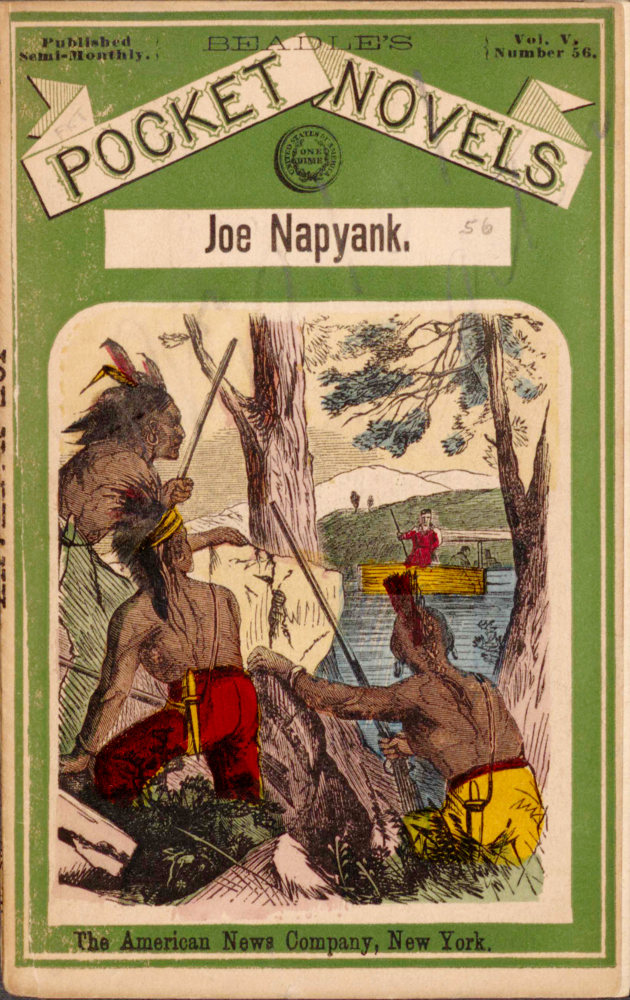
It was an appalling fact that the flat-boat had staved
in its bottom and was rapidly filling with water.
With one bound McGowan sprang to the cabin and
aroused the inmates. Before they were fairly arisen,
he discovered they were in no immediate danger.
The bow of the boat rested on the sand, while the
stern had swung around and was settling some five or
six feet—a depth sufficient to carry the rear entirely
below the surface.
It was the work of a few moments, to land Mrs.
Smith, McGowan and Ruth upon the island. Napyank
leaped down, and assisted them to the ground so successfully
that all landed dry shod. Their valuables
(which being few were indeed valuable) were speedily
cast out and in fifteen minutes after the flat-boat struck,
its entire contents, both animate and inanimate were
upon the island.
“This is a little too bad,” said McGowan gloomily.
“Those few rotten planks have played the mischief.
The boat can never do us any more good.”
“Can’t yees repair it, as the cobbler axed the
docthor after he’d cracked his wife’s skull.”
“Repair it? No, we should never have started with
such an old hulk as that.”
“Perhaps now we’re near enough to the mainland to
be able to wade over,” suggested young Smith.
34
“Can’t do it,” replied the hunter shaking his head.
“We’ll have to make a raft and paddle over.”
“With the old hulk bulging up there, it will be
sure to be seen in the morning,” said McGowan
gloomily surveying the dark mass of useless lumber.
“Can’t we shove it further back into the water, and
let it sink out of sight.”
“We will try it.”
The six men waded into the stream and pressed
their shoulders against the boat. Teddy’s first essay
was accompanied by a slipping of the foot which left
him fall flat upon his face, where he floundered some
time before he regained his upright position.
The united effort of the half-dozen men failed to
budge the craft. It was as heavy and had settled so
firmly that it was absolutely immoveable unless by more
strength than our friends had at their command. As
Teddy remarked, the “owld critter had sat down to
stay.”
“We can’t do anything with it,” said McGowan,
“and that being the case, what shall we do with ourselves?”
“Get off the island as soon as possible,” replied
young Smith.
“It is now so dark that I don’t suppose anything
can be done before morning,” added McGowan.
“Take things easy,” said Teddy. “Don’t you see
we’re safer here than we was on that owld mud-scar.
We could go to the bottom of river wid that any time;
but here we can sleep as sound as snorting tapple.”
“We may as well make ourselves comfortable like
till morning,” added Napyank. “Fix up the women-folks,
and we can take care of ourselves.”
The island was found to be larger than they had at
first supposed. It was more than an eighth of a mile
from one end to the other, thickly wooded, and covered
with rank grass and a dense undergrowth. It was
oval shaped, and very regular in its outline, being rather
more than two hundred feet broad in its widest part.
35
“What a magnificent summer sate this would make
for a gintleman like meself,” said Teddy, as the two
stood in the shadow of a tree, on the lower part of the
island.
“So it would,” replied young Smith. “I shouldn’t
be surprised if it was used for that purpose before
many years.”
“Be the same token it’s the summer sate of a party
of travellers at this very minute, and it’s probable we’ll
make quite a stay upon it.”
“I hope there ain’t any Indians looking at us,” said
McGowan with a shudder, as he glanced toward the
shore of the dark and bloody ground. “I am afraid
for the women.”
“So does I,——but——”
“Look there!” exclaimed McGowan fairly springing
off his feet.
“What? where? I don’t see anything.”
“Here! here! this way!” said he pulling his companion
around. “’Tain’t there——it’s on the island,
right below us! look, can’t you see it?”
“I saas the traas and the fog and that’s all.”
“It disappeared the very minute you looked.
There it is again! Now it’s gone! I wonder what
makes it act that way.”
“What is it, man, you’re making such a noise
about?”
“Why sir,” said McGowan solemnly, “as sure as
you and I stand here, I seen a light moving about on
the island.”
This being the case, McGowan and the two silent
Smiths at once returned to the women, while the
others passed down the shore of the island. They had
gone a considerable distance in silence when young
Smith suddenly caught the arm of the Irishman
like a vice, and without a word pointed meaningly
toward the trees where the alarming manifestations
had first been seen. There was no mistaking this
time. Napyank saw a bright light shining steadily
36
through the trees—so brightly and steadily that he was
certain it could not be far from them. Moving back
more closely under the shadow of their own tree, he
whispered,
“We must find out what the dogs are doing.”
“I say, there ought to be only one or two of us,”
said young Smith. “Suppose you let me and Joe
go?”
“I can, to be sure, but then what use would it be?”
replied the hunter. “I can go, while you stay here
and keep watch.”
“And where’s the naad of our keeping watch here?”
“You know some of the Injins might slip onto
the island while I’m gone, and it wouldn’t take them
long to play the mischief with the women folks.”
“Do yees do the same duty then, for I’m naaded
ilsewhere, and here’s good luck to yees,” said Teddy.
“But——”
But the Irishman and hunter disappeared.
“I hope they won’t get us into trouble,” said young
Smith when he found he was alone. “I think the Irishman
ought to know by this time that we do not relish
his madcap scheme. I would never have come into
such a country as this if we were to be ruined by him.
I don’t know about that, either,” he added, after a
moment’s thought; “I did hate to see Ruth go, and I
don’t believe I could have contented myself at home.
The dear sweet girl! What a pity she should be
subjected to this danger and suffering and that, too,
when we are so near our journey’s end. To-morrow
we should have been able to reach our destination if it
had not been for this bad accident. We have already
enough,” he added, after a moment’s pause, “to let us
know we are in danger this very minute. I understood
Joe to say that this part of the river was the most
dangerous of any that he knew, so, I can’t see how
we are going to get safely through. God watch over
the poor beings that are dependent under thee, upon
us for safety.
37
“I hope the Irishman has sense enough to keep his
eyes about him,” he continued. “That Joe was right
in saying the crisis of the danger would be reached to-night.
We’re in the crisis I believe in this very
minute.”
Young Smith was standing in the attitude of acute
attention, every faculty absorbed in the one of listening,
when his whole being was thrilled by the explosion of
two rifles, followed by a succession of horrid yells that
made his very blood curdle! It needed no thought to
tell him that these came from the throats of the savages,
and that the worst that he had feared, had taken place.
His first impression was, that the two scouts had
been discovered, and fired upon, and that his own life
was in peril. But, upon second thought, he knew by
the direction of the sounds, that they proceeded from
the lower part of the island, and that it was the friends
whom he had left behind, that were attacked. Believing
then, that the scouts were safe, for the present, he was
debating whether to remain where he was, until
rejoined by them or to hasten at once to his friends.
He had not yet come to a conclusion, when a slight
grating noise upon the shingle of the beach caught his
ear, and turning his head, he saw that a canoe had just
landed within a few feet of him, and, at that very
moment, two painted savages were in the act of stepping
ashore. With his heart in his throat, he moved
around to the opposite side of the tree, and watched
the motions of these Indians.
They acted very deliberately, seeming to take no
notice of the tumult, which a moment before, had
broken the profound stillness of stream and wood.
They first pulled the canoe high upon the land, each
took a rifle from it, and then strode directly toward
the tree which concealed the apprehensive man. As
they passed so near that he could have touched them
with his hand, he absolutely believed they would hear
his heart beat. But such a thing has never occurred,
no matter how wildly that organ has throbbed, and
38
then the Indians who would have detected the faintest
sound, passed on, and disappeared in the wood of the
island, without once suspecting how nigh they had
been to one of the very persons for whom they were
searching.
They had hardly gone when Smith stole cautiously
forth to view, and looking carefully about him detected
Teddy stealing up to where he had concealed himself.
“What did you see?” he inquired of the Irishman.
The latter looked carefully about him a moment before
he made a reply.
“May our howly mother presarve us, but the island
is full of the haythen.”
“What is that light we saw?”
“It was the camp fire of a whole pack of the divils.
But, we’re in a bad fix.”
“Didn’t you hear rifles? They’re in a worse fix,”
said young Smith, in an under tone. “What’s to be
done?”
“That’s what I don’t know. We must get back if
we can, and see what the outlandish divils have been
at. Yapnank has left me out there and maybe he’s
gone back already.”
They both started toward the upper end of the
island, the Irishman not disdaining to use the utmost
caution. Every few yards he paused and listened for
the slightest warning of danger, and, so for Smith, he
expected in his excited condition each moment to see
a whole horde of screeching savages rush out from
the trees.
Although naturally brave he had not as yet acquired
that familiarity with this species of danger to make
him cool and collected.
The whole distance was passed without any further
evidence of the presence of the enemy. Upon reaching
their friends they found them vigilant and cool.
They stated that a number of canoes had come from
39
the mainland, and after reconnoitering the flat-boat
had discharged a couple of rifles and then departed.
No one had been injured by the shots although they
came dangerously near the elder Smith. Napyank
had not yet returned, and the young man could see on
the faces of those around him the impress of the most
depressed and saddened forebodings. Some of them,
especially his own cherished Ruth, was endeavoring
to keep up a brave spirit, but none of them could
conceal the discouragement they really felt in their
hearts. Young Smith conversed with them in an under
tone for a few moments and then withdrew to a
retired spot.
Scarcely knowing what he did he walked slowly
out from the protection which the tree afforded him,
and stood on the moonlit beach. He placed the stock
of his rifle on the hard shingle, and leaning upon it
gave way to the most saddened meditations.
Just before him, as motionless as a rock, rested the
hulk of the sunken flat-boat. The soft ripple of the
Ohio against the sand at his feet, that deep hollow
murmur of the great wilderness were the only sounds
that reached his ear; and these from their monotonous
continuity, seemed silence itself. The moon
was nearly over head, shining in that peculiar manner,
that the river seemed to reflect more light than it received.
A few straggling clouds as white as snow-drifts,
now and then floated before the moon, and
huge grotesque shadows glided over the island, across
the stream and into the wood like phantoms. On
either side the frowning forest rose like a wall of
blackness, and seemed to close the whites in an impregnable
prison.
It was no wonder that the young adventurer felt
gloomy and despairing. It could not be otherwise
than this, while within a dozen miles of the settlement,
and in the most dangerous portion of the river,
an accident should place himself and his friends in
imminent peril, and make the escape of all of them in
40
it seemed to him, an utter impossibility. He was in
the midst of these gloomy forebodings, when the sound
of a light footstep startled him, and looking around,
he turned to greet his friends.
“Well, what have you discovered?” he added.
“Are we alone in the island?”
To his surprise he received no reply.
“What are our prospects of getting over to the
mainland?”
As quick as lightning young Smith’s rifle was at his
shoulder, and one of the approaching Indians was
shot through the breast. With a wild yell he sprang
high in the air and fell dead upon the sand. At the
same moment the white man saw something flash and
heard a rushing sound close to his face, followed by
the splash of the tomahawk in the water behind him.
Clubbing his rifle he stood on the defensive, when he
noted that neither of the savages possessed a rifle,
and conscious that he was more than a match for the
surviving one he made a rush at him.
The Indian turned to flee, and Smith had hardly
started in pursuit, when the report of a second rifle
was heard among the trees, followed by a series of
whoops and yells as if a legion of demons had suddenly
been loosed. With a rare presence of mind the
young man comprehended his critical situation in an
instant. The wood was swarming with Indians. If
he went a rod further his own destruction would be
inevitable.
Wheeling around with such celerity that his momentum
carried him nearly off his feet, he flung his gun
from him and ran for his life to the flat-boat. Stepping
one foot into the water he made a tremendous bound
and alighted upon the gunwale, the same as a bird
would have done; and then tearing his hat from his
head, he concentrated all his energies in the one effort
and sprang full a dozen feet out into the river.
The instant he came to the surface he gasped for
breath and dove again, swimming while beneath the
41
surface, as far out toward the Kentucky shore as possible,
repeating the manoeuvre several times, until believing
that he was at a safe distance from the island,
he swam sideways and anxiously surveyed it.
So prompt and rapid had been his movements, that
he had not been seen, and his own escape, if he chose
to improve the opportunity given him, was at least insured;
but he would rather have been smitten by instant
annihilation rather than desert those he had left
behind him. The thought had never once entered his
head.
He continued off the island until the current had
carried him nearly half way to the lower end when
he cautiously approached the shore. As he walked in
under the shadow, several forms followed him like
phantoms, while as many more closed around him
from the wood. He had taken but a few steps, when
he was startled by hearing a suppressed exclamation.
His apprehension told him at once that it was the
voice of an Indian, and he was moving away from
the point from which it came, when he caught a
glimpse of the shadow-like figures around him, and
saw that the most dangerous crisis of his life was upon
him.
The Indians had not yet surrounded him, and conscious
that all depended upon a quick and energetic
decision, he made a dash toward the river. The dense
undergrowth at this portion of the island impeded
the movements of both pursuer and pursued; but the
activity of the white man was superior, and he was
first at the beach, when making another terrific leap,
he bounded out into deep water and dove beneath the
surface.
While beneath the water, young Smith heard distinctly
the dull report of the rifles, and the skipping
of the bullets as they glanced over the water. Being
a skillful swimmer, he turned upon his back, and as
he was borne along upward, he allowed only his mouth
and nose to be exposed, when inhaling a sufficient
42
quantity of air, he again dove, and repeated precisely
the same manoeuvre that we have described before.
Finally believing he was once more safe, he allowed
his head and shoulders to come to view, and looked
back toward the island. To his dismay, an Indian
canoe was within a dozen feet of him! Its occupants
descried him at the same moment that he discovered
them, and now commenced a most exciting
race of life and death!
One minute would have decided the contest in the
middle of the river, but fortunately indeed, Smith’s
efforts had brought him within a few rods of the shore.
Fearful of being fired upon he repeated his stratagem
of diving, and when he came to the surface, struggled
frantically to gain the shore, with the canoe darting
forward like a shadow. As soon as he could gain
a foothold, he tore through the foaming water and
dashed into the woods, while the canoe was scarcely
twice its length behind him.
It was now only by the most skillful running, dodging
and doubling, that he succeeded in freeing himself
from his agile pursuers. He had gone fully half a
mile in the forest before this was accomplished, but he
found himself at length entirely alone, and panting
and exhausted he seated himself upon the ground, to
decide upon the next course to pursue.
He could not think of leaving the island when he
had every reason to believe that all he held dear on
earth was upon it. She whom he cherished above all
others on earth was there and in imminent danger.
And although there were more skilful arms than his
left behind, still he knew his presence and aid were
sorely needed. He resolved to return.
With this determination he arose and retraced his
steps. It is needless to say he made his way as silently,
stealthily and cautiously as he was able to do,
starting at every rustling wind and falling leaf. Upon
reaching the shore of the river, he found that he was
above the island, and wading it, swam out toward it.
43
He wished if possible, to recover his rifle and gain
a glimpse of the band of Indians who had so well nigh
slain him, and who beyond all question were plotting
further hurt.
Steadying himself he allowed the current to carry
him downward, and when several rods distant, checked
his motion, and took a survey of the flat-boat and
its surroundings.
He saw his rifle lying upon the beach, its ornamented
stock and barrel shining in the moonlight. After
carefully surveying every portion of the island that
came under his observation, he detected no sign of
danger, and was about to let himself float forward
again, when the lifted head of a savage rose above the
gunwale, and remained in view for fully a minute.
As the moon shone fully upon the Indian he distinguished
his features plainly. He concluded at once
that there were several others on the flat-boat, and all
waiting for his return. The savage gazed carefully
about him, and descrying nothing, his head disappeared
from view.
“Ah, my fine fellow,” thought Smith, as he noiselessly
swam toward the Ohio shore. “You may watch
there quite a while before you can catch me in any of
your traps.”
He now floated slowly down the river, keeping
about midway between the island and the Ohio
bank, and so far as possible examined the former as he
passed the bank. Reaching its extremity he passed
around it and commenced ascending the opposite side,
so as to complete his reconnoissance. This was an extremely
difficult task, and none but the most powerful
swimmer could have accomplished it. But he succeeded,
and finally “anchored” for a few moments,
abreast of the flat-boat, while he took another observation.
He saw nothing more of the Indians, although
he believed they were still upon it.
He was convinced that the majority of the Indians
were still upon the island, and after floating somewhat
44
lower, he landed at precisely the same spot where
he came so near being captured before. Feeling confident
that he had not been seen, he unhesitatingly
came ashore and passed beneath the shadow of the
trees.
Upon coming from the water, his limbs were so
heavy and felt so exhausted that he threw himself
upon the ground to gain a few moments’ rest. Despite
the exciting scenes in which he had just participated,
and the terrible ordeal through which he had
passed, he fell asleep almost immediately.
It was in the midst of a fearful dream he was awakened
by a grasp upon his arm. Believing resistance
to be useless, he lay motionless, waiting for the command
of his captors.
“Begorrah but bees you goin’ for to shleep a month
whin your friends are in the greatest anxiety on yer
account, barrin the little blue-eyed maiden that is the
most anxious of ’em all.”
A moment later Napyank came from the trees and
congratulated our hero on his escape. He announced
that their friends were withdrawn to a secluded spot
on the island, where they were to remain for the present,
if undisturbed by the Indians.
45
CHAPTER V. SAD NEWS.—RECOVERY OF A RIFLE.
The dull gray light that now began to overspread
the sky, gave token of the coming day, and these
whites withdrew further into the grove for consultation.
“This is a bad business,” remarked young Smith, after
he had exchanged experiences with his friends.
“The fiends have outwitted us at last. God knows
what will become of the others.”
As delicately as possible it was announced to young
Smith that his father had been slain. He was overcome
for a few moments, but by a great effort, he
choked down his emotion. Finally he asked the particulars,
and said,
“Let us hunt him up and give him a decent burial.
Poor mother. We can find some means to scoop out
a grave for him.”
The three moved away to the clearing, but, upon
reaching it, nothing of the body was to be seen. The
Indians had carried it from the island.
“Perhaps it is as well,” said the hunter. “He is
beyond all pain, and suffering, and the disposal of his
body can make no difference to him, although I would
that we could have done our duty to him.”
At this period the stricken man received the intelligence
that at the same time that his parent was slain,
Ruth McGowan was captured. He looked up with
an expression of literal horror.
46
For a few moments nothing was said, and then the
hunter, anxious to relieve the suspense, clamped his
rifle down upon the ground as he came to a halt, and
folding his arm over it, “Here we are, and the question
before this assembly is, how we’re going to get
away. What do you propose to do Teddy?”
“I advise that we ate breakfast.”
“The only objection to that,” replied Napyank,
“is that we have nothing to eat; but we must first
go over the island again and learn if there are any of
the demons left. If not we must get on their tracks,
for as true as the heaven is above me, I’ll never go to
that settlement without Ruth.”
“I am certain—that is, as certain as I can be—that
the last of the Indians left the island a half hour ago.
We saw their canoes going off.”
“It is best be certain. We will go to the lower
end of the island, and proceed to the upper end, to
learn whether any of the reds are left, and if——”
“And if—what then?”
“You will see,” replied Napyank, shaking his head
very significantly.
At the extremity of the island the three separated,
as had been proposed, and commenced making their
way back again.
In doing this, it was necessary to avoid exposing
themselves, and from the great caution that was necessary,
the work was an entirely difficult and tedious
one.
It was not until full two hours had elapsed that
three whites met on the spot that had been designated
as their rendezvous.
Their search, or examination, as it might be termed,
proved that the savages had indeed left the island, not
a sign of one having been discovered. They had
probably done this under the belief that the whites
had succeeded in reaching the mainland, so that the
latter were convinced that if they kept themselves
concealed during the day, they would not be disturbed,
47
and could easily get away when night came again.
The ashes of their camp-fire had been discovered,
and blood upon the leaves and other evidences
of their recent visit.
“But, where’s your rifle?” asked Joe, who noticed
that young Smith had been unprovided with that weapon.
The latter looked through the trees.
“Yonder it lies this minute. Strange that they did
not steal that also. I will go and recover it.”
He paused ere he had passed out from among the
trees, for the very fact that the rifle lay there undisturbed,
sent a suspicious pang through him. It seemed
probable that such an occurrence could be a mere
accident. A true Indian, rarely, if ever, committed
such an oversight. The rifle was magnificently mounted
and would have been a prize to any one.
There was another matter, which in Smith’s state of
mind excited suspicion and apprehension. He believed
the gun did not lie on the precise spot where
he had thrown it. He recollected that he had flung
it with such force that it must have gone very nearly
to the edge of the beach, whereas it now lay either
on the very spot that he had passed over, or a few
feet on the opposite side.
This circumstance, which at any other time, would
have attracted no attention at all, caused our hero
much uneasiness. He felt that it was by no means
certain that every thing was right upon the island,
although it had just been proven, that their enemies
had left it. It looked to him as though a trap had
been laid to ensnare him, and this rifle of his, lying
but a few yards distant was the bait.
Feeling very well convinced that there was some
design in the presence of the rifle, he set himself to
work to discover the precise means by which it was
intended to entrap him. There being no Indians on
the island, of course he ran no risk of being taken
prisoner, in case he ventured out to secure the weapon.
48
The distance from this point to either shore
was so slight, that it would have been the easiest matter
in the world for a concealed savage to pick him
off.
Ah! the flat-boat! Smith’s heart leaped at the
thought. Strange that it had not occurred to him before.
There it lay just as it had during the night,
save, perhaps, that it had sunk a few inches lower.
It was upon that he had seen the heads of several Indians,
and there, in all probability, they still lay in
wait, watching for his reappearance.
What reason had the Indians to suppose that Smith
would again return to the island. The best of reasons.
He had shown to them a desire to do so, and
as long as he believed that his friends were there, the
savages well knew he would linger in the vicinity.
Once upon the island he would not fail to recover his
gun, provided he believed he incurred no additional
danger in doing so.
That, then, was the solution of the question. Taking
all matters into consideration, Smith came to the
conclusion that it was their desire to take him prisoner,
instead of shooting him, deeming most probably,
the latter death far too comfortable a mode for him to
use of getting out of the world. He knew enough
of the bloodthirsty savages to understand what a terrible
fate would be his, in case he fell into their hands.
They would take a fearful vengeance, for the Indian
he had killed in self-defence. Well, indeed had it
been for the elder Smith, that he was so speedily slain.
It brought him a quick death, instead of a lingering
torture.
These reflections, which we recorded at some length
occupied but a few seconds. He saw everything with
a hunter’s eye and with a shake of the head, stepped
back a pace or two, and resumed his position beside
the Irishman and hunter.
“What’s the matter?” asked the latter.
“It won’t do—it won’t do.”
49
“What won’t do? Do you mean to go out there
and pick up your rifle?”
“Yes, that is what I mean.”
“What is to hinder?”
“I don’t like the looks of that flat-boat.”
“Whew!” blew the hunter, surveying the object in
question as though he had never seen it before.
“Why you don’t like it?”
“I am afraid there are Indians concealed upon the
boat. I saw them there last night.”
And now arose a dispute in which all three of the
whites engaged. The hunter, most certainly was the
best qualified to judge, expressed it as his firm conviction,
that half a dozen Indians at least were at that
moment glaring out from the flat-boat, and waiting
for their reappearance. Teddy persistently maintained
that there was but one savage upon the raft, and
that he lay in the cabin sound asleep! He could give
no satisfactory reasons to the others for this belief, but
he appeared sincerely to believe it himself.
Like all excited debaters, the longer they argued,
they more strenuously did each affirm his belief in
what he first stated. How long the dispute would
have lasted, it is impossible to tell, had not the Irishman
proposed to decide it at once.
“Be jabers, it’s meself that ses there’s not more nor
one haythen upon the raft, and it’s meself that’ll prove
it to yees.”
“How are you going to do it?” asked Smith.
“Why, like a gentleman, by walking out there and
picking up the rifle for yees.”
“That would be folly upon your part. The weapon
is not worth risking your life for.”
“I doesn’t intend riskin’ me life for it.”
“Well, don’t go Teddy; there is no need of it. I
will give up my side of the question and agree with
you, if you will stay with us.”
“You will agree with me, will yees?” asked Teddy
with a curious expression of his fine blue eyes.
50
“Yes, if that will satisfy you.”
“It suits me to a tee. You agree with me then,
when I say there isn’t more nor one of the haythen
within five miles. Begorra then, if that’s what yees
believes, what harrum can come to me in picking up
yer gun for yees alone! so here goes.”
The hunter placed his hand on the shoulder of the
Irishman and interposed.
“Don’t do it, Teddy; there is no need of it.”
“There is every need in the world for the young
gentleman to have his gun, and there is every need of
my getting it for him, being as he’s afraid to get it
himself.”
“But it is too dangerous—it is too dangerous. I
wouldn’t do it.
“Don’t make a fool of yourself, Teddy.”
“Why, by what token have ye any reason to object,
bein’ that ye think there is but one of the dogs on
the boat and he sound asleep.”
“He might wake up and shoot at you. You might
stub your toe.”
The Irishman was getting impatient. He waved
them off, and stooping down rolled up his pantaloons
and put his cap on one side, so as to give himself a
saucy dare-devil air. Then, without any weapon at
all in his hand, and whistling “St. Patrick’s Day in
the Morning,” he walked boldly out on the beach and
picked up the rifle of Smith.
It would be difficult to portray the emotion of the
two whites as they watched the reckless Irishman.
They scarcely breathed as he walked away from them,
and with painfully throbbing hearts they kept their
eyes fixed upon his every movement. While in the
act of stooping to pick up the piece, the hunter
thought his ear caught a noise upon the flat-boat, and
he turned his head away, not wishing to see the venturesome
man shot down. But while his eyes were
still closed, Teddy reappeared beside him, and with
an exulting look handed his rifle to young Smith.
51
“What do yees think now?” he asked.
“I still believe there are savages concealed in that
flat-boat; and they only refrained from shooting you,
in the belief that an opportunity of taking you a prisoner
would soon be given them.
“And as for me,” said the hunter, “I am morally
convinced that a half dozen rifles were ready cocked
to blow your brains out; but they knowed you’d
come right into their hands, so they can afford to
wait.”
“Be jabers I’ll soon find out!”
“How?”
“I’m goin’ on the owld flat-boat itself.”
If the two men had been earnest in the objections,
to the venture he had just made, they were nearly
frantic in their efforts to restrain him from this fool-hardy
exposure.
52
CHAPTER VI. A RECKLESS ADVENTURE.—CAPTURE OF TEDDY.—A VISIT TO THE FLAT-BOAT.—THOUGHTS OF RESCUE.
Teddy announced that he intended visiting the boat
for the further purpose of “detecting the apparance of
things generally.”
“You won’t do any such thing,” said Smith somewhat
impatiently. “You have already made a fool of
yourself several times.”
“Be the same token I must then remain one, I
suppose.”
“I object,” said the hunter, shaking his head, “it
can’t do any good, and it may do a mighty sight of
hurt.”
“And haow?”
“I will tell you. The redskins know that we three
are bobbing round the island, and so long as they know
that, they will give us a wide berth. They know that
we’ve got some women with us, and a few more rifles
too, but it’s we three that are keeping them away.
S’pose one of us gets tuk, what’ll hinder ’em longer?”
“’Spose one of ’em doesn’t get tuck.”
“He will then be killed.”
“But there are no Injins there.”
It is a fact, that a man may commence with an
assertion of absolute falsehood and, conscious at the
beginning that he is defending such, argue himself in
time, into the belief that it is truth. Then it was that
Teddy, as he stepped gaily out upon the beach, was
greatly relieved of anxiety by his own persistency in
53
adhering to what he well knew was error. He was
well nigh convinced of what he had scarcely a hope
before, that there were no savages upon the flat-boat.
Teddy had walked two-thirds of the distance to the
hulk, and was within a few feet of the water, when he
paused. He had discovered a startling thing!
That which arrested the brave-hearted Irishman, was
the sight of a tuft of an Indian’s head, visible for one
moment only just above the gunwale, when it dropped
suddenly from view again.
Smith and Napyank, noticing his hesitation, called
out in a whisper for him to return. This very call was
the means of sending him forward again. He was
resolved that they should never laugh at this adventure,
and with rather a quickened step, he strode forward,
and grasping the gunwale with one hand, he carried
himself with one bound, over upon the deck.
He had left his rifle behind, and was armed
only with his knife. His two friends breathlessly
watched him and listened. They saw his head and
shoulders gradually lower as he walked undauntedly
toward the stern of the boat, until the bow hid them
from sight, and then all was still.
The silence lasted for perhaps, a full minute, and
then was broken by a yell as startling and terrific as
an explosion of thunder in the clear summer sky.
Instantly a half dozen tufted heads was seen dodging
hither and thither over the deck, all centering around
one burly, bareheaded figure, that was struggling like
a lion amid a score of enemies which had dogged him
nigh to death.
While the two men gazed transfixed with horror, a
powerful-limbed Indian shot up like a rocket in midair,
and came down in the river. Ere he had struck,
another went spinning after him, falling flat on his face
in the water, with a concussion that cracked like a
pistol. While they were swimming with all speed,
back to the boat, a heavy fall was heard, a faint
shuffling noise, and then all was still.
54
As the foremost Indian was in the act of pulling
himself over the gunwale of the flat-boat, he let go
with a horrid whoop, and fell back dead, shot through
the brain by a bullet from the rifle of the hunter. The
other attempted to swim behind the stern, but Smith
shot him ere it could be accomplished.
There could be but one cause for the sudden cessation
of the tumult upon the flat-boat. Teddy had
either been overcome or slain. The silence that succeeded
the fearful yell and struggle was equally painful
to his two friends. They waited long and impatiently
for it to be broken.
“It’s all up with him,” whispered Smith, as he
primed his rifle. “I pity him, but our hands are clear
of his blood.”
“Too bad, too bad,” muttered Joe, who had just
loaded his rifle, “he was a good fellow, my dear Teddy
was indeed. I am sorry that he has come to this bad
end.”
“We must look out for ourselves, now. The best
thing we can do, is to get off this infernal island,
which has been the scene of so much misfortune to us,
I am afraid that if we remain much longer, you will
take it into your head to perform some such feat, and
I shall be left alone.”
“No, indeed, I won’t; there is no danger of that,”
replied Joe. “I’ve lived long enough to larn common
sense I think.”
“It is yet early in the forenoon, and I suppose we
shall be compelled to remain here until night.”
“Of course we shall! It won’t do to start out in
the river in open daylight. We’d be killed before we
had gone a dozen yards.”
“Hello! did you hear that?” exclaimed Smith, with
a start.
Several whoops were heard upon the Kentucky
shore, apparently in answer to those which had been
uttered some minutes before, by the captors of Teddy.
Peering through the trees, Smith added,
55
“There is a party coming off in a canoe. Get ready
for hot work.”
“There don’t seem to be any good chance to hide,”
remarked Joe, glancing around him, as though he cared
little whether there was such place or not.
“No, we must stand our ground; they have just
started.”
The canoe which was approaching was a large
Indian one, in which were seated some three or four
Indians, all busily plying their paddles. They headed
straight for the upper end of the island, while the
whites stood each behind a tree, with cocked rifles,
waiting until they were compelled to fire.
Just as the canoe seemed about to touch, it sheered
off and ran alongside of the flat-boat, where it lay
against and parallel to it. The heads of four savages
immediately appeared above, as though they were
staggering under the weight of some heavy load. The
next second, Teddy, bound hand and foot, was handed
over and deposited in the bottom of the canoe. His
friends could hear him muttering dire threats of vengeance,
and daring his captors to loose him for a
moment, all of which, it is needless to say, attracted
no notice whatever from them.
The captive disposed of, the Indians followed, sinking
the canoe to its very gunwales. They paddled
away toward the shore, and in a few moments, disappeared
from view.
“Now, at least,” said Smith, “the island and boat are
free from the imps, and we can have a breathing spell.
Let us go upon the old hulk.”
“What in the world do you want to do that for?”
“It is the safest place.”
“I should like to inquire how it is.”
“In the first place, there is no one upon it, and in
the second place, as its sides are bullet-proof, we can use
it as a fort, and keep off any number of foe until dark,
when we can get off ourselves.”
The hunter smiled grimly as if the conceit of the
56
young man pleased him. Adding that it was time
they paid their friends a visit, he consented to young
Smith’s proposition.
It was with some misgiving, slight enough, but still
sufficient to occasion uneasiness, that the young man
once more approached the flat-boat. When he reached
the deck, he experienced an irresistible desire to
explore every portion of it; not that he suspected the
presence of any Indian, but that he could not feel
positively assured, until he had done so. The result
was, that it was found to be entirely destitute of any
persons except themselves. The cabin was half full
of water, and it was here that the Indians had concealed
themselves while their victim was approaching.
This proceeding of the two men, in taking possession
of the old craft, was the most prudent thing he
could have done. Had the two remained upon the
island, they both would have been captured or shot,
and the destruction of the entire party completed;
but, as one had remarked, they had gained a fort
where they could keep ten times their number at
bay.
To the infinite joy of both, Joe stumbled upon a
loaf of bread, which had escaped the eyes of the
Indians. He pounced upon it greedily, and to the two
famished adventurers, it was a perfect godsend. This
devoured, and their hunger appeased—for it was an
old fashioned loaf—both felt hopeful again.
“If there were anything in the hulk,” said Smith,
“we might stand a regular siege, and bid defiance to
the whole redskin nation.”
“There ain’t a single bit more,” replied Joe, “except
a few crumbs upon that shelf there.”
“Gather them up, gather them up; they may do us
good.”
“I have gathered them up. I thought they’d git
wasted, so I jest rolled my tongue about the cupboard,
and finished ’em.”
During this fragmentary conversation, Joe was
57
constantly glancing about the river to see that no foe
approached them unaware. The sad experience of the
last few hours, had educated young Smith wonderfully.
All this time, the reader will have noticed, his actions
were controlled simply by necessity; he had taken no
step except such as had been compelled by a regard for
his own personal safety. Now, that that was attended
to, he had leisure to look further into the future, and
to reflect upon some definite plan for the rescue of
Ruth from the hands of the savages.
This was the great question, and it was this which
troubled him sorely. He could not think of leaving
the neighborhood while she was a prisoner; and yet
he could see nothing at all, that he was able to accomplish
against the formidable band of savages. Although
he pitied Teddy from the bottom of his heart,
it could not be suspected that under the present circumstances,
he could do anything toward his rescue.
Somehow or other, the thought constantly recurred
to the young man, that something important would
result from the fact that the Irishman was a fellow-captive
with her. He was bold to recklessness, quick-witted,
and faithful, and more from the natural kindness
of his disposition, than a desire to return the interest
shown in his own welfare, would he do all in his
power, to befriend the helpless captive.
There were two schemes that Smith and the hunter
thought long and earnestly upon. The first was to
leave the flat-boat as soon as the darkness would permit,
and accompanied by all the remaining fugitives
make all haste to the settlement, and rally a large
party of the frontiermen, who would be able to overcome
the entire force of the Indians.
The main objection to the proceeding was, that it
required too much time for its execution. Ere the
party could be raised the savages would have penetrated
so far into the labyrinths of the wilderness as to
make pursuit hopeless. If they chose they would
58
have abundant time to reach one of their towns, where
it would require an army to dislodge them.
The other plan and the one which the ardent adventurer
most favored, was, to attempt to regain her
by stratagem—to cross over to the mainland, and to
hang constantly in the vicinity of the savages, keeping
a watch upon their movements, and trusting to his
own quick perception and promptness of action, when
the all-important occasion arrived.
The more he reflected, the more he was pleased with
this project, and he finally imparted it a final resolution
to his friend.
“It’s running a great risk,” replied the latter,
scratching his head; “but I don’t see any other way
of getting the gal; I’m with you in whatever you
want to do. You’re considerable green I allow, but
you’ve larned a powerful lot in the last day or two,
and I think could manage it. But jist now I’m right
hungry.”
“We will find means to obtain that when we once
get into the woods. For the present we must bear
our hunger patiently, and thank God we’re not dependent
upon the Indians for food.”
“I should like to inquire what time you think it is?”
“It must be considerably advanced in the afternoon,”
replied Smith, looking up at the sky. “The
weather still remains clear, and there is no evidence
of an approaching storm. I am glad that there will
be no moon to-night. What we want is darkness—darkness.”
The afternoon gradually wore away, the sun went
down, and evening once more settled upon wood and
river. The same silence as profound as the tomb, held
reign, and cautiously and silently the two whites let
themselves down from the flat-boat, and made their
preparations to leave the island, which had been the
scene of such woe and suffering to their little party.
59
CHAPTER VII. DEATH AND CAPTURE.—THE COMPANIONS IN CAPTIVITY.
The reader will recollect, that a few hours after the
flat-boat had grounded, and when the moon had risen
Napyank, Teddy and young Smith set out to explore
the island. McGowan and his family and the remaining
Smiths staid behind. The former had left the
trees, and the two latter were engaged in an affectionate
earnest conversation, when some five or six
Indians appeared beside them. Before Ruth could recover
her self-possession, one of them raised his piece
within a dozen feet of the older Smith, and discharged
it full at him, while several of the others sprang forward
and grasped her.
Smith was severely wounded and blinded by pain;
he sprang up with supernatural strength, and made off
at the top of his speed through the wood. He was pursued
to the edge of the clearing, when he was despatched
with alarming celerity.
The savages who held the daughter prisoner, waited
but a few seconds when they embarked in their canoe,
and crossed to the mainland. A portion however remained
upon the island, and we have recorded young
Smith’s adventures with them.
The Indians fully conscious that the whites were
alarmed for their own safety, despaired of capturing
them upon the island by stratagem, and were on the
point of making a bold attack upon them, when eight
stole out on the flat-boat, and concealed themselves
60
upon it, in the belief that the whites would visit it by
the succeeding day, at least, when they would fall an
easy prey to them.
We have shown how this stratagem partially succeeded.
The head which Teddy descried prepared
him for danger, and he went over the side of the flat-boat,
in the full expectation of a “free fight.” He
was somewhat surprised on reaching the deck to see
nothing of his enemies; but rightly conjecturing that
they were concealed in the cabin, he passed it with
the same impudent, swaggering air that he had left
the island. He was even whistling “St. Patrick’s
Day” louder than ever.
Right abreast of the cabin door, a powerful half-naked
Indian sprang up and made at him. The Irishman
caught a glimpse of several other tufted heads,
and springing like a panther upon the one in question,
he lifted him from his feet, and by sheer animal
strength flung him over the gunwale into the water.
By this time a second Indian was beside him, and as
quick as lightning he was served in the same manner.
The bronzed heads were now coming up out of the
cabin rather too rapidly for the excited Irishman.
Nevertheless it is by no means improbable, that at the
disadvantage which he had his enemies, he would
have successfully resisted them all, had not an accident
turned the scales against him.
It has been stated that Teddy had no weapon but
his knife, and in the melee he had not once thought of
it, fighting, Irishman-like with his naked fists. The
third face that appeared above the deck received a
tremendous blow square on the nose, that completely
mashed it; and another terrific right-hander gave the
fourth savage a glimpse of more stars than are generally
visible, and sent him as limp as a rag, back
among his fellows.
The fight now culminated in the most glorious fun
61
that the Irishman could have desired. He was striking
out right and left his stunning blows, when, concentrating
all his strength in his right arm, he dashed
his fist at the savage who stood the tallest, intending
to lay him insensible, when the agile foe dodged him,
and carried forward by the momentum of his own
blow, the Irishman went headlong right among the
redskins, where he was, pounced upon, and bound in
a twinkling.
“Thrate me gintlemanly,” he exclaimed, “ye can’t say
but what I did yees; and dont come any of your tricks
over me.”
The undaunted bravery and remarkable skill exhibited
by the Irishman, could but excite admiration in
his captors; and actuated by that chivalrous feeling
existing in the breast of every brave-hearted being,
whether he be savage or civilized, they forebore heaping
any insult upon him, or offering him any indignity.
Some time after, the canoe came alongside, and he
was handed over and deposited in it.
“Handle me with care,” remarked Teddy, “for ye
can’t say that I didn’t handle yees in that manner. If
ye don’t belave it look at them chaps’ noses there!
Begorrah, but them’s the ornaments ye might be proud
to wear!”
Shortly after, the canoe touched shore, and the Irishman’s
lower limbs were unbound and he placed upon
his feet.
“Just sarve my arms in the same manner,” said he,
“and let’s pitch in, in thrue style. Be the powers but
I wants a little exercise, and that’s the kind I always
fancied. That’s what I took to when I was a wee
childer.”
It is not probable that the Indians would have heeded
this request, even had they understood it; but having
no idea of the meaning of the words addressed
them, of course Teddy’s wish was not gratified.
Securely guarded by his captors, Teddy walked several
62
hundred yards through the woods when he came
to the encampment of the savages. Some six or
eight were here waiting for their companions, so that
the entire party numbered about twenty, all of whom
were congregated together.
Teddy’s great curiosity was to obtain a glimpse of
his companion in captivity, Ruth McGowan, and he
was greatly disappointed and surprised to see nothing
of her. The Indians were gathered in an irregular
circle around the fire, some smoking, some chatting,
and others apparently asleep. While looking around
him the Irishman’s eyes fell upon her, and the cause
of her escaping his notice was immediately manifest.
The savages had thrown a brilliant crimson shawl
over her shoulders, and her hair being as jetty black
as theirs, and her head bowed, he had taken her for
one of their number when he had first looked upon
them. Ruth sat, as we have said, with her head bowed,
for her heart was stricken with grief. The picture
of the old man, Mr. Smith, springing up with his
wild look, and running through the trees, pursued by
his merciless enemies, was ever before her. She could
not drive it from her, and shudder after shudder ran
through her frame, and the tears trickled thick and fast
between her fingers.
How changed since yesterday! Suffering, misfortune
and death had come upon them, and separated
her from him who was dearer than any relative could
be! All alone!—alone!
No, she was not all alone! There was One who
was ever nigh her—who never lost sight of His stricken
ones, and who only could comfort her in this dark
hour which had come upon her. To Him she turned,
as the human heart will turn, when bleeding and lacerated,
and refusing to be comforted by any sympathy
the world can give.
But it was hard to be separated from all kindred.
63
The thought was loathsome and full of abhorrence,
that she, an unprotected woman, was alone among a
party of bloodthirsty savages. She hardly dared look
upon them, and yet looking through her tears, she
ventured to steal a glance at them. How her heart
leaped as her gaze rested upon the broad, jovial face
of Teddy, the Irishman, his pitying blue eyes fixed
upon herself. Removing her hands, she looked up,
and with a mournful smile returned his nod of recognition.
Comprehending the question her very looks
formed, the quick-witted Irishman replied,
“Yes, I’m the only one beside yourself that the
haythen have, and they wouldn’t have got me if I
hadn’t struck at one of ’em and missed ’em. Ye just
keep quiet me jewil and you’ll hear of Teddy
agin.”
A sort of consultation was now held among the Indians
relating to the prisoners, but to those who were
not, the debate being as to what means should be employed
to capture them also. After a protracted discussion,
it was decided that the whole party, with the
exception of enough to guard the prisoners, should
cross over to the island and boldly attack them.
This decided upon, the preparations were instantly
completed, and the warriors moved down to the bank,
leaving Ruth and Teddy to the guardianship of two of
their number. At the very moment of reaching the
river, they descried the two whites as they climbed
upon the flat-boat.
This caused a halt and a further debate. Large as
was the Indian party, a majority were opposed on
assaulting the stronghold. They had already learned
enough of their mettle to understand that this would
be a dangerous undertaking upon their part, and many
more were convinced that there was no hope at all, of
success.
It was finally decided to give up the hope of securing
the remaining whites by this means. The sagacious
Indians suspecting the relation which existed
64
between one of them and one of the captives already
in their possession, believed a much better opportunity
would be offered. Love will play the wild with any
man, and lead him to attempt deeds, which, in his
cooler moments, he would pronounce madness. So
they were content to bide their time.
65
CHAPTER VIII. A NIGHT VOYAGE DOWN THE RIVER.—SINGULAR APPEARANCE.—THE DEPARTURE.
Huddled together in the densest portion of the
wood on the island, were the little band of fugitives.
While the fitful tumult of deadly strife was going on
around them, they had been compelled to sit still and
not raise a hand either on the defensive or offensive.
To McGowan especially this was exceedingly galling.
Strong, ambitious and genuinely brave as he was,
he longed to give the persecuting redskins a taste
of his temper, and more than once he clutched his
rifle with a resolve to go to the assistance of his friends.
But there were more helpless ones that it was his duty
to guard. He had agreed to remain by these unless
called forth by imperative necessity.
The death of his old comrade Smith was a severe
trial to him as well as to his family. He was stricken
down so suddenly that he had scarcely time to realize
it until now, when he sat quiet and meditative.
Mrs. Smith had been bowed with grief ever since.
Her smothered sobs now and then reached the ears
and hearts of those around her, as she vainly endeavored
to keep down her emotion.
Abram Smith sat stern and silent, grasping his gun
and looking around him, as if longing for a chance to
revenge the death of his parent. No evidence of feeling
escaped him, but “still waters run deep,” and
there can be no question but that the inmost recesses
of his heart were deeply stirred.
66
As the night advanced and darkness increased, the
fugitives gathered more closely together. In addition
to the distress of mind they were exceedingly hungry,
and their condition was therefore as uncomfortable
as could be well imagined.
Suddenly a light footstep caught the ear of the two
sentinels, and as they looked up they distinguished
two forms that glided insidiously among them. The
assuring voice of Napyank was immediately heard.
“Don’t be skeart; it’s us.”
“We are glad of your return; we’re beginning to
get lonely.”
“And hungry too, I make no doubt.”
“You are right there, if you refer to myself, and
there can be no doubt but that the others are in the
same condition.”
“Well, I tried to get you a bite, and succeeded, I
think. It won’t do to start a fire, so I’ll hand it
round.”
“That is what you called a bundle of clothes?” remarked
the young man. “You were very prudent
to say the least.”
The thoughtful hunter had managed to secure and
cook some game, which he passed around to the distressed
fugitives. It was partaken of with a keen relish,
despite their gloomy situation, and each was filled
and refreshed.
“Now,” said McGowan, when they had finished,
“it seems to me it is time we began to think of getting
from the island. God help poor Ruth! what is
to become of her?”
“She’ll be rescued,” was the hearty response of the
hunter.
The agonized father caught at the words as a drowning
man at a straw.
“And how can that be done?”
“In a great many ways; it’s to be done; that’s settled.”
“I don’t see Teddy with you.”
67
“He has gone after Ruth, and we are going to follow
him in a few hours.”
“God grant you success.”
At this juncture Mrs. McGowan fell into such agonized
lamentations that all were compelled to quiet until
she could recover. The hunter then said,
“The Injins have all left the island, but there is no
telling when they may come back again. So the best
thing we can do is, to leave it while we have the
chance.”
“But Ruth——”
—“Will be attended to. We are just going to put
you into a place of safety, where you can stay until
we come back. There’s a considerable slice of meat
left, and we don’t ’xpect to be gone more than a day
or two, and maybe not as long as that.”
“How are we going to leave?”
“On a raft.”
“And have you it ready?”
“No; but won’t take us long. As you have been
setting here a good while. Suppose I take you and
Abe to help me and leave young Smith to stand
guard.”
This was quite a relief to McGowan and Smith, and
the proposal was gladly accepted by them, while
Stoddard, the younger, experienced a mournful pleasure
in remaining behind and attempting to comfort
his mother.
“I have noticed,” said the hunter, as they made their
way to the upper portion of the island, “that there is
a powerful lot of drift wood lying around here.”
“Can’t we get considerable material from the flat-boat?”
“Sartinly—sartinly; I didn’t think of that.”
“You have no fear of the Indians; have you?”
“I’m purty sartin there ain’t one upon the island,
but I think they’ll be back some time afore morning.”
“Then we can’t leave too soon.”
“You’re right this time.”
68
A few moments later and they reached the island’s
margin, where the great dark hulk of the flat-boat
was seen grim and silent, as if it had never looked upon
the deadly affray between men. Cautioning his
companions to remain silent, the hunter made ready
to board it. He experienced some apprehension, as he
cautiously walked toward it, and he stepped a few feet
in the water, placed his hand on the gunwale he paused
a moment and listened.
All was still save the soft wash of the current
against the side of the flat-boat.
Waiting but a moment, he leaped lightly over and
came down upon the deck. Even then he was somewhat
apprehensive of danger. It was not until he
had traveled every portion of it, that he felt entirely
free from a shivering anticipation of a blow from behind.
Firmly convinced at length that he was alone
upon the unlucky craft, he called his companions to
approach. By their united efforts they loosened the
cumbersome roof of the cabin, and let it into the water.
It was their intention to let it down easily, but
its great weight precipitated it into a loud splash that
caused each to start with alarm.
“We must be expeditious,” said McGowan, who
seemed to be in a constant dread of the return of the
Indians. “They’ll begin to suspect something is going
on, and there’ll be half a hundred over here before
we know it.”
“Don’t be too skeart,” said Napyank, who was
ever cool and collected.
All three busied themselves in collecting the driftwood.
A large portion of this consisted of goodly-sized
trees, which had lain in the sun until thoroughly
dried, and was therefore as buoyant as cork. These
were secured together by withes until a goodly-sized
craft was constructed.
“It will take more wood than we can get to float
all of us.”
“What shall we do?”
69
“We have enough to float the two women. The
rest of us must keep in the water and swim along
with it.”
To test the structure all three got upon it and
floated downward by the island. It bore them well,
and gave them considerable confidence in it. At the
lower portion it was drawn upon the beach, and
Smith remained to watch it, while the others went
into the wood in quest of their friends.
The latter were found quiet and patient, waiting for
the summons to take them from the island. No time
was lost by delay, and it seemed to the silent Abram
that his comrades had been gone scarcely five minutes,
when they all came silently out of the wood and
stood beside him.
The darkness by this time had so increased that the
objects were scarcely visible a dozen feet away. This
was all the more favorable to the fugitives who fully
appreciated the importance of improving this advantage
that might not come to them again.
Some delay was occasioned by the timidity of the
females who were fearful of trusting themselves upon
the raft. It was not until the hunter and McGowan
had demonstrated their buoyancy, that they were
willing to trust themselves to the current. The rifles
of the party were placed upon the raft, and shoving it
gently forth the entire party commenced floating
down stream.
The four men clung to the raft with their hands, it
being scarcely disturbed by the additional weight.
McGowan was the only man who was unable to swim.
As he was carried off his feet and appreciated that he
was really beyond his depth, a shiver of terror ran
through him that almost unmanned him. None
around him saw it, as he regained his usual self-possession
in a few moments.
For the space of twenty minutes the party glided
forward in this singular manner without a word being
70
spoken, when suddenly Joe Napyank whispered,
“Sh! down! quick!”
The females did not comprehend him, until he repeated
his order more energetically than before, and
reached over the raft and twitched their clothes. They
then reclined upon logs, but their curiosity was sufficient
to tempt them to look around, and endeavor to
learn the meaning of this sudden command.
Neither of the females nor those who had heard the
word of caution, comprehended the cause of it.
Young Smith and McGowan especially were puzzled.
They peered into the surrounding darkness, but failed
to detect anything. Stoddard was on the point of
questioning the hunter, when through the deep
gloom he discovered a bright point of light, slowly
passing over the surface of the water. It had not the
twinkle, glimmering glow, such as a lantern or a star
would naturally have made; but it burned with a mild
steady light similar to that of an ember.
What puzzled the whites was to tell the distance
this was away. Stoddard and Smith at first glimpse
thought it within thirty feet, but continually after it
seemed fully a hundred yards. Regularly forward it
continued to glide, until finally it disappeared as if it
had been the ember of a torch suddenly thrust beneath
the surface of the water.
During all the time not the slightest ripple was
heard as explanatory of the singular occurrence. Smith
turned toward the hunter,
“What is the meaning of that?”
“Some more of the blasted heathen.”
“How, I don’t understand.”
“In a canoe. Didn’t you see ’em?”
“I saw nothing but the light.”
“One of ’em was smoking—that was what you
seen.”
“How far away were they?”
“Just make a guess.”
“A hundred yards I should say.”
71
“What do you think?” added the hunter addressing
McGowan.
“I should say fully that, if not more.”
Joe indulged in a suppressed laugh before he made
answer.
“You’re both mistook. I could put out that pipe
with a mouthful of tobacco juice.”
“Impossible! they must have been within a dozen
feet of us—not a bit more.”
“And they wan’t neither. Didn’t you see the
canoe?”
“I never once caught sight of it!”
“I seen it as it went by.”
“What a narrow escape!” exclaimed McGowan,
appreciating the great danger which had passed them
so closely.
“How did you know they were coming?” inquired
Stoddard.
“I hear the noise of their paddles.”
“You have sharper ears than any of us if that is
the case.”
“Not at all; I expected maybe there was something
up, so I jest let my ear drop below the surface,
and then heard the paddles. You could have done
the same if you only thought of it.”
“But we did not; which is generally the difference
between us. They might have run into us before. I
should have seen them.”
“Just let your ears drop under water, and tell me
whether you can hear anything,” said the hunter.
Stoddard Smith did as was requested, and detected
faintly but distinctly the dip of a paddle. He spoke
in considerable excitement,
“They’re coming back again.”
“Not quite, I guess; it is the same ones going
away.”
“God grant they may remain away,” exclaimed
McGowan, in an under tone, “They have caused us
enough agony already.”
72
At this juncture the hunter admonished silence, and
for some time nothing more was said. Soon, however,
young Smith observed Joe struggling as though
he were endeavoring to change the position of the
raft.
“Make for the Kentucky shore,” he whispered.
“It is time we began to hunt the land.”
“Do you want to go in at any particular spot?”
“No; you need not work very hard. Shove the
thing gently and we’ll land soon enough.”
It was not long before the great wall of overhanging
trees was discernible, and simultaneously all three
felt their feet touch bottom. The water, however, was
of sufficient depth to float the raft to shore, and it was
run directly under a morass of overhanging limbs and
undergrowth. This accomplished, the entire party
landed.
“Now, what is to be done?” queried McGowan.
“Sleep? all of you.”
They were tired and exhausted, and the females
making themselves as comfortable as possible, dropped
off into a profound slumber. Abram Smith
shortly followed them, so that the two adventurers
and McGowan were the only ones who remained
awake.
“Now,” said the hunter, addressing McGowan, and
speaking in a manner that showed he was conscious
that all looked to him for advice and direction in this
hour of danger, “there is no telling how long we may
be gone; so you must not be frightened if you do not
see us for two days. I have left you enough meat to
last you, if you are saving. There is plenty of game
about you, but you must starve to death before you
risk a shot. If you can fix up any contrivance to fish
you can do so, but you mustn’t build any fire unless
it’s during the day time, and then be powerful careful
about it.”
“Joe, we are but a short distance off from the settlement;
73
why not float on. We would reach it by
morning—would we not?”
“I have been thinking of that. In the first place,
you couldn’t reach it by morning; it would take you
well into to-morrow. You would be pretty sure to be
seen, and a single redskin would have you at his mercy.”
“But we might go into shore, as we have just done,
when we found day was breaking.”
“You might and you might not. Stay here until
next night after to-morrow night; if we don’t appear
by that time, swing loose and do the best you can to
reach the settlement; but don’t go before that time.”
“Good bye, and God be with you, and grant that
you may be the means of restoring my dear Ruth to
me.”
Exchanging farewells, Stoddard, Smith and Napyank,
the hunter, plunged into the woods and embarked
upon their perilous undertaking.
74
CHAPTER IX. IN THE DARK AND BLOODY GROUND.—THE SEPARATION.
As the Indians had invariably come from, and returned
to, the Kentucky side of the river, our friends
concluded that the entire war-party was upon that
shore, and it was therefore determined in leaving the
island, that they should cross over to the same bank.
We have detailed the manner in which this was
accomplished, and stated how the fugitives securely
sheltered themselves in the wood, while our hero and
the hunter started upon their undertaking, which,
when all the circumstances connected with it, are considered
can be termed as nothing more nor less than
simply desperate. Two men, one of whom was almost
entirely unacquainted with woodcraft, were about to
attempt to rescue a captive from the grasp of a larger
party of fierce and vengeful Indians.
The night was of inky darkness; the most favorable
that the two adventurers could have desired. This
fact, together with that of the Irishman being a prisoner
among the same redskins who held Ruth may
be said to have determined the two to make the
attempt as they did. Teddy was quick-witted, and had
encountered savages until he knew them “like a book.”
Beside this, as we have hinted in another place,
Stoddard Smith was led by the controlling love toward
Ruth McGowan. So long as she was a captive in the
hands of those who knew no mercy, so long would he
be unable to find rest for the soles of his feet. No; he
fully resolved that she should be rescued, or he should
perish with her!
75
The darkness being so intense, young Smith experienced
considerable difficulty in making his way
through the wood. He bumped his head several
times, before he dare rise to a perfectly upright position,
and then could only discern the dim, shadowy
form of his companion beside him.
“Whatever happens, or whatever you see,” whispered
Joe, “don’t speak or start.”
“Drat that limb! it has nearly sawed my neck off!”
he involuntarily exclaimed, forgetting the caution he
had just received.
Knowing that the current must have carried them a
considerable distance down the river, the hunter used
the bank as his guide, and ascended a considerable
distance, before he began to look about him for the
savages. After having progressed somewhat over a
quarter of a mile, he caught the glimmer of a light
through the trees, and touched Smith upon his arm,
as a caution for him to be upon his guard.
Making their way carefully through the tangled
undergrowth, through hollows and over fallen trees,
across brooks and miry patches of earth, they at length
stood within a hundred yards of the Indian camp-fire.
Napyank’s heart sank within him, for he understood
at once, that the war-party had divided, and that
neither of the captives was before him. When had the
separation taken place? What direction had the other
taken? How could its trail be gained?
There were questions which instantly presented
themselves to the hunter’s mind, and which, for a long
time, he was unable to answer. Amid the profound
darkness which held reign, it was very obvious that
nothing could be done. Even the full, bright moon,
was unable to penetrate with its light, the solemn
labyrinth of the Dark and Bloody Ground. Nothing
could be done until morning.
As neither Joe nor Stoddard had enjoyed any sleep
for many hours, they both felt fatigued, despite the
exciting situation in which they were placed. Withdrawing
76
a considerable distance farther into the forest,
they both lay down beside an uprooted tree, and were
almost immediately locked in slumber.
The sleep of Smith was deep and dreamless. It was
not until the sun had been up several hours, that he
opened his eyes. As soon as he recovered from his
temporary bewilderment, he arose, chagrined that he
had lost so much valuable time. To his surprise, upon
looking around, nothing was seen of Napyank.
Thinking, however, he should not be far away, he
seated himself upon the tree, to wait for his return.
An hour passed away, and still no sign of his missing
companion. The young man had whistled, and given
utterance to all the signals he had at his command, but
had elicited no response. He was now alarmed and
greatly vexed; alarmed at the singular disappearance
of his friend, and vexed that now, when every minute
was of the utmost value to him, he was thus compelled
to remain and accomplish nothing. At length his
patience became exhausted.
“There is no use of remaining behind,” he muttered.
“The Indians have gone, and every minute places
them further from me. I will follow them alone,
relying upon my own arm, and the kindness of Heaven,
for success.”
Throwing his rifle over his shoulder, he moved
resolutely off, resolved never to turn his back upon his
enemies, until he had learned something of the fair
captive they held. It was a desperate proceeding, indeed,
for a single man thus to pit himself against a
whole party of redskins, but our hero felt no hesitation
in doing it.
It was now, too, that Stoddard began to experience
the pangs of hunger. He had eaten very sparingly
the night before, in order that the others might not
want, and was so famished, that he determined to
secure some food at all hazards. At the period of
which we write, game was very abundant in this portion
of the West, and the decision had scarcely entered his
77
mind, when several wild turkeys, their wings outspread,
and their feet scarcely touching the ground,
sped along within a stone throw of him. As quick as
thought, the foremost was shot and in his hand.
The instant that Smith had secured his game, he
regretted having discharged his piece, for he felt certain
he had exposed himself to danger. Some of the
Indians must certainly be within hearing, and would
be attracted thither, by a suspicion of a true state of
the case.
To guard against capture, he made all haste through
the woods in the direction of the camp-fire, which had
been deserted by the savages, in the belief that this
would be the last place where his enemies would seek
him. Upon reaching it, he was gratified to find a
large quantity of live coals, and without hesitation, he
plucked, dressed the turkey, and proceeded to cook it.
The bird afforded him a most needed and nourishing
meal, beside furnishing enough for future use; and
now, that his immediate wants were attended to he
set to work in earnest upon the all important object
that has brought him thither.
In the first place, it was necessary to discover the
trails of the two war-parties, and in the first place, he
failed completely. Although gifted with more than
ordinary intelligence, shrewdness, and cunning, he had
not yet learned enough of wood-craft to follow the faint
footsteps of the wild Indians through its labyrinths,
when the traces left, were so faint that the human eye,
unless trained by an experience of years, could not
detect the least signs of the passage of any one.
Had the Indians proceeded with their usual caution,
it would have been absolutely impossible for our hero
to have followed them a hundred yards through the
wilderness. But, believing that no enemy, that need
cause them the least uneasiness, was in their vicinity,
they straggled forward as carelessly as a party of school
boys. This only, was the reason why our hero was
enabled to follow them.
78
Smith, under the belief that they had penetrated
further in Kentucky, for a long time examined the
ground only upon that side of the fire. His efforts
meeting with no success, he resorted to the opposite
side, where the trail was discovered at once. It being
impossible to find any further signs of the passage of
the Indians in any other direction, he concluded that
both parties must have gone this way, which, somewhat
to his surprise, led toward the river. Keeping
along on the trail, he found, as he had feared, that
they had embarked in their canoes, and gone either up,
down or across the stream.
“And how am I to tell which way?” he muttered,
“I must run the risk of getting the wrong choice out
of these three.”
Smith, under ordinary circumstances, certainly would
have been discouraged at the formidable obstacles
which now rose before him; but one of his temperament,
could never rest while the object of his choice
was captive in the hands of the savages, and he, therefore,
did not think of returning back.
“They cannot have gone up the river,” he reflected,
“because they have come from that direction. And
yet, what reason is that why they should not have
done so? Still it strikes me that they have not taken
that course. They could have gone much more rapidly
overland. If their destination is in Kentucky,
it surely is not on the bank of the Ohio; it must be a
good distance back from the river, so that they would
only have lengthened their journey by taking to the
water. From all that I have heard or read of these
Shawanoe Indians, I have been led to suppose that
although they range at will on both sides of the river,
still their towns and villages, and their homes, in fact,
is in southern Ohio. And what more natural, now,
that they have secured their prisoner, than that they
should return to their home as rapidly as possible?
Such, it seems reasonable to believe, is the true state
of the case, and I must cross the river again.”
79
Stoddard was upon the point of venturing into the
river, when his attention was arrested by a loud splash
in the direction of the flat-boat, and to his surprise, he
descried several Indians upon it. Finding that he was
not observed, he drew back and watched their actions.
A glance convinced him that they belonged to the
same war-party of Indians, and were searching the
craft for plunder. They had thrown over a sort
of bench, which was fastened—bottom upward—to the
stern of the canoe. There were some half dozen
savages, who, a moment later, shoved off, and paddled
down stream.
Their light craft shot rapidly forward, inclining
neither to one shore nor the other. From this, his
belief that the main body had crossed the river, was
changed in the conviction that they had all gone down
stream in their canoes; and that all that remained for
him to do, was to keep these redskins in sight.
This was a difficult task indeed. Under the skilful
guidance of the sinewy Indians, their canoe skimmed
like a swallow over the water, and it required the most
strenuous efforts of Smith to keep it in sight. Fortunately
indeed, the wood, a few yards from the shore,
was open, and his footsteps were not much impeded.
Hurrying thus forward, now and then darting to the
river bank, he kept up the pursuit for five or six miles,
the canoe all the time gaining upon him, until finally
he lost sight of it behind a bend in the river.
Our hero was panting and perspiring, and in no
pleasant mood, that, after all his efforts, he was compelled
to fall behind; and he relaxed into a sullen walk.
“It seems as though everything is conspiring against
me,” he muttered. “I have done everything in my
power, and here I am at last, left entirely alone, without
knowing whither a single one of my friends has
gone. It matters little what becomes of me. A curse
upon the infernal Indians that have persecuted me
thus!”
He walked moodily forward for an hour or so, by
80
which time he had passed the bend in the river, around
which the canoe had disappeared. The river at this
point took a due southwest direction, running so nearly
straight, that a view of several miles was afforded.
Nothing of the canoe, however, had been seen. It had
gone he knew not where.
Wearied and dispirited, he threw himself upon the
ground, and endeavored to sleep. But he was too
excited and nervous to rest; and devouring what he
could, of the remaining portion of the turkey, he
threw the rest from him, and leaned his hand, to reflect
upon the best course for him to pursue.
He had lost all traces of the Indians and their captives.
How he should ever meet Ruth again, it was
impossible for him to imagine. In the impenetrable
depths of the great wilderness which surrounded him,
where the merciless redmen wandered for miles, how
could he, a single, unaided, white man, follow them?
And even should he chance upon them, how could he
wrest a captive from their jealous grasp? What would
be her fate? A drudge, a slave, but he hoped no
worse unless she voluntarily took to herself an Indian
husband. They might tomahawk or scalp her, but he
believed they would do no more. But Smith believed
that the honor of his betrothed was safe in the hands
of her deadliest enemies. This knowledge afforded
him unspeakable satisfaction.
And then there was the mysterious disappearance
of Joe. Where could he have gone in the night?
Could it be possible that he, too, had fallen into the
hands of his foes. Had they gained all of the whites
except himself? Had they——?
The explosion of a rifle broke the stillness of the
woods, and springing to his feet, Stoddard hurried
madly forward scarcely conscious of what he was
doing. After running a short distance, he paused, and
parting the bushes gazed upon a scene that thrilled
his very being with the wildest of thoughts.
81
CHAPTER X. A VAIN HUNT.—THE INDIAN CAMP.—DISCOVERY.—PURSUIT.—DESPERATE CONFLICT.—A MEETING.
Joe Napyank, the hunter, was a possessor of a peculiarity,
which, with those of his profession, is certainly
rare. He was a somnambulist or sleep-walker.
This affliction—as it may perfectly be termed—had
taken him in extreme peril on several occasions. It
once made him a prisoner among the Indians and it
once effected his escape.
Joe was generally affected, when he had undergone
some severe deprivation such as hunger or thirst. He
lay down with Smith, and for several hours slumbered
peacefully. But finally, while in a state of coma, rose
to his feet and made off. He awoke to find himself
lying at the foot of a tree, with a sensation of hunger,
strong, gnawing hunger, a craving that demanded
instant satisfaction.
He knew all at once that he had been indulging in
one of his nocturnal walks and he therefore lay still until
morning, by which time he had become so ravenous
that he would have made a respectable cannibal, and
despite the imperative necessity of his immediately
rejoining Smith, everything else gave way to the
necessity of food—food—food, was what he must have.
Impelled forward by this blind craving, he forgot
his usual caution and paid little heed to his footsteps.
The truth was his mind was in a morbid condition, and
he was not prepared to act coolly and deliberately.
His sensation was that nothing could be done until he
82
had satisfied this greatness of his system. After that,
he could rejoin his young friend, and they two could
carry out the objects of their expedition.
While thus wandering carelessly forward, his excited
imagination detected a faint gobble in the wood as if
a turkey were lost and was signalling to its companions;
and proceeding stealthily onward, he suddenly
came upon a large gobbler that was wandering disconsolately
about as if utterly lost. Before it could get out
of his reach, Joe had forgotten his usual prudence, and
discharged his piece, succeeding in nothing more than
wounding it.
It started off on a rapid run, and fearful that it would
escape him, if he paused to load his piece, he dashed
after it at the top of his speed, and now began an
exceedingly interesting chase or rather race.
All things considered, perhaps in the condition of
the gobbler, the hunter could outrun it, that is when
both possessed the same advantage; but the bird had
a way of slipping through the undergrowth, dodging
under bushes, and trotting over fallen trees as though
they were not there, that gave him a great advantage
over his pursuer.
The latter tore headlong through the bushes, sometimes
a rod or two in the rear, sometimes almost upon
it, his hope constantly maintained at an exciting point,
by the hair-breath escapes it made from him. More
than once, he made a resolute leap forward, and, as he
nearly stumbled, caught perhaps the tail feather of the
bird, while the creature itself glided through his grasp,
leaving a most vivid impression of its tapering form
upon his hands, which had slipped over it so nicely.
Then again perhaps he struck at it with his rifle and
pinned another feather to the ground.
It is a fact, to which all hunters will testify, that, in
the exciting pursuit of their game, they can travel mile
after mile with hardly any sensible fatigue. It is not
until the hunter comes to retrace his footsteps that he
comprehends how great a distance he has passed over.
83
The attendant, perhaps whose mind does not participate
in the same excitement, is exhausted even in
following the hunter.
Thus it happens that Joe, who would not have
believed he had gone more than three-quarters of a
mile, chased the bird for fully a half-dozen times that
distance, at the end of which it did not manifest the
least fatigue, the wild turkey, as our readers are aware,
being a noted runner. With no thought of giving it
up, Joe still pursued it at the top of his speed, occasionally
making a leap forward at it, and the bird as
often as cleverly eluding him as ever.
Suddenly he caught the shimmer of something
through the trees, and saw that they were approaching
the banks of a river. He was now sure of his bird;
he had fairly earned it, there was no escape for it; and
his torturing hunger was about to be satisfied.
Gracefully and majestically, as the bird reached the
river margin, it spread out its wings, and, sailing
through the air, landed upon the Ohio side and disappeared
in the woods.
Considerably chagrined,—as who would not have
been?—he turned back into the woods to cogitate upon
his future action. Then, as he looked about him, he
saw that he was lost. He might retrace his trail, but
he now comprehended that he had passed over too
great a distance to make this advisable.
While thus debating with himself, he detected a
peculiar smell in the air, which he understood, at once,
was caused by a camp-fire. Knowing full well that he
was in a hostile country, he kept a sharp look-out upon
his footsteps.
It turned out as he had suspected. He was close
upon an Indian encampment. He caught a glimpse of
the gaudy fantastic costumes of the savages through
the trees, and approaching as nigh as he could, he
concealed himself, and surveyed them as well as his
position could admit.
It was with a singular emotion that the hunter recognized
84
this party, as the identical Shawanoes for
whom he was searching, and who held Teddy and
Ruth as captives. The party seemed to have lost
several of their number—a half dozen or so—but there
was no mistaking the others. The keen eye of the
hunter recognized them at once. What surprised him
still more, was that neither of the captives was visible.
What had become of them? Had they been sent in
advance in charge of a smaller party? What possible
cause could the savages have for taking such a step?
These questions ran rapidly through the mind of the
hunter, but there was another which unpleasantly protruded
itself, and that was the one in regard to obtaining
food for which, if possible was growing greater.
There seemed to be but one course left for him and
that was to take to the woods again. He was on the
point of doing so, when he detected an unlooked for
opportunity.
More than once he was sure he detected the smell
of burning meat and the cause of it was soon explained.
Some twenty rods or so away from the encampment
of the savages, was a smaller fire at which a single
squaw had momentarily abandoned her post, and the
tempting prize was left unguarded.
The temptation was too great for the naturally cool-headed
and cautious hunter. Running back into the
woods a few rods, and totally unmindful of his imminent
danger, he came in the rear of the fire, snatched
the meat, and seating himself upon the ground, commenced
devouring it like a wolf.
The first mouthful was dropped most suddenly, it
being so hot that his tongue was blistered. But he
soon became used to, and in a few moments, had
swallowed the entire piece, and was in the act of
wiping his fingers upon his hair, when a shrill swoop
broke the stillness of the woods, and turning his startled
gaze, he saw the wrathful squaw standing within a few
feet of him.
With the ear-splitting screech of this creature, Joe
85
Napyank, gained like a flash of lightning, a true idea
of the fool-hardy recklessness he had displayed. Her
outcries were continued and immediately attracted the
attention of the Shawanoes, who had caught a glimpse
of the white man, as he was rising to his feet, and
their fleetest runner started in pursuit.
The hunter’s frame was gaunt and muscular, and he
was sinewy and fleet-footed. His Indian experience
also had given him great endurance, and he now darted
off in the woods at a rate that excited the admiration
of his pursuers. The three separated, so as to make
sure of the fugitive, and called all their energies into
play to overtake him.
The forest for a considerable distance was open, and
afforded a good field for the runners. The distance
between Joe and the savages remained about the same
for some five or ten minutes, when one of the latter
discharged his rifle, and the white sprang high in air
with a loud yell.
But he hadn’t been struck. It was only a habit he
had gained years before. The report of the gun gave
an impetus to his flight which soon carried him far
ahead of the redskins. Dodging hither and thither,
flitting in and out among the trees, it was impossible
for the latter to gain anything like an accurate aim,
and they did not repeat the attempt to bring him
down.
All was now going well for the fugitive, and he
would have escaped had he understood the woods.
But his ignorance was fatal. Directly ahead of him
was a deep gorge, or ravine toward which the Shawanoes
had managed to direct his footsteps, and unconsciously
to himself he was running directly into a trap.
It was not until he was upon the very brink that
Napyank comprehended his peril. His hair fairly rose
on his head, as he glanced about him. To the right
or left, stretched the deep yawning gorge, too broad
to be leaped over, and offering no means of access
except a sheer precipice, down which it would have
86
been certain death for him to have gone. Escape was
cut off! There was no help for him! He was fairly
at bay!
“It’s all up!” he muttered, wheeling around and
placing his back toward the gorge. “Joe Napyank
is fairly cornered and now there is going to be a
row!”
The three Shawanoes, as we have already stated, had
separated during the pursuit and were now quite a
ways apart. The center one being directly in the rear,
was the closest to the fugitive, and came up to him,
considerably in advance of the others. This was
fortunate in one sense for the hunter, as for the time,
he had but a single opponent with which to contend.
The lithe, agile Indian was all eagerness to secure
the white as his capture, and forgetful of the axiom
“a stag at bay is a dangerous foe,” that is, if he had
ever heard it, he halted not in the least, but came at
full speed toward him. When within a rod or two,
he whirled his tomahawk in a circle over his head, and
hurled it with tremendous force full at the breast of his
dauntless adversary. The latter from the motion of
his arm comprehended what was coming, and dodging
his head with lightning-like quickness, the weapon
flashed over him, and went spinning end over end
down the ravine.
Both the combatants had dropped their rifles and
drawn their knives. With an exultant shout the warrior
leaped forward, and swinging his knife, sprang
upon his adversary. In a twinkling both were disarmed
in a singular manner.
It so happened that the two struck at each other at
precisely the same moment, the knives encountering
with such force, that the Shawanoe’s shot out of his
hand, and followed his tomahawk down the ravine,
while the hunter’s was turned with such suddenness that
it fell to the ground several yards distant. Both were
now entirely disarmed, and glancing at each for a
87
second like infuriate tigers, they closed in the struggle
of life and death.
In point of strength the two were very nearly equally
matched. Joe had the advantage of being an expert
wrestler, while the savage was a perfect novice. The
hunter had scarcely grasped him in his long arms, when,
with a peculiar thrill, he felt that the victory was his
own.
By a trick, or rather act, well known to skilful
wrestlers, the white man twisted the redskin off his
feet, and throwing him with stunning violence upon
the ground fell heavily upon him. Permitting him to
rise, he repeated the thing again and again, until the
savage became so exhausted as to be perfectly helpless.
The cunning Shawanoe had noticed where the knife
of his adversary lay, and each time that he went down,
he managed to work himself nearer it. The hunter
did not notice his stratagem, until the savage clutched
it, and as if rejuvenated by his advantage sprang to
his feet, and confronted him with the weapon.
Not the least daunted—for Joe was terribly excited—he
closed again with his adversary, receiving an ugly
wound in his arm as he did so. At this moment he
heard the outcries of the other two Shawanoes, and
driven to fury by his imminent peril he gathered all
his strength in one mighty effort, and grasping the
warrior around the waist, he lifted him clear from his
feet, and flung him like an infant over the precipice.
Down like a meteor through the dizzy air, shot the
Shawanoe, with his arms clutching wildly at vacancy,
spinning from crag to crag with his awful cry coming
up like the wail of some lost spirit!
The struggle occupied scarcely a fifth of the time we
have taken in describing it. Impelled by the most
implacable hate on each side, the blows were quick and
fierce, and the termination speedy and tragic. A
shriek when the two encountered, a few blows and
stunnings, another struggle more desperate than the
others, and it was ended.
88
Joe had secured his knife before throwing the savage
into the ravine, and with this single weapon he confronted
his two foes. They were both about the same
distance from him and he was in doubt whether to
expect their united visit at the same moment, or
whether they were going to attack him singly. The
latter proved to be the case.
One of the Indians seemed to be a sort of chief, or,
at least, superior in authority, to the other; for waving
his hand for him to keep his distance, he advanced
upon the white man, with the manifest resolve of disposing
of him without aid from any one else.
The savage was a much more formidable foe than
the other, and Joe Napyank, being greatly exhausted
from his recent terrible struggle, he was in a poor
condition to receive him. Nevertheless there was no
avoidance, and he showed an undaunted front. The
Shawanoe halted a moment, as if to decide upon the
best methods of attack, and then with the same yell, as
his predecessor gave, he sprang forward.
He had passed over half the intervening space, when
he gave utterance to another outcry, not of exultation,
but of agony, and throwing up his arms, fell dead!
The hunter had caught the report of a rifle, and saw
a red spot appear on the forehead of the Indian, so
that he understood instantly that he had been shot.
The remaining aborigine, having seen all, displayed
his common sense by turning on his heel, and fleeing
at the top of his speed.
But whence had come this shot so opportunely?
What friend had he in the Dark and Bloody Ground?
How came he to be here at the critical moment?
Joe looked inquiringly around, and for the space of
a few moments, his question remained unanswered.
But while still wondering, who should step forth to
view but Stoddard Smith?
“Just in time, it seems!” he exclaimed cheerily as
he came forward and grasped his hand.
89
“I never was so glad to see a man in my life. How
came you to be here at this time?”
“Looking for you, and what made you leave me?”
A few words explained all.
“It was Providence that brought me here,” added
Young Smith. “I think he is smiling on our efforts
to obtain Ruth.”
“She isn’t far away. We’ll travel together after
this.”
“Hope so. You at least have found it rather dangerous
to be alone. But are there no other Indians in
the neighborhood?”
“Yes; and it’s time we left these parts. I’ve an
idea, as I said, that Ruth and Teddy ain’t far away; so
let’s tramp.”
And once more, our two friends set about accomplishing
the direct object of their expedition.
90
CHAPTER XI. TEDDY O’DONNELL AND RUTH McGOWAN—IRISH SHREWDNESS—A PUGILISTIC TRIUMPH—THE INDIAN FIGHT—LIBERATION.
It was one of those singularly fortunate occurrences
that rarely happen more than once in a lifetime,
that made Teddy the Irishman a prisoner in the hands
of a body of Indians, possessing some claims—although
it must be confessed rather slight—to chivalry.
The identical chief of the party had once been made
a prisoner by Teddy and a celebrated scout, and on
that occasion was treated as a lawful prisoner of war,
and formally released.
The leader being a genuine Indian never forgot the
kindness. He was not one of the original party that
captured the Irishman upon the flat-boat, but when he
was brought ashore he recognized him at once. Teddy
with all his shrewdness, contended that every Indian
looked precisely as did all other Indians, and he therefore
failed to suspect his identity.
The party, as has been already hinted, divided
about a dozen, among whom was the chief just referred
to, taking charge of the two captives and starting
on a direct line for the Indian towns in the valley of
the Piqua.
To the surprise of both they were allowed to walk
side by side and no restraint was placed upon their
conversation. No burdens or indignities were imposed
upon each, and the chief seemed to graduate the progress
91
of the party to the disposition and strength of
the girl.
“Why do they not kill us!” asked Ruth, after
Teddy had related the particulars of his capture, and
the situation in which he had left his friends upon the
island.
“Injins doesn’t always do things in that shtyle.
It’s meself that has been a presn’r among ’em afore
this, and they didn’t kill me but once. That time I
broke me neck, but it was speedily set and mended
agin.”
“Will they not slay me?”
“I hardly think so. How would ye like one of
these copperskins for a husband?”
The look of detestation and horror which answered
this, made the Irishman regret his attempt at a
joke.
“Please don’t worry about this matter. It’s the
habit of these same gintlemen to ax for a wife afore
they take her. But the way that chief views yourself
and me, he has taken a strong notion to one of us.
P’rhaps he has a bootiful daughter and mither at hum,
and he is admirin’ me as a future husband for one of
’em.”
The genial, good-natured air of the Irishman had
its effect upon Ruth, who for the time may be said to
have forgotten her captivity.
“Why, Teddy, would you like one of those dusky
beauties for a life partner?”
“I couldn’t tell very well till I tried, as the man
said when he was recommended to die by drowning;
but one of ’em might do till I got tired of——. Begorrah!
but Miss Ruth, does ye obsarve how that
chap keeps his eye upon me? If I’m not as greatly
mistook than I ever was in my life, I’ve met him
afore.”
Teddy tried to recall the features. The more he
looked at him the more certain was he that the two
had encountered previously. But he was unable to
92
place him in his memory; and the Indian, observing
that he was subject to remark and scrutiny, turned his
face away, and henceforth remained out of view as
much as possible.
“Oh!” said Ruth, relapsing into her former despondency,
“Are we ever to see our friends again?”
“Of course we are although we may be subjected
to slight delay in the same. I expect to meet them
considerable soon.”
“But how—how shall we do it?”
“Can’t exactly tell yet, but we’ll all larn in due season.
They’d get tired of keeping us perhaps after
awhile and give us lave to walk away.”
“Do they ever do such things?”
“I can’t say they do,” laughed Teddy, who hardly
expected the earnestness manifested in the question.
“But as my ould friend Patrick Henry observes, there
is no way of judging by the future but by the past, and
looking to the past, I axes what has been the conduct
of the haythen Injins for the last ten years to give me
hope of keeping me for any considerable time in their
clutches. I’ve been there before and never staid.”
“But, how has it been with me?”
“Yes, being with me makes the same rule apply to
yer own government, so be aisy and don’t worry and
fret yourself which there is no good to come from it.”
But Ruth McGowan found it hard work to extract
relief from the ingenious sophistries of her companion.
Look at it as she might, everything was gloomy and
cheerless. Her cherished friends left behind her, instead
of being able to come to her rescue, most probably
were unable to provide for their own safety. It
was therefore vain to look for assistance from that direction.
Perhaps her father and mother were prisoners at
that moment—perhaps murdered. And her lover
Stoddard Smith—where was he? Free, a captive, or
dead? If either of the former, were not his thoughts
turned to her, and was he wondering at her situation?
93
Should they ever meet again on earth—or were they
now separated forever in this world!
The thought was saddening, and the distressed girl
covered her face and wept. Teddy observing her sorrow
remained silent awhile, but he was too cheerful
himself to allow any unnecessary grief around him.
“If it was meself I wouldn’t shed a tear to plase
’em,” he said. “Some of the haythen are just cruel
enough to be pleased to see it, although it doesn’t
sthrike me that the chief is one of the number. He
seems to be more tender-hearted than the others.”
“But how can I help it when I think of my
friends?”
“I s’pose it ain’t aisy, but then don’t think of ’em.
Just think of the situation we bees in this minute,
and then larf.”
“Ah! it’s hard work to see anything to laugh at—oh!”
At this juncture, Teddy caught his toe in a root
and stumbled to the ground. His fall was so ridiculously
grotesque, that several of the stoical bronzed
faces were relaxed, and Ruth could not forbear a smile
herself. Not one of them suspected it was a piece of
strategy, got up for the especial benefit of the female
captive herself. Teddy took his discomfiture good-humoredly.
“You are not injured, I hope,” said Ruth; “you
must pardon me, but I could not keep from laughing,
you seemed so much taken by surprise.”
“I’d much rather see you laugh than cry; it’s more
pleasant to all concerned. But did you see the unmannerly
dogs grin at me? That chap seemed to enjoy
it as much as yourself.”
Teddy was going sideways, looking toward the
savages as he spoke, when he again stumbled so awkwardly
as to bring a grin into the face of every savage
in the company.
“What yes laughing at?” he demanded in either
94
pretended or real fury. “Have ye no more manners
than to laugh at a fellow that stubs his toe? Yer no
christians but haythens, all of yes.”
“Poor man!” said one of them in much sympathy,
“much hurt pale face—sorry—much hurt?”
“Don’t get too far wid your tongue or, or ye’ll run
agin the fist of Mr. Teddy O’Donnell, who understands
the noble art.”
“Poor man—much hurt—sorry——”
A terrific whack took the tantalizing Indian directly
in the mouth and he toppled over backward like a ten
pin. As he went to the ground, the spectators all
manifested their enjoyment of the scene. The Indian
was stunned and bewildered for a moment, and
then, as he rose up with his mouth bleeding, his flashing
eyes and wrathful demeanor showed that he was
fully bent on avenging the mortal insult. Drawing
his knife, he was about to spring upon him, when the
chief advanced and disarmed him of his knife and
tomahawk, seeing which Teddy voluntarily resigned
his, and the two confronted each other with the
arms only that nature had given them.
It is possible that in that moment, that the dusky
pugilist was sensible that he stood at a disadvantage
but there was no retreat for him, and he therefore advanced
to the attack.
Teddy “squared” in the most approved style, and
danced around on his feet as if anxious for the contest
to begin. Pausing a moment, the Indian made
an awkward plunging blow, and received another
shock in the mouth that laid him as flat as before.
Nothing daunted, he sprang to his feet and made
at his antagonist more resolutely than ever. Teddy
now toyed awhile in order to give the savage more
confidence, and then getting him fairly at his mercy,
he dealt him a more tremendous blow than before—one
that completely “knocked him out of time,” and
ended the contest triumphantly in favor of the Irishman.
95
Upon rising to his feet, the Indian slunk among his
comrades, who did not hesitate to jeer at him unmercifully,
and to admire the conqueror in a proportionate
degree.
This incident would be scarcely worthy of narration,
were it not that it had an important bearing on
the fate of the two captives themselves. Brave men
always admire skill and bravery. This is especially
true of an uncivilized people, who sometimes look
upon a hero with a feeling of the strongest admiration.
It cannot be pretended that Teddy O’Donnell excited
any such emotion as this, but he did produce a
sentiment, that under Heaven, eventually proved the
salvation of himself and Ruth McGowan. The leader,
who entertained none but the kindest feelings toward
him, was still doubtful whether it would do to allow
him to go free, even with the explanation he might
make to his brother followers. But now when he had
witnessed his vanquishing of one of his best warriors
he felt no hesitation in claiming the greatest favor
for him.
In fact he was fully resolved that the man should be
liberated but that the girl should be retained!
The chief now advanced straight to the Irishman
and addressed him.
“Glad see you—me Wahlangson.”
“Mighty glad to see you,” responded Teddy, grasping
his hand, and identifying him the moment he
heard his name pronounced.
“Brave man,” added the chief admiringly. “Like
much.”
Teddy understood Indian ways well enough to understand
what all this was tending to. He felt that
his case was safe and he did not hesitate to manifest a
little of his joviality.
“Would yes like a thrial? If ye does, jist say the
word, and I’ll do my best to accommodate yes.”
The Indian did not understand the precise meaning
96
of this, at any rate he concluded to take no offence
at it.
“Fight for Wahlangson?”
“That depends on circumstances, as the cobbler—”
An exclamation from one of the warriors arrested
their attention. The chief turned his head, and his
immobile countenance for once betrayed signs of emotion.
The whole party manifested excitement, and it
was not long before Teddy understood that a hostile
party of Indians had appeared, and a conflict was inevitable.
“Big fight—big fight!” said the chief. “Kill big
fight—white man fight for Wahlangson?”
“Aye! that he will,” replied the chivalrous Irishman,
going into the trouble for the reason that he loved it,
and because he believed it was policy to do so.
“Take her away,” said he, pointing to Ruth.
“Yes—you take.”
Teddy grasped her hand and led her some distance
in the wood.
“Now do you stay there till the fight is done wid.
It won’t be long, and I’ll soon be wid yes.”
“God protect you.”
Teddy hurried back, arriving just as the conflict began.
Instead of fighting behind trees, as is the general
custom of Indians, they “charged” on and the
fight became hand-to-hand. This was just the thing
for Teddy, who laid about him in the same ecstatic
manner that he did before being captured on the flat-boat.
While thus engaged he saw his old friend Wahlangson
upon the ground, and hard pressed by two
huge redskins. Springing forward he sent one turning
flip flap, which so relieved the chief that he regained
the advantage he had lost, and soon stood on
the same footing with his warriors.
The contest was short, sharp and decisive. Ten
minutes after it was made the attacking party fled in
confusion, leaving two dead and several badly wounded.
97
If Wahlangson had experienced a deep admiration
for the reckless Irishman, he was now literally overflowing
with it. Going up to him, he took his hand,
and undoubtedly, with great agitation, said,
“Much like—heap like—big like—heap like—B-I-G
like!”
“Begorrah the same to yes. I intertain the most
unbounded riverence to yer honor, as the boy said to
the snapping turtle.”
“Want go home?”
“Well, yes, yer honor, I should rather like to do
the same, bein’ as the ould woman will be out of praties,
if I don’t help dig her some.”
“Go—go—Wahlangson willing.”
“Ye bees now—ye ain’t lying I hopes.”
“Go—no me follow—trail no touch—Wahlangson
say so—no Shawanoe follow.”
“I axes only that condition—that none of yees attempt
to foller me. Does ye agree to that?”
After considerable explanation, and by the help of
pantomime, Teddy made the chief understand his
wishes. The latter gave his promise, and gaily kissing
him good-bye went off whistling St. Patrick’s Day
in the morning.
Some considerable distance away he came up with
Ruth, and gallantly offered her his arm. It need not
be said she gladly took it, and the two speedily left
the ground.
When the chief discovered that Teddy had taken
away his cherished captive, he was somewhat chagrined,
as this was more than he counted upon. But
he did not follow. He was too much of a true Indian
to molest one who had served him so well.
98