A VISIT TO IRELAND
IT had been raining all day, but when the little local train drew up at
the station, the sun was shining through the clouds, and every tree and
bush held thousands of diamond points of wet glistening in the golden
rays.
The soft, moist air was refreshing to the travellers, who were both
tired. An antiquated landau was waiting outside for them, and when Lady
Alicia suggested that it should be opened, the old coachman looked very
troubled.
"The colonel's lady has never ridden with her head bare to the heavens,
me lady. Sure, the fastenin's will be rusted entoirely; but if so be
that Mr. Murdoch here will put his shoulder to the cratur, we'll be
able to open her between us."
Then, in a loud aside, he ejaculated: "May the Holy Virgin kape a hold
of me coat tails, for me body as it is be burstin' through!"
Joan laughed out, and Lady Alicia said that she would not trouble them
to open it if it was so difficult. But the station-master, Mr. Murdoch,
was hot and impetuous; he called two porters, and the four men threw
themselves upon the vehicle, where they wrestled and talked and swore
to such an extent that Joan thought they were indulging in a free
fight. At last it was wrenched open, and Pat McQuick, the old coachman,
mounted his box again in triumph. But the seams of his coat justified
his fears, and the neck of it was ripped open in more places than one.
"We are true to our traditions," said Lady Alicia, laughing softly.
"After our immaculate English servants, these give us rather a shock.
I have lived so little in Ireland that I have not had much personal
experience of it; but my friends tell me it is impossible to keep their
servants tidy. Of course, in the towns it is different, and in the big
houses; but my house is very old and very primitive. I wonder what you
will think of it?"
"I shall love every inch of it," said Joan enthusiastically.
They drove along a flat, marshy moor; the wild duck and peewits seemed
to have it to themselves. Then they came to woods, climbed a steep
hill, and there had the most lovely view of the blue ocean below them.
"I did not know you were near the sea."
"Three miles from it."
Then they descended into a green valley, twisted in and out of some
very narrow lanes, and eventually came to a cluster of cottages and
a small church. Some barefooted children raced after the carriage
cheering and gesticulating wildly.
"That's a welcome to us," said Lady Alicia, smiling. "We are only just
outside the village."
They stopped at a very imposing-looking iron gate, flanked with massive
pillars. There was a little lodge inside, and an old woman, curtsying
deeply, opened the gate.
Joan looked out with great interest as they drove up the avenue. Rather
an overgrown shrubbery flanked it on either side, then they turned the
corner and came out upon a large grass lawn. Two goats and a flock of
chickens were perambulating across it. The house faced them. It was a
little grey stone building, with a rose-covered veranda running along
the front of it.
To Joan it seemed very unassuming after the long avenue and pretentious
entrance. The door was opened by a very stout, smiling woman in a red
striped cotton dress and a large, coarse, white apron. She wore no cap.
Lady Alicia knew her, and called her Biddy.
"Glad we are to see you, me lady," she said; "but there's few enough
to greet ye. The kornel an' his lady, well they just ran the house
with meself an' me niece Mary; but sure it wasn't the kornel that
was masther, but his valet—just a sojer man. And then there was the
foine English maid that turned her nose upwards and her lips down,
an' she an' the kornel's man—they just had very clever heads an' lazy
bodies—for 'twas orders here and orders there, an' even Larry was under
the cratur's thumbs!"
Talking all the time, she led them into a stone-flagged hall, and
then into a long, rambling room at the back of the house with quaint
corners and recesses, and three casement windows opening into an untidy
flower garden. There was a small fire lighted, and the room looked
comfortable. It was furnished more for comfort than show, though it had
some good pictures and china on the walls.
"This is, or was, the drawing-room, Joan," said Lady Alicia. "You see
we shall not be in luxury, but it makes a cosy living-room. We have a
dining-room and small morning-room besides; but if the weather is fine,
we must spend most of our time out of doors. Now, Biddy, how soon can
you give us something to eat? And then we will go to bed early, for we
are very tired."
Biddy assured them that dinner could be served in half an hour,
and then she took them up a broad, shallow flight of stairs to the
bedrooms. They lay on both sides of a wide corridor running the length
of the house, and Joan was delighted with her room. She could catch a
glimpse of the sea from her windows, and roses were climbing the wall
outside and scenting her room with their fragrance. When she came down
to dinner later, Lady Alicia said:
"Why, Joan, you are already looking rested; what have you been doing to
yourself?"
"Nothing," said Joan, laughing, "except that I have thrown off the
burden of housekeeping and responsibility, and mean to enjoy every
minute of my time here."
"We will lead the simple life. I have great confidence in Biddy, for I
have known her since she was a girl. I really came over to see who I
could place here as caretakers. If she and her niece will stay on, I
could not do better. But I see I shall have to have some repairs done.
It is an old house, and wants a good deal of attention from time to
time."
They enjoyed their simple little dinner, and then, as the evening was
fine, they wandered round the old garden. Joan felt as if she were in
a dream. She had not left home for so long that she loved the very
novelty of a fresh atmosphere and environment. And it was a real treat
to be able to confide in her godmother and receive her sympathy and
counsel. It almost seemed unreal to her to be absolutely detached from
duty, and be able to indulge in rest and recreation just as she felt
inclined.
Lady Alicia looked after her well. She sent her early to bed, and told
her that breakfast would be served to them in their rooms.
"Then you can sleep on, if you like. We need not meet till lunch time."
But, tired though she was, Joan was not fond enough of her bed to
stay there. And very early the next day found her out in the garden,
making friends with the horses and dogs in the stable, listening to old
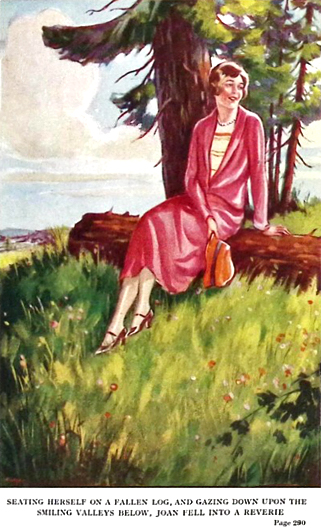
Larry's yarns of bygone days, and at last settling down on a charming
old seat on a knoll overlooking a wide expanse of country and the ocean
upon the horizon. Here she sat for a full hour with her hands loosely
clasped in her lap and her eyes and thoughts far-away.
The soft air fanned her brow. There was the scent from a sweet brier
hedge close to her, and a waft of burning peat and wood from the
chimneys of the house.
Her thoughts flew back home. "What was Cecil doing? Would she remember
that this was the day for ordering the groceries and that the village
women came to the vestry to pay in their club money? Would Mr. Adair
remember that clerical meeting in the afternoon? And would Benson
remember to earth up the potatoes and mend the orchard fence?"
Then she gave herself a mental shake and began to think of some nature
studies that were simmering in her mind. But very soon her mind was
back in the old rectory. Would Wilmot Gascoigne be continuing to come
there? Was there a fragment of truth in the village gossip? Was it
possible that Cecil was learning to care for him? And if Wilmot really
cared for her, would it be a good match for them both? Again she
determined not to worry. Lady Alicia came out in a few minutes to find
her.
"I wonder if you would like to drive out to the sea this afternoon,"
Lady Alicia said. "I must go over the house with Biddy and do a good
deal of business with her; but Larry could drive you down in the pony
trap. There is a fat pony out at grass who wants to be exercised, and
the coast is lovely; I am sure you would enjoy it."
Joan was delighted at the idea, and at two o'clock she set off in a
jingle. Larry used a good deal of whip and tongue before the pony could
be persuaded to settle into a steady trot; but time was no object, and
Joan was so interested in everything which she saw that she was in no
hurry to end the drive.
Once a motor whizzed past them.
Larry gave an indignant snort.
"Bad luck to those that use 'em!" he said vindictively. "Me son's wife
have lost foive pigs this very year, an' sorra a bit did the craturs
giv' her for the slaughter of 'em, for she were seven mile from town,
an' the police never got in toime to tak the number, an' they just tore
on for all they were worth! 'Tis one of the things we hope for when
this Home Rule comes, that them motors be kep' under strict control of
police."
"But I thought they were! What else do you expect Home Rule to do for
you, Larry? I thought you were all against it up here."
"'Tis like this, Miss. There be a lot of injustice to us Oirish, and
I were born in Cork and be a strict Catholic. The priests tell us the
good old times be comin' back, an' I believe 'em. An' we shall have
a king an' parlyment all of our own one day, an' money will run the
streets like water, they say. A gran' toime be comin'!"
He shook his head slowly from side to side.
Joan did not attempt to argue with him; she drew him on to talk, and
when they came out upon miles of rough moorland by the sea, she left
off talking to enjoy the scene before her.
At last, she got out of the jingle, told Larry to wait for her, and
made her way down to the beach. The tide was out. Great waves in the
distance dashed and foamed over long reefs of rock; the golden sand
with its seaweed and shells proved an enticing place to Joan. She
wandered on, meeting nobody, and revelling in her solitude.
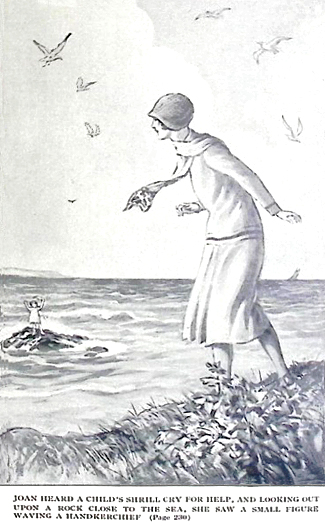
Suddenly she turned a corner, and heard a child's shrill cry for help.
Looking out upon a rock close to the sea, she saw a small figure waving
a handkerchief. She set off running towards it, and saw it was a tiny
girl quite surrounded by the sea. The tide was evidently on the turn,
and had crept in round her before she had noticed her peril. She was
tugging at something which was evidently caught in a wedge of the rock.
Joan wasted no time in thought. She pulled off her shoes and stockings,
tucked up her skirts, and walked right in, till she reached the child.
She was surprised to find the water reach her knees.
"My fis' net! My fis' net! A nas'y cwab has got it in his teef!" the
child cried excitedly.
Joan made a grab at the stick, and with a jerk pulled up a shrimping
net; then she lifted the little girl in her arms and waded back into
safety. Putting her down on the sand, she said:
"Now, where's your nurse? You might have been drowned."
"Yes," nodded the small girl. "I screamed and screamed because the
wicked sea ran at me so quick, and I couldn't and couldn't get my fis'
net out of that hole! And then I see'd you, and I waved my hanky, and
then you comed. And now I'll go back and sit down where Uncle Randal
putted me. He'll be coming soon, but poor Rory hurted his foot and it
bleeded, and he was carrying him to the car."
"Your uncle ought not to have left you on the beach alone," said Joan
severely.
"I did pwomise him I wouldn't move; but then—why then—well, I had to,
for a little cwab ran away from me, and I followed him, and then I
forgot!"
She trotted across the sand—a dear little barefooted mite in white
jersey and cap and a rough serge frock, with a crop of golden curls and
mischievous, sparkling face.
Joan stayed to slip into her shoes and stockings, then leisurely
followed her. By the time she reached her, a tall man had appeared down
an opening in the cliff, and the little girl was gesticulating wildly
in Joan's direction.
Joan came up, then started in amazement, for the man strode towards her
in no less surprise.
It was Major Armitage.
"Miss Adair, have you dropped from the skies?"
"No, indeed I have not; have you?"
"I brought my small niece for a motor ride. She inveigled me down to
the sea; then our dog cut his foot, which necessitated my taking him
back to the car, which is waiting for us above; and I find, as usual,
she has nearly brought catastrophe upon herself by not doing as she was
told. How on earth do you happen to be in these parts?"
Joan told him. He listened with the greatest interest. He seemed more
animated and in better spirits than when she had seen him last; but he
did not compliment her upon her appearance.
"You must have been ill," he said to her, "to lose your colour so! I
have never seen you anything but radiant and blooming."
"And now I am a haggard wreck," said Joan, laughing, the colour and
light coming into her eyes and cheeks. "This is a very surprising
encounter. Of course, I knew you had gone to Ireland; but my mind has
been so engrossed with difficulties at home that I never thought of
associating you with this part. You know Lady Alicia, do you not?"
A shadow came over his face at once.
"I have never met her, though she has often stayed at my brother's. She
is charming, I believe. We are about twenty miles away; that is nothing
to us, for my sister keeps a car. We will come over and call."
Then he looked down upon his little niece. "Sheila, this lady who
rescued you just now is an old friend of mine. Kiss her and thank her
for what she has done for you."
"I don't call her old at all, at all!" responded Sheila quickly, then
she sprang lightly up and seized hold of Joan round the neck, and gave
her a hug. "She's my fren' as well as yours, Uncle Randal, but I shan't
call her old as you do. She's young—quite young, like Mummy!"
"May I say what a pleasure it is to see you again," said Major
Armitage, letting his eyes dwell on Joan in almost a tender way. "The
one bright memory of Old Bellerton is my evenings in the church on
Sunday, and supper at the rectory afterwards. I have felt such a long
way off from you all that the sudden sight of you is a very delightful
experience."
"We have missed you very much," Joan said quietly, looking up; and then
she turned again to the child, for somehow or other she was shy of
meeting his eyes.
"I can't conceive how Lady Alicia managed to spirit you away. What will
they do without you? You were indispensable to everybody."
"I'm afraid I thought so; but I'm not at all, and Cecil is home now,
and she is looking after things. I was cross, and slack, and very
unpleasant after my attack of 'flu,' and I dare say they are glad to
get rid of me!"
"Look here, how are you going back? Can't I offer you a seat in my car?
I'll run you to Ballyclunny in no time."
"Thank you, but I must return the same way I came. Old Larry would feel
quite hurt if I were to desert him. He is the old coachman, and has
driven me here in a small jingle. He let me know that it was a great
favour to have his company; and said that it was only because I was
fresh to 'Oireland' that he had come with me himself instead of sending
the boy. I can't give you his accent, but he said I was the very divil
for getting information, and he was the only one in that part of the
country who could give it to me!"
She laughed merrily as she shook hands with the Major. He smiled, then
grew grave.
"I hope you did not get wet in rescuing this naughty child? I blame
myself for having left her. I am really deeply grateful to you, and so
will her mother be, when she hears of her escapade."
"I did very little."
Then glancing at the laughing, dancing child, she said:
"I am so glad you have a small niece, Major Armitage. Children are an
exhilarating tonic."
"And you think I wanted one? I am not a man who sits down with a broken
backbone when life deals him blows. When I left your part of the world,
I closed and sealed a chapter in my life. Here I am in a fresh one."
He spoke bravely, but in the tired, weary lines upon his face he
carried the stamp of suffering. And when Joan had left him and was
jogging home behind the fat pony, she wondered if he would ever be
quite the same man again.
Lady Alicia was very interested when she heard of the encounter.
"You are not able to get away from your Old Bellerton friends even
here. I had forgotten he had a married sister. What is her name?"
"I think she married a Mr. Donavan."
"Oh, I know! The Donavans have a beautiful old place about twenty miles
away. Well, how strange! But I am not sure that I like your being drawn
back into your old atmosphere. I wanted you to have a complete break
from it."
"Oh, we are not likely to meet very often. Major Armitage is not fond
of society."
Lady Alicia looked in a meditative fashion at Joan, then shook her head.
To herself she said:
"The man that prefers one woman to many is dangerous!"
Two days afterwards a car drove up.
Mrs. Donavan and Major Armitage were announced. Meta Donavan was a
bright, vivacious little woman. She took hold of Joan by both hands and
said:
"I feel inclined to kiss you! You saved my darling from what might have
been a watery grave. And I thank you from the bottom of my heart. Of
course, I have heard of you, and I pictured you a Madonna and a saint.
You look quite like an ordinary being! Saints don't have dimples. I
congratulate you upon that possession!"
Joan could not help laughing. Then, as Major Armitage was talking to
Lady Alicia, Mrs. Donavan gave a little nod in his direction.
"How do you think he is looking? I flatter myself Sheila and I have
done him a world of good. Be came up here looking like a ghost. I could
hardly get a word out of him; but I never rested till I got him at my
piano, which happens to be a very good one, and then he relaxed, and I
won a smile out of him!"
Joan wondered if she was her brother's confidante. She hardly thought
so, but she could well understand that she would win her way with
anybody.
And then presently whilst tea was being got ready, they sauntered
out into the untidy garden, and Joan and Major Armitage were thrown
together.
"Are you coming back to us again?" she asked when he had been asking
for village news.
He gave a little shudder.
"God forbid! I told you that bit of my past is sealed."
"But what are you going to do about your house?"
"I'm never going to live in it again."
Joan looked grave.
"Your tenants will be sorry. Are you going to sell it?"
"No; at least, I have not made up my mind."
"I am very inquisitive," said Joan apologetically; "you must forgive
me. I get so very interested over everyone that I almost regard their
affairs as mine, which is most foolish."
"Not at all," said Major Armitage quickly. "You are a friend. You have
a right to ask me questions. If things became quieter over here, my
sister would like to leave Ireland for a time. Then I thought she might
like to have my old house. And I shall perhaps go abroad or drift into
club life in London."
"Oh!" said Joan impulsively. "You talk as if you have no object in your
life."
"I don't think I have."
"But your music! Your music!" she cried. "You must not lay that gift
aside. If you do not compose, you can play. And you like Church music.
If I had your gift, I would take some big post as organist and would
speak to souls with my music. Oh, Major Armitage, you have not given up
your music?"
He looked down upon her and smiled.
"I wish I could have you always near me to rouse me from my lethargy
and inspire me! I think one needs to be very happy, or very miserable,
to produce good music. And over here I have been living a day at a
time, refusing to think at all deeply, or do more than enjoy the
present. But I don't mean to give up my music. You are quite right
there. And already I am being pestered to return to town and undertake
several things there. But for the present, I am looking after my
sister's estate for her. It badly needs a man upon it."
"And brains," said Joan, smiling. "I do acknowledge the superiority
of your sex. I might have known you would not be idle. Forgive my
impertinence."
Then the others joined them, and they went indoors to tea.
Mrs. Donavan insisted that they should come over to lunch in two days'
time, and this they did. Joan thoroughly enjoyed the day. It was one of
the very few old houses in Ireland which had not been allowed to suffer
decay, and the gardens were beautifully kept. She thought Mrs. Donavan
must be a very happy woman till she took her up to the top of a turret
tower to see the view, and then leaning her arms on the parapet the
young widow gazed away to the distant country with misty eyes.
"Oh!" she cried. "For a log cabin and a man to take care of me!
Miss Adair, you were saying just now you envied me my home. I have
come to see that no environment compensates for the loss of close
companionship. I have been a lonely miserable woman since my husband
died, and if civil war comes to our poor country, I will almost welcome
the opportunities I shall have of doing and denying myself in the great
cause. I am tired and sick of comfort and prosperity. I am not made for
it, unless I have someone I love to share it with me."
"You have your brother now."
"Yes," and her face sparkled through its tears. "I can't tell you what
he has been to me! He has had his trouble, poor fellow! The world is
full of it, but as I tell him, his bliss was snatched away from him
before he tasted it. I tasted mine to the full, and the miss of it is
agony!"
Then she shook off her emotion, and after that one glimpse of a hidden
self, Mrs. Donavan relapsed into her usual sparkling and charming
gaiety. Major Armitage was in a quiet, grave mood. Joan did not see
much of him, for Sheila claimed her as an old friend, and carried her
off to see her pets and her own little garden.
When they were driving home, Joan said to Lady Alicia:
"I think if I were given very favourable circumstances, I should live a
very lazy self-indulgent life. I do love spending my days in idleness."
"You are resting now. I should not be afraid for you, Joan. Life is too
real to you to waste."
Joan shook her head doubtfully.
"I don't want to go home and settle down in the old routine. You
don't know how I chafe against it, Lady Alicia. I am so weary of it,
and Cecil tries my patience, and I even get fretted by my father's
continual cheerful optimism!"
"You must remember you have been ill. You will feel quite differently
soon. I would remind you of a favourite text of yours which will be
made your experience, and has been, has it not? 'Strengthened with
all might, according to His glorious power, unto all patience and
long-suffering with joyfulness.'"
Joan drew a long sigh.
"My dear child, 'being' is as important as 'doing' in God's sight. A
life lived consistently is a sermon in itself. Think of Cecil and of
Banty Gascoigne. Both watching you, both keenly conscious when you fail
in gentleness and patience. Are they not worth winning?"
"I feel it would need a miracle to alter Cecil," Joan said despondently.
There was a pause, then Lady Alicia said: "I want you to go back
invigorated and refreshed, and I expect you will. But you are not ready
yet either in mind or body."
And Joan found that Lady Alicia was right. As the days sped on and
she found her keenness and energy return to her, thoughts of her home
duties no longer oppressed her. She revelled in the simple outdoor life
she was leading, and drew fresh health from her surroundings. When next
Major Armitage met her, he complimented her on the improvement in her
appearance.
"It is the Irish air," she said, laughing. "I can no longer pretend
that I am an invalid."