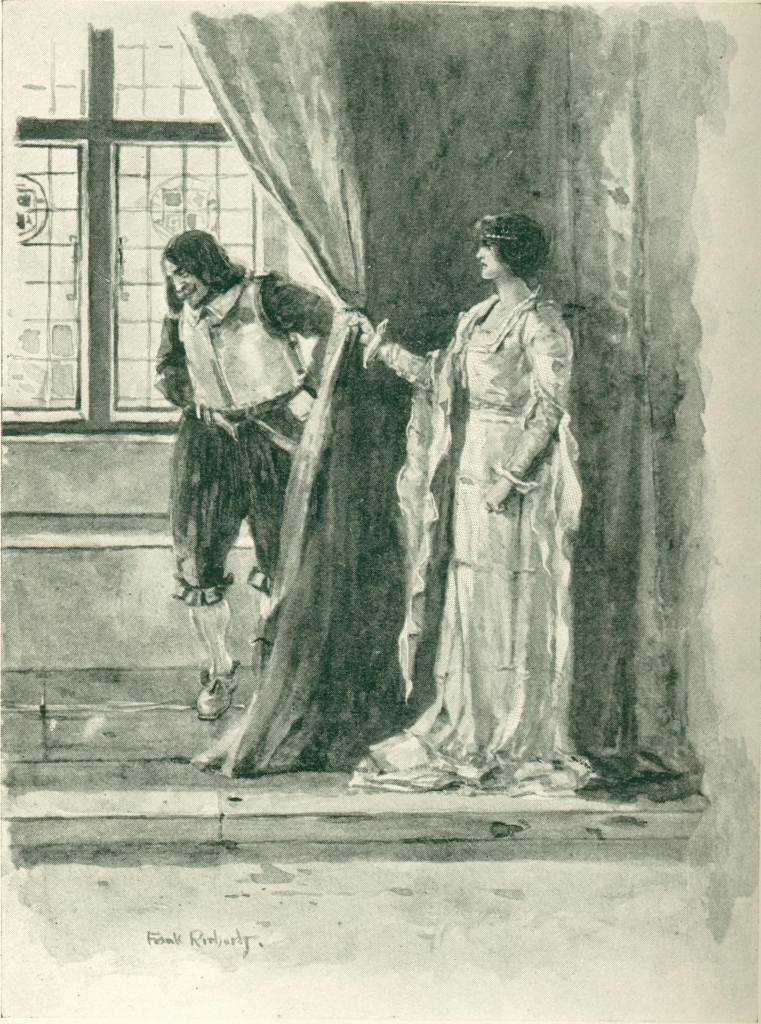
It was indeed Alexis the Deacon who met the Lady
Theresa. And the matter had been arranged, just
as Boris said. Alexis the Deacon, a wise man of
many disguises, remained in Courtland after the abrupt
departure of Prince Ivan. Theresa had found him
in the hospital, where, sheltered by a curtain, she
heard him talk with a dying man—the son of a Greek
merchant domiciled in Courtland, whose talent for
languages and quick intelligence had induced Prince
Conrad to place him on his immediate staff of officers.
"I bid you reveal to me the plans and intents of the
Prince," Theresa heard Alexis say, "otherwise I cannot
give you absolution. I am priest as well as doctor."
At this the young Greek groaned and turned aside
his head, for he loved the Prince. Nevertheless,
he spoke into the ear of the physician all he knew, and
as reward received a sleeping draught, which induced
the sleep from which none waken.
And afterwards Theresa had spoken also.
So it was this same Alexis—spy, priest, surgeon,
assassin, and chief confidant of Ivan Prince of Muscovy—who,
in front of the watchfires, bent over the
hand of Theresa von Lynar on that stormy night
which succeeded the crowning victory of the Russian
arms in Courtland.
"This way, madam. Fear not. The Prince is
eagerly awaiting you—both Princes, indeed," Alexis
said, as he led her into the camp through lines of
lighted tents and curious eyes looking at them from
the darkness. "Only tell them all that you have to
tell, and, trust me, there shall be no bounds to the
gratitude of the Prince, or of Alexis the Deacon, his
most humble servant."
Theresa thought of what this boundless gratitude
had obtained for the young Greek, and smiled. They
came to an open space before a lighted pavilion.
Before the door stood a pair of officers trying in vain
to shield their gay attire under scanty shoulder cloaks
from the hurtling inclemency of the night. Their ready
swords, however, barred the way.
"To see the Prince—his Highness expects us," said
Alexis, without any salute. And with no further objection
the two officers stood aside, staring eagerly and
curiously however under the hood of the lady's cloak
whom Alexis brought so late to the tent of their master.
"Ha!" muttered one of them confidentially as the
pair passed within, "I often wondered what kept our
Ivan so long in Courtland. It was more than his
wooing of the Princess Margaret, I will wager!"
"Curse the wet!" growled his fellow, turning away.
He felt that it was no time for speculative scandal.
Theresa and her conductor stood within the tent of
the commander of the Muscovite army. The glow of
light, though it came only from candles set within
lanterns of horn, was great enough to be dazzling to
her eyes. She found herself in the immediate presence
of Prince Ivan, who rose with his usual lithe grace to
greet her. An older man, with a grey pinched face,
sat listlessly with his elbow on the small camp table.
He leaned his forehead on his palm, and looked down.
Behind, in the half dark of the tent, a low wide divan
with cushions was revealed, and all the upper end of
the tent was filled up with a huge and shadowy pile of
kegs and boxes, only half concealed behind a curtain.
"I bid you welcome, my lady," said Prince Ivan,
taking her hand. "Surely never did ally come
welcomer than you to our camp to-night. My servant
Alexis has told me of your goodwill—both towards
ourselves and to Prince Louis." (He indicated the
silent sitting figure with a little movement of his hand
sufficiently contemptuous.) "Let us hear your news,
and then will we find you such lodging and welcome
as may be among rough soldiers and in a camp of
war."
As he was speaking Theresa von Lynar loosened
her long cloak of blue, its straight folds dank and
heavy with the rains. The eyes of the Prince of
Muscovy grew wider. Hitherto this woman had been
to him but a common traitress, possessed of great
secrets, doubtless to be flattered a little, and then—afterwards—thrown
aside. Now he stood gazing at her
his hands resting easily on the table, his body a little
bent. As she revealed herself to him the pupils of his
eyes dilated, and amber gleams seemed to shoot across
the irises. He thought he had never seen so beautiful a
woman. As he stood there, sharpening his features
and moistening his lips, Prince Ivan looked exceedingly
like a beast of prey looking out of his hole upon a quarry
which comes of its own accord within reach of his
claws.
But in a moment he had recovered himself, and
came forward with renewed reverence.
"Madam," he said, bowing low, "will you be pleased
to sit down? You are wet and tired."
He went to the flap of the pavilion and pushed aside
the dripping flap.
"Alexis!" he cried, "call up my people. Bid them
bring a brazier, and tell these lazy fellows to serve
supper in half an hour on peril of their heads!"
He returned and stood before Theresa, who had
sunk back as if fatigued on an ottoman covered with
thick furs. Her feet nestled in the bearskins which
covered the floor. The Prince looked anxiously
down.
"Pardon me, your shoes are wet," he said. "We
are but Muscovite boors, but we know how to make
ladies comfortable. Permit me!"
And before Theresa could murmur a negative the
Prince had knelt down and was unloosing the latchets
of her shoes.
"A moment!" he said, as he sprang again to his
feet with the lithe alertness which distinguished him.
Prince Ivan ran to a corner where, with the brusque
hand of a master, he had tossed a score of priceless
furs to the ground. He rose again and came towards
Theresa with a flash of something scarlet in his hand.
"You will pardon us, madam," he said, "you are
our guest—the sole lady in our camp. I lay it upon
your good nature to forgive our rude makeshifts."
And again Prince Ivan knelt. He encased Theresa's
feet in dainty Oriental slippers, small as her own, and
placed them delicately and respectfully on the couch.
"There, that is better!" he said, standing over her
tenderly.
"I thank you, Prince." She answered the action
more than the words, smiling upon him with her
large graciousness; "I am not worthy of so great
favour."
"My lady," said the Prince, "it is a proverb of our
house that though one day Muscovy shall rule the
world, a woman will always rule Muscovy. I am as
my fathers were!"
Theresa did not answer. She only smiled at the
Prince, leaning a little further back and resting her
head easily upon the palm of her hand. The servitors
brought in more lamps, which they slung along the
ridge-pole of the roof, and these shedding down a
mellow light enhanced the ripe splendour of Theresa's
beauty.
Prince Ivan acknowledged to himself that he had
spoken the truth when he said that he had never seen
a woman so beautiful. Margaret?—ah, Margaret was
well enough; Margaret was a princess, a political
necessity, but this woman was of a nobler fashion,
after a mode more truly Russ. And the Prince of
Muscovy, who loved his fruit with the least touch of
over-ripeness, would not admit to himself that this
woman was one hour past the prime of her glorious
beauty. And indeed there was much to be said for
this judgment.
Theresa's splendid head was set against the dusky
skins. Her rich hair of Venice gold, escaping a little
from the massy carefulness of its ordered coils, had
been blown into wet curls that clung closely to her white
neck and tendrilled about her broad low brow. The
warmth of the tent and the soft luxury of the rich
rugs had brought a flush of red to a cheek which yet
tingled with the volleying of the Baltic raindrops.
"Alexis never told me this woman was so beautiful,"
he said to himself. "Who is she? She cannot be of
Courtland. Such a marvel could not have been hidden
from me during all my stay there!"
So he addressed himself to making the discovery.
"My lady," he said, "you are our guest. Will you
deign to tell us how more formally we may address
you? You are no Courtlander, as all may see!"
"I am a Dane," she answered smiling; "I am called
the Lady Theresa. For the present let that suffice. I
am venturing much to come to you thus! My father
and brothers built a castle upon the Baltic shore on
land that has been the inheritance of my mother.
Then came the reivers of Kernsberg and burned the
castle to the ground. They burned it with fire from
cellar to roof-tree. And they slackened the fire with
the blood of my nearest kindred!"
As she spoke Theresa's eyes glittered and altered.
The Prince read easily the meaning of that excitement.
How was he to know all that lay behind?
"And so," he said, "you have no good-will to the
Princess Joan of Hohenstein—and Courtland. Or to
any of her favourers?" he added after a pause.
At the name the grey-headed man, who had been
sitting unmoved by the table with his elbow on the
board, raised a strangely wizened face to Theresa's.
"What"—he said, in broken accents, stammering
in his speech and grappling with the words as if, like a
wrestler at a fair, he must throw each one severally—"what—who
has a word to say against the Lady Joan,
Princess of Courtland? Whoso wrongs her has me to
reckon with—aye, were it my brother Ivan himself!"
"Not I, certainly, my good Louis," answered Ivan
easily. "I would not wrong the lady by word or deed
for all Germany from Bor-Russia to the Rhine-fall!"
He turned to Alexis the Deacon, who was at his
elbow.
"Fill up his cup—remember what I bade you!" he
said sharply in an undertone.
"His cup is full, he will drink no more. He pushes
it from him!" answered Alexis in the same half-whisper.
But neither, as it seemed, took any particular
pains to prevent their words carrying to the ear
of Prince Louis. And, indeed, they had rightly judged.
For swiftly as it had come the momentary flash of
manhood died out on the meagre face. The arm
upon which he had leaned swerved limply aside, and
the grey beard fell helplessly forward upon the table.
"So much domestic affection is somewhat belated,"
said Prince Ivan, regarding Louis of Courtland with
disgust. "Look at him! Who can wonder at the lady's
taste? He is a pretty Prince of a great province.
But if he live he will do well enough to fill a chair and
hold a golden rod. Take him away, Alexis!"
"Nay," said Theresa, with quick alarm, "let him
stay. There are many things to speak of. We may
need to consult Prince Louis later."
"I fear the Prince will not be of great use to us,"
smiled Prince Ivan. "If only I had known, I would
have conserved his princely senses more carefully.
But for heads like his the light wine of our country is
dangerously strong."
He glanced about the pavilion. The servants had
not yet retired.
"Convey his Highness to the rear, and lay him
upon the powder barrels!" He indicated with his
hand the array of boxes and kegs piled in the dusk of
the tent. The servitors did as they were told; they
lifted Prince Louis and would have carried him to that
grim couch, but, struck with some peculiarity, Alexis
the Deacon suddenly bent over his lax body and
thrust his hand into the bosom of his princely habit,
now tarnished thick with wine stains and spilled
meats.
"Excellency," he said, turning to his master, "the
Prince is dead! His heart does not beat. It is the
stroke! I warned you it would come!"
Prince Ivan strode hastily towards the body of Louis
of Courtland.
"Surely not?" he cried, in seeming astonishment.
"This may prove very inconvenient. Yet, after all,
what does it matter? With your assistance, madam,
the city is ours. And then, what matters dead prince
or living prince? A garrison in every fort, a squadron
of good Cossacks pricking across every plain, a tax-collector
in every village—these are the best securities
of princedom. But this is like our good Louis. He
never did anything at a right time all his life."
Theresa stood on the other side of the dead man as
the servitors lowered him for the inspection of their
lord. The weary wrinkled face had been smoothed as
with the passage of a hand. Only the left corner of
the mouth was drawn down, but not so much as to be
disfiguring.
"I am glad he spoke kindly of his wife at the last,"
she murmured. And she added to herself, "This falls
out well—it relieves me of a necessity."
"Spoken like a woman!" cried Prince Ivan, looking
admiringly at her. "Pray forgive my bitter
speech, and remember that I have borne long with
this man!"
He turned to the servitors and directed them with a
motion of his hand towards the back of the pavilion.
"Drop the curtain," he said.
And as the silken folds rustled heavily down the
curtain fell upon the career and regality of Louis,
Prince of Courtland, hereditary Defender of the Holy
See.
The men did not bear him far. They placed him
upon the boxes of the powder for the Margraf's cannon,
which for safety and dryness Ivan had bade them
bring to his own pavilion. The dead man lay in the
dark, open-eyed, staring at the circling shadows as
the servitors moved athwart the supper table, at
which a woman sat eating and drinking with her
enemy.
Theresa von Lynar sat directly opposite the Prince
of Muscovy. The board sparkled with mellow lights
reflected from many lanterns. The servitors had departed.
Only the measured tread of the sentinels was
heard without. They were alone.
And then Theresa spoke. Very fully she told
what she had learned of the defences of the place,
which gates were guarded by the Kernsbergers, which
by the men of Plassenburg, which by the remnants
of the broken army of Courtland. She spoke in a
hushed voice, the Prince sipping and nodding as he
looked into her eyes. She gave the passwords of the
inner and outer defences, the numbers of the defenders
at each gate, the plans for bringing provisions up the
Alla—indeed, everything that a besieging general
needs to know.
And so soon as she had told the passwords the
Prince asked her to pardon him a moment. He
struck a silver bell and with scarce a moment's delay
Alexis entered.
"Go," said the Prince; "send one of our fellows
familiar with the speech of Courtland into the city by
the Plassenburg Gate. The passwords are 'Henry the
Lion' at the outer gate and 'Remember' at the inner
port. Let the man be dressed in the habit of a
countryman, and carry with him some wine and
provend. Follow him and report immediately."
While the Prince was speaking he had never taken
his eyes off Theresa von Lynar, though he had appeared
to be regarding Alexis the Deacon. Theresa
did not blanch. Not a muscle of her face quivered.
And within his Muscovite heart, full of treachery as an
egg of meat, Prince Ivan said, "She is no traitress,
this dame; but a simpleton with all her beauty. The
woman is speaking the truth."
And Theresa was speaking the truth. She had expected
some such test and was prepared; but she
only told the defenders' plans to one man; and as for
the passwords, she had arranged with Boris that at the
earliest dawn they were to be changed and the forces
redistributed.
While these two waited for the return of Alexis, the
Prince encouraged Theresa to speak of her wrongs.
He watched with approbation the sparkle of her eye
as he spoke of Joan of the Sword Hand. He noted
how she shut down her lips when Henry the Lion was
mentioned, how her voice shook as she recounted the
cruel end of her kin.
Though at ordinary times most sober, the Prince
now added cup to cup, and like a Muscovite he grew
more bitter as the wine mounted to his head. He
leaned forward and laid his hand upon his companion's
white wrist. Theresa quivered a little, but
did not take it away. The Prince was becoming
confidential.
"Yes," he said, leaning towards her, "you have
suffered great wrongs, and do well to hate with the
hate that craves vengeance. But even you shall be
satisfied. To-morrow and to-morrow's to-morrow you
and I shall have out our hearts' desire upon our enemies.
Yes, for many days. Sweet—sweet it shall be—sweet,
and very slow; for I, too, have wrongs, as you shall
hear."
"Truly, I did well to come to you!" said Theresa,
giving her hand willingly into his. He clasped her
fingers and would have kissed her but for the table
between.
"You speak truth." He hissed the words bitterly.
"Indeed, you did better than well. I also have
wrongs, and Ivan of Muscovy will show you a
Muscovite vengeance.
"This Prince Conrad of theirs baulked me of my
revenge and drove me from the city. Him will I take
and burn at the stake in his priest's robes, as if he
were saying mass—or, better still, in the red of the
cardinal's habit with his hat upon his head. And ere
he dies he shall see his paramour carried to her
funeral. For I will give you the life of the woman
for whose sake he thwarted Ivan of Muscovy. If you
will it, no hand but yours shall have the shedding of
the blood of your house's enemy. Is not this your
vengeance already sweet in prospect?"
"It is sweet indeed!" answered Theresa.
"Your Highness!" said the voice of Alexis at the
tent door, "am I permitted to speak?"
"Speak on!" cried Ivan, without relaxing his clasp
upon the hand of Theresa von Lynar. Indeed,
momentarily it became a grip.
"The man went safely through at the Plassenburg
Gate. The passwords were correct. The man who
challenged spoke with a Kernsberg accent!"
The Prince's grasp relaxed.
"It is well," he said. "Now go to the captains and
tell them to be in their posts about the city according
to the plan—the main assault to be delivered by the
gate of the sea. At dawn I will be with you! Go!
Above all, do not forget the passwords—first 'Henry
the Lion!' then 'Remember!'"
Alexis the Deacon saluted and went.
The Prince rose and came about the table nearer to
Theresa von Lynar. She drew her breath quickly and
checked it as sharply with a kind of sob. Her left
hand went down to her side as naturally as a nun's
to her rosary. But it was no rosary her fingers
touched. The action steadied her, and she threw back
her head and smiled up at her companion debonairly
as though she had no care in the world.
Theresa repeated the passwords slowly and audibly.
"'Henry the Lion!' 'Remember!' Ah!" (she
broke off with a laugh) "I am not likely to forget."
Ivan laid his hand on her shoulder, glad to see her so
resolute.
"All in good time," he said, sitting down on a
stool at her feet and taking her hand—her right hand.
The other he did not see. Then he spoke confidentially.
"One other revenge I have which I shall keep till
the last. It shall be as sweet to me as yours to you.
I shall draw it out lingeringly that I may drain all its
sweetness. It concerns the upstart springald whom the
Princess Margaret had the bad taste to prefer to me.
Not that I cared a jot for the Princess. My taste is
far other" (here he looked up tenderly); "but the
Princess I must wed, as maid or widow I care not. I
take her provinces, not herself; and these must be
mine by right of fief and succession as well as by
right of conquest. The way is clear. That piece of
carrion which men called by a prince's name was carried
out a while ago. Conrad the priest, who is a man,
shall die like a man. And I, Ivan, and Holy Russia
shall enter in. By the right of Margaret, sole heir of
Courtland, city and province shall be mine; Kernsberg
shall be mine; Hohenstein shall be mine. Then mayhap
I will try a fall for Plassenburg and the Mark with
the Executioner's Son and his little housewife. But
sweeter than all shall be my revenge upon the man I
hate—upon him who took his betrothed wife from
Ivan of Muscovy."
"Ah," said Theresa von Lynar, "it will indeed be
sweet! And what shall be your worthy and terrible
revenge?"
"I have thought of it long—I have turned it over,
this and that have I thought—of the smearing with
honey and the anthill, of trepanning and the worms
on the brain—but I have fixed at last upon something
that will make the ears of the world tingle——"
He leaned forward and whispered into the ear of
Theresa von Lynar the terrible death he had prepared
for her only son. She nodded calmly as she listened,
but a wonderful joy lit up the woman's face.
"I am glad I came hither," she murmured, "it is
worth it all."
Prince Ivan took her hand in both of his and pressed
it fondly.
"And you shall be gladder yet," he said, "my Lady
Theresa. I have something to say. I had not thought
that there lived in the world any woman so like-minded,
even as I knew not that there lived any woman so
beautiful. Together you and I might rule the world.
Shall it be together?"
"But, Prince Ivan," she interposed quickly, but still
smiling, "what is this? I thought you were set on
wedding the Princess Margaret. You were to make
her first widow and then wife."
"Theresa," he said, looking amorously up at her,
"I marry for a kingdom. But I wed the woman who
is my mate. It is our custom. I must give the left
hand, it is true, but with it the heart, my Theresa!"
He was on his knees before her now, still clasping
her fingers.
"You consent?" he said, with triumph already in
his tone.
"I do not say you nay!" she answered, with a
sigh.
He kissed her hand and rose to his feet. He would
have taken her in his arms, but a noise in the pavilion
disturbed him. He went quickly to the curtain and
peeped through.
"It is nothing," he said, "only the men come to
fetch the powder for the Margraf's cannon. But the
night speeds apace. In an hour we assault."
With an eager look on his face he came nearer to
her.
"Theresa," he said, "a soldier's wooing must needs
be brisk and speedy. Yours and mine yet swifter.
Our revenge beckons us on. Do you abide here till I
return—with those good friends whose names we have
mentioned. But now, ere I go forth, pledge me but
once your love. This is our true betrothal. Say, 'I
love you, Ivan!' that I may keep it in my heart till my
return!"
Again he would have taken her in his arms, but
Theresa turned quickly, finger on lip. She looked
anxiously towards the back of the tent where lay the
dead prince. "Hush! I hear something!" she said.
Then she smiled upon him—a sudden radiance like
sunshine through rain-clouds.
"Come with me—I am afraid of the dark!" she said,
almost like a child. For great is the guile of woman
when her all is at stake.
Theresa von Lynar opened the latch of a horn
lantern which dangled at a pole and took the taper
in her left. She gave her right hand with a certain
gesture of surrender to Prince Ivan.
"Come!" she said, and led him within the inner
pavilion. A dim light sifted through the open flap by
which the men had gone out with their load of powder.
Day was breaking and a broad crimson bar lay across
the path of the yet unrisen sun. Theresa and Prince
Ivan stood beside the dead. He had been roughly
thrown down on the pile of boxes which contained
the powder manufactured by the Margraf's alchemists
according to the famous receipt of Bertholdus Schwartz.
The lid of the largest chest stood open, as if the men
were returning for yet another burden.
"Quick!" she said, "here in the presence of the
dead, I will whisper it here, here and not elsewhere."
She brought him close to her with the gentle compulsion
of her hand till he stood in a little angle where
the red light of the dawn shone on his dark handsome
face. Then she put an arm strong as a wrestler's
about him, pinioning him where he stood. Yet the
gracious smile on the woman's lips held him acquiescent
and content.
She bent her head.
"Listen," she said, "this have I never done for any
man before—no, not so much as this! And for you
will I do much more. Prince Ivan, you speak true—death
alone must part you and me. You ask me for a
love pledge. I will give it. Ivan of Muscovy, you have
plotted death and torture—the death of the innocent.
Listen! I am the wife of Henry of Kernsberg, the
mother of the young man Maurice von Lynar whom
you would slay by horrid devices. Prince, truly you
and I shall die together—and the time is now!"
Vehemently for his life struggled Prince Ivan,
twisting like a serpent, and crying, "Help! Help!
Treachery! Witch, let me go, or I will stab you
where you stand." Once his hand touched his dagger.
But before he could draw it there came a sound of
rushing feet. The forms of many men stumbled up
out of the gleaming blood-red of the dawn.
Then Theresa von Lynar laughed aloud as she held
him helpless in her grasp.
"The password, Prince—do not forget the password!
You will need it to-night at both inner and
outer guard! I, Theresa, have not forgotten. It is
'Henry the Lion! Remember!'"
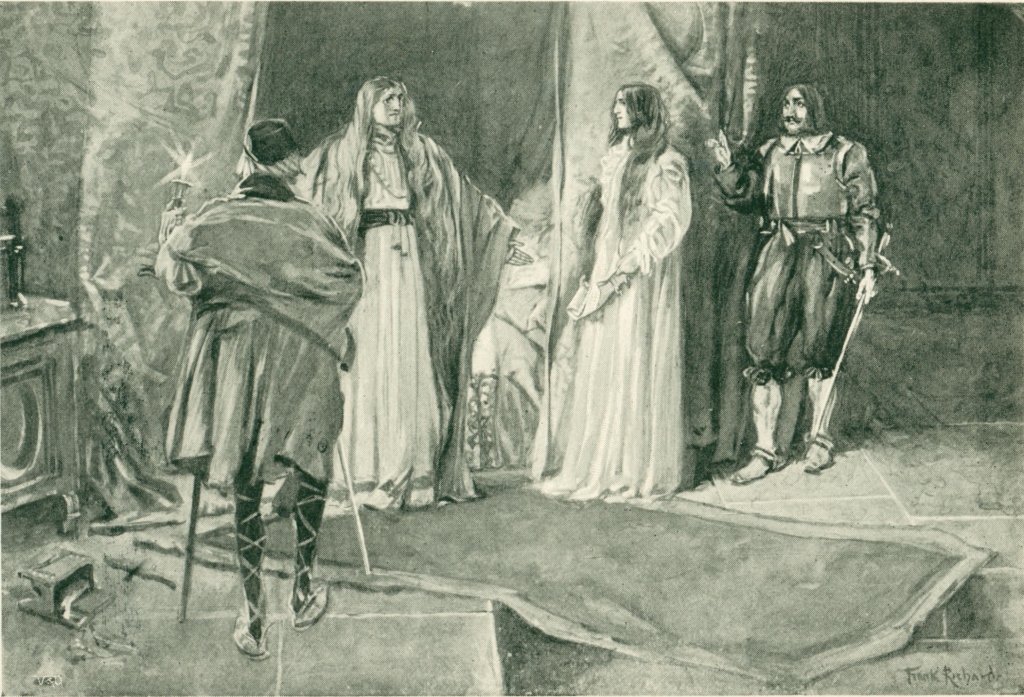
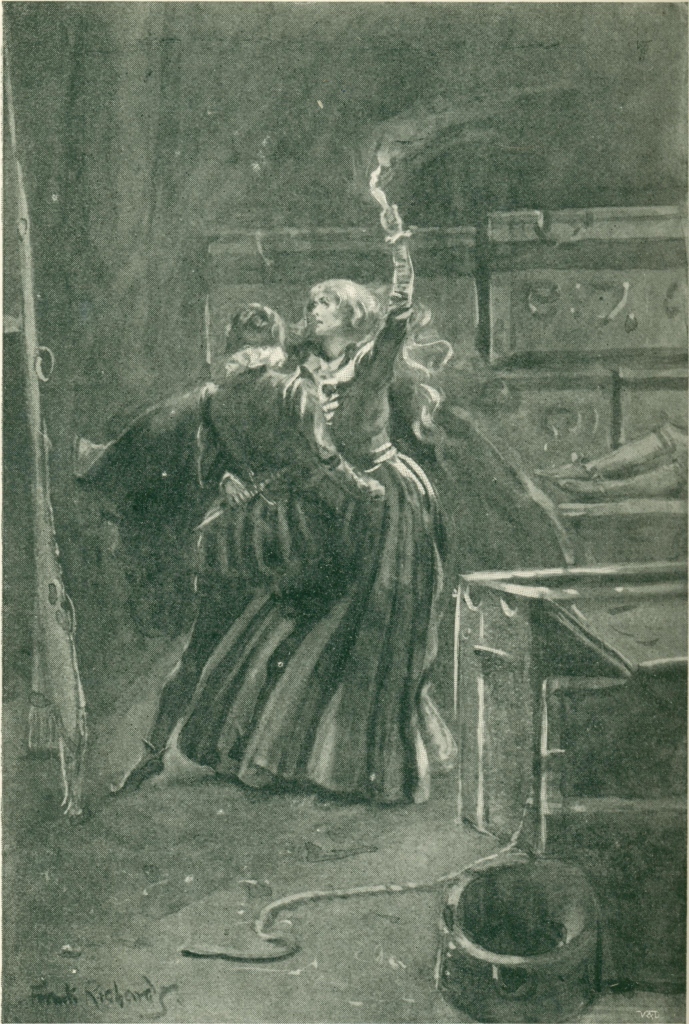 "'The password, Prince—do not forget the password!'"
And Theresa dropped the naked candle she had
been holding aloft into the great chest of dull black
grains which stood open by her side.
And after that it mattered little that at the same
moment beyond the Alla the trumpets of Hugo, Prince
of Plassenburg, blew their first awakening blast.
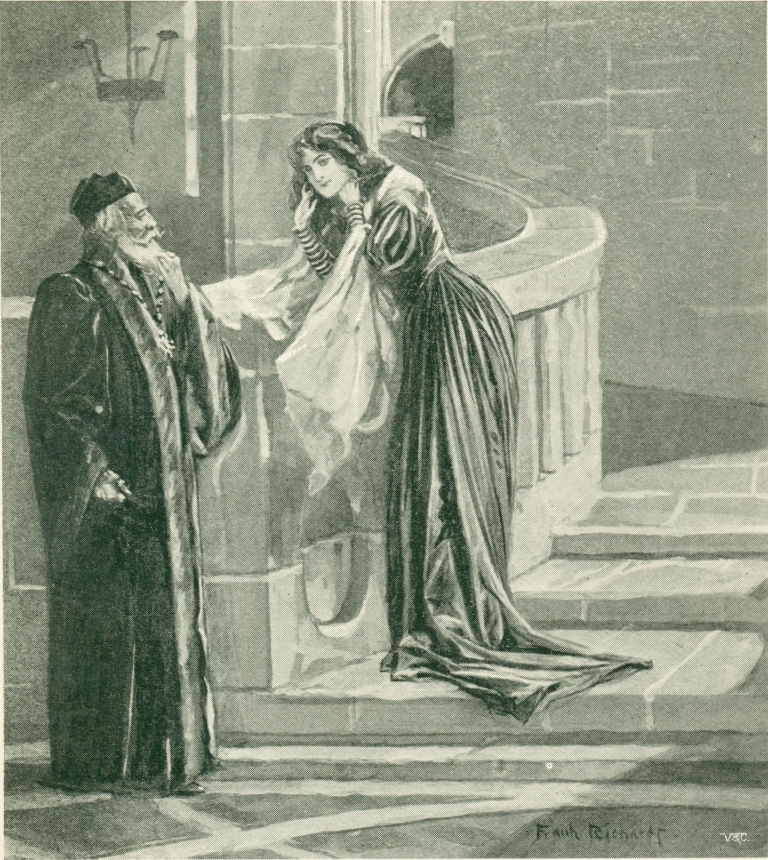 "She met on the middle flight a grey-bearded man." (Page 25.)