A heavy fog had come sweeping in from
the lake. Lights from street lamps glowed
dimly like great, bleary eyes. Store windows
were mere blankets of pale white light.
Jimmie Drury hated fog. He was thinking
as he crossed the Madison Street bridge:
“Perhaps the devil is a monster breathing
out fire, but when his fires are banked he
must breathe out cold, gray fog which is
worse. He——”
Just then the thing happened. A shadowy
figure stepped from behind a steel girder of
the bridge. A husky voice said:
2
“As you are!”
Jimmie’s figure went rigid. Involuntarily
his right hand gripped something hard and
round in his right side pocket. Something
struck his chest. There was a blinding flash.
Then Jimmie went down like an empty sack
and out like a match.
When he came to he found himself the
center of a curious group surrounded by fog.
A policeman was bending over him. His
first sensation was one of surprise that he
was still alive. Then, like an electric shock,
a thought came to him:
“Did—did he get it?” he stammered. His
hand went to his belt.
“No,” he answered his own question, “he
didn’t get it. But did I get him? That’s the
question.”
“Poor dear,” sighed a bespectacled old
lady at the edge of the crowd, “he must be
delirious. It’s the shock.”
“Back, all of you,” the policeman interrupted
her. “Give him air.”
3
“Fog, you mean,” Jimmie laughed. “I—I’m
all right, officer. I—” He tried to rise
but sank back dizzily.
“Take it easy,” the officer advised.
“Officer,” said Jimmie, “do you know
Tom Howe?”
“Tommy Howe, that keen young detective?
Who of the force don’t know him?”
The officer laughed hoarsely.
“Get him on the phone at the State Street
Station right away if you can.” Jimmie’s
tone was eager, tense with excitement. “It—it’s
terribly important. Tell him to meet
me at the Daily Press offices. By the elevator,
sixth floor.”
“And who shall I say you might be?”
inquired the officer.
“Jimmie Drury. You must know my father,”
the boy replied eagerly. “He’s
Howard Drury,——”
“Chief sports editor of the Press. Sure,
I know him. And you’re his son, right
enough. The resemblance is plain. Right,
my lad—But, say!” the policeman’s tone
changed. “Don’t I get in on this? It was
me that found you. Don’t forget that.”
4
“Sure! Oh, sure you do!” Jimmy exclaimed.
“And now,” he strove again to
rise, “with you—your help I can walk.”
“Right! Up you come. And now, clear
out, all of you!” The officer waved a hand
at the crowd that, like a fade-out in the
movies, vanished into the fog.
“All—all right, we’re off.” Jimmie
swayed dizzily, then, with the grip of a
strong hand on his arm, made his way slowly
back across the bridge.
At the far side of the bridge they halted
for a moment at a call-box.
“What did you say your name was?”
asked the officer absent-mindedly.
“Jimmie Drury, of the Press.”
“Ah, yes, of the Press,” the officer mumbled.
Then, into the receiver, “That you,
Mike? This is Denny Sullivan. And is
Tom Howe there? He is? That’s good.
Put him on the wire.”
5
There was a moment’s wait during which
Jimmie ran his fingers carefully over something
black and hard hanging at his belt,
then indulged in a sigh of satisfaction.
“That you, Tom?” the officer boomed.
“This is Denny Sullivan.”
“Yes, Denny.”
“Say. There’s a boy here. I picked him
up on the bridge a bit ago. Says you’re to
come to the Press offices, sixth floor by the
elevator. What do you know about that?”
“His name? Why, it’s Jimmie Drury.”
“What’s that? Oh, you will? You’ll be
over at once? That’s good.”
“What do you know about that?” Denny
Sullivan exclaimed as he hung up. “Tom
says he’ll be right over.”
“I knew he would,” Jimmie smiled.
“Well, we’ll be getting on up,” said the
officer. “Give me your arm.”
Passing through double doors, they made
their way up an inclined runway, crossed a
long corridor, turned right, caught an elevator
and were whisked away to the sixth
floor.
6
There, after passing down one more corridor,
they came to a large room where desks,
chairs, and typewriters of all descriptions
loomed out of the darkness of the place.
On their approach a tall, slender man rose
slowly from his place beside a bank of telephones.
“Oh!” he exclaimed. “It’s you, Jimmie.
And,” with a laugh, “pinched again! What
did he do this time, Denny?” He turned
to the officer.
“Went out like a bad electric bulb,” said
the officer. “And no cause at all, unless it
was a sudden flash of light.
“You see,” Denny went on, “I had just
reached the bridge when that flash came.
First I thought it might be a shot. But there
was no sound. I made a dash for it. And
there was this boy. I——”
“It was that man!” Jimmie, no longer
able to control himself, broke in. “The one
they call the Silent Terror.”
“The Silent Terror! No!” John Nightingale,
the young reporter stared. “It
couldn’t have been!”
7
“But it was! I just got a glimpse of
him,” Jimmie insisted. “He said, ‘As you
are!’ I felt something hit my chest, not very
hard and I thought, ‘I’ve been hit. Perhaps
I’m going to die.’ Then everything faded.”
“But the bright light?” said John.
“Oh, that—that was my idea.” Jimmie
grew excited. “You know I’ve been experimenting
in every sort of way with my
candid camera.”
“Yes, I know. You——”
“Last thing I tried,” Jimmie broke in,
“I hung the camera on my belt with a flat
flash-light beside it. I put a flash bulb in the
light. Then I connected up an electric push
button that would open the camera and shoot
off the flash all at the same time.”
“And I suppose,” John Nightingale
drawled, “that you went right out and
hunted up this Silent Terror and said, ‘Beg
pardon. Let me take your picture.’”
“No! No! It wasn’t like that,” Jimmie
laughed. “That was an accident; what father
would call a ‘fortunate coincidence.’”
8
“But you were ready for him,” John insisted.
“That’s foresight.”
“I was ready for anything interesting
that might happen ten feet from where I
stood. But think!” Jimmie grew excited
again. “I may have the picture of the Silent
Terror right here in my little candid camera.
Won’t that be something.”
“It will indeed,” said John Nightingale,
visibly impressed. “But here is Tom Howe,
the ace detective.” His voice changed.
“What do you know, Tom? Our young cub
reporter has met the Silent Terror face to
face, and lives to tell the story.”
“What!” said Tom Howe, who, save for
his deep-set, piercing eyes, looked little the
part of a detective.
“And he thinks he took his picture,” the
reporter added.
9
“If he did,” Tom said soberly, “he has
done a real service to his city. We’ve got to
get that man and get him quick. At present,
in some way quite unknown to us, he is
putting people to sleep at a distance and robbing
them on the streets. But criminals are
never satisfied. In time he will double the
dose, whatever it is, and his victims will
never come to life. It is always that way
with crime.”
“But how about the picture?” he demanded,
turning eagerly to Jimmie.
“It—it’s not developed yet,” Jimmie
stammered.
“Come on. We’re in luck,” the reporter
exclaimed. “Scottie just went back to the
darkroom. Took some pictures of the fight
out at the park—to illustrate your father’s
write-up, you know,” he explained to Jimmie.
“He just went back to develop them.
Come on, we’ll all go back to the dark room.”
“What’s all this?” put in a soft feminine
voice.
“Oh, hello, Mary Dare,” John Nightingale
exclaimed. “Been doing night life in
the great city?”
10
“Out on a show that somebody thought
should be exposed.” The young, red-headed
lady reporter, who looked little more than
a girl, laughed merrily. “But what’s the big
excitement?”
“Jimmie thinks he got a picture of the
Silent Terror with his candid camera,” John
explained. “Come on back with us and we’ll
watch this Silent Terror come out on the
film.”
And so the five of them marched toward
the magic dark room of a great city newspaper
where many a picture destined to
condemn a guilty man to the electric chair
or set an innocent one free has first seen the
red glow of the photographer’s magic lamp.
11
CHAPTER II MAGIC OF THE DARK ROOM
Scottie McFadden, a veteran photographer
of the Press, was discovered to be entrenched
in his favorite dark room.
“Can’t come out for another quarter
hour,” his voice sounded out through the
walls. “These fight pictures must be out
for the early edition. What have you got?”
“One of Jimmie’s candid camera shots,”
John Nightingale winked at his friends as
he shouted through the dark room walls.
“Candid camera!” came roaring out from
the dark room, “You may as well all go
home. Nothing big will ever come from a
picture the size of a postage stamp.”
“May be bigger than you think this time,”
was John’s reply. “Anyway, we’ll wait.”
12
“And while you’re all waiting,” he added
in a lower tone, “I’ll hop down to Jerry’s
for two quarts of coffee and a sack of
sinkers,” and away he went.
“Coffee and doughnuts,” Jimmie thought
with a start. “That was what I was after.
Wonder what became of that black bag?
Bet that fellow got it.”
His father was working late that night
because of the heavy-weight boxing bout.
Jimmie had begged permission to stay down-town
and go home with him on the late
theater train and permission had readily
been granted. Later when Howard Drury,
his father, was ready to start his story he
had sent Jimmie out for refreshments.
These were always carried in a small, black
leather bag.
“Say!” Jimmie exploded suddenly, wheeling
about to face Tom Howe, the young
detective. “I’ll bet I know why that Silent
Terror came to pick on me.”
“Why?” Tom Howe stared.
“I was carrying a small black bag.”
13
“Sure, that’s it,” Tom agreed, quick to
seize upon the clue. “Thought you were a
messenger carrying money from some small
theater to the central vault.”
“That’s it,” Jimmie agreed.
This much decided upon they all lapsed
into silence. They were a quiet group, these
reporters and the detective, when there was
nothing really serious to be talked about.
Jimmie now found time to think back
over the days that had led up to this moment.
Think, he did, and like all the thoughts of
youth, his were long, long thoughts.
The old lady on the bridge had called
Jimmie a “poor dear.” She would not have
called him that had she seen him streaking
down the field for a touchdown last autumn.
Jimmie had a small, almost childish face,
but he was large, six feet in his stockings,
170 pounds, which is not bad for a 17-year-old
high school boy.
14
But Jimmie was not all football. Truth
is, he took football as a matter of duty.
Loyalty to his school demanded it. Jimmie’s
interest was centered on cameras.
When eight years old he had been taken to
the Press photograph department. There
he had asked Scottie McFadden so many and
such astounding questions that at first
Scottie stood staring and at last drove him,
in a good-natured manner, from the place,
declaring he’d be fired for getting no work
done.
Jimmie’s first hard-earned dollar had
gone for a camera of a sort. For years after
that all he could earn, beg or borrow went
for cameras and equipment. His proudest
hour came when, on his seventeenth birthday,
his wealthy uncle Bob had presented
him with a truly wonderful miniature camera.
“It’s a Gnome,” he confided to Scottie.
“Takes twenty-four pictures in about as
many seconds. Got a wide-angle lens that
will almost take pictures in the dark. And
fast! Say! There’s not a camera made
that’s faster. It—it’s a real dwarf.”
15
“A Gnome, is it?” Scottie had drawled.
“Well, you’ve got to show me, son. I don’t
go in for these baby cameras that you can
lose in your pocket. Give me a box with a
strap that goes over your shoulder and a
ground glass at least three inches across.
Candid camera, is it? Well, my camera is
candid, too. See those pictures I took of the
baseball boys in action?”
“Yes,” said Jimmie. “They were great!”
“Sure they were,” Scottie agreed. “And
why? Because they were taken with a real
camera.”
Jimmie’s chance to show Scottie what his
Gnome would do came sooner than he had
expected. With his father’s aid he had secured
a summer job with the Press as copy
boy. The results had been surprising.
To many the job of copy boy would not
prove exciting. To jump when someone in
the large editorial room shouts, “Boy!”, to
go racing away to Miss Peter’s desk on the
third floor or Mr. Bill’s on the seventh and
to keep this up for long hours is tiring to say
the least. Yet, for Jimmie, every office, the
composing room, the roaring press-room
held a charm all its own.
16
It was, however, his little candid camera
that brought his great opportunity. Perhaps
it was because he always jumped
promptly while other boys lagged that John
Nightingale began to take an interest in him.
More than once he paused to chat with the
lad. Then, one day, right out of a clear sky
he leaped up from answering a phone call
to exclaim:
“Come on, boy! You’re drafted for something
really big.”
“I—I—what?” Jimmie stammered.
“Got your little camera, haven’t you?”
“Yes, sure,” Jimmie stared.
“Percy Palmer’s been found dead. Come
with us. You’re going to take his picture.”
“Percy Palmer, the millionaire? Oh,
I—” Jimmie held back.
“Sure! Come on! You’re drafted, I tell
you.”
And Jimmie went.
While they were on their way in a taxi
John explained that two photographers were
home sick and three out on big stories.
17
“So that left only you,” John finished.
“But, I—Well, you see——”
“Yes, I know, but I’ve seen some of your
shots,” John broke in. “They’re good.
Good enough for me. You wait. We’re a
full half hour ahead of the other papers. It
will be a scoop. You’ll see one of your pictures
on the front page under a screaming
head-line.”
And he did.
That was not all there was to it either.
Jimmie had just finished reading a book
called, “Mysteries of Real Life.” The part
cameras have played in solving death mysteries
had been told in this book in detail.
After making the shots of the dead man required
by the reporter, he took a number
of others on his own. These pictures, when
developed and enlarged, were presented to
the coroner’s jury and went far toward helping
to prove that this was a case of suicide
and not of murder.
18
After that, on many a summer afternoon
Jimmie did not answer to the call of “Boy!”,
for he was not there, but was off with his
good pal, John, shooting a story.
Needless to say, Jimmie went in stronger
than ever for candid cameras. He haunted
a shop window where telescopic lenses were
displayed, spent many hours studying methods
of taking pictures in the dark with the
aid of infra-red rays and dreamed strange
dreams of thrilling photographic adventures.
Needless to say, none of those dreams had
been more fantastic than the thing that had
just happened to him there on the bridge in
the fog.
It had begun with a book he had read on
his day off. For once he had abandoned
camera craft and had lost himself in a
western story of wild adventure. The hero
of this story shot from the hips and always
got his man.
“Why not?” Jimmie whispered, thinking
of his camera. “A shot from the belt, a
touch of the button, a click, a flash, and there
you have it, a picture.”
19
He tried it and with good results. By
training his eye to measure distances accurately
he could set his camera for eight,
ten, or fifteen feet and get a fairly sharp
picture three times out of four.
“But when will you use it?” Jimmie’s
father objected. “Of course, you might
meet the president on the street and shoot
him. But if you did you’d get nabbed. If
you happened to meet a hold-up man and
flashed a bulb in his face he’d shoot you and
investigate afterwards.”
“You never can tell,” was Jimmie’s reply.
“There’s no harm in being prepared.”
Shortly after that a fresh sensation made
the headlines of all the papers. A strange
new type of hold-up man was abroad on the
city streets. A man crossing the Roosevelt
Road viaduct heard a hoarse voice say: “As
you are.” He saw an arm lifted in the
shadows, felt a soft push at his chest, reeled
dizzily, and some ten minutes later came to
himself to find his wallet and watch gone.
20
“How was it done?” This was the headline
for the next day’s paper. That, as time
passed, became the question of the hour.
This man who soon became known as the
Silent Terror struck again; this time in a
tunnel leading to a suburban station. A
woman hurrying to a train heard those same
words, “As you are,” saw a hand, felt something
touch her, and that was all. She was
found a moment later lying unconscious.
Her purse was gone. She returned to consciousness
ten minutes later and was, apparently,
none the worse for the adventure.
“Get that man!” was the cry of the police.
“How does he do it?” the papers demanded.
And they offered prizes, a hundred, five
hundred, a thousand dollars, for the answer.
“Electricity,” said some; “gas” said
others; “a new form of mysterious life and
death.” But how? How?
A man on the Municipal Pier and a
woman on the Washington Street bridge
were the next victims. The man had a weak
heart. He barely escaped death.
21
Tom Howe, one of the keenest young detectives
in the city service, was assigned to
the case. He was a friend of John Nightingale
and had become greatly interested in
Jimmie Drury. The three of them put their
heads together but no solution appeared.
“And now,” Jimmie thought, sitting
there in the newspaper office at night waiting
for Scottie, the veteran photographer, “it’s
happened to me. If only I got that fellow’s
picture.”
“All right!” He started at the sound of a
voice. “All right, Jimmie, me boy.” It was
Scottie. “Give me that cigar lighter with
the bit of baby ribbon inside. That thing
you call a candid camera ... I’m ready to
develop that film.”
“All—all right. Here it is,” Jimmie
stammered. Then they all crowded excitedly
into the narrow dark room; John
Nightingale, Tom Howe, Denny Sullivan,
Jimmie, and that red-haired girl named
Mary Dare.
22
CHAPTER III THE DARK ROOM
Jimmie had experienced many a thrill
watching his pictures come into being on the
shiny film, but never such a one as this. “So
much depends upon it,” he thought as a chill
ran up his spine. And much did; the fate of
a man gone wrong, the safety and happiness
of many he might yet spring upon unsuspectedly
in the night; yes, perhaps the very
lives of some might depend upon that picture.
How eagerly, then, the five of them
waited as Scottie rattled paper, held the
white ribbon of film to the light, then began
moving it dexterously through the developing
solution.
Hushed silence followed. Jimmie was
thinking, “What sort of person is this Silent
Terror? Is he short or tall, dark or light?
Will he be masked? How are we to know
him? What distinguishing mark does he
bear that will brand him for the future?
What——”
23
“Why, Jimmie!” Scottie broke in upon
his thoughts, “there’s nothing on this ribbon
of yours!”
“Noth—nothing,” Jimmie stammered.
Then, excitedly, “Yes, sure there is. Just
one picture! There at the end. It—it’s
coming through!”
“So it is!” said Scottie. At once he devoted
all his attention to that end of the film.
“Think of wasting a whole film on one
little picture,” Scottie murmured.
“Money well spent,” put in Tom Howe.
“There’s a thousand dollar reward on that
man’s head.”
Eagerly they crowded together for a look
as Scottie held the tiny square to the light.
“He’s there!” John Nightingale whispered.
“There!” Mary Dare echoed.
“Wait,” cautioned Scottie the veteran.
Many a picture had he seen go wrong in the
making.
24
Sensing the tense excitement about him
and consumed by a desire to tease a little,
Scottie held the film in the solution for what
to the watchers seemed an endless period of
time.
“There,” he drew a long breath at last.
“She should be done to a turn.”
Holding the film up with one hand, he examined
it through a large magnifying glass.
“Jimmie! Jimmie!” he exclaimed. “I
might have known it! You got only his ear.
Why in time didn’t you ask the gentleman
to turn around?” The laugh that followed
was mirthless. Scottie had wanted to see
Jimmie succeed.
“An ear!” Jimmie murmured.
“An ear!” Mary repeated.
“Must be a profile,” said John hopefully.
“Nope. See for yourselves,” Scottie held
out the glass. “Only an ear.”
“More than that,” said Tom Howe after
a look. “There’s a shoulder and the back of
the neck. There’s as much character shown
in a man’s neck as in the shape of his nose.
25
“And that ear!” he exclaimed after a
closer look. “It’s priceless, that picture.
There’s not another ear in the world like it.
Jimmie, allow me to congratulate you.” He
gripped the boy’s hand tightly.
“All right,” sighed Scottie. “Since it’s
important we’ll wash it, then put it in the
fixin’ bath and make it permanent.”
“And, Scottie,” Tom Howe put in eagerly,
“just as soon as you can, make me an enlargement,
big as the negative will stand.
Will you?”
“It’s a good, sharp negative,” Scottie admitted.
“Though how that happened with a
boy shooting with a pill box from the hip, I
can’t see. Your enlargement will be ready
first thing in the morning, Tom.”
“I’ll be here bright and early,” Tom
turned to go. The others followed him out
into the dim, religious light characteristic of
the editorial room of a great newspaper at
night.
26
“I’m sorry the picture wasn’t better,”
Jimmie said as Tom Howe came out from
the dark room.
“You need not be.” Tom fixed his deep-set
piercing eyes upon him. Tom was short
and slender, yet there was that about his
eyes which told each new-comer that here
was a person not to be trifled with. “You
got his ear and the back of his neck,” he
went on. “That’s a lot. You might have
got a bullet,” he added soberly. “That was
a novel and daring thing to do, shooting a
picture from the belt.”
“But only an ear,” Jimmie protested.
“What can you tell by that?”
“Much,” said Tom. “Ears are neglected
by most detectives. I have made a sort of
specialty of them. Come over to my room
and I’ll show you my collection of ears.”
“Collection of ears?” Jimmie was
shocked.
27
“Oh, I don’t keep them in alcohol.” Tom
laughed. “They’re not real, though they
seem so at a little distance. You’ll find them
interesting. Come at noon and we’ll have
lunch together.”
“That—Say! That will be grand!” said
Jimmie.
“Here’s the address,” Tom pressed a bit
of cardboard into his hand. “Go up as far
as the elevator will take you, climb two
flights of stairs, knock sharply three times,
wait sixty seconds, then knock again. If
you get no response, turn and walk down
again,” Tom laughed shortly, “for I’ll either
be dead or shall have forgotten an appointment,
neither of which has happened
in five years.
“And now,” he put out a hand, “good-night
and thanks for letting me in on this.”
“That’s all right,” Jimmie stammered.
To be thanked by a truly famous young
detective, that was something.
Jimmie passed his father’s office on the
way back. A green shade drawn over his
eyes, he was pounding furiously at the typewriter
keys.
28
“Be ready in twenty minutes,” his head
jerked back for a second. “We’ll make the
train O. K.” Once again his eyes, behind
thick glasses, were fixed on his pencilled
copy.
“Wonder if he knows,” thought Jimmie.
He was thinking of his night’s experience.
“John,” he said, after retracing his steps
to the reporter’s desk, “you won’t put my
name in the story?”
“It would make a peach of a story,” John
laughed low. “Can’t you see it? Boy—candid-camera
bug—shooting from the hip—gets
picture of the Silent Terror.”
“Yes, but you won’t use it.” It was Tom
Howe who suddenly broke in upon their
talk. He had retraced his steps to discuss
this very thing. “We can’t let him know
we have his picture, not just yet,” he went
on. “Might scare this Terror off. And we
must get that man!”
“Oh! All right.” With a sigh the reporter
crumpled a paper in his hand. “A
word from the voice of the law is all that’s
needed.”
29
“Wish there were more like you.” Tom
put a hand on his shoulder. “Many a catch
has been thwarted by a newspaper story released
too soon. When we get that man
you’ll have first chance at the story, you
have my word for it.”
“Thanks, old man.” John slouched down
over his desk to take up once more the task
of answering phone calls about a saloon
brawl, a pick-pocket in the park, and some
young drunks who had rammed their car
into a viaduct.
“Such,” he sighed, “is a reporter’s life.”
As for Jimmie, he was vastly relieved.
“Let that story get into the paper,” he
thought, “and let mother read it and my
career as a ‘rising young newspaper man’
will be at an end.” His mother was “afraid
for him.” That was her way of expressing
it. Jimmie was fond of his mother but he
did not like to have her be afraid.
30
Beside his father in a seat of the suburban
train Jimmie glanced sidewise twice. Then
he realized that his father knew all about
the affair at the bridge. Someone had told
him the whole story.
“Father, that—” he cleared his throat,
“that was what you’d say is in the nature of
an accident.”
“Yes,” his father seemed to agree, “an
accident.”
“Might have happened to anyone,” Jimmie
went on, greatly encouraged.
“Just anyone,” said his father.
“It won’t be in the paper?”
“No.”
“Father, promise that you won’t tell
mother. You won’t tell her, will you?”
There was a note of anxiety in the boy’s
voice.
“No. I think not.”
“Then——”
“Then you will be able to continue your
work? Is that it?” His father smiled.
“Yes, I——”
31
“Son,” his father broke in, “I may be
wrong, but I have a feeling that you should
go on. You may in time make a worth-while
contribution to the safety of this city’s
people with your candid camera.”
“Look out there!” He pointed to row
after row of flat buildings speeding past
them. “People live out there. Thousands
and thousands of simple, kindly people.
Hardly one of them feels perfectly at ease
and safe. Why? Because criminals are free
to roam the city streets.
“As I look at it,” his tone was serious, “it
is the duty of each one of us to do what he
can to make those people safe.
“I don’t want you to get yourself injured
or killed. No father wants that. But I also
don’t want you to grow up soft—to be
afraid. I want you to be brave, strong. You
can never be that until you have faced real
dangers. Don’t be fool-hardy or reckless,
but when an opportunity for a real service
presents itself don’t be afraid to step in.”
“Thanks. Oh, thanks,” Jimmie stammered.
What he was thinking was, “I’ve
got a real dad.”
32
At that same hour John Nightingale and
Mary Dare, the red-headed lady reporter,
sat at a table in a basement eatshop drinking
coffee and discussing Jimmie.
“What sort of a boy is this Jimmie
Drury?” Mary asked.
“Oh, just another boy,” John drawled.
“John!” Mary’s voice rose, “you know
that’s not true. No boy is just another boy.
What sort of boy is he?”
“Wa—al,” John grinned, “he won a baseball
game once. That was in his grade
school days. Regular Jack Armstrong finish,
it was.”
“Tell me about it.”
“Well, then, let me,” John grumbled. “It
was the end of a series. Jimmie’s team was
playing off a tie with the Holmes school for
the championship. No end of excitement,
you know. Last half of the ninth inning,
score tied, seven and seven. Two men out
and Jimmie up to bat and——”
With a slow grin overspreading his thin
face, John paused to lift his cup for a good
long draw at the coffee.
33
“John!” Mary stamped her foot.
“Oh, yes,” John pretended to start. “Of
course. What does Jimmie do but swat a
home-run into the tall grass? And after
running the bases what did he do?”
“What?”
“Kept right on running. Streaked it for
home.”
“Why?”
“Far as I can figure it out he didn’t want
anybody making a fuss over him.”
“Splendid!” exclaimed Mary.
“Jimmie’s popular in high school,” John
went on. “And yet, I’m sure he never tried
for popularity. He likes doing things, all
sorts of things. If this makes him popular
that’s O. K. with Jimmie. If it doesn’t,
that’s O. K. too.
34
“He was outstanding as a basketball star
on his team,” he went on after ordering another
cup of coffee. “But I’ll swear you’d
never guess it to see him play. He didn’t
do any dancing about, not a useless motion,
but every now and again you’d see him have
the ball, watch it shoot up and in, then hear
the crowd roar. You can’t make much out
of a kid like that,” he ended with a drawl.
“No,” Mary agreed. “But in the end
he’ll make a lot out of himself. You’ll see.
I love the way he looks you straight in the
eyes. So many boys look all over the lot
while you’re looking at them, as if they had
something to hide. Nothing like that with
Jimmie.”
“That’s right,” John agreed. “I look
for him to go places and do things. Well,”
he rose, “tomorrow’s another day. See you
in the morning.” He disappeared through a
narrow door that led to the depot and his
train.
Late as it was when Jimmie at last found
himself in bed he did not fall asleep at once.
The new wine of adventure had set his blood
on fire. He had tried something strange.
It had worked. “At least,” he thought with
a chuckle, “I shot an ear. Next time I’ll do
better.”
35
Would he? What was to follow? Would
they get their man? And that thousand dollar
reward? Who would be the lucky one?
He thought of John. John Nightingale, the
reporter, was always hard up, always
shabby. He borrowed money on Mondays
before paydays.
Then he thought of Mary Dare. She, too,
was poor. She had not been a reporter very
long. Her salary was small. What would
not the reward do for these?
“She’ll get on,” John had said, speaking
of Mary, “Dare’s the right name for her.
She’s not afraid to tackle anything.”
Tom Howe? Well, he didn’t know so
much about Tom.
But suppose he got the reward himself?
Instantly he thought of that telescopic lens,
of screens and filters for light and of strange
new films that permitted one to take pictures
in the pitch dark, without a flash. In the
midst of these dreamings he fell asleep.
36
CHAPTER IV TOM HOWE’S EARS
Next day the fog hung even heavier than
before over the city. It was because of this,
perhaps, that Jimmie witnessed a strange
bit of street drama and made a new friend,
all of which was to play a large part in his
life in the near future.
He had been sent to a publisher for a picture
of an author who recently had become
quite famous. The publishing house was a
small concern and had its offices in an old
building on a narrow street over which the
elevated cars rattled and thundered.
Having secured the picture Jimmie was
on his way back when a figure came gliding
toward him through the fog.
37
“Like a snake,” Jimmie thought, as he
watched the man approach. The man’s face,
he noticed as they came closer together,
matched his gait. He had the beady eyes,
the long nose, and the protruding lips of a
snake. Involuntarily, Jimmie looked at his
ear as he passed. It was a strange ear, little
and dried up like an autumn leaf. But it
was not the ear of the Silent Terror.
“Ears are different,” he told himself.
“I’m going to start studying them.”
This set him thinking of his engagement
to meet Tom Howe at noon. He thought of
the detective’s instructions. “Go as far as
the elevator will take you. Climb two flights
of stairs.” Surely a strange place to live.
Then he remembered what Tom had said
about his collection of ears. He was both
mystified and intrigued. He would be glad
when the noon hour came.
With all this day-dreaming he had failed
to note the figure of a huge man who moved
slowly along before him. When at last he
became conscious of the man he was obliged
to slacken his pace to avoid running into
him.
38
The man took long, slow steps, like someone
from the country. Evidently he had expected
the fog to turn to rain for he wore a
heavy rain coat that flapped loosely about
him.
Then, of a sudden, Jimmie noticed someone
else. It was the snake-like man. “I’m
going to meet him again,” he thought with a
start. “How did he get here?”
There could be only one answer to this
question. The snake-man had crossed the
street, had doubled on his tracks, gone racing
through the fog in the opposite direction
for a block or two, then had recrossed the
street and was now walking back the way he
had come.
“But why?” Jimmie all but said these
words out loud.
The answer was not long in coming.
As the sneaking little man came opposite
the large one who lumbered on before
Jimmie his hand flashed out and snatched
something from the pocket of the big man’s
coat.
39
Jimmie’s lips were parted for a sharp
warning when something quite unusual happened.
The little man spun half around,
arose in the air like an airplane taking off,
then shot away into the fog to land solidly
on the pavement a full fifteen feet from his
starting point.
A gruff voice said, “There! That will
teach you to keep your hands out of other
people’s pockets!” At that the big man bent
over to pick up the bill-fold that had been
snatched from his pocket and which, with
the blow, had been knocked from the small
man’s hand.
Jimmie took it all in like a flash. The
little fellow had tried to snatch a purse. The
big man had caught him at it and knocked
him into the middle of the street.
“Boy, mister! That was great!” the
words slipped unbidden from Jimmie’s lips.
The big man whirled about. “Oh, a boy!”
he smiled broadly.
“But won’t you have him arrested?”
Jimmie asked in surprise.
40
“No—o, I guess not,” the big man
drawled. “He’s just a dirty little cur.
Guess he’ll remember this.”
“But he’s a pick-pocket,” Jimmie protested.
“Probably got a long record. I saw
him do it. We—we could convict him.”
“Yes,” the other agreed. “But see. The
fog has swallowed him up.”
“That’s right,” Jimmie agreed. “But
say!” Jimmie was struck by a sudden idea.
“This would be a peach of a story. I’m
from the Press. Mind if I take your picture?”
“In this fog?” The man stared at him.
“Sure. My candid camera gets ’em in
any weather. Just a minute.”
Jimmie backed up, squinted through his
finder, twisted a screw, pressed a button,
then said,
“Thanks, that’s great.”
“Just like that,” the big man grinned.
“Let me see that thing.”
Reluctantly Jimmie turned over his camera.
41
“Neat little trick,” said the man. “How
much do they cost?”
“A little over a hundred dollars,” Jimmie
took back his treasure with a sigh of relief.
“Thunder! That’s a lot for a thing you
can hide in the palm of your hand,” the big
man exclaimed.
“Made like a watch,” said Jimmie
proudly. “When you’ve got one you’ve got
something. I took a picture of a fellow’s
ear last night. May send him to prison.”
“Well, I’d say he’d better cover up his
ears,” laughed the big man. “By the way,
you might like to see what was in that bill-fold.”
“Sure—sure, I would,” Jimmie moved
closer.
“There it is.”
Jimmie saw a slip of paper. “Huh!” he
chuckled. “Check for a half million. Stage
money, I suppose.”
42
“Real money. Want to see me cash it?
Come on. We’ll get a taxi at the next
corner. Be at the bank in fifteen minutes.”
With his head in a whirl the boy followed his
strange new friend to the corner, entered a
taxi and was whisked away.
Three hours later when he started for Tom
Howe’s room his thoughts were still spinning.
He had stumbled on a peach of a news
story for good old John Nightingale. And
there was to be more; indeed, very much
more than he at that moment dreamed.
When, promptly at the appointed hour, he
entered the building in which Tom’s room
was located he found himself in one of the
city’s most celebrated sky-scrapers. Like
a giant needle it pierced the sky.
“Two flights above the last stop,” he
thought with a thrill. “Up among the pigeons,
bats and stars.”
In this he was not so far from being
wrong. Tom’s place was a snug little spot
just beneath the clock.
43
“From this high pinnacle,” Tom said as
Jimmie, having entered the room, stood
staring, “I look down upon the crooked little
world that is a great city. See!” he pointed
at a powerful telescope resting on a tripod.
“Take a squint.”
Jimmie took one squint into the telescope,
then gazed long and earnestly. Those spider-like
creatures moving over the sidewalk
seeming all arms and legs were turned once
more by this magic glass into men and
women. Those large black bugs crawling
along the street became autos.
“What I just said is more truth than
fancy,” said Tom. “Fact is, in these days
when I have no more pressing matters to
hold my attention I train my telescope on a
certain garage.”
“Garage? Why?” Jimmie asked in surprise.
“In that garage,” said Tom, his voice took
on a note of mystery, “are stored two trucks.
Under the hoods of these trucks are hidden
unusually powerful motors. These trucks,
I am convinced, are being held in readiness
for one of the largest and boldest robberies
in the city’s history.”
44
“Wha—what will they steal?” Jimmie
asked.
“That’s what we don’t know,” was Tom’s
surprising reply.
“Then why——”
“When five of the city’s most dangerous
criminals are seen together and when three
of them are known to have purchased these
trucks, had powerful motors installed in
them and stored them, it is time for the city’s
detective force to be up on their toes.”
“But why don’t you arrest them now?”
Jimmie asked.
“Got nothing on them. But we will have,”
Tom paced the floor. “We will. And we’ll
get them. You’ll see. All are dangerous
men. Three have been charged with murder.
No matter. When those trucks are loaded
the police will strike and then——”
“Next day’s headlines will read, ‘Tom
Howe killed in gun battle,’” said Jimmie,
with a dry laugh.
“Perhaps,” Tom agreed. “We’re looking
for a better story than that.”
45
“Oh!” Jimmie exclaimed as his eye was
caught by a large picture on Tom’s desk.
“You have it.”
“Yes, your shot from the hip. A fine enlargement,”
Tom enthused. “Scottie sent
it over an hour ago.”
“Good old Scottie,” Jimmie chuckled.
“He likes to kid me about my candid camera.”
“Yes, but he’s beginning to believe in it,”
Tom took the enlargement from the table.
“You stick by Scottie. He’ll give you anything
you want. Providing what you want
is right and for the good of all.
“Look at that picture,” he said a few seconds
later. “Peach of an ear. Not another
like it in the world.”
They were looking at an enlargement of a
picture of the Silent Terror. Perhaps the
only one in existence, it was the one taken
by Jimmie on the eventful night before.
For a full minute they stood staring at it in
silence.
46
To Jimmie there was something about the
picture that made him shudder. Is it true
that some men are so evil, so terrifying by
nature, that even before you have looked
them in the eye you fear them? It would
seem so, for Jimmie now found himself
trembling from head to foot.
“It’s last night,” he told himself angrily.
“I’m not over that shock. I mustn’t be such
a softie!”
Then, that he might the sooner gain control
of himself, he forced himself to recall
what Tom had said to him about the man’s
ear.
“Wha—what’s strange about the ear?”
he at last managed to ask.
For an answer his host turned a small
knob to open a broad, shallow cabinet.
“Here,” he said, “are my ears.”
“Great guns!” Jimmie exclaimed. “They
look real!”
47
“Don’t they, though!” Tom’s face beamed.
“Done in wax. The exact reproduction of
two hundred famous ears, many of them of
crooks, living and dead. A clever little
hunch-back lady, a marvelous sculptress,
does them for me.
“What I want you to do,” he said, “is
to pick one out that exactly matches this ear
of the Silent Terror.”
“That should be easy,” said Jimmie.
“There are so many.”
“Take your time.” Smiling in a strange
way the young detective sat down behind his
telescope.
For a full five minutes Jimmie studied
those ears. From time to time Tom heard
him murmur, “Nope, not quite. Not at all,
in fact. Nor this. Nor that.”
“Say—ee!” he exclaimed at last. “They’re
all different. But then,” his voice changed,
“I suppose you picked them because they’re
odd.”
“Not at all,” replied Tom. “If I had
ten thousand ears, you’d not find two that
matched.”
“By the way!” he said, changing the subject,
“did you ever happen to notice that
your nose is crooked?”
48
“No. And it’s not,” said Jimmie.
“Take a look,” Tom handed him a glass.
“What? Why! It is crooked.” Jimmie
was dismayed. “If—if I were a crook
they’d spot me by my nose.”
“Oh, no!” Tom laughed. “Take a look
at mine. It’s crooked too. There are a
thousand people down there below us going
to lunch. If you looked at them one after
the other you’d probably find they all had
noses slightly off the true. Watching them
go by gets to haunt you if you look too long.
“But ears,” he went back to his original
subject, “people don’t fuss much with their
ears. Men do not try to disguise their ears
as they do their eyes and noses. That’s why
I’ve taken up the study of ears. In a crowd
of ten thousand I could spot the Silent
Terror’s ear. Soon I shall be carrying a
reproduction of it in my pocket.”
“Have one made for me,” Jimmie’s tone
was eager.
“I will,” said Tom. “Be sure you study
it well.”
49
“I’ll be the first to spot him,” said
Jimmie.
“If you are so fortunate,” replied Tom.
“Be on your guard. He’s a dangerous man
and, as time goes on, will become more desperate.
“And now,” he laughed, “classes for the
morning are over. Shall we have lunch?”
50
CHAPTER V THE CANDID CAMERA CLICKS AGAIN
It was after their lunch that Tom Howe
drew from an inner pocket something resembling
a thin pack of cards. Though they
were alone in a booth with their backs to the
wall he glanced sharply about him before
unfolding the packet which proved to be ten
small pictures glued to a single strip of
black cloth.
“These,” he said, half concealing the
pictures, “are my special charge, though
your friend, the Silent Terror, is beginning
to crowd in upon them.”
“Five,” said Jimmie in a whisper. “The
five?”
51
“Absolutely,” Tom’s voice was husky.
“Front view and profile of each. Reading
from left to right, Black Dolan; Piccalo, the
Pipe; Pagan, the Fence; Stumps Sharpe;
and Tungsten Tom. Every one of them has
a criminal record. When five such men get
together there’s bound to be trouble.” He
folded up the packet and returned it to his
pocket. “I don’t mind telling you I’m off
in a few minutes to look over a small job
they are suspected of pulling.”
“Small? Thought you said they were
big.”
“When something big is planned it calls
for money. Crooks get money in their own
way. This time they opened up the safe of
a movie company and got away with several
fat bundles of currency.
“You might like to go along,” Tom suggested.
“Might give you a scoop for your
paper. Far as I know the thing’s been kept
quiet.”
“A scoop! Oh, boy!”
This was the second time that a story had
loomed large on Jimmie’s horizon. He
thought of John Nightingale; good old hard-working
John who had done him so many
favors.
52
“A scoop for John,” he said aloud.
“That will be grand!”
“Got your camera?”
“Sure! Always have it.”
“You’ll be able to get some pictures, I
think. They always help. Shall we be off?”
“Right now,” Jimmie sprang to his feet.
They were away.
The suite of offices they entered a few
moments later were quite modern. Clicking
typewriters, mahogany desks, and the
latest floodlights told plainly that at least
one moving-picture organization was doing
very well. They were in the central office of
a large syndicate controlling many theaters.
“Are you from the Detective Bureau?”
inquired a short, fat man with pudgy
fingers.
Tom nodded.
“They took it all! Everything!” The
man wrung his fat hands.
“Where’s the safe?” Tom demanded
shortly.
53
“It is in the back. Come this way, please.
The police have been here. Everything has
been guarded. Nothing was touched.” The
man led the way back.
“Hello, Tom,” the police officer on duty
greeted.
“Hello, Jerry. What kind of a job?”
asked Tom.
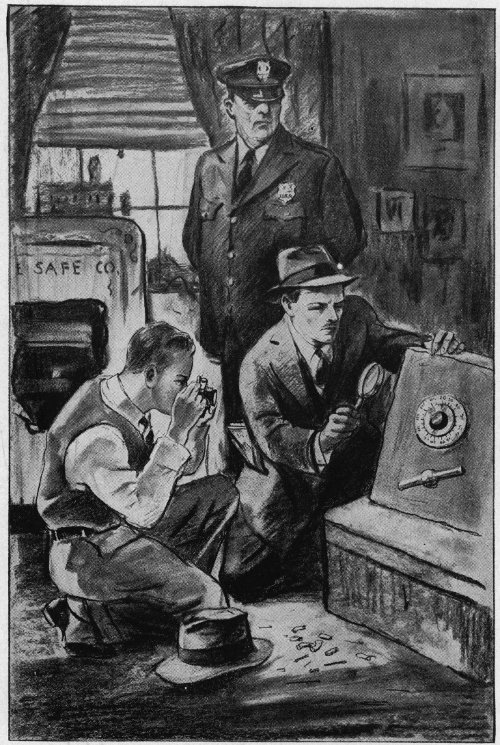
“Neat. Professional, all right. Cut up
the safe with oxyacetylene torch. Easy as
opening a can of peas.”
“H’m,” said Tom as he entered the place.
“Not much of a safe. Easy money, I’d say.
But we’ll try to make ’em pay. We usually
do, in the end, don’t we, Jerry?”
“I’ll say you do, Tom,” Jerry grinned.
“Who’s the Boy Scout?” He eyed Jimmie
suspiciously.
“He’s from the Press,” Tom explained.
“Special friend of mine. Keen with his
candid camera. Only person that’s ever
photographed the Silent Terror.”
“The Terror!” Jerry whistled through
his teeth. The look he bestowed upon
Jimmie was one of genuine respect.
54
“All right, Jerry,” Tom said with a grin.
“Strike a pose so Jimmie can get a picture.
Usual stuff. Stand and point at the
wrecked safe.”
Jerry smiled. Then his face sobered as
he struck the pose.
Jimmie got his picture, three shots. Not
quite satisfied with the “usual stuff” he
wandered about the small room looking for
others. In the corner, propped against the
wall was a section of the safe containing the
lock.
“Got in their way, so they removed it,”
Jerry chuckled.
Suddenly, as Jimmie looked at this
section, his figure stiffened, for all the world
like that of a panther who has scented a
covey of grouse.
Setting his camera for a close-up, he
squinted through the finder, then clicked it
three times.
55
“Mind sitting on the floor and looking at
that through this?” he said to Tom as he
took a three-inch magnifying glass from his
pocket.
“No, I—” Tom hesitated.
“Do your stuff,” Jerry roared in good-natured
glee. So Tom posed while Jimmy
took his picture.
“All right,” said Jimmie. “I’ll hurry
over with the pictures.”
“Tell your friend John to get me on the
phone. I’ll give him the details,” said Tom.
Jimmie did a fade-out while Tom and his
police friend remained to search for tools
that might have been left behind, to study
the cigaret stubs and burnt matches on the
floor, and the window that had been jimmied,
to test everything for possible fingerprints
and, in short, to conduct a thorough
investigation of a piece of work done by experts
in their line.
56
Needless to say, the Press scored a scoop
and Jimmie got his full share of credit. To
Tom’s surprise, he saw that instead of the
picture of Police Officer Jerry doing his
regular stuff, they had used his own picture,
the one of him pointing at the broken scrap
of steel containing the safe’s lock.
Beneath the picture he read, “Famous
young detective discovers valuable clue.”
“Now what?” Tom thought. “Just one
more of those newspaper half-truths, I
suppose. I can’t say I like them.”
The fact is that that line beneath the
picture told the whole truth, only it was done
in advance of the discovery. With Jimmie’s
help, Tom was to uncover a valuable clue
from that same scrap of steel, though at
that moment he knew nothing about it.
57
CHAPTER VI JOHN’S HIDEOUT
Jimmie lived with his father and mother
in an old-fashioned house in The Glen, a
suburban village near the city.
John Nightingale, too, had a place in The
Glen. And what a place it was! To the few
who knew about it—and they were very few
indeed—it was known as “John’s hideout.”
It was well named. The Glen was an old
village. One of the first settlers had been
a Judge Stark, a man with grand and costly
ideas. He had been fond of large rooms,
fine horses, and trees. With plenty of money
at hand, he had walled in ten rolling acres
of land, built a huge castle-like house in the
center and broad stables at the back, laid
winding drives and paths all over it and
planted it thick with all manner of trees.
58
The Judge had now been dead for many
years. His two sons, preferring city penthouses
to a tree-grown estate, had abandoned
the great house. It had been closed for
years and was showing signs of decay.
The Judge’s trees, planted with such care,
had continued to thrive. In one corner of
the estate, some distance from the house,
was a thick clump of pines. So closely
planted were they and so interlaced were
their heavy branches that the space beneath
them seemed dark even at noonday.
59
In the center of this cluster of pines was
John’s hideout. Having made the acquaintance
of one of the Judge’s sons, John had
sought and received permission to erect a
portable structure there. The hideout consisted
of two small rooms made entirely of
2×2 timbers and three-ply boards. Even
the roof was of ply-board, heavily painted.
It resembled nothing quite so much as two
huge packing boxes set up side by side.
When an autumn rain came pelting down
on the roof it was as if a hundred imps were
beating upon it with drumsticks. Since
Jimmie Drury was a normal boy with the
blood of Robin Hood, Long John Silver and
all the rest coursing through his veins, it
was only natural that he should become very
fond of John’s hideout.
Nor did his father object. John Nightingale
was not a thrifty person, to be sure. He
borrowed money three days before pay-day
and his clothes were more often frayed than
otherwise. But he was honest, clean, and
friendly, the sort of fellow who makes a good
and generous big brother. And to Jimmie’s
father this was quite enough.
John was young, not yet twenty-five, but
he had been places and seen things. There
was nothing Jimmie liked quite so much as
sitting by John’s glowing fire sipping a cup
of his famous bitter-sweet chocolate, and
listening to his low drawl as he told of crossing
the ocean on a cattle ship or shipping as
an able-bodied seaman earning his way peeling
potatoes and washing dishes “down to
Rio” or “across to Shanghai.”
60
“Folks are queer,” John would drawl.
“Queer and just alike, too. If you hang
about the water-front in Liverpool, Rio,
Boston, or Shanghai, and if you don’t watch
out you’ll be robbed. But if you go back to
some quiet little village near any of these
harbors you’ll find kindly, hard-working,
gentle folk who are glad to help you and wish
to do you no harm.”
“But tell me about these places in Chicago?”
Jimmie would insist.
“What places?” John would ask, as if he
did not know.
“The places where you eat with a feeling
that there’s a knife at your back,” Jimmie
would hunch forward expectantly in his
chair.
61
“Oh, those places!” John would grin.
“You’re safe enough there if you’re in the
know. They spot you soon enough. They
read your stuff in the papers. If a reporter
doesn’t go around exposing them, these
places you know, on the near west side,
where the light-fingered fellows, the hold-up
men, and a bank robber or two hang out he’s
as safe as in a church. I think they really
enjoy our company. Some of them,” John
would chuckle, “are poets and novelists gone
wrong. They have the desire to create or
destroy. It’s easier to destroy than create
so that’s what they do.
“But, of course,” he would hasten to add,
“you wouldn’t know what I mean by all that.
And I’m not going to take you there, so let’s
talk about that place on the near north side
where you get real Swedish cooking, big
rings of cold meat in a sort of candied jelly,
minced chicken, strange, rich desserts and
real coffee. All spread out on a long, bare
wooden table where you can help yourself.”
“Um,” said Jimmie.
“We’ll go there the very next time,” was
John’s instant decision.
62
John had written a small book on “Places
to eat.” Some day he would be a famous
novelist, Jimmie was sure of that. He never
grew tired of listening to John as, in slow,
melodious rhythm, he read aloud some short
piece of fiction that he had just finished
writing.
For the most part John’s stories found
their way to the waste basket, but every now
and again his name was featured on the
cover of a well-known magazine. This, of
course, filled Jimmie, his ardent young admirer,
with delight.
It was in this very hideout on the evening
of that day on which he had gone to view
with Tom Howe the remains of a blown safe
that Jimmie told John of his great discovery
in the fog.
It had been his idea in the first place to
secure a short news story with a picture telling
how a giant from the north woods had
knocked a pick-pocket into the middle of the
street with his bare fist.
As his acquaintance with this big, rough-spoken
man had grown, his ideas had grown
with it.
63
Now, as John sat with a steaming cup of
chocolate before him he said:
“It’s a feature story. That’s what it is!”
“For the big Saturday edition,” John
smiled expectantly.
“Yes, or perhaps even a magazine article.”
“All ready. Shoot! And here’s how!”
said John. They clicked their cups and
drank, after which Jimmie told his story.
He told how he and the man from the north
had met in the fog, how the pick-pocket had
gone spinning into the street and how he,
Jimmie, had asked the stranger for a story.
“When he showed me that check for a half
million bucks the one that pick-pocket
nearly got, I wouldn’t believe it was real,”
said Jimmie.
“Don’t blame you,” John drawled.
64
“But it was good! Real turkey!” Jimmie
exclaimed. “He took me to the First National.
Such a bank as that is! He didn’t
just go to a teller and ask for a half million.
He went to a department that deals only
with raisers, dealers and manufacturers of
furs. There he said, ‘Hello, Joe,’ to a man
at a desk. Then he sat down at the desk,
and showed the check. Joe whistled. ‘Good
business,’ was all he said.
“‘Sure,’ my big friend grinned. Then he
said, ‘I want so much cash, a draft on this
bank, one on that one, so much on deposit.’
Just like that.”
“Just like that,” John chuckled. “I’d
like to try it just once.”
“But it was all real,” Jimmie protested.
“He’s the silver fox king.”
“That’s a large order,” said John.
“He told me about it,” Jimmie went on
enthusiastically. “You don’t get to be the
silver fox king all at once. There was a
time when only wild silver fox skins were
sold. Then someone caught a pair of silver
foxes alive.
65
“He and his brother bought them, paid a
lot of money for them. And when a family
of little foxes arrived what do you think?”
he asked.
“Can’t guess,” said John.
“They were all red foxes, worth about
$10.00 apiece. All except one. He was a
cross-fox. You see,” Jimmie leaned forward,
“silver foxes are sort of freaks, like
a white calf in a herd of red cattle.”
“What could you do about that?” John
asked.
“You have to try and try again. First
you get a cross fox, half red and half silver.
You keep the ones that are most silver and
raise more and more foxes. That’s what my
big friend, Harm Stark, did. And in the
end, when he and his brothers were nearly
broke, they began getting real silver foxes.
And now they raise thousands every year.
He just sold their prime skins for a half
million. He’s promised to show them to me.
He wants us to come to dinner with him at
the Morrison. He’ll give you the whole
story. Won’t that be grand!”
66
“It sure will,” John beamed. “But where
do you come in?”
“I get in on the dinner,” Jimmie grinned
broadly.
“A half million in silver fox skins,” John
mused. “What a haul for some big-time
crook!
“Jimmie!” he exclaimed, “have another
cup of chocolate.”
67
CHAPTER VII BIG TIMERS STAGE A REHEARSAL
“What’s that you were saying about
wanting a camera with a telescopic lens?”
Scottie asked Jimmie next morning.
“Said I’d give anything I own for a telescopic
lens to fit my candid camera,” Jimmie
replied.
“Oh! That’s it,” Scottie exclaimed.
“Then your possessions are safe enough.
They don’t make a telescopic lens for a toy
camera. Not yet.”
“It’s no toy,” Jimmie protested. “Remember
that enlargement you made for
me?”
“Sure.”
“Well, it’s important evidence. Tom
Howe told me so. In the end it may help
send a man to the jug.”
68
“Well, if Tom says that it must be so,”
replied Scottie. “Tom’s Irish and I’m
Scotch. But the Micks and Macks won the
great war, so they say, and we still march
side by side.
“But that,” he added, “won’t get you a
telescopic lens for your camera, for there’s
never a one that’ll fit it.
“Nevertheless,” he glanced in the corner,
“there’s a box camera over there I once
rigged up with a telescopic lens. The lens
is still on it. All you have to do is to look
at the ground glass in the back to get your
focus. That is, if it’s less than a hundred
feet. If it’s more you don’t have to look.
I don’t mind lending it to you for a few
days.”
“Say! That will be great!” Jimmie enthused.
“I—I’ll show you some real stuff.”
“I hope so, my boy. I sure do hope so,”
said Scottie.
69
Scottie was growing old. All too soon another
would be taking his place. He loved
boys though he had none of his own. Deep
down in his heart he had hid a warm spot for
Jimmie. “He’ll do,” he murmured to himself
as Jimmie marched proudly away with
his new-found treasure, “He’ll get there.
Never doubt it.”
The two days that followed were busy ones
for Jimmie. One of the copy boys was sick,
another on a vacation. Jimmie was obliged
to resume his regular place in line and answer
once more to the call of “Boy.”
This he did not entirely regret. He was
able to look with new eyes upon the great
institution to which he belonged. Since his
little excursions to the outside, the make-up
room, the thundering press room and the
quiet offices of special editors all had a new
meaning for him.
“We’re all working with one end in
view,” said Mr. Strong, the editor, taking a
moment from his many busy hours to chat
with him. “We’re keeping the public informed
regarding important matters. We’re
helping to fight crime and trying to encourage
people to live decent and respectable
lives.”
70
“Yes, sir,” replied Jimmie, too much
awed by the greatness of the man to say
more.
Important things did happen despite the
boy’s busy days. He and John had their
dinner with Harm Stark, the silver-fox
king. Such a dinner it was! A private
dining room with paneled walls such as
Jimmie had never seen before. Real, solid
silver service there was too. And such food!
Chicken legs encased in fancy paper at the
ends, mashed potatoes, yellow with butter,
and side dishes the boy could not so much as
name.
Harm Stark, in his own broad, open-hearted
way, gave John a real story. He
told of his early struggle and final success,
told how acres of fox farms had widened
and how they were fenced and guarded. He
told of feeding, training and selecting the
foxes.
71
“And after that,” he sighed, “comes the
harvest. They’re all here and sold, a half
million dollars worth. Here right in the
city. Some day I’ll give you a ring on the
phone and take you over to see them. Of
course, they’re not mine any more, but
Solomon Zimmerman won’t mind showing
them. He’s as proud of them as I am.”
Jimmie hoped the ring on the phone might
come very soon. Had he but known it, that
particular phone call, costing only one buffalo
nickel, was to be of the utmost importance
to him. It is often so in life, a simple
lifting of the receiver, a murmur, “Give me
Randolph 1223,” may mean success or failure,
victory or defeat, even life or death to
someone. You may be sure that when that
call did come Jimmie was ready to listen.
One other thing occurred which, strange
to say, was in the end to be closely connected
with the silver fox king’s phone call. It
happened during the noon lunch hour when
Tom Howe came over to make his report.
“Your scratch clue was a real one,” Tom
said with a friendly smile.
72
“My scratch clue?” Jimmie stared at him
in surprise. Then, of a sudden, he remembered.
When he had accompanied Tom to
the scene of that safe-robbery, he had taken
pictures other than those required by his
paper. On the section of the steel door, cut
away with the use of an oxyacetylene
torch, he had discovered some scratches.
Having recently read a book on strange
clues, he had thought it worth while to photograph
these scratches. When the picture
had been enlarged they stood out very
plainly. It was this that had led him to
print the picture of Tom Howe looking at
that broken bit of steel and, supposedly, discovering
fresh clues. As he recalled all this
he smiled as he said:
“I’m glad they were the real thing. What
did you do about it?”
“First thing I did was to scrape the surface
of the safe where those scratches
showed,” said Tom.
“What for?” Jimmie asked eagerly.
73
“It’s a well known fact,” Tom replied,
“that, even if one of two metals is much
harder than the other, when one scratches
the other some of it comes off.
“I wanted to know whether there really
was tungsten in that steel. I sent the scrapings
to the laboratory. They burned it by
electric arc and studied its spectrum. That’s
pretty scientific,” he grinned. “There was
tungsten all right. So I sent out Tungsten
Tom’s pictures to several manufacturers
and I got my man; that is, I proved that he
had worked at the Carter Machine-Tool
Company’s plant and that he did rob them.”
“How’d they catch him,” Jimmie asked.
“You’d be surprised,” Tom laughed. “He
was carrying it away in his card-board lunch
box. They suspected that someone was
doing that so they set a powerful electro
magnet beside the narrow alley-way through
which all employees must leave. When
Tungsten Tom’s lunch box came near it, that
electro magnet smelled steel. It drew in
Tungsten’s lunch box and held it fast. So
that was that.”
74
“Pretty slick,” Jimmie smiled in admiration.
“Thanks to your aid,” the young detective
went on. “We’ve got enough right now
to make a good case against Tungsten. But
we don’t want to spring it. We want to get
his whole gang. We——”
He broke short off to stare into the street.
“Can you beat that?” he exclaimed.
“There’s one of those trucks now. Come on!
we’ll have to follow. This may be the big
hour.”
Seizing Jimmie by the arm he pushed him
into a taxi and they were away.
“See that large, black truck up ahead?”
Tom said to the driver.
“Yes, sir.”
“Follow it. Don’t lose it.”
“Yes, sir.”
They turned a corner, dodged a street car,
got caught by a light, lost their scent for a
time, then picked it up again.
“You remember that garage I was watching
from my lofty perch?” said Tom.
75
“Sure, I do,” said Jimmie.
“We’re following one of the two trucks
stored there by Tungsten and his gang.
Crooks store trucks for a purpose. On the
side you’ll read the words:
TOWN’S END TRANSFER
“They’ll transfer something, right
enough,” Tom laughed. “Perhaps today,
though I doubt it. Not at noon. This may be
a rehearsal.”
“Rehearsal?” Jimmie stared at him.
“Sure. Crooks have to be up-to-date. No
movie producer ever rehearsed an act
oftener or more thoroughly than crooks do
some big play they are going to make. Getting
in, getting out, the cop on his beat, the
number of people likely to be on the street,
every curve that the car or truck must make,
are important; those and a hundred other
things. They——”
“There,” he exclaimed, “they’re pulling
up to that place a half block ahead, preparing
to back in.
76
“Stop here, driver,” he commanded.
“They can’t see us. Here’s your fare. Turn
around and get away quietly.”
“Right. Thanks.” The taxi slid silently
away.
“Here!” said Tom drawing something
flat from his inside pocket and snapping it
into the form of an oblong box. “Take this.
It’s your lunch box. At least we’ll pretend
it is.” From another pocket he produced a
paper bag. After inflating this he dropped
it to his side.
“This,” he said, “is a street of small factories
for the most part. It is the noon hour.
Slouch a little as you walk. We are workers
going to eat our cold lunch with a cup
of hot coffee at the place round the corner.
Come on. We’ll cross the street and walk
down past where the truck stands.”
Jimmie felt his blood tingle as they
crossed the street then sauntered down the
sidewalk. He was thinking of sudden sallies,
burst of machine gun fire and all the
rest.
77
Everything, however, was quiet enough.
The street seemed almost deserted. It was
an old section of the city. Four-story buildings
lined the street on either side. On one
was the sign of a candy manufacturer, on
another that of a job printer and a third
of some novelty dealer.
“Don’t look like a place where big-time
crooks could make a grand haul,” said Tom,
talking out of the side of his mouth. “Still
you never can tell.”
“Look,” said Jimmie. “They’re backing
the truck into that alley.”
“That’s right,” Tom’s figure stiffened.
“This may be something real after all.”
“Two men are getting out,” said Jimmie.
“Going inside. Perhaps it’s only a rehearsal
after all.”
The men were gone for some time. The
building on the corner, just ahead of Tom
and his companion was vacant. Large,
dusty windows on each side showed it to
have been a store.
78
“Come on around the corner,” said Tom.
“We can watch through those windows without
being seen.”
Through those dusty windows they did
watch but it was little enough they learned.
In time the two men came out, carrying
nothing. After they had climbed back into
the truck, they drove away at a rapid rate.
“Just a rehearsal,” said Tom. “Wish I’d
been able to come close enough to get a real
look at them, but I didn’t dare.”
“If I’d had my telescopic camera,” said
Jimmie, “I could have taken their pictures.”
“Too bad you didn’t,” sighed the detective.
“Well, better luck another time.”
After that they folded up lunch box and
paper bag and looked up a truly good eating
place to enjoy a real lunch.
79
In Jimmie’s room at home was a great,
old-fashioned, over-stuffed rocking chair.
It was frayed and moth-eaten but oh, so comfortable!
When the day was over and supper
done, Jimmie loved to sit in this chair
with feet propped up on the window sill,
there to listen to the robins chirp, to watch
twilight darken into night, and think things
through.
There was plenty to think about these
days. As he sat there a few hours after his
truck chasing expedition with Tom, he
found himself in a somber mood.
It was all well enough, he was thinking,
to dream of having a part in bringing criminals
to justice, but when you were up against
the real thing——
“Ah, that’s different,” he sighed.
And then, of a sudden, his spirits and
determination rose. “We’ll get him!” he
murmured. “We will!”
He was thinking of the Silent Terror.
Even now a thrill ran up his spine as he
seemed to hear those words, “As you are!”
80
His determination at this moment to do
his full duty was stronger than ever, for the
papers that day had carried broad headlines
about the Silent Terror’s last attack.
Jimmie had read how a girl, little older than
himself, had been sent from a laundry to
bring the payroll. On her return she cut
through an alley. They had found her four
hours later wandering only half-conscious
and hysterical, empty-handed and murmuring
about a man and a bubble.
“What man? What bubble?” they had
asked. To these questions she found no answer.
But to all it was plain that the Silent
Terror had struck again.
“I took his picture,” Jimmie groaned.
“And got only an ear. An ear! It may be
well enough for a whiz of a detective like
Tom Howe, but who else could tell that ear
if he saw it? Practically no one.”
Other matters called for thought. There
were the five big-time crooks who, Tom
thought, were preparing something big.
Was Tom right? And had they, in following
that truck, discovered the scene of that
proposed big haul? In such a poor section?
It did not seem possible. And yet——
81
“One thing’s sure,” Jimmie sighed.
“We’ve got the goods on Tungsten Tom.
He was in on that safe-breaking and I helped
to prove it, my little candid camera and I.”
He got no little satisfaction from that. It
is good to be really doing things. Was he
to be in on the whole affair? Would he see
them all dragged into the net, one at a time;
Black Dolan, Piccalo, and all that ugly five?
He hoped so. And yet, he shuddered at the
thought.
He looked at his watch, nine o’clock.
Time for sport flashes. He snapped on the
radio to catch the commentator in the midst
of his talk:
“Tomorrow,” came from the radio, “will
witness an event of unusual interest in the
world of sport. If you have wondered what
the city’s richest people look like, the De
Metzes, the Marmons, the Morton Armours,
and all the rest, be sure to come to the ball
game. They will all be there, right down in
the box seats. Why? Because the young
society baseball pitcher, J. Ogden Durant,
is to start for the Bear-cats.”
“Durant!” Jimmie exclaimed to the
empty room. “Gee! Oh, gee!”
82
Just at that moment he wished he had no
job. He was a great baseball fan. And
never had there been a game he longed so
to see. To sit up there and howl himself
hoarse for his hero! Ah! That would be
life. L-I-F-E spelled in big letters.
He scarcely heard the further comments
of the announcer as he went on:
“Perhaps this is the first time in the history
of baseball that a millionaire’s son has
risen to the rank of a big-leaguer. It surely
is the first time one has stood in the pitcher’s
box. Give him a hand, ladies and gentlemen.
Give him a hand. He deserves it.”
All this time Jimmie sat with his eyes
closed, seeing himself in the past, as a rather
small boy. A golf course joined The Glen
on the west. It was a large and expensive
course, patronized, for the most part, by the
rich of the near-by city. A patch of woods
lined this course on one side. Into the tall
grass of this little forest, golf balls often
bounced and were lost. On a Saturday the
village boys went there in search of balls.
83
One day Jimmie had pounced upon a ball,
a split second before a larger boy had prepared
to scoop it up. There had been an
argument and a race. To escape his pursuer,
Jimmie raced out upon the green. He
was just in time to get in the way of a long
drive. The golf ball struck him in the very
tender portion of his anatomy.
With a howl he went into the air, then
came down in a heap like a wounded soldier.
He did not cry, not even when three of the
foursome of rich young golf players that
made up the party, let out loud roars of
laughter. He arose stiffly and started back
toward the forest.
Then it was that J. Ogden Durant, young
son of a rich stockyards owner, and one of
that party, had endeared himself to Jimmie’s
heart. He it was, of the four, who did
not laugh. Though it had not been his shot
that felled the boy, he hurried on ahead of
his companions, caught up with Jimmie and
said:
84
“Sorry, old man. That was a hard shot.
They had no right to laugh. The thing
might have been serious.”
Then, in a way that no one could see, he
had slipped two brand new golf balls into
Jimmie’s sweater pocket.
There are certain events in every small
boy’s life that he never forgets. This was
one in Jimmie’s. There was that in the
face, the voice, the general action of J.
Ogden Durant that marked him as a “real
guy.”
In the years that followed Jimmie had
saved every picture of Durant appearing on
the Society Page. He had followed his
career with the keenest interest. And
now——
“Aw, gee! What a break!” he groaned.
He seemed to hear that call he had come to
know so well, “Boy!” For once he almost
hated it.
85
CHAPTER VIII A MILLIONAIRE PITCHER
It was on the way to the city next morning
that, riding with his father, Jimmie brought
up the coming ball game.
“Durant is pitching today,” he suggested.
“Yup.” His father’s face was buried in
the morning paper.
“That will be one swell game,” Jimmie
ventured.
“Yup.”
For some little time Jimmie said no more.
Then, feeling ready to burst, he exclaimed:
“Gee! There are times when I really
wish I was a good liar.”
“Why? What’s up?” His father’s head
came out from behind the paper.
“I want to go to that game something
fierce. And if only I could tell ’em my
grandmother had died or—or something,
I—” Jimmie paused for breath.
86
“You’d get to go to the game,” his father
smiled.
“Yes, but I couldn’t get away with it,” he
said.
“No,” said his father, “I hope not. But
you’ll go all the same.”
“Why—wha—what?” Jimmie was fairly
bowled over by this sudden bombshell.
“You have a camera with a telescopic
lens,” suggested his father.
“Yes, oh, yes. It’s Scottie’s.”
“And it works?”
“Swell.”
“Then I’ll take you along to get some shots
of Durant pitching. We’ll have to get them.
This game is one of the big society events
of the season. They——”
“Never mind the fireworks,” his father
checked this burst of enthusiasm. “The
umpires have been crowding the photographers
back off the side lines. Their shots
of pitchers in action have not been so hot.
With that telescope lens of yours you may
do credit to your candid camera crowd.”
87
“What a break!” Jimmie murmured.
“Boy, oh, boy! What a break!”
At the appointed hour Jimmie found himself
seated beside his father in the grand-stand.
They were in the midst of a large
and enthusiastic crowd, for Jimmie’s father
purposely had asked for seats outside the
press box. The reserved seats were packed
with the city’s richest society people. J.
Ogden Durant, popular young society bachelor,
was about to make his bid for stardom.
If J. Ogden seemed a strange name for a
pitcher, the good-natured crowd soon put an
end to that.
“’Ray for Oggie,” some big voice
shouted. At once the throng took it up:
“’Ray for Oggie! ’Ray for Oggie!”
As “Oggie” stepped into the pitcher’s box
the same big voice shouted:
“Atta boy, Oggie! Bear down on ’em!
Pitch to ’em, boy! We know you, Oggie.
You’ll do!”
88
When Oggie turned his face up into the
sun to acknowledge the compliment the
crowd went wild.
Just then Jimmie sighted his camera and
took a shot. “That should be a winner.”
His father smiled his approval.
“Do you think he can pitch?” Jimmie
asked.
“He has a record as a sticker,” answered
his father. “Unlike most pitchers, he gets
better as the game goes on. If they keep
him in there for four innings he’ll win the
game.”
That his father was a good judge of ball
players Jimmie knew right well and admired
him for it. Now he found himself hoping
that Ogden Durant might stay those four
innings.
89
That there was at least one onlooker who
did not agree with Jimmie’s views soon became
evident. Busy as Jimmie was getting
pictures for his father, he found time to
glance along the seats to a spot some fifty
feet away where a man with a long, thin
face and a fog-horn voice was bellowing
from time to time:
“Take him out! He’s rotten! Who said
he could pitch? Another ball! What did I
tell you? Take him out! Send him back to
the stock yards!”
“Who’s your friend?” Jimmie’s father
asked teasingly.
“He’s no friend of mine,” Jimmie replied
almost in anger. “I’m for Oggie.”
Oggie was in need of friends. In the first
inning he gave a base on balls that let in a
run. In the third he filled the bases, got
out of this hole only by chance, then allowed
a two-bagger to bring in another run.
Jimmie saw the manager look toward the
bull pen. At the same time the man with the
fog-horn voice, standing up with his face
very red, was shouting, “Take him out!
Back to the stockyards! Ma—a! Ma—a!”
“I wish someone would swat him!”
Jimmie exclaimed.
90
“He’s asking for it,” his father replied.
“He’ll probably get it.”
Oggie was given one more inning and this
time he made good. No runs were scored.
What was more, in his time at bat he hit
out a Texas leaguer and brought in a run.
Then the society ladies in the reserved seats
screamed.
But the man with a red face bawled all the
louder:
“Take him out!”
“There’s something behind all his noise,”
said Mr. Drury. “Something I don’t like.
It’s sure to come out in the end.”
It did come out and that very soon. Oggie
pitched a hitless inning. At this the heckler
bawled out in a voice that all could hear:
“Take him out! He’s one of the idle rich.
A millionaire. A murderer!”
91
Enough had been said. The guards surrounded
the man and bore him away. But
before this happened, just as he turned half
about to face the guards, Jimmie aimed his
camera, glanced at the ground glass, made a
quick adjustment and snapped his picture.
Why did he do this? He did not know. He
was not to regret it, for this picture was to
form a link in a long chain that had started
the day he had shot the Silent Terror’s.
92
CHAPTER IX A FORTUNATE SHOT
Jimmie was tired. The ball game was
over. It was evening now and he and his
father were on their way home. The events
of that day had been exciting enough, but
all days come to an end. He leaned back in
the seat and closed his eyes. Cameras and
silver fox skins, blown safes, speeding
trucks, policemen in uniform, a ball game in
full swing, and Tom Howe’s piercing eyes
passed across his mental vision.
Because, for the moment, he wished to forget
all these things, he opened his eyes.
When he looked at his father he realized
with almost a shock that he too must be tired.
Yes, there were tired lines about his mouth
and wrinkles around his eyes he had never
noticed before.
“Dad,” he said, “why do you work so
late?”
93
“To get my work done.” The wrinkles
about his father’s eyes gathered into a smile.
“Couldn’t someone else do your work?”
“Oh! Undoubtedly,” the smile broadened.
“But if they did they’d want the
pay.”
“But why work so hard?” Jimmie persisted.
“Well,” his father drawled, “there’s the
grocer and the milk man to pay. There are
taxes. The old house needs a new roof. And
your college days are only a year away.”
“Oh, yes, college,” Jimmie said thoughtfully.
He had often dreamed of college.
“Dad,” he said after a moment of silence,
“how much have I cost you?”
“Well—” his father hesitated, “the income
tax man allows me four hundred dollars
exemption for having you around.
Perhaps that’s about right.”
“Four hundred a year and I’ll be eighteen
when I’m through High.”
Jimmie figured for a moment. “Why
that’s over eight thousand dollars!”
94
“What? Oh, yes, I suppose it is.” His
father lapsed into silence.
“What do you expect to get out of it?”
Jimmie demanded.
“Why! Nothing! Probably nothing except
the fun of seeing you grow up. Some
people like to raise pigs, just to see them
grow. Some raise horses and some raise
boys for the same reason.”
“Then,” said Jimmie, and there was a
note of finality in his voice, “you’re not
going to work nights to send me to college.”
“What? Don’t you want to go to college?”
his father stared.
“Sure, I do. But look! You know Bill
Baley and the Dale boys. They go to college.”
“Yes.”
“Bill’s father works hard.”
“Too hard. That’s right.”
“The Dale boys live off their grandfather
and he works hard.”
“He sure does, son.”
95
“Bill and the Dale boys dance and play
tennis, live in fraternity houses, wear good
clothes and study some in college but somebody
has to work too hard so they can keep
it up.”
“Well,” his father was smiling again.
“What’s the answer?”
“Work!” Jimmie was not smiling. “If
I go to college I’ll earn my keep. I’ll find a
college town with an up-to-date newspaper.
I’ll develop the candid camera and telescopic
lens ideas as far as I can, then I’ll
make them give me a job. And I’ll work,
not just sit and wait for checks from home.”
“Son,” there was a warm light in his father’s
eye. “I like to hear you say that. The
greatest discovery any boy ever made is the
fact that every tub must stand on its own
bottom, every fellow pull his own oar, make
his own way in the world.
“But, son,” his tone was deeply serious,
“no one ever succeeded in a newspaper office
without hard work and long hours. It’s
the workingest place in the world.”
96
“I know,” said Jimmie. And at once his
mind was busy on the problems that might
lie before him tomorrow, and all the other
tomorrows to come.
Next day Jimmie had the very unusual experience
of seeing one of his own candid
camera shots on the front page of the Press.
This, however, was overshadowed by a startling
discovery made shortly after his negatives
taken at the ball game had been
developed.
The picture, of course, was a candid shot
of the city’s new idol, the millionaire pitcher.
Inside the paper, on the sports page, were a
half dozen other shots of Ogden Durant.
Surely this was Jimmie’s big moment. As
he came into the office Scottie, the scarred
veteran of many pictures, shouted a cordial
greeting.
“You made good, boy!” he exclaimed,
slapping him on the back. “Did it with that
old box of mine. I’m proud of you.”
Nothing could have pleased Jimmie half
so much, especially as it came from Scottie.
97
But the big things of that day were not
over. Scarcely had Jimmie taken his humble
place in the row of waiting copy boys,
when his father stepped out into the corridor
and beckoned to him.
He followed his father into his office only
to find with a start of surprise and joy that
“Oggie” Durant, his idol was waiting for
him there.
“He came in to thank us for the fine pictures,”
Jimmie’s father smiled. “So I
thought he’d like to meet the photographer.”
“You don’t mean—” The young millionaire
looked at Jimmie in surprise.
“Yes.” There was a note of pride in the
father’s voice. “Jimmie’s been a camera
bug for a long time. He’s with us for the
summer so I drafted him into my service
yesterday.”
“Well! Shake!” Oggie gave Jimmie’s
hand a true pitcher’s solid grip.
98
Never had Jimmie been happier than at
this moment. To be shaking the hand of a
young man who had been born rich, who
might at that moment have been lolling on
some beach surrounded by a bevy of beauties,
or coasting along in some palatial yacht, but
who had chosen the long years of labor and
practice that makes a man a professional
pitcher, that was a joy indeed.
“Og—I mean, Mis—mister Durant,” Jimmie
burst out suddenly, “do you remember
me?”
“Why, no, I—I can’t say I do.” The
great pitcher looked him over.
“You gave me two golf balls,” Jimmie
confided, “quite a long time ago. I—I’ve
got them yet. Per—perhaps it sounds silly,
but they’re as new as when I first got them.”
“I gave you golf balls?” Durant looked
at him again. “Why, yes, now I do recall.
Burton Keating hit you with a long shot.”
“Yes—yes, that was the time,” Jimmie
exclaimed, pleased that he had not been quite
forgotten.
“Well now isn’t it strange,” said Durant
with a queer smile, “how our every little act
comes back to haunt us?”
99
“Mis—mister Durant,” Jimmie burst out
again, “will you do me a favor?”
“Gladly. Name it.” The great one
smiled.
“Autograph a baseball for me,” Jimmie’s
tone was eager.
“Is that all? I shall be glad to do that,”
laughed Durant. “In fact, I’ll do more.
I’ll pass the ball down the line to all the
members of the team and have them sign it.”
“That—ah—that will be swell!” said Jimmie.
“But these pictures?” Durant’s voice
took on a puzzled note. “How could you
take them? I can’t say I saw you on the
diamond.”
“I’ll say not,” exclaimed Jimmie. “It
isn’t allowed. Wait! I’ll show you.” He
was away and back again in the same moment.
“See!” he held up Scottie’s old camera.
“Telescopic lens.”
100
“That,” the pitcher took the camera and
examined it closely, “that’s a wonderful
idea. But this camera now.” He hesitated.
“It really doesn’t look very new. Is it up-to-the-minute?”
“No,” Jimmie grinned. “It isn’t much
more than up to the day-before-yesterday.
But I had to make it do.”
“We’ll correct that,” said Durant. Taking
out a small, blank book, he entered some
notes; then, without further comment, returned
the book to his pocket.
Five minutes later Jimmie was back in
his place in the row of copy boys. But not
for long. It was Scottie who now called him
out. “Jimmie,” he said, “here’s a negative
I found in your lot of baseball shots. Looks
like some sort of a row. What’s it all about?
And do we keep it?”
“Oh, yes. Er—let’s see! Now, I know.”
“Here’s a print,” suggested Scottie.
101
The moment his eyes fell upon that print
Jimmie knew there was something unusual
about the central figure in the picture, but
cudgel his brain as he might he could not, for
a long time, tell what it was. When it did
come it was with the force of a blow on the
head.
Taking the picture to a bright corner of
the great, busy room, he studied it for a long
time. When his turn for answering the call,
“Boy,” came, he thrust it into his pocket.
Fortunately his errand that time took him
to the art department. There, while he was
awaiting a series of drawings he picked up a
magnifying glass and through this took another
look at the picture.
Barely did he escape dropping the glass.
“The ear!” he said aloud. “It’s the ear.”
Glancing about to make sure no one saw him,
he took a thin box from his pocket and compared
its contents to the ear of the central
figure in the picture. The shot was of the
man who had attempted to rattle Ogden
Durant by his abusive language at the ball
park; the shot Jimmie had taken on pure
hunch as the man was being ushered from
the grounds.
102
“The ear,” he thought, as his hand shook.
“It’s the ear of the Silent Terror. That
man at the ball park was the Silent Terror.
I’ve taken his picture again. How
strange!”
“Here you are,” said a voice close beside
him. It was the artist with the pictures.
“Oh! Oh, yes!” the boy stammered.
Thrusting the unusual photograph once
more into his pocket he went on his way,
walking almost in a daze.
103
CHAPTER X THE ALASKAN MATCH CLUE
It goes without saying that at his first opportunity
Jimmie called Tom Howe on the
phone, then paid another visit to his lofty
perch atop the sky-scraper.
“Good boy,” the young detective exclaimed
when Jimmie had told of this fresh
discovery. “You’re doing great work. Keep
it up and we’ll get that Silent Terror before
he becomes too dangerous.
“This picture,” he went on thoughtfully,
“is a little better than the first one. I suggest,”
he smiled a winking smile, “that you
try a front view or profile next time. However,
we get a little more of his face this time
and we have learned much of his character.
That helps.”
“What have you learned?” Jimmie asked.
104
“That he is the crank type of criminal,”
replied Tom. “He evidently hates everyone
who is rich. Durant’s playing gave him an
excellent opportunity to voice his hate and
perhaps do some damage to the son of a rich
man.
“By the way!” he exclaimed. “When
does Durant pitch again?”
“I—I don’t know,” said Jimmie.
“Phone your father and ask him.” Tom’s
tone was eager. “It’s important.”
Jimmie took down the receiver. A moment
later he announced: “He pitches next
Wednesday.”
“Hm. Five days from now. We may
have our man by then and we may not. Anyway
it’s well worth knowing.”
“Why is that important?” Jimmie asked.
“Because this Silent Terror might repeat
his performance at the ball park at the first
opportunity.”
“That’s right! He is!” Jimmie exclaimed.
“And then you can nab him.”
“That’s it,” said Tom. “And for that
reason, I suggest that no story be given to
the Press regarding your discovery.”
105
“No story,” Jimmie’s face fell.
“Just one more minor tragedy for you.”
Tom smiled good-naturedly. “I understand
what all these little scoops mean to a promising
young newspaper man. But when we do
our best to serve the people of a great city
we must expect a disappointment now and
then. Just wait! The time will come when
the great story will break. Then you shall
have the first look in.”
“I’ll not say a word,” Jimmie promised.
“Have to get over to the ball park before
long and talk to the guards who threw that
fellow out.” Tom’s mind was at work on
the case. “Not much chance that they’ll be
able to help. Unless the fellow got violent
and did some real damage, which he probably
didn’t, they turned him loose at the
gate. Their description of the man might
help.
106
“Such a man,” he went on after a moment’s
silence, “usually works alone. This
one possesses a strange secret, one which permits
him to put his victims asleep while still
some distance from them. He is not so likely
to share that with another. And yet, if some
big time crooks convinced him that he could
do more harm to the very rich by joining up
with them he might consent. Then his power
to do harm would be greatly increased.
“The ball park can wait.” He squinted
through his telescope. “Remember that
truck we followed?”
“Yes.”
“They’ve made two more rehearsal trips
to that alley. I’ve men watching them.
And yet, I can’t see what big thing they
could pull there.
“Of course,” Tom went on thoughtfully,
“big crooks do sometimes go in for fine furs
and there is a small outfit storing fur coats
in a large vault there. But who would risk
his life and liberty for a few bundles of
second-hand muskrat coats? The idea is too
preposterous to be considered.”
“They may be using one of the rooms in
that building for storing loot,” suggested
Jimmie.
107
“I’ve had that in mind. So far nothing
has been taken in, unless—” Tom paused
for thought. “Unless it was in small packages
of great value hidden in their clothing.
There was a jewel robbery just last night.
This morning the truck made one of those
mysterious journeys. But the idea of carrying
a pound or two of diamonds on a truck!
No, it won’t do.” Tom laughed a dry laugh.
“By the way,” he exclaimed, “I’m due to
go over to look into that jewel robbery now.
Want to go along?”
“I sure do!” exclaimed Jimmie. He was
on his feet at once.
A short time later Tom and Jimmie entered
the small back room of the diamond
merchant’s shop.
“You won’t find many clues here,” said
the uniformed policeman in charge of the
case. “Slickest job I ever saw.”
108
“Hm,” said Tom. “You’d hardly think
there’d been a robbery, except,” he looked
down at the floor, “quite a lot of burned
matches. They always are important. I
have known a match to send a man to prison
for ten years.
“You’d think,” he turned to Jimmie,
“that crooks would use flashlights. Sometimes
they do. More often they don’t.
Light’s too penetrating. The gleam of a
match or candle doesn’t carry far. This fellow——
“Say!” He picked up a match and examined
it closely. “This at least is unusual.
These matches are of the type used in the
very far north, Alaska, Siberia.
“See!” He held the stub of a burned-out
match to view. “He got two instead of one
that time. The two stubs still hold together
at the end.
109
“Those northern matches,” he went on
after examining two others, “are made in
blocks. They are small and come a hundred
to the block. They are sulphur matches. A
machine splits a small block of corkpine
from end to end into a hundred tiny pieces.
The block is not cut quite through. The tips
of all the hundred ends are dipped in a sulphur
compound and become matches. They
are handy to carry. This man has been in
the north. I’ll bet on that. He used the
matches and came to like them so he still carries
them. I’ll have the records searched for
a safe-cracker who has been in the north.”
“This one wasn’t cracked. The combination
was worked,” suggested the policeman.
“Which might make it an inside job and
might not,” said Tom. “The listening-in
devices these boys have for telling when the
tumblers of the lock fall are nothing short of
wonderful.
“Let’s see what else we can find.” He began
looking around the room.
“Some candle drippings on this ash tray,”
said Jimmie.
“That’s right.” Tom pounced upon the
tray. “Got tired of his matches and chanced
lighting a stub of a candle. They often do.
He used this tray as a candle-stick. Here’s
where he stuck it.
“Cheap trinket,” he added. “I’ll take it
along. Might find a finger print.”
110
“You’ll not find any,” said the officer.
“Finger print man was here an hour ago.
Sprinkled powdered white lead everywhere.
Never a print did he find.”
“Guess that’s about all,” said Tom.
After leaving Tom, Jimmie returned to
his post in the editorial rooms, to his duties
and to the jigsaw puzzle work of fitting together
in his mind the events of the day.
There was not a spot in that great institution
that he did not know or that did not fascinate
him. He loved the smell of printer’s
ink and fresh paper. The click of many
typewriters and the roar of presses stirred
his blood. He never tired of watching that
fragile, apparently endless ribbon of clean,
white paper glide through the presses to
come out printed and folded in complete
newspapers.
111
Three spots he liked best of all, the editorial
room, the photographic department, and
the art room. In these men born to create
were at work. The click-click of a typewriter
produced a story that would be read
by eager millions. The dark-room brought
out pictures almost as though by magic. In
the art room men created pictures that made
men laugh and forget their troubles. That
was a little world all its own!
As the boy sat there waiting his call he
thought of these things. But most of all his
mind was busy on the many mysteries that
suddenly had thrust themselves into his life.
What of that strange man whose picture he
had twice taken? How could he, by a single
gesture, put his victims to sleep, to rob them
and leave them unconscious? Was this some
strange new form of hypnotism? He did
not think so. But what was it? One fact
troubled him. He had been given an opportunity
to study the man out at the ball park.
He had failed to do so because he had not
considered him important at the time. Then,
too, he had been busy with his camera.
112
“I would recognize his voice on the instant,”
he assured himself. “But his face.
I wonder if I could recognize it again if I
saw it. I wonder—” Had he but known it
he was to look once more at this man and
still be unable to picture him in his mind.
He was interested, too, in Tom Howe’s
five “bad ones.” He wondered if any of
those five desperate and cunning criminals
had really taken part in the recent safe
crackings. Tungsten Tom did appear to be
involved in the first one. But the second, the
diamond robbery? Only time could tell.
He wondered, in a vague sort of way, why
those men had two trucks? What did they
hope to carry away? Why did not Tom
Howe and his associates arrest them at once
and prevent them from committing other
crimes?
“Wants to catch them with the goods on
them,” he assured himself. “Wants to get
them all and put them behind bars for a long
time.”
113
“Behind bars,” he whispered. He tried
to picture a great prison and could not, for
he had never seen one. What a strange, fantastic
place it must be! And what a queer,
upside down world it was in which such terrible
places were needed.
And then it was time to go home with John
Nightingale, to enjoy a feast of bitter hot
chocolate, beef-steak broiled over coals,
baked potatoes and ginger snaps. What a
strange, good, bad, sad, glad world it was!
And how good it was to be alive and to have
a job where you could be where so much was
happening every day.
114
CHAPTER XI STRANGE, WHITE BALLS
Supper was over in the hideout. A grand
supper it had been. When time had come
for bittersweet chocolate and cakes John
had blown out the lamp. Only the gleams
from the cracked stove-lids dancing on the
wall dispelled the darkness of the room.
They remained seated there for a long
time, the two of them, the boy and the man.
Not a word was spoken. There is companionship
in silence. It was Jimmie who first
broke the silence.
“I heard something today about Mary
Dare crowning somebody with a chair,” he
said. “What was it?”
115
“She crowned him, all right,” John
chuckled. “They had to take six stitches
in his scalp. Had it coming too, that fellow
did. Mary’s good! Trouble is,” his voice
took on a worried note, “she’s too blamed
good. Get herself killed if she don’t look
out.”
“But what happened?” Jimmie insisted.
“The office got a tip that a twelve-year-old
girl was chained up in a basement somewhere
on the west side; chained like a dog.
The Police were about to look into it.
“Mary hopped right into a cab and beat
the police to the spot, which sometimes isn’t
such a hard thing to do.” John chuckled
dryly.
“Well, when Mary gets there and sees
that child with wrists and ankles black and
blue, looking at her wild-eyed, she just hunts
up a rock and cracks the lock as if it was
a walnut.
“And just then—” John paused.
“Then what?” Jimmie demanded eagerly.
116
“Just then that man, father of the child,
came in. He was a big brute and was furious.
He’d chained the girl because she
didn’t always obey him. Yes, she’d been
there all day, and she’d stay all night if he
chose. This was his house. That sort of
talk, you know.” John drew in a deep
breath.
“Then what?” Jimmie leaned forward
in his chair.
“Mary stood up for the girl. The man
made a pass at her. Mary grabbed a heavy
chair and told him to stand off or she’d
crown him. He stepped in and she made
good—smashed the chair over his head.”
“Good stuff!” Jimmie exclaimed.
“That’s Mary,” John sighed. “Regular
red-head. But all I’ve got to say is, she’s
usually on the right side of every argument.”
Once again he lapsed into silence.
“John,” said Jimmie after a time, “did
you go to college?”
“College?” John started. “Oh! Sure!”
“Graduate?”
“Yes, of course. Most people who get
anywhere at all these days do, I guess.
“Worked my way,” he added after a brief
pause.
“You did? Was it hard?” Jimmie asked.
117
“No—o. Not hard. In fact, I think it
was the softest four years of my life. Work
four or five hours a day, play and study the
rest. What more could you ask?”
“I’m going to work my way through
college,” Jimmie declared.
“You are?” There was surprise in
John’s voice, surprise and a new note of
respect. “But I thought maybe——”
“That my father would send me? Most
boys expect that, I guess. But I—well, I’d
rather work,” Jimmie replied modestly.
“Well, old son,” John rumbled, “in that
case you’ll have to learn how to choose.”
“Choose? Choose what?”
“Between things you might do. There
are a lot of things in college. First there’s
work. You say you don’t want to dodge
that. Then there’s study, which you can’t
dodge. Then there’s sports, football, baseball,
tennis, everything. After that there’s
social life, which means more or less, girls.
118
“I’m no beauty,” John laughed low, “but
for every laddy there’s a lassie, and I might
have gone in for that. But I didn’t. You
have to choose. Choose—” his voice trailed
off.
“I played baseball some,” he went on
after a time. “Still can swing a fair to
middling racket in tennis. Learned to beat
a typewriter and did a stretch on the college
paper. That’s how I got to be the way I am
now, I guess. I——”
He broke off short to listen intently.
“Thought I heard a car,” he murmured.
“Must have been mistaken.”
“Did you like it?” Jimmie asked after a
pause.
“Like what?” John groped for a thought.
“Oh, college? Sure. It was a grand life.
It’s not so much what you learn in classrooms
that counts. It’s rubbing minds with
bright men. Some of the professors are
smart, some of your fellow students are too.
You talk and argue and discuss and that
way you learn to think. You——
119
“That is a car!” He sprang to his feet.
“Coming right up the circular driveway.
Thundering queer, I’d say, this time of
night! Come on!”
Gripping a flashlight he let himself out
noiselessly into the moonless night. Jimmie
followed closely at his heels.
“We’ll just keep to the shadows,” John
whispered. “Probably nothing unusual.
But you never can tell. May be one of the
owners of the old place coming out to pick
up some antique. Lord knows the place is
full of ’em.
“Look out,” his whisper rose. “There’s
a rather deep rut right here. Now we’ll get
up to that big lilac bush.
“It’s not like the Starks to come out here
at this time of night,” he went on in that
low whisper. “Not like ’em to come at all,
for that matter. When I’ve talked to them
about the place they’ve always sort of acted
as if it were haunted. Still, probably
there’s nothing to this. Have a look all the
same, and those people in the car’ll be none
the wiser unless——”
120
“Look out now,” he warned. “Don’t go
that way. I’ve noticed that lights from
cars flash across here. Let’s scoot along
these bushes.”
So, with his breath coming short and
quick Jimmie followed across the grass-grown,
bush-entangled estate.
“Now,” John breathed at last, “we’ll slip
up to that big elm and have a look——”
“They’re inside,” Jimmie whispered.
“See that faint gleam of light in the big, old
library.”
“That’s right,” John pressed the boy’s
arm hard. “Dim light. That looks a little
queer. Not a flashlight, too steady for that.
Candle probably. Would you bring a candle
to such a place if you had a right to be
there?”
“Guess not,” said Jimmie, as a chill ran
up his spine.
Just then some hoot owl in a pine let
out a prodigious laughing hoot. Jimmie
jumped. John laughed low.
“Nerves,” he whispered. “We all have
’em.”
121
“Come on,” he led the way in the dark.
“The window to the right is almost covered
by ivy and there’s a stone seat beneath it
just high enough to stand on.”
One more breathless moment and they
were at the window looking in. There were
three men in the room, Jimmie could see
that at once. Only two faces could be seen.
The third was entirely in the shadows but
his hands beneath the light could be seen
plainly.
It was an unusual light, the stub of a candle
with a small copper shade which fitted
over it.
The hands of the man who could not be
seen were unusual hands. Long, slender,
white and flexible, they might belong to a
writer, a musician, a painter, or a card-shark.
The hands were doing strange things.
They were disappearing, one at a time, and
coming back into the light bringing each
time probably from a pocket, something resembling
a large egg.
122
“May be real eggs,” Jimmie thought.
“Blown eggs of some rare bird.”
He did not believe this. One thing was
sure, the gleaming white balls were handled
with the care usually bestowed upon rare
eggs.
Jimmie did not like the faces he saw.
They had hard eyes that gleamed like glass
balls. One man was short and stout, the
other tall and thin with a beak-like nose.
The short man began to speak. The tall
one hushed him up. Then he started to
speak. He, in turn, was interrupted by the
invisible owner of the hands.
After that, one by one, the egg-like things
were returned to their former place.
Jimmie knew there were beads of perspiration
on his nose. He felt cold all over. It
was strange standing there seeing much but
understanding nothing.
The trio sat down. The hands disappeared.
The third man was still invisible.
123
There was more talk, quite a lot of it,
none of which was heard by Jimmie and
John.
Then other hands appeared, the hands of
the short, stout man.
“Two fingers gone on his left hand,”
Jimmie whispered.
“Good eyes, boy,” John whispered back.
The hand with two fingers gone opened a
small bag and spread it flat.
“A leftie,” John whispered.
“Gold,” whispered Jimmie as something
on the flattened bag gleamed yellow beneath
the candle.
“Looks like nuggets,” said John. “How
strange.”
The slender, bony hand of the slim man
appeared. As the right hand was opened
and spread flat on the table there came a
flash of light.
“Diamonds,” said John.
Instantly Jimmie thought of the recent
diamond robbery.
124
“John!” he whispered. “What I
wouldn’t give for my candid camera and
three flash bulbs.”
“You’d get us both shot,” said John.
“Probably,” Jimmie agreed. “But I’ll
tell you what! I’ll set a trap here. If they
come back again I’ll get them.”
“A trap? How?”
“Tell you later. Look!” Jimmie’s whisper
rose shrill. “There are three pairs of
hands. The man we can’t see gets the gold
and diamonds.”
“It’s a split,” said John. “Or he’s been
offered a risky job and is accepting his pay
in advance.”
“Look out!” Jimmie warned. “They’re
coming out. Duck. Their car light may
shine on us.”
Their car light did not shine on them because
there was no light. The powerful
motor purred, then the big car slid away
into the night like a black ghost.
“We’ll go in and have a look,” said John.
“I have a key.
125
“Big, clumsy, old-fashioned affair, this
lock,” he muttered as he thrust the heavy
brass key into the lock. “No bother at all
for even a common house breaker.
“There,” he pushed the door open.
For a full moment they stood there listening.
“Gone for good,” said John, snapping
on his flashlight.
“For this time at least,” Jimmie
amended. He was thinking of the trap he
meant to set.
“People nearly always leave clues,” said
John, flashing his light about.
“Matches,” said Jimmie. “They must
have lit that candle. “Let’s have a little
light on the floor.
“Yes!” He bent over. “Here’s the stub.
Looks—why! Say, it looks for all the
world like the matches we found on Tom
Howe’s last case. It would be funny——”
He did not finish, for his eyes had caught
a gleam from the table. John had seen it
too. He pounced upon the thing.
“A gold nugget!” Jimmie exclaimed.
126
“Must have rolled off that sack when it
was flat. See! It’s almost round.” He
held it to the light.
“That gold may have been stolen,” John
went on as he stowed the bit of gold in his
purse. “If it was you could tell what mine
it came from by examining this nugget.”
“How?” Jimmie asked in surprise.
“By its color.” John began flashing his
light about. “The gold from each mine is
a different shade of yellow. Some is almost
red. It’s the other metal mixed with it, copper,
silver, and the like.
“Well,” he sighed, “guess that’s about
all.”
“One more thing,” said Jimmie. “They
left their stub of a candle. Here it is.”
“Oh, that,” said John with a gesture.
“Rough on the bottom,” said Jimmie as
he thrust the candle into his sweater pocket.
“What do you say we call it a day?” said
John. “These night prowls get me down.”
“O. K.,” said Jimmie. “Lead the way.”
127
CHAPTER XII THE SILVER-FOX KING’S TREASURE
Next day two interesting people entered
Jimmie’s life. One had been there before,
the other was an entire stranger. Each in
his own way was to play a part in unraveling
the mysteries that had become a part of
the boy’s every wakeful thought.
It was fairly early in the day when, sitting
in the row of copy boys waiting for his
call, he saw a rather strange looking old
man wandering in a confused manner up
and down the hall.
“Some old crank,” was Tim Dougherty’s
instant comment. Tim also was a copy boy.
“They’re always coming in here looking for
things they can’t have. Let him go. The
cop’ll pick him up.”
128
For a time Jimmie did “let him go.” In
the end, however, a combined feeling of
friendly interest and curiosity got the better
of him. The man was small and gray
haired. He wore thick glasses and baggy
trousers. There was about him for all that
an air of quiet dignity that Jimmy liked.
“Oh well,” he said, standing up, “I’m
tired of sitting. I’ll give him a steer in the
right direction.”
“Why bother?” said Tim. But Jimmie
was gone.
“I am looking for the morgue,” said the
little old man in answer to a friendly word
from Jimmie.
“But this is a newspaper office, not the
morgue,” Jimmie laughed in spite of himself.
“The laugh is on you, young man,” said
the stranger. “There is a morgue in every
large newspaper office. There is one here,
only I have forgotten where it is.
“You see,” he went on before Jimmie
could reply, “I want to find out about heavy
water.”
129
“Heavy water!” Jimmie exclaimed as
he thought, ‘He is a nut after all.’ “Water
always weighs the same,” he added politely.
“Wrong again.” The old man smiled.
“It all depends upon your proportions of
hydrogen and oxygen. That is just what I
wish to read about. You must have clippings
about it in your morgue.”
“Clippings!” Jimmie exclaimed. “Clippings
in the morgue! Oh, sure. It’s over
this way.” Suddenly he had recalled that
the files where pictures and clippings were
kept was often called the morgue.
“You, no doubt, think me a trifle
strange,” the old man half apologized.
“Old clothes and all that. Truth is, I
haven’t time for dressing up. I have a
chemical laboratory and it is astonishing
what a busy place that can be, truly astonishing.
Here is my card.” He pressed a
paste-board square into the boy’s hand.
“Come and see me sometime. I will show
you things that will astonish you.”
130
“I—I’ll come,” said Jimmie. He said
this just to be polite. The time was to come
when he would gladly visit those laboratories
and the results were to be nothing short
of tremendous.
“Take this heavy water,” the old man
went on. “Someone discovered that. It
may revolutionize many things. Many
forms of insect life cannot live in it nor can
some fishes. Others thrive in it. Many
plants are immensely benefited by it. You
would think——”
“Here we are at the morgue,” said Jimmie.
“This is George Beck. He’s in
charge of it.
“George, this man wants to see the clippings
about heavy water,” he explained.
“May he?”
“Surely,” said George. “Right this way,
please.”
“Well, goodbye son,” said the old man.
“I’ll be seeing you.”
“Oh—oh, yes. Goodbye,” said Jimmie.
“What’d he want?” Tim asked when
Jimmie returned to his seat.
“Wanted to know about heavy water,”
Jimmie grinned broadly.
131
“What’d I tell you?” exclaimed Tim.
“Regular nut.” Jimmie made no reply.
Late in the morning, once more in his
place after running a dozen errands, Jimmie
was dreaming of the trap he was to set
that night when he heard a loud booming
voice say:
“Is there a boy by the name of Jimmie
Drury here?”
“Why, yes,” came in a feminine voice.
“He’s one of our copy boys.”
“Want to see him,” boomed the other
voice.
“It’s Harm Stark, the silver fox king,”
said Jimmie, springing to his feet.
“Here I am,” he called.
“Oh, there you are,” Harm Stark roared.
“I had one old time getting by the policeman
at the elevator. Thought I was some
crook, I guess. Come along with me. I’ll
show you things.”
132
“Just a minute,” Jimmie hurried to say
a few words to the man at the desk. The
man smiled, threw a hasty glance at Jimmie’s
giant, then nodded. At once Jimmie
was away.
Once on the sidewalk Stark hailed a taxi,
crowded Jimmie in beside him, then called
a number.
One habit Jimmie had formed which he
was to live to regret was that once inside a
taxi he felt as if he were in a room with
shades down. The world of streets outside
meant nothing to him, if another had given
orders; nor did he pay any attention to the
direction and destination toward which the
cab was going. His whole interest was in
the person who rode with him.
It was so today. Harm Stark was an interesting
man. He had been everywhere
that was north. He talked in a drawling
voice of Fairbanks, Dawson, Nome, of Fort
McMurray, and Great Slave Lake.
When the taxi at last came to a halt Jimmie
had no idea of the direction they had
taken nor of the distance that they had
traveled.
133
“This is the place,” said Harm Stark,
fairly lifting Jimmie out of the car. “Not
much for looks but the vaults are good.”
“Vaults?” said Jimmie.
“Sure! Don’t you know, furs are kept
in vaults.”
“To prevent them from being stolen?”
Jimmie asked.
“Partly that. More because they must
be kept at a cool, even temperature, air conditioned,
you might say. Heat is bad for
them.
“Hello, Sol!” exclaimed Harm Stark,
grasping the hand of a short, pudgy man
who greeted him at the door with a smile.
“I just wanted to show Jimmie here some
of my fox skins.”
“But they are my skins now.” The man
rubbed his small hands together nervously.
“Sure they are. You bought them,”
Stark laughed good-naturedly. “But lookin’
at them won’t do them any harm.”
“You can’t be too keerful,” said the short
man. “Remember they cost me a half-million
dollars.”
134
“Yes, and you’ll turn it into a million,”
Stark laughed again.
“Ach! The market is already down!”
exclaimed the little man. “I lose my shirt.”
“If you do you can have mine,” Stark
slapped the little man on the back. “Come
on. Lead the way.”
Reluctantly, the little man led the way.
After he had worked the combination lock
on a heavy steel door, they were ushered
into a room as cool and damp as a November
morning. Their nostrils were greeted by a
strange oily smell. It was one of the rarest
sights Jimmie had ever looked upon; hundreds
and hundreds of silver fox skins with
fur as soft as silk.
“What fine lady would not give you a
grand hug for one of these?” said Harm
Stark, reading the look of admiration on
Jimmie’s face.
“I know one that would,” smiled Jimmie.
“Ho! So you have a girl!” Stark roared.
“I don’t blame you!”
135
“It’s my mother,” said Jimmie with a
grin.
“Ah. There you’re right.” The big
man’s voice was a little less gruff. “You’re
dead right.”
When they were at last in the outer room
Stark murmured a few words in a low tone
to the little man.
“Yes, Mr. Stark! With pleasure!” the
little man exclaimed. “A fine skin.”
“It had better be!” said Stark. “You
might fool the Queen of England but you
can’t fool the silver-fox king.”
“No, and I vouldn’t even try,” said the
little man. “Vait!”
He stepped across the room to say a few
words to a girl at a desk. She hurried away
to return a few minutes later with a small,
paper-wrapped package.
136
“Well!” Stark boomed when they were
once more on the street. “You have seen
the world’s finest collection of fox skins.
How would you like to see a thousand beautiful
ladies all dolled up in them and walking
down that Boulevard of yours?”
“That would be swell,” said Jimmie.
Truth was, he had scarcely heard, for of a
sudden the street with its low, old-fashioned
brick business structures, had become
hauntingly familiar to him. He had a feeling
that he had been there before. But
when? And why? For the life of him he
could not recall.
“I feel as if I should know,” he told himself.
“As if it were tremendously important
that I should know. And yet——”
Wrack his brain as he might, he found no
answer to this question. And so they drove
away.
“Well, good luck, son,” Harm Stark said
as they left the taxi, at the news building.
“I’ll be hobbling along.”
“Wait,” Jimmie exclaimed. “You’re
leaving your package.”
137
“That’s right,” Stark reached for the
brown paper package. “I meant that for
you. You are to give it to that best girl of
yours.”
“My mother?”
“Who else?” Harm Stark smiled
broadly.
“Gee! Thanks—I don’t know how to
thank you for such a swell present,” said
Jimmie. “I know she’ll be thrilled with it.”
“I shouldn’t wonder,” said Stark as he
turned to go striding away.
Jimmie was doubly sure she would like
it, when, on meeting the red-haired lady reporter,
Mary Dare, he paused to unwrap it
and show it to her.
“A silver fox!” Mary exclaimed. “A
beauty! Oh! I never saw a grander one!”
“It’s for my mother,” said Jimmie.
“She’s got silver-gray hair to match it and
day after tomorrow is her birthday.”
“Jimmie, you’re a dear!” the lady reporter
exclaimed. Then she did a strange
thing. She grabbed Jimmie and kissed him
on the cheek.
138
“She may be hard-boiled about her
work,” Jimmie said to John a few minutes
later. “But she’s a softie inside just the
same, the right kind of a softie.”
“I wouldn’t doubt it,” said John.
On his way home that night Jimmie absentmindedly
pulled a card from his pocket.
On it he read, “Dr. Amos Andre.” “Now
where did I get that?” he asked himself.
Then he remembered, it was the card of the
little, old man who wanted to know all about
heavy water. He thrust it back into his
pocket. He might want to ask this old man
something. Why not make a collection of
such cards? Paul Leach, one of the star
reporters had a stack of them two inches
high. He could direct you to most any person
or any sort of place, just by consulting
these cards.
139
As Jimmie sat in his big chair after dinner
that night a disturbing sense of
things half thought through and unfinished
seemed to haunt him. The feeling that the
part of the city surrounding the silver-fox
storage plant came back to him more
strangely than before. Closing his eyes he
pictured the low, old-fashioned business
structures. Then, of a sudden, he gave a
great start. Could it be that this feeling
was connected to that other taxi journey,
the one he and Tom Howe had taken while
following that truck owned and operated
by men known to be gangsters? The
thought was startling, yet, for the moment
he could discover no ground for believing
it true.
“I’ll find my way back there,” he told
himself. “I surely will, and soon. Perhaps
tomorrow.”
One other scene remained vividly pictured
on the walls of his memory: three men
sitting at a dimly lit table fingering gold
nuggets, diamonds and—and “bubbles,” he
said aloud. “Or perhaps they were rare
eggs.”
140
Bubbles? The thought was queer.
Whatever had put that in his head. One
does not handle bubbles, much less carry
them in his pocket.
One other feeling haunted him. This
also seemed groundless, yet it remained
with him. This was the feeling that he had
seen that mysterious, more than half invisible
man who had been seated in the shadows
behind the light in the ancient mansion.
There had been something vaguely familiar
about the restless movement of his long fingers.
It all seemed to be somehow connected
up with some voice, a loud voice.
But what voice? For the life of him he
could not tell.
Of a sudden, all this was driven from his
mind.
“The trap!” he thought, springing to his
feet. “I was going to set that camera trap
tonight.”
141
CHAPTER XIII JIMMIE SETS A TRAP
It was well after dark when he set out
from his home that night. In a leather bag
he carried a strange assortment of items.
An old camera with a good lens and shutter,
coils of wire, some dry batteries, flashlight
and flash bulbs were mingled with various
types of tools.
He headed straight for the big, shadowy,
abandoned house. Had John been at the
hideout he most surely would have passed
that way and taken him along. The old
house had always inspired within him a
sense of dread. “As if it were haunted,” he
had said more than once. John was off on a
special reporting job so there was nothing to
do but go alone, for his “trap” must be set.
142
Arrived at the old house he paused for a
moment to look and listen. If those men
staged a sudden return he must be prepared
for instant flight.
Hearing no sound, he applied John’s key
and found himself inside the vast, echoing
castle. From somewhere a bat sprang into
the air to go snap-snapping away. The silence
that followed seemed to speak of grandeur
that was gone forever, of splendid
prancing horses, high traps, liveried coachmen,
and grand ladies.
“How different it must have been,” he
thought to himself.
But he must be about his task. Shaking
himself free of dreams he began flashing his
light about the room. It at last came to rest
on a framed picture, the faded print of a
moonlit bay.
“That’ll do,” he told himself.
Removing the picture from its hook he
pried away the board that had for so long
held the picture in place, then with a sharp
knife cut out the golden moon. When he
returned the picture to its spot the old camera
was securely attached to it. Its lens had
replaced the paper moon that had done duty
all too long.
143
“There,” he breathed.
Tiptoeing to the door he listened again. A
robin chirped sleepily to his mate. No other
sound disturbed the silence of the night.
After that, sometimes inside, sometimes
out among the bushes at the side of the
house, the boy worked busily. At last, with
a heavy sigh of satisfaction he murmured:
“There! Now let ’em come. The trap is
set.”
After locking the door he hurried home
and to bed, there to dream of diamonds and
silver-fox skins, of a man with a long face
who tossed white balls in the air by twos,
threes and fours, of safes and gold nuggets,
haunted houses and pictures with cut-out
moons. Then morning came and it was another
day.
On that day Jimmie received a glorious
surprise; also, he and Tom Howe made one
or two astonishing discoveries.
144
“Package for you there,” Scottie said as
Jimmie looked into the photographer’s room
for a cheery “Good morning!”
“For me?” Jimmie exclaimed.
“Came in care of my department, insured.
Must be valuable,” said Scottie, “I signed
for it.”
It was valuable, indeed. After removing
the wrappings Jimmie found inside the latest,
most elaborate and perfect camera yet
made. “And a telescopic lens with a telescope
for a sight!” he exclaimed. “What
does it mean?”
A card attached to the camera answered
this question. On this card he read:
“To Jimmie Drury from ‘Oggie’ Durant.”
“Boy, oh boy!” Jimmie did a wild dance
about the room. As he quieted down and
turned back to the box from which he had
unwrapped the camera something he had
overlooked fell to the floor. It was a big-league
baseball autographed by every member
of the team.
145
“What a day!” Jimmie exclaimed. “How
will I ever work now?”
But all that long day he answered to the
call of:
“Boy!”
Down to the press rooms, up to the literary
editor, across to the Woman’s Department
and back to the Art Department he
sped, always finding time to tell of his good
luck and to receive sincere congratulations.
“What I won’t do with that new camera!”
he exclaimed over and over.
Toward the close of that day Jimmie sat
dreaming in his chair. What pictures he
would take now! He would get some lulus
of Oggie Durant in his next ball game. He
surely would. But what of the Silent Terror?
Would he be in his place razzing the
millionaire pitcher? And would they get
him? How many more people would hear
those fateful words: “As you are?” And
how many would waken once again to the
light of day as he had done?
146
“We must get him! Get him!” He
clenched his fists tight. “We will. We——”
He was recalled from his revery by a voice
at his elbow.
“Day dreaming?” It was Tom Howe,
the young detective.
“Yes—no, I—” Jimmie stammered confusedly.
“Well, snap out of it,” said Tom. “Come
on down to the Plaza. I’ve got a thing or
two to tell you.”
“And I’ve got something to show you,”
said Jimmie, reaching for his camera.
“There’s been a fresh development down
there in the block where we saw those crooks
stop their truck. You know the place?”
said Tom.
“Yes,—ah, yes,” Jimmie had a vaguely
uneasy feeling that he should know more.
“There’s a mysterious tapping at night,”
said Tom. “As if someone were working
underground, perhaps cutting a tunnel toward
some vault.”
147
“Vault,” Jimmie thought with a start,
“those silver fox skins are in a vault.” He
started to speak but in the end said nothing.
What chance was there that this was the
same location? There were thousands of
city blocks.
“A night watchman has been hearing it,”
Tom went on. “Has heard it two nights.
His firm manufactures machinery for binderies,
all massive stuff. Couldn’t be after
that. Question is, what are they after?
That’s what we’ve got to find out.
“By the way!” he exclaimed, “You remember
those Alaskan matches we found on
the floor?”
“By the diamond safe?” suggested Jimmie.
“Yes. Well, there’s a man wanted for
robbing a safe full of placer gold up on
Great Bear lake. Somehow he got out of the
country.
148
“Two things are strange about that.”
Tom paused for emphasis. “One is that the
owner of that mine has his offices right here
in this city, the other is that the description
of the man fits Stumps Sharpe, one of the
big-time crooks I’m looking for. He has two
fingers off his left hand. So has Stumps.”
“Two fingers off,” Jimmie started up.
“So had the man in the old house!”
“Old house?” said Tom. “What man?
What house?”
“I haven’t had a chance to tell you,” said
Jimmie. “It was like this——”
He went on to tell of his strange experience
with John looking into the old house at
night, of the invisible man with hands of an
artist or a card-shark, the four white balls,
the diamonds, the bag of gold nuggets and
all the rest.
“And here’s the stub of the match they
used,” he concluded, digging into his pocket.
“Same kind of a match!” Tom became
greatly excited. “That must be Stumps.
What do you know about that! Using that
old house for a meeting place! You and
John may be a lot of help to us.”
“That’s what I thought,” Jimmie agreed.
“I’ve got a trap set.”
149
“A trap?” Tom’s brow wrinkled.
“Sure. We’ll get their picture. You
see,” he explained eagerly, “I’ve placed
flash bulbs attached to flash lights close to
the door. By a switch and wires outside I
can set them off without being seen. At the
same time I can open the shutter to a camera
hidden behind a picture.”
“Keen!” said Tom. “Only you can’t pull
off your stunt until the zero hour. Don’t
shoot too soon or you’ll scare them away.”
“I’ll wait ’till I see the whites of their
eyes,” said Jimmie. “One thing more,” he
added, “We found one of those gold nuggets.”
“Whe—where is it?” Tom demanded.
“John Nightingale has it.”
“That’s great!” said Tom. “I’ll get it.
Then I’ll take it to that owner of the gold
mine. He’ll have samples of his placer gold.
We’ll have some of it and this nugget tested.
See if they’re the same gold. If it is we’ve
got a case against Stumps.”
“And you’ll arrest him?” said Jimmie.
150
“No—o. Not yet,” Tom drawled.
“We’ve got a strong, broad net out. We’ll
gather the whole bunch in at once. You see,
if we don’t——”
To Jimmie the workings of a city detective
was a matter of great mystery. They might
have a clear case on a man but would not
take him in. How strange!
“Here’s the stub of a candle I found in the
old house,” he said, digging once again into
his pocket. “It’s rough on the bottom.”
“Let me see,” Tom turned it over. “Oh!
Ah! Looks as if it might be the one used in
that diamond robbery. And if it is! Then
the pattern of that ash tray we took from
that diamond merchant’s back room is on its
bottom. And that was Tungsten Tom you
were looking at, back there in that old house.
Boy! But you’ve been seeing things.”
“And if it is you’ll take them in, Stumps
and Tungsten? Two cases?” said Jimmie.
“No—o. Not yet,” was Tom’s slow reply.
151
CHAPTER XIV THE “HAUNTED HOUSE”
That evening Jimmie’s father and mother
were to be in the city with friends. It often
fell to the lot of this popular Sports Editor
to entertain big men of his own little world
who happened to be in town. So, once again
Jimmie was all set to dine with John Nightingale
in the hideout.
For once, without knowing why, he wished
his mother was to be home, that he might eat
a delicious hot meal such as only a mother
can prepare, then curl up and listen to the
radio.
The weather was bad. There was a cold
wind suggesting autumn. There was a
threat of storm in the sky.
As he and John entered the hideout Jimmie’s
eyes were greeted by a great panful of
unwashed dishes, and an unswept floor.
152
“What we need around here,” he said
soberly, “is a woman. Women keep places
warm and clean while you are away. And
they meet you at the door with a smile.”
“Yes,” John grinned good-naturedly, “if
it’s pay day.
“The only trouble with that,” he said,
striking a match to light the fire, “is that a
woman would want a stove without cracks
in the lids.”
“Then she’d want a gas range,” added
Jimmie.
“Yes, and after that an electric refrigerator,
an automatic water heater and all the
rest that makes for a real home which we
haven’t got. So—o,” John drawled, “what
say we wash the dishes?”
Wash them they did and after that they
prepared a meal of pork chops, brown gravy,
french fried potatoes, and apple turnovers.
153
After the meal John sat thoughtfully by
the fire. Jimmie was half asleep. The fire
gleamed brightly through the cracks in the
lids. All was peace among the pines, when,
quite without warning there came a knock
at the door.
“Who’s that?” John sprang to his feet.
Jimmie thought of that other night’s adventure
and of the trap he had set. His skin
had begun to crawl when the door burst open
and a smiling face beneath a tumbled mass
of red hair looked in upon them.
“Behold the woman,” said John with a
sweeping gesture. It was Mary Dare.
“Why the dramatics?” she asked with a
laugh.
“We were discussing the merits of
women,” said John.
“And John said a woman wouldn’t like
cracked stove-lids,” put in Jimmie.
“I think they’re lovely,” said Mary.
“But jokes are off. I’ve come on an errand.
It’s important.”
“Have a chair,” said John.
154
“For just one minute,” said Mary, seating
herself. She perched on the edge of her chair
as she explained, “Tom Howe sent me. He
couldn’t come. He thinks there is stolen
treasure hidden in that big, old house on this
estate. He has a direct tip from a certain
man who sells information. He wants us to
search the house.”
“Tonight?” John sprang to his feet.
“Cellar to garret.” The girl nodded.
“But listen,” exclaimed John. At that
instant there came a distant peal of thunder.
“It’s going to rain.”
“Orders are orders,” said Mary, becoming
a trifle dramatic herself. “The law must be
served.”
“All right,” said John. There was a tired
note in his voice. He reached for his coat.
“Come on, Jimmie. We must search that
house.”
As they marched away Jimmie was
thrilled, John just plain tired, and Mary?
Who knows what a woman thinks at such a
time?
“Probably thinking what a grand story it
will make,” Jimmie told himself. “Anyway,
she’s no fraidy.”
155
As they approached the deserted mansion
Jimmie felt a chill course up his spine.
Never before had the place seemed so dark
and forbidding. Already black clouds were
sweeping across the sky. The moon, hidden
for a moment, came out with a strange, startling
light, then disappeared for good. The
wind went rushing through the pines. Involuntarily
they began speaking in whispers.
“That thunder sounds like a warning to
us to stay away,” the girl agreed, much to
Jimmie’s astonishment. “But we’re not
going to stay away.” There was a note of
finality in her voice.
“There may be gold hidden there,” said
Jimmie, “or diamonds or—or just nothing
at all.”
“That’s what we’re to find out,” said the
girl. “Well, here we are,” she laughed a
short little laugh. “Anyway, nothing’s got
us yet.”
156
John unlocked the door and let them in.
As he did so a fresh burst of wind rushing
past them stirred draperies long hanging in
decay. It closed a distant door with a bang
like the report of a gun. Then, as if it would
precede them in their search, it went whispering
away up the deserted stairs.
Their search from cellar to attic, was long
and thorough and quite fruitless. They had
just begun going over the attic when the
storm which had long been brewing broke
upon the old house in a tumult of wild fury.
“Think of the men and women, yes, and
little children who have lived here in days
long gone by,” whispered Mary. “Think
how many times they have shuddered at just
such a storm as this. And yet, the chimneys,
so old that bricks fall from their tops, still
stand while those who shuddered are all
gone.”
As she finished speaking the three tired
searchers fell silent.
157
CHAPTER XV NATURE LENDS A HAND
The attic was immense. It had never
been finished off into rooms. It contained a
rare assortment of cast-off things that had
accumulated over a period of years. To
really do a thorough job of searching seemed
impossible. And yet——
“We’ve got to get done with this,” said
Jimmie, after prying into a dozen dusty
chests of drawers. “You can’t tell when those
men might come here again and then——”
“We’d be trapped,” said Jimmie and saw
the girl’s hand tremble.
“Say!” the boy exclaimed. “Here’s a
queer sort of box. Looks Oriental. Such
queer hinges. Dragons done in green with
yellow eyes. Let’s have a look.”
As he lifted the heavy lid he moved the
box a little and there came forth the clank of
steel.
158
“Oh!” the girl breathed. “Battle axes,
or something.”
“No,” said Jimmie, ten seconds later with
an uncertain laugh, “head-hunter’s weapons
from Borneo or somewhere. See!” He
lifted a heavy affair with a keen blade. “I’ve
read about these. You tap the victim with
the small end, then cut off his head with the
blade. Stained with blood many a time, like
as not. Man that got these must have traveled.”
He dropped the axe with a clang that
rose above the roar of thunder.
“Hey! What’s that?” John came rushing
over to them.
“Just an echo from out of the past,” Jimmie
laughed.
“Look!” said John, calling them to the
half-round window. “Did you ever see a
wilder sight.”
“Never,” Mary Dare gripped his arm
hard.
Since the old house stood on the crest of
the hill they could see far away across the
treetops.
159
The wind was at its wildest.
“See how the trees twist and sway,” the
girl whispered.
“As if each one had some monstrous serpent
twined about it crushing out its life,”
said Jimmie.
“Gosh, how the old house shakes and
shudders!” the girl exclaimed, as a tremendous
peal of thunder fairly set the massive
beams creaking.
“They say,” John’s tone was impressive,
“that when the foundation of this house was
laid they dug down twenty feet to the limestone
rock and set it there. I am not sure
that’s true but there is a wine-cellar beneath
the main cellar.”
“Perhaps that’s where the treasure is hidden,”
suggested Mary.
“Not there,” said John. “I was down
there only two days ago. Two great casks
and three wicker-covered flasks in a dark
corner was all I found.
“But look!” he exclaimed. “It’s getting
worse.”
160
This was true. Never in all his life had
Jimmie seen such forks and chains of lightning.
Beside this, fourth of July with all
its rockets paled into insignificance.
“The heavens declare the glory of God,”
John murmured, quoting from a very old
book. “Day unto day uttereth speech,
“And night unto night sheweth knowledge.”
“Stop!” exclaimed Mary. “It’s wild
enough without that.”
“Well,” John shook himself as if to drive
away a spell, “guess we’d better——”
He did not finish for at that instant there
came such a flash and roar as none of them
had ever before experienced.
Mary sprang back clutching her eyes as if
blinded. Jimmie stood rigid as a statue. He
was thinking, “I am about to die.” Then
came in a flash, “I shall not die. Lightning
kills instantly.”
“John! Mary! Are you hurt,” he called.
“I—I can’t see,” Mary answered.
161
“Of course not. I dropped my flashlight.
It’s pitch dark,” Jimmie laughed in spite of
himself.
There came a minor flash of lightning.
“There!” Mary exclaimed. “I’m all
right.”
But by the light of that flash Jimmie had
seen something. John was lying on the floor.
“John!” he called. “Are—are you hurt?”
A great wave of cold fear swept over him.
“No, not—not ser—seriously.” John’s
words came slowly and sounded far away, as
if he had gone somewhere and was just coming
back.
“Where’s that flash-light?” Jimmie murmured.
“Here—here it is. But it—it won’t
work.”
“There’s a fountain pen flash-light in my
pocket,” John drawled. “Wait. I—I’ll
get it.”
A moment later a pencil of light appeared
and John struggled to his feet.
162
“We—we’ve got to get down out of here,”
he managed to say. “That bolt struck the
chimney. It may have set the house on fire.
We’ll be trapped.”
The stairway was near the massive chimney.
As Jimmie passed close to it he stumbled
over a loose brick.
“John was right,” he thought. “It did
strike the chimney.”
As they reached the third story, the second,
then the first, an increasing feeling of
relief came over them.
“Cold bolt,” said John as they once more
reached the living room. “Cold bolts don’t
set anything on fire. They——
“Say!” his tone changed. “What’s that?
Look! Only look!”
As his pencil of light played over the floor
before the broad fireplace it revealed masses
of broken mortar and bricks scattered far
and wide. The lightning had done its work
well.
This was not what held their eyes glued
to the spot. Mingled with the debris were
scores of white and blue flashes of light.
163
“Unset diamonds,” John muttered
thickly. “Thousands of dollars worth. The
lightning destroyed their place of hiding.
“Here! Quick!” He snatched the evening
paper from his pocket. “Spread this
out, Mary. Then you two start gathering
them up and putting them on the paper
while I catch their gleam with this bum
lamp.”
For a full ten minutes after that the storm
was forgotten. When the wind died down,
they did not know. After the last peal of
thunder rolled away in the distance and the
last flash of lightning came, silence engulfed
the room.
One thing John’s keen eye did catch.
From time to time his gaze wandered to the
beginning of that winding drive leading to
the house.
At last, with a low exclamation he whispered,
“That’s all. And just in time. A
high-powered car just drove into the place.
It will be here in about sixty seconds. Mary,
fold that paper carefully and bring it along.
Both of you come on. I know a way out.”
164
The way they followed was narrow and
winding. It led to servant’s quarters and a
back door.
One moment more and they stood shaking
in a dark corner.
“John,” Jimmie whispered hoarsely, “the
trap is set.”
165
CHAPTER XVI THE TRAP IS SPRUNG
“The trap is set.” John repeated the
words after Jimmie without realizing their
full meaning. The truth is he had all but
forgotten that Jimmie had laid plans to
take a flashlight picture of the mysterious
persons using this old house as a hideout.
Even now he had only a vague impression
of batteries, wires, a camera and flash bulbs.
“The trap is set,” he repeated slowly.
“But to spring it now might be dangerous.”
“Come on,” said Jimmie. “We’ve got to
get their picture.”
“A picture taken in that room might go
far toward convicting them,” John said
slowly. “If these diamonds really were
stolen they can be identified and if the men
are photographed in the place the diamonds
were found——”
166
“That will get them,” Jimmie whispered
eagerly. “I’ll spring the trap, you and
Mary start for the hideout. We—we
wouldn’t like to have them catch up with us,
not with those diamonds in our hands.”
“Mary will start for the hideout.” There
was a note of authority in John’s voice.
“I’ll go with you. When you throw the
switch for the flash-picture I’ll fire off this
old cannon. I’ve got a gun, you know. Or,
perhaps you didn’t. Anyway, I have. Regular
cannon! My uncle used it out west.
They may think it’s a police trap and beat
it.”
“Fine!” Jimmie exclaimed. “But come
on. There’s not a second to lose.”
Mary faded into the night. Slipping and
sliding over the drenched grass the two boys
moved around the house to the spot where
the switch was hidden.
“Good!” Jimmie whispered hoarsely.
“Switch isn’t wet at all. Should work
fine.”
167
“Listen! They’re here.” Jimmie felt
John’s hand tremble on his shoulder.
“Wait until you’re sure they’re inside and
then——”
“The flash,” Jimmie was thrilled to the
very roots of his hair.
They heard the rattle of a key, then the
creak of a rusty hinge.
“Now,” John’s whisper could scarcely
be heard.
At that instant the moon, coming out
from behind a cloud, shone through a window
bringing out three figures. They were
standing in the doorway.
“Great!” John murmured aloud. “Let
’em have it.”
There followed a blinding flash, a loud
roar, then deep, moonlit silence.
This silence was broken by a sudden rush
of heavy feet, then the purr of a motor.
This picked up, became a pulsing roar, then
faded away in the distance.
168
“Gone! What did I tell you,” John
laughed. “Cowards. Crooks are all like
that. Like rats or snakes they’ll only fight
when they’re cornered.
“Come!” Once more he was on the
move. “There may be a few more sparklers
in there. No matter how they came there,
whether they were stolen or are part of the
old Judge’s fortune long lost to the family,
we’ll gather them in.”
Jimmie’s feelings were a tumult as he
once again entered the old house. A score
of questions crowded his busy brain. What
of those diamonds? Whose were they?
Had they remained long hidden in a recess
of the chimney or had they recently been
stolen and stored there?
169
More important still was the picture.
Was it a success? He must get that old
camera at once. And he did. With this securely
attached to his belt he joined John
in his search for diamonds. He found
three. They seemed a little queer to him as
he had seen very few diamonds. Perhaps,
after all, they were only imitations. This
thought gave him a sinking feeling. To
risk one’s life for a few bits of glass, that
would be terrible.
From time to time he paused to listen.
What if those men came back?
But they did not come. At last John rose
with a sigh. “Guess we’d better call that
good. I—I’m tired. We’ll sneak home.
Not down the drive. That might be dangerous.”
In absolute silence they tiptoed out of the
place. John turned the key in the door.
Then they were away.
After that for a full quarter hour they
went dodging and weaving about among
the brush and trees.
When at last they arrived at the dense
clump of pines, it was on the side opposite
John’s entrance.
“From here we crawl,” he said in a low
voice.
170
Suiting actions to words he dropped on
hands and knees to start crawling through
the black caverns beneath the pines. Once
again Jimmie followed.
“There,” John sighed, as at last he stood
up to grasp the latch to the hideout, “we’re
here.”
“But—but where do you suppose Mary
is?” Jimmie stammered.
“Here I am,” came in a whisper as the
door opened. “I didn’t dare to light a
lamp. I—I’m frozen.”
“We’ll make a fire. Smoke won’t show
in the night.” John lifted one cracked lid
of the stove, took paper and wood from the
box in the corner, placed it in the stove,
scratched a match, and soon the crackle of
a wood fire cheered the heart of the tired
trio.
“Look!” the girl whispered as she spread
John’s newspaper on the floor, then allowed
a pencil of light to play upon it.
Like many white, winking eyes, the stones
that men have fought and died for gleamed
up at them.
171
“Thousands of dollars worth,” Jimmie
whispered. “If those men knew where we
were at this moment!”
“But they don’t. Thank God for that!”
Mary sighed.
“Listen!” Jimmie whispered. “What’s
that?”
A low, strange sound had reached his
ears. For a full minute they stood at
breathless attention. Then, as the sound,
much nearer and louder now burst on their
ears, they laughed.
“Some old hoot-owl talking to his mate
in the night,” Jimmie murmured. After
that for sometime there was silence.
Through the cracks in John’s stove lids
the light of the fire gleamed cheerily. From
time to time the dry wood popped and
crackled. Other than these, no light, no
sound disturbed the night. And the moments,
waiting there as Jimmie did for the
next move in this strange drama, were long.
“We’ll bury them,” said John, rousing
at last. “Bury them out under the pines.”
172
It took no great stretch of imagination
on Jimmie’s part to know that he spoke of
the diamonds.
Emptying his sugar bowl, John poured
the handful of sparkling gems into it, replaced
the lid, then led the way into the
night.
Without a light and with only the owl as
a witness, they buried the bowl beneath a
tree, and, after carefully rearranging the
fallen pine-needles, stole silently back into
the hideout.
“They say,” suggested John, “that
women brew marvelous tea. The tea kettle
is hot.”
Mary responded to his invitation. So, in
the small hours of the night they drank a
toast to the future in a steaming cup.
After that Jimmie saw Mary to her train,
then crept sleepily back to his own cozy bed.
“Life,” he thought, “is not so bad, but
all this excitement cuts into a fellow’s
sleeping program.”
173
Tired as he was he was not able to at
once quiet his active brain. That picture?
Had it been a success? What would it reveal?
Who were those men? Had he at
last taken a picture showing a real front
view or profile? Would Tom Howe say the
instant he saw them, “Yes, this is so and so.
Boy! We’ll take them now!” Or would
his face go blank at sight of them?
As his mind quieted down he thought
of matters farther afield. “Clues,” he
thought dreamily. “How very little it
takes to put a finger on the guilty man. He
drops matches, lights a candle, blows it out
and forgets it. He leaves through a window,
his knee leaves a pattern in the dust.
These little things get him. Why does he
care to go on with it?” To this question
he could find no answer.
He was almost asleep when a sub-conscious
thought working its way to the surface
brought him up with a jerk wide awake
once more.
174
“Bubbles!” he whispered excitedly. “It
might be that! Who knows? I’ll work
that out. If only the Terror would strike
again! And yet, what a wish?”
At that he settled back on his pillow.
Two minutes later nature’s demand for repose
took him to dreamland.
175
CHAPTER XVII JIMMIE BRUSHES THE FLOOR
As he rode down town next morning Jimmie
carried the precious old camera with
the unusual flashlight picture, taken by
the trap in the old house, in a case safely
strapped over his shoulder.
“The way Kentucky mountaineers carry
their guns,” he assured himself. “No one
can take it from me.”
As a thought came to him with sudden
shock he whispered, “Glass bubbles.”
Then, digging deep in his pocket he brought
forth the card of Dr. Amos Andre, the little
old chemist who had a laboratory all his
own and who was interested in heavy water.
“I’ll go and see him as soon as I can,” he
told himself. “I am sure he is a man who
can be trusted. He’ll be able to tell me
whether there’s anything to my theory.
And if there is, I’ll take it to Tom Howe.”
176
At that, feeling quite pleased with himself
for doing the old gentleman who wanted
to know all about heavy water a friendly
turn, he folded the card and stowed it carefully
away in a small pocket of his coin
purse. There it was to remain until what
John Nightingale would have called the
dramatic moment, had arrived.
He was keenly disappointed to find when
he reached the office that Scottie had been
sent out of town on a special assignment.
“Won’t be back until late in the day,” he
was told. “One of the other boys will do
anything you want done.”
“Ho kay,” said Jimmie. But it was not
O. K. Not by a long shot. Only Scottie
should be entrusted with that precious film.
So the camera still hung under his coat
while he looked into other matters.
Following out a hunch that had come to
him the night before, he got Tom Howe on
the phone.
177
“Tom,” he said, “you told me about a
mysterious tapping. What place was
that?”
“Not so loud,” Tom cautioned. “Phones
sometimes have ears. On Washington between
Honore and Hawthorne.”
“I’m going over there at the noon-hour,”
said Jimmie. “Got a hunch.”
“Right,” said Tom. “Let me know what
you find out.”
The discovery he made in the block on
Washington Avenue was startling enough.
Hurrying back to the office he begged an
hour’s leave of absence. The leave granted,
he got Tom on the phone, then raced away
to his sky-scraper room.
“Tom! Tom!” he exclaimed quite out of
breath from climbing the stairs, “Know
what? That tapping is in the same block
as that fur storage place.”
“Sure! I knew that!” Tom smiled.
“And a half million dollars worth of fox
skins are stored there,” Jimmie breathed.
178
“What? How do you know that?” Tom
was on his feet.
“I’ll tell you,” said Jimmie. He proceeded
to tell his story of the Silver Fox
King.
“Jimmie, you’re a wonder!” Tom exclaimed.
“Beginner’s luck,” Jimmie grinned.
“But, Tom!” he demanded, “Don’t you
think those crooks are tunneling to get those
furs?”
“Undoubtedly,” Tom agreed. “They’ll
come up through the cement floor of the fur
storage vaults, then take the skins out to
the alley to load.”
“And if a fellow was to be watching at
some window across the street he might see
how they made the entrance to that tunnel
of theirs.”
“He might.”
“And if there was light, he could get a
picture of them.”
“At that distance?”
179
“With my telescopic camera.”
“Perhaps. But it would be necessary to
exercise the greatest care, Jimmie.” Tom
was very much in earnest. “We must catch
this entire gang with the goods on them.
We simply must. We——”
He broke off short for at that moment his
phone jangled loudly.
Jimmie heard him say in a casual tone,
“Yes?” Then, excitedly, “That right?
Again! Subway to the Washington Street
station? I’ll be right down.”
“It’s the Silent Terror!” he exclaimed
as he dropped the receiver. “He’s struck
again. In broad day-light, not five blocks
from here.” He reached for his coat.
“May I go with you?” Jimmie’s voice
rose.
“Yes—yes, certainly.”
“And may I take this?” Jimmie asked.
“Yes, sure.” Tom did not even look.
Jimmie dropped a small clothes brush
into his pocket.
180
A moment more and they were on their
way. At the outer door Jimmie seized a
newspaper and threw a nickel at the boy as
he ran.
They arrived at the subway quite out of
breath. A row of blue-coats kept the crowd
back, but Tom Howe and Jimmie passed at
once. The subway had been cleared. Three
policemen stood over a small, gray-haired
man who apparently was struggling to regain
consciousness.
“The—the pay—pay—roll,” he murmured
thickly. “Is—is it gone?”
“That’s all right,” one of the officers reassured
him. “Tell us what happened.”
“I—I was taking the pay-roll from the
bank when some—something happened. I—I
saw a hand. I heard a voice, and—and
then I must have had some sort of sinking
spell.”
“Same old story,” Tom said in a low tone
to Jimmie.
“The Bubble Man,” Jimmie said.
181
“What’s that?” Jimmie made no reply.
“Tom,” Jimmie gripped his arm, “will
they mind if I sort of brush around the
floor?”
“Who? They?” Tom nodded at the officers.
“No, I guess not. But why——”
“Don’t ask me. I’ll explain later.”
Dropping on hands and knees the boy began
brushing the floor in a wide circle. He
used Tom’s clothes brush. When at last
his circle had narrowed to a spot the size of
a man’s hat he placed a single square of
newspaper on the polished floor of the subway
and appeared to brush an invisible
something onto the paper. Truth was, his
arduous brushing appeared to have caught
only three insignificant bits of paper, one
of them a fragment of a chewing gum wrapper.
“There,” he sighed, as, having folded the
bit of newspaper neatly, then wrapped it in
another square, he thrust it into his pocket.
182
Tom was too busy asking questions, examining
the victim’s clothing and looking
for possible clues to pay any attention to
his actions.
When at last they walked out into the
street, Tom said,
“Same old stuff! No information worth
considering. But we’re going to get that
man. We’ve got to do it.”
183
CHAPTER XVIII IN THE BUBBLE MAN’S LAIR
One hour later, with his small package of
sweepings in his pocket and with the camera
still under his arm, Jimmie found himself
on the tenth floor of a down-town office
building. On the glass of the door he read:
Dr. Amos Andre,
Consulting Chemist
“That’s it,” Jimmie whispered. “The
very thing! Consulting chemist.”
“Doctor Andre,” he burst out before he
was fairly through the door, “I want you
to heat something for me. Heat it good and
hot.”
“To what temperature?” The doctor
stared at him.
“Hot enough to melt glass.”
“That is easy. What have you there?”
The doctor pointed at Jimmie’s paper package.
184
“That,” said Jimmie, “is what I want to
know. Shake the contents of this into one
of those heating things of yours and see
what comes of it.”
“Very well.” The doctor took the package
and followed instructions. “A hot
flame now,” he murmured. “There it is.
The bits of paper burn quickly and we
have——”
Jimmie held his breath. What would
they have? Nothing? Just nothing at all?
“Ah,” the chemist breathed, “you were
right. There is something left. A very
little glass.”
“Good! Oh, good!” Jimmie was all but
dancing a jig. “How—how much do I owe
you?”
“Nothing, my boy. Nothing at all.”
“Dr. Andre, tell me,” Jimmie was in
deadly earnest now, “would it be possible
for one to produce a gas that would put a
person to sleep but not kill them?”
“Certainly,” said the chemist. “There
are several such gases.”
185
“Doc—doctor,” Jimmie stammered
again, “would it be possible to blow some of
this gas into a glass bubble so thin that it
would burst at the slightest compact?”
“That,” said the doctor, “I could not say
for sure. I am not an authority on glass.
I could, however, send you to a man who is.
There’s the man who does my test tubes for
me. He is what you might call a ‘keen’
glass blower.”
“Will you send me to him?”
“Certainly.”
“But—but first,” Jimmie insisted eagerly,
“do you think the amount of gas in a
bubble like that the size of an indoor baseball
would put a person to sleep—almost at
once?”
“It is entirely possible; in fact, quite
probable that it would do so, providing the
gas was compressed and if the bubble struck
closely enough to the person’s face.
“And is there a gas that under those circumstances
would kill a person?” Jimmie
drew in a long breath.
186
“Yes. Instantly,” was the startling
reply.
“Thanks—oh, thanks,” Jimmie headed
for the door.
“But the glass blower!” The doctor
stopped him. “Did you wish his address?”
“Yes! Yes! Sure!”
Slowly the old man scrawled an address
on a slip of paper.
“There it is, my son.”
“Doctor Andre, I’m sorry I can’t tell you
more,” Jimmie apologized. “You—you’ll
know more very soon, I am sure.”
“That is quite all right,” the old man
bowed him out.
“Yes. He’ll know much more,” the boy
thought grimly. “But will I be here to tell
him?”
187
Arrived at the glass-blower’s place, Jimmie
plied the astonished man with questions
for a full ten minutes. His answers were,
“Ja, I tink so!” “It might be so. Aber, I
cannot say.” “Ja, some glass iss thin like
paper. It break very easy. Some it is thick
unt tough. Maybe you throw it on the floor
unt it do not break.” “Ja. Ja.” “Nein,
it cannot be so.”
At last, wearied by the boy’s persistence,
he said:
“Wait, I show you, maybe!”
After heating glass until it was in molten
form, he left the room to return with a
package of yellow powder. To this he applied
a match. The powder burned with a
blue blaze. Jimmie smelled burning sulphur.
After drawing some of the sulphur
fumes into a pair of hand bellows, the glass
blower thrust a long tube into his molten
glass, puffed the fumes into the tube, removed
the end of the tube from the pool of
glass and, with three quick puffs, blew a
bubble of thin glass the size of an indoor
baseball. With a deft twist he closed the
hollow glass ball and severed it from his
tube.
“Now,” he breathed, “you stand there. I
stand here unt I throw the glass bubble.”
188
The next instant the glass bubble struck
Jimmie’s chest. It chanced to hit a button
and burst with a low pop, at the same time
treating the boy to a large dose of sulphur
fumes.
“That—that’s the answer,” Jimmie sputtered,
trying to get a breath. “Thanks—thanks
a lot.”
At that, to the glass blower’s astonishment,
he dashed for the door and was away.
When Tom Howe had been told of Jimmie’s
theory, that the Bubble Man filled
fragile glass bubbles with gas and burst
them by throwing them at his victim, and
when he had heard of the test just made, he
was convinced.
“That’s the answer sure as shooting,” he
exclaimed. “And that is the reason we must
get him. In time he will use a deadly poison
gas and add murder to his list of specialties.
189
“And that gives me an idea!” he sprang
to his feet. “At least it’s worth looking
into. An old woman who keeps a boarding
house phoned only yesterday that one of
her roomers who at times had a wild look
kept his room cluttered with tubes, vials and
packages of chemicals. She was afraid to
turn him out. Wanted to know if we would
please look into the matter. We will, and
that right now.”
“Oh! Yer from the Police! I’m that relieved!”
said the broad-faced boarding-house
keeper as Tom and Jimmie appeared
at her door a half hour later. “Go right up.
Here’s the key. The room’s number ten.
He’s out jest now. And may Heaven bless
ye if he returns right soon.”
“We’ll chance it,” Tom replied grimly.
One whiff at the room suggested a laboratory.
Three minutes of looking convinced
them that they were in the chemist’s den.
“Here are fragments of glass bubbles,”
said Tom. “That’s proof enough. But
where does he keep his poison gas?”
190
Stepping to a door he opened it. “Ah!
A dark closet.” He threw on his flashlight.
“There,” he breathed. On the shelf were
six black, steel tubes. Stepping quickly forward,
he turned one about, then caught a
deep breath. On the back side of that tube
was a label marked:
“Poison.”
“God grant that we are in time,” he
whispered. “Let’s see.” He turned the
other tubes about. “Three labeled, and
three unlabeled. We’ve got to get that man.
We’ll set a watch but he may suspect, may
escape us. He——”
A step sounded in the hall. Jimmie
dodged as if to miss a glass bubble. Tom
clicked something, in his pocket.
It was only the landlady. “He’s that wild
lookin’ at times,” she murmured. “What is
there to be done?”
“Nothing at present,” Tom Howe replied
in as steady a tone as he could command.
“We’ll have him watched.”
“Will ye, now?” The woman heaved a
great sigh of relief. “May Heaven bless ye
fer that now.”
191
It was impossible for Jimmie to read
Tom’s thoughts as they left the place. His
own feeling was one of intense relief. He
had faced the Bubble Man once and had
heard his sharp order: “As you are.” His
gas bubbles had been harmless then. But
what about now?
“I have something I want to do tonight,”
Jimmie said to his father late that afternoon.
“For how long?” His father gave him
a sharp look.
“All night.”
“I hope,” his father’s face took on a worried
look, “that you’re not going into anything
dangerous. You know, son, we can’t
help worrying about you when we don’t
know where you are, mother and I.”
“I know,” Jimmie replied slowly. “But
this time it is nothing dangerous. I shall
sleep in the men’s lounge until midnight.
After that I’ll be in the office of a publishing
firm on the third floor of a building watching
what goes on across the street and, perhaps,
shooting a few pictures.”
192
“That doesn’t sound very dangerous.
O. K., son, I’ll see you in the morning.”
Jimmie’s plan was to watch the section of
street that lay back of that fur-storage place.
If anyone was tunneling toward that building
he must enter and leave from that side.
But how? Through the door of a vacant
building? Through a basement window?
Perhaps, and perhaps not. He wanted to
know.
There were, however, other matters to be
attended to before he took up his night’s
work.
“Let me see,” he thought. “Scottie
should be back. And there’s that picture
we took with the trap last night. Boy, oh,
boy! How life does whirl about us.”
“And we’re to meet Tom Howe at seven,
John, Mary and I. The big story’s sure to
break soon. And such a story!” He hurried
away to find Scottie.
193
CHAPTER XIX AT LAST, THE TERROR’S PICTURE
“That—” Tom Howe spoke slowly, with
a suggestion almost of awe in his voice,
“That is the most remarkable picture I have
ever seen. In fact, the thing it reveals is almost
unbelievable.”
He paused to cast a sweeping glance at his
companions. Not one of them, Tom, John,
or Jimmie, said a word. They were waiting
for the revelation they all knew must come.
Down deep inside himself, Jimmie was the
most excited of them all, for the picture
which Tom held with fingers that trembled
was the one taken by the old camera set as a
trap in the abandoned mansion. What story
did it tell? He could only wait with the rest.
194
Scottie had done the picture and pronounced
it first class. They had gathered,
the four of them, in a small, secret room for
a look at it. Naturally, Tom had the first
good look.
“That man,” Tom pointed a pencil, “the
one in the center, is the Silent Terror.”
“The Terror! Terror! Silent Terror!”
they echoed.
“Not a doubt about it,” Tom was emphatic.
“It’s a halfside view. Look at that
ear! There’s only one of its kind in the
world. See for yourself.”
After placing a flat box containing a wax
reproduction of an ear on the table, he held
a magnifying glass before the picture.
One look was enough to convince them.
“It is! It is!” They were agreed.
“But what—” Jimmie could not go on.
Instead he sat staring in astonishment.
“What is he doing in such company?”
John asked. He had recognized in one of
the others the notorious Sharpe.
195
“The others,” said Tom, “are Stumps
Sharpe and Tungsten Tom. There can be
but one answer to that question. These professional
crooks read about the Silent Terror
and decided that he had something they
wanted, silent death for those who opposed
them. So they hunted him up and struck
some sort of a bargain with him.”
“And we saw them at it!” Jimmie exclaimed,
recalling the night he and John had
watched this terrifying trio in the old mansion.
“And I had a gun on me,” John groaned
aloud.
“I’m glad you didn’t use it,” said Tom.
“We’ll get them and all their pals. If we
don’t send them up for trying to get away
with those silver fox skins we’ll take them
for that diamond robbery. You’ve got the
proof, the diamonds,” he turned to John.
“Oh, no you won’t,” was John’s surprising
reply.
“Why—what—” they all turned upon
him.
196
“I took the diamonds over to the man
whose safe was robbed,” he explained. “He
said the diamonds we took from the old
house were very nice stones, very fine indeed,
and worth a lot of money. But—” he
heaved a sigh, then added, “he’d never seen
them before.”
“Never seen——”
“They were cut in an old-fashioned manner
that belongs to another generation,”
John went on. “It seems more than probable
that the eccentric old Judge hid them
there many years ago.
“So—o,” he concluded, “I’ve filed them
away in a vault for future reference.”
“Then,” said Tom, “we’ll get that gang
with the goods on them, the night they come
after those furs. Only—” deep lines appeared
on his face. “That will be taking a
desperate chance. If the Terror puts deadly
poison in his silent messengers, his bubbles,
you know, the city will be obliged to employ
some new detectives on the morning after.
“Let me see,” he puzzled for a moment.
“I would throw a guard about the place now
only they might get wise. No, I’ll watch that
garage. The truck will give them away.”
197
“And tonight,” Jimmie said, “I’ll try for
a picture from across the street.”
“That—why, yes, I guess that will be
O. K.” said Tom. “Even if they see you
they won’t suspect anything. A boy can go
anywhere.”
And so the party broke up.
Late that night Jimmie made his way to
that dark and forbidding section of the city
in which the tapping had been heard.
Assured by the watchman of the near-by
factory that the tapping was going on again,
he took his place well in the shadows behind
a window.
His watch was long. Twice he fell asleep
to awake with a start. To keep himself
awake he set himself wondering about many
things. There was the ball game that would
be played day after tomorrow. Would the
Bubble Man be there? Or, would Tom Howe
get him before that? There was the reward.
He wished he might get in on that. It would
pay for his first year at college. People said
it was best not to work the first year. Yet he
must work unless——
198
Was his watch to be futile? Was his theory
all wrong? Did those men enter some
other way? He took to studying the windows,
the tall first-story windows, the coal
chute and all other possible entrances. Repair
work was going on in the street, had
been for days. A new water main was being
laid. A cave-in had delayed the work. The
place was boarded up to hold the earth in
place. Seemed like streets in this city were
always torn up. Seemed like——
Once again he fell asleep to wake with a
start. This wouldn’t do. Dawn was approaching.
A milk wagon lumbered down
the street. Those men would leave with the
dawn.
Rising, he began pacing the floor. He had
kept this up for a quarter of an hour when
he stopped dead in his tracks to stare in
astonishment. Then he reached for his new
camera with the telescopic lens.
199
What had happened? Two of the boards
in that street embankment had been lifted
aside. A man dressed in a workman’s garb,
was coming out. Jimmie guessed he was no
ordinary workman. Waiting until his full
profile was exposed, the boy snapped his picture
twice. Not much light, but perhaps
enough for a sort of shadow picture.
Another man came out, another and yet
another. The boards were replaced. The
three men marched down the street. There
was in their walk more of a lockstep than the
slow slouch of tired workmen.
Jimmie went down to drink a steaming
cup of coffee, then to sleep for two hours in a
big, soft chair.
After that he burst into Scottie’s studio
to place a film on his table and exclaim:
“Develop those, Scottie. They’ll make us
famous.”
“Like fun they will!” Scottie laughed.
200
Nevertheless he did develop them, and,
mere shadow pictures taken at dawn though
they were, Tom Howe recognized them at
once as pictures of Piccalo, the Pipe,
Stumps Sharpe, and Black Dolan.
“MY PALS!” he exclaimed. “I have a
direct tip that the job is to be pulled tonight
and I have a feeling that we shall all meet
in the alley by that fur storage place by the
moonlight.”
“And the Bubble Man,” suggested Jimmie.
“We haven’t got him yet,” Tom frowned.
“I set a watch but someone must have tipped
him off. I feel sure enough that he’s
got a supply of his infernal bubbles with
him. Question is, what kind of gas is in
’em, sleeping or killing?”
“Perhaps we’ll get him at the ball game
tomorrow,” Jimmie suggested.
“We’ll get him tonight or he’ll get us,”
Tom flashed back grimly.
201
CHAPTER XX THE ZERO HOUR
It was night. The small clock on Tom
Howe’s desk was ticking its way toward
nine. Tom sat by the window. With one
eye squinting through his telescope, he kept
up a running conversation with Jimmie.
Tom did most of the talking which was unusual
for him. Perhaps this gave him an
outlet for the excitement bottled up inside
of him.
“Something tells me things will be popping
soon,” he said, shifting his position a
little. “Well, let them start. We’ll be right
on their tail.
“Wonder if they ever thought it strange
that a large sign should be put up on the
storage place back of their garage and then
a flood-light trained on it.”
202
“Probably not,” said Jimmie. “There
are flood-lights all over the city.”
“It helps anyway.” Tom smiled. “I
can see every car or truck that leaves, just
as if it were day. We’ll get them if they
make a move.”
“And the Bubble Man?” Jimmie suggested.
“Yes,” Tom’s brow wrinkled. “There’s
the Bubble Man. I don’t mind admitting
he’s got me worried. You see, we’re used
to automatics, even machine guns, but a fellow
like that—it—it’s sort of like hunting
rattle-snakes for years, then coming on one
of those puffing adders. You don’t know
how to go after him.
“But we’ll get him,” his voice picked up.
“You’ll see.
“And mind you!” He wheeled about.
“You’re out of this.”
“Aw! Say! Now——”
203
“Absolutely out of it until after the mop-up.”
Tom’s voice was steady and firm.
“Reporters come in after the fight. You’ll
get your story and the pictures right
enough. But a fight like this is nothing for
a boy.”
“Oh, all right,” Jimmie agreed reluctantly.
“Sometimes I think,” Tom droned,
squinting through his telescope, “that it’s
no sort of a thing for any decent fellow to
be in this detective business.
“And yet,” he paused for a space of
seconds, “if some of us didn’t go in for it
where’d everyone else be? Always in fear
of their lives. It’s war! That’s what it is.”
His voice rose. “War against crime. Not
so many years ago there was a terrible war
in Europe. Millions of fine fellows were
killed. And yet, when you ask the boys who
lived through it what they were fighting for
they’ll tell you they don’t know.
204
“But we know!” He struck the table
with his fist. “In this war against crime we
know we’re fighting for the safety of
simple, honest, kindly people, a whole city
full of them. And in the end we’ll win.
We——
“There!” he exclaimed springing to his
feet. “There goes their truck! Come on!
This is our zero hour!”
A half hour later, from his hiding-place
behind a trash box in the dark alley beside
the fur storage warehouse, Jimmie was witnessing
a strange sight. The basement of
the storage place had been built out under
the alley. The outlaws, having tunneled to
this basement, had made one hole up into the
large storage room and another up through
the alley. Now, like a pack of rats carrying
away grain, they were passing up bundle
after bundle of silver-fox furs worth a
king’s ransom. And no one was there to
stop them; at least, no one appeared to be.
It was eerie, fantastic, impossible, like a
scene played on the movie screen. And yet
it was intensely real.
205
By their shadowy profiles Jimmie recognized
them. He could almost call the roll,
Tungsten Tom, Black Dolan, Stumps
Sharpe. And back of all, in the shadows,
where he could scarcely be seen at all, not
moving, but very real for all that, was another.
Jimmie found his stiff lips refusing
to form the name even in a whisper. Still
he thought it, “The Bubble Man,” and shuddered.
The long procession of bundles was slowing
when, at last, that alley became a scene
of quick action. A figure sprang out here,
another there and one there. Not a word
was spoken above a whisper, but Jimmie
knew it was the pinch.
As he sprang to his feet he saw something
gleam white then saw a figure fall. Another
gleam, another plunging figure. The Bubble
Man was getting in his terrible work.
Jimmie seemed to see the word, “Poison.”
“Poison gas,” he muttered. “That man
must not escape.”
206
He sprang forward. There came a blinding
burst of light. He staggered for an instant.
Then, realizing that he had, without
knowing it touched off the flash-bulb on
his belt beside his candid camera, he made
one flying leap for a pair of legs. He and
the Bubble Man fell in a heap. At the same
instant, with a pop-pop that could scarcely
be heard, two bubbles in the mad chemist’s
hands exploded.
The Bubble Man lay still. Striving to regain
his feet Jimmie felt once more that
strange sensation of dizziness. Without so
much as a groan he sank to the pavement.
For an instant he saw six black tubes, three
marked poison. Was there poison in those
bubbles? Was he going to die? Jimmie
went to sleep.
Sometime later he felt himself to be climbing
out of a pit filled with sliding sand.
Where was he? In his own good world or
another?
With a heroic effort he forced his eyes
open to find Mary Dare looking down at him
and to hear her exclaim joyously,
“He’s opened his eyes! He’s coming
’round. Thank God, it was not poison.”
207
“Did—did they get them?” Jimmie whispered.
“Every one,” said Mary.
“And the Bubble Man?” Jimmie tried
to sit up.
“He’s dead. Couldn’t take his own
medicine. Bad heart, the doctor thinks.”
“That’s good,” Jimmie whispered. “We
got him at last.”
208
CHAPTER XXI MORE ABOUT DIAMONDS
The whole affair left Jimmie feeling
dizzy and a little sick. He was willing
enough, next morning, to accept his father’s
suggestion that he remain at home all day.
As he reclined on a heap of pillows in the
sun-room, gazing dreamily out of the door,
he saw Joe, Dick, Jerry, and Ned, his good
school pals, practicing kick-offs and runs in
the vacant lot across the way.
“Football,” he thought. “I used to play
that.” Then, waking to sudden reality, he
exclaimed, “Week after next high school
opens and I have one more year of it. Hurray!”
209
Closing his eyes he called it all back, the
gay throng, the shouting, the school yells,
the band, the kick-off, the good feel of the
ball as it dropped into his waiting arms,
then the dash down the field.
“School days, school days,” he hummed.
Yes, school days. They began next week.
All these newspaper thrills would, for the
time at least, belong to the past. They
would remain only as half-forgotten dreams.
Was he sorry? He did not know. Perhaps——
“Here’s the paper, son,” said his mother.
“Such a remarkable picture on the front
page.”
It was remarkable. Even the editor had
admitted it. “THE BUBBLE MAN’S
LAST TOSS,” Jimmie read above it, and
below, “MOST UNUSUAL PICTURES
EVER PRODUCED, TAKEN BY A
BOY’S CANDID CAMERA.”
“Why!” Jimmie sat up. “I took that
picture.”
“You, son!” his mother’s eyes widened.
“How could you?”
210
“I did, for all that,” Jimmie admitted reluctantly.
“Well,” he thought, “the cat’s
out of the bag. The whole story of the Bubble
Man is here and my part in his capture
too. This will be the end of my newspaper
career for this year. And who cares? One
week till school starts.”
Then he told his mother the whole story.
At the end he said, “When the Bubble Man
went into action I got excited and pressed
my switch. The flash bulbs exploded. The
distance happened to be right. So—o, I got
that picture. Played into luck, that’s all.”
“I think,” said his mother soberly, “that
you played into luck all the way through.
And now,” she sighed, “I hope you are
ready to be just a boy again.”
“I am,” said Jimmie simply.
Jimmie heard the ball game on the radio.
It was a grand scrap. “Oggie,” his idol,
pitched a glorious game and won. Needless
to say, there was no Bubble Man in the
grand-stand to razz him.
211
Three days later, when Jimmie made a
short visit to his old haunts in the News
Building, he came upon Tom Howe, John
Nightingale, and Mary Dare. They were
gathered in a corner and seemed both happy
and excited about something.
“Here’s Jimmie now!” John exclaimed.
“Shall we tell him?”
“No! Wait!” Mary protested. “Let’s
all go down to the Purple Mug for a cup of
coffee. This must be done in the proper
setting.”
“Now,” said Jimmie, fifteen minutes
later, “what’s it all about?” He was fairly
bursting with curiosity.
“It’s about all of us,” said Mary.
“May I tell him?” she turned to her companions.
“Sure! Certainly!” they agreed.
“First,” she said, “there is the reward
for the capture of the Bubble Man. Tom
just collected that.”
“Great!” exclaimed Jimmie. “Congrat——”
“Wait!” Mary held up a hand. “Half
of it was awarded to a boy named Jimmie
Drury.”
212
“But say!” Jimmie burst out.
“Fair enough,” Tom insisted. “I tried
to have them give it all to you but they
claimed I’d had a part in it.”
“Five hundred dollars,” Jimmie thought.
“My first year in college.”
“But say!” he burst out once more.
“John and Mary had a hand in it too.”
“We’ve been taken care of in another
way.” There was a happy smile in John’s
eyes. “Perhaps you’ve forgotten the diamonds
we found in the old house.”
“Oh, oh, yes,” said Jimmie.
“They weren’t stolen at all,” Mary broke
in. “They were part of the Judge Stark
estate.”
“We turned them over to the Stark
boys,” John continued. “They thought we
should have some sort of reward. The old
place is to be sub-divided and sold. There’s
a small house, used to be a coachman’s
house, in one corner by the drive.”
“A perfectly ducky little house,” Mary
exclaimed. “All built of stone.”
213
“And they are giving us a deed to it,”
said John.
“Us?” said Jimmie. Then, as the light
broke in upon him, “You two are going to
live there. Mary and John.”
“After a clergyman has said a few kind
words to us,” John admitted.
“And is there a stove in it with cracked
lids?” Jimmie asked.
“No, but we’ll move in the one from the
hideout,” said Mary. “We couldn’t do
without that. And we’ll be looking for you
at least once a week for bitter chocolate and
broiled steak.”
“Never fear. I’ll be there,” exclaimed
Jimmie. “And many congratulations.”
And so this story ends, as all stories must.
But you may be sure that Jimmie will have
many happy hours with his friends around
the stove with the cracked lid, and that he
will have, too, many more adventures as
thrilling as those recounted in these pages.
THE END
Transcriber’s Notes
Copyright notice provided as in the original—this e-text is public domain in the country of publication.
In the text versions, delimited italics text in _underscores_ (the HTML version reproduces the font form of the printed book.)
Silently corrected palpable typos; left non-standard spellings and dialect unchanged.