Jimmy-boy came in swinging his basket on
his arm. It was a remarkably pretty Indian
basket; and ever since Aunt Vi had given it
to him two weeks ago, it had travelled with
him wherever he went.
“Jimmy,” said his mother as the little feet
reached the threshold, “Jimmy, I would like
to see you in the study.”
The tone was grave; the boy looked up in
alarm. Mamma was sure to be “in earnest”
when she spoke like this, and wished to see
him in the study.
The moment they entered the study she
closed the door and turned and looked at him.
What was she going to say?
“Jamie, O Jamie! did you carry it off in
the basket?”
“Carry what off, mamma?”
“He speaks very innocently, as if it were
quite new to him,” thought his mother.
She took the basket from his hand, and
measured it with her eye. Yes, it was large
enough; it could easily have held the whole
loaf. But it was empty now. If Jimmy had
carried off the loaf to show to the boys, he
had not brought it back.
“My son, where is the cake I baked and
frosted this morning?”
“I don’t know! Why, mamma, you didn’t
s’pose I took that cake?”
There was a quiver of pain in the young
voice. Mrs. Dunlee looked at her child
eagerly, as if she would read his very soul.
“Did you take it, Jamie? You said you
wanted to show it to Dick Somers; you wished
him to see it before it was cut. Now the
cake is gone. Did you take it?”
The tone was very gentle, but it moved
Jimmy strangely. He hung his head and
burst into tears. Was he sorry he had been
found out? Or did it grieve him to be suspected
wrongfully?
“No, mamma,” said he; “I never did it.”
“Jimmy, I want the truth! Remember your
dear Heavenly Father hears what you say.”
Jimmy only sobbed the harder at this.
“If you took the cake, and are sorry for
it, I will forgive you.”
“O mamma! did you think I took it?”
“I hope not, my dear. Only we don’t know
what has become of it. And you said you
wanted Dick Somers to see that we have nice
things in California.”
Jimmy writhed in strong excitement.
“Yes, mamma, he’s just the meanest boy!
I wish I could tell you how mean he is.
When I carried him the”—
Jimmy paused suddenly. There was silence
for half a minute while he struggled with himself.
It seemed as if he were almost on the
point of confession, and something held him
back. Was it so? His mother could not
be sure, for he would not let her see his
face.
“So you carried something to Dick? What
was it, Jamie?”
“O mamma, mamma! don’t ask me. I can’t
tell. He was so mean about it, mamma!”
About the cake? Mrs. Dunlee wondered.
Had Dick teased the little boy by finding
fault with it? If so, Jimmy would not like
to tell her. A word against his mother,
or against anything his mother did, was always
very hard for Jimmy to bear.
“What did Dick say or do that was mean,
my son? Do not be afraid to tell mamma.”
“Oh, I can’t tell you what he said!”
Jimmy had not looked up at all, and now
he hid his face in his hands.
“If he was innocent, why should he do so?
Why shouldn’t he look at me?” thought Mrs.
Dunlee, her heart aching with grief and pity.
But it was useless urging him. At any allusion
to the cake he exclaimed,—
“No, mamma, I never.”
As if, having once said the words, he was
determined to go on repeating them over and
over. There had always been a strain of obstinacy
in Jimmy’s character, as his mother
was well aware. She turned sorrowfully away,
and left the little boy alone in the study, his
face buried deep in his father’s easy-chair.
It was a sad evening for everybody. Even
the Prince Imperial ceased to enjoy his string
of shells, and became too low-spirited to
smile. No one but Kyzie had much hope of
Jimmy’s innocence; but Kyzie said,—
“It wasn’t one bit like Jimmy-boy to take
the cake in the first place. And then he
never would lie about it! Mamma, do think
again; couldn’t a thief have slipped into the
house ever so softly by the back door?
“It only makes you sigh, mamma; you think
it’s so absurd. I know it’s absurd. Somebody
took that cake off the shelf, and left the
platter, and it seems as if it must be Jimmy.
Still, I can’t believe ’twas Jimmy. I almost
think ’twas somebody that dropped down
through the ‘sky-hole.’”
She meant the window in the roof. Lucy
called it the sky-hole.
Mr. Dunlee turned as he was pacing the
floor.
“I am almost as unreasonable as Katharine,”
said he; “I can’t give it up that Jamie
is guilty. I must have a little talk with him
myself before I am convinced.”
He went into the study. The poor boy was
still crying bitterly. Mr. Dunlee seated himself
in the big chair, and took him in his
arms.
“Perhaps you thought mamma meant to
give you the cake? Was that what you
thought? To divide with your little friends?”
Jimmy could not answer.
“If so, that was only a mistake. Perhaps you
carried it away, and cut it up in big pieces
for the boys? Tell papa all about it.”
“O papa! I can’t tell; but I never touched
the cake.”
“Then what did you carry off in your basket?”
“O papa! please don’t ask me,” wailed
Jimmy. “’Twas something—something I
can’t talk about! I promised not to.”
“My son, this grows more and more mysterious.
I can’t urge you to break a promise,
though why you should have made one I can’t
possibly see. If you promised not to tell about
the cake, that was wrong, and”—
Jamie raised his head earnestly. “O papa!
don’t you believe me when I speak?”
“My precious child, I do so long to believe
you!”
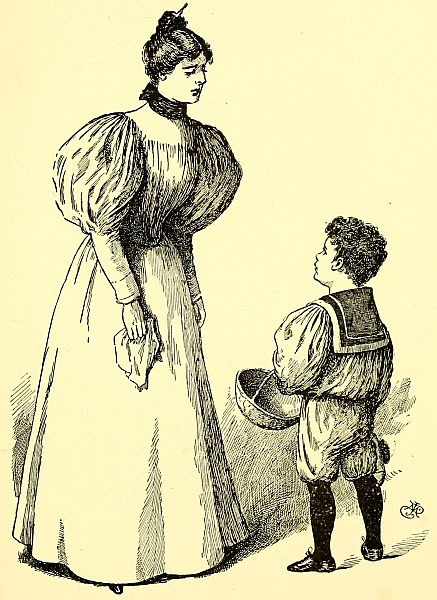
“Jamie, O, Jamie, did you carry it off?”
Jimmy slipped down from his father’s knee,
and stood upright before him, his eyes shining
with a new thought.
“Does God know everything, papa?”
“Certainly, my child.”
“Well, then, when you go to heaven, papa,
you just ask God if I haven’t told you the
truth,” said Jimmy; and broke down again,
and shook with sobs.
Mr. Dunlee caught the little pleader in his
arms. He knew no more than before what
had become of the cake, but he was sure from
that moment that Jimmy had not taken it.
“If he had, he never would have dared
make a speech like that,” said the minister to
his wife as he came out of the study, looking
much happier than when he had gone
in.
“I hope you are right; I believe you are
right,” replied Mrs. Dunlee, her eyes brimming
with tears. “Still, we must wait a while to
make sure.”
The next day, Sunday, was not a happy one.
The older children knew the exceeding sinfulness
of a lie, and it was certain that Jimmy
knew it also. Yet what had become of the
cake?
“Jimmy, what’s the matter o’ you?” asked
wee Lucy, going up to her brother, and putting
her little arms around his neck.
“Oh, they just despise me as hard as anything!”
he replied.
It broke his heart to be “despised.” He
did not know how everybody pitied and longed
to help him, or he would not have been so
unhappy.
Just before dinner Kyzie happened to go
into the pantry. As she was returning to
the kitchen she heard a noise at the pantry
window, like the rattling of dishes, and, looking
that way, saw Jessie, the pretty cow, eating
a custard-pie.
The pie was sitting on the window-ledge,
within easy reach, and Jessie was helping herself
without fork or spoon.
“Come, mamma! come quick!” cried Kyzie.
Mamma came; and Jessie stood still, and
finished the pie before her eyes, licking the
plate too, as though she would not miss a
morsel.
“Did you ever see such impudence?” said
Kyzie, laughing.
But mamma was not listening.
“Jessie ate that cake!” she exclaimed.
“Where is John?”
John was surprised to see every one so
excited.
“I let the cow out into the back yard yesterday
about two minutes,” said he; “but
I never thought of her cutting up a caper
in the pantry! When I went after her, she
was standing close to the pantry window, to
be sure, and the screen was out. I put it
back; and thinks I, ‘That’s the second time
I’ve done it to-day. I’ll fix that screen Monday
so it will act better.’”
“Did you see Jessie eating the cake?”
“No, ma’am; she must have swallowed it
pretty spry, for I never saw a crumb of
it.”
“O Jessie, Jessie! we never knew you
were a thief!” said Edith, hugging the pretty
animal whose “sweet tooth” had caused all
this trouble.
Mrs. Dunlee had no time or thought for the
cow. She was watching the happy smiles on
Jimmy’s face.
“My precious, innocent boy!” said she,
holding him close, as if she could never let
him go.
“You made a mistake when you said the
cake couldn’t have gone without hands; didn’t
you, mamma?” said Kyzie, trying to laugh;
but somehow the tears would come first.
“Mamma,” whispered Jimmy-boy,—and a
lighter-hearted boy you never saw,—“mamma,
put your ear down close; I want to say something.
I knew all the time I didn’t do it, and
I knew God knew I didn’t do it.”
“Yes, dear; that is so.”
“And I knew God would tell you and
papa all about it when you got to heaven,
mamma; but, oh, I didn’t want to wait!”
“No, you dear, suffering child,” replied his
mother. “And, thank God, we didn’t any of
us have to wait! We’re so glad to know it
all now!”
And then she kissed Jimmy on his mouth
and hair and eyes; and the children all gathered
around, and Kyzie said,—
“Isn’t this a beautiful Sunday? I’d rather
have it than a diamond ring.”
It was not till Tuesday that they learned
what Jimmy had carried off in the basket;
and then Mr. Somers, Dick’s father, told it,
laughing, to Mr. Dunlee. It was horned
toads.
Little Dick had declared that they had eyes
in the backs of their heads. Jimmy and Gilbert
disputed this, and told him to look for
himself.
“I won’t look,” said Dick. “Guess I
know! I’ll leave it to my papa if I don’t
know!”
The more he was laughed at, the more he
insisted, saying at last,—
“I’ll give you five cents, Jimmy Dunlee,
for every toad you’ll find that hasn’t got
eyes back of his head! Bring ’em along,
sir, and let my papa see ’em, and I’ll give
you fi—ive cents apiece!”
So Jimmy, expecting to make a small
fortune, had roamed far and wide, and collected
five toads; for he could not spare his
tame ones. But when he took them to
Major Irwin’s, Dick only said,—
“What you s’pose I want o’ those toads?”
Jimmy was angry.
“You told me to bring ’em! Look at ’em
now; look this minute! You said they had
eyes back o’ their heads!”
Dick was laughed at by the whole family,
and made to confess that these were the
first horned toads he had ever seen. His
father called him “a little braggart;” and
for once in his life the boy was ashamed,
and ran crying down cellar to hide.
Jimmy threw back his shoulders proudly.
It was a great triumph to have humbled
Dick Somers! And then, besides that, to
have earned twenty-five cents!
But when he modestly asked for his
money, what did those people all do but fall
to laughing again?
And the wider his honest brown eyes
opened with surprise, the harder they all
laughed!
Jimmy could not see anything funny in the
affair; he only saw that he had been cheated
and imposed upon. As he turned indignantly
on his heel, Hatty Irwin, Gilbert’s sister, said
in a low tone,—
“The little toad-merchant is going home
to see if his mamma will buy his toads.”
Hatty did not expect to be overheard; but
Jimmy caught the words, and was cut to the
heart. He shouted wildly,—
“I shall not tell my mamma! I shall not
tell any single body at my house, so there!”
And all the while he was running away
from these cruel people as fast as he could
go.
If he had not made this sudden, impulsive
promise to Hatty, all might have been different.
For then he would have related his
woes to his own family; mamma would have
pitied and soothed him; and, better than all,
there would have been no mystery as to what
was carried off in the basket.
Instead of that,—but you know the story,
and can fancy how poor Jimmy-boy suffered.
Dick Somers went home that very week;
and Mrs. Dunlee said to her husband,—
“I am really glad for Jimmy’s sake. I am
sure Jimmy has not been made very happy
by the little boy from New York.”