Note: For centuries it has been the custom for jewelers to identify
their designs by stamping their hallmark on jewels. The reproduction
on page 20 is of Marianne Ostier’s hallmark. Unless
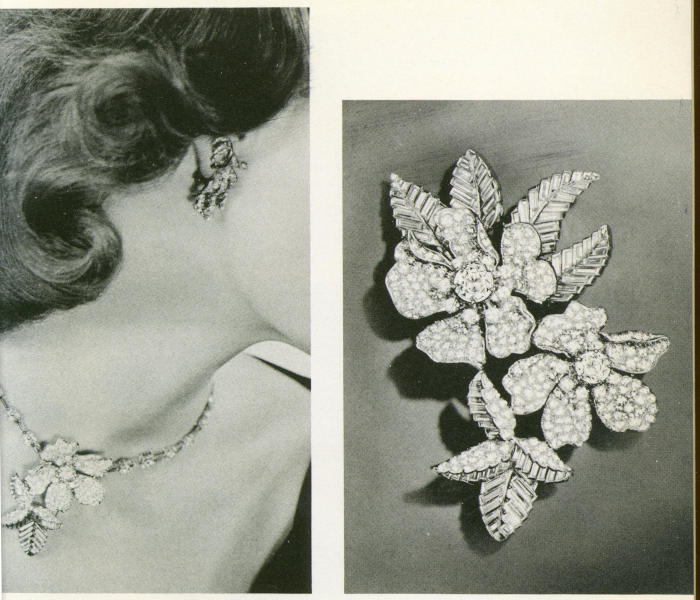
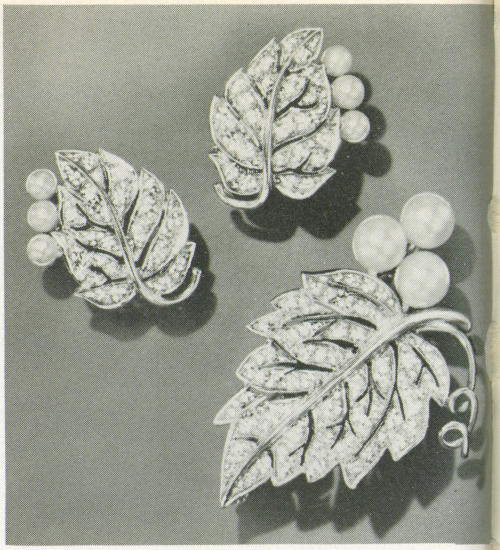
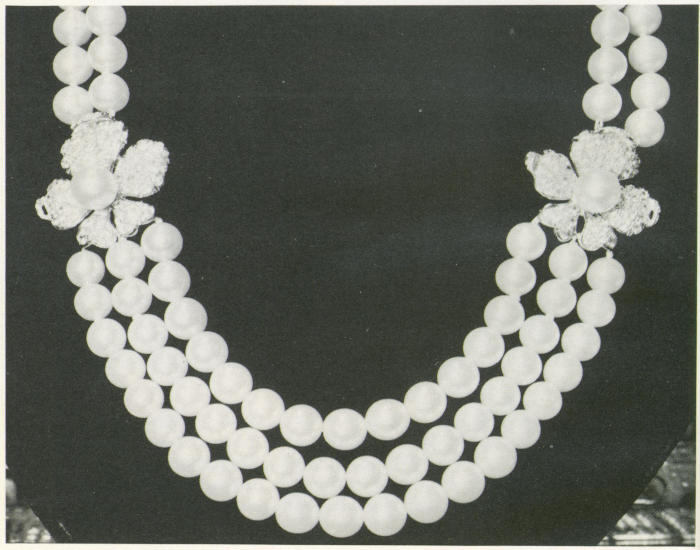
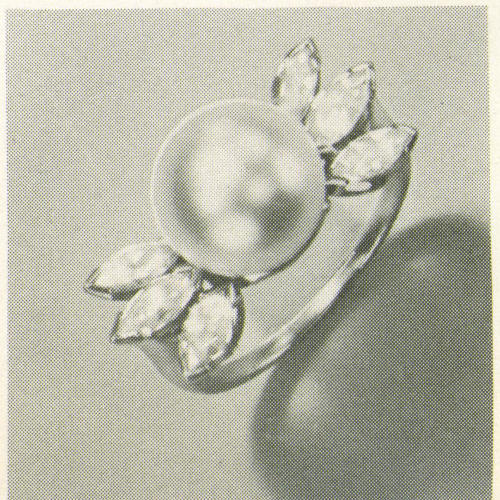
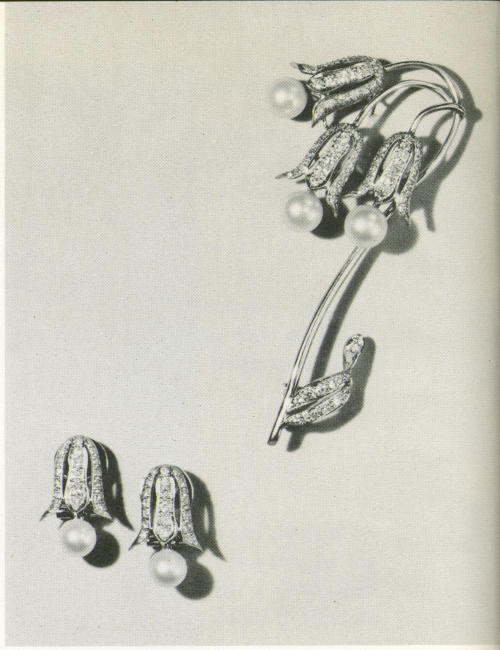
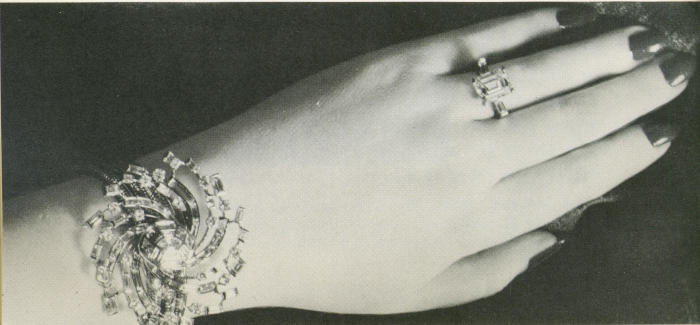
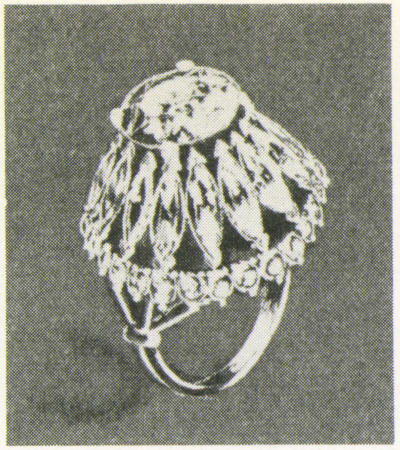
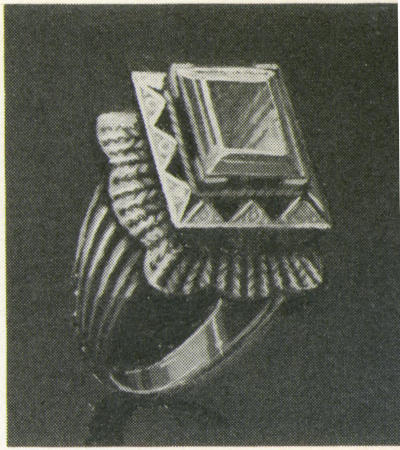
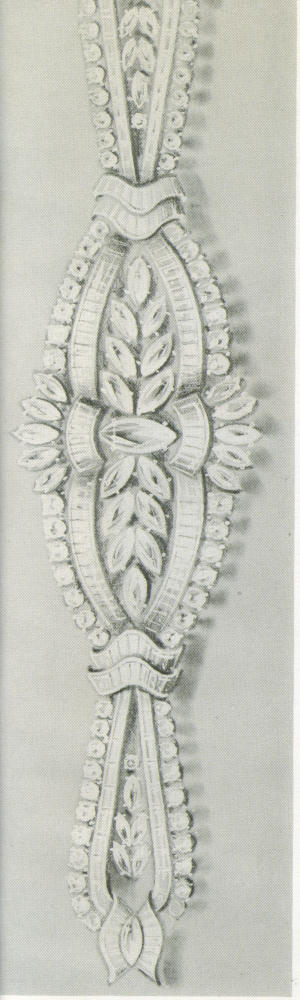
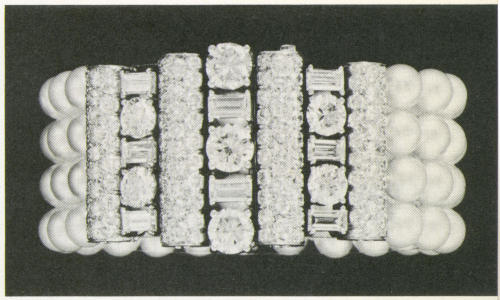
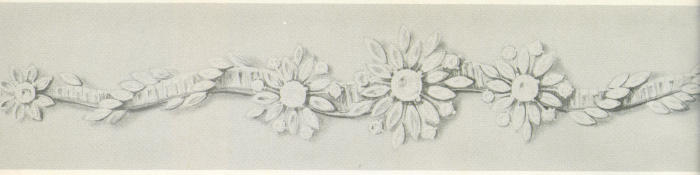
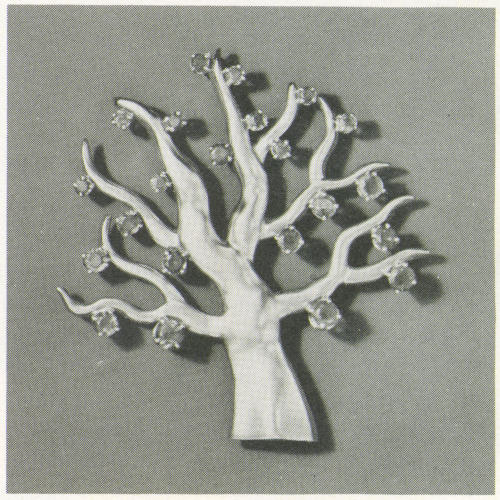
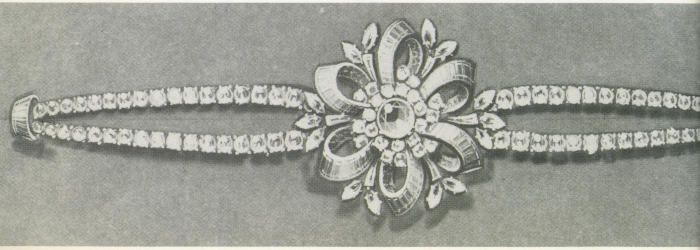
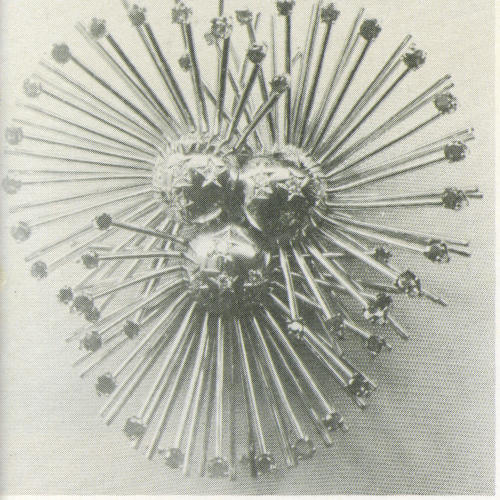
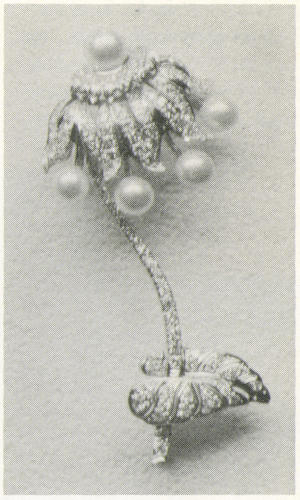
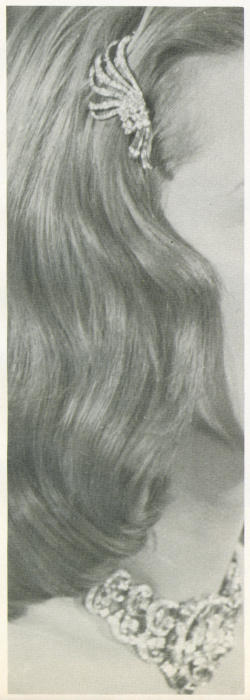
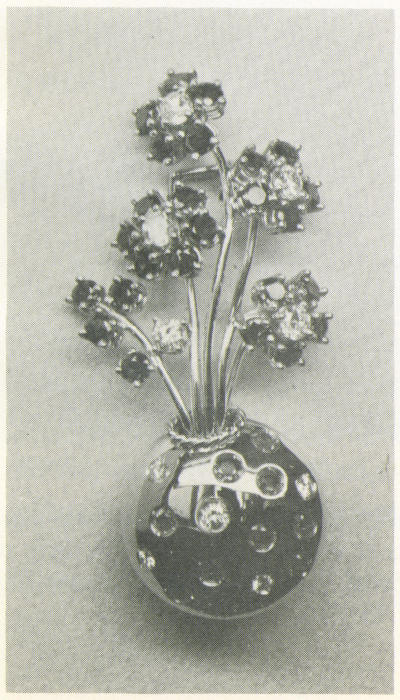
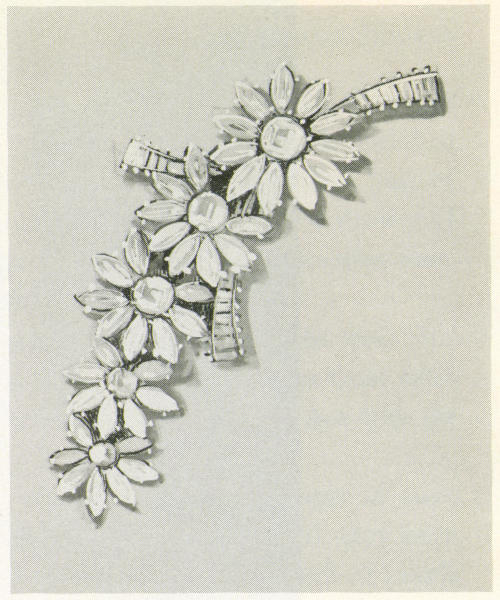
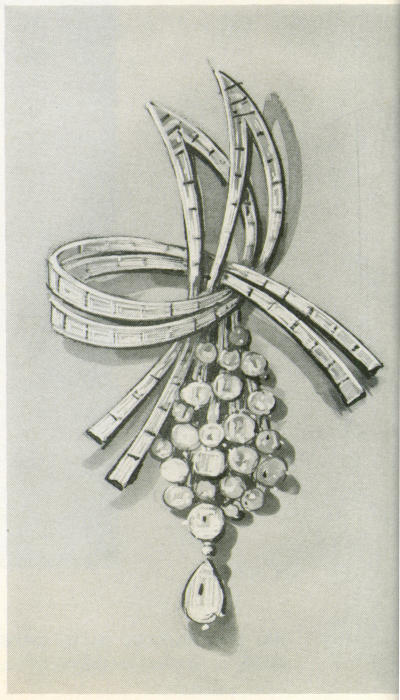
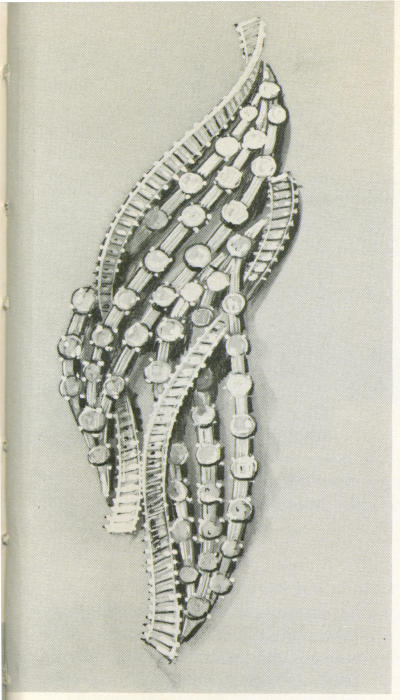
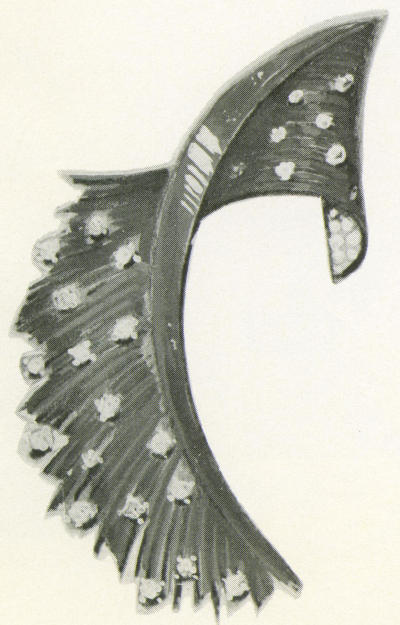
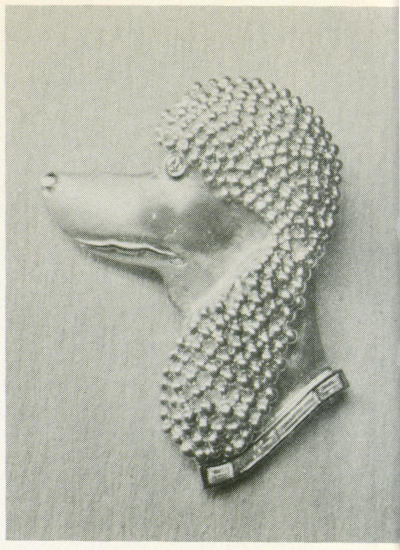
otherwise noted in the captions, jewels here reproduced have been
designed by Marianne Ostier. All jewels are illustrated in actual
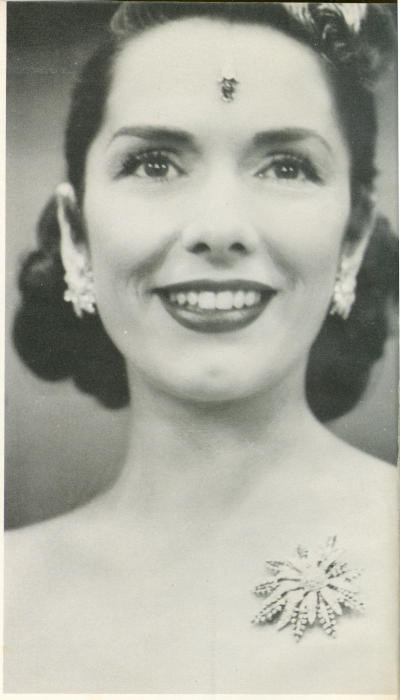
size, with the exception of the portraits and Illustration 17.
Credits and Acknowledgments: The author wishes to thank all
the people who have given time, information and encouragement
to the work on this book. Particular thanks are due Mr. George
D. Skinner of N. W. Ayer & Son Inc. for supplying invaluable
information; Miss Dorothy Dignam, of the same firm, for her
inspiring enthusiasm and knowledge; Mr. Lansford F. King,
publisher of the Jewelers’ Circular Keystone, for his endless confidence
in the work which made the completion of this book
possible; and Mr. Albert E. Haase, president of the Jewelry
Industry Council, for the many helpful facts from his special
fund of knowledge.
For contributing to the visual quality of this book, grateful
acknowledgment is made to the Jewelry Industry Council for the
frontispiece colorplates; The Metropolitan Museum of Art for
Illustrations 1 through 8; the British Information Service for
Illustrations 11, 12 and 15; and Trude Fleischmann for Illustrations
28 and 29.
All original designs as well as the text by Marianne Ostier are
protected by copyright and may not be copied or reproduced
without permission in writing from the author and publisher.
THE EARLIEST USES 23 EGYPT AND THE NEAR EAST 26 WESTWARD TO THE GREEKS 29 ETRUSCAN ACHIEVEMENTS
30 THE ROMAN CONQUEST
31 THE VOGUE OF THE
PEARL 41 ROMAN LUXURY
42 THE TIDE TURNS EAST
42 EASTWARD TO INDIA 43 OVER THE CHINESE WALL 44 DARK AGE OF THE DIAMOND
45 TRIBES TO THE NORTH 45 THE CELTS AND THE EMERALD
ISLE 46 THE ANGLO-SAXONS
47 JEWELS IN ENGLISH
HISTORY 47 EDWARD THE
CONFESSOR’S JEWELS 48
GROWTH OF THE GOLDSMITHS’ GUILD 48 THE ITALIANS IN THE RENAISSANCE 49 THE RENAISSANCE ACROSS
EUROPE 50 THE REFORMATION
51 THE EIGHTEENTH CENTURY
52 ON THE ROMANTICS 53 INTO THE NINETEENTH CENTURY
54 THE TWENTIETH CENTURY 55
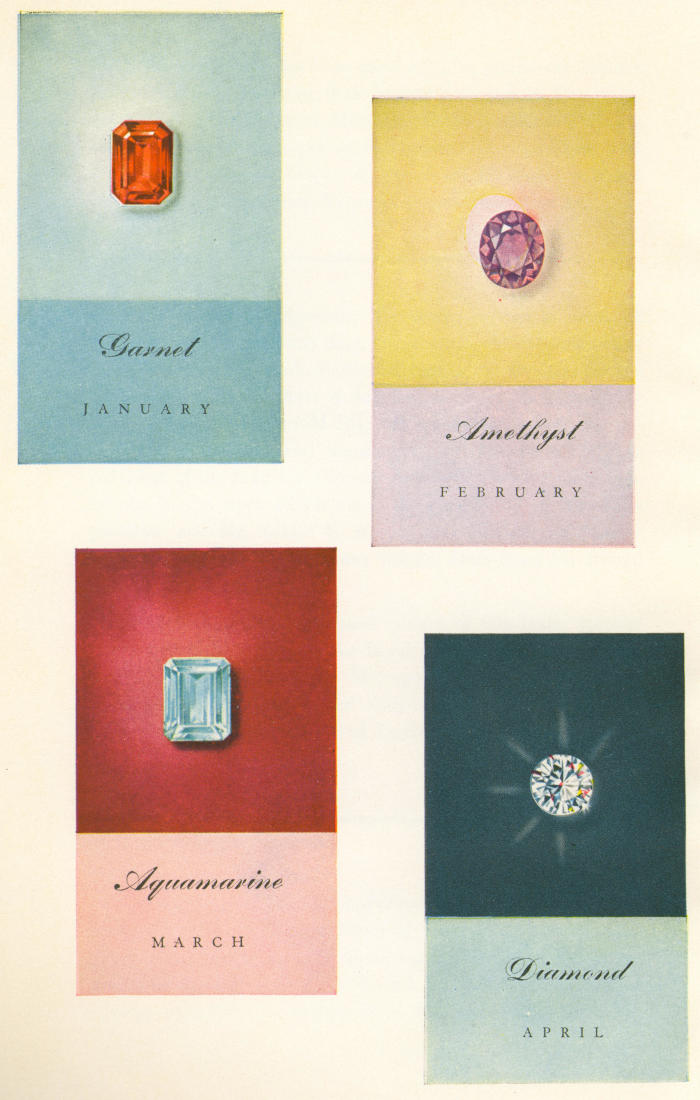
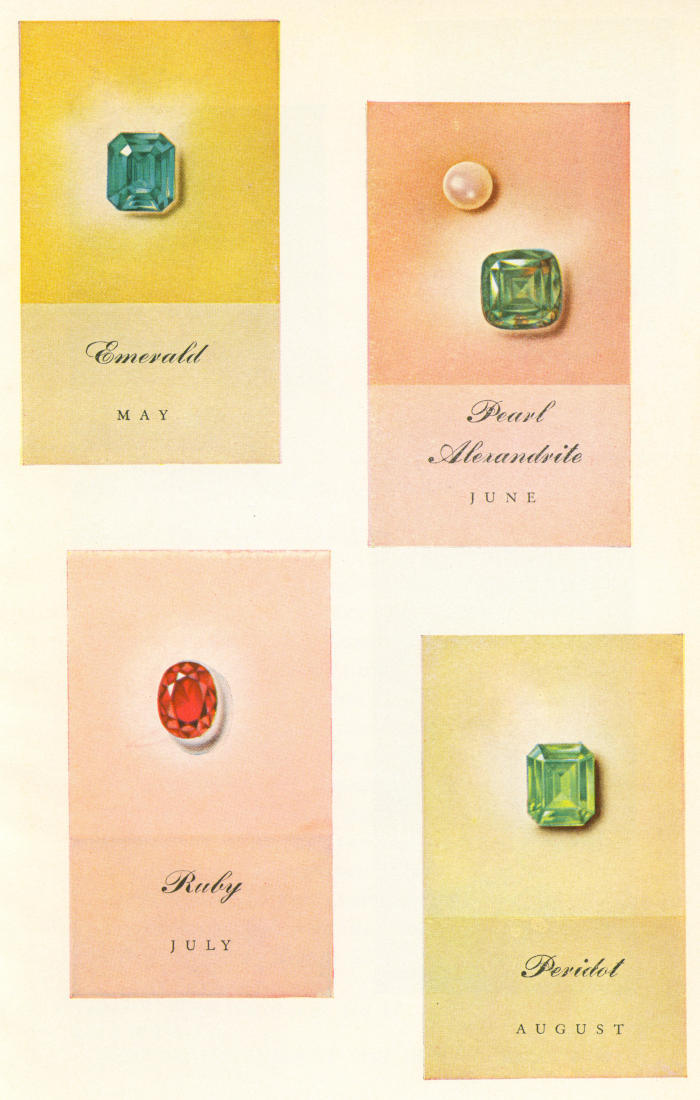
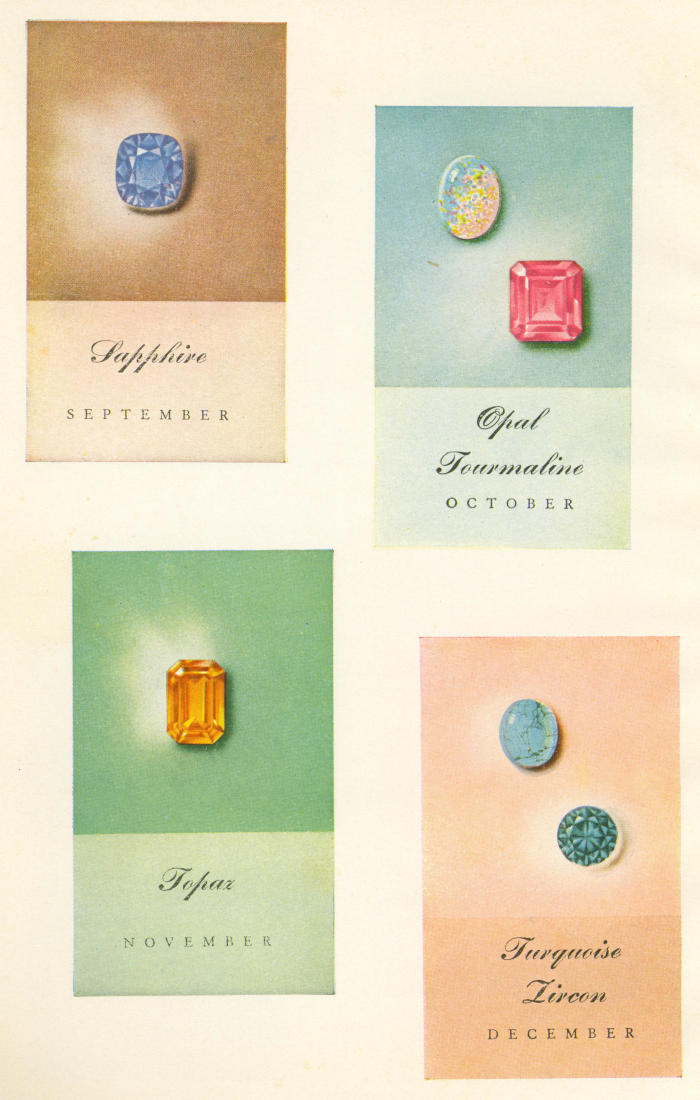
THE SEASONS 83 THE DAYS OF THE WEEK 84 SUNDAY 84 MONDAY 84 TUESDAY 85 WEDNESDAY 85 THURSDAY 85 FRIDAY 86 SATURDAY 86 THE MONTHS 87 TABLE OF BIRTHSTONES 87 JANUARY—GARNET 88 FEBRUARY—AMETHYST 89 MARCH—AQUAMARINE 90 APRIL—DIAMOND 91 MAY—EMERALD 92 JUNE—PEARL 94 JULY—RUBY 96 AUGUST—SARDONYX OR PERIDOT 97 SEPTEMBER—SAPPHIRE
99 OCTOBER—OPAL 100 NOVEMBER—TOPAZ 102 DECEMBER—TURQUOISE 104 SIGNS OF THE STARS 113 THE ZODIAC 113 ARIES, THE RAM 114 TAURUS, THE BULL 114 GEMINI, THE TWINS 115 CANCER, THE CRAB 115 LEO, THE LION 115 VIRGO, THE VIRGIN 115 LIBRA, THE SCALES 116 SCORPIO, THE SCORPION 116 SAGITTARIUS, THE ARCHER 116 CAPRICORN, THE GOAT 116 AQUARIUS, THE WATER CARRIER 117 PISCES, THE FISHES 117
THE SUPREME IMPORTANCE OF THE EARCLIP 127 EARRINGS THROUGH THE AGES
127 THE SIGNIFICANCE OF
THE EARS 129 THE EARCLIP
AND THE FACIAL CONTOUR 130
THE SHAPE OF YOUR FACE 131
DETAILS OF THE FACE 132
VERSATILE EARCLIPS 133 THE
HAIR AND THE EARCLIP 133
THE BRUNETTE 134 THE
DARK-HAIRED 134 THE
REDHEAD 135 THE BLONDE
135 AS THE HAIR TURNS
GREY 136 IMPORTANT
CONSIDERATIONS IN SELECTING EARCLIPS 136
THE SYMBOLISM OF THE NECKLACE 139 THE GENERAL EFFECT 140 THE DIAMOND NECKLACE 141 THE RIVIÈRE 141 THE BAGUETTE NECKLACE 142 THE PEARL NECKLACE 142 THE COLORS OF THE PEARL 143 FOR THE BRUNETTE 143 FOR THE BLONDE AND THE REDHEAD
144 FOR A LONG NECK
144 FOR A WIDE NECK
145 SIZE OF PEARLS 145 THE PROPER STRINGING OF
PEARLS 145 THE NECKLACE
CLASP 146 DESIGNS FOR
CLASPS 146 FOR FORMAL WEAR
147 THE SENTIMENTAL CLASP
148 FITTING THE PEARL
NECKLACE 148 THE BEAD
NECKLACE 149 FASHIONS FROM
INDIA 149 OTHER NECKLACE
JEWELS 150 THE NECKLACE
OF GOLD 151 APPENDAGES:
THE TASSEL 152 APPENDAGES:
THE SINGLE DROP 152
TRANSFORMATIONS 153 MY
OWN CONVERSIONS 153
WHAT A WOMAN WEARS, OTHERS SEE 154
THE GIVING OF A RING 157 CONSIDER THE HAND 158 PROPORTIONS OF THE HAND 158 THE DIAMOND RING: THE
ENGAGEMENT RING 159 THE
WEDDING RING 160 THE
WEARING OF THE BAND 161 THE
PEARL RING 162 THE BLACK
PEARL 162 DECORATIVE RINGS
163 MATCHED WITH EARCLIPS
164 INTERCHANGEABLE
CENTERS 164 RING SIZES 165 RINGS AND NAIL POLISH 166 ABOUT WEARING A RING 166
EARLY USES 169 THE EMPERORS OF INDIA 169 VARIOUS MATERIALS 170 TYPES OF BRACELETS 170 FAVORITE SHAPES 171 THE SPECIAL CLASP 171 BRACELET WIDTH 172 FOR THE SLIM ARM 172 FOR THE HEAVIER WRIST 172 FITTING A BRACELET 173 GENERAL THOUGHTS 173 THE ANKLET 174
ELABORATE PINS 175 THE SIMPLER CLIP 176 ITS VERSATILITY 176 ITS PERSONALITY 185 THE CHANGE IN THE BROOCH 185 THE OLD DOUBLE CLIP 186 THE NEW DOUBLE CLIP 187 THE ABSTRACT DESIGN
187 THE FLOWER DESIGN
188 EARLIER FLOWERS 189 CURRENT VARIETIES 190 THE ROSE 190 THE SKINPIN 191 THE SCATTERPIN 191 THE JEWELLED HAIRPIN 192 THE MOBILE CLIP 192 THE SENTIMENTAL BROOCH 193 REPLICAS OF PETS 194 PINS HOLD MEMORIES 194 PRACTICAL PRINCIPLES 195
EN ROUTE 208 WEEKEND 208 GARDEN PARTY 209 THE BEACH 209 ON THE GOLF COURSE 210 AT THE RACES 210 BUSINESS LUNCHEONS 211 THE CHARITY LUNCHEON 212 OPENING NIGHT 212 MATCHING THE GOWN
213 MATCHING THE MAN
213 SOME BASIC RULES
214 THE DINNER PARTY
215 THE WATCH 216 THE CIGARETTE CASE
216 THE HOSTESS 216 AT THE WHITE HOUSE
217 THE PRESIDENT’S
DINNER 218 THE CAPTAIN’S
DINNER 218 EMBASSY
PARTIES 220 MEETING
ROYALTY 221 CORONATION
221 A QUEEN’S CROWN 222 WHEN EVERY WOMAN IS
QUEEN 223 THE BRIDESMAIDS
224 THE MOTHER OF THE
BRIDE 225 THE WEDDING
GUESTS 225 THE NEWBORN
226 THE ANNIVERSARY 227 TABLE OF ANNIVERSARY
GIFTS 227 THE MORE
SOLEMN TIME 228 AUDIENCE
WITH THE POPE 229 IN
MOURNING 229 OTHER
OBSERVATIONS 230 COLOR
COMBINATIONS 230
RESTRAINT 230 EYEGLASSES
231 THE LORGNETTE
231 THE CORSAGE 232 EMBROIDERY 232 MORE ABOUT BRACELETS 232 MORE ABOUT RINGS 234 GOLD JEWELS 234 IN THE SPOTLIGHT 234
GIVE YOURSELF 237 GIFTS OF LASTING VALUE 238 GIFTS TO THE BABY 238 TO THE MOTHER TOO 239 AS THE CHILD GROWS 239 ST. VALENTINE’S DAY
239 COLLEGE DAYS 240 THE WEDDING DAY 240 FOR THE BRIDESMAIDS
241 FOR THE USHERS 241 OTHER GIFTS TO THE
BRIDE 242 PARENTS’ DAYS
242 FOR LATER BIRTHDAYS
243 GIFTS FOR THE MAN
244 THE WIFE’S ROLE 244 THE RIGHT ACCESSORIES
245 THE PERSONAL TOUCH 245 SPECIAL GIFTS 246 HISTORIC GIFTS 246 THE PRESENTATION OF A GIFT
247
DEFINITIONS 259 LIGHT ON THE STONES 260 STAR GEMS 260 THE PEARL 261 CUTTING THE STONES
261 CABOCHON 262 FACETS 262 TYPES OF FACETING 263 HARDNESS OF THE STONES 264 QUALITIES OF A STONE
267 MEASUREMENT 268 THE PRECIOUS METALS 268 ALLOYS 269
HOW TO CARE FOR JEWELS 271 HOME CARE 271 CLEANING DON’TS 272 PEARLS 272 REMINDERS 273 MORE CAUTIONING 274 FOR TRAVEL 274 INSURANCE 275 THE TRAVELING CASE 275 REGISTERING JEWELS 276 TRAVELING CAUTIONS 277
THE OLD AND THE ANTIQUE 279 OLD JEWELRY WITH NEW POSSIBILITIES 280 THE CONTEMPORARY JEWELS
281 MODERN MOVEMENT 281 THE JEWELER AS ARTIST
283 VARIED STONES 283 VARIED TREATMENT 284 REMODELLING OF WATCHES
285 ADDING PEARLS 285 INFINITE RICHES IN A
LITTLE ROOM 286
THE UNIVERSAL RING 289 THE MAGIC RING 289 DIVINING RINGS 290 RENAISSANCE REMEDY RINGS 291 VISIBILITY RINGS 292 RELIGIOUS RINGS 293 PRACTICAL RINGS 294 POISON RINGS 295 HONORARY RINGS 296 POSIES AND LOVERS’ RINGS
296 THE NUPTIAL RING 298 LESS SOLEMN MARRIAGE
RINGS 299 COUNTING FINGERS
301 MEMORIAL RINGS 302
THE BLACK PRINCE’S RUBY 305 OTHER PRECIOUS STONES 306 THE CRYSTAL PALACE
307 THE DIAMONDS
307 THE KOHINOOR
308 TAVERNIER 310 THE FLORENTINE 310 THE GREAT MOGUL
311 THE ORLOFF 311 THE SHAH OF PERSIA 312 THE GREAT TABLE 313 THE BLUE TAVERNIER
313 THE HOPE 314 THE JEHAN AKBAR SHAH
315 THE CULLINAN
315 THE EXCELSIOR
316 THE REGENT 316 THE SANCY 318 OUT OF THE EARTH 319
“Diamonds,” the song goes, “are a girl’s best friend.” Take
special note of the sex; it is significant. For only among humans
has the female increasingly become the adorned sex.
The mane of the lion or of the stallion gives the male a magnificence
beyond the competence of the lioness or the mare. It is
the peacock that spreads the studded glory of its tail—not the
peahen. As among the birds and beasts, so primitive man was
the resplendent sex, while his mate went about her task, in
more subdued and humble tones. By the time of the Renaissance—it
took that long in civilization’s climb—men and women
were about equal in their adornment. In Europe, indeed,
only men wore diamonds until 1444, when King Charles VII
of France (whom Joan of Arc had placed upon the throne)
was captivated by Agnes Sorel’s beauty and daring, when she
appeared in a superb necklace of diamonds. The diamond at
once became the prized gem of womankind.
The costumes and jewels of the courtiers of Elizabeth I of
England were surpassed by those of the Queen only in the
measure of her superior station. Since then, however, the attire
of men has grown increasingly functional, sedate, and
commonplace, while that of women has retained its freedom
of color and flow. And the great world of jewelry is preeminently
the woman’s domain.
Scientists in several fields have sought the reasons for this
change; we may rest content with the fact. A man may be
thought distinguished, or perhaps handsome; only a woman
may be called beautiful. And by proper adornment of apparel
and jewelry, every woman seeks to enhance her beauty.
Certain austere sects frown upon “artificial” aids to beauty.
In the hills of Pennsylvania are honest women whose lips and
cheeks have never been touched by added color. But such
persons are outside the main path of human progress. For the
quest of beauty—surely a legitimate and a desirable quest—has
taken the same path as the other great adventures of man,
which have placed him supreme among all living creatures.
Look at the problem of security. The bear can strike a tremendous
blow with his paw. The tiger springs with fierce gash
of fang and claw. The eagle pounces with deadly talon and
beak. Beside these, how puny the fist of man! But the bear, the
tiger, the eagle remain with but these weapons, while man
closed his tiny hand around a club, then hurled a spear, then
winged his bow with arrows, shot forth his bullets and his
bombs. While the animals mark a dead end of evolution, man
continued to evolve by “artificial” extensions of his powers.
The same is true in every field. The news of the victory of
Marathon was borne by a runner, who coursed the twenty-four
miles, gasped out his word of triumph, and dropped dead.
Since then man has harnessed the ox, mounted the horse, and
surpassed all other creatures in means of travel upon and
within the waters, across the earth, high and higher in the air.
So in the realm of beauty. First man painted his naked
body. Then he adorned himself with claws and teeth torn from
the animals, with feathers plucked from the birds. Soon he
discovered the sheen of precious metals, the sparkle of gems.
The progress of adornment, from ancient Egypt to the twentieth
century world, has been marked by the further discovery
and refinement of metals and the design of jewels. Synthetic
gems and costume jewelry have given to every woman opportunities
once limited to the wealthy few; the principles applicable
to the wearing of costly jewels are the same for their
less expensive cousins. And the pattern of the quest of personal
beauty is in line with the general pattern of human
evolution.
Although we have approached beauty through these somewhat
solemn reflections, we must not forget that the best reflection
of beauty is in the admiring eye of the beholder. It is a
mutual pleasure; but it is a personal, an individual task. For
it is every woman’s duty—not merely to herself but to those
around—to present her fairest aspect to the world.
To the old remark: Love is blind, the cynic has added: But
marriage is an eye-opener. Of course, neither statement is
true. While love may fasten upon and prize other qualities, the
lover is usually keenly aware of the measure of his beloved’s
beauty. He takes increasing pride and pleasure as she finds
fresh ways of enhancing her natural gifts. There is a lesson
hidden in the statement that if a woman is beautiful at fifteen
she may thank God, but if she is beautiful at fifty she has herself
to thank. The lesson is that a woman can learn what is
seemly, what is becoming, what adds to her beauty.
One may look at precious stones and magnificent jewels
ranged in a museum or in a store. When they are being worn,
we look not so much at them as at the ensemble they help to
create of a live alluring woman. The Crown Jewels in the
Tower of London are imposing. When they are worn on occasions
of state, the court regalia combine to keep them imposing
still: it is less a person than a position that they adorn.
But with the rest of us mortals, as even with queens in less
stately hours, the jewels must fit the person and the personality,
as well as the occasion.
What looks most attractive against the dark velvet on a
counter may fail to harmonize with golden glinting hair. The
size of the earlobe, the figure of the woman, the color of the
dress, the activity of the evening, all are factors in determining
which jewels one should wear. Jewels have a long history, but
always an immediate test of use. In both aspects, they hold an
ever present allure.
MARIANNE OSTIER
PART ONE
Jewels:
History, Character, Magic
CHAPTER 1 The Story of Jewels — The Earliest Uses — Egypt and the Near East — Westward to the Greeks — Etruscan Achievements — The Roman Conquest — The Vogue of the Pearl — Roman Luxury — The Tide Turns East — Eastward to India — Over the Chinese Wall — Dark Age of the Diamond — Tribes to the North — The Celts and the Emerald Isle — The Anglo-Saxons — Jewels in English History — Edward the Confessor’s Jewels — Growth of the Goldsmiths’ Guild — The Italians in the Renaissance — The Renaissance Across Europe — The Reformation — The Eighteenth Century — On the Romantics — Into the Nineteenth Century — The Twentieth Century
There are as many guesses about the origin of adornment as
about the origin of language. The most popular theories might
be called the functional, the magical, and the aesthetic.
When man first felt cold, says the functional theory—or
when he first felt shame and hid his shame with the fig leaf—he
had to find some way of fastening his garments. The leaves,
the furs, the hides, would slip off unless adequately held together,
especially when the man was running in swift hunt, or
the woman bending under domestic burdens. The first fastenings
were probably strands of vinestalks, lashes of interlaced
leaves. Then pins made of long thorns, of wood, or of the
bones of animals came into use. Pins of the last sort have been
found in prehistoric caves. Naturally, iron, bronze, silver and
gold pins followed, as the use of these metals became known.
Crude safety pins, in form essentially the same as those we use
today, have been unearthed in the most ancient tombs.
The transition from bone to metal may be observed in the
word fibula, the early Latin word for a clasp. For the long
outer leg bone is also called the fibula, and it looks like the
tongue of a clasp, for which the other bone, the tibia, is the
holder. And the word fibula comes from the Latin verb fivere,
meaning to fasten.
On even the earliest pins, however, and especially on the
domed backs of safety pins and clasps, there are curious carvings
of dots and circles and other forms, which give scope to
the second theory of the origin of adornment, the magical. For
along with these fasteners are found necklaces of beads and
other adornments that served no practical end—except the
very important purpose of placating the gods, of warding off
evil.
The telling of rosary beads, widespread today in Moslem
as in Catholic lands, is a milder modern aid to prayer; in
primitive times the need for protection was no less frequent
and more desperate. Those of us who carry a rabbit’s foot or
other charm, who put an amulet in our automobile to help us
drive safely, who still “knock wood” to keep away mischance,
need not smile at our far-off ancestors who engraved their
beads with potent symbols or wore a scarab, preferably carved
of precious stone, to keep all ills away. Charms and amulets
were on every neck and arm. The devils were all about; they
whirled in the tempest; they sprang suddenly in the form of a
wild beast; they twisted one’s ankle as a jungle vine. And
every stone-age child knew that the agate protected one
against thunder and against tiger bite. If the agate was ringed
like an eye, especially a tiger’s eye, it could outstare and
drive away the fiercest fiend. To turn away the fangs of the
venomous hidden snake, what better charm than lapis lazuli?
Thus each of the colored stones known to the ancients had its
special powers, or could be carved with symbols and signs of
might—and jewels were worn to ward off all misfortune.
Even among the ancient Greeks, it was recognized that (as the
slave in Aristophanes’ play Plutus observes) there is no amulet
that can save one from “the bite of a sycophant.”
The third theory of the origin of adornment, the aesthetic,
declares that man is born with a love of beauty. There is no
question—and if there were, modern research has answered
it—that the bright trinket attracts the babe. When one is
happy one wants to sing; when one sees beauty, one wants to
experience it with the gift of sight or, if it is tangible, to put
it on. And ever to increase earth’s store of beauty. We cannot
snare a sunrise, but we can make a garland of spring flowers.
Even before he fashioned beads, primitive man adorned
himself with necklaces of shells, of bears’ claws, stags’ teeth—probably
also of many colored berries, but these have
crumbled in the caves. Such findings are so widespread that
Carlyle declared: “The first spiritual want of a barbarous
man is decoration.”
Since the question of origins is buried in surmise, it seems
fair to follow that eminent advocate of the middle way, Sir
Roger de Coverley, and allow that there is something to be
said for all three theories. Each impulse, to hold up clothing,
to ward off evil, to enjoy beauty—power, protection, pleasure—may
have had a share in the birth of adornment. It is true
that there are paintings and statues, in the early tombs, of
women clad only in their jewels. But while queens, and the
concubines of kings might be thus untrammeled in their quest
of beauty, humbler folk at work needed workaday attire. And
always the magicians, the medicine men, then the priests, wove
their holy spells, with mitre and chalice and ring inscribed with
the secret words of power. A monarch of early times was an impressive
sight, as not only his rings, his armlets and neckpiece,
but his breastplate, the buckle of his belt, and the hilt
of his sword were carved with sacred symbols and crusted
with precious stones. Here were protection, power, and
grandeur intertwined.
Perhaps the earliest jewelry to which we can attach an
owner’s name was in the find unearthed in 1901 by Flinders
Petrie in the royal tombs at Abydos. It is a bracelet of golden
hawks, rising from alternate blocks of turquoise and gold,
and it belonged to the Egyptian Queen of Zer back in 5400
B.C. Somewhat later lived the Princess Knumit, whose
mummy was adorned with all manner of jewels, anklets,
bracelets, armlets, headbands, including a serpent necklace
of beads of gold, silver, carnelian, lapis lazuli, and emerald,
and hieroglyphics wrought in gold with inlaid gems. From
Chaldea, as early as 3000 B.C., we have beads, and jewelry
of lapis lazuli, and headdresses of finely beaten gold.
A panel in one of the pyramids gives us a realistic picture
of the interior of a jeweler’s shop of long ago. The master
craftsman, his bookkeeper, his workers and his apprentices
are all busy at their tasks. We see them selecting, cutting,
grinding, firing, shaping, setting, polishing, with tools that
have changed little in 3000 years. The jewels we know today
are all present there: diadems, earrings, brooches, bracelets,
rings, girdles, anklets. The necklace seems to have been, in
most cases, a wide tight band, almost a collar; on many a
mummy such a “choker” has been preserved, studded with
jewels, the gold between often in the shape of a falcon, or a
lotus, or a sphinx. Favorite among the designs, of course, was
the scarab; in the mummy itself, a scarab was inserted to
take the place of the heart.
Two ornaments common in ancient Egypt are not found
in use today. One is the pectoral, a great bejeweled breastpiece,
usually hung from the neck. The other is the golden
wig cover. The great men and women of the eighteenth century
B.C. wore long black wigs (in contrast to the great men of
the eighteenth century A.D.; George Washington’s inaugural
wig, was, of course, powdered white). Close-fitting over these
black wigs were joined rows of gold bands or medallions,
beaten fine, fastened together, forming a complete cover
that reached to the shoulders. The bands bore hieroglyphics,
the medallions were usually shaped like heads of man or
beast. One other difference from later times: for the snuffbox
of the eighteenth century A.D., or the cigarette lighter of the
twentieth, society folk in ancient Egypt carried a perfume box.
The Egyptians had many rings, including signet rings.
These were intaglios; that is, the design was cut into, hollowed
out of, the metal or stone, so that when the ring was pressed
on clay or wax it would leave a raised design like a cameo.
The design might be a god, or a sacred animal such as a
scarab or a sphinx, usually with an indication of the identity
of the owner. Thus the King’s seal, and especially the King’s
signet ring if borne by a messenger, carried the royal authority.
Jezebel, wife of Ahab, King of the Israelites, used the
seal of her royal spouse on the letters she wrote to destroy
Naboth, whose vineyard they coveted.
The Israelites, indeed, wore rings on their fingers, in
their nostrils, in their ears, and we are told that when they
walked there was a tinkling about their feet. They also wore
a gem pressed into the soft side of the nostril, a favorite spot
for display through the Near East, still adorned by a gem
among the Bedouins and the Hindus of today. The Israelites
gave of these jewels in great quantity to adorn the Tabernacle
that was built in the wilderness—and also for the making
of the Golden Calf.
Legend has it that Solomon’s wisdom emanated from a
magic ring. One day he carelessly left this ring behind him
at the bath, and with the water of his bath it was thrown into
the sea. Solomon retained enough wisdom to suspend his
legal court for forty days, after which the ring came back
to him in the stomach of a fish served at his table. A similar
story of a jewel returned in the belly of a fish is told by
Polycrates, tyrant of Samos in 530 B.C. Like stories occur
in The Thousand and One Nights; and the coat of arms of
the city of Glasgow contains a salmon with a ring in its
mouth, memorializing the occasion when St. Kentigern from
the fish’s mouth restored to an early queen her ring and her
reputation.
Oriental tales have many accounts of magic rings. One of
the most elaborate deals with Gyges, a Lydian noble to whom
King Candaules, proud of the possession of a beautiful wife,
displayed her in her undraped beauty. The resourceful Gyges
descended into a chasm of the earth, where he found a brazen
horse with a human carcass in its belly. From the body Gyges
took a ring which, when he turned the stone inward, made him
invisible. Thus fortified, Gyges entered the palace and murdered
the king. The widow, Nyssia, married him; he reigned
thirty-eight years, from 716 to 678 B.C., with the help of the
ring becoming so powerful and so rich that men spoke proverbially
of “the wealth of Gyges.”
Another ring, as remembered by Chaucer in The Squire’s
Tale, gave a man the power to understand the language of
the birds. The reader may remember that the messenger between
King Solomon and the Queen of Sheba was a bird that
whispered in their ears. We gather such stories from early
days literally through a fabulous thousand and one nights.
Although jewelry was a preeminent concern of the Egyptians,
because they must be adorned not only in this world
but in the next, it was a lively preoccupation throughout the
Near East, the cradle of civilization. Babylonian and Assyrian
tombs yield treasures in splendidly mounted jewels. A description
of the goddess Ishtar, descending through the Seven
Gates to the ultimate world, pictures her at each gate putting
aside a separate jewel, finger rings, toe rings, necklace, earrings,
armlet, brooch, girdle: she passes through the final
gate in unadorned beauty.
Among the jewels of ancient Persia, from the fourth century
B.C., is a great necklace of three rows of pearls, almost 500
pearls in all, half of them still well preserved across the flight
of twenty-five centuries.
There exist some examples of Greek art in early times. A
gold and silver brooch in the form of a flower may have been
shaped about 1400 B.C. Perhaps 500 years later, by the time
of the Trojan War, there were inlays, intaglios, even small
plaques of gold with hooks to fit the ear. In the fifth century,
when the great dramatists filled the theatres, Greek lapidaries
were making filigree and enamels of fruit and flowers—a bit
later, of the fair feminine form. By this time, too, the Greeks
were copying the designs they saw on, or bought from, Egyptian
and Phoenician traders; the sphinx and the scarab appear
in Hellenic workmanship.
Originators are held by their new problems to a sort of
modesty in design. Imitators often—striving to outdo—overdo.
The Greeks grew far more elaborate than their predecessors.
The great Greek sculptors were delighted with the
human figure which posed sufficient problems, either bare
or simply draped. But outside of statuary, and after the great
fifth and fourth centuries, the wealthy Greeks in their ways
of life had caught the fever of display. Their jewelry must
surpass that of the eastern barbarians to whom they were
bringing the benefits of Greek culture. From every medallion
of a necklace, for example, might hang a pendant. And this
pendant might be a tiny golden vase, which contained perfume—each
vase a different fragrance—or which might open
to reveal a series of figures—as, later, baroque rosary beads
opened to reveal, in minute carving, episodes in the life of
the Virgin Mary.
A portrait of Alexander the Great was a favorite figure, in
many materials and forms. Although Alexander gave one
artist exclusive right to reproduce his likeness after his death,
as this monopoly lapsed there was a boom on “good luck”
jeweled representations of the man who wept because there
were no more worlds for him to conquer.
The Greeks did not ape all the antics of the Phoenicians,
some of whose high-born ladies pierced the entire rim of their
ears, as well as the lobe, each jewel in its eyelet supporting
a pendant stone. The Greeks used but one ornament per ear;
but these grew larger and larger, more and more weighted
with metal and studded with jewels, and so were finally worn
suspended from a diadem or a cloth band.
Alexander’s conquests having taken the Greeks into farther
lands and introduced them to unsuspected splendors of the
Orient, they carried home gems that before had been unfamiliar
to them: the topaz, the amethyst, the aquamarine.
In Italy, meanwhile, the Etruscans had brought the work
of the goldsmith and the lapidary to a high peak of artistry.
They developed the swivel ring, in which the mounted gem
or special charm might be turned about, so that any face
of it could be displayed. Thus the carvings on the belly of a
scarab became as important as the design on its back.
The Etruscans also made circular or oval bands of earrings
and necklaces, within which a pendant might hang free, a
gently swinging precious stone or golden charm. From their
necklaces often hung a hollow pendant, in which an amulet
might be placed. They made many headpieces, bands, wreaths,
and pins of beaten or granulated gold.
Especially deft was the work of the Etruscans in granulated
gold. Onto a metal surface they soldered tiny specks
of gold, almost as fine as powder, producing the effect of a
rich grain. The artistry of the Etruscan work was so superb
that when it was recovered during the Renaissance, Benvenuto
Cellini (1500-1571), the greatest goldsmith of his time, despaired
of making successful copies of the Etruscan pieces
and decided to shape designs of his own devising, “inferior as
they may be.”
The whole Etruscan civilization gave way before the splendor
that was Rome. Home from their conquests the Romans
brought great stores of jewels, treasures of the Orient. Before
the crowding and gaping throngs of the imperial city, the
“triumphs” of their rulers marched for hours through the
streets of Rome, while foreign potentates pulled chariots bearing
their conquerors and carts with the loot of their palaces.
At Pompey’s third triumph, in addition to countless gold and
silver cases bestudded with gems, there were three dining-couches
adorned with pearls, and a great chessboard, three
feet by four, wrought of two precious stones, with a golden
moon, weighing thirty pounds.
The Romans also brought home artisans, metal workers
and jewelers, from whom after a time the natives learned
their craft. Again we find the victors trying to outdo the
vanquished whom they naturally despised. The adornments
of men and women grew more and more massive. Women’s
hairpins were eight and ten inches long. Rings were worn
upon every finger. Great thumb rings were set with jewels
or made of gold in various designs, especially the heads of
animals. Some of the bands of gold were very large but
hollow; down the ages echo complaints that, in accident or
brawl, a golden ring was crushed. The wealthy, of course,
insisted on rings of solid gold. These became so heavy that
some had to be worn in cold weather only, lighter ones being
designed for summer wear. A specialty among the patricians
came to be the key ring, a golden band with the key devised
to lie flat along the finger, thus keeping with the master the
safety of his treasures. Often a large iron key ring was worn
by the chief steward of an estate; this opened the strongbox,
which might hold the dinner plate and other daily valuables,
and within a recess of which nestled the treasure chest of the
golden key.
So great was the jeweled extravagance of the late Republic
that Cato the Censor (234-149 B.C.) sought by legislation
to limit the amount of jewelry one might wear. He also restricted
the use of metal in rings, assigning iron, silver, or
gold according to rank. Gold was reserved for the official ring
of the Senator, which he himself might wear only when on
duty. Naturally such restrictions could not be binding for
long. Censorship usually produces an exaggeration of what
it has tried to curb. In the early days of the Empire everyone
worth his salt manifested his worth with adornments.
The citizens favored bright colors in their jewels: reds,
yellows, blues. The drivers at the chariot races wore different
colors; spectators bet on the red, the yellow, or the blue, and
many a precious stone changed hands according to the speed
of the horses and the drivers’ skill. If a lapidary could not
secure precious stones large enough, or in quantities to meet
the ever increasing demand, he made imitations of colored
glass. Although Pliny cried out against the practice of making
false gems, the usual purchaser had few tests to show when
he was cheated.
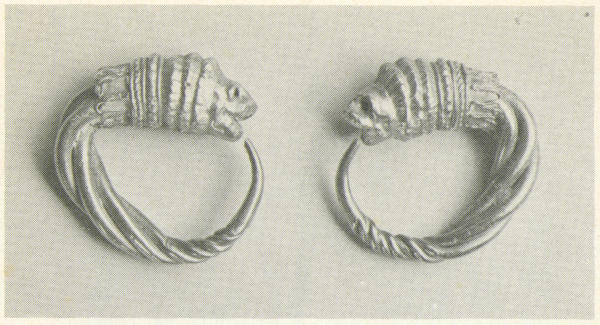
1. GREEK EARRINGS, 5TH CENTURY
B.C.Wrought in gold,
these ancient loops end in lions’
heads. (Courtesy of the Metropolitan
Museum of Art)
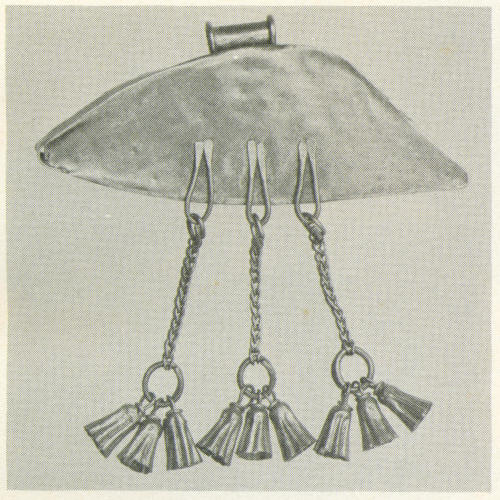
2. CYPRIOTE PENDANT, 8TH CENTURY
B.C.This gold pendant
with chains is an excellent example
of the simple beauty
found in the jewelry of ancient
Cyprus. (Courtesy of the Metropolitan
Museum of Art)
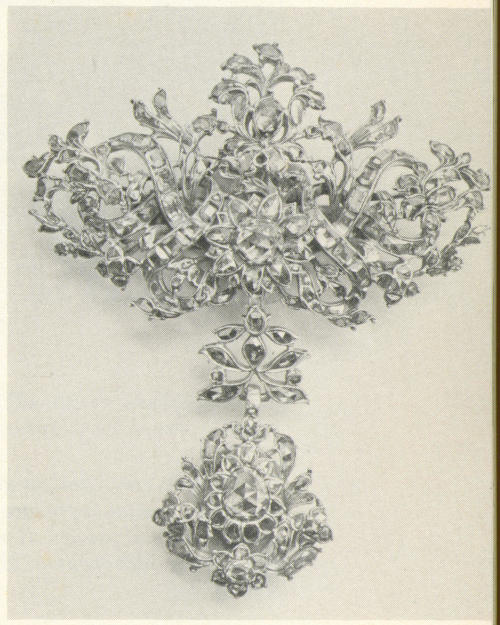
3. EARLY 18TH CENTURY ITALIAN
BROOCH. (Courtesy of the Metropolitan
Museum of Art)
4. EGYPTIAN BRACELET, 4TH
CENTURY B.C.“Costume jewelry”
from the Ptolemaic Period.
(Courtesy of the Metropolitan
Museum of Art)
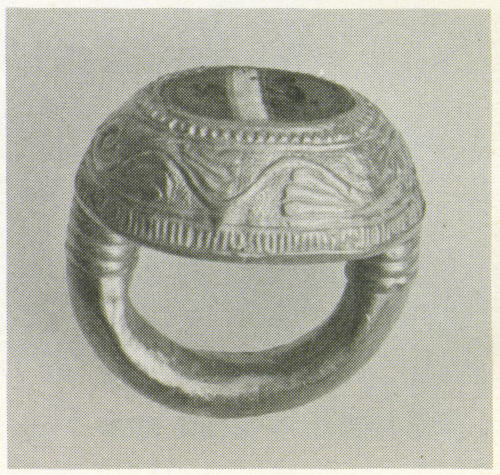
5. ETRUSCAN RING.This handsome
gold ring is set with a
banded agate which has been
engraved with a satyr and a
goat. (Courtesy of the Metropolitan
Museum of Art)
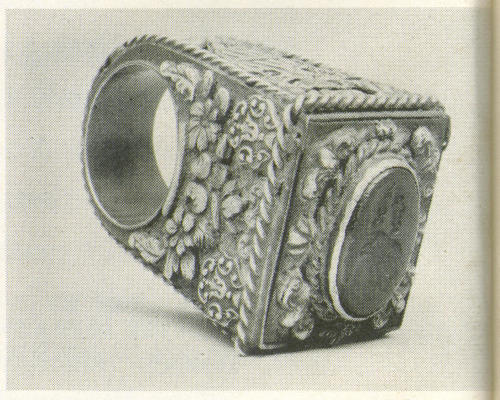
6. 18TH CENTURY ITALIAN RING.The seal on this silver ring is
probably an effigy of one of the
popes. The plaques represent St.
George and the dragon, and the
crest of Pope Clement XII.
(Courtesy of the Metropolitan
Museum of Art)
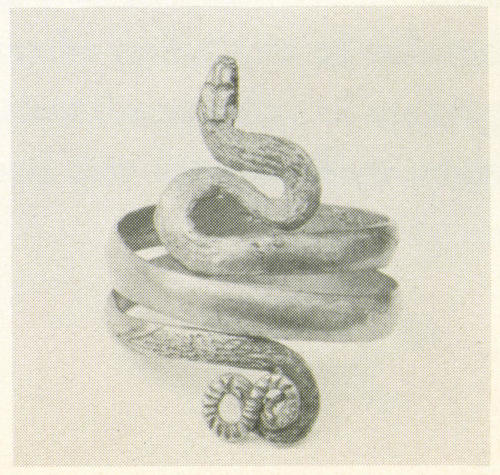
7. CYPRIOTE RING.Ancient gold
worked in a spiral to produce an
unusual piece of jewelry. (Courtesy of the Metropolitan
Museum of Art)
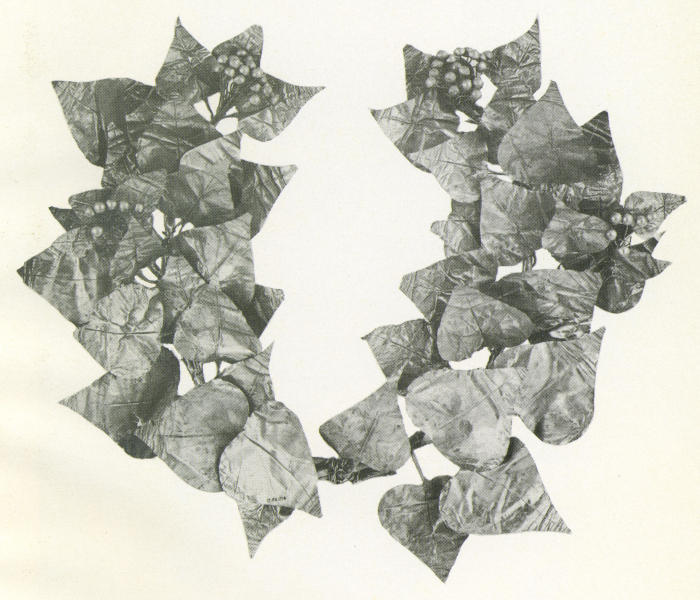
8. ROMAN WREATH, 3RD CENTURY B.C.The expert craftsmanship of
Roman metalwork can be seen in this gold wreath of ivy leaves. (Courtesy of the Metropolitan
Museum of Art)
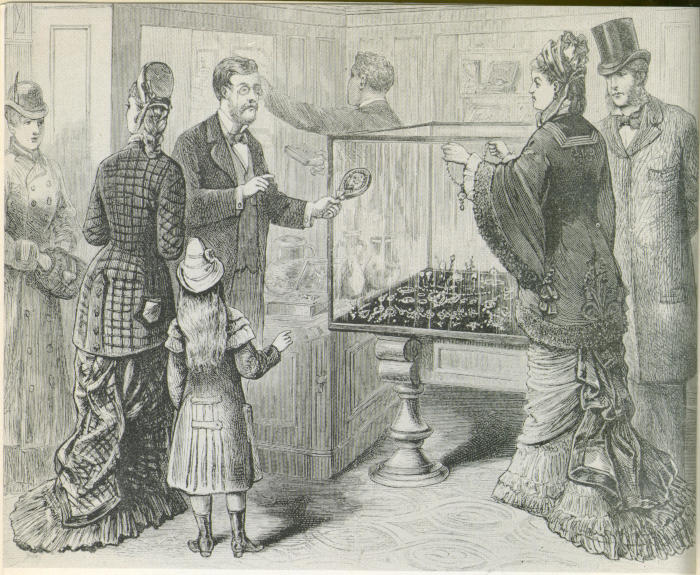
9. INSIDE VIEW OF THE FAMOUS OLD TIFFANY STORE, NEW YORK, 1875.
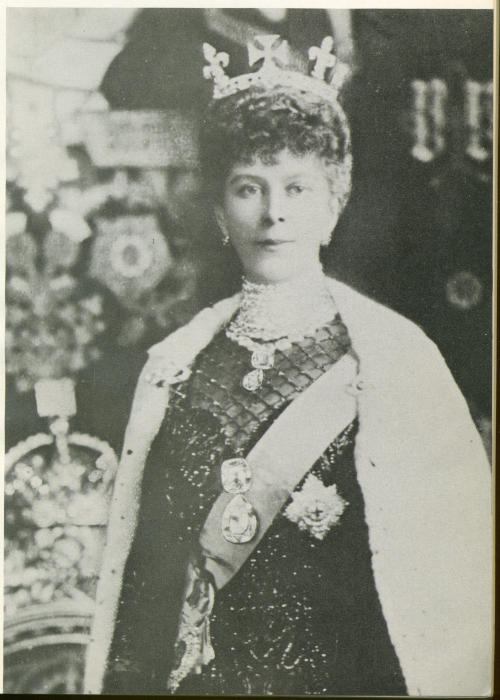
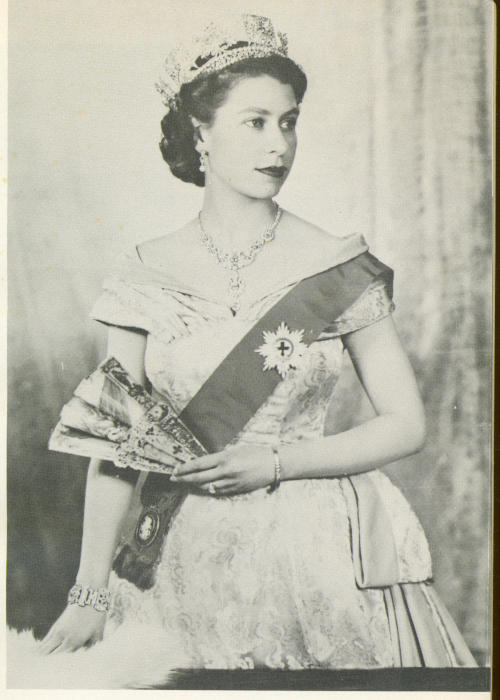
10. THE CROWNING OF A QUEEN.Queen Mary wears four of the magnificent
gems cut from the Cullinan, the biggest diamond ever mined.
On her bodice, pinned to the ribbon of the Order of the Garter, is the
317-carat Cullinan II with the 530-carat Great Star of Africa below it.
These two gems normally are in the State crown and the Scepter respectively.
At the base of her diamond collar are the Cullinan IV, a cushion-cut
diamond of 64 carats and the Cullinan III, a pearshape-cut diamond
of 95 carats.
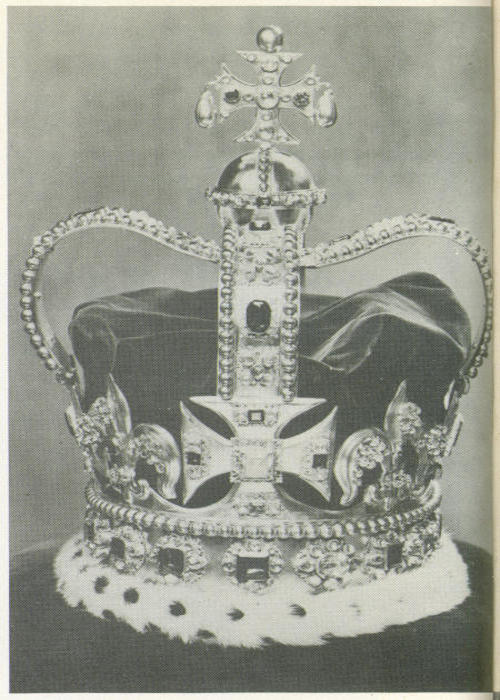
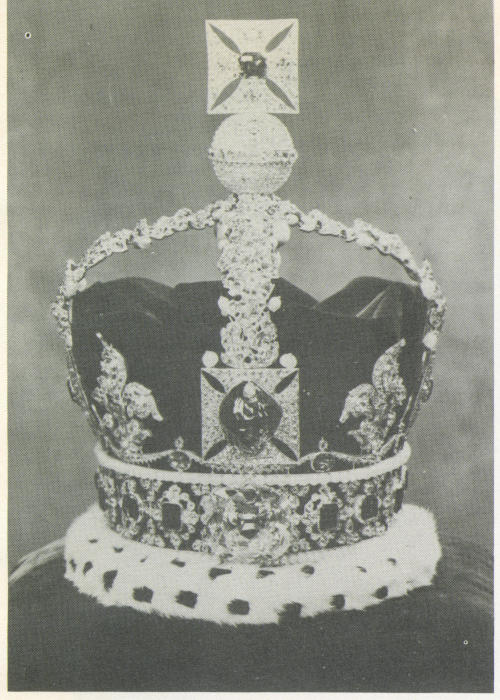
11, 12. THE BRITISH CROWN
JEWELS.Left: The Crown of
England, known as St. Edward’s
Crown because it was copied, in
the time of Charles II, from the
ancient crown worn by Edward
the Confessor, has been used by
many of England’s monarchs
for their coronation. Right: The
Imperial State Crown is worn
by the reigning monarch on all
State occasions. Made in 1838,
it embodies many historical gems,
including the Black Prince’s
Ruby, a sapphire from the
ring of Edward the Confessor
and the second Star of Africa.
In all, the crown contains 2,783
diamonds, 277 pearls, 17 sapphires,
11 emeralds and five
rubies. (Courtesy of the British
Information Services)
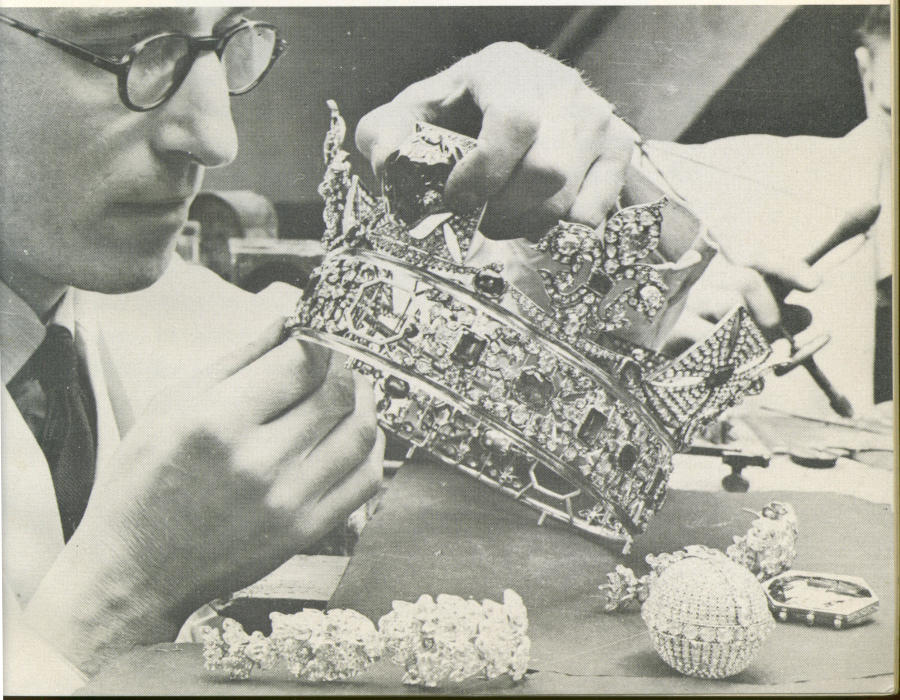
13. REMODELLING THE IMPERIAL
STATE CROWN.Remodelling work
in progress at the Goldsmiths
& Silversmiths Company in
London.
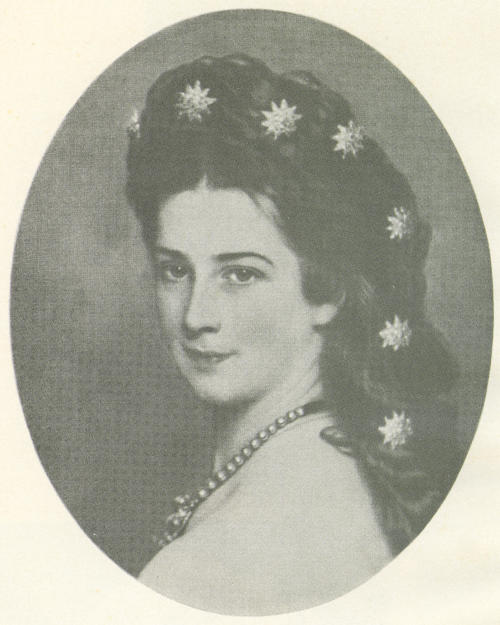
14. EMPRESS ELISABETH OF AUSTRIA.This portrait
of one of the beauties of 19th century Europe
shows the young Empress wearing hair ornaments
of diamond stars which have quivering
centers.
The notorious pearl-drinking dare of Cleopatra caught
the fancy of the Romans. The serpent of the Nile dissolved
a union (the Roman word for pearl was unionem, in this case
truly symbolic) worth half a million dollars, and drank it as
a pledge to her Antony. Cleopatra killed herself rather than
walk in the triumph of Emperor Augustus, but the Emperor’s
favorite, Agrippa, we are told, secured the mate to Cleopatra’s
pearl. She had this great pearl halved, for the ears of the statue
of Venus in the Pantheon.
The vogue of the pearl swept over Rome. This “disease
of the oyster,” with its blush of rainbow colors over white,
with its tint of beauty and its hint of underwater mystery, had
indeed always been regarded as the queen of jewels. The
Romans affected it to the degree of vulgar display. The historian
Pliny (23-79 A.D.), who railed upon many customs
of the time, commented on Pompey’s having a portrait of
himself made in pearls and borne by slaves in his triumph.
“Unworthy!” cried the satirist, “and a presage of the anger
of the gods.” Pliny also recorded that a young bride was
“covered from head to foot with pearls and emeralds.” He
waxed indignant at the fact that women had pearls set in
their shoes. But so did the Emperor Caligula, while the Emperor
Nero, fond of the theatre, had pearls adorn his favorite
players’ masks.
Not to be outdone by an Egyptian, Clodius—whose father
was a favorite tragic actor—invited a great company to a
feast; he dissolved and drank a large pearl, said that he enjoyed
the flavor, and fed a similar gem to every guest.
The vogue of the pearl did not bring about the neglect of
other gems. The Senator Nonius owned a great opal, valued
at two million sesterces, approximately $150,000. The Emperor
Augustus coveted the stone; rather than yield it to him,
Nonius withdrew into exile.
Lollia Paulina, wife of the Emperor Caligula, possessed
a great chain of emeralds and pearls worth over two million
dollars.
It is significant of the change in Roman ways that when
the Emperor Tiberius once more tried to limit the wearing
of gold rings, he based his restrictions not on rank but on
riches. Only those citizens might wear rings of gold, he
ordained in 22 A.D., whose fathers and grandfathers held
property valued at 400,000 sesterces, $30,000. Jewels, always
the property, were thus also made the prerogative of the
hereditary rich.
Back from Rome toward the East, with Constantine in
330 A.D., went the flowering fashions, to riot in Byzantine
luxury. The Eastern capital exceeded the declining city of
the West—abandoned to the barbarians and the popes—in
extravagance, in colorful splendor and elaborate intricacy
of design. Gems, no longer reserved for the showy jewels,
were sewn upon or woven into the very texture of garments.
In all this profusion, the crafts of the goldsmith and the
lapidary continued to thrive, while the West lapsed into the
dun rigor of the Dark Ages.
More or less independently of the western world, the making
of fine jewels flourished in the Far East. In India the code
of Manu, about 250 B.C., prescribed fines for poor workmanship
and for the debasing of gold. A drama of the same period
describes a workshop, with pearls and emeralds, and artisans
to grind lapis lazuli, to cut shells, to pierce coral, and to
make the filigree and other ornaments that have persisted
in that part of the world unchanged to our day.
The lavishness of Oriental potentates is proverbial; their
collections of precious stones and elaborate jewels have
been as fabulous as their incalculable wealth. Almost to our
own generation birthday gifts to maharajahs have matched
the monarch’s weight in gold or precious stones. At the greatest
period of Indian art, during the reign of the Mogul Shah
Jehan, who died in 1666, the art of jewelry almost merged
with that of architecture. In addition to the celebrated Peacock
Throne, the Shah built the Great Mosque at Delhi, and at
Agra the Pearl Mosque and that triumph of beauty, the Taj
Mahal. This was erected as a mausoleum for his favorite wife,
Mumtaz Mahall, who was called “the adornment of the
palace.”
In addition to the designs and patterns of tile that are a
feature of the mosques, the Taj Mahal is adorned with great
treasures of the East: “jasper from the Punjab, carnelians
from Broach, turquoises from Tibet, agates from Yemen, lapis
lazuli from Ceylon, coral from Arabia, garnets from Bundelcund,
diamonds from Punnah, rock crystal from Malwar,
onyx from Persia, chalcedony from Asia Minor, sapphires
from Colombo.” It took thirteen years, from 1632 to 1645, to
collect these treasures and construct the mausoleum. The memory
of a woman may be buried there, but a beauty beyond
description is preserved.
Still farther east, in China, a more restrained and delicate
beauty was developed. Piety and filial devotion taught the
Chinese to limit their display. They cultivated the economy
of good taste. The world’s largest known emerald, found in
China, was carved into the figure of Kwan Yin, goddess of
mercy. Jewels were not worn indiscriminately; they served
not only to adorn but to signify station. A mandarin of the
first rank wore ruby or red tourmaline; a mandarin of the
second, coral or garnet; of the third, beryl or lapis lazuli; of
the fourth, rock crystal; and of the fifth, other stones of white.
Beyond all other stones the Chinese prized “the divine
stone,” jade. While this occurs in various shades, even of blue,
of red, of brown, it was, and still is, especially sought in ivory
white and in the shades of green, from light apple to the dark
“imperial jade.” This was, legend whispered, a crystallization
of the spirit of the sea. Its possession conferred longevity,
man’s prolonged moment in the eternity of the gods.
A perfect piece of jade is left uncarved. As a pendant,
brooch, or ring, it stands alone, in simple beauty. A cultured
Chinese was likely to have one with him unmounted, just the
stone, to cherish it and finger it and feel its silken surface.
There were experts who could tell the quality, the very color,
of a piece of jade, without looking at it, just from the feel.
Treasured through the centuries in China, jade has come
to be prized in the West as well. The Emperor Kuang-hou sent
Queen Victoria, for her Jubilee, a sceptre of jade. The deep
green of the richest jade, the divine stone, makes it a fit companion
for the diamond, the monarch of gems.
The diamond was not mentioned, in this summary narrative,
until the description of the Taj Mahal. This greatest of
precious stones—hardest of gems, and the only one that
consists of a single element—was little known in the ancient
world, and but slowly won appreciation in the West. At the
height of the Renaissance, Cellini in 1568 set down the values
of the precious stones, of flawless stones one carat in weight.
A ruby of such specifications was worth 800 gold crowns; an
emerald, 400; a diamond, but 100. (The more common
sapphire was a far fourth, at ten gold crowns a carat.)
The Dark Ages in southern Europe were not especially
bright with gems. Individual rulers made some display, on
crown, on hilt of sword, and ecclesiastical splendor was slowly
gathering, along with decorated frames and representations
of the Virgin Mary. On the other hand, the medieval Church
frowned upon unseemly extravagance of display, and some
monarchs, even Charlemagne when he doffed his rich crown
of state, were sober and plain in their attire.
In the more northerly lands, and among the tribes that in the
fourth, fifth, and sixth centuries pressed upon and twice
overran Rome, there was meanwhile more than a crude attempt
at jeweled adornment. The Ostrogoths made some magnificent
brooches, mainly with animal designs. The Visigoths were
fond of garnets, often set on a background of cloisonné. Their
crowns and coronets were elaborately wrought; one of these,
belonging to the Spanish-Gothic King Reccesvinthus (649-672)
was given as a votive offering to the church of Santa
Maria near Toledo.
The warlike and otherwise austere Franks took pride in
their jeweled buckles. Their brooches were circular, or formed
in the shape of birds. In Belgium, in the Fifth century, there
was considerable carving of chips, a practice that migrated
to Scandinavia. In Sweden there was also an abundance of
circular pendants, beaten of thin gold, and decorated with
animals.
Among the Celtic peoples were found armlets and fibulas,
the latter not so short in the arch, nor so exquisite, as the Greek
pins, nor yet so long and heavy as the Roman. The Celts had
large, crescent-shaped head ornaments, attached near the
ears and standing straight up on either side like the horned
moon. They made heavy gold torques, necklaces of twisted
metal usually tight as a collar. Some of the torques, especially
those in Ireland, were much longer and hung down in
massive twists across the chest. Ireland is called “the Emerald
Isle” not from any pride in its deep green verdure, but from
the ring sent by Pope Adrian to Henry II of England in 1170,
a ring set with an emerald, for the King’s investiture with the
dominion of Ireland.
The Scotch, because of the way they wore their plaid, grew
to have exceptionally splendid brooches. A fine one of these,
preserved in the British Museum, is known as the Loch Buy
brooch; it is of rock crystal cut in a convex mound, in a circle
of ten projecting turrets each topped with a pearl. A noteworthy
brooch design is that of the pin with arms: a straight
bar down the center, enclosed in two arcs of a circle of beaten
gold.
Although most of their gold designs were hammered down
into the metal, the early Celts also grew expert in répoussé, a
process in which, on a thin sheet of metal, the design is hammered
upward from underneath.
Among the Anglo-Saxons, especially those that settled in
Kent, a greater variety was manifest. They made beads in
many shapes and shades of glass and amber. They were fond
of the amethyst set in pure gold. They adorned their hair
with pins tipped with figures of animals and fantastic birds.
They took great pains with the art of enamel, which they
fashioned cloisonné.
The finest known piece of Anglo-Saxon days is the Alfred
Jewel, a gold plaque of cloisonné enamel found in 1693 at
Newton Park. It is an oval two inches long, a little over an
inch high, and an inch deep. At the tip of the oval is a boar’s
head. Rock crystal covers the main plaque of translucent
enamel, blue, white, green, and brown, shaped in the head
of a man. Some think this may represent a saint, or the Christ;
some say it is a portrait of Alfred the Great, for along the
edge in gold are the letters: Aelfred mec heht gewyrcan,
“Alfred had me worked.”
Among other treasures of early England are examples of
filigree, such as a Kentish brooch set with garnets, of the
sixth century, and brooches of granular gold.
One of the three Royal Crowns of the British monarch is
supposedly that of Edward the Confessor, who was buried
in Westminster in 1101, but whose shrine was opened and
the jewels taken forth for future kings. The royal treasures
of the English realm, however, were broken up by the Roundheads
under Cromwell.
Life at its longest is fleeting, but beauty is an enduring
symbol: the destroyers of the royal treasure are scorned today
almost more than the regicides. The current Crown of Edward
the Confessor, therefore, is a replica, even if the old one was
authentic. Less suspect is the great sapphire, which Edward
wore in his coronation ring, and which today is the central
stone in the cross atop the British Imperial Crown of State.
Less than a century after Edward, in the reign of Henry II,
the first Plantagenet ruler of England, the Goldsmiths’ Guild
was formed. By 1380, two hundred years later, it was one
of the most powerful guilds in the country, with rigid rules
for admittance and for the quality of materials and workmanship.
Although the artists worked for the king and the nobles,
the bulk of their production was for ecclesiastical and general
religious use. As a result, they developed greater refinements
and further elaborations in this field. We have already noticed
the rosary beads that open, disclosing scenes of the life of
Christ or the Virgin Mary. But a cardinal without succumbing
to the sin of pride might wear a jeweled pendant if the hanging
box of gold opened upon a crucifix, or adorn his robe with a
rich chain of gold if its links were medallions designed with
holy scenes. Cardinal Wolsey, whose kitchen boasted twenty-two
specialty chefs, vied with his lusty monarch, Henry VIII,
in many ways, but he could never hope to match the King’s
jewels which included almost 250 rings, well over 300
brooches, and one of whose diamonds, an observer reports,
was bigger than “the largest walnut I ever saw.”
The Italian Renaissance started earlier than and outshone
the English. The great jewel collections of ancient times, of
the Emperors Julius Caesar and Hadrian of Maecenas were
dwarfed by the collections of the Medici and the Borgias. The
styles favored in those days are still vivid in the portraits of
the period. Many of the painters and sculptors, indeed—Donatello
(1386-1466), Pollaiuolo (1429-1498), Botticelli
(1444-1510), Cellini, to name but four—began their careers
as goldsmiths and jewelers. They fashioned works with
painstaking devotion and venturesome skill for their generous
but exacting patrons.
Lorenzo de Medici collected the antique cameos and intaglios
freshly unearthed in Italian soil; under the spur of his
interest, intaglio jewels achieved a new delicacy. Metal was
worked with greater deftness, flat, chased, or répoussé.
Faience, the art of painting and glazing ceramics, was added
to the colorful arts of enameling.
Enseignes became popular, badges of dignity in the form
of a gold adornment on a man’s hat, with the nobleman’s crest
or other identification caught into the design. All over the
continent, and even among the Italianate Englishmen of Elizabeth’s
court and James’, the enseigne was worn as a clasp to
hold the plume, while from one ear beneath dangled a golden
ring or a pear-shaped pearl.
Rings of all sorts were again in demand, especially signet
rings, fede (clasped hands) friendship rings, gimmals or
gemmels (twin rings that could be separated for two lovers to
wear)—and poison rings.
Particularly popular was the pendant, in many forms and
positions. Pendant earrings again grew, until almost too large
to wear. Even larger pendants, many opening on cameos,
dangled upon the breast. Pendants of all sorts hung from the
girdles, utilitarian in the shape of golden keys or scissors,
religious in the shape of a crucifix or the relic of a saint,
along with purely aesthetic medallions of animals or flowers,
or golden spheres—so many as to make a tinkling when one
walked.
A new fashion in the pendant was introduced, a jewel on
the forehead, hung from a hair band or adornment; in India,
similar pendants had for centuries hung from the veil. This
new pendant was called the ferronière, from La Ferrionière
(“the ironmonger’s wife”) whose portrait survives, probably
painted by Leonardo da Vinci when she was mistress of Francis
I of France.
When Cellini went to France, he gave impetus to the art
work there. In Spain, the goldsmiths fashioned reliquaries;
they wrought pendants on which they hung the emeralds new-garnered
from Peru; they favored bow-shaped brooches of
many jewels, the ruby vying with the emerald. The great international
bankers, the Fuggers, dealt also in jewels and gems.
Hans Holbein the painter, while in England, made many designs
for jewels. The painter Albrecht Dürer, son of a goldsmith,
fashioned a pendant for Henry VIII, with the initials
E R (Enricus Rex) and three large drops.
At the same time, the sons of wealthy merchants, the young
bloods of the cities, with spangled chain and jeweled dagger
hilt, aped the sons of nobles. Restrictive regulations did little
to curb their display. As wealth was not yet evenly distributed,
not everyone could afford the genuine precious stones, and the
trade in paste flourished. Milan was the center of this manufacture.
In addition to the ordinary glass used for imitation
gems, strass glass was developed. Invented by Josef Strasser,
this mixes lead or flint with the usual vitreous substance and
obtains a greater lustre. Either type of glass often had placed
beneath it, cunningly hidden in the setting, a tiny bit of quicksilver
or tinfoil, to make the glass reflect more light and thus
seem to sparkle with its own fire.
The Renaissance no more than earlier times had skill to
know the genuine from the imitation. Cellini chuckles over the
fact that Henry VIII of England, bargaining with a shrewd
dealer of Milan for a fine set of jewels, received what he felt
was one of his best buys—in paste.
The ease of working in these various modes overreached
itself. The designs again grew more and more elaborate. Enseignes,
medallions, love tokens, memorials of saints, grew
heavier than the hats, than the heads, they were intended to
adorn. Rings and bracelets were fashioned to be worn outside
of gloves; gloves were fashioned with slits to display bracelets
and rings within. Extravagance of ornament, though a minor
cause, contributed to the revulsion against the many abuses of
the day that led to the two reformations. The Church itself embarked
on a housecleaning campaign, which included simplicity
of dress and paucity of adornment.
The seventeenth century in Europe, in the field of jewels,
was one of timid venturing. The Portuguese came to the fore
with delicate work, golden sprays of leaves and flowers with
tiny gems, ribbons and knots of gold. In France the sévigné
appeared, a simple golden bow or rosette worn on the breast,
named after the Marquise de Sévigné, a noted blue-stocking
and one of the greatest letter writers of her day. The sévigné,
at first rather plain, was elaborated during the eighteenth
century into a massive brooch, or even a gemmed stomacher.
The aigrette also appeared at this time, in the form of feather-like
thin movable stalks of gold tipped with tiny gems set in
enamel; these vibrated as the wearer moved.
In the eighteenth century greater attention was again paid
to adornment. The aigrette became more popular, used mainly
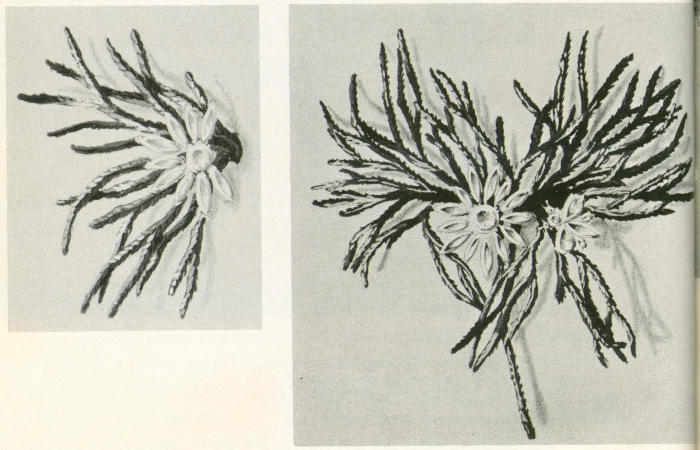
as an ornament for the hair. Thin silver stalks like stems of
wheat were banded just below the center, with a slide for fastening;
the tips were set with diamonds. Some pins for the hair
and some brooches were fashioned with birds or butterflies,
again on thin stalks so that they flitted as the wearer walked.
This vibration of the aigrette added to the sparkle of the gems.
I have made a variation of this jewel, as a flower, to fit the
taste of the twentieth century.
A new type of pendant earring was the girandole. This appeared
in two main forms. In one, from a large circular stone
at the ear lobe hung three pear-shaped pendants, sometimes
amethysts or other colored stones, but usually diamonds. In
the other type, from the top stone was suspended an oval hoop
of gold, within which a single large diamond hung loose.
More and more as the nineteenth century came near, the
fashion in precious stones demanded diamonds. If not in
the center of a jewel, they were used to set off the main one.
They were worn in the new marquise ring, the gold of which
was fashioned to hold a large oblong stone surrounded by diamonds.
They were an essential element of the parure, the set
of matching jewels, which developed in this century in France.
Thus milady might have, in a parure, a bracelet, necklace,
earrings, aigrette, and sévigné, all ordered together and made
of the same metals and precious stones, patterned for their
respective purposes in a concordant, harmonizing whole.
For a time, under the influence of the rococo style, and the
Gothic tendency in the other arts, it looked as though jewelry
designs, becoming more and more elaborate and extravagant,
might again approach the eccentric and achieve the inept. In
1755, however, the ruins of Pompeii were unearthed, with
their treasures of antique style, and a classical simplicity became
the order of the day, fostered for a time by the “return
to nature” of the Romantics. It was felt, for instance, that the
diamond, now prized beyond all other precious stones, shone
most effulgent when it stood alone in a simple setting.
The wars toward the end of the eighteenth century, culminating
in the French Revolution and the campaigns of Napoleon,
shifted the ownership but did not stem the manufacture or
the collection of jewels. The inventory of Mlle. Mars, taken in
1828, listed over sixty items, many of them treasures in themselves.
Notable among these were: a necklace of two rows of
brilliants (diamonds), forty-six in the first row, forty-eight in
the second. Eight bunches of sprigs of wheat tipped with brilliants
(that is, eight aigrettes) totaling about 500 brilliants
weighing 57 carats; a garland of brilliants that could be worn
as one bouquet or divided into three flower brooches, totaling
709 brilliants and 85¾ carats; a sévigné—mounted in
colored gold a central large topaz was surrounded by brilliants,
with three drops of opals also surrounded by brilliants,
the whole set in gold studded with rubies and pearls; a pair of
girandole earrings of brilliants—in each, from the large stud
brilliant were suspended three pear-shaped brilliants, united
by four smaller ones; a pair of earrings—from the large stud
brilliant of each hung a cluster of 14 smaller brilliants, like a
bunch of grapes; a parure of opals, consisting of a necklace,
a sévigné, two bracelets, earrings, and a belt-plate. And Mlle.
Mars, though a noted comic actress and a favorite of Napoleon,
was by no means the outstanding society woman of her
day.
By 1840 many new designs—frets, crescents, stars—were
employed to show off the popular diamonds. These were still
preeminent in the magnificence of the marriage of Napoleon
III in 1853, but his Empress Eugénie revived the use
of strings of pearls for the evening. Diamonds were then worn
in similar strings, called rivières, necklaces of a succession of
single stones, matched or graduated, with a very large stone
in the center. A stone of ten carats was no longer considered
large; the diamond must be at least fifteen carats, and preferably
nearer forty. The large solitaire became popular, not only
for engagement rings, but as the clip-stone on a pin or pendant,
from the diamond often hanging a pear-shaped pearl.
The late nineteenth century developed an electicism, a
freedom of choice among the various modes of the past, that
continues into the jewelry design of our own day. Toward the
end of the century, perhaps as a by-product of the school of
les diaboliques in literature and art, there developed a desire
to shock the bourgeoisie, and with it a certain desire for novelty,
manifested in such bizarre items as live beetles worn as
pins, or brooches of a live tortoise with gems set in its shell.
A central ground of common sense and classical design was
firmly maintained by Peter Carl Fabergé and the House of
Fabergé, which designed many of the jewels at the turn of the
century and continued popular among the Edwardians. The
great World’s Fair in Paris in 1900 showed a fresh interest in
design, and the use of such materials as translucent enamel,
ivory, and horn. The influence of the Orient showed in these
materials; it was also evident in larger and more colorful earrings
and the multiplicity of bracelets.
Hair styles played their part in the shaping of jewelry. The
pompadour in front, with chignon, increased the output of
tortoise-shell combs, often studded with diamonds, and of
fourches, large two-pronged hairpins similarly adorned. After
1914, the vogue of bobbed hair shifted production from combs
to diamond slides. At the same time, the exposed ears made
ear ornaments de rigueur. As many persons objected to having
their ear lobes pierced for earrings, the earclip became popular;
today it is almost universal in feminine fashion.
About this time, too, short sleeves led to an increased use of
bracelets, often worn several on one arm. Especially popular
has been the bangle bracelet, a band of gold from which are
suspended coins, figures of men and animals, and other tokens
and mementos. Sometimes golden disks are engraved with
sentimental designs or sayings; sometimes the words are humorous,
the figures grotesque.
Platinum and more recently palladium have been increasingly
used as basic metals for the new jewelry, along with the
now less frequent silver and the constant gold.
Spurred by René Lalique, the impetus of modern art has
been felt in jewelry design. Cubic, non-representational, and
other modes of abstract form have helped shape the modern
bracelet, earclip, watch, and the case for powder, cigarettes,
lighter, or the watch. While some jewels thus manifest the
modern modes, others draw freely on the beauty of the past,
as stimulus to the creation of fresh patterns of beauty for our
day.
On the basis of beauty, stones cannot be divided into
precious and semiprecious for, from stone to stone, there is
continuous range of color and glow. Nor indeed can price be
the one criterion, for here many elements produce variety.
Although the term “gem of the first water” is reserved for the
flawless blue-white diamond, as the carats of the single stone
increase the flawless ruby and the emerald become even more
costly; and varieties and special specimens of other stones,
such as the fire opal and imperial jade, move up into comparable
range. For certain individuals, of course, a particular
stone will have associations of sentiment that render it more
precious—in the nontechnical sense—than another stone in
the category of “precious.” It is, then, tradition rather than
any inherent value that sets a secondary label, “semiprecious,”
on all but five of the stones used for human adornment.
Let us call these five the gems, to distinguish them from
the other stones.
There is no doubt that the five gems—diamond, ruby,
emerald, sapphire, and pearl—have grown more fully than
all others into our ways of living. They have become, as I shall
indicate in this chapter, adornments not only of our persons
but of our speech and writing. They are used not only in
figures of jewelry but in figures of speech, to express human
beauty, or eminence, or virtue. The poet and the orator, as
well as the monarch and the lover, have utilized the glamour
of the gem.
Supreme in human imagination is the diamond, the hardest
of all stones. The word diamond captures this significance, for
it is from Greek adamas, meaning unconquerable, the tameless
stone.
The diamond is also the only gem that is entirely composed
of a single element. It is carbon, which also appears in its
more common and less costly forms as soot, jet, and coal. The
diamond is pure carbon crystallized in regular octahedrons,
eight-sided figures.
For a long time, one word was used to mean both the diamond
and the lodestone, the natural magnet. In French today,
the gem is diamant, and the magnet is aimant—which also
means loving. Perhaps the word changed because the natural
magnet, attracting things to it, was thought of as “the loving
stone.” The diamond is the beloved stone.
Most diamonds at their best are colorless, with perhaps a
bluish glow. They may also be blue, green, violet, less often
red—and black. The black diamond is usually unwanted for
jewelry, but is used by lapidaries and others for cutting,
grinding, and polishing hard stones.
If a jeweler speaks of a Matura diamond or a Ceylon diamond,
he is using an old trade name for a zircon. Similarly, a
Welsh, Irish, Cornish, Quebec, or California diamond is likely
to be an attractive piece of rock crystal.
True diamonds were known in Asia at least as far back as
900 B.C. India was the homeland of the gem for many years.
The best stones in the sixteenth century were those cut in
Hyderabad, India, in the famed city of Golconda. Rich findings
were made about 1720 in Brazil; in Borneo in 1738;
elsewhere, diamonds were discovered in less significant
amounts. But by far the richest hoards were unearthed in 1867
in South Africa, which is still the world’s greatest source of
diamonds.
Although the lozenge is the characteristic shape of its crystal
surface, the rough diamond stone is found in many shapes
and cut into great variety. Because of the tears that the great
tragic actress Sarah Bernhardt wrung from the audiences at
his melodramas, Victor Hugo presented her with a tear-shaped
diamond.
Among the many literary references to the diamond, the
Elizabethan playwrights were particularly fond of the expression
“diamond cut diamond”, meaning in that aristocratic
age, when great man matched with great. In the more democratic
nineteenth century, particularly with regard to those
most democratic of spirits, the pioneers—such as the Americans
opening up the West—it became popular to speak of an
uncouth, unpolished but fundamentally fine fellow as “a diamond
in the rough.”
Lovers at all times have linked this most brilliant of stones
with their fair one’s sparkling eyes. One said that, wherever he
went in the world, he found only his beloved:
If to far India’s coast we sail,
Thy eyes are seen as diamonds bright,
Thy breath is Amric’s spicy gale,
Thy skin is ivory’s soft white.
There are several sayings which, though they refer to the
diamond, by indirection speak of mankind. Thus there is a
warning to the person who is heedless of dress or decor, or of
the furnishing of office or home, in the remark: “A fine diamond
may be ill set.” There is, on the other hand, a challenge
to pretense, or perhaps a warning to a person about to select an
employee—or a mate—in the Chinese proverb: “A diamond
with a flaw is better than a perfect pebble.”
The ruby is a variety of corundum. The Sanskrit word
kuruvinda was limited to the ruby, but we today use the word
corundum to mean any form of aluminum oxide, chemically
Al₂O₃. Corundum is next in hardness (though far inferior) to
the diamond, and a hard granular form of it is used in grinding
and polishing. In its pure, transparent form it is, according
to its color, the ruby, the sapphire, the Oriental amethyst,
or the Oriental topaz.
The Latin word ruber means red, and the crystalline corundum
that is a ruby takes shades from pale rose-pink to a deep
crimson that borders on the purple. The color is determined
by the nature of the oxide, and the gem sometimes has a light
silken sheen. A flawless deep red ruby is one of the rarest and
most costly of gems.
Because of its great value, the ruby has often been used as a
term of comparison for human worth, implying the highest excellence.
The Scottish poet William Dunbar used it in pious
thought: “Hail, redolent ruby, rich and radious! Hail, Mother
of God!”
Among precious rubies, greatly desired is the star ruby, a
gem so flawed that it catches the light as a sun with six out-shooting
rays. “The sun is fair,” said the poet Drummond of
Hawthorne on a fine summer’s morning, “when he with crimson
crown and flaming rubies leaves his eastern bed.” The star
ruby, with its three crossbars making six rays of light, has
been thought by these lines of light to signify Faith, Hope,
Charity, Health, Wealth, and Happiness. Thus it is doubly
prized, for its good fortune and for its beauty.
The deep rubies of “pigeon’s blood” or ox-blood red come
from Burma; those from Siam may be purplish brown; from
Ceylon, more probably pink; a Brazilian ruby, a topaz; a
Siberian ruby, a tourmaline; and a Balas ruby, a spinel.
Most frequent of all comparisons with gems are references
to the “ruby lips” of beauty. Close after these come allusions
to the rich red of wine, as when Fitzgerald tells us, in his translation
of the Rubaiyat of Omar Khayyam:
But still a ruby kindles in the vine,
And many a garden by the water blows.
Robert Herrick, the poet of youth and springtime, who advises
us to enjoy lovely things while they are here—“Gather
ye rosebuds while ye may”—in a note of more solemn warning
says to a fair maid:
That ruby which you wear
Sunk from the tip of your soft ear
Will last to be a precious stone
When all your world of beauty’s gone.
What the maiden answered is not on record, but it is sadly
pleasant to think, three hundred years later, that somewhere
today that ruby is still beautiful and still enjoyed.
Sapphire is the current form of a Sanskrit word meaning
dear to Saturn, an olden god whose reign was regarded as the
golden age. The stone has been known since earliest times, although
what the ancients called sapphire was probably the
lapis lazuli, our sapphire being called by them the hyacinth.
It is hard to tell, however, just what gem is intended when in
the Song of Songs the Queen of Sheba sings of Solomon, her
beloved: “His hands are as gold rings set with beryl; his belly
is as bright ivory overlaid with sapphires.”
Our sapphire is a bluish transparent variety of native crystalline
aluminum oxide, the same corundum that when it is red
we call a ruby. The sapphire may be sky blue or cornflower
blue, and shade through the lighter hues to an almost colorless
stone, called white or water sapphire.
The sapphire is often used as a figure for the stars or for
blue eyes: “Those eyes, those sparkling sapphires of delight”...
“Now glowed the firmament with living sapphires.” This
last line is by Milton, from Paradise Lost, which he dictated to
his daughters when he was blind. The poet Gray pictures Milton
as becoming blinded by his great vision:
He passed the flaming bounds of place and time,
The living throne, the sapphire-blaze,
Where angels tremble while they gaze,
He saw but, blasted with excess of light,
Closed his eyes in endless night.
While the sapphire at its best still captures the blue of a cloudless
sky, it brings with it today a vision of more serene beauty.
The emerald is the most precious of the large beryl group of
stones. It has been deemed precious from ancient times. Cleopatra’s
emerald mines are still being worked. A flawless deep
green emerald of good size is extremely rare. Such a gem,
normally, is table cut. The emerald also may be pierced for
use as a bead, or engraved. In Egypt, the usual carving was a
scarab—Cleopatra possessed one; in India, the carving often
was a god.
The word emerald, before the sixteenth century, was
esmeraldus and smaragdus; the Sanskrit word for the gem
was marakta. As recently as the last century, Ralph Waldo
Emerson summed up the chief sensuous impressions of the
Orient: “Color, taste, and smell: smaragdus, sugar, and
musk.”
There are few colors at once as striking and as restful as the
green of an emerald. It seems to have the depths of the pure
rays in a calm ocean. Coleridge in The Ancient Mariner used
it for another form of the ever-changing waters:
And ice, mast-high, came floating by,
As green as emerald.
Tennyson used it for the widespread carpet of the land.
A livelier emerald sparkles in the grass.
In a lighter vein, it has been used to suggest the color of unripe
fruit, as in Eugene Field’s verses on the peach:
A little peach in an orchard grew,
A little peach of emerald hue;
Warmed by the sun and wet by the dew,
It grew.
The green of the emerald makes it, in many minds, the most
beautiful of colored gems.
The pearl is the only one of the five gems that is the product
of life. It gives body to the eternal paradox that out of evil
springs good; out of deformity, beauty. For these reasons, the
pearl is most frequently, of all gems, woven into symbols of
man’s activity. “Honesty dwells like a miser, sir, in a poor
house,” said Shakespeare, “as your pearl in a foul oyster.”
A pearl, as the Oxford English Dictionary puts it, is a nacreous
concretion formed within the shell of various bivalve
molluscs around some foreign substance (i.e., a grain of
sand), composed of filmy layers of carbonate of lime interstratified
with animal membrane.
Trying to isolate the intruding irritant, the oyster secretes a
sticky fluid. The fluid hardens, another layer of it is secreted,
and the pearl grows. The genuine pearl oyster is the meleagrina
margaritifera. Margaritifera means pearl-bearing from
which comes the name Margaret meaning pearl. Other molluscs
may also form pearls, though not usually the varieties
served in the months with an “R”.
Freshwater pearls come from mussels, of the kind called
unionidae. Unionem is the Latin word for pearl—also for
onion, which like the pearl is made up of layer upon layer.
Mary Queen of Scots had a necklace of fifty-two graduated
pearls, all of them fetched out of Scottish rivers.
Pearls are prized because of the beautiful lustre that glows
upon them, pink or even bluish-grey, an iridescence over the
basic white. Rarest are the large black pearls, which make a
beautiful center drop on a brooch or a necklace. The pearl is
hard and smooth in texture, beautiful to see and pleasant to
feel.
The usual shapes in which a pearl grows are round, button,
pear, and baroque (which in this use merely means irregular).
The round pearls are used mainly for necklaces, which must
be threaded in silk or plastic or other such material; any metal
may darken and dull the beauty of a pearl. Button pearls are
used in earclips, studs, brooches and rings. Pear-shaped pearls
are attractive as pendants. The use of baroque pearls depends
upon their shape and size.
Pearls are assorted and matched with great care, according
to their size, shape, and color. The matching of a string of
pearls may be a quest of twenty years. Sometimes a jeweler
will hold the pearls until he has a matched necklace, graduated
or of equal size; but it is also a challenge to a woman who enjoys
jewels to buy a few pearls she can wear in various ways
while watching for enough of their peers to form a string.
The lustrous inside of the oyster shell, formed of the same
material as the gem, is called mother of pearl. A blister pearl
is a flattish excrescence that, instead of being inside the soft
oyster, adheres to the shell; it may be detached and used. Seed
pearls are very tiny pearls, weighing less than a quarter of a
grain.
For ages one of the most highly prized and priced of gems,
the pearl has become less costly not because of changing taste
or of successful simulation, but because man has learned the
secret of the stimulation of the oyster to make it create a pearl.
The best natural pearls come from the Persian gulf and the
waters of Australia; but it is the Japanese who have most fully
developed the technique of inserting a foreign body in the
oyster, so that it then carries on, under its own living power,
the process of making a real—but what is called a cultured—pearl.
Man proposes and the oyster disposes.
From the “gates of pearl” through which Saint Peter allows
the elect to enter Heaven, to the guardians—“of Orient pearl
a double row”—of the smiling mouth, the pearl has been
caught into proverb and poem. At the beginning of this century,
the pearl figured in a popular song:
The hours I’ve spent with you, dear heart,
Are as a string of pearls to me;
I count them over, every one apart,
My rosary.
For some reason, all of Shakespeare’s references to the
pearl are linked with sadness. The song in The Tempest tells:
Full fathom five thy father lies,
Of his bones are coral made;
Those are pearls that were his eyes ...
And it is after Othello has killed his faithful wife Desdemona
and has discovered that his clouding suspicions were untrue,
that he calls himself:
One whose hand,
Like the base Indian, threw a pearl away
Richer than all his tribe.
As far back as the Bible a thing of supreme quality was
referred to as a pearl of great price; and the same book
(Matthew) issues the famous warning: “Neither cast ye your
pearls before swine.”
In other ways the pearl has been used as a symbol. The poet
Swinburne, in sentimental mood, exclaimed:
The world has no such flowers in any land,
And no such pearl in any gulf the sea,
As any babe on any mother’s knee.
The rarity of the stone, and the difficult task of the pearl-diver,
are used symbolically in an epigram by Dryden:
Errors, like straws, upon the surface flow;
He who would search for pearls must dive below.
The American poet, William Russell Lowell (father of the
Supreme Court Justice of the same name), wrote in his copy
of the Rubaiyat of Omar Khayyam:
These pearls of thought in Persian gulfs were bred,
Each softly lucent as a rounded moon;
The diver Omar plucked them from their bed,
Fitzgerald strung them on an English thread.
The other stones, though less esteemed in lore and letters,
have many claims to beauty. One shining specimen may adorn
a jewel; or several of a kind, or combinations of various
stones, may create effects that rival those of the gems. The four
native stones among the five gems are usually translucent,
while most of the other stones are opaque. A transparent or
translucent stone, if it is cut as a prism or if its crystalline
structure is right, may break light into rainbow hues, and,
catching these rays, may shoot them around in varying interplays
of sparkle and color. The opaque stones, on the other
hand, often smooth of surface, are colored in ways that seem
to snare the light and send it out with added power and color.
Special characteristics add to the beauty of many of these
stones, the main varieties of which we shall now glance at, in
alphabetical order.
The agate is a variety of chalcedony. It is named from the
river Achates, in Sicily. A hard stone, of striped or cloudy
coloring, it is often yellow or tawny brown. Shakespeare in
Romeo and Juliet uses the agate in a ring to indicate the size
of Queen Mab, who—before Freud brought us other fancies—was
the bringer of dreams:
She is the fairies’ midwife, and she comes
In shape no bigger than an agate-stone
On the forefinger of an alderman ...
In her coach, Queen Mab gallops by night
Through lovers’ brains, and then they dream of love;
O’er courtiers’ knees, that dream on curtsies straight;
O’er lawyers’ fingers, who straight dream on fees;
O’er ladies’ lips, who straight on kisses dream.
The stone alexandrite was given its name from Alexander II
(1818-1881), Czar of all the Russias, in whose realm it was
found. It is a variety of chrysoberyl, containing chromium. It
has the interesting quality of being dark green in daylight, but
under artificial illumination glowing a brilliant red. These
were the national colors of Russia, the green standing for
felicity, the red for humanity.
The amethyst is a variety of quartz—often called the queen
of quartz—purple or violet in color. It is one of the earliest
stones found in jewelry and has been used in every period. It
is especially attractive in combination with gold and pearls.
People as early as the Greeks have used the amethyst as a
talisman against intoxication. In 1502, Camilli Leonardi observed
that the amethyst protected the mild drinker and cautioned
its wearer against excess; but when its warnings were
unheeded, the stone grew wan and died. There is no question,
as I can testify from my direct observation, that continuing
drunkenness of its wearer will cause an amethyst (like a
person) to grow dull.
A motion picture star, well known all over the world—her
life recorded in a major film—some time ago was in quest of
an unusual necklace. At the time, I was in Hollywood as jewelry
consultant to a motion picture company. As I happened to
be staying at the same hotel as this actress, we often went to the
studio together, and we became rather friendly. When she
mentioned to me that she had been looking for a necklace that
was distinctive and personalized, I told her that her complexion
and hair coloring made it desirable—in my mind, almost
mandatory—for her to have the jewel made of deep purple
Uruguayan amethysts combined with diamonds. That night I
made a sketch of such a jewel, and sent it to her the next morning.
She was enchanted. So was the Hollywood jeweler who
was entrusted with the making of the necklace from my design,
for it was a great success, the talk of the season in the movie
colony.
What the jeweler did not tell me—what perhaps he did not
know, as neither did I—was that this glamorous star, with an
angelic face and a skin the poet Byron might despair of describing,
used to hide away once a month or more and drink
herself into complete intoxication. We did not know, but the
amethysts did. Within a year the deep velvety purple had
faded; the stones were pale, and they had lost their lustre. The
warning of the amethysts had gone unheeded.
The aquamarine is a pale, transparent, bluish-green variety
of beryl. Being of much the same chemical composition as the
emerald, it is sometimes called blue emerald. Although it is
not a rare stone, when step cut the aquamarine has a pleasant
glow, and may be combined with diamonds to make a distinctive
jewel.
Beryl is, chemically, a silicate of aluminum and glucinum,
Be₃Al₂(SiO₃)₆. It usually forms in hexagonal crystals. When
there is also in the stone some oxide of chromium, it becomes
a bright or a deep green: this is the emerald.
The word beryl covers a large number of hard and lustrous
stones. At first it was applied to clear crystals; thus in the
fifteenth century we find references to “water clear as beryl.”
A pale bluish-green variety of beryl is the aquamarine. A yellow
variety is the chrysoberyl (chrysos is the Greek word for
gold).
The carnelian was originally the cornelian. Because of its
flesh color, the name was changed under the influence of the
Latin word for flesh, carnem. Carnelian is a red variety of
chalcedony.
There are two varieties of the cat’s-eye, equally effective
against evil spirits. The stone may be either olive green, or
reddish brown. The most attractive shades are bamboo and
moss green. The distinguishing feature of the stone is that it
seems to have a horizontal slit that sends back a white band of
light, moving with the stone, and resembling the gleam in the
baleful eye of a cat. Other appropriately sinister colorings are
sometimes called tiger’s-eye and hawk’s-eye. The Oriental
cat’s-eye is a mineral of the chrysoberyl group; the Occidental,
somewhat less glinting, is a variety of quartz.
The cat’s-eye, of course, is in wide repute for the power it
confers of seeing in the dark. Thus it is an excellent stone for
hunters. But it proves similarly effective in mental darkness,
providing the power for seeing through the schemes of connivers.
Wearing a cat’s-eye may thus save one from becoming
a cat’s-paw. I met a detective recently who was wearing a
superb hawk’s-eye ring; he told me he had just received notice
of his promotion, “with distinction,” to the rank of captain.
Chalcedony is the name of a large group of stones, variously
colored, consisting mainly of non-crystal quartz. It has the
lustre of wax. Chalcedony has been known from early times
and is mentioned in the Bible. Among the stones belonging to
this group are agate, carnelian, chrysoprase, jasper, onyx,
and sard.
The various stones beginning with chrys (Greek for gold)
should in the main be yellow. Chrysoberyl is a yellowish,
sometimes slightly greenish, mineral, beryllium aluminate,
chemically Be Al₂O₄. It has been used for adornment since
ancient times.
This is a rather common yellow silicate of magnesium and
iron, of granular structure. When, as sometimes occurs, it is
greenish in tint, it is called olivine by mineralogists, but when
used for adornment jewelers call it peridot.
Chrysolite is mentioned as one of the foundation stones of the
New Jerusalem prophesied in Revelations. Shakespeare has
Othello, wrought with agony over his beloved Desdemona
whom he believes unfaithful, exclaim:
Nay, had she been true,
If heaven would make me such another world
Of one entire and perfect chrysolite
I’d not have sold her for it.
There is indeed beauty in an entire and perfect chrysolite.
Gold touched with leek (prason is the Greek word for leek)
marks the color of the chrysoprase. It is a light green quartz, a
variety of chalcedony. As chrysoprasus, it is listed in the King
James Bible as the tenth foundation stone of the New Jerusalem.
Named from the citrus family, citrine is a lemon-yellow
variety of quartz. When clear, it may be used as becomingly
as topaz.
Coral is a fairly hard substance, mainly calcium carbonate,
made up of the skeletons of myriads of marine animals called
polyps. These skeletons, attached to one another, through the
centuries have formed shelves in the ocean, or shaped themselves
as atolls and far-extending reefs. Coral may be in many
colors, white, black, yellow, blue, and—most popular in jewelry—shades
of pink and red. The reddish shades, the Greeks
inform us, are dyed by the blood of the Gorgon Medusa, whose
snake-haired head, lopped off by Perseus, dripped its gore into
the sea as he laid it by to wash his hands. Scientists inform us
the red is produced by the presence of iron oxide.
The ancient Romans placed coral on cradles, to protect the
babe against the ills of infancy, especially teething. Even today,
Italian peasants use it as a charm against sterility, or in
the form of a little bell the wind might make tinkle to drive off
evil spirits. If one has ever knocked wood, one might place on
the babe a ring or a trinket of coral.
References to the beloved one’s coral lips were so frequent
in Renaissance poetry that Shakespeare in revulsion wrote his
Sonnet 130:
My mistress’ eyes are nothing like the sun,
Coral is far more red than her lips’ red ...
—And yet, by heaven, I think my love as rare
As any she belied with false compare.
A century later another playwright, William Congreve, also
used the image in a passage of scorn, after describing the
physical allure of a great beauty:
But soon as e’er the beauteous idiot spoke,
Forth from her coral lips such folly broke
Like balm the trickling nonsense healed my wound,
And what her eyes enthralled, her tongue unbound.
How true love grows through a lifetime by tiny, unnoticed
moments is beautifully pictured—to give an instance of a
happier use of a coral image—by the nineteenth-century poet
Coventry Patmore:
... Fondness for her underwent
An unregarded increment
Like that which lifts, through centuries,
The coral reef within the seas.
The garnet is a hard glass-like silicate mineral. It is found
in many colors: green, yellow, orange, pink and black. When
it is a deep, translucent red, it can be used to form a beautiful
jewel. Its name is a corruption of granate, seeded, as also in
the pomegranate, the seed-apple.
The garnet is sometimes cut faceted. The deep red, cabochon
cut is sometimes called a carbuncle, which means glowing
coal. In trade terms, the pyrope garnet is a deep blood red;
the almandine garnet a violet red. The Adelaide, Cape and
Colorado “rubies” all are garnets.
The color of the flower and the stone have given note to the
name hyacinth. In ancient times, the word was probably used
to designate what we call the sapphire. Today it is applied to
any of the reddish or purplish varieties of the garnet, topaz, or
zircon.
Jacinth is really another form of the word hyacinth. It is
used, now, especially to denote a reddish orange variety of
zircon. The jacinth was a favorite jewel of ancient times, its
mention ranging from the Bible to the Thousand and One
Nights.
Two silicates of lime and magnesium are called jade. One,
the true jade, is a complex silicate also called jadeite. It is a
tough substance, usually green or white, and somewhat translucent.
The other, less valuable form, called nephrite, occurs
in other colors.
Found in Burma and India, also in Mexico and Central
America, jade did not enter early into western literature;
English mentions of jade usually refer to the horse.
The word jade is from the Spanish piedra de yjada, stone
of the side. It is named from the belief that the stone counteracted
pains in the sides and kidneys. And the word nephrite is
from Greek nephros, kidney. Chinese women, indeed, clutched
a piece of jade tightly in their hands during childbirth. They
had a double purpose in this: the stone, being an effective
charm, lessened their labor pains; and, being a symbol of
aristocracy, it ensured the male infant high rank and the female
a successful marriage. Mandarins, though not for the
same reasons, sometimes “spiked” their rice wine with powdered
jade.
A piece of the deep green stone called imperial jade is one
of the most beautiful stones to look upon, and one of the most
pleasant to touch. It combines superbly with diamonds to
create handsome jewels.
Jasper was a stone treasured in antiquity. Although Biblical
references indicate a greenish stone, the jasper we know today
is usually reddish, yellow, or brown, in mottled colors. It is an
opaque variety of quartz.
The jasper was sometimes used as a symbol of perfection.
Thus the Scot poet William Dunbar, about 1525, hailed the
growing capital of England:
London, thou art the flower of cities all!
Gem of all joy, jasper of jocundity!
One might suspect Dunbar of bringing in the jasper to chime
with the jocundity, were it not more likely that he brought in
the jocundity to chime with the jasper!
This stone, which gives its name to its color, a shiny dark
black, might be called kissing kin to the diamond. It is a kind
of lignite, one of the forms of pure carbon, differing from coal
and diamond only in the arrangement of the molecules. It is an
intense black in color but very soft.
The name jet is from the Greek gagates, which indicates that
it comes from Gagas, a town and a river of Lycia in Asia
Minor. Jet, however, was known also to the ancient Celts, who
carved it.
Although its color has made it popular mainly for religious
and especially (in the western world) for mourning motifs,
jet has a bright glow upon its black that can be effective in earclips
and other jewel forms.
Named for the American gem expert George F. Kunz (1856—1932),
kunzite is a stone of attractive lilac crystals. It is a
transparent variety of spodumene which is a crystalline mineral,
lithium aluminum silicate, chemically Li Al (Si O₃)₂.
Spodumene is usually yellow or light green; in its more delicate
shadings, used for ornament, it is now called kunzite.
Known from earliest times, and in high repute as an ornamental
stone, lapis lazuli is a mixture of various minerals. It
is azure blue and opaque, usually with tiny golden flecks. The
name means the azure stone.
Some old-time customs and cures, persisting in spite of superior
smiles and “scientific” derision, have been found to
incorporate materials which modern medicine has in its time
welcomed into the pharmacopoeia, the checkbook of current
remedies. In ancient times, lapis lazuli was used as a “charm”
against bleeding of the nose, against inflammation of the eyes,
against any kind of hemorrhage. The Egyptians prescribed
lapis lazuli 4,000 years before chemists noted the astringent
qualities of copper oxide—which is what gives the golden
flecks to lapis lazuli.
Malachite is a basic copper carbonate, chemically
CuCO₃Cu(OH)₂. It can be highly polished and takes its name
from the green color of the leaves of the mallow plant, the
marsh variety of which gives its name to a popular candy. The
stone is used for small boxes and other decorative pieces; well
polished, it makes an attractive ring.
Moonstone is a milky-white translucent variety of feldspar,
with a pearly lustre.
Feldspar (also felspar, meaning spar of the field) is any of
a group of crystalline minerals, made up mainly of aluminum
silicates. They are glassy and moderately hard, and are found
among igneous rocks. Spar is the name of various shiny materials
that break off easily, in chips or flakes. Few of these
varieties are used in ornaments, but the even milk-white tone
of a good moonstone makes it effective in jewels.
Named, because of its pale color, from the Greek word for
nail, onyx is a variety of agate. It consists of alternate layers
of different colored stone, as can be seen around the edge; this
makes it prized for carving, especially in cameos.
The opal was represented in such variety in early times that
the word upala was the general Sanskrit term for a precious
stone. The opal comprises a large group of vitreous, translucent
silicas, possessing the property of refracting light and
then reflecting it in a play of colors. Silica is a dioxide of silicon,
chemically Si O₂, a hard glassy mineral that includes
quartz and sand as well as opal. According as the compound
includes iron, magnesium or other elements, the color of the
stone varies.
The best opals are the result of a flaw in their formation.
Being hydrated silicas, they were at first a sort of semi-liquid,
jellified substance; as this hardened, cracks and fissures were
created by unevenness in the material and in the speed of the
hardening. These tiny spaces trapped air or moisture, and it
is this that produces the phenomenon of refraction and reflection
of light and gives the colorings and variations known as
opalescence. The play of light is at its best when the stone is
cut cabochon, except for the fire opal, which is faceted.
There are three chief varieties of opal. The common or
white opal has a cloudy-white background, with pastel patches
that often give it a veritable sunrise glow. The black opal has
actually a very dark green background, in which there are
deep pools of blue and green with patches of flame. Rare, and
most magnificent, is the fire opal, which seems almost transparent,
its body of smooth reddish orange shooting forth into
flame.
The opal is a delicate stone. It may be damaged by heat. It
absorbs grease, and may thus become dull. The outstanding
and valued feature of the stone is its opalescence. This creates
a constantly changing, almost kaleidoscopic play of lights. It
is this variability that gives point to the reference in Shakespeare’s
Twelfth Night: “Now the melancholy god protect
thee, and the tailor make thy garment of changeable taffeta,
for thy mind is a very opal.”
The peridot, a yellowish-green variety of chrysolite, was
popular in early England. It fell from favor but was reintroduced
from France in the seventeenth century. It is a beautiful
stone, often as large as 30 carats, and again growing in favor.
Quartz is one of the silicas, chemically Si O₂, as is the opal.
It is abundant as a colorless, transparent substance; it also appears
as a brilliant crystal. The name quartz is from the German
zwerg, meaning dwarf. Similarly cobalt and nickel are
from German words for sprites, the gnomes being little creatures
that work the mine of the gods.
In its crystalline form quartz includes amethyst, cairngorm,
citrine, quartz cat’s-eye, rock crystal, and rose quartz. Another
main group in the quartz family is chalcedony, which includes
agate, bloodstone, carnelian, jasper, moss agate, onyx, sard,
and sardonyx. These stones are used for beads for carving
cameos and intaglios.
Sard is a very hard, deep orange-red variety of chalcedony.
Its name rises from the fact that it originally came from Sardis
in Asia Minor.
Sardonyx is a variety of onyx in which the alternating
layers are of white chalcedony and sard. It can be cut into
beautiful cameos.
The sardonyx is not to be confused with the sardonics,
known for their scornful smile. The latter have no connection
with the powers of the stone; they derive their name from the
plant of Sardinia, the island off Italy. The plant, we are told,
was poisonous, and made its victims sneer while dying. More
scientific botanical tales aver that the plant was bitter, so that
its taste at once produced contortions of the mouth. In either
event, the bitter, superior smile of the sardonic comes from
another part of the world than the peaceful sardonyx stone of
Sardis, Asia Minor.
Spinel is so called, little spine, from the shape of its crystals.
It is a hard mineral, composed mainly of oxide of aluminum,
with iron or magnesium. The proportions of the metals
determine the color, which ranges from rose pink through
green, blue, and purple, to black. The red variety, rare and
costly, is sometimes called a spinel ruby. It is also known as a
balas ruby, from Arabian balakhsh, from the Persian province
of Balakhshan, where spinels from pink to orange have long
been found.
The topaz ranges widely in color, according as other substances
are present in the complex aluminum silicate that is its
basis, chemically Al₂Si O₄F₂. It is transparent, crystalline,
and may be white, pale blue, or pale green; but the yellow
shade (produced by the presence of fluorine) is preferred for
use in a jewel. It often develops its crystals in large clusters;
the National Museum in Washington has one weighing 153
pounds.
Brazilian topaz is genuine topaz. Oriental topaz, however,
is a yellowish crystalline corundum; Occidental topaz, a
yellow quartz, citrine. Topazolite is a yellow variety of garnet.
The topaz is mentioned in the Bible as the ninth foundation
stone of the New Jerusalem. It has not entered greatly into
literature, being an undramatic stone, and is not usually at its
best when combined with others; but it can be so fashioned as
to display a serene and quiet beauty.
The tourmaline is any of a variety of complex silicoborates,
formed into a brittle mineral, crystalline stone. It was originally
found in Ceylon, first being brought to the West in the
eighteenth century. The surface of the stone has a vitreous
lustre. A black, opaque variety is called schorl; a blue variety,
indicolite; a red, rubellite. The tourmaline is most attractive,
and most frequently chosen for jewels, in a colorless transparent
or translucent variety, and in deep green.
The turquoise was originally found in Persia, where it is
still a favorite and lucky stone. It was also found along the
Sinai Peninsula; but it was transported to the West by way
of Turkey, whence its name, the Turkish stone. It is also found
in the western United States and, in its rare crystalline form,
in Virginia.
The turquoise is a hydrous phosphate of aluminum, with a
little copper or iron determining its color, from sky blue to
greenish grey. It is best when a rich green-blue. The stone is
rather soft and is cut cabochon. Like the opal, it absorbs
grease and dirt and may grow dull. Over-exposure to strong
light will cause it to fade.
There may often be several hues in the one turquoise;
it is another stone that can be wrought into parures of quiet
beauty.
Zircon is really a silicate of zirconium, an element
discovered by Martin Klaproth. Zircon is chemically Zr Si O₄,
a mineral occurring in tetragonal crystals. Though it is found
in many colors—yellow, brown, red, pastels of green and
blue—the colorless and transparent varieties are in demand
for jewels. The brown zircon, heated, turns first blue, then
colorless. Without the diamond hardness and full sparkle, the
colorless zircon more nearly approaches the radiance of the
diamond than any other stone.
The word zircon is from the Arabic zarqun, meaning cinnabar,
from Persian zar, meaning gold, and this indicates the
ancients’ favorite colors of the stone. It is also called the jargon
or jargoon. A red zircon is also known as a hyacinth.
CHAPTER 3 Birthstones and the Magic of Gems — The Seasons — The Days of the Week — Sunday — Monday — Tuesday — Wednesday — Thursday — Friday — Saturday — The Months — TABLE OF BIRTHSTONES — January: Garnet — February: Amethyst — March: Aquamarine — April: Diamond — May: Emerald — June: Pearl — July: Ruby — August: Sardonyx or Peridot — September: Sapphire — October: Opal — November: Topaz — December: Turquoise — Signs of the Stars — The Zodiac — Aries, the Ram — Taurus, the Bull — Gemini, the Twins — Cancer, the Crab — Leo, the Lion — Virgo, the Virgin — Libra, the Scales — Scorpio, the Scorpion — Sagittarius, the Archer — Capricorn, the Goat — Aquarius, the Water Carrier — Pisces, the Fishes
Precious stones have from earliest times been associated
with special powers. Not only were they guardians against
demons, but each by its particular virtue warded off certain
diseases or other misfortunes. In their astrological aspects,
they could help to arrange, if not wholly to secure, a happy
future. From this connection with things to come, the gems
came to be linked with various times: each season, each
month, even each day of the week, had its special stone.
The season of spring, with the first flowering of the reborn
year, is considered especially appropriate for the amethyst,
the green diamond, the chrysoberyl, the spinel, the pink topaz,
the olivine, and the emerald. The bright sun of summer, that
bells the fruit and spreads the foliage, is best for zircon,
garnet, ruby, and fire opal. Spinel, chrysoberyl, and pink
topaz still hold their charm. As the languors of summer tang
toward the crispness of autumn, it grows time for sapphire,
hyacinth, oriental chrysolite, tourmaline, jacinth, and topaz.
Then with the challenge of winter come turquoise, white
sapphire, rock crystal, quartz, moonstone, pearl, and the
gleaming diamond. Of course, the brilliant solitaire, the diamond
of the engagement ring, is an appropriate stone in any
season.
The days of the week are more intricately bound in gemmed
symbol. If you know the day on which you were born, you
can garner all the good fortune that comes with the proper
stone. Each day of the week, along with the stone, bears other
significances and powers.
The golden-yellow day of King Sol, the sun, is marked
with the yellow jacinth. If one wears this, we are told, one has
the power of a lion on that day—especially when Leo, the
lion in the heavens, takes the summer season with the sun.
But also this is a token of secrecy in the man—it ensures
discretion, always advisable, often essential, in a lover—while
in the woman it betokens generosity, always desired but
not always appreciated by a lover.
The serene day of the moon is the day for pearls. Pearls
should be bestowed on a Monday. The color white is bound
with them and with the day, for the snow-white blanket of
peacefulness. A man might wear a pearl in a tie clasp, bar,
or in a tie pin, which is coming back into favor. The pearl is
a token, in a man, of friendship, of integrity, of a religious
feeling; and in a woman of contemplation, purity, affability.
Tuesday is a more active day. Tiw is the Nordic god of
war, and his name is used to translate the Latin for Mars’
day. Hence its stone is the blood-red ruby. This is a fitting day
to hold in memory those who have died valiantly in battle. But
it is likewise a day to be on one’s guard, for while the star
ruby marks nobility and power of command in the man, it
may also spill over in excess to bloody vengeance. And in the
woman, while the ruby of this day adorns a proper pride, it
may descend to a pettier obstinacy. At its best, the ruby is
resplendent on a Tuesday.
Although Woden was king of the Nordic gods, his name is
used to translate the Latin for the day of the fickle and
thievish Mercury, who was placated on this day. The emerald
is its precious stone. The color green may mark jealousy when
it flickers in a woman’s eyes, but in a gem it is a token of
change. In a man it betokens joyousness, quick-soaring but
transitory. In the woman, with the Wednesday emerald comes
a spontaneous, childlike delight in passing things, a love of
variety. This is a good day to hold in memory those who have
died in the flower of youth.
Thor’s day, said the Anglo-Saxons. Again they transmuted
the powers, for Thor is the god of war, while to the Romans
this is the day of Jupiter, king of the gods. It is a violet day,
the day of the violet sapphire. This is a precious stone indeed,
and a potent day. In the man it marks sober judgment, gravity,
industry. In the woman the Thursday sapphire denotes high
thoughts, and a love that lifts beyond the body with the
spirit. Fortunate are they between whom a violet sapphire
passes on a Thursday.
Here the Anglo-Saxons made no mistake, for Friya is
their god of love, and Friday is Venus’ day. Friday still feels
the force of the sapphire, but the sapphire must be blue. In
the man, the blue sapphire marks magnanimous thoughts and
wisdom.
In the woman, the blue sapphire of Friday, especially the
star sapphire, marks courtesy and keen powers of observation.
The girl Friday sees more than she tells. But there is
need for caution; without the stone, these feminine powers
may shift to a colder watchfulness, accompanied by jealousy
and suspicion. Beware a flaw in the precious stone, the precious
one. Friday is an auspicious day for love, if love is bedecked
with a blue sapphire.
Saturday is the seventh day, the day of rest. Thus the
Anglo-Saxons did not labor to translate it from the Latin;
it is the day of Saturn, the Roman god of time and growth.
Saturn was the father and first king of the gods; his stone is
the king of gems, the diamond. Saturday crowns the days
of the week, as the diamond crowns the family of the gems.
In a man the diamond marks gravity, fortitude, constancy.
In a maiden, it may betoken a certain giddiness, a flighty
fancy that has not yet found its destination; but in a woman
it marks perseverance and constancy. The woman of the
Saturday diamond knows what she wants, and works unfaltering
to attain it.
Thus, from the jacinth and the pearl to the sapphire and
the diamond, runs the gemmed story of the days. More fixed
in popular imagination are the special stones of the months,
for these have become the birthstones that mark the natal
days. In early times there was considerable variety; today
there is general agreement as to these stones. They may have
come, as many believe, from the twelve stones in the breastplate
of the Jewish high priest. Or they may be transferred
from the twelve foundation stones proclaimed in Revelations
for the New Jerusalem. The ages have fixed them as memorials
of birth, and one should have at least one lucky jewel
adorned with one’s birthstone.
Month
Birthstone
January
Garnet
February
Amethyst
March
Aquamarine
April
Diamond
May
Emerald
June
Pearl
July
Ruby
August
Sardonyx or Peridot
September
Sapphire
October
Opal
November
Topaz
December
Turquoise
Each of the birthstones is caught into more than one jingle.
Its powers have been trusted so long that folklore has
wrapped them in song, and truth hangs upon them like the
beard of a patriarch. And the stones themselves endow the
wearer with the special grace of the natal day.
By her who in this month is born
Gaily the garnet should be worn;
’Twill guarantee love’s constancy
And warm her in felicity.
The January stone, at its best, is a deep red, or a red shading
to violet. With its burgundy sparkle, it has a dark brilliance
found in no other gem.
The color of the garnet drew it naturally to association with
blood. It has been considered a sovereign remedy against all
kinds of inflammation and bleeding and disorders of the
blood. Since the face flushes with anger, the garnet was held
as a charm against anger; it was felt to have a calming influence
and to be potent against mental disorders. Psychoanalysts
take long years to accomplish what one may gain
just by the wearing of a garnet.
Pile on the coal.
And if there’s a hole
In underclothes, go darn it.
This is the time
For winter’s rime,
And for the ruddy garnet.
The February born will find
Sincerity and peace of mind,
Freedom from passion or from care,
If they the amethyst will wear.
The February stone has a wider range of color, and may be
chosen in any shade from light lilac to a deep royal purple.
It is a symbol of beauty and of power. It has been traditionally
associated with the Princes of the Church, and down the
ages has been the chosen royal gem.
Out of the ancient Hebrew comes the thought that the
amethyst has the power to prevent nightmares and unpleasant
dreams.
With its buried meanings of beauty and power, of power-claiming
beauty, the amethyst was one of the earliest stones
to be cut in the shape of a heart.
Here is a story of the best known and most heralded of
the powers of the amethyst, its potency as a guard against intoxication,
against the evil effects of overindulgence.
The god of revelry and wine, Bacchus, we are told, fell in
love with a nymph, who sought to avoid his tipsy embrace.
(One needs not the gods to picture such a pickle!) This
nymph, however, prayed to Diana, goddess vowed to chastity.
Diana changed her to an amethyst, with power to withstand
the effects of drink. The frustrated Bacchus gave the stone the
color of wine. Hence the amethyst was known to the Greeks
as “the sobering gem.” It should surely be the token stone of
Alcoholics Anonymous, for its very name, a-methyst, comes
from the Greek, meaning “against strong drink.”
February, we are told, is the cruellest month; its chill
seems to call for the warm coursing of an invigorating drink.
It is most fortunate that the stone for this month of biting cold
is the amethyst.
Red the cheek glows,
Still redder the nose;
Jack Frost the lips has kissed.
Spice the hot drink;
Let glasses clink—
And wear the amethyst!
Who in this world of ours their eyes
In March first open, shall be wise,
In days of peril firm and bold,
If they an aquamarine will hold.
March is the month when spring rains begin. It is also
the month when of old, after the winter’s frost, men ventured
forth again. In the Mediterranean to the south, and from the
fjords and headlands of the north, our ancestors pushed their
boats out from the shore, in quest of food and far adventure.
Thus the gem of March is the aquamarine, whose name means
“water of the sea.” And the stone is truly cousin to the waters.
At its best it is clear as mid-ocean, and of a brilliant greenish
blue. It has been said that whoever wears an aquamarine can
do no dirty deed, will all his life be clean of body and spirit.
For this reason, the aquamarine is a favorite gift to a newborn
baby.
Sea voyagers today, as the Vikings long ago, for protection
from the dangers of the deep may wear an aquamarine.
Hark how the rain
Beats on the pane!
It flushes the world with green.
Brooks are all high,
Roads never dry—
Everything’s aquamarine!
She who from April dates her years
Diamonds should wear, lest bitter tears
In vain repentance flow; this stone
Emblem of innocence is known.
With the magic of spring, in myriad raindrops lit by the
sudden sun, in the glint of young leaves and the brightness of
early flowers, April shares the sparkle of the diamond. For
springtime and for its precious stone, superlatives are the
order of the season. The diamond has the greatest brilliance
and most power of reflection of all gems. Its clearness and its
cleanness are unsurpassed. It is colorless, yet it can show the
entire spectrum of colors.
The god of mines, we are told, created the diamond by
pulverizing all other precious stones—ruby, sapphire, emerald,
and the gathered host—blending and pressing them into
one supreme stone, a crystal that, itself without color, imprisons
and releases all the fused colors in its core.
More sentimentally, legend records that in one of his unguarded
tender moments, Jupiter, king of the gods, asked the
young man who had rocked him in his cradle to name his own
reward. The young man asked that he might endure unchanged
forever. Jupiter turned him into a diamond.
Increasingly through the centuries has the diamond been
valued. Popes have proclaimed its virtues. Musical comedies
have sung its praises. Only the flawless diamond, the Hindus
pointed out, has the power to heal. Pope Clement VII stated
that the greatest curative potency dwelt in the powdered diamond.
In the eighteenth century, the French maintained—to
the smiling acquiescence of the feminine kind—that the diamond
possesses talismanic virtue only when given as a gift;
a purchased diamond held no luck for the purchaser.
This symbolism blent with the meaning of the ring to make
the diamond the first formal gift to the loved woman upon
betrothal. As the seal of an engagement, a solitaire is more
effective than the old “writ” or quill-penned bond; it symbolizes
at once a bond and an indestructible union of power
and beauty.
There is in this gem, though it is not always the most costly
of precious stones, the strongest appeal to a woman, and she is
fortunate indeed whose claim to the diamond is a birthright.
A diamond in a jewel adorning another beauty sets unrest
in a woman’s heart, until she too is asparkle. The diamond is a
sign of love; it confers loveliness, or at least it imposes pride.
It is the ambition of every woman—and it should be the
fortune of everyone Aprilborn—to possess a flawless diamond.
After the shower
Brightens the hour,
Flowers lift on the stem.
Raindrop sparkles
Till evening darkles:
Diamond is the gem.
Who first beholds the light of day
In Spring’s sweet flowery month of May
And wears an emerald all her life,
Will be a loved and happy wife.
May is the month when meadows and woods put on their
richest garb of green. May is the month of the emerald. The
ancients said that the gem was the captured glow of the firefly.
Deep green and translucent, this stone at its best is very
rare. It was prized before and beyond all other stones and, for
large flawless gems, outvies the diamond. Among church
stones it ranks very high; Andreas, Bishop of Caesarea, wrote
of the emerald: “Its transparency and beauty may not change;
we conceive the stone to signify John the Evangel.”
The potency of the emerald has been extolled in various
fields. It was especially prized as a panacea for poisons. In
this field, it was an admirable alexipharmic; it protected
against poison from fangèd bite, and from the gangrene of
wounds. It warded off the dangers of poison artfully secreted
in food; also, of poison from eating the wrong food, as toadstools
for mushrooms, spoiled food, or just too much food.
And it preserved one from that most pestilent of all poisons,
the poisoning of the mind.
Still more widespread was the use of the emerald as a
talisman and a cure-all for the eye. The calming influence of
its dark green hue has been recognized from early times to the
modern eye shade. The Roman Emperor Nero, who suffered
from an eye ailment, used to hold a specially ground emerald
before his eye to relieve the strain, and to enjoy the relaxation
that came with its gentle soothing. In the early Renaissance the
watchmakers and the goldsmiths, their eyes bleary from long
strain at their fine operations, would pause in their work and
gaze upon an emerald. The emerald is the only stone that delights
the eye without ever bringing fatigue.
Less worthy use was made of the emerald by those ambitious
in love. In the Orient, the emerald was the token of love
and was often used to adorn the statues of the god or the goddess
of love. But later it became associated (as were the gods
themselves) with the more passionate aspects of love. Then the
emerald was employed—often, of course, as a bribe to the
pandar or a gift to the girl, but also as a talisman—by those
who sought success in their amours.
It is in its more peaceful aspects, of the green and eye-enchanting
colors of May, that one cherishes the emerald.
Spring in its glory
Tells the bright story
Of the young year at play.
It tries on the sheen
Of gold and of green:
Emerald’s the precious for May.
Who comes with summer to this earth
And owes to June her day of birth,
With ring of pearl upon her hand
Can health, wealth, happiness command.
And what is so rare as a day in June?
Then, if ever, come perfect days,
Then heaven tries earth, if it be in tune,
And over it softly her warm ear lays.
Whether we look, or whether we listen,
We hear life murmur, and see it glisten.
What symbol of glistening life could be more significant
than the lustrous pearl? It is one of the gems that delights in
more than the beholding, for the feel of the soft fine smoothness
of the gem is like the petal of a pansy.
While the pearl does not have the brilliance and fire of a
well-cut precious stone, it has a soft glow unique among gems,
and an amazing variety of glints and shadings around its basic
hue, from the purest white to the darkest black. Most desired
of its dark shades is the “mordoré,” a greenish coppery iridescence
over black. This, however, is so rare that not more
than four necklaces of such pearls are known. More frequent
among the valued shades are the cream and the light pink
pearl.
A pearl is in its very being a symbol, the triumphant growth
of beauty from disease. It marks the victory over drawbacks
and handicaps, the building of one’s treasure out of one’s disadvantages.
From its gentle color and its smooth shape, the pearl came
to be the symbol of modesty and purity. It was endowed with
many powers. It brought succor in times of distress. It cemented
friendships, out of first likings fashioning firm ties. It
strengthened a weak heart and a weak memory. It gave maids
courage to resist, and men stoutheartedness to overcome, evil.
Especially in the Orient, where it was first widely known,
there have been many uses of the pearl. It was combined in
jewels, used alone in many-stranded chains, woven into garments,
woven in or hung upon tapestries that decked the walls
of palaces. It was embroidered not only on women’s garments,
but on priestly and ceremonial robes. There can hardly be a
treasure in which the precious stones are not accompanied by
pearls.
The soft lustre of the pearl, and its natural shape, inevitably
linked it with the teardrop. Indeed, what are pearls but the
crystalline tears of the angels, weeping over man’s indiscretions?
The Romantics suggested that the pearl may sometimes
bring tears. The materialists retorted that the tears were of
vexation, shed by those that could not afford the pearls. But
every morning of a clear June day, the teardrops are on every
blade of grass, the glistening dew that is the brief land-pearl.
Hand in hand
All over the land
Lover leads his girl;
Merrily wedded,
Cosily bedded:
June’s for the shimmering pearl.
The glowing ruby should adorn
Those who in warm July are born;
Then they will be exempt and free
From love’s doubt and anxiety.
With July, the heat of the sun begins to burn into bright
flame the colors of approaching autumn. The range of red is
in the ruby, from pale pink to that deep shade known as
pigeon-blood. Rarest of all stones, the flawless ruby was endowed
with the mightiest powers. The ancients, feeling its hidden
forces, called it “the stone of life.”
The wearer of the ruby had naught but courage in his heart;
he knew no fear. Well might this be, for in his mind the ruby
rendered him invincible. The Russian Czar, Peter the Great,
who scorned jewelry, always carried loose rubies in his
pocket; he held one clenched in his fist when he gave orders
for the exploits that justify his name.
Among the healing virtues ascribed to the ruby is power
over ailments of the skin. Held between the palms of the
hands, it is supposed to put an instant stop to internal hemorrhage.
Worn against the skin a necklace of rubies, strung on
silk, similarly made the skin impenetrable to sharpest blade
or deadliest venom. In these days of the venomous pen and the
deadly fall-out, it is interesting to note that the ruby necklace
has again become popular.
To dream of rubies, one may read in the Arabic dream-books
(which have many more years of authority than Freud),
is to be destined to great felicity. Good news, good fortune,
good health, all lie ahead.
Of those who possess a fine ruby, Sir John Mandeville says:
“The fortunate owner of a brilliant ruby will live in peace and
concord with all men; neither his land nor his rank can be
taken from him.”
One cloud only darkens the ruby’s glow. The ruby itself at
times is said to cloud; and when the gem grows dull, misfortune
is on the wing. The early gemologist, Wolfgang Gabelchower,
a seventeenth-century German, compiled a list of misfortunes
that befell individuals after their rubies had developed
a cloud. He capped his tales with the confirmation of
his own sadness: he noticed that his ruby ring was clouded;
the next day, of a sudden, his wife died.
Against this evidence I can only set my own observation and
experience, and the traditions of a family for four generations
involved in the creation of jewels: I know of no instance in
which the possession of a ruby was the cause of a misfortune.
Quite the contrary: a fine star ruby is a fortune in itself. And
fortunate is she who knows the natal glow of a ruby.
Honest is as honest does.
All the country’s in a buzz
From squire down to booby.
Apples ripening on the farm,
Fairies keep us from all harm
Binding us with ruby.
Wear sardonyx, or for thee
No conjugal felicity.
The August-born, without this stone,
Must live unlovèd and alone.
The reddish brown of the August stone accords with the drying
earth, and the leaves that herald the approaching turn of
autumn. The sardonyx was the fifth stone in the breastplate
of the High Priest of the Hebrews; among Catholics it is given
honor as the stone of Saint James.
Physically, the sardonyx was used as a charm against
warts, boils, and cramps. Spiritually, it was worn to turn
away the evil eye and to prevent the transfer to the wearer of
wicked impulses and thoughts. No witch could insinuate evil
fancies into the mind guarded by this stone. And the most
sardonic remark passed harmlessly by one who wore the sardonyx.
On the contrary, wearing the stone made one witty,
popular, and happy.
August more generously than the other months permits an
alternate birthstone. This is the peridot, an olive green stone
so radiant that it sends back flashes even in very dim light. It
has therefore been linked with the sun, whose bright rays it
ensnares to hold against future darkness.
The peridot was a frequent stone in Egyptian jewels. From
that time, it has been used to protect the wearer from the
dangers that lurk in darkness, though in the fifteenth century
it was maintained that the peridot was effective only if set in
purest gold; this combination made it a perfect night talisman.
The stone was a favorite for earrings, as its power over light
was transferred to sound, to make even the lightest sound quite
audible. It also helped lighten the burden of neuralgic pains.
For warding off evil spirits, however, it was worn only
beaded and strung.
Worn by a man, the peridot ensured his generosity, according
to countless wives who have bestowed peridot rings upon
their husbands.
One of the most beautiful of all peridots is high-set in the
Cathedral of Cologne. Mysteriously it shines forth in the darkness
of the dome, giving a lasting memory and quiet reflections
to all who have seen it.
Those born in August may be happy with sardonyx or peridot.
Long the rows of ripened grain
Along the dusty winding lane;
Do not walk alone.
Take the moonlit lovers’ path
Hand in hand; to turn Lob’s wrath
Sardonyx is the stone.
A maiden born when autumn leaves
Are rustling in September’s breeze
A sapphire on her brow should bind
To keep her keen and quick of mind.
In autumn the eyes turn upward from the bounteous earth,
past the reds and yellows and browns of the restless foliage, to
the endless dome of the skies. September is the month of the
sapphire, which, like the heavens, ranges from a light celestial
blue to the deepest velvet-like dark of indigo. It may have the
lucid blue and cool brilliance of a mountain lake. Its color
seems to well from endless depths, with a rich luminescence.
One of the rarest gems, the fine star sapphire, was held in
repute among Egyptian astrologers, who called it the stone of
the stars. Wearing a sapphire spun the stars into a favorable
conjunction. In more than one section of the world of glamour
today, movie “stars” carry on this tradition; sapphire jewelry,
especially with a star sapphire, is their most potent talisman.
In “the profession” a sapphire is an antidote for stage-fright.
It builds confidence, brings success, and at the same time deflects
the shafts of envy.
The sapphire has also held place in religious functioning.
The Bishop of Rennes, in the twelfth century, hailed this
stone as the most appropriate for ecclesiastical use: “The
sapphire is like the pure sky, and mighty nature has endowed
it with so great a power that it might be called the gem of
gems.”
Physically, the sapphire was thought to effect various cures.
The scientist von Helmhont praised its power for patients
afflicted with boils. Some thought the sapphire, for ills of the
eye, even better than the emerald. Thus Charles V of France
had a sapphire set in gold, to which he had a handle attached,
like a lorgnette, to hold to his inflamed and painful eyes.
Queen Elizabeth I of England attributed more general magical
powers to a sapphire that she wore and with which she never
parted until her death. With it, she foiled countless plots
against her life and in England’s most turbulent times lived
out her full allotment of three score years and ten.
For the September-born, there is the exultation of the
rustle of fall and the sweep of white clouds across a sapphire
heaven.
Harvest moon beyond the hill.
Harvest happiness, and still
Watch the hearth’s soft-dying ember.
Deep the night with many stars,
Love’s the locksmith breaks all bars.
Sapphire’s for September.
Fresh October brings the pheasant;
Then to gather nuts is pleasant.
But this month’s babe is born for woe
And life’s vicissitudes will know
Unless an opal on her breast
Drives off these woes and keeps her blessed.
October, with its sharp contrasts, is the month of the opal.
This gem may be white, or black, or of that rare and precious
kind, the fire opal. In its dark greyish background are imbedded
the most luminous colors of red, yellow, green, blue,
and purple, that seem to shoot forth rays. The opal does not
refract light, being an opaque stone; but its own colors make
fine interplay with light.
The Roman historian Pliny called the opal “the captive
rainbow.” The wearer of the stone, the same authority assures
us, not only will be urbane and courteous but will be free from
the spleen of those around. An opal, like a soft answer, turneth
away wrath.
For a while, especially in the early nineteenth century, the
opal was considered a stone of bad luck; it fell from favor
like one dismissed by royalty. Two stories, one from life and
one in legend, helped produce this aberration; human credulity
completed the work.
The true-life story is that of Alphonso XII of Spain. He gave
a ring, bearing a magnificent opal, to his bride. Shortly after,
she succumbed to a mysterious malady. His sister, who next
wore the ring, died a few days later. His sister-in-law next put
the precious opal on her finger; within the month she died.
Hoping to end the series of sudden deaths, Alphonso took back
the ring and gave it to no one. Alphonso died. The chain was
broken when his heirs placed the ring upon a statue of the
Virgin.
The legend is a gruesome one recited by Sir Walter Scott in
his poem Anne of Geierstein. With mystic shadowings and
eerie intimations, it unfolds the story of the wearer of an opal,
who shuns pious references and avoids all contact with holy
water. One night a watchful person delivers an aspersion of
the holy water, and the next day, where the opal-wearer had
slept, there rested only a pile of ashes.
Only the unthinking, however, and the wood-knockers
shrink from the beautiful opal because of such old wives’
tales. The stouthearted Empress Victoria of England, for example,
was extremely fond of opals, and bestowed upon many
of her friends jewels in which opals were set. There are no
records of sudden deaths at her court. In 1925, at the British
Empire Exhibition at Wembley, Queen Mary, passing a booth
tended by a miner’s wife, bought a black opal. It is a stone
worthy of queenly favor.
Far from being a sinister omen, the opal is a stone of good
fortune. It is especially sought, indeed, by fortunetellers.
Some of them gaze upon it to induce that trance-like state in
which the future spreads before one like a great mirage; better
than a crystal ball are the incessant interplay of colors and the
endless iridescence of the stone. An opal on a ring increasingly
gives the wearer a view of the future. Unlike the man
who considered augurs boring, I confess to a keen interest in
what makes them tick, or click. Usually their powers are
linked to a special stone, which, like as not, is an opal. The
famous European telepath, Eric Jan Hanussen, for example,
believed implicitly in the prognostic power of the stone. “Anyone
could do what I do,” he once said to me, “if he had my
opal.”
Certainly the opal is auspicious for the October-born.
Light the fire; roast the crab.
Though she dodge the while you grab,
Kiss the maid still sober.
Hard the day’s work you have done,
Who would grudge an evening’s fun?—
Opal in October.
Who first comes to this world below
With drear November’s fog and snow,
Should prize the topaz’ amber hue,
Emblem of friends and lovers true.
When nights are growing long and tempers short, when one
seeks the consolations of philosophy (or memories of Florida)
to store against the cold, November is the month of the topaz.
This beautiful stone is at its best when honey-blond.
The topaz was a holy stone, signifying Saint Matthew. Two
of the popes, Clement VI and Gregory II, possessed a topaz of
great beauty, to which were attributed great healing powers.
This stone gave the faithful a further impetus to make the
pilgrimage to Rome from the far corners of the world so that
their health might return to them with the blessing and the
touch of this hallowed stone.
Even on less sacrosanct hands, the topaz was esteemed for
its many therapeutic virtues. From earliest times, in accordance
with the principles of sympathetic magic, the yellow color
of the stone made it ideal for the cure of those afflicted with
jaundice and other ailments of the liver. As the November
stone, it was used in the Middle Ages to cure the contagions
that begin to spread with the onset of cold weather. Its soothing
color added it to the stones that were esteemed good for
the eyes; the topaz was moistened with wine and laid upon
aching eyelids. It also, many felt, cured diseases of the mind
and helped the distraught to regain their mental balance.
The birthday wearer of the topaz is likely to be an upright
soul, with good judgment fortified by wisdom. Faith and a
deep spirit of charity are within its bestowal, gifts important
in November’s shortening days and chilly blasts. It is clear
that one of the most gracious of all stones is the topaz.
The nights are growing dark and long,
Bitter is the wind and strong,
With a wailful moan.
Let your mirth the time beguile,
Meet life with a cheery smile
And a topaz stone.
If cold December gave you birth,
The month of snow and ice and mirth,
Place on your hand a turquoise blue,
Success will bless whate’er you do.
December, the last month of the dying year, chill with the
shivering threat of its dying, needs a great virtue to preserve
it till it is overtaken by the touch of January and the promise
of the new year. This great virtue the ancients found in the
turquoise.
Among the ancient peoples of many lands, it was the common
practice to bury turquoises with the bodies of their monarchs
and their chiefs, to tide them over the pitchy paths of
transfer and bear them safely to the new world and the new
life beyond the tomb. In the pyramids of Egypt, in the Aztec
tombs, in the mounds of Mexico, jewels and beads of turquoise
abound.
At the beginning of life in this world, too, the turquoise is
welcomed; there is still no better good-luck gift to a newborn
child than a necklace of turquoise beads. It is significant that
December is the birth month of the Holy Child, for whose nativity
the gifts no doubt included turquoise.
Since the turquoise is comparatively soft among stones, it
can be readily engraved; magic inscriptions, charms, and
prayers have been cut upon it, to add their power to its auspicious
glow. The turquoise is thus a protective stone. December
being a precipitous month, when snow and ice are prelude
to a fall, with hillsides hazardous and even a level walk a
place where one is prone to slip, the turquoise is an excellent
talisman against falling. In fact, the saddles of horses have
been set with turquoise, to keep the steed surefooted on journey
or in battle. St. George was secure against a fall in his
battle with the dragon; paintings and tapestries of the valiant
saint show a turquoise in the hilt of his great sword.
Opaque though it is, the turquoise, because of its bright
coloring, outshines most other stones. Its protective value may
extend even to material things. It was the Hindu Tagore who
arose from his pondering of less mundane concerns to report
that, to ensure enormous wealth, one should look long at the
new moon, then instantly fix one’s eyes on a turquoise.
15. QUEEN ELIZABETH II.Her Majesty is wearing the sash and star of
the Order of the Garter, a necklace given to her by the Nizam of Hyderabad
and a diamond bracelet which was a gift from the Duke of Edinburgh.
Her tiara of diamonds and pearls has been worn by queens of England
since Queen Victoria. (Command portrait by Dorothy Wilding, courtesy
of the British Information Services)
16. PEARL AND BAGUETTE DIAMOND
EARCLIPS.Designed to
minimize large ears. The subdued
sparkle of the baguette diamonds
makes them suitable for
both daytime and evening. This
jewel was honored with the
Diamond U.S.A. Award.
17. DEEP SEA ALGAE.The earclips
(only one is shown at the
left) and pin (shown here ⅞ of
actual size) of chased 18 karat
gold with ornaments of large
diamonds were inspired by deep-sea
plants. Their distinctive
character is heightened when
seen against a solid color.
18, 18A. DOUBLE ROSE CLIP.Two wild roses with their foliage form a
brilliant corsage of diamonds and platinum. The two flowers are different
in size and detail of design. The pin can be separated into two individual
clips, providing a variety of possibilities for enhancing adornment.
At the left, the smaller of the blossoms—the flower not yet fully opened,
the leaves still curled in—is worn on a necklace of round and baguette
diamonds.
19. DIAMOND AND PEARL LEAVES.A set of
brooch and earclips suitable for almost all
occasions. The delicate, pierced design, signifying
the veins of a leaf, has both airiness and
depth. When the earclips, similar in shape to
the pin, are worn close to the cheek, the pearls
add lustre to the skin.
20. PEARL AND DIAMOND NECKLACE.Wild roses
of diamonds divide the three strands of pearls
in front from the two strands in back. The
clasp is hidden in one of the roses. From the
collection of Mrs. Cummins Catherwood.
21. PEARL RING. The delicate lustre of a
pearl is highlighted by six marquise
diamonds.
22. QUEEN GERALDINE OF ALBANIA.The Queen’s coronation tiara, made
of diamonds and platinum, shows the royal crest of the “Ram of
Skanderbeg” held by a bandeau of Albanian wildflowers. Her diamond
and ruby pendant earclips accentuate her violet-blue eyes; her Rivière
is of alternating round and baguette diamonds.
23. DIAMOND NECKLACE.A diamond and platinum necklace in a youthful,
flower design. The center motif is formed by an emerald-cut diamond.
This necklace can, with the aid of a simple device, be worn as a tiara.
From the collection of Mrs. Theodore Newhouse.
24. DIAMONDS CAUGHT IN A NET.This earclip and clip ensemble in
platinum and diamonds received the Diamond U.S.A. Award.
25. NECKLACE FOR A BRIDE.Motifs of marquise, baguette and round
diamonds form a delicate pattern of orange blossoms for this completely
flexible necklace. Recipient of the Diamond U.S.A. Award, the original
of this design is in the collection of Mme. A. Jaglom.
26, 27. DIAMOND PINCUSHION ORNAMENT.A versatile clip, it is seen at the left gathering
a scarf about the hair. It is designed particularly
for evening wear. The same clip,
right, is worn on a neck chain.
28. MARIANNE OSTIER.To compliment her red hair and fair complexion,
the author is wearing a necklace of three strands of emerald beads with
two diamond and platinum motifs; matching diamond and emerald
earclips; and a diamond and emerald dome-shaped ring.
For less extravagant desires, the gem will exercise its most
beneficent influence if worn upon the index or the little finger.
The December-born may find a new birth of good fortune with
the turquoise.
Short the days, the cold spreads wide;
Be there merry Christmastide!
Blessed things remember.
Old year dying,
New hopes flying:
Turquoise for December.
There are some who regard the month of their birth with
less concern than the star, the constellation, under which they
were born. They look into the heavens for the beasts that
prowl the sky in the outspread forms of the stars. The ancients,
and all astrologers since, have discerned a close connection
between us in this world and the “animals” in the sky. For,
though a few other forms have slipped in, the circle of stars
that mark the year is called the zodiac, from Greek zodion,
which means little animal, from zoon, animal. The zodiac is
the zoo of the sky, whose beasts “beset us round.”
The round of the year begins with the springtime. Our starting
the calendar with January is a new-fangled notion, as can
still be seen in the names of the last three months. The names
October, November and December mean, respectively, the
eighth, the ninth, and the tenth month. The year used to begin
with March, the opening of spring.
Jewels and talismans have long been wrought with the signs
of the zodiac. It is better, of course, to wear a ring with only
the particular sign under which you were born. But the signs
have been divided into cycles, and for each of the three cycles
within a sign there is a special stone. Wearing this stone, especially
with the sign carved upon it, increases the charm
tenfold. In this fashion the special powers of the animal that
rules the period, instead of opposing, will enter into and re-enforce
the virtues of the wearer. Unfortunately, different
astrologers have suggested different stones; but one who has
never failed me believes in the list that I present, for its own
values, each under its cycle and sign.
The signs of the year begin with the ruttish male of springtime,
the season of fertility.
March 22 through March 30.
Bloodstone.
March 31 through April 9.
Amethyst.
April 10 through April 20.
Green jasper.
More deliberately, but with tremendous power, the year
surges on.
April 21 through April 30.
Lapis lazuli.
May 1 through May 9.
Moonstone.
May 10 through May 21.
Carnelian.
Castor and Pollux take the sky, twin sons of Leda and Jupiter
as the swan.
May 22 through May 31.
Topaz.
June 1 through June 9.
Emerald.
June 10 through June 21.
Beryl.
And now the year moves backward toward the dark.
June 22 through July 1.
Opal.
July 2 through July 11.
Agate.
July 12 through July 23.
Crystal.
Patience lashes its tail before the harvest.
July 24 through August 2.
Ruby.
August 3 through August 13.
Sapphire.
August 14 through August 23.
Diamond.
As this sign approaches, poets gather their powers. Shakespeare
and his rollicking fellows sat in the Mermaid Tavern,
Pledging with content smack
The Mermaid in the Zodiac.
The slow ripening draws toward the ever wondrous birth.
August 24 through September 2.
Chrysolite.
September 3 through September 12.
Beryl.
September 13 through September 23.
Marcasite.
Balance the harvest of the moving year.
September 24 through October 3.
Coral.
October 4 through October 13.
Opal.
October 14 through October 23.
Pearl.
Armor of the spirit blunts the sting in the tail of the season.
October 24 through November 2.
Topaz.
November 3 through November 13.
Moonstone.
November 14 through November 22.
Lapis lazuli.
Aim well through the dark night, for the dawn shall turn.
November 23 through December 2.
Turquoise.
December 3 through December 12.
Amethyst.
December 13 through December 22.
Diamond.
Leap up, heart, with glad resounding as light is born anew!
December 23 through January 1.
Onyx.
January 2 through January 11.
Garnet.
January 12 through January 20.
Chrysolite.
Out of me come all things that live beneath the rainbow.
January 21 through January 30.
Green jasper.
January 31 through February 9.
Emerald.
February 10 through February 19.
Crystal.
Abundance of untold treasure glints from the depths of the
seven seas.
February 20 through February 28-29.
Pearl.
March 1 through March 9.
Pearl.
March 10 through March 21.
Pearl.
As the zodiac sets a ring around the heavens, so the zodiacal
ring around one’s finger sets the sign of heaven in one’s fate.
If one does not have a special jewel wrought with one’s astrological
sign, it may find fit place as a charm on a bangle
bracelet.
Cassius, in Shakespeare’s Julius Caesar, may exclaim:
The fault, dear Brutus, is not in our stars,
But in ourselves, that we are underlings—
but every man is born under a lucky star, and borne along with
the virtues of the stars’ configurations, if only he can make it
shine upon his fortune. It should be remembered (as Milton
records in Paradise Lost) that God smiled upon the angels
when they came to calculate the stars. If the astrologer has cast
one’s nativity, one then may have it fashioned in a jewel.
PART TWO
The Art
of Feminine Adornment
CHAPTER 4 The Art of Feminine Adornment — Royal Crowns of Britain — Everywoman’s Queen — A Stone’s Best Setting — Types of Women — The Major Metals — The Basic Designs
From head to foot milady is concerned with jewels. Her
crowning glory, her hair, is today, however, left largely to display
its own lustrous beauty in coiffures carefully designed
for the individual taste and figure. Hat ornaments of elaborate
jewels have long ceased to be popular. By the beginning of this
century even the essential hatpin had been reduced to utilitarian
simplicity, a round piece of jet or colored stone atop a
long rod of steel which, with its sharp point, not only held the
hat in place but made a handy weapon of defense.
How much can be worn in the hair depends upon its styling.
The chignon, or other knot behind, permits the use of comb or
ornamental pin. The most elaborate of the combs, looking best
on a tall woman with dark hair, is the Spanish comb, consisting
of a few teeth below a large crest of shell often encrusted
with stones. Less favored, but attractive with more exotic
types, is the Japanese pin, a long rod of carved ivory or of
black lacquered wood decorated in colors and usually worn in
a pair.
Few women, outside of the nobility on state occasions, wear
the metal bands set or peaked with gems, called indiscriminately
diadems or tiaras. Such a band of precious metals and
stones, worn by a prince or noble of high rank, is the coronet.
The monarch himself, as an emblem of sovereignty, wears a
more elaborate circlet or head covering, the royal crown.
Most famous of the royal crowns are those of the British
Empire, three for the monarch, two for his queen. First of the
three is the reputed crown of Edward the Confessor, which
was destroyed by the Commonwealth. It was reproduced by
Charles II and, with its inner Cap of Maintenance, has been
worn at all the English Coronations since 1661. It is of
“massie golde” and weighs four pounds. Since neither this,
nor the Imperial Crown of State, may leave the British Isles,
a special Imperial Crown of India, the third royal crown, was
made for the investiture of George V at Delhi in 1911.
By far the most magnificent of the three royal crowns is the
Imperial Crown of State. This may officially be made anew for
each new monarch, but the crown that showed the glory of
Queen Victoria in 1839 has with few modifications been used
by all her successors. This great crown is adorned with historic
treasures of the centuries. The great pearl earrings of Elizabeth
I are nested here; the sapphire from Edward the Confessor’s
Coronation Ring; the Stuart Sapphire, an oval an inch
and a half by an inch; the Black Prince’s ruby, large as a hen’s
egg. Although the Star of Africa, the world’s largest cut diamond,
a pear-shaped brilliant of about 530 carats, crowns the
head of the royal sceptre, two other brilliants cut from the
same rough diamond adorn the Imperial Crown. One, the
cushion-shaped diamond in the band, below the Black Prince’s
ruby, weighs 309³⁄₁₆ carats; the other, of 96 carats, is to
the side of the band. Literally thousands of other precious
stones, including smaller diamonds of various cuts and sizes,
make the British Imperial Crown of State, at one time signifying
dominion over the most widespread of all empires, the
most imposing of all crowns.
Far from the Imperial Crowns though she may be, every
woman is the monarch of her own beauty. When she sits before
a mirror, a woman sees both the material of beauty and the
artist who must work with that material. And the first thing an
artist must learn is the potentialities of the material.
An honest appraisal of what looks forth from the glass is the
beginning of its improvement. Nature has given few women
features without flaw; and there is little of personal charm in
the prize “perfection” of professional beauty in the face of
the beauty-contest “queen.” Even the most beautiful of women
can have that beauty enhanced. Cosmetics are no more than a
base upon which jewelry spreads its charm. Jewels are the
oldest and most proven help to beauty.
And the most lasting. The precious stones that Cleopatra
wore for the admiration of three monarchs still hold their
pristine fire, and no doubt sparkle on the throat and hand of
some fair lady of today. If the cost of a jewel is measured
against the duration of its usefulness—even apart from its
beauty, its small bulk, and its ready possibility of resale—it
is clear that there is no better investment. Nor is there any
monotony in a precious stone. It takes new glow in various
lights. A little ingenuity will suggest variations in its use. And
as fashions change, the permanent values in the stone itself
can be displayed in new settings.
The most permanent aspect of the setting of a precious
stone is, of course, the wearer herself. When asked for his
wisest counsel, the old sage replied: Know thyself. As a later
poet put it, “The proper study of mankind is man.” This also
holds for woman. A full and frank estimate of the physical
features must precede any proper attempt to adorn them.
Consider, for instance, the bone structure. Heavy bones are
usually associated with wide shoulders, square cheek bones
and strong, pronounced wrists, whereas small bones usually
mark a slight build, with slender fingers and small wrists. A
woman with wide cheek bones should naturally wear earclips
and necklaces that look heavier, to balance her appearance.
This proportion should be observed throughout her jewelry
wardrobe, with heavier and higher-built rings, bulkier bracelets,
larger brooches and clips.
A woman of heavier build emphasizes this fact when she
wears a tiny ring and a clip that looks lost on her bosom. On
the other hand, a petite person may easily seem overpowered,
even dwarfed, by a massive set of jewelry. She will be fittingly
adorned with light and airy pieces, with the stones set individually
in a dainty style.
The basic choice, then, depends first upon the woman’s own
characteristics. Can she call herself the “tailored type”, or
“petite”, or “sophisticated”? Within each of these general
groupings the next consideration is the contour of the face.
This may be round or oval. Yet there are, of course, countless
variations within and between these types, and each woman
should remember that her characteristics build up into a distinct
and unique personality. It is that unique and precious
whole which is herself that each woman should explore, so as
to know her potentialities and her needs.
Before settling down to consider details of individual jewels,
there are two more general aspects of jewelry that may be
pondered: the metal and the design. Gold, especially of eighteen
karat, has come back into favor. It is extremely becoming
to many complexions for wear during the day and, provided
that it is set with at least a few diamonds, it is appropriate as
well for the more formal jewels of the evening. The whiteness
of platinum, however, has made it a more favored setting for
diamonds. In this connection the new metal palladium must
not be overlooked; its shimmery satin finish makes a superb
background for precious stones. It is lighter than platinum.
The most general division of designs distinguishes the ornamental
or abstract, and the floral. A tailored type will be
drawn to and embellished by the ornamental design. The
petite person will find that a flower motif enhances her essential
femininity. The sophisticated person may well employ a
combination of the ornamental and the floral, seeking style
from the ornament, softness and depth from the flower motif.
She can venture further, too, toward extremes of style and
color.
Every piece of jewelry should of course be tried on before it
is selected. However well it looks in its individual box, in the
arranged setting of the jeweler’s window, or on the velvet cushion
in the store, the important question is how it looks upon the
one who wears it. It should be tested against the background of
a dark dress, in the direct rays of daylight and in the soft
artificial light under which it will usually be worn.
CHAPTER 5 The Earclip — The Supreme Importance of the Earclip — Earrings Through the Ages — The Significance of the Ears — The Earclip and the Facial Contour — The Shape of Your Face — Details of the Face — Versatile Earclips — The Hair and the Earclip — The Brunette — The Darkhaired — The Redhead — The Blonde — As the Hair Turns Grey — Important Considerations in Selecting Earclips
Among the various articles of adornment that a woman can
acquire, the one that can make the most startling changes in
her appearance is the earclip. Properly chosen, earclips can
do more to bring out a woman’s best features than any other
jewel, and one can play more tricks with a pair of earclips
than with one’s make-up.
A few generations back, the ears were beneath consideration;
that is, they were beneath the hairdo. Daguerreotypes of
our grandmothers show coiffures that completely cover the
ears. The “problem of the ear lobe,” that least attractive feature
of the face, did not arise. But when the horse-and-buggy
days were succeeded by our time of streamlined cars and jet
planes, hair styles were also streamlined. The contour of the
face is thus more fully revealed, and the function of the earclip
is to give that contour distinction and style.
In earlier periods when the hair was piled high on the head,
or left to flow behind, the earring was also prominent. Indeed,
the history of adornment might be summed up in the story of
the jeweled appendages attached to the ear.
Men were adorned, in earlier days, fully as much as women.
They wore not only finger rings but earrings. At one of the
oldest known cities, Ur of the Chaldees, a gold earring has
been unearthed from the sarcophagus of a monarch who ruled
4,700 years ago. The burial place of the Pharaoh Tutankhamen,
dug up in 1922, contained amber earrings. Ancient
Assyrian kings, with their hierarchy of priests and their cohorts
of soldiers, are shown on ancient carvings—all with
adornments for the ears. When Moses was up in the clouds on
Mount Sinai receiving the Ten Commandments on tables of
stone, Aaron in the valley, preparing to make gods for the
people, said unto them: “Break off the golden earrings, which
are in the ears of your wives, of your sons....”
As the Roman Republic grew effeminate with wealth and
luxury, earrings were more popular among men than women;
no less a “he-man” than Julius Caesar himself brought back
to repute and fashion the use of rings in the ears of men. In
Persia of the thirteenth century, the vogue was so popular
that the Sassanian kings had engravings of themselves, wearing
their earrings, set as signet stones upon their fingers.
Elizabethan England found earrings tossed with the heads
of Italianate dandiprats. Shakespeare’s Othello wore them,
and to our own day the stage Moor (as well as the cinema
pirate) wears a gold loop in at least one ear. But through the
next century the English macaronis (fops who are mocked in
our “Yankee Doodle” song) continued to flaunt earrings upon
the Puritan public. Charles I of England went to his execution
in 1649 disdainfully dressed in all his finery, including a ring
in his right ear. Perhaps it was the lopping of that royal head
that helped to end the fashion for men.
Women, however, have continued to wear earrings to enhance
their beauty. At times, when other jewels were growing
oversized, the earrings also grew enormous. In Sumer, over
four thousand years ago, Queen Shubad wore great golden
half-moons. Women in ancient Phoenicia vied with one another
in the size of their earrings. Old Etruscan ear ornaments
bore little boxes for perfume or for charms. In the fourth
century B.C. the Greek hetaerae wore cupids on their ears.
Queen Victoria, twenty-three centuries later, saw the vogue of
gold-rimmed cameos close against the ears, from which hung
larger cameos. But whether it be the stalwart Bahri matron in
Central Africa who slips through her ear lobe half a hundred
separate loops of elephant hair, or the proud Zulu maiden
who has stretched her lobes until an ivory tube half an inch in
diameter is pushed through, or the dainty city lass with a pearl
clipped close upon each ear—the earring is an almost universal
jewel, worn as an adjunct to human beauty.
Perhaps the prevalence of the earrings indicates that something
is wrong with the ear. It is an essential organ, well placed
and well shaped for its function, but aesthetically a bit obtrusive.
For note that the ears, while they frame the face, are
amenable to none of the usual resources of cosmetics. The
hair, in addition to being neatly styled, can be variously tinted.
Proper application of powder and color can seem to alter the
shape or the length of the nose. The cheeks can not only be
colored but by deft use of powder and rouge can be given a
different outline. The eyes can be accented with color; they
can be made more naive or more beguiling. The lips can be
made to seem smaller, more sweetly innocent, more bold. But
when all the make-up skills have been applied, the ears remain
unaltered.
And yet the look of the ears may make or mar the whole
appearance. The choice of earclips, it should be clear, must
depend not upon the attractiveness of the jewel but upon the
effect it has in ameliorating the facial features. Earclips can
play up a small, dainty nose, or minimize a large one. Earclips
can, according as she chooses them, make a woman look
younger or older, smarter, more sophisticated, or more simple
and sweet—and always prettier.
Other jewels may with some degree of safety be purchased
from the box. A ring, even a brooch, will not alter much
from the way it looks on the velvet of a counter or the satin of
a case. But an earclip becomes part of the contour of a face.
It must be seen, as others will see it, from various angles,
profile and full face. Since no two ears, no two sides of the
same face, are exactly alike, both clips should be tried on,
and their effect carefully examined. They should be looked
at without a hat, so that the whole sweep of the head may be
considered. Conversely, when hats are being tried on, one’s
favorite earclips should be worn to judge their effect with the
contemplated hat. However large or tiny—a band of velvet
or a fluff of feathers—the hat and the clips should complement
one another.
On some faces, at certain angles, there is a space between
the earlobe and the cheek. As this breaks the harmony of line,
it should be covered by the clip. In such cases, the earclip
should be worn as close as possible to the face. If the cheekbones
are large or high, suggesting hollows below, a large
earclip, properly placed, will seem to fill out the face. Heavy
earclips could be set in palladium, the lightest of the major
jewel metals. Sometimes a piquant contour can be created, as
when a soft hat is tilted down over one ear, with the earclip
worn only in the uncovered ear. The second clip may then
be worn on the jacket lapel or on the dress.
The general pattern of the face is what must be first considered
in the selection of an earclip. An oval face usually
goes with a longer neck; therefore the eye of the viewer should
be tempted to minimize the distance between the ear lobe and
the shoulder. Dangling earclips, or clips with pendants, will
produce this effect—provided they are not too wide, for
width in an earclip makes the face look narrower. And clips
that are too long make one look older. But the oval face will
appear chic with a pendant clip, with stones of different colors
and sizes which, against a round face, would seem vulgar or
overdone. If the face tends to be long and thin, it will be
rounded by earclips broad at the base, tapering toward and
perhaps curving around the upper rim of the ear.
A round face, contrariwise, calls for earclips that can be
worn close. This ensures a youthful appearance. Large, semicircular
earclips will look well, or those with clusters of tiny
flowers, grouped as a bouquet. Tiny stones set on prongs, as
in pincushions, or sunbursts, will provide a rich frame to the
round face.
If the chin tends to be heavy, the earclips should be accented
with color and have an upswept look. Long earclips
are permissible, if not thin but rich-looking and full. In this
case, however, they should be worn only with full décolleté or
strapless gown.
Obviously, small earclips should be avoided on the round
face; they will make it seem broader and the features heavier.
Similarly, little bowknots will seem childish. Any design
that merely follows the lines of the ear lobe will accentuate
the roundness, which properly chosen earclips will not emphasize
but use to full advantage.
Other aspects of the features should be considered in the
selection of earclips. Moles or other minor blemishes may be
counteracted by proper distribution of color accents. Scars
from cosmetic and other operations can be cleverly hidden
by correctly designed earclips. They may make a hearing aid
completely invisible.
A dull or colorless complexion can be brightened with
multicolored earclips and necklaces. The colors of the precious
stones will reflect and shed their glow upon the skin.
Bold colors will lend their drama to the face.
On eyeglasses, all color should be shunned. Rhinestone-studded
or multicolored frames call attention to themselves.
The purpose of eyeglasses is purely functional; they should
be left unobtrusive, not made competitors of the clip.
Whatever one’s complexion, it can be embellished by earclips
of appropriate gems. Almost any complexion, however,
will be flattered by the soft red glow of the ruby or the sparkle
of the diamond. If a woman—because it is her birthstone or
for other reasons of taste or sentiment—is partial to a stone
that does not suit her complexion, it can be joined with rubies
and diamonds so that it will do lovely things for the skin.
The larger the earclip, within the proportions of the head,
the smaller seems the nose. But a woman with a large or pronounced
nose should avoid upswept and backswept earclips
which follow the line of the ear lobe; these will stress the vertical
lines of the face and accentuate the very characteristics
that should be minimized. Dome-shaped earclips so worn that,
profile in the mirror, they point forward at the top, will
underplay the prominence of the nose. This simple trick of
bringing the earclips forward will bring the countenance into
proper harmony.
An effective earclip, adjustable to many contours, is one
that rims both the top and the bottom of the ear. One of the
jewels with which I won the “Diamond U.S.A. Award” was
such a pair of earclips. It consists of two crescent moons of
baguette diamonds flanked by pearls. These are held in place
by a platinum wire that disappears behind the ear. The
crescents are of slightly different sizes. The clip is reversible,
so that the larger crescent may be worn at either top or bottom,
whichever arrangement gives a more graceful contour,
according to the hat, the hairdo and the proportions of the
face. Many patterns of such reversible double clips can be
devised.
Especially to be considered is the harmony of the earclip
and the hair. To those who enjoy a short hair styling, the earclip
adds softness and helps establish the contour of the face.
It is less an adjunct than a completion of the coiffure. Those
who prefer a chignon will find that flower earclips tend to
soften the severity of the style.
Medium brown or brunette hair suggests earclips of pearls
and diamonds worn close to the face. The creamy lustre of
the pearl and the sparkling brilliance of the diamond form a
delectable contrast to the brunette coloring. Turquoises and
rubies, as well as corals, are also becoming, close to the face
as color accents to the skin. For the less formal occasion,
topazes—which run the gamut of color from the golden yellow
of honey to the reddish brown of Madeira wine—may work
magic for the dark-eyed girl. If not exaggerated, a gypsy style
earclip may add an exotic touch to the brunette. This must,
however, be kept within proper size, and carefully examined
from profile to guard against an extreme effect.
If one’s complexion is light, aquamarines will be attractive
set in platinum or gold. To be avoided are dark sapphires
with their colorings of deepest blue, amethysts of the velvety
purple hue and garnets with their deep red cast and undertones
of brown. If there are compelling reasons for wearing
clips that contain any of these gems, they should, by all means,
be set in gold and offset with diamonds. A few diamonds,
however small, sprinkled around another gem will add to the
general effect of beauty.
For the black-haired woman with blue or grey eyes, the
most becoming stones are aquamarine in red gold or golden
topaz in yellow gold—both of these combined with sapphires.
If the eyes are brown, the aquamarines should be set in
platinum and worn with rubies.
Those who have red hair and a fair complexion will find
that the most becoming colors for the ears are the translucent
green of the emerald, the opaque green of the jade, the brilliant
blue of the sapphire and the various shades of the
amethyst, from lilac to deep purple. Brown and yellow colors,
as in the topaz and red gold, are to be shunned. Pearls may be
worn, but only if the lustre is pink. Other pearls will appear
chalky against a fair complexion and will not complement a
rosy coloring. For the background of the colored stones, it is
best to choose a light-colored gold or platinum.
For those with fair skin and platinum hair, rubies, amethysts
and aquamarines will do wonders. Pearls, alone or in
combination with diamonds, will enhance the soft shades of
the hair. Diamond earclips, especially set in loops and floral
designs, will provide a regal look.
If the hair is blonde, sapphires, aquamarines, topazes, turquoises
and rubies will underline its golden hue. With blue,
grey or hazel eyes, deep sapphires are particularly effective.
With darker eyes, mixed rubies and sapphires accord, or
topaz set in yellow gold. Pearls should be cream-colored to do
their best for a blonde. In the designs and settings, the plain
metallic look of gold and silver should be avoided; little of
any metal should be seen and colored stones should be dispersed
throughout the earclip.
The transition to grey hair is most pleasantly accompanied
along the line of the ears, by using the same earclips with the
addition of diamonds. With full grey hair, diamonds alone
are superb, though if the complexion is light some color will
still prove charming. Best would be amethyst with turquoise
set in platinum, or Madeira topaz with sapphires set in gold.
Women who are slender and petite should select earclips
with an airy appearance. An earclip can be large, yet still be
light and airy. Such a clip may be designed of pierced metal,
lacy and delicate, or of twisted gold, platinum or palladium.
Long diamond earclips are appropriate only for formal occasions
and for evening wear.
It must be stressed that earclips should be tried on before
they are finally selected. Some women, admiring a pair of
clips on a friend, mistakenly assume that what is beautiful
on one person will likewise be an adornment for another. Not
only each countenance but each pair of ears is different. Large
lobes may be covered by attaching the clips at a different
angle. Shaking the head when trying them on will indicate the
necessity for adjustment if the clips tend to slide to a different
position.
Because no two ear lobes are exactly the same, both clips
must be tried on. What is too tight on one ear may be too loose
on the other. If the difference is great, the jeweler can make a
tiny mark by which the clips may be distinguished.
Careful testing, apart from the question of fit, is particularly
important when the earclips are ready-made. The designer
in such a case had no single individual in mind, but a
simple adjustment may turn a routine clip into one that
establishes itself as a personal adjunct to beauty.
An earclip may sometimes, by an invisible attachment on
the back, be converted into a hair ornament or a clip to be
worn on the dress. Earclips with pendants can be so fashioned
that the pendants may be changed or the hanging part removed
for less formal occasions. For any occasion, from a
business engagement to the most formal function, earclips are
an essential and most effective part of a woman’s jewels.
CHAPTER 6 The Necklace — The Symbolism of the Necklace — The General Effect — The Diamond Necklace — The Rivière — The Baguette Necklace — The Pearl Necklace — The Colors of the Pearl — For the Brunette — For the Blonde and the Redhead — For a Long Neck — For a Wide Neck — Size of Pearls — The Proper Stringing of Pearls — The Necklace Clasp — Designs for Clasps — For Formal Wear — The Sentimental Clasp — Fitting the Pearl Necklace — The Bead Necklace — Fashions From India — Other Necklace Jewels — The Necklace of Gold — Appendages: The Tassel — Appendages: The Single Drop — Transformations — My Own Conversions — What a Woman Wears, Others See
The necklace is the most conspicuous of adornments. The
earclip is more subtle, because it performs a double function:
it is to be noticed for its own beauty; at the same time, quietly
and without advertising this aspect of its role, it helps to
shape the contour of the head and to bring out a radiant glow
in the countenance. In the necklace, the importance of these
functions is reversed. The jewel worn around the neck can
play a part in moulding the personality and enhancing its
highlights—it must always be chosen with these things in
mind, but its major purpose is display.
Because of its prominence, the necklace from early times
has been a symbol of high office. It was worn by kings and
was reserved for those to be specially honored, as soldiers
returning from victorious campaigns. It is still part of the
ceremonial regalia of priests of various religions.
The universal employment of the necklace as an article of
feminine adornment has led to its almost complete withdrawal
from the masculine wardrobe. For formal occasions, however,
it is still used to designate rank or honorary station, in some
variation of the wide band that goes around the neck and
comes down to, or is fastened at, the belt. In the United States,
for example, the President signalizes the bravest soldiers by
placing around their necks the Congressional Medal of Honor.
For most of its uses, the necklace is donned without any
sense of this long symbolic history. Yet it may not be too
imaginative to find an echo of this significance in the romantic
gesture with which a man places a beautiful necklace around
the neck of his beloved.
Being the most prominent article of personal adornment,
the necklace requires considerate care. Poorly chosen for the
particular individual—no matter how attractive the jewel in
itself—it may make a woman seem overdressed. Stones of
the wrong color may make her skin look sallow. A heedlessly
selected style may emphasize wrinkles in the neck. With
proper thought, however, the right necklace, well fitted, not
only presents its own beauty but adds youth and beauty to the
chinline and neck of the wearer.
The saying that a woman is as old as she looks gains
further truth from the powers of jewelry to contribute to the
color of the skin and the lines of the body. The lines that curve
upward from the shoulders to the head have much to do with
the general impression of youthfulness, vigor and health, or of
drab weariness, fatigue, and age. And it is along these lines
that even the most beautiful woman draws on the aid of the
necklace and seeks not just the beautiful but the beautifying
jewel.
The sparkle of the diamond necklace suits any complexion
and enhances the glow of any skin. Unfortunately, its use is
restricted to special occasions, which alas too seldom shed
their brilliance upon one’s crowded year. At opening night
of the Horse Show or the Opera, the diamond necklace is
worn, as at the season’s Charity Ball or a Gala Concert. It is
appropriate, also, at formal receptions and, of course, should
always accompany a woman on a trip abroad.
One of the most attractive, dressiest and most timeless
styles in the diamond necklace is that single strand of diamonds,
the straight line necklace, known as the rivière, or
river of light. Whether the diamonds are uniform, that is, all
of equal size, or graduated around the neck with the largest
centered in front, nothing should be allowed to interfere with
the incomparable beauty of the gems. No medallions of
precious metal should be allowed between. The one concern
of the jeweler should be to achieve the flowing sequence of
perfect solitaires, in one accordant interplay, a cascading
river of brilliance and sparkle.
Care must be taken with the fitting of the rivière so that
none of the diamonds will overturn when it is worn. An expert
craftsman knows that the first requirement is the pre-shaping
of the mountings, before the stones are set, to conform not
only to the shape but also to the movements of the neck. A
painstaking jeweler may make a plaster cast of the lovely
neck and shoulders which are to receive the rivière; upon
this cast he can form the rounding jewel. Every good jeweler
possesses some of the skills of the sculptor.
The round diamond solitaire rivière is, beyond all compare,
the most brilliant and regal of necklaces. The fireworks
of light, constantly flashing from gem to gem, echoing and
re-echoing their sparkle, give to the skin a soft and velvety
glow.
Another beautiful diamond necklace, almost as attractive
as the round solitaires, is one made of baguette diamonds.
It is both more sedate in mood and more modern in style. The
baguette necklace, moreover, while it is beautiful in its sole
array of diamonds, may also be worn with further adornment—a
diamond motif or clip or tassel, of which more will be
said in connection with other necklaces.
The rivière necklace, round or baguette, is often made so
that it can be separated to form two bracelets. It is thus a
flexible jewel and can be used on the arm when the informality
of the occasion would make the all-diamond necklace less
appropriate.
Although the diamond necklace, especially the unsurpassed
rivière, is worn only on the most special occasions, there is
hardly ever an occasion on which a properly chosen pearl
necklace is out of place. The pearl necklace is the most beloved
as well as the most versatile of all such jewels. The
simplest tailored suit will be graced by a tailored choker, or
by one or two strands of well-matched pearls. The pearl necklace
can be worn on a sweater, a high-neck dress, a V-neck
dress, a low-cut gown. I have seen one, though I do not recommend
it, worn with a bikini; and one, doubled about the ankle,
taking the place of the thin “slave chain” of gold.
The pearl necklace looks proper on a simple lass in her
teens, and it graces the frail or fuller charms of an elderly
lady. While it is thus general in its range of use, it is by no
means indiscriminate in its bounty; the shade and the size of
pearls must be carefully selected in order for their harmony
to enhance the wearer.
There are innumerable shades of pearls from which to
choose. They vary from chalk white through rose pink to
dark cream. Some of them are greyish or brownish; these may
be becoming if suited to the complexion. The general whiteness
we first associate with the pearl is overlaid with these
other tones in softest lustre.
The simplest way of selecting the tint of pearl that will
add its glow to the complexion is to lay the strand against the
inside of the wrist. Each strand should be moved slowly
back and forth and compared with the skin tones. Usually
one lustre of the pearls, one particular tint, will bring out a
velvety glow on the skin. This is the proper complementary
shade for the complexion. In making such a choice, it is well
to take counsel from the trained observation of a reliable
jeweler.
For a brunette, or someone with well-tanned skin, care
must be taken lest the pearls be too white. This will cause a
dulling of the glow of the skin. The wrist test described above
will reveal that, for the brunette, cream-colored pearls are the
best.
Either a blonde or a redhead, with a fair complexion, will
find the virtues of her skin enhanced by pearls of a pinkish
hue. Especially on a blonde, pearls can be most attractive.
For platinum hair, however, more than the complexion
must be considered. In such cases, the wrist test is not enough.
The pearls should be laid against the hair, as though to form
a head-band. Usually platinum hair will accord with pearls of
a greyish-white tint.
Properly chosen pearls will withstand the variations in
skin shades due to the seasons. The fairer skin of winter, the
summer’s burn or tan, do not affect the underlying pigmentation
which harmonizes with the lustre of the pearl.
A woman gives time and thought to the selection of a harmonious
shade of lipstick or nail polish; she should take more
pains with the selection of the more permanent and more important
necklace of pearls.
A woman with a long neck will find that its length seems
diminished if the necklace is of the choker type, fitted very
closely into the nape of the neck. It should be of uniform size
all around, not tapering down towards the back. If the neck is
thin, it may be made to seem quite attractive in a chiffon scarf
with the necklace over it.
A tapering necklace, loosely worn, with a prominent center
pearl, will tend to pull together the lines of a neck that is wide.
A double strand necklace, hanging with some space between
the strands to make it airier, will also counteract the sense of
width. For a slimming effect, a tight necklace should be
avoided.
Large beads will make a neck look smaller but must not be
worn if the neck is both full and short With a short neck, a
long string of pearls or beads may be draped loosely over a
dress with a low neckline, without collar or scarf. If the
strands are properly arranged, close together or loose as the
neck demands, more than one strand may be worn no matter
how the neck is fashioned.
The size of the pearl is also to be considered. On a long
neck, it is wiser to have the pearls all of one size. On a wider
neck, they will be more attractive if they are graduated,
smaller ones at the back and around the sides, then growing
toward a large central pearl at the front.
Note that with a young girl large pearls are not in good
taste. A string of smaller, well chosen and well matched pearls
is impeccable and charming.
Once a fine strand of pearls has been selected, it should
be strung so as to gain full advantage from its own lustre.
The glow of pearls is enhanced by their reflection; the closer
they are to one another, the more beautiful they all look.
Knots, sometimes fashioned between pearls to strengthen their
stringing, should never be made in the front of the necklace.
But if this is done, for reasons of safety, the pearl stringer
must take care to make the knots extremely small and very
close with no gaps showing between the pearls. The rhythm of
the well-matched pearl necklace with the highlights moving
from one pearl to the next should not be disturbed by improper
stringing. When a string breaks, it is virtually always
near the clasp; knots, therefore, should be made for the five
pearls on each side of the clasp. This is usually enough for
safety and does not interfere with the beauty of the jewel.
Whatever the necklace, it must have a clasp. For a single
strand, the clasp should be small and worn in the back. A
large clasp is apt to turn or become entangled in the hair.
With a pearl necklace, a clasp of a colored stone, such as a
ruby or an emerald, will make an effective complement, highlighting
the pearls; but for any necklace a diamond clasp
offers perfect harmony. A frequently available diamond to
use for such a clasp may be found nestling next to the little
finger of the left hand—the diamond of the engagement ring,
“grown too small along the years.” Such a stone has lost none
of its sentimental value. Its sparkle and the memory of courtship
nights may be preserved in a necklace clasp.
A larger necklace of double or triple strands naturally calls
for a more elaborate clasp. Such a clasp should not be merely
a functional piece to hold the necklace together; it should be
chosen for its own beauty and harmony. Often such a clasp,
with the holding mechanism hidden, is worn in the front.
An effective design, in excellent taste with most jewels,
may be fashioned in a flower motif with a black pearl in the
centre. A smart-looking clasp, consisting of round diamonds
and baguettes, can be made to separate into as many smaller
clasps as the necklace has strands. One may thus wear a single
necklace of, say, three strands, or three separate necklaces
at the same time or on different occasions. Different lengths
and combinations of necklaces can be arranged, in this way,
to suit the mood or various degrees of décolleté. Clipped together,
the whole clasp forms a beautiful ornament at the
back of the necklace.
With a strapless evening gown, where the line of the back
should be uninterrupted, another pattern of necklace and
clasp lends distinction to the ensemble. This is an arrangement
of three to five strands in the front, with only two or,
at most, three smaller strands, close together in the back.
There are two motifs, one on each side, separating the back
strands from the ones in front; one of these motifs conceals
the clasp. The two motifs, which may be of diamonds or of
gold, should be visible only from the front, so as to preserve
the graceful lines of the back décolleté; they can be highly
decorative while remaining less formal or less pretentious
than a necklace of diamonds.
When wearing such a many-stranded necklace, long earclips,
at other times suitable to an evening gown, should be
eschewed; the combination will seem overdone. The two clasps
and the strands of pearls will be sufficiently eloquent, if worn
together with regular, not pendant, earrings.
A clasp may often be fashioned of an heirloom. There may
be a brooch or a ring which has been passed along in a family
for generations or been linked with personal and sentimental
episodes and memories. Or there may be a piece of jewelry
which a woman does not wish to abandon—yet which has
fallen out of style. What may look old-fashioned on the dress
front may preserve all its beauty as a clasp. Indeed, an old
piece of jewelry, without altering the setting, may in this
way be incorporated into a necklace. The very beautiful early
Victorian or baroque flower brooches, for example, and rings
and ornamental pins of those styles, may readily be converted
into clasps for a two- or three-strand necklace. A brooch
may become a centerpiece to be worn in the front, or it can
give an unusual but becoming effect worn at the side. Carefully
fitted to sit at the proper place at one side of the neck,
such a clasp adds distinction to the contour.
A properly chosen pearl or bead necklace can do much
to counterbalance features of the neck. Few women realize this
and therefore do not pay sufficient attention to their choice.
They spend less time on this than on the selection of a hat.
Yet I have seen cases where as little as one-eighth of an inch
difference in length made all the difference in the world in
beauty.
For a long neck, the necklace should be short and rest on
or a little above the nape of the neck. For a shorter and wider
neck, the necklace should come a little below the nape to
create an oval rather than a round impression. A heavy neck
can be deftly dressed in three or four strands. The first strand
should nestle slightly below the nape of the neck with just a
little space left between the rows—too much will give the
effect of a dowager. Properly spaced, such a necklace will
create a slender and youthful appearance. A motif on each
side, by breaking the even line, will further create an effect of
a longer and more slender neck.
For thousands of years the lapidaries of India have painstakingly,
by hand, cut, polished and pierced rubies to fashion
them into beads for necklaces. The often uneven shape is
preserved so that the slight irregularity of the beads both
stresses their preciousness and adds to their charm. Ruby
beads are usually strung on silk or on platinum wire, as are
beads of emeralds and sapphires. The beautiful glow of these
precious stones is soft and flattering, no less so when interspersed
with motifs of brilliant diamonds and baguettes. Such
an array of rubies or deep sapphires, directly touching the
radiant skin, is a breathtaking sight.
The Indian Maharanees, visiting the leading fashion centers
of the world less than a century ago, came with large assortments
of these precious gems. The many-stranded necklace,
first seen in the gorgeous costuming of the Eastern lands,
created a new fashion in the western world. Today every elegant
occasion is sure to be graced with some of these necklaces
of rare and exquisite beauty.
I once had the pleasure of designing for Her Highness
Indira Dewi, the Maharanee of Cooch-Behar, a parure of ruby
beads: earrings, necklace, bracelet and ring of enormous
stones, all combined with diamonds. My first visit with Her
Highness held me amazed. She opened a great cowhide coffer
which contained an unforgettable assortment of pouches made
of the finest gold brocade; they held a veritable dream of
riches. Rubies, sapphires, emeralds poured forth—thousands
of carats in each pouch. I watched, as though in a vision of
Aladdin’s cave, while this glimpse of the Orient was spread
before me.
It was much as the Elizabethan poet Christopher Marlowe
pictured in his dream of the Orient splendor:
Give me the merchants of the Indian mines,
That trade in metal of the purest mould;
The wealthy Moor, that in the eastern rocks
Without control can pick his riches up
And in his house heap pearls like pebble-stones,
Receive them free, and sell them by the weight;
Bags of fiery opals, sapphires, emeralds,
Beauteous rubies, sparkling diamonds,
And seld-seen costly stones of so great price
As one of them indifferently rated
And of a carat of this quantity
May serve in peril of calamity
To ransom great kings from captivity ...
Infinite riches in a little room.
Necklaces are, of course, wrought with many other stones.
There are soft and Battering shades of aquamarine, turquoise,
amethyst, lapis lazuli, the frequent coral and the aristocratic
jade—to name but a few—that look superb on a proud neck.
Earclips and rings may usually be worn to match. Such
parures and semiprecious stones make ideal sets for daytime
wear, especially, since they combine delightfully with cotton
and with chintz, for a young, fresh, summertime effect.
Coral may be used in almost any range of red, from deep
ox-blood to the most delicate hue of pink. The white corals,
especially chalk-white, are unbecoming to most shades of
skin and are not recommended save for that summer shade
regretfully called “new sunburn.” Whatever the stones, the
color of the necklace should be chosen with regard to the more
usual complexion so that the brightness of the jewels adds an
accordant glow to the skin.
Today the gold necklace is worn in endless variety. It may
be narrow or wide; simple or elaborate; classical, antique
or modern.
A tailored gold necklace can be worn throughout the day.
It is likely to have rather heavy links, and the brightness of
the gold will shed lovely highlights on the skin. Or it may be
fashioned of twisted wire, sometimes in multicolored gold,
thereby creating a three-dimensional effect in the design.
Here again the jewel shows how akin the goldsmith is to the
sculptor.
The dressier types of necklace are worn quite wide. They
are daintily made, woven to deserve the name “neck-lace.”
Being fashioned of fine metal into open work, they are flexible
and follow the movements of the neck. Such a gold necklace
can be touched with diamonds or colored stones, so as to
create a lively interplay of highlights which brighten the soft
glow of the skin. The metal should be chosen so as to capture
not the brazen but the softer qualities of the gold.
A charming variation from the plain band around the neck
is achieved by the addition of a tassel. The knot of this may
be a tight band of gold, plain or centered with a diamond.
The hanging cords may be links or chains or tiny medallions
of gold; they may be many strands of pearls; or they may be
baguette and round diamonds in a tumbling cascade. There
is something especially feminine, and pleasantly gay, in a
tassel. Its constant motion keeps it ever freshly beautiful.
The tassel may be worn, for a change, gaily swinging from
the jacket as a lapel pin, but it is at its best on the necklace.
There it will usually hang from the center; but it should be
made detachable so that, with certain dresses, it may be put
on the necklace at the side to give a different, piquant air to
the ensemble.
At the height of mid-century necklace fashion is the addition
of the single drop. This should not be long, like a pendant,
but rather one large extra stone, clipped on close to the
collier to add chic and smartness. It may be a pear-shaped
diamond, a grey or a black pearl, an emerald, or indeed any
stone that harmonizes with the necklace color—though most
frequently such a drop is worn on a necklace of diamonds or
pearls. The single stone is set with an almost invisible clasp
and can be attached to the necklace at any point desired. Resultant
effects can be startling. The appearance of the necklace
may be completely transformed; a daytime jewel may be
transmuted to evening elegance. Various moods can be deftly
suggested, or stressed, by the clever placing of the jewel drop.
The construction of a necklace so that it can be transformed,
as I suggested before in connection with the rivière, marks an
increasing aspect of jewelry design. The diamond necklace,
appropriate only to the off-shoulder evening gown and adorning
only the most formal occasions, spends more time in the
treasure chest or vault than any other jewel. Its usefulness is
increased many-fold when it is so created that it comes apart
to form bracelets and clips and other jewels more frequently
worn.
The devising of detachable parts and convertible jewels
is no new-fangled practice. It began in France before the
French Revolution, first gaining popularity with a social élite
that initiated many fashions. Many eighteenth and nineteenth
century necklaces also served as tiaras. Jewels in our
museums today testify to the great skill and ingenuity with
which the earlier artists cunningly contrived and concealed
the mechanical devices that made possible these transformations.
One of my own most exacting assignments was to create
such a necklace for a beautiful Viennese ballerina. It was
specified that the necklace should separate to form a bracelet
and five clips of various sizes. Two of these were to form an
assorted pair of dress clips; two were to be matched for the
ears; one was to be larger, to serve as a brooch but with an
attachment so that it might also become a hair ornament.
The completed necklace, which was really a unified parure,
was put on exhibition, bringing me my first Gold Medal für
Schönheit und Kunst at the Künstlerhaus.
Another of my necklaces, displayed in color in Vogue
Magazine, is separable into two bracelets, of different size and
design, and a large dip that can be used on a dress or as the
centerpiece in other jewels.
Other convertibles suggest themselves, once the imagination
begins to play. It must be remembered that the problem
is complex, because it is not simply a question of what other
jewels a main piece can be broken into. The major concern is
how well all the transformations fit the personality of the
individual who is to wear them.
I have designed a diamond-encircled ring, the main piece
of which is a diamond rose. The center stone of this rose may
be changed, so that a ruby, emerald or pearl can be set in,
according to the mood, the occasion and the color of the gown.
Also, the entire diamond rose may be detached to become a
brooch or a main attachment on a bracelet.
Another of my convertible jewels is a diamond necklace
that can be used as a choker or, by the addition of platinum
chains, can be lengthened in various sizes. It may also, with
the help of the platinum chains, be turned into two bracelets.
Still another convertible—of which there can be many motifs—is
a fan-rosette clip, made to slide so smoothly onto a diamond
necklace that the two become one jewel.
I have found it a challenge to devise necklaces convertible
into other unusual jewels; many of these have been exhibited
and shown on newsreels throughout the world.
A mirror is the nearest a woman looking at her jewels can
come to the world’s viewpoint. She wears the jewels; others
should admire the effect. And they will only if the complexion,
the contours and the personality have all been wrought into
harmony in the selection of the jewel. The completely garbed
and adorned woman is the jewel.
Few women can buy a different necklace for each garment
they are likely to wear. A well chosen necklace should be
attractive whether worn close to a high-neck dress or above
an off-shoulder gown. It should be tried on with both types of
dress before being bought.
A good jeweler will not only permit but encourage such a
practice. He will lend his counsel out of his wide experience.
He will probably be more interested in making a woman
happy than in making a sale. (Even from the point of view
of his own financial advantage, this is a wise, long-range view.
And no woman should go to a jeweler whose interest in her
will not be long-range.) In addition to a good jeweler, there
should be another male more nearly concerned, whose opinion
is valued. But the woman herself has to face the world with
her jewels. They are her adjuncts and intimate accessories to
beauty. In the final choice she must remember that the necklace,
most prominent of her jewels, must capture her own
personality and tastefully proclaim her character.
CHAPTER 7 The Ring — The Giving of a Ring — Consider the Hand — Proportions of the Hand — The Diamond Ring: The Engagement Ring — The Wedding Ring — The Wearing of the Band — The Pearl Ring — The Black Pearl — Decorative Rings — Matched With Earclips — Interchangeable Centers — Ring Sizes — Rings and Nail Polish — About Wearing a Ring
While the necklace is the most conspicuous jewel in a
woman’s parure, and the earclip does more than any other
to make subtle alterations in her appearance, the finger ring
is beyond compare the most popular of all jewels. There
seems little to be said about the purchase of a ring except
that one should select a beautiful jewel, and yet there are
many ways in which the ring can not only contribute to the
overall effect of the personality but actually beautify the hand.
In the first place, the manifold aspects of its symbolism—to
be discussed more fully later—bar this jewel from any
casual giving. A brooch, a clip, earclips, or a bracelet: all
these might be sent as a gift to any person, without further
thought; but a ring is bought for and given to a relative, or
someone closer still—or someone to whom one wishes to be
close. And the recipient of a ring should be aware of the implications
involved in its acceptance. If a ring is proffered as
a gift before there is an understanding that admits of such a
present, the intended recipient will find a gracious way of
declining such an “elaborate” or “too magnificent” or “over-generous”
gift.
The right to give a ring includes the pleasure of selecting
a gift that will both please and adorn. This demands some
consideration of that fine instrument too often taken for
granted, the human hand. Most of the time we merely use our
hands. Nevertheless, almost unconsciously yet almost inevitably,
our glance falls upon a person’s fingers when we meet,
for the hands are the surest guide to an individual’s make-up.
And I do not mean the “make-up” that is applied. Faces may
be altered; neck wrinkles may be disguised; fingernails are
dressed up; chins may be lifted; noses may be shaped—the
hands remain undisguised.
The ring calls attention to the hand. It invites the gaze,
which, while admiring the ring, is also aware of the fingers
that are background to the jewel. And the ring should be
selected not only to fit the finger but also to suit the hand.
A hand may be long and slender or long and large. It may
be short and stubby or short and thin. It may taper from the
palm along almost straight fingers or have the line broken by
larger knuckles. There are differences in the proportion between
the fingers and the palm. All of these elements of finger
size and shape, of hand proportions, should be weighed in
selecting a ring. They have an important bearing on the size
and shape of the stones, and on the width or thickness of the
band. Comparatively few women, however often they may
have polished their nails, are really familiar with their hands.
Certain general proportions between rings and hands need
little more than mention. A small ring overemphasizes a large
hand. On slender fingers or a small hand, a large ring is
overpowering. If a fairly large ring is desired by someone
with a dainty hand, a dome-shaped ring may be most becoming,
or a ring with the stone set high; but it should be worn
only on the third finger. Such a ring adds considerable style
to an outfit. If the fingers are quite short, however, it will be
best to choose an oblong ring. If the fingers are long and thin,
the stone should be set so as to run not along the finger but
across it; the eye, following the ring, tends to foreshorten the
finger length. The ring should fit the personality; the stone
may fit the occasion.
The engagement ring is, in all probability, a young
woman’s first important ring. There is, for this, hardly any
choice other than a diamond. The gem, however, may be variously
set. Usually it is a single stone, the solitaire, in a plain
band of gold or platinum. The diamond may be brilliant cut;
this is conservative but in impeccable taste. It should be set
in thin high prongs of the chosen metal, so as to give fullest
play to the light from all its facets and to take full advantage
of its irradiating brilliance.
Among other cuts that are favored for the engagement diamond
are the square, the emerald, and the pear-shaped. For
shorter or thicker fingers, a highly effective cut is the marquise.
This cut is named in honor of the Marquise de Montespan,
an elegant, beautiful and sensible woman who was mistress
of Louis XIV. Aware of the somewhat short length of
her fingers, she ordered the crown jeweler to have her ring
diamonds cut in the form of an oval pointed at both ends.
Because it resembles a boat, this cut is sometimes called the
navette, but now more often the marquise. Making the fingers
seem longer and more slender, it at once became a popular
diamond style. When testing the appearance of a stone on the
finger, it is well to look at a marquise-cut diamond.
While the solitaire is still the most popular engagement
ring, there is a youthful jauntiness in combinations of diamonds
which has made the use of several stones a current
vogue. Almost any newly betrothed maiden would feel keenly
disappointed if the ring did not have as its center stone the
large solitaire. But this may be pleasantly flanked by smaller
stones of different cut, such as two baguettes lying close along
the band.
The obvious symbolism of the wedding ring, as it is often
told today, marks the subjection of the woman to the will of
the man, her pledge to continue to love, honor and obey. Some
supposed thinkers in the field of folklore go farther, and tell
us that the ring is placed on the left, the inferior, hand to
denote that the woman is “inferior.” These ideas are manifestly
advanced by men. Two facts at once put them out of
joint. In the first place, the wedding ring for long periods of
time was worn on the right hand. In the second place, for
equally long periods of time, both bride and groom had a
ring put on in mutual bondage.
The basic significance of the ring remains, however, twofold.
The first meaning is symbolical. Being endless, the ring
betokens the love without end that is the hope of the betrothal
and the realization of two lives long spent “as one.” The
second meaning was practical. The marriage ring was the
man’s signet ring, which was as universally obeyed as his
direct order, for the stamp of that seal was as the thunder
of his command. By placing this ring on the bride’s finger,
he was conferring upon her equal authority in the household
and home—literally carrying out what he declared in the wedding
service: “With all my worldly goods I thee endow.” It
is not subordination but everlasting equality in mutual respect
and love that is held in the magic circle of the wedding band.
Two rings should not be worn at the same time on the
same hand, except the wedding ring, which in due time comes
to slide along the same finger as the engagement ring to mark
the fulfilment of the first ring’s promise. As they are to be
boon companions for a long, long time, the wedding ring
should be of the same metal as the engagement ring. The
wide wedding band, though almost universal at the beginning
of this century and returning to popularity, has certain disadvantages.
It looks becoming only on a large hand. Even
there it may make the engagement ring look too small.
In more than the size and the metal, the engagement ring’s
style should be considered in the purchase of the wedding
band. A neutral pattern is simplest to match. It might be
an unadorned band of metal or a simple ring of small round,
baguette or marquise diamonds, or two of these cuts alternating,
set close to the metal. Alternating marquise and round
diamonds may form a sort of crown design and a most attractive
jewel. There is a great variety of possible patterns and
styles among which one should select carefully, for this is
the choice of a lifetime.
In measuring the size of the wedding band, care should
be taken not to make it too snug. Even if one be fortunate
enough not to add weight with the years, the size of the fingers
changes with the seasons. They swell a little in hot weather,
and if the band is too tight the finger will bulge on either
side. It is better to fit the ring for the July finger, and in December,
if necessary, wear an unobtrusive and attractive guard.
After the diamond ring in beauty and popularity, and freer
from any intimate symbolism, is the pearl ring. The pearl
ring is appropriate throughout the day for many occasions.
It will harmonize with most colors, once it has been carefully
chosen—as I indicated when discussing the pearl necklace—to
harmonize with the wearer’s complexion. In fact, a pearl
necklace and a pearl ring may make a beautiful combination.
The pearl ring is often enhanced by the effect of flanking
diamonds. A white pearl against white skin sometimes calls
for added light or color. By proper design, with well chosen
accompanying stones, a pearl may be made to look lighter
or darker, larger and more luminous.
I once had a client with a large grey pearl that was not dark
enough for her taste. As she was a motion picture star, moreover,
she had to be concerned with how the jewel would photograph.
I suggested mounting the pearl in a high setting with
a background of baguette diamonds. The brilliance of the
diamonds caught and reflected the shadings of the pearl, both
adding to the depth of its color and increasing the quality
of its lustrous tones. It enhanced the lightness of the actress’s
skin and in her photographs stood out as a most striking jewel.
Beyond all other combinations, the white pearl stands in
superb contrast with the black. The grey pearl also makes
an interesting counterbalance with the white, but the effects
of the rare black pearl are unique. Crown jewels of almost
every kingdom, active or in exile, include a design utilizing
the values of the white pearl with the black.
Until recent years, the black pearl was the most sought
after of all its kind, and wise women today are again appreciating
its values. There is no more dramatic accent than the
dark lustre of a black pearl against a fair skin. The most
striking use I ever saw of such a contrast was at a party when
Marlene Dietrich commanded every eye. She had asked me to
design a ring for her with three large pearls, one black, one
white, one pink. For her beautiful hand I mounted the three
pearls high and set them against round and baguette diamonds.
Shortly after the ring was finished, I saw Marlene at the party.
She wore a simple dress, high-necked and long-sleeved. With
sure discrimination she wore very few jewels: earrings, of
which one was a white pearl, one was a black; and the pearl
ring. The striking ensemble could not have been better displayed.
There can be great dramatic value in a single pearl.
Most of the rings a woman wears, of course, are purely
decorative without symbolism or intent beyond the enhancing
of her beauty. The variety of such rings is infinite, and the
range allows wide choice, no matter what the personality and
taste of the wearer.
The little finger is often favored for a decorative ring, and
certain flower motifs are attractive there. Such a ring should
be comparatively small; the little finger must border the hand
with a straight line. This ring requires careful fitting so that
it will not turn to the side. Women who are active or who
move their hands a lot while talking should avoid the pinkie
ring, as delicate settings may be damaged by frequent knocks.
A growing trend is to match a finger ring with a pair of
earclips. Such a set may lend its harmony to an ensemble.
There are patterns of dome-shaped earclips that also make
attractive rings. Flower designs, similarly used, if modulated
in three dimensions, can produce dramatic effects. The stones
and the design in the ring may be the same size as in the
earclips or a little smaller.
The sculptor Rodin hid the hands of his great statue of
Balzac, because he wanted the beholders’ eyes to move directly
up to the massive head. But the everyday beholders
of a fair lady see her moving hands as well as her lively
countenance; and the matching earclips and finger ring form
a pleasant device for tying together the charms of the personality.
Another ring design that has a comparatively new vogue
is that with a changeable center. A permanent band and setting
are prepared. The best stones for the setting, to harmonize
with any possible center stone, are diamonds. Thus baguette
diamonds along the band, with perhaps a round stone, or a
marquise, on each side next to the center, make a beautiful
background to any stone. Then, for the center stone, one may
have a varied selection, using what fits one’s mood and the
occasion. A pearl, an emerald, a sapphire, a ruby: stones of
similar size can be mounted so that any one can be set into
the jewel. In this way, with the single mounting, a series of
rings can be worn, surprisingly different in their appearance
and effect.
There are other changes that can be effected with rings,
almost of the order of optical illusions. If a woman who has
been wearing a ring on her third finger transfers it to the little
finger, she will think that the gem has grown—perhaps a carat
or more. Moving a ring in the other direction makes it seem
smaller. Perhaps a ring usually worn on one finger really
belongs on another. This transference often gives a ring a new
added attraction and wearability. The cost of resizing is very
small.
Whatever the finger, the ring should not be made too tight.
As I said before, it is better to have a guard ring, which,
though a narrow band, can be made in itself an article of true
adornment.
Should a ring that has not been taken off for some time
resist removal, it should not be forced. Some women become
panicky when they cannot pull off a ring—as though its obstinacy
made them unwilling slaves. A little soapy water will
usually prove effective. The moistened hand should be held
pointing toward the ceiling, while the finger is gently massaged.
When the swelling seems to have somewhat subsided,
the ring should be turned around and around, with a slight
upward pull; once past the wide part of the finger, it is off.
If the ring continues rebellious, the jeweler is equipped with
special instruments for the painless removal of tight-fitting
rings.
If the knuckles are large, the ring that passes over them
will of course be loose where it is supposed to stay snug. Here
too the jeweler can assist. A simple adjustment, of which there
are several types, accommodates the ring to the different finger
sizes. The ring will slip off easily, yet stay fixed in the proper
position, neither sliding nor turning around.
More than once, in selecting a ring, a woman has rejected
one that was quite beautiful, because it did not look well on
her hands. This is an excellent reason—if the hands were not
prejudiced by the nail polish. The polish should be fitted to
the ring, not the ring to the polish. In other words, when the
selection of a ring is the business of the day, a neutral polish
or none at all should be worn. After the ring has been chosen,
the polish should be selected to complement the stone. With
the colored stones of a dinner ring, this is important.
With a diamond ring, for example, the frosty white nail
polish should be avoided, as it diminishes the beauty of the
gem. With a coral ring, the nail polish that suggests itself is
of an orange hue. With a ruby, perhaps a purplish polish,
but not too deep, lest by its ardor it make the ruby look pale.
Some colored stones will be attractive with more than one
shade of nail polish. A little experimentation and taste can
create surprisingly varied and dramatic effects, as the nails,
differently colored for an evening and for a weekend afternoon,
differently interplay with the colors of the ring.
Some fashions in rings and their wearing call for brief
comment. Although the Elizabethan men and three hundred
years later their sisters in the frenzied Twenties of this century
wore rings over their gloves, the practice has lapsed from
good taste. A ring with a large stone or a dome-shaped design
should be turned with this toward the palm before a glove
is put on; there will then be no difficulty nor tear.
The current fashion of fingernails keeps them long and
almost pointed. A woman who for practical or other reasons
wears her nails short will find that her rings appear to better
advantage if she keeps her bracelets a little higher on the
arm. This, in a sense, incorporates part of the wrist into the
hand, giving at that end the greater length which has been lost
at the other.
Rings should always be taken off when the hands are
washed. This is even more important when what are being
washed are not the hands but the dishes, for soapy water may
harm the rings. It may actually take the lustre from certain
stones; but in any case, a film of soap on the under-surface of
a stone deprives the jewel of that glow it is supposed to have
and mars the beauty which is the jewel’s excuse for being.
No matter how careful one may be, the ring, worn on the
most animated and active part of the body, requires cleaning
more often than any other jewel. The ring, as I began by
saying, calls attention to the hand which should be well manicured
and groomed. But especially the ring should be chosen
and worn so that it becomes an effectively contributing part
of a woman’s beauty.
CHAPTER 8 The Bracelet — Early Uses — The Emperors of India — Various Materials — Types of Bracelets — Favorite Shapes — The Special Clasp — Bracelet Width — For the Slim Arm — For the Heavier Wrist — Fitting a Bracelet — General Thoughts — The Anklet
The bracelet (from bras, the French for arm) or armlet was
in early times worn at various places along the arm. Placed
high on the forearm and above the biceps, a tight band gave
added strength to the warrior for speedy manipulation of his
shield. A woman was more likely to wear her bracelets closer
to the wrist. In some parts of the Orient, however, bracelets of
coins were worn by the women as evidence of their husbands’
wealth; these might, band after band, encircle the entire arm,
making it, in full regalia on formal occasions, much too heavy
for lifting. In general, bracelets were worn in styles determined
by the fashion of the age and the rank of the wearer.
Today, their use is purely for decorative purposes.
The earliest bracelets, among the ancient Egyptians and
probably the Hebrews, employed no precious stones, being
solid bands of plain or enameled metal that slipped over the
hands. The practice of setting the bracelet with brightly colored
gems grew almost elaborate among the Mogul Emperors
of India. Two of these royal bracelets of great splendor were
carried off from Delhi by the Persian conqueror Nadir Shah
in 1739. The main stone of the right armlet is the twin of the
Kohinoor, the almost equally famous Darya-i-nur, “river of
light.” It is a diamond of 186 carats, recognized as having the
finest brilliance in the world. The main stone of the left armlet
is a diamond of 146 carats, the Taj-e-mah, “crown of the
moon.”
Among primitive peoples, bracelets of various materials
have been continuously popular, often several worn on a
single arm. The better ones are made of gold, silver, or
mother-of-pearl; others are fashioned of iron, copper, horn,
beads and other materials. In China, prized bracelets are cut
of a single piece of jade.
In the Orient, the use of the bracelet never lapsed. In Europe,
the arm decoration—along with other adornment—grew
less popular in the Middle Ages, but with the flowering
of the Renaissance the bracelet again came into fashion.
There are two main types of bracelets in general use. First
came the stiff bangle bracelet, a rigid band. This may be of
one piece, the so-called “slave” bracelet, which must be
slipped over the hand. Or it may be provided with a hinged
and a pronged catch or other form of a clasp, which either
opens or loosens the bracelet for putting on and removal.
The second type is the flexible bracelet. This may be a linked
chain or a series of motifs. In recent years a sort of spring-link
device has been developed so that the bracelet opens to
slip over the hand, then tightens to cling to the appropriate
position on the arm.
In either of these types, there are three popular shapes in
which the bracelet may be fashioned. It may be tapered, thin
on the underside of the wrist and wider on the back, which is
of course the part most prominently displayed. Gold or diamond
bracelets lend themselves to this form. More frequent
is the straight bracelet, even all around the arm. This may be
of gold, diamonds, pearls, or other stones, in a single band
or in several rows that make a sort of cuff. The third popular
variety is a bracelet with a comparatively simple band
crowned with a major motif, centered, of course, on the upper
side of the wrist.
This prominent center design may be utilized as the clasp
of the bracelet. A separate design for the clasp, indeed, may
add considerably to the beauty of the jewel. In fact, an attractive
motif for concealing the actual mechanism of the clasp
affords one of the few opportunities for making use of another
jewel. A treasured brooch or ring, without requiring the
resetting of stones or the breaking up of the jewel, may be
incorporated into a bracelet as an ornamental clasp. The
beautiful round or oval Victorian brooches, the still charming
baroque flower pins and rings, lend themselves with exceptional
readiness to this use. Such a clasp, as a centerpiece,
may grace a many-stranded pearl bracelet, or one of gold
chain or gold motifs.
The width of the bracelet should never exceed the width of
the special clasp. Too wide a band will dwarf the clasp and
destroy its decorative value. In this style of bracelet, the clasp
is designed to be a dramatic eye-catcher.
If the wrist is small, the bracelet should be worn low on the
arm. A narrow gold or pearl bracelet will be most becoming.
Too wide a band will tend to make the hand seem bony. A
slim arm will seem rounder with a bracelet of slender chains
set with small stones.
A pleasantly slender wrist calls for a striking bracelet that
will hold the eye. It may be tight fitting with a motif on top.
This will draw attention to the attractive feature, in the same
way that a beautiful hand is enhanced by a dramatic ring.
If the hand is short or if for any reason the nails are worn
short, the bracelet should be set somewhat higher on the arm.
This will permit the wrist to blend with the hand in such a
way as to give an effect of length, counteracting any stubbiness
at the fingertips.
A heavy wrist should be adorned with a chunky, three-dimensional
bracelet. Similarly, if the arm is heavy, the
bracelet should be of a bulky, built-out design. In general, the
bulkier and the higher built the bracelet, the smaller will
seem the unit of wrist and hand. Wearing the bracelet higher
on the arm will draw the eyes upward away from the wrist
and tend to minimize any thickness. If the wristbone is prominent,
a plain bracelet should be avoided. Grace will be added
by a bracelet studded with bright stones.
The stiff bangle bracelet must be fitted to the contour of the
arm, so that it will be comfortable and will stay in the proper
place. Arms have many subtle differences; their contours
are variously pleasing, according to the coordination of
length, bone structure, thickness and rounding curvature. The
position of such a bracelet should be decided when it is
bought, and it should then be fitted to that place upon the
arm. It should be tight enough to prevent sliding or turning,
yet not tight enough to make the arm bulge on either side. The
bracelet should be carefully tested for its place, as it is difficult
and costly to alter.
If a bracelet is to be worn over the sleeve of a dress, again
care must be taken to see that it is loose enough to slide and
to lie comfortably. Neither a bracelet around the arm nor a
belt around the waist should seem too confining. Any tightness,
as with the olden hour-glass corsets, belongs below the
surface. Trimness, not strain, is beauty’s accordant sign.
A bracelet should not be worn over a glove, unless the glove
is to remain on for the entire evening.
Although gold as well as platinum may form the setting for
a diamond bracelet, a gold bracelet and a platinum one
should not be worn together.
Note that more than one bracelet (unless all are of very
similar design) is no more flattering a decoration than a single
one. Several of much the same sort may form a wide-banded
unit; different designs will suggest confusion and clash.
As with other jewels, properly chosen bracelets can accentuate
one’s attractive features, and guide the eyes swiftly and
unheedingly away from less attractive ones. An appropriate
and beautiful bracelet moves the attention from the hand
along the wrist, following the graceful movements of the arm.
Anklets today are worn by exotic dancers and teenagers.
In ancient times, the anklet had two distinct uses. In iron, it
was the sign and token of a slave. As a jewel, it adorned a
woman in her work-free hours, or a woman whose sole work
was to entertain her lord and master. For this purpose, it
might be of gold or of colored glass; often there dangled
from the band gold medallions that tinkled or bells that gaily
chimed as the wearer walked or moved in her dancing.
The second type of anklet, in the western world today, is
to be seen only on the stage; even there, mainly in musical
comedies with an Oriental setting. But, perhaps to counterbalance
the identification bracelets worn by the young men
called to the colors in the wars of this century, some of the
girls they left behind have taken to wearing “slave anklets.”
At first a sign of a promised waiting, these soon became a
vogue, and they are still worn by some young women without
thought of any binding attachment.
The usual anklet is a thin chain of links of gold, but some
are interspersed with small pearls, and some have a colored
stone set snug in the band, near the anklebone at each side.
They should not be worn in the evening to any kind of formal
affair and indeed should be discarded as soon as the teenager
has grown.
CHAPTER 9 Pins, Brooches and Clips — Elaborate Pins — The Simpler Clip — Its Versatility — Its Personality — The Change in the Brooch — The Old Double Clip — The New Double Clip — The Abstract Design — The Flower Design — Earlier Flowers — Current Varieties — The Rose — The Skinpin — The Scatterpin — The Jewelled Hairpin — The Mobile Clip — The Sentimental Brooch — Replicas of Pets — Pins Hold Memories — Practical Principles
To broach a cask of ale is to set the liquor flowing, to open
the gates of good will; but the broach (and it’s still pronounced
that way even when we spell it brooch) had as its
purpose the closing and the holding together of the dress. In
its simplest form it was an awl or a bodkin, used as a clasp
or a fastener. Then came the pin with a hinge or spring at one
end and a catch or loop at the other. Such safety-pin brooches,
or fibulae, were common in ancient times; they were in use
at least as far back as 1000 B.C., and since the third century
B.C. have been developed as decorative jewels. The simple
type—in the large size we call it a “blanket pin”—is still
used to hold together the wrap-around Scots kilt, preserving
the secret beneath.
In medieval England the making of brooches developed as
a fine art; in Kent from the sixth to the tenth century, excellent
examples were made. They were mainly circulars of
gold filigree adorned with garnets, though other materials,
from meerschaum to paste, were also set in fine gold. However
ornamental a brooch may be, it seldom quite forgets its
practical function of holding a garment together. Maria
Theresa of Austria, on state occasions, used an agraffe—a
hook that caught in a ring, as a clasp—in which was set the
Florentine diamond, a great yellow stone of over 137 carats.
This was preserved in the Hofburg in Vienna until the Second
World War. Even more elaborate were the great brooches the
noblewomen of England wore in the decorative reign of
Edward VII. Sometimes called stomachers, these masses of
metal overladen with stones occupied the entire front of the
dress.
Fashion has returned us to a simpler style and released the
dress decoration from its functional requirement. In the
1920’s Cartier replaced the hinged pin with a metal plate
operated by a spring so that counterpoints on its tip bite into
the fabric. A jewel so fashioned we call a clip. More recently,
the metal plate has been replaced by two parallel pins, making
the clip still lighter and more versatile. Where the weightier
brooch would seem unbalanced or topheavy, the new clip may
be used as a pert or pertinent addition to a garment.
And the clip is the most versatile of all jewels. Like the
older brooch, it may be used to close a dress, to hold a collar
together or to gather a scarf into attractive folds. It may be
placed so as to accentuate any desired part of a gown: at any
point along a neckline, on a lapel, at the side of a dress—usually
the left side or at the waistline. It may be combined
with a necklace, as a fresh centerpiece or on the side—though
of course a large clip should not be set upon a thin chain.
Some clips are fashioned to slip onto a necklace and, by an
easy adjustment, can be made to slip onto a band of platinum
or fitted on a diamond or pearl necklace.
29. MRS. FREDERIC GIMBEL.Mrs. Gimbel wears an ensemble of gold,
turquoise and diamond earclips, bracelets and ring. The turquoises are
selected to compliment her coloring and the distinctive quality of her beauty.
30. BELLFLOWER BROOCH AND
EARCLIPS.These pearl and diamond
jewels are designed so that
the free-swinging pearls are in
constant movement. For different
occasions and outfits, colored
stones or diamond drops may be
substituted for the pearls.
31. BRACELET AND ENGAGEMENT RING.The simplicity of the ring, an
emerald-cut diamond flanked by two straight baguettes, complements the
elaborateness of the bracelet. The main swirl motif of baguette and round
diamonds is an excellent design for slimming a heavy wrist. The center
of the bracelet is removable and can be worn as a clip on a necklace.
32. DESIGN FOR A DIAMOND RING.The lacy effect
of the ring at the left is achieved by a circle of
marquise-cut diamonds which appear to hold the
round center diamond.
33. DESIGN FOR A GOLD RING.This ring of gold
wires is set with emeralds and small diamonds.
34. DESIGN FOR A FORMAL DIAMOND AND PLATINUM
BRACELET.A large marquise diamond links
the two central crown motifs on each side of which
are two baguette ribbons.
35. DIAMOND AND PEARL BRACELET.This four-strand
pearl bracelet has, as a handsome center
design, three columns of round diamonds interrupted
by baguettes and four columns paved with
round diamonds. From the collection of Mrs.
Alfred L. Rose.
36. DESIGN FOR A BRACELET.A beautiful convertible jewel, this continuous
ribbon of baguette diamonds has three removable flower motifs which
can be worn as a set of pin and earclips or three clips. One small flower
motif forms the clasp.
37. TREE OF LIFE.A sculptured relief in 18
karat gold. The fruits of the tree are here
reproduced in round, facetted rubies, and
would be as effective in emeralds, sapphires
or diamonds. As lapel pins, they are handsome
in pairs, the fruits in contrasting colors.
38. DESIGN FOR A MULTI-PURPOSE JEWEL.The detachable center motif
of this diamond bracelet can be worn as a clip either separately or on
the necklace formed by the side loops of the bracelet.
39. AURORA BOREALIS.The image of
three overlapping sunbursts, left, is created
from platinum and diamonds, with
rubies accentuating the contour. Original
owned by Mrs. Mischa Elman.
40. FLOWER FANTASY.An exquisite
flower on a graceful stem is wrought in
platinum set with pearls and diamonds.
A companion piece for small diamond
earclips.
41. DIAMOND HAIR ORNAMENT.Designed
both as a dress clip and a hair clip, the
shape of this jewel suggests a wave in
the hair. A special device attaches it
firmly to the hair.
42. THREE-STRAND PEARL BRACELET.A superb example of a perfectly
balanced relationship between
clasp and bracelet. The
functional purpose of the clasp,
which is slightly wider than the
bracelet, is hidden under the
diamond ornament. A matching
necklace could have two of
the same motifs on each side.
43. MISS BLANCHE THEBOM.Diamond jewelry provides shimmering contrasts
to Blanche Thebom’s dark brown hair. Van Cleef & Arpels
created the diamond serpent hair clips, dome ring and graceful bow pin,
as well as the bracelet and earclips worn by Miss Thebom.
44. CANTERBURY BELL.Two
flowers of different sizes are held
together by ribbons of diamonds.
A three-dimensional effect is
achieved by the built-up flower
motifs. This clip can be separated
into two individual clips.
45. GOLD SHELL FOR INFORMAL WEAR.This three-dimensional jewel of 18 karat
gold is hand engraved in Florentine finish.
The turned over edge is paved
with diamonds.
46. FLOWER LAPEL BROOCH.Long stemmed
flowers of emeralds, sapphires, rubies and
diamonds in a bowl of 18 karat gold. A
delightful ornament for a bag, a hat or
a scarf.
47. MRS. TEX MC CRARY.A poinsettia of diamonds without visible support
is worn by Jinx Falkenburg. As a whimsical touch, she adds a
diamond and emerald bell on her forehead. The design of her flower-like
earclips emphasizes the perfect oval of her face.
When a corsage of flowers takes attention at the heart of
the dress, the versatile clip may be transferred to the evening
bag or worn at the cuff of a sleeve. It may be used in ways
beyond number, limited only by the wearer’s chosen garments
and tasteful imagination.
Since there is such freedom of choice in placing the clip,
its position is largely determined by the wearer’s personality.
In the choice of the clip itself, as I shall indicate shortly,
there are only a few guiding principles, and these are of a
general nature. As a consequence, a clip is a sort of identification
badge. It says, not This is my name, but This is my
style. It should be chosen carefully with full regard to the
fact that the clip is the wearer’s personality on parade.
Until about 1920, while the brooch was mainly a clasp for
the collar or a fastener for the dress, the favorite form was a
bar pin. This might be of gold in various simple motifs, such
as the bowknot; or it might be of precious stones or pearls.
Other popular designs were the crescent-moon brooch, the
circle brooch, the heart pin, and the four-leaf clover.
At that time, there was likely to be but one dark party dress
in the wardrobe, and the laces and frills of the colorful gowns
were beautiful and sufficient adornments in themselves. Times
have changed, and in most closets cocktail and party dresses
have multiplied. They have also grown streamlined and
simpler so that clips, with earclips and necklace, may be
added to give softness as well as variety to the outfit.
Whatever the dress—unless it passes the limits into eccentricity—the
part of a woman’s outfit that attracts the most
attention is her jewelry. However stunning the dress, however
striking the bag, however happy the hat, eyes will return to
and be held by the jewels—especially the jewel displayed
upon the dress. And the “little black dress” created by Mme.
Chanel is still the best background for a beautiful jewel. The
simpler the dress, the more will the beauty of the clip be artfully
displayed.
With the expansion of the brooch into the clip came a
greater variety of patterns. However, the bowknot continued
popular, along with the fleur-de-lis and other flower designs.
Many of these are still being used, with newly designed settings
incorporating baguette diamonds and variously shaped
stones. In the 1920’s there was a wide vogue of a flat, geometrical
double clip. The two parts were symmetrical, so that their
balance today seems obvious and without art.
It is interesting to reflect at this point that many older patterns,
motifs, designs, still seem beautiful in our eyes. There
is a charm in many of the Victorian jewels, a lasting beauty in
the baroque. In the generation just before us, however, sculpture,
architecture, interior decorating, jewelry, all seem to
have suffered from a lapse of artistry and taste. Is this another
sign of the eternal rebellion of the children against the
parents? Must every past style seem antic before it becomes
antique? In any event, the old two-part double clip should
either be left in the treasure chest for another fifty years or
taken to the jeweler to be remodelled.
The possibilities of the double clip, however, are too great
to be abandoned. The flat symmetrical two-part clip has been
supplanted by a more dynamic, three-dimensional variety
which when used as a unit gives no indication that it is a
double clip. The two separate clips are so made that they
intricately but intimately conjoin into one unit, a striking
jewel.
Separated, the two clips become two different jewels, of
different sizes and possibly even different designs, though of
course harmonious. Each remains a sculptured piece; that is,
it has a three-dimensional quality. The two may be worn on
different occasions. The smaller might well become a suit, the
larger adorn a dress. Or the two, used at the same time but not
fused, might make attractive parts of a parure on more formal
occasions. On a square neckline, the two different clips may be
so used as to create a different yet balanced charm. Or one
may give a fresh touch to the hat, or grace the bag, while the
other is worn on the dress. By repeating a design in two sizes,
or presenting two harmonious motifs, the double clip increases
the potentialities of the jewel for variety in beauty, while as a
unit it creates a striking effect of individuality and power.
Today, in brooches and clips, two basic patterns are in
favor: the ornamental, abstract design, and the flower motif.
The woman who likes tailored jewelry will inevitably be
drawn to the more geometrical designs. While these may at
times be shapes of deep yellow or varicolored gold, they will
usually be achieved with the aid of shimmering bands of
baguette diamonds, contrasted with round diamonds and
colored stones. Without regard to the loss of weight from uncut
stone, jewelers are now shaping diamonds in many fancy
cuts—which only the most flawless gems can sustain—for the
sake of the pattern of the entire jewel.
The potentialities of the abstract design are far from being
exhausted, and a jeweler who is a genuine artist has here a
fertile field. If a woman has selected a jeweler as carefully as
she has chosen her coiffeur, and finding him good has continued
to seek his counsel, he should be able to suggest or to
create a clip that will both express and illuminate her personality.
Several general designs lend themselves to personal variations.
Among these, I recommend a clip with baguette tassels
from which pear-shaped diamonds are suspended. There are
also attractive tailored-looking pins of a feather design, which,
in gold or platinum, are effective on many occasions. Various
loops and bows can be ingeniously intertwined. Among completely
abstract clip designs are some like lacy seaweeds.
Others will suggest themselves and may be fashioned to suit
every occasion and taste.
Less novel than the abstract designs but perhaps more lasting
in its effect of peaceful beauty is the flower clip. Since the
development of photography, few artists have tried to make
exact copies of nature. Those who wish to see exact reproductions
of flowers in glass may go to the Harvard Museum in
Cambridge. The artist in jewelry seeks to suggest the essence
of the flower, its shape, its color, the softness of its petals. (An
astute woman may select her perfume to suggest the flower’s
fragrance.) Today even such hard metals as platinum or palladium
may be so handled as to convey the delicacy of the
bloom.
The flower motif, in ring or brooch or other adornment, has
been a favorite in many periods. Some of the designs have
persisted; others have grown simpler or more elaborate according
to the vogue. But in the past few centuries, there have
been few jewelers who have not had in work or on display
some flower brooches or clips of precious stones.
Among the frequently displayed flowers is the open-petaled
pansy, which our grandmothers wore in various colors of
enamel, but which is now patterned in stones. Also to be seen
is the tiny forget-me-not. The lily of the valley rises on its delicate
stem. The water lily seems almost still afloat. Carnations
and asters more boldly flaunt their patterns. The daisy, that
earlier was often fashioned with white enamel petals and a
central stone, may now be suggested wholly by baguette diamonds.
More elaborate flowers and flower clusters were once frequent,
building into nosegays of gems. Perhaps the most spectacular
of these is the famous Flower Jewel bestowed by the
Herzog von Lothringen upon his wife, Empress Maria Theresa
of Austria. Now to be seen in the Museum of Natural History
in Vienna, this historic piece is both a fine example of the
jeweler’s art and a demonstration for the science of gemology:
among its thousands of carats of gems—diamonds, rubies,
emeralds, sapphires, pearls—may be counted every existing
variety of precious and semiprecious stones.
A flower is to jewelers as a landscape is to painters; each
may look upon the same prospect and produce a different
work. Some may fashion a comparatively naturalistic blossom,
or a clip of several flowers of different sizes. For these, colored
stones will reproduce the color of the flower. Others may work
in a more stylized fashion, merely suggesting the flower shape
or framing it into a formal pattern, as in the decorations of
ancient columns and walls. Some of these, indeed, approach
the manner of the abstract design.
Where the flower is suggested rather than caught in its own
colors, diamonds in fancy cut may be used for the petals with
the leaves fashioned of baguettes. The center may be a blue-white
diamond, a colored stone, or—most strikingly—a black
pearl. Some such flowers have been made with a central stone
that is removable, so that various gems of different color may
produce startlingly different effects with the same basic floral
jewel. From the surrounding petals and leaves of diamonds, it
is surprising how varyingly new center stones can shine.
The most outstanding of all flower motifs, both in number
and in variety of presentation, is the queen of flowers, the rose.
As it ranges far beyond all other flowers in colors and species,
so it lends itself to a multiplicity of treatments in jewels. Roses
have been made all of diamonds, white or colored; they have
been shaped of rubies, of coral, of ivory and of all the precious
metals. Notable is a rose clip in which the diamond blossom
rises from leaves of baguettes. For simpler costumes, the
leaves can be removed and the flower used alone to adorn a
neckline or accentuate the lapel of a suit. Together, the leaves
and the flower present a corsage that challenges and outlasts
any beauty the florist can supply.
Gathering favor, but still sufficiently unfamiliar to be as distinctive
as it is attractive, is the skinpin. This ornament is a
jewel that, by a secret method of my own devising, may be
safely and securely worn on the bare skin. A piquant jewel, it
belongs most harmoniously with the low-cut evening gown.
Then, on the bare skin above the dress, the colored gems or the
diamonds are a truly striking display, their brilliance heightened
by the background of the fine texture of the flesh. For
more challenging effects, a butterfly or other appropriate motif
on the back or the shoulderblades will enhance and accentuate
the beauty of the lines. Those who know and enjoy the values
of fine jewelry tastefully disposed will do well to investigate
the range of uses of the skinpin.
For the lapel, or in general for casual wear, many pins have
been especially designed. These are frequently shaped in the
form of birds, ladybugs, or other insects, as butterflies or as
leaves. They may be made of enamel, or coral, or semiprecious
stones. Their main purpose is to add a touch of color
and for traveling or for informal occasions they may indeed
enliven a costume.
A most charming effect can be produced by attaching to the
clip a simple device that enables it to be worn in the hair. This
use is gaining in popularity, and deserves even greater spread,
for it is hard to imagine a more beautiful background for a
jewel than the well groomed coiffure which is the pride and the
prime natural adornment of the American woman. Several
single flowers, daisies, forget-me-nots and the like, may in the
hair create a youthful and feminine decoration. The jewels
should of course be concordant with the hair. Diamonds are
most becoming in dark hair. Red hair will be even more striking
with sapphires; dark blondes will gleam with emeralds;
light blondes will shimmer in fine contrast with rubies.
Empress Elisabeth of Austria knew the attractiveness
gained by the adorning of beautiful hair. Her favorite design
was the star, and in her hair she set many brilliant stars, each
with a quivering center that constantly shot forth intriguing,
mysterious light.
The technical creation of the mobile center was long a well-guarded
secret. It has now been variously recaptured, and
clips may have their beauty enhanced, when it is appropriate,
with a vibratory motion. The natural movements of the body,
even the soft rise and fall of the bosom as one takes breath,
suffice to make the tiny stems quiver and the gems at their tips
give ever fresh play of light.
Thus a delicate wire may lift a deep red ruby as the stamen
of a flower, alive in its motion and varying gleam. Or a diamond
on a quivering stem may seem to dance with airiness
and light. A spread of platinum angel-fern may move its delicate
fronds; a sprig of heather in fine metal and stone vibrate
with the lilt of the Highlands. The many ways in which the
mobile clip can add life to one’s wardrobe are beyond enumeration;
all are at once eye-catching and continuously alluring.
More than all other jewels, the pin and the brooch have attached
to themselves sentimental associations and values beyond
their intrinsic or artistic worth. A ring may often preserve
the memory of a dear person or a cherished occasion,
but it is seldom large enough for an actual memento. Anne
Boleyn, wife of Henry VIII of England, had a portrait of herself
hidden in a ring of diamonds and mother-of-pearl; when
she was taken to be executed she gave the ring to her little
daughter, who in turn kept it hidden until she ascended the
throne as Queen Elizabeth I. But more often such miniatures,
set in what was called a picture-box, were worn on a chain or
as a brooch. The clip is still too new to have developed these
sentimental associations but, being merely a brooch with a
modernized fastener, it will no doubt gather to itself a goodly
store of memories.
In addition to a miniature portrait or a painting of a familiar
scene, such as the country home of one held to a life in
the city, the brooch may contain other ties to things beloved.
Under a transparent stone or coat of colorless enamel may be
pressed a lock of hair. The jewel itself may be shaped so as to
symbolize a family—as a coat of arms; or a people—as the
maple leaf worn by Queen Elizabeth II, a gift from and a
symbol of the Commonwealth of Canada. The lady who
launches a ship receives, from the builders or the owners, a
diamond pin that is indeed, to her and those that come after
her, a precious memento of a signal occasion.
Popular among the special brooches with personal ties are
those that represent or memorialize a beloved pet. I have made
several portraits of dogs in gold and precious stones, worked
so as not merely to resemble the features but in some degree to
capture the individual characteristics of the animal. One of
these I especially prize, as it evokes, to me and to my family
and friends, my own and favorite dog.
In Vienna, our firm was once commissioned by the Emperor
Franz Josef I to create a brooch bearing the likeness of one of
his great beloved Lippizaner stallions, the one that is immortalized
in the novel Florian. This pin contains hundreds of diamonds;
those that make up the mane and the tail had to be
specially cut and are so small that it takes more than a thousand
to make a carat. The Emperor prized the jewel and gave it
to his favorite actress, the Baroness von Schratt. After the
Baroness’s death, her treasures were sold, and we are happy to
state that the jewel horse is now back with the firm that made it.
Perhaps because of these various associations, it seems that
a more personal aura glows about a brooch than any other
jewel. It may be merely because a loved one has worn it
earlier. A sort of intimate, binding emotion draws one to the
jewel, such as no article of clothing, no accessory—scarf,
gloves, hair band—can ever work into a spell. Other jewels,
especially the ring, may gather associations around them, but
preeminently heart-entangling is the brooch.
My grandmother, for instance, on many gay occasions when
I was a child, wore high on her collar a beautiful emerald
brooch. Long passed from sight and never spoken of, it finally
came to me as a family heirloom. And at once my heart quickened
with a fresh surge of memory. I had, and still have, a
vivid recollection of how she looked when she was wearing it,
and many a pleasant time I summon back. I cherish this brooch
more and more along the passing years. Thus in many families
a treasured and memoried pin holds as a binder between the
generations. In these days of widely scattered families, such a
brooch can indeed be an endearing tie.
As I have said, there are just a few general thoughts to be
kept in mind when selecting a brooch or clip.
The gold clip is admirable for daytime use. Until a few
years ago, this might be quite a solid, heavy-looking jewel.
Today it is light, even lacy; often it is made of fine wires, perhaps
twisted or stranded, and intricately worked, like similar
jewels of the Renaissance. The jewel itself may be large, but
the light and lacy effect will maintain its charm.
When a clip, in the hair or on the dress, is worn with earclips,
it need not be the same as these, but it should be of the
same material and of course should harmonize. Usually the
earclips set the pattern, because they must be carefully chosen
to fit the features; the greater freedom of choice with the clip
permits one to select many attractive designs that will conform.
If the earclips are of rubies or of emeralds, the clip should be
the same. Only the diamond will consort with any other stone.
So far as balancing the brooch to the build is concerned, the
principles are very simple. A woman with a heavy figure
should avoid small and delicate clips and select large ornamental
designs. A woman of slighter frame should wear small
clips. A brooch pinned high on the bodice will seem to give
the wearer added height.
More than other jewels, the clip presents the personality. It
challenges the attention and invites the judgment. If it is well
chosen, so that it truly establishes the wearer’s nature and
taste, it may be worn with confidence and pride.
CHAPTER 10 Watches — Queen Elizabeth I — Princess Sophia — Early Forms — Where to Wear the Watch — Jewelled Hours — In Front of Your Mirror
The watch was an article of utility that became an article
of fashion, hence was woven into a jewel. Queen Elizabeth I
of England owned more than two dozen watches, some dangling
from her girdle, one at her wrist. Four of them were
gifts from one courtier, the Earl of Leicester. All were elaborately
designed in various shapes, with cameos or many
jewels. They were changed according to the costume. The
Queen had a special page whose duty it was to wind them.
Even more watches were in the possession of Sophia Dorothea
of Brunswig-Lüneberg, though she came to have little
need of them. The wife of the Crown Prince of Hanover, she
became involved in intrigue and was accused of a liaison
with a Swedish nobleman; she saw her marriage annulled,
then spent thirty-two years in prison. Her released husband
became George I of England; her son, George II; her grandson
(through a second Sophia Dorothea), Frederick the Great
of Prussia. In the heyday of her beauty and gaiety at the Hanoverian
court, Princess Sophia possessed over fifty watches,
many of their cases made of a single large stone, such as a
lapis lazuli or an onyx.
Because the early watches were in the main large and ugly,
handsome cases were designed for them. As each watch was
made individually, a painstaking jeweler could create a
smaller instrument, such as the bracelet watch. Mme. de Pompadour
wore a watch in a gold finger ring, set round with
diamonds.
Watches were also made with extra devices. Some, at a time
set in advance, would ring an alarm. Some would when pressed
chime to reveal the present hour. In all these early watches,
accuracy was not the goal. In fact, it was not until about 1680
that most watches were equipped with a minute hand; before
that, one pointer marked the passage of the hours.
These watches were worn, by gallant gentlemen, less for
checking their business, of which they had little, than for
adding to their finery, of which they had much. The time they
could spare from the adornment of their persons they devoted
to the neglect of their duties. Often indeed there was a watch
at each end of the chain, and both might be taken out at the
same time, with ostentatious comparing of their accuracy.
William Cowper in eighteenth-century England neatly pinned
such gallants:
An idler is a watch that wants both hands,
As useless when it goes as when it stands.
And the Earl of Chesterfield, prince of etiquette in his day,
admonished his son: “Wear your learning, like your watch,
in a private pocket; and do not pull it out and strike it, merely
to show that you have one.” Gradually, as businessmen saw
the usefulness of the watch in marking time for engagements,
the accuracy of the instrument increased, and with that the
frequency of its use.
For practical purposes today, the wrist watch is almost
universal. The watch on the wrist of Queen Elizabeth I of
England dangled from a bracelet; the watch in the bracelet is
a distinctive development of our own time. Railroad men and
some others still prefer the larger pocket watch, but the accuracy
of the good wrist watch suffices for all save the finest
scientific measurements of time. That the timepiece, nevertheless,
remains partly a fad and a fashion is made clear by the
many less practical ways in which it is mounted. Watches
have been designed in rings, on cuff links, buttons, heads of
canes; on knives, notebooks, lipsticks—Time for a fresh application!—on
cigarette cases and lighters, wallets, ladies’
garters—Time!
Sometimes, especially for more formal wear, the pocket
watch is still worn, not with a chain but with a fob. In the vest,
or in the right front “of the waistband of the breeches,” is a
special pocket for the watch. To the watch is attached a black
ribbon that hangs out and forms the background for a medal,
a seal, or other jewel.
Oliver Cromwell wore a watch fob. This method of wearing
a watch was especially fashionable—in spite of the notice the
fob gives to a pickpocket—from about 1875 until 1914, when
the World War popularized the wrist watch. Fifty years ago,
every college Senior wore a fob with his school’s coat-of-arms
and his class. The fob is still affected by certain clubmen,
bearing the jeweled insignia of the club.
A recent chronometrical development for the fairer sex is
the watchclip. This jewel possesses all the versatility of the
clip itself, with the added usefulness of the timepiece. The
watch face can of course be cunningly hidden, in the heart
of a flower, or as an element of an abstract design. It may be
worn on a low neckline, at a lapel, at the cuff, or even on a
bracelet.
For a woman during business hours, or at golf, there is
good reason for wearing a watch. The wrist watch is the best.
For sports, a plain leather band should hold a simple watch.
At business, a simple band or gold chain is appropriate; the
watch itself may be encased with small diamonds. It should be
attractive, but not call attention to itself.
For general day wear a gold bracelet made of flexible links
is attractive, worn with the face of the watch open or—for
more formal occasions—concealed. This may be made softer
by the addition of gems or other stones, but bright-colored
stones should be used only if the dial is hidden.
The functional appearance of the watch is further softened
in an attractive new style, which combines the watch with a
gold fringe bracelet. The fringe draws the eye artfully away
from the timepiece.
During social hours, however, one should be more regardless
of time. It seems almost an affront, by wearing a clearly
functional wrist watch, to let your hostess know you are measuring
the time you grant her. At theatre, at evening parties,
a woman should at least seem not to care how the time flits by.
Indeed, there is on such occasions no need for her to wear a
watch at all.
Should she, for reasons of fashion or custom, or for other
personal reasons, desire to wear a watch, its functional aspects
should be minimized by adornment, if not wholly concealed
in a jewel. For this purpose, effective eye-catching bracelets
can be devised of diamonds or diamonds and pearls. To the
beauty of the modern watches, the Swiss firm of Gubelin
Frères has contributed a great deal. This firm, probably more
than any other famous Swiss craftsmen, has succeeded in
making the watch a masterpiece of design and beauty. Gubelin
added to the improvement of the mechanical performance of
the modern watch high artistic value.
There are beautiful flower brooches in the heart of which
hides a watch. There are pendants, for a loose necklace or a
brooch, the bottom of which is the watch face. In greater
variety, the wrist watch can be fashioned into a gem-studded
beauty, as in the $20,000 diamond bracelet watch sent by
jewelers of Geneva to Elizabeth II of England on her wedding
day.
Three parts of the wrist watch may be distinguished for
purposes of adornment. First the bracelet as a whole may be
an attractive jewel. It may be of plain or of twisted gold; or
it may be a circle of small diamonds or other stones. In still
other ways, the entire band may be ornamented, with the watch
drawn into the unity of the jewel design. Secondly, the main
circle of the band may be of plain gold, with the ornamentation
beginning where the bracelet meets the watch. For an
inch or so on either side of the watch, the band may widen
in a swirl of domed gold wire, or some other modern patterns;
or the band may there be set with diamonds, baguette or marquise.
Finally, there is the watch itself, which may be circled
or otherwise encased in diamonds. The design of the bracelet,
however, may almost wholly conceal the watch. Some settings
have been made in which a large stone covers the watch face,
and must be lifted to reveal the time.
The wrist watch, for practical reasons, should not be worn
on the handbag arm; the winding crown may be jarred or
broken. For both practical and aesthetic reasons, it should
not be worn with other bracelets. The glass may be jarred off.
And while the watch bracelet may look attractive alone, the
presence of other jewels makes its utilitarian function over-prominent.
The wrist watch should be serviceable, but beautiful.
In any case, a watch is at best an interloper, if not a downright
intruder, in moments of feminine finery. Permitting a
woman to espy the hour when she should not be so concerned,
the watch—like all spies—should be as much as possible
unnoticed and unknown. If it be worn, it should not be as a
watch but as an integral part of a jewel.
A wise woman knows the importance of her jewels and does
not squander them in overlavish display. The “principle of
parsimony” applies here as elsewhere: unless there be an
overriding reason for elaboration, the simplest means are
the best. Jewels may, as we have seen, be beautiful on many
parts of the body—but not on all of them at once. Each occasion,
each costume, calls for separate consideration and individual
selection of jewels.
It is not vanity, but common sense, for a woman to spend
time before a mirror, making her own acquaintance, becoming
familiar with her qualities and with the values brought out
by various arrangements of her jewels. Only by such a process,
renewed frequently through the years (as jewels and features
alter), can a woman command the full power of her treasure
chest as a true ally to her own beauty.
Daniel Webster, looking at the great stone face of the “Old
Man of the Mountain,” observed: “Men hang out their signs
indicative of their respective trades: shoemakers hang out
a gigantic shoe; jewelers, a monster watch ... but up in the
mountains of New Hampshire, God Almighty has hung out
a sign to show that here He makes men.” And let them not
mar themselves, Shakespeare reminds us, including the fair
sex of the human kind. And a woman, whose sign is beauty,
keeps a “monster watch” over her harmony in her jewels.
Decorum and decoration, hand in hand, lead her to the fullest
capture of the values with which nature has endowed her and
which she has helped to foster, feed and bring to flower.
PART THREE
The Etiquette
of Wearing Jewels
CHAPTER 11 The Etiquette of Wearing Jewels — En Route — Country Weekend — The Garden Party — At the Beach — On the Golf Course — At the Races — Business Luncheons — The Charity Luncheon — Opening Night — Matching the Gown — Matching the Man — Some Basic Rules — The Dinner Party — The Watch — The Cigarette Case — The Hostess — At the White House — The President’s Dinner — The Captain’s Dinner — Embassy Parties — Meeting Royalty — Coronation — A Queen’s Crown — When Every Woman is Queen — The Bridesmaids — The Mother of the Bride — The Wedding Guests — The Newborn — The Anniversary — Table of Anniversary Gifts — The More Solemn Time — Audience with the Pope — In Mourning — Other Observations — Color Combinations — Restraint — Eyeglasses — The Lorgnette — The Corsage — Embroidery — More About Bracelets — More About Rings — Gold Jewels — In the Spotlight
The emphasis on “casual living,” in our day, does not
destroy the need for more formal occasions. On the contrary,
indeed, the woman who has been informal in various types
of summer apparel may feel even more thrilled at the opportunity
to put on an evening gown, with the appropriate jewelry.
And what jewelry, she may well ask, should be worn in more
relaxed and casual hours?
Misery, they say—or at least Shakespeare said—acquaints
a man with strange bedfellows; and democracy acquaints a
woman with strange costumes. The variety of “casual clothes”
is limited only by the panorama of color and the ingenuity
of the designer. Yet, whatever garments a woman may have
chosen to put on, the probability is that she will wish to add
to their harmony the grace notes of a jewel.
Informal clothes are usually worn for informal hours, which
naturally call for a touch of ornament. Festive occasions even
more strongly suggest the glamour of jewels. Yet in no field
are women more at a loss than in the etiquette of jewelry. Few
need to inquire about the proper combinations of outfits
and accessories. It is unnecessary to caution the young girl,
putting on her first evening gown, that she must not wear her
sport shoes. No more need her mother be told not to serve
canapés wearing the kitchen apron she put on while preparing
them. But when it comes to jewelry, to selecting the jewels
that are appropriate to the occasion, most women have only
the haziest idea. Yet if they discover that they are not adorned
in keeping with the function, their day is clouded.
In traveling, by plane or even by train for a weekend in
the country, only tailored jewelry should be worn. Large
diamond pieces are definitely out of bounds, even in the
subdued hum of a dining car. I repeat that the one exception,
now and forever, is the combination of the engagement ring
and the wedding ring. This is always as appropriate as
pleasant.
If the journey takes a woman to be a guest for the weekend,
it is wise for her to ascertain her hostess’s plans. While there
may be in store a restful time of relaxation, when one may
make oneself at home and do as one wishes, it may also be
that the hostess has made certain plans. She may have invited
friends for a cocktail party, or a garden party, to meet the
visitor. There may even be a formal dinner party in prospect,
in honor of the guest—who must, of course, be prepared with
clothes and with jewelry to match the occasion, and do her
hostess justice.
Given in the summer, usually out of the city, a garden
party is a lighthearted affair. Short dinner gowns, colorful
cocktail dresses or separates are best enhanced by jewels of
light texture. Jewelry of twisted gold wire conveys this effect;
or the gold wire used as setting for diamond or pearls. Like
the flowers in colorful profusion around, jewels with stones of
different colors are in good taste, providing of course that
the colors are in harmony. An all-white costume will not do
justice to diamonds; if a woman looks attractive in white, she
should wear with it colored stones or pearls. Sapphires, however,
may be combined with diamonds, most pleasantly with
a fair complexion; on a dark beauty there should be rubies
and diamonds set in gold.
A sense of lightness, even of airy delicacy, should be maintained
in the adornment. One’s richest array of jewels should
not be worn.
If the weekend is at a resort, or includes a trip to the
water, another sort of jewelry comes to mind.
Sunbacks, sports dresses, slacks, accord better with tailored
gold than with diamonds. Massive gold bracelets with charms
may be attractive; but they should be balanced by simpler
earclips of the same metal. Hoop earrings may be worn, if
not too large. Large hoop earrings should dangle only from
the ears of an exotic dancer.
On the beach precious stones will seem pretentious. Besides,
jewels should not be subjected to the multiplex dangers of
surf and sand. A bathing suit leaves the body largely to be
its own ornament, but may be charmingly enhanced by such
accessories as straw flowers, plastic ornaments, ivory seahorses
and colored seashells.
On the golf course, whatever a woman’s score for the
eighteen holes, she wants her jewelry to be at par. Diamonds,
of course, are not even for duffers. A golfer may well be wearing
a tailored sports ensemble, which means that gold jewelry
is in good taste. It should preferably be small, however, especially
in a mixed foursome, so as to keep the adornment secondary
to the game. It should be smart while seemingly functional.
There may be a neat gold monogram pin on the blouse,
tailored gold earclips, even a fairly heavy gold pinkie ring.
No bracelet, to interfere with or jingle during the swing.
Crossed golf clubs might make a gold brooch. Gold pins may
be designed to hold the tees. A gold pin usually sheds its
glow upon the complexion; and it adds highlights to the sports
costume.
A simple gold wrist watch on a leather strap is serviceable,
unobtrusive, and in quiet good taste.
A visit to the race track becomes a special event when it
includes the Kentucky Derby, the French Grand Prix or Ascot.
Hats and gowns are often bought especially for these events;
they should be accompanied by accordant jewelry. Here a
woman may display her most colorful jewels. Rubies and
sapphires will be resplendent, but colored stones of all sorts
will brighten the scene. A pearl necklace may be becomingly
worn. Long earrings, however, and diamond necklaces should
be reserved for the party that will follow the race. Particularly
if the wearer’s horse has won.
If a horse of one’s own is entered in the race, this may be
made a part of the design of the jewels. An imposing pin may
be set with precious stones in the colors of the stable. Or the
horse itself may be designed in diamonds; such a jewel can
be worn proudly even away from the turf.
I once designed a beautiful set of jewelry for the Duchess
of S——, whose stable colors were yellow, blue, and white.
Whenever one of her horses ran, she wore this parure, brooch,
bracelet and earclips of canary diamonds, white diamonds,
and sapphires from Kashmir. She told me that invariably her
horses won. “Once,” she said, “I forgot to put on the jewelry,
and my horse finished out of the money.”
Whether she has a horse, or wins her bets, or not, every
woman that wears beautiful and appropriate jewelry has
good luck.
There are occasions when a business woman must pay
special attention to her jewels. She must seek to convey the
impression of dignity and good sense and avoid the frivolous.
At a business luncheon, whether it consists of two persons
or a small group, the business to be transacted is of less immediate
significance than the friendly spirit of good will the
occasion should engender. A woman—with her sex still not
wholly accepted as on a par with men in the business world,
especially in what are referred to as the upper echelons—must
feel at ease, and create a good impression. This is made easier
by her knowledge that she is pleasant to look upon, impeccably
dressed and adorned. Simple jewelry is best, with gold plainly
visible though not oversize. A simple necklace of pearls is
highly appropriate, with not more than one precious stone
upon the hands.
At least once in every year the woman who does not work—along
with many who do—may be called upon to attend a
charity luncheon. The woman attending such a luncheon may
be grouped at table with her close friends, but she will meet
or at least be seen by many others. The occasion, therefore,
calls for a degree of elegance. The jewels should be well
matched; pearls are to be preferred.
If a woman possesses a distinctive jewel, one that might
be considered a conversation piece, this is the occasion for
wearing it. Especially is this true if the entire table is not
taken by close friends. There should be no such display of
diamonds as to make distinctions invidious; but a well-designed
jewel or an attractive parure offers a pleasant opening
for conversation, and mutual interest in conversation makes
for friendly ease among strangers at the table.
Opening nights at the theatre are always gala occasions.
A premiere of a great ballet company is perhaps even more
festive. Most elegant of all is the first night at the horse show,
or the opening of the season at the opera. For such events, one
appears in one’s most elaborate jewels.
The more festive the occasion, unfortunately, the greater
the opportunity for faux pas. Cartoons of the “Keeping Up
With the Joneses” variety often show a woman who does not
distinguish between wearing the best jewelry and wearing the
most. An observant eye at the openings will note that such
caricatures have their counterparts in real life.
Every woman of taste—regardless of wealth or social status—is
a collector of jewelry. Whether the pieces she has gathered
be costume jewels or precious ones, each woman who
knows the importance of appearance has her treasure chest.
And those who can afford individual workmanship, and jewels
constructed in personal design, select their jeweler at least as
carefully as their decorator or their milliner.
Among the treasures of her jewel chest, the woman will
select with a discerning eye. If she is to wear a new gown made
for the opening, it is well to try the jewels on, with the gown,
in advance. If she finds that a necklace with a pendant, or
pendant parts, graces the décolletage, even the most beautiful
pendant earclips should not tempt her to wear them. Such
earclips are probably adjustable so that the pendants can
be removed, and the upper motifs worn to grace the ear lobes.
On the other hand, if a tiara is in the cherished jewel collection,
it may now be taken forth and worn. Then a brilliant
clip may be set directly on the shoulder, above the décolletage.
This skinpin admirably breaks the long line from tiara to
décolleté gown. If the evening gown is embroidered, however,
the clip should be left in the box. The various possible combinations
should be tried, and examined carefully in the
mirror, before the outfit is complete.
An opening night is one of the few occasions, in our increasingly
informal times, when the gentleman will embrace
the opportunity to blossom forth in evening clothes, with
white tie. The opera opening recalls the olden grandeur; the
diamond horseshoe of boxes still deserves the name, for accompanying
the gentleman in his most formal attire comes
the lady in her most glamorous jewels. These are unquestionably
diamonds.
If no tiara is worn, diamonds may be used as ornaments
in the hair, as earclips, as necklaces, as bracelets. While the
diamond is the basic gem in the jewelry, other precious stones
may accompany it, such as rubies, emeralds and sapphires.
They may be set around a large central diamond; or they
may be the center stones, with smaller diamonds of different
shapes set around—so that the brilliance of the one and the
deep color of the other will interact in a fireplay of beauty.
Of course, the stones must be of a color that will harmonize
with the gown—in all likelihood, the gown was ordered to
harmonize with the chosen gems.
It must be repeated that elaborate jewelry does not mean
a quantity of jewels. One brooch, which may be a large rose,
will suffice; she may have other beautiful bracelets, but the
discriminating woman will wear just one, which has been
carefully made or chosen for the shape and size of her arm,
to stay precisely where its beauty will most enhance her lines.
The diamond bracelet should not be worn over gloves, unless
these are not removed for the entire evening. A two-piece
evening glove is available, the hand of which may be doffed,
so that the remainder becomes a long sleeve over which the
bracelet is worn. Women whose arms taper sharply to the
wrist may find that such a glove helps to maintain the bracelet
at the proper place on the arm.
A diamond clip should not be worn on a fur coat, jacket,
or stole. For then either it is put aside, hanging over the back
of the chair at a restaurant or in a closet at a private home,
or when the coat is taken off the clip must be removed and reattached
to the gown. One seems ostentatious disregard; the
other, ostentatious concern.
A proper decision as to what to wear and what to leave at
home helps make the occasion of an opening a source of memorable
satisfaction.
Such a gathering usually brings together a significant part
of one’s personal world. Well chosen jewelry will confirm a
woman’s standing in that community, and it will be a source
of gratification to her husband and to her hosts if she is tastefully
adorned. Wearing one’s best jewelry and finest gown
is a gracious way of paying tribute to one’s hostess, as well
as doing one’s duty as a guest, to help make the party a success.
At the dinner party a parure, a matching ensemble, is
quite attractive. At the opera the more elaborate jewels can
be enjoyed from farther away; by most, any one person’s
jewels are seen but for a glance or at a distance. But here, there
is opportunity to observe the matching of stones or of the
balanced jewels in a parure. While one jewel may contain
stones of various colors, there should not be such variety from
jewel to jewel; to be avoided, for example, are such combinations
as a sapphire bracelet with a ruby brooch or an emerald
necklace with a turquoise bracelet. And the colors of the
jewels, as always, must harmonize with one’s gown and one’s
complexion.
No woman should wear a leather strap for a wrist watch
with an evening gown. It would completely break the spell of
elegance. If no watch with matched strap of bejewelled metal
is in the treasure chest, the watch should be kept at home or—for
sheer utility—in the purse. The watch for evening wear
has its functional aspects concealed. Its face is almost hidden
in precious stones, or may be so encased that the jewel must be
opened. It is worn less as a timepiece than as a bracelet, or
perhaps a brooch.
One intrusion on the elegance of a formal dinner is the
too frequent practice by men of offering a lady in evening
gown a cigarette from a crumpled paper package. One might
as well offer candy from a subway stand in its paper container.
The hostess has not proffered her food from the grocery bag.
It is expected that the food will be attractively served; when
a dish is a delight to the eye, it is more delectable upon the
palate. Similarly a cigarette should be taken from a case that
has aesthetic qualities.
The hostess at a formal dinner has of course greater responsibility
than her guests. She should make quite clear the
degree of formality intended, to prevent the bother and the
embarrassment of calls to learn what sort of clothes one
should wear. Beyond that, the hostess should be aware, in at
least a general way, of what jewelry her guests can afford
and are likely to wear, and adorn herself within that range.
Above all, she must be sure not to wear more elaborate jewelry
than her most important guest. The considerate hostess will
be in good taste, inconspicuous, content to have her guests
admired. The successful party is that at which the hostess
is most unobtrusive, until everyone realizes what a good time
she has made it possible for them to have.
The one exception to this is an occasion at which the party
is really given by the host, to mark an event important in the
hostess’s life, such as a birthday or an anniversary or other
time when her husband may wish to present her with a jeweled
token. Then, for the special part of the evening, she may properly
be the focus of attention, the sparkling cynosure of
friendly eyes. But after “For she’s a jolly good fellow!” has
been duly sung, the hostess should gracefully and unobtrusively
become once more the catalyst of the evening, the aid
in producing the desired reaction among the various elements.
In recognition of her husband’s love and thoughtfulness, she
should of course have him put upon her the newly given jewel.
There are various occasions on which one may be privileged
to be invited to the White House. For all of them, a woman
must remember, in selecting her dress and jewels, that she is
a living symbol of her own or her husband’s significance.
Again, her jewels must be unostentatious, but befitting dignity
and position.
For a White House luncheon, the neckline will not be low,
hence no elaborate necklace will be worn. Gold should be seen
on the jewels, accented with a few diamonds. Pearls with diamonds
are also effectively in place. Always there is distinction,
as I have said, in one earclip with a black pearl, one earclip
with a white, while a black and a white pearl are set together
in a finger ring.
For a White House cocktail party, jewelry with diamonds
and multicolored stones may be worn. Still more appropriate,
with the simple cocktail dress, is a parure. An especially effective
set is a pearl necklace with a diamond clasp on each
side, and matching earclips, bracelet, and ring.
For a formal dinner at the White House, marked by the
presence of the President, diamond jewelry is the only kind
to wear. The guest’s prominence and influence may be emphasized
to the fullest degree in the elaborateness of the jewelry
chosen. And this is one of the rare occasions when a woman
need not be worried lest she outshine the boss’s wife. The
President, after all, is the servant of the people.
The glamour and the resplendent brilliance of such a dinner
must come mainly from the guests. The President and the
First Lady will affect a more modest attitude, so as to give
the guests full opportunity for display. She is an unusual
woman who will not take that opportunity!
The most elaborate of all White House occasions is the
Inauguration Dinner. For this, and for various international
balls, to which the heads of the nations’ embassies are invited,
there is an established set of rules of protocol. One must have
these in mind, as well as one’s own position, before determining
what sort of jewels to wear.
On an ocean voyage, one encounters a ruler as absolute
as any throned monarch. The captain is usually most genial,
but he is the man upon whose shoulders rests total responsibility
for the vessel, the passengers, and the crew. He is an
accessible ruler, however, and invites many in his shipbound
world to dine with him.
Cocktails in the Captain’s private suite may precede the
dinner. There will be no time for a change of clothes between,
so one must go to the cocktail party prepared for dinner. And
it will be a feast for the eyes as well, with many parts of the
world represented. Each woman will be adorned in accordance
with the customs of her land. And each must keep in mind
that she is, in some measure, an ambassador. Most persons
abroad have no way of judging America save through prejudiced
newspaper stories and flashy Hollywood films. Among
the films Hollywood sends abroad are the grim gangster melodramas
and teenage delinquency films and the gaudy sentimental
dream-stories with happy, wealthy endings. Our paintings
and our literature give a truer picture of real Americans
and for the direct, most meaningful impressions on the largest
number of people, there are only our soldiers and our tourists.
In spite of spread stories of military misbehavior (good news
is no news) and cartoons of uncouth tourists, Americans
abroad are in the main as good-natured and as decent as they
are at home. The Captain’s dinner is a good place to make the
pleasing first impression.
Women make a spectacle of splendor there. The Maharanees
are attired in delicate draped saris, six yards or more
long, with Indian jewels exquisitely and finely set in bright
yellow gold. The Chinese ladies wear elaborately embroidered
mandarin robes, tight-fitting and slit at the sides, with
smooth green jade jewelry worn more smooth by loving
generations. The English ladies will wear many sapphires,
that jewel deservedly popular with them, for it is most
becoming to light hair and fair complexions. The American
woman must equally represent the charm and beauty of her
land. A wide range of jewels is appropriate here, within the
limits of moderation and good taste.
In the capitals of the world, next to the formal functions
of the government itself, come the parties at the embassies.
Just as the embassies in Washington and the Ambassadors
at the United Nations in New York hold festive parties on
their national holidays, so in other lands important American
holidays are celebrated by the United States Embassy. Perhaps
the most famous of these is the annual party for that
special American holiday, Thanksgiving.
An embassy party, however, is festive rather than official.
The key is color. Diamonds will naturally flash and sparkle,
elegance will prevail; but amid the brilliants there is opportunity
for the display of other precious stones. As always,
the central factor from which other considerations radiate
is the wearer’s complexion. This has already determined the
choice of emerald, ruby, or sapphire as the gem around which
to build a parure. The choice of the parure leads to the color
of the evening gown, which, even if mainly white, may well
be touched with the chosen color. A matched necklace of the
chosen precious stone interspersed with diamonds is admirable.
Pearls are in place, but carefully chosen, so that their
tint has part in the total harmony.
An American woman may, of course always within the
bounds of good taste, wear somewhat more elaborate jewelry
if the party is at a foreign embassy. If it is at the United
States Embassy, she will do better, as an American citizen,
to wear a more modest set of jewels, graciously giving consideration
to the guests from other lands. In a sense, every
American woman at a United States Embassy party is hostess.
She has in part probably been invited for this reason; keeping
it in mind will help her select the right jewels.
There has been a spread of royal houses across the continents,
in the tumultuous years marked by two World Wars.
It may well be that, in homes in the United States or abroad,
a woman will be invited to a gathering at which a member of
the nobility or of a royal family will be present. Whether the
person is in actual power or dethroned by the vicissitudes of
revolution, there is no need to wear more elaborate jewels
than the occasion in itself calls for. A woman should always
be herself, at her best; there is no need to seek better than
that best for any nobleman. The effort would be undemocratic;
the result would be overdone. Good taste, and the requirements
of the particular party, formal or informal, should reign.
Good taste does suggest one specific warning: under the
circumstances, in deference to the noble guest, a woman
should refrain from wearing a tiara, or any head jewel
resembling a coronet.
A coronation, or a royal wedding—which usually includes
the coronation of the one marrying into the reigning house—is
a special function, growing less frequent in our strangely
mixed times. The accession of Grace Kelly, however, to become
Princess of Monaco, shows that these occasions may
still spread their glamour wide.
At such events, the type of diadem or coronet each person
may wear is strictly defined in regulations that for centuries
have been built up around the aristocracy in various lands.
Manuals describe the ceremonial and the regalia in detail.
An untitled woman privileged to be present will wear nothing
but diamonds and precious and semiprecious stones; imitation
jewelry is out of place. If she has a large diamond
necklace, with pendants, there will be diamond earclips; if
the necklace is a choker, the earclip may have pear-shaped
diamond pendant or emerald or pearl drops. A beautiful
diamond bracelet and ring will complete the regal costume.
The monarch’s crown, and often his consort’s or his queen’s,
has of course been handed down from the heads of those
that ruled before. Occasionally there is a deviation from the
tradition, as at the bridal coronation of Queen Geraldine of
Albania. Geraldine was a Roman Catholic countess betrothed
to a Mohammedan king. A royal crown usually bears a symbol
of the monarch’s faith incorporated into its design; there are
religious motifs in the ornamentation. In this case, naturally,
such motifs and symbolism were not to be involved.
The honor of designing Queen Geraldine’s crown was
entrusted to me. My problem was to establish a royal but not
a religious motif. I found it in the crest of the kings of
Albania. This bears the stylized head of a rare mountain ram,
which roams the snowy peaks of the beautiful Albanian mountains.
A sculptured head of the ram I had encrusted with
diamonds and set in the centre of the tiara; this tapered down
to a border of white roses made of diamonds, the leaves
fashioned of diamond baguettes—a decorative and distinctive
diamond crown for the decorative and distinguished Queen
Geraldine.
There is one day on which every woman is queen: her bridal
day—the day when all others yield place and do her deference.
And she must remember that a queen comports herself
with dignity, yet is always gracious.
While to the guests a wedding is mainly a social gathering,
it is also a religious occasion, and to the bridal pair a sacred
service. The bride therefore, especially at the formal evening
wedding, will wear only jewelry in white, diamonds or pearls.
As the symbolism of the marriage will be spread with the
long veil and bound into the wedding ring, jewels should be
modest and few.
Earclips should be small, and carefully chosen, of diamonds
in simple design. If a bracelet is worn, it should be
on the right arm. The left arm and hand should be bare of
ornament, the engagement ring being transferred, before the
service, to stay on the right hand until the groom has slipped
the wedding band on his bride’s finger. No wrist watch should
be worn; on this night the groom is guardian of the hours.
A small pin in appropriate design, with diamonds and
pearls, may gleam on the bosom. A four-leaf clover pattern,
flowerets, lilies of the valley, a small circle of diamonds
symbolizing endless love, two hearts of diamonds: any of
these may be wrought, in diamonds or pearls or various combinations
of the two, for an added touch of appropriate
beauty.
The corsage or flower arrangement of the bride should be
planned with thought of the jewels she will be wearing.
A morning wedding is less formal than the evening wedding,
and one in the afternoon more informal still. With the informal
dress for a morning marriage, a gold clip and gold
jewelry are in place. In the afternoon, or in the morning if
it is planned to depart at once on the honeymoon, a hat or a
cap-like covering may be worn. Precious stones other than
diamonds are suitable with such a garb, but should preferably
be of one color, selected to blend with the wedding ensemble.
With a light suit or long-sleeve dress, no bracelet is desired.
An evening marriage is more formal, more elaborate, but
never more festive; at any practical hour there is joy at a
wedding, and there should be jeweled beauty for the bride.
The bridesmaids should recognize that they are present
to provide a beautiful frame for a beautiful picture. When
the bouquet and the garter have been tossed and the toasted
couple has gone, the bridesmaids may have moments of their
own; but at the wedding they are charming accessories. As
such, they should blend into the pattern set by the bride.
The bride-to-be, in fact, has selected the color scheme that
the bridesmaids will carefully follow. If they do not all have
gowns of the same design, these should be planned carefully
so that no one outshines the others, or draws attention from
the bride.
This balance should be maintained also, in the bridesmaids’
choice of jewels. It may be that a simple pin or pair
of earclips will be a gift to each bridesmaid; such a jewel
should of course be worn. If any necklace is worn, it should
be small. Pearl or gold earclips, without pendants, should be
chosen to blend with the person and the costume, not to stand
out. A small gold clip, with perhaps one precious stone or a
small pattern, will not be too conspicuous. There may be
one gold bracelet, not wide. Such jewels will preserve the
individual grace of the bridesmaid while softening her into
the harmony of the whole, as a background of youth and
loveliness for the bride.
As every mother knows, her proudest moment is not that
of her own wedding, but that when she watches her daughter
being wed. This is the altar of her dreams. The mother of the
bride symbolizes the continuance of tradition, the unity of the
family, the onward flow of the race. She will dominate the
hour before the ceremony, and she will continue to receive
congratulations and good wishes as she presides over the
festivity long after the bride and groom have slipped away.
The mother of the bride may therefore wear more elaborate
and more colorful jewelry than the bride herself. The
bride is adorned for the occasion, her mother is adorned for
the guests. The mother may wear, then, important and imposing
items: earclips, necklace, ring (not too many rings!),
bracelet, and brooch. Equally she may choose among her
jewels those that together show to best advantage, diamonds
combined with rubies, sapphires, or what she will. Good
taste will be her criterion; her desire, to make her daughter
as proud as she is happy. There may perhaps also be the
suggestion in her costume that, mother though she is, she still
possesses freshness, vitality, and youth.
Even at the most formal wedding, however, the mother
should not wear a tiara unless it is a treasured heirloom and
thus a matter of family tradition.
What has been said of the mother of the bride holds as
well—with a touch more of simplicity—for the mother of
the groom.
A late afternoon wedding in a church may be followed by
a dinner in a hotel or hall or home, nearby; or the formal
ceremony at night might be performed in the special room
of the hotel at which the dinner is to take place. Usually the
movement is directly from the ceremony to the celebration.
In Europe, when days were bright and frontiers uncurtained,
there was frequently time allowed after the ceremony
for dresses to be changed before the party. More decorative or
elaborate gowns were put on, not infrequently picturesque
local or national costumes—and livelier jewels. Sometimes
this practice is allowed in the United States, especially when
an afternoon wedding in June is held outdoors, on the lawn or
in the garden.
Then the change should be into brighter colors. Each
bridesmaid can again blossom in her own individuality. Gold
gleams at the ears, around the neck. Heirlooms and other
special pieces may add to one’s adornment. There is open
field, now, in anticipation of the next wedding. There is no
need to fear outshining the bride; she is already far away,
in body and mind, with the man to whom she is giving her
richest jewel.
A newborn child should not be presented with an important
piece of jewelry, unless this has been specifically left for that
occasion by the will of a wealthy grandfather or maiden
great-aunt.
The babe will smile just as pleasantly at the more appropriate
charm adorned with its birthstone, or a lucky locket,
or an amulet to protect it against evil. The month in which,
the day on which, and the star under which a child is born,
all have their special stones. These may be incorporated
separately, according as the donor evaluates their power—or
all together, if the donor wishes to take no chances—in a little
jewel. More specifically religious symbols, or tokens of a
saint or a guardian angel, are of course appropriate. A
peaceful animal, such as a lamb, in enamel outlined in gold,
or itself golden, makes a fitting gift for the newborn child.
Thus the rules of jewelry etiquette begin at the beginning
of life.
Naturally, as the anniversaries roll around, adding on new
year after year, a woman wants to continue looking and feeling
young. For the effect of youth, flower motifs in the jewelry
ensemble are the most flattering.
When these are made out of diamonds and colored stones,
a little imagination can combine them beautifully in a flower
cluster or corsage. Thus another piece of flower jewelry is
always welcome; it may not only be worn, but most appropriately
be given, at an anniversary.
For those who wish to observe wedding anniversaries with
an appropriate gift, they are here listed.
Anniversary of Wedding
Gift
Third
Crystal
Fifth
Silver
Tenth
Diamond
Eleventh
Gold or silver jewelry
Twelfth
Pearls or colored gems
Fourteenth
Gold
Twentieth
Platinum
Twenty-fifth
Silver Jubilee
Thirtieth
Diamond
Thirty-fifth
Jade
Fortieth
Ruby
Forty-fifth
Sapphire
Fiftieth
Golden Jubilee
Fifty-fifth
Emerald
Sixtieth
Diamond Jubilee
For those who prefer to observe the older, less commercialized—at
least, unmodernized—associations, here is the
traditional list:
Fifth
Wooden
Tenth
Tin
Fifteenth
Crystal
Twentieth
China
Twenty-fifth
Silver
Fiftieth
Golden
Sixtieth
Diamond
While these associations may help suggest a gift, they should
not be felt as in any way binding. The desire of the woman,
the taste of the man, the discovery of a superb jewel in a shop,
or a talk with a designer, may any of them shape the decision
and the gift. A flower design, as I have said, is always attractive.
And if one comes upon a fine one, why wait for an anniversary?
Alice looked up in Wonderland to remark that she
preferred unbirthday presents to birthday presents, because
there could be so many more of them. An unexpected gift can
be a bright surprise, and make any day a rich occasion.
A wedding and a christening form occasions when happiness
and piety are intertwined. On other religious occasions,
the gaiety gives way to solemnity, or is overcome by sadness.
At these graver times, there is a concordant change in the
selection of jewels.
A telephone call and a friendly word may admit one to
a group audience with the Pope. This may be a happy, but
it is also an awesome occasion, for the Pope is the avowed
divinely appointed supreme authority of the longest-lasting
institution in human history, the Roman Catholic Church.
The procedure surrounding such an audience is set down
and long established. A woman who enters the audience
chamber does not come to be noticed, much less admired;
she is there to participate in a service. The solemnity and
significance of the occasion make all adornment out of place,
with the exception of very simple jewelry of black jet.
At funerals and for visits of condolence, dark clothing
should be accompanied by very few if any jewels. It is a
gesture of sympathy to the bereaved to come to them unadorned.
In many countries it is the custom for the bereaved to put
away all their bright gems and colored jewelry, for the entire
period of mourning. Special jewelry is made for the mourning
months. This may include a memorial ring in gold, with
some token of the beloved dead. Otherwise, the jewelry for
this period will be limited to pieces made of black enamel
and jet. During the period of semi-mourning, which extends
for the second six months, the more unobtrusive colors may
be chosen from the jewel chest, and begin to reappear. But
a full year will pass, save for most exceptional circumstances,
before the bright constellation of jewels again takes the
ascendant.
A few more general observations may be made, in the
field of the etiquette of jewelry.
The time of day has a share in the determination of the
jewelry. Just as a gourmet never smokes before the coffee,
so a woman of taste never wears diamonds before lunch. In
the evening, conversely, save on the most informal occasions
such as a surprise party or an outing, she will not wear a
tailored piece of leather, silver, or wood.
Gems of various colors may be combined on a single piece,
but it is inharmonious to wear two jewels of differently colored
stones. Thus a tiara of rubies will clash with a necklace
of emeralds; a sapphire bracelet will war against a pair of
ruby earclips. The colors may not be at odds, but the jewels
instead of blending will vie with one another; the effect will
be of discord instead of harmony. Sets of matching jewels
enhance one another, and ameliorate the wearer’s measure
of beauty.
Jewels in too many places create a confused rather than a
blending effect. If earclips, necklace and a dress clip are worn,
a jeweled comb or hair-clasp will add an excessive touch,
unless the jeweled part is visible only from the back. An
exception to this is the tiara, which adds regal height and
dignity, but of course a tiara is worn only with a décolleté
gown on a most formal occasion. If a tiara is worn, the other
jewels should match it in period design, antique, classical,
romantic, or modernistic.
I have already mentioned eyeglasses. The simpler these
are, the better. Certainly they should not gleam with gold nor
glitter with rhinestones when one is wearing earclips. The
meretricious sparkle of the eyeglass rims draws attention
from the earclips—which is the reverse of the proper procedure,
for well designed clips can lure attention away from
the glasses.
A woman who wears eyeglasses will be pleasantly surprised
if, for more formal occasions, she tries the effects of the
lorgnon or lorgnette. Whereas eyeglasses, fixed upon the
face, tend to fight with the features or with other accessories,
the lifted lorgnette becomes not only an adornment but a
weapon. As much as the once universal fan, it can play a
part in the charms of coquetry, and add to the eloquence of
the various gestures of gay conversation or romance. In itself,
the lorgnette can be a beautiful jewel, in gold or platinum
and precious stones. In the hands of a graceful woman, it can
considerably embellish her beauty, and is an adjunct to an
evening’s enjoyment that should be more widely employed.
There are many festive occasions on which a corsage is a
fit and flattering decoration. It will, however, weaken the
effect of a pin or a clip nearby. Variations in position, of
either the clip or the corsage, may preserve the full values
of each.
A corsage need not always adorn a dress at the shoulder.
It may be fastened at the waist, or on the evening bag, or even,
if properly sized, on the back of the wrist. If it does seem
especially becoming at the shoulder, or if the woman wishes
to thank the donor by wearing it thus prominently, then the
clip may be the ornament that is transferred. It may find a
suitable place on the bag, the belt, the veil, the hair. A band
of velvet around the wrist, of the same color as the dress, may
have the clip caught into its bowknot. If the clip is of diamonds,
it may be attached to a pearl necklace or bracelet. In any of
these ways, and more, the clip and the corsage may be made
not to clash but to combine for beauty.
On an embroidered blouse it is best not to wear jewelry.
Certainly no brooch. Perhaps a skinpin, judiciously placed
above the blouse, can add to the harmony. This, and earclips,
ring, or bracelet must be carefully chosen, so that their
colors and the embroidery do not clash. Plain gold is best,
especially for the bracelet.
Flexible link bracelets and stiff charm or bangle bracelets
should not be worn together. They battle for predominance.
Many women prize bracelets, and have a large collection
of different sorts. They can be found in innumerable designs,
of beautiful antique and challenging modern, also in many
materials and various colors of metals, and set with a wide
range of color in stones. It is a delight to form and to build
such a collection. But in deciding which bracelet to use, discrimination
must be summoned. One or two that harmonize
with each other and the dress, and fit the degree of formality
of the occasion, should be chosen and will catch the admiring
eye.
Among current favorites is the charm bracelet. This can
be most attractive, although only a teenage subdebutante
will breeze into a room with a tinkling of several bracelets
laden with charms. One such bracelet can have pleasantly
and decoratively dangling mementos of special events and
occasions. I know a well-traveled young woman who adds a
golden token of each new country and important city she
visits: among her dangles of wrought gold and stones are a
Mexican peon, a Balinese dancer, a gondola, the Eiffel Tower,
the volcano Fujiyama, and the Leaning Tower of Pisa. There
is also a heart, to indicate another region of her travels.
Queen Elizabeth I had so many dangles that she used not
a bracelet but a girdle, which held keys, a pair of scissors,
and even the fork—a new luxury in her days!—she used at
the table. Beside these around the royal waist, there hung “a
round clock fullie garnished with dyamondes,” and a prayer
book two and a half inches long, bound in gold and set with a
cameo.
A pendant birthstone, the three monkeys that see, hear, and
speak no evil, and various lucky charms are also fit for
dangles. Such items, gathered through fortunate finds, add a
personal and distinctive touch, and convert an otherwise
common ornament into an interesting jewel.
Never should rings be worn on different fingers of the
same hand. In other words, counting the engagement and
marriage rings as one, one should wear one ring on one hand
at one time. Have many rings, if you wish, but wear them in
succession.
If the left hand is bound by the wedding pair, the middle
finger of the right hand might be the place for a fine touch
of color, in a plain band, or one ringed with small diamonds,
with a large central colored stone.
The only ones by general consent allowed to wear many
rings on many fingers are the dowagers who can (and do)
recall their youth in Queen Victoria’s days.
Gold jewelry, without colored stones, may be termed neutral;
that is, any such piece will harmonize with other jewels.
A plain gold bracelet or watch, for example, may be worn
with a gold and pearl ensemble. Similarly, a plain gold
piece can be worn with a multicolored jewel—if the gold in
the two pieces is of the same shade. Gold jewels, however,
should not be worn with other metals, such as diamonds set
in platinum. Silver, gold, platinum, or palladium: the same
metal should characterize the ensemble.
There will be occasions, in many women’s lives, when
they will officially be the center of attention. The various
observations just made apply all the more strongly then.
One may be summoned for an appearance on television,
or as the speaker at a gathering or meeting. Or one may, indeed,
be in a profession that calls for frequent public performance,
as on the concert stage. I do not speak of acting,
or of singing in opera, for in such situations the part naturally
determines the costume.
A violinist, obviously, should wear no earclips or ring or
shoulder piece. A hair jewel is appropriate, and perhaps a
touch of jewelry at the waist. A pianist likewise should wear
no adornment on hand or arm—a bracelet, moving and
gleaming as the fingers flit along the keys, would be most
distracting. In this case a diamond earclip would be appropriate,
or perhaps a jeweled pin in the hair on the side toward
the audience. The essential, for such performers, is to avoid
distracting jewels.
For a speaker at a meeting, or on television with the world
watching, the general principle of suiting the adornment to
the personality holds. Neither a singer nor a speaker, of
course, should use pendants, which by movement with the
motion of the head would attract undue attention.
With a low-cut gown, the necklace should not be a choker
(which might seem to move as one speaks) but a loose band,
following the line of the dress. It might be safer, indeed, to
avoid the necklace. Instead, with a V-neck dress, one large
clip or pin will sufficiently hold the eye. With a square-neck
dress, a pair of smaller clips, one at each corner, will be
unobtrusively attractive.
The cornerstone in the etiquette of jewels, whether one is
the center of all eyes or one of a party, remains erect on three
values: good taste, harmony, and beauty.
CHAPTER 12 Jewels as Gifts — Give Yourself — Gifts of Lasting Value — Gifts to the Baby — To the Mother Too — As the Child Grows — St. Valentine’s Day — College Days — The Wedding Day — For the Bridesmaids — For the Ushers — Other Gifts to the Bride — Parents’ Days — For Later Birthdays — Gifts For the Man — The Wife’s Role — The Right Accessories — The Personal Touch — Special Gifts — Historic Gifts — The Presentation of a Gift
It is indeed a gift, not shared by all, to be able to select a
truly appropriate present, one that fits the occasion, the
recipient and the donor. Without this threefold accord, something
will seem lacking in even the most expensive bestowal.
Americans have long recognized the complex ties of sentiment
that should come together in the neat bowknot of a gift.
Emerson devoted an essay to the subject, making the point
that the best gift is one that includes a part of oneself. Lowell,
in his great poem The Vision of Sir Launfal, compresses the
same idea into a trenchant line: “The gift without the giver
is bare.” We are not all—like grandmother, each of whose
six grandchildren received a linen table set embroidered by
her own hands—able to create our presents; but we can all
choose thoughtfully, so that to the gift clings some savor of
our personality.
Nothing is more disappointing—even to those who expected
nothing—than to receive a box of candy evidently picked up
at the corner store, or a bottle of quick-bought wine or
whisky. If the wine is of a rare vintage, the gift shows taste
in the donor and respect for the recipient; but other considerations
should be weighed too.
Obviously, a gift quickly consumed and soon forgotten is
less prized than one that provides a lengthy or a permanent
memento of the occasion. A good wrist watch, appropriately
engraved, may cost no more than a case of whisky; instead
of the bottle of perfume there might be a memorable charm.
Such gifts are evidence of thoughtfulness and warm affection;
they are not transitory; they abide.
Most occasions for bestowing presents are heart-entangled;
a gift is a sign of a sentimental attachment. Some such occasions
are touched upon in other parts of this book; here the
emphasis is more practical, indicating the lines along which
proper choice should be made. But whatever sort of gift is
suggested for any particular occasion, it is still the donor’s
concern to show that this is not just a routine purchase, but
one that has been made with affectionate care.
As I have already pointed out, the etiquette of jewelry
begins with the newborn babe. The little charms may be
heart-shaped, or a tiny hand of coral. There may be a small
string of turquoises as a bracelet, long believed sure to keep
the infant from falling. One of the gifts a child will come to
prize more and more as the years go by is a little necklace
of pearls—to which at each birthday another choice pearl or
two are added, until the budding young woman has a beautiful
string.
Among European aristocratic families it is the pleasant
practice to present a gift to the mother, as well as to the newborn
child. The husband can express his joy no more satisfactorily
than by a precious jewel. This might be of pearls or
diamonds, to be added to on subsequent birthdays.
In royal houses, especially on the birth of the first male,
elaborate gifts were showered on the mother not only by the
family, but by the people, the state, and other royal houses.
Outstandingly luxurious are some of the jewels created by
Fabergé for the lavish Czars of Russia to present at the time
of a noble birth.
Birthdays for the growing girl or boy are likely, in the
earlier years, to include many books and toys; but, for the
girl, earclips, lockets, charms, and brooches may be given,
including if possible the appropriate birthstone.
Graduation from high school may be fitly marked by a gold
pin or a watch; often the school has its seal available on a
gold ring or pin. And in the fall, if the young lady goes on
to college, a small pin or clip with her initials in gold is an
appropriate and traditional gift.
Perhaps the casual or humorous Valentine is to be replaced
by more serious sentiments, and more memorable gifts. Dress
clips, earclips, money clips, and tie clips are all appropriate
in the shape of a heart.
A heart-shaped locket may open, to set a picture inside.
Gems are cut heart-shape: the topaz, the amethyst, the diamond.
These gems may be set in a ring, or the ring itself may
bear a heart of precious metal. But remember the warning in
the chapter on rings: the ring is a jewel of binding symbol,
and should be given or exchanged only when the tie is truly
close.
Certain occasions in college dictate not only their own
jewels but the manner of their presentation. A sorority or
fraternity pin may be designed with different varieties or
qualities of gem, but in all likelihood there will be one type,
and one formal occasion on which it is conferred upon the
happy initiate. Similarly, the Phi Beta Kappa key and the
insignia of other honorary societies are prescribed by tradition
and won by merit.
When a young man and a young woman exchange such
pins, however, time is approaching for the lasting ties. Gift-giving
is one of the pleasures of courtship. On many a night a
corsage or a box of bonbons is quite in place; but more significant,
and a richer testimony to one’s love, are the twin
friendship rings, or the farther-progressed lovers’ knots which
can be found in earclips, rings, and brooches.
The engagement ring marks the promise, the wedding ring
marks the fulfilment. But the wedding ring is a symbol upon
which the ages have set their approving stamp; it is not a
gift. Some special token of the groom’s appreciation and love
should warm the heart of the bride. Tradition suggests a
necklace, which in its way is also a binding symbol. What it
is made of depends wholly on the groom. It may be a plain
gold band, or a golden series of little leaves, or of orange
blossoms. It may be of pearls with a diamond clasp; it may
be all of diamonds.
Whatever the material of the necklace, it should be of a
fashion appropriate for a maid; nothing heavy, nothing with
an air of sophistication; something of almost fragile grace,
suggesting youth and simple feminine charm.
The matron of honor and the bridesmaids should receive
their gifts from the bride at a luncheon or other occasion,
such as the rehearsal, as close as possible to the ceremony.
She will by that time know what they are wearing and fit her
gifts to their gowns. Among appropriate gifts are gold charm
bracelets, disks, cigarette boxes, powder compacts, lipstick
holders, and the like. These should be engraved with the date
of the wedding, the name of the happy couple, and a memorable
phrase. If the jewels are such as have no proper space for
engraving, the box that contains the jewel should be embossed
with the initials or name of the couple, and the appropriate
words.
The groom in similar fashion, and with the same engraving,
makes his gifts to the best man and the ushers. In gold, he
may choose tie pins and clips, cuff links, money clips, key
chains, toothpicks. Pencils and fountain pens are appropriate,
or silver letter-openers, with the box or the article bearing
the signs of the occasion.
In addition to any more substantial contribution to the
hopes and happiness of the newlyweds, the parents of the
groom should give their daughter-in-law-elect a gift that she
will wear on her wedding day. This will usually take the form
of a brooch or clip. A flower design is always appropriate;
more playfully accordant is a clip of a four-leaf clover or of
bells, in diamonds.
Perhaps the most touching among the wedding gifts is that
which comes to the bride from the grandmother. In many
cases, it will be a jewel that grandmother wore on her own
wedding day; it is thus not only a precious but a tender link
that helps bind the family through the generations.
When time comes around for Mother’s Day, then Father’s
Day, we realize that all through the year our parents’ love
reaches out to us and deserves our grateful thoughts. Every
day is a day to honor one’s parents. They have shown us
that love is the one gift one need not earn. “Home,” says
the poet, “is the place where, when you have to go there, they
have to take you in.”
But on the special day set aside for Mother, children may
combine to give her a bracelet on which charms commemorate
happy family times, or list the names of children, grandchildren,
and—if the years are generous—great-grandchildren.
A tree of life, a family tree, or various brooches, make
excellent gifts.
Gifts for Father are likely to be simpler. Gold cuff links
suggest themselves, shaped in his initials. A gold pencil or
pen, a key ring, or—if it does not seem too much like a
hint!—a money clip, may all be appropriately inscribed, as
a tribute to the person commonly called the head of the family.
Birthday presents become more complicated, and longer
cherished, after childhood. The older one grows—in spite of
the jesting about beginning to count backwards—the more
one should have absorbed of the wisdom of life, and the more
endeared one should be to friends and family.
For one’s wife, one may add a tender touch to a bracelet
or other jewel, by a secret message others will not guess.
Thus the first letters of four stones set in this order—diamond,
emerald, amethyst, ruby—spell Dear. One can form an alphabet
of stones from which many hidden messages can be conveyed
to the loved one alone.
For a man, a beautiful birthday gift is a ring with a star
ruby, a star sapphire, or a cat’s-eye, set in simple heavy metal,
gold, platinum or palladium. A plain gold signet ring is in
good taste, or one with initials sculptured of the metal.
Remember, in buying a ring for a man, that it should be
solid; for a big man, quite a heavy band. A man pays little
attention to his jewelry, once he has put it on, and gives it the
hardest wear. He keeps on his ring, for example, while driving
his car, swinging through a round of golf, even performing a
quick repair job in the house or working through some “do
it yourself” mechanics.
Whatever a man needs, he probably has. Most gifts to men,
therefore, such as cuff links, provide them with another jewel
of a kind they already possess. This should be no deterrent,
however, for what a man prizes is less the gift itself than
the feeling that inspired it.
I will venture the suggestion that man is the sentimental
sex. If there is evidence of thoughtfulness behind the gift, he
will doubly cherish it. Those cuff links, for example, can be
chosen in a pattern that suggests one of his special interests
or brings memories of some incident shared only by his wife.
Every business and professional man is aware of the importance
of proper appearance. Many, however, do not have
the time a woman has to shop and weigh and consider. Some,
indeed, would not think it becoming in a man to spend much
time seeking items for his personal embellishment. Yet he
likes to be well dressed and is naturally pleased when his
good taste in accessories is admired.
It is thus often the wife’s role to see that her husband is
fitly equipped. No well groomed man overlooks the place of
jewelry in his dress, but his choice is likely to be quick, almost
slap-bang. It is a further sign of her love that the wife takes
it upon herself to make meticulous choices for him. It is as
important for a man to wear the right jewelry as it is to
wear a clean, well-fitting shirt.
However elegant a man’s wristwatch, there is, for formal
occasions, greater distinction in a thin pocket watch. With a
fraternity key, a pocket watch and chain are also appropriate,
or else a key ring and chain.
Tie clips and money clips may be secured in many varieties.
A superb and truly masculine pair of cuff links can be
fashioned of twenty-four carat gold nuggets. Although not
shiny, they have an unmistakably precious look; and, as a
gift, they capture the genuineness of the feeling in the purest
of gold.
A wise and thoughtful—not to say loving—woman will add
a personal touch that marks the gift as something intimately
shared. A few words engraved on the gift, a date significant in
the two lives—it may be the anniversary of their first meeting—add
a special significance that makes the gift a treasure.
Just as there may be secrets caught into a gift to a woman,
as when the jewels spell out a sentiment, so a gift to a man
may have its values multiplied by a hidden message. That bar
on the key chain, for example: who but the two concerned
know that it can open and reveal a tiny picture of the beloved?
Inside the ring may be their linked initials. In many ways
which will suggest themselves, according to the events in the
particular couple’s life, a secret shared in the gift keeps the
love twinkling.
On various business and professional occasions, certain
gifts have become established by long practice. A twenty-fifth
or other such anniversary in business relations is appropriately
marked by the gift of a gold watch. Executives leaving
their company may be given gold cigarette boxes or cases.
To mark special appreciation of an employee, gold cuff
links bearing the seal of the company are a frequent testimonial.
A gold watch may mark his long and faithful service.
Various professions have their honors, as when a doctor is
received into the association of his specialty; in such cases
there are usually insignia that can be wrought into the gift.
Among givers of gifts, perhaps the nobles and the Czars
of Russia have been most lavish. The painted Easter eggs of
the Russians are widely known, and many amusing and
artistic designs have been painted on actual eggs. But the
Easter egg jewels made by Fabergé are gem-studded works
of the lapidary’s art.
Czars and Emperors—Nicholas, Franz Josef—have bestowed
upon persons, who caught their favor, watches initialed
in diamonds. Sometimes, however, the Czar merely ordered
the bestowal of the gift, leaving the details to an officer of
the court. This happened after the first command performance
of Chaliapin who scornfully refused the proffered watch,
saying that the Czar had never sent him that! Shortly after,
Chaliapin received another watch, this one with the Imperial
coat-of-arms in diamonds.
For King Zog of Albania, our firm developed a jewel that
has grown in popularity: a watch so thin that it is fitted inside
of a hollowed coin. Those coins bore a relief of King Zog on
one side, his coat-of-arms on the other; the watches were
presented to high officers for supremacy in horsemanship
and other contests.
In the United States, where the packaging industry has
achieved consummate skills, the way in which a gift is presented
is particularly important. The care taken in selecting the
jewel must be reflected in the container. The first thing the
recipient sees is the wrapping; this must quicken the anticipation
of the surprise and delight inside.
Naturally, the gift comes wrapped by the jeweler. It should
be left that way. A precious jewel will be encased in a fine
leather or velvet box. To this, the jeweler has given considerable
thought, selecting shape, size, color, and material that
will display the particular jewel to best advantage. Often,
when I design a piece of jewelry, I am asked to suggest how
to package it for presentation. The box, then, is a carefully
chosen background for the jewel.
For an especially significant gift, it can be arranged to
have the box embossed in gold with the initials or name of
the person receiving it, and the date of the special occasion.
Without taking the jewel out of its wrapping and box, there
are many ways in which an added personal arrangement may
grace the giving. The jewelry box, for instance, may be
adorned with a single rose, or a few of the lady’s favorite
flowers, or flowers associated with a mutual memory. Or the
florist may be asked to place the jewelry box inside the cellophane
box that holds a corsage or an orchid. The flower brings
its own pleasure, then multiplied by the surprise of the jewel.
The sweet tingle of surprise may also be increased by
enclosing the jewelry box in a larger one, which disguises
the typical shape of the gift box. If the gift is a bracelet, it
might well be tucked into a glove box, along with a pair of
gloves. Or the jewel may be innocently placed in a drawer of
a little antique jewelry case; on opening the attractive case,
behold! the attractive jewel.
At Christmas time, the box can be set upon the tree. Still
more appealing would be a separate tree, such as those little
artificial ones, the sole ornament of which is the box with the
proffered jewel.
In the Middle Ages, when jewels were thought to have
special powers to preserve health, to ward off evil, they were
thus effective only when received as a gift. The gift of jewels
still has a special power, beyond the intrinsic value of the
gems carrying the weight of love, establishing a memento
and sustaining the sentiments that build into happy lives.
48. PORTRAIT OF H. H. INDIRA DEVI.The Maharani of Cooch Behar
holds a famous necklace of rare ruby beads with two large clasps made
of diamonds.
49. SPRAY PIN DESIGN.Round,
marquise and baguette diamonds
create this handsome clip which
can also be worn in the hair or
separated for earclips.
50. DESIGN FOR A DIAMOND CLIP.Round and pearshape diamonds
form a pendant of grape-like design
which can be detached
from the baguette ribbons and
worn as a striking addition to a
pearl or diamond necklace.
51. DESIGN FOR A DOUBLE CLIP.Distinctive effects are produced
when this clip of round and
baguette diamonds is separated
into its two harmonizing but unequal
parts.
52. DESIGN FOR A GOLD AND
DIAMOND PIN.Round diamonds
individually set in 18 karat gold
create this handsome jewel.
53. PORTRAIT OF FLIPPY.The author’s
poodle is sculptured in 22 karat gold.
The eye is represented by a yellow
diamond, and the collar is made of
baguettes.
54. FLORIAN.This replica of Emperor
Franz Josef I’s snow-white show
horse, immortalized in Felix Salten’s
book, is wrought in platinum with
246 diamonds. The bridle and hoofs
are made of pure fine-gold.
55. SET OF EARCLIPS AND
BROOCH.The same motif is repeated
in both the pin and the
earclips without making them
identical. Movement is suggested
by the sculptured effect
of the leaves. The delicacy of
this design makes it ideal for
the petite woman.
56. GOLD AND DIAMOND WATCH.Gubelin of Switzerland designed this
gold watch bracelet with a diamond motif which gracefully conceals
the face of the watch. The wide band is well-suited to a heavy wrist.
57. PEARL NECKLACE WITH TWO DIAMOND MOTIFS.To stress a delicate
neckline, three strands of perfectly matched pearls are tapered down to
two strands in back. The two abstract ornaments of platinum and round
and baguette diamonds are both decorative and functional—one of the
motifs contains the clasp.
58. TABLE OF STONES.The four
most desired shapes of diamonds
(from top to bottom):
The round brilliant-cut diamond
The emerald-cut diamond
The marquise-cut diamond
The pearshape diamond
59. MODELS OF THE KOHINOOR DIAMOND.The model in the hand shows
the famous stone as it appeared to Queen Victoria when presented to
her in 1850 by the East India Company. At that time it weighed 186
carats but, because the Indian form of cutting was thought to smother
some of the natural fire, the Queen decided to have it re-cut. After 38
days of work, the re-cut stone, shown in the replica on the cushion, weighs
only 109 carats. The Kohinoor is now in Queen Elizabeth’s crown.
60. GOLD CIGAR BOX.Presented to the late King Carol II of Roumania,
this unique box is engraved with a map of his country depicting the
agriculture and industry. The natural resources are highlighted by
precious stones—a different stone is used for each product of raw material.
The clasp, representing the royal coat of arms, is made of diamonds
and platinum.
PART FOUR
The Techniques
and Care of Jewels
CHAPTER 13 The Techniques of Gems — Definitions — Light on the Stones — Star Gems — The Pearl — Cutting the Stones — Cabochon — Facets — Types of Faceting — Hardness of the Stones — Qualities of a Stone — Measurement — The Precious Metals — Alloys
I have been using the terminology of the field of gems and
jewelry, taking it for granted that the meanings would be
understood. Perhaps it is time to make these terms more precise.
A jewel, or a piece of jewelry, is a costly ornament, especially
of gold, platinum, or precious stones; or of stones set
in one of these metals.
A precious stone is one highly prized for human adornment.
Its value is measured mainly by its beauty, its rarity, and its
durability. The precious stones are, by general understanding,
limited to the diamond, the ruby, the emerald, and the sapphire.
The pearl, though strictly not a stone and far less durable,
is nevertheless, because of its beauty and the rarity of
superb specimens, included among the precious gems.
A gem is a precious stone of rare quality, especially when
cut and polished. All other stones used in jewelry are semiprecious.
Stones may be characterized according to their response to
light. Lustrous stones are those which catch the light brilliantly
and glow almost as though with an inner flame. The cutting of
the gem may aid in this effect, as with the diamond. Vitreous
stones are of the glassy type, not lustrous. These may be transparent,
permitting one to see objects clearly through the stone,
like a fine crystal; or they may be translucent, permitting one
to see light and shadow but not distinct objects through the
stone. When light falls upon such translucent stones as moss
agate, moonstone and agate, there is a soft glow.
Or stones may be opaque, permitting no passage of light,
like the turquoise. Because of their crystalline structure, even
the opaque stones, however, may respond glowingly to light.
Sometimes when the stone was formed, tiny cracks or bubbles
stayed between the crystals. As the stone is moved, these cracks
cause a play of prismatic colors which seems almost the sparking
of an inner fire. To the names of such stones the term fire is
prefixed; they are extremely rare and beautiful. The Empress
Josephine had a fire opal so remarkably aflame that she called
it “The Burning of Troy.”
Another variation from regularity, which can scarcely be
called an imperfection or a flaw, enhances the beauty and the
value of a precious stone. A certain break or tiny space in the
crystalline structure may produce a radiation of three lines
crossing at a single point, giving the effect of a six-pointed
star. The star ruby and the star sapphire are among the most
highly prized of all gems.
The pearl has been described as “a disease of the oyster.”
A tiny foreign object, such as a grain of sand or a chip off
the inside of the shell (this inside is called nacre or mother-of-pearl)
becomes imbedded in the oyster itself; it is, of
course, an irritant. Drawing upon its natural resources but unable
to expel the foreigner, the oyster protects itself by isolating
the intruder, building around the speck a thin layer of an
iridescent fluid, similar to that which lines the oyster shell.
This fluid hardens, layer after layer. Given proper time—about
four or five years—and the proper species of oyster—not
the kind commonly used for food—and a pearl is born.
A cultured pearl differs from an imitation pearl much as a
synthetic differs from a paste stone. A cultured pearl is naturally
developed by an oyster which has been artificially inseminated.
Man starts the process, the oyster carries it through.
About 1920 an ingenious Japanese inserted a tiny bead of
mother-of-pearl into an oyster; the result was the first cultured
pearl. Since the oyster is first captured, then inoculated, then
released under controlled conditions, the processes of production
can be kept less haphazard, the time speeded and the
quantity increased. As with synthetic gems, however, there are
tiny indications, in structure, in lustrousness, by which the
cultured may be distinguished from the native pearl.
I have mentioned that the cutting may help to bring out the
brilliance of a stone. There are two main types of cutting: the
cabochon, used from earliest times; and the faceting, used increasingly
over the past four centuries. Each is still valued for
particular stones and purposes.
A stone cabochon cut is cut in a smooth upward (convex)
curve, like the arc of a circle or an ellipse. Most frequent is
the medium cut, a smooth oval with the under surface flat. The
steep cut produces a dome-like effect, as of a small haystack or
high mound. In the hollow cut, the upper surface is convex and
the lower surface is concave, the effect being that of a small
bar curving upward. The fourth commonly used cabochon cut
is the double cut, the upper surface curving up and the lower
surface curving down, like a tiny elongated football. Which of
these cuts is used depends partly upon the jewel for which the
stone is intended, but mainly upon the original shape and
coloring of the stone.
Transparent and translucent stones which seem to have radiance
are usually made more beautiful by faceting. A facet is
a small, smooth face or plane surface; a number of these are
cut upon a gem.
In most facet-cut gems five regions can be distinguished.
The table—the top of the stone—is usually flat, though it may
be slightly domed; it is usually the largest of the facets, though
the size may vary according to the stone and the type of cut.
The bezel is the slope from the top, consisting of slanted,
smooth faces that may proceed in various planes or by ninety-degree
“steps” down to the girdle. The girdle is the widest
part, the “equator,” of the cut stone; it is here that the setting
is usually attached. The pavilion is the part that slants down
from the girdle to the culet, which is the bottom point of the
stone. Sometimes the stone is slightly truncate; that is, it is cut
to a small flat surface, instead of a point, at the culet. More
generally, the part of the stone above the girdle is the crown;
the part below the base.
There are many patterns of faceting. Six are fairly common.
1. Brilliant. This is used especially for large diamonds,
which are then often called brilliants. The gem is cut as though
two pyramids with sixteen-sided bases were placed base
against base, the points at opposite ends. The upper point is
truncated, to form the table. Brilliant-cut gems usually have
58 facets, 33 above the girdle, 25 below. For the sake of the
superb light effects achieved by this cut, there is often sacrificed
a considerable portion of the original stone.
2. Rose. This may be used for smaller diamonds and other
gems. The rose cut is circular, with the table slightly domed.
It is flat underneath. The part above the girdle is usually cut
into 24 equal facets.
3. Square. This cut, as its name indicates, provides a
square table. The facets are cut parallel to the girdle, both
above it and below. Since they will thus seem to be proceeding
downward in a succession of steps, this is also called the step
cut.
4. Emerald. The emerald cut may have either a square or
an oblong table. The corners, instead of being pointed and at
right angles as in the square cut, are cut off and faceted. As the
name implies, this is a frequent cut for the emerald, but the
topaz, amethyst, aquamarine, and other stones—even the diamond—may
be square cut or emerald cut.
5. Marquise. The marquise cut is somewhat like an oval,
but pointed at the ends: boat-shaped. It is sometimes called
navette.
6. Pear-shape. This very fancy shape is cut like a marquise
but with one side rounded out, giving a tear or drop-like appearance.
It lends itself very well to free-hanging parts on
necklaces and earclips. This cut is growing in popularity for
an engagement ring.
There are many other possibilities of special faceting and
fancy cuts. Stones may be cut in the shape of a kite, a keystone,
a lozenge, a triangle, a half-moon or other figure. Popular
among special shapes is the baguette, “little stick,” in which
the stone is cut to resemble a small rod.
Increasingly in recent years, especially as a sentimental
souvenir and even more in the new engagement rings, diamonds
are being cut heart-shaped. This is a difficult and a
costly pattern to produce since not every diamond lends itself
to be cut into heart shape.
Facet cuts have come to be far more frequent than cabochon.
Cabochon, usually in a medium cut, is still used for star
rubies and star sapphires, as its smooth surface most lavishly
displays the radiance of the star. Also, the moving band of
light in the cat’s-eye and the reflection in the moonstone are at
their best in cabochon. When the color in a ruby, garnet, or
sapphire is beautifully deep, the curve of the cabochon takes
fullest advantage of that depth and richness. Cabochon cut is
also used for most opaque stones, as the opal, the turquoise,
and the jade. The baguette cut is most often used around a
ring, or as a frame for larger stones. Each cut has its separate
beauty, and is designed to bring out the richest qualities of its
gem.
One reason for the pre-eminence of the diamond is its indestructibility.
It is by far the hardest of all stones. Setting the
standard of the diamond at ten, a table has been made of descending
hardness. The whole numbers on this scale are
marked as follows:
10
diamond
9
corundum
8
topaz
7
quartz
6
feldspar
5
apatite
4
fluorspar
3
calcite
2
gypsum
1
talc
It is at once obvious that few of these are precious, or even
semi-precious, stones. What must be noted is that this list is not
a proportionate scale; that is, it indicates order, but by no
means any specific degree of hardness. The difference in hardness
between the diamond and its neighbor, corundum, is
greater than that between corundum and talc. The best that
can be said is that, as they are arranged, each one can scratch
all those listed below it.
Thus there is no other stone that can scratch a diamond. The
old saying “diamond cut diamond” means that two champions
are evenly matched, and diamonds can be cut and polished
only in this fashion. A wheel of corundum or other substance
is coated with diamond dust; when this is applied to a diamond
stone, an equal process of attrition takes place; diamond
dust is worn off both the wheel and the stone. This dust, of
course, may be used for further cutting and polishing to make
the finished stone.
The cutting referred to here is the shaping of the facets and
the surfaces of the stone; for most crystalline formations, however
hard, are brittle; that is, they may be split or cleaved
along the lines of the crystal edge. This accounts for both the
possibility and the danger of cleaving the raw diamond.
Formed under tremendous pressure beneath the surface of the
earth, a diamond may be distorted in its growth; it may be an
unshapely and often a fairly large stone, which must be cleft
to a proper shape and size for setting. This cleaving, effected
by a single hammer tap, is made only after minute examination
and re-examination—sometimes a year’s pondering—by
an anxious expert. After this cleavage, a diamond will be much
smaller than when it was mined, but it counterbalances the loss
of size by the greater brilliance and beauty the new shape discloses.
The Kohinoor diamond was over 700 carats when it was
found; when cut it was no more than 186⅙ carats; and
since then it was recut, as a brilliant, to its present weight of
106⅙ carats. Sculpture has been defined as the process of
removing the excess from the marble statue already within the
block; how much more this is true of the precious stone, which
the lapidary releases from its dull confinement!
Diamond dust, black diamonds, and hard metals may be
used to shape, engrave and polish the other stones. A list of
some of the stones frequently used in ornaments and jewels
would rank them, for hardness, in the following order:
diamond
10
sapphire
9
ruby
8.8
chrysoberyl
8.5
spinel
8
topaz
8
aquamarine
8
emerald
7.8
zircon
7.8
tourmaline
7.5
amethyst
7
bloodstone
7
chalcedony
7
onyx
7
jade
6.5
peridot
6.3
moonstone
6.3
turquoise
6
opal
6
lapis lazuli
5.2
pearl
4
malachite
3.5
coral
3.5
amber
2.5
jet
2.5
The qualities that determine the value of a stone are difficult
to specify. Hardness, size, weight and shape are obvious elements.
Lustre and the powers of reflecting and refracting light
clearly contribute to the value. The manner in which a stone is
cut may add to its value, either because of the light effects or
because of the interesting shape. One might expect perfection,
freedom from flaw, to be important, and indeed in the diamond
this is so. The most common flaw in the diamond, by the
way, is not a crack but a speck or tiny specks of carbon remaining
between the crystals, the diamond being a crystallized
form of carbon. In other stones—as we have observed of the
star ruby, the star sapphire and the cat’s eye—a physical flaw
may result in a greater aesthetic desirability. Other special
features may enhance the value of a particular stone; a recently
discovered ruby is the only known example of a double
star, with not six but twelve rays. The history and associations
of a gem or jewel, dramatic or sentimental, storied or personal,
may be what makes its possession desirable.
One seldom speaks of the size of a precious stone; other
things being equal, its value is estimated by its weight. The
unit of weight, in measuring precious stones, is the carat. As
the word carat comes from the Arabic, meaning the nut or
bean of the carob tree, it was evidently in olden times a rather
imprecise measure. It has now been made definite as two-tenths
of a gram (1c. = 0.2 gr.). It takes 141¾ carats to make
an ounce, and therefore 2,268 carats to make a pound. Smaller
diamonds are measured by points; one hundred points equal
one carat.
The pearl is usually measured by the grain; a grain equals
¼ of a carat, or one twentieth of a gram (0.05 gr.). (This
grain is not to be confused with the grain that is the smallest
unit in the English system of weight.) Any pearl which is less
than one quarter of a grain is called a seed pearl; an ounce of
these may contain as many as 7,000 to 9,000 pearls. They are
used in embroidery, in weaving cloth, and for many-stranded
chains.
The purity of gold is also measured in carats; in the United
States, to distinguish the two systems, the gold weight is
spelled with a k: karat. Pure gold is spoken of, arbitrarily, as
being 24 karat gold. Pure gold, however, is too soft for most
uses, especially in jewelry; it is therefore mixed with a harder
metal; the mixture, and the less valuable metal used in the
mixture, are both called the alloy. The number of karats of
gold indicated is the proportion of pure gold in the alloy.
Thus, 18 karat gold means 18 parts of pure gold mixed with 6
parts of alloy.
The alloy is usually formed by fusing metals together; when
molten they dissolve in each other and form an intimate
union, often (as in industrial uses) producing a new metal
with qualities quite different from those of the separate elements
of the mixture. The admixture of nickel or zinc with
gold produces what is called white gold; an alloy of copper or
brass is red gold, ranging in color from pink to deep rose; an
alloy of silver is green gold. In addition to gold—mainly 20,
18, and 14 karat gold—pure (sterling) silver, platinum and,
more recently, palladium are also effectively employed for
jewels, alone or as background in which to set precious stones.
Other precious metals occasionally used in the making of
jewels are iridium, rhodium and ruthenium. The favorites,
however, continue to be platinum and gold.
CHAPTER 14 The Care of Jewels — How to Care For Jewels — Home Care — Cleaning Don’ts — Pearls — Reminders — More Cautioning — For Travel — Insurance — The Traveling Case — Registering Jewels — Traveling Cautions
There are many misconceptions as to the care and the cleaning
of jewels. And there is but one sound rule. When jewelry
needs to be cleaned, take it to the jeweler.
A woman who takes her jewels to a jeweler, to have him
clean them, is showing that she regards him as her regular
dealer; as such, he will be happy to clean them without charge.
At the same time, he will check the settings, the clasps, the
safety catches. While home cleaning might damage a stone, or
loosen it in its setting, professional work restores the jewel so
that it is both cleaner and more secure than before.
There is one way in which a woman can help to keep her
jewelry clean. Every time that a jewel is worn, it should be
wiped with clean tissue paper, or chamois leather, before being
put away. (Facial tissue should not be used, as it will leave
a fuzz.) Such a gentle wiping will remove the grease of finger-marks,
and other marks or specks.
In general, it is inadvisable to use a brush for cleaning
jewelry, as it tends to loosen the stones. Eventually—not while
being cleaned, but during an otherwise pleasant evening—a
stone may fall from the setting.
Ammonia, soap, and other cleaning agents are likely to
leave a film. This may be imperceptible; a woman may think
she has “cleaned it all off”; and yet it may greatly lessen the
brilliance of the stone.
Soaking in boiling water—with or without chemicals—is
dangerous. Some alloys as well as some stones cannot stand
such treatment. Likewise sudden heat, or sudden cooling, may
seriously damage certain stones; some may even crack, or
break. Most delicate are the emerald, the peridot, the aquamarine,
and the turquoise.
The turquoise especially should not come into contact with
fatty or oily substances. It is porous, and such substances are
likely to change its color, or to make it dull.
In every case, when she is tempted to apply home cleaning
to her jewels, a woman should remember that the jeweler is
equipped with steam blowers and other modern devices, each
for its particular type of stone, and he is glad to be called upon
to give his expert knowledge and gentle care.
Perhaps most care is required in the handling of the pearl.
Boiling, for example, is almost sure to loosen any pearls in a
jewel. All chemicals are to be avoided.
For casual cleaning, a pearl necklace may be wiped with a
clean and slightly damp cloth. It should not be pulled; the best
way is to roll it on a towel.
If the necklace becomes too wet, the string may become
loosened. A pearl necklace, indeed, should be regularly restrung;
there is little sense in waiting until it breaks. When the
knots near the clasp of the necklace have become grey, restringing
time has come.
One must be careful not to put perfume, or any liquid containing
alcohol, on, or close to, pearls. They may lose their
lustre, or even start to peel.
At the hairdresser’s, pearls should of course be removed
before any treatment. The heat of the dryer, for example, may
loosen the pearls in their settings.
Some of the things in this chapter I have already said; this
is a time for reminders. And one important reminder is that,
even if the front pearls are strung without knots—and they
will be more lustrous if thus close together—a few pearls on
each side of the clasp should always be knotted. That is the
danger spot for breaks.
Another helpful reminder is that elaborate jewels may be
made with removable or convertible parts. I have discussed in
detail how a very formal jewel, likely to be worn on rare occasions,
may be so fashioned that, in various smaller units, it can
be enjoyed more freely and frequently.
And just one more reminder—about the necklace clasp. A
colored stone, such as an emerald or a ruby, may highlight a
necklace of pearls. Or the clasp may be of a single pearl, encircled
by marquise or baguette diamonds. But here is the
place to enshrine that still precious but “grown too small”
engagement ring: make the engagement diamond the chief
stone in the necklace clasp. And of course something suitable
must come for that empty space next to the wedding band!
Several other observations will be helpful.
A small pearl clasp should never be worn in front. Instead
of looking attractive, it will just look untidy.
A pearl necklace and a gold necklace should not be worn together.
Each will weaken the effect of the other.
Rhinestone ornaments should be avoided when one is wearing
precious jewelry. Rhinestones on dress or evening bag will
cheapen the entire effect. With jewelry, all other accessories
should be subdued.
The amethyst is a temperamental stone. If worn in a ring, it
calls for nail polish in the purple hues. If these are unbecoming
to a woman’s hands, the amethyst is not for her. This may
happen when the skin pigment tends to be dark; amethysts
may then make it seem sallow. But if the purple hues are becoming,
there may be great beauty in the amethyst.
Modern and antique jewels—this is an emphatic reminder—should
never be worn together. Modern cuts make stones so
brilliant that they will overshadow the daintier antiques, and
may even make them look false. The charm of the antique lies
in its intricate and delicate workmanship, in the grace of its
details. Beside modern pieces, these qualities are lost. Always,
the one exception is the wearing of the engagement and the
wedding ring; these may be worn with either modern or antique
jewels.
One of the major concerns in regard to jewelry is its protection
away from home. Such questions as how to carry it, and
how to insure it, call for consideration and prior care.
All good jewelry should of course be insured, itemized piece
by piece. This involves an appraisal by a recognized jewelry
firm, which will register the various jewels, listing the number
of stones and their weight, and indicating the current retail replacement
value. There should also be a photographic record
made of the jewels. This may be kept in microfilm. Most large
jewelers keep a photographic record of every jewel that passes
through their hands.
The appraisal of the jewels should be kept up to date.
Values of stones are in a state of constant change; usually
there is an increase. Once a year is not too often for a reappraisal,
and the insurance broker should at once be informed
of any significant changes. Such a revised evaluation is a guarantee
of full compensation in the event of loss, and gives an
adjustor no ground for argument as to the value of a jewel or
a stone.
The inventory should include every piece of jewelry, including
the less expensive items, such as might be worn every
day. These are just the ones that are likely to be lost or stolen.
Since most policies cover the loss or theft of jewels at home
or abroad, there is no need to leave precious jewels at home
while traveling. There is, of course, no need to advertise their
presence by boarding a ship or plane with a standard jewelry
case carefully in hand. Much less conspicuous, as well as safer
and more convenient, is a jewelry pouch carried inside the
handbag.
Individual pouches can accommodate the various jewels.
Long experience traveling with many jewels, both of my professional
and of my personal collection, enabled me to fashion
a pouch that combines practicality with good looks. This pattern
has come to be widely used, and may be purchased at
leading stores throughout the country.
The pouch is made of suede leather, chamois lined; it contains
partitions that comfortably hold the various types of
jewel: bracelets, earclips, clips, rings, necklaces, and the rest.
Bracelets and necklaces, of course, should not be forced out of
shape by rolling or bending, lest the stones be pressed out of
their settings.
The chamois is designed to keep the jewels apart, so as not
to scratch one another. Hard gems might, for instance, injure
the skin of pearls. The hardest of all, the diamond, must be
carefully wrapped so that it will not scratch other stones.
Should there be enough jewels in the collection to warrant
more than one pouch, the lucky owner may have the suede in
various colors. An emerald parure may thus be in the green
pouch, while the red pouch holds the jewels that are mainly of
rubies. This will not only save hunting around, but will
simplify selection if the jewels are left with the purser.
It is wise, on board a liner, to check one’s jewelry with the
purser, and to take out each day only the pieces that are to
help one shine on that occasion. First day and last day at sea
are most informal.
All jewels taken on a trip should be listed; a copy of the list
should be taken, another copy should be left at home.
Some countries, such as Turkey, have rigid regulations regarding
the export of jewels. In such cases—which can be indicated
by the travel agent—it is well to register one’s jewelry
with the customs official when entering the country. In this way,
one can be sure of taking it out.
Similarly, for complete security of this sort throughout a
journey, jewelry may be registered with the U.S. Customs before
leaving the United States. The customs officer checks the
jewelry and the list, keeps a copy and gives one, officially
signed, to the traveler. In cases where this precaution was not
taken, a person returning to the United States has been unable
to prove that she had a certain valuable jewel before leaving
the country, and has had to pay duty on it.
Such a list may be helpful in many ways. Every large port
has this service available to travelers. In New York, jewels
may be officially registered at the Appraiser Stores, at 201
Varick Street, where courteous attention and thoughtful advice
are given to all.
Jewelry should never be left in an untended car. Sometimes
that “just a moment” away stretches to dangerous minutes.
Jewelry should never be left in checked baggage. Jewelry
should not be left in the drawers of the dressing table, nor indeed
anywhere in an unguarded room. Every hotel has a safe
in which, without charge, guests may keep their valuables.
CHAPTER 15 Jewelry Up to Date — The Old and the Antique — Old Jewelry with New Possibilities — The Contemporary Jewels — Modern Movement — The Jeweler as Artist — Varied Stones — Varied Treatment — Remodelling of Watches — Adding Pearls — Infinite Riches in a Little Room
There are several important matters to be considered in the
preservation of jewelry. Although all stones may grow temporarily
dull from the accretion of dirt and grime, or even
from a soapy film added by the attempt to clean them, most
stones endure indefinitely. Most jewelry, however, does not,
simply because it becomes old-fashioned.
If jewels are old-fashioned for a long enough time, they
may become antique. Antique jewelry has historical or traditional
value and may be worn with great effect on certain occasion—it
should not, of course, be mixed with jewels of other
periods. There is a vast difference between something that is
antique and something that is merely old. As out-of-date furniture
makes a room look old-fashioned, out-of-date jewelry
makes a woman look old.
The stones in these outmoded jewels are as good as ever they
were. Indeed, they have quite possibly grown more valuable
through the years. Not only are they as beautiful as when first
worn but they are enhanced by the years of sentiment which
have cast their special aura around them. It is the piece as a
whole, the design that frames the stone, that has become old-fashioned.
The obvious thing to do is to have it remodelled.
The immediate problem with regard to remodelling is the
man. A husband may be loving and generous, but in proportion
as he is, he is likely also to be sentimental. Few men recognize,
or at least admit, the fact that man is the sentimental
sex. A husband may occasionally ask his wife why she is not
wearing a jewel he gave her years ago. He would of course resent
her telling him she no longer cared for it. And he would
probably be a little bewildered and resentful if she told him
bluntly that it is out-of-date. A simple process of education
might make him see how the old one can again be made part of
the currently usable treasures.
The fact that the jewel is not disregarded but is cherished
as a sign of the bond of love that led to its purchase should
please any husband. But no man wants his loved one to look
older than necessary, any more than he would not want her
wearing knee-length skirts when all around the skirts come
half a foot closer to the ground.
When the jewel was first chosen, although the design was
doubtless appropriate to the times, the basic consideration
was the beauty of the gems, their intrinsic value, and what
they could do to beautify the woman for whom they were selected.
These things have not changed. Nor has the woman’s
love for them, nor—we have assumed—her love for the
donor. But the brightness of the design has faded. Remodelling
with a fresh design will put a new jewel in the ear and
a new sparkle in the eye. The old sentiment will be refurbished,
the old love will gleam anew.
It is surprising how, though the stones themselves remain
unchanged, remodelling can create an entirely new jewel.
Many an old-fashioned piece now in a safety vault, sheltered
from all but the dust of time, can be given a beautiful modern
setting and restored to an active place in one’s evenings. Modern
design not only can give the precious stones a new styling,
but can bring out their beauty as it never shone before.
Even the solitaire diamond, simplest of jewels and seemingly
most constant in fashion, can be given a helpful face-lifting.
Higher settings have been devised which permit the
light to radiate more fully from all angles of the facet surfaces.
The powers of reflection of which we know more now
than in former years are thus used in additional interplays of
light.
A piece of jewelry made some years ago is likely to be
symmetrical. This type of design contains a quiet beauty.
The great classical statues are symmetrical; that is, if a
vertical line is drawn down from the middle of the forehead,
the body will be equally distributed on each side; an arm
thrust forward is balanced by a leg held back. Thus all is in
equipoise, calm and quiet.
But the modern figure in marble, bronze or other material,
by some subtle shifting of the balance will be out of equilibrium.
The sculptor Rodin has a great figure of John the
Baptist, taking a giant stride—with both feet flat on the
ground. This, some may exclaim, is an anatomical impossibility.
Precisely! In Rodin’s statue, as the eye flicks from one
foot to the other, the figure has taken the step! By this and
other sorts of manipulation, the modern sculptor endows his
figures with expectant motion.
The comparison of jewelry with sculpture is especially apt,
for the three-dimensional jewelry of today presents a challenge
to the sculptor. Some of the great sculptors of all times
have worked with the precious metals; some of the jewel designers
have had training with sculptors’ materials and tools.
I have often been gratified that I graduated from the Vienna
Academy of Arts and Crafts as a sculptor, and many of my
jewels I consider examples of the sculptor’s art.
It is, then, fair to say that the jewelry of our grandmothers
was conceived somewhat as a mid-nineteenth century picture,
symmetrical, flat, and often stiff, whereas the jewelry of today
is built out into three dimensions. There are three keynotes
of modern jewelry design: height, airiness and grace of movement.
Literally as well as emotionally, a modern jewel is a
moving work of art.
It is naturally impossible to indicate all the designs in
which jewelry can be remodelled. In considering the separate
types of jewel, from earclips to brooches, I have indicated
what is becoming to various personalities. Beyond this, there
must be the judgment of good taste, based on the need and
the jewels with which the newly fashioned one will be worn,
whether of a classical, modern or neutral (such as a flower)
motif. Beyond all these, it must be recognized that remodelling
jewelry calls first for the imagination of the artist and
then for the skill of the craftsman. The wearer or the purchaser—or
both—may have ideas, but they should be put to
the test through the eyes of an experienced jeweler.
It is an easy matter to select a jeweler when one is purchasing
something new. A woman may just window-shop along
the avenue, then drift into a reliable store. She finds a jewel
she likes and her husband does not object to the price.
With a remodelling project, there are many more concerns.
From the purely practical point of view, the woman must be
sure the jeweler is thoroughly reliable. He has to remove the
gems from their setting. He must clean, count, weigh, and
register them, and see that she gets the same stones back.
The jeweler must be not a salesman but an experienced craftsman,
able to recognize the possibilities inherent in the stone.
He should be able to visualize various new settings and to
decide in which of these the stone will be most favorably
dressed. He should have a flair for fashion, so that the new
setting, while up to the minute, does not quickly grow behind
the times.
The designer should be one to whom each jewel is a new
challenge. The problem must engage his enthusiasm, must
make him eager to create, out of the piece of jewelry he is
shown, something more beautiful and more becoming. He
must look upon his task with a sense of responsibility akin to
that of the old master of the guild, who gloried not in his
wealth but in the competence of his craftsmen. In short, whatever
the financial transactions involved, the person who is to
be entrusted with the remodelling of a jewel should regard it
not as a merchant but as an artist.
It may be a good idea to complement the existing stones
in a jewel with some extra stones of different cut. Diamonds
of special or fancy cut add a modern note at once, for in
previous years the use of such stones was virtually unknown.
In all likelihood, the jewel will be enhanced by the addition
of some baguette diamonds. This cut makes a most versatile
gem. It has been incorporated into virtually every modern
jewel that makes use of precious stones, for it gives the designer
scope for otherwise unattainable modulations. By using
stones of such fancy or varied cut, the jeweler achieves in his
creation contrasts in the reflection of the light that give new
play to the sparkle and new depth and beauty to the jewel.
It is by no means necessary for the woman who takes a
jewel to be remodelled to think of the new piece in terms of
the same sort of jewel. “Once a gentleman always a gentleman,”
said Dickens, and a good thing if it were so. But it
does not follow that “Once an earclip always an earclip” is
an equally desirable or inevitable pattern, or that a bracelet
should be condemned to endure forever as a band around
the arm.
The stones from a pair of earrings may well be remodelled
into the center stones of a bracelet. An old bracelet, on the
other hand, may become a parure: earclips, dress or hair clip,
and a ring. An old pendant may have stones that can be beautifully
reset as earclips and a brooch, and countless other
variations and transformations need little more than the
imagination and the desire.
Many a bureau drawer or jewel box holds more than one
discarded wrist watch. The setting may be of diamonds or
other gems, but the style is passé. This jewel may be brought
out and remodelled into a fresh and beautiful piece.
It should not, however, be thought of as the centerpiece in
a gold bangle bracelet. Set against the stiff gold, it will not be
improved, but will the more clearly proclaim that it is old-fashioned.
Instead, the jeweler should consider the possibility
of centering the diamond wrist watch in an important diamond
and pearl bracelet. If the watch movement is still in
good condition, the watch can be incorporated in the bracelet
so cleverly that the functional aspect of the timepiece will be
wholly subordinate to, if not lost in, the beauty of the jewel.
Pearls are perhaps the most adaptable of reformers among
the gems. The addition of cultured pearls can be most helpful
in restoring the beauty of an outmoded jewel. If the diamonds
in the old piece are not many or not large, and a more important
or imposing jewel is desired—without the purchase of
new precious stones—the jeweler should be able to suggest
various new designs in which the sole additions are cultured
pearls.
Even the engagement ring is susceptible to flattering new
treatment. The fact that the band may have grown too small
provides a good occasion for remodelling. In a dome-shaped
arrangement of cultured pearls the centered solitaire becomes
a more significant gem, never more precious but considerably
more imposing.
Thus the little old jewel is capable of infinite surprises.
The woman who has never had one of her jewels remodelled
just has to admire a new piece of one of her friends and be
told it is an old one remodelled: “Remember that diamond
brooch I used to wear?” Remembering the “before” and beholding
the “after,” a woman’s eyes will light with a new
recognition. The old jewels were, in the main, massy with
metals. The new ones are graced with an airy technique of
jewel design. It is no commercial slogan but experienced
truth that the light modern patterns make the jewel more
beautiful and the wearer more gracefully young. And the
husband, who was last to yield and permit that “waste of time
and money” called a remodelling, will be the first to sense the
new beauty and importance of the jewel, and to extend his
admiring praise. He will be touched that the old stones, with
their sentimental attachment, meant enough for them still to
be desired as current jewels; he will be delighted that the remodelling
has brought new ornaments at the cost of merely the
setting, not the stones; and by the effect on the jewel and on
the wearer, he will be entranced.
PART FIVE
The Story of
Rings and Famous Stones
CHAPTER 16 Romance of Rings — The Universal Ring — The Magic Ring — Divining Rings — Renaissance Remedy Rings — Visibility Rings — Religious Rings — Practical Rings — Poison Rings — Honorary Rings — Posies and Lovers’ Rings — The Nuptial Ring — Less Solemn Marriage Rings — Counting Fingers — Memorial Rings
Of all the jewels of history, most widespread in time and
space, and upon the human body is the ring. From the crown
of the head to the tip of the toes, the circular band has been
an adornment and a symbol. In the ears, around the neck,
tight about the biceps, loose about the wrist, across the chest,
around the waist, in iron fetters at the ankle in days of old
to indicate the slave or in the self-imposed “slave anklet”
of thin gold today: men and women have worn rings of grass,
of wood, of bone, of metal. But especially upon the fingers
there have been all sorts of rings, for many purposes.
One of the earliest values found in rings was doubtless
magic. This worked in many ways, according to the beliefs
of different times and peoples. Simply to put a ring on another
person’s finger was to bind that person to you—an early
magical belief which has endured as a symbol in the engagement
and the wedding ring. To protect the wearer against the
powers of evil in the world, rings are adorned with potent
gems, or carved with potent symbols. Turn the emerald in a
ring on a poised snake, and the snake was stricken blind, as the
nineteenth-century poet Moore remembers in Lalla Rookh:
Blinded like serpents when they gaze
Upon the emerald’s virgin blaze.
The snake itself, being associated with the sybils and other
prophets of old and linked with man in earliest Bible story
and man’s most fateful hour, is also a most potent and frequent
device. It might be carved upon the ring, or the whole ring
itself might represent a serpent, eating its own tail—like the
worm Ouroboros that winds around the world and keeps it
from bursting asunder—or with its head nestling upon its
body, watching for the approach of danger. Being itself a
lurking danger, the snake obviously was most fit to search
out hidden evil. A snake ring of gold with ruby eyes was
often on the finger of George IV of England.
Rings of hieroglyphic symbols, the sphinx, or later cabalistic
devices, were used by diviners and seers. Sometimes, to
the unwitting eye, the ring seemed an innocent adornment;
when a soothsayer wished to make use of a magic formula,
a cunningly hinged portion opened to reveal the mystical
designs. In the Middle Ages, rings of astrologers and soothsayers
multiplied. Rings with signs of the zodiac were used
to cast a nativity. The powers of numbers were explored
and exploited on rings. The word A B R A X A S, frequent
on rings of the time, is said to have drawn its special power
from the number force of the letters, which add up to 365
and thus encompass the entire year. Perhaps that is why
Leap Year is said to be unlucky for men.
A common design, born no doubt of the early sphinx, was
the figure of a fantastic monster compounded of many beasts.
Imagination created many of these hybrid and extremely
powerful forms. Associated with the A B R A X A S was a
creature with the head of a cock, the body of a man with outstretched
hands holding a shield and a whip, the legs spread
out and becoming serpents with darting fangs. Especially
sought for security against shipwreck was a ring engraved
with a human head adorned with an elephant’s trunk grasping
a trident, symbol of mastery over the sea.
The Renaissance, resplendent with rings, made many to
be used as amulets to bring good fortune, or charms to ward
off evil. Cellini made several such for his noble patrons; they
seemed, however, not to stem the tide of sudden deaths.
Against various vindictive powers special gems were once
more utilized, jacinth to bring good fortune to voyagers,
sapphires to keep the eyes keen (as some today employ the
humbler carrot), garnet to soothe the bite of hornet or wasp.
The common people, even more afflicted by the pains of
life, also sought these ringed remedies. The toadstone ring
was deemed effective. Several actual stones have since been
called by this name—no one knows precisely what it was—but
the effective ones were generated by the toad, possibly as
nature’s compensation for the creature’s ugliness. The toadstone
was credited, as the Oxford Dictionary puts it, “with
alexipharmic or therapeutic virtues.” The best known allusion
to the toadstone is in Shakespeare’s As You Like it, when the
banished Duke in the forest reflects upon his state:
Sweet are the uses of adversity,
Which like the toad, ugly and venomous,
Wears yet a precious jewel in his head.
It must by no means be thought that the toadstone is merely
a literary fiction. Queen Elizabeth, on her Progress in 1558,
was given a “toade stone set in golde.” Sir Walter Scott, in
1812, called it “sovereign for protecting new-born children
and their mothers from the power of the fairies.” Against
fairies, perhaps the toadstone worked.
More questionable was the power of a ring against specific
diseases, although to the edge of this century country folk in
rustic parts, as in back-lying Suffolk, wore special rings that
were blessed against cramps.
A more mechanical method of using rings in witchery or
divination has been to pitch or spin them, or to suspend them
and let them swing, in such a way as to have them indicate
Yes or No; or, by falling upon haphazardly arranged letters,
spell out a message.
Legends of rings that make one invisible are universal. An
unusually potent one, we are told in a tale of medieval Europe,
was given by the Queen Mother to Otnit, King of Lombardy,
when he set out to seek the hand of the Soldan’s daughter. In
addition to making him invisible at will, the ring always
foiled his detractors by indicating to the owner the right
road toward his destination.
A ring set with a carbuncle possessed the opposite property,
of making one visible in pitch dark. Thus, in Shakespeare’s
Titus Andronicus when Martius looks into the deep
pit and cries that Bassianus is lying there, his comrades ask
how he can see, and he replies:
Upon his bloody finger he doth wear
A precious ring that lightens all the hole,
Which like a taper in some monument
Doth shine upon the dead man’s earthy cheeks
And shows the rugged entrails of the pit.
The early magician or medicine man, when he became
the priest, did not relinquish his ring. As far back as we find
traces of worship, we find religious uses of the ring. Their
pious symbolism was perhaps most fully detailed by Pope
Innocent III, when on May 29, 1205 he sent to King John of
England four golden rings each set with a colored stone, and
explained their symbolism in this way: The endless shape of
the ring reminds us of eternity, and that we are all journeyers
through time to eternity. The number of rings equals the four
virtues that comprise constancy of mind: justice, fortitude,
prudence, and temperance. The metal signifies wisdom from
on high, which is as gold purified by fire. The four stones are
an emerald, green emblem of faith; a sapphire, blue emblem
of hope; a garnet, red emblem of charity; and a topaz, bright
emblem of good works. The four rings, the four stones, the
metal, and the shape, make ten aspects: ten is the perfect number,
being the unity of nature plus the trinity of God multiplied
and fructified by itself.
The religious symbolism of rings has not lapsed. Even
today the Pope wears the traditional annulus piscatoris, the
Fisherman’s Ring, which shows St. Peter in a boat, casting a
net to haul in the faithful from the waters of the world.
Clerics of various ranks and orders wear special rings. Nuns
wear a ring to signify their symbolic marriage to Jesus.
Less common today, but used throughout Europe for centuries,
is the reliquary ring. This band bears a small cabinet,
case, compartment, or box, usually elaborately carved and
bejeweled, within which was a splinter of the True Cross or
the holy relic of a martyred saint.
We shall speak later of the wedding ring, which while a
social is also a religious symbol. Annually on Ascension Day
the Doge of Venice sets a wedding ring onto a finger of the
sea, to denote that the Adriatic is servant to the city just as a
wife is to her mate.
From earliest times, too, rings have been enlisted for more
prosaic duties. Signet rings have served romantic ends in
history and legend, as well as supplying the king’s or the
merchant’s identifying seal. Noblemen slain in battle have
oftentimes been identified by their rings, which bore the crests
of their noble houses. Until recently every Chinese scholar and
mandarin wore a ring, or carried a little ornamented bar of
ivory or jade, topped with intaglio symbols that stamped
his name. Such stamps are to be seen on many paintings, and
at the end of passages of calligraphy.
The practice of sealing envelopes with stamped wax is no
longer a widespread western custom, and even red tape has
lost its redder seal; hence the signet ring, once most common
among men, has been largely replaced by rings bearing the
insignia of a high school or college class or a fraternal order.
Among other practical uses of finger rings may be mentioned
their use as money by the Gauls and other tribes of
northern Europe. Women have had mirrors set in their rings,
to give them constant glimpses of beauty—or a chance for
quick repair. In eighteenth-century England and later—my
grandfather wore one—were rings capped with a little hammer
to press the tobacco down in pipes.
And there were rings for fighting. Roman gladiators added
iron rings to the power of their fists, sometimes even enlarging
these with a bar across the entire back of the hand, held by
a leather thong across the palm—predecessors of the infamous
“brass knuckles.”
Even more sinister, though mainly obsolete except in spy
stories, is the murderous poison ring. In some such rings,
the poison could be ejected through a tiny aperture in a point
of the design, as in the lion’s claw of a ring of Cesare Borgia’s.
This point would normally be on the side of the ring at the
back of the hand, but it would be slipped around to the palm
outstretched to shake the hand of the unsuspecting victim. A
firm pressure of greeting became at once goodbye.
Another of the Borgias, Pope Alexander VI, would ask
the man he destined to death to open a cabinet for him. He
gave the man a key ring, and as the bar twisted in the massive
lock, a prick injected the poison into the pressing hand.
More frequent than these pressing devices, however, were
rings with a secret compartment or concealed receptacle that
could be opened, to pour out the poison, so that it might be
mixed unnoticed when one was filling a glass of wine for an
unwanted guest.
This type of ring was also most useful for emergency
suicides. When the great Carthaginian commander Hannibal
was captured by the Romans in 183 B.C., he ended his life
by biting into the soft metal cap of his ring which was filled
with poison. In 1794 the French philosopher Condorcet,
arrested in the Revolution, made his exodus from a world in
turmoil through the aid of a poison ring. Numerous accounts
of international espionage in recent wars make it seem that,
as a release from torture and psychological brainwashing,
the suicidal use of the poison ring is not outworn. But many
a ring, originally constructed to conceal a poison, before it
found rest in a museum was used as a conveyor of perfume.
A more humdrum use of the ring has been not to end but
to mark the passing hours. The first time-keeping ring was a
miniature sundial. As soon as escapements were compact
enough, watches were set as the crowns of rings; I have mentioned
that two hundred years ago Mme. de Pompadour wore
a watch in a gold ring encircled with diamonds.
A ring has often been used as a mark, token, or reward of
distinction or great service. Originally for valor in battle,
these rings are now used to mark distinction in many fields.
In Germany for generations, the greatest actor has worn the
Ifflandring, which he takes from his hand to bestow upon the
performer of the next generation whom he deems his most
worthy successor. Another noted ring is the Mozart Ring,
awarded to those who meritoriously continue the composer’s
tradition. There are today but three wearers of the Mozart
Ring: Bruno Walter, Herbert von Karajan, and Carl Boehm.
The prettiest rings are those that have been used in courtship.
Before the brilliant solitaire, the large diamond that
marks the formal engagement, all sorts of posy rings, as they
were called, were popular gifts for centuries. An English
book of 1624 bears the title “Love’s Garland, or Posies for
rings, handkerchiefs, and gloves, and such pretty tokens as
lovers send their loves.” This was in the main a collection of
little rhyming remarks or pithy sayings, to be engraved on
rings, or on the inside of ring bands when the ring itself was
decorated with stones in the form of flowers or lovers’ knots.
A favorite was the Latin motto Amor vincit omnia, (Love
conquers all), which Chaucer in The Canterbury Tales put
on a bracelet of the Prioress. But simple English phrases
abounded on these rings. “I am yours” is blunt enough to
serve. “My love is true To none but you” might make a suspicious
maiden (but what shy maid in love would question
so?) wonder to how many the donor had already shown
love that was false. More to be trusted, perhaps, is the pious
soul that sent the motto: “In God and thee My joy shall be.”
A wit (or a gambler) might complacently have inscribed
“I cannot show The love I O.” A less wary but more learned
fellow might proclaim, inside the ring: “Let reason rule affection.”
The practice of having rings engraved with such posies
was so common that in Shakespeare’s As You Like It the melancholy
Jacques taunts Orlando:
“You are full of pretty answers. Have you not been
acquainted with goldsmiths’ wives, and conned them out
of rings?”
I quote Shakespeare not because he is the most given to
such references, but because he is the best known of the many
writers in whose works they abound: jewels in jeweled phrases.
In other forms than posies, rings carry the language of love.
They may, of course, in engraved letters or letters shaped of
stones, give the initials or the name of the beloved. Or letters
may record a significant event in the course of the courtship,
as when a cryptically boastful Frenchman set a ring with the
letters L A C D, which pronounced in French sound “Elle a
cédé”—“She has yielded!”
More subtly and more sentimentally such announcements
may be made, moments recorded, or feelings expressed,
through the initial letters of the gems. Thus a beloved named
Adele might be given a ring with stones set in the following
order: amethyst, diamond, emerald, lapis lazuli, emerald; the
first letters of the names of the stones spell her name. A favorite
such token is one arranged so that the initial letters
of the stones spell “Regard Love”; hence, these have sometimes
been called regard rings. Rings have been used to express
sentiment less soft, as well; politically minded Irish,
in Revolution times, were wearing rings that spelled Repeal.
For those with the enthusiasm and the funds, almost an
entire alphabet of gem stones can be used. Omitting duplicates,
one may run along, to spell one’s message, with amber, bloodstone,
carnelian, diamond, emerald, fluorite, garnet, hyacinth,
indicolite, jasper, kunzite, lapis lazuli, moonstone, nephrite,
opal, pearl, quartz, ruby, sapphire, turquoise, variscite, willemite,
zircon. This fashion of conveying one’s sentiments has
never grown obsolete and is continually renewed.
When courtship reaches the more definite stage of betrothal,
rings are still the order of the day. As early as the second
century B. C. the Romans, whose marriages were not love
matches but family affairs, gave formal engagement rings.
A study of Shakespeare reveals forty-five references to rings
and jewels, eleven being of Queen Elizabeth’s favorite, the
pearl. For example, betrothal rings are exchanged by Troilus
and Cressida; and such an exchange builds the sunrise comedy
scene at the close of The Merchant of Venice. For friends,
the fede (faithful) ring developed, a band of gold representing
clasped hands. For lovers, the gimmal or gemmal, the twin
ring, was popular; this consisted of two rings intimately intertwined,
which ingeniously came apart so that each lover could
wear half of the pair.
Climax of the deft pursuit and fond allure, the wedding ring
has always been a treasured symbol. An early ecclesiastic told
why: “The form of the ring being circular, that is, round and
without end, importeth thus, that mutual love and heartfelt
affection shall roundly flow from one to the other, as in a
circle, continuously and forever.”
Although the wedding ring for a long time was invariably
of gold, fashions in recent years have been changing. Our
grandmothers were proud to wear a plain wide band. After
the First World War, when gold gravitated toward Fort Knox,
the bands grew narrower and platinum wedding rings were
introduced. The gold itself, instead of a plain band, might
be drawn as though the ring were fashioned of strands, or
hammered into tiny bars with corners around the circle, in
various modernistic patterns. The practice also began of
using diamonds in wedding rings; never one large brilliant,
outthrust like the happy engagement solitaire, but a row of
smaller stones inset, almost flush with the band. Today the
plain wide wedding band is circling back into favor, along
with the olden practice of putting a ring on the finger not
only of the bride but of the groom. It is a mutual compact.
In ancient times, much more elaborate rings were used
for the ceremony, sometimes so large that immediately after
the wedding they were put aside, replaced by smaller rings,
and put on again only at the burial day. Among the Jews
the ring might have an adornment in the shape of a tower, and
be inscribed with the Hebrew words for Good luck, Mazul-tov.
Among the country folk in late medieval times, marriage
was sometimes a quickly arranged affair, and rush rings were
often used for rushed marriages. The rush ring weddings, at
which a “hedge-priest” officiated, were intended neither to be
legal nor to endure. Some more coarsely cynical ceremonies
were actually held with the assistance of the town butcher,
with the bride and groom standing on opposite sides of a side
of beef, being joined together with the traditional words, “till
death do us part.”
Among more playful frolics was the practice of the bachelors
among the Renaissance Italians, and the Italianate Englishmen,
of wearing an engagement ring on the hat or in the
ear, so as to invite and incite the maidens. In England, the
rings were more often confined to the hand, and a language
of the fingers developed. A ring on the first (little) finger indicated
that the man was seeking a wife; on the second (which
we now call the third finger) that he had found her; on the
third, that the knot had been tied; and on the fourth, that he
had every intention of remaining a bachelor. Similarly, for
the woman: first finger, not keeping company; second finger,
engaged; third, married; and fourth, intending to die a maid.
It will be noted that in this system the wedding ring did
not appear on what is now the usual finger. And indeed it was
only gradually that what we now call the third finger of the
left hand became the permanent choice for the bond of matrimony.
Those who must have reasons have found three for
this choice.
The first reason is physiological. It developed when various
theories of the blood circulated freely, before the blood itself
was known to circulate. The Romans spoke of the vena amoris,
the vein of love, but the idea was earlier expressed by the
Greeks, who credited it to the Egyptians. This vein of love,
they declared, connected the third finger of the left hand
directly with the heart, which is the seat, as everyone knows,
of the tender passion.
The second reason is the product of logical elimination. The
analysis was made by Macrobius, a Roman commentator of
the late fourth century. The thumb, Macrobius declared, is
too busy to be set apart for special dedication. Because of the
shape of the hand, the forefinger and the little finger are only
half protected. The middle finger (being in his time used by
mothers as a practical suppository and by doctors for anal
exploration) was too opprobrious. This left only what he
called the pronubus, the one “for the nuptial,” which has ever
since been called the ring finger. On the left hand, to indicate
the woman’s subjection, it is the engagement finger.
The third explanation grows out of old church practice.
The bride was blessed “in the name of the Father and the Son
and the Holy Ghost.” Starting with the thumb, if the bridegroom
touched one finger with each name, he would complete
the trinity with the middle finger, then put the ring on the
next one. That finger is the husband’s to whom the woman
owes allegiance next to God.
For a long time, it should be mentioned, the wedding ring
was worn on the right hand; sometimes on the little finger,
as the least obtrusive; while in many eastern lands it has been
worn upon the thumb.
In his Treatise of Spousals written in 1680, Henry Swinburne
declared that the wedding ring “is to be worn on the
fourth finger of the left hand, next unto the little finger.” Since
his time there has been confusion in the counting.
If we name the fingers, the matter is simple enough: holding
the arms outstretched, palms down, and starting from the
inside, we have the thumb, the index finger (or pointer or
forefinger), the middle finger, the ring finger, and the little
finger (or, to use the word borrowed from children, the
pinkie).
Numbers complicated the picture. Swinburne counted the
thumb as the first finger. The Elizabethans a century before
him, as we noted in their practice of indicating their attitude
toward matrimony, counted the little finger as the first. The
common system of counting today starts not with the thumb,
but next to it. Thus the index finger is the first; and the engagement
and the wedding ring adorn the third finger of the
left hand. Perhaps it is wiser to speak of the fingers by their
names. The important thing is that they be fitly adorned.
Lighthearted ceremonies were no more than flyspecks on
a pattern of permanent matrimony, with no frills of separation
or easy divorce. Marriages were “made in heaven”; their
earthly aspect ended only at the grave. A married couple had
a long time to be fond of or at least to grow used to one
another. Death made a great gap in the pattern of family life,
so that it came to be marked by a memorial ring. The more
pious, indeed, did not await the fearful summons to wear its
grim reminder; many wore mortuary rings that, like the
skeleton at the feast, kept their final fate solemnly in the
minds of the living. These might be shaped with a death’s
head, or open to reveal a skeleton or a crucifix. Or they might
present a somber motto: “Breathe pain, death gain,” or the
forthright counsel, “Live to die.” The favorite stone for such
rings, of course, was jet.
Many a will provided money for the purchase of memorial
rings by family or friends, thus hoping to keep the dead one
alive in thoughts. “Bind me to your hearts with bands of gold.”
When Anne of Cleves, divorced wife of Henry VIII, died
in 1557, she left money for memorial rings. In 1616 William
Shakespeare left twenty-six shillings sixpence apiece to Hamnet
Sadler, William Reynolds and “to my fellows,” the actors
John Hemynge, Richard Burbage, and Henry Cundell, to buy
them rings in his memory. He left no other jewels, no books,
and his second-best bed to his wife.
While the 250 odd rings of England’s last King Henry were
probably seldom equalled for one person, a more modest but
more representative listing was given, in 1649, of the rings
of a country lady. She possessed, among other jewels, a toadstone
ring, two Turkies (turquoises), six thumb rings, three
alderman’s seals, five gemmels and four death’s heads. Always,
in every period and every guise, the realm of jewelry
has been marked by the reign of the ring.
CHAPTER 17 Some Famous Stones — The Black Prince’s Ruby — Other Precious Stones — The Crystal Palace — The Diamonds — The Kohinoor — Tavernier — The Florentine — The Great Mogul — The Orloff — The Shah of Persia — The Great Table — The Blue Tavernier — The Hope — The Jehan Akbar Shah — The Cullinan — The Excelsior — The Regent — The Sancy — Out of the Earth
History and fiction throughout the ages find mystery, glamour
and romance in the stories of great jewels. The Count of
Monte Cristo, one of the most successful of all romances, has
its hero achieve his goal by finding a hidden treasure of
great jewels. The Queen’s Necklace, another of Dumas’ masterpieces,
centers its intrigue around a necklace fraudulently
secured, upon which hangs the evidence of Marie Antoinette’s
fidelity. Or one thinks of a marauding foreigner, plucking the
great emerald from the eye socket of an Orient god—then
followed, as in Dunsany’s grisly play A Night at an Inn, by
the great stone god itself, come to crush the desecrator and
regain its vision.
The historical stories tell fascinating tales of changes of
ownership, as the gems endure across the dying centuries. In
the state crown of Britain, guarded in the Tower of London,
is a stone called the Black Prince’s ruby. It belonged, when
first we hear of it, in 1367, to the King of Granada. Don
Pedro, King of Castille, slew him and took the gem. But
Edward III of England, the monarch who established the
Order of the Garter, had sent Don Pedro some 5,000 men;
in thanks for these services, the triumphant Spaniard sent
the ruby to Edward’s son, the Black Prince. The ruby was
pierced at the top, as though it had, back in its unknown past,
been part of a fabulous necklace of an Orient potentate; today,
the hole is filled with a small ruby set in gold. The Black
Prince, dying before his father, left the stone to his son, who
became King Richard II in 1377 and was deposed by Henry
IV in 1399 and probably murdered in the very Tower where
the ruby now rests. Henry V, to whom it came in his turn,
wore the stone at the Battle of Agincourt, where against great
odds he defeated the French. After that, it was deemed safer
to leave the gem in London; there it became part of the crown
jewels. But the crown jewels were scattered by the Puritans
in 1642, after Cromwell became Lord Protector. With the
Restoration, the Black Prince’s ruby was returned to the
crown and has remained unharmed since—save that modern
methods of examination have revealed that it is not a ruby at
all, only a “balas ruby,” that is, a spinel.
The Stuart sapphire, a great oval an inch and a half by
an inch with a hole near the top, can be removed from the
royal crown and used as a pendant. This sapphire, after James
II was deposed by the Bloodless Revolution of 1688, was
carried away from England by the Young Pretender, who—when
he grew older and more sage—bequeathed the sapphire,
along with other Stuart relics, to George III of England. Since
then, it has rested quietly in the crown.
Other precious stones have had their historic moments or
movements. Catherine the Great of Russia sent thousands of
workers into the Ural mines to hunt for amethysts. Some of
Napoleon’s gifts to the Empress Josephine were of emeralds
and pearls. The American Museum of Natural History holds
among its treasures a great star sapphire weighing 563 carats.
Almost impatiently, however, when great gems are discussed,
everyone turns from the other precious stones to
talk of diamonds. At the Crystal Palace Exhibition in London,
the pride of Prince Albert in 1851, stones of all sorts were
on view. The collection of gems from India, the great subcontinent
that was soon to change the Kingdom of Great
Britain and Ireland into an Empire, was stupendous. Queen
Victoria noted in her diary: “The girdle of nineteen emeralds
is beautiful, all set round with diamonds and fringed with
pearls. The rubies are even more wonderful and one is the
biggest in the world ... I shall certainly make them Crown
Jewels.” Among the pieces exhibited by the lapidaries of
Calcutta were strange creations never seen in the western
world before: gowries (“blackamoors’ teeth”), golden gothas,
ferozahs, a gallobund set with diamonds, and other wonders
that have since fallen out of the dictionary. There were also
educational exhibits, new and world-shaking inventions like
Nasmyth’s steam-propelled engine, the Folkestone express
locomotive, and McCormack’s reaping machine from America.
But the gaping crowd passed by all these prizes to gather and
stare before the diamonds.
There were diamonds for which there should have been
automation to count the value. The great collection of Henry
Thomas Hope and his son was displayed, all the glory of their
Hope chest, including the mysterious blue stone that came to
be called the Hope diamond. There on white velvet lay the
great Black Diamond of Bahia, weighing 350 carats, so hard
that no one had been able to shape it with facets. And there,
not far from a replica of the ship that had just brought it from
India, was shown for the first time in England what the
catalogue called “the great diamond of Runjeet Singh called
the Mountain of Light or the Koh-in-noor.” This is what the
millions came to see. (They were disappointed by the sight,
for the diamond had been poorly cut and did not reveal all its
brilliance.) The Kohinoor lay on a velvet cushion in an iron
bird cage on an iron pedestal. When the doors of the Crystal
Palace closed each night, wheels began to turn, and the bird
cage descended into the pedestal. Safe from all the itching
fingers of international thiefdom, the Kohinoor rested in its
cage.
Mountain of light! The Kohinoor. First worn in the crown,
perhaps, of a great ruler in India five thousand years ago.
The Koh-i-nur, or Mountain of Light, was next heard of as a
great companion to the Darya-i-Nor, the Sea of Light, in the
scabbard of Afrasiab around 3,000 B.C. Such are the fabulous
stones of ancient times, which Tennyson called
—Jewels five words long,
That on the stretched forefinger of all Time
Sparkle forever.
We are told that the great diamond weighed 700 carats;
but, when its modern career began, it had been severed and
weighed only 186 carats. In 1304 A.D. the stone was in the
family of the Rajah of Malwa in India from whence most of
the early diamonds had come. In the early sixteenth century,
it was seized as a trophy of war by Beber, first of the Mogul
emperors. This long and mighty line, including Shah Jehan
who built the Taj Mahal for the jewel of his harem, preserved
the great diamond. Jehan set it as one of the eyes of his
Peacock Throne. Through the long years of the Mogul Empire,
the legend grew that he who owns this diamond rules the
world. But all dynasties fall and in 1739 Mohammed Shah,
Mogul of Delhi, was conquered by Nadir Shah of Persia.
Although the defeated Mogul managed to keep possession of
his diamond he could not keep control of his harem. In a
group of women there is bound to be one who curries favor
with the champion, and one of Mohammed Shah’s harem whispered
to the Persian king that the diamond lay hidden in her
master’s turban. The etiquette of the day gave the shrewd
monarch his opening. The treaty of peace having been signed,
the Persian invited the Mogul to dinner and there, admiring
his guest’s turban, suggested that they exchange. It was impossible
to refuse. In his room, unwinding the silken yards,
Nadir Shah saw the great diamond. It lay on the floor, an
enormous cone-shaped gem, and he exclaimed “Mountain of
Light!”—Koh-i-nur!—thus giving the stone its name.
The legendary power of the stone declined, for it changed
hands more times than history records. Nadir Shah was murdered
by one of his bodyguards, whose most ingenious tortures
could not wring the whereabouts of the diamond from
the dead king’s son. It passed on through two generations,
until Shah Suja was forced to flee for asylum to the court
of Runjit Sing, the Lion of the Punjab, at Lahore (now part
of Pakistan). The price of Suja’s safety was the delivery of
the Kohinoor to Runjit Sing. And here it was in 1849, when
the East India Company and the British took control. As
partial indemnity for the damages of the Sikh wars, the Company
took the stone, presenting it to Queen Victoria the next
year at the celebration of the 250th anniversary of the Founding
of the East India Company by Queen Elizabeth I.
After its exhibition at the Crystal Palace, Queen Victoria
decided to have the Kohinoor recut to improve its sparkle.
She decided on brilliant faceting. A four-horse-power steam
engine was set up in the workshop of the crown jewelers to
turn the cutting wheel. Prince Albert set the stone on the mill,
and the Duke of Wellington started the wheel. Thirty-eight
days later, Queen Victoria was given the new-cut diamond,
now weighing only 108 carats but superbly sparkling.
As the Queen’s power grew—in 1876 she became the first
ruler of the British Empire, on whose flag the sun never set—the
legend of the diamond changed: only queens could wear
the gem and prosper. From Victoria it went to her daughter-in-law,
Queen Alexandria, and it is now part of the treasure
of the royal ladies of the British throne.
Jean Baptiste Tavernier was the first of the great travelers
who went to the Orient in search of precious stones. On his
voyages he saw and described many stones that have since
been lost to history. They may have been recut, by illegitimate
owners, into smaller stones, or they may be resting in some
hidden treasure store.
Among these lost stones is the Florentine, a clear yellow
diamond of 137 carats, which Tavernier saw among the
treasures of the Duke of Tuscany in 1657. Legends say that
Charles the Bold, Duke of Burgundy, was wearing the stone
in 1476, when he fell in battle. Picked up by a peasant as an
attractive pebble, the stone was sold for a florin; after various
adventures it fell into the hands of the Medici. Later, when
the Grand Duke of Tuscany married Maria Theresa of Austria,
the Florentine became part of the Austrian crown jewels.
It went into exile, after World War I, with the imperial family,
and half a hundred rumors since have set it in as many hands.
Tavernier was probably the only European who ever saw
the Great Mogul. It was shown him by Aurangzeb, sixth Mogul
Emperor of Hindustani, who had usurped the throne in 1658
and imprisoned his father, the great Shah Jehan. Tavernier
said it weighed 280 carats and resembled half an egg sliced
through the middle. He was told it had weighed 787 carats
in the rough, but had been so badly cut that the jeweler, instead
of being paid, had forfeited all his fortune. (Such were the
risks conscientious jewelers ran!) When the Persians sacked
Delhi in 1739, the Great Mogul may have been among their
loot. It probably still adorns a beauty in Iran—unless it turned
up in the western world as the Orloff Diamond.
Similar in shape to the Great Mogul but weighing (one can
hardly say “only”) 199 carats, the Orloff was among the more
than 2,500 diamonds owned by Catherine the Great, ruler
of all the Russias. One story says the gem was stolen by a
French grenadier from the eye socket of a Hindu idol and
hidden in a self-inflicted leg wound. Such accounts recur in
tales of many jewels. Another story says that it is one of the
stones resulting from the cleavage of the great rough diamond
that also produced the Kohinoor.
At any rate, it was purchased in Holland in 1774 by the
Russian Count Gregory Orloff for 400,000 rubles ($450,000).
The Count had been a favorite of Catherine’s; she had made
him a prince and the commander-in-chief of her armies. The
Court did not mind—or could not help—the number of
Catherine’s lovers; but she seemed on the verge of actually
marrying the Count. Her entourage therefore set their wits
to work, and Orloff fell from favor. For Catherine’s name day,
when others at Court presented the customary bouquets, Orloff
gave her the diamond. His family’s fortune had been pledged
for it, but it failed to re-open Catherine’s arms to him. She
never wore the diamond but had it mounted in her sceptre,
right under the double eagle. Under that symbol of imperial
power, it presumably rests in the Kremlin today. A more
prosaic version of the Count’s enterprise states that he assured
himself of heart balm by selling the diamond to Catherine
for £90,000 plus a £4,000 life annuity.
Another diamond reported by Tavernier and now reposing
in the Kremlin is an 88-carat bar-shaped stone of finest quality.
It has a tiny furrow cut in it, presumably to secure the cord
by which Tavernier, in 1665, saw it suspended in front of the
Mogul throne. It also has engraved on it three names and dates.
The first name is that of an Indian prince, Bourhan-Nizam
Shah II; the date, the year 1000 in the Mohammedan count,
the western 1591. The second engraving, in the western year
1651, sets this gem as another among the treasures of the
great Mogul Shah Jehan. The third date is western 1824; the
owner, the Shah of Persia.
The Persians possessed the jewel until 1889, when a Teheran
mob slew the Russian ambassador, the thirty-four-year-old
playwright Griboyedov. As a sign of their regret, the
Persian royal house sent the Shah Diamond to Russia, where
it has remained.
Another stone that Tavernier was the only European to look
upon is the Great Table Diamond, sometimes called the White
Tavernier. This 242-carat stone is described by the French
traveler: “When at Golconda in 1642, I was shown this stone,
and it is the largest diamond I have ever seen in India in the
hands of merchants. The owner allowed me to make a model
of it in lead, which I sent to Surat to two of my friends, telling
them of its beauty and the price, namely, 500,000 rupees. I
received an order from them, that if it was clean and of fine
water, I should offer 400,000 rupees; but it was impossible
to purchase it at that price.” The asking price was about
$280,000, for want of which the Great Table has totally disappeared.
The table cut—which was virtually discontinued after 1520,
when the rose cut grew popular—sliced the gem into a flat
slab, sometimes so thin that the diamond was used as a “portrait
stone,” set over a miniature painting.
One diamond that Tavernier brought back from his travels
was a blue diamond, roughly heart-shaped, of 112 carats. He
sold it in 1668 to Louis XIV of France. It was recut as a
slightly pointed drop, being reduced in the process to 68
carats. Louis XV set the diamond in his Order of the Golden
Fleece. It was also worn by Louis XVI but was among the
treasures of the royal house that disappeared at the beginning
of the French Revolution in the great crown jewel robbery.
Of these, only the Regent and the Sancy were recovered.
The fate of the Blue Tavernier is in doubt. One story runs
that the insignia of the Order of the Golden Fleece were
smuggled to England, where later this diamond was recut.
A one-carat blue diamond, last heard of in London, is supposed
to have come from the tip. A second stone is a blue
drop diamond that came into the possession of the Duke of
Brunswick. The third and largest cut is the Hope Diamond.
Without any guarantee of this past history, Henry Thomas
Hope in 1836 bought a superb blue diamond of 44 carats.
Blue diamonds are exceedingly rare; the nearest in weight to
the Hope Diamond are the Brunswick diamond, mentioned
just above, of almost 14 carats, and a 35-carat stone, the
Wittlesbach, exhibited in London in 1930.
The Hope Diamond was willed by Lady Hope, in 1887, to
her daughter’s son on condition that he adopt the family name.
He became Lord Francis Pelham Clinton Hope. In 1894 he
married the American actress May Yohe who wore the diamond
when she sang in the music halls. It is said to have been
part of the “stage jewelry” listed among her belongings when
her trunks were held for a lodging debt, but it was returned
to the Hope family.
In 1908 the gem was bought for $400,000 by Abdul Hamid,
Sultan of Turkey. With the breath of revolution on his neck,
the Sultan three years later sent it to Paris to be sold. It became
part of the famed collection of Mrs. Edward B. McLean,
whose gems dazzled Washington, D. C., for almost forty years.
After her death, it was bought in 1949 by Harry Winston,
noted diamond merchant of New York.
This diamond deserves distinction as the second great eye
of the Peacock Throne of the Mogul Emperors. It was engraved
with the names of Shah Akbar and his grandson, Shah
Jehan. It weighed 116 carats. After Shah Jehan was deposed
by his son in 1666, the stone disappeared. Precisely two hundred
years later it was shown in Constantinople as the Shepherd
stone. Recognized by the inscriptions, the diamond was
bought by an English merchant. In London, it was recut to
71 carats, losing the inscriptions and sold to the Gaekwar of
Baroda.
The largest diamond ever discovered was found in 1905
in the Premier Mine in South Africa, which had been opened
by Sir Thomas Cullinan. The rough stone, weighing 3,106
carats, about one and a third pounds, was bought by the
Transvaal Government and presented to King Edward VII of
England, in 1907, on his sixty-sixth birthday.
The Cullinan was sent to Amsterdam to be cut. There, after
months of study, the expert set the cleaving blade on the diamond
and tapped it with a heavy rod. The blade broke. On
the second try, the expert fainted. He recovered to find the
great diamond split precisely as planned. Out of the great
Cullinan came nine major gems and ninety-six smaller brilliants.
The greatest of the cuttings, called the Great Star of
Africa, weighs 530 carats, and is the largest cut diamond in
the world. It adorns the sceptre of the British Empire. The
other large stones are also part of the British Crown jewels.
Mention should be made of the Excelsior, a diamond of
995 carats, found in the Orange Free State in 1893 and, until
the discovery of the Cullinan, the largest diamond known.
The Excelsior was noticed by accident, seen by a native in a
shovelful of gravel he was pitching onto a truck.
The stone was cut in 1903 by the same firm, Asscher of
Amsterdam, that later cut the Cullinan; but the cutting is
unique in that all the resulting stones—twenty-one gems—are
either pear-shaped or marquise.
The Regent Diamond, like the Blue Tavernier, was stolen
from the French royal treasures at the brink of the Revolution,
but unlike the others this gem was recovered and restored to
its place in France. A superb stone, the diamond weighed 410
carats in 1701, when it was picked up by a slave in the Partial
Mines of India. The slave, following storied precedent, gashed
his leg and hid the stone in the bandage. He limped his way
to the seacoast. There he offered to share the proceeds of the
sale of the stone with a sea captain; but unfortunately the
slave did not survive the rigors of the ocean voyage, and the
ship’s arrival in Bombay found the captain in sole possession
of the stone.
From an Indian merchant it was bought by Thomas Pitt,
then Governor of Madras, and sent to England to be cut.
Political enemies bruited abroad that he had obtained the
stone by questionable means; though they never got to the
core of the matter, he became known as Diamond Pitt. He sold
the diamond in 1717 to the Duke of Orleans, then Regent
of France, for about $500,000, which kept the family in affluence
through several generations. But at any moment in the
political careers of the great English statesman, William Pitt
the Elder and William Pitt the Younger—major figures in the
struggles with the American colonies and the American Revolution—there
might be dragged out, as a political target,
that family skeleton about the coming of the Pitt Diamond to
England.
The Pitt Diamond, now renamed the Regent, was cut into
a cushion-shaped brilliant of 140 carats, a superbly sparkling
specimen of a great gem deftly handled. Marie Antoinette
used it to adorn a large black velvet hat she favored, borrowing
it from the crown of Louis XV. But it remained with the
royal jewels until they were all stolen in 1792.
Found in a Paris garret, the diamond came to Napoleon,
who pawned it to secure funds for his triumphant campaigns.
After using the stone in this fashion several times, he had it
set into the hilt of his ceremonial coronation sword.
When Napoleon went into exile, the stone accompanied his
second wife, Marie Louise, to the Chateau of Blois. Her
father, the Emperor of Austria, returned it to Louis XVIII.
The diamond shuttled between the Napoleons and the Louis
until France became a republic. When the French crown
jewels were auctioned in 1886, the Regent Diamond was withheld
from the sale.
By lying quietly behind a stone panel of a chateau in Chambord,
the Regent escaped capture by the Germans in the
Second World War. It is now on display in the Louvre where,
like the Kohinoor cage at the Crystal Palace, its case sinks
nightly into a burglar-proof vault.
The Sancy and the Regent are the only jewels of the French
royal treasure that were recovered after the robbery of 1792.
Legend has confused the early story of the Sancy stone with
that of the Florentine Diamond, but it has had enough vicissitudes
to make an historic tale. A superb and fiery stone of 54
carats, one of the first ever cut in symmetrical facets, the
diamond was bought in Constantinople, about 1570, by the
French Ambassador to Turkey, the Seigneur de Sancy. Back
at the court of his king, vicious and vain Henry III, Sancy
was constrained to lend the diamond to his monarch, who set
it in the cap he wore to cover his baldness.
The shrewd successor to the throne, Henry IV, made Sancy
the Minister of Finance, and the again borrowed diamond was
used as security to raise troops. The stone was sent to the
moneylenders in Metz; but the messenger was waylaid and
slain. The diamond vanished. Sure of the man’s loyalty,
Sancy recovered the body and had an autopsy performed;
and from the stomach of the faithful servant the diamond
was recovered.
Wary of further loans, Sancy sold the diamond to Queen
Elizabeth I of England. It stayed with the royal house until
Charles I was beheaded. The Earl of Worcester, to whom
Charles’ widow had entrusted it, returned it when the monarchy
was restored. In the second Revolution in 1688, James II
took it to France. There, after a time, it passed from the
royal exile to his diamond-hungry host, Louis XIV. Again
the gem stayed with a royal house until the turbulence of
revolution; the Sancy, along with the other royal treasures,
was stolen in the tumultuous days of 1792.
For almost forty years the Sancy’s story is hidden. In 1828
it turned up in hands that sold it to Prince Demidoff of Russia,
husband of the Princess Mathilde, niece of Napoleon Bonaparte.
Many of this Princess’ jewels were designed by Louis
François Cartier, whose creations she made popular at the
court of the Empress Eugénie, thus giving impetus to the
young House of Cartier.
But at this point the story of the Sancy Diamond takes
a double path. Sold to the Maharajah of Patiala and set in
platinum, it remains part of the treasure of the land from
which it first came. So goes the story. But either the Sancy
diamond or a mysterious twin is worn by the former Nancy
Langhorne of Virginia, now Lady Astor.
What further wars such gems may survive, and what owners
they may be cherished by, in the coming centuries, future
historians may tell.
From the dull earth comes the bright sparkle of the diamond.
Early prospectors, as gold-hunters panned the streams,
sifted the surface gravel. When likely spots were located, men
and machines began to dig. At Kimberly, the mine shaft is
more than 3500 feet deep. One diamond may be secured for
each 21 million parts of ore; but gem diamonds in the larger
sizes are so much more rare than industrials or gems in the
smaller sizes that more than 250 tons must be mined to yield
a stone that can be cut and polished into a one-carat gem.
A purchaser, at the end of this arduous searching, must see
to the four C’s of diamond value. First the weight in carats.
Although more labor goes into the preparing of five one-carat
gems than of one five-carat gem, the single large stone is worth
more than the sum of the five. Comparatively few rough diamonds
can be effectively cut into large-carat stones.
Second, the clarity. A flawless gem, by official standard,
is one in which no imperfection is visible to the trained eye
under tenth-power magnification. Such a stone can be shaped
to fullest brilliance.
Third, the color. Rarest is the pure colorless diamond, together
with the flawless blue. Slightly yellowish tints are in
disfavor, but red again is extremely rare and highly valued.
Of all, the colorless, or white, diamond, is most likely to be
richly responsive to light.
Fourth, the cut. Not merely how well does the particular
cut—brilliant, marquise, rose, and the rest—become the
diamond; but, whatever the cutting, how well was it made?
That is the pertinent question. And perhaps there should be
added to this the matter of the setting—the degree to which
the finished jewel sets off, displays and enhances the precious
stone.
When these qualities are properly present, when a choice
gem in a fine jewel adorns a fair lady, then one may truly say,
in every sense, that all beholders are privileged to look upon
beauty in jewels.
Transcriber’s Note: On page 221, the line “revolution, there is no need to
wear more elaborate jewels” was erroneously printed as the first line of
the page. It has been moved to the correct place. A few
other typos have been corrected without further note.