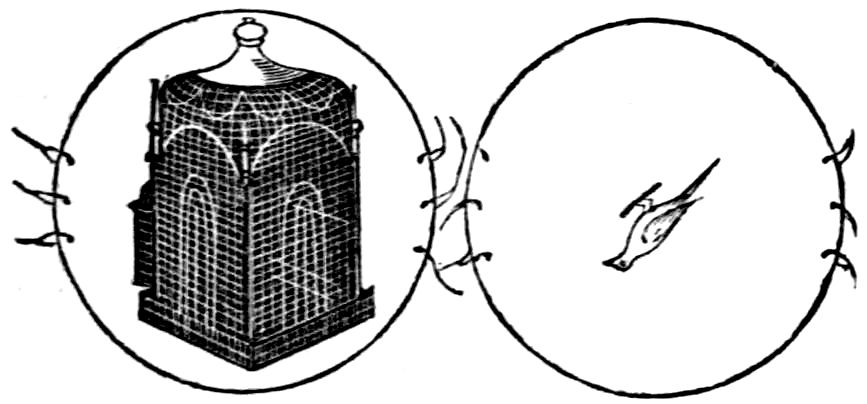
New original cover art included with this eBook is granted to the public domain.
The Aimwell Stories.
BY
WALTER AIMWELL,
AUTHOR OF “MARCUS,” “WHISTLER,” “ELLA,” ETC.
WITH ILLUSTRATIONS.
BOSTON:
GOULD AND LINCOLN,
59 WASHINGTON STREET.
NEW YORK: SHELDON AND COMPANY.
CINCINNATI: GEO. S. BLANCHARD.
1870.
Entered according to Act of Congress, in the year 1858, by
GOULD AND LINCOLN,
In the Clerk’s Office of the District Court of the District of Massachusetts.
PREFACE.
While this series of books is designed
to furnish a succession of pleasant and
instructive lessons and recreations for
boys and girls, each volume has also a
specific aim, more or less prominently
wrought into its woof. The special object
of Jessie is to kindle in the hearts
of the young, especially the children of
misfortune and poverty, a pure and noble
ambition, and to encourage them to strive
for that “good name” whose price is far
above rubies, and that “conscience void
of offence” which is of still more inestimable
value.
CONTENTS
VII
CHAPTER I.
THE NEW HOME.
PAGE
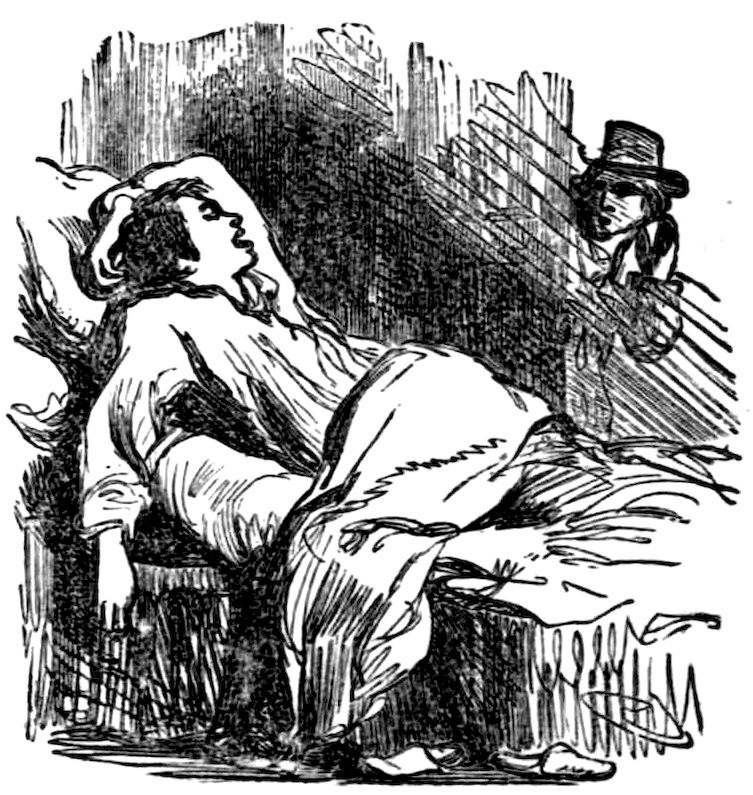
The trunk—What made it so heavy—Jessie’s gold—The Hapley family—The separation—Jessie’s new position—Her mother’s departure—The Pages—Going to work—Ronald’s flag—A patriotic appeal—A job for Jessie—The flag-staff—Ronald’s shrewdness questioned—Some criticisms on the flag—Worth all it cost—Alterations proposed—An unexpected difficulty—How to make an American flag—The repairs completed—The flag hoisted—A surprise—Crying before breakfast—Two sober ones—Jessie in retirement—Traces of tears—Henry’s visit—Homesickness—A dory voyage across the ocean—What Marcus was thinking about—Celebrating Washington’s birth-day—Marcus explains his plan—An objection to a bonfire—The committee of arrangements—Preparations for the celebration—The pictures—Washington and his home—A busy time—The programme—The parlor and the audience—The exercises—The tableau—A scene not in the bill—Sound sleepers,
How Jessie happened to keep a journal—Advantages of the habit—The blank book—The title-page—origin of the motto—Abby Leonard—A cutting remark—Its effect—Jessie’s resolution—Divine aid sought—Abby conquered by kindness—The first record in the journal—Benny’s death—Specimen of a Diary in Dry Measure—One in Long Measure—One in Solid Measure—Which is best,
Building a snow-house—A disagreement—The work goes on—Another dispute—Obstinacy—View of the snow-hut—Going to see the ice-boat—Angry words—Ronald’s early life—Esquimaux snow-houses—A traveller’s testimony—An ice-boat—Round Hill Pond—A lively scene—The coasters—Description of the ice-boat—sailing wrong end first—A western ice-boat—Invitation declined—The boat under sail—Going home—The snow-slide—A vast heap of snow—A narrow escape—Thoroughly alarmed—Ronald’s snow-hut,
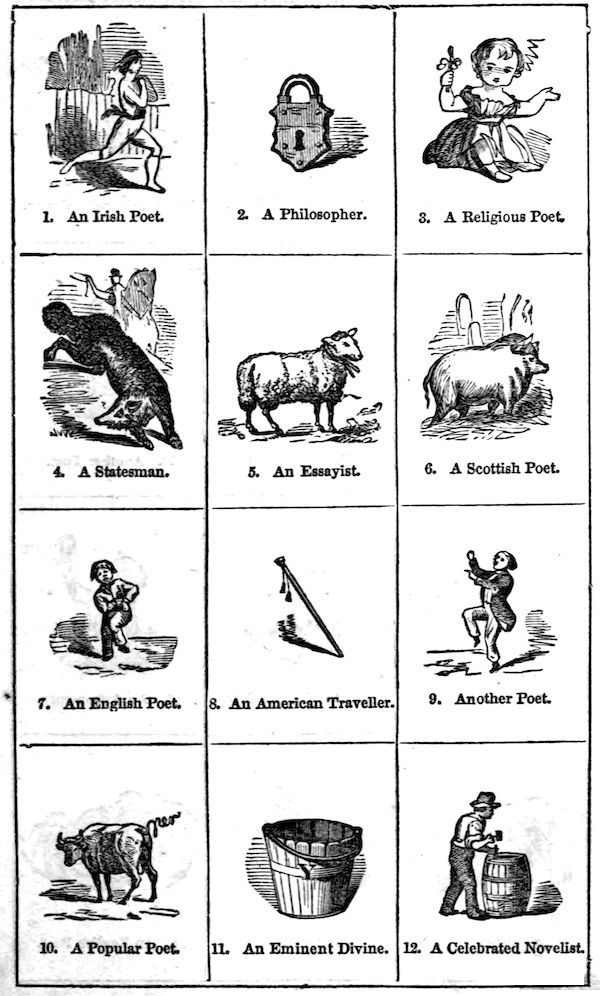
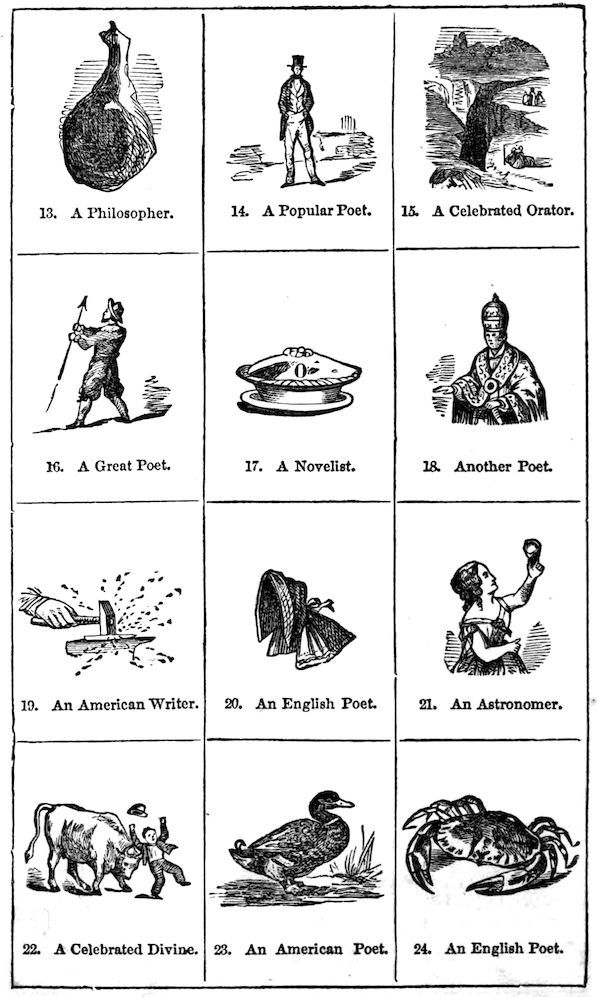
IXHenry missing—Oscar’s account of the falling out—Jessie incredulous—Henry’s defence—A reluctant admission—Jessie’s plan for settling the quarrel—Rights of partners—Henry obstinate—Another proposal—Referees—Henry’s reluctance—He yields—The award to be binding—Ronald’s version of the quarrel—Wherein he was to blame—He agrees to the referee plan—The referees chosen—The meeting—Henry’s arrival—His embarrassment—Ronald’s talkativeness—Fast skating—Subsiding into silence—Examination of the two parties—Ronald’s comments on the proceedings—Anticipating the decision—Making up—Summoned to the tribunal—The referees surprised—They take it coolly—Looking after the fees—Reading the award—The decision carried out—The gallery of literary portraits—Jessie’s taste for drawing—Twenty-four characters enigmatically expressed—The key,
Two new comers—The academy—The opening exercises—The sentence on the blackboard—The definition of wisdom—Knowledge brings promotion—Education a good investment—Cuffee and the calf—Charging for “the know how”—Building a house—The laborers—Masons and carpenters—The “boss”—The architect—Knowledge promotes a man in other ways—Jessie’s appointment as assistant—The monitorial desk—The dinner hour—Good riddance—The slow boy—A good time among the girls—Abby and her pickles—The cake—Bragging—The squint-eyed girl—Making fun of Abby—How she tried to make herself pale—Is it scandal to tell the truth?—Evil speaking—Jessie called to account—Lucy Grant—Strabismus, or squinting—A surgical operation—The slight put upon Lucy—Jessie dispels the clouds—Closing the afternoon session—Mr. Upton’s remarks—The evening hymn,
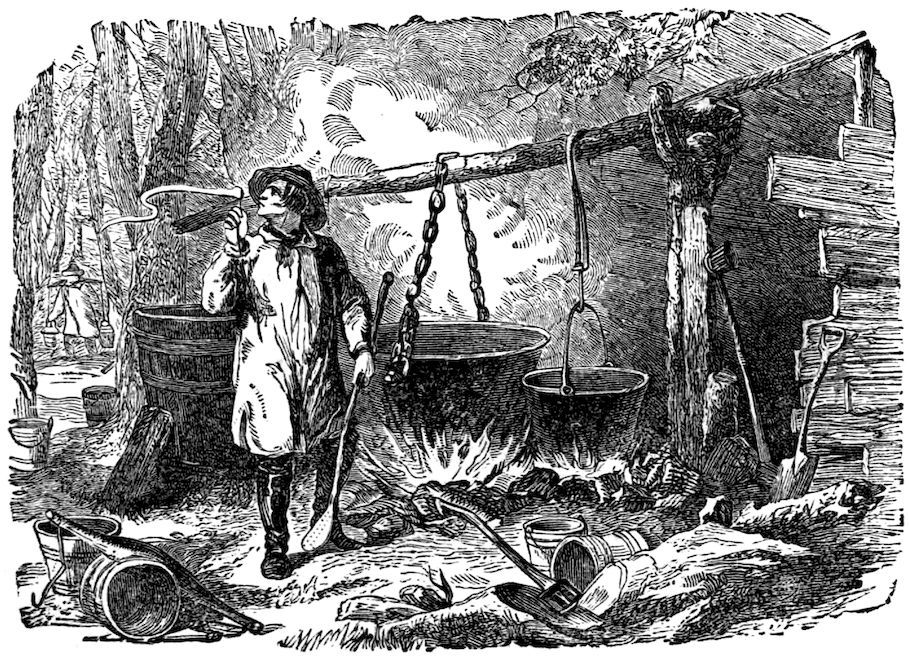
The Home Wreath—Jessie’s doubts about the nature of scandal—Light from the dictionary—A note of inquiry—Henry missing—His appearance—The temple of peace abandoned—Henry’s explanation—His troubles—Mrs. Allen—Making husk mats—What Jessie said—How to be loved—Jessie’s entreaties—The promise—The sugar season—Ronald’s sugar enterprise—Tapping the trees—The sap—Sugar grown, not made—Boiling down the sap—Clarifying it—“Sugaring off”—The cakes—Going to a sugar camp—Who went, and who did not—Description and view of the camp—Appearance of the Home Wreath—Editorial reply to Jessie’s inquiry—The Bible on scandal—Writers on moral science—Scandal is the worst kind of robbery—Cases in which it is right to speak evil of another—Prevalence of scandal—A noble exception—A secret well kept—Oscar’s career,
XIWhat Henry thought of his promise—The real origin of Henry’s troubles—Mrs. Allen’s rigid neatness—Scrubbing through the floor—Henry roughly touches her weak point—Grows reckless—The change in Mrs. Allen—The scolding—A forgotten duty—Dressing up—Henry’s altered bearing—His explanation about the wood—Attending school—Work and play—A decided improvement—An approving conscience—Disappointment—Voluntary mat-braiding—A welcome order—Another disappointment—How Henry bore it—Story of the tornado—A stage-coach blown over—Freaks of the wind—Firm buildings—A song—Learning it—Henry’s pictures—The top in rhyme—A story—An abrupt ending—Willie’s talk about sending Henry to the “Boy-Tamer”—A call from Jessie—Her gratification—Mrs. Allen’s return,
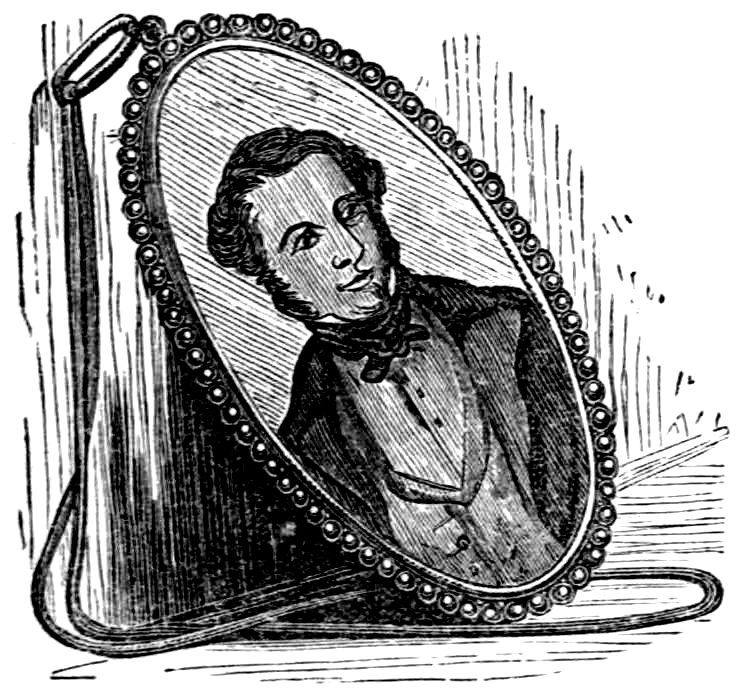
The miniature—Sad Associations—A life history—Melancholy thoughts—Going to church—The sermon—The universal burden—Laughing it away—Moping over it—Running away from it—The man who was haunted by a goblin—One only true remedy for sorrow—How to cast our burdens on the Lord—The Sabbath School—The lesson—Why prayer is a duty—God requires it—Our dependence upon Him—Not to pray is unnatural—Our need of forgiveness—The boy who was too old to pray—A talk with him—His great mistake—A ridiculous excuse—The climax of meanness—Conscience prompts us to pray—Prayer a natural and universal instinct—Prayer of infidels—Prayer brings blessings—Its happy influence on our hearts—Good men have always been praying men—Examples from history—Recapitulation—Jessie’s eighth argument for prayer—Evening devotions,
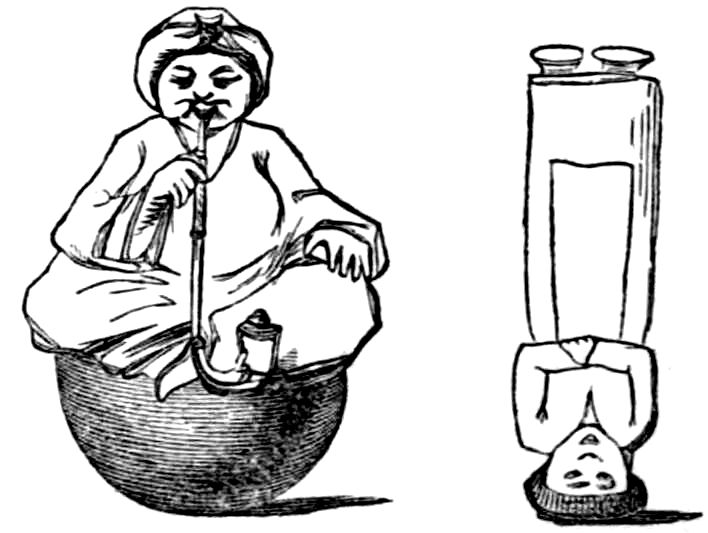
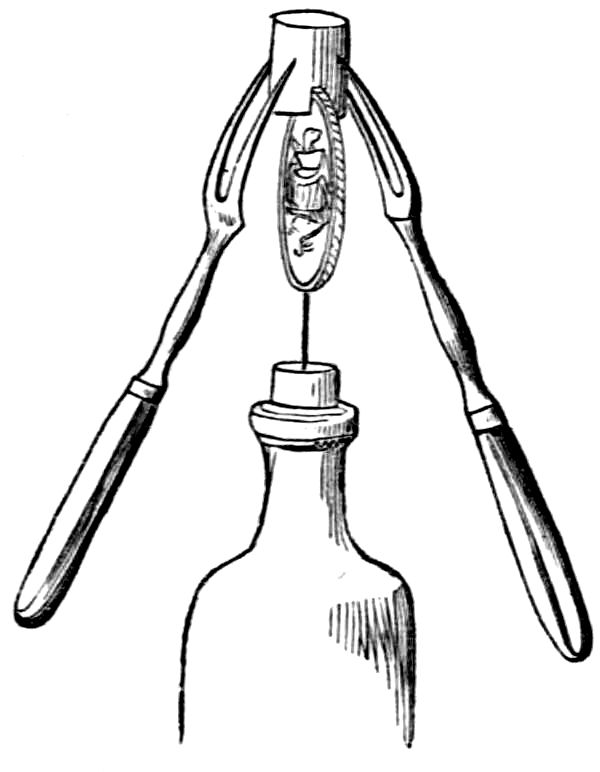
XIIThe equinoctial storm—An argument postponed—Distribution of work—An afternoon of leisure—Nothing to do—Andrew Airpump and his comrades—An unceremonious check—Alliteration—Univocalic verses—Task verses—Thread-paper poetry—How to write it—A specimen—Cento verses—Pith-tumblers—The Grand Mufti—The sleepy Brahmin—Balancing a coin on a needle—The trick explained—Ronald’s experiment—The Moslem oracle—Its five responses—Kate’s cento poem—How she found the lines—Contents of the Wreath—Arithmetical puzzles and answers,
The boys’ chamber—Early and late rising—Ronald’s trick—Otis enjoys a long nap—The clean plate—Suspicions allayed—More tricks—Imaginary chalk—The railroad whistle—Easter—Easter eggs—Trial of strength—Another trial—The soft egg—The pitched seat—Otis missed at school—Inquiries—Aunt Fanny’s discovery—Vexation—Otis at school—Interview with Ronald—A talk about April-fooling—Difference of opinion—A court proposed—A family custom—How the court managed business—The trial—The prosecuting Attorney’s speech—The complaint—The plea of “not guilty”—The first witness—Amusing cross-examination—Other witnesses—The prisoner’s speech—A question arises—The judge’s decision—The prisoner’s admission—His argument and appeal—The prosecuting attorney’s closing plea—An interruption—Can you tell a lie to a hen?—Conclusion of the argument—The charge—The verdict—The sentence—Its execution,
Good spelling—A spelling match—Choosing sides—Evils attending spelling matches—An incident—Jessie blamed for an act of kindness—Another incident—The last of choosing sides—Jessie’s rank in school—Disadvantages—Secret of her success—Good and poor memories—Abby’s memory—Lord Adolphus D’Orsay—The list of irregular verbs—Saying over lessons before sleep—A contrast—The good and the poor scholar—Concentrating the mind—Luther’s testimony—Anecdote of St. Bernard—Power of early culture and discipline—Why Jessie and Abby associated—Novel reading—Its effects on Abby—Objections to it—Jessie proof against the temptation,
Driving a bargain—Beating down the price—Jessie’s rule, in trading—Mrs. Page’s practice—How Jessie got her new dress so cheap—Shillings and pence—Was Jessie to blame?—Selling for less than cost—Motives for doing so—Meanness—Getting out of debt—An unexpected application of good advice—Ronald’s debt—The lost Reader—Plans frustrated—Dunning—An arrangement effected—The note of hand—Interest—The receipt—Negotiating the note—A good rule—Keeping account of expenses—Jessie’s poverty—Longings—Uncle Morrison—His proposal to adopt Jessie—Jessie’s perplexity—Her uncle’s tavern—His character—His wife—The decision—Surprise—Further proposals—Jessie firm—A wise choice,
Family portraits in the Home Wreath—A startling announcement—Portrait of the sociable contributor—Portrait of the high-minded contributor—Ronald’s literary enterprise—A new pleasure heralded—Directions for playing the game—Transformations—Literary patchwork—Literary puzzle—Peter Coddle’s Trip to New York—Setting out on the journey—Peter’s sudden return—State of excitement—Conjectures—Peter’s own story—His departure from home—A smash-up—The ruins—The railroad depot—Riding in the cars—Curious sights—Quizzed by a dandy—Returning the compliment—The dandy in a rage—A long nap—Unceremonious awaking—Peter in New York—Incidents in the depot—The music—Peter accosted by a stranger—Disinterested benevolence—The boarding-house—Private grief—The nice little room—Something to drink—The pictures—Queer feelings—The dream—The awaking—Unpleasant discoveries—Inquiries—Peter’s eyes opened—He is overwhelmed—A walk out—A free ticket for home—His safe arrival—Settling down for life—List of phrases to supply the blanks,
XVSam’s sentence—Changes during his imprisonment—Unanswered letters—The note to Jessie—The meeting—Sam’s appearance—His refusal to see any one—Why he came to see Jessie—His selfish purpose thwarted—Jessie’s appeal—The promise—A call at Mr. Allen’s—An early morning walk—The package for Sam—Henry’s burden—A talk about Mrs. Allen—Henry informed of Sam’s visit—The graveyard—The two hillocks—Setting out the trees—Sam’s non-appearance—Disappointment,
How Charlie Doane made money—Maple sugar—Picking greens—Learning to be a miser—Mr. Doane and the widow’s cow—Free remarks—Marcus justifies himself—Ronald wants a new-fashioned cap—Oscar unburdens his mind—What the girls talk about—Jessie’s defence—Oscar renews the assault—Kate enters the ring—Her explanation—Her good nature for once overpowered—Oscar beats a retreat—Ronald and Otis come to the rescue—A telling shot from Kate—The debate arrested—Mrs. Page awards justice impartially—Evils and folly of thinking too much of dress—The fault not quite universal—Oscar takes back a portion of his charge—Aunt Fanny’s testimony—Little souls—A dwarfed mind—Testimony of foreign travellers—A good rule about dress—An inspired command—Failure of Abby’s father—Telegraph despatch—Free comments—Sympathy—Abby at school—An unexpected placidity, and a sudden explosion—First effect of the intelligence upon Abby—A secret struggle—Shutting herself out from sympathy—One Friend in the time of need—Lessons and consolations—How Abby received Jessie’s kind offices,
Reviewing studies—The scholar’s countersign—Step by step—How men become eminent—The idea, if not the language—Porson’s testimony—A French grenadier on the top of the pyramid—A lesson from a picture—What man has done, man may do—Kate’s promotion—Why Ronald failed—Better late than never—The Grade of Honor—A substitute for prizes—The two honorary grades—Ceremony of admission to the Grade of Fidelity—Popularity of the Grade—Exclusion from it—Difficulty of getting into the Grade of Honor—Admission ceremonies—Privileges of members—Abby called home,
Unpleasant news—Sam injured in a fight—Anxiety—The letter of inquiry—The reply—Visit to Sam—His injuries—His account of the fight—Mr. Preston’s kindness—Oscar’s proposed visit home—Jerry Preston’s return from sea—A present from Ralph to Ronald—Jessie writes to Sam—Oscar and Jerry—Their relations to one another—Capt. Page—Possibility of his survival—Ronald’s present—Cage and bird—Principle on which the toy is constructed—Other applications of the principle—Oscar’s trip to Boston—An unexpected pleasure,
Exhibition day—Jessie invited out to tea—The return home—A surprise—The academy party—The collation—Marcus makes a speech—The box—Its contents—The nest of boxes, and their mottoes—Jessie’s curiosity excited—The letter—The portemonnaie and its contents—A new surprise—Jessie’s acknowledgment—The Hymn—Conclusion,
It was on a dull and cold morning in February, that
Jessie Hapley, a girl between fourteen and fifteen
years old, stood before a window in the farm-house
of Mrs. Page, watching a couple of boys who were
drawing a sled on which was lashed a trunk. The
sled dragged heavily through the new-fallen snow, and
when yet some distance off, the cord by which it was
drawn suddenly snapped asunder. After a few moments’
delay, the boys took a position behind their
load, and pushed it along to its destination, without
meeting with any further obstacles.
20“Where will you have it, Jessie—up in your
chamber?” inquired the oldest boy, as he and his
companion landed the trunk in the entry.
“Yes, you may carry it up stairs, if you please,”
replied Jessie.
“I hope you have got something good in that trunk,
Jessie,—it’s heavy enough, if that’s all,” said the
younger boy, when they came down from the chamber.
“Is it heavy?” inquired Jessie. “Well, I don’t
wonder—it contains all my gold, except this pin and
ring, and you know gold is heavy.”
“Is that it?” continued the boy, whose name was
Ronald. “I didn’t know but you had filled it with
stones, to make us think you had got something valuable.
They say rogues play that game sometimes,
when they put up at hotels. But about that gold;
how much is there of it?”
“Well, I can’t tell you exactly how much there is,
but I will show it to you some time, if you wish to see
it,” replied Jessie.
“Is it visible to the naked eye?” inquired the boy,
with a roguish look.
21“Of course it is,” replied Jessie. “You can see it
plain enough, but that is the best you can say about
it.”
This was an enigma which Ronald could not solve,
and it was not until Jessie exhibited to him her portion
of the precious metal, displayed upon the covers
and edges of several books, that he comprehended the
mystery.
The fact was, whatever else might have been Jessie’s
possessions, at this time, she was far from being
rich in gold and silver, or any of the paper representatives
of those metals. Within a period of about two
months, a fearful train of calamities had overwhelmed
the family to which she belonged. The oldest son,
Samuel, a youth of sixteen, had committed a burglary
in a neighboring town, for which he was now serving
a sentence in prison. The youngest child, an interesting
and lovely boy of nine, had sickened and died, at
the beginning of the year. The father, who for many
years had been a victim of intemperate habits, sought
to drown his sorrows by still deeper draughts at the
fountain of woe and death, and came to a dreadful
end, a few weeks after his boy was laid in his frozen
22grave. Mr. Hapley’s farm and other property, on
which there were heavy mortgages, were taken to pay
his debts, and the widow and children were left homeless
and moneyless.[1]
1. These events are more fully related in the fifth volume of
this series, entitled, “Marcus; or the Boy-Tamer.”
Jessie, and her brother Henry, a lad of thirteen,
were the only children now living with their mother.
A home was soon found for Henry, in the village,
where he was to work for his board and clothes. Mrs.
Hapley, whose health was poor, was invited to return
to the home of her childhood, in another town, where
her parents were still living. Jessie was at that time
attending the village academy, with a view of fitting
herself for the profession of teaching. With no slight
struggle, she relinquished this cherished purpose of
her heart, and, as the readiest way of supporting herself
and aiding her mother, volunteered to work in a
factory. But in this hour of extremity, a new door
was opened to her. Mrs. Page and her family, who
were next neighbors to the Hapleys, were so much
interested in the welfare of Jessie, that they offered
her a home for a season, on conditions that she could
23not well refuse. Her services in the family were to
be considered an equivalent for her board, but she was
to have the privilege of attending the academy. Her
mother was to provide her with clothes, and there was
a prospect that she would be able to offset her tuition
bills, by rendering some assistance to the lower classes.
It was thought that by this arrangement she would be
enabled to enter upon her chosen work in less than a
year.
On the morning with which our story opens, Mrs.
Hapley had bidden her daughter farewell, and started
for the home of her parents. It was not without a
strange sinking of heart, and eyes blurred with tears,
that Jessie took leave of her mother and her old
home; but nothing of this was visible on her countenance,
now. She was apparently as calm and cheerful
as any of those around her.
The family of which Jessie had now become an
inmate, comprised the following named persons: Mrs.
Page, who was the widow of a sea-captain; her sister,
Miss Fanny Lee, usually called Aunt Fanny; Marcus,
Mrs. Page’s son, a young man in his nineteenth
year, who had just served his first term as assistant
24teacher in the academy, of which he was a graduate;
Ronald, an adopted son of Mrs. Page, about twelve
years old; and Oscar Preston, a nephew of Mrs. Page,
in his sixteenth year, who came to live with the family
the previous fall. They lived upon a small farm, in
one of the pleasant hill towns of Vermont, which we
shall call Highburg.
Jessie at once began to busy herself with various
household duties, taking hold almost as handily as
though she had been at home. Knowing that constant
occupation is a great security against desponding
thoughts, Mrs. Page was careful to provide her with
something to employ her time. It was “washing
day,” and of course there was no lack of work. In
the course of the forenoon, Ronald came in, with his
arms full of rope and bunting, and exclaimed:
“There, mother, I’ve got my flag, at last. But
just see how dirty it is. Can’t you wash it, right off,
so I can have it all bright and clean for to-morrow?”
“Our washing is done, and on the line, and the
suds are thrown away; so you had better let it be till
next Monday,” replied Mrs. Page.
“But who wants to hang up such a dirty thing as
25that on Washington’s birth-day?” continued Ronald.
“We’ve got our staff almost ready, and we want to
raise our flag to-morrow morning; but it’s all soiled,
and dingy—and here’s a big rip in it, too. Why,
mother, haven’t you got any patriotism at all? I
should think you’d consider it an honor to wash the
stains out of your country’s flag.”
Mrs. Page smiled at this sally, but did not accede
to Ronald’s request.
“Couldn’t I wash it out for him, Mrs. Page?” inquired
Jessie.
“You can, if you choose to,” was the reply.
“That’s right, Jessie—you ought to have three
cheers for your patriotism, and I’ll give ’em to you
to-morrow, when I hoist the flag,” said Ronald, as
Jessie commenced preparations for the work.
Ronald detached the flag from the rope, and then
went out to the barn to see how Oscar was getting
on with the pole. He found it nearly ready for its
place, although only the day before it was a young
tree in the forest. As it was to be fastened to the
gable of the barn, it was not very large, but was tall,
straight, and rounded in a smooth and uniform manner.
26Oscar was now inserting into the top of it a
small pulley or grooved wheel for the line to run over.
Ronald, meanwhile, went to work upon the cap that
was to surmount the whole, which he made out of a
wooden knob that belonged to an old bureau.
Before they had finished the staff, Jessie had
washed the flag, and hung it upon the line. It was
much improved in appearance. Soon after Marcus
came along, and having examined the flag a minute
or two, he entered the barn, saying:
“Ronald, I don’t think you made much of a bargain
when you bought that flag.”
“You don’t? Why, what is the matter with it?”
inquired Ronald.
“Oh, it’s an old thing, and it wasn’t made properly
in the first place, either,” replied Marcus.
“I don’t care, so long as it’s a flag,” said Ronald.
“I’ll get that torn place mended, and then I guess it
will do.”
“I think it is altogether too large for your staff,”
continued Marcus.
“I don’t think so,” replied Ronald.
“Besides, it strikes me it is not in good proportion,”
added Marcus.
27“I don’t care for that,” replied Ronald.
“And it has got only twenty-nine stars, when there
ought to be thirty-two,”[2] continued Marcus.
2. Thirty-two is the number at the time this is written, but
there is a prospect of an early increase of our family of States,
which happy event will of course add to the ever-enlarging
galaxy of stars on our national banner.
“Well, nobody would have noticed that if you
hadn’t told us,” added Ronald, somewhat vexed at
these free criticisms of his flag.
“One star for every State in the Union, is the rule—I
shouldn’t suppose such a patriotic boy as you
would ignore three of the States in the confederacy,”
added Marcus.
Ronald felt the force of these criticisms more than
he was willing to admit. The purchase of the flag
was his own individual enterprise. He gave in exchange
for it sundry articles of personal property, and
flattered himself that he had made a good trade. And
so, in fact, he had, for flags cost more than Marcus
imagined, and Ronald’s, though somewhat dilapidated,
was worth all that he gave for it. But Ronald did
not feel quite at ease about his bargain, after what
28Marcus had said. He soon after had a conference
with Jessie, and the result was apparent in the evening,
when that young lady undertook the task of
making the flag over new.
Jessie was somewhat at a loss where to begin upon
the novel job she had undertaken, and neither Ronald
nor any of the family could give her much light upon
the subject. Marcus soon came in, however, and his
advice was sought.
“What do you propose to do with it?” was his first
inquiry.
“I want to make it smaller, for one thing—you
said it was too large,” replied Ronald.
“Well,” said Marcus, surveying the flag quite
calmly, as it lay spread out upon the floor, “I’m
afraid Jessie wont get much sleep to-night, if you
intend to have it ready to hoist in the morning. She
will have to rip the stripes apart, and make them all
narrower; and then the blue field and the stars will
be too large, and they must all be altered; but I don’t
see exactly how that is to be done, for you can’t very
well make the holes for the stars any smaller.”
“But why can’t we take off one or two stripes, and
29cut a piece off the length, and let it go so?” inquired
Jessie.
“There is one slight objection to that,—it wouldn’t
be an American flag,” replied Marcus.
“Well, I don’t pretend to know much about the
science of flags,” said Jessie, smiling.
“You must have just thirteen stripes and thirty-two
stars; didn’t you know that?” inquired Ronald.
“The outside stripes must be red,” continued Marcus.
“That gives us seven red and six white stripes.
The field for the stars should be square, and of just
the width of the first seven stripes.”
“This is right, then, as it is, and I don’t see how
we can make it any smaller without spoiling it,” said
Jessie.
“I think it will bear shortening a little,” added
Marcus, “and that will make it look smaller, and give
it better proportions, too. It should be just one-half
longer than it is broad. For instance, if it is four
feet broad, it should be six feet long. Let us measure
it, and see how it is.”
The flag was found to be too long, as Marcus suspected.
So Jessie cut off the superfluous part,
30mended the rents, added three new stars to the field,
and it was pronounced fit for service. Before sunrise,
the next morning, it was run up to the top of the staff
on the barn, amid the shouts of the boys. Soon after,
the family were startled by a loud report from behind
the barn. All ran to ascertain the cause, and it was
found to proceed from a small cannon which Ronald
had procured, in order to add eclat (which in this case
means noise) to his celebration of Washington’s birth-day.
He had kept this little secret entirely to himself,
intending to surprise the family with this new proof
of his patriotism. But the surprise did not prove
quite so pleasant as he anticipated; for Marcus
quickly took possession of the cannon and ammunition,
and the young patriot found himself so severely
condemned by all the family for playing with powder
without leave, that he burst into tears, and betook
himself for a while to the uncensuring society of the
cows in the barn. So the bright sun of his hopes
went into a cloud before breakfast!
It was noticed by all that Jessie did not eat much
at the table that morning, and she did not appear to
be in her usual good spirits. Ronald, too, was uncommonly
31sober, and altogether it did not seem much like
a holiday. The flag, however, which was visible for a
considerable distance, soon drew together several of
the boys and girls of the neighborhood, and Ronald’s
lengthened countenance gradually assumed its wonted
form. Among the visitors was Henry, Jessie’s brother,
who, after a while, inquired for his sister. Ronald
went in search of her, but no one could tell him where
she was. At length, having looked everywhere else,
he ran up stairs, and thoughtlessly opened her chamber
door, without asking permission. Jessie was
there, and as the door opened, she closed a book that
she held, with a startled look, and Ronald saw very
plainly that she had been weeping, although she
quickly turned her face away. Frightened at the
impropriety of which he had been guilty, in thus intruding
upon her privacy, he made a ludicrous attempt
at apology.
“I—I didn’t know you were here,” he said; “but
I’ve been hunting for you all over the house. Henry
is down stairs, and wants to see you.”
“You may ask him to come up here,” replied Jessie,
without turning her face towards Ronald.
32Henry went up to Jessie’s room, and remained with
her some time. When he came out, he, too, seemed
more sober and silent than usual, and Ronald half
suspected, from his looks, that he had been crying.
And so he had. The fact was, both he and his sister
were suffering from that distressing malady—homesickness.
It seems strange that one who has exchanged
a poor home for a better one, should pine
after what he has relinquished; but so it is. We
cannot separate ourselves from the friends with whom
we have always lived, and the associations and haunts
with which we have for years been familiar, without
suffering more or less from homesickness, no matter
into how excellent hands we may have fallen. And
this feeling is sometimes very prolonged and distressing,
especially with those who are exiled from their
native land. A few years ago, a German emigrant
in Boston became insane from homesickness, and
bought a little boat, called a dory, which he fitted up
in a peculiar manner, with oars, sails, a canvas covering,
and provisions for a fortnight’s subsistence. He
intended to put to sea in this frail skiff, hoping, as he
said, to reach his fatherland in twenty-two days.
33When asked how he should supply himself with food,
after his stock was exhausted, he said he had a little
money to buy more. Perhaps he thought he should
find a half-way house on the great deep, or meet a
baker’s or butcher’s cart, on the voyage.
Marcus had been sitting for an hour or more before
a small portable desk—a parting gift from his late
pupils—which lay open upon the table in the sitting-room,
with papers and books scattered around it. He
had been engaged in studying a Greek lesson; for he
intended at some future day to enter college in an
advanced class, and with this view was continuing his
studies. He was now leaning back in his chair, with
his eyes intently fixed upon the ceiling, while his
thoughts were busily engaged in trying to devise some
way to relieve the melancholy of Jessie, and to dispel
the shadows which from sympathy seemed to be stealing
over other members of the family. After remaining
in this position about ten minutes, he stepped into
the kitchen, and held a short consultation with his
mother and his aunt. He then went out to the woodshed,
where Oscar and Ronald were at work, and
accosted them with—
34“Boys, what do you say to getting up a little celebration
of Washington’s birth-day, this evening?”
“Good! First rate!” cried the impetuous Ronald,
without giving Oscar a chance to reply. “What kind
of a celebration shall we have? If I were you, I’d
have the whole house illuminated, or else I’d build a
great bonfire on the hill, that will show off all over
town—wouldn’t that be grand, Oscar?”
“That isn’t exactly the kind of a celebration that
I was thinking of,” said Marcus. “What I propose
is, to invite in a few of our young acquaintances, and
have an oration, and some appropriate music, and
perhaps a tableau or two. How does that strike you,
Oscar?”
“I think it’s a good idea; but who can get an
oration ready, in so little time?” inquired Oscar.
“O, we can manage that—the oration will be the
easiest part to arrange,” replied Marcus.
“But why couldn’t we have a bonfire, too?—I’ll
take the whole care of it,” interposed Ronald, who
just now thought more of material than mental illumination.
“I am afraid that might draw together more company
35than we want,” replied Marcus, “and so interfere
with our indoor arrangements. I think you had
better give up that idea.”
Ronald readily assented to this, and Marcus appointed
him and Oscar a “committee of arrangements,”
to invite guests, and make other preparations
for the festival, giving them such instructions as he
deemed necessary. He afterwards added Jessie to
this committee, who entered into the plan with much
interest. Marcus then returned to his studies, leaving
the affair almost entirely in the hands of the committee.
The committee at once began to discuss the order
of arrangements, and the leading features of the celebration
were soon decided upon. The work of preparation
was then divided among the committee, a
particular line of duties being assigned to each member.
As the front parlor, usually called “the best
room,” was the largest apartment, it was selected as
the place of entertainment, and Jessie at once commenced
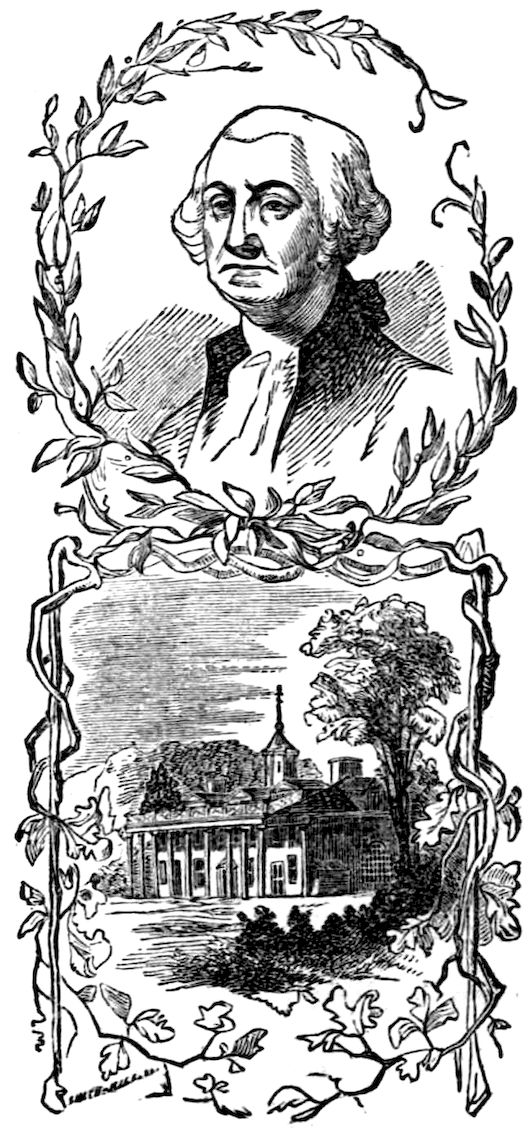
preparing it for the occasion. She removed
to this room an engraved portrait of Washington,
which hung in one of the chambers, and then despatched
36Ronald to the woods for some evergreens,
with which to adorn its
old black frame. She
also found an old engraving
of the Washington
mansion at Mount
Vernon, among a large
collection of prints in
Miss Lee’s closet, which
she had liberty to overhaul.
When Ronald returned,
she made a pretty
frame of evergreen
for this, and hung it by
the side of the portrait.
A small work table, intended
to serve as the
orator’s desk, was placed
directly in front of these
pictures, so that one would appear on either side of
him. The wall back of the table was further ornamented
by a large star in evergreen, and several
wreaths and festoons were displayed in other parts of
the room.
37Jessie seemed in better spirits at noon, and talked
with much interest of the anticipated celebration.
The committee continued their labors in the afternoon,
and apparently had about as much on their hands as
they could conveniently manage. This was especially
true of Ronald, who did not seem content to do less
than three or four things at once. Before sunset,
however, the business was finished; and when Marcus
came home, he found on his desk the following paper,
in the handwriting of Jessie, with the exception of one
line—the last—which was evidently an interpolation
by Ronald:
PROGRAMME
FOR THE
CELEBRATION OF WASHINGTON’S BIRTH-DAY.
1.
Music—“Washington’s Grand March”—piano-forte.
2.
Reading of a sketch of Washington’s Life, by Jessie Hapley.
3.
Music—“Hail Columbia”—sung by the Company.
4.
Webster’s Oration on Washington, read by Mr. Marcus Page.
5.
Music—“My country, ’tis of thee”—sung by the company.
6.
Tableau.
7.
Music—“Yankee Doodle”—piano-fort.
8.
Going Home with the Girls.
Early in the evening the company assembled, embracing
eight or ten lads and misses from the neighborhood,
38among whom was Henry Hapley. The old
parlor never looked more beautiful, with its generous
wood-fire blazing upon the hearth, its extra display of
lamps disposed around the room, its decorations in
evergreen and bunting, (for Ronald’s flag was hauled
down at sunset, and now figured as drapery around
the “orator’s desk,”) and its rows of smiling faces
duly arranged in audience fashion. The programme
was carried out in a style that gave the utmost satisfaction.
One of the guests, a young lady, furnished
the instrumental portion of the music, while all joined
in the singing. By way of refreshing the memories
of the audience, Jessie read from a book a brief summary
of the leading events in Washington’s life, concluding
by reading a poem on the same subject, from
a popular English authoress, (Miss Eliza Cook,) commencing,
“Land of the west! though passing brief
The record of thine age,
Thou hast a name that darkens all
On history’s wide page!”
The oration, which was well delivered by Marcus,
consisted of the principal portion of Webster’s eloquent
39address on the centennial anniversary of the
birth-day of Washington. The tableau was exhibited
in an adjoining room, the door being opened to the
“audience,” when the figure was arranged. It was a
scene that had been enacted at a Christmas party in
which most of the people of the town participated,
two months previous. The figure represented was
“Liberty,” which was personated by a beautiful girl,
arrayed in flowing antique drapery, holding with one
hand a staff, on the top of which hung a liberty cap,
and with the other hand supporting a shield bearing
the United States arms. As the company were
crowded around the door,—which they were not
allowed to pass,—gazing at the tableau, Rover, a
handsome spaniel, who had been sleeping all the evening
under a table in the room devoted to “Liberty,”
now came forth to see what the stir was all about.
At a sly signal from his young master, Ronald, he
saluted the goddess with one of his loudest barks,
at which everybody laughed except the statue-like
figure; and it is not improbable that she moved the
muscles of her face a trifle, for Rover seemed suddenly
to recognize her and, wagging his shaggy tail,
40he lay down by her side, close to the shield, as much
as to say,—
“Ah, yes, I understand it, now. This is Miss
Liberty, and I am bound to be her protector and
defender.”
This unexpected addition to the tableau was received
with a shout that upset the gravity even of
Liberty herself, and she joined in the laugh, while
the piano-forte struck up “Yankee Doodle” in the
liveliest style, and the guests began to hunt up their
hoods and caps, in anticipation of the grand finale
smuggled into the programme by Ronald, who, by the
way, in consideration of his tender years, was excused
from any participation in that performance.
So ended the memorable twenty-second. There
were half a dozen sound sleepers in the house, that
night, but dull Care and the dolorous Blues and
Dumps could find no chance to lodge there!
CHAPTER II. SOMETHING ABOUT DIARIES. — SPECIMEN OF A DIARY—IN DRY MEASURE — SPECIMEN OF A DIARY—IN LONG MEASURE. — SPECIMEN OF A DIARY—IN SOLID MEASURE.
41
Jessie had one secret that she preserved very
carefully from even her most intimate friends. She
kept a “journal,” or daily record of her life. Not
that she was ashamed to have this known, but regarding
it as a strictly private matter, she preferred to
keep it entirely to herself. She was induced to
commence keeping a journal by some remarks made
by Mr. Upton, the preceptor of the academy, to his
older scholars, near the close of the previous year.
He recommended the practice of journalizing very
highly, and mentioned quite a number of benefits that
were usually derived from it, by the young, the chief
of which were these:
1. It aids in acquiring an improved and distinctive
handwriting.
422. It promotes ease and rapidity of composition.
3. It assists the young to acquire and retain knowledge.
4. It cultivates habits of thought and observation.
5. It encourages habits of system and method.
6. It is often of great value in after life, when we
wish to recall facts, events, impressions, etc., of earlier
years.
7. As a history of one’s life, it must always possess
great interest.
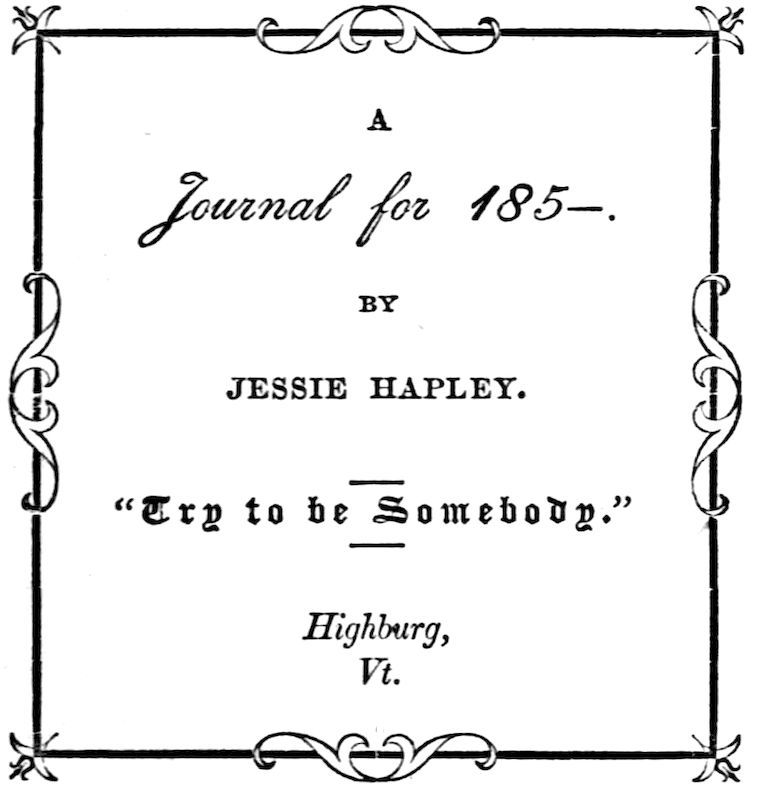
Jessie at once procured a small blank book, determined
to put the advice in practice at the beginning
of the year. Supposing that every book ought to
have a title-page, she set apart the first ruled page of
her journal for this purpose, and at sundry odd moments
inscribed upon it, in the handsomest characters
she could make, a title expressive of its object. Jessie
was tolerably expert with the pen, and her best
efforts with this implement were by no means devoid
of merit. But you must not suppose that they were
chiefly remarkable for the fantastic shapes of the letters,
or elaborate shadings, or fanciful and intricate
scrawls, and other frippery. Her taste was rather for
43the chaste, graceful and simple, than for the grotesque
and the tawdry. To illustrate this, I will show you
the title-page of her Journal, or rather a fac simile of
it, reduced in size, if the printer can imitate it with
his types. Here it is:
I suppose the motto which Jessie inscribed upon
her title-page will strike some minds as being both too
ambitious and too indefinite, to say nothing of its inelegance.
To her, however, it had a history and a
significance that rendered it quite appropriate for the
44place. Its history was as follows. There was a girl
attending the academy, named Abby Leonard, who
came from a distant city, and whose parents were
reputed to be very rich. She was fifteen years old,
had more and better dresses than any other girl in
town, and prided herself on her superior gentility and
refinement. She was a sad dunce, it is true, but her
ample stock of self-esteem did not seem to suffer in
the least from that circumstance, and in spite of it she
contrived to wield a pretty potent influence over the
other girls of the academy. When Jessie became a
pupil, and it was whispered from one to another that
she was a scholar of unusual promise, Abby contemptuously
remarked:
“Oh, it’s that drunken Hapley’s daughter, isn’t it?
I wonder who pays the bills? Well, I don’t think I
shall associate with such folks, if they do feel smart.
If there’s anything I despise, it’s to see a poor girl
all the time trying to be somebody.”
This cruel remark was quickly reported to Jessie,
by some well-meaning but inconsiderate friend. Foolish
as it was, it entered her sensitive heart like an
arrow, and for days and nights she tried in vain to
45dislodge the poisoned shaft. But at length she was
fortunate enough to find a complete antidote for the
envenomed wound. She had studied until late in the
evening, and on retiring, her wakeful thoughts refused
to be composed, and the old ogre which had haunted
her of late, returned to torment her. Then she resolutely
and calmly said to herself:
“I will endure this no longer. Henceforth I will
‘try to be somebody,’ if I never have tried before;
not in the foolish sense that Abby Leonard meant, but
in a higher and nobler one. Her taunt shall furnish
me with a motto and a spur. I will show to her and
all my acquaintances that I have no ambition to become
a fine lady, or to affect gentility, or to pass for
what I am not. I will show to them that even a poor
girl may aspire to something better than these. The
‘somebody’ that I try to be, shall possess a pure heart
and a spotless character. She shall, if possible, reach
an honorable, independent and useful position. She
shall make her influence felt in the world for good.
She shall win the love and respect of those who know
her. The poor, the suffering and the erring shall
always find in her a friend. But whether she succeeds
46in all these things or not, her life shall be strictly
governed by christian principles, and she shall always
patiently submit to the will of God;” and Jessie concluded
her soliloquy with a silent prayer that no
unworthy motive might mingle with the purpose she
had formed, and that she might be enabled to adhere
to her resolution through life.
From that hour, “Try to be somebody” was Jessie’s
motto. The sting was at once withdrawn from
her wounded spirit, and the ogre was suddenly transformed
into an angel of light. The weeks of the
academical term flew swiftly by, but ere half of them
had sped, the aristocratic Miss Leonard manifested
not only a willingness but a desire to associate with
“that drunken Hapley’s daughter,” little suspecting
that her thoughtless and cruel remark on the first day
of the term had ever reached the ears of Jessie.
The first record Jessie was called to make in her
journal was a very sad one. On the afternoon of
New-Year’s day, her youngest brother, Benjamin, fell
asleep in the arms of his mother, never more to
awake in this world, until the dead shall arise from
their graves. For a day or two, all thoughts of the
47journal vanished from her mind; but when the first
outburst of grief was past, she found a melancholy
satisfaction in recording the incidents of Benny’s sickness
and death, and from that time she continued her
daily entries without intermission.
In the remarks which Mr. Upton made to his scholars
on keeping journals, he said there were several
ways of doing this. The diaries of some people, he
said, were merely a very brief and dry record of
events. Supposing one of his scholars to keep a
diary after this style, he said something like the following
would be a fair specimen of its pages:
“Monday, Dec. 20.—Cloudy and cold. Attended
academy all day. Studied in the evening.
“Tuesday, Dec. 21.—Pleasant, but very cold. Attended
the academy, as usual. Went over to Sarah
Cobb’s and spent the evening.
“Wednesday, Dec. 22.—It snowed a little in the
forenoon. I studied an hour in the morning, and then
went to school. In the afternoon pa carried us to
ride. Got a lesson in the evening, and then read till
bed-time.”
48Mr. Upton, who was in a rather funny mood, said
this might be called a diary in dry measure. Another
method of keeping a journal he illustrated somewhat
after this fashion, denominating it a
“Monday, Dec. 20.—The weather is really dismal.
The sun has not shown himself to-day, and it is so cold
it is of no use to try to keep warm. I meant to have
had an hour for study in the morning, but it was so
cloudy and dark that I over-slept myself and lost it.
It seems as if the mornings were always cloudy, when
the days are shortest. I shall be thankful when they
begin to lengthen. How many precious hours I waste
abed, when the days are so short! I attended the
academy morning and afternoon, and got through tolerably
well with all the recitations, though I thought
I should break down in grammar. I do wish I could
take more interest in grammar, but I don’t think I
shall ever like it. I suppose it is a necessary study,
but I think it is the dryest and hardest one we have.
I wore my new plaid winter dress to school, to-day,
for the first time. The girls all think it is pretty, and
so do I. I fixed my hair in a new way, this morning,
which I think becomes me much better than the old
way though John laughed at it until he got me almost
49angry. I wonder that father will let that boy plague
me so. After tea I spent two hours in trying to learn
my history lesson, but did not get it perfectly, after
all. I think it is too bad to give us such long lessons.
Two pages and a half, full of hard names, is enough to
try anybody’s patience. I got sleepy over it, and
went to bed at nine o’clock.
“Tuesday, Dec. 21.—We have had a pleasant day,
at last, but such a cold one! I ought to have got up
early, and looked over my history lesson again, but it
was so awful cold I dreaded to, and so I laid abed till
ma called me to breakfast. Somehow, all my good
early-rising resolutions vanish, these cold mornings.
I had a terrible time getting to school, and for a while
I really thought I had frozen my nose. It actually felt
stiff. The academy was so cold, that Mr. Upton let
those of us who sit back come forward and gather
around the stove to warm ourselves. Then he made
all the scholars form a procession, and march around
the room half a dozen times, in double quick time, to
quicken our blood. I missed once in history, just as
I expected, but was marked perfect in all the other
recitations. I went over to Sarah Cobb’s and spent
the evening. She sent for me to come, as she was
going to be alone. We sewed, and talked, and had a
good time; but we got terribly frightened, just before
the folks got back. We thought we heard steps
50around the house, for two or three minutes. We
listened, and kept hearing strange noises, and knew
there must be a man around, but we wondered why
he did not knock at the door, if he had come with
good intentions. Pretty soon he did knock, sure
enough, and such a knock! We thought he was
banging at the door with a club. Sarah was frightened
out of her wits, and declared she would not go
to the door, and so did I. At last she went into the
entry, and mustered courage enough to say, ‘Who’s
there?’ Nobody answered, but immediately after
there were three tremendous raps, louder than the
first. Sarah says she thought the door would be
broken down the next time, and so she opened it,
when behold, there stood old Deacon Melcher, who
had come to borrow some spearmint for his wife!
The old gentleman is quite infirm, and that is the reason
he was so long in getting to the door, after we first
heard him; and he is so deaf, that I suppose he does
not know how loud he knocks at people’s doors with
his big cane. But I would not go through such a
fright again for a good deal. Mr. Cobb soon returned,
and brought me home in his sleigh.
“Wednesday, Dec. 22.—More snow! Oh, dear, I
wish it would never snow any more—I am tired of
the sight of it. Two or three inches fell this forenoon,
and then the sun came out bright. As I was
51away last evening, I had to get up this morning, and
study my geography lesson. Mr. Upton says he
wishes us to study at least two hours every day, out
of school, and I should think he meant we should, by
the long lessons he gives us. I only half got my lesson,
before it was time to go to school; but I made
out to finish it, before we were called to recite. I
was marked perfect in all my lessons, to-day. There
is real satisfaction, after all, in being able to give a
perfect recitation, if it does cost some labor. I think
I have improved some this term, in this respect. As
father says I am not going to school after this winter,
I must make the best of my advantages, while they
last. How thankful I ought to be for them! After
dinner, father tackled up Bessy, and took mother,
John and me in the sleigh, and carried us to ride.
We went about two miles beyond Mr. Clarkson’s mill,
on the Dodgeville road, to where Mr. Rogers lives.
Father had some business there, but Mr. Rogers was
away, and so he did not accomplish anything. We
saw Mrs. Rogers’s baby. It is as fat as butter, and is
a real cunning little thing; but it was not dressed
neatly, at all. It is strange how little taste some people
have. Father says looks are of no consequence,
if the child is only kept comfortable, but I don’t
believe he really means it. He likes to be on the
opposition, and get me into an argument. We had a
52real nice ride, but it was very cold coming home. I
do wish I could have a good warm pair of fur mittens—I
think I really need them. Father says I might
make them myself, but I am sure I never could do it.
It took all of two hours to get my philosophy lesson
in the evening. Then I had an hour to read the
Advertiser. As usual, it was half filled up with politics.
I don’t see why they want to publish such
dry stuff. But I found two or three good things in it,
and a long list of articles advertised for Christmas and
New Year’s gifts. How I should like to take my pick
from them!”
“There is still another method of keeping a journal,”
said Mr. Upton, “which, by way of distinction
from the others, we may call a diary in solid measure.
I will give you an illustration of it, and we will suppose
the young lady to pass through the same scenes
that the others record:”
“Monday, Dec. 20.—Cold and cloudy. I intended
to study an hour before going to school, but as usual,
these short mornings, I over-slept myself. However,
I got through my recitations tolerably well. I got
one or two new ideas on grammar, to-day. Mr. Upton
53says ‘had rather’ is a very vulgar expression,
although it is often used by people who ought to know
better. ‘I had rather go’—had go—what tense is
that? ‘I would rather go,’ is the correct phrase.
‘Had better,’ he says, is also bad grammar. He says
he sometimes hears the girls say such a dress or bonnet
is ‘tasty,’ but there is no such word—we should
say tasteful. I studied my history lesson two hours
in the evening, but did not quite master it. I was
tired and sleepy, and I am afraid I did not apply my
mind very closely to it.
“Tuesday, Dec. 21.—Pleasant, but the coldest day
yet, this winter. Thermometer 3° below zero, at sunrise.
The almanac says ‘winter commences’ to-day,
and I should think it did, in good earnest. This is
the shortest day of the year, the sun having reached
its greatest southern declination. Mr. Upton explained
it to us, this morning. I was perfect in all
my recitations except history, in which I missed one
question. It is strange how we go on mispronouncing
words for a long time, without discovering our error.
Our history lesson to-day had a good deal to say
about magna charta, the great charter of liberty
which the English barons compelled King John to
sign; and it turned out that only two in the class
knew how to pronounce charta. I always supposed
the ch should be pronounced as in chart, but it seems
54they have the sound of k. Distich is another word
that I never knew how to pronounce until to-day. It
occurred in our reading lesson, this morning, and I
pronounced the ch as in stitch; but Mr. Upton corrected
me, and told me to call it distick. I could not
believe he was right, until I looked into the large dictionary.
I wish I could learn as easily as some of the
scholars do. While we were reciting history, several
of us missed, and Mr. Upton asked us if we had
studied two hours out of school, according to the rule.
By-and-by he came to Jerry Hall, who recited so
well that Mr. Upton said, ‘There’s a boy that has
studied his two hours, I am very certain.’ ‘No, sir, I
didn’t,’ said Jerry, ‘I only read it over twice; that’s
all that I ever study my history lessons.’ And yet I
spent two hours over it, and did not learn it perfectly,
even then. I stayed with Sarah Cobb in the evening,
as she was alone. When the family got back, Mr. C.
brought me home in his sleigh.
“Wednesday, Dec. 22.—A little more snow fell in
the forenoon, but the afternoon was pleasant. I got
up early and studied an hour, before school-time. My
recitations were all perfect. After dinner, father took
us all to ride. We went as far as Mr. Rogers’s
house, on the Dodgeville road. We stopped there,
and warmed ourselves, and on the whole, had a pleasant
time. I noticed that the snow-birds were very
55plenty and lively, this afternoon. Father says that is
a sign of a storm. These birds are not the same as
the little chipping sparrows that are around here in
summer. I always supposed they were the same, but
father says it is a mistake. He says the snow-birds
go to the Arctic regions in the spring, and breed, and
do not come back again till winter. I studied a philosophy
lesson, in the evening, about two Lours, and
then read the ‘Advertiser’ till bed-time.”
After giving these illustrations of the different
methods of journalizing, Mr. Upton said any one of
them was better than no diary, but there was a
marked difference in their value. No. 1, he said, was
dry, bare, and uninteresting—a mere skeleton; useful,
it is true, but not half so useful as it might be.
No. 2 was too wordy, and recorded too many trivial
things, and dealt too much in moral reflections that
seemed to be lugged in for effect. It was quite a tax
on one’s time and patience to keep such a journal, and
perseverance in so serious an undertaking was almost
too much to expect. No. 3 came nearer to the true
idea of a diary, which should be a register of daily
observations as well as occurrences—a record of
56ideas as well as events. This was the system, “solid
measure,” which he recommended; and it was this
that Jessie took as her model, when she began the
experiment of keeping a journal.
CHAPTER III. SNOW AND ICE.
57
One day Ronald and Henry, Jessie’s brother, took
it into their heads to build a large snow-house in
the yard back of the house. It was to be capacious
enough to receive half a dozen boys at once, and so
high as to admit of their standing upright within it.
There was plenty of snow all around, and by working
diligently with their shovels about an hour, they accumulated
a pretty large heap. They had beat it down
hard with their shovels, as they piled it up, so that it
was quite solid. But after working harmoniously
together, all this time, some differences of opinion at
length began to arise between the two builders.
Henry wanted to pile on more snow, and make the
house larger. Ronald insisted that it was large
enough, now. Henry, who was taller than Ronald,
58declared that he should not be able to stand up
straight in it. Ronald told him not to be alarmed
about that, for in digging out the inside, he meant to
go clean down to the ground, which would make the
hut nearly two feet higher than it appeared to be.
So Ronald carried his point, and Henry yielded
somewhat reluctantly. They worked together again
for a while, though not quite so merrily as before,
smoothing and rounding off the pile into a regular
shape. But when this was completed, they again
began to dispute. Not that either of them was of a
quarrelsome disposition, but there was an honest difference
of opinion between them, and, as will sometimes
happen in such cases, each was more ready to
argue his own side than to listen to the other. Henry
was for throwing a quantity of water upon the heap,
by which means the outside would be turned into solid
ice, as the water froze. He proposed to do this now,
and to leave the work of excavation until another day.
But Ronald thought the heap was compact and solid
enough as it was, and it would only be throwing away
labor to put water upon it. He determined to dig it
out at once; and having marked a place for the door,
59he forthwith began to hollow out the hut, without further
argument. Henry stood leaning upon his shovel,
apparently not much pleased with the independent
spirit displayed by Ronald; but he said little, and
offered no further assistance.
60Such was the position of affairs, when footsteps
were heard on the other side of the fence, and Ronald,
looking over, spied Jessie, who had evidently set out
for a walk.
“Where are you going, Jessie?” he inquired.
“Down to the pond, to see the ice-boat,” replied
Jessie.
“Hold on a minute and I’ll go, too,” said Ronald,
throwing down his shovel, and brushing the snow from
his clothes.
“That’s right—I should like company,” replied
Jessie. “Wont you come, too, Henry?”
“I can’t—it’s about time for me to go home,” replied
Henry.
“Well, don’t you touch my snow-house, while I’m
gone, will you?” interposed Ronald.
“Your snow-house, I should think!” retorted Henry,
in a sneering tone.
“Yes, it is mine, for it’s on mother’s land, and
you’ve no right to come into the yard, if I tell you
not to,” replied Ronald.
“It’s your mother’s land, is it? I thought she died
in the poor-house, years ago,” responded Henry, with
61a bitter look that did not seem to sit at all naturally
upon that open, good-natured face.
“Well, you touch it if you dare, that’s all,” replied
Ronald, with an angry look; and leaping over the
fence, he ran to overtake Jessie, who had walked on,
and had heard none of this ill-natured conversation.
To explain Henry’s ungenerous fling about Ronald’s
mother, it should be mentioned that the parents of that
boy were poor French Canadian emigrants, who were
suddenly carried off by a fever, in Highburg, leaving
their only child, Ronald, at the age of eight years,
homeless and friendless. He was a singularly bright
and lively boy, and Marcus Page took such a fancy to
him, that he induced his mother to adopt the orphan.
Never having received much training, Ronald had
many wild and strange ways, and had fallen into some
bad habits, though his disposition was naturally affectionate,
kind-hearted and docile. Marcus, from the
first, exerted a great influence over him, acting the
part of teacher and father to him; and from his success
in making a good boy of this little semi-savage,
he earned the name of “the Boy-Tamer.”
62
Ronald’s anger was somewhat cooled off, by the
time he overtook Jessie, although he was not yet in a
very pleasant mood. He looked back several times,
to see what Henry was about, but the latter stood
leaning upon the fence, apparently undecided what to
do. Jessie asked several questions about the snow-house,
as they walked along. Although Ronald did
not seem inclined to say much about it, he was careful
to give her no intimation of the quarrel that had
arisen. She had been recently reading a volume of
Arctic travels, and Ronald’s snow-house reminded her
of the huts of snow in which the Esquimaux live.
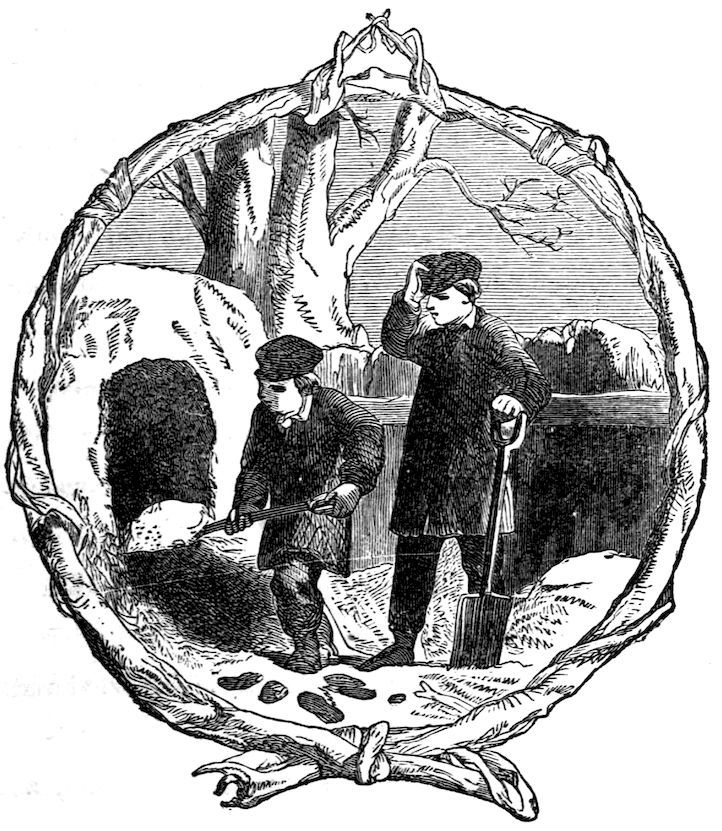
She explained to him the manner in which they are
built. They are circular in shape, rising in the form
63of a dome, and are built wholly of ice and snow.
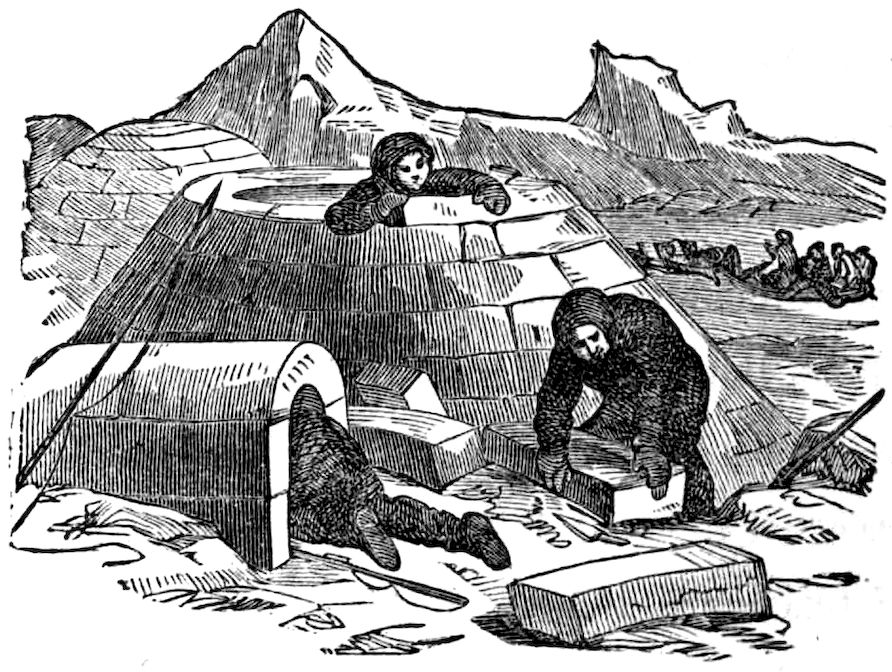
We give a representation of one nearly completed.
The picture also shows a finished hut, in the distance,
and the low and narrow entrance to a third, in the
foreground. It does not seem as though these snow
hovels could be much more comfortable to dwell in
than the one which Ronald and Henry built; but the
poor Esquimaux, though living in a climate far colder
than the coldest in the United States, are glad to make
their homes in these rude huts, which seem fit only for
boys’ playthings. An American traveller in those
regions says that although these snow-houses might
not be considered exactly comfortable, particularly by
those who had a fondness for dry clothing, and for
joints that did not creak with frost in the morning,
yet he confessed he had often slept soundly in them.
From snow-houses the conversation glided to iceboats,
which are sleds or boats constructed to sail on
the ice. One of these had been recently rigged up by
a young man in town, and as it was a novelty, it was
the object of Jessie’s walk to see it. Ronald had
already seen it, and explained its construction to her;
and she, in return, told him how in Arctic expeditions
64the sledges were sometimes provided with sails, by
which the men were greatly aided in their tedious
journeys over vast fields of ice.
Merry voices soon informed Jessie and Ronald that
they were in the vicinity of the pond. Round Hill
Pond, it was called, taking its name from a prominent
hill near its borders. It was a beautiful sheet of
water, surrounded on all sides by hilly land, much of
which was covered with forest trees. At this time,
there was quite a large gathering of young men and
boys upon its glassy surface. There were parties of
merry skaters, performing their quick and graceful
evolutions, or cutting fantastic figures upon the ice.
Some of the skaters had bats and balls, and others
were drawing sleds, on which were seated their little
brothers or sisters. There were also some famous
coasts on the pond, which many of the boys were
improving. Starting high up on the steep sides of the
pond, they came down with a railroad speed that sent
them whizzing across the narrow part of the pond;
and here, fortunately, was another icy hill-side, by
which they were returned to their first starting place,
in the same way they came. I cannot say what would
have been the consequences of a collision between
65these two opposite trains of coasters; but as each side
had its own track, and the law of keeping to the right
was enforced by common consent, they got along without
anything more serious than an occasional narrow
escape from an accident.
But the great attraction of the pond was the ice-boat.
This was a large, rough sled, shaped somewhat
like a flat-iron, and instead of runners, having three
skate irons, two behind and one forward. The forward
skate could be turned, and thus served as a
rudder to steer the craft. Near the centre of the sled
there was a mast, capable of supporting a large, square
sail. The sail was dropped, and the ice-boat was at
rest, near the edge of the pond, when Jessie and Ronald
arrived. They went down upon the ice, to have
a nearer view of it, and found the young man who
made it getting ready for a sail. Several persons
were standing around, one of whom, a middle-aged
man, was endeavoring to convince the youth that he
sailed his craft wrong end first.
“Why, look here, John,” said the man, “doesn’t it
stand to reason that the rudder of a boat ought to be
in the stern? Now just answer me that, will you?”
66“Well,” replied the boy, availing himself of the
Yankee’s privilege of answering a question by asking
another, “supposing you were making an ox-sled with
a set of double runners, would you put the traverse
runners behind, because you were going to steer with
them?”
“That’s nothing to do with it,” replied the other;
“of course I wouldn’t build an ox-sled as I would a
sail-boat. But, let me tell you, I’ve seen these things
before to-day. I was out in Iowa, one winter, and
crossed the Mississippi in a sail-sled, a good deal like
this, only she had the two stationary runners in front,
and the single one behind. She was running as a
ferry-boat, and she flew across the river like a bird.
And then she’d mind her rudder just as quick as any
boat you ever saw; you could whirl her right about
in a moment.”
“So I can my boat,” replied the youth; “and as to
that, I don’t believe it makes any difference whether
the steering runner is in front or behind. Come,
jump on, Mr. Grant, and you shall see for yourself,”
added the young man, as he hoisted his sail.
“No, you’ll sail better with one than with two on
board, with this wind,” replied the man.
67“Well, Jessie, you’re light—I’ll take you, if you
want to have a sail,” continued the young man.
“No, I thank you, I had rather stand here and see
you sail,” replied Jessie.
“Yes, go, Jessie,” interposed Ronald; “I would, if
he asked me.”
John did not take the hint, but setting his sail to
the breeze, and giving his craft a push by means of a
boat-hook, he started on his trip alone. There was a
light wind, and the ice-boat, after a few minutes, got
up a pretty good speed, sailing along very handsomely
at the rate of four or five miles an hour, which is a
little faster than a good walker usually travels. The
young man frequently changed her course, and conclusively
showed that the craft obeyed her rudder, if
it was, as Mr. Grant asserted, in the wrong end of the
boat.
As the sun was nearing the western horizon, Jessie
and Ronald did not wait to see the return of the ice-boat,
but started for home after it had disappeared
behind the hills. They had not proceeded far, when
they discovered, with astonishment and awe, that
since they had passed securely over the road, but
68little more than an hour before, a fearful snow-slide
had taken place at a particular point, burying up the
highway for nearly a dozen rods, to the depth of
twenty feet! The road at this place wound around
the foot of a steep hill, upon the side of which the
deep snow had become softened by the afternoon sun,
and slipping from the grasp of its icy moorings, had
swept down from the heights above in an avalanche
which must have shaken the solid ground beneath.
There was a farm-house just beyond, and Jessie and
Ronald, as soon as their first surprise was over, began
to feel serious apprehensions that it had been swept
away in the rushing tide from the mountain. They
accordingly scaled the immense pile of snow, which
was as hard and compact as if it had been trodden
down by the feet of an army, and hurried forward to
ascertain the extent of the disaster. To their great
relief, they found the house safe, but so near had the
destructive avalanche come to it, that a shed attached
to the barn was demolished and buried up, and a
wagon standing in it was crushed to pieces. The
family which occupied the house had not yet recovered
from their alarm and excitement. At the time
69the slide occurred, the mother and her two children
were alone in the house. Hearing an unusual noise,
which jarred the building like an earthquake, she ran
to the door, and saw the whole hill-side apparently
sliding down into the road. Comprehending her danger
at a glance, she seized her little girl with one
hand, and her babe with the other, and fled from the
house with all possible speed—all of them bareheaded,
and with only such garments as they wore
indoors. Fortunately, she soon met her husband, who
at first thought his wife had suddenly become crazy;
but after hearing her story, he took the little girl into
his arms, and they went back to the house. When
Jessie and Ronald got there, the man was trying very
earnestly to convince his wife that there was no further
danger, but she kept glancing anxiously at the
snow on the hill behind the house, as if momentarily
expecting to see it commence its destructive march.
There was, however, really little danger, now, for
such was the form of the hill above the house, that a
slide would not be likely to occur there, unless in connection
with an avalanche on the more precipitous
part of the mountain.
70Jessie and Ronald now hurried home, thankful that
an unseen Hand had held back the crashing snow-slip,
while they were slowly passing along its track, unconscious
of danger. So intently were their minds
engaged with the fearful scene they had just witnessed,
that Ronald did not notice, as he passed into
the yard, that his snow-house was reduced to a shapeless
heap, and its ruins scattered around in every
direction.
CHAPTER IV. THE REFEREE CASE. — “AWARD OF REFEREES. — Key to the Gallery of Literary Portraits.
71
“I wonder where Henry is; I haven’t seen
him for three or four days,” said Jessie one
morning, as Ronald was mending one of the straps of
his skates, preparatory to an excursion to the pond
with several boys who were waiting outside.
No reply was made, and after a moment’s pause,
she added,
“I am afraid he is sick. Have you seen him,
lately, Ronald?”
“No, I haven’t seen him since that day we went
over to Round Hill Pond, to see the ice-boat,” replied
Ronald.
“You haven’t heard of the falling out of Ronald
and Henry, have you?” inquired Oscar of Jessie, as
soon as Ronald left the room.
72“A falling out? No, I have heard nothing about
that. What is the trouble between them?” inquired
Jessie.
“I didn’t know anything about it until yesterday,”
replied Oscar, “although I suspected something was
wrong. It seems, according to Ronald’s story, that he
and Henry undertook to build a snow-house, and had
got it nearly done, when Henry got mad about something
or other, and knocked it all to pieces, while
Ronald was away.”
“But I can hardly believe that,” said Jessie. “It
doesn’t seem at all like Henry, to do such a thing as
that—and such good friends as he and Ronald have
always been, too. Did anybody see Henry tear the
house down, or is it all mere suspicion?”
“It’s nothing but suspicion, I believe,” replied Oscar;
“but Ronald says he’s certain Henry did it, and
he declares he will never have anything more to say
to him. It’s a little suspicious that Henry hasn’t
been over here, since that day, isn’t it?”
“Well, I shall not believe Henry did it, unless he
acknowledges it, or some witness testifies that he saw
him do it,” added Jessie. “I will go over and see
73Henry, to-day, and find out the truth about the matter.”
In the afternoon, when her work was finished up,
Jessie went over to Mr. Allen’s, where Henry lived,
and made inquiries about the report she had heard in
the morning. Her brother readily admitted that he
had destroyed the snow-house; but he justified himself
on the ground, first, that Ronald did not treat him
well, but provoked him to do it; and secondly, that he
had a right to destroy it, as the snow-house was just
as much his as it was Ronald’s. Jessie listened patiently
to all he had to say in his defence, and then
simply inquired:—
“Why haven’t you been over to see us, since that
day?—you used to come almost every day.”
Henry bit his thumb nail nervously, and gazed intently
at the corner of the carriage-shed, but made no
reply.
“Come, Henry, I want an answer to that question,”
added Jessie. “You know that you and I have no
better friend, next to our mother, than Mrs. Page.
Then all the rest of the family have always been very
kind to us. Now I want to know why you should
74shun them all, and your own sister, too, if you only
did what your conscience approved, the last time you
were over there. Will you answer me that?”
After a long pause, finding that Jessie was still
patiently waiting for a reply, he stammered:—
“I don’t know—I suppose I didn’t do exactly
right—but Ronald’s more to blame than I am—he
began to pick upon me, first.”
“Well,” added Jessie, “I want this quarrel settled
right up, before it grows any worse. You acknowledge
that you did wrong; now are you willing to confess
this to the one you wronged, and to ask his pardon?”
“If he’d apologize to me first, perhaps I would,”
replied Henry, after a little hesitation.
“How much nobler it would be for you to go to
him, first,” replied Jessie. “According to your own
showing, you are the one most to blame, even if Ronald
did provoke you a little. Now I will engage,
that if you go and acknowledge to him that you have
done wrong, he will make ample apology to you for
whatever provocation he may have given. Will you
do it?”
75“But I only did what I had a right to do—the
snow-house was mine as much as it was his,” said
Henry, evading the question.
“I have some doubts about that,” replied Jessie.
“The snow-house was in Ronald’s yard, and you were
his guest. I think he had the best right to it. But
even if you were equal partners in the matter, you had
no right to destroy it without his consent. He has
rights, as well as you. Two men sometimes build a
house together; but if they should get into a dispute,
when it was finished, and one of them should go and
set the building afire, or pull it all to pieces, I think
he would have to go to the State prison, even if he
did own half the property. It would be a crime. And
it is just the same in your case. At most you only
owned half the snow-house, and you had no right to
destroy even your own half, because it would interfere
with Ronald’s rights to do so.”
Henry attempted no reply to this reasoning, but
still manifested an unwillingness to make any advances
towards a reconciliation. Jessie then tried to persuade
him to go home with her, and have an interview
with Ronald, she promising to do her best to arrange
76matters to the satisfaction of both; but Henry resolutely
refused to do this.
“I have thought of one other way to settle this
quarrel,” added Jessie, after a little pause; “and that
is, to refer it to two or three referees, and let them
decide who is most to blame, and who shall make a
first confession. Will you agree to that?”
“I don’t see any need of going to all that fuss about
it—Ronald began the quarrel, and if he wants to
make up, let him say so,” replied Henry.
“It is not considered a very good sign,” resumed
Jessie, “when a man refuses to submit his dispute
with a neighbor to two or three disinterested persons.
People say he does not act in good faith. It looks as
though he were neither innocent nor honest. Must I
go home and tell the folks that you have done this?”
“No, I didn’t refuse, but I don’t see any use in
doing it, though,” answered Henry.
“Suppose Ronald insists that you are more to blame
than he, and refuses to acknowledge his error until
you have confessed yours; how can you ever come to
terms, unless by some such means as I have proposed?
It is a very simple thing, and if you are both
77acting in good faith, I don’t see how you can object to
it. Will you agree to it, if Ronald will?”
“Y-e-s,” replied Henry, with evident reluctance.
“Well, you had better choose your referee now—that
will save the necessity of seeing you again about
it,” added Jessie.
“I’ll choose you,” said Henry.
“Very well, I’ll accept,” replied Jessie. “Ronald
shall choose another, and we two shall elect a third;
then both parties shall have a hearing, and you agree
to abide by the decision we make, without any question
or grumbling, do you?”
“Why—but—”
“No whys or buts now, bub,” interrupted Jessie,
“the award of the referees is final—there’s no appeal
from it.”
“Well, but suppose you referees should decide that
Ronald should give me a thrashing; do you suppose
I’d stand still and take it?” inquired Henry.
“That is not a supposable case,” replied Jessie.
“All I can say to it, is, that if the referees think the
breach cannot be healed, and justice done to all, without
some kind of reparation, or punishment, we shall
78expect the guilty one to submit to it, whatever it is.
But I must be going, now—you will probably hear
from us to-morrow.”
Jessie had a private interview with Ronald, on her
return home, and found that he was really much
offended with Henry. He gave his version of the difficulty,
dwelling particularly upon Henry’s ungenerous
fling at his parents, and the spite he exhibited in destroying
the snow-house.
“But,” Jessie suggested, after patiently hearing his
statement, “isn’t it possible that you were the aggressor,
after all? Were you not a little arbitrary, and
self-willed, about that time? And didn’t you provoke
Henry by telling him you could order him out of the
yard, if you chose, and by daring him to touch the
snow-house, after you left it? You know Henry is
older than you, and that made it harder to submit to
such treatment. He feels that he did wrong, and I
think he is sorry for it; but he says you began the
quarrel, and are more to blame than he is. If you
should go to him, and apologize for what you said, I
am confident he would be melted into penitence in an
instant, and make all the reparation possible for the
wrong he has done you.”
79Ronald was ready to admit that some of the blame
should be placed to his account, but he did not think
he was called upon to take the first step towards a
reconciliation. Jessie then told him of the referee
plan, and he cheerfully assented to it, and chose Marcus
as his arbitrator.
It happened that Marcus heard nothing about the
quarrel until Jessie apprised him of the honorable
office to which he had been chosen. He approved of
the course Jessie had taken, and accepted the appointment;
and as a third referee was wanted, they selected
Oscar for that post. Shortly after this, Mr. Allen
rode by, and Marcus, hailing him, asked permission
for Henry to come over for a little while in the evening,
which he readily granted. So it was decided that
the matter should be settled up at once.
Henry arrived early in the evening, before the referees
had commenced their business, Jessie being engaged
with her duties in the kitchen. He was ushered
into the sitting-room, where several of the family were
seated, including Ronald.
“Mr. Allen said you wanted me to come over here,
this evening,” he said to Marcus, with some embarrassment
of manner, as he entered the room.
80“Yes, walk in and take a seat—I’m glad to see
you once more,” replied Marcus.
“Good evening, Henry,” said Ronald, very composedly,
after the others had all saluted the newcomer.
“Good evening,” Henry feebly responded, blushing
a deeper red than before.
“Been skating, to-day?” inquired Ronald.
“No,” replied Henry, in an almost inaudible tone,
hitching uneasily in his seat.
“I have,” continued Ronald, warming up. “Oh,
you ought to have been there, and seen Gil Bryant
skate. Did you ever see him?”
“No, I believe not,” replied Henry, who was winking
intently at the fire.
“Well, if he isn’t a splendid skater, then I never
saw one,” continued Ronald. “Why, they say he has
skated a mile in three minutes and a half; shouldn’t
you call that pretty quick travelling?”
Henry silently nodded assent—to the fire, and
looked more “worked up” than ever.
“What, don’t you believe it, Marcus?” inquired
Ronald, in a tone of surprise, as he noticed a broad
smile illuminating Marcus’s face.
81“Believe it?” responded Marcus; “of course I do.
I’ve skated about as fast as that myself, before now.”
The fact was, Marcus was smiling at the thoughtless,
good-natured talkativeness of Ronald, as contrasted
with the timid and nervous reserve of Henry,
and was balancing in his mind the question whether,
after all, the services of the board of arbitrators would
be necessary to bring the opposing parties to a reconciliation.
That smile, however, seemed to have broken
the spell that was upon Ronald. He dropped the
thread of conversation, and was soon lost in his book,
while Henry continued to sit winking at the glowing,
coal-enveloped back-log. Aunt Fanny, who sat at the
table sewing, now endeavored to draw him into conversation
by inquiries after Mr. Allen’s family, but
did not meet with much better success than Ronald.
Pretty soon Mrs. Page and Jessie came in, and Marcus
inquired:
“Can we have the kitchen, now, mother?”
“Yes,” replied Mrs. Page.
“Well, Jessie and Oscar, suppose we withdraw,”
continued Marcus.
The three referees retired to the kitchen, and after
82consulting a few moments, decided to examine the two
parties to the dispute separately. Henry was then
called in, and gave his version of the difficulty, from
its beginning to his destruction of the snow-house.
He defended himself, as well as he could, and promptly
and frankly answered all the questions that were
put to him by the referees. He was then requested
to withdraw, and Ronald was called in, and underwent
a similar examination. The latter seemed in quite a
merry mood, when he returned to the sitting-room.
“Mother,” he said, “you ought to go out there, and
see what an august tribunal we’ve got. They’re all
as sober as judges, and Marcus has got a sheet of
paper, and is scribbling away on it as fast as he can.
He made believe that he was writing down all I said,
but I guess I can talk faster than he can write, any
day.”
“He was only noting down the leading points of
your testimony, I suppose,” remarked Mrs. Page.
“Leading points?” continued Ronald; “he must
have found them pretty thick, then, for he kept scribbling
the whole time I was in the room. Did he
when you was in there, Henry?”
83“Yes,” replied Henry, “he filled a whole page, and
began another.”
“Well,” added Ronald, with an air of mock gravity,
“I suppose the momentous question is almost decided.
I tremble for my fate—don’t you, Henry?”
“Not much,” replied Henry, with a smile.
“After all, I suppose we might as well be resigned,”
continued Ronald; “I’m not going to worry about it,
any way.”
“I don’t think it will be a very great hardship to
either of you, to shake hands and become friends
again, if that is all the referees ask,” remarked Mrs.
Page.
“Nor I, neither. Come, Henry, let’s do it now,
and get the start of them,” cried Ronald; and grasping
each other’s hands, the two estranged playmates
indulged in a long and hearty shake, and felt that
their quarrel was at once healed.
“Well done, boys!” exclaimed Mrs. Page. “Now
how much better that is, than to let such a trifling
thing make enemies of you. I shouldn’t wonder if
you both remembered this act as long as you live;
and you’ll always remember it with pleasure, too.”
84“Do you suppose that’s all they’ll tell us to do—to
shake hands and make up?” inquired Ronald.
“I haven’t any idea what kind of a decision they
will make, as I know but little about the facts in the
case,” replied Mrs. Page.
“It seems to me they are a good while making
their decision,” said Henry; “I should think it was
about time to hear from them.”
Oscar appeared at the door, a few minutes afterward,
and summoned Ronald and Henry before the
referees. Marcus requested them to stand, while he
read the decision.
“Mayn’t I say something, first?” inquired Ronald.
“Yes,” replied Marcus.
“Well, Henry and I have made up,” added Ronald.
“Ah, I’m glad to hear that,” said Marcus. “If
you had done this a little sooner, you might have
saved yourselves and us some trouble; but as we
have finished up the business you employed us to do,
we shall expect you to abide by our decision, and to
pay us our fees.”
“Fees? Have we got to pay you fees?” inquired
Ronald, with a laugh.
85“To be sure you have,” replied Marcus, with the
utmost gravity. “It is customary to pay the referees,
in such cases.”
“Well, I don’t believe you’ll make much out of
me—I can’t raise more than one cent apiece for you,
any way,” said Ronald, feeling in his pocket.
“We wont discuss that point now, but I will read
the decision,” observed Marcus; “and he proceeded
to read the following paper:
“The Board of Referees in the case of Hapley vs.
Page, have carefully considered the matter committed
to their judgment, and have come to the following
decision. They find that Page originated the trouble,
by manifesting an overbearing and unaccommodating
spirit towards Hapley; by claiming exclusive ownership
of the snow-house erected by their joint labors;
and by using taunting language. They also find that
Hapley was to blame, for using unkind language
towards Page, and especially for destroying the snow-house,
in a spirit of retaliation. Supposing the structure
in dispute to have been the joint property of
Page and Hapley, the Referees are clearly of opinion
that neither party had a right to pull down the whole
86of it, or even one-half, without the consent of the
other. Buildings, ships, etc., are often owned by several
persons, jointly; but one party may not do any
thing to the common property that would injure the
other owners. The Referees, therefore, decide that
Hapley, being the elder, ought to express to Page his
regret for what has occurred in connection with this
affair, and to ask his forgiveness; and that Page, in
return, ought to make a similar acknowledgment to
Hapley, asking his pardon for commencing the quarrel.
The Referees also recommend both parties cordially
to forgive each other, and to manifest their
determination to do so by shaking hands.
“The Referees further order, that at the earliest
practicable day, the said Hapley and Page shall erect
a new snow edifice, on the site of the one destroyed,
to be called the Temple of Peace. Said structure
shall be of such size and proportions as the said Hapley
and Page may agree upon, and when completed,
it shall belong to the Referees, who shall accept the
same as full payment for their services in this case.
“Marcus Page, }
“Jessie Hapley, } Referees.
“Oscar Preston, }
“Highburg, March 4.”
As soon as Marcus concluded the reading of this
87paper, Henry stepped up to Ronald, and taking his
hand, told him he was sorry for what he had done,
and asked his forgiveness. Ronald responded in a
similar spirit, and a cordial shaking of hands concluded
the ceremonies. Marcus then thanked them
for submitting so promptly and good-naturedly to the
decision of the Referees, after which they all withdrew
to the sitting-room.
“Jessie, have you finished your gallery of literary
portraits?” inquired Marcus, as he drew his chair to
its accustomed place at the table.
“Yes, I have done about all I shall do to it—I am
getting a little sick of it,” replied Jessie.
“Suppose you pass it around, then, for the entertainment
of the company,” said Marcus.
“I’m almost ashamed to show it,” continued Jessie,
going to a drawer in the secretary. “There are so
many figures that I did not have time to take much
pains with them. I think you’ll be puzzled to tell
what some of them represent.”
“So much the better for that,” replied Marcus.
Jessie had a taste for drawing, and had taken a few
lessons in this art. Her interest in it had been rekindled,
88since removing to her new home, by the offer
of Miss Lee to give her further instruction in the use
of the pencil. Miss Lee was an accomplished sketcher
and painter, and had formerly taught these branches
in the academy, for several terms. The “gallery of
literary portraits,” alluded to by Marcus, was undertaken
by Jessie to furnish amusement to the younger
members of the family, rather than as an exercise in
drawing. It consisted of a series of names of literary
characters, enigmatically expressed. She handed the
sheets to Marcus, who passed them round the circle.
Some of the portraits were recognized by all at first
sight; but others proved quite puzzling to the younger
folks, and there were several which no one could solve,
until Jessie gave a clue to them. On the next two
pages we give a transcript of this Gallery of Literary
Portraits.
89
90
91
1. Swift.
2. Locke.
3. Young.
4. Fox.
5. Lamb.
6. Hogg.
7. Akenside.
8. Kane.
9. Gay.
10. Cowper.
11. Paley.
12. Cooper.
13. Bacon.
14. Longfellow.
15. Pitt.
16. Shakspeare.
17. Opie.
18. Pope.
19. Sparks.
20. Hood.
21. Herschel.
22. Hooker.
23. Drake.
24. Crabbe.
CHAPTER V. A DAY AT SCHOOL.
92
Early the next Monday morning, a sleigh drove
up to Mrs. Page’s door, containing a large man
wrapped in a shaggy bear-skin coat, a girl about fourteen
years old, to whose cheeks the frosty morning
air had lent a beautiful glow, and a boy whose age
might have been between twelve and thirteen years.
The girl and boy hurried into the house, and were
warmly greeted by all the family. They were Katharine
and Otis Sedgwick, and had boarded in the
family for six months past, during which period they
had attended the academy. They belonged in a town
about ten miles distant. Their father, after hitching
his horse in the shed, and throwing a blanket over
him, came in to have a chat with the family, and to
settle the “term bills” with Marcus. He stopped
93about half an hour, and then set out for home; after
which the young folks began to prepare for school.
The academy building was about a mile distant
from Mrs. Page’s. In good weather, Marcus and the
students in the family usually walked to and from
school, taking their dinners with them. This first
morning of the new term was a bright though cool
one, and soon after half-past eight o’clock, the six
“academicians,” as Ronald called them, might have
been seen wending their way through the snow-path,
towards a little white belfry that gleamed over the
tops of an evergreen forest in the distance.
At nine o’clock the bell rang, and as the students
assembled in the hall, it was found that the attendance
was quite large. The old scholars took their former
seats, and desks were assigned to the new ones. Mr.
Upton, the preceptor, then touched a little hand-bell—the
signal for silence; after which he took the Bible,
and read from it a passage rich in instruction to the
young—the fourth chapter of Proverbs. Every
head was then bowed, as he offered up a simple and
fervent prayer for the divine blessing upon the students
and teachers there assembled.
94After these exercises were concluded, Mr. Upton
went to the large blackboard, facing the school, and
wrote upon it this sentence, in characters that could
be seen in the remotest part of the room:
“EXALT HER, AND SHE SHALL PROMOTE THEE.”
“‘Exalt her’—can any one tell me what this
refers to?” inquired Mr. Upton.
“Wisdom,” was the general answer from all parts
of the room.
“Right,” replied Mr. Upton. “It is found in the
chapter I have just read. Can any of you tell me
what wisdom means, in this case?”
There were several answers to this question, such
as “Religion,” “Prudence,” “Knowledge,” etc., but
they were mostly given in a hesitating manner, and
only a few of the scholars made any reply to the
question.
“The word wisdom,” continued Mr. Upton, “has
several significations. As used in the Bible, it sometimes
means learning or knowledge; and sometimes it
means piety, or true religion. This last is the sense
in which the word is used in the chapter I read to you.
95You will notice that it is a favorite word with Solomon,
if you read his Proverbs. But you will also
observe that much that he says about this heavenly
wisdom, may also apply with great propriety to human
wisdom, or that knowledge with which we store
our minds. This is true of the motto I have written
on the blackboard. ‘Exalt her, and she shall promote
thee.’ That is, if you desire promotion, give
attention to the acquisition of knowledge—strive
after the wisdom and skill which come from patient
study, practice and observation—give the work of
education a prominent place in your thoughts and
plans. This, to be sure, is not the highest motive we
have for faithfulness in study, but it is a strong one,
and I think it may be useful to press it upon your
attention, as we are entering upon a new term. This
is the idea I wish to impress upon your minds, viz.,
that knowledge brings promotion. Vice, immorality,
idleness, improvidence, or misfortune, sometimes interfere
with this general law; but on the whole the rule
holds good, that a man’s happiness, position, property
and influence are promoted by knowledge. I feel
safe, therefore, in assuring you that for every dollar
96your education costs your parents, and for every hour
of study, every act of self-denial, every effort and
struggle it costs yourselves, you will be abundantly
repaid hereafter. If you come here in a right spirit,
you are putting your money, your time and your
efforts into a safe bank. It will prove a capital investment
to you, as long as you live.
“A gentleman at the South once employed a negro
to kill a calf. When the animal was dressed and
brought home, Cuffee, the butcher, demanded two dollars
for the job. ‘Why, Cuffee! do you charge me
two dollars for dressing a calf?’ exclaimed the gentleman.
‘No, massa, I charge one dollar for killin’ de
calf, and one dollar for de know how,’ was Cuffee’s
reply. Cuffee was right. A man has a perfect right
to charge for the ‘know how.’ And generally men do
charge for it, and get well paid, too.
“Suppose I am about to build a house. In the
first place, I hire several common laborers to dig the
cellar, and pay them one dollar per day. These are
the most ignorant and unskilled laborers we have
among us; that is, they have about as little ‘know
how,’ as a man can get along with. Their tools are
97few, and do not cost much, and so we may take the
dollar per day they earn as the standard market value
of a mere unskilled pair of hands and a set of strong
muscles.
“After the cellar is dug, I set carpenters to work,
employing them all by the day. By-and-by the head
carpenter brings in his weekly or monthly bill. I find
he charges me at the rate of one dollar a day for one
hand. This is his apprentice, a young man of sixteen
or seventeen, who has worked but a year or two at
the trade. The ‘know how’ he has acquired makes
him even now of as much value to me as a full grown
man of the common laborer sort. Then there are several
journeymen carpenters, for whose services I am
charged one dollar and a half or three-quarters per
day. These men have no more physical strength
than the dollar-a-day laborers—perhaps not so much.
Then why should they receive fifty or seventy-five
per cent. more for their daily labor? A small fraction
offsets the cost of their tools, and the balance is
to pay them for their ‘know how.’ But the boss carpenter,
who has a general oversight of the job, and of
the other carpenters, charges perhaps two and a half
98or three dollars per day for his time. He works no
harder than the others, but he has more ‘know how’
than they, and is paid accordingly.
“So it is with the masons, painters, and all other
workmen on my house—I must pay them in proportion
to their ‘know how.’ And if I employ an architect,
to make the drawings of the building, and he
should charge me at the rate of five or ten dollars per
day for the time he spent upon them, I should remember
that his peculiar ‘know how’ cost more time,
money and study than that of the carpenter or the
mason, and therefore commands a higher price in the
market.
“Thus you see one of the ways in which knowledge
brings promotion. It has a market value, in dollars
and cents. There are other ways in which it promotes
a man. It saves him from errors and blunders.
It increases his self-respect, and his means of enjoyment.
It gives him a higher position in society. It
endows him with greater influence among men. But
I will not weary you by dwelling upon these ideas.
You have come here avowedly to get wisdom, and I
have held up to you one motive for persevering in the
99work. I hope we shall all earnestly seek, and find,
not only earthly but heavenly wisdom, so that at last
we may receive that ‘crown of glory’ which is promised,
in the chapter that has been read, to those who
get wisdom and understanding.”
Mr. Upton, aided by Marcus, then proceeded to
arrange the classes, and perfect the organization of the
school. Jessie was very glad to learn that her plan
of paying for her own tuition by rendering occasional
assistance, in the way of hearing the recitations of the
lower classes, had been acceded to by the trustees.
There was to her a double gratification in this; since
she would not only earn her own tuition bills, but
would all the while be gaining experience in the profession
to which she was looking forward with so much
interest. After breaking to her this pleasant intelligence,
Mr. Upton added, in tones audible to those who
sat near her:—
“I have been telling the scholars that ‘knowledge
brings promotion’—now I am going to illustrate it
by promoting you to the first monitorial desk. You
will please to remove your books to that desk, as I
want this one for another young lady.”
100There were several monitorial desks in the hall,
which were slightly elevated above the others, and so
placed as to overlook them. They were usually assigned
to the oldest and most trustworthy pupils, and
were regarded as posts of honor. The one to which
Jessie was transferred was near the teachers’ desks,
and was the principal monitorial desk on the girls’
side of the room. With a modest blush she gathered
up her books and took possession of her new dignity;
but it was a long time before she could muster courage
to look up, and meet the battery of as yet idle eyes
that were directed towards her.
The organization of the school occupied most of the
forenoon. At twelve o’clock the morning session
closed, and the scholars were released for an hour and
a half. About a score of them, who lived at a distance,
remained, and either singly, or in little scattered
groups, were for a time very busy over the contents
of sundry small baskets and tin pails. The boys
quickly found the bottoms of their dinner receptacles,
and impatiently sallied forth, with a half-eaten apple,
dough-nut or slice of bread in one hand, and a sled or
pair of skates in the other.
101“Good riddance to you!” cried one of the girls, as
the last boy-muncher—one of the slow sort—closed
the door.
“Look here, now! I’m not gone, yet,” replied the
boy, opening the door.
“Well, you’d better go,—and tell your mother not
to put you up so much dinner to-morrow, will you?”
responded the girl.
“There, now, I’d come right back, and stay all the
noon with you, only I don’t want to humor you so
much,” replied the boy, who was as “slow to anger”
as he was slow in eating—and none too slow in either
case, after all, I suspect.
“O do come—we should be so delighted with your
company,” retorted the girl; but the tramp, tramp,
tramp of a stout pair of boots down the stairs was all
the reply she got.
And now the girls seemed determined to have a
good time among themselves. The little groups gradually
enlarged, the tongues wagged in a more lively
manner, and sundry choice tit-bits were transferred
from one basket to another. There were two or three
“new girls,” however, who did not venture into any
102of the social circles, but demurely sat at their own
desks. Jessie was a favorite in the school, and quite
a number of the girls gathered around her, among
whom was Abby Leonard, who sometimes stayed at
noon, by way of change, although her boarding-place
was not far off. Abby, notwithstanding the foolish
speech she made about associating with such poor
girls as Jessie, a few months before this, was far from
shunning the company of that young lady. On the
contrary, she seemed to court it.
“Have a pickle, Jessie?” inquired Abby, holding
out a good-sized cucumber.
“No, I thank you, I seldom eat pickles,” replied
Jessie.
“You don’t?—why, I’ve eaten six as big as that,
this noon,” replied Abby. “I had to ‘hook’ them,
though, for Mrs. Miles would fidget herself to death if
she knew how fast her pickles are going off. I love
sour things, dearly. When I was at home, I used to
eat a dozen pickled limes a day, sometimes. We
always keep them in the house—father buys them by
the barrel. I think it’s real mean, that they don’t
keep them for sale here.”
103“I shouldn’t think it could be very wholesome to
eat so much of such things—they are very indigestible,”
remarked Jessie.
“O, they never hurt me—I eat everything I want,
and think nothing about it,” replied Abby.
Abby then prevailed upon Jessie to accept a piece
of her cake, but immediately added:—
“I declare, it’s so mean I’m almost ashamed to
offer it to you. At home, we shouldn’t think it was
hardly fit to set before the servants. Mother never
allows our cook to make anything plainer than nice
pound cake.”
“I call that very good cake—good enough for anybody,”
said Jessie, utterly indifferent to “our cook”
and her “nice pound cake.”
“Just look at that squint-eyed girl—did you ever
see such a fright?” continued Abby, in a whisper,
alluding to one of the new scholars, who sat in her
seat, alone, apparently listening with a good degree of
astonishment to Abby’s remarks.
“Poor girl, she feels lonesome—some of us ought
to go and speak to her,” said Jessie.
Abby now left the room, whereupon the girls in
104Jessie’s neighborhood began to make merry at her
expense.
“My mother doesn’t allow the cook to make anything
meaner than brown bread, and we have that on
the table three times a day,” said one girl.
“When I’m at home, I eat six pints of pea-nuts a
day—father buys them by the ton,” said another.
“Speaking of pickles—do you know what she eats
them for?” inquired another girl. “I can tell you—she
thinks they make her look pale and genteel. She
eats chalk, and slate pencils, too—I’ve seen her do it,
many a time.”
“Yes,” added Kate Sedgwick, who was one of the
group, “and you ought to see her drink vinegar, too.
Why, she makes nothing of drinking a whole cup full
of clear vinegar at one draught.”
“I do think she is the most hateful thing”——
“Come, girls, this is scandal,” interposed Jessie,
“let us talk about something else.”
“Scandal?—no, this is nothing but the truth, and
telling the truth isn’t scandal,” replied Kate.
“I think it is, very often,” replied Jessie.
“Well, I don’t call telling the truth talking scandal,
105and I never heard anybody say it was, before,” remarked
another girl, one of the largest in the school.
“If a girl really eats chalk and slate pencils, and
drinks vinegar, to make herself look genteel, it isn’t
scandal to tell of it.”
The other girls in the group all took the same
ground, and Jessie was at least half convinced she was
in the wrong. She made no attempt to argue the
point, but sought to give the matter a practical turn,
by saying:—
“Well, I never hear a lot of girls talking about
another one behind her back, without having a suspicion
that I shall be served the same way, as soon as I
am out of hearing. Abby was here a few moments
ago, and we were all on good terms with her, and she
spoke kindly to us. But every tongue is against her,
as soon as her back is turned. It seems to me there
is something inconsistent and unkind in this. If we
had any criticisms to make on what she said, would
it not have been better to have made them to her
face?”
“Why, Jessie!” exclaimed Kate, “you are not in
earnest, are you? Only think what an explosion
106there would be, if we should tell her just what we
think of her. Everybody dislikes that girl, and I
don’t believe you think any better of her than the
rest of us do. I don’t see why you should stand up
for her so, all at once—she doesn’t deserve it.”
“I haven’t ‘stood up’ for her more than I would
for any of you, under the same circumstances,” replied
Jessie. “I only proposed that we talk something
beside scandal. Now I’m going to have a run out-doors—but
first I must speak to Lucy Grant—nobody
has spoken to her to-day, hardly, and the poor
child feels bad—I can see it in her looks.”
Lucy was the “squint-eyed girl” who had attracted
Abby’s notice a few minutes before. She was afflicted
with that defect of the eye commonly called squinting,
but the proper name of which is strabism, or strabismus.
In her case, the difficulty originated in a severe
fit of sickness which she experienced when she was
about five years old, and which was attended by a
great deal of nervous irritation. There are muscles
on each side of the eye-ball, by which it is moved
from side to side. Squinting is caused by one of these
muscles (usually the inner one) contracting, or growing
107short, while the one on the other side of the ball is
lengthened in the same proportion. Sometimes the
defect is very slight, but in the case of Lucy the
deformity was quite prominent, and it began to cause
her much mortification, for she was just entering upon
her teens. Within a few months she had thought
seriously of submitting to a surgical operation—for
strabismus is sometimes removed by cutting through
the contracted muscle of the eye-ball; but the uncertainty
of the operation, and the dread of the pain,
were too much for her weak courage to overcome.
Lucy belonged in Highburg, and was more or less
known to most of the scholars. Though she did not
hear Abby Leonard’s allusion to her, she saw enough
to satisfy her what the purport of the remark was;
and this, together with the little notice the other girls
took of her, exaggerated by a somewhat suspicious
disposition, had depressed her into a not very enviable
frame of mind. A few kind words, however, will
often dispel the blackest cloud; and it was Jessie’s
privilege to wield this potent power in behalf of Lucy.
Greeting her with the cordial air of an old friend, and
forgetting the disparity in their ages, Jessie chatted
108freely with her about several matters of common
interest, for a few minutes, and then added:—
“Come, Lucy, let’s go out and see what is going
on. You mustn’t get into the habit of sitting here all
the noon-time—Mr. Upton tells us we must always
go out and take the fresh air.”
Lucy went out with Jessie, and, after mingling in
the society and the sports of the other girls for an
hour, returned to her seat at the ringing of the bell,
with a very different opinion of her school-mates from
that which she entertained an hour before.
The afternoon session passed off quite pleasantly.
When the hour to close arrived, Mr. Upton gave out
a hymn to be sung, as was his custom. Before giving
the signal to commence singing, he remarked:—
“My young friends, I think we have made a very
good beginning to-day. Everything has gone favorably
with us, and I feel much indebted to you all for
coöperating with me so willingly, in organizing the
school. I augur from this day’s work a pleasant and
prosperous term. We seem all to be in harmony, and
I trust we shall continue so to the end. In referring to
this text this morning,” continued the preceptor, pointing
109to the motto on the blackboard, “I made a somewhat
strong appeal to your ambition. I endeavored
to show that pecuniary and other advantages would be
your reward, for faithfulness to your studies. If any
of you suppose that this is the highest and noblest
motive for study, our evening hymn will, I hope, correct
the error.”
The scholars then united in singing the following
beautiful hymn, by “holy George Herbert:”
“Teach me, my God and King,
In all things Thee to see;
And what I do in any thing,
To do it as for Thee;—
“To scorn the senses’ sway,
While still to Thee I tend;
In all I do, be Thou the way,—
In all, be Thou the end.
“All may of Thee partake:
Nothing so small can be,
But draws, when acted for Thy sake,
Greatness and worth from Thee.
“If done beneath Thy laws,
E’en servile labors shine;
Hallowed is toil, if this the cause,—
The meanest work divine.”
CHAPTER VI. SWEETS AND BITTERS.
110
Among the sources of amusement and instruction
enjoyed by Mrs. Page’s family, was a weekly
newspaper. I do not mean one of those folio medleys
of literature, news and advertisements, whose weekly
visits one or two dollars per annum will insure to all
who desire them—though this useful class of publications
was fully appreciated in the family; but the
newspaper par excellence was quite another affair. Its
title was “The Home Wreath;” the publishers
were “Page & Co.;” the terms were “gratis;” the
publication day was Saturday. It was usually composed
of one, two or three sheets of letter paper,
according to the lack or press of matter supplied. All
the members of the family were regular contributors,
and Aunt Fanny was the editress. The contents consisted
111of original articles, and short selections cut from
other newspapers. All original articles were written
on one side of narrow strips of paper, of uniform size,
so that they could be neatly pasted into the columns—for
the “Wreath” was not printed, and only one copy
was issued. There was a letter-box in the entry, in
which all contributions were dropped, and through
which private communications were exchanged between
members of the family. Before the newspaper
was established, the family had resolved itself into a
“Letter-Writing Society,” each member of which was
bound by the by-laws to write at least one letter or
note per week to some other member. This proved
for a while a pleasant and profitable arrangement;
but the newspaper enterprise had now nearly superseded
it.
Jessie’s conversation with some of her school-mates
on scandal, mentioned in the last chapter, led her
thoughts to that subject, afterward; and the longer
she reflected on it, the more confirmed was she in the
belief that she had taken the right ground in the dispute.
Still, she did not know how to silence objections,
and prove that she was right, and her investigations
112did not aid her much. She looked into Webster’s
large Dictionary, and found that one definition
of scandal was “something uttered which is false and
injurious to reputation.” This rather bore against
her; but the other definitions, “reproachful aspersion,”
“opprobrious censure,” and “defamatory speech or
report,” seemed to favor her side of the question, as
they did not distinctly recognize falsity as an ingredient
of scandal. The matter was by no means clear
to her mind, however, and as she felt the need of further
light, she wrote the following communication for
the “Wreath,” and dropped it in the letter-box, in the
evening:
“Miss Editor:—Several of the scholars of the
academy had a little dispute, to-day, on the question
whether a person is guilty of scandal who merely tells
the truth about another. I took the ground that to
circulate evil reports about a person, even if they
were true, was scandal; but the others all disagreed
with me. Please inform me, through the columns of
the ‘Wreath,’ whether I am right or wrong; and if I
am right, have the kindness to tell me how I can
prove it.
“Inquirer.”
113Several days passed, and it was now the middle of
the week. Nothing had been seen of Henry since the
Friday evening previous, when the referee case was
decided, and Jessie began to feel uneasy about his
absence. It was expected that he would come over
on Saturday afternoon, and help build the “Temple of
Peace.” It was now too late to do this, a warm rain
and thaw having carried off most of the snow. On
Wednesday afternoon Ronald and Otis were going in
search of the truant, that being one of the regular
half-holidays of the week in all the schools; but before
they were ready to start, Henry made his appearance.
“Well, you’re a pretty fellow!” cried Ronald, as
soon as Henry hove in sight. “So you’ve come over
to help me build that snow temple, now the snow has
all gone.”
“Can’t we scrape up enough in the garden to do it
now?—let’s go and see,” replied Henry.
The boys went to the rear of the house, and found
some depth of snow yet remaining under the shadow
of the buildings and fences. But it was too hard and
icy to answer their purpose, even had there been
114enough of it. Henry seemed to be quite disappointed,
and exclaimed, with considerable warmth:—
“It’s too bad! But there, I knew it would be just
so. I could have come over Saturday afternoon just
as well as not, but Mrs. Allen wouldn’t let me. She
never lets me go anywhere, when I want to.”
“Never mind,” said Ronald, “it’s likely we shall
have plenty of snow yet, and we’ll build the temple
when it does come.”
“I don’t know about that,” replied Henry, shaking
his head. “Besides, I wanted to build the temple
right away—it spoils all the fun, waiting so long. I
wish I had come over here Saturday afternoon, in
spite of her.”
“How did you happen to get away this afternoon?”
inquired Otis.
“I asked Mr. Allen to let me come, this morning,
and he said I might. She tried to keep me at home,
as it was; but I got the start of her, this time. Mr.
Allen is a real good man—I like him first rate; but I
can’t bear his wife—she’s just as cross as she can be
to me.”
Henry remained with his friends most of the afternoon,
115and spoke rather freely of his mistress, in the
presence of other members of the family. Jessie was
much pained by these remarks, and before her brother
returned home, she had a private interview with him,
and cautioned him against speaking so disrespectfully
of Mrs. Allen. After a few moments’ conference,
however, she was more inclined to pity than to censure
the boy. The resentful feeling he had manifested
in the presence of others, melted into grief, as he
opened his heart to his sister, and poured into her ear
the story of his sorrows. The poor fellow was still
the victim of homesickness, and not without good reasons,
it seemed. He had found a father, in Mr. Allen,
who treated him with parental kindness and indulgence,
but he wanted a mother. He was persuaded
that Mrs. Allen had no affection for him. He thought
she actually disliked him. She manifested no motherly
interest in his welfare—she evidently felt little
sympathy for him. She never praised, commended or
encouraged him, but spoke to him only to give orders
and find fault. She actually seemed to take pleasure
in thwarting his plans and wishes, and interfering with
his enjoyment.
116Such was Henry’s opinion of Mrs. Allen. It may
have been unjust to her, but he evidently was persuaded
in his heart that the woman disliked him, and
he felt unhappy in consequence, and hinted of running
away. As an illustration of his trials, he said
that whenever he finished up his work, and wanted to
go anywhere, Mrs. Allen would set him to braiding
husk mats, just to keep him busy, although “she had
mats enough to last her fifty years,” he added, rather
indignantly. It was mat-braiding that prevented his
coming over to build the snow temple at the appointed
time, and he could not refer to his severe disappointment,
even now, without some petulance.
“Well,” said Jessie, after listening patiently to this
outpouring of complaint, “I am very sorry to hear
this. I thought you had got a good home, and were
happy. But I cannot believe that Mrs. Allen is as
bad as you represent. There must be some mistake
about this. She appears to be a good, kind-hearted
woman, and she speaks of you as though she felt an
interest in you. I can’t think that she dislikes you,
unless you have given her cause. Are you careful to
try to please her?”
117“Why, yes, I do everything she tells me to do,”
replied Henry.
“That may be,” continued Jessie, “and yet you
may not try to please her. Do you remember the
anecdote about the little girl who was asked why
everybody loved her? ‘I don’t know,’ she said, ‘unless
it’s because I love everybody.’ Now isn’t it possible
that you think Mrs. Allen doesn’t love you,
because you don’t love her?”
“I know I don’t love her—but it’s because I
can’t,” replied Henry.
“Suppose, now,” resumed Jessie, “you go home
with the determination of making her love you. Try
to please her in everything. Do everything cheerfully,
and do it just right. Anticipate her wishes.
Don’t let her see any scowls, or impatient looks, or
hear any fretting. Try to feel grateful and affectionate
towards her, and think as well of her as you can.
Come, Henry, will you do this?”
“It’s of no use to try that,” replied Henry. “You
wouldn’t talk so, if you knew her as well as I do. I
don’t like her, and I can’t.”
“Then do it for Mr. Allen’s sake,” continued Jessie,
118“if you cannot for hers. He treats you kindly,
and you like him, and I suppose you would be glad
to show your gratitude to him. But what would
he think of you, if he knew how you feel towards his
wife, and how you speak of her? For his sake, if for
no other reason, you ought to try to get along pleasantly
with her. But in any event, I beg of you never
to say another word about running away, unless you
want to wholly break mother’s heart. Sam ran away
from home, and you know the consequences of it.
You and I are all that mother has left now, and if we——”
but emotion checked her utterance, and she
gave way to her tears.
Henry seemed somewhat affected by the advice and
entreaties of his sister, and before he left her, he promised
to do his best to please Mrs. Allen, for one week,
and to refrain, during that period, from saying anything
evil of her, and from cherishing any unkind feelings
towards her, whatever provocation she might
give him. At the end of that time, or as soon after as
convenient, he was to report the result to Jessie.
The “sugar season” had now commenced. The
rock or sugar maple is a common tree, in Vermont,
119and every spring the farmers make large quantities of
sugar from its sap. The sap, when it begins to ascend,
and before the foliage has put forth, is very rich in
sugar. The time when this takes place varies from
February to May, according to the season. It was
now the second week in March, and the sap had begun
to run freely. Mrs. Page did not own a “sugar plantation,”
as a maple forest is called; but there were
several large maple trees on her land, near the house,
which Marcus had always been accustomed to tap, in
the spring, for his own amusement. The process of
sugar-making was familiar to all the family except
Oscar, who had resided in Highburg only since the
previous autumn, and had never witnessed the operation.
As Ronald hinted pretty broadly that he was
quite willing to undertake the responsibility of extracting
from the aforesaid half dozen trees their yearly
rental of molasses and sugar, Marcus, remembering
the pleasure he derived from the same occupation
when a boy, gave up the business into the hands that
coveted it.
Ronald commenced his sugar operations early the
next morning. With a small auger he bored several
120holes in each tree, two or three inches deep, and
inclining upwards. These holes were about eighteen
or twenty inches from the ground, and on the south
side of the tree. Into each hole he drove a spile,
which consisted of a piece of sumac, elder, or sassafras,
with the pith bored out, and one end sharpened. The
sap flowed through these spiles into the tubs or buckets
placed to receive it. When Ronald came home
from school, in the afternoon, he found he had collected
several gallons of the sweet liquid, which he
and the other boys removed to the house. A large
iron kettle was filled with the sap, and placed over the
fire. We are so accustomed to speak of “making”
sugar, that it is possible the word sometimes misleads
us. We cannot make sugar. The cane, the maple,
the beet, and other plants, are our sugar factories, but
they give us their saccharine treasures greatly diluted
in water. We boil this water away, or evaporate it,
and the solid sugar remains—and that is the way we
“make” sugar. As fast as the water evaporated in
Ronald’s kettle, new sap was added, so that the mass
did not thicken much that evening.
The next morning, Ronald again emptied his buckets,
121which were partly filled. The kettle was kept
over the fire, through the day, the sap being turned in
as fast as room was made for it by evaporation. In
the afternoon, when the liquid had thickened to a
syrup, Mrs. Page removed it from the fire, and
strained it through woollen, and then suffered it to
cool and settle. In the evening, the boiling was
resumed, under Ronald’s direction, the white of an
egg and a little milk being thrown into the kettle, to
clarify the compound. The scum was carefully removed
as it rose to the surface, and then the syrup
was boiled with a gentle fire until it began to grain.
All hands were now called into the kitchen, and the
poetry of sugar-making commenced in earnest. Some
of the children had provided themselves with pieces of
ice hollowed out upon the upper surface, like saucers,
into which a ladle full of the delicious liquid was
dropped, when it immediately assumed the consistency
of wax. Others dipped snow-balls into the “liquid
sweetness,” or dropped the syrup into cold water, in
which it assumed the waxy form; while the older
ones were content to eat their “maple honey” out of
plain saucers. The syrup was by this time hard
122enough to be taken off the fire. And now it had to
be stirred vigorously until it was cool enough to cake,
when it was dipped into little round fluted moulds.
The grain now quickly hardened, the molasses drained
off, and the boys had a good supply of prime maple
sugar the next morning.
The next morning was Saturday, and as the day
was fine, and the maple sugar fever was now fully
developed, when Oscar proposed a visit in the afternoon
to a “sugar camp” about a mile distant, there
was a general response in favor of the suggestion,
among the young folks, and Marcus promised to go
with them. When the party were about starting,
after dinner, it was found that Jessie was not among
them. Her brother Henry, too, whom Ronald had
seen, on his way home from school, and invited, did
not make his appearance—a circumstance ominously
suggestive of “husk mats” to Jessie’s mind. Perhaps
it was partly this fact, and not entirely her sense of
duty to the family, that led her to insist on remaining
at home and doing her part of the Saturday afternoon’s
work, although Marcus and Mrs. Page both
urged her to join the party. She had her reward,
however, in an approving conscience, whichever may
have been the motive of the act of self-denial.
124
125The “sugar camp” which the young people visited
that afternoon, belonged to one of their neighbors, who
had about a hundred and fifty maple trees. They
found the man and one of his sons engaged in collecting
and boiling down the sap. The kettles were suspended
by chains and hooks attached to a stout pole,
which was supported by two crotched posts. There
was a lively fire under the kettles, which was often
replenished by wood that had been seasoned and split.
During the boiling process, it is necessary to have
some one on the ground night and day, and so they
eat and sleep in the camp, and there is no rest until
the work is done. A rude shed was erected, opposite
the fire, for their protection. The side towards the
fire was open, for the sake of the warmth, and for convenience
in watching the boiling. The floor was
thickly carpeted with straw, and here the men sometimes
took a nap when weary. One of the men in the
engraving is represented as bringing sap, and the
other is blowing the candy or wax, to ascertain how
far the boiling has advanced.
126Marcus and his companions passed an hour or two
very pleasantly in the camp, chatting with the men,
watching their operations, and occasionally taking a
sip of the delicious syrup. Meanwhile Jessie, by
virtue of their absence, got the first reading of the
“Home Wreath,” which made its appearance in the
afternoon. Under the editorial head, she found the
inquiry she had sent to the editress, appended to which
was the following reply:
“Our correspondent is right. To circulate evil
reports about another, without a good object in view,
is wrong, even if the reports be true. Those who do
this from a habit of tattling, or to gratify an idle curiosity,
or from envy or malice, or from no cause whatever,
are guilty of scandal. We have no right to publish
the evil deeds of others, unless there is a prospect
that we can accomplish good by doing so. There are
several ways in which our correspondent can prove
this to the satisfaction of her young friends, if they
possess ordinary candor.
“1st. She can prove it from the Bible, by such passages
as these: ‘Thou shalt not go up and down as a
tale-bearer among thy people.’[3] ‘Be not a witness
127against thy neighbor without cause.’[4] ‘Judge not,
that ye be not judged.’[5] ‘Speak evil of no man.’[6]
There are many other passages, enjoining the same
duty.
“2d. She can prove it from writers on moral science,
who generally teach that it is wrong to utter
injurious truth concerning others, except in certain
specified cases, where the ends of justice require it”.
“3d. She can prove it by an argument drawn from
analogy, thus:—Every person possesses a reputation,
which is the estimation in which he is held by the
community. This is a priceless possession, and the
greatest harm we can do to another, next to corrupting
his moral character, is to injure his reputation. This
is what scandal does, and it is this that makes it
wrong. When we expose another’s faults, without
adequate cause, we virtually declare that he has
more estimation than he deserves, and we proceed to
strip him of a portion of it. If this is right, then
when we find a dishonest man, who has more property
than really belongs to him, it would be right for
us to rob him of a part of it. Nobody would justify
the latter case, and the other must be settled on the
same principles.”
“The exceptions to this rule are few and simple.
128When the ends of justice, the protection of the innocent,
or the good of the offender, demand the exposure
of a transgressor, we are bound to tell what we know
of his guilt, to those whose duty it is to call him to
account, or who may be exposed to danger from him.
“We are glad our friend has called our attention to
this subject. Evil-speaking is a sadly prevalent sin,
in our community. Some wise man once said, that
‘if all persons knew what they said of each other,
there would not be four friends in the world.’ We
are afraid there are many people in our town who
would think themselves suddenly deserted by every
friend they ever had, if all the scandal and gossip in
circulation should be borne to their ears. Let us set
our faces against this mean and debasing sin.”
Miss Lee, while alluding to the facility with which
scandal was circulated in that community, might have
pointed to a striking exception, had it been proper.
There was in that town a youth who had run a wild
and reckless course, bringing sorrow and shame to his
parents, and retribution to himself. He had twice
been put into prison on a charge of crime, and had
finally been tried and sentenced for larceny. There
were three persons in the town who knew these facts
129in his history, and only three. So inviolably had they
kept the secret, that no one else, not even the members
of their own family, suspected that the young
man had ever departed from the path of rectitude.
That youth was Oscar Preston; and the three friends
who had so jealously guarded his reputation in Highburg
from injuries which seemed almost inevitable,
were Mrs. Page, Miss Lee, and Marcus. They were
induced to receive him into their home, because he
expressed a sincere desire to reform; and to encourage
him in his good purposes, they had carefully
refrained from all allusion to his past errors. Oscar
at one time feared that the secret had been divulged,
by one of his old city comrades who passed through
the town with a circus company; but so far as he
could ascertain, his apprehensions were unfounded.
He had now lived about six months in Highburg, and
had proved himself worthy of the kindness which had
been shown to him by his aunts and cousin.[7]
7. The early career of Oscar is related at length in the first
two volumes of this series, “Oscar,” and “Clinton.”
CHAPTER VII. HOW TO BE HAPPY.
130
When Henry Hapley left his sister, after making
the promise mentioned in the last chapter, he
came to the conclusion, upon a few moments’ reflection,
that he had been coaxed into doing a foolish
thing. The idea of loving Mrs. Allen seemed absurd;
and as to pleasing her, he did not believe he could do
it, if he should try as hard as possible. However, as
he had made the promise, he finally concluded that he
must try to keep it, at least for the week to which it
was limited.
Jessie, in her conversation with her brother, had
come very near to the true origin of Henry’s troubles,
though she knew but little of the facts in the case.
The truth was, he did not try to please his mistress,
and it was mainly owing to this that he had become
131so unhappy. Mrs. Allen, like most other people, had
her peculiarities. One of the most prominent of these
was her extreme neatness. She carried this excellent
virtue to excess. A grain of sand in the eye could
hardly be more painful to her than was a grain of dirt
on her floors. Everything about the premises that
would bear contact with soap and water, had to undergo
its regular ablution, even to the outside of the
house. Her husband, sometimes, while witnessing the
terrible scrubbings which were of almost daily occurrence,
used pleasantly to remind her, by way of warning,
of the good Dutch woman who scoured her floor
until she tumbled through into the cellar. But her
motto was, that “nothing is clean that can be made
cleaner;” and so she patiently scrubbed on, in spite
of the warning, wherever there was dirt, or even a
“might, could, would or should have been,” upon
which to hang a suspicion.
Now there can be no doubt that a boy thirteen
years old is capable of bringing a vast deal of dirt
into a house. So Mrs. Allen discovered, to her dismay,
before Henry had been an inmate of her dwelling
twelve hours. Not that he was unusually dirty or
132careless in his habits, for he was as neat as boys will
average; but he had never been trained to that rigid
observance of the laws of cleanliness which was the
rule in Mrs. Allen’s family. He could scarcely stir an
inch in the house, no matter how silently or secretly,
but Mrs. Allen, with her keen sight, could track his
every step. There would always be snow, ice, water
or mud from his boots, hay-seed from his clothing,
crumbs and litter from his pockets, or something else,
to tell that he had been there, and call for the broom.
Mrs. Allen began at once to combat this alarming
evil—at first kindly and hopefully, then despondingly,
and then chidingly. Henry thought she made unnecessary
trouble about a small matter, and soon began to
feel provoked by the measures she deemed necessary
to insure greater neatness on his part. Frequently
hearing Mr. Allen good-naturedly rally his wife for
being so over-nice, Henry soon came to think he had
a right to set himself in opposition to this peculiarity
of her character. So, after a few weeks, he grew
more careless than at first, in regard to making dirt;
and, when irritated by the scoldings that were sure to
follow, he sometimes even took a sort of malicious satisfaction
in the mischief he had done.
133Mrs. Allen was really a kind-hearted woman, though
everybody did not find it out at first sight. She readily
assented to Mr. Allen’s proposal to give Henry a
home, and she felt much sympathy for the boy on
account of the misfortunes that had overtaken his family.
But now her feelings towards him began to
change. Henry little imagined that he was closing
the door to her heart, and locking himself out; but this
he was doing. Mrs. Allen could not help noticing
that he took little or no pains to please her, and she
soon came to feel that it was of little consequence
whether she consulted his wishes and happiness, in
her arrangements. So the unhappy antagonism between
them grew from day to day.
When Henry reached his home, after his interview
with Jessie, he found Mrs. Allen in a rather unamiable
mood. She said nothing, but her looks indicated
anything but peace within. She was getting supper.
Henry usually “set the table,” and assisted in other
ways in getting the meals, and clearing away after
them; but the table was already spread, and seeing
no chance to render assistance, he inquired, after sitting
a few moments:—
134“Is there anything I can do?”
“You can eat your supper, I suppose,” replied Mrs.
Allen; “you’re always sure to be on hand for that.
The work is of no consequence—I can do it all—yours
and my own too. You haven’t brought a stick
of wood into the house to-day—I’ve had to go out
twice after some, this afternoon.”
“Oh, there! I forgot all about the wood—that’s
too bad,” exclaimed Henry, with a feeling of real regret
at his own heedlessness; and he started to get an
armful of wood, but was called back by Mrs. Allen,
who told him it was not wanted now.
“You went off, as usual,” continued Mrs. Allen,
“leaving your coat on a chair, and your old muddy
boots right in the passage-way, for everybody to tumble
over. I think it is very strange that you should
have to change your clothes every time you go out to
play. Who do you think can afford to clothe you, if
you put on your best clothes whenever you get a
chance?”
“I haven’t been playing, this afternoon—I went
over to see my sister,” replied Henry.
135“There was no need of changing your clothes, to
go there,” continued Mrs. Allen.
“Well, I wont do so again, if you don’t want me
to,” replied Henry.
This answer, though made in a respectful tone, surprised
Mrs. Allen so much, that she looked at the boy
a moment, as if in doubt whether he could be in
earnest.
“I don’t see how I could have forgotten about the
wood,” continued Henry. “I thought of it as I was
coming home from school; and I started out to get it,
almost the first thing after I got home; but just then I
heard the cows making a racket in the barn, and I
went to see what the matter was, and I never thought
of the wood again. After this I mean to keep enough
in the back-room all the time to last two or three
days; then if I should happen to forget it, once in a
while, you wont get out.”
Henry had usually received the reprimands of Mrs.
Allen in sullen silence, and no wonder she was surprised
at the spirit manifested in this reply. But her
husband came in, tea time had arrived, and the subject
was dropped.
136Henry was at this time attending school, as Mr. Allen
had little for him to do. He was to have from
four to six months’ schooling a year, and to devote the
rest of his time to work. This was the agreement
made with Mrs. Hapley. Of course, while attending
school, Henry could have but few play hours, unless
he encroached upon time that should have been devoted
to work, which he was sometimes tempted to do.
The next day, however, after the conversation just
reported, he was careful to do his work up thoroughly,
although it left him no time for sport. He had the
kitchen fire started in the morning before any one else
was up—a feat almost without a precedent. Instead
of cutting a scanty mess of hay for the day, as usual,
he cut enough to last two days. The wood-box in the
house was heaped full in the morning, and again
replenished at night. And so with all his other work.
The yard and roads were very muddy, but Mrs.
Allen searched in vain for his tracks on her clean
floors, and as she did so, “wondered what was going
to happen.”
Thus matters went on for several days. No one
appeared to notice that Henry was not doing just as
137he had done for several weeks. He got no commendation
or encouragement, either by words or looks. He
was a little disappointed that his efforts to please were
not noticed; but then it was some satisfaction that no
fault had been found with him, since he began to
reform. Even when, while wiping the supper dishes
one evening, he had the ill luck to drop a saucer,
which flew into fragments, Mrs. Allen did not scold
him, but simply remarked that it was fortunate it was
an odd one. He also found a good deal of satisfaction
in the consciousness that he was trying to do right.
He felt on better terms with himself and every one
else, than he did a few days before, His moping,
homesick feelings were fast disappearing.
When Henry came home from school on Saturday,
he mentioned to Mrs. Allen that he had been invited
to go over to the sugar camp with his sister and others.
As he had been away one afternoon, that week, he
did not like to ask for another half day; but he hoped
permission would be given him to go, without his
request, and he finished up his work as quickly as
possible, that he might be ready to start the moment
the word was spoken. But when these things were
138attended to, Mrs. Allen had other jobs for him to do,
which he cheerfully performed; and when these were
finished, knowing it was too late to join the excursion
party, he actually went to braiding husks of his own
accord, and so filled up the remainder of the afternoon.
“Why, Henry!” exclaimed Mrs. Allen, as she went
into the barn towards sunset, and found the boy at
work, “I thought you had gone off to play. You
needn’t have done this, to-day.”
“I thought I would be getting the husks out of the
way, they have been lying around so long,” replied
Henry.
“Well, I think you have got enough braided—you
can use the rest for litter,” said Mrs. Allen.
Henry was delighted to hear this, for he was heartily
sick of braiding husks. The bin was quickly
emptied of its contents, and before the barn was shut
up for the night, the two horses were standing knee
deep in clean, sweet corn husks.
Henry faithfully kept his promise to Jessie, through
the week agreed upon, which ended the next Wednesday
afternoon. He expected to have an opportunity
139to see Jessie, at least for a few moments, that afternoon,
and to tell her of his success; but after dinner,
Mr. Allen and his wife went away, to be gone until
night, leaving the house and their little boy in charge
of Henry. So his plans were again frustrated. He
did not manifest any ill-humor, however, although for
a moment he was inclined to. Willie, Mr. Allen’s
only child, was about six years old. He had the
hooping-cough, at this time; and as the day was very
windy and blustering, his mother wished him to stay
in the house during her absence. Instead of fretting
at his disappointment, and brooding over his irksome
confinement, Henry sat down with Willie, and began
to amuse him with stories about the wind. He told
him of a whirlwind or tornado he had once heard
about, which unroofed several buildings, completely
demolished others, and then cut a clean path for itself
through a forest, for nearly a mile, prostrating every
tree in its course, and tearing up the ground as though
an immense plough had run through it.
“Now,” continued Henry, “I’ll tell you something
that happened a year or two ago, not a great way from
here. There was a stage-coach crossing the mountains,
140one blustering afternoon, with a number of passengers.
They got along pretty well, until they came
to a place where the wind blew tremendously. They
call it the bellows-pipe of the mountains, the wind
rushes through the place so strong.”
“Does it blow there all the time?” inquired Willie.
“No, I suppose not,” replied Henry; “but it blew
like everything, that day. The trunks and bundles
on the top of the stage blew off, first. When the
driver stopped to go after them, the passengers were
so frightened that they got out; and then the body of
the coach was so light, that the wind lifted it right off
from the wheels.”
“What became of the horses?” inquired Willie.
“Oh, they were too heavy to blow away,” replied
Henry; “but they must have been pretty well frightened.
I suppose some of the men held them. But
there was a lady among the passengers that actually
blew away into the fields. Some men had to go after
her, and help her back, for she couldn’t stand before
the wind. The men lost their hats, and you can’t
imagine what a time they had of it. They were
afraid to travel any further, while the wind blowed so
141hard. So they went to a tavern that was near, and
stayed all night; and the next day they finished their
journey.”
“Is that all?” inquired Willie; “I thought you
were going to say the house blew down.”
“No, not quite so bad as that,” added Henry.
“The man that built the house, knew the winds blew
very hard in that place, and I suppose he made his
house just as strong as he could, so that it might stand
the hardest blows. But I shouldn’t wonder if the
house rocked a little that night, after all.”
“Our house is strong, isn’t it? It would take a
pretty hard wind to start it, don’t you think so?”
inquired Willie.
“Yes, this house is firm enough,” replied Henry;
“we don’t feel the wind here at all, to speak of. Now
you keep still a few minutes, Willie, and I’ll see if I
can’t write you a little song about the wind.”
“Oh, do! do! that’s just what I should like,” exclaimed
Willie.
Henry occasionally amused himself by writing
rhymes, for which exercise he had quite a knack. So
142he took his slate, and was soon deeply engaged in his
“song,” while Willie amused himself with some little
experiments on the power of wind—setting a piece
of wood up on end, and then trying to blow it over.
In a little while, Henry finished his lines, and read
them aloud. They were as follows:
“TO THE WIND.
“Blow, wind, blow!
Over the ice and over the snow,
Blow—blow—blow!
Rattle the windows and shake the doors,
Whistle down chimney, and creep up through the floors;
Willie was delighted with this little song, and made
Henry repeat it over and over again, which he did in
143a half singing, half reciting tone. After hearing it
several times, Willie was able to repeat it himself, and
I can assure you he clapped his hands with glee the
first time he reached the “no—no—no!” without
tripping over a single word.
Willie now teased Henry to draw some pictures on
the other side of the slate—for notwithstanding he
had transferred the wind song to his memory, he
would not yet risk rubbing it out from the slate. So
Henry made several pictures, such as a horse, a cow,
a woman, a barn, etc. I would show you a specimen
or two of them, if I were not afraid you would laugh
at them. But you should remember that it is not for
any one person to know or do everything. Because
a girl sews beautifully, you ought not to expect that
she will sing like a nightingale; and if a boy writes
clever rhymes, that is no reason why he ought to
draw fine pictures. But Henry’s rude drawings answered
their end. They pleased Willie, and that was
all they were designed to do.
But Henry drew one picture on his slate that I
think you will like to look at. It was a picture of a
top, drawn in writing, or rather a little poem arranged
144in the form of a top, which he had learned to make
some time before. Here it is:
THE
TOP,
THE
TOP,
YOU
SEE
HIM
HOP,
SOON AS YOU LET HIM DROP,
AND BY THE WHIP HE’S MADE TO SKIP;
HOW STILL HE KEEPS WHEN FAST HE SLEEPS;
BUT NOW HE NODS, HE SOON WILL FALL,
FOR WHIP ONCE MORE HE SEEMS TO
CALL; PUT ON THE LASH WHILE
YET HE SPINS; WHO FASTEST
GOES THE SOONEST WINS.
HIM HERE YOU SEE,
DRAWN OUT BY ME,
AND ENDED
WITH A
POINT-
ED
V
“Now tell me another story,” said Willie, after he
had looked at the pictures as long as he wished.
“I can’t think of any more stories, now,” replied
Henry.
“Yes, do please to think of one more,” persisted
Willie.
145“Well, I’ll tell you a story I learned a long time
ago,” said Henry. “It is this. But you don’t like
long stories, do you?” he added, as if a sudden
thought had struck him.
“Yes, I do—I like long ones the best,” was the
reply.
“Well, then,” resumed Henry, “if I tell you this
story, you must try to keep awake till I get through,
and you must give close attention, too, so as not to lose
any of it.”
“I will—I don’t feel sleepy a bit,” eagerly replied
Willie.
“Then I’ll tell you the story,” said Henry. “It is
this:
“There was a man,
And he had a calf;
And that’s half.
He took it out of the stall,
And put it on a wall;
And that’s all.”
“Pooh! that isn’t any story at all,” cried Willie,
with evident disappointment, after a pause. “Come,
tell me a real story—you said you would.”
“Yes, that’s a story, and a pretty good one, too, I
146think,” said Henry. “Come, say it after me, and see
if you don’t think so.”
Willie repeated the lines after him, until he had
learned them. Though at first vexed with the story,
he now seemed rather pleased with it.
Willie sat silently at a window for several minutes,
watching the vain attempts of a venerable and solemn
cock turkey to maintain his dignity in a wind blowing
at the rate of twenty or thirty miles an hour; and
then he suddenly exclaimed:—
“Henry, I don’t think we shall have to send you to
Marcus, after all.”
“Why not?” inquired Henry, laughing.
“Because you are good enough without going to
him,” replied Willie.
“Well, that’s a bran-new idea,” added Henry. “I
should like to know how long that’s been—ever since
dinner-time?”
“No, a good while longer than that—I can’t tell
how long,” replied Willie.
Willie had often heard his parents speak of Marcus,
and knew something of his success as a “boy-tamer.”
It was a habit with him, whenever he saw a
147boy who did not come up to the mark of duty, to say
he “ought to be sent to Marcus.” One day, while his
mother was reproving Henry for some fault, Willie
followed up the admonition with the remark, uttered
with all soberness:—
“We shall have to send you to Marcus, if you don’t
behave better.”
Now although Willie did not mean any harm, Henry
thought it was impudent for such a little boy to speak
to him in that way; and when Mrs. Allen, instead of
reproving her boy, seemed to repress a smile with difficulty,
Henry felt angry with both of them. But the
matter soon blew over, and Henry never thought of it
again until this unexpected taking back of the offensive
remark. While he was musing over this gratifying
proof that his good resolution had not been wholly
in vain, Jessie suddenly made her appearance, to his
great joy. She said she could stop only a few minutes,
but had run over because she was anxious to
hear from him. Through the week she had felt many
misgivings about Henry; but now she heard from his
lips that he had kept his promise, and saw by his
altered appearance the beneficial effect it had exerted
148upon him; and Willie artlessly confirmed it all by
telling what a first-rate time they had had all the
afternoon, and repeating the little song Henry had
written for him. It was a happy moment to Jessie;
and when Henry promised her in the entry, as she
was about leaving, that he would keep on in that same
way until she saw him again, she went home with a
lighter heart than she had before known for several
weeks.
When Mrs. Allen got home, she found the tea-kettle
boiling, the table ready for supper, and the house in as
good order as when she left it—three things which
she hardly dared to expect. She was still further surprised,
when Willie, at the first opportunity, commenced
telling a very long story about what had been
going on at home through the afternoon. “Well,” she
thought to herself, “Henry can be a good boy, when
he pleases to be.”
CHAPTER VIII. SABBATH LESSONS.
149
Jessie had a
small, old-fashioned
miniature
in her trunk, at
which she often
gazed intently
and sadly, in her
hours of retirement.
It was a
likeness of a young man of pleasing features and
apparent intelligence—one who was evidently on
good terms with himself and the world, and who had
known little of the rough experiences of life. There
were very sad associations connected with this picture,
150in Jessie’s mind. She never could look at it without
recalling the lines of the poet—
“Of all sad words of tongue or of pen,
The saddest are these—it might have been.”
That young man was the only son of the most prosperous
farmer in all that region. Foolishly petted by
his parents, he was not required to perform any hard
work, because he did not like to do it. For the same
reason, he left school and gave up all thoughts of educating
himself, before he was fourteen years old.
After an idle, unprofitable and not perfectly blameless
youth, he thought it would be a fine thing to become a
merchant, and so his father set him up in business in
a large town twenty or thirty miles distant. It was at
this period that the miniature was painted, for a young
lady who shortly after became his wife. For a while
he flourished; but owing to his loose habits, and his
want of business training, he soon became a bankrupt,
his father being the principal sufferer. Within a year
after this, he followed both of his parents to the grave.
The fine farm thus came into his possession, but it was
heavily mortgaged for debt, owing to his own failure,
151and to the fact that his father, during the latter part of
his life, had used intoxicating liquors to excess, to the
injury of his business and property. The son followed
but too swiftly in the steps of the father, emulating,
not his many years of honest and prosperous toil, but
only the sad errors by which he embittered his last
days. He became a fast-bound victim of strong drink.
He saw his patrimony slowly melting away, and his
family coming to want. The pinching hand of poverty
at length came upon them, and he felt ashamed to
look his neighbors in the face, so bitter were his self-reproaches.
He made one or two feeble attempts to
reform, and then died as the fool dieth. He was overtaken
by a dreadful snow-storm while intoxicated, and
the next day was found stiff in death, with a jug of
rum by his side.
Such was the sad history of Jessie’s father, whose
tragic death occurred only about two months previous
to the time of which I am now writing. No wonder
the tears filled her eyes, as she gazed on the handsome
face of the miniature, and thought how different might
have been the life and destiny of the one who sat for
it. She saw in that capacious brow, in that mild and
152thoughtful eye, and in those fine features, indications
of capacities and feelings, that had never been developed.
Oh, how mournful was it to contrast these
things with the coarse, bloated and besotted features
which relentless memory always called up at the mention
of father!
Such thoughts as these were passing through Jessie’s
mind, one Sabbath morning, as she sat in her
room, awaiting the signal to start for church. The
weather was dull and drizzly, and her feelings were
so much in sympathy with it, that she could scarcely
keep the tears from her eyes. She thought of her
father, whose miniature she held before her; of her
mother, whose health was quite poor, as a letter received
a few days before had informed her; of her
brother Sam, in his gloomy prison cell, who had not
taken the slightest notice of the affectionate letters she
had sent him; of Henry, with his peculiar trials and
dangers; and of Benny, too, on whose little grave the
snows were for the first time melting. Everything
seemed to present its dark side to her, and she felt as
though she could spend the day in weeping.
It was a rule in Mrs. Page’s house that every one
153should attend church regularly on the Sabbath, unless
prevented by sickness or other sufficient cause. Perhaps
I should say it had been a rule, for it had now
become a custom—a habit—a matter of mutual
agreement, rather than of law. Oscar chafed a little
against the regulation, when he first came into the
family; but finding that it would not be bent to suit
him, he submitted to it, and now had no desire to
absent himself from the house of public worship. The
distance from Mrs. Page’s to the church was about a
mile, and the family generally walked, unless the
weather was bad. On the morning to which reference
has been made, the female portion rode to church,
and Marcus and the boys walked.
The sermon which the good pastor, Mr. Merrill,
preached that morning, seemed intended expressly for
Jessie. It was exactly adapted to the frame of mind
in which she went up to the house of God. The
course of thought was so plain and simple, that I think
I can tell you about it so that even the youngest
reader can understand it, and feel some interest in it.
This was the text, and a sweet one it is:—“Cast thy
burden upon the Lord, and he shall sustain thee.”
154You will find it in the twenty-second verse of the fifty-fifth
Psalm. The pastor said that everybody who
comes into the world, brings a burden with him. The
young and the old, the rich and the poor, the high and
the low, the wise and the ignorant, the virtuous and
the wicked, all have their burdens. These burdens
have various names, such as temptations, trials, disappointments,
regrets, sorrows, sins, etc.; but there is one
general name under which they may all be included,
and that is, unhappiness.
The next thing the preacher noticed, was, that we
are all running about trying to get rid of our burdens.
We don’t want to be unhappy. Some try to laugh
away their sorrows. They may succeed with a few
of the lighter ones, but there are others too far down
in the heart to be reached by laughter. Others mope,
and cry, and fret over their troubles, and so make
them worse. Others travel to new scenes, or plunge
into new cares, or yield themselves up to their passions
and desires, to get rid of the burden, but in vain.
It only grows heavier, instead of lighter. And then
the pastor repeated a German fable about a man who
had a frightful goblin in his house, which haunted him
155day and night. After trying every way he could think
of to get rid of the goblin, and all in vain, he shut up
his house, and set it on fire, so that the tormentor
might roast within, and flung himself into the saddle,
and galloped away, homeless and pennyless, but merry
in the thought that he was at last rid of the demon
that made his life miserable. So after galloping a
while, he turned round to see if his house burned merrily,
and what was it he saw? The house burned,
indeed, but the goblin, there he sat, cowered behind
the rider, on his saddle’s cantle! “And do you know,”
inquired the pastor, “what is the goblin’s name? His
name is Sorrow.”
But, continued the preacher, there is a way, and
only one way, to get rid of this pressing burden, this
terrible goblin in our hearts. It is pointed out in the
text. Bring all your cares and sorrows and cast them
upon the Lord, and he will sustain you. He does not
promise to remove them at once; but if he does not
take them away now, he will give you strength to bear
them, so that they will seem light. We must not
expect to escape all pain, disappointment and trial in
this world. It would not be good for us, if we should.
156But we can be happy, in spite of these, if we cast our
burden upon the Lord, for He careth for us. The
only truly happy people are those who have done this.
The Christian can sing, in his darkest hour:
“I’ll drop my burden at His feet,
And bear a song away.”
The concluding portion of the sermon was devoted
to an explanation of the way in which we can cast our
burdens on the Lord. The preacher said we must do
just what the little child does, when any trouble
befalls it, and it runs crying to its mother. It believes
its mother can and will relieve it. That is faith. It
pours out its little complaints and desires. That is
prayer. It is ready, if it goes in a proper spirit, to
follow its mother’s directions. That is submission.
So, if we would cast our burdens upon the Lord, we
must believe in His promises, and ask Him to sustain
us, and submit ourselves to His will.
After the morning service, Jessie attended the Sabbath
school, as was her custom. She was a member
of a Bible class of young ladies, and took much interest
in its weekly lessons. The subject of the lesson,
157on this Sabbath, was prayer. The point of inquiry
was simply why we ought to pray, the manner in
which the duty should be performed being reserved
for another lesson. Each member of the class had
been requested to note down on a slip of paper such
reasons as she could think of for offering prayer to
God, and most of them had done so. The teacher
called upon one of the younger pupils first, to give a
reason for believing prayer is a duty.
“Because God commands it, in the Bible,” replied
the girl, and she quoted several texts, in proof of the
assertion.
“Yes,” replied the teacher, “God requires it, and I
am glad you have given this as the first reason, for it
is sufficient to make the duty imperative, if there were
no other. Can any of you think of any other texts
which inculcate the duty of prayer?”
A number of additional passages from the Bible
were repeated, and then another pupil was asked to
give a second reason why prayer is a duty.
“Because we are dependent upon God for everything,
and it seems proper that we should ask Him to
158supply our wants, just as a child asks his father for
what he wants,” was the reply.
“Very good,” replied the teacher. “Nothing is
more natural than that we should pray to God. We
cannot take a step, or draw a breath, and our hearts
cannot beat for an instant, without Him; and how
strange it is that any of us should ever rise up in the
morning or lie down at night, without asking Him to
preserve us! What should we think of a little child
who had a very kind father, and yet never took any
notice of him,—never showed any gratitude for his
goodness, never asking him for any favor, and never
even spoke to him? And yet this is the way in
which many people treat their heavenly Father.”
The teacher then called upon another scholar for a
reason in favor of prayer, who gave the following:
“We ought to pray, because we are sinners, and
need forgiveness.”
“Yes,” resumed the teacher, “that is another good
argument for prayer. We are not only dependent
upon our heavenly Father for everything we need,
but we have rebelled against Him, and we feel that
we deserve to be punished. Now if we have not
159enough gratitude to make us thank Him for the thousands
of blessings He bestows, one would suppose that
we should fear Him enough to ask Him to forgive
our sins, and save us from their consequences. I
once asked a boy about a dozen years old, if he ever
prayed. He hesitated a moment, as if afraid even to
talk about such a thing, and then replied, ‘No, but I
used to when I was a little boy.’ ‘Why don’t you
pray now?’ I asked. ‘Oh, I left off a good while ago,’
he said. ‘Why did you leave off?’ I inquired. His
lips quivered a moment, and then he replied, ‘Because
I thought I was too old.’ ‘Too old to pray!’ I exclaimed;
‘why, that is the strangest thing I ever
heard of. I thought the older people were, the more
they needed to pray. They certainly have more
favors to be thankful for, and more sins to be forgiven,
as they advance in years; and if that is the case,
don’t you think they need to pray more than they did
when they were young? When did you stop praying?’
I inquired. He said he could not remember
exactly, but he thought it was about two years previous
to that time. ‘Well,’ I said, ‘have you received
any blessings from God, during these two years?’ He
160said he had, a great many. ‘And have you committed
any sins during that period?’ I continued. ‘Yes,’ he
replied, ‘I suppose I sin every day.’ I asked him if
he didn’t think he was exposed to more temptations,
at that time, than he was two years before. I suppose
he had never thought much about that, for he did not
give me any decided answer. I told him I thought it
was usually the case with the young, that their temptations
to do wrong increased very rapidly every year,
until they reached maturity; and then I put to him
the question, whether, with all these increased blessings,
and sins, and temptations, he was not under much
greater obligations to pray, at that time, than he was
two years before. And what kind of an answer do
you suppose he gave me? Why, he said all the boys
would laugh at him, if they knew he prayed! I felt
almost disheartened, when he said that. Only think of
a boy twelve years old giving such a ridiculous excuse
as that for treating his Maker with utter neglect! But
I did not let him hide himself long behind such a
miserable refuge. ‘What,’ said I, ‘is it possible you
are ashamed to say any thing to your best Friend, for
fear a few thoughtless boys will laugh at you? And
161is it possible you can make such a confession without
hiding your face in shame? Why, it seems to me, if
you ever did a thing in this world that you ought to
be heartily ashamed of, it was giving up prayer to
God. I don’t think any body can do a much meaner
thing than that, and instead of being ashamed of praying,
I wonder that everybody is not ashamed to live
without prayer.’ Then I said it was no matter if the
whole world laughed at us—that should not deter us
from what we know to be our duty. But I told him I
knew ‘all the boys’ would not laugh at him for praying,
and that even the few foolish ones who did laugh,
would secretly respect him in their hearts for doing
his duty. Now, Jessie, can you give us a fourth reason
why we ought to pray?”
“We know we ought to pray,” said Jessie, “because
our feelings and conscience tell us so. There is a
voice within, a sort of instinct, that urges us to pray.
This is proved by the fact that even the most degraded
heathen offer up prayers to their idols. It is said
there never was a nation or religion that did not have
some form of prayer. Of course, if prayer is so universal,
it must be a dictate of nature.”
162“Very good,” said the teacher; “and this is not
only true of nations, but of individuals. I doubt
whether any person ever lived to mature age, who
never offered a prayer at some period of his life, in
some way or other. Let some terrible calamity suddenly
threaten even the most abandoned man, and
how quickly does he begin to pray! Even infidels
cannot repress this natural instinct of prayer. It is
said that Thomas Paine, when in danger of shipwreck,
called loudly on God for mercy; and Lord Herbert,
the celebrated deist,[9] after he had written a book
against Christianity, actually prayed to God to tell him
whether he should publish it. I have even read an
argument written by an avowed infidel, trying to
prove that it was right and consistent for an atheist to
pray to God. He maintained that if there were only
one chance in a thousand that there is a Deity who
hears prayer, and will reward or punish us for our
163conduct, it was a matter of policy to call upon Him,
rather than run the risk of offending Him.”
9. A Deist is one who rejects the Bible, but believes in a
Supreme Being. By an Atheist, is commonly understood one
who professes to believe there is no God; but there are very
few if any real atheists. We read that “the fool hath said in
his heart, There is no God;” but he does not, he cannot believe
it. The term Infidel is applied to both atheists and deists.
“Prayer brings down blessings,” was given by another
pupil as a fifth reason why we ought to pray;
and in proof, she cited several examples from the Old
and New Testaments.
“How do you account for it, then, that some people
who never pray receive so many blessings?” inquired
the teacher.
“It is because God is so good, that he often bestows
blessings when they are not asked for,” was the reply.
“You are right,” said the teacher. “The Lord is
good to all; He is kind unto the unthankful and the
evil; but He often bestows special favors in answer to
prayer. His choicest blessings are spiritual ones, and
these He usually gives only in answer to prayer.
They are offered to us conditionally. We must ask
for them if we want them.”
Another reason was now called for, but the class
seemed to have exhausted the theme, and no one
responded. The teacher then continued:
“Supposing it were possible to overthrow all the
arguments that have been mentioned, there is one
164more that would still have great weight with me. It
is this—prayer exerts a good influence on our hearts.
It improves our temper, and disposition. It makes us
better children, better parents, better men and women.
It seems as if God rewarded us for the very act of
coming to Him in prayer, even when He does not
think it best to grant our petition. It appears to me
that if this were the only benefit we derived from
prayer, we should be very unwise to give it up.
“Can any of you think of another argument in
favor of this duty?” inquired the teacher. No one
replying, she continued: “The fact that the best
people that have ever lived have always been praying
people, is, I think, a strong argument in favor of
prayer. The Bible is full of examples of this kind,
and so is all history. The purest men that the world
has ever known, and those that have done the most for
mankind, have been men who communed with God.
I should like to have the members of the class name
some examples, if they can think of any.”
Moses, Samuel, David, Daniel, Paul, and several
other Bible saints, were mentioned by different
scholars.
165“Can you think of any striking examples besides
those that are recorded in the Bible?” inquired the
teacher.
“Washington,” suggested one of the girls.
“Yes,” resumed the teacher, “Washington is an
illustration of this truth, from our own history. It is
well known that he was a man of prayer. And so
was Alfred the Great, the wisest and best ruler England
ever had. We are told that he devoted one third
of his time to study and devotion. The same rule
holds good even among the heathen. Socrates was
one of the purest of the Greek philosophers, and
though he knew nothing of the Scriptures, he rebuked
those who did not look to God in prayer for guidance
and assistance. Now if such men as these, and thousands
of others of the wisest and best that ever lived,
thought it a duty and a privilege to pray, it seems
to me their example ought to have some influence
on us.”
The teacher then reviewed the arguments for
prayer that had been brought forward, requesting
each scholar to note them down in the following form
and order:
166“WHY WE OUGHT TO PRAY.”
“1. Because God commands it.
“2. Because we are dependent upon Him.
“3. Because we are sinners against Him.
“4. Because instinct prompts us to pray.
“5. Because God answers prayer.
“6. Because prayer benefits the heart.
“7. Because the wisest and best men pray.”
The lesson was one of much interest to Jessie. She
had learned something of the value of prayer during
the past few months. She had often secretly poured
her troubles into the gracious ear that is ever ready to
hear, and had found comfort in doing so. Her heart
warmly responded to all the motives to pray that had
been mentioned, and but for her diffidence in alluding
to her own religious feelings, she would have suggested
an eighth motive, viz., “Because it is delightful
to pray.”
Before retiring at night, Jessie copied into her journal
the foregoing list of motives for prayer, adding the
eighth. She then knelt down, as was her daily habit,
and offered to her Maker the homage of a grateful
heart.
CHAPTER IX. RAINY-DAY DIVERSIONS.
167
The dull Sabbath morning mentioned in the last
chapter, proved the beginning of one of those long
and dreary storms, not unusual in the spring of the
year. The sun did not show himself for half an hour
during the whole week, but snow, sleet, rain, drizzle,
high winds, and leaden skies, had everything their
own way. The old people said it was the “equinoctial,”
or “line” storm; and their opinion was not in
the least disturbed, if Marcus suggested that many
scientific men believed the notion of such a storm to
be a popular delusion. It certainly was not a very
auspicious time to express any doubts on this point—in
the midst of a seven days’ storm, happening in
the very week of the equinox; so Marcus, without
seriously doubting that the men of science were right,
168concluded it were wiser to postpone any argument on
the subject until a dryer season.
The younger members of Mrs. Page’s family found
little chance for out-door sports, during this tedious
storm. Still, the time did not pass heavily with them.
All but Kate and Otis had their regular daily work to
perform; but as it was divided among several pairs of
hands, it was not very arduous, at this season of the
year. Jessie’s work, however, was an exception, for
she insisted upon devoting most of her time, when released
from study, to household duties. On Wednesday
and Saturday afternoons, Marcus frequently
invited Oscar and Ronald to help him about some
extra job or other; but all such jobs were now
finished up, as far as they could be until the season
should open for out-door operations. The farming
tools had been put in complete order, the potatoes
sorted for planting, the cellar cleaned out, and when
Wednesday afternoon came, with a pouring rain, Marcus
told the boys they must amuse themselves as best
they could, as he had nothing for them to do.
For awhile, the state of things was rather dull
indoors as well as out. Marcus and Oscar were
169reading. Kate sat down to practise a music lesson,
but the notes which her fingers called forth were so
dull and spiritless, that she soon abandoned the attempt.
Otis sat looking dreamily out of the window,
towards the distant hills just visible through the rain.
Ronald, after trying in vain to get somebody to go out
to the barn and “have some fun,” went alone; but he
evidently did not find what he went after, for he soon
returned, repeating, on the way, a queer alliterative
exercise in rapid pronunciation he had recently
learned for his own amusement. It was as follows,
only each line was repeated in four different ways, as
indicated at the beginning:
“Andrew Airpump asked his aunt her ailment,
Did Andrew, etc.,
If Andrew, etc.,
Where is the, etc.
Billy Button bought a buttered biscuit,
Did, etc,
Captain Crackskull cracked a catchpole’s coxcomb.
Davy Doldrum dreamt he drove a dragon.
Enoch Elkrig eat an empty eggshell.
Francis Fripple flogged a Frenchman’s filly.
Gaffer Gilpin got a goose and gander.
Humphrey Hunchback had a hundred hedgehogs.
Inigo Impey itched for an Indian image.
Jumping Jackey jeered a jesting juggler
170Kimbo Kemble kicked his kinsman’s kettle.
Lanky Lawrence lost his lass and lobster.
Matthew Mendlegs missed a mangled monkey.
Neddy Noodle nipped his neighbor’s nutmeg.
Oliver Oglethorpe ogled an owl and oyster.
Peter Piper picked a peck of peppers.
Quixote Quixite quizzed a queerish quidbox.
Rawdy Rumpus rode a rawboned racer.
Sammy Smellie smelt a smell of small coal.
Tiptoe Tommy turned a Turk for twopence.
Uncle Usher urged an ugly urchin.
Villiam Voedy viped his vig and vaistcoat.
Walter Waddle won a walking wager.
X Y Z have made my brains to crack O.
X smokes, Y snuffs, Z chews too strong tobacco.
Though oft by X Y Z much lore is taught,
Still Peter Piper beats them all to nought.”
Ronald kept on repeating these very sensible lines
after he had entered the house; but before he had finished
“Captain Crackskull,” he was interrupted by
Marcus, who said:—
“Ronald, if you are going through with that long
yarn, I think you had better take it back to the barn
with you, and reel it off to the cows.”
“I can say it right straight through, to X Y Z,”
said Ronald.
“Well, we’ll take your word for it—we wont ask
you to prove it,” replied Marcus.
171“What do you call it, when all the words in a line
begin with the same letter?” inquired Ronald.
“When two or more words, near together, commence
with the same letter, it is called alliteration,”
replied Marcus. “It is what the poet calls ‘apt alliteration’s
artful aid.’”
“I’ve got a curious specimen of alliteration, that I
found in an old newspaper,” said Kate; and from a
small roll of paper clippings which she had in her
pocket she drew forth the curiosity. It contained five
little poems, or “univocalic verses,” as they were
called, each of which contained only one of the vowels.
The following is a specimen. It is on the fall of Eve,
and contains no vowel but e, as will be observed;
“Eve, Eden’s Empress, needs defended be:
The Serpent greets her when she seeks the tree;
Serene, she sees the speckled tempter creep;
Gentle he seems—perversest schemer deep—
Yet endless pretexts, ever fresh prefers,
Perverts her senses, revels when she errs,
Sneers when she weeps, regrets, repents she fell;
When deep revenged, reseeks the nether hell!”
“That is not alliteration, exactly,” observed Marcus,
“as the words do not begin with the same letter. I
172should call it a sort of ‘task poetry.’ By the way,
Kate, did you ever see a little task poem that old
George Herbert wrote?” and taking down a volume
from the book-case, he turned to the following lines, in
which it will be seen, the rhyming words are obtained
by dropping a letter from the last word of the preceding
line:
“Inclose me still, for fear I start,
Be to me rather sharp and tart,
Than let me want thy hand and art.
“Such sharpness shows the sweetest friend,
Such cuttings rather heal than rend,
And such beginnings touch their end.”
Marcus turned to a still more curious specimen of
task poetry, in the same book. It was a couplet,
formed of three lines of the fragments of words, so
that those of the middle one read with either of the
other two. Here it is:
cur- f- w- d- dis- and p-
A -sed -iend -rought -eath -ease -ain.
bles- fr- b- br- and ag-
173The couplet is to be read thus:
“A cursed fiend wrought death, disease and pain;
A blessed friend brought breath and ease again.”
“Come, all hands, I move that we have a game of
‘thread-paper poetry’—we haven’t played it for a
long time,” said Kate.
“What sort of a game is that?” inquired Jessie,
who had but just come in from the kitchen, and sat
down to sew.
“Why, didn’t you ever play it?” inquired Kate,
with surprise. “It’s a real good game, if you have
the right sort of players. The first player takes a
slip of paper, and writes a line of poetry upon it—original
or selected, just as he pleases. Then he folds
the paper so as to hide the line, but he tells the next
player what the last word is, and he must write a line
to rhyme with it, and another line beside; and so
they pass it around, until they have got enough, and
then it is read aloud. It makes great sport, sometimes,
I can assure you.”
The company generally assented to Kate’s proposal,
and it was agreed, at the outset, that each line should
174contain eight syllables, every other one accented, commencing
with the second. No other restriction was
laid upon any one. Jessie was selected to commence
the play, and she wrote the following line:
“How dark the day! how drear the scene!”
Doubling over the paper, she passed it to Oscar,
and thus it went round the circle twice, Marcus finally
winding up the poem with an extra rhyme, to give it
a fitting conclusion. He then unfolded the paper, and
read the contents aloud. Here is a copy of it. The
figures indicate where it passed from one hand to another:
1.
How dark the day! how drear the scene!
2.
Now I do think you’re real mean
To get me into such a scrape!
3.
I sing the glories of the grape,
Delicious fruit, so rich and nice.
4.
Oh, I can do it in a trice—
My lines are written—here they are,
5.
Shining like evening’s brightest star,
Or like the fire-bug’s milder ray!
6.
This is a very rainy day,
The walking, it is dreadful bad.
7.
To find a rhyme I’m always glad,
175
So this I write, and pass’t along.
8.
I vow, it is a curious song,
All shreds, and patchwork, and so forth.
9.
This horrid weather makes me cough—
I had hard work to find that rhyme;
10.
But I wont give it up this time,
Although I own I’m not a poet.
11.
If I am wrong, then please to show it,
This is the best that I can do.
12.
And now, good friends, we’ve all got through,
And this queer song I give to you.
“Now let’s write some cento verses,” cried Kate,
after this had been read.
“What kind of verses are those?” inquired Otis.
“Don’t you know what cento verses are?” replied
Kate. “Why, you take a number of lines of poetry
from different authors, and arrange them together so
that they will rhyme, and make some sort of sense—that’s
the way to make cento verses.”
“Pooh! I don’t think much of that,” said Ronald.
“A person needs to have a good deal of poetry at
his tongue’s end, to find amusement in writing cento
verses,” observed Marcus. “Kate and Jessie have a
poetical turn, and might succeed at it, but I am afraid
the rest of us would find it rather hard work.”
“Well, I’m going to try,” said Kate; “and if there
176isn’t poetry enough on my tongue’s end, there’s
plenty up in the book-case.”
Kate took a piece of paper, and commenced jotting
down some lines, occasionally consulting Jessie, or
turning to a volume of poetry. Ronald and Otis found
more congenial amusement, in a couple of toys of
which they had recently come in possession. They
were “pith-tumblers,” made by an ingenious boy in
their class, who realized quite a little fortune of
pocket-money by manufacturing these comical figures
for his mates. They were made of the pith of elder
trees, and the figures were neatly cut, to represent
Turks, Chinese Mandarins, Brahmins, clowns, and
other characters. Ronald’s tumbler was a Turk, and
he named him the
Grand Mufti. He
was seated on half
a bullet, composedly
smoking his long
pipe. Otis called
his figure the Sleepy
Brahmin. It had a lead cap, and consequently was
under the disagreeable necessity of standing on its
177head. Both the Mufti and the Brahmin, when jarred,
seemed ready to fall over, but were sure to right themselves
very quickly, owing to the centre of gravity
being in the leaden base. While the boys were playing
with these trifles, Marcus stepped out of the room,
and soon returned with a bottle and a couple of forks.
Seeing the curiosity of the boys was excited, Marcus
asked them if they could make a quarter of a dollar
spin round on the point of a needle.
“Give me a quarter, and I’ll try,” said Ronald.
Marcus chose to make the trial himself, and in a
few minutes he accomplished the feat, to the no small
astonishment of the boys.
This was the way he did
it. In the cork of the
bottle he fixed a needle.
He then took another
cork, and cut a slit in it,
large enough to receive
the edge of the coin.
Then he stuck into the
cork the two forks, opposite
each other, with the handles inclining downwards.
178The edge of the coin was now placed on
the needle, and the whole apparatus,—coin, cork,
and forks,—was made to spin round without falling
off.
“Now, Ronald, can you explain the philosophy of
that?” inquired Marcus.
“No, sir, I’m sure I can’t,” replied Ronald.
“Well, can you explain why your little pith-tumblers
operate as they do?” inquired Marcus.
“It’s because the centre of gravity is in one end
of the figures, in the lead,” replied Ronald.
“What do you mean by the centre of gravity?”
inquired Marcus.
“Why, the point where the weight of the whole
thing is evenly balanced,” said Ronald; “for instance,
if I balance this book on the end of my finger, the
point that rests on my finger will be the centre of
gravity.”
“Yes, you have the idea,” resumed Marcus; “and
this little experiment is explained on the same principle.
The weight of the forks, projecting as they do
so much below the coin, brings the centre of gravity
of the arrangement below the point of the needle,
179which is the point of suspension; and the coin is
much less liable to fall off than it would be if the
centre of gravity were higher.”
“Now let me show you a little experiment,” said
Ronald. “I’m going to put two chairs back to back,
take off my shoes, and jump over them. Do you believe
I can do it?”
“This isn’t a suitable place for such rough play—if
you want to do any jumping, you had better go
out-doors,” said Mrs. Page.
“But I wont do the least harm in the world,” replied
Ronald. “Let me show you how I do it, wont
you?”
Mrs. Page making no reply, Ronald inferred that
she consented; and placing the chairs as he had described,
he took off his shoes, and drawing back to the
end of the room, ran and jumped over the—shoes, to
the great amusement of those who were watching the
“experiment.”
Marcus and Oscar had resumed their reading, and
Ronald and Otis now began to amuse themselves with
a puzzle which they called the Moslem Oracle. It
was a table, divided by lines into a hundred little
180squares, in each of which was written a letter, as follows:
d
w
w
a
w
o
h
a
b
h
i
o
i
s
o
t
d
t
t
w
w
o
a
a
a
i
e
n
i
i
t
s
d
n
t
h
i
a
a
e
o
t
t
n
t
u
w
t
d
h
t
i
a
e
s
f
l
i
n
u
e
l
n
j
c
a
d
t
o
c
r
o
h
y
e
o
w
y
p
e
f
r
w
e
d
i
o
i
a
e
l
n
s
c
t
l
g
h
e
h
The boy from whom they obtained a copy of this
Oracle, told them he had read that it was sometimes
actually used by the superstitious Moslems, when they
were in doubt about any thing they thought of doing.
The rule is to repeat certain verses of the Koran, and
then to place the finger upon the table, without looking
at it. The Moslem then looks to see on what
letter his finger has rested, and writes it down, with
every fifth following letter in the table, until he has
181got back to his starting place. For example, we will
suppose his finger fell on the letter e in the sixth line.
He writes down every fifth letter, and the following
appears:
enjoypeaceabstainand
In reading the sentence, he commences with the
first of the letters taken from the upper line; and so
the utterance of his Oracle is:
“Abstain, and enjoy peace.”
This Oracle is capable of giving five distinct answers,
as any reader can easily verify; and commence with
what letter we will, we shall obtain one of these
answers. It is, of course, a superstition, which gives
any authority to these answers; but it is curious to
observe that the Oracle is so arranged as to be likely
to do good rather than harm to those who consult it.
It contains but one affirmative and four negative
answers, and it is evident that its framer knew that
when men hesitate about doing an action, it is generally
safer to abstain from it than to perform it.
182Men are more disposed to consult oracles for leave to
do wrong, than for advice to do right.
Kate had now finished her cento poem, and read it
aloud. It was as follows:
When the immortals at their banquet lay [Moore.
Butchered to make a Roman holiday, [Byron.
By all their country’s wishes blest, [Collins.
The fright was general; but the female band, [Dryden.
Waked by the circling hours, with rosy hand, [Milton.
’Scaped all the toils that life molest, [Cowley.
And on a sudden sung the hundredth Psalm. [Gay.
Of living lakes, in summer’s noontide calm. [Akenside.
The wanton troopers, riding by, [Marvell.
To sweep the cobwebs from the sky, [Mother Goose.
Intent on high designs, a thoughtful band, [Goldsmith.
Peered from the curtained gallery, [Croly.
And strewed with sudden carcasses the land. [Armstrong.
The piper loud and louder blew [Burns.
A circle regularly true, [Prior.
Savage and shrill! But with the breath which fills [Byron.
Twelve bottles ranged upon the board, [Gay.
And the world’s cold neglect, which surest kills, [Hunt.
He watched, he served, he cheered his lord. [Spencer.
O heaven! he cried, my bleeding country save, [Campbell.
Poor human ruins, tottering o’er the grave! [Young.
By that dread name, we wave the sword on high, [Campbell.
When in the valley of Jehoshaphat, [Dryden.
For whom contending kings are proud to die— [Falconer.
Die, and endow a college or a cat! [Pope.
“That’s pretty fair,” said Marcus; “but I suspect
183memory didn’t have a great deal to do with it—only
a few of the lines have a familiar sound to my ear.”
“Well, to tell the truth,” replied Kate, “my memory
is one of the kind that never can think of anything
when you happen to want it; so I helped it along a
little, with two or three books of poetry.”
The request was general that a copy of these lines,
and also of the “thread-paper poem,” should be furnished
for publication in the “Home Wreath.” The
successive numbers of this little paper were carefully
kept on file, after all had read them, and it was a custom
to insert in its pages anything of suitable length
that the family wished to preserve. The next number
of the “Wreath,” which appeared on Saturday
afternoon, contained one of these poems, together with
an unusual variety of original matter, which an editorial
paragraph pleasantly attributed to the protracted
storm, remarking that “it was an ill wind that blew
nobody any good.” Among the contributions were
several arithmetical problems. One was as follows:
“So arrange four nines as to make one hundred.”
Another was:—“If you take nine from six, ten from
nine, and fifty from forty, there will then six remain.”
184Jessie, in the course of the evening, threw off the following
rhyming answers to these questions, designing
to send them to the editor for insertion the next week:
“Two nines I place upon a line,
And that will make just ninety-nine; ... 99
In form of fraction then I write
Nine-ninths, and to the first unite, .... ⁹⁄₉
And that the number makes just right ... 100.”
“From S, I, X, I take I, X,
And that will leave an .... S,
Thus standing by itself alone,
And nothing more nor less.
Then from I, X, I take the X,
(So you can if you try,)
And that, you see, leaves only this
Poor slender letter .... I.
“From X, L, next, as Pat might say,
The L I disannex,
And then there’s left, as here you see,
This little saw horse, .... X.
These three remainders thus I fix,
And they read plainly S, I, X.”
Such were some of the ways in which the young
folks in Mrs. Page’s family amused themselves, when
kept indoors by stress of weather.
CHAPTER X. ALL FOOLS’ DAY.
185
Ronald and Otis occupied the same chamber.
It was in the second story of the house, and had
two windows, one looking to the north-east and the
other to the south-east. At this season of the year,
Ronald was obliged to rise soon after day-break, to
attend to his work. He was very apt to feel sleepy
in the morning, and Marcus, who was an early riser,
usually called him when it was time to get up. Otis,
being a boarder, did not rise so early, but commonly
slept until the sun poured its light into the chamber
through the north-east window, and sometimes long
after. He was, in fact, rather fond of his bed.
On the morning of the first day of April, Ronald
played quite a serious trick upon his room-mate, by
way of celebrating “All Fools’ day.” The windows
186of their chamber happened to be provided with old-fashioned
tight shutters, which, however, were not
now used, curtains having been substituted for them.
On the morning in question, Ronald arose very slyly,
at early day-break, and commenced disarranging and
secreting the several articles of Otis’s every-day
apparel. One of his suspenders he hid under the
bed-clothes, and the other he tied into knots; he
turned the legs of his pantaloons and the sleeves of
his jacket inside out; deposited one stocking in his
jacket pocket, and crowded the other into the toe of
his shoe; hid the other shoe on the upper shelf of the
closet, after emptying into it the contents of his trousers
pockets; and, in short, put things into such a
plight, that he supposed it would take Otis at least an
hour to dress himself. He then closed the shutters,
and left the room, carefully shutting the door, lest the
movements of the rest of the family should disturb
the sleeper.
Otis did not make his appearance at the breakfast
table, when the bell rang, but as this had occasionally
happened before, it did not excite any surprise. The
table was left standing for him, after breakfast, and the
187several members of the family went about their business.
Ronald, somewhat to his disappointment, was
despatched to school nearly an hour before the usual
time, that he might do an errand in a distant part of
the town, on his way. Before he started, he crept up
to the door of his chamber, and, listening, heard the
loud breathing of Otis, as if still asleep. As he
passed out through the dining-room, he noticed a clean
plate and knife at Otis’s place, and impelled by the
spirit of mischief which had taken possession of him,
he snatched them from the table, and put dirty ones in
their place. A moment after, Jessie came in, and
began to clear off the table, when Miss Lee, who was
in the kitchen, seeing Ronald about to leave, said:
“Before you go, Ronald, I wish you would run up
stairs and call Otis—he hasn’t been to breakfast
yet.”
“Yes, ma’am, he’s been to breakfast and gone,”
said Jessie, deceived by the appearance of the table.
“Then he was very quick about it, for I haven’t
seen him this morning,” said Miss Lee.
Ronald said nothing, but, availing himself of Jessie’s
mistake, hurried away without calling Otis, congratulating
188himself that his plot had worked so admirably.
After doing his errand, he had time and opportunity
to fool several of his school-mates, which he
diligently improved. He made one simple boy believe
that his back was covered with chalk, and thank him
for drubbing it off in vigorous style, when there was
not a particle of chalk upon the poor fellow’s jacket.
He exhibited to a group of boys what he called a
“railroad whistle.” It looked like an ordinary whistle,
with a number of holes on the top, but he represented
it as having remarkable power, if a boy only
had wind enough to sound it. One of the boys, more
curious than wise, gave it a vigorous blast, and blew
into his face a cloud of flour, with which the whistle
had been filled, to the great amusement of all who
witnessed the experiment.
Ronald was born and lived for eight years among a
people of French extraction, in Canada. He still
remembered some of the habits and customs of his
native village, among which was the observance of
Easter. Easter is a festival in commemoration of the
resurrection of Christ, and is quite generally observed
in European countries. It occurs about the first of
189April. In some countries, it is customary to give eggs
to the children, on this occasion, which are ornamented
in various ways. In Ronald’s native town, the children
used to boil their Easter eggs in water containing
a dye of some color, by which the shells became red,
blue, purple, or of any other hue that was desired.
If they wished to inscribe a name or ornament on an
egg, they first plunged it into hot water, and then
wrote the name or drew the design on the shell with
tallow. The egg was then boiled in the colored water,
but the dye would not penetrate any part of the shell
which had been covered with grease, and consequently
the ornament or inscription would appear white.
Ronald had been indulged in his Easter eggs every
year since he was adopted into Mrs. Page’s family.
He called them Easter eggs, but they might more
appropriately have been termed “April-Fool” eggs,
for, regardless of the ecclesiastical calendar, the first
day of the fourth month was always Easter to him.
He carried several of these stained eggs to school, on
the morning whose history I am recounting; and after
the “railroad whistle” experiment, he exhibited them
to some of the girls. They were blue, with white
190fillets around them, and looked quite pretty. Somebody
inquiring about their strength, Ronald said they
were boiled very hard, and would stand a pretty smart
blow. He said he boiled them as soon as they were
laid, which was the way to do, if you wanted a real
hard egg. He invited two of the girls to make a trial
of their hardness, by each taking an egg in her hand,
and striking them together, promising that the egg
which stood the test should be the property of the one
who held it. They did so, and at the first trial,
neither egg was damaged, the blow being too light.
The next time, however, one of the eggs was crushed,
but the other was uninjured.
The girl who won the blue egg, refused to hazard
it again in a trial with an uncolored boiled egg, which
Ronald wished her to submit it to. So Ronald drew
from his pocket a second white egg, and persuaded
Kate Sedgwick and another girl to a trial of strength,
similar to the first. Each held the egg firmly in her
palm, and measured the distance carefully with her
eye, and then, after a moment’s pause, came the shock,
the crash, and the smash. And a smash it was indeed;
for the egg Kate held was just as raw and tender
191as when biddy laid it, and in the rude encounter,
its liquid contents spirted out in an astonishing manner
upon both the contestants, but especially upon Kate.
The fragments that remained in her hand she hurled
at Ronald’s head, but the rogue was too spry for her,
and they fell short of the mark.
It would have been strange if a boy who was so
active as Ronald in playing off his pranks upon
others, had himself wholly escaped from similar practical
jokes. But he did not. One trick was played
upon him, which annoyed him very much. Some
one, he could not ascertain who, spread upon his seat
a quantity of soft pitch, upon which he unsuspiciously
sat. The sticky gum adhered so pertinaciously to his
clothing, that he could not remove it, but through the
day, whenever he attempted to make the slightest
movement upon his seat, he found himself held fast
by an invisible power.
When the morning session of the academy opened,
Marcus was not a little surprised to discover that Otis
was missing. He went to Ronald’s seat and asked
where he was.
“I don’t know,” replied Ronald.
192“Didn’t he go with you to Mr. Bright’s, this morning?”
inquired Marcus.
“No, sir, I haven’t seen him since I got up,”
replied Ronald.
“But haven’t you any idea where he is?” continued
Marcus.
“I don’t know where he can be, unless he’s abed,”
said Ronald.
“A-bed this time of day! How can that be?”
exclaimed Marcus.
Ronald made no farther reply, and Marcus then
questioned Kate, Jessie and Oscar, but none of them
could say they had seen Otis, that morning. Meanwhile,
Aunt Fanny was making quite as surprising a
discovery at home, as Marcus made at school. She
went up stairs, to take care of the boys’ room, and
found Otis asleep, and the room as dark as at night.
“Why, Otis Sedgwick! are you asleep yet?” exclaimed
Aunt Fanny, shaking the boy by the shoulder.
“Come, wake up! It’s after nine o’clock.”
“Is it this morning, or last night?” inquired the
drowsy and bewildered boy, rubbing his eyes, as if to
let the day-light into them.
193Aunt Fanny pulled open the shutters, and the sun,
two hours and a half high, came streaming in upon
the bed, to the astonishment of Otis.
“This is one of Ronald’s tricks, I suppose,” said
Aunt Fanny. “But he has carried the joke altogether
too far. You are too late to go to school this forenoon.”
“Well, this is a pretty piece of business, I do
think,” said Otis, who now began to comprehend the
joke that had been played upon him.
Aunt Fanny withdrew, telling Otis she would go
and prepare his breakfast. After waiting some time,
as the boy did not appear, she again went to his room,
to call him. She found him partly dressed, and crying
with vexation because he could not find the rest
of his apparel. With her aid, the missing articles
were soon found, and Otis sat down to his breakfast,
in not a very pleasant mood, about half-past nine
o’clock.
Otis went to school in the afternoon. He at once
informed Marcus of the cause of his absence, but he
kept out of the way of Ronald, with whom he felt
offended. At recess, Ronald determined to speak to
Otis, and he did.
194“Hullo, Otis,” he said, “why didn’t you come to
school, this morning?”
Otis took no notice of the question, except to turn
away from his persecutor.
“Sun didn’t rise as early as common, did it?” continued
Ronald, laughing.
Otis made no reply.
“Come, now,” added Ronald, laying his arm over
the shoulder of Otis, “don’t get mad with a fellow for
a joke—it was all in fun, you know.”
“It was fun to you, but it wasn’t to me,” replied
Otis, slipping away from under Ronald’s arm, and
leaving him alone.
Ronald felt rather sober after this decided rebuff.
He began to realize that a joke carried too far, is no
joke at all; the difficulty with which he moved about
on his pitchy seat, helping him materially to this
conclusion. After school, he walked home alone, in
advance of the others, who, by the way, were discussing
his conduct with much interest. Kate and
Otis told how they had been served, and several other
jokes of Ronald were related. All concurred in the
opinion that the custom of “making fools” of each
195other on the first of April, was a senseless one, and
very liable to abuses. Still, Marcus said it was not
worth while to get angry about such things, and he
tried to make Otis forget the resentment which it was
evident he felt towards Ronald.
On reaching his home, Marcus learned from his
mother some facts in regard to Ronald’s trick upon
Otis, which made it even more serious than it at first
appeared. In carrying it out, it appeared he had
really been guilty of something that looked very much
like disobedience and falsehood, and had fooled several
others besides Otis. When spoken to, however, Ronald
seemed unwilling to admit that he had done anything
blameworthy, and was especially astonished
when he was charged with doing violence to the
truth. He defended himself against this latter charge
with considerable ingenuity, contending that if any
falsehood was told, Jessie was the guilty one.
“I think,” said Marcus, after talking with him
awhile, “we had better have a court to try this case,
as it involves some important principles.”
“Well, I’ll agree to that,” replied Ronald. “Give
me a fair trial, and if I’m beat, I won’t say a word.”
196A custom had been introduced into the family of
occasionally holding a court to try offences of a peculiar
nature. When there was some doubt as to the
measure of blame due to an offender, or when it was
uncertain to whom the blame principally belonged, or
when important moral principles were involved in a
wrong act, or when disputes arose about perplexing
points, the affair was sometimes settled by resolving
the family into a court to try the case. This was
what Marcus now proposed to do; and, as Ronald
agreed to it, the evening of the next day was appointed
for holding the court, and all concerned were
immediately notified, that suitable preparation might
be made.
In these little courts, no attempt was made to imitate
the cumbrous machinery, the solemn dignity, the
slow and formal movements, or the “glorious uncertainty,”
which usually characterize the tribunals established
by law. Instead of a long indictment, setting
forth a simple act in all sorts of wicked shapes, and
magnifying and multiplying it till it looked like a
dozen huge crimes, stuck together, the court I am
describing based their action on a simple complaint,
197written in plain, unexaggerating language. They had
no constable, sheriff, clerk or crier, because they did
not need them. A judge, two lawyers, (one to prosecute
and the other to defend the accused,) a jury,
(usually consisting of two or three persons,) witnesses,
and a prisoner, were all the functionaries necessary to
this court. The law they administered was that “common
law” written in every unperverted heart, and
their statute book was the Bible.
The trial of Ronald commenced early on the evening
appointed. Marcus presided as judge. Oscar was
the prosecuting attorney. As the accused intended to
conduct his own defence, no counsel appeared for him.
Mrs. Page, Kate, and Jessie’s brother Henry, who
happened to be present, were the jury. Miss Lee,
Jessie and Otis were summoned as witnesses.
After the court had come to order, the prosecuting
attorney arose, and said that several complaints had
been made against the accused, very similar in their
character, all of them being for improper and unwarrantable
jokes perpetrated on the first day of April.
He thought, however, that the ends of justice would
be sufficiently met by trying the prisoner for only one
198of these offences. He then read the indictment, or
complaint, which was drawn up with care, and was in
the following form:
“COMPLAINT.
“I hereby charge Ronald D. Page with entering
into an unjustifiable plot on the morning of the first
day of April, 185–, to detain his room-mate, Otis
Sedgwick, in his chamber until an unusual hour,
which design he carried out by darkening the room,
displacing and disarranging the clothing of said Sedgwick,
and closing the door, contrary to his usual custom,
thereby keeping said room-mate in his chamber
until it was too late to go to school; which act was
against the peace, dignity and good order of the
family.
“I also charge said Page with disobedience, in
neglecting to call said Sedgwick, when told to do so
by Miss Lee.
“I also charge said Page with being virtually
guilty of falsehood, inasmuch as he deceived Miss
Hapley by removing certain articles from the breakfast
table, and allowed an erroneous statement, which
she made in consequence, to go uncorrected.
“Oscar Preston, Pros. Att’y.
“Highburg, Vt., April 2, 185–.”
199A copy of this complaint had been given to Ronald
in the morning, that he might know precisely what
points he had got to meet. He at first doubted
whether it would be right to plead not guilty to all
the charges, as he admitted that he played the joke
upon Otis, referred to in the first charge. But Marcus
explained that while he admitted the acts specified,
he might if he chose deny the bad character
ascribed to them in the complaint. He said that if
Ronald did not believe his April-fool trick upon Otis
was “unjustifiable,” and “against the peace, dignity
and good order of the family,” he had a moral as well
as legal right to plead not guilty to the complaint.
Accordingly, when the complaint was read in court,
and the judge asked the accused whether he was
guilty or not guilty, the reply was, “Not guilty.”
The witnesses were now introduced. Otis first
appeared, and related all that he knew about the trick
that had been played upon him. After he had got
through, Ronald put a few questions to him.
“Do you generally know what is going on when
you are sound asleep?” inquired the accused.
“No,” replied the witness.
200“How, then, do you know that I did the mischief?”
“Because—because I know you did it.”
“Did you see me do it?”
“No.”
“Did you hear me?”
“No.”
“Did you smell me?”
A titter ran through the room, which the judge
promptly rebuked by calling out “Order!” The
reply to the last question was not heard, and the
accused told the witness he might take his seat,
remarking, at the same time, to the prosecuting attorney:
“I don’t think you have made much out of him—why,
he undertakes to tell what was going on when
he was sound asleep!”
Aunt Fanny was the next witness. She testified to
finding Otis asleep, late in the morning, and described
the state of things in his room, at that time. She also
related what took place in the kitchen, when she told
Ronald to call Otis to breakfast. Jessie was then
called to the stand, and corroborated a part of the testimony
of Miss Lee.
201The evidence for the prosecution all being in, the
prisoner said he should summon no witnesses to rebut
the testimony given, although he presumed he could
call upon every person in the court-room, from the
learned judge down to the witness who pretended to
tell what took place when he was asleep, to testify to
his (the prisoner’s) good character, if necessary. He
then reviewed the evidence, and pronounced it all
guess-work. Certain things had been done. There
was no proof that he did them, and he did not know
why they should be so positive he was the offender.
“May it please your honor,” interrupted the prosecuting
attorney, “if the prisoner thinks there is any
room for doubt, on that point, I can call several witnesses
to prove that he has confessed that he did all
that we have charged him with.”
“If it please your honor,” replied the accused, “I
suppose I could claim that anything I may have said
shall not be used against me. Am I not right?”
“Whatever the law or usage may be in other tribunals,”
replied the judge, “this court is of the opinion
that any confession made by the defendant may be
used as evidence against him, unless it can be shown
202that he was influenced by fear, or a hope of gaining
some end, in making the confession.”
“Well,” continued the accused, “I will save the
prosecuting attorney the trouble of bringing forward
any more witnesses. I merely wished to show him
the flaw in the net in which he thinks he has caught
me; but I had no idea of crawling off through such a
small hole. No, your honor, I admit that I played an
April-fool trick upon my young friend.”
The accused then went on to justify himself, in a
speech of considerable length, which was very attentively
listened to. He took the ground that the custom
of playing April-fool tricks was an old and almost
universal one; that it was one of the established and
inalienable rights of boys; that there is no harm in
playing off a pleasant joke in a good-natured way;
that he had no malice against Otis, and in reality did
him no harm; that there was no excuse for his sleeping
till after school-time, even if the room was darkened;
that in removing Otis’s plate from the breakfast
table, he only made an April-fool of Jessie; that it
was not his business to contradict Jessie, and correct
her errors; that he did not call Otis, because he supposed
203Aunt Fanny did not expect him to, after what
Jessie had said; and that he did not feel that he had
been guilty of disobedience or falsehood, in anything
he had done, in connection with this affair. He closed
with an earnest appeal to the jury, beseeching them to
judge him by his motives rather than his acts, and
reminding them that it was better to err on the side of
mercy than of severity.
The prosecuting attorney now arose, and made the
closing plea. He set forth in vivid colors the provoking
nature of the offence, and the loss of time, temper
and school privileges which Otis had suffered in consequence
of it. Even allowing that there is no evil in
playing harmless practical jokes on the first day of
April, he held that this was a very different affair. It
was too serious a matter to be passed off as a joke.
It was an offence against good order and good feeling.
But he was ready to go farther than this, and condemn
all kinds of April-fool tricks. It was a foolish
custom, if it was an old one. As to boys having an
“inalienable right” to make fools of each other, on
any day of the year, as had been claimed by the
defendant, he said the proposition need only be stated,
204to be laughed at. There were serious evils connected
with this fooling business, as was abundantly illustrated
in the case under trial. It was very apt to be
carried too far, and to degenerate into impudence,
rowdyism, recklessness, revenge, etc. Besides, it begets
lying. He believed there were more lies told
among boys on April first than on any other day of
the year. Lying is almost essential to the playing off
of an April-fool hoax. Lies may be acted, as well as
spoken; they may be implied, as well as expressed.
Any attempt to deceive, is a falsehood.
“I would like to ask the learned counsel,” interrupted
Ronald, “whether I am guilty of falsehood,
when I give my hens glass nest-eggs?”
This question produced some merriment in the
room, and for a moment it seemed to stagger the
attorney. He got over it, however, by saying that a
falsehood could be told only to a rational being. A
hen is not capable of lying, or of being lied to.
Ronald again interposed. He said he admitted that
a hen could not tell a lie; but she could be deceived
with a glass egg, just as he was sometimes deceived
by lying boys why, then, could she not be lied to, as
well as he?
205The prosecuting attorney appeared somewhat confused,
for a moment, but he proceeded to say that this
discussion had nothing to do with the case on trial, and
he would thank the defendant not to interrupt him
again with irrelevant matters. He then resumed his
argument. He thought there could be no doubt that
if we allowed another to make an erroneous statement
in our hearing, innocently, and we did not correct it,
we were not blameless; but if we had previously set
a trap to mislead the person into this very false statement,
we certainly were greatly to blame. He then
took up the question of Ronald’s disobedience, and
argued that he was without excuse for neglecting to
call Otis, when told to. In concluding, he said he
had been informed that the accused had been guilty
of similar offences, though in a milder degree, a year
previous to this time, and had been faithfully warned
against repeating them. Justice, both to himself and
to the family, seemed to require that efficient means
should be adopted to put a stop to such proceedings,
and he called upon the jury to do their duty firmly,
and not allow their verdict to be influenced by fear,
favor, or a mistaken charity.
206The judge now arose and charged the jury. He
set forth the facts that had been proved against the
accused, and stated in an impartial manner the questions
which the jury were to consider. He said he
did not consider it proper to offer them any instruction
as to the moral law on which their decision must be
based, as they were as well versed in that as he was
himself. He closed by urging them to render an honest
and impartial decision.
The jury now retired to another room, and the
judge announced that the court would take a recess.
Judge and prisoner, counsel and witness, now chatted
together quite familiarly for a little while, until the
jury returned, when the court was called to order, and
the verdict announced, as follows:
“We find the prisoner guilty on all the charges;
but as we are of opinion that he has erred through
thoughtlessness rather than from malice, we recommend
that as light a penalty be inflicted as in the
opinion of the court will serve the ends of justice.”
The judge, who had probably anticipated such a
verdict, and had decided in his mind what the penalty
should be, now told the prisoner to arise, and proceeded
to address him in these words:
207“Ronald D. Page, you have been tried by a jury,
and found guilty of taking unwarrantable liberties with
your room-mate, and with being virtually guilty of
disobedience and falsehood, that you might the better
carry out your plot. The court concurs in the justice
of this verdict, and also in the propriety of the recommendation
of mercy that accompanies it. But the
court is of opinion that while the sentence is tempered
with mercy, it should be of sufficient severity to prevent
a repetition of the offence. Its sentence, therefore,
is, that on Wednesday next, at two o’clock in
the afternoon, you be taken to your chamber, and
stripped of your clothing.”
The judge here paused a moment, the prisoner’s
face fell, and there was a decided sensation throughout
the room. Marcus continued:
“That you then be put to bed, and there remain for
the space of four hours, or until six o’clock, when you
shall be released. And the court appoints Mr. Preston
an officer, to see that this sentence is faithfully
carried out.”
So ended what was in after days memorable in the
annals of the family as “the great April-fool case.”
208The sentence was fully carried out, the next Wednesday
afternoon, with the exception that, as Ronald
pledged his honor to put himself to bed, and remain
there for four hours, Oscar allowed him to perform
that office for himself. The “judge” happened to
peep into his chamber, an hour or two after, and was
not a little surprised to find his prisoner sleeping as
soundly, and snoring as complacently, as if going to
bed at two o’clock were a very pleasant arrangement!
CHAPTER XI. SCHOLARS.
209
The preceptor of the academy, Mr. Upton, used to
say a great deal to the scholars about the importance
of good spelling, and was always sure to point
out any sins against this virtue which he discovered in
the various written exercises of the school. He said
that even if a man was well educated in other respects,
but deficient in this, his bad spelling would often cause
him to be mistaken for an ignorant person. Occasionally,
by way of enlivening the exercises of the school,
and interesting the pupils in this important branch of
study, Mr. Upton would allow them to have a “spelling
match,” as it was called. Sometimes the contest
was between the girls, arranged on one side of the
room, and the boys on the other. A leader was
appointed on each side, to give out the words to his
210or her regiment. A pretty hard lesson was selected,
and the leaders, beginning at the heads of their respective
bands, took turns in giving out the words. No
waiting or hesitation was allowed, but if a scholar
could not promptly spell the word given out, he had
to return to his seat. The ranks were rapidly thinned
out, and the band which retained the largest number,
when the exercise closed, were the victors.
These contests became still more exciting, when, as
it sometimes happened, the leaders were allowed to
“choose sides.” Selecting by turns any one they
pleased from the whole school, they picked out the
best spellers first, and so kept on till all the scholars
were enlisted on one side or the other.
Though these spelling matches were greatly enjoyed
by the scholars, and were profitable to them, too, they
were liable to some objections, and for this reason,
probably, were not often indulged in. On one occasion,
when Jessie was one of the leaders, she chose
Abby Leonard on her side, when her list was only
one-fourth full. She did this, to save Abby the mortification
of being left to the last, as she would otherwise
have been; for she was a notoriously bad speller,
211and somebody had said of her, with more truth than
kindness, that she ought to count only half of one, in
a spelling match. The struggle proved to be a pretty
hard one, and after the two bands had been reduced
down to the best spellers, they were so equally balanced
that it was for a time doubtful whether either
would be able to claim a victory over the other. At
length, however, one of Jessie’s company missed a
word, and the match was decided against them, as the
time had come to dismiss the school. The next day,
Jessie learned that under the excitement and disappointment
of the moment, two or three of the scholars
on her side had found much fault with her for choosing
Abby instead of a good speller, whom she might have
had, and thus gained the day. Thus, in doing an act
of kindness to one, she had provoked censure from
several of her associates. And, on reflection, she was
led to doubt whether she did not deserve blame; for
ability to spell, and not favor, was the principle on
which the leaders were expected to make their choice.
At the next spelling match, the leaders thought of
nothing but getting the best spellers, and Abby sank
to her natural level. She was almost the last one
212called; and when her name was called, she turned a
look of scorn upon the young man who conferred this
tardy honor upon her, and refused to take her place.
Mr. Upton whispered a few words to her, but evidently
without changing her mind, for he told the
scholars to go on without her. That was the last of
“choosing sides” during that term. The preceptor
said nothing about the affair, but this unhappy exhibition
of temper probably led him to abandon an exercise
that had been a favorite one with the scholars
generally.
Jessie maintained a high rank as a scholar, although
she labored under some disadvantages, no small portion
of her time being occupied with her work at
home, and her duties as assistant in the school-room.
These disadvantages, however, were not so great as
they seemed; for what she lost, on account of them,
was made up to her in other ways. Those very
obstacles to her success served as a spur, inciting her
to effort, and leading her to appreciate better the
advantages within her reach.
Some of the scholars thought Jessie must be peculiarly
gifted, because her lessons were uniformly so
213perfect. But this was not the case. Study was study,
to her, and not play. It was not because she learned
easily, but because she worked hard, that her recitations
rarely fell below the required mark.
“I’d give anything in the world if I could have
such a memory as you’ve got,” said Abby Leonard to
Jessie, one day.
“Why, do you think I’ve got a good memory?”
inquired Jessie.
“Of course you have,” replied Abby. “You
couldn’t learn your lessons so easily, if you hadn’t.
And then only think how little time you have to
study, too!”
“I think my memory is rather poor,” resumed Jessie.
“I get almost out of patience with myself, sometimes,
it takes me so long to learn anything. If you
knew how hard I work to get my lessons, you
wouldn’t think I learned easily. In fact, I shouldn’t
wonder if your memory was better than mine, after
all.”
“Why, Jessie Hapley, how absurd!—when everybody
knows you’ve got such a splendid memory!”
exclaimed Abby.
214“Then everybody is mistaken,” replied Jessie, “for
my memory is no better than the average, if it is as
good. What was that long story I heard you telling
some of the girls, yesterday noon?”
“Oh, I was telling them the adventures of Lord
Adolphus D’Orsay, the hero of a novel I read a few
days ago,” said Abby. “He’s a beautiful character,
I can tell you—tall, and handsome, and rich, and his
father—”
“No matter about that, now,” interrupted Jessie;
“what I want to find out, is, how long it took you to
commit that story to memory?”
“Commit it to memory?” inquired Abby, with
manifest surprise. “You didn’t suppose I committed
that novel to memory, did you? Why, I only read it
once—and I went through it like lightning, too, and
skipped all the uninteresting parts, besides, I was
dying so to see how it was going to end.”
“And yet,” added Jessie, “you could relate, several
days after, a large part of this story, and give many
minute particulars about the characters. I don’t
believe my memory would be equal to such a feat as
that.”
215“Oh, well,” said Abby, “that was only a story, and
it’s easy enough to remember stories. But take such
a lesson as our class had this morning—that hateful
list of irregular verbs—I can’t learn it, and I wont
try. I should think Mr. Upton would know better
than to tell us to learn such a stupid mess of words—what
good would it ever do us, if we did learn them?”
“I learned the list of irregular verbs two years ago,
and I did not find it half so hard as I thought it would
be,” said Jessie. “I remember all about it, as well as
though it was last week. I thought it was a hard
lesson, and so I studied it just before I went to bed,
and then repeated it over two or three times, after I
was in bed.”
“Why, is that a good way to learn a hard lesson?”
inquired Abby.
“I think it is,” replied Jessie, “and I’ve heard
others say that if you want to remember words, it is a
good rule to fix them in the memory just before you
go to bed. They say the best way to teach a parrot
to talk, is to darken his cage, and keep repeating the
words he is to learn while he is going to sleep. I
kept saying over the irregular verbs until I fell asleep,
216and the next morning I found I knew them by heart,
and I haven’t forgotten them yet.”
“Oh, well, that just proves what I said, that you’ve
got a better memory than I have,” added Abby.
“No, Abby, it proves no such thing,” replied Jessie.
“You say you can’t learn the list, and you wont try;
I said, I can learn it, and I will—and I did. That is
all the difference between us. I have no doubt you
could commit the list to memory without much trouble,
if you would only think so, and would try. That’s
the secret of good lessons.”
“I don’t believe I could learn that lesson, if I
should study it a week—it’s a long string of words,
without any sense or reason, and I can’t learn such
things,” said Abby.
“Oh, yes, you can learn it if you will only determine
to do so,” replied Jessie.
“But I know I never could learn it—it isn’t in
me,” said Abby, and she declined further conversation
on the subject by walking off.
Jessie was on the right track, in attributing the
difference between her memory and that of Abby to
a will and a wont. She might have carried the comparison
217still farther, and something like the following,
I think, would have been the result:
THE GOOD AND THE POOR SCHOLAR.
JESSIE.
ABBY.
Her motto is, Learn all you can.
Her motto is, Get through as easily as possible.
She makes sacrifices to obtain an education, and fully appreciates the privileges she enjoys.
Her privileges are themselves a burden and a hardship, and she longs to get rid of them.
She thinks much of the future benefit to be derived from her studies.
She cares far less about future good than present ease.
She makes it a rule to thoroughly master every task allotted to her, and to understand what she learns.
She thoroughly masters nothing, and is satisfied if she can repeat the words of a lesson, without troubling herself about ideas.
She diligently improves her time.
She wastes many precious hours.
She concentrates her mind upon her studies.
Her mind is seldom earnestly fixed on her studies.
Result.—Her lessons are perfect.
Result.—Her lessons are failures.
It was by a diligent improvement of her time, and
a concentration of her mind on her studies, that
Jessie mainly owed her high standing in the academy.
218When she studied, she studied in earnest. It is no
easy thing to fix the mind attentively upon one subject,
and exclude every thing else. Martin Luther
says: “Let any one try how long he can rest on one
idea he proposed himself, or take one hour and avow
that he will tell me all his thoughts. I am sure he
will be ashamed before himself, and afraid to say what
ideas have passed through the head, lest he should be
taken for a mad dog, and be chained.” And to illustrate
this, he relates an anecdote of St. Bernard, who
once complained to a friend that he found it very
difficult to pray aright, and could not even pronounce
the Lord’s prayer once without a host of strange
thoughts. His friend was astonished, and gave it as
his opinion that he could fix his thoughts on his
prayer without any difficulty. Bernard offered him
the wager of a fine horse, on condition he should
commence forthwith. The friend commenced, “Our
Father,” etc., but before he had finished the first petition,
it occurred to him, if he should gain the horse,
whether he would also receive saddle and bridle. In
short, he was so entangled in his own thoughts, that he
had to quit, and give up the prize.
219It should be added, that this difficulty, which every
student encounters, can in a great measure be overcome,
by early culture and discipline. The best
scholars are those who can control and direct their
thoughts, and keep them fixed upon a subject as long
as they please. The extent to which this power may
be acquired is wonderful. There is a school in New
England in which many of the pupils have accomplished
the feat of multiplying nine figures by nine
figures, mentally, or “in the head;” and the teacher
thinks any child of ordinary capacity can learn to do
this.
Some of the scholars wondered that two girls so
little alike as Jessie and Abby, should be such good
friends as they seemed to be. The intimacy, however,
appeared greater than it really was, because
Abby, by her upstart ways and her bad temper, had
alienated nearly all the other girls, and had no bosom
friends among them. Jessie’s forbearance and kindness
had won her affection, and the poor drunkard’s
daughter, whom she at first treated with contempt, and
then regarded with a patronizing air, she now looked
upon as her superior, whose friendship was to be
220prized. On the part of Jessie, it is true, there was
no particular partiality for Abby. There was little,
either in the manners or the character of the young
scion of aristocracy, that was attractive, and if Jessie
had not been guided by the golden rule, and influenced
by a kindly heart, her intercourse with Abby would
have been very slight.
Abby was a great novel reader. She eagerly devoured
everything in the shape of fiction that she
could lay her hands on. In fact, her reading was
wholly confined to this class of books. She would
often read an entire novel in one or two days, neglecting
everything else, except attendance at school, until
it was finished. This habit interfered so much with
her studies, and was so manifestly injuring both her
mind and heart, that Mr. Upton tried to induce her to
break it up. He told her that her devotion to novels
would destroy her taste for useful reading and study;
would give her false views of life; would weaken her
intellect, deaden her sympathy for real sorrow, and
harden her heart; would corrupt her principles, and
break down the distinction in her mind between vice
and virtue, shame and glory; and would disincline
221and unfit her for the duties of actual life. All his
arguments and warnings, however, were of no avail.
The spell was already so strongly upon her, that she
could not, or would not, break from it, and her exploits,
in the way of novel-reading, were limited only
by the somewhat meagre supply which that small
town afforded. She occasionally tried to tempt Jessie
to read one of her favorite tales, but never succeeded.
Jessie had no time to waste over such books, even had
not her principles and inclination stood in the way of
novel-reading.
CHAPTER XII. A FEW BUSINESS MATTERS.
222
“Jessie’s a first-rate hand to drive a bargain—you
ought to have heard her beat Mr. Simpson
down, this afternoon,” said Oscar, at the tea-table, one
evening.
“I didn’t beat him down, nor ask him to take one
cent less—he put his price down of his own accord,”
replied Jessie.
“Oh yes, that’s the beauty of it,” retorted Oscar.
“She didn’t say hardly anything, but she acted it
out completely, and she got the dress for her own
price. I call that the perfection of beating down.
I’m going to get you to make my purchases, hereafter,
Jessie; for you know folks say I’m extravagant
when I buy anything.”
“I think it would be a good plan for you to get
223somebody to do your trading,” replied Jessie. “You
gave seventy-five cents for that flimsy cravat, last
week, and I’ll engage to buy the silk and make a
better one for one-half the money.”
“Oh well, don’t say another word about that,”
replied Oscar, whose cravat speculation was not a
very pleasant thing to dwell upon. “What can’t be
cured must be endured. But I wont get shaved in
that way again, for I’ve engaged you to do my shopping.
And remember you must beat them down just
as you would for yourself.”
“But I don’t make a practice of beating the shopkeepers
down, for myself,” said Jessie. “If a man
asks more for a thing than I can afford to give, I tell
him so; and if he has a mind to offer it for less, very
well, but if he doesn’t, I can’t trade.”
“Yes, you understand how to do it,” said Oscar,
with a chuckle.
“Do you call that beating a man down, Mrs.
Page?” inquired Jessie.
“No, I think that is fair enough,” replied Mrs.
Page. “I don’t approve of beating a man down
below a fair price, on the one hand, and I don’t
224approve of giving more for an article than it is worth,
on the other. I try to act on these principles, when I
am trading. If I can’t afford to pay a fair price for a
thing, I conclude that I can’t afford to buy it.”
“That is just the way I feel,” added Jessie. “But
to tell the truth, I was almost ashamed to take that
dress pattern, although I don’t think I was to blame.
It came to just nine shillings, and there was nothing
else in the store cheaper, that suited me. But I could
not afford to go over a dollar for a dress, and I told
Mr. Simpson so. ‘Oh,’ he said, ‘it was no matter
about the money now—I could pay any time when I
had it.’ I told him I made it a rule never to run in
debt for anything. Then he said I might have the
dress for eight and three pence—”
“You mean a dollar and thirty-seven cents—we
have no shillings and pence in our currency,” interrupted
Marcus, who always set his face against this
common but very un-American way of reckoning.
“Yes, a dollar and thirty-seven,” continued Jessie,
“and then he said he’d take a dollar and a quarter,
which was just what the goods cost him. But I told
him I could not go over a dollar, and then he proposed
225to split the difference, and let me have it for a dollar
and nine pence—I mean a dollar and twelve cents.
But the trimmings would make the price count up so,
that I concluded I couldn’t go one cent over a dollar,
and I started off, and got as far as the door-steps, when
he called me back, and told me I might have it for a
dollar. I had no idea at first that he would let me
have it at that price, and I didn’t ask him to take off
a cent, nor think of beating him down; but I declare
I felt really ashamed, when he called me back. If
it cost him a dollar and a quarter, it seems mean for
me to buy it for a dollar. What do you think of it,
Mrs. Page—did I do wrong?”
“No, under the circumstances I can’t say that you
did wrong,” replied Mrs. Page. “If you could not
afford to give over a dollar, it was right for you to stop
at that mark; and if Mr. Simpson fell of his own
accord to that price, that was his own affair. If you
had had plenty of money, or if you had coaxed him
down to a dollar, the case would have been different.”
“Merchants sometimes find it for their advantage
to sell an article for less than it costs, rather than not
dispose of it,” observed Marcus. “That was probably
226the case with Mr. Simpson. Perhaps the dress pattern
was the last of a lot.”
“No, it was from a new lot, just received,” replied
Jessie.
“Then,” continued Marcus, “perhaps he thought
you might go somewhere else and buy, and he should
lose your trade; or perhaps he was a little short for
money; or perhaps he knew you fancied the dress,
and in the kindness of his heart he determined you
should have it, at some price or other. He had a
reason, no doubt, for doing as he did.”
“Well, I can’t bear to be thought mean,” continued
Jessie; “but poor folks have to put up with many
things they dislike, and that is one of them.”
“There was nothing mean in doing as you did,”
said Miss Lee, “and I do not believe Mr. Simpson
thought so. I don’t approve of driving a hard bargain,
any more than I do of paying extravagant prices
for things. There is a golden mean between the two,
which honest people ought to seek after. I think you
were wise in refusing to run in debt. Spending
money before we get it is one great source of extravagance,
and keeps many people poor all their lives.”
227“Everybody ought to get out of debt just as quick
as they can, hadn’t they?” inquired Ronald.
“Certainly,” said Miss Lee.
“Then, mother, I wish you would let me have fifty
cents—I want to pay my debts,” continued Ronald.
“Your debts! Pray what do you owe?” inquired
Mrs. Page.
“I owe a boy fifty cents, and he’s dunned me for it
two or three times,” replied Ronald.
“Who is he, and how came you to owe him fifty
cents?” inquired Mrs. Page.
“The fellow is Joe Baker,” replied Ronald. “I
lost my Reader, about a month ago, and as he didn’t
use his, he wanted to sell it to me, so I bought it.”
“How came you to lose your Reader?” inquired
Marcus.
“I don’t know—I never could tell what became
of it,” replied Ronald.
“Why didn’t you come to me or to Marcus, if you
wanted a new one?” inquired Mrs. Page.
“I didn’t like to—I thought you would think I
was careless, to lose my old one,” was the reply.
“And so you ran into debt, with nothing to pay,
228trusting I would foot the bill some time or other?”
said Mrs. Page.
“I thought I could sell some maple sugar, and raise
the money, but——” the family ate up nearly all the
sugar, he intended to say, but did not.
“When did you agree to pay Baker?” inquired
Marcus.
“Oh, he said I might pay him any time when I had
the money,” replied Ronald.
“And he has already asked you for it two or three
times?” inquired Marcus.
“Yes, sir, he duns me every time he sees me,” said
Ronald.
“You are experiencing some of the pleasures of
being in debt,” remarked Miss Lee.
“I hope it will be a good lesson to you,” said Mrs.
Page.
“Will you let me have the fifty cents?” inquired
Ronald.
“I will talk with you about that, some other time,”
replied Mrs. Page, and the subject was dropped.
Mrs. Page and Marcus, after talking over Ronald’s
financial embarrassment, concluded it would be better
229not to relieve him at once, but to let him bear the
burden of his debt until he could earn the money to
pay it up. They thought that by adopting this course
the transaction would make a deeper impression on
his mind, and perhaps serve as a useful lesson to him
as long as he lived. Joseph Baker, who held the
demand against Ronald, attended the academy, and
Marcus, after consulting him, effected a settlement on
the following terms: Ronald gave his promissory note
to Joseph for the amount due, running three months
from the date of the purchase; and Joseph, in return,
gave a receipt in full for the demand. Ronald’s note
ran as follows:
Highburg, March 12, 185—.
50 cents.
Three months after date, for value received, I promise to pay to
Joseph Baker, or order, Fifty Cents, with interest.
Ronald D. Page.
As the note was dated back one month, Ronald had
but two months in which to raise the money. He
objected to putting the note on interest, the amount
was so small; but Marcus told him this was the
proper way to do, and added that possibly the note
230would not be paid when due, in which case the interest
would be larger.
The receipt Ronald received was as follows:
Highburg, March 12, 185—.
Ronald D. Page,
ToJoseph Baker, Dr.
For one second-hand “Reader,”
50 cents.
Received payment by note,
Joseph Baker.
Marcus told Joseph that if he should happen to
want the money at any time before the note was due,
to bring it to him, and he would “discount” it—that
is, give him the money for the note; in which case
Ronald would owe the debt to Marcus, instead of to
Joseph. This transfer could be made, because the
note was payable “to Joseph Baker, or order;” and
all Joseph would have to do, to make it the property
of another, would be, to write his name across the
back of the note.
Jessie’s rule, never to buy anything she could not
pay for at the time, is a wise one, for a person situated
as she was. She had another excellent business
habit, which all might imitate with profit. She kept
a strict account of all her money transactions. Every
231cent she received or expended was noted down in a
little book kept for the purpose. She thus cultivated
habits of order and economy, had the satisfaction of
knowing just where her money went, and could
always tell what any particular article cost her, and
how long it lasted, by turning to her book.
But Jessie’s account book was after all a small
affair. The columns of dollars and cents, on both the
Cr. and Dr. side, increased slowly; for the reason
that dollars and cents were a very scarce article with
her. The little pittance which her mother was able
to spare her, was all the money that passed through
her hands, and this, with strict economy and self-denial,
was barely sufficient to clothe her decently.
No one knew how sadly she was sometimes straitened
for money, for she never complained of her
many disappointments and deprivations.
But though Jessie did not complain, she often
sighed in secret for the day when she should be free
from dependence and poverty—when she should
become a help, instead of being a burden, to her
mother. A door of deliverance opened to her sooner
than she anticipated. One day, on returning from
232school, she found her uncle Morrison at the house,
waiting to see her. He lived about forty miles distant,
and as he had but seldom visited Highburg, when
Jessie’s parents were living there, his appearance was
quite unexpected. He remained with the family over
night, and in the evening explained to his niece the
object of his visit. About six months previous to this
time, he had buried his only child, a daughter. His
wife had been very low-spirited ever since, and both
of them deeply felt their loss. They now wished to
adopt Jessie in place of the lost child, receiving her
into their home as a daughter, and lavishing upon her
the care and affection of parental hearts. They
knew something of Jessie’s amiable disposition, varied
accomplishments, and excellent character, and judged
that she was not unworthy of the great favor they
sought to confer upon her.
Jessie did not instantly accept the offer, with profuse
thanks, as Mr. Morrison expected she would, but
she promised to give her answer the next morning.
It was no trifling struggle which she passed through
that night, in coming to a decision on her uncle’s
proposition. If she accepted it, she would at once
233be delivered from griping poverty, would cease to be
an expense to her mother, and would enjoy the comforts
and advantages of a permanent home. If this
had been all, she might have easily decided the question.
But there was something more to be taken into
the account. Mr. Morrison, who was a large, jovial
and good-hearted, though rather coarse and uncultivated
man, kept the tavern in the village where he
lived. Jessie had once visited him, and had a vivid
recollection of his house, which was pervaded from
top to bottom with a mingled flavor of alcohol and
tobacco, and was the favorite resort, especially during
the evening and the Sabbath, of a set of idle and not
very prepossessing men, whose low and profane conversation
sometimes penetrated beyond the piazza and
the bar-room. Mr. Morrison, though apparently an
honest, well-meaning man, seemed to have no religious
principle. He was not a church-goer, but spent the
Sabbath pretty much as he did other days. He
relished the coarse jest, and the story spiced with
vulgarity or profaneness, as much as did any of the
idlers who frequented his house; and Jessie had a
234suspicion that he slyly relished his own liquors, too,
but of this she was not positive.
Such was the man who proposed to become a father
to Jessie. He was doubtless kindly disposed, had
ample means, and would do all for her that he had
promised. His wife was an excellent woman, with
whom Jessie would have esteemed it a privilege to
live. The temptation was strong, but the next morning
Jessie was prepared to give a firm and decided
answer to her uncle. She told him she thought she
had better remain where she was—that she was with
kind friends, and should soon be fitted to support herself
by teaching. Mr. Morrison was surprised at her
decision, and tried to reason her out of it, pointing out
the advantages she would enjoy, if she went to live
with him. Mistaking the ground of her refusal, he
told her that if she did not wish to be dependent upon
any one, he would give her a first-rate education, after
which she might have the privilege of supporting herself
by teaching, if she preferred. But his arguments
and persuasions all failed, and he was obliged
to go home without her. He was not without hope,
however, that she would yet “come to her senses,” as
235he expressed it—for he evidently thought she was
beside herself in rejecting such a fine offer; and he
told her he would come for her at any time within a
few weeks, if she would write. She did write, to
thank her aunt for her kindness, and to express her
regret that she felt compelled to decline the liberal
offer, and that was the end of the matter. She preferred
poverty and toil, in her present position, rather
than money and ease, coupled with influences that
might work disastrously upon her character and her
happiness.
CHAPTER XIII. THE NEW GAME. — PETER CODDLE’S TRIP TO NEW YORK. — PETER’S STORY. — PHRASES TO SUPPLY THE BLANKS.
236
The “Home Wreath” continued to make its appearance
promptly every Saturday afternoon, and
had of late acquired new popularity, by an attractive
feature it had adopted. It was now illustrated, almost
every week, by original drawings, usually executed by
Miss Lee or Jessie. These sketchings were small,
and not very elaborate, but they served to give a new
interest to the sheet. They were entitled “Family
Portraits,” and at first were confined to likenesses of
creatures kept on the farm or in the house. Rover,
the faithful spaniel, was sketched to the life, and so
was Goldy, the cat. The two horses, Charley and
Kittie, Cora, the calf, and a hen with a brood of
chickens, were also honored with places in the gallery.
No one thought of extending this collection of
237portraits beyond the domain of the brute portion of
the family, until, one Saturday afternoon, the whole
house was startled by an editorial announcement in the
“Wreath,” to the effect that “the portrait of one of
its contributors would be given next week.” The
editor positively refused to let any one into the secret,
and no one else appeared to know anything about the
matter. Curiosity was excited almost to a painful
degree, among the young folks, and all put on and
wore for a week their most amiable looks, each one
anxious to appear as pretty as possible on paper, if he
or she were the favored individual. After a week
of suspense, Saturday
came, and
with it came the
“Wreath.” Kate
got first possession
of the sheet,
and as she opened
it, and the annexed
“portrait”
disclosed itself, labelled
“Our Sociable Contributor,” there was a peal
238of laughter from the other members of the family
who were peeping over her shoulders, that woke the
echoes under the old roof. Marcus was of course the
hero of the picture. He was an attentive reader of
the news of the day, and had a habit of getting so
absorbed in the paper as sometimes to become oblivious
to remarks addressed to him, so that the boys used
to say the newspaper made him deaf. The likeness
was unanimously voted a capital one, inasmuch as
there was no mistaking who it was intended for.
A week or two after
this, the portrait of another
contributor was
promised, and a lively
sensation was again
awakened. Expectation
was on tip-toe until
the next number of the
“Wreath” appeared,
when a pair of boy’s
legs on stilts, labelled
“Our High-minded Contributor,”
sent another merry shout through the house.
239A mania for stilts just then prevailed among the boys,
and Ronald, for several days, had scarcely deigned to
walk upon the earth, but “intent on high designs,”
went awkwardly hobbling round on two long poles, to
the amazement of the cows and chickens, and somewhat
to the risk of his limbs and trousers. Of
course, nobody could mistake this portrait; but Ronald
seemed much disappointed because the artist (whether
Aunt Fanny or Jessie, he could not find out,) did not
finish it up, to his full length. And, really, it was
provoking to come so near being immortalized, and
yet miss it.
But Ronald’s mind was not altogether taken up
with stilts, April-fool hoaxes, or maple sugar speculations.
He had been for several weeks, and was at
this very time, at odd moments, engaged on a literary
enterprise of considerable magnitude, for a boy but
half way into his thirteenth year. He let Jessie,
alone, into the secret, and received from her some useful
suggestions and assistance; and a paragraph from
her pen in the “Wreath,” was the first announcement
of the matter to the rest of the family. The paragraph
was as follows:
240“A New Pleasure.—We learn that a young
member of our family will in a few days issue, in
manuscript, a new and very amusing game of transformations,
upon which he has been engaged for some
time. We predict that it will prove quite popular
with the young folks. Besides the amusement it will
afford, it has a peculiar feature which will transform it
at pleasure into a puzzling and useful exercise for the
intellect. Our readers will probably know more
about it, before the next number of the ‘Wreath’
appears.
J.”
Immediately on this announcement, there was great
inquiry about the “new pleasure,” and Ronald was
compelled to produce his game, the moment it had
received the finishing touches. As this game will
perhaps amuse my young readers, I shall copy it
here, though it is rather long. At the end of Peter’s
“story,” will be found a list of phrases, which, before
playing the game, should be copied off, each upon a
separate slip of card or paper.[10] One person should
be selected to read the story aloud, and the cards
should be distributed among the rest of the company.
241Whenever the reader comes to a blank in the narrative,
he should look to some one of the company, who
must immediately read aloud the uppermost card in
his pile; and so the game proceeds to the end. Of
course the story will read differently every time the
game is tried, for the transformations it is capable of
are infinite. No, not exactly infinite, which means
without limits; but it would take many lines of figures
to express the precise number, as any reader who has
studied arithmetic as far as permutation can easily
satisfy himself. This game is called the “Game of
Transformations.”
10. This game may be procured of the publishers in separate
form, and put up in a neat paper box.
There is another game which Ronald called the
“Game of Literary Patchwork,” that may be played
with the same cards. One person reads the story, as
in the other game, and the company, instead of taking
the cards hap-hazard, select at each pause one that
they suppose will fit the sentence. If the match
proves in any case incongruous or absurd, the reader
may be empowered to exact a forfeit from the
offender.
It should also be noticed that this is not merely a
game to amuse an idle hour. It is also a “Literary
242Puzzle,” designed to exercise and sharpen the wits;
for it is so arranged that it can be put together so as
to make sense, from beginning to end. There is a particular
place for each phrase, but it will call into exercise
some ingenuity, judgment and carefulness, to give
to each “Jack” its own appropriate “Gill.” It will,
however, be a profitable exercise, and, I think, will
repay the young reader for the attempt, even if he
should not be perfectly successful.
Now for the game:
Mr. Peter Coddle, of Hogginsville, on reaching the
mature age of eighteen, was profoundly impressed
with the idea that he needed a larger field in which to
develop his powers, and make his fortune. So, one
fine morning, having dressed himself in his new Sunday
suit, and tied up his old clothes in a cotton handkerchief,
he bade adieu to the old folks, and with high
hopes in his heart, and about twenty-five dollars
tucked away in his pocket, he set out for the city of
New York.
A few days after, to the great surprise of all Hogginsville,
Peter suddenly re-appeared, in a very dirty
and shabby suit, and with an anxious and wo-begone
243countenance. He was evidently in a very excited
state of mind, and gave a most extraordinary account
of his adventures. Meeting-houses and saw-mills,
thunder-claps and three-legged stools, salt fish and
bull-frogs, were so strangely jumbled together in his
mind, that he apparently could not distinguish one
from the other. The ‘squire said he had undoubtedly
been drugged with stupefying poisons, by some villain
in that great and wicked city of New York. The
doctor shook his head, and said he exhibited symptoms
of a certain disease with a learned name, sufferers
from which were accustomed to transpose their
words and sentences in laughable ways; and he
recommended “a good honest dose of calomel,” as the
best thing for him. Others thought the unfortunate
young man had gone crazy; but all finally agreed
that it was possible he had been drinking something
stronger than country well-water. Which of these
theories was the true one, I shall not undertake to
decide, but will hasten to tell you his story, just as he
related it to the wondering Hogginsvillians:
Well, boys, you know I streaked it off a-foot bright
and early Monday morning, for the Cranktown railroad
depot. I had all my baggage tied up in ... It
wasn’t very heavy, you know, for there wasn’t anything
244in it but ..., and ..., and ..., and....
But by-and-by I began to grow sort of tired,
and just then there came along ... riding in
something that looked like.... So I sung out,
“Give us a ride, will ye?” says I; and says he,
“Yes, jump in,” says he, as civil as.... So in I
jumps, and then we travelled, I tell you. Why, we
went like.... Says I, “She’s running away,
aint she?” says I. Says he, “No, she’s as steady as ...
if you know how steady that is,” says he.
Well, just then ... started up suddenly from ...
near the road, and frightened the mare like
all possessed. She took the bits in her mouth, and
ran like ... down a tremendous long hill. We
met ..., and ..., and ... driving ...;
but we got by them all without rubbing a
hair. But just then, ... come jumping out of ...,
and sprung right at the mare’s head. Well,
you see that made her shy one side, and plump we
went right against ..., that knocked us all into....
And such a sight as there was, you never
did see. The man had in his cart ..., and ...,
and ..., and ..., besides....
The cart was smashed into flinters and everything
was scattered round in ...; and the horse with
the shafts was streaking it off like ..., towards
Cranktown depot.
245Well, after I found out I wasn’t killed, I jumps up,
and says I, “Why, you, this is a bad fix, isn’t it,
now? I declare, I never saw ... before, did
you?” says I. Says he, “Oh dear,” says he, “I’ve
sprained ..., and broke ..., and tore a
hole in ... big enough to drive ... through,”
says he. Says I, “That’s easily mended,” says I;
“come, let’s pick up the pieces, and make the best of....”
But the old fellow wouldn’t stir a peg, but
lay as still as ..., and all he said was, that it
wasn’t of any use to cry for ..., or anything
else that couldn’t be helped. So after awhile I told
him I must be on my taps, or I should miss the cars,
and I’d rather give ... than do that.
So I picks up my bundle, and takes ... for a
walking stick, and streaks it off for Cranktown depot
as fast as ... could carry me. I got there half
an hour before the cars did, and as I was as hungry
as ..., thinks I I’ll treat myself; so I went into ...,
and bought ..., and ..., and
washed ’em down with.... Pretty soon the cars
came scooting along, and I got aboard and settled myself
down on ...; and the way we rattled off
towards New York wasn’t particularly slow, I tell
you.
We flew like ..., and I got a squint at lots of
wonderful things, but couldn’t stop to examine them.
246There was ... with ... perched right on one
corner of it; and a great stone house, that had a roof
that looked something like ... upside down; and
another monstrous big house, with hundreds of windows,
that had ... standing all alone out-doors.
And I saw ... cutting grass with ...; and ...
sawing wood with ...; and a big redheaded
woman licking ... right out in the yard;
and some youngsters driving ... that was tackled
into ...; and a dog with ... tied to his tail;
and lots of other curious sights, too numerous to mention.
By-and-by I happened to look up, and there was a
dandified little fellow in the car, about as big round as ...,
and with ... on his lip, who had a
quizzing glass up to his eye, and was staring right at
me, just as though I was.... Thinks I to myself,
what’s sauce for ..., is sauce for....
So I out with an old rusty key that I found one day
in the stomach of ..., and putting the round
part up to my eye, I began to quiz the little dandy
through it. He looked as cross as ..., but I
didn’t care, so I puckered up my face as solemn as ...,
and stared as hard as I could.
Well, pretty soon the folks around begun to get
wind of the fun, and looked as smiling as....
One fat man, who sat opposite, holding in one hand ...,
247and in the other ..., snickered right
out, and quieted himself by taking ...; and a
young woman who had ... in her arms, which
she was trying to get to sleep, laughed so that she had
to stuff ... into her mouth. The little dandy now
looked as savage as ..., and pretty soon he got
up and strutted off like ... into another car; and
then I put my quizzing glass away, laid back in my
seat, and took a good snooze, with ... for a pillow.
I don’t remember how long I slept, but I expect I
had a pretty considerable nap, for I didn’t wake up
for ever so long, and I shouldn’t then, only ...
came along, with ... on his back, which he poked
in my face. I jumped up, and was going to give him ...,
but he said it was ..., and he didn’t
mean to, and he asked my pardon as polite as....
So I told him there was no harm done, and we’d let
it pass for....
Well, we kept on travelling like ..., and
towards night we got to New York. I knew we
were there, because the houses got to be as thick as ...,
and the folks were thicker still. Pretty
soon the cars stopped, and all hands rushed out helter
skelter, like ... after the enemy; and such a
scrabbling, and yelling, and grabbing and punching as
there was, I guess you never did see. One great two-fisted
248fellow, with ... on his back, ran into me
like ..., and almost knocked me into....
An old woman who wore ..., and who had for
baggage ... and ..., besides ... in her
hand, threatened to call the police, because I offered
to help carry her traps. A little dirty-faced boy, with ...
in the leg of his trousers, had ...
that he wanted to sell, but I told him I couldn’t trade.
Then he wanted to know how I’d swap, and said he’d
trade for ..., or ..., or.... I thought
he was poking fun at me, and so I walked off; but as
I turned to go, I thought I heard him say something
about....
Just then some music struck up in a corner of the
depot, that sounded for all the world like ... giving
a concert, and I went to see what it was. There
was a man whose face was all covered with hair, singing,
and playing on.... There was a boy, too,
who was playing on something that sounded like....
They gave us ..., and then they
struck up ..., and then the boy passed round
his cap for a contribution. One man put in ...;
another dropped in ...; and a rogue of a boy
threw in something that looked like....
Well, about that time I looked up, and caught the
eye of a well-dressed gentleman with ..., who
was standing close by. His head was as smooth and
249slick as ..., and he looked as nice as though he
were just out of.... He was in mourning, for
he had ... on his hat, and appeared dreadful
solemn. Says he, “My friend,” says he, taking me
aside, “I suppose you wish to find ... of the
right sort. I suppose you’ve heard,” says he, “about
the rascally tricks that are played off here upon
strangers; but you’ve no idea how many sharpers
always stand ready to fleece.... Why,” says he,
“there are three or four of the rascals watching you,
in that crowd, like so many cats lying in wait for ...,
and that’s the reason I took you aside. If
you want a good cosy home,” says he, “where you
will be out of the reach of these sharks, and where
you can have anything you call for, from ... to ...
or ..., just come along with me to my
boarding-house. You see,” says he, “I aint exactly ...,
but I go about trying to do what little good
I can in my own humble way,” says he; and then he
spouted off some poetry, but I can’t remember but one
verse. It was something like this:
“A little word in kindness spoken,
A motion, or ...,
Has often healed the heart that’s broken,
And made....”
Says I, as soon as I could get a word in edgewise,
250“You’re just the man I want to see,” says I; “but I
hope they don’t charge too much down to your boarding-house,
for you see I haven’t got but just ...
in my pocket, and I sha’n’t have anything more till I
earn it,” says I. Says he, “Oh don’t say anything
more about that,” says he; “such sordid thoughts are
enough to curdle.... Come along, and you’ll be
provided for till you can do better,” says he.
So we walked along together, and he talked like a
book about.... He spoke about ... crushing
his heart, and said the world had lost all its
charms to him, and ... had extinguished the light
of his life. He didn’t say exactly what the matter
was, but I thought he’d lost some of his relations, or....
I asked him where he preached, for I concluded
he must be a minister; but he said he enjoyed
such poor health, that he had to give up his parish.
He said he was troubled with ..., and his stomach
was so weak that he often had to dine on ...
and.... He said he was also afflicted with ...
in his head, and had great trouble from ...
that had settled on his lungs.
Well, we chatted together just like ..., until
we came to his boarding-house. It was a pretty stylish
place, I tell you, and I began to think a fellow
ought to have ..., to afford to live there. He
took me into a nice little room, all cool and shady.
251There was a picture of ... on the wall, and an
image of ... sitting on the mantel-piece, just as
natural as life. I sat down on ..., and the man
went to the closet, and I heard him pouring something
from a bottle. Pretty soon he brought out on ...
two glasses of something that looked real good. Says
he, “A man ought to wet his mouth,” says he, “after
riding all day on ..., especially when the weather’s
as hot as ’tis to-day. But as a friend to you,”
says he, “I can’t advise you to drink much of our
water, at first—you know it might not agree with
you—it sometimes acts as ... in the stomach of....
It’s splendid water,” says he; “we Yorkers
wouldn’t take ... for it, and I prefer it to anything
the art of man ever concocted; but then you’ve
got to get used to it gradually, you know. Now,”
says he, “just taste of this—it’s some of our temperance
cordial, made out of the pure nectar of....
We’re all temperance folks here,” says he,—“never
have anything in the house stronger than....”
So he took one glass, and drank it down, and I
emptied the other pretty quick, I tell you, for I was
as dry as.... Then he went down stairs, to
order supper, and I took up a book that was full of
splendid pictures, and began to look at them. There
was a view of ... fighting with ..., and a
picture of ... holding ..., and a likeness of ...,
252and a portrait of ..., and a picture of ...,
and another of ... perched on the top
of ..., whistling Hail Columbia to all the world.
But pretty soon I begun to feel sort of queer.
First I felt ... creeping over my head, like....
Then it seemed as though there were ...
squirming about in my brain. Then I began
to feel queer down in my stomach. I thought I’d
swallowed ..., and ..., which rattled so
every time I stirred, that I couldn’t go to sleep. My
legs, too, didn’t seem right—I thought I’d been
changed into.... I did get to sleep, though,
after awhile, and then such a dream as I had! I
dreamt that the table was spread for supper, and
covered with everything you could think of. There
was ..., smoking hot ...; and ..., big enough
for a whole board of aldermen; and ..., with all
the fixin’s; and ..., that made my mouth water;
and ..., raw; and ..., of the tallest kind;
and ..., such as we used to have at grand-ma’am’s;
and ..., fried brown and crispy. But
I can’t remember now half the good things there were
on the table.
Well, as true as I’m a live man, I didn’t wake up
again till the clock struck ... the next morning.
I was sort of confused, you know, for I couldn’t find
my hat and coat, nor my bundle of clean clothes, and
253instead of my new boots, I had on the remnants of ...,
all split out at the sides. Pretty soon a
fellow, who was dressed something like ...,
stuck his head in the door. “Hullo, friend,” says I,
“can you tell me where the minister is?” “The
what?” says he, looking as puzzled as though ...
had got half way into his head, and then stuck fast.
Says I, “The minister—that city missionary that
boards here, and has got ...; I come along from
the cars with him last night,” says I. That made the
fellow laugh right out, and his eyes shined like ...
in a dark night. But pretty soon he cooled off a little,
and put ... into his mouth; and then he sat down
on ..., and said he was ..., and asked me
to tell him all about my adventures in New York.
So I told him the whole story, but I tell you I trembled
all over, and my muscles felt as flabby as ...,
for you know I began to think I’d got into ...,
of some sort or other; and ... began to come
over me, I tell you.
Well, the man sat just as cool as ..., and
heard it all, and then says he, looking me right in the
eye, says he, “Coddle, you’re green—dreadful green.
You’ve fallen among thieves, like ..., and got
thoroughly cleaned out,” says he. I began to shake
like.... Says he, “Your ‘city missionary’ was
one of those very sharpers that he cautioned you
254against—the smooth-tongued villain! He decoyed
you into his den, and got you as drunk as ...,”
says he; but that wasn’t true, I’d have you to know,
for I didn’t drink a drop of anything but the temperance
cordial. “Well,” says the man, “after you was
drunk enough, he robbed you of your money and
clothes, and then chucked you into ..., for the
police to take care of; and here you are in the police
station, arrested for drunkenness,” says he.
When I heard that, I declare it was just as if ...
had hit me right over the head. “O, dear
me,” says I, “what shall I do?” and I burst right out
into ..., for you know the poison stuff made me
as weak as ...; and besides, I had ... in
my head, that almost drove me crazy. Well, the
policeman said in the first place I must have something
to eat; so he went out and got me ... and....
Then, as my coat and hat were gone, he
hunted up for me ... and ..., to take their
place. My trousers were badly torn, too, and he got
me ... to mend ’em. So, after I’d got fixed up
a little, I went out with him to see if I could find the
house where I stopped. But I had ..., and was
weak in the joints, and couldn’t walk very well. So,
after trotting round half an hour, with ... beating
on our heads, he said I’d better go to the depot, and
take the first train for home. I told him I hadn’t
255got anything in my pocket but ... and ...,
to pay the fare. He said he’d fix that. So he went
with me to the depot, and got a free ticket, which he
gave me, with ...; and the way I left that city
wasn’t slow, I tell you. And as soon as ever I came
in sight of father’s piggery and cow-sheds, and saw ...
bobbing round among the cows, and Asa coming
down the road with ... for the pigs, and
heard Touser barking ... up a tree, and thought
of the hour when ma’am gave me ..., I declare
I burst right out into “Home, sweet home,” my heart
was so full.
And now I tell you, boys, I’m going to settle down
on ..., and raise ..., and try and cultivate ...,
and establish for myself ..., and see
if I can’t be ..., as well as other folks. But if
anybody here wants to know what ... is, or is
anxious to see ... with his own eyes, and to pay
well for the sight, too, out of his own pocket, I’d just
advise him to go to New York as soon as possible.
And I guess my advice is worth something, if you do
get it for nothing; for you see I’ve lost all my money
and new clothes, and got nothing in exchange but....
[read all the cards that remain.]
256
A broken jackknife.
A flock of crows.
A carpenter’s chest.
A pinch of snuff.
A humbug.
A new idea.
This, that, and the other.
A bureau drawer.
A dancing-master.
A cake saloon.
A gander.
A good character.
Something green.
An old bandanna.
A streak of lightning.
A quarter of beef.
A charcoal-wagon.
A bad cold.
A vast oyster stew.
A bird.
Somebody.
A mowing machine.
A dishcloth.
A pair of old pantaloons.
A yellow dog.
A bucket of soft soap.
A contented mind.
A house afire.
Daddy Longlegs.
A thousand flowers.
A three-legged stool.
A few old clothes.
Two lame legs.
A white cat.
An immense pan-dowdy.
A grand palaver.
A great toe.
A great fool.
A load of hay.
The elephant.
A crust of bread.
A sick calf.
A tin kitchen.
A red moustache.
A fiddler.
A stiff knee.
A cornfield.
Two-and-three-pence.
A one-eyed man.
A cocked hat.
A liberty pole.
Some valuable experience.
A stack of fat lobsters.
A great sorrow.
A cup of coffee.
A quiet conscience.
A gridiron railroad.
An Irishman.
A drove of cattle.
Such a pretty kettle of fish.
A pair of cotton socks.
A dark shadow.
A quart of caterpillars.
A great hole.
257An old brass key.
Yankee Doodle.
A dreadful pain.
A pair of green spectacles.
A cucumber.
A string of onions.
A clap of thunder.
Half a pair of scissors.
A soldier.
Half a peck of dried beans.
A telegraph despatch.
A velvet sofa.
A yoke of steers.
A bad scrape.
A basket of chips.
Half a dozen doughnuts.
An old owl.
A flood of tears.
Balaam’s ass.
An old coat.
A tub of butter.
A small boy.
A bad matter.
The milk of human kindness.
A heap of pancakes.
A boarding-house.
A little fiddle.
A Frenchman.
A peeled onion.
Half a dozen bundles.
A stick of candy.
A young earthquake.
A mint of gold.
A salt fish.
A mouse.
Just nothing at all.
A couple of lightning bugs.
A piece of putty.
A dose of salts.
A lightning express.
A handful of pea-nuts.
A Dutch farmer.
A set of false teeth.
A roast ox.
A liver complaint.
A long-legged fellow.
Something else.
A big meeting house.
A heavy weed.
A pumpkin-vine trumpet.
A tear.
The middle of next week.
A small waiter.
A blackbird fricasee.
A brass button.
A unicorn.
A pair of tongs.
A pair of old brogans.
Nine rats in a stocking.
A swarm of bees.
A litter of pups.
A patent boot-jack.
A one-horse saw-mill.
Potatoes and cabbages.
A dilapidated straw hat.
A big chimney.
A stuffed pig.
The American eagle.
258A rusty horse-shoe.
A pocket full of rocks.
An Indian squaw.
A smoked herring.
Sally’s baby.
A blue cotton umbrella.
A sheet of fancy gingerbread.
A hickory sapling.
A spare seat.
A thousand of bricks.
A sloop load of clams.
A big iron pot.
Something or other.
A goose.
A bob-tailed donkey.
A sheet of last year’s buns.
A friend sincere.
A three-cent piece.
Fourteen bandboxes.
A city missionary.
A starving bear.
A hot sun.
A bunch of posies.
A gentleman from the country.
Two buckets of swill.
An old handcart.
A great curiosity.
Some serious reflections.
A snapping turtle.
A policeman.
A pocket handkerchief.
A pound of wooden nutmegs.
Twenty-three dollars.
A sweet potato.
A new comer.
A cup of green tea.
A crying baby.
A sea of turtle soup.
A tow-headed boy.
An unfortunate accident.
Old dog Tray.
A dozen bull-frogs.
A mammoth cooking-stove.
Polly’s old bonnet.
A bramble bush.
Some good advice.
A fishing pole.
Widow Buck’s cow.
A glass of ginger beer.
General confusion.
A punch.
A needle and thread.
A blind alley.
A chipmuck.
The old homestead.
A bad liver.
An ivory-headed cane.
A parting blessing.
A handful of crackers.
Three heavy trunks.
A tall steeple.
A strange sensation.
A cock turkey.
Twelve dozen eggs.
A hippopotamus.
An old newspaper.
An old linen sack.
A sore head.
259A chaw of tobacco.
A procession of cockroaches.
A Patagonian chief.
Two old cronies.
An Egyptian mummy.
A big stone.
An old setting hen.
Something strange.
St. George and the dragon.
A butcher’s wagon.
These new trousers.
A little spilt milk.
Two shirts and a dickey.
A meat-axe.
Two leather shoe-strings.
A stiff leg.
CHAPTER XIV. JUST OUT OF JAIL.
260
Four months in the county jail, was the sentence
passed upon Sam Hapley, Jessie’s oldest brother,
for a robbery which he committed in a neighboring
town. Sam entered upon his imprisonment during
the last week of the year, and his sentence had now
expired. Those were four very long and weary
months to the boy-prisoner, but he could scarcely
realize the change they had brought about in his once
happy home. Since the key first turned upon him in
his little cell, his youngest brother, the flower and pet
of the household, had been carried to his long home,
and was soon followed by his father, who met with an
awful fate one winter’s night, while he was stupefied
with liquor. The rest of the family had been scattered,
strangers gathered around the fireside where
261they used to meet, and not one of them could now
claim a home.
A few days before Sam’s release from jail, Jessie
wrote to him an affectionate letter, inviting him, in
behalf of Mrs. Page and Marcus, to come and see
them, before going elsewhere, and promising him a
kind reception. His mother had also written to him,
informing him that she had the promise of a good
situation for him on a farm, in the town where she
was living, and urging him to come to her at once, on
his discharge from jail. Sam did not reply to either
of these letters; but the day after the expiration of
his sentence, just as the academy bell was ringing for
the afternoon session, a little boy put into the hands
of Jessie a note, which he said a strange young man,
whom he met in the woods, had asked him to deliver.
It was faintly written with a lead pencil, and was dirty
and crumpled; but she soon ascertained that it was
from Sam, and that it contained a request for her to
meet him, that afternoon, at a certain retired spot on
the banks of Round Hill Pond. It also apprised her
that she must come alone, if she wished to see him.
262
Jessie at once got excused from her afternoon
duties, and proceeded to the spot indicated in the note.
She seated herself on a certain large, flattish stone,
near the pond, as directed, and in a few minutes her
brother emerged from a thicket close by. She embraced
him with the warm affection of a sister, but his
greeting was rather cool, and he kept glancing about
with suspicious eye, as if expecting to see some unwelcome
face peering out from behind a tree or rock.
Sam had changed but little in appearance, since Jessie
last saw him. He was a trifle taller, and seemed less
bold and frank than formerly; and the coarse, sensual
263and vulgar expression which his countenance had for
several years been assuming, was more painfully apparent
than ever. He looked well and hearty, however,
and was evidently the same Sam Hapley that he
had always been.
Jessie made it her first business to endeavor to persuade
her brother to go with her to Mrs. Page’s. But
though she used all her powers of persuasion, he resolutely
refused, from first to last, to show himself in
town. He said he slept the night previous in an old,
unoccupied barn, near the pond, and had a little food,
which he had bought with money given to him by the
sheriff. He had seen no one who knew him since he
came to Highburg, and he intended to leave the town
that afternoon, or early the next morning, “to seek his
fortune,” as he expressed it. But Jessie could gain no
information as to what his purposes really were. The
most he divulged was, that he should not accept of his
mother’s proposition, nor even go to see her; and he
wound up by saying, that he should not have come to
see Jessie, only he thought she might be able to let
him have a few dollars.
Notwithstanding this cutting remark, and the unfeeling
264manner in which it was uttered, Jessie would
probably have offered her brother assistance, had it
been in her power to do so. But she had not a dollar
in the world, and she told him so. He then proposed
that she should borrow a small sum from Mrs. Page;
but Jessie firmly declined to do this, saying that nothing
would tempt her to borrow, so long as she had no
means for repaying the debt. When Sam found that
there was no prospect of his accomplishing his selfish
purpose, he seemed in haste to close the interview,
that he might at once resume his travels. But Jessie
still clung to him, with tears, beseeching him to reconsider
his resolution.
“There is poor Henry,” she said; “what will he
think, when he finds that you have been here, and
gone off, without seeing him?”
“I can’t help it,” replied Sam. “I should like to
see him well enough, but I’ve determined I wont
show myself in Highburg again, and I wont—so
that’s an end of it.”
“And the graves of father and Benny—can you
go away without making them one visit?” inquired
Jessie, her tears bursting forth afresh.
265“I can’t do them any good,” he replied, after a moment’s
pause. “Come, it’s of no use to tease so, for
I’ve made up my mind to go off this afternoon, and I
shall go, whether or no.”
But Jessie did continue to “tease,” and her importunities
were at length rewarded by a promise that he
would remain there another night, and that he would
meet Jessie and Henry at an early hour the next
morning, in the burial-ground, which was in a secluded
spot.
On her way home, Jessie called at Mr. Allen’s, to
get permission for her brother to accompany her in
the morning. Henry was at home, for he did not now
go to school, Mr. Allen having need of his services on
the farm. Jessie did not think it best to say anything
about Sam, but merely requested that Henry might
be allowed to make an early visit to the graveyard,
with her, the next morning. She had been thinking,
ever since the snow began to disappear, of planting
some young trees or shrubs over the spot where her
father and brother were laid; and as the time to
transplant trees had now arrived, she determined to
perform this act of filial and sisterly affection, in
266connection with her interview with Sam. Mrs. Allen
readily consented to Jessie’s request, and added that
her husband would probably furnish them with some
young trees suitable for their purpose.
Jessie reached home a little before the rest of the
young folks returned from school. Some curiosity
was manifested about her sudden disappearance, but
she let no one into her confidence except Mrs. Page,
to whom she related the adventures of the afternoon.
Early the next morning, Jessie departed as quietly as
possible, to keep her appointment. She took with her
a small package, which Mrs. Page, in the kindness of
her heart, had hastily made up for the erring boy.
It contained several articles of underclothing, which
Marcus had outgrown, and some cold meat, bread, and
other substantial provisions for the body.
On arriving at Mr. Allen’s, Jessie found her brother
ready for her. Mr. Allen had given him two tall and
straight beeches, and Mrs. A. had allowed him to take
up a rose-bush and an althea from the front yard.
With these on his shoulder, and a shovel, hoe and
rake in his hand, he had about as much as he could
carry.
267“Mr. Allen and his wife are very kind, to give us
these,” said Jessie, after they had left the yard.
“I know it,” said Henry; “and I didn’t ask them,
either—they did it of their own accord.”
“You seem to like your new home rather better
than you did at first,” continued Jessie.
“I like Mrs. Allen a good deal better than I used
to—she isn’t cross to me, now,” replied Henry.
“I suppose that is because you try harder to please
her than you used to, isn’t it?” inquired Jessie.
“Yes, I suppose it’s partly that,” said Henry; “but
I’m sure I haven’t changed any more than she has.
She used to scold me, whether I did right or wrong.
Now she hardly ever scolds, even when I deserve it.”
“Still, I think you deserve most of the credit for
the change,” said Jessie. “If Mrs. Allen was ever
cross or unkind to you, I’m satisfied it was because
she thought you did not try to please her. I knew it
was out of pure kindness to you that she consented to
take you, in the first place; and I think she would
always have treated you as kindly as she does now,
if——but we wont rake over past errors. I’m very
glad they’re dead and buried, and I hope they’ll
268never rise again. And now, whom do you suppose
we’re going to see?”
“I didn’t know we were going to see anybody,”
replied Henry.
“What should you say, if you should meet Samuel?”
inquired Jessie.
“What, our Sam! is he here?” exclaimed Henry,
stopping short, and resting his burden upon the
ground.
Jessie then related to him the occurrences of the
previous afternoon, as they walked on towards the
burial-ground. Henry seemed much pleased with the
idea of seeing his brother, and hurried along so fast,
with his burden, that Jessie could hardly keep up with
him.
On reaching the graveyard, as they saw nothing of
Sam, they proceeded to the lot where their father and
brother were laid, and prepared to set out the trees
and shrubs. There was no stone to mark the spot,
but Jessie remembered too well the two little gravelly
mounds, to need anything to guide her to the locality.
Henry threw off his jacket, and went to work in good
earnest with his shovel, pausing, every few minutes, to
269look around in quest of Sam. Jessie, meanwhile, was
busy with the hoe and rake, cleaning out and levelling
the lot. The holes for the trees required to be large,
and as the digging was rather hard, Henry found he
had undertaken no trifling task. But he kept steadily
at work, hoping, however, that the stronger arm of his
brother would soon come, to “spell” him.
The two beeches were at length planted, each near
the head of a grave; but Sam had not appeared,
though it was half an hour later than the time he
had appointed for the interview. Jessie and Henry,
though disappointed and dejected, still hoped their
brother would appear, thinking that his failure to keep
the appointment might be owing to his having no
means of telling the exact time of day, where he was.
They kept on with their labor, and the shrubs were
soon in their places at the foot of the graves, and the
whole lot was put in as good order as the time would
allow.
But they looked and waited in vain for Sam. He
did not appear. After lingering around the burial-ground
until it was nearly time for the academy bell
to ring, they departed, sadly disappointed, and wondering
270whether Sam had taken alarm, and left town
sooner than he intended, or whether he had agreed to
the appointment merely to get rid of the importunities
of his sister, and without any idea of keeping his
promise. Jessie and Henry felt, however, that they
had done a good work, though they had not accomplished
the thing for which mainly they set out on
their early morning errand.
CHAPTER XV. SHOW AND SUBSTANCE.
271
“Mother,” said Ronald, one evening, as the
family were sitting together in the twilight, “I
wish we had a sugar-orchard. Only think—Charlie
Doane and his little brother Tom have made three
hundred and ten pounds of sugar, this year, without
anybody’s help, and they’re going to have all the
money for it. All their father did was to cut a part
of the wood. Charlie isn’t fourteen years old, yet,
and he’s got lots of money laid up. Why, he says
they’ll get all of twenty-five dollars for their maple
sugar, this year.”
“What does he intend to do with his money?”
inquired Mrs. Page.
“Oh, he saves it up,” replied Ronald; “he doesn’t
spend a cent of it; and when he gets a lot together, he
272puts it in the bank. He’s earning money all the time—I
never see such a fellow. Why, he’s round by
day-break, every morning, now, after greens—he sells
them over to the village, and picks up lots of change,
that way. There, I never thought of it before—I
mean to pick some greens, and see if I can’t sell them,
and get some money to pay my note. Will you buy
them, mother?”
“I’ll buy as many as we can use,” replied Mrs.
Page; “but if you are as industrious as Charlie is,
I can’t promise to take all you bring.”
“Oh, I never shall be as industrious as he is,” said
Ronald; “or at any rate, I never shall pick up money
as fast as he does.”
“I shouldn’t like to have you do just as Charlie
Doane is doing, if you could,” added Mrs. Page. “I
like to see children industrious, and it is well enough
for them to earn a little money for themselves, occasionally;
but when I see them very eager to get
money to hoard up, and never spending a cent, if they
can help it, I’m afraid they are training themselves
to be selfish, close-fisted worshippers of money. I
should tremble for Charlie, if he were my boy.”
273“His father praises him up to a great rate, for earning
so much money, and saving it up so close,” said
Otis. “I was in Mr. Todd’s store, the other day,
when he was telling about it. He said Charlie would
be a rich man, yet.”
“I’m afraid Mr. Doane, himself, thinks too much
of his money,” continued Mrs. Page.
“Mr. Doane?” said Marcus, apparently awakening
from a reverie; “he’s a complete miser. When old
Mrs. Lane lost her cow, and the people were making
up a subscription to buy her another, everybody
thought that as Mr. Doane sold the cow to her only a
little while before, and made a good profit on it, he
would put his name down for five dollars, at least; but
he refused to give a single cent towards it. And yet
he’s worth fifteen thousand dollars, at the least calculation.
He’s an old miser, and it’s my opinion Charlie
will be another, if he lives.”
“You’re rather free in your remarks,” said Mrs.
Page, smiling. “Do you remember the article in the
‘Wreath,’ a month or two ago, about speaking evil of
our neighbors?”
“Yes, ma’am, I remember it,” replied Marcus, “and
274I believe I’ve only carried out its doctrine. If I
recollect right, it took the ground that we ought not to
speak of the faults of another, except for a good
object. Now I had a good object in saying what I
did about Mr. Doane. Charlie’s miserly example
had evidently made quite an impression on Ronald,
and it was necessary to hold up Mr. Doane’s character
in its true light, to counteract that impression. That’s
all I did.”
“Well, mother,” said Ronald, “you buy my greens,
and I wont hoard up my money. I’ll pay my note,
first, and then I’ll buy one of those new-fashioned
caps that Ed Baldwin has got. I wish I could have
one of those caps, before examination day.”
“There, Ronald,” said Oscar, “don’t begin to talk
a fortnight beforehand about what you will wear to
the examination—that sounds a little too much like
the girls. I overheard some of the girls, to-day, talking
about the exhibition; and they didn’t have a
word to say about the lessons, or performances, or
anything of that sort—it was all dress, dress, dress.
One was going to wear white muslin, and another
pink, and one was going to do her hair up in this way,
275and another in that way, and so on to the end of the
chapter. I wonder if the girls ever talk about anything
besides dress, and looks, and such things.”
“I think they do,” replied Jessie. “I suppose I’ve
been among the girls at least as much as you have,
to-day, and I don’t remember hearing a word about
dress or personal looks.”
“Then you were very fortunate,” said Oscar. “I
heard enough about those subjects, at any rate. One
girl said she’d give anything in the world, if her
hair would only curl; another had got some beautiful
new lace to trim her dress; and another didn’t intend
to wear any jewelry, at the examination, but was
going to trim herself up with buds and flowers,
instead. One might have supposed, from the way
they talked, that we were to have a grand examination
of dresses, and nothing else.”
“And Mr. Paul Pry was sneaking around, listening
to it all, was he?” inquired Kate.
“No, I didn’t have to listen, for I couldn’t help
hearing,” replied Oscar. “But I didn’t say who they
were, and if you wont expose them, Kate, I wont.”
“Oh, I care nothing about your exposing us,”
276retorted Kate; “I was only thinking how you had
exposed yourself. I suppose I was one of the party
he refers to. Abby Leonard happened to come along,
and you know she’s always talking about dress, and
she began to tell what she was going to wear exhibition
day. So the others joined in for a few minutes,
and that was the origin of all this fuss about ‘dress,
dress, dress.’”
This retort, which was uttered in a somewhat bitter
tone, surprised Oscar very much, for Kate was one of
the best-natured of girls, and he had never before
heard her speak in this way. He had evidently
touched her in a tender spot, and he began to think
he had committed a serious offence. So he stammered
out the best apology he could think of, saying
that he only spoke of the matter good-naturedly, and
meant no offence to any one. Ronald and Otis, seeing
how the battle was going, now came gallantly to
the rescue of Oscar, and volunteered their testimony
to his side of the case. The girls, they said, were all
the time talking about dress—they noticed it every
day.
“Well, supposing we do talk rather more about
277dress than we ought to,” said Kate, “I think you are
a pretty set of folks to rebuke us for it. There’s
Oscar—there isn’t a boy or young man in the academy
that is so particular about dress as he is; and
Otis can never go within forty feet of a looking-glass,
without stopping to smooth his hair; and as to Ronald,
if he hadn’t just showed what’s running in his
head, nobody would have thought of talking about
dress.”
Ronald and Otis both attempted to reply to this
speech at once, but Mrs. Page stopped them, and then
said:
“This debate is getting to be a little too spicy, and
I think it had better be brought to a close. In my
opinion, both sides are partly right, and both are
partly wrong. I have no doubt that many of the
girls think and talk a great deal too much of what
they shall wear, and how they shall look. It is a
great fault, look at it in what light you will. There
is nothing so becoming in woman or girl as simplicity
and neatness in dress. It is a barbarous taste that is
fond of extravagant and gaudy apparel, or showy jewelry.
And then, this taste is not only bad in itself,
278but it leads to a great many evils. A woman who
has it soon becomes frivolous and vain; she overlooks
honest merit, in plain attire; she is jealous and envious
of those who make more show than she does; she
becomes extravagant and reckless, and perhaps drives
her father or husband into bankruptcy, that she may
have the means to gratify her selfish taste. It is all
wrong, from beginning to end. But then it was
hardly fair in Oscar to intimate that all the girls are
given to this folly. I believe there are some who
think and talk of other things besides dress.”
“I suppose I was a little too sweeping in saying
that,” said Oscar. “But I do think it is a great fault
in many girls, that they think and say so much about
dress. I’ve thought of it a great many times.”
“Now you’re talking sensibly,” said Aunt Fanny.
“I think we all, ladies as well as gentlemen, will agree
with you there. We are all acquainted with women
and girls who seem to think more of dressing well and
looking pretty than of anything else. I have known
women whose whole souls seemed to be bound up in
dress; but their souls were very small, you may
depend upon that.”
279“I think there is something very belittling and
dwarfing to the mind, in a love of dress and finery,”
said Mrs. Page. “I knew a woman who was a great
lover of dress, who, at the age of forty, had no more
judgment, or stability, or strength of mind, than a
child ten years old; and yet she was naturally a person
of good capacities. She devoted her mind to such
petty trifles, that instead of expanding as she grew
older, it shrivelled up.”
“I have heard,” said Oscar, “that intelligent foreigners
are astonished by the parade of silks, and
satins, and jewelry, which American ladies make in
the streets, and in the hotels and watering places.
They say our merchants’ and mechanics’ wives and
daughters often dress more extravagantly than the
nobility of Europe.”
“Mother used to say,” said Jessie, “that the best
rule is, to dress so that people will not notice what
you have on. I think if I had ever so much money,
I should not want to dress so as to attract attention,
and occasion remark; neither do I want to dress so
poorly, or be so far out of fashion, that people cannot
help noticing me.”
280“That is a safe and excellent rule,” said Mrs. Page,
“to dress so that people will not recollect what you
had on. There is a command in the Bible, particularly
addressed to women, which we should do well to
remember: ‘Whose adorning, let it not be that outward
adorning of plaiting the hair, and of wearing of
gold, or of putting on of apparel; but let it be the
hidden man of the heart, in that which is not corruptible,
even the ornament of a meek and quiet spirit,
which is in the sight of God of great price.’”
“What is the name of the firm that Abby’s father
is the head of?” inquired Marcus, who had brought
in a lamp, and was reading the morning newspaper.
“Leonard, Vandenberg & Co.,” replied Ronald;
“I thought everybody in town knew that by heart,
she’s told of it so many times.”
“They have failed,” said Marcus, his eye still upon
the paper; and then he read the telegraph despatch
which announced the fact. It was as follows:
“Leonard, Vandenberg & Co., one of our largest
commission houses, suspended to-day. Mr. Vandenberg
mysteriously disappeared last week, and it is
rumored that he has embezzled a large portion of the
281firm’s assets. The other partners have surrendered
everything, but the failure is believed to be a very
bad one.”
“What will poor Abby do, now?” exclaimed Jessie,
with unaffected sympathy.
“I don’t pity her one mite—she’d no business to
be stuck up so,” said Kate, who had not yet fully
recovered her usual good nature.
“Her pride will have a fall now, wont it?” added
Otis.
“I shouldn’t wonder if it proved the best thing that
ever happened to her,” said Oscar.
“I wonder if she has heard of it, yet,” said Ronald.
“I’ve a good mind to go and tell her—would you?”
“She’s heard of it, before this time—bad news
travels fast,” said Mrs. Page.
“Well, I’m sorry for the poor girl—it must be a
terrible blow to her,” said Marcus.
And so one and another commented on the news,
most of the little company expressing sympathy for
Abby, though she was by no means a favorite with
any of them. Even Kate so far relented, before the
matter was dropped, as to express the hope that none
282of the scholars would “twit” Abby about the sudden
change in her position.
Abby appeared at school, the next morning, holding
her head as high as ever, and apparently as calm and
happy as though nothing out of the usual course had
occurred. She must have been conscious, it would
seem, that she was the centre of many sidelong
glances, and that there was an unusual amount of
whispering going on among the girls; but she did not
appear to notice these significant signs. So it began
to be believed that she had not heard of her father’s
failure. After a while, however, one miss who had
had many a sharp encounter with Abby, unable to
stand the painful suspense any longer, bluntly put the
question to her old enemy, in the presence of several
of her school-mates—
“Did you see the Boston papers, yesterday?”
“It’s nothing to you whether I did or not,” instantly
replied Abby, her face white with passion, and her
frame trembling with excitement.
“Well, you needn’t be so touchy about it,” replied
the other girl. “I only asked, because I thought it
would be doing you a favor to tell you your father
had failed, if you didn’t know it.”
283“I wish folks would mind their own business, and
let me alone,” said Abby in the same angry tone, and
she turned away from the group, who had listened to
this conversation.
“I declare, she has a queer way of expressing her
sorrow,” said the other girl, before Abby had got out
of hearing.
Abby heard of her father’s failure, almost as soon
as she reached her boarding-place, after school, the
previous day. The intelligence fell upon her like a
thunderbolt. She retired to her room, and cried for
several hours, and finally, nature becoming exhausted,
she sobbed herself to sleep. The next morning, the
question arose in her mind, whether she should stay
at home, and thus avoid meeting her school-mates,
whose taunts she was perhaps conscious she had reason
to expect; or whether she should go boldly and
mingle with them, exhibiting before them a total unconcern
in regard to the failure. She finally adopted
the latter course, and we have seen how far she succeeded.
There were some among her associates who
longed to whisper a word of sympathy or encouragement
in her ear; but the bravado air she assumed forbade,
284and the poor girl found she had doomed herself
to hug the crushing burden secretly to her heart, without
a loving word of pity from any of her young associates.
The academy was dismissed in the afternoon, and
Abby was hurrying away from her school-mates, when
an arm was softly laid upon her shoulder, and, turning,
she found Jessie by her side. In the kindest and
most delicate way, Jessie alluded to the misfortune
that had overtaken Abby, and expressed her sympathy
for her. And then she went on to tell her how
this very loss might prove, in the end, a great blessing
to her family, and especially to herself. It might lead
her to depend upon herself, instead of others; to think
less of fashion, and show, and position, and wealth, and
more of a well-cultivated mind, an amiable spirit, and
a useful life. It might, in fact, be the making of her,
if, instead of sitting down and repining, she would now
begin to live for some good purpose. And then Jessie
argued that the misfortune was not half so bad as it
might have been. Mr. Leonard was not an embezzler,
like his partner, but had honorably surrendered
his property. The loss of money, she said, was nothing
compared with the loss of integrity and character.
285Abby at first received Jessie’s condolence rather
cavalierly. She said her family always had lived in
style, and she did not believe they would come down
now. Her father was a great merchant, she said, and
if he had lost some of his money, he knew how to
make plenty more. In fact, she didn’t consider it
any great thing if he had failed. But this assumed
indifference to her trouble soon melted away under the
kind and sympathizing words of Jessie, and Abby at
length fully opened her heart, and found some degree
of relief in pouring out her griefs in the ear of her
friend.
CHAPTER XVI. GETTING UP IN THE WORLD.
286
The academy term was now about to close, and the
students were quite earnestly engaged in reviewing
studies, preparatory to the approaching examination.
Nothing else was talked much about, even by
the boys. Ronald came marching into the house one
afternoon, fresh from school, repeating the words:
“Step by step—step by step—step by step;”
adding, “that’s our countersign, mother—the scholar’s
countersign; Mr. Upton gave it to us to-day.”
“I thought a countersign was something to be kept
private in the camp; but you seem to take considerable
pains to make yours public,” said Mrs. Page.
“Well, it wont make any difference,” said Ronald;
“Mr. Upton called it a countersign, but he didn’t tell
us to keep it secret.”
287“What did he give you such a countersign, for?”
inquired Mrs. Page.
“O, he was telling us how we might get so as to
know more than common folks,” replied Ronald. “He
said that when he was a boy, all great and learned
people seemed to be perched on the top of a high pinnacle,
and he used to envy them; but he said he had
no idea, then, how they got up there, only he thought
there was some sort of a miraculous good luck about
it. But he said he had since discovered that there
was no royal road to learning, and that if any man
wanted to get to the top of the pinnacle, he had got to
go up step by step. He couldn’t fly up, nor leap up,
nor sail up in a balloon, nor go up in a railroad train,
nor ride up on somebody’s back, nor pull himself up
by the waistband of his trousers, nor—”
“Why, Ronald Page, he said no such thing!” interposed
Kate, who had just entered the room, with
Jessie.
“Well, it amounted to the same thing,—I’ve got
the idea, at any rate,” replied Ronald. “What he
meant was, that everybody had to work to get up
there—they went step by step, step by step; he kept
288bringing that in, every minute. Was there ever such
a person as Porson, mother?”
“Yes, there was a very learned Englishman named
Porson; he was a celebrated Greek scholar and a
critic,” replied Mrs. Page.
“He was the man, then,” said Ronald; “for Mr.
Upton told us he used to say any one might become
as good a critic as he was, if he would only take
trouble to make himself so; and Mr. Upton said that
sometimes when Porson wanted to be sure and learn
a thing, he would read it a dozen times, and then copy
it off six times. That was the way he got to be so
learned and famous, I suppose.”
“It seems to me you paid unusual attention to Mr.
Upton’s remarks,” said Jessie; “you’ve repeated them
very well.”
“I don’t believe I shall forget that ‘step by step’
very soon; why, I should think he said that over more
than twenty times.”
“I thought, while he was making the remarks, of
that French engraving of the top of the pyramid, in
your portfolio,” said Jessie, addressing Aunt Fanny.
“What, that soldier on the top of a pyramid? Let
me find it, will you, Aunt Fanny?” said Ronald.
290
291Permission was given, and Ronald soon found the
picture, a copy of which is given on the opposite page.
It represents a French grenadier at the top of an
Egyptian pyramid. You perceive he is a little elevated—about
four hundred and eighty feet above the
surface of the earth—and may well be pardoned for
exhibiting a slight degree of enthusiasm.
“The engraving is a pretty good illustration of Mr.
Upton’s remarks,” said Jessie. “You know the pyramids,
a little way off, look as if their sides were
smooth; at least they look so in pictures. Now, if
we should see a man on top of one of them, we should
wonder how he got there. We should think there
was some miracle about it, or else that he had got
faculties that common people don’t possess,—just as
some people think when they see a learned man. But
if we go up to the pyramid, we shall find that its sides
are composed of steps, all the way up, and that the
way to reach the top is to climb those steps, one by
one.”
“I always thought the sides of the pyramids were
smoothed off even, till I saw that picture,” said
Ronald.
292“When I went to school,” said Mrs. Page, “our
teacher used to encourage us, if we got disheartened,
by telling us that ‘what man has done, man may do.’
I heard that saying so often, that I got perfectly sick of
it; but, after all, there is a good deal of meaning in it.
It isn’t literally true that what one man has done, any
other man can do. I might study as hard and as long
as Milton did, and yet I never should be able to write
such a poem as Paradise Lost. Some men are more
highly endowed by God than others. But, by patient
effort, and perseverance, and quietly going along step
by step, as Mr. Upton says, we can do wonders. We
can accomplish anything, in fact, that does not require
a very rare and peculiar endowment from God. This
is the way most people become eminent, and it is the
way all become learned. They toil up the steep
mountain, one step at a time, and if they get far above
the crowd, you may know that they have worked hard,
and have a right to swing their hats a little, with
honest pride, as the soldier in the picture is doing.”
“O, mother!” exclaimed Ronald, “did you know
Kate was admitted to the Grade of Honor, to-day?”
“No, I’ve heard nothing about it,” said Mrs. Page.
293“Well, she was,” added Ronald; “and it was lucky
for her, for it was the last chance—there wont be
any more promotions before examination.”
“I’m glad to hear she succeeded; but didn’t you
get in, too?” inquired Mrs. Page.
“No, ma’am,” replied Ronald, looking a little
ashamed; “I didn’t expect to. But Marcus said I
should have got in, if I hadn’t whispered so much.”
“Don’t you think it would have been better if you
had denied yourself the gratification of whispering,
and got admitted to the Grade of Honor?” inquired
Mrs. Page.
“Yes, ma’am,” replied Ronald, “I wish I had; but
it’s too late now. But, after all, I shouldn’t care
about going in at the eleventh hour, just for a fortnight;
I should feel as if I didn’t hardly belong
there.”
“O, yes, you don’t think much of sour grapes, do
you?” said Kate, who thought this was a reflection
upon herself.
“Better late than never: better get in at the
eleventh hour than not at all,” said Mrs. Page.
“Well, mother, I’ll get into the Grade of Honor at
294the very beginning of the next term,—you see if I
don’t,” added Ronald.
“I hope you will,” said Mrs. Page; “and if you
resolve to do so, I’ve no doubt you will.”
This Grade of Honor, which they were talking
about, had been established in the academy, at the
commencement of that term, as a substitute for prizes.
It had been customary to award prizes, at the end of
each term, for good behavior and successful scholarship.
But there were always many disappointed
faces when the awards were made; and, as the prizes
were few, and the attainments and merits of the best
scholars were often so nearly equal that it was difficult
to discriminate between them, it not seldom happened
that some who failed to get a prize were as deserving
as some who competed successfully for that honor.
So, at the beginning of the present term, Mr. Upton
said he was going to try a new system, as an experiment,
which would allow every scholar to reach the
highest honor, if he chose to. The system was as
follows:
Two grades or classes were established, the first
and lower being known as the Grade of Fidelity, and
295the higher as the Grade of Honor. Excellence of
deportment, and diligent effort and general faithfulness
in studies, were the passport to the first grade. It
was not necessary to be a very bright scholar, to get
into the Grade of Fidelity. It was open to all who
made faithful endeavors, and who paid a decent respect
to the rules of the school. Those who, after at
least a month’s probation in the Grade of Fidelity,
distinguished themselves by their fidelity to all the
duties of the school-room, and by the general excellence
of their moral characters (mere intellectual
superiority, you will observe, was not taken into the
account), were admitted to the Grade of Honor. The
preceptor kept a credit and demerit account with each
scholar, and by this, principally, his or her standing
was determined. Every alternate week candidates
were admitted to each grade.
The ceremony of admission to the grades was quite
interesting. These who were to enter the Grade
of Fidelity, were called out by the preceptor, and
arranged themselves in a line before his desk. He
then addressed to them a few words of congratulation
and advice, after which he said:
296“I now present these candidates for admission to
the Grade of Fidelity. If it be your will that they
be accepted, you will please to signify it.”
The members of the grade having previously been
seated together, in the front desks, now voted on the
question, by putting into a box that was passed round
a slip of paper on which was usually inscribed, “Yes—all.”
If a member objected to any candidate, he
wrote, “Yes—all except——,” naming the person
he objected to. Unless a candidate was objected to
by at least one-fourth of the members, he was admitted.
When it was ascertained that the vote was
affirmative, the preceptor hung a blue silk ribbon
around the neck of each candidate. The members
then filed out from their seats, and after giving the
hand of fellowship to their new comrades, the whole
company joined hands, and sung one verse of a song,
commencing:
“We’re a band of faithful friends.”
The blue ribbon was the badge of the Grade of Fidelity,
and was worn at the reception of candidates, at
the examination of the academy, and on other special
297occasions. The scholars in this grade enjoyed no
privileges over their fellows; but it was considered
quite important to gain admittance to it, unless one
was content to be rated very low, morally if not
mentally. Before the term ended, about three-fourths
of the students had been admitted to the ranks of the
“Fidels,” as they sometimes abbreviated their name.
Some, however, were afterwards degraded; for if a
member fell below the standard, or was guilty of any
serious offence, he was dismissed from the grade.
It was not so easy to get into the Grade of Honor.
One had to be very exemplary in conduct, and very
pure in character, to gain admittance there. Less
than one in six of the scholars passed this searching
ordeal. The names of candidates to this grade were
posted up in the school-room, three days before the
ceremony of admission. Any member of the academy
had a right to object to a candidate, and could
privately inform the preceptor of his reasons. If a
candidate was known to be profane, or untruthful, or
dishonest, or chewed or smoked tobacco, or was addicted
to any other bad habit, he was rejected, no
matter how exemplary his conduct in school might be.
298When the hour came to admit candidates to the
Grade of Honor, those to whom no valid objection
had been made, presented themselves, in front of the
preceptor’s desk, the members of the grade being
seated upon the platform. A separate ballot was
taken for each candidate, and if one-fourth voted nay,
he was rejected. The preceptor then affixed the
badge of the grade, a pink silk rosette, to the left
breast of the accepted candidate; and then, taking
him by the hand, he addressed to him a few affectionate
words of welcome. When all had gone through
this ceremony, the members of the grade formed a
ring, inside of which the candidates were admitted, one
at a time. After making the circuit, and receiving the
hand of fellowship from each one, the new member
fell into the ranks, and another candidate passed
through the same ceremony, and so on to the end.
The whole school then arose and sang a song beginning:
“Who are these, with honors decked;”
the members of the grade, meanwhile, standing in a
circle, with clasped hands. When the singing was
299over, they returned to their desks, the school remaining
standing until they had taken their seats. So
ended the ceremony of the initiation.
Those who belonged to the Grade of Honor enjoyed
sundry privileges that were denied to other students.
They could leave their seats without permission, and
could even leave the room during study hours, without
being called to account. They had access at all times
to the library, while the other students enjoyed its
privileges under some restrictions. They were also
clothed with a sort of monitorial power, and as their
testimony was received by the teachers with unwavering
faith, it was counted a poor time to brew mischief
when one of this class was around. It was of course
expected that they would never take improper advantage
of their privileges, and, like the other grade, they
were liable to lose their position if found unworthy.
Jessie was among the first who were admitted to the
Grade of Honor. Ronald and Otis, after some delay,
worked their way into the Grade of Fidelity, but did
not rise higher. Kate, as has been already stated,
rose to the higher grade on the last day when promotions
were made, for that term.
300Abby Leonard did not remain long in Highburg,
after her father’s failure. After the first day, it was
evident to all that she was troubled and humbled, and
those who had been inclined to exult over her downfall,
now began to pity her. But a message calling
her home soon came, and she was apparently not sorry
to get away from a place which had become so unpleasant
to her. Only a few of her associates knew of her
intention to go, until she had left town.
CHAPTER XVII. TIDINGS.
301
Jessie heard nothing from her brother Sam, until
about a fortnight after her interview with him at
Round Hill Pond, when Marcus called her attention
to the following paragraph in a Boston newspaper:
“A Fight.—The police were called last night to
quell a fight in a notorious dance cellar in North
Street, which for a time threatened serious consequences.
There were several bloody heads in the
crowd, but the only person seriously injured was a
Vermont youth, sixteen or seventeen years old, who, it
is said, being crazed with liquor, joined in the melee,
attacking both parties with equal vigor. His name is
said to be Hapley. His injuries are so serious that he
was sent to the hospital.”
There could be scarcely a doubt as to who this
302youth was, and Jessie proposed to hasten at once to
the relief of her wayward brother. Her friends,
however, prevailed upon her to abandon this purpose,
Marcus promising to write forthwith to Mr. Preston,
Oscar’s father, who lived in Boston, and ask him to
make inquiries in regard to the injured boy. Marcus
accordingly wrote to his uncle, and in a few days
received the following reply:
“Boston, May 17, 185–.
“My dear Nephew:—Your favor of the 15th
came to hand, and it afforded me much pleasure to
comply with your request. I called at the hospital
this morning, and saw the young man who was injured
in the fight. He acknowledged he was the brother of
the young lady who lives with you, and said if he had
followed her advice he never should have been in this
scrape. He was not hurt so badly as was at first supposed,
and is getting along very well. The doctor
says he will be discharged in a few days. He did not
seem inclined to say much, but he wished me to inform
his sister that he was not intoxicated at the time of
the assault, and that he took no part in the fight, but
was only looking on. He says he drank nothing that
night but a glass of lager beer. I advised him to
leave the city, as soon as he was able, and to go back
303to Vermont; but he said he had no home there, and
no friends to look to for assistance. I then tried to
persuade him to avoid bad associates, and to seek
steady and respectable employment, if he remained in
the city. I also gave him my card, and told him that
if he would call on me, after he was discharged, I
would try to help him procure employment. You
may assure his sister that if I can do anything to save
him from ruin, it shall be most gladly done.
“I am glad to hear so favorable a report from
Oscar. I can never repay you and your mother and
aunt for the obligation you have laid me under, in
doing what you have done for that boy. He has
persevered so long, that I think his reform will be
permanent. We have concluded to let him spend a
week or two of his vacation with us, if you can spare
him as well as not. If he comes, send him as soon as
you please after the term closes. We should be very
glad to have you and your mother or Aunt Fanny
come with him, if you can leave home.
“Please tell Oscar that Jerry, his runaway cousin,
has got home. He was wrecked at sea, and given up
for lost, and has experienced any amount of startling
adventures and hair-breadth escapes. His story is
quite an interesting one, but it is so long that I will
not attempt to give it here. Oscar will learn all the
particulars when he comes home. Jerry says he has
304had enough of going to sea, and means to settle down
on the land, now. He arrived here last week, after
an absence of about fifteen months, and started for his
home the same night.
“Our family are all well, and send love to all
the folks. Oscar’s old friend, Willie Davenport, or
‘Whistler,’ as he is still called, is spending the evening
with Ralph, and wishes to be remembered to
Oscar. Ralph has teased me to forward the little toy
you will find enclosed, as a present to Ronald. It is
designed to be twirled round by the strings,—I suppose
he will understand it. Ralph has taken quite a
fancy to Ronald, although he has never seen him.
Hoping to see you soon, I remain
“Your affectionate uncle,
“Henry Preston.”
This letter greatly relieved Jessie’s anxiety. Before
going to bed, she wrote an affectionate letter to
her brother, assuring him of her continued love and
interest, and entreating him to go to his mother, and
accept the situation she had procured for him.
Oscar was delighted to hear of the safe arrival of
his cousin Jerry. The two boys had at one time been
very intimate. Jerry’s parents lived in a small backwoods
village in Maine, named Brookdale. His father
305was engaged in the logging business, and also carried
on a farm. When Oscar was about fourteen years
old, he was so unmanageable at home, and was so
rapidly forming bad acquaintances, that his father sent
him down to Brookdale, where he spent several
months, and would have remained longer, had he not
got into a serious “scrape,” which compelled him to
leave town. Oscar’s influence upon Jerry, who was
about a year younger than himself, was very unfavorable.
Indeed, it was mainly owing to this bad influence
that Jerry ran away from home, a few weeks
after Oscar left the village, and started on the long
voyage from which he had just returned.[11] The
vessel in which Jerry shipped was wrecked on the
homeward passage, and he was supposed to have been
lost, until his unexpected appearance in Boston, as
mentioned in Mr. Preston’s letter. Oscar, since he
had tried to reform, had regretted very much the evil
influence he had exerted upon Jerry; and, though he
never said anything about it, he felt that he was, to
some extent, responsible for his cousin’s ruin. It is
306not strange, therefore, that he was rejoiced to hear
that his old comrade and pupil in mischief was not
dead, but alive, and had still a chance to mend his
ways, and become an honest and respectable man.
11. The career of Jerry is more fully related in the first two
volumes of this series, “Oscar” and “Clinton.”
“Who knows but that father will come home, yet?”
said Marcus, who had sat musing, while the others
were talking about Jerry.
“I gave up all hope of that long ago,” replied his
mother. “It is over ten years since your father
sailed, and it is idle to expect ever to see him again in
this world.”
“I don’t think so, mother,” replied Marcus. “You
know the whalers pass in the neighborhood of a good
many islands in the Pacific that are inhabited only
by savages. Now isn’t it possible that father was
wrecked on one of these islands, and is still there, and
unable to get away? We know such things have
happened. I have read of sailors being wrecked on
some of these islands, and living with the savages a
good many years, before they could communicate with
any vessel. I sha’n’t give up all hopes of seeing
father yet, for five years, at least.”
“I cherished that hope, until it seemed like hoping
against hope,” replied Mrs. Page, sadly.
307
While this conversation was going on, Ronald and
Otis had been deeply engaged with the toy sent by
Oscar’s brother. It consisted of a circular card, on
one side of which was painted a bird-cage, and on the
other a bird. There were strings on each side of the
card, by which it could be rapidly twirled round,
which operation made the bird look as if he were
actually in the cage. The engraving which we give
of this little toy necessarily represents it as composed
of two cards, but there is only one. Do you know
why the bird is represented upside down? Did
you ever notice that the top of one side of a coin is
always the bottom of the other side? Both of these
facts are to be explained on the same principle. We
do not turn over a coin as we do the leaf of a book,
but we reverse the top and bottom. As the card
308revolves, the bird will of course show himself right
side up.
“Ronald, can you explain why it is that the bird
looks as if he were in the cage?” asked Marcus, after
he had examined the toy.
“I suppose it’s because the card revolves so fast
that we see both sides at once,” replied Ronald.
“That is hardly a philosophical explanation,” said
Marcus. “The true reason is, the image of the bird
is brought to the retina of the eye before the image
of the cage has passed away, and so both unite, and
produce the image of a bird and cage. The image of
an object on the retina does not vanish the instant the
object is withdrawn, but is retained a brief period
afterward. This is the reason that two objects may
be seen in the same place at once, while each of them
is presented to the retina but half the time.”
Aunt Fanny said she had seen a mouse and a trap
represented in this way. She also suggested that the
body and legs of a man might be painted on one side,
and his arms and head on the other; or a horse on
one side and his rider on the other; or a portrait, and
a frame; or a cell, and a prisoner; and several other
devices were named.
309It was settled that Oscar should avail himself of
his father’s invitation, and spend his vacation in Boston.
He promised Jessie that he would try to find
Sam, and persuade him to return to Vermont. He
also promised Ronald that he would take charge of
sundry cakes of maple sugar which the latter desired
to send to Ralph, in return for his present.
This invitation home was as unexpected as it was
agreeable to Oscar. He had not anticipated visiting
Boston until the next autumn. It was judged, however,
that he had become so fixed in his good purposes
and habits, there would be no risk in allowing him to
return for a week or two to the scene of his former
temptations and misdeeds.
CHAPTER XVIII. THE SURPRISE PARTY.
310
The twentieth of May at length came, and the
academic term closed with a searching examination
of the several classes. It went a little deeper
than faces or dresses, and revealed to the assembled
magnates of the town something of the daily habits,
the intellectual standing and the private character of
each pupil. The result, as a whole, was quite favorable
to the institution, and there were very few of the
scholars who positively reflected no credit upon it. It
was evident enough where the blame lay, in these
cases—the school register told the story.
Mr. Upton invited his assistants, Marcus and Jessie,
to take tea with him, at the close of the examination.
They accepted the invitation, and after an hour or two,
passed very pleasantly with their friend, Marcus proposed
311to return home, as he had business to attend to.
Mr. Upton said that, as he had been closely confined
through the day, he thought the fresh air would do
him good, so he proposed to walk home with them.
As soon as they came in sight of Mrs. Page’s house,
an unusual display of lights attracted attention, and
set them to conjecturing what it could mean. On
entering the house, however, the mystery was quickly
explained. All the scholars of the academy were
there, and, with smiling faces and words of welcome,
pressed forward to greet the new comers. The trustees,
too, were soon discovered in the background,
quietly enjoying the scene.
“Why, how secret they have kept this!” whispered
Jessie to Marcus, as soon as she found an opportunity.
“They didn’t even let me know anything about it—I’m
as much surprised as you are.”
“They are pretty good for keeping a secret,” replied
Marcus, smiling.
“And who would have thought of seeing the trustees
here, too? Why, I think it is quite a compliment
to you,” continued Jessie.
“Do you suppose there is to be any presentation?”
whispered Marcus, with a look of concern.
312“I don’t know,” replied Jessie; “but I shouldn’t
wonder if there was—you’d better prepare yourself
for a speech.”
After a season passed in games, and conversation,
and pleasant social intercourse, the party were invited
to the tables, which had been bountifully spread with
good cheer by the scholars. The feast was despatched
without any speeches or other formalities, but not
without a merry interchange of good feeling, and a
little of that “flow of soul” which, according to the
newspaper reporters, is seldom wanting when a company
of hungry people gather around a well-filled
table, on any public or special occasion. After the
collation, the company adjourned to the front rooms,
and seemed unusually quiet, as if waiting for some
expected performance. Pretty soon Marcus arose,
and, with a roguish twinkle in his eye, said:
“Soon after I came in here, this evening, our
friend, Miss Hapley, whispered to me that there would
probably be a presentation, and advised me to be
thinking of my speech. She was right, in her prediction.
Here is a beautiful paper box which has just
been put into my hand—though, I am happy to say,
without any speech-making. If agreeable to the company,
I will examine its contents.”
314
315No one objecting, Marcus, before opening the box,
proceeded to describe it. It was covered with exquisitely
tinted blue paper, ornamented with a rich pattern
in gold. On the cover was a beautiful colored engraving,
represented on the opposite page. The picture
bore an inscription selected from the last chapter of
the book of Proverbs, as follows:
“WHO CAN FIND A VIRTUOUS WOMAN? FOR HER PRICE IS FAR ABOVE RUBIES.”
Marcus then opened the box, and found within it
another box, similar to the first, which bore this inscription,
from the same book and chapter, with an
appropriate illustration, similar in style to the first:
“SHE SEEKETH WOOL, AND FLAX, AND WORKETH WILLINGLY WITH HER HANDS.”
On opening this, a third box appeared, with a
device illustrating this motto:
“SHE RISETH ALSO WHILE IT IS YET NIGHT, AND GIVETH MEAT TO HER HOUSEHOLD.”
316This contained a fourth box, corresponding with the
others, and bearing this motto:
“SHE GIRDETH HER LOINS WITH STRENGTH, AND STRENGTHENETH HER ARMS.”
Within this Marcus found another box, which bore
an engraving illustrating this verse:
“SHE LAYETH HER HANDS TO THE SPINDLE, AND HER HANDS HOLD THE DISTAFF.”
Opening this, a sixth box disclosed itself, with this
verse illustrated:
“SHE STRETCHETH OUT HER HAND TO THE POOR; YEA, SHE REACHETH FORTH HER HANDS TO THE NEEDY.”
There was still another box, within this, with its
engraving, thus inscribed:
“STRENGTH AND HONOR ARE HER CLOTHING; AND SHE SHALL REJOICE IN TIME TO COME.”
And within this another box appeared, with this for
its motto:
“SHE OPENETH HER MOUTH WITH WISDOM; AND IN HER TONGUE IS THE LAW OF KINDNESS.”
317Marcus opened this box, and found within it yet
another, with a vignette illustrating this verse:
“MANY DAUGHTERS HAVE DONE VIRTUOUSLY, BUT THOU EXCELLEST THEM ALL.”
Within this, a tenth box was found, on the cover of
which was inscribed:
“GIVE HER OF THE FRUIT OF HER HANDS; AND LET HER OWN WORKS PRAISE HER IN THE GATES.”
As Marcus opened these boxes, and read the inscriptions
to the company, he freely gave expression
to exclamations of surprise, mingled with running
comments on the pictures. All present watched the
proceedings with much interest, but none more than
Jessie, to whom the whole affair was an enigma. She
even asked a young lady at her side what Marcus
could do with all those little boxes. She could imagine
that a lady might find them useful, but the gift did
not strike her as particularly appropriate for a young
gentleman. It was not until the opening of the tenth
box, that Jessie began to understand the matter. On
opening this box, Marcus took from it a piece of
paper, and read aloud the following:
318“The trustees, teachers and pupils of Highburg
Academy beg Miss Jessie Hapley to accept of this
trifle, as a slight token of their appreciation of her
many virtues, and of her faithful labors as a student
and assistant teacher in the institution. ‘Many
daughters have done virtuously, but thou excellest
them all.’”
“The box contains a porte-monnaie,” continued
Marcus, “which, from the weight, I should judge
contained something more substantial than promises to
pay. Here, Jessie, step this way.”
On hearing her name read, in the note of presentation,
Jessie suddenly darted towards the entry, but
was arrested by several of her school-mates, who led
her back, covered with blushes, to Marcus. She
whispered a few words to the latter, who immediately
arose, and said to the company:
“Miss Hapley requests me to say that she is too
much overcome by this unexpected token of your
kindness, to make a suitable acknowledgment in person;
but she desires me to express to the company
her grateful thanks for the gift and the compliment
bestowed upon her.”
319As soon as Marcus had finished, there was a general
clapping of hands, after which Mr. Upton started
the Grade of Honor song, and the whole assembly
joined, singing:
“Who are these, with honors decked?
The faithful, good and true;
They are spirits choice, select,
A brave but noble few.
Scorn they whatsoe’er is base,
They act no double part;
Honor’s written on their face,
And Duty in their heart.”
Those who lived at a distance began to depart,
soon after these ceremonies, but the festivities were
kept up by others for an hour longer. Jessie, on
examining her porte-monnaie, found within it ten
bright golden dollars,—a gift as timely, appropriate
and acceptable to her, in her straitened circumstances,
as it was well deserved on her part, and honorable to
those who bestowed it.
Tears of gratitude and joy moistened Jessie’s eyes,
long after every other eye under the roof was closed
in slumber; and as her sleepless and busy thoughts
lingered around the exciting scenes of the day and
320evening, ever and anon darting back over the eventful
months that were past, or flitting forward into the
unknown future, she felt that she had reached a point
where it was meet that she should “thank God and
take courage.”
TRANSCRIBER’S NOTES
Typos fixed; non-standard spelling and dialect retained.