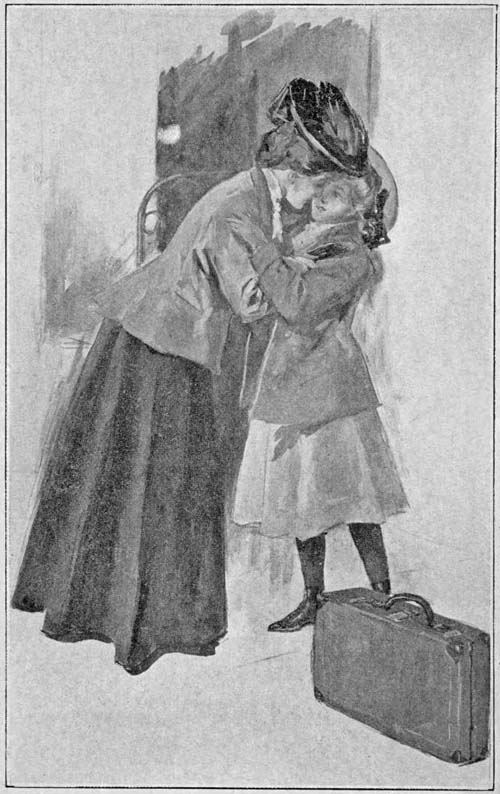
Jessica had gone to bed a homesick, ashamed, discouraged
girl. She awoke, full of determination to conquer
all the difficulties of this “education” which had,
last night, seemed so formidable.
As she stood before her little mirror, brushing the
yellow curls into that semblance of order which was their
morning state, and that so soon gave place to a tangle
of glistening threads and escaping tendrils, she regarded
herself with severity.
“Jessica Trent, you may be going to be ‘one of the
richest’ sometime, but at present you are a simpleton.
You’ve got everything before you—not a thing behind,
except—Well, except knowing how to ride a horse or
an ostrich, or hit a bull’s-eye, or a few other things that
Madame Mearsom would surely say were ‘unbefitting
a gentlewoman.’ I used to love that word, hearing my
mother use it. I begin—I begin to hate it! Humph!
There goes, already! A gentlewoman doesn’t say ‘hate.’
But listen, you girl in the glass. I’m going to study so
hard I’ll catch up with that lowest ‘form’ I’m not
clever enough to enter yet; and I’ll pass it by. Then I’ll
tackle the next one, and leave that behind. I’ll—get to
be the highest-up, intelligentest—that doesn’t sound right
but you know what I mean, Jessica Trent. I’ll be the
head of the school, as Aubrey said that handsome Helen
Rhinelander is. I’ll take care to keep every rule and I’ll
find out what they are. And I’ll do it all for love’s
sake—for my mother! I made a bad beginning, but
‘Little Captain,’ hear me say I’m bound to make a good
ending. I WILL! Right here and now I’ll write that
poetry out, which Madame quoted from that Goethe. I
know who he was, my father had his books in his little
library. Maybe, who knows! it might have been that
very verse which encouraged dear father to go ahead
and start Sobrante and try to help so many people. He
believed he could ‘do’ it and he did. I remember it
exactly.”
Taking a sheet of the school paper which was supplied
to each girl’s room, Jessica wrote in her very best
hand, and in that large size which would make the script
readable from every part of the room.
“What you can do, or think you can, begin it.
Boldness hath genius, power, and magic in it.”
This she pinned to the mirror-frame, and, after her
brief devotions, she answered to the “assembly bell”
that summoned her to the hall below; and entered as
“boldly” as if her heart were not beating very fast and
her cheek glowing very red, meeting the curious gaze of
her schoolmates.
Of course, the news of her escapade and Madame’s
anxiety concerning the three absentees from last night’s
table had spread through all the forms.
Helen Rhinelander had emphasized the fact that “one
must expect such things from a wild Westerner and that
for her part, she felt Madame had made a great mistake
in admitting such a creature to the Adelphi. Pretty?
Well, yes, in a certain way; but no style. Not an atom
of style; and style was the one thing neither money nor
education could procure. It had to be born in a person,”
said Helen, with decision, and all her coterie chirped:
“Yes.”
However, Helen was but one, although her influence
held many. Also, there may be counter-influences even
more powerful than wealth and style. Along with the
discussion of last night’s affair was circulated by some
braver spirits, the fact that it was the young “Westerner’s”
cool sense which had extricated the trio from a
most unpleasant position, and that Madame was smiling
affectionately upon her, as she now crossed the hall to
the seat assigned her.
The smile which Jessica flashed back into that
motherly face expressed something of the thought she
had had while brushing her hair. At least, Madame,
long versed in the study of young girls’ faces so interpreted
it; and now she not only smiled again but nodded
her white head in approval.
Prayers over, the family marched quietly out to breakfast,
that was as liberal in quantity and as faultlessly
served as it would have been in some big hostelry. A
small matter in itself, some might have said, but a detail
of infinite gain in the matter of the Adelphi’s success.
Also, an excellent equipment for the day’s study that
was to follow. “Healthy bodies make healthy minds”
was one of the schoolmistress’s maxims; a maxim nearly
always correct.
After breakfast there came a half-hour of recreation,
passed usually in the garden or conservatory behind the
house. Then a silver bell struck the school hour and
each girl filed to her place at her own individual desk in
her own form class-room.
This was Jessica’s first glimpse of a time-regulated
household, and she was so absorbed in watching the
others that she scarcely realized she had been left behind,
alone, till a pleasant-faced teacher addressed her:
“Miss Jessica, you are to be my ‘special’ for the
present. I am Miss Montaigne. This way, please. We
are to have a cosy little spot quite to ourselves, for a
time.”
“Good morning. I will try not to give you much
trouble, Miss Montaigne, but I am very stupid. I don’t
know anything, really.”
“All the more enjoyable then, to learn. I am so fond
of study myself that I fancy everybody else must be.
Sit here, please.”
The place was but an alcove, opening into the lower
form class-room, but isolated from it sufficiently that what
went on within between teacher and pupil could not be
overheard. A very haven of comfort for Jessica, had
she been really as stupid as she felt; and one that soon
became to her the very dearest spot in all the great
building. In reality, she was now so eager to learn that
she could have “tackled,” as she called it, every branch
of study represented in the institution at once and altogether.
But Miss Montaigne would have none of this.
“Madame has been a most successful instructor and
she allows no overcrowding. Two studies at a time,
with an ‘accomplishment’ is her rule. We are to take
up arithmetic and spelling first. With music, or art, or
what your taste decides. Now, we’ll begin. This sum
in addition, if you please;” and the teacher pointed to
the very simplest possible.
Jessica glanced at it in contempt.
“That? Why that’s far easier than making out the
‘boys’ wage-list. You must be teasing me!”
“No, indeed. Beginning at the root of things. That’s
all. You may climb and grow as fast as Jack’s bean-stalk
if you wish. I’ll help push!”
Why, what a delightful person this Miss Montaigne
was! Almost as good as another girl to talk with, and
how like a game she made that “hated” arithmetic
seem. It was a game. Played so swiftly and eagerly between
these two that before either noticed how the time
was passing the recess hour was struck and—such a
babel of happy voices as followed it.
Desks were deserted, mates sought mates, Aubrey
alone mourned sorrowful in her corner, though Natalie
rushed into the alcove and whirled Jessica out of it, disputing
with somebody across the room:
“You’re a mean, hateful girl! It is no such thing!
She isn’t! She’s a dear! Aren’t you, Jessica Trent?”
Jessica returned the ardent hug she received with
another as fond, then holding Natalie off demanded:
“Who are you quarreling with? What did she say?”
“That top-lofty Helen Rhinelander. She calls this
the ‘dunce’s corner’ and that you wouldn’t have been
any more conspicuous if Madame had stood you on a
stool with a cap on your head. I don’t see what’s the
matter with Helen. She’s hateful enough all the time
but she’s never been quite so unpleasant as since you,
came, yesterday. I—I wish she’d behave.”
“So do I. What’s more I’ll make her yet!”
“Why—Jessica! How can you?” asked the other
girl, astonished, as a group of schoolmates drew near,
anxious to know the “new-er” who had already so
stirred the quiet depths of the school.
There was a flash of “Little Captain’s” blue eyes, as
she answered:
“I don’t know just how yet but I will. I’ll make her
so ashamed she’ll want to hide her head. Madame said
she was a real gentlewoman, and if she is her hatefulness
can’t be deep. I’ll conquer her by kindness, as my
mother says is the best way with ugly folks. That’s the
way she did a Chinese cook we had at Sobrante, and who
was—horrible. But he got over it. Nobody could be
nicer than Wun Lung is now.”
“Let’s go out into the garden. The ’mums are just
beautiful now. Do you have chrysanthemums in California,
Jessica?” asked another girl, slipping her arm
about the stranger in such a friendly manner that Helen
Rhinelander’s coldness was forgotten.
“Little Captain” had always won liking, wherever she
was known, because of her keen interest in other people
and her forgetfulness of self, nor did she fail now. One
by one, her fellow students, even from the higher forms,
gathered about the stranger, listening to her “Californian
talk”—a subject which made her tongue run glibly;
and so graphically did she describe life at Sobrante that
she made these New Yorkers envious of its freedom and
constant sunshine. But not a word did she speak of her
prospective wealth; and, oddly enough, from this reticence
the notion spread that she was in reality a poor
girl.
“One of Madame’s charity pupils. The daughter of a
former ‘Adelphian’ who can’t afford to pay for her.
That’s why she’s dressed in such cheap stuff. Well,
she’s nice. She’s real nice, even if she is the ‘stupidest
girl in school,’ and I shall treat her just the same as if
she were one of us,” said Rosalie Thorne, a sweet-faced
senior who was Helen’s rival for “honors” and was
greatly beloved of both teachers and mates. She was,
also, a very conscientious person and, perceiving Helen’s
attitude toward the “wild Westerner” set herself to use
her own influence in an opposite direction.
Thus it happened that Jessica’s coming had divided
the school into two factions; which promptly elected
themselves to be “Pros” and “Cons,” and beginning
with the toss of one haughty young head had grown like
that veritable “bean-stalk” to which Miss Montaigne
had smilingly referred.
But Jessica, the innocent cause of this disruption, took
it lightly. Sufficient for her the fact that there were
“Pros” enough to more than satisfy her longing for
“girls,” and that these were almost as admiringly affectionate
as even her “boys” at home. So, before many
hours passed she was so happy that “she almost felt
wicked,” remembering how desperately sad she had been
at parting with her mother. She even questioned
Madame Mearsom herself upon the subject:
“Dear Madame, is it right for me to be so glad? Is
it like turning my back on mother and Cousin Margaret,
and all the rest of the grown-up folks? I’m not forgetting,
you know. I’m not really forgetting; only there
doesn’t seem to be room in my heart for sorrow and all
these good times together. This is the very first time
I ever lived with girls and I think—I think they are just
too delightful for words!”
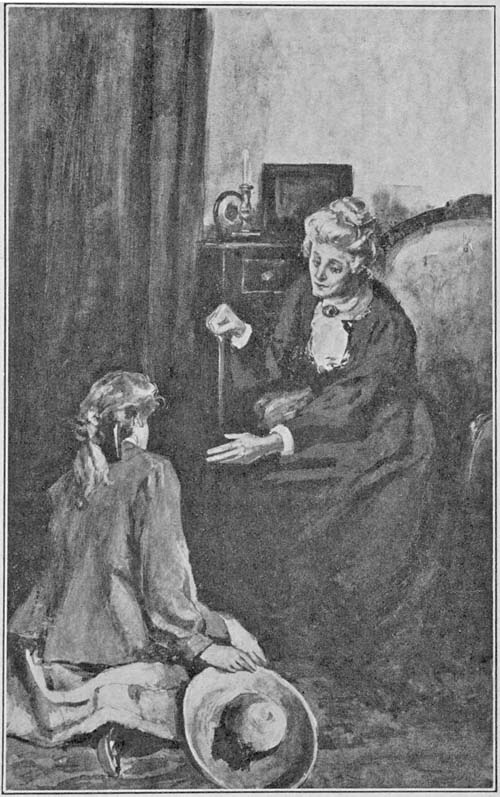
Whereat Madame patted the little hand which had
stolen to her shoulder and answered, emphatically:
“It is most certainly and entirely right. That is why
you are here—to be happy. I can send no more pleasing
message to Sobrante than that you are so ‘glad.’”
One thing alone really disturbed Jessica’s full content.
That was the peculiar behavior of Ephraim Marsh. Invariably,
when the day was fair enough for the “Adelphians”
to take their accustomed walks, “Forty-niner”
would appear on the opposite side of the same street. He
would march along, head erect, “eyes front,” as if keeping
step to some invisible band—his whole attitude as
correctly military as he could make it. Never, by any
possibility, did he recognize Jessica, nor answer to her
excited hand-salutes—the only sort she was permitted
on the street, or from that distance—and this hurt her
sadly. More than that, he never used his visitor’s privilege
of “once a week, on Thursdays, from four till
six.”
“All the other girls have their friends come to see
them, Ephy dear. Why don’t you?”
He gave her no explanation, simply said, each time:
“I’ll see.” Not for anything would he have confessed
to her that his proud old heart had been offended by
Madame’s slowly pronounced reply to his question concerning
these visits, for which his own soul hungered
unspeakably. He only urged her to get leave to come to
the flat as often as she could, even though such calls
were as unsatisfactory as possible.
“Couldn’t you come without that teaching woman
tagged to you, ‘Little Captain,’ not even once? I’d
come for you in a hired carriage and I’d pay the taxes
for it if it took my bottom dollar—which it wouldn’t.
I can’t half begin to use my wages, as a teacher myself,
and Sophia Badger Briggs being such an equonomical
housekeeper. I take Sophy posies, but I daren’t send
’em to you. Them windows to your ‘Adelphi’ are always
chock full of flowers anyway.”
“Yes. There’s a little conservatory, you know, in the
garden. Besides the girls’ folks, the rich folks that have
always lived in New York, send flowers. They consider
it so ‘refining’; but, Ephy dear! I’d give all my year’s
allowance just for one dear, yellow California poppy,
instead of these ‘American Beauties’ and orchids. Never
mind. We’ll be going home sometime and can gather
them for ourselves, and I am, I certainly am, very, very
happy. Why, Ephy! I’m learning so fast, I’ll be admitted
to the lowest form very, very soon. And I’m
taking fiddle lessons. I mean violin ones. I sing, too.
Madame says I have a very good ‘organ’—that’s something
in my throat, you know—though I’ll never equal
Gabriella! That’s mother. Gabriella was the ‘star pupil.’
She stood head of everything. Sometimes, when I
get pretty tired I feel as if it were dreadful to have to
live up to my mother! I don’t see why they don’t have
stars at both ends of the class, top and bottom; then I’d
be a star, myself, without any trouble. Ephraim Marsh,
did you know I was a dunce?”
“Shucks! No. Nor nobody knows it. ’Tisn’t so. If
you aren’t the smartest——”
“No, Ephy, it’s sadly, desperately true. The things I
don’t know would fill—would fill Madame’s ‘unabridged
dictionary!’ I get almost discouraged, times; but I do
love to learn things. I love it. Only I can’t learn them
half fast enough. I want to get to be a ‘star’ right
away quick.”
This was on one of Jessica’s brief visits to Granny
Briggs’s “apartment.” The girl had been corrected for
speaking of “flat.” Miss Montaigne who had accompanied
her special charge was reading a book she had
brought with her in the tiny front room, called the “parlor”
by the proud mistress of the little establishment.
In fact, she disliked her own present, enforced surveillance
of the trustworthy girl, who had grown up under
the faithful care of the old frontiersman; but Madame’s
rules were inflexible. Her young ladies must be attended
during such calls by some employee of her own.
Jessica suddenly remembered the young lady in the
parlor and pushed aside the plate of Indian pudding
which had been part of Granny’s “New England dinner.”
“Oh! dear! I suppose I must go now. Dear Ephy, do
stop that angry tramping up and down! The little dining-room
isn’t big enough for such a great old fellow as
you to go ‘rampagin’ in. We’re going to school, both
of us, aren’t we? But, have patience, we’ll graduate
sometime—with honors or without them, who knows?
And then we’ll go home.”
“You believe we will! Why, ‘Little Captain,’ I’m
saving up again’ it already. It shan’t cost anybody but
Ephraim Marsh, one single cent for all this coming and
going, these betwixts and betweens, and all the whole
enduring business of living in New York till we get
graddyated. Shucks! What’s Sophia Badger doing
now?”
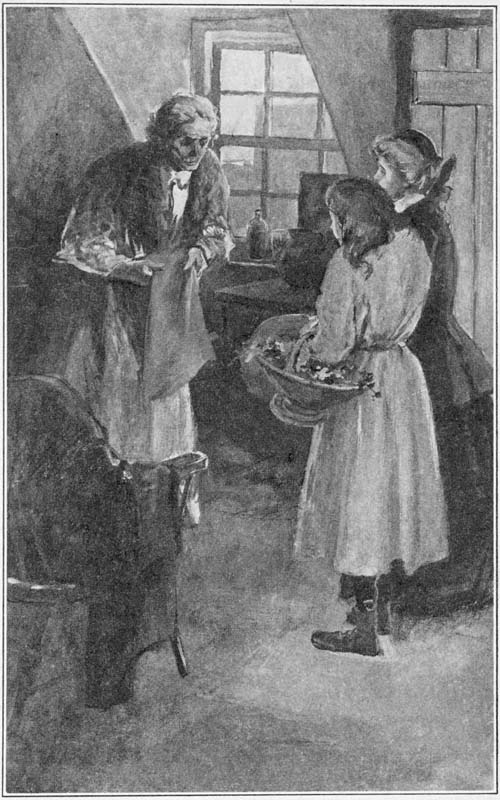
What, indeed! Could that hospitable creature, who
had neither hesitated nor been ashamed once to offer her
last slice of bread to a chance visitor, could she do less
than hunt out her one plate which had a trifle of decoration
about it, and heaping it with the really delicious pudding
carry it into her parlor for Miss Montaigne’s
delectation?
Ephraim was aghast. He was more afraid of the prim
little “special” than even of the Madame herself, for the
younger woman wore “glasses” that magnified the eyes
behind them into something really formidable. Besides,
however she might lay aside austerity when with her
pupil, she assumed the most dignified of manners when
abroad.
That is, she had done so, heretofore. But Granny
Briggs—even the rule-encased schoolma’am could not
withstand her appealing face, encircled by its flapping
cap-ruffle; and with an apparent delight she graciously
accepted the pudding, murmuring her most correct
“Thank you.”
In another moment the delight had ceased to be apparent
and had become real. One mouthful of the
“tasty” dessert proved that this was something quite
out of the common, and the pretty plate was not returned
to Granny till it was empty.
“O Mrs. Briggs! That was so kind of you. Your
dainty has carried me back to the time when I went visiting
my own grandmother in your New England, and her
big kitchen with all its good things. I have enjoyed it
more than anything I have eaten for a long, long time.”
This was a trivial matter in itself; but it was not
trivial in its results. Thereafter Miss Montaigne threw
all her influence to bear in giving Jessica more frequent
chances to meet her “humble friends,” as Madame called
them; and now and then to let her meet them as Ephraim
had desired, under his escort to and fro.
One thing delighted his soul. Late in the year Madame
added a riding academy to her school; or engaged one
for certain afternoons of each week. Here the sharpshooter
knew his darling would shine, and she did.
Yet her success seemed for a time but to increase the
unfriendliness of the “Con” side of the school. The
riding classes had been added by the solicitation of Helen
Rhinelander, already a fine horsewoman, who, during her
summer vacations had sometimes “ridden to hounds”
with some fashionable house-party. She loved riding
beyond all other exercise, and had been early taught.
She looked for no rival in the matter; but the very first
day, when Jessica had been admitted to the lesson, she
saw that she might be equalled, or even eclipsed.
“That girl rides as if she were part of her horse. The
master gave her that fractious brute of his own, as soon
as she begged for it, thinking that the easiest way to
take down her self-conceit; and meaning, of course, to
keep close beside her in case of a fall. Fall? The animal
couldn’t shake her off. He tried, forward and backward,
sidewise and every other wise, but she stuck like a
burr. The master was amazed. Soon he let go the
bridle and only watched—to be ready for accident. After
that he watched from sheer delight; and as soon as
she had made the circuit of the ring a few times and had
brought her mount down to a quiet pacing, he said:
‘Miss Trent, I must congratulate you. I have nothing
to teach you.’
“Then Jessica was afraid he wouldn’t let her stay in
the class, and asked him; and, of course, he said he was
only too proud of the honor. Then he questioned her and
found out that she had been put on a horse’s back before
she was out of baby-clothes and had to be held
there, while the horse was led around; and afterward—‘Well,
afterward, I don’t remember much except a
horse, or sometimes a burro. One has to ride in California,
it’s so big, and wide, and places are so far apart;
and, oh! yes! I forgot! I can ride an ostrich, too. King
Zulu was the first one in America who was ever mounted,
so the “boys” claim. He is more fun even than the swiftest
horse; he’s faster, you know.’
“Fancy, Madame Mearsom, that girl talking away like
that to our reserved master! But he liked it. He liked
it so well, he even said: ‘I thought I had a magnificent
horsewoman in Miss Rhinelander, but Miss Trent, I
fear she will have to yield the palm to you.’”
“O Rosalie! I’m sorry he said that,” answered
Madame, to whom Miss Thorne had given the above
description. “I’ve heard about this division in the school—our
rival favorites; and though I have seemed to ignore
it, it has grieved me deeply. Helen is charming,
but for some unknown reason she appears to have taken
a dislike to Jessica. I am very, very sorry. There should
be no rivalry or jealousy between those two. They are
not of the same age, they differ in all respects—I mean
are so unlike one another—they ought to be the best of
friends. Do what you can, dear Rosalie, to bridge this
difference. I wish something would happen to settle
the matter!”
Something was to happen; but the anxious schoolmistress
could not foresee that it would be in the nature of
a tragedy.