Jerusalem, The City of Herod and Saladin: by Walter Besant and E.H. Palmer
Whole book · 24 sections
Transcriber’s Note:
Footnotes have been collected at the end of each chapter, and are
linked for ease of reference.
The Appendix features several pages of column-wise text and comment
with some irregular indentation, which has not been retained.
Minor errors, attributable to the printer, have been corrected. Please
see the transcriber’s note at the end of this text
for details regarding the handling of any textual issues encountered
during its preparation.
Any corrections are indicated using an underline
highlight. Placing the cursor over the correction will produce the
original text in a small popup.
Any corrections are indicated as hyperlinks, which will navigate the
reader to the corresponding entry in the corrections table in the
note at the end of the text.
From a Photograph byC. F. Tyrwhitt Drake, Esq.] [Frontispiece. THE DOME OF THE ROCK.
JERUSALEM,
THE CITY OF HEROD AND SALADIN.
BY
WALTER BESANT, M.A.,
CHRIST’S COLLEGE. CAMBRIDGE.
AUTHOR OF “STUDIES IN EARLY FRENCH POETRY,” ETC., ETC., ETC.
AND
E. H. PALMER, M.A.,
LORD ALMONER’S PROFESSOR OF ARABIC IN THE UNIVERSITY OF
CAMBRIDGE, AND FELLOW OF ST. JOHN’S COLLEGE.
AUTHOR OF THE “DESERT OF THE EXODUS.”
ETC., ETC., ETC.
LONDON:
RICHARD BENTLEY AND SON,
NEW BURLINGTON STREET,
Publishers in Ordinary to Her Majesty.
1871.
[The Right of Translation is reserved.]
LONDON
PRINTED BY WILLIAM CLOWES AND SONS, STAMFORD STREET
AND CHARING CROSS.
PREFACE.
v
Very few words are needed to introduce this volume.
It is intended to give a history of the city of Jerusalem
from about the year 30 to the present time. This period
includes the siege and capture by Titus, the last revolts of
the Jews, the Christian occupation of three hundred years,
the Mohammedan conquest, the building by the Mohammedans
of the Dome of the Rock, the Crusades, the
Christian kingdom, the reconquest of the city, and a
long period of Mohammedan occupation, during which no
event has happened except the yearly flocking of pilgrims
to the Church of the Sepulchre, and an occasional
quarrel among the monks.
There are here, surely, sufficient materials for the historian
if only he knows how to use them.
For the modern period, that of the Christian kingdom,
two sources of information exist, one, the contemporary and
later chronicles of the Crusaders, written either in Latin or
Langue d’Oil, and the other, the Arabic historians themselves.
I have written my own part of the book from the
former; to my colleague is due all that part (the
Mohammedan Conquest, the chapter on Saladin, &c.)
which has been taken from Arabic writers. Most of this
vihas the great advantage of being entirely new, and now for
the first time introduced to English readers. For my
own share in the work, I claim no other novelty than the
presentation of facts as faithfully as I could gather them,
at first hand, and from the earliest writers.
There is nothing sacred about the actors in this long
story we have to tell, and we have not thought it necessary
to endeavour to invest them, as is generally done by those
who write on Jerusalem, with an appearance of sanctity,
because they fought for the City of Sacred Memories, or
because they bore the Cross upon their shoulders. We
have, on the other hand, endeavoured to show them as
they were, men and women actuated by mixed motives,
sometimes base, sometimes noble, sometimes interested,
sometimes pure and lofty: but always men and women,
never saints. The Christians in the East were as the
Christians in the West, certainly never better, more often
worse. If we have succeeded in making a plain tale,
divested of its customary pseudoreligious trappings,
interesting and useful, our design is satisfied.
One word more. There may be found, owing to the
double source from which our pages are derived, certain
small discrepancies in the narrative. We have not cared
to try and reconcile these. Let it be remembered that the
one narrative is Christian, the other Mohammedan.
W. B.
October, 1871.
CONTENTS. — JERUSALEM. THE CITY OF HEROD AND SALADIN.
It is our object to write a book which may serve as a historical
account, complete so far as it goes, of the principal
events with which Jerusalem is concerned, from the time
when its history, as connected with the Bible, ceases, till the
present; that is to say, from the year A.D. 33 downwards.
But it is difficult to take up the thread of the story at this
date, and we are forced either to go as far back as Herod
the Great, or to begin our narrative with the events which
preceded the siege of Jerusalem by Titus. No date seems
to us more ready to our hand than that of the death of
Herod Agrippa. Even then we may seem beginning to
tell a thrice told tale. The revolt of the Jews, their
defeat of Cestius, the siege of Titus, are surely, it may be
objected, too well known to require telling again. They
are not well known, though they have been told again and
again, and told with ten times the force, the vigour, the
originality which we can put into these pages. But they
are told here again because our central figure is Jerusalem.
We have to show her first, in all her pride, the joy
of the Jews, the visible mark of their greatness; and then
we have to follow her through two thousand years of
varying fortune, always before the eyes of the world,—always
2the object of tender pity and reverence,—always
the centre of some conflict, the scene of some religious
contention. Frequent as were the sieges of the city in
the olden days, they have been more frequent since.
Titus took Jerusalem, Barcochebas took it, Julius Severus
took it, Chosroes, Heraclius, Omar, the Charezmians,
Godfrey, Saladin, Frederick, all took it by turns,—all after
hard fighting, and with much slaughter.
There is not a stone in the city but has been reddened
with human blood; not a spot but where some hand-to-hand
conflict has taken place; not an old wall but has
echoed back the shrieks of despairing women. Jew, Pagan,
Christian, Mohammedan, each has had his turn of triumph,
occupation, and defeat; and were all those ancient
cemeteries outside the city emptied of their bones, it
would be hard to tell whether Jew, or Pagan, or
Christian, or Mohammedan would prevail. For Jerusalem
has been the representative sacred place of the world; there
has been none other like unto it, or equal to it, or shall be,
while the world lasts; so long as men go on believing that
one spot in the world is more sacred than another, because
things of sacred interest have been done there, so long
Jerusalem will continue the Holy City. That this belief
has been one of the misfortunes of the human race, one of
the foremost causes of superstition, some of the pages which
follow may perhaps help to show. But, in our capacity as
narrators only, let us agree to think and talk of the city
apart, as much as may be, from its sacred associations, as
well as from its ecclesiastical history.
The fatal revolt of the Jews, which ended in the fall of
their city and the destruction of their Temple, was due,
among many other causes, to the teaching of Judas the
Galilæan acting on minds inflated with pride in the
exaggerated glories of the past, looking to national independence
as the one thing needful, and wholly ignorant
of the power and resources of the mighty empire which
3held them in subjection. Judas, himself in spirit a
worthy descendant of the Maccabæans, had taught that
Jehovah was the only King of the Jews, who were his
chosen people; that submission to a foreign yoke involved
not only national degradation, but treason to the lawful
powers; that tribute, the badge and sign of slavery, ought
to be refused at any cost. “We have no Lord and
master but God,” was the cry of his party. With that
cry he and his followers assembled to do battle against
the world: with that cry on their lips they died. But
the cry and its idea did not die; for from that time a
fourth sect was among the Jews, more powerful than all
the rest put together, containing the great mass of the
people, who had no education to give them common sense,
and whose ignorance added fuel to the flames of a
religious enthusiasm almost without parallel in the history
of the world. The Pharisees and the Sadducees still
continued for a time in the high places; the Essenes still
lived and died apart from the world, the Shakers of their
time, a small band with no power or influence; but all
around them was rising a tide destined to whelm all
beneath the waves of fanaticism. The followers of Judas
became the Zealots and the Sicarii of later times: they
were those who looked daily for the Messiah; whom false
Christs led astray by thousands; who thought no act too
daring to be attempted in this sacred cause, no life too
valuable to be sacrificed: they were those who let their
countrymen die of starvation by thousands while they
maintained a hopeless struggle with Titus.
When Herod Agrippa died, his son, who was only seventeen
years of age, was in Rome; and, as he was too young
to be entrusted with the conduct of the turbulent province
of Judæa, Cuspius Fadus was sent there as Governor.
He found that Agrippa had allowed the robbers who
always infested the country east of Jordan to gain head.
He put them down with a strong arm, and turned his
4attention to things of domestic importance. By the
permission of Vitellius, the custody of the sacred robes
had been surrendered to the High Priest. Cuspius
Fadus ordered that they should be restored to the fortress
of Antonia. The Jews appealed to Cæsar, and, by
the intercession of young Agrippa, they carried their
point, and retained the possession of the robes. Under
Fadus, one Theudas, whom Josephus calls a magician,
persuaded multitudes of the Jews to go with him to the
Jordan, which he pretended would open its waters to let
him pass. Cuspius Fadus sent out a troop of cavalry,
who took Theudas alive, cut off his head, and brought it
to Jerusalem. Under Cuspius, too, occurred a great
famine in Judæa, which was relieved by the generosity of
Queen Helena of Adiabene, the proselyte.[1]
1. The story of Queen Helena is told by Josephus, ‘Antiq.’ xx.
2, 3, 4, and in Milman, ‘Hist. of the Jews,’ ii. p. 200; and see
also, for the whole of this period, Williams’s ‘Holy City,’ vol. i.
p. 150 et seq.
When Fadus either died or was recalled, Tiberius
Alexander, a renegade Jew, nephew of Philo, succeeded
him for a short time. It is not stated how long he continued
in power. His only recorded act is the crucifixion
of two of the sons of Judas the Galilæan. In his turn
Tiberius was replaced by Ventidius Cumanus, and the
first symptoms of the approaching madness broke out.
The fortress of Antonia commanded the Temple area,
and communicated with the Temple itself by means of
cloisters. On those days of public festivals when the
fanaticism of the people was most likely to break out
and cause mischief, a strong guard was always placed in
Antonia, in full view of the people, to overawe them with
good behaviour. Most unfortunately, on one occasion,
immediately after the arrival of Cumanus, one of the
soldiers of the guard expressed his contempt for the
religious ceremonies by an indecent gesture. The rage
5of the people knew no bounds; they declared that
Cumanus had himself ordered the affront to be committed.
The governor bore their reproaches with patience, only
urging them not to disturb their festival by riotous conduct.
As, however, they still continued clamouring, he ordered
his whole garrison to proceed to Antonia. Then a panic
ensued. The mob, thinking they were about to be
attacked by the soldiers, turned and fled, trampling on
each other in the narrow passages. Many thousands
perished in this way, without a blow being struck.
And while they were still mourning over this disaster,
another happened to them. Some of the very men who
had raised the first tumult, probably countrymen on their
way home, fell on and robbed Stephanus, a slave of
the Emperor. Cumanus, obliged to punish this, sent
soldiers to bring in the chief men of the village. One
of the soldiers tore up a book of the Law with
abuse and scurrility. The Jews came to Cumanus, and
represented that they could not possibly endure such
an insult to their God. Cumanus appeased them for
the time by beheading the soldier who had been guilty
of the offence.
The animosities of the Samaritans and the Jews were
the cause of the next disturbances. The Galilæans always
used the roads which passed through the Samaritan
territory in their journeys to and from the Temple.
Faction fights naturally often took place. In one of these,
of greater magnitude than the generality, a good many
Galilæans were killed: the Jews came to Cumanus and
complained of what they were pleased to call murder.
Cumanus took the part of the Samaritans, and actually
went to their aid, after the Jews called in the assistance of
a robber chieftain, and helped them to defeat the Galilæans.
It is difficult to see what else they could do. Both parties
appealed to Cæsar. Cumanus was recalled: his military
tribune was beheaded, decision was given in favour of the
6Jews: all this, no doubt, was done with a full knowledge
of the dangerous and the turbulent nature of the people,
and with a view to preserving the peace.
Claudius Felix was sent in place of Cumanus, a freedman,
brother of Pallas the favourite of the Emperor,
magnificent, prodigal, luxurious, and unscrupulous. He
found the country in the worst state possible, full of
robbers, and impostors. These sprung up everyday, and
were everyday caught and destroyed; no doubt most of
them men whose wits were utterly gone in looking for the
Messiah, until they ended in believing themselves to be the
Messiah. These poor creatures, followed by a rabble more
ignorant and more mad than themselves, went up and
down the distracted country, raising hopes which were
doomed to disappointment, and leading out the wild
countrymen to meet death and torture when they looked
for glory and victory. One of the impostors, an Egyptian,
probably an Egyptian Jew, brought a multitude up to the
Mount of Olives, promising that at his word the walls of
the city should fall down, and they themselves march in
triumphant. He came, but instead of seeing the walls fall
down, he met the troops of Felix, who dispersed his people,
slaying four hundred of them.
To Felix belongs the crime of introducing the Sicarii into
the city of Jerusalem. Wearied with the importunities of
the high priest, Jonathan, who exhorted him continually
to govern better, or at all events to govern differently,
and reproached him with the fact that it was through his
own influence that Felix obtained his office, he resolved to
rid himself of a friend so troublesome, by the speediest and
surest method, that of assassination. The Sicarii were not,
like the hired bravoes of the middle ages, men who would
commit any murder for which they were paid. It appears,
on the contrary, that they held it a cardinal point of faith
to murder those, and only those, who seemed to stand in the
way of their cause. Now their cause was that of the sect
7which had grown out of Judas’s teaching, the zealots.
These Sicarii mingling with the crowd of those who went
up to worship, carrying daggers concealed under their
garments, fell upon Jonathan the High Priest, and
murdered him.[2] This done they went on slaying all those
who were obnoxious to them, even in the Temple itself.
“And this,” says the historian, “seems to me the reason
why God, out of his hatred to the wickedness of these men,
rejected our city: and as for the Temple, he no longer
esteemed it sufficiently pure for him to inhabit therein, but
brought the Romans upon us, and threw a fire upon the
city to purge it: and brought upon us, our wives, and
children, slavery,—as desirous to make us wiser by our
calamities.” And now the voice of discord was heard even
among the priests themselves, who had hitherto preserved
a certain sobriety. Between the chief priests and “the
principal men of the multitude of Jerusalem,” a feud broke
out. Each side had its followers: they cast, we are told,
not only reproachful words, but also stones at each other.
And the chief priests, robbing the threshingfloors and
appropriating all the tithes to themselves, caused many of
the poorer priests to die of want.
2. Milman says, in the Temple itself, which does not appear from
the account of Josephus, who expressly says that, after this, they
had the boldness to murder men in the Temple itself.
Then occurred the first outbreak in Cæsarea. This
town was about equally divided between the Syrians and
the Jews, the former claimed the pre-eminence on the
ground that Herod the founder, though himself a Jew,
had built the splendid temples and statues by which
the city was evidently intended to be a Grecian city,
upon the site of Strato’s Tower; while the Jews argued
that as the founder was a Jew, the city was evidently
Jewish, and ought not to be ruled except by Jews. The
dispute, as was always the case, came to the arbitrament
of arms, in which the Jews got the best of it. Then
8Felix came himself, with a strong force, and brought them
to their senses. But as the dispute still went on, he sent
representatives on both sides to Nero the Emperor, who
ruled in favour of the Greeks or Syrians. Here, the
decision of the Emperor appears to have been just. Herod,
the founder of Cæsarea, had clearly not intended to found a
city for the further propagation of a sect to which he
indeed belonged, regarding it, nevertheless, with the
toleration of a cultivated Roman, as only one sect out of
many. The Jews accepted the decision in their usual
way: they only became more turbulent. Agrippa’s own
dispute with his own countrymen was decided, however,
in their favour, no doubt from politic considerations. He
had built an upper room in his palace, where, lying on
his couch, he could look over into the Temple and watch
the sacrifices. Some of the priests discovering this, made
out that it was an intrusion into the necessary privacy of
their religious ceremonies, and hastily ran up a wall to
prevent being overlooked. Festus, who had now succeeded
Felix, ordered it to be pulled down; but, most probably
at the instigation of Agrippa, whose popularity might be
at stake, he gave permission to appeal to Nero. Ismael,
the high priest, went, accompanied by the keeper of
the Treasury. They carried their point: the wall was
allowed to stand, but Ismael was detained in Rome, and
Agrippa appointed and deprived three high priests in
succession—Joseph, Annas, and Jesus son of Dammai.
The firm, strong hand of Festus was meantime employed
in putting down robbers, and regulating the disturbances
of the country. Unhappily for the Jews, while he was so
engaged, he was seized with some illness and died.
Albinus succeeded him. As for Albinus, Josephus tells us
that there was no sort of wickedness named but he had a
hand in it. “Not only did he steal and plunder every one’s
substance, not only did he burden the whole nation with
taxes, but he permitted the relations of such as were in
9prison for robbery to redeem them for money; and nobody
remained in the prisons as a malefactor but he who gave
him nothing.... The principal men among the seditious
purchased leave of Albinus to go on with their practices:
and every one of these wretches was encompassed with his
own band of robbers. Those who lost their goods were
forced to hold their peace, when they had reason to show
great indignation at what they had suffered; those who
had escaped were forced to flatter him, that deserved to be
punished out of the fear they were in of suffering equally
with the others.”
This, however, is a vague accusation, and is found in the
‘Wars of the Jews,’ where Josephus is anxious to represent
the revolt of the people as caused by the bad government of
the Romans. From the ‘Antiquities’ we learn that it was
Albinus’s wish to keep the country in peace, with which
object he destroyed many of the Sicarii. Unfortunately for
himself, he formed a great friendship with Ananias the
high priest; and when Eleazar, son of Ananias, fell into the
hands of the Sicarii, he consented to release ten of his own
prisoners for his ransom. This was a fatal measure,
because henceforth the Sicarii, if one of their number fell
into trouble, and got taken by the Romans, caught a Jew
and effected an exchange. Thus the prisons were emptied.
At this time the Temple was finished, and eighteen
thousand workmen found themselves suddenly out of
employment. Terrified at the prospect of this starving
mob being added to their difficulties (for the streets of
Jerusalem were already filled with bands of armed men,
partisans of deposed high priests), the citizens asked
Agrippa to rebuild the Eastern Cloisters, the splendid
piece of work which had been built originally by Solomon
along that east wall which still stands overlooking the
valley of the Kedron. But Agrippa, whose interest in the
turbulent city was very small, already meditated departure
to some safer quarter, and was spending all the money he
10had to spare at Beyrout, where he built a theatre, and
collected a gallery of sculptures. But he conceded something
to his petitioners, and allowed them to pave the city
with stone.
Albinus disappears from the history, and Gessius
Florus, who exchanged a scourging with whips for a
scourging with scorpions, ruled in his place. Cestius
Gallus, a man of equal rapacity with himself, ruled in
Syria. One cannot read Josephus without, in the first
place, suspecting that he wilfully exaggerates the wickedness
of the Roman rulers; that he does so in the case of
Albinus is clear, as we have shown from comparing the
account given in the ‘Antiquities’ with that given in the
‘Wars.’ But even if he only exaggerates, and making
allowance for this, were men of special inhumanity and
rapacity chosen for those very qualities to rule the
country? And if not, if Gessius Florus and Albinus be
fair specimens of the officers by whom Rome ruled her
provinces and colonies, by what mysterious power was
this vast empire kept from universal revolt?
“Upon what meat had this their Cæsar fed,
That he was grown so great?”
The Jews, however, were not the people to brook ill-treatment;
and when they took arms against the Romans
it was not as if their case seemed to themselves hopeless.
They had, it is true, the western world against them; but
they had the eastern world behind them, a possible place
of refuge. And though they armed against the whole
Roman Empire, it must be remembered that the forces at
the command of the Emperor were not overwhelming;
that they were spread over Africa, Egypt, Spain, Gaul,
Britain, Greece, and Italy; that only a certain number
could be spared; and that the number of the Jews in
Syria amounted probably to several millions. When
Cestius Gallus was in Jerusalem at the time of the Passover
11he ordered the lambs which were sacrificed to be
counted. They came to two hundred and fifty-five thousand
six hundred. It was reckoned that this represented
a total of three millions present in Jerusalem and camped
round about it, assisting at the festival. Probably not
more than half, perhaps not more than a quarter of the
whole number of the people came up. However this may
be, it is certain that Palestine was very densely populated;
that there were great numbers of Jews in Alexandria,
Asia Minor, and Italy; that at any signal success those
would have flocked to the standard of revolt; and that
had the nation been unanimous and obedient to one
general, instead of being divided into sects, parties, and
factions, the armies of Vespasian and Titus would have
been wholly unable to cope with the rebellion, and the
independence of the Jews would have been prevented
only by putting forth all the power of the Roman
Empire. This was shown later on in the revolt of Barcochebas,
a far more serious revolt than this of the zealots,
though not so well known, because it was attended with
no such signal result as the destruction of the Temple,
and because there was no Josephus in the camp of the
enemy taking notes of what went on.
The object of Florus, we are told, was to drive the
people to revolt. This we do not believe. It could not
have been the policy of Florus to drive into revolt a
dangerous and stubborn people, whose character was well
known at Rome, whom the Emperor had always been
anxious to conciliate. His object may have been, undoubtedly
was, to enrich himself as speedily as possible,
knowing that revolt was impending and inevitable, and
anxious to secure himself a provision in case of his own
recall or banishment. Until that provision was secured it
would have been fatal for Florus that the revolt should
break out.
The first disturbances took place at Cæsarea, when the
12Greeks, exulting in Nero’s decision, were daily more and
more insulting to the Jews. The latter had a synagogue,
round which was an open space of ground which they
wished to purchase. The owner refused to sell it, and
built mean shops upon it, leaving only a narrow passage
whereby the Jews could pass to their place of worship.
One John, a publican, went to Florus, and begged him to
interfere, offering at the same time a bribe of eight
talents, an enormous sum, which shows that this was
more than an ordinary squabble. Florus went away,
leaving them to fight it out; and the Greeks added fresh
matter of wrath to the Jews by ostentatiously sacrificing
birds in an earthen vase as they passed to the synagogue.
The significance of this act was that the Greeks loved to
tell how the Jews had been all expelled from Egypt, on
account of their being leprous. Arms were taken up, and
the Jews got the worst of the fray. They withdrew to a
place some miles from the town, and sent John to Florus
to ask for assistance. John ventured on a reminder about
the eight talents, and was rewarded by being thrown into
prison. Then Florus went on to Jerusalem, where the
wildest tumults raged in consequence of this affront to
religion. Alarmed at the symptoms of revolt, he sent
messengers beforehand to take seventeen talents out of the
sacred treasury, on the ground that Cæsar wanted them.
Then the people ran to the Temple, and called upon Cæsar
by name, as if he could hear them, to rid them of this Florus.
Some of them went about with baskets begging money for
him as for a man in a destitute and miserable condition.
The next day news came that Florus was advancing to
the city, and the people thought they had better go out
and speak him fair. But he was not disposed to receive
their salutation, and so sent on Capito, a centurion, with
fifty soldiers, bidding them go back and not pretend to
receive him as if they were delighted to see him among
them again. And he rode into the city, the people being
13all expectation of what would happen the next day. And
in the morning the tribunal of Florus was erected before
the gates of his palace. The high priest was summoned
to attend, and ordered to give up those who had led the
tumult. He urged in extenuation that he did not know
the ringleaders, that the act of a few hot-headed youths
ought not to be visited on the whole city, and that, in
short, he was very sorry for the whole business, and hoped
Florus would overlook it. Florus gave orders to his
soldiers to pillage the upper market; they did so, scourging,
pillaging, and murdering. Berenice, the sister of
Agrippa, came herself, barefoot, with shorn head and
penitential dress, before Florus, urging him to have pity.
But the inexorable Roman, bent on revenge, allowed the
soldiers to go on.
Next day he sent again for the high priest, and told him
that as a sign of the loyalty of the people, and their
sorrow for the late tumults, he should expect them to go
forth and meet the two cohorts who were advancing to
Jerusalem with every sign of joy. The seditious part of
the citizens refused. Then the chief priests, with dust
upon their heads and rent garments, brought out the holy
vessels and the sacerdotal robes, with their harpers and
harps, and implored the people not to risk a collision with
the Romans. They yielded, and went out to welcome the
cohorts. But the soldiers preserved a gloomy silence.
Then some of the more fiery Jews, turning on the Romans,
began to abuse Florus. The horsemen rode at them and
trampled them down, and a scene of the wildest uproar
took place at the gates as they pressed and jostled each
other to get in. Then the troops marched straight on
Antonia, hoping to get both the fortress and the Temple
into their hands. They got into Antonia, when the Jews
cut down some part of the cloisters which connected the
fort with the Temple. Florus tried to join them, but his
men could not pass through the streets, which were
14crammed with Jews. And next day Florus retired to
Cæsarea, leaving only one cohort behind, and the city
boiling and seething with rage and madness. And now,
indeed, there was little hope of any reconciliation. Both
Florus and the Jews sent statements of their conduct to
Cestius Gallus, and begged for an investigation. And it
must have been now, if at all, that Florus became desirous
of fanning the embers of discontent into a flame and
making that a war which had only promised to be a
disturbance. But nothing can be discovered to prove that
Josephus’s assertions as to his motives are based on fact.
It is easy, of course, to attribute motives, but hard to
prove them. Nothing advanced by Josephus proves more
than that Florus was rapacious and cruel, and the people
discontented and turbulent. Cestius sent Neapolitanus,
one of his officers, to report on the condition of the city.
Agrippa joined him. The people came sixty furlongs out
of the town to meet them, crying and lamenting, calling
on Agrippa to help them in their miseries, and beseeching
Neapolitanus to hear their complaints against Florus.
The latter they took all round the city, showing him that
it was perfectly quiet, and that the people had risen, not
against the Romans, but against Florus. Then Neapolitanus
went into the Temple to perform such sacrifices
as were allowed to strangers, and commending the Jews for
their fidelity, went back to Cestius. Agrippa came next.
Placing his sister Berenice, doubtless a favourite with the
people, in the gallery with him, he made a long harangue.
He implored them to consider the vast power of the
Romans, and not, for the sake of a quarrel with one
governor, to bring upon themselves the ruin of themselves,
their families, and their nation. He pointed out that if
they would have patience the state of their country should
be fairly placed before the emperor’s consideration, and he
pledged himself that it would receive his best care.
“Have pity,” he concluded, with a burst of tears,—“have
15pity on your children and your wives, have pity upon this
your city and its holy walls, and spare the Temple; preserve
the holy house for yourselves.”
The Jews, ever an impressionable race, yielded to the
entreaties of Agrippa and the tears of Berenice, and
making up the tribute money, paid it into the treasury.
Then they began to repair the damage they had done to
Antonia. All looked well; but there was one thing yet
wanting to complete their submission, they were to obey
Florus till he should be removed. This condition they
refused to comply with, and when Agrippa urged it upon
them, they threw stones at him and reproached him with
the uttermost bitterness. Then Agrippa went away in
despair, taking with him Berenice, and leaving the city
to its fate.
The insurrection began, as it ended, with the taking of
the stormy fortress of Masada near the Dead Sea. Here
the Roman garrison were all slaughtered. Eleazar the
son of Ananias the high priest began the insurrection in
Jerusalem, by passing a law that the sacrifices of strangers
were henceforth to be forbidden, and no imperial gifts to
be offered. The moderate party used all their influence,
but in vain, to prevent this. Agrippa sent a small army
of three thousand men to help the moderates. The
insurgents seized the Temple: the moderates, who
included all the wealthy classes, occupied the upper city,
and hostilities commenced. A great accession of strength
to the insurgents was caused by the burning of the public
archives, where all debts were incurred, and consequently
the power of the rich was taken from them at one blow.
Then appeared on the scene another leader, for a very
brief interval, Manahem, the youngest son of Judas the
Galilæan. He came dressed in royal robes and surrounded
with guards, no doubt eager to play the part of another
Maccabæus. The insurgents took Antonia and the royal
palace, and drove the Roman garrison to the three strong
16towns of Hippicus, Phasaelus, and Mariamne. Ananias,
found hidden in an aqueduct, was killed at once; and
Manahem became so puffed up with his success that he
became intolerable. It was easy to get rid of this mushroom
king, who was deposed without any trouble by
Eleazar and tortured to death. And then the Roman
garrison yielded, Metilius, their commander, stipulating
only for the lives of his soldiers. This was granted; but
no sooner had they laid down their arms than the Jews
fell upon them, vainly calling on the faith of a treaty,
and murdered them all except Metilius. Him they spared
on condition of his becoming a proselyte.
On that very day and hour, while the Jews were
plunging their daggers in the hearts of the Romans, a
great and terrible slaughter of their own people was going
on in Cæsarea, where the Syrians and Greeks had risen
upon the Jews, and massacred twenty thousand of them in a
single day. And in every Syrian city the same madness
and hatred seized the people, and the Jews were ruthlessly
slaughtered in all. No more provocation was needed; no
more was possible. In spite of all their turbulence, their
ungovernable obstinacy, their fanaticism and pride, which
made the war inevitable, and in the then state of mankind
these very massacres inevitable,—one feels a profound
sympathy with the people who dared to fight and die,
seeing that it was hopeless to look for better things. The
heads of the people began the war with gloomy forebodings;
the common masses with the wildest enthusiasm, which
became the mere intoxication of success when they drove
back Cestius from the walls of the city, on the very eve of
his anticipated victory—for Cestius hastened southwards
with an army of twenty thousand men, and besieged the city.
The people, divided amongst themselves, were on the point
of opening the gates to the Romans, when, to the surprise
of everybody, Cestius suddenly broke up his camp and
began to retreat. Why he did so, no one ever knew;
17possessed by a divine madness, Josephus thinks, because
God would take no pity on the city and the Sanctuary.
As the heavy armed Romans plodded on their way in
serried ranks, they were followed by a countless multitude,
gathering in numbers every hour, who assailed them with
darts, with stones, and with insults. The retreat became
a flight, and Cestius brought back his army with a quarter
of its numbers killed, having allowed the Roman arms
to receive the most terrible disgrace they had ever endured
in the East.
Vespasian was sent hastily with a force of three legions,
besides the cohorts of auxiliaries. A finer army had never
been put into the field, nor did any army have ever harder
work before them. Of the first campaign, that in Galilee,
our limits will not allow us to write. In the graphic pages
of Josephus, himself the hero of Jotapata, or in the still
more graphic pages of Milman, may be read how the Jews
fought, step by step, bringing to their defence not only the
most dogged courage, but also the most ingenious devices;
how the blue waves of the Lake of Galilee were reddened
with the blood of those whom the Romans killed in their
boats; how Vespasian broke his word and sold as slaves
those he had promised to pardon; how Gamala fought and
Gischala fell, and how for the sins of the people, John
was permitted by Heaven to escape and become the tyrant
of Jerusalem.
The months passed on, and yet the Romans appeared
not before the walls of the city. This meantime was a
prey to internal evils, which when read appear almost
incredible. The bold rough country folk who followed
John, who had fought in Galilee, and escaped the slaughter
of Vespasian, came up to the city filled with one idea, that
of resistance. In their eyes a Moderate, a Romanizer, was
an enemy worse than a Roman, for he was a traitor to the
country. They found themselves in a rich and luxurious
town, filled with things of which in their distant homes
18they had had no idea. And these things all belonged to the
Romanizers. They needed little permission to pillage,
less, to murder the men who had everything to lose, and
nothing to gain, by continuing the war. And then ensued
a civil war, the scenes of which surpass in horror those of
any other page in history. Through the streets ran the
zealots dressed in fantastic garb, which they had pillaged,
some of them attired as women, murdering all the rich and
those who were obnoxious to their party. It is vain to
follow their course of plunder, murder, and sedition. They
invited the Idumæans to come to their assistance—a
fierce and warlike race, who had been all Judaized since
the time of Hyrcanus. These gladly came. By night, while
a dreadful tempest raged overhead, a sign of God’s wrath,
and amid the shrieks of wounded men and despairing
women, the Idumæans attacked and gained possession of
the Temple, and when the day dawned eight thousand
bodies lay piled within the sacred area. Among them
were those of Ananus, and Jesus the son of Gamala, the
high priests. Stripped naked, their corpses were thrown
out to the dogs, and it was forbidden even to bury them.
Simon Ben Gioras, who had first signalized himself in the
defeat of Cestius, came to the city to add one more to the
factions. The moderate party were stamped out and
exterminated, and the city divided between John and Simon,
who fought incessantly till Titus’s legions appeared before
the walls.
Note.—The materials for this chapter were chiefly found in
Josephus and Milman’s ‘History of the Jews.’ In the chapters which
follow, it has not been thought necessary to name the authorities for
each chapter. References will be found occasionally, among other
books, to Williams’s ‘Holy City,’ and Lewin’s ‘Siege of Jerusalem.’
CHAPTER II. THE SIEGE OF JERUSALEM.
19
Bella, sublimis, inclyta divitiis,
Olim fuisti celsa ædificiis,
Mœnibus clara, sed magis innumerum
Civium turmis.
The events at Rome which elevated Vespasian to the throne
were the principal reasons that the siege of Jerusalem was
not actually commenced till the early summer of the year
70, when, in April Titus began his march from Cæsarea.
His army consisted of four legions: the 5th, under Sextus
Cerealis; the 10th, under Lartius Lepidus; the 12th, that
which had suffered defeat under Cestius, and was still in
disgrace, and the 15th. Besides this formidable force of
regulars, he had a very large number of auxiliaries. The
exact number of his troops is not easy to estimate. We
may at once put aside, as clearly below the mark, the
estimate which puts Titus’s army at thirty thousand;
for if we agree in accepting Josephus’s statement[3] with
20regard to Vespasian’s army in the year 67, it consisted of
sixty thousand, including the auxiliaries. The campaign
in Galilee cost him a few, but not many, killed in the
sieges. We may deduct a small number, too, but not
many, for garrison work, for the conquest of the country
had been, after the usual Roman fashion, thorough and
complete. Not only were the people defeated, but they
were slaughtered. Not only was their spirit crushed, but
their powers of making even the feeblest resistance were
taken away from them;[4] and all those who were yet desirous
of carrying on the war, those of the fanatics who
escaped the sword of Vespasian, had fled to Jerusalem to
fall by the sword of Titus. A very small garrison would be
required for Galilee and Samaria, and we may be very sure
that the large army which was with Vespasian in 67 nearly
all followed Titus in 70. The legions had been filled up,
and new auxiliaries had arrived.[5] Besides these, Josephus
expressly says that the army of Vespasian, and therefore
that of Titus, was accompanied by servants[6] “in vast
numbers, who, because they had been trained up in war
with the rest, ought not to be distinguished from the fighting
21men; for, as they were in their masters’ service in
times of peace, so did they undergo the like danger with
them in time of war, insomuch that they were inferior to
none either in skill or in strength, only they were subject
to their masters.”
3. Let us take the opportunity of stating our opinion that Josephus’s
testimony may generally be relied upon. It was for a long
time the fashion to hold up his exaggerations to ridicule. Thus,
when he spoke of the height of the wall as being such as to make
the head reel, travellers remembered the fifty feet of wall or so at
the present day and laughed. But Captain Warren has found that
the wall was in parts as much as 200 feet high. Surely a man may
be excused for feeling giddy at looking down a depth of 200 feet.
Whenever Josephus speaks from personal knowledge, he appears to
us to be accurate and trustworthy. There is nothing on which he
could speak with greater authority, which would sooner have been
discovered, than a misstatement as regards the Roman army.
4. Milman gives a list of the losses of the Jews in this war compiled
from the numbers given by Josephus. It amounts to more
than three millions. Deductions must, of course, be made.
5. No argument ought to be founded on the supposed numbers of
the legions. The number generally composing a legion in the time
of the Empire was 6000, and before the Empire, was 4000. But at
Pharsalia Cæsar’s legions were only 2000 each, while Pompey’s were
7000.
6. It is very curious that these “servants” are not mentioned
either by Mr. Lewin or Mr. Fergusson. Mr. Williams puts down
the number of the legions at 10,000 each, perhaps including the
servants.
It is not easy to make any kind of estimate of the
number of these servants. Perhaps, however, we shall be
within the mark if we put down the whole number of
forces under Titus’s command at something like eighty
thousand—an army which was greatly superior in numbers
to that of the besieged. It was also fully provided and
equipped with military engines, provisions and material of
all kinds. It marched, without meeting any enemy, from
Cæsarea to Jerusalem, where it arrived on the 11th of
April.[7]
The city, meanwhile, had been continuing those civil
dissensions which hastened its ruin. John, Simon Bar
Gioras, and Eleazar, each at the head of his own faction,
made the streets run with blood. John, whose followers
numbered six thousand, held the Lower, New, and Middle
City; Simon, at the head of ten thousand Jews and five
thousand Idumeans, had the strong post of the Upper
City, with a portion of the third wall; Eleazar, with two
thousand zealots, more fanatic than the rest, had barricaded
himself within the Temple itself. There they admitted,
it is true, unarmed worshippers, but kept out the rest.
The stores of the Temple provided them with abundance
of provisions, and while the rest of the soldiers were starving,
those who were within the Temple walls[8] were well
fed and in good case. This was, however, the only advantage
which Eleazar possessed over the rest. Their
position, cooped up in a narrow fortress—for such the
Temple was—and exposed to a constant shower of darts,
22stones, and missiles of all sorts, from John’s men, was
miserable enough. John and Simon fought with each
other in the lower ground, the valley of the Tyropœon,
which lay between the Temple and Mount Zion. Here
were stored up supplies of corn sufficient, it is said, for
many years’ supply. But in the sallies which John and
Simon made upon each other all the buildings in this part
of the town were destroyed or set on fire, and all their
corn burned; so that famine had actually begun before
the commencement of the siege.
7. The dates of the siege are all taken from Professor Willis’s
‘Journal,’ given in Williams’s ‘Holy City,’ vol. i. p. 478.
“And now,” to quote the words of the historian, “the
people of the city were like a great body torn in pieces.
The aged men and the women were in such distress by
their internal calamities that they wished for the Romans,
and earnestly hoped for an external war, in order to deliver
them from their domestic miseries. The citizens themselves
were under a terrible consternation and fear; nor had
they any opportunity of taking counsel and of changing
their conduct; nor were there any hopes of coming to an
agreement with their enemies; nor could such as wished
to do so flee away, for guards were set at all places, and the
chiefs of the robbers agreed in killing those who were
for peace with the Romans.”
Day and night, he goes on to tell us, the wretched
inhabitants were harassed with the shouts of those who
fought, and the lamentation of those who mourned, until
through the overwhelming fear, every one for himself,
relations ceased to care for each other, the living ceased to
mourn for the dead, and those who were not among the
defenders of the walls ceased to care for anything or to
look for anything except for speedy destruction; and this
even before the siege began.
And yet, with the city in this miserable and wretched
condition, with the certain knowledge that the Romans
were coming, the usual crowds of Jews and Idumeans
flocked to the city to keep the feast of the Passover.
23Their profound faith was proof against every disaster.
That the Temple should actually fall, actually be destroyed,
seems never even to have entered into their heads; and
there can be little doubt that the rude, rough, country
people, coming to keep the Passover with their wives and
children, were filled with a wild hope that the God of
Joshua was about to work some signal deliverance for
them. The population thus crowded into the city is estimated
by Tacitus at six hundred thousand; by Josephus
at more than double that number. There are reasons
for believing the number at least as great as that stated by
Tacitus. A register of the buried had been kept in the
city, and the registrar of one gate, out of which the dead
were thrown, gave Josephus a note of his numbers. The
historian conversed with those who escaped. A list of the
captives would be, no doubt, made—the Romans were not
in the habit of doing things carelessly, even after a great
victory—and they would be accessible to Josephus. So far
as these go we ought to allow Josephus’s right to the
consideration due to an eye-witness; and it seems to
us absolutely unwarranted by any historical or other
arguments, to put down, as has been done, the population
of this city during the siege at sixty or seventy
thousand.[9] This was doubtless something like the ordinary
population; but it was swelled tenfold and twentyfold
by the crowds of those who came yearly to keep the
feast. Again, the argument based by Mr. Fergusson on
the area of the city fails for the simple reason that it
is founded on wrong calculations[10] as to the number of
24square yards. Moreover, it seems to assume the besieged to
have been all comfortably lodged; it ignores altogether
the estimate taken by Cestius; while, if the numbers
adopted by Mr. Fergusson be correct, the horrors of the
siege must have been grossly exaggerated, and the stories
told by Josephus cannot be accepted; and, for a last
objection, it appears to be assumed, what is manifestly
incorrect, that every able-bodied man fought. For this
vast mass of poor helpless people were like a brutum
pecus; they took no part whatever in the fighting.
Nothing is clearer than the statement made by Josephus
of the fighting men. They were twenty-three thousand
in all at the beginning: they did not invite help, and
probably would not allow it, from the population within
the walls. These, who very speedily found relief, in the
thinning of death, for their first lack of accommodation,
sat crouching and cowering in the houses, desperately
hoping against hope, starving from the very commencement,
beginning to die in heaps almost before the camp
of the 10th Legion was pitched upon the Mount of Olives.
The numbers given by Josephus may not be correct
within a great many thousands; there is reason enough,
however, to believe that, within limits very much narrower
than some of his readers are disposed to believe, his numbers
may be fairly depended on. After all, it matters little
enough what the numbers really were; and even if we
let them be what any one chooses to call them, there
25yet remains no doubt that the sufferings of the people were
very cruel, and that, of all wretched and bloody sieges
in the world’s history, few, if any, have been more wretched
or more bloody than the siege of Jerusalem by Titus.
10. Taking the shape of the city to be circular and 33 stadia in
circumference (it was more nearly circular than square), we find
its area to have been rather more than 3,500,000 square yards.
This, at 30 square yards to one person, gives about 120,000 for the
ordinary population. And there were extensive gardens and numerous
villas to the north and east which contained another population
altogether quite impossible to estimate. And it must not be
forgotten that Cestius (Joseph. ‘Bell. Jud.’ vi. ix. 3) caused an estimate
to be made, a very few years before the siege, of the numbers
actually present at the Passover, and that the official return was
2,560,500 persons. The whole question is clearly stated by Mr.
Williams (‘Holy City,’ vol. i. p. 481). And, as he points out
very justly, it is not a question how many would be comfortably
accommodated in Jerusalem, but how many were actually crammed
into it.
The people knew full well, of course, that the Romans
were coming. Fear was upon all, and expectation of
things great and terrible. As in all times of general excitement,
signs were reported to have been seen in the
heavens, and portents, which, however, might be read both
ways, were observed. A star shaped like a sword, and a
comet, stood over the city for a whole year. A great light
had shone on the altar at the ninth hour of the night. A
heifer, led up to be sacrificed, brought forth a lamb in the
midst of the Temple. The eastern gate of the inner court,
so heavy that it required twenty men to move it, flew
open of its own accord in the night. Chariots and troops
of soldiers in armour were seen running about in the
clouds, and surrounding cities. When the priests were
one night busy in their sacred offices, they felt the earth
quaking beneath them, and heard a cry, as of a great
multitude, “Let us remove hence!” And always up and
down the city wandered Jesus, the son of Ananus, crying,
“Woe, woe to Jerusalem!” until the siege began in
earnest, when he ceased; for being on the wall, he cried,
“Woe, woe to the city again! and to the people, and to
the holy House!” and then, as he added, “Woe, woe to
myself also!” a stone from one of the engines smote him
and he died.
Titus posted the 10th Legion on the Mount of Olives,
and the 12th and 15th on Mount Scopus, the 5th remaining
some little distance behind. As the 10th were engaged
in pitching their camp, the Jews, whose leaders had
hastily patched up a kind of peace, suddenly sallied forth
from the eastern gate, and marching across the valley of
the Kedron, charged the Romans before they had
time to form in battle. | April 11.| Titus himself brought a
26chosen body to their relief, and the Jews were, with great
difficulty, driven back.
The next four days were spent in clearing the ground
to the north of the city, the only part where an attack
could be made. “They[11] threw down the hedges and
walls which the people had made about their gardens and
groves of trees, and cut down the fruit-trees which lay
between them and the wall of the city.”
The Jews, furious at sight of this destruction, made a
sally, pretending at first to be outcasts from the city, and
hiding their weapons until they were close upon the
enemy. On this occasion the Romans were utterly routed,
and fled, pursued by the Jews “as far as Helen’s monument.”
It was a gleam of sunshine, and nearly the only
gleam that fell to the lot of the besieged. Titus removed
his camp to the north side of the city, and, leaving the
10th still on the Mount of Olives, placed the 5th on the
west of the city, over against the towers of Hippicus and
Pharsaelus, and the 12th and 15th on the north. A
cordon of men, seven deep, was drawn round the north
and west of the city. This must have taken some twenty-five
thousand men to effect.
April 23.
On the morning of the Passover, John contrived—taking
advantage of the permission freely granted
to all who chose to enter the Temple unarmed—to send
in his own men, choosing those whose features were not
known to Eleazar’s followers, with concealed weapons.
Directly they got into the Inner Temple, they made an
attack on the men of the opposite faction. A good many
were slaughtered, and the rest, finding it best to yield,
made terms with their conquerors, Eleazar’s life being
spared. There now remained only two factions in the city,
Simon holding the strongest place—the Palace of Herod,
which commanded the Upper Town—and John the Temple
27Fortress, without which the Lower Town could not be
taken.
It was determined to begin the assault with the north-western
part of the wall, that part of it where the valley
turns in a north-westerly direction and leaves a level
space between the wall and its own course. The engines
used by the Romans were those always employed in the
conduct of a siege—the ballistæ, the towers, and the
battering rams. Then banks were constructed, on each
of which was a tower and a ram. In the construction of
these last all the trees round Jerusalem were cut down.
Nor have they ever been replanted, and a thousand years
later on the siege of the city by the Crusaders, only
inferior in horror to that of Titus, nearly miscarried for
want of timber to construct the towers of assault.
As soon as the banks were sufficiently advanced the
battering rams were mounted and the assault commenced.
The Jews, terrified by the thunder of the rams against
the city, annoyed, too, by the stones which came into the
city from the ballistæ, joined their forces and tried a sortie
from a secret gate near Hippicus. Their object was to
destroy the machines by fire; and in this they well-nigh
succeeded, fighting with a desperation and courage which no
Roman troops had ever before experienced. Titus himself
was in the conflict; he killed twelve Jews with his own
hands; but the Romans would have given way had it not
been for the reinforcement of some Alexandrian troops who
came up at the right moment and drove back the Jews.
On the fifteenth day of the siege the biggest battering
ram, “Nikon,” the Conqueror, effected a breach in the
outer wall. The Jews, panic-stricken, forgot their wonted
courage and took refuge within the second wall. Titus
became therefore master of Bezetha, in the New Town;
forming about a third of the city.
As nothing is said about the population of this, which
was probably only a suburb and never actually filled with
28people till the siege began, we may suppose that very
early in the assault they hastened out of reach of the ballistæ
and arrows by fleeing to the inner city. And by this
time a fortnight of the siege had passed away and already
their numbers were grievously thinned by starvation.
Between the palace of Herod and the Temple area
there stretched the second wall across the Tyropœon
valley, which was filled, before the faction fights of Simon
and John, with houses of the lower sort of people. This
was the most densely populated part of the city. The
wall which defended it was not so strong as the rest of
the fortifications, and in five days, including an unsuccessful
attempt to storm the palace of Herod, a breach was
effected and the Romans poured into the town, Titus at
their head.
In hopes of detaching the people from the soldiers, Titus
ordered that no houses should be destroyed, no property
pillaged, and the lives of the people spared. It was an
act of mercy which the fierce passions of the Jews interpreted
as a sign of weakness, and renewing their contest,
fighting hand to hand in the streets, from the houses,
from the walls, they beat the Romans back, and recaptured
their wall, filling the breach with their own bodies. The
battle lasted for four days more when Titus, entering
again, threw down the whole northern part of the wall
and became master of the whole Lower Town.
Partly to give his troops rest, partly to exhibit his
power before the Jews, Titus gave orders that the paying
of the troops should be made the opportunity for a review
of the whole army almost under the walls of the city, and
in full view of the besieged. The pageant lasted four
days, during which there was a grand march-past of the
splendid Roman troops, with burnished armour and
weapons, and in full uniform.
“So the soldiers, according to custom, opened the cases
where their arms before lay covered, and marched with
29their breastplates on; as did the horsemen lead the horses
in their fine trappings.... The whole of the old wall
and the north side of the Temple were full of spectators,
and one might see the houses full of such as looked at
them; nor was there any part of the city which was not
covered over with their multitudes; nay, a great consternation
seized upon the hardiest of the Jews themselves,
when they saw all the army in the same place, together
with the success of their arms and the good order of the
men.”[12]
The Jews saw and trembled. But they did not submit.
There could be no longer any hope. The multitude, pent
up in limits too narrow for one-tenth of their number,
daily obtained more room by death, for they died by
thousands. The bodies were thrown out into the valleys,
where they lay rotting, a loathsome mass. Roaming
bands of soldiers went up and down the city looking for
food. When they came upon a man who looked fat and
well-fed they tortured him till he told the secret of his
store: to be starving or to appear to be starving was the
only safety: and “now,” says Josephus, “all hope of
escaping was cut off from the Jews, together with their
liberty of going out of the city. Then did the famine
widen its progress, and devoured the people by whole
houses and families; the upper rooms were full of women
and children that were dying by famine; and the lanes
of the city were full of the dead bodies of the aged; the
children also and the young men wandered about the
market-places like shadows, all swelled with the famine,
and fell down dead wheresoever their misery seized them.
As for burying them, those that were sick themselves were
not able to do it; and those that were hearty and well,
were deterred from doing it by the great multitude of
those dead bodies, and by the uncertainty there was how
30soon they should die themselves; for many died as they
were burying others, and many went to their coffins before
that fatal hour was come! Nor was there any lamentation
made under these calamities, nor were heard any mournful
complaints; but the famine confounded all natural
passions; for those who were just going to die, looked
upon those that were gone to their rest before them with
dry eyes and open mouths. A deep silence also, and a
kind of deadly night, had seized upon the city; while yet
the robbers were still more terrible than these miseries
were themselves; for they brake open those houses which
were no other than graves of dead bodies, and plundered
them of what they had; and carrying off the coverings
of their bodies, went out laughing, and tried the points of
their swords on their dead bodies; and, in order to prove
what mettle they were made of, they thrust some of those
through that still lay alive upon the ground; but for those
that entreated them to lend them their right hand, and
their sword to despatch them, they were too proud to
grant their requests, and left them to be consumed by the
famine. Now every one of these died with their eyes
fixed upon the Temple. Children pulled the very morsels
that their fathers were eating out of their very mouths,
and what was still more to be pitied, so did the mothers
do as to their infants; and when those that were most
dear were perishing under their hands, they were not
ashamed to take from them the very last drops that might
preserve their lives; and while they ate after this manner,
yet were they not concealed in so doing; but the seditious
everywhere came upon them immediately, and snatched
away from them what they had gotten from others; for
when they saw any house shut up, this was to them a
signal that the people within had gotten some food;
whereupon they broke open the doors, and ran in, and
took pieces of what they were eating, almost up out of
their very throats, and this by force: the old men, who
31held their food fast, were beaten; and if the women hid
what they had within their hands, their hair was torn for
so doing; nor was there any commiseration shown either
to the aged or to infants, but they lifted up children from
the ground as they hung upon the morsels they had
gotten, and shook them down upon the floor; but still
were they more barbarously cruel to those that had prevented
their coming in, and had actually swallowed down
what they were going to seize upon, as if they had been
unjustly defrauded of their right. They also invented
terrible methods of torment to discover where any food
was, and a man was forced to bear what it is terrible even
to hear, in order to make him confess that he had but one
loaf of bread, or that he might discover a handful of
barley-meal that was concealed; this was done when
these tormentors were not themselves hungry; for the
thing had been less barbarous had necessity forced them
to it; but it was done to keep their madness in exercise,
and as making preparation of provisions for themselves for
the following days.”
At night the miserable wretches would steal into the
ravines, those valleys where the dead bodies of their
children, their wives, and kin, were lying in putrefying
masses, to gather roots which might serve for food. The
lot of these was pitiable indeed. If they remained outside
they were captured by the Romans, and crucified, sometimes
five hundred in a morning, in full view of the battlements:
if they went back laden with a few poor roots of
the earth, they were robbed by the soldiers at the gate,
and sent home again to their starving children, starving
themselves, and unable to help them.
The cruelty of Titus, designed to terrify the Jews, only
stimulated them to fresh courage. Why, indeed, should
they surrender? Death was certain for all; it was better
to die fighting, to kill one of the enemy at least, than to
die amid the jeers of the triumphant soldiers. Besides,
32we must remember that they were defending their sacred
mountain, their Temple, the place to which every Jew’s
heart looked with pride and fondness, whither turned the
eyes of those who died with a sort of sad reproach. Simon
and John were united in this feeling alone—that it was
the highest duty of a Jew to fight for his country. The
portraits of these two commanders have been drawn by an
enemy’s hand. We must remember that the prolonged
resistance of the Jews was a standing reproof to Josephus,
who had been defeated, captured, and taken into favour.
No epithets, on his part, can be too strong to hurl at
John and Simon. It is impossible now to know what
were the real characters of these men, whether they were
religious patriots, or whether they were filled with the
basest and most selfish motives. One thing is quite
certain and may be said of both: if John hated Simon
much, he loved the city more. Neither, at the worst
moment, hinted at a surrender of the town; neither tried
to curry favour for himself by compassing the fall of his
adversary.
And the Jews, though emaciated by hunger, reeling
and fainting for weakness, were yet full of courage and
resource. While Titus was spending seventeen days of
arduous labour in getting ready his new banks against the
Temple, the Jews were busy burrowing beneath his
feet; and when the rams had been mounted and already
were beginning to play, a subterranean rumbling was
heard, and the works of weeks fell suddenly to the
ground.
“The Romans had much ado to finish their banks after
labouring hard for seventeen days continually. There
were now four great banks raised, one of which was at the
tower of Antonia; this was raised by the 5th Legion, over
against the middle of that pool which was called Struthius.
Another was cast up by the 12th Legion, at the distance
of about twenty cubits from the other. But the labours
33of the 10th legion, which lay a great way off these, were
on the north quarter, and at the pool called Amygdalon;
as was that of the 15th legion, about thirty cubits from
it, and at the high priest’s monument. And now, when
the engines were brought, John had from within undermined
the space that was over-against the tower of Antonia,
as far as the banks themselves, and had supported the
ground over the mine with beams laid across one another,
whereby the Roman works stood upon an uncertain
foundation. Then did he order such materials to be
brought in as were daubed over with pitch and bitumen,
and set them on fire; and as the cross beams that
supported the banks were burning, the ditch yielded on
the sudden, and the banks were shaken down, and fell
into the ditch with a prodigious noise. Now at the first
there arose a very thick smoke and dust, as the fire was
choked with the fall of the bank; but as the suffocated
materials were now gradually consumed, a flame brake
out; on which sudden appearance of the flame a consternation
fell upon the Romans, and the shrewdness of
the contrivance discouraged them; and indeed, this accident
coming upon them at a time when they thought they had
already gained their point, cooled their hopes for the time
to come. They also thought it would be to no purpose to
take the pains to extinguish the fire, since, if it were
extinguished, the banks were swallowed up already [and
become useless] to them.”
The other banks against the west wall were not more
fortunate. For Simon’s soldiers, with torches in their
hands, rushed out suddenly when the engines were beginning
to shake the walls. They seized the iron of the
engines, which was red hot, and despite this held them till
the wood was consumed. The Romans retreated: the
guards, who would not desert their post, fell in numbers,
and Titus found his whole army wavering under the
attacks of a half-starved and haggard mob, whose courage
34arose from despair. And the engines had all been burned,
the labour of three weeks gone. Titus held a council to
decide what should next be done. It was resolved, on his
own suggestion, that a wall of circumvallation should be
raised round the city, and that a strict blockade, cutting
off all communication with the country, should be established,
until starvation should force a surrender.
The wall, which was probably little more than a breastwork,
though strong and solid, was completed, together
with thirteen external redoubts, in three days,[13] every
soldier giving his labour. No attempt seems to have been
made by the Jews to prevent or hinder the work. Probably
they were too weak to attempt any more sorties. A strict
watch was set by the Romans—up to this time the blockade
does not seem to have been complete—and no one was
allowed to approach the wall. And now the last feeble
resource of the Jews, the furtive gathering of roots under
the city walls, was denied them; and the sufferings of the
besieged became too great for any historian to relate.
Titus himself, stoic though he was, and resolute to succeed
in spite of any suffering, called God to witness, with tears
in his eyes, that this was not his doing.
13. This alone is sufficient to prove the extent of Titus’s army.
An army of thirty thousand would be utterly unable to accomplish
such a work in three days.
Even the obstinacy of the Jews gave way under these
sufferings, and more than one attempt was made to introduce
the Romans. Matthias opened a communication
with the enemy. He was detected, and, with three sons,
was executed. One Judas, the son of Judas, who was in
command of a tower in the Upper City, concerted with
ten of his men, and invited the Romans to come up and
take the tower. Had Titus at once ordered a troop to
mount, the Upper City might have been easily taken.
But he had been too often deceived by feints, and hesitated.
35The plot was discovered, and Judas, with his ten fellows,
was hurled over the ramparts at the feet of the Romans.
It was then that Josephus, whom of all men the besieged
hated, was wounded in the head, but not seriously,
by a stone. The Jews made a tremendous acclamation at
seeing this, and sallied forth for a sortie, in the excess of
their joy. Josephus, senseless, was taken up and conveyed
away, but the next day reappeared and once more offered
the clemency of Titus to those who would come out. The
hatred which his countrymen bore to Josephus, as to an
apostate, natural enough, shows remarkably the love of
justice which in all times has distinguished the Jew. His
father and mother were in the city. They were not, till
late in the siege, interfered with in any way: and his
father was set in prison at last, more, apparently, to vex
his son than with any idea of doing him an injury.[14]
The miserable state of the city drove hundreds to desert.
They came down from the walls, or they made a
pretended sortie and passed over to the Romans; but here
a worse fate accompanied them, in spite of Josephus’s
promises, for Josephus had not reckoned on the expectation
that the Jews, famishing and mad for food, would, as
proved the case, cause their own death by over-eating at
first. And a more terrible danger awaited them. It was
rumoured about that the deserters swallowed their gold
before leaving the city, and the auxiliaries in the Roman
camp, Arabians and Syrians, seized the suppliants, and
fairly cut them open to find the gold. And though Titus
was incensed when he heard of it, and prohibited it strictly,
he could not wholly stop the practice, and the knowledge
of this cruelty getting into the city stopped many who
would otherwise have escaped: they remained to die.
36One of those who kept the register of burials and paid the
bearers of the dead, told Josephus that out of his gate alone
115,880 bodies had been thrown since the siege began,
and many citizens, whose word could be depended on,
estimated the number who had died at 600,000.
14. Josephus narrates how his mother wept at the false report of
his death, and quotes with complacency her lamentation that she
had brought so distinguished a man into the world for so early a
death.
Banks, meanwhile, were gradually rising against the
fortress of Antonia. The Romans had swept the country
clear of trees for ninety furlongs round to find timber for
their construction: they took twenty-one days to complete,
and were four in number. The besieged no longer
made the same resistance. Their courage, says Josephus,
was no longer Jewish, “for they failed in what is peculiar
to our nation, in boldness, violence of assault, and running
upon the enemy all together ... but they now went out
in a more languid manner than before ... and they reproached
one another for cowardice, and so retired without
doing anything.” The attacks of the enemy were, however,
courageously defended. For a whole day the Romans
endeavoured with rams to shake the wall, and with crows
and picks to undermine its foundations. Darkness made
them withdraw, and during the night the wall, which had
been grievously shaken, fell of its own accord.
But even this calamity had been foreseen by the defenders,
and, to the astonishment and even dismay of
Titus, a new wall was found built up behind the old, and
the Jews upon it, ready to defend it with their old spirit.
Titus exhorted his soldiers, who were getting dejected at
the renewal of the enemy’s obstinacy, and offered the
highest rewards to him who would first mount the wall.
His exhortation, like the rest of the speeches in Josephus,
is written after the grand historic style, and embodies all
those sentiments which a general ought to feel under the
circumstances, together with a verbosity and length quite
sufficient to deprive it of all hortatory effect.
One Sabinus, with only eleven others, made the attempt.
He alone reached the top of the wall, and after a gallant
37fight was killed by the Jews. His followers were also
either killed or wounded. Two days afterwards “twelve
of the men who were in the front,” to give the story in
Josephus’s own words, “got together, and calling to them
the standard-bearer of the fifth legion and two others of a
troop of horse, and one trumpeter, went out noiselessly
about the ninth hour of the night through the ruins to
the tower of Antonia. They found the guards of the
place asleep, cut their throats, got possession of the wall,
and ordered the trumpeter to sound his trumpet. Upon
this the rest of the guard got up suddenly and ran away
before anybody could see how many they were who had
got into the tower.” Titus heard the signal and came to
the place. The Jews, in their haste to escape, fell themselves
into the mine which John had dug under the banks;
they rallied again, however, at the entrance of the Temple,
and the most determined fight, in a narrow and confined
space, took place there. The Temple was not to fall quite
yet, and after a whole day’s battle the Romans had to fall
back, masters, however, of Antonia.
July 17.
But on that very day the daily sacrifice failed
for the first time, and with it the spirit of the
starving besieged.
The end, now, was not far off. In seven days nearly
the whole of Antonia, excepting the south-east tower, was
pulled down and a broad way opened for the Roman army
to march to the attack of the Temple. Cloisters, as we
have seen, united the fortress with the Temple, and along
these either on the flat roofs or along the galleries.[15]
15. Mr. Lewin makes this very clear. It seems to us to be made
still clearer by taking his graphic description and applying it to any
plan which follows the old traditions.
And now many of the priests and higher classes deserted
the falling city and threw themselves upon the
clemency of Titus. They were received with kindness and
sent to Gophna. John’s last resource was to pretend they
38had all been murdered, and Titus was obliged to parade
them before the walls to satisfy the suspicions thus raised.
An attempt was made to take the Temple by a night
attack. This, however, failed, and Titus foresaw the
necessity of raising new banks. Fighting went on daily
in the cloisters, until the Jews set fire to them, and occasional
sorties were made by the besieged in hopes to catch
the enemy at unguarded moments.
The banks were finished on the 1st of August. Titus
ordered that they should be brought and set over against
the western wall of the inner Temple. For six days the
battering rams played against the masonry of the inner
Temple, for by this time the beautiful cloisters which surrounded
it, and ran from east to west, were all destroyed,
and the inner Temple, a fortress in itself, stood naked and
alone, the last refuge of John and his men. Had they
yielded this at least would have been spared. But it was
not to be. With a pertinacity which had no longer any
hope in it the obstinate zealots held out. On the north
side the Romans undermined the gate, but could not bring
it down; they brought ladders and endeavoured to tunnel
the wall. The Jews allowed them to mount, and then
killed every one and captured their ensigns. And thus it
was that Titus, fearing perhaps that the spirit of his own
troops would give way, ordered the northern gate to be
set on fire. This was done, and the cloisters, not those
of the outer court, but of the inner, were soon destroyed.
But Titus resolved still to save the Holy of Holies.
Aug. 9.
It was the day on which Nebuchadnezzar had
burned the Temple of Solomon. The Jews made
another sortie, their last but one. They could effect
nothing, and retired after five hours’ fighting into their
stronghold, the desecrated Temple, on whose altar no more
sacrifices were now made, or ever would be made again.
Titus retired to Antonia, resolving to take the place the
next day; but the Jews would not wait so long. They
39made a last sortie, which was ineffectual. “The Romans
put the Jews to flight, and proceeded as far as the
holy House itself. At which time one of the soldiers,
without staying for any orders, and without any concern
or dread upon him at so great an undertaking, and being
hurried on by a certain divine fury, snatched somewhat
out of the materials that were on fire, and being lifted up
by another soldier, set fire to a golden window, through
which there was a passage to the rooms that were round
about the holy House, on the north side of it. As the
flames went upward the Jews made a great clamour, such
as so mighty an affliction required, and ran together to
prevent it; and now they spared not their lives any longer,
nor suffered anything to restrain their force, since that
holy House was perishing, for whose sake it was that they
kept such a guard about it.”[16]
Titus, with all his staff, hastened to save what he could.
He exhorted the soldiers to spare the building. He stood
in the Holy of Holies itself, and beat back the soldiers
who were pressing to the work of destruction. But in
vain: one of the soldiers threw a torch upon the gateway
of the sanctuary, and in a moment the fate of the building
was sealed. And while the flames mounted higher the
carnage of the poor wretches within went on. None was
spared; ten thousand were killed that were found there—children,
old men, priests and profane persons, all alike;
six thousand fled to the roof of the royal cloister, that
glorious building which crowned the Temple wall to the
south, stretching from “Robinson’s Arch” to the valley of
the Kedron. The Romans fired that too, and the whole
of the multitude perished together.
“One would have thought that the hill itself, on which
the Temple stood, was seething hot, full of fire in every
part; that the blood was larger in quantity than the fire;
40and those that were slain more in number than those that
slew them, for the ground nowhere appeared visible for
the dead bodies that lay on it; but the soldiers went over
heaps of these bodies as they ran from such as fled from
them.”[17]
The really guilty among the Jews, the fighting men,
had cut their way through the Romans and fled to the
upper city. A few priests either hid themselves in secret
chambers or crouched upon the top of the wall. On the
fifth day they surrendered, being starving. Titus ordered
them to execution.
And so the Temple of Herod fell.
The Roman army flocked into the ruins of the Temple
which it had cost them so many lives to take; sacrifices
were offered, and Titus was saluted as Imperator. An
immense spoil was found there, not only from the sacred
vessels of gold, but from the treasury, in which vast sums
had been accumulated. The upper town, Zion, still held
out. Titus demanded a parley. Standing on that bridge,
the ruined stones of which were found by Captain Warren
lying eighty feet below the surface of the ground, he for
the last time offered terms to the insurgents. He explained
that they could no longer entertain any hope, even
the slightest, of safety, and renewed his offers of clemency
to those who should yield.
But the offers of Titus were supposed to be the effect of
weakness. Again the insurgents, now indeed possessed
with a divine madness, declined them. They demanded
that they might be allowed to march out with all their
arms, and what would now be called the honours of war.
This proposition from a handful of starved soldiers surrounded
by the ruins of all that they held dear, with a
triumphant army on all sides, was too monstrous to be
accepted even by the most clement of conquerors, and
Titus resolved with reluctance on the destruction of the
41whole people. The royal family of Adiabene, descendants
of Queen Helena, had not left Jerusalem during the siege;
on the contrary, they had lent every aid in their power to
the Jews. Now, however, seeing that no hope was to be
got from any but Titus, they went over in a body to the
Romans and prayed for mercy. Out of consideration for
their royal blood this was granted. But the Jews revenged
the fainthearted conduct of these royal proselytes
by an incursion into the lower New Town (on the Hill of
Ophel), burning their palace and sacking the rest of the
town. The last part of the siege, which Mr. Lewin finely
calls the fifth act of a bloody tragedy, was commenced by
the usual methods of raising banks, all attempts to carry
the Upper City by assault being hopeless. These were
raised over against the Palace of Herod on the west, and
at a point probably opposite Robinson’s Arch in the east.
And now, at the last moment, no longer sustained by any
hopes of miraculous interference,—for if their God had
allowed his Temple to fall, why should he be expected to
spare the citadel?—the Jews lost all courage and began to
desert in vast numbers. The Idumeans, finding that
Simon and John remained firm in their resolution of defence
to the last, sent five of their chiefs to open negotiations
on their own account. Simon and John discovered
the plot; the five commissioners were executed; care was
taken to entrust the walls to trusty guards, but thousands
of the people managed to escape. The Romans began by
slaying the fugitives, but, tired of slaughter, reserved them
as prisoners to be sold for slaves. Those who were too
old or too worn out by suffering to be of any use they
sent away to wander about the mountains, and live or die.
One priest obtained his life by giving up to Titus the
sacred vessels of the Temple, and another by showing
where the treasures were—the vestments of the priests,
and the vast stores of spices which had been used for
burning incense daily.
Sept. 8.
42It took eighteen days to complete the siege-works.
At last the banks were ready to receive the battering-rams,
and these were placed in position. But little defence
was made. Panic-stricken and cowering, the hapless Jews
awaited the breach in the wall, and the incoming of the
enemy. Simon and John, with what force they could collect,
abandoned the towers, and rushed to attempt an escape
over Titus’s wall of circumvallation at the south. It was
hopeless. They were beaten back; the leaders hid themselves
in the subterranean chambers with which Jerusalem
was honeycombed, and the rest stood still to be killed.
The Romans, pouring into the town, began by slaying all
indiscriminately. Tiring of butchery they turned their
thoughts to plunder; but the houses were filled with dead
and putrefying corpses, so that they stood in horror at the
sight, and went out without touching anything. “But
although they had this commiseration for such as were
destroyed in this manner, yet had they not the same for
those that were still alive; and they ran every one through
whom they met with, and obstructed the streets with dead
bodies, and made the whole city run with blood to such a
degree, indeed, that the fire of many of the houses was
quenched with their men’s blood.”
And then they set fire to the houses, and all was over.
As for the prisoners who remained alive, they were
destined to the usual fate of slaves. To fight as gladiators;
to afford sport among the wild beasts in the theatres; and
to work for life in the mines, was their miserable lot.
Woe, indeed, to the conquered in those old wars, where
defeat meant death, whose least cruel form was the stroke
of the headsman, or, worse than death, life, whose least
miserable portion was perpetual slavery in the mines. It
would have been well had Josephus, after narrating the
scenes which he tells so well, gone to visit these his miserable
fellow-countrymen in slavery, and described for us,
if he could, the wretchedness of their after-life, the unspeakable
43degradation and misery which the Jew, more
than any other man, would feel, in his condition of slavery.
Their history began with the slavery in Egypt: to these
unfortunate captives it would seem as if it was to end with
slavery in Egypt.
The Romans, knowing that Jerusalem had a sort of
subterranean city of excavated chambers beneath it, proceeded
to search for hiding insurgents and for hidden
wealth. The chambers were, like the houses, often full
of dead bodies. They found fugitives in some of them;
these they put to death. In others they found treasure;
in others they found corpses.
Simon and John were not among the prisoners, nor
were they among the killed. John, several days after the
capture of the city, came out voluntarily from his hiding-place,
and gave himself up to Titus. He was reserved
for the triumph. And then came the grand day of rejoicing
for the conquerors. Titus made a long and laudatory
oration to the army, adjudged promotions, coronets,
necklaces, and other prizes of valour, and with lavish
hand distributed the spoils among his soldiers. For three
days the troops banqueted and rejoiced. Then Titus
broke up his camp, and departed for Cæsarea with the
5th and 15th Legions, leaving the 10th, under Terentius
Rufus, to guard the city, and sending the 12th to the
banks of the Euphrates.[18]
It was not till October that Simon gave himself up. To
prevent being killed at once, he emerged by night from
his hiding-place dressed in a long white robe, so that the
astonished soldiers took him for a ghost. “I am Simon,
son of Gioras,” he cried. “Call hither your general.”
Terentius received him as a prisoner, and sent him to
Titus.
One of the most important things in the conduct of a
44triumph at Rome was the execution of the general of the
vanquished army. Titus had both generals to grace his
procession. He assigned to Simon the post of honour.
At the foot of the Capitoline Hill the intrepid Jew was led
to the block, with a halter round his neck, and scourged
cruelly. He met his death with the same undaunted courage
as he had defended his city. John of Giscala remained
a prisoner for life.
No historian, except perhaps Milman, whose sympathies
are ever with the fallen cause, seems to us to have done
justice, not only to the bravery and heroism of the Jews,
but also to the heroism of their leaders. Their leaders
have been described by an enemy and a rival—that Josephus,
son of Matthias, who, after making an heroic
resistance at Jotapata, obtained his life by pretending to
be a prophet, and continued in favour with the conquerors
by exhorting his fellow-countrymen to submission. That
Simon and John were men stained with blood, violent,
headstrong, we know well; but it does not seem to us
that they were so bad and worthless as Josephus would
have us to believe. After the siege fairly began they united
their forces: we hear no more of the faction-fights. If
their soldiers committed excesses and cruelties, they were
chiefly for food; and everything was to give way to the
preservation of the defenders. Moreover, discipline was
not thought of among the Jews, whose notion of fighting
was chiefly a blind and headlong rush. But we must
again recall the religious side of the defence. To the Jew
his Temple was more, far more, than Mecca can ever be
to a Mohammedan. It had traditions far higher and more
divine. The awful presence of Jehovah had filled the
sanctuary as with a cloud. His angels had been seen on
the sacred hill. There, for generation after generation,
the sacrifice had been offered, the feast kept, the unsullied
faith maintained. The Temple was a standing monument
to remind them by whose aid they had escaped captivity;
45it taught them perpetually that freedom was the noblest
thing a man can have; it was the glorious memorial of a
glorious history; it was a reminder that theirs was a nation
set apart from the rest of the world. To defend the
Temple from outrage and pollution was indeed the bounden
duty of every Jew. And these Romans, what would they
do with it? Had they not the keys of the treasury where
the vestments of the priests were laid up? Had not one
of their emperors ordered a statue of himself to be set
up, an impious idol, in the very Holy of Holies?
A handful of men, they offered war to the mistress of
the world. True, the insurgents were rude and unlettered,
who knew nothing of Rome and her power. Even if they
had known all that Rome could do, it would have mattered
nothing, for they were fighting for the defence of all that
made life sweet to them; and they were sustained by false
prophets, poor brainstruck visionaries, who saw the things
they wished to see, and foretold what they wished to
happen. God might interfere; the mighty arm which
had protected them of old might protect them again. The
camp of the Romans might be destroyed like the camp of
the Assyrians; and because these things might happen, it
was a natural step, to an excited and imaginative people,
to prophesy that they would happen. But when the time
passed by, when none of these things came to pass, and
the deluded multitude hoped that submission would bring
safety at least, the tenacity of their leaders held them
chained to a hopeless defence. Whether Simon and John
fought on with a stronger faith, and still in hope that the
arm of the Lord would be stretched out, or whether they
fought on with the desperate courage of soldiers who
preferred death by battle to death by execution, it is impossible
now to say.
It has been suggested by Josephus, as well as by modern
writers, that the courage of the Jews was shaken by predictions,
omens, and rumours; but if there were predictions
46of disaster, there were also predictions of triumph. If
Jesus, whom a few called Christ, had prophesied the
coming fall of the city, there were others who had announced
the fall of the enemy. Omens could be read
either way. If a sword-shaped comet hung in the sky,
who could deny that the sword impended over the heads
of the Romans? And when the gate of the Temple flew
open, did it not announce the opening of the gates for the
triumph of the faithful? In that wild, unsettled time,
when there was nothing certain, nothing stable, the very
faith of the people would be intensified by these prophecies
of disaster; their courage would be strengthened by the
gloomy foretellers of defeat; and, as the Trojans fought
none the worse because Cassandra was with them, so the
Jews fought none the worse because voices were whispering
among them about the prophecies of him whom some
recognised as the Messiah.
Let us, at least, award them the meed of praise for a
courage which has never been equalled. Let us acknowledge
that, in all the history of the world, if there has
been no siege more bloody and tragic, so there has been
no city more fiercely contested, more obstinately defended;
and though we may believe that the fall of Jerusalem had
been distinctly prophesied by our Lord, we must not therefore
look on the Jews as the blind and fated victims of
prophecy. The city fell, not in order to fulfil prophecy,
but because the Jews were, as they ever had been, a turbulent,
self-willed race; because they were undisciplined,
because they loved freedom above everything else in the
world except their religion; and their religion was the
ritual and the Temple.
CHAPTER III. FROM TITUS TO OMAR.
47
“Wild Hours, that fly with hope and fear,
If all your office had to do
With old results that look like new,
If this were all your mission here,
“To draw, to sheathe a useless sword,
To fool the crowd with glorious lies,
To cleave a creed in sects and cries,
To change the bearing of a word.
* * * * * * *
“Why then my scorn might well descend
On you and yours. I see in part
That all, as in some piece of art,
Is toil co-operant to an end.”
In Memoriam.
Its Temple destroyed, its people killed, led captive, or dispersed,
Jerusalem must have presented, for the next fifty
years, at least, a dreary and desolate appearance. At first
its only inhabitants were the Roman garrison, but gradually
the Jews came dropping in, at first, we may suppose,
on sufferance and good behaviour. When the Christians
returned is not certain. Eusebius says that directly after
the destruction of Jerusalem, they assembled together and
chose Simeon as their bishop; but he does not say that
they gathered together in Jerusalem. All the traditions
48represent them as returning very soon after the siege. As
for the Jews, the destruction of the Temple—that symbol
of the law—only made them more scrupulous in their
obedience to the Law. The great school of Gamaliel was
set up at Jabneh, where lectures were delivered on all the
minutiæ of Rabbinical teaching, and the Jews were instructed
how to win the favour of Jehovah by carrying
out to its last letter the smallest details of the Law. And
because this, minute as it was, did not comprehend all the
details of life, there arose a caste, recruited from all tribes
and families alike, which became more holy than that of
the priests and Levites—the caste of the Rabbis, the students
and interpreters of the Law. The Rabbi had, besides
the written law, the Tradition, Masora, or Cabala, which
was pretended to have been also given to Moses on Mount
Sinai, and to have been handed down in an unbroken line
through the heads of the Sanhedrim. The growth of the
Rabbinical power does not date from the destruction of
the Temple; it had been slowly developing itself for
many centuries before that event. In the synagogues
which were scattered all over Palestine, and wherever the
Jews could be got together, the learned Rabbi, with his profound
knowledge of the Law, written and oral, had already,
before the destruction of Jerusalem, taken the place of the
priests and their sacrifices; so that, in spite of the fall of the
Temple, the spiritual life of the Jews was by no means
crushed out of them. Rather was it deepened and intensified,
and their religious observances more and more
invaded the material life. The Rabbinical tribunals usurped
entire rule over the Jews. Like the Scotch elders, they
had power to summon before them persons accused of
immorality, persons who neglected their children, persons
who violated details of the Law. They could also impose
on offenders punishment by scourging, by censure,
by interdict, by the cherem, or excommunication, which
inflicted civil death, but for which pardon might be obtained
49on repentance and submission, and, lastly, by the
fatal shammata, the final curse, after which there was no
pardon possible: “Let nothing good come out of him; let
his end be sudden; let all creatures become his enemies;
let the whirlwind crush him; let fever and every other
malady, and the edge of the sword, smite him; let his
death be unforeseen, and drive him into outer darkness.”[19]
With this machinery of internal government, the Jews
were not only united together and separated from the
rest of the world, in each particular town, not only did
they maintain their nationality and their religion, but,
which was of much more importance to their conquerors,
they were able to act in concert with each other, to demand
redress together, to give help to each other, to rise
in revolt together.
As for their treatment by the Romans, it is not certain
that they were at first persecuted at all. A tax of two
drachms was levied by Vespasian on every Jew for the
rebuilding of the Temple of Jupiter Capitolinus, and was
exacted with the greatest rigour. He also searched everywhere
for descendants of the House of David, in order to
extinguish the royal line altogether; otherwise there is
no evidence to show that the Jews were ill-treated by
the conquerors, but rather the contrary, because the policy
of the Romans was always to treat the conquered nations
with consideration and humanity, and to extend to them
the privilege of citizenship. But whether they were persecuted
or not, and whatever the cause, the whole of the
Jews in Egypt, Cyrene, Babylonia, and Judæa, rose in
universal revolt in the time of Trajan. Perhaps they had
experienced some affront to their religion; perhaps they
had been persecuted with the Christians; perhaps they
expected the Messiah; perhaps their fanatical and turbulent
spirit was the cause of the rising; perhaps the stories
50told in the Rabbinical accounts contain some truth. In
these it is related how the birthday of an Imperial Prince
fell on the 9th of August, the anniversary of the taking
of Jerusalem, and the Jews in Rome were wailing and
lamenting while the rest of the world was rejoicing. Also,
on another occasion, while the Imperial family were lamenting
the death of a daughter, the Jews were celebrating,
with the customary semblance of joy, their Feast of Lamps.
Heavy persecution followed these unfortunate coincidences.
The hostility of the Jews was manifested against the
Greeks rather than against the Romans. In Alexandria
the Greeks massacred all the Jews. In return the Jews,
under Lucuas and Andrew, spread themselves over the
whole of Lower Egypt, and perpetrated ghastly atrocities.
The Roman Governor, meantime, could do nothing for want
of troops. In Cyprus the Jews are said to have killed two
hundred and forty thousand of their fellow-citizens. Hadrian
came to their rescue, and fairly swept the insurgents
out of the island, where in memory of these troubles no
Jew has ever since been allowed to reside. Martius Turbo
quieted the insurrection in Cyrene, and then marched into
Egypt, where he found Lucuas at the head of an enormous
army. Mindful, as all Jewish insurgents, of his people’s
traditions, and no doubt hoping for another miracle, Lucuas
tried to pass by way of Suez into Palestine; but, no
miracle being interposed, he and his men were all cut to
pieces. Then the Jews of Mesopotamia rose in their turn,
impatient of a change of masters which gave them the
cold and stern Roman, in place of their friends, and sometimes
coreligionists, the Parthians. The revolt was quelled
by Lucius Quietus, who was appointed to the government
of Judæa; and when Trajan died, and Hadrian ascended the
throne, all the conquests in the East beyond the Euphrates
were abandoned: the Jews across that river settled peacefully
down with their old masters again; and henceforward
the tranquillity of these trans-Euphrates Jews wonderfully
51contrasts with the turbulence and ferocity of their Syrian
brethren. But Hadrian resolved to suppress this troublesome
and turbulent Judaism altogether. He forbade circumcision,
the reading of the Law, the observance of the
Sabbaths; and he resolved to convert Jerusalem into a
Roman colony. And then, because the Jews could no
longer endure their indignities, and because before the
dawn they ever looked for the darkest hour, the most
cruel wrong, there arose Barcochebas, the “Son of the
Star,” and led away their hearts, in the belief that he was
indeed the Messiah. This, the last, was the wildest and
the most bloodthirsty of all the Jewish revolts.
The Messiah, the rumour ran forth among all Jews in
all lands, had come at last, and the prophecy of Balaam
was fulfilled. The mission of the pretender was recognised
by no less a person than Akiba, the greatest of living
doctors, perhaps the greatest of all Jewish doctors. He,
when he saw Barcochebas, exclaimed loudly, “Behold the
Messiah!” “Akiba,” replied Rabbi Johannan Ben Torta,
whose faith was perhaps as strong, but whose imagination
was not so active as his learned brother’s, “the grass will
be growing through your jaws before the Messiah comes.”
But Akiba’s authority prevailed.
Rabbi Akiba, according to the story of the Rabbis,
traced his descent from Sisera, through a Jewish mother.
He was originally a poor shepherd boy, employed to tend
the sheep belonging to a rich Jew named Calva Sheva.
He fell in love with his master’s daughter, and was refused
her hand on the ground of his poverty and lowness
of condition. He married her secretly, went away and
studied the Law. In course of time he came back to his
master, followed, we are told, like Abelard, by twelve
thousand disciples: he was a second time refused as a
son-in-law. He went away again, but returned once more,
this time with twenty-four thousand disciples, upon which
Calva Sheva gave him his daughter and took him into
52favour. He is said to have been one hundred and twenty
years of age when Barcochebas appeared. Probably he was
at least well advanced in years. The adherence of Akiba
to the rebel leader was doubtless the main cause of the hold
which he obtained over his countrymen, for the authority of
Akiba was greater than that of any other living Jew. Other
pretenders had obtained followers, but not among the doctors
learned in the law, not among such Rabbis as Akiba.
When the mischief was done and, by the influence of Akiba,
Barcochebas found himself at the head of two hundred
thousand warriors, mad with religious zeal, Turnus Rufus,
the new governor, seized and imprisoned the aged rabbi.[20]
He was brought out to trial. In the midst of the questioning
Akiba remembered that it was the time for prayer, and with
his usual calmness, in the presence of his judges, disregarding
and heedless of their questions, he proceeded with his devotions.
He was condemned to be flayed with iron hooks.
20. Other accounts say that he was taken prisoner in the taking of
Jerusalem.
No one knows the origin and previous history of Barcochebas,
nor how the insurrection first began. All kinds of
legends were related of his prowess and personal strength.
He was so strong that he would catch the stones thrown
from the catapults with his feet, and hurl them back upon
the enemy with force equal to that of the machines which
cast them; he could breathe flames; he would, at first,
admit into his ranks only those men who, to show their
courage, endured to have a finger cut off, but was dissuaded
from this, and ordered instead, and as a proof of
strength, that no one should join his ranks who could not
himself tear up a cedar of Lebanon with his own hands.
The first policy of the Jews was to hide their strength,
for the insurrection was long in being prepared. They
knew, and they alone, all the secrets of the caves, subterranean
passages, and hidden communications with which
their city and whole country were honeycombed. They
53knew, too, where were the places best fitted for strongholds,
and secretly fortified them; so that when they
appeared suddenly and unexpectedly as the aggressors,
they became masters almost at one stroke of fifty strong
places and nearly a thousand villages. The first thing
they did was to take Jerusalem, which probably offered
only the small resistance of a feeble garrison. Here, no
doubt, they set up an altar again, and, after a fashion,
rebuilt the Temple. Turnus Rufus, the Roman governor,
whose troops were few, slaughtered the unoffending people
all over Judæa, but was not strong enough to make head
against the rebellion, which grew daily stronger. Then
Julius Severus, sent for by Hadrian in haste, came with
an overwhelming force, and, following the same plan as
had been adopted by Vespasian, attacked their strong
places in detail. Jerusalem was taken, the spirits of the
insurgents being crushed by the falling in of the vaults
on Mount Zion, and Barcochebas himself was slain. The
rebels, in despair, changed his name to Bar Koziba, the
“Son of a Lie,” and fled to Bether, their last stronghold,
where they held out, under Rufus, the son of Barcochebas,
for two years more. A story is told of its defence which
shows at least how the hearts of the Jews were filled with
the spirit of their old histories.[21] Seeing the desperate state
of things, Eliezer, the Rabbi, enjoined the besieged to seek
their last resource in prayer to God. All day long he prayed,
and all day long, while he prayed, the battle went in favour
of the Jews. Then a treacherous Samaritan stole up to
the Rabbi and whispered in his ear. The leader of the
insurgents[22] asked what he whispered. The Samaritan
refused at first to tell, and then, with assumed reluctance,
pretended that it was the answer to a secret message which
54Eliezer had sent to the Romans proposing capitulation.
The Jewish leader, infuriated with this act of treason, ordered
the Rabbi to be instantly executed. This was done, and
then, there being no longer any one to pray, the tide of
battle turned, and on the fatal 9th of August the fortress
of Bether was taken and the slaughter of the insurgents
accomplished. The horses of the Romans, we are told, were
up to their girths in blood. An immense number fell in
this war; Dio Cassius says five hundred and eighty thousand
by the sword alone, not including those who fell by
famine, disease, and fire. The fortress itself, when the last
stand was made, whose position was long unknown, has been
identified beyond a doubt by Mr. George Williams.[23] It appeared
as if Hadrian’s purpose was achieved and Judaism at
last suppressed for ever. He turned Jerusalem into a Roman
colony, calling it Ælia Capitolina, forbade any Jew on
pain of death to appear even within sight of the city, and
built a temple of Jupiter on the site of the Temple. On
the site of the sepulchre of Christ, if indeed it was the
site, was a temple to Venus, placed there, Eusebius would
have us believe, in mockery of the Christian religion, and
with a design to destroy the memory of the sepulchre.
Meantime the Christians, who had suffered greatly during
the revolt of Barcochebas, being tortured by the Jews and
confounded with them by the Romans, hastened to separate
themselves as much as possible from further possibility
of confusion by electing a Gentile convert, Marcus, to the
bishopric of Jerusalem. To this period may be referred
the first springing up of that hatred of the Jews which
afterwards led to such great and terrible persecutions.[24]
21. Milman, iii. p. 122. See also Derenbourg, Hist. de la Palestine,
chap. xxiv.
22. Milman says Barcochebas, but though all is uncertainty, it
appears probable, as stated above, that he was dead already.
24. An account of the Christian bishops, and of the controversies
and discussion which harassed the church, will be found in Williams’s
‘Holy City.’ It may be as well to mention that throughout
this work we have studiously refrained from touching, except
where it was impossible to avoid doing so, on things ecclesiastical.
55The history of the next hundred years presents nothing
remarkable. The persecution of Diocletian raged throughout
the East; the usual stories of miracles are recorded;
a library was founded in Jerusalem by Bishop Alexander;
and meantime the old name of the city was forgotten
entirely out of its own country. So much was this the
case, that a story is related of an Egyptian martyr who,
on being asked the name of his city, replied that it was
Jerusalem, meaning the heavenly Jerusalem. The judge
had never heard of such a city, and ordered him to be
tortured in order to ascertain the truth.
And now grew up the spirit of pilgrimage, and the
superstition of sacred places began, or rather was grafted
into the new religion from the old. Of the pilgrims of
these early times we have to speak in another place. At
present they interest us only that they brought about two
events of the greatest importance to the history of the
world and the future of the Christian Church—the building
of Constantine’s church and the Invention of the Cross
by Helena. Well would it have been in the interest of
humanity if the cave of Christ’s sepulchre had never been
discovered, and if the wood of the Cross had still remained
buried in the earth.
The historians quarrel as much over the birthplace of
Helena as that of Homer. She was the daughter of a
Breton king named Coël; she was born in York; she was
the daughter of an innkeeper at Drepanium, near Nicomedia;
she was a native of Dalmatia, of Dacia, of Tarsus,
of Edessa, of Treves. Whether she was ever married to
Constantius does not appear. If she was, he deserted her
for Theodora, the daughter-in-law of Maximian. But
Constantius made his son, Constantine, by Helena, his
legal heir, and presented him to the troops as his successor,
and Constantine regarded his mother with the
greatest affection, surrounded her with every outward sign
of respect and dignity, granted her the title of Augusta,
56stamped her name on coins, and gave her name to divers
towns. Helena was at this period a Christian, whether
born in the new religion or a convert does not appear;
nor is it clear that she had anything to do with the conversion
of her son. This illustrious and Imperial convert,
stained with the blood of his father-in-law, whom he
strangled with his own hands, of his son, whom he sacrificed
at the lying representations of his wife, and of that
wife herself, whom he executed in revenge for the death of
his son, was converted, we are informed by some historians,
through a perception of the beauty and holiness
of the teaching of Christ. Probably he saw in the Cross
a magical power by which he could defeat his enemies. It
was after the death of Crispus the Cæsar, Constantine’s son,
that Helena, whose heart was broken by the murder of her
grandson, went to Jerusalem to visit the sacred spots and
witness the fulfilment of prophecy. On her way she delivered
captives, relieved the oppressed, rewarded old soldiers,
adorned Christian churches, and arrived in the Holy
City laden with the blessings of a grateful people. And
here she discovered the Cross in the following manner.
Led by divine intimation, she instructed her people where
to dig for it, and after removing the earth which the
heathen had heaped round the spot, she found the Sepulchre
itself, and close beside it the three crosses still lying
together, and the tablet bearing the inscription which Pilate
ordered to be written. The true Cross was picked out from
the three by the method commonly pursued at this period,
and always attended with satisfactory results. A noble
lady lay sick with an incurable disease; all the crosses
were brought to her bedside, and at the application of one,
that on which our Lord suffered, she was immediately
restored to perfect health. This is the account given by
the writers of the following century; but not one of the
contemporary writers relates the story, though Cyril, who
was Bishop of Jerusalem from the year 748, alludes to the
57finding of the Cross. Eusebius preserves a total silence
about it, a silence which to us is conclusive. The following
is his account of the discovery of the Holy Sepulchre.
(‘Life of Constantine,’ iii. 25.)
“After these things the pious emperor ... judged it
incumbent on him to render the blessed locality of our
Saviour’s resurrection an object of attraction and veneration
to all. He issued immediate injunctions, therefore,
for the erection in that spot of a house of prayer.
“It had been in time past the endeavour of impious
men to consign to the darkness of oblivion that divine
monument of immortality to which the radiant angel had
descended from heaven and rolled away the stone for
those who still had stony hearts.... This sacred cave
certain impious and godless persons had thought to remove
entirely from the eyes of men. Accordingly they brought
a quantity of earth from a distance with much labour, and
covered the entire spot; then, having raised this to a
moderate height, they paved it with stone, concealing the
holy cave beneath this massive mound. Then ... they
prepare on the foundation a truly dreadful sepulchre of souls,
by building a gloomy shrine of lifeless idols to the impure
spirit whom they call Venus.... These devices of impious
men against the truth had prevailed for a long time,
nor had any one of the governors, or military commanders,
or even of the emperors themselves, ever yet appeared with
ability to destroy those daring impieties save only our
prince ... as soon as his commands were issued these
engines of deceit were cast down from their proud eminence
to the very ground, and the dwelling-place of error
was overthrown and utterly destroyed.
“Nor did the emperor’s zeal stop here; but he gave
further orders that the materials of what was thus destroyed
should be removed and thrown from the spot as
far as possible; and this command was speedily executed.
The emperor, however, was not satisfied with having proceeded
58thus far: once more, fired with holy ardour, he
directed that the ground should be dug up to a considerable
depth, and the soil which had been polluted by the
foul impurities of demon worship transported to a far distant
place.... But as soon as the original surface of the
ground, beneath the covering of earth, appeared, immediately,
and contrary to all expectation, the venerable and
hallowed monument of our Saviour’s resurrection was discovered.
Then, indeed, did this most holy cave present a
faithful similitude of return to life, in that, after lying
buried in darkness, it again emerged to light, and afforded
to all who came to witness the sight a clear and visible
proof of the wonders of which that spot had once been the
scene.”
In other words; in the time of Constantine a report
existed that the spot then occupied by a temple of Venus
was the site of our Lord’s burial-place: Constantine took
down the temple, meaning to build the church upon it:
then, in removing the earth, supposed to be defiled by the
idol worship which had taken place upon it, they found
to their extreme astonishment the cave or tomb which is
shown to this day. Then came the building of the
Basilica.
“First of all,[25] he adorned the sacred cave itself, as the
chief part of the whole work, and the hallowed monument
at which the angel, radiant with light, had once declared
to all that regeneration which was first manifested in the
Saviour’s person. This monument, therefore, as the chief
part of the whole, the emperor’s zealous magnificence beautified
with rare columns, and profusely enriched with the
most splendid decorations of every kind.
25. Euseb. ‘Life of Constantine,’ iii. ch. xxxiii. et seq.
“The next object of his attention was a space of ground
of great extent, and open to the pure air of heaven. This
he adorned with a pavement of finely polished stone, and
59enclosed it on three sides with porticoes of great length.
At the side opposite to the sepulchres, which was the
eastern side, the church itself was erected; a noble work,
rising to a vast height, and of great extent, both in length
and breadth. The interior of this structure was floored
with marble slabs of various colours; while the external
surface of the walls, which shone with polished stone
exactly fitted together, exhibited a degree of splendour in
no respect inferior to that of marble. With regard to the
roof, it was covered on the outside with lead, as a protection
against the rains of winter. But the inner part of
the roof, which was finished with sculptured fretwork,
extended in a series of connected compartments, like a
vast sea, over the whole church; and, being overlaid
throughout with the purest gold, caused the entire building
to glitter, as it were, with rays of light. Besides this were
two porticoes on each side, with upper and lower ranges of
pillars, corresponding in length with the church itself;
and these had, also, their roofs ornamented with gold. Of
these porticoes, those which were exterior to the church
were supported by columns of great size, while those
within these rested on piles of stone beautifully adorned
on the surface. Three gates placed exactly east, were
intended to receive those who entered the church.
“Opposite these gates the crowning part of the whole
was the hemisphere, which rose to the very summit of the
church. This was encircled by twelve columns (according
to the number of the apostles of our Saviour), having their
capitals embellished with silver bowls of great size, which
the emperor himself presented as a splendid offering to his
god.
“In the next place, he enclosed the atrium, which
occupied the space leading to the entrance in front of
the church. This comprehended, first, the court, then
the porticoes on each side, and lastly the gates of the
court. After these, in the midst of the open market-place,
60the entrance gates of the whole work, which were of exquisite
workmanship, afforded to passers-by on the outside
a view of the interior, which could not fail to excite astonishment.”
According, therefore, to the account of Eusebius, Constantine
built one church, and only one. This was not
over the sepulchre at all, but to the east of it, and
separated from it by a space open to the heavens, the
sepulchre itself being set about with pillars.
In the transport of enthusiasm which followed the
conversion of Constantine, the Jews probably found it
convenient to keep as quiet as possible. They held at
this time exclusive possession of four large towns in Galilee
where they governed themselves, or rather submitted to
the government of the Rabbis. Attempts were made to
convert them. Sylvester succeeded, it is related, in converting
a number of them by a miracle. For a conference
was held between the Christians and Jews in the presence
of the Emperor himself. One of the Rabbis asked permission
that an ox should be brought in. He whispered
in the ear of the animal the ineffable name of God, and
the beast fell dead. “Will you believe,” asked the Pope,
“if I raise him to life again?” They agreed. Sylvester
adjured the ox, in the name of Christ, and if Jesus was
veritably the Messiah, to come to life again. The beast
rose and quietly went on feeding. Whereupon the Jews
all went out and were baptized.
Stories of this kind were invented whenever it seemed
well to stimulate zeal or to promote conversions. The
Jews were probably only saved from a cruel persecution
by the death of the zealous convert. Already severe
decrees had been issued. Constantine’s laws enact that
any Jew who endangers the life of a Christian convert
shall be buried alive; that no Christian shall be permitted
to become a Jew; that no Jew shall possess Christian
slaves. But the laws were little lightened in their favour
61by the successor of Constantine, and the Jews made one
or two local and feeble attempts to rise in Judæa and in
Alexandria. Here they had an opportunity of plundering
and slaying the Christians by joining the side of
Arius.
And then there came a joyful day, too short, indeed, for
the Jews, when Julian the Apostate mounted the throne.
Julian addressed a letter to the Patriarch, annulling the
aggressive laws, and promising great things for them on
his return from the East. At the same time he issued
his celebrated edict ordering the rebuilding of the Temple
of Jerusalem; the care of the work being intrusted to his
favourite, Alypius. And now, it seemed, the restoration
of the Jews was to be accomplished in an unexpected
manner, not foretold by prophecy. The wealth of the
people was showered upon the projected work; Jews of
all ages and both sexes streamed along the roads which
led to Jerusalem; and, amid hopes more eager than any
the hapless people had yet experienced, the work was
begun. Hardly were the foundations uncovered, the
joyful Jews crowding round the workmen, when flames of
fire burst forth from underground accompanied by loud
explosions. The workmen fled in wild affright, and the
labours were at once suspended. Nor were they ever
renewed. The anger of heaven was manifested in the
mysterious flames: not yet was to be the rebuilding of the
Temple. And then Julian died, cut off in early manhood,
and whatever hopes remained among the Jews were
crushed by this untimely event.
As for the miracle of the flames, it has been accounted
for by supposing the foul gas in the subterranean passages
to have caught fire. Perhaps, it has been maliciously
suggested, the flames were designed by the Christians
themselves, eager to prevent the rebuilding of the Temple.
In any case there seems no reason to doubt the fact.
And now for three hundred years the history of Jerusalem
62is purely ecclesiastical. The disputes of the
Christians, the quarrels among the bishops over the supremacy
of their sees, the bitter animosities engendered by
Arius, Pelagius, and other heretics, and leaders of heterodox
thought, made Palestine a battlefield of angry words, which
the disputants would gladly have turned into a battlefield
of swords. The history of their controversies does not
belong to us, and may be read in the pages of Dean
Milman and the Rev. George Williams.
The Samaritans gave a good deal of trouble in the time
of Justinian by revolting and slaughtering the Christians
in their quarter. They were, however, quieted in the
usual way, “by punishment,” and peace reigned over all
the country. Justinian built a magnificent church, of
which the Mosque El Aksa perhaps preserves some of the
walls, at least. It was so magnificent that in the delight
of his heart, the Emperor exclaimed, “I have surpassed
thee, O Solomon!” All Syria became a nest of monasteries,
nunneries, and hermitages. In the north Simeon Stylites
and his followers perched themselves on pillars, and soothed
their sufferings with the adorations of those who came to
look at them. In Palestine were hundreds of monasteries,
while in every cave was a hermit, on every mountain-side
the desolate dwelling of some recluse, and the air was heavy
with the groans of those who tortured the flesh in order
to save the soul. Moreover, the country was a great storehouse
of relics. To manufacture them, or rather to find them,
was a labour of love and of profit for the people. It was
not difficult, because bones of saints were known always
to emit a sweet and spice-like odour. They were thus
readily distinguished. No doubt the aid of history was
resorted to in order to determine whose bones they were.
Nor was it at all a matter to disturb the faith of the
holder if another man possessed the same relic of the same
saint. Meantime, the wood of the Cross was discovered
to have a marvellous property. It multiplied itself. If
63you cut a piece off to sell to a distinguished pilgrim, or
to send to a powerful prince for a consideration, this invaluable
relic, by a certain inherent vis viva, repaired itself
and became whole again, as it had been before. So that,
if the owners had chosen, a piece might have been cut
off for every man in the world, and yet the wood have
been no smaller. But the holders of the Cross were not
so minded. So the time went on, and pleasant days, with
leisure for theological quarrelling, were enjoyed in the
Holy Land. The litanies of the Church were heard and
said night and day, and no part of the country but resounded
with the psalms and hymns of Christ, the intervals
of the services being occupied by the monks in the
finding and sale of relics, and in bitter dissensions between
those who held views contrary to themselves. It was a
land given over to monks, with a corrupt and narrow-minded
Church, daily growing more corrupt and more
narrow; and, when its fall took place, the cup of its
corruptions appears to have been full. King Chosroes,
the Persian conqueror, advanced into Syria, and the Jews,
eager for some revenge for all their miseries, gladly joined
his victorious arms. With him would be, without doubt,
many of their own countrymen, the brethren of the
Captivity, and the Mesopotamian Jews. Those in Tyre
sent messengers to their countrymen in Damascus and
other places, urging them to rise and massacre the
Christians. The messengers were intercepted. The
Christians in Tyre put the leading Jews in prison and
barred the gates. Then the insurgents appeared outside
and began to burn and waste the suburbs. For every
Christian church burned, the Christians beheaded a
hundred prisoners, and threw their heads over the wall.
The Jews burned twenty churches, and two thousand heads
were thrown over.[26] Then came the news that Chosroes
64was marching on Jerusalem, and all the Jews flocked with
eager anticipations to follow him. The city, feebly defended,
if at all, by its priestly inhabitants, was taken
at once: ninety thousand Christians are reported as
having been slaughtered; it matters little now whether
the number is correct or not—so large a number means
nothing more definite than the indication of a great massacre—the
Church of the Holy Sepulchre, i.e., what Eusebius
calls, speaking of it as a whole, the Temple, the Basilica
with its porticoes and pillars, and the decorations of the
Sepulchre, were all destroyed: the churches built by
Helena on the Mount of Olives shared the same fate: the
sacred vessels were carried off by the conquerors: the
wood of the true Cross was part of the booty, and the
Patriarch Zacharias was made prisoner, and carried away
with it. But the wife of Chosroes was a Christian. By
her intercession, Zacharias was well treated and the wood
of the Cross preserved. And immediately after the retreat
of the Persians, one Modestus, aided by gifts from John
Eleemon of Alexandria, began to repair and rebuild, as
best he might, the ruined churches. Fifteen years later
Heraclius reconquered the provinces of Syria and Egypt,
regained the wood of the Cross, and in great triumph,
though clad in mean and humble dress, and as a pilgrim,
entered Jerusalem (Sept. 14, A.D. 629) bearing the wood
upon his shoulder. The restoration of the Cross was accompanied
also by revenge taken upon the Jews. Henceforth
in the annals of Christendom every revival of
religious zeal is to be marked by the murdering and
massacring of Jews.
What little we have to say on the vexata quæstio of the
topography of Jerusalem will be found further on (see
Appendix); but on leaving this, the second period of our
history, one remark must be made, which may help to
explain the uncertainty which rests upon the sites of the
city. The destruction of the buildings, first under Titus,
65and next under Chosroes, appears to have been thorough
and complete. Pillars may have remained standing with
portions of walls; foundations, of course, remained, these
being covered up and buried in the débris of roofs, walls,
and decorations. On these foundations the Christians
would rebuild, imitating, as far as possible, the structures
that had been destroyed; in many cases they would have
the very pillars to set up again, in all cases they would
have the same foundations. But there was no time between
the conquest by Heraclius and that by Omar to repair
and restore the whole, and perhaps nothing was actually
built except a church over the site of the Holy Sepulchre,
formed of the materials which remained of the Basilica of
the Martyrium. This theory would partly account for the
silence about Justinian’s Basilica, and for the apparent
discrepancy between the statement made by Eusebius of
decorations only having been set round the Sepulchre itself,
contrasted with his admiration of the splendid Church of
the Martyrium.
However all this may be, Jerusalem presents in history
three totally distinct and utterly unlike appearances. It
has one under Herod; one under Justinian; and one
under Saladin. Under the first it possesses one building
splendid enough to excite the admiration of the whole
world; under the second it has its clustered churches as
splendid as the art of the time would admit; under the
third it has its two great buildings, the Dome of the Rock,
and the Church of the Sepulchre, standing over against
each other, two enemies bound by mutual expediency to
peace.
Only one of these buildings is ancient; but somewhere
in the ruins and rubbish in which the whole city is
buried lie the foundations of those which have been
destroyed.
CHAPTER IV. THE MOHAMMEDAN CONQUEST. A.D. 632-1104.
66
Πάψετε τὸ Χερουβικό, κἰ ἂς χαμηλώσουν τ’ Ἅγια!
Παπάδες πάρτε τὰ ἱερα, καὶ σεῖς κεριὰ σβυστῆτε,
Γιατὶ εἶναι θέλημα Θεοῦ ἡ Πόλι νὰ τουρκέψη.
To the Arab wanderer on the barren and sun-stricken
plains of the Hejjáz the well-watered, fertile land of
Syria had always been an object of admiration and envy.
As Mohammed the camel-driver sat on the hill which
overlooks Damascus, and gazed upon the rich verdure of
that garden of the East, his religious phrenzy, his visionary
schemes for the unity and regeneration of his race had
well-nigh yielded to the voluptuous fascination of the
scene. But enthusiasm and ambition triumphed: his
eyes filled with tears, and exclaiming, “Man can enter
Paradise but once,” he turned sorrowfully back, and in
that moment changed the fortunes of the world.
When Abu Bekr, Mohammed’s first successor, had
quelled the disturbances which threatened the Muslim
power, and found himself the acknowledged head of an
immense confederation of restless and enthusiastic warriors,
thoughts of conquest naturally presented themselves to his
mind, and Syria was, as naturally, the first quarter to
which he turned.
His resolution once taken, he addressed a circular-letter
to the petty chieftains of Arabia, in which, appealing to
67their national prejudices and newly-awakened religious
zeal, he exhorted them to wrest the long-coveted Syria out
of the infidels’ hands. His proposal was hailed with
satisfaction by all those to whom it was addressed, and in
a short space of time a considerable army was assembled
around Medinah, waiting for the caliph’s orders. Yezíd
ibn Abi Sufiyán was appointed commander-in-chief of the
forces, and received immediate orders to march. Nothing
could have been more moderate than the instructions
which Abu Bekr delivered to his general for the conduct
of the war. He was to respect the lives of women,
children, and aged persons; to permit no wanton mischief
or destruction of property, and to adhere religiously to
any covenant or treaty which they might make with the
opposite side.
The Emperor Heraclius made immediate preparations
for averting the threatened invasion, but his hastily-collected
and ill-organised forces were defeated in the very
first engagement, while the Arabs scarcely suffered any
loss. Encouraged by the success of their countrymen the
inhabitants of Mecca and of the Hejjáz flocked to Abu
Bekr’s standard, and another division, under ‘Άmer ibn
el ‘Άs, the future conqueror of Egypt, was despatched
into Palestine. Abu ‘Obeidah ibn el Jerráh, of whom we
shall hear more anon, was at the same time sent to take
the command in Syria; but, meeting with some reverses,
he was in turn superseded by Khálid ibn el Walíd, who
was recalled from Irák for that purpose. This warrior’s
achievements against “the Infidels” had, during Mohammed’s
lifetime, earned for him the title of “The drawn
Sword of God,” and his name had already become a terror
to the Greeks.
The important town of Bostra was the first to yield,
being betrayed by its governor Romanus, and the Saracens
thus obtained a footing in Syria, of which they were not
slow to take advantage.
68The forces now marched upon Damascus, when a change
took place in the relative position of the generals. Abu
Bekr shortly before his decease, which happened in
634 A.D., had appointed ‘Omar ibn el Khattáb his successor.
The first act of the new caliph on assuming the
reins of government was to depose Khálid from the
command of the army in Syria, and to appoint Abu
‘Obeidah generalissimo in his stead. ‘Omar’s letter containing
these commands reached them outside Damascus,
and Abu ‘Obeidah, immediately upon receiving it, posted
himself with his division at the Báb el Jábieh; Khálid
occupied the eastern gate, and the two remaining chiefs
Yezíd ibn Abi Sufiyán, and ‘Άmer ibn el ‘Άs, having disposed
their forces on the north and south sides respectively,
a strict blockade was commenced.
For seventy days Damascus held out; when Khálid
having forced his position, the inhabitants retreated to the
opposite side of the city, and, finding further resistance
impossible, admitted Abu ‘Obeidah peaceably within the
walls; the two generals thus met in the centre of the city.
The conquest of Damascus was followed by the taking
of Homs, after a protracted siege; Hamath and Ma’arrah
surrendered without a blow; Laodicea, Jebeleh, Tarsus,
Aleppo, Antioch, Cæsarea, Sebastiyeh, Nablús, Lydda, and
Jaffah, one after another fell into the hands of the invaders.
But it was at the battle of Yarmúk (A.D. 636) that the
Christian power in Syria experienced the most fatal blow.
The Emperor Heraclius, driven to desperation by the
continued successes of the enemy, had determined upon
making a great and final effort for the preservation of his
empire in the East. He had accordingly raised an immense
army from all parts of his dominions, and despatched the main
body to give battle to the Saracens; while the remaining
portion, which was still very considerable in point of numbers,
received instructions to defend the seaboard of Syria.
On the approach of the Greek army the Arab generals,
69who were at Homs (the ancient Emessa), retreated toward
Yarmúk, where they would be in a better position for
receiving reinforcements from home, and Mahan (or
Manuel), the Greek general, followed them in hot pursuit.
At first their progress was opposed by the Christian Arabs,
under Jebaleh ibn Aihám; but this chief was defeated
with little loss to the Muslims, although some men of
note, and amongst them Yezíd ibn Abi Sufiyán were taken
prisoners. Abu ‘Obeidah now sent a message to the
caliph, urging him to send them immediate reinforcements,
and another army of eight hundred men was quickly levied
in Arabia, and sent to the relief of the Syrian generals.
When Mahan’s army reached Yarmúk some negotiations
were opened between the Greeks and Christians. Khálid,
who acted as parlementaire on the occasion, succeeded in
obtaining the release of the prisoners; but, as they were
unable to come to terms, both sides began to prepare for
the battle which was to determine the fate of Syria.
For several days the fighting continued with fluctuating
fortune, but at last an incident happened which decided
the contest in favour of the Mohammedans. A native of
Homs who happened to be staying in the neighbourhood
of Yarmúk, had hospitably entertained some of the Grecian
officers; this kindness they requited by the violation of
his wife and the murder of his infant son. Maddened by
his wrongs, and unable to obtain redress from the Greek
general, he went over to the Mohammedans, and, having
betrayed the Christians into an ambuscade near the ford
of the river, they were attacked and completely routed by
their enemies; more than forty thousand men perishing by
the sword or being whirled away by the resistless stream
and drowned. Thus the same licentious barbarity and corruption
which, more than Arab prowess, had contributed to
the success of the Muslim arms at the outset of the war,
ultimately resulted in the entire overthrow of the Christian
power in the East.
70Nothing now remained to complete the triumph of
the invaders but the capture of Jerusalem itself; accordingly
a little time after the decisive battle of Yarmúk
(A.D. 636), Abu ‘Obeidah prepared to march upon the
Holy City. Yezíd ibn abi Sufiyán was sent forward with
a detachment of five thousand men; Abu ‘Obeidah himself
brought up the main body a few days later, and was joined
shortly after by the division under ‘Άmer ibn el ‘Άs. Desiring
to afford the inhabitants every opportunity of coming
to terms without further bloodshed, the general, before
actually commencing hostilities, halted at the ford of the
Jordan, and indited a letter to the Christian Patriarch and
people of Ælia, demanding their immediate submission,
and requiring them either to embrace the Mohammedan
faith, or to pay the usual tribute exacted from unbelievers.
“If you refuse,” said he, “you will have to contend with
people who love the taste of death more than you love
wine and swine’s flesh, and rest assured that I will come
up against you, and will not depart until I have slain all
the able-bodied men among you, and carried off your
women and children captive.”
To this message a decisive refusal was returned, and
Abu ‘Obeidah, in accordance with his threat, marched
upon Jerusalem and besieged the town. The Christians,
after several unsuccessful sallies, finding themselves reduced
to great straits by the protracted siege, made
overtures for capitulation, but refused to treat with any
but the caliph himself. Having exacted a solemn oath
from them that they would hold to the proposed conditions
in case of his sovereign’s arrival, the general
sent a message to ‘Omar, inviting him to leave Medína,
and receive in person the capitulation of the town. The
messengers from Abu ‘Obeidah’s camp were accompanied
by some representatives of the Christian community,
and the latter were much astonished at the stern simplicity
and comparative retirement in which the caliph was
71living, which but ill accorded with their previously conceived
ideas of the great monarch who had conquered
the whole of Arabia and Syria, and made even the
Emperors of Greece and Persia to tremble on their
thrones. The meeting between the caliph and his
victorious general was still further calculated to impress
them. ‘Omar was mounted on a camel, and attired in
simple Bedawí costume—a sheepskin cloak, and coarse
cotton shirt; Abu ‘Obeidah was mounted on a small
she-camel, an ‘abba’ or mantle of haircloth, folded over
the saddle, and a rude halter of twisted hair forming
her only trappings; he wore his armour, and carried his
bow slung across his shoulder. Abu ‘Obeidah, dismounting
from his beast, approached the caliph in a respectful
attitude; but the latter dismounting almost at the same
moment, stooped to kiss his general’s feet, whereupon
there ensued a contest of humility, which was only put
an end to by the two great men mutually consenting to
embrace after the usual fashion of Arab sheikhs when
meeting upon equal terms. A story of ‘Omar’s compensating
a man for some grapes which his followers had heedlessly
plucked as they came in from their thirsty ride, and
several other instances of his great integrity and unassuming
manners, are related by the Arab historians.
No doubt these incidents were, to some extent, the offspring
of “the pride that apes humility;” yet the
Muslim sovereign really seems to have possessed some
good and amiable qualities.
‘Omar pitched his camp upon the Mount of Olives,
where he was immediately visited by a messenger from the
Patriarch of Jerusalem, who sent to welcome him and
renew the offers of capitulation. This patriarch was
named Sophronius, and was a native of Damascus. He
was as remarkable for his zeal and erudition as for the
purity of his life, which presented a striking contrast to
the prevailing immorality of the age. The patriarch’s
72observation, upon first setting eyes on ‘Omar, was anything
but complimentary, though, perhaps, justified by
the meanness of the caliph’s attire: “Verily,” said he,
“this is the abomination of Desolation, spoken of by
Daniel the Prophet, standing in the Holy Place.” The
commander of the faithful was rather flattered by the
remark, which the Arab historians have construed into an
admission on the part of Sophronius that the conquest of
‘Omar was foretold in Holy Writ. The armistice previously
granted having been confirmed, and the personal
safety of the patriarch and his immediate followers being
guaranteed, that dignitary set out with a large company
of attendants for the caliph’s tent, and proceeded to confer
with him personally and to draw up the articles of peace.
These terms, exacted from Jerusalem in common with the
other conquered cities, were, in spite of ‘Omar’s boasted
generosity and equity, extremely hard and humiliating for
the Christians. They ran as follows:—
The Christians shall enjoy security both of person and
property, the safety of their churches shall be, moreover,
guaranteed, and no interference is to be permitted on the
part of the Mohammedans with any of their religious
exercises, houses, or institutions; provided only that such
churches, or religious institutions, shall be open night and
day to the inspection of the Muslim authorities. All
strangers and others are to be permitted to leave the town
if they think fit, but any one electing to remain shall be
subject to the herein-mentioned stipulations. No payment
shall be exacted from any one until after the gathering
in of his harvest. Mohammedans are to be treated
everywhere with the greatest respect; the Christians must
extend to them the rights of hospitality, rise to receive
them, and accord them the first place of honour in their
assemblies. The Christians are to build no new churches,
convents, or other religious edifices, either within or without
the city, or in any other part of the Muslim territory;
73they shall not teach their children the Cor’án, but, on the
other hand, no one shall be prevented from embracing the
Mohammedan religion. No public exhibition of any kind
of the Christian religion is to be permitted. They shall
not in any way imitate the Muslims, either in dress or
behaviour, nor make use of their language in writing or
engraving, nor adopt Muslim names or appellations. They
shall not carry arms, nor ride astride their animals, nor
wear or publicly exhibit the sign of the cross. They
shall not make use of bells; nor strike the nákús (wooden
gong) except with a suppressed sound; nor shall they
place their lamps in public places, nor raise their voices in
lamentation for the dead. They shall shave the front
part of the head and gird up their dress, and lastly, they
shall never intrude into any Muslim’s house on any pretext
whatever. To these conditions ‘Omar added the following
clause to be accepted by the Christians: That no Christian
should strike a Muslim, and that if they failed to comply
with any single one of the previous stipulations, they should
confess that their lives were justly forfeit, and that they
were deserving of the punishment inflicted upon rebellious
subjects.
When these terms had been agreed upon by both sides
and the treaty signed and sealed, ‘Omar requested the
patriarch to lead him to the Mosque (Masjid, or “place
of adoration,”) of David. The patriarch acceding to this
request, ‘Omar, accompanied by four thousand attendants,
was conducted by him into the Holy City. They first proceeded
to the church of the Holy Sepulchre,[27] which the
patriarch pointed out as the site of David’s temple.
“Thou liest,” said ‘Omar, curtly, and was proceeding to
74leave the spot when the hour of prayer arrived, and the
caliph declared his intention of retiring to perform his
religious duties. The patriarch invited him to pray where
he stood, in the church itself. This ‘Omar refused to do,
and was next led to the church of Constantine, where a
sejjádeh, or prayer mat, was spread for him. Declining
this accommodation also, the caliph went outside the
church, and prayed alone upon the door-steps. When
asked the reason for his objection to pray within the
church, he told the patriarch that he had expressly
avoided doing so, lest his countrymen should afterwards
make his act a precedent and an excuse for confiscating
the property. So anxious was he not to give the least
occasion for the exercise of injustice, that he called for
pen and paper, and then and there wrote a document,
which he delivered to the patriarch, forbidding Moslems to
pray even upon the steps of the church, except it were one
at a time, and strictly prohibiting them from calling the
people to prayer at the spot, or in any way using it as
one of their own mosques.
27. In the original El Camámah, “dung;” which is explained a
little further on to be a designed corruption of the word Caiyámah,
“Anastasis.” These words are at the present day applied by the
Muslim and Christian population respectively to the church of the
Holy Sepulchre.
This honourable observance of the stipulations contained
in the treaty, and careful provision against future
aggression on the part of his followers, cannot but excite
our admiration for the man. In spite of the great accession
to our knowledge of the literature of this period
which has been made during the last century, we doubt if
the popular notions respecting the Saracen conquerors
of Jerusalem have been much modified, and many people
still regard them as a fierce and inhuman horde of barbarous
savages, while the Crusaders are judged only by
the saintly figures that lie cross-legged upon some old
cathedral brasses, and are looked upon as the beau-ideals
of chivalry and gentle Christian virtue. But we shall
have occasion to recur to this subject further on.
Leaving the church of Constantine they next visited
that called Sion, which the patriarch again pointed out
75as the Mosque of David, and again ‘Omar gave him the
lie. After this they proceeded to the Masjid of Jerusalem,
and halted at the gate called Báb Mohammed. Now the
dung in the mosque had settled on the steps of the door
in such quantities that it came out into the street in which
the door is situated, and nearly clung to the roofed archway
of the street.[28] Hereupon the patriarch said, “We
shall never be able to enter unless we crawl upon our
hands and knees.” “Well,” replied the caliph, “on our
hands and knees be it.” So the patriarch led the way,
followed by ‘Omar and the rest of the party, and they
crawled along until they came out upon the courtyard
of the Temple, where they could stand upright. Then
‘Omar, having surveyed the place attentively for some
time, suddenly exclaimed: “By Him in whose hands my
76soul is, this is the mosque of David, from which the prophet
told us that he ascended into heaven. He (upon
whom be peace) gave us a circumstantial account thereof,
and especially mentioned the fact that we had found upon
the Sakhrah a quantity of dung which the Christians had
thrown there out of spite to the children of Israel.”[29] With
these words he stooped down and began to brush off the
dung with his sleeve, and his example being followed by
the other Mussulmans of the party, they soon cleared all
the dung away, and brought the Sakhrah to light. Having
done so he forbade them to pray there until three showers
of rain had fallen upon it.
28. This important passage has been but imperfectly understood;
Reynolds, in his translation of “Jelál ed dín,” makes absolute
nonsense of it, rendering the words:—
“So he went with him to the Mosques of the Holy City, until he
came at last near unto a gate, called the gate of Mohammed; and
he drew down all the filth that was on the declivity of the steps of
the gate, until he came to a narrow passage, and he went down a
number of steps until he almost hung upon the top of the interior or
upper surface.... So ‘Omar went upon his hands, and we went
upon our hands and knees after him until we came to the central
sewer. And we stood here upright.”
The word here rendered mosques is in the singular, not in the
plural, and plainly refers to a spot well known as “the Temple
(Masjid) of Jerusalem.” The word rendered “he drew down” is
passive, and implies that the dirt had collected in such quantities
upon the raised platform as to run down the steps into the street,
where it had made a heap high enough to reach the arched roof of
the public way. Not to mention the difficulty of four thousand
men standing upright in a sewer, I may remark that the word
rendered “central sewer” is sahn, “an open court,” the name applied
at the present day to the platform upon which the Cubbet es
Sakhrah stands. Reynolds’s translation would imply that the site
of the Sakhrah was in a sewer below the level of the rest of the
city as it then stood!
29. It needed no prophetic inspiration to acquaint Mohammed with
this fact. The site of the Temple was not only well known to the
Christians, but was systematically defiled by them out of abhorrence
for the Jews. Eutychius expressly tells us that—“when Helena,
the mother of Constantine, had built churches at Jerusalem, the
site of the rock and its neighbourhood had been laid waste, and so
left. But the Christians heaped dirt on the rock so that there was
a large dunghill over it. And so the Romans had neglected it, nor
given it that honour which the Israelites had been wont to pay it,
and had not built a church above it, because it had been said by our
Lord Jesus Christ in the Holy Gospel, ‘Behold, your house shall be
left unto you desolate.’”
Another account relates that, on conquering the city,
‘Omar sent for Ka‘ab, a Jew who had been converted to
Mohammedanism during the prophet’s lifetime, and said
to him, “Oh, Abu Ishák, dost thou know the site of the
Sakhrah?” “Yes,” replied Ka‘ab, “it is distant such and
such a number of cubits[30] from the wall which runs
parallel to the Wády Jehennum; it is at the present time
used for a dunghill.” Digging at the spot indicated, they
found the Sakhrah as Ka‘ab had described. Then ‘Omar
asked Ka‘ab where he would advise him to place the
mosque? Ka‘ab answered, “I should place it behind the
77Sakhrah, so that the two Kiblahs,[31] namely, that of Moses
and that of Mohammed, may be made identical.” “Ah,”
said ‘Omar, “thou leanest still to Jewish notions, I see;
the best place for the mosque is in front of it,” and he
built it in front accordingly.
30. Reynolds, again misunderstanding the Arabic, renders this
“one cubit.”
31. The Kiblah is a “point of adoration,” that is, the direction in
which Mecca lies. In the Mohammedan mosques it is indicated by
a small niche called a mihráb.
Another version of this conversation is, that when Ka‘ab
proposed to set the praying-place behind the Sakhrah,
‘Omar reproved him, as has just been stated, for his Jewish
proclivities, and added, “Nay, but we will place it in the
sudr (‘breast or forepart’), for the prophet ordained that
the Kiblah of our mosques should be in the forepart. I
am not ordered,” said he, “to turn to the Sakhrah, but to
the Ka‘abah.” Afterwards, when ‘Omar had completed
the conquest of Jerusalem, and cleared away the dirt from
the Sakhrah, and the Christians had entered into their
engagements to pay tribute, the Muslims changed the
name of the great Christian church from Caiyámah
(Anastasis), to Camámah (dung), to remind them of their
indecent treatment of the holy place, and to further glorify
the Sakhrah itself.
The mosque erected by ‘Omar is described by an early
pilgrim who saw it as a simple square building of timber,
capable of holding three thousand people, and constructed
over the ruins of some more ancient edifice.
The annals of the Mohammedan Empire during the
next forty-eight years, although fraught with stirring
events, bear but little on the history of Jerusalem itself;
and although the visit of ‘Omar had impressed the followers
of the Cor’án with the idea that they possessed an
equal interest in the Holy City with the adherents of the
Law and of the Gospel, still their devotion to the Temple
of Mecca and their prophet’s tomb at Medína was too
deeply rooted to leave them much reverence for the Masjid
78el Aksa. But political exigencies did what religious enthusiasm
had failed to accomplish, and in 684 A.D., in the
reign of ‘Abd el Melik, the ninth successor of Mohammed,
and the fifth caliph of the House of Omawíyah, events
happened which once more turned people’s attention to the
City of David.
For eight years the Mussulman empire had been distracted
by factions and party quarrels. The inhabitants
of the two holy cities, Mecca and Medína, had risen
against the authority of the legitimate caliphs, and had
proclaimed ‘Abdallah ibn Zobeir their spiritual and
temporal head. Yezíd and Mo‘áwíyeh had in vain attempted
to suppress the insurrection; the usurper had
contrived to make his authority acknowledged throughout
Arabia and the African provinces, and had established
the seat of his government at Mecca itself. ‘Abd el
Melik trembled for his own rule; year after year crowds
of pilgrims would visit the Ka‘abah, and Ibn Zobeir’s
religious and political influence would thus become disseminated
throughout the whole of Islam. In order to
avoid these consequences, and at the same time to weaken
his rival’s prestige, ‘Abd el Melik conceived the plan of
diverting men’s minds from the pilgrimage to Mecca, and
inducing them to make the pilgrimage to Jerusalem
instead. This was an easier task than might have been
at first supposed.
The frequent mention of Jerusalem in the Cor’án, its
intimate connection with those Scriptural events which
Mohammed taught as part and parcel of his own faith,
and, lastly, the prophet’s pretended night journey to
Heaven from the Holy Rock of Jerusalem—these were
points which appealed directly to the Mohammedan mind,
and to all these considerations was added the charm of
novelty—novelty, too, with the sanction of antiquity—and
we need not, therefore, wonder that the caliph’s appeal to
his subjects met with a ready and enthusiastic response.
79Having determined upon this course he sent circular
letters to every part of his dominions, couched in the
following terms:—
“‘Abd el Melik desiring to build a dome over the Holy
Rock of Jerusalem, in order to shelter the Muslims from
the inclemency of the weather, and, moreover, wishing to
restore the Masjid, requests his subjects to acquaint him
with their wishes on the matter, as he would be sorry to
undertake so important a matter without consulting their
opinion.”
Letters of approval and congratulation flowed in upon
the caliph from all quarters, and he accordingly assembled
a number of the most skilled artisans, and set
apart for the proposed work a sum of money equivalent in
amount to the whole revenue of Egypt for seven years.
For the safe custody of this immense treasure he built a
small dome, the same which exists at the present day to
the east of the Cubbet es Sakhrah, and is called Cubbet es
Silsilah. This little dome he himself designed, and
personally gave the architect instructions as to its minutest
details. When finished, he was so pleased with
the general effect that he ordered the Cubbet es Sakhrah
itself to be built on precisely the same model.
Having completed his treasure-house and filled it with
wealth, he appointed Rija ibn Haiyáh el Kendi controller
thereof, with Yezíd ibn Sallám, a native of Jerusalem, as
his coadjutor. These two persons were to make all disbursements
necessary for the works, and were enjoined to
expend the entire amount upon them, regulating the
outlay as occasion might require. They commenced with
the erection of the Cubbeh, beginning on the east side
and finishing at the west, until the whole was so perfect
that no one was able to suggest an addition or an improvement.
Similarly in the buildings in the fore part of
the Masjid,[32] that is, on the south side, they worked from
80east to west, commencing with the wall by which is the
Mehd ‘Aisa (cradle of Jesus), and carrying it on to the
spot now known as the Jam‘i el Magháribeh.
On the completion of the work, Rijá and Yezíd addressed
the following letter to ‘Abd el Melik, who was then
at Damascus:—
“In accordance with the orders given by the Commander
of the Faithful, the building of the Dome of the
Rock of Jerusalem and the Masjid el Aksa is now so
complete that nothing more can be desired. After paying
all the expenses of the building there still remains in hand
a hundred thousand dinárs of the sum originally deposited
with us; this amount the Commander of the Faithful will
expend in such manner as may seem good to him.”
The caliph replied that they were at liberty to appropriate
the sum to themselves in consideration of their
services in superintending the financial department of
the works. The two commissioners, however, declined
this proposition, and again offered to place it at the caliph’s
disposal, with the addition of the ornaments belonging to
their women and the surplus of their own private property.
‘Abd el Melik, on receipt of their answer, bade
them melt up the money in question, and apply it to the
ornamentation of the Cubbeh. This they accordingly did,
and the effect is said to have been so magnificent that it
was impossible for any to keep his eyes fixed on the dome,
owing to the quantity of gold with which it was ornamented.
They then prepared a covering of felt and
leather, which they put upon it in winter time to protect
it from the wind and rain and snow. Rijá and Yezíd
also surrounded the Sakhrah itself with a latticed screen
of ebony, and hung brocaded curtains behind the screen
between the columns. It is said that in the days of ‘Abd
el Melik a precious pearl, the horn of Abraham’s ram, and
the crown of the Khosroes, were attached to the chain
which is suspended in the centre of the dome, but when
81the caliphate passed into the hands of the Beni Háshem
they removed these relics to the Ka‘abah.
When the Masjid was quite completed and thrown open
for public service, no expense or trouble was spared to
make it as attractive as possible to the worshippers.
Every morning a number of attendants were employed
in pounding saffron, and in making perfumed water with
which to sprinkle the mosque, as well as in preparing and
burning incense. Servants were also sent into the Hammám
Suleimán (“Solomon’s bath”) to cleanse it out
thoroughly. Having done this they used to go into the
store-room in which the Khalúk[33] was kept, and changing
their clothes for fresh ones of various costly stuffs, and
putting jewelled girdles round their waists, and taking the
Khalúk in their hands, they proceeded to dab it all over
the Sakhrah as far as they could reach; and when they
could not reach with their hands they washed their feet
and stepped upon the Sakhrah itself until they had dabbed
it all over, and emptied the pots of Khalúk. Then they
brought censers of gold and silver filled with ‘ud (perfumed
aloes wood) and other costly kinds of incense, with which
they perfumed the entire place, first letting down the
curtains round all the pillars, and walking round them
until the incense filled the place between them and the
dome, and then fastening them up again so that the
incense escaped and filled the entire building, even penetrating
into the neighbouring bazaar, so that any one who
passed that way could smell it. After this, proclamation
was made in the public market, “The Sakhrah is now
open for public worship,” and people would run in such
crowds to pray there, that two reka‘as was as much as
most men could accomplish, and it was only a very few
who could succeed in performing four.
33. A species of aromatic plant rather larger than saffron.
So strongly was the building perfumed with the incense,
82that one who had been into it could at once be detected
by the odour, and people used to say as they sniffed it,
“Ah! So and so has been in the Sakhrah.” So great, too,
was the throng that people could not perform their ablutions
in the orthodox manner, but were obliged to content
themselves with washing the soles of their feet with water,
wiping them with green sprigs of myrtle, and drying
them with their pocket-handkerchiefs. The doors were all
locked, ten chamberlains were posted at each door, and the
mosque was only opened twice a week—namely, on
Mondays and Fridays; on other days none but the attendants
were allowed access to the buildings.
Ibn ‘Asákir, who visited Jerusalem early in the twelfth
century of the Christian era, tells us that there were 6000
planks of wood in the Masjid used for roofing and flooring,
exclusive of wooden pillars. It also contained fifty doors,
amongst which were:—Báb el Cortobi (the gate of the Cordovan),
Báb Dáud (the gate of David), Báb Suleimán (the
gate of Solomon), Báb Mohammed (the gate of Mohammed),
Báb Hettah (the gate of Remission[34]), Báb el Taubah (the
gate of Reconciliation), where God was reconciled to David
after his sin with Bathsheba, Báb er Rahmeh (the gate of
Mercy), six gates called Abwáb al Asbát (the gates of the
tribes), Báb el Walíd (the gate of Walíd), Báb el Háshimi̓
(the gate of the Háshem Family), Báb el Khidhir (the gate
of St. George or Elias), and Báb es Sekínah (the gate of
the Shekina). There were also 600 marble pillars; seven
mihrábs (or prayer niches); 385 chains for lamps, of
which 230 were in the Masjid el Aksa, and the rest in the
Cubbet es Sakhrah; the accumulative length of the chains
was 4000 cubits, and their weight 43,000 ratals (Syrian
measure). There were also 5000 lamps, in addition to
which they used to light 1000 wax candles every Friday,
83and on the night of the middle of the months Rejeb,
Sha‘ban, and Ramadhán, as well as on the nights of the two
great festivals. There were fifteen domes, or oratories,
exclusive of the Cubbet es Sakhrah; and on the roof of
the mosque itself were 7700 strips of lead, and the
weight of each strip was 70 Syrian ratals. This was exclusive
of the lead which was upon the Cubbet es
Sakhrah. There were four-and-twenty large cisterns in
the Masjid, and four minarets—three in a line on the west
side of the Masjid, and one over the Babel Esbát.
34. Cf. Cor’án, cap. ii. v. 55, “Enter the gate with adoration, and
say ‘Remission.’”
All the above work was done in the days of ‘Abd el
Melik ibn Merwán. The same prince appointed three
hundred perpetual attendants to the mosque, slaves purchased
with a fifth of the revenue; and whenever one of
these died, there was appointed in his stead either his son,
grandson, or some one of the family, and the office was
made hereditary so long as the generation lasted. There
were also Jewish servants employed in the Masjid, and
these were exempted, on account of their services, from
payment of the capitation-tax; originally they were ten in
number, but, as their families sprung up, they increased to
twenty. Their business was to sweep out the Masjid all
the year round, and to clean out the lavatories round
about it. Besides these, there were ten Christian servants
also attached to the place in perpetuity, and transmitting
the office to their children; their business was to brush
the mats, and to sweep out the conduits and cisterns. A
number of Jewish servants were also employed in making
glass lamps, candelabras, &c. (These and their families
were also exempted in perpetuity from tax, and the same
privilege was accorded to those who made the lamp-wicks.)
Ibn ‘Asákir informs us that the length of the Masjid
el Aksa was 755 cubits, and the breadth 465 cubits, the
standard employed being the royal cubit. The author of
the ‘Muthír el Gharám’ declares that he found on the
84inner surface of the north wall of the Haram, over the
door, which is behind the Báb ed Dowaidáríyeh, a stone
tablet, on which the length of the Masjid was recorded as
784 cubits, and its breadth as 455; it did not, however,
state whether or no the standard employed was the royal
cubit. The same author informs us that he himself
measured the Masjid with a rope, and found that in length
it was 683 cubits on the east side, and 650 on the west;
and in breadth it was 438 cubits, exclusive of the breadth
of the wall.
‘Abdallah Yácút el Hamawí, a Christian Arab writer
of the twelfth century, tells us that the substructure of
the Jewish Temple served for the foundations of ‘Abd
el Melik’s edifice, and that that monarch built a wall of
smaller stones upon the more massive ancient blocks. The
great substructures at the south-west angle are said to be
the work of ‘Abd el Melik, who is reported to have made
them in order to obtain a platform on which to erect the
el Aksa.[35]
In order to understand the native accounts of the sacred
area at Jerusalem, it is essentially necessary to keep in
mind the proper application of the various names by
which it is spoken of. When the Masjid el Aksa is mentioned,
that name is usually supposed to refer to the well-known
mosque on the south side of the Haram, but such
is not really the case. The latter building is called
El Jámi el Aksa, or simply El Aksa, and the substructures
are called El Aksa el Kadímeh (the ancient Aksa), while
the title El Masjid el Aksa is applied to the whole sanctuary.
The word jámi is exactly equivalent in sense to the
Greek συναγωγὴ, and is applied only to the church or
building in which the worshippers congregate. Masjid,
on the other hand, is a much more general term; it is
derived from the verb sejada, “to adore,” and is applied to
85any spot, the sacred character of which would especially
incite the visitor to an act of devotion. Our word mosque
is a corruption of masjid, but it is usually misapplied, as
the building is never so designated, although the whole
area on which it stands may be so spoken of.
The Jám‘i el Aksa, Jám‘i el Magháribeh, &c., are mosques
in our sense of the word, but the entire Haram is a
masjid. This will explain what is meant by saying that
‘Omar, after visiting the churches of the Anastasis, Sion,
&c., was taken to the “Masjid” of Jerusalem; and will
account for the statement of Ibn el ‘Asa’kir and others,
that the Masjid el Aksa measured over six hundred cubits
in length—that is, the length of the whole Haram area.
The name Masjid el Aksa is borrowed from the passage in
the Cor’án (xvii. 1), where allusion is made to the pretended
ascent of Mohammed into heaven from the Temple of
Jerusalem: “Praise be unto Him who transported His
servant by night from El Masjid el Harám (i.e., ‘the
Sacred place of Adoration,’ at Mecca) to El Masjid el Aksa
(i.e. ‘the Remote place of Adoration’ at Jerusalem), the
precincts of which we have blessed,” &c. The title El
Aksa, “the Remote,” according to the Mohammedan
doctors, is applied to the Temple of Jerusalem, “either
because of its distance from Mecca, or because it is in the
centre of the earth.” The title Haram, or “sanctuary,”
it enjoys in common with those of Mecca, Medina, and
Hebron.
As M. de Vogüé has pointed out, the Cubbet es Sakhrah,
notwithstanding its imposing proportions, is not, properly
speaking, a mosque, and is not constructed with a view to
the celebration of public prayers and services. It is only
an oratory, one of the numerous cubbehs with which the
Haram es Sheríf abounds—domed edifices that mark the
various spots to which traditions cling. The form is, in
fact, almost identical with that of an ordinary Muslim weli,
or saint’s tomb. El Jám‘i el Aksa is, on the other hand,
86a mosque designed expressly for the accommodation of a
large congregation, assembled for public worship, and resembling
in its architectural details the celebrated mosques
of Constantinople or elsewhere.
The erection of the Cubbet es Sakhrah, Jám‘i el Aksa,
and the restoration of the temple area by ‘Abd el Melik, are
recorded in a magnificent Cufic inscription in mosaic,
running round the colonnade of the first-mentioned building.
The name of ‘Abd el Melik has been purposely
erased, and that of ‘Abdallah el Mamún fraudulently substituted;
but the shortsighted forger has omitted to erase
the date, as well as the name of the original founder, and the
inscription still remains a contemporary record of the
munificence of ‘Abd el Melik. The translation is as
follows:—
“In the name of God, the Merciful, the Compassionate!
There is no god but God alone; He hath no
partner; His is the kingdom, His the praise. He giveth
life and death, for He is the Almighty. In the name
of God, the Merciful, the Compassionate! There is no
god but God alone; He hath no partner; Mohammed is the
Apostle of God; pray God for him. The servant of God
‘Abdallah, the Imám al Mamún [read ‘Abd el Melik], Commander
of the Faithful, built this dome in the year 72
(A.D. 691). May God accept it at his hands, and be
content with him, Amen! The restoration is complete,
and to God be the praise. In the name of God, the
Merciful, the Compassionate! There is no god but God
alone; He hath no partner. Say He is the one God, the
Eternal; He neither begetteth nor is begotten, and there is
no one like Him. Mohammed is the Apostle of God;
pray God for him. In the name of God, the Merciful, the
Compassionate! There is no god but God, and Mohammed
is the Apostle of God; pray God for him. Verily, God
and His angels pray for the Prophet. Oh ye who
believe, pray for him, and salute ye him with salutations of
87peace. In the name of God, the Merciful, the Compassionate!
There is no god but God alone; to Him be
praise, who taketh not unto Himself a son, and to whom
none can be a partner in His kingdom, and whose patron
no lower creature can be; magnify ye Him. Mohammed
is the Apostle of God; God, and His angels, and apostles
pray for him; and peace be upon him, and the mercy of
God. In the name of God, the Merciful, the Compassionate!
There is no god but God alone; He hath no
partner; His is the kingdom, and His the praise; He
giveth life and death, for He is Almighty. Verily, God
and His angels pray for the Prophet. Oh ye who believe,
pray for him, and salute him with salutations of peace. Oh!
ye who have received the Scriptures, exceed not the
bounds in your religion, and speak not aught but truth
concerning God. Verily, Jesus Christ, the son of Mary,
is the Apostle of God, and His word which He cast over
Mary, and a spirit from Him. Then believe in God and
His apostles, and do not say there are three gods; forbear,
and it will be better for you. God is but One. Far be it
from Him that He should have a son. To Him belongeth
whatsoever is in the heaven and in the earth, and God is
a sufficient protector. Christ doth not disdain to be a
servant of God, nor do the angels who are near the throne.
Whosoever then disdains His service, and is puffed up with
pride, God shall gather them all at the last day. O God,
pray for Thy apostle Jesus, the son of Mary; peace be
upon me the day I am born, and the day I die, and the
day I am raised to life again. That is Jesus, the son of
Mary, concerning whom ye doubt. It is not for God to take
unto Himself a son; far be it from Him. If He decree a
thing, He doth but say unto it, Be, and it is. God is my Lord
and yours. Serve Him, this is the right way. God hath
testified that there is no god but He, and the angels, and
beings endowed with knowledge (testify it), He executeth
righteousness. There is no God but He, the Mighty, the
88Wise. Verily, the true religion in the sight of God is Islám.
Say praise be to God, who taketh not unto Himself a son;
whose partner in the kingdom none can he; whose patron
no lowly creature can be. Magnify ye Him!”[36]
36. This inscription, which is composed chiefly of Coranic texts, is
interesting both from a historical point of view, and as showing the
spirit in which Christianity was regarded by the Muslims of these
early times. It has never before been published in its entirety. Its
preservation during the subsequent Christian occupation of the city
may occasion some surprise, as the Latins (by whom the Cubbet es
Sakhrah was turned into a church) could not but have been offended
at quotations which so decidedly deny the Divinity of Christ and the
doctrine of the Trinity. It is probable, however, that the Cúfic
character, in which it is written, was as unintelligible to the Christian
natives of that time, as it is now, even to most of the learned
Muslims of the present day.
‘Abd el Melik died on the 8th of September, 705 A.D.,
and was succeeded by his son Walíd. During that prince’s
reign the eastern portion of the Masjid fell into ruins; and
as there were no funds in the treasury available for the
purpose of restoring it, Walíd ordered the requisite amount
to be levied from his subjects.
On the death of Walíd, the caliphate passed into the
hands of his brother Suleimán, who was at Jerusalem when
the messengers came to him to announce his accession to
the throne.
He received them in the Masjid itself, sitting in one of
the domes in the open court—probably in that now called
Cubbet Suleimán, which is behind the Cubbet es Sakhrah,
near the Báb ed Duweidáríyel. He died at Jerusalem,
after a short reign of three years, and was succeeded
(A.D. 717) by ‘Omar ibn Abd el ‘Aziz, surnamed El
Mehdí. It is related that this prince dismissed the Jews
who had been hitherto employed in lighting up the
sanctuary, and put in their places some of the slaves
before-mentioned as having been purchased by ‘Abd el
Melik, at the price of a fifth of the treasury (El Khums).
89One of these last came to the caliph, and begged him to
emancipate him.
“I have no power to do so,” replied ‘Omar. “But look
you, if you choose to go of your own accord, I claim no
right over a single hair of your head.”[37]
37. The following extract from Reynolds’s ‘Temple of Jerusalem,’
purporting to be a translation of this passage, will, I hope, excuse
me from again quoting or referring to that valuable work:—“The
Jews purveyed the furniture (necessaries) for the temple, but when
Omar-Rudh-Ullah-anhu-ibn—Abdul Azíz—ascended the throne,
he dismissed them, and placed therein some of the tribe of Khims
(of Arabia Felix). And then came to him a man of the family of
Khims, and said unto him, ‘Give me some present.’ But he said,
‘How can I give thee? for if thou shouldst strain thine eyes in
staring, I have not a single one of thy dog’s hairs (to give).’”
And this astounding display of ignorance was “published under
the auspices of the Oriental Translation Fund of Great Britain and
Ireland!”—E. H. P.
In the reign of the second ‘Abbasside caliph, Abu Ja‘afer
Mansúr (A.D. 755), a severe earthquake shook Jerusalem;
and the southern portion of the Haram es Sheríf, standing
as it did upon an artificially-raised platform, suffered most
severely from the shock. In order to meet the expense of
repairing the breaches thus made, the caliph ordered the
gold and silver plates, with which the munificence of
‘Abd el Melik had covered the doors of the Masjid, to be
stripped off, converted into coin, and applied to the restoration
of the edifice. The part restored was not, however,
destined to last long; for during the reign of El Mehdí, his
son and successor, the mosque had again fallen into
ruins, and was rebuilt by the caliph upon a different plan,
the width being increased at the expense of the length.
The foundation, by the Caliph Mansúr, of the imperial
city of Baghdád, upon the banks of the Tigris, and the
removal of the government from Damascus thither, was
very prejudicial to the interests of the Christian population
of Syria, who were now treated with great harshness,
90deprived of the privileges granted them by former
monarchs, and subjected to every form of extortion and
persecution.
In 786 the celebrated Harún er Rashíd, familiar to
us as the hero of the ‘Arabian Nights,’ succeeded his
father, El Hádí, in the caliphate.
This prince was illustrious alike for his military successes,
and his munificent patronage of learning and
science; and although his glory is sullied by one act of
barbarity and jealous meanness—the murder of his friend
and minister, Ja‘afer el Barmaki, and the whole of the
Barmecide family—he seems to have well merited his title
of Er Rashíd, “the Orthodox,” or “Upright.”
The cordial relations between the East and West,
brought about by his alliance with the Emperor Charlemagne,
were productive of much good to the Christian
community in Syria and Palestine, and more especially in
Jerusalem, where churches were restored, and hospices
and other charitable institutions founded, by the munificence
of the Frank emperor.
In the year 796 new and unexpected troubles came
upon Palestine. A civil war broke out between two of
the border-tribes—the Beni Yoktán and the Ismaelíyeh,—and
the country was devastated by hordes of savage
Bedawín. The towns and villages of the west were either
sacked or destroyed, the roads were rendered impassable
by hostile bands, and those places which had not suffered
from the incursions of the barbarians were reduced to
a state of protracted siege. Even Jerusalem itself was
threatened, and, but for the bravery of its garrison, would
have again been pillaged and destroyed. The monasteries
in the Jordan valley experienced the brunt of the
Arabs’ attack, and one after another was sacked; and, last
of all, that of Már Saba—which, from its position, had
hitherto been deemed impregnable—succumbed to a blockade,
and many of the inmates perished.
91On the death of Harún, his three sons contended fiercely
for the throne; the Mussulman empire was again involved
in civil dissensions, and Palestine, as usual, suffered most
severely in the wars. The churches and monasteries in
and around Jerusalem were again laid waste, and the
great mass of the Christian population was obliged to seek
safety in flight.
El Mamún having at last triumphed over his brothers,
and established himself firmly in the caliphate, applied his
mind with great ardour to the cultivation of literature, art,
and science. It was at his expense, and by his orders,
that the works of the Greek philosophers were translated
into the Arabic language by ‘Abd el Messiah el
Kendí, who, although a Christian by birth and profession,
enjoyed a great reputation at the Court of Baghdád, where
he was honoured with the title of Feilsúf el Islam—“The
Philosopher of Mohammedanism.”
Since their establishment on the banks of the Tigris,
the Abbasside caliphs had departed widely from the ancient
traditions of their race; and the warlike ardour and stern
simplicity, which had won so vast an empire for ‘Omar and
his contemporaries, presently gave way to effeminate
luxury and useless extravagance. But although this
change was gradually undermining their power, and
tending to the physical degeneracy of the race, it was not
unproductive of good; and the immense riches and careless
liberality of the caliphs attracted to the Court of Baghdád
the learned men of the Eastern world. The Arabs were
not an inventive, but they were eminently an acquisitive
people, and,
“Græcia capta ferum victorem cepit,”
the nations conquered by their arms were made to yield
up intellectual as well as material spoils. They had
neither art, literature, nor science of themselves, and yet
we are indebted to them for all three; for what others
92produced and neglected, they seized upon and made their
own. Born in the black shapeless “tents of Shem,” and
nursed amidst monotonous scenery, the Arabs could conceive
no grander structure than the massive tetragonal
Ka‘abah; but Persia was made to supply them with the
graceful forms and harmonious colours suggested by the
flower-gardens of Iran.[38] The art of painting, cultivated
with so much success in Persia even at the present
day, found but little favour with the iconoclast followers
of Mohammed; but its influence is seen in the perfection
to which mural decoration, writing, and illumination have
been brought by the professors of Islam. Caligraphy
has been cultivated in the East to an extent which can
be scarcely conceived in this country; and the rules
which govern that science are, though more precise,
founded on æsthetic principles as correct as those of fine
art-criticism here.
38. Nearly all the technical terms used in Arab architecture are
Persian—an additional proof that the so-called Saracenic style is of
foreign and not native origin.
A people whose hereditary occupation was war and
plunder, and who looked upon commerce as a degrading
and slavish pursuit, were not likely to make much progress,
even in simple arithmetic; yet, when it was no
longer a mere question of dividing the spoils of a caravan,
but of administering the revenues and regulating the
frontiers of conquered countries, then the Saracens both
appreciated and employed the exact mathematical sciences
of India.
“The Arabs’ registers are the verses of their bards,” was
the motto of their Bedawín forefathers, but the rude lays
of border-warfare and pastoral life were soon found unsuited
to their more refined ideas; while even the cultivation
of their own rich and complex language was
insufficient to satisfy their literary taste and craving for
intellectual exercise. Persia therefore was again called
93in to their aid, and the rich treasures of historical and
legendary lore were ransacked and laid bare, while later
on the philosophy and speculative science of the Greeks
were eagerly sought after and studied.
Jerusalem also profited by Mamún’s peaceful rule and
æsthetic tastes, and the Haram buildings were thoroughly
restored. So completely was this done that the Masjid
may be almost said to owe its present existence to El
Mamún; for had it not been for his care and munificence,
it must have fallen into irreparable decay. I have already
mentioned the substitution of El Mamún’s name for that
of the original founder, ‘Abd el Melik, in the mosaic
inscription upon the colonnade of the Cubbetes Sakhrah;
inscriptions, implying the same wilful misstatement of facts,
are found upon large copperplates fastened over the doors
of the last-named building. Upon these we read, after
the usual pious invocations and texts, the following words:
“Constructed by order of the servant of God, ‘Abdallah
el Mamún, Commander of the Faithful, whose life may God
prolong! during the government of the brother of the
Commander of the Faithful, Er Rashíd, whom God preserve!
Executed by Sáleh ibn Yahyah, one of the slaves
of the Commander of the Faithful, in the month Rabí‘ el
Ákhir, in the year 216.” (May, A.D. 831.) It is inconceivable
that so liberal and intellectual a prince should have
sanctioned such an arrogant and transparent fiction; and
we can only attribute the misstatement to the servile adulation
of the officials entrusted with the carrying-out of the
restorations.
The Christian patriarch Thomas now sought for an
opportunity to restore the ruined Church of the Holy
Sepulchre, and the occasion was not long wanting. One
of those great plagues of locusts, which from time to
time devastate Jerusalem, had just visited the city; the
crops entirely failed in consequence of their depredations,
and as a famine appeared imminent, every Mohammedan
94who could afford to do so quitted the city, with his family
and household effects, until a more convenient season.
Thus secured from interruption, the patriarch proceeded
to put his plan into execution, and, aided by the contributions
of a wealthy Egyptian named Bocam, set about
rebuilding the church. The Muslims, on their return,
were astonished and annoyed to find that the Christian
temple had risen again from its ruins with such magnificent
proportions that the newly-restored glories of their
own Masjid were quite thrown into the shade. The
Patriarch Thomas and other ecclesiastical dignitaries were
accused of a contravention of the treaty under which
they enjoyed their immunities and privileges, and were
thrown into prison pending the inquiry. The principal
charge against them, and one which embodied the whole
cause of complaint, was that the dome of the Church
of the Holy Sepulchre overtopped that of the Cubbet es
Sakhrah. By a miserable subterfuge, to which we have
already referred, the patriarch threw the onus of proof
upon his accusers, and declared that his dome had been
restored exactly upon the original plan, and that the
dimensions of the former one had been rigidly observed.
This deliberate falsehood the Mohammedans were unable
to disprove, notwithstanding the direct evidence of their
senses to the contrary, and the prisoners were perforce
set at liberty, and the charge abandoned. Equity, either
in its technical or ordinary sense, is not a distinguishing
characteristic of Muslim law-courts, but in this case no
one suffered by the omission but themselves.
Mamún’s brother, El Mo‘tasim Billah, succeeded him
upon the throne. In the year 842 a fanatical chieftain,
named Temím Abu Háreb, headed a large army of desperadoes,
and, after some temporary successes in Syria,
made himself master of Jerusalem. The churches and
other Christian edifices were only saved from destruction
on the payment of a large ransom by the patriarch;
95on receiving this, the insurgents vacated the city, and
were shortly afterwards entirely defeated by the caliph’s
forces.
A wonderful story is told of the great earthquake which
took place in the year 846 A.D.: namely, that in the
night, the guards of the Cubbet es Sakhrah were suddenly
astonished to find the dome itself displaced, so that they
could see the stars and feel the rain splashing upon their
faces. Then they heard a low voice saying gently, “Put
it straight again,” and gradually it settled down into its
ordinary state.
The power of the caliphs was now upon the wane:
the disorders consequent upon the introduction of Turkish
guards at Baghdád by El Mo‘tassem first weakened their
authority; but the revolt of the Carmathians in 877,
during the reign of El Mo‘tammed Billah, struck the first
fatal blow against the House of Abbas. The sect of the
Carmathians was founded by a certain Hamdán, surnamed
Carmat. His doctrines consisted in allegorising the text of
the Cor’án and the precepts of Islamism, and in substituting
for their exterior observance other and fanciful duties.
Carmat was an inhabitant of the neighbourhood of Basora,
and his sect took its origin in that place, and soon spread
over the whole of Irak and Syria. Under a chief, named
Abu Táher, these fanatics defeated the Caliph el Moktader
Billah, and held possession of the whole of the Syrian
desert. With a force of more than a hundred and seven
thousand men, Abu Táher took Rakka, Baalbekk, Basra,
and Cufa, and even threatened the imperial city of Baghdád
itself. The caliph made strenuous exertions to
suppress the rebellion, but his soldiers were defeated, and
his general taken captive and treated with the utmost
indignities. A strange story is told of this struggle, which
illustrates the fierce fanaticism and blind devotion of Abu
Táher’s followers. A subordinate officer from the Mussulman
army penetrated to the rebel camp, and warned the
96chief to betake himself to instant flight. “Tell your
master,” was the reply, “that in all his thirty thousand
troops he cannot boast three men like these.” As he
spoke, he bade three of his followers to put themselves to
death; and without a murmur, one stabbed himself to the
heart, another drowned himself in the waters of the Tigris,
and a third flung himself from a precipice and was dashed
to pieces. Against such savages as these, the luxurious
squadrons of Baghdád could do nothing—they were ignominiously
defeated; and the Carmathians roamed whithersoever
they pleased, and devastated the country with
fire and sword. In 929 Mecca itself was pillaged, thirty
thousand pilgrims slain, and the black stone, the special
object of adoration to the true believer, was carried off.
This circumstance caused another diversion in favour of
Jerusalem; the Ka‘abah was again deserted, and crowds of
devotees flocked from all parts of the Mohammedan world,
to prostrate themselves before the Holy Rock of David.
For the Christian inhabitants of Jerusalem the change was
an unfortunate one: Mussulman bigotry was again in the
ascendant in the Holy City, and we learn that in 937 the
church of Constantine was destroyed, and the churches of
Calvary and the Resurrection once more ruined and despoiled.
A few years later the “black stone” was restored
and the Ka‘abah and Mecca were once more opened for
the Mohammedan pilgrims. The Carmathians themselves
were suppressed, and their legions dispersed; but the seeds
of religious and political heresy were sown broadcast
throughout Islam, and were destined speedily to bring
forth most disastrous fruit.
Since the conquests of ‘Omar and his generals, no successful
attempt had been made to recover the eastern
provinces for the Grecian Empire; but in the reign of the
Caliph El Motí‘ al Illah, a movement was made, which
threatened to wrest the sceptre from the hands of the
Muslim princes, and restore the pristine glory of the
97Byzantine arms. Nicephorus Phocas and his murderer,
John Zimisces, having successively married Theophania,
the widow of Romanus, emperor of Constantinople,
though nominally regents, really held the supreme command,
and during a period of twelve years (A.D. 963-975)
gained a series of brilliant victories over the Saracens.
The whole of Syria was conquered, and Baghdád itself
would have fallen, but for the prompt measures and stern
resolution of the Bowide lieutenant, who compelled his
imperial master to provide for the defence of the capital.
Satisfied, however, with the rich plunder they had already
obtained, the Greeks retired without attacking the town,
and returned in triumph to Constantinople, leaving Syria
to bear the brunt of the Muslim’s anger and revenge.
A bloody persecution of the Christians was the result,
and the churches of the East were once more exposed to
the assaults of iconoclastic fanaticism. Jerusalem suffered
severely in the reaction; the Church of the Holy Sepulchre
was destroyed; and the patriarch, suspected of treasonous
intercourse with the Greeks, was taken prisoner and burnt
alive.
The establishment of independent dynasties in various
parts of the empire, by the revolts of the provincial
governors, had been for some time a source of danger to
the Abbasside power, and ultimately accomplished the
downfall of the dynasty.
The Aglabites in Africa, the Taherites in Khorassan, the
house of Bowíyeh in Persia, had, one by one, fallen off
from their allegiance, and the authority of the caliphs
extended scarcely beyond the walls of Baghdád; and even
in the capital itself they lingered on with fluctuating
fortune, alternately the tools or victims of rival factions.
The alienation of Egypt—involving, as it nearly always
did, that of Syria as well—more immediately affected the
fortunes of Jerusalem, and therefore merits a rather more
circumstantial account.
98In the year 868 Ahmed ibn Túlún, the son of a Turkish
slave, who had been appointed viceroy of Egypt by the
Caliph el M‘otazz Billah, rebelled against his master’s
authority, and assumed the style and title of Sultán, or
independent sovereign. The kingdom remained in his
family about thirty years, when it was retaken by Mohammed
ibn Suleimán, general of the Caliph el Moktadhí
Billah, and the authority of the Abbassides was again
established in Egypt. This state of things, however, continued
but for a short time, and in 936 the government of
Egypt was again usurped by a Turk named Ikhshíd, who,
after some opposition from the troops of the Er Rádhí
Billah (the last of the caliphs who enjoyed the authority
or deserved the name), obtained undisputed possession
of Syria. He was nominally succeeded by his sons, but
the government remained in the hands of his black slave,
Káfúr, who ultimately contrived to seat himself upon the
throne. At his death the kingdom passed to ‘Alí el
Ikshíd, a nephew of the founder of the family; but, after
a short reign of one year, he was deposed (A.D. 970) by
Jauher, the general of El Mo‘ezz li dín Allah, fourth of
the Fatemite caliphs.
This dynasty (the Fatemite, or Ismáïlí) was the most
formidable of all who had resisted the authority of the
caliphs of Baghdád; for it was not as the insurgent
possessors of a province that they asserted their independence,
but, as legitimate heirs, they disputed their master’s
title to the caliphate itself.
The family traced its origin to Mohammed, through
Fatimah, wife of ‘Alí ibn Abi Táleb, and daughter of the
prophet; and on the strength of this illustrious pedigree,
they claimed to be the true successors of the prophet, and
rightful heirs to the supreme authority. Their pretensions
were combated with great obstinacy by the Abbasside
princes, but there seems good reason for believing that
their claims were well-grounded. The founder of the house
99was one ‘Obeid Allah, who, at the head of a number of
political and religious fanatics, had succeeded in establishing
himself in Irák and Yemen. After a series of romantic
adventures, he made himself master of Africa (A.D. 910),
where he assumed the title and authority of Caliph, and
gave himself out to be the Mehdí, or last of the Imáms,
foretold by Mohammed. At his death, which happened
in A.D. 934, he was succeeded by his son, Al Cáïm bi Amr
Illah, who reigned until A.D. 946. His son, El Mansúr
Ismael, then came to the throne, and dying in 952, the
caliphate passed into the hands of El Mo‘ezz li dín Allah
Abu Temím Ma’ad. It was this prince who conquered
Egypt and founded the city of Cairo, which then became
the seat of empire. He died in 969, and was succeeded
by his son El ‘Azíz billah Abu Mansúr Nizár. His death
happened in October, A.D. 996; and the caliphate then
passed to El Hakem bi Amr Illah, about whom it will be
necessary to speak more in detail.
Hakem was born at Cairo on the 23rd of August, 985 A.D.,
and was consequently only eleven years and five months
old when he ascended the throne. His father had assigned
the guardianship of the young prince, during his minority,
to a white eunuch named Barjewán; but the real power
was vested in a certain Ibn ‘Ammár, who had previously
exercised the functions of Cádhi ul Codhát, or chief
magistrate, and whom Hakem had been obliged to appoint
as his prime minister. About the year 996, Hakem, or
rather Ibn Ammár, had sent Suleimán ibn Ja‘afer (better
known as Abu Temím Ketámí) to be governor-general of
Syria. Manjutakín, the governor who had been thus
superseded, marched against Suleimán; but he was defeated
near Ascalon, and sent a prisoner to Cairo. Abu Temím
was now invested with the governor-generalship of Syria,
and proceeded to Tiberias, where he fixed his residence, and
appointed his brother ‘Alí to replace him at Damascus.
At first the inhabitants of that city refused to recognise
100his authority; but Abu Temím having written them a
threatening letter, they proffered their submission, and
asked pardon for having resisted. ‘Alí refused to listen
to their excuses, attacked the city, and put a number of
the inhabitants to death; but, on the arrival of Abu
Temím himself, order was at last restored. The governor-general
then proceeded to occupy himself with the
reduction of the maritime ports of Syria, and dismissing
Jaish ibn Samsamah from the government of Tripoli, gave
the post to his own brother ‘Alí. Jaish at once returned
to Egypt, where he made common cause with Barjewán
against Ibn ‘Ammár. The latter was not idle, and in the
meantime had laid a deep plot against the life of his
rival and his associates. Barjewán, however, obtained
information of the plot; open hostilities were commenced,
and Ibn ‘Ammár was defeated, and compelled to seek safety
in concealment. Barjewán now succeeded to the duties
and responsibilities of his office, and appointed as his
secretary one Fahd ibn Ibrahím, a Christian, to whom he
gave the title of Reis. At the same time he wrote
privately to the principal officers and inhabitants of
Damascus, inciting them to rise and attack Abu Temím.
Abu Temím thus found himself assailed at a moment
when he least expected it; his treasures were pillaged, all
his immediate followers were killed, and he himself was but
too glad to escape by flight. While Damascus was thus
suddenly exposed to all the horrors of civil war, the other
provinces of Syria were agitated by diverse insurrections.
In the same year (A.D. 997) the Tyrians had revolted, and
placed at their head a fellah named Olaka; while Mofarrij
ibn Daghfal ibn Jerráh had also headed a party of
insurgents, and was making raids in the neighbourhood
of Ramleh. The Greeks, under a general named Ducas,
were also, at the same time, laying siege to the castle of
Apameus. Meanwhile, Barjewán had committed the
government of Syria to Jaish ibn Samsamah, who at once
101repaired to Ramleh, where he found his deposed predecessor
Abu Temím, and sent him a prisoner to Egypt.
After this he despatched Husein—a great-grandson of
Hamdan, the founder of the Carmathian sect—to quell the
insurrection at Tyre. Olaka, being besieged both by land
and sea, sought the aid of the Greek emperor, who sent
several vessels filled with troops to the relief of the city.
The Mussulman vessels encountered this squadron before
their arrival at Tyre; the Greeks were defeated, and put to
flight with considerable loss. Tyre, thus deprived of its
last hope of resistance, fell into the hands of Husein, who
sacked the city, and put the inhabitants to the sword.
Olaka himself fled to Egypt, where he was arrested and
crucified. The new governor-general (Jaish) marched
against Mofarrij ibn Jerráh, put the latter to flight, and
shortly afterwards entered Damascus, where he was received
with every mark of submission and obedience. The
complete rout of the Grecian army followed shortly afterwards,
and Jaish having, by a coup d’état, massacred all
the powerful chiefs at Damascus whom he suspected of
disaffection to his rule, established himself firmly in the
government of Syria.
Barjewán now wielded the sovereign authority, Hakem
remaining more of a puppet in his hands than ever he
had been in those of Ibn ‘Ammár. But the eunuch’s
triumph was shortlived. Barjewán had frequently
applied to Hakem, during the infancy of the latter, the
contemptuous name of “The Lizard,” and this indignity
rankled in the young caliph’s breast. One morning (on
the 15th of April, 999 A.D.) he sent a message to his
guardian, couched in the following words: “The little
lizard has become a huge dragon, and calls for thee!”
Barjewán hastened, all trembling, into the presence of
Hakem, who then and there ordered him to be beheaded.
About the year 1000 Hakem began to exhibit those
eccentricities of character which ultimately betrayed him
102into such preposterous fancies and pretensions. He began
to promenade the city on horseback every night, and on
these occasions the inhabitants of Cairo vied with each
other in illuminations, banquets, and other festive displays.
As no limit was observed in these amusements, and a
great deal of licentiousness was the natural result, the
caliph forbade any woman to leave her house after nightfall,
and prohibited the men from keeping their shops open
after dusk. During the next two years, Hakem displayed
an unbounded zeal for the Shiah sect, inflicting indignities
upon “the enemies of ‘Alí,” and even putting many distinguished
Sunnís to death. At the same time he commenced
a rigorous persecution of the Jews and Christians:
the more eminent persons of both religions were compelled
either to embrace the Mohammedan creed, or to submit to
an entire confiscation of their property—and, in many
cases, to undergo a violent death; while the common
people were robbed and illtreated on all sides, and obliged
to wear a ridiculous uniform, to distinguish them from their
Muslim neighbours.
Between the years 1004 and 1005, he became more
extravagant and ridiculous in his behaviour than before.
He prohibited the sale of certain vegetables, ordered that
no one should enter the public baths without drawers
upon pain of death, and caused anathemas to be written
up, over the doors of all the mosques, against the first
three caliphs, and all those persons whom history mentions
as having been inimical to the family and succession of
‘Alí. About this time he began to hold public assemblies,
in which the peculiar doctrines of the Fatemite or Batení
sect were taught, and Muslims of all classes and both
sexes presented themselves in crowds for initiation.
The most ridiculous laws and ordinances were now promulgated:
all persons were forbidden to show themselves
in the streets after sunset; strict search was made for vessels
containing wine, and wherever found they were broken to
103pieces, and their contents poured into the road; all the
dogs in Cairo were slaughtered, because a cur had barked
at the caliph’s horse.
In the year 1007—probably inspired by a revolt which
had, at one time, threatened the total extinction of his
power—he began to display some slight signs of moderation,
and, amongst other things, caused the anathemas against
the enemies of ‘Alí to be defaced from the mosques, and
otherwise sought to conciliate his Sunni subjects. The
Christians, however, in no way profited by the change,
and a more rigorous persecution than ever was instituted
against them. Three years later, Hakem gave the order
for the destruction of the Church of the Holy Sepulchre
at Jerusalem. The excuse alleged by the Mohammedan
authorities for this outrage was the caliph’s pious horror
at the disgraceful orgies and juggling imposture attending
the so-called descent of the Holy Fire at the Easter
celebration: “on which occasion,” as the Arab historian
naïvely remarks, “the most frightful and blasphemous
enormities are committed before the very eyes of the
faithful. The Christians positively make a parade of
their misbelief, reading and reciting their books aloud, in
a manner too horrible to speak of, while they raise their
crucifixes over their heads till one’s hair absolutely stands
on end!”
The real cause, however, appears to have been the
machinations of a certain monk named John. This man
had in vain endeavoured to induce his patriarch (Zacharias)
to consecrate him to the office of bishop, but his superior
had persistently refused to accede to his repeated request.
Impelled by ambition and revenge, John came to Egypt,
presented himself before Hakem at Jebel Mokattem
(where the caliph was in the habit of resorting to practise
his superstitious and profane ceremonies), and addressed to
him a petition filled with the grossest calumnies against
the patriarch. “Thou art the king of the country,” so
104the document ran; “but the Christians have a king more
powerful than thee, owing to the immense riches which
he has amassed,—one who sells bishoprics for gold, and
conducts himself in a manner highly displeasing to God.”
Hakem, on reading these words, at once commanded that
all the churches throughout the kingdom should be closed,
and the patriarch himself arrested, and wrote to the
governor of Jerusalem in the following terms: “The
Imam, the Commander of the Faithful, orders you so to
destroy the Church of El Camámah,[39] that its earth shall
become its heaven, and its length its breadth.” The
order was immediately put into execution; the church was
razed to the ground, and an attempt made—though fortunately
without success—to destroy the rock-hewn tomb
itself, which had been for so many years the special object
of devotion to myriads of Christian pilgrims.
In 1012 Hakem renewed the greater part of his absurd
police regulations. He forbade women to take any part in
funeral ceremonies, or to visit the tombs of their deceased
relatives; the edicts against wine and forbidden fruits
were more rigidly enforced; all the vines were destroyed,
and their cultivation for the future prohibited; immense
quantities of raisins were burnt, and the merchants forbidden
to expose the fruit for sale; the same course was
taken with regard to honey and dates, and no compensation
whatever was allowed to the owners.
In 1014 he ordered all the women of Cairo to confine
themselves rigorously to their houses, and forbade them
even to appear at the doors or windows, and shoemakers
were forbidden to make shoes for them. This state of
constraint they were compelled to endure until his death,—that
is, for more than seven years and a half.
It is related that, passing one day by certain baths, he
heard a noise inside, and on being informed that some
105women were there, in contravention of his law, he ordered
the doors and other approaches to be walled up, and the
entire number perished of starvation.
But it would be tedious to detail the numerous acts
of fanaticism and folly of which he was guilty. Suffice
it to say, that he committed every extravagance which
could shock the prejudices or offend the scruples of his
subjects.
At last his folly reached its height, and he gave himself
out to be the Deity incarnate, and called upon all
men to render him divine honours. In these preposterous
pretensions he was supported (perhaps instigated
in the first place) by certain Persian Da‘ís, or emissaries
of the Batení sect, of whom the principal were Mohammed
ibn Ismail ed Darazí and Hamza ibn Alí ibn Ahmed
el Hadí. These persons endeavoured to spread their
doctrines in Cairo itself; but although a certain number
of persons, impelled either by fear or love of gain, did
acknowledge the divinity of the caliph and abjure the
Mussulman religion—yet the greater part of the populace
shrank from the profession of such impiety, and Hamza
and Ed Darazí were compelled to seek safety in flight.
They chose Syria for the next scene of their operations,
and found ready believers in the mountaineers of Lebanon
and Hermon—men who still clung in secret to the idolatrous
sun-worship of their forefathers.
Thus was the sect of the Druzes established in Syria:
they take their name from Ed Darazí, but they regard
Hamza as the true founder of their religion. And for
eight hundred years a hardy and intelligent race have
acknowledged for their god one of the maddest monsters
that the world has ever produced!
As for Hakem himself, his extravagant conduct could
not long go unpunished. In the year 1021 he was assassinated,
by the orders of his own sister, while engaged
in one of his nocturnal ceremonies in Jebel Mokattem,
106where he was in the habit of retiring “to worship the
planet Saturn, and hold converse with the devil.”
It will not be out of place here to give some account
of the tenets of the Druzes.[40] This remarkable sect profess
to recognise but one God, without seeking to penetrate
into the nature of His being and attributes; to
confess that He can neither be comprehended by the
senses, nor defined by language; to believe that the
Deity has manifested itself to mankind at different epochs
under a human form, without participating in any of the
weaknesses and imperfections of human nature; that the
last of these avatars descended upon earth in the person
of El Hakem bi Amr Illah, in whom they ceased for all
time; that Hakem disappeared in the year 411 of the
Hijrah (A.D. 1021), in order to put the faith of his
worshippers to the test; and that he will one day appear
again, clothed in majesty and glory, to extend his empire
over the whole face of the globe, and to consummate
the happiness of those who faithfully believe in him.
They believe, moreover, that the Universal Intelligence is
the first of God’s creatures, and the immediate production
of His omnipotence, and that this intelligence was incarnate
in the person of Hamza ibn Ahmed during Hakem’s
reign; that it is by his ministry that all other creatures
have been produced; that Hamza alone possesses the
knowledge of truth and of true religion, and that he
communicates, directly or indirectly, but in different proportions,
to the other ministers, and to the faithful themselves,
that knowledge and grace which he receives from
the Deity, and of which he is the sole channel; that he
alone has immediate access to the presence of God, and
serves as the mediator to all other worshippers of the
Supreme Being; and that he will be, at the second advent,
107the instrument by which all rewards and punishments
are to be distributed, and the kingdom of Hakem to be
established upon earth. They hold that all souls are
created by this Universal Intelligence; that the number
of human beings is always the same, and that souls pass
successively into different bodies; that their condition
during this transmigration is progressive or the reverse,
according to their adherence in the previous state to the
dogmas and precepts of their religion, and their strict
performance of the duties enjoined by the seven commandments
of Hamza. These are—Veracity; Charity;
the renunciation of their ancient faith; submission to
the will of God; to believe that all preceding religions
are but types of the true faith; that all their precepts
and ceremonies are allegories; and that their own religion
abrogates all other creeds which have gone before. Such
are the doctrines taught in the religious works of the
Druzes themselves; the followers of the sect are known
amongst themselves by the name of Unitarians. The
Druzes are accused of worshipping a small idol in the
form of a calf, and it is a well-ascertained fact that they
do make use of some such figure in their religious ceremonies.
It is, however, the symbol of Iblis, the rival
or enemy of Hakem, the calf (‘ejl) being opposed to the
Universal Intelligence (‘aḳl) just mentioned.
40. The following account of the Druzes, as well as that of the
life of Hakem, is abridged from the ‘Exposé de la Religion des
Druzes,’ by the celebrated Orientalist, Sylvestre de Sacy.
Before his death, Hakem appears to have somewhat
relaxed in his persecutions of the Jews and Christians;
the latter were allowed to rebuild their churches, and
many who had become apostates openly renounced Mohammedanism,
and were rebaptized into the Christian community.
The Church of the Holy Sepulchre thus destroyed must
have been (see p. 133) very speedily repaired, for we find,
during the reign of El Mostanser Billah, Hakem’s grandson,
that the fabric was completely restored, the permission
of the caliph having been obtained by the release
108of five thousand Muslim prisoners on the part of the Greek
emperor.
In the year 1016 a fresh earthquake occurred, and
the great cupola over the Sakhrah fell down, though
without much injury happening to the foundations of the
building. The walls at the south-west angle of the
Haram es Sheríf also suffered by the shock, and a Cufic
inscription tells us that the damage done in that quarter
was repaired by Ed Dháher li ‘Ezaz dín Alláh. The same
prince also restored the cupola itself, as we learn from
another inscription, engraved upon the wooden framework
of the cupola, and repeated at each of the four points
of the compass. It runs as follows: “In the name of
God the Merciful, the Compassionate! ‘None repair
the mosques of God but such as believe in Him’ (Cor.
c. v.) The Imám Abu el Hasan ed Dháher li ‘Ezaz dín
Allah, son of El Hakem bi Amr Illah, Prince of the Faithful
(the blessing of God be upon his noble ancestry!), ordered
the restoration of this blessed cupola. The work was
executed by the servant of God, the Emír, the confidant
of the Imáms, the prop of the empire, ‘Alí ibn Ahmed
Ináhet Allah, in the year 413 (A.D. 1022). May God
perpetuate the glory and stability of our lord the Commander
of the Faithful, and make him to possess the east
and west of the earth! We praise God at the beginning
and end of all our works.”
In 1034 fresh earthquakes devastated Syria and
Egypt; some of the walls of Jerusalem were destroyed,
and a large portion of the Mihráb Dá‘úd (that is, the
building now called the Cala‘at Jálút) fell to the ground.
Again, in the year 1060, an accident happened in the
Cubbet es Sakhrah: the great candelabra suspended from
the dome, and containing five hundred candles, suddenly
gave way, and fell with an awful crash upon the Sakhrah,
greatly to the consternation of the worshippers assembled
in the mosque, who looked upon it as foreboding some
109great calamity to Islám. Their fears were not unfounded,
for the conquest of the Holy City by the Crusaders followed
not many years this incident. This period seems to
have been especially fertile in volcanic disturbances, for
again, in the year 1068, a fearful earthquake convulsed all
Palestine. On this occasion, the Sakhrah is said to have
been rent asunder by the shock, and the cleft miraculously
reclosed.
Another event of evil omen, but of doubtful authenticity,
is related by the Arab historians as having happened
about the same period. The sea, they declare, suddenly
receded for the distance of a day’s journey; but on the
inhabitants of the neighbourhood taking possession of the
reclaimed land, it suddenly returned and overwhelmed
them, so that an immense destruction of life ensued.
The conflict between the Abbasside and Fatimite
caliphs had been from time to time renewed; but fortune
seemed at length to have decided the struggle in favour
of the latter family, and the name of El Mostanser Billah
was formally introduced into the Khotbah (or Friday
“bidding prayer”), in the sacred mosques of Mecca and
Jerusalem—a proceeding which was tantamount to recognising
the Fatimite monarch as the legitimate successor
of the Prophet, and sovereign of the whole Mussulman
empire. But scarcely had they attained the summit of
their ambition when the fall came, and events happened
which resulted in the total overthrow of the Fatemite
dynasty, and the restoration, in name at least, of the authority
of the Abbasside caliphs.
The nomad tribe of Turkomans had made themselves
masters of Khorassan, and determined upon the election of
a king. Toghrul Beg, a grandson of a noble chief named
Seljuk, was chosen by lot for the office, and in a short
time extended his conquests over the whole of Persia; and,
being a rigid Mohammedan of the orthodox sect, compelled
the revolted lieutenants of the Abbasside caliphs to
110return to their allegiance. For this service he was named
Emir el Omará (“Chief of chiefs”), and appointed the
vicegerent and protector of the caliph. His nephew, Alp
Arslán, succeeded him, and, after a brilliant career of conquest,
left the sceptre to his son Melik Shah (A.D. 1072).
This prince, a worthy scion of the Seljukian line, resolved
upon the extension of the Fatemite dynasty, and the
establishment of his own authority in Syria and Egypt.
His lieutenant, Atsiz, a native of Kh’árezm, invaded the
former country, and took possession of Ramleh and Jerusalem—the
latter after a protracted siege. The names of
the Abbasside caliph, and of the Sultán Melik Shah, were
now formally substituted for that of the Egyptian caliph,
El Mostanser Billah, in the Friday Khotba, at the Masjid
el Aksa. Five years later he besieged Damascus, and the
capital of Syria also fell before his troops: the inhabitants,
already reduced to the last extremities by famine, were
punished for their resistance by the resentful Emír, and
the city being given up to pillage, the most frightful scenes
of carnage ensued. Emboldened by this victory, he
marched upon Egypt at the head of a large army of
Turkomans, Kurds, and Arabs, and laid siege to Cairo.
Here, however, he was repulsed with considerable loss, and
compelled to return to Syria, which he found already in a
state of insurrection against his authority. Those of his
troops who had escaped slaughter in Egypt were butchered
by the insurgents as they passed Palestine; and Atsiz,
accompanied only by a small band of adherents, escaped
with difficulty to Damascus, where his brother had been
left at the head of affairs during his absence. Jerusalem
had, in the meantime, risen against the Turkish chief;
but the insurrection was soon quelled, and the Cadhí and
other municipal officers, together with three thousand of
the inhabitants, were put to death. Atsiz was shortly
afterwards besieged in Damascus by the Egyptian forces,
and called in to his aid the Emír Tutush, a son of Alp
111Arslan. The Egyptians fled without attempting to oppose
the advancing army, and Emír Tutush was welcomed by
Atsiz at the city-gate. Jealous, doubtless, of his subordinate’s
previous victories and growing influence, the prince
commanded him to be seized and executed upon the spot,—alleging,
as an excuse for the barbarous act, that the
general had been wanting in respect, and had not awarded
him the reception to which his rank entitled him. The
Emir Tutush now assumed the post of governor-general
of Syria, and assigned that of Jerusalem and Palestine to
a Turkish chief, named Urtuk ibn Eksek, who remained in
authority until A.D. 1091. Urtuk was succeeded by his
two sons, Elghází and Sukmán, who ruled Jerusalem until
the assassination of Tutush, at Damascus, in A.D. 1095.
Taking advantage of the disturbances which followed upon
this event, the Fatimite caliph of Egypt, El Most‘aíla
Billah, sent his general, Afdhal el Jemálí, with a large
force, into Syria. Damascus yielded without a blow in the
month of July 1096, and Syria and Palestine remained
for some time afterwards in the hands of the Egyptian
government.
CHAPTER V. THE CHRISTIAN PILGRIMS.
112
Dulce mihi cruciari;
Parva vis doloris est:
Malo mori quam fædari:
Major vis amoris est.
Hymn attributed to St. Augustine.
At what period in the history of Christianity began the
practice of going on pilgrimage it is difficult to decide.
Probably the first places held sacred were those of local
martyrs and confessors to the faith. Every part of the
civilised world had these in abundance; there was not a
village where some saint had not fallen a victim to persecution,
not a town which could not boast of its roll of
martyrs. When the day of persecution was over, and
stories of miracles and wonderful cures at holy shrines
began to grow, it was natural that the minds of a credulous
age should turn to the holiest place of all, the city of
Jerusalem. It had so turned even before the Invention
of the Holy Cross; for Helena herself was on a pilgrimage
when she made her discovery. But the story, noised
abroad, the building by Constantine of the church of the
Martyrdom, and the immediate fixing, without any hesitation,
of all the sacred sites recorded in the New Testament,
were the causes of a vast increase in the number of
pilgrims who every year flocked to Jerusalem. And then
113flames which burst from the foundations of the Temple
when Julian made his vain attempt to rebuild it were
reported throughout Christendom, and added to the
general enthusiasm. For the feeble faith of the nations
had to be supported by miracles ever new. Moreover,
the dangers of the way were diminished; more countries
day by day became Christian; the Pagans, who had
formerly intercepted and killed the pilgrims on the road,
were now themselves in hiding; the Christians destroyed
the old shrines and temples wherever they found them;
and all the roads were open to the pious worshipper who
only desired to pray at the sacred places.
But the passion for pilgrimages grew to so great an
extent, and was accompanied by so many dangers to virtue
and good manners, that attempts were made from time to
time to check it. Augustine teaches that God is approached
better by love than by long travel. Gregory of Nyssa
points out that pilgrimage of itself avails nothing; and
Jerome declares that heaven may be reached as easily from
Britain as from Jerusalem, that an innumerable throng of
saints never saw the city, and that the sacred places themselves
have been polluted by the images of idols.
But this teaching was in vain. Going on pilgrimage
served too many ends, and gratified too many desires.
Piety, no doubt, in greater or less degree, had always
something to do with a resolve to undertake a long and
painful journey. But there were other motives. The
curious man, by becoming a pilgrim, was enabled to see
the world; the lazy man to escape work; the adventurous
man to find adventures; the credulous and imaginative
man to fill his mind with stories; the vain man to gratify
his vanity, and procure life-long honour at the cost of
some peril and fatigue; the sincere to wipe off his sins;
and all alike believed that they were doing an act
meritorious in itself and pleasing in the sight of heaven.
The doctors of the Church protested, but in vain.
114Indeed, they often went themselves. St. Porphyry, afterwards
Bishop of Gaza, was one of those who went. He had
betaken himself to the Thebaid at the age of twenty, to
become a hermit. There, after five years of austerities, he
became seized with an irresistible desire to see Jerusalem.
Afflicted with a painful disorder, and hardly able to hold
himself upright, he managed to crawl across the deserts to
the city; as soon as he arrived there, he sent his companion
back to Thessalonica, his native place, with injunctions
to sell all that he had and distribute the proceeds
among the faithful. And then he laid himself down to
die. Mark departed; what was his astonishment, on
returning, his mission accomplished, to find his friend
restored to health? Porphyry went no more to the
Thebaid, probably but a dull place at best, even for a
hermit, and betaking himself to a handicraft, he preached
the Gospel and became a bishop. St. Jerome himself,
in spite of his protests, went to Palestine, accompanied by
Eusebius of Cremona. The voice of calumny had
attacked Jerome in revenge for his exposure of the sins
and follies of the day, and he was pleased to leave Rome.
The two future saints landed at Antioch, and after seeing
Jerusalem went on to Bethlehem, and thence to the
Thebaid, where they solaced themselves with admiring
the austerities of the self-tormentors, the hermits there.
Returning thence to Bethlehem, they resolved on selling
their property and forming a monastery in that town.
This they accomplished by the assistance of Paula and
Eudoxia, two noble ladies, mother and daughter, who
followed them to Palestine, and passed their lives like
Jerome himself, under a rigid rule of prayer and labour.
Paula died in Bethlehem. Her daughter and Jerome, less
happy, were turned out of their peaceful retreat by a band
of Arabs, bribed, we are told, by the heretics in Jerusalem,
who burned and pillaged the monastic houses, dispersed
the monks and nuns, and drove the venerable Jerome, then
115past the age of seventy years, to a bed from which he
never rose again.
The story of the pilgrimage of Paula is useful because
it shows that the multiplication of the sacred sites was not
due entirely to the invention of later times. At Cæsarea
she saw the house of Cornelius the centurion, turned into
a church; and here, also, was the house of Saint Philip,
and the chambers of his four virgin daughters, prophetesses;
on Mount Zion she saw the column where our Lord was
scourged, still stained with His blood, and supporting the
gallery of a church; she saw, too, the place where the
Holy Spirit descended on the apostles; at Bethphage they
showed her the sepulchre of Lazarus, and the house of
Mary and Martha; on Mount Ephraim she saw the tombs
of Joshua and Eleazar; at Shechem the well of Jacob, and
the tombs of the twelve patriarchs, and at Samaria the
tombs of Elisha and John the Baptist. Hither were
brought those possessed with devils, that they might be
exorcised, and Paula herself was an eye-witness of the
miraculous cure effected. With regard to miracles,
indeed, Antoninus Martyr, to whose testimony on the site
of the church of the Holy Sepulchre we have referred in
another place,[41] relates many which he himself pretends
to have seen. If you bring oil near the true cross, he
says, it will boil of its own accord, and must be quickly
removed, or it will all escape; at certain times a star from
heaven rests on the cross. He tells us, too, that there is
on Sinai an idol, fixed there by the infidels, in white
marble, which on days of ceremony changes colour and
becomes quite black.
The impending fall of the empire, and the invasion of
the hordes of barbarians, proved but a slight check to
the swarms of pilgrims. For the barbarians, finding that
these unarmed men and women were completely harmless,
respected their helplessness and allowed them to pass
116unmolested. When, as happened shortly after their settlement
in Italy and the West, they were gradually themselves
brought within the pale of the Christian faith, they
made laws which enforced the protection and privileges
of pilgrims. These laws were not, it is true, always
obeyed.
The route was carefully laid down for the pilgrims by
numerous Itineraries, the most important of which is that
called the Itinerary of the Bordeaux Pilgrim. The author
starts from Bordeaux, perhaps because it is his own city,
perhaps because it was then the most considerable town in
the West of Europe. He passes through France by
Auch, Toulouse, Narbonne, thence to Beziers, Nîmes, and
Arles. At Arles he turns northwards, and passes through
Avignon, Orange, and Valence, when he again turns
eastwards to Diez, Embrun and Briançon; thence he
crosses the Alps and stops at Susa. In Italy he passes
through the towns of Turin, Pavia, Milan (not because
Milan was on his way, but because it would be a pity to
lose the opportunity of seeing this splendid city), to
Brescia, Verona, and Aquileia, a town subsequently
destroyed by Attila, at the head of the Gulf of Trieste.
Crossing the Italian Alps he arrives at the frontiers of the
empire of the East. His course lies next through
Illyria, Styria, and along the northern banks of the river
Drave, which he leaves after a time and follows the course
of the Save, to its confluence with the Danube at Belgrade.
He now follows the Danube until he comes to the great
Roman road, which leads him to Nissa. Thence, still by
the road, to Philippopolis, Heraclia, and Constantinople.
Across Asia Minor he passes through Nicomedia, Nicæa,
across what is now Anatolia to Ancyra, thence to Tyana
and Tarsus. From Tarsus he goes to Iskanderoon, thence
to Antioch, Tortosa, Tripoli (along the Roman road which
lay by the Syrian sea-board), Beyrout, Sidon, Tyre, Acre,
and Cæsarea. Here he leaves the direct and shortest way
117to Jerusalem in order first to visit the Jordan and other
places.
It is instructive to follow the route of the pilgrim,
because this was doubtless the road taken by the hundreds
who every year flocked to Jerusalem, and because, as we
shall see, nearly the same road was subsequently taken by
the Crusaders.
Palestine, during some centuries, enjoyed a period of
profound peace, during which the sword was sheathed,
and no voice of war, save that of a foray of Arabs, was
heard in the land. Thither retreated all those who, like
Saint Jerome, were indisposed altogether to quit the
world, like the hermits of Egypt, but yet sought to find
some quiet spot where they could study and worship
undisturbed. Thither came the monks turned out of
Africa by Genseric; and when Belisarius in his turn
overcame the barbarians, thither were brought back the
spoils of the Temple which Titus had taken from Jerusalem.
Nor was the repose of the country seriously disturbed
during the long interval between the revolt of Barcochebas
and the invasion of the Persians under Chosroes. But
after Heraclius had restored their city to the Christians, a
worse enemy even than Chosroes was at hand, and when
Caliph Omar became the master of Jerusalem, the quiet
old days were gone for ever.
The Mohammedans were better masters than the Persians;
they reverenced the name of Jesus, they spared the
Church of the Sepulchre, they even promised to protect
the Christians. But promises made by the caliph were
not always observed by his fanatic soldiers. The Christians
were pillaged and robbed; they were insulted and
abused; they were forced to pay a heavy tribute; forbidden
to appear on horseback, or to wear arms; obliged
to wear a leathern girdle to denote their nation; nor were
they even permitted to elect their own bishops and clergy.
The pilgrims did not, in consequence of these persecutions,
118become fewer. To the other excitements which
called them to the Holy Land was now added the chance
of martyrdom, and the records of the next two centuries
are filled with stories of their sufferings, which appear to
have been grossly exaggerated, at the hands of the
Muslim masters of the city. If the pilgrim returned
safely to his home, there was some comfort for his relations,
deprived of the glory of having a martyr in the family,
in being able to relate how he had been buffeted and spat
upon. To this period belong the pilgrimages of Arnulphus
and Antoninus. That of the former is valuable, inasmuch
as not only his own account has been preserved, but even
the map which he drew up from memory. Bede made
use of his narrative, which was taken down by the abbot
Adamnanus, who gave Arnulphus hospitality when he
was shipwrecked in the Hebrides on his return.
So extensive was the desire to “pilgrimize,” so many
people deserted their towns and villages, leaving their
work undone and their families neglected, while disorders
multiplied on the road, and virtue was subjected to so
many more temptations on the way to the Holy Land than
were encountered at home, that the Church, about the
ninth century, interfered, and assumed the power to grant
or to withhold the privilege of pilgrimage. The candidate
had first to satisfy the bishop of his diocese of his
moral character, that he went away with the full consent
of his friends and relations, and that he was actuated by
no motives of curiosity, indolence, or a desire to obtain in
other lands a greater licence and freedom of action. If
these points were not answered satisfactorily, permission
was withheld; and if the applicant belonged to one of the
monastic orders he found it far more difficult to obtain the
required authority. For it had been only too well proved
that in assuming the pilgrim’s robe the monks were often
only embracing an opportunity to return to the world again.
But when all was satisfactory, and the bishop satisfied as
119to the personal piety of the applicant, the Church dismissed
him on his journey with a service and a benediction.
He was solemnly invested with the scrip and staff,
he put on the long woollen robe which formed the chief
part of his dress, the clergy and his own friends accompanied
him to the boundaries of his parish, and there,
after giving him a letter or a passport which ensured him
hospitality so long as he was in Christian countries, they
sent him on his way.
“In the name of God,” ran the commendatory letter,
“we would have your highness or holiness to know that
the bearer of the present letters, our brother, has asked our
permission to go peaceably on pilgrimage to Jerusalem,
either for his own sins, or to pray for our preservation.
Thereupon, we have given him these present letters, in
which we salute you, and pray you, for the love of God
and Saint Peter, to receive him as your guest, to be useful
to him in going and coming back, so that he may return
in safety to his house; and as is your good custom, make
him pass happy days. May God the Eternal King protect
you, and keep you in his kingdom!”
Thus provided, the pilgrim found hostels open for him,
and every castle and monastery ready to receive him.
Long and weary his journey may have been, but it could
not have been tedious to him with eyes to see and observe,
when every city was a sort of new world, when a new
country lay beyond every hill, and new manners and
customs were marked on every day. The perils and
dangers of the way were not until the Mohammedan conquest—nor
indeed after it, until the time of Hakem—very
great. True, the woods harboured wild beasts, but
the pilgrims travelled in bands; and there were robbers,
but these did not rob those who had nothing. The
principal dangers were those of which they knew nothing,
the diseases due to malaria, exposure, sun-stroke, fatigue,
and change of climate. These, and not the Turks, were
120the chief enemies of pilgrims. And in spite of these,
known and unknown, dangers, there cannot be a doubt
that the pilgrimage to Syria was a long series of new
and continually changing wonders and surprises. The
church which blessed the pilgrim, also celebrated the
act of pilgrimage, and a service has been preserved which
was performed on the Second Sunday after Easter, in the
cathedral of Rouen. Of this the following is an abridgment:—In
the nave of the church was erected a fort,
“castellum,” representing that house at Emmaus where
the two travellers entered and broke bread with Christ.
At the appointed time two priests, “of the second seats,”
appointed for the day, came forth from the vestry, singing
the hymn which begins “Jesu, nostra redemptio.” They
were to be dressed in tunics, “et desuper cappis transversum,”
were to have long flowing hair and beards, and
were each to carry a staff and scrip. Singing this hymn,
and slowly marching down the right aisle, they came to
the western porch, when they put themselves at the head
of the procession of choristers waiting for them, and all
began together to sing, “Nos tuo vultu saties.” Then
the priest for the day, robed in alb and surplice, barefooted,
carrying a cross on his right shoulder, advanced to
meet them, and “suddenly standing before them,” asked,
“What manner of communications are these that ye have
one to another as ye walk, and are sad?”[42] To which the
two pilgrims replied, “Art thou only a stranger in Jerusalem,
and hast not known the things which are come to
pass there in these days?”
“Concerning Jesus of Nazareth,” they replied, with the
words which follow.
“Oh, fools!” said the priest, “and slow of heart, to
believe all that the prophets have spoken.”
And then, feigning to retire, the priest would there have
121left them, but they held him back, and pointing to the
“castellum,” entreated him to enter, singing, “Abide with
us, for it is towards evening, and the day is far spent.”
Then singing another hymn, they led him to the “Fort
of Emmaus,” when they entered and sat down at a table
already spread for supper. Here the priest brake bread
sitting between them, and being recognised by this act for
the Lord, “suddenly vanished out of their sight.” The
pilgrims pretending to be stupefied, arose and sung sorrowfully
(lamentabiliter), “Alleluia,” with the verse, “Did
not our hearts burn within us, while he talked with us by
the way, and while he opened to us the Scriptures?”
Singing this twice they walked to the pulpit, where
they sang the verse, “Dic nobis Maria.” After this,
another priest, dressed in a dalmatic and surplice, with
head muffled up like a woman, came to them and sang,
“Sepulcrum Christi Angelicos testes.”
He then took up a cloth from one place, and a second
from another place, and threw them before the great door
of the choir. “And then let him sing, ‘Christ has risen,’
and let the choir chaunt the two other verses which
follow, and let the women and the pilgrims retire within;
and the memory of this act being thus recalled, let the
procession return to the choir, and the vespers be finished.”
These ceremonies were not, of course, designed to meet
the case of pilgrimages undertaken by way of penance.
These were of two kinds, minores peregrationes, which
were pilgrimages on foot to local shrines, such as, later
on, that of St. Thomas-à-Becket, for instance; or majores,
to Rome or Jerusalem. The latter, of which Frotmond’s
pilgrimage—which will be described further on—is an
example, were for murder, sacrilege, or for any other great
crime. One of the rules as regards a murderer was as
follows:—“Let a chain be made of the very sword with
which the crime was committed, and let the neck, arms,
and body of the criminal be bound round with this chain;
122thus let him be driven from his native country, and
wander whither the Pope shall direct him, till by long
prayer he obtain the Divine mercy.”
The roads were crowded with these miserable wretches,
limping along to their shrines. Only the more distinguished,
either in rank or enormity of offence, were
ordered to go to Palestine. The custom was carried on to
comparatively late times, and it was not till the fourteenth
century that a law was passed restraining the practice—“better
is it that these criminals should remain all together
in one place, and there work out the sentence imposed upon
them by the Church,”—so long was it before justice was
taken out of the hands of the Church.
It could not have added greatly to the delights of travelling
in these days occasionally to meet bands of these
wretches, toiling painfully along, half naked, and dragging
the weight of their chains, while they implored the prayers
and alms of the passers-by.
But the triumph of the pilgrim (not the criminal) was
in coming home again. Bearing a palm branch in his
hands, as a sign that he had seen the sacred places, he
narrated his adventures, and gathered—those at least that
were poor—alms in plenty. Arrived at his native village,
the palm branch was solemnly offered at the altar, and the
pilgrim returned to his home to spend the rest of his life
in telling of the miracles he had seen wrought.
Not all, however, came home. So long as the pilgrim
passed the rough lands where his passport was recognised,
all was easy enough. He got food to eat, and a bed to
sleep in. But he sometimes came to places, if he went
by way of Constantinople, where there were no monasteries,
and where his passport proved useless. The ferocious
Bulgarians, or the treacherous Croats, in theory friendly,
and by profession Christian, sometimes proved cut-throats
and robbers. The Mohammedans, though they acknowledged
the harmlessness of the crowds that flocked about
123the gates, could not avoid showing the contempt they
naturally felt for those who refused to think as they
thought themselves; when the pilgrims arrived at the
city, they could not enter without payment, and often they
had no money to pay. And if they were able to pay for
admission, they were not exempt from the insults of the
Saracens, who sometimes pleased themselves with interrupting
the sacred office, trampling on the vessels of the
Eucharist, and even scourging the priests.
But these persecutions belong to a somewhat later time
than we have yet arrived at.
About the same time as the pilgrimage of Arnulf took
place that of Willibald. Willibald, afterwards Bishop of
Eichstädt, was an Englishman by birth. He was dedicated
at an early age by his father to the monastic life,
and received a pious and careful education. Arrived at
the period of manhood, he persuaded his father, his sister
Walpurga, and his brother Wunebald, accompanied by a
large party of servants and followers, to undertake a
pilgrimage to Palestine. In Italy his father died, and his
brother and sister left him and returned to England.
Willibald, with a few companions, went on eastward. At
Emessa they were detained, but not harmed, by the
Emir, but, released through the intercession of a Spanish
merchant, they proceeded to Jerusalem. Willibald visited
the city no less than four times. He was once, we are
told, miraculously cured of blindness by praying at the
church where the Cross had been found. Probably he
had contracted an ophthalmia, of which he recovered in
Jerusalem.
About the year 800, Charlemagne conceived the idea
of sending a special embassy to the Caliph Harûn er
Raschíd. He sent three ambassadors, two of whom died
on the way. The third, Isaac the Jew, returned after
five years’ absence, bearing the presents of the great
Caliph, and accompanied by his envoys. The presents
124consisted of an elephant, which caused huge surprise to
the people, carved ivory, incense, a clock, and the keys
of the Church of the Holy Sepulchre. Charlemagne sent,
in return, white and green robes, and a pack of his best
hounds. He also astonished the caliph’s envoys by the
magnificence of his church ceremonials. Charlemagne
established a hostel at Jerusalem for the use of pilgrims,
and continued to cultivate friendly relations with Haroun.
The latter, for his part, inculcated a toleration far enough
indeed from the spirit of his creed, and ordered that the
Christians should not be molested in the exercise of their
worship.
One of the most singular histories of the time is that,
already alluded to, of the pilgrimage of Frotmond. At
the death of their father, Frotmond and his brothers proceeded
to divide the property which he left behind. A
great-uncle, an ecclesiastic, in some way interfered with
the partition of the estates, and roused them to so great a
fury that they killed him. But immediately afterwards,
struck with horror at the crime they had committed, they
betook themselves to the court of King Lothaire, and
professed their penitence and resolution to perform any
penance. In the midst of an assembly of prelates the
guilty brothers were bound with chains, clothed with hair
shirts, and with their bodies and hair covered with ashes,
were enjoined thus to visit the sacred places. They went
first to Rome, where Benedict III. received them and
gave them letters of recommendation. Thence they went
by sea to Palestine, and spent four years in Jerusalem,
practising every kind of austerity and mortification.
Thence, because their penance was not hard enough, they
went to the Thebaïd in Egypt, where they remained two
years more among hermits the most rigid, and self-tormentors
the most cruel. They then wandered along
the shores of the Mediterranean to Carthage, where was
the tomb of Saint Cyprian. After seven years of suffering
125they returned to Rome, and begged for the pardon of the
Church. It was in vain. They had murdered a churchman;
they were of noble birth; and the example must
be striking. And once more they set off for a renewal of
their weary travels in lands already familiar to them.
This time, after revisiting Jerusalem, they went north to
Galilee, and thence south to Sinai, where they remained
for three years. Again they returned to Rome, and again
implored the pardon of the Pope, again to be refused.
And then, tired, we may suppose, of sufferings which
seemed useless, and fatigues without an object, they bent
their steps homewards. At Rennes the eldest brother died,
unforgiven. Frotmond turned his steps once more towards
Rome. But on the way he was met by an aged man.
“Return,” said he, “to the sanctuary which thou hast
quitted. I order thee, in the name of the Lord! It is
there that absolution waits thee by the mercy of God.”
He turned back: the weight of his chains had bent him
double, he could not stand upright, the sores which the iron
had caused were putrefying, and the time of his deliverance
from the earth seemed to draw nigh. In the night
the same old man appeared again, accompanied by two fair
youths. “Master,” said one, “it is time to restore health
to this pilgrim.” “Not yet,” replied the old man, “but
when the monks shall rise to chant the vigils.” At the
hour of vigils Frotmond crawled with the rest into the
church. There he fell asleep, and while he slept, the old
man appeared again and tore off the chains, which fell to the
ground, and by the noise of their falling awakened Frotmond.
They placed him in a bed, and in three days he was
well and sound again, miraculously cured of his festering
sores; but he was not yet satisfied, and was preparing for
a third pilgrimage when he fell ill and died. The old man
and the dream, were they his disguise for a resolution to
endure no more the tyranny of the Church? or were they
the invention of a later time, and of some bolder spirit than
126the rest, who would not allow that to Rome alone belonged
the power of binding and of loosing?
With the passion for pilgrimages grew up the desire to
find and to possess relics. These, towards the end of the
tenth century, when a general feeling that the end of the
world was approaching caused the building of new churches
everywhere and the reconstruction of old ones, were found
in great abundance. “Thanks to certain revelations and
some signs,” says Raoul the Bald, “we succeeded in finding
holy relics, long hidden from human eyes. The saints
themselves, by word of God, appeared to the faithful and reclaimed
an earthly resurrection.” The revelations began at
Sens-sur-Yonne, in Burgundy, where they still show a goodly
collection of holy bones, including the finger with which
Luke wrote his Gospel, and the chair in which he sat while
he was writing it. Archbishop Leuteric was so fortunate
as to find a piece of Moses’ rod; with this many miracles
were wrought. Almost every returning pilgrim had something
which he had either picked up, or bought, or been
instructed in a vision of the night to bring home with him.
This treasure he deposited in the parish church: pious
people set it with pearls and precious stones, or enclosed it
in a golden casket: stories grew up about it, sick people
resorted to the place to be cured, and one more legend was
added to the innumerable fables of relics. It is useful to
remember, as regards the pilgrimages, the finding of relics,
and the strange heresies of the time, that it was a period
of great religious excitement, as well as of profound ignorance:
nothing was too wonderful to be believed; no one so
wise as not to be credulous. No one had actually seen a
miracle with his own eyes, but everybody knew of countless
miracles seen by his neighbour’s eyes. Meantime,
the toleration granted to the Christians through the wisdom
of Harûn er Rashíd continued pretty well undisturbed
for many years, and life at least was tolerably safe, though
insult might be probable and even certain.
127Commerce, the great civiliser, had its own part, too,
in keeping the peace between Christian and infidel.
On the fifteenth of every September there was held a
kind of fair in Jerusalem. Thither flocked merchants from
Pisa, Venice, Genoa, and Marseilles, eager to satisfy at
once their desire for gain, and their desire to obtain a
reputation for piety. And for a short time Jerusalem
seems to have served as the chief emporium, whither the
East sent her treasures, to sell them to the West.
The objects in demand at this fair were those which
were luxuries to the West; cloves, nutmegs, and mace
from India; pepper, ginger, and frankincense by way of
Aden; silks from India and China; sugar from Syria;[43]
dates, cassia, and flax from Egypt; and from the same
country quicksilver, coral, and metals; glass from Tyre;
almonds, saffron, and mastic, with rich stuffs and weapons
from Damascus; and dyed stuffs from Jerusalem itself,
when the Jews had a monopoly, for which they paid a
heavy tax, for dyeingdyeing.[44]
43. Albert of Aix speaks of the Crusaders first coming upon the
sugar-cane: “The people sucked sweet reeds which were found in
abundance in the meadows, called zucra.... This reed is
grown with the greatest care every year; at the time of harvest
the natives crush it in mortars, and collect the juice in vessels,
when they leave it till it hardens, and becomes white like snow or
salt.”
44. See Mémoires de l’Académie des Inscriptions. M. de Guignes
sur l’état du commerce des François dans le Levant avant les
Croisades.
Gold in the West was scarce, and the trade was carried
on either by exchange, or by means of silver. The chief
traders were the Italians, but the French, especially
through the port of Marseilles, were great merchants, and
we find Guy de Lusignan, King of Jerusalem, according to
French traders singular privileges and immunities, solely
in reward for their assistance at Saint Jean d’Acre.
There can be no doubt that this trade had a great deal
128to do with pilgrimages. The two motives which most of
all persuade men cheerfully to incur danger are religion
and gain. When were the two more closely allied than in
those comparatively peaceful times when Jerusalem was
open both to worshippers and traders? With his money
bags tied to his girdle, the merchant could at once perform
the sacred rites which, as most believed, made him secure
of heaven, and could purchase those Eastern luxuries for
which the princes of the West were ready to pay so dearly.
A state of things, however, so favourable to the general
welfare of the world could not be expected to last very
long. Luxury and sensuality destroyed the Abassides, and
their great kingdom fell to pieces. Then Nicephorus
Phocas, Emperor of Constantinople, saw in the weakness of
the Mohammedans the opportunity of the Christians. With
wisdom worthy of Mohammed he resolved on giving his
invasion a religious character, and endeavoured to persuade
the clergy to proclaim a holy war. These, however, refused
to help him; religion and the slaughter of the enemy were
not to be confounded, and the great army of Nicephorus,
which might have been made irresistible, was disheartened
for want of that spirit which makes every soldier believe
himself a possible martyr. The Greek Emperor took
Antioch, but was prevented by death from following up his
success, while the Patriarch of Jerusalem was condemned
to the flames on suspicion of having corresponded with
the Greeks. But before the taking of Antioch troubles
had befallen the Christians. The Church of the Holy
Sepulchre was greatly injured by the fanatics, who took
every opportunity of troubling their victims. When it
had been restored, the Patriarch was cast into prison on
a charge of having built his church higher than the
Mosque of Omar. He got off by a singular artifice. An
old Mohammedan offered, for a consideration, to show him a
way of escape. His offer being accepted, he simply told
the Patriarch to deny the fact, and call on them to prove
129it. The plan succeeded; the charge, though perfectly
true, could not be proved, and the Patriarch escaped.[45]
At this period the massacre of an immense number of
Mohammedan pilgrims on their way to Mecca led to the
substitution for thirty years of Jerusalem for Mecca.[46]
The city thus had two streams of pilgrims, one to the
Holy Rock, the Mosque of Omar, and the other to the
Holy Cave, the Sepulchre of Christ. Nicephorus being
murdered, John Zimisces, his successor and murderer,
followed up his victories. He easily gained possession of
Damascus and Syria, and reduced to submission all the
cities of Palestine. He did not, however, enter Jerusalem,
to which he sent a garrison. Death[47] interrupted his
victorious career, and Islam once more began to recover its
forces. The Fatemite Caliphs, who had succeeded in establishing
themselves in Egypt, made themselves masters of
Jerusalem, and though for a short time the Christians were
treated rather as allies and friends than as a conquered people,
the accession of Hakem was an event which renewed all
former troubles with more than their former weight.
47. After having murdered Nicephorus, he was himself poisoned
by Basil, his grand chamberlain, who succeeded him. In the Greek
empire murder seems to have formed the strongest title to the crown.
He ordered that Jews should wear blue robes and
Christians black, and in order to mark them yet more
distinctively, that both should wear black turbans.
Christians, moreover, were at first ordered to wear wooden
stirrups, with crosses round their necks, while the Jews
were compelled to carry round pieces of wood, to signify
the head of the golden calf which they had worshipped in
the desert. The destruction of the Church of the Holy
Sepulchre by this madman has been already alluded to.[48]130For another account of the same transaction and of the
causes which led to it we are indebted to Raoul the
Bald (Glaber), who describes the excitement produced in
Europe by this act. “In the year 1009,” he says, though
his date appears to be wrong by one year, “the Church
of the Sepulchre was entirely destroyed by order of the
prince of Babylon.... The devil put it into the heads of
the Jews to whisper calumnies about the servants of the
true religion. There were a considerable number of Jews
in Orleans, prouder, more envious, and more audacious
than the rest of their nation. They suborned a vagabond
monk named Robert, and sent him with secret letters,
written in the Hebrew character, and for better preservation
enclosed in a stick, to the prince of Babylon. Therein
they told how, if the prince did not make haste to destroy
the shrine at which the Christians worshipped, they would
speedily take possession of his kingdom and deprive him
of his honours. On reading the letter, the prince fell into
fury, and sent to Jerusalem soldiers charged with the
order to destroy the church from roof to foundation. This
order was but too well executed; and his satellites even
tried to break the interior of the Sacred Sepulchre with
their iron hammers, but all their efforts were useless....
A short time after, it was known beyond a doubt that
the calamity must be imputed to the Jews, and when their
secret was divulged, all Christendom resolved with one
accord to drive out the Jews from their territory to the
very last. They became thus the object of universal execration.
Some were driven out, some massacred by the
sword, some thrown into the sea, or given up to different
kinds of punishment. Others devoted themselves to voluntary
deaths: so that, after the just vengeance executed
131upon them, very few could be seen in the Roman world....
These examples of justice were not calculated to
inspire a feeling of security in the mind of Robert when
he came back. He began by looking for his accomplices,
of whom there were still a small number in Orleans; with
them he lived familiarly. But he was denounced by a
stranger, who had made the journey with him, and knew
perfectly well the object of his mission. He is seized,
scourged, and confesses his crime. The ministers of the
king take him without the city, and there, in the sight of
all the people, commit him to the flames. Nevertheless,
the fugitive Jews began to reappear in the cities, and
there is no doubt that, because some must always exist as
a living testimony to their shame, and the crime by which
they shed the blood of Christ, God permitted the animosity
of the Christians to subside. However that may be by
the divine will, Maria, mother of the Emir, prince of
Babylon, a very Christian princess, ordered the church to
be rebuilt with square and polished stones the same year....
And there might have been seen an innumerable
crowd of Christians running in triumph to Jerusalem
from all parts of the world, and contending with one
another in their offerings for the restoration of the house
of God.”
48. If there is any one fact in history which seems absolutely clear
and certain, it is this, that the Church of the Holy Sepulchre was
destroyed by command of Hakem. William of Tyre expressly
describes the reconstruction of the church. Raoul, as shown above,
tells how the news of the destruction was received. All the Arabic
historians record the event.
It was an unlucky day for the Jews when Robert went
on his embassy, whatever that was, to the East. But a
renewal of the religious spirit in the West was always
attended by a persecution of the Jews. No story was too
incredible to be believed of them, no violence and cruelty
too much for them. When the Crusades began, almost
the first to suffer were the hapless Jews, and we know how
miserable was their situation so long as the Crusading
spirit lasted. Even when this was dying out, when the
Christians and the Saracens were often firm friends, the
Jews alone shared none of the benefits of toleration. To
be a descendant of that race by whom Christ was crucified,
132was to be subjected to the very wantonness of cruelty
and persecution.
One of the principal sights in Jerusalem then, as now,
though the Latins have long since given it up, was the
yearly appearance of the holy fire. Odolric was witness,
not only of this, but of another and a more unusual miracle.
For while the people were all waiting for the fire to appear,
a Saracen began to chant in mockery the Kyrie Eleison,
and snatching a taper from one of the pilgrims, he ran
away with it. “But immediately,” says Raoul, “he was
seized by the devil, and began to suffer unimaginable torments.
The Christian who had been robbed regained his
taper, and the Saracen died immediately after in the
arms of his friends.” This example inspired a just terror
into the hearts of the infidels, and was for the Christians
a great subject of rejoicing. And at that very moment
the holy fire burst out from one of the same lamps, and
ran from one to the other. Bishop Odolric bought the
lamp which was first lit for a pound of gold, and hung it
up in his church at Orleans, “where it cured an infinite
number of sick.”
One can easily understand the growth of stories, such
as that of the stricken Saracen. An age like the tenth
was little disposed to question the truth of a miracle which
proved their faith. Nor was it likely to set against the one
Saracen who died in torture after insulting the Cross the
tens of thousands who insulted it with impunity. The series
of miracles related by Raoul and others are told in perfect
good faith, and believed by those to whom they were
related as simply as they were believed by those who told
them. And we can very well understand how they helped,
in a time when hardly any other thing would have so
helped, to maintain the faith of a people, coarse, rough,
unlettered, and imaginative.
The destruction of the Church of the Holy Sepulchre, the
stories spread abroad about the miraculous preservation of
133the cave, and its rebuilding in 1010, all served to
increase the ardour of pilgrims. And there had been
another cause already mentioned. Throughout western
Christendom a whisper ran that the end of the world was
approaching. A thousand years had nearly elapsed since
the Church of Christ was founded. The second advent of
the founder was to happen when this period was accomplished:
the advent was to take place in Palestine; happy
those who could be present to welcome their Lord. Therefore,
of all conditions and ranks in life, from the lowest to
the highest, an innumerable multitude of pilgrims thronged
to Jerusalem. And so deep was the feeling that the end
of all things was at hand, that legal documents were drawn
up beginning with the words, “Appropinquante etenim
mundi termino et ruinis crebrescentibus jam certa signa
manifestantur, pertimescens tremendi judicii diem.”
Among the best known pilgrims of the last century before
the Crusades is Fulke the Black, Count of Anjou. He
was accused, and justly, of numerous acts of violence.
But he had also violated the sanctity of a church, and for
this pardon was difficult to obtain. Troubled with phantoms
which appeared to him by night, the offspring of his
own disordered conscience, Fulke resolved to expiate his
sins by a pilgrimage. After being nearly shipwrecked on
his voyage to Syria—the tempest appeared to him a special
mark of God’s displeasure—he arrived safely in Jerusalem,
and caused himself to be scourged through the streets, crying
aloud, “Lord, have mercy on a faithless and perjured Christian;
on a sinner wandering far from his own country.”
By a pious fraud he obtained admission to the Church of
the Holy Sepulchre: and we are told that, while praying
at the tomb, the stone miraculously became soft to his
teeth, and he bit off a portion of it and brought it triumphantly
away. Returned to his own country, Fulke built
a church at Loches in imitation of that at Jerusalem.
Tormented still by his conscience, he went a second time
134as a pilgrim to Palestine, and returning safely again, he
occupied himself for many years in building monasteries
and churches. But he could not rest in quiet, and resolved
for the good of his soul to make a third pilgrimage. This
he did, but died on his way home at Metz. A very different
pilgrim was Raymond of Plaisance. Born of poor
parents, and himself apprenticed to a shoemaker, Raymond’s
mind was distracted from the earliest age by the
desire to see Palestine. He disguised his anxiety for a
time, but it became too strong for him, and he fell ill and
confessed his thoughts to his mother. She, a widow,
resolved to accompany him, and they set off together.
They arrived safely at Jerusalem, and wept before the
sepulchre, conceiving, we are told, a lively desire to end
their days there and then. This was not to be, however.
They went on to Bethlehem, thence to Jerusalem again,
and thence homewards. On board the ship Raymond was
seized with an illness, and the sailors wanted to throw him
overboard, thinking, according to the usual sailors’ superstition,
that a sick man would bring disaster. His mother,
however, dissuaded them, and he quickly recovered. But
the mother died herself shortly after landing in Italy, and
Raymond went on alone. He was met at Plaisance by a
procession of clergy and choristers, and led to the cathedral,
where he deposited his palm branch, sign of successful
pilgrimage, and then returned to his shoemaking,
married, and lived to a good old age—doubtless telling
over and over again the stories of his travels.
And now began those vast pilgrimages when thousands
went together, “the armies of the Lord,” the real precursors
of the Crusades. Robert of Normandy (A.D. 1034),
like Fulke the Black, anxious to wipe out his sins, went
accompanied by a great number of barons and knights,
all barefooted, all clothed with the penitential sackcloth,
all bearing the staff and purse. They went by Constantinople
and through Asia Minor. There Robert was seized
135with an illness, and being unable to walk, was borne in a
litter by Saracens. “Tell my people,” said the duke, “that
you have seen me borne to Paradise by devils;” a speech
which shows how far toleration had spread in those days.
Robert found a large number of pilgrims outside the city
unable to pay the entrance money. He paid for all, and
after signalizing himself by numerous acts of charity he
returned, dying on the way in Bithynia, regretting only
that he had not died sooner, at the sacred shrine itself.
To die there, indeed, was, as we have seen in the case
of Raymond, a common prayer. The form of words is
preserved: “Thou who hast died for us, and art buried
in this sacred place, take pity on our misery, and withdraw
us from this vale of tears.” And the Christians
preserved the story of one Lethbald, whose prayer was
actually answered, for he died suddenly in the sight of his
companions, after crying out three times aloud, “Glory
to thee, O God!”
Sometimes, but seldom, a sort of missionary spirit would
seize a pilgrim, and he would try to convert the infidels.
Thus Saint Macarius of Armenia, bishop of Antioch,
learned Arabic and Hebrew, and going to Jerusalem began
to preach to the Jews and Saracens. Of course he was
beaten and thrown into prison. And we need not record
the miracles that happened to him therein.
Richard, Abbot of Saint Vitou, left Normandy at the
head of seven hundred pilgrims, with whom was Saint
Gervinus. There are accounts preserved of this pilgrimage,
which offers little of interest except the miracles
which were wrought for Richard.
Lietbert, in 1054, bishop of Cambray, headed a band
of no fewer than three thousand. They followed the road
which the Crusaders were afterwards to take, through
Hungary and Bulgaria. Here many of his men were
disheartened and wished to return, but be persuaded them
to go on. They passed into Asia Minor, but only got as
136far as Laodicea, where they heard that the Church of the
Sepulchre was finally closed to Christians. Most of the
pilgrims set off on their way home. Lietbert persevered,
and embarked with a few for Jaffa. They were shipwrecked
on the isle of Cyprus. Again they took ship
for Jaffa, and again they failed, being landed again at
Laodicea. After so many disappointments, Lietbert lost
courage, and went home again without accomplishing his
pilgrimage.
The most important of all the pilgrimages, however,
was that of the Archbishop of Mayence, accompanied by
the bishops of Utrecht, Ramberg, and Ratisbon, and
by seven thousand pilgrims of every rank. They were
not dressed, as was the wont of pilgrims, in sackcloth, but
wore their more costly robes; the bishops in dress of state
and cloth of gold, the knights with burnished arms and
costly trappings.
The army, for an army it was, too well equipped to
escape without attack, too small to ensure victory in case
of attack, followed the usual route across Asia Minor from
Constantinople. It was not, however, till they were near
Ramleh, almost within sight of Jerusalem, that the pilgrims
were actually attacked, and then not by the Saracens,
but by a large troop of Arabs, whom they attempted at
first to repel by blows with their fists. Many were
wounded, including the Bishop of Utrecht. They drove
off the enemy for the moment with stones, and retired to
a ruined fort, which was fortunately near the spot, where
they cowered behind the falling walls. The Arabs came
on with shrill cries; the Christians, nearly unarmed,
rushed out and tore their swords and bucklers from them.
But they were obliged to fall back, and the Arabs getting
reinforced, encamped round the fort to the number of
twelve thousand, and resolved to starve out the enemy.
The Christians held a hasty council. “Let us,” urged
a priest, “sacrifice our gold, which is all that the infidels
137want; having that, they will let us go free.” This advice
was adopted, and on a parley being held, the chief of the
Arabs, with a small body of seventeen men, consented to
enter the fort and come to terms. The Bishop of Mayence,
who was the stateliest and handsomest man among the
Christians, was chosen to speak with him. He proposed,
in return for freedom and safety, to hand over to the
Arabs all the treasure in the hands of the Christians.
“It is not for you,” replied the Arab, “to make terms
with your conquerors!” And taking off his turban, as
we are told, as a modern Bedawí would do with his
head-dress under similar circumstances, he threw it, like
a halter, round the neck of the bishop. The Christian
prelate was not prepared for a reception so rude, and
fairly knocked him down with a blow from his fist, upon
which the knights set upon the whole eighteen Arabs,
and bound them tightly. The news of the detention of
their chief quickly spreading outside, the Arab army commenced
a furious attack, which would have been fatal to
the Christians but for a stratagem which procured them
some little delay. For the Christians, holding swords to
the throats of their prisoners, promised to fight with their
heads if the attack was continued; and the chieftain’s
son, in alarm for his father, hastened from rank to rank,
imploring the men to desist. And at this juncture arrived
the Emir of Ramleh with troops, at sight of whom the
Arabs turned and fled. The Arab chieftain remained a
prisoner. “You have delivered us,” said the emir, “from
our greatest enemies.” And so, with congratulations and
in friendship, they marched to Jerusalem, which they
entered in a kind of triumph by torchlight, with the
sound of cymbals and trumpets. They were received by
the Patriarch Sophronimus, and made the round, next
day, of the sacred places, still bearing the marks of the
destruction wrought by Hakem fifty years before.
And now approached the period of the first Crusade.
138All these pilgrimages were like preparatory and tentative
expeditions; the final provocations were yet to come which
should rouse the Christians to unanimous action.
In the year 1077 the city had been taken, after holding
out till the defenders were in danger of starvation, by
Atsiz the Kharesmian, and transferred from the Fatemite
Caliph of Egypt to the Abbaside Khalif. After the
defeat of Atsiz at Gaza, a rebellion was attempted in
Jerusalem, which resulted in the massacre of three thousand
of the people. Atsiz called in Tutush, brother of
Melek Shah, to his assistance. Tutush came, but instead
of helping AtsizAtsiz, he arrested and executed him, and proceeded
to make himself master of Syria. A Turk, named
Ostok, was made Governor of Jerusalem, and fresh
persecutions began for the Christians. The Turks had
now conquered the whole of Asia Minor. Too few in
numbers to occupy the whole country, they held the
towns by garrison, the effeminate Greeks having fallen an
easy prey to them. But before this event, the Emperor
Michael Ducas, foreseeing the conquest of his country
unless the Mohammedans were driven back, had written
to Pope Gregory VIII., imploring the assistance of the
Western Christians, and offering to throw down the barriers
which separated the two Churches. Gregory quickly
matured a complete plan of united action on the part of
all the Christians. The price of the assistance of Western
Europe was to be the submission of the Eastern Church.
The conquest of Palestine was to be the triumph of Rome.
Gerbert had entertained a similar dream; but Gregory
did more than dream. He exhorted the Christians to
unite in the Holy War, and obtained fifty thousand promises:
he was himself to head the Crusade. But other
schemes intervened, and Gregory died without doing anything.
Victor III. did more than Gregory: he not only exhorted,
but persuaded. The Tuscans, Venetians, and Genoese
139fitted out a fleet, fully manned and equipped, and sent it
against the Mohammedans, who were now impeding the
navigation of the Mediterranean. A signal triumph was
obtained, and the conquerors returned laden with spoils
from the towns they had captured and burned. This was
the first united effort of the Christians against the Saracens,
and perhaps the most successful of any.
All, then, was ripe for the Crusade. The sword had
been already drawn; the idea was not a new one; letters,
imploring help, had been received from the Emperor of
the Greeks; three popes had preached a holy war; the
sufferings of the Christians went on increasing. Moreover,
the wickedness of the Western Church was very great.
William of Tyre declares that virtue and piety were
obliged to hide themselves; there was no longer any
charity, any reverence for rank, any hesitation at plunging
whole countries in war; there was no longer any security
for property; the monasteries themselves were not safe
against robbers; the very churches were pillaged and the
sacred vessels stolen; the right of sanctuary was violated;
the highways were covered with armed brigands; chastity,
economy, temperance, were regarded as things “stupid
and worthless;” the bishops were as dumb dogs who
could not bark; and the priests were no better than the
people.
The description of William of Tyre is vague, though
heavily charged; but there can be no doubt that the
times were exceptionally evil. Crimes common enough
in an age distinguished above all by absence of self-restraint
and abandonment to unbridled rage, would be
naturally magnified by a historian who saw in them a
reason for the infidel’s persecution of pilgrims, and an
argument for the taking of the Cross. Yet, making
allowance for every kind of exaggeration, it is clear
enough that Gregory had great mischiefs to contend with,
and that the awakening of the world’s conscience by any
140means whatever could not but produce a salutary effect.
The immediate effect of the Crusades was the substitution
of higher for lower motives, the sudden cessation of war,
the shaming of the clergy into something like purity of
life, the absorption into the armies of the Cross of the
“men of violence,” and some temporary alleviation to the
sufferings of the poor.
The hour and the man were both at hand.
CHAPTER VI. THE FIRST CRUSADE.
141
“The sound
As of the assault of an imperial city,
The shock of crags shot from strange engin’ry,
The clash of wheels, and clang of armed hoofs,
* * * and now more loud
The mingled battle cry. Ha! hear I not
Ἐν τόυτῳ νίκη. Allah-illah-Allah!”
Shelley.
Peter the Hermit, the preacher and main cause of the
first Crusade, was born about the year 1050, of a noble
family of Picardy. He was at first, like all men of gentle
birth of his time, a soldier, and fought in some at least of
the wars that were going on around him. For some cause—no
one knows why—perhaps disgusted with the world,
perhaps struck with repentance for a criminal or dissolute life—he
withdrew from his fellow-men, and became a hermit.
But it would seem that his turbulent and unquiet spirit
could not stand the monotony, though it might support
the austerities, of a hermit’s life, and he resolved about the
year 1093 to go as a pilgrim to Palestine. He found
the pilgrims miserable indeed. As most of them had been
robbed or exorbitantly charged on the road, there was not
one in a hundred who, on arriving before Jerusalem,
found himself able to pay the fee demanded for admittance
within the gates. The hapless Christians, starving and
helpless, lay outside the walls, dependent on the small
supplies which their brethren within could send them.
142Many of them died; many more turned away without
having been able to enter the city; famine, thirst, nakedness,
and the sword of the infidel, constantly thinned their
ranks, which were as constantly renewed. Even if they
got within the walls, they were not much safer: the
monasteries could do little for them, though they did
what they could; in the streets they were insulted,
mocked, spat upon, and sometimes beaten. And in the
very churches, and during the celebration of services, they
were liable, as we have seen, to the attacks of a fanatic
crowd, who would sometimes break in upon them, and
outrage the most sacred ceremonies.
Among all the indignant and pious crowd of worshippers
none was more indignant or more devout than
Peter. He paid a visit to Simeon, the aged patriarch,
and wept with him over the misfortunes of the Christians.
“When,” said Simeon, “the cup of our sufferings is full,
God will send the Christians of the West to the help of
the Holy City.” Peter pressed him to write urgent letters
to the sovereign powers of Europe: he himself promised
to exhort the people to arm for the recovery of Jerusalem
and to testify to the statements of Simeon.
And then, to the fiery imagination of the Hermit,
strange voices began to whisper, and strange forms began
to be seen. “Arise, Peter,” cried our Lord Himself to
him, when he was worshipping at the Holy Sepulchre,
“Arise, Peter. Hasten to announce the tribulations of
my people. It is time that my servants were succoured
and my sacred places delivered.” Peter arose and departed
to obey what he believed to be a divine command.
The pope Urban, who certainly saw in this an opportunity
for strengthening himself against the anti-pope,
received him with ardour, real or assumed, and authorized
him to preach the Crusade over the whole of Europe. He
crossed the Alps, and began first to preach in France.
His appearance was mean and unprepossessing, his stature
143low; he rode on a mule, bare-headed and bare-footed,
dressed in a gown of the coarsest stuff and with a long
rope for a girdle. The fame of his austerity, the purity
of his life, the great purpose he had on hand, went before
him. The irresistible eloquence of his words moved to their
deepest depths the hearts of the people. He preached in
country and in town; on the public roads and in the pulpits
of churches; he reminded his hearers of the profanation of
the holy places; he spoke of the pilgrims, and narrated his
own sufferings; he read the letters of the venerable
Simeon; and finally he told them how from the very
recesses of the Holy Sepulchre the voice of Jesus Himself
had called aloud to him, bidding him go forth and summon
the people to the recovery of Jerusalem. And as he spoke,
the souls of those that heard were moved. With tears,
with repentant sobs, with loud cries of anger and sorrow,
they vowed to lead better lives, and dedicated themselves
for the future to the service of God; women who had
sinned, men who had led women astray, robbers who lived
by plunder, murderers rich with the rewards of crime,
priests burdened with the heavy guilt of long years of
hypocrisy—all came alike to confess their sins, to vow
amendment, to promise penance by taking the Cross. Peter
was reverenced as a saint: such homage as never man had
before was his; they tried to get the smallest rag of his
garment; they crowded to look upon him, or, if it might
be, to touch him. Never in the history of the world
has eloquent man had such an audience, or has oratory
produced such an effect. And in the midst of this
agitation, confined as yet, be it observed, to France, whose
soil has ever been favourable to the birth of new ideas,
came letters from the emperor Alexis Comnenus, urging
on the princes of the West the duty of coming to his help.
The leader of the infidels was at his very gates. Were
Constantinople to fall, Christendom itself might fall. He
might survive the loss of his empire: he could never survive
144the shame of seeing it pass under the laws of Mohammed.
And if more were wanted to urge on the enthusiasm of
the people, Constantinople was rich beyond all other
cities of the world; her riches should be freely lavished
upon her defenders; her daughters were fairer than the
daughters of the West; their love should be the reward of
those who fought against the Infidels.
The pope received the letters, and held a council, first at
Plaisance, then at Clermont (1094). His speech at the
latter council has been variously given; four or five reports
of it remain, all evidently written long after the real speech
had been delivered; all meant to contain what the pope
ought to have said; and all, as appears to us, singularly
cold and artificial. The council began by renewing the
Peace of God; by placing under the protection of the
Church all widows, orphans, merchants, and labourers; by
proclaiming the inviolability of the sanctuary; and by
decreeing that crosses erected by the wayside should be a
refuge against violence. And at its tenth sitting, the
council passed to what was its real business, the consideration
of Peter’s exhortations and the reading of the
letters of the patriarch Simeon and the emperor Alexis.
Peter spoke first, narrating, as usual, the sufferings of the
pilgrims. Urban followed him. And when he had
finished, with one accord the voices of the assembled
council shouted, “Dieu le veut! Dieu le veut!” “Yes,”
answered the pontiff, “God wills it, indeed! Behold how
our Lord fulfils his own words, that where two or three
are gathered together in his name He will be in the
midst. He it is who has inspired these words. Let them
be for you your only war-cry.” Adhémar, Bishop of Puy,
begged to be the first to take the vow of the Crusade.
Other bishops followed. Raymond, Count of Toulouse,
first of the laity, swore to conduct his men to Palestine,
and then the knights and barons followed in rapid
succession. Urban declined himself to lead the host, but
145appointed Bishop Adhémar as his deputy. Meantime he
promised all Crusaders a full and complete remission of
their sins. He promised their goods and their families
the protection of Saint Peter and the Church; he placed
under anathema all who should do violence to the soldiers
of the Cross; and he threatened with excommunication
all who should fail to perform their oaths. As if
the madness of enthusiasm was not sufficiently kindled
already, the pope himself went to Rouen, to Angers,
to Tours, and to Nismes, called councils, harangued the
people, and enjoined on the bishops the duty of proclaiming
the Crusade; and the next year was spent in
preaching, exhorting, in maintaining the enthusiasm
already kindled, and in preparing for the war. The
kings of Europe, for their part, had good reasons for holding
aloof, and so took no part in the Crusade: the king
of France, because he was under excommunication; the
emperor of Germany, because he was also under excommunication;
William Rufus, because he was an unbeliever
and a scoffer. But for the rank and file, the First
Crusade, which was instigated by a Frenchman, was
mainly recruited from France.
Here, indeed, the delirium of enthusiasm grew daily in
intensity. During the winter of 1095-96 nothing but
the sound of preparation was heard throughout the length
and breadth of the land. It was not enough that knights
and men-at-arms should take upon them the vows of the
Cross; it behoved every man who could carry a pike or
wield a sword to join the army of deliverance. Artisans
left their work, merchants their shops, labourers their
tools, and the very robbers and brigands came out from their
hiding-places, with the intention of atoning for their past
sins by fighting in the army of the Lord. All industry,
save that of the forging of weapons, ceased; for six
whole months there was no crime; for six months an
uninterrupted Peace of God, concluded by tacit consent,
146while the croisés crowded the churches to implore the
divine protection and blessing, to consecrate their arms,
and to renew their vows. In order to procure horses,
armour, and arms, the price of which went up enormously,
the knights sold their lands at prices far below their real
value; the lands were in many cases bought up by far-seeing
abbots and attached to monasteries, so that the
Church, at least, might be enriched, whatever happened.
No sacrifice, however, appeared too great in the enthusiasm
of departure; no loss too heavy to weigh for one
moment against the obligation of the sacred oath. And
strange signs and wonders began to appear in the
heavens. Stars were seen to fall upon the earth: these
were the kings and chiefs of the Saracens; unearthly
flames were visible at night: these betokened the conflagration
of the Mohammedan strong places; blood-red
clouds, stained with the blood of the Infidel, hovered over
the east; a sword-shaped comet, denoting the sword of
the Lord, was in the south; and in the sky were seen,
not once, but many times, the towers of a mighty city
and the legions of a mighty host.
With the first warm days of early spring the impatience
of the people was no longer to be restrained.
Refusing to wait while the chiefs of the Crusade organised
their forces, laid down the line of their march, and
matured their plans, they flocked in thousands to the
banks of the Meuse and the Moselle, clamouring for
immediate departure. Most of them were on foot, but
those who by any means could raise the price of a horse
came mounted. Some travelled in carts drawn by oxen.
Their arms were such as they could afford to buy. Every
one, however, brandished a weapon of some kind; it was
either a spear, or an axe, or sword, or even a heavy hammer.
Wives, daughters, children, old men, dragged themselves
along with the exultant host, nothing doubting that they
too would be permitted to share the triumph, to witness the
147victory. From the far corners of France, from Brittany,
from the islands, from the Pyrenees, came troops of men
whose language could not be understood, and who had but
one sign, that of the Cross, to signify their brotherhood.
Whole villages came en masse, accompanied by their priests,
bringing with them their children, their cattle, their stores
of provision, their household utensils, their all; while the
poorest came with nothing at all, trusting that miracles,
similar to those which protected the Israelites in the Desert,
would protect them also—that manna would drop from
heaven, and the rocks would open to supply them with
water. And such was their ignorance, that as the walls
of town after town became visible on their march, they
pressed forward, eagerly demanding if that was Jerusalem.
Who should be the leader of the horde of peasants,
robbers, and workmen who came together in the spring of
1096 on the banks of the Meuse? Among all this vast
host there were found but nine knights: Gaultier Sans
Avoir—Walter the Penniless—and eight others. But there
was with them, better than an army of knights, the great
preacher of the Crusade, the holy hermit and worker of
miracles, Peter. To him was due the glory of the movement:
to him should be given the honour of leading the
first, and, it was believed, the successful army. By common
acclamation they elected Peter their leader. He, no less
credulous than his followers, accepted the charge; confident
of victory, and mounted on his mule—the mule
which had borne him from town to town to preach the
war—clothed in his monastic garb, with sandals on his
feet and a cross in his hand, he led the way.
Under his command were a hundred thousand men,
bearing arms, such as they were, and an innumerable
throng of women, old men, and children. He divided
this enormous host into two parts, keeping the larger
under his own orders, and sending on the smaller as an
advance-guard, under the knight Walter.
148Walter started first. Marching down the banks of the
Rhine, he experienced no difficulties with the Germans.
These, slow to follow the example of the fiery French, and,
moreover, not yet stimulated by the preaching of a Peter,
still sympathised with the object of the army, which they
doubtless thought was but a larger and a fiercer band of
pilgrims, like many that had gone before, and assisted
those who were too poor to buy provisions, to the best of
their power. Passing, therefore, safely through Germany,
the disorderly host, among whom all sorts of iniquities
were already rife, entered Hungary. The Hungarians,
by this time christianised, had yet no kind of enthusiasm
for the objects of the Crusaders or desire to aid them;
but their King, Coloman, gave them guides through his
vast marshes and across his rivers, and permitted them to
purchase what they wanted at the public market-places;
and by great fortune no accident happened to them, save
the beating of a few laggards after the crossing of the
river Maros. Judging it idle to avenge an insult which
it cost little to endure, Walter pushed on till he reached
Belgrade, the frontier town of the Bulgarians. These
were even a ruder people than the Hungarian Christians;
they refused to recognise the Crusaders as their brethren:
subjects of the Greek crown, they refused any submission
but that which was extorted by arms, and living in the
midst of inaccessible forests, they preserved a wild and
savage independence which made them the terror of the
pilgrims, whom they maltreated, and the Greeks, who
tried to reduce them to submission.
Here the first troubles began. The Governor of Belgrade
refusing them permission to buy provisions, the army
found themselves reduced to the greatest straits for want of
food; and seeing no other way for help, they left the camp
and dispersed about the country, driving in the cattle, and
laying hands on everything they could find. The Bulgarians
armed in haste, and slaughtered vast numbers of
149the marauders, burning alive a hundred and forty who
had taken refuge in a chapel. Walter broke up his camp
in haste, and pressing on, left those to their own fate who
refused to obey his order to follow. What that fate was
may easily be surmised. With diminished forces, starving
and dejected, he pushed on through the forests till he
found himself before Nissa, when the governor, taking
pity on the destitute condition of the pilgrims, gave them
food, clothes, and arms. These misfortunes fell upon
them, it will be observed, in Christian lands, and long
before they saw the Saracens. Thence the humbled
Crusaders, seeing in these disasters a just punishment for
their sins—they were at least always ready to repent—proceeded,
with no other enemy than famine, through
Philippopolis and Adrianople to Constantinople itself.
Here the emperor, Alexis Comnenus, gave them permission
to encamp outside the town, to buy and sell, and to
wait for the arrival of Peter and the second army.
But if the first expedition was disastrous the second
was far worse. Peter seems to have followed at first a
somewhat different route to that of his advanced guard.
He went through Lorraine, Franconia, Bavaria, and
Austria, and entered Hungary, some months after Walter,
with an army of forty thousand men. Permission was
readily granted to march through the country, on the condition
of the maintenance of order and the purchase of provisions;
nor was it till they arrived at Semlin, the place
where their comrades had been beaten, that any disturbance
arose. Here they unfortunately saw suspended
the arms and armour which had been stripped from the
stragglers of Walter’s army. The soldiers, incensed
beyond control, rushed upon the little town, and, with the
loss of a hundred men, massacred every Hungarian in the
place. Then they sat down to enjoy themselves for five
days. The people of Belgrade, panic-stricken on hearing of
the fate of Semlin, fled all with one accord, headed by their
150governor, and hurriedly carrying away everything portable;
and Peter, before the King of Hungary had time
to collect an army to avenge the taking of his city,
managed to transport everything to the other side of the
Danube, and pitched his camp under the deserted walls of
Belgrade. There the army, laden with spoils of all kinds,
waited to collect their treasures, which they carried with
them on their march to Nissa. They stopped here one
night, obtaining, as Walter had done, permission to buy
and sell, and giving hostages for good conduct. All went
well; the camp was raised, the hostages returned, and the
army on its march again, when an unhappy quarrel arose
between some of the stragglers, consisting of about a
hundred Germans, and the townspeople. The Germans
set fire to seven mills and certain buildings outside the
town. Having done this mischief they rejoined their
comrades; but the indignant Bulgarians, furious at this
return for their hospitality, rushed after them, arms in
hand. They attacked the rear-guard, killed those who
resisted, and returned to the town, driving before them
the women and children, and loaded with the spoil which
remained from the sacking of Semlin. Peter and the
main body hastened back on receiving news of the
disaster, and tried once more to accommodate matters.
But in the midst of his interview with the governor, and
when all seemed to promise well, a fresh outbreak took
place, and a second battle began, far worse than the first.
The Crusaders were wholly routed and fled in all directions,
while the carnage was indiscriminate and fearful.
In the evening the unhappy Peter found himself on an
adjoining height with five hundred men. The scattered
fugitives gradually rallied, but one-fourth of his fighting
men were killed on this disastrous day, and the army lost
all their baggage, their treasures, and their stores; while
of the women and children by far the greater number
were either killed or taken captive. Starving and destitute,
151they straggled on through the forests, dreading the
further vengeance of the Bulgarians, until they entered
Thrace. Here deputies from the emperor met them, with
reproaches for their disorderly conduct, and promises that,
should they conduct themselves with order, his clemency
would not be wanting.
Arrived at Constantinople, and having rejoined Walter,
Peter lost no time in obtaining an audience from the
emperor. Alexis heard him patiently, and was even
moved by his eloquence; but he advised him, above all
things, to wait for the arrival of the princes who were
to follow. Advice was the last thing these wild hordes
would listen to; and, eager to be in the country of the
Infidels—to get for themselves the glory of the conquest—they
crossed the Dardanelles, and pitched their camp at a
place called Gemlik or Ghio.
The first effervescence of zeal in Europe had not yet,
however, worked off its violence. A monk named Gotschalk,
emulating the honours of Peter, had raised, by dint
of preaching, an army of twenty thousand Germans,
sworn to the capture of the Holy Land. Setting out as
leader of this band, he followed the same road as his predecessors
and met with the same disasters. It was in
early autumn that they passed through Hungary. The
harvest was beginning, and the Germans pillaged and
murdered wherever they went. King Coloman attacked
them, but with little success. He then tried deceit, and,
persuading the Germans to lay down their arms and to
join the Hungarians as brothers, he fell on them, and
massacred every one. Of all this vast host only one or two
escaped through the forests to their own country to tell
the tale.
One more turbulent band followed, to meet the same
fate; but this was the worst—the most undisciplined of
all. Headed by a priest named Volkmar, and a Count
Emicon, they straggled without order or discipline, filled
152with the wildest superstitions. Before their army was
led sometimes a she-goat, sometimes a goose, which they
imagined to be filled with the Holy Spirit; and as all
sins were to be expiated by the recovery of the Holy
Land, there was a growing feeling that there was no
longer any need of avoiding sin. Consequently, the
wildest licence was indulged in, and this, which called itself
“the army of the Lord,” was a horde of the most abandoned
criminals. Their greatest crime was the slaughter of the
Jews along the banks of the Rhine and Moselle. “Why,”
they asked, “should we, who march against the Infidels,
leave behind us the enemies of our Lord?” The bishops
of the sees through which they passed vainly interposed
their entreaties. In Cologne and Mayence every Jew
was murdered; some of the miserable people tied stones
round their own necks, and leaped into the river; some killed
their wives and children, and set fire to their houses,
perishing in the flames; the mothers killed the infants at
their breasts, and the Christians themselves fled in all
directions at the approach of an army as terrible to its
friends as to its foes.
But their course was of short duration. At the town
of Altenburg, on the confines of Hungary, which they
attempted to storm, they were seized with a sudden panic
and fled in all directions, being slaughtered like sheep.
Emicon got together a small band, whom he led home
again; a few others were led by their chiefs southwards,
and joined the princes of the Crusade in Italy. None of
them, according to William of Tyre, found their way to
Peter the Hermit. Once across the Dardanelles, Peter’s
troops, who amounted, it is said, in spite of all their
losses, to no fewer than a hundred thousand fighting men,
fixed a camp on the shores of the Gulf of Nicomedia, and
began to ravage the country in all directions. The
division of the booty soon caused quarrels, and a number
of Italians and Germans, deserting the camp, went up the
153country in a body, and took possession of a small fortress
in the neighbourhood of Nicæa, whose garrison they
massacred. Then they were in their turn besieged, and,
with the exception of their leader, Renaud, or Rinaldo, who
embraced the Mahometan faith, were slaughtered to a
man. The news of this disaster roused the Christians,
not to a sense of their danger (which they could not yet
comprehend), but to a vehement desire for revenge.
They made the luckless Walter lead them against Nicæa,
and issued forth from their camp en masse, a disordered,
shouting multitude, crying for vengeance against the
Turks. But their end was at hand. The Sultan of
Nicæa placed half his army in ambuscade in the forest,
keeping the other half in the plain; the Christians were
attacked in the front and in the rear, and, cooped up
together in confusion, badly armed, offered very slight
resistance. Walter himself fell, one of the first; the
carnage was terrific, and of all the hundred thousand whom
Peter and Walter had brought across the Dardanelles,
but three thousand escaped. These fled to a fortress by
the sea-shore. The bones of their comrades, whitened by
the eastern sun, long stood as a monument of the disaster,
pointing skeleton fingers on the road to Jerusalem—the
road of death and defeat.
Only three thousand, out of all these hordes, certainly
a quarter of a million in number, which flocked after Peter
on his mule! We can hardly believe that all were
killed. Some of the women and children at least might
be spared, and without doubt their blood yet flows in the
veins of many Hungarian and Bulgarian families. But
this was only the first instalment of slaughter. There
remained the mighty armies which were even then upon
the road. As for Peter, whose courage was as easily
daunted as his enthusiasm was easily roused, he fled in
dismay and misery back to Constantinople, having lost all
authority, even over the few men who remained with him.
154He inveighed against their disorders and their crimes,
and he declared that these were the causes of their
defeat. He might have added that his own weakness, the
vanity which led him to accept the rôle, offered him by an
ignorant crowd, of general as well as preacher, was no
less a cause of disaster than the disorder which it was his
business to check and combat day by day. His disappointment
was such as would be enough to kill a really
proud and strong man; but Peter was not a strong man;
in the hour of danger he bent like the reed to the storm;
the violence of the tempest once past, however, like the
reed, he lifted up his head again. He could preach
endurance, but he could not himself endure; his faith
required constant stimulants, his courage the fresh fire of
continual success. Peter lifted up his head again when he
saw the splendid array of Godfrey and Raymond; but his
old authority with the chiefs was gone. Like a worn-out
tool, he had served his purpose and was cast aside. He
had no more voice in their councils—no more power
over their enthusiasm. He lapsed into utter insignificance,
save once, when we find him actually trying to
desert the army at Antioch and endeavouring to run away;
and once, later on, when he received the brief ovation from
the native Christians in the hour of final triumph at
Jerusalem. He returned, it may be added, in safety to
France when the war was over, and spent sixteen years
more in honourable obscurity, the head of a monastery.
Never in the world’s history, with the exception of
Mohammed alone, has one man produced an effect so great
and so immediate; and seldom has one man wielded an
instrument so potent as Peter, when he set forth at the
head of an army which wanted only discipline to make it
invincible.
But now vexilla regis prodeunt; armies of a different
character are assembling in the west. Foremost among
them is that headed by Godfrey de Bouillon, Duke of
155Lorraine. Of him, and of his brother Baldwin, who
accompanied him, we shall have to speak again. A word
on the other chiefs of the First Crusade.
With the army of Godfrey were joined the troops of
Robert Duke of Normandy and Count Robert of Flanders.
Robert, who had pledged his duchy for five years to his
brother for ten thousands marks, we all know. He was
strong, brave, and generous. But he had no other good
quality. Had his prudence, his wisdom in council, been equal
to his courage, or had his character for temperance and self-restraint
been better, he would probably have obtained the
crown of Jerusalem before Godfrey. As it was, he went out
for the purpose of fighting; he fought well; and came
home again, no richer than when he went. He was joined
in Syria by the Saxon prince, Edgar Atheling, the lawful
heir to the English crown; but the chroniclers are silent
as to the prowess of the English contingent.
The other leaders who followed separately were Hugh
Vermandois, Hugh le Grand, the brother to the king of
France, and Stephen, Count of Blois, a scholar and a poet.
He it was who married Adela, daughter of William the Conqueror,
and was the father of our King Stephen. Both of
these chiefs left the Crusade at Antioch and went home disgusted
at their sufferings and ill-success; but, after the taking
of the city, popular opinion forced them to go out again.
Count Raymond, of Toulouse, who led his own army by
an independent route, is perhaps the most difficult character
to understand. He was not pious; he was cold and
calculating; he was old and rich; he had already gained
distinction by fighting against the Moors; he loved
money. Why did he go? It is impossible to say, except
that he had vague ambitions of kingdoms in the East more
splendid than any in the West. He alienated a great
part of his territory to get treasure for the war, and he
was by far the richest of the princes. The men he led,
the Provençaux, were much less ignorant, less superstitious,
156and less smitten with the divine fury of the rest. Provence,
which in two more centuries was to be itself the scene of
a crusade as bloody as any in Palestine, was already
touched with the heresy which was destined to break out in
full violence before very many years. The Provençaux
loved music, dancing, good cheer; but they were indifferent
to the Church. They could plunder better than they could
pray, and they were more often gathered round the provisions
than the pulpits. It is singular, therefore, that the most
signal miracle which attended the progress of the Christian
arms should have been wrought among the Provençaux. It
was so, however: Peter Bartholomeus, who found the Holy
Lance, was a priest of Provence. Adhémar, Bishop of Puy,
himself a Provençal, the most clear-headed, most prudent,
and most thoughtful of the army, treated the story of Peter,
it is true, with disdain; nor did Raymond believe it; as
was evident when, on there appearing, shortly afterwards,
symptoms that another miracle, of which he saw no use, was
about to happen, he suppressed it with a strong hand. At
the same time, he did not disdain to make use of the Holy
Lance, and the “miracle” most certainly contributed very
largely, as we shall see, to the success of the Christians.
The two remaining great chiefs were Bohemond and
Tancred. Bohemond, who was a whole cubit taller than
the tallest man in the army, was the son of that Norman,
Robert Guiscard, who, with a band of some thirty
knights, managed to wrest the whole of Calabria, Apulia,
and Sicily from the Greeks. On his father’s death he
had quarrelled with his brother Roger over the inheritance,
and was actually besieging him in the town of Amalfi,
when the news of the Crusades reached him. The
number of those engaged, the rank of the leaders, the
large share taken by the Normans, inspired him with the
hope that here, at last, was the chance of humiliating, and
even conquering, his enemy the Emperor of Constantinople.
Perhaps, too, some noble impulse actuated him.
157However that may be, he began himself to preach a
crusade to his own army, and with so much success—for
he preached of glory and plunder, as well as of religion—that
he found himself in a few days at the head of ten
thousand horse and twenty thousand foot. With these he
joined the other chiefs at Constantinople. His life was a
long series of battles. He was crafty and sagacious; hence
his name of Guiscard—the wise one; quite indifferent
to the main object of the Crusaders—in fact, he did not go
on with them to Jerusalem itself—and anxious only to do
the Greeks a mischief and himself some good.
With him went his cousin Tancred, the hero of the
“Jerusalem Delivered.” The history of the First Crusade
contains all his history. After the conquest of Jerusalem,
and after displaying extraordinary activity and bravery, he
was made Prince of Galilee, and his cousin was Prince of
Antioch. Tancred is a hero of romance. Apart from his
fighting he has no character; in every battle he is foremost,
but when the battle is over we hear nothing about
him. He appears however to have had a great deal of
his cousin’s prudence, and united with the bravery of the
lion some, at least, of the cunning of the fox. He died
about the year 1113.
Hugh, Count of Vermandois, who was one of the chiefs
of the army brought by Robert of Normandy, was the
third son of Henry I. of France. He was called Le Grand,
not on account of any mental or physical superiority,
but because by marriage he was the head of the Vermandois
house. He was one of the first to desert the
Crusade, terrified by the misfortunes which overtook the
expedition; but, like Stephen of Blois, he was obliged by
the force of popular opinion to go back again as a
Crusader. The second time he was wounded by the
Turks near Nicæa, and only got as far as Tarsus in
Cilicia, where he died. Like Robert of Normandy, he
joined to great bravery and an extreme generosity a
158certain weakness of character, which marred all his finer
qualities.
Robert of Flanders seems to have been a fighting man
pure and simple—by the Saracens called “St. George,”
and by his own side the “Sword and Lance of the Christians.”
He, no more fighting remaining to be done,
returned quietly to his own states, with the comfortable
conviction that he had atoned for his former sins by his
conduct in the Holy War. He enjoyed ten years more
fighting at home, and then got drowned in the River Marne;
an honest single-minded knight, who found himself in
perfect accord with the spirit of his age.
With these principal barons and chiefs were a crowd of
poorer princes, each with his train of knights and men-at-arms.
The money for the necessary equipments had been
raised in various ways: some had sold their lands, others
their seigneurial rights; some had pawned their states;
while one or two, despising these direct and obvious means
of raising funds, had found a royal road to money by
pillaging the villages and towns around them.
It was not till eight months after the Council of
Clermont[49] that Godfrey’s army, consisting of ten thousand
knights and eighty thousand foot, was able to begin its
march. Fortunately, a good harvest had just been
gathered in, and food of all kinds was abundant and
cheap. The army, moreover, was well-disciplined, and no
excesses were committed on its way through Germany.
It followed pretty nearly the same line as that taken by
Walter and Peter, and must have been troubled along the
whole route by news of the extravagances and disasters of
those who had preceded them. Arriving on the frontiers
of Hungary, Godfrey sent deputies to King Coloman,
asking permission to march peaceably, buying whatever he
had need of, through his dominions. Hostages, consisting
of his brother Baldwin and his family, were given for the
159good behaviour of the troops, and permission was granted;
the King of Hungary following close on the track of the
army, in case any breach of faith should be attempted.
But none took place, and at Semlin, when the last
Crusader had crossed the river into Bulgarian territory,
King Coloman personally, and with many expressions of
friendship and goodwill, delivered over the hostages, and
parted. Getting through the land of the Bulgarians as
quickly as might be, Godfrey pushed on as far as Philippopolis.
There he learned that Count Hugh, who had been
shipwrecked, sailing in advance of his army, on the shores
of Epirus, was held a prisoner by Alexis Comnenus, very
probably as a sort of hostage for the good behaviour of the
very host whose help he had implored. Godfrey sent imperatively
to demand the release of the Count, and being
put off with an evasive reply, gave his troops liberty to
ravage and plunder along the road—a privilege which they
fully appreciated. This practical kind of reply convinced
Alexis that the barbarians were not, at least, awed by the
greatness of his fame. He hastened to give way, and assured
Godfrey that his prisoner should be released directly the
army arrived at Constantinople.
Meantime, the other armies were all on their way, converging
to Constantinople. The route followed by them
is not at all times clear. Some appear to have marched
through Italy, Dalmatia, and across Thessaly, while a
few went by sea; and though the first armies of Peter and
Walter carried off a vast number of pilgrims, there can be
no doubt that these armies were followed by a great number
of priests, monks, women, and persons unable to fight.
Alexis, on hearing of Bohemond’s speedy arrival, was
greatly alarmed—as, indeed, he had reason to be. With
his usual duplicity, he sent ambassadors to flatter his
formidable visitor, while he ordered his frontier troops to
harass him on his march; and Bohemond had alternately
to receive the assurances of the Emperor’s friendship, and to
160fight his troops. No wonder that he wrote to Godfrey at
Constantinople to be on his guard, as he had to do “with
the most ferocious wild beast and the most wicked man
alive.” But, in spite of his hatred, the fierce Norman found
himself constrained to put off his resentment in the
presence of Greek politeness; and the rich gifts with
which Alexis loaded him, if they did not quiet his
suspicions, at least allayed his wrath. Alexis got rid
of his unwelcome visitors as speedily as he could. After
going through the ceremony of adopting Godfrey as his
son, and putting the empire under his protection, he
received the homage of the princes, one after the other,
with the exception alone of Tancred. And then he sent
them all across the straits, to meet whatever fortune
awaited them on the other side.
The story of the First Crusade is an oft-told tale. But
it is a tale which bears telling often. There is nothing in
history which may be compared with this extraordinary
rising of whole peoples. The numbers which came from
Western Europe cannot, of course, be even approximately
stated. Probably, counting the women, children, and
camp-followers, their number would not be less than a
million. Of these, far more than a half, probably two-thirds,
came from the provinces of France. The Germans
were but slightly affected by the universal enthusiasm—the
English not at all. Edgar Atheling brought a band of his
countrymen to join Robert of Normandy; but these were
probably those who had compromised themselves in former
attempts to raise Northumbria and other parts of
England. The Italians came from the south, but not from
the north; and nearly the whole of Spain was occupied by
the caliphatecaliphate of Cordova. That all these soldiers were
fired with the same ardour, were led by the same disinterested
hope, is not to be supposed; but it is certain
from every account, whether Christian or Arabic, that the
main object of their enterprise was a motive power strong
161enough, of itself, to enable them to endure hardships and
privations almost incredible, and to combat with forces
numerically, at least, ten times their superior.
The way to the Holy Land lay through a hostile
country. Asia Minor, overrun by the Mohammedans since
twenty years, was garrisoned rather than settled. Numerous
as were the followers of the Crescent, they had
not been able to do more, in their rapid march of conquest,
than to take strongholds and towns, and keep them. There
were even some towns which had never surrendered,
while of those which belonged to them, many were held
by insufficient forces, and contained an element of weakness
in the large number of Christian inhabitants. And the
first of these towns which came in their way was the town
of Nicæa.
The miserable remnant of Peter’s army, on the arrival
of their friends, made haste to show them the places of
their own disasters. These fugitives had lived hidden in
the forest, and now, on seeing the brassard of the Cross,
emerged—barefooted, ragged, unarmed, cowed—to tell the
story of their sufferings. They took the soldiers to see the
plain where their great army had been massacred—there
were the piles of bones, the plain white with them; they
took them to the camp where the women and children had
been left. These were gone, but the remains were left of
the old men and those who had tried to defend them.
Their bodies lay in the moat which had been cut round the
camp. In the centre, like a pillar of reproach, stood the
white stones which had served for the altar of the camp.
Filled with wrath at the sight of these melancholy
objects, the soldiers cried out to be led against their
enemy; and the whole army, preceded by four thousand
pioneers to clear the way, was marched in good order
towards Nicæa, where the enemy awaited them. The
Crusaders—they spoke nineteen different languages—were
accoutred with some attempt at similarity. The barons
162and knights wore a coat of chain-armour, while a helmet,
set with silver for the princes, of steel for knights, and of
iron for the rest, protected their heads. Round bucklers
were carried by the knights, long shields by the foot-soldiers;
besides the lance, the sword, the arrow, they
carried the mace and battleaxe, the sling, and the terrible
crossbow; while, for a rallying-point for the soldiers, every
prince bore painted on his standard those birds, animals,
and towns, which subsequently became coats-of-arms, and
gave birth to the science of Heraldry.
The total number of the gigantic host amounted, it is
said, to one hundred thousand knights and five hundred
thousand foot-soldiers. But this is evidently an exaggeration.
If it is not, the losses by battle, famine, and
disease were proportionately greater than those of any
wars recorded in history.
The first operation was the siege of Nicæa—Nicæa, the
city of the great Council—and the avenging of the
slaughtered army of Peter. Nicæa stood on the low shores
of a lake. It was provided with vessels of all kinds, by
which it could receive men and provisions, and was
therefore practically impregnable. But the Mohammedans,
fully advertised of the approach of their enemies, had made
preparations to receive them; and with an immense army,
all mounted, charged the array of the Christians on the
moment of their arrival in the plains, and while they were
occupied in putting up their tents. Victory, such as it
was, remained with the Crusaders, but cost them the lives
of more than two thousand of their men. The siege of
Nicæa, undertaken after this battle, made slow progress.
While the Christians wasted their strength in vain efforts
to demolish the walls and cross the moats, the garrison,
constantly reinforced during the night by means of the
lake, held out unshaken for some weeks. Finding out the
means by which their strength was recruited, Godfrey, by
immense exertions, transported overland from the neighbouring
163sea a number of light craft, which he launched on
the lake, and succeeded in accomplishing a perfect blockade
of the town. The Nicæans, terrified at the success of this
manœuvre, and by the fate of their most important town,
were ready to surrender at discretion, when the cunning
of Alexis Comnenus—who had despatched a small force,
nominally for the assistance of the Crusaders, but really
for the purpose of watching after his own interests—succeeded
in inducing the town to surrender to him alone;
and the Christians, after all their labour, had the mortification
of seeing the Greek flag flying over the citadel, instead
of their own. From his own point of view, the Emperor
was evidently right. The Crusaders had sworn to protect
his empire; he claimed sovereignty over all these lands;
his object was neither to revenge the death of a horde of
invaders, nor to devastate the towns, nor to destroy the
country—but to recover and preserve. Nicæa, at least,
was almost within his reach; and though he could not expect
that his authority would be recognised in the south of
Asia Minor, or in Syria, he had reason to hope that here at
any rate, so near to Constantinople, and so recently after
the oaths of the princes, it would be recognised.
So, certainly, thought the princes; for, in spite of the
unrepressed indignation of the army, they refrained from
pillaging the town and murdering the infidels, and gave
the word to march.
It was now early summer; the soldiers had not yet
experienced the power of an Asiatic sun; no provision was
made against the dangers of famine and thirst, and their
way led through a land parched with heat, devastated by wars,
over rocky passes, across pathless plains. The Crusaders
neither knew the country, nor made any preparations,
beyond carrying provisions for two or three days. They
were, moreover, encumbered with their camp-followers,
their baggage, and the weight of their arms.
They were divided, principally for convenience of forage,
164into two corps d’armée, of which one was commanded by
Godfrey, Raymond, Robert of Flanders, and the Count of
Vermandois, while the other was led by the three Norman
chiefs, Robert, Tancred, and Bohemond. For seven days
all went well, the armies having completely lost sight of
each other, but confident, after their recent successes, that
there would be no more enemies at hand to combat. They
were mistaken. Tancred’s division, on the evening of the
30th of June, pitched their camp in a valley called by
William of Tyre the valley of Gorgona. It was protected
on one side by a river, on the other by a marsh filled with
reeds. The night was passed in perfect security, but at
daybreak the enemy was upon them. Bohemond took the
command. Placing the women and the sick in the midst,
he divided the cavalry into three brigades, and prepared to
dispute the passage of the river. The Saracens discharged
their arrows into the thick ranks of the Crusaders, whose
wounded horses confused and disordered them. Unable to
endure these attacks with patience, the Christians crossed
the river and charged their enemies; but the Saracens,
mounted on lighter horses, made way for them to pass,
and renewed the discharge of their arrows. Another
band, taking advantage of the knights having crossed the
river, forded it at a higher point, and attacked the camp
itself. Then the slaughter of the sick and wounded, and
even of the women, save those whose beauty was sufficient
to ransom their lives, began. On the other side of the
stream the knights fought every one for himself. Tancred,
nearly killed in the mêlée, was saved by Bohemond;
Robert of Normandy performed prodigies; the camp
was retaken, and the women rescued. But the day was
not won. Nor would it have been won, but for the arrival
of Godfrey, to whom Bohemond, early in the day, had
sent a messenger. He brought up the whole of his army,
and the Saracens, retreating to the hills, found themselves
attacked on all sides. They fled in utter disorder, leaving
165twenty-three thousand dead on the field, and the whole of
their camp and baggage in the hands of the Christians.
These had lost four thousand, besides the number of
followers killed in the camp. The booty was immense,
and the soldiers pleased themselves by dressing in the
long silk robes of the Mussulmans, while they refurnished
themselves with arms from those they found upon the
dead. Conscious, however, of the danger they had
escaped, they were careful to acknowledge that they would
not have carried the day, had it not been for St. George
and St. Demetrius, who had been plainly visible to many
fighting on their side; and the respect which they
conceived for the Saracens’ prowess taught them, at least,
a salutary lesson of caution.
While they were rejoicing, the enemy was acting. The
defeated Turks, retreating southwards, by the way which
the Christians must follow, devastated and destroyed every
thing as they traversed the country, procuring one auxiliary
at least in the shape of famine. They had two more—thirst
and heat.
The Crusaders, once more on the march, resolved not to
separate again, and formed henceforth but one army.
But they journeyed through a desert and desolate country;
there was no food but the roots of plants; their horses
died for want of water and forage; the knights had to
walk on foot, or to ride oxen and asses; every beast was
converted into a beast of burden, until the time came
when the beasts themselves perished by the way, and all
the baggage was abandoned. Their path led through
Phrygia, a wild and sterile country, with no fountains or
rivers; the road was strewn as they went along by the
bodies of those who died of sunstroke or of thirst; women,
overcome by fatigue and want of water, lay down and
were delivered of children, and there died, mothers and
infants; in one terrible day five hundred died on the
march; the falcons and hawks, which the knights had
166been unable to leave behind, fell dead from their perches;
the hounds deserted their masters, and went away to seek
for water; the horses themselves, in which the hope of
the soldier was placed, lay down and died. At last they
came to a river; even this timely relief was fatal, for three
hundred killed themselves by drinking too much. They
rested, after this disastrous march, at Antiocheia, the
former capital of Pisidia. Here Raymond fell ill, but
happily recovered, and Godfrey was dangerously wounded
in a conflict with a bear. To account for the discomfiture
of the prince, it is recorded that the bear was the biggest
and most ferocious bear ever seen.
During their stay at Antiocheia, Tancred and Baldwin—the
former with a detachment of Italians, the latter with
one of Flemings—were sent to explore the country, to
bring help to the Christians, and report on the means
of obtaining provisions. They went first to Iconium;
finding no enemies, they went southwards, and Tancred,
leading the way, made an easy conquest of Tarsus, promising
to spare the lives of the garrison. Baldwin arrived
the next day, and on perceiving the flag of Tancred on
the towers, insisted, on the ground that his own force was
superior in numbers, on taking it down and replacing it
by his own. A violent quarrel arose, the first of the
many which were to disgrace the history of the Crusades.
Neither would give way. They agreed at last to refer
the dispute to the inhabitants. These, at first, gave the
preference to Tancred; but at last, yielding to the threats
of Baldwin, transferred their allegiance to him, and threw
Tancred’s flag over the ramparts. Tancred withdrew,
indignant, and marched with all his men to Adana, an
important place some twenty miles from Tarsus. This he
found in the possession of a Burgundian adventurer, who
had got a company of pilgrims to follow him, and seized
the place. History does not deign, unfortunately, to
notice the exploits of the viri obscuri, but it is clear
167enough, that while the great princes were seizing states
and cities, bands of armed soldiers, separated from the
great army, were overrunning the country, taking possession
of small forts and towns, where they lived at their
own will and pleasure, till the Turks came and killed them
all. The Burgundian was courteous to Tancred, and helped
him with provisions on his way to Malmistra, a large and
important place, before which he pitched his camp.
But a terrible calamity had happened at Tarsus.
Baldwin got into the town, and, jealous of his newly-acquired
possession, ordered the gates to be carefully
closed and guarded. In the evening, a troop of three
hundred Crusaders, sent by Bohemond to reinforce Tancred,
arrived at the town, and asked for admission. Baldwin
refused. They pleaded the extremity of fatigue and hunger,
to which a long march had reduced them. Baldwin
still refused. His own men urged him to admit them.
Baldwin refused again. In the morning they were all
found dead, killed in the night by the Turks, who took
advantage of their sleep and exhaustion. At this spectacle
the grief and rage of the soldiers were turned against the
cause of their comrades’ death. Baldwin took refuge in a
tower, but presently came out, and, lamenting the disaster
of which he alone was the cause, pointed his soldiers to
the towers where the garrison of the Turks (prisoners, but
under promise of safety) were shut up. The Christians
massacred every one.
Here they were joined by a fleet of pirates, who, after
having been for ten years the terror of the Mediterranean,
were desirous of expiating their crimes by taking part in
the Crusade. Their leader, Guymer, was a Boulogne
man, and readily brought his men as a reinforcement to
the troops of Baldwin, his seigneur. Baldwin left a
garrison in Tarsus, and set out to rejoin Tancred. But
the death of the three hundred could not so easily be
forgotten. Tancred and his army, maddened at the intelligence
168of Baldwin’s approach, clamoured for revenge, and
Tancred, without much reluctance, gave the order to
attack Baldwin’s camp. A sanguinary battle followed,
in which Tancred’s forces, inferior in numbers, were
worsted, and obliged to withdraw. The night brought
reflection, and the next morning was occupied in reconciliation
and promises of friendship. Malmistra was
taken, and all the Mohammedans slaughtered, and after a
few more exploits, Tancred returned to the army. Baldwin,
however, whose ardour for the recovery of Jerusalem
had yielded by this time to his ambition, only saw,
in the disordered state of the country, the splendid opportunities
which it presented to one who had the courage to
seize them. Perhaps the sight of the successful Burgundian
of Adana helped him to form projects of his own;
perhaps the remarks of an Armenian named Pancrates,
who was always whispering in his ear of the triumphs to
be won by an independent line of action. He returned
to Godfrey, indeed, but only to try his powers of seduction
among the soldiers, whom he incited to follow him by
magnificent promises. The princes were alarmed at the
first news of his intended defection; at a council hastily
assembled, it was resolved to prohibit any Crusader, whatever
his rank, from leaving the army. Baldwin, however,
the very night on which this resolution was carried, secretly
marched out of the camp, at the head of some twelve hundred
foot-soldiers and two hundred knights, accompanied
by his Armenian friend. His exploits, until he was summoned
back to Jerusalem, hardly concern us here. After
taking one or two small towns, and quarrelling with
Pancrates, whom he left behind, he pushed on to Edessa,
which, by a series of lucky escapes, he entered with only
a hundred knights, to become its king. Here he must for
the present be left.
Meantime, the great army of the Crusaders was pressing
on. For the moment it was unmolested. Both Christian
169and Saracen had begun to conceive a respect for each
other’s prowess. The latter found that his innumerable
troops of light cavalry were of little use against the
heavily-armed and disciplined masses of the Crusaders:
while these, harassed by the perpetual renewal of armies
which seemed only destroyed to spring again from the
earth, and convinced now that the recovery of the Holy
City would be no holiday ramble in a sunny land, marched
with better discipline and more circumspection. But the
Saracens, unable to raise another army in time, fled before
them, leaving towns and villages unoccupied. The Christians
burnt the mosques, and plundered the country.
Even the passes of Mount Taurus were left unguarded,
and the Christian army passed through defiles and valleys,
where a very small force might have barred the passage
for the whole army. They suffered, however, from their
constant enemies, heat and thirst. On one mountain,
called the “Mountain of the Devil,” the army had to pass
along a path so narrow that the horses were led, and the
men could not walk two abreast. Here, wearied with the
ascent, faint with thirst, hundreds sank, unable to proceed,
or fell over the precipices. It was the last of the cruel
trials through which they were to pass before they reached
the land of their pilgrimage. From the summit of the
last pass, they beheld, stretched out at their feet, the fair
land of Syria. Covered with ruins, as it was—those ruins
which exist to the present day—and devastated by so many
successive wars, nothing had been able to ruin the fertility
of the soil; and after the arid plains through which they
had passed, no wonder the worn and weary soldiers
rejoiced and thanked God aloud, when they saw at last
the very country to which they were journeying. The
ordeal of thirst and heat had been passed through, and their
numbers were yet strong. Nothing now remained, as
they fondly thought, but to press on, and fight the enemy
before the very walls of Jerusalem.
170The successes of Tancred cleared the way for the
advance of the main army. Nothing interposed to stop
them; provisions were plentiful, and their march was
unimpeded by any enemy. Count Robert of Flanders led
the advance corps. At Artasia, a town about a day’s
march from Antioch, the gates were thrown open to them;
and though the garrison of Antioch threw out flying
squadrons of cavalry, they were not able to check the
advance of the army, which swarmed along the roads, in
numbers reduced, indeed, by one half, from the six hundred
thousand who gathered before Nicæa, but still irresistible.
The old bridge of stone which crossed the Orontes was
stormed, and the Crusaders were fairly in Syria, and before
Antioch.
The present governor of this great and important town
was Baghi Seyan, one of the Seljukian princes. He had
with him a force of about twenty-five thousand, foot and
horse; he was defended by a double wall of stone,
strengthened by towers; he was plentifully supplied with
provisions; he had sent messengers for assistance to all
quarters, and might reasonably hope to be relieved; and
he had expelled from the town all useless mouths, including
the native Christians. Moreover, it was next to
impossible for the Crusaders to establish a complete line
round the city, and cut him off from supplies and reinforcements.
It was late in the autumn when the Christian army sat
down before the first place. For the first two or three
weeks the country was scoured for provisions, and the
soldiers, improvident and reckless, lived in a luxury and
abundance which they had never before experienced. But
even Syria, fertile and rich, could not long suffice for the
daily wants of a wasteful army of three hundred thousand
men. Food began to grow scarce; foraging parties brought
in little or nothing, though they scoured the whole
country; bands of Turks, mounted on fleet and hardy
171horses, intercepted straggling parties, and robbed them
of their cattle; the fleet brought them very small supplies;
Baldwin had as yet sent nothing from Edessa, and famine
once more made its appearance in the camp. The rains of
winter fell, and their tents were destroyed. The poor
lived on what they could find, bark and roots; the rich
had to spend all their money in buying food; and all the
horses died. Worse still, there was defection among the
very leaders; Robert of Normandy went to Laodicea, and
was persuaded with great difficulty to come back. Peter
the Hermit fairly ran away, and was brought back a
prisoner to the army which his own voice had raised.
And when Bohemond and Tancred went out, with as large
a force as could be spared, to procure provisions, they were
attacked by superior numbers, and obliged to return empty-handed.
Bishop Adhémar, seeing in the sins of the camp
a just cause for the punishments that were falling upon it,
enjoined a three days’ fast, and public prayers. The former
was superfluous, inasmuch as the whole camp was fasting.
But he did more. He caused all women to be sent away,
and all games of chance to be entirely prohibited. The
distress continued, but hope and confidence were revived;
and when, early in the year 1098, supplies were brought
in, the army regained most of its old bravoure. A victory
gained over a reinforcement of twenty-five thousand Turks
aided in reviving the spirit of the soldiers: it was in this
action that Godfrey is reported to have cut a Turk completely
through the body, so that his horse galloped off
with the legs and lower part of the trunk still in the
saddle. The camp of the enemy was taken, and for a
time there was once more abundance. But the siege was
not yet over. For eight months it lingered on, defended
with the obstinacy that the Turks always displayed when
brought to bay within stone walls. It was not till June
that the town, not the citadel, was taken, by the treachery
of one Pyrrhus, an Armenian renegade. He offered
172secretly to put the town, which was in his charge, into the
hands of Bohemond. The Norman chief, always anxious
to promote his own interests, proposed, at the council of
the Crusaders, to take the town on condition that it should
be given to him. Raymond of Toulouse alone objected—his
objection was overruled; and on the night of the
2nd of June, Pyrrhus admitted the Christians. They
made themselves masters, under cover of the darkness,
of ten of the towers round the walls; and opening the gates
to their own men, made an easy conquest of the town in
the morning, slaughtering every Mussulman they could
find. Baghi Seyan fled, and, being abandoned by his
guards, was murdered by some Syrian woodcutters, who
brought his head to the camp. And then, once more,
untaught by their previous sufferings, the Crusaders for a
few days gave themselves up to the enjoyment of their booty.
But the citadel was not taken, and the host of Kerboga was
within a short march of the town. He came with the largest
army that the Christians had yet encountered. Robert
of Flanders defended the bridge for a whole day with five
hundred men, but was obliged to retire, and the Christians
were in their turn the besieged.
And then, again, famine set in. The seashore was
guarded by the Turks, and supplies could not be procured
from the fleet; the horses, and all the beasts of burden,
were slaughtered and eaten; some of the knights who
were fainthearted managed to let themselves down by
ropes from the walls, and made their way to Stephen of
Blois, who had long since separated from the main army,
and was now lying at Alexandretta. They brought such
accounts of the misery of the army, that Stephen abandoned
the cause as hopeless, and set sail with his men for
Cilicia. Here he found Alexis himself, with a large
army, consisting chiefly of those who had arrived too late
to join the army of Godfrey. The newcomers heard with
dismay the accounts given by Stephen; they gave themselves
173up to lamentation and despair; they blasphemed
the God who had permitted His soldiers to be destroyed,
and for some days would actually permit no prayers to be
offered up in their camp. Alexis broke up his camp,
and returned to Constantinople. And when the news
arrived in Antioch, the Crusaders, too wretched to fight
or to hope, shut themselves up in the houses, and refused
to come out. Bohemond set fire to the town, and so
compelled them to show themselves, but could not make
them fight.
Where human eloquence failed, one of those miracles,
common enough in the ages of credulity, the result of overheated
imaginations and excited brains, succeeded. A vision
of the night came to one Peter Bartholomæus, a monk,
of two men in shining raiment. One of them, St. Andrew
himself, took the monk into the air, and brought him to the
Church of St. Peter, and set him at the south side of the
altar. He then showed him the head of a lance. “This,”
he said, “was the lance which opened the side of Our
Lord. See where I bury it. Get twelve men to dig in
the spot till they find it.” But in the morning Peter was
afraid to tell his vision. This was before the taking of
Antioch. But after the town was taken, the vision came
again, and in his dream Peter saw once more the apostle,
and received his reproaches for neglect of his commands.
Peter remonstrated that he was poor and of no account;
and then he saw that the apostle’s companion was none
other than the Blessed Lord himself, and the humble monk
was privileged to fall and kiss His feet.
We are not of those who believe that men are found so
base as to contrive a story of this kind. There is little
doubt in our minds that this poor Peter, starving as he
was, full of fervour and enthusiasm, dreamed his dream,
not once but twice, and went at last, brimful of pious gratitude,
to Adhémar with his tale. Adhémar heard him with
incredulity and coldness. But Raymond saw in this incident
174a means which might be turned to good account.
He sent twelve men to the church, and from morning till
night they dug in vain. But at length Peter himself,
leaping into the hole they had made, called aloud on God
to redeem his promise, and produced a rusty spear-head.
Adhémar acquiesced with the best grace in his power;
the lance was exhibited to the people the next morning,
and the enthusiasm of the army, famished, and ragged,
and dismounted, once more beat as high as when they
sewed the red Cross badge upon their shoulders, and
shouted “Dieu le veut.”
They had been besieged three weeks; all their horses,
except three hundred, were killed. Their ranks were
grievously thinned, but they went out to meet the enemy
with such confidence that the only orders given related to
the distribution of the plunder. As they took their places in
the plain, Adhémar raised their spirits by the announcement
of another miracle. Saint George, Saint Maurice,
and Saint Demetrius, had themselves been distinctly seen
to join the army, and were in their midst. The Christians
fought as only religious enthusiasts can fight—as the
Mohammedans fought when the Caliph Omar led his conquering
bands northwards, with the delights of heaven for
those who fell, and the joys of earth for those who survived.
The Turks were routed with enormous slaughter.
Their camp, rich and luxurious, fell into the hands of the
conquerors;[50] plenty took the place of starvation; the common
soldiers amused themselves with decking their persons
with the silken robes they found in the huts; the cattle
were driven to the town in long processions; and once
175more, forgetful of all but the present, the Christians
revelled and feasted.
50. Among the spoils taken by the Christians one of the chroniclers
reports a mass of manuscripts, “on which were traced the sacrilegious
rites of the Mahometans in execrable characters,” doubtless Arabic.
Probably among these manuscripts were many of the greatest
importance. Nothing is said about their fate, but of course they
were all destroyed.
The rejoicings had hardly ceased when it was found
that another enemy had to be encountered. Battle was to
be expected: famine had already twice been experienced: this
time it was pestilence, caused, no doubt, by the crowding
together of so large an army and the absence of sanitary
measures. The first to fall was the wise and good
Adhémar, most sensible of all the chiefs. His was a dire
loss to the Crusaders. Better could they have spared even
the fiery Tancred, or the crafty Bohemond. The Crusaders,
terrified and awe-stricken, clamoured to be led to Jerusalem,
but needs must that they remained till the heats of
summer passed, and health came again with the early
winter breezes, in their camp at Antioch.
It was not till November that they set out on their
march to Jerusalem. The time had been consumed in
small expeditions, the capture of unimportant places, and
the quarrels of the princes over the destination of Antioch,
which Bohemond claimed for himself. Their rival claims
were still unsettled, when the voice of the people made
itself heard, and very shame made them, for a time at
least, act in concert, and the advance corps, led by Bohemond,
Robert of Normandy, and Raymond of Toulouse,
began their southward march with the siege of Marra, an
important place, which they took, after three or four
weeks, by assault. Fresh disputes arose about the newly-acquired
town, but the common soldiers, furious at these
never-ending delays, ended them by the simple expedient
of pulling down the walls. It was the middle of January,
however, before they resumed their march. From Marah
to Capharda, thence along the Orontes, when the small
towns were placed in their hands, to Hums, when they
turned westward to the sea, and sat down before the castle
of Arca till they should be joined by the main body, which
was still at Antioch. It came up in April, and the army
176of the Crusaders, united again, were ready to resume their
march when they were interrupted by more disputes. In an
ill-timed hour, Bohemond, the incredulous Norman, accused
Raymond of conniving with Peter to deceive the army by
palming off upon them an old rusty lance-head as the
sacred spear which had pierced the side of the Lord.
Arnold, chaplain to Duke Robert of Normandy, was
brought forward to support the charge. He rested his
argument chiefly on the fact that Adhémar had disbelieved
the miracle: but he contended as well that the spear-head
could not possibly be in Antioch. He was confuted in
the manner customary to the time. One bold monk swore
that Adhémar, after death, for his contumacy in refusing
to believe in the miracle, had been punished by having
one side of his beard burned in the flames of hell, and
was not permitted a full enjoyment of heaven till the
beard should grow again. Another quoted a prophecy of
Saint Peter, alleged to be in a Syrian gospel, that the
invention of the lance was to be a sign of the deliverance
of the Christians; a third had spoken personally with
Saint Mark himself; while the Virgin Mary had appeared
by night to a fourth to corroborate the story. Arnold
pretended to give way before testimony so overwhelming,
and was ready to retract his opinion publicly, when Peter,
crazed with enthusiasm, offered to submit his case to the
ordeal of fire. This method was too congenial to the fierce
and eager spirits of the Crusaders to be refused. Raymond
d’Agiles, who was a witness, thus tells the story.
“Peter’s proposition appeared to us reasonable, and
after enjoining a fast on Peter, we agreed to kindle the
fire on Good Friday itself.
“On the day appointed, the pile was prepared after noon;
the princes and the people assembled to the number of
forty thousand; the priests coming barefooted and dressed
in their sacerdotal robes. The pile was made with dry
branches of olive-trees, fourteen feet long, and four feet
177high, divided into two heaps, with a narrow path, a foot
wide, between each. As soon as the wood began to burn,
I myself, Raymond,[51] pronounced these words, ‘If the Lord
himself has spoken to this man face to face, and if Saint
Andrew has shown him the lance of the Lord, let him
pass through the fire without receiving any hurt: or, if
not, let him be burnt with the lance which he carries in his
hand.’ And all bending the knee, replied, ‘Amen.’
“Then Peter, dressed in a single robe, kneeling before
the bishop of Albaric, called God to witness that he had
seen Jesus on the cross face to face, and that he had heard
from the mouth of the Saviour, and that of the apostles,
Peter and Andrew, the words reported to the princes: he
added that nothing of what he had said in the name of the
saints and in the name of the Lord had been invented by
himself, and declared that if there was found any falsehood
in his story, he consented to suffer from the flames. And
for the other sins that he had committed against God and
his neighbours, he prayed that God would pardon him,
and that the bishop, all the other priests, and the people
would implore the mercy of God for him. This said, the
bishop gave him the lance.
“Peter knelt again, and making the sign of the cross he
reached the flames without appearing afraid. He remained
one moment in the midst of the fire, and then came out by
the grace of God.... After Peter had gone through the
fire, and although the flames were still raging, the people
gathered up the brands, the ashes, and the charcoal, with
such ardour that in a few moments nothing was left. The
Lord in the end performed great miracles by means of these
sacred relics. Peter came out of the flames without even
his gown being burned, and the light veil which covered
the lance-head escaped uninjured. He made immediately
the sign of the cross, and cried with a loud voice, ‘God
help!’ to the crowd, who pressed upon him to be certain
178that it was really he. Then, in their eagerness, and
because everybody wanted to touch him, and to have even
some little piece of his dress, they trampled him under
their feet, cut off pieces of his flesh, broke his back-bone,
and broke his ribs. He was only saved from being killed
there and then by Raymond Pelot, a knight, who hastily
called a number of soldiers and rescued him.
“When he was brought into our tent, we dressed his
wounds, and asked him why he had stopped so long in the
fire. ‘Because,’ he said, ‘the Lord appeared to me in
the midst of the flames, and taking me by the hand, said,
‘Since thou hast doubted of the holy lance, which the
blessed Andrew showed to thee, thou shalt not go out from
this sound and safe. Nevertheless, thou shalt not see
hell.’ After these words He sent me on. ‘See now the
marks of fire on my body.’ And, in fact, there were certain
burnings in the legs, small in number, though the
wounds were great.”
Peter Bartholomew died the day after—of the fire, said
Bohemond, the doubter, who continued in his disbelief, in
spite of the ordeal; of the injuries he had received in the
crowd, said Raymond of Toulouse. But the authority of the
lance was established, and it was to do good service in the
battles to come. The faith of the Crusaders was kept
up by many other visions and miracles. One that had the
greatest effect was a vision seen by Anselm. To him appeared
by night Angelram, the young son of the Count of
Saint Paul, who had been killed at Marra. “Know,”
said the phantom, “that those who fight for Christ die
not.” “And whence this glory that surrounds you?” Then
Angelram showed in the heavens a palace of crystal and
diamonds. “It is there,” he said, “that I have borrowed
my splendour. There is my dwelling-place. One finer
still is preparing for you, into which you will soon enter.”
The next day Anselm, after telling of this apparition, confessed
and received the sacraments, though full of health,
179and going into battle, was struck by a stone in the forehead,
and died immediately.
On their way to Tripoli,[52] where they first saw the sugar-cane,
the impatience of the soldiers manifested itself so
strongly that the chiefs could not venture to sit down
before the place, but pushed on, after making a sort of
treaty with its governor. Here messengers arrived from
Alexis, entreating them to wait for him, and promising
to bring an army in July. But the time was gone by forfor
negotiation and delay, and taking the sea-shore route, by
which they ensured the protection of the fleet, they marched
southwards to Beirout. Sidon, and Tyre, and Acre, were
passed without much opposition, and the Crusaders arrived
at Cæsarea, which is within sixty miles of Jerusalem. By
marches quick rather than forced, for the enthusiasm of the
army was once more at its height, they reached Lydda, where
the church of Saint George lay in ruins, having recently
been destroyed by the Turks, and thence to Ramleh. Here
an embassy from Bethlehem waited for them with prayers
to protect their town. Tancred, with a hundred knights
only, rode off with them. The people received them with
180psalms of joy, and took them to see the Church of the
Nativity. But they would not stay. Bethlehem is but
four miles from Jerusalem, and Tancred rode on in
advance, eager to be the first to see the city. He ascended
the mount of Olives unmolested, and there found a hermit
who pointed out to him the sacred sites. The little troop
rode back in triumph to tell the Crusaders that the city was
almost within their grasp. The soldiers, rough and rude
as they were, and stained with every vice, were yet open to
the influences of this, the very goal of their hopes. From
a rising ground they beheld at last the walls of the Holy
City. “And when they heard the name of Jerusalem, the
Christians could not prevent themselves, in the fervour of
their devotion, from shedding tears; they fell on their faces
to the ground, glorifying and adoring God, who, in His
goodness, had heard the prayers of His people and had
granted them, according to their desires, to arrive at this
most sacred place, the object of all their hopes.”
52. While they were considering which road was the easiest for
their march to Jerusalem, the Crusaders received a deputation from
a Christian people, said to be sixty thousand in number, living in
the mountains of Lebanus. They offered their services as guides,
and pointed out that there were three roads: the first by way of
Damascus, level and plain, and always abounding in provisions; the
second over Mount Lebanon, safe from any enemy, and also full of
provisions, but difficult for beasts of burden; and the third by the
sea-shore, abounding in defiles, where “fifty Mussulmans would be
able, if they pleased, to stop the whole of mankind.” “But,” said
these Christians, “if you are of a verity that nation which is to
overcome Jerusalem, you must pass along the sea-shore, however
difficult that road may appear, according to the Gospel of St. Peter.
Your way, such as you have made it, and such as you must make
it, is all laid down in that Gospel which we possess.”
What was this Gospel? or is it only one of the credulous stories
of Raymond d’Agiles?
The army which sat down before Jerusalem numbered
about twenty thousand fighting men, and an equal number
of camp followers, old men, women, and children. This
was the miserable remnant of that magnificent army of
six hundred thousand, with which Godfrey had taken
Nicæa and punished the massacre of Walter and his
rabble. Where were all the rest? The road was strewn
with their bones. Across the thirsty deserts of Asia
Minor, on the plain of Dorylæum, and on the slopes and
passes of Taurus, the Crusaders’ bodies lay unburied, while
before and within Antioch, the city of disasters, thousands
upon thousands were thrown into the river or lay in unhallowed
soil. But they were not all killed. Many had
returned home, among whom were Hugh le Grand and
Stephen of Blois; many had left the main body and gone
off in free-handed expeditions of their own, to join Baldwin
and others. Thus we have heard of Wolf, the Burgundian
conqueror of Adana. Presently we find that Guymer the
181pirate of Boulogne, who joined Baldwin at Tarsus, must
have left him again, and returned to his piratical ways,
for we find him in prison at Tripoli; he was delivered up
by the governor of Tripoli to the Christians, after which he
appears no more. Then some had been taken prisoners,
and purchased their lives by apostacy, like Rinaldo the
Italian. And those of the captive women who were yet
young were dragging out their lives in the Turkish harems.
Probably the boys, too, were spared, and those who were
young enough to forget their Christian blood brought up
to be soldiers of the Crescent.
The neighbourhood of Jerusalem was covered with light
brushwood, but there were no trees; there had been grass
in plenty, but it was dried up by the summer sun; there
were wells and cisterns, but they had all been closed,—“the
fountains were sealed.” Only the pool of Siloam was
accessible to the Crusaders; this was intermittent and
irregular, and its supply, when it did flow, was miserably
inadequate for a host of forty thousand. Moreover, its
waters were brackish and disagreeable. And the camp
was full of sick, wounded, and helpless.
On the west, east, and south sides of the city no attack
was possible, on account of the valleys by which it was
naturally protected. The Crusaders pitched their camp in
the north. First in the post of danger, as usual, was the
camp of Godfrey, Duke of Lorraine. His position extended
westwards from the valley of Jehoshaphat, along the north
wall. Next to him came the Count of Flanders; next,
Robert of Normandy, near whom was Edgar Atheling with
his English; at the north-west angle was Tancred; and
lastly, the camp of the Count of Toulouse extended along
the west as far as the Jaffa Gate. Later on, however,
Raymond moved a portion of his camp to that part of Mount
Sion stretching south of the modern wall. But the only
place where an attacking party could hope for success was
on the north. Bohemond was not with the army. He
182cared less about taking the city than wreaking his vengeance
upon the Greek emperor. Meantime, within the
city was an army of forty thousand men. Provisions for
a long siege had been conveyed into the town; the zeal
of the defenders had been raised by the exhortations of
the Imams; the walls were strengthened and the moats
deepened. Communication and relief were possible from
the east, where only scattered bands of the Christians
barred the way.
Immediately before the arrival of the Crusaders, the
Mohammedans deliberated whether they should slaughter
all the Christians in cold blood, or only fine them and
expel them from the city. It was decided to adopt the
latter plan; and the Crusaders were greeted on their
arrival not only by the flying squadrons of the enemy’s
cavalry, but also by exiled Christians telling their piteous
tales. Their houses had been pillaged, their wives kept
as hostages; immense sums were required for their
ransom; the churches were desecrated; and, even worse
still, the Infidels were contemplating the entire destruction
of the Church of the Holy Sepulchre. This last charge,
at least, was not true. But it added fuel to a fire which
was already beyond any control, and the chiefs gave a
ready permission to their men to carry the town, if they
could, by assault. They had neither ladders nor machines,
but, covering themselves with their bucklers, rushed against
the walls and tried to tear them down with pikes and
hammers. Boiling oil and pitch, the best weapons for
the besieged, were poured upon their heads, with huge
stones and enormous beams. In spite of heavy losses,
they managed to tear down and carry a portion of the
outer wall, and the besieged retired to their inner works,
which were impregnable, at least to hammers and pikes.
One ladder, and only one, was found. Tancred, with his
usual hardihood, was the first to place his foot on the
ladder, but he was forcibly held back by his knights, who
183would not allow him to rush upon certain death. Two or
three gained the wall, and were thrown from it dead.
Night put an end to the fight, and the Christians, dejected
and beaten back, retired to their camp. Heaven would
work no miracles for them, and it was clear that the city
must be taken according to the ordinary methods of warfare.
Machines were necessary, but there was no wood.
Chance threw into their possession a cavern, forgotten by
the Saracens, filled with a store of timber, which went
some way. There were still some beams in the houses and
churches round Jerusalem not yet burned. All these
were brought into the camp, but still there was not
enough. Then a Syrian Christian bethought him of a
wood six miles off, on the road to Samaria, whither he
led the Crusaders. The trees were small, and not of the
best kind, but such as they were they had to suffice, and
all hands were employed in the construction of towers
and engines of assault. They worked with the energy
of men who have but one hope. For, in the midst of a
Syrian summer, with a burning sun over their heads,
they had no water. The nearest wells, except the intermittent
spring of Siloam, were six or seven miles away.
To bring the water into the camp, strong detachments
were daily sent out; the country was scoured for miles
in every direction for water; hundreds perished in casual
encounters with the enemy, while wandering in search
of wells; and the water, when it was procured, was often
so muddy and impure that the very horses refused to
drink it. As for those who worked in the camp, they dug
up the ground and sucked the moist earth; they cut
pieces of turf and laid them at their hearts to appease the
devouring heat; in the morning they licked the dew from
the grass; they abstained from eating till they were
compelled by faintness; they drank the blood of their
beasts. Never, not even in Antioch, not even in Phrygia,
had their sufferings been so terrible, or so protracted.
184And, as the days went on, as the sun grew fiercer, the
dews more scanty—as the miracle, still expected, delayed
to come—some lay despairing in their tents, some worked
on in a despairing energy, and some threw themselves down
at the foot of the walls to die, or to be killed by the
besieged, crying, “Fall, oh walls of Jerusalem, upon us!
Sacred dust of the city, at least cover our bones!”
These trials were to have an end. In the midst of
their greatest distress, the news came that a Genoese fleet
had arrived off Joppa, loaded with munitions and provisions.
A detachment of three hundred men was sent off at once
to receive them. They fought their way to Joppa. Here
they found that the Christian ships had been abandoned
to a superior Egyptian fleet, but not till after all the
stores and provisions had been landed. With the fleet
was a large number of Genoese artificers and carpenters,
whose arrival in the camp was almost as timely as that
of the wine and food.
The hopes of the Crusaders, always as sanguine as they
were easily dejected, revived again. This unexpected
reinforcement—was it not a miracle? and might there
not be others yet to follow? Gaston of Béarn superintended
the construction of the machines. In the carriage
of their timber, as they had no carts or wheels, they
employed their Saracen prisoners. Putting fifty or sixty
of them in line, they made them carry beams “which
four oxen could not drag.” Raymond of Toulouse, who
alone had not spent all he had brought with him, found
the money to pay those few who were exempted from
gratuitous service. A regular service for the carriage of
water was organised, and some alleviation thus afforded to
the sufferings caused by thirst.
Three great towers were made, higher than the walls.
Each of these was divided into three stages; the lowest
for the workmen, and the two higher for the soldiers.
The front and sides exposed to the enemy were cased with
185plates of iron, or defended by wet hides; the back part
was of wood. On the top was a sort of drawbridge, which
could be lowered so as to afford a passage to the wall.
All being ready, it was determined to preface the attack
by a processional march round the city. After a fast of
three days and solemn services, the Crusaders solemnly
went in procession, barefooted and bareheaded, round the
city. They were preceded by their priests in white
surplices, carrying the images of saints, and chanting
psalms; their banners were displayed, the clarions blew.
As the Israelites marched round Jericho, the Crusaders
marched round Jerusalem, and doubtless many longing
eyes, though more in doubt than in hope, were turned
upon the walls to see if they, too, would fall. They did
not. The besieged crowded upon them, holding crosses,
which they insulted, and discharging their arrows at the
procession. But the hearts of the rough soldiers were
moved to the utmost, not by the taunts of their enemies,
but by the sight of the sacred spots, and the memory
of the things which had taken place there: there was
Calvary; here Gethsemane, where Christ prayed and
wept; here the place where He ascended; here the spot
on which He stood while He wept over the city. They,
too, could see it lying at their feet, with the Church of
the Holy Sepulchre, and the Great Mosque in the midst
of the place where had been the Temple of the Lord.
These places cried aloud to them for deliverance. Or, if
they looked behind them, to the east, they saw the banks
of the river across which Joshua had passed, and the
Dead Sea which lay above the Cities of the Plain.
Arnold, chaplain to Duke Robert of Normandy—an
eloquent man, but of dissolute morals—harangued them.
His discourse had been preserved after the manner of
historians; that is, we are told what he ought to have
said; very likely, in substance, what he did say. God,
he told them, would pardon them all sins in recompense
186for their recovery of the holy places. And he made the
chiefs themselves, who had sinned by quarrelling and
dissension, embrace in presence of the whole army, and
thereby set the example of perfect union. Then they
renewed, for the last time, their oaths of fidelity to the
Cross. Peter the Hermit, who was with them, harangued
them also. And in the evening the soldiers returned to
the camp to confess their sins, to receive the Eucharist,
and to spend the night in prayer.
Godfrey alone was active. He perceived that the
Saracens had constructed on the wall opposite to the
position of his great tower, works which would perhaps
render it useless. He therefore took it down, and transported
it, with very great labour, and in a single night,
to a spot which he considered the weakest in the north
wall. Here it was re-erected to the dismay of the
besieged.
At break of day on Thursday, July 14th, 1099, the
attack began. The towers were moved against the walls,
the mangonels hurled their stones into the city, and the
battering-rams were brought into play. All day long
the attack was carried on, but to little effect, and at
nightfall, when the Crusaders returned to their camp, the
tower of Raymond was in ruins; those of Tancred and
Godfrey were so damaged that they could not be moved;
and the princes were seen beating their hands in despair,
and crying that God had abandoned them. “Miserable
men that we are!” cried Robert of Normandy; “God
judges us unworthy to enter into the Holy City, and
worship at the tomb of His Son.”
The next day was Friday, the day of the Crucifixion.
At daybreak the battle began again. It went well for the
Crusaders; the wall was broken in many places, and the
besieged with all their endeavours could not set fire to
the towers. In the middle of the day they brought out
two magicians—witches, it is said, though one hardly
187believes it. They made their incantations on the walls,
attended by their maidens.[53] These were all destroyed at
once by stones from the mangonels. But the day went
on, and the final assault could not be delivered for the
courage and ferocity of the Saracens. And then, the
usual miracle happened. Godfrey and Raymond, shouting
that heaven had come to their rescue, pointed to the
Mount of Olives, where stood a man, “miles splendidus et
refulgens,” one clothed in bright and glittering armour,
waving his shield as a signal for the advance. Who
could it be but Saint George himself? In the midst of a
shower of arrows, Greek fire, and stones, the tower of
Godfrey was pushed against the wall; the drawbridge
fell; Godfrey himself was among the first to leap upon
the wall. And then the rumour ran, that not only
Saint George, but Bishop Adhémar—dead Bishop Adhémar
himself—was in the ranks, and fighting against the Infidel.
The supreme moment was arrived! A whisper went through
the troops that it was now three o’clock; the time, as well
as the day, when our Lord died, on the very spot where
they were fighting. Even the women and children joined
in the attack, and mingled their cries with the shouts of the
soldiers. The Saracens gave way, and Jerusalem was
taken.
53. Robert of Normandy might have remembered that a similar
plan had been adopted by his father against Hereward in Ely.
The city was taken, and the massacre of its defenders
began. The Christians ran through the streets, slaughtering
as they went. At first they spared none, neither
man, woman, nor child, putting all alike to the sword; but
when resistance had ceased, and rage was partly appeased,
they began to bethink them of pillage, and tortured those
who remained alive to make them discover their gold.
As for the Jews within the city, they had fled to their
synagogue, which the Christians set on fire, and so burned
them all. The chroniclers relate with savage joy, how
188the streets were encumbered with heads and mangled
bodies, and how in the Haram Area, the sacred enclosure
of the Temple, the knights rode in blood up to the knees
of their horses. Here upwards of ten thousand were
slaughtered, while the whole number of killed amounted,
according to various estimates, to forty, seventy, and even
a hundred thousand. An Arabic historian, not to be
outdone in miracles by the Christians, reports that at the
moment when the city fell, a sudden eclipse took place,
and the stars appeared in the day. Fugitives brought
the news to Damascus and Baghdad. It was then the
month of Ramadan, but the general trouble was such that
the very fast was neglected. No greater misfortune,
except, perhaps, the loss of Mecca, could have happened
to Islamism. The people went in masses to the mosques;
the poets made their verses of lamentation: “We have
mingled our blood with our tears. No refuge remains
against the woes that overpower us.... How can ye
close your eyes, children of Islam, in the midst of troubles
which would rouse the deepest sleeper? Will the chiefs
of the Arabs resign themselves to such evils? and will
the warriors of Persia submit to such disgrace? Would
to God, since they will not fight for their religion, that
they would fight for the safety of their neighbours! And
if they give up the rewards of heaven, will they not be
induced to fight by the hope of booty?”[54]
Evening fell, and the clamour ceased, for there were no
more enemies to kill, save a few whose lives had been
promised by Tancred. Then from their hiding-places in
the city came out the Christians who still remained in it.
They had but one thought, to seek out and welcome Peter
the Hermit, whom they proclaimed as their liberator.
At the sight of these Christians, a sudden revulsion of
feeling seized the soldiers. They remembered that the
189city they had taken was the city of the Lord, and this
impulsive soldiery, sheathing swords reeking with blood,
followed Godfrey to the Church of the Holy Sepulchre,
where they passed the night in tears, and prayers, and
services.
In the morning the carnage began again. Those who
had escaped the first fury were the women and children.
It was now resolved to spare none. Even the three hundred
to whom Tancred had promised life were slaughtered in
spite of him. Raymond alone managed to save the lives
of those who capitulated to him from the tower of David.
It took a week to kill the Saracens, and to take away their
dead bodies. Every Crusader had a right to the first
house he took possession of, and the city found itself
absolutely cleared of its old inhabitants, and in the hands
of a new population. The true Cross, which had been
hidden by the Christians during the siege, was brought
forth again, and carried in joyful procession round the
city, and for ten days the soldiers gave themselves up to
murder, plunder—and prayers!
And the First Crusade was finished.
CHAPTER VII. THE CHRISTIAN KINGDOM. KING GODFREY. A.D. 1099-1100.
190
Signor, ceste cité vous l’avez conquesté;
Or faut élire un roi dont elle soit gardée,
Et la terre environ des païens recensée.
Romans de Godefroi.
For seven days after the conquest of the city and the
massacre of the inhabitants the Crusaders, very naturally,
abandoned themselves to rest, feasting, and services of
thanksgiving. On the eighth day a council was held to
determine the future mode of holding and governing their
newly-acquired possessions. At the outset a remonstrance
was presented by the priests, jealous as usual of their
supremacy, against secular matters being permitted to
take the lead of things ecclesiastical, and demanding that,
before aught else was done, a Patriarch should be first
elected. But the Christians were a long way from Rome.
The conduct of their priests on the journey had not been
such as to inspire the laity with respect for their valour,
prudence, or morality, and the chiefs dismissed the remonstrance
with contempt.
Robert of Flanders, in this important council, was the
first to speak. He called upon his peers, setting aside all
jealousies and ambitions, to elect from their own body one
who might be found to unite the best valour of a knight
with the best virtue of a Christian. And in a noble
191speech which has been preserved—if, indeed, it was not
written long after the time—he disclaimed, for his own
part, any desire to canvass their votes, or to become the
king of Jerusalem. “I entreat you to receive my counsel
as I give it you, with affection, frankness, and loyalty;
and to elect for king him who, by his own worth, will
best be able to preserve and extend this kingdom, to
which are attached the honour of your arms, and the
cause of Jesus Christ.”
Many had begun to think of offering the crown to
Robert himself. But this was not his wish; and among
the rest their choice clearly lay between Godfrey, Robert of
Normandy, Raymond of Toulouse, and Tancred. Of these,
Tancred and Robert were men ambitious of glory rather
than of honours. The latter had thrown away the crown
of England once, and was going to throw it away again.
With equal readiness he threw away the crown of Jerusalem.
Raymond, who had sworn never to return to
Europe, was old and unpopular, probably from the absence
of the princely munificence and affability that distinguished
Godfrey, perhaps also from lack of those personal
charms which his rival possessed. To be handsome as
well as brave was given to Godfrey, but if it had ever
been given to Raymond, his day of comeliness was past.
A sort of committee of ten was appointed, whose business it
was to examine closely into the private character of the
chiefs, as well as into their prowess. History is prudently
silent as to the reports made on the characters of the rest,
but we know what was said about Godfrey. Though the
Provençal party invented calumnies against him, his own
servants were explicit and clear in their evidence.
Nothing whatever could be set down against him. Pure
and unsullied in his private life, he came out of this
ordeal with no other accusation against him, by those who
were with him at all hours of the day and night, but one,
and that the most singular complaint ever brought against
192a prince by his servants. They stated that in all the
private acts of the duke, the one which they found most
vexatious (absonum) was that when he went into a church
he could not be got out of it, even after the celebration of
service; but he was used to stay behind and inquire of
the priests and those who seemed to have any knowledge
of the matter, about the meaning and history of each
picture and image: his companions, being otherwise
minded, were affected with continual tedium and even
disgust at this conduct, which was certainly thoughtless,
because the meals, cooked, of course, in readiness for a
certain hour, were often, owing to this exasperating delay,
served up cold and tasteless. There is a touch of humour
in the grave way in which this charge is brought forward
by the historian, who evidently enjoys the picture of
Godfrey’s followers standing by and waiting, while their
faces grow longer as they think of the roast, which is
certain to be either cold or overdone.
No one was astonished, and most men rejoiced, when
the electors declared that their choice had fallen upon
Godfrey. They conducted him in solemn procession to
the Church of the Sepulchre with hymns and psalms.
Here he took an oath to respect the laws of justice, but
when the coronation should have taken place, Godfrey put
away the crown. He would not wear a crown of gold
when his Lord had worn a crown of thorns. Nor would
he take the title of king. Of this, he said he was not
worthy. Let them call him the Baron of the Holy
Sepulchre. He never wore the crown, but the voice of
posterity has always given him the name of king.
Godfrey of Lorraine, born at Boulogne in the year
1058, or thereabouts, was the son of Count Eustace, and
the nephew of the Duke of Lorraine. His brother
Baldwin, who came with him as far as Asia Minor, but
separated then from the Crusaders and gained the principality
of Edessa, was the second son. Eustace, who
193afterwards became Count of Boulogne, was the third.
And his sister, Matilda, was the wife of our king Stephen.
The story of Godfrey, who is the real hero of the First
Crusade, is made up of facts, visions, and legends. Let us
tell them altogether.
At an early age he was once playing with his two
brothers, when his father entered the room. At that
moment the children were all hiding in the folds of their
mother’s dress. Count Eustace, seeing the dress shaken,
asked who was behind it, “There,” replied the Lady Ida,
in the spirit of prophecy, “are three great princes. The
first shall be a duke, the second a king, and the third a
count,” a prediction which was afterwards exactly fulfilled.
Unfortunately, no record exists of this prophecy till
nearly a hundred years after it was made. Godfrey was
adopted by his uncle, the Duke of Lorraine, and, at the age
of sixteen, joined the fortunes of the emperor Henry IV.
He fought in all the campaigns of that unquiet sovereign;
he it was who, at the battle of Malsen, carried the Imperial
banner, and signalized himself by killing Rudolph
of Swabia with his own hand. He was present when,
after three years’ siege, Henry succeeded in wresting Rome
from Hildebrand in 1083, and in reward for his bravery
on that occasion, he received the duchy of Lorraine when
it was forfeited by the defection of Conrad. An illness,
some time after, caused him to vow a pilgrimage to the
Holy Land, and until the Crusade started Godfrey had no
rest or peace.
During this period of expectation, a vision, related by
Albert of Aix, came to one of his servants. He saw, like
Jacob, a ladder which was all pure gold, ascending from
earth to heaven. Godfrey, followed by his servant
Rothard, was mounting this ladder. Rothard had a lamp
in his hand; in the middle of the ascent the lamp went
out suddenly. Dismayed at this accident, Rothard
came down the ladder, and declined to relight his lamp
194or to climb up again. Godfrey, however, undaunted, went
on. Then the seer of the vision himself took the lamp
and followed his master; both arrived safely at the top,
and there, which was no other place than Heaven itself,
they enjoyed the favours of God. The ladder was of pure
gold, to signify that pilgrims must have pure hearts, and
the gate to which it led was Jerusalem, the gate of
heaven. Rothard, whose light went out half way, who
came down in despair, was an image of those pilgrims who
take the Cross but come back again in despair; and he
who saw the vision and went up with Godfrey typified
those Crusaders, a faithful few, who endured unto the end.
Stories are told to illustrate the prowess of this great
and strong man. On one occasion, when he was compelled
to defend his rights to some land by the ordeal of
battle, his sword broke off short upon the buckler of his
adversary, leaving him not more than six inches of steel.
The knights present at the duel interposed in order to
stop a combat so unequal, but Godfrey himself insisted on
going on. His adversary pressed him with all his skill
and strength, but Godfrey, collecting all his force, sprang
upon and literally felled him to the ground. Then taking
his sword from him, he broke it across his knee, and called
upon the president of the duel to make such terms as
would spare his enemy’s life.
Again, a noble Arab, desirous of seeing so great a
warrior, paid him a visit, and asked him, as a special
favour, to strike a camel with his sword. Godfrey, at a
single blow, struck off the head of the beast. The Arab
begged to speak apart with him, thinking it was the effect
of magic, and asked him if he would do the same thing
with another sword. “Lend me your own,” said Godfrey,
and repeated the feat with his guest’s own sword.
At the time of his election, Godfrey was in the fulness
of his strength and vigour, about forty years of age. He
was tall, but not above the stature of ordinarily tall men;
195his countenance was handsome and attractive; and his
beard and hair were a reddish brown. In manners he was
courteous, and in living, simple and unostentatious. The
first king of Christian Jerusalem, the only one of all the
Crusaders whose life was pure, whose motives were disinterested,
whose end and aim was the glory of God, was
also the only king who came near the standard set up
by Robert of Flanders, as one who should be foremost
in virtue as well as in arms. The kingdom over which
he ruled was a kingdom without frontiers, save those
which the sword had made. Right and left of the
path of the Crusaders, between Cæsarea and Jerusalem,
the Saracens had fallen back in terror of the advancing
army. The space left free was all that Godfrey could
call his own. To the north, Bohemond held Antioch,
Baldwin, Edessa, and Tancred was soon to occupy Galilee.
Egypt threatened in the south, wild Bedawín in the east,
and on the north and north-west were gathering, disorganized
as yet, but soon to assume the form of armies, the
fanatic Mohammedans, maddened by their loss. It must
be remembered that during the whole eighty years of its
existence the kingdom of Jerusalem was never for one
single moment free from war and war’s alarms.
At this time the joy of the soldiers was increased by the
announcement made by a Christian inhabitant of Jerusalem
that he had buried in the city, before the Crusaders
came, a cross which contained a piece of the True Cross.
This relic was dug up after a solemn procession, and
borne in state to the Church of the Holy Sepulchre, where
it was intrusted to the care of Arnold, who had been
appointed to act in the place of the patriarch. The appetite
for relics had grown en mangeant. Besides the
holy lance, and this piece of the True Cross, every knight,
almost every common soldier, had been enabled to enrich
himself with something precious—a bone or a piece of
cloth, which had once belonged to a saint, a nail which
196had helped to crucify him, or the axe which had beheaded
him. And there can be no doubt that the possession of these
relics most materially helped to inspire them with courage.
While the princes were still deliberating over the choice
of a king, came the news that the Egyptian Caliph had
assembled together a vast army, which was even then
marching across the desert under the command of a
renegade Armenian named Afdhal. He it was who had
taken Jerusalem from the Turks only eleven months before
the siege by the Crusaders. The army contained not only
the flower of the Egyptian troops, but also many thousands
of Mohammedan warriors from Damascus and Bagdad,
eager to wipe out the disgrace of their defeats.
Tancred, Count Eustace of Boulogne, and Robert of
Flanders, sent forward to reconnoitre, despatched a messenger
to Jerusalem with the news that this innumerable
army was on its way, and would be, within a few days, at
the very gates of the city. The intelligence was proclaimed
by heralds through the city, and at daybreak the princes
went bare-footed to the Church of the Sepulchre, where
they received the Eucharist before setting out on their
way to Ascalon. Peter the Hermit remained in charge of
the women and children, whom he led round in solemn
procession to the sacred sites, there to pray for the triumph
of the Christian arms. Even at this solemn moment,
when the fate of the newly-born kingdom trembled on the
decision of a single battle, the chiefs could not abstain
from dissensions. At the last moment, Robert of Normandy
and Count Raymond declared that they would not
go with the army; the former because his vow was accomplished,
the latter because he was still sullen over the
decision of the electors. But by the entreaties of their
soldiers they were persuaded to yield. The Christian
army collected in its full force at Ramleh, attended by
Arnold with the True Cross, whence they came to the Wady
Sorek.
197The battle took place on the plain of Philistia, that
lovely and fertile plain which was to be reddened with
blood in a hundred fights between the Christians and their
foes.
The Christian army had been followed into the plain by
thousands of the cattle which were grazing harmlessly
over the country. The dust raised by the march of the
men and beasts hung in clouds over these flocks and made
the Egyptian army take them for countless squadrons of
cavalry. Hasty arrangements were made. Godfrey took
two thousand horse and three thousand foot to prevent a
sortie of the inhabitants of Ascalon; Raymond placed
himself near the seashore, between the fleet and the
enemy; Tancred and the two Roberts directed the attack
on the centre and right wings. In the first rank of the
enemy were lines of African bowmen, black Ethiopians,
terrible of visage, uttering unearthly cries, and wielding,
besides their bows, strange and unnatural weapons, such
as flails loaded with iron balls, with which they beat upon
the armour of the knights and strove to kill the horses.
The Christians charged into the thickest of these black
warriors, taking them probably for real devils, whom it
was a duty as well as a pleasure to destroy. A panic
seized the Mohammedans; Robert Courthose, always foremost
in the mêlée, found himself in the presence of Afdhal
himself, and seized the grand standard. And then the
Egyptians all fled. Those who got to the seashore fell
into the hands of Raymond, who killed all, except some
who tried to swim, and were drowned in their endeavours
to reach their fleet; some rushed in the direction of
Ascalon and climbed up into the trees, where the Christians
picked them off with arrows at their leisure; and some,
laying down their arms in despair, sat still and offered no
resistance, while the Christians came up and cut their
throats. Afdhal, who lost his sword in the rout, fled into
Ascalon, and two thousand of his men, crowding after him,
198were trampled under foot at the gates. From the towers
of Ascalon he beheld the total rout and massacre of his
splendid army and the sack of his camp. “Oh, Mohammed,”
cried the despairing renegade, “can it be true
that the power of the Crucified One is greater than thine?”
Afdhal embarked on board the Egyptian fleet and returned
alone. No one has told what was the loss sustained by the
Mohammedans in this battle. They were mown down, it
is said, like the wheat in the field; and those who escaped
the sword perished in the desert.
It is well observed by Michault, that this is the first
battle won by the Christians in which the saints took no
part. Henceforth Saint George appears no more. The
enthusiasm of the soldiers was kindled by religious zeal,
but it is kept alive henceforth by success. When success
began to fail, religion could do nothing more for them.
Raymond and Godfrey quarrelled immediately after the
battle about the right of conquest over Ascalon, which Raymond
wished to take for himself, and Godfrey claimed as his
own. Raymond, in high dudgeon, withdrew, and took off
all his troops, like Achilles. Godfrey was obliged to raise
the siege of Ascalon, and followed him. On the way Raymond
attacked the town of Arsûf, but meeting with a more
determined resistance than he anticipated, he continued
his march, maliciously informing the garrison that they
had no reason to be afraid of King Godfrey. Consequently,
when Godfrey arrived, they were not afraid of him, and
gave him so warm a reception that he was obliged to give
up the siege, and learning the trick that Raymond had
played him, flew into so mighty a passion, that he resolved
to terminate the quarrel according to European fashion.
Tancred and the two Roberts used all their efforts to
appease the two princes, and a reconciliation was effected
between them. What is more important is, that the reconciliation
was loyal and sincere. Raymond gave up all his
schemes of ambition in Jerusalem; ceded all pretensions
199to the tower of David, over which he had claimed rights of
conquest, and so long as he lived was a loyal supporter of
the kingdom which he had so nearly obtained for himself.
But Ascalon remained untaken, a thorn in the sides of the
conquerors for many years to follow, and a standing
reminder of the necessity of concord.
The army returned to Jerusalem singing hymns of
triumph, and entered the city with sound of clarion and
display of their victorious banners. The grand standard
and the sword of Afdhal were deposited in the Church of
the Sepulchre; and a great service of thanksgiving was
held for their deliverance from the Egyptians.
And then the princes began to think of going home
again. They had now been four years away. Their vow
was fulfilled. Jerusalem was freed from the yoke of the
Mussulman, and they could no longer be restrained.
Three hundred knights and two thousand foot-soldiers
alone resolved to stay with Godfrey and share his fortunes.
Among them was Tancred, almost as great a Christian
hero as Godfrey himself. “Forget not,” those who
remained cried with tears—these knights were not ashamed
to show their emotion—to those who went away, “forget
not your brethren whom you leave in exile; when you get
back to Europe, fill all Christians with the desire of visiting
those sacred places which we have delivered; exhort the
warriors to come and fight the infidels by our side.”
So went back the Crusaders, bearing each a palm-branch
from Jericho, in proof of the accomplishment of their pilgrimage.
It was but a small and miserable remnant
which returned of those mighty hosts which, four years
before, had left the West. There was not a noble family of
France but had lost its sons in the great war; there was
not a woman who had not some one near and dear to her
lying dead upon the plains of Syria; not even a monk who
had not to mourn a brother in the flesh or a brother of the
convent. Great, then, must have been the rejoicing over
200those who had been through all the dangers of the campaign,
and now returned bringing their sheaves with them;—not
of gold, for they had none; nor of rich raiment, for
they were in rags—but of glory, and honour, and of precious
relics, better in their simple eyes than any gold, and
more priceless than any jewels. With these and their
palm-branches they enriched and decorated their native
churches, and the sight of them kept alive the crusading
ardour even when the first soldiers were all dead.
Raymond of Toulouse went first to Constantinople,
where Alexis received him with honour, and gave him
the principality of Laodicea. Eustace of Boulogne went
back to his patrimony, leaving his brothers in Palestine.
Robert of Flanders went home to be drowned in the
Marne. Robert of Normandy, to eat out his heart in
Cardiff Castle. Bohemond, Tancred, and Baldwin, with
Raymond, remained in the East.
The miserably small army left with King Godfrey would
have ill-sufficed to defend the city, had it not been for the
continual relays of pilgrims who arrived daily. These could
all, at a pinch, be turned into fighting men, and when
their pilgrimage was finished there were many who would
remain and enter permanently into the service of the king.
And this seems to have been the principal way in which
the army was recruited. It was nearly always engaged
in fighting or making ready for fighting, and without constant
reinforcements must speedily have come to an end.
A great many Christians settled in the country by degrees,
and, marrying either with native Christians or others, produced
a race of semi-Asiatics, called pullani,[55] who seem to
have united the vices of both sides of their descent, and to
have inherited none of the virtues.
55. Perhaps fulání, anybodies. So in modern Arabic the greatest
insult you can offer a man is to call him, fulán ibn fulán, so and
so, the son of so and so—i.e., a foundling or bastard.
As for the people—not the Saracens, who, it must be
201remembered, were always the conquerors, but not always
the settlers—we have little information about them. The
hand of the Arab was against every man, and every man’s
against his. When the pilgrims, it will be remembered,
killed the sheikh at Ramleh, the Emir expressed his gratitude
at being rid of his worst enemy. But, as to the villagers,
the people who tilled the ground, the occupants of
the soil, we know nothing of what race they were. It
was four hundred years since the country had ceased to be
Christian—it is hardly to be expected that the villagers were
anything but Mohammedan. William of Tyre expressly
calls them infidels, or Saracens, and they were certainly
hostile. No Christian could travel across the country
unless as one of a formidable party; and the labourers
refused to cultivate the ground, in hopes of starving the
Christians out: even in the towns, the walls were all so
ruinous, and the defenders so few, that thieves and murderers
entered by night, and no one lay down to sleep in
safety. The country had been too quickly overrun, and
places which had surrendered in a panic, seeing the paucity
of the numbers opposed to them, began now to think how
the yoke was to be shaken off.
It was at Christmas, 1099, that Baldwin of Edessa,
Bohemond, and Dagobert, or Daimbert, Archbishop of
Pisa, came to Jerusalem with upwards of twenty thousand
pilgrims. These had suffered from cold and the attacks
of Arabs, but had received relief and help from Tancred in
Tiberias, and were welcomed by the king at the head of all his
people, before the gates of the city. Arrived there, they
chose a patriarch, electing Dagobert; and Arnold, who had
never been legally elected, was deposed. They stayed
during the winter, and gave the king their counsels as
to the future constitution of his realm.
Godfrey employed the first six months of the year 1100
in regulating ecclesiastical affairs, the clergy being, as
usual, almost incredibly greedy, and in concluding
202treaties with the governors of Ascalon, Acre, Cæsarea,
Damascus, and Aleppo. He was showing himself as
skilful in administration as he had been in war, and the
Christian kingdom would doubtless have been put upon a
solid and permanent footing, but for his sudden and
premature death, which took place on July the 18th,
1100. His end was caused by an intermittent fever;
finding that there was little hope, he caused himself to be
transported from Jaffa to Jerusalem, where he breathed
his last. He was buried in the Church of the Holy
Sepulchre, where his epitaph might have been read up to
the year 1808, when the church was destroyed by fire.
“Hic jacet inclitus dux Godefridus de Bouillon, qui totam
istam terram acquisivit cultui Christiano, cujus anima regnet
cum Christo.” And here, too, were laid up his sword, more
trenchant than Excalibur, and the knightly spurs with
which he had won more honour than King Arthur.
The Assises de Jerusalem, that most curious and
instructive code of feudal law, does not belong properly
to the reign of Godfrey. As it now exists it was drawn up
in the fourteenth century. But it embodies, although it
contains many additions and interpolations, the code which
Godfrey first began, and the following kings finished. And
it is based upon the idea which ruled Godfrey and his peers.
It may therefore fairly be considered in this place.
It was highly necessary to have strict and clearly
defined laws for this new kingdom. Its subjects were
either pious and fanatic pilgrims, or unscrupulous and
ambitious adventurers. Bishops and vassals, among whom
the conquered lands were freely distributed, were disposed
to set their suzerain at defiance, and to exalt themselves
into petty kings. The pilgrims were many of them
criminals of the worst kind, ready enough, when the old
score was wiped out by so many prayers at sacred places,
to begin a new one. They were of all countries, and
spoke all languages. Their presence, useful enough when
203the Egyptian army had to be defeated, was a source of
the greatest danger in time of peace. It is true that
the time of peace was never more than a few months in
duration.
The duties and rights of king, baron, and bourgeois
were therefore strictly and carefully laid down in Godfrey’s
Assises. Every law was written on parchment, in great
letters, the first being illuminated in gold, and all the
others in vermilion; on every sheet was the seal of the
king; the whole was deposited in a great box in the
sacred church, and called the “Letters of the Sepulchre.”
The duty of the king was to maintain the laws; to
defend the church; to care for widows and orphans; to
watch over the safety of the people; and to lead the army
to war. The duty of the seigneur towards his people was
exactly the same as that of the king; towards the king
it was to serve him in war and by counsel. The duty of
a subject to his lord was to defend and to revenge him; to
protect the honour of his wife and daughters; to be a
hostage for him in case of need; to give him his horse if
he wanted one, or arms if he wanted them; and to keep
faith with him. There were three courts of justice; the first
presided over by the king, for the regulation of all
differences between the great vassals; the second, formed of
the principal inhabitants—a kind of jury—to maintain the
laws among the bourgeoisie; and the third, reserved for
the Oriental Christians, presided over by judges born in
Syria.
The king, the summit of this feudal pyramid, who was
wont to offer his crown at the Holy Sepulchre, “as a woman
used to offer her male child at the Temple,” had immediately
under him his seneschal, who acted as chief
justice, chancellor of the exchequer, and prime minister.
The constable commanded the army in the name of or
in the absence of the king; he presided over the ordeal by
battle, and regulated its administration. Under his orders
204was the marshal, who replaced him on occasion. The
chamberlain’s duty was about the person of the king.
As regards the power and duties of the barons, it was
ruled that they were allowed, if they pleased, to give their
fiefs to the church; that the fiefs should always descend
to the male heir; that the baron or seigneur should
succeed to a fief alienated by the failure on the part of the
feudatory to perform his duties; that the baron should be
the guardian of heirs male and female. These, if male,
were to present themselves when the time came, saying,
“I am fully fifteen years of age,” upon which he was to
invest them; while maidens were to claim their fiefs at
the age of twelve, on condition that they took a husband
to protect it. Nor was any woman who remained without
a husband to hold a fief until she was at least sixty years
of age.
In the ordeal of battle, the formula of challenge was
provided, and only those were excused who had lost limbs,
in battle or otherwise, women, children, and men arrived
at their sixtieth year. In a criminal case death followed
defeat; in a civil case, infamy.
Slaves, peasants, and captives were, like cattle, subject
only to laws of buying and selling. A slave was reckoned
worth a falcon; two slaves were worth a charger; the
master could do exactly as he pleased with his own slaves.
They were protected by the natural kindness of humanity
alone. In the days of its greatest prosperity the different
baronies and cities of the kingdom of Jerusalem could be
called upon to furnish in all three thousand seven hundred
and twenty-nine knights. But this was after the time of
Godfrey, the David of the new kingdom.
Of course the seigneurs and barons took their titles
from the places they held; thus we hear of the barony of
Jaffa, of Galilee, of Acre, and of Nablous; the seigneur
of Kerak and of Arsûf. And thus in the soil of Palestine
was planted, like some strange exotic, rare and new, the
205whole of the feudal system, with all its laws, its ideas,
and its limitations.
The news of the recovery of Jerusalem, and the return
of the triumphant Crusaders, revived the flame of crusading
enthusiasm, which in the space of four years had somewhat
subsided. Those who had not followed the rest in
taking the Cross reproached themselves with apathy; those
who had deserted the Cross were the object of contempt
and scorn. More signs appeared in heaven; flames of
fire in the east—probably at daybreak; passage of insects
and birds—emblematic of the swarms of pilgrims which
were to follow. Only when the preachers urged on their
hearers to take the Cross it was no longer in the minor
key of plaint and suffering; they had risen and left the
waters of Babylon; they had taken down their harps from
the trees and tuned them afresh; they sang, now, a song
of triumph; and in place of suffering, sorrow, and humiliation,
they proclaimed victory, glory, and riches. It seemed
better to a European knight to be Baron of Samaria than
lord of a western state; imagination magnified the splendour
of Baldwin and Tancred; things far off assumed
such colours as the mind pleased; and letters read from
the chiefs in Palestine spoke only of spoils won in battle,
of splendid victories, and of conquered lands. Again the
cry was raised of Dieu le veut, and again the pilgrims, but
this time in a very different spirit, poured eastwards in
countless thousands.
The way was led by Hugh, Count of Vermandois and the
unfortunate Stephen of Blois, whose lives had been a mere
burden to them since their desertion of the Cross; the
latter, who had little inclination for fighting of any kind, and
still less for more hardships in the thirsty East, followed
at the instigation of his wife Adela, daughter of William
the Conqueror. Neither of them ever returned. William
of Poitiers, like Stephen of Blois, a poet and scholar,
mortgaged his estates to William Rufus, the scoffer, who,
206of course, was still lamentably insensible to the voice of the
preacher—it must have been just before his death; Humbert
of Savoy, William of Nevers, Harpin of Bourges, and Odo,
Duke of Burgundy, followed his example. In Italy the
Bishop of Milan, armed with a bone of Saint Ambrose, led
an army of one hundred thousand pilgrims, while an
immense number of Germans followed the Marshal
Conrad and Wolf of Bavaria. Most of the knights
professed religious zeal; but hoped, their geographical
knowledge being small, to win kingdoms and duchies like
those of Baldwin and Tancred. Humbert of Savoy, more
honest than the others, openly ordered prayers to be put
up that he might obtain a happy principality. It does
not appear from history that his petition was granted.
The new army was by no means so well conducted as
the old. Insolent in their confidence, and ill-disciplined,
they plundered and pillaged wherever they came. They
menaced Alexis Comnenus, and threatened to take and
destroy the city. Alexis, it is said, but it is difficult to
believe this, actually turned his wild beasts upon the
mob, and his favourite lion got killed in the encounter.
After prayers and presents, the Emperor persuaded his
unruly guests to depart and go across the straits. Non
defensoribus istis might have been the constant ejaculation
of the much abused and long suffering monarch.
Then they were joined by Conrad with his Germans
and Hugh with his French. Their numbers are stated
at two hundred and sixty thousand, among whom was a
vast number of priests, monks, women, and children.
Raymond of Toulouse, who was in Constantinople, undertook
reluctantly to guide the army across Asia Minor,
and brought with him a few of his Provençaux and a
body of five hundred Turcopoles (these were light
infantry, so called because they were the children of
Christian women by Turkish fathers), the contingent of
the Greek Emperor.
207But the army was too confident to keep to the old path.
They would go eastward and attack the Turks in their
strongest place, even in Khorassan itself. Raymond let
them have their own way, doubtless with misgiving and
anxiety, and went with them. The town of Ancyra, in
Paphlagonia, was attacked and taken by assault. All the
people were put to death without exception. They went
on farther, exulting and jubilant. Presently they found
themselves surrounded by the enemy, who appeared
suddenly, attacked them in clouds, and from all quarters.
They were in a desert where there was little water, what
there was being so rigorously watched over by the Turks
that few escaped who went to seek it. They were marching
over dry brushwood; the Turks set fire to it, and
many perished in the flames or the smoke. There
was but one thing to do, to fight the enemy. They
did so, and though the victory seemed theirs, they had
small cause to triumph, for division after division of their
army had been forced to fly before the Turks. Still this
might have been repaired. But in the night Count
Raymond left them, and fled with his soldiers in the
direction of Sinope. The news of this defection quickly
spread. Bishops, princes, and knights, seized with a
sudden panic, left baggage, tents and all, and fled away in
hot haste. In the morning the Turks prepared again for
battle. There was no enemy. In the camp was nothing
but a shrieking, despairing multitude of monks, and
women, and children. The Turks killed remorselessly,
sparing none but those women who were young and
beautiful. In their terror and misery the poor creatures
put on hastily their finest dresses, in hopes by their
beauty to win life at least, if life shameful, and hopeless,
and miserable.
“Alas!” says Albert of Aix, “alas! what grief for
these women so tender and so noble, led into captivity by
savages so impious and so horrible! For these men had
208their heads shaven in front, at the sides, and at the nape,
the little hair left fell behind in disorder, and in few plaits,
upon their necks; their beards were thick and unkempt,
and everything, with their garments, gave them the
appearance of infernal and unclean spirits. There were
no bounds to the cries and lamentations of these delicate
women; the camp re-echoed with their groans; one had
seen her husband perish, one had been left behind by hers.
Some were beheaded after serving to gratify the lust of
the Turks; some whose beauty had struck their eyes were
reserved for a wretched captivity. After having taken so
many women in the tents of the Christians, the Turks set
off in pursuit of the foot-soldiers, the knights, the priests,
and the monks; they struck them with the sword as a
reaper cuts the wheat with his sickle; they respected
neither age nor rank, they spared none but those whom
they destined to be soldiers. The ground was covered
with immense riches abandoned by the fugitives. Here
and there were seen splendid dresses of various colours;
horses and mules lay about the plain; blood inundated
the roads, and the number of dead amounted to more
than a hundred and sixty thousand.”
As for the arm of St. Ambrose, that was lost too, and it
doubtless lies still upon the plain beyond Ancyra, waiting
to work more miracles. It is exasperating to find all the
chroniclers, with the exception of Albert of Aix, passing
over with hardly a word of sympathy the miserable fate of
the helpless women, and pouring out their regrets over
this trumpery relic.
There was another army still, headed by the Duke of
Nevers. They followed in the footsteps of their predecessors
as far as Ancyra, where they turned southwards.
Their fate was the same as that of the others: all were
killed. The leader, who had fled to Germanicopolis, took
some Greek soldiers as guides. These stripped him, and
left him alone in the forest. He wandered about for some
209days, and at last found his way to Antioch, as poor and
naked as any beggar in his own town.
The third and last army, headed by the Count Hugh of
Vermandois, met with a similar end. Thirst, heat, and
hunger destroyed their strength, for the Turks had filled
the wells, destroyed the crops, and let the water out of
the cisterns. On the river Halys they met their end;
William of Poitiers, like the Duke of Nevers, arrived naked
at Antioch. The luckless Count of Vermandois got as far
as Tarsus, where he died of his wounds, and poor Ida of
Austria, who came, as she thought, under the protection
of the pilgrims, with all her noble ladies, was never heard
of any more.
Of these three great hosts, only ten thousand managed
to get to Antioch. Every one of the ladies and women
who were with them perished; all the children, all the
monks and priests. And of the leaders, none went back
to Europe except the Count of Blandrat, who with the
Bishop of Milan had headed the Lombards, the Duke of
Nevers, and William of Poitiers, the troubadour.
These were the last waves of the first great storm.
With the last of these three great armies died away the
crusading spirit proper—that which Peter the Hermit
had aroused. There could be no more any such universal
enthusiasm. Once and only once again would all Europe
thrill with rage and indignation. It had burned to wrest
the city from the infidels; it was to burn once more, but
this time with a feebler flame, and ineffectually, to wrest it
a second time, when the frail and turbulent kingdom of
Jerusalem should be at an end.
We have dwelt perhaps at too great length on the great
Crusade which really ended with the death of Godfrey.
But the centre of its aims was Jerusalem. The Christian
kingdom, one of the most interesting episodes in the history
of the city, cannot be understood without knowing some
of the events which brought it about.
210THE KINGS OF JERUSALEM
Ida =
Eustace de Bouillon
Cousin to
Hugh de Rethel.
K. Godfrey.
K. Baldwin I.
Eustace.
Matilda = King Stephen
K. Baldwin
of England
du Bourg.
K. Fulke=Milicent.
Alice=Bohemond II.
Hodierne=Raymond
of Antioch.
of Tripoli.
Raymond
K. Baldwin III.=Theodora
K. Amaury=Agnes, d.
Raymond of=Constance=Renaud de
of Constantinople
of Jocelyn II.
Poitou,
Chatillon.
Bohemond III.
K. Baldwin
William of=Sybille=K. Guy de
Homfray=Isabelle=K. Conrad de Montferrat.
IV.
Montferrat.
Lusignan.
de Toron
K. Henry of Champagne.
K. Amaury de Lusignan.
K. Baldwin V.
Two children died in infancy.
K. John de Brienne=Constance.
Alice=Hugh de Lusignan.
Yolante = K. Frederick II.
CHAPTER VIII. KING BALDWIN I. A.D. 1100-1118.
211
“Tell me,” said Don Quixote, “have you ever seen a more
valorous knight than I upon the whole face of the known
earth?”
No sooner was the breath out of Godfrey’s body, than,
according to usual custom, the Christians began to quarrel
as to who should succeed him. Count Garnier de Gray,
a cousin of Godfrey’s, took possession promptly of the
Tower of David and other fortified places, and refused to
give them up to the patriarch, Dagobert, who claimed
them as having been ceded to him by the late king.
Unfortunately, Count Garnier died suddenly at this
juncture, and his death was of course interpreted by the
churchmen as a punishment for his contumacy. Dagobert
wrote immediately—the letter is preserved—to Bohemond,
urging him to assert his claims. Hardly was the epistle
sent off, when the news came that Bohemond was a
prisoner. There was, therefore, nothing to prevent
Baldwin from stepping quietly into the throne.
Baldwin, the brother of Godfrey, had been originally
destined for the Church, and received a liberal education.
When he abandoned the robe for the sword is not certain,
nor, indeed, do we know anything at all about him until
we see him in the Crusade following his brother. He was
212a man of grave and majestic bearing. Taller by a head
than other men, he was also of great strength, extremely
active, and well skilled in all the arts of chivalry. His
beard and hair were black, his nose aquiline, and the
upper lip slightly projecting. He was fond of personal
splendour and display. When he rode out in the town of
Edessa a golden buckler, with the device of an eagle, was
borne before him, and two horsemen rode in front blowing
trumpets. Following the Oriental custom, he had allowed
his beard to grow, and took his meals seated on carpets.
He was not, like his brother, personally pious, nor was he
by any means priestridden. His early education had been
sufficient to deprive him of any great respect for the
cloth, and the facility with which he fell into Oriental
customs proves that his Christianity sat lightly enough
upon him. As yet, however, there were no declared
infidels in the East. His morals were dissolute, but he
knew how to prevent scandals arising, and none but those
who were immediately about him knew what was the
private life of their grave and solemn king. At the same
time he does not appear to have been a hypocrite, or to
have claimed any merit at all for piety. The figure of
Godfrey is clouded with legends and miraculous stories.
We hardly seem to see, through the mist of years, the
features of the short-lived David of the new kingdom.
But that of Baldwin, the new Solomon of Jerusalem,
stands out clear and distinct. This king, calm, cold of
speech, self-reliant, like Saul, a head taller than anybody
else, who will not be seen abroad without a mantle
upon his shoulders, who lets his beard grow, and looks
out upon the world with those keen bright eyes of his, and
that strong projecting upper lip, is indeed a man, and not a
shadow of history. He is a clerk, and is not to be
terrified, knowing too much of the Church, into giving up
his own to the Church, as Godfrey did. His, too, is the
sharp, clear-cut, aquiline nose of the general, as well as
213the strong arm of a soldier, and the Turks will not
probably greatly prevail against him. And with Godfrey,
as we have said before, vanish for ever those shadowy
figures of saints and dead bishops who were wont to fight
with the army. King Baldwin believed in no saints’
help, either in battle or in the world, and did not look for
any. Jerusalem, henceforth, has to get along without
many miracles. For the appearance of saints and other
ghostly auxiliaries is like the appearance of fairies—they
come not, when men believe in them no more:
“Their lives
Are based upon the fickle faith of men:
Not measured out against fate’s mortal knives
Like human gossamers; they perish when
They fade, and are forgot in worldly ken.”
Baldwin did not hesitate one moment to exchange his
rich and luxurious principality of Edessa for the greater
dignity, with all its thorns and cares, of the crown of
Jerusalem. He made over his power to his cousin
Baldwin Du Bourg, and himself, with a little army of four
hundred knights and one thousand foot, started on his
perilous journey, through a country swarming with
enemies. He got on very smoothly, despite the paucity
of his numbers, until he reached Beyrout. Five miles
from that town was a narrow pass, with the sea on one
side and rocks on the other, too difficult to force if it were
held by even a hundred men. The trouble and anxiety
into which the army was thrown are well told by Foulcher,
the king’s chaplain, who was with him. The worthy
chaplain was horribly frightened. “I would much
rather,” he tells us, “have been at Chartres or Orleans....
Nowhere was there a place where we could find refuge,
no way was open to us to escape death, no passage was
left by which we could flee, no hope of safety remained if
we stayed where we were. Solomon himself would not
have known which way to turn, and even Samson would
214have been conquered. But God ... seeing the peril
and distress into which we had fallen for His service, and
through love of Him”—rather a daring assertion, considering
that Baldwin had deserted the Crusade, and gone
off filibustering entirely on his own account, and was now
going to receive a crown for which he certainly had not
fought—“was touched with pity, and granted in His mercy
such an audacity of courage that our men put to flight
those who were pursuing them.... Some threw
themselves from the top of scarped rocks, others rushed to
places which seemed to present a little chance of safety,
others were caught and perished by the edge of the sword.
You ought to have seen their ships flying through the
waves, as if we could seize them with our hands; and
themselves in their fright scaling the mountains and the
rocks.” And no doubt it did the excellent chaplain good to
see them running away, just after defeat and death
appeared so imminent.
In the morning Baldwin rode up to examine the pass,
and found the enemy gone. So the little army passed in
safety, and went on their way, laden with the spoils of
the Turks.
Arrived at Jerusalem, all the people, headed by the
clergy, came out to meet the king, singing hymns and
bearing tapers. Only the patriarch, Dagobert, chose to
be absent and retired to Mount Zion, pretending to be in
fear for his personal safety.
Baldwin did not immediately concern himself about the
patriarch. Satisfied with the homage of the barons and
clergy, and conscious that his crown could only be preserved
by establishing respect for his prowess among his
own men, and fear among the Mohammedans, he set out
with a force of a hundred and fifty knights, and five
hundred foot, and appeared before the walls of Ascalon.
Here, however, he experienced a check, the garrison
having been reinforced. Raising the siege hastily, he
215ravaged the country round the town, and then directed
his march in a south-east direction, taking possession of
the cattle everywhere and destroying the crops. At one
place he found a large number of Arabs, robbers, we are
told, who had taken refuge in caverns. Baldwin kindled
fires at the mouth of the cave, hoping to drive them out
by the smoke. Only two came. The king spoke kindly
to them, kept one, dressed up the other in a magnificent
mantle and sent him back. As soon as he was gone
Baldwin killed the one who was left. Presently the
messenger returned with ten more. Baldwin sent back
one, as before, and killed the remaining ten. This one
returned with thirty; one was sent back and the rest
beheaded. The next time two hundred and thirty came
out, and Baldwin beheaded them all. Then more fire
was made, and the miserable wives and children were
forced to come out. Some ransomed their lives, the rest
were beheaded. Baldwin, after this wholesale slaughter,
thence travelled down to the Dead Sea, to the great
delight of his chaplain, who describes the places he saw,
everywhere inspiring terror of his name, and driving the
cattle before him. He returned to Jerusalem laden with
booty, three days before Christmas, having succeeded in
gaining the confidence of his new subjects. Dagobert,
the patriarch, deemed it wisest to cease his opposition to
the king, and the coronation of Baldwin took place at
Bethlehem. Tancred at first refused to recognise his old
enemy as king, but giving way, they were reconciled;
moreover, he was no longer so much in Baldwin’s way,
because in his uncle, Bohemond’s, captivity he was governing
his principality of Antioch. The reconciliation, like
that between Raymond and Godfrey, was sincere and
loyal. By several small expeditions, such as that directed
to the south, Baldwin established a terror for his name
which served him in good stead. For the kingdom was
in an unstable and dangerous condition; there were very
216few men with whom to form an army, and had it not been
for the pilgrims who flocked to the city in thousands, it
might have been lost many times over.
The Easter miracle of the Holy Fire served this year to
revive the enthusiasm which was beginning to flag. To
the astonishment and horror of the people it did not come
as usual. For three days they waited. Tears, prayers,
and lamentations were uttered. Then a solemn procession
was enjoined, and king, clergy, and people marched barefooted
round the church, weeping and praying. Suddenly
a bright light filled the church. The flame had lit one
of the lamps, it flew from lamp to lamp, and when in the
evening Baldwin sat at dinner in the “Temple of
Solomon,” i.e., the Jamí el Aksa, two lamps were
miraculously kindled there also. We can have very little
doubt, inasmuch as this impudent imposture is carried on
to the present day, avowedly as an imposture, that
Baldwin and the clergy devised the scheme as a means
to arouse the flagging zeal of the pilgrims, and especially
of certain Genoese and Pisans, who had a large fleet with
them, the assistance of which he greatly desired.
To bring about this fraud, a reconciliation had been
effected between Baldwin and the unworthy patriarch,
Dagobert. For it was not long after the return of Baldwin
from his first expedition when he discovered how Dagobert
had endeavoured, by any means in his power, to prevent
his accession. Doubtless he was informed by Arnold,[56] the
late chaplain to the Duke Robert of Normandy. Arnold,
a priest of great ambition, was the heir to Bishop Odo of
Bayeux, William the Conqueror’s half-brother, who had
left him great wealth. The object dearest to his heart
was the acquisition of the post of patriarch. After the
siege he performed the duties temporarily, as a sort of
vicar, but had been displaced on Dagobert’s appointment.
His morals, we are told by William of Tyre, were so
217notoriously bad as to be the theme of rough verses among
the soldiers. But William of Tyre, whose favourite name
for him is “that first-born of Satan,” writes from the side
of the Church as represented by Dagobert. The morals
of the patriarch himself, too, appear to have been at least
doubtful, even before his accession to his new dignity, as
he is roundly accused of appropriating to his own purposes
moneys and presents destined for the pope. But churchmen,
when they talk of morality, always mean chastity
and nothing else. As soon as Baldwin was informed of
Dagobert’s opposition, he wrote a letter to Rome, accusing
the patriarch not only of opposing the election of the
lawful and hereditary king, but also of trying to procure
his death on the road, and of exciting discord among the
chiefs of the Crusade. The pope sent his own brother,
Cardinal Maurice, to Jerusalem as his legate, with
authority to suspend the patriarch until he should be
able to purge himself of the charges brought against him.
Maurice called a court composed of bishops and abbots
directly he arrived in the city, and summoned the king to
prove, and the patriarch to disprove, his accusations.
Baldwin had, meanwhile, found another charge, no doubt
invented by Arnold, as it bears all the marks of private
malice, to bring against Dagobert. He had, it was said,
purloined and concealed a piece of the wood of the Cross,
in addition to his other offences; the king himself must
have known well enough that in the eyes of the Church
this offence would be far more serious than any of the
others. To procure the death of a man would be venial
indeed compared with the abstraction of a relic. Dagobert
had very little, it would appear, to say, and an adjournment
was granted, to give him time to call witnesses in
his own defence.
Came, meantime, the season of Easter, and that day,
Good Friday, when the Holy Oil was wont to be consecrated
for the use of the sick. In place of the patriarch,
218whom the king assumed to be deposed, but who was really
only suspended, the cardinal undertook this duty, and was
already on the Mount of Olives, the place assigned to this
ceremony, when the patriarch, humiliated beyond all
expression by this public degradation from his functions,
went to the king and implored him, with tears in his eyes,
to reinstate him for that day only. Baldwin refused.
Dagobert urged him again not to inflict this punishment
upon him in the face of so many pilgrims. But the king
remained obdurate. Then the patriarch changed his line.
Instead of entreating, he bribed. He offered Baldwin
three hundred byzantines. The royal treasury was empty,
the knights were clamouring for their pay, and the
patriarch obtained his request.
After this some sort of peace was made up between
the pope’s legate, Cardinal Maurice, and the patriarch;
a peace founded, it would seem, on mutual interest, for
we are told that they became so friendly that they were
accustomed to spend the day and night together in retired
places, secretly feasting, and drinking the wine of Gaza,
no doubt in happy ignorance that the eye of Arnold—that
first-born of Satan—was upon them, and that he was
biding his time.
In the spring, at the same time as the memorable
miracle of the Holy Fire, and the arrival of the Genoese
and Pisan fleet, came emissaries from the Mohammedan
towns of Ascalon, Cæsarea, Ptolemais, and Tyre, with
presents and money, asking for permission to cultivate
their lands in peace. Baldwin took the money and
promised security till Pentecost. He also made a little
more money by accepting the ransom of certain prisoners
whom he had taken at Beyrout. With this capital of
ready money he was able to pay his knights, at least, in
part, and to ensure their service for the next campaign.
He offered the Genoese, on condition of their granting him
their assistance with the fleet, to give up to them a third
219of the booty in every town which he might take with
their assistance, and to name one of the principal streets
in it, the street of the Genoese. They agreed, and
Baldwin made his preparations for an attack on Cæsarea.
The patriarch, bearing the wood of the true Cross—all,
that is, that he had not stolen—went with the army.
When they arrived before the town, the people of
Cæsarea, rich merchants, who desired nothing but to be
left alone, and were a peaceful folk, sent deputies, who
asked the patriarch the following question: “You, who
are the doctors of the Christian law, why do you order
your men to kill and plunder us, who are made in the
image of your God?” The patriarch evaded the point.
“We do not desire,” said he, softly, “to plunder you. This
city does not belong to you, but to Saint Peter. We have
no wish to kill you, but the Divine vengeance pursues
those who are armed against the law of God.” It will be
observed that the town was claimed, not for the Christian
kingdom, but for the Church. “It belonged to Saint Peter.”
Dagobert’s idea seemed to have been that the king was
to be like Godfrey, only the Defender of the Sepulchre.
Baldwin, however, thought quite differently. The city
was taken with the usual form, and with the usual butchery.
As some miserable Saracens had been seen to swallow
coins, the Christians cut their prisoners in two to find the
money, and burned their bodies to ashes, looking for the
gold when the fire was out. And with a view to restoring
his own to Saint Peter, they pillaged the whole city
and divided the spoils, when they had killed all the
inhabitants.[57] As for the Genoese, they found a relic in
their booty, precious indeed. It was no other than the
Cup of the Holy Grail, which they bore away in triumph.
How its authenticity was established does not appear,
nor is there, so far as we know, any subsequent account
220of its fate. The Christians selected an archbishop.
There was a poor and ignorant priest called Baldwin.
He had tattooed his forehead with the sign of the cross,
and made money by pretending that it was a miraculous
sign. Everybody knew that he was an impostor, but
probably because the pilgrims insisted on believing in his
sanctity, and in order to conciliate this important element
of the population, he was chosen to be the archbishop.
57. They kept the women, and made them grind corn all day with
the handmills.
The Egyptian Caliph, whose plan of operation seems
to have been to send constant reinforcements to Ascalon,
and use that strong place as a centre from which to
harass the Christians, gave orders to try, with the coming
of spring, another incursion. Baldwin met the advanced
guard of the Egyptian troops near Ramleh. He had got
together three hundred knights and nine hundred foot.
The Saracens were ten times as numerous. The king,
tying a white banner to his lance, led the way, and
performed prodigies of valour. And, as usual, the Mohammedans
were seized with a panic and fled.
It was at this time that the wretched remains of the new
armies of pilgrims arrived in Palestine. Their numbers
were not large, as we have seen, but their arrival was
the most opportune thing that could have happened for
Baldwin. For, having seen the sacred places, they were
preparing for their return home when the news arrived
of the coming into Palestine of another vast army of
Egyptians. They were, as usual, in the neighbourhood of
Ascalon. Baldwin hastened to meet them with a handful
of knights, among whom was the unfortunate Count of
Blois and the Duke of Burgundy. They were all cut
to pieces, Baldwin, himself, escaping with the greatest
difficulty, and almost alone, to Ramleh. In the morning
he found himself, with his little band, in a place without
any means of defence, and surrounded by an enormous
army, through which it was hopeless to think of cutting
a way. And then occurred one of the most singular
221instances of gratitude on record. A stranger, a noble
Mohammedan, was introduced to the king. “I am,” he
said, “one to whom you have shown yourself generous.
You took my wife prisoner. On the way she was seized
with the pains of labour. You made a tent for her on the
wayside, laid her in it, and left her provisions, water, and
female slaves to help her. So her life was saved. Now,
I know the roads which are not guarded. Come with me,
but come alone, and I will take you safely through the
midst of our army.”
Baldwin, who had really been guilty of this humanity
to a poor Mohammedan woman, was constrained to accept
the generous offer. He went away alone with his benefactor.
The emir kept his word and escorted him to a
place of safety, where he left him. All his companions at
Ramleh were put to death before he had time to help
them.
Meantime, the greatest consternation reigned in Jerusalem.
The king was reported to be a captive; the
great bell tolled; soldiers and knights gathered together;
the gates were shut; and the priests and women betook
themselves to prayer. The king, however, at Jaffa,
collecting all the troops he could raise, prohibited any
pilgrim from leaving the country, and went forth once more
with all his force. Their war cry was, “Christ conquers,
and Christ reigns, Christ commands,” in place of the old
“Dieu le veut,” and “Dieu aide.” After a battle, which
lasted a whole day—the spirit of the Egyptians had
been raised by their temporary success—victory declared
for the Christians, and the Mohammedans fled with a loss
of four thousand men: the smallness of their loss shows that
the victory was not one of the fights like that of Ascalon,
where a panic made the Mohammedans absolutely helpless.
The story of this invasion is much confused, and told by
the chroniclers in different ways, only one of them
relating the gratitude of the Saracen. But we may
222fairly assume that another of the periodical invasions took
place, which was repelled, though with difficulty, by the
valour of Baldwin. The arms of the Christians were
not, however, always crowned with success, and an ill-omened
defeat took place at Harran, where Baldwin du
Bourg and Jocelyn were taken prisoners. Bohemond,
who had been released, was there with Tancred, and both
escaped with great difficulty. It was evident that the
Christian strength lay chiefly in the terror inspired by a
long series of victories. Once defeated, the prestige of
the conquerors was gone. And when the Mohammedans
managed to recover their old self-confidence, the kingdom
of Jerusalem was as good as lost, and its destruction was
only a matter of time.
Baldwin’s chief difficulty was not in raising armies,
for there were always plenty of men to be got among
the pilgrims, but in paying an army when he had raised it.
The pilgrims brought daily large sums in offerings to the
Church of the Sepulchre, to which the patriarch acted
officially as treasurer. To him the king went in his
distress, and demanded that some of the money should be
put into his hands to pay the soldiers with. Dagobert
asked for a day’s delay, and then brought the king two
hundred marks, with a polite expression of regret that he
could do no more. Arnold, who was now Chancellor of
the Holy Sepulchre, laughed aloud at the meagreness of
this offering, and informed the king that immense
treasures had been bestowed upon the church, which were
all concealed if not appropriated by the patriarch.
Baldwin thereupon urged again on the patriarch the
necessity of his contributing towards the support of the
army. Dagobert, relying on his friendship with the
legate, disdained to take any notice of the king’s representation,
and continued, with Cardinal Maurice, to use
for his own festivals and private luxuries the riches of
the Church. One day, when Baldwin was at his wits’ end
223for want of money, some one, probably Arnold, brought
him a report of the dissolute and selfish life led by
Dagobert. “Even at this moment,” he said, “the
patriarch is feasting and drinking.” The king took some
of his officers with him, and forcing his way into the
patriarch’s private apartments, found him and Maurice at
a table spread with all the luxuries of the East. Baldwin
flew into a royal rage, and swore a royal oath. “By
heavens!” he cried, “you feast while we fast; you spend
on your gluttony the offerings of the faithful, and take
no notice of our distress. As there is a living God,
you shall not touch another single offering, you shall not
fill your bellies with dainties even once more, unless you
pay my knights. By what right do you take the gifts
made to the Sepulchre by the pilgrims, and change them
into delicacies, while we, who have purchased the city
with our blood, who bear incessantly so many fatigues and
combats, are deprived of the fruits of their generosity?
Drink with us of the cup that we drink now, and
shall continue to drink in these times of bitterness, or
prepare yourself to receive no more the goods which
belong to the church.” Upon which the patriarch, little
used to have things set forth in this plain and unmistakeable
manner, allowed himself to fall into wrath, and made
use of the effective but well-worn text, that those who serve
the altar must live by the altar. But he hardly, as yet,
knew his man. The king, actually not afraid of a priest,
swore again, in the most solemn manner, and in spite of
the entreaties of the legate, Cardinal Maurice, that if the
patriarch refused to help him he would help himself. There
was, indeed, little doubt possible but that he would keep
his word. Dagobert, therefore, gave way, and promised
to maintain thirty knights. But he soon got into arrears,
and, finally, after repeated quarrels with the king, and
after being publicly accused of peculation—very possibly
he stole right and left for the glory of the Church—he
224retired to Antioch, hoping that Bohemond would take up
his quarrel. In this he was disappointed, for Bohemond
had neither the power nor the inclination. Dagobert
never returned to the city. Affecting to consider him
deposed, the king put in his place a humble and pious
monk of great ignorance, named Ebremer. He, however,
was speedily displaced, and on the deposition of Dagobert,
Arnold was, at last, promoted to the see. He died a year
or two afterwards, and in his death William of Tyre
sees a plainly marked indication of the Divine displeasure.
By others it was read differently.
The career of Bohemond was drawing to an end. Shut
up in Antioch, and attacked both by Greeks and Saracens,
he could hardly defend himself. But his spirit was as
strong as ever. Causing a rumour to be spread that
he was dead, he was carried in a coffin on board a ship,
and escaped thus through the Greek fleet. Arrived in
Italy he went to the pope, and with all his rough and
strong eloquence he pleaded his cause, which he represented
as that of the Christians against the Greek emperor, the
most flagrant of criminals. He went thence to France,
with the pope’s express authority, to raise men for another
Crusade, this time against Alexis. King Philip gave
him his daughter, Constance, in marriage; the princes and
knights enrolled themselves in his army; he crossed over
to Spain, and thence to Italy, finding everywhere the
same success, and awakening the same enthusiasm. His
army assembled. He led them first to the city of
Durazzo, which he attacked, but without success; the
city held out; his troops, who discovered that they had
enlisted under his banner solely to advance his personal
interest and to gratify his blind and unreasoning hatred
against the Emperor of Constantinople, deserted him; and
the proud Norman had to return to Tarento no richer,
except by Antioch, for all his conquests and ambitions. A
treaty was concluded with the emperor, which gave him
225this city. He was preparing to break the conditions of
the agreement when a fever seized him, and he died,
greatly to the relief of Alexis.
About the same time died gallant old Raymond of
Toulouse, still fighting at Tripoli. He was besieging the
town with only four hundred men at his back, and with
that heroic self-confidence which never deserted the first
Crusaders, when either some smoke from Greek fire
affected him, or he fell from the roof of a house, and so
came to an end.
Tancred, the bravest, if not the best, of all, was to follow
within a very few years, and Baldwin found himself for
the last six years of his reign without a single one of
the old princes, except his cousin, Baldwin du Bourg, to
quarrel with, to help, or to look to for help. And, still
more to complicate matters, the crusade, which the ambition
of Bohemond had directed against the Greek Empire for
his own purposes, had alienated the sympathies, such
as they were, and the assistance of the Greek Empire,
and deprived the Christian Kingdom of every hope from
that quarter. Then Tancred and Baldwin du Bourg, as
soon as the latter got his release from captivity, began to
quarrel, and, turn by turn, called in the assistance of the
Saracens. They were persuaded to desist by the exhortations
of the king, who told Tancred plainly that unless he
ceased to make war against Christians, all the Christians in
the East would make common cause against him. The only
resources left to the king were those derived from the
constant influx of pilgrims, and therefore of fighting men,
and the assistance he derived from the annual visit of the
Genoese and Pisan fleets; these came, actuated solely by
the desire for merchandise and plunder. In return for
concessions and the chance of booty, they fought the
Egyptian fleets, and co-operated with Baldwin in his
operations against sea-side places. Thus, in 1104, after
an unsuccessful attempt upon the town, Baldwin took
226advantage of the presence of sixty-six Genoese galleys to lay
siege to Acre. He invited them to assist him in his enterprise,
first, for the love of Christ, and secondly, in the
hope of reaping a golden harvest out of victory. The
Genoese consented, on the condition of receiving a third of the
revenue, and perpetual rights which would be obtained by
the capture of the place, and of a street being entirely given
up to themselves, where they might exercise their own laws
and justice. These conditions, exorbitant as they were,
were accepted, and siege was laid in due form, Baldwin
investing the place by land and the Genoese by sea. The
time was almost gone by for unconditional surrender and
capture by assault, and the Christians fought with
machines and rams for twenty days before the enemy
capitulated. And it was then only on honourable
terms. The inhabitants were to take out their wives,
families, and whatever they could carry. Those who
preferred to remain behind were to be allowed to continue
in the peaceful occupation of their homes, on condition
of paying an annual tribute to the king. It will be
seen that a short space of five years had already materially
altered the relative positions of Christians and Mohammedans.
The conditions were ill kept, for a large number
of the Saracens were massacred by the unruly sailors, and
Baldwin seems to have been powerless to interfere. This
was, however, a most important position, and threw open
a convenient harbour for the Genoese.
Year after year an army came from Egypt and attempted
an invasion of Palestine, using Ascalon as the
basis of operations and the depôt of supplies. But every
year the attack grew more feeble and the rout of the
Egyptians more easy.
The next important place attackedattacked by the help of the
Genoese was Tripoli. After the death of Count Raymond,
his affairs in the East were conducted by his nephew,
William of Cerdagne, until Bertram, Raymond’s son,
227should arrive. He came in 1109, and immediately began
to quarrel with his cousin, who called in the aid of
Tancred. Baldwin, however, interfered and substituted
a settlement of all the disputed points between them.
By his arrangement William kept all the places he had
himself conquered, and Bertram had the rest. Moreover,
if either died without heirs, Bertram was to have all. A
short time after, William was accidentally killed by an
arrow in trying to settle a quarrel among his men at arms,
and tranquillity among the princes was assured. Operations,
meantime, had been going on against the little
town of Biblios, which succumbed, after a show of resistance,
on the same terms as those obtained by the people of
Acre. The strong places which still held out were
Tripoli, Tyre, Sidon, Beyrout, and Ascalon. Baldwin’s
plan was to take them in detail, and always by the aid of
the Genoese fleet. He joined his forces to those of
Bertram, and the siege of Tripoli was vigorously taken
in hand.
It illustrates the untrustworthy character of the
materials from which a history of this kingdom has to be
drawn that Albert of Aix, one of the most careful of the
chroniclers, absolutely passes over the capture of this important
place in silence. The inhabitants defended themselves
as well as they were able, but seeing no hope of assistance
they capitulated on conditions of safety. These were granted,
but pending the negotiations, the savage Genoese sailors,
getting over the wall by means of ladders and ropes, began
to slaughter the people. “Every Saracen,” says Foulcher
de Chartres, who has a touch of humour, “who fell into
their hands, experienced no worse misfortune than to lose
his head; and although this was done without the knowledge
of the chiefs, the heads thus lost could not be afterwards
put on again.” All the chronicles but one agree in preserving
silence over a barbarism almost worse than the breaking
of a treaty. It was this: the Christians found in Tripoli
228a splendid library. It had been collected in the course of
many peaceful years by the family of Ibn-Ammar, who
were the hereditary princes, under the Caliph of Cairo,
of the place. It consisted of a hundred thousand volumes,
and a wretched priest blundering into the place, and
finding this enormous mass of books written in “execrable,”
because unknown characters, called in the assistance of
soldiers as ignorant as himself, and destroyed them all.
The Tripolitans had, many years before, placed themselves
under the protection of the Egyptian Caliph. They
looked now for his help. In the midst of the siege a ship
managed to put in with a message from the sovereign.
He promised them no assistance, and encouraged them to
no resistance. Only he recollected that there was in the
city a beautiful female slave whom he desired to be
sent to him, and asked for some wood of the apricot
tree to make him lutes. After this, the people capitulated.
The next place to fall was Beyrout, and through the
same assistance. But in this case the place was carried
by assault, and a terrible carnage ensued, stayed only by
the order of the king. And after the victory and the
conquest of Sarepta, the Genoese retired, carrying with
them very many of Baldwin’s best auxiliaries, and left him
with his usually small force, barely enough for purposes
of defence. But fortune favoured him again. The
fame of the Crusades had taken a long time to travel
northwards, but in time it had reached to Norway and
kindled the enthusiasm even of the Scandinavians. Hardly
had the Genoese left the shores of Palestine, when Sigard,
son or brother of King Magnus of Norway, arrived at Jaffa
with ten thousand Norwegians, among whom were a
large number of English. He was a young man, says
Foulcher, of singular beauty, and was welcomed by
Baldwin with all the charm of manner which made him
the friend of all whom he desired to please. The sturdy
229Norsemen, who desired nothing so much as to fight
with the Saracens, met the king’s wishes half way. They
were ready to go wherever he pleased, provided it led to
fighting, and without any other pay than their provisions.
These were better allies than the greedy Genoese, and
Baldwin joyfully led them to Sidon, where for a little
while they had fighting enough. The Sidonians seeing no
hope of escape, endeavoured, says William of Tyre, to compass
their own deliverance by the assassination of the king.
Baldwin had a Saracen servant who professed extreme
attachment to his person. He had apostatized to the
Christian faith, and received the king’s own name at the
font of baptism. To him the chiefs of Sidon made
overtures. They offered him boundless wealth in their
city, if he would contrive to assassinate the king. Baldwin
the servant agreed to commit the deed, and would have
done it, had it not been that certain Christians in
the city, getting to know of the plot, conveyed information
of it by means of an arrow which they fired into the
camp. The king called a council. The unfortunate
servant was “examined,” which probably meant tortured,
confessed his guilty intentions, and was promptly hanged.
This appears to be the first mention of an attempted assassination,
a method which the Saracens, by means of the
celebrated Ismaelite sect, the “Assassins,” introduced much
later on. The story bears the impress of improbability.
Moreover, immediately afterwards, we are told, that Baldwin
granted the city easy terms of capitulation, with permission
for the inhabitants to stay where they were, provided only
they paid tribute. The conditions were faithfully observed,
the Norwegians being either less bloodthirsty or more
amenable to discipline—probably both—than the Genoese.
They went away after this, and Baldwin, having made an
unsuccessful attempt on Tyre, which was too strong for
his diminished forces, retired to Acre. In the same year
died Tancred, who recommended his young wife, Cecilia, to
230marry Pons, the son of Bertram, who was already dead,
as soon as he should be of age. Roger, the son of his
sister, was to hold all his states in trust for young Bohemond,
and Pons.
During these contests on the seaboard, the Saracens
inland had been quietly composing their differences and
arranging for a combined assault upon the common
enemy. In 1112 they had essayed an expedition against
Edessa, but received a check serious enough to make them
fall back in disorder. Next year, with a far larger force,
they formed a sort of encampment south of the Lake of
Tiberias, and overran the country, pillaging and burning
as far as they dared. Baldwin hastily sent for Roger of
Antioch and the Count of Tripoli, to come to his assistance.
Meantime, with a small army, of about five
thousand in all, he marched to meet them. With his
usual impetuosity he charged into a small advance troop
of cavalry which the Turks threw out as a trap. These
turned and fled. Baldwin pursued, but fell into an ambuscade,
whence he escaped with the greatest difficulty,
leaving his banner, that white streamer which he bore at the
head of his troops in every battle, behind him. The patriarch,
now that same Arnold, “Satan’s eldest son,” who was with
him, had too a narrow escape. In this disastrous day the
Christians lost about twelve hundred men. Next morning
came the king’s auxiliaries, and the Christian army, leaving
their camp and baggage, retreated into the mountains, where
they waited for reinforcements. This was the most serious
check yet given to the victorious career of the Christians.
The people of Ascalon, as usual, ready to take advantage
of every opportunity, sallied forth and invested Jerusalem,
now almost entirely without troops. But they do not seem to
have attempted a regular siege, or, at least, were unsuccessful,
and, after ravaging the country for miles round, they
retreated to their own city. Probably their experience of
Baldwin’s vigour was greater than their confidence in the
231success of their coreligionists, and they thought certain
plunder was better than the dubious chances of a protracted
siege.
Fortunately, it was now late in the summer. With
the autumn came the first shiploads of pilgrims, and consequently
reinforcements for Baldwin. The Saracens,
satisfied with their victory, and fearing reprisals, judged it
prudent to retire, and accordingly fell back on Damascus,
where their general-in-chief, Maudúd, was murdered. It
was well for the Christian kingdom that they went away
when they did. For a universal panic had seized on
all the cities, and it wanted but an unsuccessful engagement
to put an end to the Christian power altogether.
More misfortunes fell upon them. There was a terrible
famine at Edessa and in Antioch; and an earthquake was
felt through the whole of Syria, from north to south.
Whole cities of Cilicia were thrown into ruins. Thirteen
towns fell in Edessa; and in Antioch many churches
were destroyed. In the famine which devastated Edessa,
Baldwin du Bourg looked for aid from Count Jocelyn,
but was disappointed. Moreover, when he sent deputies
to Antioch, these were insulted by Jocelyn’s knights, who
taunted them with the apathy and indolence of their lord.
Baldwin du Bourg determined on revenge. Pretending
to be sick he sent for Jocelyn, who came without suspicion,
and was received by the other in bed. Then, reproaching
him in the bitterest terms for ingratitude, he ordered him
to be thrown into prison, loaded with chains, and deprived
him of all his possessions. As soon as Jocelyn was free
he went to join the king at Jerusalem, and seems,
like an honest knight and good fellow, as he was, to have
entirely forgiven his ill-treatment. Certainly he deserved
it.
The next year saw another defeat of the Saracens.
The Emir was accused of complicity in the murder of
Maudúd, and a vast army was gathered together, against
232Damascus in the first instance, and the Christians in the
second. Baldwin entered into alliance with the Emir, and
though the Caliph’s army avoided a battle, so formidable a
coalition sufficed to drive back the invaders. Nevertheless,
the Christians looked with horror on an alliance so unnatural.
Count Roger of Antioch at the same time dispersed the
Turkish army in alliance with Toghtegin, and, for a time at
least, Palestine was free from enemies on the north and east.
Baldwin was not, however, disposed to sit down in
peace and rest. He employed what little leisure he could
get in populating his city of Jerusalem by persuading
the Christians across the Jordan to give up their pastures
and meadows, and come under his protection. He founded
the stronghold of Montreal, in Moab, on the site of the
old city of Diban, and he made a second journey to the
east and south of his kingdom, with twelve hundred horse
and four hundred foot, penetrating as far, we are told, as
the Red Sea, probably to Petra—Albert of Aix says
Horeb, “where he built in eighteen days a new castle.”
These affairs being settled, and there being every appearance
of tranquillity in all directions, he turned his thoughts
to the conquest of Egypt, and actually set off to accomplish
this with an army of one hundred and sixteen
knights and four hundred foot soldiers. They penetrated
as far as Pharamia, near the ancient Pelusium, which the
inhabitants abandoned in a panic. They found here food
and drink in plenty, and rested for two whole days. On
the third, certain of the more prudent came to Baldwin:
“We are few in number,” they said; “our arrival is
known in all the country; it is only three days’ march
from here to Cairo. Let us therefore take counsel how
best to get out of the place.”
The king, seeing the wisdom of this advice, ordered the
walls to be thrown down, and all the houses of the town
to be set on fire. But whether it was the heat of the day,
or the effect of over-exertion, he felt in the evening violent
233pains, which increased hourly. To be sick in the East
was then to be on the point of death, and, despairing of
recovery, he sent for his chiefs, and acquainted them
with the certainty of his end. All burst into tears and
lamentations, quite selfishly, it would seem, and on their
own accounts, “for no one had any hope, from that
moment, of ever seeing Jerusalem again.” Then the king
raised himself and spoke to them, despite his sufferings.
“Why, my brothers and companions in arms, should the
death of a single man strike down your hearts and oppress
you with feebleness in this land of pilgrimage, and in the
midst of our enemies? Remember, in the name of God,
that there are many among you whose strength is as
great or greater than mine. Quit yourselves, then, like
men, and devise the means of returning sword in hand,
and maintaining the kingdom of Jerusalem according to
your oaths.” And then, as if for a last prayer, he
implored them not to bury his body in the land of the
stranger, but to take it to Jerusalem, and lay it beside his
brother Godfrey. His soldiers burst into tears. How
could they carry, in the heat of summer, his body so far?
But the king sent for Odo, his cook. “Know,” he said,
“that I am about to die. If you have loved me in health,
preserve your fidelity in death. Open my body as soon as
the breath is out of it, fill me with salt and spice, and bear
me to Jerusalem, to be buried in the forms of the Church.”
They bore him along, still living. On the third day of
the week the end came, and Baldwin died. With his last
breath he named his brother Eustace as his successor, but
if he would not take the crown, he gave them liberty to
choose any other. Odo the cook executed his wishes; his
bowels were buried at Al Arish, and the little army, in
sadness and with misgivings of evil, returned to Jerusalem,
bringing with them the king who had so often led them
to victory.
It was on Palm Sunday when they arrived. They met,
234in the valley of Jehoshaphat, the people of the city all
dressed in festival garb, and singing psalms of joy, to
celebrate the feast. Joy was turned into mourning, and
the procession of clergy which was descending the Mount
of Olives met, “by express order of God, and an inconceivable
chance,” the little troop which bore back the
remains of the king. They buried him beside his brother:
Baldwin du Bourg, the Count of Edessa, being the chief
mourner, as he was his nearest relation.[58]
It was obviously not written by the Patriarch Dagobert.
So died the greatest of the Christian kings, the
strongest as well as the wisest. His faults were those of
the age; he was, however, before the age; not so cruel, not
so ignorant, not so superstitious, not so bigoted. He was
among the first to recognise the fact that a man may be
an infidel and yet be worthy of friendship; he was also the
first to resist the extravagant pretensions of the Church,
and the greed of the Latin priests. He was, like his brother,
the defender by oath of the Holy Sepulchre, but he would
not consent to become a mere servant of the patriarch
while he was styled the king of the country. We have
stated above that his chief fault was an excessive love of
women, and this he was wise enough to conceal. But the
charge is brought forward by his priestly biographers,
who, which is significant, do not advance against him a
single definite case to support it. William of Tyre wanted
something, perhaps, to allege against a man who dared
beard a bishop at his own table, and swear at his gluttony
and luxury. In any case he had very little leisure for
indulgence in vice. He married three times, his first wife
being an Englishwoman, who died on her way out. His
second was the daughter of an Armenian prince, whom he
divorced on the charge of adultery. Dagobert maintained
235that she was innocent, probably with a view to blacken
the character of the king, but the divorced queen, going
to Constantinople, justified by her conduct there the worst
accusations that could be brought against her. The third
time he married the widow of Roger, Count of Sicily,
Adelaide by name. She brought whole shiploads of treasure
with her; the marriage was celebrated with every
demonstration of joy, and the new queen’s generosity
caused rejoicing through all the land. But the year
before he died, and three years after the marriage,
Baldwin had an illness which led him to reflect on a
marriage contracted while his divorced wife was still
living, and he sent her back. It was an unlucky wedding
for the country, because the Normans in Sicily could
not forgive this treatment of one of their blood, and thus
another powerful ally was lost to the kingdom. As for
Adelaide, she returned to Sicily filled with shame and
rage, and died the same year as her husband.
In that year, too, died Alexis Comnenus, Pascal, the
pope, and Arnold, the patriarch. Foulcher of Chartres is
careful to tell us that he saw himself that very year a red
light in the heavens at dead of night. It certainly
portended something, most probably something disastrous.
“Quite uncertain as to what the event might prove, we
left it in all humility, and unanimously, to the will of the
Lord. Some of us, nevertheless, saw in the prodigy a
presage of the deaths of those great persons who died
that same year.” Which doubtless it was.
CHAPTER IX. KING BALDWIN II. A.D. 1118-1181.
236
Veramente è costui nato all’impero
Si del regnar del commandar sa l’arti;
E non minor che duce è cavaliere.
As the soldiers bearing the body of King Baldwin entered
the city at one gate, his cousin, Baldwin du Bourg,
Count of Edessa, came in at another. He was in time to
be present at the funeral. Immediately afterwards a
council was held to determine on his successor. On the
one hand, by the laws of succession, and in accordance
with the king’s own request, Eustace, his brother, should
have been the heir. But Eustace was in France. It
would have been many months before he could be brought
to Palestine, and the state of affairs brooked no delay.
While the minds of the electing council were still uncertain
what to do, Jocelyn stood up and spoke: “We have
here,” he said, “the Count of Edessa, a just man, and one
who fears God, the cousin of the late king, valiant in
battle, and worthy of praise on all points; no country
could furnish us a better king; it were better to choose
him at once than wait for chances full of peril.”
Jocelyn was the old enemy of Baldwin; he was supposed,
but unjustly, to bear him a grudge for the ill-treatment he
had received at the count’s hands; his advice, therefore,
237bore the more weight, as it seemed entirely disinterested.
Arnold, the patriarch, seconded him, and Baldwin was
chosen king unanimously. Whether Jocelyn’s advice was
altogether disinterested may be doubted. At all events he
received from the new king the investiture of the principality
of Edessa, as a reward for his services. Baldwin
was crowned, like his predecessor, in Bethlehem, on
Ascension Day.
The new king, the date of whose birth is uncertain,
was the son of Count Hugh of Rethel and his wife
Milicent. He was the cousin of Godfrey, with whom he
started for Palestine. He had two brothers, one of whom
was the Archbishop of Rheims, and the other succeeded his
father, but dying without children, the archbishop gave
up his episcopate, and married, in order to continue the
family. Baldwin himself was above the ordinary stature,
wonderfully active, skilful in horsemanship, and of great
strength and bravery. His hair, we are told, was thin
and fair, and already streaked with grey. He was
married to an Armenian princess, by whom he had several
daughters, but no sons. He wore a long Oriental beard,
but though he conformed in many respects to Eastern
habits, he had not forgotten his early piety, and scrupulously
obeyed the rules of the church, insomuch that we are
told that his knees were covered with callosities, the result
of many prayers and penances. He was already well-advanced
in years.
Count Eustace, hearing in France of his brother’s
death, set off at once to take possession of the kingdom
which was his by right of succession. But on arriving in
Apulia, he heard the news of Baldwin’s succession, and
immediately turned back, content to spend the rest of his
days in obscurity, rather than disturb the peace of Palestine
by an unseemly rivalry.
The first year of the king’s reign was marked by the
customary invasion of the kingdom from Egypt and the
238dispersion, this time without a battle, of the invaders.
The next was a year of calamity. For Count Roger of
Aleppo, with his little army, was utterly defeated by the
Turks, the Count himself being slain, and a large number
of his knights taken prisoner and treated with the
greatest cruelty. Nor was this all. Ilgazi, the Prince
of Aleppo, who had defeated Roger, died, and was
succeeded by his much abler nephew, Balak, who made
an incursion into the territory of Edessa, and captured
Count Jocelyn with his nephew, Galeran, and sixty
knights. Thus the two most important out-lying provinces
were deprived of their rulers. Moreover, the whole
country was afflicted with countless swarms of locusts and
rats, which devoured every green thing, so that the
Christians were threatened with famine. Baldwin called
together a general council at Nablous, and the patriarch
preached to the people on the sinfulness of their lives,
pointing out that their afflictions were due to their own
crimes and excesses, and calling on them to amend and
lead better lives. After confession and protestations of
repentance, the king and his army moved northwards to
Antioch and defeated the Turks in their turn.
Certain small changes in the internal administration,
only of importance as pointing to the decadence of the
old ferocity against the Saracens, were introduced by the
king in Jerusalem. For, besides remitting the old
heavy dues on exportation and importation, so far as the
Latins were concerned, Baldwin granted a sort of free
trade to all Syrians, Greeks, “and even Saracens,” to
bring provisions of all kinds into the city for sale without
fear of exaction. His wise idea was to increase the
population of the city, and therefore its strength, by
making it the most privileged town in his realm, and the
central market of Palestine.
But in 1124 a misfortune fell upon him which might
have been fatal to his kingdom. For, after Jocelyn’s
239capture, he led his forces into Edessa, and there, marching
one night in February, without taking proper precautions,
his men being allowed to dispersedisperse in various directions,
he fell into an ambuscade, and was made prisoner himself
by Balak, who sent him in irons to the fortress of
Khortbert.
And now the country was without a ruler. In this
emergency, the barons assembled at Acre and elected as
Regent, Eustace Garnier, the Baron of Sidon and Cæsarea,
who proved worthy of their confidence. The story of
the king’s captivity is like a chapter of a romance. For
while he was in fetters with Jocelyn at Khortbert, certain
Armenians, fifty in number, swore a solemn oath to one
another that the king should be released. Disguising
themselves as monks,[59] and hiding daggers under their
long robes, they went to the citadel, and putting on a
melancholy and injured air, they pretended to have been
attacked and robbed on the road, and demanded to be
admitted to the governor of the castle, in order to have
redress. They were allowed to enter, and directly they got
within the walls they drew out their weapons, slaughtered
every Saracen, made themselves masters of the place,
and released the king from his fetters. But not from his
prison, for the Turks, furious at the intelligence, which
spread quickly enough, gathered together from all quarters,
resolved to bar their escape till Balak could send reinforcements
strong enough to retake the place. After
a hurried council, it was resolved within the fort that
Jocelyn should attempt the perilous task of escaping.
Three men were deputed to go with him, two to accompany
him on his road, and one to return to the king
with the news that he had safely got through the enemy.
Jocelyn took a solemn oath that he would lose no time in
raising an army of assistance, and swore, besides, that he
240would neither shave his heard, nor drink wine, till the king
was released. He then slipped out under cover of the
darkness, and the king, resolved to defend the castle till
the last, set to work on his fortifications.
59. This is William of Tyre’s account. He says that, according
to others, they were disguised as merchants.
That night Balak had a fearful dream. He thought
that he met the terrible Jocelyn, alone and unprotected,
and that the Christian knight, hurling him to the ground,
tore out both his eyes. Awaking with fright, he sent off
messengers in hot haste to behead Jocelyn at once. They
arrived too late. The castle was taken and the bird was
flown. But the flight of the count was full of dangers.
He got safely enough to the banks of the Euphrates, but
here an unforeseen difficulty met him, for he could not
swim. How to cross the river? They had two leathern
bottles. These, inflated, they tied round Jocelyn’s body,
and the other two men, who could swim, steering by the
right and left, managed to get him across the water. Then
they went on, bare-footed, hungry, and thirsty, till Jocelyn
could travel no farther, and, covering himself with
branches, in order to conceal himself, he lay down to
sleep. One of the attendants, meantime, was sent off to
find some inhabitant of the country, and either beg, buy,
or rob provisions of some kind. He met an Armenian
peasant loaded with grapes and wild figs, whom he
brought along to his master. The peasant knew him.
“Hail, Lord Jocelyn!” he cried, at sight of the ragged
knight. “At these words,” says Foulcher, “which the
count would fain not have heard, he replied, all in alarm
but nevertheless with mildness, ‘I am not he whom you
name; may the Lord help him wherever he be,’
“‘Seek not,’ said the peasant, ‘to conceal thyself.
Fear nothing, and tell me what evil has befallen thee.’
“‘Whoever thou art,’ said the count, ‘have pity on me;
do not, I pray, make known my misfortune to my enemies;
lead me into some place where I may be in safety.... I
am a fugitive and a wanderer.... Tell me what property
241thou hast in this place, and what is its value; and I will
give thee property of far more worth in my own dominion.’
“‘Seigneur, I ask nothing,’ replied the other. ‘I will
lead thee safe and sound where thou wishest to go; once
thou didst deprive thyself of bread to make me eat.
It is now my turn. I have a wife, an only daughter of
tender years, an ass, two brothers, and two oxen. I will
go with thee and carry everything away. I have also
a pig, which I will bring here immediately.’
“‘Nay, my brother,’ said the count, ‘a whole pig may not
be eaten in a single meal, and we must not excite suspicions.’”
The peasant went away, and presently returned with all
his family—though, curiously enough, Foulcher says
nothing at all about his wife. Perhaps she was left behind,
like Creusa. The count mounts the ass, takes the child in his
arms, and they start. On the road the child began to cry,
and “to torment the count with its wailing.” He did not
know how to appease it; “for Jocelyn had never learned
the art of soothing infants by caresses;” he began at first
to think of throwing away the baby, or of leaving it by
the wayside, and so getting rid of a travelling companion
who might bring them all to grief; but “perceiving that
this project did not please the peasant, and fearing to afflict
him,” he continued, with the greatest consideration, to
endure “this new trouble,” till they arrived at his castle
at Turbessel, where there was great rejoicing. Can there
be a quainter figure than this of the count mounted on the
ass, carrying the squalling baby, and divided between rage
at its screams and gratitude to the peasant, his deliverer?
Meantime, the king was not prospering. Balak, in a
rage that one of his enemies had escaped him, hastened
himself to the castle of Khortbert with so large an army
as to deprive Baldwin of any hope of success. The fort
was built on a chalk hill easy to cut into. Balak sent
sappers, who made excavations under the principal tower,
and then filling the cavern with wood, he set fire to it.
242When the wood was consumed the chalk was softened
and the tower came down with a crash. Then Baldwin,
against his will, surrendered unconditionally. Life was
granted to him, to Galeran, and to the king’s nephew.
But the poor faithful Armenians, the cause of Jocelyn’s
escape and the massacre of the garrison, were treated with
the most cruel inhumanity. All were murdered, most by
tortures of the most horrid description, of which sawing
in halves and roasting alive, being buried alive, and being
set up naked as marks for children to fire arrows at, are
given as a few specimens. Jocelyn, who had been
hastily collecting an army, gave up the design of a rescue
in despair, and went to Jerusalem.
And then the Egyptians made a formidable incursion.
This time things looked desperate indeed. A rigorous
fast was ordered. Even the babes at the breast were
denied their mothers’ milk, and the very cattle were
driven off their pastures, as if the sight of the sufferings
of these helpless creatures would incline the Lord
to pity. At least, it inclined the Christians to fury.
They issued from Jerusalem to the sound of the great
bell, under Eustace Garnier, the Regent, to the number
of three thousand combatants only. With them was carried
the wood of the true Cross, the Holy Lance, and a vase
containing some of the milk of the Blessed Virgin. Again
the Christians were victorious, and the army of the enemy
fled in panic behind the walls of Ascalon. But the Christians
could only act on the defensive. There was not only
no chance of extending their dominions, but even only a
slender one of keeping them. Relief came, in the shape of
a great Venetian fleet.
The Venetians had held serious counsel as to whether
they should go on with their old traffic with the Mohammedans,
by which they had enriched themselves, or should
imitate the example of their rivals, the Genoese, and make
money out of the Christians in Palestine. They decided
243on the latter course, and fitted out a strong and well-armed
fleet. On the way they fought two victorious
battles, one with their rivals, the Genoese, returning laden
with the proceeds of the season’s trade, whom they stripped,
and one with the Egyptian fleet, which they cut to pieces.
This accomplished, they arrived off Palestine, and offered
to make terms for assistance in the year’s campaign. Their
terms, like those of the Genoese, were hard. They were
to have, if a town was taken, a church, a street, an oven,
and a tribunal of their own. Of course these were acceded
to. To find money to pay the knights, the Regent
had to take all the vessels and ornaments of the churches
and melt them down.
Of all the towns on the coast between Antioch and
Ascalon, only two remained in the hands of the Mohammedans.
But these two were of the greatest importance.
For while Tyre remained a Saracen city it could be made
the centre of operations against the principality of
Antioch on the north and the Kingdom of Palestine on
the south; while if Ascalon were taken the Egyptians
would be deprived of their means of attack, and would
be obliged to invade the country through the desert.
Opinions were so much divided on the matter that it
was decided to refer the decision to lot, and a child, an
orphan, was selected to take from the altar one of two
pieces of paper, containing the names of the two towns.
The lot fell on Tyre, and Eustace Garnier marched northwards,
with all the troops that he could raise.
About this point William of Tyre, who has been gradually
passing from the vague hearsay history of events, which
happened while he was a child, to a clear and detailed
narrative of events of which he was either a spectator or
a contemporary, becomes more and more interesting.
We cannot afford the space, nor does it fall within
the limits of this volume, to give more than the
leading incidents in the fortunes of the provinces of the
244Christian kingdom. We cannot, therefore, linger over the
details of this siege, of the greatest importance to the
safety of the Christians. The town belonged to the
Caliph of Egypt, who held two-thirds of it, and to the
Emir, or King, of Damascus, who owned the rest. The
Christian army, demoralized by the absence of the king, and
disheartened by the reverses which of late had attended
their efforts, began badly. They murmured at the hardships
and continual fighting they had to undergo, nor
would they have persisted in the siege but for two things,
the presence of the Venetians, which stimulated their
ardour, and the joyful news that the formidable Balak
was dead. He was killed by Jocelyn himself, who ran
him through with his sword and then cut off his head
without knowing who was his adversary. Thus Balak’s
dream, says the Christian historian, was in a manner
fulfilled, though the Arabs, not having a dream to
accomplish, tell the story of his death in another way.
The people of Ascalon, “like unquiet wasps, always
occupied with the desire of doing mischief,” seeing that
the whole army was away at Tyre, and hoping to catch
Jerusalem unguarded, appeared suddenly within a few miles
of the city, in great force. After ravaging and pillaging
for a time, they were seized with a sudden panic, and all
fled back to their town, without any enemy in sight.
The siege of Tyre was concluded on the 29th of June,
1124, on the conditions which had now become customary.
The Tyrians could go away if they pleased. Those who
chose to stay could do so without fear. And the historian
tells how, when the treaty of surrender was concluded,
Tyrians and Christians visited each other’s camp, and
admired the siege artillery on the one hand, and the walls
and strength of the town on the other. We are therefore
approaching the period of what may be called friendly
warfare. Godfrey thought an infidel was one with whom
no dealings were to be held, to whom no mercy was to be
245shown. Baldwin, taught by his Armenian wife, and by
his experience in Edessa, went so far as to shock the
Christians by an alliance with the Damascenes. His
successor could not prevent his men, even if he tried, from
friendly intercourse with the enemy.
The changes which had been wrought by time are
graphically put forth by our friend Foulcher de Chartres:
“Consider,” he says, “how the West has been turned into the
East; how he who was of the West has become of the East;
he who was Roman or Frank has become here a Galilæan
or an inhabitant of Palestine; he who was a citizen of
Rheims or of Chartres is become a citizen of Tyre or of
Antioch. We have already forgotten the places of our
birth; they are even by this time either unknown to
most of us, or at least never spoken of. Some of us hold
lands and houses by hereditary right; one has married a
woman who is not of his own country—a Syrian, an
Armenian, or even a Saracen who has abjured her faith;
another has with him his son-in-law, or his father-in-law;
this one is surrounded by his nephews and his grandchildren;
one cultivates vines, another the fields; they all
talk different languages, and yet succeed in understanding
one another.... The stranger has become the native,
the pilgrim the resident; day by day our relations come
from the West and stay with us. Those who were poor at
home God has made rich here; those who at home had
nothing but a farm here have a city. Why should he
who finds the East so fortunate return again to the West?”
The plenty and sunshine of Palestine, where every Frank
was a sort of aristocrat by right of colour, no doubt gave
charms to a life which otherwise was one of constant fighting
and struggle. Palestine was to France in this century
what America was to Europe in the sixteenth, the land of
prosperity, plenty, and danger. How the country got
peopled is told by another writer, Jacques de Vitry, in
too glowing colours.
246“The Holy Land flourished like a garden of delight.
The deserts were changed into fat and fertile meadows,
harvests raised their heads where once had been the
dwelling-places of serpents and dragons. Hither the
Lord, who had once abandoned this land, gathered together
His children. Men of every tribe and every nation came
there by the inspiration of heaven, and doubled the population.
They came in crowds from beyond the sea, especially
from Genoa, Venice, and Pisa. But the greatest force of
the realm was from France and Germany. The Italians
are more courageous at sea, the French and Germans on
land, ... those of Italy are sober in their meals, polished
in their discourse, circumspect in their resolutions, prompt
to execute them; full of forethought, submitting with
difficulty to others; defending their liberty above all;
making their own laws, and trusting for their execution
to chiefs whom themselves have elected. They are very
necessary for the Holy Land, not only for fighting, but for
the transport of pilgrims and provisions. As they are
sober, they live longer in the East than other nations of
the West. The Germans, the Franks, the Bretons, the
English, and others beyond the Alps are less deceitful,
less circumspect, but more impetuous; less sober, more
prodigal; less discreet, less prudent, more devout, more
charitable, more courageous; therefore they are considered
more useful for the defence of the Holy Land,
especially the Bretons, and more formidable against the
Saracens.”
But evil came of prosperity. As for the bishops and
clergy, they took all, and gave nothing. To them, we are
told, it was as if Christ’s command had not been “Feed my
sheep,” but “Shear my sheep.” The regular orders, infected
with wealth, lost their piety with their poverty, their
discipline with their adversity; they fought, quarrelled,
and gave occasion for every kind of scandal. As for
the laity, they were as bad. A generation dissolute, corrupt,
247and careless had sprung from the first Crusaders.[60] Their
mothers had been Armenians, Greeks, or Syrians. They
succeeded to the possessions, but not to the manners of their
fathers; all the world knows, says the historian, how they
were lapped in delights, soft, effeminate, more accustomed
to baths than to fighting, given over to debauchery and
impurity, going dressed as softly as women, cowardly, lazy,
and pusillanimous before the enemies of Christ, despised
by the Saracens, and preferring rather to have peace at
any price than to defend their own possessions. No
doubt the climate of Syria rapidly produced a degeneracy
in the courage and strength of the Latin race, but the
writer’s style is too full of adjectives. He screams like
an angry woman when he declaims against the age, which
was probably no worse than its predecessors, and the heat
of his invective deprives it of most of its force.
It was in Baldwin’s reign that the Knights Templars
were founded, and the Hospitallers became a military order.
From very early times an order, known as that of
St. Lazarus, had existed, dedicated to the service of lepers
and of pilgrims. They had a hospital, at first, in Acre;
they were protected by the late emperors, their brethren
accompanied the army of Heraclius as a sort of ambulance
corps; they obtained permission to establish themselves in
Bethlehem, Jerusalem, and Nazareth, and they had a
settlement at Cyprus. After the first Crusade they divided
into three classes, the knights, or fighting brothers; the
physicians, or medical brothers; and the priests, who
administered the last rites of the church to dying men.
These establishments spread over France, Italy, and
Germany; they became rich. The knights appear to
have disappeared gradually; they spent their money in
sending pilgrims out in ships, and in paying the ransoms
of those who were taken prisoner.
The origin of the Knights Hospitallers, originally only
248the Brothers of St. John, took place just before the first
Crusade. The order was founded by a certain citizen of
Amalfi, Gerard by name. There are many stories about
his life. By some he is confounded with that Gerard
d’Avesnes, who, a hostage in the hand of the Emir of
Arsûf, was bound by him to a piece of timber in the place
against which the machines were chiefly directed, in hopes
that the sight might induce Godfrey to desist. But
Godfrey persisted, and Gerard, though pierced with
arrows, eventually recovered. Probably, however, this
was another Gerard. The order began with a monastery
near the Church of the Sepulchre, and in 1113 received a
charter from the Pope. Their immediate object, like that
of the Brothers of St. Lazarus, was to help the wounded;
their bread and meat were of the coarsest, they did not
disdain the most menial offices; and, in spite of their
voluntary hardships, and the repulsive duties of their
office, they rapidly grew, and became wealthy. Raymond
Dupuy, grand master in 1118, modified the existing
statutes of this order, and made every brother take the
oath to fight, in addition to his other duties. Henceforth
it was a military order, divided into languages, having
commandories for every language, and lands in every
country. Its habit consisted of a black robe, with a
mantle to which was sewn a hood; on the left shoulder was
an eight-pointed cross; and later, for the knights, a coat of
arms was added. And this habit was so honourable that
he who fled was judged unworthy to wear it. Those who
entered the order out of Palestine might wear the cross
without the mantle. Riches presently corrupted the
early discipline, and pope after pope addressed them on
the subject of the laxity of their morals. Their history,
however, does not belong to us. How they fought at
Rhodes, and how they held Malta, belong to another
history. It is the only one of the military orders not yet
extinct.
249It was in the year 1118 that the proud and aristocratic
order of Knights Templars was first instituted. Nine
knights, nobly born, consecrated themselves, by a solemn
vow, to protect pilgrims on the roads, and to labour for
the safety and welfare of the Church. Their leaders were
Hugh de Payens and Geoffrey de St. Aldemar. They had
no church or place of residence, and the king assigned to
them the building south of the Dome of the Rock, now
called the Jámi‘ el Aksa. It was then called the Palace
of Solomon, or the Royal Palace, and William of Tyre is
careful to distinguish between it and the Dome of the
Rock, which he calls the Temple of the Lord. The canons
of the Temple also allowed the knights to make use of their
own ground, that is, of the Haram Area. For nine years
they wore no distinctive habit, and had no worldly possessions.
But at the Council of Troyes, where they were
represented by deputies, their cause was taken up by the
Church, and they obtained permission to wear a white
mantle with a red cross. Then, for some reason or other,
they became the most popular of all the orders, and the
richest. Their wealth quickly introduced pride and luxury,
and William of Tyre complains that even in his time,
writing only some fifty years after their foundation, there
were 300 knights, without serving brothers, “whose
number was infinite,” that, though they had kept the
rules of their first profession, they had forgotten the duty
of humility, had withdrawn themselves from the authority
of the Patriarch of Jerusalem, and were already rendering
themselves extremely obnoxious to the Church by depriving
it of its tithes and first-fruits. Here we see the
first appearance of that hostility to the Church which
afterwards caused the fall of the Templars. The reception
of a new knight was a kind of initiation. The chapter
assembled by night with closed doors, the candidate waiting
without. Two brothers were sent out, three times in
succession, to ask him if he wished to enter the brotherhood.
250The candidate replied to each interrogatory, and
then, to signify the poverty of his condition, and the
modest nature of his wants, he was to ask three times for
bread and water. After this he was introduced in due
form, and after the customary ceremonies and questions,
was made to take the oath of poverty, chastity, obedience,
and devotion to the defence of Palestine. The following
is given as the formula, or part of it:—“I swear to consecrate
my speech, my strength, and my life, to defend the
belief in the unity of God and the mysteries of the faith;
I promise to be submissive and obedient to the grand
master of the order; when the Saracens invade the lands
of the Christians, I will pass over the seas to deliver my
brethren; I will give the succour of my arm to the
Church and the kings against the infidel princes; so long
as my enemies shall be only three to one against me I
will fight them and will never take flight; alone I will
combat them if they are unbelievers.”
Everything was done by threes, because three signifies
the mystery of the Trinity. Three times a year the
knights were enumerated; three times a week they heard
mass and could eat meat; three times a week they gave
alms; while those who failed in their duty were scourged
three times in open chapter.
In later times the simple ceremony of admission became
complicated by symbolical rites and ceremonies. The
candidate was stripped of all his clothes; poor, naked, and
helpless, he was to stand without the door and seek
admission. This was not all. He yet had his religion.
He was required to spit upon the cross and deny his
Saviour. And then with nothing to help him, nothing to
fall back upon, he was to be rebaptized in the chapter of
the order: to owe everything to the Templars, to belong
to them by the sacred kiss of brotherhood, by the oaths of
secrecy, by the memory of his readmission into Christianity,
by the glorious traditions of the order, and lastly,
251as is more than probable, by that mysterious teaching
which put the order above the Church, and gave an inner
and a deeper meaning to doctrines which the vulgar
accepted in their literal sense. It is impossible now to
say whether the Templars were Gnostic or not; probably
they may have imbibed in the East not only that contempt
for the vulgar Christianity which undoubtedly
belonged to them, but also whatever there was left of
Gnosticism floating about in the minds and memories of
men. In that strange time of doubt and restlessness, the
revolt against Rome took many forms. There was the
religion of the Troubadour, half a mocking denial, half a
jesting question; there was the angry protest of the
Provençal, that every man is a priest unto himself;
there was the strange and mysterious teaching of the
Abbot Joachim; and there was, besides, the secret creed,
which owned no bishop and would obey no pope, of these
Knights Templars.
But this was to come; we are still in the time when
St. Bernard can write of them, “O happy state of life,
wherein one may wait for death without fear, even wish
for it, and receive it with firmness!” This was when
their banner Beauséant was borne in the front of every
battle, with its humble legend, “Not unto us, O Lord,
not unto us, but unto Thy name give the glory.”
In the thirteenth century, the Hospitallers had nine
thousand manors, and the Templars nineteen thousand.
Each of these could maintain a knight in Palestine. And
yet they did nothing for the deliverance of the country.
Li frères, li mestre du Temple,
Qu’estoient rempli et ample
D’or, et d’argent, et de richesse,
Et qui menoient toute noblesse,
Où sont ils?
After the reconquest of Palestine, and until their final
and cruel suppression, they seem to have given up all
252thoughts of their first vows, and to have become an
aristocratic order, admission into which was a privilege,
which involved no duties, demanded no sacrifices, and
conferred great power and distinction. To be a Templar
was for a younger son of a noble house to become a sort of
fellow of a college, only a college far more magnificent
and splendid than anything which remains to us.
The Teutonic order was founded later, during the
Crusade of Frederick Barbarossa. It was at first called
the Order of St. George. After a stay of some time at
Jerusalem, the knights, who were always Germans,
went to Acre. And thence, receiving the provinces of
Livonia, Culm, and all they could get of Prussia, they
removed to Europe, where they founded Königsberg in
honour of Louis IX. of France, and did good service
against the pagans of Prussia. The order did not remain
a Roman Catholic one, as was decided after the Reformation,
and to gain admission into it it was necessary to
prove sixteen quarterings of nobility.
History, about this time, occupied chiefly in relating
how the Turks on the north, and the Egyptians on the
south, made incursion after incursion, to be beaten back,
each time with more difficulty, becomes somewhat monotonous.
King Baldwin II., when the enemy found that
his capture did not affect the success of the Christian
arms, and agreed to accept a ransom for him, directly he
got out of prison assembled his army and laid siege to
Aleppo. Here he was assisted by the Mohammedans themselves,
but in spite of his auxiliaries, was compelled to
raise the siege, and returned to Jerusalem, where he was
welcomed by his people. If he was unfortunate in attack,
he was at least fortunate in repelling invasion, and beat
back the Turks near Antioch, and again near Damascus.
The Turks were only formidable when they were united;
when, as often happened, their forces were divided by
internal dissensions among the emirs and princes, the
253Christians were at rest, and when these discords were
appeased an invasion followed. With the Egyptians the
invasion was annual, but every year growing weaker.
Still, though always beaten back, the Mohammedan troops
came again and again, and the crown of Jerusalem was
ever a crown of thorns. Among those who came at this
time to Palestine was young Bohemond, son of that
turbulent Norman who gave Alexis so much trouble.
Baldwin gladly resigned into his hands the principality of
Antioch, which after the death of Count Roger had been
under his own care. Bohemond was young, brave, and
handsome. Great things were expected of him. Baldwin
gave him his daughter Alice to wife, and for a little while
all went well, through the young prince’s activity and
prudence. But he was killed in Cilicia, leaving no heir
but an infant girl. After this a very curious story
is told.
The princess Alice, widow of young Bohemond, resolved,
if possible, to keep for herself, by any means, the
possessions of her late husband. In order to effect this,
as she knew very well that her daughter would become the
king’s ward and heiress of all, she resolved to try for the
help of the Christians’ greatest enemy, Zanghi. She sent a
messenger to the Turk, to open negotiations with him. As
a symbol of her good faith, the messenger was provided
with a white palfrey, shod with silver, with silver bit, and
harness mounted all in silver, and covered with a white
cloth. On the way the messenger was arrested and
brought to the king, who was travelling in haste to
Antioch. He confessed his errand and was executed.
But Alice closed the gates of the city, afraid to meet her
father. These were opened by some of the inhabitants,
who did not choose to participate in this open treason to
the Christian cause, and Alice retreated to the citadel.
Finally the king was prevailed on to pardon her, and she
received the towns which had been already settled on her
254by the marriage deeds, of Laodicea and Gebail. But she
was going to cause more trouble yet.
Another son-in-law of the king was Fulke, who succeeded
him. He came to Palestine as a pilgrim, bewailing
the death of his wife Ermentrade. Here he maintained in
his pay a hundred men-at-arms for a whole year, in the
king’s service. Baldwin, who had no sons, offered him his
daughter Milicent, and the succession to the crown.
Fulke, then thirty-eight years of age, gratefully accepted
the offer, and consoled himself for his bereavement.
Baldwin the Second died in the year 1131. He had
ruled Edessa for eighteen years, and Jerusalem for twelve,
during which time he had spent seven years in captivity.
He was lamented by his subjects, though his reign had not
been fortunate or successful. Still, by dint of sheer courage,
the boundaries of the realm had not been contracted.
What was really the fatal thing about his reign was that
the Mohammedans knew now by repeated trials that the
Christians were not invincible. It was a knowledge
which every year deepened, and every petty victory
strengthened. The prestige of their arms once gone, the
power of the Christians was sure to follow.
Religious as Baldwin was, his piety did not prevent
him from asserting the rights of the crown over those
claimed by every successive patriarch, and many quarrels
happened between him and the prelates, who tried perpetually
to extend their temporal power. During one of
these, the patriarch fell ill. Baldwin went to see him.
“I am,” said the revengeful priest, “as you would wish
to see me, Sir King,” implying that Baldwin wished his
death, even if he had not compassed it. William of Tyre,
a priest to the backbone, relates this incident without a
word of comment. It must be remembered that the
position of the Latin clergy in Palestine was not by any
means so good as that which they enjoyed in Europe.
Their lands were not so large in proportion, and their
255dignity and authority less. On the other hand, they were
neither so nobly born, nor so well bred, nor so learned
as their clerical brethren of the West. Thus it is reported
that a Flemish pilgrim was once raised to the patriarchal
seat, simply because, at the imposture of the Holy Fire, his
taper was the first to light, and it will be remembered how,
after the deposition of Dagobert, Ebremer, a simple and
perfectly ignorant monk, was put into his place. And when
the pope refused to confirm the appointment, they made him
archbishop of another diocese by way of compensation.
We have seen, so far, the growth of this little kingdom,
created in a single campaign, sustained by the valour of
kings whose crown was an iron helmet, whose throne was
seldom anything but a camp-stool in a tent, or the saddle
of a horse, whose hands grasped no sceptre but a sword,
who lived hardly, and died in harness. We have next to
see its decline and fall.
Legends of Baldwin’s prowess grew up as the years ran on.
As a specimen of the stories which gathered about his name
we subjoin the following translation, almost literal, from a
French romance of the fourteenth century. It treats of
a visit made by Baldwin with two Mohammedan princes,
secretly Christian, to the Old Man of the Mountains:
“Now,” said the Prince,[61] “great marvels have I here;”
And summoning from those who waited near
One of his own Assassins, bade him go
Up to the highest tower, and leap below.
Strange was it when the soldier ran
Joyous, and quick, and smiling, as a man
Who looks for great reward, and through the air
Leaped fearless down. And far below him there
King Baldwin noted how his lifeless bones,
Mangled and shattered, lay about the stones.
When leapt the first man marvelled much the king,
More when five others, as ’twere some light thing,
256At his command leaped down from that tall height.
“Sir,” said the Prince, “no man, of all my might,
But blindly hastens where I point the way,
Nor is there one so mad to disobey.”
“Now by Mahound,” the Caliph cried, “not I:
Far be it from me your power to deny.
For, as it seems, the greatest man on earth,
A very god, a greater far in worth
Than Mahomet himself art thou; for none
Can do, or shall do, what thyself hast done.”
“Thou speakest truth,” the Prince replied, “and lo!
As yet thou knowest not all, for I can show
The fairest place that ever yet was found.”
And so he led, by many a mazy round
And secret passage, to an orchard fair,
Planted with herbs and fruit trees: hidden there,
Deep in a corner, was a golden gate.
This to the Prince flew open wide, and straight
Great brightness shone upon them, and behind
Upwards long flights of silver stairs did wind.
Two hundred steps they mounted: then, behold,
There lay the garden as the Prince had told.
Ah! what a garden! all sweet hues that be,
Azure, and gold, and red, were here to see:
All flowers that God has made were blooming here,
While sparkled three fresh fountains bright and clear—
With claret one; with mead all honey-sweet
The second ran; while at their thirsty feet
The third poured white wine. On a dais high
Was set a golden table, and thereby
Sat Ivorine, the fairest maid of earth.
Round her, each one a jewel of great worth,
Two hundred damsels waited on her word,
Or sang as never Baldwin yet had heard
The maids of Europe sing: and here and there
Minstrels with golden harps made music fair;
Ever they danced and sang: such joy had they,
So light seemed every heart, each maid so gay;
So sweet the songs they sang, so bright their eyes,
That this fair garden seemed like Paradise.
But Lady Ivorine smiled not, and sat
Downcast and sad, though still content to wait
Her knight—the flower of knighthood—who some day
Would surely come and bear her far away.
257Baldwin bethought him of the maiden fair,
Whose fame had gone abroad, and everywhere
Looked, till his eyes fell upon one who seemed
Fairer than mind had pictured, brain had dreamed.
She sat upon a golden seat, alone,
In priceless robes; upon her head a crown,
Well worth a county: there, row over row,
Full many a sapphire shone with richest glow,
And many a pearl and many a gem beside
Glittered therein the gold beneath to hide.
Her robe was broidered: three long years and more
Toiled on it he who wrought it; and thrown o’er
A costly mantle lay: from far ’twas brought
In some sweet isle beyond the ocean wrought.
Full seven years a Moslem lady bent
Above her loom, and still her labour spent,
While slowly grew the robe; for buckle light,
A rich carbuncle glowed, which day and night
Shone like the sun of heaven clear and bright.
* * * * *
And when Lord Baldwin saw this damsel fair,
So mazed he was, he nearly fainted there.
“Baldwin,” said Poliban, “look not so pale,
If ’tis for doubt or fear your spirits fail.”
“Nay,” said Lord Baldwin, “but a sudden pain,
Yet see I what would make me well again.”
Then the Prince led them all, these nobles three,
And to his daughter brought them courteously.
“Fair daughter,” said he, “is there none of these,
Great princes all and brave, that can you please?”
“Yea, sire,” the maid replied, “I see my lord,
The noblest knight is he who wears a sword.
These ten long years I sit, and hope, and wait,
For him, my husband, promised me by fate.
Now leaps my heart: the weary time is past,
My knight, my liege, my lord, is come at last.”
When Baldwin heard these words, joy and surprise
Held all his heart; but then, across his eyes,
Fell on him a sudden cloud of doubt, and fear
Ran through his chilled brain lest those praises dear
For a companion, not himself, were told.
And, for he could not silence longer hold,
258For all the gold of Europe. “Can it be,”
He asked the maid, “that you have chosen me?”
She smiled upon him, “Baldwin, be my knight.”
“By heaven,” he cried, “mine is this jewel so bright.”
But then the Prince, her sire—who liked not well,
That on the poorest lord her favour fell—
Angry and wrath, cried, “Foolish daughter, know,
Your idle words like running water flow,
And matter nothing, until I have willed.”
“Father,” cried Ivorine, “I am your child;
And yet, alas! through my words must you die.
Yes; for know well that God who dwells on high
Hates those who own him not: and so hates you.
That lying demon whom you hold for true,
And so teach others, has deceived your heart.
But as for me, ah! let me take my part
With those who trust in Christ, and place my faith
In that sweet pardon won us by his death.
Father, renounce thy superstitions vain;
And leave this place, or die, if you remain.”
“Fool!” cried the Prince, “I curse thee from this day.”
Then to the Caliph: “Slay my daughter, slay.
Strike quickly, lest some evil chance to you.
My daughter kill.”
His sword the Caliph drew,
And struck—but not fair Ivorine. The blade
Smote down the wrathful Prince, and spared the maid.
“I have touched the highest point of all my greatness,
And from that full meridian of my glory,
I haste now to my setting.”
King Lear.
Fulke, Count of Anjou, born about the year 1092, was
thirty-nine years of age at the time when his father-in-law
died, and he became, with his wife Milicent, the successor
to the throne. He was a man of affable and generous disposition,
patient and prudent rather than impetuous, and
of great experience and judgment in military operations.
He was of small stature—all the previous kings had been tall
men—and had red hair; “in spite of which,” says William
of Tyre, who regarded red-haired men with suspicion, “the
Lord found him, like David, after his own heart.” The
principal defect in him was that he had no memory. He
forgot faces, persons, and promises. He would entertain
a man one day in the most friendly spirit possible, making
all kinds of offers of assistance, and giving him to understand
that he was entirely devoted to his interests. The
next day he would meet him and ask people who he was,
having meanwhile quite forgotten all about him. This was
sometimes extremely embarrassing, and “many men who
reckoned on their familiar relations with the king fell into
260confusion, reflecting that they themselves, who wanted to
show as protectors and patrons to other people, required a
patron with the king.”
The domestic relations of Fulke were somewhat complicated,
but they bear a certain special interest for
English readers.[62] His father, Fulke, the Count of
Touraine and Anjou, was married three times, and had
one child from each marriage. His third wife, Bertrade,
the mother of King Fulke, ran away from him, and
became the mistress of King Philip of France, by whom
she had three children. One of them was that Cæcilia
who married Tancred, and, after his death, Count Pons.
Fulke, by means of his mother’s influence, making a wealthy
marriage, was the father of that Geoffrey Plantagenet who
married Matilda of England, and produced the Plantagenet
line. His daughter Matilda was also betrothed to William,
the son of Henry I., and, on the drowning of that prince,
she went into a convent, where she remained. Another
daughter, Sybille, married Thierry, Count of Flanders. By
his second wife, Milicent, Fulke had two sons, Baldwin and
Amaury, both of whom became, in turn, Kings of Jerusalem.
In the first year of King Fulke’s reign died that stout
old warrior, Jocelyn of Edessa. His end was worthy of his
life. In the preceding year he had been besieging a fort or
castle near Aleppo, and had ordered a certain town to be
undermined. While he was personally superintending
the works, the tower suddenly fell and buried the old
count beneath its ruins. They extricated him, but his
legs and limbs were broken, and he never walked again.
He retained, however, his power of speech and his lofty
courage, and when, next year, the news came that the
Sultan of Iconium was besieging in force one of his
strong places, he sent for his son and ordered him to
collect all the men and knights he could, and march at
once to the rescue. But young Jocelyn, who was, like
261most of the Syrian-born Christians, little better than a
cur, refused flatly, alleging as an excuse the disproportion
of numbers. The old man, sorrowful at heart on account
of his son’s cowardice, and foreboding the troubles
which would surely come after his own death, ordered his
litter to be prepared, and was carried at the head of his
own army to the relief of the fort. The news reached the
Saracens that old Jocelyn was coming himself, and at the
very mention of his name they broke up their camp and
fled. “And when he heard this, the count ordered those
who carried his litter to place it on the ground; then
raising his hands to heaven, with tears and sighs, he
returned thanks to God, who had visited him in his
affliction, and had thus favoured him by suffering him
once more, and for the last time, to be formidable to the
enemies of Christ. And while he poured out his thanks
to heaven, he breathed his last.” There was now no one
left of the old crusading chiefs, and their spirit was dead.
Most of them had married Armenians, and their sons
were degenerate, sensual, and cowardly. Young Jocelyn,
for instance, though married to the most beautiful and the
best woman in the East, the Lady Beatrice, was so given
over to all kinds of licentious excesses and luxuries that he
was, says the historian, covered with infamy. His daughter
married Fulke’s son Amaury, and the evil life of Jocelyn
bore its fruits in the leprosy of his grandson, King
Baldwin IV.
Directly the Countess Alice of Antioch heard of her
father’s death, she began to plot and intrigue to break
through the settlement made in her daughter’s favour, and
to get the town and principality for herself. By means of
gifts and promises, she drew over to her own interests
young Jocelyn of Edessa, and Pons, Count of Tripoli, and
the people of Antioch, alarmed for their future, sent
hastily to the king for assistance. Fulke went first to
Beyrout, whence he intended to proceed through the
262territories of the Count of Tripoli to Antioch. But Pons,
though his wife was the king’s own sister, positively
refused to allow him to pass. The king went by sea.
Then Pons followed him with a small army. Fulke,
getting together some troops at Antioch, went out to meet
him, and an engagement took place, in which Pons was
defeated, and most of his knights taken prisoners. After
this the Count of Tripoli made his submission, and was
reconciled to the king, who confided the government of
Antioch to Renaud de Margat, and returned to his capital.
But there was no repose for a King of Jerusalem, and the
news came that Zanghi, with a large army, had passed the
Euphrates, and was invading the territory of Antioch.
Once more the order for preparation was given, and the
king marched north. When he arrived at Sidon, he was
met by his sister Cæcilia, who told him how her husband
was besieged in Montferrand by the Saracens, and implored
the king, with all a woman’s tears and entreaties,
to go first to his assistance. Zanghi thought best to
retire, and raising his camp, got back across the Euphrates
with all his plunder. But he only retired, “pour mieux
sauter”” and came back in overwhelming force. And then
followed one more, almost the last, of those splendid
victories which seem to have been won, unless the
histories lie, against such fearful odds, and entirely
through the personal valour of each individual Christian.
The reputation of Fulke rose high by this victory, and he
had time to regulate some of his domestic matters. First
it became necessary to get a husband for little Constance
of Antioch, in order to save himself the trouble of perpetually
interfering in the troubles caused by Alice. He
could think of no one so suitable as Raymond of Poitiers.
But there were difficulties in the way. Raymond was in
England at the court of Henry I. If deputies were sent
publicly, inviting him to Antioch, Alice would certainly
use all her influence with the Norman princes of Sicily,
263her late husband’s cousins, to stop him on the way. A
double deceit was therefore practised. Alice was privately
informed that Raymond was sent for to marry her, not her
daughter. Raymond was written to by a special messenger,
a Knight Hospitaller, named Gerard, and ordered
to travel to the East in disguise as a simple pilgrim.
These precautions proved successful. Alice, rejoiced at the
prospect of another gallant husband, ceased her intrigues.
Raymond arrived safely in Antioch, where Alice and the
Patriarch were both waiting for him. And then he was
married without the least delay to Constance, a little girl
of eleven or twelve. The Countess Alice, who had been
deceived up to the very hour of the wedding, went away
to Laodicea, mad with rage and disappointment, and we
hear no more of her. Fulke had checkmated her.
His next trouble was on account of her sister, his own
wife, Milicent. At a council held in Jerusalem, one
Walter, Count of Cæsarea, son-in-law to Hugh, Count of
Jaffa, rose and accused his father-in-law of the crime of
lèse-majesté. The accusation was prompted by the king
himself, who had, or thought he had, good reason to be
jealous of his wife’s relations with Count Hugh. And
accordingly he hated Hugh. The barons heard the
charge, and summoned Hugh to answer it in person, and
to defend his honour, en champ clos, against his accuser.
On the appointed day Walter of Cæsarea appeared in
arms, but Hugh did not come. Whether that he was
guilty, or whether that he was unwilling to risk his
honour and life on the chance of a single fight, is uncertain.
He was accordingly judged guilty in default,
and the king marched against him. But Count Hugh
was not so easily put down. He hastened to Ascalon, and
made an alliance, to the horror of all good Christians,
with those hereditary enemies of the faith, the inhabitants
of that town. They joyfully joined him, and engaged to
harass the country while he defended Jaffa. And then
264Hugh drew up his bridges, shut his gates, and sat down,
announcing his determination to hold out to the last. There
was no one in the kingdom with so great a reputation as
he for personal bravery; no one so handsome, no one so
strong, and no one of better birth. Moreover, he was the
cousin-german to the queen, which gave him a reason,
or at least a pretext, for visiting her frequently and
privately.
But it could not be endured that civil war should rage
so close to the very capital of the realm, and negotiations
were entered into between the contending parties.
Finally it was agreed that Hugh should put away his
unnatural alliance with the Saracens, and should so far
acknowledge the sentence of the barons by an exile of
three years. Hugh repaired to Jerusalem with the king,
where he waited till the preparations for his departure
should be completed. One day, while he was playing
dice outside a shop in the street, a Breton knight stabbed
him with a sword, and Hugh fell apparently dead. He
was not dead, however, and was ultimately cured of his
wounds, but died in Sicily before the term of his exile
was completed. Everybody thought that King Fulke had
ordered the assassination, but the murderer stoutly declared,
in the midst of the keenest tortures, that he had
no accomplices, and that he had acted solely in what he
thought obedience to the will of Heaven. Fulke ordered
his limbs to be broken and cut off one after the other, all
but his tongue, which was left free, in order that full
confession might be made. Queen Milicent’s resentment
pursued those who had compassed the exile of her lover.
All who had been concerned in it went in terror and peril,
knowing, “furens quid fœmina possit;” and even the
king found it prudent to make the peace with his wife,
and henceforth, even if he should be jealous, to conceal
that passion as much as possible. But the count died in
Sicily, and the queen’s resentment died with him.
265There was not, however, very much more glory awaiting
the much troubled Fulke. Pons, Count of Tripoli, was
taken prisoner by the Damascenes, and being recognised
by certain Syrians, living in Lebanon, was put to
death. Evidently the historian is wrong here, as the time
was quite gone by for putting illustrious prisoners to
death. There must have been some special reason for
this barbarity. However, his son Raymond believed the
story, and in order to avenge his death, marched a force
to the mountains and brought back to Tripoli, loaded with
irons, all those whom he could catch, as accessories to the
death of his father. There, in presence of all the people,
the poor creatures, who appear to have done nothing at
all, were put to death with different kinds of tortures, all
the most cruel, “in just punishment of their enormous
crimes.”
And now the misfortunes of the Christian kingdom
began fairly to set in. The emperor John Comnenus, son
of Alexis, was marching across Asia Minor with the
intention of renewing his father’s claims on Antioch.
Raymond sent hurriedly to the king for assistance. Fulke
went northwards again. He arrival in time to hear that
Zanghi was again on Christian soil, ravaging and pillaging.
He went to meet him, and the Christian army was completely
and terribly defeated. Fulke took refuge in the
fortress of Montferrand. Raymond of Tripoli was made
prisoner. In this juncture an appeal was made to Jocelyn
of Edessa and Raymond of Antioch to come to their
assistance, and the Patriarch of Jerusalem was ordered to
muster every man he could find.
It was the most critical moment in the history of the
kingdom. Fortunately John Comnenus was too wise to
desire the destruction of the Latin Christians, and he
contented himself with the homage of Raymond of
Antioch, and came to their assistance. But the Franks
quarrelled with the Greeks, and were suspicious of their
266motives. John retired in disgust with his allies; a year
afterwards he came back again; was insulted by the people
of Antioch; was actually refused permission to go as a
pilgrim to Jerusalem, except in disguise, and was killed
by a poisoned arrow, very likely by a Frank. Thus the
Latins lost all hope of succour from Constantinople, at a
time when succour from some quarter was necessary to
their very existence, when the old ardour of crusading
which had kept their ranks full was dying out in Europe,
and when their chiefs, the children of the old princes,
were spending their days in slothful luxury, careless of
glory, and anxious only for peace and feasting.
Fulke’s own son-in-law, Thierry of Flanders, arriving
at this time with a large following, the king made use of
his men to go across the Jordan and clear away a nest of
brigands which had been established in a cavern on a
mountain side. While they were occupied in the regular
siege of this place, the Turks took advantage of their
absence, and made a predatory incursion into the south of
Palestine, taking and plundering the little town of Tekoa.
Robert, Grand Master of the Templars, went in hot haste
against them. They fled at his approach; but the
Christians, instead of keeping together and following up
the victory, dispersed all over the plain. The Turks
rallied, and forming small detachments, turned upon their
pursuers, and slaughtered them nearly all. Among those
who were killed was the famous Templar, Odo of Montfaucon.
Fulke was sore afflicted by the news of this
disaster, but persevered in the siege, and had at least the
satisfaction of destroying his robbers.
One more military expedition King Fulke was to make.
Allied with the Emir of Damascus, he laid siege to the town
of Baucas, which Zanghi had taken. The legate of the pope,
Alberic of Ostia, was with the army, and exhorted them
to courage and perseverance. After an obstinate resistance,
the town capitulated on honourable terms.
267The legate had come from Rome to act as judge between
the Patriarch of Antioch and the bishops. It is
not easy to make out how these quarrels arose, nor is it
edifying to relate the progress of squabbles which were
chiefly ecclesiastical. Alberic of Ostia had been recalled,
and a new legate, Peter, Archbishop of Lyons, sent out
in his stead. The charges against the patriarch were
chiefly that he refused to submit to Rome. William of
Tyre gives the whole story of the trial and consequent
deposition of the patriarch. He was taken to a monastery
as a prisoner, and kept there for some time, but succeeded
in escaping to Rome, where he pleaded his own
cause, and was on the point of being reinstated, when he
died of poison.
In the last year of King Fulke three important fortresses
were built, that of Kerak in Moab, that of Ibelin, and
that on Tell es Safiyeh. The fortress of Ibelin, about ten
miles from Ascalon, was on the traditional site of Gath.
The citadel built on Tell es Safiyeh, about eight miles
from Ascalon, and called Blanchegarde, was made the
strongest place in Palestine, and played an important part
in the subsequent wars.
One day in 1144, Fulke, walking with the queen in the
neighbourhood of Acre, put up a hare in the grass. Calling
for a horse and a lance, he rode after it; and the horse
falling, brought him down with such violence that he
fractured his skull. He lingered four days in a state of
insensibility, and then died, leaving two sons, of thirteen
and seven years respectively, by his wife Milicent.
63. Betrothed to the young prince William, son of Henry I. After his death she went into a monastery.
CHAPTER XI. KING BALDWIN III. AND THE SECOND GREAT CRUSADE. A.D. 1144-1162.
269
“Seigneurs, je m’en voiz outre mer, et je ne scais se je revendré.
Or venez avant: se je vous ai de riens mes fait, je le vous desferai
l’un par l’autre, si comme je ai accoutumé à tous ceulz
qui vinront riens demander ni à moy ni à ma gent.”—Joinville.
“Hitherto,” says William of Tyre, whom we have been
principally following, “hitherto the events I have described
were related to me by others. All that follows I have
either seen with my own eyes or have heard from those
who actually were present. I hope, therefore, with the
assistance of God, to be able to relate the facts that I have
yet to put down with greater accuracy and facility.”
He was a young man when Fulke died, and preserves
in his history that enthusiasm for his successor which
one of his own age would probably entertain, and which
Baldwin’s early death, if not his admirable qualities,
prevented from dying out. He writes of him as one
might have written of Charles I., had he died five years
after he came to the throne, or of Louis XIV., had he
finished his reign thirty years earlier.
Baldwin was only thirteen when with his mother,
Milicent, as Queen and Regent, he was crowned king.
Like his great ancestors, the young king grew up taller
270and stronger than the generality of mankind; his features
were firm and undaunted, and a light beard covered his lips
and chin; he was not “too fat like his brother, nor too
thin like his mother.” In short, Baldwin, when he grew
up, was a tall and handsome man. As for his mental
qualities, his biographer exhausts himself in praises. He
was prompt to understand; eloquent and fluent of speech;
affable in manners; full of compassion and tenderness;
endowed with an excellent memory (in which he must have
presented a pleasing contrast to his father); tolerably well
educated—“better, that is, than his brother”—the biographer’s
standard of education is difficult to catch, because
he afterwards tells us of Amaury that he was educated,
“but not so well as his brother:” he was fond of having
read to him the lives of great kings and the deeds of
valiant knights; he knew thoroughly the common law of
the realm; his powers of conversation were great and
charming; he attached to himself the affections of everybody
high and low. “And,” says the worthy bishop,
“what is more rare in persons of his age, is that he
showed all sorts of respect for ecclesiastical institutions,
and especially for the Prelates of the Churches.” Where
could a finer king be found?
If he had a fault it was that he was fond of gaming
and dice. As the greater part of his life was spent on
horseback, it was only occasionally that he could indulge
in this vice. Another fault he had as a youth which he
entirely renounced in later years. To the credit of King
Baldwin it is recorded that he was, after his marriage,
entirely blameless in respect of women. Now by this time
the morals of the Kingdom of Jerusalem were in an
extremely bad way, and the example of the young king
could not fail of producing a great and most beneficial
effect.
Queen Milicent was an ambitious woman, like her sister
Alice, and had no intention at all of being a puppet.
271She accordingly insisted on being crowned together with
her son. The kings of Jerusalem had ceased to affect that
proud humility which made Godfrey refuse to wear a crown
when his Lord had only worn thorns, and sent Baldwin I. to
Bethlehem to be crowned, as it were, out of sight of the city
of Christ’s sufferings. Now the ceremony was held in the
very church of the Holy Sepulchre, which was the cathedral
of the Christian city. In the king’s hands was placed the
sword, with which to defend justice and Holy Church: on
his finger they put the ring of faith; on his head the
crown of honour; in his right hand the sceptre of authority
and the golden apple of sovereignty.
Mother and son were crowned together, and the unhappy
state, which wanted the firm hand of a Godfrey,
found itself ruled by a boy and a woman. The barons
began to take sides and form parties. There was no
leader in the councils, none to whom they could look to
as the common head, and if one advanced above the rest
they regarded him with suspicion and envy. Worst of all,
they began to fight with each other. In the north,
Raymond of Antioch and young Jocelyn of Edessa looked
upon each other as enemies, and spent most of their time
in trying to devise means of mutual annoyance. Jocelyn,
who ought to have been occupied in organising means for
the defence of his dominions against the formidable
Zanghi, when he was not harrying Raymond, lay inactive
at Tellbasher, where he indulged in his favourite pleasures,
hoping to spend the rest of his life in ignoble ease, looking
out upon the world with those goggle eyes of his, the only
feature, and that not a lovely one, recorded of this prince.
But he was to be rudely shaken from his slumber. It
was in the early winter of 1144, the year of Baldwin’s
accession, when news came to him that Zanghi was before
the walls of Edessa with an immense army. Jocelyn,
roused too late, sent everywhere for assistance. Raymond
would not help him; his own knights reproached
272him with his indolence and apathy, and declared that they
would not march to certain death. Queen Milicent issued
orders for the army to move northwards, which were not
obeyed; and Edessa was doomed.
Zanghi, finding success almost certain, redoubled his
efforts, and sent for reinforcements in all directions. He
even offered favourable terms of surrender; but these were
refused. Zanghi’s plan of siege was the ordinary one, quietly
to undermine the towers, propping up the earth as it was
removed with timber. When the proper time arrived,
the timber would be set fire to, and of course the tower
would fall. The Latin archbishop, who appears to have
been in command, would hear of no surrender, and exhorted
the people daily, holding forth the promise of the
crown of martyrdom. But on the twenty-second day of the
siege the towers which had been undermined fell with a crash,
and the enemy poured in. The first thought of the people
was to fly for shelter to the citadel. Many were crushed
or trampled to death in the attempt, among whom was
Archbishop Hugh, who had been storing up gold, and
now tried to carry it into the citadel. The weight of his
treasure helped to bear him down. The enemy were before
them at the gates of the citadel, and the slaughter of the
helpless people commenced, with all the horrors usual after
a siege. Islam was triumphant; Christendom in despair.
But Zanghi died next year, being assassinated by his own
slaves, and a lively joy was diffused throughout Palestine.
“A certain Christian,” says William of Tyre, with admirable
modesty, for, of course, he was himself the accomplished
poet, directly he heard of this event, delivered himself of
the following melodious impromptu:[64]
King Baldwin won his spurs while yet a boy, first by
273a short and successful expedition beyond the Jordan, and
next by his Quixotic attempt on the town of Bozrah, in
the Hauran. It was an attempt undertaken in haste and
without reflection, and doomed from the outset to failure.
A certain Armenian, governor of the town, influenced probably
by some private motives of revenge, came to Jerusalem
and offered to put the town in the hands of the
Christians, if they wished to have it. There was still
lingering, in spite of the fall of Edessa, some remains of
the old spirit of conquest, and, regardless of the dangers
which hovered round the kingdom, and of the pressing
necessity for consolidating all their strength for purposes
of defence, the Christians tumultuously demanded to be
led to the attack, and an army was called together.
Baldwin went with them. The troops assembled in the
north and started full of vainglorious confidence. On the
second day they found themselves surrounded with clouds
of enemies, who assailed them with showers of darts.
The country was a desert; as the only means of getting
water the people had formed artificial cisterns, in which
the winter rains were stored. But they were filled with
dead bodies of locusts, and the water was too bad even for
men parched with thirst. The Christians struggled on.
They arrived at Edrei. Here, at least, they would get
water. But at Edrei as well the water was all stored in
large cisterns. They let down buckets by ropes: men
hidden below cut the ropes. For four days they pressed
on, however, while the enemy was reinforced hourly, and by
day and night a continuous hail-storm of arrows and projectiles
was showered into the camp, so that neither man nor
beast among the Christians escaped without some wound.
On the fourth day, they were cheered by the sight of the
town of Bozrah, and by the discovery of certain small
rills of water, which they fought for, and won at the cost
of many lives. But in the dead of night a messenger of
very evil tidings came into the camp. The wife of the
274Armenian had refused to be a partner in her husband’s
treachery: the enemy occupied the city in force, and all
hope was to be given over of taking it by storm. Then
the Christians despaired. Some of them advised the
king to mount the fleetest horse—that of John Gomain—in
the camp, and make his way back alone, so that at
least his life might have a chance of being saved. But
Baldwin, brave boy that he was, refused. He had not
had the stories of valiant knights read to him for nothing.
He would remain with his army and share their fate.
At break of day the camp was broken up and the retreat
commenced. Orders were given to lay the dead and the
wounded, as they fell, on the beasts of burden, so that the
enemy might not know the havoc they were making, and
then, for Nûr-ed-dín was already on the alert, they started
on their disastrous and melancholy retreat. The heat was
oppressive; there was no water; clouds of dust hung over
the little army; clouds of Saracens rode round them firing
arrows into their midst. And yet the Christians moved
on in good order. More wonderful still, there was not a
single dead body behind them. Were they, then, protected
by some unknown power? The Saracens hesitated.
Thinking that their arrows had no effect, and ignorant of
the ghastly load under which the camels were groaning,
they tried another method. The whole country was
covered with dry bushes and grass. They set fire to it,
and the wind blew the flames and smoke directly upon
the Christians. And then the people turned to Archbishop
Robert of Nazareth, who bore the Holy Cross,
“Pray for us, father, pray for us in the name of the wood
of the Cross that you hear in your hands, for we can no
longer bear our sufferings.” It was high time that Robert
should pray: the faces and hands of the army were
blackened with smoke and dust; “they were like blacksmiths
working at the forge:” their throats were dry
with heat and thirst.
275The archbishop prayed, and at his prayer the wind
shifted, and the flames were blown towards the enemy.
The Christians resolved to send a messenger to the Saracens.
They chose a knight who had been suspected of
treachery, but they had no other choice, because he alone
spoke the language of the enemy. They asked him if he
would faithfully perform his mission. “I am suspected,”
he said, “unjustly. I will go where you wish me. If I
am guilty of the crime you impute to me, may I never
return—may I perish by the enemy’s weapons!” He
went, but before he had gone far the poor wretch fell
dead, pierced by a hundred arrows.
Then the Christians pressed on. Arrived near Damascus,
the Emir of that city sent a messenger to them. If
they would halt, he would feed and entertain them all.
Worn, thirsty, and wearied as they were, they suspected
his loyalty, and hurried on. In after times it was related
that a knight, whom none had seen before, appeared every
morning at the head of the army, guided them during the
day by roads unknown to the enemy, and disappeared at
night. Doubtless, St. George. We have said before that the
time for saints’ help ended with Godfrey. A saint appears
again, it is true, but with how great a change! the last
time Saint George fought for the Christians, he led them
on to victory after victory. Now he shows them a way
by which, broken down and utterly beaten, they can
escape with their lives.
There was great rejoicing in Jerusalem when the
remnant of the army, with the young king, came back.
Those who had been wont to sing psalms for the defeat of
the enemy, sang them now for the safe return of the
defeated king. “This our son,” they chanted, “was dead,
and is alive again: he was lost, and is found.”
After the death of Zanghi, who had repeopled the city
of Edessa, the ill-advised Jocelyn instigated the people to
revolt against their new masters. All the Turks in the
276place were put to death, and Jocelyn, once more reinstated
in the city of his father, sent messengers in all directions,
asking for help. No help came, for it was impossible that
any one should send help. Nûr-ed-dín came to the town
with ten thousand men before Jocelyn had held it for a
week. He vowed to exterminate the Christians, and these
were too few in number to make any resistance. They
threw open the gates, and all sallied forth together, with
the resolution to fight their way through the beleaguering
army. Jocelyn got through, and, with a few knights,
reached Samosata in safety. The rest of the people were
all massacred.
Some years after this, Jocelyn himself was taken
prisoner, and spent the rest of his life, nine years, in
captivity, far enough removed from any chance of indulging
in those vices which had ruined him, and perilled
the realm. It was a fitting end to a career which might
have been glorious, if glory is a thing to desire; which
might have assured the safety of the Christian kingdom, if,
which is a thing to be questioned, the Christian kingdom
was worth saving.
And now hostilities on both sides seem to have been for
a time suspended, for the news reached the East how
another Crusade had been preached in the West, and gigantic
armies were already moving eastwards to protect the
realm, and reconquer the places which had been lost.
Signs, too, were not wanting which, though they might
be interpreted to signify disaster, could yet be read the
other way. A comet, for instance; this might portend
evil for the Saracens—Heaven grant it was intended to
strike terror into their hearts. But what could be said
of the lightning which struck, of all places in the
world, the very church of the Holy Sepulchre itself?
Nothing but the anger of God could be inferred from a
manifestation so clear, and the hearts of all were filled
with terror and forebodings.
277The details of the second Crusade, as it is called, unhappily
resemble those of the first. It is not necessary
that we should do more than follow the leading incidents
which preceded the arrival of the soldiers—all who were
left—in Palestine.
It was exactly fifty years since Peter the Hermit went
through France, telling of the indignities offered to the
pilgrims, and the sufferings of the faithful. But in fifty
years a vast change had come over the West. Knowledge
had taken the place of ignorance. No fear, now, that the
rude soldiery would ask as every fresh town rose before
their eyes, if that was Jerusalem. There was not a
village where some old Crusader had not returned to tell
of the long march, the frightful sufferings on the way,
the obstinacy of the enemy, the death of his friends.
From sea to sea, in France at least, the East seemed as
well known as the West, for from every province some one
had gone forth to become a great man in Palestine.
Fulke from Anjou, Godfrey from Lorraine, Raymond
from Toulouse, another Raymond from Poitou, Robert
from Normandy, another Robert from Flanders, Hugh le
Grand from Paris, Stephen from Blois, and fifty others,
whose fame was spread far and wide in their native places,
so that men knew now what lay before them. They
went, if they went at all, to fight, and defend, not to
conquer. The city was Christian; but there was plunder
and glory to be got by fighting beyond the city.
Bernard proclaimed the Crusade. He preached the
necessity of going to the assistance of a kingdom dear to
all Christian eyes, tottering to its fall. He called attention
to the corruption of morals, which he declared to
be worse than any state of things ever known before; he
forbore from promising easy conquests and victories where
all the blood would be that of the infidel; on the contrary,
he told the people that the penances inflicted by
God Himself for their sins were the clash of arms, the
278fatigues and dangers of war, the hard fighting and
physical suffering of a campaign under the sun of Syria;
and, which is very significant, he appears to have invoked
a curse upon all who refused to obey the summons, and
follow to the Holy War.
The first Crusaders set off with light and buoyant hearts;
they were marching, they thought, to certain conquest; the
walls would fall down before them: it was a privilege and
a sacred pleasure to have taken the sign of the Cross. The
second army started with gloomy forebodings of misery
and suffering; they were going on a penitential journey;
they were about to encounter perils which they knew to
be terrible, an enemy whom they knew to be countless as
the sands of their own deserts, not because they wanted to
fight, but because Bernard, who could not err, told them
that God Himself laid this penance on their shoulders.
Every step that brought Peter’s rough and rude army
nearer to Constantinople was a step of pleasure: every
step that the second army took was an addition to the
weariness and boredom of the whole thing. The most
penitential of all was the young king, Louis VII. of
France, upon whose conscience there lay the terrible
crime of having burned the church at Vitry. For in the
church, which he had fired himself, were thirteen
hundred men, women, and children, who were all burned
with it. The king would fain have saved them, but could
not, and when he saw their blackened and half-burned
bodies, his soul was sick within him for remorse and sorrow.
It was a calamity—for which, however, the king was not,
perhaps, wholly responsible—worse than that modern
burning of the women of Santiago. In Germany they
began to expiate their sins by murdering the Jews, a
cheap and even profitable way of purifying the troubled
conscience, because they plundered as well as murdered
them. Bernard, to his infinite credit, stayed the hand of
persecution, and showed the people that this was not,
279hateful as a Jew must always be to a Christian, the way
pointed out by Heaven. The preaching of Bernard was
seconded by the exhortations of the poets, who united in
singing the praises of those who take the Cross, and in
denouncing those who refused. “Rise,” says one bard,
“Rise, ye who love with loyal heart;
Awake, nor sleep the hours away:
Now doth the darksome night depart,
And now the lark leads in the day:
Hear how he sings with joyous strain
The morn of peace which God doth give
To those who heed nor scathe nor pain;
Who dare in peril still to live;
Who, night or day, no rest may take,
And bear the Cross for Christ’s own sake.”
The Crusade consisted wholly of Germans and French.
The former went first, headed by Conrad, King of the
Romans, who left his son Henry in charge of his
dominions. They got through the Greek emperor’s
dominions with some difficulty, being unruly and little
amenable to discipline, but were at last safely conveyed
across the straits to Asia Minor, where they waited the
arrival of King Louis.
In France an enormous army had been collected, by
help of the old cry of “Dieu le veut,” the magic of which
had not yet died out; there must have been men, not
very old, who remembered the preaching of Peter, and the
frantic cries with which the Cross was demanded after one
of his fiery harangues. Bernard wrote to the pope, with
monkish exaggeration, that “the villages and the castles
are deserted, and one sees none but widows and orphans
whose husbands and fathers are yet living.” Most of them,
alas! were to remain widows and orphans indeed, for the
husbands and fathers were never destined to return. And,
as in the First Crusade, many of those who joined ruined
themselves in procuring the arms and money necessary
280for their outfit. The Church, as before, kindly came to
their assistance by buying the lands of them at a nominal
value.
The gravest mistake was that made at the very outset
when the barons were permitted to take with them their
wives. Queen Eleanor, who afterwards married our
Henry II., went with her husband, accompanied by a
great number of ladies, and the presence of large numbers
of women in the camp caused grave disorder, and subsequently
great peril, both to the French and German
armies.
It was in the early winter of 1147 that the Crusaders
crossed the Hellespont. Without waiting for the French,
the Germans, divided into two bodies, had pushed on.
They reckoned on the friendship of the Greeks, but they
were grievously disappointed. Extravagant prices were
demanded for the most inferior food; lime was put into
the bread, which killed many; the Turcopoles hovered
about and cut off the supplies; but, in spite of these
obstacles, a portion of the army, under the Bishop of
Freisingen, managed to reach Syria. As for the larger
part, under Conrad, they were guided as far as Dorylæum,
where the first Crusaders had so hard a battle. Here the
guides ran away, and the Turks fell upon them. The army
consisted of seventy thousand horse, and a vast multitude of
foot soldiers, of women, and of children. About seven thousand
horse escaped with King Conrad. All the rest were
slaughtered. No greater calamity had ever happened to
the Christian arms. Conrad got back to Nicæa, where
Louis, who had just arrived, was encamped. The French
resolved to take the way by the sea-shore. We need not
follow through all the perils of their march. They
fought their way to Ephesus; thence, crossing the
Mæander, they came to a place called Satalia, at the
western extremity of Cilicia; and here Louis left them,
and went by sea to Antioch. The plague broke out
281among the troops: the Greeks refused them any help,
which they got from the very Turks whom they came to
fight, and finally, out of the hundreds of thousands who
had left the West a year before, a few thousands only
struggled into Syria. Of the women who went with
them, their wives and mistresses, not one got to Palestine,
save only Queen Eleanor and her suite.
Raymond of Antioch was the cousin of Eleanor. He
welcomed Louis and his queen to his little court, and
immediately began to cast about for some way of making
their visit to Palestine serviceable to himself. It was
the way of all these Syrian knights and barons. Every
man looked to himself and to his own interests; no man
cared about the general interest. Jocelyn of Edessa, who
was not yet put into prison, Pons of Tripoli, Raymond of
Antioch, all hoped to catch the great kings of the West
on their way to Jerusalem, and to turn the Crusade into
such channels as might advance their own interests.
Suspecting nothing, Louis made a lengthened stay at
Antioch, waiting for the remains of his great army.
Raymond, thinking the best means of getting at the king
was through his consort, employed every means in his
power to amuse Eleanor. She, who had no kind of
sympathy with the piety or remorse of her royal husband,
preferred the feastings and amusements of Antioch to
anything else, and would gladly have protracted them.
But her own conduct and the levity of her manners
caused grievous scandal, and effectually prevented her
from having any influence over the king, who, when
pressed to help Raymond, coldly replied that, before
anything else, he must visit the holy places. Raymond,
who had succeeded in pleasing the queen, if he had not
won her heart, by way of revenge, persuaded Eleanor to
announce her intention of getting divorced from the king
on the ground of consanguinity, while Raymond declared
that he would keep her, by force, if necessary, at his
282court. Louis took council of his followers, and by their
advice, carried off his queen by night, and made the best of
his way to Tripoli, where he was met by an emissary of
Queen Milicent, who was afraid he would be drawn into
some enterprise by the count, urging him to come straight
on to Jerusalem.
In June, 1148, a great council of the assembled kings
and chiefs was held at Acre. At this meeting were
present King Baldwin, Queen Milicent, the Patriarch of
Jerusalem, the barons of the kingdom, and the Grand
Masters of the two great orders of the Temple and St.
John, on behalf of the Christian kingdom; while the
Crusaders were represented by Kings Conrad and Louis,
Otto Bishop of Freisingen, brother of Conrad, Frederick
(afterwards Barbarossa), his nephew, the Marquis of
Montferrat, Cardinal Guy of Florence, Count Thierry of
Flanders, and many other noble lords. Only it was
remarked, by those who were anxious for the future, that
the Counts of Tripoli, Edessa, and Antioch were not
present, while it was ominous that Eleanor of France did
not take her seat with the other ladies who were present
at the council.
There were several courses open to the Crusaders.
They might retake Edessa, and so establish again that
formidable outpost as a bulwark to the kingdom. They
might strengthen the hands of Raymond, and so make up
for the loss of Edessa. They might take Ascalon, always
a thorn in the side of the realm; or they might strike out
a new line altogether, and win glory for themselves by an
entirely new conquest, an exploit of danger and honour.
Most unfortunately, they resolved upon the last, and
determined on taking the city of Damascus. Such a feat
of arms commended itself naturally to the rough fighting
men. They despised Jocelyn; they resented the treatment
of Raymond; and therefore they could not be got to
see that to strengthen the hands of either of these was to
283strengthen the power of the Christians, while to conquer
new lands was to increase their weakness and multiply
the hatred and thirst of revenge of their enemies. And
with that want of foresight which always distinguished
the Crusaders, they followed up their resolution by immediate
action, and started on their new enterprise with
the eagerness of children, in spite of a burning July sun.
The King of Jerusalem marched first, because his men
knew the roads. Next came King Louis, with his French,
and lastly, the Germans, under Conrad. On the west side
of Damascus lay its famous gardens, and it was determined
first to attack the city from this side. The paths
were narrow, and behind the bushes were men armed with
spears, which they poked through at the invaders as they
passed. The brick walls which hedged in the gardens
were perforated, with a similar object. There was thus a
considerable amount of fighting to be done in dislodging
these hidden enemies before the Christians managed to
make themselves masters of the position.position. It was done
at last, all the leaders having performed the usual
prodigies of strength and valour—Conrad himself cut a
gigantic Saracen right through the body, so that his head,
neck, shoulder, and left arm fell off together, a clean
sweep indeed—and the Damascenes gave themselves up
for lost. And then happened a very singular and inexplicable
circumstance. The Christians deliberately abandoned
a position which had cost them so much to win, and
resolved to cross over the river to the other side, where
they were persuaded that the attack would be much
easier. They went across. They found themselves
without water, without provisions, and in a far worse
position for the siege than before. The Damascenes
received reinforcements, closed up the approaches to the
gardens, and quietly waited the course of events. There
was nothing left but to retreat; and the Christians,
breaking up their camp in the middle of the night,
284retreated, or rather fled, in disgrace and confusion. This
was the end of the second Crusade.
Why did they leave the gardens? Many answers, all
pointing to treachery, were given to the question. Some
said that Thierry of Flanders wanted the city, and because
the chiefs would not promise it to him, preferred seeing
it remain in the hands of the enemy, and so became a
traitor. Others told how the Templars arranged the
whole matter for three great casks full of gold byzants,
which, when they were examined, turned out to be all
copper. Raymond of Antioch, according to a third story,
managed the false counsels out of revenge to the king.
And so on. Talk everywhere, treachery somewhere, that
was clear, because treachery was in the Syrian air, and
because knights, and barons, and priests were all alike
selfish and interested, rogues and cheats—all but King
Baldwin. “Whoever were the traitors,” says the historian,
“let them learn that sooner or later they shall be rewarded
according to their merits, unless the Lord deign to extend
them his mercy.” He evidently inclines to the hope that
mercy will not be extended to them.
Disgusted with a people who would not be served, and
wearied of broken promises and faithless oaths, the chiefs
of the Crusade made haste to shake off the dust of their
feet, and to leave the doomed kingdom to its fate. Some
of their men remained behind, a reinforcement which
enabled Baldwin to keep up his courage and show a bold
front to the enemy so long as his life lasted.
Nûr-ed-dín, directly they were gone, invaded Antioch,
and Raymond was killed in one of the small skirmishes
which took place. At this time, too, Jocelyn of Edessa
fell into the hands of the Turks, and was put into prison.
It was almost impossible for Baldwin to defend Antioch
alone. Nevertheless, he held it manfully, and it was not
till after his time that it was ceded to the Greeks, who in
their turn surrendered it to the Turks. Tripoli, the
285count of which town was himself assassinated, remained
the only bulwark of the kingdom. The eyes of Palestine
were turned again upon Europe. But from Europe little
help could now be expected. Louis, returning defeated
and inglorious, had been hailed as a conqueror. Medals
were struck in his honour, with the lying legend—
Regi invicto ab Oriente reduci
Frementes lætitiâ cives.
And, though he promised to lead another Crusade, his
conscience was appeased by his pilgrimage, and his love
of praise was satisfied by the honours he received. Therefore
he went no more. Moreover, two new methods of
crusading were discovered, nearer home, and far more
profitable. In the north of Germany lay a large and
fertile country, inhabited wholly by pagans. Why not
conquer that, and reduce so fair a land to Christianity?
And in Spain, so close at hand for pious Frenchmen,
were vast provinces, rich beyond measure, all in the
hands of those very Saracens whom they were asked
to go all the way to Palestine in order to fight. And
then there died both Bernard and Suger, the sagacious
Suger, who saw the disgrace which had fallen on the
Christian arms, and wished to repair it by sending out
another army in place of that which Louis had madly
thrown away.
The boundaries of poor young Baldwin’s kingdom were
greatly contracted. Nothing now remained but what we
may call Palestine proper, with a dubious and tottering
hold on a few outlying towns. Fifty years had been
sufficient to turn the sons of the rough and straight-forward
soldiers of Godfrey, whose chief fault seems to
have been their ungovernable fits of rage, into crafty and
double-faced Syrians, slothful and sensual, careless of
aught but their own interests, and brave only when glory,
to which they still clung, could be got out of it. Nor
286was the kingdom itself free from discord and variance.
Queen Milicent retained her authority, nor could she be
persuaded to give it up. It was the most monstrous
thing—it shows, however, how the feudal ideas had
become corrupted—that she should insist on holding part
of the realm in her own name. She did so, however,
giving Baldwin Tyre as his principal place, and retaining
Jerusalem as her own. She had a following of barons,
who preferred, for many reasons, to be under the rule of a
woman. The reins of government were confided to her
own cousin, one Manasseh, and Baldwin had the mortification
of finding himself in times of peace, few enough, it is
true, only the second man in a country of which he was the
nominal king. He claimed his rights; these were refused.
He besieged Manasseh in his castle; he even besieged his
mother in hers. The patriarch acted as mediator, and, after
long negotiations, a compromise was effected, by which
Milicent, more fortunate than her equally ambitious sister,
Alice of Antioch, received the city of Nablous to hold as
her own for the rest of her life.
It was during these negotiations, or at their close, that
the king held a great council at Tripoli on the state of
the kingdom. And it was while the council was sitting
that Count Raymond was assassinated—no one knew at
whose instigation, because the murderers were instantly
cut to pieces.
The Turks made an attempt upon the kingdom of
Jerusalem itself, and while the knights were gone to defend
Nablous, they encamped on the Mount of Olives. Then the
people of Jerusalem went out, as full of courage as
Gideon’s three hundred, and drove them off with great
slaughter. Their success—success was now so rare—raised
the spirits of all the Christians, and the king
resolved to follow it up by laying siege to that old enemy
of Christendom, Ascalon, which was to Jerusalem even as
the mound which Diabolus raised up against the city of
287Mansoul in Bunyan’s allegory. It was in 1153 that this
strong place, which ought to have been in the hands of the
Christians fifty years before, had it not been for the jealousy
of Count Raymond, fell at last. Baldwin marched against
it with all the forces he could command. A fleet watched
the port from the sea, while the siege was hurried on by
land. Every ship that brought pilgrims was ordered to
proceed southwards, and the pilgrims were pressed into the
service. Nevertheless, the work went on slowly, and after
more than four months, reinforcements were received
from Egypt, and the besieged were as confident as ever.
Accident gave the Christians the town. They had a
moveable tower, higher than the walls, with which they
were able to annoy the enemy almost with impunity.
One day, when it was laid alongside the wall, the besieged
threw a vast quantity of wood, on which they poured oil
and sulphur, between the ramparts and the town. This
they set fire to; but, unfortunately for themselves, without
first considering which way the wind was blowing. It
was a strong east wind, and the flames were blown towards
the walls. They blazed all day and all night, and when
they ceased, at length, the stones were calcined, and that
portion of the wall about the fire fell down with a crash.
The Christians wanted nothing more. At daybreak the
soldiers were awakened by hearing the noise, and rushed
towards the spot. They were too late. The Templars
were already crowding in at the breach, and, in order to
get all the plunder for themselves, these chivalrous knights
had stationed men to prevent the army from following
them.
Non habet eventus sordida præda bonos,
remarks the historian. Their cupidity proved the death
of a great many of their body, for they were too few to
carry everything before them, as they had hoped. Forty
Templars perished in this attack, and the rest were not able
288to get in at all, for the people drove them back, and in an
incredibly short time, fortified the broken wall with great
beams of timber; and then, safe for a time behind their
rampart, they tied ropes to the corpses of the knights, and
dangled them up and down outside the wall, to the indignation
of the Christians. After deliberation, confession,
and a grand mass, a general assault was ordered, and for
a whole day hand-to-hand fighting was carried on. And
then the city yielded, and obtained fair terms. Provided
they evacuated the town within three days, their lives
were to be spared. And at last, in delusive imitation of
the glories which were never to return again to the
Christian arms, the standard of the Cross floated from the
towers of Ascalon, the “Bride of Syria.” The unfortunate
people, with their wives and children, made what haste
they could to get ready, and in two days had all left their
city, carrying with them all their portable goods. The
king honourably kept his word with them, and gave them
guides to conduct them to Egypt across the desert. All
went well so long as their guides were with them. But
these left them after a time, and gave them over to a
certain Turk, who had been with them in Ascalon—“valiant
in war, but a perverse man, and without loyalty”—on
his promise to conduct them safely to Egypt. But on the
way he and his men fell on them, robbed them of all their
treasures, and went away—whither, history sayeth not—leaving
them to wander helplessly up and down the
desert. And so the poor creatures all perished. It is a pity
that we cannot ascertain what became of the admirable
Turk who knew so well how to seize an opportunity.
During the siege of Ascalon, the Lady Constance of
Antioch, whom the king had been anxious to see married
for a long time, chose, to everybody’s astonishment, a simple
knight, one Renaud de Chatillon, as her husband. The
king, anxious above all that a man should be at the head
of Antioch, consented at once, and Renaud, of whom we
289shall have more to say, wedded the fair widow. Although
the king approved of the marriage, it appeared that the
Patriarch of Antioch did not, and trusting to the sacredness
of his person went about the city spreading all sorts
of stories about the fortunate young bridegroom. Renaud
dissembled his resentment, and invited him to the citadel,
and then, by way of giving the reverend bishop a lesson
as to the punishment due to calumniators, set him in the
sun all day, with his bald head covered with honey to
attract the wasps. After this diabolical audacity, as William
of Tyre calls it, there was nothing left for the patriarch but
to pack up and get away to Jerusalem as fast as he could.
The king reprimanded Renaud, but too late, for the mischief
was done, and the head of the prelate already painfully
stung.
Internal troubles occupied the king for the next year or
two. These were caused by the quarrels between the two
military orders and the Church of Jerusalem. We hear
only one side of the story, which throws the whole blame
upon the knights. No doubt the clergy were also in some
way to blame. By special permission of the pope, no
interdict or excommunication could touch the Knights of
St. John or the Knights Templars. They were free from
all episcopal jurisdiction, and subject only to the pope.
It pleased Raymond, Grand Master of the Hospitallers,
for no reason given by the chronicler, to raise up all
sorts of troubles against the Patriarch of Jerusalem and
the prelates of the Church, on the subject of parochial
jurisdiction and the tithes. The way they showed their
enmity is very suggestive of many things. “All those
whom the bishops had excommunicated, or interdicted,
were freely welcomed by the Hospitallers, and admitted to
the celebration of the divine offices. If they were ill, the
brothers gave them the viaticum and extreme unction, and
those who died received sepulture. If it happened that
for some enormous crime”—probably the withholding of
290tithes—“the churches of the city were put under interdict,
the brothers, ringing all their bells, and making a great
clamouring, called the people to their own chapels, and
received the oblations themselves; and as for their priests,
they took them without any reference whatever to the
bishops.” Obviously, therefore, the quarrel was entirely an
ecclesiastical squabble, due to the desire of the Church
to aggrandize and preserve its power. The knights,
ecclesia in ecclesiâ, a church within a church, would not
recognise in any way the authority of the patriarch. For
this they had a special charter from the pope. But they
would not pay tithes, and they were constantly acquiring
new territories. We may have very little doubt that it
was the question of tithes on the knights’ lands which
caused all the quarrel. But it is very remarkable to note
the way in which the historian speaks of interdicts and excommunications.
In the West an interdict was a great and
solemn thing. In England only one interdict, at the memory
of which the people shuddered for many years to come, was
ever laid upon the country, while, though English kings have
been excommunicated, it has happened rarely. In Palestine
the custom of debarring offenders, whether towns or individuals,
from the privileges of the Church, is spoken of as quite
a common practice. The thing, evidently, was often happening.
The patriarch was handy with his interdicts, and it
must have galled him to the very soul to find that the people
cared nothing for them, because they could get their consolations
of the Church just as well from the knights.
One cannot, however, defend the manner in which the
knights vexed the heart of the patriarch in other ways.
For whenever he went to the Church of the Holy
Sepulchre, the knights, who had a great building opposite
(in what is now called the Muristàn), began to ring all
their bells at once, and made so great a noise that he
could not be heard. And once, though one can hardly
believe this, they went to the doors of the church and
291shot arrows at the people who were praying. Probably
they pretended to shoot them in order to frighten the
priests. Such a practical joke, and its effect in the
skurrying away of people and priests, would be quite in
accordance with the spirit of the times.
The patriarch, though now nearly a hundred years of
age, went himself to Rome, but got no satisfaction. He
had with him six bishops and a band of lawyers to plead
his cause; but he was badly received by the pope and badly
treated by the cardinals. And after being put off from
day to day, finding that he could get no redress, he retired
in shame and confusion, and probably patched up some
sort of peace with his enemies the knights.
And now followed a sort of lull before the storm, three
or four years of actual peace and internal prosperity.
Renaud de Chatillon disgraced the cause of Christianity by
an unprovoked attack upon the Isle of Cyprus, which he
overran from end to end, murdering, pillaging, and committing
every kind of outrage. Nûr-ed-dín made himself
master of Damascus, an event which more than counter-balanced
the loss of Ascalon. And Baldwin committed
the only crime which history can allege against him. For
he had given permission to certain Turcomans and Arabs
to feed their cattle on the slopes of Libanus. Here, for a
time, they lived peaceably, harming none and being
harmed by none. But the king was loaded with debts
which he could not pay. Some one in an evil hour suggested
to him an attack upon this pastoral people. Taking
with him a few knights, the king went himself and overran
the country sword in hand. Some of them escaped by
flight, leaving their flocks and herds behind; some buried
themselves in the forests; some were made slaves; and
some were mercilessly slaughtered. The booty in cattle
and horses was immense, and Baldwin found, by this act
of iniquity, a means of paying off, at least, the most
pressing of his creditors. But his subsequent misfortunes
292were attributed to this perfidy, the worst which a Christian
king of Jerusalem had as yet displayed.
Nûr-ed-dín laid siege to the castle of Banias, into which
Count Humphrey had introduced the knights of St. John
on conditions of their sharing in the defence. Baldwin
went to its assistance. Nûr-ed-dín raised the siege and
retired. The king, seeing no use in staying any longer,
began his southward march. They encamped the first
night near the lake Huleh, where they lay without proper
guards, believing the enemy to be far enough away. The
king’s own body-guard had left him, and some of the
barons had left the army altogether, followed by their own
men. In the morning the enemy fell upon them all
straggling about the country. Baldwin retreated to a hilltop
with half a dozen men, and gained in safety the
fortress of Safed. And then the historian adds a sentence
which shows how utterly rotten and corrupt was this
kingdom, founded by the brave arms of Godfrey and his
knights. “There was very little slaughter, because everybody,
not only those who were renowned for their wisdom
and their experience in war, but also the simple soldiers,
eager to save their miserable lives, gave themselves up
without resistance to the enemy like vile slaves, feeling no
horror for a shameful servitude, and not dreading the
ignominy which attaches to this conduct.”
Is it possible to imagine a knight of the First Crusade,
or even a simple soldier, preferring to surrender at once
than to risk the chance of life in the battle? And when
the news came south, which happened soon enough,
instead of flying to arms, the men flew to the altars,
chanting the psalm “Domine, salvum fac regem.”
Fortunately one of those little crusades, consisting of a
fleet and a few thousand men, arrived at this juncture,
headed by Stephen, Count of Perche. Baldwin welcomed
them with delight, and made the best use of them,
defeating by their help the Saracens at every point in the
293county of Tripoli and the principality of Antioch, and
lastly gave the Damascenes the most complete defeat they
had ever experienced. It must always be remembered that
it was by such windfalls and adventitious aids as these that
the kingdom of Jerusalem was maintained. The pilgrims
who came to pray fought in the intervals of prayer; a
small percentage of them always remained in the country
and attached themselves to the fortunes of king or baron.
When the influx of pilgrims was great the new blood kept
up the stamina, physical as well as moral, of the Syrian
Christians; when the influx was small the king had to
depend upon the pullani, the Syrian born, the creoles of
the country, who were weedy, false, and cowardly, like
those knights and soldiers who surrendered, rather than
strike a blow for their lives, to Nûr-ed-dín.
In 1160 died Queen Milicent. Against her moral
character, since the scandal about Hugh of Jaffa, no word
had been breathed. But she was ambitious, crafty, and
intriguing, like her sisters, not one of whom lived happily
with her husband. She founded a convent on the Mount
of Olives, in return for which the ecclesiastical biographers,
as is their wont, are loud in their praises of her. Her
youngest sister was made its first abbess. She died of
some mysterious malady, for which no cure could be
found. Her memory failed, and her limbs were already
long dead when she breathed her last. No one was
allowed to go into the room where she lay save a very
few, including her two sisters, the Countess of Tripoli,
widow of Raymond, and the Abbess of Saint Lazarus of
Bethany. Probably the disease she suffered from was
that which broke out in her grandson, Baldwin IV.,
leprosy. The year before her death the king had contracted a
splendid marriage, advantageous from every point of view.
He married Theodora, niece to the Emperor of Constantinople.
The new queen was only thirteen: she was
singularly beautiful, and brought, which was of more
294importance, a large dowry in ready money. Baldwin was
passionately fond of his young bride, and from the moment
of his marriage gave up all those follies of which he had
been guilty before. But he had a very short period of
this new and better life. Renaud de Chatillon, who had
made his peace with the emperor, by means of the most
abject and humiliating submissions, got into trouble again,
and was taken prisoner by the Mohammedans. Baldwin,
affairs in the north falling into confusion in consequence
of this accident, went to aid in driving back the enemy.
Here he was seized with dysentery and fever, diseases
common enough in the Syrian climate. His physician,
one Barak, an Arab, gave him pills, of which he was to
take some immediately, the rest by degrees. But the
pills did not help him, and he grew worse and worse.
They said he was poisoned. Some of the pills were given
to a dog, which died after taking them—the story is,
however, only told from hearsay, and is probably false.
He was brought to Beyrout, where he languished for a few
days and then died, in his thirty-third year, leaving no
children.
Great was the mourning of the people. Other kings
had been more powerful in war; none had been braver.
Other kings had been more successful; none had so well
deserved success. And while his predecessors, one and all,
were strangers in the land, Baldwin III. was born and
brought up among them all; he knew them all by name,
and was courteous and affable to all. In those degenerate
days he was almost the only man in the kingdom whose
word could be trusted; moreover, he was young, handsome,
bright, and generous. The only faults he had were faults
common to youth, while from those which most degrade a
man in other men’s eyes, gluttony and intemperance, he was
entirely free. Even the Saracens loved this free-handed
chivalrous prince, and mourned for him. When some one
proposed to Nûr-ed-dín to take advantage of the confusion
295in the country and invade it, he refused, with that stately
courtesy which distinguished even the least of the Saracen
princes. “Let us,” said he, “have compassion and indulgence
for a grief so just, since the Christians have
lost a prince such that the world possesses not his
equal.”
The wiseacres remembered how, when he stood godfather
to his brother’s infant son, he gave him his own
name, and on being asked what else he would give him,
“I will give him,” said the king, with his ready laugh—it
was his laugh which the people loved—“I will give him
the kingdom of Jerusalem.” The gossips had shaken their
heads over words so ominous, and now, with that melancholy
pleasure, almost a consolation, which comes of finding
your own prognostications of evil correct, they recalled
the words of fate and strengthened themselves in their
superstition.
Ill-omened or not, the words had come true. Baldwin
was dead, his brother was to succeed him, and his nephew
was to come after. And henceforth the days of the
kingdom of Jerusalem are few, and full of trouble.
The kingdom of Jerusalem, like a Roman colony, was
founded by men alone. Those women who came with the
Crusaders either died on the way, unable to endure the
fatigue, heat, and misery of the march, or fell into the
hands of the Turks, whose mistresses they became. The
Crusaders therefore had to find wives for themselves in the
country. They took them from the Syrian Christians or
the Armenians, occasionally, too, from Saracen women who
were willing to be baptized. Their children, subjected to
the enervating influences of the climate, and imbibing the
Oriental ideas of their mothers, generally preserved the
courage of their fathers for one or two generations, when
they lost it and became wholly cowardly and sensual and
treacherous. But the kingdom was always being reinforced
by the arrival of new knights and men at arms, so
296that for all practical purposes it was a kingdom of the
West transplanted to the East. All the manners and
customs were purely European. Falconry and hunting
were the most favourite sports. They amused the Saracens,
when they came to have friendly relations with them, by
tournaments and riding at the quintain. Indoors they
beguiled the time which was not taken up by eating,
drinking, or religious services, in chess, dicing, and
games of chance. They were all great gamblers, and
forgot in the chances of the dice all their misfortunes and
anxieties. Those who were rich enough entertained minstrels,
and had readers to read them the lives of illustrious
warriors and kings. Later on, but this was always done
with the greatest secrecy, even by Frederick II., who cared
little enough what was said of him, they learned to admire
the performances of dancing girls. Richard of Cornwall
was so delighted with their voluptuous dances that he
carried a number of them to England. As for their
manner of living it was coarse and gross. They brought
their Western appetites to the East, and, ignorant of the
necessity of light food and temperance in a hot climate,
they made huge meals of meat and drank vast quantities
of wine. This was probably the main cause of their
ungovernable temper, and the sudden outbursts of rage
which sometimes made them commit acts of such extraordinary
folly. And this was most certainly the cause
why they all died young. And though they imbibed
every other Oriental habit readily—Oriental voluptuousness,
Oriental magnificence, Oriental dress—they never
learned the truth that Mohammed enforced so rigidly, that
to preserve life we must be temperate. Fever destroyed
them, and leprosy, that most miserable of all diseases,
crept into their blood, possibly through the eating of
pork, of which they were inordinately fond.
For the rest, they swore enormous oaths, vying with each
other in finding strange and startling expressions; they were
297always rebelling against the authority of the Church, and
always ready to be terrified by the threats of the priests
and to repent with tears. In religion they exercised a sort
of fetish worship. For it was no matter what odds were
against them so long as the wood of the True Cross was
with them; it mattered little what manner of lives they
led so long as a priest would absolve them; there was no sin
which could not be expiated by the slaughter of the Mohammedans.
Every Crusader had a right to heaven; this,
whatever else it was, was an escape from the fires of hell.
The devil, who was always roaming up and down the world,
appearing now in one form and now in another, had no
power over a soldier of the Cross. Everybody, for instance,
knows the story of the Picard knight. He had made a
bargain with the devil, to get revenge—this obtained, he
could not get rid of his infernal ally. He took the Cross
and the devil ceased to torment him. But when Jerusalem
was taken, and he returned home, he found the devil there
already, awaiting him in his own castle. Therefore he took
the Cross again, went outre mer, stayed there, and was no
more troubled. And every Crusader was ready to swear
that he had never himself met any other devil than the
black Ethiopians of the Egyptian army. The saints, on
the other hand, frequently appeared, as we have seen.
Such, in a few words, were the manners of the Christians
over whom ruled Baldwin III.; an unruly, ungodly set,
superstitious to their fingers’ ends, and only redeemed
from utter savagery by their unbounded loyalty to their
chiefs, by their dauntless courage in battle, and by whatever
little gleams of light may have shone upon them
through the chinks and joints of the iron armour with
which they had covered, so to speak, and hidden the fair
and shining limbs of Christianity.
CHAPTER XII. KING AMAURY. A.D. 1162-1173.
298
“I had thought I had had men of some understanding
And wisdom, of my council; but I find none.”
Henry VIII.
At the death of King Baldwin the personal unpopularity
of his brother among the barons caused at first some
hesitation as to his election, but this was overruled by the
influence of the clergy, and Amaury was duly crowned in
the Church of the Holy Sepulchre. He was at the time
of his succession to the crown twenty-seven years of age.
He had been named by his brother first Count of Jaffa,
and afterwards, when the place was taken, Count of Ascalon.
He was a man somewhat above the middle height; like
his brother he had an aquiline nose, brown hair falling
back from his forehead, and would have been as handsome as
Baldwin but for his premature corpulence. He was inordinately
fat, in spite of extreme temperance in eating
and drinking. As for his faults, they were many. He
was morose and taciturn, rarely speaking to any one, and
never showing any desire to cultivate friendships; he was
avaricious, always trying to accumulate treasure, a habit
which he defended, honestly enough, on the ground that
it was the duty of a king to provide for emergencies, a
duty which he was the first King of Jerusalem to recognise.
299At the same time, he was always ready with his
money in cases of necessity. He seldom laughed, and
when he did, he seemed to laugh all over, in a manner as
undignified as it was ungraceful. He had, too, a slight
impediment in his speech, which prevented him from
speaking freely, and was probably the main cause of his
taciturnity. He was unchaste, and made no secret of his
incontinence. He was a violent enemy of what his
biographer calls the liberty of the Church—in other
words, he insisted on the property of the Church bearing
the burden of taxation equally with all other property.
He had little education, but loved reading, especially the
reading of history, and was fond of asking questions on
curious and recondite questions. Thus, he once startled
William of Tyre by asking him if there was any proof,
apart from revelation, of the doctrine of a future world. The
priest proved to him, by the Socratic method, he says, that
there was; but he confesses that he was greatly exercised
in spirit at the king’s asking such a question. He was
well versed in all questions of law, and in military matters
was generally a prudent leader, and always patient of
fatigue and suffering. “Being so fat,” we are told, “the
rigours of cold and heat did not trouble him”—a very
odd result of corpulence. He obeyed all the ordinances
of the Church, and showed his magnanimity by never
taking the least notice of things said in his disfavour,
when they were reported to him. He loved not dice or
gambling, and had, indeed, but one sport of which he was
really fond, that of falconry. Evidently a gloomy kind
of prince, with his mind overwhelmed by all sorts of
doubts and questions of morality and religion, perplexed
by the cares and anxieties of his position, void of enthusiasm
for the crown which he wore, but resolute to do
the best he could for his kingdom; more prudent and far-seeing
than any who had preceded him, but without the
dash and vigour of his ancestors, slow of thought, and
300consequently liable to ill-success for want of promptness,
a man something like our William III., who had a
few who admired and respected him, but who, to the
many, was unpopular and distasteful.
He had married Agnes, the daughter of Jocelyn the
younger, by whom he had three children, Baldwin, afterwards
king, Sybille and Isabelle. On his accession it was
discovered, one wonders why the Church had not interfered
earlier, that the marriage was unlawful, because his own
and his wife’s grandfather, Baldwin du Bourg, and Jocelyn
the elder, had been first cousins. He was therefore compelled
to get a divorce from Agnes, who married again, first Hugh
of Ibelin, a gallant fighting man, and afterwards Renaud
of Sidon, also a marriage within the limits, only this time
the Church did not think proper to interpose her
authority.
Like all the kings of Jerusalem, Amaury began his
reign with an expedition, by way of winning the spurs of
gallantry. The Egyptians—the Fatemite dynasty being
now in its last stage of decay—failed to pay the tribute
which had been agreed upon after the taking of Ascalon.
Amaury led an army to Pelusium, which he took and
plundered, and returned home laden with spoils and glory.
The Fatemite Caliphs, degenerate now, and sunk in
sloth, left the whole government of their rich empire to
their viziers, who had taken the title of sultan. Dhargam,
the vizier at this time, had a powerful rival named
Shawer, whom he managed to turn out of his government
and banish from the kingdom. Shawer repaired to
Damascus, and representing to Nûr-ed-dín the weakened
state of the kingdom, urged him to send an army which
should in the first instance place himself in the seat of
Dhargam, and in the next make Egypt a sort of appanage
to Damascus. The project was tempting. If Egypt
could be made even an ally of Damascus, or more properly
speaking, of Baghdad, to which Caliphate Nûr-ed-dín
301belonged, the way was clear for united action against the
Christian kingdom on three sides at once. Nûr-ed-dín did
not hesitate long. Deputing his ablest general, Shírkoh,
to lead his forces, he despatched a formidable army to
Egypt, to support the rebellious claims of Shawer. But
Dhargam in his turn was not idle. He sent messengers to
King Amaury, offering conditions, almost any which the
king might dictate, in return for assistance. But while
the negotiations were pending, and Amaury was making
up his mind how to act, Shírkoh and his army were
already in Egypt. Dhargam led his troops to meet the
enemy, and in a first engagement entirely routed the
Syrians. The next day, however, these rallied, and the unfortunate
Dhargam was killed by a chance arrow in the battle.
Shawer entered into Cairo in triumph, killed all Dhargam’s
relations—a summary and efficacious way of preventing any
possible future claims on the part of his descendants—and
allowed Shírkoh to establish himself in Pelusium, where
the Syrians settled down, and refused either to quit the
kingdom, or to acknowledge the authority of the caliph.
Shawer found himself thus in the position of one seeking
to be delivered from his friends, and saw no way of escape
but by the intervention of the Christians. He sent
ambassadors to Amaury, making overtures similar to those
proposed by his late rival, even offering greater advantages
if the previous terms were not sufficiently liberal;
but Amaury accepted them, and marched with all his
forces into Egypt. These allied forces of Shawer and
Amaury besieged Shírkoh in Pelusium, but were not
strong enough to get more than a conditional surrender,
the Syrian general being allowed to depart with all the
honours of war, and to return to Damascus. And at the
same time Nûr-ed-dín received a defeat near Tripoli,
which raised the spirit of the Christians to the highest
point. Next year, however, he avenged himself by defeating
young Bohemond of Antioch, Raymond of
302Tripoli, the Greek governor of Cilicia, and the Armenian
prince Toros. It was a shameful rout. “No one bethought
him of his former courage, or of the deeds of his
ancestors; no one sought to avenge the insults of the
enemy, or to fight gloriously for the liberty and honour of
his country. Each, on the other hand, hastening to
throw away his arms, endeavoured by indecent supplications
to preserve a life which it would have been a
thousand times better to sacrifice by fighting valiantly for
his country. Toros the Armenian got away by flight:
Bohemond and the rest were all taken prisoners, while
they were shamefully running away.” In the midst of the
consternation produced by this disaster, Thierry, Count of
Flanders, who was continually coming into the country
like a Deus ex machinâ in the midst of calamities,
arrived opportunely with a small following of knights.
He could not, however, prevent Nûr-ed-dín from taking
the Castle of Banias, which in the absence of its seigneur,
Humphrey, who was away in Egypt, had been consigned
to the care of one Walter of Quesnet. Walter gave up
the place, which he was too weak to defend, and in these
degraded times was of course accused of having received
bribes for the purpose from Nûr-ed-dín. Perhaps he did.
The king came back glorious with his Egyptian exploit,
only to hear of these reverses, and to march north
in hopes of repairing them. He could do no more than
place the best men he had in the fortresses, while
Shírkoh gained possession of a stronghold named the
Grotto of Tyre, by treachery, as was alleged—at least the
Christian governor was hanged for it at Sidon. The
fortress of Montreal, in Moab, fell at the same time, and
the king was so indignant that he hung up twelve of
the Templars who had been among the besieged, and had
consented to its capitulation. Nothing, in fact, can
explain the continual reverses of the Christians except
the fact of their utter demoralization and cowardice, and
303the dwindling away of that full stream of pilgrim soldiers
who had formerly flocked yearly to the East. The Second
Crusade, indeed, was productive of the greatest harm in
this respect to the Christian kingdom. It drained the
West of all the men who wished to become pilgrims; and
the fact that so few returned deterred effectually those
who would otherwise have wished to go. Other causes, of
course, were at work. Of these, the chief were the
crusades against the Moors in Spain and the Pagans in
Germany, and the development of pilgrimages to local
shrines and saints. It was much easier and a great deal
pleasanter, though not so glorious, to ride across a
friendly country to a saint not many hundreds of miles
away, than to journey in peril and privation along the
long and weary road which led to Jerusalem.
But there was a lull in the incursions of Nûr-ed-dín.
He and Shírkoh had other and vaster projects on hand.
They sent to the caliph at Baghdad, and pointed out the
manifest advantages which would accrue from the extinction
of the Fatemite power, the union of both caliphates
into one, and the possession of a country so rich and
so fertile as Egypt, the people of which were enervated by
pleasure and luxury, and absolutely unfitted for any kind
of resistance. The caliph listened. Surrounded as he
was by every luxury that the heart of man could desire,
it mattered little to him whether another rich country
was added to his nominal rule or not. But it mattered
greatly that the divided allegiance of Islam should be
made to run again in one stream, and he consented to
give all his influence provided the war were made a
religious war. To this Nûr-ed-dín and his general eagerly
assented, and the caliph wrote to all the princes who
owned his sway, commanding them to assist Shírkoh in
his intended invasion of Egypt.
Amaury possessed prudence enough to know that if
the Syrians conquered Egypt his own position would be
304far worse than before; and he collected his forces and
marched southwards, in hopes of intercepting the Syrian
army in the desert. He missed them; but Shawer, full
of admiration for the good faith which seemed to him to
have actuated the Christians, welcomed them with every
demonstration of gratitude when they arrived in Egypt,
and placed, to use the phrase of the historian, all the
treasures of the country at their disposal. Amaury
established his camp near Cairo, on the banks of the Nile,
and then held counsel what next to do. He determined
to make another attempt to intercept Shírkoh, and
though he again missed the main army, he came upon a
small rear-guard, which he either killed or made prisoners.
From the prisoners he learned that a great disaster had
befallen the Turks on their way across the desert, South
of Moab there had arisen a frightful storm and whirlwind,
in which the sand was driven about like the waves of the sea.
To escape it, the troops dismounted and crouched behind
the beasts, covering their faces; they lost all their camels,
most of their provisions, and a vast number of their men.
Amaury came back again in good spirits at this intelligence,
and thinking of returning home again, the
tempest having done the work of his own sword. But he
overrated the power of the Egyptians, and Shawer,
knowing how utterly unable his own forces were to cope
with those of Shírkoh, shattered as these were, implored
the king to remain in Egypt and help him to drive off the
invader. He undertook to give the Christians a sum of
four hundred thousand gold pieces, half to be paid on the
spot, half when the work was done, provided that the king
undertook not to leave Egypt till the enemy had been
driven out. The terms were agreed to; the king gave
his right hand, in token of fidelity, and sent Hugh of
Cæsarea, accompanied by a Templar named Foucher, to
receive the personal promise of the great and mysterious
caliph himself, whom no one had yet seen.
305The two knights, with Shawer, proceeded to the palace.
They were preceded by a number of trumpeters and
swordsmen, and led through dark passages where gates,
at each of which were Ethiopian guards, continually
barred the way. Having passed through these, they
found themselves in an open place, surrounded by galleries
with marble columns, with panels of gold, and pavements
of curious mosaic. There, too, were basins of marble
filled with pure and sparkling water; the cries and calls
of birds unknown to Europeans, of strange shape and
glorious plumage, saluted their ears; and going farther
on they found themselves in a menagerie of strange beasts,
“such as the painter might imagine, or the poet, with his
lying license, might invent, or the imagination of a sleeper
could fancy in dreams of the night.”
Passing on still through more corridors, and along other
passages, they arrived at last in the palace itself, where
were armed men, and guards whose arms and martial
bearing proclaimed the power, even as the splendour of
the place proclaimed the wealth, of the sovereign who
owned it. They were shown into an apartment one end
of which was hidden by curtains, embroidered with gold
and precious stones. Before the curtain Shawer, the
sultan, prostrated himself twice, and then took the sword
which hung from his neck and humbly laid it on the
ground. At that moment the curtains drew apart, and
disclosed the caliph himself, seated on a golden throne, in
robes more splendid than those of kings, and surrounded
by a small number of his domestics and favourite eunuchs.
Then the sultan advanced and explained the object of this
visit, and the reasons which had led to the treaty with
the Christians. The caliph replied in a few words that he
agreed to the treaty, and promised to interpret all the
conditions in the manner most favourable to the king.
But Hugh demanded that the caliph should ratify the
treaty by giving his hand, after the manner of the
306Christians, a proposition which was received with the
greatest horror; nor was it till the sultan had urged the
point with vehemence that the caliph consented, presenting
his right hand covered with a handkerchief. Again the
sturdy Hugh expostulated. “Sir,” said he to the caliph,
who had never been addressed in such a manner before;
“loyalty knows no concealments. Let everything between
princes be bare and open.... Give me your uncovered
hand, or I shall be constrained to think that you have some
secret design, and possess less sincerity than I wish to experience
from you.” The caliph yielded, smiling, and with
a good grace, while his courtiers were dumb with amazement,
and repeated, in the same words as Hugh, the oath
to adhere to the conditions in good faith, without fraud or
evil intention.
“The caliph was in the flower of youth, tall, and of handsome
appearance; he had an infinite number of wives, and
was named El ‘Άdhid li dín illah. When he sent away the
deputies, he gave them presents whose abundance and
value served at the same time to honour him who gave
them, and to rejoice those who received them from so
illustrious a prince.”
The terms of alliance being thus agreed upon, Amaury
proceeded with his campaign. But Shírkoh was too
wary to give him an opportunity of fighting, and after
playing with him a little, withdrew into the desert, and
the Christians occupied the city of Cairo, where they were
allowed to go everywhere, even into the palace of the
caliph, a mark of the highest favour. Shírkoh returned,
and trusting to his superiority of numbers, forced on a
battle. He had with him—of course the numbers must
be taken with some reserve—twelve thousand Turks and
ten thousand Arabs, the latter armed with nothing but the
lance. The Christians had three hundred and sixty
knights, a large body of Turcopoles, and the Egyptian
army, the numbers of which are not given.
307The battle was fought at a place called Babain, “the
two gates,” about two leagues from Cairo, on the borders of
the desert, where sand-hills encroach steadily on the cultivated
soil, and form valleys between themselves, in which
the Christians had to manœuvre. No ground could have
been worse for them. The battle went against them.
At the close of the day Hugh of Cæsarea had been taken
prisoner, the Bishop of Bethlehem, Eustace Collet,
Jocelyn of Samosata, and many other knights, were
killed, the Christians, fighting still, were scattered about
the field, and the king found himself on one of the sand-hills,
master of the position for which he had fought, but
with a very few of his men round him. He raised his
banner to rally the Christians, and then began to consider
how best to get away from the field, for the only
way was through a narrow pass, threatened on either side
by a hill on which the Turks were crowded in force.
They formed in close array, placing on the outside those
who were the best armed. But the Turks made no
attack upon them, probably from ignorance of the result
of the day, or from fatigue, and the Christians marched all
through the night. It was four days before they all
came back to the camp, and it was then found they had
lost a hundred knights on the field.
Shírkoh, whose losses had been very much greater,
rallying his men, marched northwards on Alexandria,
which surrendered without striking a blow. By Amaury’s
advice, an Egyptian fleet was sent down the river to
intercept all supplies, and as Alexandria was without any
stores of corn and provisions, it was not long before
Shírkoh, starved out, left the city in the charge of his
nephew, afterwards the great and illustrious Saladin, with
a thousand horse, while he himself took up his old
position near Cairo. Thereupon Amaury moved north to
invest Alexandria. The Egyptian fleet held the river and
commanded the port; the allied armies blocked up all the
308avenues of approach; the orchards and gardens round the
walls, which had been the delight and pride of the Alexandrians,
were ruthlessly destroyed: fresh recruits poured
in from all parts of Palestine, and the besieged began to
suffer from all kinds of privation. Saladin sent messengers
to his uncle, urging him to bring assistance.
Shírkoh, too weak to send any, thought it best to make
favourable terms while he could. Sending for his prisoner
Hugh of Cæsarea, he made proposals of peace. “Fortune,”
he said, “has not been favourable to me since I came into
this country. Would to God I could see my way out of
it! You are noble, a friend of the king, and weighty in
counsel; be a mediator of peace between us. Say to the
king, ‘We are losing our time here; it passes without
bringing any profit to us, while there is plenty for us to do
at home.’ And why should the king lavish his strength
upon these cowardly Egyptians, to whom he is trying to
secure the riches of the country? Let him have back all
the prisoners whom I hold in irons; let him raise the
siege, and give me back my men who are in his hands,
and I will go out of the country.”
Hugh took the message, and gave the advice that the
Saracen wished. A council was held, and the terms
were agreed to. The gates were thrown open, provisions
taken in, and besiegers and besieged mingled on those
friendly terms which were now common in the East.
Saladin went to the camp of Amaury, who received him
as a friend, and the Vizier Shawer entered into the city,
and began the administration of justice; that is to say, he
hanged all those who were unlucky enough to be in power
when Shírkoh entered the city, and who had surrendered a
place they had no means whatever of holding. Examples
such as these, common enough in the Middle Ages, might
have been expected to bring civic distinctions into disrepute.
Ambition, however, was probably stronger than
terror.
309All being finished, the king returned to Ascalon, not
entirely covered with glory, but not without credit.
On his arrival he learned that a bride was waiting for
him at Tyre, Maria, niece of the Greek Emperor, who had
been wooed and won for him—the young lady’s wishes
were not probably much consulted in the matter—by the
Archbishop of Cæsarea. He hastened to Tyre, and on the
29th of the month, nine days after his arrival at Ascalon,
he was married in great state and ceremony. And now
there was peace in Palestine for a brief space. The young
Count of Nevers arrived in Jerusalem, with a numerous
following, intending to offer his arms to the king, and
dedicate his life to fighting the Mohammedans. But a
sudden illness struck him down, and after languishing a
long time, he died. A secret embassy was also sent to
Amaury from Constantinople. The emperor had learned
the feeble and enervated state of Egypt, and ignorant that
Nûr-ed-dín, a greater than he, had his eyes upon the
same country, sent to expose his own ambition to Amaury,
and to propose terms of common action. The idea was
not new to the long-sighted king, the most clear-headed of
all the kings of Jerusalem. He had had plenty of opportunities,
during his Egyptian campaign, of contrasting
the riches of Cairo with the poverty of Jerusalem, the
fertility of Egypt with the sterility of Palestine. Little
as he cared about the Church, of which he was the sworn
defender, it could not but occur to him to contrast Jerusalem
with Mecca, and to consider that while Mecca was
the Holy City, Baghdad and Cairo were the capitals of the
sovereign caliphs. Why should not Cairo be to Jerusalem
what Baghdad was to Mecca? Why should not he, the
caliph of Christianity, sit in that gorgeous palace behind
the gold-embroidered curtains, dressed in robes of purple
and satin, with his guards, his life of indolence and ease,
and—his seraglio? For the customs of the East had
struck the imaginations of these descendants of the
310Crusaders. They, too, longed for the shady gardens, the
fountains, the sweet scent of roses—and the houris of the
world with whom the happy Turks anticipated the joys of
heaven. Many of them, in their castles far away in the
country, imitated, so far as they were able, the customs of
their enemies; notably young Jocelyn of Edessa. Some of
them became renegades, and going over to the Saracens,
got riches, and therefore luxury, at the point of the sword.
All of them—except perhaps the Templars and Hospitallers,
who might do so in secret—openly maintained
friendly relations with the Mohammedans, and partook
freely of their hospitality.
And now Amaury was guilty of an act of perfidy which
brought about, or rather accelerated, the final fall of the
Christian kingdom. Tormented by his own ambitious
designs, and the thought of that rich Empire of Egypt,
which seemed to wait for the first hand strong enough to
seize it—without waiting for the Greek Emperor, perhaps,
however, acting in secret concert with him—he declared
that Shawer had been sending secret messages to
Nûr-ed-dín, and had thereby infringed the treaty of
alliance. For this reason, as he alleged, he proclaimed war
against Egypt, and led his army against Pelusium. One
voice only was raised against the enterprise. Cruel,
ambitious, avaricious, and haughty as the Templars were,
they were never capable of deliberately breaking their word.
The Grand Master of the Order, Bertrand de Blanquefort,
spoke loudly against the expedition. He, for one,
would not allow his knights to join an army which set out
to carry war into a kingdom friendly to their own, bound
by acts of solemn treaty, which had committed no offence,
which had continued loyal and true to its engagements.
The Templars remained behind at Jerusalem. The
Hospitallers went with Amaury and his host, one of the
finest armies that the kingdom had ever produced. They
began by taking Pelusium, after a ten days’ march through
311the desert along a road which they knew well by this
time. The resistance made by Pelusium was very short,
lasting only three days, when the Christians took the
place, and slaughtered, at first, every man, woman, and
child who fell into their hands.
The Vizier, Shawer, was thrown, at first, into the
wildest terror. In the disorganised state of his army there
was absolutely nothing to prevent the Christians from
marching directly upon Cairo, and gaining possession by
a single assault of the whole realm of Egypt. All
seemed lost, and Shawer was already preparing for flight,
when it occurred to him to tempt the king, whose
cupidity was notorious, by the offer of money.
Nullum numen abest, si sit prudentia.
Everything is preserved, if only forethought remains.
Shawer sent his messengers. Amaury listened to them.
At the same time, as a last resource, Shawer sent couriers
in hot haste to Nûr-ed-dín, exposing the critical state of
the kingdom. To keep the Christians from advancing, he
kept his messengers backwards and forwards, offering,
declining, renewing, increasing the advantages of his terms.
Amaury was to have a quarter of a million, half a million,
a million, two million pieces of gold, on condition that he
would give him back his son and nephew, and quit the
kingdom. All this time, the negotiations being entirely
secret, the king was pretending to advance, but very
slowly, and the Christians, not knowing the cause of
the delay, were eager to be led. After eight or nine days
of negotiations, which the sultan had occupied in getting
into Cairo every fighting man upon whom he could reckon,
the king moved his forces to a village five or six miles
from Cairo, where he pitched his camp. Here messengers
from Shawer met him, imploring him not to advance
nearer the city, as he was engaged in collecting, with all
possible speed and diligence, the sum of money which he
312had promised. Shawer had already got back his son and
nephew, giving in return two grandchildren—children
of tender age. Amaury was completely deceived. Lulled
by the assurances of Shawer, dazzled by his own golden
dreams, he saw himself, the successful violator of a solemn
treaty, returning laden with a treasure of gold such as no
king of the West could boast; with this he would bring
knights from Europe; with this he would beat off the
Saracens, conquer Damascus, reconquer Edessa and the
strong places of the north; and having successfully used this
mighty treasure, he would violate another solemn treaty,
return to Egypt with a larger and more powerful army and
make himself master of Cairo and all its wealth. There
was plenty of time; he was not yet thirty; life was all
before him, and many years of enjoyment.
But there came a rude awakening to the dream. Nûr-ed-dín,
hearing of the expedition of Amaury, and getting
the messengers of Shawer, had for himself two courses open
to him. He might take advantage of Amaury’s absence,
and pour all his troops together into Palestine, so as either
to annihilate the kingdom of Jerusalem, or cripple it
beyond power of recovery; or he might send Shírkoh again
to Egypt, this time as the ally of Shawer, and with secret
instructions as to the nature of the alliance. He preferred
the latter course. Egypt was a prey that required courage
and promptness; Palestine could wait; like an over-ripe
pear, it was certain, sooner or later, to drop at his feet.
Shírkoh arrived in Egypt. Shawer dropped the veil, and
laughed at Amaury. The king, in an agony of rage and
mortification, hastily broke up his camp and retired to
Pelusium. Thence, seeing that there was nothing more to
be done, he returned in disgrace and confusion to his own
kingdom.
As for Shírkoh, he had no intention whatever of
going home again without getting something substantial
out of the expedition. He established his camp
313before Cairo, and encouraged Shawer to look on him as
one of his best friends, inviting him to enter his camp
at all times, and come without escort. And one day,
when Shawer, relying on the friendliness of his ally, rode
in accompanied only by two or three of his sons and
friends, he was seized by the guards of Shírkoh and
beheaded, without any resistance being possible. Shírkoh,
meantime, was taking a walk on the banks of the Nile,
so as to be able to say that he was innocent of the
murder. Shawer’s sons fled to the caliph. But the
caliph could do nothing; the house of Shawer were all cut
off, like the house of Saul; and the representative of the
Fatemites was compelled to acknowledge the servant of
his rival as his sultan and vizier, the real master of Egypt.
“Oh, blind cupidity of men!” cries William of Tyre;
“all the treasures of Egypt were lying at our feet....
There was safety for those who travelled by sea; there
was trade for those who wished to enrich themselves
in Egypt; there was no enemy for us in the south; the
Egyptians brought us their merchandize, and spent their
gold in our country. And now all is changed; sad are
the notes of our harps; the sea refuses us peaceful
navigation; all the countries around us obey our enemies;
every kingdom is armed for our ruin. And the avarice
of one man has done this; his cupidity has covered over
with clouds the clear bright sky which the goodness of
the Lord had given us.”
It was some comfort to the Christians to hear that
Shírkoh, a year after his accession to power, was gone out
of the world. But a mightier than Shírkoh came after
him, his nephew, Saladin.
And now, indeed, the situation of the Christian kingdom
was precarious. With the exception of Tyre and the
towns to the north, the kingdom consisted of nothing but
Palestine between Tiberias on the north and Ascalon on
the south. All the outlying forts, or nearly all, were already
314gone. The prestige of Amaury, which had been raised
by his first successful expedition, was entirely gone by the
ill-success of the second. Moreover, Egypt, which had
been a friendly power, was now hostile. By means
of a fleet from Egypt the country might be menaced from
the sea as well as from the land; reinforcements, supplies,
might be cut off; pilgrims intercepted. Under these
circumstances, it was resolved to send letters at once to all
the Western kings and princes, calling for assistance. The
patriarch, the Archbishop of Cæsarea, and the Bishop
of Acre were selected to be the bearers of these. The
deputies, armed with these despatches, embarked in a single
ship. A frightful storm overtook them; the oars were
broken; the masts all went by the board; and on the third
day, more dead than alive with sickness and fright, the unlucky
ambassadors put back to port, and refused to venture
themselves again upon the sea. The Archbishop of Tyre
took their place, and went away, under better auspices,
accompanied by the Bishop of Banias, who died in France.
He was away for two years, but did not effect anything.
Europe, in fact, was growing tired of pouring assistance
into a country, which, like the sea, swallowed everything,
gave nothing back, and still demanded more.
The Emperor of Constantinople, however, who was perfectly
aware of the importance of keeping the Turks
employed in fighting against Palestine, and knew well
that, Jerusalem once gone, Asia Minor was at their mercy,
and Constantinople would be the object of their ambitions,
sent a fleet of a hundred and fifty galleys of war, with
sixty large transports, and ten or twelve dromons, filled
with all sorts of instruments of war. It would have
been better for King Amaury had this gift, a white elephant,
which had to be fed, never been sent. As it was
come, however, he proceeded to make use of it by invading
Egypt a third time. And this time they determined on
besieging Damietta, and Amaury led his army from Ascalon,
315on the 10th October, 1169, on the most useless expedition
that he had yet undertaken.
A bar, formed by an iron chain, ran across the river,
which prevented the Christian fleet from advancing to the
town; they therefore took up their station outside. The
troops on land formed the siege in regular form, and,
if Amaury had given the word, the town might have
been carried by assault; but he let the moment pass, and
reinforcements of Turks poured into the place by thousands.
Towers were constructed and sorties made by the besieged,
but no advantage on either side was gained. But now
began the misfortunes of the Christians. The Greeks
had no provisions. They subsisted for a while by eating
that portion of the palm which is cut from the top of the
trunk at the branching out of the leaves, no bad food
provided enough can be obtained, the worst of it being
that each palm contains no more than enough for a single
salad (as the palmiste is now used), and costs the life of a
tree. And when the forest of palms was cut down
round Damietta there was no more food of any kind to be
had, while the soldiers of Amaury were unable to help their
allies, having to consider the probability of being in a few
days without food themselves. Then heavy rains fell and
swamped the tents, and even a broad ditch round each one
did not wholly keep out the water. The Greek fleet, too,
was nearly destroyed by a fire boat, which was sent down
the river. It set fire to six of the galleys, and would
have destroyed all the rest but for the king himself, who
mounted his horse, half dressed, and rode down to the
bank shouting to the sailors. The assaults were continued,
but there was no longer any heart in the Christian camp,
and Amaury signed a treaty of peace and withdrew his
troops to Ascalon, which he reached on the 21st of December,
having been engaged for two months in convincing
the Saracens of his feebleness even when backed by the
Greeks. The fleet was overtaken by a storm, most of the
316ships were lost, and of all the magnificent array of galleys
that sailed from Constantinople in the spring, but very
few remained after the campaign of Damietta. The failure
of the expedition was probably due to the fact that the
Greek Emperor, who had promised a large sum of money
sufficient for the maintenance of the army, allowed it to
go without any. And the Greek generals, the first to find
themselves in want of provisions, not only had no money
to buy them, but could find no one to lend them money.
The following year was marked by disasters of quite
another kind. A great earthquake, or rather a succession
of earthquakes, passed through Palestine, and
by its violence and the frequency of its attacks, for it
returned again and again during a space of three or four
months, filled all men’s hearts with fear; hundreds
perished in the ruin of their houses; grief and consternation
spread everywhere. Antioch, with nearly its
whole population, was entirely destroyed, even its strong
walls and towers being all thrown down; Laodicea,
Emesa, Aleppo, and Hamath shared the fate of Antioch.
Tripoli presented the appearance of a heap of stones, and
Tyre, more fortunate than the rest, had yet some of its
towers overthrown. Amid these disasters there was no
thought of war, and for some months, at least, there was
peace. But in December, news came that Saladin was
invading Christian territory in the south. Amaury
hastened to Ascalon, and called all his chivalry together.
They assembled at Gaza, and he found that he could
muster two hundred and fifty knights and two thousand
foot. Saladin was besieging the fort of Daroum, which
the king had himself built. But leaving Daroum, Saladin
advanced to Gaza. The Christian army fought their way
through to the citadel, and Saladin, after pillaging the
city, retired with his forces. Probably his object was to
accustom his men by small successes with overwhelming
forces for the greater efforts he intended to make when
317the prestige of the Christians should have sunk lower,
and the dread which the Saracens still felt for the strong-armed
knights in steel should have wholly, or in great
measure, passed away.
Early in the following year Amaury called a council of
his barons to deliberate on the precarious state of the
kingdom. Every day the number of the enemy increased,
every day their own resources diminished. There was, of
course, but one way to meet the dangers which menaced
them, the only way which the kingdom had ever known,
the arrival of aid from Europe. It was resolved to send
ambassadors with the most urgent letters to all the
powers, and to Constantinople a special ambassador
begging for instant aid. Who was to go? The king,
after a short parley with his advisers, declared that he
would go himself. The barons cried out, on hearing this
announcement, that they could not be deprived of their
king, that the realm would fall to pieces without him—to
all appearance seriously alarmed at the prospect of being
left alone, or else every man hoping himself to be appointed
as ambassador. But Amaury terminated the discussion in
a manner characteristic of himself. “Let the Lord,” he
said, “defend His own kingdom. As for me, I am going.”
It is tolerably clear that the sovereign who could
permit himself to have doubts on the subject of a future
world, might well have doubts as to whether a kingdom, so
harassed as his own, so devoured by greed, selfishness, and
ambition, so corrupted by lust and licence, was really the
kingdom of the Lord. If it was, of course the Lord
would look after His own; if not, why then Amaury’s
hands were well washed of the responsibility. He went to
Constantinople, where he was received with every demonstration
of friendship, and William of Tyre exhausts
himself in describing the favour shown to him. One thing
is noticeable, that the splendour of the Greek emperor
rivalled that of the caliph. On the occasion of the first
318interview of Amaury with the emperor, there were suspended
before the hall of audience curtains of precious
stuff and rich embroidery, exactly like what we are told
of the Caliph of Cairo, and as soon as the king arrived
the curtains were withdrawn and the emperor disclosed
sitting on a throne of gold, and dressed in the Imperial
robes. Great fêtes were given to celebrate the arrival of
Amaury and his train; all the sacred relics, including
the wood of the Cross, the nails, the lance—was this
the lance found by Peter at Antioch, or another?—the
sponge, the reed, the crown of thorns, the sacred shroud
and the sandals, were shown to the Latins; games and
spectacles were invented for their amusement, including
choruses of young girls and theatrical displays, in which,
says the Archbishop of Tyre, careful lest the king’s example
should be taken as a precedent among his own flock, the
greatest propriety was observed; and at last, treaties having
been signed and promises made, Amaury departed, laden
with valuable presents of gold and other valuables. Alas!
it was not gold that he wanted, but stout hearts and strong
hands, and of these he brought back none but his own.
He returned for more fighting and more disappointment.
Nûr-ed-dín was reported near Banias with an army, and
Amaury had to fix his camp in Galilee to watch his movements.
The object of the sultan, however, seems to have
been, like that of Saladin, to accustom his men to face the
Christians, and not yet to force on a decided engagement.
The Archbishop of Tyre at this time returned from his
embassy. Nothing had been effected. The princes of
the West would promise no help, would give no help.
He brought with him Stephen, son of Count Thibaut of
Blois, whom the king intended to make his son-in-law.
But Stephen, after coming to Jerusalem, declined the king’s
offer, led a wild and licentious life for a few months,
to the general scandal, and then returned to Europe.
Then followed three years of war. Toros, the Armenian
319prince, and the firm ally of the Christians, died,
and was succeeded by his nephew, Thomas. His brother,
Melier, wishing to obtain the dominion for himself, repaired
to Nûr-ed-dín, obtained his help on certain conditions,
and expelled his nephew, with all the Latin
Christians who were in Armenia and Cilicia. The prince
of Antioch declared war against him, and the king
marched his army north. But while he was on the road,
news came that Nûr-ed-dín was attacking Kerak in Moab.
Before Amaury could get to Jerusalem, whither he
hastened on receipt of this news, the Saracens were
defeated, and the siege raised by Humphrey the Constable.
Then came Saladin with a large force. It was decided
that the Christian army was not strong enough to meet
him, and the troops were marched, on pretence of seeking
the Saracens, to Ascalon, where they remained, while
Saladin went round the south of the Dead Sea and laid siege
to the fortress of Montreal. This proved too strong for
him, and he returned to Egypt. The year after he made
another unsuccessful attempt in Moab, in which, however,
he burned the vineyards and ravaged the country, the
king not being strong enough to follow him. And now
follows the most extraordinary and inexplicable story in
the whole history of Jerusalem. We give it in the words
of the historian himself (an account of the sect of
Assassins will be found p. 322).
“During forty years the Assassins followed the faith of
the Saracens, conforming to their traditions with a zeal so
great that, compared with them, all other people would be
esteemed prevaricators, they alone exactly fulfilling the
law. At this time they had for chief a man endowed with
eloquence, ability, and enthusiasm. Forgetting all the
customs of his predecessors, he was the first who had in
his possession the books of the Gospels and the Apostolic
code: he studied them incessantly and with much zeal,
and succeeded at length, by dint of labour, in learning the
320history of the miracles and precepts of Christ, as well as
the doctrine of the Apostles.
“Comparing this sweet and fair teaching of Christ with
that of the miserable seducer, Mohammed, he came in time
to reject with scorn all that he had been taught from the
cradle, and to hold in abomination the doctrines of him
who had led the Arabs astray. He instructed his people
in the same manner, ceased the practices of a superstitious
worship, removed the interdiction from wine and pork,
abolished the Mohammedan fasts, and overthrew the
oratories. He then sent a messenger, one Boaldel, to
King Amaury with the following offer. If the Templars,
who possessed strong places in his neighbourhood, would
remit an annual tribute of two thousand pieces of gold
which they exacted from the people round their castles,
he and his would be converted to the faith of Christ, and
would all receive baptism.
“The king received the ambassador with a lively joy.
He went so far, in his readiness to close with the offer, as
to hold himself prepared to indemnify the Templars for
the sum which they would lose. And after keeping the
messenger a long time in order to conclude an arrangement
with him, he sent him back to his master, with a
guide to watch over the security of his person. They
had already passed the city of Tripoli, and were on the
point of entering into the country of the Assassins, when
suddenly certain men, brethren of the Temple, drawing
their swords and rushing upon the traveller, who advanced
without fear and under the protection of the king,
massacred the messenger of the sheikh.”
Thus was lost the most splendid opportunity that ever
Christian king of Jerusalem had. There cannot be the
least doubt that, had the messenger arrived home in
safety, a large army of men devoted to any cause which
their chief embraced, sworn to obey or to die, trained in
close discipline, fanatic to the last degree, would have
321been transferred to the Christian camp. Moreover, there
would have been a precedent which history lacks of the
conversion of a whole tribe or nation from Islamism to
Christianity. What sort of religion the sheikh of the
Assassins contemplated is difficult to tell. But he could not
have been a worse Christian than the defenders of Palestine.
And then comes the question, why did the Templars
kill the messenger? what reason had they for thwarting
the sheikh and the king? why, considering the indemnity
they were to receive, should they wish to prevent the
arrangement? And what could have been their motive
for preventing the conversion of the Assassins to their
own religion? One answer only occurs to us. It has
always seemed to us that the Templars, towards the close
of the Christian rule in Palestine, were actuated by a deep
and firmly rooted ambition. They proposed, seeing the
weakness of the kingdom, and the worthlessness of its
barons, to acquire for themselves castle after castle, strong
place after strong place, till, when King Amaury was dead,
and his son, already known to be tainted with leprosy, was on
the throne, the kingdom would drop quietly into their own
hands, the only strong hands left in the country. With this
end in view they were acquiring forts in Cilicia and Armenia,
all over Phœnicia, and across the Jordan. Palestine proper
was dotted with their manors and fiefs. Nor was this all.
In Europe their broad lands increased every day, and their
income, even now, one hundred and fifty years before their
dissolution, was enormous. There can be no doubt that
the Templars, had they chosen to concentrate their forces,
and to get together all the knights they could muster,
might have deferred for long, and perhaps altogether,
the final fall of the kingdom. But they did not perceive
the immediate danger, and while the Mohammedan forces
were uniting and concentrating, they probably still believed
them to be divided and dissentient.
On no other ground than the hypothesis of this ambition
322can we explain the singular murder of this ambassador.
The Templars did not wish to see the king’s hands
strengthened.
As this strange association, the Order of Assassins,
played a most important part in the political events of the
period of which we are speaking, a more detailed account
of their origin and tenets may not be out of place here.
The national aversion of the Persians from the religion
of their Mohammedan conquerors gave rise to a number of
secret sects and societies having for their object the subversion
of Islam, and in the hatred which already existed
between the two great divisions of that creed, the Sunnís
and Shiahs, the leaders and originators of these sects found
a ready means of securing proselytes and adherents. In
the year 815, a chief named Babek founded a new religious
order and waged an open war against the Caliphs, by
whom he was, however, defeated and exterminated. But
while his partisans fell beneath the sword of the executioner
there was living at Ahwas, in the south of Persia, a certain
‘Abdallah, grandson of Daisán the dualist, who had inherited
the hatred which his grandfather had sworn against the
faith and power of the Arabs. Warned by the fate of Babek’s
followers, he determined to undermine insidiously what he
could not with safety openly attack. He accordingly
formed a society into which proselytes were only admitted
upon proof, and after being sworn to the profoundest
secrecy. The initiation consisted of seven degrees, in the
last of which he taught—that all religions were mere
chimeras and human actions indifferent. His missionaries
spread over the whole of the East, and carried their peculiar
doctrines into Syria, where one of them, named Ahmed ibn
Eshk‘as el Carmatí, founded the sect of Carmathians, whose
history has been already traced. ‘Obeid allah el Mehdí, the
founder of the Fatemite dynasty, was a followeŕ of El
Carmatí, and from the moment when El Mehdí made
himself master of Egypt the Carmathian tenets prevailed
323in that country, under the name of the Ismá̔ilíyeh. They
were propagated by official agents, of whom the chief was
named dái̒ ed do‘át, “missionary of missionaries,” and
cádhí el codhát, “judge of judges.” In the year 1004, they
held public assemblies in Cairo under the presidency of the
last-mentioned officer. These meetings were called mejális
el hikmeh, or “scientific meetings,” and were devoted to
instructing those present in the mathematical and other
sciences; but such as were considered worthy, were admitted
to a more intimate participation in their mysteries, and
were taught the secret doctrines of the sect, consisting
of a strange mélange of Persian and Gnostic ideas.
We have already seen how this institution was made to
subserve the interests and pander to the mad fanaticism of
El Hákem bi amri ’llah, and indirectly gave birth to the
powerful sect of the Druzes.
During the last half of the eleventh century one of the
Ismaelite missionaries, Hassan ibn Subáh el Homáirí,
became the founder of the new sect of the Ismaelites of
the East, or Assassins. Hassan was born in Khorassan; in
his youth he contracted an intimate friendship with Nizám
el Mulk and ‘Omar el Kheiyám, and the three associates took
a solemn oath mutually to advance each other’s prospects
in after life. ‘Omar el Kheiyám became celebrated as an
astronomer and poet;[65] and Nizám el Mulk attained to the
office of grand vizier, under the Seljukian Sultán Melik
sháh. Hassán es Subah sought and obtained the assistance
of his former companion, and was promoted to high office
in the court. Prompted, however, by ambition, he endeavoured
to supplant his benefactor, but Nizám el Mulk
discovered and counteracted his designs, and Hassan was
driven in disgrace from the kings presence. Not long
afterwards he founded the order of Assassins, and Melik
324Sháh and his vizier were among the first of his victims.
In 1090, he made himself master of the fortress of Alamút,
built on the summit of a lofty mountain, with steep escarpments,
a little distance from Casbín in the Persian province
of ‘Irák. This castle he fortified and supplied with water,
partly from artificial and partly from natural springs, and,
by compelling the inhabitants to cultivate the surrounding
land and store the produce in the subterranean granaries
of the castle, he rendered it capable of sustaining a protracted
siege.
65. His ‘Quatrains,’ stanzas of exquisite polish, but breathing the
most sensual and atheistic philosophy, have been recently published
by M. Nicholas, Paris, 1867.
Although the secret doctrines of the Ismaelites were
taught in nine degrees, there were but two ranks in the
order, namely the refik, or “companion,” and dá‘í, or
“missionary.” Hassan instituted a third class, that of the
fedawí, or “devoted one.” For them the secrets of the
order were always covered with an impenetrable veil, and
they were but the blind instruments of vengeance or
aggression in the hands of their superior. They composed
the body-guard of the grand master, and were never for a
single moment without their daggers, so as to be ever ready
to perpetrate murders at his command.
Marco Polo gives us a substantial, and doubtless exact,
account of the ceremonies which took place upon the initiation
of a fedawí into the order. Within the precincts of their
impregnable fortresses were gardens furnished with all that
could delight the eye or appeal to the sensual taste of the
voluptuary. Here the neophyte was led, delicious meats and
wine of exquisite flavour were set before him, girls as beautiful
as the houris of the prophet’s paradise ministered to his
pleasures, enchanting music ravished his ears, his every
wish was gratified almost before it was uttered, and, intoxicated
with delight, he fancied that he had really entered
upon the joys of the blessed. An intoxicating drug had
in the meanwhile been mixed with the wine, and, by producing
a sort of delirium, for a time enhanced his enjoyment,
but as the satiety and languor consequent upon
325excess crept over him he fell back stupefied and insensible,
in which state he was carried out of the place. On
awaking he found himself beside the grand master, who
told him that all the joys he had experienced were but a
foretaste of what was destined for those who yielded implicit
obedience to his commands. The alternative for those who
doubted or hesitated was instant death.
The youth thus “devoted” to the service of the order
was carefully trained in all the arts of deception and
disguise; he was taught to speak various languages, and
to assume a variety of dresses and characters; and,
loosed from all trammels of conscience or of creed, he
went forth, prepared to plunge his dagger into the breast
of his dearest friend, and even into his own, at his
superior’s command. Such an association could not but
prove a formidable political agent in those troublous times,
and the sovereigns of the East feared the secret dagger of
the order more than the armies of their foes, and rendered
to the grand master whatever tribute and homage he
chose to demand. Towards the middle of the twelfth
century the power of the Assassins had extended itself
from Khorassan to the mountains of Syria, from the
Mediterranean to the Caspian. All trembled before it,
and submitted more or less to its will. Hassan died in
1124, after having chosen for his successor Kia Buzurgumíd,
one of the most strenuous of his dá‘ís; and the
dignity of grand master became ultimately hereditary in
his family. The order of Assassins continued in its
integrity until 1254, when Manjou Khan, grandson of
the celebrated Jenghíz Khan, put an end to its existence.
As for the association of the Ismaelites in Cairo, the
Mejális el Hikmeh, or scientific lodges, they were finally
suppressed by Saladin in the year 1171 A.D.
The Grand Master of the Assassins was called simply
sheikh, “elder,” or “chief;” and from his rocky fortresses
of Alamút and Maziatt he was known as Sheikh el Jebel,
326“Sheikh of the Mountain.” The Crusaders, misinterpreting
the title, always spoke of him as the “Old Man of the
Mountain.”
There is little doubt but that the order of Knights
Templars, who figure so largely in the history of the
Crusades, were a society closely akin to the Assassins.
The different grades of rank amongst them correspond
exactly with the several degrees of the Ismaelite fraternity.
Their dress, white with a red cross, symbolizing innocence
and blood, is almost identical with the garb of the
Fedawís, while the irreligious practices and secret
murders, which are clearly proved against them, all tend
to establish the conviction that they were rather Knights
of the Dagger than of the Cross.
But to return to our history.
Amaury, the poor harassed king, all whose projects
failed, and none of them through his own fault, fell into a
fit of rage which nearly killed him, when he heard the
news of the murder of the ambassadors of the “Old Man
of the Mountain.” What was to be done? what revenge
could be taken for a mischief which was irremediable? He
called his barons, and poured the whole story into their indignant
ears. They chose two of their own body, and sent
them to Odo de St. Amand, Grand Master of the Templars,
to demand satisfaction in the name of the king and the
realm for a crime so extravagant. One Walter du Mesnil
was suspected, a stupid man, likely to do whatever others
told him without inquiry or doubt. And here appears
the pride of the Templars. Odo coldly sent back word
that he had “imposed a penance” on the criminal, and
that he should send him to the pope. The king went to
Sidon himself, seized the suspected man by force, and
threw him into prison, in spite of the protestations and
fury of Odo. Then followed protest, appeal, and protest
again. Amaury succeeded in making the sheikh himself
believe in his own innocence, but the sheikh’s enthusiasm
327for the religion of Christ was quenched, and the opportunity
gone by.
The significance of Odo’s reply to Amaury lies in his
promise to send the criminal to the pope. Just as the
Templars, from the very beginning, were free from any
episcopal jurisdiction, and owned no authority in ecclesiastical
matters in other than the pope himself, so they
now arrogated to themselves freedom in things temporal.
They would have no king but their grand master, no bishop
but the pope; they would have no interference in the
government of their own castles and places from any sovereign
at all. And this seems the main reason—their
assumption of independence—why their destruction was
determined on by King Philip of France.
In the year 1173[66] died Nûr-ed-dín, the greatest man of
Saracen story, next to Saladin.
66. According to William of Tyre. Others place his death a year
later.
Directly Amaury heard of his death, he laid siege to
Banias—it will be remembered how Nûr-ed-dín refused to
take advantage of Baldwin’s death—but raised the siege
after a fortnight in consequence of entreaties and the offer
of large sums of money from Nûr-ed-dín’s widow. On his
return he complained of indisposition. This became
worse, and a violent dysentery set in. They carried him
to Jerusalem, where he died, after all the doctors, Greek,
Syrian, and Latin, had been called in successively. He
was then in his thirty-eighth year. One feels pity for
Amaury, more than for any other of the Kings of Jerusalem.
He was, at the same time, so long-headed and so
unlucky; so capable, yet so unsuccessful; so patient under
all his disasters; so active in spite of his corpulence; so
careful of the kingdom, yet so unpopular; so harassed
with doubts, yet so loyal to his oaths; and so hopeful in
spite of all his disappointments, that one cannot help
admiring and sympathising with him. He committed the
328most gross act of perjury in invading Egypt on pretence
of Shawer’s disloyalty. But he was punished for it by the
destruction of the fairest dream of conquest that ever man
had.
For one thing the present writers must, at least, be
thankful to him. He it was who instigated William of
Tyre to write that admirable history from which a large
part of these pages are taken.
In 1163 the city of Jerusalem was visited by the
Jewish traveller Benjamin of Tudela. He tells the
following curious story concerning the tombs of the kings.
“On Mount Sion are the sepulchres of the house of
David, and those of the kings who reigned after him. In
consequence of the following circumstance, however, this
place is at present hardly to be recognised. Fifteen years
ago, one of the walls of the place of worship on Mount
Sion fell down, and the patriarch commanded the priest to
repair it. He ordered stones to be taken from the original
wall of Sion for that purpose, and twenty workmen were
hired at stated wages, who broke stones from the very
foundation of the walls of Sion. Two of these labourers,
who were intimate friends, upon a certain day treated one
another, and repaired to their work after their friendly
meal. The overseer accused them of dilatoriness, but
they answered that they would still perform their day’s
work, and would employ thereupon the time while their
fellow-labourers were at meals. They then continued to
break out stones, until, happening to meet with one which
formed the mouth of a cavern, they agreed to enter it in
search of treasure, and they proceeded until they reached
a large hall, supported by pillars of marble, encrusted
with gold and silver, and before which stood a table, with
a golden sceptre and crown. This was the sepulchre of
David, king of Israel, to the left of which they saw that
of Solomon in a similar state, and so on the sepulchres of
all the kings of Juda, who were buried there. They
329further saw chests locked up, the contents of which
nobody knew, and were on the point of entering the hall,
when a blast of wind like a storm issued forth from the
mouth of the cavern so strong that it threw them down
almost lifeless on the ground. There they lay until
evening, when another wind rushed forth, from which
they heard a voice like that of a man calling aloud, ‘Get
up, and go forth from this place.’ The men rushed out
full of fear, and proceeded to the patriarch to report what
had happened to them. This ecclesiastic summoned into
his presence R. Abraham el Constantini, a pious ascetic,
one of the mourners of the downfall of Jerusalem, and
caused the two labourers to repeat what they had previously
reported. R. Abraham thereupon informed the
patriarch that they had discovered the sepulchres of the
house of David and of the kings of Juda. The following
morning the labourers were sent for again, but they were
found stretched on their beds and still full of fear; they
declared that they would not attempt to go again to the
cave, as it was not God’s will to discover it to any one.
The patriarch ordered the place to be walled up, so as to
hide it effectually from every one unto the present day.
The above-mentioned R. Abraham told me all this.”
To enable the reader better to understand what has gone
before, it will be as well to review the position of the Turks
in Syria during this and the immediately preceding reigns.
By the taking of Jerusalem, and the flight of its
Egyptian governor, El Afdhal, the kingdom of Syria was
lost for ever to the Fatemite Caliphs. They yet retained
possession of Egypt, but the remaining princes of the
house were mere tools in the hands of designing ministers,
and gave themselves up to luxurious ease in their palaces
at Cairo. Nor were their opponents, the ‘Abbassides, in
much better case, but lingered idly on in Baghdad, wielding
the shadow of their former power, while rival vassals
fought and struggled for the substance.
330The Seljukian sultans, after lording it over their
imperial masters, had shared the same fate; and, having
yielded themselves up to the enticements of luxury and
wealth, were in turn tyrannized over by their more
vigorous Turkish slaves the Atabeks. The founder of
this family, a favourite slave of Melik Sháh, had been
promoted to the governorship of Aleppo, but perished in
the civil disorders consequent on the death of the sultan
and the final division of the Seljukian kingdom. His son
Zanghí did good service against the Franks at Antioch,
and was rewarded by the caliph with the sovereignty of
Aleppo and Mosul. His career was one of uninterrupted
success, and, in a comparatively short space of time, he
had taken Edessa, and wrested from the Franks their
possessions beyond the Euphrates. His son Nûr-ed-dín
completed the work which his father had begun; he once
more raised the prestige of the Mohammedan name, and
added the kingdom of Damascus to that of Aleppo and
Edessa, which he had inherited. Christian and Mohammedan
authors alike testify to the uprightness and
integrity of his character, to his impartial justice, and to
the austere simplicity of his manners. He rigorously
proscribed the use of wine, he wore neither gold nor silk,
and on one occasion when his favourite wife requested the
indulgence of some feminine fancy, he bestowed upon her
“three shops in the city of Hums,” alleging that he had no
other private property, and that he dared not alienate the
public funds, which he considered as a sacred trust. He
is usually designated by Moslem writers by the title of
Shehíd the Martyr, not because he fell fighting for the
faith, but because his life was spent in one continuous
series of holy works.
The Frank occupation of Syria and the Holy Land had
spread dismay throughout the whole of Islam; in their
distress the followers of the prophet turned to Damascus,
and saw in the rising greatness of its sovereign a fresh
331hope of retrieving their fortunes. Nûr-ed-dín did indeed
become the instrument of the final overthrow and expulsion
of the Christians; but a slight digression is necessary
to explain the circumstances which led to his introduction
upon the scene.
Dargham and Shawer, rival aspirants to the dignity of
prime minister to El ‘Άdhid le dín Allah, last of the
Fatemite caliphs of Egypt, had, by their struggles for
power, involved that country in civil war. Shawer, finding
himself unable to cope with his more powerful foe,
applied for assistance to Nûr-ed-dín, who sent Esed-ed-dín
Shírkóh, governor of Edessa, with a large army into
Egypt. Dargham was defeated and slain, and the
victorious Shírkóh claimed for his master Nûr-ed-dín the
reward which Shawer himself had proposed, namely, a
third of the revenues of the country; and, on payment
being delayed, proceeded to occupy Bilbeis, the capital of
the eastern province, as security. ShawerShawer, as perfidious as
he was ambitious, invited Amaury, King of Jerusalem, to
aid him in ejecting his creditor. Shírkóh was obliged
to relinquish Bilbeis; but, having received reinforcements
from Damascus, he speedily returned, marched upon
Cairo, and defeated the troops of the Fatemite caliph, and
made himself master of Upper Egypt. His nephew
Yusuf had been, in the meanwhile, sent against Alexandria,
which place he captured, and gallantly defended
for more than three months, against the combined forces
of the Egyptians and Crusaders. At last, both the
Christian and Damascene troops consented to evacuate
Egypt, on consideration of receiving each a large sum
annually out of the revenues; and articles of peace were
solemnly drawn up, and ratified by all the contending
parties; the Crusaders were, moreover, allowed to maintain
a garrison at Cairo, ostensibly for the purpose of protecting
the Egyptian government from aggression on the
part of Nûr-ed-dín. Fortunate would it have been for
332the Christian kingdom of Jerusalem had Amaury held to
his agreement; but the favourable terms which had been
accorded him inspired him with an undue confidence in
his own strength, and, blind alike to his interests and his
honour, he determined upon a fresh invasion. Accordingly,
in the latter end of the year 1168, he led an army
into Egypt, took possession of Bilbeis, and marched
upon Cairo. The greatest consternation prevailed in the
capital at the treacherous conduct of the Christian
monarch, and the savage cruelty of his troops. Cairo was
hastily surrounded with a wall and fortifications, and the
old city was set on fire at the approach of the invaders,
the conflagration raging for fifty-four days. In this
extremity the Egyptian caliph piteously besought Nûr-ed-dín
to lend him his aid; and, in order still further to
excite his compassion, and depict the miserable plight to
which they were reduced, and the danger to which they
were exposed from the unbridled licentiousness of the
invaders, El‘Άdhid enclosed locks of his women’s hair in
the letter which contained his appeal. Shawer, in the
meantime, endeavoured to avert the immediate calamity
by making terms with Amaury, and the latter, dreading
the arrival of the Damascene reinforcements, consented to
raise the siege on receiving an indemnity of a million
dínárs; a hundred thousand were paid down in ready
money, and the Crusaders retired, in order to give the
vizier time to collect the remainder. Nûr-ed-dín, on
receipt of El ‘Άdhid’s letter, at once despatched Shírkóh
to the relief of Cairo, with an army of eight thousand
men, six thousand of whom were Syrians, and the remainder
Turks, and a sum of two hundred thousand
dínárs, as well as a large supply of clothes, arms, horses,
and provisions. Shírkóh requested his nephew Yusuf
Saláh-ed-dín (Saladin) to accompany him upon this expedition;
but the latter, remembering the difficulties and
dangers he had experienced at Alexandria, begged to be
333excused, and was only induced to accept a commission
by an exercise of authority on the part of the sultan
Nûr-ed-dín. El ‘Άdhid met Shírkóh on his arrival with
every mark of respect and gratitude, and conferred upon
him a magnificent robe of honour. The vizier Shawer
was also a frequent visitor to the Damascene general’s
tent; and assured the latter that although appearances had
been against him, he had not willingly broken faith with
him, and promised that the former agreement to pay
Nûr-ed-dín a third of the revenue should now be complied
with. At the same time he was plotting how he might
best dispose of so troublesome a visitor; and, having
determined upon his assassination, invited Shírkóh, his
nephew, and the rest of his staff, to a banquet, at which
he hoped to execute his treacherous project. Saladin,
however, received intelligence of the conspiracy, and prevented
his uncle from accepting the fatal invitation.
Shawer, furious at being thus foiled sought the tent of
Shírkóh, under pretence of a friendly visit, and would
doubtless have murdered him had he not fortunately been
at that moment on a visit to the tomb of the celebrated
Mohammedan saint Es Shafi‘í.[67] Returning from his fruitless
visit, Shawer was met by Saladin and his party, who
threw him from his horse, and carried him to Shírkóh’s
camp. El‘Άdhid, on hearing the news, sent to demand
the head of his treacherous vizier, whom he justly regarded
as the cause of all the troubles that had recently fallen
upon Egypt. Shírkóh gladly acceded to the request, and
was installed by the Fatimite caliph into the vacant post
of prime minister, and received the honorary title of El
Melik el Mansúr, “the Victorious King.” and Emír el
Jayúsh, “Commander-in-chief of the Forces.” He did not,
334however, live long to enjoy his newly-acquired dignity,
but died within two months and four days after his
appointment. He was succeeded by his nephew Saláh-ed-dín
Yúsuf ibn Aiyúb (the Saladin of European historians),
whose life and exploits we shall relate in a future
chapter.
67. On page 204 we gave William of Tyre’s version of this event;
the Mohammedan authors from which the foregoing account is
taken regard it in a somewhat different light.
CHAPTER XIII. KING BALDWIN THE LEPER. A.D. 1173-1186.
335
“Would I were dead, if God’s good will were so,
For what is in this world but grief and woe?”
King Henry VI.
The only son of Amaury, by his first wife Agnes, daughter
of the younger Jocelyn of Edessa, was placed, at the age
of nine years, under the charge of William of Tyre. He
was a studious bright boy, and at first raised the highest
hopes of his future. But his tutor discovered by accident
that he was afflicted with that dreadful and incurable disease
which was beginning to be so prevalent among the Syrian
Christians. In his boyish sports with the children of his
own age, his tutor remarked that when the boys pinched
each other in the arm, little Baldwin alone was able to
bear the pain without any cry or apparent emotion. This
awakened his suspicions, and he took the child to be
examined by physicians. It was found that his right arm,
of which he had appeared to have perfect command, was
half paralysed. All sorts of fomentations and frictions
were tried, but all proved fruitless, and it was soon
apparent that the future king was a confirmed leper.
Day by day the disease gained ground, seizing on his
hands and feet, and gradually gaining hold of his whole
body. He was handsome, too, and an accomplished horseman,
336passionately fond of reading history and hearing the
stories of valiant knights, like his father and uncle. In
person he exactly resembled his father, and, like him, he
was troubled with an impediment of speech.
He was thirteen when his father died, and four days
after that event he was crowned in the Church of the
Sepulchre with all the ceremonies customary at this
important event. The regency was at first confided to
Milo de Plancy, in spite of the opposition made by
Raymond, who pleaded vainly his relationship to the king,
his long services, and the importance of his dignity as
Count of Tripoli. Milo was a native of Champagne, and
a distant cousin of King Amaury. He was popular,
because he was prodigal of promises, and full of that
bravoure which catches the eyes of the people. But he
was arrogant, presumptuous, and full of ambition. Drawing
upon himself the hatred of all the barons by his
manifest contempt for them, he was set upon one night,
by order of some unknown person, probably one of the
barons, and murdered, after which Raymond succeeded as
regent with no opposition. Raymond had spent nine
years of his life in prison at Aleppo, and had employed
the dreary years of his captivity in study, so that he was
learned above the generality of laymen. He was a man
of courage in action, of prudence, and of extreme sobriety
in life. To strangers he was generous and affable: to
his own people he was neither one nor the other.
An important change had meantime occurred in the
fortunes of Saladin. The death of Nûr-ed-dín left his
kingdom to a boy, named Malek-es-Saleh, who was
received as his successor, while the Emir, Abu-Mokaddem,
was appointed regent. But the new regent gave little
satisfaction to the people, and a secret message was sent
to Saladin urging him to come to Damascus and take the
regency. He went, Abu-Mokaddem himself yielding to
the storm, and inviting him to take the reins of office.
337He very soon became master of the situation, and, marrying
the widow of Nûr-ed-dín, he assumed the title of Sultan,
and henceforward ruled the East. During the settlement
of his affairs there was comparative peace for the
kingdom, what little fighting went on being mostly in
favour of the Christians. The Emperor of Constantinople,
however, experienced, near Iconium, a defeat so disastrous
that any help from that quarter was not to be looked
for, and Manuel himself, heart-broken at the loss of his
splendid army, and the capture and ill-treatment of his
brother, never recovered his cheerfulness: the memory of
his misfortune perpetually troubling him and depriving
him of all repose and tranquillity of spirit.
In the third year of the king’s reign arrived in
Jerusalem William Longsword, son of the Marquis of
Montferrand. He had been invited to marry Sybille,
sister of the king, and a few weeks after his arrival the
marriage was celebrated. The greatest hopes were
entertained of this prince. He was strong, brave, and
generous. He was of the noblest descent, his father
having been maternal uncle to King Philip of France, and
his mother being the sister of Conrad. He had grave
faults, however: he could not keep any counsel, but was
perpetually telling of his projects; he was passionate and
irascible to the last degree, and he was addicted to intemperance
in eating and drinking. This probably proved
fatal to him, for he died three or four months after his
marriage, leaving his wife pregnant.
This was another calamity to the kingdom, which was
sorely in want of a man strong enough to organize a
combined stand against the rising power of Saladin.
Philip, Count of Flanders, who came to make an expiatory
pilgrimage, was next received with hope, and the king
offered him the command of all his forces; but Philip
failed in the single enterprise he undertook, and returned
home with little addition to his glory. While Raymond,
338the regent, was with Philip in the north, Saladin, who
had returned to Egypt, led one of his periodical incursions
into Palestine, and fell to ravaging and pillaging the south
country. Baldwin, leper as he was, did not want courage.
If he could not fight, he could at least go out with his
men. He had with him Raymond, who had hastened to
join him; Count Jocelyn, his uncle, son of Jocelyn the
younger, and three hundred and seventy-five knights in
all. It was judged prudent at first to retire to Ascalon,
but the people growing so infuriated at the sight of the
destruction of their property, the little Christian army
went out to attack the mighty force of Saladin. It was the
last of those wonderful battles where the Christians, frightfully
overmatched, bore down their enemies by sheer bodily
strength, and carried the day in spite of numbers. The
historian puts down Saladin’s army at twenty-six thousand,
besides many thousands of light armed men. Of course,
the number is exaggerated, but there can be no doubt of
the paucity of the Christian army and the victory won by
Baldwin. Saladin escaped with a hundred horsemen in
all, mounted on a camel: his men were dispersed in all
directions: heavy storms of rain and an intensity of cold, to
which they were unaccustomed, fell upon them in the desert,
and the Bedawín, learning their misfortunes, plundered
and murdered them. But the Christians were too weak
to follow up the victory by invading Egypt, and contented
themselves with building a fort at the ford over the
Jordan. They also took the opportunity of a little leisure to
repair the walls of Jerusalem, which were falling down with
age. And at this time died stout old Humphry, Constable
of the kingdom, after a life spent in incessant conflicts.
His death was a great loss to the kingdom, which could
not now spare a single man. And after a grievous defeat
near Banias, where Odo, the Grand Master of the Templars,
was taken prisoner, the king concluded a treaty of peace
with Saladin.
339Baldwin’s disease had now assumed its most violent
form. He could use neither hand nor foot, he was half
blind, and rapidly losing his eyesight altogether. But he
clung to the crown, and learning that the Count of
Tripoli was coming to Jerusalem with a large following,
he feared that his intention was to depose him, and
hastened to marry his sister Sybille, widow of William
Longsword, to Guy of Lusignan. It was an unfortunate
marriage, for Guy had no virtue of any kind. He was
handsome and personally courageous, but quite unfit for
the burden that this position threw upon him. And now
everything went wrong. There was no longer any self-restraint,
any concord, any noble aims among the Christian
knights. The patriarch himself, Heraclius, led openly a
life of flagrant immorality; the Count of Antioch,
Bohemond, a degraded descendant of the great Bohemond,
divorced his wife without any grounds, and married
a woman of ill repute: Raymond of Tripoli quarrelled
with the king; on all sides were drinking, dicing, vice,
and self-indulgence. Nothing was more certain than that
the fall of the kingdom was a matter of time only, and
Saladin, taking advantage of the treaty, which was as
useful to him as it was necessary to the Christians, was
training his men for the final effort by which he was to
win Jerusalem.
Renaud de Chatillon, the restless adventurer who had
married Constance of Antioch, was the actual cause of the
fall of the kingdom. His wife being dead, and her son
become the Count of Antioch, he married again, this time
the widow of Humphry the Constable. By his second
marriage he became the seigneur of Kerak and other
castles situated beyond the Jordan. He had with him a
large number of Templars, and when the treaty with
Saladin was concluded, he announced his intention of not
being bound by it, and continued his predatory excursions.
Saladin complained to Baldwin, but the hapless
340king was powerless. Then Saladin arrested eighteen
hundred pilgrims, who had been wrecked on the shores of
Egypt, and declared his intention of keeping them in
irons until Renaud gave up his Mohammedan prisoners.
Renaud and the Templars only laughed at the threats of
Saladin, and went on as before. The treaty being thus
openly broken, Saladin had no other course open but to
recommence hostilities, but after ravaging Galilee and
laying siege to Beyrout, the affairs of his own kingdom
compelled him to retire, in order to make war with the
Attabegs, masters of Mossoul.
Guy, meantime, too weak for the position he held, had
not been able to prevent Saladin’s ravages in Galilee, and
when the sultan attacked the fortress of Kerak could not
go out to the assistance of Renaud. Yielding to the
pressure of his barons, the king deprived Guy of the
regency, and associated his nephew, a child of five years
old, with him on the throne, under the title of Baldwin
the Fifth. Poor little Baldwin the Fifth died very soon
after, however, and had very little enjoyment of his dignity.
He was the son of William Longsword and Sybille.
Baldwin then summoned Guy de Lusignan before him to
answer for his many sins of omission. Guy refused to
obey, and took refuge in Ascalon, of which he was count.
The king, who was now quite blind, was carried to that
city, and personally summoned him to surrender. The
gates were closed. Baldwin, thinking they would not
dare to refuse him admission, knocked at the gate with his
own helpless hands. But no answer was given. Then the
poor blind king, impotent in his rage, called Heaven to
witness the outrage to his authority, and was carried back
to Jerusalem, swearing to punish the audacity of Guy. All
he could do was to deprive him of his dignities, and to hand
the regency over to Raymond of Tripoli.
In the desolated state of the country, nothing could be
thought of but, as usual, to send to Europe for help. The
341patriarch Heraclius, the Grand Master of the Temple, and
the Grand Master of the Hospitallers, were sent on an
urgent embassy to ask for help. They went first to
Rome. The pope had been driven out of Rome and was
now at Verona, trying to re-establish peace throughout
the whole of Christendom. With him was Frederic,
Emperor of Germany. They next went to France.
Philip Augustus received them with every kind of distinction,
but would promise no help. He had only
recently mounted the throne, and his own affairs required
care. Next, and as a last resource, they went to England.
Henry II. was full of domestic trouble at the time.
He had taken, he acknowledged, an oath to defend the
kingdom of Jerusalem, but he could not go now, it was
impossible; he would, however, help them with treasure.
The patriarch lost his temper at this, the last of the
repeated refusals. “You were sworn,” he cried, “to take
your army to the Holy Land. Ten years have passed
without your doing anything to redeem your promise.
You have deceived God: know you not what God reserves
for those who refuse to serve him? I see,” he went on,
“that I am exciting your wrath; but you may treat me
as you treated my brother, Thomas of Canterbury; it is all
the same to me whether I die in Syria by the hand of
infidels, or whether I am murdered by you, more cruel
than any Saracen.” Henry took no notice of these angry
words, and declared his resolution not to abandon the
kingdom, and allowed those of his subjects who wished to
take the Cross. But the zeal for crusading had died out,
and very few went to defend the Church of the Sepulchre.
As for the kingdom of Jerusalem, it was fast tottering
to its fall. The country[68] was dotted over with castles and
strongholds, the owners of which had learned, since the death
of Amaury, to despise the authority of the king. Moreover,
the pride and power of the Templars set up a sort of rival
342authority. Every baron fought for his own land and for
his own aggrandisement. There was no more thought of
conquest and glory; they fought now for plunder only.
When pilgrims arrived from the West they were made
use of by the Syrian barons for their own purposes; and
when they were strong enough to fight the Saracens, no
treaty was sacred, no convention was kept. The cities,
especially those of the sea-shore, were divided into
nations, such as the Pisans, the Genoese, and the
Venetians, all of whom contended with each other over their
privileges, and often fought out their quarrels in the streets.
The Templars and the Hospitallers bargained for their
arms by demanding the cession of half a town, or a fort,
in return for their services. They quarrelled with each
other, with the Church, and with the king. And with
the depravation of morals had come a total neglect and
contempt of religion, with—of which there are a few
traces—the birth of the spirit of infidelity. Men had
begun to question and to compare. There were not
wanting renegades to be found among the Mohammedan
armies. Islam received its converts from the Christians,
but it gave back none in return.
The Crusaders had embarked upon an enterprise which
rested on religious enthusiasm. Religion was the salt of
the kingdom which they founded. While this lasted—it
lasted till the reign of Baldwin the Third—there was
hope. When this died—it died in the reign of Amaury—the
kingdom was lost. Every baron and every soldier
was in a sense a special soldier of Christ, a kind of lay
priest of the altar. He had ever before his eyes those
sacred places at sight of which his fathers had wept aloud.
But the handling of sacred things is profitable only so
long as the heart is open to their influences. To the impure
the most holy things are a mockery, the highest aims
are a subject of derision. And just as a worthless priest is
generally worse than a worthless layman, because he has
343deadened his conscience more, and religion, a familiarfamiliar thing,
has no longer any power to move his soul, so the degenerate
soldiers of Jerusalem were worse than their fellows, coarse,
rude, and sensual though these might be, beyond the sea,
because for them there was nothing left which was able
to touch their hearts.
Our history of the Christian kingdom draws to a close. In
the midst of these troubles, the miserable king, who had
mercifully been deprived of his senses, for the disease, when
it has devoured the fingers and toes, and eaten into the vigour
and strength of a man, fastens mysteriously on his intellect,
and devours that too, died, or rather ceased to breathe, and
was buried with his fathers. We are not told what epitaph
was chosen for him. Surely, of all men, on Baldwin’s tomb
might have been carved the word, “Miserrimus.”
Little Baldwin the Fifth died a day after his uncle,
poisoned, as was supposed, by his mother and Guy de
Lusignan. It is possible. The women whom Baldwin
the Second left behind him, his daughters Milicent, Alice,
Hodierne, were bad themselves, and the mothers of worse
daughters. Of Sybille we can say little, except that she
was known to have had a guilty love for Guy before their
marriage—the king was actually uncertain at one time
whether to stone to death his sister’s paramour, or to
make him her husband!—that she was completely under
his rule, and that she was ambitious, bold, and intriguing.
CHAPTER XIV. KING GUY DE LUSIGNAN. A.D. 1186-1187.
344
Heu! voce flebili cogor enarrare
Facinus quod accidit nuper ultra mare,
Quando Saladino concessum est vastare
Terram quam dignatus est Christus sic amare.
Contemporary Poem.
When the little King Baldwin had been buried,[69] Sybille
went to the Patriarch, the Grand Master of the Templars,
and the Grand Master of the Hospitallers, to ask their
advice and assistance. The first two bade her be under
no anxiety, because they would procure her coronation,
the former out of love for her mother, the Lady Agnes,
and the latter out of the great hatred he bore for Raymond
of Tripolis. And they advised her to send at once for
Renaud de Chatillon, as a man likely to be of great
service to her. Unluckily for Renaud, he came. At the
same time she was to send to the Count of Tripoli and the
barons, summoning them to her coronation, because the
crown had devolved upon her. These, however, refused
to be present, and sent a formal protestation against the
coronation. Heraclius and the Master of the Templars
laughed at the protest, but the Master of the Hospitallers
refused to attend the ceremony. The gates of the city
were shut, and no one allowed to enter or go out. The
345barons, who were at Nablous, sent a trustworthy messenger,
disguised as a monk, to see what went on. Denied
admittance at the gates, he went to the lazar house,
which was close to the walls, and where he knew of a little
postern. Here he was admitted, and, like a modern
reporter, went to the church and took notes of the proceedings.
The Queen elect was brought into the church
by Renaud and the Master of the Templars. The
patriarch asked the latter for his key—there were three—of
the treasury, where were laid up the crowns. He gave
it up. Next he asked the Master of the Hospitallers
for his. He refused to give it up. Now, without the
three keys, those in the hands of the grand master and
that kept by the patriarch, the coronation could not proceed,
for the simple reason that the crown and sceptre
were not to be got at. The Master of the Hospitallers,
when they pressed him, declared that he had hidden the
key. They searched for it, but could not find it. Then
they pressed him again, the coronation ceremony waiting
all this time in the church, until, in a rage, he dashed
his key down on the ground, and told them they might
do as they pleased.
69. The history of William of Tyre, from which most of the preceding
account of the Christian kingdom has been taken, ends
abruptly just before the death of Baldwin. This chapter is mainly
taken from Bernard the Treasurer.
The patriarch brought out two crowns: one he placed
on the altar, the other he placed on the head of Sybille.
When she was crowned he said to her, “Lady, you are a
woman, and it is fitting that you have with you a man,
who may aid you to govern the realm. Take this crown,
and bestow it upon one capable of ruling.”
It must be mentioned that, previous to her coronation,
Sybille, in the hope of conciliating the barons, had
announced her intention of getting a divorce from her
husband. In this hope she was deceived, for not one was
present. There was therefore no occasion for further
pretence. Taking the crown she called Guy de Lusignan,
and said to him, “Sir, advance and receive this crown,
for I know not how better to bestow it.”
346He knelt before her, she placed the crown upon his
head, and so Guy de Lusignan became King of Jerusalem,
the only incapable king the little kingdom had, the only
worthless king. When his brother Geoffrey heard of the
election, he remarked, “If they have made him a king, I suppose
they would have made me a god had they known me.”
When the spy got back to Nablous, and told what had
happened, Baldwin of Ramleh offered to lay a wager that
he would not be king for a year, a bet which he would
have won, as the event proved.
“As for me,” said Baldwin, “the country is lost, and I
shall go, because I do not wish to share the shame and
disgrace of having assisted in the ruin of our kingdom.
And for you, my lords, do what you please.”
“Sir Baldwin,” cried Raymond, “have pity on Christianity
and remain to help us. Here is Count Humphry
with his wife Isabelle, also the daughter of King Amaury.
Let us go to Jerusalem and crown them there. We shall
have with us at least all the knights of St. John. And I
have a truce with the Saracens, who will even help us
if we want them.”
It was decided to make Humphry King: but Humphry
had no mind for a crown which brought with it so many
anxieties and troubles as that of Jerusalem. In the dead
of night he rode off to Queen Sybille; and when the
barons came to crown him in the morning, they found to
their great disgust that he was gone.
He went straight to his sister-in-law, and, being brought
into her presence, saluted her as Queen. But she took no
notice of him, because he had not been present at her
coronation. “Whereupon Humphry began to scratch his
head like a child that is ashamed of himself, and said,
‘Dame! I could not. Why, they wanted to make me
king in spite of myself. That is why I ran away!’”
Evidently a simple straightforward knight, this Humphry
of Toron and of sound, rather than brilliant, parts.
347“Since it is so,” said the queen, “I have no longer any
animosity towards you. But first do homage to the king.”
Which Humphry did.
The barons, acting on the advice of Raymond, were not
slow in coming to tender their allegiance, with the
exception of Sir Baldwin of Ramleh, who only sent his
little son, praying Guy to receive his homage, which the
king refused to do. Thereupon Baldwin came himself,
and went through the necessary forms, saying, “Sir Guy,
I do you homage, but as a man who would rather not
hold lands under you.”
It was for his son’s sake, for the knight would not
remain any longer in the country, and went away, “to
the great joy of the Saracens.”
Raymond, meantime, was gone to Tiberias, where he
waited to see what would happen. The first thing that
happened was a succession of signs from heaven,
manifestly importing disaster. As they happened on
Mohammedan soil as well as Christian, it is presumed that
the followers of Islam interpreted them in a contrary
spirit. There were tempests and impetuous winds, hail
as big as hens’ eggs, earthquakes, great waves, and rades
de mer, while fire ran across the heavens, “and you would
have sworn that all the elements were wrathful, detesting
the excesses and vices of man.” It will be observed that
even in portents there is a decadence in the Christian
kingdom. Time was when knights in armour assailed
cities in the heavens, and when great comets blazed in
the east like swords hanging over a doomed country. We
fall back now on hail and storm.
Raymond called in Saladin on learning that it was the
king’s intention to besiege Tiberias. Saladin was glad of
an excuse, and sent his son in command of a small army—Bernard
says of seven thousand.[70]
70. Others say five hundred, which is more probable.
The Grand Master of the Templars went out to meet
348them. He had in all one hundred and forty knights
with whom to confront this host. The knights fought, as
they always did, gallantly and bravely; so bravely that
they perished almost to a man, only the Master himself
and a very few escaping. One knight, Jacques de Maillé,
a Templar, performed such prodigies of valour that after
he had fallen, the Turks cut up his garments and divided
them, in memory of so valiant a man. It was in May
that this disaster happened, the result of internal dissension.
“And in this month,” says a chronicler, “when it is most
fitting that roses should be gathered, the people of Nazareth
went out to gather together the dead bodies of their valiant
knights, and to give them burial.”
The Master of the Templars had got hastily back to
Nazareth, and sent out messengers in all directions that he
had gotten a signal victory over the Turks, and that all who
wanted booty must hasten to his standard. They all flocked
to him, like vultures, at the mention of booty, and he led
them to the field where the dead bodies of his knights lay,
the flower of the two orders. It is the keenest sarcasm on
the cowardice and meanness of the people that we read of.
“Pudet hæc opprobria nobis
Et dici potuisse et non potuisse refelli.”
But after this misfortune, further quarrels between king
and barons were useless, and Raymond hastened to make
his submission. He met the king at the Castle of St.
George, at Ramleh, where a reconciliation was effected, real
and complete, so far as Raymond was concerned, half-hearted
and suspicious on the part of the weak-minded
king.
Raymond, whose advice was generally sound, recommended
Guy to convoke all the forces at his disposition,
and meet at the fountain of Sefúríyeh. He also advised
that the wood of the Cross should be brought out by
Heraclius, as the emergency was great. Heraclius,
349who was afraid and probably foresaw disaster, declined to
come, alleging illness, but sent it by two of his bishops.
Meantime, the king, by permission of the Master of
the Templars, had laid hands upon the treasure which
Henry II. of England had sent year by year, since the
death of Thomas-à-Becket, to be used when he should
find time to accomplish his vow of a crusade. By means
of this money Guy found himself, when Saladin sat down
before Tiberias, at the head of the finest army which had
marched under the banner of the Cross since Godfrey
besieged Jerusalem. The Countess of Tripoli was in
Tiberias, with her four sons, all knights. She wrote to
Guy saying that unless assistance came she must surrender
the place. Guy called a council and read the letter.
Raymond was the first to advise.
“Sir,” he said, “let them take Tiberias, and I will tell
you why. The city is mine, and my wife is in it; if it is
lost no one, therefore, will lose so much as I. But if the
Saracens take it, they will occupy it, and will not come
here after us, and then I shall get it back again whenever
I please. Now I prefer to lose my city for a time than
that the whole country should be lost, and between this
place and Tiberias there is not a drop of water. We shall
all die of thirst before we get there.”
Thereupon, quoth the Master of the Templars, “Here is
some of the hair of the wolf.” But Raymond took no
notice of this offensive remark. “If it is not exactly as I
have said,” he went on, “take my head and cut it off.”
All agreed that the advice given was sound and just,
except the Master of the Templars, who in his blind rage
against Raymond could not agree that anything he said
was right. And in the night he went to the king’s tent,
just as he was going to bed. “Do you believe,” he said,
“in the advice of Raymond? It was given for the sole
purpose of bringing shame and disgrace upon us all....
Strike your tents, call to arms, and march at once.”
350The king who owed to this man his crown, and the
money with which the army was raised, obeyed immediately,
and to the grief and surprise of the barons, the order was
given to break up the camp. And on this sad night, the
1st of July 1187, the Christian host marched in silence
and sadness to its fate.
The Count of Tripoli led the first division; in the
centre was the king with the Holy Cross, borne by the
Bishops of Acre and Lydda; and the Templars, with Balian
of Ibelin, brought up the rear. The whole army consisted
of twelve hundred knights, a considerable body of light
horse, and about twenty thousand foot. The words of
Count Raymond proved exactly true: there was no water at
all on the way. The Christians were harassed by the
Turkish cavalry, by the heat of the day, by the clouds
of dust, and by the burning of the grass under their feet,
which was set fire to by the enemy as they marched along.
They halted for the night, and the camp of the Saracens
was so close to that of the Christians that “you could have
seen a cat run from one to the other.” It was a night of
dreadful suffering for want of water, and when the morning
dawned some of those who could bear their sufferings
no longer went over to the camp of Saladin, and threw
down their arms, begging for a drink of water. “Sir,”
said one of these deserters to Saladin, “fall on them—they
cannot help themselves—they are all dead already.”
King Guy, in hopes of ending the sufferings of his men
by victory, gave the signal for the battle to commence.
It was lost as soon as begun. For men, who had not
quenched their thirst for nearly four and twenty hours, had
no ‘last’ in them. The knights, as usual, fought manfully,
but even these soon gave way. All round them was an
arid plain or arid rocks, while beneath their feet, and
hardly a mile away, lay the calm and placid Lake of
Galilee, mocking their thirst by the serenity of its aspect.
The Holy Cross was lost in the midst of the fight, and
351when the news went through the army there was no
longer any hope. Some tossed away their arms and
sat down to be killed or to be taken prisoners; some
threw themselves upon the swords of the Mohammedans.
A little band of a hundred and fifty knights gathered round
the royal standard and defended the king to the last.
Raymond, with Balian of Ibelin, and a few more, cut
their way through and escaped to Tyre; but at last all
resistance ceased, and King Guy, his brother Geoffrey,
with Renaud de Chatillon, the Grand Master of the
Templars, and all the chivalry of Palestine that were not
killed, were taken prisoners and brought before Saladin.[71]
As for the wood of the Holy Cross, some years after the
battle of Tiberias had been fought and lost, a brother of the
Temple came to Henry, Count of Champagne, and told him
that, in order to save it from falling into the hands of
the Saracens, he had himself buried it with his own hands,
and that he knew where to look for it. He took with him
certain men to help in digging, and they searched for three
consecutive nights, but failed to find it. So, that for a time,
there was an end of one mischievous imposture at least.
And now the highest ambition of Saladin was to be
crowned with success. Of all the holy places of his religion,
only one was more sacred than Jerusalem. It was destined
for him to restore that sacred Dome of the Rock which
Omar had founded to the purposes for which it was built,
and to remove from the midst of the Mohammedan Empire
that hornet’s nest of Christians which, for nearly a
hundred years, had checked their conquests, insulted their
faith, and perpetually done them injury.
The gates of the cities of Palestine flew open at the
approach of the conqueror. Tiberias yielded at once, and
Saladin sent Raymond’s wife to her husband. Raymond,
however, was dying, and of a broken heart. Almost alone
among the chiefs he had still some nobility left, and he
352could not bear to survive the fall of the country, his
country, and the end of so many high hopes and glorious
achievements. Acre resisted two days, and then opened
its gates. Nablous, Ramleh, Cæsarea, Jericho, Jaffa,
Beyrout, had no knights left to make defence with, and
perforce capitulated. Tyre, Tripoli, Ascalon, alone remained
to the Christians. Saladin vainly attempted the first, and
desisted from the siege for more important matters. But
Ascalon was too necessary, in consequence of its communications
with Egypt, to be passed over, and he laid siege
to the place in due form. Guy was with him, in fetters.
A breach was effected in the walls, and Guy was put
forward to urge upon the inhabitants not to make a
useless resistance. These sent deputies to the Sultan.
“On these conditions only shall you enter Ascalon, except
across our bodies. Give life to our wives and children,
and restore the king to liberty. Else we will fight.”
Saladin granted the conditions. Guy was to be set at
liberty within a year; the people of Ascalon were to leave
the city freely and to carry with them all that they pleased.
And now, at length, came the turn of Jerusalem.
Balian of Ibelin had obtained of Saladin a safe conduct to
the city, in order to take out his wife and children, but on
the sole condition that he was not to stay there more than
one night. He promised, and went. He found the city
defended by women and monks. A few pilgrims were
there, and some fugitive soldiers who had escaped the
slaughter of Tiberias. The people pressed round him with
tears, cries, and lamentations, when he told them of his
word given to Saladin. “Sir;” said the patriarch, “I
absolve you from your oath; know well that it would be a
greater sin to keep it than to break it, for great shame
would it be for you and for your heirs, if you were thus to
leave the city in its hour of danger.” Then Balian of
Ibelin yielded, and sent to Saladin that he had been
forced to break his word. Saladin by this time was used
353to the perjury of Christians. For some years the Mohammedans,
simple in their faith, could not understand a
religion which permitted the most solemn treaties to be
broken whenever a priest could be prevailed on to give
absolution for the perjury. But they were wiser now.
Raymond and Jocelyn, Renaud and Amaury, had taught
them the worth of a Christian’s promise, the value of a
Christian’s oath. Still, in Balian’s case there was much
to be said. It was not in human nature to resist the
pleadings of the women and the sight of all these helpless
beings whose fate seemed placed in his hands.
There were only two knights in all the city. Balian
knighted fifty sons of the bourgeois. There was no
money, because Guy had taken it all.all. Balian took off the
silver from the Holy Sepulchre, and coined it into money
for his soldiers. Every day all the men that he could
spare rode out into the country and brought in provisions,
of which they might have direful need, because the city
was so full of women and children that the houses were
crowded and the unfortunate creatures were lying about in
the streets. Some sparks of courage lived yet among the
defeated soldiers, and all swore to defend the city to the
last. Balian, of course, knew perfectly well that the
cause was hopeless, and only remained to make what
terms he could for the people. But it was necessary to
make at least some resistance for the sake of honour,
barren honour though it might be.
Before the siege began, Saladin sent a message to the
city to the effect that if they made any resistance he had
sworn to enter it by assault only. Before this message,
and after the taking of Ascalon, his offers there were those
which nothing but the most extreme confidence in his
own power would justify. “I know,” he said, “that
Jerusalem is the house of God: that is a part of my
religion. I would not willingly assail the house of God,
if I can get possession of it by treaty and friendship. I
354will give you thirty thousand byzants if you promise to
give up this city. You shall be allowed five miles all
round the city as your own ground to cultivate and use as
you please, and I will cause such an abundance of provisions
to be sent in that yours shall be the cheapest
market in the world. You shall have a truce from now
to Pentecost; if, after that time, you seem to see hope of
success, keep your town if you can: if not, give it up, and
I will see you all safe and sound on Christian soil.” But
the deputies went away with many boasts that they were
going to die for the glory of God. In the end, nobody
died who could by any means avoid it. But at first,
when Saladin’s camp was fixed to the west, where, nearly
a hundred years before, had been that of Godfrey de
Bouillon, the Christians made gallant sorties, and the
Saracens could do nothing against the impetuosity of their
charges. They observed, however, that after midday the
sun was at their own backs and in the faces of the enemy;
and they reserved their attacks for the afternoon, throwing
dust in the air and into the eyes of the besieged.
After eight days of ineffectual fighting, Saladin changed
his camp to the east side, pitching it at the gate of
St. Stephen, where the valley of the Kedron has no great
depth. In this new position, Saladin was able to erect
machines for casting stones and arrows into the city. He
also set his men to work undermining the walls. In two
days they had undermined fifteen toises of the wall, the
Christians not being able to countermine “because they
were afraid of the showers of missiles from the mangonels
and machines.” The Saracens fired the supports of their
mines, and as much of the wall as had been mined fell down.
Then the besieged, finding that no hope remained of
holding the town, held a hasty council as to what should
be done. For now a universal panic had seized the soldiers;
they ran to the churches instead of to the ramparts, and
while the defenders of the city prayed within the walls of
355the church, the priests formed processions and walked
round the streets chanting psalms.
Let Bernard the Treasurer tell this story in his own
words:
“The bourgeois, knights, and men of arms, in the
council, agreed that it would be better to sally forth and
for all to die. But the patriarch advised them to the
contrary. ‘Sirs, if there were no other way, this would
be good advice, but if we destroy ourselves and let the lives
perish which we may save, it is not well, because for every
man in this town there are fifty women and children,
whom, if we die, the Saracens will take and will convert
to their own faith, and so they will all be lost to God.
But if, by the help of God, we can gain permission, at least,
to go out from here and betake ourselves to Christian soil,
that would seem to me the better course.’ They all agreed
to this advice. Then they took Balian of Ibelin and
prayed him to go to Saladin and make what terms of
peace he could. He went and spoke to him. And while
he was yet speaking with Saladin about delivering up the
city, the Turks, bringing ladders and fixing them against
the walls, made another assault. And, indeed, already
ten or twelve banners were mounted upon the ramparts,
or had entered where the wall had been undermined and
had fallen down. When Saladin saw his men and his
banners on the walls, he said to Balian, ‘Why do you
talk to me about delivering up the city, when you see
my people ready to enter? It is too late now; the city
is mine already.’ And even while they spoke, our Lord
gave such courage to the Christians who were on the
walls, that they made the Saracens thereon give way and
fall to the ground, and chased them out of the moat. Saladin,
when he saw it, was much ashamed and troubled. Then
he said to Balian that he might go back, because he would
do nothing more at the time, but that he might come
again the next day, when he would willingly listen to
356what he had to say.... The ladies of Jerusalem took
cauldrons and placed them before Mount Calvary, and
having filled them with cold water, put their daughters
in them up to the neck, and cut off their tresses, and
threw them away. Monks, priests, and nuns went barefooted
round the walls of the city, bearing in procession
the said Cross before them. The priests bore on their
heads the Corpus Domini, but our Lord Jesus Christ
would not listen to any prayer that they made, by reason
of the stinking luxury and adultery in the city which
prevented any prayer from mounting up to God....
When Balian came to Saladin, he said that the Christians
would give up the city if their lives were saved. Saladin
replied that he spoke too late; but he added, ‘Sir Balian,
for the love of God and of yourself, I will take pity on
them in a manner, and, to save my oath (that he would
only take them by force), they shall give themselves up to me
as if they were taken by force, and I will leave them their
property to do as they please, but their bodies shall be my
prisoners, and he who can ransom himself shall do so, and
he who cannot shall be my prisoner.’ ‘Sire,’ said Balian,
‘what shall be the price of the ransom?’ Saladin
replied that the price should be for poor and rich alike,
for a man thirty byzants, for every woman and every child,
ten. And whoever could not pay this sum was to
be a slave....
“Balian went back with these hard terms, and during
the night prevailed upon the Master of the Knights
Hospitallers to give up, for the ransom of the poor, all
that was left of the treasure of King Henry of England.
And the next day he obtained of Saladin a reduction of
the ransom by one half.
“Then said Balian to Saladin, ‘Sire, you have fixed the
ransom of the rich; fix now that of the poor, for
there are twenty thousand who cannot pay the ransom of
a single man. For the love of God put in a little consideration
357and I will try to get from the Temple, the
Hospitallers, and the bourgeois, as much as will deliver
all.’ Saladin said that he would willingly have consideration,
and that a hundred thousand byzants should let all
the poor go free. ‘Sire,’ said Balian, ‘when all those who
are able have ransomed themselves, there will not be left
half of the ransom which you demand for the poor.’
Saladin said that it should not be otherwise. Then
Balian bethought him that he should not make so cheap a
bargain by ransoming all together as if he ransomed part
at a time, and that by the help of God he might get the rest
at a cheaper rate. Then he asked Saladin for how much he
would deliver seven thousand men. ‘For fifty thousand
byzants.’ ‘Sire,’ said Balian, ‘that cannot be; for God’s
sake let us have reason.’
“It was finally arranged that seven thousand men should
be ransomed for thirty thousand byzants, two women or
ten children to count as one man. When all was arranged
Saladin gave them fifty days to sell and mortgage their
effects and pay their ransom, and announced that he who
should be found in the city after fifty days should belong
to the conquerors, body and goods.
“All the gates were closed except that of David.
Guards were placed at this to prevent any Christian from
going out, the Saracens being admitted to buy what the
Christians had to sell. The day on which the city was
given up was Friday, the 2nd day of October, 1187.
Saladin placed officers in the town of David to receive the
ransom, and ordered that no delay was to be granted
beyond the fifty days. The patriarch and Balian went
immediately to the Hospital and carried away the thirty
thousand byzants for the ransom of the poor. When this
was paid, they summoned the bourgeois of the city, and,
choosing from their body the two most trustworthy men of
each street, they made them swear on the relics of saints
that they would spare neither man nor woman through
358hatred or through love, but would make one and all
declare on oath what they had, and would allow them to
keep back nothing, but would ransom the poor with what
remained after their own ransoms had been paid. They
took down the number of the poor in each street, and
making a selection, they made up the number of seven
thousand, who were allowed to go out of the city.
Then there was hardly anything left for the remainder.... But
when all those who were ransomed were out of
the city, and there remained yet many poor people, Seif-ed-dín
went to Saladin, his brother, and said to him,
‘Sire, I have helped to conquer the land and the city. I pray
you to give me a thousand slaves of those that are
still within it. Saladin asked him what he would do with
them. Seif-ed-dín replied that he would do with them as
seemed him best. Saladin granted his request, and his
brother released them all. When Seif-ed-dín had taken
out his thousand captives, the patriarch prayed Saladin
to deliver the poor which yet remained. He gave the
patriarch seven hundred. Then Balian asked Saladin for
some of those left. He gave Balian five hundred. ‘And
now,’ said Saladin, ‘I will make my own alms.’ Then he
commanded his bailiffs to open the postern towards Saint
Lazarus, and to make proclamation through all the city
that the poor might go out by this way, only that if there
were among them any who had the means of ransom, they
were to be taken to prison. The deliverance of the poor
lasted from sunrise to sunset, and yet there were eleven
thousand left. The patriarch and Balian went then to
Saladin and prayed him that he would hold themselves
in hostage until those who were left could obtain from
Christendom enough to pay their ransom. Saladin said
that he would certainly not receive two men in place
of eleven thousand, and that they were to speak no more
of it.”
But Saladin was open to prayers from all quarters.
359The widows and children of those who had fallen at
Tiberias came to him weeping and crying. “When
Saladin saw them weeping, he was moved with great pity;
and, hearing who they were, he told them to inquire if
their husbands and fathers were yet living, and in prison,
those who were his captives he ordered to be released;
and, in those cases where it was proved that their husbands
were dead, he gave largely from his own private purse to
all the ladies and the noble maidens, so that they gave
thanks to God for the honour and wealth that Saladin
bestowed upon them.” Clearly a magnanimous prince,
this Saladin, and one who was accustomed to return good
for evil.
There were so many Christians who came out of the
city that the Saracens marvelled how they could have all
got in. Saladin separated them into three divisions; the
Templars led one, the Hospitallers another, and Balian
the third. To each troop he assigned fifty of his own
knights to conduct them into Christian territory....
These, when they saw men, women, or children fatigued,
would make their squires go on foot, and put the wearied
exiles on horseback, while they themselves carried the
children. Surely this is a tender and touching picture of
the soft-hearted soldiers of Islam, too pitiful to let the little
children cry while they had arms to carry them, or to drive
the weary forward while they could walk on foot themselves.
When the exiles got to Tripoli they found themselves
worse off than on the march. Raymond would not let them
enter, but sent out his knights, who caught all the rich bourgeois,
and brought them prisoners into the city. Then
Raymond deprived them of all that they brought out of
Jerusalem. The poorer of them dispersed into Armenia
and the neighbouring countries, and disappear from history.
The names of the Christians linger yet, however, in the
Syrian towns, and many of their descendants, long since
360converted to the faith of the country, may be found in
every town and village between Antioch and Ascalon.
Jerusalem was fallen, and the kingdom of the Christians
was at last at an end. It had lasted eighty-eight years.
It had seen the exploits of six valiant, prudent, and
chivalrous kings. It was supported during all its existence
solely by the strength and ability of its kings; it fell to pieces
at once when its king, a poor leper, lost his authority with
his strength. Always corrupt, always self-seeking, the
Christians of the East became a by-word and proverb at
last for treachery, meanness, and cowardice. It was time
that a realm so degraded from its high and lofty aims
should perish; there was no longer any reason why it
should continue to live; the Holy City might just as well be
kept by the Saracens, for the Christians were not worthy.
They had succeeded in trampling the name of Christian
in the dust; the Cross which they protected was their
excuse for every treachery and baseness which a licentious
priest could be bribed to absolve. The tenets and preaching
of their faith were not indeed forgotten by them, for
they had never been known; there was nothing in their
lives by which the Saracens could judge the religion of
Christ to be aught but the blindest worship of a piece of
wood and a gilded cross; while the worst among them—the
most rapacious, the most luxurious, the most licentious,
the most haughty, the most perjured—were the
very men, the priests and the knights of the orders, sworn
to chastity, to self-denial, to godliness. It appears to us
that Christianity might have had a chance in the East
against Islam but for the Christians; and had men like
Saladin been able to comprehend what was the religion
which, like an ancient painting begrimed and overladen
with dirt and dust, lay under all the vices and basenesses
of the Christianity they witnessed, the world would at
least have been spared some of the bitterness of its
religious wars.
361As for Guy de Lusignan, it matters very little what
became of that poor creature. He made one or two feeble
attempts to get back something of his kingdom, but
always failed. He finally sold his title to King Richard, in
exchange for that of King of Cyprus, and ruled in great
tranquillity in his new kingdom for a year, when he died.
So disastrous an event as the fall of Jerusalem must
needs be accompanied by signs and wonders from heaven.
On the day that the city surrendered, one of the monks of
Argenteuil, as he remembered afterwards, saw the moon
descend from heaven to earth. It is remarkable that nothing
was said at the time of this very curious phenomenon.
In many churches the crucifixes shed tears of blood, which
was their customary and recognised way of expressing
regret when the monks thought anything was going wrong
with the power of the Church. And a Christian knight
saw in a dream an eagle flying over an army, holding
seven javelins in its claws, and crying, “Woe, woe to
Jerusalem.”
CHAPTER XV. THE THIRD CRUSADE.
362
“Signor, saciez, ki or ne s’en ira
En cele terre, u Diex fu mors et vis,
Et ki la crois d’outre mer ni prendra
À paines mais ira en paradis.”
Thibault de Champagne.
We are not writing a history of the Crusades, and must
hasten over all those episodes in the long struggle of
three hundred years which do not immediately concern
the Holy City. It is with regret that one turns from the
glowing pages of Vinsauf, Villehardouin, and Joinville,
with the thought that they have little to do with our
subject, and that we must perforce leave them for other
pastures, not so fair.[72] But a few words to show the
progress of events, if it is only to make us understand
the story of Saladin, are indispensable.
72. Why has no English historian treated of the Crusades?
Besides the scattered notices in Milman there is only the work of
Knightley, meritorious in its way, but as dry as sawdust; spoiled,
too, by the accident that it was written for the Society for the
Promotion of Christian Knowledge, and the author seems always
horribly afraid of saying something which might offend the Committee.
The news of the fall of Jerusalem was received in
Europe with a thrill of horror and indignation. From
every pulpit, preachers thundered in the ears of the
stupefied people the intelligence that the city for which so
much had been risked and spent was fallen, and that it
363was the judgment of God upon the sins of the world.
Terrified and conscience-stricken, all Europe repented and
reformed. Luxury was abandoned, mortifications and self-denial
were practised; every sinner looked on the fall of
the city as partly caused by himself; nothing but prayers
and lamentation were heard through all the cities of
Western Europe. And then when Pope Gregory sent his
circular letter exhorting the faithful to take up arms for
the recovery of Jerusalem, and when William of Tyre,
eloquent, noble in appearance, illustrious for learning and
for virtues, came to Europe to pray for help in the name of
Christianity, kings forgot their quarrels, nobles their ambitions,
and it seemed as if, once more, the cry of “Dieu le
veut” would burst spontaneously from the whole of Western
Europe. It might have done had there been a man with
the energy and eloquence of Peter the Hermit. But the
moment of enthusiasm was allowed to pass, and Philip
Augustus after taking the Cross, delayed his Crusade,
while he renewed his quarrel with Henry the Second.
In England and in France, in order to defray expenses,
a tax called the Tithe of Saladin, consisting of a tenth
part of all their goods, was levied on every person who
did not take the Cross. The clergy, with their usual
greed, endeavoured to evade the tax, on the ground that
the Church must keep her property in order to preserve
her independence. They were overruled, however, and
had all to pay, except a few of the poorer orders, and the
Lepers’ Hospitals. In every parish the Tithe of Saladin
was raised in the presence of a priest, a Templar, a
Hospitaller, a king’s man, a baron’s man and clerk, and a
bishop’s clerk. As this did not produce enough, Philip
Augustus arrested all the Jews, and forced them to pay
five thousand marks of silver. In order to prevent such a
rush of villagers as might lead, as it had already led, to
the desertion of the fields, every one had to pay the tithe
except those who took the Cross with the permission of
364their seigneur. And when the money had all been
collected, war broke out again between the two kings of
France and England. Peace was made between them by
aid of the pope’s legate, but Henry died in the midst of
his preparations. Richard saw in the death of his father
the consequence of his own unfilial conduct, and took the
Cross as a sign of his unfeigned repentance. Baldwin,
Archbishop of Canterbury, preached the Crusade throughout
England. It was the first time that it had been
preached here, and the old enthusiasm of the French was
aroused among the English. All wanted to take the
Cross; wives hid their husbands’ clothes; they ran naked
to Baldwin. Everywhere all sorts of miracles took place;
the people gathered the very dust which the bishop had
trodden on as a holy relic; they flocked together from
every part of England, Wales, Ireland, and Scotland,
and if the numbers were less than those which went
from France it was because a selection was made, and
only those went who obtained permission to go. The
religious zeal of the English found its first exercise in the
famous massacre of the Jews. From them Richard got
large sums of money, and as, with all his resources, he
could not get enough, he mortgaged a large part of his
estates, sold the dignities of the crown, and was quite
ready to sell the city of London itself, could he have
found a purchaser.
In one respect this Crusade started with far better
prospects of success than any which had preceded it.
They went by sea, thus avoiding the horrible sufferings
inevitable in crossing Asia Minor; and they established a
code of laws, to maintain discipline and order in the army.
Whosoever struck another was to be dipped three times
in the sea; whosoever drew his sword upon another was
to have his right hand cut off; whosoever swore at
another was to be fined an ounce of silver for every oath;
if a man were convicted of theft he was to be shaven, hot
365pitch was to be poured on his head, which was then
covered with feathers, and he was to be put upon the
nearest shore; while if a man murdered another, he was
to be tied to the corpse, and both bodies thrown together
into the sea. No woman was to go with the Crusaders at
all, save such as were necessary for the service of the
camp, and those only who were of sufficient age to be
above suspicion. No one was to practise gaming in any
shape whatever; and all luxury in dress or in the table
was forbidden. Thus the army started with the most
admirable intentions as regards virtue. It was to be a
camp where there was no vice, no gaming, no swearing,
no violence—under penalties of boiling pitch and feathers,
abandonment on a savage coast, the loss of the right hand.
Richard started from Marseilles; Philip Augustus from
Genoa; Frederick Redbeard from Germany followed the
old course of Bulgaria and Asia Minor. He had with
him a hundred thousand men; and he refused to allow
any man to join the army who was not possessed of at
least three marks of silver. Frederick had the courtesy
to send an ambassador to Saladin, announcing his intention
of making war upon him.
He fought his way across Asia Minor to Iconium,
which surrendered. The old terror which Godfrey and
Baldwin had been able to inspire among the Saracens was
inspired again by Frederick. The Mohammedans expected
his arrival in Syria with the liveliest apprehensions. But
he never got there, for bathing in the river Selef he was
seized with a chill, and died. After his death large
numbers of his men deserted; the rest fought their way
under the Duke of Swabia; and at length, out of the one
hundred thousand who had followed Frederick, there entered
into Palestine six hundred horse and five thousand foot.
Saladin, meantime, had besieged Tyre and Tripoli,
both ineffectually. He had, however, got possession of
the strong post of Kerak, after a siege of more than a year.
366The Christian defenders actually sold their wives and children
to the besiegers, in order to save them from starvation.
Saladin gave them back again after the capitulation.
He also, in 1189, two years after his capture, restored
liberty to Guy de Lusignan, on his taking a solemn oath
never to go to war with him. Guy swore, and directly
after he returned to Christian soil got the oath annulled,
and returned to besiege Acre. This was the crime which,
above all things, enraged the Saracens, and made a man
like Saladin unable to understand a religion which permitted
it. Here was a captive king released from his
prison by the clemency of his conqueror, and without
ransom, solely on the condition that he would leave it to
others to make war upon him. Yet the very first thing
he does is to break his oath, and get up an army to attack
him. Conrad de Montferrat, who was in Tyre, refused to
admit Guy, not thinking it necessary to acknowledge a
king who was unable to defend himself. But Guy, who
was not without courage, found means to raise a small
army, and with it sat down before Acre. He nearly took
it by assault, when an alarm was spread that Saladin was
coming, and his men fled in a panic. It was not Saladin
who was coming from the land, but the first reinforcement
of the Crusaders from the sea. The Frisians and
Danes, twelve thousand in number, came first, and camped
with Guy. Next came the English and the Flemings.
And then Saladin, becoming aware of the new storm that
was rising against him, came down from Phœnicia, and
prepared to meet it. Every day the Crusaders arrived;
before Richard and Philip were even on their way there
were one hundred thousand of them, and the hearts of the
Mohammedans sank when they beheld a forest of masts,
always changing, always being renewed as the ships
went away and others came. The Christians, on the
other hand, were confident of success; a French knight,
looking on the mighty host about him, is reported to have
367cried out, blasphemously enough, “If God only remains
neuter the victory is ours.” Saladin forced on a battle, and
experienced a disastrous defeat. The Saracens fled in all
directions, and already the Christians were plundering
their camp, when a panic broke out among them. Without
any enemy attacking them, they threw away their
arms, and fled. Saladin stopped his men, and turned
upon them. The rout was general, and victory remained
with Saladin, but a victory which he could not follow up,
in consequence of the confusion into which his camp had
been thrown. He withdrew, and the Crusaders, recovering
from their panic, set to work, fortifying their camp,
and besieging Acre. They passed thus the winter of
1189-90, without any serious success, and contending always
against Greek fire, which the besieged threw against their
movable towers. In the spring came Saladin again; the
Crusaders demanded to be led against the Saracens, the
chiefs refused; the soldiers revolted, and poured forth
against the enemy, only to experience another defeat,
exactly similar to the first. And then the leaders, despondent
at their ill-success, endeavoured to make peace
with Saladin, when the arrival of Henry, Count of Champagne,
followed by that of Frederick, Duke of Swabia,
raised their hopes again. But then came famine, winter,
and disease. Worse than all these, came dissension.
Queen Sybille died with her two children. Conrad of
Tyre resolved to break the marriage of her sister Isabelle,
now the heiress to the crown of Jerusalem, with
Humphrey de Toron, and to marry her himself. He did
so, and claimed the throne; so that the camp was split
into two parties, that of Guy, and that of Conrad. It was
resolved to submit the matter to the arbitration of the
kings of England and France. The two kings were
quarrelling on their way. Richard refused to espouse Alice,
Philip’s sister, to whom he was betrothed, and married
in her place Berengaria. He further offended Philip by his
368conduct in Sicily, and by his conquest of Cyprus, which
island he refused to share with Philip. Of course, therefore,
directly Richard declared for Guy, Philip took the part of
Conrad; and it was not till after long discussions that it was
decided that Guy should hold the crown during his life,
after which it was to descend to Conrad and his children.
Then both kings fell ill; Saladin also was ill, with continual
fevers, and constant messages were sent to and
from the Christian and Saracen monarchs, which were
construed by the savage soldiers into proposals of
treachery. Acre fell, after a two years’ siege, and the
loss of sixty thousand Christians by the Saracens’ swords.
Philip went home after this, and Richard, pleased to be
left without a rival, began his ferocious course in
Palestine by the cold-blooded slaughter of two thousand
seven hundred Saracens.
From Acre, after a short rest, devoted to those very
pleasures against which such stringent edicts had been
passed, Richard led his army to Cæsarea. In the midst
was a sort of caroccio, a sacred car, in which was the
standard of the Cross, whither the wounded were brought,
and where the army rallied. The Saracens hung upon
the march, shooting their arrows into the ranks of the
Christians. If one was killed he was buried there and
then. At night, when the camp was fixed, a herald cried
aloud three times, to remind the soldiers of their vows,
“Lord, help the Holy Sepulchre.” And at break of day
the march was resumed. They moved slowly, only performing
about ten miles a day. And then came the great battle
of Assur, when Saladin lost eight thousand of his men,
and ought to have lost Palestine, if Richard had been as
good a Crusader as he was a general. Had they marched
upon Jerusalem there was nothing in their way. But
they stopped at Jaffa. Richard made propositions to
Saladin. Would he give up Jerusalem? The Saracen
replied that it was impossible to abandon a city whence
369the prophet had mounted to heaven. Then Cœur de
Lion made a proposition which called forth, to his
extreme astonishment—for the strong-armed king had
but little insight into the intricacies of theology—such
vehement opposition, that he was forced to abandon it.
It was nothing less than to marry his sister Jane, widow
of William of Sicily, to El Melik el ‘´Adil, Saladin’s brother.
Both were to govern Jerusalem together. El Melik el ‘´Adil,
who was on terms of personal friendship with Richard,
was perfectly willing to arrange the marriage; but it was
impossible to meet the objections of imams as well as
bishops, and the negotiations were broken off, Richard
proving thereupon his zeal for the faith by murdering his
captives. He then gave orders to march, declaring that he
was going to deliver Jerusalem. They started, but on the
way he changed his resolution, and determined to rebuild
Ascalon, to the chagrin and even despair of the common
soldiers. And then the chiefs quarrelled. Peace was re-established.
Guy de Lusignan was made king of Cyprus,
and Richard gave the crown of Jerusalem to Conrad
of Tyre. But the latter was murdered by two emissaries
of the sheikh of the Assassins, “the old man of the
mountains.”[73] Henry of Champagne then married his
widow Isabelle, and received the title of king.
The next winter passed, and in the spring Richard, who
had spent his time in small skirmishes, whence he usually
returned with half-a-dozen heads at his saddle bow,
declared his intention of returning to Europe. He was
persuaded to remain, and once more led the army in the
direction of Jerusalem. But he stopped some twenty
miles from the city. And the army, like the people of
Israel, murmured against him. There must, it seems to
us, have been some secret reason why he never marched
upon Jerusalem. Could it have been some superstitious
one? Joachim, the hermit of Calabria, had prophesied
370that Jerusalem should be taken seven years after its
capture by Saladin. It was now only five years. Was
he waiting for the fulfilment of the prediction? From
his vacillation, it would almost appear so. One day he
rode within sight of the city. And then this great knight,
this type of his age; wild beast and murderer in and after
battle; illiterate and rude; yet full of noble impulses, and
generous above his peers, burst into bitter weeping, and
covering his face with his shield, cried aloud that he was
not worthy even to look upon the city of his Saviour. He
could not bear the thought of giving up the conquest of the
Holy Land. On the other hand, if we are right in our
conjecture as to his motives for delay, he could not possibly,
with everything in his own kingdom going wrong in his
absence, wait two years more. He shut himself up in his tent
and passed hours alone, with pale and gloomy countenance.
A temporary relief to his sorrow was afforded by the successful
cutting off of the caravans which were going to Saladin
from Egypt. He got, too, a piece of the True Cross,
which was paraded through the camp with great rejoicing.
Then, for the whole army looked to him for advice and
guidance, he called a council, and exposed certain reasons
which made him hesitate before advancing on Jerusalem.
Of these, the principal were, want of knowledge of the
country, and its arid and thirsty nature. He proposed
to submit the matter to a council of twenty, of whom half
should be Templars and Hospitallers, and to be guided by
their advice; but the council could not agree, and dissension
broke out between the Duke of Burgundy and
King Richard. The design of besieging Jerusalem was
given up, and the army slowly and sadly returned to
Ramleh, and thence to Jaffa.
A peace was concluded shortly after between Richard and
Saladin, in which it was agreed to destroy Ascalon entirely,
by the joint labour of Christians and Mohammedans; the
Christians were to have all the coast between Tyre and
371Joppa; peace was to be enforced in the north of Syria;
pilgrimages were to be freed from the former tax, and a
truce for two years was to be agreed upon.
The English Crusaders, divided into three bodies, all
went up unarmed to Jerusalem. They were received with
kindness, and the Bishop of Salisbury, who came last, with
distinction, being entertained by Saladin himself, who
showed him the wood of the True Cross, and granted him,
as a favour, that two Latin priests should be permitted to
serve at the Church of the Sepulchre. And then, all being
arranged, Richard embarked at Acre. The people crowded
to the shore, weeping and crying over the loss of their
champion, the most stalwart warrior that ever fought for
the Cross. The king himself could not restrain his tears.
Turning to bid farewell to the country, he cried, “Oh, Holy
Land! God grant that I may yet return to help thee!”
And his last message was one to Saladin, telling him that
he was only going home to raise money in order to
complete the conquest of the land. “Truly,” said the
courtly Saladin; “if God wills that Jerusalem pass into
other hands, it cannot fall into any more noble than those
of the brave King Richard.”
Such, briefly and baldly told, is the picturesque crusade
of Cœur de Lion. Of the terror which his name inspired;
of his many and valiant gests, of his personal strength,
his chivalrous generosity, we have not room to speak.
Nor can we do more than allude to those other qualities
for which he made his name known; his ferocious and
savage cruelty; his pleasure in fighting for love of mere
butchery; the ungovernable rage which sometimes seized
him; his want of consideration for others; his “masterfulness;”
the way in which he trampled on, careless over
whose body he passed, provided he attained his ends.
For these, and the other stories which can be told about
him, we refer our readers to the chronicles, and to that
book on the Crusades which has yet to be written.
CHAPTER XVI. SALADIN.
372
“Sans peur et sans reproche.”
Saladin has already appeared upon our pages, but
hitherto scarcely more than incidentally. The reader will,
no doubt, be glad to have a consecutive account of the
career of this illustrious prince, as told by the historians
of his own nation.
We must go back to the time of the invasion of Egypt
by King Amaury. On Shírkoh’s death, many of the chief
officers of Núr-ed-dín’s army were desirous of succeeding
to the important post of grand vizier; but the Caliph,
El ‘Άdhid, himself sent for Saladin, and conferred the
office upon him, together with many privileges and titles
of honour. He was designated El Melik en Násir, “the
Victorious King,” and Sipáh-sálár, a Persian title, signifying
generalissimo of the army; and his standard, or
coat of arms, was placed instead of his name at the head
of all official communications—a form made use of only
in the case of royal personages. In writing to him,
however, the Egyptian Caliph did not address his letters
to Saladin individually, but inscribed them “To the Emír
Saladin, and all the princes in the land of Egypt.” This
was doubtless in order to assert his own prerogative and
superior authority; but the young Kurd, having once
373placed his foot upon the steps of the throne, was not to be
deterred from mounting to the summit of his ambition by
mere scruples of etiquette. He was, moreover, a rigid
follower of the Shafi‘íte sect, and therefore no friend to the
pretensions of the sons of ‘Alí; indeed, he had already
received the commands of Nûr-ed-dín to depose the
Ismaelites from all religious and judicial offices, to appoint
orthodox doctors in their stead, and to insert the name of
the Abbaside Caliph of Baghdad in the Friday prayer in
the place of that of the Fatemite Caliph of Egypt.
In 1169 the Franks made their final effort for the
possession of Egypt, and besieged Damietta; but Saladin
had garrisoned and provisioned the town so well that it
was enabled to hold out until a fresh attack by Nûr-ed-dín
upon the Syrian possessions of the Christians compelled
them to abandon the attempt and return home bootless.
The next year Saladin himself invaded their territory,
and, after plundering the neighbourhood of Ascalon and
Ramleh, returned to Egypt. His next expedition was
against Ailah (‘Akabah), which he blockaded by land and
sea, and conquered with little difficulty.
For some time Saladin was prevented from carrying
out Nûr-ed-dín’s injunctions respecting the abolition of
the Fatemite sect and authority, through fear of an insurrection;
but towards the end of the year 1171 an opportunity
offered itself in the sudden illness of El ‘Άdhid
li dín allah. Of this Saladin at once availed himself, and
the name of El Mostadhí bi amr illah was solemnly proclaimed
in the mosques of Cairo.
This great coup d’état, which won Egypt over to the
orthodox Mohammedan sect, and ultimately enabled
Saladin to grasp the independent sovereignty of the
country, was effected, as an Arab historian quaintly
observes, “so quietly, that not a brace of goats butted
over it.” The last of the Fatemites died only ten days
afterwards, in happy ignorance of the downfall of his
374dynasty. The news was hailed with great demonstrations
of joy in Baghdad, and ‘Emád-ed-dín Sandal, a confidential
servant of Saladin’s, was despatched to Cairo
with dresses of honour for the emir, hearing also the
black flag, the famous standard of the house of Abbas.
But Saladin was flying at higher game; and when
news reached him of the death of Nûr-ed-dín, in August
1174, he at once set out for Damascus. El Melik es
Sálíh Ismáìl, who had succeeded his father upon the
throne, was absent at Aleppo when Saladin arrived, and
the latter established himself without opposition in the
government of the town. Hums and Hamah (the
Hamath of the Bible) next yielded to his authority, but
Aleppo still held out, and warmly supported the cause of
El Melik es Sálíh the legitimate heir to the kingdom.
After an unsuccessful attempt to reduce the place by
blockade, Saladin made terms with his rival, and each
agreed to leave the other in quiet possession of the
districts of Syria which he then actually held. Having
concluded this arrangement, he returned to Egypt. El
Melik es Sálíh died in 1181, and was succeeded by his
uncle, ‘Ezz-ed-dín Mas‘úd, who, however, exchanged by
mutual consent the throne of Aleppo with Maudúd, lord
of Sanjár.
In May, 1182, Saladin once more set out for Damascus,
ravaging the country of the Crusaders by the way, and
obtaining a large amount of booty. He never afterwards
returned to Egypt, but from that moment devoted himself
to the task of reconquering the Holy Land for the
Mussulmans.
In the following month he began his campaign, and,
pitching at Tiberias, harassed the neighbourhood of
Beisán, Jaibín, and the Ghor, causing much loss to the
Christians, both of property and life. Beirút and the
sea coast were next attacked, and, even where the towns
themselves held out, the country around suffered severely
375from his depredations, for he seldom returned empty
handed from a raid.
It was in this same year, 1182, that the Frank
occupants of Kerek and Shobek determined to make an
expedition against Medinah itself, and thus to attack the
Mohammedans in the very birthplace and stronghold of
their faith. They had even sworn that they would dig up
the body of the Prophet, and carry it off to their own
country, in order to put a stop to pilgrimages once and for
all. That this was no idle threat was clear from the fact
that the Prince Renaud of Kerek had caused ships to
be constructed and carried over land to the Red Sea,
and that troops had been transported in these vessels,
and were actually on their way to Medinah.
Saladin was at Hauran when the news of the intended
invasion reached him. He was furious at the insult
offered to his religion, and sent orders to his lieutenant
in Egypt to despatch the Emír Hisám-ed-dín Lúlú in
pursuit of the enemy. The Franks, rather more than
three hundred in number, besides a body of rebellious
Bedawín which had joined their ranks, had advanced
within a day’s march of Medinah when Lúlú caught them
up. Despairing of being able to resist the Egyptian
troops, who were superior to themselves both in numbers
and discipline, they sought refuge upon a mountain
difficult of access, while the Bedawín, with their usual
discretion in cases of danger, took to their heels. Lúlú,
however, followed them to the heights, captured, and sent
them in chains to Cairo. They were given over for
execution “to the dervishes, lawyers, and religious persons,”
who put them all to a cruel death, reserving only
two of the most conspicuous members of the band, “who
were sent to Mecca to have their throats cut, like the
beasts who are sacrificed before the Ka‘abah.”
In 1183 Saladin obtained possession of Hums, Amed,
‘Aintáb, and other places. He next besieged Aleppo,
376which he took after a short siege; though, to compensate
the sovereign of that place, ‘Emád-ed-dín ibn Maudúd,
for its loss, he bestowed upon him the territory of Sanjár.
The conquest of Aleppo took place in the month Safar,
and a poet of Damascus (Muhíy-ed-dín), celebrating the
event in an ode addressed to the Sultan, “declared that the
capture of Aleppo in Safar was a good augury for that of
Jerusalem in Rejeb”—a verse which seems to have been
prophetic, for Jerusalem fell in the month Rejeb of the
year 1187 A.D.
The next year the Sultan made a fresh attack upon
Kerek. A severe conflict took place between his forces
and the Christians, and some of the forts fell into his
hands. He did not, however, follow up his advantage,
but returned to Damascus, having first marched upon
Nablús, which he plundered and burnt.
In 1186 Diyár Bekr also yielded to his arms, and his
kingdom was now becoming so extensive that he found
himself obliged to make some different provision for the
government of the various provinces. Sending for his
son, El Melik el Afdhal, from Egypt, he assigned him
the seigneurie of Damascus; Egypt, Hamah, Diyár Bekr,
&c., he allotted to other members of his family.
We now come to 1187, the year of the fall of Jerusalem,
and the most important era in Saladin’s career. His
operations against the Franks, though generally successful,
had as yet partaken rather of the character of border
forays than regular warfare, and, although they harassed
and annoyed the Crusaders, they did not materially
weaken their position in the country. Jerusalem was
defended by the flower of the Christian chivalry, and as
yet appeared too strong for him to attack; but his determination
had long been taken, and he merely waited for
an opportunity to strike a decisive blow. An appeal was,
moreover, made to him, artfully calculated to inflame his
religious zeal, and sting his personal pride. An aged
377native of Damascus had been taken prisoner by the
Franks and carried to Jerusalem. From the place of his
captivity be sent a copy of verses to the Sultan, in which
the Holy City was made to address him thus:
Just sovereign, mighty monarch! thou
To whom the Crosses’ standards bow!
There cometh up before thee now
Jerusalem’s piteous plaint.
“Elsewhere are idols overthrown—
Shall I, the Holy House, alone,
The Muslim’s noblest temple, groan
Beneath so foul a taint?”
The verse had its effect, and later on, Saladin rewarded
the author with the deanery (if I may so translate the
word khatábeh) of the Masjid el Aksa.
In the month of March be addressed letters to all parts
of his dominions calling on his subjects to rally round his
standard, and follow him to the “Holy War.” Setting out
from Damascus with such men as he could raise, he began
himself to beat up recruits, and persuaded even the most
unwilling to take up arms in the cause of their faith.
Renaud, Prince of Kerek, had resolved upon attacking
the Mohammedan pilgrims on their return from Mecca,
and carrying them into captivity; but Saladin encamped
near Bosra until the caravan had passed, and so thwarted
his designs. Renaud was one of the fiercest and most
implacable antagonists the Muslims had to contend with,
and he, knowing that he had little chance of quarter if he
fell into Saladin’s hands, withdrew into his fortress at
Kerek. As the Egyptian contingent for which he was
waiting did not arrive so soon as he had expected,
Saladin commanded his son, El Melik el Afdhal, to remain
at Rás el Má, and collect an army, while he himself
occupied his leisure by plundering and burning the
villages in the neighbourhood of Kerek. Here he was at
last joined by the Egyptians, and things remained in
378statu quo for two months. Meanwhile El Afdhal had
executed his father’s commands, and collected a large
body of men, with whom, in the absence of other orders,
he marched upon Tiberias. At Sefúríyeh they were met
by the Christian troops, who sallied forth in great numbers
from the town and gave them battle. Fortune, however,
declared for the Muslims, and the Crusaders retired with
great loss. Saladin, on receiving the news of this victory,
left Kerek and joined his son. The combined forces now
amounted to an immense number of men, all ardently
desiring to do battle with the “infidels,” and the Franks,
sensible of the approaching danger, made overtures for
peace. But Saladin continued his march upon Jerusalem.
On the 27th of June he pitched at Jaibín, and on the
following morning reached the Jordan.
In the meantime the Crusaders endeavoured to stop his
progress, and had assembled (according to the Arab
authorities) to the number of fifty thousand in the plain
of Sefúríyeh, where for some days continuous but unimportant
skirmishes took place. Saladin determined first
to attack Tiberias itself, and, sending a party of sappers
and miners stealthily to undermine the walls, he approached
and entered the town at nightfall. The Franks
knew that the loss of this important place would be fatal
to their cause. The next morning, therefore, as soon as
they got information of the movement, they beat to arms,
and proceeded with all speed to endeavour to oust Saladin
from his position. It was a Friday morning, but, rigid
Mussulman as the Sultan was, he did not, on this occasion
at least, allow his scruples to interfere with his plan of
action. Leaving some men in charge of the castle of
Tiberias, he sallied out, and gave battle to the enemy.
The conflict raged fiercely, neither side gaining a decisive
advantage, until night coming on put a stop to the
encounter. In the morning, both sides prepared to
resume the fight, and the Muslims rushed to the attack
379shouting like one man. At this a sudden panic seized
upon the Christian ranks, and they retired in disorder to
Jebel Hattín, a village in which is the reputed tomb
of Jethro, the father-in-law of Moses. The Count of
Tripoli, foreseeing that defeat was imminent, withdrew with
his followers before the general rout began, and fled to
Tyre.
And now was enacted a scene of indescribable carnage
and confusion. The Muslims, who had followed in hot
pursuit, came suddenly upon the retreating host, and,
having surrounded them on all sides, so as to make
escape impossible, set fire to the dry herbage beneath
their feet. The flames spread instantly, and the Christians,
scorched by the burning grass, and fainting under
the scarcely less fierce rays of a Syrian midsummer sun,
fell, huddled together like sheep, beneath the swords and
darts of their assailants. No less than thirty thousand
of their bravest soldiers are said to have perished on the
field, and many others were taken captive. So entirely
were they cowed and demoralized that one peasant alone
is related to have taken thirty prisoners, and tied them in
his tent, and to have sold one of them for an old boot!
Amongst the prisoners were the king himself, and his
brother Godfrey, Odo, Lord of Jebeil, Count Humphrey,
the Grand Masters of the Templars and Hospitallers,
together with many knights of both orders, and Prince
Renaud of Kerek, who was one of the first captured.
Saladin had sworn that if ever Renaud fell into his power
he would slay him with his own hand, for he was incensed
against him not only for his meditated attack upon
Medinah, but because he had violated the truce and
treacherously murdered some Egyptians who were passing
by Shobek, answering them by coarse jests upon Mohammed
when they appealed to his honour and the
articles of peace.
The Sultan was sitting in the threshold of his tent,
380which was not yet completely set up, and the captives
were arrayed before him one by one. When King
Guy was brought out he courteously invited him to sit
down by his side, and perceiving Renaud immediately
after, he made him sit down beside the king, and commenced
upbraiding him with his former breach of faith
and with his attempt upon the sanctuary of Medinah.
Renaud excused himself, saying, through the interpreter,
“that he had only acted after the manner of princes.” At
this moment the king gave signs of being greatly distressed
by thirst, and Saladin ordered iced sherbet to be
brought for his refreshment. Having quenched his own
thirst, the king handed the cup to Renaud; but as the
latter raised it to his lips, Saladin exclaimed, “Thou hast
given him to drink, not I.” This sentence was equivalent
to Renaud’s death knell, for Saladin thereby disclaimed
the obligation he would have been under (according to the
laws of Arab warfare) to spare the life of a captive who
had eaten or drunk with him. As soon as the tent was
pitched the Sultan again ordered Renaud to be brought
before him, and told him he was “going to help Mohammed
against him this time.” He then gave the
Prince of Kerek one last chance for his life, offering to
spare him if he would embrace Islam. Renaud, whatever
his other faults, was no coward, and as he returned a
proud refusal to the offer, Saladin smote him to the
ground, and commanded the attendants to cut off his
head. The order was promptly executed, and the reeking
corpse was dragged by the feet to where the king was
standing. The latter, who had witnessed the incident,
made sure that his own turn was to follow next, and
could not conceal his agitation; but Saladin assured him
that he had no cause to fear, that “it was not the custom
amongst his people for one king to injure or insult another,
and that Renaud had only met the fate which all such
traitors deserved.”
381The capture of the king was, however, of less importance
in the eyes of the Christians than that of the
“True Cross,” which fell into the hands of the Mussulmans
on this occasion. The native writers describe with great
glee the costly covering of gold and precious stones in
which the relic was encased, and the despair of the
Christians at its loss. This victory, which completely
crushed the Christian power, and paved the way for
Saladin’s future successes, took place on the 14th of June.
Saladin, by his manœuvre of the previous Friday, had
only possessed himself of a portion of the town of Tiberias.
Raymond’s wife had moved all she possessed to the castle,
and prepared to defend it against the invaders, but, when
she saw the turn which affairs had taken, she very wisely
withdrew with her immediate followers and rejoined her
husband at Tyre. The Mohammedans were thus enabled
to occupy the fort.
Having appointed Sárim-ed-dín Caimázá Sanjí as
governor of Tiberias, Saladin pitched his tent outside the
town, and commanded the Templars and Hospitallers who
had been taken prisoners to be brought before him. No
less than two hundred of these were found distributed
amongst the soldiery, and Saladin ordered them to be
immediately beheaded. There were a number of “doctors
and philosophers” present with the Mohammedan troops,
and these petitioned as a particular favour to be allowed
to perform the office of executioners, and permission being
accorded them, the learned gentlemen each selected a
knight and butchered him, as a practical comment upon
the Ovidian maxim—
Ingenuas didicisse fideliter artes
Emollit mores nec sinit esse feros!
The grand masters of the two orders were spared and
sent, together with the king, his brother Godfrey, and
the Lord of Jebail, to Damascus, where they were thrown
into prison.
382On the following Tuesday the Sultan resumed his
march, and on the Thursday morning encamped before
the walls of Acre. The inhabitants made no resistance,
but came out of the city and met him with prayers for
quarter. This he granted them, and, having given them
the option either of remaining in the city or removing
from it, and giving those who chose to withdraw time to
enable them to do so, he took possession of it with his
troops on the 9th of July. While here, Saladin received
intelligence that his brother, El Melik el ‘Adil, had left
Egypt, and was on the road to join him, having conquered
the fortress of Mejdel Yaba and the city of Jaffa by the
way.
Making Acre his head-quarters, the Sultan dispersed
his emírs over the country in different directions for the
purpose of attacking the castles and fortified towns.
Nazareth was taken after a slight resistance, men and
women were carried into captivity and their property
plundered. Sefuríyeh was found to be entirely deserted,
the inhabitants having decamped after the disastrous
battle of Hattín. Cæsarea, Arsúf, Sebastiyeh, and
Nablús were next added to the list of Saladin’s conquests;
the last named place fell an easy prey, as all the
principal inhabitants, both of the town and its vicinity,
were Mohammedan, and consequently disaffected to the
Christian rule.
Fúleh was one of the most important fortresses of the
Crusaders, and a depôt both for their stores and men.
Against this the Sultan next directed his attention, and
succeeded in reducing it after some days’ siege. He did
not, however, derive as much advantage from the conquest
of this place as he had expected, for its defenders had
found means of withdrawing with the greater part of
their arms and provisions; so that the Sultan found no
one there when he entered it but a few of the lower
class of the population. It was, nevertheless, important
383in its results, for the conquest of the other principal forts
of the neighbourhood followed as a matter of course, and
Dabúríyeh, Jaibín, Towáliyeh, Lejún, Beisán, and other
places fell into the Saracens’ hands, including the entire
provinces of Tiberias and Acre.
The Sultan then ordered his nephew, El Melik el
Muzaffar to march upon the fortress of Tibnín. After a
week’s siege the inhabitants were obliged to sue for
quarter. The request was referred to Saladin personally,
who granted quarter to the defenders of the town, taking
hostages for their good conduct, on condition of their
entirely surrendering it within five days, and setting free
all the Mohammedan captives who remained in their
hands. This plan he adopted thenceforth with all places
which he conquered, and thus set at liberty a large
number of prisoners, many of whom were doubtless
fighting men, and would add greatly to the numerical
strength of his army.
The occupation of Tibnín by Saladin’s troops took place
on the 26th of July, 1187, and three days afterwards the
Muslim flag was flying from the walls of Sidon.
Saladin next attacked BeirútBeirút, which place prepared for
a long resistance; but his sappers and miners having
succeeded in undermining the wall and weakening the
foundations of the tower, the besieged deemed it better to
capitulate, and the town was occupied by the Saracens on
the 6th of August.
While he was at BeirútBeirút a letter came to the Sultan
from one of his officers at Damascus, informing him that
Odo, Lord of Jebail, who, it will be remembered, was
taken prisoner at Hettín, had consented to surrender his
town on condition that he should be himself released from
captivity. Saladin ordered him to be brought to Beirút
in chains, and having concluded the bargain and obtained
possession of Jebail (August 14th), he set Odo at liberty.
The arrangement was not a politic one for the Mussulmans,
384for Odo was an active and influential chief, and was
destined to give them much trouble. The greater part of
the inhabitants of Beirút, Sidon, and Jebail were Mohammedans,
which may account for the easy conquest of
those places. The Christian part of the population, who
had received permission to withdraw on the entry of the
Sultan’s troops, removed to Tyre, where the Count of
Tripoli had retired after the defeat of the Christians at
Tiberias. Hearing that Saladin was marching upon him,
the count vacated the city and fled to Tripoli, where
he died. The Marquis of Montferrat, who had only
arrived that year on the coast of Syria, happened at this
time to put into the port of Acre, not knowing that it was
in the possession of the Muslims. He was at first
surprised that no demonstration of joy greeted his arrival,
but quickly perceiving the real state of the case, he
would willingly have sought safety in flight. The wind,
however, being unfavourable, he asked for quarter and
requested that he might be allowed to land. Permission
was given him, but he pretended that he dare not trust
himself ashore without a safe-conduct in the Sultan’s own
handwriting, and gaining time by this and similar devices,
he took advantage of a favourable wind springing up and
sailed away to Tyre. Here he landed, and at once set
about fortifying and entrenching the town, and, being
joined by the fugitives from all the towns conquered by
the Mussulmans, he succeeded in establishing himself in
an almost impregnable position.
After the conquest of Beirút and Jebail, Saladin
returned by way of Sidon and Sarfend, and, passing by
Tyre without attempting to assault it, he proceeded to the
coast of Philistia, and, having taken Ramleh, Yabneh,
Bethlehem, and Hebron on his way thither, sat down
before Ascalon and prepared to bring his engines of war
to bear upon the walls. For fourteen days the city held
out, at the end of which time the inhabitants surrendered
385on the urgent representations of the king and the Grand
Master of the Templars, to whom Saladin had given a
promise that he would release them from captivity so
soon as he should have mastered the forts and towers
which still remained in the hands of the Crusaders.
Ascalon was enabled to make very good terms with its
conqueror, all the residents being permitted to leave
unmolested, and taking with them all their property and
possessions. It surrendered on the 5th of September, 1187,
having been in the hands of the Crusaders for nearly
thirty-five years. At Ascalon Saladin was joined by his
son, el Melik El ‘Azíz ‘Othmán, from Cairo, who brought
with him a contingent of troops, and information of the
departure of the Emír Lúlú with the Egyptian fleet to
intercept the arrival of reinforcements to the Crusaders
by sea.
And now came the supreme moment for the Christian
power; the Sultan gave orders to march upon Jerusalem,
and the greatest consternation prevailed within the Holy
City.
On the evening of Sunday, the 20th of October, the
Mohammedan army arrived in front of the town on the
west side, where it was met by a large sortie, and a fierce
and sanguinary conflict took place. On the 25th, the
Sultan moved his camp to the north side of the city, and
began to set up his engines and battering rams, and
shortly effected a slight breach; at the same time his
sappers were undermining the wall which runs parallel to
the Wády Jehennum. The Christians, few in numbers and
disheartened, made one or two sorties, but victory inclined to
the Mussulmans. Balian of Ibelin now sallied forth with
a flag of truce, and besought the Sultan to allow them to
capitulate, but Saladin would hold no parley with him,
and swore that “he would capture the city by the sword,
as the Franks had taken it from the true believers.” The
Frank leaders, finding entreaties of no avail, swore that
386if terms were not granted them they would sell their lives
as dearly as might be, utterly destroy the city, and the
Cubbet es Sakhrah with it, and murder every Mohammedan
who remained in their power. As there were
some thousands of Muslim prisoners in the city, this last
threat induced the Sultan to reconsider his determination,
and a council of war was called, at which it was resolved
that the peaceable capitulation of the town should be
received upon certain conditions. These were, that the
Christians should pay ten dínars for every man, five for a
woman, and two for a child, and that those who could not
pay were to surrender as prisoners. There were said to
be more than sixty thousand fighting men in the town,
besides women and children and other non-combatants;
the sum of money demanded was therefore immoderately
large. Balian disbursed thirty thousand dínars on behalf
of the poor, and the Grand Masters of the Hospitallers
and Templars, as well as the Patriarch, came forward
nobly to the relief of their poorer brethren both with
money and security. The Mohammedans entered the city
on the 1st of November, just before noon-day prayer, and
at once took precautions for ensuring the due performance
of the stipulation, by locking the gates of the city and
allowing no one to leave without payment of the required
sum, and, moreover, appointing officers to collect the poll-tax
from the inhabitants.
The Mohammedan historians themselves allow that
great corruption prevailed amongst these officers, and that
for a small consideration they connived at the escape of
many Christians by the breaches which had been made
during the siege, or even let them down themselves in
buckets from the walls. Some of the more distinguished,
especially of the women, experienced the Sultan’s clemency;
amongst these was a princess of great wealth, who had resided
in Jerusalem as a nun, and who was allowed to leave
with her property intact. Sybille, the queen consort of
387the captive king, and the Princess of Kerek, daughter of
Philip and mother of Humphrey, were also excused the tax,
and permitted to depart. Zeha, one of the Saracen
generals, sought and obtained the release of over five hundred
Armenians, alleging that they belonged to his country and
were only present as pilgrims; and a thousand more
Armenians were set at liberty on a similar representation
being made in their favour by Muzaffer-ed-dín Kokabúrí,
another of Saladin’s officers. Committees were established
in various parts of the town where payments were
received, and a passport from any of these boards was
sufficient to procure the bearer a free passage out of
the city. As might be expected much peculation went
on amongst the inferior officers, in spite of which nearly
one hundred thousand dínars were brought into the public
treasury, while many Franks still remained prisoners in
default of payment. The Franks were anxious to clear
out of the place as soon as possible, and sold their lands
and effects at ruinous prices to the Mussulmans, while the
patriarch stripped the Holy Sepulchre and other churches
of the plate, gold and silver ornaments, and other valuables,
and prepared to carry them off with him. El ‘Emád, the
Sultan’s secretary, saw with displeasure the disappearance
of all this treasure, worth, we are told, more than two
hundred thousand dínars, and advised Saladin to forbid its
removal, declaring that the privilege extended to private
property alone. But the Sultan declared that the
Christians should never have occasion to charge the
Muslims with a breach of faith, and allowed the Franks to
carry off all the portable articles they pleased. Those
who were enabled to leave made the best of their way to
Tyre; but there still remained over fifteen thousand
defaulters, of whom eight thousand were women and
children. When the Mussulmans were quietly settled in
the possession of Jerusalem the Christians asked and obtained
permission to return, on payment of the usual tax.
388A curious reason is given by the Arab historians for the
strong feeling which the taking of Jerusalem excited
throughout Europe. The Christians, say they, made an
image of Christ and Mohammed, the latter holding an
upraised stick and the former fleeing away, and carried it
about with them in Christian countries to induce their
co-religionists to revenge their quarrel by a new crusade.
The first Friday after the taking of Jerusalem was a
memorable one for Islam; Saladin himself was present at
the public service and prayed in the Cubbet es Sakhrah,
where a most eloquent sermon (khotbah) was delivered by
the poet Muhiy-ed-dín (whose verse prophetic of the
occasion has been already alluded to[74]) and the concourse
of people was so great that there was scarcely standing
room in the open court of the Haram Area.
The Franks had built an oratory and altar over the
Sakhrah itself, and “filled it with images and idols;” these
Saladin removed, and restored it to its original condition as
a mosque. The Christians are also said to have cut off
portions of the Sakhrah and sold them in Sicily and
Constantinople for their weight in gold.
A great cross, plated with gold and studded with jewels,
was found on the holy rock when Saladin entered the
Temple; this the Muslims pulled down and dragged with
great glee round the city, to the intense horror of the Christians,
who expected some dreadful visitation to follow such
profanity. Saladin’s first care was to uncover the mihráb
or “prayer niche,”[75] in front of which the Templars had
389built a wall, leaving an empty space between;between;[76] they had
also built a spacious house and a chapel on the west of the
kiblah. He pulled down the wall, covered the mihráb
with marble, thoroughly cleansed the place, and supplied
it with lamps, costly carpets, and other furniture. The
Sultan Nûr-ed-dín had himself resolved upon the conquest
of Jerusalem, but the expedition was prevented by
his sudden death. He had ordered a magnificent pulpit
(mimbar) to be executed by a celebrated artist at Aleppo,
intending to present it to the mosque; this Saladin sent
for and placed in the Jámi‘ el Aksa, where it remains to
the present day, and forms one of the principal objects of
attraction to the visitor, being one of the most exquisite
pieces of carved wood-work in the world. Both the
Cubbet es Sakhrah and El Aksa were furnished by the
Sultan with copies of the Coran, doubtless from the
celebrated library at Damascus, the remains of which are
preserved in the little dome (called Cubbet el Kutub) in
the Jámi‘ el Omawíyeh of that city.
75. The mihráb, that is, of the Jámi‘ el Aksa, as being that of the
congregational building, and therefore the principal one in the
enclosure. It is necessary to bear in mind a few facts, which are
perfectly clear from the statements of the Arab historians (in the
original), but which are either neglected or misinterpreted by many
European writers, and notably by Mr. Fergusson. These are:
1. That the Masjid el Aksa is the whole Haram Area, including the
Jámi‘ el Aksa and Cubbet es Sakhrah, as well as all the smaller
oratories, mosques, minarets, &c. 2. That all these were built by
‘Abd el Melik (see p. 77), and that the Cubbet es Sakhrah is only
mentioned more specially than the other buildings erected by that
prince because of its magnificent proportions and the peculiar
sanctity of the spot it covers. 3. That the Cubbet es Sakhrah is
only a supplementary building (see p. 83). 4. That when the
pulpit, the “kiblah,” &c., of the Masjid el Aksa is spoken of it must
always be referred to that of the Jámi‘ el Aksa; just as when speaking
of the chancel of an English cathedral we should mean that of
the main building, and not that of the lady chapel, and still less of
any oratory, however large, that might exist in another part of the
close. The account in the text is taken from Mejír-ed-dín. The
inscription recording Saladin’s restorations may still be seen in
letters of gold over the mihráb of the Jámi‘ el Aksa.
76. Some say it had been even turned into a latrina.
The princes of Saladin’s family personally assisted in
the work of restoration and purification, and it is related
that El Melik el Muzaffar himself headed the attendants
390who swept out and washed the sanctuary. The process
must have cost a considerable sum, for after thoroughly
cleansing it with water they deluged every portion, even
to the walls and pavement, with rose water.
The mihráb, or, as it is sometimes called, the Tower of
David, near the Jaffa Gate, was also refurnished as a
mosque, and endowed with funds.
These more important buildings provided for, he turned
his attention to the other churches and sacred places in
the town. The church of Sion was occupied by El Melik
el ‘Άdil and his staff officers, the soldiery being encamped
at the gate. The church of St. Hannah was turned into
a college for the doctors of the Shafi‘íte sect; and the
Patriarch’s house adjoining, and partly built on the
church of the Holy Sepulchre, was made use of as a
cloister for the Sufí monks and philosophers; both of
these establishments were liberally endowed, and afterwards
became celebrated schools of Mohammedan learning. As
for the church of the Holy Sepulchre it was locked up,
and no Christian allowed to enter it. It had indeed a
narrow escape, as many of Saladin’s officers counselled
him to destroy it; thanks, however, to the Sultan’s
moderation and the noble example of ‘Omar, which he
adduced, their advice was not carried out. The whole of
the wealth which he had acquired by this conquest he
distributed amongst the most deserving of his followers,
disregarding the advice of some more prudent minds to
keep it against future emergencies. He also collected
all the Mohammedan captives, and fed them, clothed
them, and sent them to their homes at his own private
expense.
Saladin, having written to the caliph to acquaint him
with the victory, remained for some time at Jerusalem to
complete the reduction of the fortresses in the neighbourhood
and to tranquillise the country; while his generals
El Melik el Afdhal and El Melik el Muzaffer, proceeded
391to Acre. The Emír ‘Alí ibn Ahmed el Mashtúb, governor
of Sidon and Beyrout remained behind with the Sultan.
Hearing that the Marquis of Montferrat had taken advantage
of the concentration of their attention upon Jerusalem
to strengthen his position at Tyre, he began to tremble
for the safety of his own towns, and continually urged
Saladin to resume his campaign in Syria.
Accordingly, on the 26th of October, Saladin once more
set out for Acre, and reached that city on the 3rd of
November. In eight days more he had moved off to
Tyre, and, encamping at some distance from the walls,
awaited the arrival of the rest of his forces. On the 25th of
November the reinforcements came up, under the command
of his son, El Melik ed Dháhir Ghiyás ed-dín Ghází, from
Aleppo, and the siege was commenced in right earnest, all
the wood in the neighbourhood being cut down for the
construction of the battering rams and other engines.
But Conrad defended the place skilfully and gallantly, and
it withstood all attempts to take it by storm.
Hitherto we have seen Saladin prosecuting a career of
victory unsullied by a single defeat; the tide of war now
began to turn for a time in favour of the Franks.
The first disaster which the Muslims experienced was
by sea. The Sultan had ordered all the ships of war to
come up and assist in the blockade of Tyre, and those
which were at Acre, ten in number, quickly appeared upon
the scene, and were joined in a few days by the fleet
from Beirút and Jebail. The marquis, seeing that this
manœvre was likely to cause him some trouble, determined
to counter it, and accordingly sent out his own vessels to
give them battle. The Muslim ships were drawn up in
line close upon the shore and immediately protected by
their own troops. The sailors, confident in the security of
their position, neglected to remain upon the alert, and thus
gave the marquis his opportunity, of which he was not slow
to avail himself. On the night of the 8th of December,
392a number of the Sultan’s ships were riding at anchor
near the entrance to the harbour of Tyre; the sailors
and marines were tranquilly sleeping in happy ignorance
of the enemy’s movements, when, just before morning,
they were rudely awakened to find themselves surrounded
and at the mercy of the Christians, by whom they were
at once boarded and captured. The Mohammedans were
paralysed at this sudden and unexpected reverse, and the
remainder of the fleet were hastily ordered off to Beirút,
towards which they made the best of their way, the army
riding alongside of them upon the shore to cover their
flight. Before, however, they had got far, the Frank
vessels came suddenly down upon them, and the Mohammedan
sailors, precipitating themselves into the water,
made hastily for the shore, leaving their vessels without a
soul on board. One schooner alone managed to elude her
pursuers, and got off with all her crew. When the
Christians came upon the deserted vessels (which they still
believed to be full of men) they fancied that the Mohammedans
were too terrified to give them battle, and poured
tumultuously out upon the shore and attacked the main
body of Saladin’s troops. The latter had by this time
somewhat recovered their presence of mind, and gave them
a warm reception; a desperate conflict took place, and the
Franks were at last driven back towards the town. Two
of their leaders fell into the enemy’s hands, and “a great
count” was also taken prisoner. El Melek ed Dháhir, who
had not taken part in any of the previous engagements,
at once ordered the last mentioned prisoner to be beheaded,
and the Mohammedans, believing him to be the
Marquis of Montferrat himself (whom he did resemble in
form and features) were greatly delighted at the supposed
death of so formidable an antagonist. But they had
experienced a very heavy blow, and would fain have compelled
the Sultan to relinquish the enterprise against
Tyre and return home. Saladin, however, reproached
393them with their faint-heartedness, and, partly by bribes,
partly by persuasion, induced them to persevere.
As a slight compensation for his recent losses and
defeats he received news about this time of the capitulation
of the Fortress of Honein, which had been for some time
besieged by one of his officers.
The troops now began to suffer so severely from the
winter cold and rains that Saladin was obliged, though
with extreme reluctance, to raise the siege of Tyre. He
had expended immense sums of money upon his engines
of war; but these were for the most part too bulky to
remove, while to leave them behind would be to strengthen
the hands of the besieged. Some, therefore, which it was
possible to take to pieces and pack up, were sent on to Sidon,
while others, which could not be so provided for, were set
fire to and destroyed. The army then broke up into
several divisions, and departed with the understanding
that they were to come back again in the early part of the
spring and resume the siege. The Sultan himself moved
on to Acre and camped outside the city; but the cold presently
became so intense that he was compelled to seek
shelter within the walls. Remaining here in winter
quarters, he occupied himself in regulating and improving
the public institutions of the town. With the first mild
days of spring Saladin was again on the move, and as the
whole complement of the army had not yet come up, he
determined to commence the new campaign by laying
siege to the fortress of Kokeb; but this proved a longer
and more difficult task than he had anticipated.
While the Sultan was at Kokeb he received a visit from
the widow of Renaud, Prince of Kerek, who came to beg
for the release of her son Humphrey. She was accompanied
by the queen and her daughter, who had also married
Renaud’s son. Saladin received them with great
courtesy, and agreed with the Princess of Kerek for the
release of her son on condition that the two fortresses of
394Kerek and Shobek should surrender at discretion to his
arms. Having exacted a promise from her to this effect,
Humphrey was sent for from Damascus, and proceeded
with his mother and a detachment of Mohammedan troops
to arrange for the fulfilment of the terms of the contract.
But the people of Kerek were by no means disposed to
become a ransom for the young count, and met the widow’s
demand for them to lay down their arms with coarse jeers
and opprobrious language. At Shobek she fared no better,
and was after all constrained to return to the Sultan with
the humiliating confession that she had not sufficient
authority over her troops to carry out the stipulations.
Saladin, like a true and noble gentleman as he was, disdained
to take a mean advantage of her failure, and allowed
both the lady and her son to proceed to Tyre. In the
meantime he sent troops to reduce Kerek and Shobek.
Kokeb still maintained an obstinate resistance, and Saladin,
leaving an officer with five hundred men behind him
to continue the siege, and posting a regiment of five
hundred cavalry at Safad to harass the Christians in that
quarter, left for Damascus, which he reached on the 5th of
March, 1187. Here he received intelligence of the
approach of his army from the east, and, remaining only
a week in his capital, he again set out for Baalbekk, whence
he marched on to Lebweh, and was there joined by ‘Emád-ed-dín,
Lord of Sanjár, with his division. Disencumbering
themselves of all the heavy baggage, the combined
forces hurried on to the sea coast. Several months were
consumed in military operations against the Franks without
any decisive engagement taking place, though one
after another, Jebeleh, Laodicea, Sion, Bekas, and other
towns and fortresses fell into the Sultan’s hands, and materially
increased his resources by the quantity of arms and
provisions which they contained. The fort of Burzíyeh
gave him more trouble. This castle enjoyed the reputation
of being the strongest in Palestine: and was situated
395upon a lofty mountain nearly 1700 feet high, with steep
escarpments, and surrounded by deep valleys. Notwithstanding
its formidable character Saladin determined to
attack it, and on the morning after his arrival (21st
August) he ascended the heights with his troops, both
cavalry and infantry, and the whole of his siege train, and
surrounded the fortress on every side. For two days and
nights a continuous assault was made upon the walls with
the battering rams, and projectiles were thrown into the
midst of the castle without intermission. On the morning
of the 23rd, preparations were made for taking the place by
storm: the whole army was divided into three parts, each
of which was to carry on the assault for a portion of the
day, so as to give the besieged no interval of rest. The
first division, under ‘Emád-ed-dín, commenced the attack
with the early morning light, and the contest raged on
both sides with unexampled fury; at last, ‘Emád-ed-dín’s
men beginning to flag, were relieved by the second
division, commanded by the Sultan in person. Placing
himself at the head of the storming party, Saladin called
out to his soldiers to follow him to victory: answering
his appeal by a long and enthusiastic shout, they swarmed
like one man up the rocks and battlements, carrying everything
before them, and poured into the fortress. The
defenders, driven back from the walls, now began to cry
out for quarter; but it was too late, the blood of the Muslims
was fairly aroused, and even Saladin’s presence and
authority could not for some time stop the indiscriminate
slaughter. At last order was partially restored, the
prisoners—an immense number—were secured, and the soldiers,
loaded with booty, returned in triumph to their tents.
Amongst the captives were the sister of the Prince of
Antioch (to whom the castle belonged), her husband,
daughter, and son-in-law; these were all treated by the
conqueror with the greatest kindness and consideration,
and were, together with a few of their immediate followers,
396allowed to depart free and unmolested. The fall of Burzíyeh
was closely followed by that of Diresak and Bukrás,
both strongholds of the Templars, near Antioch. The last
of the two was a great depôt of provisions, and by its capture
a large quantity of grain fell into the Saracens’ hands.
Saladin next turned his attention to Antioch itself, but
the prince of that town, knowing that it was not sufficiently
well furnished either with provisions or arms to support a
long siege, deemed it more prudent to come to terms.
A truce was therefore concluded for five months, and an
exchange of prisoners made.
At Bukrás the Sultan took leave of ‘Emád-ed-dín,
Zanghi, and the Syrian contingent, who had done him
good service in the late campaign. Both the chief and
his soldiery received substantial marks of Saladin’s gratitude,
who bestowed upon them liberal presents in addition
to the share of prize-money which had been already allotted
to them.
Saladin then proceeded with his own army by way of
Aleppo, Hamath, and Baalbekk to Damascus, whither his
men were desirous of returning in time to keep the fast
of Ramadhán. Anxiety, however, for the success of the
military operations which he had confided to his various
generals, would not allow him to remain long in idleness,
and in the beginning of October he set out for Safad. On
the way he was joined by his brother El Melek el ‘Άdil,
who had just concluded the siege of Kerek in Moab, that
place having capitulated after a protracted resistance.
Safad held out until the 30th of November, when it was
ceded to Saladin’s forces; the defenders obtained quarter
by the release of a number of Muslim prisoners, who were
in their hands, and received permission to withdraw to
Tyre. The Christians hoped to make up for the loss of
this important stronghold by strengthening their position
at Kokeb, which was blockaded by one of Saladin’s generals.
They accordingly despatched two hundred picked
397men to lie in wait for the Muslims at a certain difficult
part of the road and attack them at a disadvantage. But
a company of Mohammedan troops happened to come
across a straggler from this party, who, to save himself, betrayed
his companions, and pointed out the ambuscade in
the valley. The whole two hundred were captured and
brought to the Saracen leader. Amongst the prisoners
were two chiefs of the Knights Hospitallers, and being
carried before the Sultan one of them said, “Thank God,
we shall come to no harm, now that we have looked upon
your highness’s face.”
“This speech,” says the Arab writer, “must have been
dictated by divine inspiration, for nothing else could
have induced the Sultan to spare their lives; as it was, he
set them both at liberty.”
The great addition to the besieging force, combined with
the extreme cold and scarcity of provisions, proved too
much for the endurance of the garrison of Kokeb, and in
the beginning of January, 1189, it was added to the list
of the Sultan’s conquests. After this, Saladin and his
brother returned to Jerusalem, where the latter took leave
of him and set out for Egypt with his division of the
army.
The Sultan then proceeded to Acre, and spent some
time in fortifying and otherwise providing for the safety
and good government of the town, which he handed over
to the care of one Bahá-ed-dín Caracosh, who had, in the
meantime, arrived from Egypt with a large following.
Towards the end of March he commenced a tour of inspection
throughout his Syrian dominions, visiting in turn,
Tiberias, Damascus, and other places. On the 21st of
April he reached the Shakíf Arnon, near which he encamped
in the plain called Merj ‘Ayún. The fortress of
the Shakíf was in the hands of Renaud, Lord of Sidon,
who came in person to the Sultan, and begged for three
months’ grace to enable him to remove his family from
398Tyre, alleging that, if the Marquis of Montferrat should
get intelligence of what he had done, his family would be
detained there as hostages. The Sultan acceded to his
request, and refrained from attacking his castle. Renaud,
however, took advantage of this leniency to strengthen
his own position, and made secret but active preparations
for war. Saladin discovering the treachery, gave orders
for blockading the fort, whereupon Renaud again endeavoured
to induce him to grant a year’s cessation of hostilities;
but the Sultan was not to be deceived a second
time, and, some officers he had sent to inspect the castle
reporting that the work of fortification was still being
carried on, arrested the count, and sent him a prisoner to
Banias. Sending for him a few days afterwards, he upbraided
him with his perfidy, and despatched him for safe
keeping to Damascus. As for the castle, the Sultan
established a close blockade, although it was full twelve
months before it was finally ceded to his lieutenant.
While the Sultan was encamped in the Merj ‘Ayún, the
Frank forces were concentrating around Tyre, which the
marquis had contrived to make the greatest stronghold in
Syria, and in which the last hope of the Christian arms
was placed.
On the 3rd of July they made an attempt upon Sidon,
but were repulsed by Saladin—whose scouts brought him
timely notice of the manœuvre—though not without considerable
loss on either side.
After this Saladin retired to Tiberias, and occupied some
time in making preparation for a decisive attack upon the
Christian camp. Meanwhile, the Christians were by no
means idle, but dispersed themselves over the country in
various directions, committing much depredation, and
harassing the Mohammedan troops, who were continually
falling into their ambuscades.
On the 22nd of August Saladin received news that the
Franks had collected their forces by land and sea, and were
399bearing down upon Acre, a detachment having already
reached Alexandretta, where they had had a slight skirmish
with the Muslims. The Sultan hastily issued orders
for collecting the army together, and hurried off to the
relief of the town. Having arrived at Sefúríyeh he left
his heavy baggage, and pushed on to Acre with all speed;
but the Franks were before him, and had already invested
the place, rendering the approach impossible for his
troops.
On the 13th of September he made a desperate onslaught
upon the besieging lines, drove the Franks to a
hill called Tell es Siyásíyeh, and thus established a free
communication with the city on the north side.
On the 21st of September the Franks assembled towards
the close of the day and attacked the Muslims in full
force; the latter, however, withstood the shock, and both
sides fought with great fury, but night coming on compelled
them to desist from hostilities.
On the 24th the Sultan moved to Tell es Siyásíyeh,
which, from its commanding position, appeared to him a
very important post to occupy. Here information was
brought him that the Franks were dispersed over the
country in foraging parties, and, without loss of time, he
despatched companies of Arabs, whose familiarity with
guerilla warfare peculiarly adapted them for such service,
to intercept them. The Bedawin horsemen bore down
upon the small detached parties, cut them off from the
camp, and, slaughtering them almost without resistance,
carried their heads in triumph to Saladin.
On the 3rd of October the Franks made a desperate
onslaught upon Saladin’s troops; a fierce battle ensued, in
which victory inclined to the Christians, and the Muslims
were compelled to flee, some to Tiberias, and others to
Damascus. While the victors were occupied in pillaging
the Sultan’s camp a panic suddenly seized them; the
Muslims rallied, and attacked their left, completely defeating
400them, and killing more than five thousand cavalry,
amongst whom was the Grand Master of the Templars.Templars.
The bodies of the Franks lay in such numbers on the field
of battle that the Muslims were much annoyed by the
stench, and the soldiers were employed for some days in
throwing the carcasses into the sea.
Saladin now dismissed the Egyptian contingent, bidding
them return in the spring, and both sides prepared for the
winter, which was already setting in with great severity.
The Franks fortified their camp, and dug a fosse round
the town of Acre, extending from sea to sea. The Sultan
had, in the meantime, removed to his old camp at Kharú-beh,
where the heavy baggage lay. The news that the
Emperor of Germany, Frederick Barbarossa, was en route
for Syria stimulated both parties to further exertions, and
the warlike preparations went on with greater activity than
ever.
On the 13th of December the Egyptian fleet—which
the Sultan had ordered to be prepared on the first landing
of the Franks at Acre—arrived, with a complement of
more than ten thousand men. This reinforcement gave
great confidence to the Muslim troops, and constant raids
were made by the new comers upon the Christian lines.
The arrival of a Frank ship, laden with women, about this
time, seems to have demoralized both armies; for the
ladies appear to have been somewhat indifferent as to
religion and nationality, and to have bestowed their
favours upon Christian and Muslim alike, according as one
or the other happened to meet them on landing. The
Arab writers, however, speak of many Christian women,
who were animated by the true Crusading spirit; and it
was no uncommon occurrence to find upon the field of
battle, or amongst the prisoners, many champions of the
softer sex. The new year, A.D. 1190, came in, and found
things in statu quo, the town besieged by the Franks, and
the latter in turn hemmed in by the Sultan’s forces.
401Saladin himself, ever actively engaged in inspecting his
lines, was exposed to constant dangers; on one occasion,
having ventured out hunting on the beach, he would
inevitably have been taken prisoner by a party of the
enemy, had not the advanced guard of his own army,
which was stationed in the neighbourhood, luckily come
up in time to effect a rescue. Constant communications
were kept up between the town and the Sultan’s army by
means of carrier pigeons and of divers, who managed to
swim past the enemy’s lines, and carry letters and money
to and fro between them. The Franks had constructed
towers, battering-rams, and other engines of war, with
great skill, and would have, no doubt, accomplished the
taking of the city by storm, had it not been for a certain
cunning artificer from Damascus, who succeeded in
destroying them one by one with rockets, naphtha, and
other combustibles, which he directed upon the works.
The winter and spring passed away without any decisive
change in the relative position of the two armies; but on
the 13th of June, 1190, a second naval reinforcement
arrived from Egypt, and the Sultan endeavoured, by an
attack by land, to divert the attention of the enemy, and
enable the marines to land. The Frank ships, however,
were not idle, and several severe engagements took place
by sea, in which the Muslims had decidedly the disadvantage.
Presently news arrived that the Emperor of
Germany had crossed over from Constantinople, and had
been for more than a month, during the severest season of
winter, in great straits, his army being compelled to devour
their cavalry horses for want of food, and to burn their
pontoons in the absence of fire-wood.
On reaching Tarsus the army halted to drink at the
river which flows by the city, and the Emperor being
driven, in the crowd and confusion, to a deep part of the
stream, where there was a rapid current, was hurried
away by the force of the stream, received a blow on the
402head from an overhanging bough, and was taken out in
an insensible and almost lifeless condition. A violent
chill and fever was the result, which terminated after a
few hours in his death. His son succeeded him in the
command, and arrived at Acre with the remnant of a fine
army in a miserable plight, and entirely dispirited by such
a succession of reverses.
The Franks, when they heard of the approach of the
son of the Emperor of Germany, were afraid that he
would appropriate all the credit of the campaign, and
determined to make a final effort before he arrived.
Accordingly at noon, on the 25th of July, they attacked
the camp of El Melik el ‘Άdil. He withstood the charge,
and managed to drive back the enemy without waiting for
the rest of the troops to come up. At this juncture the
Sultan arrived upon the scene with a large number of
men, and attacked the Franks in the rear. A complete
victory for the Muslims was the result, more than ten
thousand of the enemy falling, with a loss, it is said, of
only ten men on the other side.
The arrival of Count Henry with a large following and
much wealth, gave fresh courage to the disheartened
Christian forces. The count distributed large sums
amongst the soldiery; and the siege of Acre was prosecuted
with more vigour than ever. Provisions now became very
scarce and dear in the Christian camp, and many of the
soldiers, compelled by actual starvation, came over as
deserters to the Mohammedan lines.
A few battles were fought, always with disadvantage to
the Franks, many of whom were also killed or taken prisoners
in the ambuscades which the Muslims were continually
laying for them. On the 31st of December, seven
ships arrived from Egypt with provisions for the relief of
the town, and while the inhabitants were engaged in
assisting them to escape the enemy’s fleet and get into
port, the Christians took advantage of the walls being
403partially deserted, to make a desperate effort to take the
place by storm. The scaling ladders, however, broke with
the weight of the men; the storming parties were thrown
into disorder, and the Muslims, on the alarm being given,
left the ships to themselves, and rushing up to the walls
drove back or cut to pieces their assailants. The incident
was disastrous to both sides, for a sudden storm coming on
carried the seven ships out to sea, where they perished
with all the crews and supplies. A few nights afterwards
a portion of the eastern wall of the city fell down, but the
defenders thrust their bodies into the breach so promptly,
that the Franks were unable to take advantage of the
opportunity.
Two curious stories are told of this period of the war.
One is, that a party of Frank renegades having obtained
possession of a small vessel, landed upon the island of
Cyprus during the celebration of a feast. They immediately
proceeded to the principal church of the place,
entered it, and mixed with the congregation who were
assembled there in prayer. Suddenly they started up,
locked the door, and completely sacked the building, carrying
away more than twenty-seven prisoners, women and
children, whom they sold at Laodicæa. The other story
is, that some Mohammedan looting the Christian camp,
had stolen an infant, three months old, from its mother’s
arms. The bereaved parent rushed over to the enemy’s
camp, and, before she could be stopped by the guards and
chamberlains, appeared before the Sultan’s tents, lamenting
her loss, and beseeching him to restore her child. Saladin
caused inquiries to be made, and finding that the infant
had been purchased by one of his soldiers, ransomed it with
his own hand, and gave it back to its mother.
A brig belonging to the Mohammedans and bound for
Acre, with seven hundred men on board and a large quantity
of arms and munitions of war, came into collision with
one of King Richard’s English vessels. The Mohammedan
404captain, finding himself worsted in the fight, burnt his
ship, which perished with all hands. This was the first
serious disaster which the Mohammedans had experienced.
In June, 1190, hostilities were carried on with renewed
vigour, and engagements were of daily occurrence. On one
occasion, after a slight skirmish, the Franks retired with
a single capture, and having got out of bow shot of the
Muslim camp they made a bonfire and roasted their prisoner
alive. The Muslims, maddened at the insult and
barbarity, brought out one of their Frank prisoners, and,
by way of reprisal, burnt him in front of their lines. El
‘Emád, Saladin’s secretary, who relates the incident, describes
with much feeling the effect produced upon the
minds of all the spectators by this exhibition of savage
ferocity.
The crisis was evidently approaching. The Franks
endeavoured to delude the Sultan into inactivity by proposals
for peace, while they were at the same time hastening
on their preparations for a final assault upon Acre.
Saladin, however, was constantly informed of the state of
things within the city, and knew that it could not hold out
much longer; he, therefore, refused to listen to terms,
but used all means in his power to force on a battle, and
on the night of the 2nd of July he attacked the enemy’s
trenches, and succeeded in forcing a position at one, though
not a very important point.
At this juncture, Seif-ed-dín el Mashtúb, momentarily
expecting the city to be taken by storm, came out with a
flag of truce to make an offer of capitulation, and demand
quarter on behalf of the inhabitants. King Richard
received him with his usual bluntness, and refused to grant
the request. When El Mashtúb reminded him of the
clemency which his master Saladin had exercised upon
similar occasions, Richard answered curtly: “These kings
whom thou seest around me are my servants; but as for
you, ye are my slaves; I shall do with you as I please.”
405The Saracen emír returned to Acre highly indignant at
this discourteous treatment, and swore that the fall of the
city should cost the victors dear.
When El Mashtúb made known the ill success of his
errand many of the chief men and emírs of Acre deserted
the city, to the great chagrin of the Sultan, who condemned
them to forfeiture of their estates, and other pains
and penalties. This severity, and the charge of cowardice,
induced some to return and take part once more in the
defence of the town.
On the 4th of July a great battle took place, and lasted
until the morning of the 5th, but without any decided
advantage on either side. Evening again came and found
them in the same position; the city surrounded by the
enemy, and the enemy surrounded by Saladin’s army. But
on Saturday the 6th, the Prince of Sidon sallied forth from
the trenches with about forty knights, and rode into the
Sultans camp carrying a flag of truce. Saladin sent
Najíb-ed-dín, one of his confidential officers, to arrange
with him the terms on which the city should be capitulated.
At first the Franks refused to listen to any other terms
than the complete surrender of all the Christian possessions
in Syria and Palestine, and the release of all the
captives. It was then proposed that Acre should be ceded
to the Christians, that its garrison and inhabitants should
be allowed to leave unmolested, and that an exchange of
prisoners should be made, one Christian being released by
the Muslims for every one of their own men given up by
the Christians. These terms were also refused, and Saladin’s
magnificent offer to throw the “True Cross” into the bargain
could not induce them to agree. Perhaps the relic
had fallen into disfavour after its failure at Tiberias, or it
might be that the Crusaders were beginning to rely more
upon their own military prowess than upon the childish
superstitions of the fetish-worshipping monks.
On the 22nd of July the Christians effected a breach in
406the walls, and were with difficulty prevented from entering
the city. El Mashtúb again sought Richard’s camp with
offers of capitulation, and this time with better success. It
was agreed that the lives and property of the defenders of
Acre should be spared on condition of their paying two
hundred thousand dínárs, releasing five hundred captives,
and giving up possession of the True Cross.
Suddenly, therefore, much to the Sultan’s surprise and
annoyance, the Christian standards were seen flying from
the walls of Acre. He immediately despatched Bahá-ed-dín
Caracosh to make the best arrangements possible, and
promised to pay half the amount of the indemnity at once,
and give hostages for the settlement of the remainder of
the claim within a month. Hostilities were not suspended
in the meantime, and the Franks having made several
sallies from their new position at Acre, suffered severely
from the Arab horsemen, who continually came down
unexpectedly on them and cut off their retreat.
In the beginning of August messengers came from the
Christian camp to demand payment of the sum agreed
upon. The first instalment of a hundred thousand dínárs
was given up to them, but Saladin refused to pay the
rest, or to hand over the captives until he had received
some guarantee that the Christians would perform their
part of the contract, and allow the prisoners from Acre to
go free. After numerous delays and disagreements everything
appeared at last likely to be satisfactorily arranged;
the money was weighed out and placed before Saladin, the
captives were ready to be delivered up, and the “True
Cross” was also displayed. Richard was encamped close
by the Merj ‘Ayún, and had caused the Acre captives to
be ranged behind him on the neighbouring hill side.
Suddenly, at a signal from the king, the Christian soldiers
turned upon the unhappy and helpless captives, and
massacred them all in cold blood. Even at such a
moment as this Saladin did not forget his humane
407disposition and his princely character. The proud Saladin
disdained to sully his honour by making reprisals upon the
unarmed prisoners at his side; he simply refused to give
up the money or the cross, and sent the prisoners back to
Damascus.
Which was the Paynim, and which the Christian then?
In the first week of September the Franks determined
to march upon Ascalon, and, having provided for the safety
of Acre, set off in that direction. El Afdhal, who was in
command of the advanced guard, intercepted them on their
road, and managed to divide them into two parties. He
then sent off an express to his father Saladin, requesting
him to come to his assistance, but the officers of the
Sultan represented to him that the army was not yet
prepared to move; the opportunity was therefore lost, and
the Franks were enabled to pass on to Cæsarea. The
Muslims, however, shortly afterwards started in pursuit,
and on the 11th of September they came up with the
enemy, and a bloody battle was fought by the Nahr el
Casb near Cæsarea. The next day both armies moved off
to Arsúf; a battle took place on the road, and the Franks
retired with considerable loss into the town, while the
Muslims encamped on the banks of the river ‘Aujeh.
In a few days they again fought their way along the
coast, and on the 19th of September the Christian army
succeeded in reaching Jaffa, while the Sultan with his
troops encamped at Ramleh on the afternoon of the same
day.
Here he waited for the heavy baggage, and when this
arrived, in charge of his brother, El ‘Άdil, he moved on to
Ascalon. A council of war was immediately held, at
which it was decided to destroy the fortifications of the
last named town. As the Franks were in possession of
Jaffa, which lies about half way between Ascalon and
Jerusalem, it was clearly impossible to defend both towns
without the maintenance of an overwhelming force in each,
408and as Saladin felt sure that Ascalon, if besieged, would
share the fate of Acre, he determined to raze it to the
ground, and concentrate his efforts upon the defence of
Jerusalem. The work of demolition was at once commenced,
and the city, one of the finest in Palestine, soon
became a mass of ruins; the inhabitants suffered severely by
this transaction, for they were obliged to sell their property
at ruinous prices, and dispersed themselves over the
country, to find a home where best they could.
The intermediate fortresses of Lydda, Ramleh, and
Natrún were next destroyed, and on the 14th of October
the Sultan camped on a high hill near the latter town. A
few unimportant engagements had in the meantime taken
place between the two armies, in one of which Richard
narrowly escaped being taken prisoner.
Negotiations were now reopened between El Melik el
‘Άdil and King Richard, and a peace was actually arranged,
upon the stipulation that Richard should give his sister in
marriage to El ‘Άdil, and that the husband and wife should
occupy the throne of Jerusalem, and jointly rule over the
Holy Land. The Grand Masters of the Templars and
Hospitallers were to occupy certain villages, but they were
not to retain possession of any of their castles. The
queen was to have no military attendants in Jerusalem,
although a certain number of priests and monks were still
to be allowed there.
El ‘Άdil called the principal men of the army around
him, El ‘Emád, Saladin’s secretary, amongst the number,
and deputed them to consult the Sultan’s wishes upon the
subject. The latter agreed to the conditions, and on the
30th of October the messengers returned to King Richard
to inform him of the acceptance of his proposal.
The Frank chiefs, however, strongly opposed the match,
while the priests poisoned the princess’s mind, and induced
her to withdraw from the engagement, except on the
condition that El ‘Άdil should embrace the Christian
409religion. This, of course, he declined to do, and the
negotiations fell through. The Sultan then moved off
to Ramleh, so as to be nearer the enemy. Here news was
brought him that the Franks had made a sortie at Barzur;
hastening against them he approached their camp and
completely surrounded it, but the Christians charged
fiercely and suddenly, and broke through the Mohammedan
ranks.
On the 18th another conference was held between El
‘Άdil and the King of England, but again their attempts
at negotiations failed. The Lord of Sidon, who had come
from Tyre, was more fortunate, and concluded a peace with
the Sultan, hoping by this means to strengthen his own
hands against Richard. The latter, on this, again renewed
his proposals, but they, as usual, came to nothing, for
whenever an arrangement was on the point of being concluded
his bad faith or stupidity rendered it abortive.
There was now no longer any doubt but that the
Franks were bent upon the conquest of the Holy City,
and as winter was coming on apace, the Sultan retired, on
the 14th of December, within the walls of Jerusalem, and
occupied himself with the fortification of the town. He,
however, provided for the safety of the country between
Jerusalem and Jaffa by posting brigades of soldiers in the
various passes and defiles upon the road.
A party of workmen opportunely arrived at this time
from Mosul, despatched by the sovereign of that place,
who also sent money to pay them. These were employed
in digging the trenches, and remained six months engaged
upon the work. In addition to this, Saladin built a strong
wall round the town, at which he compelled more than
two thousand Frank prisoners to labour. He repaired the
towers and battlements between the Damascus and Jaffa
gates, expending upon them an immense sum of money,
and employing in their construction the large stones which
were quarried out in cutting the trench. His sons, his
410brother, El ‘Άdil, and other princes of his court, acted as
overseers of the work, whilst he himself daily rode about
from station to station encouraging the labourers, and even
bringing in building stones upon the pommel of his saddle.
His example was followed by all classes of inhabitants,
and the work of fortification went on with great rapidity.
By the beginning of the year 1192 the wall was completed,
the trenches were dug, and the inhabitants awaited
with complacency the arrival of the besieging army. On
the 20th of January the Franks left Ramleh, and had
advanced as far as Ascalon, when they suddenly changed
their intention of marching upon Jerusalem and stayed to
rebuild the demolished city. El Mashtúb, who had been
taken prisoner by the Franks, but had purchased his ransom
for the sum of fifty thousand dinars, of which he had
actually paid thirty thousand (and given pledges for the
rest), came to Jerusalem on the 18th of March. The
Sultan received him graciously, and gave him the town of
Nablús and its vicinity as a compensation for his heavy
pecuniary loss. The general did not, however, live long
to enjoy his good fortune, but died in the course of the
year, bequeathing a third of his estate to the Sultan, and
leaving the rest to his son.
On the 29th of March the Marquis of Montferrat was
assassinated at Tyre by two men as he was leaving the
house of the bishop, where he had just been entertained at
a repast. The murderers were at once arrested, and put
to an ignominious death; not, however, until they had confessed
that it was the King of England who had instigated
them to the deed. Many attempts have been made by
historians to clear King Richard’s character from this foul
blot, and a letter purporting to come from the “Old Man
of the Mountain” accepting the responsibility of the act is
triumphantly appealed to. The document in question is,
however, a transparent forgery, and the unscrupulous character
and savage brutality of the lion-hearted king afford
411only too good reason for believing the dying testimony of
the actual perpetrators of the crime. At any rate, Richard
alone profited by it, and obtained possession of Tyre,
which he subsequently made over to Count Henry of
Champagne. On the death of the marquis, Richard again
endeavoured to come to terms with Saladin, proposing to
divide the country equally between the latter and himself,
and to leave all Jerusalem and its fortifications in possession
of the Muslims, with the sole exception of the Church
of the Holy Sepulchre.
A great reverse was experienced by the Mohammedans
about this time by the fall of Dárúm, a strong fortress,
situated on the border of the Egyptian territory beyond
Gaza. The Franks stormed the town after having effected
a breach in the walls, and refused quarter to the inhabitants.
The governor, finding all hope of further resistance
gone, escaped to Hebron; the superintendent of stores,
however, remained, and, determining that the besiegers
should reap as little profit as possible from their conquest,
hamstrung all the beasts of burden and burnt them.
When the Christians entered the city they put nearly
every one of the inhabitants to the sword, reserving only
a few prisoners, for whom they thought they might obtain
a heavy ransom. Several other engagements took place
in the same neighbourhood, in which the Franks were not
so successful, and on the 3rd of April they divided their
camp into two parties, the one making its head-quarters
at Ascalon, and the other pitching at Beit Jibrín. Jerusalem
was now threatened with an immediate attack, but
the vigilance of the Sultan warded off the blow, and a determined
sortie compelled the enemy to retire to Colonia.
The Sultan had sent frequent messengers to Egypt to
hurry on the departure of the army which was being
levied in that country for the relief of Jerusalem. Falek-ed-dín,
El ‘Άdil’s brother, who was in command, pitched
his tents at Bilbeys; whence, as soon as his numbers
412were complete he set off, followed by an immense concourse
of merchants and traders who had taken advantage of the
military escort across the desert. On the 23rd of June
news reached the Sultan that the Egyptian contingent
was on the march, but that, relying on their numbers,
they were proceeding without due caution, while the King
of England with a large force was lying in wait for them
upon the road. Saladin sent off an officer at the head of a
division to meet the approaching force, with orders to
conduct them round by the desert, and take them over the
river of El Hesy before the enemy should come upon
them. Falek-ed-dín, however, did not take any means
to inform himself concerning the place of rendezvous, but
taking the shortest road, and sending his heavy baggage
round by another way, he called a halt, and encamped for
the night beside a stream called El Khaweilifeh. With the
early dawn next morning the enemy came suddenly upon
them, and a scene of indescribable confusion ensued. The
Muslims started up from their sleep, ran frantically off
in any direction that was open to them, and thus escaped
in the twilight. Their baggage, arms, and equipments
fell, of course, into the enemy’s hands; this was so
far fortunate, for if the Franks loved slaughter well they
loved plunder better, and there was sufficient to turn their
attention from pursuing the fugitives of the Egyptian
force thus completely broken up and routed; some wandered
back to Egypt, not a few were lost in the desert,
and a miserable remnant found their way by Kerek to
Jerusalem, where the Sultan received them kindly and condoled
with them upon their misfortune.
The Crusaders, being unsuccessful against Jerusalem,
determined to make an expedition against Beirút, as the
occupation of that port was most important for their communications
with home, and its conquest seemed likely to
prove an easy matter.
But they had miscalculated the tactics of the man with
413whom they had to deal; Saladin, who appears throughout
to have possessed the fullest information respecting their
movements, sent orders to his son, El Afdhal, at Damascus,
to prepare for their reception. Accordingly, when they
reached the sea coast of Syria they found Beirút occupied
by the Damascene troops, and a large army awaiting them
in the Merj ‘Ayún, which prevented the Franks in Acre
from coming to the assistance of their comrades. Taking
advantage, also, of their absence, Saladin bore down upon
Jaffa, which, in the absence of King Richard, could not
hold out for long. The Muslims had already effected an
entry into the city, and were about to take possession of
the fortress, when Saladin, who could never refuse a
petition for quarter, and whose experience of the Crusaders’
good faith had not yet taught him prudence, allowed himself
to be prevailed upon by promises of submission on the part
of the patriarch and other chief men of the town to grant
a day’s delay and treat about the terms of capitulation.
Of this concession the Christians, as usual, took a mean
advantage, and while they deluded the Sultan with false
oaths and promises, they were sending express messengers
to hasten the return of Richard, who unexpectedly arrived
by sea in the very midst of the negotiations and took
possession of the citadel. The Muslims thus lost much of
the advantage which their victory gave them, but they
still retained possession of the town itself, and recovered
the greater part of the property which had been plundered
from the Egyptian contingent.
Both parties were now at a dead lock; the Franks on
their side could not hope to take Jerusalem, and the
Muslims on theirs were unable to drive the Christians out
of the country. Richard was the first to propose an
armistice; but Saladin still held out, and strenuously
urged upon his officers the necessity for continuing the
jehád, or “Holy War.” But the Mohammedan chiefs
were weary of continued fighting without decisive results,
414and as strongly urged upon the Sultan that the army
required rest, and that peace was absolutely necessary to
enable the country to recover its industrial activity, the
repression of which had already caused so much misery to
the inhabitants. An appeal to Saladin on behalf of a
suffering community was never made in vain, and he
consented to forego the attractions of military glory for
the sake of his people’s prosperity. A truce of three
years and eight months, both by land and sea, was
ultimately agreed upon, commencing 2nd of September,
1192. The crusading princes and generals took solemn
oaths to observe the conditions of the treaty, with the sole
exception of King Richard, who held out his hand to the
Saracen Sultan, and said that “There was his hand upon
it, but a king’s word might be taken without an oath.”
Saladin returned his grasp, and professed himself satisfied
with that mode of ratifying the truce. He probably felt
that in this frank and cordial demonstration he had a
better guarantee of Richard’s good faith than any oath
would have afforded; for bitter experience had taught him
that so long as an unscrupulous priest remained to give
the sanction of the Church to an act of perfidious meanness,
a Crusader’s oath was of little value. The terms of the
truce were, that the sea-board from Jaffa to Cæsarea, and
from Acre to Tyre, should remain in the hands of the
Franks, and that Ascalon should not be rebuilt; the
Sultan, on his side, insisted that the territory of the
Ismaelites should be included in the truce, and the Franks
on theirs demanded a similar privilege for Antioch and
Tripoli; Lydda and Ramleh were to be considered common
ground. Saladin, on the conclusion of the truce, occupied
himself in strengthening the walls and fortifications of
Jerusalem; and the Crusaders, having free access to the
city, commenced visiting the Holy Sepulchre in crowds,
and, to judge from the accounts given of their behaviour,
this privilege, for which they had been fighting so long,
415was after all but lightly esteemed. King Richard begged
Saladin not to allow any one to visit the city without a
written passport from himself, hoping by this means to
keep up the devotional longings of his followers, and so
to induce them to return at the expiration of the truce.
Saladin’s keen penetration at once detected the impolicy of
such a step, while his sense of honour revolted against its
discourtesy, the request was, therefore, refused. Richard
shortly after this fell ill, and leaving the government in
the hands of his nephew, Count Henry, he sailed away,
and left the Holy Land for ever. Saladin, whose restless
energy and religious zeal would not allow him to remain
long in idleness, prepared for a pilgrimage to Mecca, and
had actually written to Egypt and to Arabia to make the
necessary arrangements; but at the instance of his officers,
who represented to him the urgent need which the country
stood in of his presence, he relinquished his intention.
After a tour through Syria, in the course of which he
provided for the safety and good government of the towns
through which he passed, redressing the wrongs of the
people, punishing those who exercised injustice or
oppression, and rewarding all whose administration had
been moderate and just, he returned to Damascus, after an
absence of four years, during the whole of which time he
had been incessantly occupied in the prosecution of the
Holy War. His arrival was hailed with the greatest
demonstrations of joy; the city was illuminated, and for
days the people made holiday to celebrate the return of
their beloved sovereign, the saviour of El Islam. But
their joy was short-lived, for on the 21st of February,
1193, he was seized with a bilious fever, and after lingering
for twelve days he expired, and was buried in the citadel
of Damascus, in the apartments in which he died. A
short time afterwards the Sultan’s remains were removed to
the tomb which they now occupy, in the vicinity of the
Great Mosque, and which had been prepared for their
416reception by his son, El Afdhal. Saladin was nearly fifty-seven
years old when he died; his father, Aiyúb, was the
son of a certain Kurd, a native of Davín, named Shádí, and
a retainer of ‘Emad-ed-dín Zanghí, father of the celebrated
Sultan Nûr-ed-dín, of Damascus. From him the dynasty
was called the Kurdish or Aiyubite dynasty. At the
outset of his career Saladin delighted to emulate his great
namesake, Yúsuf es Sadík, the Joseph of Scripture story;
in pursuance of this idea he sent for his father to
Egypt, immediately upon his accession to power, and
offered to give up all authority into his hands. This
Aiyúb declined, and contented himself with the honourable
and lucrative post of Controller of the Treasury, with
which his son entrusted him. The old gentleman died
of a fall from his horse while his son was absent upon one
of his expeditions against the Christians at Kerek. No
better proof can be given of the respect and esteem which
Saladin’s many virtues naturally commanded than the terms
upon which he lived with his brother and other relatives.
In spite of the too frequent application of the proverb
which says that “the Turk can bear no brother near the
throne,” we do not hear of a single instance of jealousy or
insubordination being exhibited against his authority by
any member of his house or court, while his subjects
absolutely idolized him. Saladin knew how to win the
affection of his troops while he made his authority felt,
and his example restrained in them that license which war
too often engenders. Courteous alike to friend and foe,
faithful to his plighted word, noble in reverses and
moderate in success, the Paynim Saladin stands forth in
history as fair a model of a true knight sans peur et sans
reproche as any which the annals of Christian chivalry
can boast.
CHAPTER XVII. THE MOHAMMEDAN PILGRIMS.
417
“Proclaim unto the people a solemn pilgrimage; let them come
unto thee on foot, and on every lean camel, arriving from every
distant road; that they be witnesses of the advantages which
accrue from visiting this holy place.”—Cor’án, cap. xxii.
vv. 28, 29.
There are two kinds of pilgrimage in Islam, the Hajj and
the Ziyáreh. The first is the greater pilgrimage to the
shrine of Mecca, and this it is absolutely incumbent upon
every Muslim to perform once at least in his life. As the
injunction is, however, judiciously qualified by the stipulation
that the true believer shall have both the will and the
power to comply with it, a great many avoid the tedious
and difficult journey. The second, or Ziyáreh, consists in
“visiting” the tombs of saints, or other hallowed spots,
and is an easier and more economical means of grace, as
the pilgrim can choose his shrine for himself. Next to
that of Mecca and Medina, the pilgrimage to Jerusalem is
most esteemed by Mohammedan devotees; and, as we have
already seen, political exigencies have, on more occasions
than one, caused it to be substituted for the more orthodox
and genuine Hajj. While all Muslims are enjoined to
visit Mecca, they are recommended to go to Jerusalem.
Plenary indulgence and future rewards are promised to
those who visit the Holy City, and the effect of all prayers
418and the reward or punishment of good or evil works, are
doubled therein. Such as are unable to accomplish the
journey may send oil to furnish a lamp, and as long as it
burns the angels in the place will pray for the sender. As
for those who build, repair, or endow any portion of the
Mosque, they will enjoy prolonged life and increased
wealth on earth, as well as a reward in heaven. The
Roman church is not singular in its successful dealings
with rich and moribund sinners.
The pilgrim, in entering the Haram, puts his right foot
forward, and says, “O Lord, pardon my sins, and open to
me the doors of thy mercy.” As he goes out he repeats
the customary benediction upon Mohammed, and exclaims,
“O Lord, pardon my sins, and open to me the doors of
thy grace.” In entering the Cubbet es Sakhrah he should
be careful to keep the Holy Rock upon his right hand, so
that in walking round it he may exactly reverse the proceedings
in the case of the Tawwáf, or circuit of the
Ka‘abeh at Mecca. He should then enter the cave which
is beneath the Sakhrah with humility of deportment, and
should first utter the formula called “the Prayer of Soloman,”
viz., “O God, pardon the sinners who come here,
and relieve the injured.” After this, he may pray for
whatsoever he pleases, with the assurance that his request
will be granted.
As he is conducted about the Haram es Sheríf the
various sacred spots are pointed out to him, and when he
has performed the requisite number of prostrations, and
repeated the appropriate prayer dictated by his guide, the
story or tradition of each is solemnly related to him.
Thus, on approaching the “Holy Rock” he is told that it
is one of the rocks of paradise; that it stands on a palm-tree,
beneath which flows one of the rivers of Paradise.
Beneath the shade of this tree Asia, the wife of Pharaoh,
who is said to have been the most beautiful woman in the
world, and Miriam, the sister of Moses, shall stand on
419the Day of Resurrection, to give drink to the true
believers.
This Sakhrah is the centre of the world, and on the Day
of Resurrection the angel Israfíl will stand upon it to
blow the last trumpet. It is also eighteen miles nearer
heaven than any other place in the world; and beneath it
is the source of every drop of sweet water that flows on
the face of the earth. It is supposed to be suspended
miraculously between heaven and earth. The effect upon
the spectators was, however, so startling that it was found
necessary to place a building round it, and conceal the
marvel.
The Cadam es Sheríf, or “Footstep of the Prophet,” is
on a detached piece of a marble column, on the south-west
side of the Sakhrah. It is reported to have been made by
Mohammed, in mounting the beast Borák, preparatory to
his ascent into heaven on the night of the “M‘iráj.”
Before leaving the Cubbet es Sakhrah the pilgrim
is taken to pray upon a dark coloured marble pavement
just inside the gate of the Cubbet es Sakhrah, called
Báb el Jannah; some say that this is the spot upon which
the prophet Elias prayed, others that it covers the tomb of
King Solomon. All agree that it is a stone which
originally formed part of the pavement of Paradise.
A descent into the Maghárah or cave beneath the
Sakhrah—a reverential salutation of the “tongue of the
rock,” a broken column slanting against the roof of the
cave—a prayer before the marks of the Angel Gabriel’s
fingers—and, if he be a Shi‘ah, a fervent prostration before
a piece of iron bar which does duty as the sword of
‘Alí ibn Abi Tálib “the Lion of God.” These, with a few
others of less interest, complete the objects of special
devotion in the Cubbet es Sakhrah itself.
On issuing forth into the open court more wonders meet
his eye. First, there is the beautiful Cubbet es Silsileh[77]420or Dome of the Chain; it derives its name from a tradition
that in King Solomon’s time a miraculous chain was
suspended between heaven and earth over this particular
spot. It was possessed of such peculiar virtue that
whenever two litigants were unable to decide their quarrel
they had but to proceed together to this place, and
endeavour each to seize the chain, which would advance to
meet the grasp of him who was in the right, and would
elude all efforts of the other to catch it. One day two
Jews appealed to the ordeal, one accused the other of
having appropriated some money which he had confided
to his keeping, and, swearing that he had not received it
back, laid hold of the chain. The fraudulent debtor, who had
artfully concealed the money in the interior of a hollow
staff upon which he was leaning, handed it to the claimant,
and swore that he had given back the money. He also
was enabled to seize the chain, and the bystanders were
hopelessly perplexed as to the real state of the case. From
that moment the chain disappeared, feeling doubtless that
it had no chance of supporting its character for legal
acumen in the midst of a city full of Jews.
77. Also called Malikemet Da’ád, or the Tribunal of David.
The place, however, still retains some of its judicial
functions, and, if we are to credit Arab historians, perjury
is an exceedingly dangerous weapon in the neighbourhood
of the Sakhrah. It is related that the Caliph ‘Omar ibn
‘Abd el ‘Azíz ordered the stewards of his predecessor
Suleimán, to give an account of their stewardship upon
oath before the Sakhrah. One man alone refused to swear
and paid a thousand dínárs rather than do so; in a year’s
time he was the only survivor of them all. The Constantinople
cabinet might take a hint from this.
On the right hand of the Sakhrah, in the western part
the court, is a small dome called the Cubbet el M‘iráj, or
“Dome of the Ascent,” which marks the spot from which
Mohammed is supposed to have started upon his “heavenly
journey.” It is, of course, one of the principal objects of
421the Muslim pilgrims’ devotion. The present dome was
erected in the year 597, on the site of an older one which
had fallen into ruins, by a certain governor of Jerusalem
named Ez Zanjelí.
The Macám en Nebí, or “Prophet’s Standpoint,” is
celebrated from its connection with the same event. It is
now occupied by an elegant pulpit of white sculptured
marble.
At the end of the Haram Area, on the eastern side, is a
spot known as Súk el Ma‘rifah (Market of Knowledge),
behind the praying place of David. The tradition
attaching to this spot is, that when any of the ancient
Jewish occupants of the city had committed any sin, he
wrote up over the door of his own house a notice of
the fact, and came to the Market of Knowledge to pray for
forgiveness. If he obtained his request he found the
written confession obliterated from his door, but if the
writing still remained the poor Jew was rigorously cut off
from all communication with his kind until the miraculous
signature of pardon was accorded him. A little lower
down on the same side is a small apartment containing
an ancient marble niche, resembling in shape the ordinary
Mohammedan mihráb; this is usually known as ‘´Mehd
‘Eisá or “Jesus’ Cradle,” although some of the Muslim
doctors, with greater regard for the antiquarian unities,
call it “Mary’s Prayer-niche.” The pilgrim enters the
place with reverence, and repeats the Súrat Miryam, a
chapter of the Coran which gives the Mohammedan
account of the birth and ministry of our Lord.
By the Jámi‘ en Nisá, or “Woman’s Mosque,” forming
part of the Jámi‘ el Aksa, is a well, on the left of the great
entrance, called Bir el Warakah or “Well of the Leaf.”
The story goes that during the caliphate of ‘Omar a man
of the Bení Temím, named Sherík ibn Haiyán, dropped
his bucket into this well, and climbing down to fetch it up
found a door, into which he entered. Great was his
422surprise at seeing a beautiful garden, and having walked
about in it for some time be plucked a leaf and returned to
tell his companions of his strange adventure. As the leaf
never withered, and the door could never again be found,
no doubt was entertained but that this was an entrance
into Paradise itself, and as such the well is now pointed
out to the pilgrim.
The bridge of Es Sirát, that will be extended on the
Day of Judgment between heaven and hell, is to start from
Jerusalem, and the pilgrim is shown a column, built horizontally
into the wall, which is to form its first pier.
The Muslim guide will wax eloquent upon this, his
favourite subject, the connexion between the Day of Judgment
and the Masjid el Aksa; and as the pilgrim stands
upon the eastern wall he will hear a circumstantial account
of the troubles and the signal deliverance which shall
come upon the true believers in the latter day.
Dajjál, or Antichrist, (he learns), will not be allowed to
enter Jerusalem, but will stop on the eastern bank of the
Jordan while the faithful remain on the western side.
Then Christ, who will reappear to save the true believers,
will take up three of the stones of Jerusalem, and will say
as he takes up the first, “In the name of the God of Abraham;”
with the second, “In the name of the God of Isaac;”
and with the third, “In the name of the God of Jacob.”
He will then go out at the head of the Muslims, Dajjál
will flee before him, and be slain by the three stones.
The victors will then proceed to a general massacre of the
Jews in and around the Holy City, and every tree and
every stone shall cry out and say, “I have a Jew beneath
me, slay him.” Having done this the Messiah will break
the crosses and kill the pigs, after which the Millenium
will set in.
The last sign which is to precede the day of resurrection
is that the Ka‘abeh of Mecca shall be led as a bride to the
Sakhrah of Jerusalem. When the latter sees it, it will
423cry out, “Welcome thou Pilgrim to whom Pilgrimages
are made.” No one dies until he has heard the sound of
the Muezzin in Jerusalem calling to prayer.
The pilgrims to the Haram es Sheríf differ but little
from those of the Holy Sepulchre. Both endure great
hardships, exhibit intense devotion and ostentatious
humility; and both believe that by scrupulous practice of
the appointed rites and observances they are advancing a
claim upon the favour of heaven which cannot be repudiated.
Both delight in assuring themselves and others
that it is love for the stones on which the saints have
trodden which brings them there, but if their satisfaction
could be analysed it would be found to consist in a sense
of religious security, which a learned Muslim doctor has
quaintly expressed: “The dwellers in Jerusalem are the
neighbours of God; and God has no right to torment his
neighbours.”
As with us in Europe, the only notices of Jerusalem
during the Middle Ages are derived from the Crusaders
and early pilgrims, so the various accounts of the Holy
City, with the quaint stories and traditions attaching to it,
with which Mohammed’s writings teem, are all due to the
early warriors and pilgrims of Islam.
Of these, and their name is legion, I will select a few
of the most eminent in order that the reader may form
some idea of the sources from which the Arab historians
have drawn their information.
The Mohammedan pilgrims to Jerusalem range themselves
naturally into two great classes or periods, namely,
those who “came over with the conqueror” ‘Omar, or who
visited the city between the date of his conquest and the
second Christian kingdom, and those who were posterior to
Saladin. Of all the Mohammedan pilgrims to Jerusalem
the first and most distinguished was Abu ‘Obeidah ibn el
Jerráh, to whom, as has already been shown, the conquest
of Jerusalem was due.
424He died in the great plague at ‘Amwás, (Emmaus)
A.D. 639, in the fifty-eighth year of his age, and was buried
in the village of Athmá, at the foot of Jehel ‘Ajlún, between
Fukáris and El ‘Άdilíyeh, where his tomb is still pointed
out. In this plague no less than twenty-five thousand
of the Muslim soldiery perished.
Bellál ibn Rubáh, Mohammed’s own “Muezzin,” accompanied
‘Omar to Jerusalem. He was so devoutly attached
to the person of the Prophet that he refused to exercise
his office after Mohammed’s decease, except on the occasion
of the conquest of the Holy City, when he was prevailed
upon by the Caliph once more to call the people to prayers
in honour of so great an occasion.
Khálid ibn el Walíd, surnamed the “Drawn Sword of
God,” was also present with the victorious army of ‘Omar;
he died in the year 641 A.D., and was buried, some say,
at Emessa, and others, at Medínah.
‘Abúdat ibn es Sámit, the first Cádhí of Jerusalem,
arrived with ‘Omar, he was buried in the Holy City, but
his tomb disappeared during the Christian occupation.
Another interesting member of the first pilgrim band
was Selmán el Fársí, one of the early companions of
Mohammed. Although he does not play a very conspicuous
part in Mohammedan history, his name has acquired a
strange celebrity in connexion with the mysterious sect of
the Nuseiríyeh in Syria. The tenets of this people are so
extraordinary and so little known that I cannot refrain
from giving a slight account of them here.
The Nuseiríyeh worship a mystic triad, consisting of
and represented by ‘Alí, the son-in-law and successor of
Mohammed, Mohammed himself, and Selmán el Fársí.
These are alluded to as ‘Ams, a mystical word, composed of
the three initial letters of their names; ‘Alí being, moreover,
called the Maná, or “meaning,” i.e., the object
implied in all their teaching, Mohammed, the chamberlain,
and Selmán el Fársí, the door. To understand this we
425must remember that Eastern sovereigns are never
approached except through the mediation of their
chamberlains; and the three offices will therefore correspond
with those of the Holy Trinity, the King of Kings,
the Mediator, and the Door of Grace. From this triad
proceed five other persons, called aitám, or monads, whose
function is that of creation and order. Their names are
those of persons who played a conspicuous part in the
early history of Islám; but they are evidently identical
with the five planets known to the ancients, and their
functions correspond exactly to those of the heathen
deities whose names the planets bear.
The Nuseiríyeh hold the doctrine of a Fall, believing
that they originally existed as shining lights and brilliant
stars, and that they were degraded from that high estate
for refusing to recognise the omnipotence of ‘Alí.
The mystic Trinity, ‘Ams, is supposed to have appeared
seven times upon the earth, once in each of the seven
cycles into which the history of the world is divided.
Each of these manifestations was in the persons of certain
historical characters, and each avatar was accompanied by
a similar incarnation of the antagonistic or evil principle.
The devil of the Nuseiríyeh is always represented
as a triune being, and, carrying out the principle
of affiliating their religious system upon the history of
Mohammedanism, they have made the opponents of
‘Alí represent the personification of evil, as he himself
and his immediate followers are the personification of good.
Thus Abu Bekr, ‘Omar, and ‘Othmán, are considered by
the Nuseiríyeh as the conjunct incarnation of Satan.
They believe in the transmigration of souls, and that
after death those of Mohammedans will enter into the
bodies of asses, Christians into pigs, and Jews into apes.
As for their own sect, the wicked will become cattle, and
serve for food; the initiated who have given way to
religious doubts will be changed into apes; and those who
426are neither good nor bad will again become men, but will
be born into a strange sect and people.
The religion professed by the great mass of the
Nuseiríyeh is, indeed, a mere mélange of doctrines, dogmas,
and superstitions, borrowed from the various creeds which
have at various times been dominant in the country; and
yet this incongruous jumble serves as a cloak for a much
more interesting creed, namely, the ancient Sabæan faith.
The Nuseiríyeh conceal their religion from the outer
world with the greatest care, and do not even initiate
their own sons into its mysteries until they have arrived at
years of discretion; the women are never initiated at all.
In the first degree or stage of initiation, they are made
acquainted with the doctrines of which I have given a
sketch; in the second they are told that by ‘Ams the
Christian Trinity is intended; and in the last, or perfect
degree, they are taught that this Trinity, the real object of
their worship, is composed of Light, or the Sky, the Sun,
and the Moon, the first being illimitable and infinite, the
second proceeding from the first, and the last proceeding
from the other two.
The five monads are, in this stage, absolutely declared
to be identical with the five planets.
In their religious ceremonies they make use of hymns,
libations of wine, and sacrifices; to describe them in
detail would be out of place in this work, I will, therefore,
only mention one, which has an exceptional interest.
Amongst the ceremonies observed at their great feast is
one called the “Consecration of the Fragrant Herb.”
The officiating priest takes his seat in the midst of the
assembly, and a white cloth, containing a kind of spice
called mahlab, camphor, and some sprigs of olive or
fragrant herb, is then placed before him. Two attendants
then bring in a vessel filled with wine, and the master of
the house in which the ceremony takes place, after
appointing a third person to minister to them, kisses their
427hands all round, and humbly requests permission to provide
the materials necessary for the feast. The high
priest then, having prostrated himself upon the ground,
and uttered a short invocation to certain mystic personages,
distributes the sprigs of olive amongst the congregation,
who rub them in their hands, and place them
solemnly to their nose to inhale their fragrance.
This ceremony would alone furnish evidence of the
antiquity of the Nuseiríyeh rites, for it is unquestionably
the same as that alluded to by Ezekiel (viii. v. 17), when
condemning the idolatrous practices of the Jews. In that
passage the prophet (after mentioning “women weeping
for Tammúz,” the Syrian Adonis, “twenty-five men with
their backs toward the temple of the Lord, and their
faces to the east, worshipping the sun in the east,” and
thus showing beyond question that the particular form of
idolatry which he is condemning is the sun worship of
Syria) concludes with the following words: “Is it a light
thing which they commit here? For they have filled the
land with violence, and have returned to provoke me to
anger: and, lo, they put the branch to their nose.”
The more sober Muslim historians tell us that Selmán
el Fársí died at the age of ninety-eight or ninety-nine
years; but some do not scruple to assert that he was over
six hundred years old, and had personally witnessed the
ministry of Christ. Nothing certain seems to be known of
him, except that he died in the year A.D. 656, and no reason
appears for his deification by the Nuseiríyeh except the
fact that he was a Persian, and a friend of ‘Alí ibn
Abí Talib. Abu Dhurrá is another of the companions of
Mohammed, deified by the Nuseiríyeh (in whose pantheon
he appears as the representative of the planet Jupiter), and
is also said to have entered Jerusalem with the army
of ‘Omar. He is buried at Medinah.
Sheddád ibn Aus. It is related that Mohammed, some
little time before his death, predicted that Jerusalem
428would be conquered, and that Sheddád, and his sons after
him, would become Imáms (or high priests) there, which
prediction came to pass. Sheddád died in Jerusalem,
A.D. 678, at the age of seventy-five, and was buried in the
cemetery near the Bab er Rahmah, close under the walls
of the Haram es Sheríf, where his tomb is still honoured
by the faithful.
The Caliph Mo‘áwíyeh also visited Jerusalem before his
accession to the throne, and it was in that city that the
celebrated compact was made between him and ‘Άmir
ibn el ‘Άs to revenge the murder of ‘Othmán. He died in
Damascus, on the 1st of May, A.D. 680.
One of the most distinguished of Mohammedan pilgrims
to Jerusalem was Ka‘ab el Ahbár ibn Máni‘, the Himyarite,
familiarly called Abu Is’hak. He was by birth a Jew,
but had embraced the Muslim religion during the caliphate
of Abu Bekr, in consequence, as he alleged, of his
finding in the Book of the Law a prophecy relating to
Mohammed. He is chiefly remembered as having pointed
out to ‘Omar, whom he accompanied to Jerusalem, the
real position of the Sakhrah. The following tradition is
also ascribed to him: that “Jerusalem once complained to
the Almighty that she had been so frequently destroyed;
to which God answered, ‘Be comforted, for I will fill thee,
instead, with worshippers, who shall flock to thee as the
vultures to their nests, and shall yearn for thee as the
doves for their eggs.’” He died at Hums in A.D. 652.
Sellám ibn Caisar was one of the companions of Mohammed,
and acted as governor of Jerusalem under the
Caliph Mo‘áwíyeh.
The position of women amongst the first professors of
Islám appears to have been much more honourable than
amongst their later successors, and the early annals of the
creed contain many notices of gifted and pious women
who appeared to have exercised no small influence over
the minds of their contemporaries. One of these distinguished
429females was Umm el Kheir, a freed woman of the
noble family of ‘Agyl, and a native of Basora. She visited
Jerusalem, where she died about the year 752. Her tomb
is still to be seen on the Mount of Olives, in a retired
corner south of the Chapel of the Ascension; and is much
frequented by pilgrims. It is related that Umm el Kheir,
one day, in the course of her devotions, cried out, “Oh,
God, wilt thou consume with fire a heart that loves thee
so?” When a mysterious voice replied to her, “Nay, we
act not thus; entertain not such evil suspicions of us.”
The precept, “Conceal your virtues as you would your
vices,” is also attributed to the same saint.
Safíyah bint Hai, known as “The Mother of the Faithful,”
was amongst the earliest pilgrims to Jerusalem, having
visited it with the army of ‘Omar. To her is attributed
the tradition that the division of the wicked from the good
on the Day of Judgment will take place from the top of
the Mount of Olives. She died about the year 670.
An anecdote related of the celebrated Sufyán eth Thorí,
affords a good example of the devotion and fervour of these
early Mohammedan pilgrims. He is said to have repeated
the whole of the Coran at one sitting in the Cubbet es
Sakhrah, and on one occasion, when he had prayed until
he was completely exhausted, he bought a single plantain
and ate it in the shade of the mosque, apologising for even
this indulgence by the remark, “The ass can do more work
when he has got his fodder.” He died at Bosrah A.D. 777.
Al Imám es Sháfíi‘, one of the most learned of the Mohammedan
doctors, and the founder of one of the chief
sects into which the religion is divided. He was born in
767 A.D., the same year in which Abu Hanífeh, the founder
of the Hanefite sect, died. His works, which are very
voluminous, and considered by his followers as next in
authority to the Coran itself, are said to have been all
written within the space of four years.
The following fatwa, or legal decision, attributed to him
430during his stay at Jerusalem, not only evinces the great
erudition and readiness for which he was so celebrated,
but affords an amusing specimen of the trifling minutiæ
upon which the Mohammedan doctors often consent to
dispute. Having established himself in the Haram es
Sheríf, he professed himself ready to answer any question
that might be put to him, concerning either the Coran or
the Sunneh, that is, the written or oral law. “What should
you say,” said a person present, “respecting the legality of
killing a wasp, when one is engaged in the rites of the
pilgrimage.” Without a moment’s hesitation the Imam
replied, “The Coran itself tells us that we are to accept
whatsoever the prophet hath granted us, and to abstain
from what he has forbidden us. (Coran, 59. 7.) Now,
Ibn ‘Aiyinah had it from ‘Abd el Melik ibn Amír, who had
it from Huzaifah, that the prophet said, ‘Be guided in all
things by my immediate successors, Abu Bekr, and ‘Omar.’
But Ibn ‘Aiyinah further relates that Mas‘úd told him that
Cais ibn Musallim was informed by Tárik ibn Shiháb,
that ‘Omar bade the pilgrim slay the wasp.” Es Sháfíi‘
died at Carafah es Sughra, in Egypt, on the 20th December,
A.D. 819.
Mohammed ibn Karrám, the founder of the Karramíyeh
sect, resided at Jerusalem for more than twenty years,
and died there in the year 869 A.D. His doctrines are
considered by the majority of Mussulmans as heterodox
and pernicious. He was said to have been buried by the
Jericho gate, near the tombs of the prophets, but neither
the gate nor the sheikh’s tomb exist at the present day.
Abu ’l Faraj al Mucaddasí, Imám of the Hambileh sect,
and the founder of that of Imám Ahmed. He is the
author of very esteemed and voluminous works upon
theology and jurisprudence. He died the 9th of January,
1094, and was buried at Damascus, in the cemetery near
the Bab es Saghír, where his tomb is still frequented by the
faithful.
431Sheikh Abu ’l Fath Nasr, a celebrated recluse and
theologian, fixed his residence at Jerusalem, living the life
of an ascetic, in the building to the east of the Báb en
Rahmah, which was called after him En Násiríyeh. He
was a friend of the eminent philosopher El Gházali, whom
he met at Damascus. He died in the last named city in
the year 1097, A.D.
Abu ‘l Ma‘álí el Musharraf ibn el Marján Ibrahím el
Mucaddeú. He is the author of a celebrated treatise upon
the history and antiquities of Jerusalem, entitled Fadháïl
Bait el Mucaddas w es Sakhrah, “The Virtues of
Jerusalem and of the Rock.” Little or nothing is known of
him beyond this composition; the date of his decease is also
uncertain, but it is ascertained that he was contemporary
with Sheikh Abu ’l Cásim, who was born about 1040, A.D.
This Sheikh Abu ’l Cásim er Rumailí, was a celebrated
doctor of the Shafiite sect. He established himself at Jerusalem,
and was so renowned for his great knowledge of religious
jurisprudence, that difficult points of law from all quarters
of the Muslim world were sent to him for his opinion,
and his decision was always considered final. He is
also the author of an excellent treatise on the history of
Jerusalem. On the capture of the city by the Crusaders,
in the year 1099, he was taken prisoner, and his ransom
fixed at one thousand dínárs. The Muslims did not
however, appear to set a very high value upon their
learned doctor, for the sum demanded for his release was
never raised; and the reverend gentleman was stoned to
death by the Franks at the gate of Antioch. Some
authorities say that he was put to death in Jerusalem.
Abu ’l Cásim er Rází was by birth a Persian, and
studied jurisprudence at Ispahan, from which place he
removed to Baghdad, and ultimately proceeded to Jerusalem,
where he adopted the life of a religious recluse. He was
slain by the Crusaders on their entry into Jerusalem
in July, 1099.
432The renowned philosopher, El Ghazáli himself, was also
a pilgrim to Jerusalem, in which city he composed the
magnificent work for which he is chiefly celebrated,
namely the Muhyi ’l u̒lúm, “The Resuscitation of Science.”
He occupied the same apartments in which Sheikh Násir
had formerly resided, and the name was changed in
consequence from that of En Nasiríyeh to El Ghajálíyeh.
The building, however, has long since disappeared. El
Ghazáli died at Tús, his native town, in the year 1112.
Dhí’á-ed-dín ‘Eisá studied Mohammedan literature and
jurisprudence in Aleppo, and was attached to the court of
Esed-ed-dín Shírkoh, Saladin’s uncle, with whom he
visited Egypt. On the death of the former, it was principally
owing to the exertions made by him, and Bahá-ed-dín
Caracosh, that Saladin was appointed to succeed him as
Grand Vizier of Egypt. In the year 753, Dhí’á-ed-dín
accompanied Saladin upon an expedition against the
Franks, in the course of which he was taken prisoner,
though subsequently ransomed for sixty thousand dínárs.
He was a great favourite with Saladin, and, as has been
before mentioned, preached the first sermon in the Masjid
el Aksa after the conquest of the Holy City. He was
of noble birth, and great learning, and while accompanying
Saladin in his “Holy War” he combined the ecclesiastical
with the military character, wearing the armour and
uniform of a soldier, and the turban of a priest. He died
during the siege of Acre, in the year 583, and his remains
were sent to Jerusalem, and buried in the cemetery of
Mamilla.
Sheikh Sheháb-ed-dín el Cudsí was also a Khatíb, or
preacher, in Jerusalem; he was present with Saladin at
the taking of the city, and received the soubriquet of
Abu Tor, “The Father of the Bull,” because he was in the
habit of riding upon one of those animals, and fighting
from its back. Saladin bestowed upon him a small village,
near the Jaffa gate, in which was the monastery of St.
433Mark, where he lived and died. Both the monastery and
the hill upon which it stands are now called after him,
Abu Tor. It is related of him, that when he wanted any
provisions he used to write an order and tie it on the neck
of his favourite bull, which would go straight to the
bazaars and bring back the articles required.
After the death of Saladin the list of eminent Muslims
whose names are connected with the history of Jerusalem
becomes too formidable in its dimensions to admit of more
than a brief notice of a few of the most important. I will
commence with the kings and princes.
El Melik el Moa̔zzem was a son of El ‘Ádil, Saladin’s
brother, and succeeded his father in the government of
Syria, in August, 1218, A.D. He was a Hanefite (departing
in this from the traditions of his house, which had all
along professed the doctrines of Es Shafí‘i), and founded a
college for the sect in the Masjid el Aksa. He was a
great patron of Arabic philosophy, and erected the
building called the “Dome of the Grammarians,” on the
south side of the court of the Sakhrah; to him is also due
the construction of the greater number of carved wooden
doors which adorn the Haram building, and which still
bear his name. We have already alluded in a former
chapter to the operations of this prince, and his brother,
El Melik el Kámil, against the Franks, as well as to the
invasion of the Khárezmians, and other troubles which overtook
Jerusalem.
After this we hear no more of victories or crusades, and
the connection of the succeeding princes with the history
of Jerusalem is chiefly derived from their benefactions to
the Haram es Sheríf. I will mention only a few of these,
whose munificence is recorded on the numerous tablets
which adorn the buildings in the sacred area.
El Melik ed Dhaher Beybers, Sultan of Egypt, visited
Jerusalem in 1269, on his return from a pilgrimage to
Mecca. Passing by the “Red Hill,” between Jericho and
434Jerusalem, which is, according to the Muslims, the
traditional site of Moses’ grave, he erected the building to
which devotees yearly flock in crowds, to the present day.
He repaired the Mosque El Aksa, and the Cubbet es Silsilah,
and completely renovated the interior of the Cubbet es
Sakhrah, which was in a very dilapidated condition. He
died at Damascus in June, 1277.
Es Sultán Calá‘ún, originally a Memlúk, purchased for
one thousand dínárs, ascended the throne of Egypt in
1279. He repaired the roof of the Jámi‘ el Aksa, and
erected a cloister called El Mansúrí, near the Báb en
Názir.
El Melik el ‘´Adil Ketbegha began to reign in 694,
and repaired the eastern wall of the Haram by the Golden
Gate. Es Sultán Lajein, who succeeded him, also
executed many repairs in the mosque. Sultán Mohammed,
son of Caláó̒n, who had succeeded his father, but been
twice compelled to abdicate, at last succeeded in establishing
himself on the throne of Egypt in A.D. 1310. He
repaired the south wall of the Haram, coated the inside of
the mosque with marble, and regilded the domes of El
Aksa, and the Cubbet es Sakhrah. So beautifully was this
gilding executed, that Mejír-ed-dín, writing one hundred
and eighty years afterwards, declares that it looked as
though it had been but just laid on. Even now, in the
records of Saladin’s restoration which exist upon the
dome of the Cubbet es Sakhrah, and over the Mihráb of
the Aksa, the gold remains untarnished.
Mohammed ibn Caláó̒n also repaired the arches over the
steps leading up on the north side to the platform on
which the Dome of the Rock stands, and executed many
useful works in and around Jerusalem, he died in
A.D. 1340.
Es Sultán el Melek el Ashraf Sha̒bán, grandson of the
preceding, repaired the Bal el Esbát, put new wooden
doors in the Jámi‘ el Aksa, and repaired the arches over
435the steps on the west side of the Sakhrah platform, by the
Báb en Názir. Sultán Abu Sa‘íd Barkúk was the first of
the Circassian dynasty in Egypt, he ascended the throne
in 1382. To him is due a portion of the wood-work
around the Sakhrah.
In 1393, his lieutenant, El Yaghmúrí, came to Jerusalem,
and set right the numerous abuses which had crept
into the administration of the city in the time of his
predecessor. These reforms he proclaimed by causing an
account of them to be engraved upon a marble tablet, and
hung up in the Haram es Sheríf. The governors of
Jerusalem would seem to have been rather prone to
relapses in this respect, for we find El Yaghmúrí’s
example followed by many of the succeeding viceroys.
Sultán en Násir Farj succeeded to the throne of Egypt
in the year 1399, when only twelve years old. He
separated the government of Jerusalem and Hebron from
that of Mecca and Medína, which had hitherto been
exercised by one official. During his reign occurred the
incursions of the Tartars, under Timour or Tamerlane.
Sultán el Melik el Ashraf Barsebá‘í, a freedman of
Barkúk’s, becoming Sultán in 1422, followed his former
master’s example, and expended some money upon the
repair of the mosque at Jerusalem. He presented a
beautiful copy of the Coran to the Mosque of El Aksa, and
appointed and endowed a reader and attendant to look
after it.
In the year 1447, during the reign of El Melik ed
Dháher Chakmak, a portion of the roof of the Cubbet es
Sakhrah was destroyed by fire. Some say the accident
was caused by lightning, others, by the carelessness of some
young noblemen, who clambered into the roof in pursuit of
pigeons, and set fire to the woodwork with a lighted
candle which one of them held in his hands. The Sultan
repaired the damage, and also presented to the Sakhrah a
large and magnificent copy of the Coran. This prince was
436a great champion of the faith, and sent his agent, Sheikh
Mohammed el Mushmer to Jerusalem for the purpose of
destroying all the newly erected Christian buildings in the
place, and of clearing out the monasteries and convents.
Some new wooden balustrading which was found in the
Church of the Holy Sepulchre was carried off in triumph
to the Mosque of El Aksa; and the monastery, or Tomb of
David, was cleared of its monkish occupants and appropriated
by the Mohammedans, while even the bones in the
adjoining cemetery were dug up and removed.
The so-called Tomb of David was originally a convent
of Franciscan monks, who believed it to be the site of the
Cœnaculum, and their traditions mention nothing of an
underground cavern such as is now said by the Mohammedans
to exist. The tradition which makes it the tomb
of David is purely Muslim in its origin, and does not date
back earlier than the time of El Melik ed Dháher
Chakmak. Oral tradition in Jerusalem says that a
beggar came one day to the door of the monastery asking
for relief, and in revenge for being refused went about
declaring that it was the tomb of David, in order to incite
the Muslim fanatics to seize upon and confiscate the spot.
His plan, as we have just seen, succeeded.
El Ashraf also gave a great Coran to the Jámi‘ el Aksa,
which was placed near the Mosque of ‘Omar, by the
window which overlooks Siloam. Sultán el Ashraf
Catibáï, in the year 1472, widened and improved the steps
leading up to the platform of the Sakhrah, and furnished
them with arches like those on the other sides. He also
re-covered the roof of El Aksa with lead. A notice of the
events which happened in Jerusalem during the reign
of this sovereign will be found in the account of
Mejír-ed-dín (p. 439).
The names of a great number of learned men are
mentioned in the Mohammedan histories of Jerusalem,
either as pilgrims or as preachers, cádhís or principals
437of colleges. Of these the majority would be unknown to,
or possess but little interest for, the European reader,
I will therefore content myself with mentioning a few
who have written upon or otherwise distinguished themselves
in connection with the Holy City.
Sheikh el Islám Burhán-ed-dín, chief Cádhí of
Jerusalem, died in 1388. The marble pulpit in the
Cubbet es Sakhrah, from which the sermon is preached
on feast days, was the gift of this divine. Es Saiyid Bedred-dín
Sálem, a lineal descendant of ‘Alí ibn Abi Tálib,
was also connected for some time with the Haram at
Jerusalem. He was esteemed a great saint, and was
visited as such by pious Muslims even during his lifetime.
Many miracles are recorded of him, and it is said that the
birds and wild beasts came to make pilgrimages to his
tomb and those of his sons—at Sharafát in the Wády en
Nusúr, about three days’ journey from Jerusalem—and
prostrate themselves with their faces on the ground at the
door of the small building which covers the graves. They
are still objects of great veneration to Muslim pilgrims in
Palestine. Es Sheikh Abu ’l Hasan el Magháferí exercised
the office of Khatíb, or preacher, in Jerusalem. He
studied the celebrated history of the city by Ibn ‘Asáker,
under the direction of its author, in A.D. 1200. Shems-ed-dín
el ‘Alímí accepted the office of chief Cádhí of
Jerusalem in 1438, towards the end of the reign of
Sultan Barsebaí. An incident is related in the notices of
his life which throws some light upon the condition of the
Christians in the city. A church of large dimensions, and
furnished with a magnificent dome, existed on the south
side of the Holy Sepulchre, in close proximity to the
Haram es Sheríf. This was a favourite place of worship
with the Christian inhabitants, and the chaunting of the
priests could be heard in the Cubbet es Sakhrah itself, to
the great scandal of the “Faithful.” While they were
concerting measures for putting a stop to the services
438without infringing the law, an earthquake happened,
which threw down the dome of the church, and completely
dismantled the building. The Christians applied
to the governor of the city and the Cádhí of the Hanefite
sect for permission to restore the building, and, by dint of
heavy bribes, obtained it. El ‘Alímí, who was Cádhí of
the Hambelite sect, was furious at this, and declared that
as the church had been destroyed by the act of God for
the express convenience of the Muslim worshippers in the
Cubbet es Sakhrah, it was sheer blasphemy to allow it to
be rebuilt. An indignant letter written by him to Cairo
brought a special commissioner with orders from the
Sultan el Ashraf Einál to stop the building and pull down
what had been already erected. This was probably the
commencement of the general Crescentade against the
churches and monasteries of Jerusalem, which took place
under the jurisdiction of El ‘Alímí, in the reign of Sultán
Chakmak, to which I have already alluded in my
notice of that prince. The Cádhí was also in the habit of
seizing upon the children of deceased Jews and Christians,
who were tributaries of the State, and of compelling them
to be trained up in the Mohammedan religion. The
Shafiite Cádhí disputed the legality of this, and the question
was warmly disputed by the Mohammedan doctors, both in
Jerusalem and Cairo. Although the decision was not
favourable to his view of the case, he continued to follow
the same course until he was removed from the office in
1468. Amongst the Mohammedan viceroys and governors
of Jerusalem may be mentioned the following: El Emír
‘Ezz-ed-dín es Zanjeilí, who repaired the Cubbet el Míraj in
the year 1200. El Emír Hisám-ed-dín, who restored the
Cubbet en Nahwíweh in 1207. El Emír Zidugdi was
governor of Jerusalem during the reigns of the Sultans
Beibars and Cala’on. He built a cloister by the Báb en
Názir and paved the court of the Sakhrah. El Emír
Násir-ed-dín made extensive restorations in the Haram
439Area, and opened the two windows in the Aksa which are
on the right and left of the Mihráb, and coated the
interior of the mosque with marble in 1330. The well-known
author, Mejír-ed-dín, resided for some time in
Jerusalem, and has given us the best history of the Holy
City extant in Arabic. The following is a brief extract of
his own very graphic account of the events which happened
there during the reign of the Sultán El Ashraf Catibái, in
whose service the writer was. As a picture of the state
of things in Jerusalem in the fifteenth century it may
not prove uninteresting to our readers.
In the year 1468 a severe famine occurred in Jerusalem
and its neighbourhood in consequence of the unusual
drought of the preceding winter. The people
began to exhibit signs of dissatisfaction, and matters were
not improved by a quarrel which took place between the
Názir el Haramain, or Superintendent of the Two Sanctuaries
(Hebron and Jerusalem), and the Náïb, or
Viceroy. These two officials came to an open rupture,
and as the Názir and his men were engaged in laying in
water from the Birket es Sultán to some buildings upon
which they were employed, the Náïb with a company of
attendants came suddenly upon them, and a fierce fight
took place. The city was immediately divided into two
factions, some taking the part of the Názir and others of
the Náïb, and even the presence of a special commissioner
from Cairo failed to quell the disturbance. The plague,
with which Syria had been for some time visited, next
attacked Jerusalem, and raged from the 17th of July, 1469,
until the middle of September.
The next year (1470) was more propitious, but the
great people of the city still seemed unable to agree. On
the 12th of February, Cádhí Sherf-ed-dín came to Jerusalem,
and was visited, immediately on his arrival, by
Ghars-ed-dín, chief Cádhí of the Shafiite sect. Now
Sheikh Sheháb-ed-dín el ‘Amírí, principal of one of the
440colleges attached to the Haram, also happened to drop in,
and, either through ignorance or inadvertence, took a
seat in the assembly above the Cádhí. The two reverend
gentlemen entered into a warm dispute, in the course of
which the Sheikh threatened to tear the Cádhí’s turban
off his head. The Cádhí retorted that the Sheikh “did
not know the meaning of a turban,” implying that he did
not know how to conduct himself as became his office.
Both parties then left the assembly, and the matter being
referred to arbitration, certain learned gentlemen adjourned
to the Cubbet es Sakhrah to discuss it, accompanied by a
crowd of idlers. The people of Jerusalem, determined to
defend their fellow-citizen, attempted to decide the question
by pillaging the Cádhí’s house and maltreating his
wives. The day was a very rainy one, which circumstance
increased the bad temper of the mob, and it was at one
time more than probable that the sanctuary would become
the scene of anarchy and bloodshed. In a subsequent
appeal, made to the Sultan himself at Cairo, the Cádhí got
scant satisfaction, and was so laughed at and ridiculed on
his return to Jerusalem that he was ultimately obliged to
resign his office and leave. The atmosphere of Jerusalem
appears to have a particularly unfortunate effect upon the
temper of theologians.
The winter of 1472-3 was exceedingly severe, and the
rains so incessant that the foundations of the buildings
were, in many instances, undermined; three hundred and
sixty houses are said to have fallen down from this cause,
but one woman, who was buried in the ruins of her dwelling,
was the only person killed.
About the end of the year 1475 the Sultan himself, El
Ashraf Catibái, performed the pilgrimage to Jerusalem on
his return from Mecca. Immediately upon his arrival in
the city he held a court, on which occasion the inhabitants
crowded round him to present petitions against the
Viceroy, whom they accused of all manner of injustice and
441oppression. The chief Cádhí was also included in the indictment,
as having given corrupt decisions in the interests
of the governor. The latter purchased immunity by
paying off upon the spot all claims that were made against
him, and was retained in his office by the Sultan, who,
however, intimated that if a single complaint were again
made he would have him cut in halves. The Cádhí narrowly
escaped corporal punishment, and was dismissed
ignominiously from his office, and compelled to leave the
city.
In May, 1476, orders came from the Sultan to arrest
all the Christians connected with the Churches of the
Holy Sepulchre, Sion and Bethlehem, in revenge for the
capture of four Muslims by the Franks at Alexandria.
The orders were executed, but we are not told what
became of the prisoners. Towards the end of 1477 the
plague, which had been raging for some time in Syria,
reached Jerusalem, and lasted for more than six months,
causing a terrible mortality.
In 1480 a great disturbance took place in Jerusalem in
consequence of the governor having imprisoned and put to
death some Bedawín of the Bení Zeid tribe. A crowd of
ferocious Arabs bore down upon Jerusalem determined to
revenge the death of their comrades, and the governor,
who was riding outside the city at the time of their
arrival, narrowly escaped falling into their hands. Setting
spurs to his horse he dashed through the Báb el Esbát,
rode across the courtyard of the Mosque, and escaped
through the Báb el Magháribeh. The Bedawín swarmed
in after him with drawn swords, utterly regardless of the
sacred character of the place. Finding that their victim
had escaped they followed the method adopted on similar
occasions by European agitators, broke into the houses and
shops of the neighbourhood and plundered all that they
could lay their hands on, and then broke open the jail and
let loose the prisoners.
442In 1481 a number of architects and workmen were sent
to Jerusalem by the Sultan to repair the Haram, and to
rebuild the various colleges which had fallen into decay.
In 1482 a messenger arrived bearing the Sultan’s order
that the Christians were to be permitted to take possession
once more of the Church of the Holy Sepulchre, and exhibit
therein the customary Easter pyrotechnic display. The
order was at first disputed by the Muslim officials, but as
the commissioner threatened to indict them for contempt
of authority they were obliged to give way.
In 1491, Jerusalem was again visited by the plague; at
first from thirty to forty people died of it daily, but in a
little time the average rate of mortality was increased to a
hundred and thirty.
The winter of this year was very severe, and a snowstorm
occurred, which lasted several days, and lay upon
the ground to the depth of three feet, greatly incommoding
and frightening the inhabitants. When it began to melt,
the foundations of many of the houses gave way, and
serious disasters were the result.
Mejír-ed-dín’s history of this period is very diffuse, and
is chiefly devoted to an account of the various Cádhís, and
other religious or legal functionaries in Jerusalem. But
the ascendency of the Shafiite or Hanefite doctrines, or the
intense devotion of an old gentleman who had learned a
whole commentary upon the Coran by heart, are not
subjects of much general interest; we have, therefore,
confined ourselves to stating the few facts above detailed.
We ought, perhaps, to include in our list of Mohammedan
pilgrims those from whom all our information is gleaned,—Ibn
‘Asáker, and the later Arabic writers who have written
on the subject; their names, however, and the names of
their books, although of high authority to the Oriental
scholar, could have but little weight with the English
reader.
CHAPTER XVIII. THE CHRONICLE OF SIX HUNDRED YEARS.
443
“Oh! yet we trust that somehow good
Will be the final goal of ill,
To pangs of nature, sins of will,
Defects of doubt, and taint of blood.”
In Memoriam.
The Christian kingdom, reduced after Saladin’s conquest
to a strip of land along the coast, with a few strong cities,
depended no longer on the annual reinforcement of pilgrims,
but on the strength and wealth of the two military orders.
Unfortunately these quarrelled, and the whole of Syria
became divided, Mohammedans as well as Christians, into
partisans of Knights Templars, or of Knights Hospitallers.
Henry of Champagne, the titular king, was only anxious to
get away, while Bohemond, the Prince of Antioch, was only
anxious to extend his own territories. In Germany alone
the crusading spirit yet lingered, and a few Germans
flocked yearly to the sacred places. Germany did more.
The emperor, with forty thousand men, went to Palestine
by way of Italy. When he arrived, he found, to his
amazement, that the Christians did not want him—the
truce concluded with the Mohammedans being not yet
broken. The barons and princes had resolved not to
break it at all; but rather to seek its renewal. But the
Germans had not accomplished their long journey for
444nothing. They issued from their camp at Acre in arms,
and broke the truce by wantonly attacking the Saracens.
Reprisals at once followed, as a matter of course. Jaffa
was attacked. Henry of Champagne hastened to its
defence. There he fell from a high window, and was
killed. The arrival of more Crusaders enabled the Christians
to meet El Melik el ‘Άdil in open field, and to gain a
complete victory. They followed it up by taking the
seaboard towns, and the whole coast of Syria was once
more in the hands of the Christians. Of Jerusalem no
one thought except the common soldiers, with whom the
capture of the city remained still a dream. Isabelle, the
widow of Henry, was married a fourth time, to Amaury de
Lusignan, who had succeeded his brother Guy on the
throne of Cyprus, and now became the titular king of
Jerusalem, a shadowy title, which was destined never to
become a real one, except for a very brief interval.
When the Germans went away, the Christians of
Palestine were once more at the mercy of the Saracens,
with whom they had broken the treaty. The Bishop of
Acre was sent to supplicate help from Europe. He was
shipwrecked and drowned almost immediately after leaving
port. Other messengers were sent. These also were drowned
in a tempest. So for a long time news of the sad condition
of the Christians did not reach Europe. But, indeed, it
was difficult to raise the crusading spirit again in the West.
Like a flame of dry straw it had burned fiercely for a
short time, and then expired. Jerusalem was fading from
the minds of the people. It was become a city of memories,
round which the glories of those myths which
gathered about the name of Godfrey and Tancred were
already present. Innocent III., a young and ardent pope,
wrote letter upon letter. These produced little effect. He
sent preachers to promise men remission of sins in return
for taking the Cross. But it was a time when men were not
thinking much about their sins. Priests imposed the penance
445of pilgrimage to Palestine; but it does not appear that many
pilgrims went; and boxes were placed in all the churches to
collect money; but it is not certain that much money was put
into them. Then Fulke de Neuilly, the most eloquent priest
of the time, was sent to preach a crusade, and succeeded in
fanning the embers of the crusading enthusiasm once more
into an evanescent and short-lived flame. How little of religious
zeal there was in the movement may be judged by
the sequel, and we cannot here delay to detail the progress
of the Crusade which ended in the conquest of Constantinople.
No history can be found more picturesque, more full
of incident, and more illustrative of the manners and
thoughts of the time; but it does not concern Jerusalem.
An old empire fell, and a new one was founded, but
Christendom was outraged by the spectacle of an expedition
which started full of zeal for the conquest of the Holy Land,
and was diverted from its original purposes to serve the ambition
of its leaders, and the avarice of a commercial city.
Egypt and Syria, meantime, were kept quiet from war by
troubles not caused by man. The Nile ceased for a time to
overflow, and a fearful famine, a famine of which the records
speak as dreadful beyond all comparison, set in; during
this men kept themselves alive by eating the flesh of those
who died, while the cities were filled with corpses, and the
river bore down on its tide dead bodies as numerous as the
lilies which bloom on its surface in spring. And before
the famine, which extended over Syria as well, had ceased,
an earthquake shook the country from end to end.
Damascus, Tyre, Nablous, were heaps of ruins; the walls
of Acre and Tripoli fell down; Jerusalem alone seemed
spared, and there the Christian and the Mohammedan met
together, still trembling with fear, to thank God for their
safety. The sums of money which Fulke de Neuilly had
raised in his preaching were spent in repairing the
walls which had fallen, and the knights sent messengers
in all directions to implore the assistance of the West.
446Amaury, a wise and prudent chief, died, leaving an infant
son, who also died a few days after him, and Isabelle was
a widow for the fourth time. Pope Innocent III. could
find none to go to the Holy Land but those whom he
ordered to go by way of penance. Thus, the murderers of
Conrad, Bishop of Wurtzburg, were enjoined to bear arms
for four years against the Saracens. They were to wear
no garments of bright colours; never to assist at public
sports; not to marry; to march barefooted, and dressed in
woollen; to fast on bread and water two days in the
week, and whenever they came to a city to go to the
church, with bare backs, a rope round the neck, and rods
in the hand, there to receive flagellation. But their
penance was not so cruel as that inflicted on the luckless
Frotmond, described above (p. 124). Another criminal,
one Robert, a knight, went to the pope and confessed that
while a captive in Egypt, during the dreadful famine, he
had killed his wife and child, and kept himself alive by
eating their flesh. The pope ordered him to pass three
years in the Holy Land.
The Crown of Jerusalem devolved, by the death of
Amaury de Lusignan, on the daughter of Isabelle, by her
husband, Conrad of Tyre. The barons, looking for a fit
husband to share the throne with her, that is, to become
their leader in war, selected John de Brienne. He was recommended
by the King of France, “as a man good in arms,
safe in war, and provident in business.” And hopes were
held out that another crusade would be sent from France.
On the strength of this expectation, the Templars, in
spite of contrary advice from the Hospitallers, broke the
truce which yet existed with the Mahometans, and open
war began again. King John de Brienne came with an
army of three hundred knights, and no more; fortresses
and towns were taken; the Christians began to drop off,
and desert the falling country; and the new king soon
found himself with no place that he could call his
447own, except the city of Acre. He sent to the pope for
assistance. The pope could not help him, because there was
a new and much easier crusade on the point of commencing,
that against the Albigeois. And then happened that most
wonderful episode in all this tangled story, the Crusade of
the Children, “expeditio nugatoria, expeditio derisoria.”
It had long been the deliberate opinion of many
ecclesiastics that the misfortunes of the Christian kingdom,
and the failure of so many Crusades, were due to the
impure lives of the Christian soldiers. Since the First
Crusade it had been the constant and laudable aim of
the Church to maintain among the croisés a feeling that
personal purity was the first requisite in an expedition
inspired solely by religious zeal. All their efforts were
vain; laws were made, which were broken at once. Shameful
punishments were threatened, of which no one took
any notice. Even the camp of Saint Louis himself was filled
with every kind of immorality; while that of Richard’s
Crusade, spite of the strictest laws, became the scene of profligacy
the most unbridled. For every one Crusader, in the
later expeditions, who was moved by a spirit of piety, there
might be found ninety-nine who took the Cross for love of
fighting, for the sake of their seigneurs, for sheer desire of
change, for a release from serfdom, for getting away from
the burden of wife and family, for the chance of plunder and
license, and for every other unworthy excuse. Thus it was
that the religious wars fostered and promoted vice; and
the failure of army after army was looked on as a clear
manifestation of God’s wrath against the sins of the camp.
This feeling was roused to its highest pitch when, in
the year 1212, certain priests—Nicolas was the name of
one of these mischievous madmen—went about France
and Germany calling on the children to perform what
the fathers, through their wickedness, had been unable to
effect, promising that the sea should be dry to enable
them to march across; that the Saracens would be
448miraculously stricken with a panic at sight of them; that
God would, through the hands of children only, whose
lives were yet pure, work the recovery of the Cross and
the Sepulchre. Thousands—it is said fifty thousand—children
of both sexes responded to the call. They
listened to the impassioned preaching of the monks, believed
their lying miracles, their visions, their portents, their
references to the Scriptures, and, in spite of all that their
parents could do, rushed to take the Cross, boys and girls
together, and streamed along the roads which led to
Marseilles and Genoa, singing hymns, waving branches,
replying to those who asked whither they were going,
“We go to Jerusalem to deliver the Holy Sepulchre,”
and shouting their rallying cry, “Lord Jesus, give us back
thy Holy Cross.” They admitted whoever came, provided
he took the Cross; the infection spread, and the children
could not be restrained from joining them in the towns and
villages along their route. Their miserable parents put
them in prison; they escaped; they forbade them to go;
the children went in spite of prohibition. They had no
money, no provisions, no leaders; but the charity of the
towns they passed through supported them. At their
rear streamed the usual tail of camp followers, those people
who lived wherever soldiers were found, following in
the track of the army like vultures, to prey on the living,
and to rob the dead. Of these there came many, ribauds et
ribaudes, corrupting the boys, and robbing them of their
little means; so that long before the army reached the shores
of the Mediterranean the purity of many was gone for ever.
There were two main bodies. One of these directed its
way through Germany, across the Alps, to Genoa. On the road
they were robbed of all the gifts which had been presented
them; they were exposed to heat and want, and very many
either died on the march or wandered away from the road,
and so became lost to sight; when they reached Italy
they dispersed about the country seeking food, were
449stripped by the villagers, and in some cases reduced to
slavery. Only seven thousand out of their number arrived
at Genoa. Here they stayed for some days. They looked
down upon the Mediterranean, hoping that its bright waters
would divide to let them pass. But they did not; there
was no miracle wrought in their favour; a few, of noble
birth, were received among the Genoese families, and have
given rise to distinguished houses of Genoa; among them
is the house of Vivaldi. The rest, disappointed and disheartened,
made their way back again, and got home at
length, the girls with the loss of their virtue, the boys with
the loss of their belief, all barefooted and in rags, laughed
at by the towns they went through, and wondering why
they had ever gone at all.
This was the end of the German army. That of
the French was not so fortunate, for none of them
ever got back again at all. When they arrived at Marseilles,
thinned probably by the same causes as those which
had dispersed the Germans, they found, like their
brethren, that the sea did not open a path for them, as
had been promised. Perhaps some were disheartened and
went home again. But fortune appeared to favour them.
There were two worthy merchants at Marseilles, named
Hugh Ferreus, and William Porcus, Iron Hugh and Pig
William, who traded with the East, and had in port seven
ships, in which they proposed to convey the children to
Palestine. With a noble generosity they offered to take
them for nothing; all for love of religion, and out of the
pure kindness of their hearts. Of course this offer was accepted
with joy, and the seven vessels, laden with the
happy little Crusaders, singing their hymns, and flying
their banners, sailed out from Marseilles, bound for the East,
accompanied by William the Good and Hugh the Pious.
It was not known to the children, of course, that the chief
trade of these merchants was the lucrative business of kidnapping
Christian children for the Alexandrian market. It
450was so, however, and these respectable tradesmen had never
before made so splendid a coup. Unfortunately, off the
Island of St. Peter, they encountered bad weather, and two
ships went down, with all on board. What must have been
the feelings of the philanthropists, Pig William and Iron
Hugh, at this misfortune? They got, however, five ships
safely to Alexandria, and sold all their cargo, the Sultan of
Cairo buying forty of the boys, whom he brought up carefully
and apart, intending them, doubtless, for his best
soldiers. A dozen, refusing to change their faith, were
martyred. None of the rest ever came back. Nobody in
Europe seems to have taken much notice of this extraordinary
episode, and its memory has so entirely died out that
hardly a mention of it is found in any modern history of
the period. Thousands of children perished. Probably
their mothers wept, but no one else seems to have cared.
And the pope built a church on the Island of Saint Peter, to
commemorate the drowning of the innocents, with the cold
remark that the children were doing what the men refused
to do. It is, however, pleasing to add that the two honest
merchants were accused some years afterwards of conspiring
to assassinate the Emperor Frederick, and so perished on
the gallows-tree.
In 1213, after the Children’s Crusade, Innocent essayed
once more to wake the enthusiasm of Christendom. He
promised, as before, remission of sins to those who took
the Cross: he wrote to the Sultans of Damascus and
Cairo, informing them that the Crusaders were coming,
and urged on them the advisability of giving up Jerusalem
peaceably: and he informed the world that Islam
was the Beast of the Apocalypse, whose duration was to
be six hundred and sixty years, of which six hundred
were already passed. Some, no doubt, of his hearers,
thought that, such being the case, they might very well be
quiet for sixty years more. At the same time he wrote
to the Patriarch of Jerusalem with strict injunctions to
451effect, if possible, a reform in the morals of the Syrian
Christians, as if that were a hopeful, or even a possible
task; and, as before, preaching was ordered through every
diocese, and collecting-boxes for every church. In England
the preaching was a total failure. John saw a means
of reconciling himself with the Church, and took the
Cross. But the barons, in their turn excommunicated,
held aloof, and occupied themselves with their home
affairs. Philip Augustus of France, after giving the
fortieth part of his wealth to the expenses of the Crusade,
quarrelled with the Cardinal de Courçon over the powers
which he assumed to possess as the legate of the pope.
In Germany, Frederick II., recently crowned King of the
Romans, took the Cross in the hope of preserving the
support of the Church, Otho, his rival, being at war with
the pope. Then came the Council of Lateran, at which
Innocent presided. He spoke of Jerusalem and the Holy
Land. His address was received without any marks
of enthusiasm. Nevertheless a Crusade was actually
undertaken, partly against the Prussians, partly to Palestine.
The latter was led by Andrew, King of Hungary.
It was conveyed in Venetian ships from Spalatro and
the towns of the Adriatic first to Cyprus, where they
were joined by the deputies of the king and patriarch,
and the military orders. Thence they sailed to Acre,
where they landed in 1217. Like all the crusading
armies, this was too big to be manageable, too diverse in
its composition to be subject to discipline, too unruly
to be led, and under too many leaders. They marched
straight across Palestine, avoiding Jerusalem and the
south. They bathed in the Jordan, and wandered along
the banks of the Sea of Galilee, singing hymns, making
prisoners, and plundering the towns, the Saracens not
striking a blow. Their only military exploit was an
attempt on Mount Tabor, on the top of which stood a fortress.
There, too, were the ruins of a church and the
452monasteries which the Mohammedans had destroyed. The
Crusaders climbed the hill in the face of the enemy’s
arrows and stones, and would have carried the fortress
easily by assault but for one of those panics which were
always seizing the Christians at this period. They
all turned and fled down the slope of the hill in the
wildest confusion. On their return to camp the chiefs
accused each other: the soldiers talked of treachery, and
the patriarch refused any more to bring out the wood of
the Cross—for this imposture had been started again. To
revive the spirits of the army, Andrew ordered a march
into Phœnicia. The time was winter: cold, hail, and
rain killed the troops: on Christmas Eve a furious tempest
destroyed their camp and killed their horses. Dejected
and discouraged, the Christians returned to Acre.
Famine began again, and it was resolved to separate
into four camps. John de Brienne, King of Jerusalem,
with the Duke of Austria, commanded the first, which
lay in the plains of Cæsarea: the kings of Hungary
and Cyprus the second, which was stationed at Tripoli:
the Master of the Templars the third, at the foot of
Mount Carmel: the fourth remained at Acre. The King
of Cyprus died, and the King of Hungary went home
again. He had got possession of the head of St. Peter,
the right hand of St. Thomas, and one of the seven vessels
in which the water had been turned into wine. His
anxiety to put these treasures in a place of safety was the
chief cause that led him to forsake the Crusade.
After his departure the Crusaders changed all their plans,
and—it is very curious to observe how persistently they
avoided Jerusalem, the pretended object of their aims—embarked
at Acre for the siege of Damietta, which they took
after nearly two years of fighting. This taken, they advanced
on Cairo: on the way, for we have no space to follow
all their misfortunes, the Nile overflowed, they were cut
off from all hope of succour, assailed on every side by the
453enemy, and finally compelled to offer terms. During
the negotiations they found themselves deprived of everything,
encamped on a plain inundated by the waters of
the Nile: worn-out by hunger and sickness. The King
of Jerusalem went himself to the Sultan. “There he sat
down and shed tears. ‘Sire,’ said the Sultan, ‘why do
you weep?’ 'Sire,’ replied the King, ‘I do well to weep,
for the people with whom God has charged me I see
perishing in the midst of the waters and dying of hunger.’
The Sultan had pity on the King, and wept himself, and
for four days running sent thirty thousand loaves daily to
poor and rich.”
So ended a Crusade which showed neither prudence nor
bravery, which began with an artificially-excited enthusiasm,
and was carried on by the leaders in hopes of
gaining personal distinction. There was no discipline,
no strong bond of a common hope; the knights deserted
the banners after a defeat and went home, some of them
without even striking a blow; and even in this time of relic-worship
the wood of the Cross failed to animate the spirits
of the soldiers. Of all the Crusades, this was the least
worthy of success, the least animated by religious ardour.
We are next to see the conquest of Jerusalem absolutely
effected by a Crusader, but by a Crusader under
excommunication and interdict, by means of a treaty
with the Mohammedans, and actually against the will and
wishes of the Church. It is a troubled and tangled web
of dissimulation, ambition, and interested motives, into
which we dare not venture.[78] On the one hand we have a
sovereign, clear-sighted, gifted with a strong will, highly
educated, equal at all points of scholarship and attainments
to any Churchman, holding tolerant views as to
differences of religion, a poet, a musician, and an artist:
454one, too, who loved to associate with poets and artists:
a king who surrounded himself with Mohammedan friends,
and made no sign of displeasure when they performed
the devotions due to their religion in his very presence:
a lawyer far in advance of his age, a gallant lover, and
a magnificent prince. In his Sicilian Court he welcomed
alike Christian, Jew, and Mohammedan—even Saracen
ladies. Here the sturdy and uncompromising faith of
Western Europe was shorn of its strength and sapped
by the spirit of toleration, or even worse, by the spirit
of free thinking. Frederick himself wrote and spoke
Arabic: he corresponded with the Sultan of Damascus,
receiving from him, and propounding himself, curious
questions in geometry. Society, in fact, modern society,
born before its time, was about to grow up amid the
fostering influences of Frederick, when its growth was
checked and destroyed by the interposition of the pope.
For, on the other side, stood the Monk: cold, bigoted,
cut off from social influences, old in the practice of austerities,
fanatic in the cause of the Church, arrogating
to himself the blind obedience of the whole world, claiming
ever more and more the domination over men’s hearts.
The Monk, personified by Pope Gregory IX., formerly the
Cardinal Ugolino, confronted the king, and bade him do
his bidding; while, to his monastic eyes, the existence
of such a court as that of Frederick’s was blasphemous,
devilish, and full of sin.
78. See Milman’s ‘Hist. of Latin Christianity,’ vol. iv., p. 196 et
seq., for as clear a statement of the imbroglio between Frederick and
the Pope as can well be looked for.
Frederick had taken the Cross. He had, moreover,
pledged himself to embark for the Holy Land in August,
1227. The time approached. Frederick had already
opened up negotiations with El Malek el Kamíl, the Sultan
of Egypt. Presents had passed between them. Even
an elephant had been sent, and the Church shuddered
at this big and visible proof of treachery on the part
of Frederick. Pilgrims meantime assembled by thousands
and from all parts: Frederick failed in having
455provisions and ships for all the throng: the heats of
summer came on with violence, and fever broke out. But
the fleet sailed, with Frederick. Three days afterwards
his ship came back. He was ill, and could not go.
Old Pope Gregory saw his opportunity. He would
use his power. Frederick was not ill, but only pretending
illness. He preached from the text, “It must needs be
that offences come, but woe unto him through whom they
come.” He pronounced the sentence of excommunication.
Frederick wrote, on hearing of this, in perfect good temper,
calmly stating the fact of his illness: he took no notice
of the excommunication; but, after holding a Diet of the
Barons of Apulia, he issued an appeal to Christendom,
calling on all the sovereigns of Europe to shake off the
intolerable yoke of the priests, and declaring his own
innocence in the matter of the broken covenant. He
called to witness the ill-treatment and ingratitude with
which the Church had always repaid those who submitted—the
malice and bitterness with which the Church
had always persecuted those who refused to submit; and
he pointed to the power and wealth of Rome as contrasted
with the poverty of the early Church. In the long history
of the world’s revolt against the pretensions of the
priesthood, which has never for a moment ceased since
these pretensions first began to make themselves heard, no
more remarkable document has ever been issued, save only
the famous theses of Luther.
Frederick was rewarded by a second excommunication,
and the pope placed every town in which he might be
under interdict. Then the people of Rome rose in insurrection,
and the pope fled.
Frederick went to the Holy Land. If he wished to
avoid fighting with his friends, the Saracens, he had certainly
succeeded; because the Crusaders, forty thousand in
number, on hearing of Frederick’s return to Italy, all re-embarked
and went home again. The king, notwithstanding
456a peremptory order from the pope forbidding him to
embark so long as he was under the ban of the Church,
set sail with a small fleet of twenty galleys, and six
hundred knights. He arrived at Acre. The Knights
Templars and Hospitallers received him as their king.
Frederick was now married to Yolante, the daughter of
John of Brienne, from whom he took the crown of
Jerusalem, on the ground that he only held it in right
of his wife, whose rights were now descended to her
daughter. The clergy refused to meet him, and there
came messengers from the pope, by whose command the
knights of the orders withdrew their help. Frederick went
his own way. He sent Balian, Prince of Tyre, as an ambassador
to El Malik el Kamíl, who sent him back with valuable
presents, Saracenic robes, singers, and dancing girls, and,
above all, Frederick’s old friend Fakhr-ed-dín. Then the
Templars wrote to the Sultan proposing the assassination of
the Emperor. Kameel quietly sent on the letter to his friend,
who read it and said nothing. The negotiations between
Frederic and Kameel went on in secrecy; they were so far
advanced that the former found himself in a position to
disclose to the barons the terms proposed. He sent for the
Grand Masters of the two orders, and submitted his proposals
to them. They refused to act without the patriarch.
Frederick knowing well enough that the patriarch would
refuse to act without the pope’s consent, replied that he
could do without that prelate. And then the treaty was
signed. The Christians were to have Jerusalem, except
the Mosque of Omar, where the Mohammedans were
to worship freely; the Saracens were to have their own
tribunal; the emperor, King of Jerusalem, was to send
no succour to any who might attack the sultan; with
some minor points. And as soon as the treaty was signed,
the Germans set off with Frederick, and the Master of
the Teutonic Knights, to the Holy City. The Christians
had got back their city. The Church of Christ refused
457to have it, or to acknowledge, in any way, the treaty.
Frederick rode into the city to find the church empty
and deserted. With his knights and soldiers he marched
up the aisle, took the crown from the altar, and put it on
his own head, without oath or religious ceremony of any
kind. Nor did he affect any religious zeal or manifest any
emotion. “I promised I would come,” he said, “and I
am here.” It was his answer to the world, and his defiance
of the pope. His vow was fulfilled, in a literal sense;
but the Crusade was ruined; he had done more than any
other king since Godfrey; he had recovered the city, but
without slaughtering the infidel, and subject to the conditions
that the Mohammedans were to practise their
religion within its walls. What did Frederick care for a
religion which he confounded with the gloomy teaching
of his ecclesiastical enemies? “I am not here,” he confided
to his friend Fakhr-ed-dín, “to deliver the Holy City,
but to maintain my own credit.”
And two days after his coronation he went away again, in
cynical contempt of the city and its church. He wrote a
letter to the pope and sovereigns of Europe, stating that he
had, “by miracle,” taken the city, which was henceforth
Christian. The pope, in an agony of rage at the way in
which his enemy had ignored his excommunication, foamed
at the mouth, and called the treaty a treaty of Belial. Moreover,
he could not but feel the awful irony of the situation,
when Jerusalem itself, and the Church of the Holy Sepulchre,
were forbidden to have the service of the Christian religion
performed in them, because their deliverer, a Christian king,
was under the interdict of the pope. And here, reluctantly,
we must leave the fortunes of Frederick; not, perhaps, a
good man, but a better man than the arrogant and implacable
monk who opposed him; and, perhaps, from an
unecclesiastical point of view, the best man in a high place
at that time in all the world.
The treaty was signed in 1229. Frederick in leaving
458Palestine, left the Christians without a chief, without a
head. The Christians in Jerusalem, always dreading an
attack from the Saracens, were constantly taking refuge
in the tower of David, or the surrounding deserts. The
patriarch, who had done most to estrange the emperor,
wrote letter after letter, imploring for help. How many
such letters had been sent since the Crusades had first
commenced? Gregory had concluded some sort of reconciliation
with Frederick, and now asked his help in an
attempt to get up a new Crusade. It was left to the
Franciscan friars—Saint Francis of Assisi had himself
been present at the Crusade of King Andrew—to preach
this. | 1237.| There were found a large number of barons in
France to enrol their names; and by the Council of
Tours it was resolved that the Cross should no longer be a
pretext for the safety of every sort of criminal. But
while the Crusaders were assembling came the news of the
downfall of the Latin kingdom of Constantinople, and a
discussion begun as to whether it were better to go to the
help of that city instead of Jerusalem. And before they
had decided, came a message from Frederick urging them
to wait for him. While they waited, civil war broke out
in Italy. The old animosity between Frederick and the
pope was revived; and, worse than this, the treaty which
Frederick had made with El Malik el Kamíl, which was for
ten years only, expired; and the Saracens from Kerak,
marching suddenly upon Jerusalem, took it without the
least resistance, and razed the tower of David. The pope
had forbidden the Crusaders to leave Europe; but in spite
of his prohibition, a small army, under the Duke of Brittany
and the Count of Champagne, landed in Acre. After
a few ineffective forays, they experienced a defeat which
cost them the loss of many of their leaders. So they all
went home again, and were replaced by an English prince,
Richard of Cornwall, who afterwards called himself
Emperor of Germany. The Saracens thought that
459Richard Lion Heart was coming back again, and awaited
his approach with the keenest terror. But he did nothing.
Abandoned both by Templars and Hospitallers, he contented
himself with ransoming the Christian prisoners,
and, after visiting Jerusalem, and worshipping at the
Holy Places, Richard returned to Europe, and the turmoil
of European wars.
And now a new enemy appeared in the field. The people
of Kh’árezm, driven westwards by the Tartars, came into
Syria, a wild and ferocious band, with their wives and
children, sparing neither Mohammedans nor Christians.
Had the forces in Syria been united, a successful stand
might have been made against them. But the Mohammedans
were divided amongst themselves, and the Sultan
of Cairo offered the Kharezmians Palestine for their own, if
they would conquer it. They accepted the offer with joy,
and marched twenty thousand strong upon Jerusalem.
All the people in the city abandoned it hastily, except
the helpless poor and infirm. These the Kharezmians
found in their beds, and after killing them, thirsting for
more blood, they inveigled back the Christians by hoisting
the flags of the Cross. The flying Christians, looking round
from time to time, caught sight at last of the banner of
victory. Satisfied that God had delivered the city by a
special miracle, and hearing, moreover, the bell ring for
prayer, they trooped back to the city. Directly they were
within the gates, the Kharezmians, who had only withdrawn
a short distance, returned and surrounded them.
In the depth of night the unhappy Christians endeavoured
to fly. They were all cut to pieces. None were spared.
And the barbarians then turned their wrath upon the
very tombs, and tore up the coffins of Godfrey and Baldwin,
which they burned with all the sacred relics they could
find.
The Templars at Acre called on the Saracen princes of
Damascus, Emessa, and Kerak, to make common cause
460against their common enemy. They came to Acre,
headed by the valiant El Melik el Mensúr, Prince of Emessa,
whose entrance into the city was greeted with shouts of
applause. The allied armies met the Kharezmians on the
plain of Philistia, the battlefield of so many periods and
so many peoples. A curious incident is told, which took
place before the battle. The Count of Jaffa, an excommunicated
man, asked the patriarch, who was there with
his wood of the Cross, as usual, for absolution. He refused it.
Again he asked, to be again refused. But then the Bishop
of Bama, impatient of his superior’s obstinacy, cried out,
“Never mind. The patriarch is wrong, and I absolve you
myself.” Of course one priest’s absolution is as good as
another’s, and the count went into battle, to be killed with a
light heart. They fought all that day, and all the next
day, with a ferocity which nothing could equal. But then
the Mohammedans gave way, and the victory remained with
the Kharezmians. Of the allies thirty thousand lay dead on
the field, while of the Christian knights, there returned to
Acre only the Prince of Tyre, the Patriarch of Jerusalem,
with his wood, thirty-three Templars, twenty-six Knights
of St. John, and three Teutonic knights. The Kharezmians
came before Jaffa. They tied Walter de Brienne,
who was their prisoner, to a cross, and told him that unless
he exhorted the besieged to submission they would put
him to death. He called on the garrison to defend themselves
to the last extremity, and was sent to Cairo, where
he was murdered by the mob. Palestine was relieved of
the presence of the Kharezmians by the Sultan of Cairo,
who sent them to Damascus, which they took and plundered.
They then demanded the fulfilment of his promise as regarded
the lands of Palestine. But the Sultan prevaricated,
and refused, sending an army of Egyptians against
them; they were defeated in ten battles, and perish out
of history altogether, having only appeared for the brief
space of three or four years.
461The Kharezmians were gone; but the Christians, who
had suffered most of any at their hands, were in a condition
of terrible weakness. So threatening was the state
of affairs, that they once more forced their claims on the
pope, and showed how, without help, they were all undone.
The pope renewed all the privileges accorded by his predecessor
to those who took the Cross. And then followed the
Crusades of Saint Louis. Of his expedition to Egypt, the
siege of Damietta, the calamities which befel his army, his
own captivity, his ransom and freedom, we cannot here
speak. They belong to the special history of the Crusades.
It was in 1250, after his return, that Saint Louis visited
Acre. He had with him a small number of knights, all
in rags, and deprived of everything. A pestilence broke out
in the city. Louis remained, endeavouring to ransom the
twelve thousand Christian captives from the Sultan of Cairo.
Meantime he was urgently wanted at home, where that
most singular movement, known as the revolt of the
Pastoureaux, was distracting his country. And all efforts
failed to raise bands of new Crusaders. Some, however,
went to join the king. Among them was a Norwegian
knight, named “Alenar de Selingan,” according to Joinville,
who, with his companions, beguiled the time till they
should be fighting the Saracens by slaying the lions in
the desert. The Sheikh of the Assassins also sent an embassy
with presents to Louis, asking for his friendship,
and offering to remain as firmly allied to him “as the
fingers on the hand or the shirt to the body.” Ives, a
monk who could speak Arabic, was sent back on the part
of the king with a present of gold and silver cups and
scarlet mantles. He brought back a confused and wondrous
story of the religion of this sect (see p. 322). He described
them, oddly, as having a wonderful veneration
for Peter, whom they maintained to be still alive. And
he told how a mournful silence reigned round the castle
of the Sheikh, and how, when he appeared in public, a
462herald went before, crying out, “Whoever you are, fear
to appear before him who holds in his hand the life and
death of kings.”
Louis, meantime, was repairing the fortifications of
Cæsarea and Jaffa, and making severe laws against the
dissolute morals of the Christians in the East and of his own
men. His knights went on pilgrimages to Jerusalem,
whither he refused himself to go. But he went to Nazareth,
to Mount Tabor, and other sacred places.
After a little fighting, the news of his mother’s death
determined him to go home. He sailed in 1254, having
been four years engaged in his disastrous expedition,
which only had the effect of making the Mohammedans
cautious how far they attacked the Christian settlements,
and mindful of the exasperation into which their fall might
throw the West of Europe. The subsequent efforts to raise
a Crusade all failed. The poets as well as the priests did
their best, but with no success. It is remarkable, however,
that there is not a word about crusading in the whole of the
Romance of the Rose, except a reference or two to the palm
of the pilgrim. Neither of its writers, certainly, was at all
likely to be touched by the crusading enthusiasm. Rutebeuf
however, throws himself into the projected Crusade with
extraordinary vigour. “Ha! roi de France!” he cries—
“Ha! roi de France!
Acre est toute jor en balance.”
He laments that no one will come to the help of the
sacred places.
Ah! Antioch; ah! Holy Land,
Thy piteous wail has reached this strand.
We have no Godfrey, brave and bold;
The fire of charity is cold
In every Christian heart;
And Jacobin and Cordelier
May preach, but not for love or fear
Will soldier now depart.
He shows, too, the change come over the thoughts of
463men by giving a dispute between a croisé and one who
refuses to take the Cross, in which the latter advances the
startling proposition, not heard since the time of Origen,
that a man can very well get to heaven without “pilgrimising,”
and without fighting for the Cross.[79]
But Rutebeuf is very urgent. He laments the decay
of religious zeal.
O’ergrown with grass the long road lies,
Thick trodden once by eager feet,
When men pressed on with streaming eyes,
Themselves to offer at God’s seat.
They send, instead, wax tapers now;
God has no true hearts left below.
The fatal thing, however, was a feeling slowly growing
up that it was God’s will that the Church of the Sepulchre
should belong to the infidel; and a bishop of a somewhat
later time gives three reasons for this; namely, first, as
a plea for the Christians; second, for the confusion of the
Saracens; and thirdly, for the conversion of the Jews.
And for the first reason he argues that Christians will
never be allowed to have the city again till they are
sinless, because God will not have his children commit sin
in such a place; as for the Saracens, they are, of course,
only dogs; now the master of a house is not very careful
about the behaviour of his dogs, but he cannot bear ill
behaviour on the part of his children.
Little now remains to tell, because Jerusalem passes
away from history, and the events which follow are hardly
even indirectly concerned with the Holy City. Louis led
another Crusade and met his death at Tunis. Edward of
England, with his brother Edmund and eight hundred
men came to Acre, but were, of course of little use with so
small a reinforcement; and, after concluding a treaty with
464the Sultan of Egypt, they too departed. Then twenty
years of expectation and fear pass away: Europe looks
with indifference upon the Holy Land: Laodicea is taken:
Tripoli is taken: and lastly, Acre itself is taken. The
siege of this, the last place held by the Christians, lasted
a month, when the Mohammedans entered the city after
a furious assault. They were driven back by arrows and
stones hurled from the houses: day after day they came
on, were repelled with slaughter, and every day the
Christians saw their camp growing larger and larger.
The military orders fought with a heroism which caused
the Saracens to think that two men were fighting in every
knight. But the end came at length, with a great and
terrible carnage. The nuns, trembling, and yet heroic,
actually preserved their honour by cutting off their noses,
so that the Saracens only killed them. The Patriarch of
Jerusalem was put on board a ship, entreating to be allowed
to die with his flock. The ship sank and he was drowned,
so that his prayer was granted. A violent storm was raging.
Ladies rushed to the port, offering the sailors all they had,
diamonds, pearls, and gold, to be put on board. Those who
had no money or jewels were left on the shore to the mercies
of the victors. The Templars held out in their castle a few
days longer and then fell. All were killed. So ended, after
two hundred years of continued fighting, the Christian
settlements in Palestine.[80] The West heard the news of
the fall of Acre with a sort of unreasoning rage, and instantly
set about mutual accusations as to the cause of
its fall. And the wretched Pullani, the Syrian Christians,
who had survived the taking of Acre, dropped over one
by one to Italy and begged their bread in the streets while
they told the story of their fall.
80. In the same year the house of the Virgin was miraculously
transferred from Nazareth to a hill in Dalmatia; whence, by another
miracle, it came to Loretto. Why did not the Holy Sepulchre
come too?
465Pilgrims and travellers continued to visit Jerusalem.
Sir John Mandeville was there, early in the fourteenth
century, and describes the churches and sacred sites, but
says little enough about the condition of the people.
Bertrandon de la Roquière was there a hundred years
later. He says that though there were many other
Christians in Jerusalem, the Franks experienced the
greatest amount of persecution from the Saracens, and that
there were only two Cordeliers in the Church of the
Sepulchre. And in the same century Ignatius Loyola twice
went on pilgrimage. He wished to end his days in Palestine,
but this was, unhappily, denied him, and he returned, to
be a curse to the world by establishing his society. Among
other pilgrims, passing over various princes and kings,
may be mentioned Korte, the bookseller of Altona early
in the eighteenth century, who was the first to assail
the authenticity of the sites, and that of Henry Maundrell,
chaplain to the English factory at Aleppo.
But during the interval of five hundred years Jerusalem
has been without a history. Nothing has happened but
an occasional act of brutality on the part of her masters
towards the Christians, or an occasional squabble among
the ecclesiastics. Perhaps, some time, the day may come
when all together will be agreed that there is no one spot
in the world more holy than another, in spite of associations,
because the whole earth is the Lord’s. Then the
tender interest which those who read the Scriptures will
always have for the places which the writers knew so well
may have a fuller and freer play, apart from lying traditions,
monkish legends and superstitious impostures. For, to
use the words which Cicero applied to Athens, there is
not one spot in all this city, no single place where the foot
may tread, which does not possess its history.
CHAPTER XIX. THE MODERN CITY AND ITS INHABITANTS.
466
Jerusalem stands upon a tongue of land, bounded on the
west by the Valley of Hinnom, and on the east by the
Valley of Jehoshaphat, two deep wádies, which, uniting at
the southern extremity, under the name of the Kedron,
flow down together to the Dead Sea. The promontory
thus formed is divided again by a smaller valley, called the
Tyropœon, bisecting the city from north to south, and
running from the Damascus gate, by the Pool of Siloam,
into the Kedron. Two hills, or spurs, thus project from
the elevated ground on the north-west of the city, of
which the western—the higher of the two—is called Mount
Sion, and the eastern, Mount Moriah; upon the last stood
the Temple of the Jews, and upon it at the present day
stands the far-famed Masjid el Aksa, better known as the
Haram es Sheríf, or “Noble Sanctuary.” Between the
valley of Hinnom and that of the Tyropœon a narrow
neck of ground is occupied by the Citadel or “Tower
of David.”
In shape the city is an irregular rhomboid, the longest
diagonal of which measures something less than a mile.
It covers about two hundred and nine acres of ground, of
which thirty-five are occupied by the area of the Haram es
467Sheríf. There are five gates: the Damascus gate in the
centre of the north side; St. Stephen’s gate on the east, a
little to the north of the Haram; the Water or Dung gate,
in the Tyropœon valley, with the Sion gate on the south
side, and the Jaffa gate immediately under the walls of the
city on the west. The main street is about three-fifths of
a mile long, and bisects the city from north to south; from
this the other streets run, for the most part, at right
angles; that which follows the direction of the north wall
of the Haram being called the Via Dolorosa, and containing
the Roman archway known as the “Ecce Homo Arch.”
The city is divided into quarters, defined by the intersection
of the principal street, and that which crosses it at
right angles from the Jaffa gate to the Bab es Silsileh,
one of the gates of the Haram; they are named after the
different sects to whom they are appropriated.[81] The
Mohammedan quarter comprises the north-east portion of
the town, also, of course, including the Haram Area; the
Christian quarter is in the north-west; the Jewish quarter
consists of all the south-eastern part, except so much of it
as it covered by the Haram; and the remaining quarter,
the hill of Sion, on the south-west, is appropriated to the
Armenians. The mountains which encompass Jerusalem
are dull and unvaried in outline, and, being composed of
white limestone, there is an utter absence of all pleasing
variety of colouring. Nor does the intense clearness of the
atmosphere add much to the general effect, diminishing as it
does the distance, and dwarfing the proportions of all around.
The view from the Mount of Olives, situated immediately
to the east of the city, alone forms an exception to the
monotony of the general appearance of the neighbourhood,
and from this really fine views are obtained. Looking on
the city itself, the eye rests upon the graceful form and
rich colouring of the Dome of the Rock, standing in its
468picturesque and quiet enclosure, while the gilded dome of
the Holy Sepulchre, the tapering minarets of numerous
mosques, the massive walls and clustering buildings,
combine to make a beautiful, and even impressive picture.
Turning to look eastward, a scene no less grand and novel
presents itself; before you, a little to the right, the
mountains of Moab rise up high above the azure waters of
the Dead Sea; the broad deep valley of the Jordan comes
in from the left, the course of the stream just discernible
by the thin fringe of verdure which lines its banks; while
the blank dreary desert stretches almost to your very feet,
making even the desolate hills of Jerusalem look green
and fertile by the contrast.
81. For these particulars see the Ordnance Survey of Jerusalem,
1864-5.
There are many objects of interest outside the city
walls, and a walk round the town, on the outside, furnishes
food for much curious antiquarian speculation. Commencing
with the head of the valley on the north-west side, you
pass the upper and lower pools of Gihon, the former
situated in the midst of a picturesque Mohammedan
cemetery. Turning down into the Valley of Hinnom, and
past the countless tombs excavated in the solid rock, you
come to the well of Joab (the En-Rogel of Scripture),
immediately opposite the queer little village of Siloam,
which consists of caves faced with rude masonry or
plaster.
In the Valley of Jehoshaphat—besides the modern
Hebrew graves, which lie so thickly together that they
appear almost to form one broad pavement—there are
several curious monuments; the tomb of Jehoshaphat, of
which nothing but a pediment rising a little out of the
ground, and roughly bricked up, is now visible; the tomb
of Zachariah, and the Pillar of Absalom, two monolithic
monuments of uncertain date; and a little cave-chamber
cut in the face of the rock, ornamented with two Doric
columns, and leading into a sepulchral vault, which is said
to have formed the hiding-place of St. James the apostle
469during the first Christian persecution. Then come the
Fountain of the Virgin, the Garden of Gethsemane, and
the site of the Ascension upon the Mount of Olives. All
these, with many others, and the traditions which attach
to each, have been too well and too frequently described
by travellers to need that we should dwell upon
them here.
The Cœnaculum, or Tomb of David, is situated at the
south-west angle of the town, outside the city walls; the
history of this has been already related on p. 436.
The olive groves by which the city is surrounded, and of
which such glowing descriptions have been given by
enthusiastic pilgrims, are scanty, and, like most other olive
groves, exceedingly ugly and uninteresting; to tell the
sober truth it is impossible to grow very rapturous over a
stunted tree, with greasy, silver-grey foliage and dilapidated
trunk. On a gala day, however, when a motley throng,
dressed in bright colours and fantastic garb, crowd outside
the Jaffa gate, disperse themselves amongst the tombs in
the cemetery of the upper pool of Gihon, or cluster in
animated groups beneath the olive trees, the scene is
one which a lover of the picturesque might travel far
to see.
The city is completely walled round, presenting the
appearance of a huge fortress; by the Jaffa gate, where
the tower of Hippicus rises above the walls, and the
cypresses of the Armenian convent gardens peep over the
battlements, they are pretty and picturesque, but, with
this exception, there is nothing whatever in them to arrest
the attention. Examining them more closely, you are struck
with the great size of the stones used in their construction,
many of which, especially in the lower portions, are
doubtless of great antiquity. Captain Warren, in the
course of his excavations at the south-east angle and
elsewhere, has come upon blocks which may still occupy
the place where Solomon’s workmen laid them, but now
470that the excavations are discontinued and the shafts closed
the pilgrim will be grievously disappointed if he expect to
find a single stone in situ.
The houses are all built of roughly-hewn blocks of
stone. Syrian houses have flat roofs, but the want of
timber for beams renders this construction impossible in
the southern part of Palestine, and the deficiency is supplied
by furnishing the buildings with large stone domes.
From the nature of the ground there is not a single level
street in Jerusalem. The streets are paved with the hard
limestone of the country, worn smooth with constant
traffic, and this makes them cleaner than those of many
other Eastern towns.
Nothing could be more out of harmony with all sacred
associations than the interior appearance of modern Jerusalem.
True, there is something picturesque and romantic
about the narrow streets, the quaint old archways, and the
ruins upon which you stumble at every turn; but the
ruins are those of Saladin’s city not of Herod’s, while the
Jerusalem of David and of Solomon lies crushed and
buried twenty fathoms under ground.
Of course, the two principal objects of attraction in
Jerusalem are the Church of the Holy Sepulchre and the
Haram es Sheríf.
The actual Sepulchre is covered by a small chapel
coated with reddish marble, and is surrounded by a circular
building of fine proportions, with a magnificent dome.
The Greek church is immediately to the east of this
rotunda, and Calvary to the south-east, and some twelve
or thirteen feet above it. The only entrance is by a door
leading into an open court on the south, and this is never
opened except by the Mohammedan official who has charge
of it, and with the permission of the patriarch of one of
the Christian sects.
On a bench inside the door sits a Turkish guard, whose
duty it is to see that the Christians do not cut each other’s
471throats in order to show their zeal for the faith, and the
precaution is far from needless.
The open court in front of the entrance to the church
is filled with native Christian pedlars from Bethlehem,
who drive a thriving trade in crosses, rosaries, incense,
and other devotional wares.
Of the various traditional sites within the church, and
of the respective authenticity of each, it is not our province
here to speak; suffice it to say, the priests have
crowded into this small area every incident of the Passion
and Crucifixion of our Lord, as well as a great many others
of which the ordinary Christian has never heard.
It is refreshing to escape from the narrow streets and
noisy stifling bazaars into the quiet shady close of the
Haram es Sheríf.
The engraving prefixed to this volume conveys a good
idea of the general effect of the buildings and the enclosure
in which they stand; but in order completely to realise
the scene one must have the bright colours and the atmospheric
effect: and, above all, the dim religious light
streaming in through the gorgeous stained-glass windows
of the Cubbet es Sakhrah and the Mosque of El Aksa. A
few years ago the traveller was debarred from this enjoyment,
and could not even venture near the sacred spot
without danger to life and limb from the infuriated fanatics
who guard it. Now, however, a douceur to the Sheikh,
and the company of an attendant from the consulate, or
police station, will be sufficient to procure the privilege.
It is time that the jealous barbarity and insolent licence
of the Turks should be modified by the good sense of civilized
nations, and that sanctuaries such as these, which
are common to Christian and Mohammedan, should be
thrown open to both. Perhaps, some day, Europe may
learn that it is scarcely worth while to make war upon
a Christian power for the sake of upholding a rotten
and corrupt government which repays the obligation by
472encouraging its own subjects to insult and murder the
subjects of its allies.
The inhabitants of Jerusalem number about sixteen
thousand, and the pilgrims and travellers who annually
visit it at Easter time are reckoned at about fifteen thousand
more.
The population is composed of such varied and discordant
elements that to give an account of the different sects
alone would occupy a volume. We do not profess to enter
at all into the question from a theological point of view,
but simply to give a brief account of the various peoples
inhabiting Jerusalem as they appear to the traveller of the
present day.
First in order come the Mohammedans, Turkish and
native, who, although they give themselves the airs for
which the true believer is distinguished, and look with
ill-concealed aversion and contempt upon all besides
themselves, yet are not, perhaps, quite so fanatical as
those in other towns of the Holy Land. They are, for
the most part, Orientals of the conventional type, leading
lazy, useless lives, and dividing their time between smoking,
praying, bargaining, and cursing. The Turks have the
same stupid pasty look which all town-bred Turks have.
The natives are remarkable for nothing but sturdy limbs,
an inordinate appetite for brown bread and onions, and an
incessant habit of reckoning up real or imaginary gains.
If you see two Fellahín coming along the road you may
venture anything that their conversation will be of piastres,
and that the first word you hear will be a numeral. We must
do the Mohammedans the justice to say that the bigotry
is not all on their side, for a Jew’s life is not safe if he so
much as venture into the neighbourhood of the Holy
Sepulchre.
The Christians are of so many different types and
nations that it is almost hopeless to attempt to enumerate
them all; the following are, however, the chief divisions:
473The native Christians are chiefly from Bethlehem; they
are a fine athletic race, much fairer than the Muslim
peasantry, and exhibiting unmistakable traces of an admixture
of European blood, dating back, no doubt, from
the Crusading times. The women are sometimes exceedingly
pretty, and their costume very picturesque; they
wear a loose-fitting, coloured dress, and a saucepan-shaped
cap upon their head, over which is thrown a white mantle,
or veil, reaching almost to the feet.
The men wear enormous turbans and the ordinary
striped abbah, or cloak, of coarse goat’s-hair; this, with a
linen shirt, leather belt, and enormous yellow slippers,
completes their dress. They do a large trade in rosaries,
crosses, carved shells, beads, and olive wood fancy articles,
and are a quiet and industrious people.
The Syrians, or Jacobites, are a small body who occupy a
monastery upon Mount Sion, called the House of St. Mark.Mark.
The present bishop is an intelligent man, a native of Asia
Minor; one or two monks of the monastery, and the old
woman who cleans up the place, are natives of a village
near ‘Aintáb, on the banks of the Euphrates, the only
spot where the Syriac language is spoken. In this little
convent the traveller may still hear the accents of that
ancient tongue, and, probably—as the old lady is no lover
of monkish indolence—he will have the opportunity of
judging of its capabilities as a scolding medium.
The Greek community consists mainly of monks, with
a slight sprinkling of dragomen and wine-shop keepers.
The Greek monk, with his handsome face, reverend beard,
and severely simple costume, is a noble and saintly figure
as to the outward man; but Greek monks, known more
intimately, are found to be a drunken and sensual crew,
devoid alike of honour and religion. We speak of the monks
only, for the Patriarch of Jerusalem and one or two of his
bishops are gentlemanly and even learned men, while
amongst the laymen attached to the educational branch of
474the convent may be made some agreeable acquaintances.
Although the blasphemous fraud of the “Descent of the
Holy Fire” on Easter Sunday, is countenanced by the
Armenians, it is really kept up by the Greeks, and performed
by the Greek Patriarch. A more degrading spectacle
than this can scarcely be imagined: the Church of
the Holy Sepulchre crammed to suffocation with eager,
half-mad pilgrims, and the Chief Dignitary of the Orthodox
Church of Christ solemnly entering into His tomb
to juggle with a box of lucifer matches! What wonder
that the “infidel” soldiers, who keep the peace in the
church, gaze on the scene with a supercilious and derisive
smile.
About Easter time the city begins to swarm with Russian
pilgrims. These are, perhaps, the only real religious
enthusiasts among the crowds who annually come to worship
at the Holy City, and no one who has seen the
reverence with which they look upon everything in the
place—even to the drunken monk who admits them into
the church—or the genuine emotion and awe which they
display when kneeling before the site of some absurd tradition,
can doubt for one moment of their sincerity. Many
a weary mile must they tramp along in their native land,
many an unheard of hardship must they encounter before
they can toil up the sides of Mount Sinai, or reach the
foot of Calvary; and yet they never seem to grow sick or
faint-hearted, but plod on with a marvellous steadiness of
purpose, and whenever you meet a Russian pilgrim,
whether it be in the midst of the scorching desert or by
the shady banks of Jordan, he will greet you with a
respectful salutation and a bright contented face. At
Jerusalem itself they may well be content, for the Russian
government has built a hospice near the Jaffa gate where
thousands of these poor pilgrims are taken in and cared
for. This immense establishment is furnished with dormitories,
refectories, chapel, reading-rooms, hospitals, &c.,
475and for cleanliness and good management would compare
favourably with any institution of the kind in Europe.
The Copts have a large monastery of their own immediately
contiguous to the Holy Sepulchre, and have contrived,
by bribing a Turkish official, to appropriate a
great portion of the funds and buildings belonging to the
Abyssinians too. At the back of the chapel of the Holy
Sepulchre, under the dome, is a little oratory belonging to
this sect. The Copts of Jerusalem are little better than
transplanted Egyptian Fellahín; their large round features
and heavy looks easily distinguish them from the rest of
the population.
The Abyssinians are an exceedingly gentle and inoffensive
community. They are principally employed as
domestic servants by the European residents in the city.
They have a monastery, or, rather, a few cells amidst the
ruins of what was once a monastery, in an open court over
the Chapel of Helena, part of the buildings of the Holy
Sepulchre. Here a few monks and a few nuns live in the
utmost squalor and misery, subsisting on charity, and in a
chronic state of fever. They exhibit great kindness and
affection for their compatriots, and are always ready to
assist from their own scanty means any Abyssinian who
may come to them in distress. They are perhaps the only
monks to whom can be conscientiously applied the name
of men.
The Armenians are a thriving and industrious people,
and their quarter is the only one in Jerusalem in which
any regard is evinced for cleanliness or order. The large
convent of St. James, the son of Zebedee, on Mount Sion,
belongs to them, and the street immediately outside its
gates might almost be mistaken for that of some European
continental town. The church is the most richly decorated
of any in the city, and, amongst other curiosities, possesses
the chair traditionally supposed to have belonged to
St. James. The patriarch is a gentleman and an accomplished
476man of the world, and even amongst the monks
may be found some who devote themselves to photography
and other useful arts. The Armenian is easily distinguishable
by a florid complexion, very prominent nose, and
dark hair.
The Georgians are a small and insignificant body,
occupying the Convent of the Holy Cross outside Jerusalem,
to the left of the Jaffa road.
Of the Occidental Christian communities need only be
mentioned the Latins. Amongst a number of monks of the
conventional low Romish type, there are a few intellectual
men, who devote themselves to educating the poor peasantry
of the neighbourhood. Their convents are more orderly,
have more of life in them, than those of the Oriental
Christians, and one is bound to say that the Latin clergy
in Jerusalem do make the best of that parent of all social
evils, the celibacy of the priesthood.
The Jews of Jerusalem are almost entirely supported
by their co-religionists in Europe, upon whose charity
they impose, and whose name they disgrace. They are
divided into two classes: the Ashkenazim, who consist
chiefly of emigrants from Germany and Poland, and the
Sephardim, who claim connexion with the old Hebrew
families of Spain. The Sephardim are far superior to the
others, both in culture and in manners, and have occasionally
a certain air of Oriental dignity about them. The
Ashkenazim, on the contrary, are, for the most part, mean
and disreputable in appearance, and apparently belong to
the lowest orders of society. With his dull, exaggerated German-Jewish
features, his ridiculous garb,—a long eastern
caftan, or vest, and a broad-brimmed slouch hat, from
which depend on either side of the face the Pharisaic love-locks—the
Ashkenaz Jew of Palestine resembles nothing
so much as his representative in modern theatrical burlesque.
The services in their synagogue are conducted in
a shamefully careless and indifferent manner; and the
477weekly ceremony of “wailing over the stones of the
Temple,” when not regarded through that distorting
medium of religious enthusiasm which too many travellers
bring with them to the Holy Land, is simply a farce.
This picture is a melancholy one; much as one may
wish that it could have been painted in brighter colours,
it is best to present truthfully the impression which the
modern city makes upon most travellers whose eyes are
not blinded by the associations clinging to its soil. Filled
with abuses, its sacred shrines defiled, and their worshippers
exposed to constant danger and insult, Jerusalem is indeed
“trodden down of the Gentiles until the time of the
Gentiles be fulfilled.”
APPENDIX. THE POSITION OF THE SACRED SITES.
478
There are very many difficulties in the way of a reconstruction of
the City of Herod. The course of the second and third walls, the
position of Antonia, and even that of the Temple itself, have been
made the subject of very keen and bitter controversy; and, coming
to later times, the site of Constantine’s buildings on and round
the Holy Sepulchre has been assigned to two positions. Without
attempting to go thoroughly into the question, which would not
only take too much space, but would give this volume a character
quite foreign to our purpose, let us only state the ground taken up
as to the two chief sites only, that of the Temple and that of the
Holy Sepulchre.
Everyone has seen plans of the modern city. The eastern side is
mainly occupied by what is called the Haram Area, a four-sided
space surrounded by vast walls, which are, in some places, buried
a hundred feet deep in débris. One only of its angles is a perfect
right angle, that at the south-west corner. In the middle is a
platform constructed round a rough rock, projecting above the
surface; in the rock is a cave. Above it is the Kubbet-es-Sakhrah—the
Dome of the Rock—an octagonal building of very great
beauty. Along the southern wall are various mosques and praying
places, the most conspicuous being the Jámi‘-el-Aksa. Tradition
has always assigned to the platform in the centre the site of
Solomon’s and Herod’s Temples, but Mr. Fergusson, followed by
Messrs. Lewin, Thrupp, and others, places the Temple in the south-west
corner, measuring off six hundred feet from each angle to get
its limits. We have thus, without considering minor points of
difference, two sites for the Temple.
479The so-called Church of the Holy Sepulchre is situated in the
western part of the city, north of what is now called Mount Zion.
There, according to the voice of tradition, were erected the buildings
of Constantine, and there has existed, ever since, the cave which
Christians have reverenced as the Sepulchre in which our Lord lay.
Mr. Fergusson maintains, on the other hand, that the Dome of
the Rock is a building erected by Constantine to cover the Sepulchre
of our Lord, and that the cave in the rock is the Sepulchre itself. To
support this he endeavours to prove that the rock was not enclosed by
the city walls at the time of the crucifixion; that the cave may very
well have been a tomb: and that, independent of all argument
from architecture, the description of historians and pilgrims accord
with his position of the church, up to the end of the tenth century,
over the rock in the Haram Area. And at some period, most
probably after the demolition by Hakem in 969, the Christians
abandoned the old site, and collected money to build a new church
on the present site, which they pretended was the real site.
There are three ways of considering the question: by excavation,
by history, and by arguments derived from a study of the architecture.
For the first, Captain Warren is the only person who has
excavated, on a scale of sufficient magnitude to produce results
which bear upon the question at all. We subjoin a few of his
results and opinions, with one or two brief explanatory remarks:
(1.) He has made a contour map of the whole hill on which the Haram Area stands. From this, a most important contribution to the topographical question, it appears that the hill was, much as Josephus describes it, steep and almost precipitous. From the top of the rock to the lowest point in the south wall, a distance of seven hundred feet, there is a dip of one hundred and fifty feet, i.e., one in five.
This makes the altar of Solomon’s Temple, provided that was in the south-west angle, some forty feet below the present surface. But was not the altar on the threshing-floor of Araunah? Further, the threshing-floors of Syria are now about the tops of high places, open to the four winds, and not on slopes, particularly steep slopes.
(2.) He thinks that the east wall is the most ancient, and the south-west angle a later addition, probably of Herod. His opinion is principally founded on the masonry of the stones laid bare at the foundations.
By Mr. Fergusson’s theory, the east wall is more modern than the west; but see, below, the evidence of Josephus, p. 5.
480(3.) He has found what he thinks was the old Ophel wall, running from the south-east angle round the ridge of the hill.
This wall, in Mr. Fergusson’s plan, springs from the Triple Gate.
(4.) He has examined the Triple Gate for remains of the eastern wall and finds none.
(5.) He has found what have been pronounced by an eminent authority to be Phœnician characters at the south-east and north-east angles.
Would Phœnician characters have been used by Herod’s workmen?
(6.) He has found on the north-side of the platform of the Dome of the Rock certain foundations, the remains of some older building. But as yet no further examination of the arches then discovered has been possible.
If Mr. Fergusson is correct, these may be remains of the Church of Justinian. But they may just as well prove to be part of the foundations of the Temple.
(7.) He discovered the actual remains of the great bridge which crossed the valley at the south-west corner.
The foundations of the wall were found to cross a carefully constructed older aqueduct. Now if the west wall was Solomon’s, who built the aqueduct? It must have been either David or the Jebusites, and one always imagines that before Solomon’s time there were few buildings or constructions, if any, in Jerusalem; certainly not aqueducts.
(8.) Jar handles were found at the south-east corner with inscriptions in Phœnician character of the same period as the Moabite stone.
Of course no direct inference can be drawn from the finding of anything small below the surface. Tobacco pipes were found thirty or forty feet below the surface, but no one has concluded therefrom that the kings of Israel smoked tobacco.
481(9.) He thinks that “Solomon’s Stables” are “a reconstruction from the floor upwards, and it is probable from the remains of an arch described by Captain Wilson at the south-east angle, that the original vaulting was of a much more solid and massive character.”
If this is so, no argument can rest upon the manifest inability of the vaults as they now are to support the Royal Cloister.
Most of these results and opinions, it will be found, weigh very
heavily in favour of the traditional view. At the same time an
opinion may always be wrong.
II. Let us pass on to the evidence given by history.
The only historical evidence we can rely on as to the actual site
of the Temple, on which subject little information can be found in
the Bible itself, is to be obtained from Josephus. We refer to three
passages:
(1.) Antiq. viii., 3, § 9.
“When Solomon had filled up great valleys with earth, and had elevated the ground four hundred cubits, he made it to be on a level with the top of the mountain on which the Temple was built, and by this means the outmost temple, which was exposed to the air, was even with the Temple itself.”
Solomon, therefore, following the practice common to all nations, built his temple in such a place, that it should occupy a commanding position, and should be an object of mark for the surrounding country.
(2.) Bell. Jud., v., ch. 5, § 1.
“Now this temple was built upon a strong hill. At first the plain at the top was hardly sufficient for the holy house and the altar, for the ground about it was very uneven, and like a precipice; but when King Solomon, who was the person that built the Temple, had built a wall to it on its east side, there was then added one cloister, founded on a bank cast up for it, and in the other parts the holy house stood naked; but in after ages, the people added new banks, and the hill became a larger plain. They then broke down the wall on the north side,and took in as much as sufficed afterwards for the compass of the entire Temple.”
This is exactly confirmatory of the preceding. It proves that Josephus, and therefore the Jews, believed the altar, wherever it really was, to be the top of the hill. See, however, above, Capt. Warren’s results, No. 1.
482(3.) Antiq. xx., ch. 9, § 7
“They persuaded Agrippa to rebuild the eastern cloisters. These cloisters belonged to the outer court, and were situated in a deep valley, and had walls that reached four hundred cubits [in length], and were built of square and very white stones, the length of each of which stones was twenty cubits, and their height six cubits. This was the work of King Solomon, who first of all built the entire Temple. But King Agrippa, who had the care of the Temple committed to him by Claudius Cæsar, considering that it is easy to demolish any building, but hard to build it up again, and that it was particularly hard to do it to those cloisters, which would require a considerable time, and great sums of money, he denied the petitioners their request about that matter.”
This evidence proves that a wall was built before the time of Herod, and traditionally by Solomon, in a deep valley east of the Temple. By reference to Capt. Warren’s contour map, it will be observed that by no possibility can this be stated of a wall starting from the Temple gate.
Next, let us take the historical evidence from Eusebius downwards,
as to the site of the Sepulchre. We adduce the principal
passages which bear on the question.
First comes Eusebius. His evidence we have given in full
(p. 57). It seems to us to amount to this:—
Constantine, taking down a temple to Venus which had been,
according to tradition, built over the site of the Holy Sepulchre, and
clearing away the earth, found a tomb, cut in the rock, still remaining.
His workmen immediately concluded that this could be no
other than the tomb of our Lord. He surrounded it with pillars and
decorations. In front of it, or round about it, he made a level place.
On the east side of the level place he built a magnificent church, the
Basilica of the Martyrion, the only church which he erected at all.
In front of this church was an open market-place. Market-places,
it may be remarked, are always in the middle of towns, not on the
outside.
Eusebius is contemporary with the event, and writes as if he
actually witnessed the building of the church and the decoration of
the tomb. His evidence is therefore of the highest importance;
and from him it would appear that Constantine built no church over
the Sepulchre at all.
We come next to the accounts left behind by pilgrims and others.
First in order comes the Bordeaux pilgrim, who was in Jerusalem
483while Constantine’s buildings were being erected. His account is as
follows:—
“Also to you going out into Jerusalem, to ascend Sion, on the
left hand and down below in valley by the wall in the pool
which is called Siloam.... In the same way Sion is ascended,
and then appears the place where was the house of Caiaphas the
priest; and the column is still there at which they beat Christ with
scourges. But within, inside the Sion wall, is seen the place where
David had his palace, and [where were] seven synagogues, which
once were there, [but] one only remains [standing], for the rest
are ploughed up and sowed over, as Isaiah the prophet hath
said. Thence, in order to go outside the wall, to those going to the
Neapolitan gate, on the right hand, down in the valley, are walls
where was the house or prætorium of Pontius Pilate. There our
Lord was heard before He suffered. But on the left hand is the hill
of Golgotha, where the Lord was crucified. Thence about a stone’s
throw is the crypt where His body was placed, and (from which)
He rose again on the third day. There, lately, by order of Constantine,
a Basilica has been built, that is, a church of wonderful
beauty,” &c., &c., &c.
“The cleft (or entrance) which was at the door of the Salutary
Sepulchre, was hewn out of the rock itself, as is customary here in
the front of sepulchres. For now it appears not, the outer cave
having been hewn away for the sake of the present adornment;[83] for
before the sepulchre was decorated by royal seal, there was a cave
in the face of the rock.”[84]
82. Taken from Williams’ ‘Holy City,’ vol. ii., p. 80, and p. 172.
83. Can this remark apply to the rock, rough and unshapen, in the Dome
of the Rock? See Williams’ ‘Holy City,’ vol. ii.
84. It may be observed on this passage that the so-called Tomb of Absalom,
as has been discovered by M. Clermont Ganneau, was originally a cave, but
the rock has been cut away on all sides from it, so that it now stands out
like a built monument.
(3.) Antoninus Martyrus gives the following facts:—
“From the monument to Golgotha is eighty paces,” i.e., about two
hundred feet. But between Siloam and Golgotha is a distance of
about a mile.
(4.) Antiochus the Monk. A.D. 630.
Modestus ... templa Salvatoris nostri Jesu Christi, quæ quidem
484barbarico igni conflagrarunt, in sublime erigit omni prorsus digna
veneratione, puta ædes Calvariæ ac Sanctæ Resurrectionis; domum
insuper dignam omni honore venerandæ crucis, quæ mater ecclesiarum
est.[85]
Bishop Arculf, returning from pilgrimage to the Holy Land to his
bishopric in France, was wrecked and cast away in the Hebrides,
whither contrary winds had carried the vessel. He was hospitably
received by Adamnanus, the Abbot of Iona, and beguiled the winter
evenings by narrating his adventures in Palestine, and describing
the sacred sites. The abbot wrote down his account, and sent
copies of it to different parts of England. Bede gives an abridgment.
Arculf also made a plan of the Church of the Sepulchre,
which has come down to our times.
“The Church of the Holy Sepulchre ... is supported by
twelve stone columns of extraordinary magnitude. In the middle
space is a round grotto (tegurium) cut in the rock itself, about a
foot and a half higher than a man of full stature, in which nine
men could stand and pray.[86] The entrance of the grotto is on the
east side; on the north side, within, is the tomb of our Lord, hewn
out of the rock, seven feet in length, and raised three feet above the
floor. Internally the stone of the rock remains in its original
state, and still exhibits the mark of the workman’s tools. To this
round church, which is called the Anastasis, that is, the Resurrection,
adjoins on the right side the square church of the Virgin Mary,
and to the east of this another church of great magnitude is built
on the spot called in Hebrew Golgotha, from the roof of which there
is hung by ropes a great brazen wheel with lamps....”
And in another place, “In that famous place where was formerly
the splendidly-built temple, in the neighbourhood of the eastern
wall, the Saracens have erected a quadrangular house of prayer, ... which
house is able to contain about three thousand men at once.”
86. The cave of the Sakhra contains an area of five hundred square feet;
certainly one could hardly expect a writer having this area in his mind to
say that it could only contain nine men.
The Sepulchre had been cut out of the rock: and the rock itself
stands out above the ground, and is square at the bottom and grows
485pointed at the top. On its summit is the Cross of the Sepulchre; and
thereupon is built a beautiful house; and on the eastern side in that
stone of the Sepulchre is a gate by which men enter within to pray;
and there is within the couch on which lay the body of the Lord.
87. Given in Fergusson’s ‘Jerusalem,’ p. 160, and in Bonney’s ‘Holy
Places,’ p. 23.
(7.) Bernhard the Wise. A.D. 807. Bernhard[88] describes the group, as of “four churches connected together by walls, that is to say, one in the east, which has Mount Calvary: and one in the place in which the Cross of the Lord was found, which is called the Basilica of Constantine: another to the south, and a fourth to the west, in the middle of which is the sepulchre of the Lord.... Between these four churches is a Paradise without a roof, the walls of which shine with gold, and the pavement with precious marble. In the midst of it is an inclosure of four chains, which proceed from the aforesaid four churches, and in it said to be the centre of the world.”
This account agrees with Arculf’s. It is difficult to fit these churches into the Haram Area. Building was always going on, which accounts for the difference between this story and that of Willibald’s.
With a very few trifling exceptions, which may be found
enumerated in the ‘Bible Atlas,’ p. 73, the whole voice of writers
since the tenth century is clearly and unmistakably in favour of the
present site.
We must not omit to notice the opinion of Mr. Lewin, that the
Dome of the Rock was originally the Temple of Jupiter, which Dion
Cassius tells us was built on the site of Herod’s Temple. But he
goes on to suppose that Hadrian was deceived as to the real situation
of the Temple, a thing which seems to us impossible. The foundations
which the Mohammedans found when they began to build,
may very well have been those of the Temple of Jupiter, and many
of the old pillars may have been used for the new Dome. The
destruction of the Temple was probably due to Chosroes, who clearly
left nothing standing at all. It may, however, have been destroyed
by the pious zeal of the Christians.
So far therefore, as the historical evidence goes, it appears to us
that the following facts come out with great clearness.
(1.) Josephus, and therefore the Jews generally, believed that
Solomon’s temple was built on the highest part of the hill, the
ground being afterwards raised artificially.
486(2.) Herod’s temple was built, with greater magnificence, in the
same spot.
(3.) Hadrian built a temple to Jupiter on the Temple Hill.
(4.) Julian attempted to rebuild the temple itself from its old
foundations. Did he, to effect this object, first destroy the Temple
of Jupiter? If not, who did?
(5.) For four centuries after this the place remained a receptacle
for filth of all kinds, but not forgotten.
(6.) Omar erected a small mosque in front of it (p. 76).
(7.) ‘Abd el Melik and his successors repaired the whole Masjid
(the Haram Area), built the Mosque el Aksa, and the Dome of the
Rock (p. 79).
(8.) The Crusaders called the Dome of the Rock, Templum
Domini, the Temple of the Lord, to distinguish it from the Mosque
el Aksa, which they called Templum Solomonis, the Palace of
Solomon.
With regard to the Church of the Holy Sepulchre, we have the
following data furnished us.
(1.) Constantine decorated the cave, and erected a magnificent
Basilica over the site of the Crucifixion.
(2.) All Constantine’s buildings were destroyed by Chosroes; and
rebuilt, after a fashion, by Modestus, with the assistance of John
Eleemon, Patriarch of Alexandria.
(3.) The Mohammedans at the taking of the city spared the
Church of the Holy Sepulchre.
(4.) Hakem ordered the destruction of the church. This was
done, and collections were made in every part of the Christian
world to rebuild it.
(5.) This church was burned down in 1808.
With regard to the discrepancies in the accounts given by
pilgrims, and the impossibility of completely harmonizing their
descriptions with any theory of sites, this may be remarked: Too
much stress must not be laid upon the accuracy or inaccuracies of
stories told by early travellers. Why should we look for accuracy
in the narrative of a pilgrimage spent in a state of mental exaltation,
of which we cold-blooded Christians can have no possible idea?
When the pilgrim, arrived at the goal of his journey, was crawling
on his knees from site to site, praying and praising, abandoning
himself to all the emotions which the memories of the places evoked,
was it a time to pull out the measuring tape and to count the paces?
To sum up, next, the historical evidence as regards the Dome of
the Rock.
(1.) When Mohammedan writers speak of the Masjid el Aksa, they
487mean, not the Mosque el Aksa, but the whole Haram Area, including
all the oratories, mosques, minarets, &c.
(2.) All these were built, as has been related, chap. IV., by ‘Abd
el Melik.
(3.) The Dome of the Rock is only a supplementary building
(see p. 83).
(4.) When the pulpit, the ‘kiblah,’ &c., of the Masjid el Aksa is
spoken of, we must refer it to the Jami‘ el Aksa.
The Haram Area, when Omar visited it first, presented an aspect
somewhat similar to what it has at present, so far as its outward
walls, dimensions, and general level are concerned. In the centre was
the rock, where, as everybody knew, had been the Temple. This
was covered with rubbish and filth. And round the rock, and about
it, were certain old foundations, most likely those of Hadrian’s
Temple to Jupiter, possibly those of the Temple of Herod. Along
the south wall were extensive ruins. At the south-east angle lay
arches and substructures overthrown; and further west the ruins of
a Christian church, most probably that of Justinian’s church, now
the Jami‘ el Aksa. All these substructures were repaired by the
Mohammedans, the position of the walls being, naturally, retained.
Then, being desirous of building a dome over the Sacred Rock, ‘Abd el
Melik issued letters and collected money. He first designed and
built a small dome, the same which is now called the Cubbet es
Silsilah, for a treasury. He was so pleased with the work that he
ordered his great dome to be built on the same model. The Dome
of the Rock must not be compared with other mosques, because it is
not one, and was never meant for one, but it may advantageously be
compared with other welis, or Mohammedan oratories. Therefore
no argument can be drawn from what would be an exceptional shape
for a mosque.
It must be distinctly understood that Arabic historians are as
clear and explicit as to the building of this splendid dome as we
should be over the building of St. Paul’s by Christopher Wren; and
that in the account given by us (p. 79 et seq.) no single sentence is
inserted for which there is not full authority in the Arabic historians.
The third and last method of argument is from architecture.
History may be misinterpreted. It may even purposely deceive.
But architecture cannot lie. Within limits, superior and inferior,
the date of a building can be assigned to it. These limits approach
each other more nearly as we come to modern times. Architects
find no difficulty, for instance, in distinguishing buildings of the
fifteenth from those of the sixteenth century. But the limits recede
488from each other as we go back. Therefore it is that this is an argument,
as concerns the Holy Sepulchre, which can only be used by
hands of the greatest experience. Nor ought any conclusion to be
generally accepted by the world until it has been acceded to by a
majority of that small number of architects competent to judge.
Mr. Fergusson has written on the architecture of the Dome of the
Rock; his conclusions however have not met with the approval of
authorities, such as Professor Willis, or the Count de Vogüé, of equal
rank with himself. Until architects agree, then, surely we have
nothing to rest on but the historical evidence.
LONDON: PRINTED BY WILLIAM CLOWES AND SONS, STAMFORD STREET
AND CHARING CROSS.
Transcriber’s Note
The transliteration of Arabic words proved difficult to render, particularly
with respect to multiple diacritical marks. The printer seemed somewhat undecided
about how best to represent the hamza (ʿ) and ayn (ʾ). For example, ,
, or , and sometimes
omitting them (e.g. = ‘Shafiíte’ or ‘Shafiite’ for ‘Shafi‘íte’).
They are rendered here as left and right single quotes. Where the mark is
printed atop a letter, in mid-word, it is inserted to the left. This avoids a
number of unacceptable approximations, e.g., where that hamza appears atop a
Latin i, as in , where the dot is
retained in the italic form used in the text (dái̔)
The page reference (p. 585) for Saladin’s taking of Jersulem is incorrect. It
has been corrected to p. 385.
Other errors deemed most likely to be the printer’s have been corrected, and
are noted here. The references are to the page and line in the original.
The following issues should be noted, along with the resolutions.

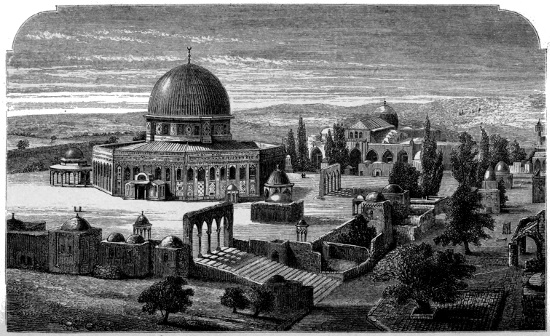

 ,
 , or
 , and sometimes
omitting them (e.g.
 = ‘Shafiíte’ or ‘Shafiite’ for ‘Shafi‘íte’).
They are rendered here as left and right single quotes. Where the mark is
printed atop a letter, in mid-word, it is inserted to the left. This avoids a
number of unacceptable approximations, e.g., where that hamza appears atop a
Latin i, as in