It is to be regretted that so much has been forgotten
of the early customs and habits of former generations
of this locality. For a long time the city grew slowly;
in comparatively recent times the farms have been
changed into city lots and the occupations and amusements
have taken different forms. Even traditions of
early customs does not reach much farther back than
the beginning of the present century; but, owing to
the Dutch tenacity of clinging to inherited customs, it
is probable that the manners of eighty and a hundred
years ago were not so very different from those of their
ancestors, especially as they retained the quiet, simple
life of a farming community. The great holiday of
the year, looked forward to alike by the old people,
young men and maidens and the children, was New
Year's Day. Christmas was observed by a service at
the church, and not by gifts and friendly reunions; all
the jollity was reserved for New Year's day. Then the
mother or the grandmother brought out the bag of
Spanish silver dollars, and each child was allowed to
take out one as a New Year's gift. In every house was
a store of "oley koecks" and New Year's cakes, a sort
of "jumble" or cookey, in shape either oblong or
round, stamped with a design of a vine, or bird, or
flower, from a wooden stamp; these were kept ready
to give to the bands of visiting children who went from
house to house wishing the inmates a "Happy New
Year." The young people went for long sleighrides to
neighboring towns, or friendly calls; the older people
made visits in the evening, dropping in upon their
friends without an invitation and staying to supper.
After the New Year's festivities, the "quilting parties"
were the favorite social entertainment, when the young
women spent the afternoon in quilting the elaborate
patch work or other quilts; some were made of homespun
woolen cloth and instead of cotton, wool was used
as a filling, and the quilting was in most elaborate designs
of vines and flowers. The young men came to
supper and the evening was spent in games and dancing.
Then came the "Husking bees" in the fall,
varied by occasional "Apple-paring bees," but the
latter were more unusual. The women made occasional
afternoon visits, guests coming soon after the mid-day
dinner and staying to tea.
The great day among the men came in June at the
general muster of the militia, or "General Training
Day." This dated from the early days of Bergen, the
first militia having been organized June 30th, 1663.
All men between eighteen and forty-five (or fifty) years
of age were required to meet upon that day each year
to go through military evolutions. All who absented
themselves without a valid excuse were subject to a
fine. There was a company at Hackensack, one at
New Durham, one at Bergen and another at Bergen
Point. The several companies of the county formed a
brigade and met at different places on successive years,
more frequently at New Durham or Bergen. Colonel
Sip was a colonel of militia and John I. Van Horn
a captain. Both served in the war of 1812-14. Captain
Van Horn was in charge of a rough block fort at
Sandy Hook. He used to say that there was nothing
to do only when an American ship was being chased by
the enemy, their guns afforded it protection and enabled
it to get safely into port. The war of 1812-14 being
largely a naval war, the militia of this locality did not
take a very active part in it. But during the war, the
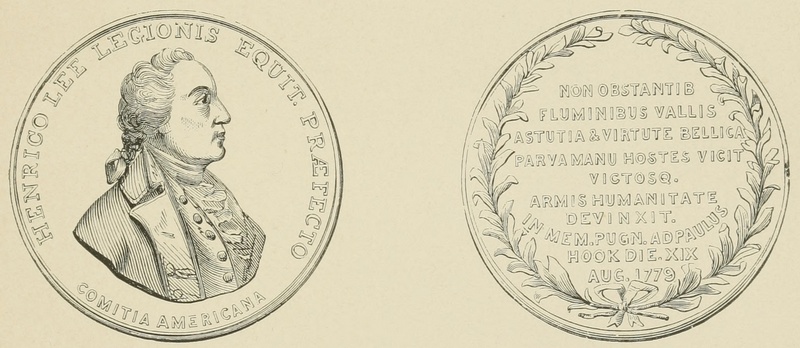
fort at Paulus Hook was held by Drum Major John G.
Sexton of the militia and six men under his command.
One great enjoyment of "Training Day" with the
Bergen Company was the supper they always had at
the tavern on Bergen avenue. This supper was a great
event, looked forward to through many months. While
all meals at this tavern were held in high esteem, upon
this one day there was an unusually fine menu. The
praises of those gastronomic successes are still sung by
such of the fortunate participants as are still with us.
One peculiar custom among the Bergen Dutch,
handed down from generations even to recent times,
has been that the masculine head of the family always
cut the smoked beef (a never failing dish) and the
bread. Formerly the bread was baked in large loaves
in yellow earthen dishes in a brick oven, and put upon
the table uncut, then as each person wished a slice the
head of the house, holding the bread against his breast,
cut off a portion. Generally they lived very plainly;
sauerkraut, which was such a favorite dish among the
Mohawk Valley and Albany Dutch, seems to have been
almost unknown here. Pound cake was a favorite recipe
and in the early part of this century the Communipaw
housewives carried their butter and eggs to
certain bakers in Greenwich street, New York, to have
their pound cake baked for them. Their recipe for
crullers was very similar with the addition of a little
more flour. In all well regulated houses "Oley
Koecks" were indispensable; there was quite a difference
in the way of making them, some recipes are
plain doughnuts of raised bread dough, sweetened and
spiced only. The following is a more elaborate recipe
of 1750:
"One pint of milk, one cup fresh yeast, flour to
make a stiff batter, mix at night; in the morning add
five eggs, two cups of sugar, one cup of shortening,
(half butter and half lard), one teaspoonful soda, flour
to make like bread dough, let stand until light, which
will be two or three hours; have ready chopped apples
sweetened and flavored with nutmeg and raisins; roll
out and cut in pieces about four inches square, place a
tablespoonful of apple on each square, double over and
pinch together, drop in hot lard to fry."
In the old recipes pearlash is used, in these the modern
term soda and baking powder have been substituted.
The early settlers made their own pearlash by burning
either corn cobs or a bit of wood, often birch or maple,
on the hearth, and from the clean ashes put in water
obtained the carbonate of potash desired.
The following recipes are also handed down from the
early Dutch housewives:
"Jumbles, (Koeckjes): One pound of flour, one half
pound of sugar, less than half pound of butter, three
eggs, four tablespoons sweet milk, one teaspoon
saleratus."
"Dried Biscuits, (Old Dutch): Take one and a half
pints warm milk, one cake compressed yeast, one teaspoonful
salt and flour enough to make a sponge.
When light, which will probably be in half an hour,
add one-fourth pound of butter, and knead with flour
to about the consistency of bread. Let rise again and
then mould each biscuit in two parts, putting one on
the top of another, that they may be broken open more
easily. Put in pans and let rise before baking. When
baked break open and put in the warming oven until
thoroughly dried."
"Soft Waffles, (Old Dutch): One quart of milk,
make a batter with flour, raise with yeast, when light
add four eggs, one-quarter pound of melted butter and
a little salt. Beat all together, let rise again, and add
half a cup of sugar. Eat with sauce."
Old waffle irons with initials of early owners and the
date are still in existence; one has A. D. 1709.
"Fried Spack and Opples: Take slices of pickled
pork, fry them well, then take slices of apple and fry
in the hot fat; if the apples are sour, put a little molasses
or brown sugar over them, when the apples are
brown, turn over and brown on the other side; serve
with the slices of pork laid around the edge of dish.
If the apples are sweet, do not use sweetening."
"Mince Pie, (Old Dutch): Seven bowls chopped
tart apples, three bowls chopped meat, seven pounds
of sugar, one gallon cider (not sweet), seven nutmegs,
four tablespoonsful cinnamon, two tablespoonsful
cloves, two pounds of raisins, one pound of currants,
one pound of citron, salt and pepper."
"Buling Pudding, (Old Dutch): Four quarts of
water, let it come to a boil. Add one pint of rice, two
cups of sugar, one-fourth pound of cinnamon, one tablespoonful
of salt, and buckwheat enough to make a very
stiff batter. Boil half an hour. Put in pie dishes and
when cold cut in slices and fry."
"Buckwheat Pudding, (Old Dutch): Have one quart
of water boiling. Mix two cups of buckwheat meal to
a smooth batter with cold water; stir this mixture into
the boiling water; add to this one slice of raw, fat salt
pork chopped fine, one cupful of sugar, one teaspoonful
each of ground cloves, allspice, cinnamon and salt.
Simmer one hour, stirring frequently. Pour into a
deep dish to cool. When cool this will leave the dish
easily if sufficiently cooked. Slice, fry brown and
serve with powdered sugar."
These two puddings recipes are still used in Holland.
Cookstoves were not introduced until about 1825 or
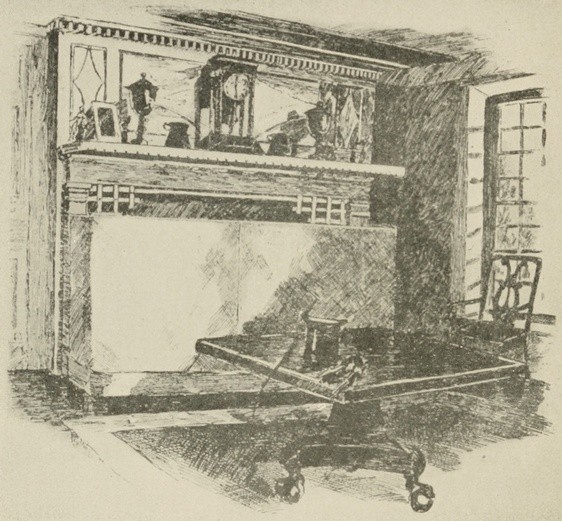
later, the cooking being done over an open fire. In
the wide fire-place was fastened at one side the "crane,"
a swinging iron bar, on which were hung iron pot
hooks, or trammels, upon these were swung the pots
and kettles for cooking. These were cleaned from soot
and smoke by rubbing them in the sand. The fire was
built with a large log for back log, resting on andirons,
and in front and above it were piled smaller sticks and
chips of wood. They used kettles of different sizes
made with three iron feet, long handled frying pans;
bake kettles—broad, shallow kettles with iron covers
upon which hot coals were piled; skillets, a small iron
pot, holding from one to two quarts, with short handles
and three iron feet, to set on a bed of coals in front of
the fire to cook little messes. Meats were roasted
suspended by a string before the fire and twirled from
time to time, or in tin Dutch ovens, which were open
towards the fire. Bread, cake, etc., were baked in the
brick oven. The ordinary bread used was of rye and
Indian meal. The brick ovens were prepared for baking
by building a hot fire in them and when the wood
was burned to coals it was shovelled out and the bread,
etc., put in and the oven securely closed. A long
handled shovel called a "peel" or a "slice" was used
to put the things in to bake. Beside the fire-place
stood shovel and tongs, and usually there hung there a
bellows for blowing up the fire when low, and a turkey's
wing to brush up the hearth. The first stoves used
were the Franklin and many of those used in Bergen
were cast by Martin Ryerson at Pompton, N. J. Coal
was not used for fuel until about 1826, and at first in
grates only.
The killing of their own beeves and pork was practiced
by the farmers of Bergen and Communipaw as
late or later than 1840. They lived almost entirely
upon the produce of their farms. In November they
killed and laid up their year's supply of meat. The
skins of the beeves were sent to the tanner who cured
them for the half; from their share the boots and shoes
for the family were made by a shoemaker who came to
the house to work. This custom was kept up until
1825.
In the early days there were large tracts of white
cedar along the western slope of Bergen Hill, on the
old swamp road to Belleville which led from the Newark
Turnpike and near Sikakes. From this cedar the
farmers had casks made in which to keep their salted
meats. Fresh meats, sausages, in immense quantities,
head-cheese, and "roellachoje" (a pickled preparation of
beef tongue and tripe) were kept in a cool garret. The
first butcher in Jersey City was John W. Holmes, who
started about 1814; he was succeeded in 1816 by Henry
Drayton, who came to Jersey City from Somersetshire,
England, but city ways and conveniences did not reach
Bergen and Communipaw for many years later. It is
said that the first huckster known in Jersey City was
a character called "High, Low, Jack," who, in the
'60's, began to go about from house to house selling
clams and huckleberries. His cries were a constant
amusement to the children, who used to follow him in
crowds.
During the first quarter of this century, wool from
their sheep was spun and wove at home; the spinning
was done by the women of the family, sometimes assisted
by young women who "went out spinning."
Men went about to do the weaving. On some places
there were weave houses, in others there was a weave
room in the cellar. When the cloth was woven it was
usually dyed blue; a blue dye tub being kept to dye
the stocking yarn and cloth. Later the cloth was sent
to the fullers, then tailoresses came to the house and
made it up into clothing for both men and women.
The women went to New York to market, carrying
butter and eggs to sell, and there are traditions in some
families of their avoiding the "Mill and Church road"
on their return, and climbing over the rocks, in the
long walk from the ferry, fearing that they might be
robbed of their store of silver dollars, carried in the
large pocket, fastened about the waist and worn under
the dress skirt. A story is told of a very philosophic
old lady who sold buttermilk which her customers accused
her of diluting with water. The proceeds she
invested in a silver tankard. Upon her return from New
York in a row-boat across the river, it was so rough
that in the rocking of the boat the parcel with the
tankard fell overboard and was lost. "Well," exclaimed
the old lady, "let it go, it came from the water
and has gone back to the water."
A great event to the children was the yearly candle-making
in many families; they were all allowed to make
a few little candles for themselves when they were so
fortunate as to be the happy possessors of toy candlesticks.
Candle-making was quite a long and wearisome
process. First the proper length of candle wicking
was doubled over long slender rods, and the ends
twisted together to form the wick of the prospective
candle. The number of these upon a rod depended
upon the size of the candle to be made, whether six or
eight to the pound. These were prepared the day before
the dipping was done. In the early morning long
pieces of scantling were laid upon two saw-horses, and
across these scantlings were laid the rods with the
wicks hanging down. At one side was placed a large
"cauldron kettle" filled with hot melted tallow into
which the operator dipped the rods of wicks. The
kettle of hot tallow was kept replenished and the dipping
process was repeated again and again until the
candles were of the required size. After being properly
cooled they were slipped from the rods, the wicks cut
off and they were carefully packed away in boxes.
Later candle moulds were invented, which made it very
much easier than the old method.
In dress the women did not wear the ornamental
caps, such as were worn in Holland, but very plain
ones; neither did they wear as many petticoats as their
sisters across the sea, three or four usually being the
limit. It was not the custom here in Bergen, to set
apart a dower chest for each daughter, to which yearly
additions were made of household and personal linen,
and a silver spoon, as was practiced by some of the
Holland families in Albany and in some parts of Pennsylvania.
Upon marriage each daughter was given a
little store of linen; upon the death of her father, perhaps
a little money; but, as a delightful old lady told
me, "the land and the property mostly went to the
sons, the girls were expected to marry money." Under
the old Dutch law both sons and daughters became of
legal age at twenty-five. The girls were carefully
trained in household arts and in the use of the needle.
Little girls under nine years of age wrought elaborate
samplers. It was a common practice to make the pillow
cases with an insertion of drawn work in linen at the
closed end of the case, under which showed the bit of
red cloth sewed on the end of the pillow; the open end
of the pillow case was left untrimmed.
Children were taught to be very courteous to their
elders; upon meeting any one in the street little girls
curtesied and the boys made a bow. The Bergen
Dutch women and their daughters were very practical
thrifty women, most excellent housewives and devoted
mothers. Both men and women devoted themselves in
the most matter of fact way to the duties of life, never
allowing anything less serious than a funeral to disturb
to any great extent the routine of daily life. I have
heard of a bride brought home upon her wedding day to
her father-in-law's house, who, upon the first evening
started out to milk the cows, saying she "preferred to
take up the duties of her new position at once." I have
heard also of a bridegroom, a merchant who attended
to his usual duties upon the morning of his wedding
day, and after the ceremony returned again to his store.
Slavery existed until 1820, when all slaves were made
free at twenty-five years of age. The old slaves were
cared for during the remainder of their lives. It was
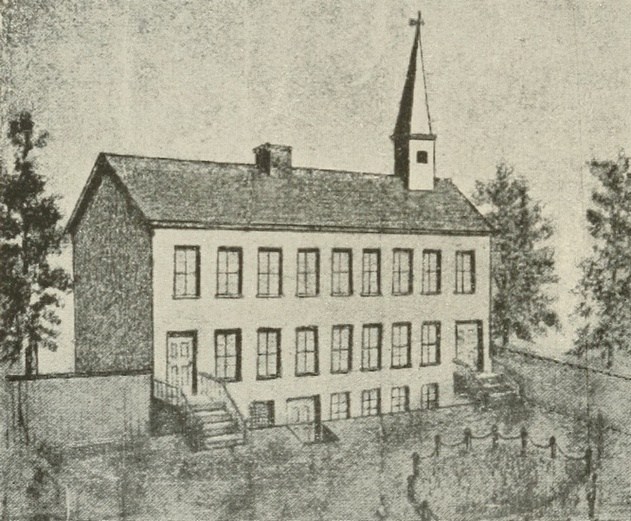
for the colored people that the first Sunday School in
Bergen was opened in 1828, in the garret of the school-house.
Many of the slaves ran away to New York
and Connecticut. Those who went to New York lived
in cellars or wherever they could find shelter. When
any of them died their friends always brought them
back to Communipaw to bury them, and their funerals
were held at the old Garrabrant stone house, which
used to stand on what is now Philip street. One peculiar
feature was that on every coffin was placed a
bunch of freshly plucked spearmint. They were
buried on the Garrabrant farm in what is now Lafayette,
and also on the Van Reypen place.
A hundred years ago, lotteries were held in great
esteem, as a popular means of raising funds to build
churches, colleges, schools, roads, prisons, and charitable
institutions. The first ever drawn in this locality
was at Paulus Hook in 1773, and in 1824 a "Queen's
College Literature Lottery" was advertised in Jersey
City. Some of Jersey City's most reputable people
were engaged in lotteries and accumulated fortunes in
the business. Later the Legislature passed laws making
it illegal and the parties then conducting a lottery
in Jersey City removed their business to Wilmington,
Delaware, where it was carried on for many years.
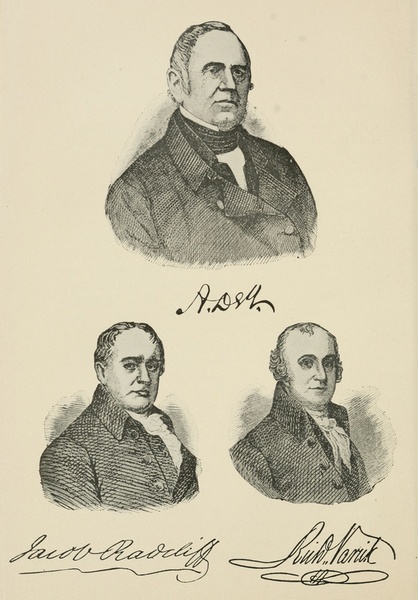
A. Dey, Jacob Radcliff, Rich. Varick