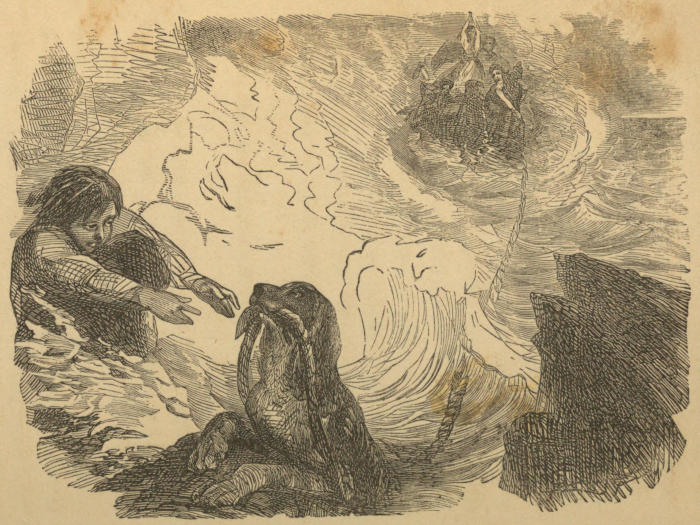
BEING
THE SEVENTH—A FRAGMENT—IN THE SERIES
OF THE “AIMWELL STORIES.”
BY
WALTER AIMWELL.
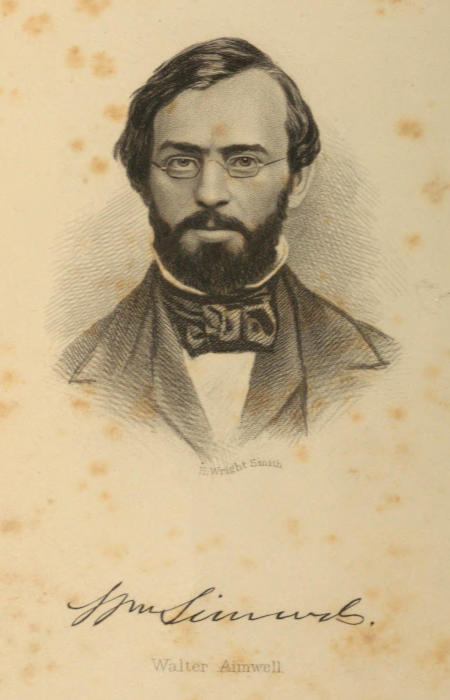
TO WHICH IS ADDED A Memoir of the Author, with a Likeness.
BOSTON:
GOULD AND LINCOLN, 59 WASHINGTON STREET.
NEW YORK: SHELDON AND COMPANY.
CINCINNATI: GEORGE S. BLANCHARD.
1864.
Entered according to Act of Congress, in the year 1863, by
GOULD AND LINCOLN,
In the Clerk’s Office of the District Court of the District of Massachusetts.
GEO. C. RAND & AVERY,
STEREOTYPERS AND PRINTERS.
PREFACE.
The story of Jerry, while possessing not the
entire completeness of other volumes of the
series, owing to the lamented death of the
author before he had finished the work, will
be found wanting in none of those attractions
which have secured for the “Aimwell Stories”
their great popularity. Its design is to show
the folly of restiveness under parental restraint,
and the blighting influence upon character of
vicious or low associates; and thus to incite
the young reader to the prompt performance
of filial duty, and to cherish those high aims
which are the basis of manly character. Jerry’s
own story of his adventures will be found
to contain much useful information pertaining
to sailor life, and to the portions of the world
which he visited; while the whole work, like
its predecessors, has been written with our
motto in mind, “Precepts may lead, but examples
draw.”
CONTENTS OF JERRY.
PAGE
CHAPTER I. THE RUNAWAY’S RETURN.
Emily’s soliloquy—Arrival of the doctor and his companion—Jerry—Greetings—The
doctor’s plan—The new-comer and
the lost one—Confession—Misgivings—Mr. Preston’s business—Oscar
Preston—His influence over Jerry—The escape—Another
sin—Himself robbed—Mr. Preston’s feelings toward
his erring son—The evening meal—Waiting for the
story,
Goes first to Boston—Ships on board the brig Susan—Sea-sickness—Duties
on shipboard—Hard usage, and mean fare—The
brighter side—Good sailing—Catching a shark—The albatross—Crossing
the line—A hard blow—The brig disabled—Rio
Janeiro—Excursion inland—Cape Horn and Terra del
Fuego—Passing the cape—Cape pigeons—Valparaiso—Vicious
habits of sailors—The brig to sail for Boston,
Sails from Valparaiso—An iceberg—Off the cape again—Progress
northward—Caught in a “pampero”—Terrors of the
tempest—The vessel but a wreck—The brig abandoned—Escape
by boats—Davy Jones’s locker—Sufferings at sea—Discover
a sail—Disappointment—Land in sight,
The party land upon an island—Explorations—Discouraging
prospects—Food—Shelter—Signal of distress—Monotonous
life—A sail at last—The rescue—Adverse fortune—Transfer
to the “Bride”—Run round the Horn—The “doldrums”—Passage
to New York, and thence to Boston—Jerry’s new purposes—His
familiar bedroom,
Jerry a “lion”—His visitors—Old Mr. Jenkins—His practical
hints—Jerry don’t “take”—Explanation—Seeks Clinton—The
meeting—Clinton’s thrifty habits—Saving money for a
good object—Secret of success—Clinton’s taste and mechanical
skill—Study—Persevering application—Looking ahead—An
offer from Clinton—Jerry still unmoved—Explanation,
The little peninsula—The name the Aborigines gave it—Who
called it Charlestown, and why—Scenery in and about Charlestown—Date
of Walter Aimwell’s birth—Probable effect of local
influences—Nothing external can make youths noble—A
thistle in the garden—Walter Aimwell no thistle,
Death of Mr. Simonds—His widow’s removal to Salem—Early
hints of Walter Aimwell’s future character—Master Brooks—Walter
Aimwell at thirteen—New England boys—Mrs. Simonds’s
second marriage—Young Walter at the jeweller’s shop—His
letter to his mother—The music-box—Punning verses—The
dignity of usefulness—Removal from Lynn,
Walter Aimwell in Wm. S. Damrell’s office—His note-book—His
first essay—A. H. Everett’s lecture—Reads life of Alexander
the Great—Criticism—Christianity a new religion to
some folks—Meddlers—Secret writing—Part of index to
note-book,
A preface—Systematic arrangement of facts in the acquisition of
knowledge—Book of Sunday reading—Common sense—Practical
spirit—Faith in God’s moral laws—Account of religious
experience—Secret resolutions—Not exceedingly miserable—Not
uncontrollably joyful—Enters Sabbath school—Determines
to rule his temper—Succeeds in an unusual degree—Joins
the church,
Fountains of strength—Growth in grace—Resolutions—How
to grow wise—The secret of pleasant faces and happy hearts—The
giant and the sugar-plum—Doing right every moment—Speaking
the truth—Few folks fit themselves to do it—Making
fun at the wrong time—Death not gloomy—Eagles trying
to play butterfly—Striving against nature—Prize-fighters,
Mostly written during his apprenticeship—Poetry and swamp-work—Walter
Aimwell’s first poem—Exercises his powers in
rhythmic composition for their own benefit—The pious dead—My
friend—The stranger—Charity—Shipwreck of life—A
pretty hymn—Fourth of July—Presidential contest of 1840—A
riddle—Walter Aimwell’s own opinion of his poetic powers—Other
kinds of usefulness,
An inquiry—An answer—The aspiring undertaking—A theme
in the Revised Statutes—Secret correspondence—Acceptance
of manuscript—The young author “setting up” his own book—Reveals
his secret to favorite brother—Talk in office about
“The Pleasant Way”—Rev. Mr. Hoadley’s notice of it—Other
criticisms—Why good men reproach themselves,
Little hints of innocent delights—How he spends his evenings—Private
fast-day—Height and weight—Remarkable dream—Wonderful
baby—Lecture—Public fast-day—Music—Works
nearly all night—Consequences of lending an umbrella—Brother’s
wedding—Lonesomeness—Summary of journal—Rigid
account of receipts and expenditures—Simplicity of
Walter Aimwell’s life—Nobleness of its results—Visits Master
Brooks—Permission to go to muster—Does not go—Travels—Twenty-one
years of age—Freedom presents—Devotes
a certain portion of all future income to benevolent objects—Goes
down to “the Castle” on the ice in the harbor—Visits
Sarah Mugford—Martial music—Church music—Invitation to
Bangor—Summary for 1844—More manuscript accepted—Doing
nothing—Separates from a tried friend and is lonesome—Receives
a copy of his new book—Is invited to write
another—Lays out a plan—Takes lessons in phonography—Takes
lessons in French—Is editor of Christian Reflector for a
while—Extracts from editorials—A troublesome accident—Visits
the State of Maine—Picking up useful knowledge,
A call from a stranger—Consultations, calculations, and contracts—Leaves
Mr. Damrell—A good printer—Summary for 1845—Takes
the whole of “The Rambler”—Invited to join in the
conduct of a monthly magazine—Declines—Starts one himself—Too
much labor and responsibility—Unfavorable changes
in the business world—Accidents and disappointments—A
naughty boy—Summary for 1848—Suffers for others’ errors—Why
he was not a clergyman—Other business men fail, but he
determines he will not—Noble struggles—Outlives the storm—Summary
for 1849—Parts with a favorite office-boy—The
boy becomes a pastor—His testimony about Walter Aimwell,
Walter Aimwell in the world but not of it—Hard for him to
think any evil till actions proved it—His own ways—Ways of
some with whom he was connected in business—Success in
spite of obstacles—The body overtasked—The sudden attack—The
physician’s opinion—Sale of the “Rambler”—More
leisure—Cannot be idle—Pleasant item in his reading—“Thoughts
for the Thoughtless”—Gift to his mother—“Boy’s
own Guide”—Another gift for his mother—Removes from
Melrose—Cottage in Winchester—Its best glory gone,
Visit from Mr. Bullard—Boy’s Book of Morals and Manners—Walter
Aimwell’s love of the young—Writes a story for them—Extension
of “Clinton”—Published at Christmas—Received
with universal praise—Determines to write a series of
twelve volumes—A lesson—Preparatory study and manner of
working—Suspension of labors—Oscar—Ella—Whistler—Another
attack—Public and private praises—No relaxation of
endeavor—A boy in the family—A boy’s criticism—Letter to
a lady—Letter to a boy—Marcus—Boy’s letter to Walter
Aimwell—Walter Aimwell’s reply—Jessie—“Our Little Ones
in Heaven”—Unwritten volumes—Jerry the last of the Aimwell
Stories,
Nature’s forces slowly yielding—Walter Aimwell prepared for a
happier world—January, 1859—February and fierce storms—Does
not go to Boston—Procures assistance in editorial duties—Records
no more labors—Presents from neighbors—Passing
away—Happy in his faith—The sixth of July—The seventh—The
last ride—The last interview with friends—The
sudden departure—Pictures left—The glory of such a life—The
secret of it—The dictate of common sense—The mystery
of human lives—Solomon’s opinion—Testimony in our own
hearts—Walter Aimwell’s choice—Impression on careless observers—Unassuming
manners—Puritanic steadiness—Freedom
and happiness—Character in several relations—The mist-covered
ocean—Some lives throbbing with the life of God,
“I wish I could look out and see father coming;
here it is the tenth of the month, and he ought
to have got home a week ago. February, March, April,
May,—it’s over three months since father went off, and
he said he should be back by the first of May. I can’t
imagine what has become of him. There’s the doctor coming,
I believe. Yes, that’s his wagon. He’s got a man
with him—who knows but it’s father? No, it’s a young
fellow. I wonder who it is. He’s as black as an Indian;
and he’s casting up sheep’s-eyes at me, too. Well, I don’t
care for you, whoever you are.”
The doctor’s wagon stopped, and so did the busy
tongue whose words we have been repeating. The
doctor alighted, and walked into the house without ceremony;
and Emily, the proprietor of the tongue aforesaid,
flattened her little nose against the chamber-window
in her efforts to look down upon the young stranger,
who remained seated in the wagon.
“Why, it’s somebody that mother knows,” Emily
added, after a few moments’ pause; “she has run out to
the wagon, and she’s hugging and kissing him, and he
kissed her! Oh, I know now who it is,—it’s Jerry!
it’s Jerry!” and the girl, half crazed with excitement,
jumped from her seat and ran to the door.
“I’m going, too,” said Harriet, her younger sister,
springing toward the door.
“No,” said Emily, holding the door fast; “you
mustn’t go now; it won’t do to leave the baby. I’ll
come right back in a minute, and let you go.”
“I want to go now; mother told you to tend the
baby,” replied Harriet, beginning to snivel.
“You may both go, children, and I’ll see to the
baby,” said Dr. Hart, who suddenly opened the door
upon them.
The two girls ran down-stairs as fast as possible, without
stopping to thank the doctor for his kindness. And,
sure enough, it was Jerry, their long-lost brother, who
ran away from home fifteen months previous to this time,
and had long been regarded as dead. He seemed very
glad to see his sisters, and greeted them each with a
good “sailor’s smack,” as he termed it.
“And so you thought I shouldn’t know you, sitting
in the doctor’s wagon,” said Mrs. Preston. “Don’t
you think it must be a queer mother that doesn’t know
her own son?”
“That was the doctor’s notion; it wasn’t mine,” replied
Jerry. “He overhauled me on the road, and
offered to give me a ride; but he didn’t know me until
I told him where I was going. He looked at me pretty
sharp, and then says he, ‘Why, ain’t you Mr. Preston’s
son?’ and I told him I believed I was. Then he said
he had got to come here, to see the baby; but he told
me I had better sit in the wagon while he was making
his call, because everybody thought I was dead, and
there would be quite a scene when I made myself known,
and he didn’t wish to intrude upon it.”
“Your father thought you dead, but I never gave
you up,” said Mrs. Preston. “Just as soon as I laid
eyes on you I knew you. I asked the doctor whom he
had got there, and he looked so queer when he said it
was ‘a young friend of his from out of town,’ that I
was certain then that it was you.”
Jerry now went up-stairs with his mother and sisters,
and the doctor introduced him to his new brother, the
baby, who had been quite ill, but was now getting better.
“You don’t seem to think much of your baby brother,”
said Mrs. Preston, observing that he took but little notice
of it.
“Yes, I do,” replied Jerry; “but I can’t help thinking
about Mary. I didn’t know she was dead until
Uncle Henry told me yesterday, and I can’t realize it. I
keep looking around, expecting to see her; it doesn’t
seem natural without her.”
The mention of the name of Mary brought a shade of
sadness to every face, but no one seemed inclined to
speak further of the departed. Jerry was more attached
to Mary than to either of his other sisters. She
was the youngest, and was but six years old when she
died. Her death took place only a few weeks after Jerry
left home; but as he had not heard of it, and always
thought of her as living, it was nearly the same to him
as though she had but just died.
The doctor soon withdrew, and Mrs. Preston went
down to the kitchen to get something for Jerry to eat,
for he had fasted since the night before, and it was now
toward the middle of the afternoon. Jerry followed her,
promising his sisters that if they would remain with the
baby he would shortly return and answer the thousand
questions they were so impatient to ask him. As soon
as Jerry was alone with his mother, he commenced making
a confession to her.
“Mother,” he said, “running away from home was
the worst day’s work I ever did. I was a fool to do it,
and I’ve got pretty well punished for it. You’ve no
idea what a hard time I’ve had. I gave myself up for
dead more than once; but I’ll tell you about that this
evening, perhaps, when we’re all together. I meant to
have brought money enough home to pay back what I
took, but I lost everything when we were wrecked.”
“No matter about that,” said Mrs. Preston; “we
never shall think of that again, so long as you have got
home alive.”
“What do you suppose father will say to me?” inquired
Jerry, with some hesitation; for he had serious
doubts as to the kind of reception his father would give
him.
“He will think you have risen from the dead; I don’t
believe he has the least idea that you’re in the land of
the living,” replied his mother, evading a direct answer
to the question.
“Do you suppose he will be glad to see me?” inquired
Jerry.
“Certainly I do; I can’t imagine how it could be
otherwise,” replied Mrs. Preston. After a moment’s
pause, she added, “Your father is peculiar about some
things; he doesn’t always show his feelings. But I’ve
no doubt he’ll be as rejoiced as any of us at your return,
whether he says so or not.”
Jerry sat silently speculating upon this reply to his
question, while his mother was busy in pantry and cellar,
collecting all the good things in the house to prepare a
feast for the returned prodigal. To tell the truth, he had
serious doubts whether his father would be glad to see
him, for he was a stern and seemingly cold man, who did
not look with much charity upon the faults of others, and
was slow to forgive those who had offended him.
Mr. Preston divided his time between farming and
logging. In the summer, he carried on his farm, in the
small and retired town of Brookdale. In the fall, he
went into the forests in the northern part of Maine, where
he usually remained until spring. A gang of men accompanied
him, and they formed a camp in the woods,
where they lived all winter in a very primitive way.
Their business was to cut down trees, trim off the
branches, and haul the logs to the river. On the breaking
up of the ice in the spring, these logs were floated
down the stream to the mill, where they were sawn into
lumber.
It was during his father’s absence at the logging camp
that Jerry ran away from his home. He was at that
time nearly fourteen years old. He had for some time
been growing lazy, restless, and unmanageable, so that his
mother could not do much with him. His character had
suffered greatly from intimacy with a cousin of his, about
a year older than himself, named Oscar Preston. Oscar
belonged in Boston, but falling into bad habits, his father
thought it would benefit him to send him away from the
city for a season. So he lived with his uncle’s family,
in Brookdale, for several months. His character did not
improve, however, and he was finally obliged to leave
the State to avoid trial on a charge of setting fire to a wood-lot,
his father at the same time paying over one hundred
dollars, damages and costs, to effect his release.
When his cousin returned to Boston, Jerry grew lonesome,
uneasy, and unhappy. He wanted to go to sea, or
to travel over the country, or to live in some great city;
anywhere, he thought, he could be happier than at home.
His father would not hear a word on the subject, and his
mother would not give the slightest encouragement to any
such whims. So, at length, he concluded to shake off
parental authority; and one Sunday morning, soon after
the rest of the family started for church, he hastily gathered
up a bundle of clothing, and set out on a longer
journey than he then imagined.[1]
There was one act, connected with Jerry’s flight from
home, which he had always regretted, and which, more
than anything else, made him dread to meet his father.
On going off, he took with him every cent of money in
the house,—the allowance which Mr. Preston had left
for the necessities of the family during his absence.
Conscience began to reprove Jerry for his theft as soon
as he had leisure to think about the matter, and he resolved
to pay back the whole amount out of his first
earnings. When, after a few days, his pockets were
picked clean, and nearly every dollar of his mother’s
money went into the hands of a second thief, the wickedness
and folly of his own offence were still more deeply
impressed on his mind. He came back to his father’s
house not merely a runaway, but a thief.
Mrs. Preston, notwithstanding her reply to Jerry’s last
question, had some slight misgivings in regard to the reception
his father would give him. She knew that Mr.
Preston, whatever he may have felt, had never manifested
any relentings or parental yearnings toward his lost
son in her presence, though she had been told that he
had evinced some feeling when conversing about him
with others. But, so far as she could judge, he had
never forgiven his erring boy’s last offence. He seldom
alluded to Jerry in the family, and when he did, he spoke
of him only as a lazy, heartless, and ungrateful boy, who
was bent on evil, and he was seemingly quite indifferent
as to whether he ever came back again or not.
Even when news came of the wreck of Jerry’s vessel
and his supposed loss, he exhibited no feeling, though, for
many days after, he was unusually silent and reserved,
and seemed to take little notice of what was going on
around him. From that day, he never alluded to his son,
except once or twice, when he tried to convince his wife
of the folly of expecting ever to see him again. The
wayward boy was dead and buried to him, and, so far as
human eye could see, few paternal sighs and tears were
called forth by his untimely end.
The table was soon spread, and Jerry ate a hearty
meal. How delicious mother’s light bread and sweet
butter tasted to the hungry wanderer, so long used to the
sailor’s coarse fare! And what a treat was a tumbler of
new, rich milk, after drinking ship-water and sea-slops
for over a year!
As soon as the family could all get together, after
supper, Jerry spun his “yarn,” as he called it, and
gave them a brief account of his adventures during the
fifteen months of his absence. His narrative follows in
the succeeding chapters.
CHAPTER II. JERRY BEGINS HIS STORY.
“Now I’ll spin that yarn, if you would like to hear
it,” said Jerry, after tea. “I suppose you
don’t want to hear about the voyage out, for nothing very
remarkable happened, only we came amazing near getting
wrecked, and I believe I wrote you something about it.”
“Yes, begin at the beginning, and tell us the whole
story,” said Emily, and Hattie seconded the request.
“It would take me more than a week to do that,” replied
Jerry, “if I talked as fast as I could. I can’t tell
the whole story now; but I’ll tell you about some of the
most important events of the voyage, and save the rest
for another time.
“Well, I went straight to Boston, after I left home,
and the first thing I did was to try to get a chance to go
to sea. As luck would have it, I fell in with the brig
Susan, bound for Valparaiso, just as she was hauling
off from the wharf. They had shipped a boy the day
before, but he went ashore, and hadn’t come back, and
the captain told me I might take his place. So I bundled
right in, without stopping to think. I didn’t know the
name of the vessel, nor where she was bound, nor what
wages I was to have, nor anything else. I only knew I
was going to sea, and that was all I cared about.
“Before I got out of sight of land, I began to be
dreadful seasick; but it isn’t worth while to tell you
about that now. And, if you’ll believe me, the very
first job I had to do, on board the Susan, was to clear
out the pigsty! and I had to do it every day through
the voyage!”
“Why, do they have pigsties on board vessels?” inquired
Harriet.
“Yes, sometimes,” continued Jerry. “But our pigs
were not to be killed for fresh meat,—they were a choice
kind, that somebody was sending out to Valparaiso for
breeding. But I thought it was rather queer, after I
had run away from home to get rid of such work, that I
should have to feed pigs and clean out their pen at sea.
And it wasn’t many days, I tell you, before I wished
myself home again. Everybody, from the captain down,
cursed and cuffed and kicked me, because I was so
green,—just as if I ought to have known every rope of
the brig, when I never saw a brig before. If I didn’t
happen to do a thing just right, down would come a
rope’s-end across my shoulders, as like as not; and if I
dared to say a word, I would find myself sprawling on
the deck the next minute. The men, too, played off all
sorts of tricks upon me.[2] And then the living was
enough to sicken anybody. It was salt beef and hard
bread morning, noon, and night, and week after week,
only, once in a while, we were treated with stewed beans
or peas, or boiled rice, or duff,—a kind of pudding made
of flour. And I wish you could have seen the place
where we slept. The forecastle is the name of it. It
was a little, narrow, dark, and dirty hole, with berths on
the sides, like shelves, where the men slept. Why, our
cock-loft is a perfect parlor compared with it.”
“No wonder you wished yourself home, poor fellow!”
said Mrs. Preston.
“Well, after all, mother,” continued Jerry, “it
wasn’t so dreadful bad, when a fellow got used to it. In
a few weeks I kind of got the hang of things, and made
the best of them, and after that I got along a good deal
easier. My sea-sickness went off, and I could eat my allowance
with the smartest of them, salt-junk or anything
they’d a mind to bring on. The weather was fine for several
weeks; we’d got into a warm latitude, and the old
brig made a handsome
run. There was one time
that we didn’t shorten
sail once for a week,—she
kept right along on
her course, with a fair
wind, without starting
tack or sheet. We had
some rare sport, too, about that time. We killed a shark
that was hanging around the brig, for one thing. One of
the men heated a brick as hot as he could, and then
wrapped it up in some greasy cloths, and chucked it to
him. Sharks, you know, will jump at anything you
throw at them, and this fellow smelt the grease, and
down went the brick, before you could say Jack Robinson.
And then you ought to have seen him thrash
round. Why, it looked as if the water was boiling,
where he was, he lashed it so, and the spray came down
upon us like a shower. But in a few minutes it was all
over, and his ugly carcass rose to the top and floated off.”
“Oh, that was cruel!” said Mrs. Preston.
“Well, mother, the sharks are cruel, too,” said Jerry;
“and the sailors don’t have any love for them, I can tell
you. The rascals would eat a man just as quick as anything
else, if they could get a chance. They’d snap a
leg off just as a boy bites a stick of candy, and they’d
finish the rest of him in two or three mouthfuls.
“A day or two after that, we caught an albatross. There
were several of them that had been following us three or
four days. They are a curious bird. They are very
large, and their wings opened from twelve to fifteen feet.
We sailed at the rate of
about two hundred miles
a day, for several days
running, and yet these
birds kept up with us all
the time. But they went
more than double the distance that we did, because they
kept making circles round us for miles, and then coming
back in our wake. They follow vessels to pick up the
stuff that is thrown overboard. One of our men baited
a hook with a piece of salt pork, and towed it from the
stern by a strong line. In a few minutes one of the
birds swallowed the bait, and we pulled him on deck.
He was a monstrous fellow, but he didn’t try to defend
himself only by biting at us a little. He was so clumsy
he couldn’t stand up on the deck. He had great
webbed feet. The sailors began to skin his feet, to make
purses, before the poor fellow was dead.”
“Oh, what hard-hearted wretches!” exclaimed
Emily.
“Well, I must hurry along with my yarn,” said
Jerry, “or I shan’t get through to-night. We crossed
the line,—the equator, I suppose you call it,—and I
was introduced to King Neptune, and was shaved and
washed by him in great style; but I can’t stop to tell you
about that, now. Every greenhorn has to go through the
ceremony the first time he crosses the line. We didn’t
have any very rough weather till after we had passed
Cape St. Roque. Do you know where that is, Emily?
Get your atlas, and I’ll show you.”
Emily brought her school atlas, and found Cape St.
Roque, the extreme eastern point of South America,
about five degrees below the equator.
“A day or two after we passed the cape,” continued
Jerry, “it grew rough and stormy, and finally settled
down into a regular gale. The sea ran as high as the
mast-head, and I thought we should be swallowed up
every moment. The brig lay down on her side so that
you couldn’t stand still nor walk without holding on to
something. The wind blew terribly, the rain poured
down in torrents, the sea dashed over the deck, and
every rope and plank seemed to creak as though the brig
was just going to pieces. It was pretty shaky business,
I can tell you, going up aloft then, and hanging to the
yards and ropes, but we had to do it. And for two days
we didn’t one of us get any rest or put on a rag of dry
clothing. In the height of the storm, our maintop and
topgallant masts, with the yards and rigging, came down
with a crash to the deck, and nearly killed one of the
crew. I thought our time had come then, certainly, but
we cut away the wreck, and made everything all snug
again. Soon after that, the captain discovered that we
had sprung a leak, and all hands had to take their turn at
the pumps. That came pretty hard, worn out as we were,
but it was pump or sink with us, and there was no get-off.
“The next day after we sprung a leak, the gale began
to die away, and our captain made up his mind to
run into Rio for repairs. Do you know where that is,
Emily?”
“Rio Janeiro? Yes; here it is,—it’s the capital of
Brazil,” replied Emily, looking upon the map.
“That’s the place I wrote my first letter from,” resumed
Jerry. “We lay by there about a week, and had
a chance to go ashore. It was the last of March, but it
was the latter part of their summer. When it’s winter
here, it’s summer there. We had plenty of fruit while we
stopped there,—such as oranges, plantains, pineapples,
bananas, and mangoes. And the monkeys and parrots
that we saw there I guess would have made you open
your eyes. They say they grow wild in the woods there.
Just as soon as we got anchored, the natives began to
come out in canoes, with fruits and poultry and monkeys
and parrots and all sorts of knickknacks, to sell. Rio
looks real handsome from the water, but it’s a queer
place when you get into it. The houses are high, and
most of the streets are so narrow that two carriages can’t
pass without running upon the sidewalk. The streets
are full of slaves, and they seem to do all the work.
You will see them with great boxes and bales on their
backs, and they take the place of horses and drag heavy
carts loaded with goods. A party of us walked out into
the country one day; and such splendid forests as we
saw I never had any idea of before. The trees were
nearly all strange to us, and there was no end to the different
kinds. Everything grows rank there. The woods
were full of the handsomest birds I ever saw, and there
was about every kind of insect that ever was thought of,
I should think.
“After we left Rio, we made a pretty good run, until
we got in the neighborhood of Cape Horn, and then
we had a rough time of it for five weeks. It was about
the first of May when we rounded the cape, which is
the beginning of winter there. The days were short
and cold, and we had gales and rain, snow or hail
storms, pretty much all the time. It’s the stormiest place
I ever got into. One night we saw a bright-red light
in the west, that seemed to be only ten or twelve miles
off; but the captain said it was all of a hundred miles
distant. It was a burning volcano, in Terra del Fuego.
The next day we saw land, for the first time since we left
Rio. It was the coast of Terra del Fuego and Staten
Land, and it was about as desolate a looking place as
you can imagine. It was rocky, mountainous, and barren,
and the sight of it was enough to give a fellow the
blues.
“Cape Horn itself is a great black rock, high and
steep, and extending out into the sea. We were within
sight of it when we passed it. It is a terrible bleak
place. We had about a dozen hail and snow storms that
day, and they say it’s always rough there, where the
two oceans meet. Our decks and shrouds and rigging
were coated with ice, and the sails were as stiff as sheet-iron.
We were all glad enough when we knew we were
in the Pacific Ocean; but we hadn’t got through our
troubles even then, for we had a very rough time, for
two or three weeks, in sailing up the coast. About all
the amusement we had at that time was catching cape
pigeons, which followed us in great flocks. We caught
them with a hook, just as we did the albatross. They
look very much like our common pigeons, only they are
web-footed.
“Well, at last we dropped our anchor in the bay of
Valparaiso, in a little more than three months from the
time we left Boston. Here it is,—it’s the capital of
Chili,” added Jerry, pointing out its location on the map.
“It isn’t so pleasant a place as Rio. The main part of
the town is built along the beach, for about two miles.
Right back of the city there is high land, where most of
the foreign merchants live. There are three hills that
rise above the southern end of the city, which they call
the ‘Fore,’ ‘Main,’ and ‘Mizzen Tops.’ This is where
the sailors go on their sprees, after they are paid off.
They drink and fight and gamble and rob and commit
every sin you can think of. I suppose some of the worst
dens in the world are on those hills.”
“I hope you kept clear of such places,” said Mrs.
Preston, rather anxiously.
“Oh, you needn’t be afraid to risk me, mother,”
replied Jerry; “I didn’t have much to do with them,
I can assure you. I went around among them a
little, just to see what sort of places they were, that’s
all.”
“But you couldn’t go near such places without
danger; it’s contaminating to approach them,” replied
his mother.
“I don’t think they harmed me much,” continued
Jerry; “but one of our crew got drunk, up on the Main
Top, and was robbed of all his wages, and then pitched
head-first down the precipice, and almost killed. I guess
he won’t forget the Main Top very soon.
“When we arrived at Valparaiso, the crew were discharged;
but the captain said he wanted me to stay with
the brig, and so I did. We didn’t know where we should
go next, as we had no cargo engaged. We some expected
to go to San Francisco, but freights were dull, and
after waiting about four weeks, the captain finally engaged
a cargo of hides for Boston. It took about a
fortnight to load and get ready for sea, so our whole stop
in Valparaiso was about six weeks.”
Here we will pause, and resume Jerry’s narrative in
the next chapter.
CHAPTER III. JERRY CONTINUES HIS STORY.
“We sailed from Valparaiso on the 4th of July,”
continued Jerry. “I was in hopes we should
stay in port one day more, for the Americans were going
to have a jolly celebration of Independence; but we
were all ready, and the wind was fair, so we sailed early
in the morning. It was the middle of winter, but we
had not seen any ice, and it was about as warm as it
is here in October. We soon got into colder weather,
though. I remember one night, when we were a few
days out, the air grew very cold, and we discovered an
immense iceberg right in our track. It was all of a
hundred and fifty feet high, above water, and I should
think it must have been a mile round it. We made out
just to clear it, and that was all. There had been a
thick fog for a day or two before, and if we had come
across the iceberg then, we should have gone pell-mell
right into it, and I reckon that would have been the end
of us. Perhaps it would have been better for us if we
had run into it, for the weather was calm, and we were
near the coast, and might have saved ourselves in the
boats.
“We made a pretty good run down the coast till
we got into the neighborhood of the Horn, and then our
troubles began again. We were beating about, off the
cape, for about a month, before we got around it; and
all the time it was cold, stormy, and rough. It was more
wintry, and the days were shorter, than when we first
doubled the cape. But we finally got into the Atlantic,
and began to steer north. We thought the worst of the
voyage was over now, and we did have very good luck
until we got into the latitude of the Rio de la Plata.
Do you know where that is, Emily?”
Emily readily found the river on her map.
“It’s a stormy region,” resumed Jerry. “They
have a terrible kind of tempest, called a pampero, and
we got caught in one. The day before it broke upon us,
the weather was fine and the sea quite calm. Toward
night, red and angry-looking clouds began to gather in
the west, and now and then there was a flash of lightning.
A slight breeze sprung up, but the air was hot
and stifling, and the captain said we should have a tough
blow, and set us to taking in sail. The gale commenced
about sunset, and such a gale I don’t believe any of us
ever saw before. It was perfectly furious, and that
doesn’t half tell the story. The thunder rolled awfully,
without stopping for a moment. The lightning seemed
almost to scorch us, it was so near and so sharp. The
wind blew a hurricane, and the sea ran mountains high,
and broke over the deck, sweeping off everything in its
way.”
“Didn’t it rain, too?” inquired Harriet; “you didn’t
say anything about rain.”
“Well, I don’t know whether it rained or not,” replied
Jerry. “It was impossible to tell, the spray was
dashing over us so, all the time. I suppose it did rain,
though, and in torrents, too. After two or three hours,
it was impossible to do anything. Two of the men were
washed away from the deck and lost; and a fellow
couldn’t keep on deck, unless he was lashed to something.
The rigging began to blow away like cobwebs,
and we lost most of our sails and spars, and finally the
head of the rudder and wheel were broken, so that we
lost all control over the brig. Pretty soon after this, she
canted over on her beam-ends, so that the upper lee-rail—the
rail is the top of a vessel’s sides, that rises
above the deck—was all of two feet under water.
“All hands were now called into the after-cabin, as
that was the safest place. In the forecastle, where the
sailors slept, the water was up to the lower berths. We
were a sober set of fellows, then, I can assure you.
There we were, huddled together, expecting every moment
to go down. Nobody said anything, but I guess
most of us kept up a terrible thinking. I know I did,
for one; I thought of everything I’d ever done. The
captain kept watching the barometer, and down, down,
down it kept going till after midnight. But at last it
stopped falling, and in about an hour after that it began
to rise. That was a sign that the worst of the storm
was over; and we began to have a little hope, now,
that we might escape, after all. Pretty soon the wind
changed, and about daybreak the brig righted herself,
and we went on deck to see how matters stood.
“Well, we found it was indeed a pretty sad case.
The tempest was not so furious as it had been, but
our brig was a complete wreck. Nothing was left of the
foremast above the foretop, and the spars and rigging
of the mainmast had all disappeared, and only a stump
of the mast was left. The jib-boom was carried away
and bowsprit sprung. The galley and poop were stove,
too. We found there was four feet of water in the hold,
and our water and provisions were nearly all spoilt. And,
to crown all, we were drifting directly toward a reef,
about two miles off, where the surf was breaking in a
terrible fashion. Wasn’t that a pretty fix? The first
thing the captain did was to try to mend the rudder; but
we couldn’t do anything with it. Then he said we must
abandon the brig or we should be dashed to pieces on the
rocks.
“We had lost a small boat in the gale, but, luckily
for us, we had two larger ones that were safe. We got
these ready, and stowed away provisions, water, sails, and
compasses, in them. Five of us then got into one of the
boats, by the captain’s orders. The mate took charge of
it, and the captain told him what course to take. The
captain and the rest of the crew, and the three passengers
that were on board,—nine in all,—took the other boat,
which was a life-boat. Our boat came near getting
swamped when we launched it, and, in fact, we expected
to be dashed to pieces before we got clear of the brig.
But, as good luck would have it, both boats got off from
the wreck without losing a man.”
“Not good luck, my son,” said Mrs. Preston, “but
good Providence; the hand of God was certainly in it.”
“Well, call it good Providence,—it’s all the same,”
replied Jerry.
“No, no, don’t say so,” replied his mother, with a reproving
look and tone; for she was pained to hear him
speak so lightly of the Almighty One who had delivered
him from his perils.
“As I was saying,” resumed Jerry, “both boats got
clear of the wreck. We didn’t know exactly where we
were, but we thought we were not within two or three
hundred miles of the coast. The reef the brig was
driving upon was a barren island. It was very rocky,
and the cliffs rose up, almost perpendicular, nearly two
hundred feet, I should think. There was no chance
to land, that we could see, even if the weather had been
calm. The brig drifted toward the island very fast
after we left her, and the last we saw of her, she was
thumping upon the rocks, and just ready to go to pieces.
“The weather cleared off finely after sunrise, and the
change in the wind made the sea a good deal smoother,
so that we could manage the boats pretty well. We saw
two or three vessels the day before the hurricane, and
we kept a sharp lookout, in hopes we should fall in with
one of them. We pulled toward land, and kept within
sight of the captain’s boat all that day; but the next
morning we could see nothing of her, although we took
the course the captain gave us. We concluded, at last,
that they had gone down; but it seems they were picked
up by a ship bound for New Orleans, three days after the
wreck, and brought home. We didn’t know anything
about that, however, till we got to Boston. And it
seems, too, they thought we had gone down; for they
say the ship cruised around a day or two, hunting after
us, and they finally concluded we had gone to Davy
Jones’s locker.”
“Where’s that?” inquired Harriet, reaching for the
atlas.
“You won’t find it there, sis,—it’s in the bottom of
the sea,” replied Jerry. “And, in fact, we did come
pretty near going there,” he continued. “Our boat
couldn’t stand a rough sea half as well as theirs, and if
we hadn’t had two or three first-rate seamen, I don’t believe
we’d have lived through it. As it was, we got
drenched and almost smothered by the sea. All the
bread we had was soaking wet with salt water, and we
had nothing else to eat but a little junk and rice, and
there was no chance to cook them. But the worst thing
that happened to us was the losing of our compass. We
lost it the first night out. A heavy sea broke over us,
and carried away our rudder and one oar and several
other things from the boat, among them the compass.
We came very near broaching to and upsetting several
times during the night, and although this was the
second night we had been without sleep, we couldn’t
get a moment’s rest, for it took all of us to manage the
boat.
“The next day the sea was a good deal smoother, and
we rigged up a mast and hoisted a sail, and steered with
an oar toward land. From dawn till night we kept a
sharp lookout for the other boat, but we didn’t see any
signs of her, or of anything else. We got a little sleep,
by turns, that day. The third day we began to feel
rather blue. So much of our bread was spoilt that we
put ourselves upon short allowance. We were sore and
stiff and weak, and the sun beat down upon us hot
enough to roast us almost. We kept straining our eyes
all day, hoping to discover a sail, but we saw nothing.
We didn’t look for land yet, for we knew we must be a
great way from the coast.”
“You said you were only about two or three hundred
miles from shore when you were wrecked,” remarked
Mrs. Preston; “I should think you might have sailed
that distance in five or six days.”
“I said we must have been at least two or three hundred
miles from shore when we were wrecked,” replied
Jerry, “but I didn’t know how much more. The pampero
drove us out of our course, and the captain had no
chance to take an observation, and find where we were,
after the gale commenced. Besides, after we took to the
boat, we didn’t make much progress. The first day, the
sea ran so high that about all we could do was to keep
the boat on the top of the waves. After that, we were
so used up that we couldn’t row but little; and as our
boat was an old tub of a concern, and we had but one
small sail, and the wind was almost in our faces, no wonder
we didn’t get along very fast.
“Well, we crept along in this way for about a week,
and didn’t see the least sign of a sail until the morning
of the eighth day. I shall never forget that day, as long
as I live. About the middle of the forenoon, we discovered
the least speck of a sail, away off in the east,
and we soon found she was steering north. We hoisted
a signal of distress, and began to pull toward her with
all our might. You never saw fellows work harder than
we did. A little while before, we could hardly handle
an oar; but now strength seemed to come to us, and we
pulled away as though we were as fresh and strong as
need be. We kept it up for nearly three hours, but at
last we found it was of no use, and gave up the race.
The sail gained on us, and by noon she was out of
sight.”
“Oh, that was too bad,” said Mrs. Preston. “Don’t
you suppose anybody in the vessel saw you?”
“No, I suppose not,” said Jerry. “We didn’t get
within four miles of them, and our boat was so small
that they couldn’t have seen us unless they happened to
turn their glass toward us. But it was a terrible disappointment
to us. Some of the fellows raved like madmen,
and cursed the vessel and everybody that was in
it. Others were so down in the mouth that they couldn’t
say a word. As for me, I actually went to crying,—a
thing I hadn’t done before since the last time I”——
—“Got licked at school,” Jerry was about to add;
but just then bethinking himself of sundry tear-drawing
admonitions he had received in his earlier service on
board the Susan, he concluded not to finish the sentence.
“Well, no wonder we acted strangely,” continued
Jerry. “We were just as weak as children. As soon
as we lost all hope of getting on board the vessel, our
strength went off just as suddenly as it came. We
thought we’d give up then,—we didn’t care what became
of us. So we floated along, just where the wind
and current carried us, the rest of that day and night.
But the next morning we discovered an island, five or
six miles off, and that roused us up a little. We steered
toward it, and concluded we’d land and see if we could
find anything to eat.”
Here a sharp and sudden cry from the baby, in the
bedroom, called Mrs. Preston away for a few minutes,
and interrupted the narrative.
CHAPTER IV. JERRY ENDS HIS STORY.
As soon as Mrs. Preston had quieted the baby to
sleep, she returned, and Jerry resumed his story.
“We had got almost to the island, when I stopped,”
he continued. “We found it was a pretty mean-looking
place. It was rocky and barren, and there were but few
trees, and not much of anything that was green. It was
about two miles long, and half a mile wide. We landed
without much trouble, and pulled our boat into a safe
place on the beach, and then scattered about to see what
we could find. We were glad enough to stand on solid
ground once more, I can tell you, even if it was a desolate
island. We had been cramped up in the boat so long
that we had almost lost the use of our legs; but we contrived
to get along, after a fashion. We divided into
three parties, and explored the island thoroughly. But
we didn’t find much to reward us. The only living
things we saw were a few sea-birds, which had their nests
in the rocks on the south side. We did not find anything
fit to eat, except some muscles, and a kind of crab,
and the eggs of the birds. The mate had pulled up some
roots, that he thought we could eat rather than starve,
but they didn’t have a very inviting taste, and none of us
knew but they were poisonous. We didn’t find any fresh
water on the island.
“After we had all come together again, we talked over
matters, and decided to camp on the island awhile, and
watch for a sail. We were afraid we were off the common
track of vessels. But this seemed to be the best
thing we could do. We were nearly out of water, and
our bread was about all used up, and we certainly could
not hold out but a few days longer if we pushed out to
sea. But on the island, with our crabs and muscles and
eggs, we should not need much water, and could probably
catch what we needed when it rained.
“So that very afternoon we set about building a hut,
for shelter. Luckily, we had a couple of axes, and we
cut down a lot of bushes and trees, and before night we
had quite a comfortable place to sleep in. It was a
great treat to stretch ourselves out on the leaves and go
to sleep. But first we kindled a fire, and cooked some
beef and rice, and then if we didn’t eat, no matter.”
“How did you get your fire,—by rubbing two sticks
together, as they say the savages do?” inquired Mrs.
Preston.
“No; we very fortunately had some friction matches,”
replied Jerry. “One of our men was a great smoker,
and about the last thing he did before we abandoned the
brig, was to get all of his tobacco, and his pipe, and a
bunch of friction matches, and stow them away in his
pocket. That was all he saved from the wreck, and it
was lucky for us that he saved so much, for none of the
rest of us thought of matches. Well, as I was going
to say, we had a grand night’s rest. The next day it
rained, and about all we did was to catch a little water.
We caught a few crabs and roasted them, and they tasted
very well. We tried the muscles, too, but nobody seemed
to think much of them.
“The next day we rigged a piece of sail to the end of
a long pole, and set it up on the highest point of land, as
a signal to vessels passing. We collected a lot of bushes,
and leaves, too, so that we could make a bonfire in case
we saw a sail, for we thought a smoke might be noticed,
when our signal wouldn’t be. We treated ourselves to
a few roasted eggs that day; but we found it wasn’t very
easy or safe work getting them. Most of the nests
were built among steep rocks, where it was almost impossible
to get at them, without ladders and ropes, and the
birds were so savage that it wasn’t safe to go near them
without a club. They didn’t seem to be at all afraid of
us, and wouldn’t stir from their nests when we went
right up to them. I suppose they never saw any men on
their island before, and didn’t know what they were. I
thought I would just smooth down the feathers on the
neck of one real handsome bird that I found near the
bottom of the cliff, but she gave me such a poke with
her beak that I almost wonder it didn’t break my
arm. But she got paid for her impudence; one of the
men brought a club and knocked her on the head, and
we got three or four eggs from her nest, larger than
ducks’ eggs.”
“Did you eat the bird, too?” inquired Harriet.
“No,” replied Jerry; “that kind of bird is a little
too strong even for a sailor’s stomach. But I shan’t
get through to-night, if I stop to tell you about all these
little things. We kept a lookout for sails day after day,
but didn’t see any. Every pleasant day we pushed our
boat into the water, to prevent her drying up, and to
have her ready for service at a moment’s notice; and
every night we hauled her ashore, for fear of a sudden
storm. Things went on in this way for about six weeks,
when, one morning, we saw very distinctly a large vessel
sailing south, several miles to the east of us. We lighted
our bonfire, and in five minutes all hands were in the
boat, pulling for dear life toward the vessel. Nobody
said a word, but the men kept looking over their shoulders
toward the vessel, as if they were afraid they should
lose sight of it. We had our mast up, and a bit of sail-cloth
flying at the top as a signal. We pulled away
with all our might for fifteen or twenty minutes, I should
think, till at last we got so near that we could see the
vessel was a large ship. She had all sails set, but was
going rather moderately, for the wind was light. We
were still some distance in front of her, and were steering
so as to head her off. We began to feel pretty lively
now, and were putting in harder than ever, when all at
once a fellow, who went by the name of Dick, pulled off
his hat, and swung it over his head with one hand, while
he kept his oar going with the other, and sung out,—
“‘Hurrah, boys! we’re safe! They see us, and have
run up their flag as a signal to us!’
“None of the rest of us could see the flag, but as
Dick was allowed to have the sharpest eyes in the crowd,
we took his word for it; and, sure enough, it wasn’t but
a few minutes before the ship changed her tack, and was
sailing right toward us. If we didn’t cheer and laugh
and swing our hats then, it’s no matter. I suppose we
acted like a parcel of fools, but we couldn’t help it.
“Well, after we got over our excitement a little, we
pulled away toward the ship, and pretty soon we were
alongside of her. We found it was the ship May Queen,
from New York for the Sandwich Islands. The officers
and crew treated us first-rate. They gave us clothes,
and plenty to eat, and told us we might stay on board
till we got a chance to go home. They said they saw the
smoke on our island, and that put them on the lookout.
With the glass, the captain saw our signal on the hill,
and pretty soon he discovered our boat pulling toward
them. They didn’t know whether the rest of our crew
had been picked up or not. They didn’t remember
hearing anything about it.
“So we had got to go round Cape Horn twice more.
That wasn’t very pleasant, but it was better than staying
any longer on our little island. The captain promised to
put us on board the first craft we spoke, bound home;
but there was no knowing when we should meet anything.
We had a rather pleasanter passage to the Cape
in the ship than we did in the Susan. It wasn’t so
stormy, and the weather was warmer, for it was the beginning
of summer. We saw lots of floating ice, though,
and we passed very near
one immense iceberg that
was bound north. The
first vessel bound home
that we saw was off Cape
Horn, but the weather
was so rough that we
didn’t get a chance to
speak her. That was quite a disappointment to us; but
we had to get used to disappointments; for about a week
after this, we saw another craft, and spoke her; but she
was an English ship, bound to Liverpool, and as her
captain didn’t seem at all anxious to take us with him,
our captain concluded to keep us a spell longer.
“It was nearly a month before we spoke another
vessel, and we were then pretty well up in the Pacific; in
fact, almost up to the latitude of Valparaiso, though we
were far to the westward of the coast. This time we spoke
the barque Bride, bound from Honolulu to New York.
The captain of the Bride said he’d take us, so the other
captain had a boat launched, and sent us to the barque.
We soon found that our berth on board the Bride wasn’t
quite so pleasant as it was in the May Queen. The officers
didn’t like to refuse to take us, I suppose, but I
guess they thought we were more plague than profit.
We did our share of the work, though, to pay for our
grub, and were on good terms with the crew. And, after
all, we had a pretty good time on the voyage home. We
made a fine run round the Horn, and up the coast of
South America, until we got to the equatorial doldrums.
Do you know where that is, Emily?”
“No; I don’t think that’s on our map,” replied
Emily.
“Well, it’s a narrow belt that stretches right across
the Atlantic, from America to Africa, where it rains
nearly all the time, and is almost always calm. It shifts
about a little with the seasons, but is generally north of
the equator, say from four to ten or twelve degrees. It
varies in width, too. When we got caught in it, on our
way home, it must have been seven or eight degrees
wide. We were twelve days crossing it. It was cloudy
every day, and such heavy, black clouds, too,—why, our
thunder-storms in summer are nothing to be compared
to them. We had a little deluge every day, with
thunder and lightning, and sometimes a sudden squall,
that would last an hour, and then all would be calm
again. The air was so hot and suffocating that most of
the men were about half sick, and some of our provisions
were spoilt, too; but at last we got out of the doldrums,
into the trade-winds, and though we had one or two gales
after that, they were nothing to those tedious calms. We
arrived at New York in good order, and I came right
on to Boston the same day, with a free pass that the
captain got for me. Several others of the Susan’s crew
came with me. We called on the owners the next morning,
and they were quite astonished to see us. They
supposed we were dead, long ago. They asked each of
us where we belonged, and gave us money enough to
pay our fares.”
“And was that all?” inquired Mrs. Preston, with
surprise.
“Yes, ma’am,” replied Jerry; “and that was more
than they were bound to do. Our wages were paid for
the outward voyage, and as the vessel was wrecked
on the homeward passage, we couldn’t claim anything
more.”
“That seems hard,” continued Mrs. Preston. “They
might have paid your wages up to the time the vessel
was lost, and not felt it much, either, I dare say. I
suppose they were insured.”
“That isn’t the custom,” replied Jerry; “if the
vessel is wrecked, the sailor loses his wages. I thought
I was lucky to get enough to pay my fare home. I
called at Uncle Henry’s store, in Boston, the same forenoon,
and he made me go home to dinner with him, all
dirty as I was. I felt cheap enough; but aunt and the
children were glad to see me, and treated me first-rate.
I started for home by the steamboat, that afternoon, and
the cars and stage brought me as far as the Cross-Roads.
Nobody from this way was over there, so I concluded I
had got to walk over; but soon after the doctor came
along and picked me up,—and that is the end of my
story.”
“And now,” said Mrs. Preston, “I hope you have
had enough of going to sea, and will settle down on the
farm, and be a sober and steady young man.”
“That’s just what I mean to do,” replied Jerry.
“You won’t catch me going to sea again, you may depend
upon that. It’s a regular dog’s life. If father’s
willing, I’ll stay at home and work on the farm in the
summer, and go logging with him in the winter. Or, if
I can’t do that, I’ll learn a trade of some sort or other.
Anyhow, I mean to do something to earn an honest
living.”
Mrs. Preston said she was very glad he had come home
with that resolution; and, after a few words of encouragement
and advice,—the hour for retiring having arrived,—the
family separated, and Jerry found his way to the
well-remembered little bedroom, which he had always
called his own, and which he found just as he left it, fifteen
months before, with the same patchwork quilt of
many colors, the same green-paper curtain at the window,—only
a little less green,—the same substantial yellow
chair, the same capacious horse-hair trunk in the corner,
and the same little square of looking-glass on the wall,
inclosed in a brown-paper frame.
CHAPTER V. CLINTON. — FOOTNOTES
Jerry had not been in town twenty-four hours before
he found that he was decidedly a “lion,”—an object
of general interest and attention. In the house, he
could not stir without being followed by Emily and Harriet,
who talked, thought, and dreamed of nothing but
their wonderful brother Jerry. Their fondness was almost
annoying to him. He was the hero, too, of all the town
gossip. Everybody in that little community knew Jerry
Preston, and his history,—how he grew up an idle and
wayward boy, how he ran away to sea, and how he was
shipwrecked, and, as everybody supposed, lost. And
now almost everybody had heard of his sudden return.
The good doctor distributed the news at several distant
points, and from these it rapidly spread over all Brookdale.
Jerry had several visitors the morning after his
return, who came to satisfy themselves that the report
was true. With these he chatted away the whole forenoon,
relating his marvellous adventures and hair-breadth
escapes. It was planting-time, and everybody was busy,
otherwise his callers would probably have been more
numerous.
Old Mr. Jenkins, who was Mrs. Preston’s man-of-all-work
during the absence of her husband, was among the
early callers. He lived in a little red house, a quarter
of a mile distant, and usually came over every morning
to take care of the cattle, and do any work that Mrs.
Preston desired. He was in too great a hurry, this morning,
to hear or tell any long stories, and seemed only to
be thinking how he could turn Jerry’s arrival to some
practical account.
“It’s too bad,” he exclaimed; “here are the folks all
round got half through planting, and there isn’t a furrow
turned in your father’s land, yet. I don’t see where he
is. He never staid off so late before. Suppose he’ll
be mad, when he gets home and finds nothing’s been
done, but I can’t help it. I’ve had just as much as I
could do to get my own land ready; I can’t shove off
the work as I used to, twenty years ago. Besides, he
didn’t say anything to me about ploughing or planting.
It’s a great pity, though, to have things left so. I tell
you what, Jerry, I don’t know but I might possibly
squeeze out half a day for you, although I’m dreadful
busy. You get the team ready, and I’ll try to run over,
after dinner, and we’ll plough that lot on the side-hill,
just beyond the brook, and manure it, and to-morrow
you can put the potatoes in yourself. What do you say
to that?”
“Perhaps father doesn’t intend to have potatoes
there,” suggested Jerry.
“Well, I reckon he’d better have them there than have
them nowhere,” replied Mr. Jenkins, not quite pleased
with Jerry’s reluctance to accept his kind proposition.
“But never mind,” he continued; “it’s nothing to me;
I don’t care anything about it; I was only looking out for
your father, that’s all;” and he hurried off to his work,
without waiting for any further objections from Jerry.
The truth of the matter was, Jerry, with all his good
resolutions, was not yet quite ready to go to work. It
seemed to him a little too sudden a descent from the
sublime to the ridiculous, to put his hands to the plough-tail
and the manure-fork on the very day after he had
astonished everybody by his return as of one from the
dead. It was a little too soon to come down from his
eminence as the “lion” of the day. He had rather be
receiving congratulations and spinning sea-yarns, just
then, than planting potatoes.
Among all the boys of Jerry’s acquaintance, there was
no one he was so desirous of seeing as Clinton Davenport.
Clinton was only a few months younger than
Jerry, and had been his playmate almost from infancy.
They were not much alike in disposition or character;
but living near together, and there being no other boys
of their age in the neighborhood, they became not only
intimate, but strongly attached to each other. After
dinner, Jerry went in search of Clinton. I have represented
them as neighbors, but they lived half a mile
apart. This distance, however, was thought nothing of
in Brookdale,—there were few neighbors nearer than
that. Jerry knew very well he should find Clinton at
work somewhere on the farm, and he did. He was dropping
corn, and his father was at work in the same field,
covering the seed. They both gave Jerry a hearty greeting,
and the two boys seemed about equally surprised at
the growth and change which each marked in the other.
Clinton dropped his corn and chatted with Jerry until
the last hill had received its seed; and then, with his
father’s permission, he took a respite, and the two slowly
walked off toward the house.
“I suppose you stick to work as closely as ever,” said
Jerry.
“Well, yes, I don’t know but I do,” said Clinton;
“but that isn’t saying a great deal. Take the year
through, I suppose I don’t work much more than half the
time. I fuss round in the shop a good deal, rainy days,
and in the winter, but I don’t count that anything. I
don’t believe I’ve done half the work you have the past
year.”
“But you’ve got something to show for your work,
while I haven’t got a cent,” added Jerry.
“That’s true,” replied Clinton; “I made out pretty
well with my work last season,—put fifty dollars into
the savings-bank in a single year.”
“You did!” exclaimed Jerry; “why, you must
have quite a pile in the bank by this time; you had
about a hundred dollars there, I believe, before I went
off.”
“No; I haven’t got much in the bank; it’s less than
two hundred dollars now,” replied Clinton.
“You’ll be a rich man, yet,” said Jerry, as if impressed
with the magnitude of this nest-egg.
“I don’t know about that,” replied Clinton; “when
I get a little more, I intend to spend the whole.”
“You do?” inquired Jerry; “what are you going
to buy?”
“An education,” replied Clinton.
“Oh, going to college?” suggested Jerry.
“There, do you see that field, the next beyond the
stone-wall?” inquired Clinton, suddenly turning the
subject. “That’s my corn-field. I planted it last year,
and raised over forty bushels of as handsome corn as
you ever saw. Father gives me the use of the land,
and helps me about the ploughing; and I do all the rest
of the work, and find the manure, seed, etc., and have
all I can make out of it.”
“Do you keep hens, still?” inquired Jerry.
“Yes; the hens and turkeys are mine, and I have all
I can make out of them,” replied Clinton. “It’s almost
six years since I began to take charge of the poultry.
I make them pay me about twenty dollars a year.”
“I don’t see how you do it; father always said hens
were more plague than profit,” remarked Jerry.
“It’s all in management,” replied Clinton. “They
need considerable care and attention, and they won’t pay
you any profit if you neglect them. But here we are, at
the door; come in, and show yourself to mother.”
Jerry followed Clinton into the house, and was very
cordially received by Mrs. Davenport. Clinton’s little
sister, Annie, was also in the room; but, though she
had once known Jerry, he seemed to have faded from
her recollection, and she was rather shy of the big, brown-skinned
boy.
“This is something new, isn’t it?” inquired Jerry,
pointing to a neat trellis, in diamond-work, surrounding
the back door-way.
“Yes; I made that last fall,” replied Clinton.
Jerry had seen too many evidences of Clinton’s skilful
use of carpenters’ tools to be at all surprised at this statement.
Mr. Davenport, who had formerly worked as a
carpenter, had a great variety of tools, and there was a
regular workshop in the rear of the house, where Clinton
spent many pleasant hours. He and Jerry now directed
their steps to the shop, where several other new specimens
of Clinton’s mechanical skill, completed or in
progress of manufacture, were examined.
“Did you go to school last winter?” inquired Jerry,
after he had satisfied his curiosity.
“No; I had been through all the branches they
studied, and father thought it would be of no use for me
to go,” replied Clinton.
“I suppose you don’t have lessons to get at home,
now, do you?” added Jerry.
“Oh, yes,” replied Clinton; “I study at home, just
the same as ever. I’ve been through my arithmetic,
grammar, and geography, pretty thoroughly; and now I
am studying algebra, chemistry, natural philosophy, and
composition.”
There was no school kept in Brookdale except during
three months in winter. The population was so small
and scattered that the people thought this was all they
could do for the education of the children. Mr. Davenport,
however, did not think this was enough. From the
time Clinton was old enough to study, he had required
him to commit a certain number of lessons daily, at home,
when school did not keep, and to recite them in the
evening. Clinton was a pretty good scholar, and in this
way made considerable progress with his studies. He
had actually outgrown the village school, when but little
more than fourteen years old. There was not another
young man in town, under twenty, who could boast of
having done this. Jerry well remembered how he used
to pity Clinton, because he had to study so much, while
other boys were roaming about at their pleasure; and, at
the mention of philosophy, algebra, and chemistry, something
of the same old feeling came up in his mind. But
the greatest wonder was, Clinton never seemed to know
how badly he was used. He could not seem to understand
that there was any hardship about it. He said
he didn’t study any more than boys did who went to
school the year round. Why, if you will believe it, he
rather seemed to like his tasks! It was an enigma that
Jerry never could comprehend.
“You said something, a little while ago, about my
going to college,” continued Clinton, after a pause.
“No; I don’t think of going through college, exactly;
but one of these days, when I am old enough, and have
got money enough to pay my way, I mean to spend a
year or two in the Scientific School at Cambridge. That’s
what I’m studying and saving up my money for.”
“I don’t see what you want to study so much for,”
replied Jerry. “I’ve been thinking what I’d do with
your money, if I had it. I’d buy a smart horse and a
handsome wagon, and go round and peddle all sorts of
things. I bet I’d make a good deal more money than
you can here on the farm, and I wouldn’t have to work,
either.”
Clinton could hardly help smiling at this remark, which
so truly revealed the character of Jerry; but he merely
added,—
“Well, that’s something I never thought of.”
“But I don’t believe that would suit you,” added
Jerry. “I suppose you mean to be something more
than common, don’t you?”
“Why, as to that,” replied Clinton, “I want to do
the best for myself that I can, that’s all. I never expected
to be a great character, or to cut a wonderful
figure in the world, or anything of that sort; but I want
to be a useful and intelligent man. To tell the truth, I
can’t make up my mind what I do want to be, exactly.
I used to think I’d like to be a merchant, if I could live
in some great city, and do business on a big scale, and
own ships and warehouses, and make plenty of money;
but I’ve about given up that idea. I think now, sometimes,
that I should like to be an architect, an engineer,
or something of that sort.”
“What, an engineer on a railroad?” inquired Jerry,
who supposed an engineer must be a man who runs a
steam-engine.
“No; a civil engineer; a man that plans public works,
such as roads and bridges and aqueducts and draining,
etc.,” replied Clinton. “And then, again,” he added,
“sometimes I think I’ll stick to farming; only I shouldn’t
like to settle down in this little town. If I go into that
business, I want one of those great farms out West,
that we read about. But I don’t know; I can’t make
up my mind what I do want to be. I mean to get the
best education I can, though, and I’m not afraid but I
can turn it to good account, when I do settle down in
some business.”
It must be confessed that Clinton was rather ambitious.
Though his preferences had not settled decidedly upon
any profession, it was evident that he expected to make
his mark in the world. His father sometimes tried to
check this boyish ambition, so eager, exuberant, and all-confident;
but, after all, he felt pretty sure that time
would correct the fault, and that these ambitious dreams
would, in a few years, be chastened down into a very
proper and laudable spirit of thrift and enterprise.
“I suppose you’ve heard nothing from your father
yet?” inquired Clinton, as Jerry was about leaving.
“No,” replied Jerry.
“Well,” added Clinton, “father and I were talking
the matter over yesterday, and we came to the conclusion
that if he didn’t get home this week, we’d go over
to your place and put in an acre or two of corn and potatoes,
just to get things started. Now you’ve come
home, if we and Mr. Jenkins help you a little, perhaps
you might get almost half the planting done before your
father gets back. That would be a pleasant surprise to
him, wouldn’t it?”
“Father’ll be home before next Saturday night;
there’s no doubt about that,” was all the reply that
Jerry made to this kind offer.
Clinton stood silent a moment, as if uncertain how to
take these words, and then, calling after Jerry, who had
now turned to go home, said,—
“If you should want any help, Jerry, let us know.”
[1] For a fuller account of Jerry’s early career, and his flight from
home, the reader is referred to the first and second volumes of this
series, “Oscar” and “Clinton.”
[2] Probably Jerry’s “breaking-in” at sea was a little severer than
it would have been if he had learned to obey at home. With his lazy
and disobedient habits, no doubt it took some hard knocks to make
him understand that no shirking was allowed on board the Susan, but
that every order and every duty must be performed promptly and
good-naturedly.
“Is this all?” we think we hear many an eager and
deeply-interested, yet disappointed boy exclaim, as he
arrives at this point of the volume. “Oh, it’s too bad
to be cut short right in the midst of such an interesting
story!”
The only reply to be made is, “A wise Providence
has so ordered it;” and you can only be thankful that
you have so much. The author had proceeded thus far
with the volume completing the history of Jerry, when
death closed his useful life, and he was transferred from
the toils of earth to the rest of heaven. To make up
for this deficiency, a Memoir of the Author, with a fine
likeness, is added, which cannot fail to interest all the
readers of the “Aimwell Stories.”
MEMOIR OF WALTER AIMWELL.
PREFACE TO MEMOIR.
This is not a story of romantic scenes or
unusual incidents. Externally, the life of
Walter Aimwell was but a common one,—uncommonly
common, if the paradoxical term
may be used. And not only are the scenes
familiar, but the hero, although a working
power behind or within them, hardly appears,
personally.
Without doubt, the mind is most startled by
singular and showy living; and it is well to
know of those who, amid extraordinary circumstances,
have moved gloriously. As we look on,
we surely admire; we may covet the surroundings
and the opportunity; we may think of copying
the action; we may feel the inspiration of
a generous ambition, most likely to be balked.
But an every-day life, lived finely, firmly, truly,
purely, appeals to all our every-day hearts, and
moves them, not to envy, not to servile imitation,
not to ambition; but to such sincere sympathy
as will naturally take effect in noble action
where we are,—we not waiting for special
position, or the probability of applause.
WALTER AIMWELL. — CHAPTER I. HIS BIRTHPLACE.
Once there was a little, green peninsula that lay
amid the shining waters like a pear upon a plate
of burnished silver. The Indians—whose light canoes,
like feathers, now and then glided across the gleamy
ripples—called the peninsula Mishawum, and the water
Mystic.
Since then, lying centuries in the sunshine of God’s
blessing, the pear has ripened until its surface is ruddy
with the homes of civilization, and gray with the dust
of commerce; and the salver has been etched by the
shadows of a thousand foreign spars.
The murmuring word Mishawum has been forgotten.
English subjects, long since gone to thrones in heaven,
have left in the name “Charlestown” a whisper of their
reverence, not for Charles Stuart himself, but for the
lawful order and government of which he was the
representative.
Charlestown’s hills are holy with the houses of God,—rightful
descendants of that “Great House” which
John Sagamore, the Aberginian chief, gave the Puritan
Winthrop “free consent to build.” There is a little
knoll, sloping toward the sunset, that is sacred with the
dust of old-time saints. There is another, looking toward
the sunrise, that is glorious with the blood of
heroes. On the hill-tops beside the churches, on the
slopes beside the buried great and good, all about the
town, are the free schools of a people that wisely love
their children and the future. Grim, and with some
suggestion of remoteness, glower the barred windows of
the prison that throws its shadow over those recreant
sons that forget lesson and example. On the opposite
side of the peninsula, among the massive conveniences of
the Navy Yard, telling of uncounted treasure and unmeasured
strength, throbs a pulse of the Government
of the United States.
On every side are wharves, shipping, bridges, railroads,
mighty enginery,—all the stupendous achievements
of man’s ten little fingers and his unseen, resolute
will, and amid them the thoughtful and genuine observer
is thrilled as though he were walking the paths
of a mountain land.
Here, on the 30th of October, in the year 1822,
William and Tabitha R. Simonds became the parents
of a son. This child was named William, but, as he is
best known to his youthful readers as Walter Aimwell,
in these pages he will be called by this latter name.
Charlestown was the birthplace and childhood’s home
of Walter Aimwell; and, when it was no longer the
place of his actual residence, his feet retrod its streets
as often as his limited leisure permitted.
I must think these facts had some degree of influence
upon his mind and character. His intellect had such a
power of quiet observation, and of ready and just reflection,
that the objects about him could not escape his
attention, nor could the significance of those objects.
Charlestown, like a noble matron of old Greece, hung
about his childhood and youth a tapestry of stately
figures; and he was always familiar with the pictured
legends of freedom and conscience and power and patience
and triumph.
Let no young reader misunderstand this. No surroundings
can, of themselves, make a youth noble. In
regard to everything that grows, from a tiny plant to a
grand character, it is true that not all depends upon the
soil and climate; quite as much results from the intention
or action of the roots in the soil. Plant a thistle in
the loam of the garden, it will be a thistle still,—a
thistle of thistles, perhaps, yet a thistle. But Walter
Aimwell had no wish to be a cumberer of the ground;
and the fibres of his attentive mind reached about, and
found, and silently drank in, the ennobling suggestions
of the great Present and the illustrious Past.
CHAPTER II. SALEM.
When Walter Aimwell was about six years of age,
his father, a man of kind disposition and religious
principle, was removed by death. Soon after their bereavement,
the family left Charlestown, and took up their
abode in Salem. Here Walter, who was the third of four
sons, remained until he was nearly thirteen years of age.
Even at this early age, his character began to give
some intimations of what it afterwards became. In after-years,
he speaks of the gratification he felt in attending
church even on week-days, and recalls, apparently with
pleasure and gratitude, the names of his Sabbath-school
teachers.
Only once does he mention the name of Mr. Brooks,
the master of the high school, which he had already entered
when he left Salem. Yet, short as was the period
of his pupilage under this gentleman, the master seemed
to have gained a correct insight of the ability and character
of his pupil, and the scholar’s mind appears to have
received an impulsion in the right direction which was
never lost.
I never had any personal acquaintance with the gentleman
mentioned; but in the early purposes and methods
of Walter Aimwell may be traced effects of the advice
of a fine and faithful educator, willingly condescending to
dwell upon those minutiæ of habits, and to stimulate those
secretly-working motives, that do not bring much ready
credit to the teacher, but are potent with the future of
the scholar; and probably this early and never-exhausted
influence should be attributed to Master Brooks.
It is good, once in a while, to think of the eternal
mental motion produced by a right thought.
Since I hope to have many youths among my readers,
and since Walter Aimwell always felt a peculiar interest
in this class, I wish to say that this early assimilation of
good thought is the only thing promising special future
worth that I can discover in the boy-life of Walter Aimwell,
that is in any degree exceptional. This is rare.
Very few lads of thirteen have such a store of practical
wisdom as he had. Yet that was because he chose to
heed good counsel. Probably, nearly all boys, in New
England at least, have presented to them enough of the
right kind of thought to make saints or heroes or famous
men of them all. Why they do not so implicitly yield
to it, they understand as well as any one. They know
they have the power of choice.
After a residence in Salem of about six years, Walter
Aimwell’s mother contracted a second marriage and returned
to Charlestown.
Young Walter did not accompany his mother, but went
to Lynn to learn the business of a jeweller. He had
been there but a short time, when he wrote to her a long
and interesting letter. Probably it was the first letter he
ever wrote. It is now before me,—its long, large pages
neatly and plainly written, with but few inelegances,
and no bad errors.
There is a remarkable resemblance between the mind
of the boy as manifested in this letter and the mind of
the man as shown in the writings of mature years.
There are the same orderly groupings of his thoughts
and arrangement of his words, the same graphic, straightforward
way of expressing himself, the same abundance
to say, not from a superfluity of words, but from a mind
full of facts that have attracted his attention and have
been remembered, and the same occasional introduction
of innocent fun, that distinguishes the productions of his
manhood. Of course, it should not be understood that
these qualities exist in the same degree; but he aims for
them, and they are all there in kind.
Not only does he show the same taste in writing, but
he also displays a similar taste and interest for the circumstances
and concomitants of living. He says, “I
like very much indeed; he has got an elegant shop.”
Again, “He has got a marble table to work on, and he
has a great many vases of birds and flowers.”
He mentions, as if with pleasant interest, that “next
week he is to learn me all the parts of a watch and their
names.” “I take books out of J. Jewett’s Circulating
Library at Mr. C—’s” (his employer’s) “expense.
The price is 12½ cts. for octavos, and 6¼ for smaller
volumes, a week.” “Mr. C. is trying to get me a seat
in Rev. Mr. Cook’s meeting-house. I suppose he will
hire one if he can. I guess the seats are almost all occupied,
for last January 142 persons applied for seats.”
Evidently Mr. C. differs somewhat from some employers
who have the charge of minors.
With his usual respect for why and wherefore, he explains
“the reasons” that he did not board at a certain
place. The love of music, which remained as long as
he lived, was active then. “I have as much music as I
want, as he has a number of music-boxes. He has one
in particular which is the best he ever saw. I have got
it under my nose now; it is playing Napoleon’s March,
which is splendid.”
A Mr. Bird married a Mrs. Fish, and Walter Aimwell
either originated, or appreciated, the following lines.
Without any allusion to the authorship, he inserts them
in this letter to his mother:—
“A Bird caught a Fish, and when he had caught her
He loved her too well to devour or to slaughter;
And fearing she’d feel like a fish out of water,
To Watertown safely and kindly he brought her.”
He speaks affectionately of all the family, sending
polite messages to two of his brothers, and a comical one
to please the youngest. And, after writing a much
longer and better letter than most boys would have written
under the most favorable circumstances, he says, “I
can’t write any more, as I don’t write more than one
word before somebody comes in and disturbs me.”
I have shown his worst imperfections. It is as likely
that they were owing to his interruptions and necessary
haste, as to ignorance or indifference. The whole letter
is creditable in plan and execution; and it makes the impression
that he was contented and delighted with his
place, his business, and his employer.
It almost seems something to be regretted that he did
not remain in such happy circumstances; but it seldom
happens that the place that seems most pleasant to us,
and the circumstances that are most easy for us, are those
which are most beneficial to ourselves, or in which we can
be most useful. And, after all, a consciousness of being
truly useful is the most satisfactory of all pleasures; and
it confers upon a person a kind of dignity that nothing
else does.
At the end of a few months, for several reasons, it was
thought to be better to have Walter Aimwell come to
Boston and learn the printer’s art.
CHAPTER III. THE PRINTER’S APPRENTICE.
On the eleventh day of April, 1837, Walter Aimwell
entered as apprentice the printing office of one of
the leading printers of Boston. He boarded in the city,
not far from the office. There is no record of his leisure
hours, or of his experience at any time during the remainder
of this year, excepting a passing allusion which
we shall hereafter meet.
On the third of October, 1838, he began to keep a
sort of journal or note-book, in which he seems to have
recorded striking matters of fact which he met in his
reading, and to have inserted occasionally a composition
of his own.
At the commencement of the book, which contains
one hundred and sixty-six carefully written pages, he
does not show as good penmanship as in the letter he
wrote to his mother, a year or two before. Very likely
he had written nothing worth mentioning since. From
remarks that he afterward makes, it is to be presumed
that he was dissatisfied with himself in this respect, and
was determined to see if he could not make some improvement,
both manual and mental, by practising by
himself.
After we have seen the successes of a person distinguished
for anything, his first attempts become interesting.
Here is transcribed, without any alteration whatever,
Walter Aimwell’s first essay, dated October 5th,
1838, just twenty-five days before he was sixteen years
old.
“WEALTH.
“How few in this world are contented! Man is forever
grasping at something,—either wealth or fame or honor.
One man spends his whole life in hoarding up riches;
his days and his nights are all employed in laborious exertions
to procure that which, when he dies, he leaves
behind him. He cannot be happy; the more he gets, the
more he wants. Perhaps he starts in life penniless. He
eagerly looks forward to the time when he can have
money enough to live easily; he aims no higher than this.
By his exertions he obtains the desired object. But
when he gets it, he is no more satisfied than before; he
sees men, who, he thinks, were made for the most menial
offices, rolling in their carriages; his imagination is filled
with splendid houses and lands and servants and carriages;
and he makes it the whole object of his life to
gain these. He engages in all manner of speculations,
and at length, perhaps, becomes rich. But is he happy?
No; he has cares now that he never had before, and
which he would gladly get rid of; he watches his property
with a jealous eye; it engrosses all his time now to
take care of what he has got, till at last death steps in
for a share. And now of what use is his money to him?
All he can now claim is a little spot of earth large
enough to contain his dead body. And if he have children,
it is too often the case they revel in the riches
which has cost him a life of hard labor, and soon spend
it in profligacy; and they, in turn, are left penniless.
“This is, generally speaking, all the satisfaction a man
that pursues wealth gets. But the true Christian, the
philanthropist, has higher and nobler ends to live for
than this. He does not confine his attention exclusively
to wealth nor honor nor fame; but he aims in some degree
to benefit his fellow-men. His pleasure does not
consist in counting his money, but in doing good with
it. He spends his time, or a part of it at least, in visiting
the sick, feeding the hungry, clothing the naked, or
perhaps carrying the heralds of the cross to the destitute.
And when death visits him, he can look back upon his
past life with some satisfaction; he knows that he has
made good use of the talent which his Maker has given
him. He lives like a man and dies comparatively
happy. For my part, give me neither poverty nor
riches.”
Surely, many a boy younger than Walter Aimwell
was at this time, can write a more noticeable composition
than this. The only thing about it that is particularly
promising is its unaffected common-sense, giving a kind
of rough strength to the phrasing. Upon the whole, it
is not equal to what might have been expected of him in
a year and a half after the date of the Lynn letter. Let
us see if he did any better at the end of another year
and a half.
His last entry in the note-book for the year 1838 was
“The Last War; Recollections of a Lecture by A. H.
Everett;” an interesting and well-written article of six
pages, of the usual letter-paper size. It bears testimony
to his strict attention to the lecture and full comprehension
of what was said, as well as to a very retentive
memory. And here let me intimate to the youthful
reader that Walter Aimwell’s complete attention to
whatever he turned his mind at all, was one great secret
of his power and constant progress.
In the spring of 1839, he read, in his careful way, the
Life of Alexander the Great, and wrote in his note-book
an abridgment of what he had perused, dated March
13th. On the 15th of April, he enters some original
reflections upon the character of Alexander. I copy,
as before, without alteration:—
“After perusing the life of Alexander, one is struck
at the uninterrupted success of his arms, in subduing
cities and countries, suppressing and punishing revolts,
and maintaining a government over those cities which he
had conquered. The principal events of his life were
foretold and described long before he opened his eyes on
this world.... This is more strongly confirmed (if
stronger confirmation is necessary) by the appearance
of Jaddus, the high priest of the Jews, to Alexander,
bidding him to march on boldly, and assuring him that
the Almighty would follow him. By this, we see that
God sometimes makes use of the ambition, power, or
vices of one man to punish nations that deserve the
divine wrath.
“Undoubtedly, Alexander had in his youth many
qualities and virtues which exalt as well as adorn a
prince. But these virtues gave way to those vices which
afterwards so strongly marked his character.... It is
true that he possessed an ardor and a fortitude that
surmounted every obstacle; but his cause was not a good
cause; it was not the cause of a patriot; he fought not
for liberty, but for plunder.... But what is most
striking in his history, is the manner of his death.
We see the conqueror of Asia—the self-styled son of
Jupiter Ammon, ‘The Great’—fall by his own vices!...
Alexander had accomplished all that was intended
for him to do; and he was left to his own depraved
appetites and passions.... Strange to relate, after the
death of Alexander, every one of his family connections
perished by violence. Thus, in some measure, were his
iniquities visited upon his family. His kingdom, also,
as was foretold by Daniel, was divided into several
factions.”
The whole article is interesting as the exercise of a
lonely boy’s mind; but limited space compels me to
make selections.
In May, he writes a very readable article upon France.
It occupies several pages. I extract only one passage:
“I recently heard a gentleman remark, who had resided
several years in Paris, that while there he saw a painting
representing Jesus Christ seated upon a throne writing
on a scroll the words ‘Liberty,’ ‘Equal Rights,’ etc.
They say, themselves, they cannot preserve their liberty
without religion. ‘And,’ say they, ‘we want a new religion;
we have got tired of Christianity. First, the
world had the Patriarchal religion, then the Jewish religion,
and next the Christian religion. Now it is time
for another. We want one as superior to the Christian
religion as the Christian is to the Jewish.’ But pure
Christianity is to them a new religion.”
Behold how the common-sense of an honest boy
pushes out the corner-stone of a pretty pile of sophistries
in many a mind assuming to be in advance of its
age, in longitudes west from Paris.
It seems that he thought some apprentice-boy, servant,
or somebody else in his boarding-house, meddled with his
private papers. Being extremely modest by nature and
discipline, this was really a great annoyance to him.
Probably he had no means of securing his writings, finished
or in progress, from the observation of one determined
to see them; yet he was too much in earnest in
his own plans of improvement to be willing to relinquish
them. Accordingly, on the eighth of June of this same
year, he inserts a specimen of secret handwriting, which
prying eyes might look at for weeks and not read a word
without some assistance; and when, at last, they should
succeed, they would find the sentences not sufficiently
flattering to make them forget their trouble in deciphering
them. Of this secret manner of writing only a few
specimens remain. Probably it was mostly used for private
hints to himself; and when their purpose had been
accomplished, these secret hints were destroyed.
During the time he kept this first note-book, his reading
and subjects of thought appear to have been of a
very miscellaneous character, as will be seen by a few
titles, taken as they stand in the index he carefully
made: “Colossus of Rhodes;” “Conscripts;” “Consumption;”
“Dogs;” “English Language;” “Milky
Way;” “Mohammed Ali;” “Mr. Shinplaster;”
“Skin;” “Smoky Chimneys;” “Spartan Heroism;”
“Stoves,” etc. etc.
CHAPTER IV. MORE NOTE-BOOKS.
In the spring of 1840, Walter Aimwell commences a
new note-book. Here is the
“PREFACE.
“In the fall of 1838, I commenced keeping a note-book,
somewhat similar to this. As I was then a member
of the ‘Mechanic Apprentices’ Library Association,’
and consequently read considerable, I thought it
would be useful to keep a book in which to write down
all that was valuable and interesting in the works which
I perused. And I also thought it would afford a good
opportunity to write compositions of my own, which I had
never before attempted. And lastly, though not least,
it would improve my handwriting, which was then quite
bad.
“With these ends in view I commenced a ‘note-book.’
As to the first object, I found it very profitable
and interesting. In the second I succeeded very well,—better
than I expected; for I found such a taste for writing
that now I find it almost impossible to restrain my
pen. As to the third object, the book will show for
itself. Although there is now much room for improvement,
yet I made more in that book than I ever did at
any school. This book will differ from the other in that
it will be composed mostly of original compositions, including
the lectures.
“Boston, April 15, 1840.”
Let young minds notice particularly the first paragraph
in the new note-book. It introduces his report
of a course of lectures.
“The following course of lectures was the only one
which I attended during the winter of 1839-40. For I
thought it would be better to attend one course, and take
notes of what I heard, than to go every evening in the
week, and get my head filled with a miscellaneous assortment
of facts which, for want of arrangement, would
soon be forgotten. The lectures were highly interesting;
and, meagre and hasty as the sketches of them are, I
feel that I have not lost the object for which I labored,
and I doubt not these faint outlines will afford me much
pleasure in their perusal.”
About three months after he commenced the note-book
of which the above is the first paragraph, he
began writing another little volume, which he entitled
“Sunday Reading.” It is the most personal and the
most interesting of all that he has written. From his
boyhood until his death, his writings were always truthful,
often frank; but in these pages he photographs his
own consciousness, his own soul, for future reference and
comparison.
In these two books it is pleasing and useful to see how
the boy sets about improving his mind and sanctifying
his heart, just as a sensible and practical person undertakes
the accomplishment of any purpose. He does,
indeed, seem to have been in moral communication with
God from his earliest years; for he not only shows a
practical spirit, but he proceeds with a ready faith in the
laws of cause and consequence in the moral world, analogous
to a child’s instinctive trust in physical laws.
But now listen to Walter Aimwell himself, as he
speaks in the first article of his book of “Sunday Reading:—
“It is not only profitable and pleasant occasionally to
look back upon all the way in which the Lord our God
hath led us, but perhaps it ought rather to be considered
as a duty. For if ever the heart is melted to gratitude,
it ought to be when it is looking back upon its past life,
and contemplating the various scenes through which it
has passed. And if this is true of the common events
of life, how much more is it of our religious experience,
which reminds us of the manner in which God first
called our attention to the subject of our soul’s salvation,
and of our success in the Christian warfare. As I
regard my religious experience as embracing by far the
most important events of my life, I have thought it
would not be altogether useless to preserve in writing
a short account of it. If ever this heart should grow
cold and stupid (which God forbid), may he grant that
the perusal of these pages—containing an account of
his providential dealings with me in times past—may
awaken me from my ungrateful stupidity, and lead me
to examine myself and see if my foundation is sure.
However, I would remember that I am not to live on
past experience or present hope, but to ‘press forward.’
“From my earliest childhood, I believe I have felt
the influence of the Spirit of God. Well do I remember,
when quite young, retiring with a younger brother
to pray. And I recollect most vividly the ‘meetings’
I used to hold when left alone with him on Sabbath
evenings. We would sing and pray, and then I would
read an extract from some religious book, which we
denominated the ‘sermon.’ And I remember the pleasure
I took, still later, in going to meeting, even on week
days. During this time I was a member of the Tabernacle
Sabbath school in Salem, and was in the class of
Mr. E. G., and subsequently of Mr. N. P. It is not to
flatter my pride that I make these statements, or because
I think I was an uncommonly good child; for I well
remember many things of my childhood which I should
blush to relate; besides, these things only serve to increase
the guilt of my subsequent life.
“But, though I was thus blest with right sentiments in
my earliest days, yet my heart gradually grew harder,
until I began to lose all personal interest in the subject.
I cannot recollect any special strivings of the Spirit until
I began to reside in Boston, at which time I was about
thirteen years of age. But few words are required to
relate what took place from this time up to my seventeenth
year. I attended no regular place of worship,
and frequently spent my Sabbaths in strolling the city,
or in reading and writing. I did not read a Bible once
in two or three months, and, to tell the truth, I did not
even own one. But, though I thus neglected the sanctuary
privileges, I was frequently rebuked by my conscience,
and I believe the Holy Spirit often strove with
me, and I was determined to be a Christian when I had
‘a more convenient season.’
“In the year 1839, when between sixteen and seventeen
years of age, I was frequently alarmed, and thought
much on the subject of religion. Especially do I remember
one occasion when I attended for the first time
an inquiry-meeting. But there were so many present I
had no opportunity for personal conversation, and my
interest soon subsided.
“Again was my interest called up, and it seemed as
if every sermon I heard had a serious effect upon me.
I procured a Bible, and commenced praying. I think it
was about this time that I made the following resolution,
which I committed to paper in a secret handwriting, and
laid in my trunk, that my eyes might frequently remind
me of my promise:—
“‘Alone in the presence of my God, I solemnly declare
it to be my intention, the rest of my life, to endeavor
to do my duty to him, and to strive to enter in at
the strait gate; and in order to do this I will no more
neglect prayer, the reading of the Bible, and other exercises
of a similar nature.
“‘May the God of all grace help me to keep the above
vow!’
“But, alas! this resolution was soon forgotten. Again
and again was I awakened, but only to sink again into
stupidity. In July, my attention was again called up,
and it resulted, as I hope, in my conversion to God.
“The circumstance which awakened my attention at
this time I never could tell, unless it was hearing of the
conversion of one with whom I was well acquainted. I
determined not to let this opportunity pass without becoming
a Christian; and I hired a seat in the Bowdoin-Street
church and commenced prayer.
“Although I felt myself to be a great sinner and deserving
of eternal punishment, still I did not feel the
deep anguish on account of sin which many experience,
and which I supposed necessary to conversion. And for
no other reason but to raise these feelings, I purchased
and read ‘Baxter’s Call to the Unconverted.’ Still I
did not spend my nights in weeping nor my days in anguish,
as I supposed I must in order to be a Christian. I
prayed that God would break my hard heart and show
me my sins in their true light.
“In thinking of the state of mind in which I then was,
I have since thought I could not better express it than by
saying I almost wept to think I could not weep.
“At length the thought occurred to me that I ought to
dedicate myself to God, and let him do with me just as
he pleased. I immediately retired to my chamber, and
there gave myself to God.
“During all this time I had no conversation with any
one on the subject of religion. I anxiously waited for
an inquiry-meeting to be appointed, that I might become
acquainted with the pastor of the church.
“Until this time my mind had been dark and cloudy,
and I had no hope that I was a Christian; for I thought
I had not yet repented of my sins. But one Sabbath
morning in November, I happened to take up the ‘Young
Christian,’ and in reading the chapter on ‘Confession’
I came to that part which speaks of the feelings I
had been desiring. I immediately saw that they were
unnecessary; and a ray of hope darted into my soul,
and I retired to my chamber and again dedicated myself
to God, and, as I hope, gave him my heart. This little,
trembling hope began to increase, and with it my determination
to serve the Lord.
“We often hear of those who, when they have obtained
a hope in Christ, cannot contain their joy within
themselves, and can find no rest until they have told
their friends of the Saviour they have found. This was
not the case with me. I felt greatly encouraged, but my
hope was very faint, and I still feared that I might go
back to the world.
“Shortly after I began to indulge a hope, an inquiry-meeting
was appointed, which I attended. Mr. H——
conversed with me, and invited me to join the Sabbath
school, which, after a moment’s hesitation, I promised to
do. I was introduced to the Rev. Mr. Winslow, who appeared
to take much interest in me. The following Sabbath
I entered the Sabbath school and joined the class
under Mr. P—— G——. After this, I attended several
inquiry-meetings, and conversed with my pastor and my
teacher.
“On the first of March I drew up a resolution, which,
mostly from curiosity, I transcribe:—
“‘Whereas, I am sensible of many faults in my every-day
character which ought to be removed; and, as I
have reason to fear that were some of my intimate companions
to hear that I contemplate becoming a member
of the church, they would be surprised and astonished;
and whereas the sins to which I am most prone are
peevishness and sometimes anger, together with an unwillingness
to surrender some of my rights that are not
worth standing for, but which tends to produce anything
but pleasant feelings in myself and others, therefore
“‘Resolved, That it is my duty to break off from these
sins, and to set a good example to my friends, that they
may know that I have learned of Jesus: And, further,
resolved that this, the second day of March, I will strive,
through the whole of the day, to behave with kindness
and good feeling to all, avoiding the above-named sins,
and showing to all an obliging disposition.
“‘Sensible of my own weakness, I make this resolution
in the strength of the Lord, and earnestly pray that
he will not permit me to break it.’
“Through the blessing of God, I was enabled to keep
this resolution, not only through the day specified, but
through the whole week. Accordingly I adopted it for
life.”
And here the writer wishes to say that although Walter
Aimwell wrote this when he was seventeen years of
age, a very similar degree of success in controlling any
natural fault he might have, crowned every succeeding
year of his life. The writer, not being able to discover
any practical faults of character, applied to several of his
most intimate friends, to know what was his special sin,
or what wrong disposition he indulged. No one could
tell me of any fault that he indulged. I do not say that
his natural disposition or actual character was perfect. It
would be hard for us to believe that any one was complete
in all the moral perfections of sinless manhood. It
seems to me that to maintain such a character in this
world, as it is, one need have great mental powers and
much knowledge, as well as much conscience. What I
mean to say of Walter Aimwell is, that he sharply
watched his nature and his habits for every little perversity,
and thought none too small to be daily guarded
against and overcome. He early commenced training
himself according to his understanding of the Bible
standard of manhood, and he acquired a surpassing degree
of self-control, such as none but a thorough Christian,
and one who begins the Christian life in early years,
can ever hope to equal.
But we resume the perusal of this lad’s manuscript:—
“This week I also commenced the plan of having a
stated object for which to pray during every day in the
week, which I have continued to this day, and think it a
very good plan. Here is a specimen:—
“On Thursday, the nineteenth of March, in the year
1840, a meeting of the examining committee of the
church was held, at which I was present.
“On Sabbath morning, July 5th, 1840, at the age of
seventeen years and eight months, through the abounding
but unmerited goodness of the Lord, I was permitted to
unite with the Bowdoin-Street Church. It was the day
to which I had been looking forward from my earliest
years; for I always intended to become a Christian and
unite with the church.
“Rev. Mr. Winslow preached an excellent discourse
from the text, ‘Being confident of this one thing, that
he which hath begun a good work in you will perform it
until the day of Jesus Christ.’ Phil. i. 6.
“After the sermon, about fifteen were admitted into
the church. It was the happiest day of my life, and I
almost wished to be baptized and received into the church
again on the next Sabbath.”
Oh happy youth! Oh genuine gladness! Earth yet
has spots where the violets of Paradise bloom; time yet
has moments that lie serene in the eternal sunshine of
heaven.
CHAPTER V. RESOLUTIONS.
I do not know as the next following extracts will
strike the reader as anything very brilliant or very
novel; but I cannot forbear transcribing them, because
they were plucked so near the secret pavilion of his soul,
so near the hidden sources of his spiritual strength. To
my mind, they are like mosses damp with the moisture of
fountains.
These resolutions were adopted in the month preceding
his admission to the church.
“To grow in grace is the duty of every Christian.
Yet it is a most difficult work; at least, I have found it
so. There are so many sins to subdue, so many temptations
to assail, so many crosses of self-denial to take up,
that I find the Christian must ever be on the alert, lest
he fall into sin, or at least make no progress in piety.
“In order to meet these failings, it is a good plan for
the young Christian to throw as many obstacles as possible
in the way of his returning to the world; and I have
felt it to be my duty to take some decisive step in relation
to these matters. Accordingly, I have determined to
adopt a set of resolutions, and also to write down a set of
questions to be answered every night, a review of which
is to be made every week.
“I have long hesitated as to the expediency, in my
case, of the resolutions; for I feared I should not be
able to keep them. But at length I have concluded
to adopt a set, taken mostly from President Edwards
and Dr. Porter; and although it may require
much self-inspection to keep them, yet I hope that,
through the blessing of God, they will not be wholly in
vain. I wish to make them in the strength of the Lord;
for my own strength is weakness; and it is my earnest
prayer to God that he will enable me to keep them.
“It may be well to notice several encouragements which
I find to persevere in these resolutions. As remarked before,
I feared I should not be able to keep them even if
I adopted them. But what encouragement do I find
in the fact that I am not to make them in my own
strength, but in God’s. Though weak in myself, yet he
can give me grace to persevere in keeping them; and if
I look to him in sincerity for help, he will enable me to
keep them.
“Also, I have encouragement in the example of others.
Though they may not have adopted these resolutions in
form, and may not have committed them to paper, they
were engraven on their hearts, and they regulated their
lives by them. If I fail in living a godly life, it will be
my own fault. I possess the same natural abilities to
enable me to live a holy life as had Edwards or Payson;
and I also meet with the same obstacles to surmount.
“Finally, I have sometimes thought that these and
other duties of religion would occupy too large a portion
of my time, which I should otherwise devote to the cultivation
of my mind. But in regard to this, also, I find
encouragement. What if I do break in upon these
hours, if I can feel the assurance that I am prepared for
heaven! It is of vastly more importance that I should
seek first the kingdom of heaven; then I shall have an
eternity to spend in expanding my mind, and in drinking
in rivers of knowledge.
“Resolved, 1. To study the Scriptures so steadily,
constantly, and frequently, as that I may find and plainly
perceive myself to grow in the knowledge of the same.
“2. To strive every week to be brought higher in
religion, and to a higher exercise of grace, than I was
the week before.
“3. Never to lose one moment of time, but to improve
it in the most profitable way I possibly can.
“4. Never to do anything out of revenge.
“5. Never to speak evil of any one, so that it shall
tend to his dishonor, more or less, upon no account, except
for some real good.
“6. In narrations, never to speak anything but the
pure and simple truth.
“7. Never to utter anything that is sportive or matter
of laughter on the Lord’s day.
“8. That I will so live as I shall wish I had done
when I come to die.
“9. Never to do anything which I should be afraid to
do if it were the last hour of my life.
“10. To think much on all occasions of my own
dying, and of the common circumstances which attend
death.
“11. That I may not be surprised by death, I will
endeavor to carry with me the habitual recollection that
it may come at any moment.
“12. As my comfort in death must depend on my
hope of heaven, I will often examine this hope; because,
if I have good reason to believe that I shall live with
Christ in glory, I shall have no reason for reluctance in
leaving this world, any more than the sentinel in being
called from his post after a stormy night, or the child who
has been long from home in returning to his father’s
house.
“13. To live at all times as I think best while in
my most devout frames of mind.
“14. Never to count that a prayer which is so made
that I cannot hope God to answer it, nor that a confession
which I cannot hope God will accept.
“15. Never to give over or in the least to slacken
my fight with my corruptions, however unsuccessful I
may be.
“16. When I am most conscious of provocation to ill-nature
and anger, that I will strive most to feel good-natured.
“17. To dress plainly, and wear no ornament that
shall tend to foster pride.
“18. To contribute all that I am able to the benevolent
objects of the day.
“19. That I will read over the foregoing resolutions
at least once a week, and ask myself each day a set of
questions to be answered in writing.”
It is quite evident that these secret resolutions were
rewarded openly by a virtuous and honorable life.
How full of plain utility is the first resolution!
“Wherewithal shall a young man cleanse his way? By
taking heed thereto according to thy word.” I do not
recollect that anywhere the matter of merely intellectual
clearness is made the subject of direct instruction in the
Bible. But, without doubt, they who purify their hearts
and manners, by taking heed according to the Word of
God, take the most expeditious method of thoroughly clarifying
the merely intellectual vision. “Blessed are the pure
in heart, for they shall see God;” not alone in the happy
heaven that we love to think lies just beyond the years
of earth, but probably they shall also see him in the
theological and natural and social sciences of our human
life.
In the second resolution is found the secret of many a
pleasant face and many a strong and happy heart. And
here I wish to make a few observations especially to the
young. I wish to speak about Walter Aimwell’s life’s
being very real to him. Boys think that is a matter
of course; but it is not. Their lives seem real to
them,—that is a matter of course with healthy boys.
But if they live to the age when they should put
away childish things, and they do not put them away, and
do not live in the very best manner of Christian manliness
known to them, or to be easily found out by them,
then their lives will not seem real. The most fortunate
of them will have a vague sense of having been disappointed.
Perhaps they will not feel as though life had
strongly or directly opposed their will; but they will
grasp at things, indeed their fingers may actually close
about things they think dear to them, and it will not
seem as though they had. Persons whose natural capacities
are as good as the average, and who live in civilized
communities, grow so that trivialities cannot fill their
minds with any sense of satisfaction. Leaving out of
consideration the sin, it is the smallness of folly that
makes the frivolous heart feel empty. It is as though a
giant should sit down on the floor, and, grasping a sugar-plum
in his great hand, try to coax up the look and
feeling of riches and delight manifest in the baby opposite
who has a similar sugar-plum. No wonder the giant does
not feel happy: he does not even feel the sugar-plum.
They who do not live up to the spirit of Walter Aimwell’s
second resolution, though they may not always be
bitterly miserable, cannot he richly happy, nor even fully
alive.
The third, fourth, and fifth rules are commended by
almost every child; supposed to be adopted by almost
every adult, and just about as universally violated; although
the obligation is none the less binding, nor the
penalty any the less sure, on account of the multitude
of the wrong-doers. Walter Aimwell, like everybody else
who has given an example of “holy living and holy
dying,” had great respect for the little things of every
day. Early in life he took one of his “decisive
steps” in regard to these matters; and he was one who
would not go backward. A very unusual success crowned
his efforts to keep these resolutions.
His rule in regard to speaking the truth, pure and
simple, is approved by all, and seems very easy to follow.
But truthfulness is a virtue not to be possessed but by
those who have many others. It requires a sterling
character to speak the truth. Genuine humility is one of
the first requisites of truth-speaking, and that, of course,
is inconsistent with all vanity, pride, ambition, and petty
spite, or sullen revenge. Humility is necessary even
for the seeing of much truth, to say nothing of saying
it. Next to the humility needful to see the truth without
subjecting it to the refractions of our own wicked moods,
a steady, faithful mind and will are almost indispensable
to keep us from involuntarily giving hue to recital,
according to the partialities or prejudices of our hearers.
Humility, courage, strength, are prerequisites to truth-telling,
no more to be dispensed with than conscience.
His seventh rule is one of which perhaps he stood in
more need than many persons, especially at the time
when it was adopted. He had such a keen sense of the
ludicrous, and such aptness sometimes to make it appear
to others, and the Sabbath being the day on which the
apprentice-boy was least restricted in companionship, it is
highly probable that he sometimes offended his own taste
as well as conscience by the utterance of words that disturbed
the thoughts necessary to the restoring of the soul.
Probably it is a good general rule; and the majority of
objectors to it will be found among those in no great
danger of breaking it, but who, if they do happen to
think of anything funny, cannot forego the rare pleasure
of saying it, even if it rudely break the meditations
of those who are trying to keep the Sabbath holy.
Perhaps the abrupt and pithy wording of the eleventh
rule may fall with somewhat of gloom upon some young
hearts, whose owners are playing the part of butterflies.
But then, none but poor little worms, comparatively
poverty-stricken in regard to the gifts of God, ought to
be ambitious of being butterflies. He who can feel the
quiver of wings that stretch six feet should not flutter
about a pink, nor balk his royal bosom of its full breath
by running his head into a lily-cup. Let him soar away
to the sunshine above the mountains. He will be better
satisfied to battle with a cloud than to nestle under a
rose-leaf.
That resolution did not affect Walter Aimwell with
gloom. Without doubt, he very faithfully kept it; for
he often spoke of death,—not making occasions for the
subject, but naturally, as it will often present itself to
those who do not fear it. I think the only thing in the
universe that he dreaded was sin. He had been born
into the new life; and although in the initiatory processes
of that new birth the thought of death may have
struck his mind with peculiar force, he had become so
occupied with living the immortal life that death was regarded
simply as one of the many things incident to the
beginning of that life. He knew God had given him
duties and pleasures to satisfy the measure of his capacities
before death, and he had not a doubt that the same
God would do the same thing after death. He had no
gloomy thoughts or feelings upon the subject.
Take particular notice of the fifteenth and sixteenth
resolutions. We often hear it said, “There’s no use in
striving against nature.” “Don’t blame him; it is
natural for him to do so.”
Now there is use in “striving against nature,” as that
phrase is generally understood; else there is no use in
the Christian religion, and we may at once relinquish its
doctrines and precepts as so many superfluities, and look
upon the matchless history in the Gospels as a splendid
blunder. If there is no use in striving against nature
when nature is in the wrong, or takes the less noble side
of the question, then we can dispense, not only with
Christianity, but with all schools and all discipline. Without
instruction and without training, anybody can act, if
he is bound to act only just as he happens to feel at the
time. To be consistent, even the prize-fighter should
refuse to submit to his “training;” because, for the sake
of greater bodily strength and celerity and greater accuracy
of motion, he is required to abstain from many
things which it is natural for him to do. Rather let him
who ever means to be anybody worth naming, or anybody
worth the trouble of living, say, with Walter Aimwell, “I
will never slacken my fight with my faults, however unsuccessful
I may be!”
CHAPTER VI. METRICAL COMPOSITIONS.
Probably Walter Aimwell never attempted much
poetical composition after his apprenticeship. At
least, but very few specimens have been preserved, except
such as are recorded in the note-book commenced in
the year 1840.
Nothing so certainly requires great inborn genius as to
obtain a name or to succeed as a poet; except working
in a tropical swamp in the sunshine, no labor so much
depends on the constitution with which a person comes
into the world, as that of uttering real poetry.
It is evident that Walter Aimwell had not a commanding
genius of this kind, although he had as much talent
as many who write books of verse very pleasant for their
friends to read, and who obtain a very respectable reputation.
His first attempt is the rendering into rhyme and
measure of the Twenty-Third Psalm. The surpassingly
beautiful original, and the rhythmic translations of it
by superior poets, leave little chance for distinction to
the apprentice-boy. Yet here it is. He entitles it
THE GOOD SHEPHERD.
The Lord my Shepherd is,
No want I’ll ever know;
The pastures green and fair he gives,
Where silent waters flow.
My fainting soul he calms
When I have lost the way,
And kindly takes me in his arms
When from his fold I stray.
I’ll pass the shadowy vale,
For thou shalt go with me;
Thy rod and staff, they never fail,—
My comfort they shall be.
A table thou hast spread
In presence of my foes;
With oil thou hast perfumed my head,
My cup nigh overflows
Through all my life, O Lord,
Of mercy will I tell,
And in thy favored house, my God,
Forever shall I dwell.
This is a production that has been often excelled; but,
to at least one listener, its tones are sweetened and deepened
by the boyish sincerity of the singer.
The strength of his faith and the fervor of his affections,
united to the degree of talent for metrical expression
that nature gave him, very likely would have made
him a good hymn-writer if he had given his powers exercise
and culture with that object in view. Writing for the public,
however, either in prose or verse, seems never to have
been a purpose in his mind until he had actually done it.
When he commenced writing prose compositions, it seemed
to be on the general principle that boys ought to improve
their faculties, but without any definite notion in regard
to the particular manner in which, in manhood, he should
employ his, other than his intention of being a printer.
Very likely he thought that exercises in rhythmic composition
would be beneficial to his powers, and he may
also have enjoyed the exercise, whether beneficial or not.
Perhaps it served to relieve the vague yearning and
vaguer sense of sorrow, that come to all irresponsible
years, especially to those on the border-lands of boyhood
and manhood.
Oh for the bliss of those
Who’ve trod life’s dreary way,
Who’ve known its joys and felt its woes,
And gone to realms of day.
Oh for the bliss of those
Whose conflicts all are o’er;
Who’ve vanquished all their earthly foes,
To reign forevermore.
Oh for the bliss of those
Who slumber in the grave;
Who’ve reached the land where Jordan flows,
And passed its sullen wave.
Oh for the bliss of those
Who’re free from guilt and sin;
Whose evil hearts no more oppose,
Nor fears arise within.
Oh for the bliss of those
Who reign with God above;
Who in their Saviour’s arms repose,
And sing his matchless love.
Oh may this bliss be mine,
When I their way have trod;
Then in my Saviour’s light I’ll shine,
And give the praise to God.
Surely the romantic dislike of earth, to which thoughtful
youths are somewhat subject, but which decreases as their
years increase, was never more modestly hinted. Religion
keeps persons of all ages from a great deal of nonsense.
In all his serious compositions, there is some suggestion
of the purity and depth of the atmosphere in which he
saw the object he tried to paint, which, of itself, gives
pleasure to a reader more disposed to enjoy what is, than
to talk about what is not.
MY FRIEND.
Mine be the friend who walks with God,
And strives to please him here below;
Whose life is governed by his Word,
Whose heart’s a spring whence love doth flow.
Mine be the friend who covets not
The wealth and honor of this earth;
Who scorns the joys so dearly bought,
And turns from noisy scenes of mirth.
Mine be the friend who feeds the poor,
The sick restores, the naked clothes;
Whose word is faithful, kind, and sure,
Whose heart no guile or falsehood knows.
Be such, and only such, my friend;
His joys and sorrows let me share,
A blest eternity to spend,
That Christ for all such will prepare.
THE STRANGER.
When, like a broken reed,
We bow with sorrowing heart,
And ’neath the stroke in anguish bleed,
That tender ties must part,—
Oh, then ’tis sweet that we
Can claim a heavenly birth,
And, like the ones we no more see,
Are “strangers in the earth.”
When sorrows crowd our path,
And life looks dark and drear,
When hushed the ringing, joyous laugh,
And no bright dream doth cheer,—
Oh, then a kindling beam
Doth chase away each tear;
And hope in that sweet thought doth gleam,
We are but strangers here.
A stranger in the earth!
Then let us rest no more,
Till sleeping ’neath the waving turf,
Our wanderings here are o’er.
A pilgrim to the skies!
Then let us know no fear,
But joy beam brightly in our eyes
That we are strangers here.
Is not the following a pithy phrasing of the old sweet
lesson of charity?
Oh, when the wintry storm beats high,
And howling blasts sweep through the sky;
When ice and snow the earth enshroud,
And ye around your hearthstone crowd;
Then think of that poor neighbor near,
Whose hearth is cold, whose home is drear.
And when the gentle south wind blows,
Wafting sweet odors from the rose;
When birds their gilded plumage wear,
And music floats upon the air;
Oh, then, go see if birds and flowers
Sweeten lone poverty’s dark hours.
When, gathered round your evening meal,
No want is nigh, no need ye feel;
Oh, once forsake the happy spot,
To share the poor man’s bitter lot;
Behold his table scanty spread,
And hear his children cry for bread.
And when your children’s happy voice
Loud bids your own soul to rejoice;
When youthful pleasures thrill each heart,
Or kind instruction you impart;
Go, once, the sorrowing orphan cheer,
And wipe the widow’s freezing tear.
THE SHIPWRECK OF LIFE; OR, THE LESSON OF ADVERSITY.
As in some fairy bark that glides
So gayly o’er the rippling stream
I floated on life’s sunniest tides,
Beguiled by many a thoughtless dream.
No clouds but those of gilded hue
Enrobed the smiling azure sky;
No frantic blasts around me blew,
But gentlest zephyrs bade me hie.
Thus many a thoughtless hour I whiled
Upon a tranquil summer sea;
Entranced with joy, at fear I smiled,
Nor dreamed that aught could injure me.
But soon appeared a darksome cloud,
Its sable folds unfurling fast,
Till with a gloomy, frightful shroud
The deep-blue heavens were overcast.
Then rose a moan upon the air,
The dismal winds were roused from sleep,
The lightnings flashed their fiery glare,
And echoing thunders shook the deep.
Now on some angry billow tost,
Now buried in an ocean tomb,
I saw that every hope was lost,
And sank, despairing, to my doom.
Erelong, upon a lonely rock,
My fragile, shipwrecked bark was cast,
Enfeebled by the billows’ shock,
And racked by every howling blast.
But One there is who guides the storm,—
To him I raised a murmuring cry:
“Why hast thou left me thus forlorn?
Why cast me here, alone to die?”
He spoke,—ah! ’twas a tender word,
That soothed each passion of my heart,
And deeper, livelier feeling stirred
Than thunder’s roar or lightning’s dart.
“My child, it was a treacherous sea
That so entranced thy wondering eyes;
And by thy loss I rescued thee,
For he who ventures on it dies!”
Here is a beautiful pleading hymn. He called it
INTERCESSION.
Father! turn thy pitying eye;
Lo, a wanderer comes to thee;
Hear, O Father, from on high,
Hear his penitential sigh,
While he bows in agony.
Father! see the glistening tear,—
Speaks it not contrition deep?
And that grief which none may hear,
Breaks it not upon thine ear
In the silent hours of sleep?
Father! hear the humble prayer;
’Tis thy erring child who pleads;
See what sorrows gather there,
And o’ercloud him with despair,
While his soul in secret bleeds.
Father! turn a pitying eye;
See, a wanderer seeks thy face;
Listen to his mournful cry,
Bid his fears and sorrows fly,
And proclaim thy pardoning grace.
Perhaps the last verses he ever wrote are some lines
for the Fourth of July, 1843, which he presented to his
friend and room-mate, L. P. H. They were written in
better days than the present, although perhaps the “better
days” of nations, like those of individuals, are more
in seeming than in fact. However, we can all sincerely
join in the last stanza:—
’Tis not before a blood-stained throne
We bend the knee to-day;
No monarch’s power we trembling own,
Nor feel a sceptre’s sway.
We bring no chaplet’s fragrant leaves,
To grace the conqueror’s brow;
No heart its flattering homage breathes
Upon the warrior now.
O Freedom! of our earthly joys
Thou art the glorious crown;
Then, while a song our lip employs,
We’ll sing to thy renown.
On this thy sacred natal day,
What raptured hosts draw nigh
To catch thy spirit-moving lay,
And roll it through the sky.
Thus, God of Freedom, may it be,
Till earth’s last song ascend!
Thus may Columbia’s sons be free,
Till time itself shall end!
Many more verses of equal or superior merit might be
transcribed; but these sufficiently indicate his degree of
ability, and the general nature of his feelings at this
time. Perhaps, though, this chapter ought not to be
concluded without one specimen of the playful composition
with which he sometimes relaxed the usual tension
of his earnest mind.
The following lines were written during the exciting
presidential contest of 1840:—
Oh, these exciting, crazy times!
On you I’ll write some bitter lines.
And ye who politics can talk,
While still ye eat or sleep or walk,
Since I alone can’t stop your race,
I’ll fling my venom in your face.
From Monday morn till Sabbath night,
At evening’s shades and morning’s light,
The politician’s voice I hear
Paining mine oft disgusted ear.
“Hurrah for Tip!” cries one with glee;
“From Martin’s rule deliver me!”
“Down with the banks!” a Demo cries;
And “Crush the wretch!” a third replies.
“Kent’s elected—no mistake!”
Cries one as soon as he’s awake;
“Crow! Chapman, crow!” some loafers shout;
“Our cause is just,” replies a lout.
“Tremendous frauds!” a Loco cries;
Another swears the rascal lies.
The sons of Freedom lift their voice,
And in their great “huge paws” rejoice.
“The weak, old man” they execrate,
And British whigs and gold they hate.
Still, as I spin these verses out,
I hear the politicians shout,
And martial music greets mine ear,
Whilst the loud cannon’s voice I hear.
Processions long, of all sorts made,
Full oft our frightened streets parade;
Stump speeches, too, are cheap and stale,
And up Salt River many sail.
Ah! whither shall I turn to find
Serenity and peace of mind?
Go north or south, or east or west,
And still I search in vain for rest;
My path is still beset by those
Who will be friends to me or foes.
Alas! how long must I endure?
Is there no help, no hope, no cure?
Some young reader may find pleasure in guessing this
RIDDLE.
I live in your midst and belong to mankind,
Though some will contend that I’m found in the moon.
To year and to place I am never confined,
Yet I sport in the morning and flee from the noon.
In Europe or Asia I’ve never been found,
Nor can Africa boast me among all her wealth,
But I with the Pilgrims my toilsome way wound,
To find in America home for myself.
With martyrs I’ve braved the fierce torment and gloom,
With missionaries traversed the desert of sin;
The “M.D.’s” to me owe at least half their fame,
For I help them their honors and patients to win.
I lead in all mischief, and am ever in blame;
Though I live in the mounts far from city and town,
I’m the first to make merry,—but guess my true name,
And among the morose you will all set me down.
Without me, e’en music would soon make you sick,
And your home would lose most of its value and worth;
The friends of good morals would all miss me quick,
And the meek and the humble would cease from the earth
But though I oft meet with the mighty and mean,
And the farmer, mechanic, and merchant I own,
Yet oft I am greatest when by myself seen,
And increase by the hundred when left quite alone.
I assist in all pomp, and in games have no mate,
Though too often I sink into mourning and gloom;
And you mortals I help to make matchless and great,
Though I’m claimed by the worm and consigned to the tomb.
And now if you cannot yet tell me what’s hid,
If you look up the chimney the riddle is broke;
But be quick, my good readers, and do as I bid,
Ere I vanish in steam, or get lost in the smoke.
Finally, considered as poetry, it is to be presumed
that Walter Aimwell’s efforts did not approximate his
own conceptions; and it is also probable that he never
saw sufficient reason for his endeavoring to make them
do so. It would have struck a mind like his, that the
world stood in less need of songs of soft sorrow and
pretty sighs of aspiration for a better condition of affairs,
than it did of good, earnest living in the world as it is,
and of those tangible achievements that he could better
compass by other means. His humility was too genuine
and his judgment too sound for him to believe himself
capacitated for being called to any such duty as singing
in that grand style which really moves hearts and moulds
minds to deeds of greatness and glory. We shall see
that, without leaving the round of his daily occupations,
he found opportunities for congenial labor and constantly
increasing usefulness. And thus his soul went through
the world, a living prayer,—an incarnate psalm.
CHAPTER VII. CONSCIENCE A DIVINER.
The following, written in the summer of 1840, explains
itself and a great deal besides:—
“It ought to be the serious inquiry of every true disciple
of Christ, ‘Lord, what wilt thou have me to do?’
or, in other words, ‘How shall I spend the present life?’
And it may be profitable to notice two ways in which I
should spend mine.
“1. I must strive to become an eminent Christian. If
I do this, I shall spend this life well, and I shall be
happy, meet with what afflictions I may. I must not be
a half-way Christian, but a thorough one. Neither must
I be satisfied with my present attainments in piety, but
press forward. I must strive to grow in grace every
day; and if at night I look back and see no progress in
divine things during the day, or if I can see that I have
let Satan have any of the ground I have gained before,
I must not be satisfied. I have found that just in proportion
as I deny myself, and take up my cross and fight
with my sins, I am happy. Thus has God wisely connected
duty and happiness. Let me strive, then, every day to
become more holy, to cast down every imagination and
everything that exalteth itself in my heart, and thus become
a tabernacle for the indwelling of the Holy Spirit.
“2. I must do good as well as be good; and I must
labor to have those around me enjoy the same spiritual
blessings that I do. It may never be my privilege to
give myself to the heathen and labor for their conversion
to God, though I sincerely wish it might; but there are
other ways in which I can help to do the work. I can
contribute of my substance to help the cause, and, by my
influence and example, I may be the means of promoting
Christ’s kingdom on earth. Besides, there are those in
our own country, yea, in our own houses, whose situation
is as bad as that of the heathen, on some accounts; for,
though nominally Christians, they have not the love of
God shed abroad in their hearts, and unless brought to
repentance, they must meet a fate worse than that of the
poor untutored savage who has never heard of the name
of Jesus.
“There are ways in which I may glorify God on
earth; and these are the best ways in which I can spend
this life. If I persevere in thus spending it, and if I
fight the good fight of faith, I shall have a crown of life
laid up for me in heaven. What an encouragement is
this! Even if this were taken away, it would be my
duty thus to live, for it is what I owe to Christ. How
much more, then, seeing that every encouragement is
offered to me by God and Jesus Christ.
‘So live, that, sinking in thy last long sleep,
Calm thou mayst smile while all around thee weep.’”
Here is another article, dated January, 1842, which
also explains itself:—
“As I have lately engaged in rather an aspiring undertaking
for one of my age and standing in society, namely,
writing and publishing a book, I have thought it might
be well to preserve a brief history of this affair, which is
as follows:—
“At the beginning of the year 1841, as I had made
considerable progress in writing, and had found much
amusement and mental profit in thus employing my
leisure time, I began to inquire whether I was not capable
of writing a book,—at least a Sabbath-school book for
children. I did not know, nor could I know, until I had
made the experiment. For some time I could think of
no subject on which to make the trial. But one day,
while engaged at work, I had occasion to ‘set up’ an extract
from the Revised Statutes of this State, of which the
following was a part: ‘It shall be the duty of the President,
professors, and tutors of the University at Cambridge,
and of the several colleges, and of all preceptors and teachers
of academies, and all other instructors of youth, to
exert their best endeavors to impress on the minds of
children and youth committed to their care and instruction,
the principles of piety, justice, and a sacred regard to
truth, love to their country, humanity, and universal benevolence,
sobriety, industry,’ etc.
“It immediately occurred to my mind that here was a
subject for a Sabbath-school book; and a day or two
after this, on January 26th, 1841, I commenced writing
the ‘Pleasant Way,’ with the intention of submitting it
to the Massachusetts Sabbath School Society for publication.
I persevered in this effort, and devoted the larger
part of my leisure time, for five months, to its accomplishment.
After completing it, I revised it, and entirely
rewrote it for the press. This I finished June 25th,
1841; and the next day I sent it, by a Charlestown omnibus,
to Rev. Mr. Hoadley, who resided in that town. I
thought best to withhold from him my name; and, therefore,
in the letter accompanying the manuscript, I requested
him to address me by a name which I assumed
for the occasion.
“I heard nothing of the fate of my book until the first
of August, when I received a letter from Rev. Mr.
Hoadley. I opened it with trembling hands and with
feelings of indescribable anxiety, and found that the
committee had not yet met to decide upon it; but as the
letter hinted that there was little doubt of its acceptance,
my joy may be imagined.
“Shortly after this, my fondest hopes were realized;
for I received a letter from Mr. Hoadley, dated August
18th, 1841, informing me that the manuscript was accepted,
and adding that it was ‘very well prepared in
the main.’
“I cannot describe the joy which this news gave me,
as I cannot the suspense from which it relieved me. I
answered these two letters on the last day of August,
still keeping back my name, and everything that would
lead to its discovery.
“One month after this, I received a letter from Mr. C.
C. Dean, treasurer of the Society, informing me that
‘The Pleasant Way’ was in his hands and would soon
go to press. I returned an answer to this letter, expressing
my desire in regard to a frontispiece, etc.
“On the 12th of October, ‘The Pleasant Way’ was
brought into the printing office of Mr. Damrell (the one
in which I work), as copy. I had the pleasure of working
on it myself, and set up about sixty pages of it.
“Having gone thus far without being discovered by
any one, I could keep the secret no longer, but revealed
it to my brother H—— (who was at the time my room-mate
and my most intimate companion) after making
him promise faithfully to inform no one of it.
“During the time ‘The Pleasant Way’ was in the office,
there was considerable talk about it; and it was not long
before I was told all the particulars about it,—the mysterious
author, correspondence under an assumed name,
etc. At one time, the foreman of the office gravely informed
me that he rather suspected that Dea. Julius A.
Palmer was the author. He also remarked to me, and
afterward repeated the remark in my hearing, that it
was a ‘very excellent book,—one of the best ones the
Society has published.’ Of course, these little events
afforded indescribable amusement to me.
“During the first week in November, the printing was
completed; and in the second week, ‘The Pleasant Way’
was published. The expense of printing, not including
paper, binding, etc., was seventy-six dollars and eighty
cents.
“After it was published, I received a letter from Mr.
Dean, informing me that, according to their standard
price, the copyright of the ‘Pleasant Way’ would come
to sixty dollars; but, as I agreed to defray half the
expenses of a frontispiece, this sum would be reduced
somewhat.
“The manner in which ‘The Pleasant Way’ was received
exceeded my utmost expectations and surprised
me not a little. The following notices of it I have
thought best to preserve, by way of encouragement.
There were probably a few others which I have never
seen.
“The following appeared in the ‘Sabbath-School Visiter’
for December, 1841; it was written by Mr. Hoadley,
and I myself had the pleasure of setting it up:—
“‘The object of this book, as stated by the author, is
to illustrate, in a familiar and interesting manner, some
of those virtues which constitute the character of the Pilgrim
in the Pleasant Way. The principal subjects introduced
are Justice, Industry, Filial Duties, Governing
the Tongue, Temperance, Benevolence, Humanity, and
Piety. These are treated in a manly and dignified manner,
with frequent illustrations from history and biography,
and sometimes from science, and a happy
adaptation throughout to the young. Some stories may
be more taking, perhaps, to some; but the Pleasant
Way, we think, can but be well received. And for all
who desire solid improvement of the more substantial
points of intellectual and moral excellence, it must be,
beyond doubt, a lasting, good book; and, though designed
more especially for the young, it may be read with profit
by all of every age.’
“The ‘Boston Recorder’ thus notices it:—
“‘A very pleasant book, and as useful as pleasant.
Gladly would we persuade all our young friends to procure
it, read it, remember it, and obey it.... It is a
serious hook, but a sprightly one. Its teachings are all
solid and pure, but illustrated by facts which at once
amuse and enlighten the mind, correct the judgment, improve
the heart, and guide the feet in the narrow way
to heaven.’”
The following notice was written by a gentleman, distinguished
at the time for his ability, and who has since
occupied positions of honor.
“‘We have received a volume of one hundred and
seventy-three pages, published by the Massachusetts
Sabbath School Society, and have looked it over with the
greatest pleasure. Of all the good books for the young,
which this Society has printed, we have not seen a better.
It treats of Justice, Industry, Governing the Tongue,
Benevolence, Humanity, and Piety, in a very pleasant
way, and we hope the author will write more books.’”
He has copied several other remarks from various
papers equally complimentary, but it is unnecessary to
repeat them here. These are given to indicate his success,
and also his feelings, as well as to show some
reasons why he was confirmed in his suddenly-formed
intention to write for the public according as other duties
gave opportunity.
On the fourth day of May, through the foreman of
the printing office, he received forty-five dollars and six
copies of the book, that being the amount due him from
the Massachusetts Sabbath School Society.
With one more quotation from his book of “Sunday
Reading,” this chapter shall be closed.
“The self-abhorrence and humility of good men often
appear strange to the self-righteous; and when they see
the Christian mourning over his sins, and reproaching
himself for his coldness of heart, they too often look
upon him as a fanatic or an insane man. Why is this?
Why is it that men often pride themselves on their goodness,
while the sincere Christian thinks himself the worst
of all men? I think the principal reason is this: the
Christian judges himself by the law of God, without any
regard to the conduct of others; the worldly man takes a
directly opposite course.
“See the Christian. He takes the Word of God and
examines his heart. He finds that law requires perfect
obedience. But, ah! he sees he has not begun to obey
it. And he is ready to cry out with righteous Job, ‘Behold,
I am vile. I will lay my hand upon my mouth;’
or, with David, ‘Behold, I was shapen in iniquity;’ or,
with Daniel, ‘O Lord, to us belongeth confusion of face;’
or with Paul, ‘Oh, wretched man that I am! who shall
deliver me from this body of death?’ or, with Payson of
modern days, ‘I know that I am everything that is bad
summed up in one.’
“Now all this is the language of penitence. It shows
that those who uttered it knew their own hearts.... Had
Job or David or Daniel or Paul or Payson compared
himself with other men, without reference to the law
of God, probably he would have seen that he was
better than any around him. But they did not do this.
They went directly to the Law, and by that examined
their hearts.
“Now look at the self-righteous man. He looks at
those around him, and sees in them many failings. He
looks at his own outward conduct, and finds, perhaps,
that he is honest, kind, amiable. He immediately concludes
that he is going to heaven. His language is,
‘Surely God will not cast me off. I am as good, and
perhaps better, than the majority of men. And I do
not see but I am as good as those men who make great
professions of piety. To be sure, I have some faults,
and so have they, too. But God will overlook these little
failings.’ And if he sees a man who appears to abhor
himself, and repent in dust and ashes, he immediately
sets him down as a fanatic.
“But, oh, when the Spirit reaches that heart, what a
change! How quickly does his righteousness disappear,
or become as filthy rags. When the commandment
comes, then he says with Paul, ‘Sin revived and I
died.’”
CHAPTER VIII. JOURNAL. — FOOTNOTES
At the beginning of the year 1841, Walter Aimwell
commenced keeping regularly a journal, “hoping,”
he said in the preface, “that it may be profitable to me
now, and useful and interesting to me at some future
time.”
His entries were much condensed, but they seem to
give a very accurate account of the comparatively few
incidents in his monotonous outward life; and we even
get some hint of the sweet, ineffable pleasures that his
soul, ingenious in happiness, could shape out of what some
might think very poor and very scanty materials. Young
persons, practically pure and truly Christian, are all
great geniuses in the art of living happily.
So we read of young Walter Aimwell that one evening,
“there being a bright moon,” he went to Charlestown,
and “stopped some time on the bridge, listening to the
sweet strains of the band on board the receiving ship at
the Navy Yard.” Another evening he reads “the Life
of Nathaniel Bowditch nearly through, and gathers from
it several important hints.” Another, he commences
writing the Pleasant Way. Another, he mentions that
he has observed the day as a day of fasting and prayer,
(it is not a public fast-day), and records it in cipher; his
native modesty probably reminding him of the shut
closet-door and the ignorance of the left hand.
Again, “I was measured, and found myself five feet
seven and a half inches tall, without boots; consequently,
‘in the ordinary walks of life,’ when I have boots and
cap on, I am about six feet high.” He was a little more
than eighteen years of age at the time.
One night he “had a somewhat remarkable dream,—remarkable
not for any strange combination of ideas or
flight of imagination, but for its very close resemblance
to an allegory.” As it may interest some persons, curious
in the mysteries of psycho-physical science, his whole account
of the dream is here copied:—
“I thought I saw a large and beautiful building at
some distance from where I was, and separated from me
by marshes and shallow water. Whoever travelled
through this water was admitted to the house, where he
was secure from every trouble, disease, and death. I
soon began my way toward this house, and found that it
was very difficult and dangerous travelling. The little
cockles, usually found in such places, crawled up my
naked feet and fastened themselves upon me. But I
constantly removed them. At times, I was wellnigh discouraged;
for my head was continually bowed down to
watch against the dangerous holes with which my path
was beset. But I would then cast my eye toward the
happy home whither I was going, and sing, ‘The Lord
is my shepherd, I shall not want.’ Here I awoke, and
could not fail to see immediately the moral of the allegory.
I only regretted that I had not slept on a few
moments longer, and found myself at my journey’s end.”
Once he attended what he calls “a loco-foco, anti-slavery,
temperance, methodist, moral-reform, woman’s-rights,
and every-thing else convention,” and seems not to have
been very well pleased with the sense, or the manners,
of the speakers.
Another evening, “attended a lecture on the history,
construction, and power, of church organs, by H. R.
Cleaveland, Esq.,” with illustrations by Mr. Greatorex.
“Of course, the lecture was highly interesting and instructive.”
On the fast-day appointed on account of the death of
President Harrison, he worked in the office until ten
o’clock, then went home, and at eleven went to church,
and heard “an excellent sermon.” He staid at home in
the afternoon and evening and wrote.
One evening he went up to the Common and heard
some “delightful music” from the Brigade Band; and
soon after, going again, when “both bands were absent
from the city,” he heard the Cambridgeport band. “The
music was poor, but as good as could be expected from a
country band.”
Again, he went to the Oratorio of Mount Sinai.
“After hearing Part I.,” he “was satisfied without hearing
any more, and came away.” The next evening, he
listened to the “Messiah,” and was better pleased than
on the previous evening, but frankly owned he was “not
very fond of such music.”
One “fine day” he accepted an invitation to “ride
with Mr. Damrell in his buggy.”
Soon after, in consequence of an accident to the
“Morning Star,” he went to work at eleven o’clock at
night, and worked until one; then, returning home, found
it impossible for him to awaken any one so as to get in,
and therefore returned to the office, and continued working
until five o’clock.
One rainy Sabbath, “As I lent my umbrella a few
days ago, and have not seen it since, I was detained
from Sabbath school, and also from church. This is
my first absence from Sabbath school since I joined it,
(twenty-two months), and I have not been absent from
church before, for about two years.”
One evening he attended the wedding of a favorite
brother, and “the evening passed off most agreeably.”
The next evening he records that he has “felt very dull
and homesick to-day, on account of the loss of my
brother, who has been my room-mate nearly all the
time for several years.” Soon after, he leaves his boarding-place
in Green Street, where he has been for several
years, and goes to reside in the family of his employer.
It is pretty evident that, for some reason or other, Mr.
Damrell especially likes this modest youth.
After patiently and carefully making entries in his
journal every day of the year, he gives the following
compact and characteristic
“SUMMARY.
“The labors of this year are now closed, and this my
first Journal is completed. Its pages bear witness to the
different scenes through which I have passed, and show
how I have spent this portion of my brief existence.
But my object in keeping this record would not be fully
realized, did I not now add a few statements which could
not be embodied in the foregoing pages, and if I did not
also gather up a few statistical facts, showing more plainly
how I have passed my time.
“From the preceding pages it appears that I have attended
one hundred and forty-three religious meetings;
attended Sabbath school fifty-one times; attended singing
school fifteen times; visited Charlestown seventy-one
times; attended three temperance meetings, three lectures,
five musical entertainments, one wedding, one
comical entertainment, and the celebration of the Fourth
of July.
“During the past year, I have written the following
pieces of prose for my note-book: ‘The Sleigh-Ride;’
‘The Rash Act;’ ‘Sketch of a Modern Anti-Slavery
Convention;’ ‘Antiquity and Importance of the Mechanic
Arts;’ ‘Improvement of the Mind.’
“I have also written the following pieces of poetry:
‘The Weary Wanderer;’ ‘The Slave’s Theme;’
‘Hymns;’ ‘Patriotic Ode;’ ‘Sonnet;’ ‘The Pious
Dead;’ ‘I’m Weary of Sinning;’ ‘A Riddle.’
“These articles occupy twenty-seven pages of my
note-book. I have also copied twelve pages of other
matter into my note-book.
“Besides this, I have written ‘The Pleasant Way,’
and four letters relating to it. In addition to this, I
have written fifty pages letter-sheet, equal to about seventy
printed pages like those of ‘The Pleasant Way,’ toward
another book, and this journal of one hundred and thirty-two
pages.
“During the past year I have read the following
books: ‘Life of Nathaniel Bowditch;’ ‘Plutarch’s
Lives;’ ‘History of Women,’ two volumes; ‘Auly
Moore,’ two volumes; ‘Nelson on the Cause and Cure
of Infidelity;’ ‘Memoir of Harlan Page;’ ‘Pilgrim’s
Progress, Part I.’; ‘Malcom’s Travels,’ two volumes;
‘Architecture of the Heavens;’ and the Bible nearly
twice through. Besides this, I have perused a great deal
of miscellaneous reading.”
After this summary, follow three pages of accounts of
receipts and expenditures for the year. By these it appears
that his total receipts were fifty-one dollars and
forty-seven cents, and his total expenditures fifty dollars
and forty-seven cents, leaving a favorable balance of exactly
one dollar. Of his expenditures, five dollars and
eighty-two cents were for church and charity. He was
not paid for “The Pleasant Way” until the next May.
Surely the machinery of Walter Aimwell’s life was
not complicated, and the material of it was not bulky.
Few boys have less; yet he had all that was necessary to
make a character strong and noble, and to accomplish
results whose influence for good will outlast time itself.
This compact method of journal-keeping he practised
until the very day of his death. In these journals, he
never expatiates upon any subject; yet I shall extract a
passage here and there, because I would rather the reader
should take a suggestion from his own pen than an ampler
remark from mine.
“Jan. 3, 1842. Went to work this morning at half-past
three, to help get out the first number of the
‘Christian Reflector.’
“Thursday, April 7. Unpleasant. Annual Fast to-day.
At seven o’clock in the morning went down to
Salem in the cars, with my room-mate, L. P. H. On
arriving there, I immediately went to Uncle R.’s, in
Danvers, where I found my mother, who went down
yesterday. From there we rode in a carryall to Miss
Mugford’s.[3] We afterwards visited Mrs. A.’s, and
from thence went to the Tabernacle church, and sat in
the pew which we formerly occupied. Rev. Mr. Worcester
preached a very good sermon from the text, ‘Remember
this, and show yourselves men.’ Isa. xlvi. 8.
After taking dinner with Mrs. A., I called on L. P. H.,
and became acquainted with his parents. We then
walked around together for some time, and visited our
old schoolmaster, Mr. Brooks, who appeared very glad
to see us. After tea, mother and myself, with father and
little Charlie, who came down in a carryall this morning,
all rode home together, and reached Charlestown at about
eight o’clock. Though the weather was rather inclement,
I never spent a more agreeable visit in Salem, and I
shall long remember it with pleasure.”
“May 1, 1841. Sabbath. Warm and pleasant. After
the sermon, fifty-seven persons were admitted to the
church by profession, and ten by letter. It was a most
interesting scene, and one which I shall long remember
with pleasure. The church was very crowded, and the
services were unusually solemn. Most of those who united
with the church were young, and some were yet in the
years of childhood. These are the first fruits of the delightful
revival now enjoyed by our church in common
with others in the city.... The communion season was
one of deep interest.”
“May 3. A fine day. At five o’clock in the morning
went over to Charlestown with L. P. H., and took
breakfast there.”
“May 18, Wednesday. In the evening attended a
meeting held at Bowdoin-Street Vestry by the young
men of Bowdoin, Park, Salem, and Green-Street
churches. The meeting was excellent.”
“Sept. 28, Wednesday. A fine day. The annual
muster took place to-day at South Boston Point, and
about twenty-two companies were present. In the afternoon
I had liberty “to go and see the soldiers.” I did
not go to muster; but after dinner I went over to Chelsea,
and bought me a fine pair of stout winter boots,
custom-made. Returned home before four, and wrote
the rest of the afternoon and evening.”
The day after he was twenty years of age, he “bought
two feet of wood, and in the evening L. P. H. and himself
got it in and sawed it once;” probably that he
might make his private room sufficiently warm to write
during the approaching winter months. From these two
paragraphs, youths can get some notion of the manner in
which young Walter Aimwell spent his limited time and
his more limited means.
Much of his leisure during the year 1842, was spent
in writing; yet he read about half-a-dozen good books,
besides miscellaneous reading. He also visited Salem,
Mount Auburn, and Fresh Pond; Woburn, New York,
Hoboken, Jersey City, Brooklyn, and West Point. His
“balance on hand” this year was seven dollars and
forty-three cents.
“Oct. 30, 1843. Pleasant. This is to me a memorable
day. It completes my twenty-first year, and, of
course, closes my apprenticeship. This is with me, as
with most others, an event of no small interest, and one
to which I have long looked forward with hope and
pleasure, though occasionally with some anxiety and fear.
I have devoted six years, six months and nineteen days
to the acquisition of a trade, all of which time I have
spent in the office of W. S. Damrell. But now my apprenticeship
is finished; and, according to the testimony
of some of my older fellow-printers, I have seen the
pleasantest days of my life. Last Saturday evening I
entered into an agreement to work for Mr. Damrell, and
he promised to employ me as long as he could supply any
journeyman with work. As I have always liked my
trade, I hope and trust I shall always find enough to do
at it.” (He never failed in that respect. Trades are
like folks,—they like those that like them.) “As to
‘freedom presents,’ I have received to-day a handsome
pocket-Bible from a friend who has worked in the office
some time, but recently left; and also two cents and one
copper from three other friends belonging to the office!
Verily, charity aboundeth!”
Among his papers has been found the subjoined, dated
October 31, 1843; that is, the next day after he had
completed his twenty-first year:—
“Believing it is my duty to give what assistance I am
able to the benevolent and religious objects with which I
conscientiously sympathize, I have thought a systematic
plan of laying by, as the Lord shall prosper me, what I
am able to give these objects, might now be well adopted,
as I am commencing life for myself; consequently, I
have determined, so long as the Lord shall prosper me
and enable me to do it, to lay by one-twentieth of all the
means I earn from this date, and consider it as sacredly
devoted to objects of charity, especially religious benevolence.”
“Dec. 31, 1843. Sabbath. I have seldom heard a
sermon in which I was so intensely interested.... The
argumentative part was instructive, new and interesting;
and the persuasive and admonitory, intensely solemn.
The whole was characterized by a beauty of expression
and purity of language which I seldom hear. But much
as I admired the preacher, I think the man was comparatively
lost amid the impressions that his sermon produced.”
It was a stranger who preached.
“Jan. 1, 1844. The new year was ushered in with
a clear sky and a bright sun; and brought with it its
usual salutations and good wishes. As usual, I received
enough of the latter, though favored with nothing of a
more substantial character. I had the pleasure, however,
of making three presents.” These were to his mother,
his room-mate, and a young lady who had previously
shown him kindness.
During a part of January and of February of the
year 1844, the weather was unusually cold, and nearly
all the harbors of New England were frozen up.
“Feb. 1. The British steamer was to have sailed to-day,
but could not get out of the harbor. The proprietors
of the ice establishment at Fresh Pond have entered
into a contract to cut a channel out of the harbor, and
commenced this morning. They have completed about
three miles to-day, and seven more remain to be done.
Thousands of persons have been out on the harbor to-day,
and the skating which it affords has been well improved.
After work in the evening, there being a good
moon, I went down with L. P. H. nearly as far as the
Castle; and, after wandering about some time, we went
over to Cunard Wharf and looked at the Britannia; after
which I returned, and read the whole of a new book.”
February 16th he went to Salem, and “first of all,” he
called upon Sarah Mugford, with whom he “spent half
an hour most pleasantly.” Sarah Mugford had once
formed a part of his mother’s household.
During the spring of this year he lost the pastor of
whom he had been saying almost continually since he
joined the church, he “preached an excellent sermon.”
It seems to have been a great loss to him; and it is
doubtful if any other quite took his place in the estimation
of Walter Aimwell.
“May 27. After supper I went out to attend the
annual meeting of the Peace Society. On my way I was
detained for a short time, in consequence of meeting the
Phalanx with the Brigade Band. The meeting at Winter
Street being rather dull, I came out and dropped into
Park Street, where the Education Society were holding
their anniversary. On my way home I encountered
another strong temptation,—the Brass Band at the
head of a Temperance procession,—and, after listening
to their music for a while, I again started home, but encountered
one more company on my way.”
“May 28. The Greys had a fine parade with the
Brigade Band. After tea, I unexpectedly came in contact
with them, and I could not withstand the temptation
to take a short walk with them.”
“May 29. In the evening I attended a meeting at
Central Church, at which illustrations of various styles
of church music were given by a very large and excellent
choir, under the direction of Lowell Mason. It was
a rich feast.”
In August, he was offered the situation of foreman of
the “Bangor Gazette,” at an increase of wages; but he
“concluded it was not advisable” to accept it.
Thanksgiving-day he “passed very pleasantly, and
also accomplished considerable on his new book.”
“Dec. 31. Worked this evening on the “Reflector”
until ten o’clock, as there has been much necessary delay
in getting out the first number enlarged.”
“SUMMARY FOR 1844.
“It appears from the foregoing pages that, during the
past year, I have attended one hundred and thirty-eight
religious and church-business meetings; have been present
at Sabbath school fifteen times, and have visited Charlestown
sixty-one times. I have spent one hundred and
thirty evenings in writing, fifty-four in reading, thirteen
in practising music, worked six evenings, and spent six
in amusement, visiting, etc. During the year I have
read the following books: ‘Prescott’s History of Ferdinand
and Isabella,’ three volumes; ‘Letters on the Spanish
Inquisition;’ ‘Thomson’s Seasons;’ ‘Paradise
Lost;’ ‘Paradise Regained;’ ‘Rasselas;’ ‘Life of
Byron;’ ‘Matins and Vespers,’ by Bowring; ‘Pollok’s
Course of Time.’ I have also read the Bible through
nearly twice, besides considerable miscellaneous reading
and hundreds of newspapers.”
“This year the balance on hand is one hundred and
twenty-eight dollars and thirty-eight cents.”
“Jan. 9, 1845. Heard to-day of the acceptance of
the manuscript I sent to the Massachusetts Sabbath
School Society.”
“Jan. 27. Practised music and wrote in the evening.”
“Feb. 1. The copy of my new book came into the
office and was commenced upon.”
“Feb. 5. The streets are completely imbedded in
snow. This evening I practised on my melodeon.”
“Feb. 12. In the evening I did nothing.” It is not
a wonder that he underlined these two words. It is
doubtful if, on any other evening, he could truthfully
record them of himself.
“March 6. This evening I called at three boarding-houses,
and finally concluded to go to one in Green
Street; and accordingly I made preparations for moving.”
“March 8. To-day I left my boarding-place at Mr.
B.’s, and this evening took up my abode in Green Street.
It is always unpleasant for me to change my boarding-place;
but in this instance it is doubly so from the fact
that I am compelled to part with my old and long-tried
friend, L. P. H. We have roomed together for more
than three years, and have seen many happy days together.”
“March 10. Monday. Another cold, dull, and
gloomy day. Not yet having become ‘naturalized’ in
my new boarding-place, and being destitute of a ‘chum,’
my feelings seem to sympathize with the weather. I
spent the evening at Mr. B.’s, where I called to get
some things.
“March 10. In the evening, I read a proof-sheet
of ‘The Sinner’s Friend.’”
“March 25. Verily, this is a world of changes. Having
relinquished my right and title to the large chamber
I have occupied during my residence in my present
boarding-place, this evening I took possession of a smaller
one, fronting on the street, which I am to have exclusively
to myself. This is rather a lonesome way of
living, especially to me, after having enjoyed myself so
much with my late room-mate, L. P. H.”
“April 14. This afternoon I received from Mr.
Dean a copy of ‘The Sinner’s Friend,’ and the bill
for the copyright of the same. I am much pleased with
the appearance of the book. The committee feel considerable
curiosity to know the name of the author, and
say they think he ought to disclose himself. Mr. Dean
has invited me to write another book. I spent the
evening principally in looking over my new volume.”
“April 22. Wrote in the evening, and completed
the plan and foundation of a new book that I intend to
write.”
“April 29. At six o’clock this morning I went to
Marlborough Chapel and took my first lesson in phonography.
The class is quite large, and commences under
good auspices. In the evening I studied phonography
and practised music.”
For a few weeks after this, he takes a phonographic
lesson every morning, and divides his evenings between
phonography and music.
“May 23. Spent the evening with the rest of the
boarders, in the room of Mr. and Mrs. F. I took my
melodeon with me, and on the whole we had a very
pleasant time.”
“June 2. This morning I treated myself to a new
notion, and took a lesson in French! My phonographic
lessons continue through this week; and if I attend the
French lessons, I shall be obliged to lose three of the
phonographic. But I did not regret this much, as Mr.
Boyle told us last Friday morning that we then had all
the principles of the science, and all the future lessons
would be practice, which, owing to my near-sightedness,
I can pursue to better advantage at home.”
And now, in the midst of music, French, and phonography,
this young man assumes the editorial charge of
the “Christian Reflector,” a religious weekly, for the
purpose of enabling Rev. Mr. Graves, the editor, to take
a voyage to the South. And, therefore, in addition to
the usual reading, writing, French, music, phonography,
interviews of friendship and religious meetings, we read
of mornings and evenings devoted partly to “writing
editorials.”
“July 1. Tuesday. And the strangest July I ever
experienced. I arose at six this morning, dreading for
some time to get up, it was so cold! I dressed, and
then wrapped myself in my cloak, and sat down and
studied French until breakfast-time. When I got to the
office, the first thing I did was to make some fire. It
has been unpleasant, and rained some, and the wind is east.
Thus much for the weather. To-day the new post-office
law goes into effect. It is one of the best reforms of the
day. In the evening I finished reading ‘Headley’s Letters
from Italy,’ a very entertaining book, which came to
me by virtue of my office as editor, pro tem., of the
‘Christian Reflector;’ which office, by the way, I am
thankful I shall soon lose. I have had the whole responsibility
of the paper.”
The columns of the “Reflector” during Mr. Graves’
absence give no token that they are in young and untried
hands. Indeed, the articles, in dignity, variety, judiciousness,
interest, and power, would do credit to a veteran
in the profession; and especially does this apply to those
from Walter Aimwell’s own pen. Here is the conclusion
of a column on “The Hope of Glory;”—
“Ministers of the everlasting God, ye who preach the
gospel of his Son, will ye not be zealous in your addresses
to wake up the consciences of your ungodly hearers to
consider the slippery places on which they stand? For
your encouragement, we present an anecdote respecting
Archbishop Leighton. This distinguished English divine
lived about two hundred years ago. At that time,
the monarch of England was favorable to the introduction
of Popery into his kingdom, and to its patronage by the
government. He engaged on his side some of the leading
bishops of the English church. Leighton, however,
stood aloof from their evil counsels, and continued faithfully
to preach the cardinal principles of the gospel.
Some of his brethren called upon him and remonstrated,
begging him to preach on the ‘times,’ meaning thereby
to engage his influence in the cause of Romanism. ‘Do
you wish me,’ said he ‘to preach on the times? Who
are they who preach on the times?’ He was answered,
‘All the brethren are preaching on the times.’ ‘If all
the brethren,’ said Leighton, ‘are preaching on the times,
you ought certainly to allow one poor brother to preach
Jesus Christ and eternity.’ Ye who preach on the times,
the novelties of the world, and are men-pleasers, remember
what Paul says, ‘If I yet seek to please men, I
should not be the servant of Christ.’”
The subjoined paragraphs are from an article of excellent
tone, entitled, “The Contented Christian:”—
“It is evident that the contented Christian is a wise
one; for ‘godliness with contentment is great gain.’ Nor
is it less apparent that he is a useful one. His example
alone will accomplish more for the cause of his Master
than will the example, precept, and labor united of many
others who do not resemble him in this respect. He belongs,
moreover, to the highest style of Christians. ‘If,’
says Andrew Fuller,—‘if amidst afflictions we be in
subjection to the Father of spirits, and while we mourn
do not murmur, we attain the highest perfection of which
human nature is capable.’ This is a perfection of which
pagan moralists never dreamed, which Christian hypocrites
never successfully counterfeited.
“A discontented Christian! What is he but a rebellious
Christian? And if still in rebellion against
God, has he not reason to fear that he has never been
adopted into the great family of the redeemed? Can he
not acquiesce in the will of that Being who now holds to
him the relation of a Father and a friend? Cannot he,
who is heir to the rich promises of grace, trust him who
hath said that ‘all things work together for good to them
that love God’? Oh, discontented, repining Christian!
repent at once of thy sin and folly, and in the strength
of God face and conquer this fearful temptation, till thou
canst say with Paul, ‘I have learned in whatsoever state
I am, therewith to be content.’ ‘’Tis impious in a good
man to be sad,’—yes, thrice impious when that sadness
is the result of a discontented mind.”
July 21st he quietly records an accident, which probably
caused him not a little annoyance:—
“This afternoon the fourth page of this week’s ‘Reflector’
was almost entirely thrown into pi, through the
carelessness of the wheelman, who was lifting it from the
press. More than half of it was nonpareil, and the
greater part of the form was landed on the bed of the
press upside down.”
In the latter part of this month, he, in company with
a younger brother, started on a journey into Maine. Of
the incidents of this visit he gave a condensed account in
his journal; but only one extract will be made, and that
one chiefly because it is likely that the principal part of
that definite knowledge of some things pertaining to this
State, which helps render the Aimwell stories lifelike
and interesting, was obtained at this time:—
“In spite of the mud and rain, however, I enjoyed
the ride very much; though at one time J. was quite sick.
The road ran parallel with the Kennebec, and the scenery
was beautifully diversified. What added much to my
pleasure was the fact that our only companion was an
exceedingly ‘knowing’ and communicative old settler,
who can recollect when the towns around us contained
but two or three houses, and who gave us to understand
that he owned two or three stage lines, had been sent to
the legislature, had a son in Waterville College, and, in
short, was himself no inconsiderable character. As he is
perfectly familiar with the history and present condition
of Maine, I picked up considerable useful information
from the old gentleman.”
In whatever situation Walter Aimwell might be placed,
one might venture to say he “picked up considerable
useful information.” Whatever passed under his observation
was sure to be “useful,” at one time or another.
It may be supposed that some kinds of information are
useless; some, very much worse than useless; but he
always was on the right side of all knowledge that can
be honestly obtained, and saw it in a good light; and
when the idea was well assimilated, in its appropriate
place it swelled the muscle or flushed the beauty of the
thought in his earnest pages.
[3] The heroine of Rev. Dr. Worcester’s “Triumph in Trial.”
CHAPTER IX. THE YOUNG EDITOR.
In 1845, soon after completing his twenty-third year,
he received a call from a stranger, who wished to establish
a new weekly paper in Boston, and who had heard
Walter Aimwell and his brother mentioned as persons
suitable to assist in the enterprise. Walter Aimwell was
at once favorably impressed by the plans proposed by
Mr. W.; but it was not until after repeated discussions,
that the copartnership contract was signed and the business
fairly commenced. In the forenoon of December
9th, 1845, he got the ‘Reflector’ ready for the press, for
the last time; and at noon, he left Mr. Damrell’s employ,
after having worked for him nearly nine years. One who
was an apprentice in the same office, and who is now an
editor, bears testimony that he was a good printer, remarkable
for his “clean proofs and handsome jobs, and
a great favorite with all the office-hands.” From the beginning
of conversation upon the subject until the complete
establishment of the paper, and, indeed, until it was
finally sold, the principal portion of the labor in the editorial
department, and of the general oversight of all departments,
seems to have fallen upon Walter Aimwell.
The first numbers of the new candidate for public favor
were published about the beginning of the year 1846.
To show how well he maintains the regular habits with
which he commenced his private journal, I copy the summary
for 1845:—
“During the past year I have attended one hundred
and thirty-six religious meetings, one temperance meeting,
and one wedding. I have spent fifty-six evenings in
writing, fifty-three in reading, forty in the study and
practice of music, fifty in the study of French, eighteen
in working or attending to business, and ten in company.
I have also spent twenty-two mornings in the study of
phonography, and thirty-six in the study of French. I
have visited Charlestown fifty-six times, and spent one
week in travelling, having visited Hallowell, Augusta,
Waterville, Portland, Portsmouth, Newburyport, and
Salem. I have been blessed with good health throughout
the year, and have succeeded in getting into business
with a good prospect ahead.”
In his records for the year 1846 it is very common to
meet with entries signifying that he worked in the office
until nine or ten o’clock in the evening, and at home
until eleven, twelve, and one o’clock.
In the Bible there are several intimations that the descendants
of sincerely pious persons inherit a peculiar
blessing. I have already alluded to the character of his
deceased father. Here I copy a passage in reference to
another relative, now no longer an inhabitant of earth:—
“At two o’clock this afternoon, grandmother died.
She has been very low ever since last summer, and her
mind has wandered most of the time, with the exception
of one day last week, when reason returned, and she
spoke of her sickness, prayed earnestly for her children,
and expressed a desire to depart and be with her
Saviour.”
After some changes in the proprietorship of the new
paper, made during the first six months of its existence,
the following is found in the record for July 1st: “To-day
I became sole editor of the ‘Saturday Rambler.’ I
have edited the paper ever since its commencement, with
the exception of a part of the first three numbers; but
Mr. W. now gives it entirely up to me; and, as we are
soon to have a clerk, I shall have more leisure to devote
to it. This is quite an era in my life; for, during
several years past, I have been looking forward to just
such a situation as the one I am now to fill.”
In November, a new organ, that had been built for him
at East Medway, was set up in his mother’s residence in
Charlestown; and, from that time until the day of his
death, it afforded him the means of a favorite recreation.
His personal expenses this year, including his organ,
books, and religious and benevolent contributions, were
less than seven hundred dollars; and of this sum religion
and charity took upwards of eighty dollars. His
personal receipts were about thirteen hundred dollars;
and the prospect in his business was highly promising.
Although he continued, as long as he lived, to keep an
accurate account of all personal pecuniary affairs, no
more will be copied, because his principles and practice
in regard to them have been sufficiently shown by these
summaries taken from his days of youthful privation, and
from these later ones of sufficiency and promise.
At the beginning of the year 1847, he dissolves partnership
with three members of the firm, and himself and
his brother H. take the whole of the “Rambler.”
Early this year, also, he met for the first time the
young lady with whom he afterwards became united in
marriage.
Of the year 1847, he remarks that “it has been one
of continual prosperity in my affairs. My health has
been perfect, my plans prospered, and my spirits good;
and, though it has been a year of severe toil, it has been
one of almost unbroken happiness.”
In the early part of the year 1848, he is invited to
join another gentleman in the conduct of a magazine;
but he declines the offer. After considering some time
the expediency of himself undertaking the publication of
a new monthly, he matures his plans, and makes definite
calculations. Finally, he commences work upon it; and
soon after we read the following in his journal:—
“June 2, Friday. Pleasant and mild. It has been
a day of trial and anxiety to me. After waiting all the
week to have one form worked, I was obliged this afternoon
to take them away from ——, and send them into H.’s.
The paper is dried up and works badly.... Thus
far I have been balked in almost every effort I have
made for the magazine. In addition to our trouble with
the hand I engaged for foreman last week, Mr. —— put
us to a good deal of trouble by a mistake in counting
out the paper, by which a thousand short of the number
were printed, and nearly all the outside had to be reset.”
Soon after this we occasionally find the record of a
day passed in mental pain and anxiety on account of
some pecuniary disappointment.
The day that he was twenty-six years of age, he mentions
a new source of trouble:—
“The boy named ——, whom I took as an apprentice
a few weeks ago, was in the office yesterday (Sunday),
with another boy, and amused himself by breaking
the windows in an unoccupied house back of the
office by throwing type at them. I sent for the owner of
the building, and brought the boy before him; and he
concluded to let the young scamp off on his paying
damages.”
“Oct. 31. I am still overwhelmed with trouble in my
business. The first sheet of the November number of
the ‘Library’ is not yet printed.... Heard this morning
that my clerk is sick with a fever,—another great
inconvenience.... H—— is almost worn down with
anxiety on my behalf. Everything seems to go wrong,
and each succeeding week becomes worse than the last.”
This year was not an easy one for business men generally,
and Walter Aimwell was not alone in suffering
pecuniary difficulties. But all his troubles did not arise
from the general condition of monetary affairs. No
doubt a part must be attributed to a degree of dishonor
in the character of some with whom he had dealings
which a man of his purity and principle would not be
likely to suspect.
“Saturday, Nov. 25. Another week of care and
anxiety is over, and I find myself anxiously counting the
remaining ones before I can hope for a decided relief!”
Very slowly, very conditionally, and with the continual
deferring of hope which so unnerves the will and
wearies the heart, came relief. He was not a man given
to complaining, but here he makes a simple statement of
his general experience for the year 1848:—
“The past year has opened a new chapter in my experience.
I have felt more the realities of life than in
any former year; and for the first time I have begun to
learn what is meant by care and anxiety. The year
1848 has been a most trying one for business men, and
perhaps I have had but my share of difficulty; but the
trouble I have had in managing my business, and the unprecedented
labor I have had to perform, have proved a
burden from which I would gladly escape. The result
has been that I have sold one-half the ‘Rambler’ at considerably
less than its estimated value, for the purpose of
securing assistance and relieving me of a part of my
labor.”
On the first of January, 1849, he enters the marriage
relation with Miss M. A. C. Bodge, of whose amiable
qualities it is not becoming for me in this place to speak.
In the latter part of the year 1848, he received some
assistance both in pecuniary matters, and in the labor of
conducting the business, but only so much as took off the
actually unsupportable part of the burden; still remained
as much to bear and to do as he seemed able to endure
or to accomplish. Day after day, week after week, month
after month, the short, significant, daily entries make the
reader’s heart ache for the genuine suffering of an earnest
and honest man, thrown, by the requirements of business
intercourse, into relations so formal and artificial in their
nature as to be of themselves somewhat distasteful to his
eager, loving spirit, and also into the unmanageable perplexities
that come when, for any reason, the complicated
system of formal relations that is called the business
world, is in any degree deranged. To all this, add contact
with honest misfortune, blundering carelessness, selfishness
in the degree of unblushing dishonor, and wilful
malice, and we can conjecture a little of the much that
this pitying, earnest, generous, honorable man was called
to endure.
At one time, in calmer days, Walter Aimwell seriously
contemplated entering the ministry. He was dissuaded
from it by a gentleman older than himself, and
already in the profession, on account of the severe and
injurious toil to which almost all the clergy are subject.
Walter Aimwell was not afraid of labor, intense or
prolonged. From the years when he became responsible
for his own behavior he scarcely lost in idleness a
minute of his life; but he was persuaded that such duties
would materially shorten a life which, being prolonged,
might finally accomplish more good in the world
by labor in other departments. Conscientiously he submitted
to disappointment in one of the dearest wishes of
his heart, and God knew how to turn his wish and abilities
into the channel where they were most needed; but
surely it is not possible that many pastors have more to
try the heart or task the brain or exhaust the body than
fell to the lot of Walter Aimwell, the editor and publisher.
To show his almost daily experience, a few passages
in his own words are now quoted; and let it be remembered
that this suffering was all in secret. Until the
storm was almost over, even his wife knew nothing of all
that he was combating and enduring. A few hours of
utter physical prostration, now and then, were all the
outward tokens, and one would not be led by such a
sign alone to surmise the presence of mental anguish.
The boy at the office might happen to see him in his
private room with his face wet with tears, but he heard
no complaint.
One day when a note was due, at twelve o’clock he
had but a few dollars toward it. He says, “I suffered
extremely in mind; but, by the blessing of God, I succeeded
in raising the whole amount in season. I am
truly passing through the furnace, but have blessings to
be thankful for in the midst of my trials. I trust my
present experience, though bitter now, will not be without
its fruit.”
“April 30. Alas for my hopes! I have been most
cruelly disappointed in my calculations. We have made
arrangements with four different men to get the money,
every one of whom disappointed us; and, to cap the
climax, Mr. B. was not able to raise a cent at ——. I
never knew such a series of unlucky failures before, and
I hardly know what way to turn next. A week ago I
did not suppose there was a doubt that I should be able
to raise —— dollars this week, and I promised more than
I otherwise should. But all is for the best, and I must
trust to Providence instead of my own calculations.”
“May 4. It has been a truly wretched day with
me,—the anxiety, disappointment, and shame exceed
everything hitherto. And yet I got through this horrible
day after a fashion. Hope still bears me up; for I
recognize in this trial the hand of a kind Father, and I
can but believe that he will soon bring me forth from it
a wiser and a better man. How touching is the thought
that—
‘The very hand that strikes the blow
Was wounded once for me!’
These trials, though for the present not joyous but
grievous, have, I trust, been already a blessing to me;
and I hope that my daily record of them, as it hereafter
reminds me of my mental suffering, will also keep green
in memory the lessons they have taught me.”
“May 11. Another day of torture. The anguish
of mind I have endured yesterday and to-day surpasses
description. Except remorse of conscience, it seems to
me there can be no worse suffering than I am now experiencing.
My hope and confidence are still strong,
though H. told me to-day he believed I should be
obliged to fail within a month.”
Speaking of an unfortunate action of some who were
his friends, he says, “I am almost discouraged, for no
surer way to break me down could have been adopted.”
Again, he says, “No one knows the bitterness of my
life; but, after all, I feel that I have much to be thankful
for, even in these trials.”
“It has been a day of almost perfect misery. Astonished
as I was at such treatment from such a source, I
succeeded in keeping calm; but God only knows what I
have suffered to-day. I have almost lost all hope; my
plans are frustrated at every step, and all my struggles
and efforts seem to avail nothing.”
I have copied several of these extracts relating to his
pecuniary difficulties, simply to show the delicacy and
depth of his feelings. As far as his experience was
merely pecuniary, I do not suppose it was at all exceptional.
These difficulties occurred at a time when almost
every man in active business was more or less disappointed
in his calculations, and perplexed in the attempt to adjust
his affairs in a manner satisfactory to himself and
his business connections. But while numbers failed,
and thus divided, or rather multiplied their perplexities
among their creditors and dependents, Walter Aimwell,
with the hopeful nerve of a hero, and the pious patience
of a martyr, persevered in his exhausting labors, and
endured his continual vexations. If it be true that
angels, holier and wiser than we, look on earth with interest
in the affairs of men, some must have loitered with
solemn sympathy as they passed near the solitude in which
Walter Aimwell silently grappled with the earth-life.
He conquered. He came out of the conflict with
unsoiled brow, and eyes still calmly looking heavenward.
Of this eventful year he says, “I commenced it by
‘taking to myself a wife,’—a step I have not yet for one
moment regretted. In my domestic relations I have been
as happily situated as I could desire. I have also during
this year exchanged a city for a country home, where I
expect to permanently locate myself. In this, too, I consider
myself peculiarly fortunate, having secured a home
in all respects to my mind, and not expensive either.
But the most prominent feature in the past year has been
in my business affairs. I have experienced an amount
of suffering which I can hardly look back upon without
shuddering. I have, for months at a time, been sadly
pressed for pecuniary means, and brought so near to
bankruptcy that I had little hope of escape. I have
been driven to the necessity of discontinuing the ‘Library’”
(that was the name of the monthly magazine
that he started a year or two before), “and raising the
price of the ‘Rambler.’ But, in the midst of these
trials, I have experienced the deliverance of a kind
Providence; and, though often cast down, I have never
been utterly forsaken. The last month of the year has
been preëminently a bright one, and the prospect is as
fair as I could desire. I am, indeed, relieved for the
present from all pecuniary anxiety; and, though I do
not expect a plethora of money for a year or two, I think
I shall hereafter have less trouble in my business than I
have heretofore experienced.”
During this period of mingled gloom and brightness,
he was obliged to part with a youth whom for some time
he had employed in the office, and of whom, in his journals,
he speaks in the highest terms. Since then, by a
pleasant coincidence, he became a neighbor to his former
employer, in consequence of having been settled as a
pastor in the same town. He became religious while
engaged in the “Rambler” office, and the fact gave great
satisfaction to Walter Aimwell. Let him now testify,
with the eloquence of genuine gratitude, what he knew
of Walter Aimwell:—
“I remember no man with whom I was ever connected
in business relations with stronger feelings of gratitude
and love. He was the kindest friend of my early
years. He always took a great interest in my then present
welfare, and my future happiness. As an evidence
of this, I can cite the following: While in the office I
was taken sick, and was confined at home for six weeks.
During that time he frequently called upon me, and
every week my mother received my wages. After I recovered,
he ascertained the amount of the doctor’s bill
and paid it himself. This, if I remember rightly, was at
the time of his own pecuniary losses and embarrassments.
It is not necessary for me to say that I loved him. I not
only loved, but I pitied him. For at that time he was
suffering greatly from the dishonest dealings of his
agents. I have seen again and again the tears in his
eyes, as he has said to me and others, ‘I cannot pay
you this week.’ He felt a hundred times worse than we
did at such times. I have known him, after he had thus
stated his inability to pay his employees, close the door
of his editor’s room, and there, alone, give way to his
grief. He always had a word of counsel and advice for
me. He seemed to understand and to feel the peculiarities
of my condition. He furnished me with books, gave
me the privilege of his library, and was always happy to
answer any question that I asked him; so that I looked
upon him more as a friend, a brother, or father, than an
employer. Through his advice and assistance I was thus
enabled to make that progress in study of which I had
been deprived by my removal from school at an early
age; so that I can safely say that to his encouragement
and advice, given when I had just left school, I owe
much of my success, and much of the literary tastes I
have since had. His advice when I left him to go into
another business, which was occasioned by a change on
his part as well, I have never forgotten. Of all the men
I have ever known, my recollections of him are the best.”
CHAPTER X. THE BEGINNING OF THE END.
Although the subject of our memoir was early
taken from the shelter of home and placed outside
of the usual sphere of the protecting influence of family
love, he did not seem to come into very intimate contact
with the world at large; he was in the world, but not
of it.
He had a theory, without doubt, that all men are liable
to do wrong, both ignorantly and perversely; but he had
not what might be called a realizing faith in the fact, if
the idea did not debase and contaminate a noble term.
That assured confidence in the existence of evil not
actually known to exist, which is the dark counterpart of
a good man’s faith in good not yet revealed, formed no
part of Walter Aimwell’s character.
It was his own way to try to do what he thought was
right; and, moreover, to endeavor, to the extent of his
ability, to examine a purpose on all sides, and probe it
to its central motive, before he acted; and in this manner
to do everything possible to make sure that his thought
concerning the morality of his act was a correct thought.
He was not satisfied to have his act right according
to his thought; but he strove to have his thought agree
with the eternal thought of God upon the same subject.
He seemed to expect something of the same moral and
mental qualities in others, until, in each individual case,
it was plainly proved that there was little or nought of
these traits in them. He appeared to know comparatively
nothing of the blurred moral vision, the hasty,
headlong conscience, the flabby, flimsy purpose, which
are to be met on every side.
Had he undertaken only such purposes as can be accomplished
mainly without the coöperation of others, it
is likely he would have easily succeeded, even giving to
success the worldly interpretation. But working in connection
with, and therefore in some degree of dependence
upon, others, he was continually balked; and the object
that he could have carried with comparative ease, if he
could have carried it alone, almost pulled him to the
earth when some, assuming to be helpers, hung upon it
as so much dead weight to be also earned along.
Well, it was carried, dead weight and all. The
“Rambler” kept an excellent reputation for moral tone,
for sprightliness, for intelligence, for literary finish.
Often had the aching soul cried out as a child to the
father in whom he confides. Now, the overtasked body
told, in a terrible way, of the anguish it had sympathized
with and the vigils it had kept.
On the 13th of June, 1850, before rising in the morning,
Walter Aimwell was suddenly seized by a fit of
bleeding at the lungs. He was alone, but soon succeeded
in calling the attention of the family. The usual remedies
were applied, and a physician sent for. The hemorrhage
was not of long duration, and at noon he was
getting along very well.
The next day the doctor told him that he thought his
lungs not yet diseased, though they were not in a condition
to be tested; but he assured his patient that his life
would be a short one unless he changed his habits; that
he must not so closely confine himself to business, and
that he needed more exercise and more sleep.
Six days after this, the invalid, though still very weak,
went down-stairs for the first time, and prepared a little
copy for his paper. Ten days afterwards, in company
with the family, he rode to his office in Boston, and found
things there “in fine shape,—Mr. G. having had the
counting-room cleaned, painted, carpeted, etc.”
His monetary troubles continuing, in spite of continual
improvement in the real condition of his property, and a
deadly disease threatening him, it seemed expedient for
him to accept an offer made by the proprietors of the
“New England Farmer.” Accordingly, in November,
1850, a bargain was concluded, by which the “Rambler”
was merged in the “New England Farmer,” and Walter
Aimwell was employed as general editor at a fixed
salary. This arrangement, while it diminished the amount
of his property, in greater ratio diminished his perplexities,
and took from his mind a great responsibility, giving
him both more leisure and more freedom; and much of
his time was now spent at his pretty home in Melrose.
“Rather a hard finale,” he says, “for five years of incessant
devotion to business; but I doubt not it is all for
the best; and as long as I have my health and a chance
to work, I will not complain.”
Having now some leisure that he can honestly take
from his business, he begins to stimulate the young
church in his neighborhood to greater activity. He cannot
be idle and contented; and he has so much practical
knowledge, and his abilities are so varied, that when industry
is checked in one direction, he can readily turn
it to some other channel.
Here is his record for Friday and Saturday of the
first week in February, 1851:—
“Friday. A very cold day. Having decided to
stereotype enough more pages of the ‘Library’ to make
a good-sized volume, I had my type, cases, stand, etc.,
brought home this afternoon, and I intend to do the composition
at my leisure, with assistance from A. [his wife],
who intends to learn the art. I spent the principal part
of the evening in writing.
“Saturday. Saw Mr. N. again to-day about an organ
for our church.... Have written up considerable matter
ahead this week, and have also kept an account of
the time spent in various duties during the week, with
the view of systematizing my work. I find that I have
spent seventeen hours in preparing editorial, twelve hours
in examining exchanges, seven and a half in preparing
news, four and a half in reading proof, and one in preparing
outside copy. Deducting the extra editorial written,
this would make a total of thirty-six hours, or six
hours per day required by my editorial duties.”
See how his youthful habits of industry and systematic
employment of time cling to him through all trials and
changes.
One day in June he was much affected to find in his
reading, in a letter from a missionary in Iowa, the following
allusion to “The Sinner’s Friend,” the second book
he had published:—
“The title of one of the invaluable works of this kind
is ‘The Sinner’s Friend.’ I wish we had a few more
copies of it. It does show the evils of sin as no other
human publication does, according to my opinion. It
leads a man to feel that he is a sinner, and that there is
no help but in the merits of Christ. In fine, it humbles
the creature, and exalts the Creator.”
This passage, perhaps, had its influence in determining
him to finish “Thoughts for the Thoughtless,” a book
commenced several years before. On the first day of
November he offered the manuscript to the Massachusetts
Sabbath School Society, and on the twentieth of the
same month he received a line from Mr. Dean, conveying
“the welcome intelligence” that it was accepted, and
would be published before the first of the coming year.
A few days after, Rev. Mr. Bullard was in the office of
the “Farmer,” and told him that those who had read the
manuscript of his new book “spoke highly of it.”
On the fifth of December, in the forenoon, he read
the proof of the fourth sheet of his new book; and learning
from the printer that twelve more pages were needed
to make a full form, he came home at noon, and had
them fully completed before he retired for the night. On
Christmas-day he went down to Charlestown to carry his
mother a copy of his new book.
In February, he was pleased to learn that his new
book was attracting considerable attention in his native
city, although its authorship was unknown. “Nothing,”
he says, “gives me greater satisfaction than to learn
that I am exerting a good influence through the medium
of my little books.”
A few days after “Thoughts for the Thoughtless”
was published, he commenced writing another book for
the young, entitled “The Boy’s own Guide.” As soon
as this was completed, it was accepted by the Massachusetts
Sabbath School Society, and by them shortly afterwards
published; so that on Christmas of this year, as
at the same time in the year preceding, he had the pleasure
of carrying to his mother a new book of his own
writing.
His place of residence in Melrose, although a pleasant
house, prettily situated, was on such low ground that, on
account of the delicacy of his lungs, it was deemed advisable
for him to remove to a more elevated and drier
locality. Accordingly, he purchased an estate in Winchester,
upon a dry hill-side. He removed there in the
spring of 1852, and immediately commenced making
improvements upon both house and land, which he continued
to do as long as he lived. It is pleasant now to
read of his light labors and useful pleasures in his
garden, alternating with the congenial business of the
editor and author.
This little home in Winchester is one of the prettiest
of the many witnesses that stand up in favor of a republican
government and a New England community,—the
modest, but tasteful and commodious cottage, the sunny
slope whose terraces are gay with home-flowers and exotics,
and fragrant with various fruits,—the thoughtful
master of the premises, now in his study penning the
“words of truth and soberness” that are yet to move
far-away hearts toward heaven; now straying across the
afternoon shadows and sunshine of his garden; now, in
the twilight, seated at the organ in his drawing-room, intrusting
unspeakable yearnings to its breezy harmonies,—and
ever attended by one, gentle and devoted, who
shared, as she could, his toil in the study, his pastime
in the garden, his walk in the field or wood, or his worship
(for it was indeed of the nature of worship) with
the organ.
The sun shines there still; still the vines climb and
the flowers bloom and the fruits ripen; but, alas! to the
eyes that look out from its lonely chambers the best
glory and brightness are gone.
CHAPTER XI. THE AIMWELL STORIES.
Early in February, 1853, Rev. Mr. Bullard called
at the office of the “New England Farmer,” and
invited Walter Aimwell to write a series of “Letters to
Boys,” to be published in the “Well-Spring,” of which
the former gentleman was editor.
This invitation was accepted; and the letters were
so well received that, after their publication in the juvenile
periodical for which they were originally written,
they were collected and revised, and published in book-form,
under the title of “Boy’s Book of Morals and
Manners.”
Walter Aimwell always had a genuine love of children
and youth, and felt a hearty interest in their real
welfare, especially their moral welfare. This love and
this interest were stimulated, no doubt, by the great and
uniform success that attended all his writings in their
behalf.
About the time of the publication of these “Letters
to Boys,” he proposed to himself the pleasure of writing
a continuous story “to please the young,” as he expressed
it. The result was a story of considerable length,
which he handed to a friend for perusal, asking an
opinion. The friend gave a favorable criticism; and the
author prepared it for the press, intending to offer it to
the firm of Gould & Lincoln for publication. He called
the story “Clinton.”
He took the manuscript with him to Boston, and twice
he reached the door of the publishers, and each time
passed on without entering. Finally, his modesty was so
far overcome that he enclosed and sent it to them.
Soon he received from these gentlemen a letter, saying
they had perused the manuscript, and were much pleased
with it; but that it would make a book too small for
their purposes. If he would add as much more, they
would undertake its publication upon their usual terms.
He went home and immediately commenced complying
with their suggestion. A plan for the extension of
“Clinton” was laid out that very afternoon.
Other engagements interfering, he could not complete
the book at once; but in the latter part of September he
carried it to the publishers.
They seemed to be pleased not only with the book,
but also with the man who wrote it; and they proposed
plans and made offers which were quite tempting to him,
and would have been accepted if his health had been as
hardy as it once was.
“Clinton” was published on the day before Christmas,
1853. It hardly seems necessary to tell the readers
of the “Aimwell Stories” how very fortunate “Clinton”
was in pleasing the public.
It will be recollected that the scene of this book is
laid in the State of Maine. On one of “Mitchell’s
Pocket Maps” he has marked the very spot where the
incidents of this interesting story are supposed to occur.
It is on the eastern side of the central portion of the
county of Franklin, near the head-waters of an unnamed
branch of the Kennebec. On the map he used, there is
no town located very near. Brookdale, no doubt, was a
name of his own invention.
All the places and persons described existed in his
mind with as much distinctness, apparently, as if the
scenes had been long familiar to him, and the persons
were those with whom he was intimately acquainted. To
the only friend with whom he freely conversed upon the
subject, he always spoke of them as really existing. Yet
he never was very near the locality selected for his story,
nor is it known that a single character was taken from
among his acquaintances. He often expressed a determination
to visit, at some favorable opportunity in the
future, this part of Maine, that he might compare plain,
unvarnished fact with fancy, which, indeed, was equally
plain and unvarnished.
The welcome that “Clinton” received from the public
was the crowning pleasure and success of the year 1853,
which was, throughout, a year of prosperity to Walter
Aimwell. There was no return of the hemorrhage of
the lungs, and his general health appeared good. The
condition of his pecuniary affairs was improving, and to
whatever he put his pen, it prospered.
Of course, the praise which “Clinton” received from
youthful readers and from critics of high standing had
not the effect to dampen the ardor of Walter Aimwell’s
interest in the young. In considering the amount and
condition of juvenile literature, he was persuaded that
authors had neglected the young far more than any other
class in the community; and that there was really a deficiency
of books calculated to be of use to them in the
development of mind, and, above all, in the formation
of good character. As does every other person sufficiently
desirous of the improvement of society to think
much about the means of accomplishing it, he believed
that the best and most effectual method lay in the right
training of the young. He could not conceal from himself
the fact that his pen was capable of achieving much in
this useful and somewhat neglected department of human
labor. It was something he could undertake without
fear of failing in his duty in regard to engagements
already formed. For some time he silently revolved
these facts in his own mind, and by and by he consulted
his publishers upon the expediency of writing a series of
books for the young, of which “Clinton” should be
one. These gentlemen were pleased with his plans, and
agreed to publish the series.
If Walter Aimwell had undertaken to write the actual
history of a State, I do not know that he could have
taken more pains to ascertain the essential truth. He
made boyhood a serious study. Whenever in his reading
he met any fact directly or remotely bearing upon
the subject, he carefully noted it. Such facts casually
came to his attention in the many newspapers and other
periodicals which, as editor of the New England Farmer,
it was his duty to read. Besides this, he seems to have
searched biographies and histories for accounts of the
childhood and youth of all persons in any way distinguished.
Under the study-window of his pleasant cottage at
Winchester, in the long summer afternoons, little children
often came to play. Never dreaming that their
characteristic features were being sketched, or that the
music of their voices was being echoed, in childish freedom
they frolicked and chatted away the sunny hours;
and when their remarks appeared peculiarly striking,
their silent and unseen friend copied them word for
word. With such wise, patient, and faithful effort,
could one of such sound philosophy, and such cultivated
power of clear and unaffected expression, fail to write a
lifelike, salutary, and successful book?
And here again is suggested another lesson which
Walter Aimwell would love to have his young readers
learn from his life, as we know he endeavored to teach it
in his writings. If one wishes to do anything good or
sensible, he must have a definite purpose and work definitely
for its accomplishment. Nobody carelessly blunders
into writing a good book, nor into anything else of
lasting value. Some young persons think a great deal
of what is called genius. I have heard a great deal of
talk about genius, as if it were something with which
some persons are endowed, by means of which they were
enabled, in some inexplicable manner, to do great deeds
without thought or labor. I have known many different
persons, and some whose performances very far excelled
those of others in truthfulness and beauty of design
and finish of workmanship; but I never had the fortune
to see one of those human curiosities who succeed,
as one may say, by accident, and without patience and
effort. If a hearty love of truth, and a willingness patiently
to work for it, is genius, no doubt Walter Aimwell
had great genius; but so might have many a one who
seems to be lying about the highways and byways of
human society, apparently as useful as a loose pebble in
the gutter.
At first, Walter Aimwell intended to call the proposed
series by the name of the Right-Aim Stories; but he
soon changed this title to the equally significant and more
euphonious one of the “The Aimwell Stories.” His
plan embraced twelve volumes, in each of which he intended
to portray, with especial distinctness, some one
character or peculiar species of influence, and in all of
which instruction and amusement should be agreeably
and inseparably united.
Although “Clinton” was the first written, the incidents
of “Oscar” are supposed to occur previous to
those of the former volume; so that, in the order of
time, “Oscar” is the first of the series.
On Thursday, the second day of March, 1854, he
came home at half-past two o’clock and wrote the first
six pages of “Oscar.” The weekly paper of which he
was general editor was published on Thursdays; and
being more at leisure on the two following days than at
any other time during the week, he wrote the principal
portion of the “Aimwell Stories” on Fridays and
Saturdays.
He formed distinct ideas not only of the characters of
his young heroes and heroines, but also of their personal
appearance. The date of the birth of each was carefully
written in a little note-book which contained succinct accounts
of their looks and moral and mental traits; and
throughout that portion of the series which he lived to
complete he continued to record the exact age of each, as
well as the period at which each volume is supposed to
commence and conclude. In this manner the stories became
very real to him, every species of anachronism was
avoided, and the characters and incidents seemed so lifelike
to his readers that judicious critics were induced to
believe that these books were in large part actual histories
of what had transpired under the author’s observation.
Before “Oscar” was completed, that, with all other
labors, was suspended by the appearance of that symptom,
full of painful meaning, which had once before
alarmed his friends. On the morning of the Fourth
of July, after having spent a restless night in consequence
of the unhappy fashion in which rude boys, and
boys, too, who are not altogether rude, indulge during
the night preceding our national holiday, he discovered
the critical condition of his lungs. In this instance he
was calm, as he always was; and the ordinary remedies
finding aid in the steadiness of the patient, he soon recovered
a degree of strength. Gradually he resumed
his usual round of occupations, and “Oscar” was finished
in season to be published on the 13th of December,
1854.
On the evening preceding the publication of “Oscar,”
he began the third of “The Aimwell Series,” called
“Ella,” which he succeeded in finishing before the end
of the next May; and it was published in the latter part
of August.
In the October following, he commenced “Whistler.”
He wrote but fifty pages before the close of the year
1855; for in December, after an interval of a year and
a half, his lungs were again found to be in a bleeding
state. Again nature rallied, and he resumed his duties;
but “Whistler” was not completed until about a year
after it was begun.
His writings are in the hands of those who read
these lines, and it is not necessary here to do
more than remind readers of the faithfulness of Walter
Aimwell’s portraiture of boy-life. He received commendations
of the truth and general excellence of these
stories from all hands, both in the public prints and in
private letters from those whose good opinion he especially
valued. Passages from them were quoted and
inserted in valuable school-books, and repeated at the exhibitions
of academies and public schools. But he never
suffered himself to be flattered into any relaxation of
endeavor. However well he might have satisfied his
friends, he never thought he had reached his own
standard.
Accordingly, about the time that “Whistler” was completed,
we find him saying in his journal,—referring to
a boy whom he had just taken into his family,—“In
the management of him, and in the direction of his studies
(for he is to devote a part of his time to study), I anticipate
meeting to some extent a want which I feel as a
writer for youth,—the want of an actual and intimate
contact with childhood, and an opportunity to study its
wants, tastes, feelings, etc., from real life.”
The want which the author himself felt, he never permitted
his readers to perceive. Said a boy to one of
Walter Aimwell’s correspondents, “I guess Walter Aimwell
hasn’t forgotten when he was a boy himself.” Read
Walter Aimwell’s reply to a letter from a friend of his
young critic:—
“Winchester, Mass., Dec. 26, 1857.
“Dear Madam,—
“It was a very agreeable surprise that the sight of
your familiar handwriting gave me, as I opened your
note of the 22d; for your writing still has a familiar
look, though I do not know that I have seen a scrap
of it before for half a dozen years. I cannot tell you
how much pleasure the contents of your letter gave me,
or how grateful I am for this kind and flattering notice
of my little books. In the case of such books, so far
at least as to their power to interest, children are the best
critics, and their simple and artless commendation is
worth far more than the most fulsome newspaper ‘puff.’
I love children, and love to write for them, and, as your
little neighbor shrewdly guessed, have not quite forgotten
how I felt when I was a boy myself; and I may
add that I have no higher aspiration, in this world, than
to acquire an influence over the minds of the young, and
leave upon them an impress for good that time shall not
efface.
“I hope to extend the ‘Aimwell Stories’ up to ten
or twelve volumes, and shall probably do so if my health
holds out. I fully sympathize with you in sentiment,
and shall take your suggestion into consideration. I
have never thought much about the matter, for the reason
that it would not comport with the design of these books
to give special prominence to such a subject. Still it
might be introduced incidentally.
“Please to give my respects to your husband; and
tell your little boy that Mr. Aimwell will think of him
when he writes his next book, and will try to put something
into it that he can understand. And, for yourself,
dear madam, accept the assurance of the sincere esteem of
“Your obliged friend,
“Wm. Simonds.”
In this connection, I transcribe a letter addressed by
Walter Aimwell to J. O. B., a brother of the lad whom
he had admitted to his family. I copy it not only because
it proves the genuine interest he took in Edwin,
but also because, on account of its general nature, each
youth reading these pages may consider it addressed
particularly to himself.
“Winchester, Feb. 24, 1857.
“Dear O.—
“Though I do not know that I ever saw you, my acquaintance
with Edwin and the rest of the family leads me
to feel quite an interest in you; and I improve the opportunity
to enclose a word or two in Edwin’s letter. Knowing
the value of a letter from home and friends to a
young man among strangers, I have often urged him to
write to you. Now that he has broken the ice, I hope
you will encourage him to continue the correspondence
by contributing to it your share. It will not only keep
up a brotherly interest and attachment between you, but
it will be a good intellectual exercise for both of you.
“You have reached an interesting, and, in some respects,
critical age; and perhaps you do not sufficiently
realize that the whole future direction of your life may
be influenced by the bent you are now giving it. As I
look back to my boyhood, I can now see that the
whole course of my life was decided by purposes which I
formed when about sixteen years old. I can assure you
that the habit now acquired, of improving your leisure
hours in study, and the reading of instructive books, and
the frequent use of the pen, will prove of inestimable
value to you hereafter; while it will keep you from many
present temptations, and at the same time afford you
more real present enjoyment than can be found in any of
the frivolous amusements to which many young men resort
for recreation. Such tastes and habits, united with
purity of heart and life, fidelity to daily duties, an unbending
loyalty to right, and reverence to God and his
Word, constitute a better capital for a young man than
gold, and a safer reliance than troops of rich friends.
“Your brother Edwin is getting along well, and has
given entire satisfaction since he has lived with us. I
trust that he and you and all your family will live to be
useful and valued members of society.
“Yours truly,
“Wm. Simonds.”
On the third of January, 1857, Walter Aimwell made
a beginning of “Marcus,” and finished it upon the fifteenth
of September of the same year.
Carefully laid away among the materials he was gathering
for the “Aimwell Stories,” is the following letter, received
soon after he commenced writing “Marcus.” It
was written to him as editor of the “New England
Farmer.” It is a pity that the printer has not any types
that will fitly represent the penmanship of “one of them
kind of boys.” Notwithstanding his ignorance, the
simple fact that he wrote the letter at all indicates that
the lad possessed considerable mental force and independence
of character. He addresses Mr. Simonds as
Mr. N., thinking, I suppose, that the principal proprietor
of the paper was the editor:—
“Salem, Feb. 9, ’57,
“Mr. N
“I now take my pen in hand to write to you before I
begin I wish to tell you that I do not know you nor do
you know me but I wish to tell you that I write to you
for Advice. I want you to give me your advice to a boy
like me. I am a boy 14 years old and I am one of them
kind that dont like to go to school (but I am in school
now) I always thought I should like farming. I have
several times started to run away. I shall look for advice
in your paper next Saturday night. (Be sure)
“I”
Walter Aimwell’s reply has so much practical excellence
that I will not forbear copying it in this place,
although so doing leads me a little aside from my purpose
in writing this chapter:—
“A young correspondent writes to us for advice. He
describes himself as a boy of fourteen, and ‘one of
them kind that don’t like to go to school.’ He says he
is now attending school, but always thought he should
like farming, and has several times ‘started to run
away.’ Our young friend has not told us enough of
his circumstances, character, or tastes, to enable us to
give him anything more than very general advice, and
what we shall say to him will be applicable to many other
boys who have become tired of going to school.
“‘I don’t like going to school’ is a very common
complaint with boys. We remember to have been once
afflicted with it ourself; but deliverance came to us before
we were as old as our correspondent, and we have
rued the day ever since. We have learned a good many
things since that time. One of them is, that going to
school is far from being the most disagreeable thing a boy
or a man ever has to do. Another is, that neither boy
nor man need hope to have everything just to his mind,
but must put up with many things that he does not like.
Another is, that nothing truly valuable is attained in this
world without labor, pains, and self-denial.
“Our young friend’s uneasiness, we judge, arises
from a too ardent desire for present indulgence and happiness,
without sufficient thought of his future interests.
He is unwilling to sow anything to-day which will not
yield its harvest before night. He should endeavor to
correct this habit of his mind. If he is in circumstances
that will admit of his attending school for two or three
years longer, he ought to be thankful for it, and try to
make the best of his privileges. This is most certainly
the course which he will hereafter wish he had taken.
But if he leaves school half-educated because it isn’t
pleasant, he will have an equally good reason for leaving
any trade or profession he may afterwards adopt; and
whatever he may become outwardly, he will never be a
man, so long as he is guided by such sordid and short-sighted
motives. Education is too precious a boon to be
purchased without a struggle, but it is worth a thousand
times all that it costs. The child that should prefer to
go through the world toothless, rather than endure for a
little while the pain of teething, would be less foolish
than those children who would rather grow up in ignorance
than subject themselves for a time to the labors
and discipline of the schoolroom.
“We say, then, to our young correspondent, think less
of making yourself happy, and more of doing your duty;
or rather, try to find your happiness in doing your duty.
Apply yourself diligently to your studies, and if you
cannot find any present pleasure in the work, console and
encourage yourself with the thought that you will hereafter
be well paid for your pains. After two or three
years, when your muscles have become sinewy and firm
enough for hard labor, and your mind matured by discipline
and study, choose your profession, and you will be
able to pursue it in such a way that you will not always
have to remain at the foot of the ladder. Your taste for
farming is certainly a most hopeful feature in your case,
and may be gratified and cultivated, even while you are
at school, by reading, and in other ways. But do not
‘run away,’ unless you are abused beyond the limit of
endurance. There are very few cases in which a boy is
justified in taking this step; and even when justifiable, it
may be far from wise.
“If our young correspondent desires further advice,
and will send us a more particular account of his circumstances,
giving us his real name, we will endeavor to
meet his wishes, either through our columns or by private
letter. Perhaps we ought to explain that the names of
correspondents are considered confidential, and are not
made public in connection with their articles or letters,
unless they desire it.”
On the third day of October, 1857, the story of “Jessie”
was begun; and on the eighteenth of September
of the following year it was concluded. This was the
last original book that he lived to complete.
During a part of the time that he was engaged upon
this juvenile series, he compiled a volume intended particularly
for the perusal of those parents who had been
called to part with little children. It was entitled “Our
Little Ones in Heaven.” It is a superior collection of
prose and verse, and after being issued by his usual publishers
in this country, it was republished in England.
Of the twelve volumes of which he intended to have
the “Aimwell Stories” consist, only six had been published
at the time of his death, namely:—
Oscar; or, the Boy who had his own Way.
Clinton; or, Boy-life in the Country.
Ella; or, Turning over a New Leaf.
Whistler; or, the Manly Boy.
Marcus; or, the Boy-Tamer.
Jessie; or, Trying to be Somebody.
The remainder of the series he had entitled
Jerry; or, Young Jack ashore.
Emily; or, the Young Housekeeper.
Ralph, the Tip-Top Boy.
Ettie; —— ——.
Ronald; or, the Adopted Son.
Annie —— ——.
Although, among his manuscripts, he has left some
vague hints of his intentions in regard to the unwritten
volumes, they are such as none but himself could fully
understand, and no other hand could venture to finish
what he had commenced; therefore, the fragment of
“Jerry,” which is published in this volume, must forever
remain the last of the “Aimwell Stories.”
“Jerry” was commenced on the twenty-eighth day
of November, 1858, and its last lines were written on
the twenty-second of January, 1859. In view of his increasing
infirmity, he resolved that if he were not otherwise
able to finish “Jerry” in season for publication in
1859, he would resign his place in the “New England
Farmer” office on the first of July. At the close of
the first week in July, he had resigned everything that
earth could give.
CHAPTER XII. THE END.
Slowly but steadily the forces of life yielded before
the results of the great efforts he made in those
fearful years preceding the sale of the “Rambler.” It
hardly seemed as though he were subject to any common
disease, but he appeared to be dying for the reason that
men of threescore-and-ten years die,—because he had
done enough living, and because, happy as this life may
become to a good man, he was prepared for enjoying a
still happier one. And God did not long keep him from
the heritage of saints.
Through the month of January, 1859, he was very
comfortable, and accomplished considerable literary labor.
Probably it was during this month that he wrote the last
twenty pages of “Jerry.”
When February came, fierce storms came also; and
often Walter Aimwell was unable to go out for a day or
two. Soon his visits to the office in Boston became very
irregular; sometimes there were intervals between them
of ten days, sometimes of three weeks. For more than
a fortnight, he could not take a little ride about his own
home. By and by, he cannot, for several days, even go
out upon the piazza. Then, he leaves off going down-stairs,
because it is “so tiresome to come up again.” To
accommodate his swollen limbs, he lies abed all day.
Occasionally comes a day when he feels better; and if it
is a pleasant day, and if some one of his kind neighbors
is at home to assist him in getting into his carriage,
he goes to ride. He procures some assistance in his editorial
duties. At last he resolves to do nothing for the
paper more than to attend to the fourth page. He ceases
to record any labor accomplished, but, instead, mentions
the reception of a woodcock, a pair of robins, a basket
of grapes and flowers, a box of wild strawberries, or
some other token of the respect and sympathy of kind
neighbors and friends. This change in the record is significant.
Evidently, he is passing away; but he observes the
changes in his condition with the same unruffled tranquillity
with which he watched the crimsoning of the
leaves in the fall. He will soon leave pleasant employments
and dear friends. If it were the will of God
that he should stay, he would be pleased; yet he is wholly
willing to go.
He is not going to die, to cease to exist; he has no
fear of that. Happy in his glorious faith, he waits to
see what his good God is going to do with him. Long
ago he placed his hand in God’s; it is there now, as he
is going down into the valley. He feels no fear, no
agitation. He accepts the pleasantness of the day, the
kindness of his friends. He welcomes the joys, and
does the duties, of the hour.
The sixth of July is too cold for him to take a ride;
but on the seventh, friends help him into his carriage,
and that devoted one, who is ever his companion, takes
the reins, and once more they pass through the scenes
they have so often gazed upon together. It is the last
time.
He returns refreshed and exhilarated by his little excursion,
and entertains, with even more than his usual
sociability, the friends who call upon him.
When all are gone, he retires to his bed. It is about
ten o’clock. He coughs slightly. In a moment his wife
is at his side. He cannot speak. In a few minutes he
has ceased to breathe.
He has gone forever!
He is gone forever. Yet he has left behind pictures
of himself, unwittingly sketched by his own faithful hand,—beautiful
as they are true, as they are dear.
There is the innocent child, happy in Sabbath serenity
and service; the good boy, delighting himself in the
pretty shop of the jeweller, and writing to his mother to
the accompaniment of the charming music-box; the lonely
apprentice, tempted to spend the Sabbath in strolling
about the city; the youth, suddenly stopping himself in
the path he has carelessly taken, and retiring to the solitude
of his own chamber, and there, with sane seriousness,
contemplating the great issues of life, and deliberately
choosing to be an educated Christian gentleman,
and calmly taking all practicable methods that he deems
likely to strengthen and discipline his powers for that character;
there is the rapt young Christian, his whole being
thrilling through and through with the divine harmonies
of a soul at one with nature and with God; the willing
mechanic, cheerfully fettering his faculties to the most
earthly of all innocent things—the acquisition of manual
skill; the devout worshipper “in the spirit on the Lord’s
Day,” and on other days, loosening every thought of
earth, and drifting away among infinite things on the
waves of a church anthem; there is the profound thinker,
unravelling the golden thread of eternal truth from the
tangled conscience of a kitchen-maid; the enthusiastic
worker gladly putting on the harness of the public journalist;
the uncrowned martyr of the broker’s office
bleeding to death in secret, rather than violate, openly
or secretly, his moral sense; the genial gentleman,
offering to the clasp of others the warm hand of friendship
and the not empty one of charity; the mature Christian,
in full armor straightening and steadying himself
against the shock of ingratitude and dishonor; the wounded
conqueror, tenderly borne from the battle-field by
the hands of angels, visible and invisible, to heal and
grow young again on the happy slopes of heaven.
Are not these life-pictures beautiful, glorious? Who
would not rather such should be the history of his own
life, than stand idly by while the years, one after another,
drop away from his allotted time, even though he outlast
the threescore and ten?
And yet, as has been before intimated, the whole
secret of such a life seems to be the early adoption of,
and unwavering adherence to, a complete system of Christian
morals. Any New England boy of ordinary abilities,
if he will, can compass all that. It is the dictate
of common sense to do it. Look at it. Here you are,
in existence; you cannot help that, even if you should
wish to do so. Even if you should so mutilate your
body that your lungs could not breathe nor your heart
beat, you could not stop being alive. You are alive in
a universe governed by certain laws. You did not make
the laws, you cannot alter them. You may struggle
against them; it will not make any difference; you cannot
change them. You can break them, and make yourself
contemptible and unhappy; you can obey them, and
grow powerful and holy and happy. Walter Aimwell
chose to obey.
He is gone forever. It is all over. The story is
ended.
And some may say, What does it all signify? Is it
not the same old legend of human life?—human life
coming in like the new tide that swashes among the
piers and slaps at the rocks on the shore, and, ebbing
again, leaves all as before?
One day, many centuries ago, human lives looked so
to the eyes of the royal Israelite. But I suppose Solomon
knew, as every other one, whose soul is not in a
state of insensibility, knows, that there is a meaning, mysteriously
deep, to human passion and aspiration and endeavor.
Man knows that, by touching the unseen chords
of a subtle influence, he is joined to a remote universe;
only, freer than the tide, he takes his choice of spheres,
and, if he will, allies himself to worlds of brightness and
of beauty.
Thus chose Walter Aimwell. And yet, to the casual
observer, I think he did not usually seem to be a man of
any uncommon grandeur of character, nor appear to be
living a life of any special nobleness of purpose. He was
one who did not allow himself to be too anxious about the
estimation in which he might be held in regard to his
abilities or the dignity of his motives. One might have
carelessly met him many times, and never have surmised
that he was a man of unusual worth; for, as there was
nothing showy in his appearance, there was nothing ostentatious
about anything that he did. His dress was
plain and devoid of all that was merely ornament. His
manners were exceedingly modest, and yet he had so
much of the sturdy puritan in his composition that
neither persuasion, menace, nor ridicule could dethrone
his self-possession or change a well-considered intention.
To be truly upright and manly was almost a natural instinct
with him; and when the possibilities of sanctified
manhood lay before his mind, bathed in all the glory that
the Christian faith pours over it, he was thrilled with admiration,
and pressed forward in silent earnestness and
enthusiasm. Thus, if I may borrow a phrase from a
recent writer, he lived freely and happily among the
eternal realities.
His manner of living this earthly life brought essential
freedom and happiness to him; what did it give to the
world?
It gave an example of unblemished purity; it developed
a man who, in the several common relations of life, never
fell short of the expectations of his friends. As a son,
he so excelled that a mother of very unusual keenness
and penetration could say that, so long as he lived with
her, he never seemed to have a fault. As a brother, he
was sincerely kind. As a husband, he was true and
tender. God never made him a father; but we know
how he loved children, and how fervently he sought to
benefit them. In friendship he was constant, and ready
to sacrifice his own interests and add to his own annoyances
that he might relieve the embarrassments of those
he loved. As an editor, he was so fair and courteous
that he escaped those unpleasant passages that to many
seem almost unavoidable. As a man of business, he was
forbearing and honorable. As a citizen, he was truly a
patriot, strongly conservative in regard to whatever he
esteemed good in government or society, safely radical
among the roots of evil. As a professed Christian, he
was fervent without being bigoted, and liberal without
being lax; he was intellectual without losing faith, and
grew in faith without the least appearance of shrivelling
in matters of common sense.
His books were much like himself, marked by the
same patient thoroughness and real value, without any
pretentiousness of style. In building up his own character,
and in exerting his influence upon the characters of
others, the thought of the poet seemed ever present in
his mind, and according to his opportunity, he expressed
it in action:—
“In the elder days of art,
Builders wrought with greatest care
Each minute and unseen part;
For the gods see everywhere
“Let us do our work as well,
Both the unseen and the seen;
Make the house where gods may dwell
Beautiful, entire, and clean.”
And yet, as I before intimated, all this was done so
modestly that, of the many who had intercourse with him,
few clearly perceived that there was moving among them
a genuine artist in human living.
You who have lived near the shore have sometimes
looked toward the sea when, its grandeur veiled by a
mist from its own bosom, it lay all day vague and insignificant.
But at evening, the rays of heaven rent the
clouds, and revealed snowy sails and silvery smoke-wreaths
and bright flags; and you knew that all day
the veiled ocean had been bearing on its strong, steady
billows—pulsating as though the great heart of God
were in its bosom—ships from all shores, opulent with
the best products of all climes.
There are human lives thus dim and vague. But at
evening the veil is parted, and we know that through all
the unglorified day, purposes, rich with the finest results
of all civilization, have been upborne by pulses so strong
and holy that we deem them throbbing with the life of
God.