IN THE NAVY, (7th Thousand) Illustrated, 399 Pages, A Story
of naval adventures during the Civil war.
“The Marine Journal” says of it: “The author, takes as usual
for his fiction, a foundation of reality, and therefore the story reads
like a transcript of real life. There are many dramatic scenes,
such as the battle between the Monitor and the Merrimac, and the
reader follows the adventures of the two heroes with a keen interest
that must make the story popular especially at the present time.”
TOM CLIFTON, A story of adventures in Grant and Sherman’s
armies. (13th Thousand) Illustrated, 480 pages. 12mo.
Cloth.
“The Detroit Free Press” says of it, “The book is the very epitome
of what the young soldiers, who helped to save the Union, felt,
endured and enjoyed. It is wholesome, stimulating to patriotism
and manhood, noble in tone, unstained by any hint of sectionalism,
full of good feeling; the work of a hero who himself did what he
saw and relates.”
JACK ALDEN: Adventures in the Virginia Campaigns,
1861-65. (12th Thousand) Illustrated, 404 pages.
“The New York Nation” says of it: “It is an unusually interesting
story. Its pictures of scenes and incidents of army life, from the
march of the 6th Massachusetts regiment through Baltimore to the
surrender at Appomattox, are among the best that we can remember
to have read.”
JED. A boy’s adventures in the army. (28th Thousand) Illustrated,
402 pages. 12mo. Cloth.
“The Boston Beacon” among other complimentary remarks about
this book says: “Of all the many stories of the Civil War that
have been published—and their name is legion—it is not possible
to mention one which for sturdy realism, intensity of interest, and
range of narrative, can compare with Jed.”
A LIFE OF GRANT FOR BOYS AND GIRLS. Illustrated.
12mo. Cloth.
“The Christian Advocate” (Cincinnati) says of it: “One of the
best lives of U. S. Grant that we have seen—clear, circumstantial,
but without undue and fulsome praise. The chapters telling of
the clouds of misfortune and suffering over the close of his life are
pathetic in the extreme.”
THE BOY’S LIFE OF GENERAL SHERIDAN. Illustrated.
12mo. Cloth.
The “Living Church” (Milwaukee) says of it: “The story of the
dashing officer in his war career and also afterwards—in his
campaigns among the Indians, form a thrilling story of American
leadership. The book contains a thorough review in thrilling language
of the various campaigns in which Sheridan made his mark.”
Order from your bookseller. Send for Catalogue.
THOMAS Y. CROWELL COMPANY, NEW YORK
Frontis. “I GRIPPED MY NERVE AND SHUT MY TEETH. COULD I REACH A
PLACE OF SAFETY?”—Page 111.
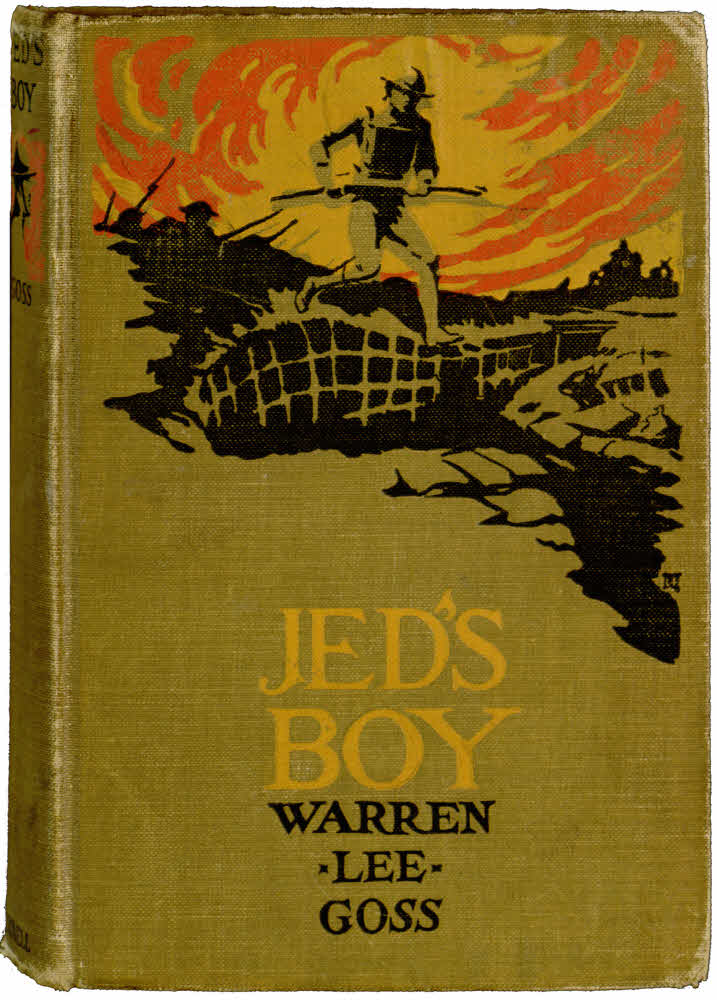
JED’S BOY
A STORY OF ADVENTURES IN
THE GREAT WORLD WAR
BY WARREN LEE GOSS
AUTHOR OF “JED,” “JACK ALDEN,” “TOM CLIFTON,” ETC.
ILLUSTRATED
NEW YORK THOMAS Y. CROWELL COMPANY
PUBLISHERS
Copyright, 1919, by
THOMAS Y. CROWELL COMPANY
DEDICATED
TO THE SOLDIERS AND SAILORS
OF THE GREAT WORLD WAR
PREFACE
During the progress of the Great War, the writer
has been often requested by his boy friends and others,
both by letter and verbally, to write a book like “Jed”
(“A Boy’s Adventures in the Army, ’61-’65”) depicting
the scenes of this later war. Some of them have
even suggested that he recreate some of the characters
therein. To do this, of course, was a logical impossibility,
since those not killed in that story would be too
old for military service. Prompted, however, by that
demand, he has taken a nephew of Jed as the hero of
this story. Incited by his mother’s patriotism, and her
recital of her brother Jed’s heroism, he enlists and
serves his country on the battlefields of France.
The author’s main purpose in writing this book, as
with his other books, is to stimulate a true spirit of
Americanism. Patriotism thrives best where it is best
nourished, and is not a plant of accidental growth.
The Posts of the Grand Army of the Republic through
their exercises on Memorial and other patriotic days,
and their teachings of patriotism in the public schools,
have been springs of liberty flowing throughout the
land nourishing a love of country in our youth. That
all this has borne fruit is shown by the spirit in which
the boys of to-day have sprung to the defence of human
liberty in the great conflict of their own time.
We have been privileged to see the last shreds of
hatred left over from our Civil War burned away in a
fervor of patriotism, that has sent the sons of the Gray
shoulder to shoulder with the sons of the Blue to the
defence of liberty on the fields of France and Belgium.
If the writer has made clear that the young manhood
of America has the same spirit to-day as had
their fathers, in our great conflict of the sixties, and as
had the Nathan Hales of the Revolution, he will have
satisfied his own aspirations.
It was November, in the year 1914. The snow had
come with the gloom of twilight, and an angry wind
whistled over the Western Massachusetts hills.
I was then a lad, trying to fill his father’s place on
the farm. I had just finished milking when I heard
Bill Jenkins, our hired man, call out in rasping tones,
“No, there’s no work for you here, I tell you!”
Turning, I saw at the barnyard gate the person to
whom Bill had spoken. He was a tall slim boy apparently
near my own age, fourteen.
“What is it, Bill?” I said; “what does he want?”
“You run along with your milkin’ pail,” said Bill.
“I’ll ’tend to him. You don’t know nothin’ ’bout
dealin’ with tramps.”
I repeated my question, and the boy answered, “I
am looking for work.”
“An’ I told you there’s no work here for you,” said
Bill roughly. “An’ if you can’t understand such plain
words as them air, you’ll have to get a dictionary.”
“Can’t I stay here over night?” persisted the boy.
“I can pay for my lodging. It’s getting dark, and
these parts are strange to me.”
There was something in the high-pitched voice that
told me the lad was weak as well as cold, and the
trembling tones appealed to me more strongly than the
request itself. There was, too, a peculiar accent in
them that excited my curiosity. So before Bill could
again interfere I answered,
“Yes, you can stay; and if there is no other bed,
you can sleep with me. I am sure mother will be
willing.”
“You are soft and foolish. You don’t understand
folks that go traipsing ’round the country,” growled
Bill. But ignoring his protests I led the way to the
house, with the strange boy following.
When we reached the kitchen and the lights were
brought, Bill, with a surly air, carried the pail to the
milk room. Mother coming in saw the boy and asked,
“Who is this, David?”
“A boy who wants to stay all night, Mother,” I
replied, “and I have invited him to sleep with me.
Can he?”
“What’s your name?” asked mother, turning to the
boy and looking him over with an inquiring glance that
meant more than words.
“Jonathan Nickerson—they call me Jot for short.
That is not my whole name, only a part of it. My
father is ’way off, I don’t know just where, and my
mother is dead; I couldn’t agree with the folks she
has been staying with, so I must find work or go hungry.”
As he spoke of his mother, his voice grew
husky as though he were keeping back the tears.
There was a straightforwardness in his answer that
pleased mother, as I knew it would, for she liked direct
answers to questions. This may account for her
keeping Bill Jenkins in her service most of the time
since the Civil War, where he had served as a drummer
for three months. He had appeared at her father’s
door, ragged and disgusted with military life, after
the battle of Bull Run, from which he had beaten his
way with some of the rest of those who had got back
to Washington.
Mother looked at the boy keenly from over her
spectacles, but made no remarks, while I summed him
up, as follows: He was very dark, thin in feature and
in person, his eyes dark and bright, chin prominent;
and notwithstanding thin-patched clothes and apparent
weakness, there was a manner of independence and
decision that cannot be expressed in words.
“Come here, Mother!” I said, turning to another
room.
“What do you want now?” asked mother.
“Don’t turn him away in the cold and dark,” I
pleaded. “Suppose I had no place to sleep tonight,
out in the wind and snow.”
“He looks clean, if he is patched and darned, and
seems a decent boy,” she said in an undertone, as
though thinking aloud, and then added, “Yes, David,
he can sleep in the ell bedroom. It is cold there, but
there are plenty of good comforters, and I guess he
can put up with it, if we can; and as our Master said,
‘Inasmuch as ye have done it to the least—’” and she
left the quotation unended.
Supper was ready, and mother said to the boy, “Yes,
you can stay here tonight, and if you have not had your
supper, sit up to the table with us.”
“Thank you, ma’am,” he replied sturdily, “but I
have no money to pay for my supper—only enough to
pay for my lodging—only twenty five cents at that.
“I did not say anything about pay,” said mother;
“you are welcome to your supper.”
“Mother told me never to take anything without
paying in some way for it,” he protested; “and I am
not very hungry.”
Mother gave him another searching look, as if to
learn whether there was any purpose back of his words,
and then as though satisfied, said with softening voice,
“Never mind about that, my boy; if you are not afraid
of work, you may pay for your supper and breakfast
too. There is plenty to do here.”
When he asked for a place to wash, and had gone to
the kitchen sink for that purpose, mother remarked,
“The pail is empty and the pump doesn’t work; so you
must go to the well for some water.”
When supper was ended, Jonathan asked, “May I
try to fix your pump, m’am?”
Mother hesitated, glanced at Bill, and then replied
with a smile, “Yes, you may try. At any rate you
can’t make it any worse than it has been, since Bill
fussed with it.”
Jonathan went to work with his jackknife and such
tools as were at hand. He had not more than started,
however, when Bill came in with an armful of wood
for the kitchen stove. Stopping at the pump he said in
his dictatorial tones, “You can’t do nothin’ with that
pump! I’ve tried it, an’ I tell you it’s past mending by
any botch or boy. An’ I tell Miss Stark it will be
cheaper to buy a new one, by gosh! For I put in a
half a day tryin’ to fix it.”
Jonathan, without reply, kept on with his mending
and, to our surprise, after half an hour had the pump
working.
“Where did you learn to fix pumps?” mother inquired
in a pleased manner.
“Our pump got out of order once, and the man who
fixed it explained its working to me, and I have learned
about them otherwise since.”
“That pump,” said the disgruntled Bill, “will be out
of order again as quick as scat, or I miss my guess.”
“You see,” said Jot, ignoring Bill, “that piece of
leather is a valve and must fit quite tight. When the
air is pumped out, the water comes up to fill the partial
vacuum. All I have done is to limber and adjust the
valve so that it fits tighter.”
“My!” said mother trying the pump, “it works
quite well, and it does not matter where you learned it;
you have earned your supper and breakfast too, for we
would have had to send to Chester for a man to repair
it, besides the inconvenience of waiting.”
The next morning mother asked Jot what pay he
would want to do the chores and other light work about
the place. “I will work a month,” he replied, “and
you shall say how much I am worth.”
The answer pleased mother since it seemed to insure
faithful service.
Thus it was that Jonathan Nickerson came to work
on the Stark farm.
My father, Captain David Stark, had been a soldier
in the Civil War. He had enlisted when only sixteen
years of age and, by military aptitude and bravery, had
won a captain’s commission, before he was twenty-one.
Over the mantel of our front room, secluded from
light and flies except when we had company, hung a
sword which had been presented to him, so its inscription
read, by his admiring officers and men.
He had married my mother some years younger than
he, quite late in life, and I was their only child. He
had died before I remembered much about him.
One day Jot noticed the sword and read its inscription.
He removed his hat reverently and said: “I
would like to be a brave soldier like him. My mother’s
only brother, Lieutenant Jedediah Hoskins, was
killed while leading a charge, just before the surrender
at Appomattox. She was but a little child when that
occurred, but she had his back pay and other property
to help us, and often called me Jed’s Boy, hoping that I
would be like him.”
Jonathan, or Jot as we began to call him, was careful
and handy; he repaired locks, and even put in running
order a disregarded mowing machine that Bill,
who didn’t like “new fangled farming,” declared was
good for nothing. We soon began to regard him as
one of the family, and mother liked him because, as
she said, he was both honest and careful and “had not
a lazy bone in his body.”
Bill usually read the weekly newspaper in the evening,
sometimes commenting aloud on what he read.
One evening while reading he looked up exclaiming,
“Gosh!”
“What is it, Bill,” I asked, “anybody dead?”
“Matter! The Germans are marching on Paris”,
he answered, “and there has been the all-firedest fightin’
you ever heard tell of.” Then Bill read aloud the
news of the first fighting in the Great World War.
“I believe,” he concluded excitedly, “that I shall
have to go myself and help lick them consarned
Dutch.”
“I wouldn’t,” said mother with a gleam of fun in
her eyes, for she liked to tease Bill, “You might wear
yourself out, as you did at Bull Run, scampering back.”
“Well,” acknowledged Bill with a grimace, “I am
getting old, and I like farmin’ a consarned sight better
than I do fightin’; but when I read ’bout them Germans
tryin’ to run over everybody, it makes my dander rise,
darned if it don’t!” And Bill was not the only one
of us who felt that way.
Then we got Bill to tell us about his experience in
the Bull Run campaign. So he gave his version of that
battle—even the running away, which, however does
not concern this narrative.
“Didn’t you think it a shame,” asked mother, “to
run away?”
“Well,” admitted Bill, “as a matter of glory it was,
but as we fightin’ fellers see it then, it looked like common
sense, plagued if it didn’t! A man will get sca’t
at things he ain’t used to. Them fellers that run
wouldn’t do it again—if the other fellers didn’t. I
wouldn’t wonder if I would stand to the rack an’ take
the fodder that was coming, myself, if I was in another
fight. And then my time was most eout, and I
was all the time thinkin’ ’twas best to go home on my
legs instead of in a box, when my time was up.”
“Were you scared, Bill?” I asked.
“Gosh, yes! the fust of it, my hair stood up so
straight that I thought it would take my hat off. But
I had spunk to stand it, in spite of being sca’t—’till
the others run. D’ yo’ know that I think it takes more
courage f’r a sca’t man to stand fire, than it does for a
brave man.”
And I have since learned, from experience, that it is
indeed a brave man who, being frightened, still keeps
his place in battle.
CHAPTER II WORKING ON THE FARM
The winter school had closed, and my spring work
on the farm had begun. Boys of my age in New England,
at least farmer boys, did not, as a rule, attend
school in summer: it was thought that winter schooling
was enough. My mother, however, intended for me
to graduate in the high school later. Like most New
England people, mother believed in the potency of work
as a needful part of a boy’s or girl’s education. Work,
she declared never hurt any one; while laziness and the
feeling that one is too good to work were the foundation
of shiftlessness and poverty. People must fight
for anything worth having, and farming is a fight with
the soil to make it yield a living.
“Your father,” she would say, “was a farmer and
a good one; he believed as religiously in fighting the
soil and keeping down the weeds, as he believed in fighting
the Confederates and putting down the Rebellion.
If you expect this farm to be yours, and to pay off
the mortgage on it,” she would add, “you have got to
learn about the work, or the rocks and weeds will get
the best of you, and it will be of no use when you get it.
You will be selling it, and spending the money, and become
a shack of a man like some others who think they
are too good to work.”
“But you have succeeded in working the farm,” I
argued, “without knowing the work practically.”
“Yes,” she admitted, “but I was brought up on this
farm and have learned what it will best raise. I know
the business part; but if I understood the farm better
I wouldn’t have to stand Bill Jenkins’ dictation, when
he wants to have his way instead of mine.”
“What makes you keep him,” I asked; “he growls
about what you ought to do, instead of taking your orders
and obeying them.”
“He is faithful,” she replied, “and is to be trusted.
If you can’t trust a man, he is of no use to you anywhere.”
Although Jot had now been with us long enough to
receive several months’ pay, he still wore the same suit
of clothes as when he came to the Stark farm. I afterward
learned it was because he had been paying for his
mother’s sickness and funeral. He was still reticent
about his father, and would give no account of himself,
except a general one. He talked, however, quite
freely about his mother, and about his uncle Jed, and
was intensely patriotic.
“I would like to fight for this country, as my uncle
did,” he would sometimes say, “if I should ever be
needed.”
We continued to read the news of the war as it came
across the sea. Our hearts were thrilled at even the
meagre recital given in our weekly paper, of that great
adventure of arms, when like a lion the great French
general with his brave army, stood in the path of German
invasion and said, “They shall not pass!”
On the farm, meanwhile, Jot had been proving the
correctness of mother’s judgment that he would be
worth more than his keep. Among other traits
brought out by acquaintance was one striking one. He
was passionately fond of animals, and had a control
over them that was seemingly the result of sympathy.
In mowing time, when I would be tired enough to be
resting, he would often be playing with our two year
old colt, Jack; and he seldom came into the pasture
without an apple or some dainty for him. The colt
was of Hambletonian stock, high spirited, and when
with Jot full of play.
One day, after we had been mowing hay, mother
said, “Bill, there is a shower coming up, and you had
better give the boys a little rest.”
“Well, Miss Stark, I guess it will be a good plan,
while we are loafing, to give Jack a little training.
He’s about the hardest scamp of a colt I ever see.”
But as Bill in his former attempts to train Jack had
lost his temper and struck and kicked him, he found it
hard to catch him.
“Let me try to catch him for you, Mr. Jenkins,”
said Jot.
“What do you know about colts?” said Bill crossly.
“I got acquainted with him down in the pasture, and
will try and catch him for you, if you are willing.”
Jot’s respectful manner mollified Bill and he assented,
saying:
“Well, go ahead with your sleight of hand with the
critter; but I can tell you, he is awful skeetish.”
Jot called the colt to him in coaxing tones, holding
out his hand with a lump of sugar, and Jack came circling
around him with flowing mane and streaming
tail; dropping his tail, snuffed at Jot’s hand, let him
take hold of his fetterlock and, yielding to his caresses,
allowed him to slip the bridle over his head and to be
led around.
But when Bill attempted to take the colt in charge,
he couldn’t manage him.
“Bill,” said mother, “Jonathan seems to understand
him; hadn’t you better let him try to break him; for I
am afraid you’ll spoil him; so please let him try.”
After he had led Jack around the yard for a while,
Jot said to mother, “I think that will do for this time,
Mrs. Stark.” And then, with a little more petting and
another lump of sugar, sent the colt scampering away.
“My!” said mother, “I didn’t think you could do
it.”
In one of our visits to Chester we acquired a dog, or
more truthfully, a dog acquired us.
We had no dog on the place; for Bill hated dogs;
said they killed sheep, and had fleas, and declared, with
some truth, that if a dog didn’t kill sheep, he attracted
those who did. But on this day as we were coming
from a store where we had been making purchases, a
dog with tin things tied to his tail came ki-yi-ing piteously
from a near-by shed where some rowdy boys
were congregated.
Jot coaxed the dog to him, got him in his arms, took
off the tin cans that had been pinched to his tail, and
holding the creature in his arms, said to the boys:
“Who owns this dog?”
“No one owns him,” one of them answered; “he’s
been hanging around here for quite a while.”
We took the frightened creature to the wagon and,
when half a mile away, put him down to shift for himself.
The dog would not be deserted by his new-found
friends, but followed the team and, at every attempt
to drive him away, would roll over on his back and
implore in doggish fashion, to go with us. So at last,
when we arrived at home, the dog was with us.
Bill, of course, strenuously objected to having the
dog on the place; but after much pleading I got mother
to allow us to keep him, though she also did not like
dogs.
“I won’t have him underfoot,” she declared, “so
you must keep him away from the house—out at the
barn;” to which we agreed.
We were delighted, for what boy does not love a
dog?
Jot taught him several cunning tricks, among other
things, to bring home the cows at milking time.
Because of his color we called him “Muddy.”
I have told these simple things not alone to reveal
Jonathan’s compassionate nature, but because they
were not without influence in scenes of greater
importance, in our later lives, as you shall see.
Jot worked faithfully on the farm, and with its
healthy food and work, had grown to be a strong
though slight young man. He had attended school
several winters, learning rapidly.
Meanwhile the war was claiming more and more of
our attention, and we read about it with such interest
that we had begun taking a daily newspaper. When
the news came of the sinking of the great passenger
ship, the Lusitania, with its hundreds of passengers, it
seemed too dreadful to believe. Though public indignation
was at white heat over this cruel deed, it was
soon toned to soberness by thoughts of our own possible
war with this relentless military power.
Soon after the sinking of the Lusitania, a great personal
sorrow befell me in the loss of my mother. She
passed away after only a few days’ illness of heart
failure. After her burial in the Stark private burial
plot, my Aunt Joe and her husband came to take charge
of the farm. Jonathan continued to work with us, but
Bill left to work elsewhere; for he declared he wouldn’t
stand bossing from any one.
The farm did not seem like home to me after mother’s
death, and I fell into such melancholy at times, that
Aunt Joe gave me what she called a good talking to,
saying, “I guess your mother is glad to have her boy
care for her; but it is just as natural to die, as it is to be
born, and it don’t do a speck of good to be blue when
we lose our friends.”
To illustrate her philosophy, she then sat down and
had a good cry with me.
CHAPTER III IMPENDING WAR CLOUDS
It was October, 1916. The harvests were gathered,
and the fall ploughing was done; the frost was in the
ground, and the hills were ablaze with the scarlet and
gold of Autumn.
I was debating with Jot whether I would attend
school or not, that winter.
“Of course,” answered Jot, “you will go to school
just as if your mother were here to tell you to go.”
To this good advice Uncle Jim assented by a decided
nod of approval. Now Uncle Jim, I had discovered,
had a will of his own and very decided opinions. As
Aunt Joe said, “though mild as skim milk in his ways,
he is as sot as a rock.” And knowing this I thought
it best to do as I was advised.
I began my studies at once when the winter term
opened, but was discontented, and did not take so
much interest in them as usual. When I brought my
books home to study, Jot read them eagerly, and asked
me many questions about the lessons. I think I learned
more in trying to answer his questions than I did by
the study of them in the books; for there is a difference
between committing a lesson to memory, and giving a
sensible answer to questions to one in earnest to know
about them—for one is an act of memory, but the
other requires thought and reasoning.
Our interest in the war was growing in intensity
day by day. Our neighbors often came in of an
evening to hear the news and discuss the war, and
among them there was a Mr. Larkin, who was a
pacifist. He was well informed and well read, for a
farmer, and though in the main patriotic had as Uncle
Jim said, “a pacifist crook in his mind that needed
straightening.”
At one of the evening gatherings, after we had dwelt
upon the relentless cruelty of the German army in
dealing with Belgium and France, Larkin said:
“They had better stop this war at once; for war is
so dreadful that it should not have a place in any
Christian country.”
“Well,” said Uncle Jim, in his slow and drawling
tones, “I don’t much admire war, but if any darned
crowd should break into this house and begin smashin’
things and threaten to kill the folks, am I a goin’ to
sit here like an idiot and see ’em do it without liftin’
my hand to stop it? No, sir! I am goin’ to stop such
works if I break their necks.”
“But don’t the Master say that we should return
good for evil?” replied Mr. Larkin, “and when smitten
on the right cheek that we should turn the left?”
“Well,” replied Uncle Jim slowly, “I suppose he
did say so; an’ I suppose if the majority of folks would
do so, it would be better. But it seems to me that I
have read somethin’ about the Master’s getting riled
at some wretches that had turned the Temple into a
sort of pawnbroker’s shop, and then drivin’ them out
with horse whips, because they had made it a den of
thieves. Now what do you suppose he would have
done, if he had been in Belgium, and had seen them
Germans setting fire to churches, and killin’ women and
children?”
“That,” said Mr. Larkin, “only proves my assertion,
that everybody should set themselves against war;
you speak, as though to keep the peace with all your
power, was degrading.”
“No, no,” said uncle; “you misunderstand me.
What I mean is, that when a bully hits you, you must
hit him back so hard that he will never want to hit you
again. To do the contrary would be to encourage him.
Such folks would soon rule the world, if you did not
make them take a back seat.”
After Germany had violated her agreement with the
United States not to sink any more of our ships sailing
the ocean on peaceful missions, our President declared
war, to “make the world safe for democracy.” Then
came the first call for volunteers, to fill up the ranks
of the National army. Men were quiet, but determined,
in supporting the President, and a deep undercurrent
of war spirit prevailed in our little community.
I had the war fever mighty bad. But uncle said:
“Wait awhile an’ see how that cat is a goin’ to jump—for
’taint best to be in a hurry about important
matters.”
There were some who differed about the wisdom of
declaring war, and, of course, our neighbor Larkin was
among them.
“Don’t you think,” he said to Uncle Jim, “that it
would have been better if our President had not been
so hasty?”
“No,” replied uncle decidedly, “I think that, instead
of trying to keep us out so hard, if we had ridged up
our backs in the fust place, and had begun to get a
big army together, Germany would never have dared
to provoke us to war. We have a right to sail the seas
wherever we choose, on peaceful business—that was
decided in the war of 1812—an’ no nation on earth
has a right to say we shan’t.”
During all this talk and excitement Jot was mostly
silent with a constraint that I did not understand—though
I had full faith in his patriotism. At one time,
before the declaration of war, it had been proposed by
my cousin Will Edwards that they should go to Canada
and enlist. But Jot had gravely replied: “I should
like to fight under the flag of this free nation, if she
should ever need me; as my Uncle Jed did in the Civil
War.”
There was something, even in this remark, of
reticence, as though there were other ties that bound
him of which he was inclined to make no mention.
Soon after the declaration of war, a horse trader
accompanied by Bill Jenkins, and another man, came
to the Stark farm to bargain for horses. The prices
they were willing to pay seemed large, and uncle sold
one of our extra horses. Then Bill said, “Why don’t
you sell the colt, Jack? He won’t be good for much
for quite a while, an’ I guess you’ll need the money
before long on this place.”
I did not like the freedom of Bill’s remark and
neither did I wish the colt sold. “Well,” said the
trader, “it will be no harm to look him over.” So
we went down to the pasture where Jack had been let
loose for his spring feed.
Our colt was now full grown and broken to saddle,
but not to harness. Muddy, the dog, and Jack were
great friends. The dog slept in the same stall with
the colt and they often frolicked together in the pasture.
When we reached the pasture the colt and dog were on
a frolic—the colt jumping and wheeling and prancing,
while Muddy jumped, barked and capered in front of
him.
Turning to my uncle the trader said: “I will give
you two hundred dollars for that colt. He isn’t worth
it; but I know just where I can sell him.”
My uncle refused to sell, and the man handing uncle
his business card, said: “Well, when you get ready to
sell, let me know.”
After he had started away I turned to speak to Jot,
but found he had disappeared. Later I came upon him
behind the barn talking to the man who had accompanied
the horse trader, and I overheard him using
some words strange to me—seemingly in some foreign
language—at any rate not common English. As I
came upon them they parted, and when I asked Jot
what they were talking about he made no definite reply,
but said, “I am so glad they didn’t sell Jack.”
His evasion made me angry, and I turned away to
go to the house. Jot called after me, but I refused to
speak or turn back; and that night we went to bed
without a good-night greeting as was usual with us.
The first thing, after I awoke, I went to Jot’s room,
but he was gone. Then I went down to breakfast,
expecting to find him at the table; but he was not there.
“Where is Jot?” I asked Uncle Jim.
With provoking deliberation he removed his pipe
from his lips saying “Gone.”
“Where has he gone?” I asked impatiently.
“Don’t know—suspect he has gone to enlist—said
something about it.” And that was all I could
learn—though I half suspected that uncle was keeping
something back,—something he didn’t think it
good for me to know.
After this I became more dissatisfied than ever, but
still continued my work on the farm, expecting to have
a letter from Jot. But no tidings of him came.
I constantly pestered Uncle Jim, who was made my
guardian, to let me enlist. But he put me off by saying:
“Time enough—wait awhile.”
Later on, uncle said to me, “I guess we shall have
to sell Jack after all; I have been offered a good price
for him by Colonel Walker. The interest on the mortgage
is coming due this month, and I am a little short
of money.”
So Jack was sold, and that made me still more discontented,
and not long after I “broke out,” as Aunt
Joe called it, by saying, “Uncle, I want to enlist. If
I don’t enlist they will, like as not, draft me. Just
think of a Stark being drafted! I am bigger than Jot,
and just as good for a soldier. They will take me,
and I am lonesome without Jot.”
Uncle Jim had finished his breakfast, pushed back
from the table, and began smoking his pipe as was his
custom after the morning meal.
I knew by his long deliberate puffs that he was thinking
it over. Then with shorter puffs, he finished his
smoke and I knew he had reached a decision.
“What d’ye think, Josephine? David won’t be good
for anything at school or on the farm now; and it is
natural for the Starks to want to serve their country
when there is a war on hand. Like’s not, if we don’t
give our consent he will go without it, and that would
be worse for him and us too. What do you think?”
“But, Jim,” said my aunt dolefully, “We are in
Sister Emily’s place. Would she consent if she were
here?”
I felt that I had won over Uncle Jim, for when he
said, “Well, Josephine, we will talk it over,” I knew
that his mind was made up.
So the next morning at breakfast—uncle slowly
and deliberately said, “Your aunt and I have been
considering about giving our consent to your enlistment.”
And then, after a long pause, “If you are
still of the same mind, you may go. I understand that
there will be a draft here—and you might have to go
finally anyway—an’ to be made to do a thing isn’t
pleasant, as you say, for a Stark.” So it was settled.
I was to go.
CHAPTER IV WITH THE COLORS
A few weeks later I had enlisted in the Infantry
and, with other recruits, among whom was Sam
Jenkins, arrived at one of the training camps.
Its size astonished me. It was a city of barracks.
Broad streets designated by letters, with each barrack
numbered, stretched out in endless succession, covering
hundreds of acres and miles in length and breadth.
On being assigned to barracks, we drew our “property,”
including uniform, blankets, sweaters, and other
equipments, usually issued to a “rookie,” besides a
rifle and its belongings.
I had supposed that the life of a soldier in camp was
one of comparative leisure, but there is where I made a
mistake—a delusion common to the uninitiated. Our
duties, or work, seemed unending. There was a rule
to fit every hour of the day.
Reveille calls the rookie out of bed. Then after
putting on his uniform he takes a position near the line
and, at the first sergeant’s command of “Fall in”
takes his place and assumes the first position of a
soldier—which means, heels on the same line, toes
turning outward, chest out, body thrown forward,
thumbs at the seams of his trousers, legs straight, but
not stiff, and the weight of the body resting lightly
upon the soles of his feet.
After reveille, he makes his bed, puts everything in
order, then washes for breakfast, or as it is called
“Mess,” after which he puts his equipments in order
for drill. His rifle belts and uniform must be neat and
clean as possible, or he gets a reprimand. Then comes
“sick call”; then “drill call”; at which call he is
expected to put everything in exact order in his
quarters, then take his place in ranks for two hours’
drill.
Then comes another “Mess” call, which means fall
in for dinner. After dinner there is a short rest, then
comes drill call again, after which there is another
short rest, during which he is expected to bathe, shave,
and make himself neat, and ready for retreat—which
is the dress occasion of the day. The next call is
“Taps” when lights must be out.
This is, however, but simply an outline of the routine
that one must follow during each day.
I, however, liked the military drill and, as Sam
declared, learned it as though it was something that I
was made for. But there were many petty exactions,
which looked to me, as it doubtless has to every other
raw soldier since the beginning, needlessly fussy; and
the drill sergeant was exasperating. But there is a
difference in men. Some, when invested with brief
authority, have always been bullies.
But it was when I went on my first “hike” with full
pack, that I thought I was killed. If there has ever
been an invention, since the beginning of soldiering,
that has made a soldier boy regret his wealth of possessions,
it is this first regular “hike.”
It was a beautiful day in July when I fell into line
with others, some seasoned vessels of war—but
mostly not. I had admired the pack while I was learning
the minutiæ of making one, for it certainly is a
wonderful invention, and the first half mile I kept up
a martial air, with my sweat-provoking and back-aching
pack galling me. Then I began to want a rest—and
didn’t get it! The sweat ran down my face and
saturated me with a sticky moisture. I fully agreed
with Sam when he said, in undertone, “Isn’t it a
grunter?” I certainly never knew the sweetest word
in English until, at last, came the order, “Halt!”
When I got through that “practice march,” I recognized
that carrying a nine-pound rifle on my shoulder,
and a heavy pack—however admirable the
invention—was not amusing.
It was, however, not many weeks before my sturdy
farmer-boy shoulders became more accustomed to the
pack. Poor Sam, however, who was short and fat,
for a long time persisted in his first opinion, that it was
a “grunter”! He said he had heard Civil War soldiers
tell of throwing away their blankets and overcoats on a
march and now understood the reason of it!
Some weeks later, when I had learned the drill,
and had even been complimented by a non-commissioned
superior who declared that I took to soldiering
“like a duck to water,” I thought there might be
something in inherited qualities.
One thing, common to all new soldiers, was that I
suddenly found myself unexpectedly fond of home, and
couldn’t hear from the folks often enough. Home
never seemed to my mind quite so lovely, as now that I
was away from it. I was, as may be inferred, not a
little homesick.
I have forgotten to say, in its proper place, that
Muddy had accompanied me from home to camp, and
was hailed by my comrades as a companion worthy of
the khaki with which nature had clothed him. He was
soon adopted as the Company Mascot; and to a homesick
boy his companionship cannot be over-estimated.
On coming to the Cantonment I had endeavored,
from the first, to find Jot; but not a thing could I learn
about him. To find any one in this big city was, as
Sam said, “like looking for a collar button in a
pasture.” It was more difficult to find a person in this
great city of barracks perhaps, than in an ordinary city,
because of the uniformity of its buildings and the sameness
of its uniforms.
One day I had left Muddy in charge of the mess
sergeant and had gone to the Y. M. C. A. to write to
Uncle Jim and Aunt Joe, when the door opened, and
Muddy, like a whirlwind of hair and tail, came yelping
and jumping upon me.
I looked up to scold him, for dogs were not allowed
there, when “Jot” stood smiling down upon me. He
threw his arms around me with a big hug, and slap on
the back, which I returned with interest, notwithstanding
my cool New England habit of reserve.
During all this time, Muddy had been yelping and
wagging both body and tail with doggish delight and
approval, at having brought his friends together, until
the superintendent reminded us of the rules.
Then I inquired of Jot, “How did you find me?”
“I didn’t find you,” he replied, “it was Muddy.”
“Yes; but how did you find my barracks and
company?”
“It was Muddy, I tell you;” he said. “I was on
my way to the quartermaster’s office, when I heard a
yelping and he flew like a mad dog out of one of the
barracks; and yelped and whined and dragging me by
my trouser leg as much as to say, ‘Come this way!’
And I understood enough of his dog talk to know that
you were somewhere around here. So I followed
him.”
It was not until we were on the way to the quartermaster’s
that I noticed, that he wore the chevrons of a
“Top Sergeant” (first sergeant) and learned that his
quarters were only a short distance from mine.
How it was that Muddy knew that Jot was in the
street is one of the mysteries of the dog intellect—or
instinct;—for the incident is true.
Afterwards, I told Jot of the sale of Jack to Colonel
Walker, and that I believed he was in the same encampment.
But Jot said he had learned that he was in one
of the more Southern camps—perhaps Camp Green,
in North Carolina.
“Why was it,” I queried, “that you did not tell
Uncle Jim or me where you were going?”
To this he replied, “Though your uncle did not tell
me not to let you know that I was going to enlist, he
intimated very plainly that he did not want you to
know. He said, ‘If David knows where you have gone,
there’ll be no living with him; and he will follow you
as sure as you stand there.’” I was quite angry with
uncle at first, but when Jot said, “I think he did what
he thought was best,” I saw, in part, an excuse for him.
Among other things that I learned, during my
soldier experience, was one, that trouble is often brewing
when we feel the safest. Now it was about to
overtake me and my dog. I was showing off Muddy’s
accomplishments one day to some dog admirers, when
an officer came up and inquired: “Whose dog is
that?”
“He is mine!” I proudly replied, “isn’t he a dandy,
Mister?”
“You must address officers by their title, he said
stiffly, and salute them.”
I had been so engaged, that I had not observed
before, that he was an officer. I at once stood at attention
and saluted.
He glanced at me seemingly through and through
and then, as though satisfied, said, returning the salute,
“About that dog—just keep him out of sight and
there will be no trouble;” and then as Muddy came
fawning on him, patted him and passed on.
“That,” said one of the men, “is a West Pointer.
He is as full of rules and orders as a book on tactics.”
“I guess he likes a dog, himself,” said Sergeant
Bill, “or he would have ordered you to put him out of
camp; for he is one of them highbrow officers that live
by rule. Them West Pointers are a bundle of rules
and regulations and eat blue books and general orders
and such things instead of grub.”
It was shortly after the foregoing incident, that an
order appeared in substance, as follows:
“After the 10th inst. all dogs, not licensed, will not
be allowed in barracks, squad rooms, or mess halls.”
But as Muddy had a home license and wore a collar
showing it, I was not concerned until, shortly after,
there appeared the following:
“After this date, all dogs, whether licensed or not,
will be turned over to the camp police.” To which
some wag had added, “and thereafter will be included
among the missing.” This was thought to be
“rough” on those who had adopted dogs as mascots,
and there were several companies that had, but
as the mess sergeant said: “What can we do about
it?”
I had been on guard at post one, in front of the
commandant’s office, and in my distress, at the thought
of losing my dog, determined on the hazardous
expedient of interviewing the commandant, to get permission
to keep Muddy.
So, brushing up my uniform and looking my neatest,
I went to the office of that dread personage.
I passed the guard, got into the office, and when the
commandant had turned from his desk where he was
engaged in writing, I stood at attention and saluted.
Then I saw that it was the same officer I have before
mentioned as being a West Point man, but whom I did
not know was the commandant.
“State your errand briefly,” he said coldly.
I was nervously stating my errand when in rushed
Muddy, as though to argue his own case. I picked him
up for fear of what further damage he might do, and
as a matter of habit with me, held in my arms.
“What is your name?” he inquired in a tone of
severity that boded ill for my request.
I told him, and, in answer to other questions following,
said my father was an officer during the Civil War
in a Massachusetts regiment. I saw his face change
from severity to interest, as he said pleasantly,
“Was your father Captain Stark of the —th Massachusetts?”
“Yes, sir,” I replied. “Did you know him there?”
“I am afraid not,” he replied, smiling for the first
time; “but my father did,” and added, “They were
friends.” After a pause he added, “I must grant this
request to the son of my father’s friend.”
I do not know whether this incident had anything
to do with a promotion which I soon after
received as corporal; but I am sure it did not hinder
it. And I was prouder of that promotion than any
that I ever received—unless a decoration received long
after from the French can be called one.
I found, however, that the duties of even this small
office carried with it not a little responsibility.
Possibly I magnify the office when I say that to be
a good corporal, in charge of new men, required some
rare qualities. He should be icy calm, have dignity
like a judge and eyes like a gimlet, and good humor in
profusion; or he won’t get much work out of his men.
I was on a detail shortly after my promotion, hauling
provisions for the Regimental Ware House, and I
couldn’t turn my head without losing a man.
When I told Jot about it he smiled and replied:
“You did well not to send men after those you lost,
or you would have lost more men.” And I knew by
that remark, that he had once been a corporal.
CHAPTER V FROM CAMP TO TRANSPORT
Shortly after the incidents narrated in the foregoing
chapter, I, with several others, among them Jot
and Sam, was granted a leave of absence of fifteen
days to visit our homes. This, we believed, meant that
we were soon to be sent to France where, from the
first, we desired to be.
When we reached the little village near our homes,
we were curiously viewed by the people, who up to that
time had seen little of the present day soldiers in
khaki. We were hospitably treated by our people, and
those who knew us gathered around to ask questions,
as is the habit of New England folks.
On our arrival home, it is needless to say, we were
greeted with hearty enthusiasm. Neighbors flocked in
to see us, and Aunt Josie expressed her interest and
love, after the usual manner of New England self-contained
matrons, by a big dinner. Even Muddy was
treated with affection and, for the first time in his home
experience, was not considered as being “under foot”
and in the way.
“How straight you are!” said Aunt Joe. “I
declare I think you have grown an inch, and you were
a big hulking fellow when you went away from here.”
Six months of military discipline had certainly left its
impress upon all of us. Jot had filled out in chest and
shoulders and, though not so tall and “bulking” as I,
as Aunt Joe called it, was a fine-looking soldierly
youth, lithe and active. Even Sam’s rather rotund
form, was reduced to soldierly proportions.
“Gosh!” said his father anxiously, “you ain’t
got any belly hardly at all. Hev’ they been starvin’
you?”
“No, Dad, we have all we want to eat in camp, and
we have the wust kind of appetite after one o’ them
drills. I guess you don’t know what they do to a feller
down here to take the fat off him and the kinks
out of him?”
“Yes, I do, Sam,” responded his father; “guess
I’ve been trained a lot myself.”
“Did y’ ever go through the settin’ up drill?” asked
Sam.
“Yes, Sam, I have set up nights a lot, but I never
had to drill it. I got sort of used to it when I was
courtin’.”
“I guess, Dad, you don’t understand; now I will give
the orders and drill you.” And then Sam put his
father through enough of the physical exercise to show
him what he meant and until Uncle Jim smiled to see
him puff.
The months of drill had certainly improved us
physically. The difference between slouching country
boys and soldierly youth, was written all over each of
us.
Muddy, too, had his receptions; and even Bill
Jenkins who was again working on the farm, said:
“Well, he’s a pretty good dog, and will do well enough
now that he’s been trained.”
My aunt was a proud woman when she took Jot and
me to church with her, and introduced us to the new
minister. The old church where my mother and father
had worshipped was filled, and we were greeted on
every side by friendly people, especially by the teachers
and members of the Sunday School to which Jot and I
had been constant attendants when at home.
One of the young ladies of the class was Miss Emily
Grant, of whom, in former times, I had been an ardent,
though shy admirer. She introduced both Jot and me
to a visiting friend, Miss Rose Rich, whom she had
brought home with her from a Massachusetts boarding
school.
Jot, usually so reticent, showed his approval of her,
by saying: “Isn’t she fine? Her father is a doctor
and she is going to take up Red Cross work.”
The friendliness of the two was observable to others
besides myself. Miss Grant said to me, “Rose seems
much taken with your friend.”
“He is the smartest noncommissioned officer,” I
replied, “in the training camp. He’s top sergeant,
and that means something, I can tell you.”
I told Uncle Jim about Colonel Burbank and what
he said about my father. And Uncle Jim said,
“Seems to me I heard your father mention him. I
wonder if it was him that your father brought from
between the lines badly wounded durin’ the Winchester
fight? Shouldn’t wonder if it was.”
But I had never heard about it.
When Jot and I had visited, for the last time, the
familiar scenes of the farm, and he had petted and
talked to the horses and cows, we left our home for the
camp again. A boy never realizes what a home means
to him until he is leaving it, possibly forever; for I
had a dim perception of what was possibly before me.
Several friends, besides my aunt and uncle, were at
the station to bid us good-bye. Among them were
Emily Grant and Rose Rich.
With the usual leave takings and waving of handkerchiefs
from friends, the engine puffed, the train clanked
out from the station, and we were off.
Back at camp we entered upon another course of
training in company, regimental and battalion drill,
with bayonet exercises, machine-gun fire, and the
digging of trenches, as a preliminary to participation
in modern warfare.
An old Civil War veteran, who had viewed our
preparations, said to me, “If Grant had had these
machine guns and other arms, he could have made the
Rebs howl and ended the war in short order. Why,
there is as great a difference between the equipments
of this new army and our old Union Army as there is
between a stage coach and an express train.”
Jot had been transferred to our regiment, at his
request, and became first sergeant of a company. At
one of our meetings at the Y. M. C. A. he said to me,
“Don’t say anything about it, but I think that we are
likely to break camp soon and go to France.”
“What makes you think so?” I asked.
“Well,” he said, “they have been making shipping
lists for the regiment; and then the furloughs they have
been giving, and other little things make me think so.”
I soon found that a rumor of the same purport was
all around camp. Like most youngsters, I was hungry
for a change; so when the top sergeant ordered us to be
ready to move within a few hours, I was glad at the
prospect of the change to some other place. Yet I
thought of submarines and other scarey unpleasant
possibilities, that night, before I slept.
The order came at last—it was on Sunday—for
an army has no days more sacred than duty. Though
we were not supposed to know where we were going,
we all guessed—the Yankee birthright—and
guessed France. Our outfit consisted of two suits of
Olive Drab, canvas leggins, two woolen shirts, woolen
underwear and stockings, two pairs of garrison shoes,
a Mackinaw short overcoat, a belt, three blankets, and
a comforter, all of which were carried in our packs.
On top of the pack roll was the haversack, containing
our kits, which consisted of a long handled aluminum
fold pan with removable cover, in which were a knife
and fork and spoon; two oblong cases for meat, hard
bread, sugar and coffee. The ammunition belt was
hung to this pack, and a canteen nesting in the cup hung
from it. There was also a barrack bag belonging to
our outfits, but this was carried by motor truck to the
station.
This I remember to my sorrow, as did others in
similar cases, for I did not see it again until our arrival
in France, though it contained goodies from home, and
chocolates. Others did not see their cigarettes and
tobacco again until long after.
At dark, with our packs strapped upon our backs,
we moved to the station and were embarked on board
of ordinary passenger cars—a noncommissioned
officer at the doors of each car to see that none went
out and that no one not belonging there went in.
Each commissioned officer had a list that showed the
place of each man and saw that he stayed there.
The next morning we found our train at a big New
York terminal, and had our breakfast—of sandwiches
and hot coffee that had been prepared for us the day
before.
From there we were embarked on a ferry boat. Our
company was on the top deck where we could see the
tugs, steamers and ferry boats, busily moving on the
stream, as we swung up the broad Hudson to the piers
where several big transports lay.
Sailing lists of every man’s name in order of formation
had been made in duplicate, one for our officers
and another in the hands of the embarking officer.
So he knew just how many of us there were, and had
already designated a berth for each man.
The railroad transport officer met us with the
inquiry: “Is Company —— of —— Regiment on this
boat?”
“Yes, sir!”
“Colonel Burbank?”
“Here, sir!”
“Good. Disembark at once, sir. Your transport
sails in half an hour. Form your men on the dock
opposite the freight clerk.”
“Yes, sir!”
“A loading detail of ten men!”
“Yes, sir!”
We disembark; but before the first company could be
formed a transportation officer without saying by your
leave marched us on board. He is the supreme officer
on the dock—no matter if the general commanding be
present the officer is the boss.
Along the deck we went in column and on board the
huge transport.
“Your sailing list, sir!”
“Yes, sir.”
“Are you formed in order of list?”
“Yes, sir.”
“Good! Load the company, Mr. Blank.”
The clerk, with a lieutenant by his side with a
duplicate list, calls out, “First Sergeant Smith.”
“Here, sir.”
The sergeant is handed a ticket, goes up the gangplank
where he meets another sailor who sends him
below; there he meets another sailor who sends him
still further below, and so on until he is at the bottom
of the ship where the bilge water smells. The others
follow until the ship is stowed with a human freight
of three thousand five hundred men.
Every man has his bunk of collapsible iron tubing
which stand in tiers three high, with a passage way
between. Later on, the top sergeant gets a second
class room. No dogs allowed; but I smuggled Muddy
in under my big coat.
We were all on board by night, and slept in our new
quarters, but were surprised to awake in the morning
and find our ship still at the dock. We were allowed
to go ashore for exercise on the dock, and the ship
routine began. Our canteens were ordered to be filled
but not to be used except in an emergency.
Before daylight, next morning, we swung out into
the river and down into the broadening harbor, to the
sea. We were all allowed on deck. As I stood viewing
the scene on every side, of brilliantly lighted cities
and towns, Jot came up, touched me on the shoulder
and, with a sweep of his hand, said, “Don’t it put you
in mind of that verse in the Bible,—‘Gazar and her
towns and villages, unto the river of Egypt and the
great sea and the border thereof?’” Then, as we
waved an adieu to the Statue of Liberty he added, “We
are the vanguard of the army to make good the meaning
of that Statue that France has prophetically placed
there. We go to deliver France and the world.”
The land began to fade as daylight brightened.
The broad sea spread out before us and with it a possible
broader vista of life’s great drama and of the
freedom of men as yet unborn, whose destinies we
were perhaps carrying across the sea.
The naval officers were in supreme command of all
on board and we soldiers were put to ship routine at
once.
“It looks to me,” said Sergeant Nickerson, “like a
huge job to feed all of us in this one dining room.”
“But it isn’t our business,” I replied, “so long as
we get the grub.”
“But it may be everybody’s business if they don’t
get it; and that’s what I am thinking about.” The
difficulty was solved in this way. The men were
marched to the room, and ate standing in line or at
long tables. As fast as one batch was fed, another
took its place. By the time breakfast was over, lunch
began. It was a sort of endless chain made up of men,
moving on schedule time.
Men began to growl—growling is a soldier’s safety
valve, and his privilege ever since soldiering first began.
“Sure,” said Pat Quinn, “it’s ating tactics we are
being drilled in. Ye’s open ye’s mouths so many
toimes and then swallow—one toime and three
motions!”
“What are you growling about?” said Private
Shaw. “There’ll likely be another motion on this
ship soon, so that you can’t swallow at all!”
So with rough jokes and gibes we ate our first
breakfast on board ship. Then ship drill began.
Each man was assigned to a boat or raft, and we
learned the ship calls. When the bugle sounded
“Assembly” every man was to go on deck and take his
place at his boat or raft. At “Abandon Ship,” the
boats and rafts were supposed to be got into the water.
“Quarters” meant every man below, to his bunk.
We go through the motions—only—of getting
the boats and rafts over the side of the ship. When
our instructor said that a raft was safer than a boat,
but that we were never to climb onto one, but hang on
with both hands, we were skeptical about it.
“He wants to keep a boat for himself,” said Sam.
“That is what he is preaching it for.”
We knew, however, that the safety of all on board
might depend upon our efficiency at this drill.
With boat drill—mornings and afternoons—scrubbing
decks, eating, and seasickness, our time was
pretty fully occupied. I was dreadfully sick for a time,
and did not care whether a submarine sunk us or not,
but got over it before long. It was very close below
decks, where we were mostly confined, and a hardship
to those accustomed to the free air.
Our company was so fortunate as to be detailed as
extra deck watch, and a group of us were on duty at
all hours, day and night. It was an autocratic job—we
were “It.” We could refuse to take orders or
answer questions from even the colonel! Our post
for this duty was a little box of a pen where, with fine
binoculars, we kept watch for submarines. I liked the
duty; it was a change and much like guard duty.
Before entering the danger zone we got detailed
instructions against lights. Every match and flashlight
on the ship had to be given up, and all hatches
were closed at twilight. Even illuminated wrist
watches were forbidden on deck at night.
One day a submarine was actually sighted. I was
on duty in the watch box with several of my company,
when I saw something sticking out of the water like a
small flag staff.
“Submarine!” I yelled excitedly. Just then
“bang!” went the forward deck gun and the periscope
disappeared. Soon it was seen again at another
quarter and another gun banged at it. Sam took up
his rifle to shoot at it, but was restrained, though he
declared he could put a bullet through it. Then
“bang” went another of our guns, and we were told
that she was sunk, but I doubted it.
“Shucks!” growled Sam, “how can we shoot a
Boche if we have to wait for orders? He will get
away from us, before we can get them!”
There was no excitement, though a young lieutenant
rushed around saying, “Be calm, men! be calm!”
But some of us thought he was not living up to his
own orders.
Soon after this Colonel Burbank sent for me to come
to his cabin. After several kind inquiries about my
folks, especially my father, he said, casually, “Sergeant
Nickerson, I learn, has lived at your home? What do
you know about him or his people?”
I told him all that I knew about him, and said, among
other things, that he had told my mother that Nickerson
was only a part of his name. And I interspersed
with this information not a little praise of Jot, to
camouflage the fact that I didn’t actually know much
about him.
The purpose of these inquiries the colonel did not,
of course, reveal. I was not a little surprised, however,
when he said: “He looks like a German officer I
once knew. I infer, from what you have told me, that
he does not talk much about himself or his business.
It’s a very soldierly quality!”
As I went to my quarters below decks this remark
was buzzing in my head like a bumble bee in a haying
field. As the colonel had not instructed me to the
contrary, I informed Jot, when I again saw him, about
the colonel’s remarks—all except the last one, about
the German officer.
Jot stood for a moment, as though in thought, and
then said, “It will do no harm to tell you that I can
speak a little German which I learned from my father
and his people. The first words I ever spoke were
German; but mother didn’t like it.” Here he stopped
as though he had already said too much, then, putting
his hands affectionately on my shoulders, added, “Does
it really make any difference to you, David, who my
father was, when you know me so well?” And I
knew that it would be useless to ask him further questions
on that subject.
We soon began to meet ships and fishing craft, mine
sweepers, and tankers, which showed that we were
nearing the coast. Next came a point of land like a
cloud on the horizon, and then the top of a lighthouse
appeared.
Was it France or England? It was France.
We learned that we were the first American transport
to land at this port.
Entering a narrow channel which widened out into
a broad harbor, we were safe in France!
“No one lands until ordered to do so by the commander
of the port,” was the next order.
It was not until the next day that the colonel, and
some other officers were ordered ashore to see the port
commodore; then, after some more waiting, we were
told to get ready for landing. Shortly after, we saw
the lighters coming up on which we were to disembark.
CHAPTER VI IN BEAUTIFUL FRANCE
Our first view of the land we had come to rescue
was not prepossessing. Some men were standing on
the sidewalks, as we marched through the narrow
street ankle deep in mud.
“Are we in France, or in the mud?” facetiously
queried one soldier. As we marched through the narrow
streets there was much cheering—not like American
cheers, long drawn out, but sharp and not all
together. There were some personal allusions in
English.
“I give you a kees;” said a girl. “You big fine
Americans!”
The salutations were as unlike our home calls as
were the city and its buildings. The buildings were
crowded together as though land were scarce, they
were of stone with carvings and copper ornaments,
which even the soldier would notice, they were so fine.
We wanted to break loose and see France and talk
to the people, but discipline held us in line. To men
who had been confined for three weeks in narrow,
stifling ship quarters, the air was invigorating.
We reached the station on schedule time, and were
embarked on third class cars, a squad of eight men to a
compartment. No dogs were allowed, but I got
Muddy in all the same, the guard taking pains not to
see him.
To Americans, accustomed to our large coaches,
these little box-like cars seemed like toys.
“Sho!” said Sam, “do they intend to give us one
apiece? They are like baby carriages!”
They were, however, fairly comfortable, but after
jolting along for several hours, when the train stopped,
naturally every one wanted to get out. Our officers
had a full-sized man’s job to get them back again on
time.
Peter Beaudett, a French Canadian Yankee, protested,
“I was saying something to a fine leetle girl;
she speak de French to me.”
Then we steamed on again, and after some hours
we stopped at a station for hot coffee, then rode all
night.
“I didn’t suppose,” said Sam Jenkins, “that France
was big enough for so much travel.”
At last we stopped, and were told that we had
reached our destination.
We had reached the “Base Station,” or “Rest
Camp,” and went into quarters. They consisted of
low, one-story, portable barracks, lightly built with dirt
floors, white oiled cotton cloth for windows, and with
wooden cots similar to those in our home barracks.
Though not as luxurious by a big sight, they were
comfortable. It was one of several similar camps on
the outskirts of an inland historic city.
We took our ease for a few days, slept, ate, and
visited the town when we could get a pass. None was
allowed out of our well-guarded camp without one,
and all must return at 9.30 P. M. or be punished.
Then we began the routine of drill again, with French
officers to teach us the new methods of fighting, such as
bomb throwing and trench duty.
At retreat one afternoon we were informed that
we were to be reviewed the next day. So after mess
we shaved, bathed, brushed up our equipments and
uniforms with unusual care, and with a French regiment
for escort, marched and countermarched, with
the stars and stripes flying and bands playing; and then
marched some more!
The contrast between the French escort and our men
was great. The French were different in many ways,
some of them impossible to express in words. They
were of inferior stature, many of them being not over
five feet, two inches, and by contrast our men seemed
giants. Their step was quick and brisk, while the
strides of the Americans was a long, swinging stride,
the step of men accustomed to hills and rough land,
not that of good roads and pavements.
We were greeted heartily by the crowds of people
gathered on the sidewalks and at the windows of the
buildings. Cries of “vive les Amerique!” and other
calls, that I did not comprehend, were heard. Flowers
were thrown at us. But there were no long-drawn-out
cheers such as we were accustomed to hear at home
on similar occasions. After much marching and
parading there came the order:
“Halt! Right dress! Front! Present arms!”
We were being reviewed by that great French soldier
who, when the German hordes were marching on
Paris, threw himself like a lion in their path and turned
the current of the battle, General Pétain.
Some of us had read of him and looked with intense
interest at this soldier of France. He was an erect
martial figure, a little stout; with eyes keen, steady
and penetrating, a white mustache, all the whiter by
contrast with the darkening tan that told of long service
in the field. No one could mistake him for other
than a soldier; he bore that undefinable stamp of long
service, discipline, and command of men.
Then we passed in review with our wagon trains,
cannon, and machine guns, the people cheering in their
way, and showering us with wreaths and flowers.
Even our mules, because they were American, came
in for a share of attention. One fractious animal, that
on account of bad conduct had been taken from a
baggage wagon, drew attention by standing on his
front feet and waving his hind legs and tail in the
upper air, as though trying to make holes in the sky,
and paint his displeasure with his tail. He was
saluted with applause and laughter.
One thing was preeminently seen, we American soldiers
held the hearts and minds of all. Later in camp
we came to know more of our hosts.
The enlisted man has this advantage of his officers
in learning to speak a language. He is not kept from
trying to speak, by fear of making mistakes. He
blunders on, and at last makes himself understood,
though he makes fearful mistakes.
I was not long in the camp before I was hailed by a
poilu who spoke the “American language.” He
greeted me by saying, “How is little old New York?”
He told me that he had lived there, but had come back
when the war started to fight for his country.
One day while I was writing a letter to the home
folks, with Muddy lying by my side, Jot, accompanied
by a woman, the English-speaking poilu, and with a
little girl in his arms, came to me saying:
“Dave, I want to show the dog to this baby and its
mother.” So Muddy was put through his cunning
tricks, and was played with and petted to his doggish
heart’s delight.
At this time I was in my eighteenth year—broad
shouldered, and five feet eleven and one-half inches in
height. My uniform emphasized my stalwart form,
now filled out and straightened by military training.
Though I was never considered a big man at home, I
felt myself, by the side of the smaller French soldiers,
somewhat of a giant.
I stood up and saluted the little sad-faced woman
and the “poilu”, and heard, or rather saw that she had
asked some question about me.
“What is it she is saying?” I inquired.
“She wants to know,” replied the poilu, “if I knew
the blond giant in America. Our people don’t know
what a big country America is. They think it mostly
New York city. You Americans are taller than our
people but,” he added proudly, “my countrymen are
big in courage and spirit.”
I remarked upon the large number of women who
wore long crepe veils, when he replied, “Yes; there
are many in mourning for their dead. This little
woman had already lost two sons in this war, and has
just now got word that her only remaining son had
been killed in battle.”
“She is not crying,” I said.
“No,” he replied. “Her loss is too deep for tears,
and she is consoled by knowing that she has given them
to France.”
“Express to her my sympathy,” I said, and Jot
added, “Tell her that we are very sorry indeed for
her.”
Then seeing that she had made some reply, we asked
what she had said.
“She said: ‘God gave them to me, and I have
given them to France.’”
While this conversation was going on, a man came
up and stood apparently intent on watching the child
and dog, and seeming to give no attention to our talk.
Then touching Jot on the shoulder and drawing him
out of hearing, he began to talk to him, as though trying
to get his consent to some proposal, and then moved
away with him towards the colonel’s quarters in a
nearby château. He looked to me like the same man
I had seen talking to Jot at home when the horse
trader visited us. I wondered at this, for Jot was not
given to making chance acquaintances. Then I saw
them disappear in the large house where the colonel
had his quarters.
After undergoing intensive training for several
weeks, we were thought fit to receive more practical
and strenuous duties and practice, by being moved to
real war trenches within reach of the guns of the
enemy.
We in the ranks knew that something was up. The
Eagle (colonel) had summoned our Skipper (captain),
a clerk had copied a list of names that had been given
him, and now all the officers were in with the eagle.
The supply sergeant was already nailing up boxes, and
the mess sergeant had been heard to say:
“I can’t see how the oven can be moved again”—all
of which were signs to any soldier that our regiment
was about to “pull out.”
We were all on tiptoe when the order came.
Every man whose shoes did not fit him got a chance
to change them. Then a list of promotions was published
and, to my surprise and pleasure, I was promoted
to be a sergeant in place of one reduced. I
was assigned to a loading detail by the top, and with
nineteen men went to the quartermaster’s depot with
an auto, and loaded up with ten days’ traveling rations,
and hauled them to the depot. By ten o’clock the
barrack bags came down, seven days’ rations were put
in a freight car, and three laid out on the platform.
All was ready, and after dark the companies
marched down to the station to entrain. I fell in line
in my place on the platform with the rest. Then the
mess sergeant and cooks dealt out enough “chow”
(rations) for the corporals, so that each man had for
his squad a can of beans, two cans of Willy (corn
beef), and four packages of hard bread, and a can of
jam.
“It has got to last you three days,” cautioned the
mess sergeant; “so go easy on it.”
The top came along and checked every squad as it
embarked. The officers shook hands with the railroad
transportation officer and, together with the
French interpreter, climbed aboard.
They were little box cars, and painted on the outside
“32 hommes, 8 cheveaux.” There were portable
benches at each end and a good lot of straw.
“Sure,” said Pat who was in my car, “it is comfortable
enough for a pig.”
“AW!” REJOINED SHAW, “CHEVEAUX MEANS HORSES, YOU
WILD IRISHMAN!”—Page 50.
Then we settled into the car; rifles in place, kits
hung up on the sides, a lantern swung in the center.
We were, despite all the growling, very comfortable.
There was a seat for every man. All voted that it
beat third class cars.
We reached a coffee station, and lined up outside
the car in double ranks, and each man got a cup full
of French coffee. Then came an all night ride. The
men took off their boots and, with a haversack for a
pillow, slept snug as bugs in a rug.
I slept, sitting up, with my back against the door,
querying to myself if the buck private’s job was not
easier than that of a sergeant. And I thought, possibly
the skipper himself did not have so easy a time
as I had sometimes thought.
The scenery was beautiful. We followed the course
of a river. On the banks were old castles, beautiful
châteaus, villages with red topped roofs, and always
stone bridges.
“Say, boys!” exclaimed Sam, “we would have to
pay big money for this sight seeing excursion, before
the war.”
It was getting so interesting that we forgot to eat.
“Where are we going, Sergeant?”
“Don’t know.”
“How long will it take to get there?” inquired
another inquisitive Yankee.
“Don’t know,” I replied, “there are three days’
rations on board, and seven in a freight car.”
“Don’t the skipper or eagle know?”
“Guess not; we are travelling on confidential orders;
perhaps the eagle does know.”
So on through France we travelled, to heaven knows
where!
At last we halted at a small station. An officer met
us and inquired for the commanding officer. The
train pulled in to a high platform, where we unloaded.
We had reached the limits of our railroad travel. It
was dark, and we were tired and hungry, with prospects
of cold grub for supper.
We were assigned to billets by an American officer—stables,
barns, stores and lofts. Some big galvanized
cans of hot coffee were sent us by the officer of an
American regiment already established.
“Thanks!” I heard the colonel say. “I hope to
return the compliment some time.”
“You can return the coffee out of your ration
tomorrow; it is the rule here to help each other.”
The most expressive part of our location was that
for the first time, we were within sound of guns. We
heard a dull boom! boom! and at times thought we
heard the sharper sound of rifles. We were near the
front at last, and were to get practical experiences in
the trenches, further to fit us for the grim duties of
soldiering.
CHAPTER VII IN THE TRENCHES
I, with others, was billeted in a house and barn
tenanted by a little French woman with a brood of
several young children, whose husband was fighting
for France. Others were billeted, by the town major,
in warehouses, lofts, and other places.
After a few days’ rest in our billets, we were
marched to the trenches.
The American front in France at this time, so far
as there was any front, was in Lorraine. In reality
there was no American front, because our army had
not had the training to hold one. While we had
received the drill of ordinary soldiering, we lacked
experience in the prevailing war methods then in use.
While my regiment is marching forward to take up
trench duties in front of the enemy’s lines, let us take
a look at what constitutes that part of a modern army
known as an infantry regiment; for infantry is the
body and mainstay of an army.
The old Civil War regiments were made up of ten
companies of 152 officers and men; more often less.
The modern company has 256 officers and men; and
the regiments made up by these twelve companies, has
103 officers and 3,652 men. The officers of the modern
company, while on a war footing are: One captain,
three first lieutenants, two second lieutenants, one
first sergeant, one mess sergeant, one supply sergeant,
twelve sergeants, thirty-three corporals, four mechanics,
four cooks, two buglers, and 192 privates. One
of the first lieutenants is the captain’s assistant; the
others each command one of its four platoons of men.
The transportation equipment of a regiment is more
elaborate than is generally known. It consists of
twenty-two combat wagons, sixteen rolling kitchens for
cooking food, twenty-two baggage and ration wagons,
sixteen ration carts, fifteen water carts, three medical
carts, twenty-four machine-gun carts, fifty-nine riding
horses, eight riding mules, three hundred and thirty-two
draft mules, two motorcycles with side cars,
one motor car and forty-two bicycles.
Arrived at the trenches we were taught, among other
things, to “camouflage” as the French call it, which
means to disguise, or conceal. This has become an
art in modern warfare, because cavalry is no longer
the eyes of an army as in former times, and airplanes
reveal what is not carefully hidden.
For illustration: an artilleryman of heavy guns now
seldom sees the object he is to fire upon. The directions
for firing are given by signals from air-craft.
These locate the enemy’s line of battle, trenches,
machine gun and artillery emplacements, magazines or
the “dugout” of some general to be fired upon.
Hence, to disguise or camouflage them is important.
Heavy artillery firing is not by sighting, but by directions
given them by mathematical calculation. The
guns, even, are streaked with paint to resemble the surrounding
country, so that they may be more effectually
concealed.
The concealment of artillery magazine stations, or
other important stations, has been brought to great perfection.
Sometimes a road leading to them is roofed
by canvas and painted to resemble the surrounding
scenery of rocks or foliage.
The war trench is a ditch six feet or more in depth,
with a fire step that brings a soldier to the height
needful for firing upon an enemy. On the top of this
trench, along the front edge of it, are laid bags filled
with sand, so disposed as to give loopholes through
which a rifle can be fired without requiring the soldier
to expose his head. This trench is not built on a
straight line, but zigzag like the teeth of an enormous
saw, so that its machine-guns and riflemen can fire
down and parallel along the trench. At every twenty
feet or more, there is a barricade built across the
trenches, so that if any enemy should get possession of
one part of it, he can not, by artillery, machine-guns or
rifles, fire down the whole length upon the men there;
for this would be tremendously destructive.
In front and about ten feet from the trench is a
barricade of barbed wire. This is made by setting
stakes very firmly in the ground so deep and solid that
they can not be easily removed, and twisting barbed
wire around them. It is impossible to pass through
this entanglement without first destroying it by artillery
fire, or cutting it; and this is costly to life.
There are, in addition to this trench, three other rear
trenches. These are joined with the front trench by
connecting trenches, through which the soldier can
pass with comparative safety.
In these rear trenches are first aid and food stations;
and in a dugout, safety sheltered and concealed in the
rear, is the general who directs the fighting. To his
dugout, or station, are connected wires or telephones
and telegraph, so that he can conduct the fight, and
receive intelligence of everything taking place on the
battle line. Though he is in comparative safety his is
a hard position; for he can not leave it without losing
some point of importance, in the work of direction.
The science of war, in its details, has vastly changed
since the Civil War, though the principles that govern
its larger movements are the same, modified somewhat
by the new machinery used in fighting.
It was October, 1917, when we had landed in France;
it was now February, 1918, cold, bleak, and dreary.
Rain, snow and sleet had made soldiering uncomfortable
anywhere; and the trenches were no exception to
this rule—but rather an exaggeration of it.
It has sometimes seemed to me, that in my army life
the most inconvenient times were always selected for
its most disagreeable duties. This rule held good for
our introduction to life in the trenches. It was a cold
day. Snow covered the ground—at least that portion
of it not trampled into the chalky mud, which, partially
thawed, stuck to our feet like poultices. Marching,
however, with heavy packs soon warmed us, and we
were glad to arrive at our destination.
The sector to which we were assigned for duty had
been occupied by some French troops, who were just
moving out. They did not cheer us—for cheers are
out of place in some parts of soldiering, especially
where it may give information to the enemy. But
they welcomed us with brightening eyes, and nods, and
smiles of approval, as we filed into the trenches; and
looked—so it seemed to me—not a little enviously at
our well-filled packs with the heavy blankets of our
outfit.
We found the trenches which had been constructed
for the poilu, a little shallow for taller Americans.
And as we had been warned not to show our heads
above the parapets, we had to crouch when moving
through them.
We were told that some of these trenches occupied
by the French had board flooring; but ours did not,
except in spots.
“By Shorge,” said Peter Beaudett, “do they think
we are feesh?”
“An’ sure,” said Pat Quinn in a hoarse whisper, “no
dacent fish would live here—it’s mud turtles that we
are!”
“Hush up,” commanded the top sergeant, in a
hoarse whisper, “no noise; keep your ears and eyes
open, but shut your mouths.”
Silence followed; but as we threw off our packs, and
were told to make ourselves comfortable, it seemed a
little sarcastic.
“If we mustn’t talk,” said Sam, in a low tone, “I
suppose they can’t hinder us from keeping up a lot of
thinking, can they?”
“An’ how can a man think,” muttered Pat, “with
all this half-frozen mud on his fate and moind?”
We had settled down, in the mud, as one of the
sergeants said to me with a wink, and with Yankee
ingenuity were making ourselves as comfortable as we
could. Private Shaw made a stove by punching holes
in a metal bucket, and kindling a fire therein (which
Corporal Sutherland said was “a kind of lightning bug
heater”). He sat with it between his legs, trying to
warm himself. Peter Beaudett, with his blanket
wrapped around him, was saying all sorts of funny
things in a low tone, about soldiering, and the irrepressible
Quinn, with Irish combativeness, was making
contrary replies.
“What made me get into this mud,” grumbled Peter,
“when I had a good home and such beeg lot of comforts
that I didn’t know that I had any?”
“An’ why,” said Quinn “didn’t ye’s stay tied to
your mither’s apron string, so ye’s could crawl under
the bed whin it thundered?”
In spite of all this by-play of growling and seeming
grumpiness, the men were not dissatisfied at being
face to face with their enemy, or at least in the trenches
opposite them.
The opposing lines, meanwhile, were so silent that
our men, peering cautiously through the “gun holes”
as Sam called the spaces left between the sand bags
piled on top in front, were curious to see the Boche,
and could be hardly restrained from firing a shot to
“stir them up.” This feeling also was seen in those
of higher rank; for is it not natural for Americans to
want to “see something doing”?
The French, who were acting as our instructors, and
who had had experience in these same trenches, cautioned
us against this. They said that there was a
tacit agreement between the contestants, not to needlessly
stir up a fight.
There was a well of water just to our right, midway
between the opposing trenches where, by tacit consent,
two men at a time were allowed to resort; near it was
an apple tree whose limbs enticed one, provokingly, as
good for firewood.
The next night following these occurrences was one
of watchful waiting. I was sergeant of the guard;
but nothing of importance occurred during the night,
except that the weather moderated, and the rain came
pouring down in torrents and then turned to sleet.
But when it came my turn off, it was not too rainy for
sound, dreamless sleep—and, as soldiering goes, it
was not so very uncomfortable to strong athletic
youngsters with hot blood in their veins; as grew
apparent to us, by contrast, later.
With the coming of morning, American restlessness
and the desire to see things moving became more
apparent in our ranks, and even among our officers.
“Phat the divil are we here for a’ tall?” said Pat
Quinn. “Is it to be sitting with our thumbs in our
mouths like the little Jack Horner?”
It had ceased to rain. The sun had come out, and
the clouds cleared away sufficiently for us to catch
glimpses of blue in the sky; and American blood and
impatience began to stir.
When two German soldiers without arms were seen
at the well mentioned, taking a wash and getting water,
they were not at first molested, though it could be seen
that Yankee fingers were itching to take a shot.
After finishing washing, one of the Boches began
cutting some branches from the tree. That was too
much for Private Shaw, who stuck his rifle between
the sand bags and crack! went a shot at the Boches who,
dropping wood and water, scampered in unheroic haste
for their holes.
“Who did that?” inquired the tall lieutenant of our
platoon. “Who fired that shot?”
“It was me, sir,” answered Shaw. “I wanted some
of that wood myself!”
“Well,” said the lieutenant good-naturedly, “you
stand a mighty poor chance to get any of it now.”
And just as he spoke and straightened up a little, ping!
came a bullet that passed through the officer’s hat.
“The imperdence of the divil!” said Pat; “sure,
Lieutenant, are ye hurted?”
The lieutenant was mad, and walked away growling
under his breath without reply.
In a few moments, bang! bang! bang! bang! went
our light guns; and then came replies from the enemy
that boded ill for quiet times, for the Boche guns,
speaking from their hiding places, seemed likely to
reach us in our burrows.
One great eight-inch shot struck near our parapet,
exploding with a crashing roar, breaking a broad path
through the barbed-wire barricade and leaving a hole
big enough to bury a whole platoon.
“Faith, is that phat they call a Jack Johnson?”
said Quinn, “or is it a little light-weight fellow?”
Our French officer was understood to say that it was
the latter. Peter Beaudett, during the firing, had been
struck by a small piece of spent shell, which knocked
him over while barely breaking the skin of his jaws.
He “rustled” as Shaw declared “like a hen with its
head cut off;” then, finding that he was not killed,
though two of his teeth had been knocked out, he
angrily shook his fist towards the enemy, crying out:
“Py tam! I no like your doctor pulls my teeth; I fight
you now, by tam!”
We had got our lesson, that two can play at a dangerous
game; and after this the opposing lines settled
down for a while, to comparative peace and quiet.
Such was our introduction to trench warfare, on the
front line, which finally grew in intensity and became
exciting and dangerous enough to satisfy the most enterprising
Yankee. Even this first experience, however,
had convinced us that there were worse discomforts
than rain, snow, or mud.
Shortly after this, it was my duty to take a turn with
a squad on the listening post. I had with me a young
German-American named Kepler, whose father had
been a soldier with my father during the Civil War, and
whose loyalty and patriotism were unquestioned. He
was quiet, phlegmatic, and resolute; absolutely to be
depended upon, and, better still, spoke and understood
the German language.
Silently creeping through the excavation leading under
our barbed wire barricade and, leading to the front
of the German trenches, we reached our station. Here
we listened for possible movements of the enemy, but
all was quiet and we had, as Sam said, who was another
of our party, “nothing to report, but a big lot of
silence and chills.”
A listening post, here let me explain, runs underground,
in most cases, beneath the barbed wire barricade
which protects the trench from sudden invasion,
such as mining to blow up our trenches; and sometimes
conversation and orders could be heard, which gave
valuable information.
Of course the Germans, on their part, also had listening
posts constantly near us whose whereabouts
were, however, not known, though sometimes guessed
at.
The duties of those on listening posts had not only
a spice of danger, but an appeal to the natural curiosity
of a New Englander. Therefore, with all its
“cramped-up-itiveness,” as Sam called it, it was not
without its fascination for our boys.
When, after a tour of four days’ duty on the front-line
trench, we were relieved and marched to our rest
billets in the rear, we found it more than agreeable.
As Sutherland stood up at his full six-foot height, he
said, looking around and taking a full breath, “Say,
isn’t this a big country!”
“Shure,” agreed Pat, “ye’s can get a white man’s
braith and niver a fear of getting a bullet to vintelite
your head, or a piece of shell to knock out your dintistry.”
At which Peter Beaudett rubbed his jaw and ejaculated,
“Ugh!”
With all the badinage and by-play of rough jokes,
the men were more serious when coming from the
trenches than when, with some forebodings, they had
taken up its duties.
My! how I enjoyed “chow” that night when mess
call sounded! And the dreamless sleep that followed,
with clean straw and with a blanket spread over it
for a bed!
CHAPTER VIII “WHO COMES THERE?”
One of the first things I did on going into rest
billet was to send word to Jonathan by Muddy.
Our friendship had grown stronger since entering
the army, and we had kept it up by frequent intercourse;
both by meetings and by exchange of notes
back and forth by Muddy. When I put a note in his
collar and told him to carry it to Jot, he seemed to
understand what he must do; and these notes except, in
one or two instances, reached their destination.
There were some jokes about the “Muddy mail,” but
most of our comrades thought it was wonderfully intelligent
that the dog understood when told to carry it.
There had never been any serious misunderstanding
between Jot and me. Ever since coming to France,
however, there had been vague insinuations that Jot
was of German parentage and sympathies. There was
nothing that I knew that warranted such a belief; but
since I had learned that he spoke their language, these
whispers of suspicion had increased until they affected
me with just a little inner questioning. What was the
reason for his being always so reticent about his father?
I did not, however, for a moment distrust his patriotism
or loyalty to our country. The general distrust
and hatred of everything German was common among
all classes. It was but the natural result of the wicked
and cruel policy of the German government and army,
since entering upon this dreadful war, which now
seemed to menace civilization and free government, so
dear to Americans.
When Jot came to see me, as requested by my note
through the “Muddy mail,” I told him of these rumors,
and said: “Would it not be better to tell about
your family, and stop these sinister rumors, for
good?”
“You have confidence in me, haven’t you, Davie?”
Jot replied.
“Yes,” I asserted, “I think I would trust you sooner
than myself, in any important matter. But wouldn’t
it be better for me to know the truth, so that I can contradict
these insinuations?”
After a moment’s thought, he replied: “Well, possibly
it would. But it is to satisfy you rather than
them, that I will say, my father was born in the United
States. He was, in that sense, an American. I have a
half-brother three years older than I, who is said to
resemble me, but we never agreed. And there was a
misunderstanding between my father and mother that
was never healed. It was by her request, almost her
last one, that I have taken my present name. That’s
all I can tell you, and that is all there is of consequence
to know.”
This had to satisfy me, and with it I hoped to contradict
any further insinuations that I might hear.
Soon after this we were on duty again in the front
trenches, and were at first careful not to stir up needless
fighting.
The duties of a soldier call for constant caution and
alertness; and yet he must have a care-free cheerfulness
with it all. He must not borrow either sorrow or
trouble. It requires time to nourish either fear or
worry, and the philosophy that does not cultivate them
is the one that produces the most comfort for a soldier.
So, during our stay at the rest billets, we ate and joked
and enjoyed more than those who live in the calm of
life. And now, when with a certain confident jauntiness
we again took our places in the trenches we were
full of confidence and courage; and it proved the wisdom
of frequent rests in this nerve-straining duty.
We were, however, not only getting acquainted with
our duties and its dangers, but were making acquaintance
with its other discomforts.
We were admonished by our officers to keep clean
and cheerful. But I could not see that we needed the
advice more than those who gave it; for I came upon
our captain with his shirt off curiously investigating the
seams of it for certain familiar invaders that were a
plague to most of us. It was shiveringly cold and
damp, but these pests were no respecters of rank.
Cooties, as Tommy Atkins calls them, can not be put
out or down with a frown, or even by a general order
from headquarters.
“They and the rats are,” said Sutherland, “a providential
war creation intended to keep soldiers so busy
as to forget, with scratching and frequent investigation,
all smaller troubles.” However, he used sulphurous
words, common from time immemorial to soldiers,
because our French predecessors had left these pestiferous
enemies behind them for us to fight.
“By Shorge,” said Peter Beaudett, “I dinks dey carries
enough de cooties away to keep dem busy! But
de rats! one got’a hold of the ear of me the las’ night!”
Sutherland, who was something of a reader, declared
that he had never before understood why it was
that in “Tristam Shandy,” so much emphasis was put
by Uncle Toby in his assertion that “The army swore
terribly in Flanders;” but that the reason was now revealed:
for it surely was the cooties, that caused this
profanity!
No one can understand the discomforts of trench life
when simply depicted in words. No one can describe
a trench by word or picture; he can not introduce any
one there by illustration, he must be there himself, or
he can not understand its real discomforts. They did
not seem fit places for civilized men, those who used
combs, brushes, soap and napkins, had clean hands and
faces. We were ghosts of the cave men.
Trench life, however, had its phases of good. It
drew men together with a sense of companionship with
danger and death, that they had not known before.
While a needful reserve was kept up between officers
and men, there was greater cordiality and a greater
feeling of intimacy,—less harshness.
For some weeks there had been a season of peacefulness
between the lines. The weather had become
warmer and more springlike, with occasionally a
sunny day. Then there came a change. We had become
accustomed to trench duties and not a little tired
at its sameness.
It was while I was on this duty that the change came.
I, with others, was on detail at a listening post one
night, and while intently listening, young Kepler said
in a whisper: “Did you hear that, Sergeant?”
“I heard a growl,” I whispered, “as though some
one was speaking.”
“I think they are going to attack, somewhere,” he
said. “There, did you hear that?”
“No, what is it?”
“Some one giving orders,” he replied. “I can’t
hear distinctly, but I am sure it means an attack.”
We sent back word to the trenches, and they in turn
sent back word to the commandant in his dugout, that
there was an unusual stir on the German front opposite
us; though we could tell nothing more definite at that
time.
It was not long before we learned the meaning of
what we had heard at the listening post.
A tremendous explosion of artillery, about two
o’clock, broke the stillness of the damp gray morning.
Gas shells came whistling over us. We put on our
gas masks, and were thankful that the shells were
mostly going over us instead of striking near. Our
heads with these masks looked queer, and laughter-provoking.
“This means an attack,” was passed down the lines.
“I don’t think they know any more about it than we
do,” some one growled.
“It’s meself,” said Pat Quinn, “that wishes it would
come along dacently soon, if it’s coming.”
This expressed the feeling often felt among soldiers,—to
know the worst and have it over with quickly.
“They fire all along the line,” said our lieutenant,
“so that we can not tell where the real attack is coming.”
The continuous whistling of gas shells and the sickening
fumes that partially reached us, the explosions
over and near us, and our answers in like kind made it
even then seem like a hell on earth.
Then the enemy seemed to get a more perfect aim,
and their shells swept away our wire barricades clean
to the ground, as though they were cobwebs, until not
even a post was left standing.
Our men, cowered under the earth embankments,
waiting, waiting, with high-strung, impatient and nervous
suspense, until, at last, they were warned that the
attack was at hand.
Then our artillery quickened in sharp explosions,
while the rat, tat, tat of the machine-guns, like a stick
being drawn over a slat fence, filled the air with a
demoniac clamor impossible to describe. The air was
full of hoarsely shrieking shells and shot that made the
air vibrate, and the ground rock, as though the demons
themselves had broken loose!
Then the nerves that were shaken stiffened, and we
were ready for the attack.
The Boche came on in two waves, one behind the
other, and were met by the deadly, coolly-directed machine-gun
fire and the well-aimed rifles of our sharpshooters.
Still they came on, got possession of one
small part of our entrenchment between two traverses,
and tried to drive our men down the trenches by enfilading
them with machine-gun fire. But they were
driven back again with losses in dead, wounded, and
prisoners.
The dark clouds that had hung over the scene during
the fight cleared. The sun came out and as it neared
the horizon, like a great disk of blood, the dark
smoke drifted away, revealing the scene in our front.
There a score of mortally wounded and dead lay.
When we took stock of our losses, we found them
slight. One of our first lieutenants was wounded, two
privates killed, and five wounded, two of them but
slightly, and two missing.
I was so fortunate as to receive praise from my captain
for what he called my “coolness and courage.”
But, I must confess the truth, I was at first woefully
frightened but tried not to show it.
I have since learned that though big gun fire makes
an alarming sound, it also makes a good many holes in
the air without touching a head; and that the most fatal
effects in battle are more often from well-aimed machine-gun
fire and rifles.
After a battle, when the enemy has been successfully
met, there comes a feeling of exaltation among its defenders.
The French officers were generous in praise
of us, while our captain said, “You made a good fight,
and I am proud of every one of you.”
Colonel Burbank also was generous in his praise.
“It is your baptism of fire as soldiers that you will
never forget, and can remember with pride,” he stated.
When I remembered my trembling knees and the sick
feeling at the pit of my stomach, I doubted if any of
the praise belonged to me, but concluded not to mention
it.
Peter Beaudett, who was wounded severely in the
arm and had first aid, said, with a wink at Quinn, as
though he had good fortune instead of a wound, “By
gar! It means to me a bed and much clean sheets.”
“Shure,” replied our ever disputing Quinn, “and
it may mane a doctor’s saw,” and then seeing by his
wounded comrade’s face that his remark was cutting
deeper than he intended, added more softly, “a pretty
Red Cross nurse and a vacation. An’ I almost wish it
was meself that was in your place.”
Our lieutenant was more severely wounded than was
at first thought and we learned that it was the opinion
of the surgeons that it would be a long time, if ever,
before he was able to resume his duties with the company.
Here let me, unwillingly, record the fact that Muddy
did not prove to be a hero. When the racket began, he
tucked his tail between his legs and with a whine and
an apologetic look at me over his shoulder, scampered
off in a most unheroic manner.
“This means promotion to some one,” said our men,
when it was known that our first lieutenant, Reese, was
not likely to resume duty on account of the severity of
his wounds.
In spite of hardships and battle, to which, however,
we were becoming reconciled, we professed ourselves
enthusiastically ready for another “bout” with the
Boches, and didn’t care who knew it!
I was very proud, for my friend Jonathan gained the
good opinion of his officers and men, by his soldierly
coolness and courage.
“Say,” said Sutherland confidentially, “them German
chaps don’t take a back seat in fighting, I guess.”
“It is no use to dispute the fact that they are brave
men,” I answered.
“Aw!” said Pat, “of course, or they wouldn’t be
holdin’ on here in France by their teeth like so many
divils. An’ I haven’t a doubt that ould Satan himsilf
is a brave one too.”
Thus ended our first real fight in France, the memory
of which gave us courage for the fighting before us.
One of the results was seen a few weeks after, when
First Sergeant Nickerson was promoted to be second
lieutenant of my company, in place of Lieutenant
Reese, who was mustered out of the service with honors
on account of wounds. I was also promoted to be
a second sergeant, and no one but myself knew how
undeserved was my advancement; though there came a
time soon when I thought I deserved it better.
CHAPTER IX A CALL RETURNED
“See here!” said our burly top sergeant, “the
Boches have made a call on us, and it seems to me it is
up to us to return it, as is usual in polite society.”
“I wouldn’t be so sorry,” growled Sutherland, with
a grin, “if I never saw them again.”
“An’ sure, as my mither used to say about the
O’Flyns,” said Quinn, “their room is bether than their
company.”
But individual preferences do not count in the army.
Everything, even human nature, must yield to discipline.
The making of a soldier is not the matter of
a day, or one of personal preference; it is one of progressive
training; and a part of that training is to put
in practice that which has been learned in theory.
For illustration: we had been taught, in theory, the
importance of personal cleanliness for the preservation
of health; but in the squalor of trench life, we were apt
to disregard it. Especial care in washing of the feet
was enjoined, to prevent trench feet which is not only
a painful infliction but one that unfits a soldier for
marching or other duty.
“An’ why,” said Quinn, “don’t they put off bein’ so
particular until we have more toime?”
“Because,” said Sutherland, “the time to do a thing
in the army is when it is the most inconvenient.”
“I belave yees,” said Pat. “They expect us to
shave and kape nate as though we were going to a
dance, or to call on the prisident, instid of standing on
a fire step in a muddy trench, with rats running over
us and cooties for steady visitors.”
Though others complained of rats, I was not inconvenienced
by them; for Muddy, who was a good ratter,
slept cuddled up by me. Woe to one that was seen
within his range by night or day. Though it was at
first feared that he might bark, he seemed to understand
that the trench was not a place for noise.
There was a rumor that we were soon to go “over
the top” to make a morning call on the Boches.
Where or how an army rumor starts no one knows.
But if there was ever a place where rumor first had
birth, it must have been in a camp of soldiers.
“You can hear anything here but the truth,” said
Quinn, “and a botherin’ soight of that.”
No matter where this rumor originated it was
largely believed. Most of the men could not see the
use of being so polite as to return enemy calls and, I
confess, that I regarded even the thought of it with
some qualms. I wanted to be brave and hated myself
for not welcoming the chance to be in the lists of valor;
but I didn’t!
“It’s bad weather,” said Sutherland jocosely, “and
a mighty inconvenient time to be killed.” And that
was the way I felt about it. But a soldier is not consulted
about his likings or conveniences in doing anything;
for he is but a part of a machine that is working
for a great purpose, and which must be fed on
human discomfort and, possibly, on human blood and
life.
When the order came for us to take a special bath
and put on clean clothing, the order that in modern
warfare precedes a fight, we thought it of the same
piece with previous exactions for cleanliness and “fuss
scraping,” as Sam called it. I soon learned, however,
that it was a precaution taken as a preventive of blood
poison and infection in case of being wounded.
There had been a rehearsal in the part which we
were to take in the attack. Every man was assigned
his place and instructed as to what he must do and
how to do it. It was like the rehearsal of a stage piece.
To each man was issued an extra gas helmet,—making
two in all. These were examined by professionals to
see that they were in order; and we were drilled in
quickly adjusting them in case of need. Our identification
disks, which are carried by each soldier, were carefully
fastened to our persons, to identify those severely
wounded or killed.
Our aviators, like great gulls, flying above the German
lines, had been searching out their machine-gun
emplacements, magazines and artillery; and we knew
by all these signs that our trial of arms was near.
At twelve o’clock at night men were sent out to cut
broad paths through the barbed wire barricades for the
passage of our troops. At about half past one our
guns opened fire on the enemy to destroy the rest of
their wire entanglements; and, although I knew that the
cannonade was a friendly one, it seemed to lift the
roots of my hair from my scalp, at the thought that
one of them might accidentally kill me.
I couldn’t make myself feel brave when I thought of
taking part in the impending attack; though I had
schooled myself to stolid determination to get killed,
rather than to let my comrades know that I was scared.
Pride is often a good substitute for courage.
With all my fears and dread, my mind was clear,
possibly because of the stimulant of danger. But I
saw too many unpleasant possibilities. A vivid imagination
is sometimes an inconvenient possession for a
soldier.
All at last was ready. Short ladders had been
placed all along the parapet, and rude stairways made
of stakes were prepared, so that the men could quickly
go over the top of the trenches. An hour before the
coming attack we were moved to the front trench
while others filled the connecting trenches, ready to
follow us over the top.
It was in the gray hours of morning,—about four
o’clock I should judge,—while the guns were still
belching over us, that the shrill whistle of command
sounded for advance. And up and over we went!
To my surprise, I was less frightened than when
contemplating the danger. My mind worked with peculiar
clearness as we went forward at quick time towards
the enemy under their heavy fire from machine-guns
and rifles.
I saw men fall as though they had stumbled over a
stone. One hundred and fifty yards is not a great distance,
but it is a long way to travel under fire, at least
it seemed a long way to me.
As we neared the hostile trenches their entire front
lit up with red flame from machine-guns and rifles.
Humming bullets, fierce screams, hoarse attempts at
cheers, guttural shouts, the clatter of machine-guns, all
blended in one demoniac roar as we piled over into the
enemy’s trench. The foe at first resisted, but at last
yielded before the impetuous assault of our bayonets
and fell back through their communicating trenches.
I saw one sticking out his head from behind a traverse
as much as to say, “I am at home.” Another big German,
swinging his rifle by the barrel for a club, confronted
me. I fended with my rifle barrel, lunged, and
down he went!
Then a confused mingling of men and sounds impossible
to describe succeeded. I was struck by some
projectile and found myself wondering what had happened
to me. Then came the shrill whistle for retirement.
I struggled up and, but for a little faintness and
an aching place under my vest, was myself again.
While comrades were climbing out of the trench, and
I was about to follow, my foot struck a prostrate form.
It stirred slightly. I was excitedly anxious to get back
to our lines, but could not leave a wounded comrade
in the hands of the enemy. Picking up the man I
threw him over my shoulder, climbed painfully over
the parapet and across the shell-pitted ground. But
on reaching our trench, my memory lapsed, and down
I sank with my burden.
My first thought on recovering was of Jot. I had
caught but one transient glimpse of him during the
fight.
“Where’s Jot?” I asked. Then, seeing that they
didn’t understand I added, “Lieutenant Nickerson, I
mean?”
No reply was given.
“Can you walk?” some one asked.
“I guess I can,” I answered; “I came over here
with a man over my shoulder. I can walk.”
“I think,” said Sutherland, “that I had better carry
you pig-a-back; these trenches are too narrow for a
stretcher. There’s a bullet hole in the breast of your
coat. You are shot.”
“Nonsense!” I said, “I can walk; but I have an
awful sore spot under my vest pocket; something
knocked the breath out of me for a spell.”
Arriving at the first aid station, with Sutherland’s
help, my upper clothing was stripped off and out fell
a bullet! It had struck my watch, broken the crystal,
smashed the works, and left a big dent in the case,
almost half as deep as a thimble. It was directly over
my heart. The watch had saved my life. It had been
my father’s watch, presented to him by his company
in the Civil War.
“Carry him to the Clearing Station,” I heard some
one say.
In attempting to get up from my seat after the examination,
I fell again. I fancied that I heard the
Surgeon say, “Collapse!” Then, once more, everything
faded, and next I found myself in a white still
place with many cots. It was a hospital.
“What’s the matter, doctor?” I inquired; “what’s
happened to me?”
“Bad collapse; need rest. I wonder you did not
drop dead, carrying a man on your shoulder across No
Man’s Land after that hurt.”
One unpleasant fact was evident to me, and that was,
I was in the clutches of a surgeon. I always did hate
doctors.
I got up, looked in a little mirror to smooth my hair,
and started back to see a pale face looking out at me.
I turned to go out of the door, but was confronted by
a blue-eyed Red Cross nurse and a burly attendant.
“Let me alone,” I protested, “I want to see how
my friend, Lieutenant Nickerson, got out of the fight.”
The nurse pointed, as a reply, to a near-by cot where
a still form lay. “What’s the matter!” I exclaimed,
striding to the cot. “Who is it?”
I needed no answer, it was Jot.
“What’s the matter?” I again cried. “Is he
dead?”
“No,” said the surgeon; “only stunned; concussion
of the brain from a heavy blow. He will be all right
with proper attention, after a while.”
“How did he get here?”
“Why, don’t you know?” he answered. “They
said that you brought him across No Man’s Land almost
on a run.”
Thus it was I came to know that the comrade I had
brought back into our trench was my friend, Jot.
I stayed in the hospital for several days, during
which time they fed me on light stuff, as though I were
an infant, instead of a full-sized doughboy, and I was
losing strength. I wouldn’t have stayed there contentedly
that long, but to assure myself of Jot’s recovery.
Then I kicked.
“There is nothing the matter with me, doctor, except
I am faint with hunger. I shall starve unless you
give me something man’s size to eat!”
“Give him something hearty,—an egg on toast,”
ordered the doctor, “and keep him quiet.”
Then I knew I was in for “low diet” some more.
“Lieutenant Nickerson wants to see you,” said the
nurse. So I went to his cot.
“What is it, Jot? Are you better?”
“Head’s a little sore, but otherwise fit as a fiddle!”
“Well, look out,” I said, “or the doctor will starve
you.”
Jot smiled, and then said, “I want to thank you for
saving my life. You have always managed to stand
between me and trouble from the first; and now you
have got between me and death, Davie.”
“Why,” I replied, “I didn’t even know it was you,
until after I got here. I was in a hurry when I slung
you over my shoulder. Your face was downward.
So you needn’t thank me for it; but I am as thankful as
you that I did it. I fixed that big Boche that was
swinging his rifle for a club, though.” Then I told him
about it.
“You always were good and brave, Davie.”
“There is where you are out, this time, Jot,” I said.
“Don’t tell any one; but I was awful scared before we
started for the Boche trench. I would have run away
had I dared. I suppose courage is a cumulative thing,
mine had to be given time to accumulate.”
Jot lay back and laughed.
“You needn’t laugh,” I said. “It is true as gospel,
and I am ashamed to let you know, I was a dreadful
coward; but it is true!”
After feeding on thin soup and a single egg on toast
for breakfast, for a week, I bribed the nurse to give me
a beefsteak and some potatoes and, on that forbidden
diet, grew so strong that I got my discharge from the
hospital in a day or two.
I am sincerely convinced that the most of my faintness
was from underfeeding,—sheer hunger. But
that theorist of a doctor would not believe it and
thought his low diet and medicines had helped me to a
rapid recovery.
I was glad to get back to my company again, and to
receive the rough but hearty congratulations of my
comrades.
“You still look pale,” said Sutherland. “Are you
feeling all right now?”
“Yes,” I replied. “You’d look as pale as I do if
they had fed you on air. When’s mess?”
I saw the boys grin, for I had the reputation of
being a good feeder; but I was surely glad to get back
to plain, hearty army rations again.
So it was that I again took up my duties with a
heartiness that, before going “over the top,” I had
been a trifle lacking in.
I learned that on counting noses three of our company
were killed and seven wounded.
We talked about that skirmish so much that the
woman who owned the barn where we had our billet
complained, because her cow couldn’t sleep. And after
all the talk, there was not much of an understanding
about the fight; for a soldier does not see much that is
taking place in battle a great way from his nose.
What we afterwards saw dwarfed this first call on
the Boches; but a first experience leaves a deep impression.
CHAPTER X IN REST BILLET
After our first call on the Boches, we enjoyed the
rest and recuperation of our billets.
“This cow barn,” said Corporal Sutherland, “seems
like a good thing after being in the trenches; don’t it?”
“An’ faith it does,” said Quinn; “but a fine tooth
comb would improve it.”
“Pat,” said Dean, facetiously, “is related to that
countryman of his who found fault because he was to
be hanged.”
No sky is perfect without a few clouds; but we had
an overshadowing one because we did not get letters
from home. There had been complaint ever since the
American Expeditionary Force first landed in France,
that our letters did not reach us as quickly as they
should.
Some mail had just come in, however, and the boys
were gladdened by the news.
“Just got some letters from home,” said Corporal
Sutherland, “and I am mighty glad to get them,
though they are so old they are like last year’s birds’
nests.”
“What’s the matter with our mail service?” queried
Shaw. “The poilus get their letters regularly, I
am told.”
“The poilus manage their mail better, because it is
distributed by women who are in sympathy with their
boys; so their letters don’t have to wait until they are
cold and dead with old age,” said Sutherland. “They
reach them warm from the hearts of those who write
them; and I believe that is what gives the blue devils,
as the Boches call them, courage to fight so well.”
I was fortunate to get some letters from home and a
box of goodies, among which was some spruce gum
and a quart can of maple sugar right from the hills of
Chester. You may infer that I enjoyed these good
things after so lately having come from the hospital!
The little French woman, in whose barn we were billeted,
was the wife of a French soldier. She had
three children ranging in ages from three to seven
years. Our men petted the kiddies and shared their
rations with them.
I shared my goodies with the children much to their
delight. I was very fond of little four-year-old Marie,
who was as pretty as a picture and loved sweet things.
One day I was having a great frolic with her. Her
face was smeared with chocolate and maple sugar,
and a circle of dirt, mingled with the sticky sweets,
formed a halo around her pretty mouth. She was in
high glee over the possession of peppermints and a
doughnut, which was almost as hard as the chocolate.
I was dancing her in my arms, and she was piping
like a little canary in attempting to express her delight,
when I encountered a French soldier who, to my embarrassment,
hugged me and kissed me on either cheek.
This is to the French the same as a hearty handshake
with us.
“I am so glad,” he said in broken English, “to see
you. The madame has told me in her letters how
good you Americans have all been to my children and
to her.”
He told me that he had lived in New York for a
time before he was married, and loved my country and
its good people. He was on a short leave of absence to
see his family. He said he had been a little jealous,
when his wife had told him about the kindness of the
Americans who were billeted at his home.
One day while I was sitting on a bench by my quarters,
holding the little girl and talking to her father,
a slim black-eyed young man came up, and abruptly
said, “Good morning, sirs!”
I looked distrustfully at him, for we had been
warned against English-speaking German spies, and
then opened my eyes with astonishment, for he looked
as much like my friend, Jot, as one English sparrow
looks like another.
“Who are you?” I inquired. “What do you
want?”
“I am on important business,” he responded politely,
“for the army.”
“What do you mean by that?” I said. “Are you
an American?”
“I was born in America,” he replied with indescribable
dignity, “and have lived there a good part of my
life. But I was educated on this side.”
Then I remembered what Jot had told me about his
half-brother’s resemblance to himself and I distrusted
him all the more.
“Where’s your uniform?” I asked. “Why are
you in citizen’s dress?”
For answer he pointed to a loosely hanging sleeve.
I turned my head to speak to my French friend, but
found him gone; and then, turning back again, found
the man I had been talking to had also vanished. I
could not understand how he had disappeared so
quickly, and this added to my suspicion that he was not
straight.
When I again saw the French soldier, Maurice, I
said, “Where did you go so quickly? You were
standing near me and in an instant had disappeared.”
He shrugged his shoulders and replied, “It would
not be, as your people say, ‘just the thing,’ to listen to
your conversation with another gentleman.”
Knowing something of a Frenchman’s idea of politeness
that seemed to explain his sudden leaving.
As soon as I got a chance from my duties, I started
to see Jot. He had been discharged from the hospital,
I had learned, but I had not seen him since he came
back on duty. Passing the guard I stood before Lieutenant
Nickerson and saluted as stiffly as possible, and
waited until addressed by my superior officer. Jot returned
the salute and, coming up to me, put his hands
on my shoulder, saying, “No formalities, Davie, now
that we are by ourselves. What is it that makes you
look so confoundedly troubled? Have the rations
given out, or what is the matter?”
Then I told him about the man who so much resembled
him.
He stood for a moment as though meditating what
to say, and then replied, “It’s all right, David; I have
seen him, too.”
“Is he your half-brother with whom you told me
you could not agree?”
“We may not have been able to agree, but it does
not follow that he is not straight and a patriot, does it?
We may be in agreement in a large way, if not in little
ones?”
I felt, knowing Jot’s habitual reserve, that it would
be of no use to question him further, and as he had not
really told me anything, I was much confused and uncertain
what it all meant.
“Well, Lieutenant,” I said stiffly, “I feel it my duty
to report these facts to Colonel Burbank.”
“That’s not military,” he said. “You must report
them first to your captain, and he will report them to
the colonel.”
“Oh, confound the red tape!” I said. “Can’t I report
to the colonel in some way, without passing it
around the red-tape ring?”
“Yes,” responded Jot, somewhat to my surprise,
“the colonel was saying that he would like to see that
watch of yours, that the Boche spoiled and told me to
send you to his quarters some time.”
Then he came to me once more, and, grasping my
hand, with a look of love on his high-bred face, said,
“Do what your New England conscience dictates and
God be with you, Davie. I wish I could see more of
you. But whatever happens, remember that I am always
your friend.”
Reaching Colonel Burbank’s quarters, I sent word by
the orderly that I was present to take his orders, if he
wished to give any, and, also had something important
to communicate.
On reaching Colonel Burbank, I clicked my heels,
saluted, and waited to be addressed by my colonel.
“What is it, Sergeant Stark? What do you wish to
communicate?”
“I took the liberty of coming here because I was told
that you wished to see me.”
“That will keep,” he replied and repeated his inquiry.
Then I briefly told him what I have here narrated.
To my surprise he said, “I have seen the man this
morning. It was right for you to report the matter,
and I am glad that you did not report it in the usual
way. You will not mention to any one what you have
heard or know of this affair,” he commanded, “or it
might do harm.”
Then he gravely said, as though to dismiss further
talk about it, “I have learned about your gallant conduct
during the raid on the enemy trench, and am
pleased with you, and congratulate you.”
Just then Muddy rushed in like a miniature cyclone,
circled around me, barking, as much as to say, “I have
found you!” and then jumped into the colonel’s lap.
“He comes here once in a while,” explained the colonel,
“and this is the way he salutes.”
Then rising, he came to me and said: “I would like
to see that watch.”
“It isn’t a watch any more,” I said; “it’s a ruin.”
And I took it out and handed it to him.
“So I see,” he said, examining an inscription on the
inner case, and then reading aloud, “‘Presented to
Captain David Stark by his comrades and admirers.’
Yes,” he added, musingly, “it is the same that my
father, with others, gave to him after the battle of
Winchester, during the Shenandoah Campaign under
General Sheridan. Do you know that Captain Stark
saved my father’s life?”
Then he turned away as though to examine the
inscription under better light, but I saw a tear in his
eye, and I was proud of my father.
As I turned to go, he added, “I have heard my
father tell about making the presentation of that watch,
and am pleased to see it; I am sure he will be glad as I
am, that his friend’s son has proved himself worthy to
wear it, and that it has saved his life. Now as a favor
to me—will you allow me to have the watch repaired
for you?”
I felt a lump rise in my throat. The eagle was asking
a favor of me!
I did not get a chance, and did not much care to tell,
how little I really deserved all that my colonel said; and
how scared I had been before the fight. But I thought
of a saying of mother’s: “How much praise is often
given to those who do not deserve it.” I determined,
however, to try to live up to the reputation that chance
had given me.
Afterwards, telling Jot about the Colonel’s compliments,
I said: “As Bill Jenkins used to say, ‘I felt
as mean as pussley.’”
“That’s just like you!” said Jot. “Don’t you remember
about your leaving some bunches of grass unmowed
where there were bumblebees, and getting Bill
Jenkins to get into them by telling him that you had
left them as fancy spots? Bill said, ‘Confound your
fancy spots!’ and pitched into them, and got all stung
up. And you lay awake that night laughing and repenting
by turns? The difference between you and
some other cowards is that you are mostly scared before
a fight and they are scared when in a fight.”
“What is the reason,” I said, “that I am so scared
before a fight?”
“A vivid imagination,” replied Jot; “and borrowing
troubles before they come.”
CHAPTER XI A SIX WEEKS’ HIKE THROUGH FRANCE
Lists of men were being made. Officers were hurrying
with papers.
An order had come. There was cleaning of rifles
and machine-guns, washing of clothes, inspection, and
making up of packs preparatory to a march.
Several sick and wounded men were returned from
the hospital as fit for duty. Among these was Private
Beaudett, whose hurt had been a clean gun shot wound
which was not entirely healed but the doctors, at his
urgent request, had discharged him as again fit for
duty. We were glad to greet him and have him with
us once more.
A cheerful, hopeful man like him, one who sees the
bright side of every hardship, and who has a stock of
good humor, and fun in him, puts a valuable addition
of cheerfulness and life into a company of soldiers.
This characteristic can neither be measured, nor
weighed. It is called its morale. Napoleon said that
an army with this imponderable quality, made up in
part of hope, cheerfulness and confidence in itself and
its commander, was worth, in actual service, three
times as much as an army without it.
No doubt it was this fun-loving and fun-seeing
quality that had conduced to Beaudett’s quick recovery
from his wound.
“An’ sure,” said Pat Quinn, “ye’s look as good as
new, ye little son of a gun.”
“Yes, be Shorge! pretty much better for muche
good companee of Red Cross leetle nurse; an’ I
cheets him doctor and de bugs,” responded Beaudett
with a significant scratch and a grin; “Oui, I have none
of he.”
“We will be generous,” said Corporal Sutherland
with a wink, “and share our cooties with you. So
you can begin scratching at once.”
And he did!
The rain poured down in torrents, and with a persistence
worthy of even France in war, when we began
our march. For neither weather, nor general or
special orders, have the least regard for the soldiers’
comfort in emergencies; and no more consults their
convenience than a brigadier general does a mule or
an auto truck.
The whitish clay stuck to our feet, magnifying them
in both size and weight to such a degree that when,
at one time, we halted for rest in a village Pat Quinn
looked ruefully downward, and said: “It’s them that
look like big loaves of gingerbread before they are
patted into shape. An’ sure how will I iver know them
again for me feet?”
“A bog trotter like you,” said Sutherland roughly,
“ought to be thankful for good clean mud like this.”
And then, had not the mud been so vexingly deep,
there would have been a quarrel.
That night we halted in a downpour of rain in a
small village, wet, tired and hungry, our packs and feet
increased in weight by mud and water.
But our hunger was soon satisfied by a plentiful
supply of steaming hot stew with coffee and bread
from our kitchen on wheels. Men sing of sparkling
wine; but I have never tasted anything that equalled
good army chow and fragrant coffee for comfort,
after a long march.
Most of our men smoked, as soldiers generally do;
but Lieutenant Nickerson and I, and strange to say,
Quinn, were exceptions to this general rule, and did
not use tobacco or whiskey. An Irishman who neither
smokes nor drinks, as Peter Beaudett said, “Was de
queer bug, begar!”
Pat’s explanation of this was, “Me mither tould me
I had better not get the habit of smoking or drinking, or
I might get where I could not get either whiskey or
tobacco.”
Those soldiers who do smoke say there is great
solace in a pipe, but to my mind a soldier with the
fewest artificial wants, is, on the whole, the most easily
comforted.
We soon began to see some of the destruction that
grim-visaged war had dealt out to battle-scarred
France.
We had halted in a litter of shattered stone and
plastered houses which was once a village. The walls
were in unpicturesque ruin. Very few houses had
roofs, and but few walls were standing. Yet we found
several families still clinging to what had once been
their homes, reluctant to leave the ground whereon
had stood their dwellings, and which had sheltered, no
doubt, several generations of their kind. These
homes, and even the gardens, trees and vines were
torn from the soil. Orchards and vineyards that had
borne fruit for them and their children were cut down
by shot and shell or, with German thoroughness, had
been sawed down so that they would never again bring
sustaining comforts to them.
At the place where my platoon was quartered was a
black eyed, sad-faced little woman, with a family of
small children, living in a cellar. Her mournful face
lit up and her eyes sparkled, at the sight of our
friendly faces and uniforms—and for one day, at
least, neither she nor her little ones were hungry. For
we shared our rations with them and gave to them all
that we could spare when we resumed our march in
the morning.
This first glimpse of a ruined village left a deep
impression on us. The surpassing brutality of it all!
The homes, the factories and churches, the gardens and
orchards and vineyards to which so much loving care
had been given, can never be replaced to those whose
loving work and sacrifice created them. The needless
cruelty of it seemed to us, so recently from the safe
shelter of American homes, almost beyond belief.
On our next day’s march we passed through several
such ruined villages; and, in the intervening country,
had found women and old men working on their little
farms, with faith in their armies and brave soldiers
that was wonderful and pathetic.
Later we found peasants laboring to raise crops on
land not over a mile from the trenches where battles
raged.
And all through our march through ruined France
were white-aproned women sitting in ruined doorways,
or in huts of corrugated sheet iron sewing and knitting
for their children, or for their absent loved ones fighting
for “beautiful France.” Though their part of it
was blighted by the invader, they were clinging to their
ruined homes with a tenacity of faith in their armies
almost beyond belief. The love of home and country
was stronger in their hearts than the fear of death.
It was well for them and us that we saw these things,
for it strengthened our resolve to fight to the death
those who had blighted these homes. So we marched
on, in storm and sunshine, observing all these bitter
cruelties, gaining with every step new resolution to
rescue France from her brutal invaders.
It seems to me that the German authorities, who
sanctioned all the cruelties of this war, little comprehended
how firm a friend they were making of
America for France, and how steadfast an enemy for
themselves, when their pitiless hands were laid on all
that is sacred in humanity, love, and religion.
At one mass of ruined homes, where we had halted,
we were sheltered for a night in the wine cellars.
One of the cellars the Germans had used as a range-finder.
These cellars were so vast, that even the German
hordes had not been able to deplete its stores of
wine by their thirsty demands, though their destructiveness
was seen on every side.
We passed through town after town without roofs
to the houses and with precious little of the walls left
standing. All the orchards were relentlessly cut or
sawed down, leaving behind them little of value save
the unconquerable spirit of their brave and home-loving
people.
We slept in barns and houses and under the unroofed
sky, as we halted on our march. At one of our halting
places, after a fatiguing day, we slept in an immense
electric-lighted cave, big enough to shelter several thousand
people.
It had been excavated, we were told, by French soldiers,—prisoners
of war, under the direction of their
German taskmasters. It was divided into rooms, in
many cases luxuriously fitted with baths, bed furniture,
rugs, and set bowls with water.
Apparently all the material for its furnishing was
plundered from destroyed villages and near-by homes.
Some of these were left with scrupulous care, as though
their German occupants expected to return and resume
their use. In several of these were insulting inscriptions
such as “Gottstrafe England, der Schweinhund!”
Jot was with me while I was viewing these wonderful
excavations, and translated for me some of the
inscriptions which do not bear repeating.
I was so indignant that I hastily said to Jot, “I
should be ashamed to speak the language of such
brutes!”
To which Jot replied, “If those who speak German
were as noble as their language, I could almost forgive
them their trespasses.” And then, as though excusing
them, quoted a sentence from my Latin reader, “In
the midst of wars the laws are silent.”
After two weeks’ march through ruined France, the
scenes began to change. Villages and cities unscathed
by war’s blighting touch began to appear along our line
of march. These were all the more beautiful by contrast
with those scorched and withered by the destroying
hand of the Hun.
Stately palace-like residences, lovely châteaus, vine-clad
cottages, stately public buildings and churches,
appeared in vivid contrast to the war-ruined villages
over which war had spread its wings of desolation.
We saw many sad faces and heard many sad stories
from the brave daughters of France, mothers of heroes
then contending with the German hordes. But their
faces brightened at the sight of our flag. They recognized
it as the emblem of freedom, and those who bore
it as faithful allies and friends. Matrons, young women,
girls, and children thronged around us at every halting
place. Some offered us food, others wreaths and
bouquets, and all greeted us with glad smiles and
cheers of welcome.
We had halted, stacked arms, and thrown ourselves
sprawling upon the ground among the vine-covered
cottages when, on a little plateau above us, we saw a
fluttering of the stars and stripes from the roof of an
unpretentious dwelling. Then word ran around that it
was the home of an American woman. Soon there
appeared a little matron whose face and bearing proclaimed
her nationality—American!
Nothing in all France with its grandeur and beauty
of ages had looked so fine to our eyes as this little
unassuming American lady. She was attended by her
French maid, who, judging by her acts and expressions
was devoted to her. We gave her a reception fit for a
queen, and in return were treated to coffee in delicate
china, and dainty sandwiches, and slices of fragrant
American ham. Never to me or my comrades had the
American woman and American language, seemed so
dear as when in this distant land she had brought to us
a breath of home.
A few more days of marching brought us again to
the sound of battle and the distant booming of guns.
Here again were signs of war’s withering touch. We
began to meet hurrying French and American
battalions with cannon, machine guns, airplanes, and
all the seeming clutter of moving columns. Here and
there were fleeing citizens, mostly women, old men and
children, with wagons piled high with their household
goods.
Airplanes were soaring like the white sea-gulls we
had seen when leaving New York harbor. They flew
singly and in flocks, some so high as to be but dimly
seen, others swooping down as though about to attack
us. These latter were said to be German craft in
search of information.
Nearer and nearer came the boom! boom! boom of
the guns. Then, late that evening, we were assigned
to billets, and knew that our long hike was over, and
that we were again confronted by the enemy.
Thus ended our six weeks’ march through France.
CHAPTER XII ON THE BATTLE LINES
We had come to a halt near a beautiful village,
with vine-clad cottages and an old château; and were
quartered in billets and temporary barracks.
“Have you seen this?” said our French lieutenant
interpreter, whom we met as we were on our way to
the “Y”.
“What is it about?” we answered, Yankee fashion,
by asking another question.
In reply, he translated from a French newspaper he
held in his hand, the message of General Pershing tendering
to General Foch all the American forces as
follows: “I come to say to you that the American
people would hold it a great honor to her troops, if they
were engaged in the present battle. Infantry, artillery,
all are yours to dispose of as you will. Others are
coming.”
“That’s great!” was the general comment. And
then we gave three rousing American cheers for our
general, which drew a crowd of soldiers and citizens
to inquire its cause.
Then there was a general talk about the military
situation, in which our captain took a part, and some
of which I will repeat, to explain the situation.
On Tuesday, March 21, 1918, the German army
made its first great drive of the year, by concentrating
an immense force consisting of one-half of its armies,
on a fifty-mile front between the Scarp and the Oise
rivers, and drove the British back before they could
bring up their reserves to the point of attack.
As the captain pointed out, an attacking force has
always this advantage: that they can choose where and
when to strike. And this made the task of quick concentration
of forces to meet this overwhelming blow
incredibly difficult.
The English army had, however, by its stubborn
resistance, made up in part for this difficulty. And,
as compensation for its heavy losses, exacted a terrible
reprisal of blood from its enemy.
At the time of our arrival near the left flank of the
German army, the attacking forces of the enemy,
roughly outlined, was not unlike a gigantic U, the
convex part of it pointing towards Amiens. The allied
armies had not only the disadvantage of inferior numbers,
but of difficult concentration. They must march
around this curved line in order to concentrate at the
point of attack. On the other hand, the foe could
reinforce every part of his advanced line by marching
men across the U.
The captain’s talk helped us to understand the situation,
and the reasons why we Americans were
assembled in force.
How, or when, we were to have a chance to prove
our American temper, we did not know. But we did
understand the power given to a united command.
Though at first our work would be of minor importance,
it was soon apparent that it was not to be that
of holiday soldiers. We were to contend against an
army of wonderful efficiency.
“Dem guys,” said our New York boy, “can fight,
an’ don’t you forgit it. We’s got to give them a
wallup, or take some.”
There was a general feeling that we must meet a
supreme test. We had scarcely got into these trenches
before there came a trial of endurance under fire.
First a great flock of air craft, with inquisitive noses,
came buzzing above us. Our big war birds, moving in
spirals, flew up to meet them and, if possible, put them
to flight. We could see, high in air, little puffs of
smoke of gun fire; sometimes hear the chatter of
machine-guns, and even the buzz of their propellers
and sharp report of rifles, which showed that they
were “out a-gunning.”
Sweeping around in curved lines, circling upward,
darting downward, the combating planes fought with
daring temerity, a wonderful battle in the air. We
saw one plane, struck by a bomb, fall fluttering downward
a thousand feet, right itself, and escape over the
lines. However tame this may seem in recital, it was
a thrilling sight to see.
At first, the enemy began to fire gas shells over us,
and we had to put on our gas masks. Occasionally
puffs of the poisonous stuff would reach us; but we
were thankful that the shells were mostly going over
our heads; for they were so numerous that they gave
one continuous whistle.
There came a burst of artillery that defies description.
It did not seem possible that an ant could live
under such a destructive fire. Shell, shot, and shrapnel
scarred the ground as though there had been a series
of eruptions. Then the Germans charged our lines,
their green-gray uniforms so blending with the smoke
and rocks and ground, that it was difficult to see them.
They were like so many fog banks or moving rocks or
roads, so completely did their color intermingle with
their surroundings.
Our artillery from the rear laid down a barrage
with a terrific deafening roar like locomotives traveling
the air above us. And now came the bugle call—over
the top and at them—for which we had impatiently
waited. Our nervous American temperament wanted
action; we were at our best in attack, rather than in
defense.
The enemy received us with a storm of machine-gun
and artillery fire, under which, for a time, it seemed
as though nothing could live. We made quick rushes
forward, then throwing ourselves upon the ground
with such protection as was afforded by the land,
opened fire, and then another rush forward, again
throwing ourselves upon our faces,—“sprayed them”
as one of our men called it, with rifle and machine-gun
fire.
Again we rushed forward until we could plainly
see our targets. We gave them the best we had. It
was sharp work; and apparently the enemy were not
used to our Indian tactics, and did not relish it. Still
we did not have it easy. Men fell before their gun fire.
Others limped out of line, and headed for the first
aid stations.
The confusion of sounds made it almost impossible
to hear the bugle calls. The enemy gathered himself
together and rushed upon us again, leaving a trail of
dead and wounded behind, so effective was our sharp-shooting.
Still they came on with a rush, as though
expecting to scatter us by their impetus. Seeing that
we were outnumbered, we fell back to a rise, leaving
two machine-guns behind.
“That won’t do! We need those guns!” called out
Lieutenant Nickerson, who was in command of our
platoon.
With several others I rushed forward under the
cover of smoke clouds and rescued them. But they
were out of order, and for the time being could not
be used.
Lieutenant Nickerson, a little in the rear, with his
old mechanical dexterity stooped to rearrange their
parts. He soon had them on the firing line with some
of his own men to work them.
Getting more ammunition for them from the
machine-gun unit, their steady clatter was again heard
“spitting bullets,” as Sam said, like mad rattlesnakes.
It was hot work! When our line wavered under
the enemy’s concentrated fire, our lieutenant placed
himself in front of his platoon, and looked sternly in
the faces of his men, with an indescribable magnetism,
which seemed to hold them to their desperate work.
The lobe of one of his ears had been cut almost
away, and was bleeding profusely. Whether it was
that, or the undaunted look in his face that inspirited
them, the men broke into a hoarse cheer and again
moved into line under a heavy fire.
Our regiment, with others, had fallen back slightly,
to a road, part of which gave us shelter by a low
embankment.
“Say,” said practical Sam Jenkins, “I saw a big
roll of wire down the road a little way. Supposing we
get it and twist it around these trees along the road.”
The suggestion was adopted, and happily for our
regiment and others too; for the Germans made one
last effort to drive us from the field, and were checked
before the fire we gave them from behind this barricade
in front of the railroad embankment.
We had suffered heavily. Many a good man had
gone down, or had been carried, or had limped to the
rear with desperate wounds. It was late when we at
last repulsed the enemy and they had faded away
before our fire, blending with the smoke behind them.
Our men were exalted: their spirits rose high when
they found that they had withstood the Hun in the
open. Hoarse cheers ran down the line. “Shure,”
said Pat Quinn, “Lieutenant dear; we bate the devils;
but it was a toight squake.”
“Aw,” said Goodwin, “you’s can bet we’s give ’em
a wallup. Say! our lieutenant is great stuff, an’ don’t
you forget it! T’ain’t so sure but that they’d knocked
the stuffin’ out of us, but for him!”
And that was the common agreement in our regiment.
We were not a little proud of our company and
ourselves. We had, as a whole, done well, and as
Sam said, so we agreed, although it may seem boastful,
“given the Boche their belly full of fighting” and we
had gained new confidence in ourselves and our officers.
We were gratified to get the praise of the French
General, who was in command on the field, though I
was not without suspicion that he gave us more praise
than was our due. Then came word officially that the
enemy had fallen back all along the line.
CHAPTER XIII IN THE TIDE OF BATTLE
The end of the German drive on the western front,
as my readers know, had failed to break the Allied
lines. The enemy, however, had succeeded in driving
them back for miles, inflicting and receiving great
losses of men and material. To those who understood
the situation, it must have been disheartening, though
we in the ranks, of course, could know but little beyond
that which was taking place before our eyes. The
high officers, who did know, feared that the enemy,
by the advantage of quicker concentration because of
holding interior lines, might by successive drives be
able to force their army so near Paris as to endanger
the city, or, on the farther western front, be able to
reach the channel ports and thus divide the Allied
armies.
It was while victory was trembling in the balance on
the far-flung battle lines, that our regiment was called
to battle.
We removed from ground we occupied to a point
west of an ancient city, not far from a river.
Regiments of French and American soldiers were
marching on the roads to places assigned them.
Machine-gun emplacements were being made. The
effective light guns were hurrying into place. Here
and there cavalry was sparsely seen. Engineers, with
their sappers and miners with shovels and picks, moved
along with pontoon trains of collapsible canvas boats
and wooden batteaux for bridges. Here and there
were pitiful families of refugees, with wagons high
piled with household goods, escaping from homes about
to be swept by the fiery tide of war. The women with
babes in arms, and children hugging rag dolls and
toys, were straggling on in pathetic groups.
To the ordinary eye all seemed confusion, but there
was a thread of order controlling this mass of moving
material and men.
“This is going to be a sure enough battle,” remarked
Corporal Sutherland.
“Not for us,” said a lieutenant; “we shall get in
the edges of it, possibly.”
“We have got to do our
best today,” said our “Top.” “They,”—making a
gesture toward the French regiments—“are watching
us.”
“They will find fighting stuff here,” proudly replied
the lieutenant. And our captain, looking along his
halted company with a critical but satisfied glance, said,
“They will do!”
An enemy airplane, hovering high in air, viewed
us. Several of our craft flew upward in circling flight
to punish his inquisitiveness. Near us marched a regiment
whose uniforms and long strides showed them
to be Americans. Some horses were passing with the
marching column. Muddy flew out, barking vociferously.
One of the horses gave a whinney of recognition,
as the dog jumped and yelped at his head.
“I think it is ‘Jack,’ our colt!” I said to Lieutenant
Nickerson.
“I think so too,” he replied. But we had
no time to investigate; we had more serious business,
for the uproar of battle had already begun.
With other regiments we moved forward and were
halted behind a small clump of trees. But not for
long, for the Boches wanted the ground. Gas shells
came whistling over us and we quickly adjusted our
gas masks. We were so grotesque that again a laugh
was heard along the line, and jokes were exchanged.
“Even the officers,” said Sutherland, “have to hide
their glory in these things.”
“I hate ’em,” said Sam Jenkins; “they interfere
with a good aim!”
Then came the thunderous roar of guns from our
rear, and the replies of the enemy, who had not, as
yet, got our range. Followed the chatter of machine-guns
and the mingling rifle fire of contending men on
our front. Some of our men upon trees, observing,
reported long lines of German infantry in sight. Then
broken French troops appeared, slowly and doggedly
falling back.
The German lines sweeping onward, we open on
the mass with our light guns, machine-guns and rifles.
Our gun fire, increasing in intensity and deadly effect,
did not halt them. On they came, their green-gray
uniforms blending with the smoke and mists.
All our weapons sharply spoke, but still the foggy
columns advanced their heavy guns from the rear scarring
and pitting the ground on our front. Explosions
threatened our annihilation, while lurid flames sprang
up on all sides. We clung to the ground as though
fearing that we might go up in some of the explosions
or be consumed by the flames.
Then the welcome order came to “Charge!” and
we went forward in open formation at quick time. I
noticed Chaplain John in line. You could always
reckon on him to care for the wounded, though he carried
no arms. The Boche doesn’t like cold steel and
he breaks as we rush upon him with yells and gleaming
bayonets. We had one thought and one purpose:
we must beat and drive the enemy. We were but a
small part of the advancing line that was in the attack.
We were near enough to see shells from our guns explode
on their front, and men, and fragments of men,
hurled in the air, leaving gaps in their ranks. Our
gun fire was immense. For an instant the gray mass
wavered and then fell back.
A hoarse shout went up from American throats,
“We’ve licked them!” But the French, more experienced
in battle, were not so confident. The enemy
have only halted to reform their shattered line. We
also halted and then the order came to fall back to
conform to the rest of the line.
We reformed our line, disordered by the advance;
stretcher bearers gathered the wounded. Others
limped to the rear with reversed rifle for crutches, or
were helped by comrades.
Soon the enemy opened fire again with violence.
Muddy, despite his fear, came barking and nipping at
my puttees. “What’s the matter?” I heard some one
inquire. “Where is the Sky pilot?” He had been
left behind helping a wounded or dying man. Muddy
pulled at my coat. A look from Jot, and I followed
the dog through the screen of sulphur-white smoke
that hung over the field. I advanced cautiously and
the dog, as though understanding the necessity for
silence, did not bark. I followed, slowly peering into
every shell hole and depression as I cautiously went
forward, with bullets humming on every side and an
occasional exploding shell. Then I saw a prostrate
form beside a dead man stir.
Up to that time I had been careful; but then, forgetful
of everything but that my friend, our loved
Chaplain, was lying there unsheltered, I threw off
caution and hurried to him. He was alive but apparently
desperately wounded. His head, legs and arms
seemed unhurt, but I saw a gaping hole in his coat
through the right side. Tearing away the coat, with
my stock of first aid lint and bandages I stopped the
bleeding as best I could. The smoke was clearing,
and I must act quickly.
Lying down, I got him on my back, and on hands
and knees backed away towards a shell hole a few
yards distant. I made it. Then, believing that the
enemy would conclude that I would remain there, I
gathered him in my arms and ran to another shell hole
still nearer our lines. Before reaching it the bullets
hummed around me like angry hornets. There I
rested a little, and then ran on to another more distant
depression in the ground.
Up to this time I did not know that I had been
hit, though I had felt something like a sharp blow
strike my hip. Now I felt a warm trickle of blood
down my leg, and knew that I was wounded and that
I must reach our sheltering lines in one desperate run,
if at all. If my strength would only last!
With a full breath and with desperate resolution, I
ran with my burden, the hum of bullets from snipers
saluting. I gripped my nerve and shut my teeth.
Could I reach a place of safety? I had made good
progress, but my eyes blurred and I began to waver in
spite of all my will. At last as I swayed and fell, I
heard the welcoming shout of comrades. Then I
fainted.
When I recovered consciousness I found a surgeon
fishing around in my hip for bullets.
“How is the chaplain?” I asked.
“Don’t know,” said the surgeon laconically;
“another surgeon has his case.”
“I must see,” I said, trying to get to my feet; for I
felt, as wounded men often do, that my wound was not
a serious one.
Next it occurred to me that I was again under a
surgeon, and that another starvation time was before
me; and it made me mad.
“Let me alone!” I cried, “I want you to understand
that I am not dead yet. I want to find out
about the Sky Pilot!”
“Be calm,” said the surgeon, “and I will send
around and see.”
I must have become unconscious again; for the next
I knew I was in a white bed, with other white cots,
and a white-dressed nurse attending. I was in a
hospital.
“How came I here?”
“You were brought in a minute ago,” said the
nurse, “and you are to be kept quiet. Here, take this
drink.”
“No,” I said, smelling of it. “It will put me to
sleep. I want to see how the chaplain is!
“He is all right,” answered the nurse. “I was told
to tell you so.”
“All right,” I said, pushing away the drink. “Then
I shan’t need that stuff to keep me quiet.”
This surgeon did not turn out so bad, after all. He
at least gave me enough to eat; and I was told that I
would be all right in a few months!
“I guess I will!” I said. “I am not hurt very bad,
and I will be up sooner than that. I know it by my
feelings.” And I was!
I was pretty cross for a while because they would
not let me get up and walk around.
“It is a clean wound,” said the doctor, “and you
are an uncommonly healthy boy.”
“Boy!” I said, “I am a man, and I feel fit to go
now.”
But that surgeon was of another opinion. “A
friend of yours,” said he, “a lieutenant, and another
officer from the chaplain, have been inquiring for you.”
“Why didn’t you let Lieutenant Nickerson in here
with the dog?” I asked—for I knew Muddy would
stick with Jot—“I want to see them.”
Next day Muddy was actually admitted with Jot,
and both of them made a lot of fuss over me.
“All of our men say that it was the bravest thing
they ever saw,” praised Jot.
“Nonsense!” I said, “to tell the truth, Jot, I was
so busy thinking how to get the chaplain back that I
absolutely forgot to be scared.”
Jot laughed and said, “Colonel Burbank sends his
compliments, and regrets for your wound, and says
‘like father like son.’”
And that to me was the best praise of all.
CHAPTER XIV THE CROIX DE GUERRE
The bullet that put me in the hospital for several
weeks had struck the fleshy part of my hip, glanced off
from the bone, and had been extracted from the side.
While a clean wound, I had lost a good deal of blood
and this had weakened me.
Just after the doctors had diagnosed my case and
had discouraged me, Jot came in again to see me. I
told him that I had hoped to stay in the service long
enough to win a commission, but that the doctors
were determined to have me tied up by my leg for
several months; and that the war might be over before
I could get back to duty again.
“Don’t worry,” said Jot. “There will be enough
fighting to last until you get onto your legs again. I
guess the saw bones have camouflaged their description
of your wound with their Latin, so that what is
really a mole hill of a wound is made to look like a
mountain, and have frightened you.”
“No,” I said “not frightened, but discouraged me.”
The chaplain’s wound was much more serious,
though the doctors thought he would be able to resume
his duties again if his wound healed as well as they
expected. But they made so many qualifications that I
mistrusted they were in the fog about it themselves.
I was getting well fast; but was, as the surgeon said,
“subconsciously restless.” The truth was, I could have
sat up if they had let me. But they had me down!
They were in command and there I was, like a healthy
pup tied by the leg, and only able to run to the end of
his string and yelp.
It was three weeks before I was allowed to sit up!
When the surgeon came to me I said, “Doctor,
what is the matter with my getting out in the sun and
having a breath of good air? I feel as well as I ever
did.”
The doctor, with cat-like softness, gave me a number
of alarm calls in camouflaged language, which really
meant, “Your quick recovery depends on obeying our
orders, and keeping quiet!”
All things have an end, however, and after a few
weeks, that seemed months to me, I was allowed to get
out into pure air. The nurse and doctor had not been
so very bad, after all my growling. They had given
me good things to eat, though a little stingy with
mutton chops and beefsteaks; but I had plenty of
good food.
Then I called on the chaplain, at his request. He
was looking pale and peaked but his courage was
good. He was a fine fellow with a lot of stuff in him
besides common sense. He did not make me feel
shame-faced by “plastering it on” about my bringing
him into our lines, nor make any fuss over me at all,
for he understood. It was just what he, or any other
decent man, would have done under similar circumstances.
Later the colonel sent his orderly to bring me to his
office. He was another sensible man!
I stood at attention and saluted.
“You are looking fine, Sergeant,” he said, “and I
am glad to see you looking so fit!”
“Yes, Colonel,” I answered, “a flesh wound should
not keep a man tied up long. I am ready for duty
now.”
“Sit down,” he invited me; and just then Muddy
rushed in and made a fuss over me; he had been living
with the colonel since I had been tied up by my leg.
“I have good news for you, that I may as well tell
you now,” he continued.
“The French general has recommended you for
the Croix de Guerre.”
“I’d be glad to get one,” I stammered “if they think
that I really deserve it, Colonel.”
“Oh, I think that’s all right,” he replied. “You did
a good act and saved a good man. The regiment
couldn’t spare its chaplain.”
“Yes,” I said, “the chaplain is a brave, good man.
I hope that doctor he is under won’t starve him as
he did me, the other time I was hurt.”
“I don’t think he will,” said the colonel, smiling as
though amused at something. Then, after a pause,
he continued. “There is a possibility that I may be
given a higher command than this, and in that case
I may wish you to serve with me.”
“I shall be glad to serve you, Colonel, in any place I
can fill,” I answered, rising and saluting.
I felt pretty good. Had it not been undignified and
my hip still hurting a little I would have ran and
jumped.
It was part of the system of our Expeditionary Force
in France that, every four months, soldiers were to be
granted a few days’ leave and though I had been in the
service much longer than that time, I had not yet
asked for one.
The surgeon strongly recommended that I should
take a permission, in order to recuperate before going
to duty again. Jot suggested that he also get permission
and go with me.
“Where shall we go?” I said. “I should like to go
where I can get a good swim.”
“Just the thing,” said Jot, “I have been recommended
to go to a place on the south coast—a watering
place; they say it is fine.”
It was so arranged.
At this time our army in northern France were holding
a sector in the world’s great battle where our regiment,
with other American and French forces, faced
the German army at the peak of a German salient. At
some points the American positions were maintained in
the shell holes that pitted the battle ground; and I felt
guilty at leaving my comrades when I felt myself fit
for duty and there was fighting to be done.
I was ordered to report to the colonel and receive
instructions.
I stood and saluted. He looked me over critically
and said, “You will do, Sergeant.”
“Yes, sir,” I replied, “I feel fit for duty, and it
doesn’t seem right for me to leave now.”
He again radiated one of his indefinable smiles,
partly of amusement and partly something else, and
said, “A little lame yet, I see.”
Then, grasping me by the shoulder, he looked in my
face and said, “The decoration ceremonies are to be
tomorrow, of course you know?”
“Yes, sir,” I replied, “I have just received the
notice.”
“I am proud and glad, my friend!”
“Thank you, sir,” I said, my heart glowing with
pride that he should name me, a sergeant, his friend!
I am not sure but that those words gave me more
pride and pleasure than the decoration I afterwards
received.
After receiving directions for my simple part in the
ceremonies I saluted and left with, I confess, grateful
tears in my eyes.
It was a great day for me. American and French
regiments were drawn up in formation on a green
field back from the river. Those to be decorated
formed a group of five, two American and three French
soldiers.
Our general, strong and tall and simple; the French
general, soldier of international fame, with a group
of attending officers, were there.
A trumpet sounded and the great French soldier
came forward. He pinned the red ribbon of the
Legion of Honor on the coat of a grizzled French
captain—and then kissed him first on one cheek and
then the other! Then came my turn: he made a little
speech in French—which of course I did not understand—and
pinned the green and yellow ribbon of the
Croix de Guerre upon my coat, and—shook hands!
I felt relieved.
But I was proud of the honor and the handshake
from so great a soldier, and wished that my mother
had lived to know about it. Perhaps she did; who
knows?
Before leaving for my trip I called at the hospital
to see Chaplain John and had a heart-to-heart talk,
such as I sometimes had had with mother. For though
I have not said much of anything about it, in these
pages, she at times seemed nearest to me, and thoughts
of her still gave me pangs of sorrow mingled with
deepest gratefulness and love for all she had been and
still was to me.
I had never given much thought to religious things,
outside of the talks I used to have with her. The
talks which the parsons gave me were usually more
distressing than comforting. Boys will understand
without my saying more. But this brave fellow,
not many years older than I, with his common sense
backed by his manly, self-sacrificing spirit, was
different.
When he asked me to pray with him I was a trifle
disconcerted and shamefaced, for mother had taught
me to pray in secret—and I hadn’t prayed much since
I had been with the army. But when I rose from my
knees, I had a feeling that I had been blessed by his
prayer, and that a new and sweet spirit had entered into
my life.
CHAPTER XV ON LEAVE OF ABSENCE
I was heartily congratulated by officers and comrades,
on receiving the Croix de Guerre. I would have
liked to wear it at once; but rules are rules, and I
decided to wait till my own Government gave me permission
to do so.
The next morning we left by train travelling over a
beautiful country. By the middle of the afternoon we
reached one of the large cities of France where we
spent the night.
In the evening we went to an opera. It was good to
hear the music and to see the enjoyment of the people.
The house was only partly filled; mostly by soldiers
home on permission. The artists were from Paris,
and though I did not understand much of the language,
the acting was so fine that I enjoyed the performance
thoroughly. Jot, who was well up in French, said,
“They did as well as though a king were in the box.”
When we got back to our hotel a surprise, a disagreeable
one for me, awaited us. Jot’s acquaintance,
the one who looked so much like him that I had thought
him to be his half-brother, was there awaiting his
return.
“I saw your name on the register,” he explained;
“and as I wish to see you on business of importance, I
have been waiting here.”
When I, in turn, had shaken hands with him, I said,
“I have seen you before, but did not get your name,
sir.”
“Adolf,” interrupted Jot, as though to prevent
his giving any other.
“Yes,” he said quietly, “Adolf
Von Rucker, it’s a German name, and an honorable
one.” Then, taking Jot by the arm he added, “I wish
to communicate with your friend. Will you excuse
my taking him away?”
The striking resemblance of the two, the German
name, all added to the mystery of their acquaintance
and, as I believed, their relationship. I was worried
about it in an indefinable way; for I had but little faith
in anything that was German.
I went to bed worrying; but in those days nothing
could keep me from sleep. I was awakened the next
morning by Jot who came to my room and greeted me
by saying, “I was sorry to leave you last evening,
David.”
“Was that man your half brother, Jot?” I asked.
“Yes.”
“Then your real name is Von Rucker, not Nickerson?”
“Nickerson is a part of the name my mother gave
me, and which it was her wish I should be known by.
I have told you that before.”
I knew that it would be useless to question him
further; and I had an instinctive feeling that he had
good reasons for his reserve, though I couldn’t understand
it. So I dropped the matter, though I still felt
that his association with one with such a name could
bear no good fruit.
That morning we resumed our journey on the train,
and were speeding down a broad beautiful river, with
mountains here and there on the opposite side, and
with lovely villages and gardens with flowers, orange
trees, palms, and fruit trees. Jot, who had been
thoughtful and, as I thought, gloomy, threw off his
depressing mood and entered heartily into the enjoyment
of these scenes.
In the afternoon we reached the sea, and passed the
night at a busy throbbing metropolitan city. On the
streets were people and uniforms of all nations—French,
British, American, Algerines, Turkos, Canadians,
East Indians and others that I can not name.
We took a walk along the water side, and then up,
up, up, to the top of a high cliff on the top of which
was a church, old, quaint and beautiful. There we
had a magnificent view. The sky so blue, the city with
its green trees and red tiled roofs seen through the
blue haze, the white limestone and the distant
mountains, formed a picture never to be forgotten.
The next day we were on the train again, with standing
room only, the crowd was so great and the service
so poor. But this inconvenience was forgotten in the
constant panorama. Beaches of white sand and
pebbles, flowers, orange, palm and peach trees. To me
it was like a scene of enchantment, for beautiful nature
had been supplemented by the arts of the landscape
gardener. I had never seen anything like it before.
We reached the city of our destination that afternoon,
and went to the Hotel Beau Rivage, which had
been recommended to Jot by some French friends.
The accommodations were fine,—two rooms and a
bath! It was nice to get a hot bath once more, and
wash away the stains of travel. There was not as
many people in the hotel as usual, we were told, on
account of the war.
It was the most beautiful sea resort of France.
There was a fine beach, not of sand but of pebbles,
beautiful drives, and a broad cement walk all bordered
with palms, parks full of flowers of every kind, and the
broad green, ever changing sea. And then the swim!
I had been accustomed to swimming in fresh water,
and the salt sea was so much more buoyant that I
could almost seem to fly, when I took my favorite
overhand swinging strokes through the clear salt water.
It was grand! Swimming was my best hold as an
athlete and I enjoyed it. Muddy also enjoyed the
water.
On our return, I took a nap, while Jot went to make
some calls on people to whom he had letters of introduction.
I had a long dreamless sleep, and was not
awakened until Jot shook me by the shoulder, crying
out: “Do you want to sleep forever, Dave? I have
got some stunning news for you. Wake up!”
I answered with a sleepy yawn, saying: “Stun
away, Jot!”
“Who do you suppose is here?”
“I don’t know and don’t care,” I said indifferently;
“I know I am here with both feet. Wasn’t that a fine
swim? Shoot away, Jot; let me know the worst!”
“Miss Rich and her father and Emily Grant!”
“My!” I cried, springing up. “Where is Emily,—Miss
Grant, I mean?—and Miss Rich.”
“She is here at this hotel,” he replied, “and you had
better hurry up and get down to the reception room;
for she has got a half dozen lieutenants and captains
in tow already.”
That hurried me! I dressed and went to meet these
people from home.
It was like a breath from my native hills. It was,
as Jot said, “as though they had just stepped out from
New England,” bringing with them all its homely
sweetness; and—Emily Grant was more beautiful
than ever. My heart was full: it was a moment worth
living for to meet them amid such beautiful surroundings.
That afternoon we, Miss Grant, Miss Rich, Jot and
I, took a trolley ride down the coast. Fifteen miles of
beautiful roads mostly cut into the sides of the cliffs,
which ran up and up and up, and on the terraces of
which were magnificent gardens with vines and olive
trees and flowers, above the white stone. With such
company it was all too entrancing for words!
Doctor Rich was interested in scientific inquiries
connected with his profession, and was glad to have us
take the girls off his hands. Such good times as we
had, swimming and boating, and on the cliffs! Such a
contrast was it to the squalid trenches.
Jot had evidently told Miss Emily about my gaining
the Croix de Guerre, for she asked me about it. We
were far upon the cliff looking down on town and sea,
and at her request I took it out of a case where I had
enshrined it, and showed it to her.
“Oh, how fine in you!” she said, and then asked
me questions about my winning it, until I was tired.
So I snapped it in the case again to resume my—view
of the country.
Jot teased me by declaring that I did not even care
to take my swims, without Miss Emily for company,
for fear of giving several lieutenants who were hovering
around, a chance.
“No,” I said, “I’ve learned that it is not fashionable
to swim here; they tub.”
I confess that though I believe myself to be a sensible
young man, my heart sank like a piece of lead to the
bottom of the sea, when those young fellows bowed
and cast languishing glances at her which she answered
with a smile. Every rose has its thorn!
Our leave of absence was soon to be over. And
then the parting came. I took Emily out for a walk
and a climb on the high up cliffs—but it was of no
use. I did not have the courage to tell her all that I
felt; though I was encouraged by her looks and silence.
So I parted with my friends at last, she giving me
her address in France, and both girls inviting me to
see them at the —— hospital.
Furlough was nearly over, and we were on the train
at last, speeding for contending armies. Perhaps I
might never see Emily again! Jot was looking even
more grave than usual; but there was a new light in
his eyes that mine did not reflect; which led me to
inquire:
“Are you engaged to Miss Rich, Jot?”
“No,” he replied, “but we have an understanding.”
“If you have an understanding, why not engaged?”
“A man,” he replied, “should have something to
offer a girl besides himself and possibly wounds or
death, to be engaged to marry her. Did you,” he
continued, “engage yourself to Miss Grant?”
“No, I did not mention it to her.”
Jot laughed a teasing laugh and said: “Well, Dave,
I should not have even thought of putting such a
question to you. You look more like a funeral than
an engaged man just now!” And I guess I did.
“Cheer up, Dave!” he teased. “The girls are
going to be in a hospital near us. Who knows but
that we shall both be half killed and be sent there?
Perhaps you will have Miss Emily to nurse you.”
“Who said anything about Miss Emily?” I replied
crossly.
“No one but your face, Davie. You can not hide
that; it always was a telltale! I know you are blue.
I am, too. I am hard hit, like some one else I know.”
After this conversation we sat for a while in silence,
and I thought Jot’s face grew more and more grave as
we neared our destination.
“What is it, Jot, what’s troubling you?” I inquired.
“Is it something that Von Rucker wants you to do
against your will?”
“No,” he replied. “I never shall do anything contrary
to my convictions, for either love or money.”
“Why don’t you use the name you are entitled to?”
“Mother, as I have told you, objected to it.”
“Was it because he was a German?”
“No,” he replied; “she married him knowing that,
but there was something she didn’t know. She had
very strong prejudices, or convictions you may call
them; and I have the same myself. She was heart and
soul a Union woman.”
“Was he a Southerner?” I said. “Was that the
trouble?”
He did not answer me, but looked with a far-off
glance as though into the future, rather than the past.
We at last arrived at our destination and separated.
So we left the sunshine for the clouds of war.
CHAPTER XVI A STRANGE DESERTION
Upon my return to the front I found that our forces
had been reinforced by new regiments. American
troops, we were told, were arriving in great numbers.
This information was hailed with satisfaction by
French soldiers as well as by ourselves; for, while we
did not doubt our ability to meet any equal numbers
of the enemy, we wanted the backing given by superior
numbers on our side; especially as the enemy were
attacking from interior lines with the advantage of
quicker concentration at the point of attack.
Reporting for duty, I was cordially received by my
comrades.
“Now, I suppose that we shall lose you?” said Corporal
Sutherland.
“I think not,” I said, “I have had my leave and
had a good time, and it is not likely that I will get
another for a good while.”
“Haven’t you heard,” queried one of the sergeants,
“that you have been promoted?”
“Promoted!” I replied in surprise; “I hope that
they have not made me a top sergeant. I am not big
enough for it; and it’s a hard job.”
Just then my captain came up with extended hand,
saying, “I congratulate you, as well as myself and
our company.”
“For what, Captain?” I replied, saluting; “I don’t
understand.”
“On your promotion to be second lieutenant of this
company,” he replied; “I thought you had received
your commission.”
“Well,” I answered rather ungraciously, “I suppose
that is promotion. But don’t a sergeant have a better
chance at fighting?”
“The fighting will come along,” he laughed. “We
are not likely to get a scrimp measure of it this summer,
I assure you. There will be enough for everybody.”
When I called on my colonel, by his order, he in turn
greeted me with congratulations.
“Thank you, Colonel,” I said, “but I fear that I
owe promotion to your favor, rather than anything
that I have done to deserve it.”
His cordial manner changed at once to severity, as he
rebuked me sternly. “All my promotions, everything
I do here, is for the good of the service. Had I not
thought you fit for the place, I would not have recommended
you for it.”
“I beg to apologize,” I answered, “and again to
thank you for your good opinion. I value that more
than the promotion.” And I did.
His manner changed to graciousness again, as he
placed his hand on my shoulder, and said while gripping
it, “My boy, I have been watching your conduct.
You’ve made good. You have qualities I need in an
officer. I should have recommended your promotion
before, had I not feared that my liking for you might
influence my judgment. I do not believe in favoritism
in military affairs.”
I was deeply affected, and said with tears of heartfelt
affection for him, “I will do all I can to deserve
your good opinion and the commission.”
I assumed the duties of my rank at once and was
glad, as I thought how it would gratify Aunt Joe and—some
one else.
That evening while I was at the “Y” writing letters—one
to my aunt telling her of my promotion, and
another to Emily Grant—and, I confess my vanity—telling
her of the colonel’s kind words, Jot, accompanied
by another officer whom I did not recognize,
interrupted me.
“Congratulations, Lieutenant!” cried Jot, gripping
my hand with one of his, and the other arm around my
shoulder in his old affectionate manner. Then, turning
to the officer, he introduced him as the one who
owned “Jack,” our colt, and said: “I thought you
would like to know that I have bought Jack from him.”
I was delighted. We went to Jack’s stable in a
near-by, shell-shattered barn—Jot, myself and Muddy—and
held a reunion celebration—Jack whinneying,
Muddy yelping and jumping, and Jot and I seconding
these demonstrations with approving petting.
“But, Jot,” I said, for I had been thinking it over,
“what are you going to do with the colt now that you
have got him?”
“I think I will get some officer who requires a horse
to keep him until I need him. Anyway I wanted
him and have got him;” and added, “I may have to
ride him sooner than I expect.”
At the time of my return to duty, our regiment
with other American and French troops were on a
line with a river which divided a historic city. On
our left was a broken bridge, cleft as though by a
huge blunt sword near its center. The fight for this
bridge had, first and last, cost many lives.
Far away in the distance was a wood, occupied by a
large force of our troops, that had been fighting for its
possession. In the half-ruined town was our division
headquarters, the huts of the Y. M. C. A., and hospitals,
some of them occupying temporary buildings
like those elsewhere described.
“This looks as though we were going in for some
real fighting,” I said to a fellow officer.
“Yes,” replied Captain Cross, who had come up,
“those are ‘the symptoms,’ as our doctors say;” and
then thoughtfully added, “A year ago, most of us
here were green as grass so far as fighting was concerned.
Some of us were recruits that scarcely knew
one end of a rifle from another. But now look at
them! They have been trained down to a fighting edge
and have already shown great soldierly qualities; and
the Boche recognize it by being mighty cautious when
they are facing us. That’s why we are on the fighting
line here. Our soldiers, I learn, are on the front line in
nearly a dozen different places from the Picardy to the
Alsace front.”
“I hope that we may be able to give a good account
of ourselves before long,” I asserted.
“Never doubt it,” rejoined our adjutant, who was
in the group. “Our men have got the right stuff in
them, and association with French soldiers has
strengthened their confidence in themselves.”
“Yes,” said another confidently, though in a jocular
vein, “we will wipe the Prussian monarchy from the
map, and hang the Kaiser to a sour apple tree!”
“What we lack now—so I understand,” said Captain
Cross, “is better means of getting information of
the plans of the enemy; a better spy system.”
“Well,” said my friend Jot, “gentlemen, we must
do everything necessary to win the war, or the world
won’t be a safe place for Christian men and women
to live in. There can be no peace until it is done.”
The captain as he turned to go to his duties said, “A
million of our men will soon be here, and other millions
are coming, that will put victory beyond doubt.”
Several days passed and I was becoming accustomed
to the duties of my new station and office. I enjoyed
it, for it brought me in closer intercourse with men of a
higher social grade than I had hitherto been with; and
it was especially gratifying to be in closer social touch
with Jot and Chaplain John Fuller.
At every opportunity, when off duty, Jot had been
riding and teaching Jack. “He is the most intelligent
creature I ever saw,” he said to me one evening.
“You remember we used to call him by a peculiar
whistle? He remembers it, and answers it; no matter
where I am, he will come when he hears me. I was at
the colonel’s this afternoon about keeping him, and had
an understanding about other matters, not so pleasant.”
And then his face darkened, as a cloud dispels sun-light,
and I saw that something deep like an undercurrent
of reflection was worrying him.
That night as we parted, he said, “If anything
should ever occur to make you doubt me, always
remember that I love you and love my country.”
“What in heaven’s name,” I said, “can occur to
make me doubt it! Don’t I know you?” I little
thought then how terribly this confidence was to be
shaken.
“Strange things happen sometimes in army life,”
he said, “and we don’t know.” And then, with the
shadow still on his face, we parted for the night.
Before daybreak, the next morning, our regiment
was moved to relieve troops that held an advanced
post along the very verge of the river, when as we
silently marched through the moon-lit, half-ruined city
streets to take our places, I again exchanged silent
salutations with Jot. He seemed, as I thought, more
like himself—cheerful and smiling.
We held a line on the river near the bridge which I
have mentioned, where a street ran down near the
water’s edge from the bridge road just above us.
Everything was silent. Not a German soldier could
be seen, as moonlight gave place to daylight.
As the sun came up there was heard an occasional
crack of rifle, as though to let us know they were “alive
and watching us,” as I heard one of the men say in an
undertone. Then came the steady purr of our airplanes
and occasionally the more irregular sound of
German air craft, which, like great buzzards seeking
prey, soared far above us.
It was high noon and we were eating our dinners,
when I heard a sharp, twice-repeated whistle. I could
scarcely believe my senses; for it was the signal by
which Jack was called.
While I was wondering, Jack trotted up whinneying.
Jot caught his bridle and, fully equipped with arms and
uniform, mounted bare back, walked him to the river,
and, horse and man were seen swimming for the opposite
shore. Before we had fully recovered from our
surprise they were on the opposite side moving at a
swift gallop. Then shots were fired; there were calls,
confusing and uncertain before we fully comprehended
that it was a case of desertion! Then rifle and
machine-guns opened fire; but it was too late. Jot had
deserted to the enemy, there was, apparently, no doubt
about that. The deserting horseman had paused for a
moment for a defiant salutation, before riding away
with awaiting German soldiers.
I was paralyzed with astonishment! I would not
have believed it, had I not seen this disgraceful act with
my own eyes. There it was, notwithstanding: Jonathan
Nickerson, a trusted officer, had deserted in the
face of his comrades, and gone over to the hated
enemy!
When I thought it over, it seemed to me that it had
been planned from the first of his entrance into the
service of the United States. His known conferences
with his half-brother of German name, and his assuming
another name than his real one, his interviews with
another stranger, probably German, his buying Jack, all
pointed to a deeply-laid, dangerous act of treason.
Was he a German spy? How long had it been going
on, and what damage had he already done to our
cause? His desertion was bold, aye brave, but that
was no atonement for the deep damnation of it!
Could I ever believe in any man’s profession again?
CHAPTER XVII ANOTHER DESERTER
The desertion of Lieutenant Nickerson was the
subject of many ugly remarks. A few asserted that
they had suspicions from their first acquaintance with
him that he was disloyal; but this assertion was not
backed by any evidence to justify it. Others stoutly
defended him by declaring that, while his desertion was
a mystery, it would be explained sometime to his credit.
But these were in a minority, and naturally so; for men
will prefer to believe what they see, rather than
theories or explanations.
For my start I was simply dazed. At one moment,
remembering Jot and his many manly qualities, I could
not believe him to be a traitor to his country. Then,
with the cold facts before me, how could I explain
what I had seen in any other way?
For a time I was heartsick and gloomy; but I did
not let this mood interfere with my duty as an officer.
I was more intensely loyal if possible than before.
Shortly after Jot’s desertion I went to visit my
wounded friend, Chaplain John, who was slowly
recovering from his wound. The surgeon who had
him in charge explained to me that it was a complicated
case. A bullet had perforated his lung and,—but
could not follow his diagnosis. (Why can’t a
doctor speak plain English?) But what he really
meant, I inferred, was, that after a time he would
recover if—
The chaplain greeted me heartily. He was cheerful
though weak and, as he said, tired out with lying in bed.
I purposely avoided mentioning Lieutenant Nickerson,
for I could not bear to discuss his desertion, since
I could not explain it to his advantage, and with the
facts all against him. My friend himself introduced
the subject.
“I am sorry about Nickerson. I know you must
feel blue over it, Stark; I do myself.”
“Thanks,” I said, “for thinking of us, when you
have so much to bear yourself.”
“Oh,” he said, “this is mere physical pain, isn’t it,
after all, the least of pains we have to bear? Mental
distress—soul pangs—are the hardest, it seems to
me.”
“I don’t know about that,” I replied. “Have you
ever had the jumping toothache, or been seasick?”
“Yes,” he replied, laughing heartily, “and they
were tough nuts to crack;” and then soberly added,
“but, after all, they are not to be compared with
mental anguish; for one knows that when they are
conquered that will be all of it. Now you are sad
hearted and see no way out of it; and there is but one
way, and that is by asking help from Heaven. That
is never denied us, however great our distress.”
Every word was balm to me, and seemed to bring a
benediction. It was as though his courage and spiritual
confidence had entered my soul to heal and purify.
Then we had a comforting talk. The mere words
were nothing in themselves, it was the spirit of the man.
It was such a communion of thought and feeling as I
had never had with any one before, except my dear
mother—and it seemed at times as though she was
present with us.
It did me a lot of good. It was as though the sun
had come out from a long-clouded sky. In some way,
which I can not express in my poor words, I went out
leaving my gloom behind me, and feeling in some
indefinable way that the “clouds would break with
blessings on my head.”
With this new feeling of faith or confidence I went
to duty again.
“Have you had good news?” asked Captain Cross
when I met him.
“Yes,” I replied; but I made no explanation, for
the news was not of the kind he had meant.
I met Colonel Burbank at the officers’ mess, and
was greeted as usual. I wanted to ask him about the
nature of the interviews he had had with Nickerson,
at times that I have mentioned, but did not know how.
But when we came out and walked through the narrow
street together, he kindly took my arm and said, as
though he had read my thoughts:
“What is it, Lieutenant? What do you want to
say to me?”
“I have my troubles,” I replied, “but I do not
know if they can be made less by asking you to resolve
them.”
“Possibly not,” he replied gravely, and then in a
low tone, “Sometimes a great cause demands and
accepts great sacrifices. There are great self-forgetting
souls that are so devoted to a cause that
they willingly make surrenders greater than life!
Can you understand?”
What was I to understand by these words? I felt
that I could not ask him, for with all his graciousness
there was a barrier of reserve, though unexpressed in
words, which I felt must not be passed.
At parting he gripped my shoulder and said, looking
me earnestly in the face, “You don’t ask for
explanations—possibly you may never get any.” In
this talk neither of us had mentioned Lieutenant
Nickerson’s name.
I had written to Emily Grant telling her the circumstances
of Lieutenant Nickerson’s desertion without,
however, a word of explanation, or what I felt or
thought about it. In her reply, she wrote as though
she knew I was blue and troubled about it, and simply
said, “You can not do anything but wait. Time
sometimes brings explanations that can not be given
otherwise. Miss Rich is deeply troubled; but she will
not believe that your friend is a traitor.”
Shortly after the talk I had with Colonel Burbank,
there was another desertion that hurt me. Muddy
mysteriously disappeared for parts unknown. I
inquired at the mess sergeant’s, where he sometimes
went for a bit of meat or a bone; but he had not been
seen there. Neither was he at the colonel’s, where
he was often to be seen asleep in a chair. The last I
had seen of him he was asleep on my blankets.
Several days passed without his appearance, and I
was annoyed and perplexed; for he had never absented
himself like this before.
The enemy, who had been unusually quiet for several
days, began to show greater activity. Their air craft
came inquisitively nosing around, and when one was
brought down or driven back, others persisted in
coming to take their places in spying. Their heavy
guns, that for a time had been inactive, now began
firing with increasing intensity.
“It looks,” said Captain Cross, “as though another
drive was maturing. Possibly they have got some new
information about us, and have been training their
men for a decisive drive and are now about ready to
strike.”
The cannonading continued quite active for a day
or two, and then slackened and died away. That a
sudden attack was feared was shown by the unusually
watchful guard kept on the line of the river. Occasional
raids began to be made on the enemy’s positions.
The slightest movement there was regarded with suspicion,
sometimes with amusing results. Our gunners
were exceedingly proficient. An artillery officer had
said to me, “I can always place the third shot in a
five foot square. And then, as he saw an enemy soup
kitchen coming down a far-off hill, added, ‘Now watch
me do it!’”
He fired two shots, and the second one was a perfect
hit, the “soup gun” flying into flinders.
“Some of the poor devils,” I said, “will have to go
without their soup tonight.”
Then, shortly after, our artillery in the sector to the
right of us, opened up a wonderful barrage with an
impressive roar of guns and exploding shells. We
relished it a good deal more, since we knew that our
men were “pulling off” a raid, and not the Boches.
Just then my attention was called by Sam Jenkins
to an object in the river.
“Say, Lieutenant, just see me hit that muskrat,”
said Sam, bringing his rifle to his shoulder to fire.
“Don’t fire,” I said; “let the poor creature live!”
For I felt that where there was so much needful destruction,
that innocent creatures should be protected.
In another moment, it was seen that it was a dog, as
the little fellow came dripping and shaking his shaggy
coat from the water. I whistled and Muddy, as was
his habit when caught in mischief, came crouching with
apologetic waggles at my feet. I tried to reassure him
of my forgiveness, but he rolled over on his back with
paws dangling imploringly. Then I took him in my
arms, wet as he was, I was so glad to see him, and he
snuggled down, whimpering.
When I had taken him to my quarters and fed him,
I discovered that he was very hungry; for he ate as
though starved, and then whimpered and barked and
fawned upon me, as though to tell me that he had had a
hard time, and was glad to get back to me. I left him
asleep on my blanket and went to duty again, for he
seemed too tired to go with me as usual.
Colonel Burbank knew that Muddy had been “lost
and found,” and when later I called at his quarters,
seemed pleased to see Muddy as well as myself.
While I was standing at attention, Muddy jumped to
his lap snuggled down, and then I saw him fumble with
Muddy’s collar and take from under it a small package
of paper which he put in his pocket.
“This was something for me,” he coolly replied, to
my look of astonishment, and then added:
“You are not to mention anything you see in my
office.”
I did not know what to make of it all. Muddy must
have been with Lieutenant Nickerson, for I knew that
no one else could coax him away from me. But what
about the message he had brought back?
CHAPTER XVIII A RAID ON THE ENEMY
As has been seen in foregoing chapters, we were now
fighting beside the French in northern France, and
holding a sector in the world’s great conflict.
Infantry, artillery, machine-guns, and other branches
of the service were awaiting the resumption of the
great German drive, by which the enemy were hoping
to obtain a victorious decision and give to their brutal
government supremacy in the world.
While we recognized how serious would be our failure
to ward off the impending blow, we were keen and
alert for action, and proud that we had been chosen to
defend this half-ruined but quaintly beautiful city.
“Where do you expect the Huns will strike us
next?” I asked a staff officer of our division.
“I do not know, and can only guess it will be right
on this southern line in a drive towards Paris; but,
meanwhile, I think that we will do a little fighting before
he begins. You know that it is the policy of our
general-in-chief to keep up an incessant nibbling along
their lines, not only to gain information, but to break
up their combinations—disrupt their plans.”
“Yes, I suppose that it is good tactics,” I replied,
“to do the things the enemy don’t want you to do;
and just now they seem to be willing to be let alone.”
Shortly after this conversation our regiment, with
others, began rehearsing movements that looked as
though we were to cross the river.
Before daylight one morning we were marched a
quarter of a mile or more up the river, where light canvas
pontoons were unloaded near us, with balk (string
pieces) and chess (floor covering) for a pontoon
bridge. An abutment of a single timber set into the
ground and secured by pegs for the five claw balks, one
end of which grasped the abutment and the other the
gunwale of the boat nearest to the shore. Then a
section of the bridge was built on the shore, launched
and swung into the river and anchored. Then, still in
comparative darkness, our artillery laid down a terrible
barrage, under cover of which the pontoons were
anchored, balks fastened to the boats by the pontooniers,
and covered with chess with inconceivable rapidity,
until the bridge reached the opposite shore. Then
with a rush we went over.
All this had been done with such clock-like precision
that but little opposition had been met: and the crossing
had been planned so well and so quickly executed, that
it had been a complete surprise to the enemy.
The line of barrage fire had been so accurately laid
down by our artillery that the Huns were not able to
escape or to receive reinforcements. Taking advantage,
however, of a fair wind, they launched a gas attack.
Several of our men were overcome by its poisonous
fumes before they could put on their gas masks,
for it was unexpected. I was first aware of it by feeling
slightly sickened, but the gas gong sounded and I
adjusted my mask before being, as I thought, seriously
affected.
We were over the bridge, as I have said, with a rush;
and then moving up the river began a fight for the
possession of the northern part of the town. It was
light when our brave men hurled themselves upon the
enemy, driving them from buildings, hunting them
from the cellars, shelters and dugouts. It was quick,
sharp and decisive fighting. The men were on edge,
crying out, “Eat ’em up. Gee! we’ll get ’em!” as the
sharp report of rifles and the rat, tat, tat of the machine-guns
were heard above the uproar of barrage fire in
our rear, and exploding shells beyond us.
The Boches, being unable to retreat or get reinforcements,
hid in shell holes and cellars, or surrendered.
We brought back thirty officers and men—all we
could lay hands on, without remaining too long on the
north side of the river. Then, obeying orders, we
recrossed; the bridge was dismantled and withdrawn,
and the raid was over.
Several of our men had been killed, and the wounded
were being sent to the hospital. As I stood watching
to see if any of my old associates in the ranks were
among them, Sam Jenkins rushed up to me crying out,
“Have you heard the news?”
“No,” I replied stiffly. “Salute your officers before
addressing them.”
For Sam in his excitement had forgotten to salute,
and I was careful, as a man promoted from the ranks
must be, that my former associates did not presume on
our former relations.
He saluted, and cried: “They have captured Lieutenant
Nickerson!”
If I had been struck by a club I could not have been
more badly hit. I grew sick and staggered.
“Who told you that?” I ejaculated hoarsely.
“Where is he?”
“Under guard out here,” he said; “I’ll show you.”
I hurried forward with Sam. As I caught sight of
his face I said, “Wait a minute, it may be his brother.”
I watched to see if he had a disabled arm. But
when I saw him put that hand to his head I knew the
worst. Under guard of two of our men, there he
stood with apparent unconcern, in the uniform of a
captain of German infantry!
“Oh, Jot!” I cried, forgetful of everything but that
here stood my former friend, so dear to me, in peril
and disgrace. “How could you, Jot!” I again exclaimed;
all my love and sympathy recalled by his once
dear face.
He smiled calmly, with an expression that I had
never seen on his face before, as if in reply to my call,
and with his right hand brushed away his hair clotted
with blood from a wound.
I held out my hand to him, while weak hot tears ran
down my face; for though I knew of his treason, one
of my lifetime idols was now shattered by the sight.
Still he smiled calmly and with shameful indifference,
or sarcasm, without reply in words.
One singular thing here occurred. Muddy, with
his bark of greeting, came leaping and fawning on me;
but, without one wag of his tail in greeting for Jot!
“Even the dog,” said Sam, sadly, “has turned
against him.”
My heart was heavy with pain. Jot had not offered
to take my hand. Had he been hardened in shame by
his treason?
A division staff officer had come up, with others, for
his questioning. There was evidently about to be a
drum-head court martial.
Still preserving his outward indifference, Jot was
questioned.
“What is your name?”
Turning his face with an ironical glance at me, he
replied: “Adolph Von Rucker.”
“What is your rank?”
“Captain of the 21st Prussian Guards,” he replied,
proudly.
“Do you know this man?” said the interrogating
officer to me.
“Yes,” I replied, saluting. “It is Jonathan Nickerson,
late lieutenant of Co. —— Regt., U. S. A. Reserves,”
for I thought that his masquerading could not
serve him for long.
“What do you reply to that?” interrogated the examining
officer.
“I make no reply,” he replied firmly, “other than
that it is false; a mistake probably. Lieutenant Stark
has mistaken me for my brother, who is very like me.
I am Captain Adolph Von Rucker, as I have before
asserted.”
“How do you identify him?” asked the officer,
turning to me.
“Adolph Von Rucker, whom I met, had an arm that
hung loose in his sleeve,” I answered.
“Yes,” he replied, lifting his helmet with the left
hand and brushing away the clotted hair with the
other; “he’s right.” Then putting both hands in front
of him he called attention to the arms explaining, “One
arm is two inches shorter than the other because of resection.”
“Remove your coat, Captain,” said the officer.
One sleeve of his coat was slipped from his arm,—the
undergarment was rolled back disclosing the scar
of a wound.
“A clever piece of surgery,” explained the prisoner.
“Two inches of bone sawed away and united by a silver
wire. It is a little loose. But I can use it quite
handily—when I choose,” he added with a side glance
at me. “I am Captain Adolph Von Rucker, as I have
declared.”
Then turning again to the examining officer he spoke
in his ear a few words that could not be understood
by others. The officer nodded as if in assent and the
prisoner was led away.
My heart rose again. I was not to see Jot shot or
hanged. It was not my former friend, thank God!
but Adolph Von Rucker, his half-brother.
The excitement and the reaction was apparently
too much for me. I was sick and prostrated. In
this condition I was attended by our surgeon, who said
briefly, “It’s the gas. I have been attending similar
cases since the men have recrossed the river.” Then
he became preoccupied in his own professional diagnosis,
as though there had never been neither a Von
Rucker or a Jonathan Nickerson.
I did not recover under his treatment, but grew
worse and worse under the poisonous influence of
German gas. This, the surgeon told me, was often the
case with a new gas which the enemy were using; that
sometimes its effects were but little noticed at first and
afterward became fatal!
I was under the best and most tyrannical care—a
slave to the scientific theories of a doctor, and my
readers know how well I loved that.
I was surprised to learn, later, that Captain Von
Rucker had been seen in Colonel Burbank’s office in
conversation with him and the division general.
“Possibly,” suggested my informant, “he was allowed
to explain his former presence within our lines in citizen
dress—but!”
When I was allowed to call at the ward where my
friend, Chaplain John, was confined, I met with a surprise
that drove all other thoughts out of my mind.
Emily Grant was a Red Cross nurse there! I was
now willing to be sick for an indefinite time if I could
only be in that ward; but that ward was for the
wounded, and I was not supposed to be so afflicted—but
I was not so sure of that.
I was placed in a ward where Dr. Rich was in charge,
as a specialist in gas poison. I have no doubt that he
understood my case, though other things engrossed my
thoughts. I gave him a clear field for thought and
speculation, while my thought and attention were directed
to other matters. Emily visited me each day,
and expressed great sympathy with my case; in fact I
appeared to be, in that hospital, no longer an individual
but an “interesting case.”
We talked however, about my friend, Lieutenant
Nickerson, and tried so hard to account for his desertion—besides
other matters—where I did so much
more thinking than talking, that Chaplain John, I
think, enviously, called it a case of close-communion.
Even a good man tries sometimes to be too funny, as
children do.
In two weeks I was pronounced cured. I can not
say I was entirely pleased to be cured so quickly; for
I was becoming intensely interested in scientific nursing.
CHAPTER XIX THE GERMAN PEACE STORM
It was currently reported that the Germans were
about to launch a new attack. Anticipating, in advance,
a decisive victory for their arms, they designated
the contemplated attack “a peace storm.”
Whatever may have been the feelings of our allied
soldiers regarding this impending “drive,” the Americans
were full of confidence.
“If the Boches,” I heard Captain Cross say, “will
only come out and fight in the open, we will give them
something hot to carry back to Germany.” And this
was the confidence expressed on every side by the
American doughboy.
“Shure,” said Pat Quinn, “it’s ourselves that will
give them a belly-full if they will stand up like gintlemen
and take what is coming to them.”
“A fair field and we will account for the rest of it,”
was a sentiment that was often expressed by our soldiers
of all ranks.
They were soon to have the desired field and achieve
a victory, fighting side by side with their dauntless
French allies who, on many a field during the most
discouraging period of the war, had proved their constancy
and courage.
In order to understand more clearly the battle to be
described, let us step back a few months for a better
background for our perspective.
It was five months since the Germans opened their
campaign of 1918 by their successful drive at Cambrai.
During these five months, however, a new contestant
had stepped over the threshold of the war’s arena.
Seven hundred and fifty thousand American soldiers
had, during that time, been landed in France, making in
all a formidable army of over a million men, to aid in
“making the world safe for democracy.”
In their attack on Monday, May 27, 1918, the German
army had practically destroyed the troops on the
French line north of the Aisne River, and on the Saturday
following had reached the Marne between Dormans
and Château Thierry. This brought them within
forty-five miles of Paris, which they planned to capture,
and therefrom to dictate a peace on their own
terms.
In a conversation, which several of us younger officers
had with our colonel, he pointed out to us that if
General Foch had thrown his reserves in front of the
German advance at that time, it would have brought
them south of the Marne, and by the extension of the
enemy’s lines between the Aisne and the Oise it would
have brought his reserves far from the main battle.
So, after the Germans had passed the Aisne River, he
put aside the temptation to halt his enemy north of the
Marne, and put all his available reserves to holding a
line from Soissons to Château Thierry on the west,
and from thence on the east to Rheims. The lines so
formed might be likened to an immense letter V with
its two arms each not far from twenty-five miles in
length.
It was along these lines that, on the 15th of July,
1918, the tempest of the peace storm broke.
The allies had survived three great blows with
their military organization unbroken, and it remained
to be seen what could be done with them when used
for an offensive battle.
The German concentration of troops was greatest between
Dormans and Rheims,—a front of about twenty-five
miles on the eastern arm of the V.
At several points between the places last mentioned,
the enemy threw a score of bridges across the Marne,
and while these bridges were crowded with their soldiers,
they were swept by a fire of artillery, machine-guns,
and rifles which checked their advance and killed
them in masses.
Simultaneously with this onset, the Germans attempted
another formidable attack along the western
arm of the V and northwest from Château Thierry.
This was met by the French with a deadly barrage, so
that the Germans were unable to debouch from their
own positions.
Such was the opening of their attempt to overwhelm
the allied forces on the Marne and march on Paris.
On the morning of the 15th we heard the tempest of
battle on every side, and stood ready to take our part in
this great adventure of arms.
I, for one, forgot all else but that a great battle was
impending in which Americans were to have a part,
and I had an intense desire to acquit myself bravely as
my forbears always had in the supreme tests of battle.
A war, too, which was to make the world safe for the
principle for which my father had fought in the Civil
War and which was to bring, it was devotedly hoped, a
reign of righteousness and peace for all the world.
While the sound of battle was heard on every side,
we waited orders to move. The order came at midnight,
during a heavy downpour of rain; and it was
dark as dark could be when it came, and the march at
last began. But every man knew his place in line and
had his equipments ready at hand.
We silently crossed the river without opposition, and
were in the northern half of the city which for six
weeks had been in the hands of the invaders. Daylight
revealed columns of French and American troops
marching through its ruined streets. The men were
jubilant with expectation. On their faces shone the
light of youthful enthusiasm. The sharp report of
rifles and the rat, tat, tat of machine-guns, mingled
with the roar of artillery, assailed our ears.
“We’ve caught them on the fly,” said one of our
enthusiastic boys, “and we are after them!”
“It looks to me,” said another, hopefully, “that we
have got our innings, and that we are going to make a
home run.”
The city showed signs of a hurried and disorderly
departure of the usually methodical Germans. Here
and there in the streets was a German helmet and, occasionally
a dead man whom they could not stop to bury.
There were barricades built up with fragments of masonry,
benches, tables, wheelbarrows, unhinged doors,
mattresses and even a cradle and bird cage. The
houses were only shells, with windows broken, holes
gaping in their walls, doors wrenched from their
hinges. The beautiful furnishings had all been destroyed
or wantonly ruined.
The cellars showed signs of having been largely
occupied as places of refuge. Mattresses, benches
and chairs and cooking utensils were collected there.
Some of the inhabitants were still there, clinging
with French tenacity to their ruined homes. They
were principally old women and men and children.
During the six weeks of German occupancy they had
lived on vegetables dug at night from abandoned gardens,
and on goat’s flesh and one cow that had been
killed by our gun fire.
Upon our coming they had begun to gather from the
seemingly hopeless ruins, household goods with which
to rebuild some of the comforts of homes. The German
soldiers, they said, had used them fairly well, but
took possession of their cellars for their own use and
protection from our gun fire.
In one place we found a machine-gun nest that had
not been ousted. Our men surrounded it, and soon
the German soldiers came out with uplifted hands, crying
“Kamerad!” and were made prisoners of war
and marched to the rear. By their expressive looks I
thought that they expected to be killed rather than fed.
We learned afterwards that many of the Boches called
“Kamerad!” when they had no intention of surrendering—but
used it as a trick.
We did not tarry long in this ruined city. On our
right and left we could hear the crackling of musketry
and the steady roar of artillery; and at times I fancied
I could faintly hear American cheers.
Our force of French and Americans was commanded
by a French officer who had been trained in French
colonial armies and was notably brave and skillful.
His soldiers loved him, for he asked no exposure or
danger that he was not willing to share.
The clouds had cleared away and the sun had come
out as if in promise of victory, as we marched forward
encountering surprisingly little opposition.
“What does it mean?” queried Sutherland; “are
the Boches all dead?”
“No,” said Corporal Quinn, for he had won that
rank, “Shure I think the divils are thrying to get away
wid themsilves. Don’t ye’s hear the guns on both sides
of us?”
“Gee!” ejaculated Hen. Goodwin, “them chumps
knows when they’s licked. And you’s can bet that
they’s can run!”
All reports that reached us showed that the Germans
were getting out of the claws of the V as fast as circumstances
would admit, and before the mouth of it
“snapped shut,” as Shaw said.
The sounds of battle were calling us young Americans
as we marched on. We felt that we had a task
before us that must speedily be performed. The battle
called us, trumpet-tongued, for energy and action.
We glowed and were consumed with eagerness to be in
at the death; for we felt that it was a crisis in the campaign
for American soldiers.
“Why don’t you stop and get some hot chow?”
said one of the sweaty cooks to our men.
“Aw! we ain’t got time,” answered Goodwin;
“hard-tack is good enough when you’s are gettin’
after the Dutchies.”
“It’s a regular rabbit hunt,” said Sam Jenkins, “an’
we are out a-gunning and can’t stop, or the rabbit’ll
get away.”
We were in sight of the red roofs of a village, when
from a wooden hill there came the rat, tat, tat of machine-guns.
“They’ve got a nest there,” was the cry from our
men. “Let’s rout ’em out!”
Twenty of our best marksmen took advantageous
positions to pick off their men, while our light
arms and machine-guns sprayed them with an intense
fire.
It was but a little time before they had enough of
it; and those who could do so got away, while others
came out with uplifted hands crying “Kamerad!”
They had been told that the Americans were savage,
and would shoot them without mercy, and some of
them believed it.
During our morning’s march, Muddy, who had been
following closely at my heels, flew out after the Boches
that were hustling to get away and, without a yelp or
bark, ran so that we couldn’t see his tail for the dust.
I did not see him again until afternoon, when he
came crouching in apology with his tail at half-mast.
I had whistled to call him back, but he either would not
hear or would not heed. What did it mean?
As I was in command of the platoon I had other
duties and could give little thought to a dog.
Twice later that afternoon we met with fitful opposition
from the enemy, and it was late before we reached
the village whose red-tiled houses, as we have before
mentioned, we had seen in the distance.
“That looks good,” said our captain. “Possibly
we can halt there for the night, unless we have to fight
for it.”
As we approached the village there burst forth from
in front and on both sides of us the chatter of machine-guns
and rifle fire, as if to say, “Stand off! we are
here!”
Some of us took shelter behind a rise in the land and
fired upon them, while others circled around the village.
Then their fire began gradually to die away.
“Gee!” said Goodwin, “you’s can just bet your
bottom dollar they’s litin’ out.”
“No chance to bag your rabbits, Sam,” said Sutherland
sarcastically. “They won’t stop to say good-bye.”
And they didn’t.
We had opened a hot fire and then by making sudden
rushes and throwing ourselves on our faces and
firing had driven them out. It was an old method,
used by the regulars in fighting Indians; but it answered.
“I have no respect for the Boches any more,” said
Sam, “except as runners.” But therein he was wrong.
They were fighting a rear-guard fight, and were not
only acting in a prudent way, but also under orders.
A few people, old men, women, and children, who
had been sheltering themselves as best they could in
cellars and behind thick walls, came out and greeted us
with French enthusiasm.
It was quite embarrassing for Sutherland when one
sweet-faced old woman threw her arms around his
neck in a fervent embrace. He was awkward in receiving
her hug, but at last recovering from surprise,
he patted her and told her not to cry. When one attempted
to hug and kiss the doughty Sam Jenkins,
instead of bravely standing fire he turned and ran.
Peter Beaudett, more educated in French ways than
the rest of us, returned, as Pat Quinn afterwards
declared, “blarney for blarney,” and kissed one of the
younger women effusively. I thought it a shame that
we had not been educated up to the point of receiving
such grateful demonstrations as they were meant.
But, New England people check, rather than give way
to, their emotions. Do they gain, or lose by it?
Though Peter Beaudett could not speak Parisian
French he could partially understand and be understood.
“What are they saying?” I asked the French interpreter.
“They say, ‘May God and his holy angels have you
all in his keeping!’” he replied. Thus it was that we
awkwardly received the blessings of the good, suffering
women of France; and I trust in part appreciated them.
“Not all the Germans were bad,” said one old
woman; “one young officer helped us, and gave us part
of his small piece of bread, and assisted us in getting
together things to make us more comfortable.”
This description somehow reminded me of Jot, and
his helpful ways.
The clouds had cleared away and, under a star-lit
sky, we lay down to the sleep of tired men, with the
camp sentinels walking their posts protectingly around
us.
CHAPTER XX AN ADVENTURE OF ARMS
The next morning, when we resumed our march on
the heels of the retreating enemy, I was unaccountably
depressed. I felt that I was standing on the verge of
calamity. I will acknowledge that I am superstitious.
Ever since I can remember I have had warnings when
unusual trouble was impending. I did not, however,
allow this feeling of coming misfortune to impair my
work as an officer; for I had no time to consider such
minor things as personal feelings, when the interests of
my country were looming large ahead of me in battles
about to be fought.
The tendencies of a soldier’s life are to make him a
fatalist. He gets to feeling and thinking that what is
to be will happen, and that he has only to do his duty
faithfully as his part in it. And he is confirmed in
that belief by the everyday happenings of his adventurous
life; so why borrow trouble about that which
you can’t help?
This, though not often put in words by them, is a
very common feeling—or I may call it belief—among
soldiers who are constantly offering their lives
to the hazards of battle.
When I speak of the retreating enemy, I do not
mean that we had an easy time of it always, or that
they were running away. They had been forced into
such a position by the strategy of Foch, and the hard
fighting of the Allies, that it was essential to their
safety to retreat. But to do this they must fight at
certain points for the protection of their divisions and
the vast munitions of war which they were removing to
another line.
We soon came upon a detachment of the enemy on
our immediate front strongly posted and defended
by their light artillery, machine-guns, and infantry.
When we attempted in our over-confidence to rush
them and drive them back we were checked by a bitter
fire.
Then our heavy guns from the rear opened on them.
And as shell and shrapnel, with loud-mouthed defiance,
went screaming over our heads, hissing as though saying
to the foe, “Get outtt offf thattttt!” it was comforting
to us, who had met with the check.
“I tell you,” said Hen. Goodwin approvingly, “them
gunners are hustlers, and that Boche bunch will have
to climb down or get out pretty soon!” But they
didn’t!
Then information came—how, I do not know—that
the enemy lines were so formed that we could get
at them by a flank approach. A plan was accordingly
made to strike their flank and front simultaneously and
capture or drive them back.
The land was rolling ground, like that of my native
Massachusetts; and the enemy at this place was posted
on a ridge with their right flank imperfectly protected
by their machine-guns. The plan was to strike this
exposed flank and at the same time attack in front.
I was put in command of about a hundred men, besides
my platoon, which I had for some time been commanding,
to make the contemplated flank attack.
The night was as dark as “a stack of black cats,”
when we silently marched to the position assigned for
assault on the enemy’s flank, and where we were to
await the signal to charge.
We got there all right and in the darkness were ambushed
ready for our part, when the enemy in some
unaccountable way discovered our approach. This
upset the plan we had formed, and I was, naturally,
undecided what to do; whether to retreat—which I
had no inclination for—or assault; when the Boche
forced my hand by a furious onset.
I did not stop to argue the question of fight or retreat
then, with myself or any one else. The time
had come to fight; and all questions of strategy must
yield to this simple fact. We had four of the new
machine-guns which had lately come to us, and which
could be carried like an ordinary rifle on the shoulder,
and I had a good deal of confidence in them.
My orders were for every man to go forward, protecting
himself by the ground, when he could, and fight
with all the fight that was in him! The sun was up
when I gave the order, “Forward!” The men answered
with a cheer, and rushed in quick time to a place
about twenty yards from us to the front. Every man
was ordered to reserve his fire until he could make sure
of downing an enemy, or for dangerous emergencies—which,
heaven knows, were more likely to occur than
not. Then we made another rush, relying upon our
courage and our bayonets to drive out the foe. We
were successful at first in rolling up Fritz’s flank, by
our audacious and unexpected tactics. I gave the order
for the line again to go forward at a jump and, as
Sam sometimes expressed it, for every man to “holler
his head off,” hoping by this means to shake the nerve
of the enemy and, at the same time, let our main force
know that we were fighting, and guess that we were in
need of help.
For personal defence I had my revolver and an old
German cavalry sword which I had picked up, and
though without great confidence in the outcome, I could
see no other way than, as Hen. Goodwin said, “to get
a good run for my money.”
My men, without exception, fought like wildcats
and, if noise counted, the Boche must have thought that
there was an army of us, and those new guns must have
helped them think so. Hen. Goodwin had one of
them, Sam and Sutherland one and I have forgotten
who had the others.
We were in the midst of the fracas, when we heard a
long, wild heartening cheer from our lines. That encouraged
us. We were then sheltering ourselves as
best we could, picking off the enemy at every chance,
hoping to hold them back until rescue came. The new
guns were great, and were worked to the utmost by the
men who had them.
We were trying to make a cautious fight; but the
enemy would not let us. They outnumbered us three
to one. But we didn’t mind that so much as we did
that they could better protect themselves than we could,
and attack, while we found it hard to get at them over
the rough intervening ground.
Such was our situation when we heard the bugle
from our lines sounding the retreat.
We were losing men fast it is true; and it was not
likely to be a winning fight if we got no help. But I
could see no good in retreating, when I could save more
men by fighting. And I had no stomach for running
away from the rascally Huns, so long as I could fight.
The advantage was with the enemy both in superior
numbers and in knowing the ground. It was plain,
then, that we must fight or—do worse.
I gave a little talk to the men, during a momentary
lull. “It is going to be some fight, men! And possibly
we may get the worst of it. But it will be better
for our pride and our skins to fight it out, than to turn
tail. So let us trust to luck and our American grit and
possible help, to lick them before they get us. Now
fight like devils!”
An amen of cheers was the response, and we continued
to make short dashes over the rough ground, firing
at every head we saw; for it was agreed we must
thin the Boche off all we could, before the final tussle
came.
We got as near the enemy as was prudent by these
short dashes, and then dug in; that is, we threw up
with our knives and bayonets a little ridge of earth in
front of us. We were on a slight rise in the ground
which gave us a good view of the enemy, and a chance
to pick them off. I had at that time about ninety-five
men. I had lost in killed and wounded about thirty.
But several of the wounded, including Goodwin and
Sam, could still fight. None of my men had been
made prisoners; but several—to put it mildly—were
absent without leave.
“HE ANSWERED BY RUNNING LIKE THE WIND, AND I KNEW THAT IT WOULD
NOT BE LONG BEFORE THE CAPTAIN GOT THAT MESSAGE.”—Page 166.
We were in a tight corner, almost surrounded, but
fighting for all we were worth. Several of our best
men were wounded or dead and the enemy shots came
fast and thick. Hen. Goodwin, wounded in the arm
and head, being no longer able to use his Browning
machine-gun, I had taken it. I was firing fast, when
I heard a prodigious cheer from our lines. My message
had reached them.
“Help is coming, men!” I said. “I have sent word
by the dog, and that is the answer. Cheer up! We’ll
get ’em yet!”
Our group of fighters at this time was in pitiful
plight. I had lost in killed and wounded over one
third of my men since taking refuge behind that rise of
ground. Sam was wounded but still fighting. Pat
Quinn was bleeding from a wound in the head, but
still firing—and making sulphurous talks to his comrades.
It looked so discouraging that, but for the undaunted
courage I saw in the faces of my men, I could
almost have given up the fight in despair.
“Hold on a little longer!” I cried. “Our men are
coming!” But minutes seemed hours, as one after another
of my men fell or cried out in anguish from their
hurts.
Strange to say, I thought of other things than the
fight I was making; of my mother, of Jot and—some
one else. One minute had passed—so my watch said—since
hearing those reassuring cheers, but it seemed
hours. I thought that Joshua must have been in the
same kind of a fix when he thought the sun had stood
still to give him victory.
Another moment passed, then we heard a cheer still
nearer.
“Hear that!” I cried. “They are almost here!
Help is coming!”
But the Germans had heard it too. That which had
encouraged us warned them. They were gathering for
a final rush upon us. Why they had not rushed us before
was a mystery to me (for I had been expecting it)
unless they thought to fight safely—and in the end
were confident they would get us.
“Pick them off!” I cried. “Don’t let one of them
get away!” It was a foolish command, perhaps, for
there was a big band of them. Crack! Crack!
Crack! and every rifle and machine-gun did its work,
until they were dangerously near. Just then I felt a
sharp blow on my left arm, which made me drop the
Browning gun.
We fell back a few yards to get time, but it wouldn’t
do! “Stand up, men!” I cried. “Go for them with
your bayonets!”
In another instant, volley after volley from our rescuers
sent the Boche staggering back. We were rescued.
I had turned my head to see our comrades who had
delivered us, when my foot caught between two stones.
In trying to liberate it, I wrenched my ankle sadly.
Before I could get away I was seized by two Boches
and absolutely carried away as a prisoner of war.
My only consolation was that I had made a good
fight. And that was a consolation; though being a
prisoner to the Boche was not.
The result of the fight, as I learned later, was that a
small part of the German line was driven back from
their strong position, many killed, and many prisoners
taken. We had made good.
Still I was far from being reconciled. A prisoner
seldom is.
CHAPTER XXI IN THE HANDS OF THE ENEMY
The German soldiers, who were guarding me,
seemed to be decent sort of men, and treated me fairly
well, as soldiers who have been fighting each other
usually act. All through my army experience I have
found that those in safe non-combatant positions are
the most fierce and relentless towards those who are
disarmed and helpless. My captors allowed me to use
my first aid bandages, with which I bound up my
hurts as best I could.
The sprain was so painful that I could not walk, and
they had almost to carry me to the rear. My arm also
stung.
I noticed on every side the destruction wrought by
war. I could not have believed such ruin possible, had
I not seen it. Abandoned guns, broken gun-carriages
and air craft, ammunition piled up to be abandoned or
destroyed, supplies and munitions amid wrecks of
ruined buildings, and trampled yellow grain. Several
of these grain fields had been fired by the invaders and
extinguished by the merciful rain. Among the life-sustaining
grain were dead men, dead horses and in
two instances I saw badly wounded Prussian soldiers
that had been abandoned in the necessity for haste, or
because they were of no further use. There were,
also, the lesser wreckage of fragments of clothing,
knapsacks, broken rifles and innumerable small fragments
of war’s ruin and ravage.
I was in considerable pain and constantly cried out
when hurried; for I intended to emphasize my injuries
for purposes of my own. My captors were, apparently,
disgusted with me. They talked and gestured
until I began to fear that they were debating whether
or not to lessen their trouble by knocking me on the
head. Finally they picked up a discarded rifle, halted,
and fitted a piece of wood in the muzzle, and handing it
to me, made motions that I was to use it for a crutch.
That night, while shut in the room of a partially
ruined dwelling, I was helped to wash, and put cold
water bandages on my hurts and slept fairly well. In
the morning the pain from my sprain was mostly gone.
I washed my wounded arm and wet and rewound my
bandages. I could have walked had I chose; but I
determined to keep that hurt for strategic use; for I
had firmly resolved not to go to a German prison.
Their reputation as providers was so bad that, to use
expressive slang, “I couldn’t see it.”
All the food I was given up to that time was some
coarse wheat bread and not a scrap of meat; and some
hot water bewitched into imitation of coffee. But the
guards themselves did not have any better fare so far
as I could see.
One of my two guards was a clean-faced, good-looking
German boy who seemed of a higher class
than his heavy-faced comrade. He took my crutch
from me and made motions that I was to stand. I
tried to look meek and obedient, and cried out and
buckled up with pretended pain. Seeing this, he restored
my rifle crutch, and put one hand under my arm
to help me as I limped painfully along.
While I was on the outlook for a chance to use my
crutch for a club and my legs for escape, my hopes
were dashed by the guard taking me to a large house,
around which sentinels were stationed.
After a parley with a sentinel who was pacing the
broad doorway, I was conducted into a large room
where were several officers, orderlies and clerks, some
of them writing at a big table, on which were spread
maps, papers, and big books that looked like ledgers.
No notice was taken of me at first. The clerks continued
writing, the officers talking, until there bustled
into the room a tall, blond officer with several decorations
flashing on his breast, and an air of decision and
command that can not be expressed in words. The
other officers clicked their heels and saluted, the clerks
did the same. The officer made a careless but graceful
acknowledgment by return salute, spoke a few sharp
guttural words that set several of the officers and attendants
hustling and addressed a few words to a man,
who but for his uniform looked like a clerk. Then
turning to me, he motioned for me to stand, and in
good English interrogated:
“What is your regiment?”
I told him, for I could not see how he could get any
good out of the truth.
“Oh,” he said, “a Massachusetts man. What
part?”
“Western Massachusetts, Berkshire county.”
“Your name?”
“Second Lieutenant David Stark.”
“How many men have you here?”
“I don’t know, but a lot of them and more coming.”
He spoke a few words of command to the clerk, who
pulled out a big ledger-looking book, ran his finger
over its pages, and made some answer, then resumed his
interrogations.
“Why are you in the army?”
“I like it, sir.”
He smiled a wry smile, and asked, “You’ve got over
that by this time?”
“Not much,” I replied defiantly.
“Ach!” he snarled. “You like it?”
“Yes, sir.”
“You are of the New Hampshire Starks, perhaps?”
“My folks came from there originally.”
I was amazed at his exact knowledge—and showed
it.
He smiled and continued, “The Cromwell Roundhead
breed!”
Then he questioned me sharply about the American
army, to most of which I replied, “I don’t know.” I
think that he got little satisfaction out of the answers.
“Did you know,” he finally said sharply, scrutinizing
my face closely, “a Lieutenant Nickerson of your regiment?”
The question, coming abruptly, threw me a little off
my balance, but I replied steadily, “I did know a person
who called himself by that name; but I should not
know him now.”
“How’s that?” he inquired crisply.
“I once thought him to be a true man, and I would
not like to kill him, as I might have to do should we
meet again.”
“Why?”
“He has turned traitor and spy. Such men should
be shot.”
“Ach! Then you’d kill a Prussian soldier—a gentleman?”
“Yes, sir; that’s what we are here in France for!”
But my own words cut me to the heart, when I had
spoken them of Jot.
With a gesture of dismissal he turned from me to
one of the officers, and made a remark that I did not
understand. But his face and manner led me to believe
that he had got something out of my replies not
displeasing to him.
Sharply giving more orders, with more clicking of
heels and salutes, he entered a near-by door to his private
office. I was informed, afterwards, that this officer
had, previous to the war, been a professor in one
of our New England colleges.
Under guard of the young soldier I have mentioned,
I was conducted, limping, to the street, helped through
the doorway of an isolated wall—all that was left
standing of a building—and found myself in an enclosure
of barbed wire.
In this pen were other American officers and soldiers,
and several Frenchmen.
“More fish,” cried out a corporal.
I was in bad humor and replied savagely: “Speak
for yourself. If you think it is funny to be here, I
don’t.”
“It’s Lieutenant Stark!” exclaimed a soldier, coming
to me and saluting. He was one of my men of
yesterday’s fight.
Then a captain came forward with extended hand
saying, “You made a good fight. I was with the rescue
party and saw some of it and heard more. Were
you wounded?”
“Slightly,” I said, with a motion towards the
wounded arm; “but they wouldn’t have got me, but
for this sprained ankle.” And I limped forward and
sat down with my back to the wall.
“Then you didn’t surrender?”
“No, sir.”
“He ain’t that breed of cats,” said my soldier—Private
George Williams.
“Then what breed of cats is he?” asked another
flippantly. Prisoners don’t stand much on ceremony.
“Tiger cat!” replied Williams. Then I saw him
talking with those around him, and I inferred that he
was telling about the fight.
A lieutenant whose manner I did not like—and
there are a good many things I am not pleased with,
when I am hungry—came to me, and in an insinuating
way asked, “Any chance of making a break here?”
“I haven’t thought of it,” I replied. “I have just
come.”
I distrusted the man, I do not know why, except that
his manner was over sweet. Then he suggested a plan
so impractical that I wondered if he was in his senses.
“What do you think of it?” he inquired.
“Good idea!” I replied, “if you are figuring to get
killed.”
I turned my back on the fellow, and made up my
mind that whatever plans might be made in the future,
I would have no part in any that he might have a part
in; which only shows how strong my prejudices are
about people to whom I have taken a dislike.
“What are the chances for ‘chow,’ Williams?” I
called.
“Haven’t seen any, or smelled a sniff of any since I
got here,” he replied. “I guess the Kaiser when he
planned this war forgot that cog in its wheels; for
prisoners at least.”
It certainly looked like it, and I was hungry enough
to eat a Boche uncooked, when about four o’clock in
the afternoon some wheat bread and vegetable soup
were given us—but not enough for a hungry man.
I still persisted in having a lame ankle, and if my
face and actions were to be taken in evidence, it was a
corker.
I made several acquaintances among the officers and
privates too during the day, and talked with Williams
about the prospects of making an escape. To which
he replied: “There ain’t any!” And I finally agreed
with him.
So I rolled up in my blankets, and went sound
asleep.
CHAPTER XXII HELD BY THE ENEMY
I was awakened by a tumult of voices, and by men
stumbling over me. So sound had been my sleep that
at first I did not recognize my surroundings. A
throng of new prisoners was coming through the narrow
door near where I was lying.
I sat up with my back against the wall, to see if
there were any that I knew, and also to take advantage
of any circumstance that might favor me. I did not
recognize any of the men, but spoke to some of them.
One big fellow trod on my feet and, stumbling,
sprawled across me.
“Look out!” I cried, “there’s more room standing
up than in lying down!”
“What’s the matter, boy?” said the stumbler;
“what are you yelping about?”
“Matter enough,” I replied, “when a ton of a man
hits a sore leg!”
He made no immediate reply except to say, “Which
leg is it?” And then, unwinding my puttee and the
bandage, began rubbing my leg with his strong magnetic
hands. Then skillfully rewinding the bandage,
he asked: “What’s the matter with your arm?”
“Bullet hole,” I replied. “But it is all right.”
He turned back my slit sleeve, unwound the bandage,
took a critical look, and said, “See here, youngster,
you haven’t been giving that arm a fair chance.”
“What do you know about it?” I asked rather testily.
“It don’t hurt much.”
“It’s inflamed and in pretty bad shape,” he replied
half to himself; and then in answer to my question, “I
am something of a surgeon-graduate of a medical
school.”
Then, with medicaments taken from his kit he
cleansed and bandaged the wound, saying emphatically
as he turned down my sleeve, “You’ll be short an arm
if you aren’t careful!”
“I guess not,” I replied carelessly. “I am expecting
to get among civilized folks before long and have it
fixed all right.”
“Oh, that’s it, is it? Well, you’ve got confidence
in yourself. How do you plan to get away?”
“I am watching for a chance.”
For awhile he made no talk, remaining silent as
though thinking, then said, “See here; suppose we
chum together? I see that you are a lieutenant. My
name is Gordon; I am an assistant surgeon. You’ve
got confidence and courage. I’ve got some sense and
lots of strength, besides a good arm and leg. Any objection
to my following your lead?”
“No,” I said, “I like you; I think that you’ve got
the right stuff and I may need you.”
He smiled quizzically, and inquired, “Had much to
eat?”
“No, I feel as empty as a vacuum.”
“Stay here, and I will see what I can do.”
Making his way through the crowd, he disappeared.
It was stifling hot, and the newcomers injected into
this small area had crowded it unmercifully.
Meanwhile I thought over the situation, and tried to
form a general plan for escape. I also thought over
the possibilities of Jot’s being in that sector of the
enemy’s lines. I inferred from the questions asked me
under examination, that he was known in that sector
and that his loyalty to the German cause had been
questioned.
I was turning over in my mind some of the incidents
of our long acquaintance, and wondering at its
contradictory phases. In the midst of my reflections
I felt my arm grasped by Gordon who exclaimed softly,
“Wake up, Lieutenant! There’s something doing!”
In an instant I was alert and observant. “Yes,” I
said, “it looks as though they were going to take us
away from here.”
A German officer with several non-commissioned officers
and privates had begun to count the men, form
them into military groups, and march them through
the doorway.
“They are separating the men from the officers,”
said Gordon. “Possibly we may remain here.”
“I think not,” I replied. “They will be keeping us
on the move. If I am not mistaken their whole army
is falling back. They need all the wheels they have
got and legs are cheaper, especially if they belong to
us; and they don’t care a bit for our comfort.”
So it proved.
After the men and non-commissioned officers had
been moved out, there remained about twenty French
and American officers.
Rations of bread, vegetable soup, and imitation coffee,
were given us; and, after giving our names and
rank, we too were marched from the enclosure and
through the half-ruined village.
On all sides were evidences of hasty but methodical
retreat. Long lines of German infantry, light artillery
and heavy guns on tractors, caissons, ammunition
wagons, pontoon trains and other belongings of a monster
army, were moving over the roads to the rear, or
into position for defence and battle. The roads, gullied
by rains, cut up by wheels of heavy gun carriages,
tractors and other vehicles, were in poor condition for
haste.
On one side of the heavily burdened roads, directed
by the guard, we picked our way. Everywhere were
the German wounded, some conveyed on gun carriages,
others in baggage wagons and ambulances. Some of
our guard even were slightly wounded men, others
were old and war-worn soldiers.
About six o’clock that afternoon we came to a halt in
a field where grain had been harvested and stacked.
A guard was stationed around us, and we were glad to
rest. The weather was hot and uncomfortable; but the
sky grew suddenly darkened, and a tempest was upon
us. Gordon, who had been with me during the day’s
march, pretending to help me, hurried me to one of the
grain stacks where with our blankets we were able partially
to shelter ourselves from the rain.
Soon as we had protected ourselves from the downpour,
Gordon said, “We have got to escape before we
get too weak from being underfed and overmarched,
and they get us on a train to take us to a German
prison. I have bought, begged, and stolen all the food
I could get before we left that barbed wire coop where
I found you. What have you got?”
“Not much,” I replied; “a piece of bread about as
big as my hand. I have been too confounded hungry
to save more from the little that I have received.”
He sat thinking for a while, and then said: “Everything
will count in an escape. A starving man would
be in poor shape for quick and determined action.”
“Yes,” I assented, “a full stomach gives courage!”
He laughed one of his inward chuckles and observed:
“I guess that you are a good feeder like myself, and
that you are right hungry.”
“Just that,” I agreed; “but I won’t mind that if we
can only get away.”
“All right, comrade, we will divide up now,” he
decided; “for you may have a chance to get away
before I do, or if we escape together we may be separated.
It ain’t much, but I am going to whack up
even.”
“You are a good fellow,” I said. “Where are you
from?” For up to this time I had not asked that
question.
“Virginia,” he replied, “and I am proud of it.
You are a Yank, I reckon, but I know a white man when
I see him. My old dad was a Confederate soldier.”
“And mine,” I said, “was a Union soldier.”
“Shake!” he said, extending his hand. And we
shook hands heartily.
After awhile I saw him with his hands among the
grain.
“Say,” he said, “here’s a find! They haven’t
threshed this grain yet. Stow some of it away in
your pockets. It’s good food at a pinch without
cooking.”
I had a wallet-like envelope of oil cloth which I
showed him.
“Just the thing,” he said.
We rubbed the ears of grain in our hands, and
secured about a quart apiece before we went to sleep
that night.
On awaking I found the sun shining, the sky clear,
and the weather cooler than the day previous. As
there were no immediate indications of moving, we
spread our blankets on the grain stack to dry. And
then we had a long talk.
I told him all about Jot and his desertion, as I had
never told it to any one before. There was something
about him that drew me out to confide in him my
inmost thoughts. He asked several questions and
then, after a moment’s silence he looked me in the face,
and gave one of his inward chuckles.
“What is it?” I said. “To me it seems a crying
matter.”
“So it does, chum,” he said soberly; “I can understand
your feelings. But you have, with all of your
Yankee intelligence, a childish streak in you.”
“What do you mean?” I asked with some stiffness.
“Don’t you see that it is more than likely, your
friend and his brother are both in the secret service
of our army? You know that Foch got information
of the German plans, and has been posted from the
first about what they were going to do. I shouldn’t
wonder if your chum and his brother had a hand in it.
From what you have told me I infer that they know
how to keep their lips shut. And that dog and horse!
My! If it is as I think, it’s fine! But still, it may
possibly be the other way.”
I forgot my present troubles—even my hunger—as
I grasped his hand. “By George!” I cried, and
turned my head to hide the tears—but they were tears
of joy.
He radiated an indefinable smile and said, “There’s
nothing certain, but I reckon that your friend is
white.” And then added, “You are a good deal of a
child yet, Stark. Don’t mind if I tell you so. You
see things more with your eyes than with your mind,
and can’t understand a two-sided game—because you
haven’t any two sides to yourself. You’re honest.”
I didn’t exactly understand his view, and asked:
“How about this sprain, Gordon? Is that honest,
too?”
But he only laughed one of his internal chuckles, and
began talking of other things.
CHAPTER XXIII A HAZARD OF FORTUNE
Again we found ourselves on the march.
The weather was warm and moist, something like
our dog days, though cooler at night and during the
morning hours. Our guard of six were old or war-worn
soldiers, inclined to be ill-tempered, and disagreeable
enough upon little provocation. One of
them near me struck a lieutenant with the
butt of his rifle because, having a head wound, he had
become unsteady and had staggered against him. As
he struck him the second time, I would have interfered,
but for my comrade who, seeing my anger, restrained
me. I uttered, however, an angry imprecation, which
of course the guard did not comprehend, though he evidently
did understand that I resented his brutality.
“Wait,” said Gordon, “by and by it may be more
convenient to have a row with him—but I reckon
not; it’s a mighty poor plan to play with powder.”
During the day, we were often required to march
in the fields by the side of the roads, to make way
for passage of troops and war vehicles. In the afternoon,
however, we turned off on a road in a north-east
direction that was less congested with troops and military
material.
When we were halted, and rations of the same
meagre and unpalatable kind were issued to us, my
comrade and I held a consultation, taking care, however,
that our manner should not excite suspicion.
“It is possible,” said Gordon, “that before long we
may be put on the cars and sent by train to some German
prison; and then, our chances to escape will be
small.”
“I wonder if any of these men speak English,” I
mused.
“I reckon not,” said Gordon. “But I can speak
enough German to make myself understood.”
“Have you heard them say where they are taking
us?”
He shook his head. “These men know nothing
beyond their orders, and possibly only that non-com.
knows that much. These German officers give orders,
but don’t explain them. I do know that they expect
to cross a river soon. I heard them asking if there
was a bridge, and making jokes about swimming.”
“Can you swim, Gordon?”
“Like a duck,” he answered, “and I sure would
like to take a dive right now!”
“Same here,” I said; “I had some fine swimming
when I was on my permission. Can you guess what
time we shall reach that river?”
“By the way they are hurrying us, I should say it
would be late in the day; but I really know nothing
about it; it’s only a surmise.”
“I have a plan,” I said, “I know something about
pontoon bridges made of boats. I wonder if we could
make them believe that neither of us can swim?” Then
I told him of my scheme.
Nothing more was said for a long time, as we
marched along the road, I still hobbling on my
improvised crutch and my comrade pretending to help
me occasionally.
Quite late in the day we came to a narrow but
apparently deep stream where the guard halted. Gordon
told me later that they discussed with the non-commissioned
officer, whether or not it wouldn’t be
best to try to find a ford, as it would save a mile or
more of travel.
Then they made motions to us, to know if we could
swim, to which we both replied by shaking our heads
and pretending to be frightened.
So again we began our march by a road that led
along the stream. I pretended to be very tired, and
occasionally jostled against the guard that was marching
near me. He cried out angrily and pushed me
with his rifle. When I jostled against him again, he
threatened me with the butt of it. I was getting on
bad terms with him; for he did not have the sweetest
of tempers. I am afraid my face showed him that
it would be more than agreeable to me if I could kick
him; for he grew more and more disagreeable.
It was nearly dark and clouds darkened the sky,
when we came to a pontoon boat bridge.
“I am awfully afraid of water,” I said to Gordon
with a wink. “It would be just my confounded luck
to fall overboard here and drown. It don’t look safe.”
As our group reached the bridge, I pretended to
grow very timid about trusting myself on it. The
guard near me was tired and ugly. I started and
jostled against him, and he struck me with the butt of
his rifle, which I returned with an angry look and
gesture; for that is a language that any one can understand.
The bridge was made up of about twenty boats,
which showed me that the stream was about two hundred
and seventy feet in width, or more. The water
looked dark, but I was not sure that it was deep.
About the middle of the bridge I lurched against the
same guard heavily, as though by accident, and he
struck me a heavy blow with his rifle. With a yell
I went overboard, threw up my hands, and sank.
I had taken a deep breath for a long swim under
water, for I had fallen on the down tide side and
would have to swim against the current to come up
under the bridge, as I intended to do. I was almost
exhausted when, looking upward, I saw I was under
one of the boats. I took another long stroke and,
fortunately, came up between two boats, but to my
alarm saw that I was not under the covered portion
that formed the roadway. I quickly submerged, and
without being seen reached a safe place and clutched
the gunwale of a covered boat.
I heard a tumult of trampling feet on the planks
above me, with calls and outcries. Then it occurred
to me that some one might look under the planking;
so I dove under the boat, swam to one that was nearer
the shore from which we had come, and waited again
until their footsteps receded to the other end of the
bridge, and I was satisfied that they had abandoned
further search for me.
But what had become of my chum? He was to
have followed me.
I stayed under the bridge, keeping myself above
water by holding on to a boat, until it was very dark,
then swimming quietly down stream, landed on the
shore, thinking it safer to keep away from the roadway
for a time.
I was lying on my stomach, looking and listening,
and trying to make out which was south, but with
neither moon or stars visible, I could only guess. I
was in a quandary. It would not do to blunder, for
fear of getting caught, which was likely enough with
the country swarming with Boches.
I finally made up my mind to reach the bridge once
more, and get the points of the compass thereby. I
walked for a long distance without seeing the bridge,
which I had thought to be near me. Was it possible
that they had removed it?
I was lying in the grass thinking it over, when I
heard the roar of wheels and the tramping of men on
what I knew must be the bridge; but it was in a different
direction from what I thought it to be.
I waited an hour until the sounds died entirely away.
Then I crept cautiously to the bridge to get my bearings.
I had approached the bridge through the field,
mostly on my hands and knees, and was about to get to
my feet, when I saw—or did I only imagine it?—a
dark figure slowly moving on the road, occasionally
stopping as though to look or listen. I saw this figure
so indistinctly that, as I have said, I at times questioned
its reality. Then the moon came out from behind a
cloud, and I no longer doubted. It was a man. And
I had but little doubt that it was a German soldier who
had been left behind to hunt me down.
I moved cautiously, crouching in the short grass,
observing the movements of the man, and dreading lest
he had spied me out as I had him. Then he suddenly
disappeared from view. I waited awhile; then, not
seeing him, I began cautiously to move along the field
parallel with the road, occasionally stopping to look
and listen. At last, believing the course to be clear, I
walked as fast as my feet could carry me, though still
keenly observant with eyes and ears, of everything
near me.
Again I heard a rustling sound near by which sent
me crouching to the ground again. But, seeing and
hearing nothing more, I went forward again, and again
dropped to the ground to listen.
Then I heard a loud, hoarse whisper, which, but for
the words distinctly enunciated, I should have mistaken
for the wind in the tree tops: “Stark! Stark!
David!” I did not trust my senses, for my imagination
had deceived me more than once in my life
when under excitement, and might again be deluding
me.
From the shadows again came the whisper—“Dave!
Dave! Dave! Is it you?”
I sprang up, and there stood erect a form I could
mistake for no one else than my comrade, Gordon.
In another moment we had clasped hands.
So deep had been my emotions of fear and hope
during that short interval of suspense, that I could
only thank God for that which had seemed to be peril,
was the reverse.
“It won’t do to talk here,” he said; “let us get
back into the field.”
CHAPTER XXIV LOOSE AMONG THE BOCHES
“It is plain to me,” said Gordon, “that you are
not a hunter, and have never stalked deer as I have
often done. If it had been a Boche instead of me,
you would have been captured or shot, when you were
so near me.”
“But how,” I asked, “did you get away from
them?”
“When you were knocked overboard,” he answered,
“there was a good deal of confusion. The sergeant
commanding the guard made motions urging me to
go to your rescue. None of them wanted to try it,
and when I had made him understand that I could not
swim, enough time had passed for any reasonable man
to drown; and no real effort was made to rescue you
or to retrieve your body. Then the guard who knocked
you overboard was scolded by the sergeant, not particularly
for striking you, but for making it hard for
him to account for a missing prisoner. There was a
rejoinder that there was one less American pig to
feed, which caused a laugh. And just then, when
attention was drawn from me, I softly slipped into
the water and, swimming under for some distance, at
last crawled upon the shore.
“Apparently they did not discover my absence for
some time. Then they came tramping back across
the bridge, looking in the ends of the boats and then
beneath the planking. When they got to this end of
the bridge, I heard one of our officers suggest to the
sergeant that you were not drowned but faking it.”
“Did that fellow who was giving me away have a
voice like the purr of a cat—too sweet to be honest?”
I asked suddenly.
“I reckon that’s him to a T. How did you happen
to know him?”
“I spotted him,” I answered, “the first hour I was
in that Boche wire coop, and I wouldn’t trust him for
a cent’s worth.”
“I reckoned you felt it rather than reasoned it;
didn’t you?”
“That’s about it,” I replied. “I always did have
‘hunches’—and I wouldn’t have shaken hands with
him with a pair of tongs.”
“I reckon we are twins. I have that same feeling
about some folks myself.”
Gordon and I were glad of each other’s company,
though neither of us said much about it; for between
some folks there is no need to say things. That night
we walked rapidly; for my comrade’s trained senses
enabled him to see and travel in the dark without
missing the right direction. Sometimes we kept the
road in view for guidance, but he seemed never to
have doubts of the right road.
When daylight came, we found a hiding place in
what, at first, we thought was a quarry, but soon saw
excavations that told us it had been used by both the
French and German soldiers for bomb proofs and
other military service. We halted and made a breakfast
from our tins and wheat bread, and lay there for
most of the day, taking turns in standing guard, while
the other slept.
I think that I was, possibly, doing more than my
share of sleeping, when Gordon awakened me, and
with a motion to keep silent, said in a whisper:
“There are some folks near here—quite a lot of
them—sounds like women—and I think they are
French. But as we used to say in the Medical School,
‘Don’t be sure of your subject until you are certain
it is a dead one.’ So you stay here until I find out
what it means.”
It was a full half-hour before he returned, saying,
“There is a nest of people in an underground dugout.
I reckon that the question before the house is, shall
we make their acquaintance, or skip them.”
“Can you speak French?” I inquired.
“Not ten cents’ worth,” he replied. “Can you?”
“Well,” I said, following his simile, “about twenty
cents’ worth.”
“A few words,” he observed, “are sometimes better
than a sermon.”
“All right,” I said, “we will chance it.”
“We’d better doll up a little first,” suggested Gordon.
“You’d look better to get them weeds and burs
out of your hair, chum.”
“And you,” I retorted, “would look less like a bear
from the wilderness if you shaved and washed.”
“No soap or razor,” said Gordon, “but I will do it,
if you will produce them.”
“I am more provident,” I said; “when I travel, I
travel first class”—showing a comb and other
articles.
“That’s fine!” he agreed. “But I don’t see what
you carry a razor for with nothing to shave—that I
can see.”
When he had shaved, as he said, “with tears,” for
he declared that the razor was as “full of gaps as a
hand saw,” we were ready for the interview.
After some search we found the entrance to the
excavation, and introduced ourselves to the people.
But instead of the welcome we had expected, they
drew together like so many frightened sheep, and
made outcries of fear and held up their hands in supplication.
“We are Americans,” I said, expecting that this
would calm their fears; but to my surprise they became
still more frantic.
Then an old crippled man cried out in broken
English, “We know you—devils! The German soldiers
have warned us that Americans are savages and
kill everybody on sight.”
It was some time before we convinced them that
the Americans had come to France to help them, and
were fighting on their side.
This German lie to these people showed the deep
cunning of the enemy to prejudice the French peasants
against American soldiers.
One old Frenchman told us that he had once lived in
Montreal, and had a little shop there, but had come
home two years before the war. The Germans, he
said, had taken everything away from them and
destroyed their homes.
We tried to tell them of the victories the French and
Americans had achieved, but they could not believe it;
for the Germans had told them that they were besieging
Paris and that London had been destroyed. It was
hard to convince these poor people of the truth, and
they still shrank at our approach.
We remained with them two hours or more and
then, fearing that some of the Huns might return, we
resumed our journey, which, with the information the
Frenchman gave us, and a little compass that Gordon
carried offered fair directions for reaching our lines.
When morning came we recognized by the sound of
guns and in other ways known to soldiers, that we
were near the German lines. We found a hiding
place in a field where there were some stacks of straw,
and soon saw the troops of the enemy moving over
the near-by roads.
“I judge,” I said, “that there is going to be a
fight near here, and the enemy are concentrating for
it; but I believe it is a rear-guard action, to make their
way clear for still further retreat.”
It was not long before an outburst of artillery and
machine-gun fire confirmed this belief. The sound of
combat grew nearer and nearer showing that the
Boches were falling back.
“Let’s get out of this,” said Gordon, “for the
enemy will be falling back here before long, and we
will be caught. When it comes night, they will be
after this straw for bedding.”
It was fortunate that we got away when we did, for
before long we saw soldiers going into the field and
streaming back with sheaves of straw.
In another hour by crawling through a bit of woodland
we came to an abandoned village which, apparently,
the Huns had occupied, and which now was a
wrecked heap of masonry and jagged walls. Here we
thought no human being would resort, or Huns
approach, for there was nothing to steal or destroy,
but to our surprise we came upon an aged couple still
clinging to their ruined home. They had a few
tattered bed clothes and garments, some wheat that
they had apparently gathered from the near-by fields,
a few potatoes, but not a scrap of bread or meat.
Their condition was so pitiable that we attempted in
our poor French to condole with them. They must
have partially understood, for the old man shook his
head and with trembling voice said, “C’est la guerre.”
Thus we traveled for several nights, lying very close
during the day, without incident worthy of record
except getting wet and tired. The country hereabouts
was rough and hilly and sparsely inhabited by French
speaking people, mostly of the peasant class, with
whom we came in contact but twice, and that in an
accidental way.
It had been raining almost constantly. After traveling
all night, drenched to the skin and weak with long
hunger and exposure, I felt that I could not go further
without rest and warmth. So, just before daylight,
we crept into a thatched little barn where, in one
secluded corner, there was some straw.
“Say, chum!” said Gordon, “this is right comfortable.”
“Yes,” I replied petulantly, “but ain’t it ‘right’
dangerous?”
“We can’t have everything, Yank,” he replied.
“We’ve got to chance it once in a while.”
“Yes,” I assented, “but I’m afraid I’m all in. I’m
all of a shiver.”
After looking at my wound, my chum said, “That
arm is right bad; and I don’t like them shivers you are
having. If we don’t get into God’s country pretty
soon, I reckon we shall have to do something desperate
to get that arm fixed.”
He covered me over with his coat, and heaped straw
on top of that, and then after a while, asked anxiously,
“Getting over them shivers?”
“Yes,” I replied, “I am getting comfortable and
warmer than I have been for a good while. Better
take your coat.”
“That’s good!” he said with a relieved expression.
“Never mind about the coat. I was afraid that them
shivers meant something more than cold.”
I had dropped into the dreamless sleep of exhaustion
when I was awakened by a sharp punch, and the
rustling of the straw. Looking up, I saw an old man
with a pitchfork in one hand, staring down upon me
with eyes big with surprise and inquiry.
My chum sprang up with a greeting in German,
and was answered in French by the inquiry: “Who
are you?”
“Un Americain,” I answered quickly.
He dropped his hay fork, and held out his arms to
embrace me, then called to his wife; and as she spoke
German quite well, we soon had an understanding with
them.
They said that though some of the French people
of that country had become Germanized, they still
loved “la belle France” and prayed for deliverance
from the hated, overbearing Germans. They had conscripted
his son and had taken his horse, his crop of
potatoes and other food, for their soldiers.
From them we learned that there was a heavy force
of Germans a few miles away, but that they were
constantly falling back before the French and Americans.
They said, further, that many of the Boches
they had met were discouraged and feared that they
could not continue to fight much longer.
The old man gave us food to continue our journey,
saying: “We are good friends,” and then added
ruefully, “C’est la guerre.”
CHAPTER XXV AN UNEXPECTED ENCOUNTER
A few days after this meeting we saw, while hiding
in some woods, German artillery moving over near-by
roads, and by this inferred that we were near the German
lines, and that they were falling back.
I was not sick but weak and tired. I lay down to
rest and hide, while my chum left me to get some
water, and forage for turnips or other food, still
unharvested.
I had waited for a long time—so it seemed to me—and
becoming alarmed I cautiously started out to find
him. Just as I had about given him up, he came
creeping on his hands and knees through some underbrush
saying, “Hist! The German devils are right
thick around here; I have been trying to dodge them
for an hour. Get down out of sight, chum!”
All this was uttered in a hoarse whisper, and with
an expression of alarm more ominous of danger than
his words.
We remained in our hiding place during most of
that day, and at night began once more to travel cautiously,
with many misgivings, westward, hoping to
get through the German lines.
“If it were not for our uniforms, chum,” said my
comrade, “we would stand a better chance; but they
are ‘a dead give away.’”
We traveled slowly and warily—but at last, in
some unexplainable way, we fell into a trap.
We had stopped in a little depression of the ground
in the outskirts of a wood near a little brook. Thinking
it as good a place for concealment as we would
find, we refreshed ourselves by bathing our hands and
faces, after which Gordon began dressing my wound.
He was rewinding the bandage, after washing it, when
he stopped short and, in a whisper said, “What’s
that?”
But there was no need of an answer, for there came
the sharp call: “Hande hoch!” And to enforce this
order of “hands up” several rifle barrels pointed
towards us from behind trees. We were caught.
Our German captors were mostly young fellows who
looked like students. With one exception, and that
was an old grizzled sergeant, not one of them, I should
judge, was over seventeen years of age. I learned
through Gordon that they had but lately come in to the
service, and they were greatly pleased to have captured
us. The old sergeant spoke fair English.
“Who are you?” he interrogated. “How came
you inside our lines?”
“We are Americans and escaping prisoners,” Gordon
answered in German.
“Ach!” he responded in English. “You gets
avay?”
“Yes.”
He allowed Gordon to finish dressing my wound,
and after taking a look at it himself, said, when he
saw that Gordon had some clean bandages, “Verbande”
and coolly took most of them, with the grim
remark: “May need these myself.”
From this I inferred that linen bandages were
scarce with them.
Then came the order: “Vorwart!” and we were
hurried forward to their headquarters, where we were
halted and turned over to a new guard.
For a while but little attention was given us, and
we were allowed to lie down while awaiting—we
knew not what.
“It is rather disheartening,” I said, “to be gobbled
when we were so close to our lines.”
“Yes,” replied Gordon coolly, “but that was the
place where we were most likely to get caught. Don’t
look so glum; never say die, chum, until you are dead,
and then—you can’t.”
“They will be marching us to prison soon, I suppose,”
I said.
“Very likely,” replied Gordon; “but I will do my
best to vote in the negative, as we used to say in our
debating club.”
We were brought to our feet by a command, and
conducted by a guard to a shattered house, where we
found ourselves in the presence of a black-headed,
blotch-faced, severe-looking officer, who began to
question us in imperfect English. Then, as we were
unable to understand his questions, and he equally
unable to understand our replies, he spoke a few
guttural words to an orderly, who saluted and went
away.
As I stood at attention looking the ill-natured officer
in the face, I noticed some one stop at my side and
brush my elbow never so slightly, as if in warning,
and at the same time slip something into my side
pocket.
I turned my head to look, and saw Lieutenant
Jonathan Nickerson in the uniform of a German
officer, clicking his heels and saluting his superior. It
took all my resolution to appear unconcerned. I was
so astonished that I could have been knocked down
with a straw. But I knew I must be on my guard.
Under direction of the officer, Jot, whom I took to
be his aide, began to question me.
“You are Americans?”
“Yes, sir.”
“What regiment?”
We answered that question and several other correctly.
“How came you inside our lines?”
“We had been made prisoners, but escaped, and at
the time your men captured us, we were trying to get
through your lines to our own.”
The questions that followed were mostly about our
army, and were answered in such way that little
information was given.
Gordon told me afterwards that Jot reported to the
officer, “These are ignorant Americans. They don’t
know anything that is taking place a foot beyond their
noses. They are not educated like our soldiers.”
So we were dismissed, and marched to a place where
there were other prisoners, but none that I knew.
From them, however, I learned that my own division
was now on that front, and also got the comforting
information that the Boches were being constantly
beaten. But though comforting, it made me all the
more impatient to be with my regiment again.
My heart had given a great throb of pain when I
had seen Jot’s face. It was worn as though by mental
suffering and, at one time, when we were about leaving,
it had such an expression of imploring love, that all
my anger and distrust gave way to sympathy at sight
of his dear face. As from our first acquaintance, I
could not distrust his truthfulness or his friendship
when in his presence.
Then, remembering that something had been dropped
into my coat pocket when he passed me, I drew out a
little book. It was Jot’s New Testament, that I had
often seen before, and had been given him by his
mother when on her death-bed.
I knew how highly he prized it, and as I held it in
my hand I could almost feel his presence.
I opened and examined it. The page on which his
mother’s name had been written, with his own, was
torn out; and upon examining its blank leaves I saw
nothing to indicate why it had been given me. I was
about to return it to my pocket, without further examination,
when on one corner of a fly-leaf I saw written
“1st chapter of St. John.” Then I remembered that
we used to play at secret communications with each
other, by marking the pages of a newspaper.
I turned to that chapter, but could discover nothing,
and was about to put it away, when I saw at the
bottom in faint pencil lines the word, “Marked.”
On further examination I found letters and words
underscored, and by patient examination I got this
message. “When you see me, watch. If I remove
hat, be careful; if I take out handkerchief, make ready,
I have plan for your escape. When Jack is in your
lines, rip saddle.”
I had no need to re-read the message, for it was
stamped upon my memory by the pains I had taken in
deciphering it. Then I carefully erased the marks.
All that day and the next we remained in the same
place, but I saw nothing of Jot. It was Tuesday when
we were put here, and by Wednesday several other
American prisoners had been added to our party. The
nearing sound of artillery and of fainter rifle fire told
that a battle was on.
A young non-commissioned officer who spoke English
was put in charge of the guard. Once as he
walked by my side, Jot came up and spoke a few words
in German to him, and then took off his hat and used
his handkerchief. It was the signal.
Our next march began, with the sound of battle
closing in around us. Later we halted to rest, and
Gordon remarked while dressing my wound, “There
don’t seem to be a right good chance for us to get away
together, so do your best for yourself, and I will do
the same for myself, and trust to chance for the rest.”
Before I could reply the young sergeant on guard
came up and said, “You are talking too much,”—and
peremptorily ordered Gordon to another part of the
line.
Gordon shook hands with me at parting, saying,
“When you get back into God’s country again, look
me up,” and was gone.
“Are you not needlessly severe?” I remonstrated
to the sergeant. “He was dressing my wound, and
you are taking away what little comfort a prisoner has
by separating friends?”
But he answered loudly as though accidentally
addressing me in German: “Wenn sie versuchem
sich zu entfernen, schiesse ich!”—and repeated in
English, “If you try to run away, I’ll shoot you.”
Then he added in a whisper while scarcely moving his
lips, as he turned away, “Wait!”
I could hardly believe I had heard it. Was he in
Jot’s service and a part of his plan? Nothing else
occurred just then to confirm that belief. Could I
have imagined I heard it? Hardly!
Before night came on it began raining, and as I
marched on, I was a prey to thoughts as dark as the
clouds above me. Was this young German trying to
test Jot’s loyalty to the German cause through me?
Was there a trap set for both of us? But how could
he do it?
We were marched into a field, where there were
stacks of straw and hay, and halted for the night.
With the slight shelter afforded by my overcoat thrown
over a portion of a straw stack I lay down, the young
guard loudly and roughly repeating his warning about
running away in German, and as though to enforce
this, he sat down with his back against the stack
near me.
Most of the guard by this time were trying to shelter
themselves from the storm by taking refuge near the
stacks; but the young sergeant, as though determined
to keep an eye on me, stretched himself by my side.
I was napping when, to my surprise, the sergeant,
clutching my arm with a whispered precaution for
silence, said, “When you hear me snore, take my
revolver, put on the coat that covers me, without
getting to your feet. When I pinch your arm, creep
to the other side of this stack, then go on keeping in
line with the next stack ahead, and then the next,
until you reach a tree on the road at the end of this
field. If the alarm is not given, wait awhile and then
give two whistles through your fingers for the horse.
Give him the rein when you get into the saddle; he
knows the way to your lines.”
I could hardly believe my senses, much less my
good fortune. I waited, it seemed for hours, and
thought the signal would never come, or that I had
been dreaming. Then it came and, reassured, I followed
his instructions. I stealthily took the revolver,
put it in my pocket, then removed the coat and put it
on, and was about to move to the other side of the
stack, when in a whisper, the sergeant said, “Wait.
The countersign is Blood and Iron. Don’t use it
unless obliged to; now wait again until I pinch.”
I then saw, what I had not before observed, that
there was a sentinel walking post at a little distance
from the stack.
At last there came a sharp pinch, and the whispered
caution, “Go softly.” I crept to the other side of the
stack, then stealthily proceeded to the one ahead of
me, and so on until I reached the tree. Peering in
every direction and seeing no indications that I had
been observed, I gave two sharp whistles. It was not
long until I heard the tramp of a horse. I softly
called, “Jack!” and the little horse came to my side,
tossing his head and rubbing his nose against my arm,
as though recognizing me.
I mounted and gave the horse the reins. Before
long rifle shots rang out, showing that my escape had
been discovered. But we soon left them in the rear.
At times galloping swiftly and at others walking
softly, Jack went on in the rain and darkness. In my
impatience it seemed as though daylight and safety
would never come. Then close ahead came the sharp
command “Halt!” and at the same time my bridle
was seized, and I was pulled from my horse.
I thought I was in the hands of the enemy, and was
about to cry “Blood and Iron,” and struck the horse
to urge him forward. He gave a startled jump but
did not move onward. Then I heard a voice say,
“Look out for the Boche and his horse,” and knew
that it was an American outpost.
I said not a word as they conducted me to a shattered
building a few hundred yards away, then into a
room where a candle was lit, and a tall form indistinctly
seen by the dim light, shot out the question,
“What are you doing here?”
“Trying to escape,” I replied, half amused at the
situation.
“What is your name, rank, and regiment?”
“Lieutenant David Stark,” I replied, and was about
to add my regiment, when I was interrupted—
“Great scott! Is it Dave?” And my old colonel,
forgetting military etiquette, was slapping me on the
back and almost dancing, as he cried out “My! David,
I am glad to see you!”
He had no need to tell me that.
“I little thought yesterday,” I said, “that I should
be here this morning, or possibly ever again. I can
hardly believe it even now.”
As I told of my escape, and about the horse, the
colonel said, “I see—the horse has been here before,
and knew the safe way.”
Calling to his orderly he commanded, “Bring the
saddle here at once, and feed the horse well.” Then,
looking at his watch—“It is thirty minutes past
four. What time did you get away?”
I couldn’t tell. It had seemed an eternity since I
had started, so long was the way to freedom.
CHAPTER XXVI A HOSPITAL CASE
When the saddle was brought in, I told the colonel
what Jot had written about ripping it open. With a
smile which I could not interpret, he cut the stitches
with his pocket knife and, inserting his fingers, drew
out two packages, passed one to me and retained the
other. Giving the saddle to his man he directed him
to restore the stitching, and bring the saddle back to
him.
“There are some blankets,” he said to me. “Make
yourself comfortable and get your sleep. If there is
anything else you want call on me.”
“Since you are so kind to mention it, Colonel,” I
said, “have you got anything to eat around here? I
feel pretty empty, and have ever since I struck the
Huns.”
The colonel smiled and directed his man to feed
me. And that darkey got me up a lunch to which I
did full justice.
“Golly!” said that personage, with astonished awe
at seeing his provender disappear about as fast as he
could bring it on: “You’s de most powerful eater I’s
eber seed; you’s done gone an’ beat de Kernal fo’
sure!”
When I had finished my repast, I said, “I want to
see the little horse before I sleep, and to thank him
for bringing me through safely.”
So I went out with Sam but found the colonel
there before me. He explained that Jack must be
sent back that night, so after I had petted and talked to
Jack I clapped my hands and sent him swiftly away
over the fields.
“You must not mention this,” said the colonel;
“but it is not the first time, and the horse always finds
his way back to the place from which he last went.”
I understood.
“Now, Captain,” he said, “get your sleep. I have
much still to do tonight.”
I was getting ready for bed, when in rushed Muddy,
frantically barking and yelping to give me welcome.
“De colonel thought you’d like to see him powerful
well,” said Sam, “so I lets him out.” And Muddy
snuggled down beside me to share my bed, as he had
often done before.
It was late in the morning when Sam called me to
breakfast where I found the colonel waiting for me.
“We shall have time for breakfast, this morning,”
he said, “as we are likely to have a little peace now;
for yesterday we sent the enemy to the right about
face with a kick! But all the same we’ve got orders to
hold ourselves in readiness to move at a moment’s
notice, Captain.”
“Lieutenant sir,” I corrected. “You forget.”
“No,” said my colonel, “you’ve been promoted.
We all agree that you deserved it, for the fight you
put up when you were captured. Captain Cross has
been promoted to be major.”
“I am ready to begin fighting right now,” I said,
blushing with pride in spite of myself; “but I don’t
know how I shall fill a captain’s place, though I suppose
that I can walk around in it.”
“Oh, that will come,” said my colonel, “and you
can study up a little while you are on permission. I
have been promoted too: Brevet Brigadier if that is
promotion.”
“Fine!” I said. “I guess I will stay with the company
and learn my duties; but I’d like to get this hole
in my arm fixed up a little.”
“Wounded! I hadn’t noticed it; why didn’t you
mention it before? Here, orderly, show the captain
the way to the surgeon’s station.” Then looking at
my arm from which I had removed the bandage,
preparatory to putting on a clean one, he said, “Whew!
It’s gangrened; you can’t go on duty in that shape!”
I went to the station slowly and sorrowfully, for I
had looked for plentiful chow, and my experience told
me that a surgeon was likely to put me on short rations.
I had had, heaven knows, enough of that while in
Bocheland to last me the rest of my life, and I was not
anxious for its continuance under a sawbone. I should
not have cared so much, had I thought it needful; but I
knew that plenty of food was good for me—all
theories of doctors notwithstanding.
I found several letters from home folks, and also
one from Emily Grant that delighted me. Its contents
were enough to make a less susceptible heart than
mine beat fast. Sentiments and feelings that had
almost been starved out of me were revived and, when
General Burbank suggested that I go to the hospital
where Doctor Rich was in charge, I fear I consented
rather too willingly; though I did want to get at those
Boches again. But as the colonel had said that the
division was to go to another sector for rest, I was
the more willing.
When I first reported to the hospital the doctor
didn’t seem to know me. He examined my wound,
sniffed at it, grumbled out something about inflammation
and ulceration, and a little of his camouflage
Latin, then directed his assistant to apply caustic with
such calm indifference to my wishes, that I had an
inclination to bang his eye. And then he fussed some
more while giving directions to his assistant, until I
was out of patience with him.
“What dunce,” he said, “has been fooling with
this wound?”
“No dunce at all, sir,” I replied, “but as good a
surgeon as you are. Only he didn’t have the stuff to
care for it as you have. Like myself, the Boches had
him.”
The doctor, who knew me as well as I knew him,
had been so absorbed with examining the wound that
he had taken little notice of the soldier attached to it.
Now he recognized me and greeted me heartily.
“You’ve grown thin, Stark—and your clothes!”
“I have been starved,” I said, “and I am ragged
and dirty too. I need good food and a lot of it, so that I
can get my strength back. As for dirt, I haven’t been
traveling in Pullman cars or sleeping in first-class
hotels, Doctor. I am satisfied to be here, dirt, rags and
all. But don’t give that food the absent treatment.”
“You will have to go on low diet for a while, I’m
afraid,” said the doctor, “until the wound heals.”
I growled some more, but it did no good. If Surgeon
Williams failed to understand my views about
diet, he at least did not slight the wound. He had
made a “history of the case” and applied a new
dressing, all within two hours; for was I not Captain
Stark, and not merely “a case”?
When I escaped that doctor, got some clean clothes,
a shave, a hair cut, and a good dinner, I felt fit for
anything, and wanted to see my comrades.
They had heard of my return from Fritzland, and
came clustering around me with many expressions of
good will; and my, wasn’t I glad to see the boys that
had stood by me so stoutly in the fight? The painful
part of it was that there were so many absent ones
who would never report for duty again. The boys
were as glad to see me as I was them—for had we not
fought side by side through thick and thin? And this
gives a feeling of comradeship that can never be gained
in any other way, one that can never be broken, and
which soldiers who have stood by each other in danger
alone can fully appreciate.
“Shure,” said Pat Quinn—now a sergeant—saluting,
“we give them Boches wan Hail Columbia
drubbing, Captain!”
“Yes,” I replied; “but I got ‘The Watch on the
Rhine,’ and didn’t like it.”
“Well,” said Sutherland, who had just returned to
duty from a severe wound, “we can’t have all of it
our own way, but we must try and get the best of the
exchange of drubbings. If the Boches would only
fight a fair fight we might forgive them, but some of
our men were killed in that last fight by explosive
bullets—the savages!” And it was true.
In the heartiness of our greeting we forgot rank, and
only remembered that we were comrades who had
stood by each other in the pinch of battle. Muddy
was a great favorite.
“That little devil of a dog,” said Quinn, “knows
too much for wan dog. Shure by carrying your
lether, he did as much as any tin av us in that fight.”
I reported once more to Colonel Burbank who turned
me over to Major Cross, who said with a provoking
wink, “You will have to go to a hospital—perhaps
you would prefer the one Doctor Rich has charge of?
When your wound is healed, you will get a permission
for two weeks more. Perhaps you will prefer to stay
near there during your permission!” Then with a
chuckle of amusement he added, “I see that Monte
Carlo has been offered as a leave area, but has not
been accepted. Just imagine the ‘Y’ or the Salvation
Army setting up headquarters in front of the Casino.”
“I don’t want much of a permission,” I said, “for
I have a debt to pay the Huns before I die; and I am
afraid that in spite of your going into a rest sector
soon, you will get them licked before I can get around
to fight them.”
“Don’t worry about that,” answered he. “There
will be fighting enough, so that half of us may possibly
be dead before we have finished this job; especially if
the last sample of fighting you gave us is repeated.”
“I know that I lost more men than I should,” I
replied. “Still I don’t believe the Huns thought that
their fun paid for their powder.”
“No, nor I either,” said the major, putting out his
hand and grasping my shoulder with the other. “You
made a good skillful fight of it.”
“I have some doubts about the skill,” I said; “but
my men! weren’t they daisies for a scrap?”
And we agreed about that.
The next day I took my departure for the hospital
with conflicting emotions. I wanted to go, and yet I
wanted to stay, for fear that I might miss a chance to
hit back at the Huns. But obedience to orders and—other
considerations—tipped the scales.
I can not describe my reception at the hospital without
appearing egotistical. While my wound was given
proper attention, it was pleasant to feel that, for once,
in a hospital, I was something more than a “case.”
Emily’s face beamed with pleasure as with smiles
and blushes she greeted me. She was not so wordy
in her expressions of welcome as was Miss Rich; but
somehow I liked Emily’s way best.
Dr. Rich had common sense; he did not prescribe
any special diet, but when I hinted that a liberal one
suited me best, said: “Eat what best agrees with
you. A patient ought to know what agrees with him
better than a doctor.”
That suited me exactly. He gave me perfect liberty
to go and come just as I pleased—only I must report
once a day to have my wound dressed, and of course
three times a day for my meals, and also sleep there.
I stuck to that hospital, and one of its nurses, more
faithfully than perhaps my case demanded; and I was
interested in cases and in everything else of which
Emily had charge.
There was one young whipper-snapper of an assistant
surgeon, who evidently thought that she devoted
too much time to my case, for he was around when
he wasn’t wanted and constantly annoyed me by detailing
her to some other case she had in hand. I wouldn’t
have needed much encouragement to have kicked the
puppy, he made himself so disagreeable to me.
There were several men of my company who had
been seriously wounded when I was, to whom I gave
personal, sympathetic attention. I requested Emily
to give them special care—and I brought them cigars
and other luxuries, with the consent of Doctor Rich;
for such little attentions go a great way in comforting
boys who are wounded and away from home.
I found my friend, Chaplain John, so far recovered
from his wound, that he was about to return to the
regiment again. We had many comforting talks, and
he congratulated me on my promotion, and spoke of
the brave fight my men had made at the time I was
captured.
“I was afraid,” I said, “that they would find fault
with me for losing so many men.”
“No,” he said, “it was thought that you did the
best thing possible in fighting, rather than retreating;
and the colonel praised your judgment and firmness.”
There’s one thing I liked in Chaplain John, which
was that he never made a fellow feel cheap by plastering
it on too thick.
“I’m afraid that the colonel is rather partial to
me,” I said bluntly. Emily, who was listening to our
talk, cast down her eyes and blushed—she has most
beautiful eyelashes—as the chaplain said, in one of
his miserable attempts to be funny, “So are others!”
All things must have an end. My wound healed,
and my permission, in addition, was about to expire;
and but for that young peacock of an assistant surgeon,
I should have been glad—almost—to get back
to my company and duty again.
Before going I had a private conversation with Miss
Rich, and told her something about Lieutenant Nickerson
that brought the happy tears to her eyes. “How
could you have doubted him?” she said half reproachfully.
“I never did!”
The day that I was to leave the hospital for the
front, I requested a private interview with Emily—to
bid her good-bye. As she stood there with her
hand in mine, perhaps a trifle longer than necessary,
that puppy of a young doctor knocked at the door—and
would have pushed his way in had I not placed my
back against it—and called out that she was needed
on a case at once.
I was so annoyed at this intrusion that I told Emily—well
never mind what—but we had an understanding
that was so nice, that I almost forgave the
puppy for “butting in”—and something better than
words cemented the understanding.
CHAPTER XXVII THE MIX-UP OF BATTLE
I have not had the opportunity as yet, to tell of the
message brought back with me, in Jack’s saddle.
The latter was in Jonathan’s minute and familiar
handwriting. It began abruptly, without being addressed
to me.
“Whatever else you may believe of me, my dearest
friend, I am true to you. I do not deny that what I
have done may have justly brought upon me the stigma
of disloyalty. We can not divide our love; one must
either hate or love one’s country, and serve one flag,
only. I have been tried in the furnace of war as few
others have ever been. If I have erred in serving the
country of my love, and to which I am devoted and
owe allegiance with every fibre of my being, then I
have erred honestly.
“You must not believe me other than I am, though
I may not always be what I seem to be. My allegiance
is given, right or wrong, heart and soul to the country
I love. And I must go on in this chosen path though
it lead to misunderstanding of my motives by those I
love, and though I may know that it leads to darkness
and to death—for it is the path of duty.
“I have a difficult and heart-and-nerve trying part
to play, on a larger stage of the world, than perhaps
any one of my age and small abilities ever before
attempted.
“When I learned that you were a prisoner, I made
a plan for your liberation. I am risking my life to
set you free; for I love you more than I do my life.
If I should meet you in battle—which God forbid—you
should kill me, rather than I would harm you.
“I have confided in one who loves and trusts me,
and who likewise loves his country. He will help you
to escape.
“Jonathan N. Von Rucker.”
What did this strange letter mean? I sat, after
reading it, like one confounded. It made me heartsick
to believe that it was a declaration of disloyalty
to my country. It crushed, for the time being, my
belief in Jonathan’s loyalty to our flag, that he had
professed and promised to love and protect when he
enlisted to fight its battles. But by the same process
of thought must I not mistrust General Burbank?
Whom could I trust, when the men of all others I had
loved and believed in, seemed disloyal? Though
reason said that they were false to their country, my
heart said “no”; for I felt, against reason, that it
could not be so.
I read and reread Jonathan’s letter, and finally
decided to take a plain course—a straight cut. I took
the letter to General Burbank and asked him to read
it, and to make some explanation. Was it not a
declaration of disloyalty?
A flush passed over his face as he read the letter.
Then with a thoughtful look he read it again and
passed it back to me saying, “He had his reasons for
writing this letter, but what they are I do not know.
But don’t you see, he does not say it is Germany that
he is serving? I know that he is loyal to our flag.”
“Thank you, General, for the assurance,” I
exclaimed. And stretching out my hand to his, grasped
it, for I had no longer the least doubt of him or of his
word. Whatever the mystery, I must and did believe
in him, though I confess, Jot’s letter had puzzled me.
Upon my return from my permission, I had found
my regiment occupying a rest sector, where they had
been for nearly two weeks. Here, let me explain, that
under prevailing conditions in the great war, a battle
lasts sometimes for several weeks, and no troops can
remain for that time in line of battle. They must be
sent for rest at intervals, to more quiet sectors, to
recuperate and reorganize.
Our division was now, after more than two weeks’
rest, again ready for active service; though Sam Jenkins
and others attempted to explain that hunting
cooties was active duty enough for any one.
The marching and fighting that followed is hard to
describe; for we were now a part of a great whole,
whose operations no one man could see or understand
fully. When a battle stretches out on a front of fifty
or sixty miles or more, a single participant, even
though he be a captain or a general, can not know
much more about it than what he sees.
We had been moved from place to place for several
days; sometimes by marching and sometimes by auto
trucks.
We were now on the march. I was in my place,
having left my horse as too good a target when near
the enemy’s snipers moving along a pathway that
skirted a forest. The rising sun reflected from the
helmets of the men who came tramping wearily but
cheerfully—for they had been marching for over
twenty hours with little sleep—with prospects now of
both rest and sleep.
When the order, “In place, rest,” came, and the
brave fellows had sat down to eat, though they were
hungry, some of them got to napping, in spite of it.
It was before daylight, when orders came to leave
even their light packs behind—which shows what a
hurry they were in—for a forced march.
Over strange roads, in a strange country, to a destination
we knew not of—possibly “to that bourne from
which no traveler returns,” we marched on all that
day. We met regiments of poilus who hugged us and
held our hands, joyfully telling us that there was to
be a big advance on the Boches lines, and that we
were to be “in it” with them.
We got a little more sleep and chow, then were
loaded into trucks, and buzzed off—heaven knew
where—we didn’t!
We met still other Frenchies, who told us there was
to be a big drive on a thirty-five mile front. We
laughed incredulously; but began to believe, when we
caught sight of a lot of tanks rumbling and waddling
along in a stubborn manner, as though they meant
business. Our men roared out, “Hooray! there’s
going to be another dance and we are invited!”
The roads were filled with all kinds of soldiers—doughboys
and more doughboys, poilus in all sorts of
uniforms, and then some more; horses prancing and
snorting, mules heehawing and kicking, officers shouting
sulphurous orders, guns and caissons, trucks and
baggage wagons, all floundering along in the rain and
mud, like dark rivers of humanity. On they came
over crooked country roads that twisted around hills
and plunged down into valleys, cut up and stirred up
in muddy batter by heavy teams that had preceded us:
a medley and jam of horses, mules, teams, guns and
men! All this, though in seeming confusion, had a
real thread of order and purpose controlling the whole.
This confused picture will possibly convey some idea
of an army on the march hurrying to get into action.
Some of the units were divorced from their wheeled
kitchens, and were savagely hungry,—we were—but
wanted to get into the mix-up just the same with both
feet. We had a little hardtack and bully beef but
that made us mighty thirsty. We succeeded in getting
a little water from the cart, and I told our men to
keep some for future use. Some of my men had lost
their gas masks. That wouldn’t do, and the top had
to steal some from the Frenchies—which was unprincipled—but
it had to be done.
At last we were in it! As a starter we came upon
some Huns hiding in dug-outs with a bunch of
machine-guns—and then it was literally—what
Sherman called war. But our men were there doing
their best, and their best was pretty good!
I saw our Major standing in a ditch handing out
ammunition with his own hands, amid a confusing
uproar of exploding shells, whispering bullets and
sputtering bombs. We thought we knew what gun
fire was, but we didn’t know the real thing until then.
Everybody was doing the best he could. There
stood Top Sergeant Sutherland shouting with a voice
that seemed to come far down from his boots, “Right
dress! you lousy sons of guns! Better than that! or I
will drill thunder out of you when we get back to
camp, if you can’t form a better line!”
We found a bunch of Dutchies playing they were
dead. “Get up!” I yelled. And tapped some of
them with the stick I carried—“get up and march!”—and
though they may not have understood what I
said, they knew what I meant, and obeyed as docile as
puppies.
That evening we captured a little village which was
as full of Huns, as an anthill is with ants. We swept
them in and headed them for the rear. One of these
was a husky officer that Sam Jenkins said he had
hauled from a dug-out as deep as a well.
“And that chap,” added Sam, telling me about it
later, “had some nerve. He stopped short, took out
his cigar case, and lit a cigar from a pipe one of the
doughboys was smoking, and then went on ahead as
cool as though he had come from an ice chest instead
of a dug-out.”
We steered a lot of them to the rear like that.
There was a lot to think of, and a lot to do, and I was
doing the best I could for the company, with help of
the lieutenants and noncoms.
At the first aid station, one of the doctors caught
sight of me and called out: “This way, Captain!”
and almost dragged me into his coop.
“Not much,” I said. “I am all right!”
“No, you ain’t,” he insisted, “your face is all covered
with blood.” It was a slight scalp wound, and
though I had bled like a stuck pig, I did not know
about it until then, and needed only a little sticking
plaster to fix it all right. I was as glad to escape
from that doctor as though he had been a Boche.
Turning away, I saw one of our men up a roadside
tree that was strung with telegraph wires, apparently.
A man had just been knocked out, he was explaining
to me, and as he had been in the business at home, he
thought he would finish the job. Just then, whiz
bang! came a shell that knocked off his tin hat without
hurting him and sent it spinning away. After recovering
from a transient daze, he coolly remarked:
“Captain, I guess I’d better finish the business now
that I have begun it.”
Then he came down and saluted in a shame-faced
way, and I hadn’t the heart to censure him, though he
had no business to be up that tree without orders, and
away from his real duties.
When we got together that evening some of my men
were missing, and naturally so, after such a mix up of
a fight. We got some boss chow that the Salvation
Army had brought up, and then bunched down on the
ground for sleep—and we sure needed it.
CHAPTER XXVIII A MYSTERY SOLVED
Just after the scenes described in the foregoing
chapter, there was comparative quiet along our front—the
calm that follows a storm.
The British army under Haig had struck a staggering
blow at Ludendorff’s northern lines, and had driven
him back in defeat. This had seemingly withdrawn
the German attention, or ability, to concentrate for the
defeat of the American and French armies on their
southwestern front.
General Burbank explained to me that it evidently
was the policy of General Foch, while remaining in
watchful touch with the enemy, to strengthen by rest
and reorganization the forces that had for so long a
time been hotly engaged at our part of the line; and in
this way keep them fresh and vigorous for service.
I was favored through the kindness of the general
in being allowed to take up my quarters in the same
building with him. This gave me the benefit of his
daily counsel and association, and was of inestimable
value to me, both in increasing my military knowledge
and improving my bearing. Both were needful for
my further advancement as an officer as the general
was so kind as to say that I was naturally endowed
with the qualities of a good soldier. I valued this
association and by daily contact with him grew more
and more to love and admire my general.
Neither of us had, since the assurance he had so
graciously given me of Jonathan’s loyalty, spoken on
the subject; though my brain was still puzzled. It
had, however, been a habit with me to put aside that
which I could not understand, until circumstances or a
flash of intuition, made its meaning clear. With me,
the more I pondered over perplexing problems, the
further was I from their solution.
General Burbank often discussed and explained to
me the larger operations of war and, by suggestion,
set me to thinking on them giving me thereby a clearer
insight into its problems and greater love for the profession
of a soldier.
After reveille one morning, the general called me to
him. The moment I saw his face, I felt that he had
something to communicate of more than usual interest.
He simply handed me a message of three words in
Jonathan’s minute and delicate handwriting, “Saddle
not ripped.” And then, pointing to the saddle on his
chair, said, “I have been at work all night and must
get some sleep,” he left me. I guessed that the work
he referred to was connected with another message
from Jot.
I began without delay, cutting the stitches of the
saddle until I found deftly concealed under the saddle’s
lining, some papers in Jonathan’s handwriting
addressed to me as follows:
“Dear Davie:
“When you receive this I may not be among the
living; for suspicion and doubts of my loyalty to German
interests at last have put the hounds of their
secret service on my track. I have a foreboding as I
begin this paper, that possibly I may never see you
again in this life, and I can not let this chance pass
without justifying my course to you. I would love
to clasp your hand once more and die—if I must—under
the Stars and Stripes.
“I am concealing this in Jack’s saddle, in the hope
that it will come to your hands, and that you will
understand my former message written with a purpose
to deceive the enemy, and give to them a belief that I
am loyal to their cause, though I have plotted for your
escape. I think that you will understand.
“I know that your heart, dear David, has been torn
with doubts of my loyalty, by evidences that have
come to you.
“Before we had landed in France, your colonel had
shown me the necessity of self-sacrifice, by presenting
to me the needs of the secret service in France, and of
my opportunity to render great service by appearing
to serve the German cause. My brother, whom he
knew, was already in that service; for whatever might
be his faults, he loved the dear old flag and its cause.
The strong resemblance between us suggested to him
greater opportunities, by our working together, in
obtaining information much needed by the Allies, of
the German war plans.
“With this in view, and to give the enemy greater
confidence in him, information of great seeming value
was, by consent of the French, given him to convey to
the Germans. Then he told the head of the German
secret service, that he had a brother through whom he
had gained the important information which he had
given to them. The Germans, meanwhile, knew that
he professed when in the Allied lines to be a spy for
them. Adolph also suggested that I be encouraged to
desert to the German lines. But the hard-headed chief
of their secret service thought I could serve them better
by remaining where I was. It was not until he had
convinced them that I was in danger of arrest, and
that the Americans might obtain information from me
that would impair my brother’s usefulness as an agent
of their secret service, that they consented to his plans.
“It was a bitter thing for me to leave you to believe
that I was a traitor, and I did not take the course I
did until convinced that it was needful for General
Foch to have more intimate knowledge of the situation
of the German troops on the southern front.
“I had promised my mother to be unswervingly
loyal to the flag of my country. My father had been
an officer of the Confederate service, and after the
surrender had come North. Her constant admonition
to me was to be true under all circumstances, to the
flag of my country and be worthy of being called
‘Jed’s boy.’
“The thought of using Muddy in furtherance of
my designs had long been planned, but my scheme for
using Jack was not conceived until after I found that
I could buy him, and had tested his wonderful intelligence
for that service.
“The enemy was led to believe that others high in
the confidence of the American commander were willing
to assist in my treason and, among them, Colonel
Burbank; and thus I was able to carry out my plan
of deception. I never, however, trusted them with
the knowledge that Jack was carrying messages without
a rider. The colonel’s messages to me were seemingly
disloyal, but by previous arrangement of a code,
they bore a different meaning to me; and the real
information received by the enemy, by his communications,
were only those agreed upon by high military
Allied officers.
“Of late, since all German plans founded on the
information I have given them have miscarried, they
are suspicious that I have betrayed them. I have been
constantly watched—sometimes by men who are in
our secret service—but I have been able to elude them
by several devices—one of them by exchange of
identity with my brother. They have not, with all
their acuteness, suspected the horse or dog.
“When you were captured, your answer to the first
official who questioned you about me did much to give
them greater confidence in me. When I was called to
assist in questioning you, it was a part of their plan
to make me commit myself; our faces were closely
watched. Your angry manner at seeing me convinced
them that you, whom they knew to be my former
friend, believed me to be a traitor to your country.
My act in dropping the book in your pocket as I
passed you, with all their keenness, was not observed.
“Now, however, doubt and more than suspicion,
yea, almost certainty, that I have played them false is
closing around me; their hounds of the secret service
are on my track. If I feared them or death, I could
not keep my nerve.
“I have learned that my brother is under arrest and
in prison, and possibly by this time has met his fate;
for these men do not hesitate to kill even on suspicion.
Now that all their cherished plans for universal
dominion have been foiled, they are suspicious of
every one—even of each other—and this alone may
lead to their final ruin.
“I feared, when I connived at your escape, that they
might capture you; I therefore, as a precaution, put the
misleading letter to you in the saddle, with that to
Colonel Burbank. For though it was seeming plain
treason to the American flag, yet to him I knew it
would have another meaning. The letter would
explain my conduct, and throw them off their guard
from looking further.
“I knew how much you must have suffered from
doubts of my loyalty. It cuts me like a knife when I
think of it. I had written ‘rip the saddle’ thinking
you must understand; I then dared to write no more.
“The information I have just sent to Colonel Burbank
of the German plans are of but little value,
because I am watched so closely, and my brother can
not relieve me, to give me time. I think you will
understand.
“With hopes that this may safely reach you, and
that you will make clear to one I may never see again
on earth, my loyalty to the flag, I am your faithful
friend,
“Jonathan Nickerson.”
CHAPTER XXIX THE SUPREME SACRIFICE
The men of our regiment were falling in line, and
my company had already formed, as I took my place
on its right awaiting orders to advance. The bugle
rang out and the advance began.
At the foot of a little hill which was scarred by
battle-marks we halted, while our air craft circled
about it for observation. The tanks were awkwardly
trundling into place. A first aid station was set up,
and surgeons and devoted Red Cross helpers were
coming to do their part. It presaged a battle.
Then I heard the sharp crack of rifles, and calls and
cries of men in the distance.
“The Boches are coming!” I heard some one say.
“It’s new,” said another, “for them to advertise a
raid in that way.”
“And don’t you believe it,” said another; “they
haven’t gone crazy yet. But something is up.”
The shouts and rifle shots grew nearer, and we
were on the tips of our toes for action, when there
came into view a lone horse speeding like the wind,
while the outcry behind him showed that he was escaping
in desperate flight from the enemy.
What did it mean? The horse seemed riderless.
But a nearer view showed that a man or boy was on
the side furthest from the enemy, with his arms
around its neck, and his heels holding to the cantle
of the saddle like an Indian.
“It must be some one of consequence, to make all
that row about,” said our top sergeant.
“Gee!” said Goodwin, “they are determined to kill
or catch him!”
On came the horse like mad, head outstretched, with
foam flecked flanks, and at last out of range of the
enemy’s guns. But still the rider did not right himself
in the saddle. An involuntary cheer went up from our
ranks for the rider and horse, as they passed the line
of danger.
“He is wounded and bleeding,” I cried, viewing him
through my glass. And then, a moment later, my
heart gave a great jump of pain. I recognized in the
rider, Jonathan, and rushed forward to his help.
The horse whinneyed in recognition at my approach
and stopped. In another moment I had taken Jonathan
from the horse into my arms. His eyes met
mine with a faint smile of recognition, and he tried
to speak—but could not. I hurried regardless of
everything else to the first aid station, sending a messenger
ahead, on the run, that they might have everything
ready.
“Hurry!” I cried. “Have them ready when we
get there!”
The surgeon cut away his shirt, revealing a wound
in his left breast and made a rapid examination.
“They have done their work,” he said; “there is but
little that we can do!”
“Don’t say that!” I cried. “Do all you can to
save him!”
Then, seeing the auto that was at my service near
by, I said to my messenger, “Go to the base hospital
and bring Doctor and Miss Rich. Hurry! Tell them
that Lieutenant Nickerson is here desperately
wounded.”
The first aid surgeon administered stimulants and
more critically examined his breast wound. Then,
seeing that his patient was in pain, said: “I can
ease his pain, at least.”
“No,” I said with sudden inspiration, “don’t give
him morphia; I forbid it!”
“Surgeons command here, sir,” said the doctor
sternly, “not captains.” But he put aside his instrument
saying thoughtfully, “Perhaps it will be better
not to. I don’t see how he can be saved, anyway,
from anything but pain.”
“That he is in pain,” I said, “shows that he is alive.
And as long as there’s life, there’s hope.”
The surgeon shook his head.
It was not long until Rose and Doctor Rich had
come. The doctor examined Jonathan’s eyes and
listened to his heart beats, inquired what had been
done, and then said, “It is fortunate that no opiates
have been given him, for it would have lessened his
chances.”
The battle alarm proved to be false. So I asked and
was granted a leave of absence to convey Jot to the
hospital. He was still conscious, and asked for General
Burbank—whom I found there on my arrival.
When the general had come, at Jot’s request, the
room was cleared, and the door closed while he delivered
a message to the general.
“He would have it so,” said Doctor Rich, “though
he fully understood that the exertion of speech might,
and probably would, be fatal. He insisted, for he said,
‘My country’s cause demands it and what is my life
when weighed with that?’”
So Jot had given his message, and then relapsed into
unconsciousness.
“But still,” said the doctor, “there is yet a chance,—a
mere chance,—for the interview seemed to have
done him as much good as harm.”
I understood. It had eased his mind to deliver
that message.
No effort was made to rouse him at that time, and
at the surgeon’s request we withdrew from the room.
Then the general came to me, greeting me with a silent
handshake.
I could not rest, but walked back and forth in the
small room. Then came word from Miss Rich, “Jonathan
is conscious, and wants to see you.”
I went at once to the room where lay my stricken
friend.
A brave look swept over his face, as he held out his
hands with imploring invitation, but without words,
for me to come to him.
I could not speak, but knelt by his side. His voice
came to me in almost a whisper, so faint was his utterance.
“Good old Davie—the first friend I ever had. It
is good to be here with those I love. It is so good
to die under the dear old flag and for my country.
Don’t grieve, Davie. It is good that you believe—and
know. God bless you, Davie.” His voice grew
weaker. “Take care of Jack, and Muddy. Call
Rose—dear Rose!” Then, after a pause, with a
smile illumining his thin worn face, he held out his
hands to an unseen presence. “Mother, dear, I’m
coming—Jed’s boy!” and then fell back with the
smile still on his face.
“GOOD OLD DAVIE—THE FIRST FRIEND I EVER HAD.”—Page 233.
The surgeon stepped to his side, made a brief examination,
and shook his head.
General Burbank uncovering said, his voice vibrating
with emotion: “There is the truest, most unselfish
patriot that I ever knew or expect to know. He
was a hero without a stain of selfishness. He was
willing to sacrifice all that he held dear, to go down
to death branded as a traitor by the friends he loved
best, that he might serve his country.”
A simple wooden cross marks the grave of Jonathan,
but the little mound that covers his mortal remains
blooms with the flowers of France, brought to
this American who died to save France, even as
Frenchmen died to save America.
And I who had gone into the war with the buoyant
spirit of youth, turned from that grave with a man’s
stern determination, that to the uttermost of my powers,
his death and that of thousands of other American
boys should not have been in vain; that I, side by side
with all true men, would offer my life towards that
world-wide freedom for which they had given the last
full measure of devotion—the supreme sacrifice.
THE END
Transcriber’s Notes:
Illustrations have been moved to paragraph breaks near where they are
mentioned.
Punctuation has been made consistent.
Variations in spelling and hyphenation were retained as they appear in
the original publication, except that obvious typographical errors
have been corrected.