JEANNE D’ARC MAID OF ORLEANS DELIVERER OF FRANCE Being the Story of her Life, her Achievements, and her Death, as attested on Oath and Set forth in the Original Documents
Transcriber‘s Note:
The cover image was created by the transcriber and is placed in the public domain.
JEANNE D’ARC
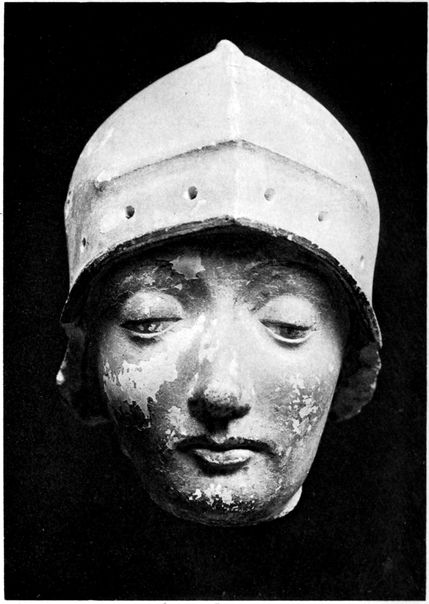
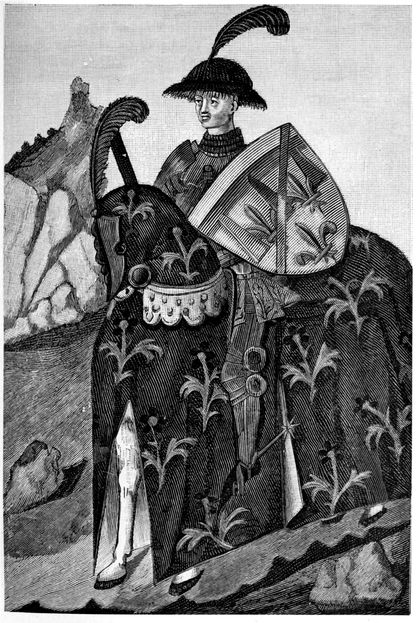
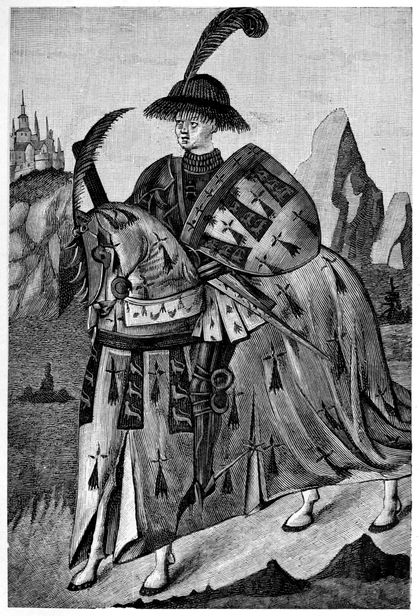
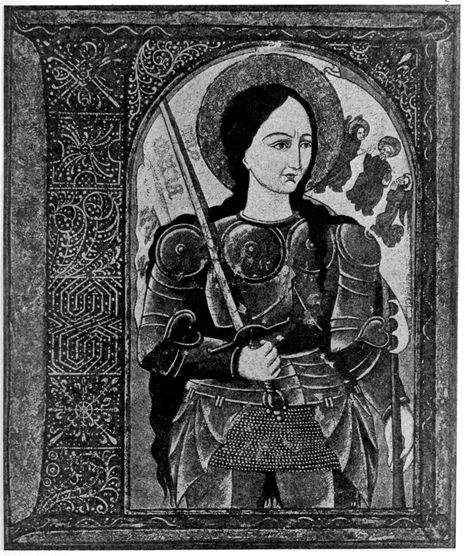
Reputed Portrait of Jeanne d’Arc, From the original, formerly in the Church of St. Maurice, Orleans.
(MUSÉE DU TROCADÉRO, PARIS.)
EDITED BY
T. DOUGLAS MURRAY
WITH ILLUSTRATIONS AND A MAP
LONDON
WILLIAM HEINEMANN
1902
This Edition enjoys Copyright in all
Countries signatory to the Berne
Treaty, and is not to be imported
into the United States of America.
PREFACE
v
The following Document concerning the story of the
life and death of Jeanne d’Arc, Maid of Orleans, is
probably the only known instance in which a complete
biographical record, of historical importance, has been
elicited by evidence taken on oath. These depositions
cover the childhood of the Maid; the series of her
military exploits as Commander-in-Chief of the armies
of France; her capture, imprisonment, and death at the
stake in the market-place of Rouen.
The official Latin text of the Trial and Rehabilitation
of Jeanne d’Arc, rescued from oblivion among
the archives of France, and published in the forties by
Quicherat, has been faithfully, and now for the first time,
rendered into English. This account, given by numerous
contemporary witnesses, of an episode which profoundly
affected the history of Europe and determined the
destinies of England and France must appeal to the
general reader no less than to the student.
INTRODUCTION — The Trial and Rehabilitation.
vii
By the order of Pope Calixtus in 1455, the Trial
of Jeanne d’Arc at Rouen, which had taken place
twenty-four years before, was reconsidered by a great
court of lawyers and churchmen, and the condemnation
of Jeanne was solemnly annulled and declared wicked
and unjust. By this re-trial posterity has been allowed
to see the whole life of the village maiden of Domremy,
as she was known first to her kinsfolk and her neighbours,
and afterwards to warriors, nobles and churchmen
who followed her extraordinary career. The
evidence so given is unique in its minute and faith-worthy
narration of a great and noble life; as indeed
that life is itself unique in all human history. After
all that can be done by the rationalising process, the
mystery remains of an untutored and unlettered girl
of eighteen years old, not only imposing her will upon
captains and courtiers, but showing a skill and judgment
worthy, as General Dragomiroff says, of the greatest
commanders, indeed of Napoleon himself. While we
must give due weight and consideration to the age in
which this marvel showed itself on the stage of history,
an age of portents and prophecies, of thaumaturgists and
saints, yet when all allowance is made there remains this
sane, strong, solid girl leaving her humble home, and in
viiitwo short months accomplishing more than Cæsar or
Alexander accomplished in so much time, and at an age
when even Alexander had as yet achieved nothing.
The story is best given by the witnesses, and only
indications or, so to speak, sign-posts are needed to
point out the way. Before the work of Jeanne can be
even vaguely apprehended something must be known
of how France stood at her coming. A century of misfortune
and sorrow, broken only by a parenthesis of
comparative prosperity from 1380 to 1407, had left
her an easy prey to the hereditary enemy. Torn
asunder by factions which distracted Church and State
alike, she was in no condition of health and courage
to recover from the shock of the crushing disaster of
Agincourt. For although the English were unable at
the moment to follow up the victory they had gained,
and Henry V. returned to England the bearer of barren
glory, still the breathing time was not put to good
account by the French, whose domestic jars made combined
national action impossible. At Henry’s second
coming, regular resistance was hardly offered. His
fleets and armies held the Channel and the ports and
fortresses on both sides. The King of France was
insane. His wife, Isabel of Bavaria, came to terms
with the English King, and by the treaty of Troyes
(1420) the Crown of France was to pass away from
the Dauphin, whom his wretched mother would fain
bastardise, to the issue of Henry and the Princess
Catherine, the ready instrument of her mother’s purpose.
When Henry V. died the son born of this unhallowed
marriage was declared King of France and England
under the title of Henry VI. The poor child was
less than a year old. His able and resolute uncle John,
ixDuke of Bedford, ruled France as Regent, and carried
the arms of England in triumph against all who dared
to dispute his nephew’s title. The Dauphin fled to the
south, and abandoned to Bedford all territory north of
the Loire. Paris was occupied and held by the English.
The braver members of the Parliament and the University
joined the Dauphin at Poitiers, but the accommodating
and timid members did homage to Bedford and
duly attorned to Henry VI. as to their lawful King.
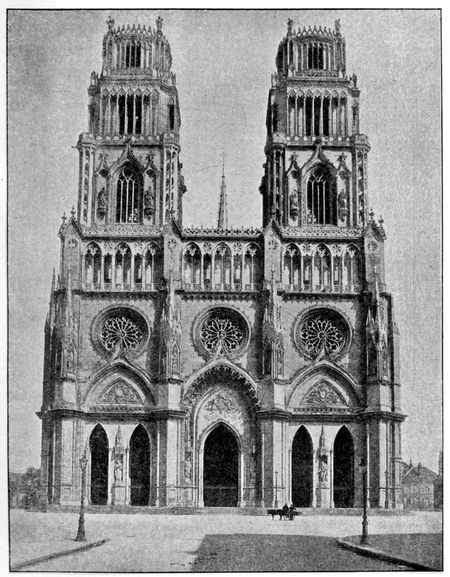
Orleans alone remained, of the strong places of France,
in the hands of the patriot party. If Orleans fell,
all organised opposition to Bedford would melt away.
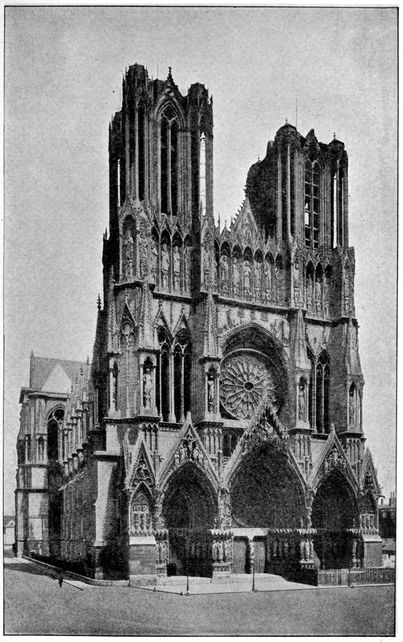
As Orleans was the key of the military, so was Rheims
the key of the political, situation. Rheims was the old
city where for many centuries the Kings of France had
been crowned and consecrated. Such a ceremony brought
with it in an especial manner the sacrosanct divinity
which in the middle ages hedged a King.
It is noteworthy that Jeanne’s mission, as now defined
and traced by French scholars, was the double one of
rescuing beleaguered Orleans and crowning the Dauphin
at Rheims.
Orleans had withstood a stubborn siege of many
months, but its fate seemed sealed. The Dauphin had
almost given up the struggle. He had made futile appeals
for help to the King of Scotland, whose infant daughter
was betrothed to young Louis, afterwards the terrible
Louis XI. To Naples also he made appeals, but no
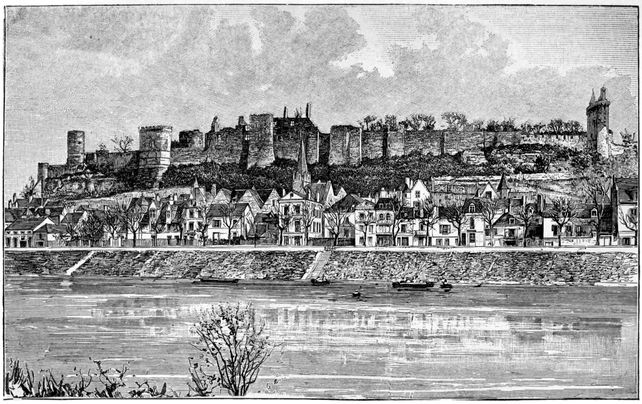
succour or hope came, and in despair he shut himself
up at Chinon, giving up the cause of France as lost
unless aid came from on high. Jeanne came as the
messenger of glad tidings, and announced herself as one
sent by God to aid France in her extreme need.
xShe came from Lorraine, out of which no good thing
could come, as proverbs taught; for Lorraine had ever
been branded as false to God and false to man. Ambiguous
in its relations to France and to the Empire, it
had, like most borderlands, the unstableness of character
which comes of social and political insecurity. Jeanne’s
native town of Domremy was one of a cluster of hamlets
on the verge of France, in the smiling valley through
which a winding river made its way. Her father and
mother were in a very humble station, having a little
patch of land with rights of commonage on the village
pastures, and were, from the evidence of their neighbours,
frugal, hard-working, and “well thought of.”
Jeanne herself was in no way marked out from her
girl friends by any special accomplishments or ambition.
She prided herself solely on her domestic usefulness and
her skill in household work. She was intensely pious,
but in no way introspective or morbid. God and His
angels and saints were as real to her, more real indeed,
than the men and women of her native village. The
thoughts of sacred things subdued her soul to an
unconsciousness of self, which marks her off even from
such beautiful spiritual natures as Teresa and Bridget
of Sweden and Catherine of Sienna, whose habit of
mind was less simple and less humble than hers. She
seems to have grieved long and deeply on the misfortunes
of France, which was to her the only country
claiming her allegiance. For, although geographically
in Lorraine, Domremy was part of the French Kingdom,
and its people were devotedly on the side of
the Dauphin and the national party. The Duke of
Burgundy, who had sided with the English, had only
one adherent in Domremy, and he was treated, after
xithe manner of good-natured peasants, with a certain
humorous toleration by the patriots of the village.
Growing up in this atmosphere, Jeanne, who was born
on the feast of the Epiphany 1412, heard in her earlier
girlhood of the sad state of her country torn asunder by
faction and treason, and presenting a very broken front
to the redoubtable armies of England, which had in the
course of a century carried the banner of St. George
over all the lands from Calais to Cadiz without once
meeting an enemy strong enough to look them in the
face on a pitched field of battle.
Agincourt, and the carnage after Agincourt, revived in
French minds the humiliation of Poitiers and the horrors
of Limoges, so that dread and hatred of the English
were the burden of every household story. Nor must
we forget that in Europe then, as in Asia and Africa
now, news spread apace, and unlettered folk got to know
in some strange way the doings of camps and courts.
Old prophecies too were on every lip. That weird
unrest which Shakespeare shadows forth in Peter of
Pomfret and his sayings, shaking the throne of Richard
II. by their very vagueness, was nowhere felt more
intensely than in Lorraine, with its blending of old
Celtic myths, German romances, and tales of Provençal
minstrelsy in all hearts and memories.
Sublime above all these loomed the Church and its
tremendous message. And so, from current history and
fable and folk-lore, Jeanne’s imagination was fed, while
her soul was ready to receive any mandate which the
Lord of all things might deign to signify. She was
thirteen years old when the first message came to her.
The Archangel Michael, as she states, appeared, and she
was struck with great fear; but afterwards she longed
xiifor his coming and his words. He admonished her to
be pure and holy and religious, and she determined to
be so. Later on St. Catherine (the Virgin) and St.
Margaret appeared to her, and told her that the Lord
ordered her to go into France and relieve Orleans. In
her examination she tells these things with great
particularity, meeting all questions as to age, size,
voice, dress, language, and surroundings of the angels,
with a simple directness which carries conviction of her
absolute truthfulness.
Her doubts and misgivings as to her own unfitness
she put aside as impertinences, when assured of her
divine mission. No shadow of spiritual inflation or
egotism is to be seen in all these things. Rather she
held by the belief that her very unworthiness in the
world’s eye was the cause of her being chosen as a
simple instrument in the hands of the Lord.
Her uncle led her to Vaucouleurs in 1428; Robert de
Baudricourt, whom she believed she was told to see,
declined to give ear to her stories; but Jean de Metz,
whose evidence is of absorbing interest, tells us how he
was overcome and won over to her by her compelling
earnestness and faith. She came to Chinon with a
small escort, and she and her guard had to travel mostly
by night to avoid the Burgundians. “At Chinon,” says
Jean de Metz, “she had to submit to long inquiries.”
The Dauphin was naturally loath to take a step so
full of peril, and indeed so fraught with the danger of
ridiculous failure, without grave, anxious, and searching
investigation. He wished Jeanne to appear at Poitiers
before the prelates and lawyers of Parliament. At
Poitiers she was subjected to the closest examination,
and in the end convinced the lawyers and churchmen
xiiiof her good faith and the reality of her visions and
voices. The Archbishop of Rheims, following “Gamaliel
in the Council of the Jews,” advised the Dauphin not
to spurn the proffered help; and Charles, who had
been already impressed by the “revelations,” took the
Archbishop’s advice, and placed his forces and his
fortune in her hands, trusting to divine help and
succour. The armies of France were in marked contrast
to those of England. French nobles had quasi-regal
power in their dominions, and only fitfully followed the
royal arms. In England, from the Conquest, the King
was supreme lord of all, and every one owed direct and
immediate allegiance to him. The English armies,
unlike the French feudal array, were made up of
peasants and artisans and adventurous young men
seeking a career, and, in the last resort, as we know
from Falstaff, of losels and waifs and ne’er-do-wells.
Whether Lord Melville’s famous saying that “the worst
men make the best soldiers” be or be not accepted, it
seems true enough that for aggressive wars at any
rate the reckless bravery of adventurers goes very far.
And Henry’s army, composed as it was of English,
Welsh, and Irish, was in truth an army of intrepid condottieri,
intrepid to a fault, but lacking the chivalrous
feelings which with all their drawbacks the feudal system
and the knightly organisations tended to evolve.
Hardened and seasoned by years of warfare, the
English in 1429 were without serious opposition or
check in their movements and attacks. No French
army kept the field. The King’s authority was flouted.
The Duke of Burgundy was openly for the English
cause. The Duke of Brittany and Lorraine wavered
from side to side. Money had run out, and the last
xivchance of success was staked in a bold throw on the
strange promises of the young country girl.
The evidence given by competent witnesses shows us
clearly the magnitude of her achievements during the
months of May, June, and July, 1429: the relief of
Orleans; the victory of Patay; the capture of Troyes;
and the triumphal march to Rheims, completing her work
by the consecration of Charles in the old Cathedral,
which had seen so many of his predecessors anointed
and crowned within its walls.
But the marvel is that these stupendous achievements
were not the results of mere enthusiasm, great and
potent though that was, but of settled, farseeing skill and
prudence on the part of Jeanne, joined to a strength of
soul and purpose which multiplied the strength of the
army tenfold.
Like Cromwell she “new-modelled” the army. The
licentious gaiety of the feudal warrior had to give way
to the sobriety and seemliness which became a Christian
camp. The voluptuary and the blasphemer had to
amend their lives. To revels succeeded prayers and
fasts and vigils. Yet never for a moment did this great
amendment degenerate into formalism or hypocrisy.
Like all great souls she awakened latent good and drove
vice abashed from her presence without any conscious
spiritual superiority in herself. Men were ashamed to
be base in such a presence. Nor did she ever become a
law unto herself, as the “illuminated” are so apt to be;
rather she was more than ever observant of all the duties
and claims and observances of ordinary religious obligation,
being ever in heart the simple maid whom the Lord
for His own mysterious purpose, and without any merit
of hers, had chosen for a mighty task.
xvThese great qualities won for her the ready submission
of the soldiers, while her name and fame brought levies
of ardent volunteers, from all sides, eagerly contending
for the glory of serving under such a leader. Her frame
was hardy and enduring. She wore armour night and
day for a week at a time. She ate sparingly and drank
hardly at all, moistening a crust in wine, or, greatly
fatigued, tasting a little as a restorative. While her
woman’s nature showed itself in her burst of tears when
dishonouring names were flung at her by some brutal
English soldiers, or when she screamed at the sharp and
sudden pain of the wound she received, still there always
came a quick moral reinforcement which restored her
serene fortitude in the midst of indignities and perils.
Writers have differed and must go on differing with
regard to the scope of her mission and the waning of her
powers after the coronation of Rheims. If she dictated
the letter to Henry VI. in which the words occur, “body
for body you will be driven out of France,” we may, by
connecting this saying with her famous letter to the
Hussites—in which she threatened to chastise them,
“Saracens” that they were, when her work was done and
France cleared of her enemies—and from other scattered
phrases as well, come to the conclusion that in her belief
France was to be wholly freed, and freed by her as agent
of the Lord. But the letter to Henry VI. is of doubtful
authority, and her appeal to Charles after the coronation
to be allowed to return to her father and mother,
supported by contemporary authority, seems to show
that she looked upon her work as done, and the great
outburst of weeping in the Cathedral was in all likelihood
the sob of satisfied piety and patriotism, whose cares were
at an end and whose task was fulfilled even to fruition.
xviThis seems the true view, with which also the latest
French students agree. Yielding to entreaty she threw
herself further into the national struggle. She was still
brave, still magnetic and inspiring, but no longer to
herself or to others the sword in the hand of God.
But if in the campaign of May and June she showed
the wonderful military genius to which so many competent
witnesses bear testimony, in the weary winter
of the same year she shows a clearness and depth of
statesmanship scarcely less astonishing. In moments of
national peril there are always “wise” men who think
that further resistance is foolish and even criminal.
Alfred had to deal with such time-servers. So had
Bruce, and so later on had Washington. Jeanne with
a sore heart found herself clogged and impeded by
these prudent men. Foremost amongst them was the
Archbishop of Rheims, Regnault de Chartres. His
programme was one of reconciliation. The Duke of
Burgundy was to become the ally of France, and as such
was to act as negotiator and intermediary for a lasting
peace between Henry VI. and Charles VII. Poor
Charles was weary of the war, and lent a ready ear to
the accommodator. In vain Jeanne warned him of the
folly of these plans. To strike, and strike quickly, at
Paris was her advice. Halting and hesitating, Charles
consented. An army was placed at her disposal, but, just
as victory seemed sure, she was ordered to desist, and
Burgundy so duped the French King that he was allowed
to go through the French lines into Paris, ostensibly to
treat for peace, but in reality, as the event proved, to
put himself under Bedford’s orders, and to hold Paris as
lieutenant for the Regent and ally of the King of England.
Had Jeanne’s advice been followed this shameful
xviitreason could never have come about. She had
known and felt that the hatred of the Duke of Burgundy
and his house against Charles VII. was too deep and too
rooted to be pulled up in a moment. For twenty years
France had been distracted by the factions of Burgundy
and Orleans struggling for control. Fire and water
were not more opposed. Burgundy looked to England,
and Orleans to France. We must not too hastily
condemn these factions. Nations in the modern sense
had not fully arisen. The State was everything.
Whether a great Anglo-French monarchy sitting in
Paris ruled over France, England, Ireland, and Wales,
or a more domestic French line only ruled over France
itself, was a question on which upright men might well
take opposite sides. Jeanne’s special merit was that she
saw the possibility of a great French nation, self-centred,
self-sufficient, and she so stamped this message on
the French heart that its characters have never faded.
Ecclesiastics, on the other hand, with their conception of
a Universal Empire and a Universal Church, thought
little of National aspirations or claims. To them, anything
which would allay the bitter rivalries of France and
England naturally appealed, seeing, as they did, in such
a change the promise of a return to the days before
the Babylonian captivity at Avignon, and the bringing
of all peoples into ready submission to Peter’s chair.
Jeanne’s greatness is nowhere more manifest than in
her willing loyalty to the Church and “our lord the
Pope,” while claiming for France absolute national
independence. Herein she stands alone. Dante’s two
swords (wielded by Pope and Emperor) were lethal to
national life. To the spiritual sword Jeanne bowed,
but to no Emperor or King other than the anointed
xviiiKing of France could the loyalty of a French heart
be due.
The winter of 1429 was spent in controversies of
which the opposing principles of imperialism and
nationality are the true keys. In the early spring,
Jeanne, who had bravely stood by the national cause,
and heartened all who withstood the party of compromise
and surrender, saw only too clearly that for
the time the French hopes of success had given way.
That brave night ride to relieve Compiègne was in
many respects a meeting of fate half way. No doubt,
she defied augury, but signs of impending disaster
multiplied; and when she fell into the hands of the
Burgundians, she must have felt that while her own
agony began, the cause of France might well gather
more strength from her example as a sufferer, than
from her futile struggle against cowardice and treason.
Into one short year her whole astounding public
career is crowded; Orleans, Patay, Troyes, Rheims,
Paris, Compiègne; glory, exaltation, wreckage, and
captivity. But France was at the end of it a conscious
nation with an anointed King, and the work of deliverance
was assured.
The English had felt sorely the humiliations of the
year 1429. In Bedford’s report to the King’s Council
in London he told of those who were struck with fear by
the incantations of this “limb of the fiend” who had
startled them from their security; and proclamations
were issued against those who in terror of the Maid
deserted the army. Now that she, who had worked
such mischief to them, was in their hands, betrayed by
xixher own countrymen,[1] they wreaked vengeance upon
her without stint.
The story of her prison life is a record of shame to her
gaolers. Chained, mocked at, threatened, and insulted,
her serenity never failed. She was in God’s hand, and
she bowed to His will.
Months of suffering and anxiety passed over her before
her captors made up their minds as to the course
they would take to bring about her death under the
semblance of legal execution. If she could be convicted
by an ecclesiastical court of crimes against the faith, her
condemnation would redound to the fair fame of England
and the pious[2] House of Lancaster, while covering the
French and their sovereign with confusion as the allies
and associates of a minister of hell.
xxPliant churchmen were at hand to give countenance
and help in this undertaking—bishops full of zeal and
loyalty for our sovereign lord Henry VI., by the grace
of God King of France and England.
The worst of these servile churchmen was the wretched
Bishop of Beauvais, Pierre Cauchon. Many other prelates
were Cæsar’s friends, but he sits exalted in solitary
infamy. He came to the Burgundian camp and claimed
his victim in the name of Bedford, Regent of France for
the English King. Had Jeanne been detained by the
Burgundians, it is impossible to believe that Charles VII.
would not have procured her release. Had she been
held as a prisoner of war by the English, it is very
likely that the shame of holding a woman captive
in their hands would have made it possible to arrange
for her ransom. But once charged with heresy and
taken out of the hands of the Burgundians such hopes
and chances were closed. Still, as an ecclesiastical
prisoner she would have been entitled to counsel and
guidance by religious persons, the Church offering admonition
before preferring grave charges of rebellion
against any of her children. But this would render
her punishment uncertain. Grave doctors of the law and
eminent churchmen had at Poitiers, after long inquiry, declared
her worthy of trust and they might do so again.
Therefore it was determined that she should be held
in a lay prison though charged with an ecclesiastical
offence. Cut off in this way from all spiritual help and
instruction, she was to be brought, when the process was
ripe, before a well-chosen court bent on her destruction,
and ready to entangle her in questions which might
entrap her into erroneous or heretical statements.
And once more we are confronted, if we try to
xxirationalise her life and put away all belief in inspiration,
with the amazing problem as to where and how this untutored
girl drew her stores of logic, law, and theology.
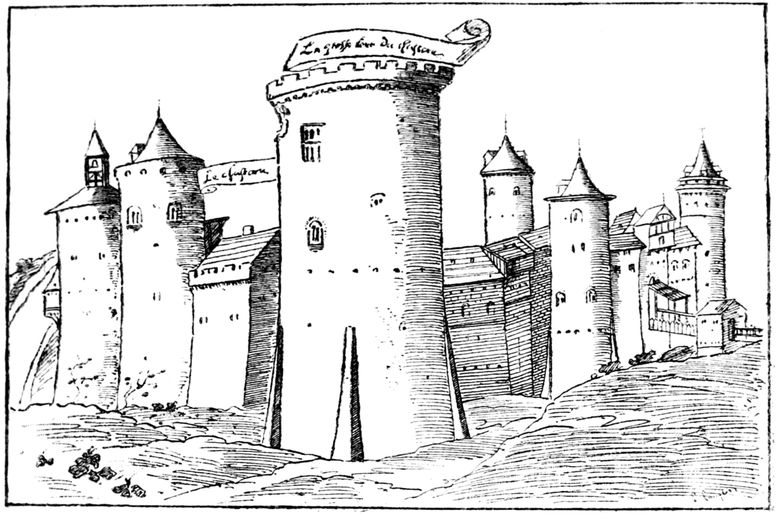
The trial took place in Rouen Castle,[3] the seat of
Bedford’s government in France. The choosing of
her judges was committed to Cauchon, who selected the
most sturdy adherents of the English. No formal charge
was preferred, but Jeanne was interrogated. This course
was severely condemned by a distinguished lawyer named
Lohier, who puts clearly before us the procedure and
principles that should govern such a hearing.
There should be in the first place in all such trials a
definite indictment of the charges advanced against the
accused, who in turn ought to have due time to answer
all the allegations with the assistance of counsel.
In Jeanne’s particular case, seeing that she had been
already practically tried and acquitted at Poitiers at a
trial presided over by the Archbishop of Rheims, the
metropolitan of the Bishop of Beauvais, it was putting
her twice in peril for the same offence, and on the second
occasion before an inferior court, a thing contrary to law
and reason. Moreover the venue was wrong. She had
been captured in one diocese as an ecclesiastical prisoner,
and she was to be tried in another, and no assent of the
chapter of Rouen could give jurisdiction in such a case.
xxiiFinally she was in a lay prison, held there by her
political enemies, which made it impossible for her to
have the liberty and spiritual assistance necessary to
meet ecclesiastical charges. The trial ought to have
been held in an ordinary court and not in the Castle.
All these objections are of great substance and go
to the very root of the inquiry. But more vital than
all was Jeanne’s own expostulation against trial before
Cauchon, who was her declared and bitter enemy, and
the mere instrument of her foes and gaolers.
Gross however as the injustice was, there were certain
barriers within which even Cauchon and his accomplices
had to work their wicked wills. As there were fearless
canonists like Lohier, who, as members of a great
international Bar, were independent of any King or
bishop, so the notaries, being apostolic and imperial
officers, were in no way amenable to Cauchon or his
crew. Every word spoken in court is duly and faithfully
recorded, and this record formed the basis for the
petition subsequently presented to the Pope by Jeanne’s
mother and brother when seeking amendment of
Cauchon’s judgment.
The trial is one of the most enthralling dramas in all
history. The caution, the skill, the simplicity withal,
shown by Jeanne in her answers to bewildering and
entrapping questions, well earned the praise bestowed
twenty years later by the accomplished lawyers who wrote
on the case, sustaining the appeal for a new hearing.
The report gives all the details of the inquiry with
fulness and accuracy, and when we carefully examine its
course, we must agree with the canonists who said that
the forms of law were indeed adhered to, but its spirit
was grossly violated. The judges in Jeanne’s case
xxiiifortified themselves with the decision of the University
of Paris, but that decision was procured by laying before
the University what purported to be the statements of
Jeanne, but what were in truth selected passages from
her statements torn from qualifying contexts and often
with the suppression of governing words.
Still this précis was also part of the record of the
Court, although attempts were made to suppress it, and
at the re-hearing Cauchon and his fellow hirelings were
vehemently condemned for this nefarious proceeding.
By a sentence, so obtained and so buttressed, Jeanne
d’Arc was done to death. The story of the execution
is one of the most heart-rending incidents in history.
No comment can deepen or add to the pathos of the
narrative given by the bystanders.
In 1450 King Charles VII. empowered Guillaume
Bouillé, Rector of the University of Paris, to inquire into
the circumstances of Jeanne’s trial, condemnation, and
death, and to report the result of his investigation.
Great lawyers gave their opinions, and declared the
trial void, as having been bad in substance as well as in
form. But no regular judgment was pronounced.
Again in 1452 Pope Nicholas V., on appeal by Jeanne’s
mother, Isabel d’Arc, ordered inquiry, which duly took
place, but without formal issue.
It is fortunate for truth and human interest that these
inquiries were abortive. Had they on general grounds
annulled the proceedings under Cauchon, how much
would have been lost to us!
We should never have had that delightful picture of
Domremy given by the simple people of the place. Nor
should we have, as we have now, a sworn narrative of
Jeanne’s private and public life laying bare her very soul.
xxivWhen Pope Calixtus ordered a full inquiry, he
seemed to think, as Newman thought when writing the
“Apologia,” that the less argument and the more
narrative and evidence that could be given the better;
and so, instead of discussing the nature of angels, the
limits of Catholic obedience, the Great Schism,[4] and the
assurances of salvation of the just, he and his deputies
put aside such questions with patient contempt until
they first made sure of the human side of the story.
How Jeanne impressed her neighbours, her priest, and
her kin; what kind of girl she was; what were her
employments; was she restive and ambitious or quiet
and satisfied; was her life pure; was she given to
foolish imaginings, or was she a sane, modest, unpretending
country maiden? Into all these things Cauchon had
made inquiries, but as the answers were all favourable
to the accused he suppressed the evidence.
The decree of Pope Calixtus has added a true romance
to human story. In all that we know of the world’s
great ones we can find no parallel for the Maid of
Domremy. Perhaps only in Catholic France was such
a heroine possible. Certainly Teutonic Protestantism
has as yet given to the world none of the exalted types
of radiant and holy women such as those that illuminate
Latin Christianity. Whether as a saint or a nation-maker,
Jeanne’s place in world-history is assured.
Part I THE TRIAL — I FIRST PROCESS: THE LAPSE — TRIAL EX OFFICIO — THE TRIAL IN ORDINARY — FINAL SESSION AND SENTENCE. RECANTATION. — THE SENTENCE — II SECOND PROCESS: THE RELAPSE — SENTENCE OF DEATH — SUBSEQUENT EXAMINATIONS [104] AND PROCEEDINGS AFTER THE RELAPSE.
1
2Information as to the Original
Documents of the Trial will
be found in the Appendix,
p. 331.
An Introductory Note on the
Maid’s Capture at Compiègne
and on the Procedure of her
Trial is given in the Appendix
on p. 332.
3
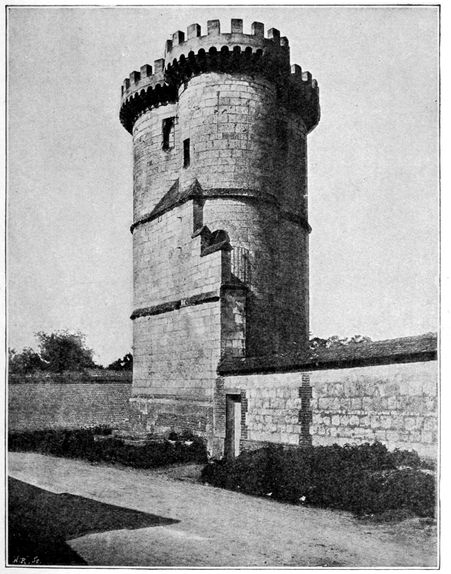
THE OLD CASTLE OF ROUEN.
Six Public Examinations
On Wednesday, February 21st, at 8 o’clock in the
morning, in the Chapel Royal of the Castle of Rouen.
The Bishop and 42 Assessors present.
We did first of all command to be read the Royal
letters conveying surrender and deliverance of the said
woman into Our hands; afterwards the letters of the
Chapter of Rouen, making concession of territory for
Our benefit. This reading ended, Mtre. Jean d’Estivet,
nominated by Us as Promoter of the Case, did, in Our
presence, shew that the aforesaid woman of the name
of Jeanne hath been, by the Executor of Our Mandate,
cited to appear in this place at this hour and day, here
to answer, according to law, to the questions to be put
to her.
4The said Promoter did then produce Our Mandate, to
which is attached the document confirming its execution,
and did read them all. Our said Promoter did then
require that the said woman should be placed before us,
and, in terms of the citation, questioned by Us on divers
Articles concerning the Faith, to the which We did
agree. But as a preliminary, because the said woman
had asked to hear Mass beforehand, We did shew to the
Assessors that, by the advice of well-known Doctors and
Masters consulted by Us, it hath been decided, considering
the crimes of which she is accused, and the
impropriety of the dress which she is wearing, that it is
right to postpone permission to hear Mass and to assist
in Divine Service.
In the meantime, the said woman was brought by the
Executor of Our Mandate, and set before Us.
We did then shew that the said Jeanne hath been
lately taken[5] in the territory of Beauvais; that many acts
contrary to the Orthodox Faith have been committed by
her, not only in Our Diocese, but in many others; that
the public report, which imputes these misdeeds to her,
hath spread in all estates of Christendom; that, in the
last place, the most Serene and most Christian our lord
the King hath sent and given her up to Us in order that,
according to law and right, an action may be brought
against her in the matter of the Faith; that, acting upon
this common report, upon public rumour, and also on
certain information obtained by Us, of which mention
hath already been often enough made, by the advice
of men versed in sacred and secular Law, We have
officially given commandment to cite the said Jeanne to
appear before Us, in order through her to obtain truthful
5answers to the questions to be put to her in matters of
the Faith, and in order to act towards her according to
law and right; which doth so appear in the letters that
the Promoter hath shewn.
Then, desiring in this particular the blessed succour
of Jesus Christ, Who is concerned in this, and wishing
only to fulfil the duties of Our office for the exaltation
and preservation of the Catholic Faith, We did first
charitably warn and require the said Jeanne, seated in Our
presence, for the more prompt resolution of the Action
and the relief of her own conscience, to speak the whole
truth upon all questions which should be addressed to
her touching the Faith; and We did exhort her to avoid
all subterfuges and shufflings of such a nature as should
turn her aside from a sincere and true avowal.
And in the first instance we did require her, in the
appointed form, her hand on the Holy Gospels, to
swear to speak truth on the questions to be addressed
to her.
To which she did reply:
“I know not upon what you wish to question me:
perhaps you may ask me of things which I ought not to
tell you.”
“Swear,” We did then say to her, “to speak truth on
the things which shall be asked you concerning the Faith,
and of which you know.”
“Of my father and my mother and of what I did after
taking the road to France, willingly will I swear; but of
the revelations which have come to me from God, to no
one will I speak or reveal them, save only to Charles
my King; and to you I will not reveal them, even if it
cost me my head; because I have received them in
visions and by secret counsel, and am forbidden to
reveal them. Before eight days are gone, I shall know
if I may reveal them to you.”
Again did We several times warn and require her to
6be willing, on whatsoever should touch on the Faith, to
swear to speak truly. And the said Jeanne, on her
knees, her two hands resting on the Missal, did swear
to speak truth on that which should be asked her and
which she knew in the matter of the Faith, keeping
silence under the condition above stated, that is to say,
neither to tell nor to reveal to any one the revelations
made to her.
After this oath, Jeanne was interrogated by Us as to
her name, and surname, her place of birth, the names of
her father and mother, the place of her baptism, her
godfathers and godmothers, the Priest who baptized
her, etc., etc.
“In my own country they call me Jeannette; since I
came into France I have been called Jeanne. Of my
surname I know nothing. I was born[6] in the village
of Domremy, which is really one with the village of
Greux. The principal Church is at Greux. My father
is called Jacques d’Arc; my mother, Ysabelle. I
was baptized in the village of Domremy.[7] One of my
godmothers[8] is called Agnes, another Jeanne, a third
Sibylle. One of my godfathers is called Jean Lingué,
another Jean Barrey. I had many other godmothers, or
so I have heard from my mother. I was, I believe,
baptized by Messire Jean Minet; he still lives, so far as
I know. I am, I should say, about nineteen years of
age. From my mother I learned my Pater, my Ave
Maria, and my Credo. I believe I learned all this
from my mother.”
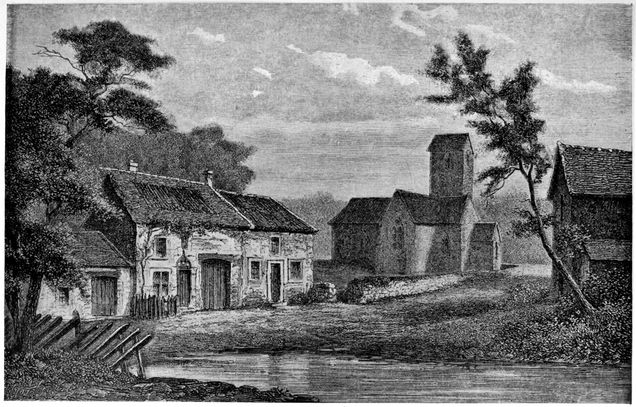
JEANNE D’ARC’S HOUSE AT DOMREMY.
7“Say your Pater.”
“Hear me in confession, and I will say it willingly.”
To this same question, which was many times put to
her, she always answered: “No, I will not say my Pater
to you, unless you will hear me in confession.”
“Willingly,” We said to her, “We will give you two
well-known men, of the French language, and before
them you shall say your Pater.”
“I will not say it to them, unless it be in confession.”
And then did We forbid Jeanne to go out of the
prison which hath been assigned to her in the Castle
without Our permission, under pain of the crime of
heresy.
“I do not accept such a prohibition,” she answered;
“if ever I do escape, no one shall reproach me with
having broken or violated my faith, not having given my
word to any one, whosoever it may be.”
And as she complained that she had been fastened
with chains and fetters of iron, We said to her:
“You have before, and many times, sought, We are
told, to get out of the prison, where you are detained;
and it is to keep you more surely that it has been ordered
to put you in irons.”
“It is true I wished to escape; and so I wish still: is
not this lawful for all prisoners?”
We then commissioned as her guard the noble man
John Gris,[9] Squire, one of the Body Guard of our Lord
the King, and, with him, John Berwoist and William
Talbot, whom We enjoined well and faithfully to guard
the said Jeanne, and to permit no person to have dealings
with her without Our order. Which the aforenamed,
with their hands on the Gospels, did solemnly swear.
8Finally, having accomplished all the preceding, We
appointed the said Jeanne to appear the next day, at
8 o’clock in the morning, before Us in the Ornament
Room, at the end of the Great Hall of the Castle of
Rouen.
Thursday, February 22nd, in the Ornament Room at
the end of the Great Hall of the Castle of Rouen. The
Bishop and 48 Assessors present.
In their presence, We shewed that Jean Lemaître,
Deputy of the Chief Inquisitor, had been summoned and
required by Us to join himself to the present Action,
with Our offer of communicating to him all that hath
been done hitherto or shall be done in the future; but
that the said Deputy had replied, that, having been
commissioned by the Chief Inquisitor for the City and
Diocese of Rouen only, and the actual Process being
deduced by Us in a territory which hath been ceded
to Us by the Metropolitan Chapter, by reason of
Our Ordinary Jurisdiction, as Bishop of Beauvais, he
had thought it right to avoid all nullity and also for the
peace of his own conscience, to refuse to join himself
with Us, in the quality of Judge, until he should receive
from the Chief Inquisitor a Commission and more
extended powers: that, nevertheless, he would have no
objection to see the trial continue without interruption.
After having heard Us make this narration, the said
Deputy, being present, declared, addressing himself to
Us, “That which you have just said is true. It has
been, as much as in me lies, and still is, agreeable to me
that you should continue the Trial.”
Then the said Jeanne was brought before Us.
We warned and required her, on pain of law, to
make oath as she had done the day before and to
swear simply and absolutely to speak truth on all things
9in respect of which she should be asked; to which she
answered:
“I swore yesterday: that should be enough.”
Again We required her to swear: we said to her, not
even a prince, required to swear in a matter of faith, can
refuse.
“I made oath to you yesterday,” she answered, “that
should be quite enough for you: you burden me over-much!”
Finally she made oath to speak truth on that which
touches the Faith.
Then Maître Jean Beaupère, a well-known Professor
of Theology, did, by Our order, question the said
Jeanne. This he did as follows:
“First of all, I exhort you, as you have so sworn, to
tell the truth on that which I am about to ask you.”
“You may well ask me some things on which I shall
tell you the truth and some on which I shall not tell
it you. If you were well informed about me, you would
wish to have me out of your hands. I have done
nothing except by revelation.”
“How old were you when you left your father’s
house?”
“On the subject of my age I cannot vouch.”
“In your youth, did you learn any trade?”
“Yes, I learnt to spin and to sew; in sewing and
spinning I fear no woman in Rouen. For dread of
the Burgundians, I left my father’s house and went
to the town of Neufchâteau,[10] in Lorraine, to the house
of a woman named La Rousse, where I sojourned about
fifteen days. When I was at home with my father, I
employed myself with the ordinary cares of the house.
I did not go to the fields with the sheep and the other
10animals. Every year I confessed myself to my own
Curé, and, when he was prevented, to another Priest
with his permission. Sometimes, also, two or three
times, I confessed to the Mendicant Friars; this was
at Neufchâteau. At Easter I received the Sacrament
of the Eucharist.”
“Have you received the Sacrament of the Eucharist
at any other Feast but Easter?”
“Pass that by [Passez outre]. I was thirteen when
I had a Voice from God for my help and guidance.
The first time that I heard this Voice, I was very
much frightened; it was mid-day, in the summer, in
my father’s garden. I had not fasted the day before.
I heard this Voice to my right, towards the Church;
rarely do I hear it without its being accompanied also
by a light. This light comes from the same side as the
Voice. Generally it is a great light. Since I came into
France I have often heard this Voice.”
“But how could you see this light that you speak of,
when the light was at the side?”
To this question she answered nothing, but went on
to something else. “If I were in a wood, I could
easily hear the Voice which came to me. It seemed
to me to come from lips I should reverence. I believe
it was sent me from God. When I heard it for the
third time, I recognized that it was the Voice of an
Angel. This Voice has always guarded me well, and
I have always understood it; it instructed me to be good
and to go often to Church; it told me it was necessary
for me to come into France. You ask me under
what form this Voice appeared to me? You will hear
no more of it from me this time. It said to me two or
three times a week: ‘You must go into France.’ My
father knew nothing of my going. The Voice said to
me: ‘Go into France!’ I could stay no longer. It
said to me: ‘Go, raise the siege which is being made
11before the City of Orleans. ‘Go!’ it added, ‘to Robert
de Baudricourt,[11] Captain of Vaucouleurs: he will furnish
you with an escort to accompany you.’ And I replied
that I was but a poor girl, who knew nothing of riding
or fighting. I went to my uncle and said that I wished
to stay near him for a time. I remained there eight
days. I said to him, ‘I must go to Vaucouleurs.’[12] He
took me there. When I arrived, I recognized Robert
de Baudricourt, although I had never seen him. I
knew him, thanks to my Voice, which made me recognize
him. I said to Robert, ‘I must go into France!’
Twice Robert refused to hear me, and repulsed me. The
third time, he received me, and furnished me with men;[13]
the Voice had told me it would be thus. The Duke of
Lorraine[14] gave orders that I should be taken to him. I
went there. I told him that I wished to go into France.
The Duke asked me questions about his health; but
I said of that I knew nothing. I spoke to him little of
my journey. I told him he was to send his son with
me, together with some people to conduct me to
France, and that I would pray to God for his health.
I had gone to him with a safe-conduct: from thence
12I returned to Vaucouleurs. From Vaucouleurs I departed,
dressed as a man, armed with a sword given
me by Robert de Baudricourt, but without other arms.
I had with me a Knight,[15] a Squire, and four servants,
with whom I reached the town of Saint Urbain, where
I slept in an Abbey. On the way, I passed through
Auxerre, where I heard Mass in the principal Church.
Thenceforward I often heard my Voices.”
“Who counselled you to take a man’s dress?”
To this question she several times refused to answer.
In the end, she said: “With that I charge no one.”
Many times she varied in her answers to this question.
Then she said:
“Robert de Baudricourt made those who went with
me swear to conduct me well and safely. ‘Go,’ said
Robert de Baudricourt to me, ‘Go! and let come what
may!’ I know well that God loves the Duke of
Orleans; I have had more revelations about the Duke
of Orleans than about any man alive, except my King.
It was necessary for me to change my woman’s garments
for a man’s dress. My counsel thereon said well. I
sent a letter to the English before Orleans,[16] to make
them leave, as may be seen in a copy of my letter which
has been read to me in this City of Rouen; there are,
nevertheless, two or three words in this copy which were
not in my letter. Thus, ‘Surrender to the Maid,’ should
be replaced by ‘Surrender to the King.’ The words,
‘body for body’ and ‘chieftain in war’ were not in my
letter at all.[17]
“I went without hindrance to the King. Having
arrived at the village of Saint Catherine de Fierbois, I
13sent for the first time to the Castle of Chinon,[18] where
the King was. I got there towards mid-day, and lodged
first at an inn. After dinner, I went to the King, who
was at the Castle. When I entered the room where he
was I recognized him among many others by the counsel
of my Voice, which revealed him to me. I told him
that I wished to go and make war on the English.”
“When the Voice shewed you the King, was there
any light?”
“Pass on.”
“Did you see an Angel over the King?”
“Spare me. Pass on. Before the King set me to
work, he had many apparitions and beautiful revelations.”
“What revelations and apparitions had the King?”
“I will not tell you; it is not yet time to answer you
about them; but send to the King, and he will tell you.
The Voice had promised me that, as soon I came to the
King, he would receive me. Those of my party knew
well that the Voice had been sent me from God; they
have seen and known this Voice, I am sure of it. My
King and many others have also heard and seen the
Voices which came to me: there were there Charles de
Bourbon[19] and two or three others. There is not a day
when I do not hear this Voice; and I have much need of
it. But never have I asked of it any recompense but
the salvation of my soul. The Voice told me to remain
at Saint-Denis, in France; I wished to do so, but,
against my will, the Lords made me leave. If I had
14not been wounded, I should never have left. After
having quitted Saint-Denis, I was wounded in the
trenches before Paris;[20] but I was cured in five days.
It is true that I caused an assault to be made before
Paris.”
“Was it a Festival that day?”
“I think it was certainly a Festival.”
“Is it a good thing to make an assault on a
Festival?”
“Pass on.”
And as it appeared that enough had been done for
to-day, We have postponed the affair to Saturday next,
at 8 o’clock in the morning.
Saturday, 24th February, in the same place. The
Bishop and 62 Assessors present.
In their presence We did require the aforenamed
Jeanne to swear to speak the truth simply and absolutely
on the questions to be addressed to her, without adding
any restriction to her oath. We did three times thus
admonish her. She answered:
“Give me leave to speak. By my faith! you may
well ask me such things as I will not tell you. Perhaps
on many of the things you may ask me I shall
not tell you truly, especially on those that touch on my
revelations; for you may constrain me to say things
that I have sworn not to say; then I should be perjured,
which you ought not to wish.” [Addressing the
Bishop:] “I tell you, take good heed of what you say,
you, who are my Judge;[21] you take a great responsibility
in thus charging me. I should say that it is enough
to have sworn twice.”
15“Will you swear, simply and absolutely?”
“You may surely do without this. I have sworn
enough already twice. All the clergy of Rouen and
Paris cannot condemn me if it be not law. Of my
coming into France I will speak the truth willingly;
but I will not say all: the space of eight days would
not suffice.”
“Take the advice of the Assessors, whether you
should swear or not.”
“Of my coming I will willingly speak truth, but not
of the rest; speak no more of it to me.”
“You render yourself liable to suspicion in not being
willing to swear to speak the truth absolutely.”
“Speak to me no more of it. Pass on.”
“We again require you to swear, precisely and
absolutely.”
“I will say willingly what I know, and yet not all. I
am come in God’s name; I have nothing to do here;
let me be sent back to God, whence I came.”
“Again we summon and require you to swear, under
pain of going forth charged with that which is imputed
to you.”
“Pass on.”
“A last time we require you to swear, and urgently
admonish you to speak the truth on all that concerns
your trial; you expose yourself to a great peril by such
a refusal.”
“I am ready to speak truth on what I know touching
the trial.”
And in this manner was she sworn.
Then, by Our order, she was questioned by Maître
Jean Beaupère, a well-known Doctor, as follows:
“How long is it since you have had food and drink?”[22]
16“Since yesterday afternoon.”
“How long is it since you heard your Voices?”
“I heard them yesterday and to-day.”
“At what hour yesterday did you hear them?”
“Yesterday I heard them three times,—once in the
morning, once at Vespers, and again when the Ave
Maria rang in the evening. I have even heard them
oftener than that.”
“What were you doing yesterday morning when the
Voice came to you?”
“I was asleep: the Voice awoke me.”
“Was it by touching you on the arm?”
“It awoke me without touching me.”
“Was it in your room?”
“Not so far as I know, but in the Castle.”
“Did you thank it? and did you go on your knees?”
“I did thank it. I was sitting on the bed; I joined
my hands; I implored its help. The Voice said to me:
‘Answer boldly.’ I asked advice as to how I should
answer, begging it to entreat for this the counsel of the
Lord. The Voice said to me: ‘Answer boldly; God
will help thee.’ Before I had prayed it to give me
counsel, it said to me several words I could not readily
understand. After I was awake, it said to me: ‘Answer
boldly.’” [Addressing herself to Us, the said Bishop:]
“You say you are my judge. Take care what you are
doing; for in truth I am sent by God, and you place
yourself in great danger.”
Maître Beaupère, continuing, said:
“Has this Voice sometimes varied in its counsel?”
“I have never found it give two contrary opinions....
This night again I heard it say: ‘Answer boldly.’”
17“Has your Voice forbidden you to say everything on
what you are asked?”
“I will not answer you about that. I have revelations
touching the King that I will not tell you.”
“Has it forbidden you to tell those revelations?”
“I have not been advised about these things. Give
me a delay of fifteen days,[23] and I will answer you. If
my Voice has forbidden me, what would you say about
it? Believe me, it is not men who have forbidden
me. To-day I will not answer: I do not know if I
ought, or not; it has not been revealed to me. But
as firmly as I believe in the Christian Faith and that
God hath redeemed us from the pains of Hell, that
Voice hath come to me from God and by His
Command.”
“The Voice that you say appears to you, does it come
directly from an Angel, or directly from God; or does it
come from one of the Saints?”
“The Voice comes to me from God; and I do not
tell you all I know about it: I have far greater fear of
doing wrong in saying to you things that would displease
it, than I have of answering you. As to this
question, I beg you to grant me delay.”
“Is it displeasing to God to speak the truth?”
“My Voices have entrusted to me certain things to
tell to the King, not to you. This very night they told
me many things for the welfare of my King, which I
would he might know at once, even if I should drink
no wine until Easter, ... the King would be the more
joyful at his dinner!”
“Can you not so deal with your Voices that they will
convey this news to your King?”
“I know not if the Voice would obey, and if it be
18God’s Will. If it please God, He will know how to
reveal it to the King, and I shall be well content.”
“Why does not this Voice speak any more to your
King, as it did when you were in his presence?”
“I do not know if it be the Will of God. Without
the grace of God I should not know how to do anything.”
“Has your counsel revealed to you that you will
escape from prison?”
“I have nothing to tell you about that.”
“This night, did your Voice give you counsel and
advice as to what you should answer?”
“If it did give me advice and counsel thereon, I did
not understand.”
“The last two occasions on which you have heard this
Voice, did a brightness come?”
“The brightness comes at the same time as the Voice.”
“Besides the Voice, do you see anything?”
“I will not tell you all; I have not leave; my oath
does not touch on that. My Voice is good and to be
honoured. I am not bound to answer you about it. I
request that the points on which I do not now answer
may be given me in writing.”
“The Voice from whom you ask counsel, has it a face
and eyes?”
“You shall not know yet. There is a saying among
children, that ‘Sometimes one is hanged for speaking
the truth.’”
“Do you know if you are in the grace of God?”
“If I am not, may God place me there; if I am, may
God so keep me. I should be the saddest in all the
world if I knew that I were not in the grace of God.
But if I were in a state of sin, do you think the Voice
would come to me? I would that every one could hear
the Voice as I hear it. I think I was about thirteen
when it came to me for the first time.”
19“In your youth, did you play in the fields with the
other children?”
“I certainly went sometimes, I do not know at what
age.”
“Do the Domremy people side with the Burgundians
or with the opposite party?”
“I knew only one Burgundian[24] at Domremy: I
should have been quite willing for them to cut off his
head—always had it pleased God.”
“The Maxey people, were they Burgundians, or
opposed to the Burgundians?”
“They were Burgundians. As soon as I knew that
my Voices were for the King of France, I loved the
Burgundians no more. The Burgundians will have war
unless they do what they ought; I know it by my Voice.
The English were already in France when my Voices
began to come to me. I do not remember being with
the children of Domremy when they went to fight
against those of Maxey for the French side: but I
certainly saw the Domremy children who had fought
with those of Maxey coming back many times, wounded
and bleeding.”
“Had you in your youth any intention of fighting the
Burgundians?”
“I had a great will and desire that my King should
have his own Kingdom.”
“When you had to come into France, did you wish
to be a man?”
“I have answered this elsewhere.”
“Did you not take the animals to the fields?”
“I have already answered this also. When I was
bigger and had come to years of discretion, I did not
look after them generally; but I helped to take them to
20the meadows and to a Castle called the Island,[25] for fear
of the soldiers. I do not remember if I led them in my
childhood or no.”
“What have you to say about a certain tree which
is near to your village?”
“Not far from Domremy there is a tree[26] that they
call ‘The Ladies’ Tree’—others call it ‘The Fairies’
Tree’; near by, there is a spring where people sick
of the fever come to drink, as I have heard, and to
seek water to restore their health. I have seen them
myself come thus; but I do not know if they were
healed. I have heard that the sick, once cured, come
to this tree[27] to walk about. It is a beautiful tree, a
beech, from which comes the ‘beau may’—it belongs
to the Seigneur Pierre de Bourlement,[28] Knight. I
have sometimes been to play with the young girls, to
make garlands for Our Lady of Domremy. Often I
have heard the old folk—they are not of my lineage—say
that the fairies haunt this tree. I have also heard one of
my Godmothers, named Jeanne, wife of the Maire Aubery
of Domremy, say that she has seen fairies there; whether
21it be true, I do not know. As for me, I never saw
them that I know of. If I saw them anywhere else, I
do not know. I have seen the young girls putting garlands
on the branches of this tree, and I myself have sometimes
put them there with my companions; sometimes
we took these garlands away, sometimes we left them.
Ever since I knew that it was necessary for me to come
into France, I have given myself up as little as possible
to these games and distractions. Since I was grown up,
I do not remember to have danced there. I may have
danced there formerly, with the other children. I have
sung there more than danced. There is also a wood
called the Oak-wood, which can be seen from my father’s
door; it is not more than half-a-league away. I do not
know, and have never heard if the fairies appear there;
but my brother told me that it is said in the neighbourhood:
‘Jeannette received her mission at the Fairies’
Tree.’ It is not the case; and I told him the contrary.
When I came before the King, several people asked me
if there were not in my country a wood, called the Oak-wood,
because there were prophecies[29] which said that
from the neighbourhood of this wood would come a
maid who should do marvellous things. I put no faith
in that.”
“Would you like to have a woman’s dress?”
“Give me one, and I will take it and begone; otherwise,
22no. I am content with what I have, since it
pleases God that I wear it.”
This done, We stayed the interrogation, and put off
the remainder to Tuesday next, on which day We have
convoked all the Assessors, at the same place and hour.
Tuesday, February 27th, in the same place. The
Bishop and 54 Assessors present.
In their presence, We required the said Jeanne to
swear to tell the truth on everything touching her
Trial.
“Willingly will I swear,” she answered, “to tell the
truth on everything touching the trial, but not upon all
that I know.”
We required her again to speak the truth on all which
should be asked of her.
“You ought to be satisfied,” she answered. “I have
sworn enough.”
Then, by Our order, Maître Beaupère began to question
her. And first he inquired of her, how she had
been since the Saturday before?
“You can see for yourself how I am. I am as well
as can be.”
“Do you fast every day this Lent?”
“Is that in the Case? Well, yes! I have fasted
every day during this Lent.”
“Have you heard your Voices since Saturday?”
“Yes, truly, many times.”
“Did you hear them on Saturday in this hall, where
you were being examined?”
“That is not in your Case. Very well, then—yes! I
did hear them.”
“What did your Voice say to you last Saturday?”
“I did not quite understand it; and up to the moment
23when I returned to my room, I heard nothing that I may
repeat to you.”
“What did it say to you in your room, on your
return?”
“It said to me, ‘Answer them boldly.’ I take
counsel with my Voice about what you ask me. I will
tell willingly whatever I shall have permission from God
to reveal; as to the revelations concerning the King of
France, I will not tell them without the permission of
my Voice.”
“Has your Voice forbidden you to tell everything?”
“I did not quite understand it.”
“What did your Voice last say to you?”
“I asked counsel about certain things that you had
asked me.”
“Did it give you counsel?”
“On some points, yes; on others you may ask me for
an answer that I shall not give, not having had leave.
For, if I answered without leave, I should no longer
have my Voices as warrant. When I have permission
from Our Saviour, I shall not fear to speak, because I
shall have warrant.”
“This Voice that speaks to you, is it that of an Angel,
or of a Saint, or from God direct?”
“It is the Voice of Saint Catherine and of Saint
Margaret.[30] Their faces are adorned with beautiful
crowns, very rich and precious. To tell you this I have
leave from Our Lord. If you doubt this, send to
Poitiers, where I was examined before.”
“How do you know if these were the two Saints?
How do you distinguish one from the other?”
“I know quite well it is they; and I can easily
distinguish one from the other.”
“How do you distinguish them?”
24“By the greeting they give me. It is seven years
now since they have undertaken to guide me. I know
them well because they were named to me.”
“Are these two Saints dressed in the same stuff?”
“I will tell you no more just now; I have not
permission to reveal it. If you do not believe me, go to
Poitiers. There are some revelations which come to
the King of France, and not to you, who are questioning
me.”
“Are they of the same age?”
“I have not leave to say.”
“Do they speak at the same time, or one after the
other?”
“I have not leave to say; nevertheless, I have always
had counsel from them both.”
“Which of them appeared to you first?”
“I did not distinguish them at first. I knew well
enough once, but I have forgotten. If I had leave, I
would tell you willingly: it is written in the Register at
Poitiers.[31] I have also received comfort from Saint
Michael.”
25“Which of these two appearances came to you
first?”
“Saint Michael.”
“Is it a long time since you first heard the voice of
Saint Michael?”
“I did not say anything to you about the voice of
Saint Michael; I say I have had great comfort from
him.”
“What was the first Voice that came to you when you
were about thirteen?”
“It was Saint Michael: I saw him before my eyes;
he was not alone, but quite surrounded by the Angels
of Heaven. I came into France only by the order of
God.”
“Did you see Saint Michael and these Angels bodily
and in reality?”
“I saw them with my bodily eyes as well as I see
you; when they went from me, I wept. I should have
liked to be taken away with them.”
“And what was Saint Michael like?”
“You will have no more answer from me; and I am
not yet free to tell you.”
“What did Saint Michael say to you this first time?”
“You will have no more answer about it from me to-day.
My Voices said to me, ‘Reply boldly.’ Once I
told the King all that had been revealed to me, because
it concerned him; but I am no longer free to reveal
to you all that Saint Michael said to me.” [To Maître
Beaupère:] “I wish you could get a copy of this book
at Poitiers, if it please God.”
“Have your Voices forbidden you to make known
your revelations without leave from them?”
“I will answer you no more about it. On all that
I have leave, I will answer willingly. I have not quite
understood if my Voices have forbidden me to answer.”
“What sign do you give that you have this revelation
26from God, and that it is Saint Catherine and Saint
Margaret that talk with you?”
“I have told you that it is they; believe me if you
will.”
“Are you forbidden to say?”
“I have not quite understood if this is forbidden or
not.”
“How can you make sure of distinguishing such
things as you are free to tell, from those which are
forbidden?”
“On some points I have asked leave, and on
others I have obtained it. I would rather have been
torn asunder by four horses than have come into France
without God’s leave.”
“Was it God who prescribed to you the dress of a
man?”
“What concerns this dress is a small thing—less than
nothing. I did not take it by the advice of any man in
the world. I did not take this dress or do anything but
by the command of Our Lord and of the Angels.”
“Did it appear to you that this command to take
man’s dress was lawful?”
“All I have done is by Our Lord’s command. If I
had been told to take some other, I should have done
it; because it would have been His command.”
“Did you not take this garment by order of Robert
de Baudricourt?”
“No.”
“Do you think it was well to take a man’s dress?”
“All that I have done by the order of Our Lord I
think has been well done; I look for good surety and
good help in it.”
“In this particular case, this taking of man’s dress,
do you think you did well?”
“I have done nothing in the world but by the order
of God.”
27“When you saw this Voice coming to you, was there
a light?”
“There was plenty of light everywhere, as was
seemly.” [Addressing herself to Maître Beaupère:]
“It does not all come to you!”
“Was there an angel over the head of your King
when you saw him for the first time?”
“By Our Lady! if there were, I know nothing of it;
I did not see it.”
“Was there a light?”
“There were more than three hundred Knights and
more than fifty torches, without counting the spiritual
light.”
“Why was your King able to put faith in your
words?”
“He had good signs, and the clergy bore me witness.”
“What revelations has your King had?”
“You will not have them from me this year. During
three weeks I was questioned by the clergy at Chinon
and at Poitiers. Before he was willing to believe me,
the King had a sign of my mission; and the clergy of
my party were of opinion that there was nothing but
good in my mission.”
“Have you been to Saint Catherine de Fierbois?”[32]
28“Yes, and I heard there three Masses in one day.
Afterwards, I went to the Castle of Chinon, whence I
sent letters to the King, to know if I should be allowed
to see him; saying, that I had travelled a hundred
and fifty leagues to come to his help, and that I knew
many things good for him. I think I remember there
was in my letter the remark that I should recognize
him among all others. I had a sword I had taken at
Vaucouleurs. Whilst I was at Tours, or at Chinon, I
sent to seek for a sword which was in the Church
of Saint Catherine de Fierbois, behind the altar; it was
found there at once; the sword was in the ground, and
rusty; upon it were five crosses; I knew by my Voice
where it was. I had never seen the man who went to
seek for it. I wrote to the Priests of the place, that it
might please them to let me have this sword, and they
sent it to me. It was under the earth, not very deeply
buried, behind the altar, so it seemed to me: I do not
know exactly if it were before or behind the altar, but I
believe I wrote saying that it was at the back. As soon as
it was found, the Priests of the Church rubbed it, and the
rust fell off at once without effort. It was an armourer
of Tours who went to look for it. The Priests of
Fierbois made me a present of a scabbard; those of Tours,
of another; one was of crimson velvet, the other of
cloth-of-gold. I had a third made of leather, very strong.
When I was taken prisoner I had not got this sword.
I always bore the sword of Fierbois from the time I had
29it up to my departure from Saint-Denis,[33] after the attack
on Paris.”
“What blessing did you invoke, or have invoked, on
this sword?”
“I neither blessed it, nor had it blessed: I should not
have known how to set about it. I cared very much for
this sword, because it had been found in the Church of
Saint Catherine, whom I love so much.”
“Have you sometimes placed your sword upon an
altar; and, in so placing it, was it that your sword might
be more fortunate?”
“Not that I know of.”
“Have you sometimes prayed that it might be more
fortunate?”
“It is good to know that I wished my armour might
have good fortune!”
“Had you your sword when you were taken prisoner?”
“No, I had one which had been taken on a Burgundian.”
“Where was the sword of Fierbois left?”
“I offered at Saint-Denis a sword and armour;[35] but
it was not this sword. I had that at Lagny; from
Lagny to Compiègne, I bore the sword of this Burgundian;
it was a good sword for fighting—very good
for giving stout buffets and hard clouts. To tell what
became of the other sword does not concern this Case,
and I will not answer about it now. My brothers have
30all my goods—my horses,[36] my sword, so far as I know,
and the rest, which are worth more than twelve thousand
crowns.”
“When you were at Orleans, had you a standard, or
banner;[37] and of what colour was it?”
31“I had a banner of which the field was sprinkled with
lilies; the world was painted there, with an angel at
each side; it was white, of the white cloth called
‘boccassin’; there was written above, I believe, ‘Jhesus
Maria’; it was fringed with silk.”
“The words ‘Jhesus Maria’ were they written above,
below, or on the side?”
“At the side, I believe.”
“Which did you care for most, your banner or your
sword?”
“Better, forty times better, my banner than my
sword!”
“Who made you get this painting done upon your
banner?”
“I have told you often enough, that I had nothing
done but by the command of God. It was I, myself,
who bore this banner, when I attacked the enemy, to
save killing any one, for I have never killed any one.”
“What force did your King give you when he set you
to work?”
“He gave me ten or twelve thousand men. First, I
went to Orleans, to the fortress of Saint Loup, and
afterwards to that of the Bridge.”
32“Which fortress was being attacked when you made
your men retire?”
“I do not remember. I was quite certain of raising
the siege of Orleans; I had revelation of it. I told this
to the King before going there.”
“Before the assault, did you not tell your followers
that you alone would receive the arrows, cross-bolts, and
stones, thrown by the machines and cannons?”
“No; a hundred and even more of my people were
wounded. I had said to them: ‘Be fearless, and you
will raise the siege.’ Then, in the attack on the Bridge
fortress, I was wounded in the neck by an arrow or
cross-bolt;[38] but I had great comfort from Saint Catherine,
and was cured in less than a fortnight. I did not interrupt
for this either my riding or work. I knew quite well
that I should be wounded; I had told the King so,
but that, notwithstanding, I should go on with my
work. This had been revealed to me by the Voices of
my two Saints,[39] the blessed Catherine and the blessed
Margaret. It was I who first planted a ladder against
the fortress of the Bridge, and it was in raising this
ladder that I was wounded in the neck by this cross-bolt.”
“Why did you not accept the treaty with the Captain
of Jargeau?”[40]
“It was the Lords of my party who answered the
English that they should not have the fortnight’s delay
which they asked, telling them that they were to retire
at once, they and their horses. As for me, I told them
of Jargeau to retire if they wished, with their doublets,[41]33and their lives safe; if not, they would be taken by
assault.”
“Had you any revelation from your counsel, that is
to say from your Voices, to know whether it was right
or not to give this fortnight’s respite?”
“I do not remember.”
At this point, the rest of the enquiry hath been postponed
to another day. We have fixed for Thursday the
next Meeting, at the same place.
Thursday, March 1st, in the same place, the Bishop
and 58 Assessors present.
In their presence, We summoned and required Jeanne
simply and absolutely to take her oath to speak the truth
on that which should be asked her.
“I am ready,” she replied, “as I have already declared
to you, to speak the truth on all I know touching this
Case; but I know many things which do not touch
on this Case, and of which there is no need to speak
to you. I will speak willingly and in all truth on all
which touches this Case.”
We again summoned and required her; and she replied:
“What I know in truth touching the Case, I will tell
willingly.”
And in this wise did she swear, her hands on the Holy
Gospels. Then she said:
“On what I know touching the Case, I will speak the
truth willingly; I will tell you as much as I would to
the Pope of Rome, if I were before him.”
Then she was examined as follows:
“What do you say of our Lord the Pope? and whom
do you believe to be the true Pope?”
“Are there two of them?”
“Did you not receive a letter from the Count
34d’Armagnac, asking you which of the three Pontiffs[42] he
ought to obey?”
“The Count did in fact write to me on this subject.
I replied, among other things, that when I should be at
rest, in Paris or elsewhere, I would give him an answer.
I was just at that moment mounting my horse when I
sent this reply.”
At this juncture, We ordered to be read the copy of
the Count’s letter and of Jeanne’s reply, which are thus
expressed:
“My very dear Lady—I humbly commend myself to
you, and pray, for God’s sake, that, considering the
divisions which are at this present time in the Holy
Church Universal on the question of the Popes, for
there are now three contending for the Papacy—one
residing at Rome, calling himself Martin V., whom all
Christian Kings obey; another, living at Paniscole, in
the Kingdom of Valence, who calls himself Clement VII.;
the third, no one knows where he lives, unless it be the
Cardinal Saint Etienne and some few people with him,
but he calls himself Pope Benedict XIV. The first,
who styles himself Pope Martin, was elected at Constance
with the consent of all Christian nations; he who
is called Clement was elected at Paniscole, after the
death of Pope Benedict XIII., by three of his Cardinals;
the third, who dubs himself Benedict XIV., was elected
secretly at Paniscole, even by the Cardinal Saint Etienne.
You will have the goodness to pray Our Saviour Jesus
Christ that by His infinite Mercy He may by you
declare to us which of the three named is Pope in truth,
and whom it pleases Him that we should obey, now and
35henceforward, whether he who is called Martin, he who
is called Clement, or he who is called Benedict; and in
whom we are to believe, if secretly, or by any dissembling,
or publicly; for we are all ready to do the
will and pleasure of Our Lord Jesus Christ.
“Yours in all things,
“Count d’Armagnac.”
Jeanne’s Reply.
“Jhesus Maria.
“Count d’Armagnac, my very good and dear friend,
I, Jeanne, the Maid, acquaint you that your message
has come before me, which tells me that you have sent
at once to know from me which of the three Popes,
mentioned in your memorial, you should believe. This
thing I cannot tell you truly at present, until I am
at rest in Paris or elsewhere; for I am now too much
hindered by affairs of war; but when you hear that
I am in Paris, send a message to me and I will inform
you in truth whom you should believe, and what I shall
know by the counsel of my Righteous and Sovereign
Lord, the King of all the World, and of what you should
do to the extent of my power. I commend you to
God. May God have you in His keeping! Written
at Compiègne, August 22nd.”
Then the Enquiry proceeded thus:
“Is this really the reply that you made?”
“I deem that I might have made this answer in part,
but not all.”
“Did you say that you might know, by the counsel of
the King of Kings, what the Count should hold on this
subject?”
“I know nothing about it.”
“Had you any doubt about whom the Count should
obey?”
36“I did not know how to inform him on this question,
as to whom he should obey, because the Count himself
asked to know whom God wished him to obey. But for
myself, I hold and believe that we should obey our Lord
the Pope who is in Rome. I told the messenger of
the Count some things which are not in this copy; and,
if the messenger had not gone off immediately, he would
have been thrown into the water—not by me, however.
As to the Count’s enquiry, desiring to know whom God
wished him to obey, I answered that I did not know;
but I sent him messages on several things which have
not been put in writing. As for me, I believe in our
Lord the Pope who is at Rome.”
“Why did you write that you would give an answer
elsewhere if you believed in the Pope who is at
Rome?”
“That answer had reference to other things than the
matter of the sovereign Pontiffs.”
“Did you say that on the matter of the three sovereign
Pontiffs you would have counsel?”
“I never wrote nor gave command to write on the
matter of the three sovereign Pontiffs.” And this
answer she supported by oath.
“Are you in the habit of putting the Names ‘Jhesus
Maria,’ with a cross, at the top of your letters?”
“On some I put it, on others not; sometimes I put a
cross as a sign for those of my party to whom I wrote
so that they should not do as the letters said.”
Here a letter was read from Jeanne to our Lord the
King, to the Duke of Bedford, and others, of the
following tenour:—
“Jhesus Maria.
“King of England; and you, Duke of Bedford, who
call yourself Regent of the Kingdom of France; you,
William de la Pole, Earl of Suffolk; John, Lord Talbot;
37and you, Thomas, Lord Scales, who call yourselves
Lieutenants to the said Duke of Bedford: give satisfaction
to the King of Heaven: give up to the Maid, who
is sent hither by God, the King of Heaven, the keys of
all the good towns in France which you have taken
and broken into. She is come here by the order of God
to reclaim the Blood Royal. She is quite ready to make
peace, if you are willing to give her satisfaction, by
giving and paying back to France what you have taken.
And as for you, archers, companions-in-arms, gentlemen
and others who are before the town of Orleans, return
to your own countries, by God’s order; and if this be
not done, then hear the message of the Maid, who
will shortly come upon you, to your very great hurt.
King of England, I am a Chieftain of war and, if this be
not done, wheresoever I find your followers in France,
I will make them leave, willingly or unwillingly; if they
will not obey, I will have them put to death. I am sent
here by God, the King of Heaven, body for body, to
drive them all out of the whole of France. And if they
will obey, I will have mercy on them. And do not
think in yourselves that you will get possession of the
realm of France from God the King of Heaven, Son of
the Blessed Mary; for King Charles will gain it, the
true heir: for God, the King of Heaven, so wills it, and
it is revealed to him [the King] by the Maid, and he will
enter Paris with a good company. If you will not
believe the message of God and of the Maid and act
aright, in whatsoever place we find you we will enter
therein and make so great a disturbance that for a
thousand years none in France will be so great. And
believe surely that the King of Heaven will send greater
power to the Maid, to her and her good men-at-arms,
than you can bring to the attack; and, when it comes to
blows, we shall see who has the better right from the
God of Heaven. You, Duke of Bedford, the Maid
38prays and enjoins you, that you do not come to grievous
hurt. If you will give her satisfactory pledges, you may
yet join with her, so that the French may do the fairest
deed that has ever yet been done for Christendom. And
answer, if you wish to make peace in the City of Orleans;
if this be not done, you may be shortly reminded of
it, to your very great hurt. Written this Tuesday in
Holy Week, March 22nd, 1428.”
“Do you know this letter?”
“Yes, excepting three words. In place of ‘give up
to the Maid,’ it should be ‘give up to the King.’ The
words ‘Chieftain of war’ and ‘body for body’ were not
in the letter I sent. None of the Lords ever dictated
these letters to me; it was I myself alone who dictated
them before sending them. Nevertheless, I always
shewed them to some of my party. Before seven years
are passed, the English will lose a greater wager
than they have already done at Orleans; they will lose
everything in France.[43] The English will have in
France a greater loss than they have ever had, and
that by a great victory which God will send to the
French.”
“How do you know this?”
“I know it well by revelation, which has been made
to me, and that this will happen within seven years; and
I am sore vexed that it is deferred so long. I know it
by revelation, as clearly as I know that you are before
me at this moment.”
“When will this happen?”
“I know neither the day nor the hour.”
“In what year will it happen?”
“You will not have any more. Nevertheless, I
heartily wish it might be before Saint John’s Day.”
“Did you not say that this would happen before
Martinmas, in winter?”
39“I said that before Martinmas many things would be
seen, and that the English might perhaps be overthrown.”[44]
“What did you say to John Gris, your keeper, on the
subject of the Feast of Saint Martin?”
“I have told you.”
“Through whom did you know that this would
happen?”
“Through Saint Catherine and Saint Margaret.”
“Was Saint Gabriel with Saint Michael when he
came to you?”
“I do not remember.”
“Since last Tuesday, have you had any converse
with Saint Catherine and Saint Margaret?”
“Yes, but I do not know at what time.”
“What day?”
“Yesterday and to-day; there is never a day that I
do not hear them.”
“Do you always see them in the same dress?”
“I see them always under the same form, and their
heads are richly crowned. I do not speak of the rest
of their clothing: I know nothing of their dresses.”
“How do you know whether the object that appears
to you is male or female?”
“I know well enough. I recognize them by their
voices, as they revealed themselves to me; I know
nothing but by the revelation and order of God.”
“What part of their heads do you see?”
“The face.”
“These saints who shew themselves to you, have they
any hair?”
“It is well to know they have.”
“Is there anything between their crowns and their
hair?”
40“No.”
“Is their hair long and hanging down?”
“I know nothing about it. I do not know if they
have arms or other members. They speak very well
and in very good language; I hear them very well.”
“How do they speak if they have no members?”
“I refer me to God. The voice is beautiful, sweet,
and low; it speaks in the French tongue.”
“Does not Saint Margaret speak English?”
“Why should she speak English, when she is not on
the English side?”
“On these crowned heads, were there rings?—in the
ears or elsewhere?”
“I know nothing about it.”
“Have you any rings yourself?”
[Addressing herself to Us, the Bishop:] “You have
one of mine; give it back to me. The Burgundians
have another of them. I pray you, if you have my ring,
shew it to me.”
“Who gave you the ring which the Burgundians
[now] have?”
“My father or my mother. I think the Names ‘Jhesus
Maria’ are engraved on it. I do not know who had
them written there; there is not, I should say, any stone
in the ring; it was given to me at Domremy. It was
my brother who gave me the other—the one you have.”
[Continuing to address herself to Us, the Bishop:] “I
charge you to give it to the Church. I never cured
any one with any of my rings.”
“Did Saint Catherine and Saint Margaret speak to
you under the tree of which mention has been made?”
“I know nothing of it.”
“Did they speak to you at the spring, which is near
the tree?”
“Yes, I have heard them there; but what they said
then, I do not know.”
41“What did they promise you, there or elsewhere?”
“They have never promised me anything, except by
God’s leave.”
“But still, what promises have they made to you?”
“That is not in your Case: not at all. Upon other
subjects, they told me that my King would be reestablished
in his Kingdom, whether his enemies willed
it or no; they told me also that they would lead me to
Paradise: I begged it of them, indeed.”
“Did you have any other promise from them?”
“There was another, but I will not tell it; that does
not touch on the Case. In three months I will tell you
the other promise.”
“Have your Voices said that before three months you
will be delivered from prison?”
“That is not in your Case. Nevertheless I do not
know when I shall be delivered. But those who wish to
send me out of the world may well go before me.”
“Has not your counsel told you that you will be
delivered from your actual prison?”
“Speak to me in three months, and I will answer.
Moreover, ask of those present, upon oath, if this touches
on the Trial.”
We, the said Bishop, did then take the opinion of
those present: and all considered that this did touch on
the Trial.
“I have already told you, you shall not know all.
One day I must be delivered. But I wish to have leave
to tell you the day: it is for this I ask delay.”
“Have your Voices forbidden you to speak the
truth?”
“Do you want me to tell you what concerns the King
of France? There are a number of things that do not
touch on the Case. I know well that my King will
regain the Kingdom of France. I know it as well as I
know that you are before me, seated in judgment. I
42should die if this revelation did not comfort me every
day.”
“I never have had one. But I have heard that
there is one near our home, though I have never seen it.
I have heard it is a dangerous and evil thing to keep.
I do not know for what it is [used].”
“Where is this mandrake of which you have heard?”
“I have heard that it is in the earth, near the tree of
which I spoke before; but I do not know the place.
Above this mandrake, there was, it is said, a hazel
tree.”
“What have you heard said was the use of this
mandrake?”
“To make money come; but I do not believe it.
My Voice never spoke to me of that.”
“In what likeness did Saint Michael appear to you?”
“I did not see a crown: I know nothing of his
dress.”
“Was he naked?”
“Do you think God has not wherewithal to clothe
him?”
“Had he hair?”
“Why should it have been cut off? I have not seen
Saint Michael since I left the Castle of Crotoy. I do
not see him often. I do not know if he has hair.”
43“I know nothing about it. It was a great joy to see
him; it seemed to me, when I saw him, that I was not
in mortal sin. Saint Catherine and Saint Margaret
were pleased from time to time to receive my confession,
each in turn. If I am in mortal sin, it is without my
knowing it.”
“When you confessed, did you think you were in
mortal sin?”
“I do not know if I am in mortal sin, and I do not
believe I have done its works; and, if it please God, I
will never so be; nor, please God, have I ever done or
ever will do deeds which charge my soul!”
“What sign did you give your King that you came
from God?”
“I have always answered that you will not drag this
from my lips. Go and ask it of him.”
“Have you sworn not to reveal what shall be asked
of you touching the Trial?”
“I have already told you that I will tell you nothing
of what concerns my King. Thereon I will not
speak.”
“Do you not know the sign that you gave to the
King?”
“You will not know it from me.”
“But this touches on the Trial.”
“Of what I have promised to keep secret, I will tell
you nothing. I have already said, even here, that I
could not tell you without perjury.”
“To whom have you promised this?”
“To Saint Catherine and Saint Margaret; and this
hath been shewn to the King. I promised them,
without their asking it of me, of my own free-will, of
myself, because too many people might have questioned
me had I not promised it to my Saints.”
“When you shewed your sign to the King, were you
alone with him?”
44“I do not take account of any one else, although there
were many people near.”
“When you shewed this sign to the King, did you see
a crown on his head?”
“I cannot tell you without perjury.”
“Had your King a crown at Rheims?”
“I think my King took with joy the crown that he
had at Rheims; but another, much richer, would have
been given him later. He acted thus to hurry on his
work, at the request of the people of the town of Rheims,
to avoid too long a charge upon them of the soldiers. If
he had waited, he would have had a crown a thousand
times more rich.”
“Have you seen this richer crown?”
“I cannot tell you without incurring perjury; and,
though I have not seen it, I have heard that it is rich
and valuable to a degree.”
This done, we put an end to the interrogation and
postponed the remainder to Saturday next, 8 o’clock
in the morning, in the same place, summoning all the
Assessors to be present.
Saturday, March 3rd, in the same place, the Bishop
and 41 Assessors present.
In their presence, We required the said Jeanne simply
and absolutely to swear to speak the truth on what
should be asked of her. She replied:
“I am ready to swear as I have already done.”
And thus did she swear, her hands on the Holy
Gospels.
Afterwards, because she had said, in previous Enquiries,
that Saint Michael had wings, but had said
nothing of the body and members of Saint Catherine
and Saint Margaret, We asked her what she wished
to say thereon.
45“I have told you what I know; I will answer you
nothing more. I saw Saint Michael and these two Saints
so well that I know they are Saints of Paradise.”
“Did you see anything else of them but the face?”
“I have told you what I know; but to tell you all I
know, I would rather that you made me cut my throat.
All that I know touching the Trial I will tell you
willingly.”
“Do you think that Saint Michael and Saint Gabriel
have human heads?”
“I saw them with my eyes; and I believe it was they
as firmly as I believe there is a God.”
“Do you think that God made them in the form and
fashion that you saw?”
“Yes.”
“Do you think that God did from the first create them
in this form and fashion?”
“You will have no more at present than what I have
answered.”
“Do you know by revelation if you will escape?”
“That does not touch on your Case. Do you wish
me to speak against myself?”
“Have your Voices told you anything?”
“That is not in your Case. I refer me to the Case.
If all concerned you, I would tell you all. By my
faith, I know neither the day nor the hour that I shall
escape!”
“Have your Voices told you anything in a general
way?”
“Yes, truly, they have told me that I shall be delivered,
but I know neither the day nor the hour. They
said to me: ‘Be of good courage and keep a cheerful
countenance.’”
“When you first came to the King, did he ask you
if you had any revelation about your change of
dress?”
46“I have answered you about that. I do not remember
if I was asked. It is written at Poitiers.”
“Do you not remember if the Masters who questioned
you in the other Consistory, some during a month, others
during three weeks, questioned you about your change
of dress?”
“I do not remember. But they asked me where I
had assumed this man’s dress; and I told them it was
at Vaucouleurs.”
“Did the aforesaid Masters ask you if it were by order
of your Voice that you took this dress?”
“I do not remember.”
“Did not your Queen[47] ask you, the first time you
went to visit her?”
“I do not remember.”
“Did not your King, your Queen, or some of your
party, tell you to take off this man’s dress?”
“That is not in your Case.”
“Were you not so told at the Castle of Beaurevoir?”[48]
[Here commences the French Version, or Minute, which
is collated with the Latin Text.]
“Yes, truly; and I answered that I would not take
it off without leave from God. The Demoiselle de
Luxembourg[49] and the Lady de Beaurevoir[50] offered
me a woman’s dress, or cloth to make one, telling me to
wear it. I answered them that I had not leave from
Our Lord, and that it was not yet time.”
47“Did Messire Jean de Pressy[51] and others at Arras
never offer you a woman’s dress?”
“He and many others have oftentimes offered it to
me.”
“Do you think that you would have done wrong or
committed mortal sin by taking a woman’s dress?”
“I did better to obey and serve my Sovereign Lord,
who is God. Had I dared to do it, I would sooner have
done it at the request of these ladies than of any other
ladies in France, excepting my Queen.”
“When God revealed it to you that you should change
your dress, was it by the voice of Saint Michael, Saint
Catherine, or Saint Margaret?”
“You shall not have anything more at present.”
“When your King first set you to work, and when
you had your banner made, did not the men-at-arms
and others have their pennons made in the style of
yours?”
“It is well to know that the Lords retained their own
arms. Some of my companions-in-arms had them made
at their pleasure; others not.”
“Of what material did they have them made? Of
linen or of cloth?”
“It was of white satin; and on some there were
fleur-de-lys. In my company I had only two or three
lances. But my companions-in-arms now and then had
them made like mine. They only did this to know their
men from others.”
“Did they often renew these pennons?”
“I do not know. When the lances were broken, they
had new ones made.”
“Have you sometimes said that the pennons which
were like yours would be fortunate?”
48“I sometimes said to my followers: ‘Go in boldly
among the English!’ and I myself did likewise.”
“Did you tell them to carry themselves boldly, and
they would be fortunate?”
“I have certainly told them what has happened and
what will yet happen.”
“Did you put, or did you ever cause to be put, Holy
Water on the pennons when they were carried for the
first time?”
“I know nothing of it; and if that were done, it was
not by my order.”
“Did you never see any sprinkled?”
“That is not in your Case. If I ever did see any
sprinkled, I am advised not to answer about it.”
“Did your companions-in-arms never put on their
pennons ‘Jhesus Maria’?”
“By my faith! I do not know.”
“Have you not yourself carried cloth, or caused it
to be carried, in procession round an altar or a church,
and afterwards employed this cloth for pennons?”
“No; and I never saw it done.”
“When you were before Jargeau, what did you bear
at the back of your helmet? Was it not something
round?”[52]
49“I suppose after the fashion of the town of Troyes
who sent him to me, saying that they feared Jeanne
was not a thing that came to them from God.
When he approached me, Brother Richard made the
sign of the Cross and sprinkled Holy Water; and
I said to him: ‘Approach boldly, I shall not fly
away!’”
“Have you never seen, nor had made, any images or
picture of yourself and in your likeness?”
“I saw at Arras a painting[54] in the hands of a Scot: it
was like me. I was represented fully armed, presenting
a letter to my King, one knee on the ground. I have
never seen, nor had made, any other image or painting
in my likeness.”
“In the house of your host at Orleans, was there not
a picture in which was painted three women, with these
words: ‘Justice, Peace, Union’?”
“I know nothing about it.”
“Do you not know that the people of your party had
services, masses, and prayers offered for you?”
“I know nothing of it; if they had any service, it was
not by my order; but if they prayed for me, my opinion
is they did not do ill.”
“Did those of your party firmly believe that you were
sent from God?”
“I do not know if they believed it, and in this I
refer to their own feeling in this matter. But even
though they do not believe, yet am I sent from God.”
50“Do you not think they have a good belief, if they
believe this?”
“If they think that I am sent from God, they will not
be deceived.”
“In what spirit did the people of your party kiss your
hands and your garments?”
“Many came to see me willingly, but they kissed my
hands as little as I could help. The poor folk came to
me readily, because I never did them any unkindness:
on the contrary, I loved to help them.”
“What honour did the people of Troyes do you on
your entry?”
“None at all. Brother Richard, so far as I remember,
entered at the same time as I and our people; I do
not recall seeing him at the entry.”
“Did he not preach a sermon on your arrival in the
town?”
“I did not stop there at all, and did not even sleep
there: I know nothing of his sermon.”
“Were you many days at Rheims?”
“We were there, I believe, five or six days.”
“Did you not act there as Godmother?” [“lever
d’enfant.”]
“At Troyes I did, to one child. At Rheims, I do not
remember it, nor at Château-Thierry. I was Godmother
twice at Saint-Denis, in France. Usually, I gave to the
boys the name of Charles, in honour of my King; and
to the girls, Jeanne. At other times, I gave such names
as pleased the mothers.”
“Did not the good women of the town touch with
their rings that which you wore on your finger?”
“Many women touched my hands and my rings;
but I know nothing of their feelings nor their intention.”
“Who of your people, before Château-Thierry, caught
butterflies in your standard?”
RHEIMS CATHEDRAL.
CHURCH OF SAINT REMY.
51“My people never did such a thing: it is your side
who have invented it.”
“What did you do at Rheims with the gloves with
which your King was consecrated?”
“There were favours of gloves for the knights and
nobles at Rheims. There was one who lost his gloves;
I did not say he would find them again. My
standard has been in the Church of Rheims; and it
seems to me it was near the altar.[55] I myself bore it
for a space there. I do not know if Brother Richard
held it.”
“When you were going through the country, did you
often receive the Sacraments of Penance and the
Eucharist in the good towns?”
“Yes, from time to time.”
“Did you receive the said Sacraments in man’s
dress?”
“Yes; but I do not remember ever to have received
them armed.”
“Why did you take the horse of the Bishop of
Senlis?”
“It was bought for 200 saluts.[56] If he received these
200 saluts, I do not know. There was a place fixed
at which they were to be paid. I wrote to him that
he might have his horse back if he wished; as for me,
52I did not wish it, because it was worth nothing for
weight-carrying.”
“How old was the child you visited at Lagny?”
“The child was three days old. It was brought
before the image of Our Lady. They told me that the
young girls of the village were before this image, and
that I might wish to go also and pray God and Our
Lady to give life to this infant. I went and prayed
with them. At last, life returned to the child, who
yawned three times, and was then baptized; soon
after, it died, and was buried in consecrated ground.
It was three days, they said, since life had departed
from the child; it was as black as my coat; when it
yawned, the colour began to return to it. I was with
the other young girls, praying and kneeling before
Our Lady.”
“Did they not say in the village that it was done
through you, and at your prayer?”
“I did not enquire about it.”
“Have you ever seen or known Catherine de La
Rochelle?”
“Yes, at Jargeau and at Montfaucon in Berry.”
“Did not Catherine shew you a lady, robed in white,
who, she said, sometimes appeared to her?”
“No.”
“What did this Catherine say to you?”
“That a white lady came to her, dressed in cloth-of-gold,
who told her to go through the good cities with
heralds and trumpets which the King would give to her,
and proclaim that any one who had gold, silver, or any
concealed treasure should bring it immediately: that
those who did not do so, and who had anything hidden,
she would know, and would be able to discover the
treasure. With these treasures, she told me, she would
pay my men-at-arms. I told Catherine that she should
return to her husband, look after her home, and bring
53up her children. And in order to have some certainty
as to her mission, I spoke of it, either to Saint
Catherine or to Saint Margaret, who told me that the
mission of this Catherine was mere folly and nothing
else. I wrote to the King as to what he should do
about it; and, when I afterwards went to him, I told him
that this mission of Catherine was only folly and nothing
more. Nevertheless, Brother Richard wished to set her
to work; therefore were they both displeased with me,—Brother
Richard and she.”
“Did you never speak with the said Catherine on the
project of going to La Charité-sur-Loire?”
“She did not advise me to go there: it was too cold,
and she would not go. She told me she wished to visit
the Duke of Burgundy in order to make peace. I told
her it seemed to me that peace would be found only
at the end of the lance. I asked her if this white lady
who appeared to her came to her every night? and I
said that, to see her, I would sleep one night with her
in the same bed. I went to bed; I watched till midnight;
I saw nothing, and then went to sleep. When
morning came, I asked her if the White Lady had come.
‘Yes, Jeanne,’ she answered me, ‘while you were asleep
she came; and I could not awaken you.’ Then I asked
her if she would come again the following night. ‘Yes,’
she told me. For this reason I slept by day that I
might be able to watch the night following. I went to
bed with Catherine; watched all the night following:
but saw nothing, although I asked her often, ‘Will she
never come?’ and she always answered me, ‘Yes, in a
moment.’”
“What did you do in the trenches of La Charité?”[57]
“I made an assault there; but I neither threw, nor
caused to be thrown, Holy Water by way of aspersion.”
54“Why did you not enter La Charité, if you had
command from God to do so?”
“Who told you I had God’s command for it?”
“Did you not have counsel of your Voice?”
“I wished to go into France. The men-at-arms told
me it was better to go first to La Charité.”
“Were you a long time in the Tower at Beaurevoir?”
“About four months. When I knew that the English
were come to take me, I was very angry; nevertheless,
my Voices forbade me many times to leap. In the end,
for fear of the English, I leaped, and commended myself
to God and Our Lady. I was wounded. When I had
leaped, the Voice of Saint Catherine said to me I was
to be of good cheer,[58] for those at Compiègne would
have succour. I prayed always for those at Compiègne,
with my Counsel.”
“What did you say when you had leaped?”
“Some said I was dead. As soon as the Burgundians
saw I was alive, they reproached me with having
leapt.”
“Did you not say then, that you would rather die than
be in the hands of the English?”
“I said I would rather give up my soul to God than
be in the hands of the English.”
“Were you not then very angry, to the extent of
blaspheming the Name of God?”
“Never have I cursed any of the Saints; and it is not
my habit to swear.”
“On the subject of Soissons[59] and the Captain who
surrendered the town, did you not blaspheme God, and
say, if you got hold of this Captain you would have
him cut in quarters?”
55“I have never blasphemed any of the Saints; those
who say so have misunderstood.”
This done, Jeanne was conducted back to the place
which had been assigned as her prison.
Nine Private Examinations.
The Bishop decrees that the Enquiries, if any are
thought necessary, shall henceforth be made in private.
Afterwards, We, the Bishop, did say that, in pursuing
this Process and without in any way discontinuing it, We
would call before Us some Doctors and Masters, experts
in law, religious and civil, in order, by them, to gather
up and collect what shall seem to them of a nature to be
gathered up and collected, in Jeanne’s Declarations, as
these have already been established by her own answers
set down in writing. Their labour ended, if there should
remain any points, on the which it would seem Jeanne
should submit to more full enquiry, We will make, for
this supplementary examination, choice of certain Doctors;
and in this manner We shall not fatigue all and
each of the Masters, who, at this moment, assist Us in
such great numbers. These new enquiries shall also be
put into writing, in order that the above-named Doctors
and other approved men of science may deliberate and
furnish their opinion and advice at the right moment.
In the meantime, We invite all the Assessors to study
at home the Process, and what they have already gathered
from it; to search out the consequences of which the
affair is susceptible; and to submit the result of their
deliberations either to Us, or to the Doctors who shall
be appointed by Us—if they do not prefer rather to
reserve themselves for the time and place when they
shall have deliberated in full maturity; and to give their
opinion on full knowledge of the Process.
56In the meantime, We expressly forbid all and each
to leave Rouen without Our permission before the full
completion of the Process.
Meeting at the Bishop’s House of several Doctors.
Sunday, March 4th, and the Monday, Tuesday,
Wednesday, Thursday, and Friday, 5th, 6th, 7th, 8th,
and 9th of the same month, We, the Bishop, assembled
in Our dwelling, many grave Doctors-and Masters-in-law,
sacred and civil, who were charged by Us to collect
all that has been confessed or answered by Jeanne in
these Enquiries, and to extract therefrom the points on
which she answered in an incomplete manner, and which
seem to these Doctors susceptible of further examination.
This double work having been effected by them,
We, the said Bishop, by the advice of the said Doctors,
decide that there is occasion to proceed to further
enquiries. But because Our numerous occupations do
not permit Us to attend ourselves,[60] we appoint, to proceed
therein, the venerable and discreet person, Jean
Delafontaine, Master of Arts and Licentiate in Canon
Law, who will interrogate the said Jeanne in Our name.
We have for this appointed the 9th March, in presence
of the Doctors and Masters, Jean Beaupère, Jacques de
Touraine, Nicolas Midi, Pierre Maurice, Thomas de
Courcelles, Nicolas Loyseleur, and Guillaume Manchon.
Saturday, March 10th, We, the Bishop, repaired to
the part of the Castle of Rouen given to Jeanne as a
prison, where, being assisted by Maître Jean Delafontaine,
the Commissary appointed by Us, and by the
venerable Doctors and Masters in Theology, Nicolas
Midi, and Gerard Feuillet (witnesses, Jean Fécard,
Advocate; and Maître Jean Massieu, Priest), We summoned
57Jeanne to make and take oath to speak the truth
on what should be asked of her. She replied:
“I promise to speak truth on what touches your Case;
but the more you constrain me to swear, the later will I
tell you.”
Afterwards, the examination of Jeanne by Maître Jean
Delafontaine took place as follows:
“On the faith of the oath you have just taken, from
whence had you started when you went the last time to
Compiègne?”
“From Crespy, in Valois.”
“When you were at Compiègne, were you several
days before you made your sally or attack?”
“I arrived there secretly early in the morning,[61] and
entered the town without the enemy knowing anything
of it; and that same day, in the evening, I made the
sally in which I was taken.”
“When you made your sally, did they ring the bells?”
“If they did ring them it was not by my order or
knowledge; I do not think it was so, and I do not
remember to have said they rang.”
“Did you make this sally by command of your Voice?”
“During the Easter week of last year, being in the
trenches of Melun, it was told me by my Voices—that
is to say, by Saint Catherine and Saint Margaret—‘Thou
wilt be taken before Saint John’s Day; and so it must
be: do not torment thyself about it: be resigned; God
will help thee.’”
“Before this occasion at Melun, had not your Voices
ever told you that you would be taken?”
“Yes, many times and nearly every day. And I asked
of my Voices that, when I should be taken, I might die
soon, without long suffering in prison; and they said to
me: ‘Be resigned to all—thus it must be.’ But they
did not tell me the time; and if I had known it, I should
58not have gone. Often I asked to know the hour: they
never told me.”
“Did your Voices command you to make this sally
from Compiègne, and signify that you would be taken if
you went?”
“If I had known the hour when I should be taken, I
should never have gone of mine own free-will; I should
always have obeyed their commands in the end, whatever
might happen to me.”
“When you made this sally from Compiègne had you
any Voice or revelation about making it?”
“That day I did not know at all that I should be
taken, and I had no other command to go forth; but
they had always told me it was necessary for me to
be taken prisoner.”
“When you made this sally, did you pass by the
Bridge of Compiègne?”
“I passed by the bridge and the boulevard, and went
with the company of followers of my side against the
followers of my Lord of Luxembourg. I drove them
back twice against the camp of the Burgundians, and
the third time, to the middle of the highway. The
English who were there then cut off the road from
me and my people, between us and the boulevard.
For this reason, my followers retreated, and, in retreating
towards the fields, on the Picardy side, near
the boulevard, I was taken. Between Compiègne and
the place where I was taken there is nothing but the
stream and the boulevard with its ditch.”
“Did you not have on the banner you carried a
representation of the world, painted with two angels,
etc.?”
“Yes; and I had no other.”
“What did this signify, to paint God holding the
world, and these angels?”
THE BATTLE OF HERRINGS.
From a French Manuscript of the XVth Century.
THE MAID TAKEN PRISONER.
“Saint Catherine and Saint Margaret told me that
59I was to take my banner and to carry it boldly, and to
have painted on it the King of Heaven. I told my
King, much against my will: that is all I can tell of
the signification of this painting.”
“Have you not a shield and arms?”
“I never had one; but my King has granted arms to
my brothers,—that is to say, a shield azure, two fleurs-de-lys
of gold, and a sword betwixt. These arms I
described in this town to a painter, because he asked what
arms I bore. The King gave them to my brothers,
[to please[62] them,] without request from me and without
revelation.”
“Had you, when you were taken, a horse, charger,
or hackney?”
“I was on horseback; the one which I was riding
when I was taken was a demi-charger.”
“Who had given you this horse?”
“My King, or his people, from the King’s money.
I had five chargers from the King’s money, without
counting my hacks, of which I had more than seven.”
“Had you any other riches from your King besides
these horses?”
“I asked nothing from my King, except good arms,
good horses, and money to pay my household.”
“Had you no treasure?”
“The ten or twelve thousand I was worth is not much
treasure to carry on war, very little indeed; and such
goods are my brothers’, in my opinion; what I have
is my King’s own money.”
“What was the sign[63] that came to your King when
you went to him?”
“It was beautiful, honourable, and most credible; the
best and richest in the world.”
60“Then why will you not tell it and shew it, since you
wished to have the sign[64] of Catherine de la Rochelle?”
“I might not have asked to know the sign of the said
Catherine, had that sign been as well shewn before
notable people of the Church and others, Archbishops
and Bishops, as mine was before the Archbishop of
Rheims and other Bishops whose names I know not.
There were there also Charles de Bourbon, the Sire de
la Tremouille, the Duke d’Alençon,[65] and many other
knights, who saw and heard it as well as I see those
who speak to me to-day; and, besides, I knew already,
through Saint Catherine and Saint Margaret, that the
doings of this Catherine were as nothing.”
“Does this sign still last?”
“It is well to know it; it will last a thousand years
and more. My sign is with the King’s treasure.”
“Is it gold, silver, precious stones, or a crown?”
“I will tell you nothing more about it. No man in
the world could devise so rich a thing as this sign; but
the sign that you need is that God may deliver me from
your hands; that is the most sure sign He could send
you. When I was about to start to see my King, my
Voices told me: ‘Go boldly; when thou art before the
King, he shall have a sure sign to receive thee and
believe in thee.’”
“When the sign came to your King, what reverence
did you make to it? Did it come from God?”
“I thanked Our Lord for having delivered me from
the trouble that I had with the clergy of my party, who
were arguing against me; and I knelt down several
times. An Angel from God, and from none other, sent
the sign to my King; and for this I have many times
61thanked Our Lord. The priests of that party ceased to
attack me when they had recognized the sign.”
“The Clergy of that party then saw the sign?”
“When my King and those who were with him had
seen the sign and also the Angel[66] that brought it, I asked
my King if he were satisfied. He answered, Yes.
Then I left, and went to a little chapel close by. I have
since heard that, after I left, more than three hundred
persons saw the said sign. For love of me and that I
should not be questioned about it, God permitted certain
men of my party to see the sign in reality.”
“Your King and you, did you do reverence to the
Angel who brought the sign?”
“Yes; I made a salutation, knelt down, and took off
my cap.”
Monday, March 12th, in the morning; in Jeanne’s
prison.—Present: The Bishop, assisted by Jean Delafontaine,
Commissary; Nicholas Midi and Gerard Feuillet;
and as their witnesses: Thomas Fiefvet, Pasquier de
Vaux, and Nicolas de Houbent.
In presence of all the above-named, We required the
said Jeanne to swear to speak truth on what should be
asked her.
She replied: “On what touches your Case, as I have
said already, I will willingly speak truth.” And thus did
she make oath.
Then, by Our order, she was questioned by Maître
Jean Delafontaine:
“Did not the Angel who bore the sign to your King
speak to him?”
“Yes, he spoke to him; and he told my King it
62was necessary that I should be set to work, so that the
country might be soon relieved.”
“Was the Angel who bore the sign to your King the
same Angel who had before appeared to you?”
“It is all one; and he has never failed me.”
“Has not the Angel, then, failed you with regard to
the good things of this life, in that you have been taken
prisoner?”
“I think, as it has pleased Our Lord, that it is for my
well-being that I was taken prisoner.”
“Has your Angel never failed you in the good things
of grace?”
“How can he fail me, when he comforts me every
day? My comfort comes from Saint Catherine and
Saint Margaret.”
“Do you call them, or do they come without being
called?”
“They often come without being called; and other
times, if they do not come soon, I pray Our Lord to
send them.”
“Have you sometimes called them without their
coming?”
“I have never had need of them without having
them.”
“Has Saint Denis appeared to you sometimes?”
“Not that I know.”
“When you promised Our Saviour to preserve your
virginity, was it to Him that you spoke?”
“It would quite suffice that I give my promise to
those who were sent by Him—that is to say, to Saint
Catherine and Saint Margaret.”
“Who induced you to have cited a man of the town
of Toul on the question of marriage?”
“I did not have him cited; it was he, on the contrary,
who had me cited; and then I swore before the Judge
to speak the truth. And besides, I had promised
63nothing to this man. From the first time I heard my
Voices, I dedicated my virginity for so long as it should
please God; and I was then about thirteen years of age.
My Voices told me I should win my case in this town of
Toul.”
“As to your visions, did you speak of them to your
Curé or to any other Churchman?”
“No; only to Robert de Baudricourt and to my King.
It was not my Voices who compelled me to keep them
secret; but I feared to reveal them, in dread that the
Burgundians might put some hindrance in the way of
my journey; and, in particular, I was afraid that my
father would hinder it.”
“Do you think that you did right to go without leave
from your father or mother, when you should ‘honour
your father and mother’?”
“In all things I obeyed them well, except in that of
the journey: but afterwards I wrote to them, and they
forgave me.”
“When you left your father and mother, do you think
you sinned?”
“If God commanded, it was right to obey. If God
commanded it, had I had a hundred fathers and mothers,
and had I been a king’s daughter, I should have gone.”
“Did you ask your Voices if you should announce
your departure to your father and mother?”
“As to my father and mother, my Voices would have
been quite willing I should tell them, had it not been for
the trouble I should have caused them in speaking of this.
As for myself, I would not have told them at any price.
My Voices agreed that I might either speak to my
father and mother or be silent.”
“Did you do reverence to Saint Michael and the
Angels when you saw them?”
“Yes; and, after they were gone I kissed the earth
where they had been.”
64“Were they long with you?”
“Very often they came among the faithful [i.e., in
church] without being seen; and often I saw them
among the faithful.”
“Had you had any letters from Saint Michael or
from your Voices?”
“I have not permission to tell you. Eight days from
this, I will tell you willingly what I know.”
“Did not your Voices call you ‘Daughter of God,
daughter of the Church, great-hearted daughter’?”
“Before the raising of the Siege of Orleans and
every day since, when they speak to me, they call me
often, ‘Jeanne the Maid, Daughter of God.’”
“Since you call yourself a daughter of God, why do
you not willingly say ‘Our Father’?”
“I do say it willingly. Last time, when I refused, it
was because I meant that my Lord of Beauvais should
hear me in confession.”
The same day, Monday, in the afternoon, in the same
place.—Present: Jean Delafontaine, Commissary; Nicolas
Midi; Gerard Feuillet; Thomas Fiefvet; Pasquier
de Vaux; and Nicolas de Houbent.
The said Jeanne was interrogated as follows by Our
order by the said Jean Delafontaine:
“Did not your father have dreams about you before
your departure?”
“When I was still with my father and mother, my
mother told me many times that my father had spoken
of having dreamed that I, Jeannette, his daughter, went
away with the men-at-arms. My father and mother
took great care to keep me safe, and held me much in
subjection. I obeyed them in everything, except in the
case at Toul—the action for marriage. I have heard
my mother say that my father told my brothers: ‘Truly,
65if I thought this thing would happen that I have
dreamed about my daughter, I would wish you to drown
her; and, if you would not do it, I would drown her
myself!’ He nearly lost his senses when I went to
Vaucouleurs.”
“Did these thoughts and dreams come to your father
after you had your visions?”
“Yes, more than two years after I had had my first
Voice.”
“Was it at the request of Robert de Baudricourt or
of yourself that you took man’s dress?”
“It was of myself, and at the request of no living
man.”
“Did your Voices command you to take man’s dress?”
“All that I have done of good, I have done by the
command of my Voices. As to the dress, I will answer
about it another time: at present I am not advised, but
to-morrow I will answer.”
“In taking man’s dress, did you think you were doing
wrong?”
“No; even now if I were with those of my own side
and in this man’s dress, it seems to me it would be
a great good for France to do as I did before I was
taken.”
“How would you have delivered the Duke d’Orléans?”
“I should have taken enough English prisoners in
France to have exchanged him back; if I had not taken
enough in France, I should have crossed the sea to seek
him in England, by force.”
“Did Saint Catherine and Saint Margaret tell you
absolutely and without condition that you would take
enough English to get the Duke d’Orléans, who is in
England, or that otherwise you would cross the sea to
seek him?”[67]
66“Yes, and I said so to my King: and he allowed me
to treat with the English lords who were then prisoners.[68]
If I had continued three years without hindrance, I
should have delivered him. To do this, it needed less
time than three years and more than one. But I do
not remember about it.”
“What was the sign you gave to the King?”
“I shall take counsel regarding that from Saint
Catherine.”
Monday, March 12th, assembled in Our dwelling,
summoned by Us, the religious and discreet person,
Brother Jean Lemaître, of the Order of Saint Dominic,
Deputy of the Inquisitor of the Evil of Heresy in the
Kingdom of France, in presence of the Venerable and
discreet persons the Lords and Masters, Thomas Fiefvet,
Pasquier de Vaux, Nicolas de Houbent, Brother
Ysambard de la Pierre.
We, the Bishop, did shew to the said Deputy, that,
at the outset of the Action for Heresy brought by us
against the woman, commonly called Jeanne the Maid,
We had summoned and required him, the said Deputy,
to join with us; and that we had offered to communicate
to him the acts, documents and, in one word, all we
possess bearing on the matter of the Process. He had
then made a difficulty, not being, he told Us, commissioned
except for the City and Diocese of Rouen;
and the Action in question being deduced by Us; by
right of our jurisdiction of Beauvais, on territory conceded
to Us for this purpose. For this cause, in order
to give all security to this matter and by an excess of
precaution, We have, by the advice of the Masters,
decided to write about it to the Chief Inquisitor, requesting
him to come himself without delay to Rouen, or
specially to appoint a Deputy to whom, for the deduction
67and completion of the Process, he might wish to give full
powers. The said Inquisitor hath received Our letter,
and acceding with kindness to Our request, for the
honour and exaltation of the Orthodox Faith, he hath
specially commissioned and appointed for this Action
the said Brother Jean Lemaître, as doth appear in the
letters patent furnished and attested with the seal of the
Inquisition.
In consequence of this letter, We, the Bishop, summon
and require the said Brother Jean Lemaître, here present,
in the terms of the said letter, to join with us in this said
Action.
To which the said Brother answered: that he would
examine the Commission addressed to him, the Process
signed by the registrars, and all that it should please Us
to communicate to him; and that, all being seen and
examined by him, he will give Us an answer and will do
for the Holy Inquisition that which is right.
We, the Bishop, added: that the said Deputy had
been present at a great part of the Process; that he
had, in consequence, been able to hear a great part of
Jeanne’s answers; that nevertheless We held ourselves
satisfied by what he had just said, and would certainly
communicate to him the Process and all that had already
been done, that he may take fuller cognizance of everything.
The Deputy Inquisitor joins the Court.
Tuesday, March 13th, in the prison. Present:
The Bishop and Brother Jean Lemaître, assisted by
Jean Delafontaine, Nicolas Midi, and Gerard Feuillet;
witnesses, Nicolas de Houbent and Ysambard de la
Pierre.
The said Brother Jean Lemaître declared to Us that
seeing the letter addressed to him which we had yesterday
communicated, together with the other circumstances
68of the Process, and all being well considered, he joins
himself to Us and is ready to proceed with Us according
to law and right.
We, the Bishop, then made known with gentleness to
Jeanne this intervention, exhorting and warning her, for
the salvation of her soul, to speak the truth on all which
should be asked of her.
The Deputy Inquisitor appoints his Officers.
And then, the Deputy of the Chief Inquisitor, wishing
to proceed regularly in the Process, hath declared his
choice of the Officers whose names follow:
1. As Promoter from the Holy Inquisition, Messire
Jean d’Estivet, Canon of the Churches of Bayeux and
Beauvais.
2. As Registrar of his office, Messire Nicolas Taquel,
Priest of the Diocese of Rouen, Notary Public and
Registrar of the Archiepiscopal Court of Rouen.
3. As Executor of his Orders and Citations, Messire
Jean Massieu, Priest.
4. As keepers of the prison, the noble man, John
Gris, Squire of the Body Guard of Our Lord the King,
and John Berwoist. These, We, the Bishop, had, with
the exception of Messire Nicolas Taquel, but only in
that which concerns Our office, already appointed to the
same functions, as confirmed for Our part in the letters
above quoted, and as confirmed by the said Inquisitor
by his letters, of which mention follows. The said
officers did then take oath, between the hands of the
said Deputy, to faithfully fulfil their functions.
[Here follow the three letters of Nomination of the
Promoter, d’Estivet; the Registrar, Taquel; and the
Usher, Massieu: dated Tuesday, March 13th: signed
Boisguillaume, Manchon: the nomination of Taquel,
Registrar, is dated March 14th.]
69All which precedes having already taken place, as has
been said up to the present time, We, the Bishop, and
Brother Jean Lemaître, Deputy of the Inquisitor, have
from this moment proceeded together to all the remainder
of the Process, and have questioned or caused questions
to be made as it had begun.
Tuesday, March 13th.—Present: The Bishop, and
Brother Jean Lemaître, Jean Delafontaine, Nicolas
Midi, Gerard Feuillet; in the presence of Nicolas de
Houbent and of Brother Ysambard de la Pierre.
By Our order, Jeanne was asked as follows:
“What was the sign you gave your King?”
“Will you be satisfied that I should perjure myself?”
“Have you promised and sworn to Saint Catherine
that you will not tell this sign?”
“I promised and swore not to tell this sign, and for
my own sake, because I was pressed too much to tell it,
and then I said to myself: ‘I promise not to speak of
it to any one in the world.’ The sign was that an Angel
assured my King, in bringing him the crown, that he
should have the whole realm of France, by the means
of God’s help and my labours; that he was to start me
on the work—that is to say, to give me men-at-arms;
and that otherwise he would not be so soon crowned
and consecrated.”
“Have you spoken to Saint Catherine since yesterday?”
“I have heard her since yesterday, and she has several
times told me to reply boldly to the Judges on what they
shall ask me touching my Case.”
“How did the Angel carry the crown? and did he
place it himself on your King’s head?”
“The crown was given to an Archbishop—that is,
to the Archbishop of Rheims—so it seems to me, in the
70presence of my King. The Archbishop received it, and
gave it to the King. I was myself present. The crown
was afterwards put among my King’s treasures.”
“To what place was the crown brought?”
“To the King’s Chamber, in the Castle of Chinon.”
“What day and what time?”
“The day, I do not know; of the time, it was full
day. I have no further recollection of it. Of the month
it was March or April, it seems to me. In this present
month of March or next April it will be two years since.
It was after Easter.”[69]
“Was it the first day that you saw the sign when the
King saw it?”
“Yes, he had it the same day.”
“Of what material was the said crown?”
“It is well to know it was of fine gold; it was so
rich that I do not know how to count its riches or to
appreciate its beauty. The crown signified that my
King should possess the Kingdom of France.”
“Were there stones in it?”
“I have told you what I know about it.”
“Did you touch or kiss it?”
“No.”
“Did the Angel who brought this crown come from
Heaven or earth?”
“He came from above, and I presume that he came
by Our Lord’s command; he came in by the door of the
room. When he came before my King, he did him
reverence by bowing before him, and pronouncing the
words I have already said; and at the same time the
Angel put him in mind of the great patience he had had
in presence of so many tribulations. From the door,
the Angel walked, and touched the earth, in coming
to the King.”
71“What space was there between the door and the King?”
“My opinion is that there was quite the space of
a lance-length [about 10 feet]; and he returned the
way he came. When the Angel came, I accompanied
him and went with him by the staircase to the King’s
Chamber. The Angel went in first, then myself, and I
said to the King: ‘Sire, there is your sign; take it.’”
“Where did the Angel appear to you?”
“I was nearly always at prayer that God might send
the sign to the King; and I was at my lodging, at the
house of a worthy woman,[70] near the Castle of Chinon,
when he came; afterwards, we went together to the
King. He was accompanied by other Angels whom no
one saw. Had it not been for love of me, and to
free me of trouble from those that accused me, I think
that many who saw the Angel would not have seen him.”
“Did all those who were with the King see the Angel?”
“I believe that the Archbishop of Rheims saw him,
and so did the Lords d’Alençon, la Trémouille, and
Charles de Bourbon. As to the crown, many Clergy
and others saw it who did not see the Angel.”
“Of what appearance, what height, was this Angel?”
“I have not permission to say; to-morrow I will
answer about it.”
“All the Angels who accompanied him, had they the
same appearance?”
“Some resembled him well enough, others not: at
least, so far as I saw. Some had wings, others were
crowned. In company with them were Saint Catherine
and Saint Margaret, who were with the Angel aforesaid,
72and the other Angels also, right up to the King’s
Chamber.”
“How did the Angel leave you?”
“He left me in that little Chapel. I was much vexed
at his going; I wept; willingly would I have gone with
him—that is to say, my soul.”
“After the departure of the Angel, did you remain
happy [or[71] were you in great fear?”]
“He did not leave me in either fear or terror; but I
was grieved at his going.”
“Is it for any merit of yours that God sent you this
Angel?”
“He came for a great purpose: I was in hopes that
the King would believe the sign, and that they would
cease to argue with me, and would aid the good people
of Orleans. The Angel came for the merits of the King
and of the good Duke d’Orléans.”[72]
“Why to you rather than to another?”
“It has pleased God so to do by a simple maiden, in
order to drive back the enemies of the King.”
“Was it told you whence the Angel had taken this
crown?”
“It was brought from God; no goldsmith in the
world would know how to fashion it so rich and fair.”
“Whence did he take it?”
“I refer me to God; and know nothing more of
whence it was taken.”
“This crown, did it smell well and had it a good
odour? did it glitter?”
“I do not remember about it; I will think it over.”
[Remembering:] “Yes, it smelt good, and will smell
good always, if it be well guarded, as it should be. It
was in the form of a crown.”
73“Did the Angel write you a letter?”
“No.”
“What sign had your King and the people who were
with him and yourself, to believe that it was an Angel?”
“The King believed it by the teaching of the Clergy
who were there, and by the sign of the crown.”
“But how did the Clergy know it was an Angel?”
“By their knowledge and because they were clerks.”
“What have you to say about a married priest and a
lost cup that you were to have pointed out?”[73]
“Of all this I know nothing, nor have I ever heard of it.”
“When you came before Paris, had you revelations
from your Voices to go there?”
“No, I went at the request of the gentlemen who
wished to make an attack or assault-at-arms; I intended
to go there and break through the trenches.”
“Had you any revelation to attack La Charité?”
“No, I went there at the request of the men-at-arms,
as I said elsewhere.”
“Did you have any revelation to go to Pont
l’Evêque?”[74]
“After I had had, in the trenches of Melun,[75] revelation
that I should be taken, I consulted more often
with the Captains of the army; but I did not tell them
I had had any revelation that I should be taken.”
“Was it well to attack the town of Paris on the day
of the Festival of the Nativity of Our Lady?”
“It is well done to observe the Festival of the Blessed
Mary, and on my conscience it seems to me that it was,
and ever will be, well to observe these festivals, from
one end to the other.”
“Did you not say before Paris, ‘Surrender this town
by order of Jesus’?”
“No, but I said, ‘Surrender it to the King of France.’”
74Wednesday, March 14th.—Jean Delafontaine, Commissary,
assisted by Nicolas Midi and Gerard Feuillet.
Witnesses: Nicolas de Houbent and Ysambard de la
Pierre.
Jeanne was interrogated as follows:
“Why did you throw yourself from the top of the
Tower at Beaurevoir?”
“I had heard that the people of Compiègne, all,
to the age of seven years, were to be put to fire and
sword; and I would rather have died than live after
such a destruction of good people. That was one of the
reasons. The other was that I knew I was sold to the
English; and I had rather die than be in the hands of
my enemies, the English.”
“Did your Saints counsel you about it?”
“Saint Catherine told me almost every day not to
leap, that God would help me, and also those at Compiègne.
I said to Saint Catherine: ‘Since God will
help those at Compiègne, I wish to be there.’ Saint
Catherine said to me, ‘Be resigned, and do not falter:
you will not be delivered before seeing the King of
England.’ I answered her: ‘Truly I do not wish to
see him; I would rather die than fall into the hands of
the English.’”
“Is it true that you said to Saint Catherine and Saint
Margaret: ‘Will God leave these good people of Compiègne
to die so horribly’?”
“I did not say ‘so horribly,’ but, ‘How can God leave
these good people of Compiègne, who have been, and
are, so loyal to their lord, to die?’ After having fallen,
I was two or three days without eating.[76] By the leap I
75was so injured that I could neither eat nor drink; and
all the time I was consoled by Saint Catherine, who
told me to confess, and to beg pardon of God; and
without fail, those at Compiègne would have help before
Saint Martin’s Day in the winter. Then I began to
recover and to eat, and was soon cured.”
“When you made this leap, did you think you would
kill yourself?”
“No; but, in leaping, I commended myself to God.
I hoped by means of this leap to escape, and to avoid
being delivered up to the English.”
“When speech returned to you, did you not blaspheme
and curse God and His Saints? This is proved by
allegation.”
“I have no memory of having ever blasphemed and
cursed God and His Saints, in that place or elsewhere.”
“Will you refer this to the enquiry made or to be
made?”
“I refer me to God and not to any other, and to a
good confession.”
“Do your Voices ask delay to answer you?”
“Sometimes Saint Catherine answers me, but I fail to
understand because of the great disturbance in the prison
and the noise made by my guards. When I make a
request to Saint Catherine, both my Saints make
request to Our Lord; then, by order of Our Lord, they
give answer to me.”
“When your Saints come to you, have they a light
with them? Did you not see the light on a certain
occasion when you heard the Voices in the Castle,
without knowing if the Voice were in your room?”
“There is never a day that my Saints do not come to
the Castle; and they never come without light. And
as to this Voice of which you speak, I do not remember
if on that occasion I saw the light or even Saint
Catherine. I asked three things of my Voices:—1. My
76deliverance; 2. That God would come to the help of
the French, and protect the towns under their control;
3. The salvation of my soul. [Addressing herself to
the Judges:] If it should be that I am taken to Paris,
grant, I pray you, that I may have a copy of my questions
and answers, so that I may lend them to those at
Paris, and that I may be able to say to them: ‘Thus was
I questioned at Rouen; and here are my answers’:
in this way, I shall not have to trouble again over so
many questions.”
“You said that my Lord of Beauvais puts himself in
great danger by bringing you to trial; of what danger
were you speaking? In what peril or danger do we
place ourselves, your Judges and the others?”
“I said to my Lord of Beauvais, ‘You say that you
are my Judge; I do not know if you are, but take heed
not to judge wrongly, because you would put yourself
in great danger; and I warn you of it, so that, if Our
Lord should punish you for it, I shall have done my
duty in telling you.’”
“But what is this peril or danger?”
“Saint Catherine has told me that I shall have help;
I do not know if this will be to be delivered from prison,
or if, whilst I am being tried, some disturbance may
happen, by which I shall be delivered. The help
will come to me, I think, in one way or the other.
Besides this, my Voices have told me that I shall be
delivered by a great victory; and they add: ‘Be resigned;
have no care for thy martyrdom; thou wilt
come in the end to the Kingdom of Paradise.’ They
have told me this simply, absolutely, and without fail.
What is meant by my martyrdom is the pain and adversity
that I suffer in prison; I do not know if I shall
have still greater suffering to bear; for that I refer me
to God.”
GATE TO THE PALACE OF CAUCHON, BISHOP OF BEAUVAIS.
“Since your Voices told you that you would come in
77the end to the Kingdom of Paradise, have you felt
assured of being saved and of not being damned in
Hell?”
“I believe firmly what my Voices have told me, that
I shall be saved; I believe it as firmly as if I were
already there.”
“After this revelation, do you believe that you cannot
commit mortal sin?”[77]
“I do not know, and in all things I wait on Our
Lord.”
“That is an answer of great weight!”
“Yes, and one which I hold for a great treasure.”
The same day, Wednesday, March 14th, in the afternoon.
Present: Jean Delafontaine, Commissary, assisted
by Nicolas Midi and Gerard Feuillet. Witnesses:
Brother Ysambard de la Pierre and Jean Manchon.
And in the first place, Jeanne expressed herself thus:
“On the subject of the answer that I made to you
this morning on the certainty of my salvation, I mean
the answer thus: provided that I keep the promise
made to Our Lord, to keep safe the virginity of my
body and soul.”
“Have you any need to confess, as you believe by
the revelations of your Voices that you will be saved?”
“I do not know of having committed mortal sin; but,
if I were in mortal sin, I think that Saint Catherine and
Saint Margaret would abandon me at once. I do not
think one can cleanse one’s conscience too much.”
“Since you have been in the prison, have you never
blasphemed or cursed God?”
“No; sometimes I said: ‘bon gré Dieu,’ or ‘Saint
Jean,’ or ‘Notre Dame’: those who have reported
otherwise may have misunderstood.”
78“To take a man at ransom, and to put him to death,
while a prisoner, is not that mortal sin?”
“I never did it.”
“What did you do to Franquet d’Arras, who was put
to death, at Lagny?”
“I consented that he should die if he had merited it,
because he had confessed to being a murderer, thief, and
traitor; his trial lasted fifteen days; he had for Judge
the Bailly of Senlis and the people of the Court at
Lagny. I had given orders to exchange this Franquet
against a man of Paris, landlord of the Hôtel de l’Ours.
When I learnt the death of the latter, and the Bailly told
me that I should do great wrong to justice by giving up
Franquet, I said to the Bailly, ‘As my man is dead, do
with the other what you should do, for justice.’”
“Did you give, or cause to be given, money to him
who took Franquet?”
“I am not Master of the Mint or Treasurer of France
to pay out money so.”
“We recall to you:—1. That you attacked Paris on
a Feast Day; 2. That you had the horse of my Lord
the Bishop of Senlis; 3. That you threw yourself down
from the Tower of Beaurevoir; 4. That you wear a
man’s dress; 5. That you consented to the death of
Franquet d’Arras: do you not think you have committed
mortal sin in these?”
“For what concerns the attack on Paris, I do not
think myself to be in mortal sin; if I have so done, it is
for God to know it, and the Priest in confession. As to
the horse of my Lord the Bishop of Senlis, I firmly
believe I have not sinned against Our Lord: the horse
was valued at 200 gold crowns, of which he received
assignment; nevertheless, this horse was sent back to
the Sire de la Trémouille, to restore it to my Lord of
Senlis; it was no good for me to ride; besides, it was
not I who took it; and, moreover, I did not wish to
79keep it, having heard that the Bishop was displeased
that it had been taken from him, and, beyond all this,
the horse was of no use for warfare. I do not know if
the Bishop was paid, nor if his horse was restored to
him; I think not. As to my fall from the Tower at
Beaurevoir, I did not do it in despair, but thinking to
save myself and to go to the help of all those brave folk
who were in danger. After my fall, I confessed myself
and asked pardon. God has forgiven me, not for any
good in me: I did wrong, but I know by revelation
from Saint Catherine that, after the confession I made,
I was forgiven. It was by the counsel of Saint Catherine
that I confessed myself.”
“Did you do penance for it?”
“Yes, and my penance came to me in great part
from the harm I did myself in falling. You ask me
if I believe this wrong which I did in leaping to be
mortal sin? I know nothing about it, but refer me to
God. As to my dress, since I bear it by command of
God and for His service, I do not think I have done
wrong at all; so soon as it shall please God to prescribe
it, I will take it off.”
The following Thursday, March 15th, in the morning.
Present: Jean Delafontaine, Commissary, assisted by
Nicolas Midi and Gerard Feuillet. Witnesses: Nicolas
de Houbent and Brother Ysambard de la Pierre.
First of all, Jeanne was charitably exhorted, warned,
and required, if she had done anything which might be
against our Faith, that she should refer it to the decision
of Holy Mother Church.
“Let my answers,” she said, “be seen and examined
by the Clergy: then let them tell me if there be anything
against the Christian Faith. I shall know surely by my
counsel what it is, and will say afterwards what shall be
80judged and decided. And, moreover, if there be anything
wrong against the Christian Faith which Our Lord
commanded, I should not wish to maintain it, and should
be very sorry to be in opposition.”
Then we explained to her about the Church Triumphant
and the Church Militant, and the difference
between them. Required to submit to the decision of
the Church Militant what she had said or done, whether
of good or ill:
“I will not answer you anything more about it now,”
she said.
“Upon the oath that you have taken, tell us, how did
you think to escape from the Castle of Beaulieu between
two planks of wood?”[78]
“Never was I prisoner in such a place that I would
not willingly have escaped. Being in that Castle, I
should have shut my keepers in the tower, if it had not
been that the porter espied me and encountered me. It
did not please God that I should escape this time: it
was necessary for me to see the English King,[79] as my
Voices had told me, as has been already said.”
“Have you had permission from God or your Voices
to leave prison when it shall please you?”
“I have asked it many times, but I have not yet
had it.”
“Would you go now, if you saw your starting-point?”
“If I saw the door open, I should go: that would be
leave from Our Lord. If I saw the door open, and my
81keepers and the other English beyond power of resistance,
truly I should see in it my leave and help sent
me by Our Lord. But without this leave, I shall
not go, unless I make a forcible attempt to go,[80] and so
learn if Our Lord would be pleased: this on the strength
of the proverb, ‘Help thyself, and God will help thee’:
I say this in order that, if I do escape, no one may say
I did so without God’s leave.”
“When you asked to hear Mass, did it not seem to
you that it would be more proper to be in female dress?
Which would you like best, to have a woman’s dress to
hear Mass, or to remain in a man’s dress and not
hear it?”
“Give me assurance beforehand that I shall hear
Mass if I am in female attire, and I will answer you this.”
“Very well, I give you assurance of it: you shall hear
Mass if you put on female attire.”
“And what say you, if I have sworn and promised to
our King my Master, not to put off this dress? Well,
I will answer you this: Have made for me a long dress
down to the ground, without a train; give it to me to go
to Mass, and then on my return I will put on again the
dress I have.”
“I say it to you once again, do you consent to wear
female attire to go and hear Mass?”
“I will take counsel on this, and then I will answer
you: but I beseech you, for the honour of God and
Our Lady permit me to hear Mass in this good
town.”
“You consent simply and absolutely to take female
attire?”
“Send me a dress like a daughter of your citizens—that
is to say, a long ‘houppeland.’[81] I will wear it
to go and hear Mass. I beseech you as earnestly as I
82can, permit me to hear it in the dress I wear at this
moment and without changing anything!”
“Will you submit your actions and words to the
decision of the Church?”
“My words and deeds are all in God’s Hands: in all,
I wait upon Him. I assure you, I would say or do
nothing against the Christian Faith: in case I have
done or said anything which might be on my soul and
which the clergy could say was contrary to the Christian
Faith established by Our Lord, I would not maintain it,
and would put it away.”
“Are you not willing to submit yourself in this to the
order of the Church?”
“I will not answer you anything more about it now.
Send me a cleric on Saturday; and, if you do not wish
to come yourself, I will answer him on this, with God’s
help; and it shall be put in writing.”
“When your Voices come, do you make obeisance to
them as to a Saint?”
“Yes; and if perchance I have not done so, I have
afterwards asked of them grace and pardon. I should
not know how to do them such great reverence as
belongs to them, for I believe firmly they are Saint
Catherine and Saint Margaret. I believe the same of
Saint Michael.”
“For those who are Saints of Paradise, offerings are
voluntarily made of candles, etc.: have you never made
an offering of lighted candles, or other things, to the
Saints who come to you, in the Church or elsewhere, or
had Masses said?”
“No, unless it be in the offering of the Mass, in the
hands of the Priest, in honour of Saint Catherine, one
of the Saints who appeared to me. I have never lighted
as many candles as I wish to Saint Catherine and Saint
Margaret, who are in Paradise; and I firmly believe it
is they who come to me.”
83“When you place lights before the image of Saint
Catherine, do you place them in honour of the one who
appears to you?”
“I do it in honour of God, of Our Lady, and of
Saint Catherine who is in Heaven, and of her who
appears to me.”
“Do you place these lights in honour of Saint
Catherine, who has shewn herself to you, who has
appeared to you?”
“Yes, I make no difference between the one who has
appeared to me, and the one who is in heaven.”[82]
“Do you always do, always accomplish, what your
Voices command you?”
“With all my power I accomplish the command that
Our Lord sends me through my Voices, in so far as
I understand them. My Voices command nothing but
by the good pleasure of Our Lord.”
“In warfare, have you done nothing without counsel
of your Voices?”
“I have already answered you thereon: read your
book again well, and you will find it. At the request
of the men-at-arms, there was an assault made before
Paris, and, at the request of the King himself, one also
before La Charité. These were neither against nor by
the order of my Voices.”
“Have you never done anything against their command
and will?”
“All that I could and knew how to do, I have done
and accomplished to the best of my power. As to the
matter of the fall from the keep of Beaurevoir, I did it
against their command; but I could not control myself.
When my Voices saw my need, and that I neither knew
how, nor was able, to control myself, they saved my life
and kept me from killing myself. Whatever things I
84did in my greatest undertakings, they always helped me;
and that is a sign they are good spirits.”
“Have you no other sign that they are good spirits?”
“Saint Michael assured me of it before the Voices
came to me.”
“How did you know it was Saint Michael?”
“By the speech and language of the Angels. I
believe firmly that they were Angels.”
“But how did you know it was the language of
Angels?”
“I believed it at once, and I had the will to believe
it. When Saint Michael came to me, he said to me:
‘Saint Catherine and Saint Margaret will come to thee;
follow their counsel; they have been chosen to guide
thee and counsel thee in all that thou hast to do: believe
what they shall tell thee, it is the order of Our Lord.’”
“If the devil were to put himself in the form or
likeness of an angel, how would you know if it were a
good or an evil angel?”
“I should know quite well if it were Saint Michael or
a counterfeit. The first time I was in great doubt if it
were Saint Michael; and I was much afraid. I had
seen him many times before I knew it was Saint
Michael.”
“Why did you recognize him sooner that time, when
you say you believed it was he, than the first time he
appeared to you?”
“The first time I was a young child, and I was much
afraid; afterwards, he had taught me so well, and it was
so clear to me, that I believed firmly it was he.”[83]
“What doctrine did he teach you?”
“Above all things he told me to be a good child, and
that God would help me,—to come to the help of the
85King of France, among other things. The greater part
of what he taught me is already in the book in which
you are writing: he told me of the great misery there
was in the Kingdom of France.”
“What was the height and stature of this Angel?”
“On Saturday I will reply, with other things which I
should answer, as it shall please God.”
“Do you not think it a great sin, and one which
offends Saint Catherine and Saint Margaret who
appeared to you, to act against their commands?”
“Yes, certainly; and the greatest I have ever committed,
in my opinion, has been the leap from the Tower
of Beaurevoir; for the which I have besought their
mercy, and for all other offences I may have done
against them.”
“Will Saint Catherine and Saint Margaret take bodily
vengeance for this offence?”
“I do not know, and did not ask them.”
“You have asserted that, for speaking the truth, men
were sometimes hanged: do you, then, know any crime
or fault in yourself for which you should die, if you
confessed it?”
“I know of none.”
The following Saturday, March 17th:—Present: Jean
Delafontaine, Commissary, assisted by Nicolas Midi,
and Gerard Feuillet, in the presence of Ysambard de la
Pierre and of Jean Massieu.
The said Jeanne was required to take the oath already
made by her. Afterwards, she was again interrogated:
“In what form, kind, size, and dress did Saint
Michael come to you?”
“In the form of a true honest man [‘prud homme’];
of his dress and the rest I will say nothing more. As to
the Angels, I saw them with my eyes; you will hear
naught else about it. I believe the deeds and words of
86Saint Michael, who appeared to me, as firmly as I
believe that Our Saviour Jesus Christ suffered Death
and Passion for us. And that which makes me believe
it, is the good counsel, comfort, and good doctrine which
he has given me.”
“Will you, in respect of all your words and deeds,
whether good or bad, submit yourself to the decision of
our Holy Mother the Church?”
“The Church! I love it, and would wish to maintain
it with all my power, for our Christian Faith; it is not I
who should be prevented from going to Church and
hearing Mass! As to the good deeds I have done and
my coming to the King, I must wait on the King of
Heaven, who sent me to Charles, King of France, son
of Charles, who was King of France. You will see
that the French will soon gain a great victory, that God
will send such great doings that nearly all the Kingdom
of France will be shaken by them. I say it, so that,
when it shall come to pass, it may be remembered that
I said it.”
“When will this happen?”
“I wait on Our Lord.”
“Will you refer yourself to the decision of the
Church?”
“I refer myself to God Who sent me, to Our Lady,
and to all the Saints in Paradise. And in my opinion
it is all one, God and the Church; and one should
make no difficulty about it. Why do you make a
difficulty?”
“There is a Church Triumphant in which are God
and the Saints, the Angels, and the Souls of the Saved.
There is another Church, the Church Militant, in which
are the Pope, the Vicar of God on earth, the Cardinals,
Prelates of the Church, the Clergy and all good Christians
and Catholics: this Church, regularly assembled, cannot
err, being ruled by the Holy Spirit. Will you refer
87yourself to this Church which we have thus just defined
to you?”
“I came to the King of France from God, from the
Blessed Virgin Mary, from all the Saints of Paradise,
and the Church Victorious above, and by their command.
To this Church I submit all my good deeds, all that I
have done or will do. As to saying whether I will
submit myself to the Church Militant, I will not now
answer anything more.”
“What do you say on the subject of the female attire
which is offered to you, to go and hear Mass?”
“I will not take it yet, until it shall please Our Lord.
And if it should happen that I should be brought to
judgment, [and that I have to divest myself in Court,][84] I
beseech the lords of the Church to do me the grace to
allow me a woman’s smock and a hood for my head; I
would rather die than revoke what God has made me
do; and I believe firmly that God will not allow it to
come to pass that I should be brought so low that I may
not soon have succour from Him, and by miracle.”
“As you say that you bear a man’s dress by the
command of God, why do you ask for a woman’s smock
at the point of death?”
“It will be enough for me if it be long.”
“Did your Godmother who saw the fairies pass as a
wise woman?”
“She was held and considered a good and honest
woman, neither divineress nor sorceress.”
“You said you would take a woman’s dress, that you
might be let go: would this please God?”
“If I had leave to go in woman’s dress, I should soon
put myself back in man’s dress and do what God has
commanded me: I have already told you so. For nothing
in the world will I swear not to arm myself and put on
a man’s dress; I must obey the orders of Our Lord.”
88“What age and what dress had Saint Catherine and
Saint Margaret?”
“You have had such answers as you will have from
me, and none others shall you have: I have told you
what I know of it for certain.”
“Before to-day, did you believe fairies were evil
spirits?”
“I know nothing about it.”
“Do you know if Saint Catherine and Saint Margaret
hate the English?”
“They love what God loves: they hate what God
hates.”
“Does God hate the English?”
“Of the love or hate God may have for the English,
or of what He will do for their souls, I know nothing;
but I know quite well that they will be put out of
France, except those who shall die there, and that
God will send victory to the French against the
English.”
“Was God for the English when they were prospering
in France?”
“I do not know if God hated the French; but I
believe that He wished them to be defeated for their
sins, if they were in sin.”
“What warrant and what help do you expect to have
from Our Lord for wearing this man’s dress?”
“For this dress and for other things that I have done,
I wish to have no other recompense than the salvation
of my soul.”
“What arms did you offer at Saint Denis?”
“My whole suit of white armour [‘album harnesium
suum;’ Gallicè, ‘un blanc harnoys,’] as beseems a soldier,
with a sword I had won before Paris.”
“Why did you make this offering?”
“In devotion, and as is the custom of soldiers when
they have been wounded. Having been wounded before
89Paris, I offered them at Saint Denis, because that is
the war-cry of France.”
“Did you do it that these arms might be worshipped?”
“No.”
“What was the purpose of these five crosses which
were on the sword that you found at Saint Catherine
of Fierbois?”
“I know nothing about it.”
“Who prompted you to have painted on your
standard Angels with arms, feet, legs, and clothing?”
“I have already answered you.”
“Did you have them painted as they came to see you?”
“No, I had them painted in the way they are painted
in the Churches.”
“Did you ever see them in the manner they are
painted?”
“I will tell you nothing more.”
“Why did you not have painted the brightness that
comes to you with the Angels and the Voices?”
“It was not commanded me.”
The same day, March 17th, afternoon. Present: The
Bishop and the Deputy Inquisitor, assisted by Jean
Beaupère, Jacques de Touraine, Nicolas Midi, Pierre
Maurice, Gerard Feuillet, Thomas de Courcelles, Jean
Delafontaine; in presence of Brother Ysambard de la
Pierre and John Gris.
We interrogated the said Jeanne, as follows:
“Did the two Angels painted on your standard represent
Saint Michael and Saint Gabriel?”
“They were there only for the honour of Our Lord,
Who was painted on the standard. I only had these
two Angels represented to honour Our Lord, Who was
there represented holding the world.”
90“Were the two Angels represented on your standard
those who guard the world? Why were there not
more of them, seeing that you had been commanded by
God to take this standard?”
“The standard was commanded by Our Lord, by the
Voices of Saint Catherine and Saint Margaret, which
said to me: ‘Take the standard in the name of the King
of Heaven’; and because they had said to me ‘Take the
standard in the name of the King of Heaven,’ I had this
figure of God and of two Angels done; I did all by their
command.”
“Did you ask them if, by virtue of this standard, you
would gain all the battles wherever you might find
yourself, and if you would be victorious?”
“They told me to take it boldly, and that God would
help me.”
“Which gave most help, you to your standard, or your
standard to you?”
“The victory either to my standard or myself, it was
all from Our Lord.”
“The hope of being victorious, was it founded on your
standard or on yourself?”
“It was founded on Our Lord and nought else.”
“If any one but you had borne this standard,
would he have been as fortunate as you in bearing
it?”
“I know nothing about it: I wait on Our Lord.”
“If one of the people of your party had sent you his
standard to carry, would you have had as much confidence
in it as in that which had been sent to you by
God? Even the standard of your King, if it had been
sent to you, would you have had as much confidence in
it as in your own?”
“I bore most willingly that which had been ordained
for me by Our Lord; and, meanwhile, in all I waited
upon Our Lord.”
91“For what purpose was the sign you put on your
letters and these words: ‘Jhesus Maria’?”
“The clerks who wrote my letters put it; some told
me that it was suitable for me to put these two words:
‘Jhesus Maria.’”
“Was it never revealed to you that if you lost your
virginity, you would lose your happiness, and that your
Voices would come to you no more?”
“If you were married, do you think your Voices would
come?”
“I do not know; I wait on Our Lord.”
“Do you think, and do you firmly believe, that your
King did right in killing, or causing to be killed, my
Lord the Duke of Burgundy?”
“It was a great injury to the Kingdom of France;
and, whatever there may have been between them, God
sent me to the help of the King of France.”
“As you have declared to my lord of Beauvais that
you will reply to him and his Commissioners as you
would before our most holy Lord the Pope, and as there
are many questions which you will not answer, would
you reply before the Pope more fully than before us?”
“I have answered you all the truth that I know; and
if I know anything which comes to my memory that I
have left unsaid, I will tell it willingly.”
“Does it not seem to you that you are bound to reply
more fully to our Lord the Pope, the Vicar of God, on all
that might be asked you touching the Faith and the
matter of your conscience, than you should to us?”
“Very well; let me be taken before him, and I will
answer before him all I ought to answer.”
“Of what material was one of your rings, on which
was written ‘Jhesus Maria’?”
92“I do not exactly know; if it were of gold, it was not
fine gold; I do not know if it were of gold or of brass;
there were three crosses on it, and no other mark that I
know of, except ‘Jhesus Maria.’”
“Why was it that you generally looked at this ring
when you were going into battle?”
“For pleasure, and in honour of my father and
mother; I had that ring in my hand and on my finger
when I touched Saint Catherine as she appeared to me.”
“What part of Saint Catherine?”
“You will have no more about it.”
“Did you ever kiss or embrace Saint Catherine or
Saint Margaret?”
“I have embraced them both.”
“Did they smell good?”
“It is well to know, they smelled good.”
“In embracing them, did you feel any heat or anything
else?”
“I could not have embraced them without feeling and
touching them.”
“What part did you kiss—face or feet?”
“It is more proper and respectful to kiss their feet.”
“Did you not give them crowns?”
“In their honour, I often put crowns on their images
in the Churches. As to those who appeared to me, I
never gave any to them that I can remember.”
“When you placed crowns of flowers on the tree of
which you spoke before, did you put them in honour of
those who appeared to you?”
“No.”
“When these Saints came to you, did you do them no
reverence? did you bend the knee before them? did
you bow?”
“Yes: and, so far as I could do them reverence, I
did; I know it is they who are in the Kingdom of
Paradise.”
93“Do you know nothing of those who came in the air
with the fairies?”
“I have never done or known anything about them; but
I have heard of them, and that they came on Thursdays;
but I do not believe it; I think it is sorcery.”
“Did not they wave your standard round the head of
your King when he was consecrated at Rheims?”
“No, not that I know of.”
“Why was it taken to the Church of Rheims for the
consecration more than those of other captains?”
“It had shared the pain, it was only right it should
share the honour.”
Meeting at the Bishop’s house of the Doctors and
Assessors to consider the Case. Sunday of the Passion
of our Saviour, 18th day of the month of March. The
Bishop and Jean Lemaître, assisted by twelve Assessors,
present.
We, the said Bishop, shewed that Jeanne had lately
been questioned during eight days, and that a great
number of her replies had been put in writing; to-day
we have need of the opinion of the Assessors as to the
mode of procedure.
Then We caused to be read a great number of assertions
which, by Our order, have been extracted by
several Masters from the answers of Jeanne: so that, by
means of these assertions, they, the said Assessors, will
be able the better to take up the Process as a whole, and
thus decide more certainly on what remains to be done.
After this shewing, the said Lords and Masters did
deliberate with great solemnity and maturity; and each
of them did give us his opinion.
We, the Judges, did then conclude and give order as
follows:
Each of the Doctors and Masters shall have the matter
to examine and study for his own part in all diligence,
94and to make research in authentic books for the opinion
of the Doctors on each of the said assertions. On Thursday
next, We will re-assemble anew to confer upon them.
On that day, each one shall submit to Us his opinion.
Besides this, we have given orders that between this
and then shall be extracted from the questions and
answers of Jeanne certain Articles, which shall be moved
against her in the Court before Us, the Judges.
[The Seventy Articles prepared by the Promoter,
which form the Act of Accusation for the Trial in Ordinary,
were read to Jeanne by Thomas de Courcelles, on
Tuesday, March 27th. These Articles will be found,
with Jeanne’s replies to them, in the Appendix. The
Seventy Articles were afterwards reduced to Twelve by
Maître Nicolas Midi. These are given in the Appendix,
p. 341.]
Another Meeting in the Bishop’s house, in which it is
decided to compile Articles from the said Extracts.
And the following Thursday, 22nd March, under the
presidence of Us, the Bishop, and Maître Jean Lemaître,
assisted by 23 Assessors.
In presence of the above, have been reported sundry
assertions gathered and considered in the matter, in a
notable and scientific manner, by many Doctors and
Masters. In view of these assertions, after having the
opinions conferred thereon at length with each of the
Assessors, We, the Judges, did conclude and give order
that the assertions thus extracted from the register of
the declarations of Jeanne shall be drawn up in a very
small number of Articles under the form of propositions;
that the Articles thus prepared shall be communicated
at once to all and each of the Doctors and Masters, who
can thus the more easily pronounce their opinion.
On the question of whether Jeanne ought to be
95again interrogated and examined later on, We will proceed
in such sort, with the help of Our Lord, that Our
case may be conducted to the praise of God and the
exaltation of the Faith, being affected by no blemish.
The questions are read to Jeanne in prison.
On the following Saturday, March 24th, in the prison
of Jeanne; Maître Jean Delafontaine, Commissioner for
Us, the Bishop, and Brother Jean Lemaître; assisted by
J. Beaupère, N. Midi, P. Maurice, G. Feuillet, Thomas
de Courcelles, Enguerrand de Champrond.
In presence of the above-named, We caused to be read
to Jeanne the Register which contained the questions
made to her and her answers. This reading was made
in the presence of the said Jeanne by G. Manchon,
Registrar, and in the French language.
But before proceeding to this reading, Our Promoter,
Messire d’Estivet, offered to prove, in case Jeanne should
not recognize some of her answers, that all the contents
of the said Register, questions and answers, had been
pronounced as they were there written. And on her
side, Jeanne made oath that, during the reading, which
was about to be made, she would add or change nothing
in her answers that was not the truth.
The Register was then read. In one place during the
reading, Jeanne said:
“I have as surname d’Arc or Rommée: in my country
the girls take the name of their mother.”
Further on, she said:
“Let the questions and answers, all that has to be
read, be read without stopping: if I do not contradict at
all, I hold it true and acknowledged.”
On the subject of the passage relative to her dress, she
said in addition:
“Give me a woman’s dress to go and rejoin my mother;
96I will take it that I may get out of prison, because when
I am outside I will consider as to what I should do.”
The reading of the contents of the said Register being
finished, she said:
“I believe certainly to have so spoken as it is written
in the Register, and as has been read; I do not contradict
on any point.”
Exhortation to Jeanne.
Palm Sunday, 25th day of March, in the morning,
in the prison of Jeanne, in the Castle of Rouen, We,
the Bishop, did make an address to Jeanne, in the
presence of the venerable Lords and Masters, J. Beaupère,
N. Midi, P. Maurice, Thomas de Courcelles.
We told her, that many times already and notably
yesterday, she had requested, because of the solemnity of
these days and the time, that she might be permitted to
hear Mass to-day, Palm Sunday; in consequence, We
were come to ask her if, supposing this favour were
accorded to her, she would consent to put off her man’s
dress, and to take the dress of a woman, as formerly she
had been accustomed to wear it in her birth-place, and as
worn by all the women of her country?
The said Jeanne answered by again asking of Us
permission to hear Mass in the dress she now wears, and
in the same dress to receive the Eucharist on Easter
Day.
“Reply,” We said to her, “to what we ask you; tell
us, in the event of your being permitted to hear Mass,
if you will consent to abandon the dress you wear.”
“I have not consulted thereon,” she said, “and cannot
yet take a woman’s dress.”
“Do you wish to have counsel of your Saints to know
if you ought to take woman’s garments?”
“May I not then,” she said, “be permitted to hear
97Mass in the state in which I am? I desire it ardently!
As to changing my dress, I cannot: it is not in my
power.”
All the Assessors then joined themselves with Us,
and each exhorted her, for so great a benefit, and to
satisfy the feeling of devotion with which she seemed
animated, to consent to take the only garment which was
suitable to her sex.
“That,” she declared, “is not in my power: if it were,
it would soon be done!”
“Speak of it to your Voices,” said the Assessors, “to
know if you may again take your woman’s dress, in order
that at Easter you may receive the Viaticum.”
“I cannot change my dress: I cannot therefore receive
the Viaticum. I beg of you, my Lords, permit me
to hear Mass in man’s dress; this dress does not weigh
upon my soul, and is not contrary to the laws of the
Church.”
Of all the preceding, Master Jean d’Estivet, Promoter,
hath asked that there may be delivered to him a Public
Instrument, in the presence of the Lords and Masters,
Adam Hillet, William Brolbster, and Pierre Orient, of
the Clergy of Rouen, London and Châlons, respectively.
98
Here begins the Trial in Ordinary, after the Trial
Ex-Officio.
Monday after Palm Sunday, 26th day of March, in
Bishop’s House. Present: The Bishop and Brother
Jean Lemaître, assisted by 12 Assessors.
In presence of the above, We caused to be read
certain Articles comprising that one which the Promoter
intendeth to produce against Jeanne.
After the reading of these Articles, it was decided
that, following the preliminary trial until now conducted
from our Office, as We, the Bishop, and subsequently
We, the Deputy, have decreed and concluded, it will be
expedient to proceed henceforward by an action in
Ordinary.
It was also decided that the Articles just read
have been well put together; that Jeanne should be
questioned and heard upon each of them; that these
Articles shall be proposed, in the name of the Promoter,
by some grave advocate, or by the Promoter
himself; that if Jeanne should refuse to answer after
a Canonical monition shall have been addressed to her,
as a preliminary, the said Articles shall be held as
acknowledged.
Following on this decision, We, the Judges, gave order
that the Articles of which we treat shall, from to-morrow
99be proposed by our Promoter; and that Jeanne should
be, in like manner, interrogated upon each of them and
heard in answer.
The Promoter presents his petition.
The next day, Tuesday after Palm Sunday, 27th day
of March, in the room near the Great Hall of the Castle
of Rouen. The Promoter opened the case. Present: The
Bishop and Brother Jean Lemaître, assisted by 38
Assessors.
He then shewed the text of the accusation drawn up
by him against Jeanne, in the which are found stated the
Articles just spoken of, and of which the tenour shall be
written below.
This done, We, the Judges, did request the Lords and
Masters here present to deliberate and to give Us their
opinion.
This deliberation[86] took place in presence of Jeanne,
as follows:
And first, Maître Nicolas de Venderès said: that
Jeanne should in the first place be compelled to swear
what the Promoter hath rightly demanded; that should
Jeanne refuse to swear, she be accounted contumacious
and excommunicate, and be proceeded against according
to law.
Maître Jean Pinchon: That the Articles should first
be read to her.
Maître Jean Basset: That the Articles should be read
to her before she be excommunicated.
Maître Jean Guerin: Agrees with preceding.
Maître Jean Delafontaine: Of the same opinion as
M. Venderès.
Maître Geoffrey de Crotay: That she should be given
at least three days before being declared excommunicate
100and convicted; in civil matters there is always a three
days’ delay for taking the oath.
Maître Jean Ledoux: Agrees with preceding.
Maître Gilles Deschamps: That the Articles should
be read to her, and that a day should be assigned for her
to answer.
Maître Robert Barbier: Agrees with preceding.
The Lord Abbot of Fécamp: She is bound to speak
the truth on what touches the Case; that, if she has not
already been summoned to that effect, she be so summoned
with the due legal interval.
Maître Jean de Châtillon: She is bound to speak the
truth, her own affairs being in question.
Maître Erard Ermengard: Agrees with the Abbot of
Fécamp.
Maître Guillaume Lebouchier: Agrees with the preceding.
The Lord Prior of Longueville: For those things to
which she does not know how to answer, it seems to be
exacting too much to wish her to reply by “I believe”
or “I do not believe.”
Maître Jean Beaupère: To questions of fact on which
she has certain knowledge she should reply at once; to
others, on which she has not certain knowledge or which
relate to law, delay should be granted if she asks for it.
Maître Jacques de Touraine: Agrees with the preceding.
Maître Nicolas Midi: The same, with this addition:
That the Jurists should be consulted in order to decide
if she should be constrained to swear from the present
time.
Maître Maurice Duguesnay: The same as the Abbot
of Fécamp.
Maître Jean de Nibat: As to the Articles he would
refer to the Jurists; as to the oath, she is bound to swear
regarding such things as touch on the Trial or the
101Faith; if on other subjects she should ask delay, let it
be granted to her.
Maître Jean Lefevre: Refers to the Jurists.
Maître Pierre Maurice: She should answer to what
she knows.
Maître Gerard: She is bound to reply on oath.
Maître Jacques Guesdon: Agrees with preceding.
Maître Thomas de Courcelles: She should answer;
each Article should be read to her, and she should
answer them in order. As to delay, it should be
granted to her on such points of the subject as she
should request it.
Maître André Marguerie: She ought to swear on
what touches the Case: as to doubtful points she should
be allowed delay.
Maître Denis Gastinel: She ought to swear; the
Promoter is right to demand her oath; as to what action
should be taken in case she should refuse, it would be
necessary for him to consult his books.
Maître Aubert Morel, and Maître Jean Duchemin:
She ought to swear.
The opinion of the others is lacking.
Then We, the Judges, considering the request of the
Promoter, by the advice of each of the Assessors,
gave order, and do give order, that the Articles just
produced by the Promoter shall at once be read and
shewn in French to the said Jeanne, who, on each of
them, shall answer according to knowledge; and if there
are any points on which she asks delay, delay of right
shall be granted to her.
Then the Promoter did abjure all calumny—that is to
say, affirmed upon oath, that he was not led to bring
these Articles against the said Jeanne by favour, rancour,
hate or fear, but was solely animated by zeal for the Faith.
These preliminaries being completed, We, the Bishop
102did address to Jeanne a Canonical Admonition. We
told her that all the Assessors were ecclesiastical persons
of consummate knowledge, experts in law, human and
divine, who desired and intended to proceed against her,
as they had already done up to this time, with kindness
and piety, and that, far from seeking vengeance or
punishment, they desired, on the contrary, only her
instruction and return into the way of truth and salvation.
“But because you are neither well enough taught nor
instructed in these arduous matters, by yourself, to
provide what you should do or say, We offer you to
choose for counsel such of the Assessors as you shall be
pleased to point out; if you do not of yourself know
how to make this choice, We offer to do it for you, and to
point out to you some who will counsel you on what you
have to answer or do, on the condition always, that in
matters of pure faith you will answer yourself, and
charging you to swear to speak the truth on those things
which are personal to yourself.”
To Our exhortation, Jeanne replied in these terms:
“First, as to that on which you admonish me for my
good and for our Faith, I thank you and all the company
also; as to the counsel which you offer me, also I
thank you; but I have no intention of desisting from the
counsel of Our Lord. As to the oath that you wish
me to make, I am ready to speak the truth on all that
touches the Case.”
And thus did she swear, her hands on the Holy
Gospels.
After this, by Our order were read the Articles
contained in the document which the Promoter hath just
deposited. Each of these Articles was read to Jeanne
in the French language by Thomas de Courcelles; and
she was called upon to reply in succession to each of
these Articles: which she did. The completion of this
103formality hath filled up the end of the Sitting for this
day, and all the Sitting of the next day.
Jeanne is interrogated in prison on submission to the
Church.
And the following Saturday, the last day of the month
of March, Easter Eve, under the presidency of Us, the
aforesaid Judges, in Jeanne’s prison, being assisted by
the Lords and Masters, Jean Beaupère, J. de Touraine,
N. Midi, P. Maurice, G. Feuillet, G. Haiton, and T. de
Courcelles; Guillaume Muton and John Gris, witnesses:
Jeanne hath been questioned as follows, touching
sundry points on which she did, as hath been seen,
ask delay for reply:
“Will you refer yourself to the judgment of the
Church on earth for all you have said or done, be it
good or bad? Especially will you refer to the Church
the cases, crimes, and offences which are imputed to you
and everything which touches on this Trial?”
“On all that I am asked I will refer to the Church
Militant, provided they do not command anything
impossible. And I hold as a thing impossible to declare
that my actions and my words and all that I have
answered on the subject of my visions and revelations I
have not done and said by the order of God: this, I will
not declare for anything in the world. And that which
God hath made me do, hath commanded or shall
command, I will not fail to do for any man alive. It
would be impossible for me to revoke it. And in case
the Church should wish me to do anything contrary to
the command which has been given me of God, I will
not consent to it, whatever it may be.”
“If the Church Militant tells you that your revelations
are illusions, or diabolical things, will you defer to
the Church?”
104“I will defer to God, Whose Commandment I
always do. I know well that that which is contained in
my Case has come to me by the Commandment of God;
what I affirm in the Case is, that I have acted by the
order of God: it is impossible for me to say otherwise.
In case the Church should prescribe the contrary, I
should not refer to any one in the world, but to God
alone, Whose Commandment I always follow.”
“Do you not then believe you are subject to the
Church of God which is on earth, that is to say to
our Lord the Pope, to the Cardinals, the Archbishops,
Bishops, and other prelates of the Church?”
“Yes, I believe myself to be subject to them; but
God must be served first.”
“Have you then command from your Voices not to
submit yourself to the Church Militant, which is on
earth, nor to its decision?”
“I answer nothing from my own head; what I answer
is by command of my Voices; they do not order me to
disobey the Church, but God must be served first.”
“At the Castle of Beaurevoir, at Arras or elsewhere,
had you any files?”
“If any were found upon me, I have nothing to say.”
This done we did retire, postponing to another day
the continuation of this present Trial for Belief.
Choice is made of assertions on which the deliberation
should bear, and these assertions are drawn up in
Twelve Articles.
The Monday, Tuesday, and Wednesday after Easter,
the 2nd, 3rd, and 4th of April, in the year of Our Lord,
1431.
We, the Judges, have convoked sundry Doctors and
Masters with whom we have carefully examined the
Seventy Articles which have been recently transcribed,
105together with the questions and answers of Jeanne,
attached to each of these Seventy Articles.
This examination carried out, We did decide that it is
expedient to extract from this collection certain assertions
and propositions, and to embody these assertions and
propositions in Twelve Articles only, which shall thus
comprehend, in a summary and succinct manner, the
greater part of the sayings of the Accused.
These Twelve Articles having been prepared, We, the
Judges, did decree that it is expedient to transmit these
Articles to the Doctors, and others, expert in laws Divine
and human, in order to have from them, for the benefit
of the Faith, advice and counsel on the character of the
assertions therein contained. [The Twelve Articles of
Accusation will be found in the Appendix, p. 366.]
The Twelve Articles are sent to the Committee.
The following Thursday, April 5th, We, the Judges,
sent the Articles in question to each of the Doctors and
Masters having knowledge thereof, whom we knew were
to be found in this town. We accompanied our missive
with a letter of requisition for each of them, couched in
these terms:
“We, Pierre, by the Divine mercy Bishop of
Beauvais, and Brother Jean Lemaître, Vicar of the
Inquisition, To you, such an one [here followeth the
name, surname, and quality of the Doctor or Master],
we pray you, and for the good of the Faith, require you,
that before Tuesday next you will give us in writing and
under your seal wholesome counsel on the subject of the
assertions borne in the Twelve Articles hereto annexed,
in order to know if, the said assertions being by you
maturely weighed, considered, and compared, all or any
of them seem to you contrary to the Orthodox Faith, or,
on any point contrary to Holy Writ, to the decisions
106of the Holy Roman Church, to the decisions of Doctors
approved by the Church, or to the Canonical sanction;
and if all or any seem to you scandalous, audacious,
disturbing to the Commonwealth, injurious, criminal,
contrary to good manners, or culpable in any other
manner whatsoever; and in effect for you to say what
appears to you should be enacted with regard to them
in a matter of Faith. Written at Rouen, Thursday
after Easter, April 5th, the year of our Lord, 1431.”
Exhortations and Admonitions.
Private Exhortation by the Bishop.
Wednesday, 18th day of April, We, the Judges, having
cognizance already by the deliberations and opinions of
a great number of Doctors in Theology and in Canon
Law, of Licentiates and other Graduates, of the many
and considerable errors brought out in the replies and
assertions of the said Jeanne, and knowing that she doth
expose herself, if she doth not correct herself, to serious
dangers:
For this reason, We did decide to exhort her charitably,
to admonish her gently, and to cause her to be gently
admonished by many men of knowledge and probity,
Doctors and others, in order to lead her back into the
way of truth and to a sincere profession of our Faith.
To this end, We did to-day repair to the place of her
prison, having with us Guillaume Lebouchier, Jacques
de Touraine, Maurice de Quesnay, Nicolas Midi,
Guillaume Adelie, Gerard Feuillet, and Guillaume
Haiton.
In their presence We, the Bishop, did begin to speak
to Jeanne, who declared herself ill.[87] We told her that
107the Doctors and Masters who accompanied Us were
come to see her in a friendly and charitable way, to visit
her in her suffering and to bring her consolation and
comfort. Then, We recalled to her, that she had been
during many days, and at divers times, and in presence
of many ecclesiastics full of wisdom, questioned on
points, grave and difficult, concerning the Faith; that
she had made answers, varied and diverse, which wise
and lettered men have examined with the most scrupulous
attention; that they have noted many of her words
and avowals which, from the point of view of the Faith,
have appeared to them perilous; but that she is only a
poor illiterate woman, who knoweth not the Scriptures.
We come to her and We offer her learned and wise men,
watchful and honest, who will give her, as is their duty,
the knowledge which she hath not. And at the same
time We did exhort the Doctors and Masters here
present to give to Jeanne, counsel profitable to the
salvation of her body and soul, and this in virtue of the
duty which binds them to the doctrine of the true Faith.
If Jeanne should know others who appear to her more
apt than the Doctors here present, We offer to send
them to her to counsel and instruct her on what she
should do, maintain, and believe. We added that we
are all Clergy, always disposed by vocation, will and
inclination, to seek by all means the salvation of body
and soul, absolutely, as we should do it for our nearest
and for ourselves. We shall be happy to furnish her
each day with such men to procure her the instruction
that We owe her, and to do towards her all that the
Church is accustomed to do in such circumstances, she
who shutteth not the fold against the repentant lamb.
108Finally We told her to take into great consideration this
admonition which We address to her for her salvation,
and to follow it up efficiently: for, if she should act in
opposition to Our words, if she should be obstinate in
her own mind in consulting only her inexperienced brain,
we must abandon her; and she can see to what peril she
doth expose herself in this case. It is this peril which
We seek to avoid for her with all the power of Our
affection.
To which Jeanne hath answered:
“I thank you for what you say to me for my salvation.
It seems to me, seeing how ill I am, that I am in
great danger of death: if it be that God may do His
pleasure on me, I ask of you that I may have confession,
and my Saviour also, and that I may be put in holy
ground.”
“If you will have the rights [droits] and Sacraments
of the Church,” We said to her, “you must do as good
Catholics do, and submit yourself to the Church. If you
persevere in your intention of not submitting to the
Church, you cannot have the Sacraments you ask
administered to you, except the Sacrament of Penance,
which We are always ready to give you.”
“I have for the moment nothing else to say to you.”
“The more you fear for your life, on account of the
illness that you have, the more should you amend; you
will not have the rights of a Catholic if you do not
submit to the Church.”
“If my body dies in prison, I trust that you will have
it put in holy ground; if you do not have it put there, I
place my trust in God!”
“You said in your Trial that if you had said or done
anything against the Christian Faith established by Our
Lord, you would not maintain it.”
“I refer to the answer that I have made to that, and
to Our Lord.”
109“You say you have had many revelations from God by
Saint Michael, Saint Catherine and Saint Margaret: if
any good person were to come affirming that he had
revelations from God touching your mission, would you
believe him?”
“There is no Christian in this world who could come
to me and say he had had a revelation but that I should
know if he were speaking truly or not; I should know
it by Saint Catherine and Saint Margaret.”
“You imagine then that God can reveal nothing to
any one which is unknown to you?”
“I know well that He can; but for me, I should not
believe in this case any man or woman if I had not some
sign.”
“Do you believe that the Holy Scriptures have been
revealed by God?”
“You know it well; I know it well!”
“We summon you, We exhort you, We beseech you
to take counsel of the Clerks and notable Masters here
present, and to believe in the counsel that they will give
you for the salvation of your soul. And once more We
ask you if you will submit to the Church Militant your
sayings and your doings?”
“Whatever may happen to me, I will do and say
no other thing than what I have already said in the
Trial.”
Here the venerable Doctors who were assisting Us did
exhort her with the most lively instance and did strive
to obtain from her that she would submit herself and
her acts to the Church Militant. They cited to her
a number of authorities taken from Holy Scripture, and
shewed her numerous examples. They enlarged upon
these authorities and these examples. One of the
Doctors,[88] in his exhortation, brought forward this
passage of Matthew, chapter xviii.: “If thy brother
110sin against thee, go and tell him his fault between thee
and him alone”; and this other, “If he will not hear
the Church, let him be unto thee as a heathen-man and
a publican.” He shewed to Jeanne these truths in
French, and said to her at the end, that if she would not
submit to the Church and obey it, the Church must
abandon her as an Infidel [sarrazine].
“I am a good Christian,” she answered, “I have been
baptized; I shall die a good Christian!”
“As you ask that the Church should administer the
Eucharist to you, why will you not submit to the Church?
It would be administered to you at once.”
“Of this submission I will say no more than I have
said: I love God, I serve Him; I am a good Christian;
I wish to help and maintain the Church with all my
power.”
“Do you not wish that a good and notable procession
might be ordained to restore you to a good estate if you
are not therein?”
“I desire that the Church and the Catholics should
pray for me.”
Public Admonition by the Judges.
Wednesday, the 2nd day of May, the Judges held a
sitting in the room of the Castle of Rouen near the Great
Hall of the same Castle; assisted by 63 Assessors.
We, the Bishop, did first address to the above-named
the following words:
“After having been thoroughly questioned, this woman
hath had to reply to the Articles judicially prepared
against her by the Promoter; then We have had a
summary made of her avowals and declarations in a
succinct and abridged form of assertions in Twelve
Articles, which We have addressed to the Doctors and
111other persons consummate in knowledge of Theology, of
Civil Law and of Canon Law, in order to have their
advice. By the answers which many amongst them
have for some time past been sending, We have been able
to recognize that, in their eyes, this woman hath fallen
short in many things: but nothing as regards this has as
yet been decided by Us; and before We come to a final
decision, many honest men, conscientious and wise, have
thought it would be well to seek by all means to instruct
her on the points in which she seems to be lacking,
and to reinstate her in the way and knowledge of the
truth. This result We have always desired, and We
ardently desire it still. For We ought all to bend ourselves
thereto, We who live in the Church, and in the
ministration of holy things; We ought to strive to shew
to this woman with all gentleness that she is, by her words
and by her actions, outside the Faith, the truth, and
religion, and to warn her charitably to think of her
salvation.
“We were indeed penetrated with this idea when We
attempted to convince her, in sending to her, divers
times and privately, eminent Doctors, sometimes one,
sometimes another. These Doctors have responded to
our call with the greatest zeal, and have occupied
themselves with her with the greatest gentleness,
abstaining in every way from coercion. But the cunning
of the Devil has continued to prevail, and their efforts
have been able to produce nothing.
“Now that it has become certain to Us that private
admonitions are of no effect with her, it appears to Us
opportune to assemble you together in a solemn manner,
in order that this woman should be admonished before
you with gentleness and charity on the necessity of her
return [to truth]. Perchance your presence and the
exhortations of some among you will better induce her
to humility and obedience, and turn her back from
112continuing obstinate in her own ideas; perchance she
will believe the counsels of worthy men, of the wise,
versed in the science of the laws, divine and human;
she will cease to expose herself to the gravest dangers
into which body and soul can fall.
“In order to address to her this solemn admonition,
We have chosen an ancient Master in Theology, very
learned and singularly well versed in these matters,
Maître Jean de Châtillon, Archdeacon of Evreux, who,
if it so please him, will shortly accept this charge of
demonstrating clearly to this woman sundry points on the
which her error is evident, according to what we have
already gathered from the opinions which have reached
Us, and who will persuade her to leave the criminal path
where she now is, to return again to that of truth.
“It is for this purpose that this woman will be brought
before you presently; she will, therefore, receive in your
presence a solemn admonition. Now, if there be any one
among you who thinketh that he hath anything to say
or do which may facilitate her return, or instruct her in
a manner profitable to the salvation of her body and
soul, we beseech him not to hesitate to open himself to
Us or to state his views publicly.”
Jeanne was then brought, and placed before the
assembly.
We, the Bishop, in our name and in the name of the
other Judge, did give her counsel to attend to the
monitions about to be made to her by the aforesaid Lord
Archdeacon, Professor in Sacred Theology, who was
about to say many things profitable to the salvation of
her body and soul, and that she ought to agree, for if she
did not, she would expose herself to great dangers both
soul and body.
Then we, the said Judges, did invite the said Lord
Archdeacon to proceed with charity to the performance
113of the said monitions. Obeying our order, the said
Lord Archdeacon did begin to instruct the said Jeanne,
by shewing her a great number of things contained in
a schedule whose tenour will be presently transcribed. He
first shewed her that all the faithful in Christ are bound
and obliged to believe the Christian Faith, and certain
Articles of this Faith; and he did warn and beseech her,
by means of a general monition, to correct and amend
both herself and her deeds; he reminded her that this
was the advice of the venerable Doctors and Masters of
consummate experience and skill.
To this general monition, Jeanne replied:
“Read your book” [speaking of the writing which
the Lord Archdeacon held in his hand], “read your book,
then I will answer. I rely upon God, my Creator, for
everything. I love Him with all my heart.”
Asked if she had anything more to say to this general
monition, she replied:
“I rely on my Judge: He is the King of Heaven
and earth.”
Afterwards the Lord Archdeacon, proceeding to
special monitions, did, in conformity with a writing
which he had under his eyes, speak as follows:
[Here follows, in the Original Documents, an Exhortation
in Six Articles, addressed to Jeanne in the French
language by the Archdeacon, on her submission to the
Church, her dress, her Visions and Revelations.]
Jeanne replies to the Six Articles.
On the 1st and 2nd Article, she said:
“Thereupon I answer to-day as I have done before.”
On the subject of the Church Militant, she said:
“I believe indeed in the Church which is here below;
but for my words and deeds, as I have said elsewhere,
I rely on and refer me to the only God. I believe
114that the Church Militant cannot err or fail; but as
to my words and deeds, I submit them and refer all
to God, Who caused me to do what I have done. I
submit me to God, my Creator, Who caused me to do
all these things; I refer me to God thereupon and to my
own self.”
“Do you mean by this to say that you have no judge
on earth? Is not our Holy Father, the Pope, your
judge?”
“I will say nothing else to you. I have a good
Master, that is God; it is to Him I look in everything
and to none other.”
“If you will not believe in the Church, if you will not
believe that Article of the Creed, ‘the Church, One,
Holy, Catholic,’ you will be declared a heretic and, by
other judges, punished with the pains of fire.”
“I will say no more to you, and, if I saw the fire,
I should say all that I am saying to you, and naught
else.”[89]
“If a General Council—that is to say, our Holy
Father the Pope, the Cardinals, Bishops and others—were
here, would you not then refer and submit yourself
to this Holy Council?”
“You shall drag nothing else from me upon this.”
“Will you submit to our Holy Father the Pope?”
“Take me to him, I will reply to him.” [She would
answer no more.]
On the subject of the 3rd Article, she replied:
“As to my garments, I will indeed take a long dress
and a woman’s hood to go to Church and to receive
there the Sacrament of the Eucharist—as I said elsewhere—provided
that, directly after, I may put off
that dress and take again what I bear at this moment.”
And when it was suggested to her that she had taken
this dress without necessity, especially while in prison,
115she said: “When I have done that for which I am sent
by God, I will resume woman’s dress.”
“Do you think you do well to wear a man’s dress?”
“I refer me to Our Lord.”
“Will you leave off wearing this dress and the believing
that you do right in wearing it? Will you resume a
woman’s dress?”
“I will do nothing different.”
On the subject of the 4th Article she replied:
“I have blasphemed neither God nor His Saints.”
“When Saint Catherine and Saint Margaret came to
you, did you make the sign of the Cross?”
“Sometimes I made it, sometimes not.”
On the subject of the 5th Article she answered:
“As to my revelations, I refer me to my Judge—that
is to say, to God. My revelations came to me from
God direct.”
“On the subject of the sign given to your King, will
you refer to the Archbishop of Rheims, to the Sire de
Boussac,[90] to Charles de Bourbon, to the Seigneur de la
Trémouille, and to Etienne, called La Hire, to whom
or to some of whom you say that you shewed the crown,
these being present when the Angel brought it to the
King, who afterwards gave it to the Archbishop? or
will you consent to refer to some of your party who may
write under their seal about it?”
“Give me a messenger and I will write to them about
this Trial.” [She would not believe in, or refer otherwise
to them.]
On the subject of the 6th Article, she answered:
“I refer to my Judge—that is to say, to Our Lord—and
to what I have before answered, which is written in
the book.”
“If three or four Clergy of your party are sent to you,
116coming under a safe conduct, will you refer yourself to
them on the subject of your apparitions and of all that
is contained in your trial?”
“Let them come; I will answer.” [She would not refer
nor otherwise submit to them on the subject of the trial.]
“Will you refer or submit yourself to the Church of
Poitiers, where you were examined?”
“Do you think you will take me in that way, and
draw me to you by it?”
Afterwards, to conclude, she was anew and in full,
generally warned by the Lord Archdeacon to submit to
the Church under pain of being abandoned by the
Church. He said, and repeated to her, that, if the
Church abandoned her, she would be in great peril both
of body and soul, and would fall into danger of the
pains of eternal fire as to her soul and, by sentence of
other Judges, into danger of temporal fire for her body.
To which she answered:
“You will not do what you say against me without
evil overtaking you, body and soul!”
“Tell us a reason, one only, why you should refuse to
refer yourself to the Church.”
[But she would make Us no other answer.]
Afterwards, many Doctors and competent people of
divers estates and faculties, set themselves to admonish
and to counsel her with gentleness. They exhorted her
to submit to the Church Universal, to our Holy Father
the Pope, and to the Sacred General Council. They
explained to her the peril to which she exposed both
soul and body in refusing to submit herself and her deeds
to the judgment of the Church Militant.
[She answered as before.]
And then We, the Bishop, told Jeanne to think well
over it, to take good heed to the monitions, counsels,
and exhortations which had just been made to her, and
to reflect on them most seriously.
117Jeanne expressed herself thus:
“What time will you give me to think over it?”
We told her that she could think over it at once, and
answer as she wished. But, as she would reply no more,
we retired, and Jeanne was conducted back to prison.
Wednesday, May 9th, We, the Judges, being in the
great Tower of the Castle of Rouen, assisted by the
reverend Fathers, Doctors and Masters whose names
follow: the Reverend Father Abbot of Corneille de
Compiègne, Jean de Chatillon, Guillaume Erard, André
Marguerie, Nicolas de Venderès, Guillaume Haiton,
Aubert Morel, Nicolas Loyseleur, Jean Massieu: did
cause Jeanne to be brought before us.
We did require and warn her:
To speak the truth to Us on divers and numerous
points on which she hath hitherto refused to reply or
hath replied untruthfully, the which are established in
the highest degree by informations, proofs, and grave
presumptions. A great number of these points were
read and shewn to her. Then she was told that, if she
would not tell the truth, she would immediately be put
to the torture, the instruments of which were here, in
this same tower, under her eyes. There also were
present the executioners, who by Our order had made all
the necessary preparations for torturing her, in order to
bring her back by this means into the way and knowledge
of the truth, and thus to procure for her salvation
both of body and soul, which she doth expose
to such grave peril by her lying inventions.
To which Jeanne replied in this manner:
“Truly if you were to tear me limb from limb, and
separate soul and body, I will tell you nothing more;
and, if I were to say anything else, I should always afterwards
declare that you made me say it by force. Last
118Thursday[91] I received comfort from Saint Gabriel; I
believe it was Saint Gabriel: I knew by my Voices
it was he. I asked counsel of my Voices if I ought to
submit to the Church, because the Clergy were pressing
me hard to submit, and they said to me: ‘If thou
willest that God should come to thy help, wait on Him
for all thy doings.’ I know that Our Lord hath always
been the Master of all my doings, and that the Devil
hath never had power over them. I asked of my Voices
if I should be burned, and my Voices answered me:
‘Wait on Our Lord, He will help thee.’”
“On the subject of the crown which you say was
given to the Archbishop of Rheims, will you defer
to him?”
“Make him come here, and I will hear him speak, and
then I will answer you. Nevertheless, he dare not say
the contrary to what I have said thereon.”
Seeing the hardness of her heart, and her manner of
replying, We, the Judges, fearing that the punishment of
the torture would profit her little, decided that it was
expedient to delay it, at least for the present, and until
We have had thereupon more complete advice.
Saturday, May 12th, in the abode of Us, the Bishop,[92]
We, the Judges, having taken our seats, assisted by the
venerable Doctors and Masters whose names follow:—Raoul
Roussell, Nicolas de Venderès, André Marguerie,
Guillaume Erard, Robert Barbier, Denis Gastinel, Jean
Ledoux, Aubert Morel, Thomas de Courcelles, Nicolas
Coppequesne, Nicolas Loyseleur, Brother Ysambard de la
Pierre.
We, the Bishop, did make known to the Assessors
what had taken place on the previous Wednesday, and
119ask their counsel on what should be now done; We did
in particular consult them on the question of submitting
Jeanne to the torture.
[Here follow the deliberations of the fourteen Assessors
consulted, only two of whom, Aubert Morel and Thomas
de Courcelles, recommended recourse to the torture.
Nicolas Loyseleur considered it “a salutary medicine for
her soul,” but nevertheless agreed that it should not be
adopted.]
We, the Judges, after having gathered the opinion of
each, taking into consideration the answers made by
Jeanne at the Sitting on Wednesday last, taking into
consideration also the disposition of her mind, her will
so energetically manifested, and all the other circumstances
of the Case, decide that it is neither profitable
nor expedient to submit her to the torture; and for the
rest, We will proceed later.
[The Twelve Articles of the Indictment, or Accusation,
were sent to the University of Paris, for their consideration
and report, by the hands of Maîtres Jean Beaupère,
Nicolas Midi, Jacques de Touraine, and Gerard
Feuillet, who left Rouen for this purpose on April 19th.
On April 29th, the University was solemnly convoked
at Saint-Bernard to consider the question; on May 14th,
the deliberation of the Faculty of Theology and the
Faculty of Decrees was submitted to all the Faculties,
solemnly assembled for that purpose, and adopted by
the University as its own. Letters from the University
of Paris were sent to the Bishop of Beauvais and to
King Henry VI. on the same day, by the messengers
then returning to Rouen.]
The Bishop communicates the Resolutions of the University
of Paris [approving of the Twelve Articles], and
asks the advice of all the Doctors present.
120Saturday, May 19th, in the Chapel of the Archiepiscopal
Manor of Rouen.—Present: the Judges, assisted
by 51 Assessors.
In presence of the above named, We, the Bishop,
said:
For a long time, We have been receiving a very considerable
number of Resolutions and opinions, coming
from notable Doctors and Masters, on the subject of the
assertions made and confessed by Jeanne. We might
awhile since have proceeded to the conclusion of the
Process, basing Ourselves on these Resolutions, because
these Resolutions were assuredly quite sufficient. But
in order to testify all honour and all respect towards
our Mother, the University of Paris; to have on the
matter a more full and complete elucidation; to give to
consciences more guarantee and surety: We did decide
to send the assertions in question to Our Mother the
University of Paris, and principally to the Faculties of
Theology and of Decrees; and to beseech the deliberation
of the Doctors and Masters of the said University,
principally of the said two Faculties of Theology and
Decrees. The University—in particular, the said two
Faculties—being ardently enflamed with zeal for the
Faith—have maturely and solemnly given their opinion
upon each of the assertions, and have sent them to Us
in the form of a Public Instrument.
This statement ended, We gave orders that the Resolutions
contained in the said Instrument should be read.
Afterwards, upon the reading of the Resolutions of
the said two Faculties and the said University, each of
the Doctors and Masters present did give and explain
his opinion: and this, in addition to the opinion already
given for the most part in the deliberations reported
above.
The opinion of all is in conformity with the Resolutions
121of the University and of the two Faculties; and it doth
bear not only on the qualifications to be given to the
assertions comprised in the Twelve Articles, but also
on the manner of proceeding which shall be followed
finally.
Here follow the deliberations of the Doctors and
Masters; [agreeing with the Resolutions of the University,
and advising that Jeanne should be again
charitably admonished and warned before a final
sentence be pronounced.]
For all which, We, the Judges, thanked the reverend
Fathers, Lords, and Masters.
We decided that Jeanne should be again warned to
return into the way of truth and salvation of soul and
body.
Besides, and in accordance with the excellent deliberations
which had just taken place, and with the counsels
full of sense just enunciated, We decided that We will,
after this last monition, pronounce the closing of the
Process and give a day for the announcement of the
sentence.
Wednesday, May 23rd, We, the Judges, assisted by the
reverend Fathers and Lords the Bishops of Thérouanne
and de Noyon; and the Doctors and Masters Jean de
Châtillon, Jean Beaupère, Nicolas Midi, Guillaume
Erard, Pierre Maurice, André Marguerie and Nicolas
de Venderès, seated ourselves in tribunal in a room in the
Castle of Rouen, situated near the place which serves
Jeanne as prison.
We did cause the said Jeanne to be brought before Us,
because We judged it profitable to shew her the points
on which the Faculties of Theology and Decrees of the
122University of Paris have declared that she hath erred
and fallen short; We have judged it profitable also to
make known to her the omissions, crimes and errors
which, in the terms of the Resolutions of each of these
Faculties, exist on each of these same points; and afterwards,
to warn her, or cause her to be warned, to abandon
these errors and shortcomings: to correct and submit
herself, in fine, to the censure and judgment of Our Holy
Mother the Church.
Maître Pierre Maurice, Canon of the Church of
Rouen, a celebrated Doctor in Theology, hath been
charged by us with this mission, and he hath fulfilled it
by addressing to Jeanne the words written by him in
French in a schedule thus expressed.
[Here follows a recapitulation of the Twelve Articles,
with the opinion, adverse to Jeanne, given upon them by
the Clerics consulted.]
After these assertions had been thus shewn to her,
and the decision of the University of Paris upon each
of them had been made known to her, Jeanne was
admonished, in the French language, by the said Doctor
Pierre Maurice to pay great attention to the character
given to her sayings and deeds by this decision of the
University of Paris. Above all he did exhort her to
reflect well on the gravity of the error contained in her
refusal to submit to the Church Militant.
And he concluded by thus speaking to her:
“Jeanne, my very dear friend, it is now time, at the
end of your Trial, to reflect well on all that has been
said to you. This is the fourth time[93] that the Lord
Bishop of Beauvais, the Lord Vicar of the Inquisition,
and other Doctors who have been thereto appointed,
have, either in public or in private, in honour and
reverence for God, for the Faith, and the Law of Jesus
123Christ, for the tranquillity of their own consciences and
for the alleviation of so great a scandal, admonished you
with the greatest zeal—so great is their care for the
salvation of your soul and body! Four times have been
made known to you the perils which endanger your soul
and body, if you do not at last consent to correct yourself
and your sayings by submitting to the Church, yourself
and your deeds, and by accepting her judgment.
“Up to this time you have obstinately refused. And
although many others might long since have declared
the Case heard and have given judgment upon you,
nevertheless my Lords your Judges, enflamed with zeal
for the salvation of your soul and body, desired, in order
to have their advice, to send your sayings and deeds to
the University, that light of all Science, that extirpator
of all error. The resolutions of the University of Paris
have come to your Judges. They have then decided,
always in the hope of your salvation, to admonish you
once again, to again call your attention to your errors,
your scandals and all the faults that you have committed
in such great number.
“They exhort you, your Judges, they beseech you,
they admonish you by the bowels of Our Lord Jesus
Christ, Who hath suffered a cruel death for the redemption
of man, they beseech you to correct your words, to
submit them to the judgment of the Church, as all the
faithful are bound and obliged to do. Do not allow
yourself to be separated from Our Lord Jesus Christ,
Who hath created you to be a sharer in His glory; do
not choose the way of eternal damnation with the
enemies of God, who daily set their wits to work to find
means to trouble mankind, transforming themselves
often, to this end, into the likeness of Our Lord, of
Angels and of Saints, as is seen but too often in the
lives of the Fathers and in the Scriptures.
“Therefore, if such things have appeared to you, do
124not believe them. The belief which you may have had
in such illusions, put it away from you. Believe rather
in the words and opinions of the University of Paris and
other Doctors, who, knowing the law of God and Holy
Scripture, decide that no faith should be placed in such
apparitions, nor should faith be placed in any extraordinary
apparitions, in any novelty which is not supported
by Holy Scripture, by a sign, or by a miracle.
“You have very lightly believed in such things, you
who have not turned to God in earnest prayer that He
would grant you certainty; you who, to enlighten yourself,
have not applied to a prelate or a learned
ecclesiastic. This you ought to have done: it was your
duty, considering your estate and the simplicity of your
knowledge.
“Let us take an example: If your King had given
you a treasure to guard, forbidding you to receive
any one, whoever it might be, should you not
refuse to receive one who presented himself to you,
saying he came by order of the King, unless he brought
you a letter or some certain sign? For the Church
it is the same thing: when Our Lord Jesus Christ,
ascending into Heaven, confided the government of
His Church to the blessed Apostle Peter and his
successors, He forbade us to accept anything from
others who might come in His Name, who should
have for the support of their mission only their own
sayings. You ought not to have put faith in those
whom you say came to you; and we also, we ought
not to believe in you, since Our Lord hath expressly
commanded the contrary.
“Reflect, Jeanne, upon this: if, when you were in your
King’s realm, a soldier or another, born in his kingdom
and placed under his dominion, had suddenly risen and
said, ‘I will not obey the King, I will not submit either
to him or his officers,’ would you not have said yourself
125that this man should be condemned? But what will
you say of yourself, you, brought up in the Faith of
Christ, if you do not obey the officers of Christ—that
is to say, the Prelates of the Church? What judgment
will you give on yourself? Cease, therefore, to
hold this damnable speech, if you love God, your
Creator, your Spouse, and your Salvation: obey the
Church, consent to submit to its judgment; know well
that, if you do not, if you persevere in your error,
your soul will be condemned to eternal punishment;
and, for your body, I fear much that it will come to
perdition. [Anima vestra damnabitur supplicio perpetuo
crucianda, et de corpore plurimum dubito ne in perditionem
veniat.]
“Let not fear of the world hold you back; do not give
way to the fear of losing, by doing as I ask you, the great
honours you have received. The honour of God and
the salvation of your body and soul must be preferred
before all. All is perishable, save only what I tell you
to do. If you do it not, you separate yourself from the
Church and from the Faith to which you have sworn in
Holy Baptism; you detach yourself from the authority
of the Church, from the Church which is led, ruled, and
governed by the authority of the Spirit of God. Did
not God say to the chiefs of the Church: ‘He that
heareth you heareth Me, he that despiseth you despiseth
Me’? If you will not submit to the Church, you
separate yourself in deed, and you refuse at the same
time to submit yourself to God; you are in error
on this article of the Faith, ‘the Church, One, Holy,
and Catholic.’ What this Church and her authority
is, hath been sufficiently explained to you in former
monitions.
“Thus have my Lords the Bishop of Beauvais and
the Vicar of the Inquisition, your Judges, charged me to
tell you.
126“And now, I admonish, I beseech, I exhort you, in
the name of your devotion to the Passion of your
Creator, and of the affection you should bear to
the salvation of your body and soul, I admonish, I
beseech you, amend yourself, return into the way of
truth, obey the Church, submit to her judgment and
decision.
“In thus acting you will save your soul; you will
redeem—so I believe—your body from death. But if
you do not, if you persist, know that your soul will
be overwhelmed by damnation, and I fear for the
destruction of your body.
“May Our Saviour Jesus Christ preserve you from
all these evils!”
After being thus admonished and exhorted, Jeanne
did reply:
“As to my words and deeds, such as I have declared
them in the Trial, I refer to them and will maintain
them.”
“Do you not, then,” We asked her, “think yourself
bound to submit your words and deeds to the Church
Militant, or to any other but God?”
She replied: “What I have always said in the Trial,
and held, I wish still to say and maintain. If I were
condemned, if I saw the fire lighted, the faggots
prepared, and the executioner ready to kindle the fire,
and if I myself were in the fire, I would not say
otherwise, and would maintain to the death all I have
said.”[94]
Then, We, the Judges, asked of the Promoter and of
Jeanne herself if they had anything else to say. They
replied, No. In consequence, We did proceed to close
the Process, following the formula contained in a schedule
127which We, the Bishop, held in Our hands, and which
was thus expressed:
We, the Judges, competent in this Process, declare
anew our competence in so far as is necessary;
Considering the declaration just made by the Promoter
and the Accused that they have no more to say;
We declare the Process concluded;[95] and, this conclusion
pronounced, We summon you both to-morrow
to hear the law which will be laid down by Us, and the
sentence which shall be pronounced by Us, to be afterwards
carried out and proceeded with according to law
and right.
On Thursday after Whitsuntide, the 24th day of May
in the morning, We, the Judges, did repair to a solemn
Assembly, publicly held in the Cemetery of the Abbey
of Saint-Ouen, at Rouen.[96] We did have with us:—The
most reverend Father in Christ, Henry, by Divine
Permission Priest of the Holy Roman Church, under the
title of Saint Eusebius, usually called the Cardinal of
England; the reverend Fathers in Christ, the Lords
Bishops of Thérouanne, Noyon, and Norwich; the Lords
Abbot of Saint Trinité de Fécamp, of Saint Ouen of
Rouen, of Jumièges, Bec, Cormeilles, Saint-Michel au Peril-de-la-Mer,
Mortemer, and Preaux; the Priors of Longueville-la-Giffard,
and Saint Lo of Rouen; and many
others.
Jeanne was placed opposite to Us on a scaffold or
platform prepared for this purpose.
128First of all, We did charge Maître Guillaume Érard,
Doctor in Theology, a preacher of great renown, to
pronounce a solemn sermon for the salutary admonition
of Jeanne and the great crowd which surrounded us.
This Doctor began by taking for text that Word of
God in St. John, Chapter XV., “A branch cannot bear
fruit of itself except it abide in the vine.” Then he
explained solemnly that all Catholics should abide in the
true vine of the Holy Mother Church which Christ had
planted: he shewed how Jeanne, by many errors and
grave crimes, had separated herself from Holy Mother
Church, to the great scandal of Christian people.
Finally, he admonished and exhorted her and all the
people by the most edifying teaching.
In concluding, he spoke to her in these terms:
“Jeanne, behold my Lords your Judges, who, at
divers times, have summoned and required you to
submit yourself, your words and deeds, to Our Holy
Church, shewing you that there doth exist in your
words and deeds many things which, as it doth seem to
the Clergy, are not good either to say or maintain.”
To which Jeanne replied:
“I will answer you. As to my submission to the
Church, I have answered the Clergy on this point. I
have answered them also on the subject of all the things
I have said and done. Let them be sent to Rome to
our Holy Father the Pope, to whom after God I refer
me as to my words and deeds: I did them by God’s order;
I charge no one with them, neither my King nor any one
else. If there be any fault found in them, the blame is
on me, and no one else.”
“Will you revoke all your words and deeds which are
disapproved by the Clergy?”
“I refer me to God and to our Holy Father the
Pope.”
SOUTH DOOR OF ST. OUEN AT ROUEN.
Then she was told that this answer would not suffice;
129that it was not possible to send to seek the Pope from
such a distance; that the Ordinaries are Judges, each in
their own diocese; that it was necessary she should refer
to our Holy Mother the Church; and that she should
hold as true all that the Clergy and other people
cognizant thereof have said and decided on the subject
of her words and deeds.
She was admonished on this to the third monition.
But as this woman would say no more, We, the
Bishop, did then begin the reading of Our sentence as
follows:
In the Name of the Lord, Amen.
All the pastors of the Church who have it in their
hearts to watch faithfully over their flock, should, when
the perfidious Sower of Errors works by his machinations
and deceits to infest the Flock of Christ, strive
with great care to resist his pernicious efforts with the
greatest vigilance and the most lively solicitude, and
above all in these perilous times, when so many
false prophets are come into the world with their sects
of error and perdition, according to the prediction
thereof made by the Apostle. Their diverse and
strange doctrines might cause the faithful in Christ to
stray, if Holy Mother Church, with the aid of wholesome
doctrine and canonical sanction, did not study
with great zeal to refute their inventions and errors.
Therefore, because that before Us, Pierre by the
Divine Mercy Bishop of Beauvais, and before Us,
Brother Jean Lemaître, Deputy in this City and Diocese
for Maître Jean Graverend, renowned Doctor Inquisitor
in France for the Evil of Heresy, specially appointed
for this in this Case; because, before Us, competent
Judges, thou, Jeanne, commonly called the Maid, hast
130been indicted and cited in a Case of Faith, on account
of thy pernicious errors; after having seen and
examined with great attention the whole series of thy
Trial[97]....
Our sentence had thus been already read, in great
part, when Jeanne did begin to speak and said:
“I will hold[98] all that the Church ordains, all that you,
the Judges, wish to say and decree—in all I will refer
me to your orders!”
Then many times did she say:
“Inasmuch as the Clergy decide that the apparitions
and revelations which I have had are not to be maintained
or believed, I will not believe nor maintain them; in all
I refer me to you and to our Holy Mother Church!”
Abjuration.
Then, in the presence of all the aforenamed, in
presence of an immense number of people and Clergy,
she did make and utter her recantation and abjuration,
following a formula written in French, which was read
to her; a formula which she did pronounce herself, and
the schedule of which she did sign with her own hand,
and of which the tenour follows:
“All who have erred and been mistaken in the
Christian Faith and, by the grace of God, have since
returned into the light of truth and the unity of Our
Holy Mother Church, should well guard themselves that
the Evil One doth not drive them back and cause them
to relapse into error and damnation. For this cause, I,
Jeanne, commonly called the Maid, a miserable sinner,
131after that I had recognized the snares of error in the
which I was held, and [after] that, by the grace of God,
I had returned to our Holy Mother Church, in order
that it may be seen that, not feigningly but with a good
heart and good will, I have returned thereto; I confess
that I have most grievously sinned, in pretending untruthfully
to have had revelations and apparitions from God,
from the Angels, and Saint Catherine and Saint
Margaret; in seducing others; in believing foolishly and
lightly; in making superstitious divinations; in blaspheming
God and His Saints; in breaking the Divine
Law, Holy Scripture, and the lawful Canons; in wearing
a dissolute habit, mis-shapen and immodest and against
the propriety of nature, and hair clipped ‘en ronde’ in
the style of a man, against all the modesty of the
feminine sex; also, in bearing arms in great presumption;
in cruelly desiring the effusion of human blood;
in saying that all these things I did by the command of
God, the Angels, and the aforesaid Saints, and that in
these things I did well and was not mistaken; in
despising God and His Sacraments; in making seditions;
and in being idolatrous, by adoring evil spirits
and invoking them. I confess also that I have been
schismatic and in many ways have erred from the Faith.
The which crimes and errors, from my heart and without
lying, I—by the grace of Our Lord, returned into
the way of truth, by the holy doctrine and good counsel
of you and the Doctors and Masters who have conveyed
it to me—abjure as blasphemy and renounce them
all, and depart therefrom. And upon all these things
aforesaid I submit to the correction, disposal, amendment,
and entire decision of our Holy Mother Church
and of your good justice. Also I swear and promise to
you, to my Lord Saint Peter, Prince of the Apostles, to
our Holy Father the Pope of Rome, his Vicar, and his
successors, and to you, my Lords, the reverend Father
132in God my Lord the Bishop of Beauvais, the religious
person, Brother Jean Lemaître, Deputy of my Lord the
Inquisitor of the Faith, as my Judges, that never, by
any exhortation or other manner, will I return to the
aforesaid errors, from which it hath pleased Our Lord to
deliver and take me; but always I will remain in union
with our Holy Mother Church and in the obedience of
our Holy Father the Pope of Rome. And this I say,
affirm, and swear, by God Almighty and by the Holy
Gospels.
“And in sign of this, I have signed this schedule
with my signature. (Signed thus): Jehanne +.”
After her revocation and her abjuration had been, as
has just been said, received by us, the Judges, We, the
Bishop, did finally deliver our sentence in these terms:
[The sentence then follows as given above up to the
words “thy Trial,” and then proceeds:]
... all that therein occurred, principally thine answers,
thine avowals, and thine affirmations; after having seen
the most renowned decision of the faculties of Theology
and Decrees of the University of Paris; after having also
seen the decision of the entire University and the numerous
Resolutions of so many Prelates, Doctors, and other
Masters, who at Rouen or elsewhere have sent in such
great numbers their assertions as to thy sayings and deeds;
after having had, upon this, advice and mature deliberation
of so many Doctors zealous for the Christian Faith;
after having weighed and considered all that there is to
weigh and consider of what is in the nature of enlightenment;
having before our eyes Christ and the honour of
the Orthodox Faith, so that our judgment may emanate
even from the face of Our Lord: we, the Judges, say
and decree: that thou, Jeanne, hast deeply sinned
in pretending untruthfully that thy revelations and apparitions
133are of God; in seducing others; in believing
lightly and rashly; in making superstitious divinations;
in blaspheming God and the Saints; in prevaricating as
to the law, Holy Scripture, and the Canonical sanctions;
in despising God in His Sacraments; in fomenting seditions
and revolts; in apostatizing; in encouraging the
crime of heresy; in erring on numerous points in the
Catholic Faith.
But because that, after being many times charitably
admonished and long waited for, thou hast at last, with
the help of God, returned into the bosom of the Church,
thy Holy Mother, with contrite heart, and hast openly
revoked thy errors; because, having solemnly and
publicly cast these far from thee, thou hast abjured them
by the words of thine own mouth, together with the
heresy with which thou wast charged: We declare
thee set free by these presents, according to the form
appointed by Ecclesiastical sanction, from the bonds of
excommunications which held thee enchained, charging
thee to return to the Church with a true heart and
sincere faith, and to observe what hath been already
enjoined thee and what shall yet be enjoined thee
by us.
But because thou hast sinned rashly against God and
Holy Church, We condemn thee, finally, definitely and
for salutary penance, saving Our grace and moderation,
to perpetual imprisonment, with the bread of sorrow and
the water of affliction, in order that thou mayest bewail
thy faults, and that thou mayest no more commit [acts]
which thou shalt have to bewail hereafter.
Exhortation made to Jeanne by the Deputy Inquisitor,
in Prison.
And the same day, Thursday, May 24th, in the afternoon,
We, Brother Jean Lemaître, the aforesaid Deputy,
134assisted by the Lords and Masters N. Midi, N. Loyseleur,
Thomas de Courcelles, Brother Ysambard de la Pierre,
and several others,
We did repair to the place in the prison where Jeanne
was to be found.
We, and the persons assisting us, did set forth before
her how God had on this day had mercy on her, and how
the Clergy had shewn themselves merciful in receiving
her to the Grace and pardon of Holy Mother Church.
In return, it was right that she, Jeanne, should obey with
humility the sentence and orders of the Judges and the
Ecclesiastics; that she should wholly give up her errors
and all her inventions, never to return to them: because,
in case she should return to them, the Church could no
longer admit her to pardon, and must abandon her altogether.
We told her to leave off her man’s dress and to
take a woman’s garments, as the Church had ordered her.
In all our observations Jeanne did reply that she
would willingly take woman’s garments, and that in all
things she would obey the Church.
Woman’s garments having been offered to her, she at
once dressed herself in them, after having taken off the
man’s dress she was wearing; and her hair, which up to
this time had been cut “en ronde” above her ears, she
desired and permitted them to shave and take away.
Here ends the First Part of the Trial, called “The Lapse.”
135
BATTLE OUTSIDE ORLEANS.
Monday, May 28th, the day following Trinity Sunday.
We, the aforesaid Judges, repaired to the place of
Jeanne’s prison, to learn the state and disposition of her
soul. There were found with us the Lords and Masters
Nicolas de Venderès, Guillaume Haiton, Thomas de
Courcelles, Brother Ysambard de la Pierre; witnesses,
Jacques Cannes, Nicolas Bertin, Julien Floquet and
John Gris.
And because Jeanne was dressed in the dress of a man—that
is to say, a short mantle, a hood, a doublet and other
effects used by men—although, by our orders, she had,
several days before, consented to give up these garments,
we asked her when and for what reason she had resumed
this dress.[99]
136She answered us:
“I have but now resumed the dress of a man and put
off the woman’s dress.”
“Why did you take it, and who made you take it?”
“I took it of my own free will, and with no constraint:
I prefer a man’s dress to a woman’s dress.”
“You promised and swore not to resume a man’s dress.”
“I never meant to swear that I would not resume it.”
“Why have you resumed it?”
“Because it is more lawful and suitable for me to
resume it and to wear man’s dress, being with men, than
to have a woman’s dress. I have resumed it because the
promise made to me has not been kept; that is to say,
that I should go to Mass and should receive my Saviour
and that I should be taken out of irons.”
“Did you not abjure and promise not to resume this
dress?”
“I would rather die than be in irons! but if I am
allowed to go to Mass, and am taken out of irons and
put into a gracious prison, and [may have a woman
for companion[100]] I will be good, and do as the Church
wills.”
And as We, the Judges, heard from several persons
that she had returned to her old illusions on the subject
of her pretended revelations, We put to her this
question:
137“Since last Thursday [the day of her abjuration] have
you heard your Voices at all?”
“Yes, I have heard them.”
“What did they say to you?”
“They said to me:[101] ‘God had sent me word by
St. Catherine and St. Margaret of the great pity it is,
this treason to which I have consented, to abjure and
recant in order to save my life! I have damned myself
to save my life!’ Before last Thursday, my Voices did
indeed tell me what I should do and what I did on that
day. When I was on the scaffold on Thursday, my
Voices said to me, while the preacher was speaking:
‘Answer him boldly, this preacher!’ And in truth he is
a false preacher; he reproached me with many things I
never did. If I said that God had not sent me, I
should damn myself, for it is true that God has sent
me; my Voices have said to me since Thursday: ‘Thou
hast done a great evil in declaring that what thou hast
done was wrong.’ All I said and revoked, I said for
fear of the fire.”
“Do you believe that your Voices are Saint Catherine
and Saint Margaret?”
“Yes, I believe it, and that they come from God.”
“Tell us the truth on the subject of this crown which
is mentioned in your Trial.”
“In everything, I told you the truth about it in my
Trial, as well as I know.”
“On the scaffold, at the moment of your abjuration,
you did admit before us, your Judges, and before many
others, in presence of all the people, that you had untruthfully
boasted your Voices to be Saint Catherine
and Saint Margaret.”
“I did not intend so to do or say. I did not intend
to deny my apparitions—that is to say, that they were
138Saint Catherine and Saint Margaret; what I said
was from fear of the fire: I revoked nothing that
was not against the truth. I would rather do penance
once for all—that is die—than endure any longer the
suffering of a prison. I have done nothing against God
or the Faith, in spite of all they have made me revoke.
What was in the schedule of abjuration I did not understand.
I did not intend to revoke anything except according
to God’s good pleasure. If the Judges wish, I will
resume a woman’s dress; for the rest, I can do no more.”
After hearing this, We retired from her, to act and
proceed later according to law and reason.
Final Adjudication.
The next day, Tuesday, May 29th, in the Chapel of
the Archiepiscopal Manor of Rouen, the Judges and 40
Assessors present.
We, the Bishop, did, in presence of all the above-named,
set forth that, after the Sitting held by Us in
this same place, on Saturday, May 19th, the Eve of
Whitsunday, We had, by the advice of the Assessors,
caused Jeanne to be admonished on the following
Wednesday, and had made known to her in detail the
divers points on which, according to the decision of the
University of Paris, she must be considered to have
fallen short and erred; We caused her to be exhorted in
the most lively manner to abandon her errors, and to
return into the way of truth; up to the last moment she
refused to agree to these admonitions and these exhortations,
and would say nothing more; the Promoter, on
his side, asserted that he had nothing more to bring
forward against her. We then pronounced the closing of
the Case, and summoned the parties on the following
day, Thursday, 24th May next, to hear the law pronounced,
139all whereof is proved by the documents of the
Procès Verbal transcribed above.
Afterwards, We did recall what had passed on
Thursday, May 24th; how Jeanne, after having on that
day received a solemn preachment and numerous
admonitions, did end by signing with her own hand her
revocation and abjuration; the whole whereof is at
greater length recounted in the preceding document.
We did add that, in the afternoon of the same day, the
Deputy Inquisitor, Our Coadjutor, did go to seek
her in her prison, and did charitably admonish her to
persist in her good purpose and to guard herself well
against any relapse. Obeying the orders of the Church,
Jeanne did then put off the dress she was wearing, and
take that of a woman; all whereof hath been likewise
set forth at greater length as to time and place.
But since that day, driven by the Devil, behold! she
hath, in the presence of many persons, declared anew
that her Voices and the spirits that appeared to her have
returned to her, and have said many things to her; and,
casting away her woman’s dress she hath again taken
male garments. As soon as We, the Judges, did receive
information of this lapse, We were eager to return to her
and to question her.
And then, in presence of all the above-named, in
the said Chapel of the Archiepiscopal Manor of Rouen,
We, the Bishop, did order to be read the declarations
and affirmations which Jeanne pronounced yesterday
before us, and which are reproduced above.
After this reading had been made, We asked advice
and counsel thereon from the Assessors. Each one
hath given his opinion, as follows:—
Maître Nicolas de Venderès: Jeanne should be
considered a heretic: the sentence declaring her to
be so, once given by Us, the Judges, she should be
abandoned to the secular authority, which should be
140prayed to act towards her with gentleness. [“Rogando
eam ut cum velit mite agere,” the usual formula for
victims sent to the stake.]
The Reverend Father in Christ, the Lord Gilles,
Abbot of the Monastery of the Holy Trinity at Fécamp:
Jeanne is relapsed. Nevertheless, it would be well that
the schedule containing her last answers, which hath
just been read, should be read anew and set forth to her,
reminding her once more of the Word of God; afterwards,
We, the Judges, should declare her a heretic and
abandon her to the secular authority, praying this
authority to deal gently with her.
[The remainder of the Assessors agreed in general
with this opinion of the Abbot of Fécamp; some added
that she should be again charitably admonished, in regard
to the salvation of her soul, and should be told that she
had nothing further to expect as to her earthly life.]
After having gathered this advice, We, the Judges,
did thank the Assessors, and gave orders that Jeanne
should be afterwards proceeded against, as relapsed,
according to law and reason.
Mandate citing Jeanne to appear on Wednesday, May 30th.
“Pierre, by the Divine Mercy Bishop of Beauvais, and
Jean Lemaître, Deputy of Maître Jean Graverend,
renowned Doctor, appointed by the Holy See Inquisitor
of the Evil of Heresy in the Kingdom of France; to all
public Priests, to all Curés of this town and of any other
place wherever it be in the Diocese of Rouen, to each of
them in particular, according as it shall be required:
Greeting in Our Saviour. For the causes and reasons
to be elsewhere deduced at greater length, a certain
woman of the name of Jeanne, commonly called the
Maid, having fallen into errors against the Orthodox
Faith—errors which she hath publicly abjured before
141the Church, and to which she hath returned—as is
established and proved by her avowals and assertions:
We command to all of you and to each in particular, by
this requisition, without the one waiting for the other,
or excusing himself by another, that you cite the said
Jeanne to appear before Us in person to-morrow, at the
hour of 8 o’clock in the morning, at Rouen, in the place
called the Old Market, in order that she may be declared
by us relapsed, excommunicate, and heretic, with the
intimation that it shall be done to her as is customary in
such cases.
“Given in the Chapel of the Archiepiscopal Manor of
Rouen, Tuesday, May 29th, the year of Our Lord,
1431.”
On the following day, Wednesday, 30th of May, Jeanne,
by virtue of the preceding mandate from Us, was cited for
the same day, in order to hear the law pronounced, as is
proved at greater length by the tenour of the following
relation, done for us by the Executor of our mandates:
“To the reverend Father and Lord in Christ, the Lord
Pierre, by the Divine Mercy Bishop of Beauvais, and
to the venerable and religious person Brother Jean
Lemaître, Deputy of Maître Jean Graverend, renowned
Doctor, by order of the Holy Apostolic See Inquisitor
of the Faith and of the Evil of Heresy in the Kingdom
of France: your humble Jean Massieu, Priest, Dean of
the Christendom of Rouen[102] sends earnest Greeting,
with all protestations of obedience and respect. This is
to inform your Reverend Paternities, that I, Massieu,
in virtue of your mandate sent to me, to which these
presents will be annexed, have cited, speaking to her in
person, this woman, commonly called the Maid, to
appear before you this day, Wednesday, May 30th, at
the hour of eight in the morning, at Rouen, in the place
142of the Old Market, according to the form and tenour of
your said mandate, and to that which I have been
ordered to do. All the which, thus done by me, I
signify to your Reverend Paternities by these presents,
signed by my seal.
“Given in the year of Our Lord 1431, on the aforesaid
Wednesday, at 7 o’clock in the morning.
“Massieu.”
Final Sentence given before the People.
Wednesday, May 30th, towards 9 o’clock in the
morning,
We, the Judges, repaired to the place of the Old
Market, in Rouen, near the Church of Saint Sauveur.
We were assisted by the reverend Fathers in Christ
the Lords Bishops of Thérouanne and Noyon; and
by a number of other Lords, Masters, and ecclesiastical
personages.
Before Us was brought the said Jeanne, in presence of
the people, assembled in this place in an immense
multitude.
She was placed upon a scaffold or platform.
For her wholesome admonition and for the edification
of the whole multitude, a solemn address was made by
the renowned Doctor, Nicolas Midi, who took for his
text those words of the Apostle in the first Epistle to
the Corinthians, Chapter xii., “If one member suffer,
all the members suffer with it.”
COURT OF JUSTICE.
From a Miniature by Jean Fouquet.
This address ended, We, the Bishop, did once more
admonish Jeanne to look to her salvation, to reflect on
her misdeeds, to repent of them, to have a true contrition
for them. We exhorted her to believe hereon
the opinion of the Clergy, of the notable persons who
have taught and instructed her on all that treats of her
143salvation. We did particularly exhort her to believe the
good advice of the two venerable Dominicans[103] who
were at that moment beside her, and whom we had sent to
her to converse with her up to the last moment and to
furnish her in all surety with wholesome admonitions
and counsels profitable to her salvation.
Afterwards, We, the Bishop and Vicar aforesaid,
having regard to all that has gone before, in which it is
shewn that this woman hath never truly abandoned her
errors, her obstinate temerity, nor her unheard-of crimes;
that she hath even shewn the malice of her diabolical
obstinacy in this deceitful semblance of contrition,
penitence, and amendment; malice rendered still more
damnable by perjury of the Holy Name of God and
blasphemy of His ineffable Majesty; considering her on
all these grounds obstinate, incorrigible, heretic, relapsed
into heresy, and altogether unworthy of the grace and
of the Communion which, by our former sentence, We
did mercifully accord to her; all of which being seen
and considered, after mature deliberation and counsel of
a great number of Doctors, We have at last proceeded
to the Final Sentence in these terms:
In the Name of the Lord: Amen.
At all times when the poisoned virus of heresy
attaches itself with persistence to a member of the
Church and transforms him into a member of Satan,
extreme care should be taken to watch that the horrible
contagion of this pernicious leprosy do not gain other
parts of the mystic Body of Christ. The decisions of
the holy Fathers have willed that hardened heretics
should be separated from the midst of the Just, so that
to the great peril of others this homicidal viper should
not be warmed in the bosom of pious Mother Church.
It is for this that We, Pierre, by the Divine Mercy,
Bishop of Beauvais, and We, Brother Jean Lemaître,
144Deputy of the renowned Doctor, Jean Graverend,
Inquisitor of the Evil of Heresy, specially delegated by
him for this Process, both Judges competent in this Trial,
already, by a just judgment, have declared this woman
fallen into divers errors and divers crimes of schism,
idolatry, invocation of demons and many others. But
because the Church closes not her bosom to the child
who returns to her, we did think that, with a pure
spirit and a faith unfeigned, thou hadst put far from thee
thy errors and thy crimes, considering that on a certain
day thou didst renounce them and didst publicly swear,
vow, and promise never to return to thy errors and
heresies, to resist all temptations, and to remain faithfully
attached to the unity of the Catholic Church and the
communion of the Roman Pontiff, as is proved at
greater length in a writing signed by thine own hand.
But after this abjuration of thine errors, the Author of
Schism and Heresy hath arisen in thine heart, which he
hath once more seduced, and it hath become manifest by
thy spontaneous confessions and assertions—O, shame!—that,
as the dog returns again to his vomit, so hast
thou returned to thine errors and crimes; and it hath
been proved to us in a most certain manner that thou
hast renounced thy guilty inventions and thy errors only
in a lying manner, not in a sincere and faithful spirit.
For these causes, declaring thee fallen again into thine
old errors, and under the sentence of excommunication
which thou hast formerly incurred, We decree that
thou art a relapsed heretic, by our present sentence
which, seated in tribunal, we utter and pronounce in this
writing; we denounce thee as a rotten member, and
that thou mayest not vitiate others, as cast out from the
unity of the Church, separate from her Body, abandoned
to the secular power as, indeed, by these presents, we do
cast thee off, separate and abandon thee;—praying this
same secular power, so far as concerns death and the
145mutilation of the limbs, to moderate its judgment
towards thee, and, if true signs of penitence should
appear in thee, [to permit] that the Sacrament of
Penance be administered to thee.
Here follows the Sentence of Excommunication, [the
introductory part being word for word the same as the
previous sentence, read on May 24th, up to the words
“We, the Judges, say and decree”; after which follows:]
... that thou hast been on the subject of thy pretended
divine revelations and apparitions lying, seducing, pernicious,
presumptuous, lightly believing, rash, superstitious,
a divineress and blasphemer towards God and
the Saints, a despiser of God Himself in His Sacraments;
a prevaricator of the Divine Law, of sacred
doctrine and of ecclesiastical sanctions; seditious, cruel,
apostate, schismatic, erring on many points of our Faith,
and by all these means rashly guilty towards God and
Holy Church. And also, because that often, very
often, not only by Us on Our part but by Doctors and
Masters learned and expert, full of zeal for the salvation
of thy soul, thou hast been duly and sufficiently warned
to amend, to correct thyself and to submit to the
disposal, decision, and correction of Holy Mother
Church, which thou hast not willed, and hast always
obstinately refused to do, having even expressly and
many times refused to submit thyself to our lord the
Pope and to the General Council; for these causes, as
hardened and obstinate in thy crimes, excesses and
errors, We declare thee of right excommunicate and
heretic; and after thine errors have been destroyed
in a public preaching, We declare that thou must be
abandoned and that We do abandon thee to the secular
authority, as a member of Satan, separate from the
Church, infected with the leprosy of heresy, in order
that thou mayst not corrupt also the other members of
146Christ; praying this same power, that, as concerns
death and the mutilation of the limbs, it may be pleased
to moderate its judgment; and if true signs of penitence
should appear in thee, that the Sacrament of Penance
may be administered to thee.
Attestations by the Registrars.
“I, Boisguillaume, Priest, Registrar above qualified, affirm that I have duly
collated the foregoing document with the original Minute of the Process;
for which reason I have marked this present copy with my sign manual, the
which will be done after me by the two other Registrars, I signing in this
place with my own hand.
(Signed) “Boisguillaume.”
“And I, Guillaume Manchon, Priest, of the Diocese of Rouen, Apostolic
and Imperial Notary, I affirm that I assisted in the collation made of the
aforesaid Process, with the Registrars signed above and below; I affirm
that this collation of the present copy with the original Minute of the Process
hath been duly made. For which, in the same way as the two other
Registrars, I have subscribed the present copy with my own hand, affixing
thereto my sign-manual, to this required.
(Signed) “G. Manchon.”
“And I, Nicholas Taquel, Priest of the Diocese of Rouen, sworn Imperial
Public Notary and of the Archiepiscopal Court of Rouen, called as Registrar
to a part of the foregoing Process, I affirm that I have seen and heard the
present copy collated with the original register of the said Process; I affirm
that this collation hath been duly made. For which, with the two other
Registrars preceding, I have subscribed with my own hand the present
Process, affixing thereto, here, my sign-manual, to this required.
(Signed) “N. Taquel.”
[Here follow the seals of the two Judges, marked in
red wax on the original copies of the Process, prepared
to the number of five.]
147
Information given after the Execution on many things
said by Jeanne, at the end of her life and in articulo
mortis.
Thursday, 7th day of June, 1431, We, the Judges, did
ex-officio take information upon certain things which the
late Jeanne had said before persons worthy of credit
when she was still in prison and before being brought
to judgment.
Examination of Witnesses.
1. The venerable and circumspectMaître Nicolas de
Venderès, licentiate in Canon Law, Archdeacon of Eu,
hath declared upon oath as follows:
Wednesday, 30th day of May, Eve of the Feast of
Corpus Christi, Jeanne, being still in the prison of the
Castle of Rouen where she was detained, did say that
considering the Voices which came to her had promised
she should be delivered from prison, and that she now
saw the contrary, she realized and knew she had been,
and still was, deceived by them. Jeanne did, besides,
say and confess that she had seen with her own eyes and
heard with her own ears the apparitions and Voices
mentioned in the Case.
At this were present, you, the Judges aforesaid, and
148besides Maître Pierre Maurice, Thomas de Courcelles,
Nicolas Loyseleur, Brother Martin Ladvenu, Jean
Toutmouillé, Jacques Lecamus, and several others.
Brother Martin Ladvenu, Priest of the Order of
Saint Dominic, did say and depose, upon oath, as
follows:
On the morning of the day on which sentence was
delivered and before she was brought to judgment,
Jeanne, in presence of Maître Pierre Maurice, Nicolas
Loyseleur, and Brother Jean Toutmouillé, who were
with me, did say and confess that she knew and recognized
that the Voices and apparitions which had come
to her, mentioned in the Case, had deceived her, because
they had promised she should be delivered and freed
from prison; and that she certainly now saw clearly the
contrary.
Asked by the Bishop: Who induced Jeanne so to
speak?
Replied: Pierre Maurice, Nicolas Loyseleur, and I
exhorted her to save her soul, and asked her if it were
true that she had these Voices and apparitions? She
replied that it was indeed true, and she continued so to
tell us up to the end, but without stating decidedly, at
least, so far as I understood, under what form the
apparitions came to her. All I remember is that she said
they came to her in great multitude and in the smallest
size [in magnâ multitudine et quantitate minimâ].
Besides, I did at this time hear Jeanne say and confess
that, inasmuch as the Clergy held and believed that if
they were spirits who came to her they proceeded from
evil spirits, she also held and believed as did the Clergy,
and would no longer put faith in these spirits. And as
it appeared to me, Jeanne was then of a sound mind.
Brother Martin Ladvenu did add this: The same day
149I heard Jeanne say that, although she had stated in her
avowals and confessions, and had affirmed above in the
course of the Case, that an Angel from God had brought
a crown to him whom she called her King, with all
other details connected with this fact in the interrogatories,
nevertheless, of her free-will and without
being constrained thereto, she did this day confess as
follows: that in spite of all she had affirmed on the subject
of this Angel, no Angel had brought the crown; it was
she, Jeanne, who had been the Angel, and who said and
promised to him whom she called her King, that, if he
would set her to the work, she would have him crowned
at Rheims. There was no other crown sent from God,
in spite of all she might have affirmed in the course of
the Case on the subject of the crown and the sign given
to him whom she called her King.
The venerable and discreetMaître Pierre Maurice,
Professor in Theology, Canon of Rouen, deposed, upon
oath, as follows:
The day of the sentence, Jeanne being still in the
prison, I repaired to her in the morning to exhort her to
save her soul. In so exhorting her, I asked her what
was the Angel mentioned in the Trial, who, according to
her, had brought a crown to him whom she called her
King?
She replied that it was herself who was the Angel.
Having questioned her afterwards on the subject of
the crown which she had promised to her King, of the
multitude of Angels who at that time accompanied her,
she replied that it was true that Angels appeared to her
under the form of very minute things. Finally, I asked her
if this apparition were real? “Yes,” she replied, “the
spirits did really appear to me—be they good or be they
evil spirits—they did appear to me.” She also said that
150she had in particular heard her Voices at the hour of
Compline, when the bells rang, and in the morning also,
when the bells rang. And when I told her that they
were evil spirits—in this, that they had promised her
deliverance and had deceived her—“It is true,” she
replied, “they have deceived me.” I also heard her
declare that to know whether they were good or evil
spirits, she referred to the Clergy. When she thus
spoke, Jeanne, so far as it seemed to me, was sound
in mind and understanding.
Brother Jean Toutmouillé, Priest, of the Order of
Saint Dominic, did say and declare upon oath as follows:
The day that sentence was given upon Jeanne,
Wednesday, Eve of the Feast of Corpus Christi, I
accompanied Brother Martin Ladvenu, who, early in the
morning, repaired to her to exhort her to save her soul.
I first heard Maître Pierre Maurice, who had gone
earlier to her, declare she had confessed that all
which concerned the crown was fiction: that it was she
who was the Angel. The said Master reported all this
to us in Latin. Afterwards, Jeanne was questioned on
the subject of the Voices and apparitions which had
come to her. She replied that she had really heard
voices, chiefly when the bells rang Compline or Matins;
and she persisted in saying this, although Maître Pierre
Maurice told her that, sometimes when the bells rang,
one thought one could hear and catch the sounds of
human voices. Jeanne did also say and confess that
she had had apparitions which came to her in great
multitude and in minute quantity—that is to say, under
small forms;—she did not perfectly explain the form, or
kind, of her apparitions. The same day, after you, the
Bishop, had come in with the Lord Deputy Inquisitor
into the room where she was detained, you said to
151Jeanne in French, “Now then, Jeanne, you always told
us that your Voices assured you that you would be
delivered: you see now how they have deceived you;
tell us the truth now.” “Truly,” Jeanne replied to
you, “I see indeed that they have deceived me!” I
did not hear her say more, save only that, early
in the same day, before you were come to the prison,
Jeanne, being asked if her Voices and apparitions proceeded
from good or evil spirits, did reply: “I know
not—I wait on my Mother, the Church,” or “I wait
on you, who are of the Church.” And, so far as it
seemed to me, Jeanne was at this time of sound mind;
I heard Jeanne herself then declare that she was of
sound mind.
Messire Jacques Lecamus, Priest, Canon of Rheims,
did say and declare upon oath as follows:
Wednesday, Eve of the Feast of Corpus Christi, I
went with you, the Bishop, into the room of the Castle
of Rouen where Jeanne was detained, and there I heard
Jeanne say and confess, publicly and in a voice loud
enough to be heard by all those present, that she had
had apparitions and had also heard Voices; that these
apparitions and Voices had promised her that she should
be delivered from prison; but now she saw in truth
that they had deceived her, and, for having thus
deceived her, she believed they could not be good
Voices nor good things. A little while after, she confessed
her sins to Brother Martin, of the Order of
Saint Dominic. After the Sacrament of Confession
and Penitence, when the same Brother was about to
administer the Sacrament of the Eucharist to her, and
already held in his hands the Consecrated Host, “Do
you believe,” he asked her, “that this is the Body of
Christ?” “Yes,” she replied, “and I believe that He
152alone can deliver me; I ask that It may be administered
to me.” After the Communion, the same Brother said
to her: “Do you still believe in your Voices?” “I
believe in God only,” she answered, “and will no more
put faith in my Voices, for having deceived me on this
point.”
Maître Thomas de Courcelles, Master of Arts,
Bachelor of Theology, did say and depose, upon oath, as
follows:
Wednesday, Vigil of the Feast of Corpus Christi,
being in the presence of you, the Bishop, in the room of
the Castle of Rouen where Jeanne was detained, I heard
and understood that you asked Jeanne if it were not
true that her Voices had promised to deliver her? She
replied that her Voices had truly promised this, and had
told her to keep a good countenance; and, “as it seems
to me,” she added, “I see indeed that I have been
deceived.” And then you, the Bishop, said to Jeanne,
that now she could certainly see her Voices to be only
evil spirits and that they did not come from God; for,
had they been of such a nature, they would never have
said a false thing and thus have lied.
Maître Nicolas Loyseleur, Master of Arts, Canon
of Rouen and Chartres, said and declared, upon oath, as
follows:
Wednesday, the Vigil of the Feast of Corpus Christi,
I repaired in the morning with the venerable Maître
Pierre Maurice, to the place where Jeanne, commonly
called the Maid, was detained, to exhort and admonish
her on the subject of the salvation of her soul. She was
besought to speak truth on the subject of that Angel
who, she had declared, had brought to him she
153called her King a crown, very precious, and of the
purest gold: she was pledged not to hide the truth,
inasmuch as nothing more remained to her but to think
of her own salvation. Then I heard her declare that
it was she herself who had brought him she called
her King the crown in question; that it was she who
was the Angel of whom she had spoken; and that there
had been no other Angel but herself. Asked if she
had really sent a crown to him whom she called her
King, she replied that he had no other crown but the
promise of his coronation—a promise she had made in
giving to her King the assurance that he would be
crowned. In the presence of Maître Pierre Maurice,
of the two Dominicans, of you, the Bishop, and of
several others, I heard her many times declare that
“she had really had revelations and apparitions of
spirits; that these revelations had deceived her; that
she recognized it in this, that they had promised her
deliverance, and that she now saw the contrary; that she
was willing to refer to the Clergy to know if these spirits
were good or evil; that she did not put, and would no
more put, faith in them.” I exhorted her, to destroy
the error that she had sown among the people, to
declare publicly that she had herself been deceived, and
that through her fault she had deceived the people by
putting faith in these revelations and in counselling the
people to believe in them; and I told her it was
necessary that she should humbly ask pardon. She told
me she would do it willingly, but that she did not think
she would be able to remember, when the proper
moment came—that is to say, when she found herself in
the presence of the people; she prayed her Confessor to
remind her of this point and of all else which might tend
to her salvation. From all this, and from many other
indications, I conclude that Jeanne was then of sound
mind. She shewed great penitence and great contrition
154for her crimes. I heard her, in the prison, in presence
of a great number of witnesses, and subsequently after
sentence, ask, with much contrition of heart, pardon of
the English and Burgundians for having caused to be
slain, beaten, and damned, a great number of them, as
she recognized.
Part II THE REHABILITATION — THE FIRST ENQUIRY: 1449. — Examination of Witnesses. — THE SECOND ENQUIRY [117] : 1452, AND THIRD ENQUIRY: 1455–6. — Examination of Witnesses. — DEPOSITIONS AT DOMREMY: 1455. — Examination of Witnesses. — DEPOSITIONS AT ORLEANS: 1455. — DEPOSITIONS IN PARIS: 1455–6. — Examination of Witnesses. — DEPOSITIONS AT ROUEN: 1455–6. — SENTENCE OF REHABILITATION.
155
156In the following Enquiries and
Depositions, it has been considered
advisable, in order to
avoid unnecessary repetitions,
to give extracts only from
certain of the Depositions.
The names of all witnesses are
given in full, and no evidence
of importance is omitted.
In the Original, the whole of the first
Enquiry is in French, the second and third are in Latin.
An Introductory Note to the
Rehabilitation will be found
in the Appendix on p. 371.
157
[The King’s Rescript, being a Letter of Commission
to Maître Guillaume Bouillé, was granted by Charles
VII., for an Enquiry into the case of Jeanne d’Arc.]
Brother Jean Toutmouillé, of the Order of
Saint Dominic, (Examined, 5th day of March), 1449.[105]
As to the feeling of the Judges and those who conducted
the Trial of the said Jeanne, I neither assisted
nor was I present at the Trial. I can say nothing,
therefore, as to what I saw; but the common report was,
that they persecuted her from desire of perverse vengeance,
and of this they gave sign and appearance.
For, before her death, the English proposed to lay siege
to Louviers; soon, however, they changed their purpose,
158saying they would not besiege the said town until
the Maid had been examined. What followed was
evident proof of this; for, immediately after she was
burnt, they went to besiege Louviers, considering that
during her life they could have neither glory nor success
in deeds of war.
The day when Jeanne was delivered up to be
burned, I was in the prison during the morning with
Brother Martin Ladvenu, whom the Bishop of Beauvais
had sent to her to announce her approaching death, and
to induce in her true contrition and penitence, and also
to hear her in confession. This the said Ladvenu did
most carefully and charitably; and when he announced
to the poor woman the death she must die that day, as
the Judge had ordained, and she heard of the hard and
cruel death which was approaching, she began, in a sad
and pitiful manner, as one distraught, tearing her hair,
to cry out: “Alas! am I to be so horribly and cruelly
treated? Alas! that my body, whole and entire, which
has never been corrupted, should to-day be consumed
and burned to ashes! Ah! I would far rather have my
head cut off, seven times over, than be thus burned!
Alas! had I been in the ecclesiastical prison, to
which I submitted myself, and guarded by the Clergy
instead of by my enemies, it would not have fallen
out so unhappily for me. I appeal to God, the Great
Judge, for the great evils and injustice done to me!”
After these complaints, the aforesaid Bishop arrived,
to whom she at once said: “Bishop, I die through
you.” And he began to explain to her, saying: “Ah!
Jeanne, have patience; you die because you have
not kept to what you promised us, and for having returned
to your first evil-doing.” And the poor Maid
answered him: “Alas, if you had put me in the prisons
of the Church Courts, and given me into the hands
of competent and suitable ecclesiastical guardians, this
159would not have happened: for this I summon you before
God.”
This done, I went out, and heard no more.
Brother Ysambard de la Pierre, of the Order of
Saint Dominic, of the Convent at Rouen.
On one occasion, I, with many others, admonished
and besought Jeanne to submit to the Church. To
which she replied that she would willingly submit to the
Holy Father, requesting to be taken before him, and to
be no more submitted to the judgment of her enemies.
And when, at this time, I counselled her to submit to
the Council of Bâle, Jeanne asked what a General
Council was. I answered her, that it was an assembly
of the whole Church Universal and of Christendom,
and that in this Council there were some of her side
as well as of the English side. Having heard and
understood this, she began to cry: “Oh! if in that
place there are any of our side, I am quite willing to
give myself up and to submit to the Council of Bâle.”
And immediately, in great rage and indignation, the
Bishop of Beauvais began to call out: “Hold your
tongue, in the devil’s name!” and told the Notary,
he was to be careful to make no note of the submission
she had made to the General Council of Bâle.
On account of these things and many others, the English
and their officers threatened me terribly, so that, had I
not kept silence, they would have thrown me into the
Seine.
After she had recanted and abjured, and had resumed
the dress of a man, I and many others were present
when Jeanne excused herself for having dressed again
as a man, saying and affirming publicly, that the English
had done or caused to be done to her great wrong and
violence, when she was wearing a woman’s dress; and,
in truth, I saw her weeping, her face covered with tears,
160disfigured and outraged in such sort that I was full of
pity and compassion.
When Jeanne was proclaimed an obstinate and relapsed
heretic, she replied publicly before all who were
present: “If you, my Lords of the Church, had placed
me and kept me in your prisons, perchance I should not
have been in this way.”
After the conclusion and end of this session and trial,
the Lord Bishop of Beauvais said to the English who
were waiting outside: “Farewell![106] be of good cheer:
it is done.”
Such difficult, subtle, and crafty questions were asked
of and propounded to poor Jeanne, that the great clerics
and learned people present would have found it hard
to reply; and at [these questions] many of those present
murmured.
I was there myself with the Bishop of Avranches,[107]
an aged and good ecclesiastic, who, like the others, had
been requested and prayed to give his opinion on this
Case. For this, the Bishop summoned me before him,
and asked me what Saint Thomas said touching submission
to the Church. I sent the decision of Saint
Thomas in writing to the Bishop: “In doubtful things,
touching the Faith, recourse should always be had to
the Pope or a General Council.” The good Bishop was
of this opinion, and seemed to be far from content
with the deliberations that had been made on this
subject. His deliberation was not put into writing: it
was left out, with bad intent.
After Jeanne had confessed and partaken of the
Sacrament of the Altar, sentence was given against her,
and she was declared heretic and excommunicate.
161I saw and clearly perceived, because I was there all
the time, helping at the whole deduction and conclusion
of the Case, that the secular Judge did not condemn her,
either to death or to burning; and although the lay and
secular Judge had appeared and was present in the same
place where she was last preached to and given over to
the secular authority, she was, entirely without judgment
or conclusion of the said Judge, delivered into the hands
of the executioner, and burnt—it being said to the
executioner, simply and without other sentence: “Do
thy duty.”
Jeanne had, at the end, so great contrition and such
beautiful penitence that it was a thing to be admired,
saying such pitiful, devout, and Catholic words, that
those who saw her in great numbers wept, and that
the Cardinal of England and many other English were
forced to weep and to feel compassion.
As I was near her at the end, the poor woman
besought and humbly begged me to go into the Church
near by and bring her the Cross, to hold it upright
on high before her eyes until the moment of death, so
that the Cross on which God was hanging might be in
life continually before her eyes.
Being in the flames, she ceased not to call in a loud
voice the Holy Name of Jesus, imploring and invoking
without ceasing the aid of the Saints in Paradise;
again, what is more, in giving up the ghost and bending
her head, she uttered the Name of Jesus as a sign that
she was fervent in the Faith of God, just as we read of
Saint Ignatius and of many other Martyrs.
Immediately after the execution, the executioner came
to me and to my companion, Brother Martin Ladvenu,
stricken and moved with a marvellous repentance and
terrible contrition, quite desperate and fearing never to
obtain pardon and indulgence from God for what he
had done to this holy woman. And the executioner said
162and affirmed that, notwithstanding the oil, the sulphur,
and the charcoal which he had applied to the entrails and
heart of the said Jeanne, in no way had he been able to
burn them up, nor reduce to cinders either the entrails
or the heart, at which he was much astonished, as a most
evident miracle.
Brother Martin Ladvenu, of the Order of Saint
Dominic, and of the Convent of Saint-Jacques at Rouen.
Many of those who appeared in the Court did so more
from love of the English and the favour they bore
them than on account of true zeal for justice and the
Catholic Faith. In the extreme prejudice of Messire
Pierre Cauchon, Bishop of Beauvais, there were, I
assert, two proofs of ill-feeling: the first, when the
Bishop, acting as Judge, commanded Jeanne to be kept
in the secular prison and in the hands of her mortal
enemies; and although he might easily have had her
detained and guarded in an ecclesiastical prison, yet he
allowed her, from the beginning of the trial to the end,
to be tormented and cruelly treated in a secular prison.
Moreover, at the first session or meeting, the Bishop
aforesaid asked and required the opinion of all present,
as to whether it was more suitable to detain her in the
secular ward or in the prisons of the Church. It was
decided as more correct that she be kept in ecclesiastical
prisons rather than in the secular; but this the
Bishop said he would not do for fear of displeasing
the English. The second proof was that on the day
when the Bishop and several others declared her a
heretic, relapsed, and returned to her evil deeds, because,
in prison, she had resumed a man’s dress, the Bishop,
coming out of the prison, met the Earl of Warwick
and a great many English with him, to whom he
said, laughing, in a loud and clear voice: “Farewell!
163farewell! it is done; be of good cheer,” or such-like
words.
The Maid revealed to me that, after her abjuration
and recantation, she was violently treated in
the prison, molested, beaten, and ill-used; and that an
English lord had insulted her. She also said, publicly,
that on this account she had resumed a man’s dress;
and, towards the end, she said to the Bishop of Beauvais:
“Alas! I die through you, for had you given me over
to be kept in the prisons of the Church, I should not
have been here!”
When she had been finally preached to in the Old
Market-Place and abandoned to the secular authority,
although the secular Judges were seated on the platform,
in no way was she condemned by any of these Judges;
but, without being condemned, she was forced by two
sergeants to come down from the platform and was
taken by the said sergeants to the place where she was
to be burned, and by them delivered into the hands of
the executioner.
And in proof of this, a short time after, one called
Georges Folenfant was apprehended on account of the
Faith and for the crime of heresy, and was in the same
way handed over to the secular justice. In this case,
the Judges—to wit, Messire Louis de Luxembourg,
Archbishop of Rouen, and Brother Guillaume Duval,
Deputy of the Inquisitor of the Faith—sent me to the
Bailly of Rouen to warn him that the said Georges
should not be treated as was the Maid, who, without
final sentence or definite judgment, had been burned in
the fire.
The executioner, about four hours after the burning,
said that he had never been so afraid in executing any
criminal as in the burning of the Maid, and for many
reasons: first, for her great fame and renown; secondly,
for the cruel manner of fastening her to the stake—for
164the English had caused a high scaffold to be made of
plaster, and, as the said executioner reported, he could
not well or easily hasten matters nor reach her, at which
he was much vexed and had great compassion for the
cruel manner in which she was put to death.
I can testify to her great and admirable contrition,
repentance, and continual confession, calling always on
the Name of Jesus, and devoutly invoking the Saints
in Paradise, as also Brother Ysambard hath already
deposed, who was with her to the end, and confirmed
her in the way of salvation.
Brother Guillaume Duval, of the Order of Saint
Dominic, and of the Convent of Saint-Jacques at Rouen.
When the trial of the said Jeanne took place, I was
present at one session with Brother Ysambard de la
Pierre; and, although we could find no room for ourselves
in the consistory, we seated ourselves at the
middle of the table, near to Jeanne. When she was
questioned or examined, the said Brother Ysambard
advised her as to what she should say, nudging her or
making some other sign. After the session was over, I
and Brother Ysambard, with Maître Jean Delafontaine,
were deputed to visit her in prison the same day after
dinner and give her counsel; we went together to
the Castle of Rouen, to visit and admonish her; and
there we found the Earl of Warwick, who attacked the
said Brother Ysambard with great anger and indignation,
biting insults, and harsh epithets, saying to him: “Why
didst thou touch that wicked person this morning,
making so many signs? Mort Bleu! villain! if I see
thee again taking trouble to deliver her and to advise
her for her good, I will have thee thrown into the
Seine.” At which I and the other companion of the
said Ysambard fled for fear to the Convent.
I heard no more, for I was not present at the Trial.
165Maître Guillaume Manchon, Canon of the Collegiate
Church of Notre Dame d’Audely; Curé of the Parish
Church of Sainte-Nicolas-le-Peinteur at Rouen, and
Notary of the Ecclesiastical Court; Notary of the Trial
of Jeanne, from the beginning up to the end, and with
him Maître Guillaume Colles, called Bois-Guillaume.
In my opinion, not only those who had charge of
instituting and conducting the Trial—to wit, My Lord
of Beauvais and the Masters sent for from Paris for this
Case—but also the English, at whose instance the Trial
was undertaken, proceeded rather from hatred and anger
on account of the quarrel with the King of France,
than owing to her support of his party, and for the
following reasons:
First, one named Maître Nicolas Loyseleur, a
familiar of my Lord of Beauvais, who held altogether
to the English side—for, formerly the King being before
Chartres, he went to fetch the King of England to raise
the Siege—pretended that he belonged to the Maid’s
country; by this means he found a way to have
speech and familiar converse with her, telling her
news of her country that would please her. He asked to
be her confessor, and of what she told him privately
he found means to inform the Notaries: indeed, at
the beginning of the Trial, I and Boisguillaume, with
witnesses, were put secretly in an adjoining room, where
there was a hole through which we could hear, in
order that we might report what she said to Loyseleur.
As I think, what the Maid said or stated familiarly
to Loyseleur he reported to the Notaries; and from this
were made memoranda for questions in the Trial, to
find some way of catching her unawares.
When the Trial had begun, Maître Jean Lohier, a
grave Norman Clerk, came to this Town of Rouen,
and communication was made to him of what the Bishop
166of Beauvais had written hereon; and the said Lohier
asked for two or three days’ delay to look into it. To
which he received answer that he should give his
opinion that afternoon; and this he was obliged to do.
And Maître Jean Lohier, when he had seen the Process,
said it was of no value, for several reasons: first, because
it had not the form of an ordinary Process; then, it was
carried on in an enclosed and shut-up place, where those
concerned were not in full and perfect liberty to say
their full will; then, that this matter dealt with the
honour of the King of France, whose side she [the
Maid] supported, and that he had not been called, nor
any who were for him; then, neither legal document nor
articles had been forthcoming, and so there was no guide
for this simple girl to answer the Masters and Doctors
on great matters, and especially those, as she said, which
related to her revelations. For these things, the Process
was, in his opinion, of no value. At which my Lord of
Beauvais was very indignant against the said Lohier;
and although my Lord of Beauvais told him that he
might remain to see the carrying out of the Trial, Lohier
replied that he would not do so. And immediately my
Lord of Beauvais, then lodging in the house where now
lives Maître Jean Bidaut, near Saint Nicolas-le-Peinteur,
came to the Masters—to wit, Maître Jean Beaupère,
Maître Jacques de Touraine, Nicolas Midi, Pierre
Maurice, Thomas de Courcelles, and Loyseleur—and
said to them: “This Lohier wants to put fine questions
into our Process: he would find fault with everything,
and says it is of no value. If we were to believe him,
everything must be begun again, and all we have done
would be worth nothing!” And, after stating the
grounds on which Lohier found fault, my Lord of
Beauvais added: “It is clear enough on which foot he
limps. By Saint John! we will do nothing in the matter,
but will go on with our Process as it is begun!” This
167was on a Saturday afternoon in Lent; and the next
morning I spoke with the said Lohier at the Church of
Notre Dame at Rouen, and asked him what he thought
of the said Trial and of Jeanne? He replied: “You
see the way they are proceeding. They will take her,
if they can, in her words—as in assertions where she
says, ‘I know for certain,’ as regards the apparitions;
but if she said, ‘I think’ instead of the words ‘I know
for certain’ it is my opinion that no man could condemn
her. It seems they act rather from hate than otherwise;
and for that reason, I will not stay here, for I have no desire
to be in it.” And in truth he thenceforward lived always
at the Court of Rome, where he died Dean of Appeals.[108]
At the beginning of the Trial, because I was
putting in writing for five or six days the answers and
excuses of the said Maid, the Judges several times
wished to compel me, speaking in Latin, to put them in
other terms, by changing the sense of her words or in
other ways such as I had not heard. By command of
the Bishop of Beauvais, two men were placed at a
window near where the Judges sat, with a curtain
across the window, so that they could not be seen.
These two men wrote and reported what there was
in the charge against Jeanne, keeping silence as to
her excuses; and, in my opinion, this was Loyseleur.
After the sitting was over, in the afternoon, while comparing
notes of what had been written, the two others
reported differently from me, and had put in none of the
excuses; at which my Lord of Beauvais was greatly angry
with me. [109]Where Nota is written in the Process there
was disagreement, and questions had to be made upon
it; and it was found that what I had written was true.
In writing the said Process, I was often opposed by
168my Lord of Beauvais and the Masters, who wanted to
compel me to write according to their fancy, and against
what I had myself heard. And when there was something
which did not please them, they forbade it to be
written, saying that it did not serve the Process; but I
nevertheless wrote only according to my hearing and
knowledge.
Maître Jean Delafontaine, from the beginning of the
Trial up to the week after Easter, 1431, took the place
of my Lord of Beauvais, to interrogate her, in the
absence of the Bishop; and was always present with the
Bishop in the conduct of the said Trial. And when the
time came that the Maid was summoned to submit herself
to the Church by this same Delafontaine, and by
Brothers Ysambard de la Pierre and Martin Ladvenu,
they advised her that she should believe in, and rely on,
our Lord the Pope and those who preside in the Church
Militant; and that she should make no question about
submitting to our Holy Father the Pope and to the Holy
Council; for that there were among them as many of her
own side as of the other, many of them notable Clerics,
and that if she did not do this, she would put herself in
great danger. The day after she had been thus advised,
she said that she wished certainly to submit to our Holy
Father the Pope and to the Holy Council. When my
Lord of Beauvais heard this, he asked who had spoken
with the Maid. The Guard replied that it was Maître
Delafontaine, his lieutenant, and the two Friars. And at
this, in the absence of the said Delafontaine and the
Friars, the Bishop was much enraged against Maître
Jean Lemaître, the Deputy Inquisitor, and threatened to
do him an injury. And when Delafontaine knew that
he was threatened for this reason, he departed from
Rouen, and did not again return. And as for the Friars,
they would have been in peril of death, but for the said
Lemaître, who excused them and besought for them,
169saying that if any harm were done to them, he would
never again come to the Trial. And, from that time,
the Earl of Warwick forbade any one to visit the Maid,
except the Bishop of Beauvais or those sent by him; and
the Deputy Inquisitor was not allowed to go without him.
At the end of the sermon at Saint Ouen, after the
abjuration of the Maid, because Loyseleur said to her,
“Jeanne, you have done a good day’s work, if it please
God, and have saved your soul,” she demanded, “Now,
some among you people of the Church, lead me to your
prisons, that I may no longer be in the hands of the
English.” To which my Lord of Beauvais replied,
“Lead her back whence she was taken!” For this
reason she was taken back to the Castle which she had
left. The following Sunday, which was Trinity Sunday,
the Masters, Notaries, and others concerned in this
Trial were summoned; and we were told that she had
resumed her man’s dress and had relapsed; and when
we came to the Castle, in the absence of my Lord
of Beauvais, there came upon us eighty or a hundred
English soldiers, or thereabouts, who spoke to us in the
courtyard of the Castle, telling us that all of us Clergy
were deceitful, traitorous Armagnacs and false counsellors;
so that we had great trouble to escape and get
out of the Castle, and did nothing for that day. The
following day I was summoned; but I replied that I
would not go if I had not a surety, on account of the
fright I had had the day before; and I would not have
gone back if one of the followers of my Lord of Warwick
had not been sent as a surety. And thus I returned,
and was at the continuation of the Trial, up to the end—except
that I was not at a certain examination made by
people who had spoken with her privately,[110] as privileged
170persons; nevertheless, the Bishop of Beauvais wanted to
compel me to sign, and this I would not do.
I saw Jeanne led to the scaffold;[111] and there were
seven or eight hundred soldiers around her, bearing
swords and staves; so that no one was so bold as to speak
to her except Brother Martin Ladvenu and Maître Jean
Massieu.
Patiently did she hear the sermon right through;
afterwards she repeated her thanksgiving, prayers, and
lamentations most notably and devoutly, in such
manner that the Judges, Prelates, and all present were
provoked to much weeping, seeing her make these pitiful
regrets and sad complaints. Never did I weep more
for anything that happened to me; and, for a month
afterwards, I could not feel at peace. For which reason,
with a part of the money I had for my services I bought
a little Missal, so that I might have it and might pray
for her. In regard to final repentance, I never saw
greater signs of a Christian.
I remember that at the sermon given at Saint Ouen
by Maître Guillaume Érard, among other words were said
and uttered these: “Ah! noble House of France, which
hath always been the protectress of the Faith, hast thou
been so abused that thou dost adhere to a heretic and
schismatic? It is indeed a great misfortune.” To which
the Maid made answer, what I do not remember, except
that she gave great praise to her King, saying that he
171was the best and wisest Christian in the world. At
which Érard and my Lord of Beauvais ordered Massieu,
“Make her keep silence.”
Maître Jean Massieu, Priest, Curé of one of the
Divisions of the Parish Church of Saint-Caudres at
Rouen, formerly Dean of the Christendom of Rouen.
I was at the Trial of the said Jeanne on every occasion
when she was present before the Judges and Clerics;
and, on account of my office, I was appointed a Clerk to
Maître Jean Benedicite,[112] Promoter in this Action. I
believe, from what I saw, that the proceedings were
taken out of hatred and in order to abase the honour of
the King of France whom she served, and to wreak
vengeance and bring her to death, not according to reason
and for the honour of God and of the Catholic Faith.
I say this, because when my Lord of Beauvais, who was
Judge in the Case, accompanied by six Clerics—namely,
Beaupère, Midi, Maurice, Touraine, Courcelles, and
Feuillet, or some other in his place—first questioned
her, before she had answered one of them, another of
those present would interpose another question, by
which she was often hurried and troubled in her answers.
And, besides, as I was leading Jeanne many times from
her prison to the Court, and passed before the Chapel of
the Castle, at Jeanne’s request, I suffered her to make
her devotions in passing; and I was often reproved by
the said Benedicite, the Promoter, who said to me:
“Traitor! what makes thee so bold as to permit this
Excommunicate to approach without permission? I will
have thee put in a tower where thou shalt see neither
sun nor moon for a month, if thou dost so again.” And
when the Promoter saw that I did not obey him, the said
Benedicite placed himself many times before the door of
172the Chapel, between me and Jeanne, to prevent her saying
her prayers before the Chapel, and asked expressly
of Jeanne: “Is this the Body of Christ?” When I was
taking her back to prison, the fourth or fifth day, a priest
named Maître Eustace Turquetil, asked me: “What
dost thou think of her answers? will she be burned?
what will happen?” and I replied: “Up to this time I
have seen in her only good and honour; but I do not
know what will happen in the end, God knows!” Which
answer was reported by the said priest to the King’s
people; and it was said that I was opposed to the King.
On this account, I was summoned, in the afternoon, by
the Lord of Beauvais, the Judge, and was spoken to of
these things and told to be careful to make no mistake,
or I should be made to drink more than was good for
me. I think that, unless the Notary Manchon had
made excuses for me, I should not have escaped.
When Jeanne was taken to Saint-Ouen to be preached
to by Maître Guillaume Érard, at about the middle of
the sermon, after she had been admonished by the words
of the preacher, he began to cry out, in a loud voice,
saying, “Ah! France, thou art much abused, thou hast
always been the most Christian country; and Charles,
who calls himself thy King and Governor, hath joined
himself, as a heretic and schismatic, which he is, to the
words and deeds of a worthless woman, defamed and
full of dishonour; and not only he, but all the Clergy
within his jurisdiction and lordship, by whom she hath
been examined and not reproved, as she hath said.”
Two or three times he repeated these words about the
King; and, at last, addressing himself to Jeanne he said,
raising his finger: “It is to thee, Jeanne, that I speak, I
tell thee that thy King is a heretic and schismatic!” To
which she replied: “By my faith! sir, saving your
reverence, I dare say and swear, on pain of death, that
he is the most noble of all Christians, and the one who
173most loves the Faith of the Church, and he is not what
you say.” And then the preacher said to me: “Make
her keep silence.”
Jeanne never had any Counsel.[113] I remember that
Loyseleur was one appointed to counsel her. He was
against her, rather deceiving than helping her.
The said Érard, at the end of his sermon, read a
schedule containing the Articles which he was inciting
Jeanne to abjure and revoke. To which Jeanne replied,
that she did not understand what abjuring was, and
that she asked advice about it. Then Érard told me to
give her counsel about it. After excusing myself for
doing this, I told her it meant that, if she opposed any
of the said Articles, she would be burned. I advised
her to refer to the Church Universal as to whether she
should abjure the said Articles or not. And this she did,
saying in a loud voice to Érard: “I refer me to the
Church Universal, as to whether I shall abjure or not.”
To this the said Érard replied: “You shall abjure at
once, or you shall be burned.” And, indeed, before she
left the Square, she abjured, and made a cross with a pen
which I handed to her.
At the end of the sermon, I advised Jeanne to ask
that she might be taken to the prisons of the Church:
and it was right she should be taken to the Church
prisons, because the Church had condemned her.
And this thing was asked of the Bishop of Beauvais by
some of those present, whose names I do not know. To
which the Bishop replied: “Take her to the Castle
whence she came.” And so it was done. That day,
after dinner, in the presence of the Counsel of the Church,
she took off her man’s dress and put on a woman’s dress,
as she was commanded. This was on the Thursday or
Friday after Pentecost; and the man’s dress was put in
174a bag in the same room where she was kept prisoner,
while she remained guarded in this place, in the hands
of five of the English, three of whom stayed all night in
the room, and two outside the door of the room. I know
of a surety that at night she slept chained by the legs
with two pairs of iron chains, and fastened closely to a
chain going across the foot of her bed, held to a great
piece of wood, five or six feet long, and closed with a
key, so that she could not move from her place. When
the following Sunday came, being Trinity Sunday,
and when it was time to rise, as she reported and
said to me, she asked the English guards: “Take
off my irons that I may get up.” Then one of the
English took away from her the woman’s garments
which she had on her, and they emptied the bag in
which was her man’s dress, and threw the said dress at
her, saying to her: “Get up, and put the woman’s dress
in the bag.” And, in accordance with what he said, she
dressed herself in the man’s dress they had given her,
saying: “Sirs, you know it is forbidden me; without
fail, I will not take it again.” Nevertheless, they
would not give her the other, insomuch that the contention
lasted till mid-day, and, finally, she was compelled
to take the said dress; afterwards, they would not give
up the other, whatever supplications or prayers she
might make.
This she told me on the Tuesday following, before
dinner, on which day the Promoter had departed in
company with the Earl of Warwick, and I was alone
with her. Immediately I asked her why she had
resumed a man’s dress, and she told me what I have
just related.
I was not at the Castle on the Sunday, but I met near
the Castle those who had been summoned, much overwhelmed
and affrighted. They said they had been
furiously driven back by the English with axes and
175swords, and called traitors, and otherwise insulted. On
the following Wednesday, the day she was condemned,
and before she left the Castle, the Body of Christ was
borne to her irreverently, without stole and lights, at
which Brother Martin, who had confessed her, was ill-content,
and so a stole and lights were sent for, and thus
Brother Martin administered It to her. And this done,
she was led to the Old Market-Place, and by her side
were Brother Martin and myself, accompanied by
more than 800 soldiers, with axes and swords. And
being in the Old Market-Place, after the sermon,
during which she showed great patience and listened
most quietly, she evinced many evidences and clear
proofs of her contrition, penitence, and fervent faith, if
only by her pitiful and devout lamentations and invocations
of the Blessed Trinity and the Blessed and Glorious
Virgin Mary, and all the Blessed Saints in Paradise—naming
specially certain of these Saints: in which
devotions, lamentations, and true confession of faith,
she besought mercy also, most humbly, from all manner
of people of whatever condition or estate they might be,
of her own party as well as of the other, begging them
to pray for her, forgiving them the harm they had done
her, [and thus] she persevered and continued as long
a space of time as half-an-hour, and up to the very end.
When she was given over by the Church, I was still
with her; and with great devotion she asked to have a
Cross: and, hearing this, an Englishman, who was there
present, made a little cross of wood with the ends of a
stick, which he gave her, and devoutly she received and
kissed it, making piteous lamentations and acknowledgments
to God, Our Redeemer, Who had suffered on the
Cross for our Redemption, of Whose Cross she had the
sign and symbol; and she put the said Cross in her
bosom, between her person and her clothing. And,
besides, she asked me humbly that I would get for her
176the Church Cross, so that she might see it continually
until death. And I got the Clerk of the Parish of
Saint-Sauveur to bring it to her; the which, being
brought, she embraced closely and long, and kept it till
she was fastened to the stake. While she was making
these devotions and pious lamentations, I was much
hurried by the English and even by some of their
Captains, who wished me to leave her in their hands,
that she might be put to death the sooner, saying to me,
when I was trying to console her on the scaffold:
“What, Priest! will you have us dine here?” And
immediately, without any form or proof of judgment,
they sent her to the fire, saying to the executioner:
“Do thine office!” And thus she was led and fastened
[to the stake], continuing her praises and devout
lamentations to God and His Saints, and with her last
word, in dying, she cried, with a loud voice: “Jesus!”
Maître Jean Beaupère, Master in Theology, Canon
of Rouen.
With regard to the apparitions mentioned in the Trial
of the said Jeanne, I held, and still hold, the opinion
that they rose more from natural causes and human
intent than from anything supernatural; but I would
refer principally to the Process.
Before she was taken to Saint-Ouen, to be preached
to in the morning, I went alone, by permission, into
Jeanne’s prison, and warned her that she would soon be
led to the scaffold to be preached to, telling her that, if
she were a good Christian, she would say on the scaffold
that she placed all her deeds and words in the ordering
of Our Holy Mother Church, and especially of the
Ecclesiastical Judges. And this did she say on the
scaffold, being thereto requested by Maître Nicolas
Midi. This being noted and considered, she was for
177a time sent back, after her abjuration; although some of
the English accused the Bishop of Beauvais and the
Delegates from Paris of favouring Jeanne’s errors.
After this abjuration, and after taking her woman’s
dress which she received in prison, it was reported to the
Judges on the Friday or Saturday following that Jeanne
had repented of having put off a man’s dress and
had taken a woman’s dress. On this account, my Lord
of Beauvais sent me and Maître Nicolas Midi to her,
hoping that we should speak to Jeanne and induce and
admonish her to persevere in the good intent she had on
the scaffold, and that she should be careful not to relapse.
But we could not find the keeper of the prison key,[114]
and, while we were waiting for the prison guard, several
of the English, who were in the courtyard of the Castle,
spoke threatening words, as Maître Nicolas Midi told
me, to the effect that he who would throw both of us
into the water would be well employed. And, hearing
these words, we returned; and, on the bridge of the
Castle, Midi heard, as he reported to me, like words
used by others of the English; at which we were much
frightened, and went away without speaking to Jeanne.
As to her innocence, Jeanne was very subtle with the
subtlety of a woman, as I consider. I did not understand
from any words of hers that she had been
violated.
As to her final penitence, I do not know what to say,
for, on the Monday after[115] the abjuration, I left Rouen
to go to Basle,[116] on the part of the University of Paris.
Through this I knew nothing of her condemnation until
I heard it spoken of at Lisle in Flanders.
178
[A Rescript was issued by Pope Calixtus III. ordering
the Procedure of Revision for the Enquiry of 1455–6.]
Manchon: Second Examination, 2nd May, 1452.
[Additional statements:]
I have heard that after Jeanne was taken captive by
one of the company of the Count de Ligny, she was
taken to the Castle of Beaurevoir and detained there three
months; and then, by letters from the King of England
to my Lord of Beauvais, she was taken to Rouen and
put in prison.
The Bishop of Beauvais held with the English; and,
before he took cognizance of the Case, Jeanne was
put in irons: after he had informed himself, Jeanne,
thus fettered, was given over to the custody of four
English, although the Bishop and the Inquisitor had
stated and sworn that they would themselves faithfully
keep her. Jeanne was treated with cruelty, and, towards
the end of the Trial, was shown the torture.
SAINT LUCIEN TOWER, BEAUVAIS.
Jeanne is said to have passed a night in this tower on August 20, 1429.
179And thus she put on man’s clothing and lamented that
she did not dare to doff these, fearing that at night the
guards might attempt some violence; and once or twice
complaint was made to the Bishop of Beauvais, to the
Sub-Inquisitor, and to Maître Nicolas Loyseleur that
some of these guards had attempted to assault her. The
Earl of Warwick, at the statement of the Bishop, the
Inquisitor, and Loyseleur, uttered strong threats should
they again presume to attempt this; and two other
guards were appointed.
I, as notary, wrote Jeanne’s answers and defence.
Two or three writers, who were secretly ensconced near,
omitted, in their writing, all that was in her favour.
The Judges desired me to write also in such wise,
but I refused.
Third Examination, 8th May, 1452. [Additional statements:]
I acted as notary in the Process, by compulsion of the
Great Council of the King of England, not daring to
contradict their order. The Bishop of Beauvais was
not compelled to take up the Process against Jeanne.
He did it of free-will. The Inquisitor was summoned
and dared not refuse. The Process was carried out by
the English at their expense. The Promoter also
was not compelled, but came of free-will. The Assessors
and Doctors were summoned and dared not refuse.
[With regard to the comparison of the writing of the
concealed clerks and the notaries, he adds that] the
comparison of notes was made in the house of the
Bishop.
Jeanne answered prudently and with simplicity, as
might be seen in the Process. She could not have
defended herself before such great Doctors had she
not been inspired. The examination lasted for two or
180three hours in the morning, and sometimes as long again
in the afternoon of the same day. She was much
fatigued by the examination, for the examiners put to
her the most subtle questions they possibly could.
The original Process was written by me faithfully, in
French, after the first session. Later, I believe it was
faithfully translated into Latin. During the Process, and
almost up to the close, Jeanne had no Counsel. I do not
remember if she asked for one; but, towards the end,
she had Maître Pierre Maurice and a Carmelite to
direct and instruct her.
On the day of her death, before the sermon and ere
she left the Castle, she received the Body of the Lord
by the order of the Judges, at her own request.
She was taken to the place of execution by a large
number of soldiers—nearly four score. After the ecclesiastical
sentence had been pronounced, and Jeanne
given up, she was taken over to the Bailly, there
present, who, without any consultation or sentence,
made a sign with his hand, saying: “Take her away!
Take her away!”
The sum of a thousand pounds, or crowns, was given
by the King of England for the surrender of the Maid;
and an annuity of 300 pounds to the soldier of the Duke
of Burgundy who had captured her.
I was appointed notary in the Trial, together with a
certain Guillaume Boisguillaume.
The copy of the Process shewn to me is the
true Copy made. I acknowledge my own and my
companion’s signatures, and that it is the truth. Two
other copies were made. One was given to the Inquisitor,
one to the King of England, and one to the
181Bishop of Beauvais. This Process was made from a
certain Minute written in French, by my own hand,
which was given up to the Judges, and was afterwards
translated from the French into Latin by Monsieur
Thomas de Courcelles and myself, in the form in which
it now stands, as well and as faithfully as possible, long
after the death and execution of Jeanne. As for the
Act of Accusation and other parts of the Process,
Maître Thomas de Courcelles had very little to do with
these, nor did he greatly interfere with them.
With regard to the word Nota, written above certain
Articles in the Minute, there was, on the first day of the
Enquiry, a great tumult in the Chapel of the Castle at
Rouen, where, that day, the interrogation was held, so
that Jeanne was interrupted at almost every word,
whilst she was speaking of her apparitions: Certain
secretaries were there—two or three—of the King of
England, who registered, as they chose, her words and
depositions, omitting all her defence and all which
tended to exonerate her. I complained of this, saying it
was irregular, and that I would not be responsible, as
clerk, in this matter: and, therefore, on the morrow, the
place of meeting was changed and convened in a certain
hall of the Castle, near the Great Hall, while two
English were placed to keep order. When there were
difficulties as to Jeanne’s answers, and some said she
had not replied as I had written, I wrote Nota at the
top, in order that the questions might be repeated and
the difficulties removed. Although it is mentioned in
the Process that the Judges stated they had received
preliminary evidence, I do not remember to have seen
or heard of it; but I know that, if it had been produced,
it would have been inserted in the Process.
Jeanne was brought to Rouen and not to Paris,
because, as I think, the King of England and the
principal people of his Council were there.
182At the beginning of the Process, I was sent for to
attend a meeting held at a certain house near the
Castle, at which were present the Bishop of Beauvais,
the Abbé of Fécamp, Maître Nicolas Loyseleur, and
many others. The Bishop told me it was necessary
that I should serve the King: that they meant to bring
a fine case against this said Jeanne, and that I was to
recommend another greffier to assist me. I therefore
nominated Boisguillaume.
I met Lohier in the Church, on the day after the
Bishop had asked him to give an opinion on the
Process, and enquired what he thought of it. He
replied, that the Process was of no value, and could not
be maintained, because it was conducted in the Castle
and not in a legal court; that it concerned many who
were not summoned; that Jeanne had no Counsel: and
for many other reasons. He added that, in his opinion,
it was their intention to put her to death.
A certain Maître Nicolas de Houppeville was summoned
to attend the Trial; and was in great danger,
because he refused. Maître Jean Lemaitre, Sub-Inquisitor,
delayed as long as possible his attendance
at the Trial, and was much vexed at being compelled
to attend.
One day, when Jeanne was being questioned, Jean de
Châtillon spoke in her favour, saying that she was not
compelled to reply to the question put to her, or to that
effect. This much displeased the Bishop of Beauvais
and his following, and there was a great tumult at his
words. The Bishop ordered him to be quiet, and to let
the Judges speak.
On another occasion, when some one was advising
and directing Jeanne on the question of submission to
the Church, the Bishop said, “Hold your tongue, in the
devil’s name!” I do not remember the name of him
who was thus spoken to.
183One day, some one, whose name I do not remember,
having spoken of Jeanne in a way which did not please
the Earl of Stafford, the latter followed him, sword in
hand, to some place of sanctuary; and, if they had not
told Stafford that that place was sacred, he would have
slain him.
Those who seemed to me most affected [against Jeanne]
were Beaupère, Midi, and de Touraine.
One day, I went with the Bishop of Beauvais and the
Earl of Warwick to the prison where Jeanne was, and
we found her in irons. It was said that at night she
was fastened with iron chains; but I did not see her so
fastened. There was, in the prison, neither bed nor any
kind of couch. There were four or five guards of the
lowest kind.
[Manchon supplies a fuller account of the story given
in 1450 as to the clerks having overheard Jeanne’s
confession to Loyseleur:]
After I and Boisguillaume had been appointed
notaries, the Earl of Warwick, the Bishop of Beauvais,
and Maître Nicolas Loyseleur told us that Jeanne had
spoken strange things in regard to her visions, and
in order the better to know the truth about them, it
was agreed that Maître Nicolas Loyseleur should pretend
to be from the Marches of Lorraine—Jeanne’s own
country—and in the following of the King of France;
that he should enter her prison in a layman’s habit, and
that the guards should retire and leave him alone with
her: there was, in a room adjoining the prison, a hole,
specially made for the purpose, in order that I and
my companion might be there, and hear what was said
by Jeanne. Thither we went, unseen by her. Then
Loyseleur, pretending to have news, began to question
Jeanne of the King’s estate and of her revelations.
Jeanne replied, believing him to be in fact of her own
country and party: and the Bishop and the Earl desired
184us to put in writing what we had heard. I replied, that
this ought not to be, that it was not honest to carry on
the Trial by such means, but that, if she spoke thus in
open Court, we would willingly register the words. And,
ever afterwards, Jeanne had great confidence in this
Loyseleur, who often heard her in confession, and would
generally have private speech with her before she was
taken before the Judges.
The interrogations sometimes lasted three or four
hours in the morning; and sometimes difficult and
subtle questions arose on the answers, on which she was
further examined after dinner for two or three hours.
Often they turned from one question to another, changing
about, but, notwithstanding this, she answered prudently,
and evinced a wonderful memory, saying often, “I have
already answered you on this,” and adding, “I refer to
the clerks.”
Long before the [Seventy] Articles were included in
the Process, Jeanne had been many times examined, and
had given many answers; and from these questions and
answers the Articles were drawn up, with the advice of
the Assessors. This was done by the Promoter, in
order that the material, which was diffuse, might be put
in order. Afterwards, she was examined on the whole;
and it was concluded by the counsellors—principally
those who came from Paris—that it would be well,
and according to custom, to reduce these Articles and
answers to shorter Articles, bringing together the principal
points, in order to have the material in brief, for
better and more prompt discussion. On this, there were
drawn up the Twelve Articles; but I had no hand in
them, nor do I know who composed or extracted
them.
[With regard to a Note, dated April 4th, 1431, written
in French and contained in the Process, concerning these
Twelve Articles, the other two Notaries—Guillaume
185Colles or Boisguillaume, and Nicolas Taquel—were
summoned and questioned, together with deponent.
They testified that:]
The Note is in the handwriting of Manchon, but as
to who drew up the Twelve Articles we do not know.
It was said to be customary that such Articles should be
made and drawn up from the confessions of one accused
of Heresy, even as in a matter of Faith was usually
done, in Paris, by the Doctors and Masters in Theology.
The corrections of these Articles were, we believe, put
down as appears in the copy before us; but, whether
these corrections were added or not to the copy of the
Articles sent to Paris and to those invited to submit an
opinion, we do not know. We believe not: for a note,
in the handwriting of Maître Guillaume d’Estivet, the
Promoter, shews that they were sent by him on the
following day without correction.
[Manchon was then asked, if he believed the Articles
to be truthfully composed, and if there were not a great
difference between them and Jeanne’s answers. He
replied that, what was in his Process was true. The
Articles were not his doing.]
I believe that deliberation was not made on the whole
Process, because it was not then in shape. It was
brought into its present form only after Jeanne’s death.
Opinions were given on the Twelve Articles. The
Twelve Articles were not read to Jeanne. [Asked again,
if he had ever perceived a difference between these
Articles and Jeanne’s confessions, he said he did not
remember. Those to whom they were shown said,
that it was the custom to draw up such Articles; but
that he had not given his attention to it, and that he
should not have dared to argue with such great men.]
During the Trial I was seated at the feet of the
Judges with Guillaume Colles and the clerk of Maître
Guillaume Beaupère, who was also writing; but there
186was a great difference in what we had written, and from
this arose much contention.
When the Process was complete, opinions were asked
for, and from these it was decided that Jeanne should
be exhorted; she was left to the counsel of Maître
Nicolas Loyseleur, who said to her: “Jeanne, believe
me: if you will, you may be saved. Take the dress of
your sex, and do all that you are told; otherwise you
are in peril of death. If you do what I tell you, you
will be saved, and will have much good and not much
ill, and you will be given up to the Church.” And then
she was taken to a scaffold or platform. Two sentences
had been prepared, one of abjuration, the other of
condemnation: both were in the hands of the Bishop,
and, while he was reading the sentence of condemnation,
Maître Nicolas Loyseleur continued to press Jeanne to
do what he had advised, and to accept the woman’s
dress. There was a short interval, in which an Englishman
addressed the Bishop as a traitor, to which he
answered that he lied. At this instant, Jeanne declared
herself ready to obey the Church; and then the abjuration
was read to her. I do not know if she repeated it,
or if, after it was read, she said that she agreed. But
she certainly smiled. The executioner was there, with
the cart, waiting to take her to the burning.
On Trinity Sunday, I and the other notaries were
commanded by the Bishop and Lord Warwick to come to
the Castle, because it was said that Jeanne had relapsed
and had resumed her man’s dress.
When we reached the Court, the English, who
were there to the number of about fifty, assaulted us,
calling us traitors, and saying that we had mismanaged
the Trial. We escaped their hands with great difficulty
and fear. I believe they were angry that, at the first
preaching and sentence, she had not been burnt.
What she had said in the abjuration she said she had
187not understood, and that what she had done was from
fear of the fire, seeing the executioner ready with his cart.
[Asked, why they had administered the Sacrament to
one declared excommunicate and heretic, and if she had
been absolved by the forms of the Church, Manchon
answered:] There had been much discussion among
the Judges and their Counsellors, whether they should
offer her the Holy Sacrament, and whether she should be
absolved at the place of execution; but I did not see any
absolution granted to her. I was so disturbed that for a
month I remained terrified.
She never revoked her revelations, but maintained
them up to the end.
Brother Pierre Migier, Prior of Longueville, in the
diocese of Rouen, S.T.P., First examination, May 2nd,
1452, [evidence of no special value.]
Second Examination, May 9th, 1452. [Additional
evidence:]
At the end of the first sermon at Saint-Ouen, when
Jeanne was admonished to recant and she hesitated, one
of the English ecclesiastics told the Bishop that he
was favouring Jeanne, to which the Bishop replied,
“You lie! It is my duty, on account of my profession, to
seek the salvation of the soul and body of this Jeanne.”
I was accused before the Cardinal of England as a
partisan of Jeanne, but I excused myself to the Cardinal,
being in fear of my life.
I think the notaries were truthful, and that they
wrote with fidelity.
I do not know whether she asked for Counsel, but I
think no one would have dared to counsel or defend her,
nor would they have been permitted.
She was taken to execution, with great anger, by the
English soldiers. When she was given up to the secular
188authorities by the Church, she began to weep and call
upon “Jesus.” Then I went away, having so great compassion
that I could not witness her death.
Third Examination, December 16th, 1455. [Additional evidence:]
I heard that, during the Trial, there were certain men
hidden behind curtains, who, it was said, were writing
down the words and confessions of Jeanne; but I do not
know if this is the fact. This I heard from Maître
Guillaume Manchon, one of the three Registrars of the
Case. I complained of it to the Judges, saying that it
did not seem to me to be a good way of acting. But
whatever may be the truth of these hidden clerks, I
believe truly that the Registrars who signed the Process
were trustworthy, and that they faithfully reported what
was done in the Trial.
As to the act of recantation, I know it was performed
by her; it was in writing, and was about the length of a
Pater Noster.
In an old book, in which are the sayings of Merlin the
prophet, it is written that a maiden should come from an
Oak-wood in the country of Lorraine.
Brother Ysambard de la Pierre: Second Examination, May 3rd, 1452. [He makes the following additions:]
The room in which Jeanne was confined was rather
dark.
I was at the sermon of Maître Guillaume Érard, who
took as his theme, “A branch cannot bear fruit except it
abide in the Vine,” saying that in France there was no
monster such as this Jeanne: she was a witch, heretic,
and schismatic; and that the King who favoured her was
of like sort for wishing to recover his kingdom by means
of such an heretical woman.
189The Bishop of Beauvais held with the English. I
believe it was he who, at the beginning of the Process,
ordered her to be kept in irons, and deputed the English
as her keepers, forbidding any to speak with her
unless by leave from him, or from the Promoter,
Benedicite.
When I was holding the Cross before her, she begged
me to descend, as the fire was mounting.
When she spoke of the kingdom and the war, I
thought she was moved by the Holy Spirit; but when
she spoke of herself she feigned many things: nevertheless,
I think she should not have been condemned
as a heretic. When the Bishop asked if she would submit
to the Church, she enquired, “What is the Church?
So far as it is you, I will not submit to your judgment,
because you are my deadly enemy.” She complained
that the Bishop would not allow them to write anything
in her excuse, but only what was against her. When
she was asked whether she would submit to the judgment
of the Pope, she replied that, if they would take
her to him, she would be content.
She was adjudged relapsed because she had resumed
her man’s dress. After she had recanted, she resumed
a woman’s dress, and begged to be taken to the
ecclesiastical prisons; but it was not permitted. I
heard from Jeanne, herself, that she had been assaulted
by a great lord; and for that reason she had resumed
her man’s dress, which had been perfidiously left near her.
After her resumption of this dress, I heard the Bishop,
with some of the English, exulting, and saying publicly
to the Earl of Warwick and others: “She is caught
this time!”
Third Examination, May 9th, 1452.
Some of the Assessors, such as the Bishop of Beauvais,
proceeded of their own pleasure; some—to wit, the
190English Doctors—out of malicious spite; some, Doctors
of Paris, from desire of gain; some were induced by fear,
as the aforesaid Sub-Inquisitor and others whom I do
not remember.
The Process was instituted by the King of England,
the Cardinal of Winchester, the Earl of Warwick, and
other English, who paid all the expenses. I remember
well that Jean, Bishop of Avranches, for having refused
to give his advice in the Process, was threatened by the
Promoter d’Estivet; and Maître Nicolas de Houppeville,
who would not attend the Trial nor give an opinion, was
in danger of exile. After the first sermon, at which
Jeanne recanted, I, Jean Delafontaine, and Maître
Guillaume Vallée, of the Order of Saint Dominic, went
to the Castle by order of the Judges to counsel Jeanne
that she should persevere in her good purpose. Seeing
this, the infuriate English threw themselves upon us,
with swords and sticks, and violently drove us out
of the Castle; on this occasion, Jean Delafontaine
escaped, and left the town and did not return; also I
suffered many reproaches from the Earl of Warwick,
because I had told Jeanne she should submit to the
General Council. [On the day that she said she
would submit] Messire Guillaume Manchon, the notary,
asked whether he should write down the submission?
The Bishop replied, No, it was not necessary. Then
Jeanne said to the Bishop: “Ah! you will certainly
write what is against me, and will write nothing that
is for me.” This submission was not registered, and
there ensued in the assembly a great murmur.
The examination of Jeanne sometimes lasted three
hours in the morning; and sometimes she was examined
in the afternoon as well as in the morning; I heard her
often complain of over-much questioning.
During the greater part of the Process, when she was
asked to submit to the Church, she understood by that
191term the assembly of Judges and Assessors there present.
It was then expounded to her by Maître Pierre Maurice;
and, after she knew, she always declared that she wished
to submit to the Pope and to be conducted to him.
She was brought in a cart to the cemetery of Saint-Ouen.
After the preaching [at the Old Market] there was
a long waiting, and then the King’s clerks conducted
her to the stake, I and Brother Martin Ladvenu accompanying
her up to the end.
On this same occasion, the Bishop of Beauvais wept.
A certain Englishman, a soldier, who hated her greatly,
had sworn to bring a faggot for the stake. When he
did so, and heard Jeanne calling on the name of Jesus
in her last moments, he was stupefied, and, as it were, in
an ecstasy at the spectacle: his companions took him and
led him away to a neighbouring tavern. After refreshment,
he revived. In the afternoon, the same Englishman
confessed, in my presence, to a Brother of the
Order of Saint Dominic, that he had gravely erred, and
that he repented of what he had done against Jeanne.
He held her to be a good woman, for he had seen the
spirit departing from her, as it were a white dove,
going away from France.
In the afternoon of the same day, the executioner
came to the Convent of the Dominicans, saying to
them and to Brother Martin Ladvenu, that he feared
he was damned because he had burnt a saint.
Maître Pierre Cusquel, Citizen of Rouen. First Examination, before Cardinal d’Estouteville, May 3rd, 1452.
I saw Jeanne brought in by the English.
I did not see her taken to prison, but I saw her two
or three times in a chamber in the Castle of Rouen, near
the back entrance.
192At the time of the Trial, I was in the habit of entering
the Castle, thanks to Johnson, master of the masons.
Twice I entered her prison and saw her, with her legs
shackled and fastened by a long chain to a beam. In
my master’s house was hung a great cage of iron, in
which, it was said, she was to be shut up; but I never
saw her in this cage.
I heard that Jeanne was made prisoner in the diocese
of Beauvais, and on this account the Bishop undertook
the Process against her.
Second Examination, May 9th, 1452. [He adds to his evidence:]
The room [where Jeanne was imprisoned] was situated
under the stairs, towards the fields.
Maître André Marguérie, or another, said he had
enquired as to Jeanne’s change of dress, and by some
one—I know not whom—was told that he was to hold
his tongue, in the devil’s name.
I twice entered Jeanne’s prison and spoke with her,
warning her to speak prudently, and that there was
question of her death. The iron cage, which I saw, was
intended to detain her in an upright position.
I was not present at the last preaching and condemnation
and execution of Jeanne, because my
heart could not bear it, for pity of her; but I heard
that she received the Body of the Lord before her
condemnation.
Maître Jean Tressart, when he returned from the
execution, groaning and weeping sadly, lamented to me
what he had seen at this place, saying to me: “We are
all lost; we have burnt a Saint”; adding, that he
believed her soul was in the hands of God because,
when she was in the midst of the flames, she constantly
called on the name of the Lord Jesus.
193Third Examination, May 11th, 1456. [Additional evidence:]
I had heard of the visitation ordered by the Duchess
of Bedford, but did not know if it were true.
After her death, the English had her ashes collected
and thrown into the Seine, because they feared that
some might believe she had escaped.
Ladvenu: Second Examination, May 3rd, 1452. [He adds the following to his earlier testimony:]
I often saw her in the Castle of Rouen, under the
custody of the English, ironed and in prison.
I heard Jeanne, by license of the Judges, in confession;
I administered to her the Body of Christ; she
received it with great devotion and tears which I cannot
describe.
The resumption of her man’s dress was one of the
causes of her condemnation.
Third Examination, May 9th, 1452. [Additional evidence:]
I was present at the greater part of the Process, with
Brother Jean Lemaître, then Sub-Inquisitor. I saw
Maître Nicolas de Houppeville—he who would not
assist in the Process—taken to prison. I know well that
Jeanne had no director, counsel, nor defender, up to
the end of the Process, and that no one would have
dared to offer himself as her Counsel, director, or
defender, for fear of the English. I have heard that
those who went to the Castle to counsel and direct
Jeanne, by order of the Judges, were harshly repulsed
and threatened.
Directly Jeanne was abandoned by the Church, she
was seized by the English soldiers, who were present in
194large numbers, without any sentence from the secular
authority, although the Bailly of Rouen and the
Counsels of the Secular Court were present. I know
this because I was with her, from the Castle to her
last breath.
The executioner, in my presence, gave his testimony
that she had been unjustly put to death.
Maître Guillaume Érard, at the sermon which he
pronounced at the Cemetery of Saint-Ouen, exclaimed:
“Oh, House of France! thou hast never till now
nourished a monster in thy bosom; but now thou art
disgraced by thy adhesion to this witch, this heretic!
this superstitious one!”
Fourth Examination, December 19th, 1455, and May
13th, 1456. [Additional statements:]
I have heard it said that the Bishop, and others
concerned in the Process, wished to have letters of
guarantee from the King of England, and received them;
and these are the letters now shewn, signed with the
sign manual of Maître Laurence Calot, whose signature
I know well. Maître Jean Lemaitre, Sub-Inquisitor,
who was concerned in the Trial and who often went
with me, was compelled to attend. Brother Ysambard
de la Pierre, who was a friend of the Inquisitor, desired
on one occasion to direct Jeanne, but was told to hold
his tongue, and that, if he did not henceforward abstain
from such interference, he would be thrown into the
Seine.
On the day of her death I was with her until her
last breath. One present said he wished his soul
might be where he believed Jeanne’s soul was.
After the reading of the sentence, she came down
from the platform on which the preaching had been,
and was led by the executioner, without any sentence
195from the secular Judges, to the place where the pile was
prepared for her burning. The pile was on a scaffold,
and the executioner lighted it from below. When
Jeanne perceived the fire, she told me to descend and
to hold up the Cross of the Lord on high before her
that she might see it.
When I was with her, and exhorting her on her
salvation, the Bishop of Beauvais and some of the
Canons of Rouen came over to see her; and, when
Jeanne perceived the Bishop, she told him that he was
the cause of her death; that he had promised to place
her in the hands of the Church, and had relinquished
her to her mortal enemies.
Up to the end of her life she maintained and asserted
that her Voices came from God, and that what she
had done had been by God’s command. She did
not believe that her Voices had deceived her: [but
that] the revelations which she had received had come
from God.
Messire Nicolas Taquel, Priest, Rector of Basqueville, in the Diocese of Rouen: First Examination, May 8th, 1452.
About half-way through the Process I was called by the
two notaries to assist them. I saw Jeanne in a prison
in the Castle of Rouen, in a certain tower near the fields.
I never perceived any kind of fear, nor did I know of
prohibitions or coercion by the English. I do not
remember that she asked to have Counsel, or that they
were offered to her; I was not at the opening of the
Case. I knew well that Jeanne was in prison. I saw
her there, in irons, notwithstanding her weakness.
There was an Englishman who had charge of her in
the room, without whose leave no one, not even the
Judges, might have access to her.
196Jeanne was about twenty years of age; though she was
as simple as any girl of her age, she could speak well on
occasion, sometimes varying her answers, and sometimes
not replying to the questions. I certainly heard in the
town, that at night, the English, in the absence of the
Judges, disturbed her much, saying sometimes that she
would die, sometimes that they would kill her; but I do
not know if it was true. I was present when some of the
Judges put very difficult questions to her, to which she
answered that it did not concern her to reply to them.
Some of the Doctors present sometimes said to her, “You
say well, Jeanne.” Sometimes Jeanne, wearied with so
many questions, begged for delay till the morrow; and it
was granted. Many heard the statement referred to,
made by Jeanne, that she would say and do nothing
against the Faith. I believe this is written in the
Process. I do not remember to have seen any English
at the Examinations of Jeanne, with the exception of the
guards; nor do I remember any restrictions upon what
was done in the Process, although the Judges said it was
forbidden to write anything which was not contained in
the Process. I do not know that the words of the Seventy
Articles were inserted in the Process, nor do I remember
that Jeanne, during the whole Trial, said she would
not submit to the Ecclesiastical authority, although I
occasionally saw her somewhat disturbed; then the
Doctors who were present advised her, and sometimes
postponed the matter till the morrow.
I saw nothing in Jeanne contrary to a good Catholic.
She asked, in my presence, whether she might
receive the Sacrament; but I was not permitted to
be present at its reception. It was told me that,
before she arrived at the place of execution, she made
many and devout prayers to God, to the Blessed
Mary and the Saints, so that many present were
provoked to tears, and, among others, Maître Nicolas
197Loyseleur, Promoter[118] to the cause, who, leaving her in
tears, met certain English in the court of the Castle:
these took him to task, calling him traitor, which frightened
him so much that, without more ado, he went to
the Earl of Warwick to beg his protection; and, had
it not been for the said Earl, I think that Loyseleur
would have been killed.
After the sentence of the Church had been read, I
with many other ecclesiastics retired. I was not present
at the execution; but I heard that Jeanne died piously
and as a Catholic, calling on the name of the Blessed
Virgin Mary.
Second Examination, May 11th, 1456. [Additional evidence:]
I was one of the notaries, but not at the commencement.
I was not there during the time when the Process
was carried on in the Great Hall, but only when the sittings
were held in the prison. I was first concerned in the
Process on the 14th of March, 1430, as appears in my
commission, to which I refer; and, from this time to the
end of the Process, I was present as notary at the
interrogations and answers of Jeanne: I was not permitted
to write, but I listened and referred, for the
writing, to the other two notaries, Boisguillaume and
Manchon, both of whom wrote, especially Manchon.
The said Process was put into its present form a long
time after the death of Jeanne, but at what time I do
not know. For my labour and trouble I had ten francs,
though I had been told I should have twenty; and
these ten francs were handed over to me by a certain
Benedicite [d’Estivet], but whence the money came I
know not.
198I heard it said among the notaries that certain Articles
were to be made; but as to who drew them up I know
not. They were sent to Paris; but whether they were
signed or no, I do not remember: I think they were not
signed, but, yet, I remember that once something was
signed, which was neither Process nor sentence.
[A note of April 4th, 1431, was then shewed to Maître
Taquel, containing the Twelve Articles in the form in
which they were sent for correction.] He confirmed the
handwriting of Manchon, and said he believed he was
present on the occasion. He thought no corrections
were made.
When the preaching was made at the Place Saint-Ouen,
I was not upon the platform with the other
notaries. But I was quite close, and could see and hear
all that was said and done. I remember well seeing a
schedule of abjuration read to Jeanne by Massieu. It
was about six lines of large writing; and Jeanne repeated
it after Massieu. This letter of abjuration was in
French, beginning, “Je, Jeanne,” etc. After the abjuration,
she was condemned to perpetual imprisonment, and
reconducted to the Castle; and after this I was commanded
to attend another enquiry; but a tumult arose,
and I do not know what happened afterwards. There
was another sermon: on that day Jeanne died, and on
the morning of the day Jeanne received the Body of
Christ. At this last preaching I was present to the end
of the sermon; and at its conclusion Jeanne was handed
over to the secular authorities. This done, I retired.
Messire Pierre Lebouchier,Priest, Curé of the Parish of Bourgeauville: Examined May 8th, 1452.
An English clerk, Bachelor in Theology, Keeper of
the Private Seal of the Cardinal of England, being at
the sermon of Saint-Ouen, said these words, in my
199presence, to the Bishop of Beauvais: “Have done!
You favour her overmuch!” Annoyed at these words,
the Bishop threw the Process, which he had in his hand,
to the ground, saying that he would do nothing more
that day, being unwilling to act except according to his
conscience.
Jeanne was alone, seated upon a chair; I heard her
reply without Counsel. I do not know whether she
asked for any or if it were denied her.
She was in prison in the Castle of Rouen. I do not
know if she were in irons. No one might speak to her
without leave from the English who had charge of her.
I did not see her leave the Castle. There were with her
certain Englishmen who, I believe, were shut up with
her in the same room, to which there were three keys—one
kept by the Lord Cardinal or the aforesaid secretary,
another by the Inquisitor, and another by Messire Jean
Benedicite, the Promoter: for the English feared greatly
that she would escape them.
I was not present at the Process; but, after the
preaching at Saint-Ouen, Jeanne, with her hands joined
together, said in a loud voice that she submitted to
the judgment of the Church, and prayed to Saint
Michael that he would direct and counsel her.
As soon as the sentence had been read by the Ecclesiastical
Judge, [at the Old Market,] she was conducted
to the platform of the Bailly by the King’s followers, on
which platform were the Bailly and other lay officers.
She remained there some time with them; and what
they did or said I know not, only that she was taken back
and given over to the fire after they had departed.
While they were tying her to the stake she implored
and specially invoked Saint Michael. She seemed to
me a good Christian to the end; the greater number of
those present, to the number of ten thousand, wept and
lamented, saying that she was of great piety.
200I think the English feared Jeanne more than the
whole of the rest of the army of the King of France, and
that this fear it was which moved them, in my opinion,
to bring the Process against her.
Maître Nicolas de Houppeville, Bachelor in Theology, of the diocese of Rouen: First Examination, May 8th, 1452.
I never thought that zeal of the Faith, nor desire to
bring her back to the right way, caused the English to
act thus.
Jeanne was brought to the town of Rouen by the
English and imprisoned in the Castle; and the Process
was, I believe, instituted by them. As to the question
of fear and pressure, I do not believe it, so far as it
affected the Judges. They acted voluntarily,—principally
the Bishop of Beauvais, for I saw him on his return from
the negotiations about Jeanne speaking of it with the
Regent and the Earl of Warwick: he was exulting and
rejoicing in words which I did not understand. He
went apart thereupon with the Earl of Warwick; but
what was said I know not.
In my judgment, the Judges and Assessors were for
the most part uncoerced; for the rest, I believe many
were afraid. I heard from Maître Pierre Minier that he
had tendered his opinion in writing, but it was not
pleasing to the Bishop of Beauvais, who sent him away,
telling him that, as a theologian, he was not to meddle
any more in the matter, but to leave it to the lawyers.
I was once called at the beginning of the Process.
I did not come, being prevented. The second day,
when I came, I was not admitted. I was even driven
away by the Bishop, because, talking one day with
Maître Michel Colles, I had told him that it was
dangerous for many reasons to take part in this Process.
201This was repeated to the Bishop; and for this cause he
had me shut up in the King’s prison at Rouen, whence I
was delivered only by the prayers of the Lord Abbot
of Fécamp: and I heard that some, whom the Bishop
summoned, advised that I should be exiled to England
or elsewhere beyond the bounds of Rouen, had I not
been delivered by the Abbot and his friends.
It was reported in the city of Rouen that some one,
feigning to be a soldier of the King of France, was
secretly introduced to her, persuading her not to submit
to the authority of the Church. There were rumours
that, on account of this persuasion, Jeanne afterwards
wavered in her submission to the Church.
I saw her coming out of the Castle, weeping much,
and led to the place of execution by a troop of soldiers,
to the number of 120, some with swords and some with
clubs. Touched with compassion at this sight I could
go no further.
Re-examined, May 13th, 1456.
At the beginning of the Process, I was at several
consultations, in which I was of opinion that neither
the Bishop nor those who wished to take part with
him were in the position to act as Judges; I could
not see how they could properly proceed, because
those opposed to her were acting as Judges, and she
had already been examined by the Clergy of Poitiers
and the Archbishop of Rheims, the Metropolitan of
the Bishop of Beauvais. Owing to this opinion I
incurred the wrath of the Bishop, who cited me to
appear before him. When I appeared, I told him
that I was not his subject, nor was I under his
jurisdiction, but in that of Rouen: and so I left him.
But when, for this reason, I wished to appear in the Case
and presented myself to the authorities of Rouen, I was
202arrested and taken to the Castle and to the King’s
prisons. When I asked the cause of my arrest, I was
told it was by order of the Bishop of Beauvais. Maître
Jean Delafontaine, my friend, wrote to me that I was
arrested in consequence of the opinion I had given in this
Process; and he warned me, at the same time, of the
anger of the Bishop. Thanks to the intervention of the
Abbé of Fécamp, I ended by being set at liberty.
[He adds, to his previous statement, that the man who
feigned to be a soldier on the side of the King of France
was Nicolas Loyseleur.]
Massieu: Second Examination, May 8th, 1452.
[Additional evidence:]
On one occasion, Maître Jean de Chatillon, Archdeacon
of Evreux and Doctor in Theology, found that
Jeanne was being asked questions too difficult for her,
and complained of the mode of procedure, saying that
they ought not to act in this manner. But the other
Assessors told him to let them alone; to which he
answered: “I must acquit my own conscience.” For
this cause he was forbidden, by whom I do not
remember, to attend further unless he was summoned.
On Trinity Sunday, in the afternoon, Maître André
Marguérie, hearing that Jeanne had resumed her male
attire, went to the Castle of Rouen, saying that he must
find out why she had done so, and that it was not
enough for him merely to see her in this dress. One
of the English soldiers, lance in hand, called out to
him, “Traitor! Armagnac!” and raised his lance
against him, so that Marguérie fled, fearing to be slain,
and was in consequence much upset and ill.
At the first sermon, I was on the platform with
Jeanne, and read the Schedule of Abjuration to her; at
her request and petition I instructed her, shewing her
203the danger that might arise from abjuration unless the
Articles were first seen by the Church, to whom she
should refer as to whether she should abjure or not.
Seeing this, Maître Guillaume Érard, the preacher,
asked me what I was saying to her, and, when I replied,
said: “Read her this schedule, and tell her to sign it.”
Jeanne answered that she did not know how to sign; she
desired that the Articles might be seen and deliberated
upon by the Church; [she said] she ought not to
abjure this schedule, and requested that she might be
placed in the custody of the Church, and no longer be
kept by the English. Érard replied that she had had
long enough delay, and that, if she did not abjure this
schedule, she should be immediately burned; and he
forbade me to speak further with her or to give her
more counsel.
I remember that incomplete questions were often put
to Jeanne, and many and difficult interrogations were
made together; then, before she could answer one,
another would put a question; so that she was displeased,
saying, “Speak one after the other.” I marvelled that
she could so answer the subtle and captious questions
put to her; no man of letters could have replied better.
The examinations lasted generally from eight o’clock
to eleven.
I often heard Jeanne say that God would not permit
her to say or do anything against the Catholic Faith. I
heard her tell the Judges that, if she had ever said or
done anything ill, she was willing to correct and amend
according to their decision. I heard Jeanne saying to
the Doctors who questioned her: “You ask me of the
Church Triumphant and Militant. I do not understand
these terms; but I am willing to submit to the Church
as a good Christian should.”
I know that the whole Process was written in French.
I believe it was afterwards translated into Latin. [To
204his account of her resumption of the man’s dress he
adds:] On the morrow, after she had been seen in the
resumed dress, her woman’s dress was restored to her.
At the beginning of the Process, Jeanne asked for
Counsel in her replies, she said she was too unlearned to
reply; but they answered, that she must speak for
herself as best she could, for she should not have
Counsel.
[He adds to his account of her last Communion the
fact that he was himself present.]
Further examined, December 17th, 1455, and May
12th, 1456. [Additional evidence:]
Once, when I was conducting her before the Judges,
she asked me, if there were not, on her way thither, any
Chapel or Church in which was the Body of Christ. I
replied, that there was a certain Chapel in the Castle.
She then begged me to lead her by this Chapel, that
she might do reverence to God and pray, which I
willingly did, permitting her to kneel and pray before the
Chapel; this she did with great devotion. The Bishop
of Beauvais was much displeased at this, and forbade me
in future to permit her to pray there.
Many [in the Trial] had a great hate against her,
principally the English, who feared her greatly: for,
before she was captured, they did not dare to appear
where they believed her to be. I heard it said that the
Bishop of Beauvais did everything at the instigation of
the King of England and his Council, who were then
in Rouen.
Among the Assessors there was complaint that Jeanne
was in the hands of the English. Some of them said
that she ought to be in the hands of the Church; but
the Bishop did not care, and sent her away to the
English.
205Maître Jean Lefèvre, of the Order of the Hermit
Friars of Saint Augustine, now Bishop of Démétriade,
seeing Jeanne much fatigued with the questioning
as to whether she were in a state of grace, and
considering that, though her answers seemed sufficient,
she was over-worried by many questioners, remarked
that she was being too much troubled. Then the questioners
ordered him to be silent: I do not remember
who they were.
She was imprisoned in the Castle of Rouen in a room
on the second floor, to which one ascended by eight
steps. There was a bed in which she slept and a great
piece of wood to which she was fastened by iron chains.
There were five English of wretched estate [houcepailliers]
who kept guard over her; they much desired
her death and often derided her, and with this she
reproached them.
I learnt from Etienne Castille, locksmith, that he had
constructed for her an iron cage in which she was held
by the neck, hands and feet, and that she was in this
state from the time she was first brought to the town of
Rouen until the beginning of the Process. I never saw
her in this cage, for, when I fetched her, she was always
out of irons.
I know that, by the order of the Duchess of Bedford,
a visitation was made by matrons and midwives, among
whom were, notably, Anna Bavon and another matron
whose name I do not remember. She was found to be
virgin, as I have heard from the said Anna. The
Duchess of Bedford forbade the guards to offer her any
violence.
When Jeanne was questioned, there were with the
Bishop six Assessors, who also questioned her in such
wise that, when she was occupied in replying to one,
another interrupted her answer, so that she often said to
them: “Fair sirs, speak one after another.”
206[To the story of the signing of the abjuration he
adds:] Érard, holding the Schedule of Abjuration, said to
Jeanne, “Thou shalt abjure and sign this schedule,” and
passed it to me to read, and I read it in her presence. I
remember well that in this schedule it was said that in
future she should not bear arms or male attire or short
hair, and many other things which I do not remember.
I know that this schedule contained about eight lines
and no more; and I know of a certainty that it was not
that which is mentioned in the Process, for this is quite
different from what I read and what was signed by
Jeanne. While they were pressing Jeanne to sign her
abjuration, there was a great murmur among those
present. I heard that the Bishop said to one of them,
“You shall pay me for this,” and added, that he would
not go on unless satisfaction were done him. During this
time I was constrained to warn Jeanne of the peril which
threatened her if she signed this schedule. I saw clearly
that she did not understand it, nor the danger in which
she stood. Then Jeanne, pressed to sign, said: “Let
the clerics of the Church examine this schedule. It is
in their hands I ought to be. If they tell me to sign I
will do it willingly.” Then Maître Guillaume Érard
said: “Do it now, otherwise you will end in the fire to-day.”
Jeanne replied that she would rather sign than
burn; and there arose a great tumult among the people,
and many stones were thrown, but by whom I know not.
When the schedule was signed, Jeanne asked the
Promoter whether she were to be placed in the hands
of the Church and where she was to be taken.
Then the Promoter replied, that she was to be reconducted
to the Castle of Rouen, which in fact was
done, and she was put into woman’s clothes.
On the morning of Wednesday, the day on which she
died, Brother Martin Ladvenu heard her in confession,
and afterwards sent me to the Bishop to tell him this
207fact and that she prayed the Sacrament of the Eucharist
might be brought to her. Thereupon, the Bishop convoked
some of the Assessors, and at the end of their
deliberation he told me to inform Brother Martin
that he might take her the Sacrament and whatsoever
she desired. Then I returned to the Castle and told
this to Brother Martin.
Afterwards, she came out dressed in woman’s clothing,
and Brother Martin and I led her to the place of
execution.
At the end of his sermon, Maître Nicolas Midi said to
her: “Jeanne, go in peace; the Church can no longer
defend thee; she leaves thee to the secular arm.”
She commended herself to God, to Saint Michael,
Saint Catherine, and all the Saints.
I heard it said by Jean Fleury, Clerk to the Bailly,
that the executioner related how, when her body was
burnt and reduced to powder, her heart remained whole
and bleeding. I was told that her ashes and all that
remained of her were collected and thrown into the
Seine.
Maître Nicolas Caval, Priest, Licentiate in Law, Canon of Rouen: First Examination, May 8th, 1452. [Agreed with previous statements.]
Further examined, December 19th, 1455, and May
12th, 1456. [Additional evidence:]
Jeanne had a good memory, for sometimes when she
was asked a question she replied, “I have already answered
in such a form,” and she insisted that it should
be ascertained from the notaries on what day she so
answered; on which it was found to be as she said,
without addition or change: and at this was there much
marvel, considering her youth.
208Maître Guillaume du Desert, Canon of Rouen: Examined May 8th, 1452.
I was present at the first preaching at Saint-Ouen,
where I saw and heard the recantation made by Jeanne,
and that she submitted to the decisions, the judgments,
and the commands of the Church. A certain English
Doctor who was present, being much displeased that the
abjuration was received—because Jeanne was laughing
when she pronounced the words—said to the Bishop of
Beauvais, the Judge, that he was doing wrong to admit
this recantation, since it was a mere farce. The Bishop,
irritated, told this person that he lied: for, as Judge in
a cause of faith, he must seek rather her salvation than
her death.
At this sermon, I heard Jeanne submit to the judgment
of the Church.
Maître André Marguérie, Archdeacon: First Examination, May 9th, 1452. Further examined, December 19th, 1455, and May 12th, 1456.
I heard Jeanne say, that she would believe neither
Prelate nor Pope nor any other in [contradiction to]
what she had received from God. I think this was one
of the reasons why she was proceeded against, so that
she should recant.
I was present at the final preaching but not at the
execution, for very pity of the deed. Many of those
present wept, among others the Cardinal de Luxembourg,
then Bishop of Thérouanne.
I know nothing about her devotions; but she said,
“Rouen, Rouen, must I die here?”
I can well believe that some of the English acted
from hate and fear, but of the more notable ecclesiastics
I do not think this. A chaplain of the Cardinal of
England, present at the first preaching, said to the
Bishop of Beauvais, that he was showing too much
209favour to Jeanne; but the Bishop said to him, “You
lie! For in such a case I would show favour to no
one.” The Cardinal of England reproved his chaplain
and told him to be silent.
Maître Richard Grouchet, Priest, Master of Arts, Bachelor of Theology, Canon of the Cathedral Church of La Saussaye in the diocese of Evreux: Examined, May 9th, 1452.
Maîtres Jean Pigache, Pierre Minier, and I myself,
who was with them, gave our opinion only under
terror of threats. We stayed to the Trial, but had
thoughts of flight. I many times heard from Pierre
Maurice that, after the sermon at Saint-Ouen, he had
warned Jeanne to hold to her good purpose; and the
English, much displeased, threatened to strike him.
I think the notaries wrote with fidelity. I saw and
heard that the Bishop of Beauvais bitterly upbraided
them when they did not do as he wished: the whole
affair, so far as I saw and heard, was carried on tumultuously.
So far as I saw, no one was permitted to
instruct or counsel Jeanne, nor did I see that she either
asked for or was offered Counsel: but I am not sure of
this. I do not know whether any one was in danger of
losing his life by defending her, but I know well that
when difficult questions were put to Jeanne, whoever
wished to direct her was harshly reproved and accused
of partiality, sometimes by the Bishop of Beauvais and
sometimes by Maître Jean Beaupère, who said to
those who wished to advise, that they should leave
her to speak and that the business of interrogation
was theirs.
Jeanne was in prison, in the Castle of Rouen, where
she was guarded and brought backwards and forwards
by the English; but as to fetters and chains I know
210nothing, though I have often heard that she was harshly
and straitly bound.
I saw and heard at the Trial that when Jeanne was
asked if she would submit to the Bishop of Beauvais
and others of the Assessors then named, she replied that
she would not, but she would submit to the Pope and the
Catholic Church, praying that she might be conducted
to the Pope. When she was told that the Process would
be sent to the Pope for him to judge, she replied that
she did not wish this, because she did not know what
might be put in this Process, but that she wished to be
taken herself and interrogated by the Pope.
I did not know, nor did I ever hear, that there was
ever any secular sentence pronounced against Jeanne.
I was not present, but the public voice and rumour said
that she had been violently and unjustly done to death.
Messire Jean Lefevre, Bishop of Démétriade, of the Order of Saint Augustin in the Convent at Rouen, S.T.P.: Examined, May 9th, 1452.
When Jeanne was asked if she were in the Grace of
God, I, who was present, said it was not a suitable
question for such a girl. Then the Bishop of Beauvais
said to me, “It will be better for you if you keep
silent.”
Jeanne answered with great prudence the questions
put to her, with the exception of the subject of her
revelations from God: for the space of three weeks I
believed her to be inspired. She was asked very
profound questions, as to which she showed herself
quite capable; sometimes they interrupted the enquiry,
going from one subject to another, that they might make
her change her purpose. The Examinations were very
long, lasting sometimes two or three hours, so that the
Doctors present were much fatigued.
FACSIMILE OF A PAGE OF THE PROCESS OF JEANNE D’ARC.
211Messire Thomas Marie, Priest, Bachelor in Theology, Prior of Saint Michael, near Rouen, of the Order of Saint Benedict: Examined, May 7th, 1452.
Jeanne had done marvels in war: and, as the English
are commonly superstitious, they thought there was a fate
with her. Therefore, in my opinion, they, in all their
counsels and elsewhere, desired her death.
[When asked how he knew the English were superstitious,
he answered that it was commonly so reported,
and was a popular proverb.]
I heard from a certain locksmith that he had made an
iron cage high enough to allow her to stand upright.
[When asked if she were ever put into it:] I believe so;
I knew nothing of her keepers.
I have heard, that after the first preaching, when she
was taken back to the prison of the Castle, she was the
victim of so many oppressions that she said she would
rather die than remain with these English.
Where the judgment is not free, neither Process nor
sentence is of value; but whether in this Case the
Judges and Assessors were free, I know not beyond
what I have before stated.
I heard from many that they saw the name Jesus
written in the flames of the fire in which she was
burnt.
I can well believe that if the English had had such a
woman, they would have honoured her much and not
have treated her in this manner.
Maître Jean de Fave, Master of Arts, Licentiate in Law; living at Rouen; Commissary: Examined, May 9th, 1452.
After the first preaching, when she was taken back to
prison, some of the soldiers insulted her, and their chiefs
allowed them to do so. Some of the leaders of the
212English—as I heard—were angry with the Bishop of
Beauvais, the Doctors, and the other Assessors in the
Trial, because she had not been convicted and condemned
and taken to execution; and I heard it said that some
of the English, in their indignation against the Bishop
and the Doctors, would have drawn their swords to
attack them, if not to slay them, saying that the King
was wasting his money on such as they. I also heard
that when the Earl of Warwick, after this first sermon,
complained to the Bishop and the Doctors, saying that
the King was in a bad way, for Jeanne had escaped
them, one of them replied: “Take no heed to it, my
lord; we shall soon have her again.”
The English were discontented with Maître Guillaume
Manchon, the notary: they held him in suspicion as
favourable to Jeanne, because he had not been willing to
come to the Trial, and did not conduct himself to their
liking.
Maître Jean Ricquier, Priest, Curé of Hendicourt [testimony of no importance].
213
Twelve questions were prepared for information to be
taken in the country of the late Jeanne, commonly called
the Maid.
Jean Morel, of Greux, labourer.
Jeanne was born at Domremy and was baptised
at the Parish Church of Saint Remy, in that place.
Her father was named Jacques d’Arc, her mother
Isabelle—both labourers living together at Domremy.
They were, as I saw and knew, good and faithful
Catholics, labourers of good repute and honest life. I
lived much with them, I was one of the godfathers
of Jeannette. She had three godmothers—the wife of
Etienne Thévenin, Beatrix, Widow Estellin, both living
at Domremy; and Jeannette, widow of Thiesselin of
Viteaux, living at Neufchâteau. From her early
youth, Jeannette was brought up with care in the Faith,
and in good morals; she was so good that all the
village of Domremy loved her. Jeannette knew her
Belief and her Pater and Ave as well as any of her
companions. She had modest ways, as beseemed one
whose parents were not rich. Up to the time she
left her parents she followed the plough and sometimes
minded the cattle in the fields. Also she did the usual
214duties of women, such as spinning, and other things.
I know she liked to go often to the Hermitage of the
Blessed Marie of Bermont, near Domremy; I often saw
her go there. She was there when her parents thought
her with the plough or in the fields; and when she
heard the Mass-bell, if she were in the fields, she would
go back to the village and to the Church, in order to
hear Mass. I have been witness of this many times.
I have seen her confess at Easter-tide and other
solemn Feasts. I saw her confess to Messire Guillaume
Fronte, who was then Curé of the Parish of Saint
Remy.
On the subject of the Fairies’ tree, I have heard that
the Fairies came there long ago to dance; but, since
the Gospel of Saint John has been read under the tree,
they come no more. At the present day, on the Sunday
when in the Holy Church of God the Introit to the
Mass ‘Laetare Jerusalem’ is sung, called with us ‘the
Sunday of the Wells,’ the young maidens and youths of
Domremy are accustomed to go there, and also in the
spring and summer and on festival days; they dance
there and have a feast. On their return, they go
dancing and playing to the Well of the Thorn, where
they drink and amuse themselves, gathering flowers.
Jeanne the Maid went there, like all the other girls at
those times, and did as they did; but I never heard say
that she went there alone, either to the tree or to the
well—which is nearer to the village than the tree—or that
she went for any other purpose than to walk about and
play like her companions. When Jeanne left her father’s
house, she went two or three times to Vaucouleurs to
speak to the Bailly. I heard it said that the Lord
Charles, then Duke of Lorraine, wished to see her, and
gave her a black horse.
I have no more to say, except that in the month of
July I was at Chalons, at the time when it was said that
215the King was going to Rheims to be anointed.[119] I found
Jeanne at Chalons and she made me a present of a red
dress she had been wearing. I know nothing of the
enquiry made at Domremy. When Jeanne went to
Neufchâteau on account of the soldiers, she was always
in the company of her father and mother, who stayed
there four days, and then returned to Domremy. I am
sure of what I say, because I went with the rest to
Neufchâteau and I saw Jeannette there with her parents.
Messire Dominique Jacob, Curé of the Parish Church of Montier-sur-Saulx.
Jeanne was older than I. I knew her and remember
her for the three or four years before her
departure from home. She was a well-brought-up girl,
and well-behaved; and she often attended Church.
Sometimes, when the village bell rang for service, I saw
her kneel down and pray with great devotion.
Beatrix, widow of Estellin, labourer, of Domremy.
Jeannette was born, at Domremy, of Jacques d’Arc
and Isabelle, his wife, labourers, good and true
Catholics, honest folk and worthy, according to their
ability, but not rich. She was baptised at the Church of
Saint Remy. She had as god-fathers, Jean Morel, Jean
de Laxart, and the late Jean Raiguesson; and as
god-mothers, Jeannette, widow Thiesselin, Jeannette
Thévenin, and myself. Jeanne was suitably instructed in
the Catholic Faith, like other young girls of her age.
216Up to her departure, she was properly brought up; she
was a chaste maiden, and of modest habits. She
frequented with great devotion, churches and holy
places; and, after the village of Domremy was burned,
she went on Feast Days to attend Mass at Greux. She
confessed willingly at festivals, principally at the Feast
of the most Holy Easter, the Resurrection of our Lord
Jesus Christ. I do not think there was any one better
than she in our two villages. She employed herself at
home with many duties in the house, spinning hemp or
wool, following the plough, or going to harvest, according
to the season. When it was her father’s turn, she sometimes
kept the cattle and the flocks of the village for
him. When Jeannette went to Neufchâteau, all the
village had fled. I saw her there, always with her father
and mother. Up to her going into France, Jeannette
had never obeyed any one or worked for any one but
her father.
Jeannette, wife of Thévenin, cartwright [gave evidence similar to the preceding, as did] Jean Moen, of Domremy, cartwright, living at Coussey, near Neufchâteau, [and] Jacquierof Saint Amance, near Nancy.
Messire Etienne of Sionne, Curé of the Parish Church of Roncessey-sous-Neufchâteau.
Many times I heard Messire Guillaume Fronte,
in his lifetime Curé of Domremy, say that Jeanne
the Maid was a simple and good girl, pious, well-brought-up,
and God-fearing, and without her like
in the whole village. Often did she confess her sins;
and, if she had had money, she would have given it
to him, he told me, to say Masses. Every day, when
he celebrated Mass, she was there. I heard it said
by a great number of persons that Jeannette, when
217she went to Neufchâteau, lived with a worthy woman
named La Rousse; and that she always remained in
the company of her father and the other inhabitants
of Domremy, who had fled there.
Jeannette, widow of Thiesselin of Viteaux, formerly clerk at Neufchâteau.
I often saw her confess to Messire Guillaume
Fronte, the Curé of the parish. She never swore, and,
to affirm strongly, contented herself with saying, “Without
fail!” She was no dancer; and, sometimes, when
the others were singing and dancing, she went to prayer.
Jeannette was fond of work, spinning, looking after
the house, and, when necessary, taking her turn at
minding her father’s cattle. There is a tree by us called
the Ladies’ Tree, because, in ancient days, the Sieur
Pierre Granier, Seigneur de Bourlement, and a lady
called Fée met under this tree and conversed together:
I have heard it read in a romance. The Seigneurs
of Domremy and their ladies—at least, the Lady
Beatrix, wife of Pierre de Bourlement, and the said
Pierre—accompanied by their daughters, came sometimes
to walk round this tree. In the same way,
every year the young girls and youths of Domremy
came to walk there, on the Laetare Sunday—called ‘the
Sunday of the Wells’: they ate and danced there, and
went to drink at the Well of the Thorn. But I do not
remember if Jeanne were ever under this tree. I never
heard anything evil said about her on account of this
tree.
Louis de Martigny, Squire, living at Martigny-les-Gerbonveaux, near Neufchâteau.
I heard that Jeanne, when she wanted to go into
France, went first to the Bailly of Chaumont, and afterwards
218to the Lord Duke de Lorraine, who gave her a
horse and some money. Bertrand de Poulengey, Jean de
Metz, Jean Dieu-le-Ward, and Colet de Vienne afterwards
conducted her to the King.
Thévenin Le Royer, Cartwright, a native of Chermisey, near Neufchâteau, residing at Domremy, husband of one of Jeanne’s God-mothers [evidence similar to the preceding].
Bertrand Lacloppe, thatcher, of Domremy.
One day, a man[120] of Burey-le-Petit came to seek
Jeanne at Domremy, and took her to speak with the
Bailly of Vaucouleurs: I heard say that it was this Bailly
who sent her to the King. The soldiers having come
to Domremy, all the people of the village went to take
refuge at Neufchâteau. Jeannette and her parents did
as the others did: she stayed there about four days,
always in their company.
Perrin Le Drapier, of Domremy, Churchwarden of the Parish Church and Bell-ringer.
From her earliest years till her departure, Jeannette
the Maid was a good girl, chaste, simple, modest,
never blaspheming God nor the Saints, fearing God.
She loved to go to Church and confessed often. I
can attest what I say, for I was then attached to the
Church of Saint Remy, and often I saw Jeanne come
there to Mass and other Offices. When I forgot to ring
for Service, Jeanne scolded me, saying I had done
wrong; and she promised to give me some of the wool
of her flock if I would ring more diligently. Often she
went with her sister and others to the Church and
Hermitage of Bermont. She was very charitable, and
219very industrious, employed herself in spinning and
divers other works in her father’s house; sometimes she
went to the plough, or took care of the flock when it
was her turn. When Jeanne left her father’s house,
she went with her uncle Durand Laxart to Vaucouleurs,
to seek Robert de Baudricourt, who was then captain
there.
Gerard Guillemette, labourer, of Greux.
When Jeanne left her father’s house, I saw her pass
before my father’s house, with her uncle Durand Laxart.
“Adieu,” she said to my father, “I am going to Vaucouleurs.”
I heard afterwards that she had gone to
France. I was at Neufchâteau with Jeanne and her
parents. I saw her always with them, excepting that,
for three or four days, she did, under their eyes, help the
hostess at whose house they were lodging,—an honest
woman named La Rousse. I know well that they only
remained at Neufchâteau four or five days. When the
soldiers had gone, Jeanne returned to Domremy with
her parents.
Hauviette, wife of Gerard of Syonne, near Neufchâteau.
She was a good girl, simple and gentle; she went
willingly and often to Church, and Holy places. Often
she was bashful when others reproached her with going
too devotedly to Church. There was a tree in the
neighbourhood that, from ancient days, had been called
the Ladies’ Tree. It was said formerly that ladies,
called Fairies, came under this tree; but I never heard
any one say they had been seen there. The young
people of the village were accustomed to go to this tree,
taking food with them, and to the Well of the Thorn[121]
220[Ad fontem Rannorum, or, “ad Rannos”] on the Sunday
of ‘Laetare Jerusalem,’[122] called the Sunday of the
Wells. I often went there with Jeanne, who was my
friend, and with other young girls on the said Sunday of
the Wells. We ate there, ran about, and played. Also,
we took nuts to this tree and well. I did not know of
Jeanne’s departure: I wept much; I loved her dearly
for her goodness and because she was my friend. Jeanne
was always with her father and mother at Neufchâteau.
I also was at Neufchâteau, and saw her there all the
time.
Jean Waterin, labourer, of Greux.
I saw Jeannette very often. In our childhood, we
often followed together her father’s plough, and we
went together with the other children of the village to
the meadows or pastures. Often, when we were all at
play, Jeannette would retire alone to “talk with God.” I
and the others laughed at her for this. She was simple
and good, frequenting the Church and Holy places.
Often, when she was in the fields and heard the bells
ring, she would drop on her knees.
Gerardin, labourer, of Epinal.
Of her departure for Vaucouleurs I know nothing.
But, at the time when she was thinking of leaving the
village, she said to me, one day: “Gossip, if you were
not a Burgundian, I would tell you something.” I
thought it was on the subject of some marriage which
she might have in her head. After her departure, I
saw her at Chalons,—I and four other inhabitants
of this place. She told us she feared nothing but
treason.
221Simonin Musnier, labourer, of Domremy.
I was brought up with Jeannette, close to her
house. I know that she was good, simple and pious,
and that she feared God and the Saints. She loved
Church and Holy places; she was very charitable, and
liked to take care of the sick. I know this of a surety,
for, in my childhood, I fell ill, and it was she who nursed
me. When the Church bells rang, I have seen her
kneel down and make the sign of the Cross.
Isabellette, wife of Gerardin, labourer, of Epinal.
From my childhood I knew the parents of Jeannette;
as to Jeannette, herself, I knew her in my youth and
as long as she remained with her parents. She was
very hospitable to the poor, and would even sleep on the
hearth in order that the poor might lie in her bed. She
was not fond of playing, at which we, her companions,
complained. She liked work; and would spin, labour
with her father, look after the house, and sometimes
mind the sheep. She was never seen idling in the
roads; she was more often in Church at prayer.
I often saw her at confession, for she was my
gossip, and god-mother to my son Nicolas. I was often
with her, and saw her go to confession to Messire
Guillaume, who was then our Curé. When all was well
at the château, the Seigneurs and their ladies often
came to walk beneath the Ladies’ Tree, on the Sunday
of Laetare, which we call ‘the Sunday of the Wells’;
and on certain other days, in fine weather, they brought
with them the village boys and girls. The Seigneur
Pierre de Bourlement and his lady, who was from
France, took me there on the said Sunday of the Wells
many times in my childhood, with other children.
It was the custom to go every year, on this Sunday,
to play and walk round this tree. Jeannette went
222with us, we each brought provisions, and, the meal
ended, went to refresh ourselves at the Well. The same
thing takes place now, with our children.
Mengette, wife of Jean Joyart, labourer.
My father’s house joined the house of Jacques d’Arc:
so I knew her well. We often spun together, and
together worked at the ordinary house-duties, whether
by day or night. She was a good Christian, of
good manners and well brought up. She loved the
Church, and went there often, and gave alms from the
goods of her father. She was a good girl, simple and
pious—so much so that I and her companions told her
she was too pious.
Messire Jean Colin, Curé of the Parish Church at Domremy and Canon of the Collegiate Church of Saint-Nicolas de Brixey, near Vaucouleurs.
While Jeanne was at Vaucouleurs, she confessed
to me two or three times. It seemed to me, to my
knowledge, that she was an excellent girl, with all the
signs of a perfect Christian and of a true Catholic;
she was fond of going to Church. I saw her at
Vaucouleurs, when she wanted to go into France, and
saw her mount on horseback; with her were Bertrand
de Poulengey, Jean de Metz, Colet de Vienne, horse-soldiers
and servants of Robert de Baudricourt.
Colin, son of Jean Colin, labourer.
I heard Durand Laxart say, that she told him he
must conduct her to Vaucouleurs, that she wished to go
into France, and that she would tell her father she
was going to the house of the said Durand to nurse his
wife. And this, Durand told me, was done; and then,
with the consent of her father, she went to Vaucouleurs
to seek Robert de Baudricourt.
CHÂTEAU DE VAUCOULEURS, Porte de France.
223Jean de Novelemport, Knight, called Jean de Metz.
When Jeannette was at Vaucouleurs, I saw her
dressed in a red dress, poor and worn; she lived at the
house of one named Henri Leroyer. “What are you
doing here, my friend?” I said to her. “Must the
King be driven from the kingdom; and are we
to be English?” “I am come here,” she answered
me, “to this royal town,[123] to speak to Robert de Baudricourt,
to the end that he may conduct me or have me
conducted to the King: but Robert cares neither for me
nor for my words. Nevertheless, before the middle of
Lent, I must be with the King—even if I have to wear
down my feet to the knees! No one in the world—neither
kings, nor dukes, nor the daughter of the King of
Scotland,[124] nor any others—can recover the kingdom of
France; there is no succour to be expected save from
me; but, nevertheless, I would rather spin with my poor
mother—for this is not my proper estate: it is, however,
necessary that I should go, and do this, because my Lord
wills that I should do it.” And when I asked her who
this Lord was, she told me it was God. Then I pledged
my faith to her, touching her hand, and promised that,
with God’s guidance, I would conduct her to the King.
I asked her when she wished to start. “Sooner at once
than to-morrow, and sooner to-morrow than later,” she
said. I asked her if she could make this journey, dressed
as she was. She replied that she would willingly take a
man’s dress. Then I gave her the dress and equipment
of one of my men. Afterwards, the inhabitants of Vaucouleurs
had a man’s dress made for her, with all the
necessary requisites; I also procured for her a horse at
the price of about sixteen francs. Thus dressed and
mounted, and furnished with a safe-conduct from the
224Sieur Charles, Duke de Lorraine, she went to visit the
said Lord Duke. I accompanied her as far as Toul. On
the return to Vaucouleurs, the first Sunday in Lent,[125]
which is called ‘Dimanche des Bures’—and it will be, if
I mistake not, twenty-seven years from that day to the
coming Lent[126]—I and Bertrand de Poulengey, with two of
my men, Colet de Vienne, the King’s Messenger, and
the Archer Richard, conducted the Maid to the King,
who was then at Chinon. The journey was made at the
expense of Bertrand de Poulengey and myself. We
travelled for the most part at night, for fear of the
Burgundians and the English, who were masters of the
roads. We journeyed eleven days, always riding towards
the said town of Chinon. On the way, I asked her
many times if she would really do all she said. “Have
no fear,” she answered us, “what I am commanded to
do, I will do; my brothers in Paradise have told me how
to act: it is four or five years since my brothers in
Paradise and my Lord—that is, God—told me that I
must go and fight in order to regain the kingdom of
France.” On the way, Bertrand and I slept every night
by her—Jeanne being at my side, fully dressed. She
inspired me with such respect that for nothing in the
world would I have dared to molest her; also, never did
I feel towards her—I say it on oath—any carnal desire.
On the way she always wished to hear Mass. She
said to us: “If we can, we shall do well to hear Mass.”
But, for fear of being recognized, we were only able to
hear it twice. I had absolute faith in her. Her words
and her ardent faith in God inflamed me. I believe
she was sent from God; she never swore, she loved to
attend Mass, she confessed often, and was zealous in
giving alms. Many times was I obliged to hand out to
her the money she gave for the love of God. While we
were with her, we found her always good, simple, pious,
225an excellent Christian, well-behaved, and God-fearing.
When we arrived at Chinon,[127] we presented ourselves to
the King’s Court and Council. I know she had there
to submit to long enquiries.
Michael Lebuin, labourer, of Domremy.
I knew Jeannette from my earliest youth. Of
Jeanne’s departure for Vaucouleurs I knew nothing.
But, one day—the Eve of Saint John the Baptist[128]—she
said to me: “Between Coussy and Vaucouleurs
there is a young girl, who, before the year is gone,
will have the King of France consecrated.” And, in
truth, the following year the King was crowned at
Rheims.[129] When Jeanne was a prisoner I saw Nicolas
Bailly, Notary of Andelot, coming to Domremy, one
day, with several other persons. At the request of Jean
de Torcenay, Bailly of Chaumont for the pretended
King of France and England, he proceeded to make
enquiries into the conduct and life of Jeanne. But he
could not induce the inhabitants of Vaucouleurs to
depose. I believe that they questioned Jean Begot, at
whose house they were staying. Their enquiry revealed
nothing against Jeanne.
Geoffroy de Fay.
I saw Jeanne the Maid when she came to Maxey-sur-Vays.[130]
When Jeanne came to Maxey, she came sometimes
to my house. I always thought her a good girl, simple
and pious. Many times I heard her speak; she said
that she wished to go into France.
Durand Laxart, of Burey-le-Petit.
Jeanne was of the family of Jeanne, my wife. I
knew Jacques d’Arc and Isabelle, his wife, the parents
of Jeanne the Maid: they were good and faithful
226Catholics, and of good repute. She was a girl of good
disposition, devout, patient, loving the Church, going
often to confession, and giving to the poor all that she
could. I can attest this, having been witness thereof,
both at Domremy and at my own house at Burey, where
she passed six weeks.[131] I went to fetch her from her
father’s and brought her to my house; she told me she
wished to go into France, to the Dauphin, to have him
crowned. “Was it not foretold formerly,” she said to
me, “that France should be desolated[132] by a woman, and
should be restored by a maid?” She told me she
wished to go, herself, and seek Robert de Baudricourt,
in order that he might have her conducted to the
place where the Dauphin was. But many times
Robert told me to take her back to her father and to
box her ears. When she saw that Robert would not
do as she asked, she took some of my garments and
said she would start. She departed, and I took her
to Vaucouleurs [i.e. Saint-Nicolas[133]].—Thence she
returned, and went with a safe-conduct to the Sieur
Charles de Lorraine. The Duke saw her, spoke to her,
and gave her four francs,[134] which Jeanne showed to me.
She came back to Vaucouleurs; and the inhabitants
bought for her a man’s garments and a complete warlike
equipment. Alain de Vaucouleurs and I bought her a
horse for the price of twelve francs, which we paid, and
which was repaid to us later by the Sieur Robert de
Baudricourt. This done, Jean de Metz, Bertrand de
Poulengey, Colet de Vienne, together with Richard the
Archer and two men of the suite of Jean de Metz and
227Bertrand, conducted Jeanne to the place where the
Dauphin was.
All this, as I now say it, I told to the King. I know
no more, except that I saw her at Rheims at the King’s
crowning.
Catherine, wife of Leroyer.
Jeanne, when she had left her parents, was brought to
our house at Vaucouleurs by Durand Laxart, her uncle;
she wished to go to the place where the Dauphin was.
I had occasion to know her well; she was an excellent
girl, simple, gentle, respectful, well-conducted, loving to
go to Church.
She lived with us at Vaucouleurs, at different times
about three weeks. She spoke to the Sieur Robert de
Baudricourt, that he might have her conducted to the
Dauphin, but Sieur Robert would not listen to her. One
day, I saw Robert de Baudricourt—then captain of
Vaucouleurs—and Messire Jean Fournier, our Curé,
come in to our house to visit her. After they were gone,
she told me that the Priest had his stole, and that, in
presence of the said captain, he adjured her, saying:
“If you are an evil spirit, avaunt! If you are a good
spirit, approach!” Then Jeanne drew near the Priest
and threw herself at his knees: she said he was wrong
to act so, for he had heard her in confession. When she
saw that Robert refused to conduct her to the King, she
said to me that, nevertheless, she would go and seek the
Dauphin. “Do you not know,” she said, “the prophecy
which says that France, lost by a woman, shall be saved
by a maiden from the Marches of Lorraine?” I did
indeed remember the prophecy, and remained stupefied.
Jacques Alain and Durand Laxart took her to Saint-Nicolas,[135]
then came back with her to Vaucouleurs.
228Henri Leroyer, cartwright, formerly of Vaucouleurs.
Jeanne, when she came to Vaucouleurs, lodged in our
house. She said to us, “It is necessary that I should
go to the noble Dauphin; my Lord the King of Heaven
wills that I should go; I go in the name of the King
of Heaven; even if I have to drag myself thither on
my knees, I shall go!” When she arrived at our house,
she was wearing a woman’s dress, of a red colour.
At Vaucouleurs she received the gift of a man’s dress
and a complete equipment; then, mounted on a horse,
she was conducted to the place where the Dauphin was,
by Jean de Metz, Bertrand de Poulengey, and two of
their servants—Colet de Vienne, and Richard the
Archer. I saw them depart, all six, and Jeanne with
them. When she spoke of leaving, she was asked how
she thought she could effect such a journey and escape
the enemy. “I fear them not,” she answered, “I have
a sure road: if the enemy are on my road, I have God
with me, Who knows how to prepare the way to the
Lord Dauphin. I was born to do this.”
Albert d’Ourches, Seigneur of Ourches, near Commerey.
I saw Jeanne at Vaucouleurs when she arrived
to be taken to the King. Many times I heard her
then say that she wished to go to the King, and that
some one would conduct her to him, for it would be to
the great benefit of the Dauphin.
This maiden always seemed to me very well behaved.
I should have been well pleased to have had a daughter
as good as she.
229Nicolas Bailly, Tabellion (Notary) and Deputy Royal at Andelot.
As Tabellion I was appointed by the Sieur Jean de
Torcenay, Knight, then Bailly of Chaumont, by the
authority of the pretended King of France and England,
and, with me, the late Gerard Petit—then Provost of
the said Andelot[136]—to proceed to an enquiry on the
subject of Jeanne, at that time detained in prison at
Rouen. Many times, in her youth, I saw Jeanne before
she left her father’s house: she was a good girl, of pure
life and good manners, a good Catholic who loved the
Church and went often on pilgrimage to the Church of
Bermont, and confessed nearly every month—as I
learned from a number of the inhabitants of Domremy,
whom I had to question on the subject at the time of
the enquiry that I made with the Provost of Andelot.
When I and the late Gerard made this enquiry, we
examined twelve or fifteen witnesses. Afterwards, we
certified the information before Simon de Thermes,
Squire, Lieutenant of the Captain of Montclair.
Guillot Jacquier, of Andelot, King’s Sergeant; [evidence similar to the preceding.]
Bertrand de Poulengey, Squire.
After her departure from her father’s roof, I often saw
Jeanne at Vaucouleurs and during the war. I remember
often to have heard this Ladies’ Tree spoken of. I have
even sat beneath it, but that was a dozen years before I
saw Jeanne. Jeanne came to Vaucouleurs, I think, about
Ascension Day.[137] I saw her speaking to the Captain, Robert
de Baudricourt. She told him that “she came to him
230in the name of her Lord; that the Dauphin must be
compelled to persevere and to give battle to his enemies,
that the Lord would give him succour before the middle
of Lent; that the kingdom belonged not to him,
the Dauphin, but to her Lord; that her Lord would
have the Dauphin King and hold the kingdom in trust;
that she would make him King, in spite of his enemies,
and would conduct him to his coronation.” “But who
is this Lord of whom you speak?” asked Robert of her.
“The King of Heaven,” she replied. That time she
went back to her father’s house, accompanied by one of
her uncles, named Durand Laxart. Later, towards the
commencement of Lent, she came back to Vaucouleurs
to seek companions, so as to go to the Dauphin. Then
Jean de Metz and I offered to conduct her to the King—at
that time Dauphin. After a pilgrimage to Saint-Nicolas,
she went to seek the Lord Duke de Lorraine,
who had sent her a safe-conduct and asked to see her.
She then returned to Vaucouleurs and lodged in the
house of Henry Leroyer. Then Jean de Metz and I,
aided by many others of Vaucouleurs, so wrought that
she put off her woman’s dress, which was of a red colour;[138]
we procured for her a tunic and man’s dress—spurs,
leggings, sword, and such-like—and a horse. Then we
started with her to seek the Dauphin, together with
Julian, my servant, Jean de Honecourt, servant of Jean
de Metz, Colet de Vienne, and Richard the Archer.
On starting, the first day, fearing to be taken by the
Burgundians and the English, we travelled all night.
Jeanne said to me and to Jean de Metz, while we were
journeying, that it would be well for us to hear Mass;
but while we were in the enemy’s country, we could
not, for fear of being recognized. At night, Jeanne
slept beside John de Metz and myself, fully dressed
and armed. I was young then; nevertheless I never
231felt towards her any desire: I should never have
dared to molest her, because of the great goodness
which I saw in her. We were eleven days on the road,
during which we had many anxieties. But Jeanne told
us always that we had nothing to fear, and that, once
arrived at Chinon, the noble Dauphin would show us
good countenance. She entirely abstained from swearing.
I felt myself inspired by her words, for I saw she was indeed
a messenger of God; never did I see in her any evil,
but always she was as good as if she had been a saint.
We took our road thus, and, without many obstacles,
gained Chinon, where the King—then Dauphin—was
staying. There the said maid was presented to the
nobles in the King’s suite, to whom I refer for the
actions of the said Jeanne.
Messire Henri Arnolin, of Gontrecourt-le-Château, near Commercy, Priest; [testimony of no importance].
Messire Jean Lefumeux, of Vaucouleurs, Canon of the Chapel of Saint Mary at Vaucouleurs, and Curé of the Parish Church of Ugny.
I know that Jeanne came to Vaucouleurs, and said
that she wished to go to the Dauphin. I was then
young, and attached to the Chapel of the Blessed Mary
at Vaucouleurs. I often saw Jeanne in this Chapel; she
behaved with great piety, attended Mass in the morning,
and remained a long time in prayer. I have also seen
her[139] in the crypt of the Chapel on her knees before the
Blessed Mary, her face sometimes bent to the ground,
sometimes raised to heaven. She was a good and holy
maiden.
Jean Jacquard, labourer, of Greux; son of Jean, calledGuillemette; [evidence similar to the preceding].
I think that Jeanne was sent by God, and that her
behaviour in war was a fact divine rather than human.
Many reasons make me think so.
I was at Orleans, then besieged by the English, when
the report spread that a young girl, commonly called the
Maid, had just passed through Gien, going to the noble
Dauphin, with the avowed intention of raising the siege of
Orleans and conducting the Dauphin to Rheims for his
anointing. I was then entrusted with the care of the
town of Orleans and was Lieutenant-General of the King
in affairs of war. In order to be better informed on the
subject of this young girl, I sent to the King the Sieur
de Villars, Seneschal of Beaucaire, and Janet de Tilly,[141]
who was afterwards Bailly of Vermandois.
COUNT DE DUNOIS, Bastard of Orleans.
They returned from the King, and reported to me
publicly, in presence of all the people of Orleans
[assembled] to know the truth, that they had seen the
Maid arrive at Chinon. They said that the King at first
had no wish to listen to her: she even remained two
233days, waiting, until she was permitted to present herself
before him, although she persisted in saying that she
was come to raise the siege of Orleans, and to conduct
the Dauphin to Rheims, in order that he might
be consecrated; she at once asked for men, arms and
horses.
Three weeks or a month elapsed, during which the
King had her examined by Clergy, Prelates, and Doctors
in Theology, as to her words and deeds, in order to know
if he might receive her with safety. Then the King
assembled an army to conduct to Orleans a convoy of
supplies.
Hearing the opinion of the Clergy and Prelates that
there was no evil in this Maid, the King sent her with the
Lord Archbishop of Rheims,[142] then Chancellor of France,
and the Sieur de Gaucourt, then Grand Steward, to
Blois, where those were who had the charge of escorting
the convoy—that is, the Sieurs de Rais[143] and de
Boussac, Marshals of France; de Coulent, Admiral of
France; La Hire; and Ambroise de Loré, who was afterwards
Governor of Paris. All, at the head of the army
transporting the convoy, came, with Jeanne, in good
order, by way of the Sologne, to the Loire, facing the
Church of Saint Loup. But the English were there in
great number: and the army escorting the convoy did
not appear to me, nor to the other captains, in sufficient
force to resist them and to ensure the entrance of the
convoy on that side. It was necessary to load the
convoy on boats, which were procured with difficulty.
But to reach Orleans it was necessary to sail against the
stream, and the wind was altogether contrary.
Then Jeanne said to me: “Are you the Bastard of
Orleans?” “Yes,” I answered; “and I am very glad
234of your coming!” “Is it you who said I was to
come on this side [of the river], and that I should not go
direct to the side where Talbot and the English are?”
“Yes, and those more wise than I are of the same
opinion, for our greater success and safety.” “In God’s
Name,” she then said, “the counsel of My Lord is safer
and wiser than yours. You thought to deceive me, and
it is yourselves who are deceived, for I bring you better
succour than has ever come to any general or town
whatsoever—the succour of the King of Heaven. This
succour does not come from me, but from God Himself,
Who, at the prayers of Saint Louis and Saint Charlemagne,
has had compassion on the town of Orleans, and
will not suffer the enemy to hold at the same time the
Duke[144] and his town!”
At that moment, the wind, being contrary, and
thereby preventing the boats going up the river and
reaching Orleans, turned all at once and became favourable.
They stretched the sails; and I ordered the boats
to the town, which I entered with Brother Nicolas de
Geresme, then Grand Prior in France of the Order of
Rhodes. We passed before the Church of Saint Loup
in spite of the English. From that time I put good
hope in her, even more than before. I had begged her
to cross the river and to enter the town, where many
were longing for her. She had made a difficulty about
it, not wishing, she said, to abandon her army or her
followers who were duly confessed, penitent, and of
good will; and on their account she refused to come.
Thereupon, I went in search of the captains who had
charge of the convoy and the army, and besought
them, for the welfare of the King, to allow Jeanne to
enter Orleans at once, and that they should go up the
river—they and the army—to Blois, where they should
cross the Loire so as to return to Orleans, for there was
235no nearer place of crossing. They consented; and
Jeanne then came with me. She had in her hand a
banner, white in colour, on which was an image of Our
Lord holding in His Hand a lily. La Hire crossed the
Loire at the same time as she, and entered the city
with her and ourselves. All this was much more the
work of God than of man: the sudden change of
wind immediately Jeanne had announced it; the
bringing in of the convoy of supplies in spite of the
English, who were in much greater force than all the
King’s army; and the statement of Jeanne that she
had seen Saint Louis and Saint Charles the Great
praying God for the safety of the King and of the
City.
Another circumstance made me think these deeds
were the work of God. I wished to go towards the
army which had turned back on Blois and which was
marching to the relief of Orleans; Jeanne would not wait
for them nor consent that I should go to meet them:
she wished to summon the English to raise the siege at
once on pain of being themselves attacked. She did,
in fact, summon them by a letter which she wrote to
them in French, in which she told them, in very simple
terms, that they were to retire from the siege and return
to England, or else she would bring against them a
great attack, which would force them to retreat. Her
letter was sent to Lord Talbot. From that hour, the
English—who, up to that time, could, I affirm, with two
hundred of their men, have put to rout 800 or 1,000 of
ours—were unable, with all their power, to resist 400 or
500 French; they had to be driven into their forts,
where they took refuge, and from whence they dared
not come forth.
There is another fact which made me believe she was
from God. The 27th of May,[145] very early in the morning,
236we began the attack on the Boulevard[146] of the bridge.
Jeanne was there wounded by an arrow which penetrated
half-a-foot between the neck and the shoulder; but she
continued none the less to fight, taking no remedy for
her wound. The attack lasted throughout, from the
morning until 8 o’clock in the evening, without hope
of success for us: for which reason I was anxious
that the army should retire into the town. The
Maid then came to me, praying me to wait yet a
little longer. Thereupon she mounted her horse, retired
to a vineyard, all alone by herself, remained in
prayer about half an hour, then, returning and seizing
her banner by both hands, she placed herself on the
edge of the trench. At sight of her the English
trembled, and were seized with sudden fear; our people,
on the contrary, took courage and began to mount
and assail the Boulevard, not meeting any resistance.
Thus was the Boulevard taken and the English
therein put to flight: all were killed, among them
Classidas[147] and the other principal English captains of
the Bastille, who, thinking to gain the Bridge Tower, fell
into the river, where they were drowned. This Classidas
was he who had spoken of the Maid with the greatest
contempt and insult.
The Bastille taken, we re-entered the town of
Orleans—the Maid and all the army—where we were
received with enthusiasm. Jeanne was taken to her
house, to receive the care which her wound required.
When the surgeon had dressed it, she began to eat, contenting
237herself with four or five slices of bread dipped in
wine and water, without, on that day, having eaten or
drunk anything else.
The next day, early in the morning, the English came
out of their camp and placed themselves in order of
battle. At this sight, Jeanne got up and put on
a light coat of mail; she forbade the English to be
attacked or in any way molested but [gave orders]
that they should be allowed to depart, which they did,
without any pursuit. From that moment the town was
delivered.
After the deliverance of Orleans, the Maid, with myself
and the other captains, went to seek the King at the
Castle of Loches, praying him to attack immediately the
towns and the camps on the Loire, Mehun, Beaugency,
Jargeau, in order to make his consecration at Rheims
more free and sure. This she besought the King
often, in the most urgent manner, to hasten, without
longer delay. The King used the greatest haste
possible, and sent, for this purpose, the Duke d’Alençon,
myself and other captains, as well as Jeanne, to reduce
these towns and camps. All were reduced in a few days—thanks
alone, as I believe, to the intervention of the
Maid.
After the deliverance of Orleans, the English assembled
together a numerous army, to defend the aforesaid
towns, which they occupied. When we had invested
the camp and bridge of Beaugency, the English army
arrived at the camp of Meung-sur-Loire, which was
still under their control. But this army could not come
to the help of the English besieged in the camp of
Beaugency. At the news of the taking of this camp, all
the English divisions joined together into one complete
army; and we thought they would offer us battle: we
made our dispositions accordingly. In presence of the
Constable, myself, and the other captains, the Duke
238d’Alençon asked Jeanne what was to be done. She
answered thus, in a loud voice: “Have all of you good
spurs?” “What do you mean?” asked those present
of her; “are we, then, to turn our backs?” “Nay,” she
replied, “it is the English who will not defend themselves,
and will be beaten; and you must have good
spurs to pursue them.” And it fell out thus, as she had
predicted: the English took to flight, and of killed and
prisoners there were more than 4,000.
At Loches, after the raising of the siege of Orleans, I
remember that, one day, the King, being in his private
room with the Sieur Christopher d’Harcourt, the Bishop
of Castres,[148] his Confessor, and the Sieur de Trèves, who
was formerly Chancellor of France,[149] Jeanne and I went
to seek him. Before entering, she knocked at the door;
as soon as she had entered, she knelt before the King,
and, embracing his knees, said these words: “Noble
Dauphin! hold no longer these many and long councils,
but come quickly to Rheims to take the crown for
which you are worthy!” “Is it your Counsel who told
you this?” said Christopher d’Harcourt. “Yes,” she
answered, “and my Counsel urges me to this most of
all.” “Will you not say, here, in presence of the King,”
added the Bishop, “what manner of Counsel it is which
thus speaks to you?” “I think I understand,” she
said, colouring, “what you want to know; and I will
tell you willingly.” Then said the King: “Jeanne, will
it please you to say, in presence of the persons who
are listening to us, what has been asked you?” “Yes,
Sire,” she answered. And then she said this, or something
approaching it: “When I am vexed that faith
239is not readily placed in what I wish to say in God’s
Name, I retire alone, and pray to God. I complain to
Him that those whom I address do not believe me more
readily; and, my prayer ended, I hear a Voice which
says to me: ‘Daughter of God! go on! go on! go on!
I will be thy Help: go on!’ And when I hear this
Voice, I have great joy. I would I could always hear
it thus.” And, in repeating to us this language of her
Voice, she was—strange to say!—in a marvellous rapture,
raising her eyes to Heaven.
After the victories of which I have just spoken, the
nobles of the Blood Royal and the captains wished the
King to go into Normandy, and not to Rheims. But the
Maid was always of opinion that it was necessary to go to
Rheims, that the King should be consecrated, giving as
a reason that, if once the King were consecrated and
crowned, the power of his adversaries would decline, and
that in the end they would be past the power of doing
any injury, either to him or to his kingdom. And all
consented to her opinion. The place where the King
first halted, with his army, was under the town of
Troyes; he there took counsel with the nobles of the
Blood, and the other captains, to decide whether they
should remain before this town, in order to lay siege to it,
or whether it would not better avail to pass on and march
straight to Rheims, leaving Troyes alone. The Council
were divided in opinion, and no one knew which course
to pursue, when Jeanne suddenly arrived, and appeared
in the Council. “Noble Dauphin,” she said, “order
your people to come and besiege the town of Troyes,
and lose no more time in such long councils. In God’s
Name, before three days are gone, I will bring you into
this town by favour or force, and greatly will the
false Burgundy be astounded.” Then Jeanne, putting
herself at the head of the army, had the tents placed
right against the trenches of the town, and executed
240many marvellous manœuvres which had not been
thought of by two or three accomplished generals
working together. And so well did she work during the
night, that, the next day, the Bishop[150] and citizens
came all trembling and quaking to place their submission
in the King’s hands. Afterwards, it was known that,
at the moment when she had told the King’s Council
not to pass by the town, the inhabitants had suddenly
lost heart, and had occupied themselves only in seeking
refuge in the Churches. The town of Troyes once
reduced, the King went to Rheims, where he found
complete submission, and where he was consecrated and
crowned.
Jeanne was accustomed to repair daily to Church at
the time of Vespers, or towards evening; she had the
bells rung for half-an-hour, and collected together all
the Mendicant Friars who were following the army.
Then she began to pray, and had an anthem in honour
of the Blessed Mary, Mother of God, sung by the
Mendicant Friars.
When the King came to La Ferté and to Crespy-en-Valois,
the people ran about him, crying “Noel!”
The Maid was then riding between the Archbishop of
Rheims and myself: “This is a good people,” she said
to us; “I have seen none elsewhere who rejoiced
as much at the coming of so noble a King. How
happy should I be if, when my days are done, I might
be buried here!” “Jeanne,” then said the Archbishop
to her, “in what place do you hope to die?” “Where
it shall please God,” she answered; “for I am not
certain of either the time or the place, any more than
you are yourself. Would it might please God, my
Creator, that I might retire now, abandon arms and
return to serve my father and mother and to take care of
their sheep with my sister and my brothers, who would
be so happy to see me again!”
RHEIMS CATHEDRAL.
241There was never any one more sober. I often heard
it said by the Sieur Jean d’Aulon, Knight, now Seneschal
of Beaucaire, who had been appointed by the King
to watch over her, as being the wisest and most worthy
in the army, that he did not think there had ever been a
more chaste woman. Neither I nor others, when we
were with her, had ever an evil thought: there was in
her something divine.
Fifteen days after the Earl of Suffolk[151] had been
made prisoner at the taking of Jargeau, a writing was
sent to him containing four lines, in which it was said
that a Maid should come from the Oak-wood who would
ride on the backs of the archers and against them.[152]
Although Jeanne sometimes spoke in jest of the
affairs of war, and although, to encourage the soldiers,
she may have foretold events which were not realized,
nevertheless, when she spoke seriously of the war,
and of her deeds and her mission, she only affirmed
earnestly that she was sent to raise the siege of Orleans,
and to succour the oppressed people of that town and
the neighbouring places, and to conduct the King to
Rheims that he might be consecrated.
I was at the Castle of the town of Chinon when
Jeanne arrived there, and I saw her when she presented
242herself before the King’s Majesty with great lowliness
and simplicity; a poor little shepherdess! I heard her
say these words: “Most noble Lord Dauphin, I am
come and am sent to you from God to give succour to
the kingdom and to you.”
After having seen and heard her, the King, so as to be
better instructed about her, put her under the protection
of Guillaume Bellier, his Major-Domo, my Lieutenant
at Chinon, afterwards Bailly of Troyes,[154] whose wife was
most devout and of the best reputation. Then he had
her visited by the Clergy, by Doctors, and by Prelates,
to know if he could lawfully put faith in her. Her
deeds and words were examined during three weeks,
not only at Chinon, but at Poitiers. The Examinations
finished, the Clergy decided that there was nothing evil
in her deeds nor in her words. After numerous interrogations,
they ended by asking her what sign she could
furnish, that her words might be believed? “The sign
I have to shew,” she replied, “is to raise the siege of
Orleans!” Afterwards, she took leave of the King,
and came to Blois, where she armed herself for the first
time, to conduct a convoy of supplies to Orleans and to
succour the inhabitants.
[On the subject of the sudden change of wind and of
the way in which the convoy of supplies was brought
into Orleans, the witness deposed as the Sieur de
Dunois. He added only this: Jeanne had expressly
predicted that, before long, the weather and the wind
243would change; and it happened as she had foretold.
She had, in like manner, stated that the convoy would
enter freely into the town.
The declaration of the witness agrees equally with
that of the Sieur de Dunois as to the taking of the
Bastille, the raising of the siege, and the expulsion of
the English.
On all the other points the Sieur de Gaucourt is also
in perfect agreement, in matter and form, with the said
Sieur de Dunois, as to all that concerns the setting free
of Orleans, the taking of the camps and the towns on
the borders of the Loire.
He agrees equally on all points with what concerns
the journey of the King for the ceremony of his consecration
at Rheims.
Jeanne, he adds, was abstemious in food and drink;
nothing came from her lips but excellent words, which
could serve only for edification and good example. No
one could be more chaste, ... she had always at night
a woman in her room. She confessed herself frequently,
being often in prayer, hearing Mass every day, and
constantly receiving the Sacrament of the Eucharist;
she would not suffer any to use in her presence shameful
or blasphemous words, and by her speech and actions
she shewed how much she held such things in horror.]
Maître François Garivel, Councillor-General to the
King.
I remember that, at the time of the coming of
Jeanne the Maid, the King sent her to Poitiers, where
she lodged with Maître Jean Rabateau, then King’s
Advocate in Parliament. In this town of Poitiers were
deputed [to examine Jeanne], by the King’s Order, certain
venerable Doctors and Masters,—to wit, Pierre de Versailles,
then Abbot of Talmont, afterwards Bishop of
244Meaux; Jean Lambert; Guillaume Aimery, of the Order
of Saint Dominic; Pierre Séguin, of the Carmelite Order,
Doctors in Theology; Mathieu Message, and Guillaume
Le Marie, Bachelors in Theology, with many others of the
King’s Councillors, licentiates in Canon and Civil Laws.
Many times and often, during the space of three weeks,
they examined Jeanne, studying and considering her
deeds and words; and finally, taking into consideration
her condition and her answers, they said that she was
a simple girl, who, when interrogated, persisted in her
answer, that she was sent from the God of Heaven in
favour of the noble Dauphin, to replace him in his
kingdom, to raise the siege of Orleans, and to conduct
the King to Rheims for his consecration; and that first
she must write to the English and command them to
retire, for such was the Will of God.
When I asked Jeanne why she called the King
Dauphin, and not King, she replied that she should
not call him King till he had been crowned and
anointed at Rheims, to which city she meant to conduct
him.
Afterwards, the Clergy told Jeanne she ought to shew
them a sign by which it might be believed that she
was sent from God; but she replied: “The sign given
to me from God is to raise the siege of Orleans; I have
no fear that it will be done, if the King will give me
soldiers, as few as he may like.”
She was a simple shepherd-maiden, who confessed
often; she was entirely devoted to God, and frequently
received the Sacrament of the Eucharist.
At last, after long examinations made at great length by
clerics of various faculties, all decided and concluded that
the King might lawfully receive her, and might send a
body of soldiers to the siege of Orleans, for that there
was nothing found in her which was not Catholic and
reasonable.
245Guillaume de Ricarville,[155]Seigneur de Ricarville, Steward to the King.
I was in Orleans—then besieged by the English—with
the Count de Dunois and many other captains, when
news came that there had passed through the town of
Gien a shepherdess, called the Maid, conducted by two
or three gentlemen of Lorraine, from which country she
came; that this Maid said she was come to raise the
siege of Orleans, and that afterwards she would lead
the King to his anointing; for thus had she been commanded
by God.
Notwithstanding this, she was not readily received by
the King, who desired that she should first be examined,
and that he should know something of her life and estate,
and if it were lawful for him to receive her. Therefore,
the Maid, by the King’s order, was examined by many
Prelates, Doctors, and Clergy, who found evidence in her
of good life, honest estate, and praiseworthy repute; nor
was there aught in her which should cause her to be
repelled.
She lived honourably, most soberly as to food and
drink, was chaste and devout, hearing Mass daily, and
confessing often, communicating with fervent devotion
every week. She reproved the soldiers when they blasphemed
or took God’s Name in vain; also when they
did any evil or violence. I never observed in her
aught deserving reproof, and from her manner of life
and actions I believe she was inspired by God.
Maître Reginald Thierry, Dean of the Church of Meung-sur-Yèvre; Surgeon to the King.
I saw Jeanne with the King at Chinon, and heard
246what she said; to wit, that she was sent from God to
the noble Dauphin, to raise the Siege of Orleans, and to
conduct the King to his anointing and coronation.
When the town of Saint-Pierre-le-Moustier was
taken,[156] by assault, Jeanne being there, the soldiers
wanted to pillage the Church and to seize the sacred
vessels and other treasure there hidden; but Jeanne
prohibited and forbade them with great energy, so that
nothing was taken away.
Jean Luillier, Burgher of Orleans.
Many of the inhabitants of Orleans desired the coming
of the Maid, for they had heard the current rumour that
she had told the King how she was sent from God
to raise the siege then held against the town; the
inhabitants were then in such straits, on account of
the English, that they knew not where to turn, except
to God.
I was in the town when Jeanne reached it. She was
received with as much rejoicing and acclamation from
old and young, of both sexes, as if she had been an
Angel of God; because we hoped through her to be
delivered from our enemies, which indeed was done
later.
When Jeanne was come into the City, she exhorted
us all to hope in God; saying that, if we had good hope
and trust in God, we should escape from our enemies.
She said, moreover, she would summon the English to
leave the town, and drive them away before she permitted
any attack to be made; and this she did, summoning
the English by letter, in which she told them to
retire from the siege and return to England, or else she
would make them retreat by force. From that time the
English were terrified, nor had they power to resist as
247before; so that a few of our people might often fight
with a great number of the English, and in such manner
that they no longer dared to come out of their forts.
On the 27th May,[157] 1429, I remember well that an
assault was made on the enemy in the Fort of the Bridge,
in which Jeanne was wounded by an arrow; the attack
lasted from morning till evening, and in such manner
that our men wished to retreat into the town. Then
Jeanne appeared, her standard in her hand, and placed
it on the edge of the trench; and immediately the
English began to quake, and were seized with fear. The
army of the King took courage, and once more began
to assail the Boulevard; and thus was the Boulevard
taken, and the English therein were all put to flight or
slain. Classidas and the principal English captains,
thinking to retreat into the Tower of the Bridge, fell
into the river, and were drowned; and the fort being
taken, all the King’s army retired into the city.
On the next day, very early in the morning, the
English came out of their tents and ranged themselves
in order of battle, as it seemed. Hearing this, the Maid
rose from her bed and armed herself; but she would
not allow any one to attack the English, nor to ask anything
of them, but that they should be permitted to
depart: and so, indeed, they did, no one pursuing them;
and from that hour the town was free from the enemy.
I believed, like all in the town, that, had the Maid not
come in God’s Name to our help, we should soon have
been, both town and people, in the hands of the enemy:
we did not believe it possible for the army then in the
town to resist the power of the enemy who were in such
force against us.
Jean Hilaire and Gilles de Saint Mesnin, [Evidence of no importance].
248Jacques L’Esbahy.
I remember that two heralds were sent on the part
of the Maid to Saint-Laurent, one named Ambeville,
and the other Guienne, to Talbot, the Earl of Suffolk,
and Lord Scales, telling the English in God’s name
to return to England, or evil would come to them.
The English detained one of these heralds, named
Guienne, and sent back the other—Ambeville—to the
Maid, who told her that the English were keeping back
his companion Guienne to burn him. Then Jeanne
answered Ambeville and assured him in God’s Name
that no harm should happen to Guienne, and told him
to return boldly to the English, that no evil should
happen to him, but that he should bring back his comrade
safe and sound. And so it was.
When Jeanne first entered Orleans, she went, before
all else, to the Great Church, to do reverence to God,
her Creator.
Guillaume le Charron, Burgher of Orleans [testified to the same effect].
Cosma de Commy, Burgher of Orleans.
I heard Maître Jean Maçon, a famous Doctor in Civil
and Canon Law, say that he had many times examined
Jeanne as to her deeds and words, and he had no doubt
she was sent from God; that it was a wondrous thing
to hear her speak and answer; and that he had found
nothing in her life but what was holy and good.
Martin de Mauboudet, Jean Volant, Guillaume Postiau, Denis Roger, Jacques de Thou,[158]Jean Carrelier, Amian de Saint-Mesmin,[159]all burghers of Orleans, gave witness to the same effect.
249Jean de Champeaux.
On a certain Sunday I saw those of Orleans preparing
for a great conflict against the English, who were drawn
up in order of battle. Seeing this, Jeanne went out to
the soldiers; and then she was asked, if it were well to
fight against the English on that day, being Sunday; to
which she answered that she must hear Mass; and then
she sent to fetch a table, and had the ornaments of the
Church brought, and two Masses were celebrated, which
she and the whole army heard with great devotion.
Mass being ended, Jeanne asked if the English had
their faces turned toward us; she was told no, that their
faces were turned towards Meung. Hearing this, she
said: “In God’s Name, they are going; let them
depart; and let us give thanks to God and pursue them
no further, because it is Sunday.”
This story is confirmed byPierre Jongault, Pierre
Hue, Jean Aubert, Guillaume Rouillart, Gentian
Cabu, Pierre Vaillant, andJean Coulon, all
burghers of Orleans.
All agreed that they never perceived anything by
which they could conjecture that Jeanne attributed to
herself the glory of her wonderful deeds; but she ascribed
all to God, and, so far as she could, resisted when the
people sought to honour her or give her the glory; she
preferred to be alone rather than in others’ society, except
when she was engaged in warfare.
I often saw Jeanne while in Orleans; there was nothing
250in her which could merit reproof; she was humble, simple,
chaste, and devoted to God and the Church. I was
always much comforted in talking with her.
Maître Robert de Farciaux, Priest, Licentiate in Law, Canon and Sub-Dean of the Church of Saint-Aignan at Orleans; testified to the same effect.
Maître Pierre Compaing, Priest, Licentiate in Law, Canon of Saint-Aignan.
I have seen Jeanne, at the Elevation of the Host,
weeping many tears. I remember well that she induced
the soldiers to confess their sins; and I indeed saw that,
by her instigation and advice, La Hire and many of his
company came to confession.
The Sieurs Pierre de La Censure, Priest, Canon and Warden of Saint-Aignan; Raoul Godart, Priest, Licentiate in Decrees, Prior of Saint Samson, and Canon of Saint-Aignan at Orleans; Hervé Bonart, Prior of Saint-Magloire, of the Order of Saint-Augustine; The Sieur André Bordes, Canon of Saint-Aignan; andJeanne, wife ofGilles de Saint-Mesmin. All agreed with the preceding as to Jeanne’s life and morals.
Jeanne, wife ofGuy Boyleaud; Guillemette, wife
ofJean de Coulons; Jeanne, widow ofJean de
Mouchy, gave similar testimony.
At night I slept alone with Jeanne; I never saw anything
evil in her, either in word or deed, but always
simplicity, humility and chastity. She was in the habit
of confessing frequently and hearing Mass daily. She
often told my mother, in whose house she lodged, that
251she must put trust in God, and that God would help the
town of Orleans, and drive away the enemy.
She was accustomed, before going to an assault, to
take account of her conscience, and to receive the
Sacrament after hearing Mass.
Reginalde, widow ofJean Huré.
I remember well to have seen and heard, one day, a
great lord, walking along the street, begin to swear and
blaspheme God; which, when Jeanne saw and heard,
she was much perturbed, and went up to the lord who
was swearing, and, taking him by the neck, said, “Ah!
master, do you deny Our Lord and Master? In God’s
Name, you shall unsay your words before I leave you.”
And then, as I saw, the said lord repented and amended
his ways, at the exhortation of the said Maid.
Petronille, wife ofJean Beauharnais; andMassea, wife ofHenri Fagone; testified to the same effect.
252
[No questions for the Examinations at Paris and
Rouen appear in the Rehabilitation Reports, but, as M.
Jules Fabre was the first to point out, the numbers
appended to the answers correspond with the first thirty-three
of the hundred and one Articles of the Act of
Accusation.]
Maître Jean Tiphaine, Priest, Master in Arts and
Medicine, Canon of the Sainte Chapelle, Paris.
On the first four Articles, I declare that I knew
nothing of Jeanne until she was brought to the town
of Rouen for her trial. I was summoned to take part. At
first I would not go; but I was commanded a second
time, and was present and heard the enquiry and her
answers: she made many beautiful answers. When I
was present at this Trial, the Judges and the Assessors
were in the small hall behind the Great Hall of the
Castle; and she answered with much prudence and
wisdom and with great bravery.
On the occasion when I was present, Maître Beaupère
was the principal questioner; and Jacques de Touraine,
of the Order of Friars Minor, also questioned her. I
well remember that this Maître Jacques once asked her,
if she was ever in a place in which the English were
overcome; to which she answered: “In God’s name,
surely. How mildly you put it! Why, have many not
253fled from France and gone back to their own country?”[162]
And there was a great lord of England, whose name I
do not remember, who said, hearing this: “Truly this
is a brave woman! Would she were English!” And
this he said to me and to Maître Guillaume Desjardins.
No Doctor, however great and subtle he might be, had
he been questioned by so many Doctors and before so
great an assembly as was this Jeanne, but would have
been perplexed and upset. With regard to the illness of
Jeanne during the Trial, I was summoned by the Lords
Judges to visit her, and was brought to her by one
named d’Estivet; in presence of this d’Estivet, Maître
Delachambre, and several others, I felt her pulse in
order to know the cause of the malady, and asked what
ailed her and from what she suffered. She replied that
some carp had been sent her by the Bishop of Beauvais,
and that she doubted this was the cause of her illness.
Upon this, d’Estivet, who was present, found fault with
her, saying she had spoken ill, and called her “paillarde,”
saying: “Thou paillarde! thou hast been eating sprats
and other unwholesomeness.” She answered that she
had not; and then they—Jeanne and d’Estivet—exchanged
many abusive words. Afterwards, I wished to
know further as to the malady of Jeanne, and learnt that
she had had severe vomiting. Except as to her malady,
I gave no opinion.[163]
Maître Guillaume Delachambre, Master in Arts and Medicine.
I gave no opinion during the Trial, but allowed
myself to affix my signature, under compulsion from the
Bishop of Beauvais. I made excuses to him that in
these matters it did not belong to my profession to give
254an opinion: however, finally, the Bishop forced me to
subscribe as others had done, saying that otherwise some
ill would befall me for having come to Rouen. I say,
too, that threats were also used against Maître Jean
Lohier and Maître Nicolas de Houppeville, who, not
wishing to take part in the Trial, were threatened with
the penalty of drowning.
Sometimes it was the Abbot of Fécamp who interrogated
Jeanne. Once, I saw the Abbot of Fécamp
interrogating Jeanne, and Maître Jean Beaupère interrupted
with many and divers questions. Jeanne would
not reply to them both at once, saying that they did her
much harm by thus vexing her, and that she would reply
presently. As to her illness, one day the Cardinal of
England and the Earl of Warwick having sent for me, I
found myself associated with Guillaume Desjardins and
other doctors. The Earl of Warwick told us that Jeanne
had been ill and that we had been sent for to give her all
our attention, for the King would not, for anything,
that she should die a natural death: he had bought
her too dear for that, and he intended that she should
die at the hands of justice, and should be burnt. For
this, I and Guillaume Desjardins and others visited
her. Desjardins and I felt her pulse on the right side,
and found fever, from which we recommended she should
be bled. “Away with your bleeding!” said Warwick,
“she is artful, and might kill herself.” Nevertheless, we
did bleed her, and she recovered. One day, after she
had recovered, there arrived a certain Maître Guillaume
d’Estivet, who used evil words against Jeanne, calling
her ... and a paillarde. This abuse upset her to such
a point that the fever returned, and she had a relapse.
And this being brought to the notice of the Earl, he
forbade d’Estivet to abuse Jeanne from that day forth.
I was present at a sermon of Maître Guillaume
Érard. I do not remember the sermon, but I remember
255well the Abjuration made by Jeanne. She was long in
doing this. Maître Guillaume Érard decided her by
saying that, if she did what he advised her, she would be
delivered from prison. She abjured on this condition
and no other, and immediately read a small schedule
containing six or seven lines on a piece of paper folded
in two. I was so near her that, in all truth, I could see
the lines and their form.
For the rest, I can only say that I was present at the
last discourse made in the Old Market-Place of Rouen by
Maître Nicolas Midi. As soon as the sermon was over,
Jeanne was burnt, the stake being already prepared.
Her pious lamentations and ejaculations made many
weep; only some English were laughing. I heard her
say these or like words: “Alas! Rouen, I fear me that
thou wilt have to suffer for my death.” Shortly after
she began to cry “Jesus” and to invoke St. Michael;
and then she perished in the flame.
The Reverend Father in God, the LordJean de Mailly, Bishop of Noyon.
I knew nothing of Jeanne before she came to Rouen;
and I saw her only two or three times. I do not
remember either being present at the Trial or giving
my opinion.
I remember that, the day before the discourse at
St. Ouen, I was present at an Exhortation addressed to
Jeanne; but what was said or done I do not remember.
I was present also on the day after, when a sermon was
given at St. Ouen by Maître Guillaume Érard. There
were two galleries or scaffolds: on one were the Bishop
of Beauvais, myself and others; and on the other the
preacher, Maître Guillaume Érard, and Jeanne. The
words of the preacher I do not remember; but I
remember well that, either then or on the preceding day,
256Jeanne said that, if there had been aught evil in her
words or deeds, whatever of either good or ill had been
in her speech or action came from herself alone, and
not from her King. After the sermon, I perceived
that Jeanne was ordered to do or say something. I
believe it was to abjure; they said to her: “Jeanne, do
what you are advised. Would you cause your own
death?” These words verily moved her to make her
Abjuration. After this Abjuration, many said that it was
a mere trick, and that she had acted only in derision.
I remember to have heard—from whom I cannot
recall—that the man’s dress was returned to her by the
window.
For the rest, I was present at the last sermon on the
day she was burnt. There were three galleries or
scaffolds: one where sat the Judges, one where many
Bishops sat, myself among them, and one where wood
was prepared for the burning of Jeanne. At the
end of the sermon the sentence was pronounced which
delivered Jeanne to secular justice. After this sentence
was pronounced, Jeanne began to make many pious
exclamations and lamentations; and among other things
she said that nothing she had done, either good or ill
had been suggested by the King. Thereupon I left, not
wishing to see the burning of Jeanne. I saw many of
the bystanders weeping.
As to certain letters of guarantee which the King of
England gave to the Bishop of Beauvais and others
concerned in this Trial, in which I, the Bishop of Noyon,
am mentioned as having been present, I can well believe
that it was so, though I do not remember much about it.
Maître Thomas de Courcelles,S.T.P., Canon of Paris.
I believe that the Bishop of Beauvais undertook the
Trial brought against Jeanne in the matter of the Faith
257because he was a Counsellor of the King of England,
and also Bishop of Beauvais, in which territory Jeanne
had been taken captive.
I have heard it said that money was given to the
Inquisitor by a certain Surreau, receiver-general, for his
participation in the said Trial; but I never heard that
the Bishop received anything.
At the time when Jeanne was brought to Rouen, I,
being in Paris, was summoned by the Bishop of Beauvais
aforesaid to proceed to Rouen for the Trial. I went in
the company of Maîtres Nicolas Midi, Jacques de Touraine,
Jean de Rouel,[164] and others whom I do not remember,
to the town of Rouen, at the expense of those who
took us, among whom was Maître Jean de Reynel.[165]
About that time Maître Jean Lohier came to the town
of Rouen, and order was given to put him in possession
of the details of the Action. And when the said Lohier
had seen the evidence, he told me that evidently they
ought not to proceed against Jeanne in a matter of Faith
without previous information as to the charges of guilt,
and that the law required such information.
I remember well that in the first deliberation, I never
held Jeanne to be a heretic, except in that she obstinately
maintained she ought not to submit to the Church;
and finally—as my conscience can bear me witness,
before God—it seems to me that my words were:
“Jeanne is now what she was. If she was heretic then,
she is so now.” Yet I never positively gave an opinion
that she was a heretic. I may add that in the first
deliberations there was much discussion and difficulty
among those consulted as to whether Jeanne should
be reputed a heretic. I never gave an opinion as to
her being put to the torture.[166]
258Many of the Assessors were of opinion and advised
that Jeanne should be put in the hands of the Church,
into an ecclesiastical prison; but I do not remember that
this subject formed a part of our discussions.
Certain Articles, to the number of twelve, were made
and extracted from the confessions and answers of the
said Jeanne. They were drawn up, I verily believe, by
the late Maître Nicolas Midi. It was on these Twelve
Articles, thus extracted, that all deliberations and
opinions were made and given. I do not know if there
was ever any question of correcting them, or if they
were corrected.
I often heard from Maître Nicolas Loiseleur that he
many times visited Jeanne in an assumed dress; but
what he said I know not: and I always counselled him
that he should reveal himself to Jeanne, and let her
know that he was a priest. I believe he heard Jeanne
in confession.
After the first preaching came word that Jeanne had
resumed a man’s attire; and immediately the Bishop
went to the prison, accompanied by myself, and
questioned her as to her reasons for resuming this
dress. She replied that she had resumed it because it
seemed to her more suitable to wear man’s clothing,
being with men, than a woman’s dress.
I was present at the last preaching made in the
Old Market-Place, on the day of her death. I did not
see her burnt, for, after the sermon and the reading of
the sentence, I went away.
Maître Jean Monnet, S.T.P., Canon of Paris.
Three or four times I went to the Trial and wrote out
the questions put to Jeanne and her answers, not as
notary but as clerk and servant to Maître Jean Beaupère.
Among other things, I remember hearing Jeanne say to
259me and to the other notaries, that we were not writing
properly; and often did she correct us. Often, in these
questions and answers, when questioned on something
which I could see she ought not to answer, she said
that she would refer to the conscience of the questioner
as to whether she ought to answer or not.
I was present at the preaching at Saint-Ouen, seated
on the platform at the feet of Maître Jean Beaupère, my
master. When the preaching was finished, and while
the sentence was being read, Jeanne said that if she were
advised by the clerics and if their consciences approved,
she would willingly do as they recommended. Hearing
this, the Bishop of Beauvais asked the Cardinal of England
what he ought to do in face of this submission of
Jeanne. To which the Cardinal answered the Bishop,
that he should receive Jeanne to penitence. And therefore
he laid on one side the sentence which he had begun
to read, and admitted Jeanne to penitence. I saw the
Schedule of Abjuration, which was then read; it was a
short schedule, hardly six or seven lines in length. I
remember well that Jeanne referred to the consciences of
the Judges as to whether she ought to abjure or not. It
was said that the executioner was already on the spot,
expecting that she would be handed over to the secular
power. I left Rouen on the Monday or Sunday before
the death of Jeanne.
The year that Jeanne came to Chinon I was fourteen
or fifteen years old. I was page to the Sieur de Gaucourt,
Captain of the Castle. Jeanne arrived at Chinon in the
company of two gentlemen, who conducted her to the
King. I saw her many times going and coming to the
260King; there was given her for residence the Tower
of Coudray, at Chinon. I resided and lived with her
all the time that she stayed there, passing all the
time with her, except at night, when she always had
women with her. I remember well that while she was
living at Coudray persons of great estate came many
days to visit her there. I do not know what they did or
said, because when I saw them coming I retired; nor do
I know who they were. Very often while she lived in
this town I saw her on her knees praying; but I did not
understand what she was saying; sometimes also I saw
her weep.
Shortly afterwards she was taken to Poitiers; then to
Tours, where she resided with a woman called Lapau.
In this place the Duke d’Alençon made her a present of
a horse, which I saw at the house of the woman Lapau.
At Tours I became her page; with me also was one
named Raymond. From that time I remained with her,
and was always with her as her page, at Blois, as well as
at Orleans, and until she reached the walls of Paris.
While she was at Tours the King gave her a complete
suit of armour and an entire military household. From
Tours she went to Blois with the army, who had great
faith in her. Jeanne remained some time with the
army at Blois; how long I do not remember. Then it
was decided that she should go to Orleans by the
Sologne. She started fully armed, accompanied by her
men-at-arms, to whom she said without ceasing that they
were to put all their confidence in Our Lord and to
confess their sins. On the way I saw her during this
journey receive the Sacrament of the Eucharist.
CHINON.
Having arrived near Orleans on the side of the
Sologne, Jeanne with many others and myself were conducted
to the opposite side of the Loire, on which side is
the city of Orleans; and from thence we entered the said
town. In her journey from Blois to Orleans, Jeanne
261had been all bruised, because on the night of the start
from Blois she had slept fully armed. At Orleans she
lived at the house of the Treasurer[168] of the Town, facing
the Bannier Gate; and in this house she received the
Sacrament. The day after her arrival she went to seek
the Sieur Bastard of Orleans, with whom she had an
interview. On her return I saw she was quite vexed
that, as she told me, the captains had decided not to
attack the English on that day. She went nevertheless to
a Boulevard which the French were occupying, opposite
to one garrisoned by the English, and there she spoke
with them, telling them to retire in God’s Name, or
otherwise she would drive them away. One of them,
called the Bastard of Granville, assailed her with many
insults: “Do you wish us,” he said, “to surrender to a
woman?” At the same time, he called the Frenchmen
who were with her “maquereaux mescreans.” Then
Jeanne returned to her lodging, and went up into her
chamber: I thought she was going to sleep: shortly
afterwards, there she was, coming down from her
chamber; “Ah! bloodthirsty boy,” she said to me,
“you did not tell me that the blood of France was being
shed!”[169] And she ordered me to go and look for her
horse. At the same time she was being armed by the
lady of the house and her daughter. When I returned
with her horse I found her already armed: she told me
to go and seek her banner, which had been left in her
chamber: I passed it to her through the window. Immediately
she rode hastily towards the Burgundy gate,
whither the lady with whom she lodged told me to
follow her, which I did. The attack took place against
the Fort of Saint Loup; and in this attack the Boulevard
was taken. On the way Jeanne met several of the
262French wounded, at which she was much disturbed.
The English were preparing to resist when Jeanne
advanced against them in all haste. As soon as the
French saw her they began to shout aloud; and thus
was the Fort of Saint Loup taken. I heard it said that
the English ecclesiastics had taken their ornaments, and
had thus come before her; that Jeanne had received
them without allowing any harm to be done them, and
had had them conducted to her lodging; but that the
other English had been killed by the people of Orleans.
In the evening Jeanne returned to supper in her
lodging. She had always most sober habits: many
times I saw her eat nothing during a whole day but a
morsel of bread. I was astonished that she ate so
little. When she was in her lodging she ate only twice
a day.
The next day, towards 3 o’clock, the soldiers of the
King crossed the Loire to attack the Fort of Saint-Jean-le-Blanc,
which they took, as also the Fort of the
Augustins.[170] Jeanne crossed the river with them, and I
accompanied her: then she re-entered Orleans, and
went back to sleep at her lodging with some women,
as she was in the habit of doing: for every night, as
far as possible, she had a woman to sleep by her, and
when she could not find one in war, or in camp, she
slept fully dressed.
The following day, in spite of many Lords pretending
that it was exposing the King’s followers to too great a
danger, she had the Burgundy gate opened, and a small
gate near the great tower: she then crossed the water
with some of her followers to attack the Fort of the
Bridge, which the English still held. The King’s troops
remained there from morning to night, and Jeanne was
wounded: it was necessary to take off her armour to
dress the wound; but hardly was it dressed when she
263armed herself afresh and went to rejoin her followers at
the attack and the assault, which had gone on from
morning without ceasing. And when the Boulevard was
taken Jeanne still continued the assault with her men,
exhorting them to have a good heart and not to retire,
because the fort would very soon be theirs. “When,”
she told them, “you see the wind drive the banner
towards the fort, it will be yours!” But the evening was
drawing on, and her followers, seeing they made no way,
despaired of success; yet Jeanne persisted always,
assuring them they would take the fort that day. Then
they prepared to attempt a last assault; and when the
English saw this they made no resistance, but were seized
with panic, and nearly all were drowned; nor did they
during this attack even defend themselves. Those who
survived retreated the next day to Beaugency and
Meung. The King’s army followed them, Jeanne accompanying
it. The English offered to surrender Beaugency
by agreement, or to fight; but on the day of combat
they retired again; and the army began afresh to pursue
them. On this day La Hire commanded the vanguard,
at which Jeanne was much vexed, for she liked much to
have the command of the vanguard. La Hire threw
himself on the English, and the King’s army was
victorious: nearly all the English were slain.
Jeanne, who was very humane, had great compassion at
such butchery. Seeing a Frenchman, who was charged
with the convoy of certain English prisoners, strike one
of them on the head in such manner that he was left
for dead on the ground, she got down from her horse,
had him confessed, supporting his head herself, and comforting
him to the best of her power.
Afterwards she went with the army to Jargeau, which
was taken by assault, with many English, among whom
were Suffolk and de la Pole[171]. After the deliverance of
264Orleans, and all these victories, Jeanne went with the
army to Tours, where the King was. There it was
decided that the King should go to Rheims for his
consecration. The King left with the army, accompanied
by Jeanne, and marched first to Troyes, which
submitted; then to Chalons, which did the same; and
last to Rheims, where our King was crowned and
anointed in my presence—for I was, as I have already
said, page to Jeanne, and never left her. I remained
with her until she arrived before Paris.
She was a good and modest woman, living as a
Catholic, very pious, and, when she could, never failing
to be present at the Mass. To hear blasphemies upon
the Name of Our Lord vexed her. Many times when
the Duke d’Alençon swore[172] or blasphemed before her, I
heard her reprove him. As a rule, no one in the army
dared swear or blaspheme before her, for fear of
being reprimanded.
She would have no women in her army. One day,
near Château-Thierry, seeing the mistress of one of her
followers riding on horseback, she pursued her with her
sword, without striking her at all; but with gentleness
and charity she told her she must no longer be found
amongst the soldiers, otherwise she would suffer for it.
I know nothing more, not having seen her after
Paris.
Gobert Thibaut, Squire to the King of France.
I was at Chinon when Jeanne came to seek the
King, who was then residing in that city. Before
this, I knew nothing of her; but henceforward I had
265more acquaintance with her, for, when I went with the
King to the town of Poitiers, Jeanne was also taken
thither and lodged in the house of Jean Rabateau.
I know that Jeanne was questioned and examined in
the town of Poitiers by the late Maître Pierre de
Versailles, S.T.P.,—then Abbot of Talmont and, at the
time of his death, Bishop of Meaux,—and by Maître
Jean Erault, S.T.P. I went with them by the command
of the late Lord Bishop of Castres. As I have said, she
was living in the house of Rabateau, in which house de
Versailles and Erault talked with her in my presence.
When we arrived at her house, Jeanne came to meet us,
and striking me on the shoulder said to me that she
would gladly have many men of such good-will as I.
Then Maître Pierre de Versailles told Jeanne that he
had been sent to her from the King. She replied: “I
well believe that you have been sent to question me,”
adding, “I know neither A nor B.”
Then she was asked by them for what she had come.
She replied; “I am come from the King of Heaven to
raise the siege of Orleans and to conduct the King to
Rheims for his crowning and anointing.” And then she
asked if they had paper and ink, saying to Maître Jean
Erault: “Write what I say to you. You, Suffolk,
Classidas, and La Poule, I summon you by order of the
King of Heaven to go back to England.” Versailles
and Erault did nothing more on this occasion, so far as I
remember. Jeanne remained in the town of Poitiers as
long as the King did.
Jeanne said that her Counsel had told her she should
have gone more quickly to the King. I saw those
who had brought her—Jean de Metz, Jean Coulon, and
Bertrand Pollichon,[173] with whom I was very friendly and
familiar. I was present one day when they told the late
Bishop of Castres—then Confessor to the King—that
266they had travelled through Burgundy and places occupied
by the enemy, yet had they always travelled without
hindrance, at which they much marvelled.
I heard the aforesaid Confessor say that he had
discovered in a writing that there should come a maiden
who would aid the Kingdom of France.
I do not know whether Jeanne was examined otherwise
than as aforesaid. I heard the said Lord Confessor
and other Doctors say that they believed Jeanne to be
sent from God, and that they believed it was she of
whom the prophecies spoke; because, seeing her actions,
her simplicity, and conduct, they thought the King
might be delivered through her; for they had neither
found nor perceived aught but good in her, nor could
they see anything contrary to the Catholic faith.
On the day that the Lord Talbot, who had been taken
at Patay, was brought to the town of Beaugency, I
arrived at that town; and from thence Jeanne went with
the men-at-arms to Jargeau, which was taken by assault,
and the English were put to flight.
Jeanne assembled an army between Troyes and
Auxerre, and found large numbers there, for every one
followed her. The King and his people came without
hindrance to Rheims. Nowhere was the King turned
back, for the gates of all cities and towns opened themselves
to him.
Simon Baucroix, Squire.
It was Jeanne’s intention that the army should go
towards the Fort or Bastille of Saint-Jean-le-Blanc: but
this was not done; and they went to a place between
Orleans and Jargeau, whither the inhabitants of Orleans
sent boats to receive the provisions and to take them
into the town; and the said provisions were put into
the boats and brought into the town. And because
267the army was not able to cross the Loire, it was decided
to return and cross the river at Blois: for there was no
bridge nearer within the King’s jurisdiction. At this
Jeanne was very indignant, fearing they would not be
willing to fall back, and so would leave the work unfinished.
Neither could she go with them to Blois; but
she crossed the river with about 200 lances in boats
to the other bank, and entered Orleans by land. The
Marshal de Boussac went that night to seek the King’s
army which had gone to Blois; and I remember that
shortly before the arrival of the said Marshal at Orleans,
Jeanne said to Sieur Jean d’Aulon that the Marshal
would arrive, and that she knew well he would come
to no harm.
When Jeanne was in her lodging, she, being led by
the Spirit, cried out: “In God’s Name! our people are
hard pressed.” Then she sent for a horse; and, arming
herself, she went to the Fort of Saint Loup, where there
was an assault being made by the King’s people on the
English: and no sooner had Jeanne joined in the attack,
than the fort was taken.
The next day the French in company with Jeanne
went to attack the Fort of Saint-Jean-le-Blanc, and drew
near to the island; and when the English saw that the
King’s army had crossed the water, they quitted the
Fort of Saint-Jean-le-Blanc, and retreated to another fort
near the Augustins. And there I saw the King’s army
in great peril. “Let us advance boldly in God’s Name,”
said Jeanne: and they advanced on the English, who,
now in much danger, held their three forts.[174] At once,
without much difficulty, this fort of the Augustins
was taken; and the captains then advised Jeanne to
re-enter Orleans; but this she would not do, saying,
“Shall we leave our men?” The next day they
268attacked the fort at the end of the bridge, which was
very strong and almost impregnable, so that the King’s
army had much to do; and the attack lasted the whole
day, up to nightfall. I saw the Seneschal of Beaucaire
break up the bridge with a bombard. When evening
came and they despaired of gaining the fort, orders were
given that Jeanne’s standard should be brought to the
fort; and this being done another attack was made on
the fort, and thereupon without much difficulty the
King’s army entered with the standard; and the English
fled, in such manner that when they reached the end of
the bridge it broke down beneath them, and many were
drowned.
The next day the King’s army sallied out to give
battle to the English; but they, on seeing the French,
fled. When Jeanne saw them in flight and the French
following after, she said to the French: “Let the English
go, and slay them not; let them go; it is enough for me
that they have retreated.” On that day, they escaped
from the city of Orleans and turned back on Blois, which
they reached the same day.
Jeanne stayed there two or three days; and from
thence she went to Tours, and to Loches, where the
King’s army was preparing to go to Jargeau; and from
thence they went to attack that town.
In war time, she would not permit any of those in her
company to steal anything; nor would she ever eat of
food which she knew to be stolen. Once, a Scot told
her that he had eaten of a stolen calf: she was very
angry, and wanted to strike the Scot for so doing.
She would never permit women of ill-fame to follow
the army; none of them dared to come into her presence;
but, if any of them appeared, she made them depart
unless the soldiers were willing to marry them.
ORLEANS CATHEDRAL.
She was good not only to the French, but also to the
enemy. All this I know of a surety, for I was for
269a long time with her, and many times assisted in
arming her.
Jeanne lamented much, and was displeased when
certain good women came to her, wishing to salute her:
it seemed to her like adoration, at which she was
angered.
Maître Jean Barbin, Doctor of Laws, King’s Advocate.
I was sent to Poitiers, where I saw Jeanne for the
first time. When she arrived at the town she was lodged
in the house of Maître Jean Rabateau; and while there
I have heard the wife of Rabateau say that every day
after dinner she was for a long time on her knees, and
also at night; and that she often went into a little
oratory in the house and there prayed for a long time.
Many clergy came to visit her,—to wit, Maître Pierre
de Versailles, S.T.P., sometime Bishop of Meaux, and
Maître Guillaume Aimery, S.T.P. There were also
other graduates in theology, whose names I do not
remember, who questioned her in like manner at
their will.
I heard from these said Doctors that they had examined
her and put many questions, to which she replied with
much prudence, as if she had been a trained divine;
that they marvelled at her answers, and believed that,
taking into account her life and conversation, there must
have been in her something divine.
In the course of these deliberations Maître Jean
Erault stated that he had heard it said by Marie
d’Avignon,[175] who had formerly come to the King, that she
had told him that the kingdom of France had much to
suffer and many calamities to bear: saying moreover
that she had had many visions touching the desolation
270of the kingdom of France, and amongst others that she
had seen much armour which had been presented to
her; and that she was alarmed, greatly fearing that she
should be forced to take it; but it had been said to her
that she need fear nothing, that this armour was not for
her, but that a maiden who should come afterwards
should bear these arms and deliver the kingdom of
France from the enemy. And he believed firmly that
Jeanne was the maiden of whom Marie d’Avignon thus
spoke.
All the soldiers held her as sacred. So well did she
bear herself in warfare, in words and in deeds, as a
follower of God, that no evil could be said of her. I
heard Maître Pierre de Versailles say that he was once
in the town of Loches in company with Jeanne, when
the people, throwing themselves before the feet of her
horse, kissed her hands and feet; and he said to Jeanne
that she did wrong to allow what was not due to her,
and that she ought to protect herself from it lest men
should become idolatrous; to which she answered: “In
truth, I know not how to protect myself, if God does not
protect me.”
Dame Marguerite La Touroulde, widow of the late
Réné de Bouligny, Councillor to the King.
I was at Bourges when Jeanne arrived at Chinon,
where the Queen was. In those days there was in the
kingdom—especially in that part still obedient to the
King—such great calamity and penury as was sad to see;
so that the followers of the King were almost in despair:
and this I know, because my husband was then Receiver-General,
and at that time neither of the King’s money
nor of his own had he four crowns.
The town of Orleans was in the hands of the King,
and there was no way of help. And in this calamity
271came Jeanne, and I firmly believe that she came from
God and was sent for the relief of the King and his
faithful subjects, who then were without hope save in
God.
I did not see Jeanne until the time when the King
came from Rheims, where he was consecrated. He
came to Bourges, where was the Queen, and I with her.
When the King approached, the Queen went to meet
him as far as the town of Selles-en-Berry, and I accompanied
her. While the Queen was on the way, Jeanne
encountered and saluted her, and was then taken on to
Bourges, and by command of my Lord d’Albret lodged
in my house, although my husband had said that she
was to be lodged with a certain Jean Duchesne.
She remained with me for the space of three weeks—sleeping,
drinking, and eating [in the house]. Nearly
every night I slept with her, nor did I ever perceive
aught of evil in her, but she comported herself as a
worthy and Catholic woman, often confessing herself,
willingly hearing Mass, and many times asking me to
accompany her to matins, which at her request I often
did. We often talked together, and I would say to her:
“If you do not fear to go to the attack, it is because you
know that you will not be killed”: to which she would
reply that she had no greater security than other
soldiers. Sometimes Jeanne would tell me how she had
been examined by the Clergy, and that she had made
them the answer: “There are books of Our Lord’s
besides what you have.”
I heard from those that brought her to the King that
at first they thought she was mad, and intended to
put her away in some ditch, but while on the way
they felt moved to do everything according to her
good pleasure. They were as impatient to present her
to the King, as she was to meet him, nor could they
resist her wishes.
272They testified as others did to the purity of her
conduct and influence.
Jeanne told me that the Duke de Lorraine who was
ill, wished to see her, that she talked with him, and told
him that he was not living well, and that he would never
be cured unless he amended; also she exhorted him to
take back his good wife.[176]
Jeanne had great horror of dice.
I remember that many women came to my house
while Jeanne was living there, and brought pater nosters
and other religious objects that she might touch them;
but Jeanne laughed, saying: “Touch them yourselves.
Your touch will do them as much good as mine.”
Jeanne was very liberal in almsgiving, and willingly
succoured the poor and indigent, saying that she had
been sent for their consolation.
... I have no doubt that she was virgin. According
to my knowledge she was quite innocent, unless it be
in warfare. She rode on horseback and handled the
lance like the best of the knights, and the soldiers
marvelled.
Jean Marçel, Burgess of Paris.
Maître Jean Sauvage, of the Order of Saint Dominic,
who often talked with me of Jeanne, has told me that
he was engaged in the Process against her; but it
was difficult to make him speak of it. He did once say,
that he had never seen a woman of such years give so
much trouble to her examiners, and he marvelled much
at her answers and at her memory. Once the notary
reporting what he had written, she declared that she had
not said what they had made her say, and referred it to
those present, who all recognized that Jeanne was right,
and the answer was corrected.
273I was present at the sermon at Saint-Ouen; and
there for the first time I saw Jeanne. I remember that
Maître Guillaume Érard preached in presence of the
said Jeanne, who was in a man’s dress. But what was
said or done in the sermon I know not. I was at some
distance from the Preacher. I heard it said that Maître
Laurence Calot said to Maître Pierre Cauchon, that he
was too slow in pronouncing judgment, and that he was
not judging rightly; to which Maître Pierre Cauchon
replied that he lied.
I was also at the second preaching, on the day that
Jeanne was burnt, and saw her in the flames calling out
in a loud voice many times “Jesus!” I believe firmly
that she died a Catholic and ended her days well in
good Christian estate; and this I know from what I
had from the monks who were with her in her last hours.
I saw many—the greater part of those present—weeping
and bewailing for pity, and saying that Jeanne had been
unjustly condemned.
When Jeanne arrived at Chinon, I was at Saint
Florent. One day, when I was hunting quails, a
messenger came to inform me that there had come to
the King a young girl, who said she was sent from God
to conquer the English and to raise the siege then
undertaken by them against Orleans. It was for this
reason that I went on the following day to Chinon,
where I found Jeanne talking with the King. Having
approached them, she asked me who I was. “It is
the Duke d’Alençon,” replied the King. “You are
welcome,” she then said to me, “the more that come
together of the blood of France the better it will be.”
The next day she went to the King’s Mass; and when
274she perceived him she made a profound salutation.
After Mass the King took her into his private room,
where he kept me with him, as well as the Sieur de la
Tremouille, after having sent away all the others.
Jeanne then made several requests to the King—amongst
others that he would make a gift of his
kingdom to the King of Heaven, because the King
of Heaven, after this gift, would do for him as He had
done for his predecessor, and reinstate him in all his
rights. Many other things were said, up to the hour of
dinner, which I do not remember. After dinner the
King went for a walk; Jeanne coursed before him,
lance in hand. Seeing her manage her lance so well I
gave her a horse.
Following on this the King caused her to be examined
by the Clergy. Choice was made of the Bishop of
Chartres, the King’s Confessor; the Bishop of Senlis[178],
Mende and Poitiers; Maître Pierre de Versailles, since
Bishop of Meaux; Maître Jourdin Morin, and many
others whose names I do not recall. They questioned
her in my presence and asked why she had come, and
who had caused her to come to the King? She replied
that she had come from the King of Heaven, that she
had voices and a Counsel which told her what she was
to do; but I do not remember if she made known what
those voices told her.
One day when dining with me she told me that the
clergy had examined her well, but that she knew and
could do more than she had told them. The King,
when he had heard the report of his commissioners,
wished that she should still go to Poitiers, in order to
submit to another examination. I did not assist at
this examination; I only knew it to be afterwards reported
to the Council, that the examiners at Poitiers
275held the opinion that there was nothing in her contrary
to the Faith, and that the King, considering his extreme
necessity, might make use of her assistance.
On receiving this news the King sent me to the
Queen of Sicily[179] to prepare a convoy of supplies
for the army, which was then being directed against
Orleans. I found with the Queen the Sieur Ambroise
de Loré,[180] and the Sieur Louis—his other name I do
not remember—who prepared the convoy: but money
was lacking, and in order to obtain it I returned to the
King, to whom I made known that the supplies were
prepared, and that it only remained to procure the
necessary money to pay for them and for the army. The
King then sent people who delivered the necessary
sums; so that in the end soldiers and supplies were
ready, and there was nothing more to be done but to
gain Orleans, and try to raise the siege.
With this army Jeanne was sent. The King had
caused armour to be made for her.[181]
The King’s army started with Jeanne. What
happened on the way, and afterwards in Orleans, I
know only by hearsay—for I was not present, not
having then gone to Orleans—but I went there shortly
after, and saw the works which had been raised by the
English before the town. I was able to study the
strength of these works; and I think that, to have made
276themselves masters of these—above all, the Fort of the
Tourelles at the end of the Bridge, and the Fort of the
Augustins—the French needed a real miracle. If I had
been in either one or the other, with only a few men, I
should have ventured to defy the power of a whole army
for six or seven days: and they would not have been
able, I think, to have mastered it. For the rest, I heard
from the captains and soldiers who took part in the siege,
that what had happened was miraculous; and that it was
beyond man’s power.
I did not see Jeanne from the time she left the King
until after the raising of the siege of Orleans. After
this siege, we succeeded in assembling as many as 600
lances, with which we decided to march on Jargeau,
then occupied by the English. That night we slept in
a wood. On the following morning we were joined by
another division, under the guidance of the Sieur Bastard
of Orleans, the Sieur Florent d’Illiers,[182] and many other
captains. When we were all joined together, we found
ourselves to number about 1,200 lances. There was then
contention among the captains: some were of opinion
that the attack should be made; and others opposed it,
seeing the great strength of the English and their large
numbers. Jeanne, seeing us thus divided, said: “No, do
not fear their numbers; do not hesitate to make the
attack; God will conduct your enterprise; if I were not
sure that it is God Who guides us, I would rather take
care of the sheep than expose myself to such great
perils!” On these words we marched to Jargeau,
counting on gaining the suburbs that day and passing the
night there. But on the news of our approach, the
English came to meet us and at first drove us back.
Seeing this Jeanne seized her standard and began the
attack, telling the soldiers to have good courage. We
277succeeded so well that we were able that night to camp
in the suburbs. I think truly it was God Who was leading
us; for, in the night that followed, we kept no
guard; so that, had the English made a sally, we must
have been in great danger. The next morning we prepared
artillery and had the machines and bombards
placed in position. Then we consulted for some time
as to what should be done against the English in
Jargeau in order to take the town. While we were
deliberating, we were told that La Hire was in conference
with the English Lord Suffolk. I and the other
captains were much provoked at this, and sent for La
Hire, who came at once. The attack being resolved
upon, the Heralds-at-Arms began to sound, “To the
Assault!” “Forward, gentle Duke, to the assault!”
cried Jeanne to me. And when I told her it was premature
to attack so quickly: “Have no fear,” she said
to me, “it is the right time when it pleases God; we
must work when it is His Will: act, and God will
act!” “Ah! gentle Duke,” she said to me, later, “art
thou afraid? dost thou not know that I promised thy
wife[183] to bring thee back, safe and sound?”
And indeed when I left my wife to come with Jeanne
to the head-quarters of the army, my wife had told me
that she feared much for me, that I had but just left
prison[184] and much had been spent on my ransom, and she
would gladly have asked that I might remain with her.
To this Jeanne had replied: “Lady, have no fear; I
will give him back to you whole, or even in better case
than he is now.”
During the assault on Jargeau Jeanne said to me:
“Go back from this place, or that engine”—pointing out
278an engine of war in the city—“will kill you.” I retired,
and shortly after that very engine did indeed kill
the Sieur de Lude in that very place from which she
told me to go away. On this account I had great fear,
and wondered much at Jeanne’s words and how true
they came. Afterwards, Jeanne made the attack; in
which I followed her. As our men were invading the
place, the Earl of Suffolk made proclamation that he
wished to speak with me, but we did not listen, and the
attack continued. Jeanne was on a ladder, her standard
in her hand, when her standard was struck and she
herself was hit on the head by a stone which was partly
spent, and which struck her calotte.[185] She was thrown
to the ground; but, raising herself, she cried: “Friends!
friends! come on! come on! Our Lord hath doomed
the English! They are ours! keep a good heart.” At
that moment the town was carried; and the English
retired to the bridges, where the French pursued them
and killed more than 1,100 men.
The town taken,[186] Jeanne and the army went to
Orleans; then from Orleans to Meung-sur-Loire, where
were the English under the command of ‘the child of
Warwick’ and Scales. Beneath the walls of Meung, I
passed the night in a Church with a few soldiers, and
was in great peril. The day after the taking of Meung,
we went to Beaugency; and in the neighbourhood of
this town we rallied to us a part of the army with which
we attacked the English who were in Beaugency. In
consequence of our attack the English abandoned the
town and retired into a camp which we had watched
during the night for fear they should beat a retreat.
We were there when the news reached us that the
Constable was coming to join us: Jeanne, the other
279Captains, and I myself were much troubled by this
news, and wished to retire, because we had orders from
the King not to receive the said Constable into our
company. I told Jeanne that if the Constable came
I should retire. The next day, before his arrival,
we learned that the English were marching upon us
in great number, under the command of Talbot.[187] Our
men immediately called “To arms!” and, seeing that
I wished to retire because of the arrival of the Constable,
Jeanne told me that we must help one another.
The English surrendered their camp by agreement, and
retreated by a safe-conduct which I gave them: for I
was then Lieutenant to the King, and thus in command
of the army. We thought they had retired, when a man
of La Hire’s company told us they were marching upon
us, and that in a moment we should have them before
us, to the number of a thousand men-at-arms. Jéanne
asked what this messenger had stated; and when she
knew what was going on she said to the Lord Constable,[188]
“Ah! fair Constable, you have not come by my will, but
now you are here you are welcome.” Many were in fear
and said it would be well to await the arrival of the
cavalry. “In God’s Name!” exclaimed Jeanne, “we
must fight them at once: even if they were hanging
from the clouds we should have them, because God has
sent us to chastise them.” She assured us she was
280certain of obtaining the victory, saying in French: “The
gentle King shall have to-day the greatest victory he
has ever had. My Counsel has told me they are all
ours.” Without great difficulty the English were beaten
and slain, and Talbot made prisoner. There was a
great slaughter. Then the army went to Patay, where
Talbot was brought before me and the Constable in
the presence of Jeanne. I said to Talbot that in the
morning I had never expected what had happened. “It
is the fortune of war,”[189] he replied. Afterwards we
returned to the King, and it was decided to direct our
way towards Rheims for his coronation and consecration.
Many times in my presence Jeanne told the King she
would last but one year and no more; and that he
should consider how best to employ this year. She had,
she said, four duties to accomplish: to beat the English;
to have the King crowned and consecrated at Rheims;
to deliver the Duke d’Orléans from the hands of the
English;[190] and to raise the siege of Orleans.
Jeanne was a chaste maiden; she hated the women
who follow in the train of armies. I saw her one day
at Saint Denis on the return from the coronation,
pursuing one of them sword in hand: her sword was
broken on this occasion. She was very vexed if she
heard any of the soldiers swear. She reproved me much
and strongly when I sometimes swore; and when I saw
her I refrained from swearing.
THE COUNT DE RICHEMONT, Constable of France.
So far as I could judge, I always held her for an
excellent Catholic, and a modest woman: she communicated
often, and, at sight of the Body of Christ,
281shed many tears. In all she did, except in affairs of
war, she was a very simple young girl; but for warlike
things—bearing the lance, assembling an army, ordering
military operations, directing artillery—she was most
skilful. Every one wondered that she could act with as
much wisdom and foresight as a captain who had fought
for twenty or thirty years. It was above all in making
use of artillery that she was so wonderful.
The first time I heard of Jeanne, and that she had
come to find the King, I was at Anche,[192] in which town
was her mother[193] and some of those who had accompanied
her thither. One day, they invited me to go with them
and see her, and told me they would not leave me till I
had seen her. I came then with them to Chinon; then
to Tours, in which town I was at that time Reader in a
Convent; and there we found her lodging in the house
of a citizen named Jean Dupuy,[194] a burgher of Tours.
My companions addressed Jeanne in these terms:
“Jeanne, we bring you this good father; when you
know him you will love him much.” “I am very glad
to see you,” she said to me; “I have already heard of
you; I should like to-morrow to confess myself to you.”
282The next day, indeed, I heard her in confession, and
recited Mass before her. From that day onward, I
always followed her and was always with her as her
Chaplain, until Compiègne, where she was taken
prisoner.
On her arrival at Chinon, I heard that she had been
visited on two occasions by women. The Lady de Gaucourt
and the Lady de Trèves, it is said, were those
who visited her.
Afterwards, she was taken to Poitiers, to be examined
there by the Clergy of that University as to what should
be done with regard to her. Maître Jourdin Morin,
Maître Pierre de Versailles, since deceased as Bishop of
Meaux, and many others, after having questioned her,
came to the conclusion that, in view of the necessity
which weighed upon the Kingdom, the King might make
use of her aid, and that they had found nothing in her
contrary to the Catholic Faith. She then returned to
Chinon, and thought she would be allowed to speak with
the King; but it was not yet to be. At last, by the
advice of the Council, she was permitted an interview
with the King. The day on which this interview was to
take place, just as she entered the Castle, a man, mounted
on horseback, said, “Is that the Maid?” He insulted
her, and swore with horrid blasphemy. “Oh! in God’s
Name,” she said to him, “dost thou blaspheme God,
thou who art so near thy death!” And, an hour after,
this man fell into the water and was drowned. I report
this fact as I gathered it from Jeanne and from many
others, who said they had been witnesses of it.
CHARLES VII.
(Gallery of the Louvre.)
It was the Sieur Count de Vendôme who brought her
into the King’s apartment. When he perceived her, the
King asked her her name. “Gentle Dauphin,” she
replied, “I am called Jeanne the Maid; and the King of
Heaven sends you word by me that you will be consecrated
and crowned at Rheims, and that you will be the
283lieutenant of the King of Heaven, who is King of
France.” After the King had asked her a number of
questions, she said to him, “On the part of My Lord, I
tell thee thou art true heir of France and son of the
King[195]; and He sends me to lead thee to Rheims to
the end thou mayst receive thy crowning and thy consecration,
if thou wilt.” At the close of this interview,
the King said that Jeanne had confided to him secrets
which were not known and could not be known except by
God, which gave him great confidence in her. All this
I heard from Jeanne, but without having been witness
of it.
She told me she was not pleased at so many examinations;
that they prevented her carrying out the
work for which she was sent, and that it was quite time
for her to act. She told me she had asked from the
Messengers of her Lord—that is to say, God—who
appeared to her, what she ought to do; and they
had told her to take the banner of her Lord. It was
for this she had her banner made, on which was
painted the image of Our Saviour seated in judgment
on the clouds of Heaven, with an Angel holding in
his hand a fleur-de-lys which Christ was blessing. I
was at Tours with her when this banner was painted.[196]
A short time after Jeanne departed with the army to
the succour of the town of Orleans, which was then
besieged; I went with her, and did not leave her until
the day when she was taken at Compiègne. I acted as
her Chaplain, confessed her, and sang Mass for her.
She was, indeed, very pious towards God and the Blessed
Mary, confessing nearly every day and communicating
284frequently. When she was in a neighbourhood where
there was a Convent of Mendicant Friars, she told me
to remind her of the day when the children of the poor
received the Eucharist, so that she might receive it
with them; and this she did often: when she confessed
herself she wept.
When Jeanne left Tours to go to Orleans, she prayed
me not to forsake her, and to remain always with her
as her Confessor; this I promised to do. We were at
Blois about two or three days, waiting for the supplies
with which the boats were to be loaded. At Blois she
told me to have a banner made, round which the Priests
might assemble, and to have painted thereon the Image
of Our Saviour crucified. I had it done, as she required
of me. As soon as this banner was made, Jeanne, twice
a day, morning and evening, charged me to assemble the
Priests around this banner: they then sang anthems and
hymns to the Blessed Mary. Jeanne was with them,
permitting only the soldiers who had that day confessed
themselves to join her; she told her people to make
confession, if they wished to come to this assemblage.
There were Priests always ready to confess those in the
army who wished to apply to them.
Reproduced from an engraving of the XVIIth Century.
On leaving Blois to march to Orleans, Jeanne made
all the Priests assemble round this banner; and in this
wise they marched at the head of the army. They
departed, thus assembled, from the side of the Sologne,
singing the “Veni Creator Spiritus” and many other
anthems. On that and the two following days, we slept
in the fields. On the third day, we arrived at Orleans,
where the English held their siege right up to the bank
of the Loire: we approached so close to them that
French and English could almost touch one another.
The French had with them a convoy of supplies; but
the water was so shallow that the boats could not
move up-stream, nor could they land where the English
285were. Suddenly the waters rose, and the boats were
then able to land on the shore where the [French]
army was. Jeanne entered the boats, with some of her
followers, and thus came to Orleans. As for myself I
returned to Blois, by Jeanne’s command, with the Priests
and the banner. Then, some days after, accompanied
by the whole army, I came to Orleans by way of the
Beauce—always with this same banner surrounded by
Priests—meeting no obstacle. When Jeanne knew of
our approach, she came to meet us; and together we
entered Orleans without difficulty, bringing in the provisions
in sight of the English. This was a marvellous
thing; for the English were in great number and strength,
all prepared for fight. They had opposite them our
army, very inferior to theirs: they saw us; they heard
our Priests singing; I was in the midst of the Priests
bearing the banner. The English remained immovable,
never attempting to attack either the Priests or the army
which followed them.
As soon as we entered Orleans, the French sallied
from the town at Jeanne’s urgent entreaties, and went to
attack the English, who were shut up in the Fort of Saint
Loup. After dinner the other Priests went with me to
seek Jeanne at her residence. When we arrived, we
heard her calling out: “Where are those who should
arm me? The blood of our people is falling to the
ground!” And, so soon as she was armed, she sallied
from the town and made for the Fort of Saint Loup,
where the attack was taking place. On the road she
met many wounded soldiers; the sight of them distressed
her much. She went to the assault, and did so well, that
by force and violence the fort was at last taken, and all
the English who were there were taken prisoners. I
remember that this took place on the Eve of the Ascension
of Our Saviour.
When the Fort of Saint Loup was taken, the English
286died there in great numbers. Jeanne was much afflicted
when she heard that they had died without confession,
and pitied them much. On the spot she made her confession.
She ordered me to invite the whole army to
do likewise, and to give thanks to God for the victory
just gained. Otherwise, she said, she would help
them no more, but would abandon them. On this day,
the Eve of the Ascension, she predicted that within five
days the siege would be raised, and that not a single
Englishman would be left within the walls of Orleans.[197]
And so it was: for on this Wednesday, as I have already
said, the Fort of Saint Loup was taken, which formerly
had been a convent.[198] More than one hundred men
of distinction were found there, all well armed, not
one escaping. In the evening, when Jeanne returned
to her lodging, she told me that on the following
day, the Ascension of Our Saviour, she would not
fight, nor even put on her armour; and that she
wished, out of respect for the Festival, to confess and
to receive the Sacrament of the Eucharist. And this
was done.
On Ascension Day, she ordered that no one should go
out of the town to the attack on the same day without
first making confession, and forbade women of bad
reputation to follow her, lest, on account of sin, God
should cause us to lose the battle. All these orders were
carried out. It was on Ascension Day that she wrote to
the English, entrenched in their forts, a letter thus
couched:
“You, men of England, who have no right in this
kingdom of France, the King of Heaven orders and
commands you by me, Jeanne the Maid, that you quit
your strong places, and return to your own country; if
you do not I will cause you such an overthrow as shall
287be remembered for all time. I write to you for the
third[199] and last time, and shall write to you no more.
Signed thus—
“Jhésus Maria, Jehanne la Pucelle.”
And lower:
“I would have sent you this letter in a more suitable
manner, but you keep back my heralds: you have kept
my herald Guyenne; I pray you to send him back, and I
will send you some of your people who have been taken
at the Fort of Saint Loup,—for all were not killed
there.”
As soon as this letter was written, Jeanne took an
arrow, on the point of which she fastened this letter with
a thread, and ordered an archer to shoot this arrow towards
the English, crying out, “Read! here is news!”
The English received the arrow with this letter, which
they read. After having read it they began to cry out
with all their power: “It is news sent to us from the
... of the Armagnacs!” At these words Jeanne began
to cry, shedding many tears, and prayed the God of
Heaven to come to her aid. Soon she appeared to be
consoled, having had, as she said, news from her Lord.
In the evening after supper, she ordered me to rise
earlier than I had done on Ascension Day, because she
wished to confess very early in the morning: and this
she did.
The next day, Friday, I rose very early; confessed her,
and sang Mass before her and all her followers: she then
started with them at once for the attack, which lasted
from morning to evening. On this day the Fort of the
Augustins was taken, after a great assault. Jeanne, who
was accustomed to fast every Friday, could not do so on
that day because she was too troubled, and she took
288supper. After this supper there came to her a noble
and valiant captain, whose name I do not remember.
He told her that all the captains were assembled in
Council; that they had taken into consideration the small
number of their forces in comparison with the large
forces of the English, and the abundant grace which God
had granted them in the success already obtained:
“The town is full of supplies; we could keep it well
while we await fresh succour, which the King could send
us; it does not seem,” he ended by saying, “expedient
to the Council that the army should go forth to-morrow.”
“You have been to your Counsel,” Jeanne answered
him, “and I have been to mine; and believe me the
Counsel of God will be accomplished and will succeed;
yours on the contrary will perish.” And addressing herself
to me who was near her: “Rise to-morrow morning
even earlier than you did to-day; do your best; keep
always near me; for to-morrow I shall have yet more to
do, and much greater things; to-morrow blood shall flow
from my body, above the breast.”
THE BRIDGE OF ORLEANS ON THE LAST DAY OF THE ENGLISH SIEGE, SUNDAY, MAY 8, 1429.
THE BRIDGE SHORTLY BEFORE ITS DEMOLITION IN 1760.
Reproduced by kind permission of M. Herluison,
Vice-President of the Archæological Society Of Orleans.
On the Saturday, therefore, very early in the morning
I rose and celebrated Mass; then Jeanne went to the
attack of the Bridge Fort, in which was the Englishman,
Clasdas.[200] The attack lasted from morning to sunset
without interruption. At this assault, after dinner,
Jeanne, as she had predicted, was struck by an arrow
above the breast. When she felt herself wounded, she
was afraid, and wept; but she was soon comforted,
as she said. Some of the soldiers seeing her severely
wounded wished to “charm” her; but she would not, saying:
“I would rather die than do a thing which I know
to be a sin; I know well that I must die one day, but I
know not when, nor in what manner, nor on what day;
if my wound may be healed without sin, I shall be glad
enough to be cured.” Oil of olive and lard were applied
289to the wound. After the dressing, she confessed
herself to me, weeping and lamenting. Then she returned
in all haste to the attack, crying: “Clasdas! Clasdas!
yield thee, yield thee to the King of Heaven! Thou
hast called me ... I have a great pity for thy soul, and
for thy people.” At this moment Clasdas, fully armed
from head to foot, fell into the Loire, where he was
drowned. Jeanne, moved to pity at this sight, began to
weep for the soul of Clasdas, and for all the others who,
in great number, were drowned, at the same time as he.
On this day, all the English who were on the other side
of the bridge were taken and killed. The next day—which
was a Sunday—before sunrise all the English who
were still in the plains around Orleans grouped themselves
together, and came to the foot of the trenches of
the town. From thence they departed for Meung-sur-Loire,
where they remained for several days. On this
Sunday[201] there was in Orleans a solemn procession and a
sermon. It was then decided to go and seek the King;
and Jeanne went thither. The English entrenched
themselves in Jargeau, which was soon taken by assault.
Finally, they were entirely defeated at Patay.
I often heard her say of her work that it was her
mission; and when people said to her: “Never have
such things been seen as these deeds of yours. In no
book can one read of such things,” she answered: “My
Lord has a book in which no Clerk has ever read, how
perfect soever he may be in clerkship!”
In war and in camp, when there was not enough
provision, she would never eat stolen food. I firmly
believe she was sent from God on account of her good
works, and her many virtues; even on the poor English
290soldiers she had so much compassion that, when she saw
them dying or wounded, she had them confessed. So
much did she fear God, that for nothing in the world
would she displease Him. When she was wounded in
the shoulder by an arrow—which went through from one
side to the other—some spoke of “charming” her,
promising in this manner to cure her on the spot. She
replied that it would be a sin, and that she would rather
die than offend God by such enchantments.
I marvel much that such great Clerks as those who
caused her death at Rouen should have dared such a crime
as to put to death so poor and simple a Christian, cruelly
and without cause—sufficient at least for [the penalty
of] death: they might have kept her in prison or elsewhere;
but she had so displeased them that they were
her mortal enemies; and thus, it seems, they assumed
the responsibility of an unjust court. Her actions and
her deeds are all perfectly known to our Lord the King
and to the Duke d’Alençon, who knew certain secrets
which they might declare if they would.
As for me I know no more than what I have said,
unless it be that many times Jeanne expressed to me a
desire that, if she were to die, the King would build a
Chapel, where the souls of those who had died in defence
of the kingdom might be prayed for.
Maître Jean de Lenozolles, Priest, of the Order of St. Pierre Celestin.
At the time when Jeanne was at Rouen, I was in the
service of Maître Guillaume Érard, with whom I came
from Burgundy. After we had arrived, I heard talk of
this Trial; but of what was done therein I know nothing,
for I left Rouen and went to Caen, and stayed there
until the feast of Pentecost; at this feast I returned to
Rouen to meet my master, who told me that he had a
291heavy task—to preach a sermon for this Jeanne, which
much displeased him. He said he would he were in
Flanders: this business disturbed him much.
I saw Jeanne at the second sermon; and in the
morning before the sermon I saw the Body of Christ
carried to the said Jeanne with much solemnity, and the
singing of Litanies and intercession “Orate pro eâ,” and
with a great multitude of candles; but who decided or
ordered this, I know not. I was not present at the
reception, but I afterwards heard it said that she
received It with great devotion and abundance of tears.
Simon Charles, President of the Council.
The year in which Jeanne came to seek the King
was the very year in which the King sent me as
ambassador to Venice. I returned about the month of
March, at which time I heard from Jean de Metz, who
had conducted her, that she had visited the King.
When Jeanne came to Chinon, there was discussion in
the Council as to whether the King should hear her or
not. And first she was questioned as to why and to
what end she had come; and she began by replying
that she would answer nothing except to the King.
She was compelled, by order of the King, to state the
cause of her mission.
She said she had two commands from the King of
Heaven: the one to raise the siege of Orleans, the other
to conduct the King to Rheims for his coronation and
anointing.
Hearing this, some of the King’s Council said that
the King ought not to put faith in this Jeanne; others
said that, as she declared she was sent from God and
commanded to speak to the King, the King ought at
least to hear her. The King desired that she should
first be examined by the Clergy and Ecclesiastics,
292and this was done; after many difficulties it was
arranged that the King should hear her. I have heard
the Seigneur de Gaucourt relate that, when she was at
Orleans, the King’s people had decided it was not
well to make the attack. This happened on the day
when the Fort of the Augustins was taken and he,
de Gaucourt, had been commissioned to guard the
gates of the town that none should go out. Jeanne,
discontented with the orders of the generals, was of
opinion that the King’s soldiers with the people of the
town should go out and attack the fort; and many
of the soldiers and people of the city agreed with
her. Jeanne told de Gaucourt that he was a bad
man, saying to him: “Whether you will or no, the
soldiers shall come; and they will succeed this time
as they have succeeded before.” And, against the
will of the said Lord de Gaucourt, the soldiers left
the city and marched to the assault of the bastille of
the Augustins, which was taken by force. My Lord de
Gaucourt added that he had come that day into great
peril.
The King made a treaty with the people of Troyes,
and entered the town of Troyes in great array, Jeanne
carrying her banner by his side. Shortly after, the
King left Troyes and went with his army to Chalons,
and thence to Rheims. When the King feared to find
resistance at Rheims, Jeanne said to him: “Have no
fear! for the burghers of the city will come out to meet
you;” and she said that, before he got near the city of
Rheims, the burgesses would meet him. The King
feared their resistance because he had no artillery or
engines for carrying on a siege, in case they should
prove rebellious. Jeanne told him that he must
go forward boldly and fear nothing, for if he would
go forward like a man he would soon obtain all his
kingdom.
293Thibauld d’Armagnac, Knight, Seigneur de Termes, bailiff of Chartres.
I knew nothing of Jeanne until she came to Orleans
to raise the siege made by the English, in the defence
of which town I was in the company of my lord of
Dunois.
I afterwards saw her at the assault of the Forts of
Saint Loup, the Augustins, Saint-Jean-le-Blanc, and at
the Bridge. In all these assaults she was so valorous
and comported herself in such manner as would not
have been possible to any man, however well versed in
war; and all the captains marvelled at her valour and
activity and at her endurance.
I believe that she was good and worthy, and that
the things she did were divine rather than human.
She often reproved the vices of the soldiers; and I heard
from a certain Maître Robert Baignart, S.T.P., of the
Order of Saint Dominic, who often heard her in confession,
that Jeanne was a godly woman, that all she did
came from God, that she had a good soul and tender
conscience.
After the raising of the siege of Orleans, I with many
others of the army went with Jeanne to Beaugency,
where the English were. The day that the English lost
the battle of Patay, I and the late La Hire, knowing
that the English were assembled and prepared for battle,
told Jeanne that the English were coming and were
all ready to fight. She replied, speaking to the captains:
“Attack them boldly, and they will fly; nor will they
long withstand us.” At these words, the captains
prepared to attack: and the English were overthrown
and fled. Jeanne had predicted to the French that few
or none of them should be slain or suffer loss: which
also befell, for of all our men there perished but one
gentleman of my company.
294Apart from affairs of war, she was simple and
innocent; but in the conduct and disposition of troops
and in actual warfare, in the ordering of battle and in
animating the soldiers, she behaved as the most skilled
captain in the world who all his life had been trained in
the art of war.
Raimond, Sieur de Macy, Knight.
I knew nothing of Jeanne until I saw her in prison,
in the Castle of Beaurevoir, where she was detained for
and in the name of the Count de Ligny; then I saw her
often and many times talked with her: she would allow
no familiarity, but repelled such with all her power; she
was indeed of modest bearing, both in words and deeds.
She was taken to the Castle of Rouen, where she was
placed in a prison facing the fields. Whilst she was
there, in this prison, came the Count de Ligny, on whom
I was in attendance. The Count de Ligny desired to
see Jeanne, and came to visit her, in company of
the Earls of Warwick and Stafford, the present Chancellor
of England, then Bishop of Thérouanne, the
brother[202] of the Count de Ligny, and myself. He said to
her: “Jeanne, I have come to ransom you, if you will
promise never again to bear arms against us.” She
answered: “In God’s Name, you mock me, for I know
well that you have neither the will nor the power;” this
she repeated often, because the Count persisted in his
statement. “I know well,” she ended by saying, “that
the English will do me to death, thinking after my death
to gain the kingdom of France; but if they were a
hundred thousand more ‘godons’[203] than they are at
present, they would not have the kingdom.” Indignant
at these words, the Earl of Stafford half drew his dagger
295to kill her, but the Earl of Warwick withheld him.
After this, while I was still at Rouen, Jeanne was taken
to the Place St. Ouen, where a sermon was preached to
her by Maître Nicolas Midi,[204] who, amongst other things,
said, in my hearing: “Jeanne, we have great compassion
for thee; it behoves thee to revoke what thou hast said,
or we must give thee up to the secular judges.” She
answered, that she had done no evil, that she believed
in the Twelve Articles of the Faith and in the Ten
Commandments of the Decalogue; adding, that she
referred herself to the Court of Rome, and that she
wished to believe all things in which Holy Church
believed. Notwithstanding this, they pressed her much
to recant, to which she answered: “You take much
pains to seduce me;” and, to escape danger, she said
at last that she was content to do all they required.
Then a Secretary of the King of England there present,
named Laurence Calot, drew from his pocket a little
written schedule, which he handed to Jeanne to sign.
She replied that she could neither read nor write. Notwithstanding
this Laurence Calot, the Secretary, handed
Jeanne the schedule and a pen to sign it; and by way of
derision Jeanne made some sort of round mark. Then
Laurence Calot took her hand with the pen and caused
her to make some sort of signature,—what, I cannot
remember.
I believe her to be in Paradise.
Colette, wife ofPierre Milet.
I first knew of Jeanne when she came to Orleans; she
was lodged in the house of one Jacques Bouchier, where
I went to visit her. Jeanne continually spoke of God,
saying, “My Lord hath sent me to succour the good
town of Orleans.” I often saw her attend Mass with
great devotion, as a good Christian and Catholic. During
296the time she was at Orleans, for the raising of the siege,
Jeanne was sleeping in the house of her host, Jacques le
Bouchier; on the Vigil of the Ascension, she suddenly
awoke, and, calling her page, Mugot,[205] said to him: “In
God’s Name! This is ill done. Why was I not sooner
awakened? Our people have much to do.” Then she
asked for her armour, and armed herself, her page
bringing round her horse; then, all armed, she
mounted, lance in rest, and began to ride along the
main street so rapidly that the stones struck fire. She
made straight for Saint Loup; and gave order, by sound
of trumpet, that nothing should be taken from the Church.
On the morning of the day that the Fort of the Bridge
was taken, Jeanne was still in the house of her host
when a fish was brought to her: on seeing it she said to
her host, “Take care of it till the evening, because I
will bring you back a ‘godon’ and I shall return by the
bridge.”
Jeanne was very frugal in eating and drinking. There
was nothing but modesty in her conduct, in her actions,
and in all her manner of life. I believe firmly that her
deeds and actions were rather the works of God than of
man.
Pierre Milet, Clerk to the Electors of Paris.
Soon after she came to Orleans, she sent to the
English, who were besieging the town, and summoned
them in a kind of simple schedule written in her mother-tongue,
which I read myself, notifying that it was the
will of God that they should depart:
[“Messire vous mande que vous en aliez en vostre
pays, car c’est son plaisir, ou sinon je vous feray ung tel
hahay....”[206]]
297Maître Aignan Viole, Licentiate in Law, Advocate of the Court of Parliament.
On the Sunday after the taking of the Forts of the
Bridge and of Saint Loup, the English were drawn up in
order of battle before the town of Orleans, at which the
greater part of [our] soldiers wished to give combat, and
sallied from the town. Jeanne, who was wounded, was
with the soldiers, dressed in her light surcoat. She put
the men in array, but forbade them to attack the English,
because, she said, if it pleased God and it were His will
that they wished to retire, they should be allowed to go.
And at that the men-at-arms returned into Orleans.
It was said that Jeanne was as expert as possible in the
art of ordering an army in battle, and that even a captain
bred and instructed in war could not have shown more
skill; at this the captains marvelled exceedingly.
She frequently confessed, often received the Holy
Sacrament, and, in all her deeds and conversation, bore
herself most worthily, and in everything save in warfare
she was marvellously simple.
I knew nothing of Jeanne till she was brought
to Rouen for her trial, at which I was one of the
notaries. In the copy of the Process shown to me, I
recognize my own signature at the end. It is the true
Process made against Jeanne, and is one of five similar
copies made. In the said Process were associated with
me Maître Guillaume Manchon and Maître Pierre
Taquel. In the morning we registered the notes and
answers, and in the afternoon we collected them together.
For nothing in the world would we have failed in anything
that should have been done.
I remember well that Jeanne answered more prudently
when questioned a second time upon a point whereon
she had been already questioned; she failed not to
say that she had elsewhere replied, and she told the
notaries to read what she had already said.
Maître Nicolas Loyseleur, feigning to be a cobbler—a
captive on the part of the King of France, and from
Lorraine—obtained entrance to Jeanne’s prison, to
whom he said that she should not believe the Churchmen,
“because,” he added, “if you believe them, you
will be destroyed.” I believe the Bishop of Beauvais
knew this well, otherwise Loyseleur would not have
299done as he did. Many of the Assessors in the
Process murmured against him. It is said that
Loyseleur died suddenly at Bâle; and I have heard
that, when he saw Jeanne condemned to death, he
was seized with compunction and climbed into the cart,
earnestly desiring her pardon; at which many of the
English were indignant; and that, had it not been for
the Earl of Warwick, Loyseleur would have been killed;
the said Earl enjoined him to leave Rouen as soon
as he possibly could, if he wished to save his life.
In the same way, Maître Guillaume d’Estivet got into
the prison, feigning to be a prisoner—as Loyseleur had
done. This d’Estivet was Promoter, and in this matter
was much affected towards the English, whom he
desired to please. He was a bad man, and often during
the Process spoke ill of the notaries and of those who, as
he saw, wished to act justly; and he often cruelly insulted
Jeanne, calling her foul names. I think that, in the end
of his days, he was punished by God; for he died
miserably. He was found dead in a drain outside the
gates of Rouen.
Jeanne was often disconcerted by questions which
were subtle and not pertinent. I remember that, on
one occasion, she was asked if she were in a state of
grace. She replied, that it was a serious matter to
answer such a question, and at last said: “If I am, may
God so keep me. If I am not, may God so place me.
I would rather die than not be in the love of God.” At
this reply the questioners were much confounded, and
broke up the sitting; nor was she further interrogated
on that occasion.
On the Sunday following the first sentence, I was
summoned to the Castle with the other notaries to see
Jeanne dressed in man’s dress; we went to the Castle,
entered the prison, and there saw her. Questioned as
to why she had resumed it, she made excuses, as appears
300in the Process. I think, perhaps, that she was induced
to act thus, for I saw many of those concerned in the
Process applauding and rejoicing that she had resumed
her old dress; yet some lamented, among whom I saw
Pierre Maurice grieving much.
On the following Wednesday, Jeanne was taken to the
Old Market of Rouen, where a sermon was preached
by Maître Nicolas Midi upon the Sentence of Relapse
pronounced by the Bishop of Beauvais. After this
sentence was read, she was taken by the civil authorities,
and, without further trial or sentence, was led to the
executioner, to be burnt. And I know, of a truth,
that the Judges and their adherents were henceforward
notorious to the population: after Jeanne
was burnt, they were pointed at by the people and
hated; and I have heard it maintained that all who were
guilty of her death came to a shameful end. Maître
Nicolas Midi died of leprosy a few days later; and
the Bishop died suddenly while he was being shaved.
Jean Lemaire, Priest, Curé of the Church of St. Vincent at Rouen; [evidence of no special value.]
Maugier Leparmentier, Clerk, Apparitor of the Archiepiscopal Court of Rouen.
I knew nothing of Jeanne until she came to
Rouen. I was summoned to the Castle of Rouen, with
my assistants, to submit Jeanne to torture. On this
occasion, she was questioned on various subjects and
answered with such prudence that all present marvelled.
Then I and my associates retired without doing anything.
Pierre Cauchon, Bishop of Beauvais. Died Bishop of Lisieux 1442. Tomb formerly in the Cathedral of Lisieux.
She was a prisoner in the Castle, in a great tower.
I saw her when I was summoned to the torture, as
aforesaid. I was present at the first preaching at St.
Ouen, and also at the last at the Old Market, on the
day when Jeanne was burnt. Wood was prepared for
301the burning before the preaching was finished or the
sentence pronounced; and as soon as the sentence was
read by the Bishop, without any interval, she was taken
to the fire. I did not notice that any sentence by the
civil authorities was read. When she was in the fire
she cried, more than six times, “Jesus!” And with
the last breath she cried with a loud voice, so that
all present might hear, “Jesus!” Nearly all wept for
pity. I have heard it said that, after the burning, her
ashes were collected and thrown into the Seine.
Laurence Guesdon, Burgher of Rouen, and Advocate in the Civil Courts.
I knew nothing of Jeanne till she was brought to
Rouen; but I was so anxious to see her that I went
to the Castle, and there saw her for the first time. I
did not see her again until the time of the preaching at
Saint Ouen.
I was at the final sermon in the Old Market Place,
at Rouen; I went as Bailly, for whom I was then acting
as deputy. The sentence by which Jeanne was handed
over to the civil authorities was read; and, as soon as
it was pronounced,—at once, without any interval of
handing her over to the Bailly, without more ado, and
before either the Bailly or myself, whose office it was,
had given sentence,—the executioner seized her and
took her to the place where the stake was already
prepared: and she was burned. And this I hold was
not a right proceeding: for soon after, a malefactor
named George Folenfont was in like manner handed
over, by sentence, from the ecclesiastical to the civil
authorities; and, after the sentence, the said George
was conducted to the Cohue,[207] and there condemned by
the secular justice, instead of being immediately conducted
to execution.
302I think Jeanne died as a Catholic, for, in dying, she
cried on the name of the Lord Jesus. She was very
devout, and nearly all present were moved to tears.
After she was dead, the ashes that remained were collected
by the executioner and thrown into the Seine.
Jean Ricquier, Priest, Chaplain in the Cathedral of Rouen, and Curé of the Church at Hendicourt.
I first saw Jeanne at the sermon at Saint Ouen, and
again at the Old Market. I was then about twenty.
At the time when Jeanne was brought to Rouen, I
was in the choir of the Cathedral, and sometimes
heard of the Trial from the Clergy of the Cathedral.
I was present at the sermon in the Old Market, on
the day Jeanne died. I know she was handed over by
the ecclesiastical authorities. I saw the English followers
and soldiers seize her, and lead her immediately to the
place of execution; nor did I see any sentence read by
the secular authorities.
On that morning, before the sermon, Maître Pierre
Maurice came to visit her; to whom she said, “Maître
Pierre, where shall I be this evening?” Maître Pierre
replied, “Have you not a good hope in God?” She
answered that she had; and that, God willing, she would
be in Paradise. This I heard from the aforesaid Maître
Pierre. When Jeanne saw that they were setting fire to
the pile, she began to say, with a loud voice, “Jesus!”
and constantly, to the end, she cried, “Jesus!”
And after she was dead, because the English feared
that people would say she had escaped, they ordered the
executioner to part the flames a little, in order that those
present might see she was dead. I was near to Maître
Jean Alépée, at that time Canon of Rouen, and heard
him say these words, weeping greatly: “God grant that
my soul may be in the place where I believe this
woman’s to be!”
303Jean Moreau, Visitor in the city of Rouen.
I live at Rouen; but I came from Viville, in
Bassigny,—not far from Domremy, where Jeanne was
born.
At the time when Jeanne was at Rouen, and during
the Trial against her, a man of note from Lorraine
came to the town. We soon made acquaintance, being
of the same country. He told me that he came from
the Marches of Lorraine, and that he had been called to
Rouen, having been commissioned to get information in
the native country of the said Jeanne, and to hear what
was said about her. This he had done, and had brought
it to the Bishop of Beauvais, expecting to have satisfaction
for his labour and expense. But the Bishop
blamed him for a traitor and a bad man, and said he had
not done in this as he had been told. My compatriot
complained that he could not get any wage from the
Bishop, who found his information of no use: he
told me that in this information he had learnt nothing
of Jeanne which he would not willingly know of his own
sister, although he had made enquiries in five or six
parishes near Domremy as well as in the village itself.
I remember it was said that she had committed the
crime of lèse majesté,[208] and had led the people away.
Husson Le Maître, of Viville, in Bassigny, Coal Merchant.
I knew nothing of Jeanne until she came to Rheims,
for the King’s coronation, in which town I was then
living. Thither came also her father and her brother
Pierre, both of whom were friendly with me and my
wife, as we were compatriots; and they called my wife
“neighbour.”
I was in my own neighbourhood when Jeanne went to
304Vaucouleurs, to Robert de Baudricourt, that she might
get an escort to go to the King. I then said it was by
the grace of God, and that Jeanne was led by the Spirit
of God. Jeanne requested the said Robert to give her
an escort to conduct her to my lord the Dauphin.
I heard, at the time when she was taken from
Vaucouleurs to the King, that some of the soldiers who
conducted her feigned to be on the other side, and,
when those who were with her pretended to fly, she
said to them: “Fly not, in God’s Name! they will do
us no harm.” When she came to the King, she
recognized him, though she had never seen him before;
and afterwards she took the King without hindrance
to Rheims, where I saw her; and from Rheims the
King went to Corbignac, and afterwards to Château
Thierry, which was surrendered to the King. And there
arrived news that the English were come to fight against
the King; but Jeanne told the King’s people not to fear,
for the English would not come.
Pierre Daron, Locum Tenens, Deputy to the Bailiff of Rouen.
I knew nothing of Jeanne until she was brought
to Rouen, where, at that time, I was Procurator of the
town. Having much curiosity to see the said Jeanne, I
enquired the best means to accomplish this: and a
certain Pierre Manuel, Advocate of the King of England,
who was also anxious to see her, came, and together we
went to see her.
We found her in the Castle, in a certain turret, in
shackles, with a great piece of wood chained to her feet,
and having many English guards. And Manuel said to
her, in my presence, jokingly, that she would never have
come there if she had not been brought: and he asked
her if she knew, before she was captured, that she
305would be taken; to which she replied that she had
feared it. When he asked her, afterwards, why, if she
feared to be taken prisoner, she did not guard herself on
the day that she was captured, she replied that she did not
know either the day or hour when she was to be taken.
I saw her once again during the Trial, when she
was being brought from the prison to the great hall of
the Castle.
I heard from several, during the Trial, that Jeanne was
quite wonderful in her answers, and that she had a remarkable
memory; for, on one occasion, when questioned
as to a point on which she had answered eight days
before, she replied: “I was asked about this eight days
ago, and thus replied.” Boisguillaume, the other notary,
said she had not answered; and, when some of those
present declared that what Jeanne said was true, the
answers of that day were read: and it was found that
Jeanne had spoken right. At this she rejoiced, saying
to Boisguillaume that, if he made mistakes again, she
would pull his ears!
I was present at the sermon at the Old Market
on the day that Jeanne died. Among other things,
I heard her say: “Ah! Rouen, Rouen, wilt thou be
my last dwelling?” She inspired in all the greatest
pity, and many were moved to tears; many, too, were
much displeased that Jeanne had been executed in
the town of Rouen. At the close of her life, she
continually cried “Jesus!” Her ashes and remains
were afterwards collected and thrown into the Seine.
Brother Séguin de Séguin, Dominican, Professor of Theology, Dean of the Faculty of Theology of Poitiers.
I saw Jeanne for the first time at Poitiers. The
King’s Council was assembled in the house of the
Lady La Macée, the Archbishop of Rheims, then
306Chancellor of France, being of their number. I was
summoned, as also were Jean Lombart, Professor of
Theology of the University of Paris; Maître Guillaume
le Maire, Canon of Poitiers and Bachelor in Theology;
Maître Guillaume Aymerie, Professor of Theology, of
the Order of Saint Dominic; Brother Pierre Turrelure;
Maître Jacques Maledon; and many others whose names
I do not remember. The Members of the Council told
us that we were summoned, in the King’s name, to
question Jeanne and to give our opinion upon her. We
were sent to question her at the house of Maître Jean
Rabateau, where she was lodging. We repaired thither
and interrogated her.
Among other questions, Maître Jean Lombart asked
her why she had come; that the King wished to know
what had induced her to come to him. She answered,
in a grand manner, that “there had come to her, while
she was minding the cattle, a Voice, which told her that
God had great compassion for the people of France, and
that she must go into France.” On hearing this, she
began to weep; the Voice then told her to go to
Vaucouleurs, where she would find a Captain who would
conduct her safely into France and to the King, and that
she must not be afraid. She had done what the Voice
had ordered, and had come to the King without meeting
any obstacle.
Thereupon, Guillaume Aymerie put to her this
question: “You assert that a Voice told you, God willed
to deliver the people of France from the calamity in
which they now are; but, if God wills to deliver them,
it is not necessary to have soldiers.” “In God’s
Name!” Jeanne replied, “the soldiers will fight, and
God will give the victory.” With which answer Maître
Guillaume was pleased.
JEANNE D’ARC.
From a Miniature of the XVth Century.
I, in my turn, asked Jeanne what dialect the Voice
spoke? “A better one than yours,” she replied. I
307speak the Limousin dialect. “Do you believe in God?”
I asked her. “In truth, more than yourself!” she
answered. “But God wills that you should not be believed
unless there appear some sign to prove that you
ought to be believed; and we shall not advise the King
to trust in you, and to risk an army on your simple statement.”
“In God’s Name!” she replied, “I am not
come to Poitiers to shew signs: but send me to Orleans,
where I shall shew you the signs by which I am sent:”
and she added: “Send me men in such numbers as may
seem good, and I will go to Orleans.”
And then she foretold to us—to me and to all the
others who were with me—these four things which should
happen, and which did afterwards come to pass: first,
that the English would be destroyed, the siege of
Orleans raised, and the town delivered from the English;
secondly, that the King would be crowned at
Rheims; thirdly, that Paris would be restored to his
dominion; and fourthly, that the Duke d’Orléans should
be brought back from England. And I who speak, I
have in truth seen these four things accomplished.
We reported all this to the Council of the King; and
we were of opinion that, considering the extreme necessity
and the great peril of the town, the King might
make use of her help and send her to Orleans.
Besides this, we enquired into her life and morals;
and found that she was a good Christian, living as a
Catholic, never idle. In order that her manner of living
might be better known, women were placed with her
who were commissioned to report to the Council her
actions and ways.
As for me, I believed she was sent from God, because,
at the time when she appeared, the King and all the
French people with him had lost hope: no one thought
of aught but to save himself.
I remember that Jeanne was asked why she always
308marched with a banner in her hand? “Because,” she
answered, “I do not wish to use my sword, nor to kill
any one.”
When she heard any one taking in vain the Name of
God, she was very angry; she held such blasphemies
in horror: and Jeanne told La Hire, who used many
oaths and swore by God, that he must swear no
more, and that, when he wanted to swear by God, he
should swear by his staff. And afterwards, indeed, when
he was with her, La Hire never swore but by his staff.
And first, Deponent saith that, twenty years ago or
thereabouts, the King being in the town of Poitiers, he
[d’Aulon] was told that the said Maid, who was from the
country of Lorraine, had been brought to the said Lord
by two gentlemen, the same being of the company of
Messire Robert de Baudricourt, Knight—the one named
Bertrand; the other Jean de Metz—and presented [to
the King]; to see whom (the said Maid) the Deponent
visited the said town of Poitiers;
That, after the presentation, the Maid spoke privately
to our Lord the King, and told him several secret
things—what, he [the Deponent] knew not: saving that,
shortly after, the King sent to fetch some of the
people of his Council, among whom was the Deponent.
He [the King] then informed them that the Maid
had told him she was sent from God to help him to
recover his kingdom, which at that time was for the
most part occupied by his ancient enemies, the English;
THE BATTLE OF PATAY.
LA HIRE AND XANTRAILLES.
That, after these words had been declared to the
people of his Council by the King, it was agreed
309to interrogate the Maid—who, at that time, was of the
age of sixteen years or thereabouts—upon sundry points
touching the Faith;
That, to do this, the King sent for certain Masters
in Theology, Jurists, and other expert people, who
should well and diligently examine her on these points;
That he was present at the said Council when
the Masters made their report on what they had
found in the Maid; at which it was publicly said by
one of them, that they did not see, know, or recognize
in the Maid anything, excepting only whatever should
be in a good Christian and true Catholic: and for such
they held her, and it was their opinion that she was
very worthy;
Also that, the report being made to the said King by
the Masters, the Maid was then handed over to the
Queen of Sicily, the mother of our Sovereign Lady
the Queen, and to certain ladies with her, by whom
the Maid was seen, visited, and privately looked at and
examined; and after examination made by these matrons,
the lady stated to the King that she and the other
ladies found most surely that this was indeed a true
Maid ...;
That he was present when the lady made her report;
That, these things being heard, and considering the
great goodness in the Maid, and that God had sent her
to him, as she had said, it was by the King concluded
in his Council that henceforward he would make use
of her help in his wars, inasmuch as for this she had
been sent;
That, it was then decided she should be sent to the
city of Orleans, at that time besieged by the enemy;
That, for this end people were given for her own
service, and others to conduct her;
That, the guard and conduct of the same was
appointed by our Lord the King;
310Also that, for the safety of her body the King caused
to be made armour fit for the Maid’s body, and, this
done, appointed a certain number of men-at-arms for
the same [Maid] and for those of her company, to
lead and conduct them safely to the City of Orleans;
That, immediately afterwards, he [the Deponent] took
the road with them, following in this direction;
That, as soon as it came to the knowledge of my
Lord Dunois—then called the Bastard of Orleans, who
was in the city of Orleans in order to keep and guard it
from the enemy—that the Maid was coming that way,
he assembled together a certain number of men of war
to meet her, such as La Hire and others. And to do
this, and more safely to lead and conduct her to the city,
this Lord and his followers placed themselves in a boat,
and went to meet her by the river Loire, about a
quarter of a league distant, and there found her;
That, the Maid and the Deponent immediately
entered the boat, while the remainder of her soldiers
turned back toward Blois. And, with the Lord
Dunois and his followers, they entered the city sure and
safe; in which [city] the Lord Dunois lodged her well
and comfortably in the house of one of the principal
burghers of the city, who had married one of the
principal women thereof;
That, after the said Lord Dunois, La Hire, and certain
other captains of the party of our Lord the King, had
conferred with the Maid as to what was expedient
to do for the guardianship, keeping, and defence of the
city, and also by what means the enemy could be best
harassed, it was between them agreed and concluded
to be necessary that a certain number of men-at-arms
of their party, then near Blois, should be sent for and
brought. To put this into execution, and to fetch
them to the city, were appointed the Lord Dunois and
the Deponent, and certain other captains, with their
311followers, who sent to the country of Blois to bring
the same;
That, as soon as they were ready to depart and bring
those who were in the country of Blois, and that
this came to the notice of the Maid, immediately she
mounted her horse, and, together with La Hire and a
certain number of her followers, she went out into the
fields to keep the enemy from doing them injury.
And, in order to do this, the Maid placed herself with
her followers between the army of the enemy and the
city of Orleans; and so wrought, that,—thanks to God!—notwithstanding
the great power and number of the
soldiers in the army of the enemy, the Lord Dunois
and the Deponent, with all their followers, passed
through, and safely went their way: and in the same
way returned the Maid and her followers to the city;
That, as soon as she knew of the coming of the
aforesaid, and that they brought with them those whom
they had gone to fetch for the reinforcement of the
city, immediately the Maid mounted her horse and,
with a party of her followers, went to meet them, to
support and succour them, if there were need of it;
That, in the sight and knowledge of the enemies,
the Maid, Dunois, Maréchal La Hire, and the Deponent,
with their followers, entered the city without any
opposition whatsoever;
Moreover, that, the same day, after dinner, came
the said Lord Dunois to the lodging of the Maid,
where she and the Deponent had dined together. And,
in speaking to her, Dunois told her that he knew, of a
truth, from people of worth, that one named Fastolf,
captain of the enemy, would shortly join the enemy at
the siege, not only to give them help and reinforce
them, but also to victual them, and that he was then
at Vinville. At which words the Maid much rejoiced—so
it seemed to the Deponent—and said to my Lord
312Dunois these or such-like words: “Bastard, Bastard, in
the Name of God I command thee that, so soon as thou
knowest of the coming of the said Fastolf, thou dost
let me know; for, if he pass without my knowing, I
promise thee I will have thy head.” To which replied
the Lord Dunois, that of this he had no fear, for he
would certainly let her know;
That, after these words, the Deponent being tired and
overdone, placed himself on a couch in the chamber of
the Maid, to rest himself a little, and also the Maid
placed herself with her hostess on another bed in the
same way, to sleep and rest; but, as the Deponent was
beginning to take his rest, suddenly the Maid, though
asleep, arose from her bed and, making a great noise,
awoke him. And then the Deponent asked of her what
she wanted; to which she answered: “En Nom Dè! my
Counsel hath told me that I should attack the English;
but I know not if I should attack their bastilles or go
against Fastolf, who would victual them”; on which the
Deponent immediately rose, and, as soon as he could,
armed the Maid;
That, as soon as he had armed her, they heard a great
noise and cry made by those of the city, saying that
the enemy were doing much harm to the French. Then
the Deponent armed himself, and, while he was so doing,
without his knowledge, the Maid left the room, and
went forth into the street. Here she found a page,
on horseback, who at once dismounted from the horse;
and immediately she mounted thereon, and, as straight
and as speedily as she could, she took her way direct to
the Burgundy Gate, where was the greatest noise;
That, the Deponent immediately followed the Maid;
but, go as quickly as he might, she was already at the
gate;
That, as they were coming to the gate, they saw
being carried away one of the people of the city, who
313was terribly wounded; and then the Maid asked of
those carrying him who this man was. They replied
that he was a Frenchman. Then she said she had
never seen French blood without feeling her hair stand
on end;
That, at the same time, the Maid, the Deponent, and
many other men of war of their company, went out from
the city to help the French, and to harass the enemy to
the best of their power; but, as soon as they were
outside the city, the Deponent was told that never had
there been seen so many men-at-arms of their side as
were now there;
That, after this passage, they took their road towards
a very strong fort of the enemy, called the Fort of Saint
Loup, which was at once attacked by the French, and,
with very little loss to them, was taken by assault; and
all the enemy within were killed or taken: and the fort
remained in the hands of the French;
That, this being done, the Maid and those of her
company returned into the city of Orleans, where they
refreshed themselves and rested that day;
That, next day, the Maid and her people, considering
the great victory obtained by them the day before over
their enemies, sallied from the town in good order, to
attack another fort in front of the city, called the Fort
of Saint-Jean-le-Blanc: for which purpose, seeing that
they could not get there by land—because their enemies
had made another very strong fort, at the foot of the
bridge of the city, so that it was impossible for them
to cross [the bridge]—it was decided among them to
pass over to a certain island in the river Loire, and there
to assemble their entire army: and, in order to take
the Fort of Saint-Jean-le-Blanc and to cross to the other
arm of the river Loire, two boats were brought, of which
a bridge was made, for the attack of the fort;
That, this done, they went to the fort, which they
314found quite deserted; for the English who were therein,
so soon as they perceived the coming of the French,
went away, retreating to another stronger and greater
fort, called the Fort of the Augustins;
That, seeing the French were not powerful enough
to take the fort, it was decided they should return
without doing anything further;
That, in order to return and cross more safely, the
most notable and valiant of the party of the French
were ordered to remain behind, in order to keep the
enemy from troubling them on their return; and for
this were appointed Messires de Gaucourt, de Villars,
then Seneschal of Beaucaire, and the Deponent;
That, while the French were returning from the Fort
of Saint-Jean-le-Blanc to the island, the Maid and La
Hire both crossed over, each with a horse, in a boat
from the other side of the island; and on these horses
they mounted as soon as they had crossed, each with
lance in hand. As soon as they saw that the enemy
was making a sally from the fort to rush upon their
people, immediately the Maid and La Hire, who were
always in the front to protect them, couched their lances
and were the first to attack the enemy; others then
followed and began to attack the English, in such wise
that they forcibly constrained them to retreat and enter
the Fort of the Augustins;
And, while this was going on, the Deponent, being in
guard of a passage with others appointed and ordered
thereto—among whom was a very valiant man-at-arms
of the country of Spain, named Alphonse de Partada—saw
passing before them another man-at-arms of their
company, a tall man, big and well armed, to whom,
because he was about to pass on, the Deponent remarked
that he ought to remain there for a time, with the others,
and make resistance to the enemy, should need arise;
and he immediately replied that he would do nothing
315[of the kind]. Then Alphonse said he also would
remain with the others, and that there were many as
valiant men as he who would remain willingly; who
answered Alphonse, that it would not be he. Upon
which there were between them certain proud words,
so much that they decided to go, both of them, the one
and the other, against the enemy; and then it would be
seen which was the more valiant, and which of the two
would best do his duty. And, taking one another by the
hand, at the greatest pace they could, they went towards
the fort of the enemy, and so to the foot of the palisade;
That, as they reached the palisade of the fort, the
Deponent saw within the palisade a tall, strong and
powerful Englishman, armed at all points, who so
resisted them that they could not enter. Then the
Deponent shewed the Englishman to a man named
Maître Jean the Cannoneer, telling him to shoot at the
Englishman; for he was doing much harm and injury
to those who wished to approach the fort. This
Maître Jean did; for, as soon as he saw him, he
aimed a shot at him, so that he fell dead to the ground;
then the two men-at-arms won the passage, by which
all the others of their company crossed, and entered the
fort, which most fiercely and with great persistence
they assailed on all sides, so that within a short time
they won it and took it by assault. There were killed
or taken the greater part of the enemy; and those
who were able to save themselves retreated into the
Fort of Tourelles, at the foot of the bridge. Thus, the
Maid and those who were with her obtained victory
over the enemy that day. And the great battle was
won; and the Lords and their people with the Maid
remained before the same [fort] all that night;
Moreover, that, the next day, in the morning, the
Maid sent to fetch all the lords and captains before
the captured fort, to consult as to what more should be
316done; by the advice of whom it was concluded and
resolved to attack this day a great Boulevard, which the
English had made, before the Fort of Tourelles, and that
it was expedient to gain it before doing anything else.
To do and put this into execution, the Maid, the
captain, and their people, on this day, very early in
the morning, went from one place to the other, before
the Boulevard, and on this they made the assault from
all sides, making every effort to take it, in such manner
that they were before the Boulevard from morning till
sunset without being able to take it or gain it. And the
lords and captains who were with her, seeing that they
could not well gain it this day, considering the hour,
which was late, and that all were very tired and worn
out, it was agreed amongst them to sound the retreat for
the army; which was done; and, at sound of the trumpet-call,
each one retreated for that day. In making this
retreat, because the Deponent, who was carrying the
standard of the Maid, and holding it upright before the
Boulevard, became fatigued and worn-out, he gave the
standard to one named La Basque, who was of the
following of De Villars; and because the Deponent
knew La Basque to be a valiant man, and feared that,
by reason of the retreat, evil would ensue, and that the
fort and Boulevard would remain in the hands of the
enemy, he had an idea that, if the standard were
pushed to the front,—from the great affection which he
knew the soldiers had for it—they might for this reason
gain the Boulevard. Then the Deponent asked La
Basque, if he were to enter and go to the foot of the
Boulevard, would he follow him; who said and promised
that he would; then the Deponent entered the trench,
and went up to the foot of the sides of the Boulevard,
covering himself with his shield for fear of the stones,
and left his companion on the other side, believing he
would follow him step by step. But when the Maid saw
317her standard in the hand of La Basque, and because she
believed she had lost it, as he who bore it had gone into
the trench, the Maid came and took the standard by the
end in such wise that he could not hold it, crying, “Ha!
my standard! my standard!” and shook the standard in
such wise that the Deponent thought that, in so doing,
the others might imagine she was making some sign to
them; then the Deponent cried: “La Basque, is this
what thou didst promise me?” Then La Basque so
pulled at the standard that he dragged it from the
hand of the Maid; and, this being done, he went to
the Deponent and brought the standard. On this
account all the army of the Maid assembled together and
rallied again, and, with great fierceness, assailed the
Boulevard, so that, shortly after, the Boulevard and the
fort were taken by them, and abandoned by the enemy,
the French [on their return] entering the city of Orleans
by the bridge;
And the Deponent saith that, on this very day, he
had heard it spoken by the Maid: “In God’s Name, we
shall enter the town this night by the bridge.” This
done, the Maid and her followers returned into the town
of Orleans, in which the Deponent had her [wound]
dressed, for she had been wounded by an arrow in the
assault;
Also that, next day, all the English still remaining
before the town on the other side of the Fort of Tourelles,
raised the siege and retreated, being discomfited and
in confusion. Thus, by the help of God and the
Maid, was the city delivered from the hands of the
enemy;
Moreover, that, some time after the return from
the consecration of the King, he [the King] was advised
by his Council—then at Meung-sur-Yèvre—that it was
most necessary to recover the town of La Charité, which
was held by the enemy; but that first must be taken
318the town of Saint Pierre le Moustier, which likewise was
held by the enemy;
That, to do this and to collect men, the Maid went to
the town of Bourges, in which she assembled her forces;
and from thence, with a certain number of men-at-arms,
of whom Lord d’Elbret was the head, she went to
besiege the town of Saint Pierre le Moustier;
That, after the Maid and her followers had made
siege against the town for some time, an assault was
ordered to be made against the town; and so it was
done, and those who were there did their best to take it;
but, on account of the great number of people in the town,
the great strength thereof and also the great resistance
made by those within, the French were compelled and
forced to retreat, for the reasons aforesaid; and at that
time, the Deponent was wounded by a shot in the heel,
so that without crutches he could neither keep up nor
walk: he noticed that the Maid was left accompanied
by very few of her own people and others; and the
Deponent, fearing that trouble would follow therefrom,
mounted a horse, and went immediately to her aid,
asking her what she was doing there alone and why she
did not retreat like the others. She, after taking her
helmet [“salade”] from her head, replied that she was
not alone, and that she had yet in her company fifty
thousand of her people, and that she would not leave
until she had taken the town;
And the Deponent saith that, at that time—whatever
she might say—she had not with her more than four
or five men, and this he knows most certainly, and many
others also, who in like manner saw her; for which cause
he told her again that she must leave that place, and
retire as the others did. And then she told him to have
faggots and hurdles brought to make a bridge over the
trenches of the town, in order that they might approach
it the better. And as she said these words to him,
319she cried in a loud voice: “Every one to the faggots
and hurdles, to make the bridge!” which was immediately
after done and prepared, at which the Deponent
did much marvel, for immediately the town was taken
by assault, without very great resistance;
That, all the deeds of the Maid seemed to him
to be more divine and miraculous than otherwise,
and that it was not possible for so young a Maid to
do such things without the Will and Guidance of Our
Lord;
Also that, for the space of a whole year, by command
of our Lord the King, he remained in the company of
the Maid, during which time he neither saw nor knew
of anything in her which should not be in a good
Christian; and he has always seen and known her to be
of very good life and modest conversation in all and
every one of her acts;
Also that, he knew the Maid to be most devout; that
she shewed herself very reverent in hearing the Divine
Service of our Lord, which she would constantly hear,
that is to say, High Mass, on solemn days, wherever
she was, with the Hours following; and on other days
Low Mass; and that she was accustomed to hear Mass
daily if it were possible;
That, many times he saw and knew that she confessed
herself and received Our Lord, and did all that
belongs to a good Christian to do, and that, never when
he was conversing with her, did he hear her swear,
blaspheme, or perjure the Name of Our Lord, nor the
Saints, for whatever cause or occasion it might be;
And that, in his opinion, she was a good Christian,
and must have been inspired; for she loved everything
that a good Christian ought to love, and especially she
loved a good honest man [“bon prudhomme”] whom she
knew to be of chaste life; ... Also that, when the Maid
had anything to do for the conduct of war, she told
320the Deponent that her Counsel had advised her what she
ought to do;
That, he asked her who was the Counsel, and that
she replied there were three Counsellors, of whom
one always remained with her; another went away, but
came often, to visit her; and the third was he with whom
the two others consulted. And it happened that, one
time, among others, the Deponent prayed and besought
her that she would shew him the Counsel; to whom
she replied that he was not worthy, nor of sufficient
virtue to see them: and upon this the Deponent desisted
from speaking or asking her further about them;
And the Deponent firmly believes as aforesaid, that,
considering the deeds, actions and great leadership
of the Maid, she was full of all the virtue which might
or should be in a good Christian;
And thus he hath deposed, as is above written, without
love, favour, hate, or suborning, but for the truth, and
as he knew it to be in the Maid.
321
In the name of the Holy and Undivided Trinity,
Father, Son, and Holy Ghost, Amen!
The Providence of the Eternal Majesty, the Saviour
Christ, Lord God and Man, hath instituted, for the rule
of His Church Militant, the Blessed Peter, and his
Apostolic Successors; He hath made them His principal
representatives, and charged them, by the light of truth,
which He hath manifested to them, to teach men how
to walk in the paths of justice, protecting the good,
relieving the oppressed in the whole universe, and,
by a reasonable judgment, bringing back into the right
road those who have turned therefrom:
Invested with this Apostolic authority for the matter
in question, we Jean of Rheims, Guillaume of Paris, and
Richard of Coutances, by the Grace of God Archbishop
and Bishops, and Jean Bréhal, of the Order of Saint
Dominic, Professor of Sacred Theology, one of the two
Inquisitors of the Heretical Evil for the Realm of
France, all four Judges specially delegated by our most
Holy Lord the Pope actually reigning:
Having seen the solemn Process brought before us,
by virtue of the Apostolic Mandate addressed to us, and
by us respectfully accepted:
In the Case concerning the honest woman, Widow
Isabelle d’Arc, mother, Pierre and Jean d’Arc, brothers
322german, natural and legal, of the deceased Jeanne d’Arc,
of good memory, commonly called the Maid:
The said Case brought in their name,
Against the Sub-Inquisitor of the Heretical Evil for
the Diocese of Beauvais, the Promoter of the Officiality
of the said Diocese of Beauvais, and also the Reverend
Father in Christ and Lord Guillaume de Hellande,
Bishop of Beauvais, and against all others and each in
particular who might be thought to be therein interested,
all together respectively Defendants, as well conjointly as
separately:
Having seen, in the first place, the peremptory
citation and the execution of this citation made against
the said Defendants, at the request not only of the said
Plaintiffs but of the Promoter of our Office appointed
by us, sworn and created, to the end that the said
Defendants might see the carrying out of the said
Rescript, hear the conclusions against them, and answer
themselves; and to proceed, in one word, according
to right:
Having seen the request of the said Plaintiffs, their
deeds, reasons, and conclusion set down in writing under
the form of Articles, putting forward a declaration of
nullity, of iniquity, and of cozenage against a certain
Process in a pretended Trial for the Faith, formerly
done and executed in this city against the above-named
woman, now deceased, by the late Lord Pierre Cauchon,
then Bishop of Beauvais, Jean Lemaître, then Vice-Inquisitor
of the said Diocese of Beauvais, and Jean
d’Estivet, Promoter, or having at least acted in this
capacity; the said request putting forward and inferring
further the breaking down and annulling of the Process
in question and of all which followed it, to the justification
of the said Deceased, and to all the other ends
therein enumerated:
Having seen, read, re-read and examined the
323original books, instruments, means, acts, notes and
protocols of the said Process, shewn and sent to us, in
virtue of the compulsory letters, by the Registrars and
others whose signatures and writings have been, as a
preliminary, acknowledged in our presence:
After having studied at length all these documents,
not only with the said Registrars and other officials
appointed in the said Process, but also with those of the
Counsellors who were called to the same Process, those,
at least, whom we have been able to bring before us:
And after having ourselves collated and compared the
final text, with the Minute itself of the said Process:
Having considered also the Preparatory Enquiries,—first,
those which were conducted by the Most Reverend
Father in Christ the Lord Guillaume, Cardinal Priest
under the title of Saint-Martin-les-Monts,[210] then Legate
of the Holy Apostolic See in the Kingdom of France,
assisted by the Inquisitor, after the examination which
had been made by the said Cardinal-Legate of the books
and instruments then presented:
Having afterwards considered the Preparatory Enquiry
conducted at the beginning of the actual Process by us or
our Commissaries:
Having considered also divers treatises[211] which had
come from the Prelates, Doctors, and men of learning,
the most celebrated and the most authorized, who, after
having studied at length the books and instruments of
the said Process, have separated from these books and
instruments the doubtful points which they would have
to elucidate in their said treatises composed afterwards
and brought to light, whether by the order of the most
Reverend Father aforesaid or of us:
Having considered the Articles and Interrogations to
be submitted to the witnesses, presented to us in the
324name of the Plaintiffs and of our Promoter, and after
many citations admitted in proof by us:
Having considered the depositions and attestations of
the witnesses heard on the subject of the said Articles
and Interrogations on the life of the said Deceased in
the place of her birth;—on her departure; on her examination
before several Prelates, Doctors, and others
having knowledge thereof, in presence notably of the
Most Reverend Father Reginald, then Archbishop of
Rheims and Metropolitan of the said Bishop of Beauvais:
an examination made at Poitiers and elsewhere, on
several occasions; on the marvellous deliverance of the
city of Orleans; on the journey to the city of Rheims
and the coronation of the King; and the divers circumstances
of the Trial, the qualifications, the judges, and
the manner of proceeding:
Having considered also letters, instruments, and
measures, besides the letters, depositions and attestations
just mentioned, sent to us and produced in the course of
law:
Having afterwards heard our Promoter, who, considering
these productions and these sayings, declares
himself fully joined with the Plaintiffs:
Having heard the other requests and reserves made
by our Promoter, in his own name as well as in that of
the Plaintiffs, the said requests and reserves admitted by
us and received at the same time as certain reasons of law
briefly formulated, of a nature also to impress our minds:
After the Case had been concluded, in the Name of
Christ, and this day had been assigned by us to give
sentence:
After having, with great matureness, weighed, examined,
all and each one of the aforesaid things, as well
as certain Articles beginning with these words “A
certain Woman, &c.,”[212] which the Judges in the first
325Process did pretend to have extracted from the confessions
of the said Deceased, and which have been
submitted by us to a great number of staid persons
for their opinion; Articles which our Promoter, as well
as the Plaintiffs aforesaid, attacked as iniquitous, false,
prepared without reference to the confessions of Jeanne,
and in a lying manner:
That our present Judgment may come as from the Face
of God Himself, Who weigheth the spirits, Who alone
infallibly knoweth His revelations, and doth hold them
always at their true value, Who bloweth where He
listeth, and doth often choose the weak to confound the
strong, never forsaking those who trust in Him, but being
their Support in their sorrows and their tribulations:
After having had ripe deliberation, as much on the
subject of the Preparatory Enquiries as on the decision
itself, with persons at the same time expert, authorized,
and prudent:
Having considered their solemn decisions, formulated
in the treatises written out in a compendious manner,
and in numerous consultations:
Having considered their opinion, written or verbal,
furnished and given, not only on the form but also on
the basis of the Process, and according to which the
actions of the said Deceased, being worthy of admiration
rather than of condemnation, the judgment given against
her should, in form as well as in basis, be reprehended
and detested:
And because on the question of revelations it is most
difficult to furnish a certain judgment, the Blessed
Paul having, on the subject of his own revelations, said
that he knew not if they came to him in body or in
spirit, and having on this point referred himself to God:
In the first place, we say, and, because Justice requires
it, we declare, that the Articles beginning with the words
“A woman,” which are found inserted in the pretended
326Process and Instrument of the pretended sentences,
lodged against the said Deceased, ought to have been,
have been, and are, extracted from the said pretended
Process and the said pretended confessions of the said
Deceased, with corruption, cozenage, calumny, fraud
and malice:
We declare, that on certain points the truth of her
confessions has been passed over in silence; that on
other points her confessions have been falsely translated—a
double unfaithfulness, by which, had it been
prevented, the mind of the Doctors consulted and the
Judges might have been led to a different opinion:
We declare, that in these Articles there have been
added without right many aggravating circumstances,
which are not in the aforesaid Confessions, and many
circumstances both relevant and justifying have been
passed over in silence:
We declare, that even the form of certain words has
been altered, in such manner as to change the substance:
For the which, these same Articles, as falsely,
calumniously, and deceitfully extracted, and as contrary
even to the Confessions of the Accused, we break,
annihilate, and annul; and, after they shall have been
detached from the Process we ordain, by this present
judgment, that they be torn up:
In the second place, after having examined with great
care the other parts of the same said Process—particularly
the two sentences which the Process contained, designated
by the Judges as “Lapse” and “Relapse”—and after
having also for a long time weighed the qualifications
of the Judges and of all those under whom and in whose
keeping the said Jeanne was detained:
We say, pronounce, decree, and declare, the said
Processes and Sentences full of cozenage, iniquity, inconsequences,
and manifest errors, in fact as well as in law;
We say that they have been, are, and shall be—as well
327as the aforesaid Abjuration, their execution, and all that
followed—null, non-existent, without value or effect.
Nevertheless, in so far as is necessary, and as reason
doth command us, we break them, annihilate them,
annul them, and declare them void of effect; and we
declare that the said Jeanne and her relatives, Plaintiffs
in the actual Process, have not, on account of the said
Trial, contracted nor incurred any mark or stigma of
infamy; we declare them quit and purged of all the
consequences of these same Processes; we declare them,
in so far as is necessary, entirely purged thereof by this
present:
We ordain that the execution and solemn publication
of our present Sentence shall take place immediately in
this city, in two different places, to wit,
To-day in the Square of Saint Ouen, after a General
Procession and a public Sermon:
To-morrow, at the Old Market-Place, in the same place
where the said Jeanne was suffocated by a cruel and
horrible fire, also with a General Preaching and with the
placing of a handsome cross for the perpetual memory
of the Deceased and for her salvation and that of other
deceased persons:
We declare that we reserve to ourselves [the power]
later on to execute, publish, and for the honour of her
memory to signify with acclaim, our said sentence in the
cities and other well-known places of the kingdom wherever
we shall find it well [so to do], under the reserves,
finally, of all other formalities which may yet remain to
be done.
This present Sentence hath been brought out, read
and promulgated by the Lords Judges, in presence of
the Reverend Father in Christ the Lord Bishop of
Démétriade, of Hector de Coquerel, Nicolas du Boys,
Alain Olivier, Jean du Bec, Jean de Gouys, Guillaume
328Roussel, Laurent Surreau, Canons; of Martin Ladvenu,
Jean Roussel, and Thomas de Fanouillères.
Maître Simon Chapitault, Promoter; Jean d’Arc and
Prevosteau for the other Plaintiffs.
Done at Rouen in the Archiepiscopal Palace, in
the year of our Lord 1456, the 7th day of the month
of June.
THE HÔTEL DE VILLE: COMPIÈGNE.
APPENDIX — NOTE ON ORIGINAL DOCUMENTS OF THE PROCESS OF CONDEMNATION — NOTE ON THE DOCUMENTS CONNECTED WITH THE TRIAL OF REHABILITATION — INTRODUCTORY NOTE TO THE TRIAL — ACT OF ACCUSATION PREPARED BY THE PROMOTER — THE TWELVE ARTICLES OF ACCUSATION. — ARTICLE I. — ARTICLE II. — ARTICLE III. — ARTICLE IV. — ARTICLE V. — ARTICLE VI. — ARTICLE VII. — ARTICLE VIII. — ARTICLE IX. — ARTICLE X. — ARTICLE XI. — ARTICLE XII. — INTRODUCTORY NOTE TO THE REHABILITATION. — CHRONOLOGICAL TABLE OF PRINCIPAL EVENTS IN THE LIFE OF JEANNE D’ARC.
331
1. The Minute.
The original French notes of the Trial, taken down at the
time by the Registrars, formed the material on which the
Authentic Document was subsequently based. A part of this
original MS. is still in existence in the National Library at
Paris, and is known as the ‘MS. D’Urfé.’ It begins with
March 3rd, the day of the last Public Examination, and is
apparently in the handwriting of Manchon, the Registrar, who
had the whole in his own possession at the time of the Trial of
Rehabilitation. The Fragment was discovered among the
MSS. of the D’Urfé Library in the reign of Louis XVI. by
Laverdy.
2. The Authentic Document.
This was the original Latin translation of the Minute, made
by Thomas de Courcelles, signed by the Registrars, and attested
by the seals of the two Judges. No trace of this first document
can be found; but the Bishop of Beauvais caused five complete
and legally attested copies to be made, three of these being in the
writing of Manchon, the Registrar, of which there are still in existence,
(1) Copy made for the King of England, now in the Library
of the Corps Législatif in Paris; (2) Copy for the Bishop of
Beauvais, formerly in the Colbert Library; and (3) Copy for the
Inquisitor, formerly in the Dupuy Library—the last two being
now in the National Library at Paris. The two other copies are
lost, one having been sent to the Pope, whilst the other was
the property of Manchon himself.
Besides these Original Documents, there are also seven copies
of the Process, of different dates: five in the National Library,
one in the Vatican, and one at Geneva.
332
In the Preface to the Authentic Document of the Rehabilitation,
the Notaries, Denis Lecomte and François Ferrebouc, state
that they have prepared under their seals three copies of the
Process of Rehabilitation, one containing also the entire Process
of the Trial of Condemnation: this Copy is unfortunately lost.
The two still in existence, both in the National Library of Paris,
contain only the text of the Trial of 1455–6. In one of these
Manuscripts are inserted the Eight Memorials presented to the
Holy See in favour of Jeanne.
The Second Manuscript contains only the Memorial of Gerson.
Other Documents connected with the Enquiries may be found
in Quicherat, Vol. II., and in Lanery d’Arc’s Mémoires et Consultations
en faveur de Jeanne d’Arc, the most important being
the Opinions of sundry learned Doctors given in 1452, and the
Recollectio of Jean Bréhal in 1456.
In order to understand more fully the course of events in the
last year of Jeanne’s life, it may be well to give in some detail
the story of her capture at Compiègne on May 23rd, 1430, and
of the negotiations and legal preliminaries which preceded the
opening of the Case in the following February. Strangely
enough, there is in the Trial of Rehabilitation absolutely no
witness to this period. It may therefore be more satisfactory
to quote at some length from the contemporary Chronicles,
which, as regards the Capture itself, are fortunately very
explicit.
In the early dawn of Tuesday, May 23rd, Jeanne started from
Crespy with about 400 followers to reinforce the garrison of
Compiègne, then besieged by the combined forces of England
and Burgundy. Of the events of that day there is no better
account than that given in the Chronicle of Percival de Cagny,[213]
which reads as follows:—
‘The 23rd day of the month of May, the Maid, being in the
said place of Crespy, learned that the Duke of Burgundy,[214] with
333a great number of men-at-arms and others, and the Earl of
Arundel, had come to besiege the said town of Compiègne.
About midnight she departed from the said place of Crespy, in
the company of 300 or 400 fighting men. And although her
followers said to her, that she had too few people with her
to pass through the army of the Burgundians and of the
English, she exclaimed: “By my staff! [Par mon martin!]
we are enough; I am going to see my good friends of
Compiègne.”
‘She arrived at the said place about sunrise, and, without loss
or disturbance either to herself or to her followers, she entered
the said town. On the same day the Burgundians and English
had come to make an assault in the field before the said town.
There were done many feats of arms on the one side and on the
other. The Burgundians and English, knowing that the Maid
was in the town, thought that those within would sally forth in
great strength, and for this the Burgundians placed a strong
ambush of their followers under cover of a lofty mountain near
by, named the Mount of Clairoy. And, about nine in the
morning, the Maid heard that the assault was hot and fierce in
the field before the said town. She armed herself and her
followers, mounted on horseback, and went to join the mêlée.
And no sooner was she come than the enemy turned back and
were put to flight. The Maid charged hard upon the flank of
the Burgundians. Those in ambush gave warning to their
followers, who turned back in great disorder, and then, breaking
up their ambuscade, they spurred on to place themselves
between the town-bridge and the Maid and her company. And
the one part of them turned right on the Maid in such force
that those of her company could not withstand them, and said
to the Maid, “Strive hard to regain the town, or you and we are
lost.”
‘When the Maid heard them speak thus, she cried to them,
angrily, “Silence! It only depends on you to discomfit them.
Think only of striking them down.” But whatsoever she might
say, these people would not believe it, and forcibly compelled
her to withdraw to the bridge. And when the Burgundians and
English saw that she was returning to the town, they, by
supreme effort, reached the end of the bridge. And great feats
of arms were done there. The captain of the place, seeing vast
multitudes of Burgundians and English about to cross the bridge,
for the fear that he had of the loss of the place, commanded the
bridge of the town to be raised and the gates closed. And there
remained the Maid hemmed in without, and few of her
followers with her. When her enemies saw this, all made
effort to seize her. She resisted stoutly against them, but in
the end was taken by five or six acting together, some laying
334hands on her, others on her horse, and each saying, “Surrender
to me and give parole.” She answered and said, “I have sworn
and given my parole to Another than you, and to Him will I
give my oath.” And, saying these words, she was taken to the
lodging of Messire Jehan de Luxembourg.
‘Messire Jehan de Luxembourg[215] had her kept in his lodging
for three or four days; and, after that, he remained at the siege
of the said town and had the Maid sent to a castle named
Beaulieu, in Vermandois. And there was she kept prisoner
during the space of four months or thereabouts. After this, the
said de Luxembourg, by means of the Bishop of Thérouanne,[216]
his brother, and Chancellor of France for the English King,
delivered her to the Duke of Bedford, Lieutenant in France for
the King of England, his nephew, for the price of fifteen or
sixteen thousand saluts [the salut being worth about £1] paid
to the said de Luxembourg. Thus was the Maid put into the
hands of the English and taken to the Castle of Rouen, at
which the said Duke then held his residence. She being in
prison in the said Castle of Beaulieu, he who had been her
steward[217] before her capture, and who served her in prison, said
to her, “That poor town of Compiègne, which you have so much
loved up to this time, will fall again into the hands and the
power of the enemies of France!”
‘And she answered him, “It will not be, for all the places
which the King of Heaven hath subdued and put into the hands
and jurisdiction of the gentle King Charles by my means, will
not be retaken by his enemies, so long as he will take pains to
keep them.”’
The following additional details in regard to the Capture of
the Maid are taken from George Chatellain’s Histoire de Philippe
Le Bon:—‘The Maid, passing the nature of woman, did bear
335great weight, and took much pains to preserve her company
from loss, remaining in the rear as becomes the chief and as the
most valiant of the troop, when fortune did so permit, for the
ending of her glory and for the last time that ever she should
bear arms. An archer, a hard man and very churlish, having
great spite that a woman of whom he had heard so much talk
should drive back so many valiant men as she had done,
caught her from one side by her surcoat of cloth-of-gold,
and dragged her from her horse to the ground: she could find
neither rescue nor help from her followers that she might
be remounted, notwithstanding the pains they took. But a
man-at-arms, named the Bastard de Wandonne,[218] who arrived
just as she fell, pressed her so closely that she gave him her
parole, for that he said he was a man of noble birth. The which
man-at-arms, more joyful than if he had gotten a king into
his hands, took her hastily to Marigny, and there kept her under
guard till the end of the affair. And there were taken also with
her, Pouthon the Burgundian, a gentleman-at-arms of the
French party; the brother of the Maid; her steward; and certain
others, in small numbers, who were taken to Marigny and held
in safe keeping.’
On the same day, the Duke of Burgundy wrote the following
letter to the people of Saint Quentin:—
‘By order of the Duke of Burgundy, Count of Flanders, Artois,
Burgundy, and Namur.
‘Very dear and well-beloved, knowing that you desire to have
news of us, we signify to you that this day, the 23rd May,
towards six o’clock in the afternoon, the adversaries of our Lord
the King [Henry VI.] and of us, who were assembled together in
great power, and entrenched in the town of Compiègne, before
which we and the men of our army were quartered, have made a
sally from the said town in force on the quarters of our advanced
guard nearest to them, in the which sally was she whom they call
the Maid, with many of their principal captains. In the encounter
with whom, our fair cousin, Messire Jehan de Luxembourg,
who was there present, and others of our people, and
some of the people of our Lord the King whom he had sent
before us to pass over to Paris, made great and bitter resistance.
And presently we arrived in person and found that the said adversaries
were already driven back, and by the pleasure of our
blessed Creator, it had so happened and such grace had been
granted to us, that the said Maid had been taken; and with her
336many captains, knights, squires and others were taken, drowned,
and killed, of whom to this hour we yet know not the names,
only that none of our followers nor the followers of my Lord
the King are either killed or taken, and that only twenty are
wounded, thanks to God. The which capture, as we certainly
hold, will be great news everywhere; and by it will be recognized
the error and foolish belief of all those who have shewn themselves
well-disposed and favourable to the doings of the said
woman. And this thing we write for our news, hoping that in it
you will have joy, comfort, and consolation, and will render
thanks and praise to our Creator, Who seeth and knoweth all
things, and Who by His blessed pleasure will conduct the rest of
our enterprizes to the good of our said Lord the King and his
kingdom, and to the relief and comfort of his good and loyal
subjects.
‘Very dear and well-beloved, the Holy Spirit have you in His
Holy Keeping.
‘Written at Codun, near Compiègne, the 23rd day of May.
Subscribed: To our very dear and good friends the Clergy,
citizens and inhabitants of Saint Quentin, in Vermandois.’
In the Notes of Clement de Fauquembergue, Registrar of the
Parliament of Paris, occurs the following passage:—‘Thursday,
the 25th day of May, 1430, Messire Louis de Luxembourg,
Bishop of Thérouanne, Chancellor of France, received letters
from Messire Jean de Luxembourg, Knight, his brother, making
mention, among other things, that on Tuesday last, in a sally
made by the captains and men-at-arms of Messire Charles de
Valois, then in the town of Compiègne, against the people of
the Duke of Burgundy, encamped and come against the said
town with the intention of besieging it, the people of the said
De Valois were in such manner compelled to retreat that many
of them had no time to enter again into the said town. And
many of them threw themselves into the river adjacent to the
walls, to the peril of their lives; others remained prisoners of
the said Messire Jean de Luxembourg, and the followers of the
said Duke of Burgundy, who, among others, seized and held
prisoner this woman whom the followers of the said Messire
Charles called the Maid.’[219]
The news of the Maid’s capture was received in Paris with
much rejoicing,[220] and Te Deums were ordered to be sung in the
Churches. The University and the Inquisition at once took up
the matter, and wrote on the following day, May 26th, to the
337Duke of Burgundy, requesting him to claim the prisoner as a
heretic against the Church. Six weeks later, on July 14th,
letters were sent from the University both to the Duke and to
Jean de Luxembourg to the same effect. On the same day,
Cauchon, Bishop of Beauvais, acting for the Regent Bedford,
arrived at the Burgundian camp to negotiate for the purchase of
the Maid. He claimed her as a prisoner of the Church, but
nevertheless offered the usual ransom of a king, 10,000 livres
tournois [about £16,000 of our present value].
The arrangements presented, however, matters of long deliberation.
The Duke and Jean de Luxembourg, whether from
scruples of conscience or in hope of still higher ransom from
the party of the King of France, were in no hurry to part with
their prisoner. She had been removed to the Castle of Beaulieu
at the end of May; and here she remained until August, with
her faithful follower d’Aulon still in attendance on her. No
records remain of her sojourn; but she herself gives evidence
at the Trial of her attempt to escape, which was all but successful.
Early in August, she was sent to Beaurevoir, where for a
time she had the society of the wife and the aunt of Jean de
Luxembourg. Of the latter, the Countess de Ligny, she spoke
at the Trial in terms of great affection. Whilst at Beaurevoir,
she heard of the negotiations for her delivery to the English.
In despair for herself, and overwhelmed with grief for the sorrows
of her beloved friends of Compiègne, who were then in great
straits, she threw herself[221] from the top of the Keep, a height of
sixty feet, hoping, as she afterwards said, at least to escape from
her enemies. She was taken up, stunned, but not severely injured
by her fall, and was kept in closer ward until, in the middle of
November, the arrangements for her purchase were completed.
From Beaurevoir she was removed to Arras; thence to Crotoy,
where she was handed over to the tender mercies of the English,
who kept her, in comparatively easy confinement, until it should
be decided where the Trial was to take place—the University
claiming her for Paris, the Regent preferring to keep her more
strictly within his own power. In December, a decision was
arrived at. Rouen was fixed upon as the most suitable place,
both as a stronghold of the English and as the residence of the
Regent and the Court. To Rouen, accordingly, the Maid was
brought, and there lodged in a tower of the Castle, under the
guard of English soldiers.
The room in which she was confined was situated in a tower
of the Castle of Rouen, now no longer in existence; it was on
the first floor, up eight steps;[222] not far from the back entrance,[223]338and facing the fields.[224] There were three keys to the prison:
one retained by the Cardinal of England or his Secretary, one
kept by the Inquisitor, and one by the Promoter.[225] The Maid
was under the close surveillance of five common soldiers
(houcepailliers), three of whom remained in the room day and
night, while two guarded the door.[226] She was heavily ironed,
and chained to a beam which crossed the end of her bed.[227] It
is reported also that a cage, in which she could stand upright
had been made for her; but, although this is mentioned by
several persons, no one can remember to have seen it in
use. The Castle being under the control of the Governor, the
Earl of Warwick, the captive was officially in his hands; and
for this reason the guardians appointed later to see to her safe
custody were members of his household or of the Royal Bodyguard:
John Gris or Grey, Talbot, and Berwoist, whose commission
is made out by the authority of the Bishop on March 13th.
Many of the Assessors considered that Jeanne should have
been placed in the prisons of the Church, and not left in the
hands of the English. Lefevre remarks that no one dared say
this; and De Courcelles states that it was never brought up as
a matter for consultation, although Ladvenu refers to a discussion
at the first Session, during which, in response to a generally
expressed opinion that Jeanne should be placed under Ecclesiastical
ward, the Bishop announced that this could not be done
“for fear of the English.” At this first Session, February 21st,
neither Ladvenu nor De Courcelles was present.
The Trial opened, according to the Official Report, on
January the 9th. It was based on the Procedure of the trials
of the Holy Office; and, although the Inquisitor himself was
not officially present until a month later, the Inquisitorial form
was punctiliously observed. This form was as follows:—
1. Process ex officio.
Enquiry as to facts of accusation.
Examination of the Accused on the results of this enquiry.
The Promoter then draws up the case, if any be undertaken.
2. Process in ordinary.
Trial and examination of the Accused, sometimes by torture.
Sentence.
This Procedure was carefully observed in the case of Jeanne.
The process ex officio, beginning in January, with the suppressed
Domremy Enquiry, comprised the Six Public and Nine Private
Examinations, and ended with the drawing up of the Seventy
Articles, the Act of Accusation, on March 26th. The Process
in Ordinary began on March 27th, with the reading of the
Seventy Articles and Jeanne’s examination upon them. She
339was brought into the Torture Chamber on May the 9th; but
the decision of the greater number of the Assessors being
against the use of extreme measures, nothing was done. The
Sentence was read on May 24th, condemning her to perpetual
imprisonment.
Of the legality of the Trial there were grave doubts, expressed
both at the beginning and also later on, when some opportunity
had been given by the Public Examinations for those not
absolutely prejudiced against the Accused, to form an opinion
as regards the impartiality of the Judges. On the first day,
Houppeville, whose testimony was given in full at the Rehabilitation,
was present in Court; but, having dared to express his
opinion that the action to be undertaken was fraught with some
danger, he was afterwards refused admission, and was sent for
by the Bishop to be reprimanded. As he was not in the Diocese
of Beauvais he refused submission; but his appeal to his own
Chapter at Rouen was disregarded, and he was thrown into
prison, from which he was only released some days later through
the intervention of the Abbot of Jumièges.
Lohier, a celebrated legal authority, who was present in Rouen
during the earlier part of the Examination, expressed his
opinions to the Bishop at some length, stating that the whole
Trial was absolutely worthless: (1) on account of its form, (2)
that the Assessors were not at liberty to hold their own views,
the Trial being in the Castle and therefore not in open Court,
(3) that no opportunity was given to the party of the French
King to speak for themselves, (4) that Jeanne herself was
allowed no Counsel,[228] nor had proper documents been prepared
to support the Accusation. The Bishop, furious at this interference,
summoned a meeting at his house to discuss the matter,
and announced his decision to take no notice of the opinions
thus expressed, but to continue as before. On the following day,
Lohier left Rouen, remarking to the Registrar of the Trial: “It
seems to me they act more from hate than aught else: and for
this reason I will not stay here, for I do not wish to be in it.”
Massieu, the Usher of the Court, afterwards stated that
Jeanne had asked for Counsel, and had been refused; but there
is no reference to any such request in the message he gives
from her at the time of her citation.[229]
The Bishop’s violent resentment at any interference is noted
by more than one witness; and, indeed, the whole conduct of
340the Trial may be not inaptly described in the words of one of
the Assessors, Maître Grouchet: “all was violence in this
affair.”
The Trial itself was held in the Castle of Rouen, where Henry
VI. had just been spending Christmas in state.
At the First Session, in the Castle Chapel, the noise and
disturbance were so great that it was decided that future
Sessions should be held in a smaller room, and from this time
the Court met in the Ornament Room, opening from the Great
Hall. Two Englishmen kept the door.[230]
The Meetings of May 19th and May 29th, preliminary to the
closing of the First and Second Processes, respectively were
held outside the Castle in the Chapel of the Archiepiscopal
Manor, possibly with a view to giving an air of greater publicity
to the proceedings. The room in which the instruments of
torture were exhibited to Jeanne is on the ground-floor of the
only part of the old Castle now standing, called the Great
Tower. The smaller tower, in which Jeanne’s prison was
situated, was still in ruins until the beginning of the present
century, and went by the name of the Tower of La Pucelle; but
it has now entirely disappeared.
The three Registrars, Manchon, Boisguillaume, and Taquel
(the last only after March 14th), were seated at the feet of the
Judges. The clerks of Beaupère and Erard, Jean de Monnet
and Jean de Lenozelles, were sometimes with them; two
English clerks, under the direction of Loyseleur, were hidden
behind a curtain.[231]
Jeanne was seated on a chair, and questioned, generally from
8 to 11 a.m., by the Bishop and the six University Delegates.
Sometimes they all spoke together, insomuch that Jeanne protested:
“Beaux Seigneurs, faites l’un après l’autre.”[232]
In the evidence given at the Rehabilitation, we learn that on
more than one occasion Jeanne received advice from friendly
Assessors, notably from Brother Duval and Brother Ysambard
de la Pierre; but their well-meant interference seems only to
have further incensed her Judges against her, and occasionally
produced a violent altercation.
On the other hand, Jeanne was cruelly misled by Nicolas
Loyseleur, one of the Canons of Rouen, who disguised himself
as a fellow-countryman of the Marches of Lorraine, and, by false
messages from her friends, wormed himself into the confidence
of the Maid, even inducing her to allow him to act as her Confessor:
nor did he scruple to report any admission she might
make to the Bishop and the Inquisitor. The Registrars, Manchon
and Boisguillaume, were even required by Cauchon to place
themselves in a room adjoining the prison, provided with a so-called
341“Judas” ear, in order that they might take notes of the
conversation between the prisoner and Loyseleur: but this, to
their everlasting honour, they refused to do.
The Registrars appear to have had their difficulties from the
very beginning. The notes taken by them at the morning sittings
were read over in the presence of some of the Assessors at
the Bishop’s lodgings in the afternoon, and compared with those
made by the concealed English clerks. Differences of opinion
arose very often; but the officials refused to allow their own
notes to be overridden, and, whenever any disputed point was
referred to the Accused, their version was always found to be
correct. These notes were finally drawn up by Manchon in
a complete form, and upon them is based the whole account of
the Trial as it appears in the Latin translation, the subsequent
work of Thomas de Courcelles.
The Seventy Articles
[The Seventy Articles, prepared by the Promoter, d’Estivet,
which form the Accusation of the Trial in Ordinary, were
read to Jeanne by Thomas de Courcelles, on Tuesday,
March 27th. In her replies, here given, Jeanne refers constantly
to previous answers. The dates of Examinations, in
which these are said to occur, follow in notes.]
Article I. And first, according to Divine Law, as according
to Canon and Civil Law, it is to you, the Bishop, as Judge
Ordinary, and to you, the Deputy, as Inquisitor of the Faith,
that it appertaineth to drive away, destroy, and cut out from the
roots in your Diocese and in all the kingdom of France, heresies,
witchcrafts, superstitions, and other crimes of that nature; it is
to you that it appertaineth to punish, to correct and to amend
heretics and all those who publish, say, profess, or in any
other manner act against our Catholic Faith: to wit, sorcerers,
diviners, invokers of demons, those who think ill of the Faith,
all criminals of this kind, their abettors and accomplices, apprehended
in your Diocese or in your jurisdiction, not only for the
misdeeds they may have committed there, but even for the part of
their misdeeds that they may have committed elsewhere, saving,
in this respect, the power and duty of the other Judges competent
to pursue them in their respective dioceses, limits, and jurisdictions.
And your power as to this exists against all lay
342persons, whatever be their estate, sex, quality, and pre-eminence:
in regard to all you are competent Judges.
“What have you to say to this Article?”
“I believe surely that our Lord the Pope of Rome, the
Bishops, and other Clergy, are established to guard the Christian
Faith and punish those who are found wanting therein:
but as for me, for my doings I submit myself only to the
Heavenly Church—that is to say, to God, to the Virgin Mary,
and to the Saints in Paradise. I firmly believe I have not
wavered in the Christian Faith, nor would I waver.”
Article II. The Accused, not only this year, but from her
infancy, and not only in your Diocese, Bishop, and your
jurisdiction, Deputy, but also in many other places of this
kingdom, hath done, composed, contrived and ordained a number
of sacrileges and superstitions: she made herself a diviner;
she caused herself to be adored and venerated; she hath
invoked demons, and evil spirits; consulted them, associated
with them, hath made and had with them compacts, treaties,
and conventions, hath made use of them, hath furnished to
others, acting in the same manner, aid, succour, and favour, and
hath, in much, led them on to act like herself; she hath said,
affirmed, and maintained that to act thus, to use witchcraft,
divinations, superstitions, was not a sin, was not a forbidden
thing, but, on the contrary, a thing lawful, to be praised, worthy
of approval; also she hath led into these errors and evil doings
a very great number of persons of divers estates, of both sexes,
and hath imprinted on their hearts the most fatal errors.
Jeanne hath been taken and arrested within the limits of your
diocese of Beauvais, in the very act (flagrante delicto) of perpetrating
all these misdoings.
“What have you to say to this Article?”
“I deny ever having used witchcraft, superstitious works,
or divinations. As to allowing myself to be adored, if any kissed
my hands and my garments, it was not my doing or by my
wish; I sought to protect myself from it, and to prevent it
as much as in me lay. And as for the rest of the Article, I
deny it.”
Article III. The Accused hath fallen into many diverse
and detestable errors which reek of heresy. She hath said,
vociferated, uttered, published and inculcated within the hearts
of the simple, false and lying propositions allied to heresy, even
themselves heretical, contrary to our Catholic Faith and its
principles, to Gospel rules, and to the Statutes established or
approved by General Councils; propositions, contrary not only
to the Divine Law but also to Canon and Civil Law; propositions
scandalous, sacrilegious, contrary to good manners, offensive to
pious ears: she hath furnished help, counsel and favour to the
343people who dogmatized, affirmed, or promulgated such propositions.
“What have you to say to this Article?”
“I deny it, and on the contrary affirm that I have always
upheld the Church so far as it lay in my power.”
Article IV. But it is time to instruct you more fully and
more directly, my Lords and Judges, on the offences, excesses,
crimes, and misdemeanours, committed by the Accused in the
diocese of Beauvais and elsewhere, in many and divers places.
It is true that the Accused was born in the village of Grus
[Greux], of Jacques d’Arc and Isabelle, his wife; that she lived
until seventeen years old or thereabouts in the village of
Domremy, on the Meuse, in the diocese of Toul, in the Bailly of
Chaumont, in Bassigny, in the provosty of Montclère and Andelot.
In her childhood, she was not instructed in the beliefs and principles
of our Faith; but by certain old women she was initiated
in the science of witchcraft, divination, superstitious doings, and
magical arts. Many inhabitants of these villages have been
known for all time as using these kinds of witchcraft: Jeanne
hath herself said that she learned from several, notably from
her godmother, many things touching her visions and the
apparitions of fairies; through others also, she hath been penetrated
by the detestable and pernicious errors of these evil
spirits—so much so, that, in these interrogations before you,
she hath confessed that even now she doth not know if these
fairies were evil spirits or not.
“What have you to say to this Article?”
“For the first part it is true, in so far as concerns my
father, my mother, and the place of my birth. As to the
fairies, I do not know what they are. On what touches my
teaching, I learnt to believe, and have been brought up well and
duly to do what a good child ought to do. For what concerns
my godmother, I refer to what I have said on another occasion.
You ask me to say the Creed? Ask my confessor, to whom I
said it.”
Article V. Near the village of Domremy there is a great tree,
big and ancient; it is called “the Charmed Tree of the Fairy of
Bourlement”: near by is a spring; round this tree and this
spring live, it is said, evil spirits called fairies, with whom those
who use witchcraft are accustomed to come and dance at night.
“What have you to say to this Article?”
“For the tree and the spring, I refer to my previous answers.
The rest, I deny.”[233]
344Article VI. Accustomed to frequent this tree and this
spring, above all by night, sometimes also by day, but at the
times when the Church celebrates the Divine Office, Jeanne, in
order to find herself more alone, danced roundelays around this
tree and this spring; from time to time she hung from its
branches garlands of herbs and flowers woven by her own
hands, accompanying her dances with songs mingled with
invocations, sorceries, and other witchcrafts: the garlands thus
left overnight on the following morning were not to be found.
“What have you to say to this Article?”
“I refer for a part to my previous answers; the rest I deny.”[234]
Article VII. Jeanne was in the habit of carrying about
with her a mandrake, hoping thereby to secure fortune and
riches in this world, she, in fact, believed that the mandrake has
the virtue of procuring fortune.
Article VIII. Towards her twentieth year, Jeanne, of her
own wish, and without permission of her father and mother,
went to Neufchâteau, in Lorraine, and was in service for some
time at the house of a woman, an inn-keeper named La Rousse,
where lived women of evil life, and where soldiers were accustomed
to lodge in great numbers. During her stay in this inn,
Jeanne sometimes stayed with these evil women, sometimes
took the sheep into the fields, or led the horses to watering
in the meadows and pastures: it was there that she learnt to
ride on horseback and to use arms.
“What have you to say to this Article?”
“I refer to what I said elsewhere. I deny the rest.”[236]
Article IX. Whilst she was in service with these women
Jeanne indicted a young man before the Officials at Toul for
breach of promise; many times she repaired to Toul for this
end, and spent thus nearly all that she had. This young man
refused to marry her, because he knew she had been connected
with evil women. He died during the trial. Jeanne then,
unable to remain longer, quitted the service of this woman.
“What have you to say to this Article?”
“On the subject of this trial for marriage I have answered
elsewhere and refer to my answer. I deny the rest.”[237]
Article X. After having quitted the service of La Rousse,
Jeanne pretended, and still doth pretend, to have had continually
during five years, visions and apparitions of Saint Michael
345Saint Catherine, and Saint Margaret. They revealed to her, she
says, by order of God, that she should raise the siege of Orleans
and crown Charles, whom she calls her King; and that afterwards
she would drive out his enemies from the realm of France.
In spite of her father and mother, she left home, of her own
motion, of her sole inspiration, and went to Robert de Baudricourt,
captain of Vaucouleurs, to whom she communicated, in
virtue of the order of Saint Michael, Saint Catherine, and Saint
Margaret, the visions and revelations that God had made to her,
asking of the said Robert to find her the means to accomplish
what had been revealed to her. Twice repulsed by Robert, she
returned twice to her parents. Returning a third time to the
attempt, on a pretended order sent to her by revelation, she was
then admitted and received by the said Robert.
Article XI. Having become familiar with the said Robert,
Jeanne boasted that, after having done and accomplished all
that had been commanded her of God, she would have three
sons, of whom the first should be Pope, the second
Emperor, and the third King. Robert de Baudricourt, hearing
this, said to her, “Would I could be father to one myself, if they
are to be such great people! my own value would thereby be
the greater!” “Nay, nay, gentle Robert,” replied Jeanne, “it is
not time; the Holy Spirit will accomplish it.”[239] This is the
tale which the said Robert hath in many places often affirmed,
told and published, and this in presence of prelates, lords, and
high personages.
“What have you to say to this Article?”
“I refer to what I have already said.[240] I never boasted that
I should have three children.”[241]
Article XII. In order the more openly and better to
attain her end, Jeanne asked of Robert de Baudricourt to have
made for her a man’s dress and armour appropriate. This
captain, with great repugnance, ended by acquiescing in her
request. These garments and armour made and furnished,
Jeanne, rejecting and abandoning women’s clothing, her hair cut
a-round like a young coxcomb, took shirt, breeches, doublet,
with hose joined together and fastened to the said doublet by
twenty points, long leggings laced on the outside, a short
346mantle [surcoat] to the knees, or thereabouts, close-cut cap,
tight-fitting boots or buskins, long spurs, sword, dagger, breastplate,
lance and other arms in fashion of a man of war, affirming
that in this she was executing the order of God, as had been
prescribed to her by revelation.
“What have you to say on this Article?”
“I refer to what I said before.”
“Did you then take this costume, these arms, and all this
warlike apparel by the order of God?”
“On this also I refer to what I said before.”[242]
Article XIII. Jeanne attributes to God, His Angels and
His Saints, orders which are against the modesty of the sex,
and which are prohibited by the Divine Law, things abominable
to God and man, interdicted on pain of anathema by ecclesiastical
censure, such as dressing herself in the garments of a man,
short, tight, dissolute, those underneath as well as above. It is
in virtue of these pretended orders that she hath attired herself
in sumptuous and stately raiment, cloth-of-gold and furs;
and not only did she wear short tunics, but she dressed herself
in tabards, and garments open at both sides; and it is notorious
that she was taken prisoner in a loose cloak of cloth-of-gold.
She was always seen with a cap on her head, her hair cut short
and a-round in the style of a man. In one word, putting aside
the modesty of her sex, she acted not only against all feminine
decency, but even against the reserve which beseems men of
good morals, wearing ornaments and garments which only
profligate men are accustomed to use, and going so far as to carry
arms of offence. To attribute all this to the order of God, to
the order which had been transmitted to her by the Angels and
even by Virgin Saints, is to blaspheme God and His Saints, to
destroy the Divine Law and violate the Canonical Rules; it is
to libel the sex and its virtue, to overturn all decency, to justify
all examples of dissolute living, and to drive others thereto.
347Article XIV. Jeanne affirms that she has done right in
attiring herself in garments worn only by dissolute men; she
doth profess that she will continue to retain them until she
shall have received, by revelation, the express order of God: by
this, she outrages God, the Angels, and the Saints.
“What have you to say to this Article?”
“I do no wrong in serving God; to-morrow I will answer you.”
[One of the Assessors]: “Did you have revelation or order
to wear a man’s dress?”
“I have already answered that elsewhere. I refer to my
previous sayings. To-morrow I will answer. I know well who
made me take a man’s dress; but I do not know how I can
reveal it.”[244]
Article XV. Jeanne, having many times asked that she
might be permitted to hear Mass, hath been invited to quit the
dress she now wears and to take again her woman’s dress; she
hath been allowed to hope that she will be admitted to hear
Mass and to receive Communion, if she will renounce entirely
the dress of a man and take that of a woman, as beseems her
sex; she hath refused. In other words, she hath chosen rather
not to approach the Sacraments nor to assist in Divine Service,
than to put aside her habit, pretending that this would displease
God. In this appears her obstinacy, her hardness of heart, her
lack of charity, her disobedience to the Church, and her contempt
of Divine Sacraments.
“What have you to say to this Article?”
“I would rather die than revoke what I have done by the
order of Our Lord.”
“Will you, to hear Mass, abandon the dress of a man?”
“I will not abandon it yet; the time is not come. If you
refuse to let me hear Mass, it is in the power of Our Lord to let
me hear it, when it shall please Him, without you. I recollect
being admonished to take again a woman’s dress. As to the
irreverence and such like things, I deny them.”[245]
Article XVI. Previous to, and since her capture, at the
Castle of Beaurevoir and at Arras, Jeanne hath been many
times advised with gentleness, by noble persons of both sexes,
348to give up her man’s dress and resume suitable attire. She hath
absolutely refused, and to this day also she refuses with persistence;
she disdains also to give herself up to feminine work,
conducting herself in all things rather as a man than as a
woman.
“What have you to say on this Article?”
“At Arras and Beaurevoir I was invited to take a woman’s
dress; then I refused, and I refuse still. As to the women’s
work of which you speak, there are plenty of other women to
do it.”[246]
Article XVII. When Jeanne found herself in the presence
of Charles, thus attired and armed, she promised him these
three things among others: that she would raise the siege of
Orleans; that she would have him consecrated at Rheims; that
she would avenge him on his enemies, who, all of them, English
or Burgundians, should be, thanks to her, killed or driven out of
the kingdom. Many times and in many places did she repeat
publicly the same boasts; and, to give them greater weight,
then and often afterwards, she did use divinations, and by these
means unveiled the morals, the entire life, the most secret acts,
of persons who came before her, whom she had never before
seen or known; she boasted of knowing all by revelation.
“What have you to say on this Article?”
“In the name of God I brought the news to my King that
Our Lord would restore the kingdom to him, cause him to be
crowned at Rheims, and drive out all his enemies; I was a
messenger from God, when I told the King boldly to set me to
work and I would raise the siege of Orleans. I mean, in so
saying, the whole kingdom; and if my Lord of Burgundy and
the other subjects of the King do not return to their obedience,
the King will know how to make them by force. As to the end
of the Article, of knowing Robert de Baudricourt and my King,
I hold to what I said before.”[247]
Article XVIII. So long as Jeanne remained with Charles,
she did dissuade him with all her power, him and those with
him, from consenting to any treaty of peace, any arrangement
with his adversaries; inciting them always to murder and
effusion of blood; affirming that they could only have peace by
sword and lance; and that God willed it so, because otherwise
the enemies of the King would not give up that which they held
in his kingdom; to fight against them thus, is, she told them,
one of the greatest benefits that can happen to all Christendom.
“What have you to say on this Article?”
“As to my Lord of Burgundy, I requested him by my
349ambassadors and my letters that he would make peace between
my King and himself; but as to the English, the peace they
need is that they may go away to their own country, to England.
I have answered on the remainder of the Article; and I refer to
this answer.”[248]
Article XIX. It was by consulting demons and using
divinations, that Jeanne sent to look for a sword hidden in the
Church of Saint Catherine de Fierbois: (perchance she had
already maliciously, fraudulently, and deceitfully hidden or caused
to be hidden this sword in the same church, to seduce the
princes, nobles, clergy, and people, to induce them to believe
more easily that she knew by revelation in what place this
sword was). By this stratagem and others of a like nature she
succeeded in inspiring an absolute faith in all her words.
“What have you to say to this Article?”
“I refer to what I said before; I deny all the rest.”[249]
Article XX. She hath put faith in her ring, in her banner,
in certain pieces of linen, and pennons which she carried or
caused to be carried by her people, and also in the sword found
by revelation, according to her, at Saint Catherine de Fierbois,
saying that these things were very fortunate. She made thereon
many execrations and conjurations, in many and divers places,
publicly asserting that by them she would do great things and
would obtain victory over her enemies; that to those of her
people who carried pennons of this kind no ill could happen.
She said all this at Compiègne on the eve of the day when,
having sallied to attack my lord the Duke of Burgundy, she was
taken prisoner and many of her followers were wounded, killed,
or taken. She said as much at Saint Denis, when she incited
her army to attack Paris.
“What have you to say on this Article?”
“I refer to what I have already said. In all I have done
there was never any sorcery or evil arts. As for the good luck
of my banner, I refer it to the fortune sent through it by Our
Lord (de bonâ fortunâ sui estandart se refert ad fortunium quod
Dominus Noster in es transmissit).”[250]
Article XXI. Jeanne, by temerity or presumption, hath
caused to be written certain letters at the head of which she
placed the names ‘Jhésus Maria,’ with a cross in the middle.
These letters she caused to be addressed in her name to our
Lord the King, to my Lord of Bedford, Regent of France, to
the lords and captains who were then at the siege of Orleans,
350containing a number of things wicked, pernicious, contrary to
the Catholic Faith, the tenour of which is found in the Article
which follows:
“What have you to say to this Article?”
“I did not send the letters of which you speak in pride or
in presumption, but by command of Our Lord. I remember
and acknowledge the contents of these letters, with the exception
of three words. If the English had believed my letters, they
would only have been wise; and before seven years are gone
they will perceive it well enough!”[251]
“I remember having it written except three words, which
I did not dictate. If the English had believed my words
they would have acted wisely. Before seven years are gone,
they will feel the truth of what I wrote to them, and for that,
I refer to the answer which I made elsewhere.”
Article XXIII. The tenour of the letter contained in the
preceding Article proves well that Jeanne hath been the sport
of evil spirits, and that she often consulted them to know what
she ought to do; or, at least, that, to seduce the people, she
imagined these inventions by lying or wickedness.
“What have you to say to this Article?”
“I deny ever having done anything under the inspiration of
evil spirits.”[253]
Article XXIV. Jeanne hath gravely misused the names
“Jhésus Maria” and the sign of the cross placed beside them; it
was understood between her and her people that, when they saw
on her letters these words and this sign, they were to do the
contrary of what she wrote: and, in fact, they did do the
contrary.
Article XXV. Usurping the office of Angels, Jeanne hath
said and affirmed that she hath been sent by God; and she hath
said this even for cases which tend openly to violence and
effusion of human blood: a proposition the most foreign to all
holiness, horrible and abominable to all pious souls.
“What have you to say to this Article?”
“First, I begged them to make peace; and it was only in
case they would not make peace that I was ready to fight.”[255]
351Article XXVI. Jeanne, being at Compiègne in August of
1429, did receive from the Count d’Armagnac a letter of which
the tenour forms the article which follows.
Article XXVIII. To this letter Jeanne did send in answer
the letter signed with her name, found in the Articles which
follow.
Articles XXIX. and XXX. Letter of Jeanne to the Count
d’Armagnac.[258]
“What have you to say on these Articles, XXVII.,
XXVIII., XXIX., XXX., which have been read to you with
great care, from the first word to the last?”
“I refer to what I answered on Article XXVI.”[259]
Continuation of the Reading of the Articles in Open Court.
[The next day, Wednesday, March 28th, in the same room,
near the great Hall of the Castle of Rouen, before the Bishop
and Brother Jean Lemaître, assisted by 35 Assessors.]
Before them hath been resumed the reading, begun the preceding
day, of the Articles in the document produced by the
Promoter. Their contents in French, being shewn to Jeanne,
Article by Article, she hath been questioned on each of these
Articles and hath continued to reply, as here followeth, after
having anew sworn to speak truth on everything touching the
Trial.[260]
Article XXXI. From the time of her childhood and since,
Jeanne hath boasted, and every day still doth boast, of having
had, and of still having, numerous revelations and visions on the
subject which, although she hath been on this charitably admonished
and legally required to swear, she hath not made, nor
wished to make, nor is now willing to make, any oath. She will
not even make known the revelations made to her, by words nor
352by signs. This she hath postponed, contested, refused, and
doth now also postpone, contest, and refuse. Many times hath
she said and affirmed in a formal manner, in Court and
outside, that she will not make known these revelations and
visions to you, her Judges, even if her head should be cut off,
or her body dismembered. “They shall not drag it from my
mouth,” she hath said, “neither the sign that God revealed to
me, nor the means whereby I knew that this sign came to me
from God.”
“What have you to say on this Article?”
“As to revealing the sign and the other things, of which
you speak, I may well have said I will not reveal them. I add,
to what I before acknowledged that I should have said I would
not reveal it without leave from Our Lord.”[261]
Article XXXII. By this refusal to make known these
pretended revelations, you may and should presume strongly
that the revelations and visions of Jeanne, if she had them
always, came to her from lying and evil spirits rather than from
good. And all the world may take it for certain, considering
her cruelty, her pride, her dress, her actions, her lies, the contradictions
here given in various Articles, that all these together
constitute in this respect the most powerful of presumptions, both
of law and right.
“What have you to say on this Article?”
“I did it by revelation, from Saint Catherine and Saint
Margaret; and I will maintain it even unto death. If I put on
my letters the names ‘Jhésus Maria,’ it was because I was
advised to do so by certain persons of my party; sometimes I
used these names, sometimes not. As to that passage in my
answer of which you remind me, ‘All that I did, I did by the
counsel of Our Lord,’ it should be completed thus: ‘All that
I did well.’”
“Did you do well or ill to advance on La Charité?”
“If it were ill done, it will be confessed.”
“Did you do well to advance on Paris?”
“The gentlemen of France wished to advance on Paris.
In doing this, it seems to me they did their duty in going against
their enemies.”
Article XXXIII. Jeanne hath presumptuously and audaciously
boasted, and doth still boast, of knowing the future and
of having foreseen the past, of knowing things that are in the
present, but hidden or unknown; all which, an attribute of the
Deity, she claims for herself, a simple and ignorant creature.
353“What have you to say on this Article?”
“It is in Our Lord’s power to give revelations to whom He
pleases; that which I said of the sword of Fierbois and of
things to come, I knew by revelation.”[262]
Article XXXIV. Obstinate in her temerity and presumption,
Jeanne hath said, proclaimed, and published, that she
recognized and discerned the voices of Archangels, Angels, and
Saints; she hath affirmed and doth still affirm that she knoweth
how to distinguish their Voices from human voices.
“What have you to say on this Article?”
“I hold by what I have already said: of my pretended
temerity, and, of that which has been concluded against me, I
refer to Our Lord, my Judge.”[263]
Article XXXV. Jeanne hath boasted and affirmed that
she did know how to discern those whom God loveth and those
whom He hateth.
“What have you to say on this Article?”
“I hold by what I have already said elsewhere of the King
and the Duke d’Orléans; of the others I know not; I know
well that God, for their well-being,[264] (pro ediis corporum
suorum), loves my King and the Duke d’Orléans better than
me. I know it by revelation.”[265]
Article XXXVI. Jeanne hath said, affirmed, and boasted,
she doth say, affirm, and every day boast, that she hath known,
and could know exactly—and that not only herself, but also
others through her means recognized and surely knew—the
Voice which came to her, although from its nature a voice must
be invisible to every human being.
Article XXXVII. Jeanne doth confess to having frequently
done the contrary to what hath been commanded her by the
revelations she doth boast to have had from God; for example,
when she retired from St. Denis, after the assault on Paris, and
when she leaped from the top of the tower of Beaurevoir. By
this, it is manifest, either that she hath had no revelations from
God, or that, if she hath had them, she hath despised them.
And she it is, who, after this, doth dare to affirm that she is in
354all things guided and governed by commands from on high and
by revelation! Besides, she hath said that, when she had had
the order not to leap from the top of the tower, she was
compelled to act contrary to this order, without being able to
resist the constraint put upon her will; in the which she appears
to think wrongly on the matters of Free-will and to fall into the
error of those who believe that man is led by Fate or by some
other irresistible power.
“What have you to say to this Article?”
“I hold by what I have said elsewhere. I state in addition that
when I left St. Denis I had permission from my Voices.”
“In acting against your Voices, do you think you committed
mortal sin?”
“I have answered elsewhere to that; I refer to that answer.
On the concluding part of this Article, I refer me to God.”[267]
Article XXXVIII. Jeanne, from the time of her childhood,
hath said, done, and committed a great number of crimes,
sins and evil deeds—shameful, cruel, scandalous, dishonouring,
unworthy of her sex; now she doth say and affirm that all that
she hath done hath been with the approbation and by the will
of God; that she hath done nothing and now doeth nothing
which proceedeth not from God, by means of the revelations
transmitted to her by the Holy Angels and the Holy Virgins,
Catherine and Margaret.
Article XXXIX. Although the Just sin seven times a day,
Jeanne hath said and published that she hath never committed,
or, at least, that she doth believe never to have committed,
mortal sin. Nevertheless, as many Articles of the present
accusation prove, she hath indeed practised, and on a vast scale,
acts customary to nations who are at war, and others yet more
grave.
“What have you to say on this Article?”
“I have answered it; I refer to what I have said elsewhere.”[269]
Article XL. Forgetful of her salvation, impelled by the
devil, she is not and hath not been ashamed several times and
in many and divers places to receive the Body of Christ, having
upon her a man’s dress of unseemly form, a dress which the
laws of God and man do forbid her to wear.
355“What have you to say on this Article?”
“I have answered elsewhere. I rely upon what I have said
before. I rely upon Our Lord.”[270]
Article XLI. Jeanne, as one desperate, for hate and
contempt of the English, and foreseeing the destruction of
Compiègne, which she believed to be imminent, did attempt to
kill herself by throwing herself down from the top of a tower;
at the instigation of the devil, she took it into her head to
commit this action; she applied herself to commit it; she did
commit it in so far as she was able; on the other hand, in so
throwing herself down, she was so well impelled and guided by
a diabolic instinct that she had in view rather the safety of her
body than that of her soul and of many others. Often indeed,
hath she boasted that she would kill herself rather than that
she should be delivered to the English.
Article XLII. Jeanne hath said and published that Saint
Catherine and Saint Margaret and Saint Michael have bodies—that
is to say, head, eyes, face, hair, etc.; that she hath touched
them with her hands; that she hath kissed them and embraced
them.
“What have you to say on this Article?”
“I have already answered it, and I rely upon what I have
said.”[272]
Article XLIII. Jeanne hath said and published that the
Saints, the Angels, and the Archangels speak the French language
and not the English language, because the Saints, the
Angels, and the Archangels are not on the side of the English,
but of the French; she hath outraged the Saints in glory, in
implying to them a mortal hatred against a Catholic realm and
a nation devoted, according to the will of the Church, to the
veneration of all the Saints.
This Article having been set forth to Jeanne word for word,
she only answered thus:
“I rely on Our Lord, and upon what I have replied before.”[273]
Article XLIV. Jeanne hath boasted and doth yet boast,
she hath published and doth publish, that Saint Catherine and
Saint Margaret have promised to lead her to Paradise, and have
assured her that she will obtain heavenly joy if she preserve
her virginity; she affirms she is certain of this.
“What have you to say on this Article?”
356“I rely on Our Lord and on what I answered elsewhere.”[274]
Article XLV. Although the judgments of God are impenetrable
to us, nevertheless Jeanne hath said, uttered, declared,
and promulgated that she hath known and can know those who
are Saints, Archangels, Angels, or the elect of God; she knoweth
how to discern them.
Article XLVI. She hath said that, before leaping from the
tower of Beaurevoir, she did most lovingly entreat Saint Catherine
and Saint Margaret for the people of Compiègne, saying to these
Saints in a reproachful manner, “And how can God allow these
people of Compiègne, who are so loyal, to die thus miserably?”
In the which did appear her impatience and her irreverence
towards God and the Saints.
Article XLVII. Provoked with her wound, Jeanne, after
the leap from the tower of Beaurevoir, seeing she had not attained
her end, began to blaspheme God and the Saints, abjuring them
with horrible taunts, insulting them terribly, to the great confusion
of all those present. In the same way, when she was in
the Castle of Rouen, many times, and on different days, did she
blaspheme and deny God, the Blessed Virgin, and the Saints,
in impatience and resentment at being brought for judgment
before an ecclesiastical tribunal and forced to appear there.
“What have you to say on this Article?”
“I hold by Our Lord and by what I have already said.”[277]
Article XLVIII. Jeanne hath said that she did and doth
still believe that the spirits which appear to her are Angels and
Archangels and the Saints of God, as firmly as she believes in
the Christian Faith, and in the Articles of that Faith, although
she can report no sign which can be of a nature to prove that
she hath in reality had this communication; she hath consulted
neither Bishop, Priest, nor Prelate, nor any ecclesiastical person
whatsoever, to know whether she ought to have faith in such
spirits; yet more, she saith that her Voices have forbidden her
to reveal anything to any one whosoever it may be, save first
to a captain of soldiers, then to Charles her King, and afterwards
to other persons purely laic. By this, she admits that
357her belief on this point is audacious, her faith erroneous, her
revelations doubtful, having always kept them from the knowledge
of the clergy and never having been willing to reveal them
save to seculars.
“What have you to say to this Article?”
“I have answered it already. I refer to what is written.
And as to the signs, if those who asked for them were not
worthy, I could not help it. Many a time did I pray that it
might please God to reveal it to some of this party. It is true,
that to believe in my revelations I asked neither Bishop, Priest,
nor any one else. I believe it was Saint Michael, from the good
teaching he shewed me.”
“Did Saint Michael say to you: ‘I am Saint Michael’?”
“I have answered before.”
As to the concluding part of the Article, she answered: “I
refer me to Our Lord.... As firmly as I believe Our Saviour
Jesus Christ suffered death to redeem us from the pains of hell,
so firmly do I believe that it was Saint Michael and Saint
Gabriel, Saint Catherine and Saint Margaret whom Our
Saviour sent to comfort and to counsel me.”[278]
Article XLIX. On the foundation of this fancy alone
Jeanne hath venerated spirits of this kind, kissing the ground on
the which she said they had walked, bending the knee before
them, embracing them, kissing them, paying all sorts of
adoration to them, giving them thanks with clasped hands,
taking the greatest familiarities with them; when she did not
know if they were good or evil spirits, and when, by reason of
all the circumstances revealed above, these spirits should have
been rather considered by her as evil. This worship, this
veneration, is idolatry: it is a compact with demons.
“What have you to say on this Article?”
“I have already answered; for the conclusion, I refer me
to Our Lord.”[279]
Article L. Every day and many times daily Jeanne doth
invoke these evil spirits and consult them on what she should do,—notably
on the manner in which she should answer in court.
This seems to constitute, and doth in effect constitute, an
invocation of demons.
“What have you to say on this Article?”
“I have already answered it; I shall call them to my help
as long as I live.”
“In what way shall you call them?”
358“I beseech Our Lord and Our Lady that they will send
me counsel and comfort, and then They send it to me.”
“In what words do you beseech this?”
“I say ‘Most sweet Lord, in honour of Thy Holy Passion
I beseech Thee, if Thou lovest me, that Thou wilt reveal to me
how I should answer these Clergy. I know well, as regards this
dress, the command by which I have taken it; but I do not
know in what way I should leave it off: for this, may it please
Thee to teach me.’ And soon they come to me. I often by
my Voices have news of my Lord of Beauvais.”
The Bishop: “What do your Voices say of Us?”
“I will tell you apart.... To-day they came to me three
times.”
“In your chamber?”
“I have answered you; I hear them well. Saint Catherine
and Saint Margaret have told me what I should say on the
subject of my dress.”[280]
Article LI. Jeanne hath not feared to proclaim that Saint
Michael, the Archangel of God, did come to her with a great
multitude of Angels in the house of a woman where she had
stopped at Chinon; that he walked with her, holding her by the
hand; that they together mounted the stairs of the Castle and
together gained the Chamber of the King; that the Angel
did reverence to the King, bowing before him, surrounded by
this multitude of Angels, of which some had crowns on their
heads and others had wings. To say such things of Archangels
and the Holy Angels is presumption, audacity, lying, as in the
holy books we do not read that they did a like reverence, a like
demonstration, to any saint—not even to the Blessed Virgin,
Mother of God. Jeanne hath said that the Archangel Saint
Gabriel hath often come to her with the blessed Michael, and
sometimes even with thousands of Angels. She hath also
proclaimed that the same Angel, at her prayer, did bring in this
company of Angels a crown, the most precious possible, to place
upon the head of her King—a crown which is to-day deposited
in the treasury of the King; that the King would have been
crowned at Rheims with this crown, if he had deferred his
consecration some days: it was only because of the extreme
haste of his coronation that he received another. All these are
lies imagined by Jeanne at the instigation of the devil, or
suggested by demons in deceitful apparitions, to make sport of
her curiosity,—she who would search secrets beyond her capacity
and condition.
“What have you to say on this Article?”
359“On the subject of the Angel who brought the sign I have
already answered. As to what the Promoter suggests on the
subject of the thousands of Angels, I do not recollect having
said it—that is to say, the number; I did certainly say that I
had never been wounded without receiving great comfort and
help from God and from the Saints Catherine and Margaret.
As to the crown, on this also I have replied. Of the conclusion
which the Promoter makes against my deeds, I refer me to God,
Our Lord; and where the crown was made and forged, I leave
to Our Lord.”[281]
Article LII. By all these inventions, Jeanne hath so
seduced Christian people that many have in her presence adored
her as a Saint, and in her absence do adore her still, composing
in her honour masses and collects; yet more, going so far as to
call her the greatest of all the Saints after the Virgin Mary,
raising statues and images to her in the Churches of the Saints,
and bearing about them medals in lead or other metal representing
her—exactly as the Church does to honour the memory and
the recollection of the canonized Saints—publicly proclaiming
that she is sent from God, and more Angel than woman. Such
things are pernicious to the Christian religion, scandalous, and
prejudicial to the salvation of souls.
“What have you to say to this Article?”
“As to the commencement of the Article, I have already
answered; as to the conclusion, I refer to Our Lord.”[282]
Article LIII. In contempt of the orders of God and the
Saints, Jeanne, in her presumption and pride, hath gone so far
as to take command over men; she hath made herself commander-in-chief
and hath had under her orders nearly 16,000
men, among whom were Princes, Barons, and a number of
Gentlemen: she hath made them all fight, being their principal
captain.
“What have you to say on this Article?”
“As to the fact of being commander-in-chief, I have
answered before; if I have been commander-in-chief, it was to
fight the English. As to the conclusion of the Article I refer
me to God.”[283]
Article LIV. Jeanne doth behave in an unseemly manner
with men, refuses the society of women, wishes to live with men
only, to be waited upon by them, even in her own room and in
the most private details: a like thing hath never been seen nor
heard of a chaste and pious woman.
360“What have you to say on this Article?”
“It is true that my command was over men; but as to my
quarters and lodging, most often I had a woman with me.
And when I was engaged in the war I slept fully dressed and
armed, not being able always to find a woman. As to the
conclusion of the Article, I refer me to God.”
Article LV. Jeanne hath abused the revelations and
prophecies that she saith she hath had from God, to procure
for herself lucre and temporal profit; by means of these
pretended revelations, she hath acquired great riches, a great
show and great estate in officers, horses, and attire; she hath
obtained great revenues for her brothers and relations, imitating
in this the false prophets, who, to acquire temporal gain or to
obtain the favour of kings, were accustomed to pretend that
they had had revelations from God on things which they knew
would be to the taste of their princes; abusing the divine
oracles, she hath thus attributed her lies to God.
“What have you to say to this Article?”
“I have answered elsewhere. As to the gifts made to my
brothers, that which the King gave to them was of his grace,
without my asking. As to the charge made by the Promoter
and the conclusion of the Article, I refer me to Our Lord.”[284]
Article LVI. Jeanne hath many times proclaimed that
she hath two counsellors whom she calls ‘Counsellors of the
Well,’ and who have come to her since she hath been taken
captive, as appears from the declaration made by Catherine de
la Rochelle before the Officials in Paris.[285] This Catherine hath
said that Jeanne, if she be not well guarded, will get out of
prison, by the help of the Devil.
“What have you to say on this Article?”
“I hold by what I have already said; and as to the
‘Counsellors of the Well,’ I do not know what it means. I
certainly believe that I overheard Saint Catherine and Saint
Margaret there. The conclusion of the Article I deny.”
[And then she did swear by her oath[286] that she did not wish
that the Devil should get her out of prison.[287]]
Article LVII. The day of the Nativity of the Blessed
Virgin, Jeanne did assemble the whole army of Charles, to
make an attack on the city of Paris; she did lead the army
against the city, affirming that she would enter it on that day—that
she knew it by revelation: she directed all the arrangements
possible for the entry. And, nevertheless, she is not
361afraid to deny it before us here in court. And at other places
also, at La Charité-sur-Loire, for example, at Pont L’Evêque,
at Compiègne, when she attacked the army of the Duke of
Burgundy, she affirmed and foretold that which, according to
her, would take place, saying that she knew it by revelation:
now, not only did the things predicted by her not come to pass,
but the very contrary happened. Before you she hath denied
having made these predictions, because they were not realized,
as she had said; but many people worthy of trust report[288] to
have heard her utter them. At the time of the assault on Paris,
she said that thousands of angels were around her, ready to
bear her to Paradise if she should be killed: now, when she was
asked why, after the promises made to her, not only did she not
enter Paris but that many of her men and she herself had been
wounded in a horrible manner and some even killed, she
answered “It was Jesus, who broke His word to me.”
“What have you to say to this Article?”
“As to the beginning, I have answered it already. If I
think of more later, I will willingly answer then. I never said
that Jesus had failed me.”[289]
Article LVIII. Jeanne did cause to be painted a standard
whereon are two Angels, one on each side of God holding the
world in His hand, with the words “Jhésus Maria” and other
designs. She said that she caused this standard to be done by
the order of God, who had revealed it to her by the agency of
His Angels and Saints. This standard she did place at Rheims
near the Altar, during the consecration of Charles, wishing, in
her pride and vain glory, that it should be peculiarly honoured.
Also did she cause to be painted arms, in the which she placed
two golden lilies on a field azure; between the lilies a sword
argent, with a hilt and guard gilded, the point of the sword
pointing upwards and surmounted with a crown, gilded. All
this is display and vanity, it is not religion nor piety; to attribute
such vanities to God and to the Angels, is to be wanting in
respect to God and the Saints.
“What have you to say on this Article?”
“I have already answered it; for the conclusions drawn by
the Promoter, I refer to Our Lord.”[290]
Article LIX. At St. Denis in France Jeanne did offer and
cause to be placed in the Church, in the most prominent place,
the armour she wore when she was wounded while attacking the
362town of Paris; she desired that this armour should be honoured
as relics. In this same town, she did cause to be lighted candles,
for the melted wax to fall on the heads of little children, saying
that this would bring them happiness, and making by such
witchcrafts many divinations.
“What have you to say on this Article?”
“As to my armour, I have answered; as to the candles
lighted and melted, I deny it.”[291]
Article LX. In contempt of the laws and sanction of the
Church, Jeanne hath several times before this tribunal refused
to speak the truth: by this, she doth render suspect all she
hath said or done in matters of faith and revelation, because she
dares not reveal them to ecclesiastical judges; she dreads the
just punishment she hath merited and of which she appears herself
to be conscious, when, on this question, she did in court
urge this proverb, that “for speaking the truth, one was often
hanged.” Also she hath often said: “You will not know all,”
and again, “I would rather have my head cut off than tell
you all.”
“What have you to say on this Article?”
“I never sought delay, except to answer more surely on
what was asked me. When I am doubtful if I ought to answer,
I ask delay to know if I ought to speak. As to the counsel of
my King, because it does not touch on this case, I would not
reveal it. Of the sign given to the King, I have told it, because
the clergy did constrain me to do so.”[292]
Article LXI. Admonished of having to submit all her
words and actions to the Church Militant, after that the distinction
between the Church Militant and the Church Triumphant
had been shewn to her, Jeanne declared that she submitted herself
to the Church Triumphant and refused to submit to the
Church Militant, confessing by this that she doth not rightly
understand the Article of the Faith ‘I believe in the Church,
One, Holy, Catholic,’ and that she is in error on this point.
She hath said she would reveal them only to God, and that she
referred her acts to God and to His Saints and not to the
judgment of the Church.
“What have you to say on this Article?”
“I wish with all my power to give honour and reverence to
the Church Militant. For referring my acts to the Church
Militant, I must refer to Our Lord Who caused me to do them.”
“Will you refer to the Church Militant as to what you have
done?”
363“Send me the clerk on Saturday next, and I will answer.”[293]
Article LXII. Jeanne hath laboured to scandalize the
people, to induce them to believe in her talk, taking to herself
the authority of God and His Angels, presumptuously seeking
to seduce men from ecclesiastical authority, as do the false
prophets who establish sects of error and perdition and separate
themselves from the unity of the Church; a thing pernicious in
the Christian religion, which, if the Bishops did not provide
against it, might destroy ecclesiastical authority; on all sides,
in fact, raising up men and women who, pretending to have
revelations from God and the Angels, will sow untruth and
error—as hath already happened to many since this woman
hath arisen and hath begun to scandalize Christian people and
to publish her knaveries.
“What have you to say to this Article?”
“I will answer next Saturday.”
Article LXIII. Jeanne is not afraid to lie in court, and to
violate her own oath when on the subject of her revelations; she
doth affirm a number of contradictory things, and which imply
contradiction among themselves: she doth not fear to hurl
malediction against a whole nation, the rulers of that nation and
its greatest people; she doth speak of them without respect,
allowing herself a tone of mockery and derision such as no
woman in a state of holiness would allow; which sheweth well
that she is ruled and guided by evil spirits and not, as she hath
boasted, by God and the Angels. Christ said of false prophets,
“Ye shall know them by their fruits.”
“What have you to say to this Article?”
“I refer to what I have said, and, for the conclusion, to God
Our Lord.”[294]
Article LXIV. Jeanne doth pretend to know that she hath
obtained pardon of the sin committed when, in despair, driven
by the evil spirits, she threw herself from the tower of the Castle
at Beaurevoir: yet the Scriptures say that no one knoweth if he
is worthy of love or hate, nor, in consequence, if he is purged of
sin and justified.
“What have you to say on this Article?”
“I have answered you, and to that I refer. Of the charge
and the conclusion, I refer me to Our Lord.”
Article LXV. Many times Jeanne hath said that she asked
of God to send her special revelations by the Angels and by the
Saints Catherine and Margaret upon what she ought to do: for
example, in the matter of learning if she ought to make known
364the truth in court on certain points and certain facts which are
personal to herself. It is to tempt God, to ask Him that which
ought not to be asked of Him, because there is no need, and man
may himself suffice for it by his own research. Thus, by the
leap from the tower of Beaurevoir she doth seem manifestly to
have tempted God.
“What have you to say on this Article?”
“I have answered it, and will not, without the leave of Our
Lord, reveal what has been revealed to me. It is not without
need that I beseech God. I would He might send me yet more,
so that it might be discerned that I am come from God and that
it is He Who hath sent me.”
Article LXVI. Of many of the deeds and words that
have just been noticed some are opposed to the Divine Law, to
Gospel Law, to Canon Law, to Civil Law, and to the rules of
General Councils; others are witchcrafts, divinations, or superstitions;
others breathe heresy and errors in faith; others are
attempts against peace and tend to the effusion of human blood;
others constitute blasphemies against God and the Saints and
are wounding to pious ears. In all this, the Accused, by her
audacious temerity, at the instigation of the Devil, hath offended
God and sinned against Holy Church; she hath been a cause of
scandal; she is on all these points notoriously defamed: she
should be punished and corrected by you.
“What have you to say to this Article?”
“I am a good Christian; for all with which you charge me
I refer to Our Lord.”
Article LXVII. All and each of these transgressions the
Accused hath committed, perpetrated, said, uttered, recited, dogmatized,
promulgated, put in action, as much in your jurisdiction
as elsewhere, in many and divers places of this realm, not once
only but many times, in divers times, days and hours. She hath
fallen again and again into all these errors; she hath furnished
counsel, help, and favour to those who have committed them
with her.
“What have you to say to this Article?”
“I deny it.”
Article LXVIII. Because a persistent clamour hath struck
your ears not once only, but many times; because public rumour
and an information based on what hath gone before hath made
you recognize that the Accused is vehemently suspect and
defamed; you have decreed that there is reason to bring an
action against her, and to proceed therein, by you or one of you,
by causing the said woman to be cited, and by setting her to
answer—as hath been done.
“What have you to say to this Article?”
“This Article concerns the Judges.”
365Article LXIX. By all which precedes, the Accused is
vehemently suspect, scandalized and as far as possible defamed
by all honest and serious people. But by all that hath gone
before she is neither corrected nor amended; she hath postponed
and doth still postpone; she hath refused and doth still refuse to
correct or amend herself; she hath continued and persevered,
doth continue and persevere, in her errors, although by you the
Judges, and by a great number of notable clergy, and other
honest persons, she hath been charitably and otherwise duly
and sufficiently warned, summoned and required.
“What have you to say to this Article?”
“The misdeeds brought forward against me by the Promoter,
I have not done. For the rest, I refer me to God. Of all the
misdeeds brought forward against me, I do not think I have
committed any against the Christian faith.”
“If you have done anything against the Christian faith, will
you submit to the Church and to those to whom correction
belongs?”
“On Saturday, after dinner, I will answer you.”
Article LXX. All and each of these propositions contained
in these Articles are true, notorious and manifest; the public
voice and rumour hath occupied and doth occupy itself therewith;
the Accused hath recognized and acknowledged these
things as true, many times and sufficiently, before witnesses
proved and worthy of belief, in and out of court.
“What have you to say on this Article?”
“I deny all that I have not recognized and confessed.”
CONCLUSION.—Having attained conviction of the truth of all
or part of the preceding Articles in a manner to justify the proposed
end, which is that you may be enabled to pronounce in
recognition of the cause, the Promoter doth conclude that it will be
ultimately judged by you, upon the whole, according to law
and right.
And the said Promoter humbly imploreth your offices on all
these things, as may be suitable.
366The Seventy Articles preceding [p. 341] which form the
Act of Accusation for the Trial, were reduced to Twelve by
Maître Nicolas Midi; the twelve Articles are here given.
A woman doth say and affirm that when she was of the age
of thirteen years or thereabouts, she did, with her bodily eyes,
see Saint Michael come to comfort her, and from time to time
also Saint Gabriel; that both the one and the other appeared
to her in bodily form. Sometimes also she hath seen a great
multitude of Angels; since then, Saint Catherine and Saint
Margaret have shewn themselves to her in bodily form; every
day she sees these two Saints and hears their voices; she hath
often kissed and embraced them, and sometimes she hath
touched them, in a physical and corporeal manner. She hath
seen the heads of these Angels and these Saints, but of the rest
of their persons and of their dress she will say nothing. The
said Saint Catherine and Saint Margaret have also formerly
spoken to her near a spring which flows at the foot of a great
tree, called in the neighbourhood “The Fairies’ Tree.” This
spring and this tree nevertheless have been, it is said, frequented
by fairies; persons ill of fever have repaired there in great
numbers to recover their health. This spring and this tree are
nevertheless in a profane place. There and elsewhere she hath
often venerated these two Saints, and hath done them obeisance.
Besides this, she doth say that Saint Catherine and Saint
Margaret appear and shew themselves to her adorned with most
beautiful and most precious crowns. At this time and very
often since, they have announced to her, by the order of God,
that she was to go in search of a certain secular Prince,
promising that, by her help and succour, this same Prince
should, by force of arms, recover a great temporal domain and
the honour of this world, and should obtain victory over his
adversaries: this same Prince received her, and furnished her
with arms and soldiers for the carrying out of what has just been
said. Further, Saint Catherine and Saint Margaret have
ordered this same woman, by the command of God, to take and
to wear a man’s dress, which she hath borne and doth still bear,
persisting in obeying this order, to the extent that she saith she
would rather die than give up this dress, adding that she will
only abandon it by the express order of God. She hath even
367preferred not to assist in the Office of the Mass and to deprive
herself of the Holy Communion of the Eucharist, at the time
when the Church commands the faithful to receive it, rather than
to resume female dress and to quit this man’s habit.
The said woman hath gone so far, under the inspiration of
these two Saints, that without the knowledge and against the
will of her parents, at the age of seventeen, she did quit the
paternal roof and joined herself to a great troop of soldiers, with
whom she lived night and day, having never had, or at least
very rarely, another woman with her. These two Saints have
said and prescribed to her many other things for the which she
declares herself sent by the God of Heaven and the Church
Victorious, composed of Saints who already enjoy celestial
blessedness; it is to them that she submits as right all she hath
done. As to the Church Militant, she hath deferred and refused
to submit herself, her deeds, and her words to it, although many
times required and admonished so to do, saying always that it
is impossible to her to do contrary to what she hath, in her
Trial, affirmed to have done by the order of God; and that for
these things she will not refer to the decision or the judgment
of any man alive, but to the judgment of God alone.
The said Saints have revealed to this woman that she will
obtain the glory of the blessed and will gain the salvation of her
soul if she doth preserve the virginity which she vowed to these
Saints the first time she saw and recognized them. As a result
of this revelation, she doth affirm that she is as assured of her
salvation as if, now and in fact, she were already in the Kingdom
of Heaven.
The same woman saith that the sign which was received by
the Prince to whom she was sent—a sign which decided this
Prince to believe in her and to aid her to carry on the war—was,
that Saint Michael came to the said Prince, accompanied by a
multitude of Angels, of which some had crowns and others had
wings; with them also were Saint Catherine and Saint Margaret.
She and the Angel proceeded together, their feet touching the
ground, by the road, the staircase, and the Prince’s chamber;
the Angel was accompanied by other Angels and by the said
two Saints; he gave to the Prince a crown, very precious and
made of the purest gold, bowing before him and doing him
reverence. Once she hath said that when her Prince received
this sign, it seemed to her he was alone, although many other
persons were close by; another time she hath said that it seemed
to her that an Archbishop had received the sign of the crown
and had given it to the Prince, in the presence of several
temporal lords.
368
The same woman doth say and affirm that he who visits her
is Saint Michael; that which makes her believe in him is the
good counsel, the comfort, and the good teaching which he doth
give her, and because he hath named himself to her, and hath
told her that he was Saint Michael. She hath in the same way
recognized Saint Catherine and Saint Margaret; she knoweth
how to distinguish the one from the other, because they name
themselves to her and greet her.
On the subject of the pretended Saint Michael who appeared to
her, she believes that it is truly Saint Michael; and the sayings
and deeds of this Michael she believes to be true and good as
firmly as she believes that Our Lord Jesus suffered and died for
our redemption.
The same woman doth say and affirm that she is certain of
what should happen on the subject of certain future things, as
surely as she is certain of those which she sees passing under her
eyes. On the subject of occult things she doth boast to know
or to have known them by means of the revelations which have
been made to her by the Voices of Saint Catherine and Saint
Margaret: for example, that she will be delivered from her
captivity, and that the French will do, under her guidance, the
greatest exploits that they have ever done in all Christendom;
for example, again, she saith she hath known by revelation without
any one pointing them out to her, men whom she had never
seen, and herself revealed and pointed out the existence of a
sword which was hidden in the earth.
The same woman doth say and affirm that, by the command
and good pleasure of God, she hath taken and borne and continueth
still to bear a man’s dress. Further, she doth say that,
because she hath had God’s command to bear this habit, it was
necessary that she should have a short tunic, cap, jerkin, breeches,
hose with many points, hair cut close above her ears, keeping no
garment which might indicate her sex. She doth say and affirm
that she hath, in this dress, several times received the Sacrament
of the Eucharist. She hath not desired and doth still not desire
to resume woman’s dress, although many times required and
charitably admonished so to do. At times she saith that she
would rather die than leave off the dress which she bears; at
times she saith that she will leave it off only by the command of
God. She doth also say, that if she again found herself with this
369dress among those for whom she hath armed herself,
she would act as she did before her capture; and this would be,
she doth add, one of the greatest benefits that could happen to
the whole kingdom of France. Also, for nothing in the world
will she swear to wear this dress or to take arms no more. In
all this she doth say that she hath done and doeth well, obeying
God and His Commandments.
The same woman doth avow and acknowledge that she hath
caused to be written many letters and warnings on the which
were placed these names “Jhésus Maria,” with the sign of the
Cross. Sometimes, she put a cross, and between her and her
party this signified that she did not wish them to do what in this
same letter she told them to do. At other times she caused it
to be written that she would have those who did not obey her
warnings killed, and “by the blows she would give they would
see who had the true right from the God of Heaven.” She hath
often said that she hath done nothing but by the revelation and
order of God.
The same woman doth say and confess that, being of the age of
seventeen, by revelation, as she saith, and spontaneously, she went
to seek a Knight whom she had never seen, abandoning for this
the paternal roof, against the will of her parents. These, when
they had knowledge of her departure, were wild with grief. This
same woman ordered the Knight to conduct her, or to have her
conducted, to the Prince already mentioned. The said Knight,
or Captain, furnished this woman, on her demand, with a man’s
dress and a sword, and appointed and commanded for her conduct
a Knight, a Squire, and four servants. When they had
come to the Prince, this woman told him that she wished to
fight against his adversaries. She promised to establish him in
great sovereignty and to vanquish his enemies; and for this she
had been sent by the God of Heaven. She saith she hath acted
well, having had revelation and the command of God.
The same woman doth say and affirm that she, of herself, no
one compelling her, did throw herself down from a very high
tower, wishing rather to die than to be placed in the hands of her
enemies and to live after the destruction of the town of Compiègne.
She saith also that she was not able to avoid this fall,
370although Saint Catherine and Saint Margaret had forbidden it to
her. To offend them is, she herself saith, a great sin. But she
knoweth that this sin was remitted to her after she had confessed
it; she saith she received revelation of this.
The same woman saith that Saint Catherine and Saint
Margaret have promised to conduct her to Paradise, if she doth
preserve with care the virginity of body and soul which she
vowed to them. Of this she saith she is as assured as if she were
already in the glory of the blessed. She doth not think she hath
committed mortal sin; for, if she were in a state of mortal sin,
she saith it seemeth to her that Saint Catherine and Saint
Margaret would not visit her each day as they do.
The same woman doth say and affirm that God doth love
sundry persons still living, designated by her and named, more
than He doth this woman: this, she knoweth by revelation from
Saint Catherine and Saint Margaret, who speak frequently to
her, but in French and not in English, because these Saints are
not on the side of the English. Since she hath known by revelation
that their Voices were for the Prince aforesaid she hath ceased
to love the Burgundians.
The same woman doth say and confess that to the Voices and
the Spirits now under consideration, whom she calls Michael,
Gabriel, Catherine and Margaret, she doth often do reverence,
uncovering, bending the knee, kissing the earth on which they
walk, vowing to them her virginity, at times kissing and
embracing Saint Catherine and Saint Margaret; she hath
touched them with her own hands, corporeally and physically;
she hath asked of them counsel and help; at times she doth call
them, and they even come to her without being called; she
accedes to and obeys their counsels and their commands; she
hath always obeyed them, without having asked counsel thereon
from whomsoever it be—father, mother, curé, prelate, or any
ecclesiastic whatsoever. She doth believe no less firmly that the
Voices and the revelations she receives by the medium of the
Saints of whom she speaks come from God and by His order:
she believes it as firmly as she believes the Christian Faith and
that Our Lord Jesus Christ suffered for us Death and Passion.
She doth add that, if it were an evil spirit who had come to her
371under the appearance and mask of Saint Michael she would quite
well have known how to distinguish that it was not Saint Michael.
Finally she saith, that of her own wish and without any one
pressing her thereto, she hath sworn to Saint Catherine and Saint
Margaret, who appeared to her, to reveal to no one the sign of
the crown given to the Prince to whom she was sent, until she
should have permission from God to reveal it.
The same woman doth say and confess that if the Church
wished that she should do anything contrary to the order she
doth pretend to have received from God, she would not consent,
whatsoever it might be. She doth affirm that she knows well,
that all contained in her Trial has come to her by the order of
God, and it would be impossible for her to do contrary to what
she doth. Thereupon she doth not wish to refer to the decision
of the Church Militant, nor to any one, whoever it be in the
world, but to God alone, Our Lord, Whose commands she doth
always execute, above all in what doth concern her revelations,
and in what she doth in consequence. This answer and all the
others are not from her own head, she saith, but she hath made
and given them by order of her Voices and revelations: she doth
persist [in this], although by the Judges and others of the
Assessors, the Article of Faith, ‘The Church, One, Holy,
Catholic,’ hath often been recalled to her, and it hath often been
shewn to her that all the faithful are bound to obey the Church
Militant and to submit to it their words and actions—above all
in matters of faith and in all which concerns sacred Doctrine
and Ecclesiastical sanction.
It was not until nearly twenty years after the death of Jeanne
d’Arc that any attempt was made by those in authority to
vindicate her memory or even to acknowledge the services she
had rendered to the kingdom of France.
In 1450, however, after the occupation of Normandy and the
submission of the town of Rouen, the idea appeared to have
occurred to Charles VII. that to suffer the stigma of heresy and
witchcraft to rest on the name of the Maid of Orleans, who had
“led him to his anointing,” was to throw a doubt upon his own
orthodoxy, and to justify the taunt of his enemies that he had
been the mere tool of “a lyme of the Fiend.” On February
13th, 1450, therefore, he issued a Declaration empowering one
372of his Counsellors, Guillaume Bouillé, to enquire into the conduct
of the Trial undertaken against Jeanne by “our ancient
enemies the English,” who, “against reason, had cruelly put
her to death,” and to report the result of his investigations to
the Council.
Bouillé was Rector of the University of Paris, Dean of the
Theological Faculty, Dean of Noyon, a Member of the Great
Council, and at one time Ambassador to Rome. It is very
probable that he was the author of the first memorial issued in
favour of Jeanne, throwing doubts upon the validity of the
Rouen sentence—a memorial which, according to some, was prior
to the Enquiry of 1450 with which we are now dealing.
It was to an able and competent person therefore, that Charles
committed the Enquiry, which was held at Rouen on March 4th
and 5th, less than three weeks after the issue of the Royal
Mandate.
Seven witnesses were heard; namely, Toutmouillé, de la
Pierre, Ladvenu, and Duval,—all Dominicans of Saint Jacques,
Rouen; the Notary Manchon, the Usher Massieu, and Beaupère,
one of the chief Examiners. But the Court took no further
interest in the matter; and, although in the opinion of several
legal authorities consulted by De Bouillé, the Process of Condemnation
was held as null and void, the proceedings were carried
no further: the Enquiry was forwarded to the King and Council,
and the whole question once more fell into abeyance.
Two years later, the Cardinal-Bishop of Digne, Guillaume
d’Estouteville, Legate in France for Pope Nicholas V. took up
the Enquiry, at the formal request of Isabel d’Arc, mother of the
Maid, who claimed, on Civil as well as on Ecclesiastical authority,
the rehabilitation of her daughter, and the restoration of the
family to the position they had lost by the imputation of heresy
cast on them in the person of one of their number.
The failure of the former Enquiry was due, in great part, to
the fear of arousing the hostility of the English, and also of
meeting with opposition from the Ecclesiastical authorities, by
bringing forward an action instituted by the Sovereign against
proceedings which had received the unquestioned sanction of
the Holy Office and the University of Paris, and which were also
guaranteed by the protection of the English King. The expedient
of shifting the entire responsibility on to the shoulders of the
d’Arc family obviated these difficulties, and enabled the Case to
be taken as a purely private one, an appeal against a judgment
given on false premisses. The reversal of this verdict could
offend no one, as the action was brought against Defendants
none of whom were living to meet the charge, and who could
therefore be represented only by their titular legal successors.
Their innocence in the whole matter made the case a perfectly
373harmless one—a legal fiction which might satisfy many and
could injure none.
The first act of the Cardinal d’Estouteville was to associate
with himself the Prior of the Convent of the Jacobins at Paris,
Jean Bréhal, Inquisitor of France; and, together, they proceeded
to an Enquiry at Rouen in April, 1452, at which witnesses to the
number of twenty-one, including some of those heard in 1450,
gave their evidence. The Cardinal being obliged by his duties
to leave Rouen, the Enquiry was left in the hands of Bréhal and
of Philippe la Rose, the Treasurer of the Cathedral. There were
still difficulties in the way. The Pope feared to wound English
susceptibilities; and, in spite of the efforts of the Cardinal and of
the petition presented to Rome by Isabel d’Arc and her two
sons, the proceeding languished; and three more years passed
without any definite step being taken.
In 1455, however, the Pope Nicholas V. died, and his successor
Calixtus III. [Borgia], less timorous, acceded to the request of the
d’Arc family, granting a Rescript authorizing the process of revision,
and appointing as delegates for the Trial the Archbishop
of Rheims (Jean Jouvenal des Ursins), the Bishop of Paris
(Guillaume Chartier), and the Bishop of Coutances (Richard de
Longueil), who afterwards associated with themselves the
Inquisitor, Jean Bréhal.
The Case was solemnly opened on November 7th, 1455, in
the Church of Notre Dame at Paris, when the mother and
brothers of the Maid came before the Court to present their
humble petition for a revision of her sentence, demanding only
“the triumph of truth and justice.” The Court heard the request
with some emotion. When Isabel d’Arc threw herself at the feet
of the Commissioners, shewing the Papal Rescript and weeping
aloud, while her Advocate, Pierre Maugier, and his assistants
prayed for justice for her and for the memory of her martyred
daughter, so many of those present joined aloud in the petition,
that at last, we are told, it seemed that one great cry for justice
broke from the multitude.
The Commissioners formally received the petition, and
appointed November 17th, ten days later, for its consideration,
warning the Petitioners of the possible danger of a confirmation
of the previous Trial, instead of the reversal they looked for, but
promising careful consideration of the Case should they persist
in their appeal.
On November 17th the Court met a second time at Notre
Dame; the Papal Rescript was solemnly read, and the Advocate
for the Petitioners brought his formal accusation against the
Judges and Promoter of the late Trial—none of whom, as has
been said, were then alive—carefully excluding the Assessors
concerned in the case, who, he said, were led to wrong conclusions
374by false deductions. At the close of the Advocate’s address,
the Archbishop of Rheims and the Bishop of Paris declared
themselves ready to act as Judges in the Appeal Case, in conjunction
with the Inquisitor Bréhal, appointing the following
December 12th for the inaugural sitting, and citing all those
concerned in this Case to appear before them on that day.
The Trial opened on December 12th. The family of d’Arc
were represented by the Procurator, Guillaume Prévosteau, who
had formerly been appointed Promoter in the case instituted by
Cardinal d’Estouteville: but the Plaintiffs alone were represented,
no one appearing to answer for either of the accused Judges nor
for the Promoter d’Estivet. The Case was adjourned until
December 15th, in order that Advocates for the Defendants
might be summoned to appear.
The Court met accordingly on the 15th December; but, in
spite of mandates and citations placed on Church-doors and
other public places, no one was found to come forward as representatives
of the accused; and a further delay of five days
was therefore granted. At the same time, the Commissioners
formally constituted the Tribunal and appointed their Officers:
Simon Chapitault as Promoter or Advocate-General, Ferrebouc
and Lecomte as Registrars for the Court. The Registrars of
the former Trial, being present, were asked if they wished in
any way to defend the Process in which they had been concerned;
but, on their replying in the negative, they were requested to lay
before the Court any documents relating to the previous Trial
which they might have in their possession. By this means the
Commissioners were enabled to have before them the actual
Minute of the Trial of 1431, written in Manchon’s own hand and
presented by him, and also to obtain his formal attestation of
the authenticity of the Official Procès-Verbal, upon which their
further enquiries were to be based.
The “Preliminary Enquiry” made in 1452, by command of
the Cardinal d’Estouteville and his delegates, was formally annexed,
by request of the Promoter, to the official documents of
the Trial of Rehabilitation; but the earlier Enquiry of 1450,
having been made under secular authority, was unfortunately
treated as of no value, and not included in the authorized
Case.
On December 18th the Promoter lodged his request on the
part of the family of d’Arc, and prayed for a Judgment of Nullity
on the previous sentence, on the ground that, both in form and
substantiation, it was null and void, and that it should therefore
be publicly and legally so declared.
On December 20th—the last day appointed for the appearance
of any representatives of the accused—only the Advocate
for the family of Cauchon presented himself. He made a
375declaration to the effect that the heirs of the late Bishop had no
desire to maintain the validity of a Trial with which they had
no concern, and which took place either before they were born
or when they were very little children; that Jeanne had been
the victim of the hatred of the English, and that therefore the
responsibility fell rather upon them; finally they begged that
the Rehabilitation of Jeanne might not be to their prejudice,
invoking for themselves the benefits of the King’s amnesty
granted after the conquest of Normandy.
The Procurator having declared his willingness to agree, the
heirs of Cauchon were put out of the question; and the other
Defendants, not having appeared, were declared contumacious,
and cited once more to appear on February 16th following. On
the same day [Dec. 20th] the Promoter formulated his Accusation,
and brought before the notice of the Court certain special
points in the previous Trial which tended to vitiate the whole:
1st, the intervention of the hidden registrars and the alterations,
additions, and omissions made in the Twelve Articles; 2nd, the
suppression of the Preliminary Enquiry, and the obvious predisposition
of the Judges; 3rd, the incompetence of the Court,
and the unfairness of the treatment received throughout by the
Accused, culminating in an illegal sentence and an irregular
execution.
The Promoter then asked that enquiries might be instituted
into the life and conduct of the Maid, and as to the manner in
which she had undertaken the reconquest of the country.
Orders were accordingly given, that information should at once
be taken at Domremy and Vaucouleurs, under the direction of
Reginald de Chichery, Dean of Vaucouleurs, and of Wautrin
Thierry, Canon of Toul.
While these enquiries were being made, a document containing
101 Articles was drawn up,[295] setting forth the case of the
Plaintiffs for the consideration of the still-absent Defendants,
and stating at great length the grounds, both in fact and reason,
for the demand of a revision of sentence.
On the day fixed for the final citation of the Defendants—Feb.
16th, 1456,—the Court again assembled; and on this occasion
the accused were represented by their legal successors: the
Promoter of the Diocese of Beauvais, Brédouille, as representative
of the authority of the Bishop, Guillaume de Hellande;
and Chaussetier, the Prior of the Convent of Evreux, as representing
the Dominicans of Beauvais, to whose Order Jean
Lemaître, the other Judge of the Maid, belonged. Both of these
disclaimed any responsibility for the former Trial, but submitted
themselves to the mandate of the Court; and, no objection being
376offered to the 101 Articles, these were accepted by the Judges,
and the case was proceeded with.
The Enquiry of 1456 extended over several months. Thirty-four
witnesses were heard, in January and February, at Domremy
and Vaucouleurs; forty-one, in February and March, at Orleans;
twenty at Paris, in April and May; nineteen at Rouen, in December
and May; and on May 28th, at Lyons, the Vice-Inquisitor
of the province received the deposition of Jean d’Aulon, whose
evidence is specially important, as being that of the Steward of
the Maid’s household, and the most devoted of her followers.
After the close of these Enquiries and their formal reception as
part of the Process, the Advocate of the d’Arc family petitioned
the Judges to give their attention to certain Memorials drawn up
on the Case by learned men, which documents he prayed might
also be inserted among the formal proceedings of the Trial.
The request being granted, Eight Memorials were presented and
formally annexed to the Authentic Documents of the Process.
The whole case was then admirably summed up, for the guidance
of the Judges, in the ‘Recollectio’ of the Inquisitor, Jean Bréhal,
and on this document the final Sentence of Rehabilitation was
subsequently based.
On the 18th of June, Jean d’Arc and the Promoter, Chapitault
in the name of the Plaintiffs, appeared at the Palace of the
Bishop of Paris, and prayed that a day might be fixed for the
conclusion of the Case. In answer to this request the following
1st of July was appointed for the purpose, and an announcement
to that effect was ordered to be placed on all the doors of the
Cathedral at Rouen.
On July 2nd the Pontifical Delegates met and appointed the
following Wednesday, July 7th, for the pronouncement of the
final Sentence; and on that day, at 8 a.m., the Court assembled
in the Hall of the Archiepiscopal Palace, and the formal
Sentence of Rehabilitation was solemnly read by the Archbishop
of Rheims. This was followed by a procession and
sermon on the same day in the Place St. Ouen, and by a
second sermon on the day following in the Old Market Place,
where a Cross to perpetuate the memory of the martyrdom was
then erected, “for the salvation of her soul.” This Cross
remained until the end of the following century, when it was
replaced by a fountain, with a statue of the Maid under an
arcade surmounted by a Cross; the fountain now standing was
erected in 1756.
377
1411–12.
January 6th
Birth at Domremy.
1424 (?).
Summer
First visions.
Sojourn at Neufchâteau.
1428.
Call to mission in France.
May
Visit to Vaucouleurs (?), May 13th; Ascension Day.
1428–9.
February
Second visit to Vaucouleurs.
Visit to Duke of Lorraine.
Pilgrimage to Saint Nicolas.
February 12th
Battle of the Herrings.
February 13th (First Sunday in Lent)
Return to Vaucouleurs.
February 23rd, Wednesday
Departure from Vaucouleurs, with Jean de Metz and others.
March 5th, Saturday
Fierbois.
March 6th, Sunday
Arrival at Chinon.
March 8th, Tuesday
Interview with the King.
March 22nd, Tuesday in Holy Week.
First letter to the English.
1429.
March 27th, Easter Day.
Note.—The year, in the fifteenth century, is computed from Easter.
April
Stay at Tours. Household appointed. Banner painted.
Joins the army at Blois.
April 27th, Wednesday (?)
Start for Orleans.
April 29th, Friday
Arrival at Orleans.
May 4th, Wednesday
Fort of Saint Loup taken.
May 5th,
Ascension Day Third letter to the English.
May 6th, Friday
Fort of the Augustins taken.
May 7th, Saturday
Jeanne wounded.
May 8th, Sunday
Siege of Orleans raised.
May 10th, Tuesday
Leaves for Blois.
May 12th, Thursday
Tours.
May 13th, Friday
Meeting with King Charles.
May 23rd, Monday
Loches.
June 2nd, Thursday
Selles: grant of arms to Jeanne and her family.
[June 6th, Monday
Selles: Incident of the horse.]
June 9th, Thursday
Return to Orleans.
June 11–12th
Siege of Jargeau.
June 14th
Attack on Meung.
3781429.
June 16th
Siege of Beaugency.
June 17th, Friday
Arrival of the Constable of France.
June 18th, Saturday
Battle of Patay.
June 19th, Sunday
Return to Orleans.
June 24th, Friday
Jeanne encamps at Gien.
June 29th, Wednesday
Start for Rheims.
July 1st, Friday
Arrival before Auxerre.
July 5th, Tuesday
Arrival before Troyes.
July
Meeting with Brother Richard.
July 9th, Saturday
Surrender of Troyes.
July 10th, Sunday
Entry into Troyes.
July 12th, Tuesday
Departure from Troyes.
July 14th, Thursday
Chalons.
July 15th, Friday
Departure from Chalons.
July 16th, Saturday
Charles enters Rheims.
July 17th, Sunday
Coronation of Charles.
July 21st, Thursday
Charles touches for “the Evil” at Saint Marcoul.
July 22nd, Friday
Charles receives keys of Soissons and Laon at Vailly,
July 23rd, Saturday
and of four other towns.
July 29th, Friday
Skirmish at Château Thierry.
August 4th, Thursday
Charles signs fifteen days’ truce with the Duke of Burgundy.
August 13th, Saturday
Skirmish at Dammartin.
August 18th, Thursday
Compiègne entered.
August
Senlis and Beauvais surrender; flight of Bishop.
August 23rd, Tuesday
Jeanne leaves Compiègne for Saint Denis; letter from the Count of Armagnac received when starting.
August 26th, Friday
Jeanne at Saint Denis.
August 28th, Sunday
Secret treaty of Charles VII. with the Duke of Burgundy, to Christmas.
September 8th, Thursday (Nativity B.V.M.)
Attack on Paris. Jeanne wounded.
September 10th, Saturday
Retreat ordered by Charles.
September
Jeanne’s armour hung up in the church at Saint Denis.
September 13th, Tuesday
Charles leaves Saint Denis.
September 18th, Sunday
Second treaty of Charles VII. With the Duke of Burgundy.
October
Jeanne at Bourges.
November
Saint Pierre-le-Moustier assailed and taken.
November 9th, Wednesday
Siege of La Charité.
November
Truce with Burgundy till Easter.
1429–30.
December January February
Passed in visiting the towns she had freed. Orleans visited for the last time on January 19th.
March 3rd
At Sully with the King.
Leaves Sully, accompanied by D’Aulon and Pasquerel, and goes to Lagny.
April
Franquet d’Arras taken and executed at Lagny.
Alleged miracle.
3791430.
April 16th, Easter day
April Easter-tide
Melun—warning of capture.
April 23rd, Sunday
Henry VI. lands at Calais.
May 13th, Saturday
Jeanne at Compiègne (Archbishop of Rheims then in the city). During this month she visits Senlis, Soissons, and other towns.
May
Jeanne repulsed on the Oise whilst trying to relieve Choisy, then besieged by the Duke of Burgundy.
Jeanne in Compiègne; prediction in the church of Saint Jacques.
May 22nd, Monday.
Jeanne goes to Crespy for reinforcements.
May 23rd, Tuesday
Jeanne’s return to Compiègne, and capture. Letter of Duke of Burgundy to the people of Saint-Quentin, announcing the capture.
May 25th, Ascension Day
News of capture reaches Paris.
May
Jeanne a prisoner for several days at Marigny.
May
In prison at Beaulieu.
1430.
June 6th
At Noyon.
July 14th, Friday
Cauchon’s mission to the Duke of Burgundy.
July 29th, Saturday
Henry VI. arrives at Rouen.
August
In prison at Beaurevoir.
October
Leap from the Tower of Beaurevoir.
Prophecy of the relief of Compiègne “before Martinmas.”
October 25th
Relief of Compiègne.
Nov. (about the middle)
Jeanne sold by Jean de Luxembourg.
Jeanne taken to Arras, then Crotoy.
December (late)
Brought to Rouen.
1430–1.
January 3rd, Wednesday
Order of surrender of Jeanne as “suspect of heresy,” from Henry VI. To the Judges.
I. Cause de Lapse.
Trial Ex Officio.
January 9th, Tuesday
First day of the Trial. Preliminary meeting in the Bishop’s house. Appointment of officers.
January 13th, Saturday
First consultation of the Bishop with the Doctors; the result of the Domremy enquiry discussed (?) Articles of Accusation to be prepared.
January 23rd, Tuesday
Second consultation with the six Doctors. Articles approved. Delafontaine appointed to make further enquiries.
February 13th–17th, Tuesday-Saturday
Officers make oath of fidelity.
3801430–1.
February 19th, Monday
Consultation of the Bishop with twelve Doctors. Decision that the Case shall be proceeded with, and the Inquisitor or his Deputy invited to attend. The Deputy Inquisitor, being summoned, pleads inability.
February 20th, Tuesday
The Deputy Inquisitor again appears, but still refuses to act as Judge without Commission from his Superior. It is decided to write to the Chief Inquisitor. Jeanne is cited to appear the next day.
February 21st, Wednesday
First Public Examination, in the Chapel-Royal. Jeanne’s guardians appointed from the King’s Body Guard. (42 Assessors.)
February 22nd, Thursday
Second Public Examination, in the Ornament Room. The Deputy Inquisitor declares his assent to the Trial. Beaupère charged with the examination. (48 Assessors.)
February 24th, Saturday
Third Public Examination, in the Ornament Room. (52 Assessors.)
February 27th, Tuesday
Fourth Public Examination, in the Ornament Room. (54 Assessors.)
March 1st, Thursday
Fifth Public Examination, in the Ornament Room. (58 Assessors.)
March 3rd, Saturday
Sixth Public Examination, in the Ornament Room. (41 Assessors.)
The Bishop decides to continue the Examination privately.
March 4th–9th, Sunday-Friday
The Examinations are considered by the Bishop and some of the Doctors, and it is decided to question Jeanne on sundry doubtful points.
March 10th, Saturday
First Private Examination, in prison, conducted by Delafontaine, assisted by two Assessors and two witnesses.
March 12th, Monday
Second Private Examination, in prison, in the morning.
Third Private Examination, in prison, in the afternoon, the Bishop not present.
In the Bishop’s house, on the same day, the letter from the Inquisitor, appointing his Vicar to act as his Deputy, is read; and the Vicar is appointed to act as Judge.
March 13th, Tuesday
The Vicar joins with the Bishop and appoints his officers.
Fourth Private Examination,—the first at which the Inquisitor is present as Judge.
March 14th, Wednesday.
Fifth Private Examination, in prison, in the morning.
Sixth Private Examination, in prison, in the afternoon.
3811430–1.
March 15th, Thursday
Seventh Private Examination in prison.
March 17th, Saturday
Eighth Private Examination, in prison, in the morning.
Ninth Private Examination, in prison, in the afternoon.
March 18th, Passion Sunday
Consultation of the Bishop with twelve Assessors, in the Bishop’s house. They adjourn till March 22nd, to deliberate over the examinations already held.
March 22nd, Thursday
Consultation at the Bishop’s house. Résumé of the answers of Jeanne read to twenty-two Assessors.
March 24th, Saturday
The Judges, Delafontaine, and six Assessors visit Jeanne in prison, and the examinations are read over to her in French by Manchon.
March 25th, Palm Sunday
The Bishop and four Assessors visit Jeanne in prison.
The complete papers of the Process ex officio are given to the Promoter that he may prepare the Articles of Accusation for the Trial in Ordinary.
March 26th, Monday
At a meeting at the Bishop’s house, twelve Assessors and the two Judges being present, it is decided to proceed on the following day to the Trial in Ordinary, to be conducted by the Promoter.
Trial in Ordinary.
1430–1.
March 27th, Tuesday
Solemn sitting in the Great Hall of the Castle; the two Judges and 38 Assessors present. The Act of Accusation, in Seventy Articles, is produced by the Promoter, and read to Jeanne by Thomas de Courcelles. Questions are put to her on each Article.
March 28th, Wednesday.
The same continued—35 Assessors present.
March 31st, Easter Eve.
The Judges and 9 Assessors visit Jeanne in prison, to question her on sundry points upon which she had asked for delay.
1431.
April 1st, Easter Day.
April 2nd–4th, Monday-Wednesday
The Judges and certain of the Assessors employ themselves in reducing the Seventy Articles to Twelve; these are finally drawn up by Nicholas Midi.
April 5th, Thursday
The Twelve Articles are sent to the Assessors for their opinion, which they are asked to send in by April 10th.
382
April 12th, Thursday
Consultation of 22 Assessors, who decide that Jeanne must be condemned.
During the following week many other opinions, all more or less in accordance with this, are sent in.
April 18th, Wednesday
Jeanne is ill. The two Judges and 7 Assessors visit her in prison; and the Bishop addresses to her a charitable exhortation.
April 19th, Thursday
The Twelve Articles are sent to the University of Paris.
(May 14th)
These are discussed in full assembly on April 29th; then by the Faculties of Theology and Decrees, separately; and finally, the Resolutions of these Faculties are adopted by the University and forwarded to Rouen.
May 2nd, Wednesday
Solemn assembly in the Ornament Room; the two Judges and 63 Assessors present. Jeanne is summoned and admonished by the Bishop; and a solemn preachment is made to her by the Archdeacon of Eu.
May 9th, Wednesday
The Judges and 9 Assessors summon Jeanne to the Torture Chamber in the Great Tower, and threaten her with torture.
May 10th, Ascension Day.
May 12th, Saturday
Consultation in the Bishop’s house; the Judges and 12 Assessors present. It is decided not to torture Jeanne.
May 19th, Saturday
Solemn assembly in the Chapel of the Archiepiscopal Manor—51 Assessors present. The Resolutions of the University of Paris are read, and the opinions of the Assessors taken.
May 23rd, Wednesday
Solemn meeting in a room near the prison. The Judges and 7 Assessors are accompanied by the Bishops of Noyon and Thérouanne. Jeanne is summoned, and solemnly admonished by Pierre Maurice. The Final Sentence is appointed for the next day.
May 24th, Thursday
Public assembly in the Cemetery of St. Ouen; the Cardinal of England and the Bishop of Norwich present. Exhortation from Érard. Abjuration of Jeanne. Sentence of perpetual imprisonment. In the afternoon, the Deputy Inquisitor and sundry Assessors visit Jeanne in prison.
383II. Cause de Relapse.
May 28th, Monday
The Judges and 4 Assessors visit Jeanne in prison, having been informed of her relapse.
May 29th, Tuesday
Solemn meeting in the Chapel of the Archiepiscopal Manor, 40 Assessors present. Consultation on the relapse of Jeanne. Decision of the Assessors that she must be delivered up to the secular arm as a relapsed heretic.
May 30th, Wednesday
Massieu delivers the order of execution to Jeanne. Visit of sundry Assessors and of the Bishop to the prison.
Jeanne receives the Holy Communion. Final Exhortation from Nicholas Midi at the public assembly in the Old Market Place. Sentence pronounced against Jeanne. Her Death.
June 7th, Wednesday
Information taken after the death of Jeanne by certain persons who visited her in prison on May 30th.
June 8th, Thursday
(1) Letter from the King, Henry VI., to the Emperor, announcing the trial, sentence, and execution of Jeanne.
June 12th, Monday
Letter of Guarantee for those concerned in the Trial, from Henry VI.
June 28th. (2)
Letter from Henry VI. to the same effect as (1), to prelates and nobles.
Letter of the University of Paris to the Pope.
August 8th
Sentence pronounced against a monk who had spoken ill of the Judges.
384
FRANCE, 1429–1431 to illustrate THE LIFE OF JEANNE D’ARC
1. Had there been any desire on the part of the French King to rescue
Jeanne from captivity, a ‘King’s ransom,’ which was later paid for her
by Cauchon, could scarcely have been refused in those days for a prisoner
of war, however renowned. Unhappily for the memory of Charles, she was
left to the tender mercies of the English without any offer being made for
her release, or any attempt at rescue. There existed a bitter feeling of
jealousy towards Jeanne in consequence of her great successes in the field.
This was notably shown during her attack upon Paris, where she was thwarted
in every direction, and all possibility of victory was taken from her by the conduct
of the King. Whether or not Flavy, the Governor of Compiègne, who
was completely under the control of the King, betrayed Jeanne at Compiègne,
by shutting the gates and closing the drawbridge at her approach, will never
be known, but suspicion has always pointed to his betrayal of the Maid.
Alain Bouchard states that, in the year 1488, he heard from two aged men
of Compiègne, who had themselves been present, that a few days before her
capture, the Maid was attending Mass in the Church of St. Jacques. After
communicating and spending some time in devotion, she turned to the
assembled congregation, and, leaning against a pillar, uttered this prediction:
“My good friends, my dear little children, I am sold and betrayed. Soon
I shall be given up to death. Pray to God for me, for I can no longer serve
the King and the Kingdom of France.”—Grandes Annales de Bretagne, also
Miroir des Femmes Vertueuses.
2. The House of Lancaster was fervidly orthodox. Persecution of heretics
begins with Henry IV. The “Cardinal of England” (Beaufort Bishop of
Winchester) was the malleus hereticorum at home and abroad. He spoke
against the Hussites at the Council of Basle, and he planned Crusades
against both heretics and “Saracens.”
3. The court before which Jeanne was brought to trial at Rouen was not a
court of the Holy Office or Inquisition, neither was it, as the English courts
for the trial of heresy were in Lancastrian times, a statutable court of ecclesiastical
jurisdiction on whose decision, certified by the bishop, the sheriff was
bound to act. It was a composite tribunal. The Bishop of Beauvais claimed
and exercised jurisdiction as Ordinary. But the Deputy Inquisitor was
joined with him as co-ordinate judge with officers of his own.
The Inquisition arose out of the troubles in Spain and South France,
where heresy was to some extent necessarily a kind of treason to the polity
of Christian Europe. Men were punished for heretical opinions, but these
heretical opinions were in most cases lapses from allegiance at a time of
national peril. The later Inquisition has no such excuse.
4. The Great Schism arose out of the Babylonian captivity at Avignon
(1306–1376). Popes and anti-Popes contended for 40 years (1378–1418).
France was on the side of the Avignon Popes, while the Empire and England
supported the Popes in Rome. Philip the Fair, by arrangement with the
Pope, changed the Papal chair to Avignon. During the seventy years of
the captivity, when the Church was ruled by French Popes, France underwent
the disasters of Crecy and Poitiers, and became almost a province
of England.
5. It is agreed by all authorities that Jeanne was not captured in the Diocese
of Beauvais, which ended at the Bridge of Compiègne. Jeanne was taken
north of the Bridge, on the right bank of the river, and either in the Diocese
of Noyon or Soissons, which of the two has not been determined. The
Bishop’s assertion is distinctly untrue.
6. On January 6th, 1412. “In nocte Epiphiniarum Domini.” (Letter
from Boulainvilliers to the Duke of Milan. Quicherat, vol. v., 116.)
7. The Font and Holy water stoup in the old Church at Domremy are said
to be those in use in the 15th century.
8. Jeanne appears to have had a great many godparents. In the Enquiry
made at Domremy in 1455, eight are mentioned, viz.: Jean Morel, Jean
Barrey, Jean de Laxart, and Jean Raiguesson, as godfathers; and Jeannette
Thévenin, Jeannette Thiesselin, Beatrix Estellin, and Edith Barrey, as
godmothers.
9. John Gris, or Grey, a gentleman in the Household of the Duke of
Bedford, afterwards knighted. He was appointed chief guardian to the
Maid, with two assistants, all members of the King’s Body Guard. They
appear to have left her entirely in the hands of the common soldiers five
of whom kept constant watch over her.
10. There is no certain date for this event. By some it is placed between
the first and second visits to Vaucouleurs, in 1428; by others, earlier, at the
time of the Picard ravages of the neighbourhood in the September of 1426.
11. Robert de Baudricourt, Squire, Captain of Vaucouleurs in 1428; afterwards
knighted and made Councillor and Chamberlain to the King and
Bailly of Chaumont, 1454.
12. Of the ancient château the “Porte de France” alone survives. From this
gate Jeanne rode out with her escort to visit the King at Chinon. The crypt
of the chapel remains, where Jeanne constantly prayed.
13. This is said to have been on account of the impression produced on
him by Jeanne’s prediction, on February 12th: “To-day the gentle Dauphin
hath had great hurt near the town of Orleans, and yet greater will he have if
you do not soon send me to him.” This “great hurt” proved to be the
Battle of Rouvray, in which the French and Scottish troops were defeated
by the English under Sir John Fastolf.
14. Charles I., the reigning Duke de Lorraine in 1428, was in very bad
health, and, having no son, the succession was a matter of some anxiety.
He died in 1431, and was succeeded by his son-in-law, Réné of Anjou, who
had married his only daughter, Isabella. This Réné was a brother of Queen
Mary, wife of Charles VII., and father of our own Queen Margaret, married
in 1441 to Henry VI.
15. Jean de Novelomport, called de Metz, Bertrand de Poulengey, Colet de
Vienne, the King’s Messenger, and three servants.
17. This letter appears later, p. 36. Jeanne may have forgotten its contents,
as both these expressions occur; or the Clerics who acted as her
amanuenses may have inserted them without her knowledge.
18. Jeanne was entertained by command of the King in a small room on
the first floor of the Tour de Coudray, within the Castle walls. Her room
was approached by a staircase outside the tower. The vaulted roof of the
room has fallen in and the fireplace is in ruins, but the room could easily be
restored. Jeanne stayed here from March 8th to April 20th, 1429. She
was two days at Chinon before she obtained access to the King.
19. Charles de Bourbon, Count de Clermont, Governor of the Duchy of the
Bourbonnais and the Comté of Auvergne, during the captivity of his father
in England.
21. Up to the end of her life, Jeanne spoke of the Bishop as the person
responsible for her trial and death. “Bishop, I die through you,” was her
last speech to him, on May 30th, the day of her martyrdom.
22. This, and a subsequent enquiry, on February 27th, as to Jeanne’s habit
of fasting, would seem to suggest a desire on the part of the questioner to
prove that her visions had a more or less physical cause in a weak bodily
state resulting from abstinence. As Jeanne’s usual food consisted of a
little bread dipped in wine and water, and as she is reported to have
had when at home (not in war) but one meal a day, it need hardly be
supposed that she suffered much from the results of a Lenten Fast.
23. The fifteen days’ respite would coincide with the first Examination held
in the Prison, May 10th, the first day on which the Allegory of the Sign was
given.
24. Gérardin of Epinal, to whose child Jeanne was godmother, is probably
the person alluded to; he gave witness in 1455 that Jeanne had called him
“Burgundian.”
25. A small fortress in an island formed by two arms of the Meuse, nearly
opposite the village of Domremy.
26. According to local tradition, this tree stood to within the last 50 years,
and was struck by lightning; another has been planted in its place. The
house, in which Jeanne was born, remained in the possession of the De
Lys family till the 16th Century, when it passed into the hands of the
Count de Salm, Seigneur of Domremy. In the 18th Century it became
the property of Jean Gerardin, whose grandson, Nicolas, gave it up in
1818 to the Department of Vosges; so that it is now preserved as National
property.
27. This is probably a survival of the Fontinalia, an old Latin festival. The
custom of decorating the wells and springs was kept up in England until the
last century, and still exists in a few remote villages. The name ‘Well
Sunday’ survives, though the processions of youths and maidens have long
passed away. The ‘fontaine aux Groseilliers’ is still in existence. It is
an oblong tank of water, with the original spring flowing through it. The
great beech tree stood close by.
28. Pierre de Bourlement, Head of the ancient house of Bassigny, and Lord
of the Manor of Bourlement. He was the last of his race.
29. Merlin had foretold the coming of a maiden out of an Oak-wood
from Lorraine; and a paper containing a prophecy to this effect had
been sent, at the beginning of Jeanne’s career, to the English Commander,
the Earl of Suffolk. There was also an old prophecy (quoted by Jeanne
herself to Catharine Leroyer) that France, which had been “lost by a
woman, should be saved by a Maid.” The conduct of Isabeau of Bavaria,
wife of Charles VI., might certainly be said to have fulfilled the first half of
this prophecy; and a tradition in the eastern counties that “deliverance
should come from a maid of the Marches of Lorraine” must have directed
many hopes to the mission of the Maiden from Domremy, though she
herself does not seem to have known of the last prediction until some time
later. The Oak-wood covers the hills above Domremy to this day.
30. This is the first identification of the “revelations” with any name;
Jeanne had always spoken of her “Voices” or her “Counsel.”
31. This Examination at Poitiers had taken place in the Chapel attached to
the Palace of the Counts of Poitou, which still exists and adjoins the ‘Salle
des Pas Perdus,’ now the Great Hall of the Palais de Justice. It was
conducted under the direction of the Archbishop of Rheims during the
months of March and April, 1429, and extended over three weeks. At
the conclusion, the assembly sent, as the result of their inquiries, a resolution
to the King to the effect that he should follow the Maid’s guidance, and
seek for the sign she promised him in the relief of Orleans, as a proof of
the Divine origin of her mission, “for,” they added, “to doubt or forsake her
without any appearance of evil would be to vex the Holy Spirit, and to make
himself unworthy of the help of God: so saith Gamaliel in the Council of
the Jews with regard to the Apostles.”
Unfortunately, no trace of this Examination has been found: the ‘Book
of Poitiers’ is referred to several times in the Trial; but it was not forthcoming
at the time of the Rehabilitation. It was probably lost or destroyed
by Jeanne’s enemies among her own party. The Archbishop of Rheims
would have had it in his charge: and he was consistently opposed to Jeanne
throughout.
During her stay at Poitiers the Maid lodged in the house of Jean Rabatier.
32. According to local tradition, this Church was originally founded by
Charles Martel in 732, after his victory over the Saracens, whom he here
ceased to pursue, and deposited his sword as an offering. This is by some
supposed to have been the sword which later Jeanne sent for; but the
legend is not of an early date, and there is no suggestion of the kind in
contemporary writings.
According to one authority, the Greffier de la Rochelle, the sword
was found in a reliquary, which had not been opened for twenty years
or more. The Chronique de la Pucelle and the Journal of the Siege of
Orleans state that it was one of many votive offerings, and was recognized
by Jeanne’s description of the five crosses on the blade, possibly a Jerusalem
Cross. Some of the old Chronicles say that Jeanne told the King she
had never been at Fierbois: but this statement is disproved by her own
words in this answer. The suggestion that, having been to three Masses
in the Church, she might easily have seen the sword, is to some extent
answered by the alleged difficulty of the Priests to find, among the many
swords there, the one she had specially described.
Of the ultimate fate of this sword there are many versions, and no two
agree exactly as to date. It was certainly broken in striking a camp-follower,
one of a class the Maid had forbidden to enter the Camp; but whether this
was just after the retreat from Paris or earlier, it does not seem possible to
decide. Jeanne herself says she “had it up to Saint-Denis” and “Lagny,”
both of which dates would imply the autumn of 1429: but most witnesses
tell the story of its being broken in the July preceding, though several
different places are mentioned as the scene of the incident.
34. A small town near Auxerre. In this neighbourhood some of the
chronicles place the incident referred to of the breaking of the sword.
The question may, therefore, have been intended to elicit the story.
35. The armour offered at Saint-Denis was the “blanc harnois” she wore
during the earlier part of her career. When the church was pillaged by the
English troops shortly after, this armour was sent to the King of England;
but no further trace of it is known to exist.
36. Jeanne appears to have been a good horse-woman; she rode “horses
so ill-tempered that no one would dare to ride them.” The Duke de
Lorraine, on her first visit to him, and the Duke d’Alençon, after seeing
her skill in riding a course, each gave her a horse; and we read also of a
gift of a war-horse from the town of Orleans, and “many horses of value”
sent from the Duke of Brittany. She had entered Orleans on a white horse,
according to the Journal du Siège d’Orléans; but seems to have been in the
habit of riding black chargers in war; and mention is also made by
Châtelain of a “lyart” or grey. A story, repeated in a letter from Guy de
Laval, relates that, on one occasion (June 6th, 1428), when her horse, “a fine
black war-horse” was brought to the door, he was so restive that he would
not stand still. “Take him to the Cross,” she said; and there he stood, “as
though he were tied,” while she mounted. This was at Selles; and local
tradition says that, from her lodging (a Dominican Monastery now the Lion
d’Or hotel) the old iron town-cross was visible. It stood until about a
century ago some fifteen paces in front of the north door of the Church, and
was removed when the cemetery was converted into a market place. The
Monastery was the property of the monks of Glatigny.
The writers of the letter referred to above, Guy and André de Laval, were
grandsons of Bertrand du Guesclin: the letter was dated Selles, June, 1429.
The following are extracts:
“... On Monday (June 6th) I left the King to go to Selles en Berry, four
leagues from Saint Aignan. The King had summoned the Maid to come
before him from Selles, where she then was, and many said this was much in
my favour, so that I might see her. The said Maid treated my brother and
me with great kindness: she was armed at all points, save the head, and
bore lance in hand. After we had arrived at Selles, I went to her lodging to
see her, and she called for wine for me and said she would soon have me
drink it in Paris. She seemed to me a thing divine, in all she did and all I
saw and heard.
“On Monday evening she left Selles to go to Romorantin.... I saw her
mounting her horse armed all in white, save the head, a little axe in her
hand.... And then, turning to the door of the Church, which was quite
near, she said in a gentle woman’s voice, ‘You priests and clergy, make
processions and prayers to God.’ Then she turned again on her way saying,
‘Draw on, draw on!’ her standard flying, borne by a gracious page, and
her little axe in her hand. One of her brothers who arrived eight days
since, left also with her, armed all in white.”
37. The banner was painted at Tours, while Jeanne was staying there, before
her march to the relief of Orleans. The account for payment, in the
“Comptes” of the Treasurer of War, gives: “À Hauvres Poulnoir, paintre,
demourant à Tours, pour avoir paint et baillé estoffes pour une grand
estandart et ung petit pour la Pucelle ... 25 livres tournois.”
The description of this banner varies in different authors. The following
account is compiled from them. “A white banner, sprinkled with fleur-de-lys;
on the one side, the figure of Our Lord in Glory, holding the world,
and giving His benediction to a lily, held by one of two Angels who are
kneeling on each side: the words ‘Jhesus Maria’ at the side; on the other
side the figure of Our Lady and a shield with the arms of France supported
by two Angels” (de Cagny). This banner was blessed at the Church of
Saint-Sauveur at Tours (Chronique de la Pucelle and de Cagny).
The small banner or pennon had a representation of the Annunciation.
There was also a third banner round which the priests assembled daily
for service, and on this was depicted the Crucifixion (Pasquerel).
Another banner is mentioned by the Greffier de la Rochelle, which
Jeanne is said to have adopted as her own private pennon. It was made at
Poitiers; and represented on a blue ground a white dove, holding in its
beak a scroll, with the words, “De par le Roy du Ciel.”
39. This prophecy is recorded in a letter written, April 22nd, 1429, a
fortnight before the event, by a Flemish diplomatist, De Rotslaer, then at
Lyons. Her chaplain, Pasquerel, also states, in his evidence given in 1455,
that she had told him of the coming injury on the previous day.
41. Gallicè: “en leur petite cotte,” i.e., with only the light clothing worn
under their armour.
42. The “three Pontiffs” referred to are Martin V. (Colonna), the real and
acknowledged Pope; the schismatic, Clement VIII.; and a mere pretender,
Benedict XIV., who was supported only by one Cardinal. The Schism was
practically at an end at the time of this letter, as Clement had abdicated a
month earlier (July 26th). Clement VIII. is the true title, though called
Clement VII. in Count d’Armagnac’s letter.
44. Compiègne was relieved early in November; Saint Martin’s Day is
November 11th.
45. The mandrake was a part of the accepted paraphernalia of a sorcerer.
It was kept wrapped in a silk or linen cloth, and was supposed to preserve
its owner from poverty. Brother Richard had recently preached a sermon
against them (April, 1429); and many had been burned in consequence.
46. The balance was a frequent accessory to Saint Michael in the French
stained glass windows of the 13th and 14th centuries. A noted example in
the Cathedral at Arles represents him weighing the souls of the departed in
a balance as big as himself. One of the earliest examples in England is
that in a fresco-painting at Preston Manor, Sussex, said to be of the reign
of Edward I., in which Saint Michael appears weighing the souls of the faithful,
accompanied by Jeanne’s saints, Saint Catherine and Saint Margaret.
47. Mary of Anjou, wife of Charles VII., daughter of Louis, Duke of Anjou
and Yolande of Arragon.
48. Jeanne was taken from Beaurevoir early in August, and removed from
there, when the negotiations for selling her were complete, about the middle
of November.
49. Jeanne, Countess de Saint-Pol et Ligny, sister to Count Waleran de
Luxembourg and aunt to Jean de Luxembourg.
50. Jeanne de Bethune, Viscountess de Meaux, wife of Jean de Luxembourg.
Both these ladies were at Beaurevoir during Jeanne’s captivity, and shewed
her great kindness, even interceding for her that she should not be sold to
the English.
51. The Sieur de Pressy, in Artois. Present in the Burgundian camp when
Jeanne was taken prisoner, and afterwards at Arras, where she was imprisoned
on her way from Beaurevoir to Rouen. The questions seem to suggest that
Beaupère had before him some information which has not come down to us.
52. This may perhaps refer to a popular belief in a halo, as of a Saint,
surrounding the Maid’s head.
53. Brother Richard, a Mendicant Friar; some say, Augustan; some,
Cordelier. He was preaching in Paris and the neighbourhood in 1428–9;
and said, amongst other things, in a sermon at Sainte Géneviève, April 16th,
1419, that “strange things would happen in 1430.” He professed to have
been in Jerusalem; and his sermons were so popular that congregations
were found to listen to him for 10 or 11 hours, from 5 o’clock in the
morning! He was driven out of Paris by the English and went to Troyes,
where he joined the Maid.
54. No absolutely authentic portraits of Jeanne are known. A head of fine
work, the portrait of a young girl wearing a casque and of Jeanne’s time,
is at the Musée Historique at Orleans. Tradition asserts that when Jeanne
entered Orleans in triumph with the relieving force a sculptor modelled
the head of his statue of St. Maurice from Jeanne herself. This head is a
portion of the statue which formerly stood in the church at Orleans dedicated
to St. Maurice. The church was demolished in 1850. A photograph
from the head is given as the frontispiece to this book, and an admirable
copy maybe seen at the Musée du Trocadéro in Paris. It should have been
stated on the frontispiece that the original is at Orleans, the copy in Paris.
55. Latin text adds: “dum rex suus consecraretur.” Tradition asserts that
at the Coronation Jeanne stood on the left and slightly in front of the altar,
coming direct from the sacristy of the cathedral. The coronation throne
stood in front of the high altar. The cathedral and its painted glass exist
as at the Coronation, with the exception of some comparatively recent stone
work surrounding the choir. The Coronation of the Kings of France has
taken place at Rheims Cathedral since the twelfth century. The King was
not to all intents King of France until he had been anointed by the Holy Oil,
brought in great state to the cathedral from the more ancient church of
St. Remy.
An inscription on the front of the Hotel Maison Rouge, situated near the
west entrance of the cathedral, states that the town entertained Jeanne’s
father and mother in that house during the Coronation.
63. Not in the Minute. Latin text reads: “quod dedit regi suo dum venit
ad eum.”
64. The “sign,” i.e. the appearance of “the White Lady.”
65. Jean, Duke d’Alençon: son of the Duke killed at Agincourt. He was
of the blood-royal of France, and had married a daughter of the Duke
d’Orléans. Jeanne was on very friendly terms with him, and always called
him her “Beau Duc.”
66. The allegory of the Angel sent with a crown, here first given to avoid
“perjury,” i.e., breaking her promise to preserve the King’s secret, is
explained by Jeanne herself, on the last day of her life, to mean her own
mission from Heaven to lead Charles to his crowning.
67. In the Minute: “et l’admener en trois ans”: not in the Latin Text.
68. The Minute reads: “la laissant faire de prisonniers.”
69. March 8th, 1428; it was before Easter, which in that year fell on March
7th.
70. The house in which Jeanne lodged at Chinon is said to have belonged
to a certain Regnier de la Barrier, whose widow or daughter is the “worthy
woman” referred to. Jeanne was afterwards lodged in the Tower of Coudray,
where her room may still be seen. It is approached by a staircase outside
the tower. The vaulted roof has fallen in, and the fireplace is damaged,
but the walls are intact, and the room could easily be restored. Jeanne
stayed in this tower from March 8th to April 20th, 1429.
76. Jeanne says that her leap from the tower was “towards the end,” and as
the town of Compiègne was in great straits in October, she probably made
her attempt at escape towards the end of that month. The army of relief
under the Count de Vendôme started on October 25th, and the siege was
raised early in November.
77. The Minute inverts the order of this and the following question and
answer.
78. There is no fuller account of this attempt. It probably took place
during the month of July, and may have been the reason for her removal
to the stronger prison of Beaurevoir, early in August.
79. Henry VI. arrived in Rouen first on July 29th, 1430, when Jeanne was
at Beaulieu; he was crowned at Paris in the following November, and
returned to Rouen for Christmas, remaining there about six weeks, for
the date of his landing at Dover is given as February 11th. It is not
improbable that the prisoner may have seen the King, as they were both
residing in the same Castle, and her windows looked on the fields, where he
would probably take exercise.
80. “Faceret unam aggressionem;” Gallicè, “une entreprise.”
82. In the Minute: “et ne fait point de différence de celle qui est au ciel et
celle qui se appert à moi.”
83. “Le vrai office de Monseigneur Saint-Michel est de faire grandes
révélations aux hommes en bas, en leur donnant moult sainct conseils.”
(“Le Livre des Angeles de Dieu.”—MS. in the Bibliothèque Nationale,
Paris.)
87. Guillaume Delachambre says that he was sent for by the Cardinal of
England and the Earl of Warwick to attend Jeanne, with Desjardins and
other Doctors; he was told by Warwick to give all attention to the patient,
“as the King would not for anything in the world, that she should die a
natural death; she had cost too dear for that; he had bought her dear,
and he did not wish her to die except by justice and the fire.”
96. In the Square of Saint-Ouen were two platforms on each side of the
south door of the Church: Jeanne and Maître Érard, the preacher, occupied
one; the Bishop of Beauvais, together with a great number of Assessors,
filled the other. In those days, and up to comparatively recent times, a
cemetery occupied this site, which is now a garden. There was ample
space for a large crowd to collect on the gently sloping ground facing the
south door.
97. There is no note as to when Jeanne interrupted the Bishop. The Latin
gives no hint. It is probable that, during the reading of the sentence,
Érard and Loiseleur were trying to induce Jeanne to recant and sign the
schedule, and that her abjuration was the result of their endeavours, not of
the Bishop’s.
98. The Latin reading is, “Ante finem sententiæ, Johanna, timens ignem,
dixit se velle obedire ecclesiæ.”
99. Several versions of the reasons which caused Jeanne to resume the
forbidden dress were given in the evidence taken at the Rehabilitation, all
purporting to have come from her. According to Massieu, her woman’s
dress was taken away while she was asleep, and the English soldiers
refused to give it back to her, offering in its stead the man’s dress she had
previously worn, ‘which they emptied from a sack.’ She refused to wear it,
reminding them that it was forbidden her; but at last, at mid-day, finding
them deaf to her remonstrance, she was obliged to rise and attire herself in
the prohibited garments. The Dominican Brothers declared that she had
been assaulted by an English milord, as she told them, and that she therefore
considered it necessary to return to the protection of her old dress; but
considering the type of soldier in whose care she was placed, there seems
no need to seek for any further explanation than her own, as given in the
text, and as later corroborated by Manchon and De Courcelles. In the
Rehabilitation Enquiry, both Jean de Metz and de Poulengey claim to have
suggested the male attire. At Poitiers, Jeanne herself stated that she had
adopted it as most suitable to her work and the company she must share.
103. Brothers Ysambard de la Pierre and Martin Ladvenu.
104. Not included in the Official Text of the Trial.
105. ‘Old style’ is adopted throughout: thus 1449 is given instead of 1449 1450.
106. The word is given in English in the text. Cauchon prided himself on
his knowledge of this language.
107. Jean de Saint Avit, formerly Abbot of Saint-Denis, and, about 1390,
Bishop of Avranches. In 1432, he was imprisoned at Rouen, on suspicion
of complicity with the French, who wished to get possession of the town.
109. On the Minute of Manchon, which was in the hands of the Judges of the
Rehabilitation in 1455.
110. This was the Examination called the Acta Posterius, which, though
included by Cauchon in the Process, is not signed by the Official Registrars,
Manchon, Boisguillaume, and Taquel.
111. Jeanne was burnt in the Market Place at Rouen, where an inscribed
stone marks the site. It is stated that the execution took place in front of
the Church of St. Sauveur, and facing the principal street which leads
to the Market Place, thus accommodating a larger number of spectators
than was possible in any other part of the Place.
There is still some dispute as to the actual spot; but as the Cemetery
was religious ground and the execution was, nominally at least, a secular
one, the ground chosen must have been on land belonging to the municipality
of Rouen. Probably this was in the Marché aux Veaux, as we find an order
for the burning of a heretic there in 1522, “lieu accoutumé faire telles
exécutions.”
116. To the Schismatic Council, then being held at Basle.
117. Articles for Examination of Witnesses in the Second Enquiry of 1452
were prepared under the direction of Cardinal d’Estouteville and Brother
Jean Bréhal, Inquisitor. The witnesses were examined on twelve questions.
Articles were also prepared under the direction of Philippe de Rose,
Delegate for Cardinal d’Estouteville, the witnesses being examined on
twenty-seven questions.
118. Note by Quicherat: This is an error of the witness. [The Promoter was
d’Estivet.]
119. Jeanne’s father went also to Rheims for the coronation. There still
exists in the old accounts of the town an item for his expenses at the inn;
and, in the Compte of the Treasurer Raguier there is also an entry of
60 livres tournois, paid Jeanne to give to her father. On the day after the
coronation, Jeanne obtained from the King an exemption from taxes for the
village of Domremy and Greux: this document, dated July 31st, 1429, still
exists in the Archives of France. This exemption from taxes has now lapsed.
131. This covers the period of several visits, made between May 1428, and
February 1429.
132. The mother of Charles VII., who denied the legitimacy of her own
son, being Burgundian at heart, and ratified the iniquitous Treaty of Troyes,
so disastrous for France.
133. In the text Vaucouleurs is an obvious misprint for Saint-Nicolas.
134. He also gave her a horse; cf. previous depositions.
135. Saint-Nicolas-du-Port—then a celebrated centre of pilgrimage—near
Nancy. As both Poulengey and Laxart connect this pilgrimage with her
visit to the Duke de Lorraine, whose residence was at Nancy, it is clear
that Saint-Nicolas-du-Port is meant, and not the Chapel of St. Nicolas
near Vaucouleurs.
136. The village of Domremy, although in the territory of Lorraine, belonged
to France, not to Lorraine; for administrative purposes it was a dependance
of Champagne.
139. This Chapel in the crypt may still be seen at Vaucouleurs.
140. Jean, a natural son of Louis, Duke d’Orléans, was brought up with the
family of Orleans, and acknowledged by Valentine, the widowed Duchess,
after the murder of his father in 1407. At 25 years of age, in company with
de Gaucourt, he defeated the English under Warwick at Montargis in 1427,
and afterwards defended Orleans till its relief in 1429. He was created
Count de Dunois, in 1439.
146. Antiquarians state that the Café le Bœuf at Orleans covers the ancient
“Boulevard” captured by Jeanne d’Arc. This redoubt adjoined the
“Tourelles” and was close to the bridge of Orleans. Many steps below
ground, and entered from the Café le Bœuf, is a room of carefully constructed
masonry, being the interior of a tower, with embrasures for cannon, and
iron rings to which cannons were attached.
147. i.e., William Glasdale, Bailly of Alençon. He was Captain of the Fort
of the Tourelles, called here the Bridge Tower.
148. Gerard Machet, according to the Chronique de la Pucelle; he was not
Bishop until after the death of Jeanne.
149. Robert le Maçon, Chancellor, in 1418, was harassed by the opposition of
the Burgundian faction and the favourites of the Dauphin. He retired in
1421, and acted henceforward as a simple Councillor.
150. Jean Leguise, ennobled by Charles VII. for his share in the surrender
of the town.
151. William de la Pole, Earl of Suffolk, Grand Steward of the King of
England.
152. The prophecy of Merlin, as it appears in MS. 7301 of the Bibliothèque
Nationale, runs: “Descendit virgo dorsum sagittari et flores virgineos
obscultabit.”
153. Raoul, not Jean, de Gaucourt, Grand Steward, born 1370. Fought, in
1394, under the banner of Jean de Nevers, afterwards Duke of Burgundy,
for Sigismund, King of Hungary, against Bajazet; and was knighted on the
field of Nicopolis, from which only himself, his leader, and twenty-two
other French nobles escaped. He defended Harfleur against Henry V., in
1415, and was a prisoner for ten years, being one of those specially named
by Henry in his dying commands to Bedford as prisoners “to be kept.” In
1425, he was ransomed for the sum of 20,000 gold crowns; in 1427, he
aided Dunois at the victory of Montargis, and afterwards in the defence of
Orleans.
154. Quicherat thinks there is an error of copy here; that Bellier could not
have been Bailly of Troyes when that town was in the hands of the English,
nor could he at any time have combined so high an office with the lieutenancy
of Chinon.
155. Master of the Horse, Counsellor and Steward to the Court. He was
made prisoner in 1437, but ransomed from the English for 500 crowns.
In 1459, he was sent by Charles VII. to Bordeaux, in order to settle a
dispute between the municipal authority and some English ships. He was
living in 1472, and in receipt of a pension from Louis XI.
158. Seigneur de Bignon, whose father was distinguished at the siege of
Orleans. He was great-grandfather of Christopher de Thou, first President
of the Parliament of Paris.
159. Head of one of the principal families of Orleans. Amian de Saint-Mesmin
was ennobled in 1460, on account of his services. He died at the
ripe age of 118 years.
160. Brother-in-law to Louis de Contes, Jeanne’s page, and owner of the
lordships of la Chaussée and Miramion. From his younger brother, Guillaume,
descended the Beauharnais who was husband to Josephine and
father of Eugène.
161. Daughter of Jacques Bourchier, Treasurer of Orleans, at whose house
Jeanne lodged.
162. See decrees of Henry VI. against fugitives, “terrificatos incautionibus
puellae.”
163. Nevertheless, his name appears as having agreed with the Abbot of
Fécamp in his opinion of the Condemnation.
166. It is, however, stated that, on being consulted, he did advise the extreme
measure of putting Jeanne to the torture.
167. Louis de Contes was brother-in-law of Beauharnais, the Bourgeois of
Orleans. He was a son of Jean de Contes, Captain of Châteaudun, and
Chamberlain to the Duke d’Orléans.
171. John de la Pole, Captain of Avranches, brother of the Earl of Suffolk.
172. Jeanne’s hatred of swearing is noticed by many of her followers, and in
her hearing they endeavoured to abstain from it. La Hire, whose language
was apparently the most violent, was permitted by her to employ the mild
expletive ‘Par mon martin,’ ‘By my baton,’ an expression she herself is
constantly reported to have used.
174. These three forts were on the left bank of the Loire; the fort of the
Tourelles, of the Augustins, and of Saint-Privé were further west.
175. A woman called “la gasque d’Avignon,” whose predictions made much
stir at the beginning of the fifteenth century.
176. The devoted Margaret of Bavaria, who was separated from him on
account of his evil life.
177. Jean, Duke d’Alençon, son of the Duke killed at Agincourt. He was of
the Blood Royal, descended from Philip II.
178. The Bishop referred to is Simon Bonnet, Bishop of Senlis at that time,
not the partisan of the English who occupied the seat in 1429.
179. Yolande, daughter of John I. of Aragon; wife of Louis XI., Duke
of Anjou, and titular King of Sicily. She was the mother of Mary,
wife of Charles VII., and grandmother of Margaret, afterwards wife of
Henry VI.
A receipt is recorded, in Quicherat (III. 93), for the carriage of corn, on
her behalf, from Orleans to Blois.
180. A captain of some repute, exchanged for Talbot after the Battle of
Patay.
181. In the Accounts (formerly kept in the Chambre des Comtes at Paris), of
Maître Hemon Raguier, Treasurer of War, there is an item relating to this
suit of armour: “To the Master Armourer, for a complete harness for the
said Pucelle, 100 livres tournois.”
182. A street in Orleans is still called after d’Illiers, then Captain of
Châteaudun.
184. The Duke d’Alençon, at the age of eighteen, had been taken prisoner
at the battle of Verneuil, in 1424, and kept for five years in the Castle of
Crotoy, where Jeanne herself was afterwards imprisoned.
185. Head-covering without visor, “chapeline casque léger en forme de
calotte sans masque.”
187. John Talbot, afterwards Earl of Shrewsbury. He was exchanged for
Ambroise de Loré and killed while attempting the relief of Châtillon, then
besieged by Dunois.
188. Arthur, Count de Richemont, Constable of France, brother of the Duke
of Britanny. He was one of the Princes of the Blood taken at Agincourt,
but was released on parole; and Henry V. dying soon after, he claimed his
freedom, saying he had given his word to the King alone. He married a
sister of the Duke of Burgundy and widow of the late Dauphin. Although
friendly to the French cause, he was distrusted by Charles, and, at this
time, was in disgrace. He was uncle to the Duke d’Alençon, his sister
Mary having married the preceding Duke. He succeeded to the Duchy
of Britanny in 1453, but died childless.
189. It was after this battle of Patay that Sir John Fastolf, one of the English
captains, was deprived of the Garter, for his conduct in retreating before the
French army.
190. Louis, Duke d’Orléans, taken prisoner at Agincourt, in 1415, was
imprisoned in England until the year 1440, when he was ransomed at the
price of 54,000 nobles (about £36,000), the negotiations being carried out on
the English side by Cauchon, Bishop of Beauvais.
191. Of the Order of Hermit Friars of Saint Augustin, living at their Convent
in Tours in 1429, and at Bayeux in 1456.
192. There is some doubt as to the identity of this town. The text gives
“Aniciensis,” which would refer to Puy-en-Valais; but this, Quicherat
says, is unlikely, owing to the distance, and proposes to substitute
“Anceinsi,” i.e., Anche. Fabre, following Simon de Lune, is in favour of
the former reading, as the town was one noted for pilgrimages; and, in the
Lent of 1429, there was an unusual number of pilgrims, in honour of the
special feast of La Vierge Noire de Puy, which, in that year, fell on Good
Friday. This fact might account for the presence of Jeanne’s mother
at Puy, and of the men-at-arms, who had escorted the Maid to Chinon.
194. Probably the husband of the woman named Lapau, mentioned by Louis
de Contes.
195. Doubt had been thrown on the fact here stated, since Charles VII.’s
mother, Queen Isabeau, had denied her son’s legitimacy.
196. The account for this banner appears in the 13th Compte of Maître
Hemon Raguier, Treasurer of War: 25 liv. tour. were paid to “Hauves
Poulnois, painter, living at Tours, for painting and procuring materials for a
great standard, and a small one for the Maid.”
201. 8th May. The commemoration of the relief of Orleans was made a
national festival by Louis XI. and confirmed by Richelieu. This day is still
kept in the town with great rejoicings and religious processions: it has been
celebrated, excepting during the Revolution, ever since the relief of the city.
209. The examination of d’Aulon, who served Jeanne d’Arc as Steward,
and who, at the time of being examined, was Seneschal of Beaucaire, is
the only evidence preserved in the original French.
214. Philip the Good, son of Jean Sans-Peur, the Duke murdered at the
Bridge of Montereau in 1418 by the Armagnac faction; he was consequently
an ally of England. Anne, his sister, married John, Duke of Bedford.
Efforts were constantly made by both sides to secure the sympathies of so
powerful an ally; but after the death of his sister in 1432, the Duke’s attachment
to the English cause waned; and in 1435, a week after the death of
Bedford, he made peace with Charles VII., and signed the Treaty of Arras,
which practically restored France to the King. He died in 1467, and was
succeeded by his son Charles the Bold.
215. Jean de Luxembourg, Sire de Luxembourg and de Choques, nephew of
the Constable Waleran de Luxembourg. A captain of Free-Lances in the
service of the Duke of Burgundy, afterwards Count de Ligny and Guise,
and a knight of the Toison d’Or. He remained true to the English, even
after his chief had made terms with Charles, and died in 1441, still obstinately
refusing to recognize the Treaty of Arras.
216. Louis de Luxembourg, Bishop of Thérouanne, 1414, and Chancellor of
France for Henry VI., 1425, surnamed “Le Renard”; afterwards Archbishop
of Rouen, Bishop of Hély, and Cardinal. A warm adherent of the
English cause, and a consistent supporter of Bedford and Warwick. It was
he who received information of the capture of Jeanne on May 25th, and
himself went with the news to the Parliament. When the tide turned, and
Charles VII. was able to establish himself in his kingdom, the Bishop retired
to England, and there died, 1443.
217. Jean D’Aulon. Formerly a squire in the service of the King, appointed
Chief of Jeanne’s Household by Charles VII., in 1428. He remained
with her from that time till her capture at Compiègne; was taken prisoner
with her, and carried to Beaulieu, but was ransomed during the autumn.
He was afterwards knighted, and made Seneschal of Beaucaire.
218. Lionel Bastard de Wandonne; now Wandomme, a castle in Artois; a
captain in the service of Jean de Luxembourg, to whom the Maid finally
surrendered at Compiègne. For his share of the reward he received 300
pounds rente. He was afterwards Count de Nesle and Beaulieu, in Vermandois.
219. The much-vexed question of the date of the Capture seems to be decided
by these two last contemporary documents. The same date, May 23rd, is
also given in the Chronicle of William of Worcester.
220. The news, received in the letter from Jean de Luxembourg, was communicated
by his brother, the Bishop of Thérouanne, to the Parliament.
221. Or let herself down, as some state, by a rope that was too short to reach
the ground.
228. According to the rules of Inquisitorial Trials it was not necessary to grant
an advocate to the accused. In the “Directorium Inquisitorum” the Decretal
on the treatment of Heretics empowers the Bishop and the Judge of the
Inquisition, acting conjointly, to dispense with other assistance, and to act
alone.
233. Cf. 3rd Public Examination, February 24th; 5th Public Examination,
March 1st; 8th Private Examination, 17th; and 9th Private Examination,
March 17th.
238. Cf. 2nd Public Examination, February 22nd; 3rd Public Examination,
February 24th; 4th Public Examination, February 27th; 5th Public Examination,
March 1st; 2nd Private Examination, March 12th; 3rd Private
Examination, March 12th.
242. Cf. 2nd Public Examination, February 22nd; 4th Public Examination,
February 27th; 3rd Private Examination, March 12th; and 8th Private
Examination, March 17th.
243. The two following questions and answers appear in the Minute only:—
“But, Jeanne, the Holy Canons and Holy Writ declare that women
who take men’s dress or men who take women’s dress, do a thing abominable
to God. How then can you say that you took this dress at God’s
command?”
“You have been answered. If you wish that I should answer you further,
grant me delay, and I will answer you.”
“Will you not take the dress of a woman to receive your Saviour on
Easter Day?”
“Neither for that nor for anything else will I yet put off my dress. I
make no difference between man’s dress and woman’s dress for receiving
my Saviour. I ought not to be refused for this question of dress.” Cf. 4th
Public Examination, February 27th, and 6th Public Examination, March 3rd.
244. Cf. 3rd Public Examination, February 24th; 3rd Private Examination,
March 12th; 8th Private Examination, March 17th. These questions and
answers come after Article XIII. in the minute.
245. Cf. 7th Private Examination, March 15th; 8th Private Examination,
March 17th.
After Article XV., the following sentence is inserted in the Extracts, but
is not in the Procès. “She added that the Demoiselle de Luxembourg
prayed the Seigneur de Luxembourg not to give her up to the English.”
260. The following incident occurs in the Minute only:
The Bishop, referring to the promise given on the previous day by Jeanne
that she would answer on the subject of her dress, asks that, before proceeding
with the reading, this answer may be given. To which Jeanne replies:
“The dress and the arms that I wear, I wear by the permission of God:
I will not leave them off without the permission of God, even if it cost
me my head: but, if it should so please Our Lord, I will leave them off:
I will not take a woman’s dress if I have not permission from Our Saviour.”
261. Cf. 2nd Public Examination, February 22nd; 3rd Public Examination,
February 24th; 4th Public Examination, February 27th; 5th Public Examination,
March 1st; 7th Private Examination, March 15th; 8th Private
Examination, March 17th.
262. Cf. 3rd Public Examination, February 24th; 4th Public Examination,
February 27th; 5th Public Examination, March 1st; 6th Public Examination,
March 3rd; 1st Private Examination, March 10th; 3rd Private
Examination, March 12th; 5th Private Examination, March 14th.
263. Cf. 4th Public Examination, February 27th; 5th Public Examination,
March 1st; 7th Private Examination, March 15th.
277. Cf. 6th Public Examination, March 3rd; 6th Private Examination,
March 14th.
278. Cf. 3rd Public Examination, February 24th; 6th Public Examination,
March 3rd; 2nd Private Examination, March 12th.
279. Cf. 3rd Public Examination, February 24th; 1st Private Examination,
March 10th; 2nd Private Examination, March 12th; 7th Private Examination,
March 15th; 9th Private Examination, March 17th.
280. Cf. 3rd Public Examination, February 24th; 4th Public Examination,
February 27th; 2nd Private Examination, March 12th; 4th Private Examination,
March 13th; 5th Private Examination, March 14th.
281. Cf. 4th Public Examination, February 27th; 5th Public Examination,
March 1st; 1st Private Examination, March 10th; 2nd Private Examination,
March 12th; 4th Private Examination, March 13th.
288. These reports do not appear in the official documents.
289. Cf. 6th Public Examination, March 3rd; 4th Private Examination,
March 13th.
290. 4th Public Examination, February 28th; 6th Public Examination, March
3rd; 1st Private Examination, March 10th; 8th Private Examination, March
17th; 9th Private Examination, March 17th.
292. Cf. 3rd Public Examination, February 24th; 4th Public Examination,
February 27th; 5th Public Examination, March 1st; 6th Public Examination,
March 3rd; 2nd Private Examination, March 12th.
293. Cf. 7th Private Examination, March 15th; 9th Private Examination,
March 17th.
294. Cf. 4th Public Examination, February 27th; 5th Public Examination,
March 1st.
295. Of these 101 Articles, the first thirty-three form the basis of the succeeding
enquiries made at Paris, Orleans, and Rouen.
408RICHARD CLAY AND SONS, LIMITED, LONDON AND BUNGAY.