As Jean Craig finished her training and prepared for
graduation, illness struck—first in her own family, and
later in epidemics that swept the village of Elmhurst.
It was with a deep feeling of satisfaction that Jean
was able to give trained and efficient aid at the hospital.
It was with equal satisfaction that she watched romance
blossom between Dr. Benson, the fresh young intern,
and Eileen Gordon, the new Supervisor of Nurses, and
discovered that her sister Kit was practically engaged.
But the joy of the family reached a new peak when
Doris, the youngest daughter, won a music scholarship.
Jean Craig, Graduate Nurse is another heartwarming
and happy story about the Craigs of Elmhurst.
OTHER JEAN CRAIG BOOKS
Jean Craig Grows Up
Jean Craig in New York
Jean Craig Finds Romance
Jean Craig, Nurse
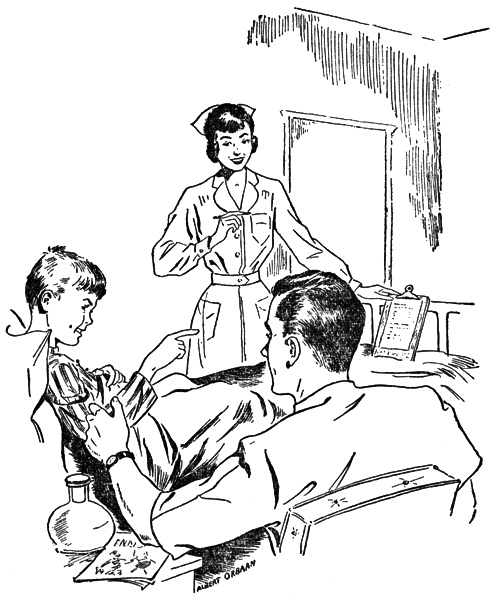
Dr. Benson spent long hours in Timmy’s room.
JEAN CRAIG, GRADUATE NURSE
by KAY LYTTLETON
THE WORLD PUBLISHING COMPANY
CLEVELAND AND NEW YORK
FALCON BOOKS
are published by THE WORLD PUBLISHING COMPANY
2231 WEST 110th STREET · CLEVELAND 2 · OHIO
WP 8·50
COPYRIGHT 1950
BY THE WORLD PUBLISHING COMPANY
MANUFACTURED IN THE UNITED STATES OF AMERICA
The small village of Elmhurst, Connecticut, was
enjoying a balmy early spring. The March winds were
soft breezes coaxing the New England earth to life
again.
Night had settled after a long twilight, and gay
sounds could be heard coming from the nurses’ quarters
at the Gallup Memorial Clinic. The clinic, now
almost two years old, was the pride of the community.
Before it was built, Dr. Gallup, gentle, wise and able
physician, had tended the sick, brought babies into
the world and guarded the health of the community
with constant vigilance.
Like the noble man he was, Dr. Gallup refused to
retire from active practice until he had helped to
provide for the future medical care of his beloved
patients. And because the town loved and respected
him, they backed him solidly. Together the people
of Elmhurst created the Gallup Memorial Clinic.
And now, the white clapboard house which had once
belonged to a wealthy native was a small but efficient
combination hospital and clinic for the community.
Dr. Edward Barsch, eminent surgeon, had come
down from Boston to serve as head of the clinic. His
staff was small but competent, and he had managed
to open an accredited nursing course.
It wouldn’t be long before the first class of nurses
would graduate. Standing high in the class, Jean
Craig, one of the very first girls interested in the
clinic, was looking eagerly toward the summer day
when she would win her cap.
But tonight there was no thought of graduation.
The nurses were planning a party. For there was a
wedding in the offing, and the excited girls were
wrapping presents and prettying themselves for Ethel
Simpson’s wedding shower.
Ethel had come down from Boston with Dr. Barsch
to act as supervisor of nurses. As is told in Jean Craig,
Nurse, Jean and her classmates had been taught and
guided by the lovely, competent girl through their
year and a half of training. They had also laughed
and cried with her during her courtship and subsequent
engagement to Dr. Ted Loring, staff pediatrician.
And now they were planning many gay and
exciting parties to celebrate the coming wedding.
The party was to be held at the Craig farmhouse
just outside of town. And while the girls were getting
ready, Mrs. Craig was making a final inspection of her
home. When she was satisfied with the preparations,
she threw open the front door of the farmhouse and
took a deep breath of the fresh spring air.
It would be a happy spring, Mrs. Craig thought.
Each year that passed seemed to push the war and the
hardships that followed farther back in the shadowy
memories of the family. Here in this simple village
they had found peace and happiness.
She smiled as she thought of her family. It was
truly growing up. Jean, her oldest daughter, was an
adult. In a few months she would be twenty-one.
It was exciting to have an adult daughter, Mrs. Craig
thought fondly. Jean would be old enough to vote.
She would be a registered nurse, and lastly, but most
important of all, she would soon be a bride herself.
Five years ago, when the Craig family had moved
to Elmhurst to forget the misery of the war years, Jean
had met Ralph MacRae, a handsome young Canadian
boy from Saskatoon, Saskatchewan. Jean Craig Grows
Up tells how Ralph sold his Elmhurst farm to the
Craig family, and lost his heart to Jean in the bargain.
Next came Kit. Mrs. Craig smiled in spite of herself
as she thought of her nineteen-year-old impetuous
daughter. Kit was the family scholar. She had been
sent to Hope College in Delphi, Wisconsin, by a
crotchety old uncle, and she had endeared herself to
the elderly scholar by turning into a scholar, herself.
The tale of Kit’s entrance to Hope College is told in
Jean Craig Finds Romance. Mrs. Craig chuckled as
she remembered how Kit and Uncle Bart had stumbled
upon a secret while they were examining an ancient
Egyptian mummy case, and how the money awarded
to Uncle Bart was now providing her daughter with
the chance for her education. Although Kit was many
miles away from her family, Mrs. Craig could almost
feel the vitality of her daughter halfway across the
continent.
Doris was the youngest daughter. Mrs. Craig
thought of her sweet, pretty seventeen-year-old with
tenderness. Doris was shy. In her demure way, she
often made her mother think of girls of generations
past. There was something almost old-fashioned about
the feminine child. But Doris was also very talented.
Right now, while Mrs. Craig waited for the guests to
arrive, she could hear Doris softly playing a Debussy
etude. The music blended with the soft evening air
and made the atmosphere nearly perfect.
As Mrs. Craig thought of her son, Tommy, her
mood changed. No one could think of fifteen-year-old
Tommy without smiling in amusement. Tommy
was all boy. His head was full of eager projects, and
his legs were long and still awkward. But he was a
businessman, too. His chickens had provided him
with enough money for spending and for a good
start on his future college education. During the years
that Mr. Craig had been invalided after the war,
Tommy had been the man of the family. But though
he knew the value of a dollar and the rich returns
for hard work, there was mischief and play in the
boy. Baseball season was just around the corner, and
this, to Tommy, was as important as the money he
was putting away for the future.
Mrs. Craig frowned suddenly. She was thinking of Jack, the
Craigs’
adopted son. Several years before,
the homeless waif had found his way to the Craig’s
home and into all their hearts, and he had never left.
Jack was now thirteen. Two years ago, Mr. Craig
had formally adopted the boy, and he was now as truly
a member of the family as any of the other children.
But Mrs. Craig was worried about him. Perhaps he
was growing too fast. For the past month, Jack had
been listless and pale. His appetite was poor ... a
sure sign that something was wrong.
As she fretted about Jack, Jean came out on the
porch and slipped her arm around her mother’s waist.
She was wearing a simple, pale blue party dress which
set off her sparkling eyes and curly brown hair.
“Everything’s ready,” she said. “Doris and Becky
have organized the whole party. And whatever are
you baking in the kitchen? I can hardly wait to
find out!”
Mrs. Craig squeezed her daughter’s hand. “I wonder
if we’ve ever tried to have any sort of party in this
house without Becky’s help,” she mused.
Jean laughed. “Aunt Becky would be positively insulted
if you didn’t ask for her help, and you know
it,” she answered.
“Aunt Becky would be lost without the Craig family
to look after, you mean,” Mrs. Craig laughed. “Ever
since she urged us to come to Elmhurst in the first
place, she’s been watching over us like a mother hen.”
Jean giggled. “I would give anything to be at the
hospital
now. Did I tell you that the doctors have
taken over for the nurses tonight? So that the girls
could all come to the shower. I can just see Dr. Daley
and Dr. Jenkins running to answer patients’ calls.”
“It was lovely of them to volunteer,” Mrs. Craig
said.
Jean nodded. “Oh, they’re all like that. I guess you
have to cooperate if you have such a small hospital.
Oh golly,” she sighed, “the wedding makes me want
to cry.”
“I know how much you miss Ralph, dear,” Mrs.
Craig answered. “Just a few more weeks and he’ll be
back again.”
“He’s in Norway now. Did I tell you, Mother?”
Jean asked.
Mrs. Craig laughed. “Yes, dear. You told me. In
fact, you read me his last letter.”
Jean blushed. “That’s right. I guess I’ve told you a
hundred times.”
Mrs. Craig smiled. “I think it’s wonderful that you
want to talk about Ralph so much.”
Doris came out on the porch and breathed deeply
of the fresh air. “What a night for a party!” she exclaimed.
“It’s just about perfect!”
“Where’s Becky?” Mrs. Craig asked.
“Oh, she went upstairs to see Jack for a minute.”
Mrs. Craig sighed. “Has Jack gone to bed? So
early?”
Jean turned around to face her mother. “I thought
he and Tommy were going over to Billy Ellis’s for
the night.”
Mrs. Craig shook her head. “Tommy went, but Jack
said he didn’t feel well.”
Doris sat down on the porch swing. “Becky went
up to give him a tonic. She said something about
springtime and sulphur and molasses....”
“And sulphur and molasses never hurt anyone,”
Aunt Becky said as she came out to join them. “I tell
you, you have to get winter out of a growing boy’s
bones. The way that youngster has been mizzering
around lately just proves it. When he passed up the
chance to spend the night with us, I knew something
was wrong.”
“Is Jack in bed, Becky?” Mrs. Craig asked.
“Yes, he is. He’s just plumb tuckered out. No
wonder. He didn’t eat enough supper to keep a bird
alive.”
Mrs. Craig said, “I’ll go up to him in a few minutes.
After the guests arrive.”
Just then a car turned into the Craig driveway.
Doris stood up. “Here they come. Don’t forget,
Mother, Becky. This is a surprise party.”
The car door opened and Hedda and Ingeborg
hopped out. The student nurses ran up the steps while
Ethel switched off the ignition and headlights and
climbed out after them.
“Evening, Mrs. Craig, everyone,” the girls called
as they came up to the porch.
“Good evening, girls,” Mrs. Craig replied, grasping
their hands. “Ethel, dear, you look lovely this evening.”
Ethel slipped off her white wool jacket and displayed
her silver-green party dress. She whirled
around. “See the skirt,” she laughed. “Ted helped me
pick this out.”
“He has lovely taste, then,” Mrs. Craig said.
“For a man,” Hedda added. “It’s simply gorgeous.”
Ethel smiled as she thought of her fiance. “You
know, it’s wonderful,” she said softly. “I haven’t any
father or mother to help me prepare for the wedding,
so I have a fiance who can be so helpful and wonderful
in these things!”
Mrs. Craig smiled fondly at the girl. “Well,” she
said briskly, “let’s go inside.”
The girls drifted into the living room. Doris sat
down at the piano and began to play a popular tune.
They all grouped around her and began to sing as
Mrs. Craig slipped out to the kitchen.
Jean heard sputtering and backfiring in the driveway.
“Here come Helen and Eileen,” she cried.
In a few minutes, the two girls appeared in the
doorway. “Old Bessy made it up your hill,” Eileen
giggled. “There’s life in the old rattletrap yet.”
“How’re the doctors making out over at the clinic?”
Ingeborg asked.
Helen chuckled. “Oh, just fine. Can you imagine
Dr. Jenkins making formula for the babies? He certainly
looked fussed and awkward.”
“Wait till Ted’s bachelor dinner,” Jean teased. “Then
I suppose we’ll have to do all their work.”
“Dr. Barsch is at the desk,” Helen continued. “Any
calls tonight are going to be answered by St. Peter
himself,” she said irreverently.
Lucy Peckham and Sally Hancock came in the door
just as Mrs. Craig brought in a large bushel basket
decorated with white and gold paper. The basket
was heaped with shower gifts for Ethel.
“Here you are, my dear,” Mrs. Craig said. “And you
know we all wish you great happiness with every gift.”
Tears glistened in Ethel’s eyes as she looked at the
basket.
“I sort of knew it would be a shower,” she admitted.
“But I never had a basketful of presents before in my
life. You just shouldn’t have done it!”
Doris started to play the Wedding March, and the
girls clustered around Ethel as she slowly opened her
presents. Mrs. Craig waited till the first gift was
opened, and then she slipped out into the hall. As
she started up the stairs, the door opened, and Mr.
Craig and Ted Loring came in.
She turned around and came down to greet her
husband and the young doctor. “Why, Ted,” she said
fondly, “how nice to see you!” She smiled at her
husband.
“Ted and I have some things to talk over, Marge,”
Mr. Craig explained. “We thought tonight would be
a fine time.”
“Then you didn’t come to join the party?”
Ted stared at her in mock horror. “Heaven forbid!”
he exclaimed. He peeked through the entranceway
into the living room. “They do look lovely, don’t
they?”
Mr. Craig smiled at the sight of the radiant girls.
“Yes, they do,” he agreed. “Now Marge, if you’ll
excuse us, I’ll just take this young man into the
study.”
“Oh, of course,” Mrs. Craig said. “I’m on my way
upstairs. I’ll bring you some hot chocolate later, if
you like.”
They both smiled and nodded as she went upstairs.
“Come in, Ted,” Mr. Craig said, opening the door
to his study. They sat down in comfortable chairs
and pulled out their pipes.
Mr. Craig smiled disarmingly at the boy. “You
might call this a trial run for me, son,” he said.
“I don’t understand, sir,” Ted replied, lighting his
pipe.
Mr. Craig leaned back and stared out of the window.
“I guess you know that our daughter will be getting
married pretty soon. When young MacRae comes back
from Europe, probably. I guess he’ll want a few words
with me beforehand. So I thought I’d ... well, I’d
practice on you.”
Ted nodded. “You don’t know what this means to
me, Mr. Craig,” he said warmly. “You and Mrs. Craig
have been like a second father and mother to Ethel,
and this gesture just about completes the picture.”
Mr. Craig nodded. “Fine girl,” he mused. “I can’t
remember knowing any finer girl, as a matter of fact.
Well, I guess all young people have to listen to some
old man recount the blessings and pitfalls of marriage
sooner or later. Your mother is still living, isn’t she,
Ted?”
“Yes, sir. She will be here next month for the
wedding. She and Ethel have been corresponding for
several months, now. Needless to say, Mother is
thrilled.”
The older man nodded. “I’m glad to hear that.
Now, Ted, I’m in no position to ask you impertinent
questions about your bank account or your ideas about
marriage or anything else. But I just want to give you
a little advice. Advice which I think you can use. In
some ways, you and I are very much alike. Before
I went into the Army, I was pretty absorbed in my
work. Perhaps I knew as much as the average husband
and father about what was going on in my family.
But it took a war and a serious illness to prove to me
that no work in the world is one quarter as important
as a man’s wife and children.
“I know what medicine means to you, Ted. I have
some idea of the demands it makes on you. But never
forget that you will have a wife who will stand beside
you and will help you fight whatever battles come
along. Just don’t forget to let her help you in the
fight....”
Mrs. Craig knocked softly at the door.
“Come in, Marge,” Mr. Craig called. “We could
use some hot chocolate.”
“I’m sorry,” Mrs. Craig said as she closed the door
behind her. “I didn’t intend to break in on you quite
so soon. But, dear, I’m worried. Jack is upstairs in
bed. He isn’t feeling at all well.”
Mr. Craig tapped the heel of his pipe in his hand.
“Something he ate for supper?”
Mrs. Craig shook her head. “No, it’s a cold, or, well,
I don’t exactly know what. He has some fever.”
“How high a fever, Mrs. Craig?” Ted asked.
Mrs. Craig smiled almost apologetically. “Hardly
any at all. His temperature registers just over ninety-nine.
But he feels so bad. He says he aches all over.”
Ted started for the door. “If you don’t mind, Mrs.
Craig, I’m going to take a look at him,” he said.
2. A Villain Unmasked
Jack was lying face down on his cot when Ted and
Mr. and Mrs. Craig came into his room. He turned
his head with a grimace and looked up at them listlessly.
Ted walked quickly over to him and sat down
on the floor beside his bed.
“Just let your head down, Jack,” Ted said as Jack
tried to look up at his mother and father. “Now tell
me where you hurt.”
“All over,” Jack whispered.
Ted nodded. “Does it hurt to talk?”
Jack nodded.
Ted looked up at Mrs. Craig. “How long has he
been feeling this way?”
Mrs. Craig said helplessly, “I don’t think it’s ever
been this bad. He’s been sort of listless ever since he
had a cold last month.”
Ted picked up Jack’s arm gently. He pressed against
the elbow. Jack winced.
“What kind of cold was it?” Ted asked.
Mrs. Craig smoothed Jack’s forehead. “Well, he first
had the sniffles, and then a sore throat and then a
cough. Pretty much like all his colds. Then, a while
later, he got another sore throat. He ran some fever.”
“Uh huh,” Ted said, nodding his head.
“Mother, my head aches,” Jack moaned.
Ted sighed and stood up. “Well, we can’t do anything
here. If you don’t mind, I’d like to run him
over to the clinic and let Dr. Barsch and Dr. Jenkins
have a look at him. I came on a social call, and I
don’t even have a stethoscope with me.”
Mrs. Craig straightened up. “Is it serious, Ted?”
she asked.
Ted hesitated and then nodded. “It might be, Mrs.
Craig,” he said. He picked up Jack’s wrist and looked
at it. “There’s some swelling here. You see?”
Mr. and Mrs. Craig both nodded.
“Well, let’s get him to the hospital,” Ted said. “If
we can wrap him up in blankets, we don’t need to
bother him with clothes.”
Mrs. Craig picked up Jack’s blankets and wrapped
them around the bewildered boy. Ted smiled at him
and said, “Cheer up, son. These things happen to
the best of us. We probably won’t keep you at the
clinic very long.”
Mrs. Craig started for the door. “I’ll get my coat,”
she said.
Mr. Craig caught her arm. “Let me take the boy
over, Marge,” he said. “The girls will need you for
their party.”
Mrs. Craig whirled around. “I can’t leave him now!”
she cried. “My boy is sick, and I’m going to stay with
him!”
Mr. Craig put his arm around his distraught wife.
“Of course, dear,” he said. “And please don’t worry.”
“Get your car ready,” Mrs. Craig said to Ted. “Mr.
Craig can carry him downstairs. We’ll be ready when
you are.”
Mrs. Craig ran downstairs and took her coat from
the hall closet. She looked into the living room where
the party was in full swing. After a minute she
caught Jean’s eye.
“Jean,” she said softly, as her daughter came to the
doorway. “Jack is sick, and Ted and I are going over
to the clinic with him. Don’t tell the others. I don’t
want to break up their fun. But you’ll have to manage
without me.”
Jean gasped. “Oh, Mother! I’ll go over with you!”
she cried.
“No, dear,” Mrs. Craig said firmly. “You stay with
your guests. I’ll call you as soon as we know anything.”
Mr. Craig bundled Jack into the car, and Mrs. Craig
and Ted started off with him toward town. Ted drove
slowly, avoiding the bumps in the country road. Mrs.
Craig supported Jack tenderly, trying to brace him
against the swaying of the car. She noticed that Ted
was scowling angrily, and she suddenly felt cold with
fright. As if he could sense her terror, Ted reached
over and patted her hand.
“I think everything’s going to be all right, Mrs.
Craig,” he said reassuringly.
Dr. Barsch was at the desk when they came into
the hospital. Ted exchanged a few words with him.
The head doctor nodded gravely and came over to
Mrs. Craig and the boy.
“So you’ve caught yourself a bug, Jack,” Dr. Barsch
said. “Well, let’s get you upstairs, and Dr. Jenkins and
I’ll go over you, and see just what is the matter. If
Dr. Loring will take over at the desk, I’ll have an
orderly take you right up.”
“May I go, too, Doctor?” Mrs. Craig asked.
Dr. Barsch hesitated, and then Mrs. Craig said,
“No, I’ll wait here. I shouldn’t have asked. I’m sorry.”
Dr. Barsch nodded. “It’s all right, Mrs. Craig. I
know you’re worried. I’ll let you see Jack as soon as
I can.”
After the orderly had taken Jack upstairs, Ted sat
down behind the desk facing Mrs. Craig, who paced
nervously back and forth.
“Please sit down, Mrs. Craig,” he begged her. “You’ll
just wear yourself out.”
Mrs. Craig smiled and sat down in an easy chair
across the desk from Ted. “I must seem like a foolish
mother hen,” she said apologetically.
Ted looked at her in wonder. “I wish there were
more mothers in the world like you. Some of the
mothers I’ve seen wouldn’t be this anxious about their
own children, let alone an adopted son.”
Mrs. Craig thought a moment. “I wonder why
people don’t understand,” she said softly. “Jack is every
bit as much my own child as if I had given birth to
him.”
Ted nodded. “Of course I’ve always thought of him
as your own, because he’s been with you as long as I’ve
known you. But I’ve often wondered, Mrs. Craig, why
you and Mr. Craig adopted another child. I mean,
when your family is as large as it is.”
Mrs. Craig smiled softly as she remembered Jack
when he first came to her house. “We didn’t exactly
adopt Jack. He adopted us. He turned up one day
looking for work. When he was just a bit of a thing.
His mother was dead. And his father!” she made a
face as she remembered the distasteful man. “He was
frightful! He dragged that mite of a child along with
him on box cars! He ... he rode the rails, I think
the expression is. And then he found that Jack was
too much of a nuisance, thank God! And he dumped
him off at Elmhurst.”
“You mean he ran away from his own son?”
Mrs. Craig nodded. “And so Jack came to us. Then,
just about two years ago, his father turned up again.
I suppose that was fortunate, too. He wanted Jack
back. You see, Jack and Tommy make quite a bit of
money from their chickens. So he wanted Jack’s
money. Mr. Craig made a settlement with him, and
he gave us permission to adopt Jack. So, you see,
Jack is our very own child. And that dreadful man
has no claim to him, whatsoever!”
Ted smiled. “Jack was lucky,” he said quietly.
“And so were we. I can’t imagine how, but that
boy, brought up in filth and horrible conditions, was
as fine a boy as you can imagine. Right from the very
start. Oh, Ted, if anything happened to Jack, we’d
be lost!”
Ted smiled again. “Nothing will happen, Mrs.
Craig,” he reassured her.
“What ... what do you think it is?” she asked
timidly.
Ted hesitated. “I don’t know, of course,” he said.
“You mean, you don’t want to tell me?” she asked.
He drew a long breath. “Very well,” he said. “I’m
afraid it may be rheumatic fever.”
Mrs. Craig drew a long sigh of relief. “Oh, good
heavens. And here I’ve been really worried. I was so
afraid of polio. I know it isn’t the right season for
polio, but you don’t know how a mother worries about
such things!”
Ted ran his hand through his hair. “I don’t think
you understand, Mrs. Craig. Do you know what
rheumatic fever is?”
Mrs. Craig shook her head. “A sort of rheumatism,
isn’t it? That would explain the aching and the tiredness
and swelling of the joints.”
Ted sighed. “It’s a type of rheumatism, all right.
But compared to rheumatic fever, polio is a pink tea
party.”
Mrs. Craig gasped. “Oh, no!” she cried.
Ted drummed his fingers against the desk. “I don’t
mean to under-rate the seriousness of polio. But almost
always polio can be diagnosed ... at least the mother
knows the child is really sick. But this mean villain
of a germ which Jack may have is one of the slickest
criminals of the medical world. Rheumatic fever
doesn’t cripple outwardly ... doesn’t disfigure a person
the way polio does. But it can cripple and kill.”
Mrs. Craig caught Ted’s hand. “Oh, Ted!” she cried.
Ted covered her hand with his. “Now, it’s not going
to kill Jack. I can promise you that.” He ran his
fingers through his hair again. “But you have no idea
how many youngsters contract the disease and no one
ever knows it.”
“How does it work, Ted?” she asked.
“It usually starts in the form of a strep throat. You
remember you told me Jack had not one but two sore
throats with his cold? Probably he caught the infection
while his resistance was low from his cold. Then,
after a while, the throat heals and the patient is presumably
well. Only he doesn’t really feel good. He
hasn’t much appetite. He’s listless. He aches in the
joints. He isn’t exactly sick, but he isn’t well, either.
Lots of people ignore these symptoms. So the strep
then attacks the heart. If the patient is lucky, after
that, he manages to fight off the infection, or arrest it,
and survives with a badly damaged heart.”
Mrs. Craig covered her mouth with her hand. “And
if the patient isn’t lucky?” she asked.
Ted shook his head. “Let’s not talk about it any
more,” he said.
“You mean, he dies?”
Ted nodded. “But you must remember this. Jack
doesn’t fit either case. Thanks to you, we’ve caught
the villain. Jack’s going to have help in his fight.”
Dr. Jenkins came down into the lobby and nodded
to them. “I think we’ve found the root of the trouble,”
he said calmly.
Mrs. Craig shook her head as if to fight off a bad
dream. “Dr. Jenkins,” she said slowly, “your specialty
is heart trouble, isn’t it?”
Dr. Jenkins smiled. “Of course I’m just past my
internship, Mrs. Craig. Someday I hope to be a heart
specialist, though. But for right now, I’d like to call
in a specialist from Boston. We want to be very sure
to do exactly the right things.”
Ted looked at the other doctor. “I was right, Fred?”
he asked.
Dr. Jenkins nodded. “And if Mrs. Craig wants to
see Jack now....”
“Oh, please!” Mrs. Craig cried. “Ted, will you call
Mr. Craig and tell him? But please don’t let him tell
the girls till the party is over.”
Jack was lying flat on his back in a small single room
near the pediatric ward. He managed a grin as Mrs.
Craig came into the room.
“Jeepers, you should see all the things they did to
me,” he said as gaily as he could. “Mother, it sorta
makes a guy feel important with a couple of doctors
fussing over him.”
Mrs. Craig knelt beside his bed. “All right, baby,
everything is going to be fine.”
Jack grimaced. “I’m not a baby,” he protested weakly.
“They gave me some aspirin and stuff. My head
doesn’t ache so much. Hey, will you ask Tommy if
he ever had a car—cardio—you know what I mean?”
“A cardiograph? I’m sure Tommy never had one.
You’ll be able to tell him all about it in a few days,”
Mrs. Craig smiled.
“They gave me a pill. I feel sorta dopey. But don’t
hang around all night or anything, because I’m gonna
be okay.”
Mrs. Craig caressed his forehead gently. “Of course
you are, Jack.”
Jack dozed off. But as he relaxed, a spasm of pain
hit him, and he cried, “Mother!” Too near to sleep to
act like a man any longer, he whimpered like a young
child. Mrs. Craig stroked his black hair tenderly.
Dr. Barsch appeared in the doorway. “I think he’s
asleep, Mrs. Craig. If you want to stay here tonight,
there is a room next to this one....”
“Is it all right if I stay right with him?” she asked.
“I’m not very sleepy.”
Dr. Barsch came in and sat down beside the bed.
“You’re a wonderful woman, Mrs. Craig,” he said
softly. “This boy is so lucky. And what a boy he is!
The exam we gave him wasn’t very pleasant for him.
He’s in a lot of pain. But he joked and grinned and
...” he turned his head away a little. “I don’t know.
Sometimes a youngster like this can make one proud
to be part of the human race!”
3. Fresh as Paint!
Billy Ellis and Buzzy Hancock dashed up the driveway
to the porch of the
Craigs’
farmhouse. Tommy
was sitting on the porch swing jotting down figures
in his account book when his pals joined him. They
jumped up on the porch, and Billy cuffed Buzzy
playfully as they sat down on the swing.
“Hey, take it easy, you guys,” Tommy said. “I’m
trying to add up my accounts. I want to give Jack
an exact report of how much money we made while
he was gone.”
Billy stretched his long legs out in front of him.
His voice, which wavered between soprano and baritone,
was full of sympathy as he said, “Jeepers, what
a break! The poor little guy’s going to miss all the
fun this summer.”
Tommy looked at his two closest pals. Billy, Judge
Ellis’s son and Aunt Becky’s stepson, was a few months
younger than he. Ever since the Craigs had come to
Elmhurst, both Billy and Sally Hancock’s young
brother, Buzzy, had been involved in every project
Tommy and Jack had undertaken.
He shut his book. Stretching lazily, he said, “I
guess it’s up to us to see he has as much fun as possible.
It’s a real tough break for the ball team, though. I
don’t know where we’re going to get a good shortstop
now that Jack’s out for the season.”
“Can we see him soon?” Buzzy asked.
Tommy shook his head. “Mom says no company for
a while. He’s coming home this afternoon, but you
guys can’t see him for some time.”
Billy sighed. “Seems to me there isn’t any use in
being sick. It isn’t any fun no matter which way
you look at it. What’s the guy going to do with his
time?”
“Oh, read, I guess. And study. He’s going to have
a tutor, Mom said,” Tommy answered.
Buzzy whistled. “You mean he’s gotta have school
work? Jeepers! That’s terrible!”
Tommy shrugged. “It would be worse if he had to
stay back a term in school.”
“Yeah, I guess so,” Buzzy said thoughtfully. “But
about what we guys can do. You think about it,
Tommy. Let us know, won’t you?”
Tommy stood up. “Will do,” he said. “And listen,
you guys, one more thing. Mom said those letters you
wrote were just about the nicest things you could have
done for him. Keep it up, will you?”
Doris came out to the porch. “Tommy, have you
seen Mother?” she asked.
“Sure. Mom’s upstairs getting ready to go over to
get Jack. What’s up?”
“Where’s Dad?”
Tommy stared at her. “At the office, of course.
Where else?”
Doris giggled at herself. “I guess I got so used to
having Dad around the house that I forgot he does go
to work regularly now.” She pulled a letter from her
pocket. “It’s from Kit,” she told him.
“From Kit? Hey, let’s see it!” Tommy cried.
Doris put it back in her pocket. “It’s to Mother and
Dad,” she said severely.
Tommy shrugged. “Come on, gang,” he cried. “Let’s
get some cookies.”
The boys disappeared into the kitchen, and Doris
went upstairs.
“Mother!” she called. “Letter from Kit!”
Mrs. Craig was putting on her hat when Doris came
into her room. She smiled at her daughter and held
out her hand. “Good news, I hope,” she smiled, taking
the envelope.
“Kit’s news is always good,” Doris said. “College
seems to agree with her.”
Mrs. Craig hastily scanned the note, nodding and
then frowning as she read. “Kit has spring fever,” she
decided as she folded the letter and slipped it back into
the envelope. “Claims she’s bored with life.” She smiled
to herself. “But after her trip to Washington, I think
she’ll feel better.”
“What trip to Washington?” Doris asked.
Mrs. Craig grinned at the thought. “Kit has been
elected president of the Hope College Historical Society,
you know, dear. There’s a large history convention
in Washington after classes let out in June.
There will be girls and boys from all over the country.”
Doris grinned. “And of course there will be Frank
Howard in Washington.”
Mrs. Craig sighed. “I think that’s what’s wrong with
Kit. I think she misses Frank more than she will
admit.”
Doris sat down on her mother’s bed. “Do you think
Kit will marry Frank, Mother?”
“Good heavens!” Mrs. Craig exclaimed. “How
should I know? They are very close friends ... and
they have been for several years.”
“Ever since Kit caught Frank in the berry patches,”
Doris giggled. It was typical of Kit that she should
have trapped the bright young entomologist in an
effort to catch a berry thief. A bantering friendship
had grown out of this episode, and lately there had
been sure signs that the friendship between Kit and
Frank was ripening into affection.
Mrs. Craig powdered her nose. “Do you want to
ride with me to the hospital, Doris?”
“Yes, I’d like to,” Doris said. “I want to talk to
you about something, anyway.”
On the way over to the clinic, Doris said, “There’s
a sort of contest at school, Mother. A music contest.”
Mrs. Craig smiled. “That’s nice, dear,” she said.
“Are you going to enter it?”
Doris frowned slightly. “That’s what I wanted to
talk to you about. It’s for a scholarship to a music
school. I don’t know whether I want to try for it
or not.”
Mrs. Craig stared at her. “But good heavens, why
not? What school is it?”
“Timothy College in North Carolina. It’s very
small—all music, you know. It’s awfully far away,
too. And with Jean getting married and Kit away at
school, well, I don’t know whether I want to leave
home or not.”
Mrs. Craig slowed down the car. “Let’s talk about
this with your father. But, dear, I think you should
at least try out. It would be a shame to let your talent
go to waste.”
Doris hesitated. Then she said, “But Mother, I don’t
want to go away! I’m not like Jean and Kit. I’d just
like to stay right here in Elmhurst forever and ever.
I like it at home.”
Mrs. Craig tapped the steering wheel with her
fingers. “Doris, I want you to enter that contest. Why
shouldn’t you have the right to go away to school?
We were able to send Jean to New York for a year
of Art School,” she said, referring to Jean’s experiences
which are recounted in Jean Craig in New York.
“Then Kit won herself the chance to go to Hope
College. Now, it’s your turn.”
“But Mother....” Doris began.
Mrs. Craig shook her head. “I don’t know very
much about art or music, my dear,” she interrupted,
“but your father and I have always felt that you were
extremely talented. Frankly, I’ve always felt that you
were the most talented of all my daughters. Jean is
a good artist. Competent, I think she calls herself.
But she has no illusions about being a great artist.
I think perhaps you have the ability to develop into
a fine musician.”
Doris shook her head. “Oh, golly,” she said, “I just
don’t want to go through what Jean and Kit have
gone through.”
“What do you mean?” Mrs. Craig asked, surprised.
“You know. You get yourself all ready to do something
important in this life, and then you fall in love
with some man and want to get married. Look how
mixed up Jean was. And look at Kit now. She’s
going to college and has even talked about doing
graduate work. But you and I know she’s mad about
Frank Howard and that she’ll probably just get
married.”
Mrs. Craig repressed a smile. “Darling, you don’t
just get married,” she said gently. “Both Jean and Kit
are much better prepared to become good wives because
they did develop their talents. I think you should
do the same.”
Doris sighed. “Maybe so,” she agreed. “Oh, golly!
I’m selfish! I know you’re worrying about Jack and
his homecoming. It’ll be so good to have him home
again!”
Jack was waiting when they arrived at the hospital.
Jean and Sally Hancock were in his room gathering
his few belongings. Mrs. Craig shook her head as
she saw the thin, pale boy lying on the bed. His black
eyes seemed even larger than usual, but they were no
longer dull and glassy. They sparkled when they saw
Mrs. Craig.
“Oh, Mother!” he cried. “I thought you’d never get
here! Golly, but I’m tired of this room. Not that
they haven’t been swell here, though. Dr. Jenkins and
Dr. Caulfield from Boston have been here almost all
the time. They talked a lot to me.”
“That’s fine, dear,” Mrs. Craig said briskly.
“But, gee, I sure missed Tommy. And the hens.
Tommy doesn’t know how to keep track of all those
hens. I ... I don’t know what he’s gonna do, now
that I can’t help him.”
Jean patted Jack’s shoulder. “You’re learning young
that no man is indispensable to his business.”
He looked up at her. “Huh?” he said.
They all laughed. “Jean means that business has
to go on no matter what happens,” Mrs. Craig said,
smiling. “And it usually does. Billy Ellis and Buzzy
Hancock were over this morning. They want to see
you as soon as you can have company.”
“Yeah, I know,” Jack said. “They wrote me. Jeepers,
what a swell gang they are! Those dumb letters!
They made me laugh till I hurt!”
Ted Loring brought in a wheel chair. “Here’s your
chair, my lord,” he called from the doorway. “Oh,
good morning, Mrs. Craig. You’re looking fine this
morning. I’m going to ride over with you and help
get our patient back to bed, if that’s all right with
you.”
Mrs. Craig smiled. “That’s very thoughtful, Ted.
Mr. Craig is in town this morning, and we could use
a strong back.”
Ted grinned. “I heard about Mr. Craig’s new position.
I think it’s swell. We need an architect around
this town, although I sort of like these old New
England designs.”
Mrs. Craig smiled. “He’s glad to be back at work,
too.”
“I found out about it from Dr. Daley,” Ted explained.
“I guess you know he kept a pretty close eye
on Mr. Craig while he was working on the veterans’
houses. A nervous breakdown is nothing to fool
around with. But Dr. Daley seems to think he’s now
in fine shape.”
Jean tucked a robe around Jack’s legs as they started
out of the room. “Take good care of him, Mother,”
she said. “I’ll be home for dinner tonight, you know.”
Jean watched the small procession move slowly
down the hall. Then she pulled her sketchbook from
her pocket and began thumbing through it.
“Hi, gorgeous!”
Jean turned around to see Gerald Benson, the new
intern, coming down the hall. “Oh, good morning,
Dr. Benson,” she said. She started to pass him, but
he blocked her path.
“I’ve just been having a lecture on the glories of
one Miss Jean Craig,” Dr. Benson said. “They sure go
for you around here.”
Jean stared at him in surprise. “Whatever are you
talking about?”
He shrugged. “I was ambling through the lobby
with Dr. Barsch this noon and just happened to comment
on the painting over the mantel down there.
And the good doctor ups and tells me that you did it!”
Jean giggled. “I’m afraid I did,” she admitted. “It’s
not so glorious, though,” she added.
“It’s good enough. I didn’t know you were an
artist.”
Jean smiled. “I’m not. Not really. I studied for a
year in New York. And I like to paint for pleasure.
As a matter of fact, I’m hoping to do something with
my art work combined with medicine.”
Dr. Benson whistled. “You mean surgical art?
That’s a tough field.”
Jean grinned. “I know it is. But Dr. Barsch has
encouraged me to try my hand at it. I guess starting
just about any time now, he’s going to give me practice
sketching operations here. As a matter of fact, I was
just going through my sketchbook. I’m working on
anatomical drawings from books now so I’ll be better
at doing real life sketches.”
Dr. Benson put his hands on his hips. “Did you
donate that painting to the clinic as your contribution?”
Jean smiled again. “Well, not exactly,” she admitted.
“You see, when the hospital first opened, Ted Loring
and I had a long talk about clinics and things. And
he gave me the idea, sort of. He said a clinic was a
place where people exercised cooperation, ingenuity
and hard work. So I put the idea down on canvas.
You know, the man and woman and child joining
hands in a field of grain. And then, of all things, Dr.
Loring swiped it! He donated it!”
Dr. Benson smiled wryly. “It sounds like a motto
he might make up.”
“What’s the matter with it?” Jean demanded.
“Let’s go out tonight, and I’ll tell you,” Dr. Benson
said.
She smiled at him. “I’m sorry, Dr. Benson, but I
can’t.”
“But you’re off tonight. I saw the schedules.”
Jean smiled. “But I thought you knew. I’m engaged.
I’m not free to accept dates. I’m sure one of the other
girls....”
“You mean you’re turning me down just because
you’ve got a ring? I hear your man is in Europe.
That’s pretty far away. And a pretty little girl like
you shouldn’t be sitting home nights, just because—”
Jean brushed past him. “I’m sorry,” she said shortly.
Dr. Benson grabbed her arm. “Now wait, honey.
Don’t get sore. I mean, what’s the harm? I’m not
asking you to break your engagement. I just wanted
to have some fun. You look as if you could use some
yourself.”
Jean pulled free. “I’m sorry, Dr. Benson,” she said
stiffly. “I’m very busy just now.”
The intern watched her walk down the hall. “Okay,
sweetheart,” he said, “I’ll try again sometime. You’ll
get lonely before too long.”
Jean marched into the students’ lounge and slammed
the door behind her. Eileen Gordon was lying on
the couch reading a magazine. She looked up as
Jean came in.
“Why, Jean, what’s the matter?” she asked, looking
at Jean’s angry face. “Didn’t Jack get off all right?”
Eileen sat up and closed her magazine.
Jean sat down in an easy chair. “Oh, yes. Mother
came for him just now. Ted was sweet. He went
home with them to help her get Jack settled in bed
at home.”
“Well, then, what’s wrong?” Eileen asked.
“Oh, nothing really, I guess. Only that new Dr.
Benson asked me for a date.”
Eileen sniffed. “Oh, is that all?” she asked. “Well,
don’t worry about it. He won’t ask you again.”
Jean stared at her. “Why?” she asked.
Eileen shrugged. “He asked me for a date when he
first came here. I was busy and told him so, and he
hasn’t bothered me since.”
Jean shook her head. “It’s the principle of the thing,”
she said.
“Maybe he didn’t know you’re engaged.”
“He knew, all right. He knew that Ralph is abroad,
too. He said I might be lonely.”
Eileen scowled. “So that’s the way he is! Well,
that settles Dr. Benson as far as I’m concerned. So
he’d try to steal someone’s girl when the someone
isn’t around to fight for her.”
Jean laughed as she opened a coke. “Don’t be too
hard on him. He wasn’t exactly trying to steal me.
He just asked to take me out.”
Eileen grimaced. “I know the type. You know,
Jean, I’ve been around hospitals a long time. And I’ve
known a lot of doctors. They aren’t all like Ted and
Dr. Barsch and the rest of them here. Sometimes they
get pretty cynical. Yep, I know Dr. Benson’s type,
all right!”
4. Emergency Operation
The following night Jean was on duty. She had
just come up from early supper when she was called
into Dr. Barsch’s office.
“Miss Craig,” Dr. Barsch said briskly, “I haven’t much
time to explain, but if you will get your sketch pad, I
want you to try to do a drawing of an operation I’m
about to perform. The little DuPrez boy is coming in
immediately. Acute appendicitis. Loring says we can’t
wait. I’ve already called the staff.”
Jean gasped. “You mean, you want me to go right
in there and do a drawing?” she asked.
Dr. Barsch nodded. “You can’t learn surgical art
any better way. I don’t expect to be able to use your
sketch, but I want you to have the practice.”
“Then you won’t use me to assist you?” she asked.
Dr. Barsch frowned impatiently. “Naturally not.
Now, please hurry. Get your materials, and I’ll see
you upstairs.”
Jean hurried to her room and snatched up her
sketch pad and pencils. She ran down the hall towards
the operating room and went into the small
lavatory to scrub. Two women were scouring the
room, and Helen Pierce was sterilizing instruments.
When Jean had finished scrubbing, Helen helped her
with her gloves and mask.
“This is a real emergency,” Helen muttered as she
checked her instruments. “They always wait till the
last minute before they call the doctor.”
“Will it be a dangerous operation?” Jean asked.
Helen shrugged. “That depends. Usually an appendectomy
is a snap. That is, easy for the patient. But
it can be ticklish if the appendix is ready to break
open.”
Dr. Barsch and Ted came in to scrub up. The
girls worked in silence, and the only sound was that
of the rushing water in the lavatory. Dr. Henry, the
anesthetician, bustled in and, after scrubbing, came
over to the sterilizer and peeked in.
“I can’t use ether, Miss Pierce,” he said. “You
should know that.” He grunted. “And if we could
use a complete anesthetic, I’d choose sodium
pentothal.
But this will have to be a local block. The child undoubtedly
has eaten today.”
Helen nodded and went over to the cabinet. Carefully
she selected an injection syringe with her tongs
and dropped it into the sterilizer. Dr. Henry checked
his supply of anesthetic, nodded, and rubbed his gloved
hands together briskly.
Jean frowned. “Why can’t you use ether, Dr.
Henry?” she asked.
The portly, middle-aged anesthetician turned around
to face her. “Some people get very sick when we put
them out. Particles of food or liquid are apt to catch
in their lungs. They haven’t the control of their
reflexes that people who are awake do. There’s always
the danger of a patient choking to death.”
“Then the child will be conscious?” Jean asked.
“He’ll know what’s going on? I know we’ve used
that frequently for adults, but won’t it be difficult with
a child?”
Ted laughed. “He won’t know much. We already
have him so groggy with sedatives that he doesn’t
know what’s going on.”
Dr. Barsch frowned impatiently. “What’s keeping
them? Every minute we lose gives us less of a chance.”
As he spoke, the small patient was wheeled into
the operating room. Jean’s heart went out to the
tiny, white figure lying on the table. His eyes were
dulled, and his body was partially relaxed. But his
face was a study in fear.
Dr. Barsch stepped over to the table. “All right,
son,” he said gently. “I’m going to put a curtain right
over your middle. You know what you’re going to
feel?”
Gene DuPrez shook his head, and he gazed pleadingly
at Dr. Barsch.
“Ever been to the dentist?”
The boy nodded.
“And did he poke a needle into your gum so it
wouldn’t hurt when he drilled into your tooth?”
Dr. Barsch asked.
Gene nodded solemnly. Sally, who had come in
with the boy, and Helen turned him over on his side
and bent his legs up to meet his chest.
“Well, we’re going to do the same thing now.
We’re only going to hurt you enough to make you say,
‘ouch’.”
Gene interrupted Dr. Barsch by saying, “Ouch!”
“That’s it, Gene,” Dr. Barsch said. “You’re going to
feel something else, now. Your toes will get all numb.
Then your legs, and then your tummy. Now, I have
a feather, and I’m going to tickle your tummy. You
tell me when you can’t feel it any longer.”
Sally drew the curtain across the boy’s abdomen so
that he couldn’t see below his chest. Then she took
her station by Gene’s head. Smiling down at him,
she tousled his hair. “Feel kind of sleepy, don’t you?”
she asked.
“It still tickles,” Gene murmured.
On the other side of the curtain, Dr. Barsch had
made the incision. He smiled and silently gave thanks
for the anesthetic which made a deep abdominal
wound feel like a tickle. But his smile disappeared
when he reached the appendix.
“Oh, brother!” Ted said, shaking his head. Jean
glanced at the open wound and began to sketch
rapidly.
“Here’s one we caught just in time,” Dr. Barsch
sighed. He spoke so low that Gene couldn’t hear him.
“Look at that appendix. I’ll be lucky if I can get it
out without breaking it. When, in heaven’s name,
did you first see this boy?” he asked Ted.
Ted bit his lip. “Ten minutes before we came over.
I didn’t even stop to do a blood count on him. Let’s
not talk about it. I get cold shivers up and down my
back when I think of how close his mother came to
giving him something for his stomach ache instead of
calling a doctor.”
Jean shuddered at the thought.
“It still tickles, doctor,” Gene said in a piping voice.
“I’ll tell you when it stops.”
Jean grinned as she bent over her sketch.
“Something just stopped her,” Ted continued. “She
called me instead. A hunch, she said.”
“God loves His small creatures,” Dr. Barsch replied.
“All right, here we go.” He lifted the swollen appendix
from the wound with great care. With a sigh of relief,
he placed it carefully in a receptacle on the table. The
distended organ broke as he laid it down.
“Ye Gods!” Ted said, turning white. “That’s the
closest one I’ve ever seen!”
Dr. Barsch grinned as he started to sew up the
incision. “It’s all over now, doctor. Gene, does it still
tickle?”
“A little bit,” the boy answered. “Not much.”
“Good boy!” Dr. Barsch said. He finished his sewing
and nodded. “What about now?”
“I don’t feel anything now,” Gene admitted. “You
going to cut into my stomach now?” his face became
tense with fear. Sally rubbed his forehead and grinned.
“Too bad, Gene,” she said. “You missed the show.”
Gene stared up at her. “What?” he asked.
Dr. Barsch dressed the wound and pulled the curtain
aside. “How do you feel?” he asked.
“I’m ... I’m a little scared,” Gene admitted.
Dr. Barsch laughed. “We just played a dirty trick
on you, son. Your operation’s all over.”
Sally gave the patient an injection, and he relaxed
again.
“You’re going to sleep for a while now. And when
you wake up, you’ll be back in your room with a sore
tummy.”
Gene relaxed and slipped off to sleep as Sally and
Helen wheeled him down the corridor.
Dr. Barsch slipped off his gloves and glanced at
the broken appendix. He shook his head. “Get that
to the lab right away,” he said. “Miss Hancock can
take it down when she gets back. Miss Craig, you
come on down to my office with me. I want to take
a look at that sketch.”
When they reached Dr. Barsch’s office, Jean laid
her sketch pad on the desk for Dr. Barsch to see. He
picked it up and nodded.
“Sit down, Miss Craig. Dr. Loring will be down in
a minute. I want him to have a look at this, too.
Then we’ll get some coffee. I could use some.”
Jean smiled. “I’ll go down to the kitchen and get
some while we’re waiting,” she offered. “You must
be tired.”
Dr. Barsch waved his hand. “Sit down. The coffee
can wait.” He tapped the sketch with his forefinger
and looked at it thoughtfully for a moment. Then he
searched among the papers on his desk for a letter.
Finding it, he nodded his head as he read it over.
“I think maybe we’ve found a way to put your
talents to practical use, Miss Craig,” he said slowly.
Jean jumped up. “Really?” she cried. “But how? I
mean, I’m so far from ready to do anything useful
with my art. Surgical art is such a specialized and
highly skilled profession!”
The doctor nodded gravely. “Yes, it most certainly
is,” he said thoughtfully. “And of course the sketch
you did for us just now is still rather amateurish. But
I was right about you, I think. It shows a great deal
of promise.”
Jean grinned with pleasure. “Thank you, Doctor,”
she said.
Dr. Barsch picked up the letter again. “I’ve been in
touch with a medical publisher about you. You see,
whenever they hear of a promising young artist who
knows something about medicine, they leap at the
chance to sign him—or her—up. It doesn’t happen
often. Not often enough, that an artist is also interested
in medicine.”
Jean clasped her hands together. “You mean, some
publisher wants me to do drawings for him?”
Dr. Barsch laughed. “Not so fast, young lady. No,
their offer isn’t quite that spectacular.” He rubbed his
hands together. “But in a sense, I suppose maybe the
offer is in its way more spectacular. You see, they
want you to take more art courses.”
“But ...” Jean began.
The doctor held up his hand. “Wait till I finish,”
he said. “I think it can all be figured out quite simply.
You will finish your nurse’s training this summer.
And then, as I understand it, you are thinking about
being married.”
Jean hesitated. “Of course no definite date has been
set yet.”
Dr. Barsch stroked his chin. “Well, let’s assume that
the wedding will take place soon after your graduation.
When you reach Saskatoon, Saskatchewan, you
can begin a correspondence course in art, can’t you?”
Jean grinned. “I had sort of planned to continue
studying art after Ralph and I were married.” She
looked down. “You see, I don’t want to forget my
skills just because I’m being married.”
The doctor grinned. “Fine! Fine!” he said. “Then
my little plan can be worked. This publishing company
is prepared to award you a sort of scholarship
so that you can take the course. In return, you will
have to make arrangements with a hospital near your
home in Saskatchewan to attend their operations and
do sketching for the company when you have completed
the course.”
Jean thought a moment. “There is a small hospital
near Ralph’s ranch,” she said. “Ralph has told me
about it. Certainly I could make arrangements with
them to sketch at their operations.”
Dr. Barsch nodded. “Of course I’ll help you arrange
things. I think maybe if they realize you’re a student
of mine, there won’t be much trouble with the details.”
“Someone open the door,” Ted called from outside.
“I’ve got coffee for everyone.”
Jean went over to the door. Ted brought in the
tray and set it on the desk.
“You should have let me get it,” Jean cried.
Ted smiled. “Division of labor, my child. Dr. Barsch
operates, you sketch and I just stand around. So I’m
elected coffee boy.”
“Take a look at Miss Craig’s sketch, Loring,” Dr.
Barsch said, handing him the pad. “I think it’s
pretty fair.”
“That’s high praise, coming from you,” Ted laughed.
He looked at it carefully. “Uh huh,” he said, nodding.
“It looks swell. Jeannie, you could make a career out
of doing this.”
Jean laughed. “Dr. Barsch and I have just been discussing
that.”
“But of course you’re off to the altar, and there’s
the end of a beautiful career,” Ted said dolefully.
“Oh, no!” Jean cried.
Dr. Barsch smiled slyly. “Sounds to me as if you
are against marriage, Dr. Loring. I suppose Miss
Simpson realizes this?”
Ted blushed. “Oh, marriage is all right,” he protested.
Dr. Barsch lit his pipe. “Marriage is all right. Hm,”
he said playfully. “I’ve a notion to tell Miss Simpson
how enthusiastic you are about the institution of wedlock.
You and your city ways! Moon and pussyfoot
around and steal the best doggoned Supervisor of
Nurses I ever had! All right, indeed!”
Ted shifted painfully. “Oh, I’m very much in favor
of marriage, doctor....”
“That’s good to hear,” Dr. Barsch said.
“It’s just that Jean draws so well....”
“And Miss Simpson makes such a good Supervisor,”
Dr. Barsch added.
Ted squirmed. “I’m sorry,” he said. “You can’t
have her back!” He looked at Jean’s and Dr. Barsch’s
faces. They were grinning.
“Dr. Barsch, you shouldn’t tease him so,” Jean said
lightly. “Isn’t it all right to tell him about the plan?”
Dr. Barsch puffed at his pipe. “Of course, my dear.”
Breathlessly, Jean repeated Dr. Barsch’s plans for
her to Ted. The young doctor nodded and clapped
his hands together in agreement.
“Marvelous idea, Jeannie,” he said. “I think Ralph
will like the idea, too.”
5. April Wedding
Ethel’s and Ted’s wedding was scheduled for April
eighteenth. The first two weeks of the month were
dreary and rainy. The skies above Elmhurst were
constantly gray, and the countryside looked bleak and
unpromising after the long winter. Tempers were
short at the clinic. The season of spring colds was on,
and Jean felt a great depression as she tended her
duties as an upperclass nurse. Because of the shortage
of graduate nurses at the hospital, Jean and her classmates
were used almost as regular nurses. Jean had
to attend courses in chemistry, biology and dietetics
along with her regular duties, and as the spring term
got under way, she was now in charge of the pediatric
ward.
A whole procession of youngsters flooded both the
doctors’ offices and the hospital wards. And Jean’s
days were full of bathing youngsters, trying to put
dosages of penicillin and sulpha into unwilling small
mouths, taking temperatures and pulses of the squirming
children. She tried to study at night after writing
her daily letter to Ralph, but often she would steal
back into the ward to hold the hand of a tiny, miserable
patient lonely for his mother. Jean found solace
in the quiet ward at night. The children were calmer,
there were no adults about, and she couldn’t see the
dreadful, gloomy sky.
Ordinarily, Jean would have welcomed the chance
to work so closely with Ted, whose capacity as pediatrician
kept him closely in touch with the ward. But
Ted was cross and nervous. For hours at a time, he
swabbed throats and sprayed sniffly noses and tried
to reason with mothers weary of the winter and of
housefuls of pent-up children.
The radio forecasts were always the same: showers.
“April showers,” Jean remarked one day bitterly
as she gazed up at the sky which was sending down
its interminable drizzly rain. “If these are showers,
let me know when one stops and the next one starts,
someone!”
Only Ethel and Jack seemed to retain their high
spirits. Ethel was too excited about her wedding even
to notice the weather. And Jack, bedridden already a
month, had drawn from some inner source a courage
and even temper which amazed everyone around him.
Although Jack knew that he would be in bed for many
months, he never seemed to be depressed. He made
a full life for himself within his tiny room. Although
he wasn’t allowed many visitors, he soon fell into a
routine which occupied his mind, but which didn’t
excite him too much.
But just when everyone decided that it would never
stop raining, the sun came out. The sky was blue
with fluffy white clouds, and spring had come to Elmhurst.
Trees which had been barren two weeks before
were now covered with soft green buds. The whole
countryside softened with new-growing greenery. The
river ran with vigorous energy to carry its extra
burden to the ocean, and the air smelled clean, as if
the heavens had spent two energetic weeks in spring
housecleaning.
The day of Ethel’s wedding was cool and clear.
The ceremony was to be held in the Craigs’ parlor, and
the whole family was busy making final preparations.
Doris was singing “Brightly Dawns Our Wedding
Day” from the Mikado as she dusted the living room
furniture for the third time. Jean arranged the wedding
presents on the dining room table for everyone to
see. She sighed gently as she laid out the sterling
silver which Mrs. Loring had given her son and
daughter-to-be. And she smiled in satisfied anticipation
as she arranged the kitchen equipment which had
been the contribution of the nurses at the shower. She
handled the linens and china with loving care.
Mrs. Craig ran downstairs and popped her head
into the dining room.
“Time to get dressed, dear. I want you to be ready
so you can help me with the bride. Oh, dear,” she
sighed, “where is that girl?”
“Ethel?” Jean asked. “I suppose she’s still at the
hospital. If I know Ethel, she’s probably making a
long list of instructions to leave behind her.” She
sighed. “Oh, Mother,” she cried, “all these lovely
things! And you should see that terrible little apartment
they’re going to have to put them in! Darn it,
anyhow! Why couldn’t Ted have been a veteran?
Then he could have one of the houses Dad designed
for the veterans’ project. Now, where on earth will
they put all these things in that stuffy little place?”
Mrs. Craig smiled knowingly. “Never mind, dear.
Ethel can store things here if she wants to, till she
has a better place. Now hurry, Jean. With everyone
dressing here, we have to hustle.”
Jean obediently went upstairs. Mrs. Craig went in
to send Doris up to dress, muttering, “Ethel should
have come to breakfast as I told her to. She probably
didn’t eat a thing.”
As she spoke, Ethel came in the front door. Mrs.
Craig stretched out both hands to her, and Ethel
grabbed them. She attempted to smile.
“I’m sorry I couldn’t make it for breakfast, Mrs.
Craig,” she said. “But there were just a few things
I wanted to take care of at the hospital before I left.”
Jean bent over the upstairs railing and called down,
“What did I tell you, Mother?”
Mrs. Craig smiled in despair. “Oh, child, this is
your wedding day! Now, let’s get you upstairs and
into your finery.”
Suddenly Ethel burst into tears. Mrs. Craig put her
arms around her and drew her over to a chair.
“I ... I don’t want to get married,” Ethel cried.
“I ... well, I just don’t want to get married!”
Mrs. Craig smiled knowingly and patted the girl on
the shoulder. “I know, my dear. I know just how you
feel....”
“They’re so short-handed over at the hospital. They
can’t spare any nurses,” Ethel sobbed. “I just can’t
get married now! There are too many things to do!”
Suddenly her eyes brightened. “Do you think Ted
would understand if we called the wedding off? I
mean, just till I finish everything that has to be done
at the hospital?”
Mr. Craig came into the front hall together with
Aunt Becky. He stopped at the sight of Ethel’s tearful
face and stared at her in alarm.
“Great heavens!” he exclaimed. “Tears on your
wedding day?”
Becky elbowed him out of the way and came over
to Ethel. “Oh, run along with you, man,” she snapped
at the bewildered Mr. Craig. “There isn’t a girl alive
who doesn’t get plumb nervous at the thought of her
wedding day!” She turned to Ethel. “Now, now,
child,” she said, “you just have a good cry, and....”
Mr. Craig interrupted Becky with a loud laugh.
He threw back his head and roared. “If you think
you’re nervous, my girl,” he said, “you should see
Ted, now. When I stopped in to see him, his poor
mother was trying to help him dress. Ted was hopping
around on one foot like a scared chicken....”
Mrs. Craig touched her husband’s arm. “All right,
dear,” she said, “now run along and get yourself
dressed.”
As Mr. Craig went upstairs, whistling, Ethel composed
herself and smiled at the two women.
“Poor Ted,” she grinned. “He’s so helpless. And of
course he’s scared! He needs someone to look after
him.” She glanced at her watch. “Good heavens!” she
cried, “I’d better hurry and dress! Mrs. Craig, where
is my gown?”
Mrs. Craig smiled. “Your clothes are up in Jean’s
room, dear. Doris and Jean are waiting to help you.
I’ll be up, myself, in a few minutes.”
Ethel threw her arms around Mrs. Craig’s neck
and hugged her. “How can Ted and I ever thank you
for what you are doing for us?”
“Humph!” Becky snorted. “Now, scat, girl. And
Marge, you come out with me to the kitchen. I want
to unload my basket.” She shook the overflowing
basket of last-minute additions to the party food which
she was carrying.
Ethel nearly collided with Tommy on the stairway.
“Hi, beautiful,” Tommy said, grinning. “I hereby
swear my eternal devotion to you on your wedding
day.”
Ethel laughed. “You idiot! Whatever do you mean?”
Tommy shook his head. “Only for you. For you
only, I say, would I struggle into this!” And he waved
a stiff collar under her nose. “That is, outside of the
immediate family.”
As Tommy reached the bottom of the stairs, still
muttering about his collar, the front door flew open,
and Ted, followed by a distraught Mrs. Loring, came
dashing into the hall. Ted confronted Tommy, his
face twisted in wrath.
“Tommy, where’s your father?” he demanded.
Tommy stared at the bridegroom.
“Now, now, dear,” Ted’s mother clutched at his
arm, “don’t upset everyone, now. Calm yourself!”
Ted turned to face his mother. “But you know this
means the wedding’s off! How can a man get married
when...?”
“Huh?” said Tommy.
“The apartment! The furniture! Gone! Everything’s
gone! I’ve been robbed! The apartment wasn’t
much, but it was a place to live, and Ethel and I
picked out all our furniture and had it sent to that
place. Now it’s gone!”
Mrs. Loring took Ted’s hand. “Now listen, son,”
she said, “there must be an explanation. People don’t
run off with a houseful of furniture.”
Mr. Craig came downstairs.
“Well, hello, Mrs. Loring,” he said, shaking her
hand. “And Ted. I’m afraid I have to do the honors.
The women are all upstairs dressing.”
Mrs. Loring smiled wryly. “Mr. Craig, forgive this
ridiculous son of mine. We would have come over
at the proper time when everything was ready. But
Ted has some fool notion that he’s been robbed.”
Mr. Craig chuckled. “If Ted didn’t come crashing
into a party, I would know there was something
wrong. Did he ever tell you about the first time we
met?”
Mrs. Loring smiled as if she knew her son’s habits.
“I can imagine the entrance he made was spectacular,”
she said.
Mr. Craig laughed at the memory. “It certainly was.
We gave a large barn dance to celebrate the building
of the clinic. Dr. Gallup was in the midst of introducing
Dr. Barsch to the community when, bang!
The lights all went out. Seems as if Ted had come
in and tripped over the light cords.”
Mrs. Loring laughed despairingly. “Oh, Ted,” she
sighed. “I’m afraid you had a typical introduction to
my son,” she said to Mr. Craig.
“Mother!” Ted cried, “how can you stand around
swapping tales with Mr. Craig when I’ve been robbed?”
Mr. Craig looked at Ted gravely. “Suppose you start
from the beginning and tell me the whole story.”
“Well, sir, I went over to see the apartment this
morning to check on last minute details, you know.
The landlady told me that she didn’t have an apartment
for me! I told her that was ridiculous and that
I’d already paid my first month’s rent and that I had
a whole apartment full of furniture moved in not
two days ago. She showed me the apartment and
there wasn’t a stick of it ... there wasn’t anything
in it! Then she handed me back my money!” Ted’s
face became redder.
Mr. Craig began to chuckle. “How much rent did
she want for those three rooms?”
Ted glowered. “Sixty-five a month.”
“Sixty-five a month is a little high for children
just setting up housekeeping. I tell you what, Ted.
There’s no point in upsetting your wedding by keeping
it from you any longer. You see, for forty-five
a month, you can have a regular house.”
Ted stared at Mr. Craig. “I don’t understand, sir,”
he said.
Mr. Craig smiled. “Mrs. Craig and I went over to
see your apartment a week or so ago. Frankly, Mrs.
Craig didn’t think much of it. So we decided to move
you out. It just happens I have a house for rent. In
the housing project that I designed. It’s been open
for four days, only, and they’re pretty nice little
houses. The builders gave me one as a sort of bonus,
and I want to rent it, of course. Perhaps it was presumptuous
of me....”
Ted gasped. “This ... this is a miracle. But it’s
too much! We couldn’t possibly accept it!”
Mr. Craig shook his head. “Mrs. Craig and I are
very anxious to see you two settled nicely. If you
won’t do it for yourself, do it for Ethel.” He handed
Ted a set of keys. “Here you are, son. You’ll find your
furniture at this address.”
Mrs. Loring sat down. “I don’t know what to say,
Mr. Craig,” she murmured.
Ted sat down and stared at the keys in his hand.
Mr. Craig patted him on the shoulder and turned to
his son. “Hey, Tommy,” he called. “Come here, and
I’ll fix your collar.”
Only the members of the Craig family even suspected
that Ethel had shed tears less than an hour
before the ceremony. When she came down the
stairs on Dr. Barsch’s arm, she was the perfect picture
of a radiant bride. The wedding was held in the
front parlor with the family and hospital staff in
attendance. It was a regular old-fashioned wedding,
and the fragrance of roses and lilacs filled the parlor
as the minister read the time-revered words. And from
the silent congregation came the sound of muffled sobs—not
from the happy Mrs. Craig, who beamed on the
beautiful bride, nor from Mrs. Loring, who smiled at
her new daughter with contented pride, but from
Jean, who suddenly felt the tragic loneliness of a girl
whose beloved is many, many miles away.
6. Dr. Benson Confesses
Ethel and Ted had gone on a short tour of New
England for their honeymoon. The routine of the
hospital resumed, and Eileen Gordon became official
Supervisor of Nurses. Jean was amused at the comparison
of the two girls. For Eileen had taken over
Ethel’s classes, and Jean and the other girls soon
realized that Eileen was every bit as devoted to her
profession as Ethel had been. Eileen was a bit different
from Ethel in that she was new at handling girls.
But there was no question about the fact that she
knew her business. And she was friendly and helpful,
so the students became used to her brusque manner
in class and on the floor.
Jean, Sally, Hedda, Lucy Peckham and Ingeborg
were all in dietetics class when Eileen took over the
class for the first time. The new Supervisor was plainly
nervous, and the students smiled encouragingly at
her as she opened the notebook which Ethel had
left for her.
Eileen toyed with a pencil as she scanned Ethel’s
notes. “You all know, or should know, by this time,”
she said, “the importance of a balanced diet.” She
smiled at the class. “I’m rather hoping that one of
you will plan to specialize in dietetics, because we
will be needing a good one for our own kitchen. But
we all have to know about diet ... in fact, every
human being should know about it.” She stopped,
realizing that she was being too repetitious and long-winded.
“Let’s start with the three major groups of foods.
Miss Peckham, will you please name them?”
Lucy smiled and said, “The three major classifications
of foods are fats, carbohydrates and proteins.”
Eileen nodded. “And who can tell me what a
calory is?”
The class groaned in mock despair. Counting calories
was an unpleasant job which some of them
occasionally had to do.
“Something we could do without,” Sally said flippantly.
Eileen laughed with the rest of the class. “As a
woman, I agree with you, Miss Hancock,” she said.
“But as a nurse, I have to send you to the foot of
the class.” She looked about the classroom. “Miss
Craig, will you tell Miss Hancock what a calory is
and why she couldn’t possibly get along without it?”
Jean laughed. “A calory is a unit of heat ... or, in
the case of food which provides fuel, weight. And
Sally would have to have calories or give up eating
altogether.”
Eileen nodded as the rest of the class tittered. “Can
anyone name foods which do not have calories?”
The class thought. Lucy raised her hand. “Coffee
doesn’t have any calories,” she said.
Eileen frowned a little and nodded. “Strictly speaking,
I think you can’t exactly call coffee a food. It’s
actually a drug ... or, at least, its main function is
that of a drug.”
“How about salt?” Hedda asked.
“That’s right,” Eileen said. “But of course no pure
minerals
have calories. The function of the mineral
is not to provide body heat.” She flipped a page. “Now
let’s talk about diets and people. Can someone name
three special categories of people needing different
diets?”
Jean held up her hand. “Adults, children and
expectant
mothers.”
Eileen nodded. “Very good. Any more?”
Sally raised her hand. “Sick people have to have lots
of different diets, depending on what’s the matter
with them. And an office worker needs different food
from the food needed by a laborer.”
Eileen hesitated. “You’re right about the first category,
but don’t forget that all people need the same
basic foods, no matter what they do.”
“All except Dr. Benson,” Lucy muttered under her
breath. “He eats people. He’s a wolf!”
Eileen caught part of Lucy’s remark and blushed
fiery red. She hesitated a moment and then decided
to pass on to something else. For the rest of the hour,
the class discussed the essentials of a balanced diet.
And when Eileen dismissed them, the class adjourned
for a few minutes in the lounge before they returned
to duty.
They all helped themselves to cokes from the
machine in the lounge and relaxed. Sally giggled as
she opened her coke bottle. “That was a lovely remark
you made in class, Lucy,” she said. “Eileen heard you,
too.”
Lucy made a face. “I don’t care. She feels the same
way we all do.”
Jean looked questioningly at Lucy. “I didn’t know
you knew Dr. Benson that well.”
Sally giggled. “Haven’t you heard? Lucy had a
date with the man himself last night.”
“Really?” Jean asked.
Sally nodded.
“Lucy and I made a bargain that the
first one he would ask yesterday to go out would
date him. Just to see if his bark was as bad as his
bite. So he asked Lucy, and Lucy is forthwith ready
to make her report to the clan.”
Lucy took a drink of her coke. “It wasn’t bad at
all,” she confessed. “In fact, I would have been quite
flattered by all the lovely words. That is, I would have
been if my name had been Jean.”
“What on earth are you talking about, Lucy?”
Jean asked.
“Such a crush on you our Dr. Benson has! He
talked on and on about you till I almost got insulted.”
The door opened and Eileen came in. “Okay if I
join you?” she asked.
“Come on in,” Sally answered. “We’re having a
time roasting Dr. Benson. Lucy went out with him
last night.”
“So that’s what was behind the remark you made
in class,” Eileen said. “Well, how was it?”
“We went to a movie,” Lucy continued. “Then the
dear doctor started to make a play for poor little
me....”
“Oh, goodness, Lucy!” Eileen interrupted. “You
aren’t actually telling them all about your date!”
“She went out with him on a sort of a dare,” Sally
explained.
Eileen shook her head. “Even so,” she said, “it
doesn’t seem right to talk about it. It’s sort of unkind,
don’t you think?”
Sally grinned. “He has it coming. You know perfectly
well he’s been chasing everyone in sight ever
since he got here. The perfect redhead, disposition
and all.”
Jean shook her head. “I think Eileen’s right,” she
said.
“Oh, for heaven’s sake!” Sally cried. “Now all at
once Dr. Benson is perfectly okay, and we aren’t to
betray his confidences.”
Eileen smiled. “He’s stupid in lots of ways. But he
is a good doctor, and he’s awfully young, after all.
Maybe he’s never been away from home before.”
Sally shrugged. “Well, if you feel so tenderly towards
him, why don’t you go out with him, yourself?”
Eileen chuckled. “Never! He’s not my type, in the
first place.”
Jean laughed and put down her coke bottle. “I’m
on duty, so I’d better get back to work. I’m glad you
had such a lovely time, Lucy.” She stretched and
yawned. “Well, so long, gang,” she said.
She hurried down the hall of the second floor to
look at the call sheet. Each day after lunch, the
students were assigned to special duties for the day,
and Jean wanted to check on her assignment. She
frowned as she saw her name opposite that of Dr.
Benson. Then she grinned sheepishly and shrugged
her shoulders. As long as he was on duty, Dr. Benson
would be professional and mannerly. Jean determined
that she would be as pleasant as she could be to the
young man.
Dr. Benson was making routine checks in the contagious
ward when Jean found him. He seemed very
grave as he examined his patients. Jean noted with
satisfaction that he made very thorough checks on
each one. He didn’t even seem to notice Jean as he
worked. Quietly and efficiently she followed him from
patient to patient, making notes on each chart.
“Well, that’s that,” Dr. Benson finally said as he finished
examining his last patient. “Thanks, gorgeous.”
Jean smiled in spite of herself. “Anything else,
Doctor?” she asked.
Dr. Benson ran his fingers through his red hair.
“I guess not. Not now, anyway. But tell me something,
beautiful? How did I make out with Lucy
last night?”
Jean blushed and looked up at him questioningly.
“I don’t have any idea,” she asked. “Why?”
Dr. Benson grinned wryly. Jean noticed that he had
a dimple near his mouth. “That’s not a straight answer,
and you know it, Miss Craig,” he said. “I know I was
up for discussion today. Well, did you all approve of
my technique?”
Jean instantly felt a warm surge of feeling for the
doctor. He was actually pathetic. He sensed her
reaction and waved his hand as if to brush it off.
“Forget it,” he said brusquely. “My ears are still
burning from a dressing down I got this morning
from Dr. Barsch. I’m still shaky on making out
reports. Well, we all have to learn....” His voice
trailed off, and he grinned. “What’s new with the
boy friend, cutie?” he asked.
“Ralph’s fine,” Jean answered. “He’ll be back next
week.”
“I wonder if he knows what a lucky guy he is,”
Dr. Benson said. “To have a girl waiting for him ...
you know, having someone he cares for thinking so
much of him. Oh well, skip it. This is just a bad
day.”
“I know how to make out reports,” Jean said. “Let
me help you with yours.”
Dr. Benson stared at her. “You want to help me
after the way I’ve acted towards you? The other
nurses treat me as if I were poison!”
Dr. Barsch came down the hall. He smiled affectionately
at Jean and nodded to Dr. Benson.
“I’m sorry if I was a bit rough this morning, Doctor,”
he said gravely. “Sometimes I forget how complicated
these reports can be till one becomes used
to them.”
Dr. Benson actually blushed. “It was my fault, sir,”
he admitted, “and I had it coming. Miss Craig has
promised to help me with my next batch.”
“Good. Good,” Dr. Barsch said. “Our great trouble
around here is that we’re too busy to teach routine.
Well, a bright boy like you shouldn’t have any
trouble.”
“Thank you, sir,” Dr. Benson said. “I’ll try to live
up to my notices.”
“I’m sure you will, son,” Dr. Barsch said, clapping
his hand on the boy’s shoulder. Then he smiled and
walked off.
Dr. Benson pounded his
fist
into his hand. “That’s
right,” he muttered. “Makes me feel like a heel!”
“Oh, no!” Jean cried, “he didn’t mean to! Dr.
Barsch is a very considerate man!”
Dr. Benson shrugged and turned away. “I can’t
figure out this deal at all. People just aren’t as considerate
as everyone here seems to be. I know. I’ve
been around.”
“You sound so tough,” Jean giggled.
“Well, I found out a long time ago there’s only one
thing that really is interested in you ... as long as
you have it. And that’s the dollar. People? Huh,
they’re interested in you when you’ve got it. And I’m
going to get it!”
Jean nodded and said, “And that’s why you’re living
on sixty dollars a month as an intern now.”
“It’ll pay off,” the young doctor said.
Jean grinned in spite of herself. “A man with your
intelligence could make a fortune quickly in business
... real estate, for example. But of course you chose
medicine, and now you’re going to tell me you have
to pay back your parents’ financial investment by
going through with it.”
Dr. Benson set his jaw. “My parents! That’s a laugh.
I’ll tell you a secret, Miss Craig. My fairy godmother
sent me through school.”
Jean looked at him in amazement. “I don’t understand,”
she said.
Dr. Benson smiled bitterly. “I think you do. You
all do. I’m not good enough for you and your friends
to date. I am the bright young boy from the other
side of the tracks, didn’t you know? I’m the guy who
sent himself through school. Why, I was out on the
streets of New York peddling papers, shining shoes
... doing anything I could to support my parents,
when I was just a kid.”
Jean gasped. “Really, none of us knew. We didn’t
have any idea...!” she cried. “You were just so ...
so fresh!”
Dr. Benson sighed. “Okay,” he said. “Skip it.”
“It really was awful of you to take Lucy out and
talk all evening about me,” Jean said softly.
“I suppose I should have talked about what I really
was interested in. Then you all could have had a real
laugh!”
Jean frowned. “Now listen, Dr. Benson,” she said
coldly, “I think you’ve got things completely mixed
up. If you weren’t so busy feeling sorry for yourself,
you might have noticed what we really are like
here.”
The doctor set his jaw and mimicked her voice as
he said, “All right, what are we all like here?”
Jean resisted the impulse to walk away from him
and said, “I suppose you realize that you’re not the
only one who’s had trouble in the past. Miss Simpson
... I mean, Mrs. Loring ... was raised in an orphanage,
you know. And her husband, Ted, is probably
one of the most popular men in the community today.
He put himself through school. Only he never thought
it was any disgrace to make his own way.”
“And you? What about you and your fine family?
You wouldn’t give me a tumble,” Dr. Benson said.
“If it were any of your business, I could tell you
how we managed to stay together without any money
after the war. And of course I won’t date you when
I’m engaged to someone else. Now forget this nonsense.
We’d all like you if you’d give us the chance.”
Dr. Benson grinned sheepishly. “I really blew off,”
he admitted. “I shouldn’t have bothered you.”
Jean smiled. “I’m glad you did. At least I know
now why you seemed to be so ... so....”
“So terrible. Okay, beautiful. Let’s get back to
work. And listen, what I’ve said is just between
you and me. It’s no one else’s business.”
Jean grinned despairingly. Just when Dr. Benson
seemed to let his guard drop, he picked it up again.
But now, at least, she felt confident that he would
discover how to make friends at the clinic.
7. Ralph Returns from Europe
Ralph flew back from Europe the first week in May.
His plane landed at Boston, and he caught the first
train for Elmhurst. The day after he left Bergen,
Norway, he appeared at the Craigs’ front door.
Jean was waiting for him on the front porch when
his taxi pulled up before the house. She tore down
the steps as he opened the car door, and he jumped
out and caught her in his arms. For several minutes
neither said a word.
“Oh, Jeannie,” Ralph muttered, holding her close
to him. “Jeannie, my darling!”
Jean burrowed her face against his coat and murmured.
“Ralph, it’s been so long!”
He held her away from him. “Let me look at you,”
he said tenderly. “Gee, if anything, you’re more
beautiful than ever!”
She crept close to him again. “Don’t let me go,”
she pleaded lightly. “I’m going to stay right here for
the rest of my life!”
He stroked her dark curls. “You won’t find me
difficult to deal with on that score,” he laughed. Then
he became serious. “I’m not going away from you
ever again, Jeannie. It isn’t worth it. Everywhere I
went, everything I did, I kept wishing that you were
with me to share it all. Jeannie, you’re with me now,
and you’re here to stay!”
“That’s right.”
Arm in arm they walked up to the house. “How is
Jack?” Ralph asked as they entered the front hall. “I
was beside myself with worry when you wrote about
him.”
“I’m fine,” Jack called from the front parlor. Ralph
dashed into the parlor where the family was waiting
for him.
“Welcome home, son,” Mrs. Craig said, embracing
him. “We all missed you very much.”
Doris threw her arms around Ralph’s neck and
kissed him. “Jean’s been nearly wild waiting for you,”
she cried.
“Oh, Doris!” Jean cried.
“Oh, for heaven’s sake, you aren’t going to be coy
when you’re engaged to the man?” Doris said. “We
were all wild waiting for you!”
“Good to see you again,” Tommy said, holding out
his hand.
Ralph grabbed the hand and tousled Tommy’s hair.
“Hi, Tom. It’s great to be back.” Then he went over
to the couch and knelt down beside Jack. “Hi, old-timer,”
he said, taking Jack’s hand. “I hear you’ve been
into mischief since I last saw you. How are you
feeling?”
“Just swell,” Jack said. “I’m getting lazy. How do
you like my deal? Everyone waits on me. I don’t
have to do any chores. Whatta life!”
Ralph made a swipe at Jack’s chin with his fist.
“Yep, some life,” he agreed. “You and I have a lot of
hours to spend together. I’ve got a lot to tell you.”
Mrs. Craig brought in a tray of food, and Doris
set up a card table near the couch.
“You must be hungry,” Mrs. Craig said as she
arranged the table. “I’d take you into the dining room,
but Jack probably wants you in here with him.”
Ralph slipped his arm around Mrs. Craig’s waist.
“Why is it that mothers always think people don’t
eat while they travel?”
Mrs. Craig made a face at him and said, “Very well,
I’ll just take this right back to the kitchen.”
“Hey, hey,” Ralph said, snatching a cookie from the
plate she picked up. “I’ll eat everything in sight. I
am hungry!”
They all laughed, and Mrs. Craig poured out steaming
cups of hot chocolate for everyone. Jean propped
Jack up on the couch so that he could manage his cup.
“Now, then,” Mrs. Craig said, “tell us what you’ve
been doing.”
Ralph stopped munching his cookie and looked at
her. “Don’t tell me Jeannie hasn’t kept you posted?”
They all roared. “We can practically recite your
letters by heart,” Doris teased.
“Not all of them, I hope,” Ralph protested.
“Aw, she always left out the mushy parts,” Jack
said. “She just read the interesting things.”
Ralph chuckled and winked at Jack. “Well, I did
run into one good story that I didn’t write Jeannie
about. Right in Bergen. I was working with a boy
quite a bit younger than myself. He was the leader
of the underground movement during the war. After
Norway was occupied by the Nazis, that is.”
“Oh, good heavens!” Mrs. Craig cried. “Those poor
people!”
Ralph looked up at her thoughtfully and then said,
“Well, I don’t pity them. Not after what I’ve seen.”
“Why, Ralph!” Jean cried. “Whatever do you
mean?”
Ralph smiled. “They don’t want our pity, Jeannie,”
he said softly. “They need our help and understanding,
but not pity. I wish I could honestly say I had
the nerve that that boy had. I admire him, and I
admire them all.”
“I’ll bet he had some stories to tell,” Tommy said.
“He wasn’t much older than you, Tom, when the
Nazis invaded,” Ralph said. “And he went right into
the Underground. Blew bridges and railroad tracks
and things like that.”
Mrs. Craig slipped her arm around Tommy’s
shoulder protectively. “Heavens!” she cried. “A child
like Tommy?”
“They had quite an arsenal,” Ralph chuckled. “And
you’ll never believe where their headquarters were.
In the basement of Gestapo Headquarters. Two of
their boys were accepted into the Gestapo. Not one
message went out of Gestapo Headquarters that the
Underground didn’t know about.”
“Mercy!” Mrs. Craig cried. “It makes me tremble
just to think about it.”
Ralph smiled. “You don’t need to be sorry for
people who went through a war that way. Now
they’re working like beavers to build up their disrupted
country. Their schools are all open, their railroads
are working just fine. The country looks good,
and the people ... they’re wonderful.”
Jean shook her head. “But all of occupied Europe
isn’t like that, Ralph?”
“Some countries are further along than others, of
course. Paris looked pretty good to me. Of course,
in the eastern countries ... well, I didn’t get a chance
to see for myself,” Ralph said. “But now I have an
idea of the job we farmers have on our hands. Jeannie
and I are going to be pretty busy.” He swallowed the
rest of his hot chocolate. “I’m going upstairs to unpack.
I’ve got some things to give out.”
Tommy carried his bag upstairs, and Ralph ran up
behind him. Mrs. Craig smiled heavily. “He’s seen
a great deal,” she said gravely. “I guess it wouldn’t
hurt any of us to see what Europe is like today.”
Ralph came bounding into the room, his arms full
of packages. “Here we are,” he announced. “Now,
let’s see. Oh yes, this is for you, Mother Craig,” he
said, handing her a parcel. Mrs. Craig exclaimed as
she opened the package and found a Swedish linen
dinner cloth. “It’s magnificent!” she cried. “Ralph,
this is too much!”
He kissed her on the cheek. “I’m glad you like it,
dear,” he answered.
For Tommy and Jack, Ralph had brought rucksacks
from Bavaria, and for Doris, Ralph had a music
box from Dresden. Doris handled the delicate instrument
lovingly and turned it on. It played an air from
Don Giovanni.
“I couldn’t resist it when I heard it,” Ralph said. “I
remembered how fond you were of Mozart.”
“Oh, Ralph!” Doris cried, throwing her arms around
his neck.
“This is for Kit,” Ralph said, pointing to a package.
“Maybe you can tuck it in her laundry case when you
send it. It’s a Polish gypsy outfit. I found it in Paris;
I think it’s probably a Frenchman’s idea of a Polish
gypsy dress. But it looked so much like Kit that I
had to bring it along.”
He produced a chiming Swiss watch for Mr. Craig,
and then he handed Jean her package. Slowly she
opened it. It was a set of earrings and bracelet and pin.
“It’s not the real thing, Jeannie,” Ralph explained.
“Costume jewelry, I guess you call it. But it’s an
exclusive Jacques Fath. I picked it up in Paris.”
Jean sighed with delight as she fingered the filigreed
pieces, “I’ve never had anything so beautiful.”
“And French perfume for all the ladies,” Ralph announced,
handing out the tiny packages.
Everyone squealed and exclaimed over the dainty
scents. Mrs. Craig shook her head in mock resignation.
“What am I going to do with you, son? You spoil
us all so.”
Ralph kissed her and grinned. “My family is a very
special one. Oh, here are a couple of gadgets for Aunt
Becky and the Judge. Well, we can see about them
later.”
Mrs. Craig smiled tenderly at the young man. “Now,
somehow, the family seems almost whole again.”
8. Jean and Ralph Discuss Their Future
That evening, after dinner, Jean and Ralph slipped
out of the house and almost automatically headed
down their favorite path to the banks of the small
river. They held hands as they walked. There was
no need for talk. Each felt warmly secure in the presence
of the other.
Jean didn’t trust herself to speak until they had
reached the river. Every time she started to say something,
the loneliness of the past months welled up in
her and tears came to her eyes. Then she would
clasp Ralph’s hand harder, as if to reassure herself
that he had really returned.
Ralph chuckled as they came to the river bank. “It’s
really me, darling,” he said softly. “I know how you
feel, because I feel the same way.”
Jean laid his hand against her cheek and let a few
pent-up tears fall. Ralph cupped her chin in his
free hand and smiled at his beloved tenderly.
“Tears for me?” he asked softly. “My little Jeannie,
you mustn’t cry!”
Jean smiled and nodded. “It’s foolish to spoil your
first evening at home this way.” She shook her head
as if to forbid further tears.
Ralph laughed. “It’s not spoiled. If anything, it’s
enhanced. You know, when you love someone as
much as I love you, it’s hard to believe that she can
care so much for you. It’s wonderful to find out.”
She grinned. “But there’s so much to talk about,
Ralph! So much has happened in the past two years
which we have to talk about. Tears don’t say anything!”
Ralph laughed again. “They say plenty, Jeannie.
But if we must return to the world of mundane
facts, let’s hear about your past two years.”
She giggled. “So my activities seem dull to you,”
she teased.
Ralph tousled her curly hair. “You’re a flirt, aren’t
you? The feminine mind can be so illogical!”
Jean sat down under a tall maple tree. She leaned
against Ralph’s shoulder. “Now tell me,” she said.
“Something happened while you were abroad which
is bothering you. I could see it in your eyes all the
time you were talking with the family.”
Ralph picked a blade of grass and put it between
his teeth. “It’s strange how one can be impressed by
having a new light thrown on something which he
always knew but which never seemed important
before.”
“Yes?” she asked.
“You know what my ranch in Saskatoon is like,
don’t you, Jeannie? I mean, you know what the
land is like.”
“I know you have grain and some live stock....”
“And that a lot of my land isn’t cleared of forests
as yet?”
She nodded.
Ralph drew his pipe from his coat pocket and lit
it. “About once a year I get a letter from the government
asking me what I plan to do with my uncut
timber. I never paid much attention to it before. I
liked having the trees there. It was good for the soil.
But I saw something in Paris which has changed my
mind completely.”
Jean looked at him in surprise. “What could happen
in Paris that could affect your forests?” she asked.
Ralph laughed. “This, my dear, is a good lesson in
the size of the world today. I live on an isolated
Canadian ranch. But I have the power, out there,
to help or hinder businesses all over the world. That
timber I have should be cut and shipped to wood
pulp manufacturers. But let’s start at the beginning.”
Jean giggled. “That would help,” she admitted.
“You remember, I wrote you about attending the
newspaper convention in Paris last fall?”
Jean nodded.
“I wish you could have been there. Newspaper men
from all over the world, except from behind the Iron
Curtain, attended it. It was marvelous! Journalism
professors from midwestern universities in the United
States rubbed shoulders and exchanged ideas with
editors from Iran and Tasmania. Believe me, it was
a conference of tremendous importance! I attended
it, because I was in Paris to investigate crop production
of central France, and a friend of mine invited
me to attend.”
“You wrote something about the conference, I
remember,” she said.
“Well, all these editors have the same complaint.
There’s not enough wood pulp in the world to
furnish the newspapers with newsprint. In a way,
it’s wonderful, because that indicates that countries
are printing more papers. And that new countries
are insisting on better and bigger papers. Egypt, for
example, has more newspapers than ever before. And,
of course, one of the first projects Israel, as a new
country, undertook was the establishing of fine papers.
“But we must have more wood pulp! As long as
each of these countries, large and small, can have
their papers, this world is comparatively safe. These
papers can carry news ... facts of the world ...
right to the doors of all the people in the world.
Then, the people themselves can decide what is good
and what is bad in this world.”
Jean sighed. “It sounds like a tremendous undertaking.”
“It is! And, Jeannie, if you could have seen those
men! Arabians, who have been literate for only a
generation, were demanding free press for their people.
Mexicans pleaded for more newsprint to help
educate their people. The Israeli, of course, put the
need for communications, the need for stimulating
the minds of their countrymen, above almost everything
else.”
Jean nodded. “Now I begin to see.”
Ralph threw away the blade of grass. “Of course
I can’t do much with the small forests I own. But
I’ll do everything I can. When I get back to Saskatoon,
I’m going to start the largest project of timber
cutting and reforestation I can possibly undertake.
You see, Jeannie, Canada and Norway are practically
the only countries in the world who can produce
wood pulp. If the job is up to us, then we’ve got
to do it.”
Jean nodded solemnly. “Then that’s what you were
doing in Norway,” she said.
“Well, I had to go there, anyway, on business.
But you can be sure that I checked on the story of
their wood pulp supply pretty carefully. It isn’t too
good. They do what they can. But Canada is so
much larger and has so many more forests.”
Jean suddenly giggled. “I’m intrigued with the
idea of your being a lumberjack.”
Ralph smiled. “I’ll be one; you’ll be one. The
children will be chopping timber as soon as they
learn to crawl!”
She shook her head. “You know, dear,” she said,
“we all have to contribute to this life in the way
we’re best equipped.”
Ralph nodded. “That’s true,” he agreed.
She smiled in spite of herself as she said, “I’ll be
glad to buy myself a pair of spiked hightop boots
and become a lumberjack, if you say so. But there
is something else I can do better.”
“And that is?” he asked.
“I’m almost ashamed to tell you now,” Jean confessed,
“because I’ll be consuming paper rather than
making it.”
Ralph chuckled. “That’s what it’s made for. Now,
tell me.”
Jean told him of the plans which Dr. Barsch had
made for her. How she would take a correspondence
course in art after they were married, and how, when
she finished her course, she would contract to do
sketches of operations at a nearby hospital for the
medical publishers.
Ralph thought about the plan for a few minutes.
“It’s a very good idea,” he said gravely.
“You see, medicine and improved operative techniques
are important, too,” Jean said slyly.
Ralph chuckled. “I can’t deny you,” he grinned. “You
know, there’s a small hospital about five miles from
the ranch. It’s a very good one, and I know the board
of directors there very well. I think they’d like the
idea. I’m sure we can arrange it.”
“Then you don’t mind my working after we’re
married?” she asked.
Ralph shook his head. “One of the reasons I fell
in love with you, Jean, is that you seem to thrive on
being busy. There’s something so sturdy about you
and your family. Take your father, for instance. I
saw a lot of men when they came out of the Army
in bad shape. But I never saw one who was more
miserable because he couldn’t be working from dawn
to dusk every day.”
Jean sighed. “He’s like a different man now that
he is working again. Poor Dad! None of us even
suspected how hard his invalid days were on him
till they were over.”
Ralph nodded. “You haven’t told me all the details
of this new job,” he said.
“Well, it’s very simple,” Jean explained. “You see,
two years ago the town decided to back a veterans’
housing project. Dad offered to be the architect for
the project. After years of inactivity, he was nearly
out of his mind. And of course he was terribly
interested in anything to help the young men and
their families.”
“Of course,” Ralph said. “I remember that part.
He was just starting the assignment when I went
abroad.”
“It’s taken two years to complete the project,” Jean
said. “There were some difficulties. A lot of people
didn’t want low cost housing in town. And then
some ... well, I think they’re just plain bad people,
were afraid the project might attract new people to
the community. You know, minority groups and,”
she giggled, “even non-New Englanders.”
“But the project did go through,” Ralph said.
“Oh yes,” she cried. “Those foolish people were
definitely in the minority themselves. It finally was
accomplished in the good old New England tradition
of a town meeting. The few ignorant objectors were
laughed and hooted right out of the meeting, too.”
She smiled at the memory.
“But to get back to Dad,” she continued. “After he
had finished designing the houses for the project, he
was swamped with orders. And eager as he was to
fill them, he was very intelligent. He insisted on very
regular checkups with Dr. Daley, our internist at the
clinic. But everything went just fine. He seemed to
get better all the time. So now he’s opened his own
office, and he’s busy all the time.”
“That’s marvelous,” Ralph said. “I can’t remember
ever seeing your father look so well.”
Jean smiled tenderly. “I guess that about brings
you up to date.”
Ralph put his arm around her. “Good,” he said.
“Now, let’s talk about us. Seems to me I hear wedding
bells in my head. How about you?”
Jean giggled. “My, what a tender proposal!” she
teased.
Ralph drew back in mock horror. “But I’ve already
proposed!” he protested. “Don’t tell me you’ve forgotten?”
Jean laughed. “As if I ever could forget,” she
admitted frankly.
“But I think we ought to set a date.”
“Let’s see,” she said, deliberately teasing him. “I’ll
have to check my appointment book, but my plans
go something like this. I will be graduated late
this summer. And then, as far as I know, I haven’t
anything special planned.”
“You, ma’m, are an idiot!” Ralph laughed. “Very
well, we shall plan a fall wedding—”
“Right here in Elmhurst,” Jean continued.
“You bet! Where else?” he wanted to know. Then
he became serious. “I’m glad you’re going to be so
busy this summer,” he added. “Because that will
make the time pass more quickly for us both.”
Jean grabbed his hand. “You’re going away again,”
she said suddenly.
“Only for a little while.”
“Oh, Ralph!” she cried.
Ralph squeezed her hand. “This time, only for a
few months. I have to go to Ottawa, of course, to
make my report to the government on my trip
abroad. After all, they sent me. I have to account
for their money.”
Jean nodded miserably.
“And then I have to look up the government contractor
for my wood pulp. Jeannie, I must get that
arranged so that I can sleep easily at night.”
She nodded. “I understand. I mean, my mind understands.
But this silly old heart doesn’t understand
one little bit.”
Ralph drew her to him and kissed her. “That silly
old heart you’re wearing these days is mine, you
know. Maybe that’s why it doesn’t understand. I
wouldn’t want it to.”
9. Polio Claims a Victim
Ralph stayed for the rest of the week and life for
Jean was one grand whirl. Then Jeannie drove him
to town and put him aboard the Boston train. As
she turned the car around and headed slowly for
home, her heart grew heavy. She tried to blink back
the tears as she told herself that they would be apart
for only a few months this time. But by the time
she reached home, she was openly crying.
Doris was standing on the front porch when she
drove up. Jean turned her head away, but Doris,
who had already seen the tears, put her arm around
her sister’s shoulder. Jean reached up and squeezed
Doris’s hand. Without saying anything, the two sisters
shared a moment of complete sympathy.
Finally Doris said, “Jean, this is terrible, but the
hospital called and wanted you to come right over.
It’s mean to make you go right out when you feel
this way....”
Jean grinned at her sister. “Work is the best cure
for what ails me, you know. What’s up?”
Doris shook her head. “They have a polio victim,”
she said flatly.
Jean gasped. “Polio!” she cried. “But this is only
May! The polio season shouldn’t start for another
month, at least!”
“That’s what they told me,” Doris said dully.
“Thanks, dear,” Jean replied. “I’ll go right over.”
Jean dashed up to the emergency ward as soon as
she reached the hospital. Ted and Sally were bent
over a small, frail boy, whose body was horribly rigid.
“We’ll be lucky if we can keep him out of the
iron lung,” Ted muttered as he worked over the boy.
Jean ran her cool hand across the boy’s feverish
forehead. The tiny victim began to mumble.
“There, there,” Jean whispered. “Try to relax.”
“Take it easy, son,” Ted said.
The two girls made him as comfortable as they
could, while Ted worked on his muscles. For hours
the spasms continued, and then gradually they began
to subside. Finally the boy went to sleep.
“Will he be crippled?” Sally asked.
Ted shrugged. “It’s way too early to tell.”
“Who is he?” Jean asked.
“We don’t even know that. Found him down at
the railroad track. Mr. Berger found him as he was
driving by and brought him right over.”
Jean gazed down on the dirty, tear-stained face.
“He’s so young,” she murmured.
“Not more than ten,” Ted agreed. “He might be
a little older, of course. He looks as if he hasn’t had
a decent meal
in months!” He sighed. “He was
brought in in ragged clothes which we had to cut off
and burn in the incinerator.”
“Can we bathe him now?” Jean asked, looking at
the dirty boy.
“Yes, but be careful. He’s still having some pain,”
Ted answered.
By morning, the new patient was resting more
easily in fresh, clean garments. His face and body
were clean, but his hair was still matted and dirty.
He awoke around seven to find Jean sitting by his bed.
“Good morning,” Jean said cheerfully. “Feel better?”
The small boy let forth a stream of profanity.
“Still hurts, eh?” Jean asked. “Well, the worst is
over. You’ll feel better from now on.”
“Get out!” the boy ordered. “Get, and leave me be!”
Jean shook her head and smiled. “Tell me your
name, will you? I’m Miss Craig. Now, who are you?”
The boy looked up at her, his dark eyes flashing.
“None of your business!” he snarled. “Who was that
old nosey what brought me in?”
Jean bent over the child. “You’re a very sick boy,”
she said. “Mr. Berger found you down at the station.
He saved your life.”
“Thanks for nuttin’,” he said. “I gotta get outta
here. I gotta get to Boston.”
“When you are well, you can go to Boston. Is that
where you live? Your parents’ home?”
“Naw, I gotta pal in Boston.”
“Where’s your home?” Jean asked.
“None ’a’ your business!”
Ted came in and sat down beside the child. “Good
morning,” he said briskly.
The boy swore at Ted.
“I still don’t know his name or where he’s from,”
Jean said. “He won’t tell me.”
Ted nodded. “Riding the rails?” he asked the boy.
“What’s it to yah?” the boy asked.
Ted shrugged. “Well, we’ll send out an alarm. His
parents are probably frantic.”
“He was on his way to Boston,” Jean offered. “You
might concentrate on towns south of here.”
“You gonna call the cops?” the boy asked with
terror in his eyes.
Ted nodded. “Something like that. We can’t let
your parents worry about you.”
The boy turned his face to the wall. “They won’t
worry. Skip it. But jest don’t call the cops.”
Ted patted him gently on the shoulder and went
to the door. “I’ll see you in a few minutes. Take it
easy.”
“Drop dead,” the boy said and made a rude noise.
Ingeborg came in to relieve Jean around eight
o’clock, and Jean decided to go home for breakfast.
When she arrived, she tossed her jacket over a chair
and wandered listlessly into the kitchen where her
mother was washing the breakfast dishes.
“Any more food for a prodigal child?” Jean asked
wearily.
“Of course, dear,” Mrs. Craig said. “Why don’t
you go out on the porch? It’s such a fine day, I
have Jack out there. He’ll be glad of the company.”
Jean wandered out to the porch and sat down
beside Jack. He lay in the porch glider enjoying the
balmy May breezes.
“Hi, Jack,” she said wearily.
“Pretty bad, was he?” Jack asked.
“Well, not as bad as some, I guess,” Jean answered,
nibbling on a piece of buttered toast. “Ted seems to
think he’ll need some therapy to prevent crippling.
But we kept him out of the iron lung.”
“What’s he like?” Jack asked. “A real young kid?”
Jean shrugged. “I don’t know,” she said. “He
wouldn’t give his name or address or what he was
doing in town, or anything. He just swore at us.”
“Jeepers!” Jack exclaimed. “How do you like that!”
“We think he caught a freight train into town
from the south. He did say he was going to Boston.”
She sighed. “His parents must be worried to death.”
Jack looked thoughtful. “Polio catching?” he asked
finally.
Jean shook her head. “No one knows. Why?”
“Oh, just wondered. This kid ... you think he
was riding a freight? I mean, he looked sorta ...
poor?”
Jean nodded. “He was dressed in very ragged clothes
when they found him.”
She finished her breakfast and went up to bed.
She felt defeated and lonely. She grinned wryly at
herself, realizing that she was discouraged about the
boy more intensely because she missed Ralph so much.
Slowly she climbed into bed and pulled the light
blanket around her shoulders. After fretting and
worrying for an hour or so, she finally fell asleep.
Back at the hospital, Ted and Ingeborg were still
trying to get information out of the boy. But after
blasting them both with profanity, he merely turned
his head to the wall and refused to say anything.
Finally the phone rang, and Ingeborg reported that
Mrs. Craig was calling.
“Jack has been talking to me,” Mrs. Craig said to
Ted over the phone. “He wants to see your polio
patient.”
Ted stared at the phone. “Why on earth?” he asked.
He could hear Mrs. Craig chuckle softly. “Jack
believes he can find out who the boy is,” she said.
Ted was still puzzled. “I still don’t understand,”
he said.
“You probably don’t remember how Jack came to
Elmhurst, Ted,” Mrs. Craig laughed.
“But of course I do. You told me the night we
brought him to the hospital.” He paused. “I’m beginning
to see, Mrs. Craig.”
“That’s right,” she said. “Jack feels that he may
be able to talk to the lad in his own language.”
“I’ll send someone right over to bring him here!”
Ted cried. “That boy! He really gets me! Now how
would a youngster that age realize these things?”
Mrs. Craig laughed again. “My Jack is a pretty
smart youngster,” she said bluntly and with pride.
“I should say he is!” Ted cried. “Now why didn’t
I think of that? You tell him we’ll be right over for
him!”
Jack was brought straight up to the emergency
ward and placed a good distance from the stranger’s
cot. He propped himself up and turned to Ted and
the others. “Okay,” he said, “I’ll handle this.”
Ted nodded and motioned to the others to follow
him. They stood just outside the door to listen.
Jack looked over at the pathetic figure on the cot.
He hesitated. His natural outgoing affection battled
with his ideas of what he must do. At last, he willed
himself to speak roughly.
“Why don’t you drop dead?” he said.
The boy looked around.
“Think you’re pretty tough, don’t you?” Jack baited.
“You ain’t so much!”
The boy stared at him.
“I hear you rode a freight into town.”
“Yeah,” the boy admitted.
“So did I. Some fun, eh?”
There was a long pause.
“Who are you?” the boy finally asked.
“What’s it to yah, punk?” Jack replied. “I don’t
go ’round handin’ out my monicker to every stray
what asks for it.”
“Okay,” the boy said, admiration creeping into his
voice. Then he changed abruptly. “What you doin’
lyin’ down? Get outta here!”
“I’m sick, too,” Jack said. “I gotta stay in bed.”
The patient looked at Jack closely. “Take good
care of yourself, pretty boy,” he taunted.
Jack shrugged. “Yeah, I will, thanks. I’m a guy who
oughtta take care of hisself. I’m important.”
“You ’n’ who else?”
“Jest me. Wanna make somethin’ of it?” he
scowled at the boy.
The child’s eyes opened wider. “Okay, so you’re a
big shot,” he said grudgingly. “What’s your name?”
“What’s yours?” Jack snapped.
“Timmy. Timothy Lester.”
“I never hearda yah,” Jack said loftily. “Where you
from?”
“A bigger place ’n’ this dump,” Timmy said. “New
York.”
“Yeah?” Jack let a note of admiration creep into
his voice. “Yeah, really New York? What do your
folks do?”
Timmy made a face. His lower lip trembled almost
imperceptibly as he said, “I ain’t got folks. We was
in a fire. I was the only one didn’t get killed.”
“Aw, gee,” Jack said, his quick sympathy overcoming
his acting.
“It’s okay. I gotta pal in Boston. He said any
time I wanted tah leave home I should look him
up. He has a racket up there. Pretty good dough, I
guess,” Timmy said.
“You in trouble with the cops?”
Timmy made a face at the mention of the law.
“Naw,” he said, finally. “But I jest hate ’em. I never
even had a chance to square myself wid ’em. The other
guys said I was too little to heist stuff yet.”
“You ain’t got no relatives? Nobody?”
“That’s right,” Timmy said proudly. “Now, shut up.
I’m sick a talkin’.”
Jack pulled the bellcord by his bed, and Mrs. Craig
and Ted and Ingeborg came back. “Okay,” Jack said.
“I wanna go home, now. But I’ll be back,” he said
menacingly. “You give the gang at the hospital trouble,
and you’ll hear from me ... plenty!”
“Aw, dry up,” Timmy retorted.
Out in the hall, Ted and Mrs. Craig were both
triumphant. Ted shook Jack’s hand. “That was a
masterful bit of acting, Jack, old boy,” he said.
Jack turned his head away. “I’d like to go home.
I don’t feel very good.”
Mrs. Craig put her hand on his forehead to see if
his temperature had risen. He brushed it away.
“No, that’s not what I mean,” he said huskily.
“That poor little guy! Jeepers!” his voice rose, “what
kind of a chance does he have, anyway?”
Mrs. Craig nodded. “I know, dear.”
Jack patted his mother’s hand. “You heard the
terrible way I talked to him. I hated to do it. But he
thought I was just passing the time of day. Rough
talk, lying and stealing ... they’ve been his school
books. I know. I can remember myself at his age.”
Mrs. Craig ran her fingers over Jack’s head. “Maybe
it’s just as well that he landed here. Maybe someone
can do something for him, now.”
Jack caught Ted’s coat sleeve. “One other thing,
Dr. Loring,” he said. “Don’t talk to Timmy about cops
or missing persons bureaus. The one thing a kid in his
fix is scared to death of is being sent to some home.
That’s what cops mean to him right now. He probably
has orphanages and reform schools all mixed up
in his twisted mind.”
10. Kit at the Capital
In Washington, D. C., summer was well under
way. The gentle breezes from the South warmed the
city. A few weeks later, the capital would be sweltering
in southern summer heat.
Frank Howard gazed out of the window of his
office. From his desk he could just see a corner of
the park where Washington’s monument and the
Lincoln Memorial faced each other across the glassy
pond. He smiled absently at the small, full, Japanese
cherry trees lining the park.
Across the room sat Leslie Merrivale, Frank’s partner.
He, too, studied the cherry trees, but his face was
grim. “I never can see those things in bloom without
shuddering,” he said.
Frank turned away from the window and laughed.
“I know what you mean, Les,” he answered. “I
used to feel the same way. The trees were a gift
from the Japanese, and the beetles were an unwitting
gift from them. It’s strange how you keep connecting
the two in your mind.” He shuddered slightly as he
thought of the fierce battle entomologists all over the
country had waged against the destructive insects
from Japan.
Leslie grinned. “I tell you, I don’t know why people
go into this work. Spring is supposed to be a happy
time of year. Everything comes to life. Old people
feel better. Young people fall in love. Babies stop
having colds. And entomologists know that it’s time
to go to work. How many larvae do you reckon are
concealed in that elm down there?”
Frank shrugged and lit his pipe. “It’s time you went
on a field trip, Les,” he said. “You’re getting finicky.
What’s the matter? Don’t you like bugs?”
Leslie shook his head in mock despair. “You know
what I mean. Sure, I love to study the little crawling
things. But every year, after all the work we do, just
to see those blossoming trees and plants and to know
they’re infested with insects of every type imaginable—it’s
a little discouraging.”
Frank blew out the match and drew on his pipe.
“It should encourage you to see the blossoms. As
long as they come out, we know we’re all right.
There still is a good balance. Cheer up, man. People
are supposed to be happy in the spring.”
Leslie studied his partner’s face. “You’re happy
enough for both of us today,” he commented dryly.
“But then we’re all not lucky enough to be in love.”
Frank nodded. “Yes,” he said slowly. “That’s true.
Spring is a great time for sweethearts.”
“And,” Leslie continued, “those of us who are in
love aren’t all lucky enough to have their young
ladies come halfway across a continent to see us.”
Frank chuckled. “You flatter me, Les,” he said.
“Kit Craig is coming to Washington on business.”
Leslie threw down his pencil. “Now tell me, Frank,
what sort of business does a college girl have? I
thought their lives were full of beaux and football
games and parties and as few studies as possible.”
“Oh, no. This is serious. Kit is president of her
college’s historical society. There’s a big convention
in town this week, and Kit will be here to represent
Hope College.” Frank smiled fondly as he thought
of Kit and of how seriously she would take her
mission.
His partner turned back to his work. “Well, you’re
pretty lucky, old man,” he said.
Frank nodded silently as he gazed out of the
window. Then he glanced at his watch and admonished
himself for wasting time. Picking up a
report which lay on his desk, he began to study it.
He shook his head from side to side as he read it
and then he jotted down notations in the margin.
Elm blight again! The first signs were being seen
on a midwestern campus. He rubbed his chin
thoughtfully as he scanned the report further. Saving
elms would be a major project for the country this
summer.
Frank phoned the laboratory and asked them to
send for samples. It was almost a futile gesture, he
realized. The year before, the labs were full of
samples of rotting elm branches, all destroyed by the
same insect.
“Les,” he said to his partner, “have the same order
about the elm blight inserted in all bulletins. If we
can get the towns and farmers to spray their trees
early, we may save them. It’s our only chance. You
can’t kill the beast once he’s imbedded in the tree,
but you can prevent him from attacking in the first
place.”
Leslie made a note on his desk memo pad. “Nature
gets you at every turn,” he muttered. “First you discover
D.D.T., and then she discovers a little creature
which won’t succumb to the treatment.”
“It’s the balance,” Frank said philosophically. “Maybe
there’s a reason we don’t understand.”
“Yeah, maybe,” Leslie said skeptically.
They worked in silence for the next hour. Then
Frank glanced at his watch again and stood up. “I
guess I’ll call it a day,” he said. “Kit’s train gets in at
six, and I want to clean up first.”
“She must be some girl,” Leslie marveled, “to drag
you out of this office before dinnertime.”
Freshly shaved and bathed, Frank drove his convertible
into the Washington terminal at ten minutes
to six. He neatly avoided the row of taxicabs standing
before the entrance and found a parking place.
Hurrying, he pushed his way through the milling
crowds on the concourse and went into the waiting
room. He looked at the schedules on a blackboard
near the exits to the trains. Kit’s train was on time.
Nervously he adjusted his tie.
The train was announced, and Frank moved forward
with the crowd to the exit. He could see the
open platform and an excited group of young people
running towards the doors. In spite of himself he
felt a thrill of pride when he saw their happy,
enthusiastic faces. Here were boys and girls from
all over the country gathering in their nation’s capital.
Some for the first time. He was proud of his country
which had sponsored the happy youngsters. And he
was proud of his beautiful city which had so much
to offer them.
Then he spotted Kit. She was surrounded by a
group of boys and girls, laughing and chattering and
waving to passers-by. She looked radiant with her
short dark curls bouncing in the breeze and her large
eyes flashing. Frank felt proud and yet as shy as a
schoolboy as he ran forward to the gate to meet her.
Kit grabbed his hands, and he pulled her into his
arms and hugged her. “Hi, Kit,” he said.
“Oh, Frank, it’s so good to see you,” she cried. And
breathlessly she introduced him to the young people
around her.
He smiled into their young, eager faces, and finally
drew Kit over to one side. “Let me look at you,” he
said. “My, but it’s been a long time!”
“Too long,” Kit said. “I certainly have missed you.”
“Where are you staying? How much of your
time do I get to monopolize? How long will you
be here?”
Kit laughed to silence his questions. “One at a
time,” she gasped. “We’re all staying at the Willard.
Two professors and their wives are acting as our
chaperons. I don’t know my schedule yet, but there
will be just two hours in the morning and two in the
afternoon for sessions. Then I should be free for the
rest of the time.”
Frank reached for her bag and laughed. “Then I
can get some work done while you’re in town.”
Kit caught his arm. “Why don’t you come back to
Elmhurst with me?” she asked.
Frank nodded thoughtfully. “It might be arranged.
Now let’s get you to the hotel and checked in. Then
dinner, and then whatever you want to do in our
nation’s capital.”
Kit nodded. “Of course we have to observe regular
hours, Frank,” she said. “I’ll have to check out just as
at school if I go anywhere. But first I want to call
Mother.”
“Of course you do,” Frank agreed.
“To arrange about your coming, of course,” Kit
teased.
Frank ushered her into his car. “Of course,” he said
solemnly. He climbed into the driver’s seat and
started off. He guided the convertible through the
city traffic with ease and pulled up before the Willard
Hotel. “Tell you what,” he said. “You go on in and
unpack and call home and make whatever arrangements
you have to with your chaperons. Then I’ll
pick you up for supper in an hour.”
Kit jumped out of the car. “All right, Frank,” she
agreed. “But don’t make it more than an hour. I’m
starving already.”
He waved to her as he pulled away from the curb.
The doorman, with Kit’s bag in hand, guided her
into the lobby. A group of students was gathered
around the front desk. Kit joined them and nodded
to the doorman to put down her luggage.
“Who’s the VIP, Kit?” one of the girls asked.
Kit glanced around at the group. They were all
looking at her.
“Oh, a friend of mine,” she tossed off.
“Well, if you like them old ...” one catty voice
commented.
A storm of protest broke forth from the group
and Kit relaxed as she heard admiring comments
about Frank from all sides.
Kit shared her room with Helen Smith from a small
college in Iowa, and Bernice Traxler from Northwestern
University. Helen was a small, pale girl who
had gone to college right from her father’s farm.
Bernice was tall and dark and striking looking.
Bernice was a native of Evanston and a very sophisticated
young lady. Kit wondered fleetingly how
Bernice and Helen would hit it off as roommates.
“Do you girls mind if I tie up the phone for a
while?” Kit asked. “I want to call my mother.”
“Of course not,” Helen said. “I don’t know anyone
to call, anyway.” She laughed, and Kit felt drawn
to this honest girl from an Iowa farm.
“Help yourself, Kit,” Bernice said. “I have a million
things to do before I let people know I’m in town.”
Kit asked for the long distance operator and completed
her call immediately.
“Hi, Mother!” she cried into the phone. “The trip
was swell! No, I’m not a bit tired. I got your letter
about the wedding and I cried even if I wasn’t there.
Frank met me at the station, and I’m going to have
dinner with him tonight. I wonder if it would be
okay if he came back to Elmhurst with me? I mean,
we haven’t decided definitely, or anything. I just
mentioned it.” She waited for her mother’s answer.
“That’s swell,” she cried. “Give my love to everyone.
I’ll see you all Thursday.”
She set the receiver back on the hook and turned
to her roommates.
“Is the man who met you at the station your beau?”
Bernice asked.
Kit hesitated. “Well, sort of,” she admitted. “We’re
old friends, at least.”
Bernice hummed. “I’d like an old friend like that,”
she murmured. “Wouldn’t you, Helen?”
“I thought he was awfully nice looking,” Helen
agreed.
Bernice surveyed her wardrobe which was lying
across her bed. “I guess I can make myself presentable
for the evening,” she decided. Then she turned to
Helen. “Can you?” she asked.
Helen stared at her. “But I’m not going anywhere,”
she protested. “Meetings don’t start till morning, and I
don’t know a soul in Washington. I’ll just slip down
for some dinner and then curl up with a book....”
Bernice glared at her in mock severity. “Over my
dead body,” she said. “No one comes to Washington
and stays home reading. No one who knows me,
anyhow. I’m going to do some phoning, and then
you and I are going on a night tour of Washington.”
Helen sat down on the edge of her bed. “But I
haven’t a thing to wear! I think you’re wonderful
to ask me, but really....”
But Bernice was already speaking to a friend over
the phone. “We’re two dateless waifs,” she said. “Two
girls from the hinterland looking for some fun.” She
winked at Helen. “Yes, Arnold, that will be perfect.
We’ll be ready in an hour.”
She set down the phone. “You and I have dates
tonight. With a Congressman’s son and friend.”
Helen stared at her. “You mean, just like that?”
Bernice smiled at her. “If you don’t really want
to go ... if you’re really too tired....” she started,
regretting her impulsiveness.
Kit sat down beside Helen. There were tears in
the girl’s eyes.
“That’s one of the nicest things anyone ever did
for me,” she cried. “But I don’t have anything to
wear, and I don’t know how to act with Congressmen’s
sons!”
Bernice smiled. “You know how it’s like in a dorm.
If you don’t have a dress, you borrow it. Right, Kit?”
Kit nodded.
“And as for Congressmen’s sons, just remember that
most of them were raised on some farm in the corn-belt.
Right, Kit?”
Kit giggled. “Let’s fix Helen up with a dress,” she
suggested. “I have something she can wear, I think.”
And she opened the closet door where her freshly
unpacked clothes hung. “Let’s see,” she said, running
her hands over the hangers. “Try this one.”
Helen gasped at the sight of the white tulle evening
frock which Kit laid across her bed. “I ... I couldn’t!”
she said.
Kit smiled. “Of course you can. You probably
wouldn’t hesitate if you were my roommate at school.”
Helen touched the dress gingerly. Slowly she rose
and slipped off her street dress. “I’ll take a shower
and then try it,” she consented.
In an hour all three girls were ready for their first
night in Washington. Kit was lovely in a simple
powder blue street-length dress with a matching jaunty
little hat. She wore white gloves and blue slippers
and carried a tiny blue bag. Bernice wore a sheath-like
strapless black evening dress. Her hair was pulled
on top of her head and caught with a rhinestone clip.
She pulled on long black gloves and turned to survey
her new roommate.
Bernice and Kit were amazed at the transformation.
Helen looked like a fragile doll in the white tulle.
Her blond hair was caught up high behind each ear
and fell in curls at the back of her head. Her blue
eyes sparkled as she looked at herself in the mirror.
“Do I look all right?” she asked timidly.
Bernice looked at her and shook her head. “This
will teach me to invite strange women on my dates.
What I want to know is who’s going to look at me
with you around?”
“You look beautiful,” Kit agreed.
Helen smiled happily. “I feel as if I do,” she said.
“That always means I’m going to have a good time.”
Frank was waiting for Kit when she came downstairs
to the lobby. She introduced him to Professor
and Mrs. Wilson, the chaperons, and then they headed
out into the spring night.
Kit sighed happily at the light of the city around
them. “I like this,” she said simply. “I have a feeling
that this trip is going to be wonderful. Every minute
of it.”
“You sound as if you had some doubts before,”
Frank said.
Kit told him about her two roommates and the
generous gesture Bernice had made. “It just goes to
prove,” she said, “that you can’t judge people beforehand.
I wish I could get over putting everyone into
categories. Just because the girl comes from Evanston
and has gorgeous clothes, I expected her to be a snob.”
“Lots of nice people have money,” Frank said as
if voicing a platitude. “Now, my little proletarian,
where shall we go for dinner?”
They traveled out Connecticut Avenue in Frank’s
car. “I think for your first night, the Shoreham,”
Frank said gravely. “Just to show you that wealth
doesn’t exclude niceness.”
“Don’t be such an idiot,” Kit cried. “It sounds
marvelous!”
Together they walked through the handsome lobby
of the uptown hotel and out to the terrace where they
were shown to a table. Frank ordered dinner while
Kit looked about her. She clasped her hands together
in sheer pleasure.
While they ate, there was a floor show to entertain
them. Then the music for dancing began. Kit grabbed
Frank’s hand.
“I know I should wait to be asked,” she said, “but
let’s dance.”
Frank put his hand over hers. “Let’s wait just a
few minutes, Kit,” he pleaded. “I want to talk to you.”
Kit felt a tingle run up her spine. She shivered.
“Maybe I’m rushing things,” Frank admitted. “But
can we talk now about you and me?”
“Of course, Frank,” Kit said slowly.
“I know you’ll think I’m forcing an issue,” Frank
continued, “but I think you know I’ve waited a long
time, feeling the way I do.”
“Wait, Frank,” Kit said, holding up her hand. “Let’s
be very sure we want to talk about this.”
“I know what you mean,” Frank answered. “In a
way, it’s easier to go on just being friends ... with
no complications. But, you see, the only trouble is
that I’m in love with you, Kit. You know that, and I
can’t keep still about it any longer.”
It was the first time Frank had mentioned the
word love. Kit was amazed at how coolly he said
it, and how naturally she accepted it.
She hesitated. “You make me feel very proud,
Frank,” she said finally.
Frank looked away. “Oh,” he said.
Kit laid her hand on his arm. “Wait, I don’t think
you understand,” she said. “I don’t exactly see how
you could, when I don’t, myself. I’m nineteen, and
that isn’t exactly young, but it isn’t very old, either.
I had everything all figured out for my future, as
you know. To be perfectly honest, I didn’t exactly
plan on being in love ... just yet.”
Frank smiled faintly. “I’m doing exactly what I
promised myself I wouldn’t do. Of course you’re too
young....”
“Your words had nothing to do with it,” Kit admitted
a little sadly. “You see, I’ve been the closest
to being unhappy this spring at school that I’ve ever
been. I feel like an ungrateful wretch even to mention
it. But school has seemed so ... so pointless. I’ve
been restless and moody and not interested in what
was going on. All the boys seemed so ... childish.
All the girls were so ... I don’t know. Kind of boring,
with their silly endless prattling about boys and
dates and parties. That’s a terrible way to feel about
college but I realized I felt that way because of you.
You’re in another world. And I’m beginning to think
I won’t be happy till I’m in that world with you.”
Frank squeezed her hand. “Oh, Kit,” he said, “I’m
not asking you to love me right off. I just want to
know I have a chance.”
Kit looked down at the table. “I don’t know how
Jean managed it,” she said. “Waiting so long, that is.”
She looked up at Frank. “If a girl my age can really
be in love, then I really love you, Frank.”
Frank touched her hair with his fingers. “That’s
good enough for me, Kit,” he said, grinning. “Come
on. Let’s dance.”
They glided across the dance floor, neither one of
them seeming to touch the ground. And the hours
slipped by too fast. Eventually Frank sighed and led
Kit back to the table. “Curfew rings in a few minutes,”
he said. “But at least I know that someday there
won’t be a curfew for us.”
11. Kit and Frank
Kit’s week in Washington flew by. Frank Howard
was with her every free moment, and between times,
she attended the lively discussions which were held in
the hotel ballroom. The young students heard some
of the great minds of the country speak on all phases
of history, foreign and American, from the fall of
the Roman Empire to the present day.
Kit could hardly believe her ears when Bernice
Traxler rose to read a paper on modern Mexico. The
girl, who had seemed so frivolous, rose before the
assembly to deliver one of the most inspiring and
factual reports of the day. Kit wondered how such
a popular girl could have found the time to investigate
Mexican history so thoroughly. She listened, spellbound,
while Bernice told the story of politics in
Mexico from the Sixteenth Century and the invasion
of Cortez to the present-day Aleman government.
Helen Smith, too, contributed a paper to the meeting.
She spoke, naturally enough, about the Midwestern
states in this country. And as she talked, Kit began
to realize the important role that the farmer plays.
Helen, who had had personal experience in the Four-H
Club and whose father had been an active member of
the Grange, convinced them all that the problems of
the American farmer were everyone’s problems.
For a week, both professors and students lectured,
compared notes and discussed historical topics. Kit
had no paper to read, but she was chairman of a
discussion group which handled the problems of
modern France. It was an interesting session and set
the stage for another one about modern Germany and
the four-power division of that country.
Fortunately, the conference was the last on the
schedule. It went on for two days, while students
and teachers alike tried to reach some conclusion as
to the policies of Russia, France, England and the
United States. Discussions became heated, and Kit
told Frank afterward that she felt as if she had attended
a United Nations conference.
“The United Nations,” Frank said, “is really our
last hope, I think.” He was escorting Kit into a
famous seafood restaurant on the river, and the odor
of fresh fish assailed their nostrils as they climbed
the steps up to the second floor.
Kit sat down and waited for Frank to order for
them. She gazed wistfully down at the Potomac. “I
don’t know,” she muttered. “Isn’t that the way people
felt about the League of Nations after the last war?”
Frank shook his head. “Last time we weren’t even
in on the deal. This time we’re one of the leaders.”
Kit smiled a little. “That sounds a little chauvinistic,”
she said. “Flag waving.”
Frank grinned. “I didn’t mean it that way. I suppose
you feel more confident when your own country
agrees with you.”
Kit shook her head. “I don’t know,” she said wearily.
“I was so encouraged to think so many students and
professors wanted to get together to talk. But after
these two days of endless arguments about the four-power
pact and Germany, I feel that we left everything
in a hopeless tangle. And if we Americans
couldn’t agree about it, how do you suppose the
members of the United Nations ever will agree?”
Frank covered his hand with hers. “Because, Kit,”
he said seriously, “the member nations agree on the
very most important thing of all. They are agreeing
to talk instead of to throw bombs. Of course they
disagree. And they’ll continue to disagree. But as
long as they heave words around instead of exploding
atoms, they are exercising their rights as human beings.
And human beings who act as human beings should,
don’t kill each other.”
Kit nodded. “I agree with that, all right,” she said.
“For example, if Jean were here, she could back me
up in this. There are huge wars which human beings
must fight all the time. I’m a soldier in the front
lines. Humans have natural enemies, and I’m constantly
plotting and arranging the slaughter of these
enemies. Jean and the doctors and the other nurses at
the clinic do the same thing.”
“Man is not man’s natural enemy. He must learn
this. I don’t care if he’s a German or a Russian or an
Australian bushman, it’s his business to get along
with his fellow man.”
“That’s fine, but he doesn’t,” Kit said. “Look at
the history of this country. Young as we are, we’ve
had a war almost every generation.”
“The history of this country is an excellent example
of our progress,” Frank said. “Many people think
that the tensions which exist between the North and
the South today are as strong as those in Lincoln’s
day. But no one except downright crackpots would
ever suggest going through another Civil War. We
talk about our grievances. We don’t shoot about them.”
“That’s right,” Kit agreed.
Frank grinned sheepishly. “I know I’m an idealist,”
he said. “But I’ve a hunch that before too long man
is going to wake up! Someday he’s going to realize
that to ally himself with greed, bad temper and bad
will towards other men is to sign a pact with our
natural enemies. He might just as well suggest that
we turn this world over to destructive insects, infectious
diseases and man-eating beasts.”
Kit grinned back at him. “This pompano is delicious,
but it’s going to taste like sawdust if we don’t
stop this.”
“Okay, Kit,” Frank said.
“Now, then,” Kit continued, “are you coming home
with me?”
Frank thought for a moment. “I can come now
with you and stay a week or so. Or I can come later
in the summer. Suppose I leave it up to you?”
Kit smiled. “Come both times,” she urged.
“You’re a forward minx,” Frank said, laughing.
“You know I’d like to, but I can’t. Summertime is
our busiest time, and I just can’t get away both times.”
Kit considered his answer for a minute. “Then
maybe you’d better come later,” she said. “You might
have more time, and I’d be settled at home ... you
know, unpacked and everything. Then we would
have time to do what we want to.”
Frank nodded. “That might be better.”
They ate their dinner in almost complete silence.
It was Kit’s last night in Washington, and neither of
them was happy about her leaving.
“What time does your train leave, Kit?” Frank
asked after a while.
She shook her head dismally. “Around six in the
morning.”
“Then I suppose you won’t want to stay up very
late,” he sighed. “I thought we might take a drive
out Chevy Chase way. The Maryland countryside is
lovely at this time of year.”
“That would be fun,” Kit agreed. “And I don’t
mind staying up.”
After dinner, they started their slow drive out to
Chevy Chase. Kit gazed longingly at the pretty
houses nestled in the rolling hills. She pointed to
one colonial house which was nearly obscured from
the road by a small woods. “That’s just about perfect,
I think,” she sighed.
Frank glanced over at the house. “So that’s what
you want for a home.”
Kit nodded. “I think I would like to live outside
of Washington.”
“That’s a break for me,” Frank teased. “That means,
of course, I can keep my job. In case we decide to be
married someday.”
Kit laughed. “Yes, I guess it does. But do you
know why I want to live here?”
Frank shook his head. “Tell me, Mr. Bones. Why
have you selected Washington, of all places in the
country, as the place to settle down?”
Kit grimaced at him. “Because,” she said earnestly,
“you can have a farm right here....”
Frank threw one hand up in mock horror. “So you
want to be a farmer!”
Kit pursed her lips. “What’s the matter with being
a farmer? But that isn’t what I meant, and you know
it. I mean, you can live in the country and be quiet
and surrounded by the beauties of nature, and still
you’re not an hour away from the heart of the nation.
Imagine living right in the midst of the most exciting
events in the world!”
Frank smiled wryly. “Now who’s being chauvinistic?”
he asked.
“You’re being awful!” Kit cried. “I’ll bet you never
even bother to go to a Senate hearing or the House
... or anything!”
Frank’s smile faded. “I’ll bet I wish I didn’t have to
... as much as I do. You seem to forget I have
Senate committees to report to, to try to get money
out of, to high pressure into taking some action so
that we all don’t have insect plagues.”
Kit grinned and shook her head. “That was a dumb
remark. I’m sorry. But anyhow I think it would be
exciting.”
Frank glanced at her. She looked as young as a
high school girl. “You’re so young and precious and
wonderful, Kit,” he said tenderly, “I don’t know why
you bother with an old fogey like me. I’ve almost
forgotten how thrilled I was the first time I entered
the Senate gallery.”
She laughed. “I guess you are an old fogey. But it’s
too late to do anything about it now.”
When they returned from their drive, Frank took
her to a small restaurant for dancing and a light
snack. As they moved out on the dance floor, Kit
sighed.
“Why are you always going away from people?”
she asked.
Frank shrugged. “I’m not going any place,” he said,
holding out his arms to her. “You are.”
Kit made a face at him as they started to dance.
“That’s what I mean, silly. First I had to leave college.
You know, you think you’re all set to leave and that
you never want to see another classroom or textbook
again. But then you do leave, and you just can’t bear
it. I mean, leaving Uncle Bart and Aunt Della and
Jeannette Flambeau, my roommate, and the whole
gang. This time it was a little easier because I knew
I was going to come here and see you. But now I
have to leave you and the new friends I’ve made
here. Then I’ll get home and next fall I’ll have to
leave Father and Mother and the family. You’re
always leaving someone behind.”
“Or being left behind,” Frank said earnestly. “I
don’t want to talk about it any more. It’s not much
fun being left. And if I started to tell you how I
feel about it, I could easily frighten you.”
Kit hesitated. “All right, Frank,” she said. “I guess
I’m terrible, worrying about myself when other people
have problems, too.”
He squeezed her hand. “Yep, you’re terrible, all
right,” he said. “You make me feel like a man who’s
bet his whole life savings on a horse race.”
Kit stared at him. “What?” she asked.
He smiled wistfully. “I’m a grown-up man, Kit,”
he said softly. “I’ve been in love ... or thought I
was in love ... before. But never like this. You’re
such a child, still. You should have lots of men in
your life. All I can do is make my bet—that’s my
whole heart—and stand by and wait till the race is
over.”
Kit smiled slowly. “I hope I’ve been honest with
you, Frank,” she said. “I couldn’t bear to think I’ve
done anything to hurt you. But of course,” she added,
“Ralph must have felt the same way about Jean. And
that worked out.”
Frank thought of Jean, the calm, efficient, loyal
sister who probably would be marrying Ralph MacRae
soon. Then he looked down at Kit, the intense, fiery
little girl who was out to reform the world. He was
baffled by the comparison, but he realized that the
same spark of loyalty which characterized her older
sister was burning in Kit’s heart.
12. An All Night Vigil
Kit’s homecoming was almost obscured by a great
tragedy which had struck the village of Elmhurst.
Although May was not yet over, five cases of polio
had been discovered in town, and people were becoming
panicky.
The four new cases had been sent to the county
isolation ward in a nearby town, but young Timmy
Lester stayed at the hospital. His case was much
lighter than anyone suspected at first, and he didn’t
need therapy which the staff couldn’t supply.
When Kit arrived in Elmhurst, she discovered that
all public places had been closed down. No movies
were being shown. People were urged to stay away
from restaurants and swimming pools. They were
even discouraged from having large private parties
or picnics.
“It’s really too bad,” Doris confessed to Kit. “And
a fine summer vacation you’re going to have in Elmhurst,”
she added. “It’s a terrible break for you.”
Kit smiled at her younger sister. “Never mind about
me, Doris,” she said. “What about the rest of you?
You’ve been in school, too. It’s a shame to ruin your
vacation.”
Doris grinned and said, “I suppose you’ll think this
is an awful funny thing to say, but I’m not altogether
sorry we can’t gather in big groups.”
“Whatever do you mean?” Kit cried.
“Well,” Doris said, “I don’t know if Mother told
you, but I’m supposed to try out for a scholarship to
Timothy College. It’s a small music school in North
Carolina. Well, anyhow, I was petrified about playing
in front of a large group. But now because of the
polio scare, there will be just two judges who’ll come
right here to hear me play. And on our own piano,
too. That makes a difference, you know.”
Kit looked at Doris. “Mother did tell me,” she said.
“I think it’s absolutely wonderful. But she said you
weren’t so keen about going away.”
Doris looked at her sister shyly. “I wouldn’t tell
this to Mother,” she said, “but I want to win that
scholarship more than anything else in the world. At
first I was frightened at the thought of going away
from home. But the idea of being among people who
love music, and having music all around me all the
time is the most beautiful idea in the whole world!”
Kit hugged her sister. “You’ll win,” she cried confidently.
“You’ve got to. No one in town even begins
to play as well as you!”
Doris smiled with embarrassment. “You’re nice to
say that, Kit,” she said. “Jean said it, too. Of course
you’re all prejudiced, but it’s nice to hear, anyway.”
The telephone rang, and Doris ran to answer it.
Kit sat down on the window seat and looked out
over the wooded patch which stood between the house
and the river. Everything was soft and green. The
spring rains had made the leaves and grass shine
with healthy color. There was not even any dust
from the dirt road which cut in front of the Craig
farm. She shook her head sadly, as she thought about
the families of Elmhurst, huddled together in fear of
the dread disease, and she thought how wise they
all were to cooperate so well in the attempt to fight it.
Doris came back into the living room and sighed
as she sat down. “That was Jean. She’s supposed to
be off today, but she has to work. There is another
case somewhere out in the country, and they’re short-handed
at the hospital.”
Suddenly Kit jumped up and went to the phone.
She asked for Jean.
“Look, Jean,” she cried, “isn’t there anything over
there that a layman can do? At the switchboard or
scrubbing floors or anything?”
Jean hesitated. “I don’t know, Kit,” she answered.
“I can ask Dr. Barsch.”
“You haven’t been home in over a week,” Kit reminded
her. “I’ll bet no one has. At least I could sit
with a patient and holler for help if they needed a
nurse so that someone could go to bed.”
“That’s an idea,” Jean said. “Why don’t you come
over?”
When Kit reached the clinic, Jean and Dr. Barsch
were waiting for her on the second floor.
“You wouldn’t think five cases of polio would make
the difference,” Kit said to Jean. “I mean, keep you
all so busy.”
Dr. Barsch frowned. “If polio were all we were
concerned with, it wouldn’t be quite so bad. It seems
we’re having another epidemic, too.”
“Virus pneumonia,” Jean added. “Three new ones
today.”
Kit stared at her. “But I thought you got pneumonia
in the winter ... or spring, at the latest.”
Dr. Barsch shook his head. “Not this brand. It can
come any time.”
Kit looked at the doctor. “Well, put me to work.
Anything I’m capable of doing, just let me know.”
The doctor smiled and patted her hand. “It takes
misfortune to discover how fine people can be,” he
said absently.
Kit glanced down the hall. “Didn’t I just see Ethel
go into that room? She was in uniform!”
Jean sighed. “Ethel has been back all week. She
and Ted just returned from their honeymoon when
... this happened. She hasn’t laid a rug or planted
a flower at their new house. In fact, she hasn’t even
been out there, herself, in a week.” She shook her
head grimly. Then she grinned at Kit. “Well, I’d
better get back to work. Give Kit something to do,
Dr. Barsch. She has a strong back and a weak mind.”
Dr. Barsch studied the face of his weary, red-eyed
nurse. “Why don’t you go to bed for a few hours?
You’re just doing a routine check with me. I can get
Miss Peckham to take your place. I sent her to bed
for a few hours this afternoon, so she should be in
better shape than you.”
Jean nodded, gratefully. “I’m too tired to argue
with you,” she said. “I know you’ll call me if you
need me.”
“And Miss Craig can go right to work down at the
switchboard if she wants to. We usually have the
office help go home at five, but because we couldn’t
spare a nurse at night, they’ve been working night
and day, too. You know how to work one?”
Kit nodded. “If it isn’t too complicated,” she said.
“Someone down there can show me.”
Jean started off, but Kit caught her arm. “I have
something for you which should pep you up,” Kit
said, reaching in her pocket. “This came just as I was
leaving the house.” She handed Jean a letter.
Jean smiled gratefully and took it. “Thanks, Kit,”
she whispered. She stopped to open the envelope and
then leaned against the corridor wall to read Ralph’s
note:
My dearest Jeannie:
I feel like a small boy who has finally come to
his senses. After I made my report here in Ottawa
about my European trip, I hunted up the forestry
offices and signed a government contract to
supply them with wood pulp. I was amused at
their reaction. For they treated me as if finally I
had come to the realization of one of their greatest
problems ... they were almost paternal. So I
guess once again I am a Canadian in good standing
because I’m prepared to help them in every
way I can.
I have to make a flying trip back to the ranch
to round up help for the project. You know, I’ve
never hired forestry help before, and it may take
a little time to find the right men for the job.
Then, believe me! I’m coming straight back to
Elmhurst!
Jeannie, my darling, I worry so about you!
The epidemic in Elmhurst makes me almost
panicky when I think of you in the midst of it.
Please try to get all the rest you can. Keep your
chin up. The summer may be bad for you now,
but I’ll try to make it wonderful for you when I
get back. Give my love to the family. I love you!
All my love,
Ralph
Jean slipped the letter into the pocket of her apron
and smiled. She felt stronger, less tired than before.
Then impatience spread through her. Would the
summer never end, she thought.
She walked briskly down the hall. Sally Hancock
met her near Timmy Lester’s small room. She smiled
at Jean as if it were an effort to move the muscles
in her face.
“Why in the world doesn’t Dr. Barsch send you
to bed, too?” Jean asked.
“He did. A couple of hours ago. I couldn’t sleep.
I thought I’d pass out if my head hit a pillow, but I
was too worried,” Sally said. She nodded towards
Timmy’s room. “Listen,” she said. “Someone else
couldn’t sleep, either.”
Jean heard low voices coming from Timmy’s room.
“Is Ted in there with Timmy?” she asked.
Sally shook her head. “Ted’s got too much sense.
He’s dead to the world ... down in Dr. Barsch’s
office on the sofa. No, that’s bright boy.”
“Dr. Benson?” Jean asked.
Sally nodded. “No one else can get near the boy.
Or haven’t you heard?”
“I’ve been tied up in the contagious ward all week,”
Jean admitted.
“Well, any time Timmy wants something, Dr. Benson
does it for him. It’s queer. At least I don’t get it.
And every free minute Benson has, he spends with
the boy. Well, anyhow, it makes them both more
agreeable. That little waif! He’s the worst juvenile
delinquent I’ve ever seen!” Sally exclaimed.
Jean smiled. “I think I understand,” she said softly.
“And I’m sure Timmy isn’t a delinquent.”
Sally shrugged and went off down the hall. Jean
tiptoed over to Timmy’s door. She hesitated and then
knocked.
Dr. Benson opened the door and smiled at her.
Lines of fatigue had drawn his mouth down at the
corners, and his forehead was wrinkled into a frown.
But his eyes twinkled.
“Hello, there, beautiful,” he said cheerfully. “Come
on in.”
Jean smiled at him gratefully. She remembered how
many times she had resented his flip manner. But
this was one night when she welcomed it. “I was
just passing by,” she said. “I wondered if there was
anything you two would like.”
“Nothing except a two-inch steak and a quart of
milk and maybe a good western movie,” Dr. Benson
said.
Jean laughed. “I can get you some milk,” she said.
“If you would settle for—”
“Nothing doing!” Dr. Benson cried. “The whole
works, or nothing at all!”
Timmy propped himself up on his elbow. “Yeah,
’n’ I’m gettin’ outta here, too,” he said, almost belligerently.
“Ain’t I, Doc?”
“That’s just wonderful, Timmy!” Jean cried.
“It’s up to Dr. Loring, old man,” Dr. Benson said.
“Not me.”
“Well, he said so,” Timmy said, petulantly. “Maybe
even this week.”
Jean smiled at him. “Well, if there’s nothing else
you fellows want, I’ll leave you alone.”
Dr. Benson jumped up. “Just a minute, Miss Craig,”
he said. “I’ll walk down the hall with you.”
Timmy watched sadly as they left the room. Once
outside the room, Jean turned to the young intern.
“Something’s on your mind,” she said.
“Yeah,” Dr. Benson admitted. “I’m really worried
about that kid. Where does he go from here? To
some nice refined orphanage?” He scowled. “I hate
to think of that boy being shoved into an institution.
It could ruin a kid like him.”
Jean shrugged her shoulders. “I just don’t know,”
she admitted. “But I think your viewpoint about
orphanages is a very biased one. You know, there
are some very wonderful ones. For instance, I visit
one right outside of town on my visiting nurse days.
It’s called Mercyville. The children there seem well
adjusted and happy. A great many things, including
orphanages, have changed since your day!”
Dr. Benson bit his lip. “Maybe,” he said. “But I’m
not sold on the idea. I’d take him, myself. But how
can a bachelor raise a kid? And on the salary I get
here? He’s a good boy, Jean! But he’s never had a
break in his life. Gee, by comparison, I was raised
royally. And now to get shoved into an orphanage
would be too much!”
Jean looked closely at the young doctor. For the
first time since she had known him, he was seriously
concerned about the future of someone beside himself.
Just then the telephone rang, and Jean raced down
the corridor to answer it.
“Miss Craig calling Miss Craig,” Kit’s voice said at
the other end. “How’re you doing up there?”
“What is it, Kit?” Jean said, fearing that another
patient was coming in.
“I have a delegation to see you ... or someone.”
Jean put down the phone and walked down to the
lobby. Tommy and Billy Ellis and Buzzy Hancock
were standing by the desk. They all held large baskets.
“Whatever do you want?” Jean demanded of her
brother.
“We brought these over,” Tommy said. “Mother
and Becky and Mrs. Hancock sent a lot of food over
for you guys.”
Jean smiled. “That was nice, Tommy. Thanks for
bringing them over.”
“There’s something else,” Tommy said. “We’ve
formed a squad.”
“Yeah, a riot squad,” Billy added.
“That’s a riot, son,” Buzzy squelched him.
“What do you mean, a squad?” Jean asked.
“Oh, do errands, if there are any. You know,
shipping, or errands at the drugstore or books from
the library for your patients. Just anything anyone
wants us to do,” Tommy said. “You just have Kit or
whoever’s on the switchboard call home when you
want something. We’ll get it done.”
Jean felt tears sting her tired eyes.
“We can cart clothes to the laundry,” Billy reminded
Tommy. “We got our bikes rigged up to
carry big bundles. We could pick up your things in
the morning, and then the guys who would drive your
trucks could be free to do other things.”
“Oh, golly, boys,” Jean cried. “I’ll tell Dr. Barsch.”
Tommy saw how close Jean was to crying. “Come
on, gang,” he said. And the three boys ran down the
hospital steps.
Jean fought back the lump in her throat and said
to Kit, “Make out a note to Dr. Barsch. He’ll keep
them busy.”
“Aye, aye, sir,” Kit said, jotting the message down
on a scratch pad.
“Somehow I don’t feel so tired any more,” Jean
confided. “I think I’ll peek into the contagious ward
before I go to bed.”
Kit grinned. “Maybe I should join you. I haven’t
had any calls but Tommy’s since I’ve been here. I’ll
fall asleep myself, if I don’t get more business.”
Jean made a wry face. “Don’t say that!” she cried.
“You’ll put a whammy on us! Just for that, we’ll
probably have a half dozen calls before morning!”
But as the night hours passed, Kit had all she
could do to keep awake. No outside calls passed
through the switchboard. She sat silently for a while
staring at the mural which Jean had painted for the
clinic, and which now hung above the fireplace in
the center of the lobby. She studied the figures of the
farmer and his wife and son holding hands and the
motto, “Co-operation, Ingenuity, Labor.” She smiled
as she remembered Jean painting the sturdy picture
with Ted Loring’s words in mind. Resolutely, she
shook her head to clear it of the cobwebs of drowsiness.
It was a good motto, Kit decided. She felt pleased with
herself and with her community.
13. The Doctor’s Dilemma
As suddenly as the virus pneumonia epidemic had
broken out, it stopped. The staff couldn’t believe
that Kit had had no calls through the long night she
sat at the switchboard. Ted Loring, who had stretched
out for a cat nap on Dr. Barsch’s sofa, woke to find
that he had slept all night. He jumped up guiltily
and looked out of the window. The summer sun was
already high in the blue sky. Quickly Ted looked at
his watch. “Eight-thirty!” he cried. “I must have
thought this was a hotel!” He smoothed out his
rumpled clothes as best he could and ran a pocket
comb through his tousled hair. Then he banged open
the door of the office and almost knocked Dr. Barsch
down as he started out.
“So, you’ve decided to let me into my office,” the
older doctor said.
“I’m sorry, sir. I had no idea it was so late. I left
a call....”
Dr. Barsch shook his head in gleeful despair. “Too
bad, old man,” he said. “If business falls off any
more the way it did last night, you’ll be out of a job!”
“No new patients?” Ted asked incredulously.
“No new patients,” Dr. Barsch replied. “And so if
you’ll excuse me, I’ll ready my office for my out-patients’
calls. Office hours in a half an hour, you
know.”
Ted let out a war-whoop and hugged the older man.
“Dr. Loring,” Dr. Barsch protested, “I suggest you
get yourself some breakfast and a shave.”
“Sorry, sir,” Ted apologized, and laughed. “I had
forgotten what it was like to have a full night’s
sleep.” He tore down the corridor and headed for
the cafeteria.
The dining room was full of chattering nurses and
office help when he came in. He immediately spotted
Ethel sitting with Eileen and Helen over near the
corner. Dashing across the room, he nearly upset the
trays of two young office girls who were balancing
them precariously on their way to a table.
“Oh, sorry,” he muttered. “Hey, gorgeous! Do I
know you? And if not, why not?” he cried as he
reached Ethel’s table.
Ethel’s weary face lit up as Ted sat down and
reached for a cup of coffee on her tray. “Poor man.
It must be amnesia,” she explained to her friends,
“I believe we’ve met,” she said to Ted. “I seem to
remember, we even were married.”
“Well, what do you know!” Ted said gleefully.
“Now drink your coffee,” Ethel instructed. “My,
you look terrible!” she chided him as she inspected
him.
Ted gulped down his coffee and snitched a doughnut
from Ethel’s plate. “Make you fat,” he said by
way of an apology.
Both Eileen and Helen burst out laughing as they
looked at Ted’s slender wife.
Between mouthfuls, Ted said, “I mean that! You
take a nurse off the floor and put her into a lovely
new home with nothing to do, and you have to watch
her diet! And that’s what’s going to happen. Starting
today!”
“Watching my diet?” Ethel teased.
“No,” Ted said, his mouth full of doughnut. “You
get put in your golden palace and you don’t stir out
of it from now on!” he swallowed. “Nothing to do
from now on.”
Ethel laughed helplessly as she thought of the
million chores to be done at home. There were
curtains to be hung, floors to be waxed, rugs to be laid.
Jean and Kit came into the dining room and waved
to the party at Ethel’s table. They went through the
line and selected their breakfast and then joined the
cheerful little company.
“It’s simply amazing,” Jean said. “Know what I
did? I went for a nap around nine last night, and
I just woke up!”
“Me, too,” Ted said.
“Don’t be too optimistic,” Eileen warned. “We may
have a flood of patients today.” She looked over to
the door. “Oh, oh,” she said. “Here comes glamor
boy.”
They all looked around and saw Dr. Benson standing
hesitantly in the doorway. Slowly he made his
way through the line and then he chose a table by
himself. The food on his tray remained untouched
as he sat and stared out of the window.
“Ted, invite him over!” Ethel cried impulsively,
clutching her husband’s arm.
“Well, I can stand him if the rest of you can,”
Eileen said grudgingly.
“No, wait,” Jean cried. “I think he probably wants
to be alone. He’s quite troubled. I know, because I
talked to him last night.”
Ted sat down again and finished his coffee. “What’s
the matter with him, Jeannie?” he asked.
Jean hesitated. “I’m sorry I said anything,” she
said finally. “He confided in me, and I don’t think I
ought to betray his confidence.”
Ethel and Ted and Helen nodded.
“Who is Dr. Benson?” Kit asked. “And what have
you all got against him?”
Eileen explained about the new intern. She merely
said, very justly, that there were several things about
him that the rest of them didn’t understand.
“For example, his devotion to the little boy upstairs,”
Helen said. “Before Timmy came, I didn’t
think he could be devoted to anyone but himself.”
She laughed a little. “But of all the funny people to
be crazy about!”
Ted nodded. “I think I’m beginning to understand,”
he said. “Something tells me that Dr. Benson maybe
knows first hand what sort of family Timmy comes
from.”
Jean blushed furiously. “Please, let’s stop talking
about him.” She looked at Eileen, who was gazing
at Dr. Benson as if she saw him for the first time.
“You mean, you think they’re related?” Kit asked.
“Oh, no, nothing like that,” Ted explained. “I just
have a hunch our new doctor knows a little something
about living in the slums.”
Eileen jumped up and ran out of the dining room.
“Well, what’s the matter with her?” Ted demanded.
Ethel laid her hand on Ted’s arm. “I think we’ve
discussed it long enough,” she said. “If you’ll excuse
me ...” and she got up and walked out of the
cafeteria.
Eileen was sitting on a bench in the hall outside
of the dining room. Ethel sat down beside her. “Let’s
you and me catch up on our sleep,” she said cheerfully.
“And I wouldn’t even give him a date!” Eileen cried.
“No wonder he acts so funny. He probably hates
us all!”
Ethel put her hand on the young girl’s shoulder.
“Never mind, dear,” she said. “Dr. Benson probably
understands.”
“But how could he? He must think we’re awful
snobs! But we didn’t know! We just thought he
was being fresh! And he probably thought that we
wouldn’t associate with people who were poor!” She
clenched her fists. “Oh, Ethel, and I was worst of all!”
Ethel studied the girl’s intense face. She nodded,
but she wisely said nothing about what she was
thinking.
“I’m going to wait right here,” Eileen said grimly,
“till he’s through with his breakfast, and then I’m
going to tell him he can take me out any time he
wants to.”
Ethel grinned and patted her arm. “I think you
ought to go to bed. You won’t feel so desperate
when you’re rested.” She stood up and stretched. “I’m
going up to the laboratory for a few minutes to check
some of my notes. Then I’ll be upstairs in my old
room if business picks up.” She started off and then
turned around. “And please don’t tell Ted!”
Eileen waited a few minutes until Dr. Benson
came out. She stood up and smiled. He stopped,
surprised.
“Good morning, Miss Gordon,” he said. His manner
was cool.
“Good morning, Doctor,” Eileen answered. “I know
this isn’t a good place to go into things like this, but
I’m ... I’m sorry ... well, for a lot of things. And
I’d be honored ... if you still want to take me out
some evening.”
The doctor stared at her. “Why, thank you very
much, Miss Gordon,” he said. “I’m going to be pretty
busy for a while.” He hesitated. “You see, I’d sort
of like to get Timmy settled in some way, and that
will take a little time, I’m afraid. But I appreciate
the gesture.”
Eileen felt as if she had been slapped in the face.
“Any time,” she said weakly, as she turned and sped
down the corridor.
Jean came out of the dining room just as Eileen
disappeared. Dr. Benson nodded to her and sat down
on the bench.
“I shouldn’t be goofing off,” he said, “but I keep
going around in circles about Timmy. Incidentally,
what did you tell that gang at breakfast?”
Jean sat down beside him. “Honestly, Doctor, I
didn’t say a word. Dr. Loring guessed the truth. I
tried to change the subject, but everyone kept asking
questions. You see, they really are interested in you.”
Dr. Benson shrugged. “So now they all feel sorry
for me. I see.”
“Oh, no!” Jean cried. “That isn’t it at all! Why
should a lot of nurses feel sorry for a doctor?”
“Well, that’s beside the point, anyhow,” Dr. Benson
said. “I’m really worried about Timmy, and what’s
going to become of him. I’ve decided I’ll keep him
myself before I’ll turn him over to a home!”
“Let’s go upstairs,” Jean suggested. “I go on duty
in a few minutes and I want to call Mother.”
Tommy was waiting in the lobby when Jean and
Dr. Benson came up. He grinned and called, “Hi, sis!
How’s business?”
“Falling off, thank heaven!” Jean cried. “Dr. Benson,
this is my brother, Tommy. Laundry service
man!”
They shook hands. “We had quite a load this
morning,” Tommy said gleefully. “And boy, am I
glad things are going to be slack. Not that we don’t
want to help, but we just scheduled a whale of a
tough ballgame for later in the summer. We’re
going to need all the practice we can get.”
“Baseball?” Dr. Benson asked, his eyes lighting up.
“Yeah, a gang of us has a club. Billy and Buzzy
and the rest of the kids at the high school. We play
some important games, too. But I never dreamed we
could get a game with Mercyville. They’re just awfully
good....”
“Mercyville!” Dr. Benson cried. “I thought that was
an orphanage!”
Tommy nodded. “It is, sort of. But it’s actually
more like Father Flanagan’s Boys’ Town. You’ve
heard about Boys’ Town, haven’t you? They’re really
keen guys out there. They do everything themselves.
But they’re really just being nice to play baseball with
us. They’re way out of our class.”
“You mean, this place takes in orphans and boys
with no homes? And the boys really like it out there?”
Dr. Benson quizzed.
“You’d never know they didn’t have real homes,”
Tommy said. “They have a swell time out there.” He
sighed. “And can they play ball! I saw them play
Fieldston last week. It was a slaughter!”
Dr. Benson looked at Jean. “Why didn’t you explain
to me about the place?” he demanded.
She deliberately looked blank. “I don’t know too
much about it,” she confessed. “They have their own
medical staff, and we simply make routine checks
out there to coordinate our health reports to the
county.”
“They have everything. Doctors and everything,”
Tommy interrupted.
The young intern hesitated. “Imagine God listening
to a prayer from an old sinner like me,” he said
softly as he walked away.
“What’s the matter with him?” Tommy asked.
“Oh ... nothing. Tell you later,” Jean cried, dashing
after the doctor. “And ... thank the boys for
us, Tommy. You’ve been swell to help out!”
Dr. Benson waited for her at the foot of the stairs.
“Let’s go, gorgeous,” he said. “Lots to be done this
morning, and I’m on duty.”
She looked at him. “I thought you were up all
night. Don’t you go off duty to get some sleep?”
“Sleep?” he cried. “Who wants to sleep on a day
like this! Just look at that sky! Say, this is perfect
baseball weather, isn’t it?”
Jean giggled. “I’m right with you, Doctor. Let’s go.”
They entered the contagious ward, and Dr. Benson
waited till Jean had recorded the temperatures and
pulses of the patients. Then he went over to the
bedside of a middle-aged woman. “Let’s hear that
back,” he said gently, as he put the stethoscope to
his ears.
A pleased grin spread across his face as he listened.
“Now, the front,” he said, putting the instrument to
the patient’s chest. “Say this sounds good. I can’t
hear a thing!”
The woman’s eyes lit up and she smiled at him.
“If we catch this virus right away,” he explained,
“we can lick it in no time. Now, if I send you home
this week, will you behave yourself? No heavy chores
for a while. Lots of rest.”
She nodded happily. He patted her hand and moved
on to the next patient.
When the examinations were over, Dr. Benson took
the stethoscope from around his neck and ran his
hand through his red hair. He sighed happily. “And
now to see Dr. Barsch about Mercyville,” he said.
“Want to come along?”
Jean smiled and shook her head. “I want to, but
I can’t. I’ve lots of work to do this morning.”
As Jean went the rounds of the floor, she eagerly
waited for Dr. Benson to come back. She peeked in
at Timmy, who was sitting up in bed gazing out of
the window. Poor fellow, she thought. All recovered
and no place to go! Or so he thinks! She waved to
him and went down the hall. As she passed the
operating room, she looked in. Sally and Hedda were
cleaning it.
“Business here today?” Jean asked.
Sally shook her head. “No, but now that the
pneumonia seems to have died down, we’re getting
ready for the usual summer business. Operations
don’t seem to respect the weather, and we haven’t
had time to really clean up the right way for days!”
She scrubbed the instrument case furiously.
Jean grinned and went down to the floor desk. She
picked up the assignment chart and scanned it. Then,
on impulse, she walked down to the nursery and
looked at the youngest guests through the large glass
window.
“Welcome to the world, people,” she cried happily.
Two red fists waved at her.
“Oh, you babies!” she cried. “I’d like to take you
all home with me!”
“You would, would you?” Helen said, coming out
of the nursery. “Well, I don’t blame you. You certainly
sound happy!”
“I am!” Jean cried. “It’s contagious. I’ve just been
with Dr. Benson.”
“Dr. Benson? Happy? At breakfast his chin was
down to his knees!”
“Something’s happened,” Jean replied mysteriously.
“At least it might happen.”
Before she could say more, Dr. Benson appeared,
waving his hand.
“We’re in!” he cried. “Timmy can go out there
any time.”
Jean turned around. “Just like that?”
The doctor paused to catch his breath. “I suggested
to Dr. Barsch that we investigate the place. So right
off he called Boston and some people in public aid
that he knows. They gave Mercyville an A-number
one rating. So then we called out there. And Mr.
Henderson, who runs the place, simply said, ‘Bring
him out. We’ll be glad to take him.’ Just like that!”
“Just like that!” Jean gasped.
“Well, their big problem is overcrowding. They
can take only so many boys, Mr. Henderson said.
But, you see, last month a lot of boys graduated from
high school and will be going out to work or to
college. So they have some room right now.”
Jean clasped her hands. “Now to tell Timmy. I
hope he’ll want to go.”
Dr. Benson smacked his hands together. “Just
leave Timmy to me.”
“When are you going to take him out?”
“Soon as I’m off duty,” he replied. “No use in
hanging around here any longer. The boy’s perfectly
well, you know.”
He whistled as he went down the hall towards
Timmy’s room.
“We certainly have done that man an injustice,”
Helen said, watching him go. “I feel like a heel, but
I don’t know how to tell him so.”
Jean shook her head. “We don’t have to. I think
he’ll get to like us better from now on.”
14. Mercyville
“Now, the first thing we have to do, Tim,” Dr.
Benson said to the boy as they picked up the odds
and ends Timmy had collected during his stay, “is to
get you an outfit.”
Large blue eyes stared up at him. “A what?” he
asked.
“Clothes! You know, a suit, underwear ... the
works!”
Timmy whistled. “You mean, jest fer me?”
Dr. Benson smiled. “Well, it won’t be so much.
I’m only an intern, so we can’t afford a regular
trousseau—”
“Whazzat?” Timmy demanded.
The doctor laughed. “Never mind. We have everything
now?”
“Yeah, but Doc, this place you’re takin’ me. What
gives out there?”
“Oh, it’s just a place where a lot of boys live together.
They run the whole town, themselves, and
they raise their own food—have their own cows—”
“Cows? What fer?”
Dr. Benson stared at the boy. “For milk, of course!
And they all live and play and go to school
together....”
Timmy recoiled at the mention of school. “That’s
not fer me,” he said. “I hate school!”
Dr. Benson tousled his hair. “Well, never mind
about school now. It’s vacation time. You’ll have a
lot of baseball and swimming and ...” he stopped
as he saw the blank look on the boy’s face. He felt
a lump in his throat as he realized that Timmy had
never seen a game of baseball or been near a place
to swim. “You’ll like it,” he added. “Come on, now.
Let’s go.”
Eileen Gordon was in the lobby when they came
down. Dr. Barsch had made a final examination of
the boy and had signed his release, and she had the
papers waiting for them.
She almost laughed when she saw Timmy wearing
a rudely cut-down suit which had apparently belonged
to Dr. Benson. “You aren’t going anywhere
like that,” she said to the doctor, looking at the boy.
“Nope, we’re going shopping before we go out
to Mercyville.”
“The two of you? Let me come along. I’m a good
shopper!” she pleaded.
Dr. Benson turned to Timmy. “Okay?”
Timmy shrugged his shoulders.
“We could use a woman’s help,” Dr. Benson said.
“Sure, come along.”
Eileen grinned. “Give me five minutes to get into
my street clothes.” And she ran towards the stairs.
Timmy fidgeted. “Dames! Why do they always
wanta butt in?”
Just then, Tommy came in the front door and
waved to them. “I’m glad I didn’t miss you,” he
cried. “I want to tag along, if I can. If I can get a
ride out to Mercyville, I can talk to their baseball
captain about the game.”
“Sure thing, Tom,” Dr. Benson said.
When Eileen was ready, the
four
started for the
center of town. Tommy chose the stores where they
would shop, and Eileen did the shopping. Dr. Benson
secretly breathed a sigh of relief that she had decided
to come with them. Impulsively he turned to her as
the clerk was wrapping the last package.
“Why don’t you ride out with us? It’s a wonderful
day for a drive.”
She looked at him gratefully. “Thanks. I’d love to.
I’ll call the hospital first.”
The drive through the Connecticut countryside was
as beautiful as promised. Timmy stared out of the
car window as they wound around the gentle curves
taking them to Mercyville. For the first time in his
life he was seeing the abundant beauty of the country.
Or perhaps it was the first time he was able to notice
it, because he was well fed and comfortably dressed.
They passed a herd of cattle grazing on the side
of a small slope. “So them’s cows,” he said softly.
“And they make milk. Well, well.”
“Jeepers!” Tommy exclaimed under his breath.
“Yep, Timmy, they make milk, all right. And you
haven’t lived till you’ve tasted fresh milk! You’ll
have your chance!”
Mercyville consisted of five acres of land nestled
between two hills. A stream bounded the land on
the third side, and there were patches of woods on
the other side. Small cottages dotted the acres and
in the center was a building about the size of a large
house.
“That must be the administration building,” Dr.
Benson said as he turned up the drive to the house.
“Hey, look, Tom. There’s a ball diamond. And I’ll
bet those are your opponents out there practicing.”
Tommy groaned as he watched the boys playing
ball. “Look at that guy pitch!” he moaned. “And
that fellow batting! He’ll murder my pitching!”
“Okay,” Dr. Benson said, “everyone out.”
They found Mr. Henderson in a small office at
the front of the building. He held out his hand to
Dr. Benson as they entered his office.
“I’m very glad to see you, Doctor,” he said, clasping
the intern’s hand.
“Thank you, sir,” Dr. Benson said. “This is Miss
Gordon, our Supervisor of Nurses, and these are
Tommy Craig and Timmy Lester. Timmy would
like to be a member of your family. And Tommy is
here to see your ball team captain. Seems they have
a game together this season.”
Mr. Henderson nodded. “Oh, yes. Elmhurst. Miss
Gordon, it’s a pleasure. And Timmy, I hope you’re
going to like Mercyville.”
“Yeah,” Timmy said. “It’s okay, I guess.”
Mr. Henderson smiled and patted the boy’s arm.
“Frankly, I don’t have so much to do with our boys.
I’d better call in our president and let you talk to
him.”
He picked up the phone and asked for Bert Cramer.
Smiling, he turned back to his guests. “Please sit
down, won’t you? Bert’s out on the diamond. He’s
also our baseball manager, you know. He’ll be
right in.”
In a few minutes, a slender boy with brown hair
and soft brown eyes knocked at Mr. Henderson’s
open door.
“You sent for me, Mr. Henderson?” he asked in a
low, melodious voice.
“Come in, Bert,” Mr. Henderson said. “We have
a new member of our family.” He smiled. “Bert, this
is Dr. Benson from the Gallup Clinic in Elmhurst.”
“How do you do, sir?” Bert said, shaking hands.
After Mr. Henderson had introduced them all, Bert
grinned at Timmy and said, “Gee, I’m sorry I’m not
going to be around next year. But I finish up here
this term, you know. We have a swell guy for president
next year, though. I know you’ll like him.”
Dr. Benson nodded. “Tell me, Bert, what plans
you have. We’re kind of interested in what happens
to you boys when you finish school here.”
Mr. Henderson put his hand fondly on the young
man’s shoulder. “We have great hopes for Bert,” he
said.
“Play baseball, huh?” Tommy asked, eyeing him
with doubt. “Well, anyhow, we can be friends before
our big game.”
Bert laughed. “Well, as a matter of fact, I don’t
play any more. I used to play centerfield, and I do
love the game. But I also play the violin. I was
afraid to take chances on injuring my hands, so I
gave up baseball. But I still manage the team.”
“Well, what do you know?” Tommy said. “You
play the violin?”
“What a sissy!” Timmy exclaimed.
Bert chuckled. “That’s what a lot of people thought
once. A lot of the guys made fun of me till I met
them in the boxing ring.”
Mr. Henderson chuckled at the memory. “Bert’s not
much of a sissy, Timmy. You’ll have to take his word
for it, though. I doubt if he’d challenge you. You’ll
have to box fellows your own size.” He shrugged his
shoulders. “But tell them about your plans, Bert.”
“Oh, yes. Well, Timmy’s coming to Mercyville may
be a sort of good luck omen for me. In a little while
I’m going into Elmhurst to try out for a scholarship
to Timothy College. Get it? That’s Timmy’s name.
You probably never heard of the school....”
“Timothy College!” Tommy cried. “My sister, Doris,
is trying out for a scholarship there, too! She plays
the piano.”
“That is a coincidence!” Mr. Henderson said. He
stood up. “Bert, why don’t you take Timmy and his
friend down to meet George? That’s George Michael,
our president-elect. Dr. Benson and Miss Gordon and
I can clear up the details while you’re gone.”
Bert nodded, and led the small party out of the
office.
Mr. Henderson’s face sobered as the young people
left. “Children left alone in the world constitute the
worst tragedy I know of,” he sighed. “I’m very glad
we have room for Timmy. Every time I have to turn
away a boy, my heart breaks again.”
“That’s why I’m so glad you could take him, sir,”
Dr. Benson said. “You see, Timmy hasn’t had any
sort of break from life yet at all. We checked with
the authorities when we finally found out who he
was, and his background was ... terrible! His father
had been out of work for months. There was a housefull
of children, and they all lived in one room. The
rest of the family was killed in a tenement fire. Timmy
was out on the streets with a gang of hoodlums at
the time.”
Mr. Henderson stroked his iron gray hair. “That’s
as wretched a tale as I’ve heard yet, and I’ve heard
some pretty bad ones.”
Dr. Benson cleared his throat nervously. “I think
you may have some problems with Timmy. He doesn’t
even seem to be aware that his family is gone. He
knows, of course, but he’s all wrapped up in a hard
shell which comes from living a life like that. And
when he softens up and gets human again, he’s going
to feel the tragedy.”
Mr. Henderson nodded. “I understand.”
“I wonder,” Dr. Benson blurted out. “I don’t mean
to doubt your word, but I went through it, myself.
We lived in a place like Timmy’s old home. My
parents died when I was in medical school, and it
took months before I even realized what had happened.
Even though I had been so much luckier than the
other boys I knew, I was still suffering what they
call slum-shock years after I had left home.”
Mr. Henderson smiled gently. “Yes, I do know,
Dr. Benson. I was a slum child, myself. I think
that’s why I started this home. I can never forget
the horrors I saw as a child, and I’d give anything
in the world to protect other children from them.”
Eileen shook her head. “Slum life can turn out
some pretty wonderful people,” she said softly. “People
determined to help others in the same fix.”
Mr. Henderson smiled at her. “I guess that’s about
the size of it.” He stood up and went over to a
filing cabinet. “I have here all the data about Mercyville.
Our medical and health records and our financial
status. The former is very good. The latter is never
good, of course. But we manage to make ends meet.”
He handed Eileen and Dr. Benson copies of the report.
“You can look it over and take a copy back to Dr.
Barsch. He’ll probably want it for his records. As
you see, we are an accredited grammar and high
school. And here,” he pointed to a page, “is a list of
our alumni. That’s our gold star page, so to speak.
Some of our boys are brilliant and have fine careers.
Others are not so ... so brainy, of course. But they
also become useful, productive citizens.”
Just then the boys returned. George Michaels, the
president-elect, was with them. He was a tall, slim
Negro boy. He and Tommy were so deeply involved
in a discussion about baseball that they were almost
oblivious to everyone else.
“George,” said Mr. Henderson, “I want you to meet
Dr. Benson and Miss Gordon from the Gallup Clinic
in Elmhurst.”
George looked up, startled. Eileen and Dr. Benson
both laughed as the new president came back down
to earth.
“Sorry, sir,” George said, shaking Dr. Benson’s hand.
“Tom and I were so deep in the technicalities of the
game, I forgot where I was.”
Dr. Benson grinned. “I’m crazy about the game,
myself. I can understand your being so absorbed.”
Mr. Henderson looked at George fondly. “George
is our star athlete. He plays football, baseball and
basketball.”
“A triple threat man, eh?” Dr. Benson asked.
“A real threat man,” Mr. Henderson said solemnly.
“You asked Bert Cramer a while ago what he was
going to do when he left Mercyville. I think you
might be interested in George’s plans, too.”
“We certainly would,” Eileen said.
“Tell them, George,” Mr. Henderson said proudly.
George hesitated. “I sort of hate to talk about it till
I’ve figured out exactly how I’m going to accomplish
it. But I love sports. As a tiny child, I didn’t have
much time to play games. There wasn’t any place
for me, either. In our neighborhood back home, they
didn’t like me to join in their organized games, because
I am a Negro. I guess they still discriminate.
That’s why I want to open a youth center, some day,
for kids of all races and creeds.”
Dr. Benson and Eileen nodded soberly.
“That’s a fine objective, George,” Dr. Benson said
quietly.
George turned to look at Timmy. “Mr. Henderson,
did you know Timmy here has never played baseball?
And from the way I saw him run across the yard,
I think he’ll make a wonderful base-stealer.”
“You bet he will,” said Dr. Benson as he watched
Timmy’s face to see if he could get an inkling as to
how Timmy was impressed by what he had seen.
By this time it was obvious that Tommy and Bert
Cramer were fast friends. Bert shook his head sadly
as Dr. Benson nodded to Eileen and Tommy.
“I sure wish you could stay to supper,” he said. “I
could drive you back, Tommy, and I’d kind of like
the fellows to meet you.”
Tommy hesitated. “Gee, I’d like to,” he answered.
“If I could call the folks, and if Dr. Benson didn’t
mind.”
“Why should I mind, Tom?” Dr. Benson asked.
“Go ahead and call home, if you like.” A few minutes
later it was all settled and Timmy walked out to the
car with them. On the way, they sat down on a
bench for a few minutes. Dr. Benson reached down
and picked a blade of grass.
“You know, Timmy, I don’t want to give you a
lecture,” he said. “But I want you to know how impressed
I am with the democratic spirit of this place.”
“Whazzat?” Timmy demanded.
Dr. Benson chuckled. “Democracy is being well in
spirit. Just as healthy is being well in body, I guess
you could say. You haven’t had a very good start.
When people are poor and forced into slums, they
get sick and scared, and sometimes all sort of crazy.
Their bodies are diseased and twisted because they
don’t have enough to eat, or warm clothes or fresh
air. And sometimes their minds are diseased and
twisted with this fear and craziness. So pretty soon
they turn on each other and start to hate each other.
The first thing they do is hate people who look
different. Or have different sounding names. Out
here you’re going to have the chance to get over any
part of that sickness you might have. You’re going
to have fresh air and good food and lots of time to
play and grow and learn. You’re going to learn the
best lesson anyone can ever learn! That everyone ...
I don’t care if they’re white or brown or yellow or
even purple or green—I don’t care how they choose
to worship God ... is a human being and has the
same capacity for dignity as anyone else. I’m a doctor,
Timmy, and I deal in truth and facts. These things
are as exact truths as two plus two equalling four.”
Timmy squirmed. “Aw, sure, Doc.” He picked up
a blade of grass and stuck it between his teeth. “I
never thought about it before. But George ... he’s
right. Kids back home do pick on kids that’re
different.”
Dr. Benson nodded. “Mr. Henderson called him a
real threat man. George is going to be a real threat
to intolerance and bigotry when he leaves Mercyville.
Those are just fancy names for being plain sick.”
Timmy grinned. “Hey, Doc! How about comin’
out to see me?”
Dr. Benson tousled his hair. “Try to keep me away,
Timmy. You and I are going to stick together. We’re
pals, remember?”
Eileen and the doctor waved to him as they drove
off. They watched Timmy head back to where Mr.
Henderson and George Michael were waiting for him.
Dr. Benson hummed in a satisfied way.
They drove through the lengthening shadows of
the late afternoon in silence. Finally Dr. Benson heard
the sound of muffled sobs next to him and he turned
to look at Eileen. He slowed the car.
“Good heavens, baby, what’s the matter?”
Eileen dabbed at her nose with a tiny handkerchief.
“That speech! What you told Timmy, I mean. You’re
some guy, doctor. And I feel as if I should get out
of your car and walk home!”
Dr. Benson grinned. “Oh, you’re not so bad,” he
teased. “As a matter of fact, you’re kind of cute. You
sort of dress up the old jalopy.”
Eileen grinned in spite of herself. “Wasn’t I the
Lady Bountiful this morning, though, when I said I
would condescend to date you some time? Doctor,
if you ever look at me again, you have a screw loose.
And I’ll be the happiest girl in the world!”
Dr. Benson stopped the car. “It just happens that
I have a screw loose. Here. Give me that hanky. No,
I’ll use mine.” He pulled out his handkerchief. “These
things women carry aren’t worth a darn.” He wiped
her cheeks tenderly. “Oh, Eileen, you darling little
idiot! Don’t you know that if you had looked at me
when I first came the way you’re looking at me now,
I would have served my internship standing on my
hands, if you’d wanted me to? But when I got the
brush-off from the cool, crisp, efficient Miss Gordon,
I decided to play things differently. I guess I’ve been
as big a dope as anyone.”
15. Graduation!
July was nearly over. And although there weren’t
any summer patients at the clinic, Jean and her classmates
were very busy. Graduation was scheduled for
the end of the month. But before Jean, Sally, Hedda,
Ingeborg and Lucy could wear their registered nurses’
caps, they had to take their final exams.
They all studied every free minute they had. And
Jean was frankly worried about her approaching
exams. Although she had mastered most of her
studies with ease, she was still baffled by the nervous
system and the essentials of psychology which were
required knowledge for the graduate nurses.
Miserably she flipped through her psychology book
one afternoon as she sat alone in the lobby of the
clinic. It was her day off, but she refused to take
time off to go home till she had mastered her lesson.
Gerald Benson found her huddled over her book
and sat down beside her.
“Still grinding away?” he asked.
She nodded. “I can’t understand why I can’t get
this through my head,” she said desperately.
Gerald picked up her book. “Maybe I can help
you,” he offered.
“Oh, go away,” she groaned with pretended despair.
“Suddenly everything’s changed. Eileen ... my good
friend, Eileen ... has become a witch who haunts me
at night. She’s going to be on the examining board.
And so are all the doctors! I get all nervous when I
think that Ted or Dr. Daley or especially wonderful
Dr. Barsch can up and flunk me without a second
thought if I don’t pass my exam.”
Gerald laughed. “Then I’m your friend of the hour.
I won’t be on the board. I’m just an intern. Now, let’s
see. What’s troubling you so?” He turned to the front
of the book. Then he closed it. “Let’s start at the
beginning. In the first place, did you ever run a
switchboard?”
Jean nodded. “One summer I worked as a receptionist
in an office.”
“Then there’s nothing to it. You’re just trying to
master the switchboard of the human body. Keep
that in mind. Sensory nerves to the brain or spinal
column, depending upon whether the reflex called for
is automatic or deliberate. If it is an automatic response,
such as pulling your hand away when you
touch a hot stove, the message goes no higher than
the spinal column. Otherwise, it goes to the brain.
Your brain tells you to turn up the thermostat because
you’re cold in your house. You had to learn that
heating a house will warm you. But a tiny baby will
pull his hand away from a hot stove.”
Jean nodded.
“See how simple it is? The rest of it is just memorizing
the various parts. But to excite your interest,
I’m going to tell you a story. I think when you
hear it, you’re going to want to learn the various parts.
And anything you really want to learn, you will learn.”
Jean giggled. “You’re quite a philosopher, Gerald,”
she said.
“I would rather like to go on into psychiatry if I
can,” Gerald said. “That’s why you’re going to find
me so helpful today. This is my stuff. But to get
back to the story. You’ve undoubtedly had a toothache
at one time or another, haven’t you?”
Jean nodded. “I should say I have. I remember a
particularly bad one once, when it seemed as if all
my teeth hurt.”
“That often happens,” Dr. Benson continued.
“Sometimes, you may remember, instead of the infected
tooth in the upper jaw, let us say, being the
one that hurts, it is the tooth directly below it in the
lower jaw that seems to be causing the pain. Why
do you suppose that is?”
Jean shook her head. “I can’t imagine.”
Gerald went on. “That’s the fascinating part. What
actually happens is this. The area around the infected
tooth hurts. It sends a message to the brain, saying
‘Ouch.’ But the brain says, ‘Hold on a minute. You
must be confused. You can’t possibly hurt. It must
be the other party on your line. Now, let’s see. The
other party on your line is the second molar in the
lower jaw. That’s the tooth which hurts.’ And, by
heaven, that’s what hurts, in spite of the fact that the
tooth in the lower jaw is perfectly sound.”
Jean grinned. “Really? That’s fascinating!” she cried.
Gerald stood up. “Now, go home. You can’t study
here. You find out why these fascinating things
happen. I’ll drill you every day till exams come.
We’ll lick ’em, Witch-Gordon and the whole pack
of ’em!”
Jean giggled. “Eileen should hear you say that,”
she teased.
He laughed. “No girl of mine is going around
flunking industrious young students, either. You might
remember that!”
Gerald was true to his word. Every day until exam
day he drilled Jean in the intricacies of the nervous
system. And when she went in to face the examining
board, she felt more confident than she ever believed
she would feel.
Dr. Barsch headed the board. Dr. Daley, Dr. Jenkins,
Ted and Eileen asked the questions, but Jean was sure
enough of herself to enjoy the ordeal. As the exam
went on, the doctors and Eileen became more relaxed.
Jean was a favorite among the staff members, and they
were as anxious as she that she do well.
Finally with beaming faces, the board came to the
end of the questions. Dr. Barsch looked around at
the staff.
“I guess there’s no question in anyone’s mind, is
there?”
They all shook their heads.
Dr. Barsch stood up. “Then I want to be the first
to congratulate you, Miss Craig. Your work here at
the clinic has been more than satisfactory. It will be
a pleasure to have you take part in our ‘capping’ exercises
tomorrow night.”
The following night, Jean and her whole class
gathered together outside of the small auditorium of
the clinic. To the immense relief of all, they all had
passed their final exams and were ready to be capped.
Their families had already gathered in the auditorium,
and Dr. Gallup was on the platform together with
Dr. Barsch and the rest of the staff.
The girls were all dressed in fresh, immaculate
white uniforms. Finally they received the signal and
marched into the auditorium together. They all sat
down in the first row.
Dr. Gallup and the staff rose as the girls took their
seats. Dr Barsch stepped to the front of the stage.
“This is truly a memorable occasion for the Gallup
Memorial Clinic,” he said. “This is our first graduating
class of nurses. I don’t need to tell you how
proud we are of our girls. I can see our pride reflected
on your faces, too.
“These girls have done the almost impossible.
Usually when girls start training they don’t have to
jump in and perform as regular nurses, too. But our
girls did. We didn’t have enough registered nurses,
so they just went right to work. Without neglecting
their studies, they stepped right in and helped where
they were needed. Don’t ask me how they did it.
Because frankly, I don’t know.”
The audience applauded.
Dr. Barsch smiled fondly down on his girls. “And
because they did work so hard, our later classes won’t
have so much to do. Also, people of Elmhurst, because
of them, we have a much better clinic today
than we ever dreamed we could have.”
The audience applauded again as Dr. Barsch sat
down and Dr. Gallup rose. The applause for the
revered doctor was deafening. He waited for a moment,
nodding his impressive white head.
“What do you want me to say about my girls?”
he asked the audience. “Why, I brought most of
them into the world!” He rubbed his eyes. “You’ll
forgive the meanderings of an old man, but I keep
thinking about how quickly time passes. It seems
like such a short time ago that I gave Sally Hancock
her first spanking.” He paused. “Hm,” he continued,
“and it wasn’t too long ago that I handed a diploma
to a painfully scrubbed youngster by the name of
Edward Barsch and welcomed him to the medical
profession.”
In the front row, Hedda leaned over and whispered
to Jean, “Where’s Ted?”
Jean looked up at the stage. “Why ... I don’t
know. He was up there a few minutes ago.”
“And now,” Dr. Gallup continued, “I’m supposed
to pretend that enough years have gone by to turn
my Edward into a stuffy old executive and my babies
into efficient nurses....”
The audience tittered. Dr. Gallup looked pleased
with himself. But the titter grew into a loud laugh,
and the elderly doctor turned around. Ted Loring
was trying to steal, unnoticed, onto the stage. He
carried a huge bouquet of red roses. He held them
behind him in an unsuccessful attempt to conceal
them.
Dr. Gallup clasped his hands together and rocked
back on his heels. “When Dr. Loring finds his seat,
we’ll continue,” he said. The audience roared as Ted
blushed fiery red.
Dr. Gallup tried to cover his grin as he faced the
audience once again. “To get back to our girls, I think
you all know something of what it means to study
for nursing. It means being able to give of yourself.
It means long hours with little tangible reward. But
don’t pity these girls for their hard labors, ladies and
gentlemen. They know what it is to receive the
greatest intangible reward of all—the gratitude of an
entire community.”
The audience stood up and applauded as the girls
rose to go to the stage for their diplomas.
Jean led the girls to the stage. Dr. Gallup shook
her hand and kissed her cheek as he handed her the
diploma. He repeated the performance with the
other girls. The applause continued during the entire
ceremony.
Before Jean could return to her seat, Ted rose and
walked over to her. Dr. Gallup handed out the last
diploma and turned toward Ted and Jean.
“I don’t know why I should have been so darned
furtive about these beautiful flowers,” Ted said. “Just
before the ceremony started, Ralph MacRae wired
these flowers to Jean Craig, and I think they have
a place in the ceremony, also.”
Everyone clapped enthusiastically, and Jean blushed
as she accepted the bouquet.
Then Dr. Barsch rose again. He introduced Eileen
to the assembly, and the girls passed before her to
receive their black ribbons for their caps. Now they
were official nurses. Eileen grabbed their hands warmly
as they passed her. Dr. Barsch imitated Dr. Gallup
and kissed them all soundly on the cheek.
Jean led her classmates down to their seats again.
The audience crowded around them as they opened
their diplomas. Ethel, with tears in her eyes, found
Jean and walked with her up to meet her family.
Mr. and Mrs. Craig embraced their daughter. Mrs.
Craig cried a little as she saw Ralph’s flowers.
“My own girl,” she cried. “A real, bona fide nurse!”
16. Double Triumph
“And these guys do all their own work, too,”
Tommy continued. The Craig family was at lunch
and at the moment was listening with mounting
interest to Tommy’s story about Mercyville. For
Tommy had been spending many afternoons out at
the boys’ town with his new chum, Bert Cramer.
“They make their own butter and cheese from their
own milk. And they’ve a neat carpentry shop, too!
They make furniture and stuff. But they seem to
have lots of time for games and swimming and stuff.
Timmy is making a swell adjustment. He’s crazy
about the place.” He grinned. “I wouldn’t mind living
there myself.”
Mr. Craig smiled. “I guess we’ll have to lose you
somewhere, son. Maybe Mercyville will take you in.”
Mrs. Craig nodded. “I thought they already had.
Seems to me Tommy’s been out there almost
constantly.”
“Mother,” Tommy asked, “would it be okay if I
brought Bert home to dinner?”
“My goodness, Tommy,” Mrs. Craig said, “I was
wondering when you were going to invite him here.
You’ve been out there so much.”
“Would tonight be okay? He’s having his tryout
this afternoon here in town, and he could come after
that.”
“Tonight would be fine,” Mrs. Craig agreed.
“You say he plays the violin?” Mr. Craig asked.
“Well, I’ve never heard him play. But that’s what
he said,” Tommy said.
“What does he look like?” Kit asked.
“Aw, I don’t know. Like a fellow. He’s taller’n me.
But he’s older.”
Mrs. Craig smiled. “Tonight we’ll have a dinner
for our musicians. We were going to have a special
dinner for Doris, anyway.”
“Jeepers!” Tommy cried. “That’s swell! Excuse me,
please. I’ll call him right away before he leaves
Mercyville!” He jumped from the table.
“I think I hear Becky in the kitchen,” Mrs. Craig
said, getting up from the table. She went into the hall
and called to Becky.
“I’m just putting some fresh cookies into your jar,”
Becky called back. “Land but I’ve a mess of ’em here.
Judge Ellis would be sick for a week if I left them
around the house for him to nibble at.”
She bustled into the hall. “Well, Marge,” she said.
“So this is the big day. Just get over one and you
have another. Jean sure is right smart in her cap ’n’
everything.”
“Thank you, Becky,” Mrs. Craig said. “We’re pretty
proud of her. And yes, this is Doris’s day. And now
Tommy has invited a friend from Mercyville for
dinner, so we’ll have a little party. We can use the
cookies, you see.”
“You’re welcome to ’em, child. I’ve heard about
this Mercyville place. It’s wonderful, I understand.”
She picked up her basket. “I have to run, Marge. But
you let me know first you hear about how Doris
comes out.”
Mrs. Craig walked with her to the door. “I certainly
will, Becky. And thanks so much for the cookies.”
After lunch, Doris went into the living room to
practice. Mrs. Craig worried about whether or not
Doris should practice just before her try-out, but she
kept silent, not wanting to upset her daughter. As
she heard Doris’s skillful fingers run over scales and
arpeggios, she relaxed and went about her household
chores with a light heart. Certainly Doris couldn’t
fail to impress the examiners!
At three o’clock they arrived. Mrs. Tyler, Doris’s
music teacher, appeared with Mr. Hensen and Miss
Smythe of the college. Mrs. Craig brought them into
the parlor where Doris was still limbering up her
fingers.
“This is Doris,” she said, introducing her child to
the young teachers.
“I’m glad we had the chance to break in on your
practicing,” Mr. Hansen said. “It’s sometimes easier
to tell about a performance when the girl doesn’t
realize we’re listening.”
Doris smiled shyly and sat down on the bench. “I
know you’re in a hurry, so I’ll start right off,” she said.
She opened her small program with a Bach prelude.
Her fingers moved with precision and grace. Then
she played the first movement of a Beethoven sonata,
and she closed with a Chopin etude.
Mr. Hansen and Miss Smythe were silent for a
moment after Doris had finished. Finally Mr. Hansen
stood up. “Forgive me if I appear to be rude, Mrs.
Craig, but I would like to talk to Miss Smythe alone
for a minute.”
“Of course!” Mrs. Craig cried, jumping up. Doris
and Mrs. Tyler followed her out into the hall.
“You were just perfect, Doris,” Mrs. Tyler said.
“I never heard you play so well.” She wiped her eyes.
“Oh, Mother,” Doris sighed, leaning against Mrs.
Craig. “I’m scared.”
Mrs. Craig patted her arm. “Relax, darling. We
probably won’t know for several months whether or
not you won. If not, you can always try again.”
Mr. Hansen stepped into the hall. He stroked his
chin thoughtfully as they all went back into the living
room.
“I don’t understand it,” he said thoughtfully. “I
simply don’t understand it at all. Miss Smythe and
I have been traveling the length of the East Coast,
and right here in Elmhurst we do something we’ve
never done before. Not once, but twice!”
Doris clutched her mother’s hand.
“It’s our usual procedure,” Mr. Hansen continued,
“to award five scholarships to Timothy College a
year. We make quite comprehensive notes about each
student and then talk it over later and award them
just before the opening of school after we’ve completed
our trip. But this afternoon we heard a young man
... a violinist ... who prompted us to choose him
without any further discussion. He’s extremely gifted.
I haven’t heard talent in such a youngster for years!
“And now your daughter. She is very gifted, Mrs.
Craig. Both Miss Smythe and I have no hesitation
in inviting Doris to Timothy for a year of study.”
Doris stared wide-eyed at the man. “You mean...?”
He nodded. “This seems to be good climate for
musicians. I hope you’ll decide to accept our scholarship,
Doris. You’ve a precious talent, my dear.”
Doris burst into tears and ran from the room. Mrs.
Craig looked after her uncertainly.
“Let her go, Mrs. Craig,” Miss Smythe said. “She’ll
be all right in a few minutes.”
Mrs. Craig gestured with her hands. “I ... I don’t
know what to say. Except thank you. Thank you
very much.”
Mr. Hansen chuckled. “We’re more than thanked
by hearing such a promising youngster. I really would
like to know what you people do to produce such
talent up here!”
“I hope you can stay to tea,” Mrs. Craig said.
Miss Smythe shook her head regretfully. “I hate
to turn you down, Mrs. Craig. But we have a train
to catch in one hour.”
Still in a daze, Mrs. Craig watched them as they
went down the long driveway. And as she stood in
the doorway, she
saw Tommy and his new friend,
Bert, drive up toward the house. They waved at
the passing car and then they spotted her. Bert brought
his car to a halt and they jumped out. The older boy
brought along his violin and tucked it under his arm.
“Hey, Mom, here’s Bert Cramer,” Tommy called as
they dashed up the porch steps. “And you know
what?”
Mrs. Craig grinned as she clasped the boy’s hand.
“Yes, I do,” she said. “And I think it’s perfectly
marvelous!”
“Thank you, Mrs. Craig,” Bert said. “My winning
that scholarship will mean a lot to us all out there.”
“Just as Doris’s winning means a lot to us,” Mrs.
Craig answered.
Tommy stared at his mother. “Aw, you’re kidding!”
he said. “They told Bert they hardly ever tell before
they get back to Timothy.”
Mrs. Craig said, “I know. They made an exception
in Bert’s case. And in Doris’s case, too!”
Tommy turned a handspring in the hall. “Dopey
old Doris!” he cried.
“Why, Tommy!” his mother said.
“Isn’t she wonderful, Mom?” he cried. “Isn’t she
just about the most wonderful girl ever?”
“Take Bert upstairs to see Jack,” Mrs. Craig told
her son. “I think Doris is up with him, now. We
have a son in bed with rheumatic fever,” she explained
to Bert.
“Yes, ma’am, I know,” Bert said. “I’m very sorry.”
“Come on, Bert,” Tommy cried. “You’ll like Jack.”
Upstairs, Doris was pouring out the story of the
afternoon to Jack, who lay back on his pillow, grinning
from ear to ear.
“I told you you could do it, Doris,” he said as Tommy
and Bert came in. “Hi, Tommy,” he said.
“Doris, this is Bert Cramer,” Tommy said. “And
this is my brother, Jack.”
Doris turned to face the boys. Her large dark eyes
were shining with happiness and her cheeks were
flushed. Bert looked at her as if he were seeing an
angel. Suddenly he tore his gaze away and strode
over to Jack’s cot.
“Hi, there, Jack,” Bert said. “Tommy’s told me a
lot about you.”
“Bert won a scholarship, too, kids.”
“Jeepers! What talented company I have!” Jack
cried. “And here I thought that Doris was just family.
I guess I’ll have to be more polite to the genius in
the future!”
“Jack, you’re a goose!” Doris said, hugging him.
“And Bert, I think it’s wonderful that you won.”
“Thank you, Doris,” Bert said. “I’m just now beginning
to realize how lucky I was to win.”
Doris looked at him. She saw his honest brown
eyes looking straight into hers, and she blushed.
Dinner was hilarious. Mr. Craig and Tommy and
Jack, who was permitted to eat downstairs now, kept
everyone in stitches with old jokes and bad puns.
And after a dessert of apple pie and ice cream, the
family adjourned to the parlor.
“I wonder,” Mr. Craig mused, “whether we might
hear our young geniuses perform.”
Without hesitation, Bert said, “I left my violin in
the hall. If you like, I’ll get it.”
“He’s a pretty poised youngster for one so young,”
Mr. Craig said, watching him go out to the hall.
“My, he’s a nice kid,” Kit said.
“You can say that again!” Tommy agreed. “I’m
gonna get the gang together next time he comes for
dinner. We’ll have a peachy time.”
They could hear Bert tuning his violin in the hall.
“Tommy,” Mr. Craig said, “isn’t Bert a little old
for your gang?” He glanced over at Doris. “I have a
hunch that next time he comes to dinner, he might
be calling on someone else.”
Bert came back into the parlor and handed Doris
some sheet music. “This isn’t exactly fair. You have
to do all the sight reading. I know it by heart.”
Doris sat down at the piano. “I don’t mind,” she said.
“Oh good! Scarlatti! Why, I know this sonata!”
They began to play. The music transported everyone
in the room, and they played together as if they
had practiced together for years. As he played, Bert
looked down at Doris, and Mr. Craig nodded and
stroked his chin. It was obvious to him that they
would see a great deal of Bert Cramer this summer,
and not as part of Tommy’s gang.
17. Judge Ellis Is Trapped
After great spluttering and fussing, Judge Ellis had
finally yielded to Aunt Becky’s ultimatum that he
go to the clinic for a checkup.
“Confound that woman!” he muttered under his
breath as he clamped his straw hat on his massive
white head and tucked his walking cane under his
arm. The impressive man of law had met his match
when he had married the stern New England woman
a few years before.
Aunt Becky stood in the front door waiting for
the judge to get ready to go out. She looked fondly
at her husband as he surveyed himself in the old-fashioned,
full-length mirror which stood in the hall.
“And you can stop muttering those terrible things
about me, too!” she commanded.
“Bah!” Judge Ellis snorted. Then he leaned over
and laid his cheek against hers. The tender little
gesture was a token of the great love these two
strong-willed people had for each other.
Aunt Becky held him back at arm’s length and
studied his appearance. “You’re a shameful man,”
she said gently, “to be so handsome at your age!”
“Humph!” the judge exclaimed. “You talk as if
I belonged in my grave!”
“Oh, scat! Out with you!” Becky cried.
Whistling jauntily, Judge Ellis strolled down the
walk and turned toward town. He would walk on
such a fine day. This visit to the clinic was sentimental
nonsense, he told
himself
. But if it would
please Becky....
Dr. Daley, the clinic internist, was waiting for the
judge when he arrived. The doctor was a comparatively
young man, and he fervently hoped that
he would find Judge Ellis in good shape. He knew
what a chore it would be to try to convince the
eminent citizen of Elmhurst to take any sort of
treatment.
Dr. Daley’s heart sank as he saw the older man’s
sagging waistline. But he smiled cheerfully and invited
the patient into his office.
“This stuff and nonsense,” Judge Ellis snorted, “is
a complete waste of time, young man.” He glowered
at the doctor. “Why aren’t you taking care of sick
people? I’m a well man, as you can tell by looking
at me. And right this minute I should be down at
City Hall. An important committee meeting is awaiting
me.”
Dr. Daley nodded. “You look pretty good, sir,” he
admitted. “Now if you’ll take off your coat and shirt,
I’ll listen to your heart.”
Grudgingly the Judge obeyed.
The doctor nodded as he listened to the tired old
heart. “And now the blood pressure,” he commented
as he adjusted the gadget around the Judge’s arm.
After he had been weighed, Judge Ellis put his
shirt and coat back on and knotted his tie carefully.
Dr. Daley, thinking hard, sat down behind his desk
and looked over Judge Ellis’ medical history.
“Of course this is nowhere near a complete examination.
I want to have some lab tests made,” the
doctor said.
“Humph,” was Judge Ellis’ reply. “This is a waste
of both your time and mine.”
The doctor nodded. “Judge Ellis,” he said. “I’d
appreciate it if you’d give me a little advice. You see,
my father is a prominent surgeon in New York City,
and you can’t tell him anything. He has studied
medicine all his life, and he is a very wise man ...
medically speaking, of course.”
“Glad to hear it,” the judge grunted.
Dr. Daley sighed. “But he’s a baby in some ways.
A couple of years ago he made some bad financial
investments. He knew what he was signing when
he made the transactions. Now he wants to sue the
company. But his lawyer ... a young man about my
age ... but very good ... advises him not to sue.”
Judge Ellis grunted. “Why not?”
Dr. Daley shrugged. “He’d be throwing good money
after bad. The company couldn’t pay even if he did
sue. He won’t get a cent.”
“Who’s handling the case? Your father’s lawyer,
I mean?”
“Stanley Jordan of Smith, Perkins and Jordan.”
Judge Ellis nodded gravely. “Jordan is an excellent
man. Your father should have implicit faith in him.
Know him well!”
A smile spread across the doctor’s face. “But, sir,
you don’t know my father. He thinks because Jordan
is a young man and he is much older, that he knows
better.”
Judge Ellis banged the desk with his fist. “Thunderation,
man! Then why did your father go to
Jordan in the first place? What in heaven’s name
does a doctor know about the law, anyway?” He
sniffed. “You tell your father that Judge Ellis, who
is undoubtedly his age or better, tells him to stop
being a fool and to listen to what Jordan says!”
Dr. Daley repressed a chuckle. “Thank you, sir,”
he said.
“Is that all, young man?” the judge demanded.
Dr. Daley scribbled something on a pad and held
it out to Judge Ellis. “I think so, for today.”
The judge stood up and shook hands with the
doctor. Then he went out to the corridor and opened
the note Dr. Daley had given him.
Judge Ellis:
Your blood pressure is up enough to warrant
further laboratory tests. If you will report to the
lab, they will make all the arrangements for your
convenience. Also, I want you to take off at least
twenty pounds. I’m sure Mrs. Ellis can arrange a
fat-free and low carbohydrate diet for you. You
should adhere to this diet for at least a year. The
weight should come off slowly, just as it was put
on. If you smoke, do so in moderation.
Judge Ellis scowled and turned menacingly towards
the doctor’s office. Then he looked at the note again.
There was a postscript.
Thank you, sir, for the advice about my father.
I don’t know why he thinks that just because he
is an elderly man and famous in his field, he
knows all there is to know about every other
profession.
Judge Ellis began to chuckle. His chuckle grew
into a full-bodied roar. The girl at the desk looked
up, startled.
“Young lady!” he boomed. “Can you direct me to
the laboratory?”
In his office, Dr. Daley chuckled a little over the
episode. He put aside Judge Ellis’s medical history
and snapped on his inter-office phone. “Send in the
next patient, Miss Babcock,” he said.
The girl outside answered, “But Dr. Daley, Dr.
Barsch has an operation he wants you to attend in a
half hour. You haven’t forgotten it, have you?”
The young doctor’s hands grew clammy at the
thought of the operation he was to attend. “Thank
you, Miss Babcock,” he said. “Thank you for reminding
me.”
His face was grim as he left his office and went
upstairs to prepare for the operation. He met Jean
on the second floor corridor. She was armed with
her sketch pad.
“So you’re to try your hand at sketching a cancer
operation, Miss Craig,” Dr. Daley said.
“Yes, sir,” Jean answered.
The doctor shook his head. “This will probably be
very unpleasant. I’m frankly scared to death every
time we attempt to remove a cancer.”
“I know,” Jean replied solemnly as they went into
the operating room.
Howard Mills, a middle-aged farmer, had developed
cancer in his lung, and Dr. Barsch was dubious as he
prepared for the operation. If the malignant cells had
been confined to one lung, Mr. Mills could be pulled
through. But if the cancer had invaded the surrounding
tissues, there was little hope for his life.
“The worst part about this operation,” Dr. Barsch
told Jean as they scrubbed in the operating room
lavatory, “is that one never knows. The surrounding
tissues may look fine and normal, but cancer cells
can break away and get into the blood stream and be
carried far from the spot of operation.”
“It’s a grisly business,” Dr. Daley affirmed.
“It’s terrible!” Jean cried.
Dr. Barsch sighed and turned his attention to his
scrubbing. Dr. Daley said, “If Mr. Mills had come
in for regular checkups, this might not have happened.
Someday people will learn.”
Eileen Gordon came in briskly and rolled up
her sleeves to scrub. Dr. Barsch looked at her with
fond exasperation.
“So you’re going to assist me,” he commented dryly.
She looked up at him, puzzled. “Yes, sir,” she
answered. “This is too important to let anyone else
handle.”
The doctor chuckled a little. “Of course you know
that Dr. Benson will be on hand, too. Dr. Daley will
stand by while I work, and Dr. Benson will do the
probing when we make the incision. That boy has
the makings of a fine surgeon,” he added, almost to
himself.
Eileen reddened. “I didn’t know, sir. Honest.”
Dr. Barsch turned from the sink. “I won’t have it!”
he bellowed. “I simply won’t have it! I get a girl
trained and some young nincompoop rushes her off
to the altar! How many supervisors do you think I
can train in the space of two years?”
Eileen giggled. “Oh, goodness, doctor. Dr. Benson
hasn’t even talked about marriage! We’re just good
friends.”
Dr. Barsch patted his hands with a sterile towel.
“Good friends, indeed! I’ve seen that young idiot
mooning about here as if he invented falling in love!”
“Here he comes, Doctor,” Jean warned.
“Let him hear me,” Dr. Barsch said defiantly, but
he lowered his voice.
If Dr. Benson had been mooning about, he showed
no evidence of it this morning. He glanced at the
clock as he began to scrub. Each person in the room
was required to scrub for ten minutes. Then he
meticulously scoured his hands and arms with a small
brush, taking particular care to clean around the base
of the nails where dirt can be imbedded. When he
had finished, he bathed his hands and arms in an
antiseptic solution. He didn’t even glance at Eileen,
who was scrubbing at the next basin.
The patient was wheeled in and transferred to the
operating table. In spite of the fact that he was under
opiates, Mr. Mills moaned. Dr. Henry waited till he
was ready for the anesthetic and then fitted a cone
over the man’s nose and mouth. Watching the blood
pressure carefully, he checked the pulse rate every few
seconds. At last the moaning stopped, and Dr. Henry
nodded.
Dr. Barsch stood beside the patient’s chest ready to
make the incision. Gerald Benson stood on the other
side of Mr. Mills. A step behind Dr. Barsch, Dr. Daley
stood. Dr. Henry was stationed at the patient’s head.
Eileen and Jean were on a level with the patient’s
hips. They all wore sterile hospital gowns, masks and
gloves. Not a single strand of hair escaped from the
sterile white caps on their heads.
Dr. Barsch let out his breath slowly and made his
incision. Jean watched carefully as he opened the
chest. The incision was more difficult to make than
one for an abdominal operation, but Dr. Barsch cut
skillfully, and soon the lung was exposed. They all
shuddered as they saw the cluster of malignant cells
imbedded at the base of the lung. Jean sketched
quickly. She was fascinated at the sight of the exposed
heart beating slowly and calmly as if it were undisturbed.
Then the cutting out of the cancer began. Dr.
Barsch cut under the growth, praying that he would
find healthy tissue beneath. But there was more
cancerous material below. He sighed and cut down
again. Finally, he reached normal tissue. Then he
and Dr. Benson began the long, tedious and important
task of exploring the entire cavity for more malignant
tissue. The clock ticked away minutes as they probed.
“All right,” Dr. Barsch said finally. “Take my side.”
They changed places, and Dr. Benson then went
over the parts that Dr. Barsch had checked while the
older doctor explored Dr. Benson’s territory.
Eileen handed them instruments without instruction,
anticipating their needs. And Jean bent her head over
her task as she recorded the entire lung and the
surrounding organs. She tried to draw every small
capillary which extended out into the lung area to
form a structure which looked like a branch of a
tiny bush. Dr. Henry watched over the patient’s
breathing and pulse rate as carefully as a mother
watches over a newborn child.
Finally Dr. Henry spoke. “That’s all,” he said
hoarsely. “We can’t take any more chances. His pulse
rate is falling.”
As long as the patient was under anesthetic, Dr.
Henry was the general. As soon as he spoke the
other doctors were quick to follow his instructions.
Dr. Barsch shook his head. “All right,” he said
grimly. “But I don’t like it.” Silently he began to
sew up the wound. First he drew it together with
soluble clamps, and then he stitched the chest together
as if it were a piece of cloth.
Jean, clutching her sketch pad and pencil, looked
at all their faces. Dr. Barsch’s was grim and determined
as he sewed. Dr. Daley’s face was expressionless.
Dr. Benson’s was white and drawn. He looked
as if he were in pain. Dr. Henry shook his head from
side to side as he worked over the man’s respiratory
system. Eileen’s face was a white mask. Jean knew
that the color had left her own face as well.
She knew, too, that they were all praying to a
Higher Power whose Presence is always very much
felt in an operating room. No one in the room had
ever known Mr. Mills before he came to the clinic.
But that didn’t matter. His was a precious life ... a
human life. And his body was the scene of a battle
of that greatest of all wars since the beginning of the
human race. Man was at war with his natural enemy,
disease.
18. Just Among Girls
Billy Ellis and Buzzy Hancock raced up the Craig
driveway, hooting and howling as they ran.
Tommy appeared on the front porch just as they
reached the steps. He waved at them vigorously
and called, “Hey, guys! C’mon! Hurry up!”
Billy and Buzzy hurdled the porch rail and collapsed
on the porch swing. “Jeepers!” Buzzy panted. “We’ve
run just about a mile!” He fanned himself with his
open hand. “What’s the big news?” He snorted.
“Hurry ’n’ tell us, because we gotta get back to school
and pick up the stuff for the game.”
“Jack went to the clinic last night,” Tommy said
importantly.
Billy and Buzzy stared at each other in consternation.
“Aw, gee,” Billy said quickly. “He isn’t sick again,
is he?”
Tommy paused a moment, enjoying the scene. “Dr.
Loring had him put in the hospital because he thinks
he’s well again—”
“Zowie!” Buzzy cried. “Really?”
“And they had to make lab tests to be sure,” Tommy
continued importantly.
“Well, tell us. When’re they going to know if
he’s okay?”
Tommy puffed himself up. “I already know,” he
said. “You can ask me if you want to know.”
The two boys jumped on him and wrestled him
down. “C’mon!” Buzzy cried. “Stop being an egghead!
Tell us!”
Tommy freed himself and sat up. “Take it easy,
you guys!”
“Talk, son,” Billy demanded, aiming at him with
an imaginary gun.
“Okay. Okay,” Tommy said. “Jack’s coming home
this morning. He’s all through his exams. As far as
they know, he’s okay.”
Billy and Buzzy both let out an Indian war whoop
and threw themselves down on the swing again.
“He’s not supposed to have a lot of excitement,”
Tommy cried. “But jeepers, I don’t know how he’s
going to avoid it! The things that go on round this
house!” He took a big breath. “I guess you guys
know both Frank Howard and Ralph are supposed
to come this week.”
“Aw, love!” Buzzy protested. “What’s so exciting
about that?”
Tommy shrugged. “Search me,” he said. “But the
way Kit ’n’ Jean act, you’d think it was the most
important thing ever.” He rolled his eyes and added,
“It gets pretty exciting when there’s going to be a
wedding, though.”
“Who’s gonna get married?” Billy asked. “Kit or
Jean?”
Tommy made a face at him. “You dopey guy!” he
cried. “Kit has a whole college to go through! How
could she get married?”
Buzzy shrugged. “I can’t figure out what women
can do. Hey, Tommy, give us the key to the gym
locker, will you? We got a ball game, today.”
Tommy tossed him the key. “I’ll meet you guys
out on the field,” he said. “I want to wait for Jack.”
Billy and Buzzy vaulted the porch railing and
raced down the driveway. Tommy put his hands in
his pockets and sat down on the swing. He whistled
as he swung himself back and forth.
Pretty soon the Craigs’ car turned in the drive, and
Tommy jumped up. Waving, he dashed down the
steps and waited till Mrs. Craig had pulled the car
up in front of the house.
Jack opened the door and was about to jump out
when Mrs. Craig restrained him.
“Just a minute, Jack,” she said. “You mustn’t be
so active!”
“Aw, Mom!” Jack protested, but he waited till she
came around to help him out. Tommy supported him
on the other side.
“I’m well, Tommy!” he cried. “I can get up ’n’
everything!”
Mrs. Craig laughed. “Easy, son,” she advised. “Dr.
Loring said you were just to get up for a little while
each day.”
Jack shrugged. “Aw, gee,” he complained. “Do I
have to go back to bed now?”
Mrs. Craig nodded. “I’m afraid so, Jack.”
Jack grimaced. “I’m sick of that old bed!”
After Jack had been settled in his room, Tommy
and Mrs. Craig came downstairs together. Tommy
turned to his mother, puzzled.
“What’s with him?” he asked. “For months he lies
there and doesn’t make a peep. Now all of a sudden
he gets dopey and cross.”
Mrs. Craig laughed. “And I don’t blame him. As
long as he knew he was sick, he just grinned and
took it. Now he knows he’s well again and he’s
impatient to be up leading a normal life.”
“Yeah,” Tommy said thoughtfully. “Gee, I sure
wish he could see the game!”
Mrs. Craig patted her son’s head. “There will be
lots of ballgames.” She sighed heavily. “Aren’t you
supposed to be practicing for the game? I have a
million things to do today, and I don’t want you
underfoot.”
“You don’t practice for a ballgame the day you
play it,” Tommy explained. “You just warm up.”
His mother smiled. “Then run along and warm up.
Scat!”
Tommy grinned and made a dash for the door. He
turned and called, “Keep your fingers crossed for us.
Don’t forget!”
Mrs. Craig chuckled. “I will, dear.”
She went upstairs and stopped before Kit’s closed
door. Inside she could hear soft voices.
“Girls,” she called, knocking at the door. “Aren’t
you ever coming down for breakfast?”
“Come in, Mother,” Kit called back.
Kit and Doris were sitting on Kit’s unmade bed.
They still wore their pajamas, and their hair was still
uncombed.
“For heaven’s sake!” Mrs. Craig said. “It’s after
nine o’clock! Goodness, you’d better hurry!”
Kit yawned and stretched. “It’s just lovely, being
able to lounge around like this. We’ve been awake
for hours!”
Mrs. Craig sat down on the edge of the bed and
hugged her daughters. “You’re a couple of lazy ne’er-do-wells!”
she said. “Now, up with you!”
Both girls jumped up and disappeared into the
bathroom. Mrs. Craig could hear the shower going
full blast. She smiled and started to pick up the
bedroom.
Doris came out, fully clothed. “Oh, Mother, don’t,”
she cried. “We’ll straighten things!”
Mrs. Craig looked at her daughter and suppressed
a laugh. Doris’s face was a study in consternation.
“Ralph’s train comes in at three this afternoon,”
Doris said finally.
“Yes, dear. I know,” Mrs. Craig replied.
Doris sat down and gazed out of the window. “This
is awful to say when he’s practically my brother, but
I sort of want to go to the ballgame.”
Kit came in, rubbing her head with a towel. “Since
when are you so interested in baseball? I didn’t know
you knew a ball from a bat!”
Doris blushed. “When a girl’s own brother has an
important game, I think she ought to see it!”
“Humph!” Kit said. “The girl’s own brother has
had a whole series of games this summer. I’ll bet
you haven’t seen one yet!”
“That’s enough, Kit,” Mrs. Craig said severely.
Kit smiled. “I’m sorry, Doris,” she said, putting on
a pair of blue jeans. “Come on, let’s get some breakfast.”
Mrs. Craig put an arm around Doris’s shoulder.
“Never mind about Ralph coming, dear,” she said.
“I’m sure both he and Jean will understand.”
Jean came in while Doris and Kit were eating
breakfast. She poured herself a cup of coffee and
took a doughnut from the cookie jar.
“I had breakfast at the hospital,” she told her mother,
“but I’ll eat a little something just to be sociable.”
Mrs. Craig gazed fondly at her three daughters as
they ate a leisurely breakfast. Kit, in blue jeans and
cotton plaid shirt, had her bare feet wrapped around
the rungs of her chair. Doris was pretty in a soft
cotton frock. She wore loafers and no socks, but her
bare legs were brown enough to give the illusion of
stockings. Jean, on the other hand, was crisp and
white in her nurse’s uniform.
Jean set down her coffee cup. “Mother,” she said
finally, “is it all right if Ralph and I get married
this fall?”
Doris and Kit looked at their sister.
“You sound as if you were planning a picnic,” Kit
drawled.
“Well, for goodness sake,” Jean replied, “we’ve got
to start planning sometime.”
“Of course you do, dear,” Mrs. Craig said.
“We thought an October wedding would be nice,”
Jean cried. “October is my favorite month of the year.”
“Where do you want to be married? What church,
I mean?” Mrs. Craig asked.
Jean jumped up and hugged her mother. “Oh,
Mother,” she cried, “can’t I be married right here at
home? I love this house so!”
Mrs. Craig beamed. “Of course, dear. We were
hoping that’s what you would want.”
“Me, too,” Kit cried. “I wouldn’t be married anywhere
else!”
Mrs. Craig stared at Kit. “Great heavens!” she cried.
“You aren’t planning a wedding, too!”
Kit laughed. “Of course not! Not for years and
years. By the time I’m ready to be married, I’ll be a
plump little middle-aged woman, and Frank will be
in a wheel chair.”
Mrs. Craig and the other girls were quiet for a
moment. Finally Mrs. Craig said, “Then you’ve made
a definite choice.”
Kit hesitated. “I ... I think so, Mother. I’m not
sure.”
Doris stood up. “Come on, Jean,” she said. “I want
to show you something.”
Kit caught her arm. “No, wait, Doris. There’s no
reason you can’t hear this, too.” She studied her plate.
“Frank and I talked a little bit about it while I was
in Washington. Of course I want to finish school.
But I ... I think I’m really in love with Frank
Howard, Mother.”
Mrs. Craig sighed and folded her hands. “That’s
the important thing, Kit,” she said. “And your father
and I think he is a very fine person.”
Doris and Jean squealed.
“That’s wonderful, Kit!” Jean cried.
“Oh, jeepers! It’s thrilling!” Doris echoed.
Kit grimaced. “I’m sorry. Let’s get back to the
wedding. Let’s have it in October with lots of bitter-sweet
around and the bride and bridesmaids in bright
autumn colors....”
“Hey, whose wedding is this?” Jean cried.
Kit scowled at her playfully. “Oh, you’ll want the
regular conventional white and pastel wedding.”
“Well, what’s wrong with white and pastel?” Jean
wanted to know.
Kit shrugged. “It’s your wedding,” she agreed. “Go
ahead. Don’t be imaginative. I don’t care.”
“Oh, Mother!” Jean cried.
Mrs. Craig laughed in exasperation. “You all sound
as if you were children again. My goodness, Kit,
whatever is wrong with you this morning?”
Kit laughed. “Oh, nothing. I’m just jealous. Everyone’s
going to have her beau on hand but me.”
“And I don’t have any beau on hand or anywhere
else,” Doris said, tossing her head.
Kit looked at her. “Is that so?” she drawled.
Doris jumped up, her cheeks scarlet. “Mother!”
she cried. “Make her stop!”
Mrs. Craig sighed in exasperation. “Sometimes I
wish you weren’t too big for me to turn over my knee,
Katherine Craig!” she said.
Kit jumped up and put her arm around Doris. “I’m
sorry, Doris,” she cried. “I was just teasing you.”
Jean was puzzled. “Whatever is this all about?” she
asked. Kit started to explain, but Mrs. Craig broke
in firmly.
“Tommy brought a friend home to dinner the other
night, Jean,” she said. “A very nice boy from Mercyville.
He won a scholarship to Timothy College, too.
And he seemed to be very fond of Doris. That’s all.”
Jean whistled. “A friend of Tommy’s? He must be
a baby!”
Doris stamped her foot. “He’s almost as old as Kit!”
she said. “I think you’re both ... awful!” And she
ran from the kitchen.
Mrs. Craig looked at her older daughters sternly.
“Now really, girls,” she said, “I’m ashamed of you
both!”
Jean and Kit looked at each other, crestfallen.
“Oh, golly,” Jean said. “I keep forgetting Doris is
growing up.”
Mrs. Craig looked at them severely. “It would help
if you two could remember how mixed up and difficult
life seemed to be when you were her age.”
Kit jumped up impulsively. “We’re both dreadful,”
she admitted. “But we’ll make it up to her. Why
don’t we invite Bert to dinner? After the game?”
“I think it’s up to Doris,” Mrs. Craig replied. “I’ll
suggest it, though,” she said, relenting a little.
Jean got up and went into the parlor. Doris was
sitting on the piano bench, her hands resting on the
piano keys. Jean slipped her arm around her sister’s
shoulders.
“Your new friend sounds very nice, Doris,” she
said shyly. “I hope I can meet him soon.”
Doris grinned. “He’s really quite wonderful,” she
admitted candidly. “And he’s asked me out for our
first date ... to a concert ... next week!”
19. Elmhurst vs. Mercyville
The bleachers of the ballpark at Elmhurst High
School were rapidly filling. Down on the field,
Tommy was throwing a ball to his warm-up catcher,
and Billy and Buzzy, together with the rest of the
school team, were running, catching balls that were
batted out to them, and playing catch.
The Mercyville team was on the other side of the
field warming up. Doris and Kit climbed into their
bleacher seats just back of first base and watched the
practice eagerly.
“I don’t know so much about baseball,” Kit admitted.
“We should have brought someone along who
knows the game.”
“Yes,” Doris agreed.
At three o’clock, the game started. Mercyville was
at bat first, and Kit felt her heart sink as Tommy, the
pitcher, faced the first batter. He looked very small
and young as he took his windup.
Tommy retired the first two batters, but the third
man to face him singled to right field. Buzzy Hancock,
who was playing right field, caught the ball on
the first bounce and hurled it to the second baseman.
The Mercyville runner, who had rounded first base,
saw the Elmhurst second baseman catch the ball, and
he scooted back to first. Tommy tugged the neck of
his shirt and turned to pitch to the fourth batter. He
struck the boy out on four pitches.
Kit sighed with relief and settled back. Doris
gnawed the end of her finger.
“I wish I hadn’t come,” she confessed to Kit. “This
is awful!”
Kit, realizing that Doris’s loyalties were divided,
nodded sympathetically.
They watched the game in silence for two innings.
Mercyville finally scored two runs, but Tommy was
still pitching well.
Finally Kit and Doris heard Jean call to them from
the back of the bleachers.
“Hey, there!” she called. “Is there room for two
more down there?”
“Oh, golly, there’s Jean with Ralph!” Kit cried.
“Come on down!” she called to them. “There’s lots
of room.”
Jean and Ralph made their way through the crowd.
Doris and Kit squeezed over to make room for them.
Ralph grabbed their hands in welcome as he sat down.
“When Ralph heard there was a ballgame,” Jean
explained, “he insisted on coming. We haven’t even
been home yet!”
“Mercyville is ahead by two runs,” Kit lamented.
“Yes, we heard,” Ralph said.
“I’m glad we have someone who knows the game
with us, now,” Doris said. “Kit and I can’t make head
or tail out of what is going on.”
As the game progressed, Ralph gave the three girls
a thorough lesson in the game of baseball. Mercyville
held their lead until the ninth inning, when Elmhurst
pushed a run across the plate.
Doris could see Bert Cramer wave to his field
captain from the bench. The boy ran over to Bert
and held a hurried conference with him. Elmhurst
had runners on first and third base with one man out.
Mercyville was worried.
The Mercyville team captain, acting upon Bert’s
instructions, called for a new pitcher.
“That’s smart baseball,” Ralph said. “We have a
right-handed batter next, and so Mercyville is putting
in a right-handed pitcher.”
“Whatever are you talking about?” Jean asked.
Ralph chuckled. “There is a theory that a right-handed
batter has trouble getting a hit off a right-handed
pitcher.”
The new Mercyville pitcher struck the first batter
out. A groan went up from the bleachers. Most of
the spectators were rooting for Elmhurst. And the
last batter of all hit an easy grounder to the second
baseman. The game was over, and Mercyville had
beaten Elmhurst, two to one.
Ralph and the girls made their way down through
the crowd to the field, where Tommy was standing
beating his hand into his mitt dejectedly.
“You pitched a whale of a game, Tommy,” Ralph
said, holding out his hand. “There’s no reason to feel
bad. Your whole team looked good.”
“Thanks,” Tommy said sadly. “Boy, I never thought
we could hold them. But when we came so close,
it sort of hurt to lose.”
Ralph smiled. “I know, old man. Their generalship
beat you. Their players aren’t any better, but that
boy who manages the team knows a thing or two
about the game.”
Tommy grinned wryly. “Yeah,” he admitted. “My
pal!”
Bert Cramer trotted across the field. He held out
his hand to Tommy. “That was some game!” he cried.
“You had us really worried.”
“You were swell today,” Tommy said heartily.
Bert turned around and saw Doris. “Gee, I didn’t
know you were here,”
he
exclaimed.
“This is my sister, Jean, and her fiance, Ralph
MacRae,” Doris said.
Bert shook hands with Ralph. “I’m glad to meet
you,” he said.
“And Mother said you were to come to dinner,”
Doris continued, coloring slightly.
Bert smiled at Doris. “I’m glad your mother wants
me to come,” he said softly.
Doris blushed fiery red. “We all want you to come,”
she said.
“Oh, for heaven’s sake!” Tommy cried.
“We’d better be getting home,” Jean said. “Ralph
still has his bags in the car.” She turned and smiled
as Ralph took her arm. “Anyone who wants to come
with us, come along. There’s lots of room.”
“We have to clean up,” Tommy said. “Bert and I’ll
come along later.”
As soon as they had showered and changed into
fresh clothes, Tommy and Bert headed for the Craig
farmhouse in Bert’s second-hand Ford. They rehashed
the day’s game, play by play.
“Jeepers, I sure wish I had a car of my own!”
Tommy sighed. “How did you get yours?”
Bert shifted gears and guided the car towards the
outskirts of town. “I just saved up,” he explained. “You
see, there are lots of jobs they pay you for at Mercyville.
The dirtier the job, the more money it pays. I
wanted my own car, so I took on a lot of hard jobs.
It’s not so much of a car, but it gets me there.”
“I guess it’s pretty neat in Mercyville,” Tommy said.
“You guys always seem to have a swell time.”
The older boy nodded. “It’s a wonderful place,” he
agreed. “I get sort of lonely, sometimes,” he added. “I
guess it teaches you to get along with people, though.
Maybe when you don’t have anyone you can call your
very own, you realize how important people can be.”
Tommy nodded in silent agreement.
Bert hesitated. Then he said, “Tommy, you don’t
... mind about my seeing Doris, do you?”
Tommy made a face. “Why in heck should I mind?
Except I kind of wish you’d hang around with us
guys for a while. Buzzy Hancock and Billy Ellis and
the whole gang are swell guys ... you’d like ’em,
I know.”
Bert laughed. “I know I’ll like ’em, Tommy, if you
say so. But Doris is a swell girl. I like her a lot. And
we’ll be going off to school together, and I sort of want
to get acquainted.”
Tommy shrugged. “Sisters can be a pain in the
neck, sometimes,” he said.
“So can brothers,” Bert answered. “I know. I’ve
got hundreds of ’em.”
Tommy laughed. “Doris is a good kid. I’m really
glad you like her. Maybe I was just scared you were
going to be ... mushy, or something, about her.”
Bert threw back his head and laughed heartily.
“All the time guys think they have to get sentimental
about girls. Boy, a fellow with three sisters
knows better!” Tommy cried. “Catch me ever getting
moony about a girl!”
“Well, we’ll see,” Bert said. “In two or three years
you may change your mind.”
The family was out on the front porch when
Tommy and Bert arrived. Mrs. Craig had brought
out a tray with lemonade and cookies, and everyone
was enjoying refreshments in the heat of the late
summer afternoon.
“Enter the victor and the vanquished,” Mr. Craig
said, as the two boys came up on the porch. “I hear
it was a good game.”
“One of the toughest we ever played, sir,” Bert
said.
“Yeah, me too,” Tommy agreed. “Hey, look! Food!”
He went over to the tray and poured two glasses of
lemonade. “Here you go, Bert.”
“Ralph has been explaining the game to us,” Doris
said pertly. “Kit and I didn’t exactly know what was
going on till he and Jean got there.”
Tommy looked up in disgust. “You might have
asked me! I’d have told you anything you wanted to
know.”
“Did you bring your violin, Bert?” Kit asked.
Bert smiled up at her. “Now, just by coincidence, I
have it in the car.”
Mrs. Craig got up and picked up the tray. “My
goodness, let the poor boy rest! He’s been busy today.”
“After dinner, Kit,” Bert promised. “If Doris wants
to play.”
Mr. Craig cleared his throat. “If you young people
will scatter, I have some things I want to talk over
with Jean and Ralph. Seems there’s going to be a
wedding around here soon, and there are some details
to discuss.”
Tommy jumped up. “Come on, Bert. I want to
take Jack down to the hen house and show him my
new improvements. You can have a look, too.”
Kit shook her head. “For heaven’s sake, Tommy.
Bert is Doris’s guest tonight!” She got up. “I’m going
to write a letter. Holler when you want me to help
you with dinner, Mother.”
“Aw, jeepers!” Tommy cried. “Come on, Jack.
Let’s go!” He dashed down the steps, Jack in tow.
“Not so fast!” Mrs. Craig called. “Please be careful,
Jack. Remember, this is your first day up.”
“If you would like to walk down and see the river,
it’s just a little way,” Doris said to Bert.
He smiled and jumped up. “Let’s go,” he said.
They wandered down to the banks of the stream
which was flowing with midsummer laziness. “This
is our scenic high spot,” Doris explained. “I love it
here. Whenever anything goes wrong or I feel out
of sorts, I come down here to think things out.”
Bert smiled slowly. “Yes, I can imagine,” he said.
“It’s beautiful and restful.”
“For instance, I figured out about trying for the
scholarship down here by the water. Somehow things
seem clearer here.”
“What do you mean? Were you scared about trying
out?” Bert asked.
Doris smiled shyly. “Well, not exactly about trying
out. But I was mixed up about whether or not I
wanted to leave home, even. I don’t seem to have
the spunk that Jean and Kit have. They always go
out chasing things. I always kind of liked it at home.”
Bert was a born leader. It was hard for him to
understand the fears and doubts which plague the
shy personality. But he had learned how real these
fears and doubts can be when he had worked with
younger and shyer boys at Mercyville.
“But you did decide to try out,” he said, underlining
her small triumph over her shyness.
She nodded slowly. “I wanted to go so badly,” she
said softly.
“I’m glad you did,” Bert whispered. “I love it when
you play. It’s like heaven, somehow.” He blushed.
“That’s a dopey way to say it, I guess,” he added.
“We’ll have a super time down there, I’ll bet.”
Hand in hand, they walked around the farm. Bert
saw Tommy’s chicken house and the berry patches
and the small woods which stood near the road.
Finally, almost reluctantly, they turned towards the
big house.
Dinner was almost ready when they returned. Bert
stopped at the car and took out his violin. “We can
have a concert after dinner, if they like,” he said.
Doris disappeared into the kitchen to help with
the dinner, and Bert took his violin into the parlor.
As he laid it on the piano, Mr. Craig came into the
room.
“Well, hello there, Bert,” he said. “So we’re having
a concert after dinner.”
“If you like, sir,” Bert answered.
“Fine, fine,” Mr. Craig said, rubbing his hands.
“Mr. Craig, there is something I would like to tell
you,” Bert said hesitantly.
“Why, go right ahead,” Mr. Craig said.
Bert bent over the piano keys and touched a note
lovingly. “I guess you’ll think this is sort of funny to
talk about. It’s about Doris.”
“What’s on your mind, son?” Mr. Craig said gently.
Bert reddened. “I think Doris is a wonderful girl,”
he said in a low voice. “We’re sort of pals, I mean.
I like having her for a friend.”
Mr. Craig smiled. “Why, that’s fine, Bert. I’m glad
you do. I’m rather fond of her, myself.”
“But you don’t understand, sir,” Bert continued.
“And I want to be sure you do understand how I
feel. When I’m with her, I don’t exactly feel like
a friend, if you know what I mean.” He hit another
key. “She makes me feel as if I’d sort of ... like to
take care of her and protect her from things.”
Mr. Craig’s first impulse was to chuckle. But he
stopped himself and said seriously, “I’m quite glad
that you’re so fond of Doris, son. You see, she’s a
great one for hiding her light under a barrel. Someone
near her own age can make her see how foolish
some of her fears are better than her parents can.”
Bert nodded solemnly.
“But as for you,” Mr. Craig said. “I would say that
you have pretty normal feelings for a boy your age.
After all, a seventeen-year-old boy is getting to be
pretty grown up. Naturally he finds some girls attractive.”
“I’m almost eighteen, Mr. Craig,” Bert said. “I just
wanted to be sure you didn’t mind. I mean, with my
background, and everything.”
Mr. Craig frowned. “Certainly you’re not ashamed
of your background!”
“Oh, no, sir! The only life I remember is life at
Mercyville. I could never be ashamed of living there!”
“Then I guess we don’t need to talk about it any
more, son,” Mr. Craig said.
“Thank you, Mr. Craig,” Bert said. “I’m glad what
I said made you sort of angry. A lot of people don’t
... don’t really understand.”
After dinner, Doris and Bert played together in
the parlor. Mr. and Mrs. Craig sat hand in hand on
the porch swing listening to the strains of a Haydn
sonata.
“It seems to me that I’ve been giving advice to a
lot of young men today,” Mr. Craig commented dryly.
“Ralph, about to step into matrimony, and Bert, about
to hurl himself into his first romance....”
“Then Bert is really interested in Doris?” Mrs. Craig
asked.
Mr. Craig chuckled a little. “So he tells me.”
Mrs. Craig grinned. “He certainly is a forthright
young man. I like him.”
“Yes, so do I. Well, I hope our young friends will
profit by what I had to offer in the way of advice.
I never felt less qualified in my life.”
Mrs. Craig squeezed his hand. “I think you’re the
most qualified husband in the world!”
20. Sweethearts’ Dance
The ballroom of the Elmhurst Inn was lit by Japanese
lanterns which threw soft colored lights down
on the dancers, who were swaying dreamily to the
music of a local dance band.
The strains of “Stardust” filled the room, and Jean
squeezed Ralph’s hand tenderly. “This is perfect,”
she whispered. “This is as close to heaven as I’ve
ever been!”
Ralph looked down at the girl who was soon to
be his wife. Her short dark curls were caught in a
white and silver ribbon which matched the net evening
frock she wore. Her large dark eyes were sparkling
with happiness. Ralph held her close to him.
“This is our party, darling,” he whispered. “The
whole town ... the whole world ... is dancing because
we are in love.”
“The whole world except Kit and Frank,” Jean
giggled. “Goodness, I hope his train is on time.”
“It is,” Ralph laughed. “Kit checked a half dozen
times. They should be here in another fifteen minutes.”
They drifted past the bandstand, and the band leader
saluted them with his baton.
“Somehow, everything seems so complete,” Jean
said. “Look at Father and Mother over there. You’d
think this was their wedding party instead of ours.”
Ralph glanced over and smiled. Mr. and Mrs. Craig
were lost in each other. Ralph was suddenly struck
by a happy thought. Much as the Craigs loved their
family, they had had no time for just each other in
many, many years. As their children were growing
older and preparing to leave home, Mr. and Mrs.
Craig seemed to be looking forward eagerly to the
day when they could have each other for themselves,
alone.
“They’re a handsome couple,” Ralph said. “One
reason I picked you, of course. A look at your mother
convinced me I’d have a beautiful wife forever.”
“You’re an idiot!” Jean cried as the music came
to an end.
“Not at all. That’s very important,” Ralph teased.
“Come on, let’s get some punch.”
Eileen and Dr. Benson were at the punch bowl.
Jean grinned at them and introduced Gerald to Ralph.
The red-haired doctor studied Ralph for a moment.
“So you’re the man our patient Griselda waited for.
I’m glad to meet you, MacRae.” He held out his hand.
Ralph grabbed it and shook it warmly. “It’s a
pleasure,” he said. “I’ve heard all about you.”
Gerald reddened. “You are a forgiving man, then.”
Ralph slipped an arm around Jean. “She wrote me
all about how you drilled her so well before her
exams.”
Eileen put down her cup of punch. “It’s a marvelous
party,” she said.
“Yes, it is,” Gerald agreed. “And we appreciate it
more than we can tell you. On account of the fact
that circumstances are holding up our own wedding,
we enjoy ourselves cutting in on other people’s
celebrations.”
“Eileen!” Jean cried. “You didn’t tell me!”
“She’s spoke fer,” Gerald laughed. “And if I keep
up the payments, she can even keep the ring.”
“You goose!” Eileen cried, holding out her hand.
“Do you like it?”
Jean examined the ring with squeals of enthusiasm.
“Oh, golly,” she sighed. “It’s perfect! But what on
earth will Dr. Barsch do ... if you get married?”
“That’s one of the circumstances,” Gerald said. “I’ve
a feeling he’d ride me out of town on a rail if I
snatched away his second Supervisor of Nurses.”
The music started again, and Ralph set down his
cup. “May I borrow your fiancee for a dance, doctor?”
Gerald smiled and nodded. “Take care of her.
She’s all I have.” He held out his arms to Jean and
whisked her away.
“Happy?” he asked her.
“Oh, yes!” she cried. “I can’t really believe that
we’re actually going to be married!”
Gerald smiled wistfully. “He’s a very nice fellow,”
he said. “Even now I have a little twinge of conscience
when I think about trying to cut in on him.”
He laughed. “Guys like me are always the worst. If
anyone tried to date Eileen, now, I’d really be sore.”
“She’s a wonderful girl,” Jean agreed. “And I don’t
think you have to worry.”
“It still seems too good to be true,” Gerald said.
“What do you mean?”
“Oh, I don’t know. I acted like such a jerk when
I first came. Things are different with everyone now.
I’ve got my girl, and I’ve made good friends with
the doctors at the clinic. You know, I graduate, myself,
pretty soon.”
“That’s right,” Jean said. “Your internship is almost
over.”
Gerald fought back a lump in his throat. “But the
thing that gets me is that they want me to stay on.
Dr. Barsch, Ted Loring ... Daley, Jenkins ... all
of them. Jean, you know, this is the first time in my
life I realize that people like me just because of myself.”
Jean squeezed his hand in quick sympathy.
Gerald cleared his throat. “And that poses a problem,”
he said in a very business-like voice. “Dr. Barsch
is trying to convince me to go into surgery. I’ve always
been interested in psychiatry. But I think I’ll stay on
for a while and see what surgery is all about. After
all, they’re sort of my family, now. And I’ve been
away from home too long.”
Jean was so touched that tears came to her eyes.
“Hey, here’s your sister, Kit,” Gerald said gruffly.
Jean slipped away from him. “And Frank Howard.
Come and meet him.”
Kit and Frank were standing in the doorway, arm
in arm.
“Is this my party, Jean?” Frank teased as she and
Gerald came over to them.
“No, sir, it’s mine,” Jean retorted. “But come in,
anyway, and have a good time.”
Frank smiled down at Kit. “It’s not for us,” he
said with mock wistfulness. “Shall we stay? Or shall
we get up our own party?”
Kit sighed with pretended disappointment. “I guess
we’ll have to make the best of it. Let’s stay. It’s the
only dance band in town.”
“If you two idiots will stop talking for a minute,
I’d like Frank to meet Dr. Gerald Benson,” Jean cried.
The two men shook hands. Before they could get
past the door, Eileen and Ralph joined them. Frank
and Ralph shook hands.
“Where’re your mother and father, Kit?” Frank
asked. “Oh, I see them.” The small crowd made its
way across the dance floor to Mr. and Mrs. Craig.
Mrs. Craig took both of Frank’s hands in hers and
kissed him on the cheek. Mr. Craig shook his hand.
“This is what you call the grand entrance,” Mr.
Craig said. “I hope you don’t mind a little dancing
after a day of traveling.”
“Not at all,” Frank said, slipping his arm around
Kit’s waist. “It’s a fine idea.”
“You’ve got to meet someone else,” Kit whispered
as they danced off. “I haven’t told you yet about
Doris’s young man, have I?”
Frank looked at her in astonishment. “Doris!” he
exclaimed. “That child!”
“Doris is exactly the age I was when I met you,”
Kit reminded him.
“Oh, my goodness!” Frank cried. “I forgot what
an old woman you are, now.”
“Well, anyhow,” Kit said, ignoring his remark,
“they should be around here somewhere.” She scanned
the ballroom. “I don’t see them, but they’ll turn up.”
After intermission, the band leader played Stardust
again for Jean and Ralph. Then, when the music
ended, he held up his hand.
“Ladies and gentlemen,” he said, “I have a real
surprise for you tonight. Miss Craig has requested that
my boys move over and make room for a duet. Now,
these are real musicians. They play classics. And
they’ve a number they want to play for the bride
tonight.”
Everyone applauded as Doris and Bert came to the
stage and prepared to play. In the hush that preceded
their opening notes, the outer door to the ballroom
banged open. Everyone turned around to look.
“I might have known,” Jean said under her breath
to Ralph. “It’s Ted and Ethel. He’s making his usual
entrance.”
Ethel, blushing furiously, turned to her husband,
who was blithely walking towards Jean and Ralph. “I
told you there was something going on!” she hissed.
Ted glanced up at the stage and saw Doris and
Bert waiting for the confusion to stop. “I guess I did
it again,” he admitted sheepishly. “Hush, everyone,”
he said in an ineffectual effort to quiet the crowd.
“Hush, yourself,” Ethel commanded in indignation.
She turned to Jean. “How on earth can I apologize?”
Jean laughed. “Don’t try, Ethel,” she giggled.
“Someday Ted is going to make a quiet entrance somewhere,
and we’ll all pass out from the shock.”
The guests quieted down, and Doris and Bert began
to play. Ralph touched Jean’s arm and beckoned to
her to follow him to the porch. They stepped through
the French windows and stood listening to the music.
Ralph put his arm around Jean and she put her head
on his shoulder. With reverence he touched a curl
on the top of her head. “It wasn’t very polite to
sneak away from the concert, was it?” he whispered
in her ear.
Jean shook her head. “No,” she whispered back,
“it
wasn’t.”
“But I wanted to hear them play just with you,”
Ralph continued in a whisper.
Jean reached up and squeezed his hand. The soft
strains of the violin drifted out to the porch and
engulfed them. They listened breathlessly till the last
notes died away. Then Ralph leaned over and
whispered, “Miss Craig, I love you!”
21. Summer’s End
Mrs. Craig surveyed the chaotic parlor, sighed and
sat down. She picked up a small black notebook and
a pencil and started to write headings on separate
pages. The first page was devoted to Kit and the
things she would need before she returned to Hope
College. The second page she labeled “Doris.” Then,
with a nostalgic sigh, she headed the third page “Jean.”
She knew that plans for the wedding would fill the
rest of the book.
Two trunks stood near the door to the hall. Two
trunks which would go in almost opposite directions.
Mrs. Craig smiled as she looked at the two piles of
clothes to be packed. One could tell the differences
between Kit and Doris just from looking at those piles.
Kit’s was the larger. Her wardrobe was gay, collegiate
and nearly complete. Doris’s was much more
utilitarian, but at the same time, more feminine.
Mrs. Craig shook herself out of her contemplations
and got up. Going to the foot of the stairs, she called:
“Kit! Doris! Girls, please come down. Your things
are all over the parlor waiting to be packed!”
Arm in arm, Kit and Doris appeared at the top of
the stairs.
“Coming, Mother,” Kit called. They scrambled
down the stairs.
“Golly, I don’t know where the summer’s gone,”
Kit protested. “Here it is August, and Frank has to
go back home, and I have to go back to school, and
it’s almost time for Jean’s wedding ... and, oh,
Mother!” she threw herself into her mother’s arms.
“Why does she have to go so far away!”
“Never mind, dear,” Mrs. Craig said.
Doris looked at the mess in the parlor and shook
her head. “How’re we going to get everything in?”
Kit shrugged. “We always do,” she said philosophically.
“Come on. Let’s get to work.”
As they packed, Mrs. Craig jotted down the errands
which must be done in the remaining two months
before the wedding. Invitations, lists of bridesmaids
and ushers, parties, flowers and decorations for the
house....
“Somehow, it hardly seems worthwhile going to
school till after the wedding,” Kit said. “I’ll no sooner
get settled than I’ll have to turn around and come
back.”
“Me, too,” said Doris.
“Is Bert going to drive you down?” Kit asked
nonchalantly.
“Great heavens!” Mrs. Craig exclaimed.
“Don’t be silly,” Doris said. “He isn’t even going
to drive. He’s afraid to take the car on such a long
trip. It’s pretty old, you know.”
“With Jean working so hard,” Mrs. Craig commented,
“I’ll have to do all this myself.”
“Well, certainly Becky will help you, Mother,” Kit
said.
“Of course she will,” Mrs. Craig said. “But you
know Becky. You ask her for an inch, and she gives
a mile. Land, she’s busy enough, these days.”
“By the way, where are all the men in this house?”
Doris asked.
“Oh, around,” Kit said, jamming her sweaters into
a trunk drawer.
“Tommy and Jack are down with the chickens,”
Mrs. Craig said. “Your father and Frank are downtown.
Ralph is upstairs waiting for Jean to call from
the hospital. They have an appointment with Dr.
Fisher this afternoon.”
“Dr. who?” Kit asked. “What for?”
“The Reverend Dr. Fisher,” Doris said. “The man
who’s going to marry them.”
“Oh,” said Kit. She started to hang her skirts on
the trunk’s hangers. “Getting married is an awful
nuisance,” she said.
“Why, Kit!” Mrs. Craig cried.
Kit smiled. “I guess I’ll have to elope. Think of
all the trouble I’ll save you.”
“You can finish your packing, young lady, and stop
talking nonsense if you want to save me trouble,”
Mrs. Craig said.
As Kit finished packing her trunk, Frank poked
his head in the doorway. “Hi,” he called. “Anyone
need any help?”
“Nope,” Doris said. “We’re all through.”
Mrs. Craig laughed helplessly. “Why don’t you
young people run along? I want to concentrate.”
Frank grinned. “Come on, Kit. Let’s take a walk.”
“Just a minute,” Kit said. “I’ll meet you down by
the mailbox.”
Kit and Doris walked out into the hall.
“Before I go out, Doris, I want to give you something,”
Kit said, handing her a small, ugly doll.
Doris took it and looked at it.
“It’s some sort of good luck charm that Uncle
Bart and I found in that mummy we were
examining
together. You know, when I first went up to Hope.
I want you to have it.”
Doris’s fingers closed around the doll. “Gee, thanks,
Kit,” she said.
“You know why, I guess,” Kit said. “I kept it with
me all year at school. And it’s pretty exciting, going
away to school for the first time. I guess you know
how proud we all are of you.” Kit looked down. “Jean
and I ... well, we always have a lot of things going.
And of course now Jean has graduated, and that was
pretty exciting. But neither of us ever did anything
like winning an honest-to-goodness scholarship. Sometimes
I think people get the wrong impression. They
always think we can do things. But it’s you who
can really do wonderful things.”
Doris hugged her sister. “Kit, you shouldn’t talk
like that,” she cried. “All in the world I ever want
is to live up to you!”
“You’ll do better than that,” Kit said. “And another
thing. It was mean of me to tease you about Bert.
He’s one of the nicest boys I’ve ever met.”
Doris looked down. “Thanks, Kit,” she said softly.
“I think so, too.”
Kit turned and ran out of the front door. Doris
watched her as she waved to Frank and dashed down
the long driveway.
Frank took her hand, and together they started
down towards the river.
“The end of summer,” Kit said moodily. “All year
long you live with the hope of the benevolent season,
and then it comes and goes.”
“My goodness, but you sound gloomy today,” Frank
said, sitting down on the bank of the stream.
“Oh, I’m glad to be going back to college, I guess,”
Kit said. “Only I sort of wish this summer hadn’t
had such definite results. It makes me feel all empty
inside when I think about going away to Wisconsin
when you’ll be in Washington.”
Frank lifted her hand and studied her palm. “Empty,
Kit?” he asked. “It shouldn’t. You should be fuller
than before. Wherever you go, I go,” he said softly.
Kit threw herself into his arms. “Oh, Frank, think
about me all the time! Sometimes I think I won’t
be so lonely if I know you’ll have me in your
thoughts!”
“You know I will, Kit.”
“And next summer will come before we know it,”
she said bravely.
Frank nodded. “We’ll both be here for the wedding.
And maybe at Christmas time. Kit, the year will go
by before you realize it.”
She nestled in his arms. “Oh, look,” she said. “Here
comes Jean. She must have changed her mind about
calling Ralph from the hospital.”
They watched Jean stroll up the driveway. Then
they saw Ralph come out onto the porch. And as
they watched, Jean and Ralph ran towards each other,
met, and embraced with the tenderness and ardor
of a precious and invaluable love.
Transcriber’s Note:
Punctuation has been standardised. Hyphenation has been retained
as published in the original publication. Changes have been made as
follows:
Page 13
thinking of Jack, the Craig’s changed to
thinking of Jack, the Craigs’
Page 14
be at the hopital now changed to
be at the hospital now
Page 30
the Craig’s farmhouse changed to
the Craigs’ farmhouse
Page 43
choose sodium pentathol changed to
choose sodium pentothal
Page 58
Mr. Craig came downtairs changed to
Mr. Craig came downstairs
Page 64 The following lines in the original book have been
moved from the fifth to sixth paragraph:
minerals have calories. The function of the mineral
is not to provide body heat.” She flipped a page. “Now
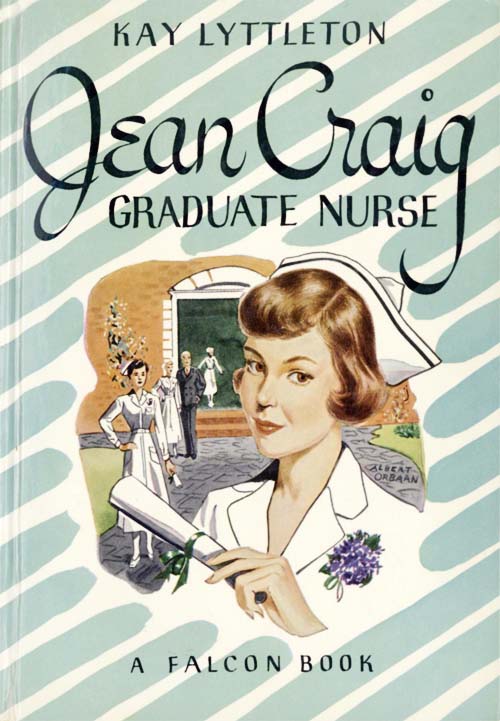
 BOOKS