MONGST the numberless articles of Japanese attire, works of art or mere
household objects which the Restoration of 1868 compelled the Japanese
to cast upon the market, none has met with such wide fame and yet with
such a limited study as the Sword. When, in 1877, the Government
prohibited the Samurai from wearing any longer the two swords which had
been the privilege and distinctive mark of their martial caste, the
Imperial wish was obeyed, notwithstanding the feeling that something was
snapping in the life of the nation. Blades had been treasured for
centuries, handed from father to son, looked upon as the soul of the
owner for the sake of which he would refrain from any deed unbecoming a
gentleman; some possessed histories going far back into the eleventh and
twelfth centuries, when the country was at war within itself, around
others were entwined romances, and above all, the sword was the faithful
friend with which the Samurai might honourably end his life, either in
the field or on the mats. A blade given by a father to his daughter on
her wedding day was the emblem of that purity of life which the woman
was expected to keep, and it was also the weapon with which she might
seek repose in death, should occasion arise. The Restoration breaking up
the old feudal system compelled the Samurai to part with their worldly
goods to secure the necessities of life, the rich became poor, the poor
lost all support, hence anything which might tempt the foreign buyer
went swiftly out of the country; the circumstances had become rather
more straitened for the Samurai class when the edict of 1877 compelled
them to put aside their swords, and blades followed the lacquer, the
paintings, the carvings which eager curio buyers snapped at inadequate
prices. Many swords of first quality crossed the waters, besides
thousands of poor blades which could be bought in dozens in the stores
and bazaars of the old world. Hardly any attempt was made at keeping in
the country any blades except those which were, so to speak, entailed
heirlooms or those whose owners refused to part with at any price.
Later, a few earnest people banded themselves into a Society for the
preservation and study of the National weapon: the Sword Society of
Tokyo, which has published, during the last twelve years, a mass of
information about swords. Collecting swords has become a national
propensity, and the modern sword lover may have more blades, carefully
kept and oft admired, than his ancestor of a century ago who could only
wear two at a time. Magazines have sprung into existence dealing only
with the sword and its accessories. Both in Europe and in America
articles on the sword have been published, most of which, based upon the
paper of Hutterott and nearly all inadequate. It is to be hoped that
some more comprehensive work will soon appear to give the Western public
a better knowledge of the ancient swords. In Japan, there are hundreds
of books dealing with their makers, from ancient books now rare and
costly to modern works crammed with information and obtainable for a few
pence. What then is there about the Japanese blade which compels
admiration? Far back in the Sung Dynasty a Chinese Poet sang its
praises, later the Mediæval European writers spoke in wonderment of the
Katana, of its keenness of edge, of its swift stroke, of the respect
paid to it; later still, folks were awed by the form of suicide we call
seppuku, some saw in it only a barbarous disembowelment, few, perhaps,
grasped that other important feature—the test of the truest
friendship—that confidence in the bosom friend one entrusted with the
cutting of one's head. Romance alone would not have made the blade an
object of interest to the positive mind, attracted by the efficiency of
the weapon, by its qualities qua sword, by the marvellous skill
evinced in its forging, in the shaping of its harmonious curves.
Further, the blade presented a characteristic temper; unlike the
European swords evenly tempered throughout, it had a mere edge of great
hardness backed by enough softer metal to ensure toughness, and to allow
bending in preference to snapping when the sword blow met an unexpected
resistance. Then it was realised that all those characteristic
peculiarities required study, for they presented variations of
appearance intimately associated with the various swordsmiths, with the
periods, the schools. How numerous those smiths were may be guessed, but
it may come as a surprise to some, that over 11,000 names are recorded
in one book alone.
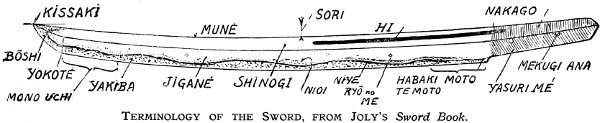
To study a blade and appreciate its points is a matter of considerable
interest, the various portions of the blade have their names and their
peculiarities; one must pay attention to every part of the body, of its
edge, of the handle, etc., and with practice an expert may become able
to recognise the technique and style of a smith by the peculiarities of
the blade, silent witnesses left in the metal itself. Thus, in Japan,
the Honami family of sword experts were professionally engaged for over
350 years in examining and certifying blades.
In feudal days a man's life was at his lord's call, and he might never
feel sure that the following day would not be his last, either in fight
or by self infliction under orders of the death penalty for some breach,
however slight, of the stiff code of Samurai etiquette. Hence his sword
was selected and cared for, its edge must be keen enough to cut a man's
head at a blow, leaving, if skilfully done, a shred of skin on the
throat for the head to hang on the breast.
His sword was tested, sometimes officially by cutting up corpses, and
thus we come across blades on the tang of which is inscribed a statement
that it cut one or two or even three bodies at a blow. No sword in
Europe ever came through such an ordeal; indeed, it is doubtful whether
its shape and constitution would have allowed a similar test to be
successful. Looked upon as a cutting weapon, the Japanese blade has been
pronounced perfect by all experts; that perfection is the result of
thorough work undertaken with only one aim in view: to turn out a sword
which was not only reliable, but a credit to the maker as well; and,
indeed, the names of the smiths are as well known as those of the
foremost painters, they rank with the expert calligraphers, with the
poets, with the writers and the statesmen, with those who made history,
Masamune, Muramasa, are names which have found their way even amongst
the novels of the West; not a dozen names of Japanese sculptors can be
mentioned, although their works are to be found in any and every temple,
but 11,000 names of swordsmiths remain.... Where the carver could repair
a faulty chisel stroke the smith has no such resource, a slight flaw in
welding his metal, a little dirt remaining between two layers of steel,
and where in a smithy can one exclude dirt? Overhaste in heating the
metal resulting in a wrong temper, or in spots on the blade, and, lo, a
fortnight's patient work was wasted, a patron offended, a reputation
marred.
No less important than the smith's skill was that of the polisher
grinding away the blade to its final shape, settling the planes and the
curves, whose intersections are geometrically true on every side of the
blade. A volume rather than a preface is required to do the scantiest
justice to the Japanese blade, but space is limited, and the blades
exhibited here speak for themselves.
H. L. J.