In a large enclosure behind one of the smaller Shiba
temples on a burning 1st of July sat a perspiring
crowd of men and boys, whose attitude of joyful and
critical attention strangely revived memories of a great
match at Lord’s or the Oval. Yet the trial of strength
which was provoking similar enthusiasm presented a
very different spectacle. Instead of the green pitch, a
sanded ring formed the arena; instead of twenty-two
lithe cricketers, clad in white flannels and protected by
glove and pad from dangerous balls, a band of twenty-two
wrestlers, enormous and bloated, with no clothing
but a garish loin-cloth and no protection but their own
skill, awaited the umpire’s word to begin. He, too,
bore little likeness to the straw-hatted oracle in a
milkman’s coat, whose vigilant silence is unbroken but
for occasional appeals from bowler or batsman. His
kimono was of grey silk, his sash embroidered with
gold, his short cape of black silk with brightly coloured
clasp; and, as he gave the signal with his fan, or
directed the combatants with excited insistence, hopping
and crying on the flanks of the panting giants, he
resembled some gorgeous gadfly goading two buffaloes
to the fray. Nothing could be less Japanese than the
build and bulk of the wrestlers. They seemed men of
another race, Maoris or Patagonians, with their huge
naked limbs and long hair, drawn forward in a queue to
the middle of the head or falling loose on the shoulders.
Before entering the ring each would carefully adjust
his apron and bind his hair as coquettishly as possible,
for, hideous though they appear to us, these monsters
of fat and muscle are the darlings of every schoolboy,
enjoying a popularity as fervent as that of “W. G.” or
Prince “Ranji.” Their names, their records, their
chances of success are on every tongue.
The bouts are more interesting to watch than any I
had seen elsewhere, for attack and defence were more
various. The conqueror might win by other methods
than by bringing his opponent to the ground: if he
could hurl or hustle him outside the ring, victory was
his. The rules are said to authorise forty-eight falls—twelve
throws, twelve lifts, twelve twists, and twelve
throws over the back. To avoid being pinned down
or pitched out, the smaller men must exercise extraordinary
agility, and loud was the shouting when
Goliath fell victim to a scientific ruse. It happened
sometimes that the men lost their tempers; spitting,
slapping, taunting would precede more legitimate sport:
then indeed it was good to hear the bystanders’
Homeric laughter, which soon recalled the heroes to
their higher selves. I will confess that these indecorous
interludes were partly due to a mischievous American,
who primed his favourites with praise and whisky.
As the afternoon wore on, the heat became intolerable,
but, fired with professional ambition, Dares succeeded
Entellus, while cheap coloured portraits of the competitors
found ready sale and the overcrowded enclosure
reeked of sweat and sand. At length the final bout
was announced. Each side chose a champion, whose
laurels were difficult to gain, for three rivals must be
worsted in continuous struggle by the prize-winner.
Before the end was reached my patience had been
exhausted. On a degenerate descendant of the fighting
Anglo-Saxon breed this barbarous exhibition of
brute locked with brute began to pall. Besides, the
tropical atmosphere, which from that day forward
made dress a weariness and sleep impossible, pleaded
more eloquently than any argument how wise it were
to seek less fiery pleasures. I resolved to leave Tōkyō
the following day and take the waters of some mountain-spa,
remote from wrestlers and mosquitoes.
At an altitude of nearly three thousand feet on the
north-eastern slope of Mount Haruna, an extinct volcano,
stands the picturesque village of Ikao. Half
the houses are hotels and most have balconies, which
command a view of the Tonegawa Valley and sublime
Akagi San. The main street climbs from terrace to
terrace, a natural staircase, between châlets equipped
with bamboo pipes, through which the hot yellow
water pours incessantly. Proximity to the capital
makes this health resort very popular, yet access is not
altogether easy. After five hours’ train to Mayebashi,
another five hours are required of rather rough rickshaw
travelling: at one point the Tonegawa must be crossed
by means of a rope ferry; at others the traveller must
dismount, so steep is the road. Yet he will be well
rewarded at his journey’s end by a panorama of rare
extent and beauty. Behind him, and eighteen hundred
feet above, soars Soma-yama, from which the summit
of Fuji is just visible; opposite stretch the Mikuni and
Nikkō ranges; at his feet are wooded valleys and
foaming torrents. The Kindayu Hotel, under most
courteous and capable management, combines two
great advantages. It supplies the foreigner with such
food and general comfort as his habits generally render
indispensable; at the same time, it accommodates so
many Japanese of all classes, that exceptional opportunities
are afforded of becoming more intimately
acquainted with the latter than would be possible in
their own homes, where various duties and claims
absorb their time. Here they seek only health and
pleasure: no obstacle but the easily surmounted barrier
of language hinders mutually delightful intercourse.
At least, the writer formed more friendships and
obtained more glimpses of native life during a month
at Ikao than at any other period of his stay in the
country.
Bathing is, of course, the centre round which
existence revolves. Half-a-dozen small baths, fitted
with hot and cold water, that the temperature may be
modified to suit each bather, enable the stranger to
bathe in the solitude he prefers. But more than two
dozen others, in which from three to thirteen people
can bathe together, are more characteristic of the
place. The largest has a hot douche, and the temperature
is often as high as 115° Fahrenheit. Here
the native guests return two or three times a day to
soak and to gossip. In this al fresco salon laughter
reigns and conversation flows as freely as the water.
Surprised indeed would the bathers be to learn that
a costume is deemed essential by more prurient races,
whose artificial manners divorce simplicity from
decency. Yet Western prudery is beginning to corrupt
the upper classes, who tend to convert these
social gatherings into family parties, without going so
far as to adopt a bathing-dress. The water is rather
turbid and yellow. It contains iron and sulphate of
soda. Most of the patients suffer from rheumatism or
barrenness, and look on a course of treatment as a
sovereign remedy. Some also drink of the mineral
spring which lies at the end of the Yusawa ravine,
where seats and swings line a well-shaded avenue.
Probably they derive more benefit from the pleasant
promenade than the unpleasant beverage.
The first friend I made was a silk merchant and a
poet. I shall call him Yamada San. I had gone one
day a few hundred yards down the precipitous path
leading to Shibukawa, when my attention was arrested
by a very pretty tableau. To the left of the road lay
a lute-shaped pond, traversed by little bridges and
dotted with islands on which stone lanterns and
wooden shrines proclaimed the owner’s piety. The
deeper end of the lakelet was overshadowed by a
balcony, on which sat two serious young men with rod
and line, while a daintily-dressed girl reclining beside
them was preparing bait—that is, crumbling a soft
bread-cake with delicate fingers. The fish seemed
wary, and I remarked one astute leviathan among
gold-fish that succeeded in snatching the bait and
swimming away with an impudent cock of the tail that
would have exasperated a less patient angler. Remarking
my interest, the fishermen politely invited
me to join them; and then I discovered two curious
features of this gentle angling—its cheapness and its
humanity. The proprietor was willing to provide all
accessories and implements for three-farthings, on one
condition: any fish which had the imprudence to be
hooked must be tenderly replaced in the water. Thus
he reconciled Buddhistic kindness to animals with
encouragement of sport, and the fish obtained a maximum
of food with a minimum of risk. It seemed that
Yamada San was also staying at Kindayu’s. We
therefore returned together, while O Mitsu, his charming
child-wife, walked submissively behind. Woven
silk filled his business hours, but woven sentiments
his leisure. Before the hotel was reached he confided
to me the poem which had just germinated in his
mind that afternoon. He had really been fishing for
fancies.
“Yioyeyama
Kasanaru kumono
Ōkunaron
Honokani moreru
Saoshika no koye.”
Range above range, piled up to the clouds, what numberless mountains!
Faintly between escapes from afar the voice of the roebuck.
As he understood a little English, I conferred on him
this brace of hexameters. He was naturally astonished
by such long lines, but, as his Tanka contained thirty-one
syllables and my translation only thirty, we had
both expressed the same ideas in about the same
space. Exchange of verses was followed by exchange
of presents. In the evening I received a large cake
with Yamada San’s compliments. Then came my
first unconscious lapse from etiquette. In the hope
of pleasing both husband and wife, I presented
O Mitsu with a quaintly carven kanzashi, an ornamental
hair-pin; but, though she did not seem displeased,
the poet thanked me with a cold, disapproving
air. At a later stage he explained how improper it
was considered to pay the least attention to a married
woman. I apologised, and he went on to explain that
love-marriages were becoming the rule and not the
exception, and that among his friends few matches
were now arranged without consulting the wishes of
the two most concerned. However, O Mitsu was
permitted to play to me on her koto, and to condone
my indiscretion with the parting gift of a much-cherished
fan, on which was inscribed a famous poem
by Tsuma to the following effect:
Though I may sing of the beautiful garments of beautiful women,
Dearer to me are the pines of Japan and the cherries in blossom.
By this engaging couple I was initiated into a novel
game, played with flower cards, Hana-Karuta. The
pack consists of forty-eight pieces, each three inches
by two, and of twelve suits, Moon, Rain, Iris, Clover,
Cherry-blossom, Maple-leaf, Wistaria, Chrysanthemum,
Pine, Peony, Plum, and Paulownia Imperialis. The
four cards of each suit are worth 1, 5, 10, and 20
points respectively. The player may only draw a
card from the pool if he have one of the same suit in
his hand. Failing this, he must enrich the pool by
one of his cards when his turn comes to draw. Each
pair, when made, is laid on the table, and when the
pack is exhausted the player who has scored most
points is declared winner. This very simple game
had much vogue in Ikao, but when the party included
no ladies the more difficult Go-Ban was more
popular. Like all his countrymen, Yamada San was
a rapid draughtsman, and would often, when appealed
to for information on historical or religious matters,
illustrate his meaning by clever sketches. Of these I
retain two excellent specimens: a drawing of Yoshitsune
in elaborate armour and a long-nosed tengu, or
mountain-goblin, which has many characteristics in
common with the Scandinavian trold. Unfortunately,
our acquaintance was limited to three days, for at the
end of that time business recalled the poet to Ashikaga,
but he exacted a promise that I would pay a
visit to that interesting town, given up to cotton and
Confucius.
As if to console me on the evening of this departure,
the kindly Kindayu family invited all their guests
to a performance given by three local geisha in the
principal room of the hotel. The chief musician was
a masculine-looking woman of fifty, who thrummed a
kokyu, or three-stringed fiddle, and broke in on the
recitative of her young companions at unexpected
moments with peculiar growls and sharp cries as
of an animal in agony. When the narrative of the
soloist took a tragic turn, these inhuman noises were
so distressing that, without following the story, I
experienced acute pain, while my neighbours of the
more sympathetic sex were actually in tears. Had
my musical education been more advanced, I should
have realised that these were no singers of light
Dodoitsu, but exponents of a far loftier type of entertainment,
the Gedayu or musical drama. It originated
in the middle of the seventeenth century, and is
sometimes called Jōruri after a heroine of that name,
whose tragic love for Yoshitsune is a favourite theme
of composers. In fact, the geisha on this occasion
were usurping the rôle of Jōruri-katari or dramatic
reciters, whose chanted recitative formed the nucleus,
first, of the marionette theatre, and, later, of the
popular theatre, when dialogue and scenic art were
superadded. In the absence of either human or
wooden dolls, a most lugubrious effect was produced.
At last, to my relief, a male performer, a pince-sans-rire,
whose dry humour and staccato diction stamped
him of the tribe of Grossmith, transformed the
audience from weeping Niobes to effigies of mirth.
In vain the polite little ladies tried to smother their
smiles behind their raised kimono sleeves: as the
song proceeded they were vanquished by fits of
laughter, and shook helplessly on their cushions. I
possessed but one cue to this infectious merriment
in the constantly recurring word emma, which on the
lips of Mr. Dan Leno would have assuredly referred
to his wife or his mother-in-law, those patient butts of
music-hall humour, but which would only mean for
Japanese ears the Buddhist Rhadamanthus, who pronounces
sentence on all who enter hell. Considerably
mystified, I turned to Tanaka Okusama, another
visitor from Ashikaga, and inquired if “the honourable
singer were really singing about hell-things.” He
was. The song was an amusing but irreverent pastiche
of social satire. It described the arrival in
Hades of the bad judge, the cheating merchant, the
false singing-girl; their confession and appropriate
punishment. Again I missed the marionettes, for
their presence would have recalled an exactly similar
treatment of the same theme in a Montmartre puppet-show.
And I remembered how the Parisian populace
joined delightedly in the cry of “A la chaudière!” as
the mimic devil chased lawyer and cocotte into a
Punch-and-Judy Inferno. It was the mystery play of
the Middle Ages, surviving as a crude comedy for the
ignorant poor—a rough travesty of the theology in
which their more instructed superiors still affect to
believe.
In the course of the next fortnight I became well
acquainted with Tanaka Okusama, and through her
with many others. She was a most intelligent,
capable woman, who conducted one business while
her husband had charge of another, grain and rice
being the commodities in which they dealt. She
considered herself middle-aged at the age of thirty-two,
wore therefore most sombre colours, and was
the mother of six boys, two of whom joined her at
Ikao. Her explanation of the emma song was followed
by an avowal of religious disbelief. She was
neither a Buddhist nor a Shintōist, but believed that
the priests taught old wives’ fables, and for her own
part concentrated her mind on her business and her
family. A free-thinking Japanese woman was a novel
phenomenon to me then, though I have since met
several. The fragments of Western history which
she had acquired were also interesting items in her
conversation. Plied with questions about English
sights and customs, I was also asked to give an
opinion on Cæsar, Napoleon, and Epaminondas.
What I recalled of the last hero was so shadowy that
I felt inclined to parody the Oxford undergraduate’s
evasive reply: “About Epaminondas little is known,
but it may safely be assumed that, as he lived, so
he died.” However, Tanaka Okusama knew more
than that about him, for she had just been reading
“Keikoku Bidan,” a popular novel by Yano Fumiō,
who is supposed to have selected Theban politics for
his subject, that he might administer useful lessons to
his compatriots. I suspected that novel-reading was
the source of most of the lady’s knowledge. Indeed,
she disclaimed all pretension to the title of blue-stocking.
Continual tea-parties in my room or hers, though
very educational, were marred for one of us by two
circumstances—the familiarity of servants and the
uncertainty of time. Democratic in sympathy, preferring
the expansiveness of the simple to the discreet
inanity of the genteel, I was yet a little surprised
to remark the ultra-friendly relations between servant
and guest. A “boy” would enter with profound
obeisance, deliver a message or an article demanded,
and, being invited to join the party, would play cards,
ask and be asked very personal questions, make himself
thoroughly at home, and depart when duty called,
bowing low. At first it is difficult not to associate
these prostrations with subservience, but they really
imply nothing but good manners. When the guest
left the hotel, he would hand the “boy” a tip,
wrapped in paper, as etiquette requires, for that delicacy
which impels us to concede intimacy and refuse
money, or to refuse intimacy and concede money to
social inferiors, because the conjunction of the two
offends our sense of the deference due to class-distinctions,
would appear strange to the far more rigidly
classified Japanese. In fact, more real democracy—if
by that be meant frank and unembarrassed intercourse
between high and low—is possible under a caste
system than any other. Every one “knows his place,”
and has no inducement to affect a higher rank than he
really possesses by an assumption of haughty manners.
The innate courtesy of most Japanese servants renders
friendship with them more delightful than might be
supposed, but occasionally one comes across a conceited,
half-educated fellow in European dress, who
passes from familiarity to impertinence. However, I
was soon taught a more difficult lesson than that of
forgetting class prejudice. Perhaps the hardest of all
truths engrained in Oriental theory and conduct is the
unimportance of time. We, who live by machinery
which measures for most men the hours of work, the
hours of play, until life becomes a time-table and the
heart a chronometer, are absolutely incapable of indifference
to Time’s tyranny. When I proffered or
accepted an invitation, nothing amused these hospitable
lotus-eaters so much as my natural bias towards
punctuality. What did it matter? The morning, if I
liked, or the afternoon, or the evening: time was made
for man, not man for time. Accordingly, if I paid a
promised call and became the involuntary witness of a
toilette, a meal, or a siesta, I had merely to withdraw
and call again. If my guests did not arrive at the prescribed
hour, they would come some hours later, or
even sooner, or not at all. At first I was so put out
by these vagaries and so fearful of intruding, that it
took message after message to draw me from my own
society or that of a book. But gradually I realised
that in this happy country offence was not readily
given or taken; that time was a negligible convention;
that to follow the impulse of the moment was
wiser than to ape the precision of a clock. I have
heard the British trader exclaim in Japan, “They can
never become a great nation; they are so unbusinesslike!”
and I sympathised with his horror of Eastern
nonchalance, but I doubt his conclusion. Merchants
in Russia are just as dilatory. Yet either country can
count on promptitude in military or political exigency.
What commerce loses in time it gains to some extent
through restrictions imposed on foreign rivalry. In
any case, as they emerge from feudal to industrial conditions
those indolent races will be forced by the law
of self-defence to quicken the pace. As for me, I
resolved to ignore my watch and rely on Zaburo
Tanaka.
Zaburo was a bright-eyed schoolboy of ten. Close-shaven
and bare-footed, he raced from wing to wing
of the hotel in a single cotton garment with cheerful
impetuosity. At breakfast I would hear him on a
balcony fifty yards away reading aloud in that monotonous
sing-song which his countrymen adopt, even in
trains, without evoking a protest from fellow-travellers.
At first I imagined him to be reciting prayers, but this
supposition was erroneous. Two or three times a day
his knock would rattle on my sliding-door and a loud
summons would entreat Edoardo San to keep him
company. When his mother was occupied with private
cares, he would obtain leave to visit with me the
Benten-daki, and as we watched the tumbling terror
of that lovely waterfall, sparkling against green boughs,
I was the recipient of many schoolboy confidences.
His great ambition was to fight for the Mikado; his
accounts of school life were tinged with military
ardour. The elder boys had guns and knapsacks of
fur; in the summer boys and masters camped out
together; his intimate friend, Rokutaro, had lost an
elder brother in the war with China, and the others
were quite envious of that funereal privilege. He
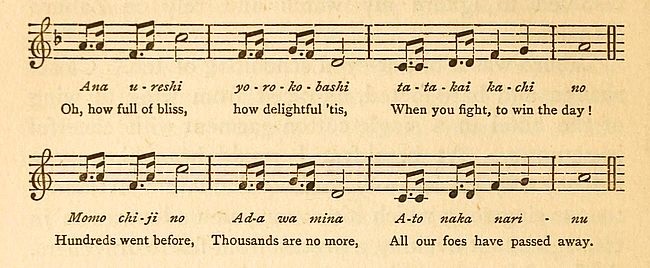
remembered one verse of a song which his school-fellows
were fond of singing, as they marched to the
drill-ground. The air was spirited, but the words
were more naïf than ingenious, if the following stanza
be typical of the rest:
| Ana u-reshi | yo-ro-ko-bashi | ta-ta-kai ka-chi no |
| Oh, how full of bliss, | how delightful ’tis, | When you fight, to win the day! |
| |
| Momo chi-ji no | Ad-a wa mina | A-to naka nari nu |
| Hundreds went before, | Thousands are no more, | All our foes have passed away. |
Though precociously intelligent, Zaburo was not too
old to play with toys, and the gift of a pop-gun
cemented our too brief alliance.
In the middle of July falls the Buddhist festival of
Bon, better known as the Feast of Lanterns, when
the souls of the dead revisit the living. The decay
of religion has unfortunately robbed this touching
celebration of its more striking features. Formerly
on the eve of the fête the graves were hung with
lanterns, that the spirits might be lighted on the way
to their old homes. On the day itself the villagers
fasted, but left before the household shrine flowers and
water and a little food, while they went out towards
evening and danced in a large circle, singing quaint
songs and clapping their hands to the strains of drum
and flute. Then, when the time was come for the
spirits to return, on river and stream were launched a
fleet of tiny boats of straw, each with its paper lantern,
in which the invisible visitors were wafted back to
shadow-land. These things are done no more, or
only in remote rural districts. Danger to shipping
caused the floating of little fire-ships to be prohibited
in the ports, while at Tōkyō the ceremony of “opening
the river” covers the Sumidagawa with gay pleasure-boats,
and in the secular crackle of fireworks the
sacred associations of the day are forgotten. In the
villages the peasants have not abandoned the dance,
which town-folk delegate to geisha, but its date varies
from district to district, and I did not witness one
until a month later at Akakura. Yet Ikao has contrived
to preserve the more pious aspect of All Souls’
Day by two simple services of devotion in graveyard
and temple.
By the merest accident I caught sight of a group
of women passing through a dark grove of cryptomeria,
whose lofty aisles are sown with innumerable
tombs. I had often been there, allured by the tranquil
images of Buddha, whose face and posture seemed
eloquent of everlasting repose. To-day their silent
watch was broken by the passage of many rustling
skirts and gentle laughter, for even in such places the
childish musumé does not deem it sinful to smile. I
struck across the wood and recognised the sister of my
landlord, Kindayu San, accompanied by three or four
serving-women. One carried a kettle of boiling water,
another some sticks of incense, and a third some
flowers. Permission being accorded to join them, I
went along with them to more than thirty graves.
On each a little water was poured, a little incense
burned, and the prayer, “Namu Amida Butsu,”
uttered. The humblest of the dead was equally
honoured with the nearest kinsman, and, after relations
by marriage or adoption had been visited, the
last to receive salutation was a banto, or temporary
bookkeeper, who had died four years before after
eight years’ service. “Will not the honourable
stranger also make a prayer?” was asked, and I
complied, repeating “Namu Amida Butsu,” “I adore
thee, O Eternal Buddha,” in the hope that their god
would understand that his claim to adoration by barbarian
lips lay in the kind memorial offices which his
faith inspired. Many of the graves lay so far apart
that we had crossed two valleys and found ourselves
some miles from home at the luncheon-hour of noon.
So we entered the nearest tea-house and were served
with tea and sweet cakes. As the proprietor had a
small stock of sacred images for sale, I bought for a
souvenir of the day two clay foxes with tails gilded at
the tip, the snarling door-keepers of the rice-goddess;
but Inari must have rejected in anger my mock
homage, for three weeks later in a carefully packed
yanagori I grieved to find chaotic “fragments of no
more a” fox.
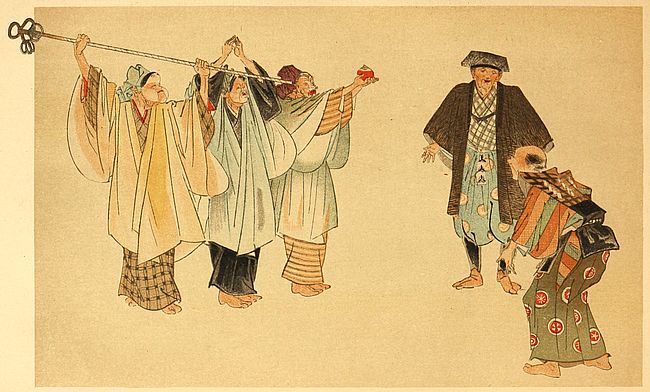
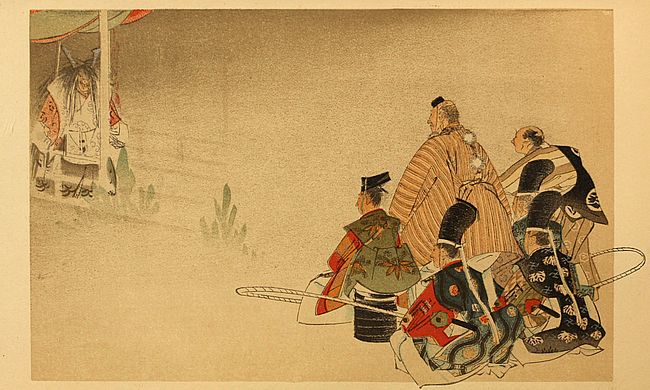
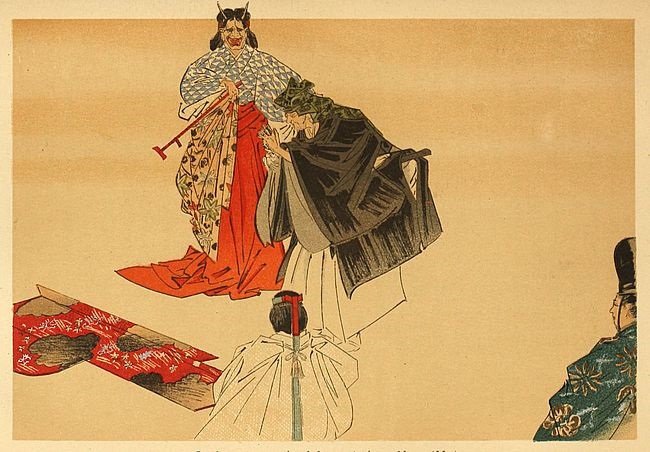
Personators of Jizō (Kiōgen).
That afternoon I remarked an unusual stir and
clatter of small feet below my balcony. Crowds of
children, on foot or slung behind the patient backs of
mother or elder sister, were making their way to the
large school-house, which stood a few yards beyond
and below the southern entrance of the hotel. It
being holiday time, I had never seen any of the
scholars, and the sole occupant of the spacious play-ground
was a weather-beaten stone effigy of Jizō in a
red cotton night-cap and yellow bib. This wet saint
(nure-botoke), as the Japanese laughingly call such
unhoused divinities, had always excited my sympathy,
for there he stood without his five companions’ society,
exposed to rain and wind, disregarded even by the
very infants whose patron saint he is considered to
be. At any rate, I could see no pious heap of pebbles
laid on his knees, though the neglectful little ones
would be glad enough, on reaching the dry bed of the
River of Souls, to seek refuge in his large kimono
sleeves, when mischievous demons should demolish
the pebble-heaps which it would be their duty to pile
up there as the penalty of childish faults. But
perhaps they were too busy playing to remember him
during the holidays, or perhaps they had unbelieving
teachers who connived at their neglect. I indulged
a faint hope that public expiation was to be made, and
that the toddling crowd would lay some tribute on his
faithful lap. But its destination was a temple situated
below the school-house, and as it swept merrily
by grotesque, deserted Jizō I fancied that the stone
features grew more rigid and grey beneath the cotton
night-cap, his consolatory proof of at least one worshipper.
Having set a few stones on his pedestal, I followed
the rest to a small temple, which was surrounded
by women and children. On a raised platform, which
formed the temple-floor, about a dozen priests, resplendently
robed, were moving in rotatory procession
and chanting passages of the Buddhist canon. The
babies were gazing open-eyed on the bright embroideries
of instruments and vestments, while as
many people as could be accommodated were allowed
to occupy mats at one extremity of the platform.
Among them a place was obligingly made for me,
and soon after I had taken my seat the priests also
sat down to listen to a discourse from a young and
eloquent preacher. I had been in many temples, and
watched the crowds making prostration, buying holy
knick-knacks, and flinging copper coins into the broad-barred
money-boxes, but this was the first sermon
I had the good fortune to hear. Continually reverting
to the theme, “Mina sekai no hito kiodai”—all beings
in the universe are brothers—the orator spoke long and
earnestly of the unseen ties which bind the living and
the dead, of the infinite chords and scales of existence,
of the love and goodwill which no creature was too
humble to show or too lofty to accept. Sometimes
an old man groaned, and sometimes an urchin was
removed screaming, but most of the listeners remained
passive and stolid till the end. Then babies were
hoisted, farewell bows were exchanged, and the congregation
melted away. If you ask me why so many
children were present, I can only suppose that they
were attracted by the excitement of novelty. There
was none of the bustle and glare which make a matsuri,
the ordinary temple fête, one glorious saturnalia of
piety and merriment, when theatres and booths, covered
with wonderful paper toys and every known variety
of sweetmeat, block the approaches to the sacred
building. In this the Buddhists greatly outshine their
more austere Shintōist rivals. Probably nine-tenths
of the peasants are in agreement with an old man
with whom I conversed after an impressive service
at Hommonji, the chief temple of the Nichiren sect.
As we descended the temple-steps I asked him
why he preferred Buddhism to other forms of faith.
“Because,” he answered, “it is more amusing.”
I was awakened the next morning by a peculiar
rocking sensation, as if my bed were a cradle swung
to and fro by invisible hands. Then I saw the
obbasan, an old woman who waited on the European
guests, rush, frightened and half-dressed, along the
verandah. It dawned on me that this must be a long-hoped-for
earthquake, and as the vibrations ceased
after some seconds, which naturally seemed of unusual
length, I was slightly disappointed. Residents say
that the fear of earthquake, unlike the fear of other
dangers, is increased rather than lessened by experience.
Certainly the Japanese themselves, in spite of
their fatalism, realise to the full the terrible penalty
of inhabiting a land of volcanoes. That day little else
was talked of. Two little girls, who had been adopted
by Kindayu San after losing their parents in the great
shock, followed by a tidal wave, some years before,
became objects of particular attention. Now, Ikao is
perched on the flank of a volcano, and the site of an
extinct crater is occupied by the beautiful Haruna
Lake, which I had not yet visited, so gladly I accepted
the proposal of Nitobe San to walk there. I had made
his acquaintance a few days previously on the archery-ground,
adjoining the hotel, where he displayed remarkable
skill in handling the unwieldy bow which is
still a popular and effective weapon in the hands of
Japanese archers. Indeed, he was only surpassed by
a samurai of about fifty, who hit the bull’s-eye four
times out of five. Yet his appearance was far more
studious than athletic, for Nitobe San attended the
medical school at the University of Tōkyō, and
when he pored over German text-books through gold-rimmed
spectacles had already the reassuring gravity
of a family doctor.
Our way lay first along the Yusawa ravine, but,
instead of continuing to the source of the mineral
spring, we ascended a steep and tortuous path to the
right, which at every turn disclosed new aspects of
the woods and valleys beneath. Often we would stop
to gather tiger-lilies or yellow roses, that shone like
golden stars in a sky of emerald foliage, for, except
where the carefully kept track wound in and out, the
mountain side was swathed in evergreen. Issuing at
length from the trees, we reached a grassy plateau, on
which is the grazing ground of the milch-cows that
supply Ikao. To the left is a curious conical hill,
known as the Haruna Fuji; and other masses of
irregular rock are partially covered with lichen, so as
to produce the effect of ruined castles half hidden by
clambering ivy. Indeed, my first impression was that
these were relics of feudal fortresses, until closer
inspection revealed the freakish cleverness of Nature.
Two miles of level walking brought us to the lake,
which is simply a large tarn surrounded by small
bosom-shaped hillocks at such regular intervals as to
repeat the irresistible suggestion of human ingenuity.
It might have been a giant’s silver shield embossed
upon the border with knobs of jade.
Gladly we rested at the tea-house on the margin, for
hot sun and loud cicada had been fatiguing eye and
ear. After lunch I took a bathe from the only boat to
be obtained, though its crazy, water-logged condition
left much to be desired. However, the boatman did
his best to remedy the deficiencies of his craft, and, as
I undressed, hung each garment in succession round
his neck, to prevent their being soiled and immersed,
as they otherwise certainly would have been. Much
refreshed, I persuaded my companion to extend our
walk to the ancient Shintō temple of Haruna, not
more than a mile and a half away. We climbed to the
top of Tenjin-toge, at which pass the road becomes
too narrow and precipitous for rickshaws, as it plunges
suddenly into a curiously imagined glen. Never had
I seen such bizarre configuration, such eccentric juxtaposition
of tree and stone. Pines darted like dragons
from the cliff; rocks started like mammoths from a
thicket, or lowered savagely across the torrent, which
raced or trickled below. It seemed as though the
spirits of water and wood and fire had suddenly
been petrified at the supreme moment of a great
triangular battle, and waited, weapon in hand, to spring
once more each at his adversary’s throat. Evidently
the old temple, dedicated to Ho-musubi, the god of
fire, and Haniyasu-hime, the goddess of earth, was
the citadel, defended and attacked by these weird
combatants. Towering cryptomeria stood on guard
around it, and huge rocks, tip-toe on tenuous bases,
attended the word of command to crush the curving
rafters. It needed but one signal from the imprisoned
fire-god, one movement of the volcanic earth-goddess,
to fill that fantastic glen with the clamour and débris
of primæval war. Elsewhere we might have admired
the carven serpents, that writhed so realistically about
the side-beams of the porch. At Nikkō or the Nishi
Hongwanji temple in Kyōto they might have impressed
us as masterpieces of creative carpentry, but
at Haruna the comparison was too trying. It was
hopeless to compete with God’s more monstrous
curios.
Here at last was a Shintō stronghold which did not
seem abandoned and desolate, but bore traces of frequent
worshippers. Above the sacred cisterns waved
blue towels, suspended after purification; at the feet of
a Shintōised Jizō rose a mound of propitiatory stones;
on the kagura-dō, or dancing platform, an old woman,
the priest’s wife, began her symbolic dance. As she
slowly revolved, shaking her bunch of bells or waving
her fan, she chanted words so venerable that all clue
to their meaning had been lost. Yet, in her faded
garb and shrunken person she personified more fitly
the solemn contortions of a dying faith than the smart
young priestesses of Nara in their red silk trousers and
snowy mantles of flowered gauze. When those tripped
forward, with thickly-powdered faces and chaplets of
artificial wistaria, their garish aspect transformed the
temple to a tea-house, but in this sombre fastness at
the heart of Haruna we seemed to behold a very sibyl
of aboriginal Japan. The assistant priest was affable
but ignorant. A copy of the “Kojiki,” earliest of known
records of the Way of the Gods, was kept there, he
affirmed, but he had never opened it and might not
show it to strangers. In winter it was terribly cold,
and snow-storms would sometimes cut them off from
all communication with the outer world. When floods
made the torrent impassable the senior kannushi’s
children were obliged to do their lessons at home.
But summer brought troops of pilgrims to the valley,
and their offerings sufficed to keep the little band of
guardians at their posts. “Are you never afraid,” I
asked, “of the earth opening and the rocks falling?
Only this morning we felt a slight shock of earthquake
at Ikao.” The young priest smiled gravely. “No,”
he answered. “For more than five hundred years the
kami have protected their holy place. Why should
we be afraid?”
We made a small donation, and received in exchange
a printed promise of Ho-musubi’s and Haniyasu-hime’s
blessing, to which our names were appended.
Then, turning our backs on that grim sanctuary, we
climbed slowly back to the Tenjin Pass. As we retraversed
the plateau of Little Fuji, Nitobe San
described the student’s life at Tōkyō. Between 1890
and 1898 their numbers had increased from thirteen to
nearly nineteen hundred, so that a second university
was shortly to be inaugurated at Kyōto. But of
course the Red Gate (as the Tōkyō University is
familiarly called) would remain the classic portal of
modern learning. The college of medicine, in which
his own studies were pursued, is entirely under German
influence: none but German and Japanese professors
give instruction. In the other faculties of law, engineering,
literature, science, and agriculture, English
teachers predominate. Most of the students work
desperately hard, but enjoy great liberty. The majority
are poor, and some have very rough manners. The
Emperor was informed on one occasion by his Chief
of Police, who had been summoned to receive orders
to repress anti-foreign demonstrations, that “the
offenders were invariably either rickshaw-men or
students.” Their life is far more gregarious than that
of Oxford or Heidelberg or the Sorbonne. In the
small block of residential buildings within the university
grounds six or eight young men read, eat, and sleep in
one room. These are a privileged minority of scholarship-winners,
and are subjected to rather irksome
restrictions in the matter of visitors and late hours.
But the larger number live in lodging-houses, where
practically no more control is exercised than over any
other class of citizens. Competition is so severe that
posts cannot be found for any but a small fraction of
the budding doctors, lawyers, and journalists who hope
to make a living in those professions. In consequence
the disappointed graduates turn sōshi and live
by their wits as spies, agitators, actors, authors, or
even as itinerant musicians. Naturally, extreme views
are adopted and discussed with the fervour of youth.
The wildest socialism, the narrowest nationalism, find
apostles. Though full of enthusiasm for most Western
innovations, Nitobe San was strongly opposed to the
substitution of Roman characters for Chinese ideographs.
In vain I pointed out to him how the latter
blocked the pupil’s advance and impeded international
intercourse. He feared that such a step would not
only tend to destroy communion with the past, but
would also diminish the probability of that alliance
between China and Japan which was cherished as the
only means of checking Russian aggression. I formed
the conclusion from this and other conversations that
the salient qualities of a Japanese student are independence
and passionate curiosity. It did not surprise
me to learn afterwards from an English professor that
his classes had summaries of his lectures printed at
their own expense to facilitate the acquisition of new
ideas in a foreign tongue.
While we had been talking of his vices and his
virtues, the gregarious student had invaded Kindayu’s.
On returning to the hotel we encountered a band of
eight or nine stalwart young men wearing blue cotton
hakama (trousers so ample as to resemble a divided
skirt) and armed with small hammers. They had
come to geologise, disappeared on long expeditions
during the day, and only returned at a late hour. As
they shared a room and were by no means uproarious
at night, the other guests were scarcely conscious of
their presence. I think, however, that two pretty
schoolmistresses, the wives of officers in the army,
who had carefully abstained from making the acquaintance
of any other visitors, welcomed the arrival of
these ardent scientists. Their rooms adjoined, and
sitting on the threshold, that no beholder might misinterpret
their platonic comradeship, they indulged in
intellectual flirtation—a joy too subtle for the understanding
of their unsophisticated sisters.
Ikao was in truth a microcosm of Japanese society.
Representatives of nearly every class came and bathed
and went their way refreshed in spirit, if not cured in
body, by the restful babbling water. One day an
ex-daimyō, who had held high office in a recent Cabinet,
arrived with a small retinue of relations and dependants.
Quiet and dignified, he was only to be distinguished
by a greater sobriety of manner from less
aristocratic neighbours. Occasionally odd instances
of polygamous experiment attracted general remark.
A Tōkyō merchant came accompanied by an elderly
wife, a blind baby, and two mistresses who had formerly
been geisha. The three women were on excellent
terms, and disputed only the privilege of spoiling
the thrice-mothered child. Every evening for them
was a “musical evening,” as the man had a good
voice and the geisha were expert samisen players.
Nitobe San described the ménage as “a little barbarous.”
But, whether his opinion was shared by
many or few, it made no difference in the reception of
the new-comers, who were treated with the same frank
courtesy as less numerously married folk. Indeed,
frankness and propriety were marked characteristics of
this hydropathic paradise. If the bathers imitated
Adam and Eve in simplicity of tenue, their behaviour,
too, like that of our first parents before the Fall, was
faultless. Conversation was entirely unembarrassed
and perfectly decorous. The very publicity of this
hotel life was a guarantee of morality. And, in fact,
one could see that beneath extreme freedom of intercourse
careful etiquette was observed. Neither young
girl nor married woman ever went out alone: the tea-party
never became a tête-à-tête. The shōji of the
apartments were generally half open; the amusements
were such as to assemble and introduce the visitors to
one another. Dancing and flirting, as practised in
English watering-place or French casino, were unknown.
If the men desired other female society than
that of their own class, they could seek the geisha-ya
or jōro-ya. If many of the diversions were childish,
those of Brighton or Trouville cannot rank as intellectual
exercises. It was a lazy, healthy, happy sort of
paradise, and I did not live in it long enough to
discover the serpent.
On the seventh day of the seventh moon I bade farewell
to Ikao, and, loaded with little presents, descended
slowly to Takasaki. Regret at leaving that delightful
haven was soon lost in conjecturing the solution of an
astronomic mystery. Village after village flaunted a
galaxy of paper stars, which flecked the green background
of interminable trees with dancing flakes of
red, white, and blue. At every door stood a bamboo-stem
crowned with a cluster of five-rayed stars, each
ray being made of paper of a different colour. From
this astral chaplet long streamers floated in the breeze,
like the gohei, or cut paper inscribed with prayers,
before a Shintō shrine. At Takasaki station I met
Nitobe San’s sister-in-law, O Sen San, who was returning
to her husband’s house at Tōkyō, while the
student himself had gone to the more efficacious hot
springs of Kusatsu. Being fellow-travellers as far as
Akabane Junction, I begged her to reveal en route the
meaning of those starry signals which continued to
flutter gaily in every district we passed, as though our
train were freighted with royal passengers. Then I
learned that all pious folk were celebrating that day
the festival of Tanabata. The white streamers corresponded
in number with the children in each household,
and on every one was written a poem desiring
happiness, especially good fortune in love, for the child
whose name was appended. More than this she did
not know, but a handsome young priest, who had
remarked my zeal for knowledge, kindly volunteered
the following legend:
The Herdsman and the Weaver.
“Long ago, as Chinese sages tell us, there dwelt in
Heaven a herdsman and a weaver on opposite sides of
the celestial river. All day the herdsman tended his
cattle, and was far too busily occupied to think of
taking a wife. All day the weaver sat at her loom,
making clothes for the Emperor, and this labour took
up so much of her thoughts that she even neglected to
adorn her person. Then the Emperor, remarking her
diligence and pitying her loneliness, sent for the herdsman
and said: ‘Inasmuch as ye are both so devoted
to my service, I will that ye shall henceforth be
devoted to one another. I give thee this woman in
marriage.’ So the girl crossed the river, and no
married couple ever lived more happily together.
But after a time the Emperor perceived that the
marriage, though it might be a good thing for them,
was an evil thing for him, since the weaver began to
neglect her work, and his clothes, which had formerly
won the admiration of his courtiers, showed signs of
hasty and careless weaving. At this the Emperor
grew very angry, and sent for the weaver and said:
‘Inasmuch as this marriage has been a joyful thing
for thee and for thy husband, but a woeful thing for
the Emperor of Heaven, I bid thee recross the river
and return to thine old home. Once a year, on the
seventh day of the seventh month, the herdsman may
pay thee a visit, but on every other day in the year
let him see to his herding and thou to thy weaving.’
So the girl returned to her old home, and the river
flowed once more between herdsman and weaver; but
every year, when the feast of Tanabata comes round,
husband and wife are happy together. Therefore, all
who desire their children to be fortunate in their love
ask fortunate stars to shine upon them. Now, the
Emperor of heaven is God; the celestial river is
the Milky Way; the herdsman is a star in Aquila,
and the weaver is no other than Vega, brightest and
luckiest of stars.”
I thanked the priest for his pretty legend, and
cautiously approached the subject of religion, asking
if he had studied Christianity, and to what cause he
attributed its slow progress among his compatriots.
He answered that two facts, in his opinion, contributed
greatly to its want of success. The first was its extraordinary
similarity to Buddhism. The ideas of a
saviour of mankind resigning kingly power to become
a wandering beggar; of virginal motherhood; of
trinitarian godhead; of the beauty of holiness and
charity, love to men and kindness to animals; of
heaven and hell, as the populace conceived them,
though in reality but intermediary stages to the ultimate
Nirvana;—these, and the miracles attributed to
the rakan, or disciples of Buddha, which bore such
remarkable resemblance to the wonders attributed to
Christian saints, prayers for the dead, and monastic
institutions;—indeed, almost every salient doctrine of
Christianity, as taught by priests of the Roman See,
could be found with more or less modification in one
or other of the numerous Buddhist sects. Why should
a believer, then, apostatise from the faith of his forefathers
to adopt a foreign creed so similar to, and yet
so remote from, his own? I found that his conceptions
of Christianity were derived from a Romish priest,
whom he had known in the island of Yezo. There
was also a patriotic reason which struck me as rather
unusual. The loyal Japanese believed that their
Emperor was descended from the gods, and in the
“Kojiki,” which is regarded with the same reverence
by them as the Bible by Europeans, many actions
implying divine power are said to have been performed
by such beings as the Heavenly-August-Sky-Luxuriant-Dragonfly-Youth,
by the Great-Refulgent-Mountain-Dwelling
Grandee, and by other kami, or
superior ones (“them that are above us,” Mrs. Dolly
Winthrop would have said), to whom it was impossible
to refuse the rank of deity. But the missionary said,
“Thou shalt have none other gods but Me,” which
commandment imposed on the convert the necessity of
becoming disloyal as well as an apostate. Yet, so
tolerant were Buddhist and Shintō believers, that they
did not subject a pervert to any sort of persecution.
They practised and allowed entire freedom of belief.
I replied that, granting his premisses, his conclusions
were irresistible, and we parted excellent friends.
At Akabane Junction I took leave of O Sen San,
and met by appointment Mr. Richard Bates, whose
acquaintance I had made about three months before in
a curio dealer’s Shop at Kyōto. As we had agreed to
take the waters of Akakura and Dōgō together, I
must apologise to him and to the reader for interpolating
a brief description of this invaluable companion.
His accomplishments were so numerous that I shrink
from detailing them, but they were all of such a nature
as to enhance the pleasure of travelling. He was a
good cook, a good nurse, a good photographer; he
had the infallible flair of a curio hunter, and while
less wily collectors were hesitating and beating about
the bush, he would mark his prey—perhaps an old
lacquer bowl, perhaps a bronze incense-burner—pounce
on it, appreciate it, depreciate it, and by sheer force
of will-power whisk it away to his lair before the
dealer had made up his mind on the subject of price.
He had two deficiencies, which were also virtues on
occasion: he easily lost command of Japanese idiom
and British phlegm. As he chose to consider me a
fair linguist, it fell to my lot to translate arguments
and accusations which were violently impossible to
reproduce. However, I did my best, and was rewarded
by many scenes of rare comedy. I often thought he
would have done better to rely on himself, since
discussion gave the seller time to invent incredible
merits for his wares: at such times one glance or
gesture of contemptuous disbelief inspired more respect
for the buyer than languid protest, and that fiery
fashion of raiding a china shop, of assessing the stock
with the rapidity of a freebooter, and helping himself
to anything that took his fancy, was so appalling to
the deliberate, ceremonious vendor, that I believe
goods were frequently yielded up in terror and a
vague hope of appeasement. Not that Mr. Bates
invariably got the better of the bargain. It is my
belief that many geese sully with unsuspected falsity
the whiteness of his swans. But for him every
purchase was a swan, and, if you hinted otherwise,
the crime of a Frenchman who should express an
unpatriotic belief in Captain Dreyfus’ innocence were
light in comparison. I seldom committed that imprudence,
but indulged a secret hope that one robbery
balanced another, and that in the end the spoils of
war were equally divided. Commercial habit does
breed an instinct of distrust, which many tourists
would find discomforting; but this instinct was so
agreeably modified in my fellow-countryman by generosity
and justice, that on the whole we made as
many friends as enemies. If a landlord tried to cheat
us, we told him so with reprehensible directness; if
he treated us well, we gave him a handsome present,
and were as pleased as Diogenes would have been
had he pursued his famous quest by the light of a
Japanese lantern.
Men, honest or dishonest, interested us but little
that day, so absorbingly magnificent was the scenery.
At Akakura we should be in sight of the Sea of Japan,
while Tōkyō faces the Pacific, so that our route ran
north-west at an angle of about forty-five degrees,
very nearly from coast to coast of the main island.
The train would have to climb to a height of 3080 feet,
crossing by means of the Usui Pass the volcanic backbone
of mountains which culminates in Asama-yama
(8280 feet), the largest active volcano in the country.
As we steamed slowly up the steep gradient to the
grassy levels of New and Old Karuizawa, a series of
twenty-six tunnels, bored at such short distances from
each other as to resemble the disjointed sockets of a
gigantic telescope, provided intermittent glimpses of
jagged cliffs and terrific gorges. Far below lay green
valleys and plains, threaded by silver rivulets and
dotted with infinitesimal châlets; beside us, densely-wooded
slopes; to left and right, on the horizon,
Myyōgi San and the Kōtsuke peaks rose frowning
to the sky. Many passengers descended at Karuizawa,
for it stands on a lofty moor, where cows and wild
flowers flourish to the joy of European children.
Here the wise missionary builds his villa and transports
his family in the hot months. Donkeys and
bicycles, bestridden by sturdy, blue-eyed youngsters,
excite wonder in the meek pedestrian native, while
papa, untrammelled by clerical attire, manfully mounts
his five thousand feet and gazes into the red sulphureous
crater. Has not a local parodist thus celebrated
the annual exodus?
“When summer strikes Tsukiji
With rays, which frame in gold
That glory of Meiji,
Our evangelic fold,
To colder heights and calmer
Each missionary flies;
He loves Asama-yama,
For nearer Heaven it lies.”
Alas! the pagan mountain-god, who when he
speaks will fulminate in fire and ashes, has been
dumb for more than a hundred years. He allows the
preachers of an alien creed to fill their lungs with his
life-giving air; he knows that their ingratitude will
take the form of denying his divinity. “And yet God
has not said a word.”
From Karuizawa, without breaking the journey at
Ueda or Nagano, we advanced more quickly to lower
ground, until the rapid torrent of Sekigawa, which
divides the provinces of Shinshu and Echigo, arrested
our attention and signified the nearness of our destination.
Leaving the railway at the little station of
Taguchi, we ascended in rickshaws the zigzag path
which conducts the pious to the sacred summit of
Myōkō-zan. This mountain, on which snowy patches
still defied the August sun, is only one hundred feet
lower than Asama-yama, if the alleged height, 8180
feet, may be considered accurate. On the north-eastern
slope of this easily-climbed volcano lies the hamlet of
Akakura, from which rich plains stretch smoothly to
the sea. On clear days the island of Sado is dimly
visible. Hither come the farmers and traders of the
western villages and towns, bringing sometimes their
own provisions and demanding only sleeping accommodation.
The chief hotel, one-sixth of the size of
Kindayu’s, possessed a bath of its own, in which a
dozen persons could bathe, but in all the others the
guests paid a small fee to use the public baths, which
dignified the single street with all the glory of carven
cornice and stained glass. No other Europeans invaded
this unfashionable spa, whose boiling springs,
pellucid and blue, are credited by the peasantry with
marvellous curative virtue. Foreign food is not to
be procured, but we supplemented the rice and millet
with tinned meat and stewed fruit. Thus fortified, we
found no great difficulty in renouncing the more highly
civilised distractions of Ikao.
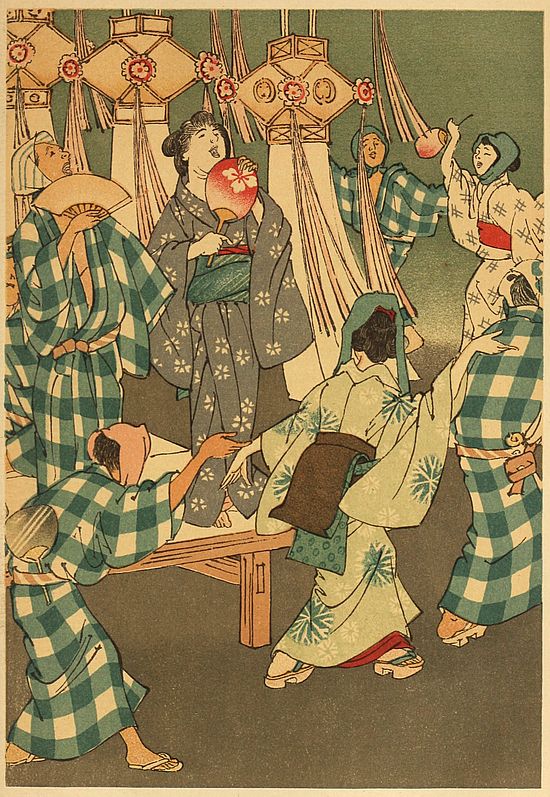
Dancers at Feast of Lanterns.
Geisha, dramatic reciters, jugglers, and itinerant
musicians never reach such solitary heights. But,
happily for us, the Bon-Odori, those antique dances,
which should have been danced on All Souls’ Day by
the modernised Ikao folk, began in this neighbourhood
two nights after our arrival. The landlord requested
a contribution of forty sen (about fourpence), which
we readily doubled, for the benefit of the performers.
Then ensued a long wait, for, if Japanese city-people
are dilatory, no adjective exists which could do justice
to the country-people’s contempt for celerity. Always
accurate, Murray very properly translates tadaima (immediately)
by “anytime between now and Christmas.”
First one lantern entered the courtyard; after half-an-hour,
another; one by one the young men and
maidens assembled; forty minutes more elapsed before
the musicians could be induced to appear: at
last a flute-player and a drummer squatted on a mat
in the centre, while the dancers circled slowly about
them. Youths and girls wore a blue kerchief tied
round the temples: they revolved, as in a game of
“Follow my leader,” without ever touching hands;
two steps forward, a half-turn, two steps back, and at
irregular intervals a clapping of hands. Such was
the simple measure. But the waving of arms and the
graceful free gestures of these rustic coryphées were
only less effective than the strange chanting, which
rose or sank in volume as the number of participants
increased or fell away. And what do you suppose
they sang? Something in the following vein, one
might imagine:
“While we loudly dance and sing,
Spirits of our dead return,
Guided, where the lanterns burn;
In the houses they will find
Rice and water left behind;
Then sail in boats of straw away,
Until next Bon-Odori day.
Peasants, come and join the ring!”
Lines like these might emanate from an Arcadian
singer of Fleet Street, but the daughters of Akakura
must have lost all sense of the solemn festival they
were affecting to celebrate. What they sang was
this:
“My lad is handsome,
My lad is comely;
He has no money;
Sad is my heart.”
And again:
“Only to meet thee
Troubled my heart is;
When the dance ends, I
Ask to be thine.”
For custom in those parts has gradually established
the right of Love to oust Death from his old prerogative.
Dancing enables the lovers to find each other
more easily than at other times. Courtship is the recognised
sequel of the August revels so eagerly anticipated,
so long remembered. The love-sick maiden
is the first to avow her passion, as little girls choose
their partners at a London party. Perhaps the gentle
neglected ghosts bear no resentment, but are consoled
by the hope that one day it will be their turn to live
again as happily as these their descendants.
Acquaintances were not as easily made in Akakura
as in Ikao. The Kogakurō, as our hotel was called,
contained but few other guests, and we occupied the
two bedrooms which formed a sort of annexe, apart
from the rest of the building. In the public baths at
certain hours one was sure of meeting from twenty to
thirty bathers of all ages and either sex, but they were
extremely timid, kept silence when we entered, and
did not respond to friendly overtures, so that we
ceased to intrude upon their privacy. One old man,
however, was very fond of calling and cross-examining
the strangers. He had been a samurai, and at the
age of seventy-six retained full vigour of mind and
body. I should have given him ten years less. The
landlord expressed his opinion that this visitor was a
Government spy, and cautioned us against talking too
freely. But, as it happened, the caution was superfluous,
for the dignified old fellow spoke in such queer
dialect that I could understand very few of his remarks,
and conversation soon lapsed into an interchange of
bows and smiles. Only one other circumstance occurred
in the Kogakurō during the fortnight we spent there,
to excite interest. One morning we found the cheery
little landlord very depressed because a fraudulent guest
had decamped during the night without paying his bill.
Of course, he had only to shoot aside the wooden
shutters, and the further feat of “shooting the moon”
presented no difficulty.
In this dearth of human subjects to study we acquired
a habit of making daily expeditions to neighbouring
localities, and were often repaid by beautiful
sights. Within two hours’ walking distance lies the
lake of Nogiri, which is larger than Lake Haruna, but
not so prettily environed. On a densely wooded islet
stands a temple of Benten, “the goddess of luck,
eloquence, and fertility,” to which we were ferried
across by an obliging schoolboy. Before it stand two
immense cedars, of which one boasts a girth of twenty-seven
feet. A long flight of steps leads from the shore
of the island to the shrine, and, viewed from the
summit of the steps, the belt of mountains which rim
the horizon amply rewards the climber. Except for
this view, however, Nogiri is in itself an ordinary
unromantic piece of water.
Far more exceptional is the important town of
Takata, several hundred feet below the level of
Taguchi, from which the railway descends a steep
valley between mountain walls precipitously grand.
Thousands of feet above snow is surmised, waterfalls
are conjectured, but between them and the crawling
train push masses of impenetrable forest. Passing
Arai, with its petroleum springs, we reach flatter
ground and enter Takata, once the castle town of the
Sakakibara family, which shared with three others the
privilege of providing a regent during the minority of
a Tokugawa Shōgun. Traces of its old magnificence
and of the Tokugawa patronage exist in a whole
suburb of Buddhist temples, adorned in many cases
with the Shōgun’s crest. They are large, richly ornamented
with good carving, and approached by avenues
of cryptomeria. Since the Restoration and the Shintōist
reaction the fame of the Takata temples has
decreased, but their splendour is only to be eclipsed in
that part of the country by the celebrated Zenkōji at
Nagano. At the back of one row of these temples
runs a stream, spanned by as many little bridges. I
never expected to see the college “backs” of Cambridge
so admirably parodied.
The railway line is here the dividing-line between
sacred and profane. To the left of it the Buddhist
monks traffic in holy wares; to the right cotton and
cotton-cloth and a species of muslin peculiar to the
place compose the stock-in-trade of half the shopkeepers.
The latter reside in homogeneous batches,
as in feudal times: all the mercers in one part, all the
curio-dealers in another, and so on. But the most
curious feature in the town is the wooden projecting
roof conterminous with the street on either side,
which enables the pedestrian to perambulate the main
thoroughfare under shelter of an arcade. These are
not found in the eastern or central provinces, and
have been adopted on account of heavy snow-drifts,
which in winter render the roads impassable. We had
cause to be grateful for this Echigo custom, as it
enabled us to explore the town without being drenched
by a heavy, inopportune shower.
Our longest excursion was to Naoetsu, a rising sea-port
at the mouth of the Sekigawa and the present
terminus of the Tōkyō and Karuizawa line. Though
it has long been a port of call for steamers which ply
on the western coast, it presented the appearance of
a new, unfinished town. Two months before a disastrous
fire had consumed three-fourths of the houses,
which were rising phœnix-like from the charred relics
of their own débris. But fires are so common in these
flimsy, inflammable habitations that one ends by regarding
them as inevitable, as instruments of the
universal law of reincarnation, which applies equally
to men and to the works of men’s hands. Every
twenty years the two great temples of Ise are demolished
and reconstructed as antique ordinance requires.
Humbler buildings cannot expect to escape the fiat
of periodic resurrection. There is, however, little of
interest at Naoetsu, unless it be the hardy fisher-folk
and field-labourers. We drove to a fine temple of
Kwannon and some tea-houses surrounded by tasteful
gardens overlooking the sea. But we had seen their
analogues before: never had we seen in Japan, except
in the case of the wrestlers, such sturdy human frames
as these men and women of Echigo display. Husband
and wife, naked to the waist, strain beneath a common
yoke and draw ponderous carts to market. Their
bronzed busts and blue cotton hakama make grateful
patches of colour between the hot sky and dusty road.
My photographic friend could not resist the chance of
“taking” an Amazonian mother disdainfully recumbent
on bent elbow and suckling her child. As she
lay supine and heavy-featured, she resembled a Beaudelairian
giantess in
“The deep division of prodigious breasts
The solemn slope of mighty limbs asleep.”
Could she really be of the same race as the fragile,
geisha-fairies of the Myako-odori? Her photograph
had better claim perhaps to the title of miyage than the
crystal and jade kakemono weights, which we bought
from a specious hawker on the cliffs. He who would
conform to Japanese etiquette, with its charming code
of trifling generosities, is sorely perturbed by this
problem of miyage. The dictionary defines it clearly
enough: “A present made by one returning home from
a journey, or by one coming from another place—generally
of some rare or curious production of another
place.” Now, I was perpetually “coming from another
place,” and the search before I left it for “some rare
or curious production,” which would serve as a present
for Ashikaga or Tōkyō friends, baffled at times even
my insatiable curiosity. The hawker’s streaked pebbles
were pretty enough as pledges of transitory kindness,
but the souvenirs most vividly stamped on the tablets
of remembrance by the glaring sunlight of Naoetsu in
August show a vision of brown sea-goddesses against
a turquoise sea.
The last lotus had shed its stately coronal of broad
petals before our short stay at Akakura came to an
end: business detained us in the capital throughout
the September rains; when we determined to take the
waters of Dōgō October was well advanced, and the
hills were already flushed with reddening maple-leaves.
As we sat on “the bridge that is joined to heaven”
and gazed into the maple-lined ravine, which is crossed
and crowned by the monastery of Tōfukuji, we seemed
to be watching the slow sepulture of that lingering
summer beneath a pall of fiery foliage. Yet we knew
that, though there on the hills around Kyōto autumn
was mistress of the woods, there still reigned on
the sheltered shores of the Inland Sea a summer of
St. Martin, the diaphanous ghost of summer, mild and
tender in heat and hue. There and then our trip was
planned. We would skirt its northern coast from
Kōbe to Hiroshima, spend a day in the holy island
of Miyajima, and thence take boat to Mitsugahama, the
nearest port to the Dōgō baths, whence a second boat
would take us back to Kōbe. Thus the circuit of the
eastern waters of the sea between Shikoku and the
Main Island might be accomplished in a leisurely ten
days. For the moment, however, we might as well
fall in with the spirit of soft melancholy which all
persons of sensibility were bound to assume in the
presence of maple-leaves, unless centuries of minor
poetry should be coarsely disregarded. What season
could be fitter for making pilgrimage to Sen-yūji, the
burial-place of the Emperors? It is true that a sinister
sentence in the guide-book said, “As neither the
tombs nor the various treasures of the temple are
shown, there is little object in visiting it.” But for all
we knew, the warning might be piously designed to
save a sacred privacy from the more vulgar type of
tourist, whose eyes are blind to immaterial things. At
any rate, that was the time, if ever, to test the meaning
of Murray’s discreet dissuasion.
It certainly required no slight effort of imaginative
sympathy to appraise at its historic worth a most
paltry wooden bridge, devoid of grace or ornament,
which seemed a rustic plank in comparison with the
Shōgun’s red-lacquer Mi Hashi at Nikkō, so finely
poised and firmly flung across the foaming Daiyagawa.
But that was worthy of the military usurpers, who
took the substance of sovereignty and left its shadow
to their nominal sovereigns, while this is only Yume
no Uki-hashi, the Floating Bridge of Dreams, aptly
symbolic of the recluse rois fainéants, absorbed in
sentiment and moonshine. Here, we are told, as the
midnight mourners bore along their dead emperor to
sleep with his fathers, they would throw down a little
fruit, some libatory cakes, into the whispering rivulet.
Then steep and dark before them rose the narrow
road, which terminates in a large hollow hewn out
of the hillside to be the cradle of the sceptred heirs
of the sun-goddess. Like the palaces in which they
lived, their houses of death are clean and august.
The shrines are of plain white wood, of the sort else
used only in Shintō temples; the paths, scrupulously
kept, are strewn with small white pebbles and wind
spirally up mound after mound into the shadow of
thick pines. Six centuries of royalty are buried in
that white city with no other token of their rank
than strict seclusion and austere simplicity. Each
group of tombs is enclosed by a high wall, and on
every gate is the sixteen-petalled chrysanthemum.
There is no glitter of marble or gold, as in so many
burial-grounds of monarchy, no fulsome eulogy on
staring tablet, but, shrouded in the same mysterious
obscurity as had enveloped for the nation their half-monastic
lives, the Tenshi, sons of heaven, seem
fittingly interred in that precise maze of ordered
tranquillity half-way between the sky and their dearly-loved
Kyōto.
I could not bring myself to pass Ōsaka on the
way to Kōbe without visiting the temple of Tennōji,
where Mr. Lafcadio Hearn gathered some of his
happiest “Gleanings in Buddhist Fields.” Though
the children’s chapel has been so touchingly described
by him that any other writer may well shrink from
following in his footsteps, a rapid impression of a
fugitive glimpse will be pardoned and more than
justified if it should induce the reader to re-read
his more elaborate account. An enormous temple,
Tennōji lies on the very outskirts of the town, and,
after traversing innumerable canals, one is still a little
puzzled to locate the indo-no-kane among wide courts
grouped about the central colonnade. After some
searching we discerned a man and woman kneeling
on the threshold of a shrine, in which a wrinkled
priest in shabby brown vestments was reciting a
prayer. Drawing nearer, we noticed that the man
was weeping and the woman held in her hands a
baby’s kimono of brightly coloured material, which
soon after she handed to the priest with a few copper
coins. He took the garment, folded it carefully, and
placed it on a shelf. Then, raising our eyes from
the personages in this pathetic scene, we observed
for the first time the chapel itself. The altar bore
no image of Buddha flanked by gilt lotus or vases
of natural flowers, but from cloth to ceiling it was
covered with a bewildering pyramid of dead toys.
Almond-eyed mannikins and stiff-jointed maidens,
dolls of all classes, richly or penuriously dressed,
seemed to stretch imploring arms and to fix hallucinating
eyes on the beholder; drums and trumpets,
paper ships and indiarubber balls, masks and picture-books
and rattles—all the motley companions of
vanished children were huddled together like contorted
imps in a chaotic pantomime. Massed and motionless
in the twilight of their recess, they had the air of dead
things—the shells and figments of faithful toys, whose
spirits had followed the babies’ souls to paradise, that
the little hands which had clasped them night and day
in “this miserable, fleeting world” might not be quite
comfortless in their strange new nursery. The lesson
would not be lost on heartbroken mothers who parted
here from their own most cherished hopes more fragile
than these brittle playthings. The roof was hung, the
side shelves were piled, with tiny dresses, pendent or
folded; and, most curious of all, the bell-rope, that
summoned Shotoku Taishi, the saintly prince, to conduct
the dead infants to God was strung with overlapping
woollen bibs—yellow and red and green—the
clumsy counterparts, these, of aureoles. But while
we had been enthralled by this canonisation of dolldom
the priest had been writing, and now handed to the
mother a slip of paper attached to a thin wand of
bamboo. Bowing low, she took the paper, pressed it
to her forehead, and crossed the enclosure to the stone
chamber known as the Tortoise Tower, for there those
who look down over the circular balustrade into a
central cavity will perceive clear water running from
the mouth of a stone tortoise. Into that sacred stream
which flows from earth to heaven the paper drops,
being inscribed with the new name which is bestowed
on every believer after death; and the poor woman
goes away not a little comforted, for now at least
her child is sure of an orthodox introduction to
paradise. Thus neither babe nor emperor is exempt
from etiquette, whether life or death be the master of
ceremonies. Inequalities persist in the very funeral
rites, though in their hearts the celebrants must feel
that the geisha’s flower-song is of universal application:
“Peonies, roses,
Faded, are equal;
Only while life blooms
Differ the flowers.”
The beauties of the Inland Sea have been so often
and so graphically described, that detailed praise is
superfluous. Every one has heard of the thousands
of islets, on which are perched villages, villas, and
pines innumerable; of the hillsides, geometrically subdivided
into rice-fields; of the junks with pleated and
divided sails, which dart like white birds through the
exquisite blue plain; of the strange mirage, which
throws upon the sky at certain hours, when the
heaven above and the waters beneath melt into a vast
silver-grey mirror, the shapes of phantom archipelagoes
suspended in mid-air. To those who have seen it and
are familiar with the fans, the netsukes, and the tea-cups,
which reproduce favourite designs of pictorial
art, only one adjective, vague yet precise, will occur:
this pocket-Mediterranean is essentially Japanese. It
is an ornamental piece of prettiness, designed by the
Celestial Painter in one of his most Japanese moods,
for in it you will find the cardinal characteristic of
the national taste, its subordination of the sublime
to the dainty, of big effect to graceful detail, its inevitable
preference for miniature and vignette. One
critic has said that such art “is small in great things,
great in small things”; another, that the Japanese
“admire scenes, but not scenery.” Both these dicta
could be applied to the Inland Sea, were it not that
Europeans admire it more than the natives, but the
charm which it exerts is undeniably akin to the
spell of those workers in silk or clay or ivory who
achieve a maximum of beauty in a minimum of
space. The Norwegian fiords, the Italian lakes, the
Ægean and Adriatic Seas, all present at some point
or other some grandiose aspect, but the channels
which lie between Shikoku, Kyūshu, and the Main
Island never threaten or impose; they are simply a
soft fluid setting for precious stones of varying size
and colour.
Most famous of these insular jewels is Miyajima.
As no boats were running thither from Kōbe, we
travelled by the San-yo railway as far as Onomichi,
skirting the coast so closely that we hardly once lost
sight of the sea. Though sorely tempted to break the
journey for the purpose of visiting the great feudal
castles of Himeji and Okayama, we pressed on until
the bay of Fukuyama, glittering like molten fire in a
superb sunset, was hailed with rapture and relief, for
the train journey had been hot and long, and we
welcomed the prospect of repose. One of those
delicious, indolent evenings, when the traveller reclines
on piled cushions, drinking tea or saké, until he be
roused from waking dreams by the low laughter of
attendant musumé, demanding permission to strew the
beds and light the lanterns, would have formed an
excellent climax to that fatiguing day. But I never
dared anticipate repose in the company of Mr. Bates,
who was apt to burst into sudden flame on the
slightest provocation. And during that week provocation
lurked in two hotels out of three. The guide-book
describes Onomichi as “a bustling, prosperous
place”: it may be “prosperous”; it is undeniably
“bustling.” We were barely out of the train and had
just set foot in the straggling main street, when two
hotel touts seized us by the arm, jovially aired some
broken English, and deposited us with our bags on the
steps of a large hotel. “Ask the price!” shouted Mr.
Bates, “ask the price! I have never yet entered
an hotel without knowing what I have to pay. Ask
the price!” I complied, but the landlord with soft,
evasive phrases, wafted us to an upper floor, while my
companion smouldered. Suddenly a chair and table
appeared. “Take them away!” he shouted, “take
them away! I know the trick. They will make us
pay double, and I refuse to be swindled.” This time
we insisted on knowing the charges, and the proprietor,
as we expected, demanded three times as much as we
had now become accustomed to pay. We protested.
He assured us that “honourable guests from Yokohama
and Kōbe” never paid less, but we replied that Kōbe
and Yokohama were nothing to us, who always paid
Japanese prices for Japanese accommodation. Finding
him impervious to reason, we shouldered our bags and
marched out of the house. Then he consented to
receive his due, and reinstalled us on our own terms.
But the hotel girls were cross and discourteous, the
native visitors noisy, the food bad and badly served.
As a last attempt to get the better of us, the landlord
affirmed that now there was no chance of a boat being
despatched to Miyajima before the following afternoon,
and that the information we had gathered from a
casual shopkeeper the night before, that one would
sail at eight o’clock in the morning, was erroneous.
But Mr. Bates had been compelled twice before to
spend an extra day in one of these seaside hotels, on
the plea that the boat had gone, or would only go,
apparently, at the landlord’s bidding. Smiling, therefore,
but without hesitation, we made our own way to
the wharf at seven o’clock and took our own tickets,
that there might be no collusion between the hotel-boy
and the official who booked passengers. At
eight o’clock we steamed away from Onomichi.
Through clustered islands our tiny steamer threaded
in and out, until Kure appeared, an important arsenal
at the foot of the Aki Hills. Here we discharged
some hundreds of copper slabs, and while that slow
operation was in progress were amused by the
animation which prevailed on the men-of-war and on
the numerous sampans plying between them and the
shore. About four miles away on the island of Etajima
stands the Imperial Naval College. When this and
other points of interest had been indicated to us by
polite fellow-passengers, our attention was riveted on
the labourers, who jerked the slabs from hand to hand
and piled them on the floor of a barge in symmetrical
heaps. The “chantey” which they sang to lighten
the labour was simple and monotonous, consisting of
two words, which sounded absurdly like “Hong
Kong” and “Shanghai” repeated ad infinitum. At
last we continued our voyage, but were again subjected
to a long delay at Hiroshima, where we landed and
beguiled the tedium of waiting by chaffering with
bum-boat women for sweets and chestnuts. The
town stands far back from the water, and a causeway
three miles in length runs out into the spacious
harbour, formed by the delta of the Otagawa. As
this is the most busy commercial centre west of
Kōbe, there was plenty of movement: rows of boats
were loading and unloading, rickshaws driving up perpetually
from the town, while shrill-voiced youngsters
did a brisk trade in fruit and vegetables. At the risk
of being left behind, my indefatigable companion
made a dash for the distant shops, and returned
triumphant, hugging in one arm two loaves of bread
and in the other a dilapidated Buddha, whose grimy
gilt was irresistible to the collector. His disgust when
I guessed the exact price he had paid (about five yen,
or ten shillings), and refused to believe that it could be
worth a penny more to any one, was too deep for
words.
Darkness had fallen when Miyajima was reached,
and as we were rowed ashore the outlines of temple
and grove were shrouded in gloom. Only the colossal
torii loomed black against the shimmering water, while
all that lay behind was covered by the shadow of
climbing forests. We took supper at an hotel near the
entrance to the temple-grounds, and were then conducted
by two of the landlord’s daughters on a tour of
inspection through the main street. We discovered a
curio-shop, of which the proprietress set such extravagant
value on her wares that Mr. Bates at once was
lured into hot discussion. Night interposed, and at
an early hour, before I was well awake, I heard the
resumption of battle below my balcony. The proprietress
with gentle laughter and firm accent extolled
her treasures; the would-be purchaser, in nervous tones
which tingled with cupidity and despair, attempted in
vain to cheapen them. His patience was rapidly
giving way, and very soon he cried out for his interpreter
to descend and assault the enemy. But this
time I deliberately closed ears and eyes, feigning sleep.
I had not come to that holy island to fight for curios,
and though I had attained the knack of giving the lie
courteous to crafty dealers, I shrank from translating
rough language to a woman. Fidelity was routed by
chivalry. They finished the struggle without my
intervention, and victory remained with the lady.
When I descended, the defeated combatant was
seeking consolation in photography. And seldom had
his camera been confronted with more beautiful pictures.
The winding valleys and soaring rocks converge
at an elevation of more than a thousand feet on
a little shrine, in which has been burning a sacred
fire for more than a thousand years. From the
opposite shore, as one traces the salient features of
this evergreen island, all the details—streamlet and
temple-roof, cliff and maple and pine—merge in a
majestic harmony of serried line and luxuriant colour.
But on the island itself one is drawn, as by a magnet,
to the great temple of Itsukushima Hime, which,
being partly built over the water on piles, seems at
high tide, like the Breton vision of Is, to rise from the
depths of the sea. At all times the torii, or wooden
archway, which stands before this Shintō temple is
partially submerged, and Hiroshigi in his fifty-four
meisho, or views of Japan, gives such prominence
to it, that the long galleries and avenue of stone
lanterns, as well as the central hall, from which the
colonnades diverge like wooden arms, bent to embrace
the incoming tide, are barely suggested. Daimyō,
Shōgun, and Emperor have vied with one another in
decorating this temple, and the successive chapels are
hung with paintings by famous artists from the sixteenth
century to the present time. Many quaint
customs, formerly regarded as conducive to the purity
of a holy place, are still observed. Neither death nor
birth is allowed to sully its eternal immunity from
change. When either is anticipated, the patient is
ferried across to the mainland. Dogs are forbidden,
but deer roam the streets and feed fearlessly from the
hands of tourist or pilgrim. All day the temple-courts
are thronged with worshippers, and sometimes at
night, when a pious noble or rich American affords
himself the sight, the lit lanterns of stone or bronze,
which line the approaches to the temple, define the
interlacing courts and bridges in traceries of fire. But
this illumination we had not the good fortune to see.
Another temple on a neighbouring hill, though less
beautiful, is equally unique. It consists of a vast platform,
from which spring twenty-four massive columns
to support the roof, whose only ornamentation on the
interior, if ornamentation it can be called, is a frieze of
wooden spoons, some small, others enormous: they
are nailed there, or on the columns, as the donor’s
caprice dictates, and confer comparative immortality at
trifling cost, for each is inscribed with an autograph.
Thus the ingenious Japanese have found a way of
diverting and profiting by that first infirmity of ignoble
minds, which robs St. Paul’s of dignity and desecrates
Westminster Abbey with such legends as “Peter
Jones from Hampstead” and “Eliza Smith of Bethnal
Green.” Much impressed by this strange custom,
each of us bought a spoon and, veiling our vulgarity in
Latin, suspended this device from the right-hand pillar
of the porch:
Venit, Vidit, Oravit,
O. E. R. B.
For two months I had been haunted by visions of
the bridge-Kintaikyō, as it seems to have haunted the
landscape-painters of Japan. I remembered it as one
of the most remarkable in Hokusai’s series of “A
Hundred Bridges”; I had another marvellous drawing
of the five arches overwhelmed by a snow-storm
and apparently detached from both land and water, for
Hiroshigi understands the isolation of his subject from
irrelevant detail as few others, slaves of perspective,
would dare imagine. If uneducated eyes took the
picture to represent a peal of blue bells, sprinkled with
cotton-wool and straddling through space, so much
the worse for uneducated eyes. But at any rate,
being so near, I resolved to dispel vision by looking on
reality, and spent half a day in visiting Iwakuni. We
were obliged to leave our rickshaws at the foot of
Katō Kiyomasa’s towering temple that overlooks the
almost waterless bed of the Nishikigawa, for none but
a pedestrian could climb the huge arcs, thirty feet
long, which spring in five bounds from shore to shore,
like the curves of a switchback railway. Then the
faithful camera was brought into play, and a bevy of
perplexed ducks were hustled into the foreground, with
the inevitable result of attracting several loiterers to
share with them the glory of being photographed.
These had to be politely expelled, and in the end
several excellent views were taken. But not one of
them conveys the fantastic liberty of that flying bridge
so realistically as the snowscape of Hiroshigi.
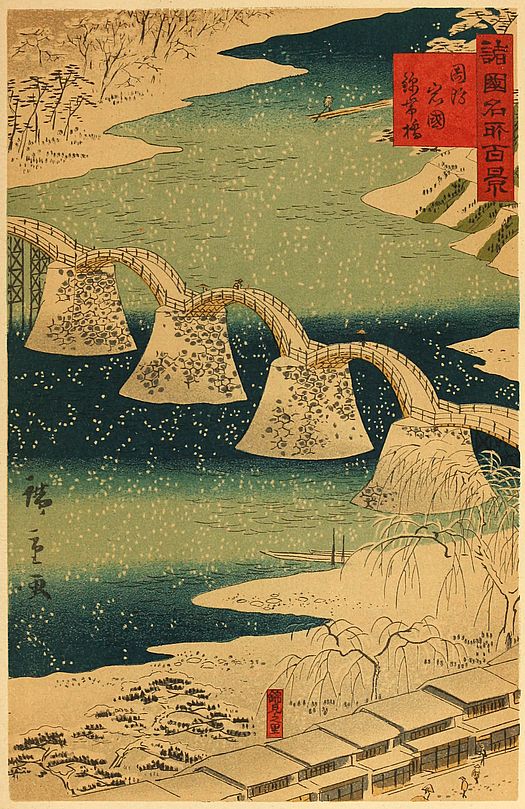
Kintaikyō Bridge.
Lulled by the honest countenance of our courteous
landlady into misplaced confidence, we were astonished
by her presenting on our departure a bill more exorbitant
than that of the hotel-keeper of Onomichi. We
expostulated, and repeated the terms named by her
clerk the night before. At once the amount was cut
down to half and the lesser sum accepted with no
gratitude or resentment. Mr. Bates is furious, and
delivers a lecture on probity; but I cannot bring
myself to regard these bland banditti, who extort
without violence and restore the booty without a
murmur, as on a par with the cheating innkeepers of
other lands. Their motive is probably either religious
or patriotic, perhaps both. Some one must have told
them that foreigners are only permitted by autochthonous
gods to visit Japan on condition of enriching
its inhabitants. By overcharging the tourist, then,
they are pleasing their gods and serving their country.
Their compatriots are protected by legal prices,
publicly posted in every inn, but they know that the
barbarian cannot read official notices, and quixotic
indeed would it be to enlighten him. To me such
naïf graceful swindling (when exposed and thwarted)
is more delightful than churlish, prosaic probity.
Returning to Hiroshima, we thence took steamer to
Mitsugahama, one of the chief ports in the island of
Shikoku, whose mineral baths were the goal of our
voyage. Had time allowed, we would gladly have
visited all the four provinces of this magnificent island—provinces
which in earlier times were known as
“Lovely Princess,” “Prince Good Boiled Rice,” “The
Princess of Great Food,” and “The Brave Good
Youth.” But we had only leisure to do homage to
Iyo-Ehime, the Lovely Princess, who amply justified
her title by the loveliness of her domain. Between
her territory and that of Tosa or Take-yori-wake,
the Brave Good Youth, whose sons are to-day the
staunchest advocates of progress, runs a mountain
ridge, varying in height from three to four thousand
feet, so richly covered with forests that not only are
the pines, maples, and alders as plentiful as elsewhere,
but with these is intermingled an endless host of
beeches, oaks, and horse-chestnuts. Except in the
neighbourhood of Akakura, we had not seen a finer
stretch of mountain-scenery.
But we never came close to these wooded heights,
for Dōgō is only a short distance from the seashore,
and is reached in half-an-hour by what I can only
describe as a toy train. We crept into a first-class
carriage, and just managed to avoid bumping our heads
against the low-pitched roof. The fare was on the
same scale as the compartments, for the cost of the
ticket was three sen (farthings). The rickshaw-men
were polite and reasonable, the landlord of the Iwai-ya
both affable and honest; in a word, we had left the
track of long-suffering and all-corrupting tourists, and
had reached one of those districts, so pleasant to
discover, where manners are as yet unspoiled by
money. Delighted with our lot, we settled down to
three days of paradise regained.
Our first care was to discover the bath-house. In
front of the hotel rose a mansion of pine, surrounded
by iron railings of curious pattern, a line of storks in
zigzag flight, and surmounted by a stork of gold with
outstretched wings. The Governor’s house, we
thought, or perhaps a court of justice, resplendent
with carven symbol to impress the natives with reverence
for the new régime. But no: this was the
principal bath-house. As we passed from storey to
storey and remarked the beauty of rafter and balustrade,
my companion, who speaks with knowledge,
declared that he had never seen such superb carpentry.
In many of the chambers were flowers and kakemono
by modern painters; in short, we had found a more
lordly palace of bathing than even Ikao could boast.
The baths were of granite and the dressing-rooms hung
with silken curtains. As we had paid the highest
tariff, ten sen (about twopence-halfpenny), before
entering the bath, we were served by daintily-robed
waitresses with cherry-blossom-and-water, a rather
saline concoction prepared from the national flower.
When we issued from the hot salt waters the same
attendants brought tea and cigarettes. Enchanted
with our first experience of Dōgō fashions, we returned
to the hotel and demanded of the landlord what other
sights the town possessed.
The public garden, the wood-carvers’ shops, the
big temple of Ōkuni-nushi and Sukuna-bikona, which
crowns a hill on the outskirts of the town, were duly
visited, and pronounced inferior to those we had seen
elsewhere. But O Yoshi San informed us at dinner
that every stranger who came to Dōgō was considered
unlucky if he departed without seeing and hearing two
beautiful sisters, geisha of shining notoriety. We
sent a summons at once, and by good luck it happened
that one hour of their deeply engaged evening was
at our disposal. Our room was brightened up with
flowers and sweetmeats, saké and cigarettes were
lavishly provided, cushions set and lanterns lit. The
geisha were announced by their professional names—White
Jewel and Young Butterfly—made smiling
obeisance to the “honourable strangers,” and took
their seats in the centre of the room, while their
duenna, the Katti Lanner of Shikoku, whose pupils
had spread the fame of their teacher all over Japan,
remained respectfully in the doorway. The age of
Young Butterfly cannot have exceeded thirteen years.
She wore a white silk kimono, heavily embroidered
with gold, and gold dragons on a green sash chased
one another round her slender waist. In her coiffure
was an ivory pin, terminating in a miniature birdcage,
from which a red tassel fluttered defiantly. Her
pantomimic dances (in which she required occasional
prompting) represented the wooing of a coy damsel
and the capture of a standard in the Chinese war;
her childish emphasis of amorous and martial gesture
was extremely piquant. White Jewel was, however,
not only a clever artist but a most intelligent woman.
About ten years older than her sister, she was dressed
far more simply. Her kimono was of black crépon,
her sash of iris-coloured brocade, and her hair had no
ornament but a purple iris. She sang, like all her
tribe, with nasal intonation and harsh lower notes,
but her smile when she talked was as bright as her
wits, quick to grasp my questions and explain the
meaning of her songs. Indeed, I owe to White Jewel
some of the prettiest instances of popular dodoitsu
collected in a previous chapter. She was very pleased
with her calling, which she had found lucrative, and
was not offended by the assertion that most people
considered geisha to be like cats, sly and treacherous;
otherwise, how was it they had acquired the nickname
of “Nekko” or “Pussie”? She replied by singing a
quatrain which conveys in the original two meanings
for every line:
’Ware of the Pussie!
Pussie, seen smoothing
Coat of striped velvet,
Trimming her claws.
’Ware of the geisha!
Geisha, seen folding
Soft-striped yukata,
Binding her shoes.
At this point Mr. Bates manifested a desire to bask
in the rays of White Jewel, and completely ousted me
from favour by a fraudulent piece of palmistry. As he
traced the lines in her sensitive hand he discovered
pledges of prodigious prosperity—rich lovers, increased
fame, long life, and ultimate marriage to a
deputy-judge! The only prediction which missed
the mark was a prophecy of twin daughters, who
should rival and perpetuate the glory of White Jewel
and Young Butterfly. The Japanese consider it rather
gross and catlike to have more than one child at a
time. White Jewel made a grimace of playful disgust
and offered to sing another song, which would be the
last, as other houses had engaged her to appear at ten
o’clock and at eleven. It was exactly half-past ten;
if she went now, her punctuality would be unimpugned.
So she took leave of us with a chansonette as dainty
as her own personality.
Light Love.
If love be thoughtless,
Then is love shallow;
Though love be shallow,
Do not forget.
We devoted the second day of our visit to Matsuyama,
the capital of the province of “Lovely
Princess,” not more than four miles from Dōgō.
There is little to be seen there, however, except the
castle, one of the largest in Japan, and some excellent
curio-shops, in which the zeal of my companion was
rewarded by some precious finds. Leaving him to
indulge his master-passion, which I found less amusing
than the pursuit of living curios, I laid siege to the
castle. At the bureau where tickets are to be obtained
many officials referred me to one another, and requested
me to wait until certain formalities were complied
with. After two hours’ stolid patience the fortress
capitulated, and I was assigned to the care of a gallant
sergeant, who spoke a little English and proved a most
competent guide. From the summit of the tower a
fine panorama was visible: below us the fertile Matsuyama
plain stretched away to the shore of the Inland
Sea, and on the opposite side the horizon was shut in
by forest and mountain. To tell the truth, my conductor’s
account of the castle’s history, as illustrated
by its structure and some surviving weapons of war,
interested me much less than his own exploits. For
had he not with his own hand slain five Chinese braves
in the battle of Port Arthur? My compliments on his
heroism must have touched his heart, for, turning
suddenly, he grasped my hand and cried: “I like you.
You shall be my friend. I will dine with you.” This
abrupt proposition at once solved for me the embarrassing
question of remuneration. I could not press
surreptitious silver into the palm of this obliging lover
of England and slayer of Chinamen, but a friendly
dinner would put us on terms of franker intimacy. So
we descended the winding path from the ramparts,
crossed the moat, and marched home to the Iwai-ya.
We drank cherry-blossom and saké; we bathed, and
dined off the best fare which our host could provide;
we discussed the character of native and foreigner,
arriving at the conclusion that, while the best type of
Japanese inhabited Shikoku, the wiliest and worst of
foes were Russian. We had not time to go deeply
into ethnology, for at half-past eight my guest buckled
on his sword and with many protestations of affectionate
regard returned to barracks.
No shadow of trickery marred our joyous reminiscences
of Dōgō. When we left the landlord presented
a bill so ridiculously low, that we bestowed on him as
much again in tea-money. Not to be outdone, he
loaded our departing rickshaws with four bottles of
beer. And the photographer, whose camera was worth
a fortune to him as a means of gratifying all sorts and
conditions of men, took an excellent group of that
smiling host and his cheery household.
The voyage to Kōbe was no less agreeable. We
had for fellow-passenger a distinguished middle-aged
officer, who had fought on the losing sides in the revolution
and the Satsuma-rebellion headed by Saigō
Takamori, whose grave we had seen at Miyajima.
Experience had long since convinced him of the folly
of anti-progressive movements, and he realised as
clearly as the most democratic reformer that national
security was best served by adopting Western ideas.
We had no idea of his rank until a small boat put off at
Tadotsu, in which were three officers of inferior grade,
who had come to escort him ashore. From his seat in
the boat he waved his hand genially to us, while the men
pulled in to harbour, but the three officers remained
standing, as unmoved by the shock of the waves as
by the rattle of Chinese artillery.
Kōbe received us, weary and late, with hospitable
arms. In that prosperous port, so rapidly distancing
Yokohama in commercial importance, an English
colony is solidly entrenched with pews and cricket-bats
and pianos. I went to the club, and was at once
in England. The Saturday Review was reviewing and
The World revolving on the same lines as when I
was last in Fleet Street. Mr. Bernard Shaw was still
unmasking demerits in Shakespeare, while Mr. William
Archer was inventing merits for American comic
opera. In a moment of nostalgia I sauntered into a
well-filled church, whose congregation were listening
with rapture to a beautiful rendering of Gounod’s
“There is a Green Hill”: finally, I learned at a
friend’s table that a cricket-match between the ladies
and gentlemen of Kōbe was the burning topic of the
week. Between Mr. Bernard Shaw and Buddha
(vegetarians both), between Gounod and geisha, between
batting and bathing, lay the gulf which separates
the hard-hitting West from the lotus-loving
East. I could not bridge the gulf without a violent
effort. In fact, I felt a little ashamed on mixing with
my fellow-countrymen, so pious and strenuous and
practical. While they had been working and playing
as only Britons can, I had utterly forgotten that any
country except Japan could enthral and stimulate. I
had been taking the waters—of Lethe.
PLAYING WITH FIRE