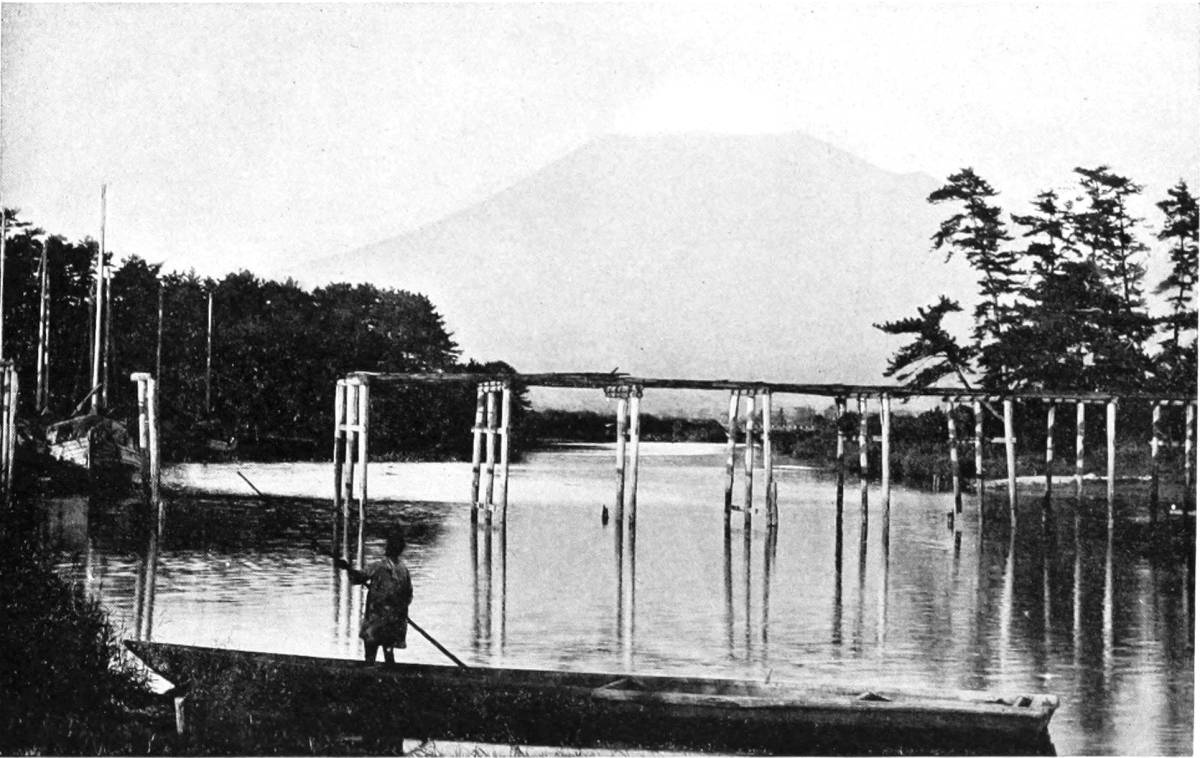
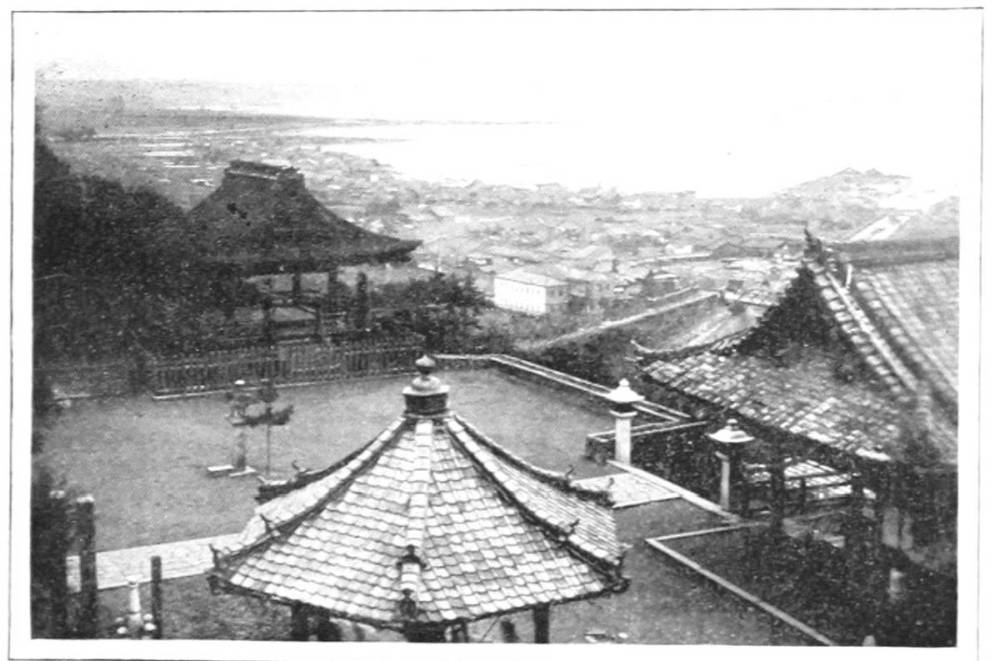
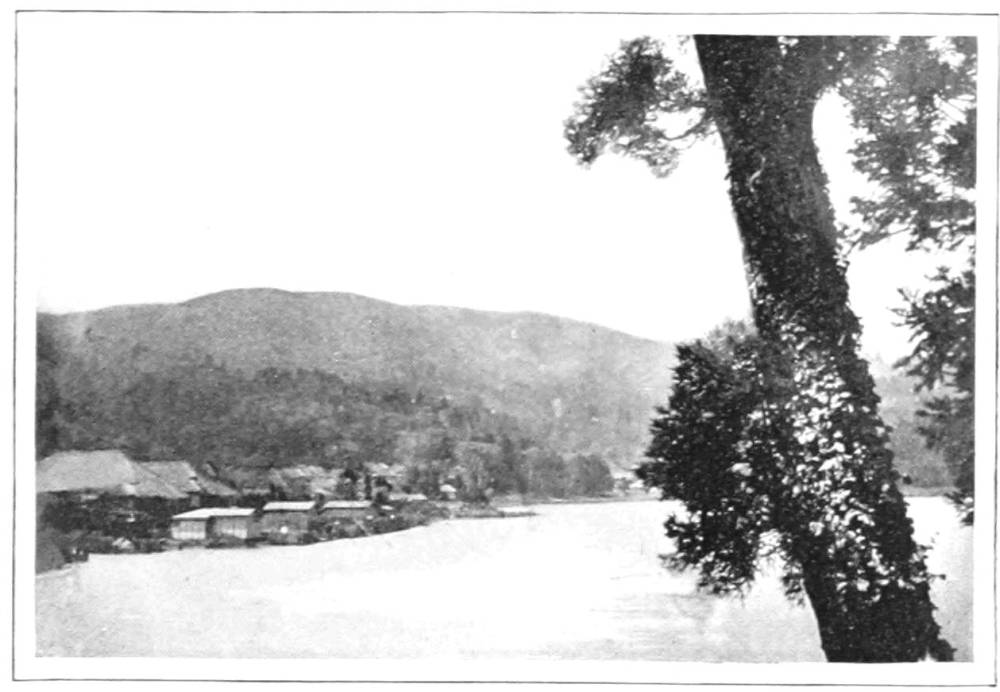
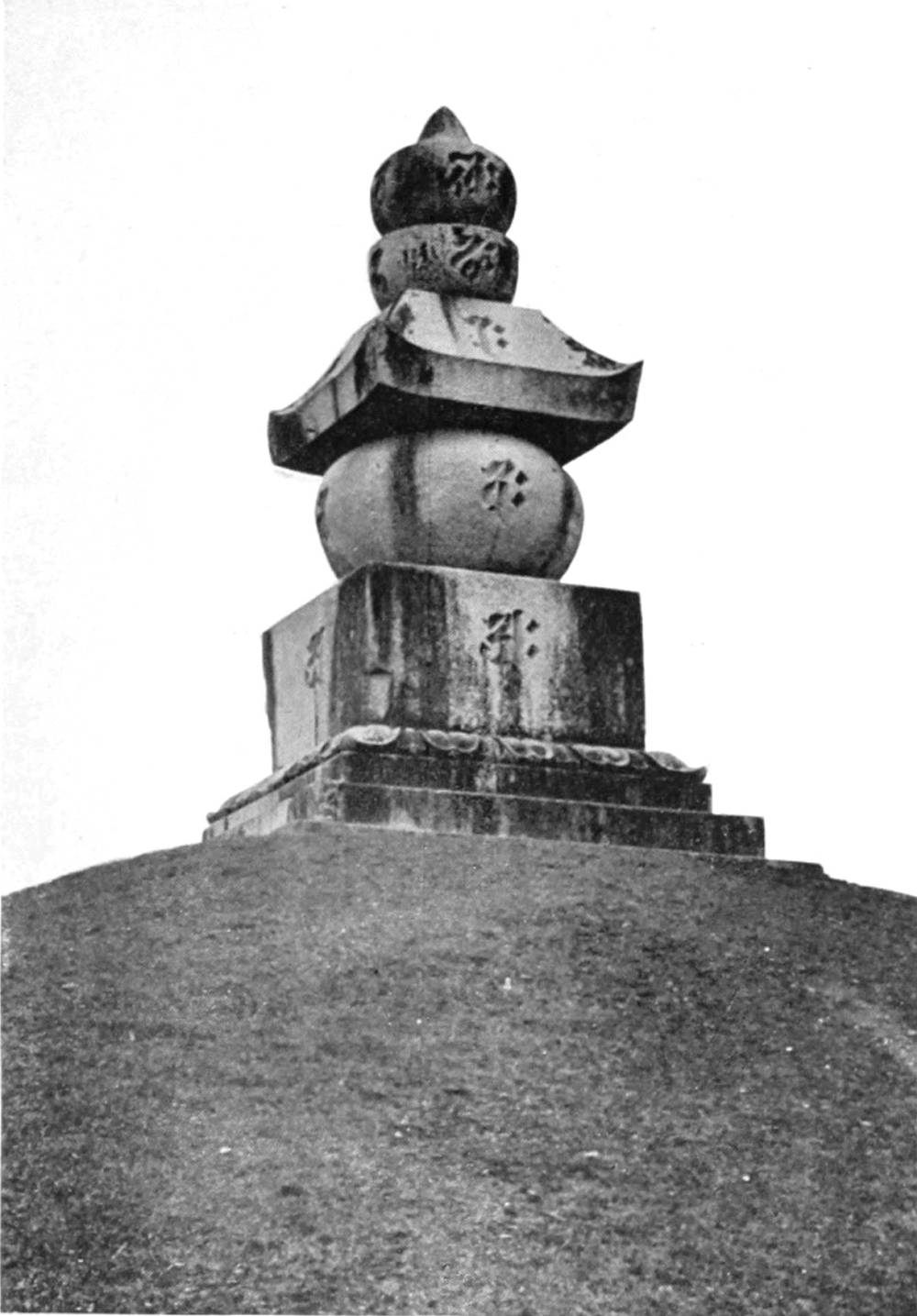
Obvious typographical errors have been silently corrected.
Variations in hyphenation have been standardised but all other spelling
and punctuation remains unchanged.
“JAPAN AS IT WAS AND IS”
A HANDBOOK OF OLD JAPAN
II
Uniform with this Work
A HANDBOOK OF MODERN JAPAN.
By Ernest W. Clement. With two
maps and seventy-two illustrations from
photographs. Sixth edition. Price,
$1.40 net.
A. C. McClurg & Co. Chicago
Hildreth’s “Japan as it Was and Is” A HANDBOOK OF OLD JAPAN
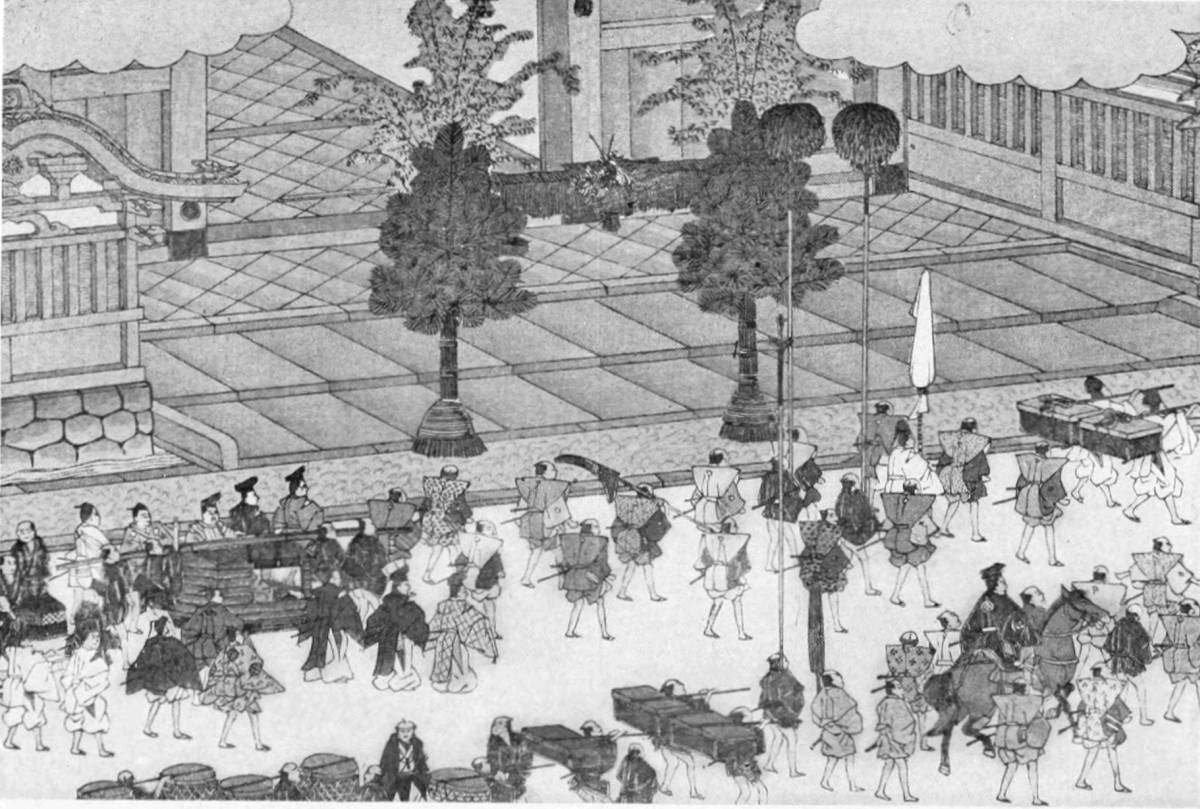
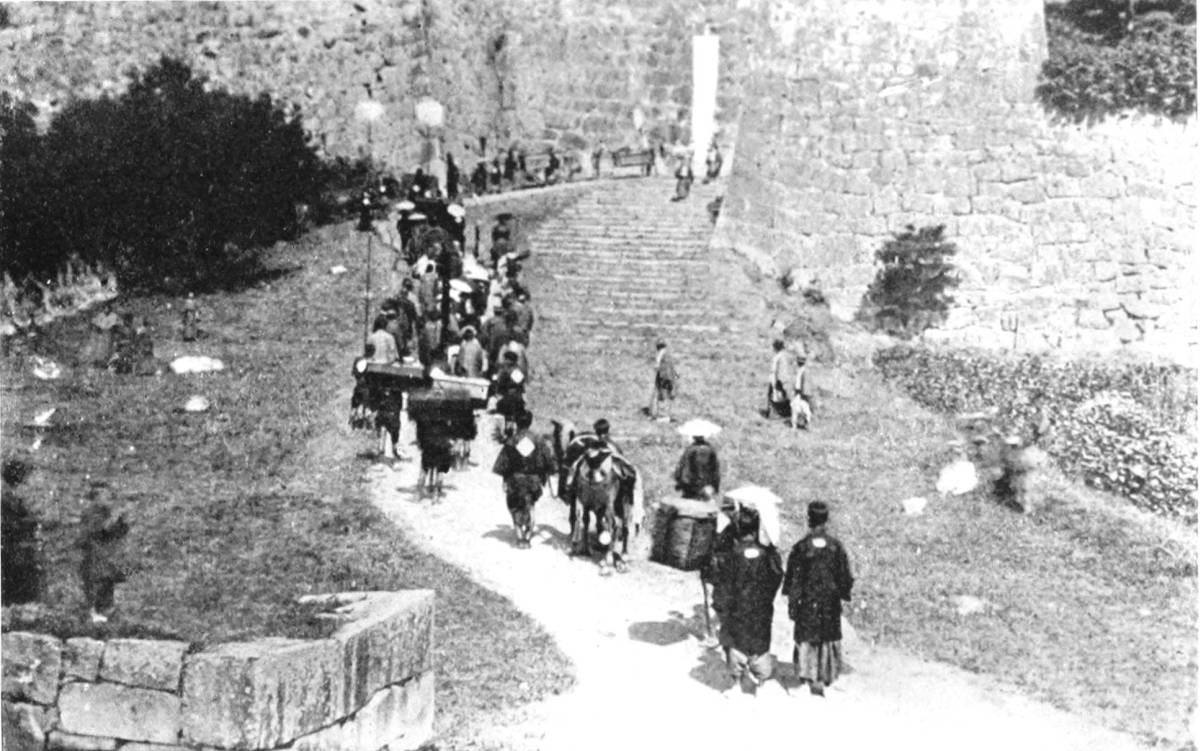
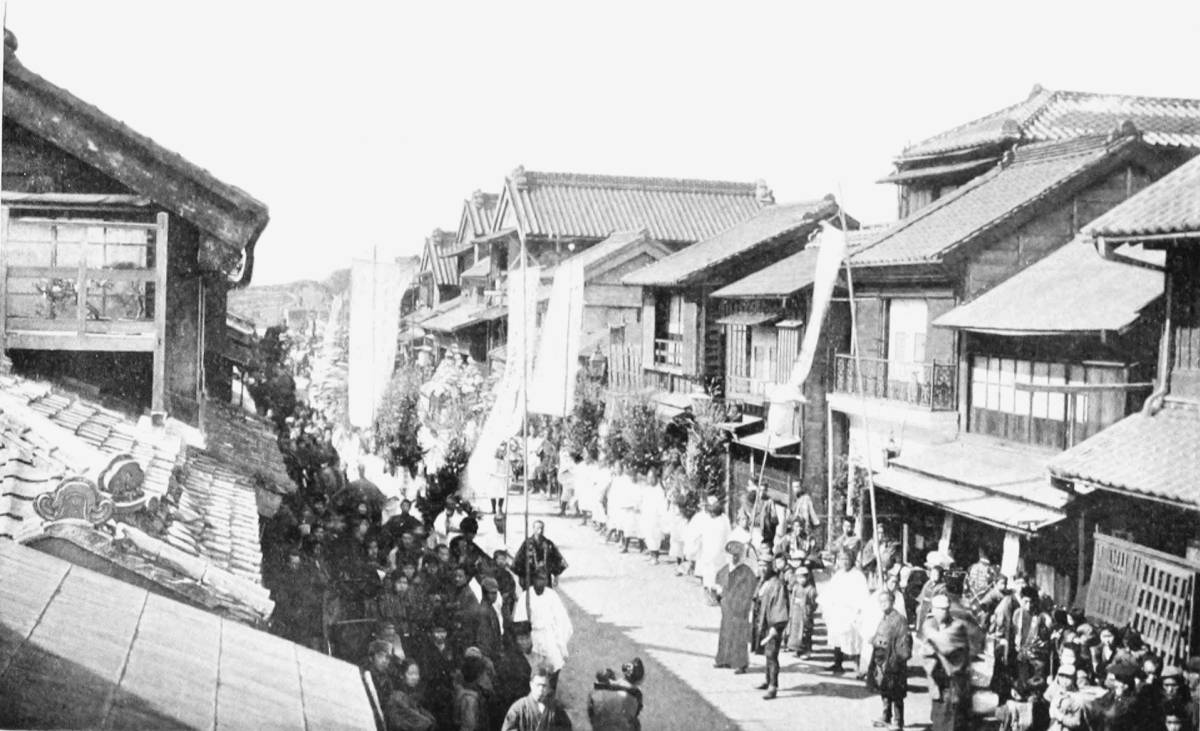
Procession of Feudal Lords
From Official History of Japan
Post-Houses—Imperial Messengers—Inns—Houses—Their
Furniture and Interior Arrangements—Bathing and Sweating
House—Gardens—Refreshment Houses—What they Provide—Tea
Number of People on the Road—Princely Retinues—Pilgrims to
Ise—Junrei Pilgrims—Naked Devotees—Religious Beggars—Begging
Order of Nuns—Yamabushi, or Mountain Priests—Buddhist
Beggars—Singular Bell-Chiming—Hucksters
and Peddlers—Courtesans
Departure from Nagasaki—Train of the Dutch—The Day’s
Journey—Treatment of the Dutch—Respect shown them in
the Island of Shimo—Care with which they are watched—Inns
at which they lodge—Their Reception and Treatment
there—Politeness of the Japanese—Lucky and Unlucky
Days—Seimei, the Astrologer
From Nagasaki to Kokura—Shimonoseki—Water Journey to
Ōsaka—Description of that City—Its Castle—Interview
with the Governors—From Ōsaka to Miyako—Jodo and its
Castle—Fushimi—Entrance into Miyako—Visit to the Chief
Justice and the Governors—Description of Miyako—Palace
of the Dairi—Castle—Manufactures and Trade—Authority
of the Chief Justice—Police—Crimes
Lake Ōtsu—Mount Hiei[zan]—Japanese Legends—A Japanese
Patent Medicine—Kwannon—Miya—Arai—Policy of the
Emperors—Kakegawa—A Town on Fire—Suruga—Kunō—Passage
of a Rapid River—Fuji-no-yama, or Mount Fuji—Crossing
the Peninsula of Izu—Second Searching Place—Purgatory
Lake—Odawara—Coast of the Bay of Yedo—A
Live Saint—Kanagawa—Shinagawa—Yedo—Imperial
Castles and Palace
Personages to be visited—Visit to the Emperor—First Audience—Second
Audience—Visit to the Houses of the Councillors—Visits
to the Governors of Yedo and the Temple Lords—Visit
to the Houses of the Governors of Nagasaki—Audience of
Leave—Return—Visits to Temples in the Vicinity of Miyako—A. D.
1691-1692
Further Decline of the Dutch Trade—Degradation of the
Japanese Coins—The Dutch threaten to withdraw from Japan—Restrictions
on the Chinese Trade—Probable Cause of the
Policy adopted by the Japanese—Drain of the Precious Metals—New
Basis upon which Future Trade must be arranged
Thunberg’s Visit to Japan—Searches and Examinations—Smuggling—Interpreters—Deshima—Imports
and Exports—Unicorn’s
Horn and Ginseng—Soy—The Dutch at Deshima—Japanese
Mistresses—Japanese Women—Studying the
Language—Botanizing—Clocks—New Year’s Day—Trampling
on Images—Departure for Yedo—Journey through
the Island of Shimo—Japanese Houses and Furniture—Manufacture
of Paper—Practice of Bathing—Shimonoseki—Voyage
to Ōsaka—Children—From Ōsaka to Miyako—Agriculture—Animals—A. D.
1775-1776
Japanese Merchants—Journey from Miyako to Yedo—Botany of
the Mountains—Rainy Weather—Coverings for the Head and
Feet—Yedo—Astronomers and Physicians—Acupuncture—Moxa
[Mogusa]—Other Japanese Remedies—Method of
wearing the Hair—Visits to the Emperor and his Chief Officers—Japanese
Dress—Books and Maps—Succession of Emperors—Departure
from Yedo—Gnats—Fire-Flies—Threshing—Vegetables
and Fruits—Condition of the Japanese Farmer—Casting
Copper—Actors and Dancers—Thunberg’s Opinion of
the Japanese—A. D. 1775-1776
Isaac Titsingh—His Residence in Japan—Translations from the
Japanese—Annals of the Dairi—Memoirs of the Shōgun—Liberal
Ideas in Japan—Marriage Ceremonies—Funeral Ceremonies—Mourning—Feast
of Lanterns—A. D. 1779-1791
Exploration of the Northern Japanese Seas—First Russian Mission
to Japan—Professorship of Japanese at Irkutsk—New Restrictions
on the Dutch—Embarrassments growing out of the War
of the French Revolution—American Flag at Nagasaki—Captain
Stewart—Ingenuity of a Japanese Fisherman—Heer
Doeff, Director at Deshima—Suspicious Proceedings of Captain
Stewart—Russian Embassy—Klaproth’s Knowledge of Japanese—Doeff’s
First Journey to Yedo—Dutch Trade in 1804 and
1806—An American Ship at Nagasaki—The British Frigate
“Phaeton—No Ships from Batavia—The Dutch on Short
Allowance—English Ships from Batavia—Communication
again suspended—Dutch and Japanese Dictionary—Children
at the Factory—A. D. 1792-1817
Golownin’s Capture and Imprisonment—Conveyance to Hakodate—Reception
and Imprisonment—Interpreters—Interviews with
the Governor—Removal to Matsumae—A Pupil in Russian—A
Japanese Astronomer—Escape and Recapture—Treatment
afterwards—Savants from Yedo—Japanese Science—European
News—A Japanese Free-Thinker—Soldiers—Their
Amusements—Thoughts on a Wedding—Domestic Arrangements—New
Year—Return of the “Diana”—Reprisals—A
Japanese Merchant and his Female Friend—Second Return of
the “Diana”—Third Return of the “Diana”—Interview on
Shore—Surrender of the Prisoners—Japanese Notification—The
Merchant at Home—The Merchant Class in Japan—A. D.
1811-1813
Renewal of the Dutch Trade—Captain Gordon in the Bay of Yedo—Fisscher—Meylan—Siebold—British
Mutineers—Voyage
of the “Morrison”—Japanese Edict—The “Saramang” at
Nagasaki—The “Mercator” in the Bay of Yedo—Commodore
Biddle in the Bay of Yedo—Shipwrecked Americans—French
Ships of War at Nagasaki—The “Preble” at Nagasaki—Surveying
Ship “Mariner” in the Bays of Yedo and Shimoda—New Notification
through the Dutch—A. D. 1817-1850
Foreign Relations—New Shōgun—Dutch Trade—Chinese Trade—American
Embassy—Its Object—Letter to the Emperor—Perry’s
First Visit to the Bay of Yedo—Death of the Shōgun—Perry’s
Second Visit to the Bay of Yedo—Negotiation of a
Treaty—The Treaty as agreed to—Shimoda—Hakodate—Additional
Regulations—Japanese Currency—Burrow’s Visit
to the Bay of Yedo—Third Visit of the American Steamers—Russian
and English Negotiations—Exchange of Ratifications—Earthquake
New Dutch Treaty—Mr. Harris, American Consul at Shimoda—His
Convention with the Japanese—His Journey to Yedo—Second
Visit to Yedo—Conditional Treaty—British Treaty—French
and Russian Treaties—Japanese Embassies to the
United States—A. D. 1854-1860
Post-houses—Imperial Messengers—Inns—Houses—Their Furniture
and Interior Arrangements—Bathing and Sweating House—Gardens—Refreshment
Houses—What they provide—Tea.
“To accommodate travellers, there is, in all the
chief villages and hamlets, a post-house, belonging
to the lord of the place, where, at all
times, they may find horses, porters, footmen, etc., in
readiness, at certain settled prices. Travellers, of all
ranks and qualities, with their retinues, resort to these
post-houses, which lie at from six to sixteen English
miles distance from each other, but are, generally speaking,
not so good nor so well furnished upon Kiūshiū as
upon the great island Nippon, where we came to fifty-six
in going from Ōsaka to Yedo. These post-houses
are not built for inn-keeping, but only for stabling and
exchange of horses, for which reason there is a spacious
court belonging to each; also clerks and bookkeepers
enough, who keep accounts, in their master’s name, of
all the daily occurrences. The price of all such things
as are to be hired at these post-houses is settled, not
only according to distances, but with regard to the
goodness or badness of the roads, to the price of victuals,
forage, and the like. One post-house with another,
a horse to ride on, with two portmantles and an atotsuke,
may be had for eight sen a mile. A horse, which is
only saddled, and hath neither men nor baggage to
carry, will cost six sen; porters and kago-men, five sen,
and so on.
“Messengers are waiting, day and night, at all these
post-houses, to carry the letters, edicts, proclamations,
etc., of the emperor and the princes of the empire,
which they take up the moment they are delivered at
the post-house, and carry to the next with all speed.
They are kept in a small, black varnished box, bearing
the coat of arms of the emperor or prince who sends
them, which the messenger carries upon his shoulder,
tied to a small staff. Two of these messengers always
run together, that in case any accident should befall
either of them upon the road, the other may take his
place, and deliver the box at the next post-house. All
travellers, even the princes of the empire and their
retinues, must retire out of the way and give a free
passage to the messengers who carry letters or orders
from the emperor, which they take care to signify at a
due distance by ringing a small bell.
“There are inns enough, and tolerable good ones, all
along the road. The best are in those villages where
there are post-houses. At these even princes and
princely retinues may be conveniently lodged, treated
suitably to their rank, and provided with all necessaries.
Like other well-built houses, they are but one story
high, or, if there be two stories, the second is low, and
good for little else but stowage. The inns are not
broader in front than other houses, but considerably
deep, sometimes forty ken, or two hundred and forty
feet, with a Tsubo—that is, a small pleasure-garden—behind,
enclosed with a neat white wall. The front
hath only lattice windows, which, in the daytime, are
kept open. The folding screens and movable partitions
which divide the several apartments, unless there be
some man of quality with his retinue at that time
lodged there, are also so disposed as to lay open to
travellers, as they go along, a very agreeable perspective
view across the whole house into the garden behind.
The floor is raised about three feet above the level of
the street, and by jetting out, both towards the street
and garden, forms a sort of gallery, which is covered
with a roof, and on which travellers pass their time,
diverting themselves with sitting or walking. From it,
also, they mount their horses, for fear of dirtying their
feet by mounting in the street.
“In some great inns there is a passage, contrived for
the conveniency of people of quality, that, coming out
of their norimono, they may walk directly to their apartments,
without being obliged to pass through the fore
part of the house, which is commonly not over clean,
and makes but an indifferent figure, being covered with
poor, sorry mats, and the rooms divided only by ordinary
screens. The kitchen is in this fore part of the
house, and often fills it with smoke, as they have no
chimneys, but only a hole in the roof to let the smoke
through. Here foot travellers and ordinary people live,
among the servants. People of fashion are accommodated
in the back part of the house, which is kept clean
and neat to admiration. Not the least spot is to be seen
upon the walls, floors, carpets, window screens, in short,
nowhere in the room, which looks as if it were quite
new, and but newly furnished. There are no tables,
chairs, benches, or other furniture in these rooms. They
are only adorned with some Miseratsie (?), of which
more presently, put into or hung up in the rooms, for
travellers to amuse their leisure by examining, which,
indeed, some of them very well deserve. The Tsubo,
or garden behind the house, is also very curiously kept,
for travellers to divert themselves with walking in it,
and beholding the beautiful flowers it is commonly
adorned with.
“The rooms in Japanese houses have seldom more than
one blank wall, which is plastered with clay of Ōsaka,
a good fine sort, and so left bare, without any other
ornament. It is so thin that the least kick would break
it to pieces. On all other sides the room has either
windows or folding-screens, which slide in grooves, as
occasion requires. The lower groove is cut in a sill,
which runs even with the mats, and the upper one in a
beam, which comes down two or three feet from the
ceiling. The beams in which the grooves run are plastered
with clay of Ōsaka. The ceiling, to show the
curious running of the veins and grain of the wood, is
sometimes only covered with a thin, slight layer of a
transparent varnish. Sometimes they paste it over with
the same sort of variously colored and flowered paper of
which their screens are made. The paper windows,
which let light into the room, have wooden shutters on
both sides, taken off in the daytime, but put on at
night.
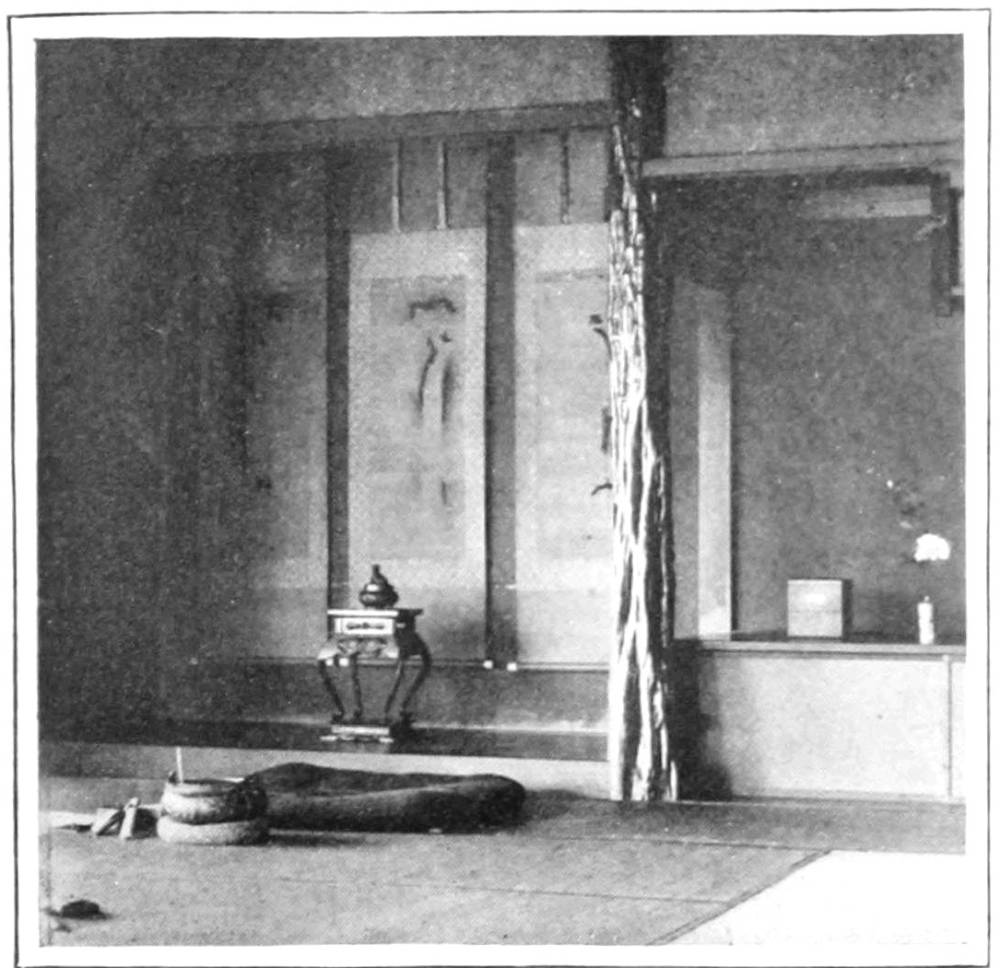
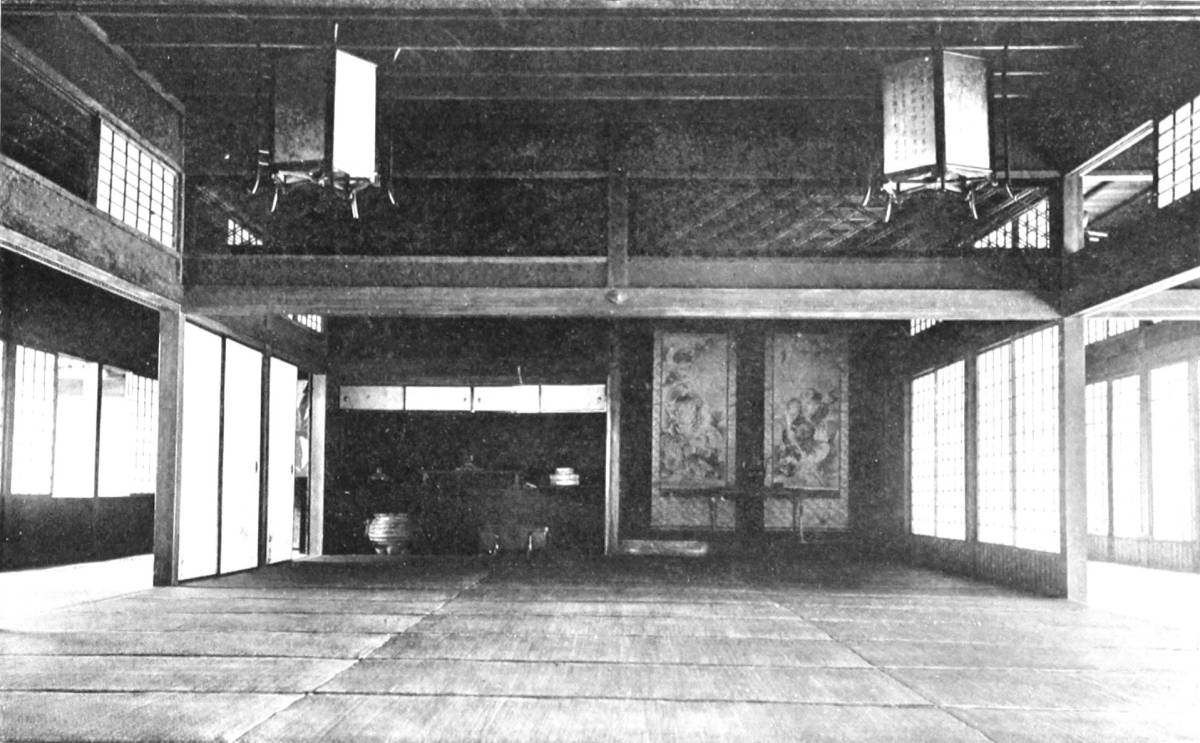
“In the solid wall of the room there is always a Toko,
as they call it, or sort of cupboard, raised about a foot
or more above the floor, and very near two feet deep.
It commonly stands in that part of the wall which is
just opposite to the door, that being reckoned the most
honorable. Just before this toko two extraordinarily
fine mats are laid, one upon the other, and both upon
the ordinary mats which cover the floor. These are for
people of the first quality to sit upon, for, upon the
arrival of travellers of less note, they are removed out
of the way. At the side of the toko is a Tokowaki, as
they call it, or side cupboard, with some few shelves
which serve the landlord or travellers, if they please,
to lay their most esteemed book upon, they holding it,
as the Mahometans do their Alcoran, too sacred to be
laid on the ground. Upon the arrival of the Dutch,
this sacred book of the landlord is put out of the way.
Above is a drawer, where they put up the inkhorn,
paper, writings, books, and other things of this kind.
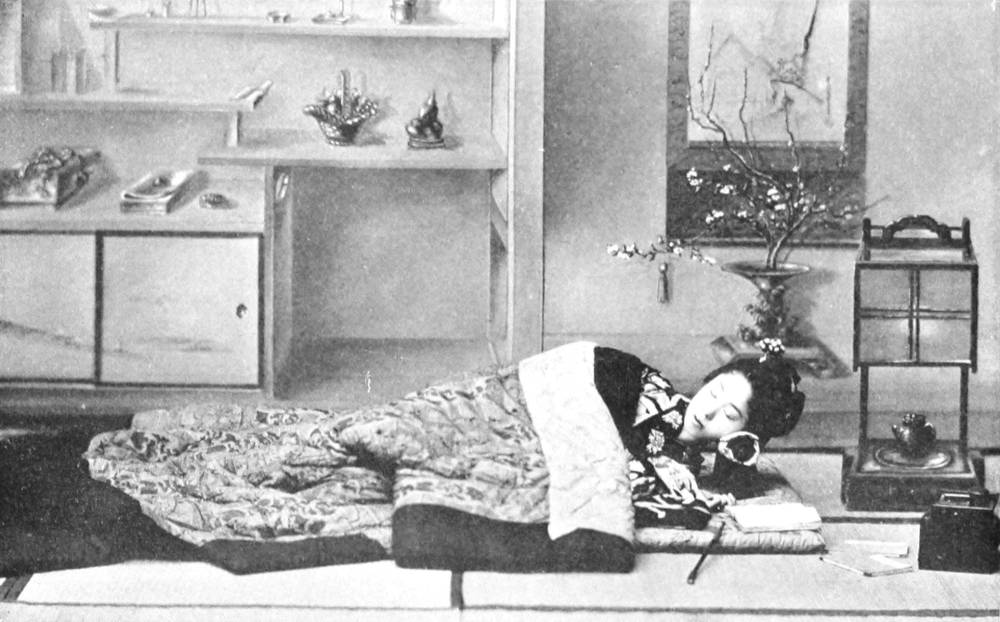
Here, also, travellers find sometimes the wooden box
which the natives use at night, instead of a pillow.
It is almost cubical, hollow, and made of six thin boards
joined together, curiously varnished, smoothed, and
very neat, about a span long, but not quite so broad,
that travellers by turning it may lay their head in that
posture which they find the most easy.[1] Besides this
wooden pillow, travellers have no other bedding to
expect from the landlord, and must carry their own
along with them or lie on the mats, covering themselves
with their clothes. In that side of the room next to the
toko is commonly a balcony, serving the person lodged
in this, the chief room, to look out upon the neighboring
garden, fields, or water, without stirring from the
carpets placed below the toko.
“Beneath the floor, which is covered with fine, well-stuffed
mats, is a square walled hole, which, in the
winter season, after having first removed the mats, they
fill with ashes and lay coals upon them to keep the room
warm. The landladies in their room put a low table
upon this fire-hole, and spread a large carpet or tablecloth
over it, for people to sit underneath, and to defend
themselves against the cold. In rooms where there are
no fire-holes they use in the winter brass or earthen
pots, very artfully made, and filled with ashes, with
two iron sticks, which serve instead of fire-tongs, much
after the same manner as they use two other small sticks
at table instead of forks.
“I come now to the above mentioned Miseratsie (?),
as they call them, being curious and amusing ornaments
of their rooms. In our journey to court I took notice
of the following: 1. A paper neatly bordered with a
rich piece of embroidery, instead of a frame, either with
the picture of a saint done apparently with a coarse
pencil, and in a few, perhaps three or four, strokes,
wherein, however, the proportions and resemblance
have been so far observed, that scarce anybody can miss
finding out whom it was designed to represent, nor help
admiring the ingenuity and skill of the master; or else
a judicious moral sentence of some noted philosopher or
poet, writ with his own hand, or the hand of some noted
writing-master, who had a mind to show his skill by a
few hasty strokes or characters, indifferent enough at
first sight, but nevertheless very ingeniously drawn, and
such as will afford sufficient matter of amusement
and speculation to a curious and attentive spectator;
and, lest anybody should call their being genuine in
question, they are commonly signed, not only by the
writing-masters themselves, but have the hands and seals
of some other witnesses put to them. They are hung
up nowhere else but in the toko, as the most honorable
place of the room, and this because the Japanese set a
great value upon them.
2. “Pictures of Chinese, as also of birds, trees,
landskips, and other things, upon white screens, done
by some eminent master, or rather scratched with a
few hasty, affected strokes, after such a manner that,
unless seen at a proper distance, they scarce appear
natural.
3. “A flower-vase filled with all sorts of curious
flowers, and green branches of trees, such as the season
affords, curiously ranged according to the rules of art,
it being as much an art in this country to arrange a
flower-vase as it is in Europe to carve, or to lay a table.[2]
Sometimes there is, instead, a perfuming-pan, of excellent
good workmanship, cast in brass or copper, resembling
a crane, lion, dragon, or other strange animal. I
took notice once that there was an earthen pot of
Cologne, such as is used to keep Spauwater in, with all
the cracks and fissures carefully mended, used in lieu
of a flower-vase, it being esteemed a very great rarity,
because of the distant place it came from, the clay it
was made of, and its uncommon shape.
4. “Some strange, uncommon pieces of wood, wherein
the colors and grain either naturally run after a curious
and unusual manner, or have been brought by art to
represent something.
5. “Some neat and beautiful network, adorning
either the balcony and windows towards the garden, or
the tops of the doors, screens, and partitions of the chief
apartments.
6. “A bunch of a tree, or a piece of a rotten root,
or of an old stump, remarkable for their monstrous
deformed shape.
“After this manner the chief and back apartments
are furnished in great inns, and houses of substantial
people. The other rooms gradually decrease in cleanliness,
neatness, and delicacy of furniture; the screens,
windows, mats, and other ornaments and household
goods, after they have for some time adorned the chief
apartments, and begin to be spotted and to grow old,
being removed into the other rooms successively, there
to be quite worn out. The chief of the other rooms is
that where they keep their plate, china ware, and other
household goods, ranged upon the floor in curious order,
according to their size, shape, and use. Most of these
are made of wood, thin, but strongly varnished, the
greatest part upon a dark red ground. They are washed
with warm water every time they have been used, and
wiped clean with a cloth; by which means they will,
though constantly used, keep clean and neat, and in
their full lustre for several years.
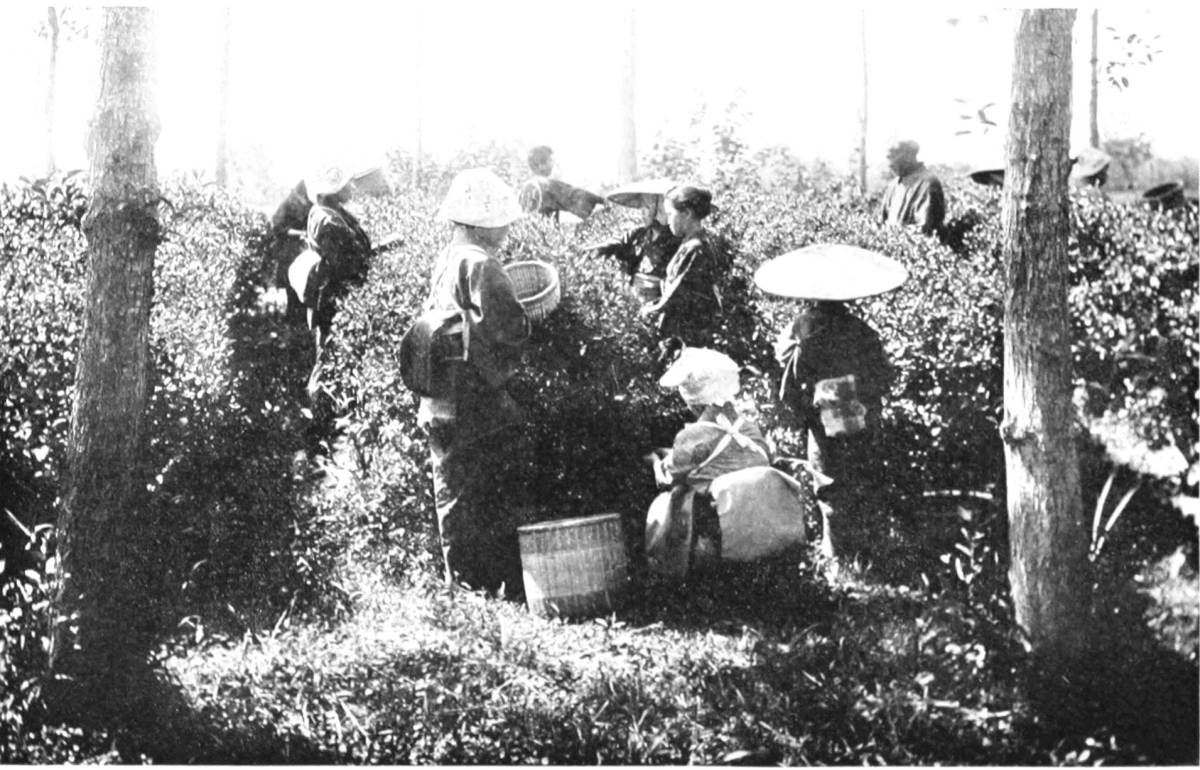
A Scene in a Tea Garden
“The small gallery or walk which jets out from the
house towards the garden leads to the house of office
and to a bathing-stove, or hot-house. The house of
office is built on one side of the back part of the house,
and hath two doors to go in. Not far off stands a basin
filled with water to wash your hands, commonly an oblong,
rough stone, the upper part curiously cut out into
the form of a basin. A new pail of bamboo hangs near
it, and is covered with a neat fir or cypress board, to
which they put a new handle every time it hath been
used, to wit, a fresh stick of the bamboo cane, it being
a very clean sort of a wood, and in a manner naturally
varnished. The bathing-place, commonly built on the
back side of the garden, contains either a hot-house to
sweat in, or a warm bath, and sometimes both. It is
made warm and got ready every evening, because the
Japanese usually bathe or sweat after their day’s journey
is over, thinking by this means to refresh themselves,
and to sweat off their weariness. As they can
undress themselves in an instant, so they are ready at a
minute’s warning to go into it; for they need but untie
their sash, and all their clothes fall down at once, leaving
them quite naked, excepting a small band which
they wear close to the body about their waist. Their
hot-house, which they go into only to sweat, is an
almost cubical trunk, or stove, raised about three feet
above the ground, and built close to the wall of the
bathing-place, on the outside,—not quite six feet high,
but about nine feet long, and of the same breadth. The
floor is laid with small planed laths or planks, some few
inches distant from each other, both for the easy passage
of the rising vapors and the convenient outlet of
the water. You go, or rather creep in, through a small
door or shutter. There are two other shutters, one on
each side, to let out the superfluous vapor. The empty
space beneath, down to the ground, is enclosed with a
wall to prevent the vapors from getting out on the
sides. Towards the yard, just beneath the hot-house,
is a furnace, part of which stands out towards the yard,
where they put in the necessary water and plants. This
part is shut with a clapboard when the fire is burning,
to make all the vapors ascend through the inner and
open part into the hot-house. There are always two
tubs, one of warm, the other of cold water, for such as
have a mind to wash themselves.
“The garden is the only place in which we Dutchmen,
being treated in all respects little better than prisoners,
have liberty to walk. It is commonly square, with a
back door, and walled in very neatly. There are few
good houses or inns without one. If there be not room
enough for a garden, they have at least an old ingrafted
plum, cherry, or apricot tree; and the older, the more
crooked and monstrous, the greater value they put upon
it. Sometimes they let the branches grow into the
rooms. In order to make it bear larger flowers and in
greater quantity, they trim it to a few, perhaps two or
three, branches. It cannot be denied but that the great
number of beautiful, incarnadine double flowers are a
curious ornament to this back part of the house, but
they have this disadvantage, that they bear no fruit.
In some small houses and inns of less note, where there
is not room enough neither for a garden nor trees, they
have at least an opening or window, to let the light
fall into the back rooms, before which, for the amusement
and diversion of travellers, is put a small tub
full of water, wherein they commonly keep alive some
gold or silver fish; and for further ornament there is
generally a flower-pot or two standing there. Sometimes
they plant dwarf trees, which will grow easily
upon pumice or other porous stones, without any earth
at all, provided the root be put into the water,
whence it will suck up sufficient nourishment. Ordinary
people often plant the same kind of trees before
their street-doors.
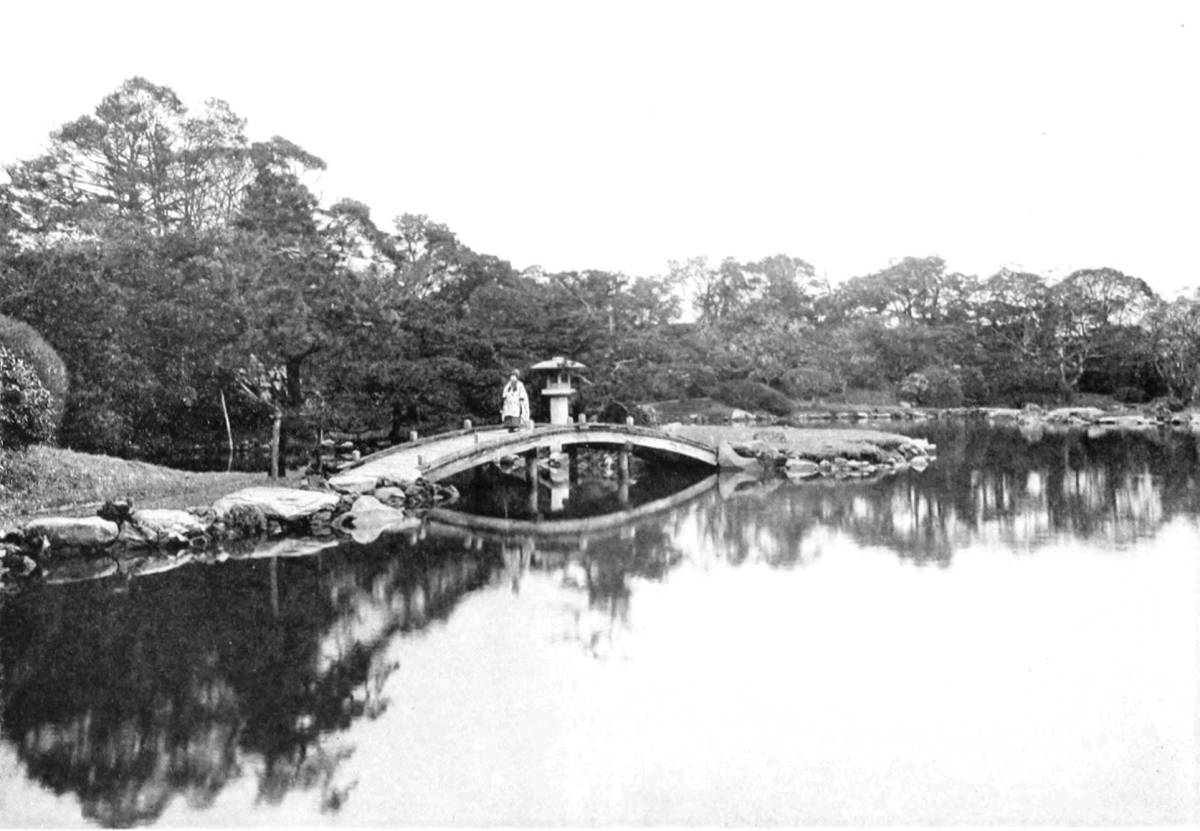
“But to return to the Tsubo, or garden. A good one
must include at least thirty feet square, and consist of
the following essential parts: 1. The ground is covered
partly with roundish stones of different colors, gathered
in rivers or upon the sea-shore, well washed and cleaned,
and those of the same kind, laid together in form of
beds, partly with gravel which is swept every day, and
kept clean and neat to admiration, the large stones
being laid in the middle as a path to walk upon without
injuring the gravel, the whole in a seeming but ingenious
confusion. 2. Some few flower-bearing shrubs
planted confusedly, though not without some certain
rules. Amidst them stands sometimes a Saguer (?), as
they call it, or scarce outlandish tree, sometimes a dwarf
tree or two. 3. A small rock or hill in a corner of the
garden, made in imitation of nature, curiously adorned
with birds and insects cast in brass, and placed between
the stones. Sometimes the model of a temple stands
upon it, built, as for the sake of the prospect they generally
are, on a remarkable eminence or the borders of a
precipice. Often a small rivulet rushes down the stones
with an agreeable noise, the whole in due proportions
and as near as possible resembling nature. 4. A small
thicket or wood on the side of the hill, for which the
gardeners choose such trees as will grow close to one
another, and plant and cut them according to their
largeness, nature, and the color of their flowers and
leaves, so as to make the whole very accurately imitate
a natural wood or forest. 5. A cistern or pond, as
mentioned above, with live fish kept in it, and surrounded
with proper plants, that is, such as love a
watery soil, and would lose their beauty and greenness
if planted in a dry ground. It is a particular profession
to lay out these gardens, and to keep them so curiously
and nicely as they ought to be.
“There are innumerable smaller inns, cook-shops,
sake, or ale-houses, pastry-cooks’ and confectioners’
shops, all along the road, even in the midst of woods and
forests, and at the tops of mountains, where a weary
foot-traveller, and the meaner sort of people, find at all
times, for a few sen, something warm to eat, or hot
tea, or sake, or somewhat else of the kind, wherewith to
refresh themselves. ’Tis true these cook-shops are but
poor, sorry houses, if compared to larger inns, being
inhabited only by poor people, who have enough to do
to get a livelihood by this trade; and yet, even in these,
there is always something or other to amuse passengers,
and to draw them in; sometimes a garden and orchard
behind the house, which is seen from the street, looking
through the passage, and which, by its beautiful flowers,
or the agreeable sight of a stream of clear water, falling
down from a neighboring natural or artificial hill, or by
some other curious ornament of this kind, tempts people
to come in and repose themselves. At other times a
large flower-pot stands in the window, filled with flowering
branches of trees, disposed in a very curious manner.
Sometimes a handsome, well-looking housemaid, or a
couple of young girls, well dressed, stand under the
door, and with great civility invite people to come in,
and to buy something. The eatables, such as cakes, or
whatever it be, are kept before the fire, in an open room,
sticking to skewers of bamboos, so that passengers, as
they go along, may take them and pursue their journey
without stopping. The landladies, cooks, and maids, as
soon as they see anybody coming at a distance, blow up
the fire, to make it look as if the victuals had been just
got ready. Some busy themselves with making the
tea, others prepare soup, others fill cups with sake or
other liquors, to present them to passengers, all the
while talking and chattering, and commending their
merchandise with a voice loud enough to be heard by
their next neighbors of the same profession.
“The eatables sold at these cook-shops, besides tea,
and sometimes sake, are manjū, a sort of round cakes,
which they learned to make from the Portuguese, as
big as common hens’ eggs, and filled within with black-bean
flour and sugar; cakes of the jelly of a root found
upon mountains, and cut into round slices, like carrots,
and roasted; snails, oysters, shell-fish, and other small
fish, roasted, boiled, or pickled; Chinese laxa, a thin sort
of pap, or paste, made of fine wheat flour, cut into small,
thin, long slices, and baked; all sorts of plants, roots,
and sprigs which the season affords, washed and boiled
in water with salt; innumerable other dishes peculiar to
this country, made of seeds, powdered roots, and vegetables,
boiled or baked, dressed in many different ways.
“The common sauce for these and other dishes is a
little soy, as they call it, mixed with sake, or the beer
of the country. Sanshō leaves are laid upon the dish
for ornament, and sometimes thin slices of fine ginger
and lemon peel. Sometimes they put powdered ginger,
sanshō, or the powder of some root growing in the
country, into the soup. They are also provided with
sweetmeats, of several different colors and sorts, which,
generally speaking, are far more agreeable to the eye
than pleasing to the taste, being but indifferently sweetened
with sugar, and so tough that one must have good
teeth to chew them. Foot travellers find it set down
in their printed road-books, which they always carry
about them, where and at what price the best victuals
of the kind are to be got.
“Tea (since most travellers drink scarce anything else
upon the road) is sold at all the inns and cook-shops,
besides many tea-booths set up for this trade alone,
in the midst of fields and woods, and at the stop of
mountains. The tea sold at all these places is but a
coarse sort, being only the largest leaves, which remain
upon the shrub after the youngest and tenderest have
been plucked off, at two different times, for the use of
people of fashion, who constantly drink it, before or
after their meals. These larger leaves are not rolled
up and curled, as the better sort of tea is, but simply
roasted in a pan, and continually stirred whilst they are
roasting, lest they should get a burnt taste. When
they are done enough, they put them by in straw baskets,
under the roof of the house, near the place where
the smoke comes out. They are not a bit nicer in preparing
it for drinking, for they commonly take a good
handful of the tea leaves, and boil them in a large iron
kettle full of water. The leaves are sometimes put into
a small bag; but, if not, they have a little basket swimming
in the kettle, which they make use of to keep the
leaves down, when they have a mind to take out some
of the clear decoction. Half a cup of this decoction is
mixed with cold water, when travellers ask for it. Tea
thus prepared smells and tastes like lye—the leaves it is
made of, besides that they are of a very bad sort, being
seldom less than a year old; and yet the Japanese esteem
it much more healthful for daily use than the young,
tender leaves, prepared after the Chinese manner, which
they say affect the head too strongly, though even these
lose a great part of their narcotic quality when boiled.”[3]
CHAPTER XXXIII
Number of People on the Road—Princely Retinues—Pilgrims to Ise—Junrei
Pilgrims—Naked Devotees—Religious Beggars—Begging
Order of Nuns—Yama-Bushi, or Mountain Priests—Buddhist
Beggars—Singular Bell-chiming—Hucksters and Peddlers—Courtesans.
“It is scarce credible,” says Kämpfer, “what numbers
of people daily travel in this country; and I can
assure the reader, from my own experience, having
passed it four times, that Tōkaidō, which is, indeed, the
most frequented of the seven great roads in Japan, is
upon some days more crowded than the public streets in
any of the most populous towns in Europe. This is
owing partly to the country’s being extremely populous,
partly to the frequent journeys which the natives undertake,
oftener than perhaps any other people.
“It is the duty of the princes and lords of the empire,
as also of the governors of the imperial cities and crown
lands, to go to court once a year to pay their homage
and respect. They are attended, going up and returning,
by their whole court, and travel with a pomp and
magnificence becoming as well their own quality and
riches as the majesty of the powerful monarch whom
they are going to see. The train of some of the most
eminent fills up the road for some days. Though we
travelled pretty fast, yet we often met the baggage and
fore-runners, consisting of the servants and inferior officers,
for two days together, dispersed in several troops,
and the prince himself followed but the third day,
attended with his numerous court, all marching in admirable
order. The retinue of one of the chief Daimiōs,
as they are called, is computed to amount to about twenty
thousand men, more or less; that of a Shōmiō to about
ten thousand; that of a governor of the imperial cities
and crown lands to from one to several hundreds, according
to his quality or revenues.[4]
“If two or more of these princes and lords should
chance to travel the same road at the same time, they
would prove a great hindrance to one another, particularly
if they should happen to meet at the same post-house
or village; to prevent which it is usual for great
princes and lords to bespeak the several post-houses by
which they are to pass, with all the inns, those of the
first quality a month, others a week or two, before their
arrival. The time of their intended arrival is also notified
in all the cities, villages, and hamlets, by putting up
small boards on high poles of bamboo, signifying in a few
characters what day of the month such or such a lord
will be at that village, to dine or sleep there.
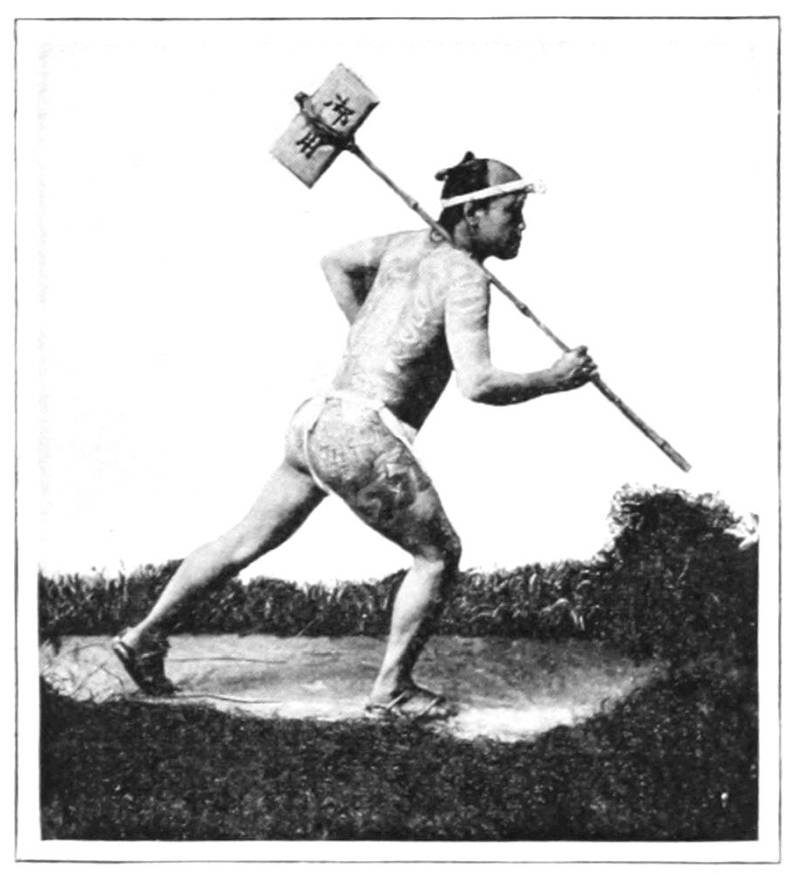
A Native Postman;
Toko-no-ma
“Numerous troops of fore-runners, harbingers, clerks,
cooks, and other inferior officers go before to provide
lodgings, victuals, and other things necessary for the
entertainment of their prince and master, and his court.
They are followed by the prince’s heavy baggage, packed
up either in small trunks, as already described, and carried
upon horses, each with a banner, bearing the coat of
arms and the name of the possessor, or else in large
chests, covered with red lackered leather, again with the
possessor’s coat of arms, and carried upon men’s shoulders,
with multitudes of inspectors to look after them.
Next come great numbers of smaller retinues, belonging
to the chief officers and noblemen attending the prince,
with pikes, scymetars, bows and arrows, umbrellas, palanquins,
led horses, and other marks of their grandeur,
suitable to their birth, quality, and office. Some of these
are carried in norimono, others in kago, and others go on
horseback.
“The prince’s own numerous train, marching in an
admirable and curious order, is divided into several
troops, each headed by a proper commanding officer, as,
1. Five, more or less, fine horses, each led by two grooms,
one on each side, two footmen walking behind. 2. Five
or six, and sometimes more, porters, richly clad, walking
one by one, and carrying lackered chests, and japanned
neat trunks and baskets, upon their shoulders, wherein
are kept the wearing apparel and other necessaries for
the daily use of the prince, each porter attended by two
footmen. 3. Ten or more fellows, walking one by one,
and carrying rich scymetars, pikes of state, fire-arms, and
other weapons, in lackered wooden cases, as, also, quivers
with bows and arrows. Sometimes, for magnificence
sake, there are more chest-bearers and led horses following
this troop. 4. Two, three, or more men, who carry
pikes of state, as the badges of the prince’s power and
authority, adorned at the upper end with bunches of
cock feathers, or other ornaments peculiar to such or such
a prince. They walk one by one, and are attended each
by two footmen. 5. A gentleman, attended by two footmen,
carrying the prince’s hat, worn as a shelter from the
heat of the sun, and which is covered with black velvet.
6. A gentleman carrying the prince’s sombrero, or umbrella,
which is covered in like manner with black velvet,
this person also attended by two footmen. 7. Some
more bearers of trunks, covered with varnished leather,
with the prince’s coat of arms upon them, each with two
men to take care of it. 8. Sixteen, more or less, of the
prince’s pages, and gentlemen of his bed-chamber, taken
out from among the first quality of his court, richly
clad, and walking two and two before his norimono.
9. The prince himself, sitting in a stately norimono,
carried by six or eight men, clad in rich liveries, with
several others walking at the norimono’s sides, to take it
up by turns; also, two or three gentlemen of the prince’s
bed-chamber, to give him what he wants and asks for,
and to assist and support him in getting in or out.
10. Two or three horses of state, the saddles covered
with black. One of these horses carries a large elbow-chair,
which is sometimes covered with black velvet.
These horses are attended each by several grooms and
footmen in liveries, and some are led by the prince’s own
pages. 11. Two pike-bearers. 12. Ten or more people,
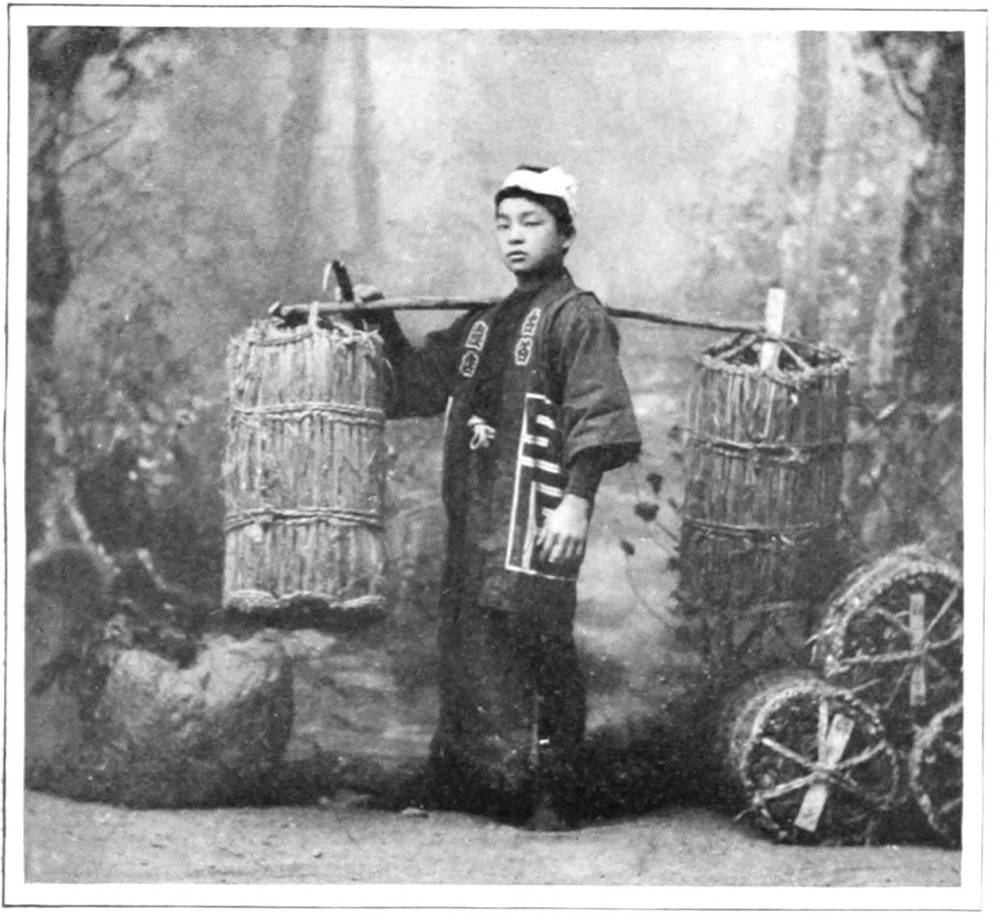
carrying each two baskets of a monstrous size, fixed to
the ends of a pole, which they lay on their shoulders in
such a manner that one basket hangs down before and
the other behind them. These baskets are more for state
than for any use. Sometimes some chest-bearers walk
among them, to increase the troop. In this order marches
the prince’s own train, which is followed by six to twelve
led horses with their leaders, grooms, and footmen, all in
liveries. The procession is closed by a multitude of the
prince’s domestics and other officers of his court, with
their own numerous trains and attendants, pike-bearers,
chest-bearers, and footmen, in liveries. Some of these
are carried in kago, and the whole troop is headed by the
prince’s high-steward, carried in a norimono. If one of
the prince’s sons accompanies his father in this journey
to court, he follows with his own train immediately after
his father’s norimono.
“It is a sight exceedingly curious and worthy of admiration,
to see all the persons who compose the numerous
train of a great prince, clad, the pike-bearers, the
norimono-men and livery-men only excepted, in black
silk, marching in an elegant order, with a decent, becoming
gravity, and keeping so profound a silence that not
the least noise is to be heard, save what must necessarily
arise from the motion and rushing of their dresses, and the
trampling of the horses and men. On the other hand,
it appears ridiculous to an European to see all the pike-bearers
and norimono-men, with their clothes tucked up
above their waists, exposing their nakedness to the spectators’
view, with only a piece of cloth about their loins.
What appears still more old and whimsical is to see the
pages, pike-bearers, umbrella and hat bearers, chest-bearers,
and all the footmen in liveries, affect, when they
pass through some remarkable town, or by the train of
another prince or lord, a strange mimic march or dance.
Every step they make, they draw up one foot quite to
their backs, stretching out the arm on the opposite side
as far as they can, and putting themselves in such a
posture as if they had a mind to swim through the air.
Meanwhile the pikes, hats, umbrellas, chests, boxes,
baskets, and whatever else they carry are danced and
tossed about in a very singular manner, answering to the
motion of their bodies. The norimono-men, who have
their sleeves tied with a string as near the shoulders as
possible, so as to leave their arms naked, carry the pole
of the norimono either upon their shoulders, or else upon
the palms of their hands, holding it above their heads.
Whilst they hold it up with one arm, they stretch out
the other, putting the hand into a horizontal posture,
whereby, and by their short, deliberate steps and stiff
knees, they affect a ridiculous fear and circumspection.
If the prince steps out of his norimono into one of the
green huts which are purposely built for him at convenient
distances on the road, or if he goes into a private
house, either to drink a dish of tea or for any other
purpose, he always leaves a koban with the landlord as a
reward for his trouble. At dinner or supper the expense
is much greater.
“All the pilgrims who go to Ise, whatever province of
the empire they come from, must travel over part of this
great road. This pilgrimage is made at all times of the
year, but particularly in the spring, at which season vast
multitudes of these pilgrims are seen upon the roads.
The Japanese of both sexes, young and old, rich and
poor, undertake this meritorious journey, generally
speaking, on foot, in order to obtain, at this holy place,
indulgences and remission of their sins. Some of these
pilgrims are so poor that they must live wholly upon
what they get by begging. On this account, and by reason
of their great number, they are exceedingly troublesome
to the princes and lords who at that time of the
year go to court, or come thence, though otherwise they
address themselves in a very civil manner, bareheaded,
and with a low, submissive voice, saying, ‘Great Lord,
be pleased to give the poor pilgrim a zeni, towards the
expense of his journey to Ise,’ or words to that effect.
Of all the Japanese, the inhabitants of Yedo and the
province Oshū are the most inclined to this pilgrimage.
Children, if apprehensive of severe punishment for their
misdemeanors, will run away from their parents and go
to Ise, thence to fetch an Oharai, or indulgence, which
upon their return is deemed a sufficient expiation of
their crimes, and a sure means to reconcile them to their
friends. Multitudes of these pilgrims are obliged to pass
whole nights lying in the open fields, exposed to all the
injuries of wind and weather, some for want of room in
inns, others out of poverty; and of these last many are
found dead upon the road, in which case their Oharai, if
they have any about them, is carefully taken up and hid
in the next tree or bush.
“Others make this pilgrimage in a comical and merry
way, drawing people’s eyes upon them as well as getting
their money. They form themselves into companies,
generally of four persons, clad in white linen, after the
fashion of the Kuge, or persons of the holy ecclesiastical
court of the Dairi. Two of them walking a grave, slow,
deliberate pace, and standing often still, carry a large
barrow, adorned and hung about with fir-branches and
cut white paper, on which they place a resemblance of a
large bell, made of light substance, or a kettle, or something
else, alluding to some old romantic history of
their gods and ancestors; whilst a third, with a commander’s
staff in his hand, adorned, out of respect
to his office, with a bunch of white paper, walks, or
rather dances, before the barrow, singing with a dull,
heavy voice, a song relating to the subject they are
about to represent. Meanwhile, the fourth goes begging
before the houses, or addresses himself to charitable
travellers, and receives and keeps the money which is
given them. Their day’s journeys are so short that
they can easily spend the whole summer upon such an
expedition.
“The Junrei, another remarkable sight travellers meet
with upon the roads, are people who go to visit in pilgrimage
the thirty-three chief Kwannon temples, which
lie dispersed throughout the empire. They commonly
travel two or three together, singing a miserable Kwannon-song
from house to house, and sometimes playing
upon a fiddle, or upon a guitar, as vagabond beggars do
in Germany. However, they do not importune travellers
for their charity. They have the names of such Kwannon
temples as they have not yet visited writ upon a
small board hanging about their necks. They are clad
in white, after a very singular fashion, peculiar only to
this sect. Some people like so well to ramble about the
country after this manner that they will apply themselves
to no other trade and profession, but choose to end their
days in this perpetual pilgrimage.
“Sometimes one meets with very odd sights; as, for
instance, people running naked along the roads in the
hardest frosts, wearing only a little straw about their
waists. These people generally undertake so extraordinary
and troublesome a journey to visit certain temples,
pursuant to religious vows, which they promised to fulfil
in case they should obtain, from the bounty of their gods,
deliverance from some fatal distemper, they themselves,
their parents or relations, labor under, or from some
other great misfortunes they were threatened with.
They live very poorly and miserably upon the road,
receive no charity, and proceed on their journey by
themselves, almost perpetually running.
“Multitudes of beggars crowd the roads in all parts
of the empire, but particularly on the so much frequented
Tōkaidō, among them many lusty young fellows, who
shave their heads. To this shaved begging tribe belongs
a certain remarkable religious order of young girls, called
Bikuni, which is as much as to say, nuns. They live
under the protection of the nunneries at Kamakura and
Miyako, to which they pay a certain sum a year, of what
they get by begging, as an acknowledgment of their
authority. They are, in my opinion, by much the handsomest
girls we saw in Japan. The daughters of poor
parents, if they be handsome and agreeable, apply for
and easily obtain this privilege of begging in the habit
of nuns, knowing that beauty is one of the most persuasive
inducements to generosity. The Yamabushi,
or begging mountain priests (of whom more hereafter),
frequently incorporate their own daughters into this
religious order, and take their wives from among these
Bikuni. Some of them have been bred up as courtesans,
and having served their time, buy the privilege of
entering into this religious order, therein to spend the
remainder of their youth and beauty. They live two or
three together, and make an excursion every day some
few miles from their dwelling-house. They particularly
watch people of fashion, who travel in norimono, or in
kago, or on horseback. As soon as they perceive somebody
coming, they draw near and address themselves,
though not all together, but singly, every one accosting
a gentleman by herself singing a rural song; and if he
proves very liberal and charitable, she will keep him
company and divert him for some hours. As, on the
one hand, very little religious blood seems to circulate
in their veins, so, on the other, it doth not appear that
they labor under any considerable degree of poverty.
It is true, indeed, they conform themselves to the rules
of their order, by shaving their heads, but they take care
to cover and to wrap them up in caps or hoods made of
black silk. They go decently and neatly dressed, after
the fashion of ordinary people. They wear also a large
hat to cover their faces, which are often painted, and to
shelter themselves from the heat of the sun. They
commonly have a shepherd’s rod or hook in their hands.
Their voice, gestures, and apparent behavior, are neither
too bold and daring, nor too much dejected and affected,
but free, comely, and seemingly modest. However, not
to extol their modesty beyond what it deserves, it must
be observed, that they make nothing of laying their
bosoms quite bare to the view of charitable travellers,
all the while they keep them company, under pretence of
its being customary in the country; and, for aught I
know, they may be, though never so religiously shaved,
full as impudent and lascivious as any public courtesan.
“Another religious begging order is that of Yamabushi,
as they are commonly called; that is, the mountain priests,
or rather Yamabu, mountain soldiers, because at all
times they go armed with swords and scymetars. They
do not shave their heads, but follow the rules of the first
founder of this order, who mortified his body by climbing
up steep, high mountains; at least, they conform themselves
thereunto in their dress, apparent behavior, and
some outward ceremonies; for they are fallen short of
his rigorous way of life. They have a head, or general,
of their order, residing at Miyako, to whom they are
obliged to bring a certain sum of money every year, and
who has the distribution of dignities and of titles, whereby
they are known among themselves. They commonly live
in the neighborhood of some famous Kami temple, and
accost travellers in the name of that Kami which is worshipped
there, making a short discourse of his holiness
and miracles, with a loud, coarse voice. Meanwhile, to
make the noise still louder, they rattle their long staffs,
loaded at the upper end with iron rings, to take up the
charity money which is given them; and last of all, they
blow a trumpet made of a large shell. They carry their
children along with them upon the same begging errand,
clad like their fathers, but with their heads shaved.
Those little bastards are exceedingly troublesome and
importunate with travellers, and commonly take care to
light on them, as they are going up some hill or mountain,
where, because of the difficult ascent, they cannot
well escape, nor indeed otherwise get rid of them without
giving them something. In some places they and
their fathers accost travellers in company with a troop of
Bikuni, and, with their rattling, singing, trumpeting,
chattering, and crying, make such a frightful noise as
would make one almost mad or deaf. These mountain
priests are frequently applied to by superstitious people
for conjuring, fortune-telling, foretelling future events,
recovering lost goods, and the like purposes. They profess
themselves to be of the Kami religion, as established
of old, and yet they are never suffered to attend, or to
take care of, any of the Kami temples.
“There are many more beggars travellers meet with
along the roads. Some of these are old, and, in all appearance,
honest men, who, the better to prevail upon
people to part with their charity, are shaved and clad
after the fashion of the Butsudō [Buddhist] priests.
Sometimes there are two of them standing together, each
with a small, oblong book before him. This book contains
part of their Hōkekyō, or Bible, printed in the significant
or learned language.[5] However, I would not
have the reader think, as if they themselves had any
understanding in that language, or know how to read
the book placed before them. They only learn some
part of it by heart, and speak it aloud, looking towards
the book, as if they did actually read in it, and expecting
something from their hearers, as a reward for their
trouble.
“Others are found sitting near some river, or running
water, making a Segaki,—a certain ceremony for the
relief of departed souls. This Segaki is made after the
following manner: They take a green branch of the
Hana Shikimi tree, and, murmuring certain words with
a low voice, wash and scour it with some shavings of
wood, whereon they had written the names of some deceased
persons. This they believe to contribute greatly
to relieve and refresh the departed souls confined in
purgatory; and, for aught I know, it may answer that
purpose full as well as any number of masses, as they are
celebrated to the same end in Roman Catholic countries.
Any person that hath a mind to purchase the benefit of
this washing, for himself or his relations and friends,
throws a zeni upon the mat, which is spread out near the
beggar, who does not so much as offer to return him any
manner of thanks for it, thinking his art and devotion
deserve still better; besides that, it is not customary
amongst beggars of note to thank people for their charity.
Any one who hath learned the proper ceremonies necessary
to make the Segaki is at liberty to do it.
“Others of this tribe, who make up far the greater
part, sit upon the road all day long upon a small, coarse
mat. They have a flat bell, like a broad mortar, lying
before them, and do nothing else but repeat, with a
lamentable singing tune, the word Namida, which is
contracted from Namu Amida Butsu, a short form of
prayer wherewith they address Amida as the patron
and advocate of departed souls. Meanwhile they beat
almost continually with a small wooden hammer upon
the aforesaid bell, and this, they say, in order to be the
sooner heard by Amida, and, I am apt to think, not
without an intent, too, to be the better taken notice of
by passengers.
“Another sort we met with as we went along were
differently clad, some in an ecclesiastical, others in a
secular habit. These stood in the fields, next to the
road, and commonly had a sort of altar standing before
them, upon which they placed the idol of their Briaréus,
or Kwannon, as they call him, carved in wood and gilt;
or the pictures of some other idols, scurvily done, as, for
instance, the picture of Amida, the supreme judge of
departed souls; of Emma, or the head-keeper of the
prison, whereunto the condemned souls are confined; of
Jizō, or the supreme commander in the purgatory of
children; and some others, wherewith, and by some representations
of the flames and torments prepared for the
wicked in a future world, they endeavor to stir up in
passengers compassion and charity.
“Other beggars, and these, to all appearance, honest
enough, are met sitting along the road, clad much
after the same manner with the Kwannon beggars,
with a Jizō staff in their hand. These have made
vow not to speak during a certain time, and express
their want and desire only by a sad, dejected, woeful
countenance.[6]
“Not to mention numberless other common beggars,
some sick, some stout and lusty enough, who get people’s
charity by praying, singing, playing upon fiddles, guitars,
and other musical instruments, or performing some juggler’s
tricks, I will close the account of this vermin with
an odd, remarkable sort of a beggar’s music, or rather
chime of bells, we sometimes, but rarely, met with in our
journey to court. A young boy, with a sort of a wooden
machine pendent from his neck, and a rope, with eight
strings about it, from which hang down eight bells, of
different sounds, turns round in a circle, with a swiftness
scarce credible, in such a manner that both the
machine, which rests upon his shoulders, and the bells,
turn round with him horizontally, the boy, in the meanwhile,
with great dexterity and quickness, beating them
with two hammers, makes a strange, odd sort of a melody.
To increase the noise, two people sitting near him
beat, one upon a large, the other upon a smaller drum.
Those who are pleased with their performance throw
them some zeni as they pass.[7]
“The crowd and throng upon the roads is not a little
increased by numberless small retail merchants, and
children of country people, who run about from morning
to night, following travellers, and offering them for sale
their poor, for the most part eatable, merchandise,—such
as several cakes and sweetmeats, wherein the quantity
of sugar is so inconsiderable that it is scarce perceptible,
other cakes, of different sorts, made of flour,
roots boiled in water and salt, road-books, straw shoes
for horses and men, ropes, strings, toothpickers, and a
multitude of other trifles, made of wood, straw, reed, and
bamboos.
“Nor must I forget to take notice of the numberless
wenches, the great and small inns, and the tea-booths
and cook-shops in villages and hamlets are furnished
withal. About noon, when they have done dressing and
painting themselves, they make their appearance, standing
under the door of the house, or sitting upon the
small gallery around it, whence, with a smiling countenance
and good words, they invite the travelling troops
that pass by to call in at their inn, preferably to others.
In some places, where there are several inns standing
near one another, they make, with their chattering and
rattling, no inconsiderable noise, and prove not a little
troublesome.
“I cannot forbear mentioning in this place a small
mistake of Mr. Caron, in his account of Japan, where he
shows so tender a regard for the honor of the Japanese
sex (perhaps out of respect to his lady, who was a Japan
woman) as to assert that, except in the privileged houses
devoted to it, this trade is not elsewhere carried on. It
is unquestionably true that there is hardly a public inn
upon the great island Nippon, but what is provided
with courtesans, and if too many customers resort to
one place, the neighboring inn-keepers will lend their
wenches, on condition that what money they get shall
be faithfully paid them. Nor is it a new custom come
up but lately, or since Mr. Caron’s time. On the contrary,
it is of very old date, and took its rise, as the
Japanese say, many hundred years ago, in the times of
that brave general and first secular monarch, Yoritomo,
who, apprehensive lest his soldiers, weary of his long
and tedious expeditions, and desirous to return home
to their wives and children, should desert his army,
thought it much more advisable to indulge them in this
particular.”
CHAPTER XXXIV
Departure from Nagasaki—Train of the Dutch—The Day’s Journey—Treatment
of the Dutch—Respect shown them in the Island of Shimo—Care
with which they are watched—Inns at which they lodge—Their
Reception and Treatment there—Politeness of the Japanese—Lucky
and Unlucky Days—Seimei, the Astrologer.
“All the princes, lords, and vassals of the Japanese
empire being obliged,” says Kämpfer, “to
make their appearance at court once a year,
it hath been determined by the emperor what time and
what day they are to set out on their journey. The
same is observed with regard to the Dutch, and the fifteenth
or sixteenth day of the first Japanese month,
which commonly falls in with the middle of our February,
hath been fixed for our constant departure.
Towards that time we get everything ready to set out,
having first sent by sea, as already mentioned, to the
city of Shimonoseki the presents we are to make, sorted
and carefully packed, together with the other heavy
baggage, and the victuals and kitchen furniture for our
future travels. Three or four weeks after, and a few
days before our departure, our president, attended with
his usual train, goes to visit the two governors of Nagasaki,
at their palaces, to take his leave of them, and
to recommend the Dutch who remain in our factory to
their favor and protection. The next day, all the goods
and other things which must be carried along with us
are marked—every bale or trunk—with a small board,
whereupon is writ the possessor’s name, and the contents.
The day of our departure, all the officers of our island,
and all persons who are any ways concerned with
our affairs, particularly the future companions of our
voyage, come over to Deshima early in the morning.
They are followed soon after by both governors, attended
with their whole numerous court, or else by their deputies,
who come to wish us a good journey. The governors—or
their deputies—having been entertained as
usual upon this occasion, and taken their leave, are by
us accompanied out of our island, which is done commonly
about nine in the morning, at which time, also,
we set out on our journey. The Bugiō, or commander-in-chief,
of our train, and the Dutch president, enter
their norimono. The chief interpreter, if he be old, is
carried in an ordinary kago; others mount on horseback,
and the servants go a-foot. All the Japanese officers
of our island, and several friends and acquaintances
of our Japanese companions, keep us company out of
the town so far as the next inn.
“Our train is not the same in the three several parts
of our journey. Over the island Kiūshiū it may amount,
with all the servants and footmen, as also the gentlemen
whom the lords of the several provinces we pass
through send to compliment us, and to keep us company
during our stay in their dominions, to about an hundred
persons. In our voyage by sea it is not much less, all
the sailors and watermen taken in. In the last part,
over the great island Nippon, from Ōsaka to Yedo, it is
considerably greater, and consists of no less than an
hundred and fifty people, and this, by reason of the presents
and other goods which came from Nagasaki, as far
as Ōsaka by sea, but must now be taken out and carried
by land to Yedo, by horses and men.
In a Japanese Garden
“All our heavy baggage is commonly sent away some
hours before we set out ourselves, lest it should be a hindrance
to us, as, also, to give timely notice to our landlords
of our arrival. We set out early in the morning,
and, save only one hour for dinner, travel till evening, and
sometimes till late at night, making from ten to thirteen
Japanese leagues a day. In our voyage by sea we put
into some harbor, and come to an anchor every night,
advancing forty Japanese water-leagues a day at farthest.
“We are better treated, and more honorably received,
in our journey over Kiūshiū than upon the great island
Nippon, though everywhere we have much more civility
shown us by the inhabitants of the cities and districts
through which we pass, than by our Nagasakian companions
and our own servants, who eat our bread and
travel at our expense. In our journey across the island
Kiūshiū we receive nearly the same honors and civility
from the lords of the several provinces we pass through
as they show to travelling princes and their retinues.
The roads are swept and cleaned before us, and in cities
and villages they are watered to lay the dust. The common
people, laborers, and idle spectators, who are so very
troublesome to travellers upon the great island Nippon,
are kept out of the way, and the inhabitants of the
houses on either side of the roads and streets see us go
by, either sitting in the back part of their houses, or
kneeling in the fore part, behind a screen, with great
respect and in a profound silence. All the princes and
lords whose dominions we are to pass through send one
of their noblemen to compliment us, as soon as we enter
upon their territories; but, as he is not suffered to
address us in person, he makes his compliment in his
master’s name to the Bugiō, or commander-in-chief of
our train, and to the chief interpreter, offering, at the
same time, what houses and men we want for us and our
baggage. He likewise orders four footmen to walk by
every Dutchman’s side, and two gentlemen of some note
at his court, who are clad in black silk, with staffs in
their hands, to precede the whole train. After this
manner they lead us through their master’s territories,
and, when we come to the limits thereof, the Japanese
companions of our voyage are treated with sake and
sakana, and so they take their leave. For our passage
over the bays of Ōmura and Shimabara the lords of these
two places lend us their own pleasure-barges and their
own watermen besides that they furnish us with abundance
of provisions, without expecting even so much as a
small present in return for their civil and courteous
behavior; and yet our thievish interpreters never miss to
lay hold of this advantage, putting this article upon our
accounts as if we had actually been at the expense;
and they commonly put the money into their own
pockets. In our whole journey from Nagasaki to
Kokura, everybody we meet with shows us and our train
that deference and respect which is due only to the princes
and lords of the country. Private travellers, whether
they travel on foot or on horseback, must retire out of
the way,—those who hesitate about it being compelled
to it by the officers,—and, bareheaded, humbly bowing,
wait in the next field till our whole retinue is gone by.
I took notice of some country people, who do not only
retire out of the way, but turn us their back, as not
worthy to behold us,—the greatest mark of civility a
Japanese can possibly show. None, or but few, of these
public marks of honor and respect are shown us in our
journey over the great island Nippon.”
“As to what concerns our accommodation on the road,
the same is—with regard to the carriage of us and of
our baggage, the number of horses and men provided
for that purpose, the inns, lodgings, eating, and attendance—as
good for our money as we could possibly
desire. But, on the other hand, if we consider the narrow
compass allowed us, we have too much reason to
complain; for we are treated in a manner like prisoners,
deprived of all liberty, excepting that of looking about
the country from our horses, or out of our kago, which,
indeed, it is impossible for them to deny us. As soon as
a Dutchman alights from his horse (which is taken very
ill, unless urgent necessity obliges him), he that rides
before our train, and the whole train after him, must
stop suddenly, and the Dōshin and two other attendants
must come down from their horses to take immediate
care of him. Nay, they watch us to that degree that they
will not leave us alone, not even for the most necessary
occasions. The Bugiō, or commander-in-chief of our
train, studies day and night, not only the contents of his
instructions, but the journals of two or three preceding
journeys, in order exactly, and step by step, to follow
the actions and behavior of his predecessors. ’Tis
looked upon as the most convincing proof of his faithfulness
and good conduct still to exceed them. Nay,
some of these blockheads are so capricious that no accident
whatever can oblige them to go to any other inns
but those we had been at the year before, even though
we should, upon this account, be forced in the worst
weather, with the greatest inconveniency, and at the
very peril of our lives, to travel till late at night.
“We go to the same inns which the princes and lords
of the country resort to, that is, to the very best of every
place. The apartments are at that time hung with the
colors and arms of the Dutch East India Company, and
this in order to notify to the neighborhood who they be
that lodge there, as is customary in the country. We
always go to the same inns, with this difference only,
that, upon our return from Yedo, we lie at the place we
dined at in going up, by this means equally to divide
the trouble, which is much greater at night than at dinner.
We always take up our lodging in the back apartment
of the house, which is by much the pleasantest;
also otherwise, as has been mentioned, reckoned the
chief. The landlord observes the same customs upon
our arrival as upon the arrival of the princes and lords
of the empire. He comes out of the town or village into
the fields to meet us, clad in a kamishimo, or garment of
ceremony, and wearing a short scymetar stuck in his girdle,
making his compliments with a low bow, which
before the norimono of the Bugiō and our Resident is so
low, that he touches the ground with his hands and
almost with his forehead. This done, he hastens back
to his house, and receives us at the entry a second time,
in the same manner, and with the same compliments.
“As soon as we are come to the inn, our guardians
and keepers carry us forthwith across the house to our
apartments. Nor, indeed, are we so much displeased at
this, since the number of spectators and the petulant
scoffing of the children, but, above all, the exhaustion
of a fatiguing journey, make us desirous to take our
rest, the sooner the better. We are, as it were, confined
to our apartments, having no other liberty but to walk
out into the small garden behind the house. All other
avenues, all the doors, windows, and holes which open
any prospect towards the streets or country, are carefully
shut and nailed up, in order, as they would fain persuade
us, to defend us and our goods from thieves, but
in fact to watch and guard us as thieves and deserters.
It must be owned, however, that this superabundant care
and watchfulness is considerably lessened upon our
return, when we have found means to insinuate ourselves
into their favor, and by presents and otherwise to
procure their connivance.
“The Bugiō takes possession of the best apartment
after ours. The several rooms next to our own are
taken up by the Dōshin, interpreters, and other chief
officers of our retinue, in order to be always near at hand
to watch our conduct, and to care that none of our landlord’s
domestics nor any other person presume to come
into our apartment, unless it be by their leave and in
their presence; and in their absence they commit this
care to some of their own or our servants; though all the
companions of our voyage in general are strictly charged
to have a watchful eye over us. Those who exceed
their fellow-servants in vigilance are, by way of encouragement,
permitted to make the journey again the next
year. Otherwise they stand excluded for two years.
“As soon as we have taken possession of our apartment,
in comes the landlord with some of his chief
male domestics, each with a dish of tea in his hand,
which they present to every one of us with a low bow,
according to his rank and dignity, and repeating, with
a submissive, deep-fetched voice, the words, ah! ah!
ah! They are all clad in their garments of ceremony,
which they wear only upon great occasions, and have
each a short scymetar stuck in his girdle, which they
never quit, so long as the company stays in the house.
This done, the necessary apparatus for smoking is
brought in, consisting of a board of wood or brass,
though not always of the same structure, upon which
are placed a small fire-pan with coals, a pot to spit in,
a small box filled with tobacco cut small, and some long
pipes with small brass heads; as also another japanned
board, or dish, with Sakana,[8] that is, something to eat,
as, for instance, several sorts of fruits, figs, nuts, several
sorts of cakes, chiefly manjū, and rice cakes hot,
several sorts of roots boiled in water, sweetmeats, and
other trumperies of this kind. All these things are
brought first into the Bugiō’s room, then into ours. As
to other necessaries travellers may have occasion for,
they are generally, in the case of native travellers,
served by the house-maids. These wenches also wait at
table, taking that opportunity to engage their guests to
further favors. But it is quite otherwise with us; for
even the landlords themselves and their male domestics,
after they have presented us with a dish of tea, as
above said, are not suffered upon any account whatever
to enter our apartments; but whatever we want it is the
sole business of our own servants to provide us with.
“There are no other spitting-pots brought into the
room but that which comes along with the tobacco. If
there be occasion for more they make use of small pieces
of bamboo, a hand broad and high, sawed from between
the joints and hollowed. The candles brought in at
night are hollow in the middle; the wick, which is of
paper, being wound about a wooden stick before the
tallow is laid on. For this reason, also, the candlesticks
have a punch or bodkin at top, which the candles
are fixed upon. They burn very quick, and make a
great deal of smoke and smell, the oil or tallow being
made of the berries of bay-trees, camphor-trees, and
some others of the kind. It is somewhat odd and
ridiculous to see the whirling motion of the ascending
smoke followed by the flame, when the candle is taken
off the punch at the top of the candlestick. Instead of
lamps, they make use of small, flat, earthen vessels,
filled with train-oil made of the fat of whales, or of oil
made of cotton-seed. The wick is made of rush, and
the abovesaid earthen vessel stands in another filled
with water, or in a square lantern, that, in case the oil
should by chance take fire, no damage may thereupon
come to the house.
“The Japanese, in their journeys, sit down to table
thrice a day, besides what they eat between meals.
They begin early in the morning and before break of
day, at least before they set out, with a good, substantial
breakfast; then follows dinner at noon, and the day
is concluded with a plentiful supper at night. It being
forbid to play at cards, they sit after meals, drinking
and singing some songs, to make one another merry, or
else they propose some riddles round, or play at some
other game, and he that cannot explain the riddle, or
loses the game, is obliged to drink a glass. It is again
quite otherwise with us, for we sit at table and eat our
victuals very quietly. Our cloth is laid, and the dishes
dressed after the European manner, but by Japanese
cooks. We are presented, besides, by the landlord,
each with a Japanese dish. We drink European wines
and the rice-beer of the country hot. All our diversion
is confined, in the daytime, to the small garden which
is behind the house; at night to the bath, in case we
please to make use of it. No other pleasure is allowed
us, no manner of conversation with the domestics, male
or female, excepting what, through the connivance of
our inspectors, some of us find means to procure at
night in private and in their own rooms.
“When everything is ready for us to set out again,
the landlord is called, and our president, in presence of
the two interpreters, pays him the reckoning in gold,
laid upon a small salver. He draws near, in a creeping
posture, kneeling, holding his hands down to the floor,
and when he takes the salver which the money is laid
upon, he bows down his forehead almost quite to the
ground, in token of submission and gratitude, uttering
with a deep voice the words ah! ah! ah! whereby in
this country inferiors show their deference and respect
to their superiors. He then prepares to make the same
compliment to the other Dutchmen; but our interpreters
generally excuse him this trouble, and make him return
in the same crawling posture. Every landlord hath two
koban paid him for dinner, and three for supper and
lodgings at night. For this money he is to provide
victuals enough for our whole train, the horses, the
men that look after them, and porters only excepted.
The same sum is paid to the landlords in the cities,
where we stay some days, as at Ōsaka, Miyako, and
Yedo, namely, five koban a day, without any further
recompense. The reason of our being kept so cheap, as
to victuals and lodging, is because this sum was agreed
on with our landlords a long while ago, when our train
was not yet so bulky as it now is.[9] It is a custom in
this country, which we likewise observe, that guests,
before they quit the inn, order their servants to sweep
the room they lodged in, not to leave any dirt, or ungrateful
dust, behind them.
A Daimyō’s Procession
“From this reasonable behavior of the landlords, the
reader may judge of the civility of the whole nation in
general, always excepting our own officers and servants.
I must own that, in the visits we made or received in
our journey, we found the same to be greater than could
be expected from the most civilized nations. The
behavior of the Japanese, from the meanest countryman
up to the greatest prince or lord, is such that the whole
empire might be called a school of civility and good
manners. They have so much sense and innate curiosity,
that, if they were not absolutely denied a free and
open conversation and correspondence with foreigners,
they would receive them with the utmost kindness and
pleasure. In some towns and villages only we took
notice that the young boys, who are childish all over
the world, would run after us, calling us names, and
cracking some malicious jests or other, levelled at the
Chinese, whom they take us to be. One of the most
common, and not much different from a like sort of a
compliment which is commonly made to Jews in Germany,
is Tōjin baibai? which, in broken Chinese, signifies,
Chinese, have ye nothing to truck?
“It may not be amiss to observe, that it is not an
indifferent matter to travellers in this country what day
they set out on their journey; for they must choose for
their departure a fortunate day, for which purpose they
make use of a particular table, printed in all their road-books,
which they say hath been observed to hold true
by a continued experience of many ages, and wherein
are set down all the unfortunate days of every month.
However, the most sensible of the Japanese have but
little regard for this superstitious table, which is more
credited by the common people, the mountain priests,
and monks.
“To give the more authority to this table, they say
that it was invented by the astrologer Seimei, a man of
great quality and very eminent in his art. King Abeno
Tashima was his father, and a fox his mother, to whom
Abeno Tashima was married upon the following occasion.
He once happened with a servant of his to be in
the temple of Inari, who is the god and protector of
the foxes. Meanwhile some courtiers were hunting the
fox without doors, in order to make use of the lungs for
the preparation of a certain medicine. It happened
upon this that a young fox, pursued by the hunters,
fled into the temple, which stood open, and took shelter
in the very bosom of Tashima. The king, unwilling to
deliver up the poor creature to the unmerciful hunters,
was forced to defend himself and his fox, and to repel
force by force, wherein he behaved himself with so
much bravery and success that, having defeated the
hunters, he set the fox at liberty. The hunters,
ashamed and highly offended at the courageous behavior
of the king, seized, in the height of their resentment,
an opportunity which offered to kill his royal father.
Tashima mustered up all his courage and prudence to
revenge his father’s death, and with so much success
that he killed the traitors with his own hands. The
fox, to return his gratitude, appeared to him, after the
victory which he obtained over the murderers of his
father, in the shape of a lady of incomparable beauty,
and so fired his breast with love that he took her to his
wife. It was by her he had this son, who was endowed
with divine wisdom, and the precious gift of prognosticating
and foretelling things to come. Nor did he
know that his wife had been that very fox whose life he
saved with so much courage in the temple of Inari, till,
soon after, her tail and other parts beginning to grow,
she resumed by degrees her former shape.[10]
“Seimei not only calculated the above table by the
knowledge he had acquired of the motion and influence
of the stars, but, as he was at the same time a perfect
master of the cabalistic sciences, he found out certain
words which he brought together into an Uta, or verse,
the repetition of which is believed to have the infallible
virtue of keeping off all those misfortunes which, upon
the days determined in the table to be unfortunate,
would otherwise befall travellers,—this verse being for
the use and satisfaction of poor ordinary servants, who
have not leisure to accommodate themselves to the
table, but must go when and wherever they are sent by
their masters.”
CHAPTER XXXV
From Nagasaki to Kokura—Shimonoseki—Water Journey to Ōsaka—Description
of that City—Its Castle—Interview with the Governors—From
Ōsaka to Miyako—Jodo and its Castle—Fushimi—Entrance
into Miyako—Visit to the Chief Justice and the Governors—Description
of Miyako—Palace of the Dairi—Castle—Manufactures
and Trade—Authority of the Chief Justice—Police—Crimes.
At coming out of Nagasaki, on his first journey to
court (Tuesday, February 13, 1691), Kämpfer
noticed the idol Jizō, the god of the roads and
protector of travellers, hewn out of the rock in nine different
places. At the next village stood another of the
same sort, about three feet in height, on a stone pillar
twice as high, and adorned with flowers. Two other
smaller stone pillars, hollow at top, stood before the idol,
upon which were placed lamps, for travellers to light in
its honor; and at some distance stood a basin of water,
in which to wash the hands before lighting the lamps.
The first twelve miles’ travelling, which was very
steep and mountainous, brought the company to the
shores of the bay of Ōmura, which they found too
shallow for vessels of size; but by crossing it in boats,
furnished by the prince of Ōmura, each rowed by fourteen
watermen, they saved a distance of ten miles or
more. The distance across was thirty miles. The town
of Ōmura was seen on the right at the head of the bay,
and beyond it a smoking mountain. The shells of this
bay were reported to yield pearls.[11]
The second day (Wednesday, February 14) they
passed an old camphor-tree, estimated to be thirty-six
feet in circumference, and hollow within.[12] At Shiwota,
where they dined, a seaport on the gulf of Shimabara,
was a manufactory of large earthen pots, used by vessels
as water-cakes, and also of china ware, made of a
whitish, fat clay, abundant in that neighborhood. The
same day they visited a hot spring, much frequented
for its medicinal effects, and provided with accommodations
for bathing. There are several others in the
neighborhood.[13]
Saga, the capital of the province of Hizen, through
which they passed the next day (Thursday, February
15), without stopping, was found to be a considerable
place, situated not far from the western border of the
province, near the head of the bay of Shimabara. “The
city,” says Kämpfer, “is very large, but extends more
in length than in breadth. It is exceedingly populous.
Both going in and coming out we found strong guards
at the gates. It is enclosed with walls, but more for
state than defence. The prince or petty king of this
province resides here in a large castle, which commands
the city. The streets are large, with streams of water
flowing through them. The houses are but sorry and
low, and in the chief streets fitted up for manufacturers
and shopkeepers. The inhabitants are very short, but
well shaped, particularly the women, who are handsomer,
I think, than in any other Asiatic country, but
so much painted that one would be apt to take them for
wax figures rather than living creatures. Many were
noticed who seemed little more than girls, yet evidently
the mothers of several children. These women of Hizen
have the reputation of being the handsomest in Japan,
next to those of Miyako. This province, though less
wealthy than that of Satsuma, is reputed to be about
the most fertile in all Japan, being particularly famous
for its rice, of which it produces ten different sorts or
qualities, one of which is reserved for the special use of
the emperor. The rice-fields were observed to be bordered
with tea-shrubs about six feet high; but as they
were stripped of their leaves, they made but a naked
and sorry appearance.”
In the afternoon our travellers passed into the province
of Chikugo, and having traversed a small but very
pleasant wood of firs,—a rare sight in the flat parts of
the country,—they saw at a distance the castle of
Kurume, the residence of the prince of the province.[14]
Friday, February 16, mountains were encountered,
which they passed in kago, as the road was too steep
for horseback-riding. This country, forming a part of
the province of Chikuzen, struck Kämpfer as not
unlike some mountainous and woody parts of Germany,
but no cattle were seen grazing, except a few cows and
horses for carriage and ploughing. The people were
less handsome than those of Hizen, but extremely civil.
The next day (February 17), after passing, in the
afternoon, some coal-mines, whence the neighborhood
was supplied with fuel, they reached Kokura, capital
of the province of Buzen, once a large town, but now
much decayed. It had a large castle of freestone, with
a few cannon and a tower of six stories, the usual sign
of princely residences. A river passed through the
town, crossed by a bridge near two hundred yards long,
but it was too shallow to admit vessels of any size. At
least one hundred small boats were drawn up on the
banks. On leaving their inn where they had stopped
to dine, the Dutch found the square in front of it, as
well as the bridge, crowded with upwards of a thousand
spectators, chiefly ordinary people, who had collected
to see them, and who knelt in profound silence, without
motion or noise. The distance of this place from
Nagasaki was reckoned at fifty-five Japanese miles, and
had consumed five days.
Image of Jizō
Embarking in boats, the Dutch travellers crossed the
strait which separates Shimo from Nippon, narrower
here than anywhere else, less than three miles wide,
though the town of Shimonoseki, which gives its name
to the strait, being situated at the bottom of an inlet, is
near twelve miles from Kokura. This town, in the
province of Nagato, consisted of four or five hundred
houses, built chiefly on both sides of one long street,
with a few smaller ones terminating in it. It is full
of shops for selling provisions and stores to the ships,
which daily put in for shelter or supplies, and of which
not less than two hundred were seen at anchor. It
also had a temple to Amida, built to appease the ghost
of a young prince of the family of Heishi, so celebrated
in the legendary annals of the Japanese, whose nurse,
with the boy in her arms, is said to have thrown herself
headlong into the strait to avoid capture by his father’s
enemies, at the time of the ruin of that family.
The voyage from Shimonoseki to Ōsaka was reckoned
at one hundred and thirty-four Japanese water-miles,
and was made in six days, the vessel coming to anchor
every night in good harbors, with which the coast
abounds. This voyage lay first through the strait
between Shimo and Nippon, and then through the
strait or sea between Nippon and Shikoku, which was
full of islands, some cultivated, others mere rocks. On
the main land on either side snow-covered mountains
were visible. The barge could proceed no further than
Hyōgo, a city of the province Settsu, nearly as large as
Nagasaki. Here the company embarked in small boats
for Ōsaka. As they passed along they saw at a distance
the imperial city of Sakai, three or four Japanese miles
south from Ōsaka. The description of Ōsaka, and of
the journey thence to Miyako, is thus given by Kämpfer:
“Ōsaka, one of the five imperial cities, is agreeably
seated in the province of Settsu, in a fruitful plain, and
on the banks of a navigable river. At the east end is a
strong castle; and at the western end, two strong,
stately guard-houses, which separate it from its suburbs.
Its length from these suburbs to the above-mentioned
castle is between three and four thousand yards. Its
breadth is somewhat less. The river Yodogawa runs
on the north side, and below the city falls into the sea.
This river rises a day and a half’s journey to the northeast,
out of a midland lake in the province of Ōmi,
which, according to Japanese histories, arose in one night,
that spot which it now fills being sunk in a violent earthquake.
Coming out of this lake, it runs by the small
towns Uji and Yodo, from which latter it borrows its
name, and so continues down to Ōsaka. About a mile
before it comes to this city, it sends off one of its arms
straight to the sea. This want, if any, is supplied by
two other rivers, both which flow into it just above the
city, on the north side of the castle, where there are
stately bridges over them. The united stream having
washed one third of the city, part of its waters are conveyed
through a broad canal to supply the south part,
which is also the larger, and that where the richest inhabitants
live. For this purpose several smaller channels
cut from the large one, pass through some of the
chief streets, deep enough to be navigable for small boats,
which bring goods to the merchant’s doors—though
some are muddy, and not too clean, for want of a sufficient
quantity and run of water. Upwards of an hundred
bridges, many extraordinarily beautiful, are built
over them.
“A little below the coming out of the above-mentioned
canal another arm arises on the north side of the great
stream, which is shallow and not navigable, but runs
down westward, with great rapidity, till it loses itself in
the sea. The middle and great stream still continues
its course through the city, at the lower end whereof it
turns westward, and having supplied the suburbs and
villages which lie without the city, by many lateral
branches, at last loses itself in the sea through several
mouths. This river is narrow, indeed, but deep and
navigable. From its mouth up as far as Ōsaka, and
higher, there are seldom less than a thousand boats
going up and down, some with merchants, others with
the princes and lords who live to the west, on their way
to and from Yedo. The banks are raised on both sides
into ten or more steps, coarsely hewn of freestone, so
that they look like one continued stairs, and one may
land wherever he pleases. Stately bridges are laid over
the river at every three or four hundred paces’ distance.
They are built of cedar wood, and are railed on both sides,
some of the rails being adorned at top with brass buttons.
I counted in all ten such bridges, three whereof were
particularly remarkable, because of their length, being
laid over the great arm of the river where it is broadest.
“The streets, in the main, are narrow but regular,
cutting each other at right angles. From this regularity,
however, we must except that part of the city which
lies towards the sea, because the streets there run along
the several branches of the river. The streets are very
neat, though not paved. However, for the conveniency
of walking, there is a small pavement of square stones
along the houses on each side of the street. At the end
of every street are strong gates, which are shut at night,
when nobody is suffered to pass from one street to another
without special leave and a passport from the
Otona, or street officer. There is also in every street a
place railed in, where they keep all the necessary instruments
in case of fire. Not far from it is a covered well,
for the same purpose. The houses are, according to the
custom of the country, not above two stories high, each
story of nine or twelve feet. They are built of wood,
lime, and clay. The front offers to the spectator’s eye
the door, and a shop where the merchants sell their
goods, or else an open room where artificers, openly and
in everybody’s sight, exercise their trade. From the
upper end of the shop or room hangs down a piece of
black cloth, partly for ornament, partly to defend them
in some measure from the wind and weather. At the
same place hang some fine patterns of what is sold in
the shop. The roof is flat, and in good houses covered
with black tiles laid in lime. The roofs of ordinary
houses are covered only with shavings of wood. Within
doors all the houses are kept clean and neat to admiration.
The staircases, rails, and all the wainscoting,
are varnished. The floors are covered with neat mats.
The rooms are separated from each other by screens,
upon removal of which several small rooms may be enlarged
into one, or the contrary done if needful. The
walls are hung with shining paper, curiously painted
with gold and silver flowers. The upper part of the
wall, for some inches down from the ceiling, is commonly
left empty, and only clayed with an orange-colored
clay, which is dug up about this city, and is,
because of its beautiful color, exported into other provinces.
The mats, doors, and screens are all of the same
size, six Japanese feet long and three broad. The houses
themselves, and their several rooms, are built proportionably
according to a certain number of mats, more or
less. There is commonly a curious garden behind the
house, such as I have described elsewhere. Behind the
garden is the bathing-stove, and sometimes a vault, or
rather a small room, with strong walls of clay and lime,
to preserve, in case of fire, the richest household goods
and furniture.
“Ōsaka is extremely populous, and if we believe
what the boasting Japanese tell us, can raise an army
of eighty thousand men from among its inhabitants. It
is the best trading town in Japan, being extraordinarily
well situated for carrying on a commerce both by land
and water. This is the reason why it is so well inhabited
by rich merchants, artificers and manufacturers.
Provisions are cheap, notwithstanding the city is so well
peopled. Whatever tends to promote luxury, and to
gratify all sensual pleasures, may be had at as easy a
rate here as anywhere, and for this reason the Japanese
call Ōsaka the universal theatre of pleasures and diversions.
Plays are to be seen daily, both in public and in
private houses. Mountebanks, jugglers, who can show
some artful tricks, and all the raree-show people who
have either some uncommon, or monstrous animal to
exhibit, or animals taught to play tricks, resort thither
from all parts of the empire, being sure to get a better
penny here than anywhere else.[15] Hence it is no wonder
that numbers of strangers and travellers daily resort
thither, chiefly rich people, as to a place where they can
spend their time and money with much greater satisfaction
than perhaps anywhere else in the empire. The
western princes and lords on this side Ōsaka all have
houses in this city, and people to attend them in their
passage through, and yet they are not permitted to stay
longer than a night, besides that upon their departure
they are obliged to follow a road entirely out of sight of
the castle.
“The water which is drank at Ōsaka tastes a little
brackish; but in lieu of thereof they have the best sake
in the empire, which is brewed in great quantities in the
neighboring village, Tennōji, and from thence exported
into most other provinces, nay, by the Dutch and Chinese,
out of the country.
“On the east side of the city, in a large plain, lies
the famous castle built by Taikō-Sama [Toyotomi Hideyoshi].
Going up to Miyako we pass by it. It is square,
about an hour’s walking in circumference, and strongly
fortified with round bastions, according to the military
architecture of the country. After the castle of Higo,
it hath not its superior in extent, magnificence, and
strength, throughout the whole empire. On the north
side it is defended by the river Yodogawa, which
washes its walls. On the east side its walls are washed
by a tributary river, on the opposite bank of which lies
a great garden belonging to the castle. The south and
west sides border upon the city. The moles, or buttresses,
which support the outward wall, are of an uncommon
bigness, I believe at least forty-two feet thick.
They are built to support a high, strong brick wall, lined
with freestone, which at its upper end is planted with
a row of firs or cedars.
“The day after our arrival (Sunday, February 25) we
were admitted to an audience of the governor of the
city, to which we were carried in kago, attended by our
whole train of interpreters and other officers. It is half
an hour’s walking from our inn to the governor’s palace,
which lies at the end of the city in a square opposite
the castle. Just before the house we stepped out of our
kago, and put on each a silk cloak, which is reckoned
equal to the garment of ceremony which the Japanese
wear on these occasions. Through a passage thirty
paces long we came into the hall, or guard-house, where
we were received by two of the governor’s gentlemen,
who very civilly desired us to sit down. Four soldiers
stood upon duty on our left as we came in, and next to
them we found eight other officers of the governor’s
court, all sitting upon their knees and ankles. The
wall on our right was hung with arms, ranged in a
proper order, fifteen halberds on one side, twenty lances
in the middle, and nineteen pikes on the other; the
latter were adorned at the upper end with fringes.
Hence we were conducted by two of the governor’s
secretaries through four rooms (which, however, upon
removing the screens, might have been enlarged into
one) into the hall of audience. I took notice, as we
came by, that the walls were hung and adorned with
bows, with sabres and scymitars, as also with some fire-arms,
kept in rich black varnished cases.
“In the hall of audience, where there were seven of
the governor’s gentlemen sitting, the two secretaries sat
down at three paces’ distance from us, and treated us
with tea, carrying on a very civil conversation with us
till the governor appeared, as he soon did, with two of
his sons, one seventeen, the other eighteen years of age,
and sat down at ten paces’ distance in another room,
which was laid open towards the hall of audience by
removing three lattices, through which he spoke to us.
“He seemed to be about forty years of age, middle-sized,
strong, active, of a manly countenance and broad-faced;
very civil in his conversation, and speaking with
a great deal of softness and modesty. He was but
meanly clad in black, and wore a gray garment of ceremony
over his dress. He wore, also, but one ordinary
scymitar. His conversation turned chiefly upon the
following points: That the weather was now very cold;
that we had made a very great journey; that it was a
singular favor to be admitted into the emperor’s presence;
that, of all nations in the world, only the Dutch
were allowed this honor.
“He promised us that, since the chief justice of
Miyako, whose business it is to give us the necessary
passports for our journey to court, was not yet returned
from Yedo, he would give us his own passports, which
would be full as valid, and that we might send for them
the next morning. He also assured us that he was very
willing to assist us with horses and whatever else we
might stand in need of for continuing our journey.
An Ancient Warrior
“On our side, we returned him thanks for his kind
offers, and desired that he would be pleased to accept of
a small present, consisting of some pieces of silk stuffs,
as an acknowledgment of our gratitude. We also made
some presents to the two secretaries or stewards of his
household; and, having taken our leave, were by them
conducted back to the guard-house. Here we took our
leave also of them, and returned through the above-mentioned
passage back to our kago. Our interpreters
permitted us to walk a little way, which gave us an
opportunity to view the outside of the above-described
famous castle. We then entered our kago and were
carried back through another long street to our inn.
“Wednesday, February 28, we set out by break of
day on our journey to Miyako, because we intended to
reach that place the same day, it being but thirteen
Japanese miles, or a good day’s journey, distant from
Ōsaka, out of which we came by the Kyōbashi, or bridge
to Miyako, which crosses the river just below the castle.
We then travelled about a mile through muddy rice-fields
riding along a low dike raised on the banks of the
river Yodogawa, which we had on our left. Multitudes
of Tsadanil (?) trees, which grow as tall in this country
as oaks do with us, were planted along it. It had then
no leaves, because of the winter season, but its branches
hung full of a yellow fruit, out of which the natives
prepare an oil. The country hereabouts is extraordinarily
well inhabited, and the many villages along the road
are so near each other that there wants little towards
making it one continued street from Ōsaka to Miyako.
“The small but famous city, Yodo, is entirely enclosed
with water, and hath besides several canals cut
through the town, all derived from the arms of the river
which encompasses it. The suburbs consist of one long
street, across which we rode to a stately wooden bridge,
called Yodobashi, four hundred paces long, and supported
by forty arches, to which answer so many ballisters,
adorned at the upper end with brass buttons. At
the end of this bridge is a single well-guarded gate,
through which we entered the city. The city itself is
very pleasant and agreeably situated, and hath very
good houses, though but few streets, which cut each
other at right angles, running some south, some east.
Abundance of artificers and handicraftsmen live at Yodo.
On the west side lies the castle, built of brick, in the
middle of the river, with stately towers several stories
high at each corner, and in the middle of its walls.
Coming out of Yodo, we again passed over a bridge two
hundred paces long, supported by twenty arches, which
brought us into a suburb, at the end of which was a
strong guard-house.
“After about two hours’ riding we came, at two in
the afternoon, to Fushimi. This is a small, open town,
or rather village, of a few streets, of which the middle
and chief reaches as far as Miyako, and is contiguous to
the streets of that capital, insomuch that Fushimi might
be called the suburbs of Miyako, the rather since this
last city is not at all enclosed with walls. It was to-day
Tsuitachi with the Japanese, that is, the first day of
the month, which they keep as a Sunday or holiday,
visiting the temples, walking into the fields, and following
all manner of diversions. Accordingly we found
this street, along which we rode for full four hours
before we got to our inn, crowded with multitudes
of the inhabitants of Miyako, walking out of the city to
take the air, and to visit the neighboring temples. Particularly
the women were all on this occasion richly
apparelled in variously colored gowns, wearing a purple-colored
silk about the forehead, and large straw hats to
defend themselves from the heat of the sun. We likewise
met some particular sorts of beggars, comically
clad, and some masked in a very ridiculous manner.
Not a few walked upon iron stilts; others carried large
pots with green trees upon their heads; some were
singing, some whistling, some fluting, others beating of
bells. All along the street we saw multitudes of open
shops, jugglers and players diverting the crowd.
“The temples which we had on our right as we went
up, built in the ascent of the neighboring green hills,
were illuminated with many lamps, and the priests,
beating some bells with iron hammers, made such a
noise as could be heard at a considerable distance. I
took notice of a large, white dog, perhaps made of
plaster, which stood upon an altar on our left, in a
neatly-adorned chapel or small temple, which was consecrated
to the Patron of the dogs. We reached our
inn at Miyako at six in the evening, and were forthwith
carried up one pair of stairs into our apartments, which
in some measure, I thought, might be compared to the
Westphalian smoking rooms, wherein they smoke their
beef and bacon.
“We had travelled to-day through a very fruitful
country, mostly through rice-fields, wherein we saw
great flocks of wild ducks, if they deserve to be so
called, being so very tame that no travelling company
approaching will fright them away. We took notice
also of several large, white herons, some swans, and
some few storks, looking for their food in the morassy
fields. We likewise saw the peasants ploughing with
black oxen, which seemed to be lean, poor beasts, but
are said to work well.
“February 29, early in the morning, we sent the
presents for the chief justice and the governors to their
palaces, laid, according to the country fashion, upon
particular small tables made of fir, and kept for no
other use but this. We followed soon after, about
ten in the forenoon, in kago. Their palaces were at
the west end of the city, opposite the castle of the Dairi.
We were conducted through a court-yard, twenty paces
broad, into the hall or fore-room of the house, which is
called Ban, or the chief guard, and is the rendezvous
of numbers of clerks, inspectors, etc. Hence we were
taken, through two other rooms, into a third, where
they desired us to sit down. Soon after came in his
lordship’s steward, an old gentleman who seemed upwards
of sixty years of age, clad in a gray or ash-colored
honor-gown, who seated himself at about four paces
from us, in order to receive, in his master’s name, both
our compliments and presents, which stood in the same
room, laid out in a becoming order. They consisted
of a flask of Tent wine, besides twenty pieces of silk,
woollen, and linen stuffs. The steward having very
civilly returned us thanks for our presents, boxes with
tobacco and pipes and proper utensils for smoking were
set before us, and a dish of tea was presented to each
of us by a servant, at three different times, the steward
and the chief gentlemen pressing us to drink. Having
stayed about a quarter of an hour, we took our leave, and
were conducted by the steward himself to the door of
their room, and thence by other officers back to the gate.
“This first visit being over, we walked thence on foot
to the palace of the commanding governor, who was but
lately arrived from Yedo. Some sentinels stood upon
duty at the gate, and in the ban, or hall, we found very
near fifty people besides some young boys, neatly clad,
all sitting in very good order. Through this hall we
were conducted into a side apartment, where we were
civilly received by the two secretaries, both elderly men,
and were treated with tea, sugar, etc.; receiving, also,
repeated assurances that we should be soon admitted
into the governor’s presence.
“Having stayed full half an hour in this room, we were
conducted into another, where, after a little while, the
lattices of two screens being suddenly opened just over
against us, the governor appeared, sitting at fourteen
paces distant. He wore, as usual, a garment of ceremony
over his black dress. He seemed to be about
thirty-six years of age, of a strong, lusty constitution,
and showed in his countenance and whole behavior a good
deal of pride and vanity. After a short conversation
we desired that he would be pleased to accept of our
small present, consisting of twelve pieces of stuffs,
which lay upon a table, or salver, in the manner above
described. He thereupon bowed a little, to return us
thanks, and putting himself in a rising posture, the
two lattices were let down forthwith, in a very comical
manner. But we were desired to stay a little while
longer, that the ladies—who were in a neighboring
room, behind a paper screen pierced with holes—might
have an opportunity of contemplating us and our foreign
dress. Our president was desired to show them his hat,
sword, watch, and several other things he had about
him, as also to take off his cloak, that they might have
a full view of his dress, both before and behind. Having
stayed about an hour in the house of this governor,
we were conducted by the two secretaries back to the
hall, or chief guard, and thence by two inferior officers
into the yard.
“It being fair weather, we resolved to walk on foot
to the house of the other governor, some hundred paces
distant. We were received there much after the manner
above described. After we had been treated in the ban
with tea and tobacco, as usual, we were conducted,
through several rooms, into the hall of audience, which
was richly furnished, and, amongst other things, adorned
with a cabinet filled with bows and arrows, small
fire-arms, guns and pistols, kept in black varnished cases.
These, and other arms, we took notice, were hung up
in several other rooms through which we passed, much
after the same manner as in the governor’s house at
Ōsaka. On one side the hall we took notice of two
screens, pierced with holes, behind which sat some
women, whom the curiosity of seeing people from so
remote a part of the world had drawn thither. We had
scarce sat down, when the governor appeared, and sat
himself down at ten paces from us. He was clad in
black, as usual, with a garment of ceremony. He was
a gray man, almost sixty years of age, but of a good
complexion, and very handsome. He bade us welcome,
showed in his whole behavior a great deal of civility,
and received our presents kindly, and with seeming
great satisfaction. Our chief interpreter took this opportunity
to make the governor, as his old acquaintance,
some private presents in his own name, consisting of
some European glasses, and, in the mean time, to beg a
favor for his deputy’s interpreter’s son. Having taken
our leave, we returned to our kago, and were carried
home to our inn, where we arrived at one in the afternoon.
“Kiō, or Miyako, signifies in Japanese, a city.
(Klaproth says, great temple or palace.) It lies in the
province Yamato[16] in a large plain, and is, from north
to south, three English miles long, and two broad from
east to west, surrounded with pleasant green hills and
mountains, from which arise numbers of small rivers
and agreeable streams. The city comes nearest the
mountains on the east side, where there are numerous
temples, monasteries, chapels, and other religious buildings,
standing in the ascent. Three shallow rivers
enter, or run by it, on that side. The chief and largest
comes out of the Lake Ōtsu;[17] the other two from the
neighboring mountains. They come together about the
middle of the city, where the united stream is crossed
by a large bridge, two hundred paces long. The Dairi,
with his family and court, resides on the north side
of the city, in a particular part or ward, consisting of
twelve or thirteen streets, separated from the rest by
walls and ditches. In the western part of the town is
a strong castle of freestone, built by one of the hereditary
emperors, for the security of his person during the
civil wars. At present it serves to lodge the Kubō, or
actual monarch, when he comes to visit the Dairi. It
is upwards of a thousand feet long where longest; a
deep ditch, filled with water, and walled in, surrounds
it, and is enclosed itself by a broad empty space, or dry
ditch. In the middle of this castle there is, as usual,
a square tower, several stories high. In the ditch are
kept a particular sort of delicious carps, some of which
were presented this evening to our interpreter. A
small garrison guards the castle, under the command
of a captain.
“The streets of Miyako are narrow, but all regular,
running some south, some east. Being at one end of a
great street, it is impossible to reach the other with the
eye, because of their extraordinary length, the dust, and
the multitude of people. The houses are, generally
speaking, narrow, only two stories high, built of wood,
lime, and clay, according to the country fashion.
“Miyako is the great magazine of all Japanese manufactures
and commodities, and the chief mercantile town
in the empire. There is scarce a house in this large
capital where there is not something made or sold.
Here they refine copper, coin money, print books,
weave the richest stuffs, with gold and silver flowers.
The best and scarcest dyes, the most artful carvings,
all sorts of musical instruments, pictures, japanned
cabinets, all sorts of things wrought in gold and other
metals, particularly in steel, as the best tempered
blades, and other arms, are made here in the utmost
perfection, as are, also, the richest dresses, and after
the best fashion, all sorts of toys, puppets, moving
their heads of themselves, and, in short, there is nothing
can be thought of but what may be found at Miyako,
and nothing, though never so neatly wrought, can be
imported from abroad, but what some artist or other in
this capital will undertake to imitate it. Considering
this, it is no wonder that the manufactures of Miyako
are become so famous throughout the empire as to be
easily preferred to all others (though, perhaps, inferior
in some particulars), only because they have the name
of being made there. There are but few houses in all
the chief streets where there is not something to be
sold, and, for my part, I could not help admiring
whence they can have customers enough for such an
immense quantity of goods. ’Tis true, indeed, there
is scarce anybody passes through but what buys something
or other of the manufactures of this city, either
for his own use, or for presents to be made to his friends
and relations.
An Archer
“The lord chief justice resides at Miyako, a man of
great power and authority, as having the supreme command,
under the emperor, of all the bugiō, governors,
stewards, and other officers, who are any ways concerned
in the government of the imperial cities, crown lands
and tenements, in all the western provinces of the
empire. Even the western princes themselves must,
in some measure, depend on him, and have a great
regard to his person as a mediator and compounder of
quarrels and difficulties that may arise between them.
Nobody is suffered to pass through Arai and Hakone,
two of the most important passes, and, in a manner, the
keys of the imperial capital and court, without a passport,
signed by his hand.
“The political government and regulation of the
streets is the same at Miyako as it is at Ōsaka and
Nagasaki. The number of inhabitants of Miyako, in
the year of our visit, will appear by the following Aratame[18]
(exclusive, however, of those who live in the
castle and at the Dairi’s court).”
Negi (persons attending the Shintō temples)
9,003
Yamabushi (mountain priests)
6,073
Shukke (ecclesiastics of the Buddhist religion)
37,093
Buddhist laymen, of four principal and eight
inferior sects or observances[19]
477,557
Tera (Buddhist temples)
3,893
Miya (Shintō temples)
2,127
Shokoku Daimyō Yashiki (palaces and houses
of the princes and lords of the empire)
137
Machi (streets)
1,858
Ken (houses)
138,979
Hashi (bridges)
87
CHAPTER XXXVI
Lake Ōtsu—Mount Hiei[zan]—Japanese Legends—A Japanese Patent
Medicine—Kwannon—Miya—Arai—Policy of the Emperors—Kakegawa—A
Town on Fire—Suruga—Kunō—Passage of a
Rapid River—Fuji-no-jama, or Mount Fuji—Crossing the Peninsula
of Izu—Second Searching Place—Purgatory Lake—Odawara—Coast
of the Bay of Yedo—A Live Saint—Kanagawa—Shinagawa—Yedo—Imperial
Castles and Palace.
Kämpfer and his company left Miyako Friday,
March 2, and, after a journey of eight or nine
miles, during which they saw a high mountain
towards the south, covered with snow, they reached
Ōtsu, a town of a thousand houses, where they lodged.
This town lies at the southwestern extremity of the
large fresh-water lake of the same name, already mentioned.[20]
On the southeastern shore of this lake, which abounds
with fish and fowl, lies the famous mountain Hieizan (by
interpretation Fair-hill), covered with Buddhist monasteries,
and near it were seen other mountains, covered
with snow, and extending along the lake shore. Shortly
after leaving Ōtsu, the Yodogawa, one of the outlets of
the lake, was crossed upon a bridge, supported at the
extremities by stone columns, of which the following
legend is told. These columns were in old times possessed
by an evil spirit, which very much molested
travellers, as well as the inhabitants of the village. It
happened one day that the famous saint and apostle,
Kōshi,[21] travelling that way, all the people of the neighborhood
earnestly entreated him to deliver them by his
miraculous power from this insufferable evil, and to cast
this devil out of the columns. The Japanese, a people
superstitious to excess, expected that he would use a
good many prayers and ceremonies, but found, to their
utmost surprise, that he only took off the dirty cloth
which he wore about his waist, and tied it about the
column. Perceiving how much they were amazed,
Kōshi addressed them in these words: “Friends,” said
he, “it is in vain you expect that I should make use
of many ceremonies. Ceremonies will never cast out
devils; faith must do it, and it is only by faith that I
perform miracles.” “A remarkable saying,” exclaims
Kämpfer, “in the mouth of a heathen teacher!”
Umenoki, a village through which they next passed,
was famous for the sole manufacture of a medicine of
great repute, found out by a poor but pious man, to
whom the god Yakushi, the protector of physic and
physicians, revealed in a dream the ingredients, which
are certain bitter herbs growing upon the neighboring
mountains. This story helped the sale of the medicine,
by which the inventor soon grew very rich, so that he
was not only able to build a fine house for himself
but also a small temple, opposite his shop, and highly
adorned, in honor of the god who had given him the
receipt, whose statue, richly gilt, was to be seen there,
standing on a Tarate [?] flower, and with half a large
cockle-shell over his head.
The next day (Sunday, March 4) the Dutch travellers
crossed the Tsuchi Yama, a mountain ridge, so steep
that its descent was like that of a winding staircase cut
out in the face of the precipice. On this mountain were
many temples, and in this neighborhood vast crowds of
pilgrims were encountered, bound to Ise, situate some
forty miles to the south. The travellers struck the
seacoast at Yokkaichi, a town of a thousand houses,
whose inhabitants were partly supported by fishing,
and the next day (Monday, the 5th), after about
nine miles’ travel, they entered the city of Kuwana,
in the province of Owari, situated at the head of a
deep bay. It consisted of three parts, like so many
different towns. The first and third parts were enclosed
by high walls and ditches. The other part was
entirely surrounded by water, the country being flat
and full of rivers. The castle, washed on three sides
by the sea, was separated from the town by a deep ditch
with draw-bridges.
From Kuwana they proceeded by water to Miya,
present Atsuta, some fifteen miles distant. The head
of the bay was very shallow, and the boats were pushed
through mud-banks. Miya, though not so large as
Kuwana, consisted of two thousand houses, with two
spacious castles, one of them for size and strength
reckoned the third in Japan. There were two temples,
in one of which are preserved three, in the other eight,
miraculous swords, used by the race of demigods who
were the first inhabitants of Japan.
Tuesday, March 6, the travellers dined at Okasaki,
a town of fifteen hundred houses, with a strong castle
situate on the shores of the same bay. The country
travelled through was a fertile plain along the foot of
a range of mountains, the shores of which, beyond
Okasaki, extended to the sea.
The next day (Wednesday, March 7) they passed
through several considerable places, of which Yoshida,
present Toyohashi, with a castle and about a thousand
small houses, was the most considerable. Arai, twelve
or fifteen miles distant, was a town of about four hundred
houses, situate not far from the sea, at the inland
extremity of a harbor called Sao, narrow at its entrance,
but spreading out within. Arai was the seat of certain
imperial commissioners appointed to search the goods
and baggage of all travellers, but particularly of the
princes of the empire, that no women nor arms might
pass. “This,” says Kämpfer, “is one of the political
maxims which the now reigning emperors have found
it necessary to practise in order to secure to themselves
the peaceable possession of the throne; for the wives
and female children of all the princes of the empire are
kept at Yedo, as hostages of the fidelity of their husbands
and parents. And as to the exportation of arms, an
effectual stop has been put to that, lest, if exported in
any considerable quantities, some of those princes might
take it into their heads to raise rebellions against the
government as now established.”
The harbor of Sao was crossed in boats, on the other
side of which the road led through a flat country, rather
thinly inhabited. They slept that night at Hamamatsu,
a town of several hundred inferior houses, with a large
castle. The next day (Thursday, March 8), travelling
on through a beautiful plain, in the afternoon they
reached the town of Kakegawa; as they were passing
through which, a fire broke out, occasioned by the boiling
over of an oil kettle. Perceiving only a thick cloud
behind them, they thought a storm was coming on, but
were soon involved in such a cloud of smoke and heat
as to be obliged to ride on at a gallop. Having reached
a little eminence, on looking back, the whole town
seemed on fire. Nothing appeared through the smoke
and flames but the upper part of the castle tower. They
found, however, on their return, some weeks after, that
the damage was less than they had expected, more than
half the town having escaped.
It was necessary, shortly after, for the travellers to
take kago to cross a steep mountain, descending from
which they were obliged to ford the river Ōigawa, proverbial
throughout Japan for its force and rapidity and
the rolling stones in its bed, but just then at a very low
stage. The road thence to Shimada, a small town where
they lodged, was close to the sea, but through a barren
country, the mountains approaching close to the shore.
The next day (Friday, March 9) brought them, most
of the way through a flat, well-cultivated country, to
the city of Suruga, capital of the province of that name.
The streets, broad and regular, crossed each other at
right angles, and were full of well-furnished shops.
Paper stuffs, curiously flowered, for hats, baskets,
boxes, etc., also various manufactures of split and
twisted reeds, and all sorts of lackered ware, were
made here. There was also a mint here, as well as at
Miyako and Yedo, where koban and ichibu were coined.
It had a castle of freestone, well defended with ditches
and high walls.
A few miles from Suruga were kept certain war-junks
for the defence of the bay of Tōtōmi; and just
beyond, upon a high mountain, stood the fortress of
Kunō, esteemed by the Japanese impregnable. It was
built to contain the imperial treasures, but they had
since been removed to Yedo.
In the course of the next day (Saturday, March 10)
the road turned inland, in order to cross the great river
Fujigawa, which enters into the head of the bay, taking
its rise in the high, snowy mountain Fuji-no-Yama.[22] It
was crossed in flat broad-bottomed boats, constructed of
thin planks, so as on striking the rocks to yield and slip
over. The mountain Fuji, whence this river takes its
rise and name, towers in a conical form above all the
surrounding hills, and is seen at a great distance. It is
ascended for the worship of the Japanese god of the
winds, to whom the Yamabushi, or mountain priests,
are consecrated, and who frequently repeat the words
Fuji Yama,, in discoursing or begging. It takes three
days to ascend this mountain; but the descent can be
made, so Kämpfer was told, in three hours, by the help
of sledges of reeds or straw, tied about the waist, by
means of which one may glide down over the snow in
winter and the sand in summer, it being surprisingly
smooth and even. Japanese poets cannot find words,
Kämpfer tells us, nor Japanese painters colors, in which
to represent this mountain as they think it deserves.
A Kitchen, showing Utensils
A Fishmonger;
The Marketing and Preparation of Food
Our travellers kept on this day and the next (Sunday,
March 11) through the mountainous country of Hakone,
which runs out southward from the broad peninsula of
Izu. At a village, hemmed in between a lake and a
mountain, the lake itself surrounded in every other
direction by mountains not to be climbed, was a narrow
pass—another imperial searching-place, where all persons
travelling to, and especially from, Yedo must submit
to a rigorous examination. Upon the shore of this
lake were five small wooden chapels, and in each a
priest seated, beating a gong and howling a namida
[abbreviation of Namamidabutsu]. “All the Japanese
foot-travellers of our retinue,” says Kämpfer, “threw
them some kasses into the chapel, and in return received
each a paper, which they carried, bareheaded, with great
respect, to the shore, in order to throw it into the lake,
having first tied a stone to it, that it might be sure to
go to the bottom, which they believe is the purgatory
for children who die before seven years of age. They
are told so by their priests, who, for their comfort,
assure them that as soon as the water washes off the
names and characters of the gods and saints, written
upon the papers above mentioned, the children at the
bottom feel great relief, if they do not obtain a full and
effectual redemption.” This lake has but one outlet,
falling over the mountains in a cataract, and running
down through a craggy and precipitous valley, along
which the road is carried on a very steep descent to
the mouth of the river in the bay of Yedo. Here, on a
plain four miles in width, was found the town of Odawara,
containing about a thousand small houses, very
neatly built, and evidently inhabited by a better class
of people; but the empty shops evinced no great activity
of trade or manufactures. The castle and residence
of the prince, as well as the temples, were on the north
side, in the ascent of the mountains.
The next day (Monday, March 12), the road following
the northwest shore of the outer bay of Yedo crossed
several very rapid streams, till at length the mountains
on their left disappeared, and a broad plain spread out
extending to Yedo. Off the shore was seen the island
of Kamakura,[23] with high and rugged shores, but of
which the surface was flat and wooded. It was not above
four miles in circumference, and was used, like several
other islands, as a place of confinement for disgraced
noblemen. There being no landing-place, the boats
that bring prisoners or provisions must be hauled up
and let down by a crane. After a time the road left
the shore, crossing a promontory which separates the
outer from the inner bay of Yedo; but by sunset the
shore of the inner bay was struck.
The country now became exceedingly fruitful and
populous, and almost a continued row of towns and
villages. In one of these villages there lived in a monastery
an old gray monk, fourscore years of age, and
a native of Nagasaki. “He had spent,” says Kämpfer,
“the greatest part of his life in holy pilgrimages, running
up and down the country, and visiting almost all
the temples of the Japanese empire. The superstitious
vulgar had got such a high notion of his holiness, that
even in his lifetime they canonized and reverenced him
as a great saint, to the extent of worshipping his statue,
which he caused to be carved of stone, exceeding in this
even Alexander the Great, who had no divine honors
paid him during his life. Those of his countrymen who
were of our retinue did not fail to run thither to see and
pay their respects to that holy man.”
The Dutch company lodged at Kanagawa, a town of
six hundred houses, twenty-four miles from the capital.
The coast of the bay appeared at low water to be of a
soft clay, furnishing abundance of shell-fish and of certain
sea-weeds, which were gathered and prepared for
food. The road the next day (Tuesday, March 13),
still hugging the shore, led on through a fruitful and
populous district, in which were several fishing villages,
the bay abounding with fish. As they approached
Shinagawa, they passed a place of public execution,
offering a show of human heads and bodies, some half
putrefied and others half devoured—dogs, ravens, crows,
and other ravenous beasts and birds, uniting to satisfy
their appetites on these miserable remains.[24]
Shinagawa, immediately adjoining Yedo, of which
it forms a sort of outer suburb, consisted of one long,
irregular street, with the bay on the right and a hill
on the left, on which stood some temples. Some few
narrow streets and lanes turned off from the great one
towards these temples, some of which were very spacious
buildings, and all pleasantly seated, adorned
within with gilt idols, and without with large carved
images, curious gates, and staircases of stone leading
up to them. One of them was remarkable for a magnificent
tower, four stories high. “Though the Japanese,”
says Kämpfer, “spare no trouble nor expense
to adorn and beautify their temples, yet the best fall far
short of that loftiness, symmetry, and stateliness, which
is observable in some of our European churches.”
Having ridden upwards of two miles through Shinagawa,
they stopped at a small inn, pleasantly seated on
the seaside, from which they had a full view of the city
and harbor of Yedo, crowded with many hundred ships
and boats of all sizes and shapes. The smallest lay
nearest the town, and the largest one or two leagues
off, not being able to go higher by reason of the shallowing
of the water. “Our Bugiō,” says Kämpfer,
“quitted his norimono here and went on horseback,
people of his extraction not being suffered to enter the
capital in a norimono. We travelled near a mile to
the end of the suburb of Shinagawa, and then entered
the suburbs of Yedo, which are only a continuation
of the former, there being nothing to separate them but
a small guard-house. The bay comes here so close to
the foot of the hill that there is but one row of small
houses between it and the road, which, for some time,
runs along the shore, but soon widens into several irregular
streets of a considerable length, which, after
about half an hour’s riding, became broader, more uniform,
handsome, and regular, whence, and from the
great throngs of people, we concluded that we were
now got into the city. We kept to the great middle
street, which runs northward across the whole city,
though somewhat irregularly, passing over several
stately bridges laid across small rivers and muddy
canals, which run on our left towards the castle, and
on our right towards the sea, as did also several streets
turning off from the great one.
“The throng of people along this chief and middle
street, which is about one hundred and twenty-five feet
broad, is incredible. We met as we rode along many
numerous trains of princes of the empire and great
men at court, and ladies richly apparelled, carried in
norimono; and, among other people, a company of
firemen on foot, about one hundred in number, walking
in much the same military order as ours do in Europe.
They were clad in brown leather coats to defend them
against the fire; and some carried long pikes, others
fire-hooks, upon their shoulders. Their captain rode
in the middle. On both sides of the street were multitudes
of well-furnished shops of merchants and tradesmen,
drapers, silk-merchants, druggists, idol-sellers,
booksellers, glass-blowers, apothecaries, and others. A
black cloth hanging down covers one half of the shop,
of which the front projects a little way into the street,
so as to expose to view curious patterns of the goods
offered for sale. We took notice that scarce anybody
here had curiosity enough to come out of his house to
see us go by, as they had done in other places, probably
because such a small retinue as ours had nothing remarkable
or uncommon to amuse the inhabitants of so
populous a city.
“Having rode above two miles along this great street,
and passed by fifty other streets, which turned off on
both sides, we at last turned in ourselves; and, coming
to our inn, found our lodgings ready in the upper story
of a back house, which had no other access but through
a by-lane. We arrived at one in the afternoon, having
completed our journey from Nagasaki in twenty-nine
days.
“Yedo,[25] the residence of the emperor, the capital,
and by much the largest city of the empire, is seated in
the province Musashi, in 35° 32´ of northern latitude
(according to Kämpfer’s observations), on a large plain,
at the head of a gulf, plentifully stored with fish, crabs,
and other shell-fish, but so shallow, with a muddy clay
at the bottom, that no ships of bulk can come up to the
city, but must be unladen a league or two below it.
“Towards the sea the city hath the figure of a half-moon,
and the Japanese will have it to be seven of their
miles (about sixteen English miles) long, five (twelve
English) broad, and twenty (fifty English) in circumference.
It is not enclosed with a wall, no more than
other towns in Japan, but cut through by many broad
canals, with ramparts raised on both sides, and planted
at the top with rows of trees, not so much for defence
as to prevent the fires—which happen here too frequently—from
making too great a havoc.
“A large river, rising westward of the city, runs
through it, and loses itself in the harbor. It sends off
a considerable arm, which encompasses the castle, and
thence falls into the harbor, in five different streams,
every one of which hath its particular name, and a stately
bridge over it. The chief, and most famous, of these
bridges, two hundred and fifty-two feet in length, is
called Nihonbashi, or the bridge of Japan, mention of
which has already been made, as the point from which
distances are reckoned all over the empire.
“Yedo is not built with that regularity which is
observable in most other cities in Japan (particularly
Miyako), and this because it swelled by degrees to its
present bulk. However, in some parts the streets run
regularly enough, cutting each other at right angles,—a
regularity entirely owing to accidents of fire, whereby
some hundred houses being laid in ashes at once, as,
indeed, very frequently happens, the new street may
be laid out upon what plan the builders please.” Many
places, which have been thus destroyed by fire, were
noticed by Kämpfer still lying waste. “The houses are
small and low, built of fir wood, with thin clayed walls,
divided into rooms by paper screens and lattices, the
floors covered with mats, and the roofs with shavings
of wood. The whole machine being thus but a composition
of combustible matter, we need not wonder at
the great havoc fires make in this country. Here, as
elsewhere, almost every house hath a place under the
roof, or upon it, where they constantly keep a tub full
of water, with a couple of mats, which may be easily
come at, even from without the house; by which precaution
they often quench a fire in particular houses;
but it is far from being sufficient to stop the fury of a
raging flame which has got ground already, against
which they know no better remedy but to pull down
some of the neighboring houses which have not yet
been reached, for which purpose whole companies of
firemen patrol about the streets day and night.
“The city is well stocked with monks, temples,
monasteries, and other religious buildings, which are
seated in the best and pleasantest places, as they are,
also, in Europe, and, I believe, in all other countries.
The dwelling-houses of private monks are no ways
different from those of the laity, excepting only that
they are seated in some eminent conspicuous place, with
some steps leading up to them, and a small temple or
chapel hard by, or, if there be none, at least a hall, or
large room, adorned with some few altars, on which
stand several of their idols. There are, besides, many
stately temples built to Amida, Shaka, Kwannon, and
several other of their gods, not necessary to be particularly
described here, as they do not differ much in form
or structure from other temples erected to the same
gods at Miyako, which we shall have an opportunity to
view and describe more particularly upon our return to
that city.
“There are many stately palaces in Yedo, as may be
easily conjectured, by its being the residence of the
emperor, and the abode of all the noble and princely
families. They are distinguished from other houses by
large court-yards and stately gates. Fine varnished
staircases, of a few steps, lead up to the door of the
house, which is divided into several magnificent apartments,
all of a floor, they being not above one story
high, nor adorned with towers, as the castles and palaces
are where the princes and lords of the empire reside in
their hereditary dominions.
“The city of Yedo is a nursery of artists, handicraftsmen,
merchants, and tradesmen, and yet everything is
sold dearer than anywhere else in the empire, by reason
of the great concourse of people, and the number of idle
monks and courtiers, as, also, the difficulty of importing
provisions and other commodities.
“The political government of this city is much the
same as at Nagasaki and Ōsaka. Two governors have
the command of the town by turns, each for the space
of one year. The chief subaltern officers are the Burgomasters,
as the Dutch call them, or mayors, who have
the command of particular quarters, and the Ottona,
who have the inspection and subordinate command of
single streets.
A Carpenter Shop
“The castle and residence of the emperor is seated
about the middle of the city. It is of an irregular
figure, inclining to the round, and hath five Japanese
miles in circumference. It embraces two fore-castles,
as one may call them, the innermost and third castle,
which is properly the residence of the emperor, and two
other strong, well fortified, but smaller castles at the
sides, also some large gardens behind the imperial palace.
I call these several divisions castles, because they
are every one by itself, enclosed with walls and ditches.
“The first and outermost castle takes in a large spot
of ground, which encompasses the second castle, and
half the imperial residence, and is enclosed itself with
walls and ditches, and strong, well-guarded gates. It
hath so many streets, ditches, and canals, that I could
not easily get a plan of it. Nor could I gather anything
to my satisfaction out of the plans of the Japanese
themselves.[26] In this outermost castle reside the princes
of the empire, with their families, living in commodious
and stately palaces, built in streets, with spacious courts,
shut up by strong, heavy gates. The second castle
takes in a much smaller spot of ground. It fronts the
third, and residence of the emperor, and is enclosed by
the first, but separated from both by walls, ditches,
draw-bridges, and strong gates. The guard of this
second castle is much more numerous than that of the
first. In it are the stately palaces of some of the most
powerful princes of the empire, the councillors of state,
the prime ministers, chief officers of the crown, and
such other persons who must give a more immediate
attendance upon the emperor’s person.
“The castle itself, where the emperor resides, is
seated somewhat higher than the others, on the top of
a hill, which hath been purposely flatted for the imperial
palace to be built upon it. It is enclosed with a
thick, strong wall of freestone, with bastions standing
out, much after the manner of the European fortifications.
A rampart of earth is raised against the inside
of this wall, and at the top of it stand, for ornament
and defence, several long buildings and square guard-houses,
built in form of towers, several stories high.
Particularly the structures on that side where the imperial
residence is are of an uncommon strength, all of
freestone of an extraordinary size, which are barely
laid upon each other, without being fastened either
with mortar or braces of iron, which was done, they
say, that, in case of earthquakes, which frequently
happen in this country, the stones yielding to the
shock, the wall itself should receive no damage.
“Within the palace a square white tower rises aloft
above all other buildings. It is many stories high,
adorned with roofs and other curious ornaments, which
make the whole castle look, at a distance, magnificent
beyond expression, amazing the beholders, as do, also,
the many other beautiful bended roofs, with gilt dragons
at the top, which cover the rest of the buildings within
the castle.
“The side castles are very small, and more like citadels,
without any outward ornament. There is but one
passage to them, out of the emperor’s own residence,
over a high, long bridge. Both are enclosed with
strong, high walls, encompassed with broad, deep
ditches, filled by the great river. In these two castles
are bred up the imperial princes and princesses.
“Behind the imperial residence there is still a rising
ground, beautified, according to the country fashion,
with curious and magnificent gardens and orchards,
which are terminated by a pleasant wood at the top of
a hill, planted with two curious kinds of plane-trees,
whose starry leaves, variegated with green, yellow, and
red, are very pleasing to the eye, of which the Japanese
affirm that one kind is in full beauty in spring, the
other towards autumn.
“The palace itself hath but one story, which, however,
is of a fine height. It takes in a large spot of
ground, and hath several long galleries and spacious
rooms, which, upon putting on or removing of screens,
may be enlarged or brought into a narrower compass, as
occasion requires, and are contrived so as to receive at
all times a convenient and sufficient light. The chief
apartments have each its particular name. Such are,
for instance, the waiting-room, where all persons that
are to be admitted to an audience, either of the emperor
or his prime ministers of state, wait till they are introduced;
the council-chamber, where the ministers of
state and privy councillors meet upon business; the
hall of thousand mats, where the emperor receives the
homage and usual presents of the princes of the empire
and ambassadors of foreign powers; several halls of
audience; the apartments for the emperor’s household,
and others. The structure of all these several apartments
is exquisitely fine, according to the architecture
of the country. The ceilings, beams, and pillars are
of cedar, or camphor, or jeseriwood, the grain of which
naturally runs into flowers and other curious figures,
and is, therefore, in some apartments, covered only with
a thin, transparent, layer of varnish, in others japanned,
or curiously carved with birds and branched work, neatly
gilt. The floor is covered with the finest white mats,
bordered with gold fringes or bands; and this is all the
furniture to be seen in the palaces of the emperor and
princes of the empire.”
The 29th of March, the last of the second Japanese
month, was appointed for the reception of the Dutch,—Makino
Bingo-no-Kami, the emperor’s principal counsellor
and favorite, being in a hurry to get rid of them,
because on the fifth of the ensuing month he was to
have the honor to treat the emperor at dinner, a favor
which requires a good deal of time and vast preparations.
“This Bingo,” says Kämpfer, “tutor to the
reigning monarch before he came to the crown, is now
his chief favorite, and the only person whom he absolutely
confides in. At our audience it is he that receives
the emperor’s words and commands from his own
mouth, and addresses the same to us. He is near
seventy years of age, a tall but lean man, with a long
face, a manly and German-like countenance, slow in his
actions, and very civil in his whole behavior. He hath
the character of a just and prudent man, no ways given
to ambition, nor inclined to revenge, nor bent upon
heaping up immoderate riches—in short, of being altogether
worthy of the great confidence and trust the
emperor puts in him.”
CHAPTER XXXVII
Personages to be visited—Visit to the Emperor—First Audience—Second
Audience—Visit to the Houses of the Councillors—Visits to the Governors
of Yedo and the Temple Lords—Visit to the Houses of the Governors
of Nagasaki—Audience of Leave—Return—Visits to Temples in
the Vicinity of Miyako—A. D. 1691-1692.
The ministers of state and other great men at court,
some of whom the Dutch were to visit, and to
make presents to others, were the five chief councillors
of state, called Gorōjū, or the five elderly men;
four imperial deputy councillors of state; the three
Jisha-bugyō, as they are called, that is, lords of the temple;
the imperial commissioners, as the Dutch call them,
described by Kämpfer as the emperor’s attorney-generals
for the city of Yedo; the two governors of Yedo; and,
last of all, that one of the governors of Nagasaki resident
at Yedo.
“On the 29th of March,”[27] says Kämpfer, “the day
appointed for our audience, the presents designed for his
imperial majesty[28] were sent to court, to be there laid in
due order on wooden tables, in the hall of hundred mats,
as they call it, where the emperor was to view them. We
followed soon after with a very inconsiderable equipage,
clad in black silk cloaks, as garments of ceremony, attended
by three stewards of the governors of Nagasaki,
our Dōshin, or deputy Bugiō, two town messengers of
Nagasaki, and an interpreter’s son, all walking on foot.
We three Dutchmen and our second interpreter rode on
horseback, behind each other, our horses led by grooms,
who took them by the bridle. Our president, or captain,
as the Japanese call him, came after us, carried in a
norimono, and was followed by our old chief interpreter,
carried in a kago. The procession was closed by the rest
of our servants and retinue, walking a-foot at proper
distances, so far as they were permitted to follow us.
“In this order we moved on towards the castle, and
after about half an hour’s riding came to the first enclosure,
which we found well fortified with walls and ramparts.
This we entered over a large bridge across a
broad river, on which we saw great numbers of boats
and vessels. The entry is through two strong gates,
with a small guard between them. Having passed through
the second gate, we came to a large place, where we found
another more numerous guard, which, however, seemed
to be intended more for state than defence. The guard-room
was hung about with cloth; pikes were planted
in the ground near the entry, and within it was curiously
adorned with gilt arms, lackered guns, pikes,
shields, bows, arrows, and quivers. The soldiers on the
ground were in good order, clad in black silk, each with
two scymitars stuck in their girdle.
“Having passed across this first enclosure, riding between
the houses and palaces of the princes and lords of
the empire, built within its compass, we came to the
second, which we found fortified much after the same
manner, only the gates and inner guard and palaces were
much more stately and magnificent. We left our norimono
and kago here, as also our horses and servants, and
were conducted across this second enclosure to the Tono-machi
(Lord-street), which we entered over a long stone
bridge; and having passed through a double bastion, and
as many strong gates, and thence about twenty paces
further through an irregular street, built, as the situation
of the ground would allow it, with walls of an uncommon
height on both sides, we came to the Hiakunimban,
that is, guard of hundred men, or great guard of the
castle. Here we were commanded to wait till we could
be introduced to an audience, which we were told should
be as soon as the great council of state was met in the
palace. We were civilly received by the two captains of
the guard, who treated us with tea and tobacco. Soon
after, Kawaguchi Settsu-no-Kami (the governor of Nagasaki
resident at Yedo) and the two commissioners came
to compliment us, along with some gentlemen of the
emperor’s court, who were strangers to us. Having
waited about an hour, during which time most of the
imperial councillors of state, old and young, went into
the palace, some walking on foot, others carried in norimono,
we were conducted through two stately gates, over
a large square place, to the palace, to which there is an
ascent of a few steps leading from the second gate. The
place between the second gate and the front of the palace
is but a few paces broad, and was then excessively
crowded with throngs of courtiers and troops of guards.
“Thence we were conducted up two other staircases
into a spacious room next to the entry on the right, being
the place where all persons that are to be admitted to an
audience wait till they are called in. It is a large and
lofty room, but, when all the screens are put on, pretty
dark, receiving but a sparing light from the upper windows
of an adjoining room. It is otherwise richly furnished,
according to the country fashion, and its gilt
posts, walls, and screens are very pleasing to behold.
“Having waited here upwards of an hour, and the
emperor having in the meanwhile seated himself in the
hall of audience, Settsu-no-Kami and the two commissioners
came in and conducted our president into the
emperor’s presence, leaving us behind. As soon as he
came thither, they cried out aloud, ‘Hollanda Captain!’
which was the signal for him to draw near and make his
obeisance. Accordingly he crawled on his hands and
knees to a place showed him between the presents,
ranged in due order on one side, and the place where
the emperor sat on the other, and then kneeling, he
bowed his forehead quite down to the ground, and so
crawled backwards like a crab, without uttering one
single word. So mean and short a thing is the audience
we have of this mighty monarch. Nor are there any
more ceremonies observed in the audience he gives even
to the greatest and most powerful princes of the empire;
for, having been called into the hall, their names are cried
out aloud; then they move on their hands and feet humbly
and silently towards the emperor’s seat, and having
showed their submission by bowing their forehead down
to the ground, they creep back again in the same submissive
posture.
Ploughing;
A Freight Cart
“The hall of audience is not in the least like that
which hath been described and figured by Montanus in
his ‘Memorable Embassies of the Dutch to the Emperors
of Japan.’ The elevated throne, the steps leading up to
it, the carpet pendent from it, the stately columns supporting
the building which contains the throne, the
columns between which the princes of the empire are
said to prostrate themselves before the emperor, and the
like, have all no manner of foundation but in that
author’s fancy. The floor is covered with an hundred
mats, all of the same size. Hence it is called Senjō-shiki,
that is, The Hall of an Hundred Mats.[29] It opens on one
side towards a small court, which lets in the light; on
the opposite side it joins two other apartments, which
are on this occasion laid open towards the same court,
one of which is considerably larger than the other, and
serves for the councillors of state when they give audience
by themselves. The other is narrower, deeper, and
one step higher than the hall itself. In this the emperor
sits when he gives audience, raised only on a few carpets.
Nor is it an easy matter to see him, the light reaching
not quite so far as the place where he sits, besides that
the audience is too short, and the person admitted to it,
in so humble and submissive a posture that he cannot
well have an opportunity to hold up his head and to
view him. This audience is otherwise very awful and
majestic, by reason chiefly of the silent presence of all
the councillors of state, as also of many princes and
lords of the empire, the gentlemen of his majesty’s bed-chamber,
and other chief officers of his court, who line
the hall of audience and all its avenues, sitting in good
order, and clad in their garments of ceremony.
“Formerly all we had to do, at the emperor’s court,
was completed by the captain’s paying the usual homage,
after the manner above related. But, for about these
twenty years last past, he and the rest of the Dutchmen
that came up with the embassy to Yedo, were conducted
deeper into the palace, to give the empress, and the ladies
of her court, and the princesses of the blood, the diversion
of seeing us. In this second audience the emperor and
the ladies invited to it attend behind screens and lattices,
but the councillors of state and other officers of the court
sit in the open rooms in their usual and elegant order.
As soon as the captain had paid his homage, the emperor
retired into his apartment, and not long after we three
Dutchmen were likewise called up and conducted, together
with the captain, through several apartments, into
a gallery curiously carved and gilt, where we waited
about a quarter of an hour, and were then, through several
other walks and galleries, carried further into a
large room, where they desired us to sit down, and where
several courtiers with shaved heads, being the emperor’s
physicians, the officers of his kitchen, and some of the
clergy, came to ask after our names, age, and the like;
but gilt screens were quickly drawn before us, to deliver
us from their throng and troublesome importunity.
“We stayed here about half an hour; meanwhile the
court met in the imperial apartments, where we were to
have our second audience, and whither we were conducted
through several dark galleries. Along all these
several galleries there was one continued row of lifeguardsmen,
and nearer to the imperial apartments followed
in the same row some great officers, who lined the
front of the hall of audience, clad in their garments of
ceremony, bowing their heads and sitting on their heels.
“The hall of audience consisted of several rooms looking
towards a middle place, some of which were laid open
towards the same, others covered by screens and lattices.
Some were of fifteen mats, others of eighteen, and they
were a mat higher or lower, according to the quality of
the persons seated in the same. The middle place had
no mats at all, they having been taken away, and was
consequently the lowest, on whose floor, covered with
neat varnished boards, we were commanded to sit down.
The emperor and his imperial consort sat behind the
lattices on our right. As I was dancing, at the emperor’s
command, I had an opportunity twice of seeing the empress
through the slits of the lattices, and took notice
that she was of a brown and beautiful complexion, with
black European eyes, full of fire, and from the proportion
of her head, which was pretty large, I judged her to
be a tall woman, and about thirty-six years of age. By
lattices, I mean hangings made of reed, split exceedingly
thin and fine, and covered on the back with a fine, transparent
silk, with openings about a span broad, for the
persons behind to look through. For ornament’s sake,
and the better to hide the persons standing behind, they
are painted with divers figures, though it would be impossible
to see them at a distance when the light is taken
off behind.
“The emperor himself was in such an obscure place
that we should scarce have known him to be present had
not his voice discovered him, which yet was so low, as if
he purposely intended to be there incognito. Just before
us, behind other lattices were the princes of the blood
and the ladies of the empress and her court. I took
notice that pieces of paper were put between the reeds,
in some parts of the lattices, to make the openings
wider, in order to a better and easier sight. I counted
about thirty such papers, which made me conclude,
that there was about that number of persons sitting
behind.
“Bingo sat on a raised mat, in an open room by himself,
just before us, towards our right, on which side the emperor
sat behind the lattices. On our left, in another
room, were the councillors of state of the first and second
rank, sitting in a double row in good and becoming order.
The gallery behind us was filled with the chief officers of
the emperor’s court and the gentlemen of his bed-chamber.
The gallery, which led into the room where the emperor
was, was filled with the sons of some princes of the empire,
then at court, the emperor’s pages and some priests.
After this manner it was that they ordered the stage on
which we were now to act.
“The commissioners for foreign affairs having conducted
us into the gallery before the hall of audience,
one of the councillors of state of the second rank came
to receive us there and to conduct us to the above-described
middle place, on which we were commanded
to sit down, having first made our obeisances after the
Japanese manner, creeping and bowing our heads to the
ground, towards that part of the lattices behind which
the emperor was. The chief interpreter sat himself a
little forward, to hear more distinctly, and we took our
places on his left hand, all in a row. After the usual
obeisances, Bingo bid us welcome in the emperor’s name.
The chief interpreter received the compliment from
Bingo’s mouth, and repeated it to us. Upon this the
ambassador made his compliment in the name of his
masters, returning their most humble thanks to the emperor
for having graciously granted the Dutch liberty of
commerce. This the chief interpreter repeated in Japanese,
having prostrated himself quite to the ground, and
speaking loud enough to be heard by the emperor. The
emperor’s answer was again received by Bingo, who
delivered it to the chief interpreter, and he to us. He
might have, indeed, received it himself from the emperor’s
own mouth, and saved Bingo this unnecessary trouble;
but I fancy that the words, as they flow out of the emperor’s
mouth, are esteemed too precious and sacred for
an immediate transit into the mouth of persons of a low
rank.
“The mutual compliments being over, the succeeding
part of this solemnity turned to a perfect farce. We
were asked a thousand ridiculous and impertinent questions.
They desired to know how old each of us was,
and what was his name, which we were commanded to
write upon a bit of paper, in anticipation of which we
had provided ourselves with an European inkhorn. This
paper, together with the inkhorn itself, we were commanded
to give to Bingo, who delivered them both into
the emperor’s hands, reaching them over below the lattice.
The captain, or ambassador, was asked the distance of
Holland from Batavia, and of Batavia from Nagasaki;
also which of the two was the most powerful, the Director-general
of the Dutch East India Company at Batavia,
or the Prince of Holland? As for my own particular,
the following questions were put to me. What external
and internal distempers I thought the most dangerous
and most difficult to cure? How I proceeded in the
cure of cancerous humors and imposthumations of the
inner parts? Whether our European physicians did not
search after some medicine to render people immortal, as
the Chinese physicians had done for many hundred years?
Whether we had made any considerable progress in this
search, and which was the last remedy conducive to long
life that had been found out in Europe? To which I
returned in answer, that very many European physicians
had long labored to find out some medicine, which should
have the virtue of prolonging human life and preserving
people in health to a great age; and, having thereupon
been asked which I thought the best, I answered, that I
always took that to be the best which was found out last,
till experience taught us a better; and being further
asked, which was the last, I answered, a certain spirituous
liquor, which could keep the humors of our body fluid
and comfort the spirits. This general answer proved not
altogether satisfactory; for I was quickly desired to let
them know the name of this excellent medicine, upon
which, knowing that whatever was esteemed by the
Japanese had long and high-sounding names, I returned
in answer it was the Sal volatile Oleosum Sylvii. This
name was minuted down behind the lattices, for which
purpose I was commanded to repeat it several times.
The next question was, who it was that found it out, and
where it was found out? I answered, Professor Sylvius,
in Holland. Then they asked whether I could make it
up. Upon this our resident whispered me to say no;
but I answered, yes, I could make it up, but not here.
Then it was asked whether it could be had at Batavia;
and having returned, in answer, that it was to be had
there, the emperor desired that it should be sent over by
the next ships.
“The emperor, hitherto seated almost opposite to us,
at a considerable distance, now drew nearer, and sat
himself down on our right, behind the lattices, as near
us as possible. He ordered us to take off our kappas, or
cloaks, being our garments of ceremony; then to stand
upright, that he might have a full view of us; again to
walk, to stand still, to compliment each other, to dance,
to jump, to play the drunkard, to speak broken Japanese,
to read Dutch, to paint, to sing, to put our cloaks on and
off. Meanwhile we obeyed the emperor’s commands in
the best manner we could, I joining to my dance a
love-song in High German. In this manner, and with
innumerable such other apish tricks, we must suffer
ourselves to contribute to the emperor’s and the court’s
diversion. The ambassador, however, is free from these
and the like commands, for, as he represents the authority
of his masters, some care is taken that nothing should
be done to injure or prejudice the same; and besides he
showed so much gravity on his countenance and whole
behavior, as was sufficient to convince the Japanese that
he was not at all a fit person to have such ridiculous and
comical commands laid upon him.
“Having been thus exercised for a matter of two
hours, though with great apparent civility, some shaved
servants came in and put before each of us a small table
with Japanese victuals, and a couple of ivory sticks instead
of knives and forks. We took and ate some little
things, and our old chief interpreter, though scarce able to
walk, was commanded to carry away the remainder for
himself. We were then ordered to put on our cloaks
again and to take our leave; which we gladly and without
delay complied with, putting thereby an end to this
second audience.[30] The imperial audience over, we were
conducted back by the two commissioners to the waiting-room,
where we took our leave of them also.
“It was now already three o’clock in the afternoon,
and we had still several visits to make to the councillors
of state of the first and second rank. Accordingly we
left forthwith, saluted as we went by the officers of the
great imperial guard, and made our round a-foot. The
presents had been carried beforehand to every one’s
house by our clerks. They consisted of some Chinese,
Bengalese, and other silk stuffs, some linen, black serge,
some yards of black cloth, gingangs, pelangs, and a
flask of Tent wine.
“We were everywhere received by the stewards and
secretaries with extraordinary civility, and treated with
tea, tobacco, and sweetmeats as handsomely as the little
time we had to spare would allow. The rooms where we
were admitted to audience were filled behind the screens
and lattices with crowds of spectators, who would fain
have obliged us to show them some of our European
customs and ceremonies, but could obtain nothing excepting
only a short dance at Bingo’s house (who came
home himself a back way), and a song from each of us
at the youngest councillor’s of state. We then returned
again to our kago and horses, and having got out of the
castle, through the northern gate, went back to our inn
another way, on the left of which we took notice that
there were strong walls and ditches. It was just six in
the evening when we got home, heartily tired.
“Friday, the 30th of March, we rode out again betimes,
in the morning, to make some of our remaining visits.
The presents, such as above described, were sent before
us by our Japanese clerks, who took care to lay them on
trays or tables, and to arrange them in good order, according
to the country fashion. We were received at
the entry of the house, by one or two of the principal
domestics, and conducted to the apartment where we
were to have our audience. The rooms round the hall
of audience were everywhere crowded with spectators.
As soon as we had seated ourselves we were treated with
tea and tobacco. Then the steward of the household
came in, or else the secretary, either alone or with another
gentleman, to compliment us, and to receive our
compliments, in his master’s name. The rooms were
everywhere so disposed as to make us turn our faces
towards the ladies, by whom we were very generously
and civilly treated with cakes and several sorts of sweetmeats.
We visited and made our presents, this day, to
the two governors of Yedo, to the three ecclesiastical
judges (or temple lords), and to the two commissioners
for foreign affairs, who lived near a mile from each
other, one in the southwest, the other in the northeast,
part of the castle. They both profess themselves to be
particular patrons of the Dutch, and received us accordingly
with great pomp and magnificence. The street
was lined with twenty men armed, who, with their long
staffs, which they held on one side, made a very good
figure, besides that they helped to keep off the throng of
people from being too troublesome. We were received
upon our entering the house and introduced to audience,
much after the same manner as we had been in other
places, only we were carried deeper into their palaces and
into the innermost apartment, on purpose that we should
not be troubled with numbers of spectators, and be at
more liberty ourselves as well as the ladies who were
invited to the ceremony. Opposite us, in the hall of
audience, there were grated lattices, instead of screens,
for the length of two mats (twelve feet) and upwards,
behind which sat such numbers of women of the commissioner’s
own family and their relations and friends,
that there was no room left. We had scarce seated
ourselves, when seven servants, well clad, came in, and
brought us pipes and tobacco, with the usual apparatus
for smoking. Soon after, they brought in something
baked, laid on japanned trays, then some fish fried, all
after the same manner, by the same number of servants,
and always but one piece in a small dish; then a couple
of eggs, one baked, the other boiled and shelled, and a
glass of old, strong sake, standing between them. After
this manner we were entertained for about an hour and
a half, when they desired us to sing a song and to dance;
the first we refused, but satisfied them as to the last. In
the house of the first commissioner a drink made of
sweet plums was offered us instead of sake. In the
second commissioner’s house we were presented first of
all with manjū bread,[31] in a brown liquor, cold, with some
mustard-seed and radishes laid about the dish, and at last
with some orange-peels with sugar, which is a dish given
only upon extraordinary occasions, in token of fortune
and good will. We then drank some tea, and having
taken our leave, went back to our inn, where we arrived
at five in the evening.”
(The following bills of fare are given in Kämpfer’s
account of his second visit to Yedo: “At the first
commissioner’s: 1. Tea. 2. Tobacco, with the whole
set of instruments for smoking. 3. Philosophical or
white syrup. 4. A piece of stienbrassen, a very scarce
fish, boiled in a brown sauce. 5. Another dish of fish,
dressed with bran-flower and spices. 6. Cakes of eggs
rolled together. 7. Fried fish, presented on skewers of
bamboo. 8. Lemon-peels with sugar.
“After every one of these dishes they made us drink
a dish of sake, as good as ever I tasted. We were likewise
presented twice, in dram cups, with wine made of
plums, a very pleasant and agreeable liquor. Last of all,
we were again presented with a cup of tea.
“At the second commissioner’s we were treated, after
tea and tobacco, with the following things: 1. Two
long slices of manjū, dipped into a brown sop or sauce,
with some ginger. 2. Hard eggs. 3. Four common
fish fried and brought in on bamboo skewers. 4. The
stomachs of carps, salt, in a brown sauce. 5. Two small
slices of a goose, roasted and warm, presented in unglazed
earthen dishes.
“Good liquor was drank about plentifully, and the
commissioner’s surgeon, who was to treat us, did not
miss to take his full dose. Each guest was separately
served with the above dishes on little tables or salvers,
about a foot square and a few inches high.)
“On the 31st of March, we rode out again at ten in
the morning, and went to the houses of the three governors
of Nagasaki, two of whom were then absent on duty
at Nagasaki. We presented them on this occasion only
with a flask of Tent each, they having already received
their other presents at Nagasaki. We were met by
Settsu-no-kami, the one then at Yedo, just by the door
of his house. He was attended by a numerous retinue
and, having called both our interpreters to him, he commanded
them to tell us his desire that we should make
ourselves merry in his house. Accordingly we were received
extraordinarily well, and desired to walk about
and to divert ourselves in his garden, as being now in the
house of a friend at Yedo, and not in the palace of our governor
and magistrate at Nagasaki.[32] We were treated
with warm dishes and tea, much after the same manner
as we had been by the commissioners, and all the while
civilly entertained by his own brother, and several persons
of quality of his friends and relations.
Doll and Toy Shops
Entrance to Inari Temple
Views at Fushimi
“Having stayed about two hours, we went to Tonosama’s
house, where we were conducted into the innermost
and chief apartment, and desired twice to come
nearer the lattices on both sides of the room. There
were more ladies behind the screens here than, I think, we
had as yet met with in any other place. They desired
us, very civilly, to show them our clothes, the captain’s
arms, rings, tobacco-pipes, and the like, some of which
were reached them between or under the lattices. The
person that treated us in the absent governor’s name,
and the other gentlemen who were then present in the
room, entertained us likewise very civilly, and we could
not but take notice that everything was so cordial that
we made no manner of scruple of making ourselves
merry, and diverting the company each with a song.
The magnificence of this family appeared fully by the
richness and exquisiteness of this entertainment, which
was equal to that of the first commissioner’s, but far
beyond it in courteous civility and a free, open carriage.
After an hour and a half we took our leave. The house
of Tonosama is the furthermost to the north or northwest
we were to go to, a mile and a half from our inn,
but seated in by much the pleasantest part of the town,
where there is an agreeable variety of hills and shrubbery.
The family of Tubosama (?), the third governor,
lives in a small, sorry house near the ditch which encompasses
the castle. We met here but a few women behind
a screen, who took up with peeping at us through a few
holes, which they made as they sat down. The strong
liquors, which we had been this day obliged to drink in
larger quantities than usual, being by this time got pretty
much into our heads, we made haste to return home, and
took our leave as soon as we had been treated, after the
usual manner, with tea and tobacco.”
Two or three days after followed the audience of leave
preparatory to the return to Nagasaki. Of this Kämpfer
gives much the fullest account in his narrative of his
second visit to Yedo, which we follow here.
Having proceeded to the palace as at the first audience,
after half an hour’s stay in the waiting-room, the
“Captain Hollanda” was called in before the councillors
of state, who directed one of the commissioners to read
the usual orders to him, five in number, chiefly to the
effect that the Dutch should not molest any of the boats
or ships of the Chinese or the Lew Chewans trading to
Japan, nor bring in any Portuguese or priests.
These orders being read, the director was presented
with thirty gowns, laid on three of the Japanese wooden
stands or salvers, which he crept upon all fours to receive,
and in token of respect held one of the gowns
over his head.
This ceremony over, the Dutch were invited to stay to
dinner, which was served up in another room. Before
each was placed a small table or salver, on which lay five
fresh, hot, white cakes, as tough as glue, and two hollow
cakes of two spans in circumference, made of flour and
sprinkled with sesamum seeds. A small porcelain cup
contained some bits of pickled salmon in a brown sauce,
by the side of which lay two wooden chopsticks. Tea
also was served up, but in “poor and sorry” brown
dishes, and the tea itself proved to be little better than
hot water. Fortunately the Dutch, seldom caught napping
upon that point, had provided themselves, before
leaving home in the morning, with “a good substantial
breakfast”; and, besides, they had been treated in the
guard-room with fresh manjū, and with sweet brown
cakes of sugar and bean flour.
While they were eating this dinner, “so far from
answering to the majesty and magnificence of so powerful
a monarch, that a worse one could not have been had at
any private man’s house,” several young noblemen busied
themselves in examining their hats, coats, dress, etc.
Dinner over, after half an hour in the waiting-room,
they were conducted, through passages and galleries
which they did not remember to have seen before, to
the hall of audience, which, by a change in the position
of some of the screens, presented quite a new appearance.
They were put in the very same uncarpeted spot as at
their first audience, and were again called upon, as then,
to answer questions, dance, sing songs, and exhibit
themselves. Among the persons called in were two
physicians, with whom Kämpfer had some professional
conversation; also several shaven priests, one of whom
had an ulcer on his shin, as to which Kämpfer’s opinion
was asked. As it was a fresh sore, and the inflammation
about it slight, he judged it to be of no great consequence.
At the same time he advised the patient not to be too
familiar with sake, pretending to guess by his wound,
what was obvious enough from his red face and nose,
that he was given to drinking,—a shrewd piece of
professional stratagem, which occasioned much laughter
at the patient’s expense.
“This farce over, a salver was brought in for each
guest, on which was placed the following Japanese
dishes: 1. Two small, hollow loaves, sprinkled with
sesamum seeds. 2. A piece of white, refined sugar,
striped. 3. Five candied kernels of the kaki [persimmon]
tree, not unlike almonds. 4. A flat slice of cake.
5. Two cakes, made of flour and honey, shaped like
a tunnel, brown, thick, and somewhat tough. 6. Two
slices of a dark reddish and brittle cake, made of bean
flour and sugar. 7. Two slices of a rice flour cake, yellow
and tough. 8. Two slices of another cake or pie, of which
the inside seemed to be of quite a different substance
from the crust. 9. A large manjū, boiled and filled with
brown sugar, like treacle. Two smaller manjū, of the
common bigness, dressed after the same manner. A
few of these things were eaten, and the rest, according
to the Japanese custom, were taken home by the interpreter,
for whom they proved quite a load, especially as
he was old and rheumatic.”
Having been dismissed with many ceremonies, they
went next to the house of the acting governor of Yedo,
who received them with great cordiality, and gave them
an entertainment consisting of a cup of tea, boiled fish
with a very good sauce, oysters boiled and brought in
the shells, with vinegar, a dish which, it was intimated,
had been prepared from the known fondness of the Dutch
for it, several small slices of a roasted goose, fried fish
and boiled eggs, with very good liquor served up between
the dishes. Thence they went to the houses of the governors
of Nagasaki, and returned home at night thoroughly
tired out, but well satisfied with their reception.
Meanwhile, the customary presents began to come in,
which, in case the director was at home, were presented
and received in quite a formal manner,—a speech being
made by the bearer and an answer returned, after which
he was treated with tobacco, tea, sweetmeats, and Dutch
liquors. Besides thirty gowns from the emperor, ten
were sent by each of the five ordinary councillors, six by
each of the four extraordinary councillors, five by each
of the three lords of the temple, and two, “pretty sorry
ones,” Kämpfer says, by each of the governors of Yedo,—in
all, a hundred and twenty-three, of which those
given by the emperor went to the Company, and all
the rest to the director, constituting no inconsiderable
perquisite.
A View of Fuji
It is the custom, on the return of the Dutch, when
they reach Miyako, to take them to see some of the
principal temples. The first one visited by Kämpfer was
the Buddhist temple and convent, where the emperor
lodges when he comes to visit the Dairi. The approach
to this temple was a broad, level, gravel walk, half a mile
in length, lined on both sides with the stately dwellings
of the ecclesiastics attached to it. Having alighted and
passed a lofty gateway, the visitors ascended to a large
terrace, finely gravelled and planted with trees and
shrubs. Passing two handsome structures, they ascended
a beautiful stairway to a magnificent building,
with a front superior to that of the imperial palace at
Yedo. In the middle of the outermost hall was a chapel
containing a large idol with curled hair, surrounded
with smaller idols. On both sides were some smaller
and less elaborate chapels; behind were two apartments
for the emperor’s use, opening upon a small pleasure-garden
at the foot of a mountain, clothed with a beautiful
variety of trees and shrubs. Behind this garden, and on
the ascent of the mountain, was a chapel dedicated to the
predecessor of the reigning emperor, who had been
deified under the name of Genyūin.
“The visitors were next conducted across a square to
another temple, of the size of an ordinary European
church, supported on thirty pillars, or rather fifty-six, including
those of the gallery which surrounded it. These
pillars were, however, but nine feet high, and of wood,
and, with the beams and cornices, were painted some
red, some yellow. The most striking feature of this
building, which was entirely empty within, was its
bended roofs, four in number, one over the other, of
which the lowest and largest jutted over the gallery.
There were said to be not less than twenty-seven temples
within the enclosure of this monastery.
“Up the hill, near a quarter of a mile distant, was a
large bell, which Kämpfer describes as rather superior in
size to the smaller of the two great Moscow bells (which
he had seen), rough, ill-cast, and ill-shaped. It was struck
on the outside by a large wooden stick. The prior who,
with a number of the monks, received and entertained
the Dutch visitors was an old gentleman, of an agreeable
countenance and good complexion, clad in a violet or
dark purple-colored gown, with an alms bag in his hand
richly embroidered with gold.
“The largest and most remarkable of the temples seen
at Miyako was that called Daibutsu, on the road to
Fushimi. It was enclosed by a high wall of freestone,
the front blocks being near twelve feet square. A stone
staircase of eight steps led up to the gateway, on either
side of which stood a gigantic image, near twenty-four
feet high, with-the face of a lion, but otherwise well-proportioned,
black, or of a dark purple, almost naked,
and placed on a pedestal six feet high. That on the left
had the mouth open and one of the hands stretched out.
The opposite one had the mouth shut and the hand close
to the body. They were said to be emblems of the two
first and chief principles of nature, the active and passive,
the giving and taking, the opening and shutting, generation
and corruption. Within the gateway were sixteen
stone pillars on each side for lamps, a water basin, etc.;
and on the inside of the enclosing wall was a spacious
walk or gallery, open towards the interior space, but
covered with a roof which was supported by two rows
of pillars, about eighteen feet high and twelve feet distant
from each other.
“Directly opposite the entrance, in the middle of the
court, stood the temple, much the loftiest structure
which Kämpfer had seen in Japan, with a double roof
supported by ninety-four immense wooden pillars, of
at least nine feet diameter, some of them of a single
piece, but others of several trunks put together as in
the case of the masts of our large ships, and all painted
red.”
Within, the floor was paved with square flags of freestone,—a
thing not seen elsewhere. There were many
small, narrow doors running up to the first roof, but the
interior, on account of its great height, the whole up to
the second roof forming but one room, was very badly
lighted. Nothing was to be seen within except an immense
idol, sitting (not after the Japanese, but after the
Indian manner, with the legs crossed before it) on a terete
flower, supported by another flower, of which the leaves
were turned upwards, the two being raised about twelve
feet from the floor. The idol, which was gilt all over,
had long ears, curled hair, a crown on the head, which
appeared through the window over the first roof, with a
large spot not gilt on the forehead. The shoulders,
so broad as to reach from one pillar to another, a distance
of thirty feet, were naked. The breast and body
were covered with a loose piece of drapery. It held
the right hand up, the left rested edgewise on the
belly.
The Kwannon temple was a structure very long in
proportion to its breadth. In the midst was a gigantic
image of Kwannon, with thirty-six arms. Sixteen black
images, bigger than life, stood round it, and on each side
two rows of gilt idols with twenty arms each. On either
side of the temple, running from end to end, were ten
platforms rising like steps one behind the other, on each
of which stood fifty images of Kwannon, as large as life,—a
thousand in all, each on its separate pedestal, so
arranged as to stand in rows of five, one behind the
other, and all visible at the same time, each with its
twenty hands. On the hands and heads of all these
are placed smaller idols, to the number of forty or more;
so that the whole number, thirty-three thousand three
hundred and thirty-three, according to the estimate of
the Japanese, does not appear exaggerated.
Klaproth[33] gives some curious details as to these temples,
derived from a Japanese Guide Book, such as is
sold to visitants. The dimensions of the temple and of
the image of Daibutsu, or the great Buddha, are given
with great minuteness. The body is seventy-seven feet
five and one-fourth inches high (Rhineland measure),
and the entire statue with the lotus, eighty-nine feet
eight and three-fourths inches. The head of the colossus
protrudes through the roof of the saloon.[34]
At a little distance is a chapel called Mimitsuka, or
“tomb of ears,” in which are buried the ears and noses
of the Coreans who fell in the war carried on against
them by Taikō-Sama, who had them salted and conveyed
to Japan. The grand portico of the external wall of the
temple is called Ni-ō-mon, “gate of the two kings.” On
entering this vast portico, which is eighty-three and one-half
feet high, on each side appears a colossal figure
twenty-two feet in height, representing the two celestial
kings, Aōn and Jugo, the usual porters at the Buddhist
temples. Another edifice placed before the apartment
of the great Buddha, contains the largest bell known in
the world. It is seventeen feet two and one-half inches
high, and weighs one million seven hundred thousand
Japanese pounds (katties), equal to two million sixty-six
thousand pounds English. Its weight is consequently
five times greater than the great bell at Moscow. If
this is the same bell described by Kämpfer, here is a
remarkable discrepancy.
CHAPTER XXXVIII
Further Decline of the Dutch Trade—Degradation of the Japanese Coins—The
Dutch threaten to withdraw from Japan—Restrictions on the
Chinese Trade—Probable Cause of the Policy adopted by the Japanese—Drain
of the Precious Metals—New Basis upon which Future
Trade must be arranged.
Notwithstanding the lamentations uttered
by Kämpfer in the name of the Dutch factors,
the trade to Japan had by no means in his time
reached its lowest level, and it was subjected soon after
his departure to new and more stringent limitations.
In the year 1696 appeared a new kind of koban.
The old koban was twenty carats eight and a half, and
even ten, grains fine; that is, supposing it divided into
twenty-four parts, twenty parts and a half were fine
gold.[35] The new koban was thirteen carats six or seven
grains fine, containing, consequently, only two-thirds
as much gold as the old one, and yet the Dutch were
required to receive it at the same rate of sixty-eight
mas of silver.
The old koban had returned on the coast of Coromandel
a profit of twenty-five per cent, the new produced
a loss of fifteen or sixteen per cent; but some of
the old koban being still paid over at the same rate as
the new, some profits continued to be derived from the
gold, till, in 1710, the Japanese made a still more serious
change in their coin, by reducing the weight of the
koban nearly one-half, from forty-seven kanderins (two
hundred and seventy-four grains) to twenty-five kanderins
(one hundred and forty-six grains), which, as
the Dutch were still obliged to receive these new koban
at the rate of sixty-eight mas, caused a loss of from
thirty-four to thirty-six per cent. From this time the
old koban passed as double koban, being reckoned at
twice their former weight. The koban of the coinage
of 1730 were about five per cent better than the preceding
ones; but the Dutch trade continued rapidly to
decline, especially after the exportation of copper was
limited, in 1714, to fifteen thousand chests, or piculs,
and, in 1721, to ten thousand piculs annually. From
this time, two ships sufficed for the Dutch trade.
For thirty years previous to 1743, the annual gross
profits on the Japanese trade had amounted to five hundred
thousand florins (two hundred thousand dollars),
and some years to six hundred thousand (two hundred
and forty thousand dollars); but in 1743 they sunk
below two hundred thousand florins (eighty thousand
dollars), which was the annual cost of maintaining the
establishment at Deshima.
Upon this occasion, a “Memoir on the Trade of
Japan, and the Causes of its Decline,” was drawn up
by Imhoff, at that time governor-general at Batavia,
which affords information on the change in the value
of the koban, and other matters relating to the Dutch
trade to Japan, not elsewhere to be found.[36] It is
apparent from his memoir that the trade was not managed
with the sagacity which might have been expected from
private merchants. The cargoes were ill assorted, and
did not correspond to the requisitions of the Japanese.
They, on the other hand, had repeatedly offered several
new articles of export, which the Company had declined,
because, in the old routine of their trade, no profitable
market appeared for these articles at the prices asked
for them.
The Dutch attempted to frighten the Japanese by
threatening to close their factory altogether, but this
did not produce much effect, and, since the date of
Imhoff’s memoir, the factory appears not to have done
much more than to pay its expenses. That the Japanese
were not very anxious for foreign trade, appears
by their having restricted the Chinese, previous to 1740,
to twenty junks annually, and at a subsequent period to
ten junks.
The Dutch imagined that the above-mentioned changes
in the coins of Japan were made solely with a view to
their trade and to curtail their profits. Raffles suggests,
on the other hand, that this degradation of the Japanese
coins was the natural result of the immense export of
the precious metals, which, in the course of the two
hundred years from 1540 to 1740, must have drained
Japan of specie to the value of perhaps not less than
two hundred millions of dollars. The exports of foreign
nations, as we have seen, were almost entirely metallic,
and the mines of Japan were by no means so productive
as to be able to withstand this constant drain. The
export of silver was first stopped. Then gold was
raised to such a value as effectually to stop the exportation
of that, and restrictions were, at the same time,
put upon the exportation of copper. This sagacious
conjecture of Raffles is confirmed by a tract on the
Origin of the Riches of Japan, written, in 1708, by
Arai Chikugo-no-Kami [Arai Hakuseki], a person of
high distinction at the emperor’s court, of which the
original was brought to Europe by Titsingh, and of
which Klaproth has given a translation, in the second
volume of the “Nouveau Journal Asiatique.” The
author of this tract states, perhaps from official documents,
the amount of gold and silver exported from
Nagasaki, from 1611 to 1706, as follows: Gold,
6,192,600 koban; silver, 112,268,700 taels. Of this
amount, 2,397,600 koban and 37,420,900 taels of silver
had been exported since 1646. The exports of copper
from 1663 to 1708 are stated at 1,114,446,700 katties.
This export is represented as having commenced in
the time of Nobunaga,[37] when the mines of Japan had
first begun to be largely productive, and, previous to
1611, to have been much greater than afterwards, which
is ascribed by this author in part to the amounts sent
out of the country, by the Catholic natives, to purchase
masses for their souls. Much alarm is expressed lest,
with the decreased product of the mines, and continual
exportation, Japan should be reduced to poverty. Titsingh
ascribes the origin of this tract to the extravagance
of the reigning emperor, which it was desired
to check by good advice; but the exportation of the
precious metals by foreigners is evidently the point
aimed at.
View of Hakone
Lake Biwa
“There goes out of the empire annually,” says this
writer, “about one hundred and fifty thousand koban,
or a million and a half in ten years. It is, therefore,
of the highest importance to the public prosperity to
put a stop to these exportations, which will end in
draining us entirely. Nothing is thought of but the
procuring foreign productions, expensive stuffs, elegant
utensils, and other things not known in the good old
times. Since Gongen, gold, silver, and copper have
been abundantly produced; unfortunately the greater
part of this wealth has gone for things we could have
done quite as well without. The successors of Gongen
ought to reflect upon this, in order that the wealth of
the empire may be as lasting as the heavens and the
earth.” Ideas like those broached in this tract seem to
be the basis of the existing policy of Japan on the subject
of foreign trade; and, independently of this, the
failure of the Japanese mines renders any return to the
old system of the Portuguese and Dutch traffic quite
out of the question. Japan has no longer gold and silver
to export, and if a new trade is to be established with
her, it must be on an entirely new basis, the exports to
consist of something else than metallic products.
CHAPTER XXXIX
Thunberg’s Visit to Japan—Searches and Examinations—Smuggling—Interpreters—Deshima—Imports
and Exports—Unicorn’s Horn and
Ginseng—Soy—The Dutch at Deshima—Japanese Mistresses—Japanese
Women—Studying the Language—Botanizing—Clocks—New
Year’s Day—Trampling on Images—Departure for Yedo—Journey
through the Island of Shimo—Japanese Houses and Furniture—Manufacture
of Paper—Practice of Bathing—Shimonoseki—Voyage
to Ōsaka—Children—From Ōsaka to Miyako—Agriculture—Animals—A.D.
1775-1776.
From the time of Kämpfer’s departure from
Deshima, of all the Dutch residents and visitors
there, none, for a period of upwards of eighty
years, favored the world with their observations. They
went to Japan in pursuit of money, not to obtain knowledge,
either for themselves or others.
At length, in 1775, Charles Peter Thunberg, a
Swedish physician, naturalist, and traveller, to gain an
opportunity of seeing Japan, obtained the same official
situation which Kämpfer had held before him. Being
an enthusiastic botanist, he was sent to the East by
some wealthy merchants of Amsterdam to obtain new
trees and plants, as well for the medical garden of that
city as for their own private collections. Circumstances
caused him to spend three years at the Cape of Good
Hope, whence he proceeded to Batavia. He left that
port June 20, 1775, and arrived off Nagasaki the 14th
of the following August. From an experience of more
than a hundred years, the Company reckoned on the
loss of one out of every five ships sent to Japan, though
care was taken to select the best and strongest vessels.[38]
The searches and examinations previous to landing
were the same described by Kämpfer. Hitherto it had
been usual to allow the captains of the vessels to pass at
pleasure to and from their ships without being searched;
they, with the directors of the Dutch factory, being the
only persons exempt from that ceremony. The captains
had taken advantage of this exemption to dress themselves
out, for the convenience of smuggling, in a
showy, blue silk, silver-laced coat, made very wide and
large, in which dress they generally made three trips a
day to and from Deshima, being often so loaded down
with goods that they had to be supported by a sailor
under each arm. Thunberg’s captain rigged himself
out in the same style; but, much to his disappointment
and that of the other Dutchmen, whose private goods
the captains had been accustomed to smuggle for a
commission, the Japanese officers who boarded the ship
brought orders that the captain should dress like the
rest; that he and the director also should be searched
when they landed, and that the captain should either
stop on board, or, if he landed, should remain on shore,
being allowed to visit the ship only twice during her
stay. “It was droll enough,” says Thunberg, “to see
the astonishment which the sudden reduction in the
size of our bulky captain excited in the major part of
the ignorant Japanese, who before had always imagined
that all our captains were actually as fat and lusty as
they appeared to be.”
In the year 1772, one of the Dutch ships from Batavia,
disabled in a violent storm, had been abandoned
by her crew, who, in their haste, or believing that she
would speedily sink, had neglected the standing order
of the Company, in such cases, to set her on fire. Some
days after she drifted to the Japanese shore, and was
towed into the harbor of Nagasaki, when the Japanese
found on board a number of chests marked with the
names of the principal Dutch officers, and full of prohibited
goods,—and it was to this discovery that the
new order was ascribed.
The examination of the clothes and persons of all
who passed to and from the ship was very strict. The
large chests were emptied, and the sides, top, and bottom
sounded to see if they were not hollow. Beds were
ripped open and the feathers turned over. Iron spikes
were thrust into the butter-tubs and jars of sweetmeats.
A square hole was cut in the cheeses, and a
thick, pointed wire thrust through them in every direction.
Even some of the eggs brought from Batavia were
broken, lest they might be shams in which valuables
were concealed.
Formerly, according to Thunberg, the Dutch took
the liberty to correct with blows the Japanese kuri employed
as laborers on board the ships; but in his time
this was absolutely prohibited. He adds, that the
respect of the Japanese for the Dutch was a good deal
diminished by observing “in how unfriendly and unmannerly
a style they usually behave to each other,
and the brutal treatment which the sailors under their
command frequently experience from them, together
with the oaths, curses, and blows with which the poor
fellows are assailed by them.”
The interpreters would seem to have adopted, since
the time of Kämpfer (as he makes no mention of it), the
practice of medicine among their countrymen after
the European manner. This made them very inquisitive
as to matters of physic and natural history, and
very anxious to obtain European books, which they
studied diligently. Kämpfer speaks of the interpreters
with great indignation as the most watchful and hateful
of spies. Thunberg appears to have established very
good terms with them. New restrictions, however, had
been placed on their intercourse with the resident
Dutchmen, whom, to prevent smuggling, they were not
allowed to visit, except in company with one or two
other officers.
Deshima, from Thunberg’s description of it, appears
to have altered very little since Kämpfer’s residence
there, though glass windows had lately been brought
from Batavia, by some of the Dutch residents, as a
substitute for the paper windows of the Japanese.
The permanent residents were now twelve or thirteen
(there had been but seven in Kämpfer’s time), besides
slaves brought from Batavia, of whom each Dutchman
had one.
The goods sent out by the Company at the time of
Thunberg’s visit were sugars (almost the only article
of consumption which the Japanese do not produce for
themselves), elephants’ teeth, sappan-wood for dyeing,
tin, lead, bar-iron, fine chintzes of various sorts, Dutch
broadcloths, shalloons, silks, cloves, tortoise-shell, China-root,
and Costus Arabicus. The goods of private adventurers
were saffron, Venice treacle, Spanish liquorice,
rattans, spectacles, looking-glasses, watches, Ninjin-root
or ginseng, and unicorns’ horns. This latter article,
the horn of the Monodon monoceros, a product of the
Greenland fishery, had been lately introduced. The
Japanese ascribed to it wonderful virtues as a medicine,
believing it to have the power to prolong life, strengthen
the animal spirits, assist the memory, and cure all sorts
of complaints. Thunberg had carried out as his venture
thirty-seven katties (about fifty pounds) of this horn,
which sold for five thousand and seventy-one taels, or
upwards of six thousand dollars; so that, after paying
the advances made to him at Batavia, he had a handsome
surplus to expend in his favorite pursuit of natural
history.
The genuine Chinese ginseng (Panax quinquefolium)
sold at a price full as high as that of unicorn’s horn.
The American article, being regarded as not genuine,
was strictly prohibited, but was smuggled in to mix
with the Chinese.[39]
Scientific works in the Dutch language, though not
a regular article of sale, might be often exchanged to
advantage with the interpreters.
The Company imported a quantity of silver coin, but
private persons were not allowed to do so, though a
profit might have been made on it. The sale by kamban
continued exactly as Kämpfer had described it. No
Japanese money came into the hands either of the Company
or of individuals from the sale of their goods by
kamban. They only acquired a credit, which they were
able to exchange for Japanese articles.
The chief articles of export were copper, camphor,
and lackered goods; porcelain, rice, sake, soy,[40] were
also exported. The profits of this trade had been
greatly curtailed. “Formerly,” says Thunberg, “it was
so very profitable to individuals that hardly anybody
but favorites were sent out as chiefs, and when these
had made two voyages, it was supposed that they were
rich enough to be able to live on the interest of their
fortunes, and that, therefore, they ought to make room
for others. At present a chief is obliged to make many
voyages. His success is now no more to be envied, and
his profits are thought to be very inconsiderable.”
Of the general enjoyment of a residence at Deshima
Thunberg does not speak very highly. “An European
that remains here is, in a manner, dead and buried in
an obscure corner of the globe. He hears no news of
any kind; nothing relative to war or other misfortunes
and evils that plague and infest mankind; and neither
the rumors of inland or foreign concerns delight or
molest his ear. The soul possesses here one faculty
only, which is the judgment (if, indeed, it be at all
times in possession of that). The will is totally debilitated,
and even dead, because, to an European there is
no other will than that of the Japanese, by which he
must exactly square his conduct.
“The European way of living is, in other respects,
the same as in other parts of India, luxurious and irregular.
Hence, just as at Batavia, we pay a visit every
evening to the chief, after having walked several times
up and down the two streets. These evening visits
generally last from six o’clock till ten, and sometimes
eleven or twelve at night, and constitute a very disagreeable
way of life, fit only for such as have no other
way of spending their time than droning over a pipe of
tobacco and a bottle.”
The Europeans remaining at Deshima had each two
or three handsome rooms, besides the store-rooms in the
lower story. These they occupied without rent, the only
expense being that of furnishing them. As the winter
set in, the cold, with an easterly or northerly wind, was
quite piercing, and they had fires of charcoal in a large
copper kettle with a broad rim. Placed in the middle
of the room it warmed the whole apartment for hours
together. The looseness of the doors and windows
prevented any ill consequences from the gases. As the
residents all dined and supped at a common table, kept
at the Company’s expense, their outlays did not amount
to much—“except,” says Thunberg, “they squander
away their money on the fair sex, or make expensive
entertainments and give suppers to each other.”
The account which Thunberg gives of the Japanese
mistresses of the Dutch is very much the same with
that given by Kämpfer. These women, when spoken
for to an officer appointed for that purpose, come attended
by a little serving-maid,—one of the young
apprentices of the houses to which they belonged,—who
brought daily from the town her mistress’ food,
made her tea, kept her things in order, and ran on
errands. One of these female companions could not be
had for less than three days, but might be kept a year,
or even several years. The price was eight mas, or one
dollar a day, besides her maintenance and presents of
silk dresses, girdles, head-ornaments, etc. According
to Thunberg, children were very seldom born of these
connections. He was assured, but did not credit it,
that if such a thing happened, the child, if a boy, would
be murdered; and that, if a girl, it would be sent at
fifteen to Batavia; but of this he knew of no instance.
There was, in his time, one girl about six years old,
born of a Japanese mother, living on the island with
her father. Later accounts go to show that Dutch-Japanese
children are by no means such rarities as
Thunberg represents.[41]
The women painted their lips with colors, made of
the Catharinus tinctorius, or bastard saffron, rubbed on
little porcelain bowls. If laid on very thin, the lips
appeared red; if thick, it gave them a violet hue,
esteemed by the Japanese as the more beautiful. The
married women were distinguished by blacking their
teeth with a fœtid mixture, so corrosive that the lips
had to be protected from it while it was laid on. It ate
so deeply into the teeth that it took several days and
much trouble to scrape it away. “To me at least,” says
Thunberg, “a wide mouth with black shining teeth had
an ugly and disagreeable appearance.” The married
women distinguished themselves also by pulling out their
eyebrows; and another distinction was that they knotted
their girdles before, and the single women behind.
Thunberg noticed that venereal diseases, which he
ascribed to European intercourse, were very common,[42]
and he congratulated himself on the questionable service
of having introduced the mercurial treatment.
As he had plenty of leisure and little taste for the
Dutch fashion of killing time, he endeavored to find
more rational and profitable employment. The residents
were still allowed native servants, who, though
not interpreters, had learned to speak the Dutch language.
But the Dutch were strictly prohibited from
learning the Japanese; and though the interpreters were
sufficiently well inclined, Thunberg encountered many
difficulties in his study of that language. It was only
after many inquiries that he found at last an old dictionary,
in the Latin, Portuguese, and Japanese, in
quarto, containing nine hundred and six pages. The
title-page was gone, but the book purported to have
been compiled by the joint labors of the Jesuits at
Japan, as well European as natives. It belonged to
one of the interpreters, who possessed it as legacy from
his ancestors, and he refused to sell it for any price.[43]
Afterwards, at Yedo, he saw a book in long quarto,
about an inch thick, printed on Japanese paper, entirely
in Japanese characters, except the title-page, which bore
the imprint of the Jesuits, with the date, Nagasaki,
A. D. 1598.
“Through incapacity in some and indolence in others,”
the Dutch possessed no vocabulary of the Japanese, and
all the knowledge the Dutch residents had of it did
not go beyond calling by name a few familiar articles.
Thunberg has annexed to his Travels a short Japanese
vocabulary, but he does not appear to have made any
great progress in the language.
With much difficulty he obtained, about the beginning
of February, leave to botanize.[44] Every excursion
cost him sixteen or eighteen taels, as he was obliged to
feast from twenty to thirty Japanese officials, by whom
he was always attended. On the neighboring hills he
noticed many burying-grounds, containing tombstones
of various forms, sometimes rough, but more frequently
hewn, with letters, sometimes gilt, engraved upon them.
Before these stones were placed vessels, made of large
bamboos, containing water, with branches of flowers.
He also noticed, both around Nagasaki and afterwards
on his journey to Yedo, the pits, or rather large earthen
jars, sunk by the road-side for the collection of manure,
both liquid and solid. To the fœtid exhalations from
these open pits, and to the burning of charcoal without
chimneys, he ascribed the red and inflamed eyes very
common in Japan. In the gardens he saw growing the
common red beet, the carrot, fennel, dill, anise, parsley,
and asparagus; leeks, onions, turnips, radishes, lettuce,
succory, and endive. Long ranges of sloping ground,
at the foot of the mountains, were planted with the
sweet potato. Attempts were also made to cultivate
the common potato, but with little success. Several
kinds of yams (Dioscoreæ) grew wild in the vicinity of
Nagasaki, of which one species was used for food, and,
when boiled, had a very agreeable taste.[45] Buckwheat,
Windsor beans (Vicia faba), several species of French
beans (Phascolus), and peas (Pisun sativum), were commonly
cultivated; also, two kinds of cayenne pepper
(Capsicum), introduced probably by the Portuguese.
Tobacco was also raised, for the use and the name of
which the Japanese were indebted to the Portuguese.
He observed also hemp, the Acorus, strongly aromatic;
a kind of ginger (Amomum miōga); the Mentha piperita;
the Alcea rosea and Malva Mauritiana, cultivated
for their flowers; the Celastrus alatus, a branch of
which, stuck at a young lady’s door, is thought by the
Japanese to have the power of making her fall in love
with you; the common juniper-tree; the bamboo and
the box, also the ivy; the China-root (Smilax China);
wild figs, with small fruit like plums (Fiscus pumila
and erecta); the pepper bush (Figara peperita); a
species of madder (Rubia cordata), and several species
of the Pologonum, used for dyeing. Also, two species
of nettles, the bark of which furnished cordage and
thread, and the seeds of one species an oil. The yellow
flowers of the colewort (Brassica orientalis), which was
largely cultivated for the oil afforded by its seeds, presented
through the spring a beautiful appearance. This
oil was used for lamps. Oil for food, used, however,
but sparingly, was expressed from the Sesamum orientale
and the mustard seed. Solid oils, for candles, were
obtained from the nuts of the varnish-tree (Rhus vernix),
and from those of the Rhus succedanea, the camphor-tree,
the Melea azedarach, and the Camellia sasankwa.[46]
In striking fire a tinder is used made of the woolly
part of the leaves of the common wormwood. The
famous moxa [mogusa], spoken of hereafter, is a finer
preparation of the same root. Instead of soap the meal
of a species of bean is employed.
The bark of the Shikimi, or anise-tree (a near relation
of the mangolia tribe, and whose flowers and leaves are
much employed in religious ceremonies), is used as a
time-measurer. A box a foot long is filled with ashes,
in which are marked furrows, in parallel lines, strewed
with fine powder of this bark. The lid being closed,
with only a small hole left to supply air, the powder is
set on fire at one end, and consumed very slowly, and
the hours, marked beforehand on these furrows, are
proclaimed in the daytime by striking the bells in the
temples, and in the night by the watch striking together
two pieces of wood. Another method of measuring
time is by burning slow match, divided into knots to
mark the hours. The Japanese also have a clock, the
mechanism of which is described in a subsequent
chapter.
“The first of January, according to custom,” says
Thunberg, “most of the Japanese that had anything to
do at the Dutch factory came to wish us a happy new
year. Dressed in their holiday clothes, they paid their
respects to the director, who invited them to dine with
him. The victuals were chiefly dressed after the European
manner, and, consequently, but few of the dishes
were tasted by the Japanese. Of the soup they all
partook, but of the other dishes, such as roasted pigs,
hams, salad, cakes, tarts, and other pastries, they ate
little or nothing, but put on a plate a little of every
dish, and, when it was full, sent it home, labelled with
the owner’s name; and this was repeated several times.
Salt beef, and the like, which the Japanese do not eat,
were set by, and used as a medicine. The same may
be said of the salt butter, of which I was frequently
desired to cut a slice for some of the company. It is
made into pills, and taken daily in consumptions and
other disorders. After dinner, warm sake was handed
round, which was drank out of lackered wooden cups.
“On this festive occasion the director invited from
the town several handsome girls, partly for the purpose
of serving out the sake, and partly to dance and bear
the girls company who were already on the island.
After dinner, these girls treated the Japanese to several
of their own country messes, placed on small square
tables, which were decorated with an artificial fir-tree,
the leaves of which were made of green silk, and in
several places sprinkled over with white cotton, in imitation
of the winter’s snow. The girls never presented
the sake, standing, but, after their own fashion, sitting.
In the evening they danced, and about five o’clock the
company took their leave.”
The 19th of February, 1776, on which fell the beginning
of the Japanese year, was celebrated according
to the Japanese custom, all of them going visiting,
dressed up in their holiday clothes, and wishing their
neighbors joy; and, indeed, this interchange of congratulations
is kept up, more or less, through the first
month.
On the two last days of the year a general settlement
of accounts takes place. Fresh credit is then given for
six months, when a new settlement takes place. The
rate of interest was high, ranging from eighteen to
twenty per cent. Thunberg was told that, after new-year’s
day, there was no right to demand settlement of
the last year’s accounts.
Shortly after the Japanese new year, took place the
trampling of images, which ceremony, according to the
information obtained by Thunberg, was still performed
by all the inhabitants of Nagasaki, exactly as in Kämpfer’s
time.
On the 4th of March the director set out for the emperor’s
court, accompanied, as usual, by the secretary
of the factory, and by Thunberg as physician. In
Kämpfer’s day these two latter persons had been obliged
to make the journey on horseback, exposed to cold, rain,
and all the inclemencies of the weather. Since then
they had obtained the privilege of travelling in norimono,
equally with the director. Dr. Thunberg seems
to have been well satisfied with his vehicle, which he
describes as both handsome and convenient. Each
norimono traveller had with him a bottle of red wine,
and another of Dutch ale, taken daily from the large
stock provided for the journey, and preferred by the
Europeans to tea, which they regarded as a “great
relaxer of the stomach.” Each traveller had also an
oblong lackered box, containing “a double slice of
bread and butter.” In order to support the dignity of
the Dutch East India Company, the bed equipage which
they carried with them, consisting of coverlids, pillows,
and mattresses, was covered with the richest open-work
velvets and silks. Their retinue, on horseback and on
foot, was numerous and picturesque. They were received
everywhere with the honor and respect paid to
the princes of the land; and, besides, says Thunberg,
were so well guarded “that no harm could befall us,
and, at the same time, so well attended that we had no
more care upon our minds than a sucking child; the
whole of our business consisting in eating and drinking,
or in reading or writing for our amusement, in sleeping,
dressing ourselves, and being carried about in our
norimono.”
The Ear-Mound at Kyōtō
At setting out, each of the three Dutchmen received
from the purveyor fifty taels, for their individual expenses.
This was the first Japanese money which
Thunberg had seen, and this, with other sums doled
out to them from time to time, was chiefly spent in
presents to their attendants. The disbursement on this
score, at starting, amounted to ten taels each.
In the early part of their journey, they followed a
somewhat different road from Kämpfer’s, all the way
by land, not crossing either the bay of Ōmura, nor that
of Shimabara. They passed, however, through Shiota,
as Kämpfer had done, famous for its large water-jars,
and visited the hot springs in that neighborhood, and
also Saga, capital of the province of Hizen, remarkable
for its handsome women, its rice and its fine porcelain.
The roads were found such as Kämpfer had described
them. Proceeding onward, still by Kämpfer’s route,
they reached Kokura on the ninth of March. The following
description of Japanese houses corresponds sufficiently
well with that of Kämpfer, while it gives a
rather more distinct, and somewhat less flattering, idea
of them. “The houses are very roomy and commodious,
and never more than two stories—at most twenty feet—high,
of which the lower one is inhabited, and the
upper serves for lofts and garrets, and is seldom occupied.
The mode of building in this country is curious
and peculiar. Every house occupies a great extent of
ground, and is built in general of wood and plaster,
and whitewashed on the outside so as to look exactly
like stone. The beams all lie horizontal or stand
perpendicular. Between these beams, which are square
and far from thick, bamboos are interwoven, and the
space filled up with clay, sand, and lime. The roofs
are covered with tiles of a singular make, very thick
and heavy. The more ordinary houses are covered
with chips [shingles], on which are frequently laid
heavy stones to secure them. In the villages and
meaner towns I sometimes saw the sides of the houses,
especially behind, covered with the bark of trees, which
was secured by laths nailed on it to prevent the rain
from damaging the wall.
“The whole house makes but one room, which can
be divided according as it may be found necessary, or
thought proper, into many smaller ones. This is done
by moving slight partitions, consisting of wooden frames,
pasted over with thick painted paper, which slide with
great ease in grooves made in the beams of the floor
and roof for that purpose. Such rooms were frequently
partitioned off for us and our retinue, during our journey;
and when a larger apartment was wanted for a
dining-room, or any other purpose, the partitions were
in an instant taken away. One could not see, indeed,
what was done in the next room, but one frequently
overheard the conversation that passed there.
“In each room there are two or more windows, which
reach from the ceiling to within two feet of the floor.
They consist of light frames which may be taken out,
put in, and slid behind each other, at pleasure, in two
grooves made for this purpose in the beams above and
below them. They are divided by slender rods into
panes of a parallelogrammatic form, sometimes to the
number of forty, and pasted over on the outside with
fine white paper, which is seldom if ever oiled, and
admits a great deal of light, but prevents any one from
seeing through it. The roof always projects a great
way beyond the house, and sometimes has an addition
which covers a small projecting gallery that stands
before each window. From this little roof go slanting
inwards and downwards several quadrangular frames,
within which hang blinds made of rushes, which may
be drawn up and let down, and serve not only to hinder
people that pass by from looking into the house, but
chiefly when it rains to prevent the paper windows from
being damaged. There are no glass windows here; nor
have I observed mother-of-pearl or muscovy talc (mica,
or isinglass) used for this purpose.
“The houses have neither the elegant appearance nor
the convenience and comfort of ours in Europe. The
rooms are not so cheerful and pleasant, nor so warm in
the winter, neither are they so safe in case of fire, nor
so durable. Their semi-transparent paper windows, in
particular, spoil the houses, as well in their inside as
outside appearance. Neither chimneys nor stoves are
known throughout the whole country, although the
cold is very intense, and they are obliged to make fires
in their apartments from October to March. The fires
are made in copper kettles, of various sizes, with broad
projecting edges. This mode of firing is liable, however,
to this inconvenience, that the charcoal sometimes
smokes, in consequence of which the apartment becomes
dirty and black, and the eyes of the company suffer
exceedingly.
“The floors are always covered with mats made of a
fine species of rush (Juncus effusus), cultivated in low
spots for that purpose, and interwoven with rice straw.
These mats are from three to four inches thick, and of
the same size throughout the country, viz., two yards
long and one broad. The insides of the houses, both
ceiling and walls, are covered with a handsome, thick
paper, ornamented with various flowers. These hangings
are either green, yellow, or white; and sometimes
embellished with silver and gold. As the paper is
greatly damaged by the smoke in winter, it is renewed
every third or fifth year.[47]
“The furniture in this country is as simple as the
style of building. Neither cupboards, bureaus, sofas,
beds, tables, chairs, clocks, looking-glasses, nor anything
else of the kind, is to be seen. To the greater part of
these the Japanese are utter strangers. Their soft
floor-mats serve them for chairs. A small table, or
rather salver, about twelve inches square and four high,
is set before each person in company at every meal, of
which there are three a day. The food (rice, soup, and
fish being the principal articles) is served in lackered
wooden cups. Most other nations of the East sit with
their legs laid across before them,—the Chinese and
Japanese lay their feet under their bodies, and make a
chair of their heels. When the hour of rest approaches,
a soft mattress, stuffed with cotton, is spread out on
the mats. The Japanese have no pillows, instead of
which they use oblong lackered pieces of wood. With
the above apparatus for sleeping, the Japanese bed-chamber
is put in order, and he himself up and dressed,
in the twinkling of an eye; as, in fact, scarcely a longer
time is requisite for him to throw the gown over him,
which serves for dress by day and bedclothes at night,
and to gird it round his waist.
“Though mirrors do not decorate the walls, they are
in general use at the toilet, made not of glass, but of a
composition of copper and zinc highly polished, and
fixed obliquely in a stand of wood made for that purpose.
Cleanliness is a constant object with these people,
and not a day passes in which they do not wash themselves,
whether they are at home or on a journey. In
all towns and villages, inns and private houses, there
are baths.” He adds, however, what goes rather
against this alleged cleanliness, that as the poor, to
save expense, are accustomed to use water in which
others have repeatedly bathed, they are apt in that way
to take infectious disorders. Neither do their open
manure vaults, placed by the roadsides and in the very
fronts of their houses, agree so well with this eulogy.
At Kokura the Dutch bespoke, against their return,
rice and charcoal for the factory at Deshima. Having
crossed to Shimonoseki, they embarked, on the 12th of
March, in a large Japanese junk, for Ōsaka; but, having
made less than half the voyage, they encountered
contrary winds, which drove them a long distance back,
and detained them for near three weeks. The weather
was so cold as to make fires comfortable, and colds and
catarrhs, endemical to Japan from the changeability of
its climate, were very prevalent. All this time they
slept on board, but had several times an opportunity to
go on shore to amuse themselves at the inns and temples,
the Japanese sailors being always anxious to land
in order to bathe.
The country all along this coast was mountainous,
which was the reason of going by sea instead of by land,
the land road being very difficult. This coast seemed,
nevertheless, to be highly cultivated, the mountains in
many places resembling beautiful gardens.
At the places where they landed, the children were
very numerous. “I observed,” says Thunberg, “that
the chastisement of children was very moderate. I
very seldom heard them rebuked or scolded, and hardly
ever saw them flogged or beaten, either in private families
or on board the vessels; while, in more civilized
and enlightened nations, these compliments abound.[48]
In the schools one might hear the children read all at
once, and so loud as almost to deafen one.”
Whenever the Japanese went on shore, they killed
geese and ducks for the Dutchmen to eat; but at sea
they had scruples about killing them, though in fine
weather the Chinese teal (Anas galericulata), and several
sorts of ducks, fairly covered the water, so as to
look at a distance like great islands. But, though
scrupulous themselves, they made no objections to
Thunberg’s killing them; though, not being allowed
the use of fire-arms, it does not appear how he did it.
At length, on the seventh of April, after a disagreeable
and dangerous passage of twenty-six days, they reached
the harbor of Hiōgo, whence the next day, partly by
land and partly in small boats, they proceeded to Ōsaka.
Here each of the travellers disbursed sixteen taels in
presents to the captain and crew of the vessel, for the
hire of which the sum of four hundred and eighty taels
was paid by the East India Company. They stayed at
Ōsaka only a single night, during which they bespoke
from some merchants, who visited them[49] with samples,
several articles, such as insects of copper, artificial trees
varnished, fans of various kinds, writing paper, paper
hangings, etc. They left Ōsaka early in the morning,
by torchlight, and, following the same road which
Kämpfer had taken, reached Miyako at night. “Except
in Holland,” says Thunberg, “I never made so
pleasant a journey as this, with regard to the beauty
and delightful appearance of the country. The whole
country, on both sides of us, as far as we could see, was
nothing but a fertile field, and the whole of our long
day’s journey extended through villages, of which one
began where the other ended.”
The farmers were now preparing their lands for rice.
The fields, by means of a raised border, lay almost entirely
under water. This was the case even with those
sides of the hills intended for rice. They were laid out
in terraces, the water collected on the higher grounds
being regulated by means of walls or dams, so as to be
let on or shut off at pleasure. There were, also, reservoirs,
constructed to retain the contents of the flooded
streams, against occasions of drought. The rice was
sown first very close and thick, and when about six
inches high was transplanted into the fields, in tufts of
several plants, placed about six inches apart. This was
done by the women, who waded about in water at least
six inches deep, the men having first turned up the
ground with a hoe. Beautiful white herons followed
the laborers, and cleared the fields of worms. The rice
thus planted was reaped in November.
Kwannon, Goddess of Mercy
Fields of wheat, barley (used to feed the horses),
buckwheat, East India kale (Brassica orientalis), and
mustard (the two latter for oil) were also seen. These
crops, planted in November or December, and ripe in
May or June, were in beds about a foot broad, and separated
from each other by a deep furrow or trench of
about the same breadth. Sometimes they were planted
across these narrow beds, and sometimes in two rows,
lengthwise. Thunberg noticed that when the ear was
about to put forth, the plants being grown to the height
of a foot, the earth was taken out from the intervening
trenches, and drawn up to the roots of the plants.
About the same time, or a little earlier, the liquid
manure collected in the jars already described, and
mingled with all sorts of refuse, was carried out by the
farmers, in large pails, and poured with a ladle on the
roots of the plants; a method which avoids the waste
incident to spreading the manure on unplanted fields,
to be dried up by the sun, or to lose by evaporation its
volatile salts and oily particles.
The fields were kept so free of weeds as to afford,
much to Thunberg’s disappointment, very little chance
to botanize. Animals were little used in agriculture.
Only such of the rice-fields as lay low, and quite under
water, were ploughed by oxen,—cows being kept for
draft and breeding only, and never milked. The only
wheel carriages seen were a few carts, and these only in
and about Miyako, some with three wheels,[50] one before
the other two, and some two-wheeled. These carts
were long and narrow, the wheels, some with spokes
and fellies, but without any tire, except a rope tied
about them, and others of a solid piece, sawed from a
log. They were drawn by an ox, by cows, or a buffalo.
Horses were chiefly for the use of their princes, though
occasionally employed by others for travelling and carrying
burdens. They were not numerous, but Thunberg
seems to make rather a close estimate in saying that all
Japan has scarcely as many horses as a single province
of Sweden. There was no occasion for meadows or
pastures, the cattle and horses being fed at home all
the year, so that all the land, not too steep or rocky for
cultivation, was devoted to the raising of crops; nor
did the fields require fences. All the manure of the
animals kept was carefully preserved, old men and
children following the horses of travellers, with a shell
fastened to the end of a stick, and a basket in which to
put what they collected. Of course the small number
of domestic animals made it the more necessary to
resort to the other means of providing manure already
noticed.
A few swine were to be seen, but only in the neighborhood
of Nagasaki. There were no sheep nor goats.
A supply of these animals, and also of cattle and hogs,
for the Dutch at Deshima, was brought annually from
Batavia. Dogs, “the only idlers in the country,” were
kept from superstitious motives, and cats were the general
favorites of the women. Hens and ducks were
kept about the houses, chiefly for their eggs, of which
the Japanese make great use, boiled hard and chopped
into small pieces.
CHAPTER XL
Japanese Merchants—Journey from Miyako to Yedo—Botany of the
Mountains—Rainy Weather—Coverings for the Head and Feet—Yedo—Astronomers
and Physicians—Acupuncture—Moxa [Mogusa]—Other
Japanese Remedies—Method of wearing the Hair—Visits
to the Emperor and his Chief Officers—Japanese Dress—Books
and Maps—Succession of Emperors—Departure from Yedo—Gnats—Fire-flies—Threshing—Vegetables
and Fruits—Condition
of the Japanese Farmer—Casting Copper—Actors and Dancers—Thunberg’s
Opinion of the Japanese—A. D. 1775-1776.
The travellers remained four days at Miyako, during
which the accustomed visits were paid to the
chief justice and to the two governors. A new
advance of money was also made to them here, Thunberg’s
share being three hundred taels, in gold koban,
to be charged against the kamban money standing to
his credit from the sale of his private goods, and to be
laid out in the purchase of such rarities and merchandise
as he chose. Here, again, the Dutch were waited on by
the merchants, from whom they bespoke several articles
in sowas (?) and lackered ware, to be ready against their
return. Of these Japanese merchants, Thunberg observes
that they are the only persons in the country,
except the emperor, who can become rich, and that they
sometimes accumulate very considerable sums; but they
cannot, as in Europe, purchase titles, or raise themselves
by their money to a higher rank. The position of the
trading and manufacturing class seems, indeed, almost
precisely the same with that which they held in Europe
during the prevalence of feudal ideas.
Commerce, however, was free from any embarrassments
by tolls or duties, and a considerable internal
trade, of which Miyako was the centre (several annual
fairs being held there), was carried on in tea, silk goods,
porcelain, rice, lackered ware, etc.
Setting out from Miyako on the fourteenth of April,
the travellers, in passing lake Ōtsu, were treated to a
delicious fish, of the salmon kind, the largest of which
seen by Thunberg weighed about ten pounds. Finding,
in the course of their journey, that this species of fish
was often served up, they ordered some to be smoked,
against their return; but they did not prove equal to
European salmon, either in size, fatness, or style of
curing. The country still continued as populous as before.
In the villages were many almond, peach, and
apricot trees, which now presented a very beautiful appearance,
blossoming on the bare branches before the
leaves unfolded. These, as well as the plum, cherry,
apple, and pear[51] trees, sometimes bore double flowers,
upon which the Japanese put a high value.
The road having brought them to the sea-shore,
Thunberg observed the Fucus saccharinus, called by the
Japanese Kombu, or sometimes Noshi. Cleansed and
dried, it is eaten, though very tough, either boiled or
raw,—in the latter case cut into strips, which are folded
in little squares, a considerable number of which are
usually strewed on the little tables, or salvers, on which
the complimentary presents, so common with the Japanese,
are offered. These presents, generally of trifling
value, are always accompanied with a complimentary
paper (so called), folded in a peculiar manner, and having
slips of this fucus pasted to both ends of it.
The mountain, Fuji, was now in sight, and presently
the mountainous tract of Hakone was entered, separating
the bays of Tōtōmi and Yedo. It took a day to
cross these mountains, which were covered with bushes
and forest trees, and were the only hills in Japan, except
those close to Nagasaki, which Thunberg was permitted
freely to wander over and examine. “This day,” he
says, “I was seldom in my norimono; but in the same
degree as I eased my bearers of their burden, I rendered
the journey troublesome to the interpreters, and more
particularly to the inferior officers, who, by rotation,
were to follow my steps. I was not allowed, indeed, to
go far out of the road, but having been previously used
to run up rocks in the African mountains, I frequently
got to a considerable distance before my anxious and
panting followers, and thereby gained time to gather a
great many of the most curious and scarcest plants,
which had just begun to flower, and which I put in my
handkerchief.”
Among the trees growing in this tract was the Thuya
dolebrata, planted everywhere by the road-side, tall,
straight, and with leaves of silver-white on their under
sides,—in Thunberg’s opinion the handsomest of the
fir tribe. There were no less than six peculiar species of
maple, all of great beauty. Cedars (Cupressus japonica),
a common tree throughout the country, grew here in
great perfection. The straightest and tallest of the firs,
their trunks ran up straight as a candle, and, being both
light and very durable, the timber was employed for all
sorts of constructions, and also for cabinet work, the
veins showing to advantage when covered with varnish.
The wood of this tree, next to the Pinus silvestris, is
that most employed by carpenters, etc. He also observed
several species of oaks,[52] the common barberry, in full
blossom, several species of the Vaccinia, or whortleberry,
a wild pear-tree, a shrub with leaves so rough that they
are used for polishing by the joiners, the Oryris japonica,
bearing its flowers at the middle of its leaves; also,
several beautiful flowering shrubs, Viburna, with double
as well as single flowers, two species of Spirea, the
Citrus tripoliata, and the Gardenia Florida, of which
the seed-vessels afforded a yellow dye. The dragon lily
(Arum dracontium), and the edible species of the same
plant (Arum esculentum), the eddo, or tania, of the West
Indies, and taro, of the Sandwich Islands (Caladium in
more recent classifications), were cultivated in some
spots.
By night the sea-shore was again reached, at Odawara,
whence two days’ journey took them to Yedo,
where they arrived, on account of the delay in the sea
voyage, at a period unusually late, but which Thunberg
notes as an advantage, since it gave him, both going and
returning, a better opportunity to observe the vegetation
of the country. During the journey there had been rain
sometimes, but not too often, and the cold had been such
as occasionally to make fires very comfortable. The
Japanese, he observed, bore the cold better than the
rain, which did not altogether agree with their bare feet
and heads. For the feet they used only slippers of rice
straw,[53] left at the door whenever they entered a house,
consisting of a sole, without upper leather or hind-piece
(kept on by a thong, or strap, held fast between the toes),
and soon soaked and spoiled by the rain, on which occasion,
indeed, high wooden clogs were sometimes substituted.
Ordinarily, even while travelling, no covering
for the head was worn, but in hard rains they used an
umbrella, a hat of plaited grass, and a cloak of oil-paper,
for which the poorer class substituted a piece of straw
matting, thrown over their backs.
The weather, during a stay of twenty-six days at
Yedo, from April 28 to May 25, was often damp, almost
every day cloudy, with sometimes drizzling, and sometimes
heavy, rain. Several slight shocks of earthquake
were felt. Several fires occurred, which were soon extinguished.
A great fire, during the Dutch visit of 1772,
had burned from noon till eight at night, spreading over
a vast space, and making it necessary to remove the
Dutch three times.
Down to the day of audience, which did not take place
till the 18th of May, the Dutch were not suffered to go
out. Numbers of persons obtained, however, permission
to visit them. The first who called were five physicians
and two astronomers, prompted especially by Thunberg’s
scientific reputation, which the interpreters had noised
abroad, and who were very inquisitive on various points
of science. The questions of the astronomers related
principally to eclipses, which it appeared they could not
calculate to minutes, and frequently not even to hours;
but besides the difficulty of carrying on this conversation
through interpreters, another arose, from the fact that
Thunberg’s astronomy had grown a little rusty, and that
neither he nor the Japanese had any books to which they
could refer.
In matters of medicine[54] he felt more at home, especially
as two of the Japanese doctors could speak Dutch,—one
of them tolerably well. They also had some
knowledge of natural history, collected partly from
Chinese and Dutch books, and partly from the Dutch
physicians who had visited Yedo, but who frequently
had not been very well able to instruct them, as they
were often, to use Thunberg’s expression, “little better
than horse-doctors.” One of the two Japanese, quite a
young man, was the emperor’s body-physician; the other,
somewhat older and better informed, was physician to one
of the chief princes. Both were good-natured, acute, and
lively. They attached themselves to Thunberg with
great zeal, coming to see him every day, and often staying
late at night. Though wearisome with their questions,
yet so insinuating were they in their manners and
anxious to learn, that our traveller found much pleasure
in their society. They had a number of Dutch works on
botany, medicine, and surgery, and Thunberg sold them
some others. They were particularly struck with the
fine set of surgical instruments which he had brought
from Amsterdam and Paris. These medical friends were
of great use to him in his studies in natural history.
Among the botanical specimens which they brought him
were the pine of Europe (Pinus abies), of which, as
well as of the Pinus silvestris, he had seen several on
his journey to court, the chestnut, which he saw afterwards
at Miyako, on his return, and the walnut (Jugulans
nigra). They also brought him a variety of ores and
minerals, and specimens of fishes and insects.
Reeling
The Culture of the Worms
Scenes among the Silk Workers
The Japanese, he found, knew nothing of anatomy or
physiology. They were ignorant of the circulation of
the blood, feeling the pulse for a quarter of an hour, first
in one arm and then in the other, not knowing that both
beat alike. Bleeding they very seldom practised; of the
use of mercury they knew nothing; and, notwithstanding
what Thunberg relates of the cures effected under his
direction, by the use of corrosive sublimate, it may be
doubted how much benefit he conferred by the introduction
of that remedy, or by the present which he made to
his “beloved pupils” of “his silver-spring lancet,” with
instructions how to use it.
The two great remedies of the Japanese are acupuncture
and burning with the moxa [mogusa], the former chiefly
practised in a violent colic endemic to the country.
According to the Japanese theory, it is caused by wind,
and to let out this wind several small holes—nine being
a favorite number—are made with needles, prepared for
the purpose, generally in the muscles of the stomach or
abdomen, though other fleshy parts of the body are, in
some cases, chosen for the operation. These needles are
nearly as fine as a hair, made of gold and silver generally,
but sometimes of steel, by persons who profess a
particular skill in tempering them. The bony parts,
nerves, and blood-vessels are carefully avoided, and while
they are passed through the skin and muscle, they are
twirled about in a peculiar manner. There are many
practitioners who confine themselves to this practice
alone.[55]
A still more favorite and universal remedy, employed
quite as much for prevention as cure, is burning with
the moxa [mogusa],—the finer woolly part of the young
leaves of the wormwood (Artemisia), of which the
coarser kind is used for ordinary tinder. It is procured
by ribbing and beating the leaves till the green
part separates and nothing remains but the wool, which
is sorted into two kinds. When applied, it is made up
in little cones, which, being placed on the part selected
for the operation, are set fire to from the top. They
burn very slowly, leaving a scar or blister on the skin,
which, some time after, breaks and discharges. The
operation is not very painful, except when repeated in
the same place, as it sometimes is, or when applied to
certain tender parts. It is thought very efficacious in
pleurisies, toothache, gout, and rheumatism,—disorders
which, like the colic above mentioned, are rapid in their
operation, and of which the paroxysms tend to a speedy
termination under any medical treatment or none at all.
The Japanese have very elaborate treatises as to the
effects produced by the moxa, according to the part to
which it is applied, and its application forms a science
and profession by itself. The fleshy parts, especially of
the back, are ordinarily selected. It is used still more
by way of prevention than for cure, every person, young
and old, male and female, even prisoners in the jails,
submitting to the operation at least once in six months[56].
Another remedy is friction, applied by certain professors,
and which proves of great use in pains of the limbs,
arising from the prevailing vicissitudes of the weather.
Internal remedies are generally exhibited in the form of
simple decoctions, diuretic or sudorific. Wonderful virtues
are ascribed to certain drugs; and, on the whole,
the Japanese appear, as in the use of unicorn’s horn and
ginseng, to have been not less deluded by quack medicines
and medical theories than more enlightened nations.[57]
The doctors, like the priests, are distinguished from
other people by the fashion of wearing their hair. Thunberg
states in one place that they shaved the whole head;
in another, that they had the option of retaining all their
hair, like the boys and women. According to Titsingh,
physicians shave the head, and surgeons wear the hair.
Of surgery, however, they know next to nothing.
All the male Japanese who are neither priests nor
physicians, from the time the beard begins to grow, shave
the head from the forehead to the nape of the neck. The
little hair left about the neck and on the temples is well
oiled, turned up in a cue, and tied with several rounds of
white string made of paper. The hair above the tie is
cut off, leaving about the length of a finger, which, being
stiffened with a sort of pomatum, is so bent that the tip
of it is made to stand against the crown of the head.
This arrangement is strictly attended to, the head being
shaved every day, that the stumps of the growing hair
may not disfigure it.
Women who have parted with their husbands also
shave their heads—at least Thunberg met with one
such instance; but, in general, the women retain all their
hair, which they make smooth with oil and mucilaginous
substances, and either put close to the head all round, or
else (in the case of single women and serving-maids)
make it stand in puffs on each side of the face. The
ends are fastened together in a knob at the crown of the
head, just before which is stuck a large comb, made, in
the case of the poorer people, of lackered boxwood, and
among the richer of tortoise-shell. The rich wear also
several long ornaments of tortoise-shell, stuck through
this knob, which, with a few flowers, constitute the whole
of their head decorations. “Vanity,” says Thunberg,
“has not yet taken root among them to that degree as to
induce them to wear rings or other ornaments in their
ears. No caps, hats, or bonnets are worn, except a conical
cap, made of reeds, when travelling. Otherwise the
parasol or fan is all the shelter they use against the sun
or the rain.”
The official visits are thus described by Thunberg:
“We were dressed in the European fashion, but in costly
silks, interwoven with silver and laced with gold. On
account of the festivity of the day it was requisite for
us to wear our swords and a very large black silk cloak.
We were carried a considerable distance through the
town before we arrived at the emperor’s residence. This
is surrounded by fosses and stone walls, and separated
by draw-bridges. It forms a considerable town of itself,
and is said to be five leagues in circumference, comprising
the emperor’s private palace, as also that of the
hereditary prince, each separated from the other by wide
fosses, stone walls, gates, and other bulwarks. In the
outermost citadel, which was the largest of all, were
large and handsome covered streets and great houses,
which belonged to the princes of the country, the privy
councillors, and other officers of state. Their numerous
families, who were obliged likewise to remain at the
court the whole year throughout, were also lodged here.
At the first gate there was a strong guard. That at the
second gate was said to consist of a thousand men.[58] As
soon as we had passed through this gate, having previously
quitted our norimono, we were conducted to an
apartment, where we waited a full hour. At last, having
obtained leave to approach the imperial palace, we passed
through a long lane of soldiers, who were posted on both
sides quite up to the door of the palace, all armed and
well clothed.
“The emperor’s private palace was situated on an
eminence, and although it consisted of one story only,
still it was much higher than any other house, and covered
a large tract of ground. We were immediately
conducted into an antechamber, where we again waited
at least an hour. Our officers sat down in the Japanese
manner on one side, and the Dutchmen, together with
the interpreters, on the other. It proved extremely
fatiguing to us to sit in their manner; and, as we could
not hold it out long thus, we put our legs out on one
side and covered them with our long cloaks, which in
this respect were of great service to us.
“The time we waited here did not appear long, as
great numbers of people passed in and out, both in order
to look at us and talk with us. We were visited by several
princes of the country, but constantly incognito,
though we could always perceive when they were coming,
from the murmuring noise which was at first heard from
the inner rooms, and the silence that ensued upon it.
Their curiosity was carried to a great length in everything;
but the chief employment they found for us was
to let them see our mode of writing. We were thus
induced to write something either on paper or on their
fans. Some of them showed us fans on which the Dutch
had formerly written, and which they had carefully
treasured up as great rarities.
“At last the instant arrived when the ambassador was
to have audience, at which the ceremony was totally
different from that which was used in Kämpfer’s time,
we remaining in the apartment into which we had been
ushered.
“After the return of the ambassador we were again
obliged to stay a long while in the antechamber, in
order to receive the visits and answer the questions
of several of the courtiers, several times during whose
entrance a deep silence prevailed. Among these, it
was said, his imperial majesty had likewise come incognito,
in order to have a nearer view of the Dutch
and their dress.[59] The interpreters and officers had
spared no pains to find out, through the medium of
their friends, everything that could tend to our information
in this respect. The emperor was of a middle
size, hale constitution, and about forty and odd years
of age.
“At length, after all the visits were ended, we obtained
leave to see several rooms in the palace, and
also that in which the ambassador had had audience,
and which has already been described.
“The ambassador was conducted by the outside of
the anteroom and along a boarded passage to the audience-room,
which opened by a sliding-door. The inner
room consisted, in a manner, of three rooms, one a step
higher than the other, and, according to the measure
I took of them by my eye, when afterwards permitted
to view them, of about ten paces each in length, so
that the distance between the emperor and the ambassador
might be about thirty paces. The emperor,
as I was informed, stood during the audience, in the
most interior part of the room, as did the hereditary
prince likewise, at his right hand. To the right of
this room was a large saloon, the floor of which was
covered by a hundred mats, and hence called the hundred-mat
saloon. It is six hundred feet long and
three hundred broad,[60] and is occupied by the most
dignified men of the empire, privy councillors, and
princes, who all, on similar occasions, take their seats
according to their different ranks and dignity. To
the left, in the audience-room, lay the presents, sent
beforehand, and piled up in heaps. The whole of the
audience consists merely in this, that, as soon as the
ambassador enters the room, he falls on his hands, lays
his hand on the mat, and bows his head down to it,
in the same manner as the Japanese themselves are
used to testify their subjection and respect. After this
the ambassador rises, and is conducted back to the
anteroom the same way that he came.
“The rest of the rooms which we viewed had no
furniture in them. The floors were covered with large
and very white straw mats; the cornices and doors
were handsomely lackered, and the locks, hinges, etc.,
well gilt.
“After having thus looked about us, we were conducted
to the hereditary prince’s palace, which stood
close by, and was separated only by a bridge. Here we
were received and complimented in the name of the
hereditary prince, who was not at home; after which
we were conducted back to our norimono.
An Umbrella-Maker
A Charcoal Vender
Industrial Workers
“Although the day was already far advanced, and
we had had sufficient time to digest our early breakfast,
we were nevertheless obliged to pay visits to all the
privy councillors, as well to the six ordinary as to
the six extraordinary, at each of their respective
houses. And as these gentlemen were not yet returned
from court, we were received in the most polite
manner by their deputies, and exhibited to the view
of their ladies and children. Each visit lasted half
an hour; and we were for the most part so placed in
a large room that we could be viewed on all sides
through thin curtains, without having the good fortune
to get a sight of these court beauties, excepting
at one place, where they made so free as not only
to take away the curtain, but also desired us to advance
nearer. In general we were received by two gentlemen
in office, and at every place treated with green tea,
the apparatus for smoking, and pastry, which was set
before each of us, separately, on small tables. We
drank sometimes a cup of the boiled tea, but did not
touch the tobacco, and the pastry was taken home
through the prudent care of our interpreters.
“I shall never forget the delightful prospect we
had during these visits, from an eminence that commanded
a view of the whole of this large and extensive
town, which the Japanese affirm to be twenty-one
leagues, or as many hours’ walk, in circumference.
The evening drew nigh by the time that we returned,
weary and worn out, to our inn.
“On the following day (May 19) we paid our respects
to the temple lords, as they are called, the two
governors of the town, and the two commissaries of
strangers. A few days elapsed after this before we
received our audience of leave. This was given, in a
very summary manner, on the 23d following, and only
before the lords in council appointed for this purpose.
The intervening days were employed in receiving presents
and preparing for our departure. At the audience
of leave the gowns or Japanese dresses, intended as
presents for the Dutch East India Company, were delivered.
The presents destined for us were carried to
our inns. Every ordinary privy councillor gives, the day
after the audience of leave, ten gowns; every extraordinary
privy councillor, six; every temple lord, five;
and every commissary, and the governor of Nagasaki,
two. Of these our banjoshu (the officers called by
Kämpfer bugiō and deputy-bugiō,—the conductors of
the journey) received two; the secretary and myself,
two apiece; and the ambassador, four. The rest are
packed up for the company’s account.”[61]
Of these gowns, the universal and almost only article
of Japanese dress[62], Thunberg, in another place, gives
the following account: “They are long and wide,
and worn, one or more of them, by people of every
age and condition in life. The rich have them of the
finest silk, and the poor of cotton. The women wear
them reaching down to their feet, and the women of
quality frequently with a train. Those of the men
come down to their heels; but travellers, together with
soldiers and laboring people, either tuck them up or
wear them so short that they only reach to their knees.
The men generally have them made of plain silk of
one color; but the silken stuffs worn by the women
are flowered, sometimes in gold. In the summer they
are either without any lining at all, or else with a thin
lining only. In winter, by way of defence against
the cold weather, they are quilted with cotton or silk
wad. The men seldom wear many of them, but the
women often from thirty to fifty or more, and all so
thin that together they hardly weigh more than four
or five pounds. The undermost serves for a shirt,
and is therefore either white or bluish, and for the
most part thin and transparent. All these gowns are
fastened about the waist by a belt, which for the men
is about the breadth of a hand, and for the women of
twelve inches, and of such length as to go twice round
the body, with a large knot and rose. The knot worn
by the fair sex, which is larger than that worn by
the men, shows immediately whether the woman is
married or not; as the married women wear the knot
before, and the single behind. The men fasten to
this belt their sabres,[63] fan, tobacco pipe and pouch.
The gowns are rounded off about the neck, without a
cape, open before, and show the bare bosom, which is
never covered, either with a handkerchief or anything
else. The sleeves are ill-shaped, wide and long, the
openings partly sewed up, so as to form a bag, into
which they put their hands in cold weather, or use
it as a pocket to hold their papers and other things.[64]
Young girls, in particular, have the sleeves of their
gowns so long as frequently to reach quite down to
the ground. On account of the width of their garments,
they are soon dressed and undressed, as they have
nothing more to do than to untie their girdle and
draw in their arms when the whole of their dress instantly
falls off of itself. The gowns serve also for
bedclothes. The common people, when at work, are
frequently seen naked, with only a girdle about them,
or with their gowns taken off the upper part of their
bodies, and hanging down loose from their girdles.
Men of a higher rank wear over the long gowns a
shorter one, made of some thin stuff, such as gauze.
As to the neck and sleeves of it, they are like those
of the other, but it reaches only to the waist, and is
not fastened with a girdle, but tied before and at
the top with a string. This half-gown is sometimes
of a yellow, but most frequently of a black color, and
is laid aside at home, or in any place where no superior
is present.”
As the Japanese ordinarily wear no covering for the
legs, feet, or head, the above-described gowns constitute
their entire dress, except upon occasions of ceremony,
when a complimentary dress, or honor-gown, kamishimo
as they call it, is added to it. This complimentary dress
consists of a frock, generally of a blue stuff, with white
flowers about half the length of the gown, and made
much in the same way, but carried on each side back
over the shoulders, so as to give a very broad-shouldered
appearance to the wearer. To this, with persons of a
certain rank, is added, as part of the dress of ceremony,
a garment half breeches, half petticoat, as if it were a
petticoat sewed up between the legs, but left open at the
sides for two thirds their length, fastened about the waist
by a band, and reaching to the ankles.
Before leaving Yedo, Thunberg purchased a number
of botanical books, containing very indifferent figures of
plants, as did another botanical work, in twenty thin
octavo volumes, presented to him by one of his medical
pupils. But a large printed[65] quarto, which he purchased,
contained figures of Japanese fishes, engraved
and colored in such superior style as to be able to compete
with similar European works. He also procured,
though the selling such things to strangers was strictly
prohibited, a map of Japan, with plans of Yedo, Miyako,
and Nagasaki, exactly like those brought away by Kämpfer,
and engraved in his work. Just before his departure,
at the request of his two pupils in medicine, he gave them
a certificate in Dutch, of their proficiency, with which
they were as highly delighted as ever a young doctor was
with his diploma. A warm friendship had sprang up
between him and them, and, even after Thunberg’s
return to Europe, a correspondence was kept up and
presents exchanged for some years, down at least to the
publication of his travels.
According to Thunberg, the personages composing the
imperial court were in his time so little known that very
few people in the whole empire were acquainted with
their names. M. Feith, the director whom he accompanied
to Yedo, and who had been on the same embassy
four times before, and had lived in Japan fourteen years,
was obliged to confess at table, after their return to
Batavia, being inquired of as to the name of the reigning
emperor, that he did not know it, and never had heard
it.[66] It was only through the friendship of his medical
pupils at Yedo, and of the chief interpreter, that he
obtained a knowledge of it, and also a list of the emperors
since Kämpfer’s time, which he gives as follows:
1681, Tsunayoshi (reigning when Kämpfer left
Japan, and for twelve or thirteen years previously).
1709, Iyenobu.
1713, Iyetsugu.
1716, Yoshimune.
1745, Iyeshige.
1760, Iyeharu,[67] who continued to reign at the time of
Thunberg’s departure, being the forty-first in succession
from Yoritomo, and ninth from Iyeyasu, otherwise Daifu-Sama,
and Ōgosho-Sama, or, as he was called after his
death, Gongen-Sama, by whom the reigning dynasty had
been established.
Thunberg left Yedo on his return the 25th of May.
The weather being rainy, they were a good deal molested
by gnats, against which they had to protect themselves
by gauze curtains. The Japanese fire-flies, so much more
brilliant and active than the European glow-worm, were
noticed with admiration.
At this season the first gathering was made of the tea-leaves,
yet quite young and yielding the finer kinds of
tea. He observed in some places the leaves carelessly
spread before the houses on mats to dry. He also
observed the farmers, in several places, threshing barley,
wheat, and mustard seed on similar mats, with flails
having three swingels, or sometimes by beating the ears
against a tub. To separate the exterior husk from the
rice, it was pounded by hand in a kind of mortar, or by
means of a machine consisting of a number of pestles set
in motion by a water-wheel, or by a man’s foot. After
the wheat and barley were gathered, French beans (Phaseoli)
were sown for a second crop. He observed many
kinds of peas and beans cultivated, especially the Dolichos
soia, not only used for making soy, but the chief
ingredients of a soup, a daily dish with most classes.
The Dolichos polystachos, which ran winding like scarlet
beans, was employed for arbors. Its flowers, hanging
down from long stalks, were very ornamental, and
appeared in succession for a long period. He mentions,
also, lettuce, melons both with red and white pulp,
pumpkins, cucumbers, eaten both raw and pickled,
gourds, employed for flasks, mushrooms, very much used,
especially for soups and sauces, Seville and China
oranges, lemons, shaddocks, medlars (Mespillus japonica),
a large sort of persimmon (Dyosperos kaki), grapes, pomegranates,
Spanish figs (Cactus ficus), chestnuts, and
walnuts.[68] The condition of the Japanese farmer Thunberg
contrasts very favorably with that of the Swedish
agriculturalist, overloaded as the latter was with feudal
burdens, though doubtless he knew better these burdens,
which he indignantly enumerates, than he did the grievances
of the Japanese cultivator.
At Ōsaka he saw the smelting of copper from the ores
obtained in that neighborhood, and the method of casting
it into bars. A mould was made for this purpose, by
digging a hole in the ground a foot deep, across which
were laid ten square iron bars, barely a finger’s breadth
apart. A strip of sail-cloth was spread over these bars
and forced down. The hole was then filled with water,
and the melted metal, smelted from the ore, was dipped
up in iron ladles and poured into this mould, thus forming
each time ten or eleven thin plates. To this method
of casting he ascribes its high color.
Thunberg had an opportunity of seeing Japanese plays,
both at Ōsaka, on his return from Miyako, and at Nagasaki,
during the annual Matsuri in honor of Suwa, which
he attended. “The spectators,” he says, “sit in houses
of different dimensions, on benches. Facing them, upon
an elevated but small and narrow place, stands the theatre
itself, upon which seldom more than one or two actors
perform at a time. These are always dressed in a very
singular manner, according as their own taste and fancy
suggest, insomuch that a stranger would be apt to believe
that they exhibited themselves not to entertain, but to
frighten, the audience. Their gestures as well as their
dress are strangely uncouth and extravagant, and consist
in artificial contortions of the body, which it must have
cost them much trouble to learn and perform. In general
they represent some heroic exploit, or love story, of
their idols and heroes, which are frequently composed
in verse, and are sometimes accompanied with music. A
curtain may, it is true, be let fall between the actors and
the spectators, and some necessary pieces be brought
forward upon the theatre; but in other respects these
small theatres have no machinery nor decorations which
can entitle them to be put in comparison with those of
Europe.
Interior View of a Typical Japanese House
“When the Japanese wish at any time to entertain
the Dutch, either in the town of Nagasaki, or more
particularly during their journey to the imperial court,
they generally provide a band of female dancers, for the
amusement of their guests. These are generally young
damsels, very superbly dressed, whom they fetch from
the inns; sometimes young boys likewise are mixed
among them. Such a dance requires always a number
of persons, who turn and twine, and put themselves into
a variety of artificial postures, in order to represent an
amorous or heroic deed, without either speaking or singing.
Their steps are, however, regulated by the music
which plays to them. These girls are provided with a
number of very fine and light gowns, made of silk, which
they slip off one after another, during the dance, from
the upper part of their body, so as frequently to leave
them, to the number of a dozen together, suspended from
the girdle which encircles their loins.”
Though the view taken by Thunberg of the Japanese
presents them perhaps not quite so high in the scale of
civilization as Kämpfer’s, yet he is scarcely less their
admirer, coinciding, indeed, in this respect, with most of
the Europeans who have left any memorials of their
observations in Japan. He notes especially their courtesy,
friendly disposition, ingenuity, love of knowledge,
justice, honesty, frugality, cleanliness, and self-respect;
and he emphatically repudiates the conclusion that,
because the laws are severe and strictly executed, the
people are therefore to be regarded as slaves. These
laws are for the public good, and their severity ensures
their observance. “The Japanese,” he tells us, “hate
and detest the inhuman traffic in slaves carried on by the
Dutch, and the cruelty with which these poor creatures
are treated.”
In common with Kämpfer he admires and extols the
immutability of the Japanese laws and customs; but
this seems hardly so legitimate a subject of eulogy
as the peace in which the empire is kept, the plenty
which is said to prevail,[69] and its freedom as well from
internal feuds, political or religious, as from foreign
encroachments.
Thunberg’s “Flora Japonica” describes about a thousand
species, of which upwards of three hundred were
new. In the preface to it he speaks of the Japanese
Islands as chiefly hills and valleys, with high mountains.
Plains and meadows are rare. The soil is now clayey and
now sandy. The summer heat is great, especially in July
and August, sometimes one hundred degrees of Fahrenheit,
and scarcely tolerable but for the breeze. In winter
the thermometer, even in the most southern parts, falls
many degrees below the freezing-point, especially with
the wind from the north and west, with ice and snow,
which on the highest mountains remains all the year
round. The changes in the weather are great and sudden;
violent storms with thunder and lightning are
common. The rains are abundant throughout the year,
and especially so in spring and summer, whence in part
the fertility of Japan, mainly due, however, to careful
cultivation.
CHAPTER XLI
Isaac Titsingh—His Residence in Japan—Translations from the Japanese—Annals
of the Dairi—Memoirs of the Shōgun—Liberal Ideas
in Japan—Marriage Ceremonies—Funeral Ceremonies—Mourning—Feast
of Lanterns—A. D. 1779-1791.
Soon after Thunberg’s departure, he had a worthy
successor in the person of Mr. Isaac Titsingh, the
first director at Deshima since the time of Caron
to whom we are indebted for any information about
Japan. Born about 1740, Titsingh had entered early
into the service of the Dutch East India Company.
After seven years’ residence at Batavia, he was sent to
Deshima, as director, where he arrived August 15, 1779,
and remained till November 29, 1780, when he returned
to Batavia. He came back again to Japan August 12,
1781, and remained till November 6, 1783, the war between
Holland and England, growing out of the American
revolution, having prevented the arrival of any ships
from Batavia during the year 1782,—an event of which
Titsingh took advantage to stipulate for a considerable
advance in the price of Dutch imports, for a term of
fifteen years. He reached Nagasaki a third time, August
18, 1784, but left again November 26 of the same year.
During his first and second visits he made the journey
to Yedo as Dutch ambassador, where he succeeded in
making several friends, particularly Kuchiki Samon,
prince of Tamba, who had learned Dutch, which he
wrote tolerably well, with whom, and other Japanese
friends, Titsingh kept up a correspondence for some
time after leaving the country.
During his residence in Japan he made a valuable collection
of Japanese curiosities, including many Japanese
books, and he also brought home with him translations
of some of these books, made by aid of Japanese interpreters
attached to the factory at Deshima, whose interpretations,
given viva voce, he wrote out in Dutch; for
though Titsingh knew enough of Japanese for the purposes
of conversation, he does not seem to have acquired
the written language, nor to have been able to read Chinese,
of which the characters are largely, and, indeed,
chiefly, employed in most Japanese works of much pretensions.
“I found,” he says, “among the interpreters
belonging to our factory four individuals sufficiently well-informed
for my purpose; a fifth had devoted himself
chiefly to medicine, in which he had made rapid progress,
in consequence of the instruction given to him by Dr.
Thunberg. Far from finding them suspicious and reluctant,
as Europeans are usually pleased to represent these
persons, in order to palliate their own indolence, they
manifested, on the contrary, an eagerness to procure for
me every practicable information, to consult, in various
matters beyond their capacity, the best-informed individuals
among the magistrates and clergy, and to furnish me
with books which might serve as a guide to my labors.”
After leaving Japan, Titsingh was governor at the
Dutch factory at Chinsurah, in Bengal, where he became
acquainted with Sir William Jones. In 1794 he was
sent, with Van Braam, on a Dutch embassy to Pekin,
with the design to counterwork the English embassy of
Lord Macartney; but this residence in China was limited
to a few months.
Returning to Europe, after a residence in the East of
thirty-three years, Titsingh designed to publish the result
of his Japanese researches, in both Dutch and French;
but, before having done it, he died at Paris, in 1812,
leaving his large fortune and his collections and manuscripts
to an only child of his, by an Eastern woman, by
whom the fortune was soon spent, and the manuscripts
and curiosities sold and scattered, though some of them
ultimately fell into appreciating hands.[70]
Among his translations, the one to which Titsingh
ascribed the greatest importance was that of the “Nippon
Ōdai Ichiran,” an abridged Japanese chronicle, from
600 B. C. to A. D. 1611, compiled in the year 1652, and
printed at Miyako. Having been carefully compared by
Klaproth with the original,—a task, as he says, from the
manifold defects of Titsingh’s version, almost equivalent
to a new translation,—and having been enriched
with an introduction, a supplement and notes, this work
was published in 1834, in French, at the expense of the
Oriental Translation Fund, under the title of “Annales
des Empereurs du Japan.”
Though highly valuable as a specimen of what Japanese
histories are, and though Klaproth’s introduction
and notes contain some curious information, this performance
is, on the whole, exceedingly dry, while it adds
but little to the abstract given by Kämpfer of this or
some other similar work. A criticism which Titsingh
himself makes upon it, in a letter to the prince of
Tamba, to whom he had intended to dedicate his translation,
is worthy of notice, as going to show how little,
with all its formal precision of years and months, the
earlier Japanese chronology is entitled to historical
respect.
“Must we not suppose,” says Titsingh, “that the
Japanese, so jealous of their neighbors, the Chinese,
have, in writing their own history, endeavored to fill up
many gaps in it by prolonging the reigns of their earlier
Dairi? There is in your history a period of one thousand
and sixty-one years occupied by the reigns of only
sixteen Dairi. The duration of the life of Jimmu, of
the reigns of Kōan, of Suijin, and the life of Ōjin,
appear altogether improbable. The first died at the age
of one hundred and twenty-seven years. The second
reigned one hundred and two years, the third ninety-nine
years. The last lived one hundred and ten years.
These statements are too extraordinary to be blindly
believed. Grant, even, that a chaste and frugal way
of living may have secured for these princes a very
advanced age, but how does it happen that, after Nintoku
Tennō (the seventeenth Dairi), none exceeded the ordinary
limit of human life?
The Japanese still cling with tenacity to the formal
recognition of the absolute rights of the Dairi. With
as much warmth as a loyal Englishman would exhibit
in maintaining the actual sovereignty of Queen Victoria,
they insisted to Titsingh—and the same thing afterwards
occurred to Golownin—that Europeans were mistaken
in applying the term “emperor” to the Shōgun,
the Dairi being the only legal emperor, and the
Shōgun but an officer to whom the Dairi had entrusted
the administration.[71]
The annual visit of the Shōgun to the Dairi, made
in Caron’s time, had been discontinued; but mutual
embassies are still exchanged, and the envoys sent from
the Dairi are received by the Shōgun as if they were
the Dairi himself. The Shōgun goes to meet them,
and conducts them to the hall of audience, where he
performs the kitō, bending before them till his head
touches the mats, as if they were the very Dairi.
This homage finished, the Shōgun resumes his rank,
and the ambassadors then perform the kitō to him.
During their stay they are entertained by two persons,
who, from the allowance made for it, find this office
very lucrative. The ambassadors also receive rich presents,
not only at Yedo, but all along the route, and
the attendance upon this service, even in an inferior
capacity, is so lucrative as to be eagerly coveted by
the poor courtiers of the Dairi. Titsingh encountered
one of these embassies on his return from Yedo, in
1782, and was obliged to stop a whole day, and to lodge
in a citizen’s house, all the horses, porters, and inns
being taken up by the embassy. However poor and
powerless, the courtiers of the Dairi still enjoy all
the outward observances of superior rank. The first
princes of the empire must pay them the homage of
the kitō, and must lay aside their two swords in their
presence. For this reason, these princes, in going and
returning to Yedo, carefully avoid passing through
Miyako.
A more interesting publication, from the manuscript
of Titsingh, and one which appeared earlier, is “Memoirs
of the Djogouns” [Shōguns], which had itself been preceded
by a number of other pieces, translations and
originals.[72] These memoirs profess to be compiled from
Japanese manuscripts, of which Titsingh gives the following
account: “Since the accession of Gongen, founder
of the present dynasty, the printing of any work relating
to the government has been prohibited. The curious,
however, possess manuscript accounts of all the remarkable
events that have occurred. These manuscripts
are in great request. The conduct of persons of elevated
rank is sometimes as freely censured in them as
it would be in any country in Europe. The obstructions
which the government throws in the way of the
publication of historical works prevent these works
from being known, and thus obviate whatever might
make an obnoxious impression on the minds of the
people, and endanger the interests of the reigning
dynasty, as well as the tranquillity of the empire. From
some of these manuscripts are extracted the particulars
here submitted to the public. The Japanese, to whom
they belong, keep them carefully concealed, so that it
is difficult to procure a sight of them. If I was fortunate
enough to obtain the communication of those
from which I have extracted such curious notes, I am
indebted for it to the ardent zeal with which my friends
assisted me in all my researches.” M. Abel Rémusat,
the learned Orientalist, who, at the request of the
French publisher, prefixed some preliminary observations
to this publication, observes that, “Thanks to
the pains M. Titsingh has taken, we shall outstrip
the Japanese themselves, and, by an extraordinary singularity,
we shall be earlier and better informed than
they concerning the events of their own history.”
This publication in Europe of Japanese history is not,
however, so much a singularity as M. Rémusat seems
to suppose. The letters of the Jesuit missionaries furnished
contemporary details of Japanese history extending
over a period of more than seventy years, and
including the establishment of the present system of
government, far more full and authentic, we may well
believe, than anything which the Japanese themselves
possess, and far exceeding anything contained in this
book of Titsingh’s whom M. Rémusat, perhaps in
rather too complimentary a spirit, places on a level
with Kämpfer, and in advance of Thunberg, as a contributor
to our knowledge of Japan.
The memoirs of the Shōguns, made up of detached
fragments, in general very jejune, contain, however, a
few anecdotes, which serve to illustrate the ideas and
manners of the Japanese. The Kubō-Sama reigning
in Kämpfer’s time is stated to have been stabbed, in
1709, by his wife, a daughter of the Dairi, because,
being childless, he persisted in selecting as his successor
a person very disagreeable to all the princes—an act
which causes her memory to be held in high honor.
One of the longest of these fragments relates to an
alleged conspiracy, in the year 1767, against the reigning
Shōgun, for which a number of persons suffered
death. There is, also, an account of an extensive
volcanic eruption, which took place in September, 1783,
in the interior of the island of Nippon, in the province
of Shinano, northwest of Yedo and north of Ōsaka.
The mountain Asama vomited sand, ashes, and pumice-stones;
the rivers flowing from it were heated boiling-hot,
and their dammed-up waters inundated the country.
Twenty-seven villages were swallowed up, and many
people perished.
The councillor of state, Tanuma Yamashiro-no-Kami,
was assassinated the next year (1784), in the emperor’s
palace; but of this event, and of others connected with
it, Titsingh gives a fuller explanation in his Introduction
to the Japanese “Marriage Ceremonies.” He there informs
us that “though many Japanese of the highest
distinction, and intimately acquainted with matters of
government, still consider Japan as the first empire
of the world, and care but little for what passes out
of it, yet such persons are denominated by the more
enlightened I no uchi no Kayeru,—that is, ‘Frogs in
a well,’—a metaphorical expression, which signifies that
when they look up they can see no more of the sky
than what the small circumference of the well allows
them to perceive.” Of this more enlightened party
was the extraordinary councillor, Matsudaira Tsu, who
proposed, in 1769, the building of ships, and junks
suitable for foreign voyages; but this plan was put a
stop to by his death.
Tango-no-Kami, the governor of Nagasaki, one of
this more liberal party, with whom Titsingh, while
director, kept up a secret intercourse, proposed to him,
in 1783, to bring carpenters from Batavia, to instruct
the Japanese in building vessels, especially for the
transport of copper from Ōsaki to Nagasaki, in which
service many Japanese vessels had been lost, with their
cargoes; but this Titsingh knew to be impossible, as
skilful carpenters were too rare at Batavia to be spared.
He therefore proposed to take with him, on his return
to Batavia, a number of Japanese to be instructed
there; but the prohibition against any native leaving
the country proved an insurmountable obstacle. He
then promised to have a model ship built at Batavia,
and conveyed to Nagasaki, which was done by himself,
on his last visit to Japan; but the assassination
of Tanuma, above mentioned, which had happened
during his absence at Batavia, put an end to all hopes
that had been formed of a modification in the exclusive
policy of the Japanese.
This Tanuma (uncle of the Shōgun) was, according
to Titsingh’s account, a young man of uncommon merit
and liberal ideas, and the anti-frog-in-a-well party flattered
themselves that, when he should succeed his father,
he would, as they expressed it, “widen the road.”
After his appointment as extraordinary councillor, he
and his father incurred, as Titsingh states, the hatred
of the grandees of the court, by introducing various
innovations, which the “Frogs in a well” censured
as detrimental to the empire. It was to this feeling
that his assassination was ascribed, a crime which put
an end to the hopes which had begun to be entertained
of seeing Japan opened to foreigners, and of
its inhabitants being allowed to visit other countries.
The appetite for foreign knowledge which Thunberg
had noticed was also observed by Titsingh.
“During my residence in Japan,” so he writes in the
above-quoted Introduction, “several persons of quality,
at Yedo, Miyako, and Ōsaka, applied themselves assiduously
to the acquisition of the Dutch language and
the reading of our books. The prince of Satsuma,
father-in-law of the present Shōgun, used our alphabet
to express in his letters what he wished a third person
not to understand. The surprising progress made by
the prince of Tamba, by Katsuragawa Hozan, physician
to the Shōgun, and Nakagawa Junan, physician to
the prince of Wakasa,[73] and several others, enabled
them to express themselves more clearly than many
Portuguese born and bred among us at Batavia. Considering
the short period of our residence [he means,
apparently, the stay of the Dutch embassy] at Yedo,
such proficiency cannot but excite astonishment and
admiration. The privilege of corresponding with the
Japanese, above mentioned, and of sending them back
their answers corrected, without the letters being opened
by the government, allowed through the special favor
of the worthy governor, Tango-no-Kami, facilitated to
them the learning of Dutch.”
In 1786, the reigning Shōgun, Iyeharu, died, and was
succeeded by an adopted son, Iyenari, who was his distant
cousin, being a great-grandson of his great-grandfather.
This prince was married to a daughter of the prince of
Satsuma, and that is stated to have been a principal reason
for his adoption, it being the policy of the Shōguns
thus to secure the attachment of the most powerful
princes. The reigning family is thus allied to the princes
of Kaga, Satsuma, Yechizen, Nagato, and Ōshū, while
the houses of Owari, Kishū, and Mito are descended from
the sons of Gongen, from among whom, in case of failure
of heirs, the Shōgun is selected. These princes of the
first class, notwithstanding the jealous supremacy of the
emperors, still retain certain privileges. According to
Titsingh, they enjoy absolute power in their own palaces,
with the right of life and death over their dependents;
nor, in case they commit crimes, has the emperor any
authority to put them to death. He can only, with the
Dairi’s assistance, compel them to resign in favor of
their sons.
In 1788, a terrible fire occurred at Miyako, by
which almost the entire city, including the palace of
the Dairi, was destroyed. The particulars of this
event were communicated to Titsingh by his Japanese
correspondents.
Early in 1792, the summit of the Onsen-ga-Take
(High mountain of warm springs), in the province of
Hizen, west of Shimabara, sank entirely down. Torrents
of boiling water issued from all parts of the deep cavity
thus formed, and a vapor arose like thick smoke. Three
weeks after, there was an eruption from a crater, about
half a league from the summit. The lava soon reached
the foot of the mountain, and in a few days the country
was in flames for miles around. A month after, the
whole island of Kiūshiū was shaken by an earthquake,
felt principally, however, in the neighborhood of Shimabara.
It reduced that part of the province of Higo
opposite Shimabara to a deplorable condition, and even
altered the whole outline of the coast, sinking many vessels
which lay in the harbors. This is the event of the
latest date mentioned by Titsingh. A plan of the eruption,
furnished by one of his Japanese correspondents,
also one of the eruption in Shinano in 1783, is given
in the “Illustrations of Japan.”
The matter upon which Titsingh throws the most light
is the marriage and funeral ceremonies of the Japanese,
as to which he gives a translation, or rather an abridgment,
of two Chinese works, received as authority in
Japan, as to the etiquette to be observed on these occasions,
at the same time noting the variations introduced
by the Japanese.
The system of Japanese manners, being based on that
of the Chinese, abounds in punctilios, and the higher the
rank of the parties concerned, the more these punctilios
are multiplied. This applies to marriages[74] as to other
things. The treatise which Titsingh follows relates only
to the marriages of what we should call the middle class
(including merchants, artisans, etc.), who, though often
possessed of considerable wealth, hold in Japan much
the same subordinate position held prior to the French
revolution by the corresponding class in France.
With persons of high rank, marriages are made entirely
from family convenience; even with those of the
middle class they are also much based on prudential considerations.
Formerly, the bridegroom never saw the
bride till she entered his house, which she does, preceded
by a woman bearing a lantern, which originally served
the bridegroom to catch his first glimpse of the bride,
and, if he did not like her looks, the match might be
broken off, and the bride sent home. “Such cases,” says
Titsingh, “formerly occurred; but, at present, beauty is
held in much less estimation than fortune and high birth,—advantages
to which people would once have been
ashamed to attach so much value, and the custom has
been by degrees entirely laid aside, on account of the
mortification which it must give to the bride. At present,
when a young man has any intention of marrying a
female, whom he deems likely, from the situation of her
parents, to be a suitable match, he first seeks to obtain a
sight of her. If he likes her person, a mediator, selected
from among his married friends, is sent to negotiate a
match. People of quality have neither lantern nor mediator,
because the parents affiance the children in infancy,
and marriage always follows. Should it so happen that
the husband dislikes the wife, he takes as many concubines
as he pleases. This is also the case among persons
of the inferior classes. The children are adopted by the
wife, who is respected in proportion to the number of
which she is either the actual or nominal mother.”
Formerly the bride was not allowed, in case of the
bridegroom’s death before the consummation of the
nuptials, to marry again. A moving story is told of a
romantic Japanese young lady, who, being urged by her
friends to a second betrothal, to avoid such a sacrifice of
her delicacy, cut off her hair, and, when that would not
answer, her nose also. But this antique constancy has,
in these latter depraved times,—depraved in Japan as
well as elsewhere,—entirely disappeared, as well among
the nobility as the common people.
The match having been agreed upon, the bridegroom’s
father sends a present—nothing is done in Japan without
presents—to the bride’s father. The bearer, accompanied
by the mediator, delivers not only the presents
and a written list or invoice of them, but a complimentary
message also. For these presents a written
receipt is given, and, three days after, the bearer and
those who attended him are complimented by a counter
present.
The following articles are then got ready at the bride’s
house by the way of outfit: A white wedding-dress,
embroidered with gold or silver; four other dresses, one
with a red, a second with a black ground, one plain
white; a fourth plain yellow; a number of gowns, both
lined and single, and all the other requisites of a wardrobe,
as girdles, bathing-gowns, under robes, both fine
and coarse, a thick-furred robe for a bed-gown; a mattress
to sleep on; bedclothes; pillows; gloves; carpets;
bed-curtains; a silk cap; a furred cotton cap; long and
short towels; a cloak; a covering for a norimono; a bag
with a mixture of bran, wheat, and dried herbs, to be used
in washing the face; also a bag of tooth-picks, some
skeins of thin twine, made of twisted paper, for tying
up the hair; a small hand-mirror; a little box of medicines;
a small packet of the best columbac, for painting
the lips; several kinds of paper for doing up packages;
also paper for writing letters; a koto (a kind of harp);
a samisen (a sort of guitar); a small chest for holding
paper; an inkhorn; a pin-cushion; several sorts of
needles; a box of combs; a mirror with its stand; a
mixture for blacking the teeth (the distinguishing mark
of married women in Japan, some blackening them the
moment they are married, and others when they become
pregnant); curling-tongs for the hair; scissors; a letter-case;
a case of razors; several small boxes, varnished or
made of osier; dusters; a case of articles for dressing
the hair; an iron for smoothing linen; a large osier
basket to hold the linen; a tub with handles; a small
dagger, with a white sheath, in a little bag (thought to
drive away evil spirits and to preserve from infectious
exhalations,—a quality ascribed also to the swords worn
by the men); complimentary cards, made of paper, variously
colored, and gilt or silvered at the ends, to tie
round presents; noshi, a species of edible sea-weed, of
which small pieces are attached to every congratulatory
present; silk thread; a small tub to hold flax; several
slender bamboos, used in hanging out clothes to dry;
circular fans; common fans; fire-tureens; and—what
certainly ought to form a part of the bridal outfit of our
city belles—a small bench for supporting the elbows
when the owner has nothing to do! Several books are
also added, poems and stories, moral precepts, a book on
the duties of woman in the married state, and another—the
very one we are now giving an abstract of—on the
etiquette of the marriage ceremony. Two different kinds
of dressing-tables are also provided, containing many of
the above-mentioned articles; also a number of other
housekeeping utensils.
When these things are ready, the mediator and his
wife are invited to the house of the bride’s father, and
entertained there. A lucky day is selected for sending
the above-mentioned articles, accompanied by a written
list, to the bridegroom’s house. The mediator is present
to assist in receiving them, and a formal receipt is given,
as well as refreshments and presents to the bearers in
proportion to the value of the articles brought.
On the day fixed for the marriage, an intelligent
female servant of the second class[75] is sent to the house
of the bride to attend her, and the bride’s father, having
invited all his kinsfolk, entertains them previous to the
bride’s departure.
The bridal party sets out in norimono, the mediator’s
wife first, then the bride, then the bride’s mother, and,
finally, her father. The mediator has already preceded
them to the bridegroom’s house. The bride is dressed
in white (white being the color for mourning among the
Japanese), being considered as thenceforward dead to
her parents.
If all the ceremonies are to be observed, there should
be stationed, at the right of the entrance to the house of
the bridegroom, an old woman, and on the left an old
man, each with a mortar containing some rice-cakes. As
the bride’s norimono reaches the house, they begin to
pound their respective mortars, the man saying, “A
thousand years!” the woman, “Ten thousand!”—allusions
to the reputed terms of life of the crane and
the tortoise thus invoked for the bride. As the norimono
passes between them, the man pours his cakes into the
woman’s mortar, and both pound together. What is
thus pounded is moulded into two cakes, which are put
one upon another and receive a conspicuous place in
the toko[76] of the room where the marriage is to be
celebrated.
A Scene in the House of a Noble
From Official History of Japan
The norimono is met within the passage by the bridegroom,
who stands in his dress of ceremony ready to
receive it. There is also a woman seated there with a
lantern, and several others behind her. It was, as already
mentioned, by the light of this lantern that formerly the
groom first saw his bride, and, if dissatisfied with her, exercised
his right of putting a stop to the ceremony. The
bride, on seeing the bridegroom, reaches to him, through
the front window of her norimono, her mamori,[77] and he
hands it to a female servant who takes it into the apartment
prepared for the wedding and hangs it up. The
bride is also led to her apartment, the woman with the
lantern preceding.
The marriage being now about to take place, the bride
is led by one of her waiting-women into the room where
it is to be celebrated, and is seated there with two female
attendants on either side. The bridegroom then leaves
his room and comes into this apartment. No other persons
are present except the mediator and his wife. The
formality of the marriage consists in drinking sake after
a particular manner. The sake is poured out by two
young girls, one of whom is called the male butterfly,
and the other the female butterfly,—appellations derived
from their susu, or sake-jugs, each of which is adorned
with a paper-butterfly. As these insects always fly about
in pairs, it is intended to intimate that so the husband
and wife ought to be continually together. The male
butterfly always pours out the sake to be drank, but,
before doing so, turns a little to the left, when the female
butterfly pours from her jug a little sake into the
jug of the other, who then proceeds to pour out for the
ceremony. For drinking it, three bowls are used, placed
on a tray or waiter, one within the other. The bride
takes the uppermost, holds it in both hands, while some
sake is poured into it, sips a little, three several times,
and then hands it to the groom. He drinks three times
in like manner, puts the bowl under the third, takes the
second, hands it to be filled, drinks out of it three times,
and passes it to the bride. She drinks three times, puts
the second bowl under the first, takes the third, holds it
to be filled, drinks three times, and then hands it to the
groom, who does the same, and afterwards puts this bowl
under the first. This ceremony constitutes the marriage.
The bride’s parents, who meanwhile were in another
room, being informed that this ceremony is over, come
in, as do the bridegroom’s parents and brothers, and seat
themselves in a certain order. The sake, with other
refreshments interspersed, is then served, by the two butterflies,
to these relations of the married parties in a
prescribed order, indicated by the mediator; the two
families, by this ceremony, extending, as it were, to each
other the alliance already contracted between the bride
and bridegroom.
Next follows the delivery of certain presents on the
part of the bride to the bridegroom, his relatives, and the
servants of the household. These are brought by a
female, who arranges them in order in an adjoining room,
and hands written lists of them to the mediator, who
passes it to the bridegroom’s father, who, having received
the paper, returns thanks, then reads the lists aloud, and
again returns thanks.
The bridegroom then presents the bride with two robes,
one with a red and the other with a black ground, embroidered
with gold or silver. The bride retires, puts on these
robes, and again returns. Refreshments of a peculiar kind
then follow, the bride, to spare her bashfulness, being suffered
to eat in a room by herself.
This entertainment over, the parents of the bride
prepare to leave her. They are accompanied by those of
the bridegroom, and by the bride herself, to the door; the
bridegroom with two servants bears candles, shows the
way, and takes leave with compliments.
Sometimes the bridegroom proceeds, that same night,
with his parents and the mediator, to the house of the
bride’s father, where the contracting of relationship by
drinking sake is again gone through with, the bride
remaining behind in her husband’s house, where she is
meanwhile entertained by his brothers. On this occasion
the father of the bride presents his new son-in-law with
a sabre. Presents are also delivered on the part of the
bridegroom to the bride’s relations.
The feasting over, the bridegroom and his parents
return home, and are received at the door by the bride.
In making the bed for the bride, her pillow is placed
towards the north (the practice followed with the dead,
for she is thenceforward to be considered as dead to her
parents). Such is stated to have been the ancient custom,
though now generally disused.
The beds having been prepared, the bride is conducted
to hers by one of the women appointed to attend her, and
the same person introduces the bridegroom into the apartment.
The young couple are waited on by the male
and female butterflies. One of the bride’s women sleeps
secretly in the adjoining chamber.
The bridal chamber is abundantly furnished with all
the numerous articles of the Japanese toilet, including a
greater or less quantity, according to their rank, of wearing
apparel, hung on movable racks or clothes-horses.
In families of the rank of the governors of Nagasaki
the bride is portioned with twelve robes, each upon a
distinct horse; namely, a blue robe, for the first month,
embroidered with fir-trees or bamboos; a sea-green robe
for the second month, with cherry flowers and buttercups;
a robe of light red, for the third month, with willows and
cherry-trees; a robe of pearl color, for the fourth month,
embroidered with the cuckoo, and small spots representing
islands; a robe of faint yellow, for the fifth month,
embroidered with waves and sword-grass; a robe of
bright orange, for the sixth month, embroidered with
melons and with an impetuous torrent,—the rainy season
falling in this and the previous month; a white robe,
for the seventh month, with kikyō flowers, white and
purple; a red robe, for the eighth month, sprinkled with
sloe-leaves; a violet robe, for the ninth month, embroidered
with flowers of the Chrysanthemum indicum [Kiku],
a very splendid flower; an olive-colored robe, for the
tenth month, with representations of a road and ears of
rice cut off; a black robe, for the eleventh month, embroidered
with emblems of ice and icicles; a purple robe
for the twelfth month, embroidered with emblems of
snow. Beyond some personal outfit of this sort, it is
said not to be the custom to portion daughters.
Next morning the young couple take a warm bath,
and then breakfast together. Soon after numerous presents
come in, of which a careful account is kept; the
bride also receives visits of congratulation. The day
after, all the bridegroom’s people are treated with cakes
in the apartment of the bride; and rice-cake, put up in
boxes, is sent to all the near relations who did not attend
the wedding.
After the expiration of three days the bride pays a
visit to her parents preceded by a present from her husband,
one corresponding to which is sent back when the
bride returns. All the preceding ceremonies over, the
bride, accompanied by her mother-in-law, or some aged
female relative, pays a visit to all who have sent her
presents, thanks them, and offers a suitable return,—a
supply of suitable presents for this purpose having been
provided for her before she left her father’s house.
Seven days after the wedding, the bridegroom and four
or five of his intimate friends are invited by the parents
of the bride to a grand entertainment. A few days
after, the bridegroom invites the relatives of the bride
to a similar entertainment, and so the matrimonial
solemnities terminate.
The Japanese have two ways of disposing of the dead,—dosō,
or interment; kwasō, or burning,—and persons
about to die generally state which method they prefer.
Of the funeral ceremonies[78] observed at Nagasaki, Titsingh
gives the following account: The body, after being
carefully washed by a favorite servant, and the head
shaved, is clothed according to the state of the weather,
and (if a female, in her best apparel) exactly as in life,
except that the sash is tied, not in a bow, but strongly
fastened with two knots, to indicate that it is never
more to be loosed. The body is then covered with a
piece of linen, folded in a peculiar manner, and is placed
on a mat in the middle of the hall, the head to the
north. Food is offered to it, and all the family lament.
After being kept for forty-eight hours, the body is
placed on its knees in a tub-shaped coffin, which is enclosed
in a square, oblong box, or bier, the top of which
is roof-shaped, called kwan. Two ihai are also prepared,—wooden
tablets of a peculiar shape and fashion, containing
inscriptions commemorative of the deceased, the
time of his decease, and the name given to him since
that event.
The ihai and kwan, followed by the eldest son and the
family, servants, friends, and acquaintances, are borne
in a procession, with flags, lanterns, etc., to one of the
neighboring temples, whence, after certain ceremonies, in
which the priests take a leading part, they are carried, by
the relatives only, to the grave, where a priest, while
waiting their arrival, repeats certain hymns. The moment
they are come, the tub containing the body is
taken out of the kwan and deposited in the grave, which
is then filled with earth and covered with a flat stone,
which again is covered with earth, and over the whole
is placed the kwan and one of the ihai, which is removed
at the end of seven weeks, to make room for the hiseki,[79]
or gravestone. If the deceased had preferred to be
burnt, the kwan is taken to the summit of one of two
neighboring mountains, on the top of each of which is a
sort of furnace, prepared for this purpose, enclosed in
a small hut. The coffin is then taken from the kwan,
and, being placed in the furnace, a great fire is kindled.
The eldest son is provided with an earthen urn, in which
first the bones and then the ashes are put, after which
the mouth of the urn is sealed up. While the body is
burning, a priest recites hymns. The urn is then carried
to the grave, and deposited in it, and, the grave
being filled up, the kwan is placed over it.
The eldest son and his brothers are dressed in white,
in garments of undyed hempen stuff, as are the bearers,
and all females attending the funeral, whether relatives
or not; the others wear their usual dresses. The females
are carried in norimono, behind the male part of
the procession, which proceeds on foot, the nearest relatives
coming first. The eldest daughter takes precedence
of the wife. The eldest son and heir, whether by
blood or adoption, who is the chief mourner, wears also
a broad-brimmed hat, of rushes, which hang about his
shoulders, and in this attire does not recognize nor
salute anybody.
It is a remarkable circumstance that relatives in the
ascending line and seniors never attend the funerals of
their junior kindred, nor go into mourning for them.
Thus, if the second son should die, neither father,
mother, uncle, aunt, elder brother, nor elder sister
would attend the funeral.
The laboring classes are not required to go into
mourning; yet some of them do for two, three, or four
days. With them the burial takes place after twenty-four
hours. With the upper class the mourning is fixed
at fifty days. It used to be twice that time, but is said
to have been cut down by Iyeyasu (founder of the reigning
dynasty), that the business of the public functionaries
might suffer the less interruption. Persons in
mourning stay at home, abstain from animal food of any
description, and from sake, and neither cut their nails
nor shave their heads.
One of the ihai is left, as has been mentioned, at the
grave; the other, during the period of mourning, is set
up in the best apartment of the house of the deceased.
Sweetmeats, fruit, and tea are placed before it, and
morning, noon, and night food is offered to it, served
up as to a living person. Two candles, fixed in candlesticks,
burn by it night and day, and a lighted lantern
is hung up on either side. The whole household, of both
sexes, servants included, pray before it morning and
evening. This is kept up for seven weeks, and during
each week, from the day of the death, a priest attends
and reads hymns for an hour before the ihai. He is
each time supplied with ornaments, and paid a fee of
from five to six mas.
During these seven weeks the son goes every day, be
the weather what it may, and says a prayer by the grave.
He wears his rush hat, through which he can see without
being seen, speaks to nobody, and is dressed in
white. With this exception, and a ceremonious visit,
in the third, fourth, or fifth week, to the relatives and
friends, he remains in his house, with the door fastened.
It is customary to erect a small hut near the grave, in
which a servant watches, noting down the names of all
who come to visit it.
When the seven weeks are over, the mourner shaves
and dresses, opens his door, and goes, if an officer, to
inform the governor that his days of mourning are over.
He next pays a complimentary visit to all who attended
the funeral, or have visited the grave, sending them also
a complimentary present. The hiseki, or gravestone
(almost precisely like those in use with us), is placed
over the grave, and two ihai, varnished black and superbly
gilt, are provided, one of which is sent to a
temple. The other remains at home, kept in a case in
a small apartment appropriated for that purpose, in
which are kept the ihai of all the ancestors of the family.
It is customary every morning, after rising and dressing,
to take the ihai out of its case, and to burn a little incense
before it, bowing the head in token of respect.
A Japanese Bed
Though the wearing of white garments and other formalities
of the special mourning, called imi, cease at the
end of fifty days at the longest, bright colors are not to
be worn, or a Shintō temple to be entered, for thirteen
months, and this is called buku. For a husband, imi
lasts thirty days and buku thirteen months; for a
wife, imi twenty days and buku three months; for
grandparents and uncles, the periods are thirty days
and five months; for an eldest brother or sister, or aunt
on the father’s side, and great-grandparents, twenty
days and three months; for great-great-grandparents
and aunts on the mother’s side, fathers and mothers-in-law,
brother-in-law or sister-in-law, or eldest grandchild,
ten days and one month; for other grandchildren, and
for cousins of either sex, and their children, three days
and seven days. For children under the age of seven
years, whatever the relationship, there is no mourning.
The great dignitaries must wear mourning for the
Shōgun; all officers, civil and military, for their princes;
and whoever derives his subsistence from another must
mourn for him as for a father. Pupils also must mourn
for their teacher, education being esteemed equivalent to
a livelihood. The sons of a mother repudiated by her
husband and expelled from his house mourn for her as
if dead.
In case of persons holding office, who die suddenly
without previously having resigned in favor of their
heirs, it is not unusual to bury them the night after their
death, in a private manner. The death, though whispered
about, is not officially announced. The heir, who
dresses and acts as usual, notifies the authorities that his
father is sick and wishes to resign. Having obtained the
succession, he soon after announces his father’s death,
and the formal funeral and mourning then take place.
The honors paid to deceased parents do not terminate
with the mourning. Every month, on the day of the
ancestor’s decease, for fifty, or even for a hundred years,
food, sweetmeats, and fruit are set before the ihai. One
hundred days after the decease of a father or mother, an
entertainment is to be given to all the intimate friends,
including the priest who presided at the funeral. This
is to be repeated a year from the death; and again on
the third, seventh, thirteenth, twenty-fifth, thirty-third,
fiftieth, hundredth, and hundred and fiftieth anniversary,
and so on, as long as the family exists. To secure the
due payment to themselves of funeral honors, those who
have no sons of their own adopt one. If any accident, fortunate
or disastrous, happens to the family, it is formally
communicated to the ihai, such as the birth of a child, a
safe return from a journey, etc. In case of floods or fires,
the ihai must be saved in preference to everything else,
their loss being regarded as the greatest of misfortunes.
The fifteenth day of the seventh Japanese month is a
festival, devoted to the honor of parents and ancestors.
Every Japanese whose parents are still living considers
this a happy day. People regale themselves and their
children with fish. Married sons and daughters, or
adopted sons, send presents to their parents. On the
evening of the 13th, the ihai are taken from their cases,
and a repast set before them of vegetables and the fruits
then ripening. In the middle is set a vase, in which
perfumes are burnt, and other vases containing flowers.
The next day, meals of rice, tea, and other food are
regularly served to the ihai, as to living guests.
Towards evening, lanterns, suspended from long bamboos,
are lighted before each hiseki, or gravestone, and
refreshments are also placed there. This is repeated on
the fifteenth. Before daylight of the sixteenth the articles
placed at the graves are packed into small boats
of straw, provided with sails of paper or cloth, which
are earned in procession, with vocal and instrumental
music and loud cries, to the waterside, where they are
launched, by way of dismissing the souls of the dead,
who are supposed now to return to their graves. “This
festival,” says Titsingh, speaking of its celebration at
Nagasaki, “produces a highly picturesque effect. Outside
the town, the view of it from the island Deshima is
one of the most beautiful. The spectator would almost
imagine that he beheld a torrent of fire pouring from the
hill, owing to the immense number of small boats that are
carried to the shore to be turned adrift on the sea. In
the middle of the night, and when there is a brisk wind,
the agitation of the water causing all these lights to dance
to and fro, produces an enchanting scene. The noise and
bustle in the town, the sound of gongs and the voices of
the priests, combine to form a discord that can scarcely
be conceived. The whole bay seems to be covered with
ignes fatui. Though these barks have sails of paper,
or stronger stuff, very few of them pass the place where
our ships lie at anchor. In spite of the guards, thousands
of paupers rush into the water to secure the small
copper coin and other things placed in them. Next day,
they strip the barks of all that is left, and the tide carries
them out to sea. Thus terminates this ceremony.”[80]
CHAPTER XLII
Exploration of the Northern Japanese Seas—First Russian Mission to
Japan—Professorship of Japanese at Irkutsk—New Restrictions on
the Dutch—Embarrassments growing out of the War of the French
Revolution—American Flag at Nagasaki—Captain Stewart—Ingenuity
of a Japanese Fisherman—Heer Doeff, Director at Deshima—Suspicious
Proceedings of Captain Stewart—Russian Embassy—Klaproth’s
Knowledge of Japanese—Doeff’s First Journey to Yedo—Dutch
Trade in 1804 and 1806—An American Ship at Nagasaki—The
British Frigate “Phaeton”—No Ships from Batavia—The
Dutch on Short Allowance—English Ships from Batavia—Communication
again suspended—Dutch and Japanese Dictionary—Children
at the Factory—A. D. 1792-1817.
Till comparatively a recent period Europe was
very much in the dark as to the geography of
northeastern Asia. Through the explorations
and conquests of the Russians, Kamtchatka (long before
visited by the Japanese) first became known to Europeans,
about the year 1700. The exploration of the
Kurile Islands, stretching from the southern point of
that peninsula, led the Russians towards Japan. In
1713, the Cossack Kosierewski reached Kunajiri (the
twentieth Kurile, according to the Russian reckoning,
beginning from Kamtchatka), close to the northeastern
coast of Yezo, and claimed by the Japanese. In 1736,
Spagenburg, a Dane in the Russian service, visited all
the southern Kuriles, coasted the island of Yezo, made
the land of Nippon, and entered several harbors on its
eastern coast. These explorations were renewed by
Potonchew in 1777; but it was not till 1787 that La
Perouse obtained for Europe the first distinct knowledge
of the outline of the Sea of Japan, of the relative situations
of Sakhalin and Yezo, and of the strait between
them, which still bears his name.
In 1791, the “Argonaut,” an English ship employed in
the fur trade on the northwest coast of America, made
the western coast of Japan, and attempted to trade; but
she was immediately surrounded by lines of boats; all
intercourse with the shore was prevented, and she was
dismissed with a gratuitous supply of wood and water.
In 1795-97, Captain Broughton, in an English exploring
vessel, coasted the southern and eastern shore of
Yezo, sailed among the southern Kuriles, and touched
at several places on the southern part of Sakhalin. Besides
the natives, he found a few Japanese, who treated
him with much attention, but were very anxious for his
speedy departure. Japanese officers came from Yezo,
expressly to look after him, to restrict his communications,
and to send him off, with all civility indeed, but as
speedily as possible.
Previous to Broughton’s voyage, Russia had already
made a first attempt at a commercial and diplomatic
intercourse with Japan. The crew of a Japanese vessel,
shipwrecked in the Sea of Okhotsk, had been saved
by the Russians, about 1782, and taken to Irkutsk, in
Siberia, where they lived for ten years. At length
the governor of Siberia was directed, by the empress
Catherine II, to send home these Japanese, and with
them an envoy, not as from her, but from himself.
Lieutenant Laxman, selected for this purpose, sailed
from Okhotsk in the autumn of 1792, landed on the
northern coast of Yezo, and passed the winter there.
The next summer he entered the harbor of Hakodate,
on the northern coast of the Strait of Sangar. From
that town he travelled by land to the city of Matsumae,
three days’ journey to the west, and the chief Japanese
settlement on the island, the authorities of which, after
communicating with Yedo, delivered to him a paper to
the following effect: “That although it was ordained
by the laws of Japan, that any foreigners landing anywhere
on the coast, except at Nagasaki, should be seized
and condemned to perpetual imprisonment; yet, considering
the ignorance of the Russians, and their having
brought back the shipwrecked Japanese, they might be
permitted to depart, on condition of never approaching,
under any pretence, any part of the coast except Nagasaki.
As to the Japanese brought back, the government
was much obliged to the Russians; who, however,
were at liberty to leave them or take them away again,
as they pleased, it being the law of Japan that such
persons ceased to be Japanese, and became the subjects
of that government into whose hands destiny had cast
them. With respect to commercial negotiations, those
could only take place at Nagasaki; and a paper was sent
authorizing a Russian vessel to enter that port for that
purpose; but as the Christian worship was not allowed
in Japan, any persons admitted into Nagasaki must
carefully abstain from it.”
Laxman was treated with great courtesy, though kept
in a sort of confinement; he was supported, with his
crew, by the Japanese authorities, while he remained,
and was dismissed with presents and an ample supply of
provisions, for which no payment would be received.
Here the matter rested for several years, but into a
school for teaching navigation, which Catherine II established
at Irkutsk, the capital of Eastern Siberia, she
introduced a professorship of the Japanese language, the
professors being taken from among the Japanese shipwrecked
from time to time on the coast of Siberia.
Meanwhile, even the Dutch commerce to Japan had
undergone some new restrictions. Whether from the
prevalence of the “frog-in-a-well” policy, or from apprehensions,
as it was said, of the exhaustion of the
copper mines, the Dutch in 1790 were limited to a single
ship annually, while to accommodate their expenditures
to this diminished trade, the hitherto yearly embassy to
Yedo was to be sent only once in four years, though
annual presents to the emperor and his officers were still
required as before.
The occupation of Holland by the French armies not
only exposed Dutch vessels to capture by the English,
it cost Holland several of her eastern colonies, and thus
placed new obstacles in the way of the Japanese trade.
It was no doubt to diminish the danger of capture by
the British, that, in the year 1797, the ship despatched
from Batavia sailed under the American flag, and carried
American papers, while the commander, one Captain
Stewart, though in reality an Englishman from Madras
or Bengal, passed for an American, and his ship as the
“Eliza,” of New York. That the crew of this vessel spoke
English, and not Dutch, was immediately noticed by the
interpreters at Nagasaki, and produced a great sensation
among the Japanese officials; but at last, after vast difficulty,
they were made to understand that though the
crew spoke English, they were not “the English,” but
of another nation, and, what was a still more essential
point, that they had nothing to do with the trade, but
were merely hired to bring the goods in order to save
them from capture; as a result of which explanation it
was finally agreed that the “Eliza” should be considered
as a Dutch ship.
The same vessel and captain returned again the next
year; but in leaving the harbor for Batavia, loaded with
camphor and copper, she struck a hidden rock, and sunk.
The first scheme hit upon for raising the vessel was to
send down divers to discharge the copper; but two of
them lost their lives from the suffocating effect of the
melting camphor, and this scheme had to be abandoned.
Heavily laden as she was, every effort at raising her
proved abortive, till at last the object was accomplished
by a Japanese fisherman, who volunteered his services.
He fastened to each side of the sunken vessel some fifteen
of the Japanese boats used in towing, and a large
Japanese coasting craft to the stern, and, taking advantage
of a stiff breeze and a spring tide, dragged the
sunken vessel from the rock, and towed her into a spot
where, upon the ebbing of the tide, she could be discharged
without difficulty. For this achievement the
fisherman was raised, by the prince of Hizen, to which
province he belonged, to the rank of a noble, being privileged
to wear two swords, and to take as his insignia or
arms a Dutch hat and two tobacco pipes.
Threshing and Cleaning Grain
Coolies in a Rice Field
Women carrying Rice
The Cultivation of Grain
When repaired and reloaded, the “Eliza” sailed again;
but being dismasted in a storm, returned to refit, by
reason of which she was detained so long, that the ship
of 1799, also under American colors, and this time it
would seem a real American, the “Franklin,” Captain
Devereux, arrived at Nagasaki, and was nearly loaded
before Captain Stewart was ready to sail. In this ship
of 1799 came out, to be stationed as an officer at the
factory, Heer Hendrick Doeff, who remained there for
the next seventeen years, and to whose “Recollections of
Japan,” written in Dutch, and published in Holland in
1835, we are greatly indebted for what we know of the
occurrences in Japan during that period. It was, however,
a very unfortunate circumstance, tending considerably
to diminish the value of his book, that all his papers
were lost by the foundering of the ship in which he sailed
from Batavia for Holland, in 1819, the crew and passengers
escaping barely with their lives; after which he
allowed near fifteen years more to pass before he drew
upon his memory for the materials of his book, which
was only published at length to correct some misapprehensions,
upon matters personal to himself, likely to arise,
as he feared, from publications which preceded his own.
His book, indeed, is mainly devoted to the defence of the
Dutch nation and the affairs of the factory, against the
strictures of Raffles and others, throwing only some
incidental light upon the Japanese, the knowledge of
whom, so far as it is accessible to residents at Deshima,
had indeed been pretty well exhausted by previous
writers.
Captain Stewart, refusing to wait for the other ship,
set sail at once; but he did not arrive at Batavia. He
reappeared, however, the next year at Nagasaki, representing
himself as having been shipwrecked, with the
loss of everything; but as having found a friend at
Manila, who had enabled him to buy and lade the brig
in which he had now come back, for the purpose, as he
said, of discharging, out of the sale of her cargo, his debt
due to the factory for the advances made for the repairs
of his lost vessel. Heer Wadenaar, the director, saw,
however, or thought he saw, in this proceeding, a scheme
for gaining a commercial footing at Nagasaki, independent
of the regular trade from Batavia. He caused the
goods to be sold and applied to the discharge of Stewart’s
debt; but he declined to furnish any return cargo for the
brig, and he arrested Stewart, and sent him a prisoner to
Batavia; whence, however, soon after his arrival there,
he made his escape. He reappeared again at Nagasaki
in 1803, still under the American flag, but coming now
from Bengal and Canton, with a cargo of Indian and
Chinese goods. He solicited permission to trade and to
supply himself with water and oil. With these latter
he was gratuitously furnished, but liberty to trade was
refused, and he was compelled to depart; nor was anything
further heard of him. Doeff seems to have supposed
him a real American, and his last expedition an
American adventure; but in a pamphlet on Java and its
trade, published at Batavia in 1800, by Heer Hagendorp,
and quoted by Raffles in his history of Java, Stewart is
expressly stated to have been an Englishman from
Madras or Bengal,—a statement which seems to be
confirmed by his coming from Bengal on his last arrival
at Nagasaki, and a fact as to which Hagendorp, who held
a high official position, would not have been likely to be
mistaken.[81]
The next circumstance of importance mentioned by
Doeff was the arrival in October, 1804, in the harbor of
Nagasaki, of a Russian vessel, commanded by Captain
Krusenstern, and having on board Count Resanoff, sent
as ambassador from the Czar, in somewhat late prosecution
of the negotiation commenced by Laxman in 1792.
This vessel brought back a number of shipwrecked
Japanese,[82] and her coming had been notified to the governor
of Nagasaki, through the medium of the Dutch
authorities at Batavia and Deshima. There are two
Russian narratives of this expedition, one by Krusenstern,
the other by Langsdorff, who was attached to the
embassy. Both ascribe the failure of the mission to the
jealous opposition of the Dutch. Doeff, on the contrary,
insists that he did everything he could—for by this time
he was director—to aid the Russians, and that they had
only to blame their own obstinacy in refusing to yield
to the demands of the Japanese.
The dispute began upon the very first boarding of the
Russian ship, on which occasion the Japanese officers
took the Dutch director with them. Resanoff consented
to give up his powder, but insisted upon retaining his
arms; he also refused those prostrations which the
boarding-officers demanded as representatives of the
emperor. These points were referred to Yedo; but,
meantime (Doeff says, through his solicitations) the ship
with the arms on board was permitted to anchor. The
Dutch and Russians were allowed to pass the first evening
together, but afterwards they were jealously separated,
though they contrived to keep up an occasional
intercourse through the connivance of the interpreters.
The annual ship from Batavia, this year Dutch, then at
Deshima, was removed to another and distant berth.
When she left, no letters were allowed to be sent by
the Russians, except a bare despatch, first inspected by
the governor, notifying the ambassador’s arrival, and the
health of his company. Nor were the Dutch allowed in
passing even to return the salutation of the Russians.
The Dutch captain put his trumpet to his lips, but was
under strict orders from the director not to speak a word,—a
discourtesy, as they thought it, which the Russians
highly resented. Of the Russians, none were allowed to
land till two months and a half after their arrival, the
matter having first been referred to Yedo. Finally, a
fish-house, on a small island, closely hedged in with bamboos,
so that nothing could be seen, was fitted up for the
ambassador. All the arms were given up, except the
swords of the officers and the muskets of seven soldiers
who landed with the ambassador, but who had no powder.
The ship was constantly surrounded by guard-boats.
After a detention of near six months, a commissioner
from Yedo made his appearance, with the emperor’s
answer. The ambassador, having been carried on shore
in the barge of the prince of Hizen, was conveyed to the
governor’s house in the norimono of the Dutch director,
borrowed for the occasion; but all his suite had to walk,
and, in order that they might see nothing, the doors and
windows of the houses, wherever they passed, were
closed; the street gates were fastened, and the inhabitants
were ordered to keep at home. A second interview
took place the next day, when a flat refusal was returned
to all the ambassador’s requests, and even the presents
for the emperor were declined.
In the midst of all these annoyances everything was
done with the greatest show of politeness. The emperor’s
answer, which Doeff was called upon to assist in translating
into Dutch, placed the refusal to receive the
ambassador or his presents on the ground that, if they
were received, it would be necessary to send back an
ambassador with equal presents, to which not only the
great poverty of the Japanese was an obstacle, but also
the strict law, in force for a hundred and fifty years past,
against any Japanese subject or vessel going to foreign
countries. It was also stated that Japan had no great
wants, and little occasion for foreign productions, of
which the Dutch and Chinese already brought as much
as was required, and that any considerable trade could
only be established by means of an intercourse between
foreigners and Japanese, which the laws strictly forbade.
The ambassador did not depart without bitter reproaches
against Doeff, whom he charged as the author
of his miscarriage. He arrived at Okhotsk in May,
1805, afterwards passed over to Sitka, on the American
coast, and the next year, having returned again to
Okhotsk, despatched two small Russian vessels to make
reprisals on the Japanese. They landed on the coast of
Sakhalin, in the years 1806 and 1807, plundered a Japanese
settlement, loaded their vessels with the booty,
carried off several Kurile and two Japanese prisoners,
and left behind written notifications, in Russian and
French, that this had been done in revenge for the slights
put upon Resanoff.[83]
In 1805 and 1806, Klaproth, the learned Orientalist,
passed some months at Irkutsk, as secretary to a Russian
embassy to China. He found the Japanese professorship,
established there by Catherine II, filled by a Japanese,
who had embraced the Greek religion, and, from him and
the books which he furnished, Klaproth acquired such
knowledge as he had of the Japanese tongue.
In the spring of 1806, Deoff made his first journey to
Yedo. In the arrangements of the journey and the audience,
there seems to have been no change since the time
of Thunberg. While he was at Yedo a tremendous fire
broke out. It began, at a distance from his lodgings, at
ten in the morning. At one the Dutch took the alarm,
and began to pack. At three they fled. “On issuing
into the street,” says Doeff, “we saw everything in
flames. There was great danger in endeavoring to escape
before the wind, in the same direction taken by the
fire. We, therefore, took a slanting direction, through
a street already burning, and thus succeeded in reaching
an open field. It was studded with the standards of
princes whose dwellings had been destroyed, and whose
wives and children had fled thither for refuge. We
followed their example, and marked out a spot with our
Dutch flags. We had now a full view of the fire, and
never did I see anything so terrific. The terrors of this
ocean of flame were enhanced by the heart-rending cries
of the fugitive women and children.” The fire raged
till noon the next day, when it was extinguished by a
fall of rain.[84] The Dutch learned from their host, that,
within five minutes after they left, the fire took his house,
and destroyed everything—as an indemnity for which,
the Dutch East India Company allowed him annually
for three years from twelve to fourteen hundred-weight
of sugar. The palaces of thirty-seven princes had been
destroyed. The weight of fugitives broke down the
famous Nihonbashi, or bridge of Japan, so that, besides
those burned to death, many were drowned, including a
daughter of the prince of Awa. Twelve hundred lives
were said to have been lost.
On this occasion the Dutch were greatly aided by a
wealthy Japanese merchant, who sent forty men to
assist them in removing. He lost his shop, or store,
and a warehouse, containing a hundred thousand pounds
of spun silk, yet the day after the fire was engaged in
rebuilding his premises.
The Dutch, burnt out of their inn, were lodged at first
in the house of the governor of Nagasaki; but, four
days after, procured a new inn. This was in a more
public place than the old obscure lodging. The appearance
of the Dutch on the balcony attracted crowds of
curious spectators, and soon drew out an order, from
the governor of Yedo, that they should keep within
doors. But Doeff refused to obey this order, on the
ground that, during their entire embassy, the Dutch
were under the authority only of the governor of Nagasaki;
and in this position he was sustained by that
personage.
After the audience the Dutch received many visits,
particularly from physicians and astronomers. On the
subject of astronomy Doeff was more puzzled than even
Thunberg had been, for, since Thunberg’s time, the
Japanese would seem to have made considerable advances
in that science. They had a translation of La Lande’s
astronomy, and the chief astronomer, Takaro Sampei (?)
(to whom Doeff, at his special request for a name,
gave that of Globius, and who proved, on subsequent
occasions, a good friend of the Dutch), could calculate
eclipses with much precision. To a grandson of one
of Thunberg’s medical friends, who was also a physician,
Doeff gave the name of Johannis Botanicus. The
honor of a Dutch name, exceedingly coveted by the
Japanese, was solicited even by the prince of Satsuma
and his secretary. Being attacked with colic on his
return from Yedo, Doeff submitted to the Japanese
remedy of acupuncture; but he does not give any high
idea of its efficacy.
Two accounts current of the trade of Japan for the
years 1804 and 1806, published by Raffles, will serve to
show its condition at this time. The articles sent to
Japan were sugar, spices, woollens, cottons, tin, lead,
quicksilver, sapan-wood, saffron, liquorice, elephant’s-teeth,
catechu, and ducatoons, sugar forming about half
the cargo in value. The prime cost at Batavia was,
in 1804, 211,896, in 1806, 161,008 rix dollars, to which
were to be added freight and charges at Batavia, amounting
in 1804 to 150,000, in 1806 to 106,244 rix dollars,
making the whole cost in 1804, 361,807, in 1806, 266,252
rix dollars. The sales at Deshima amounted in 1804 to
160,378, in 1806 to 108,797 rix dollars; but this included,
in 1804, 3,333 rix dollars from old goods, and, in 1806,
5,428 rix dollars borrowed of the Japanese to complete
the cargo. From these amounts were to be deducted
the expenses of the establishment at Deshima, and loss
in weight on the sugar, viz., in 1804, 67,952,[85] and in
1806, 39,625 rix dollars, leaving to be employed in the
purchase of copper and camphor, in 1804, 92,426, in
1806, 69,172 rix dollars, to which were added 13,125 rix
dollars from the sale of old goods. The copper brought
back by the ship of 1804 having been coined at Batavia,
the entire profit of the voyage amounted to 507,147 rix
dollars, but the larger part of this profit belonged, in
fact, to the mint, the copper being coined at a rate above
its intrinsic value. In 1808, the copper being sold, the
balance in favor of the voyage was but 175,505 rix
dollars, deducting the amount borrowed in Japan. It
was only the low rate at which copper was furnished
by the Japanese government that enabled these voyages
to pay.
The Processes of Weighing and Pounding Rice
In 1807, the “Eclipse,” of Boston, chartered at Canton
by the Russian American Company, for Kamtchatka and
the northwest coast of America, entered the bay of
Nagasaki under Russian colors,[86] and was towed to the
anchorage by an immense number of boats. A Dutchman
came on board, and advised them to haul down their colors,
as the Japanese were much displeased with Russia.
The Japanese declined to trade, and asked what the ship
wanted. Being told water and fresh provisions, they
sent on board a plentiful supply of fish, hogs, vegetables,
and tubs of water, for which they would take no
pay. Finding that no trade was to be had, on the third
day the captain lifted his anchors, and was towed to sea
by near a hundred boats.
In October, 1808, about the time that the annual
Dutch vessel was expected, a ship appeared off Nagasaki,
under Dutch colors, and, without any suspicion,
two Dutchmen of the factory, followed by the usual
Japanese officers in another boat, proceeded to board her.
The Dutchmen were met by a boat from the vessel, and
were requested in Dutch to come into it. Upon their
proposal to wait for the Japanese boat, the strangers
boarded them with drawn cutlasses, and forced them on
board the ship, which proved to be the English frigate
“Phaeton,” Captain Pellew. The Japanese rowed back
with the news of what had happened, by which Nagasaki
and all its officers were thrown into a state of the
greatest agitation.
While the governor of Nagasaki was exchanging
messages with director Doeff as to what could be the
meaning of this occurrence, Captain Pellew, who was in
search of the annual Dutch ship, stood directly into the
harbor, without a pilot. The director, fearing to be
himself taken, fled, with the other Dutchmen, to the
governor’s house. “In the town,” he says, “everything
was in frightful embarrassment and confusion. The
governor was in a state of indescribable wrath, which
fell, in the first instance, upon the Japanese officers for
having returned without the Dutchmen, or information
as to what nation the ship belonged to. Before I could
ask him a question, he said to me, with fury in his face,
‘Be quiet, director; I shall take care that your people
are restored.’ But the governor soon learned, to his
consternation, that at the harbor guard-house, where a
thousand men ought to have been stationed, there were
only sixty or seventy, and those uncommanded.”
After a while came a letter from one of the detained
Dutchmen, in these words: “A ship is arrived from
Bengal. The captain’s name is Pellew; he asks for
water and provisions.” The governor was little disposed
to yield to this demand, and, about midnight, his secretary
waited on Doeff to inform him that he was going
to rescue the prisoners. Being questioned as to
the manner how, he replied, “Your countrymen have
been seized by treachery; I shall, therefore, go alone,
obtain admission on board by every demonstration of
friendship, seek an interview with the captain, and, on his
refusal to deliver his prisoners, stab him first, and then
myself.” It cost Doeff a good deal of trouble to dissuade
the secretary and the governor from this wild scheme.
The plan finally adopted was to manage to detain the
ship till vessels and men could be collected to attack
her.
The next afternoon one of the detained Dutchmen
brought on shore the following epistle from the English
captain: “I have ordered my own boat to set Goseman
on shore, to procure me provisions and water; if
he does not return with such before evening, I will sail
in to-morrow early, and burn the Japanese and Chinese
vessels in the harbor.” The provisions and water were
furnished, though the Japanese were very unwilling to
have Goseman return on board. This done, the two
Dutchmen were dismissed.
The governor, however, was still intent upon calling
the foreign ship to account. One scheme was to prevent
her departure by sinking vessels, laden with stones,
in the channel. The prince of Ōmura proposed to burn
her, by means of boats filled with reeds and straw,
offering himself to lead; but while these schemes were
under discussion, the frigate weighed and sailed out of
the harbor. The affair, however, had a tragical ending.
Within half an hour after her departure, the governor,
to save himself from impending disgrace, cut himself
open, as did several officers of the harbor-guard. The
prince of Hizen, though resident at Yedo at the time,
was imprisoned a hundred days, for the negligence of
his servants in the maintenance of the guard, and was
also required to pay an annual pension to the son of
the self-executed governor, whom Doeff, on again
visiting Yedo in 1810, found to be in high favor at
court.[87]
Up to 1809,[88] the ships from Batavia had arrived regularly;
but from that time till 1818 neither goods nor
news reached the lonely Dutchmen at Deshima. The
first and second failure they bore with some resignation,
looking confidently forward to the next year; “but,
alas!” says our by this time very thirsty, and somewhat
ragged, director, “it passed away without relief
or intelligence, either from Europe or Batavia! All our
provision from Java was by this time consumed. Butter
we had not seen since the supply of 1807, for the ship
“Goede Frouw” (good wife, but not good housewife)
“had brought us none in 1809. To the honor of the
Japanese, I must acknowledge that they did everything
in their power to supply our special wants.... The inspector,
Shige Dennozen, among others, gave himself
much trouble to distil gin for us, for which purpose I
supplied him with a still-kettle and a tin worm, which I
chanced to possess. He had tolerable success, but could
not remove the resinous flavor of the juniper. The corn
spirit (whiskey), which he managed to distil, was excellent.
As we had also been without wine since the supply
of 1807, with the exception of a small quantity brought
by the “Goede Frouw,” he likewise endeavored to press
it for us from the wild grapes of the country, but with
less success. He obtained, indeed, a red and fermented
liquor, but it was not wine. I myself endeavored to make
beer; and, with the help of the domestic dictionaries of
Chaud and Bays, I got so far as to produce a whitish
liquor, with something of the flavor of the white beer of
Haerlem, but which would not keep above four days, as
I could not make it work sufficiently, and had no bitter
with which to flavor it. Our great deficiency was in
the articles of shoes and winter clothing. We procured
Japanese slippers of straw, and covered the instep with
undressed leather, and thus draggled along the street.
Long breeches we manufactured from an old carpet
which I had by me. Thus we provided for our wants
as well as we could. There was no distinction among
us. Every one who had saved anything threw it into
the common stock, and we thus lived under a literal
community of goods.”
Great was the delight of our disconsolate director,
when, in the spring of 1813, two vessels appeared in
the offing of Nagasaki, displaying the Dutch flag, and
making the private signals agreed upon in 1809. A
letter was brought on shore, announcing the arrival from
Batavia of Heer Waardenaar, Doeff’s predecessor as director,
to act as warehouse master, of Heer Cassa, to
succeed Doeff as director, and of three assistants or
clerks. A Japanese officer and one of the Dutch clerks
were sent on board. The Japanese speedily returned,
saying that he had recognized Waardenaar, who had
declined, however, to deliver his papers except to Doeff
personally, and that all the officers spoke English, whence
he concluded that the ships must be chartered Americans.
Doeff went on board, and was received by Waardenaar
with such evident embarrassment, that Doeff declined to
open the package of papers which he presented, except at
Deshima, whither he was accompanied by Waardenaar.
This package being opened was found to contain a paper
signed “Raffles, Lieutenant-governor of Java and its
Dependencies,” appointing Waardenaar and a Dr. Ainslie
commissioners in Japan. In reply to his question, “Who
is Raffles?” Doeff learned that Holland had been annexed
to France, and Java occupied by the English. But the
annexation of Holland to France, Doeff patriotically refused
to believe, and, in spite of all the efforts of Waardenaar
to shake his resolution, he declined obedience to
an order coming from a colony in hostile occupation.
His mind thus made up, Doeff called in the Japanese
interpreters, and communicated to them the true state of
the case. Alarmed for their own safety, they made to
Waardenaar frightful representations of the probable
massacre of the crews and burning of the vessels, should
this secret go any further,—especially considering the
hostile feelings towards the English, excited by the proceedings
of the “Phaeton” in 1808; and finally the commissioners
were persuaded to enter into an arrangement
by which Doeff was to remain as director, and was to
proceed to dispose of the cargoes as usual, first paying
out of the proceeds the debt which, since 1807, the
factory had been obliged to contract for its sustenance.
Ainslee was also to remain as factory physician, but
passing as an American.[89]
The cost of the cargoes, as given by Raffles, with freight
and charges, amounted to two hundred and seventy-three
thousand one hundred and fifty Spanish dollars. Out of
the proceeds in Japan had to be paid forty-eight thousand
six hundred and forty-eight dollars, debts of the factory;
and twenty-five thousand dollars for copper to make up
the cargo, bought of Doeff at a higher rate than was
paid the Japanese. There were left at the factory four
thousand six hundred and eighty-eight dollars in cash,
and fifteen thousand dollars in woollens, and advances
were made to persons on board, to be repaid in Batavia, to
the amount of three thousand six hundred and seventy-eight
dollars; thus swelling the whole expenses to three
hundred and seventy thousand one hundred and sixty-four
dollars; whereas the copper and camphor of the
return cargo produced only three hundred and forty-two
thousand one hundred and twenty-six dollars, thus leaving
an outgo on the voyage of twenty-eight thousand
and thirty-eight dollars, which the credits in Japan and
Batavia were hardly sufficient to balance. These ships
carried out an elephant as a present to the emperor;
but, though it excited great curiosity, the Japanese declined
to receive it, alleging the difficulty of transporting
it to Yedo.
In 1814, a single ship was sent from Batavia with
Heer Cassa again on board. He brought tidings of the
insurrection in Europe against France, and relied upon
the probable speedy restoration of Java as an argument
for inducing Doeff to submit temporarily to the English,—an
object which Sir Stamford Raffles had very much
at heart. When Doeff refused, Cassa resorted to intrigue.
He gained over two of the interpreters, through whom
he endeavored to induce at Yedo a refusal to allow Doeff
(whose term of office had already been so unusually
protracted) to remain any longer as director. Doeff,
however, got wind of this intrigue, frightened the two
interpreters by threatening to tell the whole story to the
governor of Nagasaki, and finally carried the day. He
paid, however, rather dearly for his obstinacy, as Raffles
sent no more ships, and director Doeff was obliged to
pass three years more without either goods or news,
cooped up and kept on short allowance in his little island,
with the satisfaction, however, that there, if nowhere else
in the world, the flag of Holland still continued to wave.
The Japanese government, obliged to advance the
means for the support of the factory, did not leave the
director entirely idle. He was set to work, with the aid
of ten Japanese interpreters, in compiling a Dutch and
Japanese dictionary, for the use of the Japanese men of
science and the imperial interpreters. A copy of this
work was deposited in the imperial library at Yedo;
another, made by Doeff for his own use, lost, with
all his other papers and effects, on his return to Europe.
The original rough draft of the work was found afterwards,
however, at Deshima, by Herr Fisscher, and
having made a transcript, though less perfect than the
original, he brought it home in 1829, and deposited it in
the royal museum at Amsterdam.[90]
A Coolie with Straw Raincoat
Thunberg, as we have seen, could hear nothing of
semi-Dutch children born in Japan. There were such,
however, in Doeff’s time; and it appears, from an incidental
remark of his, that although no birth was allowed
to take place at Deshima, yet that the Japanese female
inmates of the factory were permitted to nurse their
infants in the houses of their Dutch fathers. At a very
early age, however, these children were taken away to
be educated as pure Japanese, being allowed to visit
their fathers only at certain specified intervals. The
fathers, however, were expected to provide for them,
and to obtain for them, by purchase, some government
office.
CHAPTER XLIII
Golownin’s Capture and Imprisonment—Conveyance to Hakodate—Reception
and Imprisonment—Interpreters—Interviews with the Governor—Removal
to Matsumae—A Pupil in Russian—A Japanese Astronomer—Escape
and Recapture—Treatment afterwards—Savans
from Yedo—Japanese Science—European News—A Japanese
Free-thinker—Soldiers—Their Amusements—Thoughts on a Wedding—Domestic
Arrangements—New Year—Return of the “Diana”—Reprisals—A
Japanese Merchant and his Female Friend—Second
Return of the “Diana”—Third Return of the “Diana”—Interview
on Shore—Surrender of the Prisoners—Japanese Notification—The
Merchant at Home—The Merchant Class in Japan—A.D.
1811-1813.
While, by the first interruption of the communication
with Batavia, Doeff and his
companions were secluded at Deshima, a
number of Europeans were held in a still stricter imprisonment
at the northern extremity of Japan.
Captain Golownin, an educated and intelligent Russian
naval officer, had been commissioned in 1811, as
commander of the sloop of war “Diana,” to survey the
southern Kurile Islands, in which group the Russians
include both Sakhalin and Yezo, which they reckon as
the twenty-first and twenty-second Kuriles. At the
southern extremity of Etorofu, the nineteenth Kurile,
some Japanese were first met with (July 13). Soon
after, Golownin, with two officers, four men, and a
Kurile interpreter, having landed at a bay on the southern
end of Kunashiri, the twentieth Kurile, where the
Japanese had a settlement and a garrison, they were
invited into the fort, and made prisoners. Thence they
were taken, partly by water and partly by land, to
Hakodate, already mentioned as a Japanese town at the
southern extremity of Yezo. This journey occupied
four weeks, in which, by Golownin’s calculation, they
travelled between six and seven hundred miles. The
Japanese stated it at two hundred and fifty-five of their
leagues. The route followed was along the east coast
of the island. Every two miles or so there was a populous
village, from all of which extensive fisheries were
carried on, evidently the great business of the inhabitants.
The fish were caught in great nets, hundreds at
once. The best were of the salmon species, but every
kind of marine animal was eaten. The gathering of
sea-weeds for food (of the kind called by the Russians
sea-cabbage[91]) also constituted a considerable branch of
industry. In the northern villages the inhabitants were
principally native Kuriles, with a few Japanese officers.
Within a hundred and twenty or thirty miles of Hakodate
the villages were inhabited entirely by Japanese,
and were much larger and handsomer than those further
north, having gardens and orchards, and distinguished
by their scrupulous neatness; but even the Kurile inhabitants
of Yezo were far superior in civilization and
comforts to those of the more northern islands belonging
to Russia.
When first seized by the Japanese, the Russians were
bound with cords, some about the thickness of a finger,
and others still smaller. They were all tied exactly
alike (according to the prescribed method for binding
those arrested on criminal charges), the cords for each
having the same number of knots and nooses, and all at
equal distances. There were loops round their breasts
and necks; their elbows were drawn almost into contact
behind their backs, and their hands were firmly bound
together. From these fastenings proceeded a long cord,
the end of which was held by a Japanese, who, on the
slightest attempt to escape, had only to pull it to make
the elbows come in contact with great pain, and so to
tighten the noose about the neck as almost to produce
strangulation. Their legs were also tied together above
the ankles and above the knees. Thus tied, they were
conveyed all the way to Hakodate, having the choice,
for the land part of the route, either to be carried in a
rude sort of palanquin formed of planks, on which they
were obliged to lie flat, or to walk, which they generally
preferred as less irksome, and for which purpose
the cords about the ankles were removed, and those
above the knees loosened. The cords were drawn so
tight as to be very painful, and even after a while to cut
into the flesh; yet, though in all other respects the
Japanese seemed inclined to consult the comfort of the
prisoners, they would not, for the first six or seven days,
be induced to loosen them, of which the chief reason
turned out to be their apprehension lest the prisoners
might commit suicide,—that being the Japanese resource
under such extremities.
Their escort consisted of from one hundred and fifty
to two hundred men. Two Japanese guides from the
neighboring villages, changed at each new district, led
the way, bearing handsomely-carved staves. Then came
three soldiers, then Captain Golownin with a soldier on
one side, and on the other an attendant with a twig to
drive off the gnats, which were troublesome, and against
which his bound hands prevented him from defending
himself. Behind came an officer holding the ends of the
ropes by which the prisoner was bound, then a party of
Kuriles, bearing his kago, followed by another relief
party. The other captives followed, one by one, escorted
in the same manner. Finally came three soldiers,
and a number of Japanese and Kurile servants carrying
provisions and baggage. Each of the escort had a
wooden tablet, suspended from his girdle, on which
were inscribed his duties and which prisoner he was
stationed with; and the commanding officer had a corresponding
list of the whole. The prisoners had the
same fare with the escort,—three meals a day, generally
of rice boiled to a thick gruel, two pieces of pickled
radish[92] for seasoning, soup made of radishes or various
wild roots and herbs, a kind of macaroni, and a piece
of broiled or boiled fish. Sometimes they had stewed
mushrooms, and each a hard-boiled egg. Their general
drink was very indifferent tea, without sugar, and sometimes
sake. Their conductors frequently stopped at the
villages to rest, or to drink tea and smoke tobacco, and
they also rested for an hour after dinner. They halted
for the night an hour or two before sunset, usually in a
village with a small garrison. They were always conducted
first to the front of the house of the officer in
command, and were seated on benches covered with
mats, when the officer came out to inspect them. They
were then taken to a neat house (which generally, when
they first entered, was hung round with striped cotton
cloth), and were placed together in one apartment, the
ends of their ropes being fastened to iron hooks in the
walls. Their boots and stockings were pulled off, and
their feet bathed in warm water with salt in it. For
bedding they had the Japanese mattresses—quilts with
a thick wadding—folded double.
After the first six or seven days their bonds were
loosened, and they got on more comfortably. The
Japanese took the greatest care of their health, not
allowing them to wet their feet, carrying them across
the shallowest streams, and furnishing them with
quilted Japanese gowns as a protection against the
rain.
At Hakodate they were received by a great crowd,
among which were several persons with silk dresses
mounted on horses with rich caparisons. “Both sides of
the road,” says Golownin, “were crowded with spectators,
yet every one behaved with the utmost decorum.
I particularly marked their countenances, and never
once observed a malicious look, or any sign of hatred
towards us, and none showed the least disposition to
insult us by mockery or derision.” He had observed
the same thing in the villages through which they had
passed, where the prisoners had received, as they did
afterwards, from numerous individuals, many touching
instances of commiseration and sympathy.
At Hakodate they were confined in a prison, a high
wooden enclosure, or fence, surrounded by an earthen
wall somewhat lower (and on their first approach to it
hung with striped cloth),[93] inside of which was a long,
barn-like building. Within this building were a number
of small apartments, scarcely six feet square, formed of
thick spars, and exactly like cages, in which the prisoners
were shut up, the passages and other spaces being occupied
by the guards.[94] Their food was much worse
than on the journey (probably Japanese prison fare),
boiled rice, soup of warm water and grated radish, a
handful of finely chopped young onions with boiled
beans, and one or two pickled cucumbers or radishes.
Instead of the radish-soup, puddings of bean-meal and
rancid fish-oil were sometimes served. Very rarely they
had half a fish, with soy. Their drink was warm water,
and occasionally bad tea.
Their only means of communicating with the Japanese
had been, at first, a Kurile, one of the prisoners,
who knew a little Russian, and probably about as much
Japanese. At Hakodate another interpreter presented
himself; but he, a man of fifty, naturally stupid, and
knowing nothing of any European language, except a
little Russian, did not prove much better.
The second day they were conducted through the
streets, by a guard of soldiers (the prisoners each with
a rope round his waist held by a Japanese), to a fort or
castle, which was surrounded by palisades and an earthen
wall. Within was a court-yard, in the centre of which
was a brass cannon on a badly constructed carriage.
From this court-yard Golownin, and after him each of
the others, was conducted through a wide gate, which
was immediately shut behind them, into a large hall, of
which half had a pavement of small stones. The other
half had a floor, or platform, raised three feet from the
ground, and covered with curiously wrought mats. The
hall was fifty or sixty feet long, of equal breadth, eighteen
feet high, and divided by movable screens, neatly
painted, from other adjoining rooms. There were two
or three apertures for windows, with paper instead of
glass, admitting an obscure, gloomy light. The governor
sat on the floor, in the middle of the elevated platform,
with two secretaries behind him. On his left (the
Japanese place of honor) was the next in command; on
his right, another officer; on each side of these, other
officers of inferior rank. They all sat, in the Japanese
fashion, with their legs folded under them, two paces
apart, clothed in black dresses, their short swords in
their girdles, and their longer ones lying at their left.
The new interpreter sat on the edge of the raised floor,
and an inferior officer at each of the corners of it. On
the walls hung irons for securing prisoners, ropes, and
various instruments of punishment. The Russian prisoners
stood in front of the raised floor, the officers in a
line, the sailors behind. The Kurile was seated on the
stones. They underwent a very rigorous and particular
examination, all their answers being written down. The
questions related to their birthplaces; their families (and,
when it appeared that they came from different towns,
how it happened that they served on board the same
ship); the burden and force of their vessel; their own
rank; their object; their route since leaving St. Petersburg,
which they were required to trace on a chart, etc.,
etc.
Coolies carrying Bamboo Baskets; An Irrigation System
An Irrigation System
Farm Scenes
Among other things, the governor remarked that Laxman
(who had visited Japan in 1792) wore a long tail,
and covered his hair with flour; whereas the prisoners
(powder and queues having gone out of fashion in the
interval) had their hair cut short and unpowdered; and
he asked if some change of religion had not taken place
in Russia. When told that in Russia there was no connection
between religion and the way of wearing the
hair, the Japanese laughed, but expressed great surprise
that there should not be some express law on the
subject.
Eighteen days after, they had a second examination,
on which occasion a letter, of which the Japanese wanted
an interpretation, was delivered to them. It had been
sent on shore from their ship along with their baggage,
expressing a determination to return to Okhotsk for
reinforcements, and never to quit the coast of Japan till
the prisoners were rescued. This reexamination was
continued for two days, in which many inquiries were
made about Chwostoff, and the papers he had left behind
him, one of which was produced. The Russian prisoners
tried to make out that the proceedings of Chwostoff
were without authority from the Russian government;
but the Japanese evidently did not believe them.
After one or two more examinations they were removed
to Matsumae, guarded, as before, by soldiers, but
furnished with horses, as well as litters or kagos, on or
in which the prisoners were suffered to ride, the Japanese,
however, retaining the end of a rope by which they
were still bound. Near Matsumae, they were shown a
battery on a high hill, intended to command the harbor,
but ill adapted for that purpose. It had three or four
small brass pieces on carriages, and an eighteen or a
twenty-four pounder, apparently cast in Europe, mounted
on cross-beams. Matsumae lies on a large, open bay,
with four fathoms of water at low tide; and according
to the Japanese, is about two hundred of their leagues
(five hundred miles) from Yedo, the land journey thither,
after crossing the strait, being made in twenty-three
days.
A great crowd collected to see them enter the town,
ropes being stretched to keep the passage clear. Confined
in a prison much like the one at Hakodate, and
close under the ramparts of the castle, they underwent
many more examinations before the bugiō or governor
of Matsumae. The inquisitiveness of their questioners,
which seemed to be without limit, proved a great torment
to the Russians, and sometimes put them into a
passion; but the Japanese were always cool and polite.
They were supplied with much better food than at Hakodate,
fresh and salt fish, boiled or fried in poppy-seed
oil, with soy for sauce. They also had, after the winter
set in, flesh of sea-dogs, hares, and bears, and attempts
were even made to cook for them after the Russian
fashion. For drink they had tea[95] and warm sake.
They were furnished with warm clothing, both their
own which had been sent on shore for them; and Japanese
gowns, for which a tailor was sent to measure
them; and, when the weather grew colder, they had
hearths, after the Japanese fashion, made in the prison,
at a little distance from each cage, on which charcoal
fires were kept burning. A physician visited them
daily to look after their health, and if anything serious
appeared he brought a consulting physician with
him.
After a time their accommodations were much improved.
Instead of confinement in separate cages, they
had a large room covered with mats. A young man,
named Murakami Teisuke, was now brought to them,
whom they were requested to instruct in the Russian
language. He proved a very apt scholar, made rapid
progress, soon learned to speak, read and write Russian,
and became very much attached to his instructors. They
in their turn learned something of Japanese; but it was
forbidden to teach them the written characters. Teisuke
was exceedingly anxious to collect statistical information
concerning Russia. A Japanese man of science, who
had an English sextant, a compass, a case of mathematical
instruments, etc., also paid them a visit. He knew
how to find the latitude by observing the sun’s altitude
at noon, using in his calculations some tables obtained,
as he said, from a Dutch book; and he was exceedingly
anxious to gain additional information, especially how
to find the longitude by lunar observations; but this,
for want of the necessary tables, the Russians, much to
his disgust, were unable to teach him.
The first snow fell about the middle of October, but
soon melted. The winter set in about the middle of
November, with deep snows, which lasted till April.
As the spring opened they were permitted to take
walks and excursions in the vicinity of the town, and
were presently removed to a house, composed of three
apartments, separated by screens; but were still closely
watched and guarded. Tired of this confinement, of
which they could see no end, the Russians succeeded in
getting out of their prison, and in gaining the mountains
back of the town, whence they descended to the coast,
hoping to find some means of escape by sea. But, after
seven days’ wanderings and many sufferings, they were
retaken. The island was found to be composed of steep
hills, separated by precipitous ravines, with hardly any
plain land, except near the coast. The interior was uninhabited,
except by wood-cutters employed in getting
timber and preparing charcoal.
When retaken, they were confined in the common jail
of the town, but their accommodations were not worse
than they had been in the other two prisons. No ill-will
was shown towards them by any of the officials, not
even by those whose lives their flight had endangered.
The soldier who was held the most responsible for their
escape, and who had been degraded in consequence
to the rank of a common servant, showed even more
alacrity than before in their behalf. In a month or two
they were removed back to their former prison, where
they were visited the next spring (1814) by an interpreter
of the Dutch language, who had come from Yedo,
and by a learned man from the same capital, who was
indeed no other than Doeff’s astronomer Globius, but
known to the Russians as Adachi Sanai, both of whom
desired to learn the Russian language. The interpreter,
a young man of twenty-seven, and already acquainted
with the rules of European grammar, made rapid progress,
and soon applied himself to translate a treatise on
vaccination, which one of the returned Japanese had
brought from Russia. The astronomer busied himself
in translating a Russian school treatise on arithmetic,
carried to Japan by one of the Japanese conveyed home
by Laxman in 1792. It was evident that he had considerable
mathematical learning. The Japanese astronomers
had made decided progress since the time of Thunberg.
Globius understood the Copernican system, was
acquainted with the orbit and satellites of Uranus;
knew the nature and doctrine of sines and tangents, and
was familiar with the difference between the old and
new styles. He assured Golownin that the Japanese
could calculate eclipses with much exactness, and he
studied with great attention a treatise on physics, which,
with other books, had been sent on shore in Golownin’s
chest.
Nor were the Japanese without knowledge of the
revolutions going on in Europe. The Russians were
told the news of the taking of Moscow, brought to
Nagasaki by the two vessels from Batavia; but with
patriotism equal to that shown by Doeff, in relation to
the annexation of Holland to France, they refused to
believe it. The Japanese gave them a minute description
of these two vessels, and also of the elephant which
they brought, his length, height, thickness, food, etc.
A native of Sumatra, the keeper of the elephant, was
described with equal minuteness.
Teisuke, whom Golownin had taught Russian, was
found to be quite a free-thinker, both in politics and
religion; but, in general, the Japanese seemed very
superstitious, of which, presently, we shall see some
instances.
The soldiers Golownin observed to be of two classes,
those of the local administration, and others whom he
calls imperial soldiers, and who appear, by his description,
to be precisely the same with those whom Kämpfer
describes under the name of Dōshin, as attached to the
service of the governor of Nagasaki, and indeed, this
same name, in a modified form, is given to them by
Golownin. They took precedence of the others, and
were so handsomely clothed and equipped as to be mistaken
at first for officers. The profession of arms, like
most others in Japan, is hereditary. The arms of the
soldiers, besides the two swords, were matchlocks,—which,
when they fired, they placed, not against the
shoulder, but the right cheek,—bows and arrows, and
long pikes, heavy and inconvenient.
They could all read, and spent much time in reading
aloud, which they did much in the same droning, half-chanting
tone in which the psalms are read at funerals
in Russia. Great surprise was expressed that the Russian
sailors were unable to read and write; and, also,
that but one Russian book was found in the officer’s
baggage, and that on much worse paper, and much
worse bound, than those they had in French and other
languages. It was shrewdly asked if the Russians did
not know how to print books?
Playing at cards and draughts was a very common
amusement. The cards were at first known to the
Japanese by their European names, and were fifty-two
in the pack. Owing, however, to the pecuniary losses—for
the Japanese were great gamesters—and fatal
disputes to which cards gave rise, they were strictly
prohibited. But this law was evaded by the invention
of a pack of forty-eight cards much smaller than those
of Europe. Their game at draughts was extremely
difficult and complicated. They made use of a large
board, and four hundred men, which they moved about
in many directions, and which were liable to be taken in
various ways. The Russian sailors played at draughts
in the European way, which the Japanese soon learned
to imitate, so that the game, and the Russian terms
employed in playing it, soon became familiar throughout
the city of Matsumae.
The following anecdote throws some light on Japanese
domestic relations: “Our interpreter, Uyehara
Kumajirō (this was the first interpreter), visited us the
day after the marriage of his daughter, and having mentioned
the marriage, said that he had wept very much.
‘Why wept,’ said we, ‘since on such occasions it is
usual only to rejoice?’ ‘Certainly,’ he answered, ‘I
should have rejoiced, were I but convinced that the man
will love my daughter and make her happy; but, as the
contrary often happens in the married state, a father who
gives his daughter to a husband cannot be indifferent,
for fear of future misfortunes.’ He spoke this with tears
in his eyes, and in a voice which affected us.”
Of the value which the Japanese put upon female
society the following curious instance occurred. The
prisoners’ meals were at one time superintended by an
old officer of sixty, who was very civil, and frequently
consoled them with assurances that they should be sent
home. One day he brought them three portraits of
Japanese ladies, richly dressed, which, after examining,
they handed back; but the old man insisted they should
keep them, and, when asked why, he observed that,
when time hung heavy on their hands, they might console
themselves by looking at them!
For the first fortnight of the new year all business
was suspended. Nothing was thought of except visiting
and feasting. In the latter half of the month the
more industrious resumed their employments. All who
can, procure new clothes on this occasion, and the
Japanese insisted upon furnishing their prisoners in the
same way. “Custom requires,” says Golownin, “that
each person should visit all his acquaintances in the
place in which he resides, and send letters of congratulation
to those who are at a distance. Our interpreters
and guards were accordingly employed, for some days
previous to the festival, in writing letters of that kind
and visiting-cards. On the latter the names of the
person from whom the card comes, and for whom it is
intended, are written, and the opportunity by which it is
presented is also noted. Teisuke translated for us one
of his congratulatory letters, addressed to the officer at
Kunashiri by whom we had been entrapped, and which
was to the following effect: “Last year you were happy,
and I greatly desire that this new year you may enjoy
good health, and experience happiness and prosperity in
every undertaking. I still respect you as formerly, and
request that you will not forget me.
Teisuke.”
It is evident, from Golownin’s narrative, that the
houses, furniture, and domestic arrangement, at Matsumae,
notwithstanding the coldness of the climate, differed
in nothing from those in use in the more southerly
islands. The Japanese, Golownin observed, were, compared
with the Russians, very small eaters. They were
also much more temperate in drinking, it being looked
upon as disgraceful to be drunk in the daytime, or at
any time, extraordinary festivities excepted.
Repairing Wooden Clogs
Repairing Tatami
Late in the summer following the capture of Golownin
and his companions, the “Diana,” now under the command
of Captain Rikord, came back to Kunashiri. Of
the two Japanese seized by Chwostoff, one had died.
The other, who called himself Ryōzayemon, Rikord
had on board, along with six other Japanese, lately
shipwrecked on Kamtschatka, hoping to exchange these
seven for the seven Russians. On reaching the bay
where Golownin had been taken, he saw a new battery
of fourteen guns. All the buildings were covered with
striped cloth, the boats were drawn up on the shore, and
not a person appeared.
Ryōzayemon, in his six years’ captivity, had learned
some Russian, and he was employed to write a short letter
from Captain Rikord to the commander on shore,
stating his having brought back the seven Japanese, and
requesting the restoration of his countrymen. From
some circumstances, the good faith of Ryōzayemon was
suspected, and the contents of the letter written by him
rather distrusted; still it was finally sent on shore by
one of the Japanese, upon whom the batteries fired as
he landed, and who returned no more.
Three days after, a second Japanese was sent with a
written message in the Russian language; but he came
back, saying that the governor had refused to receive it,
and that he had been himself thrust out of the castle.
As a last resource, Ryōzayemon—who represented himself
as a merchant, and a person of some consequence,
though in fact he had been only a fishing agent—was
sent on shore, with another Japanese, on his promise to
return with such information as he could obtain. He
did return, without the other, and stated that the Russians
were all dead. Sent on shore to obtain in writing
a confirmation of this verbal statement, he came back no
more.
Rikord now determined to seize any Japanese vessel
that might be entering or leaving the harbor. A large
Japanese ship soon appeared, from which, as the Russian
boats approached her, several of her crew of sixty men
jumped into the water. Nine were drowned, some escaped
to the shore, and others were picked up by the
Russian boats. The captain, who was taken on board
the “Diana,” appeared, from his rich yellow dress, his
swords, and other circumstances, to be a person of distinction.
Being interrogated in Japanese, of which
Rikord had picked up a little from Ryōzayemon, he
answered with great frankness that his name was Takataya
Kahei, that he was the owner of ten ships, and
bound from Yetorofu (the nineteenth Kurile) to Hakodate
with a cargo of dried fish, but had been obliged by
contrary winds to put into the bay of Kunashiri.
Being shown the letter written by Ryōzayemon, he
exclaimed, “Captain Moor[96] and five Russians are now
in the city of Matsumae.” This information was hardly
credited, and Rikord finally resolved to convey his captive
to Kamtschatka, hoping, in the course of the winter,
to obtain through him some information respecting the
fate of the Russians, and the views of the Japanese government,
especially as he seemed far superior to any of
the Japanese with whom they had hitherto met, and
therefore more likely to understand the policy of those
who ruled in Japan.
“I informed him,” says Rikord, “that he must hold
himself in readiness to accompany me to Russia, and explained
the circumstances which compelled me to make
such an arrangement. He understood me perfectly,
and when I proceeded to state my belief that Captain
Golownin, Mr. Moor, and the rest of the Russian prisoners
had been put to death, he suddenly interrupted
me, exclaiming, ‘That is not true. Captain Moor and
five Russians are living in Matsumae, where they are
well treated, and enjoy the freedom of walking about
the city, accompanied by two officers.’ When I intimated
that we intended to take him with us, he replied,
with astonishing coolness, ‘Well, I am ready’; and
merely requested that, on our arrival in Russia, he might
continue to live with me. This I promised he should do,
and likewise that I would carry him back to Japan in
the ensuing year. He then seemed perfectly reconciled
to his unlooked-for destiny.
“The four Japanese, who still remained on board the
ship, understood not a word of Russian, and were, besides,
so afflicted with the scurvy[97] that they would, in
all probability, have perished had they wintered in
Kamtschatka. I therefore thought it advisable to set
them at liberty, and, having furnished them with every
necessary, I ordered them to be put on shore, hoping
that they would, in gratitude, give a good account of
the Russians to their countrymen.[98] In their stead, I
determined to take four seamen from the Japanese vessel,
who might be useful in attending on Kahei, to
whom I left the choice of the individuals. He earnestly
entreated that none of the seamen might be taken,
observing that they were extremely stupid, and that he
feared they would die of grief, owing to the dread they
entertained of the Russians. The earnestness of his solicitations
led me in some measure to doubt that our comrades
were really living in Matsumae, and I repeated, in
a decided manner, my determination to take four of the
seamen. He then begged that I would accompany him
to his ship. When he went on board, he assembled the
whole of his crew in the cabin, and, having seated himself
on a long cushion, which was placed on a fine mat,
requested that I would take my place beside him. The
sailors all knelt down (seated themselves on their heels?)
before us, and he delivered a long speech, in which he
stated that it would be necessary for some of them to
accompany us to Russia.
“Here a very affecting scene was exhibited. A number
of the seamen approached him, with their heads bent
downwards, and, with great eagerness, whispered something
to him. Their countenances were all bathed in
tears; even Kahei, who had hitherto evinced calmness
and resolution, seemed now to be deeply distressed, and
began to weep. I for some time hesitated to carry my
resolution into effect, and was only induced to adhere to
it by the consideration that I would hereafter have the
opportunity of interrogating each individual separately,
and probably thereby ascertaining whether or not our
comrades were really alive in Matsumae. I had, however,
in other respects, no reason to repent of this
determination, for the Japanese merchant, who was
accustomed to live in a style of Asiatic luxury, would
have experienced serious inconvenience on board our
vessel without his Japanese attendants, two of whom
were always, by turns, near his person.
“Kahei, and the sailors he selected, soon behaved as
though our ship had been their own, and we, on our
side, employed every means to convince them that we
considered the Japanese, not as a hostile, but as a
friendly nation, with whom our good understanding was
only accidentally interrupted.
“The same day we received on board, at my invitation,
from the captured vessel, a Japanese lady, who had
been the inseparable companion of Kahei on his voyage
from Hakodate, his place of residence, to Etorofu. She
was extremely desirous of seeing our ship, and the
strange people and polite enemies, as she styled us, and
to witness our friendly intercourse with her countrymen.
A Japanese lady was also, to us, no slight object of
curiosity. When she came on board, she appeared very
timid and embarrassed. I requested Kahei to conduct
her into my cabin, and, as she advanced, I took her by
the other hand. On reaching the cabin-door, she wished
to take off her straw shoes; but, as there were neither
mats nor carpets in my cabin, I explained to her, by
signs, that this singular mark of politeness might be dispensed
with among us.
“On entering the cabin, she placed both hands on her
head, with the palms outwards, and saluted us by bending
her body very low. I conducted her to a chair, and
Kahei requested her to sit down. Fortunately for this
unexpected visitor, there was on board our vessel a
young and handsome woman, the wife of our surgeon’s
mate. The Japanese lady seemed highly pleased on
being introduced to her, and they quickly formed an
intimacy. Our countrywoman endeavored to entertain
the foreigner with what the women of all countries delight
in—she showed her her trinkets. Our visitor
behaved with all the ease of a woman of fashion; she
examined the ornaments with great curiosity, and expressed
her admiration by an agreeable smile. But the
fair complexion of our countrywoman seemed most of
all to attract her attention. She passed her hands over
the Russian woman’s face, as though she suspected it
had been painted, and, with a smile, exclaimed, ‘Yoi!
yoi!’ which signifies good. I observed that our visitor
was somewhat vain of her new ornaments, and I held a
looking-glass before her that she might see how they
became her. The Russian lady placed herself immediately
behind her, in order to show her the difference of
their complexions, when she immediately pushed the
glass aside, and said, ‘-Warui! warui!’—not good. She
might herself have been called handsome; her face was
of the oval form, her features regular, and her little
mouth, when open, disclosed a set of shining black
lackered teeth. Her black eyebrows, which had the
appearance of having been pencilled, overarched a pair
of sparkling dark eyes, which were by no means deeply
seated. Her hair was black, and rolled up in the form
of a turban, without any ornament, except a few small
tortoise-shell combs. She was about the middle size,
and elegantly formed. Her dress consisted of six wadded
silk garments, similar to our night-gowns, each fastened
round the lower part of the waist by a separate
band, and drawn close together from the girdle downwards.
They were all of different colors, the outer one
black. Her articulation was slow, and her voice soft.
Her countenance was expressive and interesting, and
she was, altogether, calculated to make a very agreeable
impression. She could not be older than eighteen. We
entertained her with fine green tea and sweetmeats, of
which she ate and drank moderately. On her taking
leave, I made her some presents, with which she appeared
to be much pleased. I hinted to our countrywoman
that she should embrace her, and when the
Japanese observed what was intended, she ran into her
arms, and kissed her with a smile.”
The Japanese merchant, at Rikord’s request, wrote a
letter to the commander at Kunashiri, detailing the state
of affairs. No answer was returned, and when an attempt
was made to land for water, the boats were fired
upon, as was the “Diana” herself, whenever she approached
the shore; but the aim was so bad as to excite
the derision of the Russians.
During the winter passed in Kamtschatka, the Japanese
merchant continued to gain in the good opinion of
his captors, whose language he so far mastered as to be
able to converse in it even on abstract subjects. He
seemed to interest himself much in arranging the misunderstanding
between the Russian and Japanese governments,
and expressed his wish, which he said was
shared by others of his class, to see a commercial intercourse
opened between the two nations; and it was at
his suggestion that Rikord sent to the governor of
Irkutsk for a disavowal of the hostile acts of Chwostoff.
Kahei remained in good health and spirits till the
middle of winter, when the death of two of his Japanese
attendants greatly affected him. He became melancholy
and peevish, asserted that he had the scurvy, and told
the surgeon he should certainly die; but his real disorder
was home-sickness, aggravated by apprehensions of
being detained at Okhotsk, whither Rikord had intended
to sail before proceeding to Japan, in order to get the
disavowal above referred to. As Kahei’s assistance
seemed essential, Rikord, fearing lest he might die, resolved
to sail direct for Japan as soon as the vessel
could be cut from the ice,—a resolution by which
Kahei’s spirits were greatly raised.
They arrived in Kunashiri bay in June, 1813. The
buildings were, as formerly, concealed by striped cotton
cloth, but no guns were fired, and not a living being was
to be seen. When the two Japanese sailors were about
to be sent on shore, Rikord, somewhat excited at their
master’s declining to pledge himself for their return,
bade them say to the governor, that if he prevented
them from returning, or sent back no information, their
master should be carried to Okhotsk, whence some ships
of war should immediately come to demand the liberation
of the Russians.
“At these words,” says Rikord, “Kahei changed countenance,
but said, with much calmness, ‘Commander of
the imperial ship’—he always addressed me thus on
important occasions—‘thou counsellest rashly. Thy
orders to the governor of Kunashiri seem to contain
much, but according to our laws they contain little. In
vain dost thou threaten to carry me to Okhotsk; my
men may be detained on shore, but neither two, nor yet
two thousand sailors can answer for me. Therefore I
give thee previous notice that it will not be in thy
power to take me to Okhotsk. But tell me whether
it be under these conditions only that my sailors are
to be sent on shore?’ ‘Yes,’ said I; ‘as commander of
a ship of war, I cannot under these circumstances act
otherwise.’
The Doctor’s Call
Hair-Dressing
A Blind Masseur Scenes in the Home
“‘Well,’ replied he, ‘allow me to give my sailors my
last and most urgent instructions, as to what they must
communicate from me to the governor of Kunashiri.’
He then rose up—for during this conversation he sat,
according to the Japanese custom, with his legs under
him—and addressed me very earnestly in the following
terms: ‘You know enough of Japanese to understand
all that I may say in plain and easy words to my sailors.
I would not wish you to have any ground to suspect me
of hatching base designs.’ He then sat down again,
when his sailors approached him on their knees, and
hanging down their heads, listened with deep attention
to his words. He reminded them circumstantially of the
day on which they were carried on board the ‘Diana,’
of the manner in which they had been treated on board
that ship and in Kamtschatka, of their having inhabited
the same house with me, and being carefully provided
for, of the death of their two countrymen, notwithstanding
all the attention bestowed upon them by the Russian
physician, and, finally, that the ship had hastily
returned to Japan on account of his own health. All
this he directed them faithfully to relate, and concluded
with the warmest commendations of me, and earnest
expressions of gratitude for the care that I had taken of
him by sea and on land. He then sank into a deep
silence and prayed, after which he delivered to the
sailor whom he most esteemed, his picture to be conveyed
to his wife, and his large sabre, which he called
his paternal sword, to be presented to his only son and
heir. This solemn ceremony being finished, he stood up,
and with a frank and indeed very cheerful expression of
countenance, asked for some brandy to treat his sailors
at parting. He drank with them, and accompanied them
on deck, when they were landed, and proceeded without
interruption towards the fortress.”
Rikord was a good deal troubled and alarmed at the
air and manner of Kahei; and finally, after consulting
with his officers concluded to dismiss him unconditionally,
trusting to his honor for his doing his best to
procure the release of the Russians.
Kahei was greatly delighted at this mark of confidence,
though he declined to go on shore till the next
day, as it would not conform to Japanese ideas of
etiquette for him to land on the same day with his
sailors. He confessed to Rikord that he had been
greatly wounded by the threat to carry him to Okhotsk.
It was not consistent with Japanese ideas, that a man of
his position should remain a prisoner in a foreign country,
and he had therefore made up his mind to prevent
it by cutting himself open. He had accordingly cut off
the tuft of hair from his head,—and he showed that it
was gone,—and had laid it in the box with his picture;
it being customary with those about to die honorably, by
their own hands, in a distant place, to send this token
to their friends, who bury the tuft of hair with all the
ceremonies which they would have bestowed upon the
body. And he even intimated that previous to doing
this execution on himself, he might first have stabbed
Rikord and the next in command.
Kahei exerted himself with the greatest energy in the
matter of the negotiation, and he soon was able to produce
a letter, in the hand-writing of Golownin, and
signed by him and Moor, but which the jealousy of their
keepers had limited to the simple announcement that
they were alive and well at Matsumae. Afterwards one
of the imprisoned Russian sailors was brought on board
the ship, being sent from Matsumae for that purpose;
but, though allowed to spend his days on board the
“Diana,” he was required to return to the fort every night.
In spite, however, of all the watchfulness of the Japanese,
he had brought sewed up in his jacket a letter from
Golownin, in which he recommended prudence, civility,
candor, and especially patience, and entreated that no
letters nor anything else should be sent him which
might cause him to be tormented with questions and
translations.
The Japanese would not deliver up their prisoners till
the “Diana” first sailed to Okhotsk, and brought from
the authorities there a formal written disavowal of the
hostilities of Chwostoff. At Okhotsk was found the letter
from the governor of Irkutsk, previously sent for at
Kahei’s suggestion, and with this document and another
letter from the commander at Okhotsk, the “Diana”
reached Hakodate towards the end of October.
“As we approached the town,” says Rikord, “we
observed that cloth was hung out only at a few places
on the hill, or near it, and not over the whole buildings,
as at Kunashiri. With the assistance of our telescopes,
we observed six of these screens of cloth, probably
intended to conceal fortifications. There were, beside,
five new fortifications at short distances from each other,
and from two to three hundred fathoms from the shore.
“We no sooner entered the roads than we were surrounded
by a number of boats, of all descriptions and
sizes, filled with the curious of both sexes. A European
ship must indeed have been to them an object of uncommon
interest; for, as far as I could ascertain, they
had seen none since they were visited twenty-two years
before by Laxman.[99] Many of the inhabitants, therefore,
had never beheld a European vessel of any kind, and
still less a ship of war; they accordingly thronged about
us in vast numbers, and their curiosity frequently gave
rise to disputes among themselves. The Dōshin (soldiers),
who were stationed in the watch-boats, continually called
to them to keep at a further distance; but so great was
the confusion that, though the people generally showed
great respect to the soldiers, their orders were on this
occasion disregarded. The military, therefore, were
under the necessity of using the iron batons which they
wear fastened to their girdles by long silken strings.
They spared neither rank nor sex; old persons alone
experienced their indulgence, and we had various opportunities
of observing that the Japanese, in all situations,
pay particular respect to old age. In this case blows
were freely dealt out to the young, of every description,
who ventured to disobey the commands of the soldiers,
and we were at length delivered from a multitude of
visitors, who would have subjected us to no small degree
of inconvenience.”
Kahei came on board the next morning, and the letter
from the governor of Okhotsk was given to him to be
transmitted to the governor of Matsumae; but Captain
Rikord refused to deliver the other letter, except in
person. After much negotiation the ceremonial for an
interview was arranged. The Japanese even conceded
that the ten men who landed with Rikord as his guard
of honor should be allowed to take their muskets with
them; he, on his part, agreeing to land in the Japanese
governor’s barge, and, before entering the audience
chamber, to substitute, instead of his boots, shoes, which
Kahei undertook to pass off as leather stockings. Rikord
had for his interpreter a Japanese whom he had brought
from Okhotsk, sent thither from Irkutsk, and who bore
the Russian name of Kesseleff. The Japanese had
Teisuke, who had learnt Russian of Golownin. The
governor of Matsumae, Hattori-Bingo-no-kami, was represented
on this occasion by the governor of Hakodate,
and by an academician sent for the express purpose of
making observations on the Russian ship of war, and
collecting particulars respecting European science,—no
other, indeed, than Doeff’s friend, “Globius.”
The letter of the governor of Irkutsk was delivered,
with great formality, in a box covered with purple cloth.
Rikord took it out, read the address aloud, and returned
it. Kesseleff, Rikord’s interpreter, then handed the box
to Teisuke, who raised it above his head, and placed it
in the hands of the junior commissioner, who delivered
it to the senior commissioner, who promised to deliver it
to the bugiō, or governor. An entertainment followed
of tea and sweetmeats, during which a Japanese was
placed beside Rikord to receive and hand to him his
share of the eatables.
From the moment of the departure of the “Diana”
for Okhotsk, Golownin and his companions had begun
to be treated rather as guests than prisoners. They were
soon conveyed back to Hakodate, and at length, after a
confinement of more than two years, were delivered up
to Rikord, with a paper of which the following are the
material parts:
NOTIFICATION FROM THE GIMMIYAKU, THE CHIEF COMMANDERS
NEXT TO THE BUGIŌ, OF MATSUMAE.
“Twenty-two years ago a Russian vessel arrived at Matsumae,
and eleven years ago another came to Nagasaki.
Though the laws of our country were on both those occasions
minutely explained, yet we are of opinion that we have not
been clearly understood on your part, owing to the great
dissimilarity between our languages and writing. However,
as we have now detained you, it will be easy to give you an
explanation of these matters. When you return to Russia,
communicate to the commanders of the coasts of Kamtschatka,
Okhotsk, and others, the declaration of our bugiō,
which will acquaint them with the nature of the Japanese
laws with respect to the arrival of foreign ships, and prevent
a repetition of similar transgressions on your part.
“In our country the Christian religion is strictly prohibited,
and European vessels are not suffered to enter any
Japanese harbor except Nagasaki. This law does not extend
to Russian vessels only. This year it has not been enforced,
because we wished to communicate with your countrymen;
but all that may henceforth present themselves will be driven
back by cannon-balls. Bear in mind this declaration, and
you cannot complain if at any future period you should experience
a misfortune in consequence of your disregard of it.
“Among us there exists this law: ‘If any European
residing in Japan shall attempt to teach our people the
Christian faith, he shall undergo a severe punishment, and
shall not be restored to his native country.’ As you, however,
have not attempted to do so, you will accordingly be
permitted to return home. Think well on this.
“Our countrymen wish to carry on no commerce with
foreign lands, for we know no want of necessary things.
Though foreigners are permitted to trade to Nagasaki, even
to that harbor only those are admitted with whom we have for
a long period maintained relations, and we do not trade with
them for the sake of gain, but for other important objects.
From the repeated solicitations which you have hitherto made
to us, you evidently imagine that the customs of our country
resemble those of your own; but you are very wrong in
thinking so. In future, it will be better to say no more
about a commercial connection.”
In all this business the efforts of Kahei had been
indefatigable. At first he was treated by his own countrymen
with the suspicion and reserve extended to all,
even native Japanese, who come from a foreign country.
For a long time he was not permitted to visit Golownin.
A guard was set over him, and even his friends and
relations could not see him except in presence of an
imperial soldier. In fact, according to the Japanese
laws, as a person just returned from a foreign country,
he ought to have been allowed no correspondence at all
with his friends. The governor of Hakodate, having a
letter for him from his only son, said not a word to him
about it, but having sent for him to convey a letter from
Golownin on board the “Diana,” while walking up and
down the room, threw his son’s letter towards him, as if
it had been a piece of waste paper taken out of his sleeve
accidentally with the other letter, and then turned his
back to give him time to pick it up.[100]
Kahei’s abduction had thrown his family into great
distress. A celebrated priest, or spirit-medium, at Hakodate,
to the question whether he ever would return, had
answered, “Kahei will return the ensuing summer, with
two of his companions; the remaining two have perished
in a foreign land.” This answer was communicated to
Golownin, who laughed at it; but when, on Kahei’s
return, it appeared that two of his Japanese attendants
had actually died, the Japanese believers were greatly
edified, and highly indignant at Golownin’s persistence
in maintaining that there was more of luck than foresight
in the prophecy. Kahei’s wife—another probably
than the young female with whom we are already acquainted—in
her grief made a vow to go on a pilgrimage
through the whole of Japan; and Kahei assured
Captain Rikord that scarcely had she returned from her
pilgrimage, when she received his letter from Kunashiri,
announcing his return.
Kahei had a bosom friend, who, on learning his fate,
divided his large property among the poor, and took up
his residence in the mountains as a hermit. As appeared
on various occasions, Kahei was a strict disciplinarian,
and very punctilious. He had a daughter, whom, owing
to some misconduct, he had discarded. She was dead to
him, so he said; and to Rikord, to whom he had told the
story, and who had taken an interest in the girl, he had
insisted that a reconciliation would be inconsistent with
his honor. Yet, to show his hermit friend that in the
way of self-sacrifice he was not to be outdone, he made
up his mind to the great effort of calling his daughter
into life, and forgiving her. His friend would, he said,
when this communication was made to him, at once
understand it.
Scene in a Common School
During Kahei’s absence his mercantile affairs had
prospered, and before Rikord’s departure he brought
on board the “Diana,” with all the evidence of paternal
pride, his son, who seemed, indeed, to be a promising
youth. He was very liberal in his distribution of silk
and cotton wadded dresses to the crew, to all of whom
he gave one or more, to his favorites the best ones, taking
especial care to remember the cook. He then begged
to be allowed to treat them. “Sailors, captain,” so he
said to Rikord, “are all alike, whether Russian or Japanese.
They are all fond of a glass; and there is no
danger in the harbor of Hakodate.” So the sailors had
a night of it, being plentifully supplied with sake and
Japanese tobacco.
Though he refused all presents of value, as being
indeed prohibited by Japanese law, Kahei accepted with
pleasure a Russian tea-set, as it would enable him, in
entertaining his friends, to call to mind his Russian
hosts; and he expressed much regret that the custom
of his country did not allow him to invite Rikord to
his own house. Finally, he brought a number of boats
to help tow the “Diana” out of the harbor.
This is the only full-length portrait we possess of a
Japanese merchant; and, if it represents the class, the
fraternity have reason to be proud of their Japanese
brethren. “The class of merchants in Japan,” says
Golownin, “is very extensive and rich, but not held in
honor. The merchants have not the right to bear arms;[101]
but though their profession is not respected, their wealth
is; for this, as in Europe, supplies the place of talents
and dignity, and attains privileges and honorable places.
The Japanese told us that their officers of state and men
of rank behave themselves outwardly with great haughtiness
to the merchants, but in private are very familiar
with the rich ones, and are often under great obligations
to them. We had with us for some time a young officer,
who was the son of a rich merchant, and who, as the
Japanese said, owed his rank not to his own merit, but
to his father’s gold. Thus, though the laws do not favor
the mercantile profession, yet wealth raises it; for even
in Japan, where the laws are so rigorously enforced, they
are often weighed down by the influence of gold.”
CHAPTER XLIV
Renewal of the Dutch Trade—Captain Gordon in the Bay of Yedo—Fisscher—Meylan—Siebold—British
Mutineers—Voyage of the
Morrison—Japanese Edict—The “Saramang” at Nagasaki—The
“Mercator” in the Bay of Yedo—Commodore Biddle in the Bay of
Yedo—Shipwrecked Americans—French Ships of War at Nagasaki—The
“Preble” at Nagasaki—Surveying ship “Mariner” in the
Bays of Yedo and Shimoda—New Notification through the Dutch—A.D.
1817-1850.
Great was the delight of Heer Doeff, when, in the
year 1817, two vessels arrived at last from Batavia,
bringing news of its restoration to the Dutch;
also—what was hardly less welcome—a supply of
butter, wine, and other European creature comforts;
together with goods for renewing the trade, and a decoration
of the order of the Lion for Doeff, whose conduct
in holding out against the English had been highly
approved in Holland.
On board these ships were several women, among
others the wife of Herr Blomhoff, appointed to succeed
Doeff as director, who had with her an infant child.
This novelty greatly disturbed the Japanese. It was
with the utmost difficulty that permission was obtained
for the wife of the new director to land; her remaining
was a thing not to be listened to, and she was obliged to
leave her husband and to return to Batavia in the
departing ships.[102]
Shortly after this renewal of the old Dutch intercourse,
a new English attempt was made at commerce
with Japan. Captain Gordon of the British navy, entered,
in June, 1818, the bay of Yedo, in a little trading
brig, from Okhotsk, of sixty-five tons’ burden. He was
immediately visited by two officers, to whom he said that
he had come merely to obtain permission to return with
a cargo of goods for sale. They insisted upon unshipping
his rudder, and required all his arms to be given up.
The vessel was then surrounded by a circle of some
twenty boats, and beyond by a circle of sixty larger ones,
besides two or three junks, mounting a number of guns.
Two interpreters came on board, one speaking Dutch,
the other some Russian, and both a little English. They
inquired if the vessel belonged to the East India Company,
if the English were friends of the Dutch, and if
Captain Golownin was at Okhotsk. They asked after
the king of Holland, the king of France, and Bonaparte.
They knew the names and uses of the various nautical
instruments, and said that the best were made at London.
In a subsequent visit they told Captain Gordon that
permission could not be granted for his trading to Japan,
as by their laws all foreign intercourse was interdicted,
except at Nagasaki, and there only allowed with the
Dutch and Chinese, and he was requested to depart the
moment the wind was fair. The interpreters declined
any presents, being prohibited, they said, from accepting
any. Captain Gordon was much struck with the polite
and affable conduct of the Japanese, both towards him
and towards each other. Everything that had been
taken on shore was carefully returned, and thirty boats
were sent to tow the vessel out of the bay. The shores
were lined with spectators, and as soon as the guard-boats
had left, not less than two thousand visitors came
on board in succession, all eager to barter for trifles.[103]
In 1820, J. F. Van Overmeer Fisscher arrived at
Nagasaki, as a member of the factory. He resided there
for seven years, and after his return to Holland published,
in 1833, a work in the Dutch language, entitled
“Contributions towards a Knowledge of the Japanese
Empire,” embellished with engravings from Japanese
drawings, so superior to former specimens as to give
occasion for some suspicion of aid from the European
engraver.
In 1822, Fisscher accompanied Blomhoff in the quadrennial
embassy to Yedo, which, from its long intermission,
appears to have excited unusual attention. It had been
proposed to make the embassy annual, as formerly; but to
this change the Japanese authorities would not assent.
Fisscher’s account of the journey does not differ materially
from that given by Kämpfer and Thunberg. The
entrance into Yedo, notwithstanding the absence of carriages,
reminded him, from the noise and the throng of
people, of the commercial parts of London. The shops
had signs, as in Europe; the goods were exhibited from
the doors and windows under the charge of boys, who
rivalled each other in calling by loud cries the attention
of purchasers. Long before entering Shinagawa, they
found themselves in the midst of a vast crowd, marching
along broad streets, paved at the sides, formed of houses,
regularly built, among which were many large buildings.
From the suburb to their hotel, called Nagasakiya,
and in the immediate vicinity of the palace, it was two
hours’ march; and, as the palace was said to occupy a
space half a Japanese mile in diameter, Fisscher estimates
the diameter of the whole city at not less than five or six
hours’ walk at an ordinary step.
After the audience and the official visits were over, the
Dutch spent twelve days in receiving visits. Among
the crowds who obtained the privilege of seeing them,
were several princes or their secretaries, and many savans,
Doeff’s Globius among the rest. Several of these visitors
had more or less knowledge of the Dutch language, and
great eagerness was exhibited to obtain new scientific
information. To a party given to the Dutch by the
master of the mint and the conductor of the embassy,
many of the Japanese guests came rigged out in Dutch
clothes; and as these had been collected through long
intervals and preserved as curiosities, they presented a
very grotesque and antique appearance.[104] Fisscher’s own
party were laid under contribution in the same way, their
lady visitors unpacking and rummaging their trunks, and
putting them to the necessity of giving away some of the
most valuable articles. The greater part, however, were
content with a few words written on their fans.
Mr. G. F. Meylan, who first arrived in Japan shortly
after Fisscher left it, and who subsequently died there,
as director, has also contributed something to our knowledge
of Japan, by a thin volume published in 1830,
like Fisscher’s, in the Dutch language, with the title of
“Japan; presented in Sketches of the Manners and
Customs of that Realm, especially of the Town of
Nagasaki.” One of the most original things in Meylan’s
book is his apology for the custom of the Dutch in
taking female companions from the Nagasaki tea-houses.
None of the male Japanese servants are allowed to remain
in Deshima over night. “How, then,” plaintively
asks Mr. Meylan, “could the Dutch residents otherwise
manage to procure any domestic comfort in the long
nights of winter,—their tea-water, for instance,—were
it not for these females?” He passes a high eulogy
upon their strict fidelity and affectionate activity; and
indeed the connection appears to be regarded by them
not so much in the light in which we see it, as in that
of a temporary marriage. The female inmates of the
Japanese tea-houses hold, indeed, in the estimation of
their own people, a very different position from that
which our manners would assign to them; since not
only is the custom of frequenting these houses, as
places of relaxation and amusement, general among the
men, but sometimes, according to Fisscher, they even
take their wives along with them.
Of the personal charms of these wives, with their
teeth blackened, their eyebrows shaven, their faces
white, Fisscher does not give a very high idea. The
concubines do not shave their eyebrows, but the custom
of blackening the teeth is so common as to be adopted
by all females above the age of eighteen. The immoderate
use of the warm bath causes them to look, at
twenty-five, at least ten years older. Not content with
the natural burdens of child-bearing, they augment them
by several absurd customs, one of which is the wearing,
during pregnancy, of a tight girdle round the body.
The works of Fisscher and Meylan are chiefly valuable
for the confirmation they give of Kämpfer’s accounts,
and as showing the Japanese very little altered
from what they were when he described them. A visitant
to Japan, and a writer of much higher pretensions,
is Dr. Philipp Franz von Siebold, who was sent out, in
1823, commissioned by the Dutch government, to make
all possible investigations, as well into the language,
literature, and institutions, as into the natural history
of the country. The Japanese interpreters understood
Dutch so well as to detect his foreign accent, but they
were satisfied with the explanation that he was a Dutch
mountaineer. He availed himself, as Kämpfer had done,
of all means that offered to elude the restrictive laws;
and he found, like Thunberg and Titsingh, a certain
number of the natives very anxious to obtain information,
and by no means unwilling secretly to impart it.
In 1826, he accompanied Van Sturlen, the director, on
the quadrennial journey to Yedo, taking with him a
young native physician, a native artist, and several
servants to assist his researches into natural history.
Following, as Fisscher had done, nearly or quite in
Kämpfer’s old route, he saw, in the passage across
Kiūshiū, the same old camphor-tree, as flourishing, apparently,
as it had been a hundred and thirty-five years
before, but with a hollow in its trunk large enough to
hold fifteen men. He visited the same hot springs, and
descended some sixty feet into the coal mine, near Kokura,
mentioned by Kämpfer. He saw only one thin
seam of coal, but was told of thicker ones below,—an
account which the coal drawn up seemed to confirm.
The Wedding Ceremony
At Yedo he met with many Japanese physicians,
astronomers, and others, of whose acquisitions he speaks
with much respect.
Besides the other means, already pointed out, of measuring
time, he saw in use there Chinese clepsydras, or
water-clocks; but the method most relied upon for
scientific purposes was a clock of which the idea was
derived from one introduced into China by the Jesuit
Ricci, and brought thence to Japan. This clock is
worked by two balances, one to act by day and the
other by night. The arm of each balance is notched,
to accord with the variations in the length of the hours.
At the summer solstice the weights are hung respectively
upon the outermost notch of the day-balance, and
upon the innermost notch of the night-balance. At
intervals of six days, four hours and twelve minutes,
both weights are moved; that of the day-balance a notch
inward, that of the night-balance a notch outward,
until at the winter solstice their original positions are
reversed.
After Siebold’s return to Nagasaki, he continued diligently
to follow out his object, keeping up, through
means of the interpreters, a correspondence with his
Yedo friends. In the course of five years he had not
only made large collections for the government of specimens
in natural history, but also, on his own account, of
Japanese books and other curiosities, besides acquiring a
considerable knowledge of the language. His collections
in natural history had been shipped to Batavia; he
was preparing himself to follow, when an unlucky disclosure
took place. The imperial astronomer, notwithstanding
the law to the contrary, had secretly sent him
a copy of a new map of Japan, lately constructed on
European principles. One of the draftsmen employed
in making it having quarrelled with the astronomer,
informed against him, in consequence of which the
astronomer, his servants, the interpreters, several of
Siebold’s pupils, and other Japanese suspected of being
concerned in this affair, were arrested and subjected to
a strict examination. Siebold himself was called upon
to give up the map; and, when he hesitated about it,
underwent a domiciliary visit, followed by an order to
consider himself under arrest, and prohibition to leave
Japan until the investigation was terminated. Finding
thus not only the fruits of his own labor, but the lives
of his Japanese friends in danger, he made a full confession
as to the map, endeavoring thus to remove suspicions
and to preserve some other documents in his
possession, of which the Japanese yet had no knowledge,
and which might have compromised other persons not
yet suspected. Studiously concealing the connection of
the Dutch government with his mission, he thought it
best to represent himself as simply a private inquirer,
whose researches into natural history and the physical
sciences might be no less useful to the Japanese than
they were interesting to himself. Of the particulars of
this affair no account has ever been published. It is
said that some of his Japanese friends found it necessary
to cut themselves open, but Siebold himself was
speedily released, with his entire collections, which he
brought with him to Holland, and by means of which
he converted his residence at Leyden into a very
curious Japanese museum.
The fruits of his researches, so far as zoölogy is concerned,
and of those of Dr. Burger, left behind as his
successor, have been published by the labors of some
distinguished naturalists, and under the patronage of the
king of Holland, in a very splendid and expensive work,
called “Fauna Japonica,” with colored plates of most of
the animals described, and in the preparation of which
the native works on the subject were largely consulted.
This work includes three lizards, two tortoises, six
snakes, eleven of the frog family, three hundred and
fifty-nine fishes (Siebold describes the Japanese as a
nation of fish-eaters), besides several whales, and two
hundred and two birds. The principal quadrupeds,
natives of Japan, and described in it, are a small deer,
an antelope, in the most southern parts an ape, a wolf,
a bear, and in Yezo another more ferocious species, like
the Rocky Mountain bear, a wild hog, two foxes, and
a number of smaller animals. There is no animal of
the cat kind, except the domestic cat. The dogs used
for hunting appear to be indigenous. There are pet
house-dogs, derived from China, and troops of street-dogs—belonging
to no individual, but denizens of particular
streets—of a mongrel breed between the two.
The “Flora Japonica,” prepared by Zaccarini, from
Siebold’s collection containing descriptions and drawings
of one hundred and twenty-four remarkable plants, was
interrupted by the death of that botanist, as was also
another, less costly, but fuller enumeration of Japanese
plants, arranged in natural families. The latter work,
so far as completed, contains four hundred and seventy-eight
genera, and eight hundred and forty-seven species.
Siebold states that, of five hundred plants most remarkable
for ornament or utility, at least half are of foreign
origin, chiefly from China.
Siebold’s observations, during his residence in Japan,
upon other subjects than natural history, have been
principally embraced in a publication in numbers,
originally in German, but a French translation of parts
of which has appeared, entitled “Nippon, or Archives
for the Description of Japan.” This work, projected
like most of Siebold’s publications, on an extensive
scale, contains many translations from Japanese historical
works, and exhibits a great deal of erudition; at the
same time it is diffuse, confused, incoherent, introducing
a great deal of matter with only a remote bearing on
the subject; and, whatever light it may throw upon
some particular points, not, on the whole, adding a great
deal to the knowledge we previously had of Japan, so
far, at least, as the general reader would be likely to
take an interest in it.[105]
The same year in which Siebold was released, a party
of English convicts, on their way to Australia in the
brig “Cyprus,” mutinied and got possession of the vessel.
After cruising about for five months, being in great
distress for wood and water, they anchored on the coast
of Japan; but they were fired at from the shore, and
obliged to depart without accomplishing their object.
Not long after this occurrence, three Japanese, the
only survivors of the crew of a junk, driven by storms
across the Pacific, landed on Queen Charlotte’s Island,
on the northwest coast of America. They were seized
by the natives, but were redeemed by an agent of the
English Fur Company, at the mouth of Columbia River,
and sent to England. From England they were carried
to Macao, where they were placed in the family of Mr.
Gutzlaff, the missionary. Some time after, four other
Japanese, who had been wrecked on the Philippines,
were brought to Macao.
The return of these men to their homes seemed a good
opportunity for opening a communication with Japan, as
well for mercantile as for missionary purposes, and an
American mercantile house at Macao fitted out the brig
“Morrison” for that purpose, in which sailed one of the
partners, Dr. Parker, a missionary physician, and Mr.
S. W. Williams, one of the editors of the “Chinese
Repository,” and afterwards Chinese interpreter to Commodore
Perry’s squadron. At Lew Chew [Riūkiū],
where the vessel touched, Mr. Gutzlaff also came on
board.
On the 27th of July, 1837, the chain of islands was
made leading up to the bay of Yedo, up which the
“Morrison” proceeded some thirty miles, to Uraga, the
west coast of the bay rising hill above hill, and the view
terminating in the lofty peak of Fuji. Near Uraga, many
of the hills were cultivated in terraces, but the general
aspect of the shores was bleak and barren. Just above,
the passage was narrowed by two points of land projecting
from opposite directions.
Having anchored about three quarters of a mile from
the shore, the ship was soon visited by a number of
boats. Their crews, some two hundred in number, and
evidently of the lower class, hardly seemed to understand
the Chinese writing in which provisions, water,
and a government officer to communicate with, were
asked for. They seemed, however, to invite a landing;
but during the night cannon were planted on the nearest
eminence, and, though the firing was unskilful, the
“Morrison” was obliged to weigh. She was pursued
by three gun-boats, each with thirty or forty men, which
bore down upon her, firing swivels; but when she lay
to, to wait for them, they retired. A piece of canvas, on
which was painted, in Chinese, that a foreign ship desired
to return some shipwrecked natives, and to obtain
some provisions and water, was thrown overboard; but,
though it was picked up, no notice was taken of it. The
Japanese on board, who had recognized the shores of
their country with delight, were much mortified at the
result, which they ascribed in part to their not having
been allowed to communicate with their countrymen.
For the purpose of making a second experiment, on
the 20th of August the “Morrison” entered the bay of
Kagoshima, in the principality of Satsuma. The shores,
rising gradually from the water, were under high cultivation.
A boat from the ship boarded a Japanese fishing
vessel, and proceeded to a little village, where they
found the people in great commotion. The “Morrison”
followed, and when opposite the village, was visited by
a richly dressed officer, with a number of almost naked
attendants. He stated that, supposing the ship to be a
pirate, preparations had been made to fire on her; but,
satisfied by the representations of the Japanese on board
of the true state of the case, he received, with much apparent
interest, the despatches prepared for the prince
of Satsuma and the emperor, which he promised to deliver
to a superior officer. He left a pilot on board; a
supply of water was sent, and the ship was visited by
many boat-loads of people, superior in appearance to
those seen in the bay of Yedo; but they brought nothing
to sell.
The despatches were soon brought back by several
officers, the superior officer, it was stated, declining to
receive them. They added that the depositions of the
Japanese passengers, who had landed for the purpose of
giving them, had been forwarded to Kagoshima, and
that a superior officer might be expected from that city.
Provisions were promised, and that the vessel should be
towed higher up the bay; early in the morning of the
twelfth, the crew of a fishing-boat communicated to the
Japanese on board a rumor that the ship was to be expelled.
Warlike preparations were soon seen on shore,
in strips of blue and white canvas stretched from tree to
tree. The Japanese on board stated, with rueful faces,
that these preparations portended war; nor, according to
their description, were these cloth batteries so contemptible
as they might seem, as four or five pieces of heavy
canvas, loosely stretched, one behind another, at short
intervals, would weaken the force of, indeed almost stop,
a cannon ball.
Officers on horseback, and several hundred soldiers,
soon made their appearance, and a fire of musketry and
artillery was commenced. The anchor was weighed,
and the sails set, but there was no wind. For eighteen
hours the ship was exposed, without any means of offering
resistance, to two fires from opposite sides of the
bay, which was from three to five miles broad, till at
last she was with difficulty conducted clear of the shoals
and past the forts.
All hope of friendly intercourse, or of returning the
men, was now abandoned. The poor fellows suffered
severely at this unexpected extinction of their prospect
of revisiting their families. They expressed great indignation
at the conduct of their countrymen, and two of
them shaved their heads entirely in token, as it was understood,
of having renounced their native soil. As it
was not deemed expedient to go to Nagasaki, where the
Japanese on board expressed their determination not to
land, the “Morrison” returned to Macao.[106]
In 1843, probably in consequence of this visit of the
“Morrison,” the Japanese authorities promulgated an
edict, of which the following is a translation, as given
by the Dutch at Deshima, who were requested to communicate
to the other European nations,—the first
attempt ever made to employ their agency for that
purpose.
A Buddhist Funeral
“Shipwrecked persons of the Japanese nation must not
be brought back to their country, except on board of Dutch
or Chinese ships, for, in case these shipwrecked persons
shall be brought back in the ships of other nations, they will
not be received. Considering the express prohibition, even
to Japanese subjects, to explore or make examinations of
the coasts or islands of the empire, this prohibition, for
greater reason, is extended to foreigners.”
The British opium war in China, of the progress of
which the Japanese were well informed, if it increased
the desire of the English to gain access to Japan, did
not, by any means, diminish the Japanese dread of
foreigners.[107]
In 1845, the British surveying frigate “Saramang”
entered the harbor of Nagasaki. As she approached she
was surrounded by numerous guard-boats, from one of
which a letter was handed, in Dutch and French, directing
her to anchor off the entrance, till visited by the
authorities. The Japanese officers who came on board
stated that they had been apprised of this intended visit
by the Dutch, and that they were acquainted with the
recent visit of the “Saramang” to the Lew Chew and
other islands, and of her operations there.
With great difficulty permission was obtained to land,
in order to make some astronomical observations, but the
officers earnestly begged that this might not be repeated
till they could consult their superiors; nor were they
willing that the vessel should leave till such consultation
had taken place. They asked, for this purpose, a stay of
two days. The captain offered to wait four days, if they
would allow his observations to be continued; but this
they declined, urging as a reason their own danger of
punishment. The vessel was freely supplied with such
provisions as she needed, and the British officers were
strongly impressed with the demeanor of the Japanese,
as at once dignified and respectful.
That same year, the American whaleship “Mercator,”
Captain Cooper, while cruising among the northern
islands of the Japanese group, fell in with a sinking
junk, from which she took eleven Japanese sailors, and
as many more from a rock to which they had escaped.
Captain Cooper proceeded with these rescued men to the
bay of Yedo, and on anchoring there was surrounded by
near four hundred armed boats, which took the ship in
tow, took all the arms out of her, and carried her in front
of a neighboring town, probably Odawara. Here she
was guarded for three days, being all the while an object
of curiosity to great crowds. Orders presently came
from Yedo, in these words:
“I am informed, by the mouths of some shipwrecked
persons of our country, that they have been brought home
by your ship, and that they have been well treated. But,
according to our laws, they must not be brought home
except by the Chinese or Dutch. Nevertheless, in the present
case, we shall make an exception, because the return
of these men by you must be attributed to your ignorance
of these laws. In future, Japanese subjects will not be
received in like circumstances, and will have to be treated
rigorously when returned. You are hereby advised of this,
and that you must make it known to others.
“As, in consequence of your long voyage, provisions,
and wood and water are wanting on board your ship, we
have regard to your request, and whatever you want will be
given to you.
“As soon as possible after the reception of this order, the
ship must depart and return directly to her own country.”
Immediately upon the receipt of this order, the ship
was abundantly supplied with provisions, her arms were
returned, and she was towed out of the bay by a file of
boats more than a mile long. It would seem that since
the visit of the “Morrison,” a fleet of guard-boats had
been provided to take the bay of Yedo in charge.
Commodore Biddle, sent soon after to the China Seas,
with a considerable American naval force, was instructed,
among other things, to ascertain if the ports of Japan
were accessible. With this object in view, with the
“Columbus” ship of the line, and “Vincennes” frigate,
he anchored (July 20, 1848) in the bay of Yedo. Before
the ships reached their anchorage, an officer with a Dutch
interpreter came on board to inquire their object. He
was told that the vessels came as friends to ascertain
whether Japan had, like China, opened her ports to foreign
trade; and, if she had, to negotiate a treaty of
commerce. The officer requested that this statement
should be reduced to writing, for transmission to the
higher authorities. He also stated that all needed supplies
would be furnished, but refused permission to land,
and even wished to stop the passing of boats between
the two vessels; but as the commodore would not agree
to this, he did not persist in it. The vessel was soon
surrounded by a multitude of boats, and as many Japanese
as wished were allowed to come on board, both as
a proof of friendship and to let them see the strength
of the ships.
Another officer, apparently of higher rank, came on
board the following morning. He stated that foreign
ships, on arriving in Japan, were required to give up their
arms; but when told that only trading vessels could be
expected to do that, he appeared to be satisfied. The
emperor’s reply might be expected, he said, in five or six
days. He was offered copies in Chinese of the late English,
French, and American treaties with China, but declined
to receive them, as did all the other Japanese
officers to whom they were offered. To explain the
concourse of guard-boats about the ship, he pretended
that they were only waiting in readiness to tow the ships,
if needed. These boats followed the ships’ boats when
sent at some distance for sounding, but did not offer to
molest them, nor did the crews of the ships’ boats make
any attempt to land.
The Japanese, who had undertaken to water the ships,
sent off the first day less than two hundred gallons, and
the next day not so much. As this was less than the
daily consumption, the commodore stated that if they
went on so, he should send his own boats. This was by
no means acceptable, and in the next two days they
furnished twenty-one thousand gallons.
On the 28th, an officer with a suite of eight persons
came on board with the emperor’s letter, which, as
translated by the Dutch interpreter, read thus:
“According to the Japanese laws, the Japanese may not
trade except with the Dutch and Chinese. It will not be
allowed that America make a treaty with Japan or trade
with her, as the same is not allowed with any other nation.
Concerning strange lands all things are fixed at Nagasaki,
but not here in the bay; therefore, you must depart as quick
as possible, and not come any more to Japan.”
The Japanese original, as translated at Canton, first
into Chinese and from Chinese into English, runs as
follows:
“The object of this communication is to explain the reasons
why we refuse to trade with foreigners who come to
this country across the ocean for that purpose.
“This has been the habit of our nation from time immemorial.
In all cases of a similar kind that have occurred
we have positively refused to trade. Foreigners have come
to us from various quarters, but have always been received
in the same way. In taking this course with regard to you,
we only pursue our accustomed policy. We can make no
distinction between different foreign nations—we treat
them all alike, and you as Americans must receive the same
answer with the rest. It will be of no use to renew the
attempt, as all applications of the kind, however numerous
they may be, will be steadily rejected.
“We are aware that our customs are in this respect different
from those of some other countries, but every nation
has a right to manage its affairs in its own way.
“The trade carried on with the Dutch at Nagasaki is
not to be regarded as furnishing a precedent for trade with
other foreign nations. The place is one of few inhabitants
and very little business, and the whole affair is of no
importance.
“In conclusion, we have to say that the emperor positively
refuses the permission you desire. He earnestly
advises you to depart immediately, and to consult your
own safety in not appearing again upon our coast.”
This paper, which had neither address, signature, nor
date, was enclosed in an open envelope, on which was
written, “Explanatory Edict.” With respect to the delivery
of it, the following circumstance occurred, which will
best be stated in the words of the commodore’s despatch:
“I must now communicate an occurrence of an unpleasant
character. On the morning that the officer
came down in the junk with the emperor’s letter, I was
requested to go on board the junk to receive it. I refused,
and informed the interpreter that the officer must
deliver on board this ship any letter that had been entrusted
him for me. To this the officer assented; but
added, that my letter having been delivered on board
the American ship, he thought the emperor’s letter
should be delivered on board the Japanese vessel. As
the Japanese officer, though attaching importance to his
own proposal, had withdrawn it as soon as I objected to
it, I concluded that it might be well for me to gratify him,
and I informed the interpreter that I would go on board
the junk, and there receive the letter. The interpreter
then went on board the junk, and in an hour afterwards
I went alongside in the ship’s boat, in my uniform. At
the moment that I was stepping on board, a Japanese on
the deck of the junk gave me a blow or push, which
threw me back into the boat. I immediately called to
the interpreter to have the man seized, and then returned
to the ship.” The interpreter and a number of Japanese
followed, who expressed great concern at what had happened,
and who succeeded in convincing the commodore
that his intention of coming on board had not been understood.
They offered to inflict any punishment he chose
on the offender; but as to that matter he referred them
to the laws of Japan; and being satisfied that it was an
individual act, without authority from the officers, he
concluded to be satisfied.[108] What interpretation was put
upon his conduct by the Japanese will presently appear.
A Shintō Funeral
At the very moment that these ships were thus unceremoniously
sent away, eight American sailors were
imprisoned in Japan, though possibly the fact was not
then known at Yedo. They had escaped from the wreck
of the whaleship “Lawrence,” to one of the Japanese
Kuriles, where they had landed early in June. After an
imprisonment of several months, they were taken to
Matsumae, and finally to Nagasaki. One of them, in an
attempt to escape, was killed. At last, after seventeen
months’ confinement, they were given up to the Dutch
at Deshima, and sent to Batavia in the ship of 1847.
According to an account signed by the mate and published
in the Serampore “Free Press,” their usage had
been very hard.
On the 28th of July, the day preceding the departure
of the two American ships from the bay of Yedo, two
French ships of war, the frigate “Cleopatra,” commanded
by Admiral Cecille, and a corvette, on a surveying expedition,
entered the harbor of Nagasaki, for the purpose,
as the admiral stated, of letting the Japanese know that
the French, too, had great ships of war; but being surrounded
by boats and refused all intercourse with the
shore, they departed within twenty-four hours. In consequence
of these visits the Dutch at length communicated
to the French and American governments copies of the
edict of 1843, concerning the return of shipwrecked Japanese,
and surveys of the Japanese coast, already given.
In September, 1848, fifteen foreign seamen arrived at
Nagasaki, forwarded from Matsumae in a Japanese junk,
from which they were carried in close kago to a temple
prepared for their residence, and around which a high
palisade was erected, no communication with them being
allowed. Indeed, it was not without a good deal of
difficulty that the director of the Dutch factory obtained
leave to send them some articles of food and clothing.
As none of the sailors understood Dutch, the Japanese
officers who had them in charge found it difficult to
communicate with them,—to aid in which the Dutch
director was finally called in. Eight of the men, according
to their own account, were Americans, all quite
young, and seven of them Sandwich-Islanders. They
stated themselves to have escaped from the wreck
of the American whaler, “Ladoga,” which, according
to their account, had struck a shoal in the Sea of
Japan, and gone to pieces. The director wished to
send them to Batavia in the annual Dutch vessel,
then about to sail, but for this a reference to Yedo
was necessary, which would take forty days, much
beyond the time fixed by the Japanese rule for the
departure of the ship.
These facts having been communicated, under date of
January 27, 1849, by the Dutch consul at Canton to the
American commissioner there, Captain Geisenger, in
command on that station, despatched the sloop-of-war
“Preble,” Commander Glyn, to Nagasaki, to bring away
these sailors.
Glyn touched at Lew Chew, where he learned from the
Rev. B. J. Bettelheim,[109] a missionary resident there, that
very exaggerated reports had reached these islands of
chastisement inflicted upon an American officer who had
visited Yedo in a “big” ship. The missionary seemed
even to think that these reports were not without their influence
upon the authorities of Lew Chew, as the cause of
a “want of accommodation” exhibited in their conduct
towards the “Preble,”—a piece of information which
had its influence in leading Captain Glyn to assume a
very decided tone in his subsequent intercourse with the
authorities of Nagasaki.
The “Preble” made the land off Nagasaki on the 17th
of April. Japanese boats, which soon came alongside,
threw on board a bamboo, in the split of which were
papers containing the customary notification to foreign
vessels, as to their anchorage, and the conduct they were
to observe, and certain questions which they were to
answer. These papers (in English, with some Dutch
variations) were verbatim as follows:
1. Warning to respective commanders, their officers and
crew of the vessels approaching the coast of Japan, or anchoring
near the coast in the bays of the empire.—During the
time foreign vessels are on the coast of Japan or near, as
well as in the bay of Nagasaki, it is expected and likewise
ordered, that every one of the schip’s company will behave
properly towards and accost civillen the Japanese subjects
in general. No one may leave the vessle, or use her boats
for cruising or landing on the islands or on the main coast,
and ought to remain on board until further advice from the
Japanese government has been received. It is likewise
forbidden to fire guns, or use other fire-arms on board the
vessle, as well as in their boats. Very disagreeable consequences
might result in case the aforesaid schould not be
strictly observed. (Signed.) The Governor of Nagasaki.
2. To the commanders of vessels approaching this empire
under Dutch or other colors.—By express orders of the
governor of Nagasaki, you are requested, as soon as you
have arrived near the northern Cavallos, to anchor there at
a safe place, and to remain until you will have received
further advice. Very disagreeable consequences might
result in case this order should not be strictly observed.
Deshima. (Signed.) The Reporters attached to the Superintendent’s
office. (Seal.) Translated by the Superintendent
of the Netherlands’ trade in Japan. (Qu. chief
interpreter?)
3. (This is addressed like No. 2, and contains the same
orders about anchorage. It then proceeds as follows:)
“Please to answer, as distinctly and as soon as possible,
the following questions: What is the name of your vessel?
What her tonnage? What is the number of her crew?
Where do you come from? What is the date of your departure?
Have you any wrecked Japanese on board?
Have you anything to ask for, as water, firewood, etc. etc.?
Are any more vessels in company with you bound for this
empire? By order the governor of Nagasaki. Translated
by the Superintendent of the Netherlands’ trade in Japan.
Deshima.
The ship was soon after boarded by a Japanese interpreter
with seven men, who gave directions in English
as to her anchorage; but, as the captain persisted in
selecting his own ground, the officer yielded. To
another officer, who came on board to learn what he
wanted, he stated his object, which led to many inquiries.
The vessel was surrounded by guard-boats, and the usual
offer was made of supplies, which were refused unless
payment would be accepted. To an officer who came
on board the next day, Captain Glyn complained of these
guard-boats; and he gave him also a letter to the governor
of Nagasaki, stating his object. The same officer
having returned on the 22d, but only with promises of a
speedy answer, Captain Glyn remonstrated with warmth.
Finally, on the 26th, through the intervention of the
Dutch director, who, being sick himself, sent one of his
subordinates on board, the sailors were delivered up
without waiting to send to Yedo, as had been proposed.
The day before, a curious memorandum in Japanese
Dutch, a sort of journal or history of the prisoners since
their capture, was handed to the captain, who was very
hard-pressed to say whether he would sail as soon as he
received them. Another memorandum in Dutch was
also handed to him, to the effect that, as all shipwrecked
mariners were sent home by the Chinese or Dutch, this
special sending for them was not to be allowed.
It appears, from the statements of the men, that they
were, in fact, deserters, having left the Ladoga near the
Straits of Sangar. At a village on the coast of Yezo,
where they landed, they were supplied with rice and
firewood, but while they stayed were guarded by soldiers,
and surrounded by a cloth screen, as if to keep them
from seeing the country. Landing two days after at
another village, they were detained as prisoners, and
were confined in a house guarded by soldiers; but for
some time were amused by promises that they should
be released and furnished with a boat. Disappointed
in this expectation, two of them escaped, but were
speedily recaptured. A quarrel taking place between
them, one of them was shut up in a cage, and two others,
having made a second escape, after being retaken were
shut up with him. A new quarrel happening in the cage,
one of the prisoners was taken out and severely whipped.
Two months after their capture, the whole number were
put in a junk, the three close prisoners in one cage, the
twelve others in another, and forwarded to Nagasaki.
They were lodged at first in a palisaded and guarded
house, and were subjected to several interrogations,
being flattered with hopes of being sent home in the
Dutch vessel then in the harbor. In order to get on
board her, McCoy (who described himself as twenty-three
years old, and born in Philadelphia, and who
appears to have been the most intelligent of the party)
made a third escape. Japanese jails, he observed, might
do well enough for Japanese, but could not hold Americans.
Being retaken, he was tied,—much as described
in Golownin’s narrative,—put into a sort of stocks, and
repeatedly examined under suspicion of being a spy.
Thence he was taken to the common prison and confined
by himself for three weeks; but, on threatening to starve
himself, and refusing to eat for three days, he was
restored to his companions, it would seem, through the
intercession of the Dutch director, who endeavored to
persuade the men to wait patiently, and not to quarrel
among themselves.
After a month’s longer detention, a new escape was
planned, but only McCoy and two others succeeded in
getting out. Being retaken they were tied, put in the
stocks, and finally all were sent to the common prison,
where they had very hard usage. It was stated, and no
doubt truly enough, in the Dutch memorandum, respecting
their treatment, handed in by the Japanese, that they
gave so much trouble that the authorities hardly knew
what to do with them. One of the Americans died, and
one of the Sandwich-Islanders hung himself. McCoy,
who had learned considerable Japanese, was secretly
informed of the arrival of the “Preble” by one of the
guards with whom he had established an intimacy.
At the same time with these men another seaman from
an American whaler was delivered up, who had landed
a month or two later on some still more northerly Japanese
island. As this man, named McDonald, and who
described himself as twenty-four years old, and born at
Astoria, in Oregon, had made no attempt at escaping,
he had no occasion to complain of severity. In fact, he
lived in clover, the Japanese having put him to use as a
teacher of English. The very interpreter who boarded
the “Preble” had been one of his scholars. All these
men stated that they had been required to trample on the
crucifix as a proof that they were not Portuguese, that
reason being suggested to them when they showed some
reluctance to do it.
McCoy mentioned, and others confirmed it, that when
he threatened the Japanese guards with vengeance from
some American ship of war, they told him that they had
no fears of that, as the year before, at the city of Yedo,
a common soldier had knocked down an American commander,
and no notice had been taken of it. McCoy and
the others strenuously denied having ever heard this
story (evidently referring to the occurrence described in
a preceding page) before it was thus mentioned to them
by the Japanese.
McDonald, before his release, was requested by the
Japanese to describe the relative rank of the commander
of the “Preble,” by counting down in the order of succession
from the highest chief in the United States. Like
a true republican, he began with the people; but the
Japanese, he says, could make nothing of that. He then
enumerated the grades of president, secretary of the
navy, commodore, post captain, and commander, which
latter rank, being that of the officer in question, seemed
so elevated as rather to excite the surprise of his
auditors.
Five weeks after the departure of the “Preble,” on the
29th of May, Commander Matheson, in the British surveying
ship “Mariner,” anchored in the bay of Yedo, off
the town of Uraga, and three miles higher up, according
to his statement, than any other vessel had been allowed
to proceed. As he entered the bay, he was met by ten
boats. A paper was handed up, in Dutch and French,
requesting him not to anchor, nor cruise in the bay; but
when the Japanese found he was determined to proceed,
they offered to tow him. During the night he was
watched by boats and from the shore. Having a Japanese
interpreter on board, he communicated the object
of his visit, and sent his card on shore to the governor
of the town, with a note in Chinese, proposing to wait
upon him; to which the governor replied that it was
contrary to the law for foreigners to land, and that he
should lose his life if he allowed Captain Matheson to
come on shore, or to proceed any higher up the bay.
Scenes in Japanese Cemeteries
The survey of the anchorage having been completed,
Matheson proceeded, on the 31st, to the bay of Shimoda,
on the other side of the promontory of Izu, where he
spent five days in surveying, and was detained two days
longer by the weather. After the second day, he was
visited by an interpreter, who understood Dutch, and by
two officers from Uraga, apparently spies on each other,
to watch his proceedings; and finally an officer of rank,
from a town thirteen miles off, came on board. There
were three fishing villages at the anchorage, and he landed
for a short time, but the Japanese officers followed, begging
and entreating him to go on board again. The ship
was supplied with plenty of fish, and boats were furnished
to tow her out.
In 1850, the Japanese sent to Batavia, in the annual
Dutch ship, three American sailors who had been left in
1848 on one of the Kurile Islands, also thirty-one other
sailors belonging to the English whaling-ship Edmund,
of Robertstown, wrecked on the coast of Yezo. At the
same time, probably in consequence of the numerous
recent visits to their coasts, the Dutch were requested
to give notice to other nations, that although it had
been determined, in 1842, to furnish with necessary supplies
such foreign vessels as arrived on the coast in distress,
this was not to be understood as indicating the
least change as to the policy of the rigorous exclusion of
foreigners.[111]
CHAPTER XLV
Foreign Relations—New Shōgun—Dutch Trade—Chinese Trade—American
Embassy—Its Object—Letter to the Emperor—Perry’s
first visit to the Bay of Yedo—Death of the Shōgun—Perry’s second
visit to the Bay of Yedo—Negotiation of a Treaty—The Treaty as
agreed to—Shimoda—Hakodate—Additional Regulations—Japanese
Currency—Burrow’s visit to the Bay of Yedo—Third visit of
the American Steamers—Russian and English Negotiations—Exchange
of Ratifications—Earthquake.
We have seen in the last chapter how the whale
fishery, on the one hand, and the opening of
China to foreign trade, on the other, had more
and more drawn attention to Japan; in the conduct of
whose functionaries, however, no indication appeared of
any disposition to abandon their ancient exclusive policy.
It has even been asserted[112] that a new Shōgun [Iyeyoshi],
who had succeeded in 1837 (after a fifty years’ reign on
the part of his predecessor), had imposed new restrictions
on foreign products, and, by special encouragement
to home productions of similar kinds, had endeavored
to supersede the necessity of receiving anything from
abroad. It is certain that the Dutch trade rather diminished
than increased. The amount of that trade, from
1825 to 1833, inclusive, is stated by Jancigny, from official
returns, or those reputed to be such, at 289,150
florins ($115,620) for importations, and 702,675 florins
($281,078) for exportations. In 1846, the importations
reached only 231,117 fr. ($92,446), and the exportations
552,319 fr. ($220,927); and those of the preceding year
had been about the same. The private trade, and the
attempts at smuggling connected with it, were very narrowly
watched. Within the preceding ten years, one
interpreter had been executed, and another had been
driven to cut himself open, in consequence of complicity
in smuggling. The private trade had been farmed out,
for the benefit of those interested in it, at 30,000 fl.
($12,000) annually,—the amount at which Kämpfer
had reckoned the profits from that source of the director
alone. Among the Dutch imports upon government
account, woollens, silks, velvets, cotton goods, gold,
silver, tin, lead, mercury, and a few other articles are
mentioned. Sugar, formerly a leading article, no longer
appears on the list. The returns continued to be exclusively
in camphor and copper, the latter furnished by
the Japanese government at the old rates, much below
the current price, by which advantage alone was the
Dutch trade sustained. Among the private importations
were spices, chemicals, and a great variety of Paris
trinkets, for which various Japanese manufactures and
products were taken in exchange.
The Chinese trade had declined not less than that of
the Dutch. The ten junks a year, to which it was now
restricted, all came from Sha-po (not far from Chusan),
half of them in January and the other half in August—their
cargoes, which include a great variety of articles,
being partly furnished by private merchants who come
over in them, but chiefly by a commercial company at
Sha-po, for whom the captains of the junks act as supercargoes.
Except as to some trifling articles, this trade
seems, like that of the Dutch, to be pretty much in the
hands of the government, who, or some privileged company
under them, purchase the imports and furnish a
return cargo to each junk, two fifths in copper and the
remainder in other articles. The Chinese, however, still
continued to be allowed much more liberty than the
Dutch of personal intercourse with the inhabitants of
Nagasaki.
The settlement of California, the new trade opened
thence with China, and the idea of steam communication
across the Pacific, for which the coal of Japan might
be needed, combined with the extension of the whale
fishery in the Northern Japanese seas to increase the
desire in America for access to the ports of Japan.
Shortly after the visit of the “Preble,” the American
government resolved to send an envoy thither, backed
by such a naval force as would ensure him a respectful
hearing—the cases of Biddle and Glyn seeming to
prove that the humoring policy could not be relied upon
and that the only way to deal successfully with the Japanese
was to show a resolution not to take no for an
answer.
Accordingly, Mr. Webster, as Secretary of State, prepared
a letter from the President to the Emperor of
Japan; also a letter of instructions to the American
naval commander in the China seas, to whom it was resolved
to entrust the duty of envoy, and whose force
was to be strengthened by additional ships. The sailing,
however, of these ships was delayed till after
Mr. Webster’s death; and in the mean time Commodore
Matthew C. Perry was selected as the head of the expedition.
A new letter,[113] dated November 5, 1852, addressed
from the State Department to the Secretary of the Navy,
thus defined its objects:
“1. To effect some permanent arrangement for the protection
of American seamen and property wrecked on these
islands, or driven into their ports by stress of weather.
“2. The permission to American vessels to enter one
or more of their ports, in order to obtain supplies of
provisions, water, fuel, &c.; or, in case of disasters, to
refit so as to enable them to prosecute their voyage. It
is very desirable to have permission to establish a dépôt
for coal, if not on one of the principal islands, at least
on some small, uninhabited one, of which it is said there
are several in their vicinity.
“3. The permission to our vessels to enter one or
more of their ports for the purpose of disposing of their
cargoes by sale or barter.”
The mission was to be of a pacific character, as the
President had no power to declare war; yet the show of
force was evidently relied upon as more likely than anything
else to weigh with the Japanese. The Dutch government,
it was stated, had instructed their agents at
Deshima to do all they could to promote the success of
the expedition. Indeed, if we may believe Jancigny,[114]
who speaks from information obtained during a residence
at Batavia in 1844-45, the King of Holland had,
as long ago as that time, addressed a letter to the Emperor
of Japan, urging him to abandon the policy of
exclusion. The letter of instructions disavowed any
wish to obtain exclusive privileges; but, as a matter of
policy, nothing was to be said about other nations.
A new letter to the Emperor of Japan was also prepared
in the following terms:
“Millard Fillmore, President of the United States
of America, to his Imperial Majesty,
the Emperor of Japan.
“Great and Good Friend:
“I send you this public letter by Commodore Matthew
C. Perry, an officer of the highest rank in the navy
of the United States, and commander of the squadron now
visiting your imperial majesty’s dominions.
“I have directed Commodore Perry to assure your imperial
majesty that I entertain the kindest feelings towards your
majesty’s person and government, and that I have no other
object in sending him to Japan but to propose to your imperial
majesty that the United States and Japan should live in
friendship and have commercial intercourse with each other.
“The constitution and laws of the United States forbid
all interference with the religious or political concerns
of other nations. I have particularly charged Commodore
Perry to abstain from every act which could possibly disturb
the tranquillity of your imperial majesty’s dominions.
“The United States of America reach from ocean to
ocean, and our Territory of Oregon and State of California
lie directly opposite to the dominions of your imperial
majesty. Our steamships can go from California to Japan
in eighteen days.
“Our great state of California produces about sixty
millions of dollars in gold every year, besides silver, quicksilver,
precious stones, and many other valuable articles.
Japan is also a rich and fertile country, and produces many
very valuable articles. Your imperial majesty’s subjects are
skilled in many of the arts. I am desirous that our two
countries should trade with each other, for the benefit both
of Japan and the United States.
“We know that the ancient laws of your imperial majesty’s
government do not allow of foreign trade except with
the Chinese and the Dutch; but, as the state of the world
changes, and new governments are formed, it seems to be
wise, from time to time, to make new laws. There was a
time when the ancient laws of your imperial majesty’s
government were first made.
“About the same time America, which is sometimes
called the New World, was first discovered and settled by
the Europeans. For a long time there were but a few
people, and they were poor. They have now become quite
numerous; their commerce is very extensive; and they
think that if your imperial majesty were so far to change
the ancient laws as to allow a free trade between the two
countries, it would be extremely beneficial to both.
“If your imperial majesty is not satisfied that it would
be safe altogether to abrogate the ancient laws, which forbid
foreign trade, they might be suspended for five or ten years,
so as to try the experiment. If it does not prove as beneficial
as was hoped, the ancient laws can be restored. The
United States often limit their treaties with foreign states
to a few years, and then renew them or not, as they please.
“I have directed Commodore Perry to mention another
thing to your imperial majesty. Many of our ships pass
every year from California to China; and great numbers
of our people pursue the whale fishery near the shores of
Japan. It sometimes happens, in stormy weather, that one
of our ships is wrecked on your imperial majesty’s shores.
In all such cases we ask, and expect, that our unfortunate
people should be treated with kindness, and that their property
should be protected, till we can send a vessel and bring
them away. We are very much in earnest in this.
“Commodore Perry is also directed by me to represent
to your imperial majesty that we understand there is a great
abundance of coal and provisions in the empire of Japan.
Our steamships, in crossing the great ocean, burn a great
deal of coal, and it is not convenient to bring it all the way
from America. We wish that our steamships and other vessels
should be allowed to stop at Japan and supply themselves
with coal, provisions, and water. They will pay for
them in money, or anything else your imperial majesty’s
subjects may prefer; and we request your imperial majesty
to appoint a convenient port, in the southern part of the
empire, where our vessels may stop for this purpose. We
are very desirous of this.
“These are the only objects for which I have sent Commodore
Perry, with a powerful squadron, to pay a visit to
your imperial majesty’s renowned city of Yedo: friendship,
commerce, a supply of coal and provisions, and protection
for our shipwrecked people.
“We have directed Commodore Perry to beg your imperial
majesty’s acceptance of a few presents. They are
of no great value in themselves; but some of them may
serve as specimens of the articles manufactured in the
United States, and they are intended as tokens of our
sincere and respectful friendship.
“May the Almighty have your imperial majesty in his
great and holy keeping!
“In witness whereof, I have caused the great seal of the
United States to be hereunto affixed, and have subscribed
the same with my name, at the city of Washington, in
America, the seat of my government, on the thirteenth day
of the month of November, in the year one thousand eight
hundred and fifty-two.
Your good friend.
(Seal attached.)
“Millard Fillmore.
“By the President: Edward Everett, Secretary of State.”[115]
Players at the Game of “Go”
Furnished with these orders, and this letter splendidly
engrossed and enclosed in a gold box of the value of a
thousand dollars, and provided also with a variety of
presents, Commodore Perry, towards the end of 1852,
sailed from the United States in the steam-frigate “Mississippi,”
and, after touching at Madeira and the Cape of
Good Hope, arrived at Hong Kong in April, 1853, whence
he proceeded to Shanghai. The dispersion of the vessels
of the squadron, delay in the arrival of others from the
United States, difficulty in obtaining coal, and the claim
of the American merchants in China, in consideration of
existing civil commotions, to the protecting presence
of a naval force, caused some delays. But, at length,
after touching at Lew Chew [Riūkiū], and making a
visit to the Bonin Islands,[116] Perry, with the steam-frigate
“Susquehanna,” now the flag-ship, the “Mississippi,” and
the sloops-of-war “Plymouth” and “Saratoga,” made
Cape Izu about daybreak on the 8th of July. Many rumors
had been current on the coast of China of extensive
warlike preparations by the Japanese, aided by the Dutch,
and the squadron was fully prepared for a hostile reception.
Perry had made up his mind, instead of attempting
to conciliate by yielding, to stand upon his dignity
to the utmost, to allow no petty annoyances, and to
demand as a right, instead of soliciting as a favor, the
courtesies due from one civilized nation to another.
The promontory constituting the province of Izu appeared,
as the vessels ran along it, to be a group of high
mountains, their summits scarred with slides, and their
sides mostly wooded, though here and there a cultivated
spot could be seen. By noon the ships reached Cape
Sagami, which separates the inner from the outer bay of
Yedo. The shores of this point rose in abrupt bluffs
two hundred feet high, with green dells running down
to the waterside. Further off were groves and cultivated
fields, and mountains in the distance.
Leaving behind some twelve or fifteen Japanese boats,
which put off from Cape Sagami to intercept them, the
vessels stood up through the narrowest part of the bay,
not more than five to eight miles wide, but expanding
afterwards to fifteen miles, having now also in sight the
eastern shore, forming a part of the province of Awa.[117]
Within half an hour after passing Cape Sagami, they
made another bold promontory from the west, forming a
second entrance to the upper bay. In the bight formed
by it lay the town of Uraga, visible from the ships,
which, sounding their way, anchored within a mile and
a half of the promontory,—a mile or more in advance
of the anchorage ground of the “Columbus” and
“Vincennes.”
As the ships dropped their anchors two or three guns
or mortars were fired from the second promontory, and
four or five boats put off. They were of unpainted
wood, very sharp, their greatest breadth well towards
the stern, and propelled with great rapidity by tall,
athletic rowers, naked, save a cloth about the loins, who
shouted lustily as they pulled. In the stem of each
boat was a small flag, with three horizontal stripes, the
middle one black, the others white, and about it were
four or five well-dressed men with two swords in their
girdles.
Some parley took place before anybody was admitted
on board, that favor being refused except to the person
highest in authority in the town. The conversation was
carried on in Dutch, which the Japanese interpreter
spoke very well; and, from what he said, it was evident
that the vessels had been expected. After a long
parley, in which the high rank of the commodore, and
the necessity of his being met by persons of corresponding
rank, were very much insisted upon, an officer, representing
himself as second in command at the town in
sight, was admitted on board. The commodore, however,
declined to see him in person, and turned him over
to Mr. Contee, the flag lieutenant, who, assisted by the
two interpreters—one for Dutch, the other for Chinese[118]—had
a long interview with him and his interpreter in
the cabin. He was told that the object of the expedition
was to deliver a letter from the President of the United
States to the Emperor, and that some high officer must
be sent on board to receive it; also, that the squadron
would not submit to be watched and guarded, after the
Japanese fashion, but that all the guard-boats must
withdraw. The officer, as usual, was very inquisitive.
He wanted to know whether the vessels came from
Boston, New York, or Washington, how many men
they had, etc., etc.; but these questions he was given
to understand were regarded as impertinent.
Seeing the determination evinced, the Japanese officer,
by name Nakashima Saburosuke, Yoriki of the governor
of Uraga, returned on shore, taking back his official
notifications in French, Dutch, and English, addressed to
ships arriving on the coast (like those given p. 267),
which the lieutenant refused to receive. He was followed
by the boats, which, after that, kept at a respectful
distance. He came back in about an hour to excuse
his superior from receiving the letter addressed to the
emperor. He spoke of Nagasaki as the proper place for
foreign ships to touch at, and doubted if the letter would
be answered; but all this was cut short by the assurance
that if his superior did not send for the letter, the ships
would proceed still higher up the bay to deliver it themselves;
upon which information, much agitated, he stipulated
for permission to return in the morning. As he
departed, looking at the long gun in the cabin, he exclaimed,
with an interrogative look, “Paixhan?” showing
that the Japanese were not ignorant of the modern
improvements in gunnery any more than of American
geography.
It was noticed that, towards night, the boatmen put
on their Japanese gowns, most of them blue, with white
stripes on the sleeves, meeting angular-wise on the
shoulders, and with a symbol or badge on the back.
Others wore gowns of red and white stripes, with a
black lozenge upon the back. A few had broad bamboo
hats, like a shallow basin inverted; but most of them
were bareheaded. The officers wore light and beautifully
lackered hats, with a gilded symbol in front.
During the night watch-fires blazed along the coast,
and bells were heard sounding the hours. The next
morning (Saturday), Koyama Yezaimon, first in command
at the town, came on board, and made another
attempt to beg off from receiving the letter to the emperor.
Finally, he proposed to send to Yedo for permission,
and was allowed three days to do it in.
Meanwhile surveying parties from the ships ran up
the bay a distance of four miles, finding everywhere
from thirty to forty fathoms of water. They sounded
round the bight within which the ships lay, keeping
about a cable’s length from the shore, and finding five
fathoms. Yezaimon represented that this survey was
against the Japanese laws, but was told that, if forbidden
by the laws of Japan it was commanded by the
laws of America. On approaching the forts, of which
there were five, two apparently of recent construction,
the soldiers, armed with matchlocks, came out; but, as
the boats drew near, they retired again. These forts
were very feeble, mounting only fourteen guns in the
whole, none larger than nine-pounders. Of soldiers,
about four hundred were seen, many of them armed
with spears. There was also, as usual, a great show of
canvas screens; but, on the whole, the warlike means of
the Japanese seemed contemptible. From the town to
the end of the promontory, a distance of a mile and a
half, was an unbroken line of villages. At least a hundred
small craft lay in the harbor. The hills behind,
some five hundred feet high, were dotted with pines and
other trees. In the morning and evening, when the air
was clear, Mount Fuji might be seen in the west, sixty
miles distant. The presence of the American ships did
not seem to disturb the coasting trade. Sixty or seventy
large junks, besides hundreds of boats and fishing-smacks,
daily passed up and down the bay, to and from
Yedo.
On Monday, the 11th, the same surveying party proceeded
up the bay some ten miles, followed by the
“Mississippi.” They were constantly met by government
boats, the officers on board which urged them
by signs to return, but of which they took no notice.
Deep soundings were everywhere obtained, with a bottom
of soft mud. A deep bay was found on the western
shore, with good and safe anchoring ground.
In the evening Yezaimon returned on board, well
pleased, apparently, to be able to give information of
the probability of good news from Yedo, but rather
troubled at the explorations by the boats. The flag
lieutenant, with whom he had his interviews, describes
him as “a gentleman, clever, polished, well-informed,
a fine, large man, about thirty-four, of most excellent
countenance, taking his wine freely, and a boon
companion.”
The next day (the 12th) he brought information that
the emperor would send down a high officer to receive
the letter. No answer would be given immediately, but
one would be forwarded through the Dutch or Chinese.
This latter proposition the commodore treated as an insult.
As, however, if he waited for an answer, excuses
might easily be found for protracting his stay in an inconvenient
manner, and at last wearying him out, he
agreed to allow time for its preparation, and to return
to receive it. The following Thursday (the 14th) was
appointed for the interview with the commissioners appointed
to receive the letter, which was to take place
two miles south of the town, at a picturesque spot, on
the left side of a narrow valley, extending inland from
the head of the bight. Its retired situation, and the
facility it afforded for the display of a military force,
were probably the motives of its selection.
At the hour appointed for the meeting, as the two
steamers approached the spot, long lines of canvas walls
were seen stretching, crescent-wise, quite round the head
of the bight, and in front files of soldiers with a multitude
of brilliant banners. Near the centre of the crescent
were nine tall standards, with broad scarlet pennons,
in the rear of which could be seen the roof of the house
prepared for the interview. On the right, a line of fifty
or sixty boats was drawn up, parallel to the beach, each
with a red flag at its stern.
The foremost files of the Japanese soldiers stood about
a hundred yards from the beach, in somewhat loose and
straggling order. The greater part were behind the canvas
screens. There were a number of horses to be seen,
and in the background a body of cavalry. The Japanese
stated the number of troops at five thousand. On the
slope of the hill, near the village, was collected a crowd
of spectators, of whom many were women.
The “No” Dance
Chrysanthemum Figures
Theatrical Representations
As soon as the steamers dropped their anchors, they
were approached by two boats, containing their former
visitors, the first and second officers of the town, with
the interpreters, very richly dressed in silk brocade, bordered
with velvet, and having on their garments of ceremony.
The steamers lay with their broadsides to the
shore, ready for action in case of treachery. Fifteen
launches and cutters were got ready, from which three
hundred and twenty persons, officers, seamen, marines,
and musicians, were landed on an extemporaneous jetty
which the Japanese had formed of bags of sand. Last
of all the commodore landed with due formality, when
the whole body, preceded by the Japanese officers and
interpreters, marched to the house of reception, carrying
with them the president’s letter, the box which held it
wrapped in scarlet cloth, as was also that containing the
letter of credence. In front of the houses prepared for
the interview were two old brass four-pounders, apparently
Spanish, and on each side a company of soldiers,
those on one side armed with matchlocks, those on the
other with old Tower muskets, with flint locks and bayonets.
The reception building was a temporary structure,
evidently put up for the occasion. The first
apartment, about forty feet square, was of canvas. The
floor was covered with white cotton cloth, with a pathway
of red felt leading across to a raised inner apartment,
wholly carpeted with the same red felt. This
apartment, of which the front was entirely open, was
hung with fine cloth, stamped with the imperial symbols
in white on a ground of violet. On the right was a
row of arm-chairs for the commodore and his staff. On
the opposite side sat the two commissioners appointed
to receive the letters, and who were announced by the
interpreters as the princes of Izu and Iwami [Toda
Izu-no-kami, and Ido Iwami-no-kami, Bugiōs of Uraga].
The former was a man about fifty, with a very pleasing
and intelligent face. The latter was older by fifteen
years or so, wrinkled with age, and of looks much less
prepossessing. Both were splendidly dressed, in heavy
robes of silk tissue, elaborately ornamented with threads
of gold and silver. As the commodore entered, both
rose and bowed gravely, but immediately resumed their
seats and remained silent and passive as statues.
At the end of the room was a large scarlet-lackered
box, standing on gilded feet, beside which Yezaimon and
one of the interpreters knelt, at the same time signifying
that all things were ready for the reception of the letters.
They were brought in, and the boxes containing them
being opened so as to display the writing and the golden
seals, they were placed upon the scarlet box, and along
with them translations in Dutch and Chinese, as well
as an English transcript. The prince of Iwami then
handed to the interpreters, who gave it to the commodore,
an official receipt in Japanese, to which the
interpreter added a Dutch translation, which translated
literally into English was as follows:
“The letter of the President of the United States of North
America, and copy, are hereby received and delivered to the
emperor. Many times it has been communicated that business
relating to foreign countries cannot be transacted here
in Uraga, but in Nagasaki. Now, it has been observed that
the admiral, in his quality of ambassador of the president,
would be insulted by it; the justice of this has been acknowledged;
consequently the above-mentioned letter is hereby
received, in opposition to the Japanese law.
“Because the place is not designed to treat of anything
from foreigners, so neither can conference nor entertainment
take place. The letter being received, you will leave here.”
The commodore remarked, when this receipt was
delivered to him, that he should return again, probably
in April or May, for an answer. “With all the ships?”
asked the interpreter. “Yes, and probably with more,”
was the reply. Nothing more was said on either side.
As the commodore departed, the commissioners rose and
remained standing, and so the interview ended, without
a single word uttered on their part.
The Japanese officers of the town, with the Japanese
interpreters, accompanied the American party back to
the “Susquehanna,” whose machinery they examined
with much interest. When off the town, they were set
ashore; but the steamers, to show how lightly the injunction
to leave was regarded, proceeded up the bay,
and anchored a short distance above the point reached
by the “Mississippi.” In spite of the solicitude of the
Japanese officers, who came again on board, the whole
bight between the promontory of Uraga and another
north of it was carefully surveyed. At the head a river
was found. The shores were studded with villages,
whose inhabitants offered to the surveying party cold
water, and peaches from their gardens. To the place
where the steamers lay the name was given of “American
anchorage.”
The next day (Friday, the 15th) the “Mississippi”
proceeded on an excursion ten miles further up, and
reached, as was supposed, within eight or ten miles of
the capital. On the western shore were seen two large
towns. On the extremity of a cape in front, some four
miles distant, stood a tall white tower, like a lighthouse.
Three or four miles beyond was a crowd of
shipping, supposed to be the anchorage of Shinagawa,
the southern suburb of Yedo. At the point where the
steamer put about, she had twenty fathoms of water.
On Saturday, the 16th, the vessels moved to a new
anchorage, five or six miles down the bay, and much
nearer the shore, and here the surveying operations
were renewed. The same day an interchange of presents
took place with Yezaimon, who, however, was
induced to accept those offered to him only by the positive
refusal of his own, except on that condition.
Thus pressed, he finally took them, except some arms—articles,
he said, which the Japanese neither gave
nor received. In the afternoon he came again, in excellent
humor, his conduct probably having been approved
on shore, bringing a quantity of fowls, in light wicker
coops, and three or four thousand eggs, in boxes, for
which a box of garden-seeds was accepted in return.
The next day, 17th, and the tenth since their arrival,
the vessels weighed and stood for Lew Chew, the bay
being covered with boats, to witness their departure.[119]
Commodore Perry spent the remainder of the year on
the coast of China, keeping one vessel, however, at
Lew Chew, and prosecuting the survey of the Bonin
Islands. Shortly after his visit, the Shōgun died, and
an attempt was made to take advantage of that circumstance
to delay or prevent the return of the American
ships. A communication, forwarded to Batavia by the
Dutch ship that left Nagasaki in November, and communicated
by the Dutch governor-general at Batavia to
the commodore, represented that the necessary mourning
for the deceased sovereign, and other arrangements consequent
on his death, as well as the necessity of consulting
all the princes, must necessarily delay the answer
to the president’s letter, and suggested the danger of
confusion, or “broil,” should the squadron come back
at so unseasonable a moment.
Undeterred, however, by this representation, on the
12th of February, 1854, Commodore Perry reappeared
in the bay of Yedo, with three steam frigates, four
sloops-of-war, and two store-ships, and the steamers
taking the sailing vessels in tow, they all moved up to
the American anchorage.
About two weeks were spent here in fixing upon a
place to negotiate, the Japanese importuning the commodore
to go back to Kamakura, twenty miles below
Uraga, or, at least, to the latter place, while he insisted
upon going to Yedo. As he declined to yield, and
caused the channel to be sounded out within four miles
of Yedo, they proposed, as the place of meeting, the village
of Yokohama,[120] containing about ten thousand people,
and situated on the shore, just opposite the anchorage of
the ships. To this the commodore agreed, and the ships
drew in and moored in line, with broadsides bearing
upon the shore, and covering an extent of five miles.
“On the 8th of March,” says a letter dated on board the
“Vandalia,” and published in the New York “Journal
of Commerce,” “the day appointed for the first meeting,
about nine hundred officers, seamen, and marines, armed
to the teeth, landed, and, with drums beating and colors
flying, were drawn up on the beach, ready to receive
the commodore. As soon as he stepped on shore the
bands struck up, salutes were fired, the marines presented
arms, and, followed by a long escort of officers,
he marched up between the lines and entered the house
erected by the Japanese expressly for the occasion.
Thousands of Japanese soldiers crowded the shore and
the neighboring elevations, looking on with a good deal
of curiosity and interest. The house was nothing but
a plain frame building, hastily put up, containing one
large room—the audience hall—and several smaller,
for the convenience of attendants, etc. The floor was
covered with mats, and very pretty painted screens
adorned the sides. Long tables and benches, covered
with red woollen stuff, placed parallel to each other,
three handsome braziers, filled with burning charcoal,
on the floor between them, and a few violet-colored
crape hangings suspended from the ceiling, completed
the furniture of the room. As we entered, we took our
seats at one of the tables. The Japanese commissioners
soon came in, and placed themselves opposite to us, at
the other table; while behind us both, seated on the
floor on their knees[121] (their usual position, for they do
not use chairs), was a crowd of Japanese officers, forming
the train of the commissioners.
“The business was carried on in the Dutch language,
through interpreters, of whom they have several who
speak very well, and two or three who speak a little
English. They were on their knees, between the commissioners
and the commodore. Our interpreter was
seated by the side of the latter. It was curious to see
the intolerable ceremony observed by them, quite humiliating
to a democratic republican. A question proposed
had to pass first through the interpreters, and
then through several officers ascending in rank, before
it could reach the commissioners, every one bowing his
forehead to the floor before he addressed his superior.
Refreshments were served in elegantly lackered dishes;
first of all, tea, which, as in China, is the constant beverage;
then different kinds of candy and sponge cake
(they are excellent confectioners, and very fond of
sugar); lastly, oranges and a palatable liquor distilled
from rice, called sake. A flimsy banquet like this was
not very agreeable to such hungry individuals as we,
and we were the more disappointed, for, the Japanese
using only chopsticks, we had, previously to coming
ashore, taken the precaution, as we shrewdly thought,
to provide ourselves with knives and forks. Imagine,
then, our chagrin when finding nothing substantial
upon which to employ them. What was left on our
plates was wrapped in paper, and given to us to carry
away, according to the usual custom in Japan.
“The commissioners were intelligent-looking men,
richly dressed in gay silk petticoat pantaloons, and
upper garments resembling in shape ladies’ short
gowns. Dark-colored stockings, and two elegant
swords pushed through a twisted silk girdle, finished
the costume. Straw sandals are worn, but are always
slipped off upon entering a house. They do not cover
the head, the top and front part of which is shaved, and
the back and side hair, being brought up, is tied so as
to form a tail, three or four inches long, that extends
forward upon the bald pate, terminating about half way
between the apex and the forehead. It is a very comfortable
fashion, and, were it not for the quantity of
grease used in dressing it, would be a very cleanly one.
“Two audiences a week were held, at which the same
programme was performed as related above, except that
we fared more luxuriously.[122] Becoming better acquainted
with our taste, they feasted us with a broth
made of fish, boiled shrimps, hard-boiled eggs, and very
good raw oysters. At one of the interviews (March
13), the presents from our government were delivered.
They consisted of cloths, agricultural implements,
fire-arms, etc., and a beautiful locomotive, tender, and
passenger-car, one-fourth the ordinary size, which we
put in motion on a circular track, at the rate of twenty
miles an hour. A mile of magnetic telegraph was also
erected on shore, and put in operation. The Japanese
were more interested in it than anything else, but never
manifested any wonder. So capable are they of concealing
and controlling their feelings, that they would
examine the guns, machinery, etc., of the steamers,
without expressing the slightest astonishment. They
are a much finer-looking race than the Chinese—intelligent,
polite, and hospitable, but proud, licentious,
unforgiving, and revengeful.”
The death of a marine afforded an opportunity, at the
first meeting with the commissioners, of demanding a
burying-place. It was proposed to send the body to
Nagasaki; but, as the commodore would not listen to
that, a spot was assigned near one of their temples, and
in view of the ships, where the body was buried, with
all the forms of the English church service, after which
the Japanese surrounded the grave with a neat enclosure
of bamboo.
A formal letter of reply to the propositions contained
in the letters delivered at the former visit, repeated the
story of a change of succession, and the necessity of
delays. The justice, however, of the demands in relation
to shipwrecked seamen, wood, water, provisions,
and coal, was conceded; but five years were asked before
opening a new harbor, the Americans, in the mean
time, to resort to Nagasaki.
Japanese Wrestlers
Of Nagasaki, however, the commodore would not
hear, nor of any restrictions like those imposed on the
Dutch and Chinese at that port. He demanded three
harbors, one in Nippon, one in Yezo, and a third in
Lew Chew. As to the two last, the Japanese pleaded
that they were very distant countries, and only partially
subject to the emperor, especially the last, upon which
the commodore did not insist. In Nippon he asked for
Uraga, and for Matsumae in Yezo, but acceded to the
Japanese offer of Shimoda and Hakodate, having first
sent a ship to examine the former.
The commissioners were exceedingly tenacious, even
upon points of phraseology, but gave evidence of acting
in entire good faith, and the commodore conceded
everything which did not seem absolutely essential.
The extent of the liberty to be allowed to American
visitors was one of the greatest difficulties.
Shortly before the treaty was concluded, the commodore
gave an entertainment on board the “Powhatan” to
the Japanese officials, about seventy in all. In conformity
to their customs, two tables were spread, one
in the cabin for the commissioners and the captains
of the fleet, another on deck for the inferior officers.
“They did full justice,” says the letter-writer already
quoted, “to American cookery, and were exceedingly
fond of champagne, under the influence of which they
became so very merry and familiar that one of them
vigorously embraced the commodore, who, until his
epaulets began to suffer in the struggle, was very good-naturedly
disposed to endure it.”
Three copies of the treaty, in Japanese, signed by
the commissioners, were delivered to the commodore,
for which he exchanged three copies in English, signed
by himself, with Dutch and Chinese translations. This
method was adopted to satisfy the commissioners, who
alleged that no Japanese could lawfully put his name
to any document written in a foreign language. The
TREATY was as follows:
“The United States of America and the Empire of Japan,
desiring to establish, firm, lasting, and sincere friendship
between the two nations, have resolved to fix, in a manner
clear and positive, by means of a treaty or general convention
of peace and amity, the rules which shall in future be
mutually observed in the intercourse of their respective
countries; for which most desirable object, the President of
the United States has conferred full powers on his commissioner,
Matthew Calbraith Perry, special Ambassador of the
United States to Japan; and the august Sovereign of Japan
has given similar full powers to his commissioners, Hayashi-Daigaku-no-kami,
Ido, prince of Tsushima, Izawa, prince
of Mimasaki, and Udono Mimbushōyu, member of the Board
of Revenue.
“And the said commissioners, after having exchanged
their said full powers, and duly considered the premises,
have agreed to the following articles:
“Article I.—There shall be a perfect, permanent, and
universal peace, and a sincere and cordial amity, between
the United States of America on the one part, and between
their people, respectfully (respectively), without exception of
persons or places.
“Article II.—The port of Shimoda, in the principality of
Izu, and the port of Hakodate, in the principality of Matsumae,
are granted by the Japanese as ports for the reception
of American ships, where they can be supplied with wood,
water, provisions, and coal, and other articles their necessities
may require, as far as Japanese have them. The time
for opening the first-named port is immediately on signing
this treaty; the last-named port is to be opened immediately
after the same day in the ensuing Japanese year.
“Note.—A tariff of prices shall be given by the Japanese
officers of the things which they can furnish, payment for
which shall be made in gold and silver coin.
“Article III.—Whenever ships of the United States are
thrown or wrecked on the coast of Japan, the Japanese
vessels will assist them, and carry their crews to Shimoda or
Hakodate, and hand them over to their countrymen appointed
to receive them. Whatever articles the shipwrecked men
may have preserved shall likewise be restored; and the
expenses incurred in the rescue and support of Americans
and Japanese who may thus be thrown upon the shores of
either nation are not to be refunded.
“Article IV.—Those shipwrecked persons, and other
citizens of the United States, shall be free as in other
countries, and not subjected to confinement, but shall be
amenable to just laws.
“Article V.—Shipwrecked men, and other citizens of the
United States, temporarily living at Shimoda and Hakodate,
shall not be subject to such restrictions and confinement as
the Dutch and Chinese are at Nagasaki; but shall be free at
Shimoda to go where they please within the limits of seven
Japanese miles (or ri) from a small island in the harbor of
Shimoda, marked on the accompanying chart, hereto appended;
and shall, in like manner, be free to go where they
please at Hakodate, within limits to be defined after the visit
of the United States squadron to that place.
“Article VI.—If there be any other sort of goods wanted,
or any business which shall require to be arranged, there shall
be careful deliberation between the parties in order to settle
such matters.
“Article VII.—It is agreed that ships of the United
States resorting to the ports open to them, shall be permitted
to exchange gold and silver coin, and articles of goods, for
other articles of goods under such regulations as shall be
temporarily established by the Japanese government for that
purpose. It is stipulated, however, that the ships of the
United States shall be permitted to carry away whatever
articles they are unwilling to exchange.
“Article VIII.—Wood, water, provisions, coal, and goods
required, shall only be procured through the agency of
Japanese officers appointed for that purpose, and in no
other manner.
“Article IX.—It is agreed, that if, at any future day,
the government of Japanese shall grant to any other nation
or nations privileges and advantages which are not herein
granted to the United States and the citizens thereof, that
these same privileges and advantages shall be granted likewise
to the United States and to the citizens thereof without
any consultation or delay.
“Article X.—Ships of the United States shall be permitted
to resort to no other ports in Japan but Shimoda and
Hakodate, unless in distress or forced by stress of weather.
“Article XI.—There shall be appointed by the government
of the United States consuls or agents to reside in
Shimoda, at any time after the expiration of eighteen months
from the date of the signing of this treaty; provided that
either of the two governments deem such arrangement
necessary.
“Article XII.—The present convention, having been
concluded, and duly signed shall be obligatory, and faithfully
observed by the United States of America and Japan, and
by the citizens and subjects of each respective power; and it
is to be ratified and approved by the President of the United
States, by and with the advice and consent of the Senate
thereof, and by the august Sovereign of Japan, and the
ratification shall be exchanged within eighteen months from
the date of the signature thereof, or sooner if practicable.
“In faith whereof, we, the respective plenipotentiaries of
the United States of America and the empire of Japan,
aforesaid, have signed and sealed these presents.
“Done at Kanagawa[123] this thirty-first day of March, in the
year of our Lord Jesus Christ one thousand eight hundred
and fifty-four, and of Kayei the seventh year, third month,
and third day.”
The day after the signing of the treaty a number of
presents were sent on board for the president, the commodore,
and other officers of the squadron.
In agreeing to negotiate at Yokohama, Commodore
Perry had stated his intention to carry the ships, at
some future time, close up to Yedo, and to anchor
them there, “as well to do honor to his imperial majesty
by salutes as to be in full view of the palace,
and convenient to be visited by such of the court as
may desire to examine the steamers.” Accordingly,
on the 8th of April, to the great distress of the Japanese
officials, he got under way; but, as the Japanese
interpreters threatened to cut themselves open if he
proceeded, he presently turned about and took a lower
anchorage down the bay. The published official letters
of the commander say nothing of this movement; the
letters from the fleet, published in the newspapers, do
not agree as to how far up the commodore went. According
to one letter, Yedo was full in sight.
On the 18th of April the fleet sailed for Shimoda,
one of the ports granted in the treaty, of which a letter
dated on board the “Powhatan,” and published in the
New York “Tribune,” gives this account:
Shimoda is situated near Cape Fògu [?], sixty miles
west from Point Sagami, at the entrance of the bay of
Yedo. It is a good, commodious harbor, well sheltered
by hills several hundred feet high, with a rock within
the entrance which affords a still more protected anchorage.
The town, of about one thousand houses, is situated
at the northwestern end of the harbor, on the banks
of a small stream flowing down through a fertile valley,
which is often not more than half a mile wide, but
sometimes widens to one and a half miles. Several
little brooks offer good watering-places for the ships.
The larger Japanese junks mostly anchor at Kakizaki,
a village of about three hundred houses, on the northeastern
end and opposite Shimoda. There are eight
temples, some of which are very large, in the town,
and little chapels (miya) on almost every eminence,
and by the roadsides.
“The country is exceedingly picturesque, and resembles
very much the lower ranges of the Alps.
Along the little river of Shimoda are many villages,
and numbers of rice-mills stamp and grind along its
banks. About six miles above the bay this river separates
into several branches. Following either of them,
you pass through numerous gorges and glens, and finally
reach the barren tops of mountains, some three thousand
feet high. Their summits and the narrow tablelands
are covered with bushy grass, among which a
certain berry, upon which pheasants and partridges
feed, grows very plentifully.
“In one of the larger temples a place has been arranged
for the daguerreotype, and Mr. Brown is actively
at work. He has obtained many very fine daguerreotypes
of the Japanese, and will have a fine collection to
show when he reaches home. Mr. Heine continues his
sketching, drawing, painting, gunning, skinning, pressing,
and preserving plants. Lieutenants Murray, Bent,
Whiting, Nicholson, etc., etc., have been busily engaged
in the survey, and deserve no small credit for
their exertions and the important results they have
obtained.”
Of this visit to Shimoda, the officer of the “Vandalia”
already quoted thus speaks:
“Here we were permitted to go on shore and ramble
about in a circuit for ten miles, much to our delight as
we all felt the want of exercise. Excepting at Yokohama,
where we were not allowed to go far from the
audience house, we had not been on shore since we left
Lew Chew. They watched us very closely at first,
sending guards of soldiers to accompany us, shutting
the shops, and concealing the women; but in a few
days these restrictions were removed, and we were
left undisturbed to wander where we pleased. The
town, containing eight thousand people, is pleasantly
situated in a well-cultivated valley, surrounded by high
hills that conceal from view the entrance to its safe and
picturesque harbor. The streets are wide and straight,
and the better class of houses two stories high, plastered,
and roofed with elegant tiles.[124] The interior is kept
very clean and neat, and the rooms, covered with mats,
are separated from each other by sliding screens, that
are closed or removed at pleasure. There are no chimneys
in Japan. A charcoal fire is built in a little sandpit
in the middle of the floor, around which the family
are usually found seated on their knees (qu. heels?),
drinking tea and smoking their pipes. Not a chair or
any other piece of furniture can be seen. Tubs of water
are kept in front of each house, as well as on the roofs,
in readiness against any fire, for conflagrations are so
frequent and extensive that whole towns are sometimes
burnt down.
“The temples, chiefly Buddhist, are beautifully situated
in the suburbs. The entrance to them leads generally
through rows of elegant trees and wild camellias.
They are large, plain structures, with high, peaked
roofs, resembling the houses pictured on Chinese porcelain.
In the space immediately in front is a large
bell for summoning the faithful, a stone reservoir of
holy water, and several roughly hewn stone idols. The
doorway is ornamented with curious-looking dragons
and other animals, carved in wood. Upon entering,
there is nothing special about the buildings worth
noting, the naked sides and exposed rafters having
a gloomy appearance. The altar is the only object
that attracts attention. It so much resembles the
Roman Catholic, that I need not describe it. Some
of the idols on these altars are so similar to those I
have seen in the churches in Italy, that if they were
mutually translated I doubt whether either set of worshippers
would discover the change. The priests count
beads, shave their heads, and wear analogous robes,
and the service is attended by the ringing of bells, the
lighting of candles, and the burning of incense. In
fact, except that the cross is nowhere to be seen, one
could easily imagine himself within a Roman Catholic
place of worship.
“I saw some very pretty girls here. They understand
the art of applying rouge and pearl powder,
as well as some of our ladies at home. The married
women have a horrid and disgusting fashion of staining
their teeth black.”
Commodore Perry
After remaining three weeks at Shimoda, which soon
after was made an imperial city, the sailing-vessels departed
for Hakodate, followed a few days after by the
steamers. Of the island of Ōshima, near the entrance of
the bay of Yedo, and close to which the “Powhatan”
passed, the “Tribune” correspondent gives the following
description:
“About noon we were within three miles of the island
of Ōshima, and had a fine opportunity of observing the
traces of volcanic action which it presents. The whole
island is one immense volcano, the top of which has
fallen in and formed a great basin, which incessantly
belches forth white smoke and ashes. The edges of
the crater are black, as if charred by fire, and on the
southwestern side of the island a stream of lava reaches
from the summit to the sea. Some large crevices continue
still smoking, and others are filled with ashes.
A bluff near the sea, about two hundred feet high,
appears to be of recent formation, for the bushes and
trees along the edges of the lava have a yellow, burnt
appearance. The slopes of the mountain are covered
with luxuriant vegetation; and there are two towns, one
on a narrow table-land, and the other on the top of a
steep cliff, near a suspicious-looking crater. There is
said to be a third village on the northwestern side of
the island.”[125]
Of Hakodate, in the island of Matsumae, already
known to us by Golownin’s description, which the
squadron visited in the month of May, the same letter
affords the following account:
“Hakodate is another Gibraltar. It has the same
long, low isthmus, ending in the same mighty rock,
with another city sitting at its feet. The bay is seven
or eight miles wide, with an entrance of two or three
miles in width; it is deep enough for ships-of-the-line
to approach within a mile of the shore, and its clayey
bottom, free from rocks or shoals, affords excellent
anchorage, while it is defended from the sea by a
sand-bank, a prolongation of the isthmus. Behind the
bay the land is quite level, but at the distance of six
or eight miles it rises into a range of hills from one to
three thousand feet high. These hills, still covered
with snow, send down several streams to the bay,
furnishing the best of water for ships. The plain is
finely cultivated, and fishing villages line the shore.
We took fish plentifully,—one day twenty buckets,
with more than twenty fine salmon, some weighing
fifteen pounds.
“The city has, I should guess, about four thousand
houses, and perhaps five times as many inhabitants.
The two main streets are parallel, and run along the
foot of the mountain. Narrower streets run from the
wharves up the mountain, crossing both the principal
streets, one of which is about thirty feet higher than
the other. The lower of these is almost as broad as
Broadway, and infinitely cleaner. The houses on it
are well built; most of them have two stories, with
shops on the ground floor. The manner of building
reminds one very strongly of Switzerland. A flat,
projecting roof is covered with shingles, which are
fastened by long poles, with stones laid upon them;
broad galleries run quite around the upper story;
before the door is a little wooden porch; this, too,
with projecting gable, which, as well as the pillars
that support it, are often adorned with rich carving.
The temples, one of which is at least two hundred
and fifty feet square, are profusely ornamented with
carvings. Dragons, horses, bulls, and hares figure
largely, but tortoises and cranes carry the day.”
From Hakodate, where the intercourse with the local
officials was entirely satisfactory, the ships returned to
Shimoda, where, according to an appointment previously
made, the commodore met the four commissioners,
and three new ones, with whom he proceeded
to negotiate the following Additional Regulations:
“Article I.—The imperial governors of Shimoda will
place watch-stations wherever they deem best, to designate
the limits of their jurisdiction; but Americans are at liberty
to go through them, unrestricted, within the limits of seven
Japanese ri, or miles (equal to sixteen English miles); and
those who are found transgressing Japanese laws may be
apprehended by the police and taken on board their ships.
“Article II.—Three landing-places shall be constructed
for the boats of merchant ships and whale ships resorting to
this port; one at Shimoda, one at Kakizaki, and the third at
the brook lying south-east of Centre Island. The citizens
of the United States will, of course, treat the Japanese
officers with proper respect.
“Article III.—Americans, when on shore, are not allowed
access to military establishments, or private houses,
without leave; but they can enter shops and visit temples
as they please.
“Article IV.—Two temples, the Ryōsen-ji, at Shimoda,
and the Gyokusen-ji at Kakizaki, are assigned as resting-places
for persons in their walks, until public houses and
inns are erected for their convenience.
“Article V.—Near the Temple Gyokusen, at Kakizaki,
a burial-ground has been set apart for Americans, where
their graves and tombs shall not be molested.
“Article VI.—It is stipulated in the treaty of Kanagawa,
that coal will be furnished at Hakodate; but as it is
very difficult for the Japanese to supply it at that port,
Commodore Perry promises to mention this to his government,
in order that the Japanese government may be relieved
from the obligation of making that port a coal dépôt.
“Article VII.—It is agreed that henceforth the Chinese
language shall not be employed in official communications
between the two governments, except when there is no Dutch
interpreter.
“Article VIII.—A harbor-master and three skilful
pilots have been appointed for the port of Shimoda.
“Article IX.—Whenever goods are selected in the
shops, they shall be marked with the name of the purchaser
and the price agreed upon, and then be sent to the Goyōsho,
or government office, where the money is to be paid to Japanese
officers, and the articles delivered by them.
“Article X.—The shooting of birds and animals is
generally forbidden in Japan, and this law is therefore to
be observed by all Americans.
“Article XI.—It is hereby agreed that five Japanese
ri, or miles, be the limit allowed to Americans at Hakodate,
and the requirements contained in Article I. of these Regulations
are hereby made also applicable to that port within
that distance.
“Article XII.—His Majesty the Emperor of Japan is
at liberty to appoint whoever he pleases to receive the ratification
of the treaty of Kanagawa, and give an acknowledgment
on his part.
“It is agreed that nothing herein contained shall in
any way affect or modify the stipulations of the treaty of
Kanagawa, should that be found to be contrary to these
regulations.”
Another important matter, in which the Japanese
seem entirely to have carried the day, was the settlement
of the value of the American coins to be received
in payment for goods and supplies—a subject referred
to a commission composed of two United States pursers
and nine Japanese.
The Japanese circulating medium was found to consist
of old kas, round, with a square hole in the middle,
like the Chinese cash, but thinner, and containing more
iron; of four-kas pieces, in weight equal to less than
two of the others, probably, Kämpfer’s double zeni;
but principally of a new coin rated at one hundred
kas,—apparently a substitute for the strings of kas
mentioned by Kämpfer and others. These are oval-shaped
pieces of copper, about the size and shape of
a longitudinal section of an egg, introduced within a
recent period, and weighing only as much as seven
of the old kas (or, compared with our cents, a little
less than two of them). This over-valuation has, of
course, driven the old kas out of circulation, and made
this depreciated coin the integer of the currency. At
the same time, it has raised the nominal value of everything,
as is evident in the case of silver and gold. Instead
of one thousand kas to the tael of silver, the rate
in former times, the government, which appears to have
the monopoly of the mines, sells silver bullion for manufacturing
use at two thousand two hundred and fifty kas
for the tael,—a rate fixed probably under some less depreciated
state of the currency. But when coined, a
tael’s weight of silver is reckoned in currency at six
thousand four hundred kas, that is, at six tael and four
mas, or precisely the valuation, in Kämpfer’s time, of
the gold koban; and as the ichibu of his day, that is,
one fourth part, as the word signifies in Japanese, represented
sixteen hundred kas in real weight of silver,
so the ichibu of the present day, of which there is both
a silver and a gold one, represents sixteen hundred kas
of currency. The bullion price of gold in Japan is
only eight and a half times that of silver instead of
sixteen times, as with us; while in currency the difference
in value is only about as one to three and a half,
the price in silver, or copper hundred-kas pieces, of a
tael’s weight of gold bullion being nineteen taels, and
the same when coined passing as twenty-three taels,
seven mas and five kanderin. Besides the gold ichibu,
the Japanese are represented as having three other gold
coins, thin, oval pieces, of the currency value respectively
of one, ten, and twenty taels;[126] also a coin, made
of gold and silver, worth half an ichibu, or eight hundred-kas
pieces, and a small silver piece, worth a quarter
of an ichibu, or four hundred-kas pieces.
The Japanese commissioners insisted that our coin
was but bullion to them, the effect of which is to put
our silver dollar, so far as payments in Japan are concerned,
precisely on a level with their silver ichibu,
which weighs only one third as much. Our gold coins,
compared with their gold coins, stand better, the relative
weight of our gold dollar and their gold ichibu
being as 65.33 to 52.25; but as the copper hundred-kas
piece is their standard, and as its value in relation to
gold is rated so much higher than with us, our gold
dollar, estimated in this way, becomes worth only eight
hundred and thirty-six kas, or little more than eight
and a third hundred-kas pieces, or not much more than
half an ichibu; the effect of all which is to give the
Japanese government, through whose hands all payments
are made, a profit, after recoinage, of sixty-six
per cent, upon all payments in American coin. As
the Japanese commissioners would not depart from this
scheme, the commission dissolved without coming to
any agreement on this point. But the supplies furnished
to the squadron were paid for at the rate insisted
upon by the Japanese; nor can private traders, as matters
stand, expect any better terms.
The rates of pilotage at Shimoda were fixed at fifteen
dollars for vessels drawing over eighteen feet, five
dollars for vessels drawing less than thirteen feet, and
ten dollars for those of intermediate size; only half of
these rates to be paid in case of anchorage in the outer
harbor. Water was to be furnished at fourteen hundred
kas the boat-load, the ship finding casks. Wood was
to be delivered on board at seven thousand two hundred
kas per cube of five American feet.
The price put by the Japanese upon a few tons of
inferior coal, brought to Shimoda, amounted, at their
rate of exchange, to twenty-eight dollars the ton. It
did not appear that coal was anywhere else mined
except at the spot visited by Kämpfer and Siebold near
Kokura, and another mine in the province of Awa, in
the island Shikoku.
The business thus completed, a parting entertainment
was given on board the “Mississippi”; and, after
an interchange of presents, the vessels on the 26th of
June took their departure. Stopping at Lew Chew,
Commodore Perry negotiated a compact with the authorities
of that island, which, from all the information
he could obtain, he concluded to be a nearly independent
sovereignty.
Within fifteen days after Commodore Perry’s departure
from Shimoda, the clipper ship “Lady Pierce,”
from San Francisco, fitted out for the express purpose
of being the first American ship to arrive in Japan
after the opening of commercial relations, entered the
bay of Yedo, with the owner, Silas E. Burrows, on
board.
He had with him a Japanese seaman, the sole survivor
of a crew of fifteen men, belonging to a junk
which had been blown out to sea, and was picked up
near the Sandwich Islands, after having drifted about
for seven months. This man, who is represented as
quite intelligent, and who had resided for some time
at San Francisco, was received with lively demonstrations
of pleasure by his countrymen.
The Reception of Commodore Perry by the Japanese Emperor
With a party of the Uraga officials on board, the
“Lady Pierce” proceeded to within ten miles of Yedo,
and her owners expressed a desire to anchor off that
city; but this was objected to by the officers, who
said, “It is not good; Commodore Perry did not go
there, and we hope you will not.”
During the stay of the vessel, every part of her was
crowded with visitors; and although at one time there
must have been several thousands in and around the
ship, and although everything, silverware included, was
thrown open to their inspection, not a single article was
stolen.
Large presents of silk, porcelain, lackered ware, etc.,
were made to Mr. Burrows, who, however, was informed
that henceforward no foreign intercourse would be permitted
with Yedo, but that all vessels must proceed
either to Shimoda or Hakodate. Mr. Burrows himself
proceeded to Shimoda, but does not seem to have formed
a very high idea of the prospects of trade there.[127]
On the 18th of September, the steam-frigate “Susquehanna”
again appeared at Shimoda, on her way home via
the Sandwich Islands, followed on the 21st by the “Mississippi”;
three days after which, the “Susquehanna”
left, and the “Mississippi” on the 1st of October. The
reception given to the officers of both ships was very
cordial, and their intercourse both with officials and the
towns-people was almost entirely free from any marks
of that restraint and apparent suspicion exhibited on
former occasions. Besides an interchange of visits and
dinners, several Japanese officials attended, on a Sunday,
divine service on board the “Susquehanna.”
“Many of us,” writes an officer of the “Mississippi,”
“entered houses very frequently, and sat down with
the people to smoke or drink tea. One day the sound
of a guitar attracted me, and I found an olive girl, of
some fifteen or sixteen years, who, not perceiving my
presence, continued her play. It was a strange tune,
wild and melancholy, and often abruptly interrupted
by harsh accords. After a while some women that had
assembled around us made the girl aware of my presence;
she threw down her instrument and began to cry,
and I could not induce her to play again. The guitar
was made of wood, with the exception of the upper lid.
Of the three strings, two were in the octave, the middle
one giving the fifth. The strings were not touched by
the fingers, but with a flat piece of horn, held between
the thumb and third finger of the right hand, in shape
not unlike the one painters use to clean their palettes
and mix their colors.
“On another occasion I heard a young man playing
a flute. This instrument was of the most primitive
description, consisting only of a piece of hollow bamboo,
bored with seven finger-holes, and the hole for the
mouth. The tunes were very strange, and appeared to
me more like a mass of confused sounds, than a regular
harmony.[128]
“At the beginning of the new moon, I saw in several
houses a sort of domestic worship. A number of women
had assembled before the shrine of the household god,
and, divided in two parties, were singing hymns, one
party alternately answering the other. Their song was
accompanied by strokes upon a little bell or gong, with
a small wooden hammer; and, as the bells were of different
tones, the effect was by no means unpleasant.”
“There are a number of temples near Shimoda,”
writes an officer of the “Susquehanna,” “and attached
to each is a graveyard. At one of these, situated
near a village, there is a place set apart for Americans.
Here Dr. Hamilton was buried, being laid by
the side of two others who had died on the second
visit of the ships. Each grave has its appropriate
stone, as with us, and by many of them are evergreens
set in vases, or joints of bamboo, containing
water. Cups of fresh water are also set by the graves,
and to these, birds of dazzling plumage and delightful
song come and drink. The graves of the Americans
were not forgotten.”
The officers were permitted to go into the country
any distance they wished, and the country people were
found pleasant and sociable; but upon this second visit
the advantages of Shimoda as a place of trade, or the
prospects of traffic under the treaty, do not seem to have
struck the visitors very favorably. “The harbor,” writes
an officer of the “Susquehanna” to the “Tribune,” “is
a small indentation of land, running northeast and southwest,
about a half-mile in extent, and is capable of holding
five or six vessels of ordinary size. It is, however,
entirely unprotected from the southwest winds, which
bring with them a heavy sea, and which renders the
anchorage very unsafe. With the wind from the north
and the east, the vessel rides at her ease at her anchorage.
Good wood and sweet water, as well as a
few provisions, were obtained from the authorities, for
the use of the ships, at the most extravagant prices.
Numerous articles, such as lackered and China ware, of
a very fine and delicate quality, and far superior to that
manufactured in China, were purchased by the officers;
but every article had to pass through the hands of the
Japanese officers, and the amount due the merchants
had to be paid, not to them but to the Japanese officials
who had been appointed for that very purpose by
the mayor of the city and the governor of the province.
This article of the treaty will be most scrupulously enforced;
and this is decidedly its worst feature.”
“Shimoda,” writes another officer, “does not appear
well calculated, upon the whole, for a place of trade,
and it can never become an active commercial town.
Neither is it a manufacturing town. This, added to
the fact that the harbor is a bad one, will make it
appear evident that the Japanese commissioners got
the better of us in the treaty, as far as this place is
concerned.
“The surrounding country (wherever nature will
permit it) is highly cultivated. The valley of the
creek is broad and well tilled, yielding rice, millet,
Egyptian corn and maize.[129] The ears produced by
the last are very small, being not more than from two
to four inches in length. Sweet potatoes and the eggplant
are also raised in great abundance. There are no
horses about Shimoda, and bullocks are made to supply
their places. Provisions, with the exception of eggs
and vegetables, cannot be obtained here. The shark
and bonito are the only large fish found in the harbor.
Small fish are plentiful, and they seem to form almost
the only article of food of the inhabitants, besides
rice.”
The following description of the houses at Shimoda,
by Mr. S. Wells Williams, will serve to illustrate the
descriptions of Japanese houses already given from
Kämpfer and Thunberg, and will show how little, as
to that matter, Japan has altered since their time:
“The houses in Shimoda are built merely of pine
boards, or of plaster thickly spread over a wattled wall
of laths, the interstices of which are filled in with
mud. In some cases these modes of construction are
combined—the front and rear being of boards, or sliding
panels, and the sides of mud. When thoroughly
dried, the mud is whitewashed, and the plain surface
worked into round ridges, three inches high, crossing
each other diagonally from the roof to the ground; the
ridges are then washed blue, and give the exterior a
checker-board look, which, though singular, is more
lively than a blue mud wall. The plaster is excellent,
and these walls appear very solid and rather
pretty when new; at a distance one would even think
them to be stone; but after a few years the ridges
loosen, the rain insinuates itself beneath the outer
coating, and the whole begins to scale and crack off,
disclosing the mud and rushes, and then the tenement
soon falls to pieces. Still the progress of decay is not
so rapid as one would think, judging only by the nature
of the materials, and the walls are well protected by the
projecting eaves. No bricks are used in building, nor
are square tiles for floors seen; and the manner of
making walls common in southern China, by beating
sanded clay into wooden moulds, is unknown.
“Some of the best houses and temples have stone
foundations, a few only of which are made of dressed
stone. Half a dozen or more storehouses occur, faced
entirely with slabs of stone, and standing detached from
other buildings, and are doubtless fire-proof buildings.
There are no cellars under the houses; the floors are
raised on sleepers only two feet above the beaten ground,
and uniformly covered with straw mats stuffed with
chaff, or grass an inch thick. The frames are of pine,
the joists four or five inches square, and held together
by the flooring of the attic, as well as the plates and
ridge-pole. The houses and shops join each other on
the sides, with few exceptions, leaving the front and
rear open. There is no uniformity in the width of the
lots, the fronts of some shops extending twenty, thirty,
or more feet along the street, while intermediate ones
are mere stalls not over ten feet wide.
“The shops succeed each other without any regular
order as to their contents, those of the same sort not
being arranged together, as is often the case in China.
The finer wares are usually kept in drawers, so that,
unless one is well acquainted with the place, he cannot
easily find the goods he seeks. The eaves of the
houses project about four feet from the front and are
not over eight feet from the ground; the porch thus
made furnishes a covered place for arranging crockery,
fruits, etc., for sale, trays of trinkets on a movable
stall, baskets of grain, or other coarse articles, to attract
buyers. The entrance is on one side, and the
path leads directly through to the rear. The wooden
shutters of shops are all removed in the daytime, and
the paper windows closed, or thrust aside, according to
the weather. On a pleasant day the doors are open,
and in lieu of the windows a screen is hung midway
so as to conceal the shopman and his customer from
observation, while those goods placed on the stand
are still under his eye. A case, with latticed or wire
doors, to contain the fine articles of earthen ware, a
framework, with hooks and shelves, to suspend iron
utensils or wooden ware, or a movable case of drawers,
to hold silks, fine lackered ware, or similar goods, constitute
nearly all the furniture of the shops. Apothecaries’
shops are hung with gilded signs and paper
placards, setting forth the variety and virtues of their
medicines, some of which are described as brought from
Europe. The partition which separates the shop from
the dwelling is sometimes closed, but more usually
open; and a customer has, generally speaking, as much
to do with the mistress as the master of the establishment.
When he enters, his straw sandals are always
left on the ground as he steps on the mats and squats
down to look at the goods, which are then spread out
on the floor. A foreigner has need of some thoughtfulness
in this particular, as it is an annoyance to a
Japanese to have his mats soiled by dirty feet, or
broken through by coarse shoes.
Scene in the Harbor of Uraga
“The rear of the building is appropriated to the
family. Here the domestic operations are all carried
on; here the family take their meals in the day; here,
on the same mats, do they sleep at night; receiving
visitors and dressing the children are also done here,
and sometimes the cooking too. Usually this latter
household task is performed in the porch in the rear,
or in an out-house, so that the inmates are not so much
annoyed with smoke as they are in Hakodate. No arrangements
for warming the dwelling are to be found,
except that of hand-braziers placed in the middle of the
room with lighted charcoal, around which the family
gather. In most of the houses there is a garret,
reached by a ladder,—a dark and small apartment,
where some goods can be stored, or servants can be
lodged. There is not a house in the town whose
occupants have arranged this attic with windows and
stairways to make it a pleasant room; a few such were,
however, seen near the capital, at Kanagawa, and in
its vicinity.
“The roofs of all the best buildings are hipped, and
covered with bluish tiling, each tile being about eight
inches square, shaped somewhat like a wedge; the thick
side is so made that, when laid on the rafters, it laps
sideways over the thin edge of the adjoining tile in
the next row, and thus forms gutters somewhat like
the Chinese roofs. They are washed in alternate rows
of white and blue, which, with the checkered walls, imparts
a lively aspect, and contrasts pleasantly with the
more numerous dingy thatched roofs. The thatched
roofs are made of a species of Arundo, grown and
prepared for this purpose, and answering admirably as
a cheap and light covering to the wooden tenements
occupied by most of the people. It is matted into a
compact mass eighteen inches thick, as it is laid on,
and then the surface and the sides are neatly sheared.
The ridge-pole is protected by laying the thatch over
a row of hoops that enclose it enough to overlap the
edges on both slopes, and prevent the rain finding entrance.
One cannot feel surprise at the ravages fires
make in Japanese towns, where the least wind must
blow the flame upon such straw coverings, which, like
a tinder-box, would ignite at the first spark. Wires
are stretched along the ridges of some of the tiled roofs
in Shimoda to prevent birds from resting on the houses.
“In the rear yards, attached to a large number of
the dwellings, are out-houses, and sometimes, as in the
lodging-houses, additional sleeping-rooms. Kitchen-gardens
are not unfrequently seen, and more rarely
fancy fish-ponds, dwarfed trees, and even stone carvings.
A family shrine, made like a miniature house,
containing images of penates and lares, is met with in
most of the yards. Only a few of them are adorned
with large trees, and still fewer of them exhibit marks
of care or taste, presenting in this respect an observable
contrast to the neatness of the houses. High hedges
or stone walls separate these yards when they are contiguous,
but the depth of the lots is usually insufficient
to allow room for both the opposite dwellings
the luxury of a garden.
“There is not much variety in the structure of the
various buildings in Shimoda, and their general appearance
denotes little enterprise or wealth. The
paper windows and doors, not a few of them dirty
and covered with writing, or torn by children to take
a peep inside, impart a monotonous aspect to the streets.
Dyers’, carpenters’, blacksmiths’, stone-cutters’, and
some other shops, have latticed fronts to admit more
light, which are elevated above the observation of persons
passing by. In front of those dwellings occupied
by officials, a white cotton curtain, three feet wide, is
stretched along the whole length of the porch, having
the coat of arms of the occupant painted on it in black;
the names of the principal lodgers are also stuck on the
door-posts. Signs are mostly written on the doors, as
the windows are drawn aside during the day; but only
a portion of the shops have any. Lodging-houses, barbers’
shops, restaurants, or tea-houses, apothecaries, and
a few others, are almost always indicated by signs. One
dealer in crockery and lackered ware has the sign of
a celebrated medicine placed on a high pole, and, the
more to attract attention, has written the name in
foreign letters. As in China, placards for medicines
were the most conspicuous of all, but none are pasted
upon blank walls; all are suspended in the shops.
However, no dwelling or shop is left unprotected from
the ill-usage of malignant spirits, every one having a
written or printed charm or picture (sometimes a score
or more) over the door to defend the inmates from
evil.”
In the interval between Commodore Perry’s first and
second visits to the bay of Yedo, Nagasaki was visited
by a Russian squadron. On the 7th of September, 1854,
just before the last visit of the “Mississippi” and “Susquehanna”
to Shimoda, a British squadron of three
steamers and a frigate arrived at Nagasaki under Admiral
Sterling. These British vessels, which found the annual
Dutch trading-ship, two large Chinese junks, also a
Dutch steamer, lying in the harbor, encountered the
usual reception, being served with notices, surrounded
with boats, and denied liberty to land. At length,
however, after a deal of negotiation and threats to
proceed to Yedo, it was agreed to furnish supplies,
tea, rice, pigs, etc., and to receive payment through
the Dutch. On the 15th the admiral landed, and
was conducted in state to the governor’s house. The
guard-boats were withdrawn, and the men were allowed
to land on an island to recreate themselves. Other interviews
followed, presents were interchanged, and, on
the 19th, the squadron left. These particulars are
drawn from the published letter of a medical officer
on board, who describes the supplies furnished as
very good, and the Japanese soy as cheap and nice,
but who does not seem to have relished the sake,
which he likens in taste to acetate of ammonia water.
The American war-steamer “Powhatan” visited Shimoda
February 21, 1855, to complete the exchange of
ratification, which done, she sailed again two days after.
The town of Shimoda was found in a state of desolation
and ruin, from the effects of a disastrous earthquake,
on the 23d of December previous, in which the Russian
frigate “Diana,” then lying in the harbor to complete
the pending negotiations, was so damaged as to have
sunk in attempting to make a neighboring port for
repairs. Ōsaka and Yedo were reported to have suffered
severely, and Yedo still more from a subsequent
fire.
[See also “Matthew Calbraith Perry” (Griffis) and the Official
Report of Commodore Perry’s Expedition.—Edr.]
CHAPTER XLVI
New Dutch Treaty—Mr. Harris, American Consul at Shimoda—His
Convention with the Japanese—His Journey to Yedo—Second Visit
to Yedo—Conditional Treaty—British Treaty—French and Russian
Treaties—Japanese Embassies to the United States, A.D. 1854-1860.
The success of the Americans in forming a treaty
with Japan led to negotiations on the part of
the Dutch, by which the narrow privileges enjoyed
by that nation were considerably extended. By
this treaty, which was signed January 30, 1856, the
ports open to the Americans were opened also to the
Dutch. They were allowed to exercise their religion,
and to bring their wives and children to Japan. They
were authorized to trade directly with Japanese merchants,
and to hold free intercourse at Deshima with
other foreigners. They, in their turn, undertook to
supply the Japanese with a war steamer, and to give
them instruction in naval matters.
In August, 1856, the United States steamer “San
Jacinto” arrived at Shimoda, bringing out Mr. Townsend
Harris, a merchant of New York, who had been
appointed consul to Japan; as it proved, a very judicious
selection.[130] A temple near Shimoda was appointed
for his residence, but the whole circumstances
of his reception showed that the Japanese dislike of
foreign intercourse remained almost as strong as ever.
They had taken some steps, however, to execute the
treaty. They had built a stone landing-place at Shimoda,
had brought from the mines several hundred tons
of coal, and had constructed a large bazaar for the sale
to Americans of Japanese wares. But it was very apparent
that Shimoda, from its situation, never could
become a place of much trade; while the necessity of
purchasing through a Japanese official, and the low
valuation put upon American wares, as estimated in
Japanese currency, were additional obstacles.
Mr. Harris obtained the confidence and good-will of
the authorities at Shimoda, and succeeded in negotiating
a convention, in March, 1857, by which American
citizens were allowed to reside at Shimoda and Hakodate,
and to trade at Nagasaki; and by which, also,
it was hoped that the currency difficulty would be
arranged.
Mr. Harris had brought with him a letter from the
president to the emperor, and at length, after much
importunity and more than a year’s delay, he obtained
leave to visit Yedo to deliver it. Yedo is only eighty
miles by land from Shimoda, yet it took several days
to make the journey. Mr. Harris thus describes it in
a private letter:
“My train numbered some one hundred and fifty persons,
composed of guards, norimono-bearers, cooks, grooms, shoe-bearers,
cane-bearers, fan-bearers, and last, though not least,
a standard-bearer, and a large number of coolies. I had
permitted the Japanese to arrange and dress my train according
to their ideas of propriety, and what they conceived
was due to the representative of the President of the United
States. My guards, each with two swords in the girdle,
and clad in new silk dresses, as they swelled and strutted
about, appeared to be ‘mightily uplifted in heart,’ while they
and my bearers and grooms appeared to have ‘broken out’
all over their bodies with ‘spread eagles,’ as the back,
breast, and sleeves of their dresses were sprinkled over
with the arms of the United States, which were neatly
painted on them. I performed the journey partly on horseback,
and partly in a norimono, which is the Japanese name
for a palanquin. The Japanese norimono will compare with
the celebrated iron cage of Cardinal Balue, of France, in
which the poor inmate could neither lie down nor stand up.
In the norimono the Japanese kneel and place their feet
close together, and then sit on their heels; if they wish to
repose themselves they lean forward, and rest the chin on
their knees, so that the body and limbs form three horizontal
folds or piles—a position that they assume and keep
without annoyance, from long practice, and from the great
flexibility of their joints, but which is almost unattainable
by a white man, and is absolutely unendurable.
“I had a norimono made for me seven feet long, and in
it I put a mattress and pillows, which made it as comfortable
as the Indian palanquin; but, of all modes of travelling,
the camel, the elephant, and the palanquin are the most
fatiguing.
“On the morning of Monday, November 23, I started
for a long-desired goal of my wishes. Four lads, with small
bamboo wands, led the way as harbingers, and their voices
sounded quite musical as they sang the Japanese words for
‘clear the way,’ ‘kneel down,’ ‘kneel down.’ Next followed
a Japanese officer on horseback; then came a large
lackered tablet, bearing my name and titles in immense
Chinese characters. The tablet was supported by two huge
transparent lanterns, which bore similar inscriptions. (When
I halted, the tablet was placed in front of my quarters, and
at night the lanterns were lighted and hung up over the gate
of the house.) Next came a stout fellow, bearing the ‘stars
and stripes,’ with four guards. I followed, either on horseback
or in my norimono, and attended by twelve guards.
Next came Mr. Heusken (interpreter), and after him I do
not recollect how it was arranged, except that the Vice-Governor
brought up the rear.
“For the first three days the route was entangled among
mountains and deep ravines which compose the peninsula of
Izu. The path (for it could not be called a road) was narrow,
and in many places was formed by cutting steps in the
Fufa rocks, and sometimes it ran over mountains four thousand
feet high. On the second day I reached Ugashima, and
as I emerged from the gorges of Mount Amagi, I had my
first view of ‘Fuji Yama,’ the ‘Matchless Mountain.’ The
sight was grand beyond description. As viewed from the
Temple at Ugashima, the mountain appears to be entirely
isolated, and shoots up in a glorious and perfect cone ten
thousand feet high! It was covered with snow, and in a
bright sunlight it glittered like frosted silver. For the two
nights I was lodged in temples, which had been fitted up
for me with new bath-rooms, and other appliances to contribute
to my comfort. On the evening of the third day I
arrived at Mishima, a town on the Tōkaidō or great East
Road, and from thence to Yedo the road is wide and good.
On the great roads of Japan nice buildings are erected for
the accommodation of the princes when they travel; they
are called Honjin; and it was in them that I had my quarters
for the remainder of my journey.
“My first day’s journey on the Tō-kai-dō was over the
mountain Hakone, which is some four thousand and five
hundred feet high.
Townsend Harris
“The passage of Mount Hakone was not completed
until after nightfall; but I did not regret being belated, as
it afforded me the novel sight of my train brilliantly lighted
by a large number of huge bamboo torches. As the train
twisted and turned among the descents of the mountain, it
looked like the tail of a huge fiery dragon. On reaching the
plain I was met by the authorities of the city of Odawara,
and a whole army of lanterns, of all imaginable sizes and
colors, each being decorated with the arms of its owner, and
the whole forming an ensemble that was lively and pleasing.
I passed Sunday, the 29th of November, at Kawasaki.
From my first arrival in Japan up to the present day, I
have always refused to transact any business or to travel on
Sunday. I soon got the Japanese to understand my motive,
and I am sure it has increased their respect for me.
“The roads were all repaired, and cleanly swept, on the
whole of my route, before I passed; bridges were put in
order, and many new ones built; all travel on the road was
stopped, so that I did not see those crowds of travellers,
priests, nuns, etc., described by Kämpfer; the shops in all
the towns and villages were closed (except cook-shops and
tea-houses), and the inhabitants, clad in their holiday clothes,
knelt on mats spread in front of their houses; not a sound
was heard, nor a gesture indicative of curiosity seen; all was
respectful silence. The people were ordered to cast down
their eyes as I passed, as I was too high even to be looked
at; but this order was only partially obeyed, for the dear
daughters of Eve would have a peep, regardless of consequences.
The authorities of the towns and villages met me
at their boundaries, and saluted me by kneeling and ‘knocking
head’; they then led the way through their little jurisdictions,
and took leave by similar prostrations.
“On Monday, the 30th of November, I made my entry
into Yedo. My followers put on their kamishimo, or dresses
of ceremony, decorated with any quantity of eagles.
“I should not have known when I passed the line which
separates Shinagawa from Yedo, had the spot not been
pointed out to me, as the houses form a continuous street
for some miles before you reach the actual boundary of the
city. From the gate by which I entered the city to my
quarters was about seven miles. The streets of Yedo are
divided into sections of one hundred and twenty yards, by
gates and palisades of strong timber. This enables the
police to isolate any portion of the city, or any line running
through it, and thus prevent the assembling of crowds or
mobs. When we approached a gate, it was opened, and
as soon as the rear had passed through, it was closed. The
gates of all the cross streets were also kept closed. I could
see immense crowds beyond the gates, but the people on our
actual line of march were those only that occupied the buildings
on the route. Notwithstanding all this, the number
that assembled was prodigious. The centre of the way was
kept clear, and the crowd kept back by ropes stretched along
each side of the street. The assemblage was composed of
men, women, and children, of all ranks and conditions—the
women being the larger number. I estimated the two lines
of people that extended along the way, from my entrance
into the city to the place provided for my residence, to have
been full three hundred thousand. Yet in all this vast concourse
I did not hear a word, except the constant cry of the
harbingers, Sátu, sátu![?].
“You may think it impossible that silence could have
been maintained among so large a number of women, but
I assure you it was so.
“The house prepared for me was situated within the
fourth circle of the castle, or aristocratic portion of the city,
and large enough to accommodate five hundred persons, in
the Japanese manner.
“On my arrival I was warmly welcomed by my good friend
the Prince of Shinano [Inouye Shinano-no-kami], who showed
me the various provisions that had been made for my accommodation
and comfort, and which included chairs, tables,
bedsteads, etc., none of which are used by the Japanese.
“The following day the Prince of Tamba [Toki Tamba-no-kami]
visited me in great state. He said he came as a
‘special embassador’ from the Emperor to congratulate me
on my arrival, and to ask after my health. After receiving
these compliments, and making a suitable reply, the Prince
pointed to a large box, which he said was a present to me
from his Majesty. I found the box contained five large
trays of bon-bons, weighing one hundred pounds.
“I subsequently visited the hereditary Prince of Hotta
[Hotta Bitchū-no-kami], Chief of the great Council of State
and Minister for Foreign Affairs. The visit was a pleasant
one, and the arrangements for my audience were completed.
I gave the Prince a copy of my intended speech to the Emperor,
and before I left, he gave a copy of the reply the
Emperor would make to me. By this arrangement, the
speeches being both translated beforehand, we would be
enabled to dispense with the presence of interpreters at the
audience. On the Monday week after my arrival, I set out
for the Palace. My train blazed out in new silk dresses,
and my guard wore their breeches rolled up to the middle
of the thigh. You must know that the wearing of breeches
in Japan is a mark of high rank, or, if worn by an inferior,
that he is in the service of one of the highest rank. A new
flag, made of Japanese crape, was carried before me. This
flag is the first foreign banner that was ever carried through
this great city, and I mean to preserve it as a precious relic.
The distance from my residence to the Palace was over
two miles. On arriving at the bridge over the third moat,
or ditch, all my train left their horses and norimono, and
proceeded on foot. I continued in my norimono, and was
carried over three moats, and through as many fortified
gateways, up to the gate of the Palace itself. I was received
at the entrance by two chamberlains, who, having
‘knocked head,’ conducted me to an apartment where I
found a chair for my use. Tea, bon-bons, and other refreshments,
were often offered to me. A large number of
the princes came to be presented to me. At length I was
told the Emperor was ready to receive me. I passed through
a large hall, in which some three hundred to four hundred
of the high nobles of Japan, all dressed in their court
dresses, were kneeling, and as silent and as motionless as
statues; and from this hall I entered the audience-chamber.
At this moment a chamberlain called out, in a loud voice,
‘Merrican Embassador,’ and the Prince of Shinano threw
himself down and crawled along as I walked in. Mr.
Heusken, my secretary, who carried the President’s letter,
halted to the entrance; I advanced up the room, making
three bows as I proceeded, and halted at the head of two
lines of men, who were prostrate on their faces; those on my
right were the five members of the Council of State, with
the Prince of Bitchū at their head and those on the left
were three brothers of the Emperor.
“His Majesty was seated on a chair placed on a dais,
elevated some three feet above the floor of the chamber. He
was dressed in yellow silk, and wore a black lackered cap
that utterly defies description. After a short pause, I made
my address to him; and, after a similar pause, he replied to
me in a clear and pleasant voice. When the Emperor had
finished, Mr. Heusken brought the President’s letter to me.
I removed the silk cover (striped, red and white), opened the
box, and displayed the writing to the Prince of Bitchū, who
now stood up. Then, closing the box, I handed it to the
Prince, who placed it on a lackered stand, prepared for the
purpose. Mr. Heusken having returned to his place, and
the Prince being again prostrate, the Emperor bowed to me,
smiling pleasantly at the same time. This ended my audience,
and I backed out of the room, making three bows as I
retired.
“The usual dress of the Japanese nobles is of silk; but
the court dress is made of a coarse yellow glass-cloth, and
for a coronet they wear a black lackered affair that looks like
a distracted night-cap. I did not see a single gem, jewel, or
ornament of any kind, on the person of the Emperor, or on
those of his courtiers, who comprised the great nobility of
Japan.
“From the audience-chamber I was taken to another room,
when I found the five great Councillors of State, who, having
been presented to me, congratulated me on my audience, and
expressed their wonder and astonishment at what they called
my ‘greatness of heart.’ When I asked for an explanation,
they said that they were filled with admiration to see me
stand erect, look the awful ‘Tycoon’ [Taikun] in the face,
speak plainly to him, hear his reply—and all this without
any trepidation, or any ‘quivering of the muscles of the
side.’ I write all this to let you see that the Japanese princes
understand the use of court compliments. I was then
shown a present of fifteen silken robes from his Majesty,
and was taken to a room where a banquet, set out on
sixty trays, twelve inches high, was prepared for my single
stomach. There was food enough for one hundred hungry
men!
“You must know that the dinner-trays (like the breeches)
are a mark of rank in Japan; and the rank indicated by the
height of the trays, which vary from three to twelve inches
in height. Again, if the trays are lackered it diminishes the
honor connected with the actual height of the tray, for it
indicates that it can be used on another occasion; but if it
be made of unpainted cypress wood, the honor is complete,
for it says, as plain as words can do, ‘You are so sublime in
your rank that no one can dare to eat from a tray that you
have used!’ My attention was particularly called both to
the height of the trays, and to the flattering fact, that, ‘by
a special edict,’ they were made of unvarnished wood. You
must know that this same dinner had been the subject of
grave discussion, both in Shimoda and in Yedo. They were
very anxious that I should eat at the Palace. I replied that
I would do so cheerfully, provided a person or persons of
suitable rank would eat with me; but said that self-respect
would forbid my eating at a table where my host or his
representative declined to sit down. When I had admired
the very neat arrangement of the banquet, I was again asked
to sit down. I then said, ‘Say to his Majesty that I thank
him for his offered entertainment.’ At last the whole affair
was sent to my quarters, where I distributed it among my
Shimoda followers.
“After the exhibition of the dinner I was reconducted to
the room I first entered, and, after I had drank of the celebrated
‘powdered tea,’ I left, being conducted to the entrance
by the two chamberlains, who knocked head with all the
force that was due to one who had ‘seen the king, and yet
lived.’ By the way, I forgot to state that the old formula of
an audience, which was ‘kneel down,’ ‘knock head, so that
the by-standers can hear your skull crack,’ if it ever did exist
at the court at Yedo, was not used in my case. A faint
request was made to me, at Shimoda, that I would kneel,
but I told them the request was offensive, and must not be
repeated. That ended it.
“My return to Shimoda was on a steamer presented to the
Japanese by the Dutch.”
In April, 1858, Mr. Harris returned again to Yedo,
and after three months spent in arguing with the Japanese
that it would be impossible for them to maintain
their policy of isolation, he succeeded in negotiating
a new treaty. By this treaty, the port of Kanagawa,
present Yokohama, a suburb of Yedo, was substituted
for Shimoda as a place for American trade and residence;
and in 1860, Hiōgo, the harbor of the most
commercial city of Ōsaka, was also to be opened to
them. American residents were to enjoy religious
freedom, and the privilege of direct trade with the Japanese
merchants. The right to have an ambassador
resident at Yedo was also included; a position since
filled by Mr. Harris himself.
Within a few weeks after the negotiation of this
treaty, Lord Elgin, British commissioner to China and
Japan, arrived at Shimoda with a considerable British
squadron. Mr. Harris went on board his ship, and
accompanied him to the Bay of Yedo. On the 20th
of August, a treaty was signed with the Japanese by
Lord Elgin, on the basis of the American treaty. It
contained the additional provision,—of which we also
have the benefit to render the clause of our treaty
giving us all privileges bestowed on other nations,—that
no export duty should be charged higher than
twenty per cent; certain articles, including cotton and
woollen goods, to be admitted at five per cent. On the
9th of October, a similar treaty was signed with Baron
Gros, who had visited Yedo as French commissioner.
Similar privileges, it is understood, are granted to the
Dutch and Russians.
With the signing of these treaties the Japanese authorities
may be considered as having yielded the point
of the re-establishment of foreign intercourse. But a
great difference of opinion as to this policy is understood
still to exist among the nobles and princes of the
Empire; and it is not impossible that these concessions
to foreigners may lead to internal commotions.
By one of the articles of this new treaty, negotiated
by Mr. Harris, the Japanese agreed to send an embassy
to Washington, as bearers of the Emperor’s ratification.
The fulfilment of this promise was for some
time delayed, partly, perhaps, by reason of the caution
and slowness characteristic of Japanese policy, but
principally, it is supposed, on account of the strong
opposition of a large party of the princes and nobles to
the new scheme of foreign intercourse. At length, however,
on the 27th of February, 1860, the ambassadors,
three in number, with a suite of seventy-three persons,
embarked on board the United States steamer, the “Powhatan,”
the American government having undertaken
to convey them to the United States, and to carry them
back again. The “Kanrin-maru,” a war steamer of two
hundred and fifty tons, built for the Japanese by the
Dutch, and manned with a Japanese crew of seventy
men, arrived at San Francisco on the 14th of March,
after a passage of forty days from the Bay of Yedo, to
give notice of the approach of the ambassadors. The
“Powhatan,” after touching at the Sandwich Islands,
reached Panama on the 25th of April. The ambassadors,
with their attendants, were immediately conveyed
on the railroad to Aspinwall, where, the next day, they
embarked on board the U.S. steamer “Roanoke,” lying
there to receive them. The “Roanoke” sailed for New
York, but on arriving at Sandy Hook she was ordered
to Norfolk, it having been determined that the embassy
should be first received at Washington. At Norfolk
the Japanese were transferred to the steamer “Philadelphia.”
They reached Washington on the 14th of
May, disembarked at the Navy Yard, and were then
conveyed to quarters which had been provided for
them at Willard’s Hotel. To protect them against
imposition, and to provide for their comfort and security,
three navy officers who had visited Japan were
appointed to the general oversight of the embassy while
it remained in this country. On the 14th they visited
General Cass, the Secretary of State, and on the next
day had a formal audience from the President. Though
received as ministers plenipotentiary, their powers appeared
to be limited to an exchange of the ratifications
of the treaty, and to obtaining information as to the
relative value of Japanese and foreign coins,—a point
which still remained unsettled in Japan, and was the
occasion of much complaint on the part of the foreign
residents.
Junks
The New BattleshipMikasa The Old and the New
The Japanese remained in Washington till the 8th of
June, spending their time in visits to the various public
buildings, and a good deal of it in shopping, for which
many of them seemed to have a great fancy. After
passing through Baltimore, where they remained one
night only, they spent a week in Philadelphia, where
the Mint and its processes were special objects of interest.
From Philadelphia they went on to New York,
where they were received at the Battery by an escort of
five or six thousand men of the New York militia, and
conveyed through an immense crowd to the quarters
which had been provided for them at the Metropolitan
Hotel. Here they remained for two weeks, and on the
1st of July embarked on board the United States steam-frigate
“Niagara,” to return to Japan by the Cape of
Good Hope, being thus the first of their nation to make
the circumnavigation of the globe.
The time of their stay in this country was limited
by express orders brought with them from Japan, and
they declined the numerous invitations which they received
to visit other cities, and also an excursion which
the government had planned to the Falls of Niagara.
The short time they had to spend was no doubt more
advantageously employed by restricting their observations
to two or three places. Of the seventy-six persons,
of which the embassy and its suite were composed,
forty-six filled the position of attendants or servants to
the remaining twenty, though some of them, directly
attached to the person of the three ambassadors, were
far above the rank of ordinary menials. The three
ambassadors, though they bore the title of princes,
were understood not to belong to the small class of
hereditary nobles, but to owe their titles to the positions
which they hold in the Emperor’s service. Among
the seventeen persons next in rank to the ambassadors
were a treasurer, having charge of the finances of the
embassy,—though, except as to such purchases as they
made, this office was a sinecure; a marshal, so to speak,
charged with oversight and government of the servants;
several secretaries, interpreters, and doctors, and others
who might be called attachés. There was no priest or
chaplain, nor any appearance of any formal worship.
The three ambassadors affected a good deal of reserve;
the others were inclined to sociability; but their ignorance
of the language, and the necessity that all communications
should undergo a double interpretation
from English to Dutch, and then into Japanese, or
vice versa, was a great obstacle to the communication
of ideas.
In New York, besides their visits to public places
and institutions, the more curious of the Japanese were
taken to visit a number of large manufactories of various
kinds, in several of which they exhibited a good deal of
interest. They made a good many purchases, and received
a good many presents, the manufacturers of
various articles hoping in this way to open a market for
their wares in Japan.
Though a good deal pressed upon at times by over-curious
crowds, their reception was everywhere of the
most kindly character, and can hardly fail to leave upon
them a strong impression of American good-will.
Since the negotiation of the recent treaties, a number
of Americans and Englishmen, agents of mercantile
houses, have established themselves at the open ports.
A few cargoes of Japanese products have been shipped,
but the trade is still in its infancy, and the extent to
which it can be carried remains very problematical.
APPENDIX — Note A (From Clement’s “Handbook of Modern Japan”) PROVINCES BY CIRCUITS — Note B BIBLIOGRAPHY — Note C USE OF FIRE-ARMS IN THE EAST — Note D FERNAM MENDEZ PINTO — Note E EARLIEST ENGLISH AND DUTCH ADVENTURERS IN THE EAST—GOA — Note F JAPANESE DARING AND ADVENTURE EXTERIOR TO THE LIMITS OF JAPAN — Note G (From Clement’s “Handbook of Modern Japan”) LIST OF JAPANESE YEAR PERIODS[1] — Note H — Note I OMITTED DOCUMENTS — I. Letter of the Emperor Iyeyasu (Ōgosho-Sama) to the king of England—(James I.). [133] — II. An ordinance of the Emperor of Japan sent to all the governors of the maritime districts to prevent the landing of Portuguese: [134] — III. Letter from Louis XIV to the Emperor of Japan: [135]
The following list gives in detail the divisions of Japan
into Provinces (Kuni), according to “Circuits”:
Nankaidō (Southern Sea Road). Kii (or Kishiu), Awaji
Island, Awa, Sanuki, Iyo, Tosa (or Toshiu), of which
the last four are in the island of Shikoku.
Saikaidō (Western Sea Road). Chikuzen, Chikugo, Buzen,
Bungo, Hizen, Higo, Hyūga, Ōsumi, Satsuma (or Sasshiu),
Iki Island, Tsushima Island, of which all except
the last two are on the island of Kyūshiu.
Hokkaido (Northern Sea Road). Ōshima, Shiribeshi, Iburi,
Ishikari, Hitaka, Tokachi, Teshio, Kushiro, Nemuro,
Kitami (all on the island of Yezo), and Chishima, or the
Kurile Islands.
Ryūkyū (Loo Choo or Lew Chew) Islands.
Murray: “The Story of Japan” in the “Stories of the
Nations” series.
Bird (Miss): “Unbeaten Tracks in Japan.”
Griffis: “Japanese Fairy World”; “Japan in History,
Folk-lore and Art”; “Honda the Samurai”; “The
Religions of Japan.”
Hearn: All his books, but especially “Glimpses of Unfamiliar
Japan” (2 vols.); “Kokoro”; “Japan—An
Interpretation.”
Lowell: “Noto, An Unexplored Corner of Japan”; “The
Soul of the Far East.”
Nitobe: “Bushido—The Soul of Japan.”
Gulick: “The Evolution of the Japanese.”
Mitford: “Tales of Old Japan.”
Knox: “Japanese Life in Town and Country.”
Bacon (Miss): “Japanese Girls and Women” (illustrated
edition).
Scherer: “Young Japan.”
Knapp: “Feudal and Modern Japan.”
Shigemi: “A Japanese Boy.”
Bramhall (Mrs.): “The Wee Ones of Japan.”
Chaplin-Ayrton (Mrs.): “Child Life in Japan.”
Riordan and Takayanagi: “Sunrise Stories.”
Ozaki (Miss): “The Japanese Fairy World.”
Morse: “Japanese Homes.”
Hartshorne (Miss): “Japan and her People” (2 vols.).
Nihombashi, Tōkyō
Reed: “Japan” (2 vols.).
Dickson: “Japan.”
Aston: “History of Japanese Literature.”
Chamberlain: “Classical Poetry of the Japanese.”
McClatchie: “Japanese Plays.”
Maclay: “Mito Yashiki.”
Kitchin: “Parli, the Last of the Missionaries.”
Gruy: “A Captive of Love.”
Suyematsu: “Genji Monogatari.”
Purcell: “A Suburb of Yedo.”
Harris (Mrs.): “Log of a Japanese Journey.”
Dickins: “Chiushingura, the Loyal League.”
Asakawa: “Early Institutional Life of Japan.”
Mackay: “From Far Formosa.”
Campbell: “Formosa under the Dutch.”
Davidson: “The Island of Formosa.”
Batchelor: “The Ainu of Japan”; “The Ainu and their
Folk-lore.”
Kinos[h]ita: “The Past and Present of Japanese Commerce.”
Huish: “Japan and its Art.”
Regamey: “Japan in Art and Industry.”
Okakura: “The Ideals of the East.”
Dresser: “Japan, Its Architecture, Art and Art Manufactures.”
Jarves: “A Glimpse at the Art of Japan.”
Hartman: “Japanese Art.”
Dick: “Arts and Crafts of Old Japan.”
Anderson: “The Pictorial Arts of Japan.”
Audsley and Bowes: “Keramic Art of Japan.”
Alcock: “The Capital of the Tycoon” (2 vols.).
Adams: “History of Japan” (2 vols.).
Black: “Young Japan” (2 vols.).
Dixon: “The Land of the Morning.”
Mossman: “New Japan.”
Hecr: “The Narrative of a Japanese” (2 vols.).
Official: “History of the Empire of Japan”; “Japanese
Education.” “Kojiki,”—English version by Chamberlain,
Vol. X, Appendix, of the “Transactions of the Asiatic
Society of Japan.”
Even the inhabitants of southern India, notwithstanding
the long intercourse carried on with them by Arab traders
from the Persian Gulf and the Red Sea, and the invasions
of their country by Mahometans from the north, seem to
have been mainly indebted for their first possession of fire-arms
to Europeans; as witness the following extract from
Rickard Eden’s translation, first published in 1576, of the
“Navigations and Voyages of Lewis Vertomanus, Gentleman,
of the city of Rome, to the Regions of Arabia, Egypt,
Persia, Syria, Ethiopia, and East India, both within and
without the river Ganges, &c., in the year of our Lord,
1503,” contemporary, that is, with the earliest Portuguese
expeditions: “Entering into the city of Calicut, we found
there two Christians, born in the city of Milan; the one
named John Maria, the other Peter Antonio. These were
jewellers, and came from Portugal with the king’s license to
buy precious stones. When I had found these men I rejoiced
more than I am able to express. At our first meeting
them, seeing to be white men (for we went naked, after
the manner of the inhabitants), I asked them if they were
Christians. They said yea. Then said I that I was also a
Christian, by the grace of God. Then, taking me by my
hand, they brought me to their house, where, for joy of our
meeting, we could scarcely satisfy ourselves with tears,
embracing and kissing; for it seemed now to me a strange
thing to hear men speak mine own language, or to speak it
myself. Shortly after, I asked them if they were in favor
with the king of Calicut. We are, said they, in great favor
with him, and very familiar. Then again I asked them
what they were minded to do. We desire, said they, to
return to our country, but we know not the means how.
Then, said I, return the same way that you came. Nay,
said they, that may not be; for we are fled from the Portugals,
because we have made many pieces of great ordinance
and other guns for the king of Calicut, and therefore we
have good cause to fear; and now especially, for that the
navy of Portugal will shortly be here. I answered that if I
might escape to the city of Canonor, I doubted not but that
I would get their pardon of the governor of the navy. There
is small hope of mercy, said they, we are so famous and
well known to many other kings in the way, which favor the
Portugals, and lay wait to take us. In which their talk I
perceived how fearful a thing is a guilty conscience, and
called to remembrance the saying of the poet:
‘Multa male timeo, qui feci multa proterve.’
That is, ‘I fear much evil because I have done much evil.’
For they had not only made many such pieces of artillery
for the infidels, to the great damage of Christians, and contempt
of the holy name of Christ and his religion, but had
also taught the idolaters both the making and use of them;
and at my being there I saw them give a model or mould to
certain idolaters, whereby they might make brazen pieces,
of such bigness that one of them may receive the charge of a
hundred and five tankards (cantoros) of powder. At the
same time, also, there was a Jew, which had made a very
fair brigantine, and four great pieces of artillery of iron.
But God shortly afterwards gave him his due reward; for,
when he went to wash him in the river, he was drowned.”
Nor did the two Christians escape much better. The
Portuguese commander agreed to pardon them; but, in
attempting to escape to him, they were killed. Maffei, in
his Indian History, refers to the aid which the native princes
derived from these and other Christian renegadoes.
The ill fortune of which Pinto complained as having pursued
him through life did not spare him even after he was
laid in the grave, the narrative of his adventures which he
left behind him having been assailed by the wits and critics
with hardly less ferocity than poor Pinto himself was while
alive by the corsairs, infidels, and barbarians, with whom he
came in contact. He is indeed chiefly known to English
readers by an ill-natured fling of Congreve, who, in his
“Love for Love,” makes one of his characters address
another in those oft-quoted words: “Ferdinand Mendez
Pinto was but a type of thee, thou liar of the first magnitude!”
It is said also that Cervantes, three or four years
before whose death Pinto’s book was published, speaks of
him somewhere as the “prince of liars.” I have not been
able to find the passage; but likely enough Cervantes might
have been a little vexed to find his “Persiles and Sigismunda,”
a romance, under the guise of a book of travels,
first published about the time with Pinto’s book, so much
outdone by what claimed to be a true narrative of real
adventures.
As Pinto, however, in spite of all his ill luck, found, in
writing his memoirs, some topics of consolation, so also his
character as an author and a narrator has by no means been
left entirely in the lurch. Though little read now, he has
enjoyed, in his day, a popularity such as few authors attain
to. To the first edition of his “Peregrinations,” in the
original Portuguese, succeeded others in 1678, 1711, and
1725; and second, third, and fourth editions are compliments
which Portugal very rarely pays to her authors. A
Spanish translation appeared at Madrid in 1620, in which,
however, great and very unwarrantable liberties were taken
by the translator. A French translation was published at
Paris in 1628, and an English translation in 1663. To the
Spanish and French translations defences of Pinto’s veracity
are prefixed, and both passed through several editions.
Purchas, who gives a synopsis of that part of Pinto’s book
relating to China and Japan, strongly defends his credibility,
observing that he little spares his own company and nation,
but often and eagerly lays open their vices. “I find in him,”
says Purchas, “little boasting, except of other nations,
none at all of himself, but as if he intended to express God’s
glory, and man’s merit of nothing but misery. And, however
it seems incredible to remember such infinite particulars
as this book is full of, yet an easy memory holdeth strong
impressions of good and bad, especially new-whetted, filed,
furbushed, with so many companions in misery, their best
music in their chains and wanderings being the mutual recounting
of things seen, done, and suffered. More marvel
is it, if a liar, that he should not forget himself and contradict
his own relations.
“I would not have an author rejected for fit speeches
framed by the writer, in which many historians have taken
liberty; nor if sometimes he doth mendacia dicere (say false
things), so as that he doth not mentiri (lie); as I will not sware
but of himself he might mistake, and by others be misled.
The Chinese might, in relating their rarities to him, enlarge
and de magnis majora loqui (exaggerate things really great),
so as he still might be religious in a just and true delivery of
what himself hath seen, and belei not his own eyes....
All China authors, how diversified in their lines, yet all
concur in a certain centre of Admiranda Sinarum (admirable
things of the Chinese)[131], which if others have not so largely
related as this, they may thank God they paid not so dear a
price to see them; and, for me, I will rather believe, where
reason evicts not, ejectione firma (with a firm ejection), than
seek to see at the author’s rate; and if he hath robbed the
altars of truth, as he did those of the Calumplay idols, yet,
in Pekin equity, we will not cut off his thumbs (according to
Nanquin rigor), upon bare surmise, without any evidence
against him.”
The countries in which Pinto’s adventures chiefly lay, still
remain, for the most part, very little known; but the more
they have been explored, the more has the general correctness
of Pinto’s statements been admitted. The editor of the
great French collection, “Annales des Voyages,” who gives
a full abstract of Pinto, remarks that, having had occasion,
in preparing the volume of that work on China, to consult
all accessible works about that country, he had been more
and more confirmed in his opinion of the reality of Pinto’s
adventures and the general correctness of his memory.
Rémusat, the eminent Chinese scholar, cites Pinto as good
authority for facts, and it was, I believe, by his procurement,
or that of the “Société Asiatique,” that the French
translation of his travels was reprinted at Paris in 1830.
Prior to the first Dutch and English India voyages, both
Englishmen and Dutchmen had reached India, some by way
of Lisbon and the Cape of Good Hope, others over land.
Pinto speaks of Christians of various nations as among the
adventurers with whom he acted. Hackluyt gives (Vol. II) a
letter written by Thomas Stevens, an English Jesuit, dated
in 1579, at Goa, which he had reached by way of Lisbon and
the Cape of Good Hope. This curious letter was addressed
by Stevens, who was attached to that very seminary of St.
Paul (or the Holy Faith), of which we have had occasion to
make mention, to his father in England. Hackluyt also
gives in the same volume some very interesting memorials of
the adventures of John Newbury, who, attended by Ralph
Fitch, Story, a painter, Leeds, a jeweller, and others, was
sent over land in 1583, simultaneously with the first English
attempts at exploration and settlement in North America, by
some London merchants of the Turkey company, as bearer
of letters from Queen Elizabeth to Zelabdim Echabar, king
of Cambia (Ackbar, the Great Mogul) and to the king of
China—both which letters, proposing trade and commerce,
Hackluyt gives at length. Newbury proceeded by way of
Ormus, which he had visited before, and where he found
merchants of almost all nations, not Portuguese only, but
Frenchmen, Flemings, Germans, Hungarians, Greeks, Armenians,
Turks, Arabs, Jews, Persians, Muscovites, and
especially Italians, who seem by this time to have recovered
a great share of the trade to the East. By one of these
Italians Newbury and his company were accused as spies of
Don Antonio (the claimant as against Philip II, of the
Portuguese throne, and at that time a refugee in England).
The fact also that Drake, in his recent voyage round the
world, had, while at the Moluccas, fired two shots at a Portuguese
galleon, was alleged against them. They were sent
prisoners to the viceroy at Goa; but, by the good offices
of the English Jesuit, Stevens, above-mentioned, and of John
Huigen Van Linschoten, a Dutchman in the service of the
archbishop, they were released on giving sureties not to
depart without leave of the viceroy, which sureties they procured
by placing goods in the hands of certain parties who
became bound for them.
Story, the painter, had indeed previously procured his
discharge by joining the Jesuits of St. Paul, where he was
admitted as a probationer, and was employed in painting
the church. The others, finding that the viceroy would not
discharge their sureties, left secretly, or, as Fitch expresses
it, “ran from thence,” April, 1585, and, passing to Golconda,
travelled north to Agra, then the capital of the Great Mogul.
Here Leeds, the jeweller, entered into the Mogul’s service,
who gave him “a house, five slaves, and every day six S. S.
(qu. sequins?) in money.” Newbury went from Agra to
Lahore, expecting to go thence to Persia, and, by way of
Aleppo and Constantinople, to reach England; and he sent
Fitch meanwhile to Bengal and Pegu, promising to meet him
in Bengal in two years in a ship from England. Fitch passed
on to Benares, and thence to Bengal, and November 28, 1586,
sailed for Pegu, whence the next year he proceeded to Malacca.
Returning again, in 1588, to Pegu, he went thence
to Bengal in the following November; whence, in February,
1589, he took shipping for Cochin, touching at Ceylon on the
way, a “brave island,” where he spent five days. At Cochin
he stayed eight months before he could get a passage to Goa.
From Goa he proceeded to Ormus, whence, by way of Basora,
Mosul, and Aleppo, he reached England April 29, 1591.
Linschoten, mentioned above, who had arrived at Goa in
1583, from Lisbon, as one of the archbishop’s suite, returned
to Holland in 1589, where he published his travels in 1595,—the
first Dutch account of the East. From him we learn
that Story, the painter, after the departure of his companions,
grew sick of the cloister of St. Paul, and, as he had
not yet taken the vows, left and set up as a painter in Goa,
where he had abundant employment, and, “in the end, married
a mestizo’s daughter of the town, so that he made his
account to stay there while he lived,”—the first permanent
English resident in Hindoostan.
A Modern Street Scene in Tōkyō
There is in the “Asiatic Journal,” for December, 1838, a
very striking description of the present ruinous state of the
once splendid and magnificent city of Goa. It has been
abandoned for Pongi, now known as New Goa, six miles
nearer the sea, and the present seat of the shrunken Portuguese
viceroyalty. The only inhabitants of Old Goa are a
few hundred monks, nuns, and their attendants, attached to
the splendid churches and monasteries still standing, among
which towers conspicuous the church of the Jesuits, in a
beautiful chapel attached to which is the monument of St.
Francis Xavier. His body, removed thither from the college
of St. Paul, in which it was first placed, reposes upon a
sarcophagus or bier of Italian marble, faced with bronzes,
representing his missionary labors, and enclosed in a shrine
of brass and silver. It is alleged still to be in as good
preservation as ever, and is occasionally exhibited in public.
The last of these exhibitions was in 1783.
The same Davis who had been Houtman’s pilot in the
first voyage to the East Indies sailed from England in 1604,
as master of the “Tiger,” a ship of two hundred and forty tons.
While on her course from Bantam to Batavia, the “Tiger”
encountered a little junk of seventy tons, with ninety Japanese
on board, “most of them in too gallant a habit for
sailors.” They had left home, as it turned out, in a larger
vessel, which had been “pirating along the coast of China
and Cambodia,”—much the same business, by the way, in
which the “Tiger” was herself engaged,—but, having lost
their vessel by shipwreck, they had seized upon this little
junk, laden with rice, and were trying to reach Japan in it.
In hopes to get some information out of them, they were entertained
for two days with “gifts and feasting”; but, at the
same time, their junk was searched for treasure which might
be concealed under the rice. While part of the “Tiger’s” men
were employed in this search, the Japanese made a desperate
attempt to get possession of that ship. Davis himself was
killed in the first surprise, but the Japanese were finally
forced into the cabin, where, by breaking down a bulkhead,
some of the ship’s guns, loaded with bullets and case shot,
were brought to bear upon them. They disdained to ask
quarter, and all perished from effects of the shot except one,
who jumped into the sea. The narrative of this affair, given
by Purchas (Pilg., Part 1, p. 137), and apparently written
by an officer of the “Tiger,” winds up as follows: “The
Japanese are not suffered to land in any port of India with
weapons, being accounted a people so desperate and daring
that they are feared in all places where they come.”
In conformity to this character of the Japanese is the
account given by Floris, cape merchant of the “Globe,” an
English ship, which touched at Siam in 1612, while performing
the voyage mentioned Vol. I, p. 207 of the text. A short
time previously, two hundred and eighty Japanese, the slave-soldiers
of a principal Siamese noble, who had been put to
death by the royal authority, had revenged their master by
seizing on the king of Siam, whom they compelled to subscribe
to such terms as they dictated, “after which, they
had departed with great treasure, the Siamese not being able
to right themselves.”[132]
The good service rendered to the Portuguese by Japanese
mercenaries at the siege of Malacca, in 1606, is mentioned
in the text, Vol. I, p. 182. It appears, from a curious tract
concerning the Philippines, preserved by Thevenot, that when
De Silva, governor of those islands, undertook, in 1608, to
drive the Dutch from the Moluccas, he was obliged to send
to Japan for saltpetre, metal, and even for founders to cast
cannon. A body of Japanese formed, in 1619, a part of the
Dutch garrison in their fort at Jacatara (named about that
time Batavia), while besieged by the natives on the island, and
blockaded at the same time by an English squadron, as mentioned
Vol. I, p. 237 of the text. Of the Japanese settled on
the island of Amboyna, and involved with the English in the
massacre there, mention is made Vol. I, p. 240. Haganaar,
who was at Cambodia in 1637, found among the inhabitants
of that city seventy or eighty families of Japanese, whom he
describes as not daring to return to their own country, with
which, however, they carried on trade, by means of Chinese
ships. They were in great favor with the king of Cambodia,
to whom they had rendered valiant assistance in suppressing
a dangerous rebellion, and were greatly feared by the other
inhabitants of the city, whether Chinese or Malays. To this
day one of the channels of the great river of Cambodia is
known as “Japanese river”—a name given, indeed, on
some maps, to the main river itself, and probably taking its
origin from this Japanese colony.
The conquest of the Lew Chew [Riūkiū] Islands, by the
king of Satsuma, took place about 1610; and, much about
the same time, some Japanese made an establishment on the
island of Formosa, for the purpose of trading with the Chinese;
but in this they were soon superseded by the Dutch.
The narrative of Nuyts’ affair, as given in the text (Vol. I,
p. 252), is derived from a detailed account appended in “Voyages
au Nord,” Tom. IV., to Caron’s Memoir, addressed to
Colbert, on opening an intercourse with Japan; but, from a
paper embodied in the Voyage of Rechteren (“Voyages des
Indes,” Tom. V.), and written, apparently, in 1632, by a
person on the spot, it would appear that the conduct of
Nuyts, instead of being prompted by personal antipathy, was
merely an attempt to exclude the Japanese from the trade
with the Chinese, and to engross it for the Dutch East India
Company; “a desire good in itself,” so this writer observes,
“but which should have been pursued with greater
precaution and prudence.”
In the Chinese writings, the Japanese figure as daring
pirates; but, as the appellation bestowed on them is equally
applied to other eastern and southeastern islanders, it is not
so easy to say to whose credit or discredit the exploits
referred to by these Chinese writers actually belong.
The names of these periods are made by the various combinations of 68
Chinese words of good omen.
Name.
Japanese Era[2]
Christian Era
Taikwa
1305
645
Hakuchi
1310
650
(Blank)
1315-1331
655-671
Sujaku
1332
672
Hakuhō
1332
672
Shuchō
1346
686
(Blank)
1347-1360
687-700
Daihō [Taihō]
1361
701
Keiun
1364
704
Wadō
1368
708
Reiki
1375
715
Yōrō
1377
717
Jinki
1384
724
Tembiō
1389
729
Tembiō shōhō
1409
749
Tembiō hoji
1417
757
Tembiō jingo
1425
765
Jingō keiun
1427
767
Hōki
1430
770
Tenō
1441
781
Enriaku
1442
782
Daidō
1466
806
Kōnin
1470
810
Tenchō
1484
824
Jōwa
1494
834
Kajō
1508
848
Ninju
1511
851
Saikō
1514
854
Ten-an
1517
857
Jōgwan
1519
859
Gwangiō
1537
877
Ninna
1545
885
Kwampei
1549
889
Shōtai
1558
898
Engi
1561
901
Enchō
1583
923
Jōhei
1591
931
Tengiō
1598
938
Tenriaku
1607
947
Tentoku
1617
957
Owa
1621
961
Kōhō
1624
964
Anna
1628
968
Tenroku
1630
970
Ten-en
1633
973
Jōgen
1636
976
Tengen
1638
978
Eikwan
1643
983
Kwanna
1645
985
Eien
1647
987
Eiso
1649
989
Shōriaku
1650
990
Chōtoku
1655
995
Chōhō
1659
999
Kwankō
1664
1004
Chōwa
1672
1012
Kwannin
1677
1017
Ji-an
1681
1021
Manjū
1684
1024
Chōgen
1688
1028
Chōriaku
1697
1037
Chōkiū
1700
1040
Kwantoku
1704
1044
Eijō
1706
1046
Tengi
1713
1053
Kōhei
1718
1058
Jiriaku
1725
1065
Enkiū
1729
1069
Jōhō
1734
1074
Jōriaku
1737
1077
Eiho
1741
1081
Ōtoku
1744
1084
Kwanji
1747
1087
Kahō
1754
1094
Eichō
1756
1096
Jōtoku
1757
1097
Kōwa
1759
1099
Chōji
1764
1104
Kajō
1766
1106
Tennin
1768
1108
Ten-ei
1770
1110
Eikiū
1773
1113
Gen-ei
1778
1118
Hōan
1780
1120
[Note 1. From official sources.]
[Note 2. Beginning 660 b.c.]
N. B.—Nos. 36 and 38 were the
same empress; likewise Nos. 47 and
49.
[Note 1: Empresses in Italics. Bracketed names (Nos. 15 and 99) are omitted
from some lists.]
We append also a list of the sovereigns
of the “Northern Court”
during the separation, as follows:
1. Kōgon (1332-1335)
2. Kōmyō (1336-1348)
3. Shukō (1349-1352)
4. Go-Kōgon (1352-1371)
5. Go-Enyu (1372-1382)
6. Go-Komatsu (1383-1392)
In 1392 Go-Komatsu became emperor
over the reunited empire.
[Note 1: Go is a prefix signifying the second of the name.]
“Your majesty’s kind letter, sent me by your servant,
Captain John Saris (who is the first that I have known to
arrive in any part of my dominions), I heartily embrace,
being not a little glad to understand of your great wisdom
and power, as having three plentiful and mighty kingdoms
under your powerful command. I acknowledge your majesty’s
great bounty in sending me so undeserved a present
of many rare things, such as my land affordeth not, neither
have I ever before seen; which I receive not as from a
stranger, but as from your majesty, whom I esteem as
myself. Desiring the continuance of friendship with your
highness, and that it may stand with your good liking to
send your subjects to any part or port of my dominions,
where they shall be most heartily welcome, applauding much
their worthiness, in the admirable knowledge of navigation,
having with much facility discovered a country so remote,
being no whit amazed with the distance of so mighty a gulf,
nor greatness of such infinite clouds and storms from prosecuting
honorable enterprises of discoveries and merchandising,
wherein they shall find me to further them according
to their desires. I return unto your majesty a small token
of my love (by your said subject), desiring you to accept
thereof as from one that much rejoiceth in your friendship.
And whereas your majesty’s subjects have desired certain
privileges for trade and settling of a factory in my dominions,
I have not only granted what they demanded, but have
confirmed the same unto them under my broad seal, for
better establishing thereof. From my castle in Suruga,
this fourth day of the ninth month, in the eighteenth year
of our Dairi, according to our computation. Resting your
majesty’s friend, the highest commander in the kingdom of
Japan:
“[Signed] Minna. Montono Yer. Ye. Yeas
[Minamoto-no-Iyeyasu].”
“The express and reiterated commandments against the
promulgation of the religion and doctrine of the Christians
have been duly published and everywhere proclaimed; but
it being found that these edicts were not efficacious, they
(that is, the Christians) were forbidden to approach the
coasts of Japan with their galliots and other sea vessels;
and some of them, in contempt of this prohibition, having
come to Nagasaki, orders were given, in punishment of this
offence, to put them to death. It was commanded, last year,
by a special edict, that in case any sea vessel were seen on
the coasts of Japan or entered any port, it might be permitted
to anchor, with a strong guard on board, till what
they proposed was sent to the emperor. This commandment
is now revoked; and it is ordered instead that these
vessels (that is, Portuguese and Spanish vessels), without
hearing a word which those on board have to say, shall be
destroyed and burnt, whatever pretence they may set up,
and all their crews to the last man be put to death.
“It is also commanded to erect watch-towers on the
mountains and all along the coast, and to keep constant
watch to discover Portuguese vessels, so that news of their
arrival may at once be spread everywhere; and if such a
vessel shall first be discovered from a more distant point, it
shall be imputed as a crime to those in charge of the nearer
watching places, and the governors thus guilty of negligence
shall be deprived of their offices. As soon as a Portuguese
vessel shall be discovered, news shall be sent express to all
the neighborhood, to the governors of Nagasaki and Ōsaka,
and to the lord of Arima.
“It is expressly forbidden to attack or molest any Portuguese
vessel at sea, but only in some road, port, or haven
of the empire, as to which you will conform to the orders
that may be sent you from the governors of Nagasaki or
the lord of Arima, except where necessity obliges instant
action, in which case you will act as already commanded.
“As to vessels of other nations, you will, according to
the tenor of former ordinances, visit and examine them;
and, after placing a strong guard on board, without allowing
a single person to land, send them in all safety to
Nagasaki.”
“To the sovereign and highest emperor and regent of the
great empire of Japan, over subjects very submissive and
obedient, the king of France wishes a long and happy life
and a most prosperous reign:
“Many wars, carried on by my ancestors, the kings of
France, and many victories gained by them, as well over
their neighbors as over distant kingdoms, having been followed
by profound peace, the merchants of my kingdom,
who trade throughout Europe, have taken occasion very
humbly to beg me to open for them the way into other parts
of the world to sail and to trade thither like the other European
nations; and I have the rather inclined to accede to
their request, from its being seconded by the wishes of the
princes and nobles among my subjects, and by my own curiosity
to be exactly informed of the manners and customs
of the great kingdoms exterior to Europe, of which we
have hitherto known nothing but from the narratives of our
neighbors who have visited the East. I have, therefore, to
satisfy as well my own inclination as the prayers of my
subjects, determined to send deputies into all the kingdoms
of the East; and as my envoy to your high and sovereign
majesty, I have selected Francis Caron, who understands
Japanese, and who has many times had the honor of paying
his respects to your majesty, and of audience from you.
For that express purpose I have caused him to come into
my kingdom, knowing him very well to be of good extraction,
though by misfortunes of war stripped of his property;
but re-established by me in his former condition, and even
elevated in honor and dignity, to make him more worthy to
approach your high and sovereign majesty with all due respect.
An additional motive for selecting him was fear lest
another person, from ignorance of the wise ordinances and
customs established by your majesty, might do something
in contravention of them, and so might fall under your
majesty’s displeasure; whence I have judged the said Francis
Caron the most capable to present my letter and my
requests, with such solemnities as might secure for them
the best reception on the part of your majesty, and to make
known my good affection and my frank desire to grant to
your sovereign majesty whatever you may ask of me, in
return for the grant of what I ask: which is, that the merchants
of my kingdoms, who have united themselves into
a company, may have free commerce throughout your majesty’s
empire, without trouble or hindrance. I send you
the present of trifling value here noted.... I hope it
may be agreeable to your majesty, and that some things
useful to your majesty may be found in my country, of
which I voluntarily leave open and free all the ports.
“At Paris, the twenty-fourth year of my reign [1666].
“The King Louis.”
Note.—What is said above of Caron’s good extraction, of his
having lost his fortune by the chances of war, and of his re-establishment
in his former position by the favor of the king, was, it is
probable, merely intended to reconcile the Japanese to receiving as
an envoy from the king of France a man whom they had known
only in the—according to their ideas—low character of a Dutch
merchant.
In the instructions drawn up for the bearer of this letter, the
following curious directions were given as to the answer to be made
to the inquiries of the Japanese on the topic of religion: “As to
the article of religion you will say, that the religion of the French
is of two kinds—one the same with that of the Spaniards, the
other the same with that of the Dutch;[136] and that his majesty,
knowing that the religion of the Spaniards is disliked in Japan,
has given orders that those of his subjects who go thither shall
be of the Dutch religion; that this distinction will be carefully
attended to; and that no Frenchman will ever be found wishing
to contravene the imperial orders.[137] Should they advance as an
objection, that the king of France depends upon the Pope, like the
king of Spain, you will answer, that he does not depend upon him;
that the king of France acknowledges no superior, and that the
nature of his dependence upon the Pope may easily be seen in
what has happened within two years, in consequence of an outrage
at Rome upon the person of his majesty’s ambassador. The Pope
not making a sufficiently speedy reparation, his majesty had sent
an array into Italy, to the great terror of all the Italian princes,
and of the Pope himself, who sent a legate to him charged with the
most humble and pressing supplications, whereby his majesty was
induced to recall his troops, which already had encamped in the
Pope’s territories. So that the king is not only sovereign and absolute
in his own domain, but also gives the law to many other
potentates; being a young prince, twenty-five years of age, valiant,
wise, and more powerful than any of his ancestors; and, withal,
so curious that, besides a particular knowledge of all Europe, he
eagerly seeks to know the constitution of the other countries of the
world.”
By Ernest W. Clement. With two maps and over
sixty illustrations from photographs. Fourth Edition.
Cloth, 12mo. $1.40 net.
JAPAN AS IT WAS AND IS
A Handbook of Old Japan. By Richard Hildreth.
Edited by Ernest W. Clement, with an Introduction by
William Elliot Griffis. With maps and numerous rare
illustrations. In two vols., cloth, 12mo. $3.00 net.
ARTS AND CRAFTS OF OLD JAPAN
By Stewart Dick. With thirty illustrations. Gray
boards, 8vo. $1.20 net.
FAR EASTERN IMPRESSIONS
Japan, Corea, and China. By Ernest F. G. Hatch,
M. P. With three maps and eighty-eight illustrations
from photographs. Cloth, 12mo. $1.40 net.
KAKEMONO
Japanese sketches. By A. Herbage Edwards. With
frontispiece. Cloth, 8vo. $1.75 net.
THE MAKERS OF JAPAN
By J. Morris. A series of biographies of great
Japanese statesmen and soldiers. With twenty-four
illustrations. Large 8vo. $3.00 net.
McDONALD OF OREGON
A Tale of Two Shores. By Eva Emery Dye. The
chronicle of the earliest Japanese refugees to land in
America, and of the first Americans who visited Japan,
later to act as interpreters to Perry. Illustrated by
W. J. Enright. 8vo. $1.50.
A. C. McCLURG & CO., Publishers
RECENT PRESS COMMENTS ON
A HANDBOOK
OF MODERN JAPAN
“One of the most valued, because fruitful, members of the Asiatic
Society of Japan, and with the advantage of over fifteen years’ residence
in the provinces and capital of the Mikado’s Empire, Professor
Clement is probably the best fitted to give us not only a handbook of
Japan, but the Handbook. His twenty-one chapters, with appendix
and index, abundant bibliography, rich discussion of varied topics,
make this the best book-picture of the Japan of to-day. Besides
readableness, one has the sense, while enjoying it, to know that it is
perfectly trustworthy. A laborious and conscientious student has
patiently sifted and tested his facts, and with judicial mind presented
them. No subject of importance concerning the Japanese
and their country is left without treatment.... This is the book for
the library and the busy man in 1903—whether there be peace or
war with Russia.”—The Outlook.
“Just what Americans wish to know of Japan.... The ‘Handbook’
is a veritable storehouse of information. It is surprising how
much can be crammed into so small a space, and how conveniently
and attractively it can be done. The volume is copiously and artistically
illustrated, and plentifully supplied with maps which show
clearly just what one wants to know about the Empire of the Mikado.
Great familiarity with his subject is shown by Mr. Clement’s work.”—Chicago
Journal.
“The book is evidently written by an authority on Modern Japan,
and is just what its title indicates—a handbook of the Japan of to-day.”—Denver
Republican.
“We feel no hesitation in affirming that for one seeking within the
pages of one book the most information of Japan and its people, and
of a reliable character, there has been nothing heretofore produced
that excels this Handbook of Modern Japan by Professor Clement.”—Japan
Evangelist.
“The immediate charm and sterling value of Prof. Ernest W.
Clement’s ‘Handbook of Modern Japan’ lie in the fact that he
speaks for the most part from immediate knowledge and experience,
and from an inside view.... Likely to be wanted constantly on
the table of most intelligent people interested in the Far East and its
possibilities.”—The Nation, New York.
RECENT PRESS COMMENTS ON
A HANDBOOK
OF MODERN JAPAN
“This is the book for the hour when Russia looms and Korea
shrivels, or for the year and decade when the map of Eastern Asia
may be arranged.”—The Dial, Chicago.
“For those who would acquire exact information concerning the
‘Yankees of the Orient,’ and who cannot obtain it at first hand, no
better book has been issued than Ernest W. Clement’s ‘Handbook of
Modern Japan.’ ... The reliability and completeness of his information
cannot be questioned.”—Chicago Evening Post.
“Perhaps there is no other single book in which may be found
such varied, compact, and up-to-date information.”—Springfield
Republican.
“Just what Japan will develop into no one can say. What Japan
is now, is most ably described by Mr. Clement, whose book is illustrated
with photographs which really illustrate, and help one to realize
the extraordinary progress made in the land of the Rising Sun.”—New
York Times.
“Will appeal especially to the intelligent American reader who
desires to get into closer touch with the Mikado’s Empire.”—Review
of Reviews, New York.
“Alike for the traveller, the new resident, and the reader at a distance,
it provides just the essential facts about Japanese life, public
and private, while its well-chosen bibliography affords guidance for
further study.”—The Churchman, New York.
“Will probably be for some time to come the authority in this
country as to those conditions of Japan which affect our interest in
her.... It is an admirable book, and the reader who reads this from
beginning to end, especially the statistics and notes at the close, can
say that he knows Japan as a world power. The illustrations are
many and excellent.”—Minneapolis Times.
“It is no exaggeration to say that this book probably contains
more practical information about Japan and the Japanese than any
other volume of the same size. This is no disparagement of a number
of excellent and informative works written by English and American
authors, but is a tribute to the conciseness of Mr. Clement’s book
and the manner of arrangement. Of all the books published upon
Japan there is hardly one which covers the same ground in the same
way that Mr. Clement’s book does.”—Chicago Tribune.
A. C. McCLURG & CO., Publishers
[1] It is also used as a toilet-box, in which to keep combs, brushes, etc.
[2] See Conder’s illustrated paper in vol. xvii of the Transactions of
the Asiatic Society of Japan.—Edr.
[3] The most recent visitors to Japan all agree in representing the
common tea of the country as an inferior article, not suited for
exportation.
[4] These great retinues are thus accounted for by Thunberg: “As
both the monarch himself and all the princes of the country are clothed
and dress their hair in the same manner as the rest of the inhabitants,
and being destitute of thrones, jewels, and other like paraphernalia,
cannot be so distinguished from others, they have adopted the expedient
of exhibiting themselves on journeys and festive occasions according
to their condition in life, and the dignity of their respective
offices, with a great number of people, officers, and attendants hovering
about them.” The statement already quoted from Caron (see
vol. i, p. 259) as to the numbers composing these princely retinues, is
much less than that given above, and probably nearer the truth.
[The numbers of the retinues which Kämpfer gives are too large.—K.
M.]
[6] The letters of the Jesuit missionaries contain accounts of Buddhist
devotees who went so far as to drown or otherwise destroy themselves.
Kämpfer, and the writers since his time, make no mention of such
extreme fanaticism, which, however, is a natural outgrowth from the
doctrine of the Buddhists.
[7] Great numbers of the Japanese musicians, as Kämpfer tells us in
another place, are blind men, who constitute a sort of order or society
which boasts as its legendary founder a certain general of the family
of the Heiji, who, at the time of the civil war which ended in the destruction
of that family, was taken prisoner by Yoritomo. Notwithstanding
repeated attempts at escape, he was very kindly treated, and
was pressed to enter into the service of his captor. But, not being able
to look upon the destroyer of the Heiji without an irresistible desire to
kill him, not to be outdone in generosity, he plucked out his eyes and
presented them to Yoritomo on a plate!
There is another—more ancient, but less numerous—order of the
blind, composed exclusively of ecclesiastical persons, and claiming as
its founder a legendary prince, who cried himself blind at the death of
his beautiful mistress.
The blind are numerous, and disorders of the eyes are very common
in Japan.
[8] Froez, in one of his letters, defines this Japanese word as signifying
a kind of salted vegetable, like olives. It seems to include all kinds
of refreshment occasionally offered to visitors.
[9] The total expense of the entire journey, including the presents to
the emperor and others, is estimated by Kämpfer at twenty thousand
rix dollars, equivalent to about the same number of our dollars.
[10] The fox is regarded by the Japanese as a sort of divinity, though,
according to Siebold, they seem in doubt whether to reckon it a god or
devil. If a Japanese is placed in circumstances of doubt or difficulty,
he sets out a platter of rice and beans as a sacrifice to his fox; and if
the next day any of it is gone, that is regarded as a favorable omen.
Wonderful stories (equal to any of our spirit-rapping miracles) are told
of the doings of these foxes. Titsingh gives the following by way of
specimen: The grandfather of his friend, the imperial treasurer of
Nagasaki, and who had in his time filled the same office, despatched
one day a courier to Yedo with very important letters for the councillors
of state. A few days after he discovered that one of the most
important of the letters had been accidentally left out of the package,—a
forgetfulness which exposed him to great disgrace. In his despair
he recurred to his fox and offered him a sacrifice. The next morning
he saw, to his great satisfaction, that some of it had been eaten; after
which, upon going into his cabinet, the letter which he had forgotten
to send was nowhere to be found. This caused him great uneasiness,
till he received a message from his agent at Yedo, who informed him
that, upon opening the box which contained the despatches, the lock
of it appeared to have been forced by a letter pressed in between the
box and its cover from without,—the very same letter, as it proved,
left behind at Nagasaki. The more intelligent, says Titsingh, laugh at
this superstition, but the great body of the people have firm faith in it.
There are in Japan, according to Siebold, two species of foxes, very
much like the ordinary ones of Europe and America, and, from the
immunity which they enjoy, great nuisances. The white fox, of which
the skin is much prized, is found only in the Kurile Islands.
[11] Of these pearls Kämpfer says, in another place, that they are
found almost everywhere about Kiūshiū in oysters and several other
sea shells. Everybody is at liberty to fish for them. Formerly the
natives had little or no value for them till they were sought for by the
Chinese. The Japanese pretend, as to one particular kind, that when
put into a box full of a peculiar sort of complexion-powder made of
another shell, one or two young pearls will grow out at the sides, and
when they come to maturity, as they do in two or three years, will
drop off; but Kämpfer, having never seen this phenomenon, is not
willing to vouch for its reality.
[12] The same tree Kämpfer found on his return (May 6) in full blossom,
and a very beautiful sight. It was noticed as still standing in
1826, by Siebold, who found it by measurement to be fifty feet in
circumference.
[13] Caron also speaks of these springs, some of which he describes as
intermittent. Some are boiling hot, and their waters had been used, as
we have seen, in the torture of the Catholics. They are all found in a
volcanic mountain, having several craters which eject black sand and
smoke. In the interior of the province of Higo, on the opposite shore
of the gulf of Shimabara, is another volcano. The province of Satsuma
is entirely volcanic, and off its southern extremity is an island that
burns incessantly.—Klaproth, from Japanese authorities, “Asiatic
Journal,” vol. xxx.
[14] On Kämpfer’s second journey to Yedo (1692), the second night
was passed at Kurume, which they reached by crossing the bay of Shimabara
in boats, thus leaving the principality of Ōmura and the city
of Saga on their left. The next day at noon they struck into the road
followed on the first journey.
[15] “Some years ago,” says Kämpfer, “our East India Company sent
over from Batavia a Casuar (a large East India bird, who would swallow
stones and hot coals) as a present to the emperor. This bird having
the sad ill luck not to please our rigid censors, the governors of
Nagasaki, and we having thereupon been ordered to send him back to
Batavia, a rich Japanese assured us that if he could have obtained
leave to buy him, he would have willingly given a thousand taels for
him, as being sure within a year’s time to get double that money only
by showing him at Ōsaka.” The mermaids exhibited in Europe and
America to the great profit of enterprising showmen, have been of
Japanese manufacture.
[18] The Aratame is a sort of an inquisition into the life and family of
every inhabitant, the number of his children and domestics, the sect
he professes or the temples he belongs to, made very punctually, once
every year, in every city and district, by commissioners appointed for
this purpose.
[19] The worshippers of Amida were the most numerous, amounting to
159,113. The other principal sects had, respectively, 99,728, 99,016,
54,586. Caron had noticed and mentioned this division into twelve
sects, or observances. He states, and other subsequent authors have
repeated, that, notwithstanding this division, they have no controversies
or religious quarrels; but this does not agree with the accounts of
the Catholic missionaries. Every resident of Miyako, except the
Shintō priests, and, perhaps, the household of the Dairi, would seem to
belong to some Buddhist sect.
[20] According to Klaproth, following Japanese authorities, it is
seventy-two and one-half English miles long, and twenty-two and one-quarter
at its greatest breadth. [The lake Biwa is meant.]
[21] Kōshi is the Japanese name for Confucius, who, however, can
scarcely be meant here.—Edr.
[22] Fuji-no-yama, in the province of Suruga, on the borders of Kai, is
an enormous pyramid, generally covered with snow, detached from
and southerly of the great central chain of Nippon. It is the largest
and most noted of the volcanoes of Japan. In the year 1707 there was
an eruption from it which covered all the neighborhood with masses of
rock, red-hot sand, and ashes, which latter fell, even in Yedo, some
inches deep.—Klaproth (from Japanese authorities), in “Asiatic
Journal,” vol. xxxii.
[24] At the date of these travels, and indeed at a much later period
similar exhibitions might have been seen in Europe.
[25] See papers on Yedo in vols. i and vii of the “Transactions of the
Asiatic Society of Japan.”—Edr.
[26] One of these Japanese plans is published as a frontispiece to Titsingh’s
“Illustrations of Japan.” This plan would seem to embrace
only what Kämpfer speaks of, further on, as “the palace itself.”
[27] The 23d a considerable shock of an earthquake was felt. The
weather that day was excessively hot. The next day it was very cold,
with snow.
[28] The reigning emperor was Tsuni Yoshi, who had succeeded to the
empire in 1681, the fourth in succession from Gongen-Sama, the founder
of the dynasty. The Japanese accounts, according to Titsingh,
give him but a bad character.
[29]Sen is not a hundred, but a thousand. According to Klaproth
(Annals des Dairi, p. 184), ken does not signify a mat, as Kämpfer
translates it (though mats were made of that length), but a space
between columns. It was a measure of length divided into six Japanese
feet, but equal to seven feet four inches and a half, Rhineland
measure.
[30] In his account of his second visit to Yedo, a year later, Kämpfer
gives the following account of this second audience: “Soon after we
came in, and had, after the usual observances, seated ourselves in the
place assigned us, Bingo-sama welcomed us in the emperor’s name, and
then desired us to sit upright, to take off our cloaks, to tell him our
names and age, to stand up, to walk, to turn about, to sing songs, to
compliment one another, to be angry, to invite one another to dinner, to
converse one with another, to discourse in a familiar way like father
and son, to show how two friends or man and wife compliment or take
leave of one another, to play with children, to carry them about in
our arms, and to do many more things of a like nature. They made us
kiss one another like man and wife, which the ladies, by their laughter,
showed themselves to be particularly well pleased with. It was already
four in the afternoon when we left the hall of audience, after having
been exercised after this manner for two hours and a half.”
[31] This is what Kämpfer, in another place, describes as a sort of round
cakes, which the Japanese had learned to make of the Portuguese, as
big as a common hen’s egg, and sometimes filled within with bean flour
and sugar.
[32] See the character given of Settsu-no-kami, as a harsh enemy of the
Dutch, or at least, a strict disciplinarian over them; vol. i 347, 348.
[33] “Annals des Empereurs du Japan,” p. 405, note, and in the “Asiatic
Journal” for September, 1831.
[34] The history of this image, derived from the same source, is given
in a note on p. 193. The roof of the temple is supported on ninety-two
columns, each upwards of six feet in diameter.
[35] In one thousand parts, eight hundred and fifty-four were pure gold.
The pure metal in our American coins is nine hundred parts in one
thousand; or, in the old phraseology, they are twenty-one carats and
twelve grains fine.
[36] Having been discovered by Sir Stamford Raffles among the public
documents at Batavia, he published an abstract of it in the appendix
B to his “History of Java.”
[37] Yet Pinto, whose knowledge of Japan preceded the time of Nobunaga,
represents silver as very abundant there; and, indeed, it seems to
have been this abundance which first attracted the Portuguese trade.
On the whole, one does not derive a very high idea, from this tract,
of the extent or correctness of the knowledge possessed by the Japanese
of their own history, even the more recent periods of it.
[See Dr. Knox’s paper on Arai Hakuseki in vol. xxx of the “Transactions
of the Asiatic Society of Japan.”—Edr.]
[38] This was a considerable improvement upon the state of things in
the time of Xavier, when every third vessel was expected to be lost.
See p. 51.
[39] Kämpfer had seen the ginseng cultivated in gardens in Japan, but
it was not supposed to possess the virtues of the Chinese article.
Father Jontoux, one of the Jesuit missionaries in China, employed by
the emperor in preparing a map of the region north of the great wall,
had an opportunity to see the ginseng growing wild. He sent home, in
1711, a full account of it, with drawings (which may be found in “Voyages
au Nord,” vol. iv), and suggested, from the similarity of the
climate, that the same plant might be found in Canada, as it soon was
by the Jesuit missionaries there.
[40] This sauce, used in great quantities in Japan, and exported to
Batavia by the Dutch, whence it has become known throughout the
East Indies and also in Europe, is made from the soy bean (Dolichos
Soia), extensively used by the Japanese in the making of soup. The
soy is prepared as follows: the beans are boiled till they become rather
soft, when an equal quantity of pounded barley or wheat is added.
These ingredients being mixed, the compound is set away for twenty-four
hours in a warm place to ferment. An equal quantity of salt is
then added, and twice and a half as much water. It is stirred several
times a day for several days, and then stands well covered for two
or three months, when the liquid portion is decanted, strained, and
put in wooden casks. It is of a brown color, improves with age, but
varies in quality, according to the province where it is made. The
Dutch of Deshima cork up the better qualities in glass bottles, boiling
the liquor first in an iron kettle, to prevent fermentation, by which it is
liable to be spoiled.
[41] The murdering of the children may be explained by the following
passage from one of the letters of Cocks, the English factor, written at
Hirado, in December, 1614: “James Turner, the fiddling youth, left a
wench with child here, but the w—e, the mother, killed it so soon as
it was born, although I gave her two taels in plate (silver) before to
nourish it, because she should not kill it, it being an ordinary thing
here.”
[42] Cocks also had noticed their existence a century and a half earlier.
[43] This was doubtless the lexicon printed at Amakusa in 1595. See
note, p. 158.
[44] A precedent of a similar permission, formerly granted to the medical
men of the factory, was found, but, upon a critical examination of
Thunberg’s commission, he appeared to be a surgeon, whereas he to
whom permission had formerly been granted had been surgeon’s mate,
and it took three months to get over this difficulty, and to persuade
the Japanese that these two officers were in substance the same.
[45] This species, the Dioscorea Japonica (confounded sometimes with
the sweet potato), has been lately introduced into the United States.
[46] Kämpfer who describes the Camellia under the Japanese name of
Tsubaki, speaks of it as a large shrub, almost a tree. Thunberg represents
it as attaining the size of a large tree, exceedingly common in
groves and gardens, and a very great favorite, as well for its polished,
evergreen leaves as from the size, beauty, and variety of its blossoms,
which appear from April to October, single and red in the wild ones,
but double and of several colors, red, purple, white, etc., in the cultivated
varieties, of which the Japanese assured Kämpfer there were
several hundreds. Siebold describes the wild kind as a small tree,
growing in clumps and thickets, often with many shoots from the
same root, from fifteen to twenty feet high; while a much larger
size is attained by the cultivated kinds. The name of Camellia was
given to the genus by Linnæus, in honor of George Joseph Kamel,
a Jesuit missionary, who sent to Ray descriptions of the plants of
the Philippine Islands, published by him at the end of his “History
of Plants.” The single-flowering variety was introduced into England,
about 1739, by Lord Petre probably from China, of which it is a
native, in common with quite a number of plants, to which the specific
epithet Japanese has been applied. As late as 1788 (as appears
from Curtis’ “Botanical Magazine,” vol. i) it was very rare and costly.
Down to that time it had been treated as a stove-plant, but soon after,
on Curtis’ suggestion, it was introduced into conservatories, of which it
soon became the pride, and was even found hardy enough to bear the
winter in the open air. Previous to 1806 a number of varieties were
imported from China; many others were produced in Europe, and
already by 1825 these varieties had become very numerous (see
“Botanical Magazine,” vols. xl and lvi). The Camellia sasankwa is
smaller, with smaller leaves and flowers, very closely resembling the
tea-plant; and, in packing their teas, the Chinese are in the habit of
putting some of the blossoms into the chests. It is extensively cultivated
for its oil, in China as well as in Japan.
[47] The Japanese paper, as well for writing and printing as for the
household uses to which it is so extensively put, is manufactured from
the bark of the young twigs of the paper mulberry (Morus papyrifira).
Kämpfer has given a particular account of it in the appendix to his
work. That account, which, now that so many experiments are on
foot for the manufacture of paper, may suggest some useful hints, is
abridged by Thunberg as follows:
“After the tree has shed its leaves in the month of December, they
cut off the young shoots about three feet in length, which they tie up
in bundles and boil in a lye of ashes, standing inverted in a copper
kettle till the bark is so shrunk that half an inch of the woody part is
seen bare at the ends. If the twigs grow dry before they can be boiled,
they are first soaked in water for four-and-twenty hours. When sufficiently
boiled, they are taken out and the bark cut lengthwise and
stripped off. After being soaked in water for three hours, the exterior
black skin and the green part beneath it is scraped off with a knife,
and the bark is then sorted into qualities; that which is a full year’s
growth makes the best paper, and the less mature an inferior quality.
Thus prepared and sorted, it is again boiled in a clear lye, being perpetually
stirred, and fresh lye supplied to make up for the evaporation;
and this process is continued till the bark is dissolved, as it were, separating
into flocks and fibres. It must then be washed,—a process
requiring care and judgment, as, if not carried far enough, the paper
will be coarse, and if too far, thin and slazy. This is done in a running
stream, by means of a sieve containing the material, which is perpetually
stirred till it is diluted into a delicate, soft pap. For the finer
kinds this washing is repeated, a piece of linen being substituted for
the sieve, to prevent the finer parts from being carried away. After
being washed, it is beaten with sticks of hard wood, on a wooden table,
till it is brought to a pulp, which if put into water will dissolve and
disperse like meal.
“It is then mixed in a tub with a clammy infusion, obtained by
soaking rice in cold water, and with another mucilaginous infusion,
obtained in the like manner from the root of Oreni (Hibiscus manihot).
This mixture, upon which much depends, and the proportions of which
vary with the season of the year, succeeds best in a narrow tub, and
requires perpetual stirring. The whole is then put into a larger tub,
from which the sheets are taken out and put between mats made of
delicate grass straw, and laid one upon another in heaps, being pressed
at first lightly, but gradually harder and harder, till the water is
squeezed out. They are then laid upon a board to dry in the sun;
after which they are packed in bundles for sale and use.
“For the coarser kinds of paper other sorts of bark are sometimes
used.
“The Japanese paper is very close and strong. It will bear being
twisted into ropes, and is occasionally used even for dresses.”
[48] Caron, whose opportunities of knowledge upon this point were
much superior to those of Thunberg or any subsequent observer, is
very explicit upon this point. “The parents educate their children
with great care. They are not forever bawling in their ears, and they
never use them roughly. When they cry they show a wonderful patience
in quieting them, knowing well that young children are not of
an age to profit by reprimands. This method succeeds so well, that
Japanese children, ten or twelve years old, behave with all the discretion
and propriety of grown people. They are not sent to school till
they are seven or eight years old, and then they are not forced to study
things for which they have no inclination.”
[49] In Kämpfer’s time no personal intercourse was allowed with those
of whom articles were bought at Ōsaka, Miyako, and Yedo. In this
respect there would seem to have been a relaxation.
[50] Kämpfer had noticed similar three-wheeled carts, made very low,
and employed in drawing stone from a quarry. In unloading, the single
wheel was taken off, when the cart formed an inclined plane.
[51] Kämpfer says that the European apple-tree is unknown in Japan,
and that they have only one kind of pears, such as we call winter
pears. The fruit grows to a great size, but must be cooked to be eaten.
Cherry-trees are cultivated only for the flowers, as apricots and plums
often are, the blossoms being brought by art to be as big as roses.
Golownin, however, ate apples in northern Japan, though of an inferior
quality.
[52] Kämpfer says there are two species peculiar to Japan, the acorns
of which are boiled and eaten.
[53] Later accounts represent cloth or cotton stockings, or socks, as
frequently worn in cold weather, resembling mittens, in having a separate
accommodation for the great toe, so as to permit the introduction
between that and the others of the shoe-holding strap.
[54] See paper by Dr. Whitney, in vol. xii of the “Transactions of the
Asiatic Society of Japan.”—Edr.
[55] There have not been wanting attempts to introduce acupuncture
into European practice. See a sensible article on this subject by
Rémusat (“Nov. Mélanges Asiat.,” vol. i), in which he gives an analysis
of a Japanese treatise on acupuncture, which, with a translation of
it, was brought home by Titsingh.
[56] Kämpfer treats at length on the acupuncture and moxa, and gives
in his appendix a translation of a Japanese treatise on the parts to be
selected to be burned, according to the object to be accomplished.
[57] Of the Dosha powder, to which the Japanese ascribe singular
effects, M. Titsingh has given a curious account. “Illustrations,”
p. 283. It was the invention of Kōbō, a great saint and sage, who, by
profound meditation on the writings both of his own sect and others,
had discovered that the great scourges of mankind are four; namely,
Jigoku, hell; Gaki, hungry demon, woman; Chikushō, the man with a
perverse heart; and Shura, war.
[58] From Thunberg’s account of the arms of the Japanese, they cannot
be regarded as very formidable soldiers. He mentions bows and
arrows, scymitars, halberts, and guns. Their bows are very large and
their arrows long, like those of the Chinese. The bowman, in order to
shoot, places himself on one knee, a position which renders it impossible
to discharge his arrows with any great rapidity. Guns were not
ordinarily employed. Thunberg saw them, apparently matchlocks,
only as articles of show in the houses of the imperial officers, displayed
upon a stand in the audience chamber. The few cannon at Nagasaki,
which once belonged to the Portuguese, were discharged only once in
seven years, the Japanese knowing little or not at all the proper management
of them, and fixing the match to a long pole, so as to touch
them off at a safe distance. Their longer swords are broad-backed, a
little curved, a yard long, and of excellent temper; the hilts somewhat
roundish and flat, furnished with a round substantial guard without
any bow. The scabbard is thick and rather flat, made of wood, and
sometimes covered with shagreen and lackered. The shorter sword is
straight. These swords are costly and rated at a high value.
From a Japanese work, Siebold states their method of making
sword-blades: “The blades, forged out of good bar-steel, are plastered
over with a paste of potash, porcelain clay, and powdered charcoal,
and dried in the sun. They are next exposed to the fire and heated
till the mass assumes a white hue. The glowing blades are then
plunged into luke-warm water, three-fifths boiling to two-fifths cold,
and cooled gradually. Often the edge only is heated, and then the
cooling is with cold water. The reforging of old blades is not uncommon.”
Of the two swords worn by the Japanese, one is long and
slightly curved, the other short and straight. [See also paper on
“Japanese Armour,” in vol. ix of the Transactions of the Asiatic
Society of Japan.—Edr.]
[59] This appears to have been the substitute for those private interviews
in which the doctor and secretary were expected to show off for
the entertainment of the Dutch, and of which Kämpfer has given so
curious an account.
[60] It would take a thousand of the ordinary Japanese mats to cover
such a floor; but Thunberg says the mats upon it were of an extra
size.
[61] This was a different arrangement from that which prevailed in
Kämpfer’s time, when the ambassador had the whole, except those presented
by the emperor himself.
[62] See paper on “Japanese Costume,” in vol. viii of the “Transactions
of the Asiatic Society of Japan.”—Edr.
[63] The two swords, the badge of nobility, are worn stuck into the
belt, on the left side, with no belt of their own, a little crosswise, and
with the edge upwards. When a person is seated, the longer sword is
taken from the belt and laid on the ground by him.
[64] The bosom of the gown is also used for the same purpose. For
pocket-handkerchiefs, the Japanese carry about them a supply of
small, square bits of soft paper, which they throw away as they use
them.
[65] The Japanese print entirely from stereotype plates. They do not
employ movable types, and they print on one side of the paper only.
[66] The emperors are seldom or never spoken of, in the Jesuit letters
and other contemporary memorials, by their personal or family names,
but only by some title, as Kubō-Sama; Kwambaku-dono,—the Kwambaku
(or bonnet-keeper) being a high dignitary in the court of the
Dairi, regent in case of a minority or a female Dairi;—Taikō-Sama,
mighty lord; Shōgun-Sama, etc., etc.
[67] For a complete list of Shōguns, see Appendix III of Murray’s
“Story of Japan.”—Edr.
[68] Kämpfer represents the Japanese strawberry as entirely insipid,
and the raspberries and brambleberries as not agreeable; and Golownin,
from his own experience, agrees with him in this statement.
[69] This plenty is in strong contrast with the famine, scarcity, and
distress frequently noted by the Jesuit missionaries, as prevailing
during the civil wars of their time; yet, even at present, occasional
seasons of scarcity seem to occur.
[70] See a notice of Titsingh’s collection, by Rémusat, in “Nouveau
Mélanges Asiatique,” vol. i. It included, besides the works since published,
a manuscript history of Japan, in eighty volumes (Japanese
volumes are quite thin), also a Chinese Japanese encyclopædia, several
copies of a large map of Japan, colored drawings of plants, several
botanical treatises, with wood-cuts, very well done, etc., etc. The
encyclopædia was presented to the Bibliothèque au Roy, and Rémusat
has given a full analysis of it in “Notices et Extraits des Manuscrits,”
vol. xi.
[71] Theoretically the Shōgun is but an inferior officer at the court of
the Dairi. The first rank belongs to the Kwambaku, who represents
the Dairi when that dignity devolves on a woman or a child. The
Shōgun, it is said, cannot hold this office. It was assumed, however,
by Taikō-sama, and even conferred by him on his presumptive heir.
Ordinarily the Daijō daijin, or president of the council, is the first
officer; then follow the Sadaijin and Udaijin, officers of the left and
of the right hand. These constitute the Dairi’s council, and theoretically
the Shōgun can do nothing without their consent. It is esteemed
a great honor to the Shōgun to receive even the third of these titles.
[72] There is no such consonant as Dj in Japanese, and the proper
reading is not Djogoun, but Shōgun. An English translation, including
both the Memoirs of the Djogouns and the other pieces, was published
at London, in 1822, with the title of “Illustrations of Japan.”
[73] These two were the very pupils of Thunberg, though he writes
their names somewhat differently.
[74] See also paper in vol. xiii of the “Transactions of the Asiatic Society
of Japan.”—Edr.
[75] There are three classes of women-servants. Those of the first
class make the clothes of the mistress, dress her hair, and keep her
apartments in order. Those of the second wait on her at meals, accompany
her when she goes abroad, and attend to other domestic
duties. Those of the third are employed in cooking and various menial
offices.
[76] The toko, as already described in Chapter XXXII, is a sort of recess,
or open closet, opposite the entrance, considered the most honorable
place in the room. The above ceremony might call to mind the
confarratio of the ancient Roman marriage.
[77] This is a small, square or oblong bag, containing a small image
of metal, wood, or stone, supposed to operate as a sort of amulet, something
like the medicine-bag of our North American Indians.
[78] See Lay’s paper on “Japanese Funeral Rites,” in vol. xix of the
Transactions of the Asiatic Society of Japan.—Edr.
[80] Father Vilela, in a letter written from Sakai, 1562, in the month
of August (at which time this festival happens), describes it in a very
lively manner. He represents the people as going out two days before,
as if to meet their dead relations, spreading a feast to refresh them
after their long journey, escorting them to their houses, talking to
them as if they were present, and, finally, dismissing them with torches,
lest they might stumble in the dark, or miss their way. This, Vilela
adds, is a great time for the bonzes, the very poorest offering them
some gift for their religious aid on this occasion.
[81] Krusenstern, in his narrative of the Russian embassy of Resanoff
(as to which see next paragraph of the text), speaks of the last expedition
of Stewart as fitted out by some English merchants in Calcutta,
and gives to the captain the name of Torey. Very likely he had both
names.
[82] The whole party consisted of fifteen, but of these only five, and
those the most worthless, were willing to return home. The others
preferred to remain in Siberia.
[83] See also Aston’s paper in vol. i of the “Transactions of the Asiatic
Society of Japan.”—Edr.
[84] Golownin was informed, during his captivity at Matsumae, that it
is part of the duty of the Japanese soldiers to assist in extinguishing
fires, for which purpose they are provided with a fireman’s dress of
varnished leather. To extinguish a fire is stated to be considered a
glorious achievement. But, though fire is almost the only element the
Japanese soldiers have to contend with, they do not seem to be very
expert at subduing it.
[85] The expenses of the visits to Yedo, in 1804, were sixteen thousand
six hundred and sixty-six rix dollars.
[86] See “A Voyage Round the World,” by Archibald Campbell, a
Scotchman, who served as a common sailor on board this ship. Doeff
also mentions her arrival.
[87] See also Aston’s paper in vol. vii of the Transactions of the Asiatic
Society of Japan.—Edr.
[88] The ships of 1799, 1800, 1801, 1802, and 1803 had been Americans.
The renewal of the war in Europe having again driven the Dutch flag
from the ocean, the ships of 1806 had been an American and a Bremener;
and those of 1807 an American and a Dane. One of the ships
of 1809 was also an American, the “Rebecca.”
[89] This is Doeff’s account, but, according to Golownin, at that time
a prisoner in the north of Japan (see next chapter), and who learned
from the Japanese the arrival of the two vessels above mentioned, he
communicated to the Japanese the fact of the capture of Batavia by
the English, which fact, it was afterwards reported to him, the Dutch
had confessed. Baffles also, in his memoirs, in speaking of Ainslie and
his good treatment by the Japanese, clearly implies that he was known
to be English.
[90] Mr. Medhurst, English missionary at Batavia, who has published
an English and Japanese vocabulary, enumerates, in a letter written
in 1827, as among his helps to the knowledge of the language, besides
five different Japanese and Chinese dictionaries, a Dutch, Japanese,
and Chinese one, in two thick 8vo volumes; also a corresponding one
in Japanese, Chinese, and Dutch. These were printed in Japan, and
were, perhaps, fruits of Doeff’s labors.
[See also paper on “The Early Study of Dutch in Japan,” by Dr.
Mitsukuri, in vol. v of the Transactions of the Asiatic Society of
Japan.—Edr.]
[91] The English translator of Golownin’s narrative mentions a species
of sea-weed collected for eating, on the northern coast of Scotland and
Ireland, and there called dhulish, or, when boiled, sloak, and which, he
says, answers exactly to Thunberg’s description of the edible fucus of
the Japanese.
[92] “The Japanese radish,” says Golownin, “is in form and taste very
different from ours. It is thin and extremely long. The taste is not
very acrid, but sweetish, almost like our turnips. Whole fields are
covered with it. A great part of the crop is salted, the remainder is
buried in the ground for winter, and boiled in soup. Not even the
radish-leaves remain unused; they are boiled in soup, or salted and
eaten as salad. They manure the radish fields with night-soil; this we
ourselves saw at Matsumae.”
[93] The fort on the island where they were taken prisoners, when first
seen from the ship, was hung round with striped cloths, which concealed
the walls. These cloths had embrasures painted on them, but
in so rough a manner that the deception could be perceived at a considerable
distance.
[94] The description of this prison corresponds very well to Kämpfer’s
description of the one at Nagasaki.
[95] The tea in common use, Golownin, like other travellers in Japan,
observed to be of a very inferior quality. Green tea was used as a
luxury on occasions of ceremony. Sugar was rare and costly, being
brought from Batavia by the Dutch, and packed for retail in small
baskets. Golownin saw also a very inferior kind, which he concluded
to be of domestic manufacture.
[96] This was the name of one of Golownin’s fellow-prisoners, who
had made himself quite famous among the Japanese by his skill as a
draftsman.
[97] Golownin mentions the scurvy as a prevailing disease among the
Japanese, perhaps occasioned by their thin diet.
[98] These released Japanese were sent to Matsumae, and, after remaining
about a week, were forwarded to Yedo. The shipwrecked men
did not give, so Golownin was informed, a very favorable account of
their entertainment in Kamtschatka. Ryōzayemon praised Irkutsk,
but represented eastern Siberia and Okhotsk as a miserable country,
where scarce anybody was to be seen except beggars and government
officers. He thought very meanly of the Russians, a few individuals
excepted. From their military spirit, even the boys in the street playing
soldier, he thought they must meditate conquest, probably that of
Japan.
[99] There has been a great alteration in the last twenty years. Siebold
states that sixty-eight square-rigged vessels—mostly, no doubt,
American whalers—had been counted by the Japanese as passing
Matsumae and Hakodate in one year. According to a memorandum
furnished to Commodore Perry during his recent visit to Hakodate
(May 3, 1854), there had been, in the years 1847-1851, no less than
five foreign vessels wrecked in that vicinity.
[100] In Japan, as elsewhere, etiquette requires a good many things to
be done under feigned pretences, and on many occasions an affected
ignorance of what everybody knows. The Japanese have a particular
term (naibun) to express this way of doing things.
[101] Yet Kahei wore two swords, though perhaps he did it in the character
of a ship-master, or as an officer in authority in the island to
which he traded from Hakodate, carrying on the fishery there chiefly
by means of native Kuriles. These islands appear to have been farmed
out by the government to certain mercantile firms, which thus acquire
a certain civil authority over the inhabitants. The privilege of wearing
swords, like other similar privileges elsewhere, is probably rather
encroached upon by the unprivileged. On festival days, even the
poorest inhabitants of Nagasaki decked themselves out, according to
Kämpfer, with at least one sword. The present of a sword as a marriage
gift—and it is ceremonies practised among the mercantile class,
to which reference is made—is mentioned on p. 181.
[102] The old East India Company having become extinct, the Dutch
trade to Japan had been revived as a government affair. A new Dutch
East India Company having been formed, it was handed over to that
company in 1827, but, after a two years’ trial, was restored again to the
government, in whose hands it still remains.
[103] See London “Quarterly Review,” for July, 1819, in a note to an
article on Golownin’s narrative. The statement about bartering is
questionable.
[104] Siebold represents the Dutch at Deshima as humoring the Japanese
antipathy to change, by adhering in their dress to the old fashion,
and as rigged out in velvet coats and plumed hats, in the style of Vandyke’s
pictures.
[105] A series of numbers, professing to give the substance of the recent
works on Japan, principally Fisscher’s, Meylan’s, and Siebold’s,
appeared in the “Asiatic Journal” during the years 1839 and 1840, and
were afterwards collected and published at London in a volume, and
reprinted in Harper’s Family Library, with the title of “Manners and
Customs of the Japanese in the Nineteenth Century.” The same numbers,
to which some others were subsequently added in the “Asiatic
Journal,” were reprinted in the “Chinese Repository,” with notes, derived
from the information given to the editor by the shipwrecked
Japanese, whom, as mentioned above, it was attempted to carry home
in the “Morrison.” In the index to the “Chinese Repository” these
numbers are ascribed to a lady, a Mrs. B.
A still more elaborate and comprehensive work, based mainly on
the same materials, and often drawing largely from the one above referred
to, but rendered more complete by extracts from Kämpfer and
Thunberg, is De Jancigny’s “Japan,” published at Paris, in 1850, as a
part of the great French collection, entitled “L’univers, ou Histoire et
Description de tout les Peuples.”
Neither of these works contains any account of the Portuguese
missions.
[106] Three accounts of this voyage have been published: one by
Williams (“Chinese Repository,” Nov. and Dec. 1837); a second by
Parker, London, 1838, and a third by King, New York, 1839. It is possible
that outrages by whaling vessels, which had begun to frequent
the seas of Japan in considerable numbers, might have somewhat increased
the antipathy of the Japanese towards foreigners. Of transactions
of that kind we should be little likely to hear, but that they
did sometimes occur seems to be proved by a paragraph in the “Sidney
Gazette” of February, 1842, warning mariners to be cautious how
they landed on Japan, as a Japanese village on the east coast of the
islands, somewhere near 43° north latitude, had been recently destroyed
by the crew of the Lady Rowena, then in the harbor of Sidney, and
whose captain openly boasted of the fact.
[107] Had the Japanese been readers of the London newspapers, they
might have found in the following paragraph, which appeared in the
“Examiner” of January 21, 1843, fresh motives for persisting in their
exclusive policy: “Missionaries to China.—One of the largest
meetings, perhaps, ever held in Exeter Hall was held on Tuesday
evening, convened by the London Missionary Society, to consider the
means of extending and promoting in China the objects of the society.
Wm. T. Blair, Esq., of Bath, presided. Dr. Liefchild moved the first
resolution, expressive of thanksgiving to God for the war between China and
Great Britain (the infamous opium war), and for the greatly enlarged
facilities secured by the treaty of peace for the introduction of Christianity
into that empire. This resolution was seconded by the Rev.
Dr. Adler, and was carried unanimously.” I have met with nothing in
the letters of the Jesuit missionaries, nor in the Jesuit missions, that
can be compared with this specimen of Protestant zeal.
[108] His instructions cautioned him not to do anything “to excite a
hostile feeling, or distrust of the United States.” The official papers relating
to this expedition, and to the subsequent one of the “Preble,” will
be found in “Senate Documents,” 1851-1852, vol. ix (Ex. Doc. No. 59).
[109] Dr. Bettelheim is at this moment in this country, anxious to be
employed as a missionary to Japan, for which his experience, derived
from a nine years’ residence in Lew Chew, gives him peculiar qualifications.
His treatment there was characteristic. The authorities were
anxious to get rid of him, but afraid to send him away by force, while
he was determined not to go. The inhabitants were ordered to keep
away from his house, to sell him nothing beyond a supply of food, and
to avoid him whenever he came near; while officers were appointed to
watch and to follow him wherever he went. See “Glyn’s Letter” in
Senate Documents, 1851-1852, vol. ix No. 59. There are also two
curious pamphlets on the subject, written by Dr. Bettelheim, and
printed at Canton.
[110] The same officers probably, designated by Kämpfer as deputies of
the governor, called by Thunberg, Banjoshū, and by the more recent
Dutch writers, Gobanjoshū.
[111] See also “America in the East” (Griffis) and “The Intercourse
between the United States and Japan” (Nitobe).—Edr.
[112] By Siebold, in “Moniteur des Indes,” vol. ii, p. 346, in his “Essay
on the Commerce of Japan.”
[113] The official documents relating to this expedition were printed
by order of U. S. Senate, 33d Cong., 2d Sess. Ex. Doc. No. 34.
[114] Japan, p. 197. Perry, to judge by his letters (Dec. 14, 1852,
May 6, 1853), did not place much reliance on the aid of the Dutch.
The British Admiralty showed their good will by furnishing the latest
charts and sailing directions for the Eastern seas.
[115] As some persons may feel a curiosity to see Mr. Webster’s original
letter, and as it is not to be found in the edition of Mr. Webster’s
writings edited by Mr. Everett, I have copied it from the Senate Documents
1851-1852, vol. ix. The expansion given to it in the letter
actually sent was not according to Japanese taste, which greatly affects
brevity.
“To His Imperial Majesty the Emperor of Japan.
“Great and Good Friend:
“I send you this letter by an envoy of my own appointment, an
officer of high rank in this country, who is no missionary of religion.
He goes by my command to bear to you my greeting and good wishes,
and to promote friendship and commerce between the two countries.
“You know that the United States of America now extend from sea
to sea; that the great countries of Oregon and California are parts of
the United States, and that from these countries which are rich in gold,
and silver, and precious stones, our steamers can reach the shores of
your happy land in less than twenty days.
“Many of our ships will now pass in every year, and some perhaps
in every week, between California and China. These ships must pass
along the coast of your empire; storms and winds may cause them to
be wrecked on your shores, and we ask and expect from your friendship
and your greatness, kindness for our men and protection for our property.
We wish that our people may be permitted to trade with your
people; but we shall not authorize them to break any laws of your
empire.
“Our object is friendly commercial intercourse, and nothing more.
You have many productions which we should be glad to buy; and we
have productions which might suit your people.
“Your empire has a great abundance of coal; this is an article
which our steamships, in going from California to China, must use.
They would be glad that a harbor in your empire should be appointed
to which coal might be brought, and where they might always be able
to purchase it.
“In many other respects, commerce between your empire and our
country would be useful to both. Let us consider well what new interests
arise from these recent events which have brought our two
countries so near together, and what purposes of friendship, amity,
and intercourse, they ought to inspire in the breasts of those who
govern both countries. Farewell.
(L. S.)
“Given under my hand and seal, at the city of Washington, the 10th
day of May, 1851, and of the independence of the United
States the seventy-fifth.
“M. Fillmore.
“By the President:
“D. Webster, Secretary of State.”
[116] These islands lie between 26° 30´ and 27° 45´ north latitude, about
five hundred miles west of Lew Chew and the same distance south of
Yedo, on the direct route from the Sandwich Islands to Shanghai, three
thousand three hundred miles from the former, and about one thousand
one hundred from the latter. They consist of three groups. The
largest island is about forty miles in circumference. There are nine
others, diminishing down to five or six miles of circumference, and
about seventy rocky islets, all evidently of volcanic origin. The extent
of the whole is about two hundred and fifty square miles. The
name is Japanese, and signifies “uninhabited,” descriptive of the state
in which they were found when discovered by a Japanese vessel in
1675; and, except some ineffectual attempts at penal colonization by
the Japanese, so they remained till occupied, in 1830, by a colony from
the Sandwich Islands, partly Americans and Europeans, and partly
Sandwich Islanders. They had been visited and claimed for the British
crown in 1827, by Captain Beechey, in the surveying ship “Blossom.”
The larger ones are fertile and well watered, but scantily wooded.
The largest, called Peel’s Islands by Beechey, has a good harbor, and
here Perry bought a piece of land from a squatter for a coal depot.
[117] There is another province of the same name in the island of Shikoku.
That above-mentioned is otherwise called Bōshū.
[118] The squadron had as Chinese interpreter Mr. S. W. Williams, an
American, long resident at Macao, one of the editors of the “Chinese
Repository,” and one of the party of the “Morrison,” to carry back the
shipwrecked Japanese, from whom he had obtained some knowledge
of that language.
[119] The account of this visit is drawn partly from Commodore Perry’s
official reports, and partly from the letters of Lieutenant Contee and
others, published in the newspapers.
[122] The number of American officers present at these interviews was
from twenty to fifty.
[123] The treaty is dated at Kanagawa, probably because it was the
nearest town. See Kämpfer’s mention of it, p. 74. Mr. Bidinger,
chaplain of the squadron, in one of his excursions on shore, managed
to reach and pass through it. He found it a large town.
[124] See, as to the roofs in Hakodate, p. 306, and employ these two
passages to reconcile the discrepancy noticed in vol. i, p. 392, note.
[125] There is a volcanic island similar to this, off the south coast of
Satsuma, and another near Hirado.
[126] It is said that these coins are called koban, but that ancient name
can hardly be applied at the same time to three coins, of such different
values. The old koban of Kämpfer would be worth at present rates
about eleven taels; the new koban of 1708 not quite six taels. For the
above account of the Japanese coins and monetary system, on which
subject the official report of the two American commissioners is rather
blind, I have been much indebted to an elaborate paper on the trade
to Japan, written by S. Wells Williams, the Chinese interpreter to the
embassy, and originally published in the “N. Y. Times.” No person
in the fleet was so well prepared by previous studies and the experience
of a long residence in China and familiarity with Chinese literature
to make intelligent observations in Japan. Japan has, like
Europe, its numismatology. Jancigny mentions a Japanese treatise
on this subject, published at Yedo in 1822, in seven volumes, which
describes five hundred and fifty coins, with colored prints (the color
being given in the impression) of most of them. The Japanese coins
are not struck, but cast in a mould. They are, however, exceedingly
well finished, and the impression sharp. Siebold speaks of halfs,
quarters, and sixteenths of a koban in gold; and of eighths and sixteenths
of a koban in silver; and, according to his account, there are
in some provinces zeni, and eighths of a koban in paper notes. This
practice might have been borrowed from the Chinese—paper money
being one of the numerous inventions in which they anticipated us of
the West. [See also “The Coins of Japan” (Munro).—Edr.]
[127] The following is given in the “San Francisco Herald” as a copy
of the address presented to Mr. Burrows on this occasion:
“With pleasure we welcome you to Yedo Bay, and in doing so, can
assure you that your ship, the ‘Lady Pierce,’ is the first foreign vessel
that has been received by us with pleasure.
“Commodore Perry brought with him too many large guns and
fighting men to be pleasing to us; but you have come in your beautiful
ship, which is superior to any we have before seen, to visit us, without
any hostile weapons, and the Emperor has ordered that you shall have
all the kindness and liberty extended to you that Commodore Perry
received.
“You have, Mr. Burrows, come here, relying on our friendship and
hospitality, and we assure you that, although we have been shut out
for ages from other nations of the world, yet you shall bear with you,
when returning to your country, the knowledge that our Emperor and
the Japanese his subjects will never fail of extending protection to
those who come as you do to Japan. But the Emperor is particularly
desirous that you should extend the terms of the treaty made
with Commodore Perry, wherever you may go, to prevent any more
ships coming to Yedo Bay, as all must hereafter go to Shimoda or
Hakodate.
“It has given the Emperor and all the Japanese great pleasure that
you have returned to Japan our countryman, Dee-yee-no-skee[This name is unintelligible, except that “skee” stands for “suke.”—Edr.], who
was shipwrecked, and who has been residing for some time in your
country, where he states he has been treated with the greatest kindness,
and particularly so on board your ship, the ‘Lady Pierce.’ That
you should have made a voyage to Japan to restore him to his friends
and home, without any other inducement, as you say, except to see
Japan, and to form a friendship with us, merits and will ever receive
our most friendly feelings; and be assured, if any of your countrymen,
or other people, are shipwrecked on our shores, we will extend the
same kindness to them that you have to our countrymen, and place
them at Shimoda or Hakodate, and thus open to the world that our
religion, which is so different from yours, governs the Japanese, in all
their dealings, by as correct principles as yours governs you. We
understand what ships of war are; also what whaling ships and merchant
ships are; but we never before heard, till you came here, of
such a ship as yours,—a private gentleman’s pleasure ship,—coming
so far as you have, without any money-making business of trade, and
only to see Japan, to become acquainted with us, and bring home one
of our shipwrecked people, the first that has returned to his country
from America or foreign land.
“You offer us, as presents, all the rare and beautiful articles you
have in your ship; but have received orders from the Emperor that
we must not tax your kind feelings by taking anything from you, as
you have already been sufficiently taxed in returning Dee-yee-no-skee.
“The Emperor also directs that all the gold pieces you have presented
to the Japanese must be collected and returned to you, and to
say that he alone must make presents in Yedo Bay. He has directed
presents to be made to you, in the Emperor’s name, by the governor
of Shimoda, where he desires you will proceed in your ship, the ‘Lady
Pierce,’ and land Dee-yee-no-skee, which will be in compliance with
the treaty.
“Your visit to Japan in the ‘Lady Pierce’ has been attended with
great interest to us, and you will not be forgotten by the Japanese.
We hope we may meet you again, and we hope you will come back to
Japan.
“The Emperor has directed that two ships like yours shall be built,
and we thank you for having allowed us to take drawings of the ‘Lady
Pierce,’ and of all that we desired on board.”
[128] See papers on Japanese music in vol. xix of the “Transactions of
the Asiatic Society of Japan.”—Edr.
[129] This, probably, is one of the Portuguese legacies to Japan.
[131] The title of a work ascribed to Valignani, the same visitor of the
Jesuit missions in the East, repeatedly mentioned in the text, vol. i,
pp. 100 et seq., and whom Purchas elsewhere calls the “great Jesuit.”
[132] See Satow’s “Notes on the Intercourse between Japan and Siam
in the Seventeenth Century” in the Transactions of the Asiatic Society
of Japan.—Edr.
[135] See vol. i, p. 266. Colbert’s East India Company and scheme of
opening the commerce of China and Japan was simultaneous with his
West India Company, and his attempts to strengthen and build up the
establishments of the French in the Carribee Islands and in Canada.
La Salle, who immortalized himself as the discoverer of the Upper
Mississippi, and as first having traced that river to its mouth in the
Gulf of Mexico, came originally to Canada with a view to the discovery
of an overland western passage to China and Japan. See Hildreth’s
“History of the United States,” vol. ii, p. 113. The Japan enterprise,
however, proved a failure, and the letter given above never actually
reached Japan.
[136]
This was before the revocation of the Edict of Nantes.
[137]
This reads very much like the third clause in the American letter.