Obvious typographical errors have been silently corrected.
Variations in hyphenation have been standardised but all other spelling
and punctuation remains unchanged.
On page 168, 2nd paragraph of Chapter XIX, refers to a Papal Bull
promulgated by Pope Clement VII in 1860. This has been corrected to
Pope Clement VIII who was pope when the Bull was promulgated in 1600.
There are a number of footnote references to an Appendix which is
not included in this edition. The first of these are footnotes 1 and 2,
which are linked, but subsequent references are marked by an unlinked
[1}.
Volume II contains a complete index to both volumes. This has been
copied into this volume.
“JAPAN AS IT WAS AND IS”
A HANDBOOK OF OLD JAPAN
I
Uniform with this Work
A HANDBOOK OF MODERN JAPAN.
By Ernest W. Clement. With two
maps and seventy-two illustrations from
photographs. Sixth edition. Price,
$1.40 net.
A. C. McClurg & Co. Chicago
Hildreth’s “Japan as it Was and Is” A HANDBOOK OF OLD JAPAN
Earliest European Knowledge of Japan—Japanese Histories—Marco
Polo’s Account of the Mongol or Tartar Invasion—Accounts
of the Same Event given by the Chinese and Japanese Annalists—A. D. 1281 or 1283
Portuguese Empire in the East—Discovery of Japan—Galvano’s
Account of it—Fernam Mendez Pinto’s Account of his First
Visit to Japan, and Adventures there—Japanese Account of
the First Arrival of Portuguese—A. D. 1542-1545
Religious Faith Three Centuries ago—Zeal of the Portuguese
Conquerors—Antonio Galvano—Missionary Seminaries at
Ternate and Goa—Order of the Jesuits—Francis Xavier—His
Mission to India—His Mission to Japan—His Companion,
Cosme de Torres—The Philippine Islands—A. D. 1542-1550
Political and Religious Condition of Japan, as found by the Portuguese—The
Yakatas, or Kings, and their Vassals—Revenues—Money—Distinction
of Ranks—The Kubō-Sama—The
Dairi—Shintō—Buddhism—Judō—A. D. 1550
Civilization of the
Japanese—Animals—Agriculture—Arts—Houses—Ships—Literature—Jurisprudence—Character
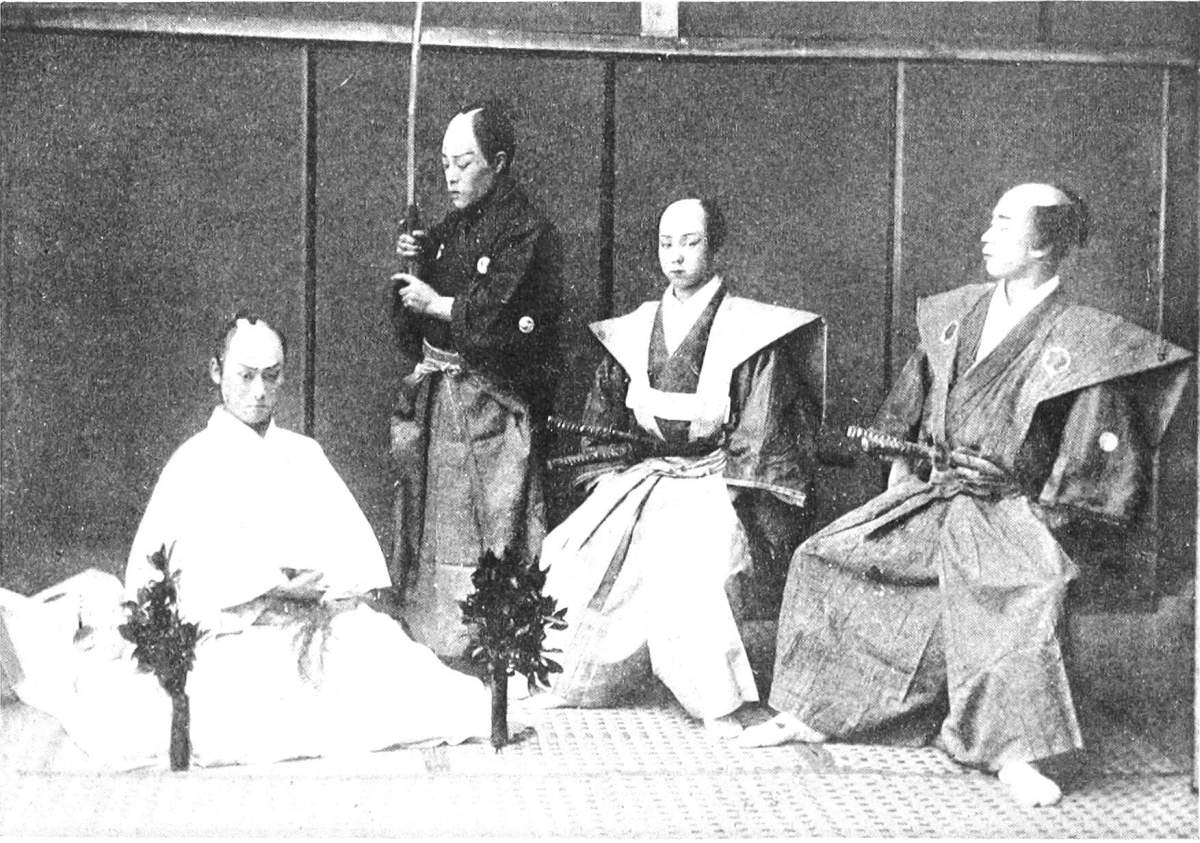
of the Japanese—Their Custom of cutting themselves open—A. D. 1550
Louis Almeida—The Missionaries establish themselves at Miyako
[Kyōtō]—Louis Froez—Princes converted in Shimo—Rise
of Nobunaga—Prosperity of the Missions—Noble and Princely
Converts—Nagasaki built—Nobunaga makes himself Emperor—A. D. 1557-1577
Father Valignani—State of the Missions—Conversion and Baptism
of the King of Bungo—Growth of Nagasaki—Embassy
to the Pope—Documents relating to this Embassy—A. D. 1577-1586
Events meanwhile in Japan—Downfall of Nobunaga—Accession
of Hashiba, afterwards known as Kwambacudono, and, finally,
as Taikō-Sama—Edict against the Jesuits—Return of the
Ambassadors—A. D. 1582-1588
Recapitulation—Extent of the Japanese Empire—Valignani
arrives at Nagasaki—Progress hitherto of the Catholic Faith—The
Emperor’s Projects against China—Valignani’s Visit to
the Emperor at Miyako—Ukondono—The returned Japanese
Ambassadors—Audience given to Valignani—The Viceroy’s
Letter—The Interpreter Rodriguez—A. D. 1588-1593
New Troubles of the Missionaries from their own Countrymen—The
Emperor claims Homage of the Governor of the Philippines—Mutual
Jealousies of the Portuguese and Spaniards—Spanish
Adventurers in Japan—The Emperor’s Suspicions
excited—His Reply to the Viceroy of Goa—A. D. 1591-1592
The Expedition against Corea—The Emperor associates his
Nephew—City of Fushimi—Correspondence of the Emperor
with the Governor of Manila—The Jesuits denounced by
the Spanish Envoys—Consequences thereof—Departure of
Valignani—A. D. 1592
Progress of the Corean War—Success of the Japanese—Konishi
Settsu-no-Kami, Viceroy of Corea—Edict of the Emperor for disarming
the Converts in Shimo—Disgrace and Downfall of the
Royal Family of Bungo—Terazawa, Governor of Nagasaki—His
Conversion and Friendly Acts—A. D. 1592-1593
Jealousy on the Part of the Dominicans and Franciscans towards
Jesuits—This Jealousy coöperates with the Mercantile Jealousy
of the Spaniards at Manila—Franciscan Friars establish themselves
at Miyako, Ōsaka, and Nagasaki—Edicts against them—Deposition
and Death of the Emperor’s Nephew—A. D. 1593-1595
Great Earthquake—Mission from China—Arrival of a Spanish
Galleon—Friars on Board her—New Accusations on her Account
against the Jesuits—Connection of the Jesuits with the
Trade to Japan—Arrest of Missionaries and Converts—First
Martyrs—A. D. 1595-1597
New Edict for the Deportation of the Jesuits—Its Partial Evasion—New
Correspondence between the Philippines and Japan—Taikō-Sama’s
Justification of his Recent Proceedings—New
Destruction of Churches in Shimo—Taikō-Sama’s Death—His
Preceding Efforts to secure his own Deification and the Succession
of his Infant Son, Hideyori—Regency—Iyeyasu, its
Head, with the Title of Daifu-Sama—A. D. 1597-1599
Evacuation of Corea—Return of the Converted Princes—Favorable
Disposition of Daifu-Sama—Third Visit of Father
Valignani—Civil War between Daifu-Sama and his Co-Regents—His
Triumph—Disgrace and Execution of Settsu-no-Kami—Daifu-Sama
takes the Title of Ōgosho-Sama and still
favors the Converts—Influx of Dominican and Franciscan Friars—Flourishing
Condition of the Church—Local Persecutions—A. D. 1599-1609
Attempt of the English and Dutch to discover a New Route to the
Far East—Voyages round the World—Attempted English
Voyage to Japan—English and Dutch Voyages to India—First
Dutch Voyage to Japan—Adams, the English Pilot—His
Adventures and Detention in Japan—A. D. 1513-1607
Spanish Friars in Japan—Extension of Japanese Trade—Progress
of the Dutch in the Eastern Seas—They open a Trade
with Japan—Emperor’s Letter—Shipwreck of Don Rodrigo
de Vivero on the Japanese Coast—His Reception, Observations,
and Departure—Destruction of a Portuguese Carac by
the Japanese—Another Dutch Ship arrives—Spex’s Charter—Embassies
from Macao and New Spain—Father Louis
Sotelo and his Projects—A. D. 1607-1618
Origin and Commencement of English Intercourse with Japan—Captain
Saris’ Voyage thither, and Travels and Observations
there—New Spanish Embassy from the Philippines—Commercial
Rivalry of the Dutch and English—Richard Cocks,
Head of the English Factory—A. D. 1611-1613
Ecclesiastical Retrospect—New Persecution—Edict of Banishment
against the Missionaries—Civil War between Hideyori
and Ōgosho-Sama—Triumph of Ōgosho-Sama—His Death—Persecution
more Violent than ever—Mutual Rancor of the
Jesuits and the Friars—Progress of Martyrdom—The English
and Dutch—A. D. 1613-1620
Collisions of the Dutch and English in the Eastern Seas—The
English retire from Japan—The Spaniards repelled—Progress
of the Persecution—Japanese Ports, except Hirado and
Nagasaki, closed to Foreigners—Charges in Europe against
the Jesuits—Fathers Sotelo and Collado—Torment of the
Fosse—Apostasies—The Portuguese confined to Deshima—Rebellion
of Shimabara—The Portuguese excluded—Ambassadors
put to Death—A. D. 1621-1640
Policy of the Dutch—Affair of Nuyts—Haganaar’s Visits to
Japan—Caron’s Account of Japan—Income of the Emperor
and the Nobles—Military Force—Social and Political Position
of the Nobles—Justice—Relation of the Dutch to the Persecution
of the Catholics—The Dutch removed from Hirado and
confined in Deshima—Attempts of the English, Portuguese,
and French at Intercourse with Japan—Final Extinction of
the Catholic Faith—A. D. 1620-1707
Portuguese Trade to Japan—Dutch Trade—Silver, Gold, and
Copper the Chief Articles of Export—Export of Silver prohibited—Chinese
Trade—Its Increase after the Accession of
the Manchu Dynasty—Chinese Temples at Nagasaki—A
Buddhist Doctor from China—Edict on the Subject of Household
Worship—Restrictions on the Dutch Trade—Increase
in the Number of Chinese Visitors to Nagasaki—Their Objects—Restrictions
on the Chinese Trade—The Chinese shut up in
a Factory—Trade with Lew Chew [Riūkiū]—A. D. 1542-1690
Particular Statement as to the Dutch Trade as it existed in
Kämpfer’s Time—Arrival of the Ships—Unlading—Passes—Imports—Company
and Private Goods—Kambans, or
Public Sales—Duties—Profits—Exports—Departure of
the Ships—Smuggling—Execution of Smugglers
Nagasaki and its Vicinity as seen by Kämpfer—Imperial Governors—Their
Officers and Palaces—Municipal System—Street
Government—Mutual Responsibility—Administration
of Justice—Taxes—Government of other Towns—Adjacent
Country—The God Suwa and his Matsuri—A. D. 1690-1692
Kämpfer’s Two Journeys to Court—Preparations—Presents—Japanese
Attendants—Packing the Baggage and Riding on
Horseback—Japanese Love of Botany—Accoutrements—Road-Books—Norimono
and Kago—A. D. 1690-1692
Highways—Rivers—Fords—Ferries—Bridges—Water Part
of the Journey—Coast and Islands—Frail Structure of
Japanese Vessels—Description of them—Buildings on the
Route—Proclamation Places—Places of Execution—Tera,
or Buddhist Temples—Miya, or Shintō Temples—Idols and
Amulets
In collecting materials for a biography of the first
explorers and planters of New England and Virginia,
I was carried to Japan, where I happened to arrive
(in the spirit) almost simultaneously with Commodore
Perry’s expedition. My interest thus roused in this
secluded country has produced this book, into which
I have put the cream skimmed, or, as I might say, in
some cases, the juices laboriously expressed, from a good
many volumes, the greater part not very accessible nor
very inviting to the general reader, but still containing
much that is curious and entertaining, and, to most
readers, new; which curiosities, novelties, and palatable
extracts, those who choose will thus be enabled to enjoy
without the labor that I have undergone in their collection
and arrangement—the former, indeed, a labor
of love for my own satisfaction; the latter, one of duty—not
to say of necessity—for the pleasure of the
reading and book-buying public.
Instead of attempting, as others have done, to cast
into a systematic shape observations of very different
dates, I have preferred to follow the historic method,
and to let the reader see Japan with the successive
eyes of all those who have visited it, and who have
committed their observations and reflections to paper
and print. The number of these observers, it will be
found, is very considerable; while their characters,
objects, and points of view, have been widely different;
and perhaps the reader may reach the same conclusion
that I have: that, with all that is said of the seclusion
of Japan, there are few countries of the East which we
have the means of knowing better, or so well.
The complete history of the Portuguese, Spanish, and
Dutch relations with the Japanese is not to be found
elsewhere in English; nor in any language, in a single
work; while in no other book have the English and
American relations been so fully treated. Many extraordinary
characters and adventures make their appearance
on the scene, and the reader will have no
ground to complain at least of want of variety.
How little the history of Japan and of its former
relations with Portugal and Holland are known—even
in quarters where information on the subject might
be said to constitute an official duty—is apparent in
the following passage in a letter addressed from the
State Department at Washington to the Secretary of
the Navy, in explanation of the grounds, reasons, and
objects, of our late mission to Japan, and intended as
instruction to the envoy: “Since the islands of Japan
were first visited by European nations, efforts have
constantly been made by the various maritime powers
to establish commercial intercourse with a country
whose large population and reputed wealth hold out
great temptations to mercantile enterprise. Portugal
was the first to make the attempt, and her example
was followed by Holland, England, Spain, and Russia,
and finally by the United States. All these attempts,
however, have thus far been unsuccessful; the permission
enjoyed for a short period by the Portuguese, and that
granted to Holland to send annually a single vessel to
the port of Nagasaki, hardly deserving to be considered
exceptions to this remark.”
From Kämpfer, whose name has become so identified
with Japan, but into whose folios few have the opportunity
or courage to look, I have made very liberal
extracts. Few travellers have equalled him in picturesque
power. His descriptions have indeed the
completeness, and finish, and, at the same time, the
naturalness, and absence of all affectation, with much of
the same quiet humor, characteristic of the best Dutch
pictures. I have preferred to introduce entire the work
of such an artist, rather than to run the risk of spoiling
it by attempting a paraphrase; only, as I had so
many other volumes on hand, the substance, or at least
the spirit, of which was to be transferred to mine, and
as folios are no longer in fashion, I have found it necessary
in quoting him to retrench a little the superabundance
of his words. It is from his work also that
the ornamental title-page[1] is copied, stated by his editor
to be after a style fashionable in Japan, where dragons
are held in great repute. Kämpfer says, that heads of
these imaginary animals are placed over the doors of
houses all over the East—among the Mahometans
of Arabia and Persia, as well as in China and Japan—to
keep off, as the Mahometans say, the envious from
disturbing the peace of families. Perhaps the Japanese
authors surround their title-pages with them in hopes to
frighten away the critics.
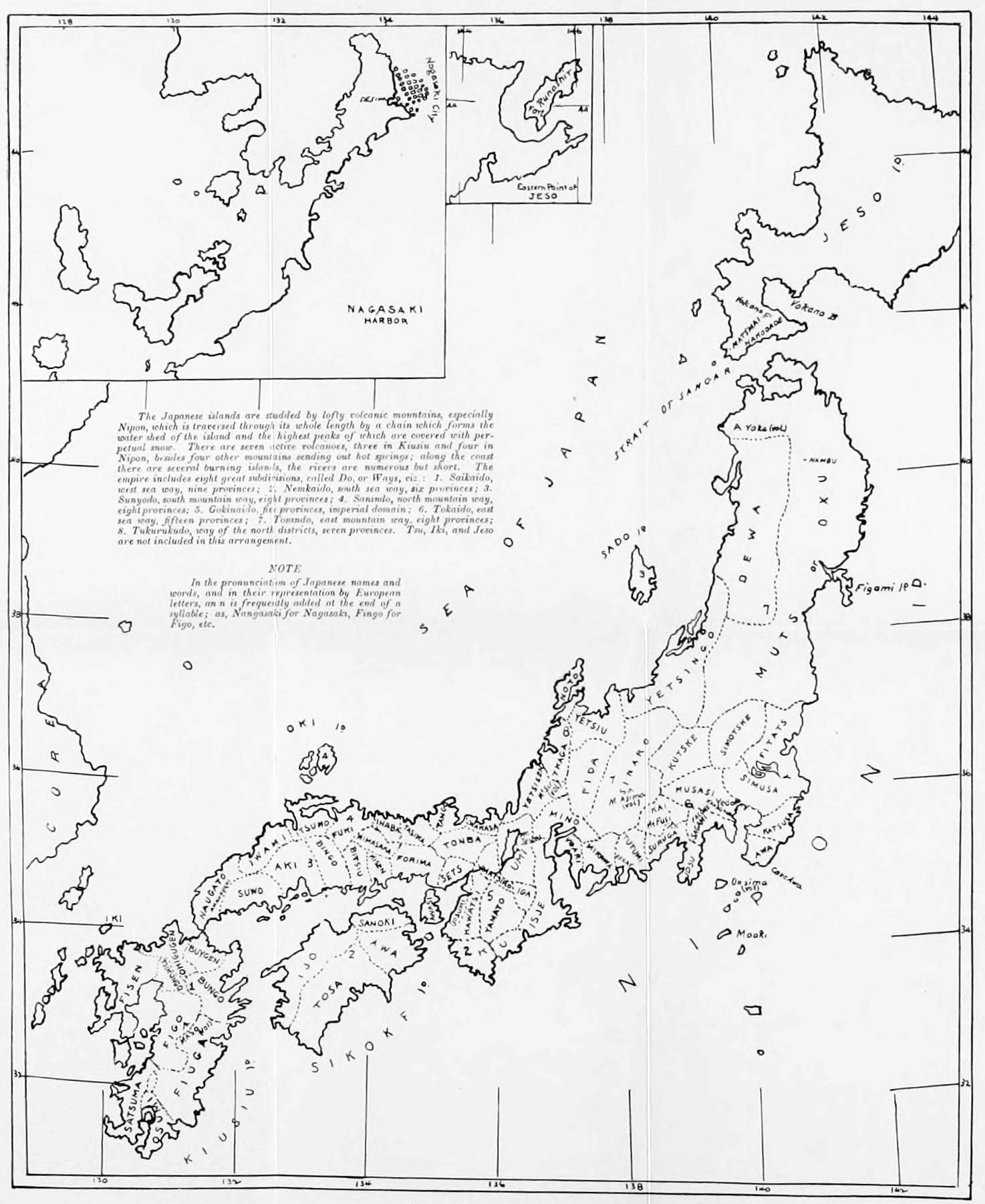
The outline map,[1] copied principally from that given
in the atlas of the Society for the Diffusion of Useful
Knowledge, contains, with the observations annexed to
it, and the note H[1] of the appendix, about all that we
know of the geography of Japan—all at least that
would interest the general reader. The contour of the
coast is that delineated in our sea-charts, and though
probably not very correct, is much more so than that
of the Japanese maps; which, however large and particular,
are not much to be relied upon, at least in this
respect. The division into provinces of course rests
upon Japanese authority.
In giving Japanese names and words, I have aimed
at a certain uniformity; but, like all other writers on
Japan, have failed to attain it. The Portuguese missionaries,
or at least their translators into Latin, in
representing Japanese names, employed c with the force
of k before the vowels a, o, and u, and with the force
of s before e and i; which same sound of s, in common
with that of ts, they sometimes represented by x. In
the earlier part of the book I have, in relation to several
names known only, or chiefly, through these writers,
followed their usage; though generally, in the representation
of Japanese names and words, I have avoided
the use of these ambiguous letters, and have endeavored
to conform to the method of representing the Japanese
syllables proposed by Siebold, and of which an account
is given in the Appendix.[2]
The daguerreotype views and portraits taken by the
artists attached to Commodore Perry’s expedition, the
publication of which may soon be hoped for, will afford
much more authentic pictures of the externals of Japan
than yet have appeared; and, from the limited stay and
opportunities of observation enjoyed by those attached
to that expedition, must constitute their chief contribution
to our knowledge of the Japanese empire.
R. H.
Boston, June 1st, 1855.
EDITOR’S INTRODUCTION
Hildreth’s “Japan as it Was and Is” was
published in three editions,—in 1855, 1856, and
1861. In the last edition a new chapter was
added to bring the book down to that date. The value
of the book, as a compilation from all the important
European writings on Old Japan, has always been acknowledged,
but has been somewhat diminished by the
various old-fashioned styles of transliteration, which
rendered many Japanese words difficult of recognition.
Therefore the present writer, more than ten years ago,
conceived the idea of a revision of Hildreth’s work,
especially by harmonizing the spelling of Japanese
words with the modern system of Romanization, and by
adding such other notes and explanations as might
be necessary. This he has been doing gradually, as
leisure afforded opportunity. In the meantime Mr.
K. Murakawa, an alumnus of the Imperial University,
Tōkyō, has issued, in two small limited editions, in 1902
and 1905, a reprint somewhat along that line. But as
his work was done with the needs of Japanese in view,
it does not entirely satisfy the needs of foreigners. The
present writer acknowledges his indebtedness to Mr.
Murakawa in some points, but he had done almost all
his work before he saw the Japanese edition. He now
offers an edition which is not merely a reprint, but
also a revision, and is well illustrated. Of course the
text of the original has been followed as closely as
possible, and yet not only additions, but also excisions,
have been made whenever necessary. For instance,
some of the footnotes and several of the long notes
in the Appendix have been omitted because they have
become either wholly or comparatively valueless. The
writer’s additional notes are signed “Edr.,” and where
Mr. Murakawa’s notes have been used the initials
“K. M.” are signed.
Mr. Murakawa says that Hildreth’s book “contains
many errors,” because it was “written by an author
who was not in a position to avail himself of the
Japanese sources, at a time when Japan was yet closed
against foreign intercourse, and at a place far away
from Japan.” This statement is partly true but somewhat
unjust, because it fails to take into consideration
the fact that Hildreth’s work is chiefly a compilation,
including lengthy quotations, from authors who did avail
themselves as much as possible of Japanese sources,
at the very time when they themselves were living in
the very place, Japan itself. But these writers were,
of course, far from infallible and made errors of fact
or inference which Hildreth followed. And yet it is
really remarkable that, with so many limitations and
hindrances, they gained so good an insight into Japanese
life.
It goes without saying that the present editor has
not attempted to correct all the errors of details,—a
task which would be as impossible as unprofitable. He
has corrected the most flagrant mistakes so far as he
has discovered them, but he may have overlooked errors
needing attention. He would here call special attention
to a few mistakes which were so frequent and so closely
interwoven in the narrative as to render correction
impracticable. The word “Nippon,” which is really the
name of the whole country, is applied by the old writers
to the main island, the real name of which is Hondo.
The word “Emperor” almost always refers to the
Shōgun, while the true Emperor is mentioned under
the name of “Dairi.”
It is quite likely that the transliteration of Japanese
words is not absolutely uniform, even in this revision.
There is still difference of opinion among the best
authorities on some points. But in this book there is
not so much variety as to be confusing. On this subject
see also the Introduction to the editor’s “Handbook
of Modern Japan.”
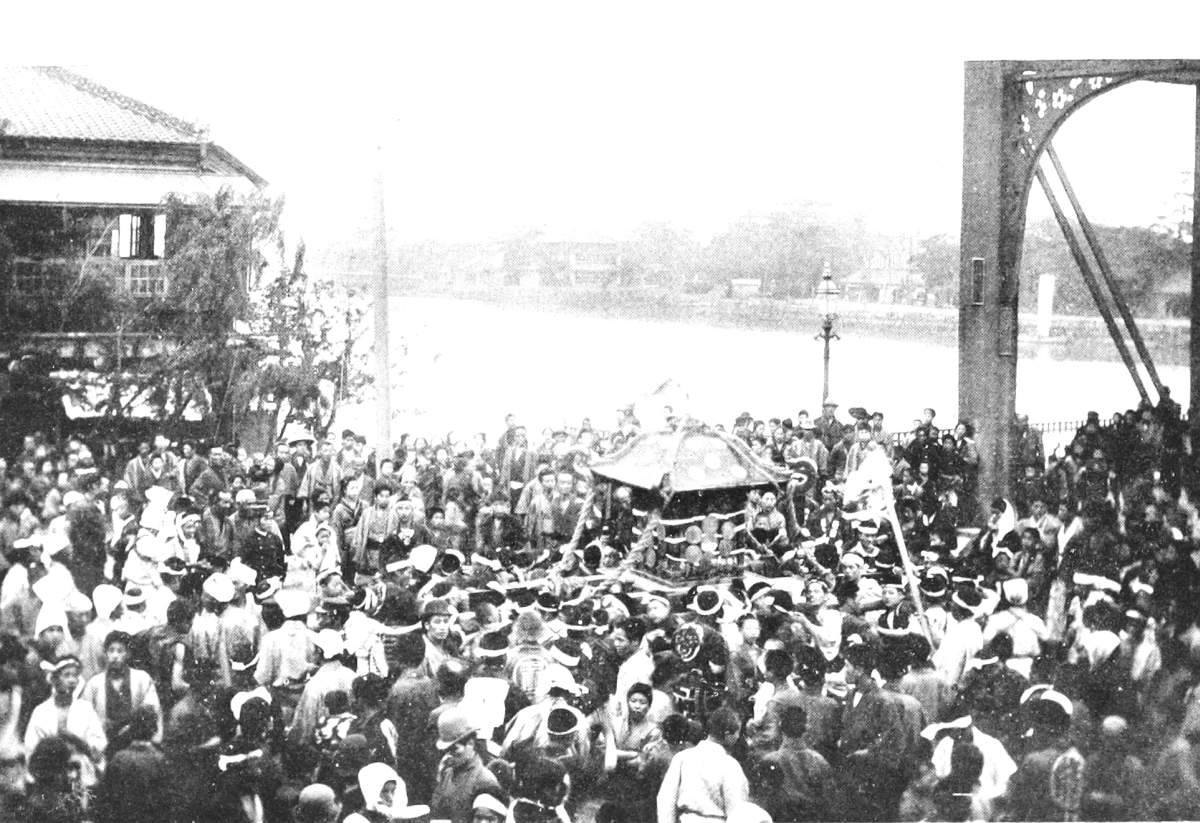
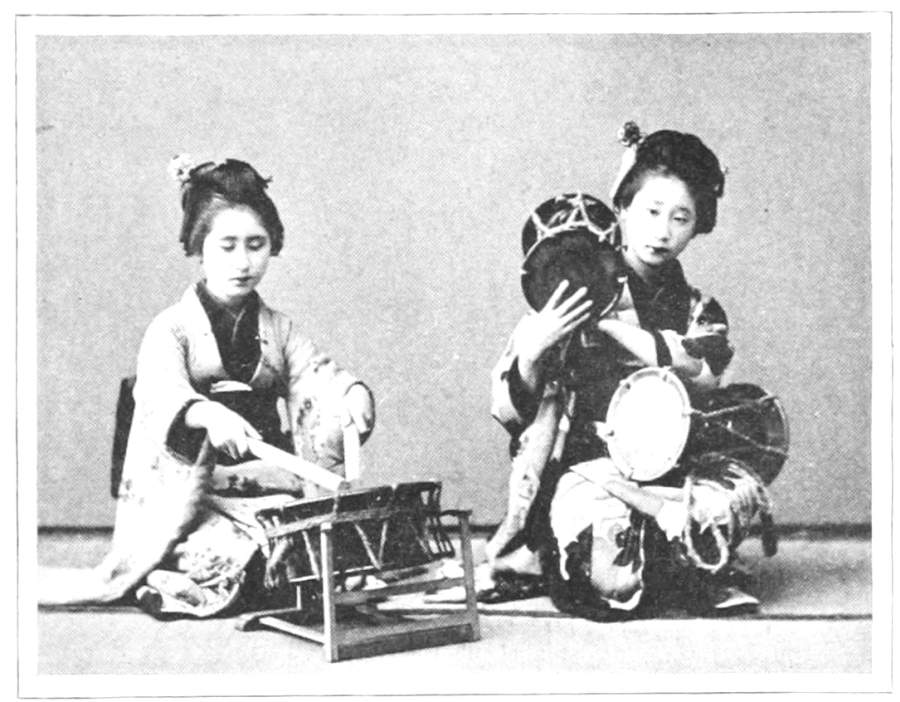
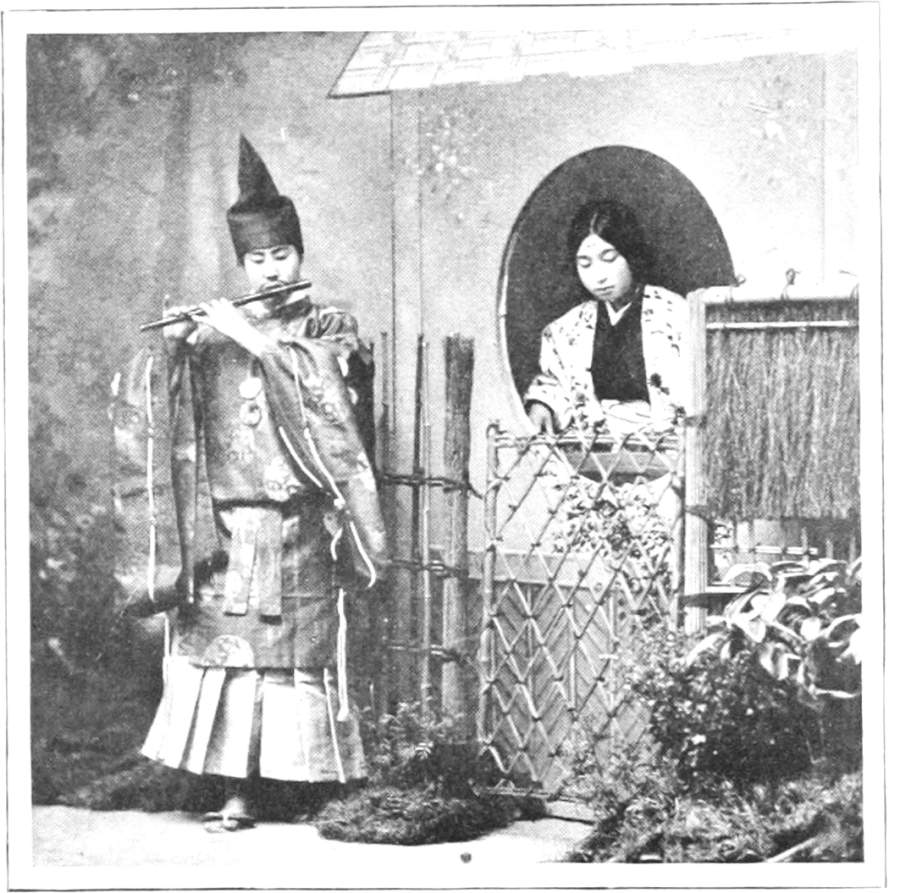
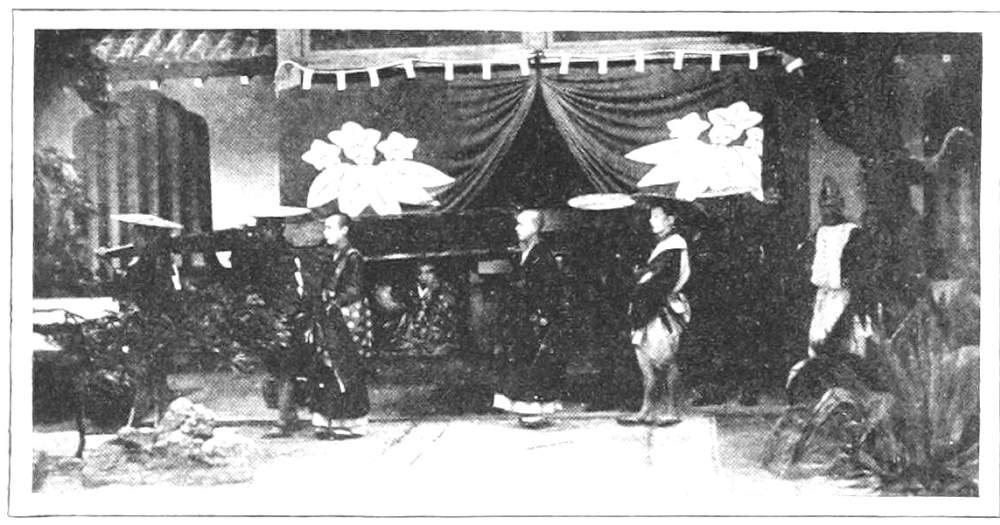
A word of explanation may be needed concerning
some of the illustrations of Japanese manners and customs.
They are produced, of course, from modern
photographs; but as there has been comparatively little
change in those particulars, the illustrations practically
represent the olden times under consideration in this
volume.
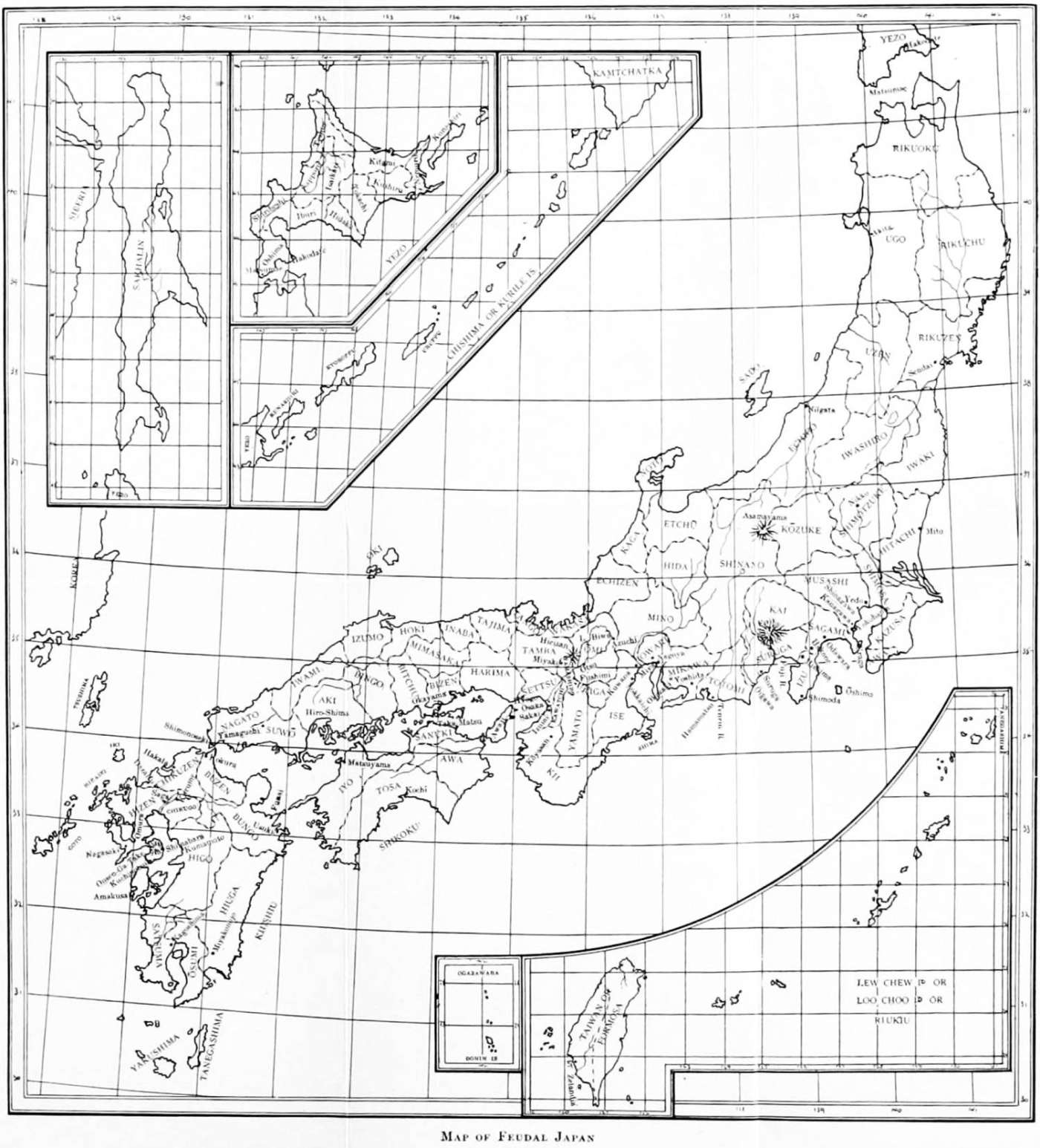
The map in the original was so crude and inaccurate
that it was not worth reproducing; therefore an entirely
new map has been prepared to show Japan as it was
during those days. In the map of Sakhalin a dotted
line shows also the present division of the island between
Russia and Japan, because it was the old one.
The editor is under obligations to his friend, Dr.
Wm. Elliot Griffis, himself both an author and an
authority on Japan and the Japanese, for his Introduction
to this volume. Dr. Griffis, in “The Mikado’s
Empire,” was the first to give in America a full account
of the land and people of Japan.
The numerous references here and there and the
bibliographical list in the Appendix ought to add considerably
to the value of this edition. Many of the
old books on Japan are out of print and difficult of
access, but even those are included for the sake of
any who may be so fortunate as to have access thereto.
A few books ought without fail to be read in connection
with this revision, because they give more
accurate information than was possible in Hildreth’s
day. These are “The Mikado’s Empire,” by Griffis,
Rein’s “Japan” and “The Industries of Japan,”
Brinkley’s eight encyclopædic volumes on Japan, and
“History of Japan during the Earlier Century of Foreign
Intercourse (1542-1651)” by Murdock and Yamagata.
Frequent references have been made to the valuable
papers in the Transactions of the Asiatic Society of
Japan, which are easily accessible in whole or in
parts.
The bibliography is not complete, but contains the
most important works in English. More extensive and
specific bibliographies may be found in the editor’s
“Handbook of Modern Japan,” Chamberlain’s “Things
Japanese,” and especially Wenckstern’s (revised)
“Bibliography of Japan.” Poole’s Index is also valuable.
In the bibliography of this edition of Hildreth
it has not been practicable, in all cases, to distinguish
exactly between Old Japan and New Japan. There is
still so much of the old remaining in this transition
period that some writings of modern days may describe
quite accurately conditions of olden days. With the
increased facilities of the present it is possible to understand
better the old conditions, especially as they were
stereotyped for several centuries.
The original title of Hildreth’s work, “Japan as it
Was and Is,” was proper in 1855 and 1856, but it is
rather unsuitable in its entirety fifty years later.
However, this revision of Hildreth, together with the
editor’s “Handbook of Modern Japan,” may not unwarrantably
be considered to cover Japan as it Was
and Is.
ERNEST WILSON CLEMENT.
Tōkyō, July 1, 1906.
FOREWORD BY THE AUTHOR OF “THE MIKADO’S EMPIRE”
The first American teacher in Echizen (1870-1872)
feels honored at the request of the first
American teacher in Mito (1887-1891) to write
for his revised and annotated edition of Hildreth’s
“Japan” a few words concerning the author and his
book and his most recent editor’s work. In the days of
Townsend Harris and the premier Ii (1858), the feudal
lords of Mito and Echizen, besides being blood relatives,
had misunderstandings with the Yedo authorities, and,
with unswerving loyalty to the Emperor and the most
patriotic of motives, were linked together in strange
experiences while manifesting a common desire to
promote their country’s good.
After so long a time the pioneer American educator
in Echizen salutes his fellow-worker who has done so
much to make known to us the illustrious character of
the lords of the house of Mito as patrons of literature
and their unwearied devotion to the Imperial and
national cause. I am sure that we are both proud of
having been the servants of the Japanese people in helping
to bring to pass that vision of Japan’s greatness,
so tangible in A. D. 1906, to which Hildreth looked,
yet died without ever seeing.
The personality of Richard Hildreth, the historian
of the United States and the unquailing opponent of
African slavery in America, was one of the very first
that appealed to me when my own boyish literary aspirations
were first awakened. His intensely powerful
novel, “Archy Moore,” which had been published in
1837, reprinted in England and again republished in the
United States in 1852, under the title of “The White
Slave,” appeared just when Commodore Matthew C.
Perry was making his preparations to sail for Japan.
Philadelphia was agog with interest about the expedition,
and many of her citizens were keenly interested,
among them my father, John L. Griffis, who, like my
grandfather, Captain John Griffis, had voyaged to the
Philippines, China, and the Far East. He had built
a platform in his coalyard, which directly adjoined the
shiphouse and dock of the United States Navy Yard,
wherein was building the United States steam frigate
“Susquehanna,” which later in Japanese waters became
the flagship of Commodore Perry. It is not so many
miles from the upper waters of this noble river of the
three States, New York, Pennsylvania, and Maryland,
that this “foreword” is written.
As a little boy, on the morning of April 6, 1850, at
8.35 A.M., I saw the graceful “Susquehanna” slide
down the ways, float on the Delaware, and, like a bird
of calm, “sit brooding on the charmèd wave.” I remember
how, when sitting on my father’s knee, he put
me down suddenly to rise and call for “three cheers
for the future of the ‘Susquehanna.’” We could not
then foresee what a noble part the frigate was to play in
the annals of both peace and war. She bore the olive
branch to Japan and she unchained her thunders in the
destruction of slavery.
Richard Hildreth of Massachusetts, author, journalist,
economist, and historian, was born in 1807. He graduated
from Harvard College in 1826 and studied law
in Newburyport, entering upon practice in Boston. He
left the law for journalism, and, as an editor of the
“Boston Atlas,” lifted up the moral world. In 1834, in
poor health, he went South and, in order to get unbiassed
ideas, lived on a slave plantation to study the workings
of the system of unpaid African labor. It was during
this time that he wrote his famous novel, “Archy Moore,
The White Slave.” Returning North he became, with
pen and voice, the tireless opponent of slavery. From
1840 to 1848 Hildreth lived in Demerara, British
Guiana, editing two newspapers, in which he advocated
the system of free instead of slave labor, writing there
also his “Theory of Morals” and his “Theory of Politics.”
In the perspective of history we can now note clearly
that he was one of the potent forces in destroying
human slavery in America, and in helping, as an ex-Confederate
officer, now president of the first Woman’s
College in the Southern States, told me a few days ago,
“to emancipate eleven million white men.”
Hildreth’s “History of the United States,” though not
of great literary interest, is an amazingly honest picture
of the real character of the makers of the American
Republic. He shows our fathers without transfiguration
of their virtues or disguise of their faults or errors.
How he came to write his book on Japan is told by
him with sufficient fulness in his own introduction.
Those who know his book best are those who appreciate
it most.
It was while we were fellow-workers in the Imperial
University in Tokio, from 1872 to 1874, that Mr. Edward
H. House, who afterwards found a grave in the land
he loved, gave me the details of Hildreth’s life and
personality. Mr. House had been engaged with Mr.
Hildreth on the staff of the “New York Tribune” from
the completion of “Japan as it Was and Is” until the
inauguration of Abraham Lincoln. Instead of appointing
Hildreth as Minister to Japan, Mr. Lincoln did but
follow the precedents of political succession, since Perry,
Harris, Van Valkenburg, and Depew (who declined)
were all citizens of the Empire State, and hence nominated
the Hon. Robert H. Pruyn of Albany. It was my
own beloved professor in Rutgers College, Dr. David
Murray, also a native of New York State, later chief
adviser to the Educational Department in Japan, who
in Tokio first loaned me a copy of Hildreth’s valuable
compilation, and I studied it with care. Notable among
the many benefits which made the volume a boon to
foreign students was the discovery, with its aid, in May,
1872, by Mr. James Walter of Yokohama, of the tomb
of Will Adams at Yokosuka (p. 139).
Hildreth’s scarcely veiled satire on the ignorance of
the Americans of 1852 concerning Japan in his “advertisement”
is keen. None knew more than he how
steadily the Hollanders had maintained commercial
relations with the Japanese, had fertilized their minds
for over two centuries, and had finally paved the way
for American success.
In gratitude to Professor Clement for his unwearied
researches and for his work as editor in this new
presentation of the perennially interesting volume of
Hildreth, in commendation of the publishers for issuing
this uniquely valuable work, and in the faith that in its
new dress “Japan as it Was and Is” will receive a
warm welcome at the hands of the American public, we
raise our cheer at this hopeful launch on the waters of
literature. How the spirit of Hildreth must rejoice at
free America and free Japan, with slavery and feudalism
gone forever and the two nations in mutually beneficial
rivalry for the uplifting of mankind.
WM. ELLIOT GRIFFIS.
Ithaca, N. Y., July 15, 1906.
JAPANESE PRONUNCIATION
a
like
a
in
father
e
”
e
”
men
i
”
i
”
pin
o
”
o
”
pony
u
”
oo
”
book
ai
as in
aisle
ei
”
weigh
au ō
as
o in bone
ū
as
oo in moon
i in the middle of a word and u in the middle or at the end of
a word are sometimes almost inaudible.
The consonants are all sounded, as in English: g, however, has
only the hard sound, as in give, although the nasal ng is often
heard; ch and s are always soft, as in check and sin; and z before
u has the sound of dz. In the case of double consonants, each one
must be given its full sound.
There are as many syllables as vowels. There is practically
no accent; but care must be taken to distinguish between o and
ō, u and ū, of which the second is more prolonged than the first.
Be sure to avoid the flat sound of a, which is always pronounced
ah.
Sketch Map of Old Japan
Adapted from map in original edition of Hildreth
Text within Map
The Japanese islands are studded by lofty volcanic mountains, especially
Nipon, which is traversed through its whole length by a chain which forms the
water shed of the island and the highest peaks of which are covered with perpetual
snow. There are seven active volcanoes, three in Kiusiu and four in
Nipon, besides four other mountains sending out hot springs; along the coast
there are several burning islands, the rivers are numerous but short. The
empire includes eight great subdivisions, called Do, or Ways, viz.: 1. Saikaidō,
west sea way, nine provinces; 2. Nankaido, south sea way, six provinces; 3.
Sanyodo, south mountain way, eight provinces; 4. Sanindo, north mountain way,
eight provinces; 5. Gokinaido, five provinces, imperial domain; 6. Tōkaidō, east
sea way, fifteen provinces; 7. Tosando, east mountain way, eight provinces;
8. Hokurokudo, way of the north districts, seven provinces. Tsu, Iki and Jezo
are not included in this arrangement.
NOTE
In the pronunciation of Japanese names and
words, and in their representation in European
letters, an n is frequently added at the end of a
syllable; as, Nangasaki for Nagasaki, Fingo for
Figo, etc.
CHAPTER I
JAPAN As It Was and Is
Earliest European Knowledge of Japan—Japanese Histories—Marco
Polo’s Account of the Mongol or Tartar Invasion—Accounts of the
same Event given by the Chinese and Japanese Annalists, A. D. 1281
or 1283.
The name Japan, pronounced in the country itself
Nippon or Nihon, is of Chinese origin—in the
Mandarin dialect Jih-pun, that is, sun-source, or
Eastern Country.
The first account of Japan, or allusion to its existence,
to be found in any European writer, is contained in the
“Oriental Travels” of the Venetian, Marco Polo, first
reduced to writing in the Latin tongue, about A. D. 1298,
while the author was detained a prisoner of war at Genoa.
Zipangu, Zipangri, Cyampagu, Cimpagu, as different
editions of his work have it, is his method of representing
the Chinese Jih-pun-quo, sun-source kingdom, or
kingdom of the source of the sun. The Japanese chronicles
go back for many centuries previous; but these
chronicles seem to be little more than a bare list of
names and dates, with some legendary statements interwoven,
of which the authority does not appear very
weighty, nor the historical value very considerable.
Marco Polo resided for seventeen years (A. D. 1275-1292)
at the court of Kublai Khan (grandson of the
celebrated Ghingis Khan,) and ruler, from A. D. 1260
to A. D. 1294, over the most extensive empire which
the world has ever seen. This empire stretched across
the breadth of the old continent, from the Japanese, the
Yellow, the Blue, and the China Seas (embosoming the
Caspian and the Black Seas), to the Levant, the Archipelago,
the river Dniester, and beyond it. Not content
with having added Anatolia and Russia to the western
extremity of this vast kingdom,—the Greek empire
being reduced, at this moment, to the vicinage of Constantinople
and the western coasts of the Archipelago,—Kublai
Khan, after completing the conquest of Southern
China, sent an expedition against Japan; in which, however,
the Mongols were no more successful than they had
been in their attempts, a few years before, to penetrate
through Hungary and Poland (which they overran and
ravaged, to the terror of all Europe) in Germany, whence
Teutonic valor repelled them.
The accounts given by Marco Polo, and by the Chinese
and Japanese annalists, of this expedition, though somewhat
contradictory as to the details, agree well enough
as to the general result. As Marco Polo’s account is
short, as well as curious, we insert it at length, from the
English translation of his travels by Marsden, subjoining
to it the statements which we have of the same event
derived from Chinese and Japanese sources. We may
add that Columbus was greatly stimulated to undertake
his western voyages of discovery by the constant study
of Marco Polo’s travels, confidently expecting to reach
by that route the Cathay and Zipangu of that author—countries
for which he sedulously inquired throughout
the Archipelago of the West Indies, and along the southern
and western shores of the Caribbean Sea.
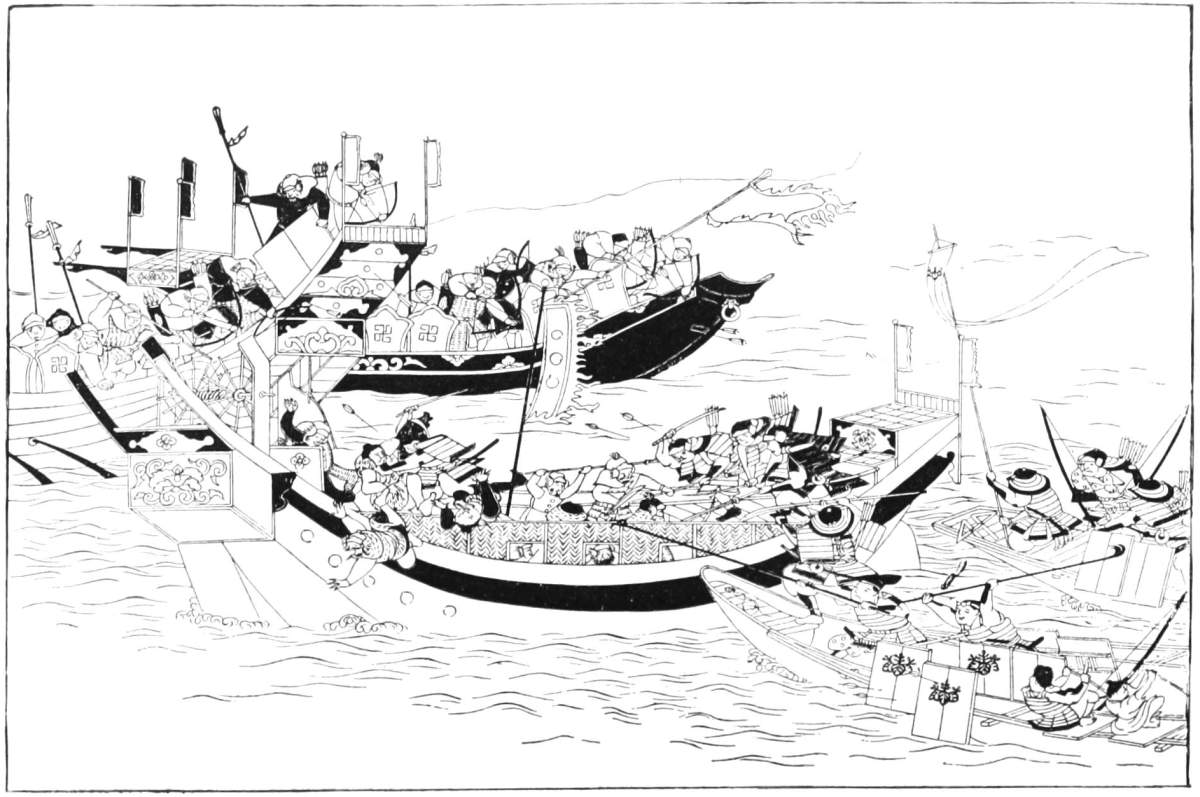
The Invasion by the Mongol Tartars From Official History of Japan
“Zipangu,” says Marco Polo, “is an island in the
eastern ocean, situated at the distance of about fifteen
hundred miles[3] from the mainland, or coast of Manji.[4]
It is of considerable size; its inhabitants have fair complexions,
are well made, and are civilized in their manners.
Their religion is the worship of idols. They
are independent of every foreign power, and governed
only by their own kings. They have gold in the
greatest abundance, its sources being inexhaustible;
but as the king does not allow of its being exported,
few merchants visit the country, nor is it frequented by
much shipping from other parts. To this circumstance
we are to attribute the extraordinary richness of the
sovereign’s palace, according to what we are told by
those who have access to the place. The entire roof is
covered with a plating of gold, in the same manner as
we cover houses, or, more properly, churches, with lead.
The ceilings of the halls are of the same precious metal;
many of the apartments have small tables of pure gold,
considerably thick; and the windows, also, have golden
ornaments. So vast, indeed, are the riches of the palace,
that it is impossible to convey an idea of them. In this
island there are pearls, also, in large quantities, of a
pink color, round in shape, and of great size, equal in
value to white pearls, or even exceeding them. It is
customary with one part of the inhabitants to bury their
dead, and with another part to burn them. The former
have a practice of putting one of these pearls into the
mouth of the corpse. There are also found there a
number of precious stones.
“Of so great celebrity was the wealth of this island,
that a desire was excited in the breast of the grand
Khan Kublai, now reigning, to make the conquest of it,
and to annex it to his dominions. In order to effect
this, he fitted out a numerous fleet, and embarked a large
body of troops under the command of two of his principal
officers, one of whom was named Abbacatan, and the
other Vonsancin. The expedition sailed from the ports
of Zaitun and Kinsai,[5] and crossing the intermediate sea,
reached the island in safety; but, in consequence of a
jealousy that arose between the two commanders, one of
whom treated the plans of the other with contempt, and
resisted the execution of his orders, they were unable to
gain possession of any city or fortified place, with the
exception of one only, which was carried by assault,
the garrison having refused to surrender. Directions
were given for putting the whole to the sword, and, in
obedience thereto, the heads of all were cut off except of
eight persons, who, by the efficacy of a diabolical charm,
consisting of a jewel or amulet introduced into the right
arm, between the skin and the flesh, were rendered secure
from the effects of iron either to kill or to wound.
Upon this discovery being made, they were beaten with
a heavy wooden club, and presently died.
“It happened, after some time, that a north wind
began to blow with great force, and the ships of the
Tartars, which lay near the shore of the island, were
driven foul of each other. It was determined thereupon,
in a council of the officers on board, that they ought to
disengage themselves from the land; and accordingly, as
soon as the troops were disembarked, they stood out to
sea. The gale, however, increased to so violent a degree,
that a number of the vessels foundered. The people
belonging to them, by floating upon pieces of the wreck,
saved themselves upon an island, about four miles from
the coast of Zipangu. The other ships, which, not being
so near to the land, did not suffer from the storm, and
on which the two chiefs were embarked, together with
the principal officers, or those whose rank entitled them
to command a hundred thousand or ten thousand men,
directed their course homeward, and returned to the
grand Khan. Those of the Tartars who remained upon
the island where they were wrecked, and who amounted
to about thirty thousand men, finding themselves without
shipping, abandoned by their leaders, and having
neither arms nor provision, expected nothing less than
to become captives or to perish; especially as the island
afforded no habitations where they could take shelter
and refresh themselves. As soon as the gale ceased,
and the sea became smooth and calm, the people from
the main island of Zipangu came over with a large force,
in numerous boats, in order to make prisoners of these
shipwrecked Tartars; and, having landed, proceeded in
search of them, but in a straggling, disorderly manner.
The Tartars, on their part, acted with prudent circumspection;
and, being concealed from view by some high
land in the centre of the island, whilst the enemy were
hurrying in pursuit of them by one road, made a circuit
of the coast by another, which brought them to the place
where the fleet of boats was at anchor. Finding these
all abandoned, but with their colors flying, they instantly
seized them; and, pushing off from the island, stood for
the principal city of Zipangu, into which, from the
appearance of the colors, they were suffered to enter
unmolested. Here they found few of the inhabitants
besides women, whom they retained for their own use,
and drove out all others. When the king was apprised
of what had taken place, he was much afflicted, and immediately
gave directions for a strict blockade of the
city, which was so effectual that not any person was
suffered to enter or to escape from it during six months
that the siege continued. At the expiration of this time,
the Tartars, despairing of succor, surrendered upon the
condition of their lives being spared. This event took
place in the course of the year 1264.”[6]
The above account Marco Polo no doubt derived from
the Mongols, who endeavored, as far as possible, to gloss
over with romantic and improbable incidents a repulse
that could not be denied. The Chinese annalists, who
have no partiality for their Mongol conquerors, tell a
much less flattering story. According to their account,
as given by Père Amiot, in his “Mémoires concernant
les Chinois,” the fleet consisted of six hundred ships,
fitted out in the provinces of Kiang-nan, Fou-kien, Ho-nan,
and Chan-tong. The army, sailing from Corea,
landed first on the island of Kuchi [?], whence they proceeded
to that of Tsushima, where they learned that
the Japanese had long been expecting them with a
great army. On approaching the coast of Japan, they
encountered a furious tempest, which sunk their vessels;
so that of the whole army scarcely one or two in
every ten persons escaped.
In the “Histoire Général de la China,” compiled by
Father Malela from Chinese sources, the story is thus
told: “The sixth month (1281) Alahan set out on the
expedition against Japan; but scarcely had he reached
the port of embarkation when he died. Atahai, appointed
to succeed him, did not arrive till the fleet
had already set sail. In the latitude of the isle of
Pinghou [Hirado], it encountered a violent tempest,
by which most of the vessels were driven on shore.
The officers, selecting those least damaged, themselves
returned, leaving behind them in that island more than
a hundred thousand men. The soldiers, finding themselves
thus abandoned, chose a leader, and set themselves
to work to cut down trees to build new vessels,
in which to escape. But the Japanese, apprised of
their shipwreck, made a descent upon the island with
a powerful army, and put them to the sword. They
spared only ten or twelve thousand Chinese soldiers,
of whom they made slaves; and, of the whole formidable
invading army, hardly three persons returned to
China.”
Father Gaubil, in his “Histoire de la Dynastie des
Mongoux,” compiled also from Chinese sources, states
the number of Chinese and Corean prisoners at eighty
thousand, and of the Mongols who were slain at thirty
thousand.
Kämpfer, in his elaborate work on Japan, gives the
following as from the Japanese chronicles, Nippon
Ōdaiki, and Nippon Ōkeizu: “Go-Uda succeeded his
father in the year of Jimmu 1985, of Christ 1275.”
“In the ninth year of his reign, the Tartar general,
Mōko, appeared on the coasts of Japan, with a fleet
of four thousand sail, and two hundred and forty
thousand men. The then reigning Tartarian emperor,
Lifsu [Kublai Khan], after he had conquered the empire
of China, sent this general to subdue also the empire of
Japan. But this expedition proved unsuccessful. The
Kami, that is, the gods of the country, and protectors of
the Japanese empire, were so incensed at the insult
offered them by the Tartars, that, on the first day
of the seventh month, they excited a violent and
dreadful storm, which destroyed all this reputed invincible
armada. Mōko himself perished in the waves,
and but few of his men escaped.”
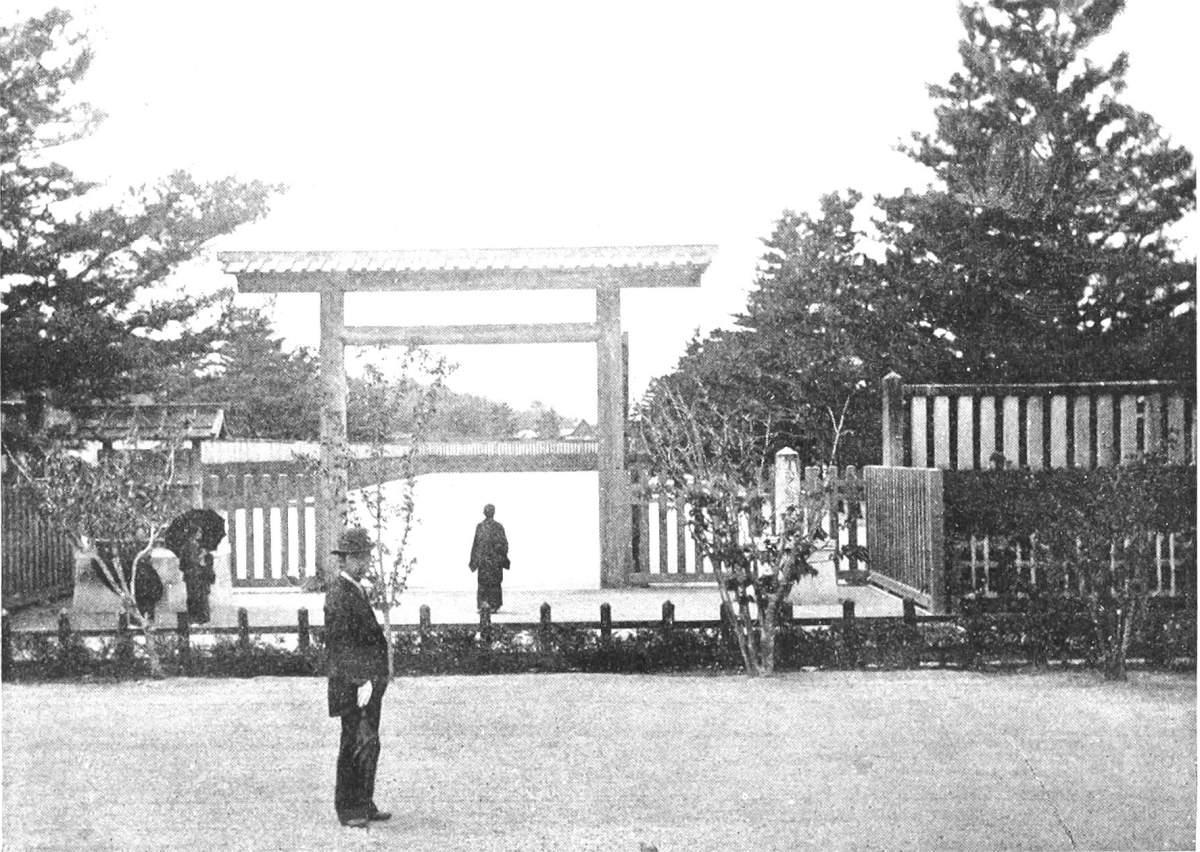
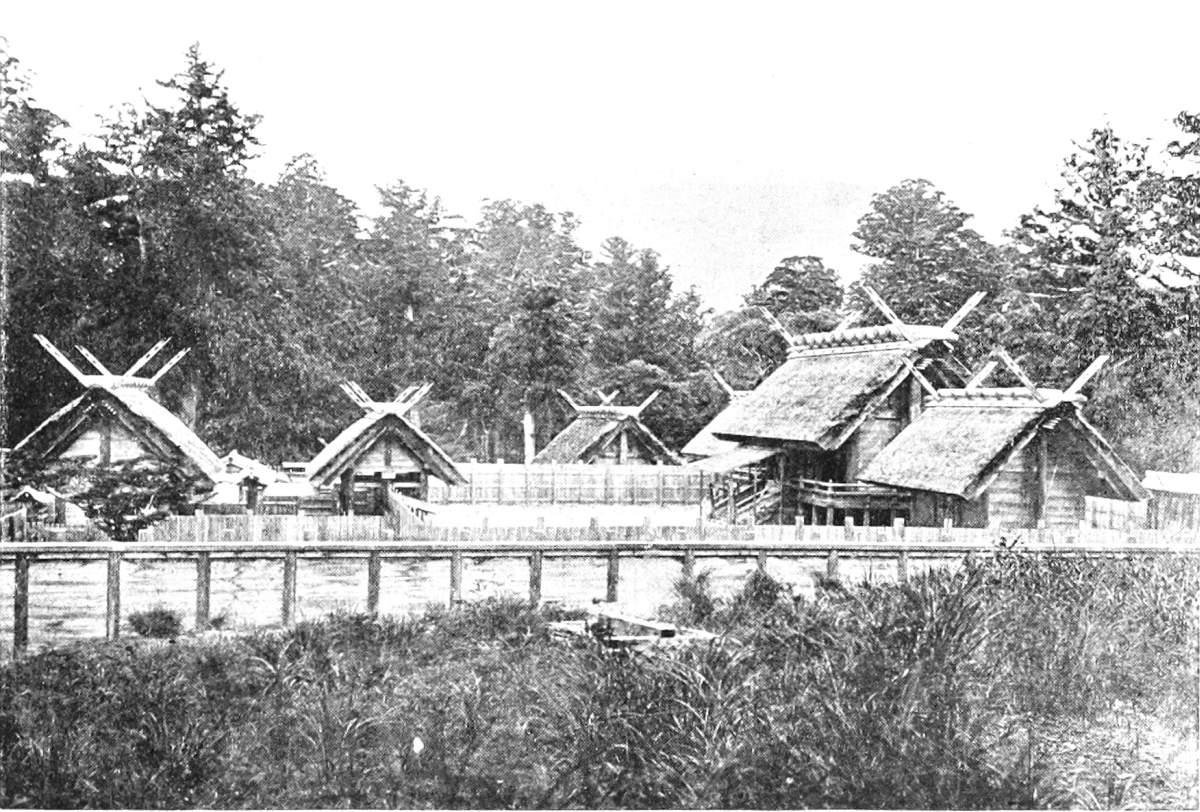
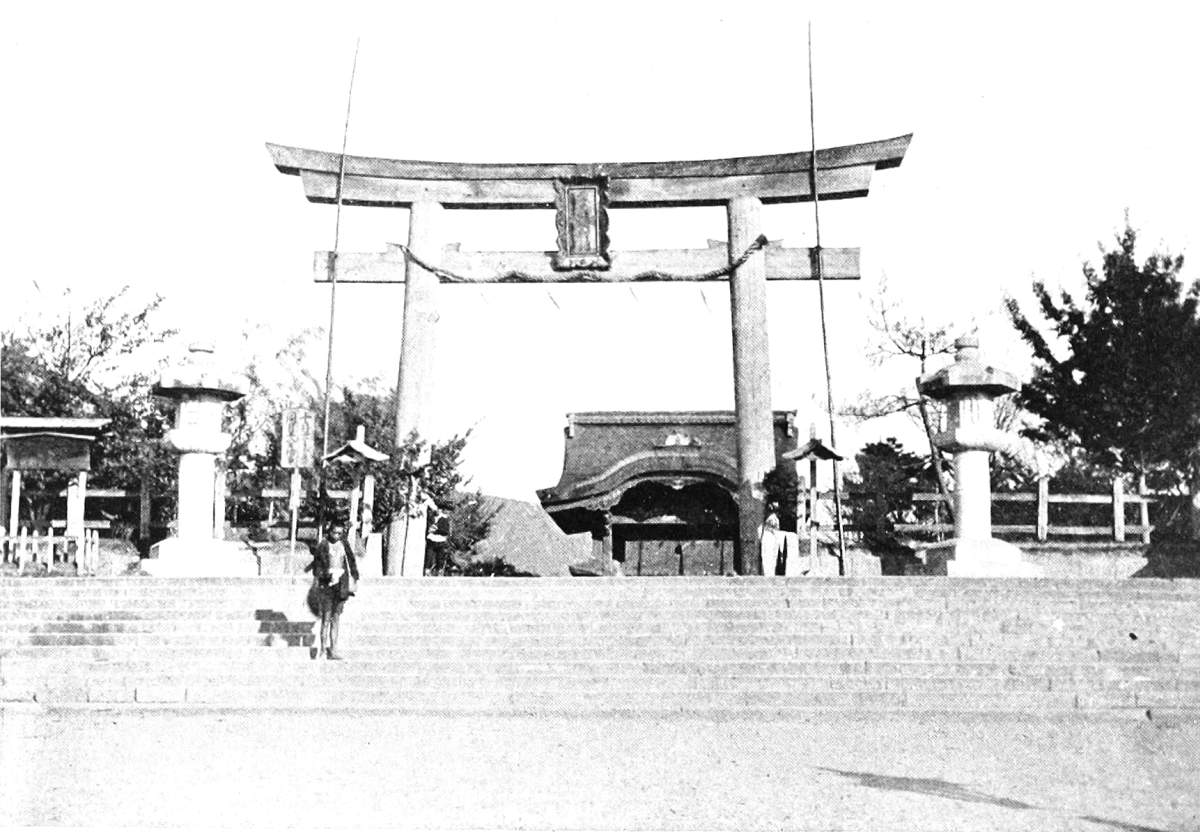
Entrance to the Temple of Jimmu Tennō
Siebold, in his recently published “Archives of Japan,”
gives the following as the account of this invasion contained
in the esteemed Japanese chronicle, Nikongi:[7]
“So soon as Kublai Khan had ascended the Mogul
throne, he turned his eyes upon distant Japan. This
nation, like Kaou-le (one of the kingdoms of Corea),
must become tributary. Accordingly, in the year 1268,[8]
he summoned the ruler of Nippon to acknowledge his
sovereignty. No notice was taken of this summons, nor
of others in 1271 and 1273, the Mongol envoys being not
admitted to an audience, but always dismissed by the
governor of Dazaifu. Hereupon a Mongol fleet, with
a Corean contingent, appeared off Tsushima [a small
island half-way from Corea to Japan]. The Mikado
[ecclesiastical sovereign] appointed prayer days, but
the Shōgun [the temporal sovereign] had previously
made along the coast every necessary preparation for
defence. The hostile army did not venture upon a decisive
attack. Its movements were governed neither
by energy nor by consistency; and after hovering
about a while, without any apparent definite purpose,
the squadron disappeared from the Japanese seas,
merely committing some hostilities upon Kiūshiū at
its departure.”
A Japanese encyclopædia, of quite recent date, quoted
in Siebold’s work, besides giving Kublai Khan’s letter
of summons, asserts that the Mongol fleet was met and
defeated, after which, other Mongol envoys being sent
to Japan, they were summoned into the presence of the
Shōgun, by whom a decree was promulgated that no
Mongol should land in Japan under pain of death. And
it is even pretended that under this decree the persons
composing two subsequent missions sent by Kublai
Khan, in 1276 and 1279, were all put to death. This
was followed, according to the same authority, by the
appearance of a new Mongol-Corean fleet, in 1281, off
the island of Hirado. This fleet was destroyed by a
hurricane. Those who escaped to the shore were taken
prisoners and executed, only three being saved to carry
to Kublai Khan the news of this disaster. All these
additions, however, to the story—the letter of Kublai
Khan, the murder of the ambassadors, and the double
invasion—may safely enough be set down as Japanese
inventions.[9]
CHAPTER II
Portuguese Empire in the East—Discovery of Japan—Galvano’s Account
of it—Fernam Mendez Pinto’s Account of his First Visit to Japan,
and Adventures there—Japanese Account of the First Arrival of
Portuguese, A. D. 1542-1545.
Vasco da Gama, by the route of the Cape of
Good Hope, entered the Indian Ocean in November,
1497, and, after coasting the African continent
as far north as Melinda, arrived in May, 1498, at
Calicut, on the Malabar or southwestern coast of the
peninsula of Hindustan,—a discovery speedily followed,
on the part of the Portuguese, by extensive Eastern explorations,
mercantile enterprises, and conquests. The
trade of Europe with the East in silks, spices, and other
luxuries, chiefly carried on for two or three centuries
preceding, so far as related to their distribution through
Europe, by the Venetians, aided in the north by the
Hanse towns, and, so far as the collection of the articles
of it throughout the East was concerned, by the Arabs
(Cairo, in Egypt, being the point of exchange), was
soon transferred to the Portuguese; and Lisbon, enriched
by this transfer, which the Mahometan traders
and the Venetians struggled in vain to prevent, rose
rapidly, amid the decline of numerous rivals, to great
commercial wealth and prosperity, and the headship of
European commerce.
The Portuguese, from the necessity of the case, traded
sword in hand; and their intercourse with the nations of
the East was much more marked by the insolence of
conquest, than by the complaisance of traders. Goa,
some three hundred miles to the north of Calicut, which
fell into their power in 1510, became a splendid city, the
vice-royal and archiepiscopal seat, whence were governed
a multitude of widespread dependencies. The rule of
the Portuguese viceroy extended on the west by Diu,
Ormus, and Socotra (commanding the entrances into the
Gulf of Cambay, the Persian Gulf, and the Red Sea),
along the east coast of Africa by Melinda to Sofala,
opposite the south part of Madagascar. Malacca, near
the extremity of the peninsula of Further India, occupied
in 1511, became the capital of their possessions and conquests
in the far East, and soon rose into a magnificent
seat of empire and commerce, second only to Goa.
Among the most valuable dependencies of Malacca
were the Moluccas or Spice Islands. The islands of
Sumatra, Java, and Borneo,—in the occupation of which
the Mahometans had preceded them,—Celebes, Mindanao,
and even New Guinea were coasted, and commercial
and political relations established, to a greater or
less degree, with the native chiefs. The coasts of Pegu,
Siam, Cambodia, and the southern parts of China, were
visited as early as 1516; but the usual insolence of the
Portuguese, in attempting to establish a fortified post
not far from Canton, resulted in the imprisonment and
miserable death of an ambassador of theirs, then on his
way to Pekin, while it gave a new impulse to the suspicious
policy of the Chinese, which allowed no intercourse
with foreigners, and even forbade the Chinese junks to
trade to foreign ports. In spite, however, of this prohibition,
numerous Chinese merchants, self-exiled from
home, were established in the principal trading marts of
the southeastern seas; and with their aid, and sometimes
that of the corsairs, by whom the coasts of China
were then, as now, greatly infested, and by bribing the
mandarins, a sort of commerce, a cross between smuggling
and privateering, was carried on along the Chinese
coast. The principal marts of this commerce were
Ningpo (known to the Portuguese as Liampo, on the
continent, opposite the isle of Chusan, in the suburbs of
which city the Portuguese managed to establish a trading
settlement) and Sancian, an island near the entrance
of the bay of Canton, where the Chinese merchants from
Canton met the Portuguese traders, who, during a few
months in each year, sojourned there in temporary huts
while the trade was going on. Down, however, to the
year 1542 nothing had yet been heard of Japan, beyond
Marco Polo’s mention and brief account of it.
The first visit of the Portuguese to Japan is ascribed
to that year, 1542, by Antonio Galvano, in his little
book, first published, after his death, in 1557, containing
a brief chronological recital of discoveries by sea
and land, from the flood to the year of grace 1555,
particularly the recent ones of the Spanish and Portuguese,
in which Galvano had been an active participator,
having greatly distinguished himself as the Portuguese
governor of the Moluccas. With a disinterestedness as
uncommon then as now, more intent upon the public
service than his own enrichment, after repeatedly refusing
the regency of the Moluccas tendered to him by the
natives, and putting into the public treasury the rich
presents of spices which were made to him, he had
returned to Portugal, in 1540, a poor man; and so vain
was his reliance on the gratitude of the court that he
was obliged to pass the last seventeen years of his life
as the inmate of a charitable foundation, solacing his
leisure by composing the history of exploits in which
he no longer participated. His account of the discovery
of Japan, which he must have obtained at second hand,
as it happened after he had left the Indies, is thus given
in Hackluyt’s translation[10]:
“In the year of our Lord 1542, one Diego de Freitas
being in the realm of Siam, and in the city of Dodra, as
captain of a ship, there fled from him three Portuguese
in a junco (which is a kind of ship) towards China.
Their names were Antony de Moto, Francis Zimoro,
and Antonio Perota. Directing their course to the city
of Liampo [Ningpo], standing in 30° odd of latitude,
there fell upon their stern such a storm, that it set
them off the land; and in a few days they saw an
island towards the east, standing in 32°, which they do
name Japan, which seemeth to be the isle of Zipangry
whereof Paulus Venetus [Marco Polo] maketh mention,
and of the riches thereof. And this island of Japan
hath gold, silver, and other riches.”
Upon the strength of this statement of Galvano’s,
Maffei in his elegant Latin “Indian History,” first printed
in 1589, and whom subsequent writers have generally
followed, ascribes to the three Portuguese above mentioned
the honor of the discovery of Japan, though it
was claimed, he says, by several others. Of these others
the only one known to us is Fernam Mendez Pinto,
who in his “Peregrinations in the East,” first published
in 1614, about thirty-six years after his death, seems to
represent himself and two companions as the original
Portuguese discoverers.
Pinto’s veracity has been very sharply called in question[11];
but the main facts of his residence in the East
and early visits to Japan are amply established by contemporary
letters, written from Malacca as early as
1564, and published at Rome as early as 1566, including
one from Pinto himself. In the introduction to his
“Peregrinations” he describes himself as the child of poor
parents, born in the city of old Montemayor, in Portugal,
but placed in the year 1521, when he was about
ten or twelve years old,—he fixes the year by the
breaking of the escutcheons on the death of King
Manuel, a ceremony which he witnessed, and the oldest
historical fact he could remember,—through the interest
of an uncle, in the service of a noble lady of Lisbon.
Having been with her for a year and a half, some catastrophe
occurred—he does not tell what—which led
him to fly in terror for his life; and, finding himself
upon a pier, he embarked on a vessel just about to
leave it. That vessel was taken by French pirates, who
threatened at first to sell him and the other captives to
the Moors of Barbary; but having taken another richer
prize, after much ill treatment they put him and several
others ashore on the Portuguese coast. After this he
passed into the service successively of two noblemen;
but finding their pay very small, he was prompted to
embark to seek his fortune in the East, and, in pursuit
of that object, landed at Diu in 1537.
It was by the daring and enterprise of just such adventurers
as Pinto that the Portuguese, who, up to this
time, had few regular troops in the East, had already
acquired so extensive an empire there; just as a similar
set of Spanish adventurers had acquired, and still
were extending, a vast Spanish empire in America;
the two nations, in their circuit round the globe, meeting
at the Moluccas, the possession of which, though
about this very time, as we shall see, contested by the
Spaniards, the Portuguese succeeded in maintaining,
as indeed they had been the first to visit and occupy
them.
The Turks at this time were the terror and dread of
all the Christian nations. In the West they had lately
occupied Hungary, laid siege to Vienna, and possessed
themselves of all the fortresses hitherto held by the
Venetians in the Archipelago and the Morea. Having
acquired the superiority over Egypt by dethroning the
Mameluke sultans, and by the renunciation of the
caliphs of Bagdad (long exiles in Egypt), the headship
of the Mahometan church, they were now carrying on,
with renewed energy, by way of the Red Sea, the perpetual
war waged in the East, as well as in the West,
by the Mussulmans against the infidels; and had, indeed,
just before Pinto’s arrival at Diu, besieged that city in
great force. Going to cruise against these Mussulman
enemies, after various adventures and a visit to Abyssinia,—with
which secluded Christian or semi-Christian
kingdom the Portuguese had opened a communication,—Pinto
was captured at the entrance of the Red Sea,
carried to Mocha, and there sold to a Greek renegado,
and by him to a Jew, from whom he was redeemed by
the Portuguese governor of Ormus, who furnished him
with the means of reaching Goa. At this centre of
Portuguese enterprise and adventure Pinto entered
into the service of Dom Pedro de Faria, captain-general
of Malacca. Perceiving his superior intelligence and
adroitness, Faria sent him on numerous missions to the
native princes of those parts, by intermeddling in whose
domestic affairs the Portuguese generally contrived to
find a foothold for themselves. Despatched on one of
these missions, he was shipwrecked, made a slave of,
and sold to a Mussulman, who carried him to Malacca,
whence he was again sent on a new mission, provided
with money to redeem certain Portuguese captives, and
taking with him also a small sum, which he had borrowed
at Malacca, to trade upon for himself. While
occupied with this mission, Pinto met, at Patana [present
Patany] (on the east shore of the Malay peninsula,
and some four hundred miles to the north of Malacca),
with Antonio de Faria, a kinsman of his patron’s, sent
thither on a political mission, but who had also improved
the opportunity for trade, by borrowing at
Malacca twelve thousand crusados,[12] which he had invested
in cloths. Finding no market there for these
goods, Faria was induced to despatch them to Lugor,
on the same coast, further north; and Pinto, with his
small adventure, was led by the hope of a profitable
trade to embark in the same vessel. He arrived safely
near Lugor; but the vessel, while lying in the river
below that city, was boarded by a Saracen corsair.
Pinto with two others plunged into the water and escaped,
wounded, to the shore; and having succeeded in
reaching Patana, he communicated to Antonio de Faria
information of their mutual loss.
Overwhelmed by this news, and afraid to face his
creditors at Malacca, Faria, with the remnant of his fortune
and the assistance of his friends, fitted out a small
cruiser, in which he embarked in May, 1540, with several
Portuguese, and Pinto among the rest, nominally to
seek out the pirate who had robbed him, but in fact to
recruit his fortune as he might. After many adventures—the
acquisition of great wealth by numerous
captures of richly laden corsairs and others, its loss by
shipwreck, the getting of a new vessel, the meeting
with the corsair who had robbed them at Lugor, the
taking of his vessel, another shipwreck, and the sack
of a Chinese town, where some of their shipwrecked
companions were detained as prisoners—they put into
Liampo (Ningpo), finding on some islands at no great
distance from that city, and known as the Gates of
Liampo, a Portuguese settlement of a thousand houses,
with six or seven churches, and with regular Portuguese
officers and laws—as much so, says Pinto, as if
the place had been situated between Lisbon and Santarem.[13]
Here they met with a Chinese corsair, who
told them a marvellous story of the island of Calempui,
not far from Pekin, in which lay buried seventeen
Chinese kings, and whose tombs, guarded and watched
over by priests, contained vast treasures. Under the
pilotage of this corsair, Faria set out in May, 1542, to
rob these tombs. Pinto’s account of the voyage thither,
and of the tombs themselves, from which, terrified by
the alarm that was raised, they fled away, with their
object only partially accomplished, forms one of the
most questionable, and at all events the most distorted,
portions of his narrative.
Shortly after, they were shipwrecked again on the
Chinese coast. Faria with most of his countrymen
were drowned; but Pinto with thirteen others escaped
to the shore, where they lived a while by begging, but
were presently taken up as vagabonds, harshly treated,
sent to Nankin, and there, on suspicion of being thieves,
condemned to lose their thumbs. They appealed from
this sentence by the aid of certain officers appointed to
look after the poor, and were taken to Pekin, where,
after a residence of two months and a half, the charge of
theft was dismissed for want of proof, the prosecutors
being obliged to pay them damages; but still they were
sent in confinement to the frontier town of Quansi for
eight months, there to work in the maintenance of the
great wall. From this imprisonment they were delivered
by an inroad of Tartars, who laid siege to Pekin,
and to whom one of the Portuguese, the party reduced
by this time to nine, rendered essential military service.
Accompanying these invaders back to Tartary, they
were sent, except one, who remained behind, as attendants
upon the train of an ambassador to Cochin China,
by whose procurement they were conveyed to the island
of Sancian, in hopes of finding a passage thence to
Malacca. But the Portuguese ships had departed five
days before; and so they proceeded on some leagues
further to the island of Lampacau (the same upon which
the Portuguese town of Macao was not long afterwards
built, and already a resort for merchants and rovers).
Here they found no other resource except to enlist in
the service of a Chinese corsair, who arrived shortly
after they did, with two ships, of which the crews were
mostly wounded, having just escaped, with the loss of
many other ships, from a recent engagement with a
Chinese fleet off Chincheo, a great city, about half-way
from Canton to Ningpo. The Portuguese had got into
a quarrel among themselves, which they carried out, as
Pinto says, with true Portuguese obstinacy. Five of
them embarked in one of the corsair’s ships, and Pinto,
with two companions, named Diego Zeimoto and Christopher
Borello, in the other. The five, with the vessel
in which they sailed, were soon after lost in a desperate
naval engagement, which lasted a whole day, with seven
large corsair junks, in which that vessel was burnt.
The other, in which Pinto was, escaped with the
greatest difficulty, by favor of the breeze, which freshened
at night. This breeze changed soon into a gale,
before which the corsair ran for the Lew Chew islands
(Riū-Kiū), with which he was familiar; but being without
a pilot, and the wind shifting to the northeast, they
had to beat against it for twenty-three days before they
made land. After running along the coast for some distance
they anchored off an island in seventy fathoms.[14]
“Immediately,” says Pinto, “two little skiffs put off
the shore to meet us, in which were six men, who, on
coming on board, after having saluted us courteously,
asked us whence our junk came; and being answered
that it came from China, with merchandise to trade
there, if permission should be obtained, one of the six
said to us that the Nantaquim (?), the lord of that
island, which was called Tanegashima, would willingly
permit us to trade if we would pay the duties customarily
paid in Japan; ‘which,’said he, ‘is that great
island which you see there over against us.’” Whereupon
the ship was piloted into a good harbor, on which
was situated a considerable town, and was soon surrounded
with boats bringing provisions to sell.
In a short time they were visited by the Nantaquim (?)
himself, accompanied by many gentlemen and merchants,
with chests of silver. As he approached the
ship, the first persons who attracted his attention were
Pinto and his companions. Perceiving how different
they were in complexion, features, and beard from the
others, he eagerly inquired who they were. “The
corsair captain made answer to him,” says Pinto, “that
we were from a land called Malacca, to which many
years before we had gone from another very distant
country, called Portugal; at which the prince, greatly
astonished, turning to those about him, said, ‘May I
die, if these be not the Chenchicogins,[15] of whom it is
written in our ancient books, that, flying on the tops of
the waves, they will subdue all the lands about them
until they become masters of all the countries in which
God has placed the riches of the world! Wherefore we
should esteem it a great piece of good fortune if they
come to us with offers of friendship and good will.’
[16]”
And then calling in the aid of a woman of Lew Chew,
whom he employed as interpreter, he proceeded to make
very particular inquiries of the captain as to where he
had found these men, and why he had brought them
thither. “To whom,” says Pinto, “our captain replied,
that without doubt we were merchants and trusty
people, whom, having found shipwrecked on the island
of Lampacau, he had received on board his junk, as it
was his custom to do by all whom he found in such
case, having himself been saved in the same way from
the like disaster, to which all were liable who ventured
their lives and property against the impetuous fury of
the waves.” Satisfied with this answer, the prince came
on board; not with his whole retinue, though they were
all eager for it, but with only a select few. After
examining the ship very curiously, he seated himself
under an awning, and asked the Portuguese many
questions about their country, and what they had seen
in their travels. Highly delighted with their answers
and the new information they were able to give him, he
invited them to visit him on shore the next day, assuring
them that this curious information was the merchandise
he most wished for, and of which he never could have
enough. The next morning he sent to the junk a large
boat loaded with grapes, pears, melons, and a great
variety of vegetables, for which the captain returned a
present of cloths and Chinese jewels. The next day,
having first moored the ship securely, the captain went
on shore with samples of his goods, taking with him the
three Portuguese and ten or twelve of the best-looking
of the Chinese. Their reception was very gracious, and
the prince having called together the principal merchants,
the samples were exhibited, and a tariff of prices
agreed upon.
This matter arranged, the prince began to requestion
the Portuguese; to which inquiries Pinto, who acted as
spokesman, made answers dictated, as he confesses, less
by strict regard to the truth than by his desire to satisfy
the prince’s appetite for wonders, and to magnify the
king and country of Portugal in his eyes. The prince
wished to know whether it were true, as the Chinese
and Lew Chewans had told him, that Portugal was
larger and richer than China? Whether (a matter as
to which he seemed very certain) the king of Portugal
had really conquered the greater part of the world?
And whether he actually had more than two thousand
houses full of gold and silver? All which questions
Pinto answered in the affirmative; though, as to the
two thousand houses, he confessed that he had never
actually counted them—a thing by no means easy in a
kingdom so vast.
Well pleased with his guests, the king caused the
Portuguese to be entertained, by a wealthy merchant,
in a house near his own; and he assigned also warehouses
to the Chinese captain to facilitate his trade,
which proved so successful that a cargo, which had
cost him in China twenty-five hundred taels[17] of silver,
brought him in twelve times as much in Japan; thus
reimbursing all the loss he had lately suffered by the
capture of his vessels.
“Meanwhile we three Portuguese,” says Pinto, “as
we had no merchandise to occupy ourselves about,
enjoyed our time in fishing, hunting, and visiting the
temples, where the priests, or bonzes, as they are called,
gave us a very good reception, the Japanese being
naturally well disposed and very conversable.” Diego
Zeimoto went often forth to shoot with an espingarda
[a large hand-gun or musket], which he had brought
from Tartary, and in the use of which he was very dexterous.
One day, at a lake where were many kinds of
birds, he killed at various shots six-and-twenty ducks.
Some Japanese, observing this new method of shooting,
which they had never seen before, reported it to the
prince, who was busy at the moment in observing the
running of some horses, which had been brought to him
from a distance. Zeimoto, being called, came into his
presence, with the gun on his shoulder, and two Chinamen
loaded with the game; and as the thing was entirely
novel in this country, and as the Japanese knew nothing
of the secret of the powder, they all ascribed it to enchantment,—an
astonishment which Zeimoto increased
by shooting on the spot a kite and two doves. The
prince caused Zeimoto to be mounted on a horse, himself
sitting behind him, and to be conducted through
the town, followed by a great crowd, preceded by a
herald, who proclaimed him an adopted kinsman of the
prince, to be treated by all as such; and having taken
him to his own palace, he assigned him an apartment
there next his own, doing many favors also to the other
Portuguese for his sake. Zeimoto responded by making
the prince a present of the gun, who sent him, in return,
a thousand taels of silver, beseeching him much to teach
him how to make the powder; with which request
Zeimoto complied. The prince, greatly delighted with
his acquisition, caused other guns to be made like it;
“so that,” says Pinto, “when we left, which was in five
months and a half, there were more than six hundred;
and when I visited Japan, in 1556, as ambassador from
the Portuguese viceroy, Don Alonzo de Noronha, to
the king of Bungo, the Japanese told me that in the
city of Fuchū [or Funni], the capital of that kingdom,
there were more than thirty thousand guns. And when
I expressed my astonishment at this as incredible, some
very respectable merchants positively assured me that
in the whole land of Japan there were more than three
hundred thousand, and that they themselves, in six
voyages to Lew Chew, had carried thither five-and-twenty
thousand. From which it may be known what
this nation is, and how naturally inclined to military
exercises, in which it delights itself more than any other
of these distant nations yet discovered.”[18]
At the end of three-and-twenty days, a ship arrived
from the kingdom of Bungo, in which came many merchants,
who, as soon as they had landed, waited on the
prince with presents, as was customary. Among them
was an old man, very well attended, and to whom all
the rest paid great respect. He made prostrations
before the prince, presenting him a letter, and a rich
sword garnished with gold, and a box of fans, which
the prince received with great ceremony. The reading
of this letter seemed to disturb the prince, and, having
sent the messengers away to refresh themselves, he informed
the Portuguese, through the interpreter, that it
came from the king of Bungo and Hakata, his uncle,
father-in-law, and liege lord, as he was also the superior
of several other principalities. This letter—which, as
is usual with him in such cases, Pinto, by a marvellous
stretch of memory, undertakes to give in precise words—declared
that the writer had heard by persons from
Satsuma that the prince had in his city “three Chenchicogins
[Tenjikujin], from the end of the world, very
like the Japanese, clothed in silk and girded with
swords; not like merchants, whose business it is to
trade, but like lovers of honor, seeking to gild their
names therewith, and who had given great information,
affirming, on their veracity, that there is another world,
much larger than this of ours, and peopled with men of
various complexions”; and the letter ended with begging
that, by Hizen dono, his ambassador, the prince
would send back one of these men, the king promising
to return him safe and soon. It appeared from this
letter, and from the explanations which the prince
added to it, that the king of Bungo was a severe sufferer
from a gouty affection and from fits of melancholy,
from which he hoped, by the aid of these foreigners,
to obtain some diversion, if not relief. The prince,
anxious and bound as he was to oblige his relative
and superior, was yet unwilling to send Zeimoto, his
adopted kinsman, but one of the others he begged to
consent to go; and when both volunteered, he chose
Pinto, as he seemed the more gay and cheerful of the
two, and so best fitted to divert the sick man’s melancholy;
whereas the solemn gravity of the other, though
of great account in more weighty matters, might, in the
case of a sick man, rather tend to increase his ennui.
And so, with many compliments, to which, says Pinto,
the Japanese are much inclined, he was given in charge
to the ambassador, with many injunctions for his good
treatment, having first, however, received two hundred
taels with which to equip himself.
They departed in a sort of galley; and stopping in
various places, arrived in four or five days at Usuki, a
fortress of the king of Bungo,[19] seven leagues distant
from his capital of Fuchū (present Ōita), to which they
proceeded by land. Arriving there in the middle of
the day (not a proper time to wait upon the king), the
ambassador took him to his own house, where they were
joyfully met, and Pinto was well entertained by the
ambassador’s wife and two sons. Proceeding to the
palace on horseback, they were very graciously received
by a son of the king, some nine or ten years old, who
came forth richly dressed and with many attendants.
After many ceremonies between the young prince and
the ambassador, they were taken to the king, who,
though sick abed, received the ambassador with many
formalities. Presently Pinto was introduced, and by
some well-turned compliments made a favorable impression,
leading the courtiers to conclude—and so they
told the king—that he could not be a merchant, who
had passed his life in the low business of buying and
selling, but rather some learned bonze, or at least some
brave corsair of the seas. In this opinion the king
coincided; and, being already somewhat relieved from
his pains, proceeded to question the stranger as to the
cure of the gout, which he suffered from, or at least
some remedy for the total want of appetite by which he
was afflicted. Pinto professed himself no doctor, but
nevertheless undertook to cure the king by means of a
sovereign herb which he had brought with him from
China (ginseng, probably); and this drug he tried on
the patient with such good effect that in thirty days he
was up and walking, which he had not done for two
years before. The next twenty days Pinto passed in
answering an infinite number of questions, many of
them very frivolous, put to him by the king and his
courtiers, and in entertaining himself in observing their
feasts, worship, martial exercises, ships of war, fisheries,
and hunting, to which they were much given, and especially
their hunting with hawks and falcons, quite
after the European fashion.
A gun, which Pinto had taken with him, excited as
much curiosity as it had done at Tanegashima, especially
on the part of a second son of the king, named
Arichandono (?), about seventeen or eighteen years old,
who was very pressing to be allowed to shoot it. This
Pinto declined to permit, as being dangerous for a person
without experience; but, at the intercession of the
king, he appointed a time at which the experiment
should be made. The young prince, however, contrived
beforehand to get possession of the gun while
Pinto was asleep, and having greatly overloaded it, it
burst, severely wounding his hand and greatly disabling
one of his thumbs. Hearing the explosion, and running
out to see what might be the matter, Pinto found the
young prince abandoned by his frightened companions,
and lying on the ground bleeding and insensible; and by
the crowd who rushed in he was immediately accused
of having murdered the king’s son, hired to do so, as
was suspected, by the relations of two noblemen executed
the day before as traitors. His life seemed to be
in the most imminent danger; he was so frightened as
not to be able to speak, and so beside himself that if
they had killed him he hardly thinks he would have
known it; when, fortunately, the young prince coming
to, relieved him from all blame by telling how the accident
had happened. The prince’s wounds, however,
seemed so severe, that none of the bonzes called in
dared to undertake the cure; and it was recommended,
as a last resource, to send to Hakata, seventy leagues
off, for another bonze, of great reputation, and ninety-two
years old. But the young prince, who declared
that he should die while waiting, preferred to entrust
himself to the hands of Pinto, who, following the methods
which he had seen adopted by Portuguese surgeons in
India, in twenty days had the young prince able to walk
about again; for which he received so many presents
that the cure was worth to him more than fifteen hundred
crusados. Information coming from Tanegashima
that the Chinese corsair was ready to sail, Pinto was
sent back by the king in a galley, manned by twenty
rowers, commanded by a gentleman of the royal household,
and provided with abundant supplies.
The corsair having taken him on board, they sailed
for Liampo (Ningpo), where they arrived in safety.
The three survivors of Antonio de Faria’s ship were
received at that Portuguese settlement with the greatest
astonishment, and many congratulations for their return;
and the discovery they had made of the rich lands of
Japan was celebrated by a religious procession, high
mass, and a sermon.
These pious services over, all hastened with the
greatest zeal and contention to get the start of the rest
in fitting out ships for this new traffic, the Chinese
taking advantage of this rivalry to put up the prices of
their goods to the highest rates. In fifteen days nine
junks, not half provided for the voyage, put to sea,
Pinto himself being on board one of them. Overtaken
on their passage by a terrible storm, seven of them
foundered, with the loss of seven hundred men, of
whom a hundred and forty were Portuguese, and cargoes
to the value of three hundred thousand crusados.
Two others, on board one of which was Pinto, escaped,
and arrived near the Lew Chew Islands; where, in
another storm, that in which Pinto was, lost sight of the
other, nor was it ever afterwards heard of. “Towards
evening,” says Pinto, “the wind coming east-northeast,
the waves ran so boisterous, wild, and high, that it was
most frightful to see. Our captain, Gaspar de Melo,
an hidalgo and very brave, seeing that the junk had
sprung a leak in her poop, and that the water stood
already nine palms deep on the lower deck, ordered,
with the advice of his officers, to cut away both masts,
as, with their weight and the rolling, the junk was
opening very fast. Yet, in spite of all care he could
not prevent the mainmast from carrying away with it
fourteen men, among whom were five Portuguese,
crushed in the ruins,—a most mournful spectacle,
which took away from us survivors all the little spirits
we had left. So we suffered ourselves to be drifted
along before the increasing tempest, which we had no
means to resist, until about sunset, when the junk
began to open at every seam. Then the captain and
all of us, seeing the miserable condition in which we
were, betook ourselves for succor to an image of our
Lady, whom we besought with tears and groans to
intercede for us with her blessed Son to forgive our
sins.”
The night having passed in this manner, about dawn
the junk struck a shoal and went to pieces, most of the
crew being drowned. A few, however, escaped to the
shore of what proved to be the Lew Chew Islands, now
first made known to the Portuguese. Here happened
many new dangers and adventures; but at last, by
female aid, always a great resource with Pinto, he
found his way back in a Chinese junk to Liampo,
whence, after various other adventures, he again reached
Malacca.
To these Portuguese accounts of the European discovery
of Japan may be added the following, which
Siebold gives as an extract from a Japanese book of
annals: “Under the Mikado Go-Nara and the Shōgun
Yoshiharu, in the twelfth year of the Nengō [era]
Tembun,[20] on the twenty-second day of the eighth month
[October, 1543], a strange ship made the island Tanegashima,
near Koura, in the remote province Nishimura.[21]
The crew, about two hundred in number, had a singular
appearance; their language was unintelligible, their
native land unknown. On board was a Chinese, named
Gohow [Gobō], who understood writing. From him it
was gathered that this was a nam-ban (Japanese form
of the Chinese nan-man), that is, ‘southern barbarian,’ship. On the twenty-sixth this vessel was taken to
Akuopi harbor on the northwest side of the island, and
Tokitaka, governor of Tanegashima, instituted a strict
investigation concerning her, the Japanese bonze, Tsyn-sigu-zu,
acting as interpreter by means of Chinese
characters. On board the nam-ban ship were two commanders,
Mura-synkya and Krista-muta. They had fire-arms,
and first made the Japanese acquainted with
shooting arms and the preparation of shooting powder.”
It is added that the Japanese have preserved portraits
of these two distinguished strangers[22]; but, if so, it is
much to be feared that the likenesses cannot be relied
upon, as Fischer, one of the most recent writers on
Japan, and who has himself published the finest specimens
which have yet appeared of Japanese graphic art,
says he never knew nor heard of a tolerable Japanese
portrait-painter; while Golownin declares that the portraits
taken of himself and his companions, prisoners on
the island of Matsumai, in 1812, to be forwarded to
Yedo, bore not the least resemblance to the originals.[23]
CHAPTER III
Pinto’s Second Visit to Japan—Anjirō, or Paul of the Holy Faith—A. D.
1547-1548.
After a great variety of haps and mishaps in
Pegu, Siam, Java, and elsewhere, Fernam
Mendez Pinto represents himself as having embarked
a second time for Japan, in a ship commanded
by George Alvarez, which sailed from Malacca in the
year 1547. In twenty-six days they made the island of
Tanegashima, nine leagues south of the mainland of
Japan; and on the fifth day afterwards reached Fuchū,
in the kingdom of Bungo, a hundred leagues to the
north. The king and the inhabitants gave them a very
friendly reception; but very shortly after their arrival
a civil commotion broke out, in which the king was
murdered with most of his family and a number of Portuguese
who were in his service; the city being set on
fire during the outbreak, and great numbers killed on
both sides.
One of the king’s sons, who, when this event occurred,
happened to be at the fortress of Usuki, seven leagues
distant, would have proceeded at once to Fuchū but
for the advice of his tutor, Hizen dono, the same name
borne by the ambassador of the king of Bungo, under
whose guidance Pinto, according to his former narrative,
had first visited Fuchū. This person advised the
young prince first to collect a sufficient army; and of
the Japanese method of calling to arms Pinto gives the
following account: Every housekeeper, high and low,
was required to keep by him a conch-shell, which, under
severe penalties, could be sounded on four occasions
only,—tumults, fire, thieves, and treason. To distinguish
what the alarm was for, the shell was sounded
once for tumult, twice for fire, three times for thieves,
and four times for treason. So soon as the alarm of
treason was sounded, every householder who heard it
was obliged to repeat it. And upon the signal thus
given, and which spread from house to house and village
to village, all were obliged to march armed to the
spot whence it came, the whole population of the district
being thus very soon collected.
By this means, in the course of seven days, during
three of which the young prince lamented his murdered
relatives at a convent of bonzes in a grove near the
city, after which he proceeded to confiscate the estates
of the rebels, Pinto collects for him an army,—he is
generally pretty liberal in such matters,—estimated at
one hundred and thirty thousand men, of whom seventeen
thousand were cavalry. The multitude thus collected
breeding a famine, the prince marched upon
Fuchū, where he was received with great demonstrations
of loyalty. But, before repairing to the palace,
he stopped at the temple where the body of his father
was lying, whose obsequies he celebrated with much
pomp, the observance lasting through two nights, with
a great display of torches and illuminations. The closing
ceremony was the presentation to the son of the
bloody garments of the father, on which he swore that
he would show no mercy to the traitors, even though
to save their lives they might turn bonzes; but that,
rather than allow them to escape, he would destroy
every convent or temple in which they might take
refuge.
On the fourth day, having been inaugurated as king,
but with little pomp, he marched with a still-increasing
army against the rebels, who, to the number of ten
thousand, had entrenched themselves on a neighboring
hill, where, being surrounded by the royal forces, rather
than surrender, they were cut off to a man.
The city of Fuchū was left almost in ruins by this
civil war; and the Portuguese, despairing of being able
to find purchasers for their goods, proceeded to the city
of Hamanoichi [or Miyakonojō], ninety leagues to the
southward, on the bay of Kagoshima, where they remained
for two months and a half, unable to sell their
cargo, as the market was completely overstocked by
Chinese merchandise, which had been poured in such
quantities into the Japanese ports as to be worth much
less than it was in China. Pinto and his company were
entirely at a loss what to do; but from this dilemma
they were delivered, as Pinto will have it, by the special
providence of the Most High; for at the new moon of
December a terrible storm occurred, in which almost
the whole of these foreign traders were destroyed, to
the incredible number, as Pinto relates, of near two
thousand vessels, including twenty-six belonging to
the Portuguese. Of the whole number, only ten or a
dozen escaped, among them that in which Pinto was,
which afterwards disposed of her lading to very good
profit. So they got ready to depart, well pleased to
see themselves so rich, but sad at having made their
gains at the cost of so many lives, both of countrymen
and strangers. Three times, however, they were detained
by accidents, the last time barely escaping—by
the help of the Virgin Mary, as Pinto insists—being
carried by the strong current upon a dangerous reef;
just at which moment they saw approaching the shore,
in great haste, two men on horseback, making signs to
them with a cloth. The preceding night four slaves,
one of whom belonged to Pinto, had escaped from the
vessel; and, thinking to receive some news of them,
Pinto went in the boat with two companions. “Coming
to the shore,” he says, “where the two men on
horseback awaited us, one of them, who seemed the
principal person, said to me, ‘Sir, as the haste I am in
admits of no delay, being in great fear of some people
who are in pursuit of me, I beg of you, for the love of
God, that, without suggesting doubts or weighing inconveniences,
you will receive me at once on board
your ship.’At which words of his I was so much
embarrassed,” says Pinto, “as hardly to know what to
do, and the more so as I recollected having twice seen
him in Hamanoichi, in the company of some merchants
of that city. Scarcely had I received him and his companion
into the boat, when fourteen men on horseback
made their appearance, approaching at full speed and
crying out to me, ‘Give up that traitor, or we will kill
you!’Others soon after came up, both horsemen and
on foot; whereupon I put off to the distance of a good
bow-shot, and inquired what they wanted. To which
they made answer, ‘If thou dost carry off that Japanese,
know that a thousand heads of fellows like thee shall
pay the forfeit of it.’To all which,” says Pinto, “I
replied not a word, but, pulling to the ship, got on
board with the two Japanese, who were well received,
and provided by the captain and the other Portuguese
with everything necessary for so long a voyage.” The
name of this fugitive was Anjirō, “an instrument
selected by the Lord,” so Pinto piously observes, “for
his praise and the exaltation of the holy faith.”
In fourteen days the ship reached Chincheo, but
found the mouth of the river leading to it blockaded by
a famous Chinese corsair with a great fleet, to avoid
whom they turned aside and sailed for Malacca.
In this city Pinto met, apparently for the first time,
with Master Francis Xavier, general superior or provincial
of the order of the Jesuits in India, in all parts
of which occupied by the Portuguese he had already
attained a high reputation for self-devotion, sanctity,
and miraculous power; and who was then at Malacca,
on his return to Goa, from a mission on which he had
lately been to the Moluccas. “The father,” says Pinto,
“had received intelligence of our arrival, and that we
had brought with us the Japanese Anjirō. He came to
visit George Alvarez and myself in the house of one
Cosmo Rodriguez, where we lodged, and passed almost
a whole day with us in curious inquiries (all founded on
his lively zeal for the honor of God) about the countries
we had visited; in the course of which I told him, not
knowing that he knew it already, that we had brought
with us two Japanese, one of whom appeared to be a
man of consideration, well skilled in the laws and religion
of Japan. Whereupon he expressed great desire
to see him; in consequence of which we brought him
to the hospital, where the father lodged, who received
him gladly and took him to India, whither he was then
on his way. Having arrived at Goa, Anjirō there became
a Christian, taking the name of Paulo de Santa Fe
[Paul of the Holy Faith], and in a short time learned
to read and write Portuguese, and mastered the whole
Christian doctrine; so that the father only waited for
the monsoon to go to announce to the heathen of the
isle of Japan, Christ, the Son of the living God, nailed
to the cross for our sins (as he was accustomed to do),
and to take this man with him as an interpreter, as he
afterwards did, and his companion also, who, as well as
himself, professed the Christian faith, and received from
the father the name of John.”
CHAPTER IV
Religious Faith Three Centuries ago—Zeal of the Portuguese Conquerors—Antonio
Galvano—Missionary Seminaries at Ternate and Goa—Order
of the Jesuits—Francis Xavier—His Mission to India—His
Mission to Japan—His Companion, Cosme de Torres—The
Philippine Islands—A. D. 1542-1550.
Three centuries ago the religious faith of Europe
was much more energetic and active than
at present. With all imaginative minds, even
those of the highest order, the popular belief had at
that time all the force of undoubted reality. Michael
Angelo and Raphael embodied it in marble and colors;
and it is difficult to say which impulse was the stronger
with the Portuguese and Spanish adventurers of that
age,—the fierce thirst for gold and glory, which they
felt as we feel it now, or passionate desire for the propagation
of their religious faith, such indeed as is still
talked about, and feebly exhibited in action, but in
which the great bulk of the community, especially the
more cultivated part of it, takes at present either no
interest, or a very slight one.
The Portuguese adventurers in the East, wherever
they went, were accompanied by friars, mostly Franciscans,
and the building of magnificent churches was
one of the first things attended to.
Of all these adventurers, few, if indeed a single one,
have left so respectable a character as Antonio Galvano,
already mentioned, governor of the Moluccas from 1536
to 1540, which islands, from a state of violent hostility
to the Portuguese, and rebellion against them, he
brought back to quiet and willing submission. Not
less distinguished for piety than for valor and disinterestedness,
Galvano made every effort to diffuse among
the natives of the Oriental archipelago a knowledge of
the Catholic faith; and with that view he established
at Ternate, seat of the Portuguese government of the
Moluccas, a seminary for the education of boys of superior
abilities, to be collected from various nations, who,
upon arriving at maturity, might preach the gospel,
each in his own country,—an institution which the
Council of Trent not long after warmly approved.
By the efforts of Galvano and others a similar seminary,
sometimes called “Paul’s,” and sometimes “Of
the Holy Faith,” had been erected at Goa, lately made
the seat of an Indian bishopric; and it was at this
seminary, endowed and enriched by the spoils of many
heathen temples, that the Japanese Anjirō was placed
by Xavier for his education. The name which he
adopted at his baptism, Paul of the Holy Faith, was,
as it thus appears, taken from the seminary at which he
had been educated.
But the efforts hitherto made in India on behalf of
the Catholic faith, if earnest, had been desultory. The
establishment of the order of Jesuits in 1540 laid the
foundation for a systematic attack upon the religious
systems of the East, and an attempt at a spiritual revolution
there, neither less vigorous nor less pertinacious
than that which, for the forty years preceding, had been
carried on by the new-comers from the West against
political, commercial, and social institutions of those
countries.
The leader in this enterprise was Francis Aspilcota,
surnamed Xavier, one of the seven associates of whom
the infant Society of Jesus, destined soon to become so
powerful and so famous, originally consisted. He was
born in 1506, in Navarre, at the foot of the Pyrenees,
the youngest son of a noble and numerous family, of
whom the younger members, and he among the rest, bore
the surname of Xavier. Not inclining to the profession
of arms embraced by the rest of the family, after preliminary
studies at home he went to Paris, and was first
a student at the College of St. Barbe, and afterwards,
at the age of twenty-two, professor of philosophy in that
of Beauvais. It was in this latter station that he first
became acquainted with Ignatius Loyola, who, fifteen
years older than Xavier, had come to Paris to pursue,
as preparatory to a course of theology, those rudimentary
studies which had not been thought necessary for
the military destination of his earlier days. This remarkable
Spaniard, whose military career had been cut
short by a wound which made him a cripple, had already
been for years a religious devotee; and having been from
his youth thoroughly impregnated with the current ideas
of romantic chivalry, he was already turning in his mind
the formation of a new monastic order, which should
carry into religion the spirit of the romances. Xavier,
with whom he lived at Paris on intimate terms,—they
slept, indeed, in the same bed,—was one of Loyola’s
first disciples; and on the day of the Assumption,
August 16, 1534, they two, with five others, of whom
three or four were still students, in a subterranean
chapel of the church of the abbey of Montmartre, united
at a celebration of mass by Le Fèvre, who was already
a priest, and in the consecration of themselves by a
solemn vow to religious duties. This rudimentary
order included, along with Loyola and Xavier, three
other Spaniards, Lainez, Salmaron, and Boabdilla,
Rodriguez, a Portuguese, and Le Fèvre, a Savoyard,—all
afterwards distinguished. A mission to Jerusalem,
which Loyola had already visited, was at that
time their leading idea.
St. Francis Xavier
One of the Earliest Missionaries to Japan
Loyola then returned home, the others remaining at
Paris; but with an agreement to meet at Venice before
the close of the year 1536, at which meeting three more
were added to their number. A scheme of the order
was subsequently drawn up, which, besides the vows of
chastity and poverty, and of absolute obedience, as to
God, to a general of the order, to be elected for life,
included, instead of the mission to Jerusalem, which
the war with the Turks made impracticable, a vow to
go wherever the Pope might send them for the salvation
of souls. To procure the sanction of the Pope, Loyola,
with Lainez and Le Fèvre, spent several years at Rome.
The scheme, having been referred to a commission, was
approved by Paul III., by a bull, bearing date September
27, 1540, in which the name of “Clerks of the
Society of Jesus” was bestowed upon the order, which
was limited, however, to sixty members. Loyola was
elected, early in 1541, the first general; and by a subsequent
bull of Julian III., dated March 15, 1543, the
society was allowed to increase its members indefinitely.
Its object was the maintenance of the absolute authority
of the church as personified in the Pope, not only by
resisting the rebellion against it, then lately set on foot
by Luther in Germany, but by extending the domination
of the Pope into all parts of the world. To guard
against the corruptions of preceding orders, the members
were not to accept of any church preferment, except by
the positive command of the Pope, nor of any fees for
religious services; nor could the houses of the professed
and the coadjutors (the two highest ranks of the order)
have any endowments, though the colleges and novitiates
might.
That which gave the Jesuits their first success was
their introduction of good works, acts of charity and
humanity, a care for the salvation of others as well as
their own, into the first class of duties. Instead of
being bound, like the other Catholic orders, to a peculiar
garb and the stated repetition of formal prayers and
ceremonies, they wore the ordinary clerical dress, and
their time was to be divided between mental prayers
and good works, of which the education of youth, the
direction of consciences, and the comfort and care of
the poor and sick, were the principal. In this latter
service novices, or probationers, who must be at least
fourteen years of age, of sound body, of good abilities
and fair character, were to be tried for two years. From
the novitiate, after taking the vows, the neophytes
passed into the colleges, to which also were attached
schools for lay pupils. From the colleges they might
be admitted coadjutors and professed, which latter class
must have studied theology for four years. These two
latter ranks were to live in professed houses, which,
unlike the colleges and novitiates, could have no property,
but must be supported by alms. The coadjutors
were of two classes: those admitted to holy orders, from
which class the rectors of the colleges were appointed;
and the lay coadjutors, furnishing cooks, stewards,
agents, and the business men generally of the society.
The professed and the coadjutors must renounce all
claim to hereditary succession, not for themselves only,
but for the society also. There were, however, a class
of lay coadjutors who simply took the vows, yet continued
to enjoy their property and lived in the world.
What added to the efficiency of the order was its
strict military organization. It had nothing about it of
the republican cast of the other Catholic orders, in
which rotation in office occurred, chapters were frequent,
and many points were decided by a majority of
votes. The general of the Jesuits, chosen for life by
a select congregation, had absolute authority, as had
also, under him, each in his sphere, the provincials,
the vice-provincials, the superiors of professed houses,
and the rectors of colleges, all of whom the general
might appoint and remove at pleasure. The general
received monthly reports from the provincials and vice-provincials,
quarterly ones from the superiors of professed
houses and rectors of colleges, and half-yearly
ones from every professed member. Every member
was bound to report to his immediate superior his own
misconduct or that of any of his companions.
John III, of Portugal, though very desirous of sending
out a competent supply of spiritual laborers to his
dominions in the East, could hardly find the means for
it at home. There was but a single university—that
of Coimbra—in all Portugal, and that not much frequented.
John, it is true, had exerted himself in behalf
of that institution, by inviting professors not only from
Spain, but from Germany and Italy; but as yet the few
Portuguese who devoted themselves to study sought
their education for the most part at Complutum or
Salamanca, and some of them at Paris. In this dearth
of Portuguese laborers, having heard some rumor of the
new order of the Jesuits, John charged his ambassador
at Rome to request the founder, Ignatius, to send him
for service in India not less than six members of it.
Loyola, who had other schemes on foot, could spare
only two, one of whom, Rodriguez, the original Portuguese
of the order, remained behind in Portugal to
organize the society there, where he established at
Coimbra the first Jesuit college. The other was Xavier,
to whom, as a test of his obedience,—though, the order
being as yet not formally authorized, Loyola had no legal
authority over him,—the command for his departure
was communicated only the day beforehand, leaving
him scarcely time before setting out upon so distant a
journey to say farewell to his friends, and to get the
rents mended in his tattered and threadbare cloak. He
was indeed able to get ready the easier, not having, like
our modern missionaries, the incumbrance or the comfort
of a wife and children, and no baggage to impede
his movements beyond his prayer-book and the clothes
on his back.
Arriving at Lisbon, he waited on the king, but immediately
upon leaving the palace proceeded, as was his
wont, to the public hospital, devoting all his time, till
the ships were ready, to the care and consolation of the
sick and dying. While here he received from the Pope
the appointment of apostolic nuncio for India, with full
powers. Of all the offers made to him of an outfit for
the voyage he would for a long time accept of nothing;
but at last, lest he should seem too obstinate, he consented
to receive some coarse cloaks, to be used in
passing the Cape of Good Hope, one for himself, and
one for each of the two companions who were to accompany
him; likewise a few books, of which he understood
there was a great scarcity in India. To the offer pressed
upon him of the service of a boy to attend to his daily
wants during the voyage, he replied, “While I have
hands and feet of my own I shall need no servant.”
The matter being still urged, with the remark that it
was unfitting for a man in his position to be openly seen
among the crowd of sailors and passengers washing his
clothes or cooking his daily food, “You see,” he answered,
“to what a pass this art of preserving one’s
dignity has brought the commonwealth of Christendom!
For my part, there is no office, however humble, which,
provided there be no sin in it, I cannot upon occasion
perform.” This was a specimen of his whole conduct
throughout the voyage, which commenced April 7, 1541,
giving rise to a remark of the captain of the fleet that
it was even harder to make Xavier accept anything than
it was to get rid of other men’s importunities.
All this self-sacrifice, accompanied as it was by a most
careful attention to the wants of others, was not without
its reward. It gave Xavier—not to mention his
subsequent canonization—an immense reputation with
his fellow-voyagers, and a great influence over them,
which he did not fail to exercise. Already, amid all
this early austerity, the principles of Jesuitism were
fully developed. Xavier addressed everybody, even the
most notorious profligates, with mild familiarity, no
severity in his face, no harshness in his words. He
even volunteered himself as a sociable companion, and
thus acquired an influence all the greater because it was
hardly perceived by those who submitted to it, so that
he was generally said by those who knew him best to
have accomplished much more by his familiar conversation
than even by his public preaching,—of the
effects of which, however, very extraordinary stories
were told.
He arrived at Goa in May, 1542, and, taking lodgings
at a hospital, entered at once with great zeal on the
duties of his office as Pope’s nuncio, provincial in India
of the order of Jesuits, and apostolical missionary, professing,
however, entire submission to the bishop of
Goa. Passing through the streets, bell in hand, he
called the children, women, and servants to be catechised,
and to help the memory and catch the ear he
put the catechism into rhyme. But it was not merely
to the Christian population that he confined his labors.
He had to encounter the scornful fanaticism of the
Mahometans, who, setting out from Arabia, had preceded
the Portuguese by centuries in commercial and
military visits to the coasts of India and the eastern
islands, and who had in many places largely diffused
their religion. He had to meet the insolent bigotry of
the twice-born Brahmins, who, through the system of
castes, held society fast bound, helpless and stationary,
in the fetters of an all-pervading superstition. Jewish
scoffers were also to be met. In fact, all sects seemed
to be brought together in southern India, including even
an ancient form of Christianity, a remnant of the followers
of Zoroaster, from Persia, and in Ceylon, Buddhists.
After a year’s stay at Goa, Xavier proceeded
to the southern point of Hindustan, about Cape
Comorin, the pearl-fishers of which region had, for the
sake of Portuguese protection, professed the Christian
religion, of which, however, they knew nothing but the
name. Having preached for a year or more in this district,
he passed to the neighboring territories of the
Coromandel coast, where there already existed the
remains, before referred to, of an ancient Christianity,
originally propagated, it seems probable, by Nestorian
missionaries of the fifth or sixth century, but which the
Portuguese insisted upon ascribing to St. Thomas, the
apostle, about whose life and labors in the East a whole
volume of fables was, between them and the native
Christians, speedily manufactured.
Incapable of staying long in one place, from India
Xavier soon proceeded to Malacca, where he arrived
towards the close of 1545, and whence the next Spring
he set out on a missionary journey through the Moluccas.
It was on his return from this last expedition
that he first met with the Japanese Anjirō, at Malacca,—as
related, after Pinto, in the preceding chapter,—with
whom he arrived at Goa in March, 1548. The
Japanese were placed, as has been mentioned, in the
seminary of St. Paul; and so delighted was Xavier with
their progress and fervor, as to resolve to undertake,
after visiting his churches at Cape Comorin, a new
mission to Japan.
We have seen the account given by Pinto of the
origin of the acquaintance between Xavier and Anjirō.
The biographers of the saint and the Jesuit historians
of the Japanese mission embellish this story by the
addition of several romantic particulars. Anjirō, they
tell us, had long been troubled with remorse of conscience,
for which he could find no remedy, and which
he only aggravated in the attempt to cure it by retiring
for a time to a Japanese monastery of bonzes. Having
made the acquaintance of some of the earliest Portuguese
adventurers to Japan, he consulted them as to
this malady, one of whom, by name Alvares Vaz,
having heard the fame of Xavier, strongly advised the
inquiring Japanese to seek his assistance. Anjirō was
much inclined to do so; but the danger and distance of
the voyage deterred him, till, having killed a man in a
rencontre, the fear of arrest drove him to embark on the
first vessel he could find, which happened to be a Portuguese
ship bound for Malacca, and commanded by
George Alvarez, a great admirer of Xavier’s. The
good example and edifying discourse of this pious sea-captain
brought Anjirō to the determination to become
a Catholic; but being disappointed in finding Xavier as
he had expected, or, according to other accounts, being
refused baptism by the vicar of the bishop of Goa resident
at Malacca, he thought no more but of returning
home again, and with that object, not meeting with any
ship bound direct for Japan, he embarked for Chincheo,
in China. Thence he sailed for home; but a terrible
storm drove him back to the port he had left, reviving
also his almost forgotten resolution to become a Catholic,
in which he was the more confirmed by happening
to find in the harbor his old Portuguese friend, Alvares
Vaz, in command of a ship on her way back to India.
Yielding to the persuasions of this old friend, Anjirō
sailed in his ship for Malacca; and, on landing there,
the very first person whom he met was George Alvarez,
who immediately took him to Xavier. These accounts
also give him two Japanese servants, both of whom are
stated to have accompanied him to Goa, and to have
been baptized, one by the name of John, the other by
that of Anthony. And this last part of the story is
confirmed by a letter of Xavier’s, dated July, 1549, and
written from Malacca on his way to Japan, in which
letter he gives an interesting, and at the same time
characteristic, account of his converts, very much in
substance, and even in expression, like what we may
read in the very latest missionary reports.
“No sooner,” he writes, “had they been cleansed by
the waters of baptism, than the divine goodness shed
upon them such delight, and brought them to such a
sense of God’s beneficence towards them, that through
pious and spiritual joy they melted into tears. In all
the virtues they made such a progress as to afford us a
pleasant and useful subject of conversation. They also
learned to read and write, and diligently attended at the
appointed seasons of prayer. When inquired of by me
what subject of contemplation affected them most, they
answered, the sufferings of our Lord; and, therefore,
to this contemplation they chiefly applied themselves.
They studied also the articles of faith, the means of
redemption, and the other Christian mysteries. To
my frequent inquiries what religious rites they found
profited them the most, they always answered, confession
and communion; adding, also, that they did not
see how any reasonable man could hesitate to assent
to and obey the requirements of Christian discipline.
Paul of the Holy Faith, one of the number, I once
heard bursting out, with sighs, into these exclamations:
‘O miserable Japanese! who adore as deities the very
things which God has made for your service!’And
when I asked him to what he referred, he answered,
‘Because they worship the sun and the moon, things
made to serve those who know the Lord Jesus; for to
what other end are they made, except to illuminate
both day and night, in order that men may employ that
light in the worship and to the glory of God and his
Son?’”
He mentions, in the same letter, that the voyage to
Japan was so dangerous, that not more than two vessels
out of three were expected to arrive there in safety.
He even seems to have had some temptations to abandon
the enterprise; but in spite of numerous obstacles put
in his way, as he will have it, by the great adversary
of mankind, he determined to persevere, especially as
letters from Japan gave encouraging information of the
desire there for Christian instruction, on the part of a
prince of the country who had been much impressed by
the efficacy of the sign of the cross, as employed by certain
Portuguese merchants, in driving the evil spirits
from a haunted house.
Another letter of Xavier’s, written from Kagoshima,
in Japan, and dated in November, 1549, about three
months after his arrival, gives an account of his voyage
thither.
Taking with him the three Japanese, Cosme de
Torres, a priest, and Jean Fernandes, a brother of the
society,—of which, besides several who had joined it
in India, some ten or twelve members had followed
Xavier from Portugal, and had been distributed in
various services,—he sailed in the ship of Chinese
merchants, who had agreed with the Portuguese commander
at Malacca to carry him to Japan. As Pinto
tells the story, this merchant was a corsair, and so notorious
a one as to go by the name of the Robber. Xavier
says nothing of that, but complains of the levity and
vacillation natural to barbarians, which made the captain
linger at the islands where he touched, at the risk
of losing the monsoon and being obliged to winter in
China. Xavier was also greatly shocked at the assiduous
worship paid by the mariners to an idol which they
had on board, and before which they burnt candles and
odoriferous wood, seeking oracles from it as to the result
of the voyage. “What were our feelings, and what we
suffered, you can well imagine,” he exclaims, “at the
thought that this demon should be consulted as to the
whole course of our journey.”
After touching at Canton the Chinese captain, instead
of sailing thence to Japan, as he had promised, followed
the coast north toward Chincheo; but hearing, when he
approached that port, that it was blockaded by a corsair,
he put off in self-defence for Japan, and arrived safe in
the port of Kagoshima.
Anjirō, or Paul as he was now called, was well received
by his relations, and forty days were spent by
Xavier in laborious application to the rudiments of the
language, and by Paul in translating into Japanese the
ten commandments, and other parts of the Christian
faith, which Xavier determined, so he writes, to have
printed as soon as possible, especially as most of the
Japanese could read. Anjirō also devoted himself to
exhortations and arguments among his relations and
friends, and soon made converts of his wife and
daughter, and many besides, of both sexes. An interview
was had with the king of Satsuma,—in which
province Kagoshima was situated,—and he presently
issued an edict allowing his subjects to embrace the
new faith. This beginning seemed promising; but
Xavier already anticipated a violent opposition so soon
as his object came to be fully understood. He drew
consolation, however, from the spiritual benefits enjoyed
by himself, “since in these remote regions,” so he wrote,
“amid the impious worshippers of demons, so very far
removed from almost every mortal aid and consolation,
we almost of necessity, as it were, forget and lose
ourselves in God, which hardly can happen in a Christian
land, where the love of parents and country, intimacies,
friendship and affinities, and helps at hand both
for body and mind, intervene, as it were, between man
and God, to the forgetfulness of the latter.” And what
tended to confirm this spiritual state of mind was the
entire freedom in Japan “from those delights which
elsewhere stimulate the flesh and break down the
strength of mind and body. The Japanese,” he wrote,
“rear no animals for food. Sometimes they eat fish;—they
have a moderate supply of rice and wheat; but
they live, for the most part, on vegetables and fruits;
and yet they attain to such a good old age, as clearly to
show how little nature, elsewhere so insatiable, really
demands.”
Anjirō himself wrote at the same time a short letter
to the brethren at Goa, but it adds nothing to the information
contained in Xavier’s.
The following account, which Cosme de Torres,[24] a
Spaniard by birth, Xavier’s principal assistant, and his
successor at the head of the mission, gives of himself in
a letter written from Goa to the society in Europe, just
before setting out, shows, like other cases to be mentioned
hereafter, that it was by no means merely from
the class of students that the order of the Jesuits was
at its commencement recruited.
Though always inclined, so Cosme writes, to religion,
yet many things and various desires for a long time distracted
him. In the year 1538, in search he knew not
of what, he sailed from Spain to the Canaries, whence
he visited the West Indies and the continent of New
Spain, where he passed four years in the greatest abundance,
and satiety even, of this world’s goods. But
desiring something greater and more solid, in 1542 he
embarked on board a fleet of six ships, fitted out by
Mendosa, the viceroy of New Spain, to explore and
occupy the islands of the Pacific, discovered by Magellan
in 1521. Standing westward, on the fifty-fifth day
they fell in, so Cosme writes, with a numerous cluster
of very small, low islands, of which the inhabitants
lived on fish and the leaves of trees. Ten days after
they saw a beautiful island, covered with palms, but the
wind prevented their landing. In another ten or twelve
days the ships reached the great island of Mindanao,
two hundred leagues in circumference, but with few
inhabitants. Sailing thence to the south they discovered
a small island abounding in meat and rice; but
having, during half a year’s residence, lost four hundred
men in contests with the natives, who used
poisoned arrows, they sailed to the Moluccas, where
they remained about two years, till it was finally resolved,
not having the means to get back to New Spain,
to apply to the Portuguese governor to forward them
to Goa. At Amboina, Cosme met with Xavier, whose
conversation revived his religious inclinations; and,
proceeding to Goa, he was ordained a priest by the
bishop there, who placed him in charge of a cure. But
he found no peace of mind till he betook himself to the
college of St. Paul (which seems by this time to have
passed into the hands of the Jesuits), being the more
confirmed in his resolution to join the order, by the
return of Xavier to Goa, whose invitation to accompany
him to Japan he joyfully accepted, and where he continued
for twenty years to labor as a missionary.
Cosme, in his letter above quoted, says nothing of
any hostile collision of the Spanish ships, in which he
reached the East, with the Portuguese; but it appears,
from Galvano’s account of this expedition, that such
collision did take place. He also gives, as the reason
why the Spaniards did not land on Mindanao, the opposition
they experienced from some of the princes of it,
who, by his own recent efforts, had been converted to
Catholicism; and who, owing their obedience to him,
would by no means incur his displeasure by entertaining
these interloping Spaniards.
One of the Spanish ships was sent back to New Spain
with news of their success thus far. This ship passed
among the northern islands of the group, which seem
now first to have received the name of the Philippines.
Another fleet sailed from Seville, in the year 1544, to
coöperate with Rui Lopes; but none of the ships succeeded
in passing the Straits of Magellan, except one
small bark, which ran up the coast to Peru. The
Spaniards made no further attempts in the East till the
expiration of ten years or more, when the Philippines
were finally colonized—an event not without its influence
upon the affairs of Japan.
CHAPTER V
Political and Religious Condition of Japan, as found by the Portuguese—The
Yakatas, or Kings, and their Vassals—Revenues—Money—Distinction
of Ranks—The Kubō-Sama—The Dairi—Shintō—Buddhism—Judō—A.D. 1550.
Japan, as found by the Portuguese, embraced
three large islands, besides many smaller ones.
Shimo (or Kiūshiū), the most southern and
western of the group, and the one with which the
Portuguese first became acquainted, is separated at the
north, by a narrow strait, from the much larger island
of Nippon,[25] forming with its western portion a right
angle, within which the third and much smaller island
of Sikoku is included. These islands were found to
be divided into sixty-six separate governments or kingdoms,
of which Nippon contained fifty-three, Shimo
(or Kiūshiū) nine, and Sikoku four—the numerous
smaller islands being reckoned as appurtenant to one
or another of the three larger ones. These kingdoms,
grouped into eight, or rather nine, larger divisions, and
subdivided into principalities, of which, in all, there
were not less than six hundred, had originally (at least
such was the Japanese tradition) been provinces of a
consolidated empire; but by degrees and by dint of civil
wars, by which the islands had been, and still were,
very much distracted, they had reached at the period of
the Portuguese discovery a state of almost complete
independence. Indeed, several of the kingdoms, like
that of Hizen, in the west part of Shimo, had still
further disintegrated into independent principalities.
It still frequently happened, however, that several
provinces were united under one ruler; and such was
especially the case with five central provinces of Nippon,
including the great cities of Miyako, Ōsaka and Sakai,
which five provinces formed the patrimony of a prince
who bore the title of Kubō-Sama—Sama meaning lord,
and Kubō general or commander. This title the Portuguese
rendered into Emperor, and it was almost precisely
equivalent to the original sense of the Imperator
of the Romans, though still more exactly corresponding
to Cromwell’s title of Lord-general.
This Kubō or Shōgun, as he was otherwise
called, was acknowledged by all the other princes as in
some respect their superior and head. The other rulers
of provinces bore the title of Shugo, or Yakata, which
the Portuguese rendered by the term King. Reserving
to themselves, as their personal domain, a good half of
the whole extent of their territories, these chiefs divided
the rest among certain great vassals, called Tono,
Kunishū, or Kunidaimiō, who were bound to military
service in proportion to the extent of the lands which
they held; which lands, after reserving a portion for
their private domain, these nobles distributed in their
turn to other inferior lords, called Yoriki, who held of
them upon similar conditions of military service, and
who had still beneath them, upon the same footing, a
class of military vassals and tenants, called Dōshin, and
corresponding to the men-at-arms of the feudal times of
Europe. The actual cultivators of the lands—as had
also been, and still to a considerable extent was, the
case in feudal Europe—were in the condition of serfs.
Thus it happened, that, as in feudal Europe, so in
Japan, great armies might be very suddenly raised; and
war being the chief employment of the superior classes,
and the only occupation, that of the priesthood excepted,
esteemed honorable, the whole country was in a
constant state of turbulence and commotion.
All the classes above enumerated except the last enjoyed
the highly prized honor of wearing two swords.
One sword was worn by certain inferior officials; but
merchants, traders, and artisans, were confounded, as to
this matter, with the peasants, not being permitted to
wear any. The revenue of the princes and other proprietors
was, and still is, reckoned in koku of rice, each
of three sacks or bales, each bale containing (according
to Titsingh) thirty-three and one-third gantings [shō],—the
universal Japanese measure for all articles, liquid
or dry,—and weighing from eighty-two to eighty-three
katties, or somewhat more than a hundred of our
pounds.[26] Ten thousand koku make a mankoku, in
which the revenues of the great princes are reckoned.
The distinction of rank was very strictly observed, being
even ingrained into the language. Inferiors being seated
on their heels, according to the Japanese fashion, testified
their respect for their superiors by laying the palms
of their hands on the floor, and bending their bodies so
low that their foreheads almost touched the ground, in
which position they remained for some seconds. This
is called the kitō. The superior responded by laying
the palms of his hands upon his knees, and nodding or
bowing, more or less low, according to the rank of the
other party.
As to everything that required powers of analysis, or
the capacity of taking general views, the Portuguese
missionaries were but poor observers; yet they could
not but perceive in the Dairi the surviving shadow, and
indeed, in the earlier days of the missions, something
more than a mere shadow, of a still more ancient form
of government, in which the civil and ecclesiastical
authority had both been united under one head.
The Dairi,[27] Ō, or Mikado, as he was otherwise
designated, had for his residence the northeast quarter
of Miyako (a great city not far from the centre of Nippon,
but nearest the southern shore). This quarter was
of vast extent, surrounded by a wall, with a ditch and
rampart, by which it was separated from the rest of the
city. In the midst of this fortified place, in a vast
palace, easily distinguished from a distance by the
height of its tower, the Dairi dwelt, with his empress
or chief wife; his other eleven wives had adjoining
palaces in a circle around, outside of which were the
dwellings of his chamberlains and other officers. These
Dairi claimed to be descended from Jimmu, who, it was
said, had, A. D. 660, introduced civilization into Japan,
and first established a regular government, and commencing
with whom, the Japanese annals show a regular
series of Dairi, who are represented as having been
for many ages the sole lords and imperial rulers of
Japan, till at length they had been insensibly set
aside, as to the actual exercise of authority, by the
Kubō-Sama, or commanders of the armies. Yet these
gradually eclipsed and finally superseded emperors—equivalents
of the “idle kings” of the Carlovingian race
of France, or to the present nominal sovereign of the
British empire—were, and still are, treated (as Queen
Victoria is) with all the ceremonial of substantial power,
and even with the respect and reverence due to the
spiritual head of the national church, descended from
a race of divinities, and destined at death to pass by a
regular apotheosis into the list of the national gods.
All the revenue drawn from the city of Miyako and
its dependencies was appropriated to their support, to
which the Kubō-Sama added a further sum from his
treasury. He himself treated the Dairi with as much
ceremonious respect and semi-worship as the British
prime minister bestows upon the British queen. He
paid an annual visit to the court of the Dairi in great
state, and, withal, the carriage of an inferior; but took
care to maintain a garrison at Miyako, or its neighborhood,
sufficient to repress any attempt on the part of
the Dairi or his partisans to reëstablish the old order of
things,—an idea which, when the islands first became
known to the Portuguese, seems not yet to have been
entirely abandoned.
We may trace a still further resemblance between the
position of the Dairi of Japan and the Queen of England,
in the circumstance that all public acts are dated
by the years of his reign, and that all titles of honor
nominally emanate from him, though of course obliged,
as to this matter, to follow the suggestions of the Kubō-Sama.
Even the Kubō-Sama himself condescends, like
a British prime minister, to accept such decorations
at the hands of the Dairi, affecting to feel extremely
honored and flattered at titles which had been, in fact,
dictated by himself.
The whole court of the Dairi, and all the inhabitants
of the quarter of Miyako in which he dwelt, consisted of
persons who plumed themselves upon the idea of being,
like the Dairi himself, descended from Tenshō-daijin,
the first of the demigods, and who in consequence looked
down, like the Indian Brahmins, upon all the rest of the
nation as an inferior race, distinguishing themselves as
Kuge, and all the rest of the nation as Gege. These
Kuge, who may be conjectured to have once formed a
class resembling the old Roman patricians, all wore a
particular dress, by which was indicated, not only their
character as members of that order, but, by the length
of their sashes, the particular rank which they held in
it; a distinction the more necessary, since, as generally
happens with these aristocracies of birth, many of the
members were in a state of poverty, and obliged to support
themselves by various handicrafts.[28]
Of the magnificence of the court of the Dairi, and of
the ceremonials of it, the missionaries reported many
stories, chiefly, of course, on the credit of hearsay. It
was said that the Dairi was never allowed to breathe
the common air, nor his foot to touch the ground; that
he never wore the same garment twice, nor ate a second
time from the same dishes, which, after each meal, were
carefully broken,—for, should any other person attempt
to dine from them, he would infallibly perish by an
inflammation of the throat. Nor could any one who
attempted to wear the Dairi’s cast-off garments, without
his permission, escape a similar punishment. The
Dairi, as we are told, was, in ancient times, obliged to
seat himself every morning on his throne, with the
crown on his head, and there to hold himself immovable
for several hours like a statue. This immobility, it
was imagined, was an augury of the tranquillity of the
empire; and if he happened to move ever so little, or
even to turn his eyes, war, famine, fire, or pestilence
was expected soon to afflict the unhappy province toward
which he had squinted. But as the country was thus
kept in a state of perpetual agitation, the happy substitute
was finally hit upon of placing the crown upon
the throne without the Dairi—a more fixed immobility
being thus assured; and, as Kämpfer dryly observes,
one doubtless producing much the same good effects.
At the time of the arrival of Xavier in Japan the
throne of the Dairi was filled by Go-Nara, the hundred
and sixth, according to the Japanese chronicles, in the
order of succession; while the throne of the Kubō-Sama
was occupied by Yoshiharu, who was succeeded the next
year by his son Yoshiteru, the twenty-fourth of these
officers, according to the Japanese, since their assumption
of sovereign power in the person of Yoritomo,
A. D. 1185.
The Japanese annals, which are scarcely more than a
chronological table of successions, cast little light upon
the causes and progress of this revolution;[29] but, from
the analogy of similar cases, we may conjecture that it
was occasioned, at least in part, by the introduction into
Japan, and the spread there, of a new religion, gradually
superseding, to a great extent, the old system, of
which the Dairi was the head.
Image of Yoritomo
From Official History of Japan
One might have expected from the Portuguese missionaries
a pretty exact account of the various creeds
and sects of Japan, or, at least, of the two leading
religions, between which the great bulk of the people
were divided; instead of which they confound perpetually
the ministers of the two religions under the common
name of bonzes, taking very little pains to distinguish
between the two systems, both of which they regarded
as equally false and pernicious. Their attention, indeed,
seems to have been principally fixed on the new religion,
that of Buddha, or Ho, of which the adherents were by
far the most numerous, and the hierarchy the most compact
and formidable, presenting, in its organization and
practices (with, however, on some points a very different
set of doctrines), a most singular counterpart to the
Catholic Church,—a similarity which the missionaries
could only explain by the theory of a diabolical imitation;
and which some subsequent Catholic writers
have been inclined to ascribe, upon very unsatisfactory
grounds, to the ancient labors of Armenian and Nestorian
missionaries, being extremely unwilling to admit
what seems, however, very probable, if not, indeed,
certain,—little attention has as yet been given to this
interesting inquiry,—that some leading ideas of the
Catholic Church have been derived from Buddhist
sources, whose missionaries, while penetrating, as we
know they did, to the East, and converting entire
nations, may well be supposed not to have been without
their influence also on the West.
Notwithstanding, however, the general prevalence,
at the time when Japan first became known to Europeans,
of the doctrine of Buddha,—of which there
would seem to have been quite a number of distinct
observances, not unlike the different orders of monks
and friars in the Catholic Church,—it appears, as well
from the memoirs of the Jesuit missionaries, as from
more exact and subsequent observations made by
residents in the Dutch service, that there also existed
another and more ancient religious system, with which
the person and authority of the Dairi had been and still
were closely identified. This system[30] was known as
the religion of Shintō, or of the Kami,—a name given
not only to the seven mythological personages, or celestial
gods, who compose the first Japanese dynasty, and
to the five demigods, or terrestrial gods, who compose
the second (two dynasties which, as in the similar mythology
of the Egyptians and Hindus, were imagined
to have extended through immense and incomprehensible
ages preceding the era of Jimmu), but including
also the whole series of the Dairi, who traced their
descent from the first of the demigods, and who, though
regarded during their lives as mere men, yet at their
deaths underwent, as in the case of the Roman Cæsars,
a regular apotheosis, by which they were added to the
number of the Kami, or Shin,—words both of which
had the same signification, namely, inhabitants of
heaven.[31] A like apotheosis was also extended to all
who had seemed to deserve it by their sanctity, their
miracles, or their great benefactions.
The Kami of the first dynasty, the seven superior
gods, being regarded as too elevated above the earth to
concern themselves in what is passing on it, the chief
object of the worship of the adherents of this ancient
system was the goddess Tenshō-daijin,[32] already mentioned
as the first of the demigods, and the supposed
progenitor of the Dairi, and of the whole order of the
Kuge. Of this Tenshō-daijin, and of her heroic and
miraculous deeds, a vast many fables were in circulation.
Even those who had quitted the ancient religion
to embrace the new sects paid a sort of worship to the
pretended mother of the Japanese nation; and there
was not a considerable city in the empire in which there
was not a temple to her honor. On the other hand, the
religion of the Kami, by its doctrine of the apotheosis
of all great saints and great heroes, gave, like the old
pagan religions, a hospitable reception to all new gods,
so that even the rival demigod, Buddha, came to be
regarded by many as identical with Tenshō-daijin,—a
circumstance which will serve to explain the great
intermixture of religious ideas found in Japan, and the
alleged fact, very remarkable, if true, that, till after the
arrival of the Portuguese missionaries, religious persecution
had never been known there.
Each of these numerous demigods was supposed by
the adherents of the religion of Shintō to preside over
a special paradise of his own; this one in the air, that
one at the bottom of the sea, one in the moon and
another in the sun, and so on; and each devotee, choosing
his god according to the paradise that pleased him
best, spared no pains to gain admission into it. For
what St. Paul had said of the Athenians, might, according
to the missionaries, be applied with equal truth to
the Japanese,—they were excessively superstitious, and
this superstition had so multiplied temples, that there
was scarcely a city in which, counting all the smaller
chapels, the number did not seem at least equal to that
of the most pious Catholic countries.
The temples of the Shintō religion, called Miya, were
and are—for in this respect no change has taken place—ordinarily
built upon eminences, in retired spots, at
a distance from bustle and business, surrounded by
groves and approached by a great avenue having a gate
of stone or wood, and bearing a tablet or door-plate of
a foot and a half square, which announces, in gilded
letters, the name of the Kami to whom the temple is
consecrated. These exterior appendages would seem to
foretell a considerable structure; but within there is
usually found only a wretched little building of wood,
half hid among trees and shrubbery, about eighteen
feet in length, breadth, and height, all its dimensions
being equal, and with only a single grated window,
through which the interior may be seen, empty, or containing
merely a mirror of polished metal, set in a frame
of braided straw, or hung about with fringes of white
paper. Just within the entrance of the enclosure stands
a basin of water, by washing in which the worshippers
may purify themselves. Beside the temple is a great
chest for the reception of alms, partly by which, and
partly by an allowance from the Dairi, the guardians of
the temples are supported, while at the gate hangs a
gong, on which the visitant announces his arrival.
Most of these temples have also an antechamber, in
which sit those who have the charge, clothed in rich
garments. There are commonly also in the enclosure
a number of little chapels, or miniature temples, portable
so as to be carried in religious processions. All of
these temples are built after one model, the famous one
of Ise, near the centre of the island of Nippon, and
which within the enclosure is equally humble with all
the rest.
Ise Temple
The worship consists in prayers and prostrations.
Works of religious merit are, casting a contribution
into the alms-chest, and avoiding or expiating the
impurities supposed to be the consequence of being
touched by blood, of eating of the flesh of any quadruped
except the deer, and to a less extent even that of
any bird, of killing any animal, of coming in contact
with a dead person, or even, among the more scrupulous,
of seeing, hearing of, or speaking of any such impurities.
To these may be added, as works of religious
merit, the celebration of festivals, of which there are
two principal ones in each month, being the first and
fifteenth day of it, besides five greater ones distributed
through the year, and lasting, some of them, for several
days, in which concerts, spectacles, and theatrical exhibitions
form a leading part. We must add the going on
pilgrimages, to which, indeed, all the religious of Japan
are greatly addicted. The pilgrimage esteemed by the
adherents of Shintō as the most meritorious, and which
all are bound to make once a year, or, at least, once in
their life, is that of Ise, the name of a central province
on the south coast of Nippon, in which Tenshō-daijin
was reported to have been born and to have died, and
which contains a Miya, exceedingly venerated, and
already mentioned as the model after which all the
others are built.
Though it is not at all easy to distinguish what, either
of ceremony or doctrine, was peculiar or original in the
system of Shintō,[33] yet in general that system seems to
have been much less austere than the rival doctrine of
Buddha, which teaches that sorrow is inseparable from
existence, the only escape from it being in annihilation.
The adherents of Shintō were, on the other hand, much
more disposed to look upon the bright side of things,
turning their religious festivals into holidays, and regarding
people in sorrow and distress as unfit for the
worship of the gods, whose felicity ought not to be
disturbed by the sight of pain and misery. And this,
perhaps, was one of the causes that enabled the religion
of Buddha, which addresses itself more to the sorrowing
hearts of which the world is so full, to obtain that predominance
of which the Portuguese missionaries found
it in possession.
A Shintō Priest
Of this religion of Buddha, by no means peculiar to
Japan, but prevailing through the whole of central and
southeastern Asia, and having probably more adherents
than any other religious creed, it is not necessary here
to speak at any length. A much more correct idea of
it is to be obtained from the recorded observations of
our modern missionaries, and from the elaborate investigations
of Abel Rémusat, and several other learned
Orientalists, who have shed a flood of light upon this
interesting subject, than can be gathered from the
letters of the Portuguese missionaries, whose comprehension
of the Buddhist doctrine was, on many important
points, especially as to the cardinal one of annihilation,
exceedingly confused, contradictory, and erroneous;
and, indeed, the same confusion and error exists in
almost all European travellers in the East, down to a
very recent period. Suffice it to say, that in the austerities
and contempt for the world and its pleasures,
practised and professed by the bonzes of the Buddhists,
even Xavier and his brother Jesuits found their match;
while, in the hierarchy into which those bonzes were
arranged; the foreign language, imperfectly known
even to themselves, of their sacred books and their
liturgy, and which recent investigations have detected to
be, with the bonzes of China and Japan, not Pali alone,
but also pure Sanscrit; their doctrine of celibacy; the
establishment of monasteries and nunneries; their orders
of begging devotees; their exterior of purity and self-denial,
but supposed secret licentiousness;[34] their fasts;
their garbs; the tinkling of bells; the sign of the cross;
the rosaries on which they counted their prayers; the
large number of persons of noble birth who entered
upon the clerical life; their manner of preaching; their
religious processions; their pilgrimages; the size, splendor,
and magnificence of their temples, known as Tera,
the roofs supported by tall pillars of cedar; the altar
within, and the lamps and incense burning there; the
right of asylum possessed by the Tera; and even the
practice of confession, prayers for the dead, and the sale
of merit;—in all these respects, this system presented a
complete counterpart at least to the show and forms and
priestly devices of that very scheme of Roman Catholic
worship which Xavier and his brother missionaries
sought to introduce into Japan. The only striking difference
was in the images, often of gigantic size, to be
found in the Tera, but which, after all, were no more than
a set-off against the pictures of the Catholic churches.
At the head of the Buddhist hierarchy was a high
priest called Shaku, resident at Miyako, and having
much the same spiritual prerogative with the Pope of
Rome, including the canonization of saints. With him
rested the consecration of the Jūji, corresponding to
the bishops, or rather to the abbots, of the Catholic
Church—all the Buddhist clergy being, in the language
of Rome, regulars (similar, that is, to the monks and
friars), and living together in monasteries of which the
Jūji were the heads. These Jūji, however, could not
enter upon their offices, to which great revenues were
attached, except by the consent of the temporal authorities,
which took care to limit the interference of the
Shaku and the Jūji strictly to spiritual matters.[35]
Pilgrims returning from a Temple
There was this further resemblance also to the regular
orders of the Romish church, that the Buddhist clergy
were divided into a number of observances, hardly less
hostile to each other than the Dominicans to the Franciscans,
or both to the Jesuits. But as the church and
state were kept in Japan perfectly distinct,—as now in
the United States,—and as the bonzes possessed no
direct temporal power, there was no appeal to the secular
arm, no civil punishments for heresy, and no religious
vows perpetually binding, all being at liberty, so
far as the civil law was concerned, to enter or leave the
monasteries at pleasure. It was also another result of
this separation of state and church—as here in the
United States—that there was only needed a Jo Smith,
a man hardy or self-deceived enough to pretend to inspiration,
to set up a new observance; an occurrence by
which the theology of Japan had become from time to
time more and more diversified.
There were also, besides the more regular clergy, enthusiasts,
or impostors, religious vagabonds who lived
by beggary, and by pretending to drive away evil spirits,
to find things lost, to discover robbers, to determine
guilt or innocence of accused parties, to interpret
dreams, to predict the future, to cure desperate maladies,
and other similar feats, which they performed
chiefly through the medium, not of a table, but of a
child, into whom they pretended to make a spirit enter,
able to answer all their questions. Such, in particular,
were the Yamabushi, or mountain priests, an order of
the religion of Shintō.
Yet, exceedingly superstitious as the Japanese were,
there was not wanting among them a sect of Rationalists,
the natural result of freedom of opinion, who regarded
all these practices and doctrines, and all the various
creeds of the country, with secret incredulity, and even
contempt. These Rationalists, known as Jiudōshiu, and
their doctrine as Judō, and found chiefly among the
upper classes, looked up to the Chinese Confucius as
their master and teacher. They treated the system of
Buddha with open hostility, as mere imposture and
falsehood; but, in order to avoid the odium of being
destitute of all religion, conformed, at least so far as
external observances were concerned, to the old national
system of Shintō.[36]
A Buddhist Sermon
CHAPTER VI
Civilization of the Japanese—Animals—Agriculture—Arts—Houses—Ships—Literature—Jurisprudence—Character
of the Japanese—Their
Custom of cutting themselves open—A. D. 1550.
The doctrine of the transmigration of souls, one
of the most distinguishing tenets of the Buddhist
faith, had not failed to confirm the Japanese
in a distaste for animal food, which had originated,
perhaps, from the small number of animals natives
of that insular country [sic],—an abstinence, indeed,
which even the ancient religion of Shintō had countenanced
by denouncing as impure the act of killing any
animal, or being sprinkled with the slightest drop of
blood. Of domestic tame animals, the Japanese possessed
from time immemorial the horse, the ox, the buffalo,
the dog, and the cat; but none of these were ever
used as food. The Portuguese introduced the deer and
the goat; but the Japanese, not eating their flesh nor
understanding the art of working up their wool or hair,
took no pains to multiply them. The Chinese introduced
the hog; but the eating of that animal was confined
to them and to other foreigners. The deer, the
hare, and the wild boar were eaten by some sects, and
some wild birds by the poorer classes. The fox was
hunted for its skin, the hair of which was employed for
the pencil used in painting and writing. The animal
itself, owing to its roguery, was believed to be the residence
of particularly wicked souls—an idea confirmed
by many strange stories in common circulation. The
tortoise and the crane were regarded in some sort as
sacred animals, never to be killed nor injured. Whales
of a small species were taken, then as now, near the
coast, and were used as food, as were many other kinds
of fish, the produce of the sea and rivers. Shell-fish and
certain seaweeds were also eaten in large quantities.
The soil of Japan, being of volcanic origin, was in
some places very fertile; but in many parts there were
rugged and inaccessible mountains, the sides of which,
not admitting the use of the plough, were built up in
terraces cultivated by hand. Agriculture formed the
chief occupation of the inhabitants, and they had carried
it to considerable perfection, well understanding the
use of composite manures. The chief crops were rice,
which was the great article of food; barley, for the
horses and cattle; wheat, used principally for vermicelli;
and several kinds of peas and beans. They cultivated,
also, a number of seeds, from which oils were expressed;
likewise cotton, hemp, the white mulberry for the feeding
of silkworms (silk being the stuff most in use),
and the paper mulberry for the manufacture of paper.
To these may be added the camphor-tree, which grew,
however, only in the southwestern parts of Shimo, the
Rhus vernix, which produces the celebrated Japanese
varnish, and the tea-plant, spoken of by one of the early
Portuguese missionaries as “a certain herb called Cha,
of which they put as much as a walnut shell may contain
into a dish of porcelain, and drink it with hot
water.” From rice they produced by fermentation an
intoxicating drink, called sake, which served them in
the place of wine, and which was consumed in large
quantities. A yeast, or rather vinegar, produced from
this liquor, was largely employed in the pickling of
vegetables. Their most useful woods were the bamboo,
the fir of several species, and the cedar.
They understood in perfection the arts of weaving
silks and of moulding porcelain, and excelled in gilding,
engraving, and especially in the use of lacquer or varnish.
They also were able to manufacture sword-blades
of excellent temper.
As in other Eastern countries, the greater nobles exhibited
an extreme magnificence; but trade and the arts
were held in low esteem, and the mass of the people
were excessively poor. Their buildings, though they
had some few solid structures of stone, were principally
light erections of wood, to avoid the effects of frequent
earthquakes; but this and the varnish employed exposed
them to conflagrations, which, in the towns, were very
frequent and destructive. These towns consisted, for
the most part, of very cheap structures (like most of
those throughout the East), so that cities were built and
destroyed with equal ease and celerity.
Their commerce was limited almost entirely to the
interchange of domestic products, a vast number of
vessels, of rather feeble structure, being employed in
navigating the coasts of the islands, which abounded
with deep bays and excellent harbors.
Of the sciences, whether mathematical, mixed, or
purely physical, they knew but little. They had,
however, a considerable number of books treating of
religion, medicine, and their history and traditions.
The young were instructed in eloquence, poetry, and a
rude sort of painting and music, and they had a great
fondness for theatrical representations, in which they
decidedly excelled. Their writing, in which they
greatly studied brevity, was in columns, as with the
Chinese, from the top to the bottom of the page, for
which they gave this reason: that writing ought to be
a true representation of men’s thoughts, and that men
naturally stood erect. These columns read from right
to left. They employed, besides the Chinese ideographic
signs, a syllabic alphabet of their own, though
in many works the Chinese characters were freely
introduced.[37]
Jurisprudence, as in most Eastern countries, was a
very simple affair. The laws were very few. Heads
of families exercised great power over their households.
Most private disputes were settled by arbitration; but
where this failed, and in all criminal cases, a decision
was made on the spot by a magistrate, from whom there
was seldom any appeal. The sentences were generally
executed at once, and often with very great severity.
Whether from their temperament, or their belief in the
doctrines of transmigration and annihilation, it was
observed that the Japanese met death with more courage
than was common in Europe. It was, indeed, a point
of honor, in many cases, to inflict it on themselves,
which they did in a horrid manner, by cutting open
their bowels by two gashes in the shape of a cross.
The criminal who thus anticipated execution secured
thereby the public sympathy and applause, saving his
property from confiscation, and his family from death;
and, upon the death of superiors or masters, the same
fate was often, as a mark of personal devotion and
attachment, self-inflicted; and sometimes, also, in consequence
of a disgrace or affront, to escape or revenge
which no other means appeared.[38] The missionaries
especially noted in the Japanese a pride, a self-respect,
a haughty magnanimity, a sense of personal honor, very
uncommon in the East, but natural characteristics
enough of a people who had never been conquered by
invaders from abroad; while the great vicissitudes to
which they were exposed—all vassals generally sharing
the fate of their superiors—made them look upon
the goods and evils of fortune in a very philosophical
spirit.
Performance of Harakiri
Such was the condition in which Japan was found
when it first became known to Europe through the
letters and relations of Xavier and the other Portuguese
missionaries, his successors.
CHAPTER VII
Preaching of Xavier—Pinto’s Third Visit to Japan—A. D. 1550-51.
It is not our purpose to trace minutely the progress
and fluctuating fortunes of the Jesuit missionaries;
nor, indeed, would it always be easy to extract the
exact truth from relations into which the marvellous so
largely enters. Xavier’s letters throw very little light
on the subsequent history of his mission, which mainly
depends upon accounts derived from an inquisition into
the particulars of the apostle’s ministry and miracles in
the East, ordered to be made shortly after his death by
John III., of Portugal, and which resulted in a large
collection of duly attested depositions, containing many
marvellous statements, most of them purporting to come
from eye-witnesses, from which source the Jesuit historians
of the Eastern missions and the biographers of
the saint have drawn most of their materials.
If we are to believe them, Xavier was not only always
victorious in his disputes with bonzes; he went even
so far, shortly after his arrival in Japan, as to raise the
dead—a miracle which furnished Poussin with a subject
for a celebrated picture. Xavier, we are told, had
been charged in India with a similar interference with
the laws of nature; it is true he attempted to explain it
away, as, perhaps, he would have done this Japanese
miracle; but that denial the historian Maffei thinks,
instead of disproving the miracle, only proves the
modest humility of Xavier.
Though at first well received, as we have seen, by
the king of Satsuma, and though, in the course of near
a year he remained there, the immediate family and
many of the relations of Anjirō were persuaded to be
baptized, yet the remonstrances of the bonzes, followed
by the transfer of the Portuguese trade, for the sake of
a better harbor, from Kagoshima to Hirado, caused the
king of Satsuma to issue an edict forbidding his subjects,
under pain of death, to renounce the worship of
their national gods. In consequence of this edict,
Xavier departed for Hirado, which island, off the west
coast of Shimo, having separated from the kingdom of
Hizen, had become independent under a prince of its
own. Anjirō was left behind, but soon afterwards was
obliged to fly to China, where, as Pinto informs us, he
was killed by robbers.
At Hirado, in consequence of the representations of
the Portuguese merchants, Xavier was well received;
but, desirous to see the chief city of Japan, leaving
Torres behind, he set out with Fernandez and two Japanese
converts on a visit to Miyako.
Proceeding by water, he touched first at Hakata, a
considerable town on the northwest coast of Shimo,
and capital of the kingdom of Chikuzen, and then at
Yamaguchi, at that time a large city, capital of Nagato,
the most western kingdom or province of the great island
of Nippon, separated at this point from Shimo by a
narrow strait.
The populace of Yamaguchi, ridiculing Xavier’s mean
appearance as contrasted with his pretensions, drove
him out of the city with curses and stones. Winter
had now set in, and the cold was severe. The coast
was infested by pirates, and the interior by robbers,
which obliged the saint to travel as servant to some
merchants, who, themselves on horseback, required
him, though on foot, and loaded with a heavy box of
theirs, to keep up with them at full gallop. This, however,
seems a little exaggerated, as Japanese travellers
on horseback never exceed a walk; while the box which
Xavier carried is represented by the earlier writers as
containing the sacred vessels for the sacrifice of the
mass.
Arriving thus at Miyako in rather sad plight, Xavier
found that capital almost ruined by civil wars, and on
the eve of becoming the field of a new battle. He
could obtain no audience, as he had hoped, either of
the Kubō-Sama or of the Shaku, nor any hearing except
from the populace, so that he judged it best to return
again to Hirado.
There are two means of working upon the imagination,
both of which are employed by turns alike by the
Romish and by the Buddhist clergy. One is by showing
a contempt not merely for elegances, but even for
common comforts and ordinary decencies: the other,
by pomp, show, and display. Xavier, on his way to
Miyako, entered the city of Yamaguchi barefoot and
meanly clad, and had, as we have stated, been hooted
and stoned by the populace. He now returned thither
again from Hirado handsomely clothed, and taking with
him certain presents and recommendatory letters from
the Portuguese viceroy of the Indies and the governor
of Malacca, addressed to the Japanese princes, but of
which as yet he had made no use. Demanding an
audience of the king, he was received with respect, and
soon obtained leave to preach, and an unoccupied house
of the bonzes to live in. Here, being soon surrounded
by crowds, he renewed, say his biographers, the miracle
of tongues, not only in preaching fluently in Japanese
and in Chinese to the numerous merchants of that nation
who traded there, but in being able by a single answer
to satisfy a multitude of confused questions which the
eager crowd simultaneously put to him. Such was his
success that, in less than two months, five hundred persons,
most of them of consideration, received baptism;
and, though the king soon began to grow less favorable,
the converts increased, during less than a year that he
remained there, to three thousand.
The seed thus planted, Xavier resolved to return to
the Indies for a fresh supply of laborers; and, having
heard of the arrival of a Portuguese vessel at Fuchū,
in the kingdom of Bungo, leaving De Torres and Fernandez
at Yamaguchi, he proceeded to Fuchū for the
purpose of embarking.
Among the merchants in this ship was Fernam Mendez
Pinto, now in Japan for the third time, and who
gives at some length the occurrences that took place
after Xavier’s arrival at Fuchū, where he was received
with great respect by the Portuguese, of whom more
than thirty went out on horseback to meet him.
The young king, whose name was Kiuan,[39] had already
obtained, through intercourse with Portuguese merchants,
some knowledge of their religion. He invited
Xavier to an audience, to which the Portuguese merchants
accompanied him with so grand a display as
somewhat to shock the modesty of the saint, but which
strongly impressed in his favor the people of Bungo, to
whom he had been represented by the bonzes as so
miserable a vagabond as to disgust the very vermin
with which he was covered. The young king received
him very graciously; and he preached and disputed
with such success as greatly to alarm the bonzes, who
vainly attempted to excite a popular commotion against
him as an enchanter, through whose mouth a demon
spoke, and a cannibal, who fed on dead bodies which
he dug up in the night.
Finally, after conquering, in a long dispute before
the king of Bungo, the ablest and most celebrated
champion of the bonzes,[40] and converting several of the
order to the faith, Xavier embarked for Goa on the
20th of September, 1551, attended by two of his Japanese
converts. Of those one died at Goa. The other,
named Bernard, proceeded to Europe, and, after a visit
to Rome, returned to Portugal, and, having entered the
Society of Jesus, closed his life at the Jesuit college of
Coimbra, a foundation endowed by John III for the
support of a hundred pupils, to be prepared as missionaries
to the East.
At Yamaguchi, after Xavier’s departure, the bonzes,
enemies of Catholicity, were more successful. An insurrection
which they raised so alarmed the king, that
he shut himself up in his palace, set it on fire, and,
having slain his only son with his own hand, ended by
cutting himself open. The missionaries, however, were
saved by an unconverted princess, who even induced
certain bonzes to shelter them; and a brother of the
king of Bungo having been elected king of Nagato, the
Catholics, not one of whom, we are told, had been killed
in the insurrection, were soon on a better footing than
ever.[41]
CHAPTER VIII
Progress of the Missions under Fathers De Torres and Nugnes Barreto—Mendez
Pinto a Fourth Time in Japan—A. D. 1551-1557.
The apostle of the Indies returned no more to
Japan. He died in December, 1552, at the age
of forty-six, on his way to China, at the island
of Sancian, a little way from Macao, partly, it would
seem, through vexation at having been disappointed, by
the jealousy and obstinacy of the governor of Malacca,
in a more direct mission to that empire, on which he
had set his heart, and for which he had made every
arrangement.
But already, before leaving for China, he had despatched
from Malacca three new missionaries to Japan,
Balthaza Gago, a priest, and two brothers, Peter
d’Alcaceva and Edward de Sylva, who landed at Kagoshima,
in August, 1552, whence they proceeded to
Bungo, where, as well as at Yamaguchi, a site had been
granted for a residence and a church. Father de
Torres, now at the head of the mission, in a sort of
general assembly of the faithful, to which the principal
converts were admitted, regulated the policy of the
infant church. To meet the objection of the bonzes,
that the new converts had left their old religions to
escape the usual contributions of alms, it was resolved
to establish hospitals for the sick and poor, as well
pagan as converted,—and the more so as poverty in
Japan was regarded as peculiarly despicable, and the
poor as condemned by the gods. To suit the taste of
the Japanese for spectacles, an impressive burial service
was agreed upon.
Great attention, according to the policy of the Catholic
Church, and especially of the Jesuits, was bestowed
on the education of the young. Not to be outdone by
the bonzes, the missionaries practised great austerities;
regular whipping of themselves in church by all the
converts made a stated part of their religious exercises;
but what most contributed to the spread of the new faith
was, so we are told, the exceeding zeal, self-denial, and
disinterestedness of the new converts, including among
the number several bonzes of the old religions, some of
whom were made Jesuits, and even ordained priests,
and who soon gave examples of sublime piety, which
even the missionaries themselves found it difficult to
imitate.
Meanwhile, Peter d’Alcaceva, one of the newly
arrived Jesuits, having been sent back to Goa for
further aid, on his way to that capital found at Malacca
the body of Xavier, preserved in quicklime, and
also on its way to Goa, whither he attended it. At
Goa he encountered Fernam Mendez Pinto, who, having
amassed great wealth in the Indies, was about to
return to Portugal. Preliminary to this voyage Pinto
made a general confession to Father Nugnes Barreto,
the vice-provincial of the Jesuits; after which, falling
upon the subject of Xavier, whose dead body lying at
Goa was reported to work numerous miracles, he related
to his confessor many wonderful stories of the prodigies
which he himself had witnessed while with Xavier at
Bungo. Passing thence to the zeal and merits of the
Japanese converts, he strongly urged Nugnes to proceed
thither to take Xavier’s place, even offering himself to
go as his companion, and to devote the whole of his
fortune (except two thousand crowns to be sent to some
poor relations in Portugal), partly to the founding of
a seminary at Yamaguchi, whence the faith might be
diffused through the whole of Japan, and partly in
purchasing magnificent presents for the princes of the
country, which he thought would be a good means of
securing their favor for the new religion.
Pinto was accordingly appointed ambassador from the
Portuguese viceroy to the king of Bungo, and Nugnes
sailed for Malacca in his company, taking with him
Father Gaspard Vilela, four brothers, not yet priests,
and five young orphans from the Seminary of the Holy
Faith, to act as catechists. Before setting out, Nugnes
and his brother Jesuits renewed their vows, according
to a rule of the order, which required such a renewal
once every six months. Pinto was present at this ceremony,
and his excitable temperament was so wrought
upon by it, that, seized with a sudden impulse, he
insisted upon himself repeating the vows, with an additional
one to consecrate his person and his goods to the
Japanese mission. As he was the viceroy’s ambassador,
it was resolved that he should not adopt the Jesuit habit
till after he had fulfilled his mission—a delay which
proved a lucky thing for Pinto, whose zeal speedily
began to evaporate. He served, indeed, for some time
in the hospitals of Malacca, where they arrived in June,
1554, and where, by the sickness of Nugnes and other
accidents, they were detained upwards of a year; and,
according to the letters of Nugnes, he gave great edification,
the people admiring to see so rich a man, and one
lately so fond of display and good living, clothed in rags
and begging alms from door to door, having given up all
his wealth that he might the better obey the Lord.
Sailing from Malacca, Nugnes and his company, after
perils from pirates, were driven by storms first to Sancian,
and then to Macao, whence, in the spring of
1556, Nugnes proceeded to Canton, where he made
many unavailing efforts for the introduction of Catholicism
into China. Meanwhile, he received letters
from Goa, urging his return, enclosing one from Loyola
himself, disapproving of such long voyages by the vice-provincials
of the order; but he was still induced to
Japan by a pressing letter from the prince of Hirado,
who hoped by this means to attract the Portuguese trade
from Bungo to that port. He sailed accordingly for
Hirado, but was compelled by stress of weather to find
a harbor in Bungo.
Meanwhile, the parts of Japan occupied by the missionaries
had been the seats of serious commotions.
The king of Bungo had indeed confirmed his power by
suppressing an insurrection; but his brother, the king of
Nagato, had been driven from his throne and defeated
and slain by Mōri Motonari, a relative of the late king;
and during this civil war the city of Yamaguchi had
been sacked and burnt, and the missionaries obliged to
flee for their lives to Bungo. There, too, a new insurrection
had been attempted, but again without success;
though the king still kept himself shut up in a fortress
at a distance from his capital. He returned, however,
to receive Nugnes, which he did very graciously, but
resisted, on grounds of expediency, all his exhortations
to make an open profession of Catholicism. Thus disappointed,
Nugnes, after sending Gago to establish himself
at Hirado, thought it best to return to Goa.
The Kintai Bridge, Snō
On arriving in Japan, the zeal of Pinto had speedily
declined, and he had begun to sigh for his liberty.
Perhaps he was alarmed at the appearance of Cosme de
Torres, who, from being plump and portly, had, under
the thin diet of the country, and the labors of the mission,
grown to be exceedingly lean and haggard. At
all events, it was found impossible to revive his fervor,
and, as the Jesuits wanted no unwilling members, it was
decided to release him from his vows. He returned
with Nugnes to Goa, whence, not long after, he sailed
for Lisbon. In his book he relates his last visit to Japan,
but with no mention of his having joined the Jesuits,—of
which our knowledge is drawn from the published
letters of the missionaries, including one dated in 1554,
and written by Pinto himself, from the college at Malacca,
addressed to the scholars of the college of Coimbra,
and giving a sketch of his travels in the East.
Having arrived at Lisbon, September 22, 1558, he
delivered to the queen regent a commendatory letter
from the viceroy of Goa, and had the honor to explain
to her what his long experience suggested as of most
utility for the affairs of Portugal in the East, not forgetting
also some private application for himself. The
queen referred him to the minister, who gave him high
hopes; but at the end of four or five years of tedious
solicitation, which became more insupportable than all
his past fatigues, he concluded to content himself with
the little fortune which he had brought from India, and
for which he was indebted to nobody but himself. Yet
he piously and loyally concludes that, if he had been no
better rewarded for twenty-one years’ services, during
which he had been thirteen times a slave, and seventeen
times sold, it could only be attributed to the divine
justice, which disposes of all things for the best, and
rather to his own sins than to any want of royal discernment.
He died about 1580, leaving his narrative
behind him, which was not printed till 1614, and which
was written, as he says at the beginning of it, in his old
age, that he might leave it a memorial and heritage to
his children to excite their confidence in the aid of
Heaven by the example of his own sufferings and
deliverances.[42]
CHAPTER IX
Louis Almeida—The Missionaries establish themselves at Miyako (Kyōto)—Louis
Froez—Princes converted in Shimo—Rise of Nobunaga—Prosperity
of the Missions—Noble and Princely Converts—Nagasaki
built—Nobunaga makes himself Emperor—A. D. 1557-1577.
The loss of Pinto and Nugnes, and even that of
Father Gago, who, three or four years later,
after a very zealous career as a missionary, grew
weary of the work, and obtained permission to return
to Goa, was more than made up for by the accession
of William and Ruys Pereyra, two of the catechists
brought by Nugnes, and whom, before his departure,
he admitted into the order, and especially by that of
Louis Almeida, who had arrived in Japan as surgeon
to a trading vessel, and who, after amassing a large fortune,
gave it all to pious uses,—of which a hospital for
abandoned infants was one,—and, joining the Jesuits,
soon became distinguished for his zeal and assiduity as
a missionary.
The extension which, in the fluctuating condition of
affairs, shortly afterwards took place of the dominions
of the king of Bungo over the greater part of the island
of Shimo, was very favorable to the new religion. The
prince of Hirado was obliged to pay him tribute, and,
notwithstanding the double-faced policy of that prince,
the new doctrine continued to spread in his territories,
where some of the members of the ruling family became
converts. A new church was planted at Hakata, and
the old original one at Kagoshima was reëstablished.
Presently the new faith gained a footing also in the
kingdoms of Arima and Gotō, which, as well as Hirado,
had been dissevered from the ancient province of Hizen.
The lord of Shimabara (afterwards famous as the last
stronghold of the Catholics) invited the missionaries to
his city. The king of Arima was also very friendly;
he gave the missionaries an establishment, first at
Yokoseura, and, after that city had been burned by the
bonzes, at a port of his called Kuchinotsu, on the
southern coast of the southwestern peninsula of Shimo.
The prince of Ōmura, a dependency of Arima, and
the prince of the island of Tanegashima, the same at
which Pinto had first landed, then a dependency of
Hirado, were both among the converts, and exceedingly
zealous to induce their subjects to follow their example;
and, notwithstanding the hostility of the bonzes, the
frequent wars between the princes, and repeated internal
commotions, by which the missionaries were often
in danger, the new religion continued to spread in all
parts of Shimo, and in fact to be carried by native converts
to many parts of Nippon, which no missionary had
yet reached. Meanwhile, new establishments also had
been gained on the island of Nippon, in addition to
that at Yamaguchi, at its western extremity. The
fame of the missionaries had induced an old Jūji, or
superior of a Buddhist monastery near Miyako (Kyōto),
to send to Yamaguchi to ask information about the new
religion. Father Vilela was despatched, in 1559, for
his instruction, and though the Jūji died before the
arrival of the missionary, his successor and many of the
bonzes listened with respect to the words of Vilela. As
none, however, were willing to receive baptism, he
departed for Miyako, where he found means to approach
Yoshiteru, the Kubō-Sama, and to obtain from him
permission to preach. Having secured the favor of
Miyoshi, the emperor’s principal minister, and presently
that of Matsunaga, the chief judge, he converted many
bonzes and nobles, and built up a large and flourishing
church.
An attack upon the emperor by Mōri Motonari, king
of Nagato, who forced the city of Miyako, and set it
on fire, detained Vilela for a while in the neighboring
town of Sakai, the most commercial place in Japan,
which seems, at that time, to have been a free city, as
it were, with an independent government of its own;
and there also a church was planted. But the emperor
soon reëstablished his affairs; and although, from the
hostility of Mōri, the church at Yamaguchi was very
much depressed, everything went on well at Miyako,
where Vilela was joined, in 1565, by Louis Almeida,
and by a young missionary, Louis Froez, lately arrived
from Malacca. Of their journey from Kuchinotsu to
Miyako we have a detailed account in a long and very
interesting letter of Almeida’s. His visit to Miyako
was only temporary. Froez remained there, and from
him we have a long series of letters, historical and
descriptive, as well as religious, which, for a period of
thirty years following, throw great light on the history
and internal condition of Japan.
At this time the entire empire, since and at present
so stable, was the scene of constant revolutions. Very
shortly after Froez’s arrival Miyoshi and Matsunaga
conspired against their patron (i. e. the Shōgun Yoshiteru),
dethroned him, and drove him to cut himself
open, as did great numbers of his relatives and partisans.
These nobles, hitherto favorable to the missionaries,
now published an edict against them, probably to secure
the favor of the bonzes; and Vilela and Froez were thus
again driven to take refuge at Sakai, where they had a
few converts. But the believers at Miyako stood firm,
and a new revolution soon occurred, headed by a noble
called Wada Iga-no-kami, and by Nobunaga (Oda
Nobunaga), king of Owari,—which province adjoined
the emperor’s special territory on the east, a prince
whose military prowess had already made him from a
petty noble the master of eighteen provinces in the
eastern part of Nippon.
In 1566 Wada and Nobunaga proclaimed as emperor
a brother of the late one—a bonze who had escaped
from the rebels. Miyako was regained, and the new
emperor established there A. D. 1567. All real authority
remained, however, with Nobunaga, who showed
himself very hostile to the Buddhist bonzes, they having
generally taken the side of the late rebels. He
even destroyed many of their temples, using the idols
which they contained as materials for a new palace.
He easily granted to Wada, who was himself a sort of
half convert, the reëstablishment of the missionaries at
Miyako, which was soon confirmed by an imperial edict,
issued in 1568; and, in spite of an attempt at interference
on the part of the Dairi, the new religion, under
the protection of Wada, who was appointed governor of
Miyako, soon reached a very flourishing condition.
Image of Oda Nobunaga
From Dening’s New Life of Toyotomi Hideyoshi
To this prosperity at Miyako a strong contrast was,
however, presented by the state of things at Yamaguchi,
whence the missionaries were expelled by the king of
Nagato, though the church there was still kept alive by
the zeal and constancy of some of the converts. In the
island of Shimo the new religion continued to spread.
Indeed, the baptized prince of Ōmura, not content with
hacking idols to pieces, and refusing to join in the old
national festivals, wished also to prohibit all the old
ceremonies, and to compel his subjects to adopt the new
ones,—an excess of zeal which, by displaying the intolerant
spirit of the new sect, fostered a union of all
the old ones against it, such as at last occasioned its
destruction.
This prince had allowed certain Portuguese merchants
to establish themselves at Nagasaki, then a mere
fishing village, but having a capacious harbor, the port
of Japan nearest to China and the Indies, at the head of
a deep bay, opening to the west. Presently he built a
church there, and, A. D. 1568, invited the missionaries
to make it their headquarters, with a promise that no
religion but theirs should be allowed. This invitation
was accepted; many converts flocked thither, and
Nagasaki soon became a considerable city. Fathers de
Torres and Vilela both died in 1570,[43] worn out with
years and labors, the latter being succeeded as head of
the mission by Father Cabral, sent out from Goa as
vice-provincial of the order, and accompanied by Father
Gnecchi, who soon became an efficient laborer.
Meanwhile, an insurrection in the imperial provinces,
on the part of the old rebels, which it cost the life
of Wada to suppress, so provoked Nobunaga that he
wreaked his vengeance anew upon the bonzes (who had
again aided the insurgents), by destroying a great number
of their monasteries on the famous mountain of
Japan (Hieizan), and putting the inmates to death.
This occurrence took place A. D. 1571, as the missionaries
remarked, on the day of St. Michael, whom
Xavier had named the patron saint of Japan. Cabral,
the vice-provincial, having made a visit to Miyako, was
very graciously received by Nobunaga. Shortly after
the titular Kubō-Sama made a vain attempt to regain
the exercise of authority. The defeated prince was
still left in possession of his title, but Nobunaga was
thenceforth regarded as, in fact, himself the emperor.
This was in 1573. In 1576 the church received new
and important accessions in Shimo. The king of
Bungo, though from the beginning favorable to the
missionaries, had, from reasons of policy, and through
the influence of his wife, who was very hostile to the
new religion, declined baptism; none of the courtiers
had submitted to it, and the converts in that kingdom
had consisted as yet of an inferior class. But the
second son of the king having taken the resolution to
be baptized, in spite of the violent opposition of the
queen, his mother,—who had great influence over
Yoshimune, the king’s eldest son, associated, according
to a usual Japanese custom, in the government,—his
example was followed by many persons of rank in the
kingdom of Bungo, and even by the neighboring king
of Arima, who died, however, shortly after, leaving his
kingdom to an unbelieving successor.[44]
CHAPTER X
Father Valignani—State of the Missions—Conversion and Baptism of
the King of Bungo—Growth of Nagasaki—Embassy to the Pope—Documents
relating to this Embassy—A. D. 1577-1586.
Such was the state of things on the arrival, at
the beginning of 1577, of Father Alexander
Valignani, visitor-general of the Jesuit establishments
in the East, and who in that capacity came
to inspect the missions of Japan. He found there, in
addition to a large number of native catechists, fifty-nine
professed Jesuits (including twelve who had
arrived but a short time before), of whom twenty-six
were native Japanese; but, as only twenty-three of the
whole number were ordained priests, it was found very
difficult to meet the demand for ministers qualified to
baptize and to administer the other sacraments. Hence
the visitor was the more convinced of the necessity of
establishing a novitiate of the order (a project already
started by Father Cabral, the vice-provincial), and
seminaries for the education of the children of the converts
designed for the priesthood, especially those of
superior rank; and in his letter to the general of the
order and to the Pope, he recommended the appointment
of a bishop, so that ordination might be had without
the necessity of going to Malacca. He also settled,
at a general assembly of the missionaries, who met him
at Kuchinotsu, many points of discipline, and especially
a difficult and much disputed question as to the wearing
of silk garments, which, as being the stuff in use by all
persons of consideration in Japan, some of the Jesuits
wished to wear. The ground taken was that it would
only be a new application of the policy, which had been
agreed upon, of conforming as far as innocently might
be to the customs of the country. This argument,
however, had not satisfied Father Cabral; he had prohibited
the wearing of silk, which the rule of the order
did not allow; and that decision was now confirmed by
the visitor.
There were, however, other points upon which the
vice-provincial and the visitor did not so well agree.
Of Cabral, Charlevoix draws the following character,
one for which many originals might be found: “He
was a holy professor, a great missionary, a vigilant and
amiable superior; but he was one of those excellent
persons who imagine themselves more clear-headed
than other men, and who, in consequence, ask counsel
of nobody but themselves; or rather, who believe themselves
inspired, when they have once prayed to be so,
regarding as decrees of Heaven, expressed by their
mouth, all the resolutions which they have taken at the
foot of the cross, where the last thing to be laid down
is one’s own judgment.” Cabral had taken up the
idea that persons of such vigorous understanding as the
Japanese must be duly held in check; and the whole
twenty-six of them received, up to this time, into the
company, and almost all of whom aspired to the priesthood,
he strictly limited to such studies as would suffice
to qualify them for the subordinate parts of divine
service. This policy Valignani did not approve; but
when he sought to alter it, he encountered such opposition
from Father Cabral, to be obliged to send him
off to Goa, appointing Father Gaspard Cuello in his
place.
Shortly after the arrival of Valignani, the church
gained a new and distinguished accession in Kiuan,[45]
king of Bungo, who, having repudiated his old pagan
wife, to whom the Catholics gave the name of Jezebel,
married a new one, and was baptized with all his household,
taking the name of Francis, according to the custom
of the missionaries in giving European names to
their converts. There were even strong hopes of gaining
over his eldest son and colleague, Yoshimune, when
a war broke out with the king of Satsuma for the possession
of the intervening kingdom of Hyūga, which
resulted in the loss of all Kiuan’s conquests, and his
reduction to his original province of Bungo, which also
he was in danger of losing,—a change by no means
favorable to the missionaries. Kuchinotsu was ruined
in this war; and the spectacle of the vicissitudes to
which everything in Japan was exposed induced Valignani
to urge upon the Portuguese merchants and residents
to fortify Nagasaki. This was done in 1579, and
that port became thenceforward almost the sole one resorted
to by the Portuguese. The converted king of
Gotō having died, the guardian of his infant son showed
himself hostile to the missionaries; but this circumstance
was an advantage to Nagasaki, which received
many fugitives from these islands.
The new king of Arima being brought, by the labors
of the visitor, to a better disposition, was baptized, and
became one of the most zealous of the converts. Both
the emperor Nobunaga and his three sons still continued
very well disposed to the missionaries, allowing Father
Gnecchi, who was a favorite with him, to establish a
house, a church, and a seminary at Azuchiyama, his
local capital, which he had greatly beautified, and between
which and Miyako he had caused a highway to
be built, at great expense and with immense labor. His
evident design to make his authority absolute had indeed
led to a league against him, which, however,
proved of no avail, this attempt at resistance resulting
in the subjection of all the kings of the western half of
Nippon, except Mōri of Nagato. The good service
which the missionaries rendered, in persuading the
Christian princes, and the Christian vassals of the
unconverted ones, to submit to the emperor, as their
superior lord, caused Valignani to be very graciously
received, both at Miyako and also at Azuchiyama.
On the visitor’s return to Shimo, the converted kings
of Bungo and Arima, and the prince of Ōmura, determined
to send ambassadors to be the bearers of their
submission to the Pope. For this purpose two young
nobles were selected, scarcely sixteen years of age: one,
prince of Hyūga, the son of a niece of the king of
Bungo, the other, prince of Arima, cousin of the king
of Arima, and nephew of the prince of Ōmura. They
were attended by two counsellors somewhat older than
themselves, by Father Diego de Mesquita, as their
preceptor, and interpreter, and by a Japanese Jesuit,
named George Loyola, and, in company with Father
Valignani, they sailed from Nagasaki February 20,
1582, in a Portuguese ship bound for Macao, now the
headquarters of the Portuguese trade to Japan. They
arrived at Macao after a very stormy and dangerous
passage of seventeen days; but the season of sailing for
Malacca being past, they had to wait there six months.
When at length they did sail, they encountered very
violent storms; but at last, after twenty-nine days’ passage
(January 27, 1583), they reached Malacca, passing,
as they entered the harbor, the wreck of another richly
laden Portuguese vessel, which had sailed from Macao
in their company. After resting at Malacca eight days,
they embarked for Goa, which third voyage proved not
less trying than the two others. Delayed by calms, they
ran short of provisions and water, and by the ignorance
of the pilot were near being run ashore on the island of
Ceylon. They disembarked at length at Travancore,
at the southeastern extremity of the peninsula of India,
whence they proceeded by land to the neighboring port
of Cochin. Here, owing to the unfavorable monsoon,
they had to wait six months before they could sail for
Goa, at which capital of Portuguese India they arrived
in September. The viceroy of the Indies received them
with great hospitality, and furnished them with a good
ship, in which they had a favorable passage round the
Cape of Good Hope, arriving at Lisbon August 10,
1584.
Four years before, Portugal had passed under the
rule of Philip II, of Spain, who had thus united on his
single head the crowns of both the East and the West
Indies; and to him these ambassadors were charged
with a friendly message. The viceroy of Portugal
received them at Lisbon with every attention. At
Madrid they were received by Philip II himself with
the greatest marks of distinction. Having traversed
Spain, they embarked at Alicante, but were driven by
a storm into the island of Majorca, thereby escaping an
Algerine fleet and a Turkish squadron, both of which
were cruising in that neighborhood. Sailing thence
they landed at Leghorn, where Pierro de’ Medici,
brother of the grand duke of Tuscany, was waiting to
attend them. They spent the carnival at Pisa, and
thence by Florence proceeded towards Rome.
Aquiviva, general of the Jesuits (the fourth successor
of Loyola), was very pressing with the Pope for
a reception without display; but Gregory XIII (the
same to whom we owe the reform of the calendar) had
determined in consistory that the honor of the church
and of the holy see required a different course. The
ambassadors were met at Viterbo by the Pope’s light
horse, and were escorted into the city by a long cavalcade
of Roman nobles. The whole of the corso up to
Jesus, the church and house of the Jesuits, where the
ambassadors were to lodge, was crowded with people,
who greeted their arrival with deafening shouts. As
they alighted from their carriage, they were received
by Father Aquiviva, attended by all the Jesuits then
at Rome, who conducted them to the church, where Te
Deum was chanted.
The next day a magnificent procession was formed
to escort them to the Vatican. It was headed by the
light horse, followed by the Pope’s Swiss guard, the
officers of the cardinals, the carriages of the ambassadors
of Spain, France, Venice, and the Roman princes, the
whole Roman nobility on horseback, the pages and
officers of the ambassadors, with trumpets and cymbals,
the chamberlains of the Pope, and the officers of the
palace, all in red robes. Then followed the Japanese
on horseback, in their national dress,[46] three silken
gowns of a light fabric, one over the other, of a white
ground, splendidly embroidered with fruits, leaves, and
birds. In their girdles they wore the two swords,
symbols of Japanese gentility. Their heads, shaven,
except the hair round the ears and neck, which was
gathered into a cue bent upwards, had no covering.
Their features were hardly less divergent from the
European standard than their dress, yet their whole
expression, air, and manner, modest and amiable, but
with a conscious sentiment of nobility, was such as
impressed the bystanders very favorably. The prince
of Hyūga came first, between two archbishops. The
prince of Arima followed, between two bishops. Of
their counsellors, one was kept away by sickness, the
other followed between two nobles, and after him Father
de Mesquita, the interpreter, also on horseback. A
great number of richly dressed courtiers closed the
procession. The crowds, which filled the streets and
the windows, looked on in almost breathless silence.
As the ambassadors crossed the bridge of St. Angelo,
all the cannon of the castle were fired, to which those
of the Vatican responded, at which signal all the bands
struck up, and continued to play till the hall of audience
was reached.
The ambassadors approached the foot of the papal
throne, each with the letter of his prince in his hand.
Prostrating themselves at the Pope’s feet, they declared
in Japanese, in a voice loud and distinct, that they had
come from the extremities of the earth to acknowledge
in the person of the Pope the vicar of Jesus Christ, and
to render obedience to him in the name of the princes
of whom they were the envoys, and also for themselves.
The Father de Mesquita expressed in Latin
what they had said; but the appearance of the young
men themselves, who had essayed so many dangers and
fatigues to come to pay their homage to the holy see, was
more expressive than any words; and it drew tears and
sobs from the greater part of the audience. The Pope
himself, greatly agitated, hastened to raise them up,
kissed their foreheads, and embraced them many times,
dropping tears upon them. They were then conducted
to an alcove, while the secretary of the consistory read
the letters from the Japanese princes, which Father de
Mesquita had translated into Italian, and of which the
following may serve as a specimen:
“LETTER OF THE KING OF BUNGO,
“To him who ought to be adored and who holds the place of
the King of Heaven, the great and most holy Pope.
“Full of confidence in the grace of the supreme and almighty
God, I write, with all possible submission, to your
Holiness. The Lord, who governs heaven and earth, who
holds under his empire the sun and all the celestial host, has
made his light to shine upon one who was plunged in ignorance
and buried in deep darkness. It is more than thirty
years since this sovereign Master of nature, displaying all
the treasures of his pity in favor of the inhabitants of these
countries, sent thither the fathers of the Company of Jesus,
who have sowed the seed of the divine Word in these kingdoms
of Japan; and he has pleased, in his infinite bounty,
to cause a part of it to fall into my heart: singular mercy,
for which I think myself indebted, most holy Father of all
the faithful, as well to the prayers and merits of your Holiness
as to those of many others. If the wars which I have
had to sustain, my old age, and my infirmities had not prevented
me, I should myself have visited the holy places
where you dwell, to render in person the obedience which
I owe you. I would have devotedly kissed the feet of your
Holiness, I would have placed them on my head, and would
have besought you to make with your sacred hand the august
sign of the cross on my heart. Constrained, by the reasons
I have mentioned, to deprive myself of a consolation so
sweet, I did design to send in my place Jerome, son of the
king of Fiunga [Hyūga], and my grandson; but as he was
too far distant from my court, and as the father-visitor
could not delay his departure, I have substituted for him
Mancio, his cousin and my great-nephew.
“I shall be infinitely obliged if your Holiness, holding
upon earth the place of God himself, shall continue to shed
your favor upon me, upon all Christians, and especially
upon this little portion of the flock committed to your care.
I have received from the hand of the father-visitor the reliquary
with which your Holiness honored me, and I have
placed it on my head with much respect. I have no words
in which to express the gratitude with which I am penetrated
for a gift so precious. I will add no more, as the father-visitor
and my ambassador will more fully inform your Holiness
as to all that regards my person and my realm. I truly
adore you, most holy Father, and I write this to you trembling
with respectful fear. The 11th day of January, in the
year of our Lord 1582.
“Francis, King of Bungo,
“prostrate at the foot of your Holiness.”
The reading of this and of the other letters, translated
into Italian, was followed by a “Discourse on Obedience,”
pronounced, in the name of the princes and the
ambassadors, by Father Gaspard Gonzales, a model of
rhetorical elegance and comprehensive brevity—whatever
may be thought of its ethical or theological doctrines—which
some of the long-winded speakers of the
present day, both lay and clerical, would do well to
imitate. We give, as a specimen, a passage from the
beginning:
“Nature has separated Japan from the countries in which
we now are, by such an extent of land and sea, that, before
the present age, there were very few persons who had any
knowledge of it; and even now there are those who find it
difficult to believe the accounts of it which we give. It is
certain, nevertheless, most holy Father, that there are several
Japanese islands, of a vast extent, and in these islands
numerous fine cities, the inhabitants of which have a keen
understanding, noble and courageous hearts, and obliging
dispositions, politeness of manners, and inclinations disposed
towards that which is good. Those who have known
them have decidedly preferred them to all the other people
of Asia, and it is only their lack of the true religion which
prevents them from competing with the nations of Europe.
“For some years past this religion has been preached to
them, under the authority of the holy see, by apostolical
missionaries. Its commencements were small, as in the case
of the primitive church; but God having given his blessing
to this evangelical seed, it took root in the hearts of the
nobles, and of late, under the pontificate of your Holiness,
it has been received by the greatest lords, the princes and
kings of Japan. This, most holy Father, ought to console
you, for many reasons; but principally because, laboring as
you do with an indefatigable zeal and vigor to reëstablish
a religion, shaken and almost destroyed by the new heresies
here in Europe, you see it take root and make great progress
in the most distant country of the world.
“Hitherto your Holiness has heard, and with great pleasure,
of the abundant fruits borne by this vine newly planted,
with so much labor, at the extremities of the earth. Now
you may see, touch, taste them, in this august assembly, and
impart of them to all the faithful. What joy ought not all
Christians to feel, and especially the Roman people, at seeing
the ambassadors of such great princes come from the
ends of the earth to prostrate themselves at the feet of your
Holiness, through a pure motive of religion,—a thing which
has never happened in any age! What satisfaction for
them to see the most generous and valiant kings of the East,
conquered by the arms of the faith and by the preaching of
the gospel, submitting themselves to the empire of Jesus
Christ, and, as they cannot, from their avocations, come in
person to take the oath of obedience and fidelity to the holy
see, acquitting themselves of this duty by ambassadors so
nearly related to them, and whom they so tenderly love!”
In the following passage the orator alludes more at
length to the revolt in Europe against the authority of
the Pope, which Philip II, no less than the Pope, was
at this moment vigorously laboring to put down, by the
recent introduction of the Jesuits into the Netherlands,
where the Protestant rebels had been suppressed, by
war against Holland, by aiding the French leaguers, by
countenancing the retrograde movement then in rapid
progress in Germany, and by preparing to carry out
against Elizabeth of England the sentence of deposition
which the Pope had fulminated against her.
“O immortal God! What a stroke of thine arm! What
an effect of thy grace! In places so distant from the holy
see, where the name of Jesus had never been heard, nor his
gospel ever preached, as soon as the true faith shed there the
first rays of the truth, men of temperaments quite different
from ours, kings illustrious by their nobility, redoubtable for
their power, happy in the abundance of their possessions,
conquerors and warriors signalized by their victories, acknowledge
the greatness and dignity of the Roman church,
and hold it a great honor to kiss the feet of the church’s
head by the lips of persons infinitely dear to them; all this
happens while we see men at our very gate blind and impious
enough to wish to cut off with a parricidal hand the head
of the mystic body of Jesus Christ, and to call in doubt, to
their own ruin, the authority of the holy see, established by
Jesus Christ himself, confirmed by the course of so many
ages, defended by the writings of so many holy doctors,
recognized and approved by so many councils!
“But it is not proper that I should give way to grief,
or trouble the joys of this day by the recollection of our
miseries!”
To this address, on behalf of the Japanese princes
and their ambassadors, Monseigneur Antony Bocapaduli
replied in Latin, in the Pope’s name, as follows:
“His Holiness commands me, most noble lords, to say to
you that Dom Francis, king of Bungo, Dom Protais, king
of Arima, and Dom Barthelemi, prince of Ōmura, have acted
like wise and religious princes in sending you from the extremities
of Asia to acknowledge the power with which God’s
bounty hath clothed him on the earth, since there is but one
faith, one church universal, and but a single chief and supreme
pastor, whose authority extends to all parts of the
earth where there are Christians, which pastor and only head
is the bishop of Rome, the successor of St. Peter. He is
charmed to see that they believe firmly and profess aloud
this truth, with all the other articles that compose the Catholic
faith. He gives ceaseless thanks to the divine goodness
which has wrought these marvels; and this joy appears to
him so much the more legitimate, as it has its foundation
in the zeal by which he is animated for the glory of the Almighty,
and the salvation of souls which the incarnate Word
has purchased with his blood. This is why this venerable
pontiff and all the sacred college of the cardinals of the
Roman church receive, with a truly paternal affection, the
protestation which you make to the vicar of Jesus Christ of
faith, filial devotion, and obedience, on the part of the princes
whom you represent. His Holiness earnestly desires and
prays to God that all the kings and princes of Japan, and
all those who rule in other parts of the world, may imitate
so good an example, may renounce their idols and all their
errors, may adore in spirit and in truth the sovereign Lord
who has created this universe, and his only son, Jesus
Christ, whom he has sent into the world; since it is in this
knowledge and this faith that eternal life consists.”
The reply finished, the ambassadors were conducted
around to the foot of the throne, and again kissed the
feet of the Pope; after which the cardinals, drawing
near, embraced them, and put to them many questions
as to their travels and the rarities of their country:
questions to which they replied with so much sense and
acuteness as to cause no little admiration.
At length the Pope rose, exclaiming, Nunc dimittis
servum tuum, Domine (which might by a pious Catholic
be taken as a prophecy of his approaching death). The
two chief ambassadors, who were of the blood royal,
were directed to lift up the train of his robes,—an
honor monopolized, as far as the princes of Europe were
concerned, by the ambassador of the emperor. The
holy father having been thus conducted to his apartment,
the cardinal St. Sixtus, his nephew, the cardinal
Guastavillani, and the duke of Sora entertained the
Japanese at a magnificent dinner. A private audience
followed, in which the ambassadors delivered the presents
they had brought, and the Pope announced that
he had endowed the proposed new seminary at Fuchū
with an annual dotation of four thousand Roman
crowns.
Gregory XIII died a few days after;[47] but his successor,
Sixtus V, who, as cardinal of Monte Alto, had
taken greatly to the Japanese, was not less favorable to
them as Pope. They assisted, among the other ambassadors
of kings, at his coronation, bearing the canopy and
holding the basin for his Holiness to wash in when he
said mass. They had the same honors when the pontiff
was enthroned at Saint John Lateran. The holy father
afterwards invited them to visit his country-house,
where they were splendidly entertained and regaled on
his behalf by his steward and four-and-twenty prelates.
Finally, on the eve of the Ascension, in the presence
of all the Roman nobility, they were dubbed knights of
the gilded spurs. The Pope himself girded on their
swords, while the spurs of the two princes were buckled
on by the ambassadors of France and Venice, and those
of the two others by the Marquis Altemps; after which
the Pope placed about their necks chains of gold, to
which his medal was attached, and kissed and embraced
them. The next day his Holiness said mass in person,
and they communicated from his hand. He dismissed
them with briefs, addressed to their princes, of which
the following may serve as a sample:
“BRIEF OF POPE SIXTUS V TO THE KING
OF ARIMA
“Noble prince and our well-beloved son, salvation and apostolical
benediction.
“Our well-beloved son Dom Michael, your ambassador to
this court, delivered to Pope Gregory XIII, our predecessor,
of holy and happy memory, now, as we must presume, in
glory, the letters with which your majesty had charged him;
and after these letters had been publicly read, he rendered
to that pontiff the obedience due to the vicar of Jesus Christ,
and which all Catholic kings are accustomed to render to
him. This was done in presence of all the cardinals of
the holy church, then assembled at Rome, of which number
we were. A greater concourse of persons of all conditions,
and a greater public joy, had never been seen. Shortly
after, it having pleased God to charge us, without our having
in the least merited it, with the government of His church, we
have also received with entirely paternal tenderness the same
duties of obedience which Dom Michael has renewed to us,
in the name of your majesty; whereupon we have thought
proper to add you to the number of our very dear children,
the Catholic kings of the holy church. We have seen, with
much joy and satisfaction, the testimonies of your piety and
religion; and, to give you the means of increasing these in
your heart, we have sent you, by your before-named ambassador,
inclosed in a cross of gold, a piece of the cross to
which was nailed Jesus Christ, King of kings and eternal
Priest, who, by the effusion of his blood, has made us also
kings and priests of the living God. We send you, also, a
sword and hat, which we have blessed, such as it is the custom
of the Roman pontiff to send to all the Catholic kings,
and we pray the Lord to be the support of your majesty in
all your enterprises. According to the usage in the courts
of the kings of Europe, the sword and hat should be received
at the end of a mass, to which we shall attach a
plenary indulgence for all sins for the benefit of all who
may assist thereat, and who, after having confessed themselves,
shall pray for the tranquillity of the Catholic church,
the salvation of the Christian princes, and the extirpation
of heresies—provided they have a true confidence in the
divine mercy, in the power which has been given to the holy
apostles Peter and Paul, and in that with which we are
clothed. Given at Rome, at St. Peter’s, under the seal of
the fisherman,” etc.
From Rome, escorted out of the city with all honors,
the ambassadors went by way of Loretto, where they
paid their devotions, to Venice, and thence to Milan
and Genoa, at which latter place they embarked for
Barcelona. They declined, as they had been so long
from home, a pressing invitation from Henry III to visit
France, and, after a new audience with Philip II, they
hastened to sail from Lisbon on their return voyage,
embarking April 13, 1586.[48]
CHAPTER XI
Events meanwhile in Japan—Downfall of Nobunaga—Accession of Hashiba,
afterwards known as Kwambacudono, and, finally, as Taikōsama—Edict
against the Jesuits—Return of the Ambassadors—A. D. 1582-1588.
While the ambassadors were on their way to
Europe, great changes had taken place in the
Japanese islands. A few months after they
had sailed from Nagasaki, Akechi Mitsuhide, a favorite
general of Nobunaga’s, had marched from Miyako to
join Hashiba Hideyoshi, another favorite general, employed
in prosecuting the war against Nagato. The
stern severity of Nobunaga had rendered him very unpopular,
of which Akechi took advantage to turn about
and attack him, left as he was at Miyako almost without
troops. Nobunaga, thus betrayed and surprised, having
no other resource, set fire to his palace, and perished in
it, June 15, 1580, with his eldest son. His second son,
overwhelmed by this disaster, went mad, and in that
condition set fire to his father’s patrimonial palace at
Azuchiyama, thus kindling a conflagration which consumed
almost the entire city, including a splendid temple,
which Nobunaga had lately erected there, and in
which, suspending all other worship by edict, he had
required divine honors to be paid to a stone graven with
his arms[49] and other devices. To the missionaries, who
had all along counted upon making a convert of Nobunaga,
this step had caused no less horror than surprise;
and they found in it a ready explanation of the sudden
ruin which had overtaken himself and his family, especially
as his eldest son had been the first to pay the
required worship.
Akechi now aspired to succeed the master he had betrayed
and overthrown; but he was defeated by Ukondono
[Kōyama Ukon], another general, a nephew of the
Wada, who had played so conspicuous a part in previous
revolutions, and a convert to the Catholic faith, who
united with Hashiba to revenge their master’s death,
the latter marching upon Miyako in the name of the late
emperor’s third son, whom he proclaimed as Kubō-Sama,
reserving, however, to himself all real authority; and
thus again was Japan, as during part of Nobunaga’s
reign, furnished with two “idle kings,”—a Dairi and a
titular Kubō-Sama,—while the real power was in the
hands of a third party.
Hashiba’s own very humble birth made him the more
willing to begin, at first, with ruling in the name of
another. Originally he was but a mere private soldier,
who, having attracted the attention of Nobunaga, as
well by his wit and drollery as by his courage and
sagacity, had been gradually raised by him to the highest
commands. This founder of the Japanese imperial
authority, as it now exists, is described as having been
short, but quite fat, and exceedingly strong, with six
fingers on each hand, and something frightful in his
face, his eyes protruding in a strange manner. It was
he who completed what Nobunaga had begun, and who
first gave to Japan, at least in modern times, a real
and effective emperor, ruling supreme over the whole
territory.
The son of Nobunaga, being restless under the humiliation
to which he was reduced, was deprived of his
place as Kubō-Sama, and obliged to be satisfied with the
island of Shikoku, the smaller of the three larger Japanese
islands which his father had assigned him as an
appanage, while Hashiba declared himself the guardian
of an infant child of Nobunaga’s eldest son, whom he
set up as titular Kubō-Sama.
He showed at first the same favor to the Catholics as
his predecessor had done, and the more so as Ukondono,
his confederate against the rebel Akechi, was himself a
convert, as were others of his great vassals and principal
officers of his court and army.
As the son of Nobunaga could not keep quiet, he was
presently stripped of all authority, though his life was
spared, and Hashiba, assuming to himself the high title
of Kwambakudono, strengthened himself still further by
marrying a daughter of the Dairi.
Desirous to outdo his predecessor in everything, he
converted Ōsaka, which had, till lately subdued by Nobunaga,
been under the rule of a bonze, into a great city,
and he built in its neighborhood a great stone castle.
To this city, made his capital, the Jesuit seminary, originally
established in the now ruined Azuchiyama, was
removed, another being also set up in the neighboring
city of Sakai. The king of Nagato was even induced
to allow the reintroduction of missionaries into his territories.
The king of Bungo having appealed to Hashiba
for aid against his neighbors, the converted general
Kodera Yoshitaka, the chief commander of his cavalry,
whom he sent to Shimo, not only rescued the young
king, Yoshimune, from his enemies, the kings of Chikuzen
and Satsuma, who had taken his capital and ravaged
his territories, but succeeded also in bringing up to the
point of baptism that fickle and inconstant prince, who
had long been a great trial to the missionaries, as well as
to his pious father Civan, who, having given up to him
the reins of government, had been treated thenceforth
with very little respect. The result of this interference
also was to reduce the whole of Shimo to the power
of the emperor, who now reigned supreme over Shimo,
Sikoku, and all the western part of Nippon, though still
obliged to pay a certain deference and respect to the pretensions
and power of the local kings and princes,
whom, however, he required to be frequent attendants
on his court, and to leave their wives and children there
as hostages, and whose authority and consequence he
sought by all means to diminish.
Peace thus reëstablished, everything seemed to favor
the spread of Catholicity, when, all of a sudden, and in the
most unexpected manner, in the month of July, 1587,
the emperor signed an order for the banishment of the
missionaries; and because Ukondono would not renounce
his religion (at least such was the ostensible cause),
stripped him at once of his place and his property. Father
Cuello, the vice-provincial, was ordered to assemble all
the missionaries at Hirado; and, in obedience to his order,
they collected there to the number of about one hundred
and twenty, only Father Gnecchi remaining concealed at
Ōsaka, and one brother in Bungo. But when the emperor
commanded them to embark on board a Portuguese
vessel about to sail, they resolved not to obey. A few
indeed went on board and sailed for China; but the
greater part remained, a message being sent to the emperor
that the vessel could not carry the others; to which
he responded by ordering all the churches in Miyako,
Ōsaka, and Sakai to be destroyed. The converted
princes, however, in general, stood firm, except Yoshimune,
king of Bungo; and even the unconverted ones are
said to have protested against the emperor’s edict as in
violation of the freedom of religious opinion heretofore
allowed. The missionaries, in disguise, were distributed
through the territories of their adherents. The emperor’s
grand admiral, Konishi Settsu-no-Kami, who was viceroy
of Shimo, though himself a convert, still kept the confidence
of the emperor, as did also Kodera, the chief commander
of his cavalry. The Portuguese merchants were
admitted as before. After a little while the emperor
seemed disposed to wink at the conduct of the converted
princes, and the missionaries soon began to conceive hopes
that, by caution on their part, the work of conversion
might still go on, the stimulus of a prohibition not very
strictly enforced, more than supplying all the benefits
hitherto derived from the éclat of imperial favor.
Some difficulty about obtaining recruits for the imperial
seraglio, especially from the province of Hizen,
celebrated for its handsome women, but in which the
converts were numerous, was said to have provoked the
emperor, in a fit of drunken fury, to put forth so suddenly
his edict of persecution. But, in fact, his policy
brooked no power but his own. He did not fancy a
religion which taught his subjects to look up with implicit
reverence to a distant and foreign potentate; nor
probably was his hostility to the Jesuits much different
in substance from that sentiment which had caused
Henry VIII, of England, fifty years earlier, to break
with the holy see—a breach also ascribed by the Catholics
to amorous passion.
But the cautious and artful emperor, who, however he
might give way to sudden fits of violence and caprice,
was a perfect master of all the arts of dissimulation,
knowing, as well as Bonaparte, if not better, how to wait
till the pear was ripe, was not yet wholly prepared to
break with the converted kings and nobles, whom he
found, perhaps, as well as the humbler converts, more
attached to their faith than he had supposed. There
were too many inflammable materials in his yet unconsolidated
empire for him to run the risk of provoking a
rebellion; and, besides, there still remained to be subdued
eight independent provinces in the east and north
of Nippon, including a kingdom of five provinces, in
which were situated the great cities of Suruga and Yedo.
The conquest of this kingdom was speedily achieved,
partly by arts and partly by arms. A new palace was
erected for the Dairi, in place of the old one, which had
been burnt during the late troubles at Miyako. A
splendid temple had also been built near that city, in
which it was suspected that the emperor intended to
cause himself to be worshipped, as his predecessor had
done; when, in August, 1588, Father Valignani, appointed
ambassador to the emperor and kings of Japan,
from the Portuguese viceroy of Goa, arrived at Macao,
on his way to Nagasaki, having in his company the returning
ambassadors to the Pope, who had touched at
Goa on their way home, and who had stopped there a
whole year before proceeding for Japan.[50]
CHAPTER XII
Recapitulation—Extent of the Japanese Empire—Valignani arrives at
Nagasaki—Progress hitherto of the Catholic Faith—The Emperor’s
Projects against China—Valignani’s Visit to the Emperor at Miyako—Ukondono—The
returned Japanese Ambassadors—Audience given
to Valignani—The Viceroy’s Letter—The Interpreter Rodriguez—A.
D. 1588-1593.
The Japanese islands had been found by Xavier
and his successors divided into numerous principalities,
which, though they acknowledged a
nominal subordination to one imperial head, were substantially
independent, and engaged in perpetual wars
with each other. The superior abilities of two successive
military usurpers,—Nobunaga, who ruled from 1567
to 1582, and Hashiba Hideyoshi, who took first the title
of Kwambacudono, and subsequently that of Taikō-Sama—had
consolidated these numerous states into a real
empire, embracing then as now the three principal
islands of Nippon, Shimo (or Kiūshiū), and Shikoku,
with many smaller ones, and some claims also of authority
over parts, at least, of the large northerly island of
Matsumaye, or Yezo, the latter the aboriginal name.
Among the dependencies, at present, of the Japanese
empire, are reckoned at the north, besides this island,
the southern half of the large island or peninsula of
Sakhalin, called by the Japanese Oku Yezo (upper
Jeso), or, as Siebold says, Karafuto, and the three
smaller Kurile islands, Kunajiri, Etoropu, and Uruppu,
numbered on the Russian charts as the 20th, 19th, and
18th Kurile islands, and the two latter called by the
Dutch State’s Island and Company’s Island. On the
south, the Lew Chew Islands form, or did form (for
the Japanese seem lately to have renounced their claim
of sovereignty), a dependency of the kingdom of Satsuma.
But all these are of comparatively recent acquisition,
subsequent to the accession of Hashiba. It is
said, indeed, on Japanese authority, that Yezo was first
invaded in 1443 by the Japanese family of Matsumae;
but it is apparent from missionary letters that in 1620
it was a recent settlement. The Japanese annals date
the conquest of the Lew Chew Islands from the year
1610; and, according to Golownin, the Japanese settlements
on Sakhalin have been subsequent to the voyage
of La Perouse in 1782.
Of Nippon, at least equal in extent to Great Britain,
and with a population nearer, it would seem, to that of
Great Britain now than to what that island could boast
in the reign of Elizabeth, the missionaries were as yet
acquainted only with the southwestern part—their establishments
being confined to the kingdom of Nagato,
at its western extremity, where it is separated from
Shimo by a narrow strait, and to the great cities of
Miyako, Ōsaka, and Sakai, situated towards the middle
of the southern coast. Many princes, nobles, and large
landed proprietors had fallen under the influence of the
Jesuits, and had professed the new faith; but it does not
appear that either in Nippon or in the adjoining island of
Shikoku (about equal in extent to Sicily) any considerable
progress had been made in converting the rural
population. It was in the island of Shimo, the westernmost
in situation and the second in size (two-thirds as
large as Ireland), that the new religion had taken the
firmest root. The kingdom of Bungo, indeed almost the
whole of the eastern portion of that island, was thoroughly
indoctrinated with the new faith; and such was
still more the case with the kingdom of Arima and the
principality of Ōmura, embracing that great southwestern
peninsula itself, divided into three smaller peninsulas
by two deep bays, one opening to the south and
the other to the west, at the head of the latter of which
is situated the city of Nagasaki.
Painting of Taikō Sama
Founded in 1579 by converts to the new faith, and
made the centre of the Portuguese trade to Japan, as
well as of the Jesuit missions, Nagasaki had grown up
with great rapidity; nor was any other worship practised
in it except that of the new religion. It had become the
largest and most important town in Shimo; and, since
the recent subjection of that island to the imperial
authority, according to the new policy of weakening the
local princes, the emperor had assumed the appointment
of its governor,—Nagasaki being placed, along with
Miyako, Ōsaka, and Sakai in the list of imperial towns.
At the date of the edict, so unexpectedly issued in
1587, for the banishment of the Jesuits, there were in
Japan three hundred members of the company, a novitiate,
a college, two preparatory seminaries for the
education of young nobles designed for the church, two
hundred and fifty churches, and a number of converts,
amounting, probably, to between two and three hundred
thousand, though the estimate of the Jesuits was much
larger. Notwithstanding the apostasy of Yoshimune,
the young king of Bungo (whose father, Civan, had died
just before the emperor’s edict had appeared), the numerous
converts in that kingdom remained firm in the faith.
That zealous Catholic, the prince of Ōmura, had also
lately deceased; but the young prince, his only son and
successor, who had been educated by the Jesuits, was
hardly less zealous than his father had been. The king
of Arima also continued steady in the faith. It was this
king who, along with the deceased king of Bungo and
the deceased prince of Ōmura, had sent the ambassadors
to the Pope, of whose visit to Europe an account has
been given in a preceding chapter, and whom the last
chapter left at Macao, on their return to Japan, in company
with Father Valignani, who had been deputed by
the viceroy of Goa as his ambassador to the emperor.
It was at Macao that Valignani and his companions
learned the news of the edict for the banishment of the
Jesuits. It was said at Macao that the emperor was a
good deal mollified, and seemed inclined to wink at the
general disregard of his edict; yet as Valignani was himself
a Jesuit, and had once already visited Japan in that
character, he did not judge it best to proceed to Japan
till he had first obtained express permission to do so.
On the representations of the Christian princes, who put
forward Valignani’s character as ambassdor, the emperor
readily consented to receive him; and, accompanied
by the returning Japanese envoys and some twenty
Jesuits, he landed at Nagasaki, in June, 1590, where he
was received with great affection by the converted princes
of Shimo, and by Father Gomez, who, on the death of
Cuello, had succeeded to the post of vice-provincial.
The emperor, in the late redistribution of the kingdoms
of that island, had liberally provided for Konishi Settsu-no-kami,
the grand admiral, and for Kodera, his general
of horse, both of whom, notwithstanding their continued
adhesion to the new faith, still retained his favor. To
Konishi he had given the kingdom of Higo, and to Kodera
that of Buzen, so that almost the whole of the island of
Shimo was now ruled by converted princes. Even the
changeable Yoshimune, not finding his apostasy so advantageous
as he had expected, soon sought and presently
obtained a reconciliation to the church. The king of
Hirado was not friendly, but he was kept in check by
the number of converts among his subjects, especially by
a very zealous converted wife, a sister of the prince of
Ōmura—whom he complained of as having more influence
over his kingdom than himself,—and also by his
fear of driving off the Portuguese merchants, who still
occasionally visited his island.
Notwithstanding the emperor’s edict of expulsion,
there still remained in Japan a hundred and forty
Jesuits, including those lately brought by Valignani.
The seminary of nobles at Ōsaka had been broken up,
most of the pupils retiring with their teachers; but the
other seminary in the kingdom of Arima was still maintained,
being, for greater security, removed to a retired
spot surrounded with wood. The college and novitiate,
for similar reasons, were transferred to the island of
Amakusa. Besides these, the Jesuits had twenty other
houses of residence. Those districts in which the missionaries
had no settled establishments they supplied by
frequent journeys, which they made secretly, and generally
in disguise, being assisted also by a great number
of adroit and zealous native catechists, who not only
maintained the fervor of the old converts, but daily
added new ones to the number. This employment of
catechist was held in great honor in the church of
Japan. None were admitted into it except persons
of approved virtue, generally young men of family and
promise, devoted by their parents from their infancy to
a service upon which they entered for life, being
ordained with much ceremony, and wearing a garb similar
to that of the missionaries with whom they lived in
community, observing the same rules. Conversions still
continued to be made among the upper as well as among
the lower classes, and the numerous adherents to the
new faith, or favorers of it, in the court and household
of the emperor, including even the empress, carefully
watched and reported to the missionaries every word or
hint dropped by him, from which his disposition and intentions
might be conjectured.
At this moment the emperor’s thoughts seemed a
good deal withdrawn from domestic affairs, being engrossed
by a war, which he had determined to commence
by invading Corea, a dependency of the Chinese
empire, and the part of the continent of Asia nearest to
Japan. For this purpose he was constructing a fleet at
a port of Shimo, on the strait of Corea. Not long after
Valignani’s arrival at Nagasaki, leave was obtained for
him to visit the emperor’s court at Miyako; but his
friends there advised that, instead of ecclesiastics, his
retinue should be composed as much as possible of
Portuguese merchants. The merchants at Nagasaki
entered zealously into the affair, and not less than
twenty-seven of them accompanied Valignani, in the
style of great lords, sparing no expense to give magnificence
to the ambassador’s train. He took with him also
four priests, some young Japanese Jesuits not yet
ordained, and the four returned youthful ambassadors.
These ambassadors had learned to sing in the European
style, and chanted church music tolerably well. They
also had with them a great show of maps, globes, clocks,
watches, and other European curiosities, which attracted
much attention. Their description of what they had
seen and heard made a deep impression upon the princes
and nobles, who flocked from all quarters to see them.
And there was ample leisure for this, as the approach of
the ambassador to Miyako was delayed for more than
two months by the death of the emperor’s only son.
In this interval Valignani had the pleasure of a visit
from the disgraced Ukondono, whose face he was rejoiced
to see lighted up with an air of content rarely
seen among those on whom the favors of fortune are
most prodigally showered. He protested that the happiest
day in his life was that on which he had lost everything
for Jesus Christ. He communicated to Father
Valignani a design he had formed of quitting the world
altogether, and consecrating himself entirety to the service
of God; but besides that he had a wife and a
numerous family, whom his retreat would have left
without resource, the father considered that he was
much younger than the emperor; that if reëstablished
in his offices and his possessions, he might render much
greater services to the church by remaining in the world
than by quitting it, and on that ground he advised
Ukondono not to withdraw from that station in life in
which Providence had placed him.
At last the emperor consented to admit Valignani to
an audience, but only on condition that he should say
nothing about religion or the revocation of the edict
against the Jesuits. Through the care of Kodera, to
whom that business had been entrusted, the embassy
was received at Miyako with all honor, and was able to
make a display which strongly impressed the inhabitants,
and even the emperor in its favor. On the day of audience,
Gon-dainagon Hidetsugu, the emperor’s nephew
and presumptive heir, attended by a great number of
lords, met the ambassador, and conducted him to the
hall of audience. This hall, which opened upon a magnificent
balcony, before which spread a parterre of great
beauty, consisted of five several divisions, rising, like
steps, one above the other. The first served as an antechamber,
or hall of waiting, for the gentlemen in attendance.
In the two next were assembled the lords of the
court and the great officers of the empire, arranged in
order, according to their rank. In the fourth, there were
only two persons, a priest who held the first dignity in
the household of the Dairi, and the chief counsellor of
that same dignitary; by the side of whom Gon-dainagon
also took his place, after introducing the ambassador to
the fifth and highest apartment, in which the emperor
was seated alone, on his heels, in the Japanese fashion
upon an elevated throne, approached by steps on all
sides. Father Valignani was preceded by one of the
Portuguese gentlemen of his suite, bearing the letter
of the Indies, written in gilded letters upon fine vellum,
with a golden seal attached to it, the whole enclosed in
a little box beautifully wrought. That letter was as
follows:
LETTER OF THE VICEROY OF GOA TO THE
EMPEROR OF JAPAN.
“Most Serene Emperor: Though the great space that
separates us has not hitherto allowed me much communication
with your majesty, yet fame and the religious men who
labor in your empire to make known the law of the true God
to your subjects, have informed me of the great deeds done
by you, and of the victories which have made you the greatest
monarch who has reigned in Japan for ages; and I have
therefore thought it my duty to congratulate your majesty
on the happy successes with which the God of heaven has
favored you. The same religious men, who are, for the
most part, natural-born subjects of the great prince whom
the Indies obey, and who go through the earth with a truly
heroical courage to teach men to know and to adore the Author
of nature, have also informed me of the distinguished
favors with which your majesty has uniformly honored them,
and have begged me to convey to you their thanks, which I
willingly do, conjointly with my own; and that, indeed, is
the particular object of this embassy, with which I have
charged the Father Alexander Valignani, who has the honor
to be already known to you. After rendering to your majesty
his humblest thanks for your past favors, he will supplicate
you, in my name, to vouchsafe to continue them; and
I dare to assure your majesty that subjects for your favors
cannot be found who will merit them better. Favors to
them I shall esteem as favors to me, and shall take every
opportunity to acknowledge them as such. I have charged
my ambassador to present you with two Arabian genets,
with their housings and harness, two swords, and two guns
of a new fashion, two webs of tapestry embroidered with
gold, and two complete suits of wrought steel armor, a dagger,
which serves also as a pistol, and a tent for country
excursions.
The presents seemed greatly to please the emperor, by
whom they were carefully examined. A signal being
given, Valignani was led up the steps of the throne to
the emperor’s feet, whom, on bended knee, he saluted,
after the European fashion, by kissing his hand,—a
privilege to which all the members of his suite were
admitted in succession, the ambassador being meanwhile
seated in the third compartment among the grandees of
the court. Tea was then served to the emperor in a
gilded cup, which, after sipping from it a little, he sent
to the ambassador, who, at the same time, received, by
way of present, a hundred silver platters and four silk
dresses. Presents were also distributed among the members
of his suite. The emperor then retired, first directing
his nephew to entertain the ambassador at dinner,
which he did, but with more of ceremony than good
cheer. The guests consisted of three members of the
imperial family and eight other great lords, all eating,
each from his own little table or salver, in profound
silence, many persons of inferior rank standing about
them. The ambassador’s suite were entertained at the
same time in a separate apartment.
After dinner the emperor again made his appearance
in undress, and, seating himself beside Father Valignani,
conversed with him for some time. He also conversed
freely with the four returned Japanese, and seemed much
pleased at hearing them sing and play in the European
fashion. He made great offers to one of them; but they
had all made up their minds to enter the company of the
Jesuits, which, in spite of a good deal of opposition on
the part of their friends and relations, they presently
did.[52] Passing into the hall where the ambassador’s suite
had dined, the emperor addressed them with great familiarity,
and they improved the opportunity to complain of
some oppressions, on the part of the collector of the port
of Nagasaki, which he promised should be redressed.[53]
In the evening, Rodriguez, a young Portuguese Jesuit,
who acted as one of Valignani’s interpreters, was sent for
to show the emperor how to wind up a clock which the
ambassador had presented to him. The emperor seemed
much pleased with Rodriguez’s conversation, detaining
him till late at night. On dismissing him he bade him
say to Father Valignani that he was at liberty to remain
at Miyako or wherever he pleased, till an answer to the
viceroy’s letter was prepared, but that he must take care
that the ecclesiastics who accompanied him comported
themselves with discretion, so as not to drive him into
striking disagreeable blows. Not long after Rodriguez
was selected as the emperor’s interpreter, in which capacity
he became attached to the court, and, by his access
to the emperor and influence with him, had opportunities
of rendering essential service to his order.
CHAPTER XIII
New Troubles of the Missionaries from their own Countrymen—The Emperor
claims Homage of the Governor of the Philippines—Mutual
Jealousies of the Portuguese and Spaniards—Spanish Adventurers
in Japan—The Emperor’s Suspicions excited—His Reply to the
Viceroy of Goa.—A. D. 1591-1592.
Valignani’s gracious reception greatly raised
the hopes of the Japanese converts. But much
annoyance was soon experienced from two pagan
lords, who had been appointed joint governors of Nagasaki.
Nor was it pagan hostility alone which the
Jesuits had to dread. Enemies even more dangerous
were found among their own countrymen in Japan,
many of whom had ceased to exhibit that zeal for the
faith, at first so universal. The irregular conduct of
certain Portuguese merchants, in frequenting ports
where there were no missionaries, and where they could
freely follow their own devices, had greatly troubled the
Jesuit fathers. A Japanese adventurer, by name Harada
Kiyemon, having gone to the Philippines to trade,
had taken it into his head to suggest to the emperor of
Japan to require the Spanish governor of those islands
to acknowledge him as sovereign. This idea, conveyed
to the emperor through a Japanese courtier with whom
Harada was intimate, was eagerly caught at by a prince
rendered vain by the elevation to which he had attained,
and whose head was filled with schemes for still further
extending his empire. He wrote an imperious letter to
the governor of the Philippines, demanding his homage,
and despatched it by the hand of Harada, who applied
to Father Valignani, to write to the Jesuits at Manila,
and to the Spanish governor, in furtherance of this
project. Valignani refused to write any such letters,
alleging as an ostensible reason, that he had no acquaintance
with the governor of the Philippines, nor authority
over the Jesuits of Manila; and, in consequence of
this refusal, Harada did not venture to carry the letter
himself, but sent it by another hand. Valignani wrote,
however, by a simultaneous opportunity, to the Jesuits
of Manila, informing them of this affair, suggesting its
delicate character, and the expediency, while due care
was had of the honor of the Spanish crown, of not giving
to the emperor of Japan any pretence for renewing
his persecution of the missionaries.
Notwithstanding the union of the crowns of Spain and
Portugal upon the head of Philip II, a very fierce jealousy
and hatred continued to exist between the two
nations; and this feeling was particularly violent at
Manila, which city, founded in 1572, was almost contemporaneous
in its origin with Nagasaki, and whose
merchants looked very enviously at the monopoly of the
trade to Japan secured to the Portuguese, and to the city
of Macao, by the terms of the union between the two
crowns.[54] This express exclusion of all Spanish merchants
from Japan had been indeed already broken
through, in at least two instances, by the arrival of one
Jean de Solis from Peru, by way of Macao, and of another
Spanish merchant from the Philippines, both of whom,
after various adventures, and receiving aid and services
from the Jesuit missionaries, had reached Nagasaki.
Solis soon after proceeded to Satsuma on the southern
coast of Shimo, where he commenced building a vessel
in which to trade to China and thence to Peru,—a
project in which he was presently joined by the other
Spaniard. But to carry out this scheme it became necessary
for Solis to get back a sum of money which he had
been compelled to deposit in the hands of the Portuguese,
at Nagasaki, as security for certain debts which he had
contracted at Macao; and because Father Valignani
would not help them in this matter, the two Spaniards
threatened to give information to the emperor of the large
number of Jesuits still in Japan, in violation of his edict,
and to denounce the princes who gave them shelter.
The emperor, meanwhile, had been a good deal soured
and his suspicions excited by some suggestions, thrown
out by the enemies of the Jesuits, that Valignani was no
real ambassador, that being a mere pretence to secure
his entry into Japan. Means, indeed, had been found to
quiet him upon this head, to which the representations
of Rodriguez greatly contributed; but the answer which
he caused to be prepared to the viceroy’s letter, took so
high a tone, and was so filled with invectives against
the missionaries, that Valignani was unwilling to be the
bearer of it.
Finally, by the persuasions of the governor of Miyako,
an idolater, but favorable to the new religion, the emperor
was induced to modify his letter; and he even adopted a
crafty suggestion of Rodriguez that the Jesuits whom
Valignani had brought with him should remain at Nagasaki
as hostages, till the authenticity of his mission was
placed beyond question. The letter, as finally modified,
a frank exposition of Taikō’s policy, was in the following
terms:
TAIKŌ-SAMA TO THE VICEROY OF GOA.
“Most Illustrious Lord: I received with pleasure the
letter which you wrote me, and in reading it seemed to realize
that great distance between us of which you speak. Japan
contains more than sixty realms or principalities, which have
been for a long time agitated by troubles and civil wars,
growing out of the refusal of the princes to render to their
sovereign lord the obedience which they owe him. The sight
of so many evils sensibly afflicted me from my earliest age,
and I resolved in my mind a remedy for them; and with that
view I laboriously applied myself to the acquisition of three
virtues the most necessary for so great an undertaking. In
the first place, I studied affability, so as to gain all hearts.
Next I strove to accustom myself to judge soundly of all
things, and to comport myself at all times with prudence and
discretion. In the third place, I have omitted no occasion
of inspiring a high idea of my valor. Thus have I succeeded
in subjecting all Japan to my authority, which I govern with
a mildness equal to the courage displayed in subduing it.
I have especially caused the effects of my tenderness to be
felt by the laborers who cultivate the earth. All my severity
is reserved for those who deviate from the paths of virtue.
Nothing is more tranquil than Japan at this moment, and it
is this tranquillity which makes it strong. This vast monarchy
is like a firmly fixed rock; all the efforts of its enemies
cannot shake it. So, not only am I at peace at home, but
even very distant countries send to render me the obedience
which is my due. I expect soon to conquer China, and as I
have no doubt of succeeding in it, I hope we shall soon be
much nearer to each other, and that the communication
between us will not be so difficult.
“As to what regards religion, Japan is the realm of the
Kami, that is, of Shin, the beginning of all things; and the
good order of the government depends upon the exact observance
of the ancient laws of which the Kami are the
authors. They cannot be departed from without overturning
the subordination which ought to exist, of subjects to their
sovereign, wives to their husbands, children to their parents,
vassals to their lords, and servants to their masters. These
laws are necessary to maintain good order within and tranquillity
without. The fathers, called the Company, have
come to these islands to teach another religion; but as that
of the Kami is too deeply rooted to be eradicated, this new
law can only serve to introduce into Japan a diversity of
worship very prejudicial to the state. It is on that account
that, by an imperial edict, I have forbidden these strange
doctors to continue to preach their doctrine. I have even
ordered them to leave Japan, and I am determined not to
allow anybody to come thither to retail new opinions. But
I still desire that commerce, as between you and me, may
continue on its old footing. I shall keep the way open to
you both by sea and land, by freeing the one from pirates
and the other from robbers. The Portuguese may trade
with my subjects in all security, and I shall take care that
nobody harms them. All the presents mentioned in your
letter have been faithfully delivered; and I send you in
return some rarities of this country, of which a list is annexed.
For other matters I refer you to your ambassador,
and will therefore say no more. Dated the 25th year of the
era Tenshō, and the 25th of the 7th month.”[55]
It would seem from this letter and from what we know
of the actual policy adopted by Taikō-Sama and his
predecessor Nobunaga that, in seeking to reëstablish the
imperial authority on its old traditional basis, they had
aimed also at reëdifying the old national religion. Nobunaga
had treated the Buddhist bonzes with very great
severity; and, though the policy of Taikō was less
bloody, they do not appear to have enjoyed any share of
his favor; and it is to be observed that in his letter he
speaks exclusively of the religion of the Kami as the
creed proper to Japan. The assurances on the subject
of commerce seemed the more necessary on account of
a dispute which had arisen between the governors of
Nagasaki and the commander of the annual Portuguese
ship, which, however, on appeal to the emperor, had been
settled against the governors. The presents that accompanied
this letter were two suits of Japanese armor, not
so strong as the armor of Europe, but very handsome,
a kind of esponton or halbert, enclosed in a scabbard of
gold, and a sabre and poniard of the highest temper, and
richly ornamented.
CHAPTER XIV
The Expedition against Corea—The Emperor associates his Nephew—City
of Fushimi—Correspondence of the Emperor with the Governor
of Manila—The Jesuits denounced by the Spanish Envoys—Consequences
thereof—Departure of Valignani—A. D. 1592.
Meanwhile, an army of eighty thousand men,[56]
divided into four corps, had been raised for the
war against Corea; and not to leave the country
without a head, should the emperor choose himself to
lead the invading forces, he took his nephew [Hidetsugu
by name] as an associate in the empire, resigning to him
the title of Kwambacudono, while he assumed for himself
that of Taikō-Sama, the title by which this most illustrious
of the Japanese emperors is commonly known.
Though much engaged in this foreign enterprise, he
still found time to lay the foundations of the new city of
Fushimi, which he designed to make his capital, but the
nearness of which to Miyako ultimately placed it in the
position of a sort of suburb to that ancient city.
The first division of the invading army, which at length
set sail, was led by the grand admiral, king of Higo
[Konishi Yukinaga], whose troops, as well as those of
the second division, led by the son of Kodera, the king
of Buzen [Kuroda Nagamasa], were drawn from the
island of Shimo, and were composed almost entirely,
officers as well as men, of Catholic converts. And,
indeed, the suspicion soon began to be entertained that
Corea had been invaded, not so much to add new provinces
to the Taikō-Sama’s empire, as to keep the converted
princes employed away from home.
The Expedition against Corea From Official History of Japan
While the emperor, to look after and to second the
invasions, hastened to Shimo, where his presence caused
no little alarm to the missionaries, the grand admiral
was already making rapid progress. Having taken two
places by assault, all the others, as far as the capital,
opened their gates. To save their capital, the Coreans
fought and lost a pitched battle. A second victory, on
the part of the grand admiral, drove the Corean king to
seek refuge in China, while the capital opened its gates
to the triumphant Japanese.[57]
But the joy of the missionaries at the success of an
army led by one of their adherents, and so largely composed
of converts, was not a little damped by a side
blow from another and an unexpected quarter. So
anxious was the Spanish governor of Manila to improve
every chance for opening a trade with Japan, that, in
spite of the imperious character of the emperor’s letter,
he sent an answer to it by a Spanish gentleman named
Liano, in which, indeed, he evaded its demands by suggesting
that the mean quality of the person who had
brought it, and his not having heard anything on the
subject from the Jesuits at Nagasaki, had led him to
suspect its authenticity. Liano, accompanied by a Dominican
friar, landed in Satsuma, where he met with
Solis, the Spaniard from Peru, still busy with his ship-building
enterprise, and in no very good humor with the
Portuguese and the Jesuits. To confer with Harada,
the envoys proceeded to Nagasaki, which city they left
again without any communication with the Portuguese
merchants, or the missionaries; and, accompanied by
Harada, and his Japanese friend, Hasegawa, they
hastened to the northern coast of Shimo, where the
emperor then was. Hasegawa and Harada translated
so ill the letter of the governor of Manila, as to make it
express something of a disposition to comply with the
emperor’s pretensions, who thereupon wrote a second
letter, declaring the other to be genuine, and renewing
the demand which it had contained of submission and
homage. The envoys, without fully understanding its
contents, consented to receive this letter; and in the
hope that, if the Portuguese were driven away, the commerce
of Japan might fall into the hands of the Spaniards
of Manila, they proceeded to suggest heavy
complaints against the Portuguese at Nagasaki, whom
they not only charged as guilty of great harshness in
support of their commercial monopoly, but also with
protecting the Jesuits, great numbers of whom, in spite
of the emperor’s edicts, still continued to be sheltered in
that city and its neighborhood. The emperor either
was, or had affected to be, ignorant of the extent to
which his edicts had been disregarded. This information
put him into a great rage; and he issued instant
orders for the destruction of the splendid church at
Nagasaki, hitherto untouched, and also of the house of
the Jesuits, who had now no place of residence left there
except the hospital of Misericordia. But these wicked
Spaniards did not long go unpunished. Solis, on his
way back to Satsuma, perished by shipwreck, as did the
Spanish envoys on their return voyage to Manila. It
was stated, too, that the emperor’s mother died at
Miyako, at the very moment of his signing the order for
the destruction of the church,—judgments so striking
as to become, so we are told by the missionaries, the
occasion of many conversions.
Such was the state of affairs when Father Valignani,
leaving Japan for the second time, sailed for Macao in
October, 1592.
CHAPTER XV
Progress of the Corean War—Success of the Japanese—Konishi Settsu-no-kami,
Viceroy of Corea—Edict of the Emperor for disarming the
Converts in Shimo—Disgrace and Downfall of the Royal Family of
Bungo—Terazawa, Governor of Nagasaki—His Conversion and
Friendly Acts—A. D. 1592-1593.
Though the emperor did not himself pass into
Corea, he sent thither such reinforcements as to
raise his army there to the number of two hundred
thousand men. But the Coreans having abandoned
their cities and fled to inaccessible places, burning
everything, even to provisions which they could not
carry away (thus setting an example long afterwards
followed by the Russians on a similar occasion), this
great force was soon reduced to extremities, by which
its numbers were rapidly diminished. The Chinese
also came to the assistance of the Coreans; and the
grand admiral, with forces so reduced as to be greatly
inferior in numbers, was obliged to encounter these new
enemies in several desperate engagements. Compelled
at last to retreat, he fell back upon a garrison which he
had left to keep up his communications with the coast,
the command of which he had entrusted to Yoshimune,
king of Bungo. But that feeble prince, in a moment
of terror, had abandoned his post; and, the grand admiral’s
communications thus cut off, nothing but his
distinguished firmness and courage saved his army from
total destruction. After a drawn battle under the walls
of the Corean capital, terms of peace were agreed upon,
according to which five of the eight provinces of Corea
were assigned to the Japanese; and the commerce
between China and Japan, which by the act of the
former had for some time been broken off, was again
renewed.[58]
The admiral was named viceroy of Corea, and the
converted princes were still detained there at the head
of their troops. The missionaries, thus separated from
their protectors, were filled with new alarms by an order
of the emperor for disarming all their converts in Shimo.
The king of Bungo, as a punishment for his cowardice,
was stripped of his estates; and in the end he and his
family, reduced to absolute poverty, were obliged to
retire to Nagasaki, and to live there on the charity of
the Jesuits. His territories were assigned to pagan
lords, and the converted inhabitants soon felt the consequences
of the change. Indeed, throughout Shimo
the converts suffered greatly by the absence of their
princes, of whom several died about this time. But, in
general, the Catholics stood firm; and several of the
Jesuit fathers having made their way to Corea, new
converts were made in the ranks of the army.
The missionaries also found a new friend in Terazawa,
a young man appointed governor of Nagasaki, and who,
not long after, was secretly baptized. He represented
to the emperor that, if the Portuguese merchants were
still to be admitted to trade at Nagasaki, they ought to
be allowed some priests, since it was the influence and
authority of the priests that kept the merchants in order,
settled their quarrels, and obliged them to strict justice
in their commercial transactions; and, upon the strength
of these plausible representations, Terazawa obtained
leave for the Jesuits to rebuild their house and church
at Nagasaki. Father Gnecchi, also, in consideration
of his age and infirmities, was allowed to remain at
Miyako, though without any church, or permission to
celebrate divine service openly.
CHAPTER XVI
Jealousy on the Part of the Dominicans and Franciscans towards Jesuits—This
Jealousy coöperates with the Mercantile Jealousy of the Spaniards
at Manila—Franciscan Friars establish themselves at Miyako,
Ōsaka, and Nagasaki—Edicts against them—Deposition and Death
of the Emperor’s Nephew—A. D. 1593-1595.
It was not alone against the emperor’s hostility and
the mercantile envy of the Spanish that the Jesuits
had to contend. The rapid rise and great successes
of the Company of Jesus had excited against
them not only the dread and deadly hatred of the
Protestants (which might naturally enough have been
expected), but feelings also of envy and jealousy,
scarcely less hostile, and by no means very scrupulous,
on the part of their monastic brethren of the Catholic
church,—the Dominicans, and especially the numerous
bodies of Franciscans, who had attempted, by various
reforms and modifications, to revive and purify that
ancient order so as to make it equal to compete with
the Jesuits.
A brief of Pope Gregory XIII, dated in 1585, had
forbidden, under pain of the greater excommunication,
any but Jesuits to proceed to Japan with the view of
exercising any ecclesiastical function there; and this
bull was not less disagreeable to the Dominicans and
Franciscans, than the Portuguese monopoly of the Japanese
trade was to the Spanish merchants. At Manila
these feelings of dissatisfaction, both mercantile and
ecclesiastical, combined in a common focus, giving rise
to the most injurious and unfounded reports, which
were even embodied in print, of extensive apostasies
among the Japanese converts, and of the great jeopardy
into which Catholicism had been brought by the misconduct
of the Jesuits, who, at this moment, were out of
favor in Spain.
The same Harada, already mentioned, having gone in
person to Manila, inflamed the zeal of some Franciscans
whom he found there, by representing that it was to the
Jesuit missionaries personally, and not to their religion,
that the emperor was opposed. The Spanish governor,
not having received the emperor’s answer to his former
letter, was induced, in the hope of opening the door to
commercial intercourse, to write a new one; and four
Franciscans attached themselves to the bearer of it,
eagerly seizing upon this opportunity to gain admission
into Japan.
When the emperor found that these new deputies had
not brought the submission which he had demanded, at
first he was very angry, but was finally persuaded to
allow them to travel through the empire in order to see
and to report its greatness. The Franciscans were even
suffered to build or buy a house at Miyako, to which
they presently added a church; and, being joined by
others of their order, a convent was established at
Ōsaka. Two of them having gone to Nagasaki, took
possession of a church in the environs of that city,
which had remained closed since the commencement of
the persecution; and here, as well as in the other two
cities, they performed their religious functions with an
ostentation and publicity which greatly alarmed the
Jesuits, whom the Franciscans accused of an unworthy
timidity.
The Jesuits, under these circumstances, thought
proper to call the attention of these new-comers to the
bull of Gregory XIII, above referred to, prohibiting
the entry into Japan of any ecclesiastics except those
of the Company of Jesus; to which the Franciscans
replied, that they had entered Japan not as ecclesiastics,
but as envoys from the governor of Manila; and that
being there without any violation of the bull, nobody
had any right to prevent them from exercising their
ecclesiastical functions,—a piece of casuistry which not
even a Jesuit could have outdone. Very soon, however,
the governor of Nagasaki closed the church of the
Franciscans, and, before long, an edict appeared threatening
the punishment of death to all who frequented the
convent and church at Miyako,—procedures which
the Franciscans were uncharitable enough to ascribe to
the intrigues of the Jesuits. It seems probable, however,
that decisive steps would still earlier have been
taken against these over-zealous Franciscans, had not
the emperor’s attention been engrossed by other more
pressing matters. He had conceived a jealousy against
his nephew and colleague, whom, by slow and cautious
steps, he stripped of all his authority, sending him at
length to a monastery of bonzes, where he soon received
an order to cut himself open. The thirty-one wives of
the deposed prince, with all their children, were publicly
beheaded, and all his closest adherents shared his disgrace,
and many of them his tragical fate.[59] An infant
son, by name Hideyori, borne to the emperor from his
new wife [Yodo-gimi by name], and to whom he desired
to secure the succession, was the innocent cause of these
cruelties. No sooner was the nephew out of the way
than that infant received from the Dairi the title of
Kwambacudono.
CHAPTER XVII
Great Earthquake—Mission from China—Arrival of a Spanish Galleon—Friars
on Board her—New Accusations on her Account against the
Jesuits—Connection of the Jesuits with the Trade to Japan—Arrest
of Missionaries and Converts—First Martyrs—A. D. 1595-1597.
The emperor, now at the height of his power and
glory, was making great preparations to receive
an embassy from China, when Japan was visited
by a frightful earthquake, which almost ruined his new
city of Fushimi. The sea rose to an extraordinary
height, especially in the strait between Nippon and
Shikoku, attended with a terrible destruction of life
and property. Nor did the mission from China at all
answer the expectation of the emperor, since the ambassadors
demanded nothing less than the entire evacuation
of Corea,—a demand which speedily led to a
renewal of the war.
In 1596, a richly laden Spanish galleon, from the
Philippines, disabled and driven by adverse winds to
the coast of Japan, was induced, partly by persuasions
and partly by a show of force, to enter a harbor on the
south coast of Shikoku, where she was immediately
seized by the local authorities as forfeited. The commander
of the vessel sent two of his officers to Miyako
to solicit a remission of this forfeiture, which mission
was charged to have nothing to do with the Jesuits, but
to consult only with the Franciscans established in that
city. It had, however, no success. The prize seemed
to the emperor too valuable to be given up. Driven at
length by extremity to seek the aid of the Jesuits, the
ship’s company, after being for some time supported by
their charity, were shipped off by their assistance to
Manila, all except four Augustine friars, a Dominican
and two Franciscans, who remained in Japan as missionaries.
But, instead of getting any thanks from the
inhabitants of Manila, the Jesuits were accused of having
by their intrigues caused the forfeiture of the ship
and her cargo.[60]
A narrative of the affair, written by a monk, and full
of charges against the Jesuits, was printed there, and
sent to Spanish America, whence it was carried to
Europe, and widely diffused by the enemies of the
order, being soon followed by violent memorials to the
same effect, addressed to the Pope and the king of
Spain. These charges, however, did not remain unanswered,
a reply to them being published at Acapulco,
signed by a number of Japanese who traded thither,[61]
and by several Spaniards and Portuguese who had been
in Japan.
It was the Manila pamphlet above referred to which
first brought against the Jesuits the charges, ultimately
so damaging to the order, of an uncanonical connection
with commerce. The account of this trade, so far as
Japan was concerned, as given by the Jesuits themselves,
is as follows. The revenues of the mission had consisted
at first only of the charities of some individuals,
aided by a sum of five hundred ducats, paid yearly at
Macao by the king of Portugal—a donation doubled in
1574, to facilitate the foundation of a college. Some
considerable amounts had been received at different
times from the wealthier native converts; but almost
the whole of these sums had been expended in the
founding and support of hospitals and other charities.
For several years the chief resource of the fathers for
their own support had been the proceeds of a fund of
four thousand ducats, which Louis Almeida, on entering
the order in 1556, and devoting himself to the Japanese
mission, as mentioned in a former chapter, had set aside
for that purpose out of his own private fortune, all the
rest of which he had bestowed in the founding of hospitals.
This fund had been entrusted by Almeida to
certain Portuguese merchants to trade upon for the
benefit of the Jesuits. But, though this trust had been
faithfully executed, the proceeds of it had been quite
too small to support the increasing number of the missionaries.
Some small pensions, allowed them by the
Popes Gregory XIII and Sixtus V, failed to make up
the deficiency; and, at length, it was agreed by the
commercial company at Macao, by whom the annual
Portuguese carac was fitted out for Japan, and by
means of which the chief trade between Japan and the
Portuguese was now carried on, that out of the sixteen
hundred packages of silks, which formed a part of her
cargo, fifty (afterwards increased to eighty) packages
should be shipped on account of the Jesuits,—an arrangement
to which the viceroy of the Indies assented.
For this business two commercial agencies were maintained
by the Jesuits,—one at Macao, the other at
Nagasaki. The enemies of the Jesuits insisted that
they sent to Japan yearly goods to the value of a hundred
and sixty thousand ducats, on which their profits
were sixty thousand. This was probably exaggerated;
yet, when Charlevoix pretends that the whole annual
Portuguese trade and profits did not amount to those
sums, his statement is refuted as well by other known
facts as by the vastly larger value of the cargoes of such
of the annual caracs as some years later fell into the
hands of the Dutch.
While the unlucky affair of the forfeited Spanish
galleon caused Europe to resound with accusations
against the Jesuits, in Japan itself it had results more
speedily and more fatal. The Spanish pilot, finding
that entreaties did not succeed, had attempted to make
an impression upon those who had seized the ship by
expatiating on the power of the king of Spain, the
extent of whose dominions in Europe, Asia, Africa, and
America, he exhibited on a map of the world. To the
inquiry how such an extent of dominion had been obtained,
the pilot replied that nothing was easier; that
the king began by sending missionaries into the countries
he wished to conquer, who, as soon as they had
converted a part of the inhabitants, were followed by
troops, which troops, being joined by the converts,
easily succeeded in subduing the country. This statement,
it is said, was immediately reported to the emperor,
who no sooner heard it than he ordered guards
to be placed at the doors of the Franciscan converts at
Miyako and Ōsaka, at which latter city, since the earthquake,
the emperor had made his residence. Guards
were also placed at the houses of the Jesuits; but in
that at Ōsaka there was only one young priest with two
proselytes, and in that at Miyako only the aged Father
Gnecchi, who soon, through the dexterity of some of
his friends, was conveyed out of it unobserved by the
guards. There were taken in the convents of the
Franciscans three priests, a clerk, and two lay brothers,
one of them a Spanish creole of Mexico, the other a
Portuguese creole of the East Indies. A list was also
ordered to be taken of the persons who frequented the
Franciscan churches at Miyako and Ōsaka. A great
many names were originally placed on it, but the governor
of Miyako, desirous to limit as much as possible
the number of victims, finally struck off all but fifteen,
who also were put under arrest.
On the 3d of January, 1597, these twenty-four prisoners
were taken to a public square in Miyako, where
each of them had the tip of his left ear cut off, after
which they were placed in carriages and paraded
through the streets. A similar ceremony soon after
took place in Sakai and Ōsaka, whence the prisoners
were sent to Nagasaki to be executed. At all the
towns and cities on the way they were made a spectacle
of, as if to terrify those of the same faith. But they
exhibited, we are told, great fervor and firmness, making
many new converts and inspiring many old ones
with the desire of martyrdom. On the way their
number was increased to twenty-six by the addition of
two others who had greatly busied themselves in ministering
to the wants of the prisoners, and who, upon
being asked if they were Catholics, replied that they
detested the gods of Japan.
Fortunately for himself, Terazawa, the secretly converted
governor of Nagasaki, had been ordered to Corea,
his place being supplied by a pagan brother of his, by
whom an edict was issued threatening with death all
who should embrace the foreign religion. At the same
time he intimated to the Jesuits that he should allow no
Japanese to enter their church in that city, nor themselves
to traverse the country, as they had done,
preaching and baptizing. He exhibited, however, every
disposition to be as indulgent as possible in the execution
of his orders; for though the prisoners were denied
the privilege of hearing mass, they were permitted on
their way to the place of execution to stop at the hermitage
of St. Lazarus, where the Jesuits confessed to
Father Rodriguez and another of their order, who met
them there, and the Franciscans to each other.
The place of execution was not that made use of for
ordinary malefactors, but a hill bordering on the sea,
one of those by which the city of Nagasaki is surrounded,
and thenceforth known among the converts as
the Holy Mountain, or Mount of Martyrs, to which
name it gained still further claim by becoming the scene
of many subsequent executions, continuing also, as long
as the new religion lasted in Japan, a place of pilgrimage
for its adherents. The prisoners were followed to
this hill by an excited crowd, who, with tears and benedictions,
besought their prayers. They were put to
death by crucifixion, which, however, according to the
Japanese method, is not a lingering punishment. The
sufferer is bound, not nailed, to the cross, and his body
is immediately pierced by a lance, or sometimes by two
lances, thrust in at the sides, and coming out at the
shoulders.
The earth, wet with the martyr’s precious blood, was
sedulously gathered up by the bystanders, and, in spite
of the care with which the bodies were guarded, those
of the three Jesuits were conveyed away to Macao; or,
at least, bodies alleged to be the same were preserved
in the churches there with great veneration as relics.
Many miracles were alleged to have attended and followed
the death of these martyrs, as to which duly
authenticated affidavits may be found recorded in the
great collection of Bolandus, affording grounds for the
canonization of these twenty-six Japanese proto-martyrs,
decreed, thirty years after, by Pope Urban VIII.
CHAPTER XVIII
New Edict for the Deportation of the Jesuits—Its Partial Evasion—New
Correspondence between the Philippines and Japan—Taikō-Sama’s
Justification of his Recent Proceedings—New Destruction of Churches
in Shimo—Taikō-Sama’s Death—His Preceding Efforts to secure
his own Deification and the Succession of his Infant Son Hideyori—Regency—Iyeyasu,
its Head, with the Title of Daifu-Sama—A. D.
1597-1599.
Even a more serious blow than the execution of
the first martyrs, which seems rather to have
warmed than to have cooled the zeal of the converted
Japanese, was an order from the emperor to the
governor of Nagasaki to collect all the missionaries, and
to ship them off to China, except only his interpreter,
Rodriguez, and two or three other Jesuits, who might
be permitted to remain at Nagasaki for the benefit of
the Portuguese traders.
There were still in Japan as many as a hundred and
twenty-five members of the Company, of whom forty-six
were priests. To blind the emperor by an apparent submission
to his will, it was agreed that the newly arrived
bishop of Japan (the fourth appointed to this diocese,
but the first who had arrived there) should depart in the
same vessel in which he had come, especially as he might
improve his absence to represent to the viceroy of the
Indies the pressing necessities of his diocese. The novitiate,
the college in the island of Amakusa,[62] and the
seminary for young nobles hitherto kept on foot in
Arima, were all given up, and most of the fathers connected
with them set out for Nagasaki. Of the whole
number, however, there remained behind eight in the
island of Amakusa, twelve in Arima and Ōmura, four
in Bungo, and as many more in Hirado and Gotō, while
two others passed into Corea; but it was understood
that these priests thus left behind, while ministering to
the faithful, should avoid doing anything that might
draw attention upon them.
The aged Father Gnecchi, with two priests and five
or six other Jesuits, remained at Miyako, Father Matthew
de Couros being appointed to fill the place of Father
Louis Froez, lately deceased, in the office of sending to
Rome memoirs for the history of Japan. With these
exceptions all the rest of the Jesuits assembled at Nagasaki,
making a show of getting ready to depart. Indeed,
the poop of a Portuguese vessel, which sailed shortly
after, appeared to be full of them; but most of these
seeming Jesuits were only Portuguese merchants,
dressed for the occasion in the habit of the order; while,
to account for the staying behind of any who might
happen to be detected in the provinces, it was given out
that some had been left because the vessel was not large
enough to take all.
Soon after the departure of this vessel, a Spanish
gentleman arrived from Manila with presents and a
letter to the emperor from a new governor of the Philippines,
remonstrating, though in measured terms, against
the confiscation of the “San Philip” and the execution of
the Spanish ecclesiastics, several of whom had entered
Japan in the character of envoys from his predecessor.
The letter requested the bodies of those martyrs, and, for
the future, safety and kind treatment to all Spanish vessels
driven accidentally to Japan. Taikō-Sama, in reply,
justified his proceedings against the missionaries, not
only because they had disregarded his repeated orders to
leave Japan, but because, insinuating their creed into
the minds of his subjects, they designed finally to get
possession of the country as the Spaniards had done of
Manila. His excuse for the confiscation of the “San
Philip” was that she had attempted to enter a port of
Japan in violation of law. He refused to give up any
part of her cargo, but offered to restore a number of
slaves which had belonged to her, at the same time expressing
a willingness to consent to a regulated trade
with the Spaniards, provided they would promise to
bring no priests.
A report that the emperor was about to visit Nagasaki
led to the destruction in the adjoining provinces of
not less than a hundred and thirty-seven churches and
of many houses which had belonged to the Jesuits; and,
to appease the authorities, a new embarkation of missionaries
became necessary, limited, however, by reason
of the smallness of the vessel, to eleven persons.
Himeji Castle
Nagoya Castle
Feudal Strongholds
In the midst of these alarms news arrived that the
emperor had been seized with a sudden and violent sickness,
apparently a dysentery, which, after two months’
struggles against it, brought him to his end. He died
in September, 1598, at the age of sixty-four, retaining
his absolute authority to the last. During his latter
years two thoughts seem principally to have engrossed
him,—the securing divine honors to himself, and the
transmission of his authority to his infant son, Hideyori,
not yet above three or four years old. With the first
object in view, though really (at least, so the missionaries
concluded) without any religion at all, he had rebuilt, in
a magnificent manner, many temples and Buddhist monasteries
destroyed by Nobunaga, by himself, or by the
accidents of war. He also had erected, in a new quarter
which he had added to Miyako, a splendid temple, which
he caused to be consecrated to himself in the character
of the new Hachiman, that being the title of a Kami
celebrated for his conquests, and regarded as the god
of war.
To secure the succession of his infant son, the expiring
emperor established, on his death-bed, a council of regency,
composed of nine persons, at the head of which
he placed Tokugawa Iyeyasu, king of the Bandō, which,
besides the five provinces of the Kwantō, in which were
the great cities of Suruga and Yedo, embraced, also,
three other kingdoms. Iyeyasu had been king of Mikawa,
a more westerly province, which he had lost by
adhering to the fortunes of the third son of Nobunaga,
he being allied to that family by marriage. But afterwards,
by some means, he had recovered the favor of
Taikō-Sama, who had even bestowed upon him the newly
conquered Bandō, and who, the better to secure his fidelity,
had caused his infant son and destined successor to
be married to a young granddaughter of Iyeyasu.
The strong castle of Ōsaka had been chosen by Taikō-Sama
as the residence of his son during his minority, and
there he dwelt with his baby wife, in charge of his mother,
while the administration of affairs passed into the hands
of Iyeyasu, who, as head of the regency, governed with
the title of Daifu-Sama.
CHAPTER XIX
Evacuation of Corea—Return of the Converted Princes—Favorable Disposition
of Daifu-Sama—Third Visit of Father Valignani—Civil
War between Daifu-Sama and his Co-regents—His Triumph—Disgrace
and Execution of Settsu-no-Kami—Daifu-Sama takes the
Title of Ōgosho-Sama and still favors the Converts—Influx of Dominican
and Franciscan Friars—Flourishing Condition of the Church—Local
Persecutions—A. D. 1599-1609.
The first act of the regency was to put an end to
the war in Corea. That country was abandoned,[63]
and the return of so many converted
princes greatly strengthened the lately suffering church.
Father Rodriguez had always been on good terms with
Daifu-Sama, with whom he had become acquainted at the
court of the late emperor. This head of the regency was
even thought to be well disposed to the new religion, and
the converted princes, in conjunction with Father Valignani,
who, just before the death of Taikō-Sama, had
reached Japan for the third time, in company with a new
bishop, proceeded gradually and unostentatiously to re-establish
the missionaries, to rebuild the churches, and
to set up again the college and seminaries, till soon the
Catholic faith seemed to be replaced on almost as firm a
basis as ever. For a time, indeed, things were thrown
into confusion by a civil war which soon broke out
between Daifu-Sama and his co-regents. Some of the
Catholic princes lost their provinces as adherents of the
defeated party, and among the rest, that distinguished
pillar of the church, Konishi Settsu-no-Kami, the grand
admiral, king of Higo and conqueror of Corea, who, for
his share in this business, perished by the hand of the
executioner,—his religious opinions not allowing him to
adopt the Japanese alternative of cutting himself open.
But the victorious regent, who presently took the title of
Ōgosho-Sama, and with it the entire imperial authority
(though the boy, Hideyori, still enjoyed the title of Kubō-Sama),
showed himself so far favorable to the Jesuits (to
the headship of whom Father Francis Pazio had lately
succeeded as vice-provincial) as to permit their reëstablishment
at Nagasaki, Miyako, and Ōsaka. Yet an edict
of his, restraining the missionaries to their ancient seats,
and forbidding the accession of new converts, though
little regarded, showed the necessity of caution.
Pope Clement VIII, having promulgated a bull in December,
1600, by which all the mendicant orders were
allowed to go as missionaries to Japan, provided they
proceeded by way of Portugal, and not by the Philippines,
Dominican and Franciscan friars took advantage
of this favorable disposition of the emperor to enter that
empire, the Franciscans reoccupying their old station at
Miyako, and setting up a new one at Yedo, where the
Jesuits had never been. This was the seat of the emperor’s
son, whom, according to the Japanese custom, he
had associated with him in the empire. He himself had
his residence at Suruga, no great distance to the west.
The young Hideyori, the titular Kubō-Sama, still dwelt
in the castle of Ōsaka, Miyako being given up exclusively
to the Dairi, or ecclesiastical emperor. The prohibition
to pass from the Philippines to Japan was little regarded.
As there was no civil arm to enforce it, the friars laughed
at the excommunication denounced by the Pope’s bull.
The Jesuits, on the other hand, did not submit to this
invasion without loud complaints.
In the Tenza, or five provinces[64] nearest to Miyako, and
including, also, the cities of Sakai and Ōsaka, the ancient
imperial domain, the adherents of the new religion were
seldom molested, and the governor of Miyako even built
a magnificent church for the Jesuits in the upper city, in
addition to one which they already possessed in the lower
city. An observatory at Ōsaka had gained additional
credit for their religion by displaying their scientific
knowledge. A seminary for nobles was reopened at
Nagasaki, and, by the special zeal of Father Gnecchi,
hospitals for lepers, which had been from the first a
favorite charity, were set up at Ōsaka and in several
other cities. By the favor of particular princes, Jesuit
missionaries even penetrated into the more remote and
hitherto unvisited provinces. Persecution, however, still
went on within the jurisdiction of several of the local
rulers, especially in the island of Shimo; and some of
the converted princes, having apostatized, became themselves
persecutors. But the bishop, having made a journey
to Miyako in 1606, was very favorably received by
the Kubō-Sama,—a circumstance not without its influence
in all the local courts.
Such was the state of things in Japan when the hold
of the Portuguese and the Jesuits upon that country,
already shaken by the consolidation of the empire under
one head, and by the intrusion of Dominican and Franciscan
friars and Spanish merchants and negotiators,
encountered a still more alarming disturbance from the
appearance of the Dutch flag in the eastern seas.[65]
Image of Iyeyasu
From Official History of Japan
CHAPTER XX
Attempt of the English and Dutch to discover a New Route to the Far East—Voyages
round the World—Attempted English Voyage to Japan—English
and Dutch Voyages to India—First Dutch Voyage to Japan—Adams,
the English Pilot—His Adventures and Detention in
Japan[66]—A. D. 1513-1607.
For a full century subsequent to the discovery
of the passage to India by the Cape of Good
Hope, the commerce of the Indian seas, so far
as Europe was concerned, remained almost a complete
monopoly in the hands of the Portuguese. The ancient
Venetian commerce with India, by the Red Sea, had
been speedily brought to an end, while the trade carried
on overland, by way of Aleppo and the Persian Gulf,
was mainly controlled by the Portuguese, who held possession
of Ormus, through which it mostly passed. Nor
did the Spanish discovery of another passage to India,
by the Straits of Magellan, and the lodgment which the
Spaniards made about the year 1570, in the Philippine
Islands, very materially interfere with the Portuguese
monopoly. The passage by the Straits of Magellan
was seldom or never attempted, the Spanish trade being
confined to two annual ships between Acapulco and
Manila.
It was the desire to share in this East India commerce
(which made Lisbon the wealthiest and most populous
city of Europe) that led to so many attempts to discover
a northeastern, a northwestern, and even a northern
passage to India (directly over the pole), not only
as shorter, but as avoiding any collision with the Portuguese
and Spanish, who did not hesitate to maintain by
force their respective exclusive claims to the passages
by the Cape of Good Hope and the Straits of Magellan.
These attempts were at first confined to the English,
beginning with that made by Sebastian Cabot, on his
third and last voyage from England. The Dutch and
Belgians were long content to buy Indian merchandise
at Lisbon, which they resold in the north of Europe;
but after the union of the Spanish and Portuguese dominions,
in 1580, and the seizure, which soon followed,
of the Dutch ships at Lisbon, and their exclusion from
any trade with Portugal, the Dutch began to entertain,
even more ardently than the English, the desire of a
direct commerce with the far East. Drake, in his voyage
round the world (1577-80), outward by the Straits
of Magellan and homeward by the Cape of Good Hope,
a track in which he was speedily followed by Cavendish
(1586-88), led the way to the Indian seas; but
the failure of Cavendish in a second attempt to pass
the Straits of Magellan, and the capture, A. D. 1594,
by Spanish-American cruisers in the Pacific, of Sir
Richard Hawkins, a son of the famous Sir John Hawkins,
who had attempted a voyage to Japan by the
same route, served to keep up the terrors of that
passage.
Meanwhile, Captain Lancaster, as early as 1592, accomplished
the first English voyage to India by the
Cape of Good Hope. After a rather disastrous voyage,
he returned in 1594, having been greatly delayed by
his ignorance of the monsoons. A second expedition,
destined for China, sailed in 1596, but perished miserably
at sea. It is to the Dutch that the credit mainly belongs
of first breaking in upon the Portuguese and Spanish
monopoly of Indian commerce.[67]
Among other Dutch ship captains and merchants who
had been thrown into prison at Lisbon was Cornelius
Houtman, who improved that opportunity to acquire,
by conversation with Portuguese seamen, a knowledge
of the Indian seas; and it was by his persuasion that the
merchants of Amsterdam, associating as an East India
Company, fitted out, in 1595, eight vessels,—four to
renew the experiment of a northeastern passage, and
four to proceed to India by the Cape of Good Hope.
The voyage of the first four, under the direction of
Hugh Linschooten,[67] who had lately returned from Goa,
where he had resided six years in the service of the
archbishop, resulted in the discovery of Nova Zembla,
beyond which neither this expedition nor two subsequent
ones were able to proceed. The four other ships,
under the charge of Houtman, reached the west coast
of Java, and in spite of the arts and opposition of the
Portuguese, whom they found established at Bantam,
in that island, they opened a trade with the natives,
not without an occasional intermixture of hostilities, in
which they lost more than half their numbers, besides
being obliged to abandon and burn one of their vessels.
The other three ships returned to Holland in 1598.
This voyage had not been profitable; yet the actual
commencement of the long-desired Indian traffic greatly
stimulated the hopes of the merchants, and that same
year not less than four distinct India squadrons were
fitted out,—one of two vessels, under Houtman;
another, under Jacques Mahay, of five vessels, known as
Verhagen’s fleet, from the chief promoter of the enterprise;
a third, of three vessels, under Oliver Noort; and
a fourth, of not less than eight vessels, set forth by a
new East India association, including not only the merchants
of Amsterdam, but those of the other cities of
the province of Holland, rudiment of the afterwards so
celebrated Dutch East India Company. The first
and last of these expeditions proceeded by the Cape of
Good Hope. The other two were to attempt the passage
by the Straits of Magellan.
The Dutch merchants were at this time much richer
than those of England, and for these enterprises of theirs
to India they obtained the assistance of quite a number
of adventurous Englishmen. Houtman had an English
pilot named Davis; Noort carried, in the same capacity,
Thomas Melis, who had made the voyage round the
world with Cavendish. The fleet of Mahay had two
English pilots, William Adams and Timothy Shotten,
with the former of whom, as being the first Englishman
who ever reached Japan, and long a resident there, our
narrative has chiefly to do.
Born, according to his own account, on the banks of
the Medway, between Rochester and Chatham, Adams,
at the age of twelve, had commenced a seafaring life,
apprentice to Master Nicholas Diggins, of Limehouse,
near London, whom he served for twelve years. He
acted afterward as master and pilot in her Majesty’s
(Queen Elizabeth’s) ships. Then for eleven or twelve
years he was employed by the worshipful company of
the Barbary merchants. The Dutch traffic with India
beginning, desirous, as he tells us, “to make a little
experience of the small knowledge which God had given
him,” he was induced to enter that service.
Mahay’s squadron, in which Adams sailed as chief
pilot, consisted of the “Hope,” of two hundred and fifty
tons and one hundred and thirty men, the “Faith,” of one
hundred and fifty tons and one hundred and nine men,
the “Charity,” of one hundred and sixty tons and one
hundred and ten men, the “Fidelity,” of one hundred tons
and eighty-six men, and the “Good News,” of seventy-five
tons and fifty-six men; but these names of good omen
did not save these small and overcrowded vessels from
a succession of disasters, too common in the maritime
enterprises of those days. They left the Texel the 24th
of June, and on the 21st of August reached the Cape
Verde Islands, where they remained twenty-one days to
refresh the men, of whom many were sick with scurvy,
including Mahay, their chief commander, who died soon
after they had recommenced their voyage. Encountering
contrary winds and heavy rains, they were forced to the
coast of Guinea, and landed on Cape Gonsalves, just
south of the line. The sick were set on shore, and soon
after a French sailor came aboard, who promised to do
them all favor with the negro king. The country could
furnish very few supplies; and as the sick recovered
from the scurvy, those hitherto well began to suffer from
fever.
In this state of distress they set sail for the coast of
Brazil; but falling in soon after with the island of Annabon,
in the Gulf of Guinea, they landed, took the
town, which contained eighty houses, and obtained a
supply of oxen, and of oranges and other fruits; but
still the men continued to die, of whom they buried more
than thirty on this island.
Two months were thus spent on the African coast.
The ships, setting sail again about the middle of November,
were greatly delayed by one of the vessels losing her
mainmast, and it was five months before they reached the
Straits of Magellan, the crews during most of that time
on short allowance, and driven to such extremity as to
eat the calf-skins with which the ropes were covered.
Having entered the straits the beginning of April,
1599, they obtained a good supply of penguins for food;
but the commander stopping to wood and water, they
were overtaken by the winter then just setting in, during
which they lost more than a hundred men by cold and
hunger, and were thus detained—though, according to
Adams, there were many times when they might have
gone through—till the 24th of September, when at last
they entered the South Sea.
A few days after, they encountered a violent storm,
by which the ships were separated. Captain Wert, with
the “Faith” and “Fidelity,” was driven back into the
straits, where he fell in with Oliver Noort, who had left
Holland a few days after the Verhagen fleet, had followed
in the same track, had encountered many of the same
difficulties, but who, more fortunate, not only passed
the strait, but succeeded in completing the fourth circumnavigation
of the globe,—a feat accomplished before
his voyage only by the ships of Magellan, Drake, and
Cavendish. As Noort was unable to afford him any aid,
Wert abandoned the enterprise, and returned with his
two ships to Holland.
The other three ships steered separately for the coast
of Chili, where a rendezvous, in the latitude of forty-six
degrees, had been appointed. The “Charity,” in which
Adams was, on reaching the place of rendezvous found
some Indian inhabitants, who at first furnished sheep in
exchange for bells and knives, with which they seemed
well satisfied, but who shortly after disappeared, probably
through Spanish influence. Having waited twenty-eight
days, and hearing nothing of her consorts, the
“Charity” ran by Valdivia to the island of Mocha, and
thence toward the neighboring island of Santa Maria.
Seeing on the mainland near by a number of people,
boats were sent for a parley; but the people would suffer
none to land from the boats, at which they shot a multitude
of arrows. “Nevertheless,” says Adams, “having
no victuals in our ship, and hoping to find refreshing,
we forcibly landed some seven-and-twenty or thirty of
our men, and drove the wild people from the water-side,
having the most of our men hurt with their arrows.
Having landed, we made signs of friendship, and in the
end came to parley, with signs that our desire was to
have victuals for iron, silver, and cloth, which we showed
them. Whereupon they gave our folks wine, with batatas
(sweet potatoes) and other fruits, and bade them,
by signs and tokens, to go aboard, and the next day to
come again, and they would bring us victuals.”
The next day, after a council, in which it was resolved
not to land more than two or three men at once, the
captain approached the shore with all the force he had.
Great numbers of people were seen, who made signs for
the boats to land; and in the end, as the people would
not come near the boats, twenty-three men landed with
muskets, and marched up toward four or five houses;
but before they had gone the distance of a musket-shot
they found themselves in an ambush, and the whole, including
Thomas Adams, a brother of William, the chief
pilot, were slain or taken. “So our boats waited long,”
says Adams, “to see if any of them would come again;
but seeing no hope to recover them, our boats returned,
with this sorrowful news, that all our men that landed
were slain, which was a lamentable thing to hear, for we
had scarce so many men left as could wind up our
anchor.”
After waiting a day longer, they went over to the
neighboring island of Santa Maria, where they found
the “Hope,” which had just arrived, but in as great distress
as themselves, having, at the island of Mocha, the
day before the “Charity” had passed there, lost their commander
and twenty-seven men in an attempt to land to
obtain provisions. Some provisions were finally got by
detaining two Spaniards, who came to visit the ships,
and requiring them to pay a ransom in sheep and oxen.
It was proposed to burn one of the ships, as there were
not men enough for both; but the new captains, of
whom the one in command of the “Charity” was named
Quackernack, could not agree which of the ships to burn.
At length, the men being somewhat refreshed, a council
was called to consider what should be done to make
the voyage as profitable as possible to the merchants.
It was stated by one of the sailors, who had been to
Japan in a Portuguese ship, that woollen cloth, of which
they had much on board, was good merchandise there;
and considering that the Moluccas, and most parts of
the East Indies, were not countries in which woollen
cloths would be likely to be very acceptable; hearing
also from the people on shore that Spanish cruisers were
after them,—by whom, in fact, their third vessel was
captured, news of their intentions and force having been
sent from Spain to Peru about the time of their departure
from Holland,—it was finally resolved to stand
away for Japan. Leaving the coast of Chili on the 27th
of November, and standing northwesterly across the
equator for three or four months, they had the trade-wind
and pleasant weather. In their way they encountered
a group of islands somewhere about sixteen degrees
of north latitude (perhaps the Sandwich Islands), to
which eight of their men ran off with the pinnace, and
were eaten, as was supposed, by the islanders, who, by
the report of one who was taken, were cannibals.
In the latitude of twenty-seven degrees north, the vessels,
encountering variable winds and stormy weather,
were separated. The “Hope” was never more heard of;
the “Charity” still kept on her course, though with many
of her men sick and others dead, when, on the 11th of
April, being then in great misery, with only four or five
men out of a company of four-and-twenty able to walk,
and as many more to creep on their knees, the whole
expecting shortly to die, at last they made the hoped-for
land, which proved to be the eastern coast of Shimo.
They were immediately boarded by numerous boats,
which they had no force to resist; but the boatmen
offered no injury beyond stealing what they could conveniently
lay their hands on. This, however, was put a
stop to the next day by the governor of the neighboring
district, who sent soldiers on board to protect the cargo,
and who treated the crew with great kindness, furnishing
them with all necessary refreshments, and giving
them a house on shore for their sick, of whom nine
finally died.
For some days the only conversation was by signs;
but before long a Portuguese Jesuit, with some other
Portuguese, arrived from Nagasaki, on the opposite
western coast of the island.
The Dutch now had an interpreter; but, what with
religious and what with national antipathies, little was to
be hoped from a Jesuit and a Portuguese. In fact, the
Portuguese accused them of being pirates, and two of their
own company, in hopes to get control of the cargo, turned
traitors, and plotted with the Portuguese. After nine
days the emperor [Iyeyasu] sent five galleys, in which
Adams, attended by one of the sailors, was conveyed to
Ōsaka, distant about eighty leagues. Here he found the
emperor, “in a wonderful costly house, gilded with gold
in abundance,” who, in several interviews, treated him
with great kindness, and was very inquisitive as to his
country and the cause of his coming. Adams replied
that the English were a people who had long sought
out the East Indies, desiring friendship, in the way of
trade, with all kings and potentates, and having in their
country divers commodities which might be exchanged
to mutual advantage. The emperor then inquired if the
people of Adams’ country had no wars. He answered
that they had with the Spanish and Portuguese, but were
at peace with all other nations. He also inquired as to
Adams’ religious opinions, and the way in which he got
to Japan; but when Adams, by way of answer, exhibited
a chart of the world, and pointed out the passage
through the Straits of Magellan, he showed plain signs
of incredulity.
Notwithstanding this friendly reception, Adams was
ordered back to prison, where he was kept for nine-and-thirty
days, expecting, though well treated, to be
crucified, which he learned was the customary mode of
execution in that country.
In fact, as he afterwards discovered, the Portuguese
were employing this interval in poisoning the minds of
the natives against these new-comers, whom they represented
as thieves and common sea-robbers, whom it was
necessary to put to death to prevent any more of their
freebooting countrymen from coming, to the ruin of the
Japanese trade. But at length the emperor gave this
answer: that, as these strangers had as yet done no
damage to him nor to any of his people, it would be
against reason and justice to put them to death; and,
sending again for Adams, after another long conversation
and numerous inquiries, he set him at liberty, and gave
him leave to visit the ship and his companions, of whom,
in the interval, he had heard nothing. He found them
close by, the ship having in the interval been brought to
Sakai, within seven or eight miles of Ōsaka. The men
had suffered nothing, but the ship had been completely
stripped, her whole company being thus left with only
the clothes on their backs. The emperor, indeed, ordered
restitution; but the plundered articles were so dispersed
and concealed that nothing could be recovered, except
fifty thousand rials in silver (five thousand dollars), which
had formed a part of the cargo, and which was given up to
the officers as a fund for their support and that of the men.
Afterward the ship was taken still eastward to a port near
Yedo. All means were used to get her clear, with leave
to depart, in which suit a considerable part of the money
was spent; till, at the end of two years, the men refusing
any longer to obey Adams and the master, the remaining
money was, “for quietness’ sake,” divided, and each
was left to shift for himself. The emperor, however,
added an allowance to each man of two pounds of rice
a day, besides an annual pension in money amounting
to about twenty-four dollars. In Adams’ case this
pension was afterward raised to one hundred and forty
dollars, as a reward for having built two ships for the
emperor on the European model. Adams’ knowledge of
mathematics also proved serviceable to him, and he was
soon in such favor as to be able, according to his own
account, to return good for evil to several of his former
maligners. The emperor acknowledged his services,
and endeavored to content him by giving him “a living
like unto a lordship in England, with eighty or ninety
husbandmen as his servants and slaves”; but he still
pined for home, and importuned for leave to depart,
desiring, as he says, “to see his poor wife and children,
according to conscience and nature.” This suit he again
renewed, upon hearing from some Japanese traders that
Dutch merchants had established themselves at Acheen
in Sumatra, and Patania on the east coast of Malacca.
He promised to bring both the Dutch and English to
trade in Japan; but all he could obtain was leave for the
Dutch captain and another Dutchman to depart. This
they presently did, for Patania, in a Japanese junk,
furnished by the king or prince of Hirado, whence they
proceeded to Jor, at the southern end of the peninsula of
Malacca, where they found a Dutch fleet of nine sail. In
this fleet the Dutch captain obtained an appointment as
master, but was soon after killed in a sea-fight with the
Portuguese, with whom the Dutch were, by this time,
vigorously and successfully contending for the mastership
of the eastern seas.[68]
CHAPTER XXI
Spanish Friars in Japan—Extension of Japanese Trade—Progress of
the Dutch in the Eastern Seas—They open a Trade with Japan—Emperor’s
Letter—Shipwreck of Don Rodrigo de Vivero on the Japanese
Coast—His Reception, Observations, and Departure—Destruction
of a Portuguese Carac by the Japanese—Another Dutch Ship arrives—Spex’s
Charter—Embassies from Macao and New Spain—Father
Louis Sotelo and his Projects—A. D. 1607-1618.
The Dutch and English, though they had not
yet reached Japan, were already, especially the
Dutch, making great progress in the Indian
seas; but it was not by them alone that the Portuguese
monopoly of Japanese commerce and Japanese conversion
was threatened.
Taking advantage of the bull of Clement VII, already
referred to, a multitude of Spanish friars from Manila
poured into Japan, whose first and chief business it was,
according to the Jesuit letter-writers and historians,
to declaim with vehemence against the conduct of the
fathers of the company, whom they represented as altogether
too circumspect, reserved, and timid in the publication
of the gospel. The fanaticism of these Spanish
friars was excessive, in illustration of which the Jesuit
historians relate, with malicious satisfaction, the following
story: One of them, in a dispute with one of the
shipwrecked Hollanders of Adams’ company (perhaps
with Adams himself), to sustain the authority of the
Catholic church, appealed to its miraculous power, and
when this obstinate Dutch heretic questioned the reality
of any such power, and challenged an exhibition of it,
the fanatical missionary undertook to convince him by
walking himself on the sea. A day was appointed for
the miracle. The Spaniard prepared himself by confession,
prayer, and fasting. A crowd of Japanese assembled
to see it, and the friar, after a confident exhortation to
the multitude, stepped, crucifix in hand, into the water,
certain of being buoyed up by faith and providence.
But he was soon floundering over his head, and was only
saved from drowning by some boats sent to his assistance;
nor did this experiment add much either to the
faith of the Dutchman or to the docility of the Japanese.
About this same time, also, the institution of parish
priests was introduced; but this, like the admission of
friars, led only to new disputes and collisions.
The merchants of Manila, no less than the monks,
still looked with longing eyes in the direction of Japan,
anxious to share in its commerce; and Don Rodrigo de
Vivero, upon his accession to that government, by way
of conciliation discharged from confinement and sent
home some two hundred Japanese, whom he found
imprisoned there, either by way of retaliation for the
confiscation of the “San Philip” and the execution of
the Spanish missionaries, or for some other cause.
Besides these European rivals, a dangerous competition
in the way of trade seems to have been threatened on the
part of the Japanese themselves, who appear to have
been much more adventurous at this time, whether in
point of navigation or the visiting of foreign countries,
than the present jealous policy of their government
permits. Japanese vessels frequented Manila for the
purchase of rich China silks, which formed the chief
article of export from Macao to Japan, the policy of
China and the relations of Japan towards her not allowing
a direct trade. Japanese vessels appeared even in
the Pacific Spanish-American ports. It is to this period
that the Japanese ascribe the conquest by the king of
Satsuma of the Lew Chew Islands; and Macao, Siam,
and Annam are enumerated, on Japanese authority, as
additional places to which Japanese vessels traded.[69]
The Portuguese seem, on the other hand, to have had
little left of that courage and spirit by which their
forefathers of the preceding century had been so distinguished.
The Dutch cruisers in the East Indies proved
a great annoyance to them. In 1603 they blockaded
Goa, and the same year Hemkirk took the carac of
Macao, a prize of fourteen hundred tons, and valued,
with her cargo, at several millions of florins. When the
Dutch, under Matelief, attacked Malacca, in 1606, the
Portuguese were greatly indebted to a small body of
Japanese, who formed a part of the garrison, for their
success in repelling the assault. On the other hand, in
1608 a large number of Japanese, obliged to winter at
Macao, got into collision with the Portuguese authorities
of that city, who suspected them of a design to seize the
place, and who, in consequence, put a number of them
to death. During this and the two preceding years the
annual Portuguese carac had been prevented from sailing
from Macao by fear of Dutch cruisers; and, with the
effect of this interruption of intercourse and of the bad
feeling produced by the collision at Macao, still other
circumstances coöperated to endanger the Portuguese
ascendency.
The first was the arrival at Hirado, in July, 1609, of
the Dutch vessel, the “Red Lion,” attended by the yacht
“Griffon.” They belonged to the fleet of Verhœven,
who had left Holland December 12, 1607, with thirteen
ships (of which several were of a thousand tons burden),
nineteen hundred men, and three hundred and seventy-seven
pieces of artillery. The Portuguese fleet, which
sailed about the same time from Lisbon, to take out a
new viceroy to Goa, was composed of eight great caracs
and six galleons. This fleet was scattered by a storm
off the Canaries, and one of the galleons, mounting ten
cannon, and with one hundred and eighty men, fell into
Verhœven’s hands. He had previously made an unsuccessful
attack on Mozambique; but had taken, however,
in the harbor a carac, mounting thirty-four guns and
loaded with merchandise. Off Goa another carac was
burned by the Portuguese, to prevent its falling into the
hands of the Dutch, who proceeded to Calicut, where a
treaty of alliance against the Portuguese was entered
into with the king. The Dutch then proceeded by
Cochin to Johor, on the peninsula of Malacca (whence
the two ships were despatched to Japan) and finally to
Bantam and the Moluccas, where the Dutch expected
that a truce with Spain, announced by a ship late from
Holland, would enable them to devote all their strength
to guard against the English, who were also aiming at
an establishment in those islands.
Temple of Hideyoshi, Kyōtō
The ships detached from Johor, equally equipped for
trading and for fighting, as were all the Indiamen of that
period, having missed, by being a few days too late, the
carac of Macao, proceeded to carry out their instructions
for opening a commercial intercourse with Japan. They
were very kindly received at Hirado, whence they sent a
deputation to the emperor’s court, with presents, in the
name of the Stadtholder, and were successful in obtaining
leave to establish a factory at Hirado, for the supply
of which with goods the Dutch were to send a ship or
two yearly. The “Red Lion,” arriving in the Texel,
July, 1610, carried back the following letter:
THE EMPEROR OF JAPAN TO THE KING OF
HOLLAND.
“I, emperor and king of Japan, wish to the king of
Holland [prince of Orange] who hath sent from so far
countries to visit me, greeting.
“I rejoice greatly in your writing and sending unto me,
and wish that our countries were nearer the one to the other,
whereby we might continue and increase the friendship begun
betwixt us, through your presence, whom I imagine in earnest
to see; in respect I am unknown unto your majesty,
and that your love towards me is manifested through your
liberality in honoring me with four presents, whereof, though
I had no need, yet, coming in your name, I received them in
great worth, and hold them in good esteem.
“And further, whereas the Hollanders, your majesty’s
subjects, desire to trade with their shipping in my country
(which is of little value and small), and to traffic with my
subjects, and desire to have their abiding near unto my court,
whereby in person I might help and assist them, which cannot
be as now, through the inconvenience of the country; yet,
notwithstanding, I will not neglect, as already I have been,
to be careful of them, and to give in charge to all my governors
and subjects that, in what places and havens, in what
port soever they shall arrive, they shall show them all favor
and friendships to their persons, ships, and merchandise;
wherein your majesty or your subjects need not to doubt or
fear aught to the contrary. For they may come as freely as
if they came into your majesty’s own havens and countries,
and so may remain in my country to trade. And the friendship
begun between me and my subjects with you shall never
be impaired on my behalf, but augmented and increased.
“I am partly ashamed that your majesty (whose name
and renown through your valorous deeds is spread through
the whole world) should cause your subjects to come from so
far countries into a country so unfitting as this is, to visit
me, and to offer unto me such friendships as I have not
deserved. But considering that your affection hath been the
cause thereof, I could not but friendly entertain your subjects,
and yield to their requests, whereof this shall serve for
a testimony; that they in all places, countries, and islands
under mine obedience, may trade, and traffic, and build
houses serviceable and needful for their trade and merchandises,
where they may trade without any hindrance at their
pleasure, as well in time to come as for the present, so that
no man shall do them any wrong. And I will maintain and
defend them as mine own subjects.
“I promise, likewise, that the persons whom I understand
shall be left here, shall now and at all times be held as
recommended unto me, and in all things to favor them,
whereby your majesty shall find us as your friends and
neighbors.
“For other matters passed between me and your majesty’s
servants, which would be too long here to repeat, I refer
myself unto them.”[70]
The Dutch were greatly indebted for their success to
Matsuura Hōin, king of Hirado, who interested himself
greatly in the establishment of a Dutch factory in his
island. In fact, it had been at his expense that the two
Dutchmen, shipmates of Adams, had some years before
been sent to Patania upon their promise to induce their
countrymen to open a trade to Japan. In addition to
this outlay, which had amounted to fifteen hundred taels,
he had furnished the Dutch belonging to the two recently
arrived vessels with a galley manned with fifty-six rowers,
for their visit to court, of which they had the use for
two months; and he had, besides, accommodated them
by purchasing all their pepper and silk, the latter article
at a considerable loss to himself.
Some time previous to the arrival of these Dutch
ships, in the autumn of 1608, Don Rodrigo de Vivero,
the late governor of Manila, returning to New Spain in
the galleon the “St. Francis,” was wrecked on the southeast
coast of Nippon.[71] At first it was not known what
land it was, but a Japanese Catholic on board soon
recognized it. The crew, who had escaped to the shore,
proceeded to a neighboring village, the people of which
evinced much compassion for them, the women even
shedding tears. They gave them clothing and food
(consisting of rice, pulse, and a little fish), and sent
word to the Tono, or lord of the district, who issued
orders that they should be well treated, but not suffered
to remove.
They were soon visited by the Tono, who came in great
pomp, preceded by three hundred men; some bearing
banners, others armed with lances, matchlocks, and halberts.
He saluted Don Rodrigo with much politeness,
by a motion of his head and hand, and placed him on
his left, that being considered the place of honor among
the Japanese, because the swords are worn on that side.
He made Don Rodrigo several presents, and took upon
himself the subsistence of the party, allowing two
Spanish officers to proceed to the emperor’s court,
to communicate to him and to his son and, according
to the Japanese custom, colleague, the details of the
case.
Yedo, where the emperor’s son resided, was about
forty leagues distant, and Suruga, where the emperor
held his court, still forty leagues further. The messengers
returned in twenty-four days, with an officer of the
prince, charged with a message of condolence from the
emperor, and leave to visit their courts. All the property
that could be saved from the wreck was given up
to the Spaniards.
The first place on their route was a town of ten or
twelve thousand inhabitants. The Tono took Don Rodrigo
to his castle, situated on a height, and surrounded
by a ditch fifty feet deep, passed by a drawbridge. The
gates were of iron; the walls of solid masonry, eighteen
feet high, and the same in thickness. Near the first
gate stood a hundred musketeers, and between that and
the second gate, which opened through a second wall,
were houses, gardens, orchards, and rice-fields. The
dwelling rooms were of wood, exquisitely finished and
adorned with a profusion of gold, silver, varnish, etc.
All the way to Yedo the density of the population
greatly surprised the Spaniards, who were everywhere
well lodged and entertained. They entered that city
amid such a crowd, that the officers of police had to
force a way for them,—and yet the streets were very
broad. Such crowds collected about the house which
the prince had ordered to be prepared for them, that
they had no rest; till at last a guard was placed about
it, and a tablet set up, prohibiting the populace from
molesting them. Of the city Rodrigo gives this description:
“Yedo contains seven hundred thousand inhabitants,
and is traversed by a considerable river which
is navigable by vessels of moderate size. By this river,
which divides in the interior into several branches, the
inhabitants are supplied with provisions and necessaries,
which are so cheap that a man may live comfortably for
a rial (five cents) a day. The Japanese do not make
much wheaten bread, though what they do make is
excellent. The streets and squares of Yedo are very
handsome, clean, and well kept. The houses are of
wood, and mostly of two stories. The exterior is less
imposing than with us, but they are far handsomer and
more comfortable within. Towards the street the houses
have covered galleries, and each street is occupied by
persons of the same calling; carpenters in one, jewellers
in another, tailors in another, including many trades
unknown in Europe. The merchants and traders dwell
together in the same way. Provisions also are sold in
places appointed for each sort. I observed a market
where game was sold; there was a great supply of rabbits,
hares, wild boars, deer, and other animals which I
never saw before. The Japanese rarely eat any flesh
but that of game, which they hunt. The fish market,
very extensive and extremely neat and clean, affords a
great variety of fish, sea and river, fresh and salt; and
there were large tubs containing live fish. Adjoining
the inns are places where they let and sell horses, and
these places are so numerous, that the traveller, who,
according to custom, changes his horse every league,
is only embarrassed where to choose. The nobles and
great men inhabit a distant part of the city, and their
quarter is distinguished by the armorial ornaments,
sculptured, painted, or gilt, placed over the doors of
the houses,—a privilege to which the Japanese nobles
attach great value. The political authority is vested
in a governor, who is chief of the magistracy, civil and
military. In each street resides a magistrate who takes
cognizance, in the first instance, of all cases, civil and
criminal, submitting the more difficult to the governor.
The streets are closed at each end by a gate, which is
shut at nightfall. At each gate is placed a guard of
soldiers, with sentinels at intervals; so that, if a crime
is committed, notice is conveyed instantly to each end
of the street, and, the gates being closed, it rarely happens
that the offender escapes. This description is
applicable to all the other cities in the kingdom.”
After an interval of two days, the prince sent his secretary,
whose name was Honda Kōzuke-no-Suke, to invite
Don Rodrigo to visit him. The palace he describes
as enclosed by a wall of immense blocks of freestone,
put together without cement, with embrasures, at equal
distances, well furnished with artillery. At the foot of
this wall was a deep wet ditch, crossed by a drawbridge
of a peculiar and very ingenious construction. Don
Rodrigo passed through two ranks of musketeers, about
one thousand in number, to the second wall, distant from
the first three hundred paces. At the gate four hundred
lancers and pikemen were stationed. A third wall,
about twelve feet high, was guarded by three hundred
halberdiers. Within was the palace, with the royal
stables on one side, containing three hundred horses,
and on the other an arsenal with arms for one hundred
thousand men. Rodrigo affirms that from the entrance
to the palace were more than twenty thousand men, not
assembled for the occasion, but constantly employed and
paid for the daily service of the court.
The first apartment of the palace was entirely covered
with rich ornaments, carpets, stuffs, velvet, and gold.
The walls were hung with pictures representing hunting
subjects. Each apartment exceeded the preceding in
splendor, till the further one was reached, in which the
prince was seated on a superb carpet of crimson velvet,
embroidered with gold, placed upon a kind of platform,
raised two steps, in the centre of the apartment. He
wore three dresses, one over the other, the exterior one
green and yellow; in his girdle were his longer and
shorter swords. His hair was tied up with ribbons of
different colors, and his head had no other ornament.
He was about thirty-five years of age; of a brown complexion,
a pleasing figure, and good height. Don Rodrigo
was conducted to a seat on the left hand of the
prince, who conversed with him on a variety of indifferent
subjects.
Four days after, the travellers set off for Suruga, on a
visit to the emperor. The road is thus described: “On
whatsoever side the traveller turns his eyes, he perceives
a concourse of people passing to and fro, as in the most
populous cities of Europe. The roads are lined on both
sides with superb pine-trees, which keep off the sun.
The distances are marked by little eminences planted
with two trees.” In the hundred leagues between Suruga
and Miyako, several towns were passed, estimated to
contain one hundred thousand inhabitants, and a village
occurred at every quarter of a league. Rodrigo declares
himself so delighted with Japan, that, “if he could have
prevailed upon himself to renounce his God and his
king, he should have preferred that country to his own.”
He estimated Suruga to contain from five to six hundred
thousand inhabitants. The climate was more
agreeable than that of Yedo, but the city not so handsome.
As at Yedo, a convenient residence was provided
for him, which the crowd besieged as they had done
there. The emperor sent a secretary to compliment
him on his arrival, with a present of rich dresses, and in
about a week he had his presentation. He was conveyed
in an elegant litter to the palace, which was a fortress
like that at Yedo. On the whole, there was less
display than at the prince’s court, but more marks of
power and fear. The interview with the emperor is
thus described: “I followed the minister, who conducted
me into the presence of the sovereign, whom I
saluted. He was in a kind of square box, not very
large, but astonishingly rich. It was placed two steps
above the floor, and surrounded at four paces’ distance
by a gold lattice-work, six feet high, in which were
small doors, by which the emperor’s attendants went in
and out, as they were called from the crowd, prostrate
on their hands and knees around the lattice.[72] The
monarch was encircled by nearly twenty grandees, ministers
or principal courtiers, in long silk mantles, and
trousers of the same material, so long that they entirely
concealed the feet. The emperor was seated on a kind
of stool, of blue satin, worked with stars and half-moons
of silver. In his girdle he wore a sword, and had his
hair tied up with ribbons of different colors, but had no
other head-dress. His age appeared to be about sixty.[73]
He was of the middle stature, and of a very full person.
His countenance was venerable and gracious; his complexion
not near so brown as that of the prince.”
As if to magnify the emperor, Don Rodrigo was detained
during the introduction of a Tono of high rank,
who brought presents in gold, silver, and silk, worth
twenty thousand ducats. At a hundred paces from the
throne he prostrated himself with his face to the floor,
and remained in this posture for several minutes in perfect
silence, neither the emperor nor either of the ministers
vouchsafing a word. He then retired with his
suite, consisting of three thousand persons. After other
exhibitions of the same sort, Don Rodrigo, having been
directed to make what requests he would, was conducted
by two ministers to a third apartment, whence other great
officers escorted him out of the palace with all ceremony.
Afterwards he was entertained by Kōzukedono, the
prime minister, at a magnificent collation, the host
pledging his health in exquisite Japanese wine [sake?]
by placing the glass upon his head.[74] The Spaniard presented
at this time a memorandum of his requests translated
into Japanese. They were three: first, that the
royal protection might be granted to Christian priests
of different orders who then resided in the empire, and
that they might not be molested in the free use and disposal
of their houses and churches; secondly, that amity
might continue between the emperor and the king of
Spain; and, lastly, that, as an evidence of that friendship,
the emperor would not permit the Dutch (whose
arrival has already been mentioned) to reside in his
territories, but would drive them out—since, besides
being enemies of Spain, they were little better than
pirates and sea-rovers.
The minister, the next day, after another collation,
reported the emperor’s answer, who had remarked, with
admiration, that Don Rodrigo, though destitute, had
asked nothing for himself, but had regarded only the
interests of his religion and his king. The two first
requests were granted. As to the expulsion of the
Hollanders, that, the emperor said, “will be difficult
this year, as they have my royal word for permission to
sojourn in Japan; but I am obliged to Don Rodrigo for
letting me know what characters they are.” The emperor
offered the shipwrecked Spaniard one of the ships of
European model, which the pilot Adams had built for
him, in which to proceed to New Spain; and he begged
him to request King Philip to send to Japan fifty miners,
as he understood those of New Spain to be very skilful,
whereas those of Japan did not obtain from the ore half
the silver it was capable of yielding.
Don Rodrigo soon after set out for Shimo, where he
was to take ship. From Suruga to Miyako, estimated
at one hundred leagues, the country was mostly
level and very fertile. Several considerable rivers were
crossed in large ferry-boats by means of a cable stretched
from bank to bank. Provisions were very cheap. His
idea of the population of the country grew more and
more exaggerated. He insists that he did not pass a
town of less population than one hundred and fifty
thousand; and Miyako, which he considers the largest
city in the world, he sets down at one million five hundred
thousand.[75] Situated upon a highly cultivated
plain, its walls were ten leagues in circuit, as Don
Rodrigo ascertained by riding round them on horseback.
It took him an entire day. He enters into a number of
details about the Dairi and his court. He was powerless,
and lived in splendid poverty. The court of the governor
of Miyako, who had six vice-governors under him,
was scarcely less splendid than that of the emperor. He
told Don Rodrigo that this city contained five thousand
temples and more than fifty thousand public women.
He showed him a temple, the largest building he had
seen in Japan, containing statues of all the gods, and
another in which was an immense bronze statue, the size
of which filled him with astonishment. “I ordered,” he
says, “one of my people to measure the thumb of the
right hand; but, although he was a person of the ordinary
size, he could not quite encircle it with both arms.
But the size of the statue is not its only merit; the feet,
hands, mouth, eyes, forehead, and other features are as
perfect and expressive as the most accomplished painter
could make a portrait. When I first visited this temple
it was unfinished; more than one hundred thousand men
were daily employed upon it. The devil could not suggest
to the emperor a surer expedient to get rid of this
immense wealth.”[76]
The temple and tomb of Taikō-Sama, raised since his
death to the rank of the gods, is thus described by
Rodrigo, who deplores the dedication of such an edifice
to one whose “soul is in hell for all eternity.” The
entrance was by an avenue paved with jasper four
hundred feet by three hundred. On each side, at equal
distances, were posts of jasper, on which were placed
lamps lighted at night. At the end of this passage was
the peristyle of the temple, ascended by several steps,
and having on the right a monastery of priests. The
principal gate was encrusted with jasper and overlaid
with gold and silver ornaments skilfully wrought. The
nave of the temple was supported by lofty columns.
There was a choir, as in European cathedrals, with seats
and a grating all round. Male and female choristers
chanted the prayers, much as in Catholic churches, and
the surplices put Rodrigo in mind of the prebends of
Toledo. The church was filled with silent devotees.
Four of the priests accosted him, and seem to have put
him to great uneasiness by conducting him to the altar
of their “infamous relics,” surrounded with an infinite
number of lamps. After raising five or six curtains,
covering as many gratings, first of iron, then of silver,
and the last one of gold, a kind of chest was exposed,
in which were contained the ashes of Taikō-Sama.
Within this enclosure none but the chief priests could
enter. All the Japanese prostrated themselves.
Hastening to quit “this accursed spot,” Rodrigo was
accompanied by the priests to their gardens, exceeding,
he says, those of Aranjuez.
Of the religion of Japan he makes the following
observation: “The Japanese, like us, use holy, or rather
unholy, water, and chaplets consecrated to their false
gods, Shaka [Buddha] and Nido [Amida], which are not
the only ones that they worship, for there are no less
than thirty-five different sects or religions in Japan.
Some deny the immortality of the soul, others adore
divers gods, and others yet the elements. All are tolerated.
The bonzes of all the sects having concurred in
a request to the emperor that he would expel our monks,
the prince, troubled with their importunities, inquired
how many different religions there were in Japan.
‘Thirty-five,’was the reply. ‘Well,’said he, ‘where
thirty-five sects can be tolerated, we can easily bear with
thirty-six;—leave the strangers in peace.’” He estimates
the Christians at three hundred thousand,—a
much more probable number than the eighteen hundred
thousand at which they were reckoned by the missionaries,[77]
whose reckoning was the same now that it had
been ten years before.
From Miyako Don Rodrigo proceeded to Fushimi,
adjoining, where he embarked for Ōsaka, ten leagues
down a river, as large as the Guadalquivir at Seville, and
full of vessels. Ōsaka, built close to the sea, he reckons
to contain one million inhabitants. Here he embarked
in a junk for Nagasaki. Not finding his vessel in proper
repair, he accepted an invitation from the emperor to
return to Suruga, where he renewed his endeavors to
persuade that prince to expel the Dutch, but without
effect. At last, with presents and despatches for the
king of Spain, he set sail August 1, 1610, after a stay in
Japan of nearly two years.[78]
Meanwhile an event occurred of which Rodrigo makes
no mention, but for which the Portuguese were inclined to
hold him responsible, no less than the Dutch. The annual
carac from Macao had arrived, as we have seen, in the
autumn of 1609, after an interval of three years, commanded,
as it happened, by the very same person who had
been chief magistrate there on occasion of the late seizure
and execution of certain Japanese. The emperor,
strengthened, as it was thought, by the expectation of
Dutch and Spanish trade, encouraged the prince of Arima
to revenge the death of his subjects who had perished at
Macao; and when the carac was ready to sail on her return
voyage she was attacked by a fleet of Japanese boats.
They were two or three times repulsed, but, taking the
carac at a disadvantage, becalmed and drifted into a
narrow passage, they succeeded in setting her on fire,
and in destroying her with all her crew.
Both the Dutch factors who had been left in Japan,
and the king of that island, Hōin-Sama, who had exerted
himself greatly for the establishment of Dutch commerce,
were not a little annoyed at the non-appearance
of any Dutch vessels at Hirado during the year 1610.
The Dutch in the East Indies had, indeed, at this
moment other things to attend to. Verhœven, after his
return to the Moluccas, had been entrapped and treacherously
slain at Banda, by the natives of that island,
along with many of his principal officers. This, however,
did not prevent the Dutch from soon after making
a treaty with these islanders, by which they obtained the
sole right of purchasing their nutmegs and mace, and
which they followed up by the establishment of not less
than seven forts in the Molucca Islands, and by vigorous,
though as yet unsuccessful, attempts to drive away the
Spaniards who had come to the aid of the Portuguese.
A Scene in the Palace Gardens, Kyōtō
The Moluccas thus occupied, Admiral Wittert, who
had succeeded to the command of the Dutch fleet, sailed
with part of the ships for Manila; for though the truce
between Spain and Holland was known, it had not been
proclaimed in the East Indies, and was not regarded by
either party. Here, unfortunately, Wittert suffered himself
to be surprised by a much superior Spanish force,
and though he fought with the greatest courage till he
fell, his own ship and two others were taken, and
another blown up, two only making their escape.
Immediately upon the arrival of the “Red Lion” in
Holland, a number of ships had been fitted out for
Japan; but the first to arrive was a small yacht, called
the “Brach,” in July, 1611, with only a trifling cargo of
cloths, silks, pepper, ivory, and lead. Presently a government
officer came on board to demand a manifest of
the cargo to be sent to the emperor; but this the Dutch
did not like to submit to, as the Portuguese were free from
it, and especially as the present cargo was so trifling.
These demands being renewed, finally, though somewhat
perplexed by the small means they had of making
presents, they resolved upon a new mission to the emperor’s
court. The king of Hirado advised them also to
extend their visit to the hereditary prince at Yedo, and
not to omit paying their respects to Hideyori at Ōsaka,
son of the late emperor, and who might yet mount the
throne. The king of Hirado furnished a galley, in
addition to one belonging to the factories, and two
commissioners, of whom the principal was Jacob Spex,
set out for Suruga, July 17, with an interpreter and a
Japanese gentleman as a guide or conductor[79].
The 6th of August they reached Ōsaka, defended by
a fine castle, in which dwelt Hideyori, now eighteen
years of age. He had always been kept secluded, but
enjoyed a large revenue, and had many adherents, by
whom, as the Dutch learned, the hope of placing him on
the throne was zealously entertained.
Arriving at Miyako, they learned that a Portuguese
embassy had passed through it four days preceding.
They were deputies from Macao, who had landed at
Kagoshima, in a small vessel, and had gone with rich
presents to the emperor to solicit a renewal of trade and
indemnification for the vessels destroyed at Nagasaki
two years before. Accompanied by a large number of
trumpeters and other musicians, they marched, with
great pomp, to the sound of the instruments, the whole of
them, even their black slaves, clothed in velvet of a uniform
color. The governor of Miyako, to whom they had
made rich presents, had furnished them with eighty-eight
horses, which they had equipped at their own expense.
Nor was this governor (the same apparently who had
entertained Don Rodrigo) less bountiful to the Dutch.
He furnished them with horses, a passport, and letters
to the chief of the emperor’s council, but refused their
presents, not being accustomed, he said, to take anything
from strangers. When they pressed him, he still refused
to accept anything now, but promised, if they had
anything left at their return, to allow them to remember
him,—a piece of disinterestedness by which the economical
Dutch were greatly charmed.
Just before reaching Suruga they encountered Adams,
the English pilot, to whom they had written, and who,
upon arriving at Suruga, hastened to Kōzukeno-Suke,
the same secretary of the emperor seen by Don Rodrigo,
but whom the Dutch call president of the council, to
solicit for them a speedy audience. While waiting for
it, they learned that the Portuguese ambassadors had not
been very successful; nor had a Spanish embassy, which
had just arrived from New Spain, with thanks to the
emperor for his courtesies to Don Rodrigo. The presents
of this ambassador were very splendid; but his
carriage was so haughty as to displease the Japanese.
He demanded leave for the Spaniards to build ships, for
which the forests and workmen of Japan afforded
greater facilities than either Manila or New Spain, and
to explore the coasts, the Spaniards’ ignorance of which
had cost them the loss of some valuable vessels. This
was agreed to; but the emperor declined the request for
the expulsion of the Dutch, saying that he had nothing
to do with these European quarrels. Adams was present
at these interviews; nor did he fail by his representations
to excite the suspicions of the emperor against
the Spaniards.
Gotō Shōzaburō, the emperor’s treasurer, freely told
the Dutch that the Spaniards and Portuguese had represented
him as coming to Japan rather as privateersmen
than as traders, and that, as might be seen by the
smallness of their present cargo, their chief resource for
trade was in the prizes they took. But Adams entered
with great zeal into their defence, insisting upon their
honesty and fairness as the qualities which had given
them such success in trade, referring to the recent truce
with Spain as showing that plunder was not their object,
and excusing the smallness of the present venture by
the lack, as yet, of any regular treaty.
These representations were not without their effect.
Kōzukeno-Suke received the Dutch very graciously,
approved the requests which they made on the subject
of trade, and promised to lay them before the emperor
pending their visit to Yedo, for which he furnished them
with vessels, horses, and guides. With much persuasion
he was at last induced to accept a present, which the
Dutch regarded as a special favor, as he had positively
declined any from the Portuguese and Spaniards. Before
their departure, they were admitted to an audience
from the emperor, who inquired of them how many soldiers
they had in the Moluccas[80]; whether they traded
to Borneo; whether it were true that the best camphor
came from that island; what odoriferous woods the
Dutch had in their country; and other similar questions,
to which they replied through their interpreter.
After they had taken their leave, Kōzukedono and Gotō
Shōzaburō reconducted them out of the hall, at the same
time felicitating them on their favorable audience. It
was very unusual, they said, for the emperor to make
himself so familiar; he did not bestow such a favor even
on the greatest lords of the empire, who brought him
presents of the value of ten, twenty, and thirty thousand
taels; nor had he said a single word to the Portuguese
and Spanish ambassadors. To Adams, who was called
back to the royal apartments, the emperor expressed
himself greatly delighted with the presents, as showing
that the Dutch were “past masters” in arts as well
as in arms.
The Dutchmen, having caused their propositions to
be written out in Japanese, placed them in the hands of
Kōzukedono, and on the 18th they were furnished with
an order for ten horses, and a letter to the hereditary
prince at Yedo. Adams, who was in as great favor at
this court as at Suruga, lodged them in a house of his
own, and undertook to give notice of their arrival to
Sadono-Kami, president of the prince’s council and father
of Kōzukedono, who sent an officer in return to make
his compliments to the Dutchmen.
They made him a visit the next day, with a present,
which, as a great favor, he condescended to accept. He
inquired of them particularly the cause of the war which
had lasted so long between the Spaniards and the Dutch,
and the history of the negotiations which had brought
about the recent truce. The Dutch did not conceal the
small extent of their country, and the Japanese minister
expressed great astonishment that so feeble a state
should have resisted with such success so powerful a
king. Finally, he treated them to a collation of fruit.
Though very old and infirm, he conducted them to the
passage, and promised to accompany them the next day
to the palace. Admitted to the imperial palace, the
prince thanked them for the journey they had undertaken
to see him; but when (pretending orders from
Holland to that effect) they besought his favor and protection,
he dismissed them with a nod. An officer, however,
conducted them over the palace, and the prince
sent them some presents, though not very magnificent
ones. They themselves made many presents, principally
cloth and glass bottles, to many lords of the court,
among whom they found, in high favor, a brother of the
young king of Hirado.
From Yedo they proceeded to a port eighteen leagues
distant (probably Uraga), where Adams had another
house, and where they found the Spanish ship which had
brought the ambassador from New Spain. The ambassador
himself was also there. He sent them a very civil
message, to which they responded with equal civility.
Pressing invitations for a visit passed between them, but
neither party would be the first to call on the other. By
some Flemings, however, attached to the ambassador’s
suite, they were assured that the ambassador had no authority
to demand the exclusion of the Dutch, which he
had done on his own authority. The embassy, they said,
had been fitted out at an expense of fifty thousand dollars.
Upon their return to Suruga, October 1, Adams
brought them the patent which the emperor had granted
for their commerce, and which, being translated, proved
to be in the following words:
“All Dutch ships that come into my empire of Japan,
whatever place or port they put into, we do hereby expressly
command all and every one of our subjects not to molest the
same in any way, nor to be a hindrance to them; but, on the
contrary, to show them all manner of help, favor, and assistance.
Every one shall beware to maintain the friendship in
assurance of which we have been pleased to give our imperial
word to these people; and every one shall take care that our
commands and promises be inviolably kept.
“Dated (according to the Japanese calendar equivalent to)
August 30, 1611.”[81]
The Dutch were very much troubled to find that the
clause guaranteeing freedom from the visits of inspectors
and guards, and interference with their trade by the
government, which had been the great object of their
mission, was omitted. They made representations on
the subject to Kōzukeno-Suke, who advised them not to
press it. But as they conceived it of the greatest importance,
they drew up a Japanese memorial, which
Adams presented to the emperor and the request of
which Kōzukedono seconded with such effect that the
emperor ordered an edict granting the wishes of the
Dutch to be drawn up, which he immediately proceeded
to sign. Such is the statement of Spex’s narrative;
but no such document appears to be preserved
in the archives of the Dutch factory, the short one
already given being everywhere cited and relied upon
as the charter of the Dutch trade to Japan, without
any mention anywhere else of any such supplement
to it.
The return of the Dutchmen, by way of Miyako, to
Hirado, does not offer anything remarkable, except their
meeting at Sakai (whither they went to learn the price
of goods and the course of trade there), with Melichor
von Santvoort, one of the Dutchmen who had reached
Japan at the same time with Adams. After selecting
factors to stay behind, ordering the erection of warehouses,
and making such presents as their small means
admitted to their Japanese friends, their vessel set sail
on her return the 28th of September.
The Dutch, as we have seen, had been greatly assisted
by Adams. The Spanish envoy, in his negotiations,
relied chiefly, as Don Rodrigo had done before him, on
the advice and assistance of Father Louis Sotelo, a
Franciscan friar of noble descent[82], established at Miyako,
who entered with great zeal into the project of a regular
trade between Japan and Mexico. But the old jealousy
which the Japanese had long entertained of the Spaniards
soon broke out afresh. Some soundings made along
the coast by the vessel which brought out the Spanish
ambassador were looked upon with great suspicion and
jealousy, which Adams is said to have aggravated.
Sotelo, despairing of success with the emperor, though
at first he had seemed to favor his projects, subsequently
proposed the same scheme to Date Masamune, who ruled
over a part, or the whole, of the kingdom of Ōshū, or
Mutsu, in the north of Japan, hitherto almost unknown,
but to which a few missionaries had lately made their
way. The prince of Ōshū adopted Sotelo’s project with
zeal, affecting also quite a leaning towards the new faith,
and, at Sotelo’s suggestion, he sent an ambassador to the
Pope and the king of Spain[83].
After many disappointments, Sotelo with this ambassador
set sail at length for New Spain, about the end of
the year 1613, in a vessel belonging to Masamune; and,
by way of the city of Mexico, proceeded to Seville and
Madrid, where they arrived in October, 1614. Thence
they proceeded to Rome, and had an audience of the
Pope, November 30, 1615, by whom Sotelo was nominated
bishop for the north and east parts of Japan, and his
legate for the whole of it[84]. Having reached New Spain
on his return, he found in the port of Acapulco a Japanese
vessel belonging to Masamune, which, having disposed
of a cargo of Japanese goods, took on freight for
Manila a part of the suite of a new Spanish governor of
the Philippines, intending to purchase at Manila a cargo
of Chinese silks. But the Council of the Indies, under
the influence of the Jesuits, and on the plea that the
nomination of all Eastern bishops belonged to the king,
opposed Sotelo’s consecration; and the merchants of
Manila, alarmed at the rivalry of New Spain for the
Japanese trade, made such representations that, on his
arrival there, his papers were seized, and he himself was
sent back to the superiors of his order in New Mexico.
But long before the occurrence of these events—in
fact, previous to the departure of Sotelo from Japan—the
Catholic faith there had received a blow from
which it never recovered, and which brought it to
speedy ruin.
CHAPTER XXII
Origin and Commencement of English Intercourse with Japan—Captain
Saris’ Voyage thither, and Travels and Observations there—New
Spanish Embassy from the Philippines—Commercial Rivalry of the
Dutch and English—Richard Cocks, Head of the English Factory—A.
D. 1611-1613.
The pilot, Adams, having heard from Spex that
certain English merchants had established themselves
in the island of Java, he wrote to them,
under date of October 22, 1611, giving an account of
himself, and enclosing a letter to his wife, which he
besought these unknown countrymen of his to convey to
his friends at Limehouse or in Kent, so that his wife,
“in a manner a widow,” and his fatherless children, might
hear of him, and he of them, before his death. “You
shall understand,” wrote Adams, “that the Hollanders
have here an Indies of money, so that they need not to
bring silver out of Holland to the East Indies, for in
Japan there is much gold and silver to serve their turn
in other places where need requireth.” He enumerated
as vendible in Japan for ready money, raw silk, damask,
black taffetas, black and red cloth of the best kinds,
lead, etc. To a somewhat exaggerated, and otherwise
not very correct account of the extent and the geography
of the Japanese dominions, he added the following description
of the inhabitants: “The people of this island
of Japan are good of nature, courteous above measure,
and valiant in war. Their justice is severely executed,
and without partiality, upon transgressors. They are
governed in great civility. I think no land in the
world better governed by civil policy. The people are
very superstitious in their religion, and are of diverse
opinions. There are many Jesuit and Franciscan friars
in this land, and they have converted many to be Christians,
and have many churches in the island.”
This letter, which was given in charge to the master’s
mate of the Dutch vessel, must have reached the English
East India Company’s factory at Bantam, in Java,
previous to the first of June, 1612, for on that day an
answer to it was despatched by the “Globe,” which had
just arrived from England, and which, sailing from
Bantam to Patania, met there the same master’s mate
who had brought Adams’ letter, and who, being just
about to return to Japan in a Dutch pinnace, promised
to deliver the answer.
Already, however, independently of Adams’ letter, a
project had been started in England for opening a trade
with Japan, founded upon a knowledge of Adams’ being
there, derived from the crew of the Dutch ship, the “Red
Lion.” The “Globe,” which left England January 5,
1611, carried letters to Adams to that effect, and she was
followed in April by the “Clove,” the “Thomas,” and the
“Hector,” under the command of Captain John Saris, an
old adventurer in the East, and a former resident of
Bantam, with letters from the king of England to the
emperor of Japan[85].
After touching, trading, negotiating and fighting, at
Socotra, Mocha, and other ports of the Red Sea, Saris
arrived at Bantam in October, 1612. Soon after his
arrival the letter of Adams was re-read in presence of
the assembled merchants; and doubtless it encouraged
Saris in his project of visiting Japan. Having taken in
seven hundred sacks of pepper, in addition to the
broadcloths, gunpowder, and other goods brought from
England, Saris sailed on the 14th of January, 1618, in
the “Clove,” his crew consisting of seventy-four English,
one Spaniard, one Japanese, to serve as an interpreter,
he speaking also the Malay language, which Captain
Saris understood, and five Swarts, probably Malays.
Passing in sight of the south coast of Celebes, Saris
touched at several of the ports in the group of the
Moluccas, occupied at that time, some of them by Dutch
and others by Spanish factories,—the Spaniards from
Manila having come to the rescue of the Portuguese,
whom the Dutch had driven out. Regarding all new
comers (if of any other nation than their own) with
scarcely less suspicion and hostility than they did each
other, and both of them joining to oppress and plunder
the unhappy natives, “who were wrought upon,” so
Saris says, “to spoil one another in civil war,” the Dutch
and Spaniards, secure in strong forts, sat by and looked
on, “prepared to take the bone from him that would
wrest it from his fellow.” The Dutch fort at Buchian
had a garrison of thirty Dutch soldiers, and eleven Dutch
women, “able to withstand the fury of the Spaniard, or
other nation whatsoever, being of a very lusty, large
breed.”
The Dutch commander would not allow the natives to
trade with the English, even to the extent of a single
katty of cloves, threatening with death those who did so,
and claiming all the Spice Islands held by them as “their
country, conquered by the sword they having, with
much loss of blood and money, delivered the inhabitants
from the tyranny of the Portuguese, and having made
a perpetual contract with them for the purchase of all
their spices at a fixed rate,” in the case of cloves at about
eight cents the pound. This claim of exclusive right of
trade Captain Saris declined to acknowledge; at the
same time he professed his readiness to give the Dutch,
“as neighbors and brethren in Christ,” a preference in
purchasing any part of his cargo of which they might
happen to stand in need.
The English and Dutch had been ready enough to join
together in breaking up the Portuguese and Spanish
monopoly, and in forcing a trade in the Indian seas; but
it was already apparent that the Dutch East India Company,
which in the amount of capital at its command
very far surpassed the English Company, was bent on
establishing a monopoly of its own, not less close than
that formerly maintained by the Portuguese. The
Spaniards, on the other hand, professed friendship, and
made some offers of trade; but Captain Saris, suspecting
treachery, did not choose to trust them.
On the 14th of April, he left the Moluccas, and stood
on his course for Japan. On the 10th of June, having
been in sight of land for a day or two, his ships were
boarded by four great fishing-boats, fitted with both sails
and oars, from whose crews they learned that they were
off the harbor of Nagasaki. In fact, one of these boats
belonged to the Portuguese, and was manned by “new
Christians,” who had mistaken the ships of Captain Saris
for the annual Portuguese carac. Finding their mistake,
no entreaty could prevail upon them to stay; but two of
the other boats, for thirty dollars each in money, and rice
for food, agreed to pilot the ship to Hirado, by the pilot’s
reckoning some thirty leagues to the north, and the
boatmen coming on board began to assist in working the
vessel, showing themselves not less handy than the English
sailors.
No sooner had the ship anchored off Hirado, than she
was visited by the king or hereditary governor of that
island, by name Hōin Sama,—the same who had shown
so much favor to the Dutch,—upward of seventy years
old, attended by his nephew or grandchild, a young man
of two-and-twenty, who governed under him. They
came with forty boats or galleys, with from ten to fifteen
oars a side; but on approaching the vessel, all fell
back, except the two which carried the princes, who
came on board unattended, except by a single person
each. They were bareheaded and barelegged, wearing
shoes, but no stockings; the fore-part of their heads
shaven to the crown, and their hair behind, which was
very long, gathered up into a knot. They were clad in
shirts and breeches, over which was a silk gown girt to
them, with two swords of the country at their side, one
half a yard in length, the other half as long. Their
manner of salutation was to put off their shoes, and
then stooping, with their right hand in their left, and
both against their knees, to approach with small sidling
steps, slightly moving their hands at the same time, and
crying Augh! Augh!
Captain Saris conducted them to his cabin, where he
had a banquet spread, and a concert of music, with
which they seemed much delighted. The old king
received with much joy a letter from the king of England,
but put off reading it till “Ange” (or, according to
Adams’ way of writing it, Angin [Anjin[86]]) should come
—that word being the Japanese for pilot, and the name
by which Adams was known, to whom, then at Yedo,
letters were sent the same night, as also to the emperor.
As soon as the king had gone on shore, all his principal
people, attended by a multitude of soldiers, entered
the ship, each man of consequence bringing a present of
venison, wild boar, large and fat wild fowl, fruits, fish,
etc.; but as the crowd proved troublesome, King Hōin
sent an officer on board to keep order and prevent mischief.
The next day came some threescore great boats or
galleys, very well manned, which towed the vessel into
the harbor, of which the entrance was narrow and dangerous.
Here they anchored in five fathoms, so close to
the shore that they could talk with the people in the
houses, saluting the town with nine pieces of ordnance—a
compliment which the inhabitants were unable to
return, having no cannon, only pieces for small shot.
The ship was speedily surrounded with boats full of
people, who seemed much to admire her head and stern,
and the decks were so crowded with men, women, and
children, that it was impossible to move about. The
captain took several of the better sort of women into his
cabin, where a picture of Venus and Cupid “did hang
somewhat wantonly, set out in a large frame, which,
mistaking it for the Virgin and her Son, some of those
women kneeled to and worshipped with great devotion,”
at the same time whispering in a low tone, that
they might not be overheard by their companions,
that they were Christianos; by which it was understood
that they were converts of the Portuguese Jesuits.
Soon after, King Hōin came again on board, and
brought with him four women of his family. They
were barelegged, except that a pair of half-buskins were
bound by a silk ribbon about their insteps, and were
clad in a number of silk gowns, one skirt over another,
bound about their waists by a girdle, their hair very
black and long, and tied in a comely knot on the crown
of the head, no part of which was shaven, like the
men’s. They had good faces, hands, and feet, clear-skinned
and white, but wanting color; which, however,
they supplied by art. They were low in stature and
very fat, courteous in behavior, of which they well
understood the ceremonials according to the Japanese
fashion. At first they seemed a little bashful; but the
king “willing them to be frolic,” and all other company
being excluded except Captain Saris and the interpreter,
they sang several songs, playing on an instrument
much like a guitar, but with four strings
only, which they fingered very nimbly with the left
hand, holding in the other a piece of ivory, with which
they touched the strings, playing and singing by book,
the tunes being noted on lines and spaces, much the
same as European music.
Not long after, desirous to be “frolic,” the king
brought on board a company of female actors—such as
were common in Japan, little better, it would seem, than
slaves and courtesans, being under the control of a master,
who carried them from place to place, selling their
favors, and “exhibiting comedies of war, love, and such
like, with several shifts of apparel for the better grace
of the matter acted.”
Performers on the Koto and the Samisen
It appeared, however, on a subsequent occasion, on
which several of the English were present, that, besides
these professional actors, the king and his principal
courtiers were accustomed, on certain great festivals,
at which the whole country was present, to present a
play, of which the matter was the valiant deeds of their
ancestors, from the beginning of their kingdom or commonwealth,
intermixed, however, with much mirth, “to
give the common people content.” On that occasion
they had as musical instruments, to assist their voices,
little tabors or stringed instruments, small in the middle
and large at both ends, like an hour-glass; also fifes;
but though they kept exact time, the whole performance
was very harsh to English ears.
While waiting for Adams, who presently arrived, after
being seventeen days on his way, a house on shore for
a factory was hired, furnished with mats, according to
the custom of the country, for a rent of about ninety-five
dollars for six months. Not long after, leaving Mr.
Richard Cocks in charge of the factory and the trade,
Captain Saris set out on a visit to the emperor, attended
by Adams and seventeen persons of his own company,
including several mercantile gentlemen, a tailor, a cook,
the surgeon’s mate, the Japanese interpreter, the coxswain,
and one sailor. He was liberally furnished by
old King Hōin with a conductor for the journey, a large
galley, of twenty-five oars a side, manned with sixty men,
and also with a hundred taels in Japanese money (equal
to one hundred and twenty-five dollars), to pay his expenses,
which, however, Captain Saris directed Cocks to
place to King Hōin’s credit as so much money lent.
The galley being handsomely fitted up with waist-cloths
and ensigns, they coasted along the western
and northern shores of the great island of Shimo (or
Kiūshiū), off the northwest coast of which the small
island of Hirado lay. As they coasted along, they
passed a number of handsome towns. Hakata, distant
two days’ rowing from Hirado, had a very strong castle
of freestone, with a wide and deep ditch and drawbridge,
kept in good repair, but without cannon or garrison.
Here, finding the current too strong, they stopped to
dine. The town seemed as large as London within the
walls, very well built, with straight streets. As they
landed, they had experience, repeated almost wherever
they went, of that antipathy to foreigners, so characteristic
a trait of the country; for the boys, children, and
worser sort of idle people, would gather about them,
crying out Coré, Coré, Cocoré, Waré[87], taunting them by
these words as Coreans with false hearts, whooping,
hallowing, and making such a noise, that the English
could hardly hear each other speak, and even in some
places throwing stones at them—all which went on
without any interference on the part of the public officers.
In general, however, the police was very strict,
and punishments very prompt and bloody. Saris saw
several executions in the streets, after which, every
passer-by was allowed to try his sword on the dead
bodies, which thus are chopped into small pieces, and
left for the birds of prey to devour. All along the coast
they noticed many families living in boats upon the
water, as in Holland, the women being very expert
fishers, not only with lines and nets, but by diving,
which gave them, however, blood-shot eyes.
Coasting through the Strait of Shimonoseki, and the
channel which separates Nippon from the two more
southern islands, on the twentieth day after leaving
Hirado they reached the entrance of a river, a short distance
up which lay the town of Ōsaka, which, however,
they could only reach in a small boat. This town,
which seemed as large as Hakata, had many handsome
timber bridges across a river as wide as the Thames at
London. It had, also, a great and very strong castle of
freestone, in which, as they were told, the son of the late
emperor, left an infant at his father’s decease, was kept
a close prisoner. Some nine miles from Ōsaka, on the
other side of the river, lay the town of Sakai, not so
large, but accessible to ships, and a place of great trade.
Leaving their galley at Ōsaka, Captain Saris and his
company passed in boats up a river or canal, one day’s
journey, to Fushimi, where they found a garrison of
three thousand soldiers, maintained by the emperor to
keep in subjection Ōsaka and the still larger neighboring
city of Miyako [Kyōto]. The garrison being
changed at that time, the old troops marching out, and
new ones marching in, a good opportunity was afforded
to see their array. They were armed with a species of
fire-arms, pikes, swords, and targets, bows and arrows,
and wakizashi, described as like a Welsh hook. They
marched five abreast, with an officer to every ten files,
without colors or musical instruments, in regiments of
from a hundred and fifty to five hundred men, of which
one followed the other at the distance of a league or
two, and were met for two or three days on the road.
Captain Saris was very favorably impressed with the
discipline and martial bearing of these troops. The
captain-general, whom they met in the rear, marched in
very great state, hunting and hawking all the way, the
hawks being managed exactly after the European fashion.
The horses were of middle size, small-headed, and
very full of mettle.
At Fushimi, Captain Saris and his company quitted
their bark, and were furnished each man with a horse to
travel overland to Suruga, where the emperor held his
court. For Captain Saris a palanquin was also provided,
with bearers to carry it, two at a time, six in number
where the way was level, but increased to ten when it
became hilly. A spare horse was led beside the palanquin
for him to ride when he pleased, and, according to
the custom of the country with persons of importance, a
slave was appointed to run before him, bearing a pike.
Thus they travelled, at the rate of some forty-five
miles a day, over a highway for the most part very level,
but in some places cut through mountains; the distances
being marked, in divisions of about three miles, by two
little hillocks on each side of the way, planted at the top
with a fair pine-tree, “trimmed round in fashion of an
arbor.” This road, which was full of travellers, led by a
succession of farms, country-houses, villages, and great
towns. It passed many fresh rivers by ferries, and near
many hotoke[88], or temples, situated in groves, “the most
pleasantest places for delight in the whole country.”
Every town and village was well furnished with taverns,
where meals could be had at a moment’s warning.
Here, too, lodgings were obtained, and horses and men
for the palanquin were taken up by the director of the
journey, like post-horses in England. The general food
was observed to be rice. The people ate also fish, wild
fowl of various kinds, fresh and salted, and various picked
herbs and roots. They ploughed with horses and oxen,
as in Europe, and raised good red wheat. Besides sake,
made from rice, they drank with their food warm water[89].
The entrance of the travellers into Suruga, where the
emperor held his court, and which they reached on the
seventh day, was not very savory, as they were obliged
to pass several crosses, with the dead and decaying bodies
of the malefactors still nailed to them. This city they
judged to be as large as London with all the suburbs[90].
The handicraftsmen dwelt in the outskirts of the town,
so as not to disturb with their pounding and hammering
the richer and more leisurely sort.
After a day or two spent in preparations, Saris,
accompanied by the merchants and others, went in his
palanquin to the palace, bearing his presents, according
to the custom of the country, on little tables, or rather
salvers, of a sweet-smelling wood. Having entered the
castle, he passed three drawbridges, each with its guard,
and, ascending a handsome stone staircase, he was met
by two grave, comely men, Kōzuke-no-Suke, the emperor’s
secretary, and Hyōgo-no-Kami, the admiral, who
led him into a matted antechamber. Here they all sat
down on the mats, but the two officers soon rose again,
and took him into the presence-chamber, to bestow due
reverence on the emperor’s empty chair of state. It was
about five feet high, the sides and back richly ornamented
with cloth of gold, but without any canopy. The presents
given in the name of the king, and others by Captain
Saris in his own name (as the custom of the country
required), were arranged about this room.
After waiting a little while longer in the antechamber,
it was announced that the emperor had come, when the
officers motioned Saris into the room, but without entering
themselves. Approaching the emperor, he presented,
with English compliments (on his knee, it may be presumed),
the king’s letter, which the emperor took and
raised toward his forehead, telling the interpreter to bid
them welcome after their wearisome journey, and that in
a day or two his answer would be ready. He invited
them in the mean time to visit his son, who resided at
Yedo.
The country between Suruga and Yedo, which were
two days’ journey apart, was found to be well inhabited.
They saw many temples on the way, one of which contained
a gigantic image of Buddha[91], made of copper,
hollow within, but of very substantial thickness. It
was, as they guessed, twenty-two feet high, in likeness of
a man kneeling on the ground, and seated on his heels,
clothed in a gown, his arms of wonderful size, and the
whole body in proportion. The echo of the shouts of
some of the company, who went into the body of it, was
very loud. Some of the English left their names written
upon it, as they saw was customary.
Yedo was found to be a city much larger than Suruga,
and with much handsomer buildings, making a very glorious
appearance as they approached, the ridge tiles and
corner tiles, and the posts of the doors, being richly gilded
and varnished. There were, however, no glass windows,
but window-shutters instead, opening in leaves, and
handsomely painted.
From Yedo, where our travellers were received much
as they had been at Suruga, they proceeded some forty
miles, by boats, to Uraga, an excellent harbor on the
sea-side, whence, in eight days, they coasted round a
projecting point of land back to Suruga, where they
received the emperor’s answer to the king’s letter, also
an engrossed and official copy of certain privileges of
trade, a draught of which they had furnished to the
emperor’s secretary, and which, having been condensed
as much as possible, to suit the Japanese taste for brevity,
and thus reduced from fourteen articles to eight,
were expressed in the following terms[92]:
“1. Imprimis. We give free license to the subjects of
the king of Great Britain, namely, Sir Thomas Smith, governor,
and the company of the East India merchants and
adventurers, forever, safely to come into any of the ports
of our empire of Japan, with their ships and merchandises,
without any hindrance to them or their goods, and to abide,
buy, sell and barter, according to their own manner, with all
nations: to tarry here as long as they think good, and to
depart at their pleasures.
“2. Item. We grant unto them freedom of custom for
all such merchandises as either now they have brought or
hereafter they shall bring into our kingdoms, or shall from
hence transport to any foreign part; and do authorize those
ships that hereafter shall arrive and come from England, to
proceed to present sale of their commodities, without further
coming or sending up to our court.
“3. Item. If any of their ships shall happen to be in
danger of shipwreck, we will our subjects not only to assist
them, but that such part of ship and goods as shall be saved be
returned to their captain or cape-merchant[93], or their assigns:
and that they shall or may build one house or more for
themselves, in any part of our empire where they shall think
fittest, and at their departure to make sale thereof at their
pleasure.
“4. Item. If any of the English, merchants or other,
shall depart this life within our dominions, the goods of the
deceased shall remain at the dispose of the cape-merchant:
and all offenses committed by them shall be punished by the
said cape-merchant, according to his discretion; our laws to
take no hold of their persons or goods.
“5. Item. We will that ye our subjects, trading with
them for any of their commodities, pay them for the same
according to agreement, without delay, or return of their
wares again unto them.
“6. Item. For such commodities as they have now
brought, or shall hereafter bring fitting for our service and
proper use, we will that no arrest be made thereof, but that
the price be made with the cape-merchant, according as they
may sell to others, and present payment upon the delivery of
the goods.
“7. Item. If, in discovery of other countries for trade,
and return of their ships, they should need men or victuals,
we will that ye our subjects furnish them for their money as
their need shall require.
“8. And that, without further passport, they shall and
may set out upon the discovery of Yezo[94], or any other part in
and about our empire[95].”
The letter from the emperor to the king of England
did not differ very materially from that to the prince of
Orange, already given. [See Appendix, Note 1.]
In the original draught of the Privileges, there had been
an additional article, to the effect that, as the Chinese
had refused to trade with the English, in case the English
should capture any Chinese ships, they might be
allowed the privilege of selling such prizes in the Japanese
ports; but this article, upon consideration, the
emperor refused to grant.
While these documents were under consideration, a
Spanish ambassador from the Philippines had arrived at
Suruga with the request that such Portuguese and Spaniards
as were in the emperor’s territories without authority
from the king of Spain might be delivered up to be
transported to the Philippines—a request occasioned
by the great want of men to defend the Spanish posts in
the Moluccas against the Dutch, who were then preparing
to make an absolute conquest of the whole of those
islands. But to this demand the emperor replied that his
country was a free country, and nobody should be forced
out of it; but if the ambassador could persuade any of his
countrymen to go, they should not be prevented; whereupon
the ambassador departed, not a little discontented.
The day after receiving the emperor’s letter and the
Privileges, being the 9th of October, Captain Saris and
his company set out by land for Miyako, where the
presents were to be delivered to him, over the same road
by which they had travelled from Ōsaka to Suruga; but,
owing to the heavy rains and the rising of the river,
their progress was much delayed.
Miyako they found to be the greatest and most commercial
city of Japan. Here, too, was the largest hotoke,
or temple, in the whole country, built of freestone, begun
by the late emperor, and just finished by the present one,
as long, they estimated, as the part of St. Paul’s, in
London, westerly from the choir, being as high-arched,
and borne upon pillars like that[96]. This temple was
attended upon by a great many bonzes or priests, who
thus obtained their living, being supported by the produce
of an altar, on which the worshippers offered rice
and small pieces of money, and near which was a colossal
copper image, like that already described, but much
larger, reaching to the very arch of the temple, which
itself stood on the top of a hill, having an avenue of
approach on either side of fifty stone pillars, ten paces
apart, on each of which was suspended a lantern, lighted
every night[97].
Here, also, the Jesuits had a very stately college, in
which many of them reside, both Portuguese and natives,
and in which many children were trained up in the Christian
religion according to the Romish church. In this
city alone there were not less than five or six thousand
professing Christians[98].
But already that persecution was commenced which
ended in the banishment of the Jesuits from Japan, and,
indeed, in the exclusion of all Europeans, with a slight
exception in favor of the Dutch. Following up an
edict of the previous year, against the Franciscans, the
emperor had issued a proclamation, about a month
before Captain Saris’ arrival at Suruga, that no church
should stand, nor mass be sung, within ten leagues of
his court, upon pain of death.
Having at length received the emperor’s presents for
the king of England, being ten byōbu [screen] or
“large pictures to hang a chamber with,” they proceeded
the same day to Fushimi and the next to Ōsaka, where
they reëmbarked in the galley which had been waiting
for them, and returned to Hirado, having spent just
three months on the tour.
Captain Saris found that, during his absence, seven of
his crew had run away to Nagasaki, where they had
complained to the Portuguese of having been used more
like dogs than men. Others, seduced by drink and
women, and sailor boarding-house keepers,—just the
same in Japan as elsewhere,—had committed great
irregularities, quarrelling with the natives and among
themselves, even to wounding, and maiming, and
death. What with these troubles, added to a “tuffon,”
[typhoon]—a violent storm,—which did a good deal
of damage (though the ship rode it out with five
anchors down), and alarms of conflagration, founded
on oracles of the bonzes, and numerous festivals and
entertainments, at which Cocks had been called upon
to assist,—one of which was a great feast, lasting three
days and three nights, to which the Japanese invited
their dead kindred, banqueting and making merry all
night at their graves[99],—but little progress had been
made in trade. The cargo consisted largely of broadcloths,
which the Dutch had been selling, before the
English came, at seventeen dollars the yard. Captain
Saris wished to arrange with them to keep up the price,
but the head of their factory immediately sent off to the
principal places of sale large quantities, which he disposed
of at very low prices, in order to spoil the market.
The natives, also, were the more backward to buy, because
they saw that the English, though very forward
to recommend their cloth, did not much wear it themselves,
the officers being clothed in silks, and the men
in fustians. So the goods were left in charge of the
factory, which was appointed to consist of eight English,
including Cocks and Adams (who was taken into the
service of the East India Company on a salary of one
hundred pounds a year), three Japanese interpreters,
and two servants, with charge, against the coming of
the next ships, to search all the neighboring coasts to
see what trade might be had with any of them.
The matter arranged, and having supplied the place
of those of his crew who had died or deserted, by fifteen
Japanese, and paid up a good many boarding-house
and liquor-shop claims against his men, to be deducted
out of their wages, Captain Saris sailed on the 5th of
December for Bantam, where he arrived the 3d of January,
1614. Having taken in a cargo of pepper, he
sailed for home on the 13th of February, anchored off
the Cape of Good Hope on the 16th of May, and, on the
27th of September, arrived at Plymouth, having in the
preceding six weeks experienced worse weather and
encountered more danger than in the whole voyage
beside[100].
CHAPTER XXIII
Ecclesiastical Retrospect—New Persecution—Edict of Banishment
against the Missionaries—Civil War between Hideyori and Ōgosho-Sama—Triumph
of Ōgosho-Sama—His death—Persecution more
Violent than ever—Mutual Rancor of the Jesuits and the Friars—Progress
of Martyrdom—The English and Dutch, A. D. 1613-1620.
Between the edict of Taikō-Sama against the
Catholics, and those the issue of which by Ōgosho-Sama
is briefly alluded to in the preceding chapter,
sixteen years had elapsed, during the whole of which
time the missionaries and the Catholic Japanese had
been kept in a state of painful uncertainty.
It is true that the new emperor had greatly relaxed
from the hostility of his predecessor, and seemed at
times decidedly favorable. In many parts of Japan the
Catholic worship was carried on as openly as ever.
Many new laborers, both Jesuits and other, had come
into the field, and conversion still continued to be
made among persons of the highest rank. There was
scarcely any part of the empire in which converts were
not to be found, and the missionaries occasionally penetrated
into the most remote provinces. The general
of the Jesuits had been encouraged to raise Japan to the
dignity of a province, of which China and the neighboring
regions had been made a part, and of which Father
Valentine Carvilho was made provincial. Japan had
also a resident bishop, or at least coadjutor, in the person
of Father Louis Serqueyra, himself taken from the
order of the Jesuits; and under the bishop, as we have
seen, were a few secular clergy. By a brief of Pope
Paul V., just published in Japan, that empire had been
opened to the members of all the religious orders of the
church, with liberty to proceed thither by way of Manila
as well as of Macao.
Yet, during these sixteen years, the Catholics of the
different subordinate kingdoms had been more or less
exposed to persecution, especially in the island of Shimo,
where they were most numerous, and which, from being
mainly ruled by converted princes, was now chiefly governed
by apostates or infidels; nor could the favor of
the emperor be at any time certainly relied upon.
The new Dutch and English visitors were prompted
no less by religious than by mercantile jealousies and
hatreds to do all they could to diminish the credit of the
Catholic missionaries; and it is by no means improbable
that, as the Portuguese asserted, their suggestions had
considerable weight in producing the new persecuting
edicts of Ōgosho-Sama. Indeed, they had only to confirm
the truth of what the Portuguese and Spanish said
of each other to excite in the minds of the Japanese
rulers the gravest distrust as to the designs of the
priests of both nations.
The edicts already mentioned were followed by
another, about the beginning of the year 1614, of which
the substance was that all priests and missionaries of the
Catholic faith should forthwith depart the empire, that
all their houses and churches should be destroyed, and
that all the Japanese converts should renounce the foreign
faith.
There were in Japan when this edict was issued about
a hundred and thirty Jesuits, in possession of some fifty
schools, colleges, and convents, or houses of residence,
also some thirty friars of the three orders of St. Augustin,
St. Dominic and St. Francis, besides a few secular
ecclesiastics, or parish priests. Most of them were
shipped off at once. Some found means to return in disguise;
but the new persecution speedily assumed a character
far more alarming than any of the former ones.
Severe measures were now taken against the native converts.
Those who refused to renounce their faith were
stripped of their property, those of the most illustrious
rank, among whom was Ukondono [Kōyama Ukon],
being shipped off to Manila and Macao, and others sent
into a frightful sort of Siberian banishment among the
mountains of Northern Japan, now first described in the
letters of some of the missionaries who found their way
thither to console and strengthen these exiles. Many,
also, were put to death, most of whom exhibited in
the midst of torments all the firmness of the national
character.
The violence of this persecution was interrupted for a
moment by an attempt on the part of Hideyori now
grown to man’s estate, to recover his father’s authority—a
rebellion in which many of the converts joined in
hopes of gaining something by the change.
On the 10th of December, 1614, Cocks, the English
resident at Hirado, wrote to Saris that, since his departure,
the emperor had banished all Jesuits, priests, friars,
and nuns out of Japan, and had pulled down and burned
all their churches and monasteries, shipping them away,
some for Macao and others for Manila; that old King
Hōin was dead, on which occasion three of his servants
had cut themselves open to bear him company, according
to a common Japanese fashion of expressing attachment
and gratitude; that a civil war had broken out
between the emperor and his imprisoned son-in-law; and
that all Ōsaka, except the castle, where the rebels were
entrenched and besieged, had been burned to the ground.
Yedo had also suffered exceedingly by a terrible
“tuffon” or hurricane, which the Christians ascribed
to the judgment of God, and the pagan Japanese to the
conjurations of the Jesuits. Sayer, another of the English
Company, wrote, December 5, 1615, that the emperor
had got the victory, with the loss—doubtless exaggerated—of
four hundred thousand men on both sides.
The death of Ōgosho-Sama,[101] in 1616, left his son
Shōgun-Sama sole emperor. He continued to reside at
Yedo, which, thenceforth, became the capital. He diligently
followed up the policy of his three predecessors,—that
of weakening the particular kings and princes so
as to reduce them to political insignificance; nor does it
appear that, from that time to this, the empire, formerly
so turbulent, has ever been disturbed by civil wars, or
internal commotions. He also began that system of
foreign policy since pushed to such extremes. The
English, by a new version of their privileges,[102] were restricted
to the single port of Hirado, while the new
emperor positively refused to receive a present from the
viceroy of New Spain, or to see the persons who
brought it.
The Tomb of Iyeyasu, Nikkō
At the commencement of the new reign, there were
yet concealed within the empire thirty-three Jesuits,
sixteen friars of the three orders, and seven secular
priests, who still continued to minister to the faithful
with the aid of a great number of native catechists.
Seven Jesuits and all the friars but one were in Nagasaki
and its environs. Of the other Jesuits, several resided
in the other imperial cities where they still found
protectors, while the rest travelled from place to place,
as their services were needed. Those at Nagasaki were
disguised as Portuguese merchants, who were still
allowed full liberty to trade; while those in the provinces
adopted the shaven crowns and long robes, the
ordinary guise of the native bonzes. After a while some
of them even ventured to resume the habits of their
order, and to preach in public; but this only drew out
from the emperor a new and more formal and precise
edict. It was accompanied with terrible menaces, such
as frightened into apostasy many converts who had
hitherto stood out, and even drove some of them, in
order to secure favor for themselves, to betray the missionaries,
who knew no longer whom to trust.
The missionaries sent home lamentable accounts of
their own sufferings and those of their converts, and all
Catholic Europe resounded with lamentations over this
sudden destruction of what had long been considered
one of the most flourishing and encouraging provinces
of missionary labor, not unmingled, however, with exultations
over the courage and firmness of the martyrs.[103]
Such, indeed, was the zeal for martyrdom on the part
of the Japanese, in which they were encouraged by the
friars, and which the Jesuits strove in vain to keep
within some reasonable limits, as to lead to many acts of
imprudence, by which the individual was glorified, but
the church damnified. Henceforth, the missionary letters,
which still found their way to Rome, though in
diminishing numbers and with decreasing regularity,
contain little but horrible accounts of tortures and martyrdoms,
mingled, indeed, with abundant exultations
over the firmness and even the jubilant spirit with which
the victims met their fate, now by crucifixion, now by
the axe, and now by fire. Infinite were the prayers, the
austerities, the fasts, the penitential exercises, to which
the converts resorted in hopes to appease the wrath of
Heaven. Even infants at the breast were made to bear
their share in them, being allowed to nurse but once a
day, in the hope that God would be moved by the cries
of these innocents to grant peace to his church. But,
though many miraculous things are told of the martyrs,
many of them, it is said, distinctly pronouncing the name
of Jesus and Mary after their heads were cut off, the
persecution continued to rage with unabated fury.
While the persecution of the Catholics was thus fiercely
pursued in Japan, the Dutch, not in those islands only,
but throughout the eastern seas, were zealously pushing
their mercantile enterprises; and in Japan, as elsewhere,
they got decidedly the advantage of the English, their
companions and rivals, in these inroads upon the Portuguese
and Spaniards.
The English at Hirado brought junks and attempted a
trade with Siam, where they already had a factory, one
of their first establishments in the East; and with
Cochin China and Corea; but without much advantage.
In 1616, two small vessels arrived from England, one of
which was employed in trading between Japan and Java.
The operations of the Dutch were on a much larger
scale. Not content with driving the Spaniards from the
Moluccas, they threatened the Philippines, and sent to
blockade Manila a fleet, which had several engagements
with the Spaniards. Five great Dutch ships arrived at
Hirado in 1616, of which one of nine hundred tons
sailed for Bantam, fully laden with raw silk and other
rich China stuffs; and another, of eight hundred tons,
for the Moluccas, with money and provisions. Several
others remained on the coast to watch the Spanish and
Portuguese traders, and to carry on a piratical war
against the Chinese junks, of which they captured, in
1616, according to Cocks’ letters, not less than twenty
or thirty, pretending to be English vessels, and thus
greatly damaging the English name and the chance of a
trade with China.[104]
On a visit to Miyako, in 1620, Cocks, as appears by
his letters, saw fifty-five Japanese martyred, because
they would not renounce the Christian faith; among
them little children of five or six years old, burned in
their mother’s arms, and crying to Jesus to receive their
souls. Sixteen others had been put to death for the
same cause at Nagasaki, five of whom were burned, and
the rest beheaded, cut in pieces, and cast into the sea in
sacks; but the priests had secretly fished up their bodies
and preserved them for relics. There were many more
in prison, expecting hourly to die; for, as Cocks wrote,
very few turned pagans.
Nagasaki had been from its foundation a Catholic
city. Hitherto, notwithstanding former edicts for their
destruction, one or two churches and monasteries had
escaped; but, in 1621, all that were left, including the
hospital of Misericordia, were destroyed. The very
graves and sepulchres, so Cocks wrote, had been dug up:
and, as if to root out all memory of Christianity, heathen
temples were built on their sites.
One of the Jesuits wrote home that there was not now
any question as to the number of Jesuit residences in
Japan, but only as to the number of prisons. Even those
who had not yet fallen into the hands of the persecutors
had only caves and holes in the rocks for their dwellings,
in which they suffered more than in the darkest
dungeons.
It is not necessary to give implicit credit to all which
the contemporary letters and memoirs related, and which
the Catholic historians and martyrologists have repeated,
of the ferocity of the persecutors, the heroism of the
sufferers, and especially of the miracles said to be wrought
by their relics. Yet there can be no question, either of
the fury of the persecution, or of the lofty spirit of
martyrdom in which it was unavailingly met. Catholicism
lingered on for a few years longer in Japan, yet it
must be considered as having already received its death-blow
in that same year in which a few Puritan pilgrims
landed at Plymouth, to plant the obscure seeds of a new
and still growing Protestant empire.
CHAPTER XXIV
Collisions of the Dutch and English in the Eastern Seas—The English
retire from Japan—The Spaniards repelled—Progress of the Persecution—Japanese
Ports, except Hirado and Nagasaki, closed to
Foreigners—Charges in Europe against the Jesuits—Fathers Sotelo
and Collado—Torment of the Fosse—Apostasies—The Portuguese
confined to Deshima—Rebellion of Shimabara—The Portuguese
excluded—Ambassadors put to Death—A. D. 1621-1640.
Already the relation of the Dutch and English
in the East had assumed the character of open
hostility. A letter from Cocks, of March 10,
1620,[105] complains that the Hollanders, having seven ships,
great and small, in the harbor of Hirado, had, with sound
of trumpet, proclaimed open war against the English,
both by sea and land, to take their ships and goods, and
kill their persons as mortal enemies; that they had seized
his boat, fired at his barks, and had beset the door of his
factory,—a hundred Dutchmen to one Englishman,—and
would have entered and cut all their throats but for
the interference of the Japanese: all because Cocks had
refused to give up six Englishmen who had escaped
from two English ships[106] which the Dutch had captured,
and whom they claimed to have back, representing them
to the Japanese as their “slaves.”
To sustain the English interest in the eastern seas, the
English East India Company, by great efforts, had fitted
out, in 1617, the largest expedition yet sent from England
to the East Indies. It consisted of the “Royal
James,” of one thousand tons; the “Royal Anne,” of
nine hundred; the “Gift,” of eight hundred; the
“Bull,” of four hundred; and the “Bee,” of one hundred
and fifty tons; and sailed from London under the
command of Martin Pring, who, twelve years before,
following up the discoveries of Gosnold, had entered
and explored—the first Englishman to do so—Penobscot
bay and river, on the coast of what had since begun
to be known as New England. Pring sailed first for
Surat, where the Company had a factory, and where
he assisted the native prince against the Portuguese,
with whom he was at war. On the 17th of June, 1618,
he arrived at Bantam, whence he proceeded, in September,
to Jacatra, a city of the natives, the site of the
present Batavia. There he received news that the
Dutch in the Moluccas, not content with driving out
the Spaniards, had attacked the English also, making
prisoners of the merchants, whom they had treated with
great harshness. News had also reached England of
these Dutch outrages, and to make head against them,
the Company, not long after Pring’s departure, despatched
Sir Thomas Dale—also well known to readers
of American history as high-marshal of the colony of
Virginia, one of its first legislators, and for three or
four years its deputy governor—with a fleet of six
large ships, with five of which he joined Pring in
November, 1618, in the Bay of Bantam, assuming the
command of the whole, including others which he found
there.
Both fleets were in a very leaky condition, and after
some skirmishing with the Dutch, and the capture of a
richly laden Dutch ship from Japan, the English sailed
for the coast of Coromandel, to refit and to obtain provision,
which could not be had on the coast of Java.
Having arrived at Musilapatam, Dale died there August
9, 1619. Toward the end of the year, Pring, who
succeeded in the command, returned again towards the
Straits of Sunda, and on the 25th of January, 1620,
met, off the coast of Sumatra, three English ships of a
new fleet, from which he learned that four others of the
squadron to which they belonged had been surprised
while at anchor off the coast of Java, and taken by the
Dutch; that another had been wrecked in the Straits of
Sunda; and that the Dutch were in pursuit of two
others, with every prospect of taking them.
As the Dutch at Jacatra were three times as strong as
the three squadrons now united under Pring, and as
three of his largest ships were very leaky, and the whole
fleet short of provisions, it was resolved to send part of
the vessels to a place at the north end of Sumatra, in
hopes to meet with the Company’s ships on their way
with rice from Surat, while Pring himself, with his
leaky vessels, should proceed to Japan,—reported to be
a good place for repairs as well as for obtaining provisions.
Just at this time the happy news arrived,
brought by two vessels despatched for that purpose from
Europe, of an arrangement of the pending dispute, and of
the union of the Dutch and English East India Companies
into one body.
Shortly after this welcome information, Pring sailed
for Japan with two of his leaky vessels, having made an
arrangement to be followed in a month by a united fleet
of five English and five Dutch ships. These ships were
intended partly, indeed, for trade, but their principal
object appears to have been attacks upon Manila and
Macao.
All these vessels, the “Unicorn” excepted, arrived safely
at Hirado. She was stranded on the coast of China, and
her crew were the first Englishmen known to have landed
there. A joint embassy was sent to the emperor with
presents, which, notwithstanding the privileges of trade,
were expected from every vessel that came. Having
completed his repairs, and leaving the other vessels behind
him, Pring sailed on the 7th of December, 1620, in
the “Royal James,” for Jacatra, carrying with him the
news of the death of Adams, who, having remained in
the service of the Company, had never again visited
England.[107]
The arrangement with the Dutch was but of short
duration. Fresh quarrels broke out. In 1623 occurred
the famous massacre of Amboyna, followed by the expulsion
of the English from the Spice Islands; and about
the same time the Company abandoned the trade to
Japan, after having lost forty thousand pounds in the
adventure.[108] This massacre of Amboyna consisted in
the execution, by the Dutch, of ten or twelve factors
of the English East India Company, on the charge of
having conspired with some thirty Japanese residents to
seize the Dutch fort. One of these Japanese having put
some questions to a Dutch sentinel about the strength
of the fort, he and others of his countrymen were arrested
on suspicion, and by torture were compelled to
accuse the English, who were then tortured in their turn
into accusing each other. The residence of these Japanese
at Amboyna is a proof, in addition to those already
mentioned, of the adventurous spirit of the Japanese
of that day, who had indeed a reputation for desperate
daring, such as might give some color to the suspicions
of the Dutch.[109]
Meanwhile the persecution continued as violently as
ever. In the year 1622 fourteen Jesuits were burnt at
the stake, including Spinola, a missionary of illustrious
birth, who had been twenty years in Japan. Two friars
were also burnt, who had been found on board a Japanese
vessel from the Philippines, captured in 1620, by
one of the English ships, the Elizabeth, employed in the
blockade of Macao, and by her commander carried to
Hirado. The master and crew of the Japanese vessel
and many other native converts were executed at the
same time. The Spaniards were suspected of smuggling
in missionaries, and were wholly forbidden the islands.
As a greater security against this danger, by an edict,
issued in 1624,[110]—shortly previous to which there had
been a very severe inquisition in Yedo and its neighborhood
for concealed priests,—all the ports of Japan were
closed against foreigners, except Hirado and Nagasaki,
of which Hirado remained open to the Dutch and
English, Nagasaki to the Portuguese, and both to the
Chinese. At the same time was introduced the custom
of requiring an exact muster roll, and making a strict
inspection of the crews of all foreign vessels. By the
same edict all the subjects of the Catholic king, whether
Portuguese or Spaniards, were banished the country,
however long they might have been settled there, and
even though they might have families by Japanese wives.
What aggravated the misfortunes of the Japanese
church, and greatly diminished the dignity of its fall,
was the still hot jealousy and mutual hatred of the
Jesuits and of the friars, inflamed rather than quenched
by all this common danger and suffering. The bishop
of Japan having died (it was said of grief, at the peril
of his flock) just as the persecution broke out, a most
unseemly quarrel arose, which was carried on for several
years with great virulence, as to the administration of
the bishopric. It was claimed, on the one hand, by
Father Corvailho, the provincial of the Jesuits, under
an authority from the Pope; and, on the other, by
Father Pierre Baptiste, a Franciscan, as vicar-general
of the archbishop of Manila, to whose jurisdiction it
was pretended the bishopric of Japan appertained. This
quarrel about the administration of the bishopric was
finally settled by the Pope in favor of the Jesuits.
Facsimile of an Anti-Christian Edict
The Jesuit seminaries in Japan being broken up, they
had organized one at Macao for the education of Japanese
ecclesiastics; but the severe penalties denounced
against all priests coming into Japan, and against all,
whether natives or foreigners, who should shelter them
after their arrival, made the existence of the church
and the celebration of divine service every day more
precarious. From year to year it grew more and more
difficult for new missionaries to get landed, great as was
the zeal for that service. Of those who did land, the
greater part were immediately seized and put to death.
Large rewards were offered to any person who would
betray or take a missionary. Those already in the
country lived in hourly danger of arrest, forced to conceal
themselves in cellars, holes and caverns and the
huts of lepers, exposing to tortures and death all who
might bring them food, or in any way assist in concealing
them. The greatness of their sufferings does not
depend merely upon the testimony of their own letters.
Roger Gysbert, a Dutch Protestant and a resident in
Japan, between the years 1622 and 1629, wrote an affecting
narrative of it, and the general fact is strongly
stated in Caron’s account of Japan, written a few years
later.
Gysbert, in his narrative[111], relates the martyrdom of
more than five hundred persons; but there was a still
larger amount of suffering which terminated not in
martyrdom, but in recantation. The Japanese officers
seldom exhibited any personal malice against the Catholics.
Their sole object was the extinction of that faith.
They made it a study to deny the crown of martyrdom
so enthusiastically sought, and by a series of protracted
and ingenious tortures to force a renunciation. For this
purpose the prisoners were sprinkled with water from
the boiling sulphur springs, not far from Nagasaki, and
exposed to breathe their stifling odor. The modesty
of the women was barbarously assailed, and numerous
means of protracted torture were resorted to, such as in
general proved sooner or later successful. Other means
were employed still more efficacious. All natives engaged
in foreign trade were required to give in an exact
statement of their property, which, unless the proprietors
would conform to the national faith, was declared
forfeited. It was even forbidden that European merchants
should lodge in the houses of any who were or
had been Catholics. At Hirado and Nagasaki all heads
of families were obliged to swear, in the presence of an
idol, that there were no Catholics in their houses, and,
according to the Japanese usage, to sign this declaration
with their blood. From Melchior Santvoort, an old
Dutchman, one of the companions of Adams in the first
Dutch voyage to Japan, and a resident at Nagasaki, the
authorities were indeed satisfied to take instead a declaration
that he was a Hollander,—a circumstance which
gave occasion to the scandal at which Kämpfer is so indignant,
that the Hollanders were accustomed to report
themselves to the Japanese authorities as not Christians,
but Dutchmen. All who refused to conform to the national
worship were deprived of their employments, and
driven out to live as they could among the barren mountains.
The seafaring people had been mostly Catholics,
but no Catholic was henceforth to be permitted to sail
on board any ship. So successful were these means,
that although when Gysbert first visited Nagasaki, in
1626, it was said to contain forty thousand native
Christians, when he left it, in 1629, there was not one
who admitted himself to be such.
In the midst of these martyrdoms the Jesuits were
called upon to suffer still severer torments, in new attacks
upon their policy and conduct in Japan, published
throughout Europe. Father Collado, a Dominican, for
some time resident at Nagasaki, who returned to Europe
in 1622, was known to have gone home charged with
accusations against the Jesuits; by way of answer to
which a memorial was transmitted, prepared by the provincial
Father Pacheco, who, four years after, himself
suffered martyrdom at the stake. Nor was Collado their
only assailant. Among those arrested in 1622 was
Father Sotelo, that same enterprising Franciscan of
whom already we have had occasion to make mention.
Insisting upon his character of legate from the Pope,
he had disobeyed the orders of his superiors, had sailed
from New Spain to Manila, and had contrived to get a
passage thence to Nagasaki, in a Chinese vessel, under
the character of a merchant. But the captain detected
and betrayed him; he was immediately arrested and
thrown into prison, and in 1624 was put to death.
In 1628 there was published at Madrid what purported
to be a letter from Sotelo to Pope Urban VIII,
written in Latin, dated just before his martyrdom, and
containing, under the form of a narrative of his own proceedings,
a violent attack upon the Jesuits, and their
conduct in Japan. Not liking to be thus attacked as it
were by a martyr from his grave, they denied its authenticity.
A memorial of Collado, printed in 1633, reiterated
the same charges, to most of which it must be
admitted that the replies made on behalf of the Jesuits
are entirely satisfactory[112].
Finding that the means as yet employed had little
effect upon the missionaries and their native assistants,
a new and more effectual, because more protracted, torture
was resorted to, known in the relations of the missionaries
as the Torment of the Fosse. A hole was dug
in the ground, over which a gallows was erected. From
this gallows the sufferer, swathed in bandages, was suspended
by his feet, being lowered for half his length,
head downward, into the hole, which was then closed by
two boards which fitted together around the victim so
as to exclude the light and air. One hand was bound
behind the back, the other was left loose, with which to
make the prescribed signal of recantation and renunciation
of the foreign creed; in which case the sufferer
was at once released.
This was a most terrible trial, indeed. The victim suffered
under a continual sense of suffocation, the blood
burst from the mouth, nose and ears, with a twitching
of the nerves and muscles, attended by the most intolerable
pains. Yet the sufferer, it was said, lived sometimes
for nine or ten days. The year 1633, in which
this punishment was first introduced, the second year of
a new emperor, son of Shōgun Sama[113], proved more fatal
than any previous one to the new religion. In the
month of August of that year forty-two persons were
burnt alive in various parts of Japan, eleven decapitated,
and sixteen suspended in the fosse. The Dutchman
Hagenaar, who was at Hirado in 1634, states, in his
printed voyages, that during the time of his visit thirty-seven
persons lost their lives at that place on the charge
of being Catholics. Five of these perished by the torment
of the fosse, others were beheaded, others cut to
pieces, and others burnt.
What at last struck the deepest horror to the souls of
the few surviving Jesuits, and was greatly improved
in Europe to the damage of the Company, by its enemies,
was the apostasy of Father Christopher Ferreyra, a
Portuguese, an old missionary, the provincial of the
order, and the administrator of the bishopric. He was
taken in 1633 at Nagasaki, and being suspended in the
fosse, after five hours he gave the fatal signal of renunciation.
After having been kept some time in prison,
and given what information he could for the detection
of those of his late brethren still concealed in Japan, he
was set at liberty; and, having assumed the Japanese
dress and a Japanese name, he lived for several years at
Nagasaki. He had been compelled to marry a Japanese
woman, who was very rich, being the widow of a
Chinese goldsmith, who had been executed for some
offence; but the Jesuits comforted themselves with the
idea that the marriage was never consummated; and
they even got up a report that in his old age this renegade
brother recovered his courage, and having, on his
death-bed, confessed himself a Christian, was immediately
hurried off to perish a martyr by that very torment
of the fosse, the terror of which had first made and had
so long kept him an apostate. But for this fine story
there seems to have been no foundation except the
wishes and hopes of those who circulated it.
As a further security against the surreptitious introduction
of missionaries, the policy was adopted, in 1635,
of confining the Portuguese sailors and merchants to
the little artificial island of Deshima, in the harbor of
Nagasaki, a spot but just large enough to hold the necessary
residences and warehouses. Shortly after the
issue of this edict, the people of the kingdom of Arima,
all of them still Catholic except the king and the nobility,
seeing no other hope, broke out into open revolt.
They were headed by a descendant of their ancient
kings, and mustering, it is said, to the number of thirty-seven
thousand, took possession of the fortress of Shimabara,
situated about due east from Nagasaki, on the
gulf of the same name. Here they were besieged; and
the place being taken in 1638, those who held it were
cut off to a man.
The Portuguese were accused of having encouraged
this revolt; in consequence of which an edict was
issued, in 1638, not only banishing all the Portuguese,
but forbidding also any Japanese to go out of the
country. That edict, as given by Kämpfer, was as
follows:
“No Japanese ship or boat whatever, nor any native of
Japan, shall presume to go out of the country: who acts
contrary to this shall die, and the ship with the crew and
goods aboard shall be sequestered till further order.
“All Japanese who return from abroad shall be put to
death.
“Whoever discovers a priest shall have a reward of 400 to
500 shuets of silver, and for every Christian in proportion[114].
“All persons who propagate the doctrine of the Christians,
or bear this scandalous name, shall be imprisoned in the
Ombra, or common jail of the town.
“The whole race of the Portuguese, with their mothers,
nurses, and whatever belongs to them, shall be banished to
Macao.
“Whoever presumes to bring a letter from abroad, or to
return after he hath been banished, shall die with all his
family; also whoever presumes to intercede for them shall
be put to death.
“No nobleman nor any soldier shall be suffered to purchase
anything of a foreigner.”
The Portuguese ships of 1639 were sent back with a
copy of this edict, without being suffered to discharge
their cargoes. The corporation of the city of Macao,
greatly alarmed at the loss of a lucrative traffic, on
which their prosperity mainly depended, sent deputies to
solicit some modification of this edict. But the only
reply made by the emperor was to cause these deputies
themselves, with their attendants, to the number of
sixty-one persons, to be seized and put to death, as
violators of the very edict against which they had been
sent to remonstrate. Thirteen only, of the lowest rank,
were sent back to Macao, August, 1640, with this account
of the fate of their company[115].
CHAPTER XXV
Policy of the Dutch—Affair of Nuyts—Haganaar’s Visits to Japan—Caron’s
Account of Japan—Income of the Emperor and the Nobles—Military
Force—Social and Political Position of the Nobles—Justice—Relation
of the Dutch to the Persecution of the Catholics—The
Dutch removed from Hirado and confined in Deshima—Attempts
of the English, Portuguese, and French at Intercourse with
Japan—Final Extinction of the Catholic Faith—A. D. 1620-1707.
Throughout the whole of the long and cruel
persecution of the Catholics, the Dutch had
striven by extreme subserviency to recommend
themselves to the favor of the Japanese, in hopes of
exclusively engrossing a trade which appears at this
time to have been more extensive and more lucrative
than at any former period. The Japanese, however,
seem not to have been insensible to the advantages of
competition; and, so long as the Portuguese commerce
continued, they extended to the vessels of that nation
a certain protection against the Dutch, and even preference
over them. The danger from Dutch cruisers appears
to have caused the substitution, for the single great
carac of Macao, of a number of smaller vessels; nor
were the Dutch, however urgent their solicitations,
allowed to leave Hirado till such a number of days after
the departure of the Portuguese from Nagasaki as would
prevent all danger of collision.
Yet, however cringing the general policy of the Dutch
East India Company, their trade, through the folly of a
single individual, was near being exposed to a violent
interruption. In the year 1626, Conrad Kramer, the
head of the Dutch factory, was extremely well received
on his visit to Yedo, and was allowed to be present at
Miyako during the visit of the emperor to the Dairi,—an
occasion which drew together an immense concourse,
and which, according to the account that Kramer has
left of it, was attended with vast confusion[116]. The
annual visit to Yedo was made the next year by Peter
de Nuyts, who gave himself out as ambassador from the
king of Holland, and at first was treated as such; but
the Japanese having discovered that he had no commission
except from the council of Batavia, sent him away
in disgrace.
Shortly after, Nuyts was appointed governor of Formosa.
The Dutch, following in the footsteps of some
Japanese adventurers, had formed an establishment on
that island, about the year 1620, with a view to a smuggling
trade with China; and, by erecting a fort at the
mouth of the harbor, had speedily obtained the exclusive
control of it. Not long after Nuyts’ appointment as
governor, there arrived two Japanese vessels, on a voyage
to China. They merely touched at Formosa for water,
but Nuyts, to gratify the spite he had conceived against
the Japanese nation, contrived to detain them so long
that they missed the monsoon; and having required
them, as the sole condition on which he would allow
their entrance, to give up their sails and rudders, upon
one pretence and another, he refused to return them, till
at length the patience of the Japanese was entirely
exhausted. They numbered five hundred men; and at
last, all their reiterated and urgent applications for leave
to depart being refused, they attacked the governor by
surprise, overpowered his household, and made him prisoner;
nor did the garrison of the neighboring fort dare
to fire upon them for fear of killing their own people.
Thus the brave Japanese extorted liberty to depart and
indemnity for their losses, to which the Dutch assented,
notwithstanding their superior force, for fear of reprisals
in Japan. These, however, they did not avoid, for, as
soon as the Japanese reached home, the emperor put
under sequestration nine vessels with their cargoes, then
at Hirado, belonging to the Dutch East India Company,
and forbade any further trade with their agents. Things
remained in this state for three years, the Japanese,
however, receiving as usual Dutch vessels which came
from Batavia, under the assumed character of belonging
not to the East India Company, but to private merchants.
At last it was resolved to seek an accommodation by
surrendering up Nuyts to the mercy of the Japanese,
which was done in 1634.
Having obtained his unconditional surrender, they
treated him with great clemency; for, though detained
in custody, he was not kept a close prisoner; and, in
return for this concession, the Company’s ships were released
and their trade reëstablished. The liberation of
Nuyts was granted two years afterwards as a mark of
the emperor’s satisfaction, with a splendid chandelier
among the annual presents of the Company, and which
was used as an ornament for the temple-mausoleum of
the emperors of the race of Gongen-Sama [at Nikkō],
completed about that time.
In the solicitation for the release of Nuyts both Haganaar
and Caron were employed, to each of whom we are
indebted for some curious memoirs of the state of Japan
in their time. Haganaar made three visits thither.
The first included the last four months of 1634. The
second extended from September, 1635, to November,
1636; during which he made a visit to Yedo, and was
at the head of the factory. The third was limited to
three months in the autumn of 1637. Of each of these
visits he has given brief notes in his printed travels[117],
besides adding some observations of his own to Caron’s
account of Japan. Hirado, which he describes as a town
of thirty-six streets, had grown up suddenly, in consequence
of the Dutch trade,—a single street producing
more revenue to the lord than the whole town formerly
had done; yet there were hardly any merchants in the
place, except those who lodged at the factory, and
who were drawn thither from all parts by the Dutch
trade.
During Haganaar’s second visit, the Dutch were called
sharply to account for having presumed to sell their silk
at a higher rate than that asked by the Portuguese, and
a price was prescribed, which they were not to exceed.
Being deputed to visit Yedo, on the business of Nuyts’
release, Haganaar proceeded thither by sea, and took
lodgings at the house of a Japanese bonze, who was the
usual host of the Dutch. The agency of the lord of
Hirado and of his secretary was employed with several
of the imperial counsellors, but owing, as it would seem,
to a deficiency of presents, without success. Caron arranged
this matter more successfully the next year.
From Yedo to Ōsaka Haganaar travelled by land, and
from Ōsaka by water to Hirado, where, during his
absence, thirteen or fourteen persons had suffered death
because they belonged to Catholic families. He notes
that the Japanese whale fishery for the season of 1636
resulted in the capture of two hundred and seventy-four
whales; which, however, were much smaller and less fat
than the Greenland whales, and were taken more for
food than oil. Shortly after his return to Hirado, news
came of an order from court that all the Portuguese
half-castes—that is, descendants of Portuguese by Japanese
women—should be shipped off with their wives
and children to Macao.
Returning to Japan a third time, in 1637,—in the
seventh Dutch ship which arrived that year,—Haganaar
heard that Admiral Weddell was at Nagasaki with four
richly laden English ships. They had been refused
entrance into Macao, and had come thence to Japan,
but could not obtain permission to trade, nor even to
land. Six Portuguese galliots had also arrived from
Macao with full cargoes of rich silks, which were sold,
however, at little profit. Yet they were reported to
have carried back, in return, two thousand six hundred
chests of silver, or more than three millions of dollars.
To relieve the necessities of the Dutch governor of
Formosa, who was engaged in hostilities with the
natives, and had been obliged to borrow of Chinese
traders, at the rate of three per cent a month, Haganaar
was despatched thither with four ships and four hundred
and fifty chests of silver, of which two hundred had been
borrowed at Miyako of Japanese capitalists, at twenty-four
per cent per annum. The following year he returned
to Holland, where he soon after printed his
voyages, and along with them the answers made by
Francis Caron to a series of questions which had been
submitted to him by the director of the Company, and
which throw not a little light upon the condition of
Japan at this time.
Caron, born in Holland of French parents, had originally
gone to Japan quite young, Kämpfer says, as cook
of a Dutch ship. Bad treatment caused him to quit the
ship in Japan, where he was presently taken into the
service of the Dutch factory, and taught reading, writing,
and accounts. He gave evidence of remarkable abilities,
and rose in time to the head of the establishment. He
spoke the language fluently, had married a Japanese
wife, and from the liberty of intercourse then allowed,
and his long residence in the country, enjoyed means of
information which no European has since possessed.
In describing the political state of Japan, Caron
gives the names, residences, and revenues of thirty-two
princes, that is, rulers of one or more provinces
(spoken of in the earlier relations as kings), of whom
the prince of Kaga, who was also ruler of two other
provinces, had a revenue of one hundred and nineteen
mankoku, and the others revenues varying from seventy
to eighteen mankoku. He adds the mimes, residences,
and incomes of one hundred and seven other lords,
twenty of whom had revenues of from fifteen to seven
mankoku, and the others of from six to two mankoku.
Another list contains the names of forty-one lords, with
revenues of from one to two mankoku; and in a fourth
list he enumerates sixteen lords attached to the imperial
court, of whom the first four had from fifteen to nine
mankoku, and the others from six to one mankoku.
The total revenues of these one hundred and ninety-six
great nobles amounted to nineteen thousand three hundred
and forty-five mankoku, exclusive of nine thousand
mankoku of imperial revenue, of which four thousand
Dutch Candelabrum at Nikkō
were employed in the maintenance of the court, and the
remainder in the support of the imperial guard, all of
whom were nobles, many of them children of the concubines
of the emperors and great princes, and excluded
on that account from the prospect of succession[118]. Thus
the total annual revenues of the great landed proprietors
of Japan amounted to twenty-eight million three
hundred and forty-five thousand koku of rice, equal to
about ninety million cwt., or one hundred and thirty-three
million five hundred thousand bushels; nor is it
probable that in this respect there has been much change
from that time to this[119]. Caron gives as the current
value of the koku, or, as he calls it, cokien, ten guilders
(or four dollars), which would make the mankoku
equal to one hundred thousand florins (forty thousand
dollars), or what the Dutch called a ton of gold. The
prince of Satsuma, who was lord also of four other provinces,
is put down in the above lists at sixty-four mankoku,
the prince of Hizen at thirty-six, and the lord of
Hirado at six[120].
These revenues arose in part from mines of gold,
silver, copper, iron, tin, and lead, from timber, hemp,
cotton, and silk, and from fisheries; but chiefly from the
rice and other crops. There were no taxes or duties in
Japan, except ground rents for lands and houses, payable
in produce or money and in personal services. All
these nobles had residences at Yedo, in the precinct of
the imperial palace, in which their children resided as
hostages for their fidelity. For each thousand koku of
revenue these lords furnished on demand twenty foot-soldiers
and two horsemen, and maintained them during
the campaign, exclusive of the necessary servants and
camp followers. The whole of their quotas, or of the
feudal militia of Japan, thus amounted to three hundred
and sixty-eight thousand foot and thirty-eight thousand
eight hundred horse, in addition to a standing army of
one hundred thousand foot and twenty thousand horse,
maintained by the emperor from his own revenues, as
garrisons and guards. The princes, however, prided
themselves on keeping up many more troops than their
regular quotas. To every five men there was an officer.
Five of these sections composed a platoon, which had its
commander. Two platoons made a company, which had
its captain. Five of these companies, of fifty privates
and thirteen officers, composed a battalion of two hundred
and fifty rank and file, with its special officer; and
ten battalions, a division of two thousand five hundred
men. The civil division was much the same. Every five
houses had an inspector, who kept a register of all births
and deaths, and every street its magistrate and watch.
Though the revenues of the nobles were great, their
expenses were still more so. They were obliged to pass
six months at the imperial court; those of the northern
and eastern provinces during one half the year, those of
the southern and western provinces during the other
half. They travelled in great state, some of them with
not less than four or five thousand men in their suite,
and, on their arrival and departure, gave great entertainments.
The prince of Hirado, though one of the lesser
class, was always attended in his journeys by at least
three hundred men, and entertained in his two houses
at Yedo more than a thousand persons. What with
their households, the clothing of their followers, their
women, of whom they entertained a great number, their
children,—the prince of Mito, the emperor’s uncle, had
fifty-four boys, and daughters still more numerous,—presents
and festivals, their expenses generally exceeded
their incomes; and, besides, they were often required to
furnish workmen, at the demand of the emperor, for
building new castles, temples, or anything he might
undertake. The honor of a visit from the emperor was
very highly esteemed. He seldom paid more than one
to the same house. No expense was spared, and years
were spent in preparations, which often ruined those
who enjoyed this honor. The visit made by the emperor
to the Dairi at Miyako, once in seven years, was
a still more magnificent affair.
The emperor maintained on the estate of each noble a
secretary, in fact a spy, sent nominally to assist and
advise him in the management of his affairs. Those
selected for this service were generally persons educated
at court, and of known fidelity, who, before their departure,
signed with their blood a promise to keep the
emperor fully informed of the affairs and actions of the
prince to whom they were sent.
The marriages of the nobles were arranged by the
emperor. The wife thus given was entitled to great
respect. Her sons alone succeeded to the lordship,
which, in case she had none, was generally transferred
to some other family. The children by the numerous
concubines of the nobles had no share in the inheritance,
and were often reduced to beggary. Besides
concubines, free indulgence was allowed with the courtesans
maintained by the lords of each district for public
use. The lawful wives lived in splendid seclusion,
attended by troops of female servants. Of women’s
rights the Japanese nobles had no very high idea. Not
only the strictest chastity was expected from them, but
entire devotion to their husbands, and abstinence from
any intermeddling with business or politics; the Japanese
opinion being—in which Caron seems fully to
coincide—that women are only made for the pleasure
of the men and to bring up children. The children,
though treated with great indulgence, were exceedingly
respectful to their parents.
The emperor had in every city and village officers for
the administration of justice; but every householder
had the right to dispense punishments in his own family.
Justice was very strict and severe, especially in
cases of theft; and for crimes against the state the
punishment extended to the whole family of the offender.
The nobles and military, in case they were
convicted of crimes, enjoyed the privilege of cutting
themselves open. Merchants and mechanics were held
in mean esteem,—the former as cheats and tricksters,
the latter as public servants. The cultivators were
little better than slaves.
The account which Caron gives of domestic manners
corresponds sufficiently well with the more extended
observations to be quoted hereafter from subsequent
observers. He did not regard the Japanese as very
devout. The persecution against the Catholics he describes
as equal to anything in ecclesiastical history.
He particularly admired the steadiness and constancy of
many young children of ten or twelve years. All the
inhabitants were required once a year to sign a declaration
that they were good Japanese, and that the Catholic
religion was false. The Catholics had amounted
to four hundred thousand; and their number was still
considerable[121].
The Dutch had all along stimulated the Japanese
against the Portuguese. All missionaries bound for
Japan, found on board of Portuguese and Spanish prizes
taken in the neighboring seas, had been delivered into
the hands of the Japanese authorities. The Dutch had
even assisted at the siege of Shimabara, for which they
had furnished a train of artillery, conducted thither by
Kockebecker, the head, at that time, of the Dutch factory.
But they were far from realizing all the advantages
which they had expected from the expulsion of their
rivals. They, too, had excited suspicions by replacing
their dilapidated wooden factory at Hirado by a strong
stone warehouse, which had something of the aspect of
a fortress. In spite of their submissiveness in pulling
down[122] this erection, their establishment at that place
was suddenly closed, and in 1641 the Dutch factors
were transferred to Nagasaki, where they were shut up
in the same little artificial island of Deshima, which had
been constructed to be the prison-house of the Portuguese.
And to this narrow island they have ever since
been confined, with the exception of some occasional
visits to Nagasaki and its environs, and an annual journey,
by the chief officers of the factory, to pay their
homage to the emperor at Yedo,—a ceremony which
seems to have been coeval with the first arrival of the
Dutch. Hitherto the Portuguese and the Dutch also
had freely intermarried with the Japanese; but this intimacy
now came wholly to an end, and even the Dutch
were thenceforth regarded rather as prisoners than as
friends.
What contributed to increase this jealousy of the
Dutch was the peace between Holland and the Portuguese,
which followed the assumption of the crown of
Portugal by the house of Braganza, and the separation
of Portugal from Spain, in the year 1640.
Evidence of this very soon appeared. In the year
1643 the Dutch sent two ships from Batavia, the “Castricoom”
and the “Breskens,” to explore the yet little-known
northern coast of Japan, the island of Yezo, and
the adjacent continent, and especially to search out certain
fabled islands of gold and silver, whence the Japanese
were said to derive large supplies of those metals. These
vessels, when off Yedo, were separated in a storm, and
the “Breskens,” in need of supplies, touched at a fishing
village in about forty degrees of north latitude. The
lord of the village, and a principal person of the neighboring
district, visited the ship with great show of friendship,
and having enticed the captain, Shaëp, and his
chief officers on shore, made them prisoners, bound them,
and sent them off to Nambu, near by. They were permitted
to communicate with the ship, and to obtain their
baggage, but at first were treated with much rigor on suspicion
of being Spaniards or Portuguese. It being found,
however, that they paid no respect to the sign of the cross
or to pictures of the Virgin, it was concluded that they
were Hollanders, and they were treated with less severity.
At Nambu they were splendidly entertained, and
in their twenty days’ journey thence to Yedo, in which
they passed through a hundred well-built villages, they
had nothing to complain of except the inconvenience of
the crowds that flocked to see them. In every village
they saw rewards posted up for the discovery of Christians.
Not being willing to reveal the true object of
their voyage, they stated themselves to have been driven
to the north in an attempt to reach Nagasaki. It was
plain, however, that their story about having come from
Batavia, and being in the service of the East India Company,
was not believed. It was suspected that they had
come from Macao or Manila for the purpose of landing
missionaries, and they were subjected in consequence to
numerous fatiguing cross-examinations, in which a bonze
assisted, who spoke Spanish, Portuguese, English, and
Flemish, and whom they conjectured to be some apostate
European. What increased the suspicions of Japanese
was, that five Jesuits from Manila had recently, in
an attempt to reach Japan, been arrested at the Lew
Chew Islands, and sent thence to Yedo. The Dutchmen
were confronted with these Jesuits, to their great alarm.
They also feared, if the true object of the voyage came
out, being exposed to punishment not only for undertaking
unauthorized explorations, but for falsehood in
concealing and misrepresenting their object; but when
the Japanese had learned from Nagasaki that two Dutch
ships had been sent on a voyage for the exploration of
Tartary, of which the factors represented theirs as probably
one, they excused their silence on that subject on
the ground of not having been properly understood and
interpreted. The factors at Nagasaki had been not less
careful than themselves to say nothing about the search
for mines.
New interpreters were brought from Nagasaki, among
them another apostate, whom there are grounds for supposing
was the ex-provincial Ferreyra, between whom
and the Jesuit prisoners they witnessed a bitter scene of
mutual reproaches. A great many rigorous cross-examinations
followed. The Dutchmen were required to
sign a paper by which all the Company’s property was
pledged for their reappearance before the imperial tribunals
at any time that it might be discovered that they
had landed missionaries. Their having discharged some
pieces of artillery from the ship was insisted upon as a
crime; also their ship having sailed off without waiting
for them. The recent peace between Holland and Portugal
was pointedly alluded to, and even the search for mines
seems to have been suspected. The appearance of a ship
on the east coast of Japan, which proved to be the “Castricoom,”
some of whose people who landed were seized
and sent to Yedo, gave rise to many new interrogations.
Elserak, the director, at length arrived, and, after a separate
examination, was confronted with them and signed
the paper above described, when the Dutch were finally
released, after an imprisonment of upwards of four
months[123].
The “Castricoom,” more successful, discovered the Kurile
Islands, Yetorofu and Uruppu, to which were given
the names of State’s Islands and Company’s Islands, and
made some explorations of the east coast of Yezo, and of
Sakhalin, taken to be a part of it. The information thus
obtained, together with the two relations of Father de
Angelis, written in 1616 and 1621, was all that was
known of these regions till the explorations of Broughton
and La Perouse, towards the close of the last century.
Golownin’s adventures and experience there, as related in
a subsequent chapter, bear a very remarkable and curious
resemblance to those of Captain Schaëp and his companions.
Their release was acknowledged in a solemn
embassy from the Company,—that of Frisius. About
the same time, in 1647, a Portuguese embassy arrived in
Japan, in hopes, since the separation from Spain, of
reviving the ancient commercial intercourse; but, though
the ambassador was treated with respect, his request was
peremptorily declined.
A new emperor, a minor, having succeeded in 1651,
the Dutch Company sent Waganaar to congratulate him.
Among other presents he brought a Casuar, a strange bird
of the ostrich kind, from Banda, but the officers at Nagasaki
would not suffer it to be forwarded. During this
visit there happened a terrible fire at Yedo, by which
two-thirds of that city were laid in ruins. Some violent
disputes having arisen, and the Japanese having gone so
far as to take away the rudders of the Dutch ships, Waganaar
went on a second embassy to Yedo, in 1659[124].
The establishment of the French East India Company
by Colbert led to some projects for a French trade with
Japan, especially as Caron in some disgust had quitted
the Dutch service, and enlisted into that of France. A
letter from Louis XIV to the emperor of Japan, dated
in 1666, was prepared, and instructions for Caron, who
was to be the bearer of it; but the project does not appear
to have been prosecuted[125]. [See Appendix, Note 1.]
In 1673, the English East India Company made an
attempt at the renewal of the trade with Japan, by
despatching a ship thither. The Japanese, through the
medium of the Dutch, kept themselves informed, as they
still do, of the affairs of Europe; and the first question
put to the new-comers was, how long since the English
king (Charles II) had married a daughter of the king
of Portugal. Though otherwise courteously enough
received and entertained, the vessel was not allowed to
sell her cargo. This refusal of intercourse the English
ascribed to Dutch jealousy; but it probably was a step,
as will be seen in the next chapter, to which the Japanese
did not need any urging.[126]
Though the Catholics of Japan were effectually cut
off from all intercourse with Europe, the Catholic faith
still lingered for a good while in those parts of Shimo in
which it had taken the deepest root. So late as 1690,
there were, according to Kämpfer, fifty persons, men,
women, and children (of whom three had been arrested in
1683), imprisoned at Nagasaki for life, or until they
should renounce the Catholic faith and conform to the
religious usages of the country. These were peasants
who knew little more of the faith which they professed
except the name of the Saviour and the Virgin Mary,
which, indeed, according to the Dutch accounts, was all
that the greater part of the Japanese converts had ever
known.
To land in Japan, to strengthen and comfort the faithful
there, or at least to secure the crown of martyrdom
in the attempt, long continued an attractive enterprise to
the more romantic spirits among the religious orders of
the Catholic church. Most of those who undertook this
adventure were known to have been seized and executed
soon after landing. The last effort of this sort appears
to have been made in 1707. From that time, and
notwithstanding the great revival, within fifty or sixty
years past, of the missionary spirit, Japan has remained
even less attempted by missionary than by mercantile
enterprise.
CHAPTER XXVI
Portuguese Trade to Japan—Dutch Trade—Silver, Gold, and Copper the
Chief Articles of Export—Export of Silver prohibited—Chinese
Trade—Its Increase after the Accession of the Manchu Dynasty—Chinese
Temples at Nagasaki—A Buddhist Doctor from China—Edict
on the Subject of Household Worship—Restrictions on the
Dutch Trade—Increase in the Number of Chinese Visitors to Nagasaki—Their
Objects—Restrictions on the Chinese Trade—The
Chinese shut up in a Factory—Trade with Lew Chew [Riūkiū]—A. D.
1542-1690.
Of the real value and extent of the trade which
for some ninety years the Portuguese carried
on with Japan, and which was brought to a
final close in the year 1638, we have no means of forming
any very exact estimate. When we read in writers of
two or three centuries ago glowing accounts of immense
commercial profits, we must also recollect that, compared
with the commerce of the present day, the trade upon
which these great profits were made was exceedingly
limited in amount.
For more than half of the above period of ninety years
the intercourse of the Portuguese with Japan seems to
have been reduced, or nearly so, to a single annual ship,
known as the great carac of Macao, sent annually from
that city, and laden chiefly with China silks, every Portuguese
citizen of Macao having the right, if he chose to
exercise it, of putting on board a certain number of
packages, as did also the Society of Jesus, which had a
college and a commercial agency in that city. Of this
traffic the following account is given by Ralph Fitch, an
intelligent Englishman, who was in Malacca in the year
1588[127]: “When the Portuguese go from Macao in China
to Japan, they carry much white silk, gold, musk, and
porcelains, and they bring from thence nothing but silver.
They have a great carac, which goeth thither every year,
and she bringeth from thence every year about six hundred
thousand crusados (not far from as many dollars);
and all this silver of Japan, and two hundred thousand
crusados more in silver, which they bring yearly out of
India, they employ to their advantage in China; and
they bring from thence gold, musk, silk, porcelains, and
many other things very costly and gilded.”[128]
If we allow to the Portuguese an annual average export
of half a million of dollars, that will make in ninety
years forty-five millions of dollars of silver carried away
by the Portuguese; for, according to all accounts, they
brought away nothing else.
Though the Spaniards were never allowed to trade to
Japan, at one period, as we have seen, a considerable
number of Japanese junks frequented Manila for the
purchase of Chinese goods; but this trade was brought
to an end in 1624, in consequence of the facilities which
it afforded for the introduction of Catholic priests into
Japan.
Map of Feudal Japan
The Dutch trade began in 1609. We have seen that
in a short time it gained a very considerable extent;
and it increased, as the trading establishment which the
Dutch gradually obtained in India and Persia, and that
on the island of Formosa, whence they had access to
China, furnishing them with a supply of rich silks, the
great article of import into Japan. As the Portuguese
trade was carried on from Macao, so the Dutch trade was
carried on, not from Holland, but from Batavia. The
year preceding the shutting up of the Dutch in Deshima
is stated to have been the most profitable of any. The
previous average sales in Japan had been about sixty
tons of gold; but that year the Dutch had imported and
disposed of goods to the value of eighty tons of gold
(that is, three million two hundred thousand dollars, a
Dutch ton of gold being one hundred thousand florins,
or forty thousand dollars). Among the exports were
fourteen hundred chests of silver, each chest containing
one thousand taels, or near two million dollars in
silver alone[129]. About this time, however, owing to the
comparative exhaustion of the silver, or the comparative
increase of gold, that metal became a leading, as, indeed,
it seems to have been before a considerable article of export
with the Dutch. The gold koban, the national coin
of the Japanese, weighed at this time forty-seven kanderins,
that is, two hundred and seventy-four grains troy,
which is sixteen grains more than our present eagle.
But, if superior in weight, the koban was inferior in
fineness, containing of pure gold only two hundred and
twenty-four grains, whereas the eagle contains two hundred
and thirty-two grains. It passed in Japan and was
purchased by the Dutch for six taels or less in silver,
which enabled them to dispose of it to good advantage
on the coast of Coromandel, where the relative value of
gold was much higher. In the two years, 1670, 1671,
more than one hundred thousand koban were exported,
at a profit of a million florins; and down to that time
the Dutch sent annually to Japan five or six ships a year.
In 1644, the export of copper began, and went on gradually
increasing. In 1671, an edict was issued, prohibiting
the further export of silver; but this gave no concern
to the Dutch, who had already ceased to export it. Its
principal operation was against the Chinese, who at this
time carried on a great trade to Japan.
Of the early commercial relations of China and Japan
our knowledge is very limited. As the Japanese at an
early era, according to their own annals (constructed, it
is probable, by Buddhist priests), as early as A. D. 600,
had received from China Buddhist missionaries, and
through them the language, graphic characters, science,
etc., of the Chinese, it would seem probable that some
commercial intercourse must have early existed between
these two nations. If so, however, the threatened Mongol
invasion, towards the end of the thirteenth century,
would have been likely to have interrupted it. The native
Chinese dynasty, which succeeded after the expulsion
of the Mongols, was exceedingly jealous of all strangers
and hostile to intercourse with them. No foreign trade
was allowed, and every Chinese who left his country
incurred a sentence of perpetual banishment. It is true
that the Chinese colonists, that had emigrated, perhaps
on the invasion of the Mongols, and had settled in the
neighboring maritime countries (as others did afterwards
on the invasion of the present Manchu dynasty), still
contrived to keep up some intercourse with China, while
they carried on a vigorous trade with the adjacent islands
and countries; but, at the time of the Portuguese discovery,
no such trade would seem to have existed with
Japan.
The Manchu dynasty (the same now reigning), which
mounted the throne in 1644, was much less hostile to
foreigners; and under their rule the Chinese trade to
Japan appears to have rapidly increased. This was
partly by vessels direct from China, and partly by the
commercial enterprise of the Chinese fugitives who
possessed themselves of Formosa, from which, in 1662,
they drove out the Dutch, or who had settled elsewhere
on the islands and coasts of southeastern Asia.
“They come over,” says Kämpfer, “when and with
what numbers of people, junks, and goods they pleased.
So extensive and advantageous a liberty could not
but be very pleasing to them, and put them upon
thoughts of a surer establishment, in order to which,
and for the free exercise of their religion, they built
three temples at Nagasaki, according to the three chief
languages spoken by them (those of the northern,
middle, and southern provinces), each to be attended
by priests of their own nation, to be sent over from
China.”[130]
These temples, called, each in the special dialect of its
frequenters, “Temples of Riches,”—the god which the
Chinese chiefly worship,—are described by Kämpfer,
from his own observation, as remarkable for their handsome
structure and the number of monks or Buddhist
clergy attached to them. As soon as any Chinese ships
arrived in the harbor, the crews immediately took on
shore the idols which formed a part of the ship’s outfit,
and placed them in some small chapels, built for that
purpose, near by the large temples, or convents as in
fact they rather were. This was done with uncommon
respect and particular ceremonies, playing upon cymbals
and beating of drums, which same ceremonies were repeated
when, upon the departure of the junks, the idols
were carried on board again.
Encouraged by this favorable reception of his countrymen,
Ingen, who was at that time at the head of the
Buddhist priesthood of China, claiming to be the twenty-eighth
in succession from the founder of the Chinese
Buddhist patriarchate, surrendered to a successor his
high dignity at home, and in the year 1653 came over
to Japan, there to establish a sort of caliphate or archiepiscopal
see, as Kämpfer expresses it, of the particular
branch or sect of the Buddhist faith to which he belonged.
“The princes and lords of several provinces
came to compliment him, clad in their kamishimo,[131] or
garments of ceremony. The emperor offered him for
his residence a mountain in the neighborhood of the
holy city of Miyako, which he called Ōbaku, the name
of his former papal residence in China. An incident
which happened soon after his arrival contributed very
much to forward his designs, and raised an uncommon
respect for his person, and a great opinion of his holiness.
After a very great drought, the country people,
his neighbors, desired him to say a kitō, or extraordinary
solemn prayer, in order to obtain rain. He answered
that it was not in his power to make rain, and that he
could not assure them that his kitō would obtain it.
However, at their pressing instances, he promised to do
his utmost. Accordingly, he went up to the top of the
mountain and made his kitō. The next day there fell
such profuse showers as even to wash away the smaller
bridges in the city of Miyako, which made both the city
and country believe that his kitō had been rather too
strong. His companions, who came over with him from
China, had likewise very great respect paid them, as
more immediate partakers of his glory; so that even a
cook, who came over with this learned and sanctified
company, was raised to the dignity of superior of one of
the three convents of Nagasaki, where, by his sublime
understanding and reputed great knowledge, he obtained,”
and in Kämpfer’s time still held, “the name
and repute of a Godō, that is, a person blessed with
divine and most acute understanding, whom they suppose
to be able to find out by his Satori, or Enthusiastic
Speculations, such mysterious truths as are far beyond
the reach of common knowledge.”
What tended to favor Ingen’s design was an edict
lately issued by the emperor, aimed at the few remaining
Catholics, and also at the sect of the Judō, or Moralists,
requiring everybody to belong to some sect of the
recognized religions of Japan, and to have a Zushi in
their houses,—that is, a corner or altar consecrated to
some idol. Nevertheless, in spite of his favorable reception
and eminent learning and sanctity, Ingen failed to
gain the submission of the various Buddhist sects in
Japan; nor was his spiritual headship acknowledged,
except by the three Chinese convents.
Though the prohibition of the export of silver, mentioned
as having taken place in 1671, did not affect the
Dutch, the very next year the Japanese commenced a
system of measures which, within a quarter of a century,
reduced the Dutch commerce to the very narrow
limit at which it has ever since remained. The first
step was to raise the value of the koban to six tael eight
maas of silver; nor was this by any means the worst of
it. The Dutch were no longer allowed to sell to the
native merchants. The government appointed appraisers,
who set a certain value on the goods, much less than
the old prices, at which valuation the Dutch must sell,
or else take the goods away. Anything which the goods
sold for to the Japanese merchants, over the appraisement,
went into the town treasury of Nagasaki.[132] These
appraisements grew lower and lower every year, till at
last the Dutch, threatening, if things went on in this
way, to abandon the trade altogether, petitioned the
emperor to be restored to their ancient privileges, assured
to them by the concession of Gongen-Sama
[Iyeyasu]. After waiting three years, they got a gracious
answer. The appraisements were abolished, but
at the same time, in 1685, an order was suddenly issued,
limiting the amount which the Dutch might sell in any
one year to the value of a hundred thousand taels, or in
Dutch money to ten tons and a half of gold, equal to
four hundred and twenty thousand dollars. All the
goods of any one year’s importation, remaining after
that amount had been realized, were to lie over till the
next annual sale. At the same time, the annual export
of copper was limited to twenty-five thousand
piculs; and so matters stood at the time of Kämpfer’s
visit.
The Chinese trade had meanwhile gone on increasing
“to that degree”—we quote again from Kämpfer—“as
to make the suspicious and circumspect Japanese
extremely jealous of them. In the years 1683 and 1684
there arrived at Nagasaki, in each year, at least two
hundred junks, every junk with not less than fifty people
on board, making for each year more than ten thousand
Chinese visitors.” Nor was it trade alone that
drew the Chinese thither. In China, the women, except
those of servile condition, are kept in perfect seclusion.
No man sees even the woman he is to marry till
she has actually become his wife; and courtesanship is
strictly forbidden and punished. The case, as we have
seen, is widely different in Japan, and numerous young
and wealthy Chinese were attracted to Nagasaki, “purely
for their pleasure,” as Kämpfer observes, “and to spend
some part of their money with Japanese wenches, which
proved very beneficial to that town,”—truly a very
mercantile view of the matter!
“Not only did this increasing number of Chinese
visitors excite jealousy, but what still more aroused the
suspicion of the Japanese was, that the Jesuits, having
gained the favor of the then reigning monarch of China,
(the celebrated Kanghi), with the liberty of preaching
and propagating their religion in all parts of the empire,
some tracts and books, which the Jesuit fathers had
found the means to print in China, in Chinese characters,
were brought over to Japan among other Chinese
books, and sold privately, which made the Japanese
apprehensive that by this means the Catholic religion,
which had been exterminated with so much trouble and
the loss of so many thousand persons, might be revived
again in the country.” And they even suspected that
the importers of these books, if not actual converts,
were at least favorers of the Catholic doctrine.
These reasons combined to produce, in 1684, at the
same time with the restrictions placed upon the Dutch,
an edict, by which the Chinese were limited to an annual
importation, double the value of that allowed the
Dutch; namely, six hundred thousand taels, equivalent
to eight hundred and forty thousand dollars, the annual
number of junks not to exceed seventy, of which a specific
number was assigned to each province and colony,
and each to bring not more than thirty persons. Chinese
books were, at the same time, subjected to a censorship,
two censors being appointed, one for theological,
the other for historical and scientific works, none to be
imported without their approval.
This was followed up, in the year 1688, by another
order, by which the Chinese were, like the Dutch, shut
up in a sort of prison, for which, like the Dutch, they
were compelled to pay a heavy rent. The site chosen
for this spot was a garden, pleasantly situated, just outside
of the town, on the side of the harbor opposite
Deshima. It was covered with several rows of small
houses, each row having a common roof, and the whole
was surrounded with a ditch and a strong palisade, from
which the only exit was through well-guarded double
gates[133]. Even here the Chinese had no permanent residence,
like the Dutch. They arrived in detachments,
twenty junks in spring, thirty in summer, and twenty
in autumn; and, after selling their goods, went away,
leaving the houses empty.
Besides the trade with the Dutch and the Chinese,
the Lew Chew Islands [Riūkiū] were also permitted to
carry on a particular trade with the province of Satsuma,
the prince of which they acknowledged as in some respects
their sovereign. The import and sale of their
goods was limited to the annual amount of one hundred
and twenty-five thousand taels, though, in Kämpfer’s
time, a much larger amount was smuggled in, large
quantities of Chinese goods being thus introduced.
CHAPTER XXVII
Engelbert Kämpfer—His Visit to Japan—Deshima and its Inhabitants
as described by him—A. D. 1690.
Engelbert Kämpfer was the first scientific
and systematic observer who visited Japan.
Of those who have since followed him, but one
or two had either his zeal, his assiduity, or his qualifications,
and it is to him that we remain indebted for
no inconsiderable part of what we yet know of that
country, especially of its natural history, and its social,
religious, and political institutions. Subsequent visitors,
correcting him in some few particulars, have generally
confirmed him. The Japanese, according to the most
recent observations, appear to have changed very little
since his time.
Kämpfer was born September, 1651, in the northwest
of Germany, in the county of Lippe, at Lemgow, a small
town of which his father was minister. He was early
destined for the profession of physic, and, after the best
school education his father could give him, spent three
years at the university of Cracow, in Poland, and four
years more at that of Koningsburg, in Prussia. Thence
he passed to Sweden, where, inspired with a desire of
seeing foreign countries, he obtained the place of secretary
to an embassy about to be sent to the king of
Persia. That country he reached by way of Moscow,
Astracan, and the Caspian Sea, arriving at Ispahan in
1684. During his residence there, he employed himself
chiefly in researches into the natural history of the
country; and for the sake of continuing those researches,
when the embassy was the next year about to return
home, he obtained, through the recommendation of the
Swedish ambassador, the place of chief surgeon to
the Dutch East India Company’s fleet, then cruising
in the Persian Gulf. “It agreed best with my inclination,”
so he says in the preface to his work on Japan,
“to undertake a further journey, and I chose rather to
lead the restless and troublesome life of a traveller, than
by coming home to subject myself to a share in that
train of calamities my native country was then involved
in. Therefore, I took my leave of the ambassador and
his retinue (who did me the honor to attend me a mile
out of Ispahan) with a firm resolution to spend some
years longer in seeing other Eastern courts, countries,
and nations. I was never used to receive large supplies
of money from home. ’T was by my own industry I
had till then supported myself, and the very same
means maintained me afterwards, as long as I stayed
abroad, and enabled me to serve the Dutch East India
Company, though in a less honorable employment.
“This offspring of Japhet enjoys, more than any other
European nation, the blessing of Noah to live in the
tents of Shem, and to have Canaan for their servant.
God hath so blessed their valor and conduct, that they
have enlarged their trade, conquests and possessions,
throughout Asia, to the very extremities of the East,
and there hath never been wanting among them a succession
of prudent and able men, who have promoted
their interests and welfare to the utmost of their capacity.
But to come to the point. It was by the gracious leave,
and under the protection of this honorable Company,
that I have often obtained my end in the Indies, and
have had the satisfaction at last to see the remote empire
of Japan, and the court of its powerful monarch.”
Kämpfer remained at Gamroon, on the Persian Gulf,
for near three years, employing his leisure in scientific
researches. Leaving that unhealthy station in June,
1688, he proceeded in the fleet along the coasts of Persia
and India to Ceylon, and thence by Sumatra to Batavia,
where he arrived in September, 1689. Having obtained
the appointment of physician to the factory in Japan, he
left Batavia in May, 1690, and having touched at Siam,
of which he has given an account in his book, on the
22d of September, about noon, he came in sight of the
high mountainous country about Nagasaki. As soon as
the land was seen, all on board were required, as the
usage was, to give up their prayer-books and other books
of divinity, as also all the European money they had
about them, to the captain, who, having taken a memorandum
of them, packed away all these surrendered
articles in an old cask, to be hid away from the Japanese,
but to be surrendered to the owners on leaving Japan.
At sunset, Nagasaki was six or seven leagues distant.
At midnight they reached the entrance of the bay, in
which they found fifty fathoms of water. This entrance
was full of rocks and islands, which obliged them to wait
till morning; and then, being becalmed, they fired cannon
to notify their arrival. These were heard at the Dutch
factory, six miles distant, and in the afternoon four small
vessels came out with some persons from the factory,
accompanied by swarms of Japanese officers, clerks and
soldiers, and the chief interpreter, who, on boarding the
ship, demanded all writings and letters, in the hands of
whomsoever they might be. They soon left, and the
ship followed slowly, making her way by kedging, till
by ten at night she dropped anchor within half a league
of the city. The next morning she was towed in still
further by a fleet of Japanese boats.
The harbor was found to be well protected, and completely
enclosed by rocks, islands and mountains, on the
tops of which were guard-houses, from which those on
the look-out, by means of their spy-glasses, detected the
ship shortly after she had made the land, and had given
notice of her arrival to the authorities. Along the shore
several bastions were seen, with palisades painted red,
but no cannon; and on the hills several fortifications,
screened by cloths, so as to prevent what was in them
from being visible.
Having dropped anchor within three hundred yards of
the island of Deshima, they were again boarded by two
Japanese officers, with a host of attendants, who made a
careful examination of all on board, according to a list
given them, writing down their names and business.
Five or six of the number were then subjected to a strict
cross-examination as to all the particulars of the voyage.
It so happened that the steward had died, the day before
their arrival, of a fit of apoplexy, consequent upon his
being denied any more arrack, or brandy—apart from
his drinking, an able man, and, as Kämpfer tells us, the
son of a noted divine at the Hague, but who, by early
indulgence, had fallen into debaucheries and a dissolute
life. Many questions were asked about the dead man,
and his breast and other parts of the corpse were carefully
examined to see if there were any cross or other
mark of the popish religion upon it. After much urging,
the Japanese consented to the immediate removal of
the body; but none of the ship’s company were allowed
to attend, or to see what was done with it.
As soon as this roll-calling and examination were over,
Japanese soldiers and revenue officers were put into
every corner, and the ship was, as it were, completely
taken out of the hands of the Dutch. For that day
only, they were left in possession of the boats to look
after the anchor; but all their arms and gunpowder were
taken away. “In short,” says Kämpfer, “had I not been
beforehand acquainted with their usual proceedings, I
could not have helped thinking that we had got into a
hostile country, and had been taken for spies.” That
evening was received from the factory a supply of fowls,
eggs, fish, shell-fish, turnips, radishes [daikon],—which,
as Kämpfer afterwards observed, were largely cultivated,
and formed a great part of the food of the country people,—onions,
fresh ginger, pumpkins, watermelons,
white bread, and a barrel of sake, or Japanese rice-beer.
On the twenty-ninth the officers of the factory came
on board, and calling the ship’s company together, read
to them the orders of the Dutch East India Company,
and of the governor of Nagasaki, to the effect that
every one was to behave soberly and discreetly with
respect to the natives and to the laws and customs of the
country. A paper containing these orders, written in
Dutch, was, according to the Japanese custom, left on
board for everybody to read. No one, except the captain
of the ship and the director, or head officer (in Dutch,
Opperhoofd), of the factory, could leave the ship for
Deshima, or return on board again, without a written
passport, in the one case granted by the Japanese officers
on board, in the other by those upon the island. On the
twenty-sixth Kämpfer took his goods and landed for his
two years’ residence on the island. It was his object to
get all the knowledge he possibly could of the present
state and past history of Japan; but in this he encountered
many difficulties. The Japanese officers, with
whom the Dutch came in contact, were all bound by an
oath, renewed every year, not to talk with the Dutch,
nor to make any disclosures to them, respecting the
domestic affairs of the country, its religion, or its politics;
and not only that, they were also bound by oath to watch
and report each other—which fear of being informed
against was indeed their chief dread and restraint.
“Naturally the Japanese were,” in Kämpfer’s opinion,
“their pride of warlike humor being set aside, as civil,
as polite and curious a nation as any in the world, naturally
inclined to commerce and familiarity with foreigners,
and desirous to excess to be informed of their
histories, arts and sciences. But,” he adds, “as we are
only merchants, whom they place in the lowest class of
mankind, and as the narrow inspection we are kept under
must naturally lead them to some jealousy and mistrust,
so there is no other way to gain their friendship, and to
win them over to our interest, but a willingness to
comply with their desire, a liberality to please their
avaricious inclinations, and a submissive conduct to
flatter their vanity. ’Twas by this means I worked
myself into such a friendship and familiarity with my
interpreters, and the officers of our island, who daily
came over to us, as I believe none before me could boast
of, ever since we have been put under such narrow regulations.
Liberally assisting them as I did with my advice
and medicines, with what information I was able to give
them in astronomy and mathematics, and with a cordial
and plentiful supply of European liquors, I could also
in my turn freely put to them what questions I pleased
about the affairs of their country, whether relating to
the government in civil or ecclesiastical affairs, to the
customs of the natives, to the natural and political history;
and there was none that ever refused to give me
all the information he could, when we were alone, even
of things which they are strictly charged to keep secret.
The private informations thus procured from those who
came to visit me were of great use to me in collecting
materials for my intended history of this country; but
yet they fell far short of being altogether satisfactory,
and I should not, perhaps, have been able to compass
that design, if I had not by good luck met with other
opportunities, and in particular the assistance of a discreet
young man, by whose means I was richly supplied with
whatever information I wanted concerning the affairs of
Japan. He was about twenty-four years of age, well
versed in the Chinese and Japanese languages, and very
desirous of improving himself. Upon my arrival, he was
appointed to wait upon me as my servant, and at the
same time to be by me instructed in physic and surgery.
The Otona, who is the chief officer of our island (of
Deshima), having been attended by him under my inspection
in a serious illness, suffered him to continue in my
service during the whole time of my abode in the country,
which was two years, and to attend me in our two
journeys to court, consequently four times, almost from
one end of the empire to the other—a favor seldom
granted to young men of his age, and never for so long
a time. As I could not well have obtained my end without
giving him a competent knowledge of the Dutch
language, I instructed him therein with so much success
that in a year’s time he could write and read it better
than any of our interpreters. I also gave him all the
information I could in anatomy and physic, and further
allowed him a handsome yearly salary to the best of my
ability. In return I employed him to procure me as
ample accounts as possible of the then state and condition
of the country, its government, the imperial court,
the religions established in the empire, the history of
former ages, and remarkable daily occurrences. There
was not a book I desired to see on these and other subjects,
which he did not bring to me, and explain to me
out of it whatever I wanted to know. And because he
was obliged, in several things, to inquire, or to borrow,
or to buy of other people, I never dismissed him
without providing him with money for such purposes,
besides his yearly allowance. So expensive, so difficult
a thing is it to foreigners, ever since the shutting up
of the Japanese empire, to procure any information
about it.”
After two years thus spent, Kämpfer left Japan in
November, 1692, and reached Amsterdam, by way of
Batavia, the October following, bringing with him a
very rare collection of Japanese books, maps, coins, etc.
It had been his intention immediately on his return to
prepare his notes and memoirs for publication; but
being appointed physician to the count of Lippe, his
native prince, and speedily obtaining a large private
practice, and assuming also the responsibility and cares
of a family, this purpose was long delayed. His “Amoenitates
Exoticae,” notes of his eastern travels, did not
appear till 1712, and he died in 1716, leaving his “History
of Japan” still unpublished. It first appeared in
1727, translated from the German into English, and
published in two folios, with numerous engravings[134], under
the patronage of Sir Hans Sloane and the Royal Society.
There was prefixed to it by the translator, Dr. I. G.
Scheuchzer, a valuable introduction, containing a catalogue
of works upon Japan which Charlevoix, in the
similar catalogue at the end of his History of Japan, has
mainly copied; as was done also by his publishers, as to
most of Kämpfer’s engravings.
Kämpfer’s work is divided into five books[135]. The first
book contains, first, a general and particular geographical
description of the empire, derived mainly from
Japanese writers; second, a disquisition on the origin
of the Japanese,—whom Kämpfer thinks, from the evidence
as well of language as of character, not to be a
Chinese colony, nor even to belong to the same stock;
third, the stories, evidently mythical, which the Japanese
give of their own origin; and fourth, an account of
the climate of Japan, its minerals and metals, plants,
animals, reptiles, fish and shells.
The second book devoted to the political state of
Japan contains, first, their mythological history; second,
the annals of the Dairi, with a description of their court
and residence; and third, a list of the Kubō-Sama.
This part of the work, at least the annals, is sufficiently
dry; but it contains the substance of all that the Japanese
know or believe as to the chronology of their own
history.
The third book describes the religious state of Japan,
giving an analytical view of the different creeds prevailing
there, such as throws great light upon the confused
and mixed up view taken in the letters of the
Jesuit missionaries.
The fourth book treats of foreign relations and trade.
The rise and fall of the Portuguese missions, although
the most interesting portion of the history of Japan, is
very slightly touched upon, as it seems to have been no
part of Kämpfer’s plan to revamp old materials, but to
collect new ones.
The fifth book, and much the largest, is devoted,
to his two journeys from Nagasaki to Yedo and back—those
journeys having furnished him with the principal
opportunity he enjoyed of seeing Japan as it
was.
“The place where the Dutch live,” says Kämpfer, “is
called Deshima, that is, the Fore Island, the island situated
before the town; also, Deshimamachi, or the Fore
Island Street, it being reckoned as one of the streets of
Nagasaki. It has been raised from the bottom, which
is rocky and sandy, lying bare at low water. The
foundation is of freestone, and it rises about half a
fathom above high water mark. In shape it nearly resembles
a fan without a handle, being of an oblong
square figure, the two longer sides segments of a circle.
It is joined to the town by a small stone bridge, a few
paces long, at the end of which is a guard-house, where
there are soldiers constantly upon duty. On the north,
or seaward side, are two strong gates, never opened but
for lading and unlading the Dutch ships. The island is
enclosed with pretty high deal boards, covered with
small roofs, on the top of which is planted a double row
of pikes, like a Cheval de Frise but the whole very
weak, and unable to hold out against any force.
“Some few paces off, in the water, are thirteen posts,
standing at proper distances, with small wooden tablets
at the top, upon which is written, in large Japanese
characters, an order from the governors, strictly forbidding
all boats or vessels, under severe penalties, to come
within these posts, or to approach the island.
“Just by the bridge, towards the town, is a place
where they put up the imperial mandates and proclamations,
and the orders of the governors.
“Besides this, the Otona, or chief officer of the street,
chiefly at the time of the sale, causes orders of his own,
much to the same purpose with those of the governors,
to be put up on the other side of the bridge, just by the
entry into the island[136].
“By my own measuring I found the breadth to be
eighty-two common paces, and the longest side two hundred
and thirty-six. The surface is commonly estimated
at a stadium (about three acres). There is a narrow
walk to go round along the deal boards which enclose
it. The houses are on both sides of a broad street that
runs across the island. These houses, and the whole
island, were built at the expense of some of the inhabitants
of Nagasaki, to whom, or their heirs, the Dutch
pay a yearly rent of six thousand five hundred taels—a
price far beyond the real value. The houses, built of
wood, and very sorry and poor, are two stories high, the
lower stories serving as warehouses, and the uppermost
to live in.
“The other buildings are three guard-houses, one at
each end and one in the middle of the island, and a place
by the entrance, where are kept all the necessary instruments
to extinguish fires. Water for the kitchen and
for common use, which is a separate charge in addition
to the rent, comes from the river which runs through
the town, being brought over in pipes made of bamboos,
into a reservoir within the island.
“Behind the street is a convenient house for the sale
of goods, and two warehouses, strong enough to hold
out against fire, built by the Company at their own
expense; also, a large kitchen; a house for the deputies
of the governors of Nagasaki, who have the regulation of
the trade; a house for the interpreters, made use of only
at the time of the sale; a kitchen and pleasure-garden;
a place to wash linen and other things; some small
private gardens, and a bath. The Otona, or chief officer
of the street, has also a house and garden of his own.
“Such,” says Kämpfer, “is the state of island,” and
such it continues to the present time, “to that small
compass of which the Dutch have been confined by the
Japanese; and as things now stand, we must be so far
satisfied with it, there being no hopes that we shall ever
be better accommodated or allowed more liberty by so
jealous and circumspect a nation.
“Our ships, which put into this harbor once a year,
after they have been thoroughly visited by the Japanese,
and proper lists taken of all the goods on board, have
leave to put their men on shore on this island to refresh
them, and to keep them there so long as they lie in the
harbor, commonly two or three months. After they
have left, the director of our trade remains in the island,
with a small number of people, about seven, or more if
he thinks proper.
“Thus we live all the year round little better than
prisoners, confined within the compass of a small island,
under the perpetual and narrow inspection of our keepers.
’Tis true, indeed, we are now and then allowed a
small escape, an indulgence which, without flattering
ourselves, we can by no means suppose to be an effect
of their love and friendship, for as much as it is never
granted to us, unless it be to pay our respects to some
great men, or for some other business, necessary on our
side and advantageous for the natives. Nor doth the
coming out, even upon these occasions, give us any
greater liberty than we enjoy on our island, as will
appear, first, by the great expenses of our journeys and
visits, great or small, and by the number of guards and
inspectors who constantly attend us, as if we were traitors
and professed enemies of the empire.
“After the departure of our ships, the director of our
trade, or resident of the Dutch East India Company,
sets out with a numerous retinue on his journey to
court, to pay his respects to the emperor, and to make
the usual yearly presents. This journey must be made
once a year, not only by the Dutch, but, also, by all the
lords and princes of the empire, as being the emperor’s
vassals; and our own embassy is looked upon at court
as an homage paid by the Dutch nation to the emperor
of Japan, as their sovereign lord. Upon the journey we
are not allowed any more liberty than even close prisoners
could reasonably claim. We are not suffered to
speak to anybody, not even (except by special leave) to
the domestics and servants of the inns we lodge at. As
soon as we come to an inn, we are without delay carried
up stairs, if possible, or into the back apartments, which
have no other view but into the yard, which, for a still
greater security, and to prevent any thoughts of escape,
is immediately shut and nailed up. Our retinue, which,
by special command from the governors of Nagasaki,
guards, attends, and assists us in our journey, is composed
of the interpreters and cooks of our island, and
of a good number of soldiers, servants, bailiffs, porters,
and people, to look after our horses and baggage, which
must be conveyed on horseback. All these people,
though never so needless, must be maintained at the
Company’s expense[137].
“Before our departure from Yedo, and again upon
our return, our director, with one of his Company, goes
to make a visit to the governors of Nagasaki, at their
palace, to return them thanks for their protection, and
to entreat its continuance. Nor can even this visit be
made without a numerous train of guards, soldiers, and
bailiffs.
“Another visit, and with the like numerous attendants,
is made to the governors by the director of our
factory, upon the first day of the eighth month, when it
is usual to make them a present.
“The few Dutchmen who remain at Deshima, after
the departure of our ships, are permitted, once or twice
a year, to take a walk into the adjacent country, and in
particular to view the temples about Nagasaki. This
liberty is oftener granted to physicians and surgeons,
under pretence of going to search for medicinal plants.
However, this pleasure-walk falls very expensive to us,
for it must be made in company of the Otona, of our
ordinary interpreters, and other officers in our service,
who are handsomely treated by us at dinner in one of
the temples of the Ikkoshiu sect; and we must on this
occasion, and that with seeming satisfaction, see our
purses strongly squeezed for the most common civilities
shown us by the priests of the temple.
“The festival of Suwa, the patron and protector of
Nagasaki, falling just upon the time when our ships lie
in the harbor, our people are permitted to view this solemnity
from a scaffold, built at our own expense, our
presence being not only thought honorable to their saint,
but, what they value still more, advantageous to many
of his worshippers. It may be easily imagined that our
train and guards are not lessened upon such an occasion.
On the contrary, we are examined and searched four
times before we come to the place where the solemnity
is performed, and again afterwards counted over several
times with all possible accuracy, when we go up and
when we come down from the scaffold, as if it were possible
for some of us to slip out between their fingers.
Our slaves, also, are admitted to this solemnity, as black
Dutchmen[138].
“Another day is set apart for viewing five large
boats, which must be constantly kept, at the expense
of the Dutch East India Company, for the lading and
unlading of our ships. This is again done with the
same numerous retinue, which we afterwards entertain
at dinner at one of the neighboring temples.
“When one of our ships hath been discovered to
steer towards the harbor, some of the Dutchmen left
at Deshima are sent to meet her, in order to get a preliminary
information of her cargo and condition. The
Company for this purpose constantly keeps two barges
in readiness, large enough to take on board our usual
numerous attendants, which, together with the commissioners
for victualling, attending in their own barge,
with a good provision of victuals and refreshments,
must be treated in the neighboring small island, Iwō-ga-shima,
the whole again at the Company’s expense.
“These are the days allowed us for our recreation,
if it may be called a recreation to be led about, like
prisoners, under the narrow inspection of so many attentive
eyes; for, as to the several officers concerned in the
management of our island and trade, and permitted on
that account to converse with us, no sincere friendship,
good understanding, or familiarity, can be by any means
expected of them; for, before they are admitted into
our service, they must oblige themselves, by a solemn
oath, to deny us all manner of communication, credit, or
friendship, any ways tending to support or promote our
interest.
“The person who takes this oath prays the vengeance
of the supreme gods of the heavens and the chief magistrates
of the country upon him, his family, his domestics,
his friends and near relatives, in case he doth not
sincerely fulfil and satisfy to all and every article, as they
are read and specified to him after the form of the oath,
which, together with these articles, must be signed by
him, and sealed with his seal[139], dipped in black ink, pouring,
for a still stronger confirmation, some drops of his
own blood upon it, which he fetches by pricking one
of his fingers behind the nail. This must be repeated
twice a year, at least: first, about the beginning of the
year, at the time when they perform the solemn act
of theirs of trampling upon the image of our blessed
Saviour, pendent from the cross, of the Virgin Mary,
and of other holy persons, as a public and unquestionable
proof that they forever renounce the Christian
religion[140]; and again, after the arrival of our ships in
the harbor, in order to remind them of the solemn obligation
they lay under, and to renew their hatred towards
us. The persons who are to attend us in our journey
to court must, immediately after their departure, take
a third oath, promising that they will have a strict hand
and watchful eye over us and our conduct all along
the road, and that they will not show us any particular
acts of friendship, or enter into any kind of familiarity
with us.
“This oath, however, though never so terrible and
binding, would be but little regarded by this nation,
were it not for the severe punishment put by the civil
magistrate upon the least transgression thereof,—a
crime that is not to be expiated but by shedding the
very same blood the oath hath been confirmed by.
“Thus much I cannot forbear owning, in justice to
the natives, that, even amidst all the troubles and hardships
we are exposed to in this country, we have at least
this comfort, that we are treated by our numerous guardians
and overseers with apparent civility, with caresses,
compliments, presents of victuals, and other marks of
deference, so far as it is not inconsistent with their reasons
of state. But this, their gentle and reasonable behavior
on our behalf, is owing more to the custom of the
country, and to the innate civility and good manners of
the natives, than to any particular esteem they have for
us, or any favor they are willing to show us.
“No Japanese, who seems to have any regard or
friendship for the Dutch, is looked upon as an honest
man and true lover of his country. This maxim is
grounded upon the principle that it is absolutely contrary
to the interests of the country, against the pleasure
of their sovereign,—nay, by virtue of the oath they
have taken, even against the supreme will of the gods,
and the dictates of their conscience,—to show any favor
to foreigners. Nay, they pursue this false reasoning
still further, and pretend that a friend of foreigners
must of necessity be an enemy to his country, and a
rebel to his sovereign; for, they say, if the country
should happen to be attacked or invaded by these foreigners,
the laws and ties of friendship would oblige him
to stand by them, and, consequently, to become a traitor
to his country and sovereign.
“Hence, to overreach a Dutchman; to ask extravagant
prices of him; to cheat and defraud him (so much
as they think will not prove prejudicial to their reputation,
which they have a very tender regard for); to
lessen the liberties and advantages of the Dutch; to propose
new projects for making their servitude and condition
still worse, and the like, are looked upon as good,
handsome, and lawful things in themselves, and unquestionable
proofs of a good patriot.
“If anybody steals anything of the Dutch, and it be
found upon him (which the kuri[141], or porters, we employ
at the time of our sale are very dexterous at),
there is seldom any other punishment inflicted upon
him but restitution of the stolen goods, and a few lashes
from soldiers upon duty at our gate. Sometimes he is
banished from the island for a short time, or, if the
crime be very notorious, from the town, though that is
done but seldom. But the penalty inflicted upon smugglers
is no less than an unavoidable death, either by
beheading or the cross, according to the nature of the
crime, and the degree of guilt.
“The lading and unlading of our ships, and other business
of this kind, must not be done by our own people,
but by the natives, who are well paid for their work,
whilst our people stand idle, and have nothing to do but
to look at them. But this is not the only grievance,
for they always hire at least twice as many people as
there is occasion for, and, if they work but one
hour, we must, nevertheless, pay them a whole day’s
wages.
“All the people who have anything to do for or with
us, though never so numerous, and mere meddlers,
must be maintained by us, either directly by appointed
salaries, or indirectly by the money which the governors
of the town detain from the price of our commodities.
“No Dutchman can send a letter out of the country,
unless the contents be first entered into a register-book
kept for this purpose, and a copy of it left with the governors.
As to letters from abroad, all the public ones
must be sent directly to the governors, before they are
opened. As to the private ones, there are ways and
means secretly to convey them to us, which the government
connives at, though it be contrary to law.
“No Japanese is permitted to send any letters or
presents to their relatives abroad (there being still some
left from former marriages with the Dutch), or to
receive any from them, unless they be first carried to
the governors, to be by them opened, and left entirely at
their disposal.
“Formerly, when a Dutchman died at Nagasaki, his
body, deemed unworthy of their ground, was thrown
into the sea, somewhere without the harbor. But, of
late, an empty spot of waste ground was assigned us,
and leave given us decently to bury our dead there.
“It is an easy matter for anybody, whether native or
foreigner, to make his claims upon the Dutch; but we
find it very difficult to obtain justice from others. In
the first case, the government is always willing to give
the complaining party damages, without so much as
considering whether the claim be upon the whole Company,
or some of its officers and servants, and whether
it be just to make the former suffer for the misdemeanors
of the latter. But, if we have any complaint to
make, we generally meet with so many difficulties and
tedious delays as would deter anybody from pressing
even the most righteous cause. One instance out of
many will be sufficient. The famous Chinese pirate,
Koxinga [Kokusenya], having made himself master of
the island of Formosa, and of our fortress, Tayouan or
Zelandia thereon, we took an opportunity, by way of
reprisals, to attack a large junk of his, bound for that
island, with about three hundred men on board, and to
disable her with our fire, so that, although she drove for
about thirteen days after the attack, yet not above nine
of the whole company saved their lives. Upon this,
heavy complaints were made by the Chinese to the government
of Nagasaki, and with so good an effect that
the same year twenty-seven thousand taels damages
were assigned to them out of our treasury. Some
time after, about the year 1672, one of our ships having
unfortunately stranded upon the coast of Formosa, the
ship’s company was barbarously murdered, and the
whole cargo taken possession of by the Chinese subjects
of Koxinga; whereupon we made our complaints, before
the very same court, against this act of hostility, but
with so little success that, far from having any damages
assigned us, we could not obtain the restitution of so
much as one farthing[142].
“The chief and most extensive company or corporation
of the officers of our island, is that of the Interpreters,
or, in the literal sense, through-mouths. Those
of the first order, called true Interpreters, are eight in
number. By virtue of their office they are obliged to
assist and attend us whenever there is occasion; and so
far, indeed, they execute their duty with great preciseness,
that we can scarce ever one moment get rid of
their importunate presence; for as they are made
answerable for our conduct, so they spare no pains nor
trouble to have a watchful eye over us.
Attack on Fort Zeelandia in Formosa From Verwaerloosde Formosa
“Four of these are high interpreters, of whom one is
Nemban, signifying a yearly guardian, or person appointed
to report upon another. This officer is only
annual, and to him all petitions and complaints, and
whatever else relates to us and to our commerce, must
be delivered, and by him, with the consent of his brethren,
to the commanding governor or his deputy. He
hath the greatest share in the management of our island,
in the direction of our trade, and in all our affairs in
general. The four other interpreters, though of the
same order, are called inferior interpreters. They have
not near the authority of the first four, whom they are
to assist in the performance of their duties. They, too,
have a Nemban, or president of their own, who is a sort
of deputy to the chief Nemban. Both Nembans attend
us in our journey to the court, their year of office terminating
with their return.
“They are paid by fees and presents (to buy their
favor), and by profits on the hire of laborers for the
Company, and horses for the journey to court. The
whole income of a chief interpreter may amount to three
thousand taels and upwards, and that of an inferior
interpreter is seldom less than one thousand five hundred
taels; and yet, with all this income, they live but
sparingly, because they must maintain out of this money
numerous families, and sometimes poor relations, whom,
according to the innate pride of this nation, they won’t
suffer to appear necessitous. Some part, also, of their
revenue is spent in presents to the governors of Nagasaki
and their deputies.
“Next to the chief interpreters, must be mentioned
the learning interpreters, or apprentices. They are
never less than eight, but sometimes more, all sons to
the chief interpreters, by birth or adoption. They come
over to us every day, in order to learn the Dutch and
Portuguese languages, as well as the art and mystery
of dealing with foreigners. They are employed as spies
upon several occasions, as also to inspect the lading
and unlading of our ships, to search the sailors, and such
others as go on board or leave the vessels. They also examine
the goods imported, and exported, and are allowed
for these services a salary of forty taels a year, besides a
share in the boarding wages and other perquisites.
“After these come the house interpreters, employed
by private Dutchmen within their own houses. They
have nothing to do on our island, unless it be at the
time of our yearly fair, or sale, when, after having taken
a solemn oath to avoid all communication, intimacy, and
familiarity with us, they are by the Otona admitted into
our service. From two to six are assigned to every
Dutchman, during the whole time of our fair, nominally
as interpreters, but in fact as spies to watch his actions;
for there is scarce one in ten of them that understands a
Dutch word, excepting some few who have been servants
to the Dutch formerly.
“There are upwards of a hundred of these house
interpreters, who all stand under the command of the
chief interpreters, and particularly the Nemban, or president
for the time being. Their salaries, an uncertain
sum, taken out of the taxes laid upon the Dutch trade,
are supposed, one year with another, to amount about six
thousand taels, which they divide among themselves,
according to their rank and office, and as it is computed
that the twelve chiefs among them get at furthest two
hundred taels apiece, the rest must take up with half
that money, and sometimes with less. This company of
interpreters have four treasurers and two clerks to keep
their cash and an account of what is paid in and out.
“Two fundamental maxims they go upon: to do
what lies in their power, insensibly to increase the yearly
expenses of the Dutch, to the advantage of their countrymen,
as becomes true patriots; to conceal as much as
possible all the tricks and cheats they perpetually play
us, lest the natives should come to know them. Both
these ends they endeavor to obtain by confining us still
more and more, looking upon this as the surest means
to keep us ignorant of the language of the country, and
to prevent all conversation and familiarity with the natives.
If there be any of our people that hath made any
considerable progress in the Japanese language, they are
sure, under some pretext or other, to obtain an order
from the governors to expel him from the country.
“The only thing wherein the captains, as they are
here called, or directors of our trade (a province the
Japanese will suffer them to have very little to do with),
can be useful to the Company and show their zeal for
their master’s service, is to act contrary to these principles,
and to find out ways and means civilly to refuse
what new requests are from time to time made to them.
For if any one of these demands be granted but once,
or any new charge, though never so small, be suffered
to be laid upon us, they make it a precedent forever
after. And herein they particularly endeavor to deceive
new directors, who never have been in the country before,
and whom they suppose to be not fully apprised of their
ways of proceeding. On this account they will often,
on the first year of their presence help them to a very
profitable trade, knowing, in case their demands be not
admitted, how to balance it the next with a more
chargeable and less profitable one.
“The officer next in rank to the president of the
interpreters, and having jurisdiction over everybody on
the island except the interpreters, is the Otona, or magistrate
of the street. He has the inspection of our trade,
and of the yearly sale of our goods, jointly with the
company of interpreters. He keeps a particular list of
those of our goods that belong to private persons, keeps
those goods in his custody, and gives orders when and
how they are to be disposed of. He takes care that our
street, houses and other buildings, be kept in good repair,
and likewise, as much as lies in his power, that they be
not injured by thieves, fire, or other accidents. He protects
our servants, cooks, daily laborers, and all persons
who are within his jurisdiction, composes the difference
arising between them, admits and swears them into their
respective employments, and dismisses them as he pleases.
He gives passports and tickets to come to Deshima, nobody
being permitted to enter this island without them.
He is obliged, by virtue of his office and by the oath he
hath taken, narrowly to examine into the conduct, life
and behavior, not only of our servants and officers, but
also of ourselves, and to keep us to a strict obedience to
the imperial orders, though he is very cautious of laying
any commands upon us of his own sole authority, knowing
that we would refuse to obey them.
“However, he hath so much power over us that
in case any considerable crime be committed, or any
disregard shown to the imperial orders, by any one of
us, he can arrest him, and lay him in irons, of which
there are many and almost daily instances.
“Our present Otona, Yoshikawa Gibuyemon, as on one
side he worked himself into no small esteem and favor
with the government by his great severity in the execution
of his office, but chiefly by having betrayed us and
our interest in a late affair[143], so much is he, on the other
side, hated by us. I will not take upon me to examine
what reasons he hath to allege for his conduct in that
affair, though I have been credibly informed he had
very good ones. Thus far I must do justice to his character,
and own that he shows a great deal of prudence in
his conduct, that he is no ways given to covetousness or
falsehood, as, also, that he is an enemy to ignorance and
brutality, and so well versed in the moral doctrine of
Kōshi (or Confucius), and in the history, laws, and
religion of his country, that he hath been desired to
write the history of the province of Hizen.
“The Otona has under him a Nichigyōshi, or messenger,
whose business it is daily to examine into the condition
and safety of the locks at the water-gates, to look
into the state of our warehouses and other buildings,
and to give his master notice of what he finds out of
repair; also several clerks, who are to make lists of all
the movable goods belonging to private persons, which
may be disposed of, to seal them up in the Otona’s
name, and to take them into safe custody.
“The Otona hath the same salary allowed him by the
Dutch East India Company as the chief interpreter, and
the same share in the money detained by the order of the
government from the price of our goods, besides several
other advantages, as, for instance, his salary as Otona of
another street in the town, many presents and gratifications
made him by the proprietors of our island, and a
considerable part of the yearly rents we pay for the
same, he having already purchased about a third of our
houses. His greatest profits arise from the Dutch goods
bought up for him at a cheap rate in other people’s
names, and afterwards sold by him for much more than
their prime cost.
“Next to the Otona are our twenty-four landlords,
or proprietors of our island. They visit us but seldom,
except at the time of our sale, when they make their
appearance daily, to look after the condition of our
houses, to be present and lend a helping hand in making
a list of all our commodities, household goods, and other
things, and, what is more, to have a watchful eye over
us, their tenants, and to examine into our behavior and
conduct, as being, by virtue of the laws and customs of
the country, answerable for the same, and, in case of
accidents and misdemeanors, sentenced to bear a share
either in the loss or punishment.
“Next come the five secretaries of the island, a sort
of deputies to the chief interpreters. Their business is
to keep an account of the presents made by the Dutch,
of their ordinary expenses, the expenses of their journey
to court, and other things of this kind, which are thought
beneath the dignity of the chief interpreters. Nay, they
themselves being not always willing to despatch their
business in person, keep also their deputies. The Company
allows a constant salary only to two, and these are
to attend us in our journey to court. The others are
rewarded by handsome gratuities at the time of our sale.
“The inspectors of our kuri[144], or workmen, consist of
fifteen persons. One of the fifteen is quartermaster,
who must be present in person to encourage and look
after them when there is any work to be done. The
whole company is to take care that we be not robbed by
these kulis, they being very dexterous at it, whenever a
favorable opportunity occurs. For this reason our East
India Company allows them a constant salary.
“The kulis, who are employed in lading and unlading
of our ships, are people unknown to us, and taken out of
the town. All we know of them is, that we must pay
them well for their trouble. In order to make it beneficial
to the whole town, the Otona of each street keeps a
list of what people in his street are willing or able to
serve as kulis, that in their turn they may be sent over
to Deshima.
“The treasury officers are a company of thirty-six persons,
superior and inferior, who receive the money for
the goods we have disposed of, change it into kobans of
gold, and deliver them to our interpreters, who count
them before us. These treasurers retain one per cent,
for their trouble, and fifteen per cent or more for the
benefit of the town, according to the yearly value of the
koban, which varies from fifty-five to fifty-nine mas in
silver, besides which, the director of this Company receives
a hundred taels a year salary from the Dutch, and
the rest of the number fifty taels.
“Our commissioners for victualling are a company of
about seventeen house-keepers of Nagasaki with their
families. Their business is to provide our island with
victuals, drink, household goods, and what else we want,
or have leave to buy, of this kind. Nobody but the
members of this corporation is permitted to sell us any
victuals or goods, though they exact so much upon us
that they make us pay at least twice or thrice as much
as things are sold for at the market. They also furnish
our people, on demand, with courtesans; and, truly, our
young sailors, unacquainted as they commonly are with
the virtue of temperance, are not ashamed to spend five
rix dollars for one night’s pleasure, and with such
wenches, too, as a native of Nagasaki might have for
two or three mas, they being none of the best and handsomest;
nor do the masters of the women get more than a
tael. The rest is laid up in the cash of this Company for
their own private use, or, as they pretend, to hire proper
servants to conduct the damsels over to our island.
“The officers of the kitchen consist of three cooks,
who serve by turns, each a month, of two grooms of the
kitchen, an apprentice or two, who are generally the
cook’s own sons, likely to succeed their fathers in time,
lastly of some laborers to carry water. This is the
reason that our table is so very expensive, since the best
part of the year, the time of our sale only excepted,
there are actually more cooks than people to provide
victuals for. And yet we have strict commands from
the governors of the town, not in the least to alter this
number, nor to get our victuals dressed by our own
people. We are obliged to allow one hundred and fifty
taels a year to the first, one hundred and thirty to the
second, and one hundred to the third. There are, besides,
some other people who now and then do some little
service in and for our kitchen, such as a man to look
after our cattle,—though but very few in number, and
of very little use to us, the males being generally secretly
poisoned, or their legs broken in the night, to prevent
their multiplying too much, which, ’tis apprehended
would turn to the disadvantage of the commissioners of
victualling,—a gardener and some other menial servants.
This being looked upon by the meaner sort of people at
Nagasaki as a perquisite, which every one is glad to have
a share of in his turn, these servants are relieved once a
month, and others sent in their stead, to do their business,
out of every street of Nagasaki. But the chief
reason why they relieve them so often is because they
apprehend a longer stay might make them too familiar
with us, and perhaps too favorable for our interest.
“The Dutch, out of a particular favor, are permitted
to have some young boys to wait upon them in the daytime.
They are entered in the Otona’s book in quality
of messengers. They are commonly sons of the inferior
interpreters and other officers of our island, who, by this
opportunity of learning the Dutch language, qualify
themselves in time to succeed their fathers. However,
care is taken that they stay in our service only so long
as they are looked upon as simple, and ignorant of the
state and interest of their country, or else so long as the
Otona pleases to give them leave; but never without
sufficient security, given upon oath, by a respectable
inhabitant of Nagasaki, who obliges himself to be answerable
for their misbehavior. Thus much must be
owned in justice to these young boys, that more readiness
to do what they are commanded, and a greater
fidelity in the custody of the goods they are entrusted
with by their masters, is hardly to be met with in any
other nation.
“Some tradesmen and artificers of several companies
in Nagasaki, are also permitted to come over to our
island, when sent for, provided they have leave of the
governors, which must be obtained every time they are
wanted.
“The guards employed to watch us are two within
the island, and three without. Six of the poorer inhabitants
of Nagasaki, furnished by turns from all the streets,
and relieved once a month, have their appropriate stations
within the island, whence they go over to one
another all night, and indicate, according to the custom
of the country, both their vigilance and the hours, by
beating two wooden cylinders, one against the other.
They are also to watch thieves, accidents of fire, and the
like.
“During the sale, another guard, on purpose to watch
accidents of fire, is kept by our Otona, his clerks, our
landlords, the officers of our exchequer, and the cooks.
In their first round they knock at every door, to ask
whether there be no Japanese hid within, and to recommend
to the occupants to take care of the fire. The Otona
must be present at least once in the night, when, according
to the custom of the country, his fire-staff, hung
about with iron rings, as the badge of his authority, is
carried rattling after him. The Dutch also keep, at the
same time, a watch of their own people, to take care that
their masters be not robbed by their Japanese guards.
Nagasaki Harbor
“The Ship and Harbor Guard, appointed to have a
general inspection over all foreigners, Chinese as well as
Dutch, goes the round of the harbor all night, particularly
about our island. The Spy Guard watches from
the mountains back of the town the approach of foreign
ships. The Gate Guard keeps the gate towards the
town, that being the only passage in and out. It is
mounted daily by five persons, their servants not computed.
At the time of the sale of our goods there are
never less than ten, but sometimes twelve or more, and
to these, its regular members, are added at that time two
persons from the ship and harbor guard, two from the
spy guard, four furnished by the town of Nagasaki, four
by the silk merchants, and two on the part of the two
chief magistrates or burgomasters of the lower town of
Nagasaki, one of whom keeps the journal of the guard,
wherein (for the information of the governors of the
town, who, at least once a month, call for this record and
look it over) is entered what passes from hour to hour,
and what persons and things go in or out. Yet, without
express orders from the governors, or leave given by the
Otona, nothing is suffered to pass through but what is
sent in by those appointed to provide us with necessaries
and unprohibited goods. For a still greater security,
three sworn searchers are added to this guard, one or
two of whom attend constantly hard by the gate, to
search whoever goes in or out. Nor is anybody exempted
from being searched but the governors, their
deputies or commissioners, with their retinues, and our
ordinary interpreters and their sons, who are entered as
apprentices.
“Such a variety of people of different ranks and characters
being to do duty upon one guard, it obliges on the
one side everybody to discharge their duty to the utmost
of their power, and on the other it puts the government
out of all apprehensions of their plotting or conspiring
together; for, in fact, they are not only to watch us, and
the people who have business with us, and, on this
account, go in and out of our island, but each other also.
Among the things which stand by, or are hung upon the
walls of the guard-house, are irons to put on criminals,
ropes to bind them, heavy staffs to beat them, and a particular
sort of an instrument, a kind of hook or rake,
which they make use of to catch thieves and deserters,
and which is commonly carried about at their public
execution.
“All these people, although they maintain themselves
and their families entirely by what they get by
us and our service, yet from their conduct one would
think them to be our sworn enemies, always intent to
do us what mischief they can, and so much the more to
be feared, as their hatred and enmity is hid under the
specious color of friendship, deference, and good-will.
“Considering that there are so very few Dutchmen
left in the island, one would imagine that the Japanese
had no reason to be uneasy, or anyways apprehensive
of our conduct. Surely such a small number of people,
and those, too, deprived of arms and ammunition (the
very first thing which the Japanese take into their custody
upon the arrival of our ships), would never take
it into their heads to make any attempt against the peace
and tranquillity of the empire. As to smuggling, they
have too well prevented any attempts of that kind, by
taking not only an exact inventory of all our goods and
commodities, but by locking them up under their own
locks and seals. Even the cloth and stuffs which are
brought over for our own use must be delivered into the
custody of the Otona, till one of their own tailors, sworn
for this purpose, cuts them, allowing each of us just so
much as will make him a good suit. But what they
have still less reason to be apprehensive of, is the subversion
of their pagan doctrine and religion, so little
conspicuous are the principles of Christianity in our
lives and actions. Nevertheless, so many guards, corporations,
societies, with their numerous attendants, all
upon oath, and themselves jealous and mistrustful one
of another, are set to guard and narrowly to watch us,
as if we were the greatest malefactors, traitors, spies—in
a word, the worst and most dangerous set of people;
or, to make use of a very significant expression of the
Japanese, as if we were, what I think we really are,
Hitodichi, that is, the emperor’s hostages.”
It is to be observed that in different parts of his book
Kämpfer appears in two distinct characters. Sometimes
he seems to be the mere surgeon of the Dutch factory,
fully sharing and giving voice to all the feelings and
prejudices of that establishment, bringing before us, in
a very lively manner, the angry Dutch factors grumbling
over the new restrictions lately put upon the Dutch
trade, and especially the new precaution against smuggling.
Elsewhere he shows himself perfectly able to
enter into all the views and feelings of the Japanese;
and however angry he may occasionally get at the obstacles
encountered by himself, especially on the part of
the old chief interpreter, in his efforts to obtain a full
knowledge of Japanese affairs, he had evidently conceived
a strong liking for the Japanese people, and never
fails to do them justice, whether as individuals or as
a nation. He composed, indeed, a formal dissertation,
originally published in his “Amœnitates,” in which he
enters into an elaborate defence of the policy of the
Japanese in their jealous exclusion of foreigners; nor
can any one who calls to mind the consequences of
that intercourse to the natives of Eastern Asia and
America, and especially the history of the late Anglo-Chinese
opium war, deny the plausibility at least of the
argument.
CHAPTER XXVIII
Particular Statement as to the Dutch Trade as it existed in Kämpfer’s
Time—Arrival of the Ships—Unlading—Passes—Imports—Company
and Private Goods—Kambans, or Public Sales—Duties—Profits—Exports—Departure
of the Ships—Smuggling—Execution
of Smugglers.
“The Dutch ships,” says Kämpfer, “are expected
some time in September, towards the latter
end of the southwest monsoon, that being the
only time proper for this navigation.[145] As soon as the
spy guards with their glasses discover a ship steering
towards the harbor, and send notice of her approach to
the governors of Nagasaki, three persons of our factory
are sent with the usual attendance to meet her about
two miles without the harbor, and to deliver to the captain
the necessary instructions, from the director of our
trade, with regard to his behavior.
“The interpreter and the deputies of the governors
demand forthwith the list of the cargo and crew, as also
the letters on board, which are carried to Nagasaki,
where the governors first examine and then deliver them
to our director.
“The ship follows as soon as possible, and, having
entered the harbor, salutes both imperial guards with all
her guns, and casts anchor opposite to the town, about a
musket-shot from our island. If the wind be contrary,
rowing-boats (kept for this purpose by the common
people of the town) are sent at our expense, but not at
our desire, to tow her in by force. In still weather they
send about ten of these boats; if it be stormy, and
the wind contrary, they increase the number to fifty,
and sometimes to a hundred—so many as they think
necessary—that is, at least twice the number there is
occasion for.
“When the ship has entered the harbor, two guard-boats,
with a good number of soldiers, are put one on
each side of her, and continued, being mounted with
fresh troops every day, till she leaves. As soon as the
ship drops anchor, great numbers of officers come on
board to demand our guns, cutlasses, swords and other
arms, as also the gunpowder packed up in barrels, which
are taken into their custody, and kept in a store-house,
built for this purpose, till her departure. They attempted,
also, in former times, to take out the rudder,
but, having found it impracticable, they now leave
it in.
“The next day after her arrival, the commissioners of
the governor come on board, with their usual attendance
of soldiers, interpreters, and subordinate officers, to make
an exact review, in presence of our director, of all the
people on board, according to the list which hath been
given them, and wherein is set down every one’s name,
age, birth, place of residence, and office, examining them
from top to toe. Many questions are asked, as to those
who died on the voyage, when and of what distemper
they died. Even now and then a dead monkey or parrot
may occasion a strict inquiry to be made after the cause
and manner of their death, and they are so scrupulous
that they will not give their verdict, without sitting
upon the body itself, and carefully examining it.
“After this, the orders of our director, and likewise
of the governors of Nagasaki, relating to our behavior
with regard to the natives, are read in Low Dutch, and
afterwards, for every one’s inspection, stuck up in several
places on board the ship, and at Deshima. The
same rules are observed with all our ships, of which
there are two, three, or four, sent from Batavia to Japan
every year, according to the quantity of copper they
have occasion for; one of which goes first to Siam, to
make up part of her cargo with the commodities of that
country. Formerly, when the Dutch as yet enjoyed a
free trade, they sent seldom less than six or seven ships,
and sometimes more.
“The review being over, they proceed to unlade the
ships, during which, several of the governors’ officers, a
chief interpreter, a deputy interpreter, and an apprentice,
besides several clerks and inferior officers, remain
on board, taking possession of every corner, to see that
nothing be carried away privately. The water gates of
our island, through which the cargo is to be brought in,
are opened in presence of the karō, that is, high commissioners
of the governors, and their retinue. So long
as the gates are kept open, the karō, with their deputies
and other assistants, stay in a room built for this purpose,
not far off. The whole body of interpreters, as
also our landlords, clerks, and other officers of our
island, give their attendance, and also their assistance,
at that time. They fall to work with three hundred or
more kuri, or workmen—always at least twice the
number there is occasion for. The unlading of every
ship ought to be performed in two days, but notwithstanding
the number of men they employ, they generally
make a three days’ work of it, in order to make it so
much the more beneficial to the town.
“The goods are brought from the ship in boats, kept
for this purpose only, at the Company’s expense. Being
brought within the water gates, they are laid before the
commissioners, who set them down in writing, count
them, compare them with the list that hath been given
in (opening a bale or two of each sort, picked out from
among the rest), and then order them to be locked up,
under their seal, in the Company’s warehouse, until the
day of sale. The trunks belonging to private persons
are set down at the entry of the island, and there opened
and examined. If the owner doth not forthwith appear
with the key, they proceed, without any further ceremony,
to open them with axes. All vendible goods are
taken out and locked up under their seals. Some other
things, also, which they do not approve of, as, for instance,
arms, stuff, and cloth wrought with gold and
silver, as also all contraband goods, are taken into custody
by the Otona, who returns them to the owner upon
his departure.
“No European, nor any other foreign money, and, in
general, nothing that hath the figure of a cross, saint, or
beads, upon it, is suffered to pass. If any such thing
should be found upon any of our people, it would occasion
such a confusion and fright among the Japanese as
if the whole empire had been betrayed. I have already
taken notice that, upon our drawing near the harbor, every
one is obliged to deliver his prayer-books, and other books
of divinity, as also all European money, to the captain,
who packs them all up in an old cask, and hides them.
“Those who are newly arrived must suffer themselves,
in going in or coming out of our island, to be
searched, whether or no they have any contraband goods
about them. Every one who wishes to go on board,
whether it be for his own private business, or in the
Company’s service, is obliged to take out a pass-board
from the commissioners at the water gates, and, in like
manner, when he returns on shore, he must take out
another from those on the ship.
“At night, when the commissioners sent on board the
ship return with their retinue to Nagasaki, the cabin is
sealed up in their presence, and all the Dutchmen accurately
counted over, to see that there be none wanting,
which would occasion a very great confusion. During
my stay in Japan it happened that a common sailor
unfortunately was drowned in the night, nobody perceiving
his falling into the water. At the review made the
next morning (for it is constantly made every morning
and night) the fellow was missed. This unlucky accident
suddenly stopped all proceedings, and the fear lest
it should be a Roman Catholic priest, who had made his
escape into the country, occasioned such a consternation
among the Japanese, that all the officers ran about,
scratching their heads, and behaving as if they had lost
their senses, and some of the soldiers in the guard-ships
were already preparing to rip themselves open, when at
last the unlucky fellow’s body being taken up from the
bottom of the harbor put an end to their fears.
“At all other times, that for lading and unlading our
ships excepted, the water gates are shut, by which means
all communication is cut off between those that stay on
board and those that remain on shore. The ship’s cargo
having been placed in the warehouses, the goods lie there
till they are pleased, in two or three days of sale, which
they call Kamban, to sell them. What remains unsold
is carried back to the warehouses, and kept there against
the next year’s sale.
“The following goods are imported by us: raw silk,
from China, Tonquin, Bengal, and Persia; all sorts of
silks, woollen, and other stuffs (provided they be not
wrought with gold and silver); Brazil wood; buffalo,
and other hides; raw skins, wax, and buffalo horns from
Siam; tanned hides from Persia, Bengal, and other
places, but none from Spain and Manila, under pain of
incurring their utmost displeasure; pepper; sugar, in
powder and candied; cloves; nutmegs; camphor, from
Borneo and Sumatra; quicksilver; cinnabar; saffron;
lead; saltpetre; borax; alum; musk; gum benzoin; gum
lac; rosmal, or storax liquida; catechu, commonly called
Terra Japonica; fustic; corals; amber; right antimony
(which they use to color their china ware); looking-glasses,
which they cut up to make spy-glasses, magnifying
glasses, and spectacles, out of them. Other things
of less note are snakewood; mangoes, and other unripe
East India fruits, pickled with Turkish pepper, garlic,
and vinegar; black lead and red pencils; sublimate of
mercury (but no calomel); fine files; needles; spectacles;
large drinking-glasses of the finest sort; counterfeit
corals; strange birds, and other foreign curiosities, both
natural and artificial. Some of these are often sold in
private, by sailors and others, without being produced
upon the Kamban, and in this case the Dutch make no
scruple to get as much for them beyond their real value
as possibly they can.
“Of all the imported goods, raw silk is the best liked,
though it yields the least profit of any. All sorts of stuffs
and cloths yield a considerable and sure profit, and should
there be never so much imported, the consumption in so
populous a country would be still greater. Brazil wood
and hides are also to be disposed of to very good advantage.
The most profitable commodities are sugar, catechu,
storax liquida, camphor of Borneo (which they covet
above all other sorts), looking-glasses, etc., but only when
they have occasion for them, and when the Chinese have
imported in small quantities. Corals and amber are two
of the most valuable commodities in these eastern parts;
but Japan hath been so thoroughly provided by smugglers,
that at present there is scarce fifty per cent to be
got upon them, whereas formerly we could sell them,
ten, nay, a hundred times dearer. The price of these
things, and of all natural and artificial curiosities, varies
very much, according to the number and disposition of
the buyers, who may be sure to get cent per cent clear
profit by them, at what price soever they buy them.
“The yearly sum to the value of which the Dutch are
permitted to sell goods imported by them is, by Japanese
reckoning, three hundred chests of silver, each of a
thousand taels, or in gold fifty thousand kobans; the
highest value of the koban, as current in Japan, being
sixty mas, or six taels. But the Japanese having obliged
the Dutch East India Company to accept payment in
gold kobans, each reckoned at sixty-eight mas, the sales
of the Company, though made to the amount of three
hundred thousand taels in silver, produced only forty-four
thousand one hundred and eighteen kobans.”
A chance was thus afforded, as Kämpfer expresses it
“to make the officers concerned in carrying on the
Dutch trade some amends for their trouble and hard
usage, by allowing them to dispose of goods on their own
private account,” to the value of five thousand six hundred
and eighty-two kobans, equivalent, at the reckoning
of fifty-eight mas, to forty thousand taels, thus making
up the fifty thousand kobans, to the amount of which
the annual sale of Dutch goods was limited; and as this
arrangement for private trade had been made by the
Japanese, the East India Company did not venture to
interfere with it.
At the head of these officers stands the Director, or,
as he is called by the Japanese, Captain of the Dutch
(Hollanda Capitan), who has the command, inspection,
and care of the trade. The same person is the head of
the embassy sent to court once every year; and, according
to the custom of the country, he must be relieved
after the year is expired. The ships from Batavia bring
over his successor, with some few merchants and clerks,
to assist during the sale, after which, the old director
goes on board, to return to Batavia. The privilege of
private trade was, in Kämpfer’s time, divided as follows:
The acting director could sell to the extent of ten
thousand taels; the new director to the extent of seven
thousand; his deputy, or the next person after him, to
the extent of six thousand. The captains of the ships,
the merchants, clerks, &c., shared the remainder, as they
happened to be in favor with the chief managers, and the
Japanese interpreters.
“The day of the Kamban (as they call our sale),
which must be determined by the court, drawing near, a
list of all the goods is hung up at the gates without our
island, written in very large characters, that everybody
may read it at a due distance. Meanwhile, the government
signifies to the several Otonas of the town, and
these to the merchants, who are come hither from diverse
parts of the empire, what duty per cent will be laid for
the benefit of the inhabitants of Nagasaki, upon each
description of our goods, in order to enable them to
determine what price they can afford to offer. The day
before the Kamban, papers are put up at all the gates of
the streets, to invite the merchants to make their appearance
the next morning at Deshima, where, for their
further information, they find before every house a list
of the goods laid up in it. As the direction of our trade
is entirely in the hands of the government of Nagasaki,
so, particularly, the Kamban cannot be held but in presence
of two Stewards of the governors, authorized by
them to assist at it. The chief officers of our island
must likewise be present. The first interpreter presides,
and directs everything, while our own triumvirs—I
mean the two directors, the old and new—and the deputy
director, have little or nothing to say.
“All persons who must be present at the sale having
met together, our directors order samples of all our goods
to be exposed to view, and then give a signal with a
gum-gum, a sort of flat bell, not unlike a basin, for the
merchants to come in. The house where the sale is kept
is a very neat building, built at the Company’s expense,
and is then, by removing the shutters, laid open towards
the street for people to look in. There is a small gallery
round it, and it is divided within into several partitions,
very commodiously contrived for this act.
“The sale itself is performed in the following manner.
Only one sort of goods is put up at a time. Those who
have a mind to buy them give in some tickets, each
signed by feigned names, and signifying how much they
intend to give for a piece, or a katti, of the article on sale.
I took notice that every merchant gives in several tickets.
This is done in order to see how matters are like to go,
and to keep to a less price in case he repents of the
greater, for which purpose they are signed only by feigned
names; and, because of the great number and subdivision
of the small coin, it seldom happens that two tickets
exactly agree. After all the bidders have given in their
tickets, our directors proceed to open and assort them.
They are then delivered to the presiding chief interpreter,
who reads them aloud, one after another, beginning with
the highest. He asks after the bidder three times, and,
if there is no answer made, he lays that ticket aside and
takes the next to it. So he goes on, taking always a
less, till the bidder cries out, ‘Here I am,’and then draws
near to sign the note, and to put his true name to it
with black ink, which the Japanese always carry about
them. The goods first put up being sold, they proceed
to others, which they sell in the same manner; and so
they go on till the sum determined by the emperor hath
been raised, which is commonly done in two or three,
seldom in four, days of sale. The day after each Kamban
the goods are delivered to the buyer, and carried off. A
company of merchants of the five imperial cities have
obtained the monopoly for buying and selling raw silks,
of which they would fain oblige us to make up at least
one-third of our cargoes.
“The duty or custom levied upon goods has been
introduced at Nagasaki, merely with an intent to take off
part of the vast profits which foreigners get upon their
commodities, and to assign them for the use and maintenance
of the poorer inhabitants of the town, among
whom it is distributed in proportion to the trouble they
must be at, on account of the public offices they
must serve by turns. They commonly receive in this
distribution from three to fifteen taels each. The duty
laid upon the goods belonging to the Company is fifteen
per cent, producing forty-five thousand taels. The goods
belonging to private persons, which are commonly sold
at the end of the Kamban, pay much more—no less than
sixty-five per cent upon goods sold by the piece, and sixty-seven
per cent on goods sold by weight. Rating each
sort at half the whole amount, and the whole produce
is twenty-seven thousand taels. The reason they give
for the difference in the rate of duty is, because private
goods are brought over in the Company’s ships, at the
Company’s expense, and, consequently, deserve less profit.
The Chinese, for the like reason,—that is, because they
are not at the expense of such long and hazardous voyages
as the Dutch, but are nearer at hand,—pay a duty
of sixty per cent for all their goods, which brings in a
sum of three hundred and sixty thousand taels duty. If
to this be added the yearly rent for our houses and factories,
which is five thousand five hundred and eighty
taels, and that of the Chinese factory, which is sixteen
thousand taels, it makes up in all a sum of four hundred
and fifty-three thousand five hundred and eighty taels
(upwards of half a million of dollars) which the foreign
commerce produces annually to the magistrates and
inhabitants of Nagasaki.
“The profits our goods produce may be computed
to amount, one year with another, to sixty per cent,
though, if all the charges and expenses of our sale be
taken into consideration, we cannot well get above forty
or forty-five per cent clear gain. Considering so small
a profit, it would scarcely be worth the Company’s
while to continue this branch of our trade any longer,
were it not that the goods we export from thence, and
particularly the refined copper, yield much the same
profit, so that the whole profit may be computed to
amount to eighty or ninety per cent.
“The goods belonging to private persons being
brought over and sold without any expense to the
owner, the gain therefrom, notwithstanding the great
duty laid upon them, is no ways inferior to that of the
Company. The two chief directors have the greater
share of it. They cannot hold their offices longer than
three years, and that not successively, being obliged,
after they have served one year, to return with the homeward-bound
ships to Batavia, whence they are sent back
again, either by the next ships, or two years after. If
the directors stand upon good terms with the chief interpreter,
and have found ways and means to secure his
favor, by making him large presents at the Company’s
expense, he can contrive things so that some of their
goods be put up and sold upon the first or second Kamban,
among the Company’s goods, and so, by reason of
the small duty, produce sixty-five to seventy per cent
profit. This, too, may be done without any prejudice to
the Company; for, in casting up the sums paid in for
goods, these articles are slipped over. If they have any
goods beyond the amount they are legally entitled to,
chiefly red coral, amber, and the like, it is an easy matter
to dispose of them in private, by the assistance of
the officers of the island, who will generally themselves
take them off their hands. The Otona himself is very
often concerned in such bargains, they being very advantageous.
Formerly, we could sell them by a deputy to
the persons who came over to our island at the time of
our Kamban, and that way was far the most profitable
for us. But one of our directors, in 1686, played his
cards so awkwardly that ten Japanese were beheaded
for smuggling, and he himself banished the country forever.
“The residing director, who goes also as ambassador
to the emperor’s court, hath, besides, another very considerable
advantage, in that such presents as the governors
of Nagasaki desire to be made to the emperor, not
to be found in the Company’s warehouses, and therefore
to be bought, can be furnished by him out of his own
stock, if it so happens that he hath them, in which case
he takes all the profit to himself, without doing any
prejudice to the Company. Nay, they might possibly
go still further in pursuit of their own private advantages,
were it not that they endeavor to pass for men of
conscience and honor, or, at least, aim to appear fearful
lest they should be thought too notoriously to injure
both the confidence and interest of their masters. I do
not pretend hereby to charge them with any indirect
practices as to the annual expenses, though perhaps
even those are sometimes run up to an unnecessary
height; nor is it in the least my intention to detract
from the reputation and character of probity of so many
worthy gentlemen, who have filled this station with
honor, and discharged their duty with the utmost faithfulness
to their masters. Thus much I can say without
exaggeration, that the directorship of the Dutch trade in
Japan is a place which the possessor would not easily
part with for thirty thousand guilders (twelve thousand
dollars). ’Tis true, it would be a great disadvantage to
the director, and considerably lessen his profits, if he
hath not a good cash in hand to provide himself, before
his departure from Batavia, with a sufficient stock of
goods, but must take them upon credit, and upon his
return share the profits with his creditors. Besides, he
must not presume to leave Batavia, much less to return
thither, without valuable consideration to his benefactors,
unless he intends to be excused for the future the
honor of any such employment. The goods he brings
back to Batavia are silk gowns, which he receives as
presents from the emperor and his ministers, and
whereof he makes presents again to his friends and
patrons, victuals, china ware, lackered or japanned
things, and other manufactures of the country, which he
can dispose of at Batavia at fifty per cent profits; and
besides some kobans in gold; though if he have any left
it is much more profitable to buy ambergris,[146] or refined
copper, and to send the latter, if possible, on board the
Company’s ships to Malacca. I say if possible, because
there are strict orders from the Company against it.
“But it is time at last to send our ships on their
return. To make up their cargoes we buy from twelve
thousand to twenty thousand piculs of refined copper,
cast in small cylinders, a span long and an inch thick,
each picul packed in a fir box. We buy, likewise a
small quantity of coarse copper, delivered to us in broad
flattish round cakes, and sometimes we take in some
hundred piculs or chests of copper kasies or farthings, but
not unless they be asked for at Tonquin and other places.
All the copper is sold to us by a company of united merchants,
who, by virtue of a privilege from the emperor,
have the sole refining and selling of it to foreigners.
“The other part of our cargo is made up of Japanese
camphor, from six thousand to twelve thousand, and
sometimes more, pounds a year, packed up in wooden
barrels; of some hundred bales of china ware packed up
in straw; of a box or two of gold thread, of an hundred
rolls to the box; of all sorts of japanned cabinet-boxes,
chests of drawers, and the like, all of the very best
workmanship we can meet with; of umbrellas, screens,
and several other manufactures, made of canes, wood,
buffalo and other horns, hard skins of fishes, which
they work with uncommon neatness and dexterity, stone,
copper, gold and Sowas (?), which is an artificial metal,
composed of copper, silver and gold, and esteemed at least
equal in value to silver. To these may be added paper
made transparent with oil and varnish; paper printed and
colored with false gold and silver for hanging of rooms;
rice, the best to be had in Asia; sake, a strong liquor
brewed from rice; soy, a sort of pickle, fit to be eat at
table with roasted meat; pickled fruits packed in barrels;
indented tobacco; tea and marmalades; besides
some thousand kobans of gold in specie. The exportation
of the following articles is strictly forbidden. All
prints, pictures, goods or stuffs, bearing the emperor’s
coat of arms. Pictures and representations, printed and
others, of soldiers and military people, of any person
belonging to the court of the Dairi, or of Japanese ships;
maps of the empire or any part of it; plans of towns,
castles, temples, and the like; all sorts of silk, cotton,
and hempen stuffs; all sorts of arms, including those
made in Japan after European patterns; carpenters’
knives; silver.
“Our ships cannot be laden, nor set sail, till special
leave has been given, and the day of their departure
determined by the court. When they are laden, all our
private goods and what else we have to bring on board,
must be again narrowly searched. For this purpose,
two of our landlords, two apprentices of the interpreters,
and two clerks, with some kuri, or workmen, about two
or three days before the departure of the ships, call upon
every one in his room, as well those who stay at Deshima
as those who are to return, and who, during the time of
sale, have been lodged in our empty houses. These
people visit every corner, and examine all our things
piece by piece, taking an exact memorandum of what
they find; then they bind them together with straw
ropes, and put their seals to them, along with a list of
what the parcel contains, for the information of the gate-guard,
who would else open them again. All contraband
goods are seized at this search. Should any of these be
found upon any Dutchman, the possessor would be at
least banished the country for life, and the interpreters
and servants appointed for his service and all other suspected
persons would be put to the rack, till the seller
and all his accomplices were discovered, by whose blood
only is such crime to be expiated. Of this we had a late
instance in the imperial steward’s own secretary, who,
having endeavored to send over some scymitar blades to
China, was executed for it, with his only son, not above
eight years old. Upon my own departure, although my
things, for good reasons, were visited but slightly, and
over a bottle, yet they seized upon an old Japanese razor
and a few other things, just because they happened to
see them.
“The day determined for the departure of our ships
drawing near, they proceed to lade their cargoes one
after another. Last of all, the arms and powder are
brought on board, followed by the ship’s company, who
must again pass in review according to the list which
was given in upon ship’s arrival. The ship being ready,
she must weigh her anchors that instant and retire two
leagues off the town towards the entrance of the harbor,
where she rides till the other ships are laden in the same
manner. When all the homeward-bound ships are
joined, they proceed on their voyage and after they
have gotten to the main sea, to a pretty considerable
distance from the harbor, the Japanese ship-guard,
which never quitted them from their first arrival till
then, leave them and return home. If the wind proves
contrary to the ship’s going out, a good number of
Japanese rowing boats, fastened to a rope, tow them
out by force one after another. For the emperor’s
orders must be executed in spite of wind and weather,
should even afterwards all the ships run the hazard of
being wrecked.
“All these several strict orders and regulations of the
Japanese have been made chiefly with an intent to prevent
smuggling. The penalty put upon this crime is
death without hope of reprieve; but it extends only to
the person convicted and his accomplices, and not to
their families, as the punishment of some other crimes
does. And yet the Japanese are so addicted to it, that,
according to computation, no less than three hundred
persons have been executed in six or seven years’ time
for smuggling with the Chinese, whose departing junks
they follow to the main sea, and buy of them at a low
price what goods they could not dispose of at their sale
at Nagasaki. But these unhappy wretches are almost
as frequently caught by the Japanese boats particularly
appointed for that purpose, and delivered up to justice
at Nagasaki, which constantly proves severe and unmerciful
enough.”
Not long after Kämpfer’s arrival in Japan, eleven
smugglers were caught in one boat, and brought to
Nagasaki, where they were executed a few days after.
On the 28th of December, 1691, twenty-three persons
suffered death for smuggling, ten of whom were beheaded,
and the others crucified. Among the latter
were five who, upon being taken, made away with
themselves, to avoid the shame of an unavoidable public
execution; but their bodies were nevertheless preserved
in salt, on purpose to be afterwards fixed to the cross.
During Kämpfer’s stay in Japan, which was not above
two years, upwards of fifty smugglers lost their lives.
“Though there are not many instances of people executed
for smuggling with the Dutch, yet such a case
occurred in 1691, when,” says Kämpfer, “two Japanese
were executed on our island for having smuggled from
a Dutchman one pound of camphor of Borneo, which
was found upon the buyer just as he endeavored to
carry it off from our island. Early in the morning on
the day of execution the acting governor of Nagasaki
sent notice by the Otona to our director to keep himself
with the rest of the Dutchmen in readiness to see
the criminals executed. About an hour after came
over the numerous flocks of our interpreters, landlords,
cooks and all the train of Deshima, with the sheriffs
and other officers of justice, in all to the number of at
least two hundred people. Before the company was
carried a pike with a tablet, whereupon the crime for
which the criminals were to suffer was specified in large
characters. Then followed the two criminals, surrounded
with bailiffs. The first was the buyer, a
young man of twenty-three years of age, very meanly
clad, upon whom the camphor was found. The second
was a well-looking man, well clad, about forty years of
age, who suffered only for having lent the other, formerly
a servant of his, the money to buy it with.
“One of the bailiffs carried an instrument upright,
formed like a rake, but with iron hooks instead of teeth,
proper to be made use of if any of the malefactors should
attempt to make his escape, because it easily catches
hold of one’s clothes. Another carried another instrument
proper to cut, to stab, and to pin one fast to a wall.
Then followed two officers of the governor’s court, with
their retinues, as commissioners to preside at this act,
and at some distance came two clerks. In this order
they marched across our island to the place designed for
this execution.
“We Dutchmen, only seven in number (our ship
being already gone), resolved not to come near. But
our director advised us to go, as he had heard that on
our refusal we would be compelled by force. I followed
this advice, and went without delay to see the execution
done. I found the two criminals in the middle of the
place, one behind the other, kneeling, their shoulders
uncovered, and their hands tied to their backs. Each
had his executioner standing by him, the one a tanner
(for tanners in this country do the office of executioners),
the other his best friend and comrade, whom
he earnestly desired, as the custom is in this country,
by doing him this piece of service, to confirm the friendship
he had always had for him. At about twenty paces
from the criminals sat the two commissioners upon one
bench, and the two clerks upon another. A third was
left empty for our director, who, however, did not
appear. The rest of the people stood promiscuously
where they pleased. I myself crowded with my Japanese
servant as near one of the malefactors as possibly
we could. While they were waiting for the rest of the
Dutchmen I overheard a very extraordinary discourse
between the two criminals; for as the elderly man was
grumbling between his teeth his Kwannongyō, or short
prayer to the hundred-hand idol Kwannon, the other,
to whom I stood nearest, rebuked him for it. ‘Fy!’said he. ‘For shame, to appear thus frightened out of
your wits!’‘Ah, ah!’ says the other, ‘I only pray a
little.’‘You have had time enough to pray,’ replied
the first; ‘it serves no purpose now, but to expose yourself
and to show the Dutch what a coward you are!’and this discourse so wrought upon the other that he
actually left off praying.
“The minute that the Dutch were all assembled at
the place of execution, a signal was given, and that
instant both executioners cut off each his criminal’s
head, with a short scymitar, in such a manner that their
bodies fell forward to the ground. The bodies were
wrapped up, each in a coarse rush mat, and both their
heads together in a third, and so carried away from
Deshima to the ordinary place of execution, a field not
far from Nagasaki, where, it was said, young people
tried their strength and the sharpness of their scymitars
upon the dead bodies, by hacking them into small pieces.
Both heads were fixed upon a pole, according to custom,
and exposed to view for seven days. The execution
being over, the company marched off from Deshima
without any order. Our director went to meet the two
commissioners, and afterwards the two clerks upon the
street, as they were returning home, thanked them for
the trouble they had been at on this occasion, and
invited them to his house to smoke a pipe; but he had
nothing in return for this kind invitation but a sharp
reprimand, with an admonition to take care of his
people, that no more such accidents should happen for
the future. This was the first time criminal blood was
shed upon our island.”
The proceedings at the Chinese sales, and the articles
imported and exported by them, were according to
Kämpfer, much the same as in the case of the Dutch,
except that they were not allowed to take away any
money, but merchandise only.
CHAPTER XXIX
Nagasaki and its Vicinity as seen by Kämpfer—Imperial Governors—Their
Officers and Palaces—Municipal System—Street Government—Mutual
Responsibility—Administration of Justice—Taxes—Government
of other Towns—Adjacent Country—The God Suwa and
his Matsuri—A. D. 1690-1692.
Kämpfer describes Nagasaki as situated upon
an indifferent and barren soil, amid rocks and
steep hills or mountains. The harbor, which
has its head at the north of the city, where it is narrow
and shallow with a sandy bottom, soon grows broader
and deeper. When about half a mile broad and five or
six fathoms deep, it turns to the southwest, and so runs
on between high land and mountains for about a mile
(narrowing again to a quarter of a mile in breadth), till
it reaches an island or rather mountain surrounded by
water, which the Dutch call Pappenburg. This, properly
speaking, is the entrance of the harbor, and here
vessels lie at anchor to watch a favorable opportunity
of getting out, which would be easily done in two hours
were it not for the many banks, shoals, and cliffs, which
make the passage equally difficult and dangerous.
“There are seldom less than fifty Japanese ships in
this harbor, besides some hundred fishing-vessels and
small boats. Of foreign ships there are seldom, some
few months of the winter excepted, less than thirty,
most of which are Chinese junks. The Dutch ships
never stay longer than three months in autumn; very
seldom so long. The anchorage is about a musket-shot
from the town, where ships ride at anchor upon the
soft clay, with about six fathom at high tide, and four
and a half at low water.
“The town—situated where the harbor is broadest,
and where, from the change in its direction, it forms a
nearly semi-circular shore—has the shape of a half-moon,
somewhat inclining to a triangle. Built along
the shore in a narrow valley, formed by the opening of
the neighboring mountains, it is about three quarters of
a mile long and nearly as broad, the chief and broadest
street running nearly that distance up the valley. The
mountains which encompass it are not very high, but
steep, green to their tops, and of a very agreeable
aspect. Just behind the city, in going up the mountains,
are many stately temples, beautifully adorned
with fine gardens and terrace-walks. Higher up are
innumerable burying-places. In the distance appear
other high mountains, fruitful and well-cultivated. In
short, the whole situation affords to the eye a most delicious
and romantic view[147].”
The town is open, as are most other towns in Japan,
without either castle, walls, or fortifications. Some bastions
are built along the harbor, as it were for defence,
but they have no cannon. About two miles from the
town, seaward, just beyond the anchorage, are two
guard-houses, opposite each other, and enclosed by palisades.
They are held each by about seven hundred men,
including those who do duty in the harbor guard-boats.
“Three fresh-water rivers come down from the neighboring
mountains, and run through the town. For the
greater part of the year they have scarce water enough
to irrigate some rice-fields and to drive a few mills,
though in rainy weather they are apt to increase so as
to wash away whole houses. They are crossed by
thirty-five bridges, great and small, twenty of stone and
fifteen of wood, very simple in their structure, being
made more for strength than show.
“The city is divided into two parts. Uchimachi (the
inner town) consists of twenty-six Chō, or streets, all
very irregular, as if built in the infancy of the city;
Sotomachi (or the outer town) contains sixty-one streets,
so that there are eighty-seven in all.
“The streets of Nagasaki and other towns in Japan
have borrowed their name, Chō, from that of a Japanese
measure of sixty fathoms (three hundred and sixty
feet); but, though generally short, they are not all precisely
of that length. These streets or divisions of
streets, seldom containing more than sixty or less than
thirty houses, have gates at each end, which are always
closed at night, and often in the day, when there is
the least occasion for it. The streets of Nagasaki are
neither straight nor broad, but crooked, dirty, and narrow,
leading some up and others down hill, on account
of the irregularity of the ground upon which the town
is built. Some of the steepest have staircases of stone.
They are full stocked with inhabitants, as many as ever
they will hold.
“The houses of the common people are mean, sorry
buildings, small and low, seldom above one story high.
If there be two stories, the uppermost is so low that it
scarce deserves the name. The roof is covered with
shavings of fir wood [shingles?] fastened by other pieces
of wood laid across. Indeed, the whole structure is of
wood, as are most buildings throughout the empire.
The walls within are wainscoted and hung with painted
and variously-colored paper[148]. The floor is covered with
mats wove of a considerable thickness, which they take
care to keep exceedingly clean and neat. The rooms
are separated from each other by movable paper screens.
Seats and chairs they have none, and only some few
household goods, chiefly such as are absolutely necessary
for daily use in the kitchen and at meals. Behind every
house is a back yard, which, though never so small, yet
contains always some curious and beautiful plants, kept
with a great deal of care.
“The houses of eminent merchants and of other rich
people, are of a far better structure, commonly two
stories high, and built after the Chinese manner, with a
large court-yard before them and a garden behind.
“The palaces of the two resident governors take in a
large spot of ground, standing something higher than the
rest of the town. The buildings are very neat and handsome,
and all uniform; strong gates and well guarded
lead into the court about which they are arranged.
“Besides the governors’ palaces there are some twenty
other houses in Nagasaki belonging to the principal
nobility of the island of Kiūshiū, always occupied by
some of their vassals, who take care of them, and in
which the owners lodge when they come to town.
“The handsomest buildings belonging to townspeople
are two streets all occupied by courtesans. The girls in
these establishments, which abound throughout Japan,
are purchased of their parents when very young. The
price varies in proportion to their beauty and the number
of years agreed for, which is, generally speaking,
ten or twenty, more or less. They are very commodiously
lodged in handsome apartments, and great care is
taken to teach them to dance, sing, play upon musical
instruments, to write letters, and in all other respects
to make them as agreeable as possible. The older ones
instruct the young ones, and these in their turn serve
the older ones as their waiting-maids. Those who make
considerable improvement, and for their beauty and
agreeable behavior are oftener sent for, to the great
advantage of their masters, are also better accommodated
in clothes and lodging, all at the expense of their
lovers, who must pay so much the dearer for their
favors. The price paid to their landlord or master is
from one mas to two ichibu (twelve and a half cents to
four dollars), for a night, beyond which they are forbid
to ask under severe penalties. One of the sorriest must
watch the house over night in a small room near the
door, free to all comers upon the payment of one mas.
Others are sentenced to keep the watch by way of punishment
for their misbehavior.
“After having served their time, if they are married,
they pass among the common people for honest women,
the guilt of their past lives being by no means laid to
their charge, but to that of their parents and relations
who sold them in their infancy for so scandalous a way
of getting a livelihood, before they were able to choose
a more honest one. Besides, as they are generally well
bred, that makes it less difficult for them to get husbands.
The keepers of these houses, on the contrary,
though possessed of never so plentiful estates, are forever
denied admittance into honest company.”
Kämpfer enumerates of public buildings three large
wooden ship-houses, in which are kept three imperial
junks or men-of-war, equipped and ready for launching;
a powder-magazine on a hill opposite the town, and a
city prison. There are also sixty-two temples, within
and without the town—five for the worship of the
Kami, or ancient national gods of Japan, seven of the
Yamabushi, or mountain priests, and fifty Tera, temples
of four different Buddhist sects or observances, including
the three temples erected by the Chinese, as mentioned
in a previous chapter.
“These temples are sacred not only to devotion and
worship, but serve also for recreation and diversion,
being for this purpose curiously adorned with pleasant
gardens, elegant walks, and fine apartments, and by
much the best buildings of the town. The Buddhist
temples are not so much to be commended for their
largeness or splendor as for their pleasant and agreeable
situations, being moreover adorned within with fine
raised altars, gilt images as big as life, lackered columns,
gates and pillars, the whole very neat and pretty
rather than magnificent.
“Those who attend the service of the Kami temples,
though not collected into monasteries, like the Buddhist
clergy, but secular and married persons, yet assume to
themselves a far higher degree of holiness and respect
than they think the common bulk of secular persons
deserve. They live with their families in houses built
for them in the descent of the mountains. Their way of
life, as well as their common dress at home and abroad,
is no ways different from that of the other inhabitants,
except that they do not shave their heads, but let their
hair grow, and tie it together behind. When they go
to the temple they dress in an ecclesiastical habit, with
various head-dresses, according to every one’s office
and quality. They maintain themselves by the alms
and offerings given them by those who come to worship
in their temples, or at their appearance in solemn
processions.
“The ecclesiastics of the Buddhist religion have no
processions nor other public solemnities, like the Shintō
clergy. They always keep within the district of their
convent, where they mind little else but their prayers in
the temple at certain stated hours. Their maintenance
arises from the fees given them for prayers to be said
in their temples, or at funerals for the relief of departed
souls, as also from voluntary and charitable
contributions.”
The gardens in and about the city and the neighboring
villages abundantly furnish it with all sorts of fruits,
vegetables and roots, with firewood, and also with some
venison and poultry; but the domestic supply of rice is
insufficient, and that capital article has to be imported
from the neighboring provinces. The harbor and
neighboring coast yield plenty of fish and crabs. The
rivers that run through the town provide it with clear
and sweet water, “very fit,” says Kämpfer, “for daily
drink; the sake, or rice beer, as it is brewed in Japan,
being too strong, and that in particular made at Nagasaki
of a disagreeable taste[149].”
Except articles made of gold, silver and Sawaas (?),—a
mixture of gold, silver, and copper,—for the foreign
trade, manufactures at Nagasaki are not so good
as in other parts of the empire; and yet everything is
sold dearer, chiefly to foreigners.
The inhabitants are mostly merchants, shop-keepers,
tradesmen, handicraftsmen, artificers, brewers, besides
the numerous retinue of the governors, and the people
employed in the Dutch and Chinese trade, by which,
in fact, the town is mainly supported. There are
many poor people and beggars, most of them religious
mendicants.
“The town,” says Kämpfer, “is never without a great
deal of noise. In the day, victuals and other merchandise
are cried up and down the streets. Day-laborers
and the seamen in the harbor encourage one another to
work with a certain sound. In the night the watchmen
and soldiers upon duty, both in the streets and harbor,
show their vigilance, and at the same time indicate the
hours of the night, by beating two pieces of wood against
each other. The Chinese contribute their share chiefly
in the evening, when they burn some pieces of gilt
paper, and throw them into the sea, as an offering to
their idol, or when they carry their idol about its temple;
both which they do with beating of drums and cymbals.
But all this is little compared with the clamor and
bawling of the priests and the relations of dying or dead
persons, who, either in the house where the corpse lies,
or else upon certain days sacred to the deceased’s
memory, sing a Namida [Namu-amida-butsu], that is,
a prayer, to their god Amida[150], with a loud voice, for
the relief of his soul. The like is done by certain
fraternities or societies of devout neighbors, friends, or
relations, who meet by turns in their houses, every day,
in the morning or evening, in order to sing the Namida
by way of precaution for the future relief of their own
souls.”
Nagasaki, down to the year 1688, had, like the other
imperial cities, two governors, commanding by turns;
the one not in the immediate exercise of authority being
resident meanwhile at Yedo. In 1688, the policy was
adopted of having three governors; two to be always
resident at Nagasaki, to watch each other, and presiding
alternately for two months, while the third was to come
in each alternate year from Yedo to relieve the senior
resident[151]. The resident governors leave their families
at Yedo as hostages for their good behavior, and, during
the time of their absence from court, are strictly prohibited,
so it is stated, to admit any woman within
their palaces. The establishments of these imperial
governors, as described by Kämpfer, may probably be
taken as a specimen of the ordinary way of life with the
higher order of Japanese officials. Their salary did not
exceed fifteen hundred or two thousand koku of rice (in
money, the price of the article being very variable, from
seven thousand to ten thousand taels); but the perquisites
were so considerable that in a few years they might
get vast estates, did not the presents which must be
made to the emperor and the grandees of the court consume
the greater part of their profits. Out of their
allowance they were obliged to maintain an extensive
retinue,—two Karō, or stewards of the household, ten
Yoriki, all noblemen of good families, who acted both as
civil and military officers, and thirty Dōshin, likewise
military and civil officers, but of inferior rank.
The business of the Yoriki was to assist the governor
with their advice, if required, and to execute his commands,
either as military officers or as magistrates.
They had, besides their food and a new suit annually,
an allowance of one hundred taels a year; but this
hardly sufficed to enable them to keep the servants
necessary to their dignity, such as a pike-bearer, a
keeper of their great sword, and a shoe or slipper
bearer, and much less to maintain a family. The Dōshin
were a sort of assistants to the Yoriki. They served as
guards, and did duty on board ship, especially in the
guard-boats, either as commanding officers or as privates.
Sometimes they did the office of bailiffs or constables,
and put people under arrest, for which purpose
they always carried a halter about them. Their yearly
allowance, beside their board, did not exceed fifty taels,
out of which they must maintain each a servant.[152]
The governors had still other domestics, of inferior
rank, to dress and undress them, to introduce visitors, and
to bring messages, besides numerous menial servants.
At the entrance of their palaces, within the court-yard,
a guard was kept of four or five Dōshin. No domestic
could leave the house without taking from its place in
the guard-room a square wooden tablet, which he hung
up again on his return, so that it could be known at a
glance how many and who were absent. Within the
great door or main entrance into the house, another
guard was kept by some of the Yoriki, one of whom
had charge of a book, in which he entered, as the custom
is at the houses of persons of rank, the names of all
who go in or out, for the information of the master
of the house, who sometimes at night examines the
entries.
The governor’s equipage and attendance when going
abroad consisted of a led horse, a Norimono, in which
he was carried, by the side of which walked four of the
gentlemen of his bedchamber, and behind it two pike-bearers,
followed by a train of Karō, Yoriki, and Dōshin,
with their own servants and attendants.
Kämpfer thus describes the persons who held the
office of governors of Nagasaki at his arrival in Japan—“Kawaguchi
Settsu-no-Kami is a handsome, well-shaped
man, about fifty years of age, cunning and malicious,
and a great enemy of the Dutch (who ascribed
to him the authorship of the new arrangement for their
trade), an unjust and severe judge, but an agreeable,
liberal and happy courtier, with an income from his
private estates of four thousand seven hundred koku.
Yamaoka Tsushima-no-Kami had formerly been a high
constable, and had been rewarded with his present office
for his services in clearing Yedo of thieves and pickpockets.
He had a private revenue of two thousand
koku. He is about sixty, short, sincere, humble, and
very charitable to the poor, but with so much of his old
profession about him, that he often orders his domestics
to be put to death without mercy for very trifling faults.
Miyagi Tonomo, also about sixty, is a man of great
generosity and many good qualities, with a private
estate of four thousand koku of yearly revenue.”
To watch the governors, an imperial officer, called
Daikwan, was appointed to reside at Nagasaki, and a
like service was required of all the chief lords of the
island of Shimo.
To secure the harbor and town these same lords were
bound to march with their vassals at the first alarm.
The princes of the provinces of Hizen and Chikuzen
were obliged to furnish alternately, each for a year,
the guard at the entrance of the harbor, which was
independent of the governors. The inhabitants of the
water-side streets of Nagasaki supplied the Funaban or
ship-guard with its guard-boats to watch foreign ships
in the harbor. There was another fleet of boats employed
ordinarily in whale-fishing but whose business it
also was to see all foreign vessels well off the coast, to
guard against and to arrest smugglers, and to prevent
any foreign vessels from touching elsewhere than at
Nagasaki. Finally, there was the spy-guard, stationed
on the top of neighboring mountains, to look out for the
approach of foreign vessels; and on one of these hills
was a beacon, which, being fired, served, in connection
with other similar beacons, to telegraph alarms to Yedo.
Next in rank to the governors were four mayors or
burgomasters, whose office, like most others, had become
hereditary, and two deputy-mayors, principally for the
affairs of the new town. They would seem to have
once been the actual chief magistrates, but their authority
had been greatly eclipsed by that of the imperial
governors. There were also four other officers annually
appointed to solicit the interests of the town’s people at
the court of the governors, and to keep them informed
of the daily proceedings of the mayors, for which purpose
they had a small room at the governor’s palace,
where they were always in waiting.
There was no town-house nor other public place of
assembly. When the magistrates met on business, it
was at the presiding mayor’s house. Besides the various
bodies of interpreters and others, connected with
the foreign trade, there was a particular corporation of
constables and bailiffs, consisting of about thirty families,
who lived in a street by themselves. Their office
was reputed military and noble, and they had the privilege
of wearing two swords,—a privilege which the
mayors and mercantile people did not possess.
The tanners, obliged to act also as public executioners,
were held in execration, yet they also wore two swords.
They lived in a separate village near the place of execution,
placed as everywhere in Japan at the west end
of the town.
But the most remarkable thing in the municipal government
of Nagasaki (and the same thing extended to
all the other Japanese towns) was the system of street
government, mentioned in the narratives of Don Rodrigo,
Caron, and others, but which Kämpfer more particularly
describes.
The house-owners of every street were arranged in
companies, or corporations, of five Goningumi, or sometimes
a few more, each street having from ten to fifteen
such companies. None but house-owners were admitted
into these corporations; mere occupants were looked
upon as dependants on their landlords with no voice in
the affairs of the street, nor right to claim any share in
the public money, though they paid high rents. Each
street company had one of its number for a head, who
was responsible for the conduct of his four companions,
and obliged, in certain cases at least, to share the punishment
of their crimes. The members of these corporations
chose from among themselves an Otona, or chief
magistrate of the street. The choice was by ballot, and
the name of the person having the greatest number was
presented to the governor, with a humble petition that
he might be appointed to the office, of which the salary
in Nagasaki was a ten-fold share of the annual distribution
to the inhabitants, derived from the duties on the
foreign trade.
DIAL OF OLD CLOCK.
The duty of the Otona was to give the necessary
orders in case of fire; to have the oversight of the
watch; to keep a register of the deaths, births, marriages,
arrivals, departures, &c.; to arrest criminals,
and to punish those of smaller magnitude; to compose,
if he could, all disputes among the people of his street;
and generally to be personally answerable for their good
behavior. He had for assistants three lieutenants, the
heads of the corporations of house-owners, a secretary,
a treasurer, and a messenger. A guard was kept every
night, of three or more house-owners, while the street
was paced by two sentinels, walking from each gate till
they met, and then back. The hours were regularly in
the daytime struck on a bell hung for that purpose
on the ascent of the mountains, and during the night
the street-watch indicated them by beating two sticks
together[153].
The street officers were held responsible for the
offences of the house-owners; the house-owners for
the offences of their lodgers, domestics, and families;
masters for servants; children for parents, each corporation
for its individual members; neighbors for each
other[154]. It was naturally a part of this system that no
new inhabitant was admitted into any street, except by
consent of all the house-owners in it, which thus became
necessary to every purchase and sale of a house.
Every year, a list was made out by the street officers
of all the inhabitants in each street, with their religion,
shortly after which came the ceremony of Yebumi[155], or
figure-treading—that is, trampling upon the crucifix,
an image of the Virgin Mary, and other saints—a
ceremony which appears to be observed, at least at
Nagasaki, down even to the present day. The images
used in Kämpfer’s time were about a foot long, cast in
brass, and kept in a particular box for that purpose.
The ceremony took place in the presence of the street
officers. Each house was entered by turns, two messengers
carrying the box. The images were laid upon
the bare floor, and, the list of the household being called
over, they were required, one by one, to tread upon
them. Young children, not yet able to walk, were
held in their mothers’ arms, so as to touch the images
with their feet. It has been asserted that the Dutch
were obliged to submit to this ceremony; but the fact
was not so.
To prevent smuggling, whenever the foreign ships or
junks set sail the street gates of Nagasaki were shut,
and kept closed till the ships were out of the harbor,
strict searches being made, at uncertain times, on which
occasions every inhabitant of the street was obliged
to report himself. The same thing took place when
criminals were searched for, or other investigations,
sometimes very frivolous ones, were made. On these
and other occasions of alarm, no one could go from one
street into another, except with a written pass, and
attended by an officer; nor could an inhabitant of
Nagasaki at any time leave the city without a similar
pass and an undertaking on the part of his neighbors
for his return within a specified time.
Accused persons were often made to confess by torture.
Capital punishments were either by beheading or
crucifixion. Other punishments—and this class was
often inflicted for the misdemeanors of others—were
imprisonment, for longer or shorter periods, banishment
to certain desolate spots, and islands, and forfeiture of
property and office. Punishments were prompt and
severe; yet great regard was had to the nature of the
offence, the condition of the person who committed it,
and the share of guilt to be reasonably laid to the charge
of his superiors, relations, or neighbors. The practice
of making young children suffer with their parents was
possibly intended as much in mercy to them as to
aggravate the punishment of the real offenders[156]. It is by
this same motive of humanity, that the Japanese justify
their practice of exposing such infants as they have not
the means or inclination to support and educate.
Persons sentenced to death could not be executed
without a warrant signed by the council of state at
Yedo, which must likewise be consulted in all affairs
of moment, provided they admit of the delay necessary
to send a courier and receive an answer. This, however,
did not prevent the governors of Nagasaki, and
other high officers, from liberally exercising the right
of life and death in the case of their own immediate
servants and retainers. All servants, indeed, were so
far at the disposal of their masters, that, if they were
accidentally killed while undergoing punishment, the
master was not answerable. Yet, in general, as in
China, homicide, even in self-defence or undesigned,
must be expiated by the blood of the offender, and even
his neighbors were, in many cases, held to a certain
extent responsible.
Examination of a Prisoner by Torture
“Some will observe,” says Kämpfer, “that the Japanese
are wanting in a competent knowledge of the law.
I could heartily wish, for my part, that we Europeans
knew as little of it as they, since there is such an abuse
made of a science highly useful in itself, that innocence,
instead of being relieved, is often still more oppressed.
There is a much shorter way to obtain justice in Japan,
and, indeed, all over the East;—no necessity for being
at law for many years together, no occasion for so many
writings, answers, briefs, and the like. The case is,
without delay, laid before the proper court of judicature,
the parties heard, the witnesses examined, the
circumstances considered, and judgment given without
loss of time. Nor is there any delay to be apprehended
from appealing, since no superior court hath the power
to mitigate the sentence pronounced in another, though
inferior. And, although it cannot be denied but that
this short way of proceeding is liable to some errors and
mistakes in particular cases, yet I dare affirm that in the
main it would be found abundantly less detrimental to
the parties concerned than the tedious and expensive
law-suits in Europe.”
Certain yearly contributions, under the name of free
gifts, were paid by all the house-owners and office-holders
of Nagasaki, partly as perquisites to the governor
and other officers, and partly for municipal
purposes. So far as the house-owners were concerned,
it amounted to a regular tax, levied according to the
size of the lots; but this sort of levy was said to be
unknown in other cities of the empire, and at Nagasaki
was much more than made up for by the surplus share
of the house-owners in the duty levied on the foreign
trade, which, after paying all particular services and
municipal expenses, was divided among them. The
only other tax was an imperial ground-rent on the
house-lots—four mas (fifty cents), in the old town,
and six mas (seventy-five cents) in the upper town, for
every ken (very nearly six English feet) of frontage,
where the depth was not more than fifteen ken. On
every lot exceeding that depth the tax was double.
This is stated by Kämpfer to be the only town tax
levied throughout the empire, whether in the towns of
the imperial domain, or in those belonging to particular
lords, and the city of Miyako, by a particular privilege,
was exempt even from this.
A municipal police, similar to that of Nagasaki, was
established in all the other towns, boroughs, and villages,
with this difference only, that the magistrates,
though invested with the same power, were, perhaps,
known by different names, and that their administration
was, in general, much less strict than at Nagasaki.
The adjacent country was under the control of an
imperial steward (the same forming a part of the imperial
domains), who collected the rent, forming, with the
house-tax, the entire imperial revenue. This rent
amounted to four parts in ten of the crop; whereas inferior
landlords exacted six parts in ten. Grain was
delivered in kind; garden grounds, orchards and woods,
paid a compensation in money.
We may close this account of Nagasaki with a description
of the Matsuri, or public spectacle exhibited
on the birthday of the god Suwa, the patron of the city,
one of the occasions on which the Dutch were permitted
to leave the island of Deshima, for the purpose of witnessing
the spectacle. This festival was, and still is,
celebrated at the expense of ten or eleven streets uniting
each year for that purpose; so that every street is called
upon thus to contribute once in seven or eight years,
except that in which the courtesans reside, which must
pay every year. The celebration consists in processions,
plays, dances, etc., and as something new must always
be got up, at least in the way of dress, it is attended
with heavy expense.
The temple of Suwa, according to Kämpfer’s description,
stands not far from the town, upon the mountain
Tutla (?). A fine staircase, of two hundred stone steps,
leads up to it. The temple court, somewhat lower
than the Miya itself, extends down the declivity of the
mountain. At the entry of this court, next the gate, is
a long, open room, or gallery, where plays are acted,
for the diversion both of Suwa and his worshippers.
This room is curiously adorned with many pictures and
carved images, placed there by devout worshippers in
fulfilment of vows made in some moment of exigency.
Further off stand some small chapels of wood, clean and
neat, but without ornaments. In the same court stand
the temples of Morisaki Gongen, and Sumiyoshi, each
of whom has also his Mikoshi, or small eight-angular
shrine, curiously adorned, and hanging in beautiful
polls, wherein their images or relics are carried about
upon festivals. Kämpfer also observed, in the same
enclosure, another small chapel, built in honor of the
god and lord of thousand legs, hung about with numbers
of his clients, that is, with legs of all sorts and sizes,
given by his worshippers.
There are several festivals sacred to Suwa, of which
the chief is on the seventh, eighth, and ninth days of
the ninth month[157]. On the eighth the god is diverted
in his temple, at the expense of rich and devout people,
with a musical concert, performed by boys beating upon
drums and bells—the very same music made use of to
appease the supreme kami Tenshō Daijin, when, out of
disdain and anger, she hid herself in a cavern, and
thereby deprived the world of light and sunshine[158].
The great festival of the ninth consists of processions
through the principal streets, and spectacles exhibited
in a temporary building of bamboo, with a thatched
roof, open towards the square on which it is erected.
“The whole building,” says Kämpfer, “scarcely deserves
to be compared to one of our barns, it is so
mean and simple, for it must be purposely built according
to the sorry architecture of their indigent ancestors.”
A tall fir is planted on each side of the front
of this temple, and three sides of the square are built
round with benches and scaffolds for the convenience of
spectators.
Festival with Mikoshi
“Everything being ready, the Shintō clergy of the
city appear in a body, with a splendid retinue, bringing
over in procession the Mikoshi of their great Suwa, as,
also, to keep him company, that of Sumiyoshi. Morisaki
Gongen is left at home, as there is no instance in
the history of his life and actions from which it could be
inferred that he delighted in walking and travelling.
“The Shintō clergy, upon this occasion, style themselves
Ōtomo(?)—that is, the high great retinue—which
pompous title notwithstanding, the alms-chest is one of
the principal things they carry in the procession, and,
indeed,” says Kämpfer, “to very good purpose, for
there is such a multitude of things thrown among them
by the crowds of superstitious spectators, as if they
had a mind out of mere charity to stone them.
“When they come to the place of exhibition, the
ecclesiastics seat themselves, according to their quality,
which appears in good measure by their dress, upon
three benches, built for them before the front of the
temple. The two superiors take the uppermost bench,
clad in black, with a particular head ornament, and a
short staff, as a badge of their authority. Four others,
next in rank, sit upon the second bench, dressed in
white ecclesiastical gowns, with a black lackered cap,
something different from that worn by their superiors.
The main body takes possession of the third and lowermost
bench, sitting promiscuously, and all clad in white
gowns, with a black lackered cap, somewhat like those
of the Jesuits. The servants and porters appointed to
carry the holy utensils of the temple, and other people
who have anything to do at this solemnity, stand next
to the ecclesiastics, bareheaded.
“On the other side of the square, opposite to the
ecclesiastics, sit the deputies of the governors, under a
tent, upon a fine mat, somewhat raised from the ground.
For magnificence’ sake, and out of respect for this holy
act, they have twenty pikes of state planted before them
in the ground.
“The public spectacles on these occasions are a sort
of plays, acted by eight, twelve, or more persons. The
subject is taken out of the history of their gods and
heroes. Their remarkable adventures, heroic actions,
and sometimes their love intrigues, put in verse, are
sung by dancing actors, whilst others play upon musical
instruments. If the subject be thought too grave and
moving, there is now and then a comic actor jumps out
unawares upon the stage, to divert the audience with
his gestures and merry discourse in prose. Some of
their other plays are composed only of ballets, or
dances, like the performance of the mimic actors on
the Roman stage. For the dancers do not speak, but
endeavor to express the contents of the story they are
about to represent, as naturally as possible, both by
their dress and by their gestures and actions, regulated
according to the sound of musical instruments. The
chief subjects of the play, such as fountains, bridges,
gates, houses, gardens, trees, mountains, animals, and
the like, are also represented, some as big as the life,
and all in general contrived so as to be removed at
pleasure, like the scenes of our European plays[159].
“The actors are commonly girls, taken out of the
courtesans’ houses, and boys from those streets at whose
expense the solemnity is performed. They are all magnificently
clad, in variously colored silken gowns, suitable
to the characters they are to present; and it must be
owned that, generally speaking, they act their part with
an assurance and becoming dexterity, not to be exceeded,
nay, scarce to be paralleled, by the best European actors.
“The streets which bear the expense make their appearance
in the following order: First of all is carried
a rich canopy, or else an umbrella, made of silk, being
the palladium of the street. Over it, in the middle, is
placed a shield, whereupon is writ, in large characters,
the name of the street. Next to the canopy follow the
musicians, masked, and in proper liveries. The music
is both vocal and instrumental. The instruments are
chiefly flutes of different sorts, and small drums; now
and then a large drum, cymbals and bells, are brought
in among the rest. The instrumental music is so poor
and lamentable that it seems much easier to satisfy their
gods than to please a musical ear. Nor is the vocal part
much preferable to the instrumental, for although they
keep time tolerably, and sing according to some notes,
yet they do it in so very slow a manner that the music
seems to be rather calculated to regulate their action,
and the motions of their body in their ballets and
dances, wherein they are very ingenious and dexterous,
and little inferior to our European dancers, excepting
only that they seem to want a little more action and
swiftness in their feet.
“The musicians are followed by the necessary machines
and the whole apparatus for the ensuing representations,
the largest being carried by laboring people,
the lesser—as benches, staffs, flowers, and the like—by
the children of the inhabitants, neatly clad. Next
follow the actors themselves, and after them all the
inhabitants of the street in a body in their holiday
clothes and garments of ceremony. To make the appearance
so much the greater the procession is closed
by a considerable number of people who carry stools and
other things, walking two and two.
Two Styles of Drums
A Flute-player Musical Instruments
“The dances and shows of each street commonly last
about three quarters of an hour, and being over, the
company marches off in the same order they came in,
to make way for the appearance and shows of another
street, which is again followed by another, and so on.
All the streets strive to outdo each other in a magnificent
retinue and surprising scenes. The processions and
shows begin early in the morning, and the whole ends
about noon.”
The following were among the presentations by the
different streets at the matsuri at which Kämpfer was
present.
1. “Eight young girls, clad in colored gowns, interwove
with large white flowers, with broad hats, as if to
defend them from the heat of the sun, with fans and
flowers in their hands, dancing by turns. They were
from time to time relieved by a couple of old women
dancing in another dress.
2. “A garden, with fine flowers on each side of the
place where the act was performed, a thatched house
in the middle, out of which jumped eight young girls,
dressed in white and red, dancing, with fans, canes,
and flower-baskets. They were relieved by a very good
actress, who danced by herself.
3. “Eight triumphal chariots, with oxen before them,
of different colors, the whole very naturally represented,
and drawn by young boys, well clad. Upon them stood
a Tsubaki [camellia] tree, in flower; a mountain, covered
with trees; a thicket of bamboos, with a tiger lurking;
a load of straw, with an entire tree, with its root and
branches; a whale, under a rock, half covered with
water. Last of all, another mountain appeared, with
a real boy, magnificently clad, who stood at the top,
under an apricot-tree in full blossom. This mountain
was again drawn by boys.
4. “Some dancers, acting between six flower-beds,
which, and a green tree, were drawn upon the place by
boys. Nine other boys, in the same dress, and armed
each with two swords and a musket; a peasant, dancing.
5. “A mountain, carried upon men’s shoulders; a
fountain, with a walk round it; a large cask, and a
house, were severally set upon the place. Then two
giants, masked, with prodigious great heads representing
some Indian deities, began a dance. They were
met soon after by a third, of a still more monstrous size,
who came forth out of the mountain, armed with a great
broadsword. He was followed by seven Chinese, jumping
out of the same mountain, though to all appearance
quite small, and dancing about in company with the
giants. After some time spent in dances, the great
monstrous giant beat the cask to pieces, out of which
came a young boy, very handsomely clad, who, after a
fine long speech, which he delivered in a very graceful
manner, danced with the giant alone. Meanwhile,
three monkeys, with roe’s heads, crept out of the fountain,
and, jumping on the walk round it, performed a
dance, mimicking that of the giant and boy. This
done, every one returned to his place, and so the scene
ended.
6. “The pompous retinue of a prince, travelling with
his son, very naturally represented by boys.
7. “Several huge machines, accurately resembling,
both in size and color, the things they were to represent,
but made of a thin substance, so that one man could
easily carry one upon his back. But, besides this load
on the back, every one of these men had a very large
drum hanging before him, which some others played
upon with bells. After this manner they crossed the
stage, dancing, though not very high, because of their
load. The things which they carried were, a well,
with all the implements for extinguishing fires; a large
church-bell, with the timber work belonging to it, and
a dragon wound round it for ornament’s sake; a mountain,
covered with snow, and shaped like a dragon, with
an eagle on the top; a brass gun, weighing twenty-four
pounds, with all the tackle belonging to it; a heavy
load of traveller’s trunks, packed up in twelve straw
balls, according to the country fashion; a whale in a
dish; several shell fish and fruits, as big as the life,
carried each by one person.”
CHAPTER XXX
Kämpfer’s Two Journeys to Court—Preparations—Presents—Japanese
Attendants—Packing the Baggage and Riding on Horseback—Japanese
Love of Botany—Accoutrements—Road-Books—Norimono and
Kago—A. D. 1690-1692.
Mention has already been made of the custom
established in Japan, that all the governors of
imperial cities and of provinces, and, indeed, all
the Daimiō and Shōmiō—that is, nobles of the first and
second rank—should, once a year, make a journey to
court; those of the first rank to pay their respects and
make presents to the emperor in person, and those of
the second rank to salute his chief ministers, assembled
in council.
In this respect the director of the Dutch trade is
placed on the same footing with the superior nobility,
and his journey to court, accompanied by a physician, a
secretary or two, and a flock of Japanese attendants of
various ranks, affords the Dutch the only opportunity
they have of knowing anything by their own personal
observation, beyond the vicinage of Nagasaki.
A Buddhist Priest in a Norimono
Ancient
Imperial Carriages
Lady in a Kago
Transportation Methods
Kämpfer made this journey twice—the first time in
1691, and again in 1692—and, notwithstanding the
strict surveillance under which the Dutch are kept, his
observations were highly curious. Besides a journal of
his daily route, he gives a general summary of all that
he observed, containing a great deal of curious information,
the most interesting part of which is copied in this
and the following chapters, nearly in his own words:
“The first thing to be done, is to look out proper
presents for his imperial majesty, for his privy councillors,
and some other great officers at Yedo, Miyako, and
Ōsaka, the whole amounting, as near as possible, to a
certain sum, to assort them, and particularly to assign
to whom they are to be delivered. Afterwards they
must be put up into leather bags, which are carefully
wrapped up in mats, in order to preserve them from all
accidents in so long a journey; and, for a further security,
several seals are affixed to them.
“It is the business of the governors of Nagasaki to
judge and determine what might prove acceptable to the
court. They take out of the goods laid up in our warehouse
what they think proper, and give instructions to
the departing director about such things as should be
sent over from Batavia the next year. Sometimes some
of their own goods they have been presented with by
the Chinese are put in among these presents, because by
this means they can dispose of them to the best advantage,
either by obliging us to buy them at an excessive
and their own price, or by exchanging them for other
goods. Now and then some uncommon curiosities,
either of nature or art, are brought over from Europe,
and other parts of the world, on purpose to be presented
to the emperor; but it often happens that they are not
approved of by these rigid censors. Thus, for instance,
there were brought over, in my time, two brass fire-engines
of the newest invention, but the governors did
not think them proper to be presented to the emperor,
and so returned them to us, after they had first seen
them tried, and taken a pattern of them.[160] Another time
the bird Casuar[161] was sent over from Batavia, but likewise
disliked and denied the honor of appearing before
the emperor, because they heard he was good for nothing
but to devour a large quantity of victuals.
“These presents are placed on board a barge, three or
four weeks before our departure, and sent by water to
Shimonoseki, a small town at the southwestern extremity
of the great island of Nippon, where they wait our
arrival by land. Formerly our ambassador, with his
whole retinue, embarked at the same time, whereby we
saved a great deal of trouble and expense we must now
be at in travelling by land; but a violent storm having
once put the whole company into eminent danger, and
the voyage having been often, by reason of the contrary
winds, too long and tedious, the emperor has ordered
that for the future we should go by land. The presents
for the imperial court, and other heavy baggage, being
sent before us, the rest of the time till our departure is
spent in preparations for our journey, as if we designed
some great expedition into a remote part of the world.
“The first and most essential part consists in nominating,
and giving proper instructions to, the several
officers, and the whole retinue that is to go with us to
court. The governors appoint one of their Yoriki, to be
Bugiō, that is, head and commander-in-chief. He is to
represent the authority of his masters, as a badge
whereof he hath a pike carried after him. A Dōshin is
ordered to assist him in quality of his deputy. Both
the Yoriki and Dōshin are taken from among the domestics
of one of the governors, who stays that year at
Nagasaki. To these are added two beadles, who, as
well as the Dōshin, carry, by virtue of their office, a
halter about them, to arrest and secure, at command or
wink from the Yoriki, any person guilty or suspected of
any misdemeanor. All these persons are looked upon
as military men, and as such have the privilege of wearing
two swords;—all persons that are not either noblemen
by birth, or in some military employment, being by
a late imperial edict denied this privilege.
“I have already stated that our interpreters are
divided into two companies, the upper consisting of the
eight chief interpreters, and the inferior including all
the rest. The Nemban, or president for the time being,
of each of these companies is appointed to attend us in
this journey. To these is now added a third, as an apprentice,
whom they take along with them to qualify
him for the succession. All the chief officers, and all
other persons that are able to do it, take some servants
along with them, partly to wait upon them, partly for
state. The Bugiō and the principal interpreter take
as many as they please, the other officers, each two or
three, as they are able, or as their office requires. The
Dutch captain, or ambassador, may take three, and
every Dutchman of his retinue is allowed one. The interpreters
commonly recommend their favorites to us,
and the more ignorant they are of the Dutch language,
the better it answers their intention.
“I omit to mention some other persons, who, by order
or by special leave of the governors and interpreters,
make the journey in company with us, and at our expense,
too, though otherwise they have no manner of
business upon our account.
“All these future companions of our voyage have
leave to make us some friendly visits at Deshima, in
order to get beforehand a little acquainted with us.
There are many among them who would willingly be
more free and open, were it not for the solemn oath
they must all take before their departure, but much
more for the fear of being betrayed by others, since, by
virtue of the same oath, they are obliged all and every
one of them to have a strict and watchful eye, not only
over the Dutch, but also over the conduct of each other,
particularly with regard to the Dutch.
“Another branch of preparations for our journey is
the hiring of horses and porters. This is the chief interpreter’s
business, as keeper of our purse, who is also
appointed to take care that whatever is wanted during
the whole journey be provided for. ’Tis he, likewise,
that gives orders to keep everything in readiness to
march the minute the Bugiō is pleased to set out.
“Two days before our departure every one must deliver
his cloak, bag, and portmantle, to proper people, to
be bound up;—this not after our European manner,
but after a particular one of their own, which deserves
to be here described.
“A plain wooden saddle, not unlike the pack-saddles
of the Swedish post-horses, is girded on the horse with a
breast-leather and crupper. Two latchets are laid upon
the saddle, which hang down on both sides of the horse,
in order to their being conveniently tied about two portmantles,
which are put on each side in a due balance;
for when once tied together, they are barely laid on the
horse’s back, without any other thong or latchet to tie
them faster. However, to fasten them in some measure,
a small, long box, or trunk, called by the Japanese
Atotsuke, is laid over both portmantles upon the horse’s
back, and tied fast to the saddle with thongs; and over
the whole is spread the traveller’s covering and bedding,
which are tied fast to the Atotsuke and side trunks.
The cavity between the two trunks, filled up with some
soft stuff, is the traveller’s seat, where he sits, as it
were, upon a flat table, commodiously enough, either
cross-legged or with his legs extended hanging down by
the horse’s neck, as he finds it most convenient. Particular
care must be taken to sit in the middle, and not
to lean too much on either side, which would either
make the horse fall, or else the side trunks and rider.
In going up and down hills the footmen and stable
grooms hold the two side trunks fast, for fear of such
an accident. The traveller mounts the horse, and
alights again, not on one side, as we Europeans do, but
by the horse’s breast, which is very troublesome for stiff
legs. The horses are unsaddled and unladen in an
instant; for having taken the bed-clothes away, which
they do first of all, they need but untie a latchet or two,
which they are very dexterous at, and the whole baggage
falls down at once. The latchets, thongs, and
girths, made use of for these several purposes, are broad
and strong, made of cotton, and withal very neatly
worked, with small, oblong, cylindrical pieces of wood
at both ends, which are of great use to strain the
latchets, and to tie things hard.
“The saddle is made of wood, very plain, with a
cushion underneath and a caparison behind, lying upon
the horse’s back, with the traveller’s mark, or arms,
stitched upon it. Another piece of coarse cloth hangs
down on each side as a safeguard to the horse, to keep
him from being daubed with dirt. These two pieces
are tied together loosely under the horse’s belly. His
head is covered with a net-work of small but strong
strings, to defend it, and particularly the eyes, from flies,
which are very troublesome. The neck, breast, and
other parts are hung with small bells.
“The side portmantles, which are filled only with
light stuff, and sometimes only with straw, are a sort
of square trunk, made of stiff horse leather, mostly four
feet long, a foot and a half broad, and as many deep.
The cover is made somewhat larger, and so deep as to
cover the lower part down to the bottom. Though they
hold out rain very well, yet for a greater security, they
are wrapt up in mats, with strong ropes tied about
them; for which reason, and because it requires some
time to pack them up, they are seldom unpacked till
you are come to the journey’s end, and the things which
are the most wanted upon the road are kept in the
Atotsuke. This is a small, thin trunk or case, about
four feet and a half in length, nine inches broad, and
as many deep. It contains one single drawer, much of
the same length, breadth and depth. It hath a little
door or opening on one side, which can be locked up,
and by which you can come conveniently at the drawer,
without untying the Atotsuke. What things are daily
wanted upon the road must be kept in this trunk. It
serves likewise to fasten the two portmantles, or side
trunks, which would otherwise require a stick. It is
made of thick, strong, gray paper, and, further to secure
it against all accidents of a long journey, strings are
tied about it in form of a net, very neatly.
“To complete our traveller’s equipage, some other
things are requisite, which are commonly tied to the
portmantles. Such are, 1. A string with Zeni, a brass
money with a hole in the middle, they being more
proper to buy what necessaries are wanted on the road
than silver money, which must be weighed. People
that travel on horseback tie this string behind them to
one of the sashes of their seats. Foot travellers carry
it in a basket upon their back[162]. 2. A lantern, of varnished
and folded paper, with the possessor’s arms
painted upon its middle. This is carried before travellers
by their footmen, upon their shoulder, in travelling
by night. It is tied behind one of the portmantles, put
up in a net or bag, which again hath the possessor’s
arms, or marks, printed upon it, as have in general the
clothes and all other movables travellers of all ranks
and qualities carry along with them upon their journeys.
3. A brush made of horse’s hairs, or black cock
feathers, to dust your seat and clothes. It is put behind
your seat, on one side, more for show than use. 4. A
water-pail, which is put on the other side of the seat,
opposite to the brush, or anywhere else. 5. Shoes, or
slippers, for horses and footmen. These are twisted of
straw, with ropes likewise of straw, hanging down from
them, whereby they are tied about the horse’s feet,
instead of our European iron horse-shoes, which are not
used in this country. They are soon worn out in stony,
slippery roads, and must be often changed for new ones.
For this purpose, the men that look after the horses
always carry a competent stock along with them, tied to
the portmanteaus, though they are to be met with in
every village, and are offered for sale by poor children
begging the road.
“I must beg leave to observe that, besides the several
things hitherto mentioned, which travellers usually
carry along with them in their journeys, I had for my
own private use a very large Javan box, which I had
brought with me from Batavia. In this box I privately
kept a large mariner’s compass, in order to measure the
directions of the roads, mountains, and coasts; but open
and exposed to everybody’s view, was an inkhorn; and
I usually filled it with plants, flowers, and branches of
trees, which I figured and described (nay, under this
pretext whatever occurred to me remarkable). Doing
this, as I did it free and unhindered, to everybody’s
knowledge, I should be wrongly accused to have done
anything which might have proved disadvantageous to
the Company’s trade in this country, or to have thereby
thrown any ill suspicion upon our conduct from so
jealous and circumspect a nation. Nay, far from it, I
must own that, from the very first day of our setting
out, till our return to Nagasaki, all the Japanese companions
of our journey, and particularly the Bugiō or
commander-in-chief, were extremely forward to communicate
to me what uncommon plants they met with,
together with their names, characters, and uses, which
they diligently inquired into among the natives. The
Japanese, a very reasonable and sensible people, and
themselves great lovers of plants, look upon botany as
a study both useful and innocent, which, pursuant to
the very dictates of reason and the law of nature, ought
to be encouraged by everybody. Thus much I know,
by my own experience, that of all the nations I saw and
conversed with in my long and tedious travels, those
the least favored botanical learning who ought to have
encouraged it most. Upon my return to Nagasaki,
Tōnemon, secretary and chief counsellor to the governors,
being at Deshima, sent for me, and made me,
by the chief interpreter, the following compliment:
That he had heard with great pleasure from our late
Bugiō, how agreeably I had spent my time, and what
diversion I had taken upon our journey in that excellent
and most commendable study of botany, whereof he,
Tōnemon, himself was a great lover and encourager.
But I must confess, likewise, that at the beginning of
our journey I took what pains and tried what means
I could to procure the friendship and assistance of
my fellow-travellers, obliging some with a submissive
humble conduct and ready assistance, as to physic and
physical advice, others with secret rewards for the very
meanest services and favors.
“A traveller must not forget to provide himself with
a cloak, against rainy weather, made of double-varnished
oiled paper, and withal so very large and wide that it
covers and shelters at once man, horse, and baggage.
It seems the Japanese have learned the use of it, together
with the name Kappa, from the Portuguese.
“To keep off the heat of the sun, travellers must be
provided with a large hat, which is made of split bamboos
or straw, very neatly and artfully twisted, in form
of an extended sombrero, or umbrella. It is tied under
the chin with broad silk bands, lined with cotton. It
is transparent and exceedingly light, and yet, if once
wet, will let no rain come through. Not only the men
wear such hats upon their journeys, but also the women
in cities and villages, at all times, and in all weathers,
and it gives them no disagreeable look.
“The Japanese upon their journeys wear very wide
breeches, tapering towards the end, to cover the legs,
and slit on both sides to put in the ends of their large,
long gowns, which would otherwise be troublesome in
walking or riding. Some wear a short coat or cloak over
the breeches. Some, instead of stockings, tie a broad
ribbon around their legs. Ordinary servants, chiefly
Norimono-men and pike-bearers, wear no breeches, and,
for expedition’s sake, tuck their gowns quite up to their
belt, exposing their naked bodies, which they say they
have no reason at all to be ashamed of.
“The Japanese of both sexes never go abroad without
fans, as we Europeans seldom do without gloves[163].
Upon their journeys they make use of a fan which hath
the roads printed upon it, and tells them how many
miles they are to travel, what inns they are to go to,
and what price victuals are at. Some, instead of such
a fan, make use of a road-book, which are offered them
for sale by numbers of poor children, begging along the
road. The Dutch are not permitted, at least publicly,
to buy any of these fans, or road-books.
“A Japanese on horseback, tucked up after this
fashion, makes a very comical figure at a distance; for,
besides that they are generally short and thick, their
large hat, wide breeches and cloaks, together with their
sitting cross-legged, make them appear broader than long.
Upon the road they ride one by one. Merchants have
their horses, with the heavy baggage packed up in two
or three trunks or bales, led before them. They follow,
sitting on horseback, after the manner above described.
As to the bridle, the traveller hath nothing to do with
that, the horse being led by one of his footmen, who
walks at the horse’s right side, next by the head, and
together with his companions sings some merry song or
other, to divert themselves, and to animate their horses.
“The Japanese look upon our European way of sitting
on horseback, and holding the bridle one’s self, as
warlike and properly becoming a soldier. For this very
reason they seldom or never use it in their journeys.
It is more frequent among people of quality in cities,
where they go a visiting one another. But even then
the rider (who makes but a sorry appearance when sitting
after our manner) holds the bridle merely for form,
the horse being still led by one, and sometimes by two,
footmen, who walk on each side of the head, holding it
by the bit. Their saddles come nearer our German
saddles than those of any Asiatic nation. The stirrup-leathers
are very short. A broad round leather hangs
down on both sides, after the fashion of the Tartars, to
defend the legs. The stirrup is made of iron, or
Sowaas (?), very thick and heavy,—not unlike the sole
of a foot, and open on one side, for the rider to get his
foot loose with ease, in case of a fall,—commonly of
an exceeding neat workmanship, and inlaid with silver.
The reins are not of leather, as ours, but silk, and fastened
to the bit.
“Besides going on horseback, there is another more
stately and expensive way of travelling in this country,
and that is to be carried in Norimono, and Kago, or
particular sorts of chairs or litters. The same is usual
likewise in cities. People of quality are carried about
after this manner for state, others for ease and convenience.
There is a wide difference between the litters
men of quality go in, and those of ordinary people.
The former are sumptuous and magnificent, according
to every one’s rank and riches. The latter are plain
and simple. The former are commonly called Norimono,
the latter Kago. The vulgar (in all nations
master of the language) have called them by two different
names, though, in fact, they are but one thing.
Norimono signifies, properly speaking, a thing to sit in;
Kago, a basket. Both sorts rise through such a variety
of degrees, from the lowest to the highest, from the
plainest to the most curious, that a fine Kago is scarce
to be distinguished from a plain and simple Norimono,
but by its pole. The pole of a Kago is plain, massy,
all of one piece, and smaller than that of a Norimono,
which is large, curiously adorned and hollow. The
pole of a Norimono is made up of four thin boards,
neatly joined together, in form of a wide arch, and
much lighter than it appears to be. Princes and great
lords show their rank and nobility, amongst other
things, particularly by the length and largeness of the
poles of their Norimono. People who fancy themselves
to be of greater quality than they really are, are apt
now and then to get the poles of their Norimono or
Kago much larger than they ought to have been. But
then, also, they are liable to be obliged by the magistrates,
if they come to know of it, to reduce them to
their former size, with a severe reprimand, if not a considerable
punishment, into the bargain. This regulation,
however, doth not concern the women, for they
may, if they please, make use of larger poles than their
own and their husbands’ quality would entitle them to.”
The Norimono itself is a small room, of an oblong
square figure, big enough for one person conveniently
to sit or lie in, curiously woven of fine, thin, split
bamboos, sometimes japanned and finely painted, with
a small folding-door on each side, sometimes a small
window before and behind. Sometimes it is fitted up
for the conveniency of sleeping in it. It has at top a
roof, which in rainy weather has a covering of varnished
paper. It is carried by two, four, eight, or more men,
according to the quality of the person in it, who (if he
be a prince or lord of a province) carry the pole on the
palms of their hands; otherwise, they lay it upon their
shoulders. All these Norimono-men are clad in the same
livery, with the coat of arms or mark of their masters.
They are every now and then relieved by others, who
in the mean time walk by the Norimono’s side.
A Bridge spanning the River Ōigawa
View of Fujikawa
“The Kago are not near so fine nor so well attended.
They are much of the same figure, but smaller, with a
solid, square or sometimes a round, pole, which is either
fastened to the upper part of the roof, or put through it
underneath. The Kago commonly made use of for
travelling, chiefly for carrying people over mountains,
are very poor and plain, and so small, that one cannot
sit in them without very great inconveniency, bowing
the head and laying the legs across. They are not
unlike a basket with a round bottom, and a flat roof,
which one reaches with his head. In such Kago we are
carried over the rocks and mountains, which are not
easily to be passed on horseback. Three men are appointed
for every Kago, who, indeed, for the heaviness
of their burden, have enough to do.”
CHAPTER XXXI
Highways—Rivers—Fords—Ferries—Bridges—Water Part of the
Journey—Coast and Islands—Frail Structure of Japanese Vessels—Description
of them—Buildings on the Route—Proclamation Places—Places
of Execution—Tera, or Buddhist Temples—Miya, or
Shintō Temples—Idols and Amulets.
“The empire of Japan,” says Kämpfer, “is divided
into seven great tracts,[164] every one of which is
bounded by a highway, and, as these tracts are
subdivided into provinces, so there are particular ways
leading to and from every one of these provinces, all
ending in the great highways, as small rivers lose themselves
in great ones. These highways are so broad that
two companies, though never so great, can, without hindrance,
pass by one another. That company which,
according to their way of speaking, goes up, that is, to
Miyako, takes the left side of the way, and that which
comes from Miyako the right. All the highways are
divided into measured miles, which are all marked, and
begin from the great bridge at Yedo as the common
centre. This bridge is by way of preëminence, called
Nihombashi, that is, the bridge of Japan. By this
means, a traveller, in whatever part of the empire he
be, may know at any time how many Japanese miles
it is from thence to Yedo. The miles are marked by
two small hills thrown up, one on each side of the way,
opposite each other, and planted at the top with one or
more trees. At the end of every tract, province, or
smaller district, a wooden or stone pillar is set up in
the highway, with characters upon it, showing what
provinces or lands they are which here bound upon
each other, and to whom they belong. Like pillars
are erected at the entry of the sideways which turn off
from the great highway, showing what province or
dominion they lead to, and the distance in leagues to
the next remarkable place. The natives, as they improve
every inch of ground, plant firs and cypress-trees
in rows along the roads over the ridges of hills, mountains,
and other barren places. No firs or cypress can
be cut down without leave of the magistrate of the
place, and they must always plant young ones instead
of those they cut down.
“In our journey to court we pass along two of these
chief highways, and go by water from one to the other,
so that our whole journey is divided into three parts.
We set out from Nagasaki to go by land across the
island Kiūshiū to the town of Kokura, where we arrive
in five days. From Kokura we pass the straits in small
boats to Shimonoseki, a convenient and secure harbor,
about two leagues off, where we find our barge, with
the baggage, riding at anchor and waiting our arrival.
The road from Nagasaki to Kokura is called by the
Japanese Saikaidō, that is, the west sea way.[165] At
Shimonoseki we go on board our barge for Hyōgo, where
we arrive in eight days, more or less, according to the
wind. Ōsaka, a city very famous for the extent of its
commerce and the wealth of its inhabitants, lies about
thirteen Japanese water-leagues from Hiōgo, which, on
account of the shallowness of the water, we make in
small boats, leaving our barge at Hiōgo till our return.
From Ōsaka we go again by land, over the great island
Nippon, as far as Yedo, the emperor’s residence, where
we arrive in about fourteen days or more. The road
from Ōsaka to Yedo is by the Japanese called Tōkaidō,
that is, the east sea or coast way. We stay at Yedo
about twenty days, or upwards; and having had an
audience of his imperial majesty, and paid our respects
to some of his chief ministers and favorites, we return
to Nagasaki the same way, completing our whole journey
in about three months’ time.[166]
“In most parts of Saikaidō, and everywhere upon
Tōkaidō, between the towns and villages, there is a
straight row of firs planted on each side of the road,
which by their agreeable shade make the journey both
pleasant and convenient. The ground is kept clean and
neat, convenient ditches and outlets are contrived to
carry off the rain-water, and strong dikes are cast up
to keep off that which comes down from higher places.
This makes the road at all times good and pleasant,
unless it be then raining and the ground slimy. The
neighboring villages must jointly keep them in repair,
and sweep and clean them every day. People of great
quality cause the road to be swept with brooms, just
before they pass it; and there lie heaps of sand in
readiness, at due distances (brought thither some days
before), to spread over the road, in order to dry it, in
case it should rain upon their arrival. The lords of the
several provinces, and the princes of the imperial blood,
in their journeys, find, at every two or three leagues’
distance, huts of green-leaved branches erected for
them, with a private apartment, where they may step
in for their pleasures or necessities. The inspectors for
repairing the highway are at no great trouble to get
people to clean them, for whatever makes the roads
nasty is of some use to the neighboring country people,
so that they rather strive who shall first carry it away.
The pine-nuts, branches, and leaves, which fall down
daily from the firs, are gathered for fuel to supply the
want of wood, which is very scarce in some places.
Nor doth horses’ dung lie long upon the ground, but is
soon taken up by poor country children, and serves to
manure the fields. For the same reason care is taken
that the filth of travellers be not lost, and there are in
several places, near country people’s houses, or in their
fields, houses of office built for them. Old shoes of
horses and men, which are thrown away as useless, are
gathered in the same houses, burnt to ashes, and added
to the mixture. Supplies of this composition are kept
in large tubs or tuns, buried even with the ground in
their villages and fields, and, being not covered, afford
full as ungrateful and putrid a smell of radishes (which
is the common food of country people) to tender noses,
as the neatness and beauty of the road is agreeable to
the eyes.
“In several parts of the country the roads go over
hills and mountains, which are sometimes so steep and
high, that travellers are necessitated to get themselves
carried over them in kago, such as I have described in
the preceding chapter, because they cannot, without
great difficulty and danger, pass them on horseback.
But even this part of the road, which may be called bad
in comparison to others, is green and pleasant, for the
abundance of springs of clear water, and green bushes,
and this all the year round, but particularly in the
spring, when the flower-bearing trees and shrubs being
then in their full blossom, prove an additional beauty,
affording to the eye a curious view, and filling the nose
with agreeable scent.
“Several of the rivers we are to cross over, chiefly
upon Tōkaidō, run with so impetuous a rapidity towards
the sea that they will bear no bridge nor boat, and this
by reason partly of the neighboring snow-mountains,
where they arise, partly of the frequent great rains,
which swell them to such a degree as to make them
overflow their banks. These must be forded. Men,
horses, and baggage, are delivered up to the care of
certain people, bred up to this business, who are well
acquainted with the bed of the river, and the places
which are the most proper for fording. These people,
as they are made answerable for their passenger’s lives,
and all accidents that might befall them in the passage,
exert all their strength, care, and dexterity, to support
them with their arms against the impetuosity of the
river, and the stones rolling down from the mountains
where the rivers arise. Norimono are carried over by
the same people.
The River Ōi
From Official History of Japan
“The chief of these rivers is the formidable Ōigawa,
which separates the two provinces Tōtōmi and Suruga.
The passage of this river is what all travellers are apprehensive
of, not only for its uncommon rapidity and
swiftness, but because sometimes, chiefly after rains, it
swells so high that they are necessitated to stay several
days on either bank, till the fall of the water makes it
passable, or till they will venture the passage, and
desire to be set over at their own peril. The rivers
Fuji-jedagawa and Abegawa, in the last mentioned
province, are of the like nature, but not so much
dreaded.
“There are many other shallows and rapid rivers, but
because they are not near so broad nor impetuous as
those above mentioned, passengers are ferried over them
in boats, which are built after a particular fashion proper
for such a passage, with flat, thin bottoms, which will
give way, so that if they run aground, or upon some
great stone, they may easily, and without any danger,
slide over it and get off again. The chief of these are
the river Tenriū, in the province Tōtōmi; Fujigawa, in
the province Suruga; Benriū, in the province Musashi,
and Asukagawa, which is particularly remarkable, for
that its bed continually alters, for which reason inconstant
people are compared to it in proverb.
“Strong, broad bridges are laid over all other rivers
which do not run with so much rapidity, nor alter their
beds. These bridges are built of cedar, and kept in
constant repair, so that they look at all times as if they
had been but lately finished. They are railed on both
sides. As one may travel all over Japan without paying
any taxes or customs, so likewise they know nothing
of any money to be paid by way of a toll for the repair
of highways and bridges. Only in some places the
custom is, in winter-time to give the bridge-keeper,
who is to look after the bridge, a zeni for his trouble.
“That part of our journey to court made by water is
along the coasts of the great island Nippon, which we
have on our left, steering our course so as to continue
always in sight of land, and not above one or two leagues
off it at farthest, that in case of a storm arising it may
be in our power forthwith to put into some harbor.
Coming out of the straits of Shimonoseki, we continue
for some time in sight of the southeastern coasts of
Kiūshiū. Having left these coasts, we come in sight of
those of the island Shikoku. We then make the island
Awaji, and steering between this island and the main
land of the province Izumi, we put into the harbor of
Ōsaka, and so end that part of our journey to court
which must be made by sea. All these coasts are very
much frequented, not only by the princes and lords of
the empire, with their retinues, travelling to and from
court, but likewise by the merchants of the country,
going from one province to another to buy and sell, so
that one may chance on some days to see upwards of a
hundred ships under sail. The coasts hereabouts are
rocky and mountainous; but many of the mountains are
cultivated to their very tops; they are well inhabited and
stocked with villages, castles, and small towns. There
are very good harbors in several places, where ships put
in at night to lie at anchor, commonly upon good clean
ground, in four to eight fathoms.
Sailboats
Rowboats
Junks
Japanese Craft
“In this voyage we pass innumerable small islands,
particularly in the straits between Shikoku and Nippon.
They are all mountainous, and for the most part barren
and uncultivated rocks. Some few have a tolerable
good soil and sweet water. These are inhabited, and
the mountains, though never so steep, cultivated up to
their tops. These mountains (as also those of the main
land of Nippon) have several rows of firs planted for
ornament’s sake along their ridges at top, which makes
them look at a distance as if they were fringed, and
affords a very curious prospect. There is hardly an
island, of the inhabited ones, but what hath a convenient
harbor, with good anchoring ground, where ships may
lie safe. All Japanese pilots know this very well, and
will sometimes come to an anchor upon very slight pretences.
Nor, indeed, are they much to be blamed for
an over-carefulness, or too great a circumspection,
which some would be apt to call fear and cowardice.
Their ships are not built strong enough to bear the
shocks and tossings of huge raging waves. The deck
is so loose that it will let the water run through, unless
the mast hath been taken down and the ship covered,
partly with mats, partly with sails. The stem is laid
quite open, and, if the sea runs high, the waves will
beat in on all sides. In short, the whole structure is so
weak that, a storm approaching, unless anchor be forthwith
cast, the sails taken in, and the mast let down, it
is in danger every moment to be shattered to pieces.
“All the ships and boats we met with on our voyage
by sea were built of fir or cedar, both which grow in
great plenty in the country. They are of a different
structure, according to the purposes and the waters for
which they are built. The pleasure-boats, made use
of only for going up and down rivers, or to cross small
bays, are widely different in their structure, according
to the possessor’s fancy. Commonly they are built for
rowing. The first and lowermost deck is flat and low;
another, more lofty, with open windows, stands upon it,
and this may be divided, like their houses, by folding
screens, as they please, into several apartments. Several
parts are curiously adorned with variety of flags
and other ornaments.
“The merchant-ships which venture out at sea,
though not very far from the coasts, and serve for the
transport of men and goods from one island or province
to another, deserve a more accurate description. They
are commonly eighty-four feet long and twenty-four
broad, built for sailing as well as rowing. They run
tapering from the middle towards the stern, and both
ends of the keel stand out of the water considerably.
The body of the ship is not built bulging, as our European
ones; but that part which stands below the surface
of the water runs almost in a straight line towards
the keel. The stern is broad and flat, with a wide
opening in the middle for the easier management of the
rudder, which reaches down almost to the bottom of the
ship, and lays open all the inside to the eye. The deck,
somewhat raised towards the stern, consists only of deal
boards laid loose, without anything to fasten them together.
It rises but little above the surface of the water,
when the ship hath its full lading, and is almost covered
with a sort of a cabin, full a man’s height, only a small
part of it towards the stern being left empty to lay up
the anchor and other tackle. This cabin jets beyond
the ship about two feet on each side; and there are
sliding-windows round it, which may be opened or shut,
as occasion requires. In the furthermost parts are the
cabins, or rooms for passengers, separate from each
other by folding screens and doors, with floors covered
with fine neat mats. The furthermost cabin is always
reckoned the best and for this reason assigned to the
chief passenger. The roof, or upper deck, is flatfish,
and made of neat boards curiously joined together. In
rainy weather the mast is let down upon the upper
deck, and the sail extended over it, affording to the
sailors and the people employed in the ship’s service
shelter and a place to sleep at night. Sometimes, and
the better to defend the upper deck, it is covered with
common straw mats, which for this purpose lie there at
hand. The ship hath but one sail, made of hemp, and
very large. She hath also but one mast, standing up
about a fathom beyond her middle towards the stern.
This mast, which is of the same length with the ship,
is hoisted up by pulleys, and again, when the ship comes
to an anchor, let down upon deck. The anchors are of
iron, and cables twisted of straw, and stronger than one
would imagine. Ships of this burden have commonly
thirty or forty hands apiece to row them if the wind
fails. The watermen’s benches are towards the stern.
They row according to the air of a song, or other noise,
which serves at the same time to direct and regulate
their work and to encourage the rowers. They do not
row after our European manner, extending their oars
straight forwards, and cutting just the surface of the
water, but let them fall down into the water almost
perpendicularly, and then lift them up again. This
way of rowing not only answers all the ends of the
other, but is done with less trouble. The benches of
the rowers are raised considerably above the surface of
the water. Their oars are, besides, made in a particular
manner, calculated for this way of rowing, being not
straight like our European oars, but somewhat bent,
with a movable joint in the middle, which, yielding to
the violent pressure of the water, facilitates the taking
them up. The ship’s timbers and planks are fastened
together with hooks and bands of copper. The stern
is adorned with a knot of fringes made of thin, long,
black strings. Men of quality in their voyages have
their cabin hung all about with cloth, whereupon is
stitched their coats of arms. Their pike of state, as
the badge of their authority, is put up upon the stern
on one side of the rudder. On the other side there is
a weather-flag for the use of the pilot. In small ships,
as soon as they come to an anchor, the rudder is hoisted
up, and one end of it extended to the shore, so that one
may pass through the opening of the stern, as through
a back door, and walking over the rudder, as over a
bridge, get ashore. Thus much of the ships. I proceed
now to other structures and buildings travellers
meet with in their journeys by land.
A Merchant Ship
From Official History of Japan
“It may be observed, in general, that the buildings of
this country, ecclesiastical or civil, public or private,
being commonly low and of wood, are by no means to
be compared to ours in Europe, neither in largeness
nor magnificence. The houses of private persons never
exceed six ken, or thirty-six feet in height. Nay, ’tis
but seldom they build their houses so high, unless they
design them also for warehouses. Even the palaces of
the Dairi, the secular monarch, and of the princes and
lords, are not above one story high. And although
there be many common houses, chiefly in towns, of two
stories, yet the upper story, if it deserves that name, is
generally very low, unfit to be inhabited, and good for
little else but to lay up some of the least necessary
household goods, it being often without a ceiling or any
other cover but the bare roof. The reason of their
building their houses so low, is the frequency of
earthquakes, which prove much more fatal to lofty and
massy buildings of stone, than to low and small houses
of wood. But if the houses of the Japanese be not so
large, lofty, or so substantially built as ours, they are
on the other hand greatly to be admired for their uncommon
neatness and cleanliness, and curious furniture.
I could not help taking notice that the furniture and
the several ornaments of their apartments make a far
more graceful and handsome appearance in rooms of a
small compass, than they would do in large, lofty halls.
They have none, or but few, partition walls to divide
their rooms from each other, but instead of them make
use of folding screens, made of colored or gilt paper,
and laid into wooden frames, which they can put up or
remove whenever they please, and by this means enlarge
their rooms or make them narrower, as it best suits their
fancy or convenience. The floors are somewhat raised
above the level of the street, and are all made of boards,
neatly covered with fine mats[167], the borders whereof are
curiously fringed, embroidered, or otherwise neatly
adorned. All mats are of the same size in all parts of
the empire, to wit, a ken, or six feet long[168], and half a
ken broad. All the lower part of the house, the staircase
leading up to the second story, if there be any,
the doors, windows[169], posts and passages, are curiously
painted and varnished. The ceilings are neatly covered
with gilt or silver colored paper, embellished with
flowers, and the screens in several rooms curiously
painted. In short, there is not one corner in the whole
house but looks handsome and pretty, and this the
rather since all their furniture may be bought at an
easy rate.
“I must not forget to mention, that it is very healthful
to live in these houses, and that in this particular
they are far beyond ours in Europe, because of their
being built all of cedar wood or fir; and because the
windows are generally contrived so that upon opening
them, and removing the screens which separate the
rooms, a free passage is left for the air through the
whole house.
“I took notice that the roof, which is covered with
planks[170], or shingles of wood, rests upon thick, strong,
heavy beams, as large as they can get them, and that
the second story is generally built stronger and more
substantial than the first. This they do by reason of
the frequent earthquakes which happen in this country,
because, they observe, that in case of a violent shock,
the pressure of the upper part of the house upon the
lower, which is built much lighter, keeps the whole
from being overthrown.
“The castles of the Japanese nobility are built, either
on great rivers, or upon hills and rising grounds. They
take in a vast deal of room, and consist commonly of
three different fortresses, or enclosures, which cover
and defend, or, if possible, encompass one another.
Each enclosure is surrounded and defended by a clean,
deep ditch, and a thick, strong wall, built of stone or
earth, with strong gates. Guns they have none. The
principal and innermost castle or enclosure is called the
Honmaru, that is, the true or chief castle. It is the residence
of the prince or lord who is in possession of it,
and as such it is distinguished from the others by a
square, large, white tower, three or four stories high,
with a small roof encompassing each story like a crown
or garland. In the second enclosure, called Ni-no-maru,
that is, the second castle, are lodged the gentlemen of
the prince’s bedchamber, his stewards, secretaries, and
other chief officers, who are to give a constant attendance
about his person. The empty spaces are cultivated,
and turned either into gardens or sown with rice. The
third and outwardmost enclosure is called Sotogamaye,
that is, the outwardmost defence; as, also, Sannomaru,
that is, the third castle. It is the abode of a numerous
train of soldiers, courtiers, domestics, and other people,
everybody being permitted to come into it. The white
walls, bastions, gates, each of which hath two or more
stories built over it, and above all the beautiful tower
of the innermost castle, are extremely pleasant to behold
at a distance. There is commonly a place without the
castle designed for a rendezvous and review of troops.
Hence it appears, that, considering wars are carried on
in this country without the use of great guns, these
castles are well enough defended, and of sufficient
strength to hold out a long siege. The proprietors are
bound to take particular care that they be kept in constant
repair. However, if there be any part thereof
going to ruin, the same cannot be rebuilt without the
knowledge and express leave of the emperor. Much
less doth the emperor suffer new ones to be built in any
part of his dominions. The castles where the prince
or lords reside are commonly seated at the extremity of
some large town, which encompasses them in the form
of a half-moon[171].
“Most of the towns are very populous and well built.
The streets are generally speaking regular, running
straight forward, and crossing each other at right
angles, as if they had been laid out at one time, and
according to one general ground-plot. The towns are
not surrounded with walls and ditches. The two chief
gates, where people go in and out, are no better than
the ordinary gates which stand at the end of every
street, and are shut at night. Sometimes there is part
of a wall built contiguous to them on each side, merely
for ornament’s sake. In larger towns, where some
prince resides, these two gates are a little handsomer,
and kept in better repair, and there is commonly a
strong guard mounted, all out of respect for the residing
prince. The rest of the town generally lies open
to the fields, and is but seldom enclosed even with a
common hedge or ditch. In our journey to court I
counted thirty-three towns and residences of princes of
the empire, some whereof we passed through, but saw
others only at a distance. Common towns and large
villages or boroughs, on our road, I computed at from
seventy-seven to eighty or upwards[172].
“I could not help admiring the great number of
shops we met with in all the cities, towns, and villages;
whole streets being scarce anything else but continued
rows of shops on both sides, and I own, for my part,
that I could not well conceive how the whole country
is able to furnish customers enough, only to make
the proprietors get a livelihood, much less to enrich
them.
“The villages along the highways in the great island
Nippon, have among their inhabitants but few farmers,
the far greater part being made up by people who resort
there to get their livelihood either by selling some odd
things to travellers, or by servile daily labor. Most of
these villages consist only of one long street, bordering
on each side of the highway, which is sometimes extended
to such a length as almost to reach the next
village.
“The houses of country people and husbandmen
consist of four low walls covered with a thatched or
shingled roof. In the back part of the house the floor
is somewhat raised above the level of the street, and
there it is they place the hearth; the rest is covered
with neat mats. Behind the street door hang rows of
coarse ropes made of straw, not to hinder people from
coming in or going out, but to serve instead of a lattice-window
to prevent such as are without from looking in
and observing what passes within doors. As to household
goods they have but few. Many children and
great poverty is generally what they are possessed of;
and yet with some small provision of rice, plants, and
roots, they live content and happy.
“Passing through cities and villages and other inhabited
places, we always found, upon one of the chief
public streets, a small place, encompassed with grates,
for the supreme will, as the usual way of speaking is in
this country, that is, for the imperial orders and proclamations.
The lord or governor of every province
publishes them in his own name for the instruction of
passengers. They are written, article by article, in
large, fair characters, upon a square table of a foot or
two in length, standing upon a post at least twelve feet
high. We saw several of these tables, as we travelled
along, of different dates and upon different subjects.
The chief, largest, and oldest contain the edict against
the Roman Catholic religion, setting forth also proper
orders relating to the image-trampling inquisition, and
specifying what reward is to be given to any person or
persons that discover a Christian or a priest. The lords
or governors of provinces put up their own orders and
edicts in the same place. This is the reason why there
are sometimes so many standing behind or near one
another, that it is scarce possible to see and to read
them all. Sometimes, also, they have pieces of money,
in gold or silver, stuck or nailed to them, to be given as
a reward to any one who discovers any fact, person, or
criminal therein mentioned. These grated proclamation-cases
are commonly placed, in great cities, just at the
entrance, and in villages and hamlets in the middle of
the chief streets, where there is the most passing.
Along the road there are some other orders and instructions
for passengers put up in the like manner,
but upon lower posts. These come from the sheriffs,
surveyors of the roads, and other inferior officers, and
although the things therein ordered or intimated be
generally very trifling, yet they may involve a transgressor
or negligent observer in great troubles and
expense.
“Another remarkable thing we met with, as we travelled
along, were the places of public execution, easily
known by crosses, posts, and other remains of former
executions. They commonly lie without the cities or
villages, on the west side.
A Dry-goods Shop
“In this heathen country fewer capital crimes are
tried before the courts of justice, and less criminal
blood shed by the hands of public executioners, than
perhaps in any part of Christendom. So powerfully
works the fear of an inevitable, shameful death upon
the minds of a nation, otherwise so stubborn as the
Japanese, and so regardless of their lives, that nothing
else but such strictness would be able to keep them
within due bounds. ’Tis true, indeed, Nagasaki cannot
boast of that scarcity of executions; for besides that
this place hath been in a manner consecrated to cruelty
and blood, by being made the common butchery of many
thousand Japanese Christians, there have not been since
wanting frequent executions, particularly of those people
who, contrary to the severe imperial edict, cannot leave
off carrying on a smuggling trade with foreigners, and
who alone perhaps of the whole nation seem to be more
pleased with this unlawful gain, than frightened by the
shameful punishment which they must inevitably suffer
if caught in the fact or betrayed to the governors.
“Of all the religious buildings to be seen in this
country, the Tera, that is, the Buddhist temples, with
the adjoining convents, are, doubtless, the most remarkable,
as being far superior to all others, by their stately
height, curious roofs, and numberless other beautiful
ornaments. Such as are built within cities or villages,
stand commonly on rising grounds and in the most
conspicuous places. Others, which are without, are
built on the ascent of hills and mountains. All are
most sweetly seated,—a curious view of the adjacent
country, a spring or rivulet of clear water, and the
neighborhood of a wood, with pleasant walks, being
necessary for the spots on which these holy structures
are to be built.
“All these temples are built of the best cedars and
firs, and adorned within with many carved images. In
the middle of the temple stands a fine altar, with one or
more gilt idols upon it, and a beautiful candlestick,
with sweet-scented candles burning before it. The
whole temple is so neatly and curiously adorned, that
one would fancy himself transported into a Roman
Catholic church, did not the monstrous shape of the
idols, which are therein worshipped, evince the contrary.
The whole empire is full of these temples, and
their priests are without number. Only in and about
Miyako they count three thousand eight hundred and
ninety-three temples, and thirty-seven thousand and
ninety-three Shukke, or priests, to attend them.
“The sanctity of the Miya, or temples sacred to the
gods of old worshipped in the country, requires also
that they should be built in some lofty place, or, at
least, at some distance from unclean, common grounds.
I have elsewhere observed that they are attended only
by secular persons[173]. A neat broad walk turns in from
the highway towards these temples. At the beginning
of the walk is a stately and magnificent gate, built
either of stone or of wood, with a square table, about
a foot and a half high, on which the name of the god to
whom the temple is consecrated is written or engraved
in golden characters.
“Of this magnificent entry one may justly say,
Parturiunt Montes; for if you come to the end of the
walk, which is sometimes several hundred paces long,
instead of a pompous, magnificent building, you find
nothing but a low, mean structure of wood, often all
hid amidst trees and bushes, with one single grated
window to look into it, and within either all empty, or
adorned only with a looking-glass of metal, placed in
the middle, and hung about with some bundles of straw,
or cut white paper, tied to a long string, in form of
fringes, as a mark of the purity and sanctity of the
place. The most magnificent gates stand before the
temples of Tenshō daijin, of Hachiman, and of that
Kami, or god, whom particular places choose to worship
as their tutelar deity, who takes a more particular care
to protect and defend them[174].
“Other religious objects travellers meet with along
the roads are the Hotoke, or foreign idols, chiefly those
of Amida and Jizō, as also other monstrous images and
idols, which we found upon the highways in several
places, at the turning in of sideways, near bridges,
convents, temples, and other buildings. They are set
up partly as an ornament to the place, partly to remind
travellers of the devotion and worship due to the gods.
For this same purpose, drawings of these idols printed
upon entire or half sheets of paper, are pasted upon the
gates of cities and villages, upon wooden posts, near
bridges, upon the proclamation-cases above described,
and in several other places upon the highway, which
stand the most exposed to the traveller’s view. Travellers,
however, are not obliged to fall down before
them, or to pay them any other mark of worship and
respect than they are otherwise willing to do.
“On the doors and houses of ordinary people (for
men of quality seldom suffer to have theirs thus disfigured)
there is commonly pasted a sorry picture of one
of their Lares, or house gods, printed upon a half sheet
of paper. The most common is the black-horned Gion,
otherwise called Gozutennō,—that is, according to the
literal signification of the Chinese characters for this
name, the ox-headed prince of heaven,—whom they
believe to have the power of keeping the family from
distempers, and other unlucky accidents, particularly
from the small-pox, which proves fatal to great numbers
of their children. Others fancy they thrive extremely
well, and live happy, under the protection of a countryman
of Yezo, whose monstrous, frightful picture they
paste upon their doors, being hairy all over his body,
and carrying a large sword with both hands, which they
believe he makes use of to keep off, and, as it were, to
parry, all sorts of distempers and misfortunes endeavoring
to get into the house.
“On the fronts of new and pretty houses I have sometimes
seen dragons’ or devils’ heads, painted with a
wide open mouth, large teeth, and fiery eyes. The
Chinese and other Indian nations—nay, even the
Mahometans in Arabia and Persia—have the same
placed over the doors of their houses, by the frightful
aspect of this monstrous figure to keep off, as the latter
say, the envious from disturbing the peace of families.
“Often, also, they put a branch of the Hanashikimi,
or anise-tree, over their doors, which is, in like manner,
believed to bring good luck into their houses; or else
liverwort, which they fancy hath the particular virtue
to keep off evil spirits; or some other plants or branches
of trees. In villages they often place their indulgence-boxes[175],
which they bring back from their pilgrimage to
Ise, over their doors, thinking, also, by this means to
bring happiness and prosperity upon their houses.
Others paste long strips of paper to their doors, which
the adherents of the several religious sects and convents
are presented with by their clergy, for some small gratuity.
There are odd, unknown characters, and divers
forms of prayers, writ upon these papers, which the
superstitious firmly believe to have the infallible virtue
of conjuring and keeping off all manner of misfortunes.
Many more amulets of the like nature are pasted to
their doors, against the plague, distempers, and particular
misfortunes. There is, also, one against poverty.”
[3] The true distance is about five hundred miles; but, possibly, by
miles Marco Polo may have intended Chinese li, of which there are
nearly three in our mile.
[4] A name applied to part of China, south of the Hoang-ho, held by
the Sung Dynasty till A. D. 1276.—K. M.
[5] Marsden, the English translator and annotator of Marco Polo,
supposes that Zaitun was the modern Amoy, and Kinsai either Ningpo
or Chusan. The Chinese annalists, on the other hand, seem to make
the expedition start from Corea, which is much more probable, as that
province is separated from Japan by a strait of only about a hundred
miles in breadth. It was by this Corean strait that, three hundred
years later, the Japanese retorted this invasion.
[6] Marsden remarks upon this date as evidently wrong. Indeed, it
is given quite differently in different early editions of the travels.
Marsden thinks it should be 1281. This is the date assigned to the
invasion by the Chinese books. The older Japanese annals place it in
1284. In the chapter of Marco Polo which follows the one above
quoted, and which is mainly devoted to the islands of southeastern
Asia, he seems to ascribe to the Japanese the custom of eating their
prisoners of war—a mistake which, as his English translator and commentator
observes, might easily arise from transferring to them what
he had heard of the savage inhabitants of some of the more southern
islands.
The Mongol invasion took place in the fourth year of Kōan [A. D.
1281].—K. M.
[7] As this chronicle, which is the oldest Japanese history, is stated to
have been originally published A. D. 720, it must be from a continuation
of it that Siebold, or rather his assistant, Hoffman, translates.
[A translation by W. G. Aston is published by the Japan Society,
London.—Edr.]
[8] This is the equivalent, it is to be supposed, of the Japanese date
mentioned in the chronicle.
[9] Hildreth is here too skeptical. All the events mentioned in the
text really took place between A. D. 1268 and 1281.—K. M.
[10] Galvano’s book in the translation, published by Hackluyt, in 1601,
may be found in the supplement to Hackluyt’s collection of voyages,
London, 1811. The original work was printed by the pious care of
Francis de Sousa Tauares, to whom Galvano left it, on his death-bed.
[12] A Portuguese coin, as corresponding to which in value the Spanish
translator of Pinto gives ducats, which, of silver, were about equal to
a dollar of our money.
[13] This Portuguese colony was of no long continuance. It was soon
broken up by the Chinese, as Pinto intimates, through the folly of the
Portuguese residents.
[14] It is difficult to understand by what mistake Charlevoix, in his
“Histoire du Japan,” ascribes this discovery to the same year, 1542, as
that of the three Portuguese mentioned by Galvano. Pinto’s chronology
is rather confused, but it is impossible to fix this voyage to Japan
earlier than 1545.
[15] Probably a corruption of Tenjikujin, or the people of Tenjiku
(India).—Edr.
[16] The terms Chengecu and Chenghequu are represented in two letters,
one dated in 1651 (“Selectarum Epistolarum ex India,” Lib. i.), addressed
to Xavier by a companion of his; the other, dated in 1560,
and written by Lawrence, a converted Japanese and a Jesuit (Ibid.,
Lib. ii), as commonly employed in Japan to designate Europe.
Golownin mentions that at the time of his imprisonment (1812) he
found a prophecy in circulation among the Japanese that they should
be conquered by a people from the north. Possibly both these prophecies—that
mentioned by Pinto and that by Golownin—might be a
little colored by the patriotic hopes of the European relaters.
[17] A tael is about an ounce and a third English. The tael is divided
into ten mas; the mas into ten kandarins; the kandarin into ten kas;
and these denominations (the silver passing by weight) are in general
use throughout the far East. Sixteen taels make a katty (about a
pound and a third avoirdupois), and one hundred katties a picul,—these
being the mercantile weights in common use.
[19] The kingdom or province of Bungo is situated on the east coast
of the second in size and southernmost in situation of the three larger
Japanese islands, off the southeast extremity of which lies the small
island of Tanegashima, where Pinto represents himself as having first
landed.
The name “Bungo” was frequently extended by the Portuguese to
the whole large island of which it formed a part, though among them
the more common designation of that island, after they knew it to
be such (for they seem at first to have considered it a part of Nippon),
was Shimo.[A] This name, Shimo, appears to have been only a
modification of the term shima (or, as the Portuguese wrote it, xima),
the Japanese word for island, and as such terminating many names
of places. On our maps this island is called Kiūshiū, meaning, as
Kämpfer tells us, “Country of Nine,” from the circumstance of its
being divided into nine provinces, which latter appears to be the correct
interpretation. There are in use in Japan Chinese as well as
Japanese names of provinces and officers (the Chinese probably a
translation of the Japanese); and not only the names Nippon and
Kiūshiū, but that of Bungo (to judge from the terminal n of the first
syllable), are of Chinese origin.
A: Shimo is not the modification of Shima (Island), but a word meaning “lower”
geographically.—K. M.
[20] The Japanese date by the years of the reign of the Dairi, or
Mikado (of whom more hereafter), and they also, for ordinary purposes,
employ the Chinese device of nengō. These are periods, or eras,
of arbitrary length, from one year to many, appointed at the pleasure of
the reigning Dairi, named by him, and lasting till the establishment
of a new nengō. For convenience, every new nengō, and also every
new reign, begins chronologically with the new year, the old nengō and
old reign being protracted to the end of the year in which it closes.
[See Notes G and H in Appendix.—Edr.]
The Japanese month is alternately twenty-nine and thirty days, of
which every year has twelve, with a repetition of one of the months, in
seven years out of every nineteen, so as to bring this reckoning by
lunar months into correspondency with the course of the earth round
the sun; this method being based on a knowledge of the correspondency
of two hundred and thirty-five lunations with nineteen solar years.
According to Titsingh, every thirty-third month is repeated, so as to
make up the necessary number of intercalary months, the number of
days in these intercalary months being fixed by the almanacs issued at
Miyako. The commencement of the Japanese year is generally in
February. The months are divided into two distinct portions, of fifteen
days, each having a distinct name, and the first day of each of which
serves as a Sunday, or holiday. This regulation of the Japanese calendar
is borrowed from the Chinese, as also the use of the period of sixty
years corresponding to our century.
[See also paper on “Japanese Calendars,” in vol. xxx of the Transactions
of the Asiatic Society of Japan.—Edr.]
[21] No such province is mentioned in the lists of Japanese provinces
by Father Rodriguez, Kämpfer, and Klaproth. [Name of a bay.—Edr.]
[22] Regarding the portrait of the Portuguese, we know not on what
authority Siebold based his statement.—K. M.
[23] “They wished to have our portraits taken at full length, and
Teisuke, who knew how to draw, was appointed to execute them. He
drew them in India ink, but in such a style that each portrait would
have passed for that of any other individual as well as of him it was
intended for. Except the long beard, we could trace no resemblance
in them. The Japanese, however, sent them to the capital, where they
were probably hung up in some of their galleries of pictures.”—Golownin’s
“Captivity in Japan,” vol. i, ch. 4.
[24] In the Latin version of the Jesuit letters he is called Cosmus
Turrianus.
[25] Nippon is the name of the whole country; Kondo, of the main
island.—Edr.
[26] It appears from Golownin that there are also smaller packages, of
which three make the large one. The price of rice varied, of course;
but Kämpfer gives five or six taels of silver as the average value of
the koku. Titsingh represents the koku as corresponding to the gold
koban, the national coin of the Japanese. The original koban weighed
forty-seven kandarins, or rather more than our eagle; but till the year
1672 it passed in Japan as equivalent to about six taels of silver. The
present koban contains only half as much gold; and yet, as compared
with silver, is rated still higher. The koban is figured by Kämpfer
as an oblong coin rounded at the ends, the surface, on one side, marked
with four rows of indented lines, and bearing at each end the arms or
symbol of the Dairi, and between them a mark showing the value, and
the signature of the master of the mint. The other side was smooth,
and had only the stamp of the inspector-general of gold and silver
money. Kämpfer also figures the ōban, which even in his time had
become very rare, similar to the koban, but of ten times the weight
and value. A third gold coin was the ichibu, figured by Kämpfer as
an oblong square. According to Thunburg, it was of the value of a
quarter of the koban. Silver passed by weight. The Japanese do not
appear to have had any silver coins, unless lumps of irregular shape
and weight, but bearing certain marks and stamps, were to be so considered.
In ordinary retail transactions copper zeni, or kas, as the Chinese
name was, were employed. They were round, with a square hole in the
middle, by which they were strung. Some were of double size and
value, and some of iron. For further information on the Japanese
monetary system, and on the present state and value of the Japanese
circulating medium, see Chapters XXV, XXXVIII, and XLV.
[27] Dairi, in its original sense, is said by Rodriguez, in his Japanese
grammar, to signify rather the court than the person of the theocratic
chief to whom it is applied; and so of most of the titles mentioned in
the text.
[28] According to Rodriguez, there had been also an ancient military
nobility, called buke; but in the course of the civil wars many families
of it had become extinct, while other humble families, who had risen
by way of arms, mostly formed the existing nobility.
[29] According to the Japanese historical legends, the office of Kubō-Sama,
originally limited to the infliction of punishments and the suppression
of crimes, was shared, for many ages, between the two families
of Genji and Heiji, till about 1180, when a civil war broke out between
these families, and the latter, having triumphed, assumed such power
that the Dairi commissioned Yoritomo, a member of the defeated family
of Genji, to inflict punishment upon him. Yoritomo renewed the
war, killed Heiji, and was himself appointed Kubō-Sama, but ended
with usurping a greater power than any of his predecessors.
[30] See Satow’s papers on “Pure Shintō” and “Japanese Rituals,” in
the Transactions of the Asiatic Society of Japan.—Edr.
[31] The word Kami is also doubly used as a title of honor conferred
with the sanction of the Dairi, somewhat equivalent, says Kämpfer, in
one case, to the European title of chevalier, and in the other, to that of
count. Golownin insists that it implies something spiritual.
[32] The Sun-Goddess, also called Ama-terasu-no-Mikoto.—Edr.
[33] The following system of Japanese cosmogony is given by Klaproth,
as contained in an imperfect volume of Chinese and Japanese
chronology, printed in Japan, in Chinese characters, without date, but
which for more than a hundred years past has been in the Royal
Library of Paris: “At first the heaven and the earth were not separated,
the perfect principle and the imperfect principle were not disjoined;
chaos, under the form of an egg, contained the breath [of life],
self-produced, including the germs of all things. Then what was pure
and perfect ascended upwards, and formed the heavens (or sky), while
what was dense and impure coagulated, was precipitated, and produced
the earth. The pure and excellent principles formed whatever is light,
whilst whatever was dense and impure descended by its own gravity;
consequently the sky was formed prior to the earth. After their completion,
a divine being (Kami) was born in the midst of them. Hence,
it has been said, that at the reduction of chaos, an island of soft earth
emerged, as a fish swims upon the water. At this period a thing resembling
a shoot of the plant ashi [Eryanthus Japonicus] was produced
between the heavens and the earth. This shoot was metamorphosed
and became the god [first of the seven superior gods] who bears the
honorific title of Kuni-toko-dachi-no-mikoto, that is to say, the venerable
one who constantly supports the empire.”
[34] In reading the accounts of the bonzes, and of the delusions which
they practised on the people, contained in the letters of the Catholic
missionaries, and the denunciations levelled against them in consequence,
in those letters, one might almost suppose himself to be reading
a Protestant sermon against Popery, or an indignant leader against
the papists in an evangelical newspaper. The missionaries found, however,
at least they say so, among other theological absurdities maintained
by the bonzes, a number of the “damnable Lutheran tenets.”
[35] Buddha, or the sage (which the Chinese, by the metamorphosis
made by their pronunciation of most foreign proper names, have
changed first into Fuh-hi, and then into Fuh, or Ho), is not the personal
name of the great saint, the first preacher of the religion of the
Buddhists, but a title of honor given to him after he had attained to
eminent sanctity. According to the concurrent traditions of the Buddhists
in various parts of Asia, he was the son of a king of central India,
Suddho-dana, meaning in Sanscrit pure-eating king, or eater of pure
food, which the Chinese have translated into their language by Zung-fung-wang.
His original name was Lêh-ta; after he became a priest he
was called Sakia-mouni, that is, devotee of the race of Sakia, whence
the appellation Shaka, by which he is commonly known in Japan, and
also the name Shaku, applied to the patriarch or head of the Buddhist
church. Another Sanscrit patronymic of Buddha is Gautama, which
in different Buddhist nations has, in conjunction with other epithets
applied to him, been variously changed and corrupted. Thus among
the Siamese he is called Summana-kodom.
The Buddhist mythology includes several Buddhas who preceded
Sakia-mouni, and the first of whom, Adi-Buddha, or the first Buddha,
was, when nothing else was, being in fact the primal deity and origin
of all things. It seems to be this first Buddha who is worshipped in
Japan under the name of Amida, and whose priests form the most
numerous and influential of the Buddhist orders. Siebold seems inclined
to regard them as pure monotheists.
The birth of Shaka is fixed by the Japanese annalists, or at least by
the book of chronology quoted in a previous note, in the twenty-sixth
year of the emperor Chaou-wang, of the Chinese Chew Dynasty,
1027 B. C. 1006 B. C., he fled from his father’s house to become a priest;
998 B. C., he reached the highest step of philosophical knowledge;
949 B. C., being seventy-nine years of age, he entered into Nirvana,
that is, died. He was succeeded by a regular succession of Buddhist
patriarchs, of whom twenty-eight were natives of Hindustan. The
twenty-eighth emigrated to China, A. D. 490, where he had five Chinese
successors. Under the second of these, A. D. 552, Buddhism was introduced
into Japan. A. D. 713, the sixth and the last Chinese patriarch
died, since which the Chinese Buddhists, and those who have received
the religion from them, seem not to have acknowledged any general,
but only a local, head in each country.
[36] In connection with this chapter, read “The Religions of Japan”
(Griffis).—Edr.
[37] For an account of the Japanese language, literature, etc., see “A
Handbook of Modern Japan” (Clement).—Edr.
[38] “All military men, the servants of the Shōgun, and persons holding
civil offices under the government, are bound, when they have committed
any crime, to rip themselves up, but not till they have received an order
from the court to that effect; for, if they were to anticipate this
order, their heirs would run the risk of being deprived of their places
and property. For this reason all the officers of government are provided,
in addition to their usual dress, and that which they put on in the
case of fire, with a suit necessary on such occasions, which they carry
with them whenever they travel from home. It consists of a white
robe and a habit of ceremony, made of hempen cloth, and without
armorial bearings.
“As soon as the order of the court has been communicated to the
culprit, he invites his intimate friends for the appointed day, and regales
them with sake. After they have drank together some time, he
takes leave of them, and the order of the court is then read to him once
more. The person who performs the principal part of this tragic scene
then addresses a speech or compliment to the company, after which he
inclines his head towards the floor, draws his sabre, and cuts himself
with it across the belly, penetrating to the bowels. One of his confidential
servants, who takes his place behind him, then strikes off his
head. Such as wish to display superior courage, after the cross-cut,
inflict a second longitudinally, and then a third in the throat. No disgrace
attaches to such a death, and the son succeeds to his father’s
place.
“When a person is conscious of having committed some crime, and
apprehensive of being thereby disgraced, he puts an end to his own
life, to spare his family the ruinous consequences of judicial proceedings.
This practice is so common that scarcely any notice is taken of
such an event. The sons of all persons of quality exercise themselves
in their youth, for five or six years, with a view that they may perform
the operation, in case of need, with gracefulness and dexterity; and
they take as much pains to acquire this accomplishment, as youth
among us to become elegant dancers or skilful horsemen; hence the
profound contempt of death which they imbibe in their earliest years.
This disregard of death, which they prefer to the slightest disgrace,
extends to the very lowest classes among the Japanese.”—Titsingh,
“Illustrations of Japan,” p. 147.
[39] His family name was Ōtomo, and his given name was Yoshishige.—Edr.
[40] Pinto gives a long account of this dispute, which has been substantially
adopted by Lucina, the Portuguese biographer of Xavier,
whose life of the saint was published in 1600, and who, in composing
it, had the use of Pinto’s yet unpublished manuscript. Tursellini’s
Latin biography of Xavier was published at Rome and Antwerp, 1596.
From these was compiled the French life, by Bouhours, which our
Dryden translated. Tursellini published also four books of Xavier’s
epistles, translated into Latin. Eight books of new epistles afterwards
appeared. Charlevoix remarks of them, “that they are memoirs, of
which it is not allowable to question the sincerity, but which furnish
very little for history, which was not the writer’s object.” They are
chiefly homilies.
[41] See Satow’s paper in vol. vii of the Transactions of the Asiatic
Society of Japan.—Edr.
[42] For some further remarks on Pinto and his book, see Appendix,
Note D.
[43] Of Father de Torres we have four letters rendered into Latin, and
of Vilela, in the same collections, seven, giving, among other things, a
pretty full account of his visit to and residence at Miyako. For the
description, however, of that capital, and the road to it, I prefer to rely
on lay travellers, of whose observations, during a series of visits extending
through more than two centuries, a full abstract will be found
in subsequent chapters.
[44] The following passage, from Titsingh’s “Memoirs of the Shōguns,”
may serve to shed some light upon the civil war raging in Japan when
first visited by the Portuguese, and which continued down to the time
of Nobunaga: “Takauji was of the family of Yoshiiye, who was descended
from Seiwa-tennō, the fifty-sixth Dairi. He divided the
supreme power between his two sons, Yoshi-nori and Motouji, giving
to each the government of thirty-three provinces. The latter, who
ruled over the eastern part, was styled Kamakura-no-Shōgun, and
kept his court at Kamakura, in the province of Sagami. Yoshi-nori,
to whom were allotted the western provinces, resided at Miyako, with
the title of Fuku-Shōgun.
“Takauji, in dividing the empire between his two sons, was influenced
by the expectation that, in case either of them should be attacked,
his brother would afford him assistance. This partition, on the
contrary, only served to arm them one against the other; the country
was involved in continual war, and the princes, though brothers, were
engaged in frequent hostilities, which terminated only with the destruction
of the branch of Miyako.”
[46] For a particular description of the dress of Japanese, see Chap.
XLI.
[47] His reception of the Japanese and his reformation of the calendar
are both recorded together in his epitaph.
[48] The Letters, Briefs, and the Discourse on Obedience, above quoted,
may be found at length in Latin, in the very valuable and rich collection,
De Rebus Japonicis Indicis and Peruvianis Epistolæ Recentiores, edited by
John Hay, of Dalgetty, a Scotch Jesuit, and a sharp controversialist,
published in 1605; in Spanish, in Father Luys de Gusman’s Historia
de los Missiones, que han hecho los Religioses de la Compania de Jesus, etc.,
published in 1601, of which the larger part is devoted to the Japanese
mission; in Italian, in Father Daniel Batoli’s “Historia de la Compagnia
de Gesu”; and in French, in Charlevoix’s “Histoire du Japon.”
An Italian history of the mission was printed at Rome, 1585,—the
same, I suppose, of which a Latin translation is given in Hay’s collection;
and still rarer and more valuable one at Macao, in 1590, of which
a further account will be found in a note at the end of the next
chapter.
[49] The princes and nobles of Japan, and indeed most private individuals,
have certain devices embroidered on their gowns, etc., which
the Portuguese and the missionaries compared to the armorial bearings
of Europe. [See paper on “Japanese Heraldry” in vol. v of the
Transactions of the Asiatic Society of Japan.—Edr.]
[50] During this residence at Macao the Japanese ambassadors were
not idle. They were engaged upon a very remarkable work, printed
at Macao in 1590 in Japanese and Latin, purporting to be composed by
the ambassadors, and giving, by way of dialogue, an account not only
of the embassy, but of Japan and of all the countries, European and
Oriental, which they had visited. The Latin title is De Missione Legatorum
Japonensium ad Romanam curiam, rebusque in Europa ac toto in
itinere animadversis, Dialogus, etc.—“A Dialogue concerning the Japanese
Embassy to the Court of Rome, and the things observed in Europe
and on the whole journey, collected from the journal of the ambassadors,
and rendered into Latin by Ed. de Laude, priest of the Society of
Jesus.” It is from this work, though he does not give the title of it,
that Hackluyt extracted the “Excellent Treatise of the Kingdom of
China and of the Estate and Government thereof,” contained in his
second volume, and of which he speaks in his epistle dedicatory to that
volume, first published in 1599, as “the most exact account of those
parts that is yet come to light.” “It was printed,” he tells us, “in
Latin, in Makoa, a city of China, in China paper, in the year 1590, and
was intercepted in the great carac Madre de Dios, two years after,
enclosed in a case of sweet cedar wood, and lapped up almost a hundred
fold in fine Calicut cloth, as though it had been some incomparable
jewel.”
[51] This letter, with the reply in the next chapter, is given by Froez,
from whom Gusman has copied them.
[52] Letters from the ambassadors to Sixtus V, written at Nagasaki
after their arrival there, and giving an account of their voyage home,
may be found in Hay’s collection.
[53] Valignani was not the first European to obtain an imperial audience.
The same favor had been granted, as already mentioned, by
Yoshiteru to Father Vilela in 1559. Louis Froez had also been admitted,
in 1565, to an audience of the same emperor, of which he has
given a short but interesting account.
[54] See Satow’s paper on “The Origin of Spanish and Portuguese
Rivalry in Japan,” in the Transactions of the Asiatic Society of Japan.—Edr.
[55] We regret that the original of this letter has been lost, and we
cannot, therefore, compare the translation with the original. But, at
any rate, the date here given is erroneous. Valignani’s departure from
Japan being in 1592, as is mentioned at the end of the next chapter,
this letter must have been written in 1592 (first year of Bunroku).—K.
M.
[56] The number of troops here set down is too small.—K. M.
[57] According to the letters of Louis Froez, the prince of Ōmura
joined the army against Corea with one thousand men, the king of
Arima with two thousand, and the king of Bungo with ten thousand,
besides mariners and mean people to carry the baggage. The entire
number of men-at-arms in the empire, at this time, is stated to have
been, by a written catalogue, three hundred thousand. The victories
mentioned in the text were gained by an advanced body of fifteen
thousand men. The Coreans are described by Froez as different from
the Chinese in race and language, and superior to them in personal
prowess, yet as in a manner tributary to China, whose laws, customs,
and arts they had borrowed. They are represented as good bowmen,
but scantily provided with other weapons, and therefore not able to
encounter the cannon, lances, and swords of the Japanese, who had
been, beside, practised by continual wars among themselves. But in
nautical affairs Froez reckons the Chinese and Coreans as decidedly
superior to the Japanese. Translations from several Jesuit letters
relating to the Corean war will be found in Hackluyt, vol. iv, near the
end. Siebold, relying upon Japanese authorities, insists that it was
through Corea that the arts, knowledge, language, and written characters
of China were introduced into Japan.
[58] See Aston’s papers on “Hideyoshi’s Invasion of Korea,” in the
Transactions of the Asiatic Society of Japan.—Edr.
[59] Yet Taikō-Sama was not in general cruel. A curious letter of
Father Organtino Brixiano, written in 1594, enumerates, among the
reasons of Taikō’s great success, his clemency to the conquered princes,
whom he never put to death after having once promised them their
lives, and to whom he granted a revenue, small, but sufficient to maintain
them, and which served to keep them quiet. Another reason was
his having established for his soldiers during war a commissariat, of
which he paid the expense, by which they were rendered much more
efficient. He also kept them employed, for, besides the army maintained
in Corea, he set them to work in building or repairing palaces and fortresses,
or in other public works. At this time he had thirty thousand
men at work upon one castle near Miyako, one hundred thousand at
Fushimi. He also broke the power of the princes by transferring
them to distant parts, while he inspired general respect by his strict
justice, from which he was swerved by no considerations of relationship,
family, or influence, secular or religious. Another reason mentioned
by the missionary does not correspond so well with Taikō’s letter to
the viceroy of Goa. He is said not only to have disarmed the country
people, by whose strength and wealth the petty kingdoms had been
sustained, but also to have reduced them to extreme poverty; but this,
perhaps, applies rather to the petty lords than to the actual cultivators.
This letter is in Hay’s collection, and a part of it, in English, may be
found in Hackluyt’s fourth volume.
[Dening’s “New Life of Toyotomi Hideyoshi” is the best work
dealing with the career of “the Napoleon of Japan.”—Edr.]
[60] Some curious information respecting the Philippines is contained
in a letter dated Mexico, 1590, intercepted on its way to Spain by some
English cruiser, and translated and published by Hackluyt in his fourth
volume. This letter represents the country as very unhealthy “for us
Spaniards,” of whom not more than one thousand were left alive out
of fourteen thousand who had gone there in the twenty years preceding.
It seems, too, that the Spaniards at Manila, not less than the
Portuguese at Macao, had succeeded in opening a trade with China.
“There is a place in China, which is an harbor called Macaran, which
the king has given to the Spaniards freely; which shall be the place
where the ships shall come to traffic. For in this harbor there is a great
river, which goeth up into the main land, unto divers towns and cities,
which are near to this river.” Where was this Spanish Chinese port?
The annual galleons to New Spain were to Manila what the annual
carac to Japan was to Macao,—a main support of the place. The privilege
of putting a certain amount of goods on board was distributed
among all the resident merchants, offices, and public institutions.
[61] That any Japanese had been in America earlier than 1610 A. D. is
not to be found in any Japanese sources.—K. M.
[62] The fathers resident at this college had been by no means idle.
They had printed there, in 1593, a Japanese grammar, prepared by
Father Alvarez, and, in 1595, in a thick quarto of upwards of nine hundred
pages, a Portuguese, Latin, and Japanese Lexicon. A vocabulary
entirely Japanese was printed at Nagasaki, 1598.
[63] Yet the Japanese are said to maintain to this day a garrison on the
coast (Golownin, vol. iii, ch. 9), and to receive tribute from Corea; but
this seems doubtful.
[64] Go-kirai, including Yamashiro, Yamato, Kawachi, Izumi, and
Settsu.—Edr.
[65] Father Valignani died in 1606, at Macao, whither he had gone to
look after the Chinese missions, a few Jesuits having at length got admission
into that empire. Father Rodriguez, in his annual letter of
1606, from Miyako, in noticing Valignani’s death, speaks of him as
justly entitled to be called the apostle of the missions of Japan and
China,—a title, indeed, which he had already received from the king
of Portugal. Purchas, who published a few years later, mentions him
as the “great Jesuit.” He enjoyed in his own day, and deservedly, a
reputation quite equal to that of our most famous modern missionaries;
but these missionary reputations are apt not to be very long-lived.
Five of his letters are in the collection of Hay, “De Rebus
Japonicis,” etc.
The death of Father Louis Froez has been mentioned in the previous
chapter. We have of his letters, in Maffei’s “Select Epistles,” nine,
written between the years 1563 and 1573; and in Hay’s collection, eight,
written between 1577 and 1596. Many of these are of great length.
That of February, 1565, contains a curious account of what he saw at
Miyako, on his going thither with Almeida to aid Vilela, who had
labored there alone for six years with only Japanese assistants. The
translation of it in Hackluyt has an important passage in the beginning,
giving a general account of the Japanese, not in the Latin editions
that I have seen. Those in Hay’s collection are rather reports
than letters. That of 1586 contains an account of Valignani’s first interview
with Taikō-Sama, that of 1592 a full account of Valignani’s
embassy, the second of 1595 the history of Taikō-Sama’s quarrel with
his nephew, and the two of 1596 a full account of the first martyrdoms
and of the state of the church at the time.
Almeida had died in 1583, after a missionary life of twenty-eight
years. We have five of his letters, which show him a good man, but
exceedingly credulous, even for a Portuguese Jesuit.
[66] This chapter, also the twenty-second, is taken, with alterations and
additions, from an article (written by the compiler of this work) in
“Harper’s Magazine” for January, 1854.
[68] An account of Adams’ voyage, in two letters of his from Japan,
may be found in Purchas, “His Pilgrimes,” part i, book iii, sect. 5.
Purchas also gives, book ii, chap. v, Captain Wert’s adventures and
return; and in book iii, chap. i, sect. 4, a narrative by Davis, who acted
as chief pilot of the first Dutch voyage to the East Indies, under Houtman.
Hackluyt gives, in his second volume, a narrative of Lancaster’s
voyage, taken down from the mouth of Edmund Baker, Lancaster’s
lieutenant. Henry May’s narrative of the same voyage is given in
Hackluyt’s second volume. What is known of the English expedition,
fitted out in 1594, will be found in Hackluyt, vol. iv, and “Pilgrimes,”
book iii, chap. i, sect. 2. The English East India Company was
formed in 1600, and Lancaster was immediately despatched on a second
voyage “with four tall ships and a victualler,” and by him the English
trade was commenced.—Pilgrimes, book iii, chap. iii, sect. 1. [Ten
extant letters of Will Adams may be found in “Letters written by
the English Residents in Japan,” edited by K. Murakawn, and published
in Tōkyō. See also paper by Dr. L. Riess on the “History of
the English Factory at Kirado,” in the Transactions of the Asiatic
Society of Japan.—Edr.]
[69] See Klaproth’s translation (“Nov. Journal Asiatique,” tom. ii), of
a curious Japanese tract on the Wealth of Japan, written in 1708.
See note on page 152.—Edr.
[70] This letter is given by Purchas, vol. i, p. 406. It has neither date
nor signature, nor does it appear who is responsible for the correctness
of the translation.
[71] It must have been in the next year (1609).—K. M.
[72] Most likely this “box” was formed by movable screens. See
Chapter XXXVIII.
[73] Iyeyasu was sixty-six years old in 1609.—K. M.
[74] It is customary among the Japanese, on receiving a present from
a superior, to touch the top of the head with it. This custom is alluded
to in the king of Bungo’s letter to the Pope, pages 107 and 108.
[75] Descriptions of it will be found in Chapter XXXV, and also a
census taken in 1690.
[76] This image was first set up in the year 1576 by the Emperor Taikō.
The temple in which it was placed was destroyed by the great earthquake
of 1596. The rebuilding was commenced in 1602. The colossus,
however, was seriously injured by another earthquake in 1662, after
which it was melted down, and a substitute prepared of wood covered
with gilt paper. For a description of it, see Chapter XXXVII.
[77] The total number of baptisms in Japan, in 1606, according to the
annual letter of that year, was almost three thousand. According to
the letter of 1603, the number of confessions heard that year was
eighty thousand. It appears from these letters that many female converts
were made, among the higher classes, by the reputed efficacy of
relics and the prayers of the church in cases of difficult labor.
[78] Don Rodrigo published in Spanish a narrative of his residence in
Japan. Of this very rare and curious work an abstract, with extracts,
is given in the “Asiatic Journal,” vol. ii, new series, 1830. The Spaniard
is rather excessive in his estimates of population, but appears to
have been sensible and judicious. His accounts are well borne out, as
we shall see, by those of Saris, Kämpfer, and others. His whole title
was Don Rodrigo de Vivero y Velasco.
[79] There is a narrative of this journey, rather a perplexed one, apparently
written by Spex himself, added to the Relation of Verhœven’s
voyage in Recueil des Voyages qui out servi a l’establisement de la Compagnie
des Indes Oriental dans les Provinces Unies. A full abstract of it
is in the great collection, “Hist. Gen. des Voyages,” vol. viii.
[80] They had about four hundred, and the Spaniards about twice as
many.
[81] Kämpfer gives this translation, and also a fac-simile of the original
Japanese. The same translation is also given by Spex.
[82] The Franciscan martyrology says he was born at Seville of the
blood royal.
[83] See paper on “Date Masamune,” in vol. xxi of the Transactions of
the Asiatic Society of Japan.—Edr.
[84] An account in Italian of Sotelo’s embassy, Historia del Regno de
Voxu del Giaponi, etc., e del Ambasciata, etc., was published at Rome
the same year, 1615. There is no Japanese letter of later date than
1601, in the collection of Hay, or, as perhaps it ought rather to be
called, of Martin Nutius (at least so his name was written in Latin),
citizen and bookseller of Antwerp, at the sign of the two storks, “a
man zealous for the Catholic faith,” so Hay says, and by whom the collection
was projected. He applied to the rector of the Jesuit college
at Antwerp for an editor, and Hay was appointed. A few of the letters
were translated by Hay; the greater part had already appeared as
separate pamphlets, translated by others. Hay’s vehement Scotch
controversial spirit breaks out hotly in some of the dedicatory letters
which he has introduced. Of the Japanese letters subsequent to 1601
there is no collection. They were published separately as they were
received, translated into Italian, from which were made French and
Spanish translations.
[85] See “Letters written by the English Residents in Japan, 1611-1623.”—Edr.
[86] “I am called in the Japanese tongue Angin Sama. By that name
am I known all the coast along.”—Letters of Adams, Jan. 12, 1614.
[87] This is difficult to decipher, except kokoro warui (“heart bad”),
and may not refer at all to Coreans.—Edr.
[88] Properly the spirit enshrined in the temple.—Edr.
[89] Saris makes no mention of tea, not yet known to the Europeans,
and which, perhaps, he confounded with this hot water. All subsequent
travellers have noted this practice of the Japanese of drinking
everything warm even to water. Cold drinks might tend too much to
check the digestion of their vegetable food; at any rate, they are
thought to be frequently the occasion of a violent colic, one of the
endemic diseases of Japan.
[90] London had at that time a population of two hundred and fifty
thousand.
[92] See “Letters written by the English Residents in Japan, 1611-1623.”—K. M.
[93] This word, though not to be found in any of our dictionaries, was
in current use, at this time, in the signification of head merchant of a
factory ship, or trading post,—cape being, probably, a contraction of
captain.
[94] Yezo, otherwise called Matsumae, the island north of Nippon.
There is in Purchas, “Pilgrimes,” vol. i., p. 364, a short account of this
island, obtained from a Japanese, who had been there twice. It was
visited in 1620 by Jerome de Angelis, who sent home an account of its
gold-washings, which reads very much like a California letter. It was
also then as now the seat of extensive fisheries. The gold which it produced
made the Dutch and English anxious to explore it. The Dutch
made some voyages in that direction and discovered some of the southern
Kuriles; but the geography of those seas remained very confused
till the voyages of La Perouse. Matsumae was the scene of Golownin’s
captivity in 1812. [See chap. xliii.] One of the ports granted to
the Americans (Hakodate) is on the southern coast of this island.
[95] These privileges are given by Purchas, “Pilgrimes,” vol. i., p. 357,
with a fac-simile of the original Japanese.
[96] The old Gothic edifice, afterwards destroyed in the great fire of
1666, is the one here referred to.
[97] This is the same temple and idol seen and described by Don
Rodrigo.
[98] Captain Saris states that the New Testament had been translated
into Japanese for their use; but this is doubtless a mistake. A
number of books of devotion were translated into Japanese, but we
hear nowhere else of any New Testament, nor were such translations a
part of the Jesuit missionary machinery.
[99] Of another festival, on the 23d of October, Cocks gives the following
account: “The kings with all the rest of the nobility, accompanied
with divers strangers, met together at a summer-house, set up before
the great pagoda, to see a horse-race. Every nobleman went on horseback
to the place, accompanied with a rout of slaves, some with pikes,
some with small shot, and others with bows and arrows. The pikemen
were placed on one side of the street, and the shot and archers on
the other, the middest of the street being left void to run the race;
and right before the summer-house, where the king and nobles sat, was
a round buckler of straw hanging against the wall, at which the archers
on horseback, running a full career, discharged their arrows, both
in the street and summer-house where the nobles sat.” This, from the
date, would seem to be the festival of Tenshō Daijin. See p. 359.
Caron, “Relation du Japon,” gives a similar description.
[100] Captain Saris’ account of his voyage and travels in Japan (which
agrees remarkably with the contemporaneous observations of Don
Rodrigo, and with the subsequent ones of Kämpfer and others), may
be found in Purchas, “His Pilgrimes,” part i, book iv, chap. i, sect. 4-8.
Cocks’ not less curious observations may be found in chap. iii,
sect. 1-3, of the same book and part. There is also a readable summary
of what was then known of Japan, in Purchas, “His Pilgrimage,”
book v, chap. xv.
Rundall, in his “Memorials of the Empire of Japan,” printed by the
Hackluyt Society, 1850, has republished Adams’ first letter, from two
MSS. in the archives of the East India Company; but the variations
from the text, as given by Purchas, are hardly as important as he represents.
He gives also from the same records four other letters from
Adams, not before printed. It seems from these letters, and from certain
memoranda of Cocks, that there were three reasons why Adams
did not return with Saris, notwithstanding the emperor’s free consent
to his doing so. Besides his wife and daughter in England, he had
also a wife, son, and daughter in Japan. Though he had the estate
mentioned as given him by the emperor (called Hemmi, about eight
miles from Uraga), on which were near a hundred households, his vassals,
over whom he had power of life and death, yet he had little
money, and did not like to go home with an empty purse. He had
quarrelled with Saris, who had attempted to drive a hard bargain with
him. The East India Company had advanced twenty pounds to his
wife in England. Saris wanted him to serve the company for that sum
and such additional pay as they might see fit to give. But Adams,
whom the Dutch, Spanish, and Portuguese, were all anxious to engage
in their service, insisted upon a stipulated hire. He asked twelve
pounds a month, but consented to take a hundred pounds a year, to be
paid at the end of two years.
See “History of the English Factory at Hirado,” in vol. xxvi. of
the Transactions of the Asiatic Society of Japan, and “Diary of Richard
Cocks,” edited by Mr. N. Murakami, and published in Tōkyō in
1899.—Edr.
[101] He was deified, and is still worshipped under the name of Gongen-Sama,
given to him after his death. It is from him that the reigning
emperors of Japan trace their descent. He is buried at the temple of
Nikkō, three days’ journey from Yedo, of the splendor of which marvellous
stories are told. Caron, who wrote about the time it was built,
speaks as if he had seen it. In 1782, M. Titsingh, then Dutch director,
solicited permission to visit this temple, but was refused, as there was
no precedent for such a favor.
[102] These modified privileges have been printed for the first time by
Rundall.
[103] Lopo de Vega, the poet, who held the office of procurator fiscal to
the apostolic chamber of the archbishopric of Toledo, celebrated the
constancy of the Japanese martyrs, in a pamphlet entitled “Triumpho
de la Fe en los Regnos del Japon, pas los annos de 1614 y 1615,”
published in 1617. “Take away from this work,” says Charlevoix,
“the Latin and Spanish verses, the quotations foreign to the subject,
and the flourish of the style, and there will be nothing left of it.” The
subject was much more satisfactorily treated by Nicholas Trigault,
himself a very distinguished member of the Chinese mission, which he
had joined in 1610. He returned to Europe in 1615, travelling on foot
through Persia, Arabia, and Egypt, to obtain a fresh supply of laborers.
Besides an account of the Jesuit mission to China (from which, next to
Marco Polo’s travels, Europe gathered its first distinct notions of that
empire), and a summary of the Japanese mission from 1609 to 1612,
published during this visit to Europe, just before his departure, in
1618 (taking with him forty-four missionaries, who had volunteered to
follow him to China), he completed four books concerning the triumphs
of the Christians in the late persecution in Japan, to which, while at
Goa, on his way to China, he added a fifth book, bringing down the
narrative to 1616. The whole, derived from the annual Japanese letters,
was printed in 1623, in a small quarto of five hundred and twenty
pages, illustrated by numerous engravings of martyrdoms, and containing
also a short addition, bringing down the story to the years
1617-1620, and a list of Japanese martyrs, to the number of two hundred
and sixty-eight. There is also added a list of thirty-eight houses
and residences (including two colleges, one at Arima, the other at
Nagasaki) which the Jesuits had been obliged to abandon; and of five
Franciscan, four Dominican, and two Augustinian convents, from
which the inmates had been driven. These works of Trigault, published
originally in Latin, were translated into French and Spanish.
Various other accounts of the same persecution appeared in Spanish,
Italian, and Portuguese. “A Brief Relation of the Persecution lately
made against the Catholic Christians of Japan” was published at
London, 1616. Meanwhile Purchas, in the successive editions of his
“Pilgrimage,” gave an account of the Japanese missions, which is the
best and almost the only one (though now obsolete and forgotten) in
the English language. That contained in the fourth edition (annexed
as a fifth part to the “Pilgrimes”), and published in 1625, is the fullest.
Captain Saris, according to Purchas, ascribed the persecution to the
discovery, by the Japanese, that the Jesuits, under the cloak of religion,
were but merchants.
[104] Such was the charge of the English. The Dutch narratives, however,
abound with similar charges against the English. Both probably
were true enough, as both nations captured all the Chinese junks they
met.
[105] The date, as given by Purchas (evidently by a misprint), is 1610.
[106] The “Swan” and the “Attendance.” The number of English
runaways was three, not six.—K. M.
[107] From Jacatra Pring proceeded to England with a cargo of pepper.
It would seem that he had not forgotten his early voyages to the coast
of America, for while his ship lay in the road of Saldanha, near the
Cape of Good Hope, a contribution of seventy pounds eight shillings
and sixpence was raised among the ship’s company to endow a school,
to be called the East India School, in the colony of Virginia. Other
contributions were made for this school, and the Virginia Company
endowed it with a farm of a thousand acres, which they sent tenants to
cultivate; but this, like the Virginia University, and many other public-spirited
and promising enterprises, was ruined and annihilated by the
fatal Indian massacre of 1622.
The “Royal James” carried also to England a copy in Japanese,
still preserved in the archives of the East India Company, of Adams’
will. With commendable impartiality he divided his property, which,
by the inventory annexed, amounted to nineteen hundred and seventy-two
tael, two mas, four kandarins (two thousand four hundred and
sixty-five dollars and twenty-nine cents), equally between his Japanese
and his English family,—the English share to go, one half to the
wife and the other half to the daughter, it not being his mind, so
Cocks wrote, “his wife should have all, in regard she might marry
another husband, and carry all from his child.” By the same ship
Cocks made a remittance to the English family, having delivered
“one hundred pounds sterling to diverse of the ‘Royal James’Company,
entered into the purser’s books, to pay in England, two for one,”—a
very handsome rate of exchange, which throws some light on the
profits of East India trade in those days. Adams’ Japanese estate
probably descended to his Japanese son; and who knows but the family
survives to this day? The situation of this estate was but a very
short distance from the spot where the recent American treaty was
made; nor is the distance great from Shimoda, one of the ports granted
by that treaty. The command of the fleet left behind, on Pring’s departure,
devolved on Captain Robert Adams. According to Cocks’
account, the crews, both Dutch and English, inferior officers as well as
men, were a drunken, dissolute, quarrelsome set. Rundall gives a curious
record of the trial by jury and execution of an Englishman of this
fleet for the murder of a Dutchman; and it seems the Dutch reciprocated
by hanging a Dutchman for killing an Englishman. Master
Arthur Hatch was chaplain of this fleet. Purchas gives (vol. i, part ii,
book x, ch. i) a letter from him, written after his return, containing
a brief sketch of his observations in Japan. Purchas also gives a letter
from Cocks, which, in reference to the koku of rice, agrees very well
with Titsingh’s statement quoted on page fifty-nine. Cocks represents
the revenues of the Japanese princes as being estimated in mankoku
of rice, each containing ten thousand koku, and each koku containing
one hundred gantas (gantings), a ganta being a measure equal to three
English ale pints.
Cocks states the revenue of the king of Hirado at six mankoku.
He maintained four thousand soldiers, his quota for the emperor’s service
being two thousand. The income of Kodzuke-no-Suke, formerly
three, had lately been raised to fifteen mankoku. That of the king of
Satsuma was one hundred, and that of the prince next in rank to the
emperor, two hundred mankoku. The value of the mankoku was calculated
at the English factory at nine thousand three hundred and
seventy-five pounds, which would make the koku worth eighteen shillings
and sixpence sterling, or four dollars and fifty cents, and agrees
very well with Caron’s estimates of the koku, which he calls cokien, as
worth ten Dutch florins, or four dollars. The estimates of Kämpfer and
Titsingh, given on page fifty-nine, are higher.
[108] Dr. Riess estimates the loss at less than ten thousand pounds.—Edr.
[111] It may be found in Thevenot’s Collection of Voyages, also in
“Voyages des Indes,” tom. v.
[112] A candid and conclusive answer to Sotelo, or the false Sotelo, as
the Jesuits persisted in calling him, was published at Madrid immediately
after the appearance of his letter, by Don Jean Cevicos, a commissary
of the holy office, who was able to speak from personal
observation. Cevicos had been captain of the galleon “St. Francis,”
the ship in which Don Rodrigo de Vivero had been wrecked on the
coast of Japan, as related in a former chapter. After a six months’
stay in Japan, and an acquaintance there with Sotelo, Cevicos sailed
for Manila, was captured on the passage by the Dutch, but recaptured
by a Spanish fleet. Arrived at Manila, he renounced the seas, commenced
the study of theology, was ordained priest, and became provisor
of the archbishopric of the Philippines. The business of this
office brought him to Spain, and being at Madrid when the letter ascribed
to Sotelo appeared, he thought it his duty to reply to it. A full
abstract of this answer, as well as of Sotelo’s charges, may be found at
the end of Charlevoix’s “Histoire du Japon.” It appears, from documents
quoted in it, that the missionaries of the other orders agreed
with the Jesuits in ascribing the persecution mainly to the idea, which
the Dutch made themselves very busy in insinuating, that the independence
of Japan was in danger from the Spaniards and the Pope,
who were on the watch to gain, by means of the missionaries, the mastery
of Japan, as they had of Portugal and so many other countries.
The charges made in the name of Sotelo against the Jesuits are of
more interest from the fact that, at the time of the Jansenist quarrel,
they were revived and reurged with a bitterness of hatred little short
of that which had prompted their original concoction.
A Spanish history of the Franciscan mission, full of bitter hatred
against the Jesuits, was published at Madrid in 1632, written down to
1620, by Father Fray Jacinto Orfanel, who was arrested that year, and
burnt two years after, and continued by Collado, who was also the
author of a Japanese grammar and dictionary.
[113] Shōgun-Sama seems to be only a title, not a name. This is
Lyemitsu, the “third Shōgun.”—Edr.
[114] A shuet of silver weighs about five ounces, so that the reward
offered was from $2,000 to $2,500.
[115] A narrative of this transaction was published at Rome in 1643.
A short but curious document, purporting to be a translation of a
Japanese imperial edict, commanding the destruction of all Portuguese
vessels attempting to approach the coasts of Japan, is given in “Voyages
au Nord,” tom. iv. Ships of other nations were to be sent under
a strong guard to Nagasaki. [See Appendix, Note 1.]
[116] This curious piece may be found in French, in the “Voyages des
Indes,” tom. v.
[117] Haganaar’s travels may be found in “Voyages des Indes,” tom. v.,
and a narrative of Nuyts’ affair in “Voyages au Nord,” tom. iv.
[118] According to Titsingh, they amounted in his time (1780) to eighty
thousand in number. Apparently they are the Dōshin, or imperial
soldiers, of whom we shall have occasion hereafter to speak.
[119] This quantity of rice would suffice for the support of twelve
million persons or more. The cultivators of the imperial domains
retained, according to Kämpfer, six-tenths of the produce, and those
who cultivated the lands of inferior lords four-tenths. Hence it may
be conjectured that the estimate of twenty-five millions of people for
Japan is not excessive.
[120] These lists were doubtless copied from the Yedo Kagami (Mirror
of Yedo), a kind of Blue Book, still published twice a year, and containing
similar lists. See “Annals des Empereurs du Japon” (Titsingh
and Klaproth), p. 37, note.
[See paper on Japanese feudalism, in vol. xv of the “Transactions
of the Asiatic Society of Japan.”—Edr.]
[121] There are two versions of Caron’s account of Japan, materially
different from each other; one with the original questions, as furnished
by Caron himself to Thevenot, the other in the form of a continuous
narrative, with large additions by Haganaar. The first may be found
in Thevenot’s “Voyages Curieuse,” also in “Voyages au Nord,” tom. iv.
The other in “Voyages des Indes,” tom. v, and an English translation
of it in Pinkerton’s collection, vol. vii.
[122] A curious contemporary narrative of this affair is given, among
other tracts relating to Japan, in “Voyages au Nord,” tom. iv. It is
not unlikely that the military operations of the Dutch in the neighboring
island of Formosa, and their strong fort of Zelandia, recently
erected there, might have aroused the suspicions of the Japanese.
[123] There is an account of the voyage of the “Castricoom” in Thevenot’s
collection. It is also contained in “Voyages au Nord,” tom. iii.
Charlevoix gives a full and interesting abstract of the adventures of
Captain Schaëp and his companions, derived from two different French
versions of a Dutch original; but I know not where either the versions
or the original can be found.
[124] The journals of these embassies of Waganaar, Frisius, and others,
generally pretty dry documents, with extracts from Caron, furnished
the basis for the “Memorable Embassies of the Dutch to the Emperors
of Japan,” a splendid folio, with more than a hundred copper plates,
published at Amsterdam in 1669, purporting to be compiled by Arnold
Montanus, of which an English translation, made by Ogilvy, with the
same cuts, appeared the next year at London, under the title of Atlas
Japonensis, and a French translation, with some additions and alterations,
ten years later at Amsterdam.
The materials are thrown together in the most careless and disorderly
manner, and are eked out by drawing largely upon the letters of
the Jesuit missionaries. The cuts, whence most of the current prints
representing Japanese objects are derived, are destitute of any authenticity.
Those representing Japanese idols and temples evidently were
based on the descriptions of Froez, whose accounts do not seem quite to
agree in all respects with the observations of more recent travellers.
The dedication of Ogilvy’s translation outdoes anything Japanese
in the way of prostration, nor can the language of it hardly be called
English. It is as follows: “To the supreme, most high and mighty
prince, Charles II., by the grace of God, of Great Britain, France and
Ireland, king, defender of the faith, &c. These strange and novel relations
concerning the ancient and present state of the so populous and
wealthy empire of Japan, being a book of wonders, dedicated with all
humility, lies prostrate at the sacred feet of your most serene majesty,
by the humblest of your servants, and most loyal subject, John
Ogilvy.”
[125] This letter, with the instructions and a memoir of Caron’s on the
subject, may be found in “Voyages au Nord,” tom. iv. Caron, who
spent several years in the French service in the East Indies, perished
by shipwreck, near Lisbon, on his return to France in 1674. He was
president of the Dutch factory at the time of its removal to Deshima;
and Kämpfer undertakes to represent his mismanagement as in some
degree the cause of that removal. This story was doubtless current at
Deshima in Kämpfer’s time, but probably it grew out of disgust of the
Dutch at Caron’s having passed into the French service.
[126] A curious narrative of this visit is printed in Pinkerton’s great
collection, vol. vii.
[See also “Diary of Richard Cocks.”—K. M.]
[127] For a further account of Fitch and his travels, see Appendix,
Note E.
[128] The China trade was shared at this time between the Portuguese
of Macao and the Spaniards of the Philippines. On the Spanish trade,
and the profits of it, some light is thrown by extracts from letters
found on board Spanish prizes taken by the English, which Hackluyt
translated and published in his fourth volume. Thus Hieronymo de
Nabores writes from Panama (August 24, 1590), where he was waiting
for the ship for the Philippines: “My meaning is to carry my commodities
thither, for it is constantly reported that for every one hundred
ducats a man shall get six hundred ducats clearly.” This,
however, was only the talk at Panama; but Sebastian Biscanio had
made the voyage, and he writes to his father from Acapulco (June 20,
1590): “In this harbor here are four great ships of Mexico, of six hundred
or eight hundred tons apiece, which only serve to carry our commodities
to China, and so to return back again. The order is thus.
From hence to China is about two thousand leagues further than from
hence to Spain; and from hence the two first ships depart together to
China, and are thirteen or fourteen months returning back again.
And when these ships are returned, then the other twain, two months
after, depart from hence. They go now from hence very strong with
soldiers. I can certify you of one thing: that two hundred ducats in
Spanish commodities, and some Flemish woods which I carried with
me thither, I made worth fourteen hundred ducats there in that country.
So I make account that with those silks and other commodities
with me from thence to Mexico, I got twenty-five hundred ducats by
the voyage; and had gotten more, if one pack of fine silks had not
been spoiled with salt water. So, as I said, there is great gain to be
gotten, if that a man return in safety. But the year 1588, I had great
mischance coming in a ship from China to New Spain; which, being
laden with rich commodities, was taken by an Englishman [this was
Cavendish, then on his voyage round the world], which robbed us and
afterwards burnt our ship, wherein I lost a great deal of treasure and
commodities.”
[129] The tael, reckoning the picul at one hundred and thirty-three and
one-third pounds avoirdupois, contains five hundred and eighty-three
grains troy. Our dollar weighs four hundred and twelve and a half
grains; and supposing the Japanese silver to be of equal fineness, the
tael is worth just about one dollar and forty cents. Kämpfer reckons
it as equivalent to three and a half florins, which is precisely one dollar
and forty cents, taking the florin at the usual valuation of forty
cents. This, however, was rather above the valuation of the Dutch
East India Company. There were, it seems, two kinds of Japanese
silver, known among the Dutch as heavy and light money, the latter
sometimes distinguished as bar-silver. Both kinds were carried to
account without distinction down to the year 1635, at the rate of sixty-two
and a half silvers, or one dollar and twenty-five cents per tael.
After that period the bar-silver was reckoned at fifty-seven stivers, or
one dollar and fourteen cents per tael. Reckoning the tael, as the
Dutch commonly did, at one dollar and twenty-five cents of our money,
and the mas is precisely equivalent to the Spanish eighth of a dollar.
This statement is derived from a Dutch memoir by Imhoff, quoted by
Raffles (“History of Java,” Appendix B), and found by him, it would
seem, among the Dutch records at Batavia. Of the chests of silver and
gold, particularly the former, so often mentioned in the old accounts of
the Dutch and Portuguese trade, I have met with no description, except
in Montanus’ “Memorable Embassies.” Unreliable and worthless as
that huge volume generally is, its compilers certainly had access to valuable
Dutch papers, and it is apparently from that source that they have
drawn what they say of the moneys, weights, and measures of Japan.
Of the chests of silver and gold they speak as follows: “Moreover,
their paying of money is very strange; for the Japanese, having great
store of gold and silver, observe a custom to receive their money without
telling or seeing it. The mint-master puts the gold in papers,
which contain the value of two hundred pounds sterling; these, sealed
up, pass from one to another without being questioned. They also use
little wooden boxes, in which they put twenty sealed papers of gold,
which is as much as a man can handsomely carry; every box amounts
to four thousand pounds sterling; and the like boxes, but of another
fashion, they use for their silver, in every one of which is twelve hundred
crowns, and is sealed with the coiner’s seal. But doth it not seem
strange that never any deceit is found in that blind way of paying
money?” “The silver, though weighed and coined, is of no certain
value. The coiners put it together into little packs worth sixty
crowns,”—I suppose taels. Caron says, however, that these packages
contained fifty taels.
[130] These temples, built in Japan by the Chinese merchants, remind
one of the temples built in Egypt by the Greek merchants, who first
opened a trade with that country. See Grote’s “History of Greece,”
chap. xx.
[131] The kamishimo is a state dress, composed of two garments (kami
signifies what is above, and shimo what is below), a short cloak, without
sleeves, called kataginu, and breeches, called hakama. Both are of
a particular form (the breeches being like a petticoat sewed up between
the legs), and of colored stuffs. They are used only on days of ceremony
and at funerals.—Titsingh.
[132] Unfortunately for the English, their attempt at a revival of intercourse,
mentioned in the last chapter, was made the very year of the
introduction of this new check on foreign trade. The appraisement extended
as well to the Chinese as the Dutch cargoes, as is apparent from
the following closing paragraph of the English narrative: “During the
time (July and August, 1673) we were in port, there came twelve junks
in all, eight from Batavia, two from Siam, one from Canton, one from
Cambodia, and six Dutch ships of the Company’s. They had not any
from Taiwan (Formosa), by reason the year before they put the price
upon their sugar and skins; and so they intend to do for all other
people, for whatsoever goods shall be brought to their port; which
if they do, few will seek after their commodities on such unequal
terms.”
There is strong reason to suppose that these new restrictions on foreign
trade grew out of the diminished produce of the mines, which
furnished the chief article of export. The working of these mines
seems to have greatly increased after the pacification of Japan by its
subjection to the imperial authority. Such is the statement in the
Japanese tract on the wealth of Japan, already referred to. According
to this tract the first gold coins were struck by Taikō-Sama. This increase
of metallic product seems to have given, about the time of the
commencement of the Dutch trade, a new impulse to foreign commerce.
Though the Portuguese trade had been stopped, it had been
a good deal more than replaced by the increase of the Chinese traffic,
and already the metallic drain appears to have been seriously felt.
This is a much more likely reason for the policy now adopted than the
mere personal hostility of certain Japanese grandees, to which the
Dutch at Deshima, and Kämpfer as their echo, ascribed it.
[133] According to Titsingh, the Chinese factory was removed, in 1780,
to a new situation, the site of an ancient temple. He gives a plan of
the new factory after a Japanese draft.
[134] Thunberg notices an odd mistake by the engravers, in representing
the Japanese as wearing their swords as we do, with the edge
downward, whereas their custom is just the reverse, the edge being
turned upwards.
[135] See also an “Abstract” of Kämpfer’s History in vol. ii of the
“Transactions of the Asiatic Society of Japan.”—Edr.
[136] A translation of one of these tablets is given by Kämpfer as
follows:
“Courtesans only, but no other women, shall be admitted. Only
the ecclesiastics of the mountain Kōya shall be admitted. All other
priests, and all Yamabushi, shall stand excluded.” (Note by Kämpfer.
—Kōyais stated to be a mountain near Miyako, a sanctuary and asylum
for criminals, no officers of justice being suffered to come there.
Its inhabitants, many thousand in number, lead an ecclesiastical life.
All are admitted that desire it, or who fly there for shelter, and are
afterwards maintained for life, if they can but bring in thirty taels for
the use of the convent, and are otherwise willing to serve the community
in their several capacities. These monks are not absolutely
confined to this mountain, but many travel up and down the country
in what manner or business they please. Very many of them betake
themselves to trade and commerce.)
“All beggars, and all persons that live on charity, shall be denied
entrance.
“Nobody shall presume with any ship or boat to come within the
palisades of Deshima. Nobody shall presume with any ship or boat to
pass under the bridge of Deshima.
“No Hollander shall be permitted to come out, but for weighty
reasons.”
[137] For a full account of this journey, see Chap. XXXI, etc.
[138] For an account of this festival, see Chap. XXIX.
[139] The custom of using an emblem, or device, instead of a signature,
or to certify it, prevails with the Japanese, as with so many other
nations.
[140] See further, in relation to this ceremony, Chap. XXIX.
[141] Properly kuriki, but abbreviated to kuri, to approximate “coolie.”
See note on page 309.—Edr.
[142] See also “Formosa under the Dutch” (Campbell), and “The
Island of Formosa” (Davidson).—Edr.
[144] This is, evidently, the word coolie, employed in India and China
to designate laborers of the lowest class. [See note on page 300.—Edr.]
[145] Along the east coast of Asia, and as far north as the southern
coasts of Japan, the winds, during the six months from April to September
inclusive, blow from southwest to northeast This is called the
southwest monsoon. During the other six months they blow from
northeast to southwest. This is called the northeast monsoon.
[146] Ambergris is a substance thrown up from the stomachs of whales
suffering from dyspepsia or some other disease. It is much employed
in the East in the preparation of perfumes and sweetmeats, and once
had considerable reputation in Europe. Its true nature was for a long
time in dispute. The Japanese understood it, as appears from their
name of the articles, Kujira-no-fun, that is, whale’s excrements.
[147] This corresponds with Siebold’s description, who goes quite into
raptures at the first sight he had, in 1825, of the hills about Nagasaki.
[148] It would seem that Europe had derived the idea of paper-hangings,
as a substitute for tapestry, from Japan.
[149] According to Haganaar this sake is flavored with honey or sugar.
It is very heating and heavy. Saris describes it as almost as strong as
aqua vitæ. It appears to be very various in quality and strength, quite
as much so as European ale or beer. The yeast from this sake is largely
used for preserving fruit and vegetables. The acid of it penetrates the
fruit or vegetable, giving it a peculiar flavor, of which the Japanese
are very fond.
The Japanese are very fond of social drinking parties; but, according
to Caron, no drunken brawls occur, each person taking himself
quietly off as soon as he finds that he has enough or too much.
[150] This prayer, or invocation, unintelligible to the Japanese, is, as
our modern Orientalists have discovered, good Sanscrit.
[151] Another change, simultaneous with the restrictions upon Dutch
and Chinese trade, was the selection of the governors from the military
and noble class, instead of from the mercantile class, as had previously
been the case.
[152] These Yoriki and Dōshin seem to be the same officers spoken of
in the subsequent Dutch narratives as Gobanjoshu (said to mean government
overseeing officers), or by corruption, banjoses, upper and
under. The Dōshin seem to be the same with the imperial soldiers.
[153] The Japanese division of time is peculiar. The day, from the
beginning of morning twilight to the end of evening twilight (so says
Siebold, correcting former statements, which give instead sunrise and
sunset), is divided into six hours, and the night, from the beginning to
the end of darkness, into six other hours. Of course the length of
these hours is constantly varying. Their names (according to Titsingh)
are as follows: Kokonotsu [nine], noon, and midnight; Yatsu [eight],
about our two o’clock; Nanatsu [seven], from four to five; Mutsu [six],
end of the evening and commencement of morning twilight; Itsutsu
[five], eight to nine; Yotsu [four], about ten; and then Kokonotsu
again. Each of these hours is also subdivided into four parts, thus:
Kokonotsu, noon or midnight; Kokonotsu-han [nine and a half], quarter
past; Kokonotsu-han-sugi [past nine and a half], half past; Kokonotsu-han-sugi-maye
[before past nine and a half], three quarters past; commencement
of second hour: Yatsu-han, etc., and so through all the
hours.
The hours are struck on bells, Kokonotsu being indicated by nine
strokes, preceded (as is the case also with all the hours) by three warning
strokes, to call attention, and to indicate that the hour is to be
struck, and followed, after a pause of about a minute and a half, by
the strokes for the hour, between which there is an interval of about
fifteen seconds,—the last, however, following its predecessor still more
rapidly, to indicate that the hour is struck. Yatsu is indicated by
eight strokes, Nanatsu by seven, Mutsu by six, Itsutsu by five, and
Yotsu by four. Much speculation has been resorted to by the Japanese
to explain why they do not employ, to indicate hours, one, two, and
three strokes. The obvious answer seems to be, that while three strokes
have been appropriated as a forewarning, their method of indicating
that the striking is finished would not be available, if one and two
strokes designated the first and second hours. [See paper on “Japanese
Calendars,” in vol. xxx of the Transactions of the Asiatic Society
of Japan.—Edr.]
[154] Caron implies that it was only as to state offences that this mutual
responsibility exists. According to Guysbert, in his account of the
persecution at Nagasaki, if a converted priest was discovered, not only
the householder concealing him was held responsible, but the two
nearest householders on either side, though not only ignorant of the
fact, but pagans. This strict system was very effectual for the purposes
of the persecution.
[156] It would seem from Guysbert, that the participation by young
children in the death decreed against the parents, was rather the act of
those parents who had the power of life and death over their children,
and who did not choose to part with them in this extremity.
[157] The Japanese year begins at the new moon nearest to the fifth of
February (the middle point between the winter solstice and the spring
equinox).
[158] According to Klaproth’s statement of Japanese legend, in his
“Histoire Mythologique,” introductory to Titsingh’s “Annals of the Dairi,” the first three of the celestial gods were solitary males. The
next three had female companions, yet produced their successors by
the force of mutual contemplation only. The seventh pair found out
the ordinary method of generation, of which the first result was the
successive production of eight islands, those of Japan (the number
eight being selected simply because it is esteemed the most perfect),
after which they gave birth also to mountains, rivers, plants, and trees.
To provide a ruler and governor for these creations, they next produced
Tenshō daijin, or, in Japanese (for Tenshō daijin is Chinese), Ama
terasu-no-kami (Celestial Spirit of Sunlight); but, thinking her too
beautiful for the earth, they placed her in the heavens, as they did,
likewise, their second born, a daughter, also, Tsuki-no-kami, goddess of
the moon. Their third child, Ebisu saburō, was made god of the sea;
their fourth child, Susanoō, also a son, god of the winds and tempest.
He was agreeable enough when in good humor, and at times had his
eyes filled with tears, but was liable to such sudden outbreaks and
caprices of temper as to render him quite unreliable. It was concluded
to send him away to the regions of the north; but before going he got
leave to pay a visit to his sisters in heaven. At first he had a good
understanding with them, but soon committed so many outrages,—in
the spring spoiling the flower borders, and in the autumn riding
through the ripe corn on a wild horse,—that in disgust Tenshō daijin
hid herself in a cavern, at the mouth of which she placed a great stone.
Darkness forthwith settled over the heavens. The eight hundred
thousand gods, in great alarm, assembled in council, when, among
other expedients, one of their number, who was a famous dancer, was
set to dance to music at the mouth of the cavern. Tenshō daijin, out
of curiosity, moved the stone a little, to get a look at what was going
on, when immediately Te chikara o-no kami (god of the strong hand)
caught hold of it, rolled it away, and dragged her out, while two others
stretched ropes across the mouth so that she could not get in again.
Finally, the matter was compromised by clipping the claws and hair of
Susanoō, after which he was sent off to the north, though not till he
had killed a dragon, married a wife, and become the hero of other
notable adventures. This legend makes it clear what Anjirō, the first
Japanese convert, meant by speaking of the Japanese as worshippers
of the sun and moon. See ante, p. 49. The annual festival of Tenshō
daijin falls on the sixteenth day of the ninth month, immediately after
that of Suwa, and is celebrated throughout the empire by matsuri
much like that described in the text. The sixteenth, twenty-first, and
twenty-sixth days of every month are likewise sacred to her, but not
celebrated with any great solemnity. [Also see “Kojiki.”—Edr.]
Kämpfer mentions as the gods particularly worshipped by the mercantile
class: 1. Yebisu, the Neptune of the country, and the protector
of fishermen and seafaring people, said to be able to live two or three
days under water. He is represented sitting on a rock, with an angling-rod
in one hand, and the delicious fish, Tai, or Steinbrassin (Sparus
Aurata, the Japanese name, signifies red lady), in the other. 2. Dai-koku,
commonly represented sitting on a bale of rice, with his fortunate
hammer in his right hand, and a bag laid by him to put in what he
knocks out; for he is said to have the power of knocking out, from
whatever he strikes with his hammer, whatever he wants, as rice,
clothes, money, etc. Klaproth states him to be of Indian origin, and
that this name signifies Great Black. 3. Toshitoku, represented standing,
clad in a large gown with long sleeves, with a long beard, a huge
forehead, large ears, and a fan in his right hand. Worshipped at the
beginning of the new year, in hopes of obtaining, by his assistance,
success and prosperity. 4. Hotei, represented with a huge belly, and
supposed to have in his gift, health, riches, and children. [These are
four of the “Seven Gods of Happiness.” See also paper on that subject,
in vol. viii of the Transactions of the Asiatic Society of Japan.—Edr.]
[159] On the whole, and from the play-bills presently given, the performance
would seem to be a good deal like that of Pyramus and Thisbe,
in the Midsummer Night’s Dream.
[160] Certainly there is nothing of which the Japanese stood, and
still stand, more in need than some contrivance for extinguishing
fires. Caron, in his memorial addressed to Colbert, had recommended
a present of fire-extinguishers.
[162] These zeni were of various values, a thousand of them being
worth, according to Caron, from eight to twenty-six mas, that is, from
a dollar to three dollars and a quarter; the zeni varying, therefore,
from a mill to three mills and a quarter. Of the existing copper coinage
we shall speak hereafter. See vol. ii, p. 309.
[163] “Though it may sound extraordinary to talk of a soldier with a
fan, yet the use of that article is so general in Japan that no respectable
man is to be seen without one. These fans are a foot long, and
sometimes serve for parasols; at others instead of memorandum books.
They are adorned with paintings of landscapes, birds, flowers, or ingenious
sentences. The etiquette to be observed in regard to the fan requires
profound study and close attention.”—Titsingh. “At feasts
and ceremonies the fan is always stuck in the girdle, on the left hand,
behind the sabre, with the handle downward.”—Thunberg. [See paper
on “Japanese Fans,” in vol. ii of the Transactions and Proceedings of
the Japan Society, London.—Edr.]
[164] This is exclusive of the central tract or imperial domain (consisting
of five provinces), and also of the two island provinces of Iki and
Tsushima. [See also Note A in the Appendix.—Edr.]
[165] For a part of the distance across Kiūshiū (or Shimo), different
routes were taken in the first and second of Kämpfer’s journeys. In
the first he crossed the gulf of Ōmura; in the second, the gulf of Shimabara,
these two gulfs enclosing the peninsula of Ōmura, the one on
the north, the other on the east.
[166] The distance is reckoned by the Japanese at three hundred and
thirty-two to three hundred and thirty-three leagues; but these Japanese
leagues are of unequal length, varying from eighteen thousand to
about thirteen thousand feet, and the water-leagues generally shorter
than those by land in the proportion of five to three. Kämpfer makes
the whole distance two hundred German or about eight hundred English
miles.
[167] Three or four inches thick (according to Thunberg), and made of
rushes and rice straw.
[168] Japanese feet, that is, for, according to Klaproth (“Annales des
Emp. du Japon”) page 404, note, the ken is equal to seven feet four
inches and a half, Rhineland (which does not differ much from our
English) measure.
[169] These windows are of light frames, which may be taken out, and
put in, and slid behind each other at pleasure, divided into parallelograms
like our panes of glass, and covered with paper. Glass windows
are unknown.
[170] Thunberg says, “tiles of a singular make, very thick and heavy.”
[171] In a Japanese map brought home by Kämpfer the number of
castles in the whole empire is set down at a hundred and forty-six.
[172] The whole number of towns in the empire, great and small, is set
down in the above-mentioned map at more than thirteen thousand.
[173] Kämpfer’s meaning seems to be only that the Shintō priests were
not monks living together in convents, like the Buddhist clergy, but
having houses and families of their own.
[174] According to a memorandum annexed to the Japanese map already
mentioned, there were in Japan twenty-seven thousand seven hundred
Kami temples, one hundred and twenty-two thousand five hundred and
eighty Buddhist temples, in all forty-nine thousand two hundred
and eighty. By the census of 1850, there were in the United States
thirty-eight thousand one hundred and eighty-three buildings used for
religious worship.
It would appear that though the Shintō temples did not want worshippers
who freely contributed alms to the support of the priests, yet
that since the abolition of the Catholic worship, and as a sort of security
against it, every Japanese was required to enroll himself as belonging
to some Buddhist sect or observance.
[175] These oharai, or indulgence-boxes, are little boxes made of thin
boards and filled with small sticks wrapped in bits of white paper.
Great virtues are ascribed to them, but a new one is necessary every
year. They are manufactured and sold by the Shintō priests.