As his college course drew near its close, Lowell began to forecast his
immediate future. His growing devotion to letters, especially to poetry,
and perhaps the wish to linger a little longer within the shelter of the
academic life, led him to cherish the notion of studying a while in
Germany, and he wrote to his father, who was still abroad, in pursuance
of this plan; but he received no encouragement. Germany, it was properly
said to him, was no place for the study of law by an American, and the
law was regarded as his vocation.
Vaguely conscious of his real calling, Lowell passed in review the two
professions of the ministry and the law, which at that time would be
likely to attract one who had begun to use his pen with as much
assiduity as an embryo artist plies his pencil in sketches.
Unquestionably the ministry opened a fair way of life to him, somewhat
as it had, less than a score of years earlier, to Emerson, though the
conditions had already begun to change. Lowell shrank from adopting that
calling with an instinct which sprang in part from his sense of its
traditional sacredness, in part from an increasing consciousness of his
own separation from the form of religious teaching which would naturally
be looked for in him. There was a preacher in Lowell not merely by
inheritance, but, even at this time of nonsense and idle levity, in the
stirring of a soul that hated evil, and longed to exercise an active
influence in righting wrongs. The full strength of this impulse was to
be developed shortly, and thenceforward to find constant expression
through his life, for a preacher at bottom he was throughout his career.
An undercurrent of feeling persuaded him that he might even take to
preaching, if he could be sure of being a celibate, and independent of
any harassing anxiety respecting his support. But as he wrote of himself
a few years later to his friend Briggs: “I believe my religion (I am an
infidel, you know, to the Christianity of to-day, and so my religion is
something palpable to me in case of strait) arms me against any sorrows
to come.” The youthful protest in the parenthesis must be taken
seriously, but not subjected to microscopic analysis. Reverence was an
abiding element in his nature, and it was early displayed, but it was
reverence for what was intrinsically to be revered, and that very spirit
carried with it an impatient reaction against conventional religion. In
the letter to Dr. Loring, in which he discussed the question of going
into the Divinity School, he was led, from a slight reference to the
doctrines which Emerson was announcing, to speak more directly of
personal religion.
“I don’t know,” he says, “whether we poor little worms (who though but
little lower than the angels are [but] a little higher than those whom
our every step annihilates) ought not to condescend to allow that
there may be something above his reason. We must sometimes receive
light like the Aurora without knowing where it comes from. And then, on
the other hand, we may be allowed to doubt whether our wise Creator
would have given us a dispensation by which to govern our everyday life,
any part of which was repugnant to our reason. It is a question which
every man must settle for himself: indeed he were mad to let any settle
it for him.”
An independence of judgment did not lead him to throw away a fundamental
faith in spiritual realities, but it made him ready to refuse conformity
with the nearest form of religion. At the time he was writing, Lowell
thought he saw the churches, if not tolerant of a great evil, at least
mainly silent before it, and with the radicalism which was as integral a
part of him as his conservatism, he broke away from associations which
seemed thus inert and false to the very ideals they professed to
cherish. Had not the poetic impulse and the artistic temper been so
strong in him, it is quite possible that as Emerson in his philosophic
idealism had let the minister’s gown slip from his shoulders, yet had
remained on the platform, so Lowell in his moral earnestness might, if
he had really gone into the ministry, have shortly become a witty
reformer, preaching with the prophet’s leathern girdle and not in the
priest’s cassock.
But heredity and an impulse to deliver his mind were not strong enough
to take him into the pulpit against the clear dictates of a reasonable
judgment, and with apparently no disposition toward medicine, he turned
almost from necessity to the law. The law, at first, at any rate, did
not so much attract him, as it was reached by a process of elimination.
The substantial motive which urged him was his need of a livelihood.
Although his father at this time was in what is quaintly termed
“comfortable circumstances,” Lowell, like his fellows everywhere in
America, most certainly in New England, never would have entertained the
notion of living indefinitely at his father’s expense. As a matter of
course he must earn his living, and he was so meagrely supplied even
with pocket money at this time that his letters contain frequent
illustration of his inability to indulge in petty pleasures—a short
journey, for instance, the purchase of a book or pamphlet, even postage
on letters.
So, in the fall of 1838, when he was living at Elmwood with his brother
Charles, he began to read Blackstone “with as good a grace and as few
wry faces” as he could. But suddenly, a fortnight only after making this
assertion, he had abandoned the notion of studying law, out of utter
distaste for it. It was after a great struggle, he says, but the
struggle was evidently one of those occasional self-communings of the
young man who is not predestined to any profession, and yet is unable to
respond to the half articulate demands of his nature. We can read
Lowell’s mind at this time in the fragmentary confessions of his
letters, and see that the controlling influence was to secure ultimately
the right to devote himself to literature. The law is a jealous
mistress, and Lowell was sagacious enough to perceive that to secure
success in the profession he must needs devote himself to it with long
and unremitting attention, and he was sure a real love for the study of
law was a condition precedent to success. So again he weighed the
chances. Once more he considered the ministry; he even speculated over
the possibilities of medicine—his friend Loring had taken up that for
his profession; but with a certain common-sense view of the matter, he
argued that if his occupation were to be merely a means to an end, why,
trade was the logical road to money-making, and he set about looking for
a “place in a store.”
“I must expect,” he writes ruefully, “to give up almost entirely all
literary pursuits, and instead of making rhymes, devote myself to making
money.” But with a whimsical attempt after all to join his ideals with
this practical course, after saying that in abandoning the law he gives
up the chance of going to Europe, since his father had promised him this
plum if he would stick to the law for three years, he closes his letter:
“I intend to go into a foreign store so that I may be able to go to
Europe yet. I shall have to brush up my French so as to write foreign
letters.”
This was written on Tuesday the 30th of October. The next Monday, when
he had gone to Boston to look for a place, he dropped in at the United
States court where a case was on in which Webster was one of the
counsel. His imagination took fire. “I had not been there an hour,” he
writes, “before I determined to continue in my profession and study as
well as I could.” By an unexpected circumstance, however, he was within
a month interrupted in his study. His brother Robert, who was in the
counting-room of a coal merchant, was laid up with a lame hand, and so
James took his place at the desk. It is not impossible that he was
secretly glad of making thus, with a good conscience, a little test of
his aptitude for business.
His position as a substitute gave him a breathing spell, and he plunged
again into rhyming. His letters during the winter were full of
experiments in verse, and he was, moreover, giving serious attention to
the technique of poetry, having recourse to such manuals as Sidney’s
“Defense of Poesie” and Puttenham’s “Art of English Poesie,” a
characteristic act, for he had the same instinct for the great genetic
period of English poetry as Lamb and his fellows in England had a
generation earlier. He even began to throw out lines in the direction of
self-support through literature. Besides his trials in the newspapers
and magazines, he took the chance given him to lecture in Concord, and
he wondered if his friend Loring could get him an opportunity at
Andover. He had “quitted the law forever” on the 26th of February, 1839,
but the mood of exhilaration over a possible maintenance through
lecturing evaporated after a return from Concord with four dollars, less
his travelling expenses, as the result of his first experiment. And yet
business was as repellent to him as law. In a letter to G. B. Loring of
March, 1839, he bursts forth into a cry of bitterness:—
“I don’t know what to do with myself. I am afraid people will think me a
fool if I change again, and yet I can hardly hope ever to be satisfied
where I am. I shouldn’t wonder if next Monday saw me with Kent’s
Commentaries under my arm. I think I might get to take an interest in
it, and then I should not fear at all about the living. If I had not
been thrice a fool, I should have been in Dane Law College reciting at
this very moment. And what makes me feel still worse is that nobody
knows or can know my motive for changing, and the struggle which kept me
irresolute.
“I am certainly just at present in a miserable state, and I won’t live
so long. You must excuse the shortness of this letter, for my feelings
are in such a distracted sort of a state that the more I write the less
do I feel able to write.
“Dear George, when I am set at table
I am indeed quite miserable,
And when as that I lie in bed,
Strife and confusion whirl my head;
When I am getting up at morn
I feel confoundedly forlorn,
And when I go to bed at eve
I can do nought but sigh and grieve.
When I am walking into town
I feel all utterly cast down,
And when I’m walking out from it
I feel full many a sorrow fit.”
The struggle in his mind went on through the rest of the spring. He
kept doggedly at his desk, apparently, but wrote more verse, especially
of a serious sort. At last, on the 20th of May, he could write in a
somewhat forced strain of exultation: “Rejoice with me! For to-morrow I
shall be free. Without saying a word to any one, I shall quietly proceed
to Dane Law College to recitation. Now shall I be happy again as far as
that is concerned. Nature will smile for me yet again. I shall hear
the merry tinkle of the brook and think not of the tinkle of dollars and
cents. Upon the ocean I may look, nor dream of the rates of freight. Let
us rejoice, George, in the days of our youth. We shall find it very
different when we come to support ourselves. Good old Homer in the
Odyssey makes Telemachus tell Minerva, ‘Well may they laugh and sing and
dance, for they are eating the bread of another man.’ Now we who eat our
father’s bread at present may be as merry as we will. But very different
will it be when every potato that we eat (lucky if we can get even
those) shall seem watersoaked with the sweat of our brow. I am going to
be as happy as the days are long.”
A little later he wrote: “I am now a law student, and am really studying
and intend to study. I shall now be able to come and spend some Saturday
with you and come down Monday morning.... To-day I have been engaged an
hour in recitation, 9 to 10, and then from 11 to 3-1/2 o’clock in
studying law, which, as we only have one recitation a day, is pretty
well. I have determined that I will now do something. I am lazy
enough, heaven knows, but not half so much so as some of my friends
suppose. At all events, I was never made for a merchant, and I even
begin to doubt whether I was made for anything in particular but to
loiter through life and then become manure.”
From this time forward Lowell did not relinquish his study of law. He
confessed, indeed, to a doubt if he should ever practice. He had a
“blind presentiment of becoming independent in some other way,” and he
allowed himself to dream of cultivating literature in solitude on a
little oatmeal, but he pushed through to the nominal end, and took his
degree of bachelor of laws at commencement in August, 1840.[23] Not long
after, he entered the law office in Boston of Mr. Charles Greely Loring,
and when the winter came he went himself to Boston to live.
The vacillation and apparent irresolution outlined in his fickle pursuit
of a profession in the months after his graduation are unmistakable, but
there are expressions now and then in the letters we have quoted that
strike one as a little exaggerated even to one so open to attacks from
conscience as was Lowell. Why such a pother, one might ask, over an
embarrassment which is not very uncommon, and after all touches chiefly
the prudential side of character? “Nobody knows or can know my motives
for changing, and the struggle which kept me irresolute;” but the boyish
companion to whom he wrote undoubtedly had an inkling of his friend’s
perturbation, though frank as that friend was in his correspondence and
intercourse, he could surely have said, “the heart knoweth its own
bitterness.”
The solution is simple enough in statement. Before his last year in
college Lowell had met and fallen fiercely in love with a beautiful
girl, one of the circle in which his family moved, and endowed with
intellectual grace and great charm of manner. Then something came
between them, and separation became inevitable, at least it became so in
Lowell’s own view of the situation. The shock of this rupture left not a
shade of reproach for the girl in Lowell’s mind, but it broke up the
fountains of the deep in his own life. He was scarcely more than a boy
in years, but he had in temperament and capacity for emotion a far
greater maturity. He could write of himself a few years later: “Brought
up in a very reserved and conventional family, I cannot in society
appear what I really am. I go out sometimes with my heart so full of
yearning toward my fellows that the indifferent look with which even
entire strangers pass me brings tears to my eyes.” There was indeed an
extraordinary frankness about him in these early days, filling his
letters with expressions which might easily have made him wince in later
years; but the spontaneity of his nature, which was always seen in the
unguardedness of his familiar writing and his conversation, had in
these days the added ingenuousness of youth.
The experience thus referred to in the summer of 1837 was no short,
sharp passion burning itself out in quick rage; it smouldered and leaped
up into flame at intervals for two years, fed moreover by the
consciousness of his own impotence and the predicament into which he was
helplessly drawn; and it was during these two years that this
restlessness and vacillation of temper were almost ungovernable. Later
in life even he looked back with horror upon this time, saying half in
pity, half in contempt for himself, that he put a cocked pistol to his
forehead in 1839, and had not finally the courage to pull the trigger.
It would be easy to fill many pages with illustrations drawn from
unprinted poems written during this period, and they would have the
added value of disclosing the fact that poetry was fast becoming the
natural expression of his mind, even while he was fashioning it with
constantly better art. In a letter written to Loring, 26 July, 1839,
containing two bits of verse lyrically interpretative of his experience,
he says: “You must not be surprised if I don’t write again for some
time, but the next time I do write I trust my letters will be better
worth the postage. At any rate, it shall be filled more with my real
than with my poetical me; although now they are synonymous terms, as
they should be, for my poetry answers me very much as a sort of journal
or rather nousometer.”
It is hard for most of us to escape the lurking judgment that the man,
or boy either, who throws his spiritual experience into verse is more or
less consciously dramatizing, and we are apt to credit greater honesty
to the one who does not than to the one who does poetize his
disappointments; but in spite of the artfulness which betrays itself in
the effort of one who has not yet perfect command of his instrument,
there is a ring of sincerity about Lowell’s poetic journal which,
without juggling, we both infer from his nature as it is otherwise
disclosed, and make illustrative of the real life of the spirit. Here
are some verses which occur in a letter to Dr. Loring in the summer of
1839. In writing of them to his friend a few days later, Lowell says:
“The lines I wrote to you the other day were improvised, and you must
judge them leniently accordingly. I do not think now, as I did ‘two
years ago,’ that poetry must be an inspiration, but am convinced that
somewhat of care, nay, even of thought, is requisite in a poem.”
“Turn back your eyes, my friend, with me
Upon those two late parted years—
Nay, look alone, for I can see
But inward through these bitter tears:
Deep grief sometimes our mind’s eye clears.
“How much lies in that one word ‘Past’!
More than in all that waits before;
How many a saddened glance is cast
To that stern wall of nevermore,
Whose shadow glooms our heart’s deep core.
. . . . . . . .
“As hard it is for mortal glance
To pierce the Has been’s mystery
And force of iron circumstance
Which said let these and these things be,
As to resolve futurity.
“A many streams that once ran full
Of joy or Marah waves of pain,
Wasting or making beautiful,
Have sunk no more to flow again,
And scarce the tracks they wore remain.
“And many shades of joy and woe
Pass cloudlike, silent, o’er my soul,
Which not one being else may know,
And into utter darkness roll,
Links lost from out my being’s whole.
. . . . . . . .
“This Present is becoming Past;
Live then each moment manfully
If you would wish your deeds to last,
Sowing good seed continually
Whose harvest time is yet to be.
———
“In our great pride we think that we
Build up our high or low estate,
Dimly half conscious that we see
The paths which lead to small and great
Through the fixed eye of settled Fate.
“The Past may guide the Future’s ways:
Seeds cast far up the stream of time,
Returning after many days,
May grow to their ordained prime
Of fruitage in another clime.”
As if to reinforce our confidence in the genuineness of the emotion
which prompted these moral verses, written apparently to the sound of
Longfellow’s “Psalm of Life,” which had just appeared in the
Knickerbocker, we come in a few weeks to a rhymed letter in which a
reminiscence of the same experience is recorded with simplicity and
naturalness in a homely poetic strain:—
“Two years ago, in days how like to these,
Yet how unlike! beneath the changing trees
I walked with her full many a happy hour,
Pausing to gather some belated flower,
Or to pick up some nut half eaten, dropt
By a scared squirrel as away he hopt.
The jest, the laugh, and the more high debate
To which the forest aisles seem consecrate,
Nay, even the jest, and the dark plaided shawl
That loved her light form—I remember all:
For then I entered that fair gate of love
On whose bright arch should be inscribed above,
As o’er that other in the Tuscan’s story—
‘Per me si va ne l’eterno dolore.’
The leaves were falling round us then, and we
Talked of their many meanings musingly.
Ah, woe is me! we did not speak at all
Of how love’s leaves will wither, change, and fall—
Full silently—and how the pent up breast
Will hide the tears that cannot be represt.”
In this same letter Lowell enumerates at the close the books he is
reading and about to read:—
“I’m reading now the Grecian tragedies,
Stern, gloomy Æschylus, great Sophocles,
And him of Salamis whose works remain
More perfect to us than the other twain.
(Time’s a gourmand, at least he was so then,
And thinks his leavings good enough for men.)
When I have critically read all these,
I’ll dip in cloudy Aristophanes,
And then the Latin dramatists, and next
With mathematics shall my brain be vext.
So if I carry all my projects through
I shall do pretty well, I think, don’t you?”
What most impresses the attentive reader of Lowell’s verses and letters
as the two years, to which he so often refers, draw to a close, is the
evidence that the young man was finally emerging from the mist and cloud
through which he had been struggling, and was getting his feet upon
solid ground, so that not only was his irresolution changed for a fairly
diligent pursuit of his profession, but he had acquired a greater
robustness of spirit and was squaring himself with life in earnest. The
internal conflict had been fought out and the substantial victory gained
was showing itself in greater self-reliance and a growth in manly ways.
It is therefore with especial satisfaction that the chronicler of his
external history comes upon an event which was to mark emphatically the
attainment of his intellectual and spiritual majority. Near the end of
the year 1839 he made the acquaintance of Maria White. She was the
daughter of Mr. Abijah White, a farmer in Watertown, whom Lowell
characterized on first meeting him as “the most perfect specimen of a
bluff, honest, hospitable country squire you can possibly imagine.” Mr.
White had a family of sons and daughters who thenceforward became
Lowell’s familiar acquaintance. One of the sons, William A. White, had
been a classmate at Harvard,—he speaks of him once as his “quondam
chum,”—and it was by him that Lowell was introduced to his home. As
Lowell had written with great freedom to his friend Loring of his
troubled experience, so now one may trace in this very frank
correspondence the manner in which this new affection displaced the
mournfulness of that experience and substituted great peace and content
for the soreness which still remained after a struggle that had resulted
in substantial self-mastery.
In his earliest, hardly more than casual reference to Maria White he
characterizes her as “a very pleasant and pleasing young lady” who
“knows more poetry” than any one he is acquainted with. “I mean,” he
says, “she is able to repeat more. She is more familiar, however, with
modern poets than with the pure well-springs of English poesy.” His
changing mood during the winter months that follow is visible in the
poetry which he writes and copies in his letters, but in the early
summer there is a bolder and franker tone, until the acquaintance which
has ripened into intimacy culminates in an engagement not long after the
completion of the lover’s law studies.
June 13, 1840. I got back from Watertown, whither I went to a
gathering at Miss Hale’s (whose family are boarding at the
Nonantum). I spent the night at W. A. W.’s. Lovely indeed it was
with its fair moon and stars and floating cloud mist. I walked back
with M. W. on my arm, and not only did my body go back, but my
spirit also over the footsteps of other years. Were not the nights
then as lovely ... and the river that we gazed down into—think
you those water-parties are so soon forgotten? When we got to the
house we sat upon the steps and talked,—
And then like a Spring-swollen river
Roll the full waves of her tumultuous thought,
Crested with glittering spray;
Her wild lips curve and quiver,
And my rapt soul on the deep stream upcaught,
Lulled by a dreamful music ever,
Unwittingly is borne away.
. . . . . . .
I float to a delicious land,
By a sunset Heaven spanned,
And musical with streams.
Around, the calm majestic forms
And Godlike eyes of early Greece I see,
Or listen till my spirit warms
To songs of courtly chivalry,
Or weep, unmindful if my tears be seen,
For the meek suffering love of poor Undine.
She is truly a glorious girl with her spirit eyes. On the mantel is
a moss rose she gave me and which when it withers I shall enshrine
in my Homer. This morning I drove her up to Waltham. They tell me I
shall be in love with her. But there is but one Love. I love her
because she is a woman, and so was another being I loved.
August 18, 1840. Since you heard from me I have been at Nantasket
and had a fine time. I found M. W., her brother, and Page,[24] down
there, and I carried Heath with me. I had one glorious ride on the
beach with M. W., I having hired a horse and gig at Hingham.
Hingham is a strange place. I walked through the greater part of it
one day and did not even see a living soul....
Nantasket is a beautiful place. The beach is five miles long,
smooth, hard sand without a pebble. When the wind blows on shore
you may see one line of unbroken white foam, five miles long, roll
up the beach at once. I spent one whole evening alone on the rocks
with M. W. A glorious evening it was. Page’s portrait of M. W. is
going to be fine, at least I hope so. It ought to be....
August 25, 1840. I have just finished reading Goethe’s
correspondence with a child, Bettina Brentano. I had long tried
(rather wished) to get it, the more so from some beautiful extracts
which M. W. read to me, but had never seen it till now. It is
beautiful. It is wonderful when we think that Bettina was a
child. It is like sunshine on grass newly rained upon—like the
smell of a flower—like the song of a bird. We are given to look
into the very core of the most loving heart that ever came directly
from God and forgot not whence it came.
But it was mournful to think that all this love should have been
given to the cold, hard Goethe.[25] I wanted such a soul for
myself. M. W.’s is nearer to it than any I have ever seen. But I
should have seen her three years ago. If that other love could
raise such a tempest in my soul as to fling up the foul and slimy
weeds from the bottom, and make it for so long sluggish and muddy,
a disappointment from her would I think have broken my heart.
George, twice lately I have had a very strange dream. Byron says
that dreams “shake us with the vision of the past.” Do they not
also shake us with the vision of what is to come? I dreamed that I
went to see M. W., that I saw her walking just before me, and that
when I strove to overtake her, she vanished. I asked a man whom I
met if he had seen her (describing her). He said “yes, she has gone
down the happy road.” I followed, but could get no glimpse of her.
Does this mean that I shall love M. W. and that she will die? Homer
says that there are two gates of quickly fading dreams, one of sawn
ivory, and the other of polished horn. Those dreams that pass thro’
the ivory gate are liars, but those that forth issue from the
polished horn tell truth to any one of mortals who sees them. Did
my dream come thro’ the horn or the ivory? Are you oneirocritical
enough to say? At any rate, remember this. M. W. lent me a “sweet”
book (she did not call it so and I don’t know why I did),
“Philothea,” by Mrs. Child. If you ever come across it, read it. It
is, as Mr. Emerson called it, “a divine book.”... To-day is (or
was) Commencement. I was standing in the pew listening to the music
when I looked round and saw a pair of eyes fixed on me that made me
feel glad; they were M. W.’s. I thought she was in Beverly. I
managed to squeeze my way up to her at last and walked with her to
Judge Fay’s, stayed there a little while and then went to take my
degree of LL. B. After dining with the alumni, I walked round to
the President’s in the faint hope of seeing her again. Just as I
got nearly there, I saw her go in. I went in after. The man she was
with left her, and I enjoyed her for more than two hours. Scates
made his appearance here to-day, so that my day has been a very
happy one.
P. S. There are more lies contained in the piece of parchment on
which my degree is written than I ever before saw in a like
compass. It praises me for assiduous attention at recitations,
etc., etc. (This letter seems to be all about M. W.)
Good by, J. R. L.
Sunday, [31 August, 1840.] I have received your letter and had also
written an answer to it, which I just burnt. It was written when I
was not in a fit state of mind to write. I had been feeling very
strongly that
“Custom lies about us with a weight
Heavy as frost, and deep almost as life.”
If I had written this an hour ago, it would have been black and
melancholy enough, but I have smoked three cigars and ruminated and
am calm—almost....
If I had seen her three years ago things might have been not thus.
But yet I would not give up the bitter knowledge I gained last
summer for much—very much.
“Who never ate his bread in sorrow,
Who never passed the lonesome hours,
Weeping and watching for the morrow,
He knows ye not, ye Heavenly powers.”
I have been calmer and stronger ever since. Oh the glory of a calm,
still soul! If we could keep our souls ever in a holy silence, we
should be wise, we should hear the music of the spheres. But they
will ever be talking to themselves. If we could but become so, we
should then ever have at our beck those divine messengers which
visit us also as well as Abraham....
Do “they say” that she is “transcendental”? Yes, she does indeed go
beyond them. They cannot understand a being like her. But if they
mean that she is unfit for the duties of life, they are entirely
wrong. She has more “common sense” than any woman I have ever seen.
Genius always has. Hear what Maria herself says in one of her
glorious letters to me. “When I said that I loved you, I almost
felt as if I had said ‘and I will espouse sorrow for thy sake,’ for
I have lived long enough and observed life keenly enough to know
that not the truest and most exalted love can bar the approach of
much care and sorrow.” And all these she is ready and able to bear.
Yes, she will love you, for she loves everything that I love.
The first volume of poetry which Lowell published, “A Year’s Life,” is,
as its name intimates, a poetic record of the time covered by these and
other passages from his correspondence. It appeared in January, 1841,
and he was moved to print it both because Miss White desired it, and
because it was so full of her. The love which found expression, as we
have seen, in letters to a familiar friend, could not fail of an outlet
in verse, and was but thinly concealed from the public in a volume
which, from Dedication to Epilogue, was glowing with it. Many of the
poems he had already printed in the magazines for which he had been
diligently writing, and these poems, as they appeared, were
announcements, to those who knew both the lovers, of the pure passion
which was flaming.
Two of the poems in particular reflect Lowell’s idealization of the lady
and his consciousness of what this experience meant to him. “‘Ianthe,’”
he writes to Loring, “is good as far as it goes. I did not know her
then. She is a glorious creature indeed!”
“Dear, glorious creature!”
he exclaims, near the close of the poem,
“With eyes so dewy bright,
And tenderest feeling
Itself revealing
In every look and feature,
Welcome as a homestead light
To one long-wandering in a clouded night;
O, lovelier far her woman’s weakness,
Which yet is strongly mailed
In armor of courageous meekness
And faith that never failed!”
The lines on pages 77, 78 are from the same poem, which was written thus
when the acquaintance was ripening into intimacy. The whole poem is a
tribute to the visionary beauty of her face and character as revealed to
him. “There is a light,” thus the poem opens:—
“There is a light within her eyes
Like gleams of wandering fire-flies;
From light to shade it leaps and moves
Whenever in her soul arise
The holy shapes of things she loves.”
Throughout the poem runs, moreover, an undercurrent of holy awe and a
presage of her short life, which drew from him the reflections on death
that occur in his letters:—
“I may not tell the blessedness
Her mild eyes send to mine,
The sunset-tinted haziness
Of their mysterious shine,
The dim and holy mournfulness
Of their mellow light divine;
The shadows of the lashes lie
Over them so lovingly,
That they seem to melt away
In a doubtful twilight-gray,
While I watch the stars arise
In the evening of her eyes.
I love it, yet I almost dread
To think what it foreshadoweth;
And, when I muse how I have read
That such strange light betokened death,—
Instead of fire-fly gleams, I see
Wild corpse lights gliding waveringly.”
The closing section of the poem holds a reflection of that image which
is after all most enshrined in the poet’s heart, as one may gather not
only from his after words concerning her, but from the influence
manifest in his own early career from this time forward.
“Early and late, at her soul’s gate
Sits Chastity in warderwise,
No thought unchallenged, small or great,
Goes thence into her eyes;
Nor may a low, unworthy thought
Beyond that virgin warder win,
Nor one, whose passion is not ‘ought,’
May go without, or enter in.
I call her, seeing those pure eyes,
The Eve of a new Paradise,
Which she by gentle word and deed,
And look no less, doth still create
About her, for her great thoughts breed
A calm that lifts us from our fallen state,
And makes us while with her both good and great,—
Nor is their memory wanting in our need:
With stronger loving, every hour,
Turneth my heart to this frail flower,
Which, thoughtless of the world, hath grown
To beauty and meek gentleness,
Here in a fair world of its own,—
By woman’s instinct trained alone,—
A lily fair which God did bless,
And which from Nature’s heart did draw
Love, wisdom, peace, and Heaven’s perfect law.”
Lowell did not retain “Ianthe” in his later collections, but he
reprinted to the last the other poem especially identified with Miss
White which bears the significant title “Irene.” This, as the reader
perceives, is more distinctly a piece of characterization, and its
closing lines, wherein Irene is likened to the lone star seen by sailors
tempest-tost, may be read as carrying more than a pretty poetic simile,
for it cannot be doubted that the love which now possessed the poet was
in a profound sense a word of peace to him. Something of the same
strain, though more remote and dramatic, may be read in the poem “The
Sirens,” which is also retained by Lowell in his later collections, and
is dated in “A Year’s Life” “Nantasket, July, 1840,” a date which has an
added interest when one refers to the letter given above on page 78. One
more passage may be read from his letters as giving his own final word
of retrospect and prospect. It occurs in a letter to G. B. Loring, 2
January, 1841.
“Yes, my friend, it is most true that I have changed. I thank her and
one other, under God, for it.... Had the love I bore to a woman you know
of three years ago, been as pure, true, and holy as that I bear to her
who ‘never from me shall be divided,’ I had been a man sooner. My love
for her was fierce and savage. It rose not like the fair evening star on
the evening I first saw her (I remember it well), but (as she has said
of such love) like a lurid meteor. And it fell as suddenly. For a time I
was dazed by its glare and startled by the noise of its bursting. But I
grew calm and soon morning dawned....
“And I mean to live as one beloved by such a woman should live. She is
every way noble. People have called ‘Irene’ a beautiful piece of poetry.
And so it is. It owes all its beauty to her, and were it a thousand
times as beautiful would not be so much so as she is to me.”
The strong emotional experience which thus possessed Lowell came to him
when he was largely under the sway of sentiment, but though, as we have
seen, it was translated into poetry very freely, it is not so much the
immediate expression in literary form which concerns us as it is the
infusion of an element in the formation of character. Lowell was
overcharged in his youth with sensitiveness in affection. There was a
fitfulness in his demonstration of it, an almost ungovernable outflow of
feeling, which left him in danger of coming under the control of morbid
impulse. What he required, and what most happily he found, was the
serenity and steadfastness of a nature, exalted like his own, but
glowing with an ardor which had other than purely personal aim.
Miss White was a highly sensitive girl of a type not unknown, especially
at that time, in New England. Of delicate sensibility, she listened
eagerly to the voices rising about her which found their choragus in
Emerson. It was before the time of much organization among women, but
not before the time when one and another woman, inheritors of a refined
conscience, stirred by the movement in the air, sought to do justice to
their convictions in espousing this or that moral cause, not at all
necessarily in public championship, but in the eloquent zeal of domestic
life. As her brother William was to become an active reformer, so she
fed her spirit with aspirations for temperance, and for that abolition
of slavery which was already beginning to dominate the moral earnestness
of the community, holding all other reforms as subordinate to this.
Lowell, seeing in her a Una, was quickened in the spirit which had
already been awakened, and instantly donned his armor as her Red Cross
Knight.[26]
At this period there was a much greater homogeneity in New England life,
than there has been at any time since. The democratizing of society had
been going on under favoring conditions, for industry was still at the
basis of order, less was made of the distinction of wealth, more of the
distinction of education, the aristocratic element was under the same
general law of hard work, and a proletariat class had not been created
by an inflow of the waste of Europe which inevitably accompanied the
sturdy peasants. The city had not yet swept ardent youth into its
rapids, and the simplicity of modes of life was hardly more marked in
the country than in the town. Whoever recalls the now old-fashioned
tales by Miss Catherine Sedgwick will have a truthful picture of a
social order which seems Arcadian in the haze of sixty years since.
It was, in some aspects, the culmination of the ingrowing New England
just before the Atlantic ocean became contracted to a broad stream, the
West was clutched by iron hands, and all manner of forces conspired to
render this secluded corner of the earth a cosmopolitan part of a larger
community.
One of the most characteristic phases of this life was the attention
paid by all classes to the awakening which was going on in education,
reform, politics, and religion. Mr. Norton has printed a letter[27] of
Lowell’s in which he gives an animated picture of a temperance
celebration in Watertown, at which Maria White appeared in a sort of New
England translation of a Queen of the May, as the celebration itself was
a festival in the moral vernacular. Lowell’s own delight in her was
unbounded, and the scene as he depicts it, was a New England idyl.
Maria White and her brother belonged to a group of young people on most
friendly terms with one another, and known offhand by themselves as the
Band. They lived in various places, Boston, Cambridge, Watertown, Salem,
and were constantly seeking occasions for familiar intercourse. Dr. Hale
has given a lively account of their fellowship and summons a witness who
was herself a member of the company.[28] To this coterie Lowell was now
introduced, and the relations between him and Miss White made the pair
the centre of attraction. Miss White’s spirituelle beauty and poetic
temperament and Lowell’s spontaneity of wit and sentiment were
heightened in the eyes of these young people by the attachment between
them, and they were known with affectionate jesting as the Queen and
King of the Band. In the exalted air upon which the two trod,
stimulating each other, their devotion came to have, by a paradox, an
almost impersonal character, as if they were creatures of romance; their
life was led thus in the open, so much so that, as has been said more
than once, the letters exchanged by them were passed about also among
the other young people of the circle.[29] Be this as it may, the
assertion is rendered credible by the highly charged atmosphere in
which they were living. The two young poets—for Maria White was not
only of poetic temperament, but wrote verses, some of which found place
in current magazines—were lifted upon a platform by their associates,
and were themselves so open in their consciousness of poetic thinking
and acting that they took little pains to abscond from this friendly
publicity. It is a curious instance of freedom from shamefacedness in so
native a New Englander as Lowell, but his letters, his poems, and common
report, all testify to an ingenuousness of sentiment at this time, which
was a radical trait, and less conspicuous later in life only because
like other men he became subject to convention.
But though Lowell lived in this exhilarated state, he was not likely to
be led away into any wholly impracticable scheme of living. His own good
sense could be relied on, and his independence of spirit, as could his
detestation of debt, which kept him all his life a frugal liver. He was,
besides, brought up sharply at this time by the necessity suddenly laid
on him to earn his living, if he would be married, since his father,
always generous to him, had now lost almost all his personal property,
and was land poor; it was clearly understood, too, that the young people
must rely on themselves for support. Fortunate was it for him that he
was to have a wife who shared to the full his views on living. “It is
easy enough,” wrote Maria White to Levi Thaxter, “to be married—the
newspaper columns show us that every day; but to live and be happy as
simple King and Queen without the gifts of fortune, this is, I confess,
a triumph which suits my nature better.”
Lowell, who had been lodging in Cambridge, moved into Boston when he was
established in Mr. Loring’s office, but in the spring of 1842 went back
to Elmwood to live. Dr. Lowell had returned from Europe with his wife
and daughter in the early summer of 1840. It is probable that the return
of Lowell to his father’s house was due to the declining health of his
mother, who showed symptoms of that disorder of the brain which clouded
her last years, and is graphically depicted in her son’s poem, “The
Darkened Mind.” From this time her husband and children watched her with
solicitude and tried various remedies. She was taken on little journeys
to Saratoga and elsewhere, in search of restoration, but in vain. In
this case, as so often happens, the sufferer who draws largely on one’s
sympathy is the faithful, despairing husband.[30]
Although Lowell had been admitted to the bar, and was ready to practice,
clients were slow in coming, and with his resources in literature it was
natural enough that he should use his enforced leisure in writing for
publication. There were few periodicals in America in 1840 that could
afford to pay their contributors, and the sums paid were moderate. But
the zeal of the editors was not measured by their ability to reward
contributors, and both editors and writers fed a good deal at the table
of the Barmecides spread in the somewhat ramshackle House of Fame. The
Southern Literary Messenger was one of these impecunious but ambitious
journals, and the editor teased Lowell constantly for contributions.
Lowell gave them freely, for writing was his delight, and he was not
unwilling to have a hospitable and reputable magazine in which to print
what he wrote, both for the slight incentive which publication gave, and
because he could thus with little effort “make believe” that he was a
popular author. He used frequently the signature Hugh Perceval. He liked
the name Perceval, which had been borne by his earliest American
ancestor, and regretted that it had not been given him at his birth, as
had then been proposed. In the Southern Literary Messenger he could
publish half personal poems to be read between the lines by his intimate
friends; but he grew impatient of this unprofitable business.
“Have you got the August S. L. M. yet?” he writes to Loring, 18 August,
1840. “I have not. White[31] wrote to me a short time since that the
July and August numbers were coming out together, and at the same time
asking me to translate a long poem of Victor Hugo’s. I have not answered
him yet. But when I do I shall tell him that ‘reading and writing come
by nature, but to be a translator is the gift of Fortune,’ so that if he
chooses to pay me he shall have translations. I don’t think I shall
write any more for him. ’Tis a bad habit to get into for a poor man,
this writing for nothing. Perhaps if I hang off he may offer me
somewhat.”
The publication of “A Year’s Life” was a more definite assertion of his
place as a poet. He had been encouraged to publish both by the
confidence of Miss White and by the practical aid of friends, like his
friend J. F. Heath, who engaged to secure the sale of at least a hundred
copies. Lowell watched the fortunes of his first open venture eagerly,
from a conviction that it would have some influence on his further
efforts. “I have already,” he writes to Loring, 18 February, 1841, “been
asked to write for an annual to be published in Boston, and ‘which is to
be a fair specimen of the arts in this country.’ It is to be edited
(sub rosa) by Longfellow, Felton, Hillard, and that set. Hawthorne and
Emerson are writing for it, and Bryant and Halleck have promised to
write. The pay for poetry is five dollars a page, at any rate, and more
if the work succeeds according to the publishers’ expectation. So you
see my book has done me some good, although it does not sell so fast as
it ought, considering how everybody praises it. If you get a chance to
persuade anybody to buy it, do so. The praise I don’t Care so much
about, because I knew just how good and how bad the book was before I
printed it. But I wish, if possible, to get out a second edition, which
will do me more good, as an author, than all the praise and merit in the
world. My father is so very much pleased with the book that he wishes me
to publish a second edition at any rate, and he will pay all expenses,
and be responsible for its selling.”
The little volume was the first fruits of Lowell’s poetic harvesting,
and the promise it gave of poetical genius was by no means
inconsiderable. In his maturer judgment, to be sure, Lowell preserved
but seven of the thirty-three poems and two of the thirty-five sonnets
contained in it,—in all, thirty-five of the one hundred and eighty-two
pages of the book, and had he been drawn off from poetry, supposing this
possible, the book would have been reckoned as lightly in the general
account of his production as Motley’s fiction was in his full measure.
But he was not drawn off from poetry, and the early note here struck was
a dominant one afterward. In most poets of any consequence the disciple
is pretty sure to be evident in early work, and Lowell in “A Year’s
Life” unmistakably owned himself an ardent lover of Keats and to a less
degree of Tennyson, who had been caught up by the lively circle in which
he moved with the eagerness of an American discovering, as one so often
did, the old world of contemporary England. In copying Keats, Lowell was
indeed copying the Keats who copied, and it is not at all unlikely that
when he was enamored of “Fancy,” “Lines on the Mermaid Tavern,” “Robin
Hood,” and the like, and echoed them faintly in “The Bobolink,”
“Ianthe,” “Irene,” and others, he was harking back also to Wither and
other Elizabethans whom Keats loved, and whose light touch was caught so
deftly by Milton in his “L’Allegro” and “Il Penseroso.” Be this as it
may, Lowell was most outspoken at this time in his admiration of Keats.
He had become acquainted with him, as we have seen, in that volume which
contained the triad, Coleridge, Keats, and Shelley, which was the
fountain of modern English poetry to which so many thirsty Americans
went. Lord Houghton’s memoir of Keats had not appeared, and Lowell
himself, in 1840, contemplated writing a life, going so far as to
concoct a letter to Keats’s brother George, which, however, he never
sent. His admiration, besides taking the form of frank imitation,
displayed itself in his early sonnet, “To the Spirit of Keats,” which he
contributed to the New York literary journal Arcturus, conducted by
the brothers Duyckinck. His letter to Evert A. Duyckinck, accompanying
the sonnet, is interesting for its tribute to the two modern English
poets who, after Spenser, were his nearest friends.
Boston, Dec. 5, 1841.
My dear Sir,—I address you rather than your brother editor,
because I judge that the poetical department of Arcturus is more
especially under your charge. I have to thank you for your
sympathizing notice of my verses last spring. I thought then that
you might like to have a contribution occasionally from me, but
other engagements which it were tedious to specify hindered me
from doing what my sympathy with the aim of your magazine dictated.
I subscribed for your Arcturus before I had seen a number of it
(though I can ill afford many such indulgences of taste) because I
liked the spirit of your prospectus. For the same reason I sent you
my volume—of which I sent but a bare half-dozen to “the
press”—because I despise our system of literary puffing. Your
notice of Keats, in the number for this month, a poet whom I
especially love and whom I consider to be one of the true old Titan
brood—made me wish to see two of my own sonnets enshrined in the
same volume. One of them you will see is addressed to the same
“marvellous day.” I cannot help thinking that you will like both of
them.[32]
In your “News Gong” I see that you suggest a reprint of Tennyson. I
wish you would say in your next that he is about to reprint a new
and correct edition of his poems with many new ones which will
appear in a few months. I think it would be a pity to reprint his
poems at all—for he is poor and that would deprive him of what
little profit he might make by their sale in this
country—especially would it be wrong to reprint an incorrect
edition. (Moxon will be his publisher.)
I do not wish you to state your authority for this—but you may
depend on it, for my authority is the poet himself. I have the
great satisfaction of thinking that the publication is in some
measure owing to myself, for it was by my means that he was
written to about it, and he says that “his American friends” are
the chief cause of his reprinting.
Wishing you all success in the cause of true and good literature,
I remain your friend,
J. R. Lowell.
The little book was received with an attention which seems to suggest
the paucity of hopeful literature at the time and the Marchioness spirit
of the critics. Lowell’s eager friends came forward with their notices,
but there were then fewer journals even than now that could be looked to
for careful judgment. In Graham’s Magazine there was a long account of
the book headed “A New School of Poetry at hand,” and the writer, who
hides behind the letter C., after crediting Lowell with ideality,
enthusiasm, love for his fellow men, freshness, and delicacy, finds
fault with him chiefly for affectation of language and carelessness; but
he welcomes him as the herald of a new school which is to be
humanitarian and idealistic. It is amusing to find our familiar friend,
the “great original American poem,” looked for confidently from this new
poet. Lowell warmed himself with this praise.[33]
The most serviceable vehicle for Lowell’s literary endeavors at this
time was The Boston Miscellany projected by Nathan Hale, Lowell’s
associate in Harvardiana, and published by two young Boston men,
Bradbury and Soden. The Miscellany had the short life characteristic
of American literary magazines in the early half of the century, but it
showed the sound literary judgment of its editor in the list of
contributors he attracted. Lowell entered heartily into the plans for
the new magazine. He wrote for it, among other things, a sketch, “My
First Client,” which is in its form as near an approach to fiction as he
ever attempted, and is a slightly embellished narrative of his own
clientless experience as a lawyer. He thought so ill of it that he
refused to allow it to be reprinted, a few years later, in one of the
annuals then popular.
The most significant contribution which he made to the Miscellany was
a series of papers on the Old English Dramatists, begun anonymously, but
continued with his name. These were readings in Massinger, Marlowe, and
others, with running comments, and reflected the keen interest which he
took then and all his life in that great quarry of noble thoughts and
brave images. The series was the forerunner of his labors in the field
of criticism of literature, and the pleasure which he took in the work,
as well as the appreciation which the papers received, gave him a
hopeful sense that he might trust to letters for support, and abandon
the law, which he hated, and which naturally returned the compliment. In
September, 1842, he had become so sanguine that, after mysteriously
hinting at an even more substantial means of support, he wrote to his
friend Loring:—
“I think I may safely reckon on earning four hundred dollars by my pen
the next year, which will support me. Between this and June, 1843, I
think I shall have freed myself of debt and become an independent man. I
am to have fifteen dollars a poem from the Miscellany, ten dollars
from Graham, and I have made an arrangement with the editor of the
Democratic Review, by which I shall probably get ten or fifteen
dollars more. Prospects are brightening, you see.”
It was the prophecy of a sanguine young man, but unhappily the plan
which seemed to him to promise most was instead to plunge him into debt.
The Miscellany had closed its short career by merging itself in the
Arcturus of New York, and taking courage from the brilliancy of the
journal rather than caution from its brevity of life, Lowell, in company
with Mr. Robert Carter, projected a new Boston literary and critical
magazine to be issued monthly. The Prospectus has all the bravery and
gallant dash of these forlorn hopes in literature.
The contents of each number will be entirely Original, and will
consist of articles chiefly from American authors of the highest
reputation.
The object of the Subscribers in establishing The Pioneer, is to
furnish the intelligent and reflecting portion of the Reading
Public with a rational substitute for the enormous quantity of
thrice-diluted trash, in the shape of namby-pamby love tales and
sketches, which is monthly poured out to them by many of our
popular magazines,—and to offer instead thereof, a healthy and
manly Periodical Literature, whose perusal will not necessarily
involve a loss of time and a deterioration of every moral and
intellectual faculty.
The Critical Department of The Pioneer will be conducted with
great care and impartiality, and while satire and personality will
be sedulously avoided, opinions of merit or demerit will be
candidly and fearlessly expressed.
The Pioneer will be issued punctually on the day of publication,
in the principal cities of the Union. Each number will contain 48
pages, royal octavo, double columns, handsomely printed on fine
paper, and will be illustrated with Engravings of the highest
character, both on wood and steel.
Terms: Three Dollars a year, payable, in all cases, in advance.
The usual discount made to Agents. Communications for the Editors,
letters, orders, &c., must be addressed, postpaid, to the
Publishers, 67 Washington St. (opposite the Post Office,) Boston.
Leland & Whiting.
October 15th, 1842.
The publishers appear to have had no pecuniary interest in the venture,
the editors being the proprietors as well. Mr. Carter was a young man of
Lowell’s age, living at the time in Cambridge, where he afterward
married a daughter of Mr. George Nichols, long known for his scholarly
attainments as printer and corrector of the press, and for a short time
also as a publisher. Mr. Carter was a man of wide reading and tenacious
memory and a good writer, as his breezy book, “A Summer Cruise on the
Coast of New England,” testifies. His encyclopædic mind stood him in
good stead when, later, he held a position in the publishing house of D.
Appleton & Co., and superintended the “New American Encyclopædia.”
The Pioneer, though it might be called a continuation of The Boston
Miscellany, had characteristics of its own which show that its
conductors had a clearly defined ideal in their minds and did not lack
the courage and energy to pursue it. The Miscellany had made
concessions to the supposed taste of the day, and had tried to catch
subscribers with fashion plates and articles, while really caring only
for good literature. The Pioneer discarded all adventitious aid, and,
with fidelity to its name, determined to break its way through the woods
of ignorance and prejudice to some fair land beyond. Upon-its cover page
it bore a sentence from Bacon: “Reform, therefore, without bravery or
scandal of former times and persons; but yet set it down to thyself as
well to create good precedents as to follow them.” It is easy to see
that Lowell, with his love of good letters, and with a zeal for reform
just now quickened by the fine fervor of Maria White, meant with his
individual means to do very much what the proprietors and conductors of
the Atlantic Monthly attempted on a larger scale fifteen years later.
But those fifteen years made a good deal of difference in the attitude
of men toward the greatest of national evils, and in 1843 Lowell was not
likely to be a trenchant political writer, or to think of literature and
anti-slavery sentiment in the same breath. The vague spirit of reform
which stirred him was rather a recurrence to fundamental ideas of
freedom which made him impatient of formality and provincialism in
literature, and led him to associate American political ideas with large
independence of intellectual life. He had been breathing the atmosphere
of the spacious England of the dramatists, and it was the nature of this
literature which attracted him, as it was its art which drew Lamb,
Hazlitt, and Keats.[34] Hence, when he planned the Pioneer, he was not
projecting a journal of national reform under the mask of literature; he
was ambitious to bear his testimony to the ideal of a national
literature springing from a soil of political independence, and akin to
great literature the world over. In a word, he knew the exhilaration of
a native spirit, not in spite but because of his feeding upon great and
not superficial, modish letters, and he was eager to demonstrate both
creatively and critically the possibility of a genuine and unaffected
American literature. In the Introduction to the Pioneer, for every new
journal then had its salutatory,—and the valedictory was likely to
follow shortly,—he sets forth this principle of a native literature.
After complaining of the derivative character of current criticism and
opinions, derived, that is, from the latest English quarterlies and
monthlies,—he continues:—
“We are the farthest from wishing to see what many so ardently pray for,
namely, a National literature: for the same mighty lyre of the human
heart answers the touch of the master in all ages and in every clime,
and any literature, as far as it is national, is diseased, inasmuch as
it appeals to some climatic peculiarity, rather than to the universal
nature. Moreover, everything that tends to encourage the sentiment of
caste, to widen the boundary between races, and so to put farther off
the hope of one great brotherhood, should be steadily resisted by all
good men. But we do long for a natural literature. One green leaf,
though of the veriest weed, is worth all the crape and wire flowers of
the daintiest Paris milliners. For it is the glory of nature that in her
least part she gives us all, and in that simple love-token of hers we
may behold the type of all her sublime mysteries; as in the least
fragment of the true artist we discern the working of the same forces
which culminate gloriously in a Hamlet or a Faust. We would no longer
see the spirit of our people held up as a mirror to the Old World; but
rather lying like one of our own inland oceans, reflecting not only the
mountain and the rock, the forest and the red man, but also the
steamboat and the rail car, the cornfield and the factory. Let us learn
that romance is not married to the past, that it is not the birthright
of ferocious ignorance and chivalric barbarity, but that it ever was and
is an inward quality, the darling child of the sweetest refinements and
most gracious amenities of peaceful gentleness, and that it can never
die till only water runs in these red rivers of the heart, that cunning
adept which can make vague cathedrals with blazing oriels and streaming
spires out of our square meeting-boxes,—
“‘Whose rafters sprout upon the shady side.’
“In this country where freedom of thought does not shiver at the cold
shadow of Spielberg (unless we name this prison of ‘public opinion’ so),
there is no danger to be apprehended from an excess of it. It is only
where there is no freedom that anarchy is to be dreaded. The mere sense
of freedom is of too fine and holy a nature to consist with injustice
and wrong. We would fain have our journal, in some sort at least, a
journal of progress, one that shall keep pace with the spirit of the
age, and sometimes go near its deeper heart. Yet, while we shall aim at
that gravity which is becoming of a manly literature, we shall hope also
to satisfy that lighter and sprightlier element of the soul, without
whose due culture the character is liable to degenerate into a morose
bigotry and selfish precisianism. To be one exponent of a young spirit
which shall aim at power through gentleness, the only means for its
secure attainment, and in which freedom shall be attempered to love by
a reverence for all beauty wherever it may exist, is our humble
hope....”
Here was a literary creed, expressed in no very exact formulas, and
really declarative of little more than an individual purpose that the
Pioneer should contain good and not dull or imitative literature. A
good beginning was made, for the three numbers which were published
contained poems and papers by Dr. Parsons, Story, Poe, Hawthorne, Jones
Very, John Neal, John S. Dwight, and the two editors. Lowell continued
his studies in the Old English Dramatists, printed several poems, and
wrote apparently much of the criticism, but there were no papers of a
directly didactic character; it was clear that the editor relied on
criticism for a medium of aggressive preaching of sound literary
doctrine. Here also Lowell had his opportunity to fly the flag of
anti-slavery, and he did it with a fine chivalry in a notice of
Longfellow’s “Poems on Slavery,” when he used the occasion to pay
glowing tribute to the earlier fighters. Garrison, “the half-inspired
Luther of this reform, a man too remarkable to be appreciated in his
generation, but whom the future will recognize as a great and wonderful
spirit;” Whittier, “the fiery Koerner of this spiritual warfare, who,
Scævola-like, has sacrificed on the altar of duty that right hand which
might have made him acknowledged as the most passionate lyrist of his
time;” the “tenderly-loving Maria Child, the author of that dear book,
‘Philothea,’ a woman of genius, who lives with humble content in the
intellectual Coventry to which her conscientiousness has banished her—a
fate the hardest for genius to bear. Nor ought the gentle spirit of
Follen, a lion with a lamb’s heart, to be forgotten, whose fiery fate,
from which the mind turns horror-stricken, was perhaps to his mild
nature less dreadful than that stake and fagot of public opinion, in
dragging him to which many whom he loved were not inactive, for silence
at such times is action.”
Lowell threw himself into this literary venture with resolution and
hope. He had the double motive of making a vehicle for sound and
generous literature, and of securing for himself a rational means of
support. Those nearest to him watched the experiment with solicitude,
for magazine making on a small scale was as perilous then as it is now
on a scale of magnitude. His sister, Mrs. Putnam, wrote him a most
anxious letter called out by the fact that her brother was in New York
and Carter in charge, a man too easy and good-natured she thought for
such a position. She begged him to consider that his first number was
better than his second, and that in turn seemed likely to be better than
the third, and she dreaded a decline in the magazine. As for Miss White,
she looked upon the scheme, when it was taking shape, with mingled pride
and anxiety. She shared Lowell’s lively trust in the pioneer character
of the journal, but she had a prudent mind, and saw with a woman’s
instinct the possibility of failure, where Lowell would listen to
nothing but the note of success.
The Pioneer lived but three months. The ostensible cause of its
failure was the sudden and lamentable breakdown of its chief supporter,
as shown in the following card printed at the close of the third number.
“The absence of any prose in the present number of The Pioneer from
the pen of Mr. Lowell, and the apparent neglect of many letters and
contributions addressed to him personally, will be sufficiently
explained by stating that, since the tenth of January, he has been in
the city of New York in attendance upon Dr. Elliot, the distinguished
oculist, who is endeavoring to cure him of a severe disease of the eyes,
and that the medical treatment to which he is necessarily subjected
precludes the use of his sight except to a very limited extent. He will,
however, probably be enabled, in time for the fourth number, to resume
his essays on the Poets and Dramatists, and his general supervision of
the magazine. R. C.”
It is plain that when the third number appeared the conductors expected
to bring out a fourth, but the enforced abstention from work of the
principal editor and writer and the lack of resources in money made the
discontinuance of the magazine inevitable.[35] In spite, however, of the
disastrous experience and the debt which it entailed, the activity of
mind which the venture called forth was worth much to Lowell. He had not
a specially orderly or methodical habit, and he lacked thus the
equipment which an editor requires, but he had great fertility, and was
under an impulse which at this time he turned to account in literature.
Could he have been associated with some well organized nature, it is not
impossible that the Pioneer would have become established on a sound
basis and have been the vehicle for Lowell’s creative and critical work
in literature. Such work would have attracted the best that was to be
had in America, and the periodical might have been an important factor
in the intellectual life of the day.
The persistence with which the magazine idea was exploited hints at the
possibilities which lay for a rising literature in this particular form.
The vigorous John Neal wrote to Lowell when he was projecting the
Pioneer: “Persevere; be bold and fear not. A great change is
foretelling itself in the literature of the day. Magazines are to
supersede newspapers, and newspapers novels among light readers.” The
criticism which Lowell wrote or commanded for the Pioneer was frank,
fearless, and sure to arrest attention. It pointed the way, and might
easily have done much to shape the course of letters and art. In the
absence of such a serviceable vehicle, Lowell was left to his own
resources, and having no organ at hand he dropped criticism for the time
and concentrated his mind on his poetry.
As Mr. Carter’s apologetic note intimates, Lowell was obliged to go to
New York early in January, 1843, for treatment at the hands of the
oculist, Dr. Elliot. A few extracts from his letters to Mr. Carter
during his absence show something of his life and interests in this
enforced absence.
January 15, 1843.... My course of life is this. Every morning I go
to Dr. Elliot’s (who, by the way, is very kind) and wait for my
turn to be operated upon. This sometimes consumes a great deal of
time, the Dr. being overrun with patients. After being made stone
blind for the space of fifteen minutes, I have the rest of the day
to myself.
Handbills of the Pioneer in red and black with a spread eagle at
the head of them face me everywhere. I could not but laugh to see a
drayman standing with his hands in his pockets diligently spelling
it out, being attracted thereto doubtless by the bird of America,
which probably led him to think it a proclamation of the
President—a delusion from which he probably did not awake after
perusing the document.... I shall endeavor while I am here to write
an article on Pope. Something I will send you for the next
number, besides what I may possibly glean from others. A new
magazine has just been started here, but it is illiberal and will
probably fail.
January 17, 1843. I shall only write a word or two, as I have
already been writing, and my eyes, having been operated on
yesterday with the knife, must be used charily.... I hope to hear
better accounts of money matters in your next. Explain as to the
500 copies you speak of as sold the day before. Remember how
interesting the least particle of news is to me, and I may be at
home under three weeks from this, though I hope to be in a
fortnight....
January 19. So you are fairly bewitched![36] Well, I might have
expected it, but still it was no reason that you should have told
me so little about the magazine. I should not have talked wholly
about one individual—of course not. I should not have been
bewitched....
Have you got any copy for the third number? Do not ask any
conservatives to write, for it will mar the unity of the magazine.
We shall be surer of success if we maintain a uniform course, and
have a decided tendency either one way or the other. We shall, at
least, gain more influence in that way.
I have picked up a poem by Harry Franco against capital punishment.
It has a good deal of humor in it and is striking. A woodcut of a
poor devil hanging with the crows discussing his fate will perhaps
accompany it. Prose I have got no scent of as yet....
January [20]. I have received all your letters, and like to have
you send by express. I should like to see Miss Gray’s and Miss
Peabody’s articles before they go to press. I am a better judge of
that kind of merchandise than you. The second number is a good one,
but full of misprints. The notices in the cover, if printed at
all, should have been expurgated. See to it next time, and do not
let your kind heart seduce you into printing any more puffs of me
personally. What do you mean by that notice of Emerson? I shall
have to write to him. Your notice of De Quincey was excellent.
I send herewith a poem of Miss Barrett[37] which came with the
letters you sent me. She sent three others, and promises more in
a very pleasant letter. I shall send on quite a budget of prose, I
hope, soon, but cannot use my eyes much. I am going to answer an
article on the copyright question by O’Sullivan in the forthcoming
Democratic Review. I must see proofs of Miss Barrett and all my
own pieces.... I must not write any more or I shall not get home
these six months.
January 22.... My dear, good, kindest, best friend, you know that I
would not write a word that should knowingly pain your loving
heart. So forgive whatever there has been in my other letters to
trouble, and only reflect how anxious I must naturally feel, away
from home as I am, and left a great part of the time to the
solitude of my own thoughts by the total deprivation of the use of
my eyes.
Willis is under Dr. E.’s care also, and yesterday introduced
himself to me, and said all manner of kind things. He had meant to
write to me, giving me his experience in editing, and had long been
anxious to know me, &c., &c. This morning he came and took me to
church with him, and altogether overwhelms me with attention. His
wife is a very nice pretty little Englishwoman, with a very sweet
voice. W. said he wrote the notice in the Jonathan as the most
judicious way of helping the magazine, giving your own philosophic
theory as to its possible results....
January 24.... I must write an article for the next number, and
yet I do not see very well how I am to do it. For I can scarcely
get through one letter without pain, and everything that I write
retards my case and so keeps me the longer here. But I love Keats
so much that I think I can write something good about him.
Willis continues very kind, and I begin to think that he really
likes me. At least he said the same to Dr. E. about me that he told
me to my face. He told the Dr. (I copy it the more readily that I
know it will delight you) that I had written the most remarkable
poem that had been written in this country, and that I was destined
to be the brightest star that had yet risen in American literature.
He told me, also, that I was more popular and more talked about and
read at this time than any other poet in the land, and he is going
(or was) to write an article in the Jonathan to that effect.
These things you must keep in your own heart. He promises to help
the Pioneer in every way he can, and he will be able to do us a
great deal of good, as he has last week taken half the ownership of
the Jonathan on condition of solely editing it. He talks of
paying me to write letters for him from Boston....
John Neal lectures here to-night. I have not seen him, and I do not
know whether I shall hear him, for if I get a package from you
to-day, as I hope I shall, I shall hardly have 25 cents left to buy
a ticket with. So you think we have succeeded. They are the
pleasantest words I have heard since I have been here. But we must
not feel too sure yet. I think we shall succeed. Folks here (some
of them) say that we shall beyond our utmost expectation....
Saturday.... You shall have some copy from me on Wednesday
morning if I get blind by it. Where is Brownson? Don’t print
nonsense. Better not be out till the middle of March. But you are
only trying to frighten me. Do not print nonsense, for God’s sake.
Print the history of Mesmerism. Write an article on Japan. If I
were to read over your letters again in order to answer them
categorically, I should not be able to use my eyes for a week. You
do not recollect that I undergo an application or an operation
every day. If I could see you for ten minutes I could arrange
all. I perhaps may come on and return hither again. Do not hint
this to any one, for if Maria heard of it, she would be expecting
anxiously every day. I am sick to death of this place, yet it does
me good spiritually to stay here. I must not write any more. In
your next letter ask all questions and I will answer....
Lowell stayed on in New York on account of his eyes till the end of
February. At a period when Mrs. Child could gravely write and publish in
a book “Letters from New York,” to go to New York from Cambridge was
nearly equivalent to a winter abroad. As his letters to Carter show,
with the disabilities under which he labored Lowell could do little at
reading or writing, and he used the opportunity for social occupation.
Page he had already come to know, and he had made the acquaintance
through the Miscellany of Charles F. Briggs, whom now he took into
warm friendship. Mr. Briggs was a diligent man of letters, best known to
the public of that day as “Harry Franco,” and through him Lowell fell in
with many writers and book people. But he was most impatient to return,
and now that his magazine had ceased he found himself with no routine
labors, but with a mind full to overflowing.
The real pursuit of Lowell during 1843 was poetry, and poetry of a lofty
character. In the Ode which he wrote in 1841 beginning,—
“In the old days of awe and keen-eyed wonder”—
he had outlined the function of the poet; and the whole set of his
nature in the months between his engagement and his marriage was in the
direction of poetic earnestness. His conception was dominated by moral
enthusiasm: the preacher in him was always thrusting himself to the
front, and the reformer of the day sometimes masqueraded in his verse in
very antique forms. But his genuine love of art above all his unfailing
apprehension of poetry as an end in itself saved him from a merely
utilitarian notion of his high calling. And it is safe to say that he
never was so happy as when he was abandoning himself to the full
enjoyment of poetic composition. He diverted the streams of love and of
anti-slavery fervor into this full current, and could say of his
“Prometheus” that it was “overrunning with true radicalism and
anti-slavery;” but the exhilaration which fanned his wings was the
consciousness of youth and love finding an outlet in the natural voice
of poetry. “I was never so happy as now,” he writes to Loring, 15 June,
after telling of his “Prometheus” and “A Legend of Brittany,” on which
he was at work. “I see Maria every other day. I am embowered in leaves,
have a voluntary orchestra of birds and bees and frogs, and a little
family of chickens to whom I have a sort of feeling of paternity, and
begin to believe I had some share in begetting them.”
Page painted Lowell’s portrait when he was in New York and exhibited it
in the spring. This picture is at once a likeness of the poet and an
expression of the painter. Page was an idealist who found a most
congenial subject in Lowell. Out of the dark canvass—for the painter,
pursuing the elusive phantom of a recovery of the art of the Venetians,
succeeded at any rate in giving to his work an ancient air—there looks
forth a face which is the very apparition of poetry. Far removed from
the sentimental aspect, it has depth of feeling, a serene assurance, and
a Shakespearean ideality. It is not difficult to see that Page was not
painting in Lowell a young Cambridge author, but the student of the
English dramatists and the inheritor of all the ages of poetry. To his
own neighbors and friends Lowell had much of this air in his presence.
His flowing chestnut hair falling in rich masses from an equally
dividing line, his unshorn face, his eyes with their kindly wistful
look, his tremulous mouth,—all served to separate him in appearance
from common men and to mark him as an unusual person.
How affectionately Lowell regarded Page and what admiration he had for
his genius may be read in the dedication to him which was prefixed to
his “Poems” issued in 1843 and retained in later collections. The
frankness with which he avows his love for his friend is a witness to
that openness of Lowell’s nature which we have already noticed, and the
terms in which he speaks of Page’s art and of the artistic faith which
they held in common give a hint of the basis of their comradery. Lowell
disclaimed any special knowledge of painting, and always brought to
bear, in his discussions on art, the principles which he had learned
through his devotion to the art of poetry. In the relation of the two
men to each other one is half tempted to recall the friendship of Keats
and Haydon. In each case the poet believed in the painter less by reason
of the work done than because of the ideals
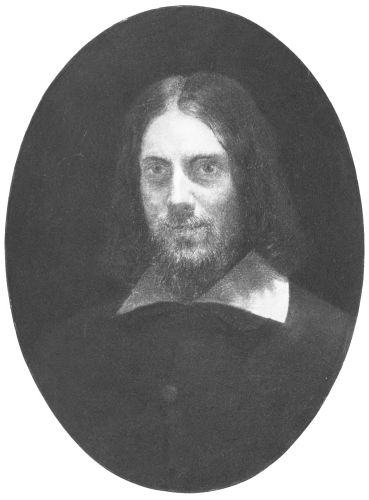
held and aimed at. Page was an enthusiast, and a man of mingled
imaginative and speculative powers. As Haydon preached the Elgin marbles
to Keats, so Page discoursed on the old masters to Lowell. But the
reciprocal admiration of Lowell and Page was really for the man behind
the art. “I am glad you like my poems,” Lowell wrote to Mrs. Shaw; “Page
is wiser than you and likes them because he knows I am better than
they;” and to Mr. Briggs he had written shortly before: “You are a great
deal better than anything you write, and Page than anything he paints,
and I always think of you without your pen, and of him without his
brushes.”
The admiration and affection with which Page and Briggs regarded Lowell
were only more intimate than the feelings which were generally aroused.
He had come to be looked on as a new poet. So Hawthorne, in his “Hall of
Fantasy,” as first published, characterized him as “the poet of the
generation that now enters upon the stage.” When the Pioneer was
started Lowell’s was a name to conjure with. “The principal editor,”
says the Tribune, “is well and widely known as one of the most gifted
and promising poets in America;” and a Philadelphia paper speaks of the
journal as “edited by a man whose genius and originality is at once the
praise and wonder of his countrymen.” To be sure, newspaper praise is
apt to be pitched in a high key, and the army of independent admirers on
closer examination turns out to be a company of the author’s
enthusiastic friends marching and countermarching across the stage,
disappearing in one wing only to come out from another. But after all
allowance has been made, it is clear that in a community which was
eagerly expecting great things in literature, Lowell, though he had
published little and much of that anonymously, was already one of the
candidates for fame. He himself did not need this incentive. He had the
consciousness of power and that audience of one which stimulated him to
the exercise of his power.
“A Year’s Life” had been frankly autobiographic. The poems written
afterward and now collected in the 1843 volume were the distinct
outgrowth of a nature stimulated by this new experience of love and at
last both fully alive to the consciousness of poetic feeling and eager
with a desire to act out the aspirations which had been blown into flame
by the breath of love. Hence the volume, in its contents, is of varied
character, as the poet himself held within his restless life the
somewhat contradictory elements which go to make up a poet and a
reformer. “A Legend of Brittany,” which is the substantial piece, and
stands at the front, is a piece of pure romance, pretty evidently sprung
from the soil in which grew Keats’s “Isabella; or the Pot of Basil.” The
underlying theme is not dissimilar, the measure is the same, and there
is something of the same richness of color and delight in the beauty of
single, even unfamiliar words. Yet the reader feels that Keats not only
had the more vivid imagination, but a clearer sense of the beauty that
lies in intensity of expression—an intensity so great that one almost
holds one’s breath as he reads. Lowell, as we know, rarely essayed
anything in the nature of story-telling; the dramatic faculty was not
his, and keen as was his appreciation of the power of the elder
dramatists, his criticism shows that he dwelt most emphatically on those
passages and lines which disclose poetic beauty, rather than the
features of construction. But Keats’s warmth and richness of decorative
painting appealed to him with peculiar force at a time when he himself
had come out into the sunshine and was intoxicated with his own
happiness. It is clear that when he was writing “A Legend of Brittany”
he was revelling in the possession of poetic fancy, and drawing himself
to the height of his enjoyment of pure poetry unmixed with elements of
didacticism. He wrote to G. B. Loring, 15 June, 1843, “I am now at work
on a still longer poem [than “Prometheus”] in the ottava rima to be
the first in my forthcoming volume. I feel more and more assured every
day that I shall yet do something that will keep my name (and perhaps my
body) alive. My wings were never so light and strong as now. So hurrah
for a niche and a laurel.” The poem did not apparently call out any
strong response, nor has it, I suspect, ever been read with very great
admiration—certainly it cannot for a moment be compared in popularity
with “The Vision of Sir Launfal,” which followed five years later, and
the explanation is perhaps to be found mainly in its derivative
character, even though readers might not be acutely aware how far it
owed its origin to Keats.
Mr. Briggs, who was the stanchest of Lowell’s literary friends at this
time, wrote with enthusiasm of the volume, using terms of admiration
which must have been grateful indeed, since they were charged with
discrimination and just appreciation; but he was frank and honest in his
friendly judgment, and he wrote to Lowell of “A Legend of Brittany:” “It
is too warm, rich, and full of sweet sounds and sights; the incense
overpowers me, and the love and crime, and prayers and monks and
glimpses of spirits oppress me. I am too much a clod of earth to mingle
well in such elements. I feel while reading it as though I were lying
upon a bed of down with a canopy of rose-colored silk above me, with
gleams of sunshine darting in the room and half revealing and at times
more than revealing strange figures painted upon the walls of my
chamber. But I do not wonder that M. W. should like it. It is the proper
reading for pure-minded loving creatures, from whose eyes knowledge with
its hard besom has not yet swept away the golden cobwebs of fancy. I
like her the better myself for liking it.”[38]
This long poem is not the only one in the book which springs from pure
delight in poetic imagination; but it is by far the most full and
unalloyed expression of this pleasure. When one reads, however, such a
poem as “Rhœcus,” with its preface apologizing for so much paganism,
and its application, and especially when one reads “Prometheus,” one is
aware how largely Lowell was dominated, even in this time when his soul
was flushed with the sense of beauty and awake to the tendrils it was
putting forth, by a strong purpose to read the lesson of beauty and love
to his fellows. The seriousness of life was indeed charged with an
exalted meaning by the revelation which came to him when he was admitted
into the intimate companionship of a woman who had in her something of
the spirit of a prophetess, but it would be untrue to say that Maria
White handed him the torch; she kindled to a greater brilliancy that
which he already held, and his love transmuted the vague stirrings of
his own nature into more definite purpose. Keats, to refer again to one
with whom Lowell certainly had spiritual kinship, was mildly affected
somewhat in the same way by the friendship which he formed in his
impressionable years with Hunt and his circle, and if we could imagine
Fanny Brawne a Mary Wollstonecraft, we might speculate on the effect she
would have had on his poetry. Even Keats, with his passionate devotion
to beauty, could dig a subterranean passage under the opening of the
third book of “Endymion” for the purpose of blowing up the “present
ministers;” and Lowell, taking the world-worn myth of Prometheus, could
write into it reflections apposite to what he regarded as a tremendous
upheaving force just ready to manifest itself in society. The poem of
“Prometheus,” however, justly stands high in the estimation of Lowell’s
readers, for the thought involved in it rises above the level of a
didactic utterance, and carries with it an impersonation of human
dignity which saves it from the reproach of making the myth a mere text
for a modern discourse. The poem is the most comprehensive and largest
expression of the mind of the poet at this period of emancipation, and
the fine images with which it abounds spring from the subject itself and
are not mere decorations.
Here, again, a comparison of “Prometheus” with Keats’s “Hyperion”
illustrates the infusion of moral ardor which separates the disciple
from the master. Keats summed up his poetic philosophy in the lines—
“For ’tis the eternal law
That first in beauty should be first in might,”—
and he was fain to see the operation of Nature’s law by which one race
of conquerors would dispossess another.
“So on our heels a fresh perfection treads.”
Lowell, speculating on the eternal struggle, figured in “Prometheus,” of
right and wrong, of darkness and light, bids Jove heed that he—
“And all strength shall crumble except love”—
and sees in a vision—
“Peaceful commonwealths where sunburnt Toil
Reaps for itself the rich earth made its own.”
Mr. Briggs, writing to him on the appearance of the poem in the
Democratic Review, reminds him that he had read a bit of it when
visiting him in his house at Staten Island, and adds: “But I did not
anticipate that you could or would lengthen out those few lines into a
poem so full of majesty and sweetness. So far as my observation will
allow me to judge, it is the best sustained effort of the American Muse.
The structure of the verse is exceedingly fine to my ear, although it
may not be as acceptable to the public ear as the almost emasculate
smoothness of Bryant, to which it has been accustomed. The bold bright
images with which ‘Prometheus’ abounds would be sufficient of themselves
to give you a name among the wielders of the pen, but the noble and true
spirit of Philosophy which they help to develop makes them appear of
secondary importance, and gives you a claim to a higher renown than the
mere word-mongers of Parnassus can ever aspire to.” Lowell, in replying
to this letter, wrote: “My ‘Prometheus’ has not received a single public
notice yet, though I have been puffed to repletion for poems without a
tithe of its merit. Your letter was the first sympathy I received.
Although such great names as Goethe, Byron, and Shelley have all handled
the subject in modern times, you will find that I have looked at it from
a somewhat new point of view. I have made it radical, and I believe
that no poet in this age can write much that is good unless he give
himself up to this tendency. For radicalism has now for the first time
taken a distinctive and acknowledged shape of its own. So much of its
spirit as poets in former ages have attained (and from their purer
organization they could not fail of some) was by instinct rather than by
reason. It has never till now been seen to be one of the two great
wings that upbear the universe.” In the same letter he says: “The proof
of poetry is, in my mind, whether it reduces to the essence of a single
line the vague philosophy which is floating in all men’s minds, and so
renders it portable and useful and ready to the hand. Is it not so? At
least no poem ever makes me respect its author which does not in some
way convey a truth of philosophy.”
In the same temper which produced “Prometheus,” he wrote what he
regarded as in some way a companion piece, “A Glance behind the
Curtain,” in which he imagines a conversation between Cromwell and
Hampden. There is no seeming endeavor at characterization of either
figure, dramatically, but the poem, which is an attempt to read
Cromwell’s mind, is a stirring and indignant demand that Freedom shall
do her perfect work.
“Freedom hath yet a work for me to do,” he makes Cromwell exclaim:—
“So speaks that inward voice which never yet
Spake falsely, when it urged the spirit on
To noble deeds for country and mankind.
And for success, I ask no more than this,—
To bear unflinching witness to the truth.
All true whole men succeed; for what is worth
Success’s name, unless it be the thought,
The inward surety, to have carried out
A noble purpose to a noble end,
Although it be the gallows or the block?
’Tis only Falsehood that doth ever need
These outward shows of gain to bolster her.”
Thus, in the guise of Cromwell, speaks the young man dimly conscious, in
a travailing age, of work needing to be done, and stirred too by the
high emotions of the woman he loved, yet not quite able to translate his
vague desire to be a champion of Truth into deeds. To be sure, at the
close of this poem he remembers that Cromwell was the friend of Milton,
“A man not second among those who lived
To show us that the poet’s lyre demands
An arm of tougher sinew than the sword.”
In the dreams of his youth I think he saw himself playing a part in the
drama that was opening, and wondering how he could wield the pen so as
to make it a weapon for slaying wrong or defending right. Yet direct as
he might wish his attack to be, he was held back by an equally potent
impulse to fulfil the demands of art. “A Chippewa Legend,” in this same
volume, though used as a parable for an impassioned denunciation of
slavery, has touches of nature in the unfolding of the story which show
clearly how much delight he took in the story itself, and how easily he
might have stopped short as a singer, if the preacher in him had not
made the song turn out a sermon.
The autobiographic element in this volume of “Poems” is most distinctly
summed up in a sonnet which dropped out of later collections containing
most of the other poems. It bears the title “On my twenty-fourth
Birthday, February 22, 1843,” and marks well his own sense of a certain
transition which had taken place in his growth.
“Now have I quite passed by that cloudy If
That darkened the wild hope of boyish days,
When first I launched my slender-sided skiff
Upon the wide sea’s dim, unsounded ways;
Now doth Love’s sun my soul with splendor fill,
And Hope bath struggled upward into Power,
Soft Wish is hardened into sinewy Will,
And Longing into Certainty doth tower:
The love of beauty knoweth no despair;
My heart would break, if I should dare to doubt,
That from the Wrong, which makes its dragon’s lair
Here on the Earth, fair Truth shall wander out,
Teaching mankind, that Freedom’s held in fee
Only by those who labor to set free.”
In “A Year’s Life” the l’envoi of the volume is a timid poem, “Goe,
little booke!” in which the poet, sending his venture out among
strangers and most likely among apathetic readers, comforts himself with
the reflection:—
“But, if all others are unkind,
There’s one heart whither thou canst fly
For shelter from the biting wind;
And, in that home of purity,
It were no bitter thing to die.”
The “L’Envoi” of “Poems” is addressed to M. W. and is an open confession
of the indebtedness of his love, three years after the veiled disclosure
in “Ianthe,” “Irene,” “Isabel,” and other figurings of his affection,
and runs like a golden thread through all the warp and woof of his
imagination and fancy. In this serious poem, which he retained in his
later collections, though without the declarative initials,[39] Lowell
intimates very clearly that his maturer outlook on life, and his
attitude toward poetry are due largely to the inspiration which he has
derived from the aspirations of his betrothed. Not only has his love for
her quickened his eye of faith, but he has caught a wider view and a
firmer hold on the great realities of the spirit through the contagion
of her lofty idealism and its fervent expression in a moral ardor. This
is especially manifest in a long passage which has been omitted from the
poem in later collections. There are portions of this omitted passage
which are little better than a dissertation on the poet’s mission, and
they were wisely dropped, but they drew after them by necessity a few
verses which have an interest as recording in a candid fashion the
change which had come over the poet’s mind in these three years just
past. After the introductory lines, in which he speaks rather
disdainfully of “A Year’s Life,” and intimates that he has grown a
sadder and a wiser man, yet with no lessening of that trust in God which
was so marked a characteristic of his betrothed, he goes on:—
“Less of that feeling which the world calls love,
Thou findest in my verse, but haply more
Of a more precious virtue, born of that,
The love of God, of Freedom, and of Man.
Thou knowest well what these three years have been,
How we have filled and graced each other’s hearts,
And every day grown fuller of that bliss,
Which, even at first, seemed more than we could bear,
And thou, meantime, unchanged, except it be
That thy large heart is larger, and thine eyes
Of palest blue, more tender with the love
Which taught me first how good it was to love;
And, if thy blessed name occur less oft,
Yet thou canst see the shadow of thy soul
In all my song, and art well-pleased to feel
That I could ne’er be rightly true to thee,
If I were recreant to higher aims.
Thou didst not grant to me so rich a fief
As thy full love, on any harder tenure
Than that of rendering thee a single heart;
And I do service for thy queenly gift
Then best, when I obey my soul, and tread
In reverence the path she beckons me.”
It would be joy enough, he proceeds, if he could so measure joy, to rest
in this contentment of loving and being loved, but life had nobler
destinies, and he rejoiced that she who gave him her love had a larger
conception of poetry, and so he passes to an analysis of the true aims
of poesy, which finally takes the turn of considering the possibility of
satisfying these aims by rendering the landscape of America into
verse,—
“They tell us that our land was made for song,”—
and so continues as preserved in the present form of the poem.
It will be seen thus that this volume of “Poems,” taken as a register of
Lowell’s development, marks a greater sureness of himself, a more
definite determination of aim, a confidence in powers whose precise
range he cannot yet measure, and with all this a swaying now toward the
expression of pure delight in art, now toward the use of his art for the
accomplishment of some great purpose. It is noticeable, also, that in “A
Year’s Life” there is no trace of humor and scarcely any singular
felicity of phrase; in “Poems,” wit and humor begin to play a little on
the surface. There can be little doubt that the direct influence of
Maria White was toward what may without offence be called the practical
issue, and this not because she was utilitarian—on the contrary, Lowell
felt called on to defend her against the charge of being a
transcendentalist, the charge implying a reproach as of a mere
visionary; no, it was a certain high, even exalted and enthusiastic
allegiance to Truth which dominated her nature, made her in a degree to
accept this allegiance as sign of a mission which she was to fulfil,
rendered her eager to have the close coöperation of her lover, and made
him almost feverishly desirous of justifying her faith by his works. A
letter which she wrote to Mr. Briggs, though it anticipates a little the
course of this narrative, may be cited here as throwing some further
light on her nature.
Watertown, Dec. 12th, 1844.
My dear Friend,—James is so hurried with his book that he has not
an instant to spare, and has therefore commissioned me to answer
your letter, and account to you for his long silence. The truth is,
he delayed writing his articles on Poets and Old Dramatists, or
rather delayed arranging them in the form of conversations, until
he had only two months left for what really required four. The book
must be out before we are married; he has three printers hard upon
for copy, for which he has to rise early and sit up late, so that
he can only spare time to see me twice a week, and then I have but
transient glimpses of his dear face.
The pears were thought delicious, and James would have told you
that we all thought so, had not these troubles about his book just
been dawning upon him. The basket still remains upon a shelf in my
closet, and when I look at it a pleasant train of thoughts comes up
in regard to my housekeeping, in which I see it filled, with eggs
white as snow, or apples from our little plot, though never again
with pears like those which first consecrated it.
Both James and myself feel greatly interested in your journal,[40]
in spite of its proposed name. James told me to express his horror
to you at the cockneyism of such a title. The Broadway Chronicle
chronicles the thoughts and feelings of Broadway, not those of the
New England people whom you seem willing to receive somewhat from.
Should not a title have truth for its first recommendation? Do you
write from the meridian of Broadway? I think you write from a
sturdy New England heart, that has a good strong well-spring of old
Puritan blood beating therein, with all its hatred to forms and
cant, to fashion and show. If ‘Pistol speaks naught but truth,’
should his name be a lie? Pistol’s is not; it expresses the man
truly. I wish yours did as much to us here, though if it really
gratifies your taste and judgment, if it is not a whim, but a
thought, we shall all like it in time, I suppose, if we do not
now. If it is good we shall of course come round to it. I always
say just what I think, as you see, and I trust it will not seem
harsh and unlovely to you in me as a woman. I do not wish to appear
so ever, but I had rather than give up what I think is truly and
undeniably one of woman’s rights in common with man.
James says he cannot say anything now with certainty in regard to
his contributions to your paper, except that he will give you, of
course, the best he has. Mrs. Putnam, I believe, has nothing
translated at present, but James will ask her, also William Story
and Nathan Hale. I have some translations I made from the German,
songs, ballads, etc., which are at your service if you care to have
them. I hope to write somewhat when I can have James always by my
side to encourage me, and in time it may be something more than a
source of pleasure to us. Carter has seen your letter, and I do not
doubt will be ready to do all he can, ready and glad.
I intended to have written to you and Mrs. Briggs expressly to
invite you to our wedding, but I cannot do it now with much force
or grace after your paragraph on the subject.[41] To us who have
been married for nearly five years, it is of course no spiritual
change; but if it were merely for the fact that from that day we
can always be together, it would be well worth celebrating by some
rite and calling our friends about us to participate in it. What
that rite is does not greatly matter, but I prefer that which time
has consecrated.
“I can scorn nothing which a nation’s heart
Hath held for ages holy.”
That is, nothing in the form of rite or observance for things in
themselves sacred, for you will tell me the Ages held the gibbet,
the scourge and rack holy, if I let it pass without qualification.
Still, I bid you to our marriage, though I trust even if you do not
come you can see it whenever you see us. Some have great need to
ask their friends at such a time, that they may afterwards certify
such a thing has taken place because no trace of it remains. It can
never be so with us, it could never be so with any who hold love
sacred....
We shall be married the night after Christmas, and go on to New
York after one day and night spent at home. We should love to stop
there to see you” as long as you would like to have us, but our
present engagements in Philadelphia will take us directly on there.
We shall be in New York on Sunday, where is not decided yet. With
love to your wife, yours with friendly heart,
Maria White.
The book which this letter speaks of as absorbing Lowell’s time and
thought was his “Conversations on Some of the Old Poets,” for which Miss
White made a cover design and which was published by John Owen early in
January, 1845. It will be remembered that Lowell began in the Boston
Miscellany and continued in the Pioneer some studies on the Old
Dramatists. The series might have gone on at greater length, for he was
working a vein which yielded him great delight, and never indeed ceased
to engage his attention. He resumed the theme in the last considerable
venture of his life, and gave a course of lectures at the Lowell
Institute in the spring of 1887, which was in effect a series of
readings from the dramatists with running comments. “When I selected my
topic for this new venture,” he said to his audience at the opening of
the course, “I was returning to a first love. The second volume I ever
printed, in 1843 I think it was,[42]—it is now a rare book, I am not
sorry to know; I have not seen it for many years,—was mainly about the
Old English Dramatists, if I am not mistaken. I dare say it was crude
enough, but it was spontaneous and honest.”
The suspension of the Pioneer left Lowell without any convenient
vehicle for carrying further these appreciative papers, and he projected
a book partly because the subject was in his mind, partly because he was
anxious to turn his printed matter to fresh account, but chiefly, it
must be inferred from the contents of the book, because he was eager to
have freedom of speech on several matters which lay close to his mind.
He resolved, therefore, to remodel his papers, so far as he used them
at all, into a series of conversations. His work upon the book was
hurried, as the letter last quoted from Miss White intimates. In
September, 1844, he was planning a course of four or five lectures on
English poetry, beginning with Chaucer, which he proposed delivering in
Philadelphia in the winter immediately after his marriage; but he seems
suddenly to have changed his mind, and to have tossed what he might have
prepared into this new book, which opens with a long conversation on
Chaucer,—a conversation split in the next edition into two. The
passages from Chaucer which he quotes are drawn sometimes from the
modernization by Wordsworth, but are also, in some cases, his own much
closer simplification of the original. To the ear they depart very
little from the original, the widest departure being in getting rid of
the final e. The talk on Chaucer is followed by comments on Chapman
and Ford, with reference by easy suggestion to Shakespeare, Marlowe,
Fletcher, Pope, and Wordsworth.
But though the staple of the “Conversations” is poetry, and there are
generous examples and much keen appreciation of the poets discussed, the
book would interest a reader to-day less by its treatment of the
subjects which gave it excuse for being than by its free and careless
exhibition of Lowell’s mind on topics of current concern. There is very
little of dramatic assumption in the interlocutors. Philip and John are
simply convenient personages playing at a battledore and shuttlecock
game of words. Philip is the major character, who does all of the
reading and advances most of the propositions, but John, whose chief
part is to start Philip by questions, and to interpose occasional jibes
or independent observations, is not differentiated in manner; he is
another of Lowell’s many selves, and may be taken as the critical,
interrupting side of his mind.[43] But both speakers are after the same
game.
One of the agreeable touches in the volume is in the asides with which
Lowell refers to contemporary authors like Hawthorne and Longfellow, to
Page, to Dwight, and to such beginners as W. W. Story and R. C., and
when he takes up for discussion a recent address by the Rev. Mr. Putnam.
These references and allusions help one to understand the attitude which
Lowell took toward his book. He did not deceive himself as to its
importance. It was a prolongation of his magazine work and gave him an
opportunity to free his mind. The form, as I have intimated, was not
that of a true conversation; it is far removed from such excellent
exemplars as the “Imaginary Conversations” of Landor, the first of which
had appeared a score of years before; it had but little of the graceful
fencing which brings the talkers closer and closer to the heart of a
subject, till one makes the final thrust that disarms his antagonist.
No; it was simply a device to secure flexibility and discursiveness,
and is talk run mad, sometimes an harangue, sometimes an epigram, most
often a rapid flow of views on literature and life. “If some of the
topics introduced seem foreign to the subject,” says Lowell, in his
prefatory address To the Reader, “I can only say that they are not so to
my mind, and that an author’s object in writing criticisms is not only
to bring to light the beauties of the works he is considering, but also
to express his own opinions upon those and other matters.”
The reading which lies behind the talk is varied, and the talker speaks
from a full mind, but there is none of that restraint of art which gives
weight to the words and makes one wish to read again and again the
reflections. The cleverness is of the showy sort, and an interesting
comparison could be drawn between the portions of the book which relate
directly to the dramatists and the more mellow discussion of the same
subject in the latest of Lowell’s published prose. But despite the
crudeness which marks the earlier book, it shares with the later that
delightful spontaneity and first hand intelligence which make Lowell
always worth attention when he speaks on literary art. It was
characteristic of him that when at sixty-eight he discoursed on the
dramatists whom he had been reading all his life, he had not the need
and apparently not the curiosity to turn back and see what he said about
them at twenty-five. There was little, if any, of the careful husbandry
of his ideas which marks some men of letters; out of the abundance of
the heart his mouth spoke.
In no one of his books can the reader discern better the spontaneous
element in Lowell’s mind, and the length to which he could go under the
impulse of the immediate thought. So fluent was he, so unaware of any
effort, and so swept away for the time being by the stream of his ideas,
that he seemed to himself as one possessed, and more than once he hinted
darkly that he was not writing the book, but was the spokesman for sages
and poets who used him as their means of communication. The visionary
faculty which he possessed could easily be confused at this time with
the half-rapt condition of the mind fed with emotional ardor. The book,
as we have seen, was written at full speed, and it reflects the generous
nature of the writer; but it reflects also the untempered thought, and
registers judgments in the process of making.
Running through the entire book, and making the real excuse for it, is
Lowell’s study of the essence of poetry. This is what gives to the
volume its chief interest; it is really a half-conscious explication of
the concern which was most agitating his mind at this time. What was
poetry? Could it be the substance of a man’s life? There is a
prosecution of some of the same problems which recently he had been
trying to solve in his own volume of poems. He had to ask himself if he
was a poet. The witness for that was to be found not so much in his
taste and his preferences in literature, nor solely in the delight which
he took in versification; he felt the stirring in his nature of that
high vocation of the poet which makes him a seer and an interpreter.
His impulse was to yield to it, but the question arose, What was he to
interpret? What was there in life about him which was crying out for
articulation? And here, if I mistake not, he fell into some confusion of
mind through the insistence of one particular incarnation of divine
thought. He was conscious and aware of a momentous idea, that of freedom
expressed in terms of human brotherhood, words which even then had the
dull ring of cant when they were used by counterfeit-minded men, yet had
in the minds of genuine men and women a vibrant and exultant sound as if
they were to pay all the debts of poor human nature. Remembering that
this was on the eve of ’48, when the visionaries of Europe and America
were very sure that they saw a great light, one sees how forcible this
idea could be as a motive in the throbbing and ingenuous heart of a
young American who was quite sure he was called to high endeavor.
But with the shrewdness which belonged to his mother wit, Lowell could
not satisfy himself with merely windy utterances. He needed emphatically
to kindle something with his divine flame. As he says of Lessing: “His
genius was not a St. Elmo’s fire, as it so often is with mere poets,—as
it was in Shelley, for example, playing in ineffectual flame about the
points of his thoughts, but was interfused with his whole nature and
made a part of his very being.” Now he found himself confronting a
monstrous denial of this truth of freedom issuing in human brotherhood
when he contemplated slavery in America, and his natural indignation
was heightened by the ardor of the woman he loved. Was he not, after
all, to be a reformer beyond everything else? and where was the point of
contact between the poet and the reformer? His mind circled about this
problem; his convictions called upon him with a loud voice to make good
his professions; his instinctive sense of congruity, which is hardly
more than an alternate form of the sense of humor, forbade him to make
poetry the maid of all work for the anti-slavery cause, and he sought
diligently to resolve this particular form of spiritual activity into
the elemental properties of freedom, and so to find therein a true
medium for the sustenance of poetry. Moreover, though he described
himself not long after, in “A Fable for Critics,” as—
“striving Parnassus to climb
With a whole bale of isms tied together with rhyme,”—
it must be said with emphasis that he held these isms too lightly for
them to become the determining factor in his intellectual and spiritual
growth. They did hamper him, as he says a little ruefully in the next
line, and while it is idle business to speculate on what a man might
have become in the absence of the very conditions that made him what he
was, one is tempted to wonder if with his endowments Lowell might not,
under less strenuous conditions, have been exclusively a poet. What is
one man’s meat is another man’s poison, says the homely adage, and it is
a curious fact that but for the same flame of anti-slavery passion
Whittier might never have been more than a verbose Quietist versifier.
In his dedication of the volume to his father, Lowell speaks of it as
“containing many opinions from which he will wholly, yet with the large
charity of a Christian heart, dissent,” and the most flagrant of these
is probably in a passage in which he speaks with vehemence of the church
and religion. As falls to the hearer of many impulsive utterances of
young men, one is apt to see in them rather the impatience of a generous
heart (“why so hot, my little man?”) than the deliberate convictions
into which one has been forced reluctantly, but the passage is so
characteristic of Lowell at this period and so expressive of the
turbulence of his mind that it may well be read here. John has been
commenting on the innate piety of Chaucer as illustrated by his glowing
words on the daisy, and Philip takes up the parable.
“PHILIP.
“Piety is indifferent whether she enters at the eye or the ear.
There is none of the senses at which she does not knock one day or
other. The Puritans forgot this and thrust beauty out of the
meeting-house, and slammed the door in her face. I love such
sensuality as that which Chaucer shows in his love of nature.
Surely, God did not give us these fine senses as so many posterns
to the heart for the Devil to enter at. I believe that he has
endowed us with no faculty but for his own glory. If the Devil has
got false keys to them, we must first have given him a model of
the wards to make a mould by. The senses can do nothing unless the
soul be an accomplice, and, in whatever the soul does, the body
will have a voice....
“JOHN.
“All things that make us happy incline us also to be grateful, and
I would rather enlarge than lessen the number of these. Morose and
callous recluses have persuaded men that religion is a prude, and
have forced her to lengthen her face, and contract her brows to
suit the character. They have laid out a gloomy turnpike to heaven,
upon which they and their heirs and assigns are privileged to levy
tolls, and have set up guide-boards to make us believe that all
other roads lead in quite an opposite direction. The pleasanter
they are, the more dangerous. For my part, I am satisfied that I am
upon the right path so long as I can see anything to make me
happier, anything to make me love man, and therefore God, the more.
I would stamp God’s name, and not Satan’s, upon every innocent
pleasure, upon every legitimate gratification of sense, and God
would be the better served for it. In what has Satan deserved so
well of us, that we should set aside such first-fruits for him?
Christianity differs not more widely from Plato than from the
Puritans.
“PHILIP.
“The church needs reforming now as much as in Luther’s time, and
sells her indulgences as readily. There are altars to which the
slaveholder is admitted, while the Unitarian would be put forth as
unclean. If it be God’s altar, both have a right there,—the sinner
most of all,—but let him not go unrebuked. We hire our religion by
the quarter, and if it tells any disagreeable truths, we dismiss
it, for we did not pay it for such service as this. Christ scourged
the sellers of doves out of the temple; we invite the sellers of
men and women in. We have few such preachers now as Nathan was.
They preach against sin in the abstract, shooting their arrows into
the woundless air. Let sin wrap itself in superfine broadcloth, and
put its name on charitable subscription papers, and it is safe. We
bandy compliments with it, instead of saying sternly ‘Get thee
behind me!’ The Devil might listen to some preaching I have heard
without getting his appetite spoiled. There is a great deal of time
and money expended to make men believe that this one or that one
will be damned, and to scare or wheedle them into good Calvinists
or Episcopalians; but very little pains is taken to make them good
Christians....
“JOHN.
“It has never been a safe thing to breathe a whisper against the
church, least of all in this country, where it has no prop from the
state, but is founded only on the love, or, if you will have it so,
the prejudices of the people. Religion has come to be esteemed
synonymous with the church; there are few minds clear enough to
separate it from the building erected for its convenience and
shelter. It is this which has made our Christianity external, a
task-ceremony to be gone through with, and not a principle of life
itself. The church has been looked on too much in the light of a
machine, which only needs a little oil, now and then, on its joints
and axles, to make it run glibly and perform all its functions
without grating or creaking. Nothing that we can say will be of
much service. The reformers must come from her own bosom; and there
are many devout souls among her own priests now, who would lay down
their lives to purify her. The names of infidel and heretic are the
San benitos in which we dress offenders in the nineteenth
century, and a bigoted public opinion furnishes the fagots and
applies the match! The very cross itself, to which the sacred right
of private judgment fled for sanctuary, has been turned into a
whipping post. Doubtless, there are no nations on the earth so
wicked as those which profess Christianity; and the blame may be
laid in great measure at the door of the church, which has always
sought temporal power, and has chosen rather to lean upon the arm
of flesh than upon that of God. The church has corrupted
Christianity. She has decked her person and embroidered her
garments with the spoils of pagan altars, and has built her temples
of blocks which paganism has squared ready to her hand. We are
still Huns and Vandals, and Saxons and Celts, at heart. We have
carved a cross upon our altars, but the smoke of our sacrifice goes
up to Thor and Odin still. Lately I read in the newspapers a toast
given at a military festival, by one of those who claim to be the
earthly representatives of the Prince of Peace. England and France
send out the cannon and the bayonet, upon missionary enterprises,
to India and Africa, and our modern Eliots and Brainerds among the
red men are of the same persuasive metal.
“PHILIP.
“Well, well, let us hope for change. There are signs of it; there
has been a growling of thunder round the horizon for many days. We
are like the people in countries subject to earthquakes, who crowd
into the churches for safety, but find that their sacred walls are
as fragile as other works of human hands. Nay, the very massiveness
of their architecture makes their destruction more sudden and their
fall more dangerous. You and I have become convinced of this. Both
of us, having certain reforms at heart, and believing them to be of
vital interest to mankind, turned first to the church as the
nearest helper under God. We have been disappointed. Let us not
waste our time in throwing stones at its insensible doors. As you
have said, the reformers must come from within. The prejudice of
position is so strong that all her servants will unite against an
exoteric assailant, melting up, if need be, the holy vessels for
bullets, and using the leaves of the holy book itself for wadding.
But I will never enter a church from which a prayer goes up for the
prosperous only, or for the unfortunate among the oppressors, and
not for the oppressed and fallen; as if God had ordained our pride
of caste and our distinctions of color, and as if Christ had
forgotten those that are in bonds. We are bid to imitate God; let
us in this also follow his example, whose only revenge upon error
is the giving success to truth, and but strive more cheerfully for
the triumph of what we believe to be right. Let us, above all
things, imitate him in ascribing what we see of wrong-doing to
blindness and error, rather than to wilful sin. The Devil loves
nothing better than the intolerance of reformers, and dreads
nothing so much as their charity and patience. The scourge is
better upon our backs than in our hands.
“JOHN.
“When the air grows thick and heavy, and the clouds gather in the
moral atmosphere, the tall steeples of the church are apt to
attract the lightning first. Its pride and love of high places are
the most fatal of conductors. That small upper room, in which the
disciples were first gathered, would always be safe enough.”
These kindling words are those of a reformer dealing with existing
conditions. It would be much more to the point if we could have in
definite terms that revelation of the inner verity of religion which
visited Lowell a little earlier than this, as may be seen by a passage
from a letter to Dr. Loring, 20 September, 1842. “I had a revelation
last Friday evening. I was at Mary’s, and happening to say something of
the presence of spirits (of whom, I said, I was often dimly aware), Mr.
Putnam entered into an argument with me on spiritual matters. As I was
speaking the whole system rose up before me like a vague Destiny looming
from the abyss. I never before so clearly felt the spirit of God in me
and around me. The whole room seemed to me full of God. The air seemed
to wave to and fro with the presence of Something, I knew not what. I
spoke with the calmness and clearness of a prophet.”[44]
No doubt this ecstasy may be regarded as one manifestation of that
psychical temper which caused him to see visions in his childhood, but
it allied itself with intellectual processes, for he goes on to say: “I
cannot tell you what this revelation was. I have not yet studied it
enough. But I shall perfect it one day, and then you shall hear it and
acknowledge its grandeur. It embraces all other systems.”
We may not find a clear statement of this mystic revelation in the
discursive “Conversations;” rather we should look for it in his poems of
this period, and here, though we find nothing whatever to correspond to
a system of divine order, we do find, recurring in various forms, a
recognition of an all-embracing, all-penetrating power which through the
poet transmutes nature into something finer and more eternal, and gives
him a vantage ground from which to perceive more truly the realities of
life. “The Token,” “An Incident in a Railroad Car,” “The Shepherd of
King Admetus,” all in a manner witness to this, and show how
persistently in Lowell’s mind was present this aspect of the poet which
makes him a seer. Perhaps there is a more direct attempt at expressing
this truth in one of the poems not retained in later collections. It is
entitled “A Dirge,” and is the imagined plaint over a poet who has died.
In this tumultuous period of Lowell’s youth, when the tranquillity which
a returned love brought was after all a very self-conscious
tranquillity, there was always room for morbid fancies, and the
frequency with which in his poetry he recurs to the images of death
leads one to suspect that he experimented a little with the idea of his
own death. And it may be that in this poem, which a healthier judgment
later led him to suppress, he was dramatizing himself.
“Poet! lonely is thy bed,
And the turf is overhead,—
Cold earth is thy cover;
But thy heart hath found release,
And it slumbers full of peace
’Neath the rustle of green trees,
And the warm hum of the bees
Mid the drowsy clover;
Through thy chamber still as death
A smooth gurgle wandereth,
As the blue stream murmureth
To the blue sky over.
. . . . . . . .
Thou wast full of love and truth,
Of forgivingness and ruth,—
Thy great heart with hope and youth
Tided to o’erflowing;
Thou didst dwell in mysteries,
And there lingered on thine eyes
Shadows of serener skies,
Awfully wild memories
That were like foreknowing;
Thou didst remember well and long
Some fragments of thine angel-song,
And strive, through want, and woe, and wrong,
To win the world unto it;
Thy curse it was to see and hear
Beyond to-day’s scant hemisphere,
Beyond all mists of doubt and fear,
Into a life more true and clear,—
And dearly thou didst rue it.
. . . . . . . .
“Poet! underneath the turf,
Soft thou sleepest, free from morrow;
Thou hast struggled through the surf
Of wild thoughts, and want, and sorrow;
Now, beneath the moaning pine
Full of rest thy body lieth,
While, far up in pure sunshine,
Underneath a sky divine,
Her loosed wings thy spirit trieth;
Oft she strove to spread them here,
But they were too white and clear
For our dingy atmosphere.”
The limitations of his theme and measure forbid more than a hint at this
vocation of the poet, but it happens that we have a somewhat more
explicit statement of the same general idea in a prose form. A very few
weeks after the revelation referred to in the letter to Dr. Loring, too
soon certainly for it to have faded from his mind, he sat down to write
a paper on “The Plays of Thomas Middleton,” and the introductory
passages contain what may fairly be taken as snatches from that music of
the spheres which he seems suddenly to have overheard.
“Poets are the forerunners and prophets of changes in the moral world.
Driven, by their finer nature, to search into and reverently contemplate
the universal laws of soul, they find some fragments of the broken
tables of God’s law, and interpret it, half conscious of its mighty
import. While philosophers are wrangling, and politicians playing at
snapdragon with the destinies of millions, the poet, in the silent deeps
of his soul, listens to those mysterious pulses which, from one central
heart, send life and beauty through the finest veins of the universe,
and utters truths to be sneered at, perchance, by contemporaries, but
which become religion to posterity....
“The dreams of poets are morning-dreams, coming to them in the early
dawn and day-breaking of great truths, and are surely fulfilled at last.
They repeat them, as children do, and all Christendom, if it be not too
busy with quarrelling about the meaning of creeds which have no meaning
at all, listens with a shrug of the shoulders and a smile of pitying
incredulity: for reformers are always madmen in their own age, and
infallible saints in the next.”
In such rhetorical terms did Lowell, all aflame himself with poetic
zeal, try to outline the divine call of the poet, and the
“Conversations” reënforce a doctrine which was held more firmly since
the preacher was eager to display it in his own practice. At this time,
certainly, Lowell’s conception of the function of the poet was blended
with his apprehension of the divine order, and he entered upon the
discharge of poetic duties with the seriousness which a young priest
might have carried to the sacred office. The very suppression of his
native humor, so that it makes only a few furtive leaps in his poetry up
to this time,—for we are setting aside his boyish pranks in
verse,—illustrates the exalted mood in which he was living.
The “Conversations on Some of the Old Poets” was published, as we have
seen, in January, 1845,[45] but as soon as his own part of the book was
done, he was free for a more vital venture: on the 26th of December,
1844, after a five years’ betrothal, he was married in her father’s
house at Watertown to Maria White.