Mr. Lowell had declined the suggestion that he
should go to England when Mr. Hayes’s administration
came in. But one need not say that when he
now determined to go to England, he went there with
the pleasure with which every one of our race visits
what we still call the “mother country.” His ancestry,
his education, and the studies in which he
had taken the very broadest interest, all made him
love England.
He was an American through and through, and,
as his own celebrated address, which I shall speak of
again, showed to the world, he comprehended democracy
in its possibilities, in its future, and in its
present better than almost any man of his time.
He was better able to show it to the leaders of the
feudal communities in which he lived, better than
any other American who could have been chosen.
For all this,—it would be better to say because of
this,—he went and came in England with that sort
of delight which Mr. Edward Everett fifty years
before described so well:—
“An American looks at Westminster Abbey and
Stratford-on-Avon with an enthusiasm which the
Englishman laughs at as a sort of provincial rawness.”
This enthusiasm of the American in England is
so genuine that one may not speak with adequate
contempt of the sneers with which banished Irishmen
ridiculed it, when they had occasion to speak
of Mr. Lowell while he stayed in the home of his
ancestors.
As minister to England Mr. Lowell rendered
essential service to his country. His firmness, serenity,
courtesy, and diligence enabled him to keep
on the best terms with the members of the English
cabinet with whom he had to do. He was to a
remarkable degree, as we shall see, a favorite with
all classes of the English people. He satisfied the
administration of President Hayes, who sent him.
He did not satisfy the more talkative leaders of
the Irish-Americans, who, to use a happy phrase of
his, were like an actor who “takes alternately the
characters of a pair of twins who are never seen on
the stage simultaneously.”
But nobody could have satisfied them. They
were in a false position,—so false that even diplomacy
of the old fashion could not have satisfied it.
No man can serve two masters, and no man can be
a citizen of two nations at the same time. So those
gentlemen found out who, while, as Irishmen, they
pressed the Irish people to revolt, fell back under
the ægis of America when they got into trouble.
For the others, for those who had really made themselves
Americans, and meant to remain such, Mr.
Lowell was more than the advocate. He was their
fearless guardian. And in such guardianship he was
always successful. Here, let it be said, first and
last, he knew nothing of the morals of that diplomacy
of the older fashion. He might have directed
a dispatch wrong, so that Lord Granville should
read what was meant for Mr. Evarts, and Mr. Evarts
what was meant for Lord Granville, and no harm
would have been done. That was his way,—as, be
it said, it is the way of gentlemen, and, in general, of
our national negotiations.
At the same time Lowell made friends in England
among all classes of people. For a generation the
line of American ministers had generally been good.
From time to time we sent one or two fools there,
usually to get them out of the way of home aspirations
and ambitions. But Mr. Everett, Mr. Lawrence,
Mr. Bancroft, Mr. Adams, Mr. Welsh, and
Mr. Motley were all conscientious, intelligent gentlemen,
who really were as much interested in English
history and English literature as Englishmen were,
and “really, you know, they spoke English very
well, with almost no accent, you know.”
Diplomacy, and the whole business of ambassadory,
is, in fact, about as much out of place in our
time as chain mail is, or as orders of precedence
are. But people of sense try to make a new
diplomacy in which each nation can approach, not
the government of the other, but the people. Mr.
Lowell, who could think on his feet, who could
speak well in public, who had always something to
say, and who, indeed, liked to say it, had a real
“calling” in this line. In his English stay he
made several public speeches which did more good
than any “state paper,” so called, could have done.
In private society he was a favorite, as he was everywhere.
In 1882 somebody told me in London the
story of an invitation which Lord Granville, the
foreign minister, had sent him. Lord Granville,
in a friendly note, asked him to dinner, saying at
the same time that he knew how foolish it was to
give such short notice “to the most engaged man in
London.” Lowell replied that “the most engaged
man is glad to dine with the most engaging.”
Also, London is an excellent place in which to
study, and to learn without studying. And, from
the first, Lowell enjoyed London and England.
Mrs. Lowell was able sometimes to receive her
friends, and even to bear the fatigue of a reception
at court, and of presenting to the queen American
ladies who visited London. She made herself most
welcome in the circle, not large, whom she was able
to meet in that way. The delicacy of her health,
however, prevented her husband from attempting
the more public social functions of hospitality, of
that kind that consists mostly in calling people together
to dinners or evening parties. But he was,
all the same, cordial to all comers from his own
nation, ready and successful in promoting their
object, while, as has been said, he was at ease among
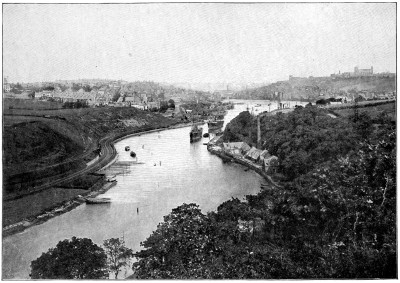
all classes in England. His holidays, if we may call
them so, were spent privately in visits with friends,
and for six or seven summers in Whitby,—the
Whitby of “Marmion,” in the north of England,—a
place of which he was very fond.
He was presented and began on his formal duties
in the winter of 1881–82. His stay in England
lasted until June 10, 1885. Mrs. Lowell had died
in February of that year.
The first important matter in his negotiations was
connected with the Irish disaffection. Most general
readers to-day will have forgotten that an insurrection,
or plan of insurrection, attributed to the Fenian
organization, had disturbed Ireland and frightened
England not long before. The name Fenian was
taken from Fein McCoil, the Fin-gal of Ossian.
Lowell, who could never resist a pun which had any
sense in it, called the Fenians Fai-néants, which, as
it proved, was fair enough, except that they and
theirs kept their English masters in alarm. I was
talking with a Liberal in England in May, 1873,
and he said, “Why, if you had landed in Ireland,
you would have been in jail by this time.” I asked
what was the matter with me. He said that my
crush hat and my broad-toed shoes would have convicted
me. Now the shoes had been bought in
Bristol, only three days before, and I said so.
“Bristol? were they? Well, they knew you were
a Yankee.” That is to say, any one who looked
like an outsider had to run his chances with the
Irish constables of the time.
Among others who were less fortunate than I,
Henry George was arrested. He was as innocent as
I, and was at once released, with proper apologies.
The view which Lowell took, and the dilemma in
which his Irish clients acted, and even went to
prison, are well explained in a dispatch from which
I will make a few short extracts. The whole collection
of dispatches shows the extreme unwillingness
of Lord Granville to give offense in America:—
MR. LOWELL TO THE AMERICAN SECRETARY.
March 14, 1882. (Received March 27.)
In concluding this dispatch I may be permitted
to add that I have had repeated assurances from the
highest authority that there would be great reluctance
in arresting a naturalized citizen of the United
States, were he known to be such. But it is seldom
known, and those already arrested have acted in all
respects as if they were Irishmen, sometimes engaged
in trade, sometimes in farming, and sometimes filling
positions in the local government. This, I think, is
illustrated by a phrase in one of Mr. Hart’s letters,
to the effect that he never called himself an American.
He endeavors, it is true, in a subsequent letter,
to explain this away as meaning American born; but
it is obviously absurd that a man living in his native
village should need to make any such explanation.
Naturalized Irishmen seem entirely to misconceive
the process through which they have passed in
assuming American citizenship, looking upon themselves
as Irishmen who have acquired a right to
American protection, rather than as Americans who
have renounced a claim to Irish nationality.
Simply, the view he sustained is that which he laid
down in two letters written to Mr. Barrows, to be
read to one of these prisoners, from which here are
a few extracts. They embody briefly the established
policy of our government:—
“The principles upon which I have based my
action in all cases of applications to me from naturalized
citizens now imprisoned in Ireland under the
‘Coercion’ Act are those upon which our government
has acted, and in case of need would act again.
I think it important that all such persons should be
made to understand distinctly that they cannot be
Irishmen and Americans at the same time, as they
now seem to suppose, and that they are subject to
the operation of the laws of the country in which
they choose to live.”
In another letter he says:—
“If British subjects are being arrested for no
more illegal acts than those which the prisoner is
charged with having committed, or of the intention
to commit which he is justly suspected, it seems
that, however arbitrary and despotic we may consider
the ‘Coercion’ Act to be, we are, nevertheless,
bound to submit in silence to the action taken
under it by the authorities even against our own
fellow citizens.
“It should be observed that this act is a law of
the British Parliament, the legitimate source and
final arbiter of all law in these realms, and that, as
it would be manifestly futile to ask the government
here to make an exception on behalf of an American
who had brought himself within the provisions of
any law thus sanctioned, so it would be manifestly
unbecoming in a diplomatic representative, unless
by express direction of his superiors, to enter upon
an argument with the government to which he is
accredited as to the policy of such a law or the necessarily
arbitrary nature of its enforcement.”
That neither he nor the American government
was hard on the “suspects” appears from several
letters, of which this illustrates the tenor:—
TO OUR CONSUL AT LIMERICK.
You will please see without delay John McInerny
and Patrick Slattery, suspects claiming to be American
citizens and confined in Limerick jail, and say
to each of them that “in case he should be liberated
you have authority to pay him forty pounds sterling
for his passage to the United States,” for which sum
you may draw upon me at sight.
This sort of correspondence ended in May, 1882.
The following letter was practically the end of it.
Meanwhile it is nearly certain that all the suspects,
except those charged with crimes of violence,
will be very shortly set at liberty, thus rendering
nugatory the most effective argument in favor of
disorder and resistance to the law.
To turn from such correspondence to his frank
relations with the people of England, it is interesting
to see how readily he accepted the modern theory
of American diplomacy. This makes the foreign
minister the representative not only of the administration,
but of every individual among the people.
It recognizes the people as indeed the sovereign. In
this view, for instance, the American minister has to
place rightly the inquiries of every person in the
United States who thinks that there is a fortune
waiting for him in the custody of the Court of
Chancery. In such cases the American citizen addresses
“his minister” directly. On a large scale
the foreign minister has the same sort of correspondence
as the “domestic minister” at home, of whose
daily mail half is made up of the inquiries of people
who have not an encyclopædia, a directory, or a
dictionary, or, having them, find it more easy to
address the clergyman whose name they first see in
the newspaper. They turn to him to ask what was
the origin of the Aryan race, or what is meant by
the fourth estate.
The reader who has not delved into the diplomatic
correspondence does not readily conceive of the range
of subjects which thus come under the attention of
an American minister abroad, in the present habit,
which unites the old diplomacy and the formality of
old centuries with the hustling end-of-the-century
practice, in which every citizen enjoys the attention
of the minister. In Lowell’s case subjects as various
as the burial of John Howard Payne’s body,
the foot-and-mouth disease in cattle, the theological
instruction in the schools of Bulgaria, the assisted
emigration to America of paupers from Ireland, and
the nationality of Patrick O’Donnell occupy one
year’s correspondence. Those of us who think that
the old diplomacy is as much outside modern life as
chain mail is, or the quintessences of old chemistry,
might well take the body of John Howard Payne as
an object-lesson.
(1) John Howard Payne wrote “Home Sweet
Home.”
(2) 1852. He died and was buried in Tunis,
where he represented the United States.
(3) 1882. Mr. W.W. Corcoran thought he
should like to bury his body in America, with a
proper monument.
(4) October. Mr. Corcoran asks the coöperation
of Mr. Frelinghuysen, our Secretary of State.
(5) October. Mr. Frelinghuysen writes to Mr.
Lowell to ask for the intervention of the British government,
because we have no representative in Tunis.
(6) November. Mr. Lowell writes to Lord Granville,
the English foreign secretary.
(7) November. Lord Granville bids Mr. Lister
attend to it.
(8) November. Mr. Lister writes to Mr. Reade
and to Mr. Lowell to say he has done so.
(9) January, 1883. Mr. Lowell writes to Mr.
Frelinghuysen to say how far they have all got.
(10) January. Mr. Frelinghuysen writes to Mr.
Lowell to ask that the body may be sent to Marseilles.
(11) January. Mr. Lowell writes this to Lord
Granville.
(12) January. Lord Granville telegraphs to Mr.
Reade at Tunis, and writes to Mr. Lowell that he
has done so.
Meanwhile they become impatient at Washington,
and the Assistant Secretary telegraphs:—
January 2. “Have you received news from Tunis
relative to Payne’s remains?”
Mr. Lowell telegraphs back, much as if it were
the answer in the “Forty Thieves:”—
January 3. “Not yet, but presently.”
On the same day, apparently, or
January 1. Lord Granville receives a telegram
from Tunis, to say that all has been done, and that
the remains would be shipped to Marseilles.
January 6. Mr. Reade explains all to Lord
Granville, and also to Mr. Taylor. Every one was
present at the disinterment who should have been.
January 12. Mr. Lowell thanks Lord Granville
and Mr. Currie and Mr. Reade and all the other
officials.
February 9. Mr. Frelinghuysen asks Mr. Lowell
to thank everybody; and it is to be presumed he
does so.
Very well. This required a good deal of red
tape. But it was very nice of Mr. Corcoran to put
a monument to the poet of “Home,” and somebody
must do something.
It is interesting to see how wide are the consequences
of such courtesies, and how important they
may be.
Lowell really wanted to serve the American people,
and any intelligent question addressed to him found
a courteous and intelligent reply. It would not be
difficult to give a hundred instances, and if any of
the diplomats of to-day sometimes groan under the
burden of such correspondence, let me encourage
them by copying an autograph letter of his which
a friend has sent to me this morning. A public-spirited
gentleman in Minnesota had determined
that there should be a school of forestry in that
State. He knew there was such a school in India
at Dehradun. He wanted the report of that school,
and so he sent to the United States legation in
London to ask for it. Here is Mr. Lowell’s reply,
and it is interesting to know from Mr. Andrews that
it was of real service in the establishment of the first
school of forestry of America:—
Legation of the United States,
London, March 10, 1882.
Dear Sir,—On receiving your letter of the 17th
of February I at once wrote to Lord Hartington,
who the next day sent me the report, which I now
have the pleasure of forwarding to you, and especially
if it helps you in awakening public opinion to
the conservation of our forests ere it be too late. I
foresee a time when our game and forest laws will
be Draconian in proportion to their present culpable
laxity.
Faithfully yours,
J.R. Lowell.
Hon. C.C. Andrews.
A foreign minister of America once said to me
that Diplomacy meant Society, and Society Diplomacy.
He meant that the important things are
done in personal conversation between man and
man, as they sip their coffee after a dinner-party,
perhaps. The conclusions thus arrived at get themselves
put into form afterwards in dispatches. In
this view of diplomacy it was fortunate for all parties
that Mr. Lowell and Lord Granville were the correspondents
who had American affairs in hand, from
such “emblems” as the American flag on Lord
Mayor’s Day round to the nationality of Mr.
O’Connor. Fortunate, because the two liked each
other.
Lord Granville’s term of office as foreign secretary
was almost the same as Lowell’s as American
minister. Granville came in with the Gladstone
ministry in April, 1882, and he went out of office
with them in 1885. Lowell’s personal relations with
him were those of great intimacy. He not only regarded
Lord Granville with cordial respect, but knew
him as an intimate friend. In 1886 he visited Lord
Granville at Holmbury, at a time when Mr. Gladstone
was also visiting there. “I saw Gladstone the
other day, and he was as buoyant (boyant) as when
I stayed with him at Holmbury, just before he
started for Scotland. I think the Fates are with
him, and that the Tories will have to take up Home
Rule where he left it.”
Lord Granville was very young when he entered
Parliament, as Mr. Levison Gower, member for
Morpeth. He is said to have regretted the change
of work in the House of Lords when he became
Lord Granville. In 1859, when he was not forty-five
years old, the queen asked him to form a cabinet,
and in 1880 she consulted him with the same
view again; but he did not become chief of the
ministry at either time. He served under Lord
Palmerston and under Mr. Gladstone, as he had
done under Lord John Russell. He was, while he
lived, the leader of the Liberals in the House of
Lords, always in the minority, whatever the policy
of the hour, but always cordial, amiable, and conciliatory.
On Gladstone’s retirement in 1878 he
was spoken of as the real leader of the Liberal party.
It is said of him that he always kept a friend who
was once a friend,—that he was willing to yield
small points in controversy rather than to keep a
quarrel in existence, and always “sacrificed his personal
interests to those of his party.”
Such a man is a friend whom one likes to have;
and such a character gives point to Lowell’s joke,
which I have cited, which calls him the most engaging
man in London. I remember with pleasure
the first time I saw him. He was acting as chancellor
of the University of London—as long ago as
1873. He was presenting the diplomas to those
who had passed the examinations for degrees of
that university. This means that two or three hundred
young men, from all parts of Great Britain,
were presented to him, by the heads of perhaps
twenty different colleges, to receive this distinction.
Now, such a formality may be merely a function, as
stupid to see as stupid to go through. In this
case there was genuine personal contact between the
chancellor and the neophyte. As each one of those
youths, proud or timid, came up, and as Lord Granville
gave the diploma to each, he detained him, for
the moment, by some personal word or inquiry,—such
as you could guess the man who was entering
life would always remember. With such a man
Lowell would be sure to be on sympathetic terms.
And I suppose they met each other, or were in close
correspondence, almost every day in the “season.”
But Lowell was not only the minister from the
people; he was a messenger to the people. And he
had sense enough and historical knowledge enough
to know that since there has been an America on
the western side of the Atlantic, the people of England—the
rank and file—have been in sympathy
with the thought and feeling and purposes of that
American people. When my brother Charles was in
London in 1863, and the English government was
acting, on the whole, as badly as it dared toward
the United States, a member of the cabinet said to
him one day, “The clubs are against you, Mr. Hale,
but the people of England are with you.” This
was true then; it was true in the American Revolution;
it was true in Cromwell’s time,—he has no
title which is more sure than that of the “Friend
of New England.” The same thing is true to-day.
Now, Lowell never said to himself, “Go to, I will
address myself to the people of Great Britain,” or,
“The people of Great Britain is one thing, and the
clubs of London another.” But because he was the
man he was, he was always glad to meet the people
and the men of the people, and let them really know
what America is. It is not the America of interviewers,
of excursionists, of nouveaux riches millionaires,
or of namby-pamby philanthropists attendant
on international conventions. These are the individuals
whom the people of England are most apt
to see. But the people of America, at home, have
wider interests than theirs, and affairs more important
than they have. Lowell felt this in every fibre
of his life, and if the Workingmen’s College in London,
or some public meeting at Birmingham, or a
Coleridge monument, gave him a chance to give to
the people of England his notion of what the people
of America are, and have in hand, why, he was
most glad to do so.
This is no place in which to describe or discuss
his successes as a public speaker in England. It
was a matter of course that, as soon as he spoke
once, whoever heard him would be glad to hear him
again; and he must have had proposals without
number for his assistance in public dinners, at the
unveiling of monuments, and in addresses of wider
range and of more permanent importance.
In the two volumes of admirable memoirs of English
life which Mr. Smalley has published, one chapter
is given quite in detail to the description of
Lowell’s remarkable welcome among Englishmen of
every degree. In that chapter, which I suppose is
made from one or two letters published at the time,
Mr. Smalley quotes “The Spectator,” as saying
that Englishmen, whether they knew Mr. Lowell or
not, looked on him as a personal friend.
Of all the various addresses which contributed,
each in its place, to his reputation as a public
speaker, that which I have alluded to, which was
delivered at Birmingham, on “Democracy,” is the
most remarkable. It has, indeed, become a classic.
It deserves its reputation; and it undoubtedly
states with careful accuracy Lowell’s foundation
feeling as to the institutions of this country, and
what may be expected if democracy is fairly understood
and fairly applied. No one who was familiar
with him or with his letters, or had really studied
his more serious poems, will regard any of the utterances
in this great address as being new. They
were the words of a careful scholar who was born
under favorable circumstances in the midst of democracy
admirably well applied. His training was all
the better because the original people of Massachusetts
are, so to speak, democratic in their origin and
in the habit of their thought, without having formed
many abstract theories on the subject, and being
always, indeed, quite indifferent as to what the speculative
theory might be.
An American minister abroad must not be often
or long absent from his post. But there are methods
by which four fortnights of permitted absence may
be added together, and your outing taken at once.
In some way Lowell was thus free for a tour
through the Continent to Italy in the autumn of
1881. In Italy he and Story and Mr. Richard
Dana met. Dana was at the Wells School with
him when they were little boys, and in Italy they
had that most agreeable of companions, Mr. John
W. Field. Dana died the next winter, and Lowell
writes to Field, “The lesson for us is to close up”—“if
a year or two older than I, he belonged more
immediately to my own set, and I had known him
life long.”
In the summer of 1882, returning from Spain to
America, I spent a month in London. I told Lowell
one day that I was one of the “round-the-world”
correspondents of the Murray Dictionary, and that
I wanted to call on Dr. Murray. He said he had
been trying to do the same thing, and proposed to
take me,—an invitation which, of course, I accepted.
The reader ought to know that the Oxford Dictionary,
now nearly half finished, was undertaken
forty-one years ago,—as early as 1857. The first
suggestion was made by Dean Trench, and, at the
vote of the Philological Society, several hundred
readers agreed to contribute notes made in their
reading of English books, for the materials of such
a dictionary. After twenty-one years some specimen
pages were prepared from the notes collected
by such readers, and submitted by Dr. Murray to
the Clarendon Press in Oxford. Dr. Murray is now
known through the English-speaking world for his
charge of this magnificent work, which, I think,
men will always call “Murray’s Dictionary.”
The directors of the Clarendon Press agreed to
assume the immense cost and charge of publication,
and in 1888 the first volume of the great series, now
as far forward as H and I, appeared. The contributors’
names make a very valuable list of people interested
in good English. And the volumes thus far
published are the treasury to which all other dictionary-makers
rush as their great storehouse of materials.
For the purpose of systematic coöperation, each
reader was prepared with formal printed blanks.
Each of these was to have, as far as his special reading
showed, the history of one word. That word in
large letters was the head of the completed blank.
The reader is not necessarily an authority in language.
He is a scout or truffle-dog who brings the
result of his explorations to the authorities for comparison
with other results.
Mill Hill, where the dictionary was then—shall
I say manufactured?—is about ten miles, more or
less, from the house which Lowell lived in. As
we entered the cab which was to take us, he said
that he should bid the cabby carry us through the
back of the Park, a region which I had never seen.
I have been amused since to see how many traveling
Americans can say the same thing. Lowell evidently
knew its turns and corners and bosks and deserts
well. Ragged, barefoot boys were playing cricket
in their improvised way with the most primitive of
tools, such as they had constructed from the spoils
of the streets. No policeman bade them leave the
place, no sign intimated that they were to keep off
the grass; an admirable loafers’ paradise for the
real children of the public, such as there is not in
our tidy Common in Boston, and such as I never
saw in the Central Park of New York. It was
pleasant to see how thoroughly at home Lowell was
there. To such retreats in London he alludes again
and again in his letters: “I have only to walk a
hundred yards from my door to be in Hyde Park,
where, and in Kensington Gardens, I can tread on
green turf and hear the thrushes sing all winter....
As for the climate, it suits me better than any
I have ever lived in.”
Spare a moment, dear reader, to find what greeted
us at the Dictionary House. I doubt if they have
yet invented any such name as Apotheka, or Powerhouse,
or Granary. As why should they, seeing
this is the only such house in the world? A circular
house of corrugated iron, originally built for a
church, I believe, perhaps fifty feet in diameter,
perhaps twenty-five feet high, lighted from the top.
It reminded me, at the instant, of the great reading-room
of the British Museum, though not so
large. Here was Dr. Murray, the distinguished
director, at work with his staff of gentlemen and
ladies. Of course he was delighted to see Lowell
on the spot, and in the simplest and kindest way
he showed us the method of the work.
Every day’s mail brought to this curious temple
of language its new tribute to the history of the
English tongue. The slips which I have tried to
describe come from Cranberry Centre and Big Lick,
from Edinburgh and from Hongkong. Once a
month each of the thousand or more readers mails
his budgets, so there would be every day a new parcel
to be assorted; and we were ready for them at
Mill Hill. Here were twenty or thirty thousand
pamphlet-boxes into which these slips were at once
sorted. The boxes were arranged in alphabetical
order, beginning with that which held the slips of
the title word A, and only ending, say, with box
33,333, with the box of ZYX—if there be so
convenient a word in the English language.
All which I describe in this detail, because I
should be glad if the reader will imagine the gay,
bright, wise, and instructive talk which followed—oh,
for an hour, perhaps hours—between Dr. Murray,
the first authority as to English words, and
Lowell, the authority most to be relied on as to the
language of New England. It was not far from the
time when Lowell told the Oxford gentlemen at a
public dinner that they spoke English almost as well
as their cousins in America. No, I do not remember
what were the words these gentlemen discussed.
But each was as eager as the other. Was it “doddered”
or “daddock”? I do not know. “Miss
Mary, will you have the goodness to bring us ‘dodder’?”
And Miss Mary puts up a light ladder to
her D O shelf and returns with the pasteboard box
which has five and twenty uses of “dodder” between
the days of Wiclif and Besant, and the two scholars
dissect and discuss. You would think that Lowell
had never thought of anything else. And yet it is
the same Lowell who in a quiet corner of Mrs. Leo
Hunter’s to-night will be discussing with Lord Granville
the amount and quality of the theology which
the Great Powers shall permit in the secondary
schools of Bulgaria!
I must not try to give any account in detail of
the company of literary men and women whom Lowell
found in London. Two careful and interesting
papers by Mr. Bowker, published in “Harper’s” in
1888 and 1889, are well worth the reader’s attention.
From these papers I have made some lists of
people, almost any one of whom you would be glad
to have met, who worked their pens in London, or
printed their books there, in those years. Mr.
Bowker himself, as the English representative of
“Harper’s,” was living there, and his personal notes
of these people are valuable as they are entertaining.
Of novelists alone he gives a list in which are these
names:—
Wilkie Collins, Richard Doddridge Blackmore,
Miss Braddon (Mrs. Maxwell), Dinah M. Craik,
Thomas Hardy, Walter Besant, James Payn, David
Christie Murray, Henry Rider Haggard, Robert
Louis Stevenson, Clark Russell.
Take those ten names only, and you say, as a lady
once said to me, “Any one of them would make the
fortune of a reception.” But Mr. Bowker’s next
ten do not pale in comparison:—
F.W. Robinson, George Macdonald, George
Meredith, W.E. Norris, Mrs. Ritchie (Anne Thackeray),
Mrs. Oliphant, Amelia Blandford Edwards,
Mrs. Elizabeth Lynn Linton, Miss Yonge, and Mrs.
Macquoid. Observe, these twenty are only some of
the novelists.
Among other men and women of letters, there are
Tennyson, Browning, Hughes, Bailey, both Morrises,
Domett, Taylor, Mallock, Kinglake, our dear old
Martin Tupper, Stephen, Walter H. Pater, Addington
Symonds, Swinburne, Buchanan, the Rossettis,
Jean Ingelow, Owen Meredith, Matthew Arnold,
Austin Dobson, Alfred Austin, Coventry Patmore,
Gerald Massey, Max Müller, Spencer, Tyndall and
Huxley, Lubbock, and the two Cardinals, Manning
and Newman. Other clergyman are Farrar, Haweis,
and Spurgeon. Besides these, among men who have
done more than write books, there are, in Mr. Bowker’s
lists, Froude, McCarthy, and Lecky to represent
history, and Dr. Smith, king of dictionaries.
Smiles, the self-help man, Colvin, and Hamilton are
others.
I think I may say that Lowell knew personally all
the more distinguished of the persons in these very
interesting groups before he left London. He
formed some very tender friendships among them,
and in the collection of his letters none are more
affectionate, none are more entertaining, than are
those to his English friends. Besides those named
in the lists above there are ladies,—Mrs. Stephen,
the Misses Lawrence, Mrs. Clifford; and Gordon,
Du Maurier, Lord Dufferin, are mentioned as people
with whom he was in pleasant relations. Lady
Lyttelton was a most intimate friend of Mr. and
Mrs. Lowell.
Among other intimate friends, Judge Hughes and
Mrs. Hughes. Dr. Hughes, as every one knows, had
been a guest at Elmwood, and Mr. Lowell during
his residence as our minister in England, and in
his visits there afterwards, would have thought a
summer wasted indeed if he had not received the
welcome of these dear friends.
With the election of Mr. Cleveland in the autumn
of 1884 Lowell knew that his stay in England would
come to a close. For ten or fifteen years, indeed,
he had been in public antagonism to Mr. Blaine, and
he would never have served under him as President
in the English legation. More than this, however,
Mrs. Lowell died in the spring of 1885, unexpectedly,
of course, for death is always unexpected.
“We had taken it for granted together that she
would outlive me, and that would have been best.”
How many a man and woman have had to say something
like that!
She had been an invalid, with critical ups and
downs. But her unfailing sympathy for him and
his work had never yielded, and those who remember
him in the closest intimacies of London life always
speak of her with tenderness. She was almost
always shut up at home, and he was everywhere,
among people of all sorts and conditions. But the
very difference of their lives when they were parted
seemed to make their companionship more tender
when they were at home.
Of his departure from England, his cousin, Mr.
Abbott Lawrence Lowell, says, with truth:—
“But his usefulness as a minister far transcended
the import of any specific questions that arose. It
was his personal presence there, winning the respect
and admiration of the English for all that is best in
America, that was most valuable. Among the many
surprises in Mr. Lowell’s life none is perhaps greater
than that, after writing so bitterly about Mason and
Slidell, he should have been instrumental in soothing
the irritation between England and America that
arose out of the civil war; but such is the case, and
it is not too much to say that he did more than any
one else towards removing the prejudice which the
upper classes in England had for the United States.”
And Mr. Smalley at the time wrote from London:—
“The announcement of Mr. Lowell’s recall gives
rise to many expressions of regret and good will
besides those which appear in the newspapers. Nor
is the expression of good will a new thing. His
writings, his speeches, and his public services had
brought him so close to all English-speaking people
that their feeling toward him was one of affection;
in short, there were ninety millions who would rejoice
in any good fortune that befell him, and sympathize
with him in trouble. The solicitude to know
whether he was to remain minister has been general.
‘Will President Cleveland keep Mr. Lowell in London?’
is the question which every American in
London has been asked over and over again since
last November; perhaps twice a day on an average.
And when the inquiring Briton was told that Mr.
Lowell would have to go, the next question generally
was, ‘What, then, did the President mean by
Civil Service Reform?’”
What indeed?