My greatest obligation in the preparation of JAMES
OLIVER CURWOOD: DISCIPLE OF THE WILDS is to
Mrs. Ethel Greenwood Curwood, Mr. A. J. Donovan and
Mrs. Fred B. Woodard, of Owosso, Mich., who aided me
immensely in gathering Mr. Curwood’s volumes, documents,
correspondence, photographs, manuscripts and
other material without which it would have been impossible
to produce this biography.
Thanks and appreciation go out also to the following for
help and encouragement:
J. E. Campbell, editor of the Argus-Press, Owosso, Mich.;
John S. Deere; Miss Anne Crum; Dr. Harold D. Webb;
The Conservation Department of the State of Michigan;
the Alumni Catalog Office of the University of Michigan;
Doubleday, Doran and Company, of New York City
(through whose courtesy many quotations have been made
available for publication in this book[1]); C. A. Paquin;
Harold Titus; Miss Olive Hormel, of Owosso; R. K.
Bresnahan, Postmaster and close friend of Curwood’s, at
Roscommon, Mich.; Private George Terashita, Camp
Atterbury, Ind.; James B. Hendry, of Sutton’s Bay, Mich.;
James Hilton, of Hollywood, Calif.; John Bowen, Staff
Writer, Indianapolis Times; Roscommon Civic Club; John
Sellers, of Franklin, Ind.; The Franklin Evening Star;
Robert Todd; James B. Young, Miss Barbara Swiggett,
and to countless others.
1. From “Son of the Forest,” by James Oliver Curwood, copyright,
1930, by Doubleday, Doran and Company, Inc.
I also wish to thank the public and state libraries of
Indiana for allowing me the use of material. And it is a
pleasure to express appreciation to the kind people of
Owosso, Mich., to the students of yesteryear at the University
of Michigan, and to the Cree and Chippawayan
Indian tribes in Canada, all of whom knew Mr. Curwood
intimately.
Harvey Jacobs, a newspaperman, is also remembered for
his encouragement and good wishes, and last, but far from
least, Walter Winchell, whose seemingly endless supply of
energy and driving force helped to push me onward in
the task of completing this book.
H. D. Swiggett
Au Sable Study
Franklin, Ind.
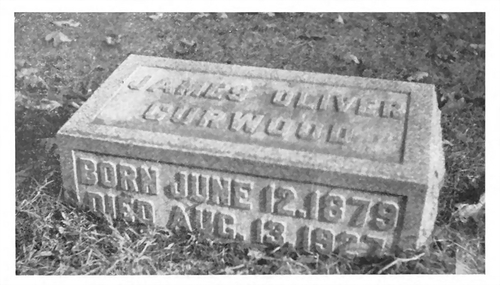
JAMES OLIVER
CURWOOD
CHAPTER ONE THE CHILD PRODIGY
Little did the stern though kind-hearted citizens of
Owosso, Michigan realize that on the eventful morning
of June 12, 1878, the newly-born second son of James
Moran and Abigail Griffen Curwood would in time
plummet across the literary horizon as the brightest star
to have appeared in years. His name was James Oliver
Curwood.
From the outset the parents had trouble with their
new son, finding it very difficult to please his childish
desires. Perhaps ancestry had a bearing here, and if it
did, it may all be traced back to the thrilling career of
the famous Captain Frederick A. Marrayat, great seaman
and popular novelist of yesteryear. He was the lad’s
great-uncle.
Jimmie Curwood’s birth took place in the days when
Owosso was a small town of some eight thousand population,
and trees grew in the center of the streets. It
was that era of the nineteenth century when livestock
and fowl were free to roam about the city at will, and
the horse and buggy played an important part in the
development of transportation.
Likewise so it was in that district of Owosso known
as West Town. It was in this particular part of town
that Jimmie Curwood played so much with his friends
(bad though they were), and came forth from bitter
schoolboy battles unscathed. Later in life he remarked
about West Town in the following manner:
“Had I continued to live in West Town at Owosso,
I might have become a genius, but Fate determined a
change was advisable when I was six years old.”
The city of Owosso today is far removed from what it
was in the childhood days of James Oliver Curwood.
Today luxurious homes line the paved streets and tall
buildings dot the skyline where once stood low flat
ones. Beautiful homes have filled up the empty spaces
that were once wide within the city limits, but that
same feeling and general atmosphere of drowsiness persists
just as it did fifty years ago.
Tall, stately trees line the smooth streets and many
automobiles traverse these thoroughfares where once the
old horse and buggy moved slowly along.
Today Owosso is in the very heart of the Michigan
vacationland. Running practically through the very center
of the city is the smooth flowing Shiawassee river, better
known as “Sparkling Waters.”
Although Owosso has grown in population from eight
to fifteen thousand since Jim Curwood’s birth and boyhood
days, her people remain very much the same as they
were then.
West Town! A haven for growing children and a
headache for grownups. It was here in West Town that
Jimmie Curwood grew up and also where he all but
drove his very patient parents insane with his juvenile
rascality.
With his chum, Charlie Miller, it seems that there
was hardly anything the pair of them would not attempt
to do. Stealing fruit and playing “hookey” from school
were just a few among the many items that always kept
the good citizens of Owosso on the constant alert.
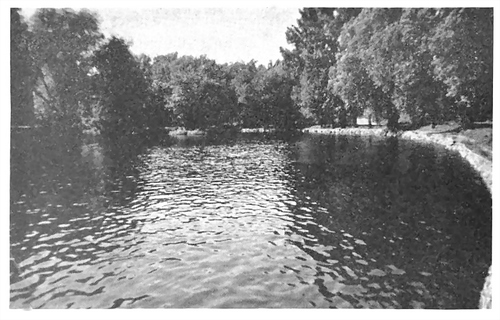
They fished, hunted and trapped all along the banks
of the Shiawassee, which flows through the city in a
great sweeping bend (when they really should have been
in school). The river is flanked on either side by some
of the most perfectly shaped trees that man has ever
looked upon.
Jimmie and Charlie often staged and executed raids
upon the fruit stands of old Mike Gazzera. Then as
they would run away with their plunder tucked safely
beneath their dirty blouses they would glance back and
see the grey-headed old Italian shaking his fist at them
and threatening them with all types of punishment. Fortunately
enough for both, old Mike thought far too much
of them and never actually carried out his plans of chastisement.
Probably the one outstanding characteristic of Jim
Curwood as a young boy was the fact that he was seldom
if ever clean of face or clothing. Try as she might to
keep her bewildering offspring clean, his dear old mother
seldom succeeded for much more than an hour or two
at a time. For immediately after having been thoroughly
cleaned up young Jimmie would head for the nearest
schoolboy fight or the dirtiest part of West Town and
proceed to get himself dirty again. Indeed he was a
child prodigy and therein lies the reason for the old
saying, which is sad but true: “why mothers get gray.”
It is indeed no wonder that the townspeople would oft-times
shake their heads and sigh:
“Them two’ll never amount to a hill of beans.” But
Jimmie and Charlie amazed and fooled them all.
At the rather seedy, uneventful and undecided age of
five years, when a youngster wants to be everything
from a minister of the gospel to heavyweight boxing
champion of the world, both Jimmie’s and Charlie’s
parents decided that their sons should embark upon
some sort of careers. Before Jimmie was born, his
parents had decided what their second son would do for
his life’s work. They had chosen music and the classics
for him; Charlie’s parents had chosen literature and
the arts for him.
So for a short while Jimmie practiced his music lessons
but soon gave them up as hopeless, as did his parents,
for the lad hated music lessons at that age with an undying
hatred. As far as Charlie’s future in the field of
literature was concerned, he too abandoned his parents’
choice.
Many things enter into the course of a child’s life
even as they do with a grown-up, and consequently the
career of a musician for Jimmie did not materialize.
Instead the lad developed into one of the world’s foremost
authors and conservationists of his time. It was
Charlie Miller who became quite adept as an accomplished
musician.
With the surrender of Lord Cornwallis came a man
of adventurous spirit and Dutch descent into the land of
the Mohawks and the Oneidas. As he journeyed through
this country making friends with the Indian tribes, he
chanced upon and fell madly in love with a beautiful
Mohawk princess from a little village near the head
waters of the Canada river. As to her name, it has not
been learned, but as to her beauty, all the men and
women of those days readily vouched. For she was as
tall and as slender as the most delicate reed. The tiny
moccasins which covered her feet were the smallest ever
seen by her tribe. Indeed, she was the pride and joy of
that village of Mohawks and of all tribes who had seen
her as she roamed the forests.
Jim Curwood’s mother very distinctly remembers seeing
this wilderness beauty. At that time Mrs. Curwood
was but a child of ten and the lovely Indian princess
was well past her eightieth birthday.
Her beauty was indeed bewitching and all white men,
as well as the redman who had set eyes upon her loveliness,
fell in love with her. Her hair was long, black and
radiantly glossy. The shoes she wore upon her feet were
so small that Jim’s mother, then but ten years of age,
could not have put her feet into them.
It was the adventurous Dutchman wandering through
the Mohawk region shortly after the Cornwallis surrender
who married the Indian princess. This man was Jim Curwood’s
phlegmatic great grandfather, an adventurer of
the old school who ended up by marrying an Indian
chief’s daughter. It is little wonder that young Jimmie
became such a carefree, vagabond lover of the deep
forests. Indian blood flowed deep within his veins and
throughout his entire life the forests, the streams and the
lakes were his home despite the fact that he owned a
mansion in the very heart of civilization.
Shortly after the blond Dutchman had wooed and won
his princess, there was born in England a man who later
became a great naval officer in the Queen’s navy and a
world famous writer of sea tales. A man who delved
deeply into his memories and imagination to spin yarns
of thrilling adventure on the land as well as on the swelling
sea. His name was Captain Frederick Marrayat. That
famous personage turned out to be a great-uncle of Jim
Curwood’s.
Several years later it was these same stories of adventure,
gallant battles and of brave men, which
caused a lad named James to run away to sea and come
to America in search of adventure and thrills. When he
left England, he never returned.
Upon landing in America young James fought in the
Civil War, where fighting blood ran fast and free. Here
was what he had been searching for and at last he had
found it. Years later that man became the father of Jim
Curwood.
The little house in which Jimmie Curwood first saw
the light of day no longer stands. Some time ago the
two-story frame building was razed and so far no other
construction has been erected in its place. However, a
marker has been placed there, showing that it was on this
particular lot that James Oliver Curwood had been born
many years ago.
As time went on the two youngsters, Jimmie and
Charlie, still persisted in getting into more and more
mischief. People were beginning to shake their heads
in disapproval and consequently Mr. and Mrs. Curwood
began wondering what they should do to curb their son’s
mischievous habits. For hardly without fail when anyone
saw Jimmie, son of a shoe repair man, and Charlie, son
of a saloon keeper, he was almost always sure to see
something happen.
Both boys always ran about barefooted (something
which you seldom see today), with dirty faces, hands
and clothing, with no crowns in their hats whatsoever.
It is little wonder that Jimmie’s hair became bleached
by the sun and his face gathered a harvest of freckles.
As youngsters most children have peculiar ambitions,
but those of Jimmie Curwood’s as a lad of seven were
outstanding among childhood desires. It seems that his
ambitions were just one or two paces behind his vivid
imagination. For some day he hoped that he might be
wealthy enough to buy an entire stock of bananas at
one time. Then and only then would he be fully able to get
his complete fill of the fruit he loved so well. His second
ambition was to ride astride the large bustle worn by
Kate Russell to Sunday church. Miss Russell was a cook
at the combination saloon-hotel which was operated and
owned by Charlie Miller’s father.
Despite all the obstacles that confronted them, Mr. and
Mrs. Curwood were perhaps two of the happiest people
in all of Owosso. They had a fine family and Mr. Curwood
was making a fairly comfortable living with his shoe-cobbling
shop. They had no luxuries, for they could not
afford them, but they did have all the necessities that made
for a comfortable happy life.
Regardless of how honored and respected Mr. and Mrs.
Curwood were in their home town, the townspeople still
continued to frown upon the antics of the Curwood and
Miller children. Was there ever to be an end to all of this
childhood devilment? This was the thought that plagued
the minds of the citizens of Owosso when the great change
came about.
Business began to grow bad for Mr. Curwood at his
cobbling shop and after long deliberation he decided
to sell out and purchase a farm somewhere. He received
many offers for his shop “as it stood,” and so after a
great deal of bickering he at last managed to get a fairly
decent price and it was announced to Owosso that it
would soon be rid of one of her two “Tom Sawyers.”
Although he had kept it from his family all along,
Mr. Curwood at last told them one night in the dead of
winter. He had made the down payment on a farm down
in Ohio, located near the villages of Vermillion, Joppa
and Florence in Erie County.
It was to be a new life for them and since business
had slacked off to such a point that he could barely
make a decent living, both Mr. and Mrs. Curwood felt
that he had made a good investment.
The next day Mrs. Curwood, Jimmie, his sister Cora
and brother Edward began preparing to leave their old
home. With what money he had received from the sale
of his shop, Mr. Curwood paid all of his debts and at
last had all of his business interests straightened out.
Even though he was left with very little to begin his new
life, he paid every bill which the family owed in Owosso.
A few days later the family began its pilgrimage
to the new land of Ohio.
The little backwood’s town of Owosso thought a
great deal of James Moran and Abigail Griffen Curwood
and sorely hated to see them depart, despite the fact
that they were taking with them one of the town’s biggest
trouble makers. Still, regardless of what their outward
appearances were toward Jimmie, deep within their hearts
the neighbors and all who knew him, loved him.
The move from Michigan into Ohio was later to prove
the most important change in all of young Jim Curwood’s
life. Many things were to happen, many events to take
place within the next five years that none of the Curwood
family ever dreamed would happen.
When the family of five arrived at their little farm
located not far from the cross-roads village of Joppa,
it was in deep winter and their forty acres were covered
with snow. The head of the family was highly elated
over the prospects of his “sight-unseen” purchase and
at once began making plans for it.
It was not until the arrival of spring, when the snows
had cleared away, that Jimmie’s father found that he
had purchased something which more closely resembled
a stone quarry than a farm. As far as one could see
there were nothing but stones and boulders all over the
forty acres of his land.
One can easily imagine the thoughts that came into the
elderly Mr. Curwood’s mind as he gazed out upon what
he thought was to be his salvation. Instead of rich, fertile
farmland, he had purchased a practically worthless land
of stones.
One night at the supper table Mr. Curwood called
upon his children to help him more than he had expected
them to. The stones must be picked up and stacked in
piles and the work of doing so must be left to the
two young sons, monotonous, laborious and endless as
it must have seemed to them.
Jimmie hated his daily task of picking up rocks from
sunup to sundown, but he had enough foresight to realize
that he had a job to do that must be done. So together,
day in and day out, Jimmie and Ed picked up
stones. Picked them up so their father could plough the
fields and till the soil.
Life now was drab for Jimmie. Gone were the glorious,
carefree days along the banks of the Shiawassee. In their
place had come the ceaseless task of picking up stones
and rolling huge boulders out of the way. No longer
had he the ambition to ride astride Kate Russell’s huge
bustle, nor to own a whole stock of bananas. Just as any
young boy of seven years would feel, Jimmie hated and
dreaded work, and especially this type. It seemed that the
more stones he and his brother Ed would pick up, the
more there were. For with every furrow that their father’s
plough would turn over, there would always appear a
fresh supply of rocks, both large and small.
The two boys piled stones into great stacks higher
than their heads; they constructed stone fences and they
piled rocks until there were stacks actually higher than
the farmhouse itself. There were great heaps of stones
all over the forty acres of land. As a matter of fact there
was hardly enough room left to break up the ground
anew and plant crops. It was rapidly and most assuredly
developing into a serious situation. Then, suddenly, relief
came from an unexpected source.
The highway department of Erie county came to their
rescue and took 3,000 loads of the stones at ten cents a
load. For at that time the county needed stones for road
repair and for numerous other repair jobs.
With the arrival of summer came long hard months
of hot, back-breaking toil. Jimmie and Ed wore thick,
hard callouses upon their hands, their backs seemed as
if they were about to break, and the sun bronzed them
until they began to look like Indians. Many times during
the long three summer months Jimmie became overheated
by the sun and fell in his tracks in that summer
of ’85. But work had to be done if success in their new
venture of farming was to be accomplished. There was
little grumbling from anyone now with the realization that
they must work and save if they were to live during the
coming winter.
Directly across the road from the Curwood farm stood
the home of Hiram Fisher, a kindly old farmer, who had
developed a beautiful homesite and whose yard was filled
with maple and pine trees.
The Fisher family was not as large as the Curwood’s,
for there was but one child, a very lovely daughter named
Jeanne who was young Jimmie’s superior by five years.
Perhaps her outstanding characteristic was the beautiful
brown hair which fell in glossy waves down to her trim
and fragile shoulders. It was the most lovely head of hair
that Jimmie or his family had ever set eyes upon. It
is indeed odd that a boy as young as he was should
take much notice of a girl’s hair, but its bewitching beauty
made him secretly admire it.
She would always part it in the middle and let it
flow down to her shoulders in long flowing tresses. She
was gloriously beautiful for her age.
As time went on and Jeanne and Jimmie became better
acquainted, he adopted a nickname for her that was to
remain with her all the days of her life. He affectionately
called her “Whistling Jeanne,” because of the beautiful
tunes she whistled almost constantly.
She alone was the inspiration which helped Jimmie to
hold his head high when he felt blue or useless. For
Jeanne offered him companionship, untiring encouragement
and wonderful guidance. She inspired him to greater
things in life. Jimmie often was heard to make that
remark both as a child and later as a grown man.
It was about the time that Jeanne was nearing her
twelfth birthday and Jimmie his seventh, that this thought
came to him:
“No matter how hard the work is, and no matter
what it might be, I shall always do my task thoroughly.”
The stones that he had picked up all spring and
summer finally set Jimmie to serious thinking. Every now
and then after he had worked an hour or two, he would
walk over to a shade tree nearby and sit down to mop
the grime and perspiration from his brow. Then he
would look out over the long, fertile fields that were
once not so fertile and resolve that he could do anything
that he should set out to do, if only he would
adjust and drive himself toward it. The look in his
young eyes denoted that of an adventurer. The eyes
for thrills and dangers of the unknown. Even at the
age of seven years, young James Oliver Curwood had
begun to wonder what lay just over the brink of the
next ridge.
Then, as if no such thoughts had even come to him,
he would return to his task of piling stones; but as he
worked he would experience a thrill, a feeling such as
he had never known before as he stooped down to pick
up the fragments of boulders. True, it was monotonous
there in the hot broiling sun, but to Jimmie, there now
was something creative in that piling up of rocks—something
of which he was justly proud.
“I experienced a greater thrill when I had done three
piles than I did when I had but accomplished two.”
With the arrival of fall and early winter, James Curwood
saw that the work his sons and he had done had
been a success. His crops had all turned out good and
his farm was now a thing of beauty instead of a stone
quarry. It was quite obvious that the hard labor and toil
his sons and he had administered had not been in vain.
Mr. Curwood being an honest and God-fearing man,
thanked his Maker for his family’s salvation.
Each afternoon that winter after a hard day’s work,
“the three men of the family” would trudge up to the
small, white house to be greeted by the good mother
and a meal of wholesome, plain, but substantial food.
The Curwood home was small, warm and comfortable,
even though humble. The important item was that the
little family was happy in its new home. In those days
there were no electric lights, telephones, radios or motion
pictures or even automobiles. So it was only natural
that the fine Curwoods always were close to the “home
fires.” Though meager and humble their home, no other
family could have been happier.
They used the old type of Lion Brand coffee at two
pounds for a quarter, and the usual stick of candy
once a month or so. They had plenty of eggs and bread,
for Mrs. Curwood raised hens and young chickens. Above
all else, the neighbors nearby thought the world of the
Curwoods and considered them “real, down-to-earth country
people.”
As the winter of 1886 at last settled over them, Jimmie’s
father and his family settled down to a long, cold winter,
snug and secure in their own home, which by now was
nearly paid for. The migration to Ohio had proved itself
successful in every respect. No longer did Jimmie
persist in his childish devilment, for there was neither
the place nor the time for it.
CHAPTER TWO A CHANGE COMES ABOUT
At the beginning of the winter of 1886 Jimmie found
a new friend in Clarence “Skinny” Hill, a new boy who
had moved into the neighborhood. Despite this newly
formed friendship, “Whistling Jeanne” remained Jimmie’s
great comfort. For no matter how tired he might
be at the end of the day he could always turn to her
for encouragement and fun.
Usually their nightly visits would begin just as darkness
would settle over the Ohio countryside. In the winter
they would sit before the great open fireplace and talk
and plan. By summer they would be sitting on the Fisher’s
front porch steps and watch the sun sink beneath the
western horizon and twilight creep upon the world.
For it was there on the Fisher front steps that Jimmie
and his Jeanne would dream and plan for the future.
Many are the nights that these two were to be found
there, with Jeanne telling him what would be the wisest
thing to do and how to set about doing it. He always
listened attentively and throughout his life he never forgot
what she told him. To him her words were words
of wisdom and law, and he knew she was right. She never
told him anything that wasn’t true. Of this he was sure.
It was just about this time in Jimmie Curwood’s life
that everything which was to prove itself worthwhile
later in his life’s work began to unfold.
Through constant reading, thinking and planning he
had developed a mania for wanting to see stories of his
own in print by setting the words down himself. Many
were the times that his parents would have to speak to him
a dozen or more times a night in order to get him to
turn out the lights and go to bed. Seldom did Jimmie
mind them on this account if he could get around it, for
by now he was deeply engrossed in his childish writing
career.
As for his ravenous reading, the boy could not put a
book down until he had read completely through it and
thoroughly understood it. He craved to express himself
on paper and tried desperately to develop characters
such as those of famous writers whose stories he had
read.
His appreciative sense of good writing at that age was
truly unusual.
Like every other youngster Jimmie had to have his
play as well as his work. Thus his playtime had to cut
in on his writing somewhat. So he alternated his time
between Jeanne, Skinny, his writing and his working
hours. Through this routine he managed to keep himself
quite busy throughout the day. At times he felt as if
he had too much to do, but still he enjoyed it all for
life had taken on a new meaning.
As each succeeding day passed by the little farm began
to mean more to him than just a place in the country
where hard labor was prevalent; it became, instead, a
place where one’s creative and imaginative powers
could function more properly. At that age little Jimmie
Curwood, the former “Tom Sawyer” of Owosso, was
hoping for solitude so that he could think more clearly
and thus be able to turn his characters into more
lifelike people.
The remainder of that year passed rather uneventfully
until the day of his eighth birthday. On that day his
father presented him with his first gun, a brand new
rifle.
The most amusing and yet the most serious incident
that occurred in all of Jimmie’s young life while on the
farm in Ohio, was the night that he “got religion.” He
was nine years old.
It seems that a certain “Parson Brown” was holding
revival meetings at the little town of Joppa, which was
just a mile distant from the Curwood farm. Jimmie decided
to see what it was all about. He had heard his parents
speak of “the meetings” that were being held in Joppa,
quite often. That night he trudged across the open fields,
half afraid and hardly knowing what to expect.
That night at Joppa, in the little country church as
the excitement grew to a fever’s pitch, Jimmie sat back
and listened intently until he could no longer suppress
himself. He jumped up from his seat and ran to the
front of the church proclaiming that he had been saved
and that the Holy Ghost had entered his body and soul.
Young Jimmie was truly inspired and this incident
played an important part in his later life.
Until that moment his ideas concerning God and
Heaven above had been practically the same as those of
any other normal boy or girl. That heaven was just a
place where all good people go, and that God was
their protector. Tonight all this was changed and at the
age of nine years Jimmie Curwood had already found God.
It was a wonderful thing for this lad to be able to do,
and it must have remained as an inspiration with him
all the days of his life. Little did he realize, however, the
predicament it would get him into in the days to come.
At that meeting when he rushed to the front of the
church to Parson Brown proclaiming his faith and his
belief, all eyes, of which there were many, were focused
upon the figure of the small boy. Pleasing smiles came
to every face when they discovered that a small boy was
claiming his Maker. It was a wonderful sight as the
Parson led the congregation in prayer and in song for
the young boy as he knelt there before the improvised
altar. This was the important thing in his young life
that led Jim Curwood to the heights of success he later
attained. For he admitted to the public many years later
this same admission of faith.
“It was only through God Almighty that I have
reached the pinnacle of fame and success that I have.”
Shortly after the meeting had been adjourned, with
the usual benediction, Jimmie cut across the fields and
through the dark woods that he had heretofore been
afraid to cross at night. He felt no fear, for the spirit
of the Holy Ghost was strong within him. He was reported
to have said a few days later:
“An angel went with me.”
From all indications one is led to believe that the angel
that guided and went with him was none other than the
lovely Jeanne Fisher.
The following morning Jimmie awakened still feeling
strong with the religious spirit.
He felt strong with the spirit which had entered
his body the night before and he wanted the whole
world to know all about it. Little did he realize the
blow that his inflated and loving disposition was to receive
in a short time. His parents thought it fine for
this thing to have happened to their son, but at the
same time felt that other people might object to it. Unfortunately
enough, Jimmie could not control himself and
so to his schoolmates he told of his wonderful experience.
As he spoke of the new faith that had become his,
his schoolmates promptly laughed in his face.
Then everyone took up the chant. On that day Jimmie
found himself involved in a total of five different fights,
for he could not stand to have anyone say that he was
crazy because he believed in something which was wonderful
and something which had taken possession of his
mind, body and soul. However, like all youngsters
eventually come to find, Jimmie found that the flesh is
weaker than the soul. From that day forth Jimmie was
still given drubbings from time to time.
During those hectic days one person other than his
family stood beside him to comfort and advise him.
That person was his “Whistling Jeanne.”
Days lengthened into weeks and weeks into months
and still Jimmie continued to pick up stones on his
father’s farmlands; stones that were to later prove themselves
to be “worth their weight in gold.”
The longer he remained at his daily task the more
his air castles grew. His vivid imagination gave rise to
dreams and hopes of greater things. All his visions and
plans were strictly private and no one was allowed to
interfere with the young creative artist’s dreams. Not even
little Jeanne nor his pal Skinny was allowed to pierce
their sacred portals. What he felt, what he dreamed of,
and what he planned to do were all sacred thoughts
and now vitally important to this nine-and-one-half year
old lad.
Long after the usual supper hour had been completed
Jimmie would go to his room to think and to plan and
to write. Many were the times that his mother had to
beg her puzzling offspring to put his books aside and
go to bed in order to get the proper amount of rest.
Jimmie’s mind was thoroughly made up and he was
really intent upon what he was working for and seeking
so desperately.
For six months or so Jimmie Curwood continued with
his writing of his childish though well-meant blood and
thunder stories, stories which he believed were truly fine.
It really did not matter to him upon what kind of
paper he set his stories down, just so long as they
were written. He would pick up wrapping paper and
cut it into squares, or else if nothing else was available
he would write his stories on tissue paper which came
in shoe boxes.
As fast as he would complete one of his “swift moving,
red-blooded yarns,” he would carefully file it away as
best as any young schoolboy could possibly do. Writing
was in his blood and it was taking complete possession
of his every thought and action.
It was only after he had completed some twenty
“thrillers” that he brought the entire stack down from
his room and asked his parents if he might read his
stories to them. There naturally was no hesitation on
their part, for they were anxious to see their youngest
child pursue a career such as he was now doing. So
for several hours Jimmie’s parents were silent as their
“pride and joy” went on with his avid reading. That
night the boy read through the entire stack of manuscripts,
taking some three hours and a half to complete the
job. When he had finished his father walked over to
him at the far end of the long kitchen table.
“You’re going to get there, Jimmie boy, you’re going
to get there. Just you keep at it!”
The boy smiled, for those few words of encouragement
meant a great deal to one who wanted to be a great
writer.
He silently picked up his stories, went to his room
and filed them away again. Hardly five minutes had
elapsed before he was back at his improvised desk to
start work on a new story.
At twelve-thirty that night the boy at last put away
his pencils and his papers and went to bed. Rather late
for a young, growing boy to retire, but his heart and
soul were really in his newly-found work. With the coming
day he was to have one of his greatest childhood
surprises.
In the next day’s mail came the wonderful news that
Jimmie’s sister Amy, who had remained behind in her
own home in Owosso when the family had gone to
Ohio, was coming to visit them. Since he had not seen
Amy for a long time he was indeed overjoyed at the
prospects of her home-coming. Three days passed until
she at last arrived. Only a few short seconds after she
had entered the house, Jimmie remarked:
“Gosh, Amy, you’ve changed!”
Almost from the very beginning of her visit Jimmie
began telling her of his stories and shyly asked her to
help him. He wanted her to read them and to tell him
just what she really thought. Sister Amy’s interest in her
younger brother’s career as a forthcoming author was
not casual, but really of great concern.
She did everything in her power as a woman and
as a sister to encourage her kid brother and to help him
in every way possible. She even went so far as to check
his make shift manuscripts for the errors in punctuation,
sentence structure and spelling.
Perhaps the greatest step she took in the furthering
of her brother’s career was to arouse the interest of Fred
Janette, great newspaperman and contributor to Golden
Days magazine.
To Jimmie this “introduction” was nothing short of a
miracle. To get the great Fred Janette interested in his
writings was indeed a mighty step toward his future
as an author.
Now with the noted journalist interested in him, together
with his sister’s constant coaxing, Jimmie was at
last persuaded to send one of his seemingly impossible
creations to the editor of Happy Hours magazine. Amy
knew her brother’s work was not of literary quality but
merely wanted to see the editor’s reaction and just how
the manuscript would be treated. So the hand-written
story was posted and within a few days, as was expected,
the postman returned it with a neatly printed rejection
slip attached to it.
The feature of it all was that the slip bore words
of kind encouragement to the aspiring author. For the
editor of Happy Hours realized that a child had submitted
the script and had judged it accordingly.
The little pink slip assured the boy that if he would
keep everlastingly at it he would eventually succeed in
having his stories published. From that time on his
rapidly maturing mind was on nothing else save that of
writing. School and work entered into his everyday
routine, of course, but even while he was attending to
these duties he still was thinking of writing.
To add to his happiness he received in the mail one
day a letter from Fred Janette himself asking the boy to
send him one of his stories. Jimmie was jubilant. The
very next day Amy mailed out one of her brother’s very
best manuscripts which she herself had transcribed for
legibility.
Several days elapsed before the anxiously waiting Curwood
family received any word on the judgment of
Jimmie’s story. Eventually it came through. Mr. Janette
was returning the manuscript but on the fly leaf was the
following inscription:
“Keep at it, fellow, you cannot fail!”
Those words meant a great deal to Jimmie, and the
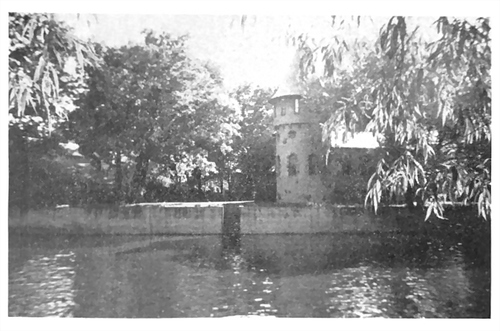
manuscript bearing those words remains today, yellow
with age, in Curwood Castle.
Now satisfied that she had helped her brother as best
she could, Amy returned to Owosso.
From that moment hence Jimmie Curwood could not
be held down in the reaching of his ultimate goal. Guided
by that ever present desire to become wealthy, famous
and to create his own characters on his own pages in
his own stories, Jimmie Curwood probably never knew
exactly when to quit writing once he had commenced.
He drove himself unmercifully toward that which he
desired so much. It seems almost unreasonable to think
that a lad of his age was capable of such determination,
but facts cannot be denied or doubted. Inspiration is
one thing, while encouragement and help is still another.
That which he knew so well could not be suppressed.
It was there within him, germinating his mind, tormenting
his soul.
It has often been said that a suppressed thought in
the mind of a creative writer is the worst possible thing
for him to endure. He may endure all the hardships
of life that are thrown in his path, but a suppressed
idea or thought germinating in his mind, is fiendish torture.
Such must have undoubtedly been the case of
Jimmie Curwood at that young age.
Although Amy had returned to Owosso she wrote
her brother every week, sending him hope and inspiration.
Fred Janette from time to time wrote to the boy urging
him to keep at his work. Even between times in his
writing as Jimmie would be picking up stones again
or else at some other type of farm labor, he experienced
thrills that he had not known before. He knew he was
accomplishing something, creating that which no one
could destroy.
As he continued piling stone on stone and as they
began to take form, Jimmie imagined that they were
great castles which held gallant princes and lovely princesses.
He envisioned heroes who possessed more courage
and more valor than any other earthly mortal. They
fought long, hard, bitter battles, always to be victorious
in the end. The developing of this vivid imagination at
this early age in life was one of the direct causes for
Jimmie’s rise to fame.
For the first time since his dreams and plans had
begun to materialize, Jimmie at last shared his ideas
with his “Whistling Jeanne.” She knew all of his
fondest hopes and his aspirations, and she prayed for
him and fought for him in many of his schoolboy tussles.
She alone stood up for him because he was so much
smaller than the majority of the other boys and she was
old enough and capable enough to manage most of them.
She stood up for him when she knew he was wrong.
She even talked Mrs. Curwood out of a great deal of
spankings that were due the lad and which he surely
would have received had it not have been for her. Although
five years his senior, Jimmie looked upon her
as being of his own age and even younger, perhaps.
It might be said that Jimmie Curwood had loved
Jeanne in his own silent, youthful, schoolboy way. He
adored, in silent worship, her great blue eyes, her thick
braids of radiant brown hair and her flawless complexion.
As a matter of fact everyone loved little Jeanne Fisher,
but as Jim Curwood once said later in life:
“Everyone loved her, but none so devoutly as I.”
In the winter of 1884 when James Curwood and his
family moved into the little farm in Ohio, Jeanne Fisher
took it upon herself to see that the Curwoods became her
friends. The lovely Jeanne was lonely and needed friendships
besides those of schoolmates.
For, from the time school was dismissed in the afternoon
until the following morning, she was entirely alone
with her parents. No playmates, no neighbors lived within
a mile of her home.
So when the Curwoods came, Jeanne quickly presented
herself. It was a strange new land to Jimmie as well as
to his parents and consequently they all welcomed her
friendly approach. She tried and she succeeded in making
the young boy feel at home in his new neighborhood.
From that time on, nothing save death could separate
the pair.
By the nickname of “Whistling Jeanne,” one would
be led to believe that the girl was a “tom-boy,” and so
she was, to a certain extent. Her kindness for Jimmie,
however, would surely tempt one to believe to the contrary.
For when Jimmie nicknamed her “Whistling
Jeanne,” he did so because he loved to hear her incessant
whistling. She would whistle regardless of how
much trouble she might be in, or no matter how low her
spirits might be. At times she was very much a young
lady of the first rank; but she could become a regular
“tom-boy” if the occasion called for it. She was a swift
runner, a good tree climber, an excellent shot with a
rifle and she could put up as good a fight as most boys
of her own age are capable of. Still she was every inch
a young lady. Quiet and refined as the occasion demanded.
She did not believe in being inactive, believing that one
should keep one’s body as well as one’s mind occupied.
Only a few short months after Jimmie had launched
himself on a literary career Jeanne’s guiding influence was
tossed to the four winds by the reckless, though well-meaning,
lad. For at that time he came under the influence
and thumb of the school bully. Everything that
could have happened to a schoolboy who was being led
astray happened to Jimmie Curwood. He was now almost
eleven years of age while Jeanne was nearly sixteen.
One morning during the first semester of school Jimmie
made a terrible mistake in one of his lessons as well as
having been guilty of a boyish misdemeanor.
“Jimmie Curwood, if you don’t correct yourself and
apologize for your intended error, I shall box your ears,”
the elderly lady teacher informed him. Sitting directly
behind him was the school bully.
On more than one occasion he had caused trouble
and he was once again up to his old pranks. He whispered
to Jimmie and told him just what to do. It is at
this age that young boys get to feel pretty important
if they can hold the limelight for a while.
At first Jimmie hesitated, but when the bully called him
a coward, he blurted out:
“You don’t dare to do it!”
The entire classroom instantly became ghastly silent,
for the students realized only too well that this meant
trouble. They also knew that the bully was directing
Jimmie and he too was afraid of what the consequences
might be.
The lady teacher demanded that Jimmie come immediately
to the front of the room. The boy was timid
and afraid, but at the same time he admired the bully
for his brawn and straight-forward actions. Urged on,
Jimmie got up from his seat and moved slowly toward
his teacher. As he stood there in front of her “the bombshell
exploded.”
The good teacher informed him of his punishment and
then, following the instructions and directions of the
over-grown boy, Jimmie proceeded to give his teacher
a very sound drubbing, much to the bully’s delight. Not
only was the teacher chagrined, but she was touched and
hurt deeply.
After the hectic battle, which Jimmie nearly lost because
of his teacher’s extra poundage, only the bully congratulated
him. The others said nothing. Then, like most
boys after committing a wrong, Jimmie came to his
senses, apologized and received his punishment like a
man. In due course, the elder Curwood learned of his
son’s escapade, and he, too, acted accordingly. Eventually
Jimmie returned to school and apologized for the second
time to his teacher. Needless to say she realized that
Jimmie felt it had all been his fault. She accepted his
apology and reinstated him in school.
Unfortunately, however, this did not end the boy’s associations
with the prodigious bully. Once again, after
much coaxing, the bully took him in hand. In order to
increase his prestige in the younger boy’s eyes, the older
and larger lad proceeded to thoroughly trounce a big,
strapping German boy. All of this occurred just a few
days after the first escapade. Once more the light of adoration
began to shine in Jimmie’s eyes. This reoccurrence
of the friendship fortunately led to one of the greatest
turning points in Jim Curwood’s entire life.
Many adventures take place in the life of a young
boy, but seldom do they come as thick and fast as they
did to Jimmie. For soon after all the excitement died
down at school, young Jimmie discovered a revolver of
small caliber that belonged to his mother, and so he
brought it to school with him one day. This added to
his prestige, but in a minor sort of way.
His exhibition of the weapon was met with sighs and
glances of amazement by the students but none dared
inform the teacher of what they had seen. They all realized
the consequences if they were caught as informers.
It was during the afternoon of that early spring day
that Jimmie secured permission to leave the schoolroom
for a few minutes. Upon arriving outside he noticed
two girls leaving an outhouse building. Ideas began popping
in his imaginative young mind and so he promptly
began firing the pistol above their heads. The effect could
not have been worse had he struck them, for the girls
were thrown into nervous hysteria.
If Jimmie thought that he had received dire punishment
for his earlier prank, he was indeed badly mistaken. He
had not realized the dangerous folly he had let himself
in for. He was punished more thoroughly than ever before
by school officials. But the worst was yet to come from
his parents, as the boy fully realized.
As he escaped from the small crowd that had gathered
on the school grounds and with head hanging low, Jimmie
slunk across the fields toward home, sorely afraid and
indeed bewildered at the trouble he had caused. His mind
began to run wild as it had in his adventure stories. It
kept telling him over and over that this was the end.
There was no possible means of escape.
CHAPTER THREE THE DISCOVERER
Many devilish thoughts plagued the eleven year old
Jimmie’s mind as he hurriedly made his way across the
fields to his home. What was going to happen to him?
What would his parents do to him? Jimmie was afraid
and he had just cause to be so.
The very thing which he had done led the boy to believe
that they hanged people or else shot them for such
actions. He did not stop to think that he had not killed
anyone, yet his child’s mind told him differently. He had
brought disgrace down upon the good name of his family,
and forever upon himself. And above all else, he did not
want to be hanged. It really seemed to the boy that the
end of the world was near for him and that there was
nothing that could save him.
He was hardly a hundred yards from home when he
almost burst out crying, but he refrained from doing so
for he felt that he was too much of a man.
Then Jimmie thought of escape.
Only his sister Cora was in the house. And she did not
see Jimmie until he had packed all that he felt he needed
for his trip “away from the good old home.”
Among the possessions which he had gathered up were
his hunting knife, a butcher knife, fishing tackle and a
very small parcel of food. The quantity of food which
young Jimmie had packed up was hardly enough for
more than two meals at the most. Also it did not occur
to him to take more than the clothing upon his back.
In his mind he kept telling himself that he never would
return. But at this time there was but one thought that
stuck in his mind. That thought was to put as much
distance as possible between the schoolhouse and himself.
Just as he started for the back door, he was confronted
by his sister.
“Where are you going, Jimmie?”
“I’m going out for a little hiking trip. Be back before
long,” he replied with his head hanging low. “Goodbye.”
Had Cora thought about it at the time, she would have
realized that her little brother was home early from school.
Taking one more fond glance at the old home, Jimmie
turned and strode out of the door and made for the
nearby woods half a mile away. It was with hurried steps
too that he fled from his home, for deep in his young and
perhaps rather foolish heart Jimmie feared that a posse
might be organized to overtake him. Then if he were
caught dire consequences might result.
When at last he entered the woods he had little thought
of what to do or where to go. He just walked along
glancing back occasionally when at last he made up his
mind to head for Lake Erie and there board a tramp
steamer bound for a foreign port.
Finally he reached the “Old Woman’s Creek” which
flowed through the woods.
This proved to be the place for his first stopover; darkness
was falling and he was afraid to go further alone
into the night. This spot, too, was a favorite of Skinny’s
and his. Here he knew a hundred different places to hide
away without fear of detection.
Darkness fell quickly and quietly upon the wooded
lands and the fear in the youngster’s heart swelled. Out
on the surface of the river the splashings of leaping fish
were to be heard. Near the banks came the ever-present
calling of the frogs, that eerie cry that comes to the solitary
traveler usually at this hour of the night.
Jimmie hurried on along the river’s banks to a vacant
red barn. He hurried inside the rickety old frame structure
and searched in the dark for a suitable place to sleep.
After several minutes of silent and cautious searching,
Jimmie stumbled onto a manger half filled with hay.
But sleep for the young boy was entirely out of the question
at the present. For just outside the barn flowed
“Old Woman’s Creek.” Jimmie shuddered at the very
thought of the name. And, as if that wasn’t enough, the
bull-frogs continued their strange and weird calling in
the night, adding still more fears to his whirling brain.
It seemed to the young boy that they were saying over
and over again:
“You’re a goner! You’re a goner! You’re a goner!”
Try as he might, Jimmie just could not go to sleep. His
childish imagination led him to believe that a posse of
men were just outside the door waiting for him to come
out so that they could pounce upon him. For with a
screech owl high on the sagging roof hooting dreadfully
and then the dead silence that followed along with the
beat of bats’ wings, it is little wonder that the boy ever
went to sleep.
With the first streak of dawn Jimmie slipped out of
the manger with all the cautiousness of an Indian scout
and looked carefully about.
Feeling that perhaps someone had lain in wait for him
during the night he took no unnecessary chances. Seeing
that no one was in sight he hurried down to the spot along
the river where his pal Skinny and he had their log raft
cached. He soon found it and without a moment’s hesitation
he climbed aboard and with the aid of a long pole
pushed himself out into the river’s current. All the terror
which had possessed him the night before seemed to have
vanished and he once again began to feel very much like
a grown man.
The wind was now beginning to churn the river’s waters
into a lather, and was actually carrying the small, frail
raft out into Lake Erie. Jimmie was yards away from
shore and was still going out. He frantically attempted to
pole himself back to the bank, but it was useless. Minutes
grew into hours and still Jimmie Curwood was seeking
some way in which to get back to the fading, distant shore.
He was being tossed about upon the little raft just like a
piece of cork upon the ocean. Half afraid, he eagerly
scanned the fastly fading shoreline in all directions until
his eyes fell upon the dim outline of a sailing ship.
“No words in any language could have properly expressed
my relief when a sloop with snowy sails appeared
on the horizon.”
Instantly the youngster began to yell, scream and wave
his arms long before anyone could have possibly heard
him. Eventually the ship spotted the drifting raft and
picked the boy up. When taken aboard he drew one long
sigh of relief, started crying and then collapsed upon the
deck.
It was the good ship Sandusky whose white sails Jimmie
had seen. Upon being revived the Captain of the sloop
began questioning the lad, asking who he was, from
where he had come and just what he was doing out on
the lake.
It was some time after he had been taken aboard that
the Captain could get any information from him.
When at last he succeeded they were several miles from
shore and could not possibly return to the spot from which
Jimmie had embarked. Later on when he had unfolded
his story and had answered all the Captain’s questions, the
Captain and his men all enjoyed a hearty laugh. He, too,
was forced to laugh in a timid manner for it seemed amusing
to him now that he had seriously stopped to think
about it.
For the next two hours Jimmie leaned over the railing
of the ship taking in of the broad expanse of water and
the white caps which topped each wave. This was his
first experience at sea and the youngster was enjoying
every minute of it now that he was safely aboard a ship.
This to him was truly thrilling adventure.
Far ahead over the rolling waves Jimmie could see the
mainland lined by tall buildings and rows of stately trees.
The storm was now beginning to subside and the violent
rocking of the ship soon came to an end. He thanked
his stars above for this, for he was nearly seasick.
Later in the day when they neared the port of Sandusky,
the Captain called Jimmie aside and explained to him in a
fatherly manner that the good people of Joppa and Vermillion
would neither hang him nor imprison him and that
he had nothing whatsoever to fear upon his return as long
as he behaved himself. As for his parents, they were
surely worried over his absence, and they would without a
doubt welcome him back with open arms and warm hearts.
After Jimmie had listened to all this talk from the aged
Captain the old world began to look bright and rosy once
again and he expressed the desire to return as soon as
possible.
The ship sailed on past Huron and into the port of
Sandusky where the Captain and a handful of “gobs”
took Jimmie to show him the town while he waited to
embark for home.
As the young boy in his tattered clothing was becoming
interested in the sights of Sandusky, the Captain detoured
somewhere along the line and sent a telegram to Jimmie’s
father telling him where the lad was and to come and get
him immediately.
A short while later the Captain rejoined his crew who
were showing Jimmie the time of his life, and they all
went to a nearby lunchroom where they partook of a
hearty meal. This was the first good meal which the boy
had had since he had left home the day before.
After having his dinner Jimmie then was taken for a
walk through the little lakeside city of Sandusky where
he saw his first tall buildings. He simply stood there with
his mouth wide open as he gazed in silent adoration and
amazement at the towering structures. For Sandusky at
that time was a city of some eighteen thousand people
and her streets were wide and tapering as they wound
their way through the parks and down past beautiful
homes.
Most awe-inspiring of all were the beautiful school
buildings. Great stone edifices that were as much as three
stories tall and usually an entire city block in length. Here
the sailors stopped to let him watch the students come out
of school. They were all dressed well and seemed to be
so much older than those he had known in the schools
he had attended. But he realized that he was nearly as
old as most of them and that back at the one-room school
near his home the people did not dress nearly so well just
to go to school. This was entirely different from anything
he had ever known.
After all the students had passed from his sight, Jimmie
was taken still closer so that he might be able to see the
magnificent structure at first hand. The huge building had
great, wide halls covered with carpets, and mammoth
rooms with many desks. This was truly enchantment of the
first class for Jimmie Curwood. He felt certain that all
this must be a dream.
As he stood there looking upon the symbols of higher
education, he found that he no longer wanted to become
a great Indian fighter, a buffalo hunter, or worse yet, a
bold pirate. Instead, he now wanted to become a part
of schools such as he was now standing before. He wanted
to be one of the kings among the beautiful queens. He
actually believed that he wanted to study. Until this
moment his world had been the forty acre farm back
there at Joppa, with all of its stones. Now a great, new
world had opened up and Jimmie Curwood was determined
to grasp it.
Later that same day his father arrived to take his son
back home and away from the beautiful school buildings
of Sandusky. En route homeward the boy tried his best to
express to his father that which he felt in his heart. He
told him of all he had encountered since he had run away
from home. He told of the great lake he had sailed upon
the first night away, and the magnificent schools he had
seen and visited. His father understood.
The night of his return home found Jimmie sitting
on the Fisher’s front steps with “Whistling Jeanne.”
There was a full moon overhead casting down its beautiful
light upon the green, fertile fields and hills. There
almost seemed to be a song in the air—a song of happiness.
A soft breeze was blowing through the cottonwoods
and all about the house the crickets and the katydids gave
forth with their serenades.
And once again Jeanne Fisher was comforting Jimmie
as she had always done. Between their telling of their
dreams of the future, Jimmie told Jeanne of all the wonderful
things he had seen while he had been away, and
of how he had visited the wonderful school building in
Sandusky. He told her how he wanted to attend school
there. Jeanne explained in her best manner that Sandusky
was very far away and that it would cost a great deal of
money for him to go to school in such a place regardless
of how beautiful it might be.
But Jimmie vowed that some day, somehow, he would
go to that great school to study. “Whistling Jeanne”
Fisher realized then that his mind was firmly set and that
he would go to any means to gain his objective, as he
had proven in the past.
Seriously thinking the matter over Jeanne at last came
to the conclusion that there were other schools equally as
fine as the ones in Sandusky, and that if he would work
hard and save his money and speak to his parents earnestly,
he might some day get the opportunity he was looking for.
With the following morning, Jimmie did begin work,
at whatever odd jobs he could find during his spare time.
Regardless of what the task might be Jimmie was on
the job.
With winter’s arrival he hunted and trapped rabbits and
continued with this until the arrival of spring. When
the snows had passed and winter was no more he managed
to get himself a job on an adjoining farm picking up
brush, trash and waste at the extremely low rate of
twenty-five cents per acre. The boy took this job and did
his work without grumbling because it meant a few more
dollars toward his potential education. His mind was fired
with the ambition to go to school where he could study
to be a great writer, and go to school he would.
Spring and summer soon passed, and during this time
Jimmie Curwood had beaten carpets, picked up brush and
accomplished many other jobs as well as saving his rabbit
pelts from the winter before. He now had enough money
to buy himself a brand new suit of clothes. But with the
arrival of fall Jimmie began to worry about achieving
his ambition. Many days of anxious coaxing on his part
began to pay off in dividends. For Mr. and Mrs. Curwood
decided that if their son was so intent upon attending
school and college, they would see to it that he would
do so, even if it meant selling the farm.
That was it! That was the solution to their problem.
They would sell the farm and move into town where
Jimmie’s father could once again set up in the shoe-repair
business. Days passed during which time the problem was
given much serious thought. It was only after a month of
such deep thought that Mr. Curwood at last decided not
to sell the farm, but instead to leave Edward behind to
take care of it. So, at last, came the day when the family
prepared to move into the little town of Wakeman. This
happened to be Mrs. Curwood’s girlhood home town.
A great many things were loaded upon the old spring
wagon and as the first load began to pull out of the
barnyard, Jimmie noticed tears in his mother’s eyes. She
hated to leave the farm but it was a great day for her
because of the educational desires of her youngest son.
Jimmie did not ride along with the first load of household
goods but remained behind to go with the last load.
Although of late Jimmie had not spent much of his time
with Skinny, his pal remained with him for the duration
of his time on the farm. Naturally, lovely Jeanne was
with him, too, for it was partially through her pleading
that Jimmie was getting the opportunity that he so
desired.
The fateful day for departure inevitably came. It was
all that Jimmie could do to keep back the tears, but he
manfully refrained. He told Skinny that he would see
him again soon and then he kissed Jeanne goodbye and
climbed aboard the wagon. But hardly had he gotten
aboard than he jumped off and proceeded to walk with
Skinny as far as Bingham’s old orchard. Several minutes
later the two young men saw the end of their last walk
together, for ahead lay the end of the long orchard.
It was an orchard that the two boys had played in often
and which was surrounded by a tall, six foot fence.
Without a moment’s hesitation, merely because he realized
that he should, Jimmie Curwood climbed aboard the
spring wagon as they reached the end of the orchard with
his mother and father, and was on his way to his new
home in the city. He was going to a home wherein would
come bright new horizons for the future.
Looking back a few minutes later Jimmie saw his
boyhood chum standing in the middle of the dusty road
waving frantically at him. Skinny was standing just where
Jimmie had left him when he had climbed aboard the
wagon. Further back on the road in front of the old house
stood the Fisher family. There they were, Jeanne and her
parents all waving their last goodbyes. A great lump came
into Jimmie’s throat as the wagon rounded a bend in the
road and his friends faded from sight.
When the Curwood family moved into Wakeman its
population consisted of somewhere around one thousand
other inhabitants. It was a trading center for a huge
farming belt, and it was also a freight center. The Lake
Shore and Michigan Southern railroad lines passed
through the little community. Wakeman had but one main
street and this was a beehive of activity on Saturdays.
There were two large general stores where one could
buy anything from soup to nuts and from ploughs to
jackasses. Wakeman also housed three nice grocery stores,
one blacksmith shop, one poolroom and one small hotel.
Therefore it was a very prosperous city for its size.
Wakeman also boasted of a cooperage in which thousands
of apple barrels were manufactured daily for consumption
by most of the midwest and northwestern states.
Despite the number of years that have passed, this cooperage
still stands today with the usual output.
Typical of all mid-western cities and villages, Wakeman
was always converted into a thriving metropolis on
Saturdays. On this day all the farmers from miles around
would manage to come into town. They would gather
about and talk about their crops, weather conditions,
national affairs and always those jokes which simply must
be told. They would purchase what they were going to
need during the coming week and load their buggies and
wagons with their supplies and then head back for the
farms around nine-thirty or ten o’clock.
Wakeman had its rows upon rows of hitching rails
and posts to which the farmers tied their horses and teams.
Today most of those historic relics have vanished.
The first few days in Wakeman proved to be quite
different from what Jimmie had expected. He knew the
farm people and their ways, but he did not know the
townsfolk and their standards and traditions. In fact it
was in Wakeman that he attended his first party
where the boys and girls were really dressed up in their
finest. The boys were of an entirely different type from
what he had been used to associating with. Somehow
Jimmie managed to become accustomed to them and their
mannerisms. It seems that Jimmie possessed that certain
quality that enabled him to adapt himself to almost any
type of environment.
It was at this first party that he learned many new
and startling facts. He heard of how his new friends had
been as far away as New York and Cleveland. Jimmie
stood with mouth wide open in amazement as they spoke
about their travels and adventures. He hardly dared believe
them even as they were told, yet he knew they spoke
the truth.
As the party went on and the conversation continued
Jimmie spoke of his travels and of how he was lost on
Lake Erie during a terrible storm. This increased his
prestige among the younger set. As the talk continued,
it finally drifted onto the subject of books and the best
reading on the market. This was more along Jimmie Curwood’s
line and so he listened attentively as some young
lady led the discussion. At long last he had the opportunity
he had been seeking. So he told of his career in writing
thus far, and how he so wanted to develop his talent into
an advanced study. Many of the others wanted to write
but hardly knew how to get started. Jimmie explained
in a modest manner his eagerness to write great works
some day, too.
It was at this party that Jimmie acquired his new name.
He was no longer called Jimmie, but just “Jim.” It was
here, also, that the young man attempted to learn to
dance with the aid of a very charming little lady. He later
admitted that although he felt clumsy and ill at ease, he
enjoyed it all immensely. Throughout his later life, however,
Jim Curwood had little time for dancing.
Thus began Jim Curwood’s social life in Wakeman,
and at first he took full advantage of it, for it was indeed
truly social as compared to that which he had heretofore
been accustomed.
There were many new things that Jim was going to have
to learn if his social and everyday life in Wakeman were
to be successful. Throughout his life he had been under
the constant guidance of his devoted mother. She had
cared for his personal appearance and insisted that he always
keep himself as clean as possible. But in this new
environment he learned that he must look after his personal
appearance himself. He also learned that one’s
personal appearance and habits counted first and foremost.
He discovered that he must wear a tie. He found that he
must wear presentable clothing to school instead of the
farm clothes. He had to keep his hair trimmed and his
teeth brushed. The things which had before seemed utterly
trivial now were of major importance to his new life in
the city of Wakeman.
Perhaps the most exasperating discovery which young
Jim Curwood made shortly after he had moved into Wakeman
with his family, was the fact that he must take more
than one bath per week. So instead of the usual Saturday
night affair, the young man found himself in the tub as
often as three times a week. He hated it all.
As his new life opened before him Jim discovered that
there were girls in Wakeman. The startling fact was that
he found they were very pretty girls, too. Coincident with
this discovery came the necessity for a little spending
money from time to time if one were to get along. So,
from the first time that he met one of Wakeman’s better
type girls, he was constantly in need of nickels or dimes.
Soon his financial problems developed to the stage where
Jim was asking for quarters instead of nickels and dimes,
as is only natural when a young boy begins to get “ideas.”
As Valentine Day approached, Jim met a very pretty
girl whom he decided he would like to present with a
Valentine. Although the tiny card cost but three cents,
Jim was somewhat bashful and backward in giving it to
her when the time came. So he mailed it out the day
before and signed only his scrawled initials upon the
back of it. Somehow the memory of his Jeanne back on
the farm seemed to have slipped from his mind, for this
new young lady filled his every waking hour.
As he and his new girl friend became better acquainted
Jim thought he should take more than three baths a week
and in a short time he was to be found in the tub almost
every night. Another thing which was called to his attention
was that he should always keep his fingernails clean,
that a tie should always be worn, and above all that he
should keep his shoes blacked every day without fail.
Mother Curwood as well as her husband had noticed the
tremendous change that had come over their young offspring
and were pleased by it. Their coming to Wakeman
seemed to be proving itself worthwhile.
In a few short weeks arrived that which young Jim
Curwood had been looking forward to with great anticipation—the
beginning of the fall term in the school to
which he had traveled so far and on which so many of
his hopes were based. Here Jim became interested in something
which was to remain with him all the days of his
life—Astronomy.
Through the teachings of this new subject Jim developed
an entirely different conception of God. He came
to know and to realize then that God had created this
earth as a center of things, and that we were most fortunate
to have been chosen to live upon it. He believed
then that God had created all this for mankind alone,
that man was everything. That the birds, the beasts of
the wilds, and the fish of the streams did not matter. He
believed then, as so many millions do today, that those
creatures were put here just for man to slaughter if he
so desired....
Winter came and passed all too soon for Jim and it
was not until spring arrived that he learned of his
family’s plans to leave Wakeman and return to the farm.
He also made the startling discovery at this time that he
had not learned much more here than he had back at the
little red brick schoolhouse. True, he had learned city
life and all of its startling realities, but it was the little
red school house back there in the country that he yearned
for.
When but one more week was left for the Curwood
family to remain in Wakeman, brother Ed came into town
with the team and wagon, while Mr. Curwood made all
final preparations. Talk of the farm, the fields and the
streams had turned Jim’s thoughts entirely to the open
spaces once again.
With Ed and his father riding along on the wagon,
Mrs. Curwood followed along behind in the buggy. Jim
had still other ideas since Ed had brought his dog Jack
along. So for most of the eight long, dusty miles, Jim and
his faithful hound Jack played and walked behind the
caravan.
It has always been said that early impressions in life
bear greatly upon one’s future. So it was then in Jim
Curwood’s case. His life on the farm as a child taught
him more and more the love of the open roads and the
forests. For on that day when the family returned to their
farm, eight miles distant from Wakeman, Jim exclaimed:
“Gosh Mom, it’s great to be back home again! The
woods are so full of wild flowers, and the old pond is
crowded with big, old frogs, too.”
Skinny Hill, having heard from Ed that the family
was once more going to return to the neighborhood, had
been on the watch for his pal Jim since shortly after
daybreak. And hardly had the creaky old wagon and
buggy rounded the bend in the road than Skinny was
running for all he was worth to meet his chum. In his
left hand was an old, black felt hat which he was waving
wildly above his head, as he shouted and whistled.
“Hello, Slip! Hello there, Slip!”
The two youngsters did not even shake hands or clasp
each other in their arms. Instead they both just stood
there in the middle of the dusty road with wide grins.
With those few words Jim and Skinny started walking
up the road behind the buggy and wagon.
During the following three days Skinny and Jim were
running all over the surrounding territory looking over
together what they had claimed to be their own several
months before. Through the wooded strips and across
the fields they went, taking in all the glory of “secret
country.”
Through all of the busy and crowded months in Wakeman
Jim had almost forgotten the one person who was
more important to him in his young life than any other.
But hardly had he set foot in the front yard of the old
farm than he saw her. Immediately his pulse quickened.
It was lovely Jeanne, his “Whistling Jeanne.”
The very first thing which he noticed was how tall she
had grown during his absence, and her stunning beauty
spun his senses about wildly. He could hardly believe
what his eyes revealed.
“Something queer happened to my heart when she
caught me up in her arms and kissed me. My Jeanne was
changed.”
In a few minutes Jeanne had once again won her old
place back in his heart. That feeling of security and
comfort was his, as it had been before, now that he had
his Jeanne back to console him during those times when
things went wrong.
Hardly had the family a chance to really settle down
again than Jim was once more beginning to write.
In the town of Wakeman he had become acquainted
with a motherly old lady who had thought a great deal
of him. So much so, in fact, that when he asked her for
some of her old magazines, she not only complied with
that request, but also went to the nearest drugstore and
purchased a “dozen brand new ones” for him.
There on the little farm when his daily chores were
over, Jim would sit out under the trees with Jeanne and
Skinny, and pore over the contents and the wonderful
stories by famous authors. The smouldering flame that
was embedded within his heart for adventure stories and
the yearning to write them was overpowering.
It is seldom that a boy of young Jim Curwood’s age
should take so great an interest in such a mature profession.
But he seemed to be able to look into the future and
almost say what was going to take place, so confident was
he. It seems almost uncanny that a young lad could have
such a vivid imagination and at the same time learn to put
it into words and story form. But a great deal of Jim’s
success can rightfully be credited to Jeanne Fisher. Obviously
this is true, for throughout his entire literary career,
the character and the beauty of “Whistling Jeanne” was
always there.
She used to tell him that he must write harder than
ever and then some day he could put her into his stories.
If only she could know how many times, hundreds of
times in fact, she really was written into his stories. Who
knows? Perhaps she does.
So, as the sun began to set over the two little farms
in the peaceful Ohio valley on that first evening of Jim’s
return, it once again found Jeanne and Jim together. And
as the evening wore itself into the darkness of night time,
Jeanne refrained from talking of his future authorship,
but upon subjects instead which were more vital to her.
She had not stopped to realize that during his stay in
Wakeman her Jim had become more and more entrenched
in the path of becoming a famous writer of tales.
As the night began to grow long Jim at last began pouring
out his heart to her, and then Jeanne Fisher realized only
too well that to talk of anything else save writing was a
hopeless task.
Jim explained to her how he had lingered over the
many new magazines that he had seen in Wakeman; how
he idolized the printed names of the famous authors whose
articles and stories he had read. He told of how his heart
beat just a little faster as he completed reading each
new story. How he had read and reread every story in
every magazine that he could put his hands on. Little
did he realize it at the time, but he was developing a
style all his own through all this extensive reading that
was later to lead him to fame. He even became breathless
as he explained how his heart had missed a beat every
now and then as he read those adventure stories. Tales
of Indian scouts, strong, brave cowboys, and fearless
Indian chieftains. Stories of dauntless seamen who sailed
the seven seas unafraid in search of gold and silver.
“Whistling Jeanne” Fisher realized to the utmost that
night that “literature was the guiding star of his destiny.”
She came to realize also that nothing save death would
stop the young, yet determined, Jim Curwood. He had
it in him to write, he had something to say and to tell
about, and she knew that some day he would get his
chance to tell it. Either he would get his chance or he
would make that chance.
Like most men of literature, a writer must have something
to say, something to tell. From the age of eight,
Jim Curwood had a story to tell and he always did his
best to tell it in an unsurpassed manner. His courage in
the face of great odds is indeed commendable.
The character of “Whistling Jeanne” has played the
major roles in most of Jim Curwood’s short stories,
serials and novels. Her character and her beauty were,
above all else, inspirational and courageous.
The character of Melisse in “The Honor of the Big
Snows,” Josephine Conniston in “The River’s End,” and
Jeanne in “The Flower of the North,” are just a few of
the heroines for whom her lovable character has been
responsible. These novels have been filmed and flashed on
the movie screens throughout the world, and his novels
have been translated and written into over fourteen different
languages. “Whistling Jeanne” Fisher’s character
was truly an important part in Jim Curwood’s childhood
days.
With all of the words of hope, courage, inspiration
and wisdom which came from those “rareripe lips,” how
could Jim go wrong? How could he help but to succeed?
For even in his childhood days he was constantly filled
with inspiration, hope and above all else, confidence. For
with those words of encouragement the boy firmly planted
his feet and vowed earnestly that nothing save death
could ever keep him from becoming a great author. An
author whose works would give to the people of the
world hope and courage to push onward. Today, nearly
fifty-seven years later, those works which he spoke about
at the age of thirteen have given hope and courage to
many millions of people throughout the entire world.
There is little doubt but that those early childhood
days on the farm down in Ohio were the days which
proved invaluable in the shaping of Jim Curwood’s
destiny.
CHAPTER FOUR OWOSSO SCHOOLDAYS
Day after day while on long hikes through the forests
and along the river’s banks, Jim Curwood would try
valiantly to explain to his chum, Skinny, the urge and
desire that was burning constantly in his heart. Unfortunately
enough, Skinny Hill could not see things in
quite the same light as Jim did and consequently he
raised argument after argument. At times when he would
grow tired of hearing Jim talk about a writing career he
would very nearly lose his temper.
Fortunately, Jim Curwood had the ambition and the
determination to be a writer and no one on the face of
God’s green earth could stop him. The youngster actually
prayed for the opportunity to go to great schools. He
prayed for the one chance, the lone chance, of really
becoming a “somebody.”
“I knew with God beside me that my goal could not
be too far off. Hard work, and hard work alone, with
confidence in the Great Arbiter, are the keys to success.”
From that time on Jim Curwood did all in his power
in order that he might pave his own way to success.
Valiantly he fought the odds that were stacked against
him, determined to make the grade and come through
with flying colors. However, at times he would lose all
hope. Then for a moment, he would stop and think
about defeat and what it would mean. The next moment
would find him back at work, his determination multiplied
a hundred times over. It seems miraculous that such a
young lad of Jim Curwood’s age could not be kept
down in his battle for success at the one thing in life
he wanted.
As days developed into weeks and weeks into months,
it dawned more and more on the boy that unless he went
away somewhere to study, it would be a hopeless task
to try to be a “somebody.” It is quite plain that his mind
was much more developed than his age revealed.
Like manna from heaven, his sister Amy, from Michigan,
came down to visit the family a few days later.
Jim thanked his lucky stars, for he realized only too
well that his sister not only could help him, but would
be most glad to. His young and adventurous mind began
working rapidly from the very first day that Amy arrived
on the farm. He felt that with Amy’s influence it might
be possible for him to go away to school. For several
days and nights he thought the situation over before he
put the question to his sister. He lay awake at nights
thinking up various situations by which he could induce
Amy to take him away with her. This was his one big
chance and he knew that he must not miss it.
A few days after her arrival he called her to one
side and spoke to her about his plans and his dreams.
From the very beginning, Amy used a great deal of tact
in handling the situation.
“Amy ... Amy, will you do me a favor?” he asked.
“What is it you want me to do, Jimmy?”
“Amy, I want to go away to school and study. I want
to be a great author and the only way I can be one is
to go to school!”
“Do you really want to go away to school and study,
Jimmy?”
“You know I do, sis, oh, you know I do. I must! I
just have to, Amy. Try and fix it with Mom and Dad.
Please!”
“Then I shall talk to Mother and Dad and see if they
won’t consent to letting you go back to Owosso with me.”
Amy lost no time in beginning her work of persuasion
on Mr. and Mrs. Curwood. They objected very much
when the proposition was first mentioned and Amy
worked feverishly to wear them down. Apparently they
wanted to keep their youngest child with them and had
no intentions of letting him go all the way back to the
old home town of Owosso unless they, too, went along.
Amy spent many long hours pleading with her parents
to let her brother go back with her, until the last
thread of resistance had been worn away and she had won
her first battle for her brother. If she had only known at
the time the battles she was to have to wage for him in
the future!
When Amy told Jim the good news he fairly raised
the roof of the farmhouse with his jubilant howls of
happiness. He vowed to his parents in his own childlike
manner that some day they would be very proud of him.
As the days passed by and the time neared when Jim
Curwood would once again leave the little farm, he would
notice tears in his mother’s eyes occasionally, despite the
fact that she tried not to show them. His father became
much more thoughtful, and Jack, Jim’s faithful dog
who always went with Skinny and himself on their hikes
through the country side, followed the boy around in an
extremely strange manner. He seemed to sense in his
keen, canine way that his young master was going to
leave him. Little did Jim realize that the day he bade farewell
to his family and to his dog Jack it would be the
last he would ever see either the dog or the farm itself.
It was exactly a month to the day after the boy had
gone to Owosso that the good animal died.
Never before in all of his young life had Jim Curwood
hated to leave his loved ones, despite the fact that
he was determined to leave. His mother cried out as her
little son climbed aboard the old buckboard with his
sister:
“He isn’t my little boy anymore!”
As if this wasn’t enough to bring tears to his eyes,
his beloved Jeanne began crying, too. Somehow father
Curwood held up even though there were tugs at his
heart strings. As his youngest child climbed onto the
buckboard he calmly walked up to him and shook his
hand as two men would do and asked him to take good
care of himself.
After a great many fond farewells, embraces and goodbyes,
Amy and Jim started on their way toward Michigan,
the land that seemed so far away. In the middle of
the road as Jimmy looked back after they were on their
way, he saw his mother, father, brother Ed, Skinny,
Jeanne and the Fishers all waving farewell. A great lump
swelled up in his throat for he saw his dear old mother
sobbing her heart out and leaning upon her husband’s
shoulder. Jeanne, too, was crying, but his old pal Skinny
was too hurt to weep. He wanted to, but somehow tears
would just not come.
The last words Jim Curwood heard before the little
buckboard was out of hearing distance was from Skinny
who was standing in the middle of the hot, dusty road,
shouting and waving.
“Goodbye, Slip. Gee, I’ll never see you again.”
It was a long, hard and exciting trip as Jimmy and
Amy made their way in the buckboard drawn by two fine
horses to the then small town of Owosso. The young lad
was tingling with excitement at the prospects of seeing
his home town again. The town in which he was born
and where he had had some wonderful days playing
along the river banks. But he still was constantly thinking
of his father and mother as only a young boy of his
age is capable of doing.
Jim had been away from Owosso for nearly seven
years now, and as they drove past the city limits he hardly
recognized it as the same place. It seemed to have grown
a great deal and many new buildings had been erected.
The bumpy old streets of old had been worked over and
now were comparatively smooth.
Unable to wait until the following day to see his
home town again, Jimmy persuaded Amy to take him
around the day of their arrival.
One of the first things he noticed was that his old home
had been transformed into a hotel. And the room in which
he had been born was now a room for drummers and
salesmen. There were no hickory trees growing in the
streets, there were no fowls roaming about at will as they
once did, and giant pines and willows which once had
filled the great commons were replaced by stores and
buildings.
Today the city of Owosso has 15,000 residents, and is
more beautiful than it was in the days of old. Looking out
of the studio windows of a wonderful writing castle
which lies along the banks of the waters of the Shiawassee
river, there can be seen one place that shall never be shed
of the willows that wave so gently in the breeze. It is the
little island in the very center of the river which flows
through Owosso in a great sweeping bend. The willow
trees on this small island bend their graceful boughs
almost down to the water’s edge and sway back and forth
continually in the cool morning and evening breezes.
Days passed rather rapidly after Jimmy returned to
Owosso and the hottest days of summer were soon upon
the little town. The natural thing for him to do was to
look up his childhood pals and head for the river to fish
and to swim. But try as he might, Jimmy could find
nothing of his former Owosso pal, Charley Miller. It
seemed that since Charley’s father had passed away no
one had seen anything of the boy.
Perhaps the one thing which Jim loved above all else
in his home town was the beautiful Shiawassee, glorious
river of his childhood dreams, that flowed in graceful
curves throughout the length of Owosso constantly beckoning
him to its banks to swim and fish.
Owosso itself had prospered, of that there was little
doubt. And its people had changed with the influx of
prosperity. But to Jim Curwood it was home and when he
grew older he was overheard to say:
“Many ties bind me to it and always I return there,
no matter into what little-known byways of the world
I wander. In Owosso I shall end my journey.”
J.C. WEBER.
It took young Jim just a couple of days to become
readjusted to his old home town and again “Sparkling
Waters” lured the youthful outdoorsman to its banks.
This was the place where Charley and he had played
before he had moved away to Ohio. The place where
they hunted, trapped, fished and swam along its peaceful
shores. There is little wonder why he always referred to
it not only as “Sparkling Waters,” but also as his “river
of dreams.” For it was along the banks of this river that
many of his childhood dreams developed into realities and
where he learned his first lesson about nature and the
wilds he learned to love so well. It was here that the many
stories that ran rampant in his childish mind later flowed
from his pen.
The third day of his return found him with a pole
and line headed for the river to fish. In those days he
would lay his pole over his shoulder with the line
dangling down and stroll through town barefooted. A
typical “Tom Sawyer,” if the city of Owosso ever saw
one.
His bare feet would saunter along the pavement but
would step lightly when he came to cindered paths. He
wore an old hat slouched down upon his sun-bleached hair
which had no crown in it whatsoever. His pants-legs were
torn and frayed and his shirt-tail was out in the back as
always. Those truly were the glorious days of childhood.
During the first days of his return with his sister Amy,
young Jimmy spent many hours along the river banks and
pulled out a great deal of fish. Many people often remarked
that if he did not let up on his fishing there soon
would be no fish in the river for other people.
After a week had elapsed Amy told Jim that she
was taking him to visit the great newspaperman, Fred
Janette. You may speak of surprises, but Jim Curwood
was just about the most surprised and thrilled young man
in all of Michigan when his sister broke the good news
to him. Who had not heard of the great Fred Janette?
He himself had even read one of his newspaper serials.
Now, at long last he was going to meet a famous writer!
The young lad was thrilled beyond all explaining. In fact,
he hardly dared believe it. It did not seem at all possible.
But sister Amy had told him and so therefore it must
be true. The young boy could hardly wait for the important
day to arrive.
The day arrived for the visit and Amy took her young
brother to the wonderful home of Fred Janette, author
and newspaperman. It seemed wonderful to Jim, but
in reality Mr. Janette’s home was a modest one. It was
an old fashioned cottage. To Jim Curwood it was the
home and mansion of a king. Soon would come the
moment when he would step across the threshold, he
thought. He walked nervously up the winding concrete
walk with his sister. The doorbell was rung and soon
they were greeted by a tall, whiskered Frenchman whom
Jim later came to love devoutly. Then they were confronted
by a white-headed, kindly old lady who was the
mother of the great author. From that day on Mrs.
Janette always held a warm spot in his heart.
After they had been admitted to the house sister Amy
chatted and laughed with Mrs. Janette and it seemed
strange to Jim that she was not in the least bit awed
by these famous personalities, even though he was.
It was ages before a door swung open and the
“great writer” himself entered. Being the gentleman and
scholar that he was, Janette immediately shook hands
with the boy as if he had known him all his life. Knowing
that he would have to be very careful in what he
said, lest he offend the youngster, he exclaimed:
“So this is our young author!”
From that moment on, Jim Curwood was sold on
Fred Janette as Mr. Janette was on young Mr. Curwood.
As soon as the introductions were over, Janette promptly
took Jim by the hand and led him into his den. Then
he locked the door behind them. As the key turned in
the lock, the youngster was so thrilled that he could hardly
speak. For the first time he was actually looking at a real
author’s study. True, it was just like any other author’s
studio, but this was the first that Jim had ever been in.
The walls were lined with books, there were two typewriters,
reams and reams of paper upon which to write
wonderful stories, and numerous filing cabinets in which
to file material. He took in everything from the floor up
to the ceiling. He had never seen anything that thrilled
him so in all his life.
Behind the closed door. Fred Janette showed the
aspiring young writer a cheque for three hundred dollars
that the editor of Golden Days Magazine had sent him
for one of his latest creations. This, of course, seemed
like a million dollars to Jim and he gasped at the sight
of it. Then Janette proceeded to explain to him just what
his regular daily schedule was, how he went about doing
his work and even showed him a story he was working
on for a certain magazine.
Janette invited Jimmy to sit down at his desk and use
the typewriter if he so desired. This seemed to the boy
to be a great honor; he walked over to the large desk
and sat down upon the chair. And as he sat there looking
over the mass of papers and manuscripts, Janette told
him:
“You cannot help but become successful if you put
your whole heart into your writing.”
Perhaps the one thing which the youngster appreciated
more than anything else about Janette was the fact that
the grown man was careful not to treat him merely as a
child.
From this very first meeting there arose between the
two a friendship that was to last a lifetime. From that
moment on, James Oliver Curwood never ceased writing.
Every second that was available was spent with a pencil
or pen in his hand, for writing had taken complete possession
of him and it all but drove him frantic as his mind
was continually upon the work that was destined to become
his only life work. He had to eat and sleep, but
he must also WRITE! WRITE! WRITE!
At last, though all too soon, summer had come to a close
and school days were once more at hand. He enrolled in
Central School the very first day, but he could not understand
why he had come all the way from the farm in
Ohio to go to school here in Owosso, and still find it so
very uninteresting. The chances are, however, that the
writing “bug” had become his first and only love, thus
making it quite difficult for him to study. Perhaps one
of the factors which seemed to make Jim Curwood’s
schooling both uninteresting and hard was the class he
was placed in when he entered school in Owosso. For he
was put in the seventh grade because of his ungentlemanlike
feats at Wakeman and his vulgar tactics under Mrs.
Bacon. Obviously this was not the rating he deserved, but
the teachers at Central School seemed to think it best.
They did not know young Curwood was returning to
school “to study.”
This of course was a very bad beginning when one
has made up one’s mind that he really wants to be someone,
and young Jim was indeed very much “burned up
over this treatment.” Despite this barrier, he “muddled
through somehow,” as he chose to put it, until he had
finished the tenth grade.
Many times, according to authoritative sources, Jimmy
Curwood was referred to as “a hopeless horror” in
Algebra, by a Miss Curliss. A Miss Needles always
maintained that Jim Curwood was hopelessly dumb
and could never be any other way. Then there was a
small man by the name of Chaffee who once remarked
that the boy’s empty mind was the outstanding feature of
the Owosso schools. The Miss Curliss was perhaps Jimmie’s
greatest dread. Time and time again she embarrassed
him before the entire class. On one particular occasion
she called him an “unforgettable horror in her mind,”
when Jim staunchly maintained that a “skipper” was
a bug in cheese rather than the master of a ship.
There was but one bright spot in all of Jim’s schooling
in Owosso, and that was a very pretty and charming
teacher named Miss Boyce. Despite the many mistakes
he would make in class she never lost patience with him
and was always encouraging and cheerful. Years later
when the “plague of Owosso” became a full grown man
and an author in his own right, he remarked:
“To Miss Boyce and Miss Bartrem, who never lost
interest in me, is due what little I actually did accomplish
there.”
Then, too, there was the principal of the school, Professor
Austin by name. He was a kind and understanding
man and he sympathized with Jim in his goings and
comings up and down the Shiawassee river, even though
he did not approve of it during school hours. The principal
once told him bluntly that if he ever heard of a
prize for stupidity in the classroom, he would see that
it was awarded to him. It was such things as these,
trivial as they may seem to some of us, that made Jim
Curwood’s early schooldays in Owosso ones of endless
terror and seemingly hopeless failure.
When at last the fall season was over and the cold
winter months were at hand when the snow would pile
up as high as three and four feet deep, Jimmy would be
up at the crack of dawn and out along the banks of the
Shiawassee setting his traps for muskrat and mink. He
would catch scores of them between the two bridges at
Washington and Oliver streets. The two streets were a
little over a quarter of a mile apart, and were in the
very heart of the residential section, as they are even today.
By the time his second school year began the “Sparkling
Waters” had absolutely claimed him. In his possession
he had countless traps, several guns and an Indian dugout
canoe.
Actually being of Indian-strain himself, it is little
wonder that Jim Curwood haunted the lakes, streams
and wilds. His maternal grandmother had been a full-blooded Mohawk
Indian princess. This was, perhaps, a
prime factor in his urge to isolate himself in the wilderness
which had left its imprint embedded deep in his
heart. But he was also a direct descendant of Captain
Frederick A. Marrayat, world famous novelist and seaman,
and Jimmy’s paternal grandfather.
So it is understandable how, of all the students at
Owosso public schools, perhaps the most difficult and
indignant one was James Oliver Curwood. When he was
not present in school he was either writing tales of the
wilds, or living them along the banks of the rivers nearby.
In fact he had absented himself from classes on many
occasions to devote more time to his stories. Jim Curwood
finally developed into a real problem for his teachers in
high school.
One day as he quietly came tip-toeing to his seat while
Professor Austin was in the middle of an invocation, the
teacher caught sight of him and completed what he had
to say with: “And dear Lord, we thank Thee for returning
Nimrod safely to us this morning.” From that day forward
his nickname at school was “Nimrod.”
It was during the first winter of his return to Owosso
that Jim received an important letter from his father in
Ohio. The elder Curwood wrote that, unless he could find
some way to get back to Owosso to make a living, he,
Jimmy, would have to come back to the farm. His mother
missed him terribly and yearned to have her baby son back
in her home.
Both sister Amy and Jim were overjoyed. But the
young boy was torn between love and duty. The little
farm was tugging at his heartstrings once more as were his
“Sparkling Waters” here in Owosso. Still, he had his duty
to his parents to consider, and if they remained on the
little farm, he just could not make up his mind what
he preferred to do.
The letter from his father had brought back memories
that heretofore he had tried to conceal. Now he yearned
for the old farm, his dog Jack, his parents and last, but
far from least, Jeanne and Skinny. But he loved his
Owosso and its surroundings, he loved his river and his
wilderness with a burning, flaming passion. What was he
to do? Sister Amy simply told him to wait until they
saw how things were going to shape up.
From that time on until the arrival of spring Amy and
Jim received but one letter from their parents. Then
one warm, spring day in April, who should arrive at
Amy’s home than Mr. and Mrs. Curwood, with Jim’s
other sister, Cora. It was such a pleasant surprise.
Once again father Curwood established himself in a
little cobbling shop with the front all painted a fiery red.
He was taking up where he had left off eight years
before.
Brother Ed had remained behind to run the farm, so
that in the event that things did not go so good for his
father in Owosso, the family would then have something
to fall back upon.
For many years father Curwood had mended other
people’s shoes in his old-fashioned way, with needles,
thread and wooden pegs. One of his outstanding characteristics
was that he never shirked his work and never did less
than his best. Because he was the kindly old gentleman that
he was, he was always held in high esteem by the townsfolk.
His politeness and courteousness were appreciated by
all who knew him. Many years passed since the time he
had made his return to Owosso and again set up in his
cobbling shop. His hair grew white from his hard work,
but he always kept his head high and stood as straight
as any soldier. Jim often said that no son could have
had a finer father than he.
Shortly after his fifteenth birthday young Jim secured
employment in Fred Crowe’s grocery store. Here he
worked on Saturdays and earned fifty cents for his day’s
labor. At this time in his life this small sum seemed like
a small fortune.
Work or play, as he chose, the young aspiring writer
always found time to hide away to do his daily stint of
writing that was in years to come to net him several hundreds
of thousands of dollars. He loved to go where it was
peaceful and quiet. It seemed that his best work always
came when he was in a quiet corner of the world.
Writing as he did at this age (and that was a great
deal), Jim had not as yet mustered up enough courage
to send any of his stories out to the publishing houses.
The spring following the fall that Mr. Curwood and
his family had moved back to Owosso to rejoin their
youngest son Jim, he bought a nice little home on the
one sweeping bend of the Shiawassee river in all of the
town. It was a two-storied affair and from Jim’s room
upstairs he would sit and look out over the river and
commons that were filled with some of the most beautiful
trees in all of Michigan.
Shortly after moving to the new house, Mr. and Mrs.
Curwood outfitted their writing son with a desk and a
table for his own room, as well as a second hand Caligraph
typewriter. At last Jim had his own study, his
own private study. The young lad felt that he was now
on an equal basis with the great writer Fred Janette
and proceeded to decorate his room in much the same
manner as Mr. Janette’s.
Here he knew that he could work without interruption
and fear of being disturbed. Here he could lock the door
and write as much and as long as he wanted to.
Just outside the window below him as he sat at his
desk was his river, flowing gracefully and silently along
as it made its way in a final sweeping bend before entering
the surrounding wilds. The thought that entered Jim’s
mind when he first sat down to write was: “Surely I can
get an inspiration here!”
Time quickly passed by, and as time flew, so did young
Jim Curwood’s stories. For just as fast as he would complete
one story on the second-hand typewriter, he would
begin another one.
One of the most enjoyable things to him at this age
was after the supper hour, when his family would gather
around him and listen as he read his newly-written stories
of adventure. Actually his elders were almost spellbound
at their son’s accomplishments. Every story that the young
lad wrote was indeed good, his parents readily agreed,
even though there would be an exceptionally exciting one
occasionally. Many are the times that Mrs. Curwood
would remark to her neighbors how her son, Jimmy,
was progressing in his chosen work. And even as quiet
a person as his dear old father was, he, too, broke down
every now and then to praise what his youngest child
was doing.
“Fine, Jimmy boy, that’s fine!”
Throughout the preceding seven years Jim Curwood’s
interest in writing and literature had never abated. Now,
at fifteen, the thrill and enjoyment of his chosen life work
was surging through his veins at a much greater rate of
speed. Now he had a typewriter on which to write his
stories instead of scrawling them on wrapping paper with
a dull pencil. Writing was a part of him. It would have
been an impossibility for him to have given it up, even
if his very life had depended upon it. For Jim Curwood
was certain, even at that adolescent age, that Jim Curwood
would become a great writer.
Despite the fact that he had not mustered up enough
courage to submit any of his stories to editors, he knew
that he must continue pounding a typewriter or “die the
death of a lost soul.”
Long before the Curwood family moved to the new
home on John Street on the bend of the river, young
Jimmy used to collect all sorts of wrapping paper and
cut it into sheets of standard size in order to keep his
work in good shape. Then he would write his stories out
in crude fashion and once he had completed them would
bind them together to make a compact volume. As a
matter of fact, Jim would often set his stories down
on anything that would make itself available. As a result
of all those prodigious hours of writing as a child there
are literally thousands and thousands of manuscripts filed
away in neat stacks in the bottom of his writing studio
today.
The first story of Jim Curwood’s to appear in print
was entitled “The Fall of Shako,” which appeared in the
Owosso paper, The Argus. The unusual feature of this
first appearance in print was that “The Fall of Shako”
took young Jim much longer to write than any of his
other stories.
The story was accepted by George Campbell, who at
that time was the editor and owner of The Argus, and he
published it with Jim’s by-line in bold type directly below
the title. No payment was made for its publication, but
at that time Jim thought little, if at all, of remuneration.
Living in Owosso then was a man named Dave Joplin
who, for some unknown and mysterious reason, disliked
Jim’s father. With the publication of the story with the
by-line, JAMES CURWOOD, in bold type, he believed he
saw the opportunity he had been anxiously waiting for.
He did not realize that Mr. Curwood had a son by the
same name, and was mistakenly under the impression that
the author was none other than the subject of his dislike.
With calm deliberation Dave Joplin sat down with his
pen flaming hot and wrote harsh criticism of “The Fall of
Shako.” This he sent directly to the office of The Argus.
He termed the story an insult to the intelligence of the
people of the community and one composed of childish
drivel.
Publisher George Campbell, sensing the possibilities of
the joke, published the “flaming letter of criticism” on the
front page of The Argus. Instantly it boomed back in the
form of hundreds of letters and postcards from angry and
outraged citizens, who protested vehemently against a
man like Joplin attacking the young writer. Realizing his
mistake, Joplin promptly offered apologies, but the public
was up in arms over the silly, idiotic outburst of a full
grown man.
Shortly thereafter Fred Janette heard of the incident
and immediately took to Jim’s rescue through the press
itself. He wrote that Joplin had shown himself to be a
superlative ass and that his own egotistical self-centered
nature would be his downfall. At the same time the
citizens of Owosso took up the battle in favor of young
Jim. By the hundreds, letters of opinion flooded into the
office of The Argus.
Because the editor of a small town newspaper had seen
fit to publish a short story by one of the town’s citizens,
the miracle had occurred and the young writer was beginning
to receive publicity that he had not expected in
his wildest dreams to come to him so soon. His name and
the story concerning him was being printed on the front
page of every large newspaper throughout the country.
It was more than state news now, for it contained color
and adventure that millions of people enjoy.
As days went by Jim began receiving congratulatory
mail from all parts of the country. All this, because of
the publication of one apparently mediocre story. But it
was doing him more good than he realized at the time.
He was getting his name before the public as a writer and
that in itself was worth its weight in gold.
It was not long before the Detroit Journal asked for
a contribution. Naturally it was quite a surprise for the
growing boy and when this happened he saw his chances
for success suddenly rise to new heights.
“The Fall of Shako” was written November 2, 1894.
It was published in The Owosso Argus on November 21
of that year.
The day before publication of that wonderful “first”
of Jim Curwood’s, he had been unknown and unsung.
The next day everyone in Owosso, in surrounding towns
and in many states knew that James Oliver Curwood lived
on John Street and that he was a writer of no mean degree.
Although the Detroit Journal was the first to ask for some
of Jim’s work, other papers in Detroit immediately followed
suit as well as a few papers elsewhere in the state.
However, as the Journal had been the first to contact him,
Jim submitted a group of his tales from which two were
quickly chosen. These were “Pontiac’s Last Blow” and
“The Angel from Heaven.” To his amazement he received
no payment for these contributions. Several days later
he completed a new tale entitled, “The Girl with the
Rareripe Lips and the Raven Hair,” which he promptly
mailed to the Journal, and this was as promptly accepted.
No payment was made for that story either. So, with
renewed energy and determination, Jim took down his
worn book of synonyms and dictionary and began writing
with more ambition than ever before.
After a long trip to New York, Fred Janette returned to
Owosso to see how his young charge was faring. He was
quite surprised at the progress the young writer was
making. He was not only pleased, but deeply contented.
Yet, within him, Fred Janette felt that something was
wrong somewhere along the line, and he decided to delve
more deeply into the career of young Jim.
With careful deliberation he began reading the few
published works of the young author. Hardly had he
finished reading the stack of manuscripts than he immediately
“yanked” the boy into his private study once
more. Here he explained fully just what Jim would have
to do and what he must not do. Fred Janette finally convinced
Jim that he must write hard and earnestly for a
long time before he could hope to receive payment for
his work. It was during this session that he advised Jim to
try writing a juvenile serial for experience, if for nothing
else.
All during the long heavy snows of the winter of 1893
Jim sat at his desk on John Street, hammering away on
his two twenty-thousand-word serials. They were entitled
“The Rebel Quintette,” and “Firelock of the Range.”
Today, forty-nine years later, those two manuscripts still
remain in the dungeon of Curwood Castle, for they were
never published.
Of these two scripts, Curwood said in later life: “These
pencil-scrawled manuscripts, yellow with age, are among
those I sometimes show to those whom I sincerely desire to
understand what is not good writing. Neither was ever
published.”
The remainder of that winter Jim kept everlastingly at
his work, pounding away feverishly on the rebuilt typewriter,
with the ever-present desire of having his stories
published burning deep within him. His native love for
writing, aided by the unceasing encouragement of his
parents and Fred Janette, drove him constantly forward.
For even when the young boy would grow tired Janette
and Jim’s mother saw to it that the boy’s imagination
was never led astray or left to linger. They saw to it that
his rapidly developing brain was continually at work.
It was during the last half of his sixteenth year that
Jim Curwood, young as he was, realized that he was on
the right road to success. However, he did not imagine
just how long and how tiresome that road would later
prove itself to be.
Shortly after Jim had passed his seventeenth birthday,
he began sending out his stories with fond hopes of
acceptance and remuneration. These hopes were short-lived,
for just as fast as he would mail the manuscripts
out others would be returned with a neat pink, blue or
white rejection slip attached.
Time and time again Jim had fits of despondency that
all but drove both him and his parents insane. He grew to
hate the very sight of one of those pink or white pieces
of paper. Upon receiving a rejection slip he vowed that
he would never write another line. Always within twenty-four
hours he would be back at his typewriter, pounding
away as usual.
Throughout all those lean, hard years of climbing
slowly but surely uphill in his claim to success and fame,
Jim Curwood prayed to his God for guidance and a brain
that was capable of turning out a saleable story. He, like
so many other authors, knew that prayer alone would
never turn the trick. Everlasting persistence and staunch,
bulldog tenacity must be present if success is to come.
Jim did have the foresight, however, to realize that
he must work continually in order for him to achieve any
minor degree of victory. And work continually he did.
Always from the crack of dawn to the wee, small hours
of the night he could have been found in his study, hard
at work.
Curwood’s prayers during his teen age experiences
were not so much that he become wealthy or famous.
Nor were they for the clamoring for recognition. They
were simply that people could get to read his stories.
Then he would be able to write yarns that people would
want to read. Publication and a ready audience were all
that the young man craved.
During those times when fits of despondency would
overcome him at the sight of a rejection slip, there was
but one thing Jim would do. He would have his outburst
of temper, take a long walk and then return to his typewriter.
Unlike most writers who receive, as a rule, not
more than two or three rejects in the day’s mail, Jim often
got as many as twelve to fifteen. Always they seemed to
come in great avalanches. This was all due to his prodigious
output of words and stories.
When he would receive several of his tales back from
the different publishers, Jim would merely send them on
their way to different ones. He was not one to give up
easily and consequently could not be whipped in his determination
to succeed. The postage bill at the Curwood
home as a rule varied from as little as $1.00 to as high
as $3.00 and $4.00 a month. But his parents concerned
themselves little at the expense for somehow they knew
that the cause was a worthy one.
In due time the youthful author, who by this time had
published over a dozen different stories, came to believe
just what the printed rejection slip said—that rejection
of a story did not necessarily mean that it was not good,
but that the story was unsuited to this or that particular
editor’s needs at the time.
At one time during Jim’s youthful and turbulent career,
he received a printed rejection slip from Bob Davis of
Munsey’s Magazine, which had the following scribbled
on the bottom:
“Keep at it, kid, you’re bound to win!”
These eight words were to prove themselves priceless
to Jim Curwood during the time when everything he
wrote seemed to appear so black and foreboding. For it is
seldom that an editor will take the time to write words
of encouragement to aspiring authors. However, it seemed
that Munsey’s liked Jim’s work even though it did not
quite reach its standards. The kindness handed him by
Bob Davis was something which the boy never forgot.
Here and there among Jim’s many files of correspondence,
private papers and manuscripts are to be found
many such words of encouragement from various “big
time” editors of that era. Brief notes from men who knew
that the young man was really a “coming big name.” It
was these same notes that kept the fire burning within
Jim’s heart, and drove him on when his ambition and
energy lagged.
Probably one of the most amusing incidents in all of
Jim’s hectic career was the first and last time he was
ever guilty of plagiarism.
It seems that in Jim’s still somewhat immature career,
he wanted publication so badly that he found a way of
achieving it, though it was not quite an honest or ethical
one. He had come across a poem that he enjoyed very
much. A poem that was as old as the yellow paper upon
which it had been printed. It was entitled “A Fragment,”
written by the internationally famous Lord Byron. So, in
his rather great haste to reach the top rung of the ladder
of literary success, Jim changed the name of Byron’s
poem to, “A Prayer,” and submitted it to a magazine as
his own work.
Then one day, weeks later, he received a check for
fifty cents from the magazine which had accepted the
poem for early publication. This brought high elation to
the young man even though the real thrill was lacking.
Several days after publication of the poem in the “big
magazine,” the final blow to Jim’s elation came. For it
seems that Fred Janette’s mother recognized the bit of
verse as that of Lord Byron’s famous “A Fragment.”
“Never will I ever forget the expression that came over
Mrs. Janette’s face when she saw that which I had sold
to be my own.” Jim remarked in later life. But somehow
she seemed to think it best not to say anything to him
about it at the time. However, a few weeks later she
admitted to him that she had recognized the poem to be
Lord Byron’s. She was even good enough to explain to
the editor of the magazine which had published it
begging him not to say anything to Jim. She believed that
if the magazine’s editor had accused Jim of plagiarism,
a truly great career might have been shattered, hardly
before it had actually begun to get a good start.
Having derived no decidedly great thrill from what he
had done, it dawned on Jim that not only had he cheated
himself, but had equally cheated his parents and his
friends. For Mr. and Mrs. Curwood firmly believed that
the published verse had actually been their son’s.
For weeks to come Jim Curwood worried and fretted
over his literary crime. It grieved him to think that he had
published something which had not been his own and that
he had been paid for it. However, he shortly let the matter
drop from his mind after vowing never to repeat the
act, no matter how badly he wanted publication. James
Oliver Curwood never committed plagiarism again.
In those early struggling days for James Oliver Curwood,
there were such magazines on the market as The
Wayside Tales, The Four O’Clock, The White Elephant,
The Black Cat. To these, and to many others, Jim offered
his writings. Unfortunately, they did not see fit to publish
young James O. Curwood. Regardless of the rejections
he usually got, he always kept Munsey’s Magazine on his
list, for it had offered more encouragement and rays
of hope than all the other magazines combined.
Then success, in a minor sort of way, came to young
Curwood. He received a notice of acceptance from the
Gray Goose magazine and $5.00 in payment.
If the neighbors had not known that a young writer
lived nearby, there is little doubt but that they would
have believed a raving lunatic had invaded the little
house on John Street. For at sight of the check, Jim
jumped and ran about the house, shouting at the top of
his voice, as he waved the green piece of paper wildly
above his head. And he had good reason for doing so.
“Across the Range” was his first paid-for story. Heretofore
he had had several of his stories published, but had never
received any compensation for them. Now the “ice had
been broken,” and he was on the road to success.
“If the check had been for five-thousand dollars the
thrill would not have been greater,” said Jim at the
time. For here was the result of ten years of mental
anguish and strain; ten years of impatient, but hopeful
waiting. Here was what he had been striving for. It
hardly seemed true, yet there before his eyes and in his
hands was the check.
For many days after this wonderful happening Jim
was held in the throes of excitement, the likes of which
he had never known before in all his life. At last he
could call himself a professional writer. The beacons of
happiness and earnestness shone bright in the teen-aged
youth’s head, for at last his dream was coming true.
Feeling that he had at last struck the right chord Jim
wrote hot, scorching letters to all the editors who had
previously rejected his stories. Many of them replied in
due time by saying, in effect, “we have never heard of
the Gray Goose before.”
It was not long before young Jim began to believe
many things about himself that as yet were not exactly
true. He even felt himself to be on an equal status with
his idol, Fred Janette. He also believed that now that
fame and glory had taken a quick look at him, he
should resume his normal life and turn out still more
yarns. Stories which would sell many, many copies of the
magazines in which they would appear. Stories that would
hold their readers spellbound from beginning to end.
Stories that would provide hope, inspiration and ambition
to those who might have grown weary of the struggle.
He wanted to write so that in his works there would be
a message for all.
For a long time Jim had wanted a bicycle of his own.
He had borrowed his friends’ bikes many times, but
neither they nor he approved so very much of this policy.
He had been saving his money in the hope of accumulating
enough to purchase one for himself, but he began to
realize that it would take a long, long time for him to
save up the fabulous sum that a new bicycle would cost.
One day early in June of 1896, young Jim Curwood,
now past seventeen years of age, had one of the most
pleasant surprises of his life. Mr. Curwood bought his
growing young son a bicycle all his own on which Jim
was free to ride whenever and wherever he chose.
It was a grand and glorious thrill for the boy. It gave
him a feeling of satisfaction and immense pride. No
longer would he have to borrow a bicycle. Now he had
his own, and it was the newest and best bicycle in all
of Owosso.
On the very day that Jim became the proud owner of
the new bicycle he began planning for a long trip. He
decided, after some reflection, to travel southward.
Fortunately enough, Jim’s parents had no serious objections
to his plans, so, upon completing his itinerary, he
made ready to start on his travels early the following
morning. His first stop would be at his cousin’s, Bert Van
Ostran, seventeen miles away. Father Curwood reached
down into his pocket and extracted fifty cents which he
gave to his youngest boy, and then Mrs. Curwood packed
him a good lunch.
After the discussion of the trip had come to an end
the family prepared for bed. Jim urged his parents not
to see him off in the morning, for he expected to be on
his way at the first crack of dawn. The elder Curwoods
doubted very strongly, however, that he would even be
out of bed by dawn, let alone being well on his way
peddling a bicycle. For to reach cousin Bert’s home, Jim
would have to peddle over seventeen miles of the worst
gravel roads. So they made no objections, slyly believing
that the whole trip would come to naught.
But Mr. and Mrs. Curwood did not realize to what extent
the adventure blood was surging through their son’s
veins. They did not realize the yearning that Jim held in
his youthful heart for the open skies where the stars shone
down in glittering millions. They did not know of the
love their son bore in his heart for the winding, steep
trails, the blazing campfires or the countless spots along
the streams where one could lie and dream upon the
green turf while one’s fish pole would dangle idly in
the cool green depths. No, Mr. and Mrs. Curwood did
not stop to think of this. Perhaps it is better they had
not known, for it might have resulted in a great and
most unwelcome change in Jim Curwood. A change that
might have eliminated him from the ranks of the world’s
greatest adventure writers.
By the first gleams of breaking dawn as the sun awakened
to start a new day, Jim Curwood was well on his
way to his cousin’s home seventeen miles distant. One
may only guess at the surprise that his parents must have
experienced when they discovered that the boy was gone.
Jim pedaled his heart out and reached Bert’s home
the same afternoon.
Hardly had he arrived than he was explaining his
scheme to cousin Bert. Up until this time Jim had not
spoken to anyone concerning the plan that had been
hatching in his brain. From all indications it was merely
to have been a short bike trip of seventeen miles and no
further. Bert was in complete agreement, and that night
the boys sat in Bert’s room and drew up their secret plans
long after their elders had turned in for the night—plans
that would open up new roads of adventure for them.
The following morning the boys were up early, and by
the time the sun rose they were on their way, their bike
racks loaded and their luggage tight.
As any nature lover, any adventurer or any traveler
knows, there is no holding back, no barring of the path
when one hears the call to nature and wildlife. There is
no one to bar your path and say that you cannot go here
and you cannot go there. You are free to go where you
please and when you please. The passport to adventure
is the love of nature.
Throughout the wanderings of the two comrades they
managed to live off the land, as wanderers do. Often,
being extremely fortunate, they would receive handouts
consisting of fresh eggs, chicken, milk and vegetables
which they consumed to their hearts’ content. But they
were not without their periods of hard luck, too, for on
occasions they had to run for dear life before the rage of
farmers who did not particularly relish their trespassings.
But all of this was to be expected, for they had chosen
to live the life of adventurers and live it they did to their
utter joy and sheer happiness.
It was about the middle of July that Jim and Bert
decided to swing around and see as much territory as
possible in the remaining time left them. Immediately
they made for Ohio, into eastern Indiana, then back into
Ohio and on down into Kentucky.
This being the first real trip that Jim Curwood had
made thus far in his life, he felt an immense and almost
inexpressible thrill when his cousin and he crossed the
wide and swift Ohio river enroute to the state of Kentucky.
He had never before been this far south and he enjoyed
it so much that they spent several days in the “Blue Grass”
state. They never remained in any other spot for more
than half a day at a time.
They pedaled up long, winding trails and hills where
on both sides of them were deep chasms and high cliffs,
overlooking wide fertile valleys. They travelled over
many miles of Kentucky’s roads and by-ways, thrilling to
every mile, every stone, every stream. Unexpectedly,
through the kindness of an unknown sportswoman, they
were given an opportunity to ride on a large steamboat
which had stopped at the docks of the Ohio river. So, with
their bicycles safely on board, Jim and Bert stood along
the rail with their hostess as the shrill whistles blew. For
several days and nights they had three square meals daily
in truly luxurious style and they slept like kings in soft
and downy beds. The dream, real as it was, ended when
the boat docked at Louisville, and the two boys disembarked
to make their plans for pedalling back to their
respective homes.
Schooldays soon arrived for Jim Curwood and into the
long, wide halls of Central School he strode once more.
This time he was not the meek and timid beginner as of
old, but one who had the air of an adventurer about him.
He had also grown a great deal during the summer, his
skin was tanned. His natural coal-black, straight hair was
almost bleached white by the hot summer sun.
Despite the fact that he was glad to be back in school,
soon the urge for the great outdoors and what they had
to offer began to beckon to him stronger than before. So,
outside of school hours (and those days when he would
miss school altogether), his time was divided between his
river and his bedroom study.
Night after night Jim constantly heard his river rushing
past his upstairs window on into the wilds. Soon he
found that he could not withstand the urge longer ...
nature was beckoning. So he wrote a long, heart-filled
letter to his old pal Skinny, imploring him to come and
join him, and together they would go on one grand and
glorious adventure. Many anxious days he waited until
those days had developed into weeks, and still no reply
came from Skinny down in Ohio. This silence puzzled
Jim greatly. Surely Skinny had received his letter or else
it would have been returned to him long before now.
Jim waited three or four days more before giving up
all hopes of hearing from Skinny.
One day, when the spring rains had stopped and the
flowers had begun to burst open in a glorious outbreaking
of wonderful springtime, Jim Curwood brought home all
his books and announced that school was of such minor
importance to him, as compared to the material he must
gather for a story for the editor of Golden Days Magazine,
that he must at once dismiss all thoughts of study and
head into the Big Marsh. As far as Jim Curwood was
concerned now school was so much water over the dam
and something which had done him little or no good
whatsoever.
The urge for adventure was much more stronger than
the urge to attend school, despite the fact that he had
returned to Owosso from Ohio principally to go to school.
But he had pondered over the situation seriously for
many weeks and his mind was made up. He was heading
north and nothing was going to stop him. He wanted that
country so feverishly and wanted to write about it so
badly that he could not and would not suppress himself
further.
Fortunately enough, school in those days was a small
part of one’s life. So Mother and Father Curwood did
not raise much protest against their son’s wishes, even
though they had hoped and prayed that he would some
day go through college. Consequently Jim had very little
trouble in gaining the necessary permission, although the
necessity of gathering material for the editor of Golden
Days was a fabrication. The editor of that magazine had
never even heard of Jim Curwood....
Several days later Jim started out on his lone venture,
still wondering why Skinny had never answered his letter.
He was starting out into the Big Marsh Country and the
“Land of the Bad” alone. Carrying his gun in one hand
and his dunnage in the other, his tramping was to be a
solitary one. In those days there were no automobiles and
the country was low and flat. There was nothing but
timberland, swamps, lakes, creatures of the wilds and the
rushing white waters of the rivers.
As Jim began hiking on the first day of his trip, the sun
was just beginning to peep through the trees. At the end
of that day the sun was sinking behind the western horizon
in a glorious burst of color. He had made something like
thirty miles and he was to spend his first night out in one
of the cabins of one of his swamp Indian friends and
feast upon the usual meal of fried muskrat.
By sunup the following morning Jim Curwood was in
the little town of St. Charles, and it was here that he
rented a leaky boat.
Jim was on his way down the Bad long before most
people are ready to sit down to their morning meal.
A half mile or so down the river from St. Charles, Jim
entered a region supremely and gloriously wild. It was
strangely and unusually quiet; and along this particular
point the Bad river was very deep and wide, and all but
currentless. Bordered on both sides by many types of trees:
spruce, willows, jackpine, maple and beech that seemed to
be bending their heads down to the water’s edge, and
long entwining vines that looked as if they were just
waiting to fasten their deathlike grips about Jim’s young
neck. It was all mysterious and terrifying, but Jim loved
it all. He loved and almost worshipped every single thing
regardless of how wild and spooky it looked.
J.C. WEBER
The farther he pushed along, the more he began to
realize that he was well within the swamp territory and
uncut timberlands, a place so primeval and mysterious that
it fairly rang with the sound of adventure. It was deathly
still and quiet.
As Jim dipped his oars silently and deeply into the
black waters he could not help but hear the occasional
sounds of birds and wildlife about him. Yet, he was
not at the place he wanted to be, the region where game
was abundant. But it was part of what he was seeking.
He marveled at the sounds and the scenery and was thrilled
as never before.
Jim Curwood took in everything with all the awe and
wonderment of youth. But soon he knew that he must
stop admiring the scenery and make for his destination
before nightfall caught up with him. His destination
was a place where the swiftly flowing waters of
the flooded Shiawassee joined those of the slow, currentless
Bad. It was there that he planned to spend the
night. Jim dug his oars deeper into the cold, black,
silent waters of the mysterious Bad river.
As young Jim rowed along many thoughts entered his
mind. He had always thought of the Bad river as an outlaw,
stealing away to some dark, secret, quiet place of
seclusion. In some places the longest fish poles cannot
touch bottom, so deep and abysmal is it. As Jim feared it,
so he loved it.
Around four o’clock in the afternoon, as the sun was
beginning to set and the shadows began to drop much
deeper within the thick wilderness, Jim reached the old
logging cabin that he had been heading for. Upon his arrival
there, he was greatly perturbed to find that only
about a half an acre was above the flood waters. He
landed his boat on the dry land and went ashore.
The next morning, long before the sun had made its
appearance, he was well on his way. Fortunately enough
for him, he did not have to go as far as he had expected,
for he ran into his old friend, “Muskrat” Joe, with whom
he spent that day and night.
That night Jim Curwood spent one of the merriest and
most enjoyable suppers of his life as he sat by the campfire
with one of the true wilderness wanderers. They
laughed, and joked and told tall stories. The two spent
the next five glorious days together, after which the faithful
Joe invited Jim Curwood to come to his home and stay
a while with him.
For four unforgettable weeks James Oliver Curwood
lived the life of a swamp Indian, doing everything, and
eating the same things that swamp Indians do and eat.
He paddled an old dug-out canoe that had been carved
from the trunk of a huge tree and ate what food the
Indian offered him. Many of the dishes that the mysterious
and picturesque “Muskrat” Joe cooked, most men
would turn from in horror. This was not the case with
Jim, however, for he ate everything. He felt that what
Joe ate was good enough for him.
Perhaps the amazing part of this wilderness living with
Joe was that the Indian’s home was wonderfully clean.
The abode was located both on and off the river. A long,
winding path covered by marsh grass led back to the
actual home, if one chose to call it a home. Then, too, it
could hardly be termed a cabin or shack, for it was built
of tree boughs and limbs, plastered together with swamp
mud and thatched over with tall, tough marsh grass. This
kept the hot air out in the summer and the cold winds out
in the winter.
The place itself was surrounded by an air of mystery and
seclusion. It was in this wilderness outpost that Jim Curwood
turned out “The Mystery Man of Kim’s Bayou.” It
was here, also, that he learned more of the real heart and
soul of nature, as well as the new doors opened for him in
his great worship and search for nature in all of her
abundance and glory.
Upon his unexpected though welcome return to Owosso,
Jim told many strange and weird tales about the wilds that
he had surrounded himself with during the past month or
so. Upon being pressed about the material he supposedly
was gathering for the editor of Golden Days Magazine,
Jim merely said that he was working on it and that it
would be ready in a few days.
One day shortly after his return to Owosso, Jim made
the acquaintance of another young man whose name was
Bill, through whose association Jim became involved in
another of his boyish pranks. This time, however, the
prank developed into a scheme of downright dishonesty.
Somehow or other, the two boys decided to concoct a
liquid which they called “The Infallible Blood Purifier.”
Home-made and brewed without any actual scientific preparation
or knowledge, this “stuff” was not only falsely-named
but dangerous to drink, as they found out in due
time.
Equipped with many bottles of their “Purifier,” the boys
entrained on a barnstorming tour of the countryside, by
horse-and-buggy, screaming their wares in the market-places
of almost every city and village they came to. Most
of their customers were farmers, and business was extremely
good until, one by one, the farmers became ill.
Complaints came thick and fast and the citizenry were up
in arms against the boys. It was not long before Jim and
Bill were being hunted from town to town by the sheriff,
and it was only through sheer good fortune that they
managed to elude the law.
It was while they were fleeing that Jim somehow recognized
familiar territory and he suddenly realized that they
had managed to come to his old farm in Ohio, where he
had spent such glorious days with dear friends. The farm
was now vacant and dreary, but it held memories for Jim
that he would never forget. Inquiring as to his pal, Skinny,
and his “Whistling” Jeanne, he found, to his sadness,
that his pal had died and the girl had married and moved
elsewhere.
So it was with a heavy heart that Jim returned to Owosso
to take up once again where he had left off. He had had
his fling, was much wiser in the ways of the world and was
now ready to plunge seriously and finally into his life’s
work.
CHAPTER FIVE COLLEGE DAYS
When Jim Curwood at last returned from his wanderings
on the open roads and along the trails of adventure, he
decided that he must have more schooling if he would
attain the heights in literature that he so desired.
Jim was determined and he set to the task that he had
outlined for himself. The first to suggest that he should go
to college and study was Mrs. Janette. But similar advice
came from his parents, Fred Janette and most of his
friends. Realizing that this would take a great sum of
money Jim began to seriously consider the possibilities.
Where would he ever get the necessary funds for even a
year at Ann Arbor’s University of Michigan? Where, indeed,
would he get the money for the remaining three
years which were required for a degree?
For many weeks Jim thought about his problem. At last
he reached the decision that he would earn just enough to
take care of himself for the first year and let the other three
years take care of themselves. He had not as yet completed
his high school course at Central School, and the job of
doing so was also of prime consideration, since a diploma
was an essential requirement to entering a university.
Even as the century neared its end, Central School remained
a combined grade and high school where students
from six and seven mingled with boys and girls of seventeen
and eighteen years of age. It was a beautiful school
surrounded by trees and sat in the center of a large common
wherein lay a wonderful playground. Despite the
fact that it was a combined school of all grades it had
everything to offer the children of that day. It remains
very much the same today as it was almost fifty years ago.
Without choice Jim set to work doing anything in the
line of odd-jobs. He beat carpets, mowed lawns and yards
and raked leaves in the fall months. He also shoveled snow
from neighbors’ walks and porches during the long, cold
wintry months. He even scraped mortar from bricks at an
old building that was being destroyed. Also, during the
winter, he ran innumerable traplines and from these he
managed to save quite a few dollars. He realized to the
utmost that all of this was work, but since it was for “the
cause” he did not mind. For Jim thoroughly enjoyed his
trapping in the blustery winds of the cold, northern winters,
and his shoveling of snow from sidewalks and
porches. He enjoyed the scraping of mortar from bricks,
the mowing of yards and the beating of carpets, for
through this work he was coming nearer and nearer to
his goal.
With the arrival of early fall, the time came when cord
wood would have to be put up, and here again Jim proved
himself efficient. Cord after cord of wood he cut up for
neighbors and friends. For each cord he received ample
payment. Then, when he learned that there was a shortage
of firemen, Jim promptly signed up as a volunteer.
All these jobs Jim picked up over a period of one year.
In early September of the fall of 1897 Jim went back to
Central School, and it was not long before the faculty as
well as his fellow students learned of his desire and determination
to enter college, a desire which they regarded
as being absurd and futile.
All this, however, only made Jim dig in all the harder
and made him fight more gallantly against the odds that
were pitting themselves against him. For the young man
was absolutely determined to show them all up now. He
felt that by actually attaining that for which he was striving,
he would be showing them all just how small and
insignificant they really were.
Adding injury to insult there came a blow to Jim’s dignity
and pride that hurt and touched him deeply. For Professor
Austin of Central School once asked him:
“How are you going to get into college, James, without
a diploma—break in with a set of burglar’s tools?”
Throughout all those hectic schooldays Jim was constantly
being urged by a great many people to give up his
childish passion for writing, and turn to something that
would prove itself more profitable and worthwhile in years
to come. Since Jim was rapidly becoming quite an expert
with a rifle, he was told that there was an excellent field
in rifle matches which would bring him good money.
Likewise the prospect of bagging big game was proposed
as a means of earning considerable money. Fortunately for
Jim none of these ideas appealed to him.
There was but one teacher in all of Central School who
firmly was convinced of Jim Curwood’s future. Her name
was Miss Boyce and her loveliness always made Jim’s
heart beat faster. At that time she was a lovely young
woman, not many years his senior and she possessed one
of the most lovable characters that Jim had ever known.
She was constantly urging him onward as only very few
others in all of Owosso were doing. She even went so far
as to arrange a schedule whereby she could have Jim alone
and thereby instruct him privately. The private teaching
took place in her own home and Jim was sincerely moved
by her earnest interest in his career.
Throughout James Oliver Curwood’s short though illustrious
and glorious life he often thought of the beautiful
and kind Miss Boyce, and more than once he wrote
her into his stories. It was through her that Jim learned
that he might enter the university by taking special entrance
examinations instead of the usual ones that other students
would be required to take. From that moment on there
was nothing on earth that could stop James Oliver Curwood.
There was not an obstacle which he could not overcome
in his climb to success. He was young and he realized
fully that only God could keep him from realizing his
ambitions.
“I was fully embarked on the project of becoming an
author. Nothing but death could stop me.”
Summer arrived none too soon for Jim, and with its
coming Central School was to see the last of its most ridiculed
student. At last he was free. As soon as classes were
out Jim sought out work and quickly found it. He clerked
in a grocery store for several weeks, with the remainder of
his summer being spent in the nearby forests that all but
surround Owosso. He planned, he saved and he studied
for those glorious days ahead of him. Actually he had been
able to save the magnificent sum of One Hundred and
Twenty Dollars, which also included the $5.00 received
from the Gray Goose Magazine. He had never cashed the
check.
At last came the fall of 1898, and Jim Curwood was
ready for his trip to Ann Arbor and the University. There
were no crowds at the station to bid him good bye and
good luck. There were just his family, Fred Janette and his
mother, Miss Boyce and a few others. Seemingly the
friends of the family and even his own chums had very
little confidence in his ability to succeed at the great institution
of learning. In fact they all believed that within
a very short time Jim Curwood would be back at home.
But Jim’s family and his close friends had confidence in
him and were firmly convinced that he would successfully
pass his special entrance examinations. They were certain,
however, that should he fail he would not return
to Owosso for they knew of the confidence James Oliver
Curwood had in himself at that youthful and momentous
age of twenty. To fail would mean disgrace not only to
Jim, but to his parents and friends, and they were sure
that he would never come home until he had made something
of himself.
With Jim when the train pulled out of Owosso were his
lone suitcase carrying only absolute necessities, and of
course his ever present typewriter.
It was a long, rough ride to Ann Arbor and throughout
it all Jim wished that he were already there and had all
of his connections made. Two weeks were still to elapse
before taking his entrance examinations, but Jim had carefully
planned his trip this way to enable him to have more
time for study and to brush up on the necessary subjects.
It was at a Mrs. Gray’s that Jim decided to have his
meals after he had arrived in Ann Arbor and had made
inquiries. The prices were very reasonable and she served
an excellent quality of food. In all there were fifteen college
men who ate at Mrs. Gray’s, and each one took his
turn at serving as cashier, waiter or dishwasher, thus
receiving meals at far less than the usual prices.
Mrs. Gray treated Jim exceptionally well and almost
instantly he felt as if he were at home. The food she
served was plain, everyday food, but he paid little and
still had all he wanted to eat. Jim Curwood soon learned
that Mrs. Gray was respected and highly recommended.
It was here that Jim met Walter Parker, who later became
the chief of staff of the Owosso Memorial Hospital,
and Jim Greene, who became an Assistant Attorney General
of the State of Michigan. Greene’s official capacity at
Mrs. Gray’s was that of cash master.
After securing a place in which to eat his meals Jim
went in search of a room, after spending the first night at
Mrs. Gray’s house. The twenty year old did not have long
to look for a place in which to lodge, for just a few blocks
down the street he came across a room for just one dollar
a week, which suited him well.
The first night in his new location he labored long into
the dawning hours. He studied as he had never studied
and crammed before. The passing of the examinations now
meant more than anything had meant to him in all his
life. It meant that in the event that he should pass he
would be well on his way toward a successful literary
career.
At last came the fateful morning on which he was to
take his examinations. Jim left his little room on State
Street and headed for the university. He wound his way
through the heavily foliaged campus, past the library and
onto the Central Stand itself. Then up long, winding stairs
Jim made his way to the room where Professor Scott was
awaiting his prospective students. At least a dozen other
young men and women were taking the tests with Jim
that morning and they were given two hours to complete
them.
James Oliver Curwood At the Age of Seven
Street Scene, Owosso, Mich., June, 1940
The Shiawassee River (“Sparkling Waters”)
The James Oliver Curwood Castle Taken from Off John Street, Owosso
The Boat Landing, Curwood Castle. On The Shiawassee River
Just James Oliver Curwood, more than a Million of Whose Books are Owned by Enthusiastic Readers
Mr. and Mrs. James Oliver Curwood, in Their Garden in Owosso, Mich.
Curwood, Camping in the Yukon
Curwood, the Writer, in a Corner of His Gun Room
Curwood Before the Cabin which he Built in the British Columbia Mountains, and in which He Wrote “God’s Country” and "The Trail to Happiness”
Curwood, The Woodsman, Preparing for a Night in the Woods with Mrs. Curwood
An Unusual, Striking Picture of Curwood
The Curwood Outfit Going Down the Fraser River
The Cabin on the Au Sable (Old Curwood Cabin)
The Conservation Clubhouse, Six Miles North of Owosso. Curwood donated several Thousand Dollars for Its Construction and the Property Surrounding It
The Home of James Oliver Curwood at 508 William St., Owosso, Mich.
Curwood Grave in Oakhill Cemetery, Owosso, Mich.
The room was silent and still as pencils moved over
the papers. As Jim pondered over them he began to feel
a strange paralysis come over him. Even at that time he
firmly believed with all his heart that none of the teachers
at seemingly far off Owosso and Central School could
have answered a single one of those almost terrifying
questions. It was with a feeling that his scholastic grave
was already dug that Jim ploughed into the series of
questions. He tackled them with all the fury of a wild, untamed
lion. But at the same time the long, silent wilderness
trails beckoning toward Alaska and the great North
came in a vision to him. Was this vision to prove to be
one of those unexplainable destinies in his life? He
wondered.
Young James Oliver Curwood, just slightly past twenty,
sat many long minutes trying to answer the questions.
Evidently Professor Scott must have noticed the sick look
upon his face, for he came over to Jim and told him he
need not hurry. He explained to the young man that he
had plenty of time, that he would accomplish more if he
proceeded slowly.
For the entire two hours and up until Professor Scott
called the examination to a halt, Jim sat there writing as
fast and accurately as his arm and brain would permit.
He had been a little slow at first, but as time went on his
memory seemed to return and he remembered more.
When the allotted time was up he handed in a sheaf of
papers that would lead one to believe that Jim Curwood
had written a full length novel.
A few anxious and worried days went by before the big
news came telling of the results of the examinations. Jim
Curwood had passed the difficult examinations with “flying
colors,” while over one-fourth of the others had failed.
He was jubilant and overjoyed at his great success. Immediately
he rushed off to the telegraph office to send
back the news to all of Owosso.
James Oliver Curwood plunged deep into college life.
Now, besides being a part of the university he was also a
resident of Ann Arbor. It later became known that it was
not only the studies that interested him but, strange as it
may seem, being a resident of Ann Arbor gave him a soul-satisfying
thrill, a thrill so great and real that for many
years afterward Jim could never quite fully describe it.
The weeks that followed were filled with the usual
pranks and escapades that come to all college students,
and Jim was by no means an exception. Being a freshman
was not an altogether happy affair, what with the periods
of “hazing” and “paddling” and peeling of onions that
became parts of his daily existence. But through all this
Jim’s sense of humour never left him and, while he did
not particularly enjoy these “persecutions,” his understanding
of them made them easier to bear.
At last came the time for Jim to take notice of his financial
standing. He had paid his tuition fees, purchased his
books and all minor colleges fees had been taken care
of. Even his room and board were paid up for the entire
first semester. Still, Jim was running short of cash. So he
set out in search of work. Any job that paid any wages at
all was what Jim Curwood wanted and would take. Luckily
there was a university employment agency on the campus
and Jim lost no time in contacting it. For several days he
practically haunted the agency and at last after a week of
waiting he secured employment at a house that needed
someone to tend the furnace and take out ashes after
school hours. Though the compensation was little it helped
Jim immensely to carry on his college work.
It was not long before a similar position presented itself,
and this together with the first one, netted him the then
magnificent sum of $6.00 weekly. Jim’s education, at least
for the present, looked a little more secure.
As the first year at Ann Arbor was rapidly drawing to
a close, the final examinations came up. Jim soon began
the ever tiresome task of studying. The light in his room
burned from early dusk until early in the morning. This
was one time when he realized that he must burn the
proverbial “midnight oil.”
After many long, hard hours of intense study, Jim
managed to pass the examinations. His first year at
the University of Michigan had been a success and he was
quite proud.
CHAPTER SIX NEWSPAPER WORK AND EARLY WRITINGS
In September, following the completion of Jim Curwood’s
freshman year at Ann Arbor, Professor Scott convinced
him that there was an excellent opportunity in newspaper
work in Ann Arbor.
So once more Jim began to write. He wrote stories he
felt people would love to read—the type of stories that
he loved to write. Jim wanted to write about nature, something
which would appeal to the public in a big way, tales
of adventure where the women were clean, pure and brave,
and the men valiant and courageous.
From that time on stories of all types flowed from his
pen and his typewriter. He wrote high grade adventure
yarns which were slightly tinged with an air of romance.
Jim even gave detective fiction a try but found that he
was unsuited for it.
His stories were mailed to newspapers all over the middle
west. Detroit, Bay City, Indianapolis, Toledo and many
others were on his mailing list. At first they all came back
with the usual rejection slips. Then out of a clear sky,
checks began arriving. He sold a great many of his stories
to Detroit newspapers and to various other city newspapers.
His monthly earnings now began to total as much
as seventy dollars and were never less than thirty dollars.
Jim’s ambition now was burning more fiercely than ever
before. His desire to have millions of people read his
stories became an obsession with him. His stay in Ann
Arbor at the University was now assured. Henceforth Jim
Curwood dropped all other college activities, for his writing
and studies were taking all of his spare time.
The little room he occupied on State Street had now
been turned into a regular beehive of activity. The throes
of creative composition were swarming in his adventurous
blood and write he must. Papers were strewn across
the floor and completely covered the space all about his
desk, the top of which was covered entirely with manuscripts,
correspondence and tid-bits of notes. Jim was unceasingly
racking his brain for new plots and new angles
and different settings.
Detroit began buying more and more of his stories and
it was all he could do to continue the steady output. He
was producing stories of the great Canadian Northwest,
stories that were so jammed with heart-stirring adventure
that the newspapers to which he sold them were selling
their papers by extra hundreds daily. James O. Curwood’s
stories had selling appeal. People, as well as the editors,
were beginning to wait impatiently for them. Jim was eternally
grateful and thankful, in fact, more thankful than
he had ever been before. He had been writing for the past
twelve years and now at last some degree of success was
coming to him.
It was during this terrific onslaught of writing fury that
Jim strayed farther away from nature than ever before.
He missed it terribly and yearned to get back to it. That
urge was constantly burning within him, the same as was
the desire to become a writer. Fortunately enough he was
writing about the great open spaces, the deep, silent forests,
and the many lakes and streams, and this allayed
his longing somewhat. As often as possible, however, he
would break away from his room long enough to take
brief walks of an evening. Sometimes these walks would
develop into strolls across the rolling ridges and hills and
wanderings into the beautiful glens and forests that lay
nearby. Atop these ridges on the outskirts of town he
could look down upon Ann Arbor as it nestled among the
many silently swaying trees. Even on cold, wintry nights
he would sometimes climb to the tops of these ridges as
the world lay asleep and look down upon the glimmering
lights of the campus and town. Here he could see the
lights twinkling and flickering through the light of steady
downfalls of glittering, gleaming snow. Jim Curwood
loved the falling of the snow. He loved it almost as much
as he did the ever glorious arrival of spring.
All through the cold winter Jim worked feverously on
his studies and on his writing. His mind and nerves were
constantly on edge, so deep in his work was he engrossed.
Still he turned out stories that eventually found a market
and that was what he was searching for.
With the arrival of spring, Jim was still engaged in his
free-lance newspaper work. But the proceeds of his writings
were not yet sufficient to assure his staying on at the
University, so he accepted a position offered by Professor
Adams who had undertaken a huge railroad statistical job
for the government and was in need of a few college men
to assist him. Jim was to draw $75.00 per month, with
room furnished. The job was to last all summer long.
As this work was comparatively easy, consisting only of
calculations, Jim enjoyed doing it.
When the fall term opened Jim returned to school with
over $200.00 in his pockets. He now had sufficient funds
to provide himself with a little relaxation and some
luxuries. The year of 1900 was to prove one of the most
enjoyable and changing periods in all his life.
Because he was now better off, financially, Jim decided
to take larger quarters, so he rented a two-room apartment
on Jefferson Street. Then he bought a new suit of clothes
which materially changed his appearance. With a pipe and
a mandolin, previously acquired, he became a typical
“college man.”
“As a sophomore I devoted only a little attention to
the incoming freshmen. The enthusiasm with which I had
entered into under-class rivalries the preceding autumn
had worn itself out, or rather, had been supplanted by my
interest in newspaper work.”
What with his writing, his difficult studies and the
planning of his work, Jim was truly as busy a man as
there was on the whole of the campus. He spent his
spare time, as little as there was of it, in strolls about
the campus and the wooded sections on the outskirts of
the city. Here he loved to walk along slowly and take in
nature as it actually was. He loved to watch the birds flit
from tree to tree, to see the chipmunks, the squirrels and
the various other creatures of the wild in the throes of
their work and play. They always appeared so industrious
to him. But Jim Curwood did not watch them merely for
the thrill of it all, but because he studied their every move.
Here it was that Jim discovered that he cared for nature
almost selfishly. At times it seemed as if he could not
break away from his wanderings in the forests and along
the lakes long enough to accomplish anything else. The
birds, the trees and the rippling waters entranced the
young man. The many squirrels and rabbits that infested
the places that man did not go held constant fascination
for him.
Jim watched nature and wildlife with gifted eyes. He
would see creatures of God where no other human eyes
could detect them. Jim Curwood was a staunch believer
that everything on the face of the earth was an important
item in the worldly scheme of things.
“If I did not believe a tree had a soul I could not believe
in a God. If someone convinced me that the life in a
flower or the heart in a bird were not as important in the
final analysis as those same things in my own body I
could no longer have faith in a hereafter.”
Those words seal the case of Jim Curwood’s love of
nature and of all living things.
* * * *
The sophomore year at the University of Michigan came
and went almost as fast as had his previous year as a
freshman, with but one exception. Jim Curwood had begun
to take a keen and glowing interest in the young women
of the campus. Previously he had hardly looked at girls
and at times hardly realized that there were such lovely
creatures about him, save for his childhood sweetheart,
“Whistling” Jeanne. Those memories of Jeanne Fisher,
however, were not haunting him now, for the beautiful
women of the University were taking her place. Jim began
to notice their pretty dresses, their hair-do’s, and their
feminine pulchritude. It was the glory of womanhood and
all it stood for that made Jim happy. He began to realize
more and more that womanhood was probably the most
wonderful of all things on the earth. He began to glorify
them in his stories as he had the creatures of the wild and
all nature about him.
“Then I began to understand that no matter how successful
a man may be, how much money he may amass,
or how many honors he may acquire, his life is woefully
incomplete unless a woman fully shares it with him. As
the tired-eyed factor at Fond du Lac once said, while he
stood beside the lonely grace under a huge spruce: ‘No
country is God’s Country without a woman.’”
One afternoon early in the fall of the year, Jim was on
one of his evening strolls down a byway along the very
edge of the Huron River as it made its way out of Ann
Arbor. It was during the course of this walk that Jim
Curwood chanced upon one of the most beautiful creatures
of womanhood that he had ever seen. About a mile
down this path along the Huron from whence one turns
off to follow the course of the river, Jim found her. The
path was called then, as it still remains, “Schoolgirl Glen.”
Jim had long come to consider this particular spot as his
own, and upon discovering the intruder, beautiful as she
was, he resented it somewhat. He had grown to love the
bigness and glory of the solitude here. From this spot a
man’s eyes could roam for countless miles and see nothing
but the beauty and glory of nature.
As Jim came upon the young lady she turned about,
smiled, and spoke to him. Then he smiled, too. Smiled as
he had never smiled before. It was not as a matter of
politeness that a smile came to his face then, but because
he felt like smiling at that particular moment.
All about them were massive pines, spruces and willows
and many varieties of shrubs and bushes. Jim later often
referred to the spot as one of the most beautiful that he
knew of.
At first he was backward and shy, but when his newly-found
companion began talking about nature and the very
things that Jim Curwood loved so well, almost immediately
his backwardness vanished and he found himself in
a veritable “Garden of Eden.” Jim could hardly believe
that there could possibly be two people in the same world
who viewed things so nearly alike.
For many hours they talked of the beauties of nature,
of the wilderness and of their own love of wildlife.
They spoke of what they thought should be done in
order to preserve our natural resources. Jim found himself
liking this new youthful companion who loved nature as
he did. This meeting between the two was the beginning
of a serious romance, which resulted in their marriage on
January 15, 1900, exactly six months later.
From that time on Jim found that he had to work much
harder than ever before in order to make ends meet. He
drove himself in his story writing, hardly relaxing or letting
up. Story after story and article after article he would
grind out in an effort to make a decent living. In fact,
Jim was all but driving himself to the very limit. When
asked why he was working so hard, he would reply:
“Why not? I have something to work for now!”
About this time the Gray Goose Magazine began accepting
Jim’s stories more regularly. Various other magazines,
both slicks and pulps, began taking an interest in
his work. What with all of his newspaper free-lancing
and his magazine work, Jim was finally managing to make
both of the proverbial ends meet.
At last when the school year ended and the glorious
summer of 1900 began, Jim and his lovely wife began
making new plans. So promptly and without much deliberation,
they headed for the Big Marsh country. The call
of adventure was strong in Jim’s blood once again. He
was coming back to nature and the life he loved so dearly,
only this time he was not alone.
The summer was wonderfully and educationally spent
by just the two of them. They were constantly on the move
as they journeyed from one beauteous spot to another,
making sure they missed nothing. They were taking in all
the wonderous sights that were available in the Big Marsh
country. They loved the great open spaces where one
could breathe clean, fresh air and where all the creatures
of the wild were at home, playing, working and making
ready for the coming of winter. That particular summer
of 1900 was one of the most enjoyable that James Oliver
Curwood had ever spent.
Once again September rolled around and with it went
Jim Curwood to become a member of the junior class
at the University. But Jim did not complete his junior year,
for Pat Baker, a great newspaperman, wired Jim that he
had a job for him and he should come to Detroit at once.
So, with his wife and all their baggage, Jim withdrew
from the University of Michigan and headed for Detroit
... “land of opportunity.” This move was to change the
entire course of James Oliver Curwood’s life.
CHAPTER SEVEN WITH THE DETROIT NEWS-TRIBUNE
Detroit, the land of opportunity for Jim Curwood. This
was the lone thought that raced through the young writer’s
mind as the train sped toward the great city. In fact, that
was the only thing he could think about. Here he would
have the opportunity of writing for some 465,000 individuals
every day.
Two days passed after their arrival in Detroit before
Jim at last went to see Pat Baker. During that time Jim
had once again sat down to another improvised desk, in
newly-found quarters, and had begun two new stories. He
was not actually writing them now, but only making general
outlines which he carefully filed away for future use.
Some of his work, however, was awaiting completion and
these Jim promptly finished and mailed out to various
magazine and newspaper publishers.
Jim’s meeting with Pat Baker was short and to the point.
He was put on the pay-roll and assigned to work forthwith.
George Snow, editor of the Sunday edition of the News,
asked Jim to write some “feature stuff” for him and
Jim promptly complied. Snow complained, however, that
Jim’s plots had been written and rewritten a thousand and
one times. He wanted to give the readers something new,
something with a snap in it. This peeved Jim a great deal
and for four successive days he pouted and thought it over
seriously. Then he came to the conclusion that if George
Snow and Pat Baker wanted something different and unusual,
they would most certainly get it.
Jim began wracking his brains for a story with an unusual
angle and twist to it. Eventually such a story
came to him, and he began receiving larger assignments
from the Detroit News-Tribune.
From the very beginning of Jim’s newspaper career with
the Detroit paper he had had to start out on small items
of interest in order to learn the ropes. That procedure was
as usual then as it is now on all newspapers of major
importance. Despite the fact that it was one of the customs
governing the publication of the News-Tribune, Jim Curwood
disliked it very much when he found that he had
to cover funerals, fires and auto accidents to start with.
All of these were well handled and he received due credit
for them. But all the praise and glory Pat Baker could
heap upon his shoulders could not make Jim happy, for
he was dissatisfied. He even had to handle “obits” and
state deaths in the very beginning, and to a writer of any
ability at all, this practically is an insult. However, Jim
took it like a man and kept his chin high and went on.
Coincident with handling his newspaper work, Jim was
writing his own stories and sending them out. He now
was writing with the blood of a true adventurer surging
through his veins ... he was inspired.
Perhaps the most disheartening factor of all was that
Jim’s salary on the paper was only $8.00 a week. This was
not nearly enough for two people to live on.
Fortunately enough, George Snow frequently asked Jim
for a feature story for the Sunday edition. Payment for
this, together with his regular salary, helped immensely.
Pat Baker assigned Jim early one morning to accompany
Stewart, another reporter, into Canada, just across the river
from Detroit, and cover a “hanging.” Jim went and covered
the execution, but nearly fainted when the trap was
sprung on the gallows. “To add insult to injury,” Baker
then only used twenty lines of what Jim had written. All
this led Jim Curwood to believe that he was not worth
eight cents a week, let alone $8.00, as a reporter. But he
finally got over the shock of the execution and the fact
that only twenty lines of all he had written had been used,
and went back to the steady grind.
Jim’s “big chance” finally came. He was ordered to
watch police headquarters for “something big.” Here he
would have an opportunity for a “scoop.” For days upon
end he practically haunted the Detroit Police Headquarters.
True enough, there were many stories that could have
been written about the various arrests and charges, but
that was not what Jim was looking for. He wanted something
big. After several days had elapsed it came. When
the story broke, he thought it had amazing possibilities,
so he immediately wrote it up and shot it into the office.
The entire staff handled it as if it was almost “too hot to
handle.” George Snow, Pat Baker and all the so-called
“big shots” patted the young reporter on the back and
told him that he was really one of them now, that it was
a job well done. Baker even went so far as to grant the
raise in salary that Jim had so thoughtfully asked for. Jim
now felt as if he were firmly established with the Detroit
News-Tribune and he was indeed proud and happy. He
was highly elated at his future possibilities and was feeling
very confident of himself now. He was handling “Big
Time” news. He was a real reporter of the first school.
The next morning, however, the “payoff” came. When
Jim arrived at the office he discovered that there was a
most unusual conference going on in Baker’s office. It
was a conference of editors. Several minutes after Jim
had sat down to his desk, the men in Baker’s office filed
out and as they did so they all looked straight at Jim. Why
were they all looking so hard at him, was the thought
that entered his excited mind.
It seemed that everyone in the office was down on him,
and to save his soul he could not figure out just why. All
those stares were bothering Jim and interfering with his
work. Upon asking for an explanation he discovered that
he had not heard the culprit’s name correctly and it appeared
in the newspaper as if one of Detroit’s most highly
respected citizens had been “horsewhipped.” This, Jim
slowly began to realize, was the beginning of the end for
him and his newspaper career. He had made a mistake
and he would have to pay for it.
That day Jim Curwood was fired from his job and all
his back pay was withheld from him. It was all due to the
fact that he had not checked a name in the city directory
and thus it had appeared that one of Detroit’s most illustrious
citizens had been the object of a common “horsewhipping.”
It was the end of his short but eventful career
with the News-Tribune. It was then that Jim Curwood
found out just how hard it was to find work in Detroit in
those days. Being undaunted, however, Jim kept right on
with his writing and was determined that despite the
losing of his job he wasn’t whipped yet. Unfortunately,
Jim was able to sell very few of his stories and very soon
both he and his wife began to look underfed and their
clothing began to appear rather shabby.
At long last the struggling young author received another
break of good fortune. He chanced upon Alfred
Russell, then one of Michigan’s greatest lawyers, who
promptly offered him a job with a pharmaceutical company.
It was named the Parke-Davis Company and was
located on Jefferson Avenue. Jim’s salary to begin with
would be $50.00 per month and a chance for a raise
if he worked hard enough and showed enough improvement.
So Jim Curwood turned to making “pills.”
It was indeed most fortunate that the young man knew
that this was not his type of work and he grew discontented
with it on each passing day. Nevertheless, he had
a wife to support and to make a living for the both of
them. So he was making pills. He wanted to write, but this
moulding of so-called medicine was constantly interfering.
It seemed to Jim that all his plans, his hopes and his
aspirations, all his fondest dreams and optimistic outlooks
on life had all come to an abrupt end. Would he have
to go through life as a “pillmaker,” was a constant query
in his active and alert mind. He shuddered at the thought.
One day, as he was hard at work, a fellow employee
told Jim that there was a man living very near the company
who claimed to be a baron, a man whose ancestry
dated back several hundred years in the old country. Jim
later found out that this man was actually working right
there in the factory, as a common laborer. In those days
it was great news to find one of noble heritage, let alone
one who worked at common labor. So, Jim promptly made
it a point to see and talk to the man, gain his well wishes
and get his permission to have a story concerning him
published. Jim carefully gathered the material he needed
and at once wrote it up and mailed it to the Detroit News-Tribune.
Being quite capable of seeing far enough in front of
their noses, the editors of the paper not only bought the
story but put Jim back on the payroll. This time, however,
it was on a much more important job, for Jim was made a
special writer on the Sunday edition of the News-Tribune
at a salary of $18.00 every week.
Besides the promotion, Jim now had his own private
office, tastefully furnished, on the second floor of the
older section of the building. Jim plunged joyfully into his
new assignments. This was not a job for him; it was a
labor of love.
In a comparatively short time Jim was turning out one
and two-page features that were promptly published.
He was now working seven days each week and many
times he even worked late into the night.
Time was passing rather rapidly for Jim now and inside
of two years after returning to the News-Tribune, his
salary had been increased to $25.00. It was during this
time that the first of Jim’s two daughters was born and
there was not to be found a happier man on the face of
the earth than James Oliver Curwood. He had a fine wife,
he loved the work which he was doing, and he actually
possessed a wonderful baby daughter named Carlotta.
Many things were now entering into Jim Curwood’s life
and his writing output was also bothering him considerably.
He was striving to do more than he had been doing
in the past, but just how he was going to go about this he
did not know. His time was more than just rationed and
he had to use it sparingly.
Jim at last decided that he would do away with all of
his pleasure-filled hours and devote what time he could
at the office as well as those out of the office to purely
creative work and nothing else. He would, furthermore,
branch out farther and with more scope than he had ever
imagined. So he began a series of slick-paper magazine
stories and immediately sold the first one, “The Captain
of the Christopher Duggan,” to the Munsey magazine.
He was paid $75.00 for this story, the most he had ever
received for any story before. Jim Curwood now thought
seriously of quitting his newspaper work and devoting
himself exclusively to his literary efforts. But when the
News-Tribune raised his salary to $28.00, he decided to
forego his dreams until a more propitious time. This
decision probably saved the genius of James Oliver Curwood
from certain disaster. For as yet he was not fully
prepared to enter the great field of literature entirely upon
his own, even though he did not realize it then.
At the News-Tribune Jim was under the constant tutelage
of Annesley Burrowes, who saw to it that the young
writer’s burning spark was never extinguished and that
his imagination was always afire with creative efforts.
Burrowes believed strongly in young James Curwood’s
chances of rising to truly great heights in the field of
newspaper writing and in the fictional world. Time has
shown that Mr. Burrowes’ intuition was correct and accurate.
Shortly after Jim received his raise in salary, Mr. Burrowes
resigned his post at the News-Tribune, due to an
eye ailment, and with his going Jim took his place. He now
was getting $30.
“I am sure that I only partly filled the position.”
This remark Jim Curwood made in his own modest
manner.
Through the years beginning with 1902 up to and including
1905 the rapidly rising young author published
quite a number of articles and short stories, among which
were: “Pills,” which ran in Frank Leslie’s Popular Monthly;
another Munsey story, and Jim’s first juvenile serial was
published in The American Boy. In 1905 Jim vacationed
in the wilds, whereby he obtained the basis for a number
of articles which appeared in Outing, Outlook, Woman’s
Home Companion, Cosmopolitan, and others. It was also
during this hectic period that Jim edited a banker’s publication
which was called “Dollars and Sense.”
With the appearance of these numerous articles and
fiction works, Hewitt Hanson Howland, editor of a magazine
published by Bobbs-Merrill in Indianapolis, began to
take notice of the rising writer’s works and asked him to
do a series of articles on the Great Lakes for his magazine.
Jim also was contributing nature sketches to Leslie’s
Weekly. Of this group he published more than one hundred
articles.
Having now been on the staff of special writers of the
News-Tribune for three years, Jim Curwood was really
beginning to feel like a veteran “news-hawk.” It was in
his third year as a special writer that Jim’s wife presented
him with his second daughter, who was named Viola.
Now he was the father of two fine girls. Jim was gloriously
happy, of that there was little doubt, but for some
apparently unknown reason, his wife was not. Perhaps it
was because he had excluded her from his real life.
With the birth of her second child Mrs. Curwood began
to seem rather discontented and nervous. In fact she
seemed dissatisfied with her life with Jim Curwood altogether.
Why, Jim was never able fully to find out, except
for the fact that the life of a writer was too confining for
her. Had she stopped to realize that her husband was on
his way to the top of the ladder and would eventually
reach that goal, the marriage might have lasted.
Following his successful contacts with Munsey’s and
other famous magazines, Jim was made one of the “bigshots”
of the Detroit paper and served in that capacity
until 1907. He had been writing continuously for fourteen
years, sticking everlastingly to his chosen profession. He
deserved success much more than the average writers of
the time.
As fast as the so-called “big breaks” would come to
Jim Curwood, he would turn out better articles and stories
than ever before. With each successive sale it seemed certain
that his writing actually was of a high order. Evidently
scores of various publications thought as much, for
Jim was receiving requests for his stories from papers
and magazines throughout the United States and Canada.
His work was in great demand at this time as it so continued
to be for many years to pass.
In 1906 Jim Curwood began writing two novels. This
was his very first attempt at book length work and though
somewhat hesitant at first, Jim fought his way through
valiantly. The first was entitled “The Wolf Hunters,” a
tale of the Hudson Bay country, and the second one was
“The Courage of Captain Plum.” The latter was an adventurous
yarn of the Mormon settlements on Beaver
Island in Lake Michigan.
Late in 1907, the year of Jim’s 29th birthday, he completed
both “The Wolf Hunters” and “The Courage of
Captain Plum,” and sent them both off to the Bobbs-Merrill
Company in Indianapolis. Many anxious weeks
passed during which time Jim waited with prayerful hopes
as he continued his newspaper work. Then one day a letter
came with the wonderful news that both his manuscripts
had been accepted for publication, and that “The Courage
of Captain Plum” was so well liked that he was being
offered a contract for one book yearly for the next five
years. Jim’s books were to sell for one dollar and a half of
which he was to receive a ten per cent royalty. To say that
the young man was jubilant and happy would be putting
it mildly. Jim very nearly tore up the city room of the
Detroit News-Tribune when he had read the letter from
the Indianapolis publishers. Both books were published
in 1908.
Now more than ever Jim Curwood realized how swell
Pat Baker, George Snow and Annesley Burrowes, as well
as the entire staff of the paper, had been to him in affording
him the great opportunities that he had had. What
they did for him were enshrined as memories deep within
his tender, loving heart. For they had provided the chance
for Jim to get his name before the reading public and thus
enabled his works to be read.
Within a few days after receiving the notice that his two
book-length manuscripts had been accepted, James Oliver
Curwood handed in his resignation to the Detroit News-Tribune
as assistant editor, and began to plan and devote
his life wholly to literary work. Thus, the News-Tribune
lost one of its finest writers. Jim was a natural born
newspaperman and with his resignation the paper suffered
a great loss.
Upon his leaving the Detroit paper, Jim wrote to his
brother Ed, who still was in Ohio and invited him on a
long vacation trip into the wilderness. Ed accepted and
the two brothers enjoyed one of the grandest adventures
of their lives in the country surrounding Hudson’s Bay.
CHAPTER EIGHT GOD’S COUNTRY
With the acceptance of his first two novels in 1907 Jim
Curwood definitely proved that he knew what he was doing
and that he was on the right road to success. Even then,
as the young author received official word of the forthcoming
publication of his first two works, he was drafting
plans for the writing of three other pieces of fiction work.
These were only the forerunners of many others which
followed and which established James Oliver Curwood as
one of the foremost authorities on the Canadian Northwest.
Jim’s first book, “The Wolf Hunters,” was somewhat of
a juvenile story centering about the Hudson Bay wilds.
Although starting it had been rather hard for him, Jim
soon developed it into an easy task, and so, fired with still
greater ambition, he wrote a second novel, “The Courage
of Captain Plum.”
Writing book-length novels was new to Jim, but it was
work which was both interesting and good. He was always
out of bed by five in the morning and by six o’clock he
could be found fast at work. Jim would write steadily until
noon and many times long past noon. There were many
occasions when his wife would have to call him several
times before he would leave his desk, so engrossed was
he in his writing.
For over a year he pounded his typewriter. He never
rewrote any of his work, believing that once a story
was written it could never be rewritten quite so good.
Of course, he did take time to correct his grammar and
punctuation, but that was as far as he went.
It was during this period of incessant writing that Jim’s
home life began to suffer a severe blow, for he had been
neglecting his family. Jim began to notice a great change
in his wife.
Yet, while he felt that something was wrong in his
household, it never dawned upon him that not only was
he driving himself to the limit, but he also was driving his
wife’s patience to the very end. For it was very little that
she saw of him, and even when she was with him, it
seemed as if his mind was always on the waiting typewriter
and paper, and not upon her or their children. In
two years the great blow fell. Early in 1908 the inevitable
result came ... divorce.
Some time after the divorce had been granted, Jim
remarked:
“As we grow older we all learn that it is better to let
the dead past bury its dead in peace.”
After the acceptance and publication of his first two
book-length novels by the Bobbs-Merrill Company Jim
began the long drive for publicity that is so vitally important
to an author. Realizing that in order to become
famous he must get his name before the reading public,
Jim induced more than one newspaper to print his success
story. Perhaps the best one was that which appeared in
the Detroit News-Tribune. Even the Argus, back in Owosso,
gave him a great write-up, and Jim Curwood at last
knew that he was really on his way to a colorful and
glorious career.
Slowly but surely the little city of Owosso began to
claim James Oliver Curwood as its own native son. In
fact, the writer’s name was upon every tongue. Even those
who at one time had felt that they were much too good to
speak to Jim Curwood, now regarded him as a close friend.
Even those who had never seen him boasted of having
grown up together. Such talk as this was going on in and
around Owosso and in other parts of the state. All were
eager to make claim upon one whom they had once
shunned and laughed at.
At long last Jim decided that he wanted and needed a
vacation very badly, so he wired his brother Ed, down in
Ohio, to come up and join him for a trip into the wilds.
Jim lost no time in getting ready, and soon the two
brothers started on their long trek into the wilds of northern
Canada. Traveling aboard the Grand Trunk railways,
they received free transportation because Jim was well
known by officials and was well liked.
The trip was to be a long one. They were headed for
the Athabaska Landing territory and possibly farther up
to the edge of the Great Slave country that abounds with
all sorts of North American wildlife, which for the most
part, roam about at will.
Jim and Ed took to canoes many times, thoroughly enjoying
their fight in the roaring rapids of the swift, turbulent
northern streams.
On their walks in the forests Jim stopped many times
to listen to the sounds of wildlife all about them. High
above in the towering pine trees came the ever welcomed
songs of the birds. Over on a ridge could be heard the
calls of foxes. Somewhere in the heart of the forests came
the sounds of mink, the hoot of owls, and the roar of the
grizzly bear.
J.C. WEBER
Along the banks of the roaring stream, the Marten, the
mink and the weasel could be heard as they slipped down
to the water’s edge for a drink of cooling water. All of
these sounds and noises of the twilight and early nightfall
James Oliver Curwood studied and loved. He loved nature
and wildlife with a savage love, and hated those who
dared to disrupt their silent, peaceful and happy abodes.
Jim Curwood fought for those animals throughout all
his life and was even waging a valiant battle for them up
until the time he died. Ed marvelled at his younger brother’s
devotion for wildlife, and he, too, grew to love the
wilderness and all it stood for with an undying love during
the first trip of theirs together into “God’s Country.”
For three months the two brothers stayed away from
civilization, taking in all the wonders of nature. Jim took
countless photographs of wildlife during this trip, and
these, together with others he took over a period of years
he made into one of the largest and finest collections of
its kind in the world.
With the publication of Jim’s first two books and the
release of numerous articles and short stories in various
magazines, all of which were based upon settings in
Canada, the Canadian Government offered the now somewhat
famous James Oliver Curwood the sum of $1800.00
a year with all his expenses if he would explore the distant
wilds of the Dominion and use all he saw as a basis for
material in his future writings.
This plan was primarily to induce tourists and vacationists
into the picturesque provinces. It also was to be used
in an effort to bring settlers into the wilderness to cultivate
the soil and provide the citizens of the Dominion
with an abundance of wheat and other fine crops. Jim was
to write all he saw and was interested in for publication
in any form he chose. Jim accepted the offer almost immediately.
It was toward the latter part of 1908.
An exploration trip such as this had long been
somewhat of a “far-fetched dream” of Jim’s, and now at
last that dream was becoming a reality.
Plans were soon under way and he began conferring
with government officials. The Canadian officials complied
with Jim’s every request and within four short and
eventful weeks, Jim Curwood was completely ready for
his long journey into the wilderness.
Back in 1902, while employed at the News-Tribune in
Detroit, Jim had become acquainted with M. V. MacInness.
MacInness was then representing the Canadian Immigration
Department in Detroit whose offices were located on
Jefferson Avenue. He was affectionately known to all who
knew him as just “Mac,” and Jim was one of his very
best friends.
“He was rather portly and always in jovial humor. He
never tired of painting vivid word pictures for me of his
beloved Canada, more particularly the vast panorama of
unexplored wilderness toward the north and west. His
mind was filled with information concerning that magnificent
expanse of territory and he never lost an opportunity
to introduce me to important Canadians who came to his
office. I met many Dominion immigration officials, members
of Parliament, Hudson Bay Company officials, officers
of the Grand Trunk and Canadian Pacific, members of the
Royal Northwest Mounted Police, and scores of others
whose interests were in the vast areas of the Canadian
Northland.”
J.C. WEBER
It was MacInness of the Canadian Government who now
handed Jim Curwood the necessary papers for the trip into
the northern wilds and at the same time wished him all
the luck in the world. “Dear old Mac” passed away a
short time after Jim returned from his trip. Jim always
liked to speak of M. V. MacInness after his passing in a
heart-felt, reverent voice.
“There has been an empty place in my heart since he
died, and whenever I go up into that great Northland I
know Mac’s spirit is there, for it was God’s Country to
him just as surely as it always will be to me.”
At last, after all preparations had been made, Jim
started out on the first of the many exploration trips which
he was to make into the wilds of the Canadian Northwest
in years to come. He went first to the vast, beautiful
wilderness of the Peace River Country, over to the sweeping,
towering mountains to the westward, then to the great
reaches and solitary plains of the Arctic to the Athabaska
and the Mackenzie. From there he traveled down to the
uninhabited forests and timberlands about the mighty
Hudson’s Bay. These forests later became a ruling passion
and a dominant force in Jim’s life. He wanted “the uneducated
people of civilization” to love them just as he
loved them. Upon his return he pleaded with the populace
to conserve and protect the virgin forests and all the wild
life that inhabited them.
“It is my ambition to take my readers with me into the
heart of nature,” Jim Curwood once said and there is little
doubt but that he did. Indeed, Jim took more than seven
million of his readers into the heart of that nature and
wilderness. This same devout love he held for the “great
outdoors” later led Jim to start the great conservation
movement in the State of Michigan. He led the onslaught
against the “game hogs” unmercifully, broadening his
crusade throughout the country.
It was during these trips into the wilds of Canada that
he decided to make his home in Owosso. So in the little
town in central Michigan where he had been born and
raised Jim finally settled down. His father had quit the
cobbling shop and Jim supported him, as he had faithfully
promised.
Within three weeks after his return to Owosso, Lou
Allison invited Jim Curwood to a chicken-pie supper which
was to be held at the Congregational Church. Here he met
a very charming and beautiful young lady named Ethel
Greenwood. Jim did not recognize her at first, but at a
later date remembered her as being in school at the same
time he was, two or three grades below him. He especially
remembered her sparkling eyes, and he found that they
had not changed with the passing of years. Jim always
liked to think of her as the little schoolgirl of several years
back. Those sparkling eyes made a great impression upon
him at once. Later on during the church supper Jim and
Miss Greenwood found themselves alone.
As they talked, Miss Greenwood told Jim that she had
read of his expeditions into the far North and she appeared
to be genuinely interested in his travels and in
his work. It was then that he decided that he should become
better acquainted with the young lady. As time passed
by Jim Curwood found himself thinking a lot of this new
and very interesting personality. As a matter of fact he
was beginning to believe that she would make an ideal
companion for him on the many trails of the wild on which
he planned to travel. Her eyes were like shining stars that
sparkled both day and night, and her personality was
pleasing.
Then it dawned upon the thirty-three year old writer
that he must be falling madly in love with Miss Greenwood.
Of this he was convinced after meeting her again.
Their interests were mutual. She too loved the wilderness
country and all of God’s wonderful Nature. She loved to
hear the murmurs of the streams, the chirping of the birds
and the chattering of the squirrels just as he did. This
interest which she expressed and showed in his work set
Jim Curwood to thinking very seriously.
It was not very long before Jim and Ethel Greenwood
were married. The ceremony took place in the old home
on John Street, at six o’clock in the morning. It was quiet
and simple. By seven of the same morning the bride and
groom were on board a train headed for the wilderness
and God’s Country.
Jim and his wife were as happy as any couple could ever
hope to be. Together they fought and loved the wilds.
Side by side they worked and built their cabin deep within
the heart of the forests surrounding Hudson’s Bay. That
autumn Jim began cutting his supply of wood for the
winter and storing up provisions. Even though they worked
hard in preparation for the long, hard and cold winter,
they were gloriously happy.
Fall soon came and with it the turning of the leaves,
the strangely different sounds of the rivers and the mating
calls of the wild. Still Jim Curwood worked frantically
for the oncoming of winter, for he knew what winters in
the north were like, and he did not intend being caught
shorthanded. Cord-wood was cut and still more provisions
were added to their mounting larder. The cabin was made
more secure and warm. The cold months were but a short
way off, for the leaves were rapidly beginning to fall.
Already the bears had gone into hibernation. The chattering
squirrels were providing themselves with their winter’s
supply of nuts and the birds had all returned to the
south with the exception of the few families which always
remained behind.
It was during this long winter that Jim began work on
his third novel, “Steele of the Royal Mounted.” What with
his regular routine work and with his writing added,
James Oliver Curwood had a rather full and busy winter.
His writing took nearly three quarters of his day. The rest
of the time was given over to his wife, some reading and
other activities.
“I had found a wife who was proud of the work by
which I earned my living, who looked fearlessly into the
future with me, splendidly caring for my little daughters;
a mother who later gave me my son, James, the last blessing
to our family, now almost ready to go to college.”
Indeed he was happy and content.
As the snows blew and the winds howled about the
tiny cabin far off in the Canadian wilds, Jim’s log fire
would burn cheerfully as he and his wife would sit in
front of it and read or talk. Darkness would arrive around
three in the afternoon and sometimes before that.
Jim Curwood continued work on his new novel up until
the beginning of spring. It was then that he proudly announced
to his wife that “Steele of the Royal Mounted”
was completed. Not only was he happy over the completion
of the book, but because of his wife’s happiness.
He was happy, also, over the joy and love Ethel had for
his two daughters. She cared for them and loved them just
as if they were of her own flesh and blood. They were a
part of Jim and that in itself explains her new-found happiness.
Jim once said that the winter spent in the cabin
around Hudson’s Bay was one of the most supreme winters
of their lives.
J.C. WEBER
Spring was at last upon them, and the buds were beginning
to pop out on the trees. Green patches of grass
were beginning to show here and there. Bushes were
already taking on their various colors and some of the
animals and creatures of the natural and untouched country
had come out of hibernation.
Towards the close of spring Jim and Ethel returned to
Owosso. Here Jim definitely established himself at home.
He built a large, fine house, a brick structure of two stories.
This house still stands. Surrounding it on all four sides is
a large and spacious yard that extends for many yards
around the mansion. Thousands of dollars went into its
construction and today the house remains as it was years
ago, except that its beauty has increased.
Jim Curwood did not remain in Owosso as long as he
had expected. For he now had the money to travel to and
from his beloved wilderness at his own choosing. Jim went
back into the forests and wilds at least once a year, often
spending five to six months at a time. Usually Mrs. Curwood
accompanied him, but on a few of his exploration
and writing trips, she did not go. Each year when he returned
to upper Canada, he went back with all the happiness
and love one man can possibly have for any one
particular spot.
Perhaps there is one basic reason why Jim built the fine
home in Owosso just where he did. It has been established
that on the spot where his home is located, one of the large
camps of the Chippawayan Indians once stood.
In 1909 Ethel Greenwood Curwood bore her first child
for Jim, a son. The youngster was named James Oliver
Curwood II. With the arrival of his baby son, Jim Curwood
became the proudest father in the entire city of
Owosso. For now he had a son to carry on his name, a
son who would prove himself a great man and who would
follow in his father’s footsteps. James Oliver Curwood II
was the only child Mrs. Curwood bore.
As soon as the baby had grown somewhat the family
began to spend a great many months far from civilization
in the timber country. The two girls and the baby boy
were growing quite rapidly and becoming very healthy by
their constant play and travel in the fresh, cool air.
Ethel and the children grew to love the strange and
unusual people, the “Nomads of the North” who were
their only friends away from civilization. Of course Jim
had loved them for many years, but he wanted his wife
and their offspring to regard them in much the same
manner as he did.
Hundreds of miles from civilization the Curwood family
would bury themselves in God’s Country. James Oliver
Curwood’s feet have trod many unknown trails throughout
the north. The stars, the heavens and the virgin forests
came to be a living part of all of them. All the things
which Jim had dreamed of as a boy were at last coming
true.
Jim had roamed through the boundless prairies, the
highest mountains, fought his way through deep Canadian
snows and sub-zero temperatures all along the northern
plains. He was now enjoying himself more than he ever
dared dream.
James Oliver Curwood actually lived each story that he
wrote.
He began to realize that the long and arduous struggle
that he had had to go through to reach success had been
worth it. He had fought and battled as few other men
ever have in order to reach that pinnacle of success and
fame that he desired. Fortunately enough, Jim was possessed
of the spirit of everlasting perseverance.
About this time came the release of “Steele of the Royal
Mounted.” At the outset its sales were rather disappointing
as were the sales of “The Wolf Hunters.”
Eventually, however, after the slow progress that his books
had been making, they began to sell and sell fast. In fact
his first three books sold as few others had ever sold before.
Up to that year, 1911, James Oliver Curwood had three
novels and one book of non-fiction to his credit: “The
Wolf Hunters,” “The Courage of Captain Plum,” the
book of non-fiction, “The Great Lakes,” and the sequel
to “The Wolf Hunters,” “The Gold Hunters.” “The
Danger Trail” was the last of Jim’s books for the year
1910. In 1911 Jim published two more works of fiction,
namely: “Steele of the Royal Mounted” and “The Honor
of the Big Snows.” Realizing that he now had a firm
foothold on the ladder of success, Jim Curwood was
prompted to write something of non-fiction that would
fully express himself and his beliefs.
At last came that opportunity in the volume “God’s
Country—The Trail to Happiness.” This book is the
strangest that Curwood ever produced and one of the most
wonderful messages of hope ever addressed to mankind.
It was a rather small volume and the price was far below
the usual price of Curwood books. “God’s Country—The
Trail to Happiness” sold for $1.25.
“Philip Steele of the Royal Mounted” had, of course,
been released in 1910, along with “The Honor of the Big
Snows,” which was written the same year. This made a
total of two novels and one volume of non-fiction for 1911,
which was indeed a great output of words for that length
of time. In 1912 Jim Curwood’s output was limited to one
novel. This one was entitled, “The Flower of the North,”
a saga of the wilderness country that was chock full
of red-blooded adventure and romance. 1913 saw the
arrival of another novel, “Isobel.” In 1914 Curwood
wrote probably the greatest work of his entire career.
That was when he turned out “Kazan,” which sold 500,000
copies. This story ranks with “The Call of the Wild,”
and “White Fang,” by the famous Jack London. “Kazan”
is the story of a wolf dog of the far north. The dog is
three-quarters husky and one-quarter wolf strain. Kazan
is torn between his wild mate and the man whom he loves
most dearly. The story is so excellently woven about the
dog and so wonderfully told that many thousands of
people have reread it many times.
Although some of the so-called critics did not give
this particular book as high a rating as Jack London’s
“The Call of the Wild,” it is the belief of millions that
“Kazan” is equally as good and as thrilling as Mr.
London’s famous book.
After the publication of “Kazan” Jim and his family
headed back to the north country. This time, however,
they did not go back to the old cabin, but to a new one
that Jim had built in the British Columbia mountains some
months before. Here among the picturesque mountains of
towering spruce and pine, James Oliver Curwood penned
“God’s Country and the Woman,” a story so well written
that it immediately sold better than one hundred thousand
copies. The woman in the story was none other than his
own dear wife, Ethel. Jim once said that he loved this
country devoutly, but it was not God’s Country unless there
was a woman. “No country is God’s Country without a
woman.” This was in 1915.
The United States had already declared war on Germany
when Jim completed “God’s Country and the Woman.”
So he immediately returned to Owosso with his family to
see if he could help his country. A great deal of time
passed before Jim was eventually assigned to anything.
Then, in 1917-1918 he was officially designated as a World
War Correspondent. During the time he received this
information and the time that he was to have sailed,
something intervened and Jim did not get a chance to go
to France. The government felt that since he had three
children Mr. Curwood should remain behind. He was
given an assignment to do propaganda. He wanted
to go along with the rest of the boys and help protect
our country’s liberty and freedom. Instead, however, he
was forced to remain behind, and from his magazine
articles flowed many words of truth and wisdom during
those hectic months of war. Jim termed the war “the
thrill of man killing man.”
In another article came this statement: “The momentary
pangs of the war could be compensated for in time by
the benefits it would confer spiritually.” During the
course of the war, however, Jim not only penned magazine
articles, but he also turned out such novels of major
rank as “The Hunted Woman,” in 1916, and the sequel to
“Kazan,” “Baree, Son of Kazan,” which was published in
1917.
After the world’s first great tragedy, Jim’s books began
selling faster than they had before the war. Still, despite
the fast sales of his books, some critics were very harsh
toward him.
In 1910, James Oliver Curwood made one great mistake
of his life. He started playing the stock market. Jim
invested a sizeable sum of money and immediately realized
a profit of over $100.00. This encouraged him to further
speculation, and in a short space of time he lost all
his savings.
Now there remained but one thing for him to do. So,
with his wife, Jim left for the wilderness once again. From
his countless number of friends Jim borrowed the necessary
money for expenses.
This time, the Curwoods went deeper into the wilds of
upper Canada than they had ever gone before, and buried
themselves completely away from civilization. Here Jim
Curwood picked up his implement of trade and commenced
writing another one of his famous novels. He had
no idea of what he was going to write, except that he had
to write something which would sell.
Buried deep in the beautiful wilderness of the Canadian
Northwest, where lakes and streams run deep and the
forests are thick and quiet, from Jim’s pen came the wonderful,
romantic adventure story of “The Honor of the
Big Snows,” the story of little Melisse and Jan Thoreau,
a book which was, in time, hailed as another great Curwood
masterpiece. Again Jim had money and again with
the arrival of spring, Jim and Ethel left the wilderness and
headed back to civilization. He was cured of gambling.
Shortly before the release of “The Honor of the Big
Snows,” Jim’s contract with the Bobbs-Merrill Company
expired. Immediately, Harper and Brothers brought out
his works which included “Flower of the North,” published
in 1912.
After some time with Harper, Jim Curwood began to
grow desperate and returned to Bobbs-Merrill. Upon
renewing partnership with the Indianapolis firm, “Kazan”
appeared. He had taken this fine story to Bobbs-Merrill
hoping that it would become as popular and famous as
“The Call of the Wild.” However, the critics denied Jim
this honor in their many reviews of “Kazan.” Despite the
reviews the book later sold in great quantities, particularly
in England and later in the cheaper American editions.
“By the time ‘Kazan’ was written I had made five trips
into the wilderness about Hudson Bay. Thrice had I
gone into the Arctic and spent a winter with the Esquimaux.
I had crossed the great Barrens four times and
explored the unknown regions of British Columbia and the
Yukon country.”
Regardless of the critics’ adverse criticism, “Kazan”
enjoyed an immense sale, and continued to do so for many
years afterward. This book is rated by all Curwood admirers
as one of his best, regardless of the opinion of the
literary critics. The partnership with Bobbs-Merrill continued
until the latter part of 1914, when Jim left to join
Doubleday, Page and Company of New York City (now
Doubleday, Doran and Company).
Jim’s first book under the new imprint was “God’s
Country and the Woman.”
It seemed at that time that James Oliver Curwood had
reached his prime and the top rung of the ladder of success.
Immediately after the publication of “God’s Country
and the Woman,” Jim wrote “The Hunted Woman,” in
1916, and a year later the grand animal story, “The Grizzly
King.” The latter was the story of Thor, one of the
largest grizzlies ever known to mankind in all the wilds
of British Columbia. Over 300,000 out of all the millions
of Curwood fans chose “The Grizzly King” as Jim’s outstanding
book on wildlife and nature. Also, in the same
year Jim wrote the sequel to “Kazan,” “Baree, Son of
Kazan.” This novel of wilderness dogs did not quite reach
the high standard that “Kazan” did, but it was excellently
written and vividly told.
All sales on his books, which now totaled fifteen, were
slowly but surely increasing. It was during these years
that James Oliver Curwood came to fully understand that
peace, love, health and faith may be found in the presence
of Nature and of God’s lowly creatures. He began to
realize more than ever how small and insignificant we
human beings are as compared to the mighty nature that
surrounds us. In James Oliver Curwood’s last work he
brought out the latter fact....
“I have often wished that some power might rise to
show us how little and insignificant we are. Only then,
I think, could the thorns and brambles be taken from the
paths to that peace and contentment which we would find
if we were not blinded by our own importance. We are
the supreme egotists and monopolists of creation. Our
conceit and self-importance are at times blasphemous. We
are human peacocks, puffed up, inflated, hushed in the
conviction that everything in the universe is made for us.
We look down in supercilious lordship on all other life
in creation.”
Jim Curwood came to know that a dead stump of a
tree still has life and a soul. He voiced his opinion many
times on that.
“If I did not believe a tree had a soul I could not believe
in a God. If someone convinced me that the life in a
flower or the heart in a bird were not as important in the
final analysis as these same things in my own body I
would no longer have faith in a hereafter.”
This thought was reflected somewhat in his following
book, “The Courage of Marge O’Doone,” released in 1918.
Only two more of James Oliver Curwood’s books were
to be handled by Doubleday, Page and Company. These
were “The Golden Snare” and “Nomads of the North.”
The latter novel of animal life Jim Curwood thoroughly
enjoyed writing much more than any of his novels depicting
North American wildlife. “The Golden Snare” was
made into a motion picture of the silent film days with
Lewis Stone playing the lead role. “Nomads of the
North” was the last of the James Oliver Curwood books
to appear from the presses of Doubleday, Page and Company,
for in that year of 1919 a greater opportunity presented
itself for the much wider distribution of Jim’s
novels. So he parted from his good friends at Garden
City with deep regret in his heart and he always cherished
the memory of their association.
Jim Curwood left the Doubleday organization and
went to the Cosmopolitan Book Corporation in 1919. The
first book written by the diverse hand of James Oliver
Curwood for that firm was, without a doubt, his greatest
and finest work. “The River’s End” was the first of his
novels that sold more than one hundred thousand copies
of the first edition. Modern advertising arrangements ran
up the advance sales on this book alone to one hundred
thousand copies. It later sold while it was still new to
the reading public, and the first edition had been exhausted
to over three hundred thousand. Since the time of its
publication, twenty-four years ago, “The River’s End”
has sold many hundreds of thousands of copies, and many
new editions have had to be printed. Sergeant Derwent
Conniston and John Keith, the two principal characters
of “The River’s End,” have now become immortal, as has
the entire story. Many motion picture adaptations of it
have been shown. The latest version was filmed and released
in 1941, with Dennis Morgan in the starring role
of Sergeant Conniston.
Very quickly after the release of “The River’s End”
came “The Valley of Silent Men” in 1920. The advance
sale on “The Valley of Silent Men” ran to better than
105,000 copies. Today more than five million people have
read this famous work of fiction. It is the story of the
Three River Country long before the railroads came. Jim
traveled more than three thousand miles down the mighty
Saskatchewan before he wrote the great novel, “The
River’s End.” If he had not gone with the “Wild River
Brigades” of God’s Country down those fabled streams
that flow north, the millions of readers who enjoyed James
Oliver Curwood’s writings, and those who still enjoy them
today, would never have had the opportunity of reading
the powerful novel, “The Valley of Silent Men.” Jim
Curwood always lived the stories he wrote.
In all of Curwood’s stories he portrayed great souls
and strong men who wage their battles of life, death and
love in the open spaces. There is little wonder why he
had the great and loyal following that he at one time
possessed and still retains today. He was truly a master
in his particular field.
The sales on “The Valley of Silent Men” grew into
much larger numbers than the book, “The River’s End,”
as far as advance sales were concerned. The totals on the
advance sale of “The Valley of Silent Men” were 105,000
copies, and “The River’s End” ran up to 100,000. These
two stirring dramas of the Canadian Northwest alone
brought out the true genius of James Oliver Curwood.
At long last the world was beginning to sit up and take
notice. The flowering genius of Jim Curwood was at last
beginning to bloom. Owosso townspeople were claiming
him now more than ever before as their native son. Not
only they, but thousands upon thousands of others were
hailing James Oliver Curwood as the greatest writer to
appear on the literary horizon since the days of Charles
Dickens and Anton Tchekov.
Shortly following the release of “The Valley of Silent
Men,” Jim again headed into the land of tall timber.
During this stay in the backwoods Jim worked on various
jobs. He did a share of sledge driving for he delighted
in seeing the wonderful huskies and malamutes of the big
snows work. He also studied at great length the characters
of the people of the far North.
Six months later Jim returned to his home town and
with him came a series of short stories that he had written
during his stay in the beautiful northwest. These were
now edited and compiled into the volume of short stories
published by the Cosmopolitan Book Corporation under
the title of “Back to God’s Country.” This was in 1920.
Many of the stories which appeared in this collection
were actually lived and experienced by Jim Curwood in
those six months back in the “far-reaches.” Among them
were: “The Mouse,” “Peter God,” “The Honor of Her
People,” “The Strength of Men,” and “His First Penitent.”
“The Honor of the Big Snows,” Jim’s novel of little
Melesse and Jan, originated from the short story, “The
Honor of Her People.” Many of these stories appeared
in such publications as Good Housekeeping, Outing,
American Magazine, and many others.
The title story, “Back to God’s Country,” was later
filmed and made into a great motion picture. With
the arrival of this collection of short stories on the market,
it was immediately hailed and heralded as one of the finest
collections of short stories of its type ever published.
In 1921, sixteen years after Jim Curwood started out on
his prolific writing career, came still two more exciting and
well-written novels of rugged adventure: “The Golden
Snare” and “The Flaming Forest.” The latter was praised
highly for it was a magnificent story, a story so well told
that it sold nearly 100,000 copies before it was actually
released, thus nearly putting it on an equal with “The
Valley of Silent Men” and “The River’s End.”
“Teddy” Roosevelt praised “The Flaming Forest” with
these words:
“I have read with great interest Mr. Curwood’s book,
‘The Flaming Forest.’ It is excellent. It is good, clean
adventure in the open spaces.”
“The Flaming Forest” was the third and last of Jim’s
tense novels about the Three River Country. The first
two had sold better than 100,000 copies in the advance
sale. This would have been flattery to the majority of
authors, but to Jim Curwood, who lived in the vivid and
exciting northwoods life of which he wrote, it was just a
fighting challenge.
The advertisement of Jim Curwood’s book, “The
Country Beyond,” read something like this:
“2,000,000 people have bought his books. He is no
one book author. Every one of his novels has outsold its
predecessors.”
With the publication of “The Country Beyond” Jim
Curwood had reached his 44th birthday and was still considered
young in his profession. His books themselves
contained youth and what it stood for and fought valiantly
for. People rushed to the bookstores when they learned
a new James Oliver Curwood novel was coming off the
presses. They actually went in droves to get a single copy
of the 1st, 2nd, 3rd, 4th or 5th editions. Incidentally,
most of his books ran into more than five editions, for
many printings had to be made in order to supply the great
demand for his writings, and printings still continue to be
made to this day.
Three months elapsed before the ever prolific pen of
James Oliver Curwood brought forth another first-rate
novel entitled “The Golden Snare.” Although “The
Golden Snare” did not enjoy the major sales of his other
works, it still was listed among the “best sellers” of its day.
In the little volume “God’s Country—The Trail to
Happiness,” James Oliver Curwood did a magnificent job
of non-fiction. In this book Jim tells of his conversion
from a “killer of wildlife,” to “a savior of wildlife.” He
openly confesses his sins about his former treatment of
the wild creatures that roam our forests, as no other man
of his fame, ability or popularity has ever done before or
probably ever will do again.
“God’s Country—The Trail to Happiness” is a series
of four essays, none of which was written to please those
people who believe that the organized church is an institution
of importance in our national life in every respect.
The four essays were entitled: “My Secret of Happiness,”
“I Became a Killer,” “My Brotherhood,” and “The Road
of Faith.” The little book by itself is nothing else save
a summary of the religion of a nature loving and God
fearing man. It has often been called the strangest thing
James Oliver Curwood ever wrote and at the same time
a most wonderful message to all mankind. At the age
of 44, James Oliver Curwood was already at his goal, for
he had to his credit a total of twenty novels and two works
of non-fiction, fourteen of which were on the “best seller”
lists, with the remainder selling much better than the
average fiction book.
Early in 1922, Jim constructed his town studio which he
named Curwood Castle, because it was an exact replica
of the old Norman fortress. The Castle itself stands on
the edge of the Shiawassee river and within twenty feet
of the old home just off John Street. Frequently Jim was
prompted to burn the old home place, or else tear it down
and add those grounds to the ones of the Castle. But
because there were too many memories embedded within
the walls of the old house Jim was reluctant to destroy it.
The Castle is surrounded on three of its four sides by a
great sweeping expanse of beautiful green lawns, which
are kept beautifully trimmed and immaculately clean. At
the front, leading in from John street, is a long, winding
concrete walk which leads to the only entrance to Curwood
Castle. No one is allowed inside the studio at all. It is
kept up and maintained by Mrs. Curwood and once each
week a housekeeper thoroughly cleans the studio from top
to bottom.
Overlooking the Shiawassee is the tower study which
James Oliver Curwood loved so well. It is the room and
study from whence many of his writings were created.
The tower study has windows extending around it in
circular fashion and from all directions Jim could look out
upon the peaceful little town of Owosso and the lazy
sweeping river. Down the river, a short distance from the
Castle, lies a small island. Here the tall, weeping willows
gently bend their heads down to the water’s edge and
sway in the gentle breeze. Here the birds of a thousand
different varieties gather and sing. This was one of the
spots which Jim was entirely devoted to.
In the old home next to the Castle remain all those
wonderful Curwood memories of not so long ago. There
stands the second-hand Caligraph typewriter and improvised
desk his parents provided for Jim when he was yet
only a budding author. In his room the walls still hold
the old magazine and newspaper pictures that Jim had cut
out as a boy and had pasted and pinned up.
Long after Curwood Castle had been constructed and
in use, Jim Curwood used to go back to the old bedroom-study
to finish many of his articles and stories. Here he
recaptured the inspiration that drove him onward when
he felt that he was going stale. But James Oliver Curwood
never went stale in his writing, for he kept constantly
at it both day and night and led a full and happy
life.
Many, many times Jim would leave his town studio in
Owosso for his northern Michigan studio along the banks
of the Au Sable, where it is quiet and peaceful. Jim’s
northern studio, in the thick forests of northern Michigan,
was built as a hunting lodge far away from mankind and
the noises of the city. It was indeed a beautiful spot.
Not very far from the only entrance to the Castle there
stands a large, stately tree. It was under this masterpiece
of nature that James Oliver Curwood once sat and talked
by the hours with his many friends. Here beneath this old
oak Jim used to sit with prospectors from the wilds of
Alaska and northern Canada who had come to visit him.
Jim would carefully listen to these men of the north
and have enough material to weave a wonderful adventure
story. Time and again he would invite the swarthy,
weatherbeaten men of the gold fields down to spend days
and weeks with him so that they might spin yarns for him
and thus provide him with material for future stories. It
was not only that he wanted stories from them, but he also
wanted to see their faces again and hear them talk.
Many were the nights when several of them would
gather at the Castle after a long journey and sit before a
great open fire, swapping yarns and smoking huge cigars
and strong pipes. All this Jim Curwood enjoyed to the
fullest extent. He loved to have his old friends around
him.
Many residents of Owosso and of other parts of the
country have told that regardless of how famous James
Oliver Curwood ever grew to be, he always remained
“Jim” to everyone. He might be walking down the street
or be riding in an automobile and still he would throw up
his hand to those people he knew and even speak to those
who were strangers. He considered everyone a human
being and felt that all men and women should act as
“brother humans,” and not try to appear superior. Jim’s
usual reply to anyone who spoke to him was this:
“Hello, there, Bill! What’s new?”
James Oliver Curwood, the famous man that he was,
loved his home town of Owosso with an undying love.
It had persecuted him, laughed at him, scorned him, but
still he loved it. Of Owosso he would say to his friends
in New York:
“Come out and see, I think it is the nicest place in the
world. I was born there and I hope to die there. Of
course my love for it does not make me blind to its defects.
We have our poor, pathetic smart set, our misguided flappers
and a wee bit of the salt and pepper of life ... and
we make coffins for half the world. I tell you these things
because it would take too long to tell you all the good
things about my home town. I think the nicest thing is
that we’re not afraid to let the geese go barefoot around
about where we live. Come out and see.”
A good many people have done that very thing and
many who came to see have remained behind and have
made their homes in Owosso or nearby. Such is Owosso,
the town where James Oliver Curwood was born and died—one
of the nicest, most beautiful little towns to be found
anywhere on the North American continent. There is no
wonder Jim loved it as he did.
Today the lodge that once belonged to Jim is no more
in Curwood hands. In the fall of 1939 Mrs. Curwood
sold it to a buyer who wanted it very much. Fortunately
enough it was sold to a great lover of James Oliver
Curwood stories as well as a great admirer of Jim himself—a
man who promised to keep it as it always was.
Today in Owosso, at 508 Williams Street, stands the
home of Mr. and Mrs. James Oliver Curwood, where Mrs.
Curwood still resides. The house is a very large, majestically
built domicile standing on the very spot on which
the former tribes of the Chippawayan Indians camped.
Jim chose this site for that reason alone. The home could
more readily be called a mansion, it is so large and beautiful,
with spacious gardens surrounding it. It is just a
few hundred yards from Curwood Castle.
Jim Curwood was without much doubt the greatest and
foremost naturalist of his time. He loved nature so sincerely
and lived in such intimate communion with it, that,
as he once put it so naively:
“I have become a bit estranged from a large part of
the rest of humanity.”
Any and all times are good times to seek nature in all
of her wondrous glory, and that was precisely what he
believed.
Jim Curwood believed that even a twig from off a tree,
or a blade of grass have souls. Souls that are every bit
as important as the vital organs and souls of human
beings.
James Oliver Curwood’s God was nature. The same
nature that he so wonderfully preaches about in all his
writings. He vividly tells of nature, the reasons, the idea
of nature and just why we must protect and conserve it.
Jim’s books and writings go straight to the hearts of his
readers for he was a common man even when his fame had
been assured. His readers knew that. Everyone knew
him as Jim ... just Jim.
One of his common hobbies was raising radishes and
onions. Jim once said concerning these two vegetables
that he delighted in raising:
“I can beat anyone in Shiawassee county raising onions.
I mean green onions, the kind you eat with bread and
butter.”
Even about his own home somewhere in the back Jim
always had an onion patch along with some fine and
assorted radishes. He loved to work in the rich, black
earth.
No matter where Jim might happen to be, whether on
the stream in a birchbark canoe, in the forest, or in his
studios or gardens, his mind was constantly upon the subject
of nature. In fact Jim devoted much of his life to
the helping of nature and the consistent fighting of “game
hogs.”
True enough, Jim Curwood did not know all the scientific
names for the trees, toads, shrubs and so forth, but he
could tell you all about them; all about their life from
birth to death. Jim practically knew the day a certain
plant or flower would die, so intent had been his study.
CHAPTER NINE HIS BROTHERHOOD
After long years of successfully hunting and selfishly killing
game, James Oliver Curwood had at last ceased, and
suddenly launched a campaign by which he hoped to stop
“game hogs” from taking wild life from the forests.
This campaign was also an attempt to stop “ordinary
hunters for the time being, until the game had ample time
to replenish itself.” He founded the first conservation
movement in the state of Michigan and remained as its
head for several years.
Jim pleaded through his books and his articles for the
public to stop the slaughtering of innocent, wild and untamed
animals, to preserve the natural resources and not
to dynamite the streams in which fish abounded.
Slowly the public began to take heed, but not quite
soon enough, for already a number of species had been
all but destroyed. Many of those species of animals
and birds that were killed off then, have not been able
to recreate themselves even to this day. Jim realized that
this was not fair to either wildlife or mankind. “It must
stop and it shall stop.”
On January 1, 1927, Jim Curwood was made chairman
of the “Game, Fish and Wildlife Committee of the Conservation
Department of the State of Michigan,” and later
was in charge of the activities of the entire conservation
commission. He was held in high regard and esteem by
many thousands of people who firmly believed and were
convinced that he was doing something fine and worthwhile.
Others hated Jim with a vengeance. They believed,
as there are so many who do today, that James Oliver
Curwood, and the so called conservationists, were meddling
into other people’s business. Likewise Jim hated the
“game hog” who was attempting to destroy the very
thing which God had intended to live and to make the
world more beautiful for mankind.
Since James Oliver Curwood was born and raised within
the heart of the timber country, and lived most of his life
in it, he could respect and love it more readily and naturally
than people of large metropolitan cities. As a boy
he had gone into the deep forests unescorted many times
when it was known to be dangerous. Often he did not
even carry a rifle for protection, for even as a small boy
he believed in a mutual feeling between animals and men.
Jim believed that he could make friends with the animals
and make those creatures understand him. He did just
that. Many of Jim’s friends who have been fortunate
enough to accompany him on one of his trips into the
wilds, still describe how they saw him make friends with
the most fierce of all North American animals—the
Grizzly.
Because of his wanderings and explorations throughout
the whole of the Dominion of Canada, Jim developed
what he chose to call a “Creed of the Wild!”
“To hunt and fish is the first great law of nature. Everything
‘hunts and fishes,’ from man to the weakest of the
creatures and things which he destroys. It is ordained that
the ashes of destruction shall give birth to life, and that
in killing, if it is within the immutable bounds prescribed
by nature, there is rejuvenation; but to adventure beyond
those limitations, until killing becomes a lust, is to invite
destruction of the balance of those laws of nature which
makes existence possible.
“I believe that many generations, if not centuries, will
pass before man arrives at a point where he will view
all manifestations of life as so nearly akin to his own that
he will cease to slaughter for pleasure.”
This alone was Jim Curwood’s “Creed of the Wild,” as
well as his creed of life. He loved everything and hated
nothing save the “game hogs.”
When Jim Curwood assumed his position on the conservation
commission on January 1, 1927, he immediately
set to work to make adjustments. For one thing he immediately
began clamping down on the capturing of certain
species of birds. In some cases he closed the season long
before it was to have officially closed, or else set the bag
limit very low. Many people objected to this as they did
not understand the real purpose behind it.
Jim took several trips around the state, entirely on his
own initiative, and issued “official communiques” with
great abandon regarding the closing of seasons on certain
types of wildlife. The conservation commission felt that
he was not justified in these actions and believed that he
was causing the commission undue trouble. As a matter
of fact one of the members of the original commission
had this to say of Jim:
“He took a trip around the state, entirely on his own,
issuing official communiques with great abandon, and
getting the department into hot water. I recall particularly
the decidedly vexing problem of an open season on
birds (perhaps deer, but I’m pretty sure it was birds).
Curwood said that his survey had shown beyond the shadow
of a doubt that the birds were scarce and therefore the
season should be closed. I believe he gave newspaper
interviews declaring the season closed in certain sections.”
Jim Curwood’s policy of riding roughshod over the
statutes and his fellow commissioners, plus the fact that he
had his great reputation as an out-of-doors expert to live
up to, was becoming very serious and embarrassing, or so
certain members of the conservation commission felt, for
what he believed in he fought for, regardless of how the
rest of the commission felt or thought. So intent was he
upon his ideas of conservation that he had to have his
way in everything which was undertaken. And as another
fellow commissioner once said of Jim:
“If I were to write a chapter on Curwood’s activities as
a member of the commission it would be in the section of
the book devoted to wild life, sub-classification, ‘stormy
petrel.’ I recall that he simply had to have his own way,
and so perhaps if one were to look him up in the index
it would be in the list of fauna, under lone wolf.”
Despite the fact that some so-called conservation experts
felt that Jim Curwood was radical in his ideas, and
beliefs concerning conservation movements, he proved
conclusively that he was right in most of his ideas at some
time or other.
“Jim was almost exclusively interested in protecting
wild life from man, shorter or no, seasons; reduced bag
limits, banning of spears, etc., were items for which he
would fight. He had an academic interest in fire, a sentimental
leaning toward the planting of trees, no time for
research or land acquisition. Jim was just too starry-eyed
for the others to get.” So spoke another fellow member
of the original commission on which Curwood served and
directed during 1927.
Because of his short term on the conservation commission
it was impossible for him to carry out many of his
ideas. Had not the mighty hand of the Great Reaper
struck, the conservation movements today would be much
stronger and more firm than they are. He was the first
and in reality the last man to start such a movement which
carried over such a widespread field.
During this time with the Department of Conservation
of the State of Michigan, Curwood was made a head of
the Izaak Walton League. This is the largest organization
on the conservation of natural resources in the world
today. During a stormy meeting held in Chicago Jim
almost resigned. At that meeting Jim drafted a plan
whereby thousands and thousands of animals might be
spared from the hunters’ guns. He was promptly informed
that this plan would not work and could not possibly
materialize. He arose and spoke with bated breath as he
informed the large gathering that despite what they
thought, the plan would and could be used effectively. He
further stated that either the plan would be put into
operation immediately or else his resignation would be
forthcoming.
Many members of the Izaak Walton League could not
as yet understand Jim and hesitated to vote. Eventually
Jim Curwood had his way and his plan was put into operation.
It worked better than even he had anticipated.
Today Jim Curwood stands as a typical example of
righteousness in the halls of the State Conservation Department
of Michigan. Even though many have felt that
his work for the preservation of our natural resources was
in vain, his work alone speaks for itself.
“One’s work is the voice that is heard most clearly and
is most enduring.” Jim proved his belief that “it is the
work that counts” only too well. His experience and
intimate knowledge of the outdoors were his guides on
all matters.
The first book to appear from Jim’s pen after the completion
of Curwood Castle, was the widely read novel,
“The Alaskan.” This book had an exceptionally large
advance sale.
In the early spring of 1924, two short years after his
studio had been constructed, Jim and Ethel returned from
another one of his famous expeditions into the North.
It was then that Jim released to his publishers his newest
work entitled “A Gentleman of Courage,” a book which
brought him still more widespread fame and glory.
People were growing more and more each day to love
this writer of the wilderness. He wrote undeniably about
a land that seemed so wonderful and far off, and yet in
reality so very close. Prompted by Jim’s writings many
people have journeyed into the Dominion of Canada to
make their homes.
The following year Jim published the first of his historical
novels, “The Ancient Highway,” the locale being
around old Quebec and its plains. Many critics praised
this new type of work Jim had put out, but as he often
remarked:
“A novelist of romance and adventure can never become
a successful historian.”
Jim spoke those words, but it doubtless did not occur
to him at the time that he was probably the greatest of
all romantic historians on the Dominion of Canada.
Through his novels of romance and history he painted a
picture of the Canadian Northlands not only as they used
to be years ago but as they really are today.
James Oliver Curwood was both a novelist and a historian
even if he did not believe himself to be a recorder
of both ancient and modern history. It was said of “The
Ancient Highway” that this story of modern Quebec takes
you down the old world highway of romance, while woodland
beauty brings nature near in that communion which
Curwood lovers find a healing and tonic force. “The
Ancient Highway” is truly a fine piece of historical work
and deserved the praise which it received.
It was about this time that Lewis Galantiere reported
that James Oliver Curwood was by all odds the most popular
of American writers among the French people.
Where it once had been Jack London and Upton Sinclair
it now was Curwood. Edith Wharton had attempted to
establish herself as our literary ambassadress to France,
but she had failed.
In England, Germany, Denmark, Norway and numerous
other countries, Jim Curwood had built for himself a
great reputation and his fame among the various peoples
of the world was definitely assured.
CHAPTER TEN TRAIL’S END
Unlike most authors of Jim Curwood’s day, thousands
of people annually came to visit him and to see the fair
city of Owosso, they came to meet him from all parts of
the country, and to ask him countless, rather foolish questions.
Being the well-bred, cultured man that he was, Jim
complied by answering each question and replying to each
letter written to him, to the very best of his ability.
During the morning hours, no one was allowed to see
him or to interrupt his writing schedule in the slightest
manner. For he had his daily writing stint of five hundred
words to write and it must all be thoroughly checked.
Jim never wrote more than five hundred words a day, for
he felt that writing beyond that limit would tend to make
his work slighty. In the afternoon, however, his duties
were more numerous. The first part of the afternoon was
devoted to the dictating of letters and to all general business
that might be at hand. Then and only then would
those people who wished to see him and ask him questions
be admitted to his private study.
One of Jim’s greatest enjoyments was in the many letters
he received daily from small children; letters that asked
about only those things which small children could possibly
want to know. He loved every one of those
scrawled letters, for it not only showed him that people
were reading his books, but that even small children loved
his stories of his beloved northland.
Many were the times that great numbers of small children
from Owosso would come and visit with the man
from God’s Country. On these visits, Jim always saw to it
that there was a treat for them on hand. He would take
each in turn upon his knee and always managed to tell
wonderful stories. Many residents of Owosso of the
present time were among that group. They like to recall
those days when they had the honor of sitting upon the
knee of one of America’s most famous writers. The citizens
of Owosso loved him immensely. For his undying
love for humanity and his unquenchable love for all nature
had indeed made Jim Curwood a patient, kindly and loving
personality.
Many of the questions that Jim received in his morning
mail ranged from the “ridiculous to the sublime.” “How
shall I begin on my writing career?” “How do I construct
or build a plot?” “Ought I to go to college for four years?”
“How much education is needed to become a successful
writer?” These and countless more just like them were
Jim’s daily plight. Perhaps the most frequent question
found in those letters was: “Will you sell my story for
me?”
Many are the times that Jim’s laughter echoed throughout
the walls of Curwood Castle as he pored over the
amusing letters.
One of the principal reasons Jim Curwood received so
many letters was the desire for the author’s signature. But
there were those who, Jim realized, were struggling up
that long, hard and difficult trail over which he had traveled,
and so to these he always sent forth some kind and
encouraging words. For the young man who is embarking
upon a literary career, Jim’s advice was always this:
“Hard work and steady work for years, with a fixed
purpose is most important.” He also said that an author
trains himself for his life’s work just as a farmer learns
to use the plough or hoe, or in the same manner that a
surgeon studies to use his scalpel.
“Most authors are but ordinary men and women who
have trained themselves to earn a livelihood with the pen.”
Perhaps the wisest and most important advice that
James Oliver Curwood ever gave anyone was the importance
of good physical condition at all times.
Jim’s advice to a young writer with plenty of ambition
was to get plenty of sleep and always to arise early. By
this he meant about four-thirty or five o’clock in the morning.
Then to snap through a vigorous limbering-up exercise,
followed by two or three glasses of good, cold water.
The latter is a truly important factor. What with going to
bed early and rising early of a morning along with the
many different type exercises, James Oliver Curwood often
voiced his opinion that he himself would live to be one hundred
years old.
“After a bath, which includes the use of cold water, I
have a breakfast which consists of half a bowl of bran
with creamy milk. Dinner is at noon. There are many
excellent reasons why a heavy meal should not be eaten
at night. My dinner is largely composed of vegetables,
though not infrequently we have fish or fowl. Meat once
a week is quite enough for a man who wants a long life.
“After breakfast I walk vigorously for ten minutes,
and as I have eaten lightly I do not thus disturb my digestive
tract. I walk rapidly, for slow walking is no exercise
at all, and am at my studio by half-past seven, vibrantly
alive and eager to get to work for the sheer pleasure of it.
My brain is clear and my body healthy because I have
started the day right by taking the opportunity which
Nature intended all men should have.”
The very first thing which he always did upon arriving
at his studio of a morning was to have a fifteen-minute
conference with his secretary, during which he gave out
his daily instructions and explained just what was most
important for her to do during the course of the day. Then
into the tower study he went where he immediately disconnected
the telephone and locked the door. This was
a precaution he used so that he would not be disturbed.
Here Jim buried himself until eleven-thirty in the morning.
Under no consideration could anybody get in to see
him unless it was the most urgent business which could
not possibly wait. All morning hours were devoted entirely
to his writing and he disliked very much being disturbed
during those hours.
Once inside his study, Jim always looked over the previous
day’s correspondence, checked it and then carefully
filed it away. Upon completing this he would pick up his
notes and yesterday’s planning for today’s work and study
it carefully for several minutes. Then he would clear his
desk of all unnecessary materials and begin the work
which did not let up until four-thirty in the afternoon,
except for a brief lunch period.
Some days Jim’s work would come easily, clearly and
distinctly; but on other days he would feverishly wrack
his brain in order to drag forth words one by one.
For the most part, the majority of authors hurriedly
write the first draft of their story, check it thoroughly and
then carefully write the second draft. Finally the third
and final draft is written and then the yarn is ready for
the publisher. Such a procedure was against Jim Curwood’s
policy, for he did not believe in writing a story too
hurriedly, checking it and later revising it. He was a
slow, deliberate worker and never averaged more than
five hundred words per day, or only two full-sized manuscript
pages. He slowly and methodically built every
sentence and every paragraph as he went along. He never
returned to rebuild that which he had already constructed.
“I build every line and page of my manuscript to the
best of my ability, with the result that I am a very slow
worker, as compared with many. I average only about
five hundred words per day. Often I have spent an entire
forenoon on one paragraph of a dozen lines. I stay
with a difficult passage until it is done satisfactorily. I
never put off until to-morrow what I find hard today, for
to-morrow rarely brings the needed skill.”
At noontime Jim would always lay off from his work
for a half an hour. This always afforded him ample time
to look over his gardens, which consisted mainly of onions
and radishes. The raising of onions and radishes was his
hobby and one of which he was indeed proud. He always
took particular pride in his ability to raise the finest of
these vegetables in the surrounding territory.
Promptly at four-thirty of an afternoon, Jim was up
and away from the studio, unless he had a story which he
felt must be completed, or else some important business
matter that must have his personal attention. And when
he did leave his studio, he immediately looked for recreation,
which as a whole was not very hard to find. He was
very fond of a brisk walk, a swim, golf, or a horseback
ride. His two favorite sports, however, above all others,
were horseback-riding and handball. On many of his trips
into the wilds he would take along a few horseshoes and
a handball outfit to help keep trim as well as to provide
relaxation. Jim played handball with a vengeance and
could never quite get enough of it. Regardless of what
sport he participated in, he always played hard, industriously
and squarely. As it was with his writing, Jim
never knew quite when to call a halt to his recreational
activities.
As twilight would begin to break forth Jim always liked
to sit out on the terrace that he loved so well or else take
a long walk or a drive in his auto. Twilight would
lengthen into dusk and unless he had something else more
important to do he would spend the evening with his wife
and children before retiring. But Jim did not retire to
rest and to sleep as most men do. Instead he went to bed
to think and meditate and ponder over his problems.
On one particular occasion, Ray Long visited Jim at his
home in Owosso. The two men sat up late one night in
order to develop a plot for the new novel Jim had in mind.
It had to be something different from anything previously
written, and so for many hours Ray and Jim studied
earnestly and tirelessly over the possibilities. The new
work Jim had in mind was to be entitled “Nomads of
the North.” Mr. Long eventually suggested a situation
that appealed to Jim’s vivid imagination and so together
the two of them developed their idea for all it was worth.
That night both men went to bed elated and highly satisfied
over the prospects of the new story. Mr. Long later
explained how surprised he was the next morning when
Jim appeared at the breakfast table and informed him
that the plot would not do. Obviously he had gone to
bed the night before and had laid awake for most of
the night turning the plot and situation over and over
in his mind. Then at last he had come to the conclusion
that the animals involved would not be likely to do the
things that he had planned for them to do.
The very popular and famous Ray Long, who published
numerous James Oliver Curwood stories serially in his
magazine, once spoke of Jim:
“James Oliver Curwood is a writing man because he
has something to say, and he writes only of those things
which he knows best. His novels are set in the far North
region of Canada because he not only knows but actually
loves that country.”
That Curwood’s God is Nature and that in his books
he preaches constantly the beauty and glory of his creed
the reading public quite generally knows. He is a writing
man because he has something important to talk about.
James Oliver Curwood loved the North as few men
have ever loved a country in which they have not been
registered citizens. Even long before he was employed
by the Canadian government as an exploratory writer on
the Northlands, Jim had already grown to love that land,
for many trips already lay behind him. He knew many of
the Mounties, he had trapped and prospected in the Yukon
and in and around Hudson’s Bay; he knew his North as
few men ever could know it. But the element which made
him so popular was that he loved the country about which
he wrote. Ray Long, then editor of Redbook Magazine,
knew the author quite well and told many wonderful
things about him.
“When Jim Curwood described the coming of spring
in the northern mountains, he saw and wrote of beauty
which brought a lump to my throat. He wrote melodrama,
yes; there was action and vigor and at times brutality
in his stories; he was far from being the greatest
psychologist who ever wrote: but he was sincere, he loved
nature, he made you love nature. And that’s not a bad
epitaph for a writer, is it?”
For two full years Curwood was an employee of the
Dominion and it was during those years that he gathered
much of the material about which he has written. Also,
during that time, Jim lived among the Eskimos and the
Indians. Few people, if any, realize that the trips before
and after his government contract had expired were entirely
at his own expense, so sincere was he about that
which he wrote. Many were the times that Jim formed
his own expeditions and went farther north than most
men have ever dared penetrate, save those internationally
famous explorers who have reached and discovered the
North Pole.
He has actually been up as far as the Arctic sea
and has oft times gone out upon it in search of adventure
and material for his stories. He has braved every
type of danger and adventure practically known to mankind,
as far as the North goes, to bring back thrill-packed
stories for the world at large to enjoy. A. J. Donovan,
of Owosso, who was a school-mate of Jim’s, often said this
of him in later life:
“Jim passed on just when he was doing his home town,
his state and his country the most good.”
By that Mr. Donovan meant that Jim Curwood’s work
in conservation was at last being heeded and that wild life
was beginning to be conserved. He also had in mind that
Jim was doing his people more good by his inspirational
and courageous writings than few men of his time have
ever done.
Many, many times Jim had openly declared that he
simply could not write in his fine, new home.
“I just cannot write in my own home. Something is
missing there that gives me the inspiration that I do so
need.”
Jim’s home is one of the most beautiful and stately
ones in all of Owosso. But because he was a wilderness
man, a true disciple of the wilds, and because
of the Indian blood flowing in his veins, he found it
difficult to write inside four walls. He found it difficult
even to do so inside the walls of Curwood Castle, his own
especially-built writing studio. His great-grandmother
was a full blooded Mohawk Indian princess, and his famous
ancestor, Captain Frederick A. Marrayat, was a
great seaman and world renowned novelist. It is therefore
easy to see how the adventure blood must have been
surging through Jim’s veins.
Jim loved the great open spaces where all was silent and
peaceful so much, that when he was away from it for a
long period of time, he was quite hard to get along with.
That was one of the reasons for building his Castle so he
could decorate it to his own satisfaction and still feel the
tang of the wilds about him. That was why he built it
along the shores of the Shiawassee, “Sparkling Waters.”
It had that ancient and wild look about it that gave him
inspiration.
Jim lived and died an outdoorsman, believing in “the
fundamental rights to life, liberty and the pursuit of happiness”
for all creatures of the wilderness. And so during
his climb to the top rung of the ladder of success he had
acquired several thousands of acres of forest land in
northern Michigan, just a short way from the little city
of Roscommon. There in the very center of “his own
wilderness,” Jim Curwood built himself what was almost a
baronial castle done in logs. Each log was from a tree
which he had selected himself, making sure that his “out-of-the-way
retreat” was constructed with the finest the
forests had to offer.
Although situated along the banks of the Au Sable
River and just a short way from the town of Roscommon,
Jim would not consider having a telephone in his cabin.
Although within that same distance there were electric
light wires, Jim absolutely refused to have them in his
wilderness home. He insisted upon keeping his lodge absolutely
primitive, and that is exactly what he did.
The place cost him many thousands of dollars, but he
would have no modern plumbing of any sort installed.
He maintained that it was possible “to be luxuriously
primitive—or primitively luxurious,” and in the end it
cost him his life.
Here in this “stag hiding place” were some of Jim’s
very best friends. Namely, they were the mink, the wildcat,
the marten, squirrel and many other creatures of the
wilds. It was here at the cabin in upper Michigan and the
place in the upper part of Canada that Jim had a most
contented peace, and could note wildlife at its very best.
Bruce Otto, the noted timber country guide, made many
trips with Jim Curwood and helped him build several of
his cabins which are scattered all over the wilds of the
Canadian Northlands, ranging from the mountains of
British Columbia to the wilds surrounding Hudson’s Bay.
Those two men have lived entirely off the land for months
at a time, securing whatever food was necessary when the
time arrived. It was on journeys as these that Jim secured
material for such great novels of the North as “River’s
End,” “The Valley of Silent Men,” and “The Flaming
Forest.”
“I traveled three thousand miles up and down the
mighty Saskatchewan before I wrote ‘The River’s End,’
and if I had not gone down the Athabaska, the Slave
and the Mackenzie with the ‘Wild river brigades,’ of
God’s Country, I could never have written ‘The Valley of
Silent Men.’”
Jim Curwood actually lived with those wonderful characters
of his books. He has lived with the strong men and
brave women from such books as “God’s Country and the
Woman,” “The Honor of the Big Snows,” “Kazan” and
many others.
In Jim Curwood’s home are twenty-seven guns of all
types and calibers. Each of them has seen much service,
and all of them have notches cut into them recording the
number of kills made. The entire place, from attic to basement,
is filled with pelts and mounted heads. These trophies,
denoting the days when he was known as a great
hunter, are regarded as martyrs. For, from that day when
the “great light appeared,” Jim Curwood ceased being
the hunter, the trapper, the destroyer of nature and wild
life. For, in what he terms his religion, Jim believed that
the wild creatures understood him and believed in him
as their friend. This understanding and belief was eventually
written into the volume entitled “God’s Country—The
Trail to Happiness.” This was James Oliver Curwood’s
worldly confession as a “killer.” At the time and
for years after, Jim vowed that he was far more happier
writing this particular book than any others he had ever
penned.
“Nature is my religion; and my desire, my ambition, the
great goal I wish to achieve, is to take my readers with
me into the heart of this nature. I love it and I feel that
they must love it—if only I can get the two acquainted!”
In his article, “James Oliver Curwood and His Far
North,” Ray Long gave forth his ideas concerning Jim’s
fame:
“My belief in Curwood’s accuracy was based on my
knowledge of the man and on my scant knowledge of
wild animal life gained on short vacations. To have a
man like Thomas Linklader confirm him meant more to
me than the confirmation from a dozen Stepanssons, for
Thomas really knew his woods. Jim took me one day to
the scene of a caribou battle, and from the footprints in
the gravel by the shore of a stream reconstructed the entire
fight. He could tell me with greater accuracy than any
man I ever met in the North, just where we would find
any particular kind of fish. He absolutely knew what he
was talking about.
“I returned to my desk with still greater faith in Curwood,
and from then on published practically everything
he wrote. I think I enjoy as much as he possibly can, the
announcement that 105,000 copies of his latest novel,
‘The Valley of Silent Men,’ were sold before publication.
For Curwood had come into his own. He had won a vast
audience among novel readers as he long ago won a great
number of magazine readers.”
This in itself shows the faith that millions of people
had in Jim Curwood. All who could purchased his books,
for they knew that what he wrote was accurate, authentic
and realistic. They knew that he had practically lived the
stories about which he wrote. That accounts for the great
pre-publication sales of over two dozen or so of his novels.
On many occasions Jim was asked just what a writer
should write about, and he always came forth with this
reply:
“Authors should write only about those people, things
and places which they know. This should be self-evident;
yet nearly every one of them has almost a fatalistic passion
to do otherwise. If you live in a picturesque country village,
don’t write about the city. On the other hand, if
your life is in the city, don’t try to write of the characters
and settings you know little or nothing about. There is
no sufficient reason why a Michigan author should write
of Arizona. Nor is there any excuse for a young woman
who lives in a lovely cove by the sea with a world of rich
material about her, to write of what is happening at Newport
or Palm Beach. Stick to truth when you write fiction—truth
as to details, habits, and settings—even though
the story be wholly imaginary. No other books have a
chance to live.”
Those few lines explain why Curwood’s works have
been “best sellers,” and are still in great use today. He
possessed that “certain something” that all writers of
fiction pray for—that vivid imagination and forseeable
power behind them to keep driving constantly forward.
Jim had the courage to fight almost insurmountable odds
and consequently he came through. What Jim Curwood
started he usually finished. Some advice which came directly
from his lips should be well to heed:
“Only those who are quite prepared to labor long and
hard for little pay, and without assurance of fame, should
undertake to write for a living. A few earn large sums—but
only a few. The great majority eke out a bare existence,
living in anticipation of the great good fortune that
is just around the corner.”
Jim Curwood wrote for ten long years before he was
ever able to place and sell a story; at the end of that
tenth year, Jim sold his first one for $5.00. $5.00 for ten
years of work! He merely overcame those fits of despondency
that attacked him through the hundreds and hundreds
of rejection slips that came to him. Jim learned to
believe what each one said. He kept at his work tirelessly
throughout those ten long years.
With the arrival of 1926, the public saw the last of
Jim’s historical novels and the last book length work
which he ever wrote. This one was entitled “The Black
Hunter.” Its sale was widespread.
Following the publication of “The Black Hunter” Curwood
devoted himself to shorter forms of fiction and
several articles on the preservation of natural resources.
During this period Jim came closer to God in his love of
nature than ever before. His life thus far was a success.
Upon many occasions while relaxing in his studio, he
would unconsciously pick up his pen and write his feelings
about God and mankind. A few of these memorable
writings have been preserved:
“The Great Master has opened to me the book wherein
is written the secret of a joyful life—a secret which he
never intended to be hidden, but which has been concealed
for untold years because men will not read what is spread
upon the pages of the wonderful book, or having read,
will not believe. Their eyes are hidden so that they do
not see the glory of living and their ears do not hear the
myriad sounds which blend in life’s immortal melody.”
“I have found the great understanding heart of Nature,
and the thrill of its discovery has set the blood coursing
faster in my veins. I have learned to understand the voice
of Nature, and in doing so have obtained health, developed
faith, and partaken of the glory of living. In that
voice there is inspiration, and it whispers to me the hope
that all shall soon understand.”
Jim lived a life wherein he had found the true joy of
living and consequently his habits were of the best type.
Believing strongly that there is good in every man and
woman, he wrote and created his characters in much the
same manner:
“The world is filled with strong and good men, and
with women who are beautiful and virtuous, people who
are the equals or superiors of those who live in the pages
of my books. It is about such folks that I choose to write.
“I thank God that in only one of my books, and that
an early one, have I approached what would have evidently
pleased that critic. Why should I not write of wholesome
men and women, of clean actions, of just and upright
conduct? Why should I not recount tales of people who
cherished ideals? Why should I refrain from telling of
the things to which we all aspire?
“I see no good reason why I should take a woman of
the streets and glorify her, though once, when I was a
boy, one of them gave me a glimpse of as unselfish a
devotion to the finer things in life as I have ever known in
any woman. There are too many good women whom I
may glorify and clothe with ideals. Why should I make
my women ugly in character or in appearance when we all
love beauty? We always choose the most beautiful flowers
of the entire garden for the bed chambers of our guests.
“Why shouldn’t I punish the bad people in my books
and make a record that happiness came eventually to those
who deserved it? Some critics may say, ‘people are not
like that and things don’t come out that way,’ but my
experience has been to the contrary. Happiness does come
to those who deserve it. Eventually their ears do catch
the immortal melody of life, as Melisse heard the music
of her people; and they often learn to appreciate it long
before they pass on to another existence.”
Although from the beautiful Au Sable River less than
one hundred yards away Jim could have had water delivered
into the cabin by the very simple process of having an
electric pump, only a handpump in the kitchen was permitted
to be installed.
The isolated place of beauty cost him thousands and
thousands of dollars, but he would not have in it any
modern plumbing.
Due to the absence of a few modern conveniences Jim
was bitten by a poisonous spider, and even though he had
often boasted that he intended to live to be at least one
hundred years old, and had so arranged his life that under
ordinary conditions he might have lived to be that age,
a spider upset his life’s plans.
Shortly after the insect had bitten him Jim left for his
home in Owosso seeking medical attention. This was on
August 8, 1927. The physicians were strangely puzzled
by the malady which plagued Owosso’s favorite son.
He was seriously ill with an unusual and seemingly
unknown disease. The newspapers throughout the country
carried stories of Jim’s condition and almost immediately
specialists from everywhere rushed to his aid, if aid were
possible. All the efforts of the doctors and specialists
who rushed to the bedside of James Oliver Curwood in
those early days of August, 1927, were futile. He was
given a blood transfusion by his daughter, Mrs. Carlotta
Jirus, of Detroit, but this, too, was of no avail ... on
August 13, with his wife, Ethel, his son, James, his two
daughters, Carlotta and Viola, his brother, Ed, and his
two sisters, Amy and Cora, at his bedside, James Oliver
Curwood, writer, conservationist, exponent and lover of
Nature, passed away.
The Detroit Free Press ran this story on August 14,
1927.
CURWOOD’S FUNERAL SET FOR TOMORROW
AFTERNOON
Author to be buried in Owosso beside
graves of father and mother.
Owosso, Mich., Aug. 14—A.P.—Funeral services for James
Oliver Curwood, author and noted conservationist, who died
late last night after a week’s illness of a general infection, will
be conducted at the residence at 2:30 o’clock by the Rev. J.
Twyson Jones, of the First Congregational Church.
Interment will be in Oakhill Cemetery where his father and
mother are buried. Pallbearers had not been selected today, but
in compliance with the author’s wish, will be Owosso residents.
BLOOD GIVING FAILS
Death came to the writer of stories of the Northlands at his
home, “Curwood Castle,” here, after a desperate battle against
the infection that steadily sapped his strength. In an effort to
stay the ravages of the infection, a daughter, Mrs. Antonio P.
Jirus, of Detroit, gave of her blood in a transfusion operation.
After rallying somewhat, the author weakened again rapidly
and his physicians announced that his death was a matter of
hours only.
Curwood was born in Owosso on June 12, 1878, the son of
James Moran and Abigail (Griffen) Curwood, and spent his
boyhood near Vermillion, Ohio, his family later returning to
Owosso. He attended the University of Michigan. He spent the
greater part of his life at his birthplace.
FIRST NOVEL IN 1908
“The Courage of Captain Plum,” his first novel, was written
in 1908, after he had spent seven years in newspaper work.
From then on the books flowed from his pen. There followed
“The Wolf Hunters,” 1908; “The Great Lakes,” and “The
Gold Hunters,” in 1909; “The Danger Trail,” in 1910; “The
Honor of the Big Snows,” and “Philip Steele of the Royal
Mounted,” written in 1911.
Others of his novels included “Kazan,” 1914; “Nomads of
the North,” 1919; “The Valley of Silent Men,” 1920; and
“The Flaming Forest,” in 1921, and his latest “The Black
Hunter.” Writing was in Curwood’s blood. On his father’s side,
he was descended from Captain Marrayat, the novelist.
A zealous crusader for conservation of natural resources,
Curwood was considered an authority on the Canadian northland,
and was the only American ever employed by the Canadian
government as an exploratory and descriptive writer.
His championship of conservation in the fullest sense often
brought him into conflict, and in several meetings, national and
state, he stirred a storm of controversy.
In 1926 he abruptly resigned as a director of the Izaak Walton
League in a stormy meeting in Chicago. At a meeting held in
Owosso, he opposed policies of John Baird, then Michigan
director of conservation, so heatedly that the state conservationists
formed factions to which they held strongly for several years.
With the conclusion of the term of office of Baird, and the
election of Governor Fred W. Green, Curwood was appointed to
the new conservation commission. Frequently at meetings he
protested against what he termed the lethargy of the other
members.
Besides his keen interest in conservation, Curwood was deeply
interested in civic enterprises in his home city, contributing
liberally to such undertakings.
Two daughters are children of Curwood’s first marriage.
A son, James Oliver Curwood II, and his second wife, who was
Miss Ethel Greenwood, Owosso teacher, also survive.
On that fateful thirteenth day of August, 1927, the
news was flashed to the entire world that one of the greatest
of all outdoor fiction writers was dead. James Oliver
Curwood, beloved teller of tales of the beautiful Canadian
Northwest, had passed away. It was an unexpected blow
which the entire world mourned and bitterly regretted.
For, in losing Jim Curwood, no longer could the great
tradition of the mighty northlands be upheld.
Even the Crees, the Chippawayans and the Shiwashes
Indian tribes of the far reaches of the north mourned the
loss of the “great white father,” who to them was “Jeems.”
The old sourdoughs along the wilderness trails also
felt the loss of Jim’s cheerful presence. The old men
of the north whom Jim had invited down to his Castle
on many occasions from the distant reaches felt the hurt
of losing Jim Curwood probably more than anyone
else, save that of his own immediate family.
The following epitaph appeared along with James
Oliver Curwood’s last article, his last work. It was entitled
“Thou Shalt Not Kill,” and was written and completed
but a few days before he was stricken. The foreword
to this article was written by the editor of American
Magazine in the December, 1927, issue, exactly four
months after Jim’s passing. Of all the articles he had
ever written, this last one, his last and final plea for wild
life, affected the public most of all. It was truly his last
stand, and a glorious ending it was:
“James Oliver Curwood is dead. One of the most popular
fiction writers of his generation, one of the most
ardent and courageous lovers of outdoor life, he leaves
millions of devoted admirers to mourn him.
“Only a month before his death, Mr. Curwood sent me
this telegram:
‘Am working on an article for you which I have wanted
to write for five years, and I think it is the best thing I have
ever done. Shall have copy ready to mail you within week.
Good wishes.’
“But it was nearly a fortnight before the article reached
us, for the author was already in the primary stages of his
fatal malady.
“Almost at the beginning of this, his last article, Mr.
Curwood wrote:
‘When I am ready to enter this most glorious of adventures,
the mystery and privilege of death, I shall need no
greater comforts in the first abysmal moments of its
presence than these things—the grass, the flowers, the
beautiful dove on her nest, the voice of the birds, the
rippling song of water, the inspiration and courage of the
trees.’
“Before that message could be put into type the hand
that had written it lay in eternal rest.
“These pages hold Mr. Curwood’s final plea for the
preservation of our wildlife, a movement in which he was
a veritable crusader. He hated game hogs, with an
undying hatred, because he loved nature with an undying
love. Here you will find, simply and sincerely expressed,
his creed of the wild.
The Editor”
Two days after his death, on the fifteenth of August,
James Oliver Curwood was laid to rest in the quiet,
peaceful little cemetery of Oak Hill, in Owosso.
The Detroit Free Press recorded the ceremony:—
CURWOOD RITES HELD IN OWOSSO
Simplicity marks services for noted
author; business at standstill.
SPECIAL TO FREE PRESS
Owosso, Mich., Aug. 16—With Governor Fred W. Green, the
state conservation director and several members of the conservation
commission acting as honorary pallbearers, James Oliver
Curwood, author and conservationist, was laid to rest here this
afternoon following funeral services at his home.
Burial took place in Oak Hill Cemetery, beside the graves of
his parents, Mr. and Mrs. James Moran Curwood.
The rites were marked by simplicity.
The home of the author was filled with intimate friends while
hundreds stood about the spacious grounds and streets adjacent
to the residence. State Police led the funeral cortege. Members
of the Shiawassee Conservation Association, of which Mr. Curwood
was a director, attended in a body, as did members of
Owosso Lodge No. 81, F. & A. M., which the author had
recently joined.
Dr. J. Twyson Jones, pastor of the First Congregational
Church, and an intimate friend of the author, in the funeral
sermon, eulogized Curwood as “a man who has written his own
eulogy on the imperishable scroll of undying fame.”
The pastor said Curwood’s three hobbies were writing, conservation
and social betterment, declaring that “the passive and
selfish politician” did not command Curwood’s respect. Dr. Jones
also paid the writer tribute for the many things he had done
for Owosso, the town of his birth.
Following the services, the massive copper casket was carried
to the waiting hearse through a line formed by the Masons.
The cortege moved through the streets lined with sorrowing
fellow townsmen of the author, to the cemetery where, after a
brief service, the body of Owosso’s most distinguished son was
interred.
Business activities throughout the city were suspended during
the services.
Transcriber’s Note
Variations in hyphenation and compound words have been
preserved.