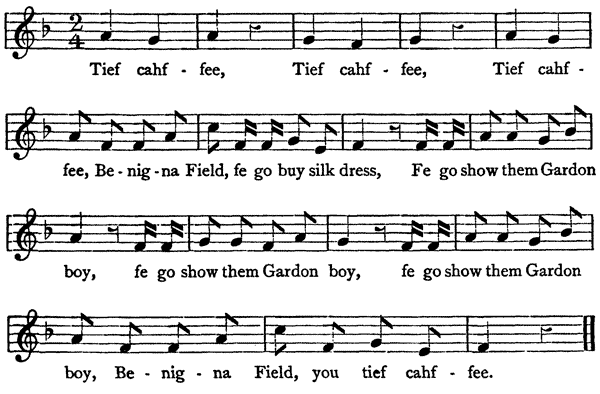
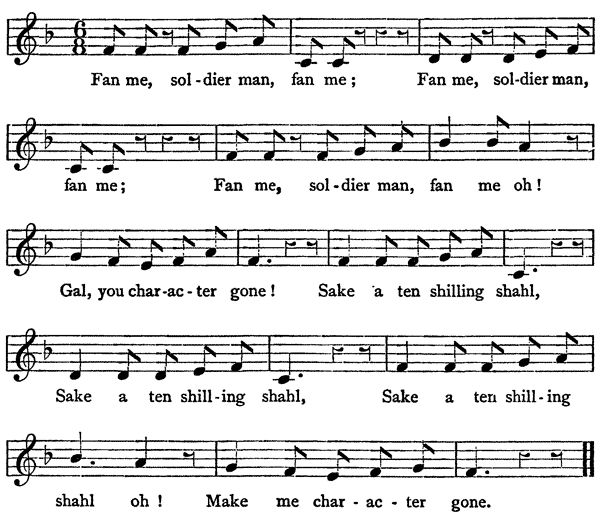
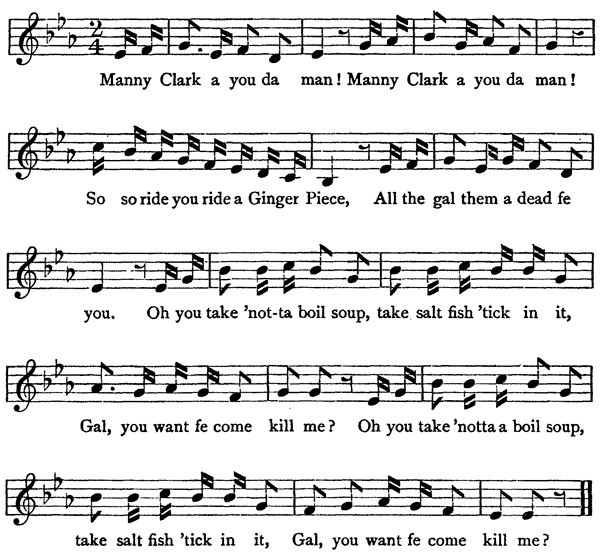
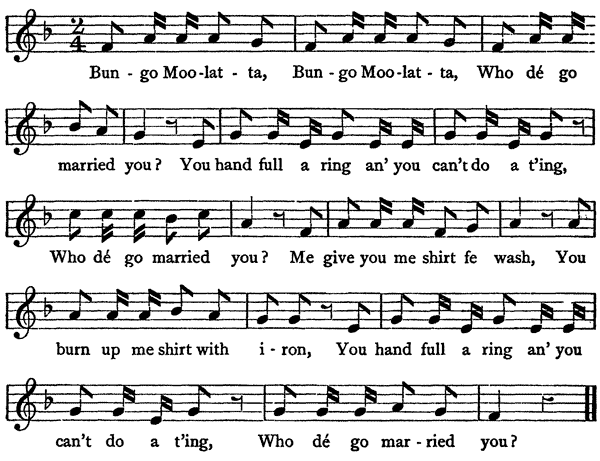
Mr. Jekyll's delightful collection of tales and songs from Jamaica
suggests many interesting problems. It presents to us a network of
interwoven strands of European and African origin, and when these have
been to some extent disentangled we are confronted with the further
question, to which of the peoples of the Dark Continent may the
African element be attributed?
The exact relationship between the "Negro" and Bantu races,—which of
them is the original and which the adulterated stock (in other words,
whether the adulteration was an improvement or the reverse),—is a
subject quite beyond my competence to discuss. It seems certain that
the Negro languages (as yet only tentatively classified) are as
distinct from the singularly homogeneous and well-defined Bantu
family, as Aryan from Semitic. Ibo, at one end of the area, has
possible Bantu affinities, which await fuller investigation; the same
thing has been conjectured of Bullom and Temne at the other end
(Sierra Leone); but these are so slight and as yet so doubtful that
they scarcely affect the above estimate.
The difference in West Coast and Bantu folk-tales is not so marked as
that between the languages; yet here, too, along with a great deal
which the two have in common, we can pick out some features peculiar
to each. And Mr. Jekyll's tales, so far as they can be supposed to
come from Africa at all, are not Bantu. The name of "Annancy" alone is
enough to tell us that.
Annancy, or Anansi is the Tshi (Ashanti)[1] word for "spider"; and
the Spider figures largely in the folk-tales of the West Coast (by
which we mean, roughly, the coast between Cape Verde and Kamerun),
while, with some curious exceptions to be noted later on, he seems to
be absent from Bantu folk-lore. His place is there taken by the Hare
(Brer Rabbit), and, in some of his aspects, by the Tortoise.
We find the "Brer Rabbit" stories (best known through Uncle Remus)
in the Middle and Southern States of America, where a large
proportion, at any rate, of the negro slaves were imported from Lower
Guinea. Some personal names and other words preserved among them
(e.g. "goober" = nguba, the ground-nut, or "pea-nut") can be
traced to the Fiote, or Lower Congo language; and some songs of which
I have seen the words,[2] look as if they might be Bantu, but
corrupted apparently beyond recognition.
But the British West Indies would seem to have been chiefly supplied
from Upper Guinea, or the "West Coast" proper (it really faces south,
while Loango, Congo, etc., are the "South-West Coast"—a point which
is sometimes puzzling to the uninitiated). Among the tribes to be
found in Jamaica, Mr. Jekyll tells me are the Ibo (Lower Niger),
Coromantin (Gold Coast), Hausa, Mandingo, Moko (inland from Calabar),
Nago (Yoruba), and Sobo (Lower Niger).
Mr. Jekyll furnishes a bit of confirmatory evidence in the list of
names (p. 156) given to children according to the day of the week on
which they are born. These are immediately recognizable as Tshi. As
given in Christaller's Dictionary of the Asante and Fante Language
called Tshi (1881), the boys' names are identical or nearly so
(allowing for the different systems of spelling) with those in Mr.
Jekyll's list. They are: Kwasi, Kwadwo, Kwabena, Kwaku, Kwaw (or
Yaw), Kofi, Kwame. (Mr. George Macdonald, in The Gold Coast Past and
Present, gives Kwamina, instead of Kwame, probably owing to a
difference of dialect.) The girls' names are less easily recognizable,
but a careful scrutiny reveals the interesting fact that in some cases
an older form seems to have been preserved in Jamaica. Moreover, the
sound written w by Christaller approaches that of b, which seems
to be convertible with it under certain conditions, all the girls'
names being formed by means of the suffix ba = a child. Conversely,
ekpo in the mouth of a West Coast native sounds to a casual ear like
ekwo.
| Akosuwa | [= Akwasiba] = Quashiba. |
| Adwowa | = Jubba. (Cf. dw = dj in "Cudjo"). |
| Abeua | = Cubba. |
| Akuwa | = Memba. |
| Ya | [= Yawa] = Abba. |
| Afuwa | = Fibba. |
| Amma | [= Amenenewa] = Beniba. |
The boys' names have "Kwa" (= akoa, a man, slave) prefixed to that
of the day, or, more correctly speaking, of its presiding genius.
These latter are: Ayisi, Adwo, Benã, Wuku, Yaw, Afi, Amin. The names
of the days appear to be formed from them by the omission of the
initial A (where it exists), and the addition of the suffix da, with
some irregularities, which no doubt a fuller knowledge of the language
would explain: Kwasida, Dwoda, Benada, Wukuda, Yawda, Fida, Memeneda
(Meminda). The week of seven days does not seem to be known elsewhere
in Africa, except as a result of Moslem or Christian influence. The
Congo week of four days is puzzling, till one remembers that it, too,
rests on a division of the lunar month: 7 × 4 instead of 4 × 7.[3]
The Tshi, Ewe and Yoruba languages are genderless, like the Bantu.
(The word ba has come to mean "a daughter" when appropriated as a
suffix to feminine names; but, properly, it seems to mean "a child" of
either sex.) This fact explains the appearance of such personages as
"Brother Cow" (see also Mr. Jekyll's note on p. 107), and the wild
confusion of pronouns sometimes observed: "Annancy really want that
gal fe marry, but he couldn' catch him."—"When the gal go, him go
meet Brother Death,"—etc.
The few words given as "African" by Mr. Jekyll seem to be traceable to
Tshi. "Massoo" (pp. 12, 13) is mã so = to lift. Afu ("hafoo,"
"afoo," p. 18) is not in Christaller's Dictionary, except as
equivalent to "grass," or "herbs"; fufu is a food made from yams or
plantains boiled and pounded; perhaps there is some slight confusion.
Nyam is not "to eat," but enãm is Tshi for "meat," as nyama (in
some form or other) is in every Bantu language. The nonsense-words in
the songs may be corrupted from Tshi or some cognate language, but a
fuller knowledge of these than I possess would be necessary in order
to determine the point.
Transplanted African folk-lore has a peculiar interest of its own, and
one is very glad to find Mr. Jekyll doing for Jamaica what Mr.
Chandler Harris, e.g. has done for Georgia. But the African element
in the stories before us is far less evident than in "Uncle Remus,"
and is in many cases overlaid and inextricably mixed up with matter of
European origin. At least eleven out of the fifty-one stories before
us can be set down as imported, directly or indirectly, from Europe. I
say directly or indirectly, because an examination of Chatelain's
Folk-tales of Angola and Junod's Chants et Contes des Baronga
shows that some tales, at any rate, have passed from Portugal to
Africa. Such are La fille du Roi (Ronga), which is identical with
Grimm's The Shoes that were danced to pieces, and with the
Slovak-gypsy story of The Three Girls (Groome, Gypsy Folk-tales,
p. 141). But in the absence of more detailed and direct evidence than
we yet possess, it would be rash to assume that they have passed to
America by way of Africa, rather than that they have been
independently transmitted.
The eleven stories above referred to are: II. Yung-kyum-pyung, III.
King Daniel, VI. Blackbird and Woss-woss, X. Mr. Bluebeard, XVII.
Man-crow, XVIII. Saylan, XXI. Tacoma and the Old-witch Girl, XXVI. The
Three Pigs, XXXI. Pretty Poll (another version of III.), XXXIX. Open
Sesame (variant of VI.), VII. The Three Sisters. But some of these, as
I hope to show presently, also have genuine African prototypes, and it
is a question how far these fading traditions have been amalgamated
with fairy-tales told to the slaves by the children of their European
masters. The last named is one of a small group of tales (VII., XXIV.,
XXXIV., L.) which I cannot help referring to a common African
original.
By far the greater number of the stories in this book, whether,
strictly speaking, "Annancy stories" or not, come under the heading of
animal-stories, and are of the same type as "Uncle Remus," Junod's
"Roman du Lièvre," and numerous examples from various parts of Africa.
It will be remembered that, in most of these, the difference between
animals and human beings is not very clearly kept in view by the
narrators. As M. Junod says, "Toutes les bêtes qui passent et
repassent dans ces curieux récits représentent des êtres humains, cela
va sans dire. Ils sont personnalisés par un procédé linguistique qui
consiste à mettre devant le nom de l'animal un préfixe de la classe
des hommes." (This is a point we must come back to later on.) "Ainsi
mpfoundla, le lièvre ordinaire, devient dans le contes
Noua-mpfoundla.... La Rainette, c'est Noua-chinana, l'Eléphant,
Noua-ndlopfou.... Leurs caractères physiques particuliers sont
présents devant l'imagination du conteur pour autant qu'ils donnent du
pittoresque au récit. Mais on les oublie tout aussi aisément dès
qu'ils ne sont plus essentiels à la narration." This feature
constantly meets one in Bantu folk-lore: the hare and the elephant
hire themselves out to hoe a man's garden; the swallow invites the
cock to dinner and his wife prepares the food, in the usual native hut
with the fireplace in the middle and the nsanja staging over it; the
hare's wife goes to the river to draw water, and is caught by a
crocodile; the tortoise carries his complaint to the village elders
assembled in the smithy, and so on. M. Junod seems to me to overrate
the conscious artistic purpose in the narrators of these tales: the
native mind is quite ready to assume that animals think and act in
much the same way as human beings, and this attitude makes it easy to
forget the outward distinctions when they appear as actors in a story.
No doubt this haziness of view is increased by the popular conception
of metamorphosis as a possible occurrence in everyday life. When, as
has more than once been the case, we find men firmly believing, not
only that they can, under certain circumstances, turn into animals,
but that they actually have done so, we may expect them to think it
quite easy for animals to turn into men.
The prefix given by the Baronga to animals, when they are, so to
speak, personified in tales, may seem a slight point, but it is not
without interest. The Yaos in like manner give them the prefix Che
(Che Sungula, the Rabbit, Che Likoswe, the Rat, etc.), which,
though usually translated "Mr.," is of common gender and used quite as
often in addressing women as men. In Chatelain's Angola stories the
animals sometimes (not always) have the honorific prefix Na or
Ngana, "Mr."; the latter is sometimes translated "Lord." In Luganda
folk-lore the elephant (enjovu) is called Wa Njovu. In Zulu,
Ucakijana (to whom we shall come back presently) is the diminutive
form of i-cakide, the Weasel, put into the personal class. I do not
recall anything similar in Nyanja tales, but cannot help connecting
with the above the fact that animals, whatever class their names may
belong to, are usually treated as persons in the tales. Not to be
unduly technical, I would briefly explain that njobvu (elephant) and
ng'ona (crocodile) would naturally take the pronoun i, but in the
stories (and, I think, sometimes in other cases) they take a, which
belongs to the first, or personal class. Now, the reader will notice
how often the animals in the stories before us are distinguished as
"Mr." or "Bro'er" (cf. pp. 20, 23, 31, 86, etc.), though the Jamaica
people seem to be less uniformly polite in this respect than Uncle
Remus. "Brer Rabbit" is so familiar as to be taken for granted, as a
rule, without further question; but, years before he had become a
household word in this country, we find a writer in Lippincott's
Magazine[4] remarking, "The dramatis personæ are honoured with the
title Buh, which is generally supposed to be an abbreviation of the
word 'brother,' but it probably is a title of respect equal to our
'Mr.'" The "but" seems hardly called for, since both assertions are
seemingly true. We might also compare the Zulu u Cakijana (1st
class), who is human or quasi-human, while i-cakide (2nd class) is
the name for the Weasel.
Annancy, then, is the Spider, and as such he is conceived throughout
the folk-lore of West Africa. If he seems, as he continually does, to
take on a human character, going to Freetown to buy a gun and powder
(Cunnie Rabbit, p. 282), or applying to a "Mory man" for amulets
(ib. p. 139), he only behaves like all other animals, as explained
above. A Temne authority (ib. p. 93) maintains that "Spider was a
person" in old times, and did not look the same as he does in these
days, "he done turn odder kind of thing now." But this looks like an
attempt at rationalising the situation, possibly in response to
European inquiries. The change of shape alluded to at the end of the
Temne Tar-baby episode is comparatively a minor matter: he was
formerly "round lek pusson," but became flattened out through the
beating he received while attached to the Wax Girl. In the Gold Coast
stories, too, Anansi is quite as much a spider as Brer Rabbit is a
rabbit; but in Jamaica, though he still retains traces of his origin,
they are somewhat obscured—so much so that Mr. Jekyll speaks (pp.
4-5) of the "metamorphic shape, that of the Spider," which he assumes,
as though the human were his real form, the other only an occasional
disguise. In "Annancy and Brother Tiger" we find that he has to "run
up a house-top" to escape the revenge of the monkeys, which accounts
for some of his habits to this day. In "Yung-kyum-pyung" (a version of
Rumpelstilzchen, or Tom Tit Tot), the only hint of his spider
character is contained in a mere allusion (quite external to the
story) to his "running 'pon him rope." In "Brother Death," Annancy and
all his family cling to the rafters, hoping to escape from Death; but
it scarcely seems in character that they should be incapable of
holding on long. They drop, one after another, Annancy last (p. 33).
He is always in danger from Cows (p. 107): "Anywhere Cow see him, he
reach him down with his mouth"; and he lives in a banana branch (p.
119) for fear of Calcutta Monkey and his whip. His moral character is
consistently bad all through; he is a "clever thief"—greedy,
treacherous, and cruel, but intellectually he does not uniformly
shine. He has to call in the help of a wizard in his love affairs;
"Monkey was too clever for him" on more than one occasion; he has to
be extricated from the slaughter-house (p. 23) by Blackbird and his
army of Wasps, and in "Man-crow" he is signally discomfited. In other
cases his roguery is successful, and he is described as the greatest
musician and "the biggest rascal in the world" (p. 62). Much the same
is the character given to Mr. Spider in "Cunnie Rabbit." Not one
amiable trait is recorded of him.
A Gold Coast story,[5] however, shows him arbitrating between a Rat
and a Panther in very much the same way as the Yao Che Sungula settles
the difficulty between the Man and the Crocodile,[6] making the latter
go back into the trap whence he had too confidingly been released, in
order to show how it was done. Once having got the ungrateful Panther
back into the trap, the Spider advises the Rat to leave him there.
As there is a Gold Coast tradition which affirms the human race to be
descended from the Spider,[7] it might be expected that he should
sometimes appear in a more favourable light, and also that those
peoples who had lost this myth, or never possessed it, should
concentrate their attention on the darker side of his character. At
the same time, even in what may be called his own home, he does not
appear as infallible. A very curious story, given by Zimmermann in his
Grammatical Sketch of the Akra or Gâ Language, shows us the Spider
and his son in the character of the two sisters who usually figure in
tales of the "Holle" type,[8] and, strangely enough, it is the father
who, by his wilfulness and indiscretion, forfeits the advantages which
the son has gained. During a time of famine the young spider crawls
into a rat-hole in search of a nut which has rolled into it, and
there meets with three unkempt and unwashed spirits, who desire him to
peel some yams and cook the peelings. He does so, and they are changed
into large yams. They give him a large basket of yams to carry home,
and teach him a spell which is not to be imparted to any one else. He
repeatedly obtains supplies from the same source, but at last is
followed by his father, who insists on going in his stead. He derides
and disobeys the spirits, loses his yams, and is flogged into the
bargain.
We have mentioned the comparative absence of the Spider from Bantu
folk-lore. I have been able to discover only two references to him in
East Africa, both to be found in Duff Macdonald's Africana. The
first is in a creation-myth of the Yaos (i. 297), which informs us
that when Mulungu was driven from earth by the conduct of mankind,
who had set the bush on fire, he went, being unable to climb a tree as
the Chameleon had done, to call the Spider. "The spider went on high
and returned again, and said, 'I have gone on high nicely,' and he
said, 'You now, Mulungu, go on high.' Mulungu then went with the
spider on high. And he said, 'When they die, let them come on high
here.'" The other is in the story of "The Dead Chief and his Younger
Brother" (ii. 322)—also Yao. The dead chief gives his brother four
bags to enable him to overcome the obstacles which his enemies put in
his way; he opens the first on coming to a large tree in his path—a
wood-moth comes out and gnaws a way through. From the second bag comes
out a manis (scaly ant-eater), which digs a way under a rock, and from
the third (which he opens when he comes to the bank of a river) a
spider, which "went to the other side," and, presumably (though this
is not expressly stated), made a bridge with its web for him to
cross.[9]
Mr. R.E. Dennett (Folklore of the Fjort, p. 74) gives a Lower Congo
story, telling how the Spider brought fire down from Nzambi Mpungu in
heaven, and won the daughter of Nzambi (Mother Earth) by so doing. In
an Angola story (Heli Chatelain, p. 131) the Spider is mentioned as
affording a means of communication between heaven and earth, by which
the Sun's maidservants go down to draw water, and his daughter is
ultimately let down to be married to the son of Kimanaueze. But the
Spider only comes in incidentally; it is the Frog whose
resourcefulness makes the marriage possible. The notion of the
spider's web as a ladder to heaven is one that might occur
independently in any part of the world, and there is no need to
suppose these tales to be derivatives of the Hausa one given by
Schön.[10]
So far, the appearances of the Spider in Bantu folk-tales are so
infrequent as to be almost a negligible quantity. We find him,
however, playing a tolerably conspicuous part in the folk-lore of the
Duala. These, living in the German territory of the Kamerun, may be
considered the north-western outpost of the Bantu race, and their
language, unmistakable in its general character, has departed, perhaps
more widely than any other, from the normal Bantu standard. Herr
Wilhelm Lederbogen, formerly of the Government School, Kamerun, has
collected a large number of stories, some of which are published in
the Transactions of the Berlin Oriental Seminary (see Afrikanische
Studien for 1901-1903). These comprise 67 "Tierfabeln" and 18 tales
of the ordinary märchen type. The latter (some of them recognizable
as variants of tales current in Bantu Africa) introduce animals along
with human beings, and the incident of the Spider being consulted as a
soothsayer repeatedly occurs. "Die Spinne tritt immer als Wahrsagerin
auf" says the collector in a note. But the malignant aspect of Anansi
seems to be absent.
The late W.H.J. Bleek, who supposed the animal-stories which he had
collected from Hottentots and Bushmen to be characteristic of and
peculiar to these races, had built up a somewhat elaborate theory,
scarcely borne out by the facts as known to us to-day, in connection
with this point. Briefly, it amounted to this: that a fundamental
limitation in the Bantu race, which had prevented, and always would
prevent, their advancing beyond a certain point, was denoted by the
absence of grammatical gender in their languages, their supposed
incapacity for personifying nature, and their worship of ancestors, as
opposed to the alleged moon-worship of the Hottentots.[11] The Zulus,
he says, believe that the spirits of the dead appear to them in
dreams, and also show themselves to the waking eye in the shape of
animals, usually serpents. "No personification of the animal takes
place, however, such as we find, for instance, in the mythical world
of our earliest [Teutonic] literature. The imagination of the
ancestor-worshipper does not even, as a rule, show us the animal as
possessing the gift of human speech; it is only supposed to perform
acts well within its capacity as an animal, though such acts are
considered, in the case of individual animals supposed to be possessed
by the spirits of deceased persons, as emanating from the spirits."
Thus, a serpent, known by various tokens to be an idhlozi, may enter
a hut and consume the meat left for it, or it may engage in combat
with other snakes which must be supposed to represent the enemies of
the deceased. Animals thus revered by ancestor-worshippers always have
the distinguishing characteristic that they have once been human
beings; and spirits, unless they appear as animals, are always
invisible. "A personification of the animal world (such as we find in
our own fables), or even of other things (as in the mythologies of
Europe), is utterly absent from this primitive, prosaic way of looking
at things." The poetic impulse implied in such personification can
only arise, in Bleek's view, among the speakers of a sex-denoting
language. The linguistic argument I cannot here reproduce in detail;
its tendency is sufficiently shown by the following quotation, which
bears directly on our subject:
"The form of a sex-denoting language, by exciting sympathy even for
creatures not connected with us by human fellowship, leads in the
first instance to the humanization of animals, and thus especially
gives rise to the creation of fables. Even on the lowest stage of
national development, we find the Hottentot language accompanied by a
literature of fables, for which we may vainly seek a parallel in the
literatures of the prefix-pronominal languages."
The validity of Bleek's theory was seriously doubted by the late Dr.
C.G. Büttner, in 1886, and the masses of fresh material which have
come to light during the last forty years, have completely altered
the aspect of the question. The Hottentot myth of the Hare and the
Moon, to take but one example, which appears among the Zulus as the
tale of Unkulunkulu and the Chameleon, is told by the Anyanja (of the
Shire Highlands and Lake Nyasa) of the Chameleon. The Duala have the
same Chameleon story; and there is a Gold Coast version, in which the
two messengers are the Sheep, who linger on the way to graze, and the
Goat, who arrives first with the tidings that man shall not return
after death. The Krūmen of the Ivory Coast say that Nemla (a
small antelope probably representing, if not identical with, the
"Cunnie Rabbit" of Sierra Leone), maliciously, not accidentally,
rendered inoperative the remedy against death provided by the fetich
Blenyiba. Who is responsible for the original version it is perhaps
impossible to settle. But there can be no question of recent
borrowing; and supposing that the Bantu did derive the myth from their
predecessors (now represented by the remnant of the Bushmen, and
perhaps the Pygmies), this would surely prove them at least capable of
assimilating fresh ideas and thus advancing beyond the line so
inexorably traced for them from the beginning. It may be remarked in
passing that there seems some probability of the Bantu Anyanja in the
Shire district having largely absorbed, instead of exterminating as
was elsewhere the case, a smaller-sized race who previously occupied
the country. In the same way, the Abatembu of the Cape Colony are the
descendants of a Bantu clan amalgamated with the Bushman tribe of the
'Tambuka, and traces of similar fusion could no doubt be discovered
elsewhere. But we doubt its being necessary to the introduction of
animal-stories into folk-lore,—or, in general, of ideas connected
with the personification of nature.
The Zulu tales which Bleek had before him present a character very
different from that of the Hottentot beast-fables. But a comparative
study of Bantu folk-lore suggests at least the possibility that they
may have been developed out of animal-stories. Hlakanyana is conceived
of as certainly human, and reminds us of Tom Thumb; but some of his
adventures are identical with those of the Hare, the Jackal, or Brer
Rabbit. Cakijana shows still clearer traces of animal origin. The
episode of Hlakanyana's demanding a digging-stick in exchange for the
birds he accuses his companion of having eaten, and the sequence of
exchanges which culminates in his acquiring a cow,[12] is in
substance the same as the story told by the Anyanja about the Hare
(kalulu) which was given in Folk-Lore for Sept. 29th, 1904. This
again reminds us of "The Man who Lived by Overreaching Others" (Dr.
Elmslie in Folk-Lore, vol. iii.), and of a Sukuma story given by
Herrmann,[13] in which a boy gives his grandmother some honey to keep
for him, and, coming back after a time, and finding she has eaten it,
makes her give him some corn in exchange. The corn is then exchanged
for an egg, the egg for sticks, the sticks for a knife, and the knife
for a cow's tail, for which, by the same trick as in Dr. Elmslie's
story, he obtains a cow. There is no suggestion of trickery in the
Nyanja story, whereas it is brought out very strongly both in
Hlakanyana and the Sukuma example.
We shall have occasion to refer, later on, to more than one instance
where a story is found in two forms, one having animals, the other
human beings, as its characters.
The animals figuring in folk-tales must necessarily vary with the
locality of the tale, and in cases where a story has travelled (or
possibly where the same idea has arisen independently in different
places) it is interesting to note the changes in its dramatis
personæ. Thus, the incident of the race between the swift creature
and the slow seems to be found in the folk-lore of every country. In
Africa the winner is always, so far as I know, the Tortoise, as Brer
Terrapin is in "Uncle Remus." The Jamaica version in the volume before
us substitutes the Toad, while the defeated party is the Donkey. In a
Konde (North Nyasa) variant, the protagonists are the Elephant and the
Tortoise, in a Duala one, the Ngoloñ (a large kind of Antelope) and
the Tortoise. Another version of the Duala story, contained in
Märchen aus Kamerun, by the late Frau Elli Meinhof, has the Hare and
the Tortoise, but with the explanation that by "hare" is meant "eine
kleine Antilopenart, eseru genannt." The curious thing is that Njo
Dibone, the native authority for the tales, himself suggested the name
of "hare," but added "Hase ist nicht wie hier,[14] sondern hat kleine
Hörner." It is not stated whether he had himself seen the European
hare, but apparently he thought the two animals so far similar that
Hase would be the nearest available rendering for eseru. This may
throw some light on the question why the Dorcatherium gazelle, or
possibly the Royal Antelope, Neotragus, is called "Cunnie Rabbit" in
Sierra Leone English.
The Tortoise plays a conspicuous part in the folk-lore both of Bantu
and West African Negroes. In Yoruba tradition he takes the place of
the Spider with the Fantis, all mankind being descended from him.
Perhaps this is not strange, when we consider how much there is about
him which would appeal to the primitive mind as uncanny and
mysterious. A recent writer in the West African Mail[15] says on
this subject: "The original conception of the tortoise culminated in a
belief concerning its attributes that, in the eyes of these [Niger]
Delta natives, elevated it to the sovereignty of the beasts of the
forest.... Absolutely harmless and inoffensive in himself, the
tortoise does not prey on even the smallest of insects, but subsists
entirely on the fallen fruits of the forest"—or, in some cases, on
fungi. "In the gloomy forests of the Delta there are only two enemies
capable of doing him any serious harm. The one is man, who is able to
lift him up and carry him bodily away, which, however, he does not do,
except in those instances in which the animal is regarded as sacred,
and required in connection with certain religious ceremonies. His
other and most dangerous enemy is the python, who having first of all
crushed him by means of the enormous power of constriction which it
can apply, swallows him alive, shell and all. But pythons large enough
to do this, unless the tortoise happens to be very young and small,
are very scarce, so that he has not much to apprehend in that quarter.
To the elephant—herbivorous, like himself—he is too insignificant,
for unlike the mosquito or the sand-fly, he has no sting; and although
they meet in fable, in real life the hippopotamus and himself are not
much thrown together. From the leopard or the bush-cat, he has nothing
to fear, for their teeth cannot penetrate his shell, nor can [their]
claws do him any damage. Thus it is that ... the tortoise has been
practically immune from attack and therefore destruction—a fact that
in a great measure explains his longevity."
If we add to this his power of living for a long time without food,
his silence, the extreme slowness and caution of his movements, his
instinct of keeping out of sight, and the peculiar air of dogged
determination with which he sets about overcoming or circumventing
obstacles, it is "easy to understand how in process of time the word
which stood for tortoise became a synonym for cunning and craft, and a
man of exceptional intelligence was in this way known among the Ibo as
'Mbai,' and among the Ibani as 'Ekake,' meaning a tortoise. For
although he of the shell-back was slow, he was sure, as the old Greek
Aesop tells us.... This sureness, in the native mind, implied
doggedness and a fixed determination, while silence and secrecy
implied mystery and a veiled purpose behind which it is impossible to
get."
The tortoise of African folk-lore is sometimes, in fact usually, the
land-tortoise (as implied in the above extracts), of which there are
several species, living either in forest-country or in deserts like
the Kalahari. In Angola, the story of "Man and Turtle" (Chatelain, p.
153—identical with "Mr. Fox tackles Old Man Tarrypin" in "Uncle
Remus") refers to a kind which, if not aquatic, is evidently
amphibious. We find tortoise stories all over Negro and Bantu Africa;
we have Temne, Bullom, and Yoruba examples, besides Duala, Konde
(Nyasa), Yao, Nyanja, Herero, Bemba, Congo (Upoto), Angola and Sesuto
ones. This does not exhaust the list I have made out, and further
research would no doubt bring to light many more. One of these is the
well-known "tug-of-war" story, which in "Uncle Remus" has the title
"Mr. Terrapin shows his strength." We have two versions of this
(agreeing in their main points) from the Kamerun, one told by the
Duala, the other by the Yabakalaki-Bakoko tribe. Here it is the
Elephant and the Hippopotamus whom the Tortoise induces to pull
against each other. The American Negro substitutes the Bear for one of
these competitors, and then, apparently at a loss for a wild animal
strong enough to take the place of the other, makes "Brer Tarrypin"
tie "Miss Meadows's bed-cord" to a root in the bed of the stream. But
it is interesting to find two native African versions in which other
animals are substituted for the Tortoise. The Temne (Cunnie Rabbit,
p. 117) gives his part to the Spider, while the Bemba people
(North-eastern Rhodesia) make the Hare the hero of the adventure. Col.
Monteil gives a Mandingo variant, introducing a different motive for
the contest: the Hare has borrowed a slave apiece from the Elephant
and the Hippopotamus, and when pressed for payment hands each of his
competitors in turn the end of a rope, with the words, "Tu n'as qu'à
tirer sur cette corde, le captif est au bout."[16]
Another Temne story collected by Miss Cronise, "Mr. Turtle makes a
riding-horse of Mr. Leopard," is paralleled by an Angola one
(Chatelain, p. 203) in which it is Mr. Frog who plays the trick on Mr.
Elephant. In the New World, it will be remembered that Brer Rabbit has
usurped the part.
In M. René Basset's Anthology of African Folk-tales[17] is included
a tale about a monkey and a tortoise from Baissac's Folklore de l'Ile
Maurice which recalls a Nyanja one obtained by me at Blantyre and
printed in the Contemporary Review for September, 1896. In the
latter it is the iguana, not the monkey who robs the Tortoise; but in
both, the Tortoise exacts retribution with a cold-blooded
relentlessness suggestive of Shylock. A Brazilian negro story is also
given, which looks like a variant of one told in Calabar to account
for the fact that the Tortoise's shell is composed of separate plates,
as though it had been broken to pieces and put together again.
But we look in vain for the tortoise in these stories of Mr. Jekyll's.
Even in the race-story, as we have seen, the part which in Africa is
so peculiarly his own, is taken by the Toad. Probably this is because
the land-tortoise is not found in Jamaica, and the great turtle of the
seas is not a creature whose ways would come under the daily
observation of the peasantry. In the same way familiar animals have
been substituted for unfamiliar ones in a great many cases, though not
in all. Mr. Jekyll thinks "Tiger" is a substitute for "Lion," but it
seems equally possible that "Leopard" is meant. All over South Africa,
leopards are called "tigers" by Dutch, English, and Germans, just as
hyenas are called "wolves," and bustards "peacocks" (paauw). "Tiger"
is used in the same sense in German Kamerun, and probably elsewhere in
West Africa. Lion and elephant are known—perhaps by genuine
tradition—to Uncle Remus; but they seem to have faded from the
recollection of the Jamaica negroes; indeed, the lion is not found in
their original homes, being absent from the whole West Coast as far as
Sierra Leone.
"Brer Rabbit," so characteristic a figure of Bantu folk-lore that his
adventures are related from one side of Africa to the other (though in
the west he is less frequently met with north of Angola), only appears
in two of Mr. Jekyll's stories, in none of which we can recognize
anything of his traditional character. In "Annancy and his Fish-pot,"
he is unscrupulously victimised by Annancy, and subsequently dies of
fright and worry; in "Snake the Postman," he escapes from Annancy's
machinations, but there is no indication that he could ever be
considered a match for "that cravin' fellah." In "John Crow and
Fowl-hawk" he is merely alluded to (p. 142, "This company was
Rabbit"). In "Dry Bone," he is induced by Guinea-pig to carry the
unwelcome load, but succeeds in passing it on, for the time being, to
Annancy. Finally, in "Gaulin," he cuts a poor figure as the
unsuccessful suitor. A Bantu story by no means complimentary to the
Hare's intelligence is given by M. Junod,[18] and seems to have
reached Louisiana[19] as "Compair Lapin et Michié Dinde," where the
Rabbit gets his head cut off under the belief that the Turkey has
removed his when he puts it under his wing to sleep. M. Junod thinks
this must refer to a second species of Hare, a by-word for stupidity,
as the other is for cuteness; but it is at least worth noting that the
same story is told by the Basumbwa (south of Lake Victoria) of the Hen
and the Tiger-cat.
Besides Annancy himself, and the "Tiger" already mentioned, we have,
in these stories, either domestic or quasi-domestic animals: Cow, Hog,
Dog, Puss, "Ratta," etc., or creatures indigenous to Jamaica, such as
John-Crow, Chicken-Hawk, Sea-Gaulin, Candle-Fly, Crab and Tarpon. Some
stories, for which I fail to recall any exact parallel, either in
Africa or Europe, may be of purely local origin; this is most likely
to be true of those which profess to explain some elementary fact in
natural history, such as the inability of two bulls to agree in one
pasture ("Timmolimmo"), or the hostility between dogs and cats. Even
were this not so, the amount of local colour introduced (as always
where tales are transmitted orally) could change them almost beyond
recognition. This often has a very quaint effect, as in "Parson Puss
and Parson Dog," who are evidently conceived as ministers of some
rival Methodist denominations, and in the references to weddings,
funerals, and dances possibly ending up with a free fight, as in
"Gaulin," "How Monkey manage Annancy," "Doba," etc. Annancy's inviting
the animals to his father's funeral and slaughtering them (with the
exception of Monkey, who is too clever for him) reminds us of the
Temne "Mr. Leopard fools the other animals,"[20] but in this, Leopard
himself pretends to die. Cunnie Rabbit's test, "Die pusson nebber
blow," is less ingenious than that applied by Brer Rabbit in "Uncle
Remus:"[21] "When a man go to see dead folks, dead folks allers raises
up der behime leg en hollers wahoo!" (In Mr. Owen's version, they
"grin and whistle.") In the Sesuto story[22] the Monkey suspects a
trick and escapes, when the Hare persuades the Lion to entrap the
other animals by shamming death. Perhaps the baptism of the crabs
("Annancy in Crab Country") may be connected with "Mr. Spider
initiates the fowls,"[23] where the Temne Spider, assuming for the
nonce a quasi-religious character, gathers his victims together to
celebrate the Bundo mysteries, and massacres them wholesale.
"Annancy and Hog" (XXXII.) is a fragmentary story, not very easy to
understand as we have it, but something has evidently dropped out. The
sentence "An' when Hog think him done up Annancy him done up him own
mother" may point to some original similar to the Fiote story given by
Mr. Dennett, in which the Leopard's wife is induced to eat her
husband's head.[24] But in that case it is difficult to understand the
connection with the opening incidents.
In "John-Crow and Fowl-hawk" (XLVI.) we may have a reminiscence of
the class of stories represented by the Yao "Kalikalanje," in which an
unborn child is promised by the mother in return for a service
rendered her by some person or animal. The resemblance, however, is
not very marked, and the incident is quite lost sight of in the later
part of the story.
"Annancy and Death" is curious, and, as it stands, not very
intelligible. Death, as a person, is introduced into several African
stories,[25] and even (in one from the Ivory Coast) together with the
Spider, but none of these have anything parallel with the one before
us. The last part, however, where Annancy and his children are
clinging to the rafters, and Death waiting for them below, recalls the
story to be found on pp. 224-226 of Cunnie Rabbit. The Spider and
his family take refuge in the roof when pursued by the Leopard, and he
sits on the ground and catches them as they drop one by one. Last of
all, the wife, Nahker, "he say he done tire, en Spider say: 'Yo' wey
(= who) big so? Fa' down now, yo' go get de trouble.' Nahker fa' down,
Lepped yeat um. Spider he one lef' hang." He escapes, however.
In "Dummy," Annancy wins a bet and the hand of the King's daughter by
inducing "Peafowl" to make the dumb man talk. This "Peafowl" does by
the sweetness of his song; but in a Duala story given by Lederbogen as
"Der Tausendfuss und das stumme Kind," the means adopted more nearly
resemble the time-honoured recipes for detecting changelings in this
country. The Mouse advised the dumb child's parents to consult the
Spider, who told them to hang up a centipede over the fireplace, set
on a pot of water just underneath it, and leave the child sitting
beside the fire. They did so, and went out. As soon as the steam rose
from the water, the centipede, feeling the heat, began to struggle,
and the dumb child watching it cried out in his excitement, "Father!
there is a centipede going to fall into the pot."
"William Tell" is puzzling. There is no single point of contact
between the owner of the witch-tree and the mythical archer of Europe.
It is most probable that the name (a likely one to remain in the
memory) had been picked up by some negro story-teller who did not know
the tale belonging to it and simply attached it to the first
character that came handy. The "sings" by means of which Annancy fells
the tree occur frequently in native African stories; we need only
mention the incident (found not only in the Xosa "Bird that made
Milk," but in a Duala tale, and elsewhere) of the song which made the
hoed garden return to grass and weeds, and that of Simbubukwana's
sister[26] who sang "Have legs, have arms," and the boy who was
without those members immediately grew them. The notion of spells to
be sung, however, does not seem to be confined to any country or race.
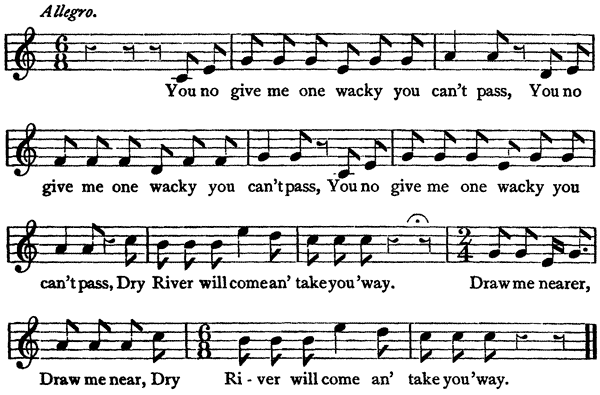
I do not remember any exact parallel to "Dry River" (XXXIII.), but the
incident of the river rising is found in Africa with several different
sequels. In a Nyanja story which I have in MS., some children go out
into the bush to gather wild fruit, and are cut off on their return by
the rising of the river. They are helped across by "a big bird, with
one wing, one eye and one leg" (one of the "half-beings"[27] whose
place in Bantu folk-lore has not yet been fully worked out), and
charged not to tell who took them over. One boy tells his mother, and
is drowned on the next expedition, his companions getting across in
safety. In "The Village Maiden and the Cannibal" (Mrs. Martin's
Basutoland, its Legends and Customs), the girls cannot cross the
swollen stream till they have thrown a large root into the water, and
complied with the directions. The last girl, who is reluctant to obey,
but finally gives in, is not drowned, but she and her sister have an
adventure with cannibals of a not uncommon kind, which may be referred
to Mr. Jacobs's "Flight from Witchcraft" type. Two other stories, a
Kinga (North-east Nyasa) and a Machame (Kilimanjaro) one, have the
same opening incident (in the one case, however, it is a rock and not
a river which enlarges itself and blocks the way), but continue in
quite a different way—the girls are helped by an animal (in one case
a jackal, in another a hyena) who subsequently insists on marrying one
of them. The Machame tale, to which we shall have to return presently,
as it belongs to the group to which we refer "Yellow Snake" and some
others, goes on to relate how the girl escaped from the hyena's
village; the Kinga one takes an entirely different course.
"Leah and Tiger" is one of the stories which can be most
unhesitatingly identified as African; and, as it happens, the examples
at present known to me are nearly all Bantu. Perhaps the closest
parallel is the Suto "Tselane" (Jacottet, p. 69),[28] where, however,
the girl, instead of being secluded by her father to avoid the trouble
which her refusal to marry threatens to bring upon him, herself
insists on staying in the house her parents are leaving. As in the
Jamaica version, they bring her food every day, and sing to let her
know of their approach. The cannibal on the prowl (represented in
Jamaica by the "tiger") imitates the mother's voice, but fails; after
swallowing a red-hot hoe, he succeeds at the first trial. He does not
eat Tselane, however, and so end the story with a warning against
obstinacy; he puts her into a bag to carry her home, and rests on his
way at a hut, which proves to be her uncle's. While he is resting
inside the hut, leaving his bag outside, the family discover the girl
and let her out, substituting a dog and some biting ants. In other
versions it is bees and wasps, or snakes and toads; but the result is
always the same—the death of the cannibal. The incident of swallowing
red-hot iron to soften the voice is found also in "Demane and
Demazana" (Theal) and elsewhere. In a curious Masai story, "The Old
Man and his Knee" (Hollis, The Masai: Language and Folklore, p.
153), the "enemies" (not said to be cannibals) carry off the old man's
two children by means of the same stratagem. After failing in the
first attempt they consult a medicine-man to find out how they can
"make their voices resemble an old man's." He tells them merely to go
back, and eat nothing on the road. They eat a lizard and an ant, and
their voices do not produce the desired effect. On trying again, and
this time complying exactly with the doctor's directions, they deceive
the children and get the door opened. This incident is preserved in
"Leah," and, like the Masai "enemies," Tiger thinks that such a trifle
as the guava and "duckanoo" cannot possibly do any harm. The Masai
story concludes with the killing of the old man by making him swallow
a hot stone—an incident which crops up in various connections in the
Hare stories, but seems out of its place in this one. On the whole
(though I do not like to hazard a conjecture) it seems more probable
that the Masai had picked up this tale from some of their Bantu
neighbours than that the Bantu should have adopted it from them.
As regards the imported stories, it seems reasonably clear that
"Yung-Kyum-Pyung" is a "Rumpelstiltzchen" story which has accidentally
become associated with Annancy. Though the superstition on which these
stories are based exists in Africa as well as in other parts of the
world, and is one of the factors in the custom of hlonipa, I do not
remember any tale embodying it in this form, though there are numerous
examples of those which turn a tabu of some sort.
"King Daniel" is the story of the jealous sister, best known, perhaps,
in the ballad of "Binnorie." But it has African prototypes as well,
though the resemblance to these is not so close, in which the crime is
discovered by the song of a bird—sometimes the metamorphosed heart of
the victim. In "Masilo and Masilonyane" and the Kinga "Die
Reiherfeder,"[29] one brother (or companion) kills the other; in
"Unyengebule" (Callaway) the husband kills the wife, and here it is
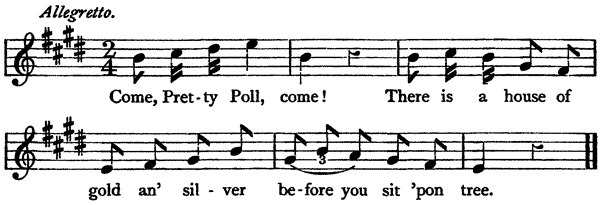
her feather head-dress which turns into a bird. "Pretty Poll" (XXXI.)
is a variant of this story.
Another pair of variants, apparently, are "Blackbird and Woss-woss"
and "Open Sesame." But the former of these, it seems to me,
corresponds much more closely with a Nago story of the Lizard and the
Tortoise, given by M. Basset (Contes populaires d'Afrique, p. 217);
and it should be remembered that the Nagos of Yoruba are one of the
tribes represented among the Jamaica negroes. The lizard finds a rock
containing a store of yams, and overhearing the words used by the
owner "Stone, open!" obtains food for himself in time of famine. He
imparts the secret to the tortoise, and they go together, but the
tortoise lingers behind to load himself with all he can carry, and not
knowing the word fails to get out, and is killed when the owner
returns. He revives, however, and gets the cockroach to stick his
shell together, thus presenting a point of contact with other
aetiological myths about the Tortoise. The rescue by the army of wasps
I have been unable to match.
"Man-crow" is the story, which exists in so many variants, where the
hero is robbed of the fruit of his achievement by an impostor stepping
in at the last minute. The nearest parallel which occurs to me is
"Rombao" (probably obtained from a Portuguese source by the Quilimane
natives who related it to Mr. Duff Macdonald), where the hero kills
the whale and cuts out its tongue; the captain who finds it dead
claims his reward, but is discomfited by Rombao's appearance with the
tongue.
"The Three Pigs" will be readily recognized as the familiar English
story, and corresponds pretty closely to the version in Mr. Jacobs's
English Fairy Tales. A version current among the negroes of the
Southern States is given by Mr. Owens in the paper in Lippincott's
Magazine already referred to. This version, entitled "Tiny Pig,"
omits the two incidents of the apple-tree and the butter-churn; but
curiously enough these appear as "Buh Rabbit" episodes in another part
of the same paper, the apple-tree having become a pear-tree, and the
churn a tin mug which Buh Rabbit puts over his head, while he hangs
various articles of tinware about his person.
"Sea-Mahmy" introduces several different elements. The mermaid herself
is probably of European extraction,[30] and the device by which
Blackbird brings Annancy to the feeding-tree might be a far-off echo
of the Daedalus and Icarus myth. But Annancy's trick for conveying
Trapong to his house and eating him recalls one of the stock incidents
of Bantu folk-lore—the one where Hlakanyana, or the Hare, or some
other creature, induces his dupe to get burnt or boiled by pretending
to undergo the process himself and to escape with impunity. The Suto
Hare[31] commends this as a device for attaining immortality—in which
there is a faint suggestion of Medea's caldron. I was at first
disposed to refer this episode to the "Big Klaas and Little Klaas" (or
the "Getting-to-Heaven-in-a-Sack") group; but the inducement to enter
the sack, which is so great a point in these, is here wanting. It is
found in a Zanzibar story ("Abu Nuwasi na waziri na Sultani") in Dr.
Velten's collection,[32] where Abu Nuwas is sewn up into a sack to be
thrown into the sea, and induces another man to take his place by
saying that he is to be drowned for refusing to marry the Sultan's
daughter. This is evidently an Arab tale, though I do not remember it
in the Arabian Nights.
The exotic tales to be found in Bantu Africa come mainly from two
sources—Arab and Portuguese. The former is exemplified at Zanzibar
and all down the Mozambique coast; the latter in Angola and
Mozambique. We have already referred to an example obtained at Delagoa
Bay by M. Junod; but "Bonaouaci" (Chants et Contes, p. 292), though
the names are Portuguese, and the local colouring goes so far as to
introduce the Governor of Mozambique in person, is in substance
identical with one of the "Abu Nuwas" stories given by Dr. Velten, the
incident of the egg-production being nearly the same in both, as well
as the two other impossible tasks set the hero—sewing a stone and
building a house in the air. I fancy the same is the case with
"Djiwao," though the incidents have been a good deal remodelled, and
the concluding episode—the boiling of the chief Gwanazi in the pot he
had intended for Djiwao, is the purely Bantu one alluded to in the
last paragraph—in a somewhat unusual setting. "Les trois
vaisseaux,"[33] again, is an Arabian Nights story, of which a
curious version has been obtained at Domasi, probably brought from the
coast by some member of a Yao trading caravan. Mr. Dennett's No. III.,
"How the wives restored their husband to life," looks like a much
altered and localized form of this. If so it might have reached the
Congo through the Portuguese. We also find it on the Ivory Coast[34]
where it might have come from an Arab source through Mandingoes or
Hausas.
The stories of "Fenda Maria" and "Fenda Maria and her elder brother
Nga Nzuá"[35] ("The Three Citrons" and "Cinderella"), are good
examples of transplanted stories invested with local colour by
successive generations of narrators, till, as Mr. Chatelain says,
"the fundamental idea of exotic origin has been so perfectly covered
with Angola foliage and blossoms, that science alone can detect the
imported elements, and no native would believe that [these tales] are
not entirely Angolan."
A curious stage in the migration of stories is exemplified by the
"Taal" (or Cape Dutch) versions of Oriental stories imported into
South Africa by the Malays, and existing in a purely traditional form
among the coloured people. One of these was printed by Mr. H.N. Müller
in De Gids for Jan., 1900, but I think hardly any attempt has been
made to collect them. And here I may mention that Herr Seidel's
Lieder und Geschichten der Afrikaner[36] contains a Nama version of
the Lear story, taken down and translated by Herr Olpp, of the Rhenish
Mission, who seems quite unaware of its real origin, in spite of the
very obvious parallel in Grimm's Hausmärchen. He says in a note:
"Diese Begebenheit kann sich nur in der Kap-Kolonie ereignet haben zu
einer Zeit in welcher Kolonisten sich schon angesiedelt hatten und
unter den Eingeborenen wohnten. Der Name der Tochter spricht dafür und
enstammt dem Holländischen." Now the youngest daughter's name is
"Katje Leiro"—surely, all things considered, not such a very far cry
from Cordelia.
It is interesting to trace the African elements in these imported
tales as distinct from those which are merely derived from West Indian
surroundings. Thus Mr. Bluebeard's three-legged horse (compare also
the three-legged horse in "Devil and the Princess") is, as explained
in the footnote, a "duppy"; and the duppy, whatever the derivation of
his name, seems to be West African in origin. Duppies are the souls of
the dead, "capable of assuming various forms of men and other
animals."[37] Some of these forms are monstrous, as the "three-foot
horse" already alluded to, the "long-bubby Susan," and the "rolling
calf." The informant who is responsible for these statements also says
that "the duppy in human form generally moves along by spinning or
walking backwards." Perhaps this may explain the mysterious "Wheeler"
(LI.) who has his habitation in a hollow tree, and seizes the hand of
any unwary person who puts it into the hole. What he would have done
if not requested to "Wheel me mile an' distant," remains obscure; but
apparently the persons making the request are whirled through the air
and then dropped at the place where Annancy (who has previously passed
through the experience unscathed) has prepared a trap for them. The
story suggests—though the resemblance is not very close—the episode
of "The Stone that wore a Beard" in Cunnie Rabbit (p. 167), where
the Spider, having had a narrow escape from the magic powers of the
bearded stone (a transformed "devil") utilises them for the
destruction of his acquaintances. Those who remark on the peculiarity
of the stone are struck down unconscious, and Spider exercises all his
ingenuity in inducing his victims to say, "Dah stone get plenty
bear'-bear'!" Cunnie Rabbit will not say the words till Spider has
himself done so, and has suffered the consequences; both are
afterwards rescued by Trorkey (Tortoise). Somewhat similar to
"Wheeler" is the magic jar in XLV.—which might, however, be due to a
distorted reminiscence of "Bluebeard." Spirits are often believed on
the Gold Coast to take up their abode in trees, as well as to assume
the form of animals. The usual Tshi name for them appears to be
bonsum or bossum: the word "duppy" I have been unable to trace.
The method of divination in "Mr. Bluebeard" is one I do not remember
to have met with, though it may be akin to the "magic mirror of ink."
The magic drum by which Calcutta Monkey (XXXVIII.) finds out Annancy's
whereabouts is African. I do not recall any parallel story, but drums
are much used by witch-doctors and in ceremonial dances, and in some
cases auguries are drawn from their sound. But Monkey first discovers
Annancy to be the thief by cutting the cards, which of course is
European.
Two stories, "Annancy and the Old Lady's Field" (XVI.) and "Devil's
Honeydram," introduce the incident of a woman compelled to dance
against her will—in one case to dance herself to death. In both cases
the music seems to be the compelling power; but it is not clear
whether, in "Devil's Honeydram," the knowledge (and use in the song)
of the woman's name has anything to do with the spell. If so, the idea
is so universal that one can scarcely refer to it as specially
African. It is interesting, though perhaps scarcely pertinent to the
matter in hand, to note that the Akikuyu believe their images (of
which Mr. Scoresby Routledge has brought home specimens) to have the
power, if held up before people, of compelling them to dance.
The folk-lore of Jamaica, as given in the interesting papers published
in Folk-Lore, 1904-5, is decidedly of a composite character. The
negroes have, as there pointed out (1904, p. 87), "adopted many of the
most trivial of English superstitions," while at the same time
preserving some reminiscences of their African beliefs. These are
especially seen in the notions respecting "duppies," which again are
perceptibly influenced by Christian ideas, cf. the efficacy of the
name of Christ (p. 90) and the statement that the "rolling calf" is
the spirit of a person not good enough for heaven or bad enough for
hell, or the recipe of "sitting on a Bible" to get rid of a duppy. The
directions for "killing a thief" (p. 92) belong to the system
(universal throughout Negro and Bantu Africa) of guarding crops by
means of "medicine," or "fetish," or whatever one likes to call it:
the technical name in Chinyanja is chiwindo. I do not remember any
of the particular forms of chiwindo here enumerated; and the silver
threepence to be planted with the "guinea yam" is a civilized
addition, but the principle is the same. The methods of "finding out
the thief," on the other hand, which follow on p. 93, are certainly
English—the Bible and key, and the gold ring, hair and tumbler of
water. There is a third alternative:—"A curious kind of smoke, which,
when it rises, goes to the house of the thief, etc."—but it is too
vaguely stated to enable us to pronounce upon it.
Among funeral customs we find the following (p. 88): "If a person dies
where there are little children, after the body is put into the
coffin, they will lift up each little child, and calling him by name,
pass him over the dead body." According to a Sierra Leone paper this
custom is observed there; but it is not stated by which of the tribes
who make up the extremely mixed population. It may even be found on
investigation that some of the freed slaves brought the notion back
from the New World. The same authority states that it is considered
unlucky to whistle, and adds the rationalizing explanation that
whistling attracts snakes, lizards, and other undesirable creatures
into the house. In Jamaica, you must not "whistle in the nights, for
duppies will catch your voice."
The proportion of native and acquired, or African and European ideas
in these superstitions can only be determined by a much more detailed
examination than I can make here, and one based on fuller materials
than are yet accessible.
In conclusion, I would briefly glance at five stories which I have
grouped together as derived from a common African original, and which
present several features of interest, though I am unable to examine
them as much in detail as I should like to do. These are "The Three
Sisters" (VII.), "Gaulin" (XXIV.), "Yellow Snake" (XXXIV.), "John
Crow" (XLIII.), and "Devil and the Princess" (LI.). The type to which
these may be referred resembles the one registered by Mr. Jacobs as
the "Robber-Bridegroom"; but the African prototypes are certainly
indigenous, and it might seem as if the stories Mr. Jacobs had in view
were late and comparatively civilized versions of the corresponding
European and Asiatic ones, the Robber being the equivalent of an
earlier wizard or devil, who, in the primitive form of the story, was
simply an animal assuming human shape. The main incidents of the
type-story are as follows:
(1) A girl obstinately refuses all suitors.
(2) She is wooed by an animal in human form, and at once
accepts him.
(3) She is warned (usually by a brother) and disregards the
warning.
(4) She is about to be killed and eaten, but is saved by the
brother whose advice was disregarded.
A Nyanja variant of this story, where the bridegroom is a hyena,
corresponds very closely with the Temne "Marry the devil, there's the
devil to pay" (Cunnie Rabbit, p. 178)—even to the little brother
who follows the newly-wedded couple, against the wishes of the bride,
and who is afflicted—in the one case with "craw-craw," in the other
with sore eyes. A translation of the Nyanja story may be found in the
Contemporary Review for September, 1896. In Mrs. Dewar's
Chinamwanga Stories (p. 41) there is a variant,—"Ngoza,"—where the
husband is a lion. In the Machame story, previously alluded to, the
hyena, having befriended a girl, marries her, and she escapes with
some difficulty from being eaten by his relations. Yet another variant
is "Ngomba's Balloon" in Mr. Dennett's Folklore of the Fjort. Here
the husband is a Mpunia (translated "murderer")—apparently a mere
human bad character, and Ngomba escapes by her own ingenuity.
In the Jamaican stories it strikes one that the idea of transformation
is somewhat obscured. We are told how "Gaulin" (Egret) and "John Crow"
provide themselves with clothes and equipages—the latter a carriage
and pair, the former the humbler local buggy;—and this seems to
constitute the extent of their disguise. Yellow Snake is said to
"change and fix up himself"—but the expression is vague. Gaulin,
however, can only be deprived of his clothes (and so made to appear in
his true shape) by means of a magic song. The "old-witch" brother, who
has overheard the song, plays its tune at the wedding and thus exposes
the bridegroom, who flies out at the door. "John-Crow" is detected by
a Cinderella-like device of keeping him till daylight, and his hurried
flight through the window (in which he scraped the feathers off his
head on the broken glass) explains a characteristic feature of these
useful but unattractive birds.
In neither of these is the bride in any danger: but in "Yellow Snake"
her brothers save her when already more than half swallowed; in "Devil
and the Princess," she escapes by the aid of the Devil's cook, who
feeds the watchful cock on corn soaked in rum. In this story, too, it
is not the girl's brother, but the "old-witch" servant-boy, who warns
her; and, as he is cast into prison for his pains, he has no hand in
the release. In two cases ("Gaulin" and "John Crow") Annancy is one of
the unsuccessful suitors, and, in the former, "Rabbit" is another.
(He, apparently, takes no steps to change his shape, being rejected on
the ground that he is "only but a meat," i.e., an animal.) In the
Nyanja story, Leopard and Hare are mentioned as meeting with refusals,
before the Hyena arrives on the scene. "The Three Sisters," while
keeping one or two points of the original story, is much altered, and
seems to have introduced some rather unintelligible fragments of an
English ballad (as to which see Appendix, p. 286). The Snake is never
accepted; and the youngest of the sisters, who answers him on behalf
of all, would seem to represent the "old-witch" brother who detects
his true character. His "turning into a devil" is another alien
element—perhaps due to Biblical recollections, and the concluding
assertion that he "have chain round his waist until now" seems to
refer to something which has dropped out, as there is no previous
allusion to a chain in the story as it stands. Of all the five,
"Yellow Snake" is, on the whole, the closest to what we may suppose to
have been the original; "Devil and the Princess" is in some respects
complete, but has acquired several foreign features, and "John Crow"
has quite lost the characteristic conclusion. It is to be hoped that
we may one day succeed in discovering, if not all the African variants
of this story, yet enough to render those we possess more
intelligible, and to afford materials for an interesting comparative
study.
A. Werner.
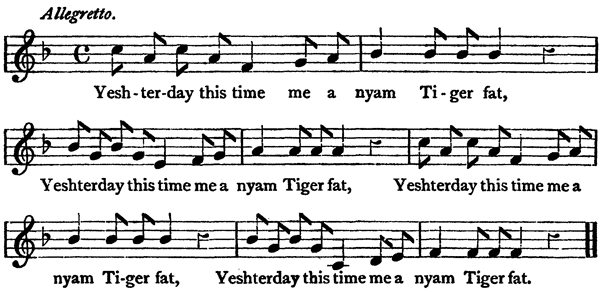


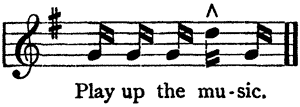
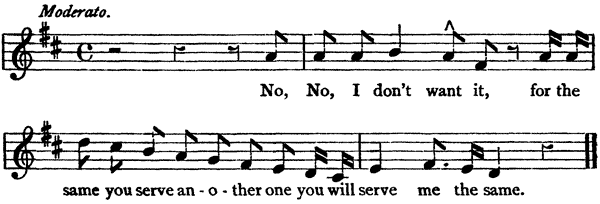


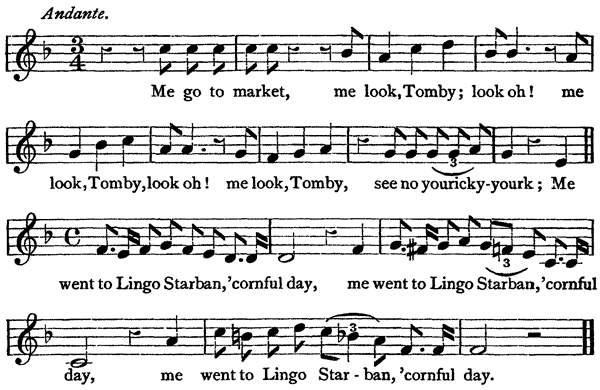
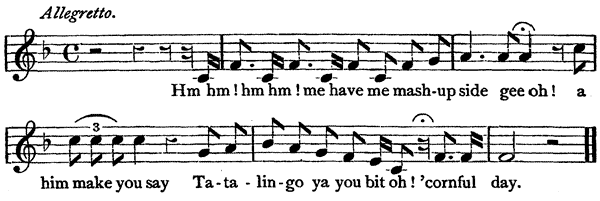
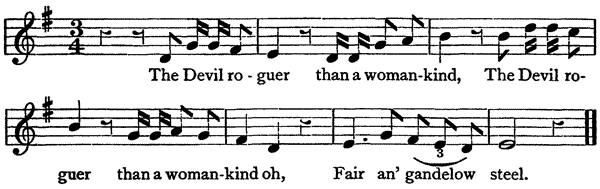
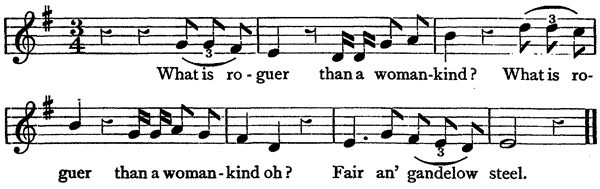
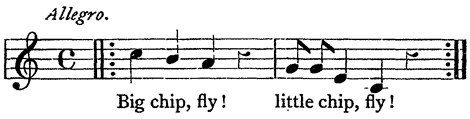
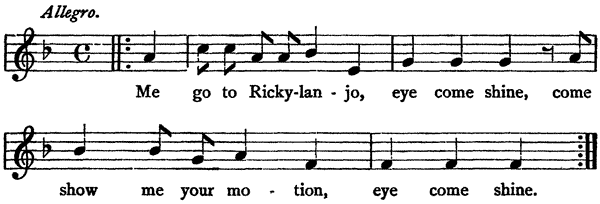
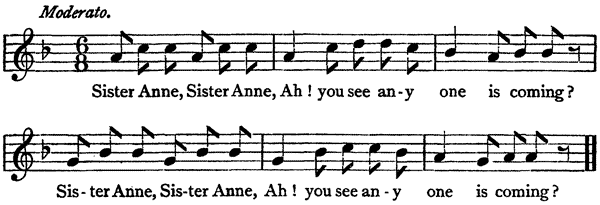
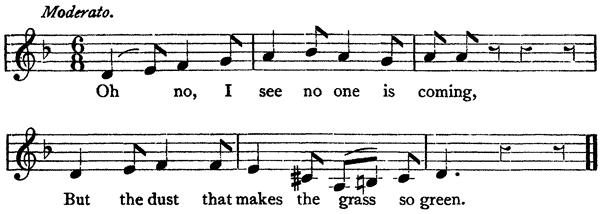
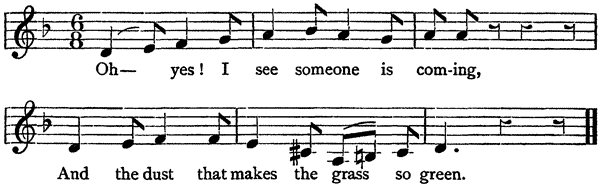
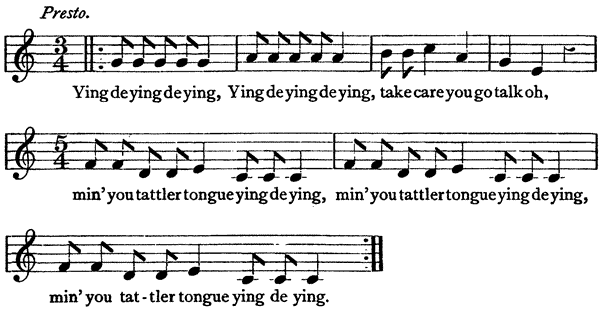
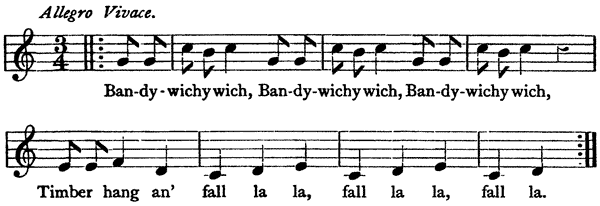
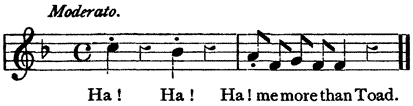
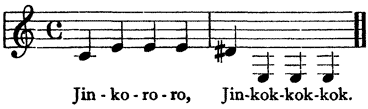
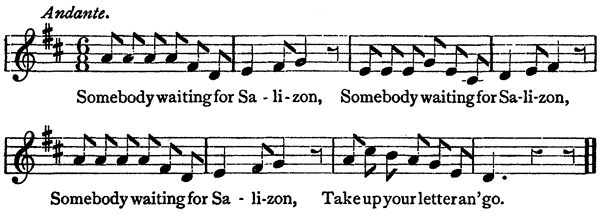
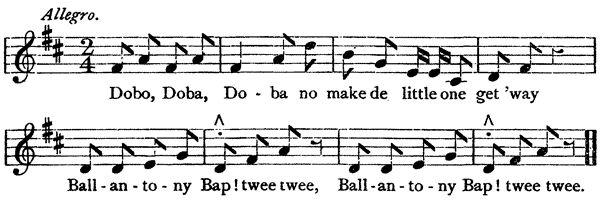

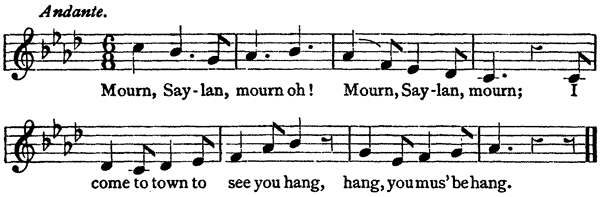
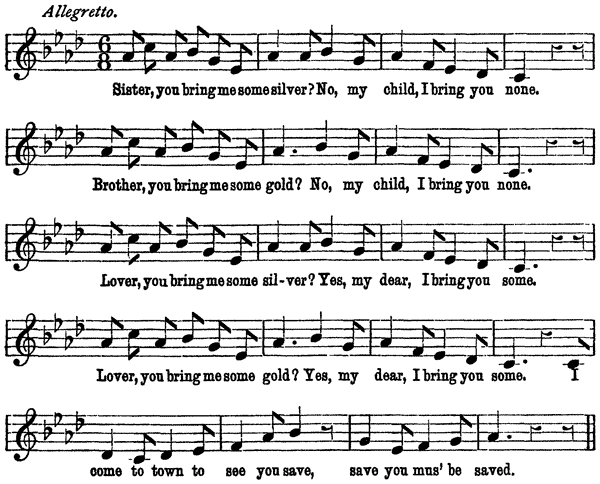
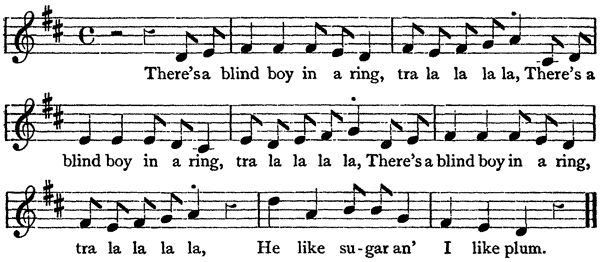
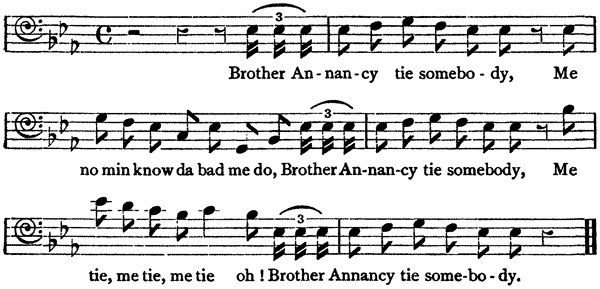
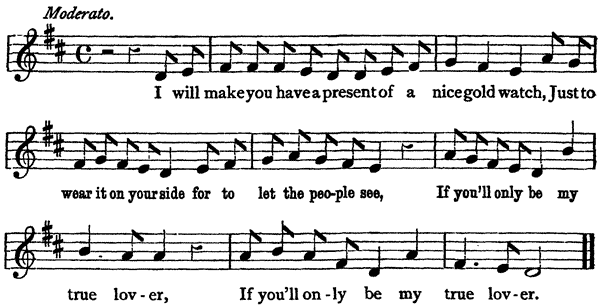
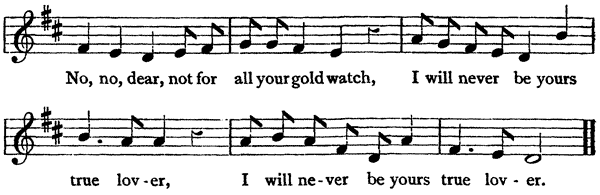
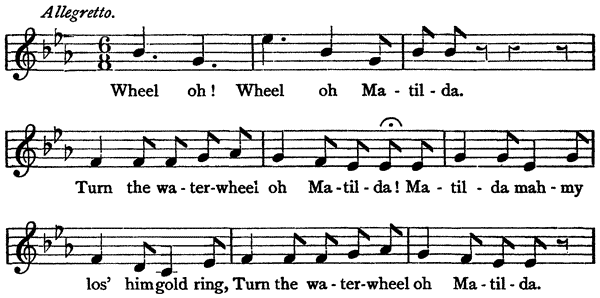
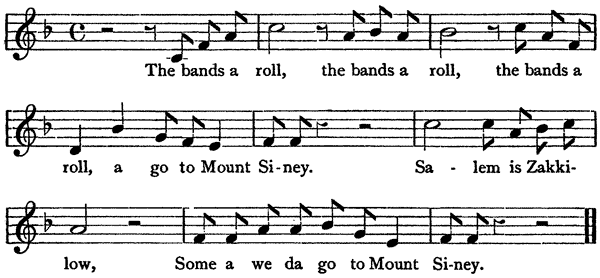

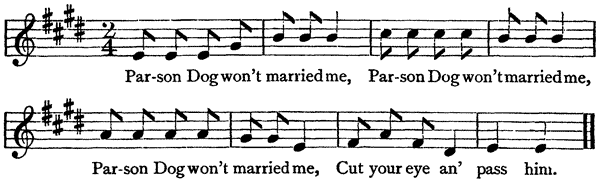
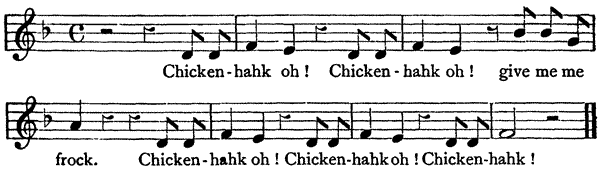
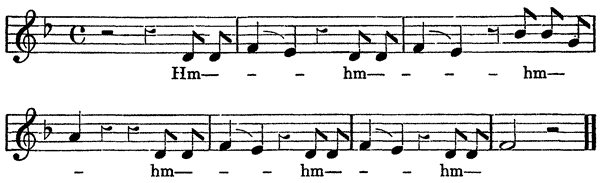
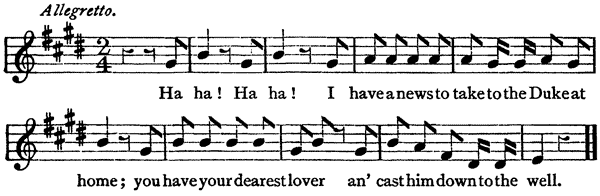




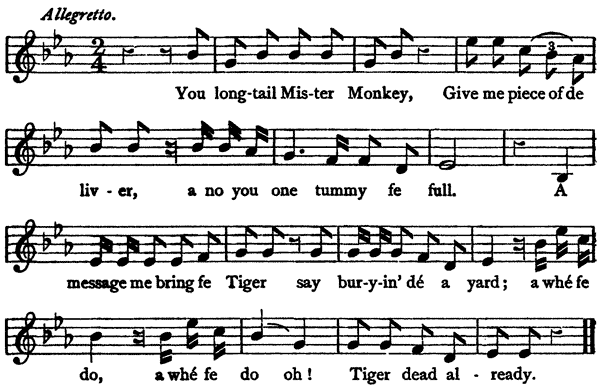
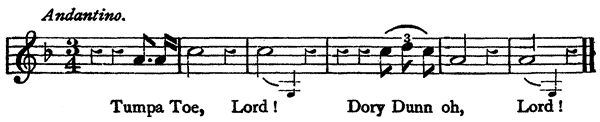



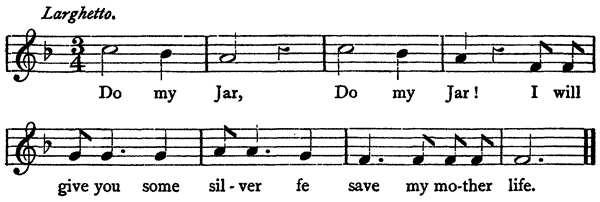
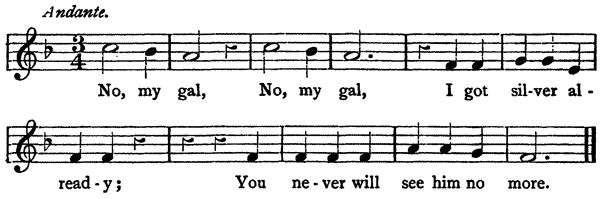
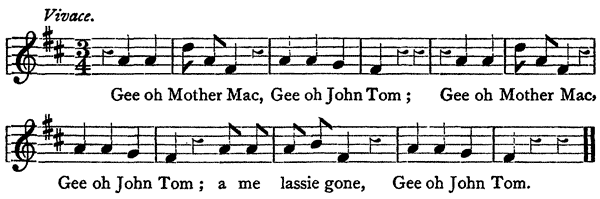
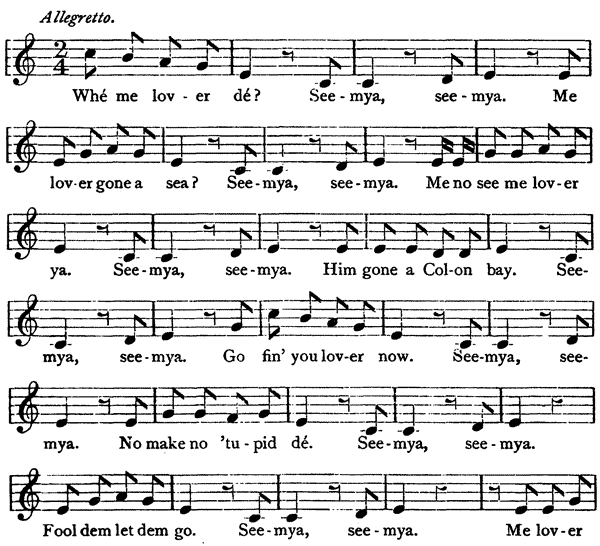
 and he claps his hands to the
measure twice in the bar.
and he claps his hands to the
measure twice in the bar.