BY
B. PULLEN-BURRY AUTHOR OF “NOBLY WON,” “THE PURITAN’S CURSE,” ETC.
ILLUSTRATED
LONDON
T. FISHER UNWIN PATERNOSTER SQUARE
1903
[All rights reserved.]
“There are two oriflammes; which shall we plant on the
furthest islands?—the one that floats in heavenly fire, or that
which hangs heavy with foul tissue of terrestrial gold?”
—Ruskin.
PREFACE.
In presenting this work to the British public it is
proposed to bring before the notice of those unacquainted
with the charms of tropical scenery some
of the features which tend to make one of our oldest
colonies, Jamaica, a delightful winter resort.
At present, it is visited mostly by Americans,
because of its easy accessibility from New York,
Boston, and Philadelphia. Their unanimous verdict
is that there is no lovelier spot under the sun
than this gem of the Antilles set in the midst of
the waters of the Caribbean Sea.
The historical interest is sufficient to attract the
student, while the artistic sense is constantly charmed
by the exquisite colouring of the tropical seas, the
delicious green of the waving cane-fields, the lofty
mountains with their ofttimes mist-wreathed summits.
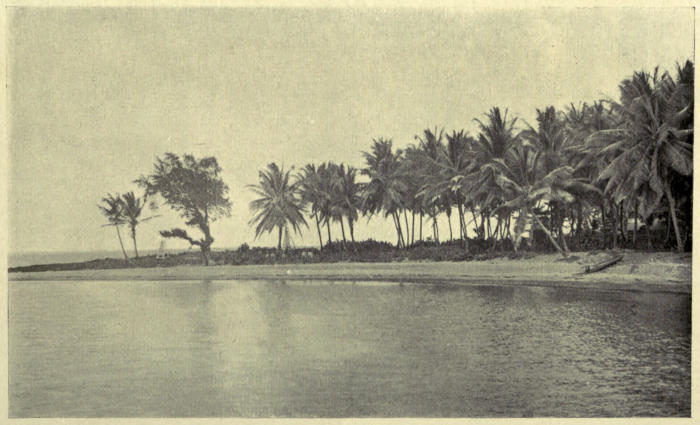
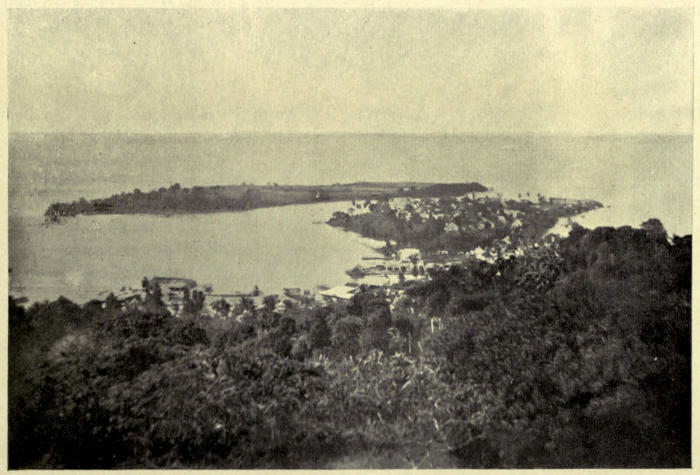
The illustrations of island scenery are by Dr
Witney of East Street, Kingston, Jamaica.
In compiling this book the writer is indebted to
the courtesy of Mr Frank Cundall, who placed the
old histories of the colony, which are kept in the
Jamaica Institute, at her disposal; also to the Archbishop
of the West Indies for the information His
Grace was good enough to give her, concerning the
Disestablishment of the Church of England in
Jamaica.
B. PULLEN-BURRY.
CONTENTS
PAGE
CHAPTER I
MANDEVILLE—JAMAICA NOT NEAR THE VOLCANOES—BOOKS ON THE
WEST INDIES
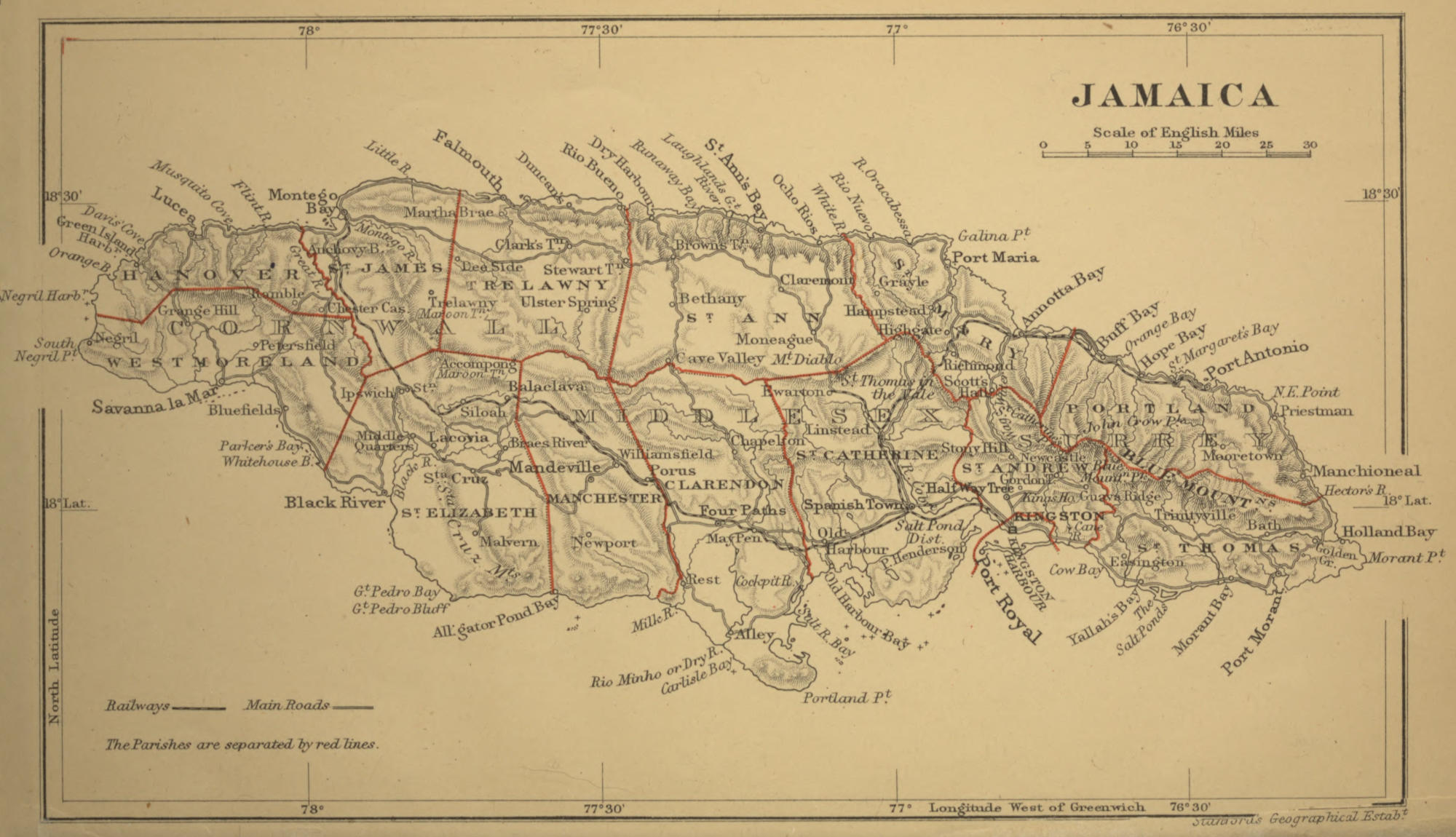
Transcriber’s Note: Map is clickable for a larger version.
JAMAICA
Stanford’s Geographical Estabᵗ.
JAMAICA AS IT IS, 1903 — CHAPTER I
MANDEVILLE—JAMAICA NOT NEAR THE VOLCANOES—BOOKS
ON THE WEST INDIES
Mandeville, 1st January 1903.—“Our horizon is not
limited by the things of time. The expectation we
entertain of a future life tends to make us view things
in their true proportion.”
These sentences were uttered last Sunday morning
by the Assistant-Bishop of Jamaica at the Parish
Church of the little inland town of Mandeville, of
which he is also Rector.
The occasion which called forth his eloquent sermon
upon the future life was the death of Dr Temple, the
late Archbishop of Canterbury.
The choice and scholarly English spoken by the
Bishop, together with the breadth of thought which
characterised his views, riveted my attention. Looking
round at the mixed congregation of whites and
blacks, I noted that the preacher had equally gained
the attention of the dusky worshippers.
I wondered how much they understood of what he
said, and what they really looked for in the life to
come, for the creed must be simple if these grown-up
children are to learn and digest it. I am told that
a place where golden crowns will be placed upon their
heads, harps in their hands, if they behave properly,
appeals to their imagination, as do white robes to
their sense of what constitutes decorous clothing for
so great an occasion. One can also imagine that the
old-fashioned doctrine of hell-fire would not be without
efficacy as a check upon the habits of the black
when he inclines to revert to his former type.
Although the negro is naturally argumentative and
litigious, it will be many years before his brain adapts
itself to the study of the deep things of theological
casuistry.
One could scarcely expect him to grapple with the
subtleties of the thirty-nine Articles, or, as I have
irreverently heard them called, “the forty stripes save
one,” in his present evolutionary state of development.
My lot having fallen to me in a house overrun with
Americans, the dignified language of that morning’s
sermon, and the sonorous tones of the preacher, had
come as balm to my afflicted ears.
If the virility, energy, and business capacities of our
friends across the Atlantic are of world-wide fame, so,
honesty compels me to say, are their bragging and
their boasting. When one is the only Briton amongst
a crowd of Yankees, the discordant nasal voices in
which they discuss food and dollars from morning
till night is apt to get on one’s nerves.
However, I did not come to Jamaica to write about
Americans. I am glad they visit this island in search
of health, and bring their much-prized dollars with
them for the good of the Commonwealth.
Two months have scarcely passed since I left my
native shores. Hosts of new experiences, fresh sensations
and interests have filled up the intervening
weeks.
I had intended to write a diary; instead, I have
made some progress down that path which is said to
be paved with good intentions. They say of the
natives of these latitudes that “they were born tired,
grew up tired, and have been tired ever since.” I
cannot truthfully say that of myself, although the
enervating climate tries the strongest when they feel
tropical heat for the first time. Energies which were
rampant in the temperate zone find the end of their
tether very soon under Jamaican skies. Perhaps this
is why the island is said to be beneficial to persons
suffering from overdone nerves. They must rest in
the middle of the day; the heat is too great for any
real exertion. I have not had much time to take
notes, but as I propose staying four weeks in this
quiet spot, I intend to gather together the mental
fragments at present lying scattered about in that
organ, which, for want of better knowledge, I designate
my brain-pan, and piece them together into something
which may be of use to people contemplating a visit to
Jamaica. And I cannot help thinking if it were more
generally known in England how easy it is to take such
a trip, and how much there is to reward one for the
trouble, many persons would be only too desirous of
becoming acquainted with this lovely island.
When I told friends that I intended to visit Jamaica
this winter I was amused at the hazy notion prevailing,
even amongst the well-educated, not only as to its
geographical position, but regarding life in general as it
is lived out here.
One lady said to me, “I call it flying in the face
of Providence to go so near those horrid volcanoes.”
I meekly explained that Jamaica lay several hundred
miles away, but she went on to say, “Well! I read
in the papers the other day that an American geologist
says that the Pelée catastrophe is only the beginning
of the end. Sooner or later all the West Indies
will go.”
There is no doubt that this feeling exists in some
circles in England, and I think the sooner accurate
knowledge replaces panic-stricken ignorance the better
will it be for the colonists here, and for English people
obliged to escape from the rigours of a northern
winter.
It is well to know what to see in this part of the
world. Several persons have said to me, both in
England and in Jamaica, that they could find no guide-book
to tell them how to set about taking the trip
to the West Indies. I felt this want myself, and
enquired at Cook’s office if Herr Bædecker had found
his way out here yet. He has not. Nor do I mean
to forestall that conscientious and most useful Teuton.
Still less do I intend to write a guide-book to Jamaica.
All I propose doing is to enlighten intending visitors
to these parts as to the best things to see. Very
probably the greater part of them will belong to my
sex. If they can have patience as I chat about persons,
and tell my own experiences in my own way, they
may learn things which may prove useful.
So far, I am charmed with the glorious vegetation
of the tropics. There are places in this island more
enchanting than any descriptions of fairyland ever
penned.
Professor Haddon of Cambridge had told me before
leaving England that the three most beautiful islands
in the world were Java, Ceylon, and Jamaica. Having
never been to the east, or nearer the tropics on land
than Assouan in Egypt in the northern hemisphere,
and Auckland in New Zealand in the southern, my
first sight of the exuberance and prolific growth of
tropical flora was like the opening of a new and
attractive three-volume novel.
I am still at the first volume, and I shall only get
to the end of the third when I have explored some
of the Blue Mountain scenery, which, being admittedly
the best thing in Jamaica, I am, in the spirit of the
schoolboy who is promised cake after bread and butter,
leaving to the last.
There is one small guide-book to the island which
I have found out here, written by an American. It
is entitled “Side Trips in Jamaica,” by Mary F.
Bradford, Boston and New York, Sherwood Publishing
Company, and is already in its third edition. The
booklet certainly carries out the object for which it
was compiled, namely, to supply the need of a practical
guide for tourists. There are a series of trips given for
those making only a short tour, and a brief account
of the historical and physical features of the island,
its agriculture and government. But what is even
more useful, it contains reliable information regarding
trains, hotels, boarding-houses, distances, and expenses
in general.
The books most generally read by visitors to these
islands are Kingsley’s “At Last,” and Froude’s “West
Indies,” but people find them disappointing, and say
the former greatly overrated the islands. Of course,
unless one is a naturalist, or, as the Americans designate
that calling, a “bug-hunter,” one can scarcely share
the ecstasies of an expert in that branch of science.
Again in these days of universal travel we cannot
all visit at Government Houses, and have horses and
carriages placed at our disposal. Here, one is more
or less dependent upon one’s own efforts, for there have
not been sufficient tourists to these islands to establish
any system of coaches, and one must hire one’s own
buggy and horse. Moreover, since the West Indies
have fallen upon evil times, one hesitates before accepting
proffered hospitality. Years ago things were not
so; travellers were few and far between, the prosperity
of the sugar-planter was proverbial, but the old order
has changed owing to the decline of the sugar trade.
The spirit may be, and is indeed willing, but the
purse-strings are limited.
CHAPTER II
THE DIRECT LINE—THE LAZINESS OF THE NEGRO—FELLOW-PASSENGERS
ON THE PORT ANTONIO
I have found during my short stay in Jamaica that it
is not wise to pin too much faith to the gospel of the
West Indies, according to J. A. Froude, nor is it
discreet to quote it to the inhabitants thereof. His
book was published in 1888, and the conclusions he
arrived at upon colonial problems are called Froudisms.
The moral is that there is another side to West Indian
questions than that of government officialism, and that
these two do not hunt in couples is apparent to the
most casual observer.
I must, however, refrain from discussing the subject
since I intend to devote this chapter to other topics.
Having yielded to the conviction that it was my
bounden duty to enlighten people at home as to the
easy accessibility of Jamaica, as well as to inform them
what they lose by not putting in six weeks at least of
one winter in this charming island, for nowhere can
one see tropical scenery better than in Jamaica, I pass
on to tell them the best way to get here. This they
can do most directly by the Elder, Dempster steamers,
which run fortnightly between Avonmouth Dock, near
Bristol, and Kingston, the chief town in Jamaica.
Formerly the Royal Mail Service had the monopoly of
the West Indian trade, but within the last two years
Mr Chamberlain has arranged with the firm of Elder,
Dempster to carry the mails directly to Jamaica, which
is the largest of our island possessions in these waters.
These ships are called the Fruit Boats, for they return
with cargoes of bananas. I believe by contract they
have to bring from Jamaica 25,000 bunches every
fortnight. This is the reason of the recent cheapness
of this particular fruit; one may often see them on
costermongers’ barrows in London and elsewhere sold
for a halfpenny each.
I left Avonmouth Dock 8th November 1902, in the
Port Antonio, and a very comfortable ship I found her.
Having paid a little extra, I was fortunate enough to
secure a deck cabin to myself; this is quite worth the
money, especially when one is approaching Jamaica.
My first-class return ticket available for nine months
cost £40, but there were good first-class cabins at
£32. Very good stewardesses are carried on all
these ships. Now the Royal Mail steamers go first
to Barbadoes; at present, on account of an outbreak
of small-pox last autumn, they go to Trinidad. Here
they trans-ship passengers, cargo, and mails for the Leeward
and Windward Islands into small inter-colonial
steamers which ply between the islands, after which
they proceed to Jamaica.
One avoids all this by taking the direct steamers, and,
as I have said before, this island is more accessible
than any I have so far visited. There are capital
roads, good conveyances, and good saddle-horses, a
central railway connecting the most important towns.
In winter the climate is perfection, whereas nobody
mentions Trinidad but to groan over their experience
of the moist heat and the incessant tropical rain which
makes travelling about that island too fatiguing for words,
to say nothing of the risk of getting fever by not being
able always to change your drenched clothing. Nor
do any of the islands between Trinidad and the Danish
island of St Thomas, which I have visited, possess
facilities for tourist accommodation. In some of them
roads practically do not exist beyond the outskirts of
the little town where the mail steamers land passengers.
If horses are wanted they have to be hired from the
inhabitants. The hotels, such as they are, and still
more, the food, one would hardly care to take the
responsibility of recommending.
It was raining as I said good-bye to my friends on
the Port Antonio, a steamer of about four thousand
tons. In fact, for some three days previously a depression
had been announced, and everybody prophesied
we should come in for stormy weather. We could not
have had worse. It was under lowering skies and
heavy rain we steamed down the Bristol Channel.
The next day, Sunday, scarcely a lady moved from
her berth, and most of the men appeared only to show
themselves, returning again to seek the privacy of their
cabins. We rolled and pitched for seven consecutive
days; it was not until we had been more than a week
at sea that everybody sat down to meals. Fortunately
I am a good sailor, but I never boast of my prowess
in that respect, knowing, to my cost, that pride goes
before a fall! Some years ago I went to New Zealand
by the Cape of Good Hope, and returned by the Horn,
thus circumnavigating the globe. I learnt to drink
cocktails off Tierra del Fuego, came in for fever and
fighting at Rio, and enlarged my stock of unparliamentary
language at the Canaries, where we were not
allowed to land, and, instead, had to endure the slow
tortures of coaling. During the whole of that voyage
I suffered the discomforts of sea-sickness exactly
twenty minutes, the scene of my unhappy, though
transitory illness being off Plymouth, as we steamed
down channel. In a moment of unguarded weakness,
some months after, I boasted of this to a desponding
group of fellow-passengers. We were leaving Algiers,
and the sea was as smooth as it could be, but it was
in the days of my innocence. I know now what is to
be expected of the Mediterranean, and by a cruel
experience I also know what a gale in the Gulf of Lions
means. On my arrival at Marseilles, I had broken all
previous records, and for hours had endured the pains
of the condemnable. My appearance was such that
my fellow-passengers forbore to taunt me with my
vain boasting of the day previous. How were the
mighty fallen! “All the world wondered,” though they
preserved a discreet and kindly silence.
Notwithstanding the rough weather we experienced
in the “roaring forties,” I managed to obtain a good
deal of amusement and some useful information during
those days of discomfort. No less famous a writer
than Plato says that to travel profitably one should
be between fifty and sixty. I can scarcely lay claim
to as many years, still, if the chief object in going
abroad be, as Plato thinks, to converse with inspired
men whom Providence scatters about the globe, and
from whom alone wisdom can be learnt, I hope I have
succeeded in gleaning some of that golden harvest
which falls before the sickle of curious enquiry. We
had several interesting people on board, and whiled
away otherwise tedious hours by exchanging and
comparing notes of lands we had or had not travelled
in.
A retired colonel, whose chief aim in life was to return
to Jamaica where he had seen twenty years of service,
and grow pines for the English market, assured me
quite gravely he had taken up the calling of a greengrocer.
On further enquiry I learnt that he was enthusiastic
about the future possibilities of fruit culture,
and, said he, “when we get the steamers promised us
by Elder, Dempster, which are to take only ten days
between Kingston and Bristol, what a chance it will
be for us pine-growers!” I met this gentleman five
days after landing at Kingston, at a garden-party at
King’s House. I thought he looked tired, and he
explained that he had been working hard himself ever
since he landed, planting his precious pines. I asked
if he could not trust them to his gardener. “No,”
said he; “the blacks are very good fellows, but if you
tell them to put first a layer of sand and then manure,
they are bound to do the opposite. It is easier to plant
them yourself.” In saying this he just touched upon
the sore spot in Jamaica, as I afterwards learnt. The
labour question may be bad in England, but it is a
very different thing in this island. Captain C——, of
the Royal Mail Service, said to me one day, “We
never overlook a fault amongst our black firemen; with
a white man we can do so, for he will thank his stars
the omission was not noticed, and will be careful not
to repeat his fault, but the blacks have not sense
enough for that, and we fine them one or two days’
pay, as the case may be.” An English lady, who had
seen better days at home and has opened a boarding-house
at Mandeville, said to me: “In England I used
to say that I worked like a nigger. Now I say I work
like an Englishwoman.” The laziness of the negro
is proverbial in the West Indies, yet occasionally he
makes a good servant. On another occasion I was
told by an old gentleman that he had often watched
hard-working coolies cultivating their little patch of
garden. From a window looking out in an opposite
direction he had seen lazy niggers asleep all day under
trees. At night, when the coolies had departed, he
had watched woolly heads creep along the low fence,
and steal yams and anything they could lay their
hands upon, which the industrious Hindoo had planted.
At the same time, I am told on unquestionable authority
that when sure of good treatment, the negroes on
some estates are hard-working and reliable.
In most cases the West Indian black finds the labour
of three days sufficient to keep him for a week, thus
the property owners soon after the days of emancipation
suffered greatly from the lack of labour. To supply
this want the Government imported coolies from India,
and it is interesting to compare the lithe, sinewy
Hindoos with their intelligent dark eyes and black
straight hair with the ofttimes lumbering gait of the
woolly-haired, thick-lipped sons of Ham.
One of our most popular passengers was an American
lady who had seen many lands, and last, but not least,
had travelled from Japan viâ Vladivostock and the
Russian Railway down to Pekin. She had been a
guest at the headquarters of each of the allied forces,
and it was interesting to hear her recount her adventures.
She had, she said, met with unfailing courtesy from
the Russian officials, and was loud in her praises of that
nation. She declared that our Indian troops had been
generally admitted to be the finest body of men in
Pekin. “You English,” she said, “think a deal of your
alliance with the Japs, but I guess that if it was to
their advantage they would leave you in the lurch any
day.” This enterprising lady had visited the royal
palace, and had photographed her Imperial Majesty of
China’s bed, together with other celestial furniture
never before exposed to the impious gaze of foreign
devils! Indeed she was a most entertaining person,
and apparently had done everything there was to be
done, as known to this generation.
One of our officers had been in Constantinople at the
time of the Armenian atrocities. He had his tale to
tell, and after one had heard from an eye-witness of
the unspeakable cruelty of the Turk, but also of the
utter unworthiness of the Armenian—who seems to have
been as much of a mauvais sujet of the Porte as the
Fenian was to us in years gone past—one felt glad that
British blood had not been spilt in defence of so
miserable a people as the Armenians. There were
several persons who came out to Jamaica returning by
the same steamer, and spending the four or five days
in a hasty survey of the island. One couple were
going on to Mexico and California. A Russian journalist,
commissioned to send home articles upon Jamaica, and
a majestic and venerable dame, known as the fair
Delicia, were also fellow-passengers. The last-named
lady is well known in fashionable circles of Kingston
society. She is not far removed from that limit which
is supposed to represent the average lease of life. Her
amiability is not excessive, but her skittishness is
phenomenal. She dances on all possible occasions, and
waltzes generally with the youngest men present. She
has a playful way of boasting that she cannot remember
the persons with whom she has quarrelled, and reputations
are at a discount when the fair Delicia engages
in conversation.
CHAPTER III
THE KESWICK DELEGATES—MISS SARAH WALKER—HAYTIAN
CANNIBALISM
There were two persons, however, whose arrival by
the Port Antonio was looked for with feelings of great
expectation by a certain class of people living in this
island, and whose ministrations, I fancy, have since
resulted in airing certain questions which perhaps
required to see daylight. These were two delegates
from the Keswick Conference. The latter, I believe, is
a yearly gathering of Evangelicals at home, and is
attended by nonconformists and a certain section of
Low Churchmen. Possibly the preaching which one
identifies with this particular school of thought, though
it is not one which appeals to me, may be adapted to
the black and coloured people who attend the numerous
dissenting chapels which are to be found all over the
West Indies. Indeed the negro is naturally pious, or,
to put it in plain English, superstitious. I believe
Professor Huxley has shown that this is invariably the
case with savage or undeveloped races. Be it as it
may, I am quite willing to concede that whatever
agency has been at work to influence these people, who
two or three centuries ago were offering up human
sacrifices and practising the most hideous and revolting
rites in the backwoods of West Africa, to say nothing
of their semi-savagery when emancipated in 1834, has
been a powerful influence for good. The negro is
stupid, but his evolution is going on apace compared
with the slow development of many races.
The court-house of Mandeville is visible from my
window, and to-day the petty cases of a large surrounding
district are being tried. I have enquired
what are the offences which generally come before
the magistrates on these occasions. I was told from
trustworthy sources that murder is most rare amongst
the blacks, the cases tried being mostly petty larceny,
property, or commercial disputes. Local squabbles
are often settled by a clergyman, or dissenting minister,
before being brought into court.
I asked if there were many cases of matrimonial ill-treatment
or quarrelling, and was met by the reply,
“They don’t marry here.” Unfortunately this is largely
a fact, and constitutes a great blemish on the character
of the Jamaican black. When one hears, however, the
question discussed, one can hardly blame a hard-working
negro woman (and most of them are that) for
refusing to marry if the practical result of marriage,
as it affects her, is that sooner or later she will have
to keep her husband as well as her children.
Persons who have had experience with these women
tell me that the instinct of maternity is the strongest
they have—to them childlessness is a reproach. When
they do marry they are generally faithful, but the lot
which a black woman dreads more than any other is
that of being a deserted wife. “Me get tired of him,
sah, and he get tired of me,” is a very natural excuse
when the parson endeavours to legalise the bond. We
know such things as husbands and wives getting tired
of each other occur in our own land; the negress voices
what many a white woman feels. In considering this
subject—for, like the poor, it is ever with you in
these parts—one must bear in mind that in slavery
times the blacks were herded together like cattle on the
estates. Enthusiastic reformers forget that it may take
generations to eradicate their hereditary promiscuity of
life.
Nobody who sees these women stride along, often
walking twenty miles to the nearest market town, with
baskets on their heads weighing occasionally upwards
of a hundred pounds, could think them lazy, especially
when one knows how poor are the weekly returns for
their merchandise, which consists chiefly of home-grown
yams, sweet potatoes, oranges and bananas.
An American told me he was going to Kingston by
the electric tram. Beside him sat a well-dressed negro,
wearing a silver watch and chain. A black woman,
carrying an enormous basket heavily filled on her head,
ran alongside the tram, which had slowed down. The
two were talking, the man from the tram, she from the
road.
“Is that your wife?” he asked the man in surprise.
“Yes, sah! dat my wife, sah,” replied he.
“You lazy fellow, you ought to be ashamed of yourself!”
exclaimed the American indignantly. “Why
don’t you let your wife ride and you walk?” he further
blurted out.
“Please, sah, the women, sah, ’bout here be so kind,
sah!” apologetically explained the negro in an injured
voice.
This episode sufficiently illustrates the conditions of
the division of labour amongst a large proportion of
the emancipated Jamaican population. The Moravians
have large settlements in the island as well as other
dissenting bodies; but where all work together for the
spiritual good of the race whom Providence has
permitted to flourish and multiply in these islands it
would be a work of supererogation for me to criticise
their methods.
Speaking from the point of view of a fellow-passenger,
one of the delegates sent out by the Keswick Convention
was an interesting personality. His writings
and undenominational services in South London are, I
am told, well-known in nonconformist circles.
He is a tall, white-haired, venerable-looking man, and
when I first caught sight of his face at Avonmouth
Dock, I was forcibly reminded of a picture of the
Pastor Oberlin who figured in one of my favourite
story-books, when, as children, we had certain literature
set apart for Sundays, other for week-days. I had
several conversations with him, and I thought him to
be both liberal-minded and sympathetic. He seemed
to hold that the most important thing in life was not
so much what one believed as what one did.
It was interesting to hear this evangelistic missioner
tell how he had been brought up in the straightest and
strictest school of thought, and how he had himself
preached and held the most rigid doctrines as to who
were to be saved and who were to be eternally damned.
But travel, he said, had opened his eyes, and he now
saw things from a far wider standpoint. It appears he
had held many conversations with advanced and cultivated
Hindoos, and he could not bring himself to
believe that such beautiful souls and such refined
intelligences could be doomed for ever, because they
could not accept gospel truths. Personally, I have
never been troubled by the teachings of such a harsh
creed, but I can imagine the trial it must have been to
a man of firm convictions to sever himself for ever from
life-long beliefs, which, no doubt, he had preached and
expounded time after time. He told me that he was
going to hold meetings in different parts of Jamaica for
a month. I have since read in the island papers that
his sermons have been of the revivalistic order, and that
the meetings have been well attended. His colleague,
a clergyman of the Church of England, was by no
means a persona grata on board ship. His religious
views belonged to that exclusive and narrow school of
thought in the Church of England, which happily does
not find many adherents nowadays. In an extract
from a sermon which he preached at Kingston, some
weeks after his arrival, I read that he lamented how
few people there were who would be saved! In these
days of latitudinarianism and toleration there is no
reason why peculiarly constituted temperaments should
not cling to obsolete and effete doctrines if they like
them, but it seems to me, whatever our creed may be,
and however much we wish to benefit our fellows, without
exercising tact, we shall do more harm than good.
This delegate from Keswick evidently thought his
fellow-passengers were in a bad way, for he offered uninviting-looking
religious literature to those who conversed
with him; but an amusing incident in which he
was chief actor quite enlivened the tediousness of the
voyage. The charming American lady, of whom I
have already spoken, was invited into the smoking-room
one stormy afternoon by two gentlemen in order
to tell their fortunes by means of palmistry. Probably
this zealous clergyman had already mentally decided
that she was a brand to be snatched from the burning.
Although a non-smoker he confronted her, and with
Hibernian eloquence harangued her as to the impropriety
of her conduct in entering those precincts
sacred to the cult of tobacco. It would perhaps be
wiser to draw a veil over the sequel to his somewhat
precipitate and uncalled-for interference. Needless to
say, his own sex resented it in words which I decline
to insert in these pages. At the same time one feels
that it would be beneficial and a distinct gain to society
at large if some of the well-meaning but indiscreet
upholders of exclusive cults would consider the feelings
of others and behave to those whose path crosses their
own with, at least, that generous toleration and
spontaneous kind-heartedness which characterises well-bred
men and women of the world. The influence of a
high-minded, genial Englishman who is too proud to
stoop to meanness of any description, but who does not
shun his fellows because their moral status is not up
to his own level, is far greater than that of the narrow-minded
but “superior” religionist who looks down upon
a sinful generation from the pedestal of an assured
salvation. It may be that the latter stands ready to
reach out a hand to help up his less favoured brethren,
that is, from his own standpoint, but often the out-stretched
hand is a rough one, the face bending down
towards the sinner is uninviting in its cold, harsh
expression, and the soul that might have been helped
plunges back into the strife of the waters of worldliness
preferring them to a joyless, uncongenial sanctity.
These gentlemen sent out by the Keswick Convention
have finished their mission, and, in justice to both,
I have pleasure in saying that it is evident their meetings
have been much appreciated. This very morning I
held a long conversation with a lady of mahogany
complexion, who spoke rapturously of their preaching
in this place. She walked by my side quite half a
mile during my matutinal walk before breakfast. Miss
Sarah Walker—that was her name—informed me besides
that she was unmarried, and lived with an aunt not
very distant from Mandeville. I asked what her age
might be.
“Thirty-one, mem,” she replied.
“How do you get your living?” I asked, smiling at
the pride she evidently felt at being engaged in conversation
with a white lady, evidenced by the consciousness
of superiority she assumed over her black sisters,
who were not so honoured, and who passed on either
side of us, listening politely to our conversation.
“I sit in de market, mem, and sell cakes.”
“I think you all seem very well off round here,” I
ventured.
“Oh no, mem; there are some very poor people round
’bout,” she assured me.
“But they all have coffee or oranges to sell?” I
queried.
“Yes, mem; but all de summer dey get so little
for der coffee, only trepence or twopence a pound, and
only one and trepence for a large barrel of oranges, bery
little indeed.” I had already learnt that agents from
the United Fruit Company buy up all the produce of
the smaller cultivators in this district.
“They are so poor, mem, dey can’t pay de taxes,” she
proceeded to inform me.
“What happens then?” I enquired.
“Den dey goes to prison, mem, or sometimes get time
given dem to make up what dey can’t pay.”
“I suppose you have to pay rent too,” I suggested.
“No, mem; we live in our own house and only pay
taxes, twelve shillings and twopence ebbery year, six
and a penny ebbery six munts; we go up and pay it at
de Court House.”
I elicited from her that she and her family had always
lived in Jamaica, that once or twice she had been to
Kingston, but what amused me most was her conversation
upon dress.
“Bery good stuff, mem,” said she, pointing to the
gown which scarcely covered her knees. “I gave one
and trepence a yard, and it cost four shillins for
making. Last year it was Sunday frock, but when it
wast it swinked up.”
“I see! You like a smart frock for Sundays?” I
volunteered, having learnt that the first day of the
week is special frock competition day amongst the
negresses. This woman was very superior to some I
met in my morning walks, who generally said, “Good
morning, missus.” Probably she had at one time been
a domestic servant and had learnt to say “mem” for
“ma’am.”
“Oh yes, mem, dat’s our pride; we all dress ’spectable
on Sunday to go to church. Work ebbery day, but
live for Sunday.” She looked radiant at the mere
thought of it.
On my return I was told that the desire to cut a fine
figure every Sabbath day is the key to the labour
question in Jamaica.
The negroes can live on yams, which grow in their
gardens and require no trouble to cultivate, but they
must work to buy the dresses good enough to wear on
Sunday. On week-days they go barefoot. On Sunday
they screw themselves into tight-fitting garments and
into new, squeaking boots, which, if the way be long,
they take off, and put on just before going into church
or chapel. To be dressed smartly and go to church
once a week is the highest aim of the black’s life.
The fact that any white woman can ride or walk in
any part of the island, either by day or by night, in
perfect safety, is in itself testimony of the highest
worth to the civilising agencies at work, let them be
Moravian, Wesleyan, Roman or Anglican. The black
under British rule is not an unworthy subject of the
Empire; but left to himself, and to the workings of
his own sweet will, he might perhaps revert to a
state of savagery. One has only to consider the
condition of the island of Hayti to see the probability
of such a contingency.
I had read Chevalier St John’s book on “The Black
Republic,” in which he mentions the cannibalistic habits
of these islanders, before I left home. On two separate
occasions I have since been told that the killing and
eating of small children is quite a common thing,
although still denied by better-class Haytians. Each
of my informers were officers of ships bound for
Haytian ports. There they had seen human flesh exposed
for sale in the public markets. The buyers of this
horrible commodity significantly ask for “salt pork.”
One man told me he had been taken by a Haytian of
the better class to a spot at night, within forty yards
of a grove, where children were being sacrificed according
to the Voodhoo rites, which their ancestors practised
centuries ago in the forest fastnesses of Western Africa.
It was at the risk of his life. He had been unable
to see the horrid rites which take place before the
child was actually tomahawked, but he heard its
shrieks when tortured. Great mystery surrounds the
Voodhoo worship, and never, so far, has an European
been known to be present at the ceremonies which take
place before a human sacrifice. My informer told me
that instead of dreading this fate for their children, the
mothers were proud that their particular offspring
should be chosen for the sacrifice.
In connection with the Haytian Voodhoo worship,
I was lent an old French manuscript by an American.
It had been written about one hundred and fifty years
ago, and professed to be the confessions under compulsion
of a Haytian negress as to the practice of the
most degrading and loathsome black magic which then
prevailed in the island. Whether this continues at
present I am unable to say, but they still have the
custom of smearing the blood of freshly-killed infants
over the bodies of childless women to make them bear
children. Every savage race, doubtless, at one particular
stage of its development dabbled in mystic and bloody
rites, just as every land, where prehistoric traces of
man’s existence have been found, has had its Stone Age,
its kitchen-middens, etc. There is a wonderful similarity
in the doings in their infancy of the world’s
different races, just in the same way as all children,
black, brown, and white, learn to walk before they run;
but to my mind it is an interesting study to see what
two hundred years more or less of that which we call
civilisation has produced upon a race very low down
upon the evolutionary ladder. Possibly the Tierra del
Fuegans and the Mincopies of the Andamans are upon
the lowest rung, but I do not think an anthropologist
would put the negroid races much higher up.
CHAPTER IV
THE BLACK UNDER BRITISH RULE—THE GOVERNOR OF
JAMAICA AND SUITE
Without unduly congratulating ourselves as first-class
colonists, I think we can fairly say that the black is at
his best under British rule. He has learnt industrial
arts. The best of his race are mechanics, policemen,
soldiers, sailors, shopkeepers, and domestic servants.
They may not be brilliant, but in this hot climate,
where it is an impossibility for the European to do field
labour, they serve their purpose. In Jamaica the
trains and the electric trams in and round Kingston
are driven by natives, your clothes are washed by
negresses, and very well done too; occasionally you
suffer from their excessive professional zeal, when
they send home your stockings stiff with starch.
The waiters, chambermaids, domestic servants, farm
labourers, are all black. In the hotels it is noticeable
how well they speak English.
The harmless, courteous country folk one meets in
one’s drives over the island are, from all accounts,
very different to their dusky brethren in the United
States of America, where life is none too safe, and
lynch law apparently a necessary evil.
So far as I can see, their worst fault is laziness.
It is a most irritating fault to the man who wants
labour; but if the pay of three days’ work suffices to
keep a negro in what he considers comfort, it is hard
to see that he should be compelled to work six days
out of seven to suit his employer’s crops. And if
his or her highest ambition is to cut a fine figure on
Sunday, I should be inclined, whilst inculcating thrift,
to encourage that amiable weakness to the uttermost.
One reads sometimes of the poor negro, but in a
country like Jamaica, where anything once planted
in the soil grows in the most prolific manner, and
where such nourishing food as yams and sweet
potatoes form the chief nutriment of the black, to say
nothing of the beautiful climate necessitating only the
very lightest of clothing, real poverty, such as we are
unfortunately acquainted with in England, does not
exist.
Probably in a few years’ time, the problem of an
enormous black population will confront the government
of these islands. We know that in the United
States such is the case. Barbadoes, too, has an immense
population. If one thinks seriously of it, what else
can be expected of a people severed from their natural
state, and placed in the happiest of circumstances,
where the increase of population has no such checks
operating upon it, as it must have had in the wild and
pristine condition of savage life amongst African forests,
where a thousand petty warfares thinned the ranks of
the warriors, and where cannibalism and disease would
probably account for quite half the yearly tribal babies.
Now, Jamaica’s best crop is picaninnies. Nor are there
epidemics severe enough, or earthquakes bad enough,
to carry off the superfluous nigger babies.
A story which had its comical side was told me by
a captain of the R.M.S. He knew a negro in Kingston
who had long courted the lady of his affections. She
had responded, but not to the degree demanded of her
by her impassioned lover. In the captain’s presence
he begged her on his knees to marry him, and “make
an honest man” of him.
Strangers to the West Indies are often surprised at
the use of slang and funny expressions by the natives.
On landing at Trinidad, we wished to be driven up to
the Queen’s Park Hotel for lunch. There were three
of us, a lady and gentleman and myself. To our
enquiry as to how much our driver would charge for
taking us there, the ready answer came, “a bob each.”
We preserved serious faces, the driver evidently being
unconscious of having said anything out of the ordinary,
and paid our shillings.
I was driving one day in Kingston, when my
coachman turned a sharp corner at a furious rate.
In so doing, a woman was nearly run over. “Out
of de way, my lub, for God’s sake!” exclaimed he,
not attempting to slacken his horse’s pace.
There were other passengers whose eccentricities
afforded the passengers of the Port Antonio some
amusement and much subject-matter for conversation.
We had the Governor of Jamaica and, according
to the London newspapers, “suite” on board.
In what the “suite” consisted, I am still at a loss
to divine. They were the last to come on board
at Avonmouth Dock, and as the rest of us who
had come by an earlier train watched the small
steamer, which brought them alongside the Port
Antonio, plunging and rolling in the heavy seas which
even then were racing up the Bristol Channel, we
congratulated ourselves that we had walked straight
on to the vessel from the quay an hour before. When
their Excellencies “and suite” came on board, the
ship was standing out some distance from the shore.
I counted five adults, three babies, and three women-servants.
The party consisted of Sir Augustus and
Lady Hemming, their secretary, a married daughter
with her husband, a coffee planter in Jamaica, three
small children belonging to the latter, two nurses
and a maid.
The present Governor of Jamaica was formerly a
clerk in the office of the Secretary of State for the
Colonies. In 1884 he was sent as a delegate to the
West African Conference at Berlin, and later, on
special service to Paris in 1890, in connection with
the delimitation of French and English possessions
on the west coast of Africa. He became the Governor
of British Guiana, 1896, and succeeded Sir Henry
Norman as Governor of Jamaica in 1898. The term
of office is for five years, and this is consequently his
last year in Jamaica, unless a special application is
made for an extension; but one can scarcely imagine
that that will be the case with Sir Augustus and Lady
Hemming. Not but what it is conceded on all hands
that His Excellency is a most amiable man; if not
brilliant, at least he has shown conspicuous talent in
the fiscal department. Owing to his clever financial
administration, the island budget for the first time
this year shows a surplus, although the best that can
be said of the condition of Jamaica is that which
Mr Chamberlain declared in the House of Commons,
to the effect that up to the present the local government
had been able to do little more than bring about
an equipoise between revenue and expenditure.
The social relations between the chief people in the
island and the reigning lady at the gubernatorial
residence did not strike me as being particularly happy
or satisfactory. One felt sorry that striving colonists
such as the Jamaicans should lack that sympathy and
consideration which, whether they be white or coloured,
they certainly have a right to expect from the wives
of those officials who govern them in the King’s name,
and who are paid very handsomely out of the island
revenues for doing so.
An elderly lady who was present at a ball given
last month at King’s House, which is situated in
lovely grounds about three miles out of Kingston,
remarked to me that it was unlike entertainments
of the kind given in times past, in that it lacked
“grace, dignity, and refinement.” I was sorry to
miss this ball, but, being absent amongst the Windward
Islands at the time it took place, I returned
to find my invitation awaiting me at my hotel.
CHAPTER V
LAND SWALLOWS—TURKS ISLANDS—AN EARTHQUAKE
SHOCK—CONSTANT SPRING HOTEL
We had delightful weather some days before our
arrival at Kingston; the sunsets were magnificent,
the beautiful colouring of the after-glow I shall never
forget. I remember two nights before the end of our
journey going to the forecastle of the ship to watch
the fantastic shapes of the clouds on the southern
horizon, intersected as the dark masses were with
the most wonderful opalesque lines of pale green,
blue, and yellow, the latter shading into deepest orange.
In front of us was flying a little land swallow, heralding
the approach of land. As Christopher Columbus
neared the scene of his wonderful discoveries, he
speaks of the little winged messenger of hope which,
flying on ahead of his ship, warned his brave sailors
of the approach of terra firma.
It was no less a world-explorer than the above
who discovered Jamaica the 3rd of May, 1494. It
was during his second voyage to the New World,
and the Spaniards kept it till 1655, when it was
surrendered to an English force. Oliver Cromwell,
whose policy was that of to have and to hold, sent
out a Commissioner to conduct the Civil Government,
also 1000 troops. These were followed shortly after
by 1500 settlers from Nevis, Bermuda, New England,
and Barbadoes, and 1000 Irishmen, with as many young
women. Ten years later the foundation of Jamaica’s
wealth as a sugar-growing country was laid by the
immigration into it of over 1000 inhabitants of Surinam,
which had been given to the Dutch in exchange for
New York, then known as New Amsterdam; these
people industriously engaged in planting sugar in
the western parts of the island where the country
is flat. For many years nothing more momentous
than occasional depredations of a piratical nature, or
attacks from French cruisers, occurred to disturb the
progress of this industry.
Later the history of the island consists of constant
quarrelling, the Civil Government being repeatedly
repealed, then restored. Finally, in 1884, a new constitution
was given to Jamaica. The present Government
consists of the Governor, who is President of
the Legislative Assembly, the Senior Military Officer,
the Colonial Secretary, the Attorney-General, and the
Director of Public Works. In addition to these are
five members appointed by the Crown, and nine elected
by tax-payers of upwards of twenty shillings. There
are fourteen electoral districts. Jamaica—which retains
the old Indian name Xaymaca, “a land abounding
in springs”—is divided into three political divisions
called counties. They are known as Middlesex, Surrey,
and Cornwall respectively. These are sub-divided into
fourteen parishes, the affairs of each being managed
by a Parochial Board.
The Jamaican legislation has the power to pass
laws applying to the Turks and Caicos Islands; the
Supreme Court of Jurisdiction extending to these
islands in matrimonial and divorce cases.
It was at Turks Islands that we first saw land
on approaching the West Indies. They are a group
lying to the south-east of the Bahamas, and were
so called from a peculiar kind of cactus which
grows there, somewhat resembling a Turkish fez.
The largest of them is 7 miles long, and 1½
miles broad. Salt is exported from them, about
1,500,000 bushels bring annually shipped to the
United States. It was midnight when we stopped
and made our presence known to the Postal and
Telegraph Office on shore by signalling. I looked
out of my port-hole and saw a long stretch of coast,
slightly hilly, but it was too indistinct to see much.
The distance we were from the shore I presumed
to be not more than a mile. Presently I saw a small
sailing boat come close to the big steamer, and in
the dim light receive an emaciated-looking mail-bag,
which we had surveyed previously, when brought up
to be in readiness to hand over to the postal authorities.
A precocious small boy, who was permitted to feel the
sealed-up bag, declared there was only one letter inside.
A stay of twenty minutes sufficed to exchange
mails and to receive the latest British telegrams.
Everybody was then keen to know how the Education
Bill was progressing at home.
The whole of the succeeding day we coasted along
the northern shores of Hayti. Universal wonder was
expressed that so exquisite a spot was permitted by
Providence to become that which Ruskin said of
Naples, “a paradise inhabited by devils.” As a nation
we are suffering for the sins committed by our forefathers
in bringing the “devils” away from their
primeval forests. Yesterday an American lady said
to me anent the negro, “He ought never to have
been brought to these islands,” and went on to declare
that we should not only pray to be delivered from
evil, but quite as much from the consequences of
other people’s evil, which generally fall upon the
innocent more than the guilty, so I think we may
profitably take thought for the morrow when we
contemplate any particular course of action.
Many philanthropically-disposed persons consider
that the blacks were better off under kind and
considerate masters, before the days of emancipation,
than in these days when each nigger does exactly as
he pleases. The present situation, to my mind, seems
precisely the same as that of a number of unruly
schoolboys suddenly let loose from proper control and
discipline.
It was the morning of Saturday, 22nd November,
when we came in sight of Jamaica—but before the
early hour at which everyone appeared dressed, so as
not to lose the first sight of the beautiful mountainous
outline—an event of some importance occurred. Bells
were ringing long before daylight, and a great commotion
was going on below amongst the main-deck
cabins; I put on my dressing-gown, and, finding a
stewardess with her arms full of soaked bedclothes,
asked what on earth was the matter. Three of the
cabins on the port side had been completely swamped,
she told me. Since everybody had packed to be in
readiness to land, it was more than awkward to have
the clothes they were going to put on that morning
simply saturated. One lady, whose berth lay immediately
under the open port, said she had been rudely
awakened by a volume of water streaming over her.
Before she had recovered her breath another equally
huge sea poured into the cabin; she had never been
more alarmed in her life. The sea was so perfectly
smooth, I could not understand it. The time was
between the hours of three and four, and, so far as
we knew, we were off Port Morant. However, an
hour or so after, our wonder was set at rest, for the
pilot who came on board to take us up Kingston
Harbour advertised the fact that an earthquake shock
had been felt that morning at Port Royal, and that
there had not been so severe a one for thirty years.
This, thought I, was a nice introduction to the volcanic
sphere of action.
There is a narrow strip of land about 7 miles in
length enclosing the harbour of Kingston to the southward,
and Port Royal is situated at the western
extremity of it. The town was, before the great earthquake
of 1692, says Leslie in his Jamaican “History,”
the finest town in the West Indies, and at that time the
richest spot in the universe. It figured in the early
colonial history of this island as the emporium of the
ill-gotten riches of those raiders of the Spanish Main,
the buccaneers, who squandered their gains in riotous
living and gambling. The wealth poured into Port
Royal by these pirates was enormous. They intercepted
all vessels traversing those seas. Every Spanish ship
was a rich prize. If outward bound to the Indies they
were laden with the choicest products and manufactures
of the home country, the glass of St Ildefonso, silks
and serges from Valencia, porcelain of Alcora, cordage
from Carthagena, Castille soap, Toledo cutlery, the fine
wool of Spain’s merino sheep, with the wine and oil
and almonds and raisins produced by Spain in common
with Italy and the Greek islands. If they were returning
home to Europe the Spanish galleons were loaded
with ingots of gold and silver. The disposal of these
prizes, which were numerous, made a golden harvest
for the merchant; while the riot and revelry of the
sailors, recklessly spending their share of the plunder,
enriched the retailers; and the traffic of this far-famed
mart laid the foundation of dowries for duchesses and
endowments for earldoms. The Rector of Port Royal,
at the time of the great earthquake, thus describes the
awful occurrence: “Whole streets with their inhabitants
were swallowed up by the opening of the earth, which,
when shut upon them, squeezed the people to death, and
in that manner several were left with their heads above
ground, and others covered with dust and earth by the
people who remained in the place. It was a sad sight
to see the harbour covered with dead bodies of people
of all conditions floating up and down without burial,
for the burying-place was destroyed by the earthquake,
which dashed to pieces tombs, and the sea washed the
carcases of those who had been buried out of their
graves.” The ruins of the old city are still to be seen
in clear weather under the surface of the water, and
divers occasionally find relics in their explorations.
Attempts to rebuild the place were frustrated first by a
great fire in 1703, and subsequently by a great storm
in 1722, which swept many of the buildings into the
sea, destroying much shipping and many lives. On
that day fifty vessels were in the harbour: out of that
number four men-of-war and two merchantmen alone
succeeded in getting away.
At the present day Port Royal holds an important
position as a naval station. It contains the official
residence of the Commodore and Staff of H.M. ships
serving on the North American and West Indian
station; the dockyard is fully equipped with machinery
and steam-engines to repair the warships and refit them
after injuries sustained. There is also a fine naval
hospital, which can be made to accommodate two
hundred patients if required. The defences of Port
Royal have latterly been much improved, new batteries
having been added to the fortifications.
It was after the fire of 1703 that Kingston, the
present capital of Jamaica, began to grow in importance,
a law being passed declaring that henceforth Kingston
was to be the chief seat of trade and head port of entry;
but the place was unpopular, and Spanish Town, built
originally by the Spaniards and the seat of government,
remained practically the chief town in the island for
many years.
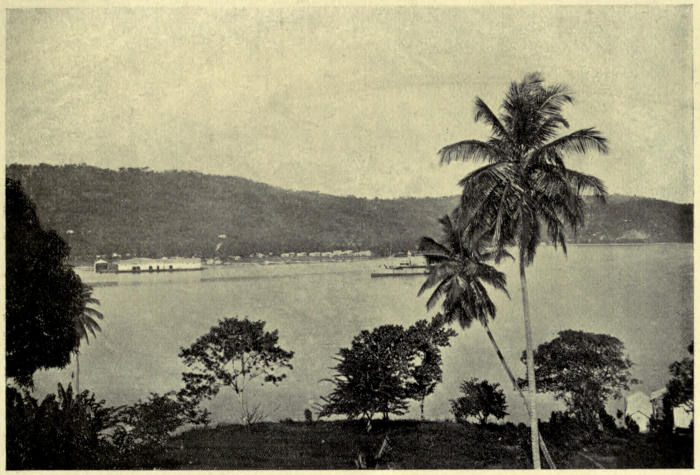
There could be nothing more beautiful than the
entry into Kingston Harbour as I saw it. The Blue
Mountains in the background were free from the cloudy
embrace which so often veils the peaks, a lower range
of hills clad with verdant green up to their summits
lay between us and them. On our right was the
promontory of Port Royal, with its red tiled roofs,
waving palms, green foliage and yellow sands. In
front, like a watch-dog, lay stretched upon the shining
waters the Urgent, the guardship of the naval station.
To our left the coast presented a semi-circular sweep,
and over the green of the mangrove swamps, on which
trees oysters grow, one saw in the distance the churches
and warehouses of Kingston. Shortly after passing the
entrance of the harbour, which is but a mile in width,
a gun was fired to announce the arrival of the Direct
Mail from England. Everyone was attentively admiring
the beautifully situated harbour as we slowly
steamed up to the company’s wharf. J. T. Froude says:
“The associations of the place no doubt added to the
impression. Before the first hut was run up in
Kingston, Port Royal was the rendezvous of all English
ships which for spoil or commerce frequented the
West Indian seas. Here the buccaneers sold their
plunder and squandered their gains. Here in the later
century of legitimate wars whole fleets were gathered
to take in stores, or refit when shattered by engagements.
Here Nelson had been, and Collingwood and
Jervis, and all our naval heroes. Here prizes were
brought in for adjudication, and pirates to be tried and
hanged. In this spot more than in any other beyond
Great Britain herself, the energy of the Empire was
once throbbing.”
Such was the past, and if the everlasting hills had
looked down upon scenes of glorious days in the annals
of our monarchy, as well as upon the inglorious ones of
privateering, of cruelty, of rapine and of avarice, who
could tell what were the possibilities of the future?
Whilst we had journeyed out from England the three
years of Columbian internecine warfare had drawn to a
conclusion. Now there is a chance—indeed certainty,
since the Americans have taken it in hand—that the
Panama Canal may become a reality in years to come,
instead of the failure “of the greatest undertaking of
our age.” When the Atlantic is united with the Pacific
who can tell what future greatness lies before Kingston,
being, as she is, the best harbour in the West Indies, and
from her geographical situation the natural intermediate
port for coaling. When this great watery highway is
established, what new markets will be opened to West
Indian industries!
Millions’ worth of rusty machinery, never yet unpacked,
lies buried in the mud of Darien, sent out when
money was more plentiful than brains, and when
swindling ranked with the fine arts. Thousands of lives
have been lost in the swamps and jungles of the tropics
over the so-far futile project of M. de Lesseps. No
worse spot in the world could be found where nature
resists the invasion of science and the enterprise of the
European. In the hot tropical jungle, deadly snakes,
alligators, mosquitoes and centipedes abound.
The unfortunate blacks, who rushed to Darien as to
an expectant gold-field, attracted thither by the dollars
their fellows were earning, were stricken down with
yellow fever, dysentery, and typhus in countless
numbers.
For all this, it has rightly been believed by many
that some day, sooner or later, the commercial progress
of the world will demand the execution of this apparently
impossible scheme. Now we confidently look to
America to see it successfully completed.
To return to the world of actualities, I gazed
interestedly down from the decks of the Port Antonio
to the quay where we were to land. The mahogany-coloured
occupants of numerous small boats shouted up
to us, gesticulating and laughing as they showed their
beautiful white teeth. Meanwhile, the great ship slowly
approached her moorings. Then a detachment of a
West Indian regiment, marching to the sound of a band,
approached, and took up a position exactly in front of us.
Directly the gangway was accessible a troop of officials
thronged up on deck to pay their respects to the
Governor. The band struck up a popular air, the
soldiers were inspected, and Sir Augustus Hemming
with his friends passed out of sight. People came
streaming on board to greet their home-returning
relatives and friends, whilst every religious community
seemed to be represented in the motley groups of black-coated
men who had come to receive the delegates from
Keswick.
“They are going to have a high old time,” irreverently
remarked a stray black sheep amongst my fellow-passengers,
speaking collectively of the black-garbed
ecclesiastics. I found some friends waiting for me, who
very kindly steered me and my belongings through the
custom-house, which is quite close to the landing-stage,
and proved to be no ordeal whatever, since I had no
merchandise to account for. My trunks were given
into the care of a porter from Constant Spring Hotel,
and I had no farther trouble with them. My friends
got a “bus,” as the buggies are called in Kingston, and
we drove a very short distance, when I entered the
electric tram which every twenty minutes runs between
the town and the hotel, six miles away.
For the benefit of intending visitors to Jamaica I
may here mention that Messrs Elder, Dempster & Co.,
who own the Direct Mail Service by which I travelled,
and which some two years ago was called into
existence by Mr Chamberlain in his efforts to help
the West Indies, are also the proprietors of the two
best hotels Jamaica possesses: Myrtle Bank in the
town of Kingston, and Constant Spring, 6 miles off
in the country.
My intention was to go first of all to the latter,
especially as I heard how hot Kingston is in the
daytime. I learnt, too, that a voucher from Constant
Spring Hotel enabled you to take what meal you chose
at their other hotel in town and vice versa. I had
several purchases to make, so that if I were to be busy
shopping in the heat of the day, so much the more
advantageous would it be to ensure cool nights.
I cannot say that I admire Kingston; in fact I
consider all West Indian towns best at a distance. The
electric trams are a great boon, and an eminently
satisfactory mode of transit. The American lady of
smoking-room fame joined me en route for the hotel.
She could not refrain, when she saw the sugar-cane as
we passed the market, from buying some. She said it
reminded her of her home in California, and, much to
the amusement of the blacks opposite, she brought out
a knife and insisted on teaching me how to eat cane.
This was my first acquaintance with Jamaican blacks;
but I still turn round to admire the country women
striding along with Heaven only knows what in those
heaped-up baskets on their heads, to which they seem
to give not a thought. For the most part, they wear
clean print gowns, short, fastened up below the waist
behind, so as not to impede their gait—I have since
read that no women in the world walk better or can
poise such weights on their heads as they can. Very
charming country houses with nice gardens line the
road, when once one is out of the town right away to
Constant Spring. We paid fourpence for our ride, and
at the end of it, walked up a path sheltered with
trellised arches, and covered with alamander, bougainvillia,
scarlet hibiscus, with nicely laid-out gardens
on each side of us, arriving in due course at the
central entrance of the hotel. Having secured rooms
adjoining, with verandahs looking out on to the garden,
and beyond that the golf links, which we learnt,
together with a new wing, were to be opened in a few
days, we repaired to the spacious dining-room, which
takes the whole breadth of the building, as indeed do all
the sitting-rooms. Thus, with balconies on either side,
one can always find a cool spot. My friend and I chose
a table and ordered lunch. The fair Delicia swept
ponderously past us.
“Oh! won’t you come and lunch with us?” asked my
companion in the kindest manner.
“Thank you,” returned that important spinster in
acrid accents; “I have my own table prepared for me,”
and she followed the manager to another part of the
room, where henceforth she was always to be seen alone
in her grandeur.
“My goodness!” exclaimed the charming American,
when her pomposity had betaken herself to a safe
distance, “if I’d guessed she was that crabby I’d have
saved my breath. She has put on empty-headed side
since she struck this hotel!”
Several of our fellow-passengers found their way up
to Constant Spring during the course of the afternoon.
The little journalist made tracks for the fair Delicia.
We found some nice people staying at the hotel,
amongst them the inevitable British matron, who was
shocked at so many things that I wondered how it was
she could stay in a land where so much human anatomy
is in evidence, as it certainly is in this island.
For people who want a warm climate to winter in,
pleasant society, and a comfortable hotel in which to
stay, I consider Constant Spring Hotel a very charming
resort. The building is large, and extends over a good
deal of ground. You enter a large central hall, where
small tables used for afternoon tea are scattered about,
with most comfortable chairs and lounges. The staircases
on either side lead to a gallery above, from
which you look down upon the scene below. From
this hall, on your right, you pass through the large
drawing-room to the dining-room; on your left, you
enter into the reading-room, which is nicely fitted up
with half-a-dozen writing tables, whilst a table in the
centre is covered with magazines and papers; this room
is carpeted throughout, so that persons walking through
do not disturb you when reading or writing. Passing
through this room you come to the ping-pong
and billiard-rooms. Another great advantage is that
there is a first-rate swimming bath belonging to the
hotel, and which is open to both ladies and gentlemen
at certain hours. The expenses of a winter residence
in this hotel would not be greater than at any similar
one in the south of France, about fifteen shillings a day;
but for a permanent stay, or visit of some weeks,
advantageous terms could be made. I should advise
people writing from England and engaging rooms to
be careful to ask for them on the north side, which is
the cool side, looking out towards the Blue Mountains.
Visitors to Jamaica, coming out with introductions to
a few residents, would soon find themselves in very
pleasant society at Kingston, and during the winter
months there are a good many garden-parties, dinners,
and dances, both at the hotels and in the neighbourhood.
Besides the naval station at Port Royal there is a
garrison at Newcastle which is situated some 4000
feet above sea-level; it appears that formerly our
soldiers were quartered in mangrove swamps: the
Government has of late years gone to the opposite
extremes. Now their habitation is amongst the clouds.
There is no doubt about the healthy situation of this
eyrie in the mountains; but one pities the poor fellows
condemned to an exile of two or three years in this
isolated spot. The temperature in this elevated region
never rises beyond 70° and never drops below 60°.
The officers, although they can descend occasionally
from the misty heights, must be bored beyond description.
There is absolutely nothing to hunt, nothing
to shoot; the mongoose has eaten up every partridge,
as it has exterminated snakes, and driven the remaining
rats into dwelling-houses.
CHAPTER VI
SUITABLE CLOTHING—PEDESTRIANS IN JAMAICA—SELF-HELP
SOCIETY
Before I launch out into ecstasies over the tropical
scenery, and the luxuriant multiplicity of the flora
of this island, I intend to rid my memory of certain
precautionary information with which I consider, at
this juncture, it will be well to acquaint any reader
who may be meditating a visit to this part of the
world.
In the matter of dress I advise those who wish to see
the island scenery to leave their heavy luggage at either
of the hotels they choose to stay at when first landing.
Since the interior parts of the island are in many
places only accessible either on horseback, as to houses
high up in the Blue Mountains, or as Mandeville, by
long drives in buggies from the railway stations, it is
advisable to carry only a limited amount of what one
absolutely requires in bags, portmanteaus, or bundles
tightly strapped in waterproof cases. I cannot do
better than warn persons of the tropical rains which
are so frequent in the West Indian islands. Do not
time your visit either in May or October, for these are
the rainy months, but you are always liable to sudden
outpourings at other times of the year and in the
finest weather. These rains drench you to the skin
often before you can find shelter, and the danger of
catching fever is great if you do not at once change
your wet clothing. Personally, I consider the waterproof
cloak which Messrs Elvery in Conduit Street, W.,
supply for tropical countries about the most suitable
that I have seen. For everyday wear, washing skirts
and blouses, the latter without lining, are by far the
best; a light, fine serge dress will be useful for a sojourn
amongst the mountains where fires are sometimes
necessary in the evening, and blankets are slept under.
The true test of the Jamaican climate is whether or
not one can sleep under a woollen cover. Shady hats,
and one or two silk dresses for evening or Sunday
wear, are about as much as one wants for a tourist’s
visit of six weeks to a couple of months.
If, however, you come out to spend the winter at
Constant Spring Hotel and expect to go much into
society, you cannot bring out too many smart gowns,
or too much flummery in the shape of millinery, for the
heat soon takes the freshness off your airiest confections.
Let the gowns, however, be such as you would wear
in the hottest summer in England, and you will then
be fairly near the mark.
Whilst I am speaking on the subject of dress I may
as well acquaint you with the fact that muslins and
cottons are to be bought here as reasonably as they
are in England. Some people say they are cheaper,
and are made and exported especially for colonial use.
This probably is a correct version, when it is taken
into consideration that by law all the blacks have to
provide themselves with decent clothing. With the
women, this always takes the form of cotton, either
as print, drill, piqué, or muslin. There are very fair
dressmakers, who are certainly very moderate in their
charges, to be found at Kingston. They are excellent
copyists and clever machinists. Provided they have a
good pattern they will turn out a well-made skirt for
about six shillings, and a blouse for a little less. Many
people coming out from England employ them, and
there is this to be said in their favour, they do not
keep you waiting long for your dresses, but generally
send them to you in two or three days.
Another important item to be considered in a visit
to Jamaica is boots. Some persons tell you to get
a size larger, both in gloves and shoes, than your
ordinary sizes for coming out here. At any rate,
provide yourself with soft kid boots coming high up
the leg, to protect your ankles from the insects which
seem by preference to attack that particular part of
your limbs. At Kingston the mosquitoes are virulent,
here at Mandeville there are scarcely any. But far
worse than these are the ticks which render it positively
dangerous to walk in long grass, or to gather at
random from the country hedges as you take your
walks. These obnoxious insects are the curse of the
island; they attack both man and beast. Years ago
West Indians say they roamed as children about the
hills and woods, gathering what wild flowers they
liked, never thinking or troubling about these insects.
Now the nurses have strict injunctions not to let
the children wander in long grass for fear of the
noisome little pests. The introduction of foreign cattle
into Jamaica some twenty-five years ago accounts for
their presence; since then they have increased and
multiplied till they are a positive plague. In the
Port Antonio we brought out a number of starlings
sent by Sir Alfred Jones, who is the moving spirit
of Elder, Dempster & Co., and who is most energetic
in his attempts to benefit the island. This gentleman
hopes they may acquire a taste for ticks in the same
way the mongoose on its arrival in Jamaica devoted
his attentions to the extermination of rats and snakes.
It would indeed be a good thing if they could be
got rid of. I hear that another gentleman having the
same object in view has imported a lot of common
hedge-sparrows. The poor starlings we brought out
with us suffered terribly from sea-sickness, scarcely
half of them surviving the journey. The timorous-hearted
may be thankful that there is nothing in
the animal or reptile world to be afraid of in country
rambles. At home we have poisonous snakes, here
there are none. There are lizards, but the natives
eat them, and also the land crab. Scorpions are rarely
met with, and are not considered so dangerous here
as elsewhere. Ants and sand-flies are found in the
low-lying lands. The most charming live things are
the beautiful little humming-birds often seen trembling
over sweet-smelling tree blossoms. I have often
watched them flitting over flowering acacia bushes.
There are twenty different sorts of these enumerated
by a naturalist called Goese. Those I have generally
seen have bright bodies of metallic shimmering peacock
green, with black feathers on the head, tail and back.
To return to the subject of dress. Gentlemen will
find their summer suits and flannels indispensable;
they should also provide themselves with good
macintoshes.
For an athlete, or indeed for anybody possessed
of good walking powers, it is not impossible to take
a walking trip over part of this island—especially
as there are small weekly boats starting from Kingston
every Tuesday, stopping at the various ports and
harbours as they make the circuit of Jamaica. These
call at each place for fruit on behalf of the American
Fruit Company, whose boats run between Port Antonio
and Boston, New York, Philadelphia, and Baltimore.
The chief harbours are Port Morant, Kingston, Old
Harbour, Green Island, Montego Bay, Falmouth, Port
Maria, St Ann’s Bay, Lucea, and Port Antonio; these
boats stop at all these. The island of Jamaica itself
is only 144 miles at its extreme length, and its greatest
width is 49 miles. From Kingston to Annotto Bay
on the north coast it is only 21½ miles. The roads
are exceptionally good throughout, thanks to Sir H.
A. Blake, and there is no reason why a good pedestrian
should not fix upon Jamaica as a fitting spot to be
done on shankses’ pony, provided always he be suitably
dressed, and commences his peregrinations at sunrise,
rests from 11 A.M. to 4 P.M., and takes up his journey
then till dusk, or as far into the night as he pleases.
The same applies to bicycling and to riding on horseback.
There is this to be said to people who cannot
accommodate themselves to somewhat primitive conditions
of existence, or who are not in the
enjoyment of at least moderately good health: they
should not come to the West Indies at all. In the
first place, the excessive heat in the middle of the
day is decidedly trying; even the strongest take
some time to become acclimatised. Then the food
is not the same as English people are used to—that
is, in the country lodging-houses and hotels. To
this day I abstain from salt-fish and akee, a
favourite West Indian breakfast dish; nor can I acquire
a taste for the Avocado pear, which is eaten as a
salad, but which to me seems identical with soft soap.
Papaw too, which is handed round for dessert, I find
as unpalatable as mangoes; both the latter are, however,
considered delicious by West Indians notwithstanding
the flavour of turpentine which characterises
the latter. Yams are nice; they resemble potatoes.
The garden egg and Cho Choes are also acceptable,
the latter resembling greatly our vegetable marrow.
At Constant Spring Hotel I first became acquainted
with Jamaican fruits, and the profusion and quantity
of them, together with their cheapness, constitute
one of the most agreeable features in the island housekeeping.
Grape fruit, delicious tangerines, too ripe
for export, juicy pines, cool water-melons, bananas
ad lib., were always piled up in a big central dish
on our breakfast table. Along the road-sides here,
at Mandeville, from whence I am writing these
pages, oranges and grape fruit fall off the trees, and
nobody considers it worth their while to pick them
up. The waste of ripe fruit seems enormous, where
the means of transit are not present to convey it
to a shipping port.
One of the most delicious things they give you
at this hotel is guava jelly served with cocoa-nut
cream. Indeed the table is unexceptionally good, also
both at Myrtle Bank and Constant Spring.
The day following my arrival being Sunday I did
not leave the hotel, but completed a somewhat large
correspondence I wanted to send viâ America. Letters
sent to England viâ the Atlas Steamship Company’s
vessels to the States reach home in twelve days;
you can also send them by the Direct Mail and
the Royal Mail Service. There are innumerable
places of worship, not only in Kingston but all over
the island; in fact the Church of England, Roman
Catholics, Presbyterians, Wesleyans, Methodists, and
Moravians, all do their best to keep the population
in that narrow path where to convince them of sin
seems to be the favourite doctrine. No doubt the
attractions of the broad way which leads to destruction
require pointing out vigorously to the semi-heathen
intelligence; but from expositions I heard in nonconformist
chapels, I wondered what form of amusement
was left open to “believers.”
Once I was present at Cambridge when a venerable
American bishop, since dead, but known as the “Apostle
of the Indians,” uttered the following words, which I
have never forgotten. The occasion was the centenary
of a religious society. Preachers of different persuasions
had spoken of the advance of the society in
their own particular sectarian sphere. “Far be it
from me to present to the heathen a divided
Christianity!” I hear that the puzzled wits of the
woolly-haired race do give way occasionally under
the strain of theological pressure. I travelled with
a poor black, afflicted with religious mania, from St
Thomas to Antigua, and a doctor told me that there
was a good deal of it amongst the natives.
As I had several purchases to make and to expedite
by the Port Antonio on its homeward passage, I prepared
myself for a long day’s shopping on Monday,
and indeed I did very little else before going to the
first official garden-party at King’s House on the
Friday following my arrival.
The town of Kingston has been called in my hearing
“a collection of shanties,” and although I will not give
my assent quite to this appellation, I cannot honestly
admire it. Fine buildings it certainly lacks. The
chief street is Harbour Street, and having once found
that, the other streets run either at right angles or
parallel with it.
My first commission was to order a number of
tortoiseshell articles, which are made here cheaply and
well by a man called Andrews. Then it is a nice
thing to know that you can send your friends a box containing
a hundred oranges properly packed for the sum
of twelve shillings, provided they do not live beyond
a certain distance from London. Blue Mountain coffee
is also an acceptable present. Experts declare that
there is no better in the world; and whether it be true
or not I cannot tell, but I learnt from apparently
reliable authority that the Czar is supplied entirely
with the product of one of these upland plantations.
Guava jelly made in the island is delicious, and often
sent home by request of those who have known it out
here. Indeed I think many families with delicate-chested
members might do worse than live, for a while
at least, in Jamaica. House-rent in the upper part of
the town is not dear, and the houses are well built,
all of them being surrounded with gardens of varying
size, where bougainvillia, hibiscus, palm-trees, and the
crimson-leaved poin-settia are nearly always to be seen.
The rents of these vary from £50 to £100, according
to size. They have three postal deliveries per diem.
Fruit, vegetables and fish are cheap, and prices generally
most moderate; for instance, beef is sixpence a
pound, pork, ninepence, bread, threepence, sugar, twopence,
coffee, one shilling, fish, sixpence. The dearest
articles of diet are ham, at eighteenpence, tea, three
shillings, good butter, eighteenpence to two shillings,
English cheese, eighteenpence. Fruit and vegetables
are not worth mentioning; pines are to be had for
twopence, and for a penny you can get a dozen bananas.
The native produce is of course cheap, and you pay
more in proportion for imported goods. A buggy to
hold four persons costs, when new, about £40,
and you can buy sufficiently good horses from £15 to
£20, and even cheaper; but the town of Kingston
and environs is so well served by the tramway
service, and the hire of buggies within the urban
limits so cheap, that it is quite possible to live comfortably
in the suburbs without a conveyance. The
streets are well lighted by gas, some of the hotels
and public buildings by electricity. Labour is not
a very dear item either; the working hours are from
6 A.M. to 5 P.M., with an hour off, between 11 and 12
o’clock. On Saturdays no work is done after 11
o’clock. Labourers are paid from eighteenpence to
two shillings a day, women from ninepence to one
shilling. Many of the domestic servants live away
from the houses, coming early in the morning, and
leaving about nine in the evening. In a great many
households the mistress does not feed the women-servants.
If there are several, they have a room to
eat in, providing for themselves; and I should
imagine this was by far the best way, for the nauseous
compounds in their stock-pots, when they thus choose
their own provender, are unsuitable to the stomach of
any average English domestic servant. Salt-fish in an
advanced stage of decay is a favourite dish with them,
but nothing comes amiss, and all finds its way into
the big pot.
There are not many curios to be bought in any of
the West Indian islands, but for what few there are
it is best to go to the Women’s Self-Help Society. Here
you can get lamp-shades, doyleys, mats of all descriptions
made from lace-bark, and ferns artistically
arranged; long chains for the neck, or muff, made
from native seeds dried and strung together. Those
which are mostly bought are known locally as “Job’s
Tears” and “Women’s Tongues.” There was a great run
on these a week or two back when Dr Lunn’s tourist
steamer, the Argonaut, put into Kingston Harbour,
and its passengers, to the number of a hundred and
thirty, spent £70 on the island curiosities. Great
joy reigned amongst the lady promoters of the
Society: such a windfall does not often happen to
them.
This “Women’s Self-Help Society” was founded by
Lady Musgrave, the wife of a former Governor, and
was opened in 1879. Apparently there are a number
of what some of our papers at home are pleased to
designate as decayed gentlewomen in Jamaica, and
the object of this industry is to find a sale for all kinds
of work which they, when industriously inclined, are
able to do. There is, however, an agency attached to
it whereby distressed needlewomen can get orders to
execute for ladies and gentlemen, and there is a stock
of clothes always kept ready, suitable for servants and
working people.
The latest Handbook of Jamaica says of this institution:
“The Society has been a great boon to many
people in reduced circumstances who have to work for
their living, but find it difficult to get suitable employment.
It also enables other women, who do not require
the profit of their work for themselves, to earn something
for charities and philanthropic objects, as well
as to raise the standard of work by bringing to bear on
it that cultivated taste and artistic grace which is the
natural result of a refined education.” So much for
this Society and its aims. I should mention that the
seeds called “Women’s Tongues” are those which hang
in long pods from a tree called ponciana. When the
seeds are dry, and the wind blows the boughs of the
trees, they rattle in the pods, hence the title. “Job’s
Tears” are the seeds of a plant which bends by the
water-edge, its melancholy attitude having given rise
to the name.
Two or three days after my arrival at Constant Spring
Hotel, I began to feel that my West Indian experiences
would lack any degree of thoroughness if I did
not include a journey to the Windward and Leeward
Islands; how to get to them I had yet to learn.
I longed to set eyes on the volcanoes. Mont Pelée
was said to be continually throwing up huge masses of
incandescent lava, which, constantly rolling down her
smoking sides, was altering her geographical shape,
and choking up a contiguous river-bed.
The French Government had prohibited any landing
at St Pierre, but a scientific expedition under
Professor La Croix had the pluck to live in a
temporarily constructed observatory at the base of
the mountain; always, I learnt afterwards, in readiness
to fly at the approach of danger. The undermining
of the cone going on within the crater threatened
further eruption, ashes ejected having a temperature
of 100° Centigrade, after a week’s cooling. Eyewitnesses
gave graphic descriptions of the abomination
of desolation which La Soufrière had worked
upon the fertile districts of the north part of St.
Vincent as we sat in the spacious central hall of
Constant Spring Hotel, whilst estate-owners of Jamaica
indulged in jeremiads over the financial depression
reigning here. They pointed in envy to the flourishing
condition of the little island of Dominica, where it
is apparent that a West Indian colony can get along
without sugar. It was inspiriting to read how that
beautiful and well-favoured possession of the Crown
was forging ahead, in spite of the Royal Mail Steamship
Company’s prohibitive freight charges, and the
Sugar Bounties. Apparently people with moderate
capital have been attracted there sufficiently to
purchase Crown lands. This is exactly what Jamaica
needs. The cry here for central sugar factories and
new-fashioned plant instead of obsolete machinery
is a loud cry, but that for capital and new blood is
still louder. In Dominica men have had sufficient
means to sit down quietly between the planting of
their cocoa trees and its yielding remunerating returns,
a matter of from five to six years.
One Jamaican paper says of this island: “Its happy
condition is enough to make a Jamaican gasp with envy.
The revenue in 1901 amounted nearly to £30,000,
the highest ever realised in the island. There was
no increase of taxation, the improvement being entirely
due to the development of trade, and the increased
purchasing power of the people. Although considerable
sums were spent in the reconstruction and
improvement of roads, and in other public works,
the year closed with an accumulated surplus of
nearly £6000. Of this amount £4000 have been
invested as a reserve fund. Think of Jamaica with
a reserve fund! How does Dominica manage it?
So far as we can see, it has ceased to cultivate
sugar. During the last decade it has cultivated
cocoa, and produced lime-juice and its bye-products.
The value of its cocoa exports has risen from £7000
to £24,000, while the shipment of lime-juice in 1901
was valued locally at £35,000. It has also gone in
for rubber, vanilla, oranges, and other minor products.”
People who are to be believed tell me that the percentage
of juice extracted from the cane is 50 per
cent. below that attainable with modern machinery
in many parts of the West Indies. It is obvious
that until up-to-date appliances are substituted for the
crude and obsolete methods of manufacture, the sugar
industry has no prosperous outlook before it, nor can
it hope to compete with beet sugar.
My intention to visit these islands soon shaped
itself. I found a couple of fellow-passengers were
going up to St Thomas in the Danish West Indies
by the Royal Mail steamships, this being their coaling
and repairing station, in reality the ultima thule
of their inter-colonial voyages in these parts.
I arranged, therefore, to leave in a week’s time on
the s.s. Para. In the meantime, I hoped to see
something of the country round Kingston, leaving
the rest of the island to be visited at the end of
December.
The intervening days passed away very pleasantly
at Constant Spring Hotel. There was a dance on the
Monday evening; in fact, all through the winter season
there is a weekly gathering of this description.
Officers from the camp, and the principal residents
to the number of about forty, were present on this
occasion. Very good music was supplied by the four
musicians who are engaged to play every afternoon
in the hotel drawing-room, a pianist, a violincello
player, and two violinists. Some pretty frocks were
worn, many of the girls appearing in delicate muslin
gowns, evidently locally made, but quite adequate to
the occasion.
Another day a dinner was given to all the
Scotchmen in Jamaica, in honour of their national
saint. The ubiquitous Scot is to be found all over
creation. There is a story going, that when some
enterprising explorer finds his way to the North Pole,
he will find a Scot warming himself at a fire there.
About one hundred and fifty sat down to a veritable
Scotch repast. The Governor was the guest of the
evening. Visitors staying at the hotel sat in the
verandah outside the dining-room, and listened with
interest to the after-dinner speeches. Before they got
to that stage, the national dish, the haggis, was duly
honoured, being carried round in triumph, preceded by
the bagpipes, played by a very stately-looking piper.
This was greeted by the guests with exceeding
enthusiasm. Some of the speeches were quite
eloquent, notably so was that of Dr. Gordon, the
Roman Catholic Bishop. He was called upon to
answer to the toast to “bonnie Scotland.” One felt
borne away in the spirit to the land of Burns and
Rob Roy, as he led his hearers mentally at a canter
over hill and dale, and across swiftly flowing burns
fringed with mountain ash, and then plunged them
into the gloom of mountain fastnesses and forest
depths. It was time, however, to come back to the
West Indies at last, and, when the Bishop sat down,
his word-painting of highland scenery earned for him
an enthusiastic ovation. After that a guest with a
considerable flow of language alluded to the fact that
“Governors come” and “Governors go,” but that they
(the Jamaicans) “went on for ever.” Sir Augustus
Hemming is certainly possessed of tact, and, whenever
I have heard him speak, generally seems to say
the correct thing. On this occasion, once or twice
things were said which were not quite in good taste,
but His Excellency adroitly skidded over risky topics,
ignoring that which had been said, but which it
would be better in such a gathering to have left
unsaid.
I have not yet mentioned the impression I received
on my first drives and walks in Jamaica. The colouring
is superb. To an artistic mind, there is scarcely
an hour in the day, when looking on to the hills at
the back of the hotel, that a beautiful view is not
to be obtained. Sometimes the mountain summits are
veiled in white mists, but at sunset the colours are
grand, and for that only are, to my mind, worth the
journey to Jamaica. The foliage and the parasitical
growth, the hanging festoons which drape from tree to
tree, must be seen to be appreciated. Tropical vegetation
is in all its glory here. Innumerable ferns and
palm-trees wave in the air along the banks of the
well-kept roads. Plantains and bananas rear their
ragged leaves against the sky. Exquisitely green
cedars (not those we know) are a beautiful feature
of the landscape, with orange-trees bearing blossom
and fruit simultaneously. Tamarinds and gums spring
from rocky crags, shrubs and creepers are everywhere;
the latter intertwine themselves in the most wonderful
way over tree parasites, back again to the road bank,
then you trace them twenty yards or so further on,
embracing gigantic stems. Not a single tree seems
familiar. One feels as if one were always walking in
a botanical garden; the wealth of flowering plants, of
edible fruit and vegetables, strikes one wherever one
goes. How refreshing and how nourishing are the
articles of food which Nature, in an open-handed
generosity, not to be found in less favoured climes,
scatters broadcast over these islands! If negroes
have yams, bread-fruit, oranges, bananas, cocoa-nuts,
growing at their back door without the trouble
of cultivating them—for anything once stuck into
the ground will grow—how can you expect them to
work six days out of seven?
Yesterday I was talking to a coffee-planter, who owns
a large property in this neighbourhood. I asked him
how he got on with his blacks, for no two planters
seem to me to agree in their opinions as to the capabilities
of their work-people.
“I don’t have any trouble with them,” he replied.
“I pay ’em well because I find it suits me best, but as
to ever imagining they will make decent citizens,
why, it’s out of the question! The fools might have
bought us all out by this time, if they had any sense.”
“And made the island a second Hayti?” I suggested.
“Well, possibly! but when they do buy a bit of land
they ruin it by bad cultivation,” said he.
“I wish they would not live crowded up together
in those filthy one-roomed huts! I cannot get over
my feeling of disgust at them in this respect!”
“They might take a bath sometimes!” he interrupted.
“They have not any decent pride.” He went on to
speak of their very sketchy covering at coffee harvesting
time, and said he never let his women-folk go near
them on those occasions.
This gentleman had been in Jamaica since 1876.
Sugar, he said, had ruined his family. Coffee was the only
crop he considered worth cultivating. There was no
money in oranges—this conclusion I had arrived at myself.
It was about this time I paid my first visit to Hope
Gardens. I went with a friend who knew one of the
officials, and we were taken all over that interesting
government establishment for the promotion of agriculture.
Here plants are introduced, and, if suitable
to the climate and soil, are propagated. The products of
Jamaica being purely agricultural, the well-organised
and scientifically-treated garden and plantations are of
great help to students. Early last century yams,
cocoas, maize, and plantains, etc., were first cultivated,
so as to make the island less dependent upon
American supplies; they are spoken of as valuable
exotics. Indeed it is interesting to learn where
Jamaica obtained her inexhaustible products. In
Bryan Edward’s “History of the British West Indies,”
vol. 1, p. 475, we are told that in 1782 the mango,
akee, cinnamon, camphor, jack-tree, kola, date-palm,
rose-apple, turmeric, and other valuable plants to the
number of six hundred had been not only introduced,
but acclimatised in Jamaica.
Spain furnished oranges, lemons, limes, and citrons.
The prickly pear came from Mexico. The shaddock
from China. Guinea-grass, which is most useful for
cattle, was accidentally brought from the west coast of
Africa. Sugar-cane was grown here by the Spaniards,
but first cultivated by the English in 1660. Logwood
came from Honduras; this is a famous dye-wood and
has a beautiful blossom. The graceful bamboo was
brought from Hispaniola. The scarlet flowering akee,
eaten as a vegetable, came from West Africa in a slaver.
Pimento is indigenous to the island; from this tree we
get allspice. The fustic tree, from which khaki dye is
produced, is common along the hedgerows; so is also
aniseed, which is known medicinally in most of our
English homes. The nutmeg tree is quite common in the
West Indies. In Hope Gardens they have specimens
of every plant grown in the island, and for those fond
of botany, I can imagine nothing more enjoyable than
to wander for hours amongst its trees and plants.
Connected with this government institution the
Jamaican Agricultural Society make special grants for
lectures.
Practical demonstrations on bee-keeping have been
made throughout the island, and Jamaica honey is
considered one of the best which reaches the London
market.
Personally, I consider the bread-fruit tree, the
Jamaican cedar, the beautiful clumps of feathery
bamboos, about the most beautiful of the trees generally
met with in country drives. As one walks along the
grass bordering the road, one may inadvertently step
upon the sensitive plant, which curls up when touched;
but one’s attention is incessantly aroused at the
wonderful growth of cacti and orchids, and what the
natives call “wild pines,” lining the boughs of the trees,
and fixing themselves in great clumps in the forks of
the branches. The Palma Christi, or castor-oil plant,
grows wild.
Farming here is called pen-keeping, and in some
districts there are very fine grazing lands. In fact, it
seems to me that no more productive ground exists
under Heaven. If the people had more energy as well
as more capital, it ought to be a little Paradise, barring
the ticks. A relative of mine described the state of
Jamaica very aptly when he said, “The indifference of
the blacks was only equalled by the apathy of the
Europeans.”
CHAPTER VIII
SAVINGS BANKS—KESWICK VIEWS—SPANISH TOWN
I have been interrupted in my writing this morning by
listening to a very entertaining conversation going on
between two maid-servants, both pure negresses, as to
whether pink or blue chiffon would look best in their
Sunday hats. The latest fashion is to see smartly-dressed
black ladies with well-powdered necks and
faces, wearing huge knots of coloured ribbon on the left
breast. Everything they can save goes to buy finery.
Out of four shillings a week, three are spent on dress,
the fourth feeds them. Much is done to induce them
to put spare pence into savings banks, which were
established as early as 1837, depositors receiving 4½
per cent.; but some years after, a panic ensued, when the
secretary of a branch bank committed forgery, and was
sentenced to fourteen years’ penal servitude.
In 1870 a Government savings bank supplanted the
former; the interest depositors get now is only 2½ per
cent. The married negress lawfully regards her
deposits as her own special property. That this is a
praiseworthy as well as useful institution is proved by
the fact that there were on the 31st of March 1900
32,860 depositors, including charities, societies, clubs
and public functionaries investing in their official
capacities. To assist people to deposit smaller sums,
there are now penny banks established in different
parts of the island by influential persons and clergymen.
In 1897 there were forty-three of these with
11,703 depositors. The currency is the same as in
England, but there are nickel pennies in circulation and
paper notes for sovereigns. I studiously avoid taking
the latter, and insist on English gold: the dirty things
are detestable. Yesterday I went into a store at
Mandeville to buy some trifle, and I saw two black
damsels trying the effect of transparent muslin over
their dusky arms; that with the biggest pattern was
chosen, it was “preetty fe trew,” they thought.
I am indebted to a Kingston clergyman for many
amusing negro stories; having lived here over thirty
years he has quite a fine collection. This is one. A
negro stood chatting with the blacksmith in his shop.
After a while he broke out, “Hi, me smell fire burn!”
With a frightful exclamation he gave a jump, and
found he had been standing on a piece of iron just out
of the fire, but it had taken some time for the heat to
penetrate the hoof!
A coloured man wrote thus to a clergyman:—
“Dear Minister,—My mother is dead, and expects
to be buried this afternoon at four o’clock. Please
come and administer over her remains.”
Another story tells of an irreligious young clerk who
often teased one of the head men about his piety and
church-going. On Monday morning the chaff began
as usual.
“You went to church again yesterday, you old
rascal.”
“Yes, buckra,” replied he, “me go a church, sah!
but de trange ting is me hear ’bout you, sah, during
service.”
“Yes, you hear about me, eh!”
“Yes, sah, parson read de word, ‘De fool hat said
in his heart dere is no god.’”
One day I read in the newspapers that the Keswick
delegates were to give their last service at Kingston,
before setting off on an evangelising tour throughout
the island.
A fellow-passenger on the Port Antonio said he
would like to hear them. We arranged to dine at
Myrtle Bank Hotel, and go afterwards to the place of
worship where the service was to take place. This
hotel has an entrance into it from Harbour Street;
the gardens on the other side of the building go
down to the water’s edge, and are cool and inviting.
Generally a breeze, known as “the doctor,”
from the sea is blowing, which makes it deliciously
refreshing.
We dined shortly after six, and were whirled in a
“’bus” for sixpence to Coke Chapel, a large edifice
furnished with galleries. Crowds were fighting to
get in. Fortunately, the official black is still imbued
with the idea of the superiority of the white people, but
how long that will last if the social democrat is allowed
to preach the equality of the black with the white, is a
question a wiser head than mine may solve. On this
occasion, my friend and I were shown with much
respect to seats near the pulpit. There were mostly
coloured people in our immediate vicinity; a little
further away faces of ebony and mahogany made up
the rest of the large congregation. All looked serious,
expectant, prosperous, too, if one were justified in
judging by the clothes they wore. The service began
by a hymn, followed by extempore prayer. The singing
was congregational and hearty. The blacks love
singing hymns; one hears old familiar tunes hummed
constantly wherever one goes.
But the addresses were what they all came for. The
delegates from Keswick were both good speakers, and
they fairly riveted the attention of their hearers.
However, a more unpractical Christianity, a more
uninviting picture of the religious life as laid down
by these Evangelists, it has never been my lot to
listen to. Calvin and Knox flourished over three
centuries ago. Revivalists nowadays preach on gentler
lines.
These childish, ignorant, irresponsible, but happy-hearted
children of the South were told that smoking,
drinking, card-playing, dancing-parties, love-making,
novel-reading, society-going were incompatible with the
Christian life. If they wanted to enjoy such things
they were imperatively bidden to leave the church. In
this instance, that meant membership of nonconformist
bodies. I learnt from the local newspapers, which
indiscriminately praised the work of the delegates, that
they upheld a high standard of spiritual life. It may
be so. But of what use is it to describe the unattainable
and the impossible, seeing that negro human nature is
limited in its perceptions and in its capabilities, and a
white man would think twice before he made such
wholesale renunciations! The young women present
were enjoined to keep themselves to themselves; they
were not to seek husbands, the Lord would provide
them! What about English church-going spinsters? I
wondered. Many of them had not chosen the better
part.
That they should not desire to go into society was
impressed upon them, since that often led to trouble.
To exemplify this teaching the Old Testament story of
Dinah as given in Genesis was taken as the text. I
have since looked it up. It belongs to the unreadable
stories of the Pentateuch, but the gist of it, as presented
to the mixed assembly, was, that Dinah, said the preacher,
probably like many in front of him, “wanted more
society than home afforded, so she called to see the
daughters of the land.” Just in the same way they
might go to tea at different houses in Kingston. Harm
came of it, for she met somebody who got her into
trouble, and the end of it was her lover was killed.
The moral of the story was obvious. Safety was only
to be found in staying at home! Practical persons
say the best teaching for these people is that of example.
If they see English people live well-ordered lives, they
will in time learn to copy them in the same way as
they copy English dress. Many of them are really
stupid; they seem unable to retain what they hear.
A lady tells me that her servants can never repeat
the text, nor give a reasonable account of what
they have heard at church. She asked a girl who
had that day been to Sunday School, it being Whit
Sunday:
“Who is the Comforter you heard about?”
The lady who taught the class was the clergyman’s
wife.
“Judas Iscariot, missus,” promptly and unabashed
came the reply.
And this, she tells me, is a specimen of how they
jumble up Bible names and stories. No doubt there is
a physiological solution to this muddle-headedness,
but it must be particularly trying for those who would
like to really improve them.
The next day I went with several people from the
hotel to a garden-party at King’s House. The
afternoon was very hot; fortunately it became slightly
cooler by 4.30: the reception was from half-past four
to six o’clock. Their Excellencies received us at the
entrance of the gardens. Guests to the number of
about one hundred and fifty had arrived; very few
government officials were present, and altogether, as
a representative gathering of the best people in the
island, I admit we did not think much of it. A lady
resident told me the cause of so limited a number
taking the trouble to come was of course the unpopularity
of the lady who presides over the entertaining
at King’s House. We chatted to those we knew,
strolled about the grounds. The house, which is unpretentious,
is situated in a hundred acres, containing
some beautiful shrubs and rare plants. Refreshments
were served under the trees. It grew dark. We sought
our carriage, and returned to the hotel in time to dress
for dinner. I was determined to take one expedition
into the country before leaving for the islands, so on
the Saturday I started from Constant Spring Hotel with
a friend by a tram, leaving shortly after six to catch the
first train to Spanish Town, from which place we
intended to take a carriage to the Rio Cobre. This
town, the capital of the Spaniards, was called San
Jago de la Vega; it is not particularly interesting. The
Governor’s residence was here till quite recently. In
the banqueting-hall and ball-room one may picture the
scenes which took place in the days of West Indian
prosperity at the King’s House in Spanish Town. We
found the most interesting object to be the cathedral,
where lie interred many early Governors, their wives,
and some of the first settlers of the island. The
architecture is simple, though varied. The verger,
who conducted us to the top of the tower and pointed
out the principal objects, was interesting in the fact
that he had been born there and evidently loved every
stone of the place. He directed our gaze to one of the
oldest epitaphs. It ran—
“Here lyeth the body of Dame Elizabeth,
the Wife of Sir Thomas Modyfort, Baronet,
Governor of his Majesty’s Island of
Jamaica, who died the 12th of November
1668 being the 20th year of their happy
wedded life.”
A marble statue of Queen Victoria stands in the
public Square, and bears the inscription—
VICTORIA
of Great Britain and Ireland
Queen
Empress of India
and of Jamaica Supreme Lady
1837-1901.
We did not go to see the United Fruit Company’s
plantation of bananas, oranges and pines, but I believe
it well repays a visit, so does the Cayman sugar estate,
where some of the best rum is made.
We preferred to take a drive up the Rio Cobre of
about nine miles. This is really beautiful; the road
winds along the course of the river, and the luxuriant
growth on either bank is simply wonderful to a person
fresh from home and new to tropical scenery. Huge
banana-trees, enormous clumps of bamboo, meet one at
every turn in the road. We extracted a good deal of
information from our driver, although we could not
always understand him. Bare-legged women with
skirts tucked up passed us with the inevitable yam-laden
basket on their heads, crowned with the hat
which was to cover the woolly hair of the lady
when she set down her load; one or two begged for
quatties, an old Spanish word still used and representing
one penny halfpenny in our money. It is
not often the natives beg of you, although they will
turn round and tell you how much they love you!
We had a delightful but very hot day, and did not
get back till quite late in the evening. There was
one more event which I have to record before closing
these pages for a time on Jamaica. This was the
opening of a new wing added during the last year to
the hotel.
Tourists, apparently, are beginning to make this island
into a favourite winter resort, the consequence being
that increased accommodation was needed. Elder,
Dempster and Co., who own the hotel, were celebrating
the event by giving a garden-party. Their agent, Mr
Haggart, had arrived. The Governor was expected, and
people were arriving in crowds, making a gay picture of
the lawns in front of the hotel, where a West Indian
band from one of the regiments was playing. It was
nearly five o’clock when the gubernatorial party arrived.
Their Excellencies were conducted over the new part of
the building, afterwards to the new golf links, upon
which Sir Augustus played the first round. The most
important part of the programme consisted in his speech,
in which he formally opened the new wing. He spoke
ably, and congratulated the Company on their enterprising
spirit, and hoped a new tide of success was about
to float the island into a more prosperous condition.
Her ladyship stood close by, as he spoke; so did the
venerable, but tuft-hunting Delicia, so did the industrious
Russian journalist, taking notes the while, but
I looked in vain for persons of importance supporting
their chief. I wondered where the influential residents,
the representatives of the mercantile world, and government
officials had betaken themselves to, and enquired
of a well-known lady in Kingston the reason of their
absence. It was the old story: they preferred to
stay away. One felt sorry that things were so. However,
the afternoon was very enjoyable. The hotel
provided refreshments in the most generous and handsome
way. Everyone present could only hope that
Jamaica in the near future may be as flourishing as the
most sanguine of her boomers could desire.
CHAPTER IX
THE ROYAL MAIL COMPANY—THE “MUMPISH
MELANCHOLY” OF JAMAICA
It was on the 2nd of December, 1902, that I left
Kingston for my trip to some of the islands in the
Caribbean Sea, in company with a couple of fellow-passengers
who had journeyed out with me from
England in the Port Antonio. In answer to my
enquiries, the only feasible thing, apparently, to do
was to travel by the Royal Mail Steam Packet
Company as far as Trinidad, there to be trans-shipped
into a smaller steamer of that Company, which takes
cargo and distributes the English mails fortnightly,
in connection with the outcoming steamers from
Southampton as far as the Danish island of St Thomas.
To my disappointment, I learnt that I should have to
return by the same route to Jamaica, instead of making
a circuit and visiting Porto Rico, as I had hoped
to do.
No regular communication exists between St Thomas
and Jamaica excepting that of the Royal Mail Company,
although I might have accomplished what I desired
had I remained on at St Thomas, and taken the first
chance steamer, sloop, or schooner, bound for Porto
Rico, and so on to Jamaica. But I felt this was too
indefinite and scarcely good enough, St Thomas being
neither very remarkable nor possessing good accommodation.
As it turned out, I was not sorry to revisit most
of the islands, especially those of Martinique and St
Vincent, Dominica and St Lucia, the two latter
being by far the most beautiful; and I was glad to
have a chance of seeing the volcanoes twice over
to impress my memory with their awe-inspiring and
fearful aspect.
It is well to know what to do and what not to do in
the West Indies. Although many, like myself, would
be naturally desirous to see Nature active in her volcanic
haunts—for, apparently, as Jamaica is the natural habitat
of the sugar-cane, so the Caribbean Sea is specially
marked out for these fiery outpourings of Vulcan—I
cannot recommend them to follow in my footsteps,
if they value comfort in the smallest degree.
In my case it was Hobson’s choice. At the office of
the Royal Mail Company at Kingston there was a
vague talk of tourist ships, later on, being specially
run to do this trip; but as no date could be given of
their probable departure, or certainty entertained as
to whether they would run at all, I resolved to
travel by the s.s. Para. The cost of my ticket was £24;
this was at the rate of £1 a day, for I expected to
be in Jamaica again before the close of 1902.
At the back of this ticket was written “with tourist
privileges.” What those were I have yet to learn, for
a more uncomfortable journey I never experienced than
the fortnight I spent in this Company’s steamer, the
E——. You are unfailingly reminded by its officers that
the R.M.S. was incorporated by Royal Charter 1839, and
since then has had the monopoly of trade with the West
Indies, and you as often mentally wonder why they
are letting such a good thing slip through incompetent
management. The very mention, even, of the Direct
Company’s name has, in some instances on board these
steamers, been like a red rag to a bull.
Since, however, I made my journey to the volcanoes
a new manager has come upon the scene. Things are
changing, and one is glad to hear of a regular overhauling
of both offices at home and ships at sea.
Personally, I never heard so much grumbling at sea
in my life as I have from passengers travelling in these
regions. Perhaps the heat makes them unwarrantably
irritable. The prohibitive charges on freight have for
years operated as the great hindrance to the development
of the resources of the islands. Indeed, in the
interests of the Company, it is well that things are
being looked into.
The late manager of the Royal Mail Company was
an admiral of the British navy, of whom many stories
are afloat, showing that he was fearfully and wonderfully
made to hold such an important post. Probably
the man was an expert on shipbuilding and seamanship;
most likely there his qualifications ended. For
a purely mercantile undertaking, one cannot suppose
a retired admiral would possess sufficient commercial
experience to warrant his efficiency as manager. My
own knowledge of naval men would incline me to the
belief that they would rather laugh to scorn all suggestions
of financial retrenchment.
There may be, however, some adventurous spirits,
who, in the face of discomfort, will want once in their
lives to visit these historical islands, and, however
they go, they must trans-ship at Trinidad or Barbadoes,
as I did, into the smaller ships of this Company. Of
course they can go by Dr Lunn’s tourist parties, but
everybody does not care to visit places in gangs.
The Para is a comfortable, steady ship, notwithstanding
her venerable age. The Trent, with her sister-ship
the Tagus, are very handsomely appointed vessels
of modern construction, carrying good cooks.
We had a lovely run in the Para from Kingston to
Trinidad; it took three days. We saw no land until
we approached the Bocas, the two entrances into the
Gulf of Paria, the Dragon’s Mouth, and the Serpent’s
Mouth. This gulf is a shallow lake, and forms a
harbour of enormous size, where ships of every nation,
almost, ride at anchor.
We arrived at sunset, and the sky was a lovely rosy
pink. The purple mountains of the island ranges,
nearly two thousand feet high, divided the vast
expanse of the heavens from the crimson waters of
the harbour, lazily lapping the quay-sides of Port of
Spain. Trinidad, discovered also by Columbus, is
very hot and very prosperous. It belonged to the
Spaniards till 1797, since which time it has belonged
to us. Cocoa plantations flourish, and the Lake of
Pitch is—and, I presume, will be for years to come—a
magnificent source of never-failing wealth. From it
large quantities of asphaltum are taken and exported.
Charles Kingsley raves over this home of tropical
verdure, but I am not a naturalist, nor do I stay at
Government Houses.
I found Trinidad the most trying place of any in
the West Indies. The mosquitoes are positively
unbearable; no part of your person is sacred from
their nomadic and predatory excursions. Kickshaws,
in the way of lace-trimmed parasols, will not suffice
you for the sun, however festive the occasion may be
to call forth dainty sunshades. Be advised in time:
fling appearances to the four winds of heaven, sally
forth in the largest of shady hats, carry the largest
umbrella you can find, but go not into the streets
shopping, or otherwise, without a waterproof, for the
rains are characterised by a ferocity in their down-pouring
unknown in other climes. Take also a fan to
withstand the heat, which is ever present, and a never-ceasing
hindrance to personal enjoyment.
Everybody drives the smallest distances, but there
are times when, encumbered with these three indispensable
articles in overpowering heat (you may
perhaps have to traverse a hundred yards, as from the
landing-quay to the Royal Mail Company’s Offices)
when life is not worth living, unless you are a person
of exceptionable amiability.
Most of the visitors to Port of Spain contented
themselves with lolling round on “rockers” on the
verandah of the largest hotel, called Queen’s Park
Hotel, where the rooms are airy and spacious, but the
food is not always to be trusted. It looks out on to
the savannah, a circular, fairly level tract of grass,
round which an electric tram whirls the inhabitants
of an evening for a breath of fresh air.
What really interested me was the beautiful
Botanical Garden, containing a library and fine
herbarium. Here, indeed, the wonderful parasitical
growth on leviathan trees is simply astounding. If
you wish to obtain orchids and other rare botanical
plants apply to the Superintendent. I went twice
with friends to these gardens; each time I was quite
fascinated in watching the “parasol” ants hurrying
to and fro in countless well-worn tracks, sometimes
crossing our path, sometimes alongside of us carrying
pieces of green leaf, frequently as large as a shilling.
It was quite a green procession; they each kept to
their appointed side of the path, those who had deposited
their green burdens returning on the other side
in search of fresh “parasols.” Policemen regulating
traffic in our London streets could not have done the
thing in better style. If the hot, moist heat made us
resemble the sluggard, we had not far to go to learn
industry from these skurrying little insects, whose
ways are past finding out. We were cautioned not to
try to pursue their tracks, which wind incredibly
long distances among the undergrowth on either
side of the paths, scorpions being not infrequently
met with.
On the voyage to Trinidad I met some Cambridge
acquaintances, people who had been on the Para
throughout the voyage from England. They had
landed both at Cartagena and at Colon, on the
coast of Central America, and gave graphic accounts
of the horrors of the civil war which has raged
in Columbia these three years past. They were at
Colon before peace was concluded, and it was pitiable
to hear of the condition of the soldiers, mostly boys
of enfeebled physique and stunted growth, scarcely
strong enough to carry the old-fashioned guns given
them. All looked starved, with an expression of utter
despair imprinted on their woebegone countenances.
A lady told me she collected bread from the ships and
handed it to them on the quay. The wretched youths
fought over it as dogs for a bone; but a frozen sheep
was given to them from one of the vessels lying alongside,
which they tore into pieces amongst themselves,
eating it raw.
Their women followed them to war; without their
inciting them to fight, I am told, the Columbians
would scarcely attempt to defend themselves. But
when once roused, they fight like diminutive devils!
The women too, on one occasion, rushed a bridge, and
took it during the last war. The most horrible
thing I heard about them was that they had no
ambulance, and no doctors!
Whilst I was in the Caribbean Sea, Hayti was in a
disturbed state, Cuba in a transitional condition, erupting
volcanoes destroying whole cities, as at Martinique
and in Guatemala. The Columbian Republic was resting
out of sheer exhaustion from further civil warfare, whilst
her neighbour Venezuela was in the throes of political
revolution, figuratively torn in pieces by her rival
presidents and her offended European debtors.
Possibly times in the West Indies are bad for those
who have put their trust in sugar, but life and
property are safe under British rule. No one need
starve unless he be irredeemably idle. If big fortunes
are no longer attainable, still there is no need for
the “mumpish melancholy,” so well described by the
Hon. S. Ollivier, Acting-Governor of Jamaica. He
says: “I have observed that, as a people, we have a
habit of being rather sorry for ourselves. We have
not the cheerfulness of the Barbadian. On the other
hand, our depression makes us mumpish and melancholy
rather than vicious and violent. We overdo our talk
of depression, we overdo our talk of the extravagancies
of the Government, of the superfluity of our public
officials. Our visitors take for public gospel what we
promulgate for private consumption.”
To return to my journey to Trinidad on the Para.
About thirty-five persons belonging to an English
Opera Company were journeying to Trinidad. They
had previously been playing in Kingston, and had
been not only to all our colonies, but recently had
been touring up the western coast of South America.
I gathered they had had splendid houses in most
of the large towns, such as Valparaiso, Santiago, and
Lima, though the artistes with whom I conversed
declared that the heat and the indifferent food they
had had put before them, though taken to the best
hotels, had been most trying to their health. The
poor things looked terribly worn, and evidently made
the most of the rest of the three days’ sea-voyage
before performing again at Port of Spain. They had
about thirty plays in their repertoire, which included
all the best known pieces and the most popular, such
as The Geisha, The Shop Girl, etc. I met them on
the return journey a fortnight later, returning viâ
Kingston en route for Bermuda, Halifax, Nova Scotia,
and St John’s, Newfoundland. I mention having met
these strolling players, because I think that many of
one’s friends in the British Isles would have no notion
that the inhabitants of such distant countries had an
opportunity of ever becoming acquainted with the
well-known airs of Sullivan and other popular composers.
Without belittling or depreciating our well-meaning
but somewhat ignorant dwellers at home,
it is well for us to wake up from insular habits of
thinking, and to discover that outside our particular
zone of influence civilised life is throbbing. In every
sphere of labour men are searching for better methods,
and, as in America, are not satisfied until they get
them. We need to keep our eyes open if we would
not lose our place in the world’s history! Conservatism
such as ours does not reign in regions where dollars
are plentiful, and where men are not fettered by the
traditions of the past.
It was late on Friday night, 5th December, when
we were trans-shipped into the inter-colonial boat,
the E——.
I have previously stated that Barbadoes has hitherto
been the meeting-place of the outcoming steamer and
of the three smaller ships, whose mission it is to
distribute the mails on three distinct routes.
The E—— was bound for the islands as far as St
Thomas, the Solent for La Guayra on the Venezuelan
Coast, whilst the third steamer was setting off for
Grenada and Tobago.
CHAPTER X
THE CUISINE OF THE E——.—THE ROMAN CATHOLIC
BISHOP OF DOMINICA
I do not intend to relate my experiences day by day
from the time that I joined the Royal Mail Company’s
steamship E——, but it behoves me to explain once more
to those who would like to take this trip, that unless
they can possess their souls in patience, and are in
the best of health, they may find more discomfort
than gain, more pain than profit in this so-called
pleasure trip. Of course I may have had the ill-luck
to strike a ship (please excuse the Yankeeism, but
at Mandeville where I am writing, we are being
invaded by Americans, whose object in life seems to
me to be the erection of twenty-three storied sky-scrapers)
where the captain, the purser, and the steward
were suffering from a temporary loss of the sense of
taste, either individually or collectively. The cook was
a black, and from the culinary incapacity of the sons
of Ham may I, in the future, mercifully be delivered!
Of all the inappetising-looking viands, of all the
nauseous compounds, the component parts of which
you could not even guess at, ever set before defenceless
travellers, favoured specially with tourists’ privileges,
those we had would take the cake. The first few
days the food was incredibly bad, the meat uneatable,
sometimes putrid, the bread mouldy, the butter rancid,
the bananas rotten, and the oranges unripe! This was
whilst we were in port. Things improved somewhat
when we were once away from Trinidad. We certainly
had better fruit and delicious pines from Antigua,
but the food was often sent away untouched, for
the cooking was of the very vilest description possible.
This, though bad enough, was not the only discomfort
endured in that ever-memorable voyage.
Of course the heat and the mosquitoes were inevitable.
Fortunately the cleanliness of one’s cabin was a feature
to be noted; also the advantage of having it to oneself
was a thing to be thankful for; but the memory of
the hot, weary, sleepless nights I endured from the
noise and rattling winches at work, hoisting up and
taking on cargo, which went on at all the ports we
touched on our way going up to St Thomas, haunts
me yet. Other ships of a less obsolete type are
providentially provided with hydraulic cranes to do
this work, but I have yet to learn that this particular
Company favours any but old-fashioned methods of
working. This frightful noise went on over my
head; outside my cabin door the niggers in the hold
bawled to those working the hoisting or lowering
apparatus, as the case might be, whilst the officers
shouted down orders to them. There were three consecutive
nights with more or less of this hideous din
going on, when exhausted nature was demanding sleep.
Anything more purgatorial could scarcely be conceived.
I was ill for a week from these privileges. When we
did have a night free from this pandemonium, the ship
was being driven through the water at such a rate we
were not allowed to have our port-holes open for fear
of being semi-swamped—and this in the tropics! The
stewardess was an enormously fat coloured woman of
Barbadoes, much given to religion. She was a happy,
good-natured body, but incapable of work. It was
not pleasant to find yourself in a marble bath which
apparently was never scrubbed out from one end of
the year to the other.
A married couple, who had travelled to Jamaica on
the Port Antonio and were also taking this trip, complained
with just cause of the fare given us. In
these islands fruit, at least, is cheap. On the evening
of the 8th of December our dessert consisted of rotten
oranges, ditto bananas, and nuts! I think the menu
for breakfast on the 16th of December will remain
a standing joke whenever we meet. The tempting
dishes offered us were salt-fish, pork chops, and brains!
I forget how the latter were served. After a sleepless
night and in tropical heat, I need scarcely say that
I did not partake of any. We went empty away
mostly!
A lady passenger had also an experience which
shows how very absurdly the regulations on these
ships are adapted for tourists, or indeed for anybody
wanting to see something of the islands we passed.
She was on deck at 7.30 A.M. one morning, when
one of the ship’s officers approached her, and informed
her it was one of the rules that ladies should not
appear on deck till breakfast-time. The lady is a
daughter of a well-known judge, and her answer was
given on judicial lines, to the effect that no mention
of such regulation was on her passage ticket, and
since she came to see the scenery, she intended every
morning when there was land in sight to come up
as early as she chose. She said later on to me:
“Fancy passing La Soufrière, or any other equally
interesting place for which you were enduring stifling
heat, mosquitoes, sleepless nights, and bad food, and
not allowed to be on deck to see it!”
This was the only mention made of their famous
regulation; we never enquired whether it was a printed
one, or an unwritten tradition of the Company.
From the accounts I have since heard from
people coming out to the West Indies by the Royal
Mail Company’s tickets, advertised in the daily papers
at £65 for sixty-five days, I am sure it is not generally
understood that in these inter-colonial mail-boats
passengers, whether tourists or persons having tickets
with “tourist privileges” inscribed on them, like
myself and Mr. and Mrs. S——, endure all the discomforts
of cargo-boats, and, in addition, suffer from the
restrictions of a mail service bound by contract to
deliver and collect mails at certain times at certain
places.
We never knew at what hour we should land at the
different West Indian towns. It would have been
an impossibility to order saddle horses, or carriages,
to be in readiness for us had we desired them,
nor could we ever ascertain with any degree of
reliability how long we should stay at any given
place until we got there; all was uncertain, indefinite.
The mails, naturally, were the first consideration; what
cargo to discharge, or to ship, was the next; and last
of all, the convenience of the passengers. I give this
as my own personal experience—I only hope other
people have fared better! If there was any place
like Martinique, for instance, which we particularly
wanted to see, we invariably arrived when it was
dark. Fortunately, on the return journey one was
in some cases able to see towns one had missed in
this way.
At the Royal Mail Company’s office at Kingston,
when I made my arrangements to travel by their
ships, I was informed in flowing language what a
beautiful cruise it was to the islands, and that I
should never regret it! It was beautiful, and if I
shall never regret having made it, I certainly shall
never forget it. I consider the journey from Trinidad
up to St. Thomas a bad one if business compels one
to make it; as a tourist trip, and therefore a
pleasure trip, it is quite unworthy of the name,
especially in these days when the latter are so
skilfully and so ably arranged and conducted by
people who really consider their clientèle. Having
had the experience, I have not failed to warn people,
especially those who are not strong, of its discomfort
and disadvantages!
The best way for those who have time and leisure
to see the northern group of islands is to stay at
Dominica, where there are frequently very fair opportunities
of visiting the contiguous islands. It is a
lovely, mountainous, and picturesque island. There
are, I was told by a gentleman who had stayed in
them, very comfortable lodgings to be had, kept by
an Englishwoman; and this, he said, was better than
putting up at the small hotel, where the food was
not so reliable. I have also met people who have
stayed for weeks in this island and have never found
it dull. For men there is shooting and fishing in
the rivers. An introduction by a member of the club
should be obtained, for there are golf links, and, as
in all hot countries, plenty of tennis.
The chief charm of life in Dominica consists in
the exquisite rides amongst the mountains where there
are sulphur springs, a boiling lake, and waterfalls
to be visited. I have on a previous page alluded to
the very promising condition of things in Dominica,
and I have also mentioned that limes and cocoa are
its principal exports. I had time to take a lovely
walk in the valley of the Roseau, just at the back
of the town, and was much impressed by the loveliness
of the scenery, as well as with the prosperous-looking
plantations on either side of the road. At the end
of the valley a turn in the road exposed the peak
called Morne Diablotin to view; it is 4750 feet, and
the mountains are the highest in the Lesser Antilles.
On my return journey from St. Thomas no less
a person than the Roman Catholic Bishop of Dominica,
with two or three attendant priests, came on board
at St Kitts. He was introduced to me, and told me
quite a number of interesting things about the
islanders. Some few Caribs, he said, remained still.
I asked if his Church had many adherents in Dominica.
“Ninety per cent.,” he told me, adding that it had
been a French possession longer than an English
one.
The Bishop, who is a Belgian and not long consecrated,
was a very chatty and amusing person; I
admired his skilful tactics. Naturally he was somewhat
prejudiced in favour of our late enemies, the Boers;
but politics and religion he very wisely eschewed.
I was amused at his ways. If he wanted his deck
chair removed from one side of the deck to the
other he always called his servant, or secretary—I
could not tell in what capacity the man stood—to
do it for him. Brother Boniface was the oddest-looking
creature I ever saw. He was short, fair, and
very much freckled, scant locks of sandy hair peeped
out from under a very broad-brimmed black felt hat.
His habit was black, and came to his boot tops, being
confined round the middle of his shapeless body with
a black shining belt. Between its irregular folds and
the top of his boots, white stockings, which probably
were knitted by a Belgian grandmother many years
gone by, showed at intervals, their pristine whiteness
being somewhat the worse for wear. A very large
black stuff umbrella completed Brother Boniface’s
toilet. He was continually smiling, and his very large
mouth looked always ready for a good meal. As
we approached Dominica the mountains were veiled
in mists, and everything had to give way for the
drenching torrential rain which poured on to the deck.
I was standing close by the Bishop, and admired the
artistic effects of the mist-wreathed mountainous coast.
“I prefer to have them so,” I said, pointing to the
mountains. “There are some things which are best
left undefined, indefinite, mysterious. Don’t you think
so, Monseigneur?” I looked round at him.
He looked meaningly at me—I fancy he knew I was
secretly thinking of the very definite statements of
the Romish Church—and then said: “Do as you
suggested the other day. Come and spend a month
on the island.”
“I should very much like to do so,” I answered
simply.
“Our people are very good—you don’t think they
can be?” he asked, in a quick way which seems
natural to him.
“Oh yes, I do,” was my reply; “I don’t see how they
can fail to be so with such a good bishop.” And there
our conversation and short acquaintance ended.
CHAPTER XI
DR GRAY ON YELLOW FEVER—MONT PELÉE—THE RED
CARIBS OF DOMINICA
Since my object in putting pen to paper is to recount
my Jamaican experiences of the winter of 1902-3, it will
not be fitting, and it might be monotonous, to describe
each island as we came to it. Suffice it to say that as
Trinidad is the best off of the British possessions in the
Caribbean Sea, so Antigua is the poorest; it has even
been necessary to cut down the official salaries. The
failure of sugar is the reason of its poverty. The
Governor of the Leeward Islands resides at Antigua.
We stood 4 miles out from St John’s, the chief town
of that island, where heavy seas made the landing most
difficult. There was a good deal of cargo to be left at
this place, and as we came up the companion after
dinner that evening, it was quite a sight to see the tall
masts and sails of the lighters alongside, rolling in the
dim light, as well as to see huge cases roped together
poised in the air, waiting for the right moment when
the lighter rose on a high wave to drop as gently as
circumstances permitted. On the other side passengers
were also waiting for the right moment to land from
the steam-tug. Some amusing “deckers” joined the
ship at this port; these answer to our steerage
passengers. I saw a newly-married couple of blacks
come on board, both as well dressed as white people of
a corresponding class at home. The woman in white
piqué, starched as they only can starch in the West
Indies, wearing a much-beflowered white hat, and holding
an enormous bunch of flowers. Her newly-made
husband wore an immaculate suit of grey, and carried
the luggage, consisting of one chair and two basins!
Deckers have no quarters below stairs. They remain
all night under an awning, but as their journeys
are generally from port to port, their lot is not a
hard one. We had brought along with us a pale-faced
Irish curate, who was met by the Bishop of
Antigua.
From St Kitts a delicate-looking girl came on board,
the daughter of a sugar-planter, whose family had
been settled some generations there. She amused
me by her readiness to drink cocktails at all hours
of the day; in fact, she gave me to understand that
it was quite customary with many West Indian ladies
to drink one before dinner as an appetiser. It is
quite true that the enervating climate is most exhausting.
Personally, I should be sorry to have to
coax a jaded appetite in this way.
We had an interesting personage with us at one
time on the E——, a tall, dark-browed, silent,
narrow-chested Spaniard, who smoked cigarettes all
day. He was suffering from berri-berri, and people
said he was the ex-president of a small republic
called Acre, which has quite recently been a source
of contention between the governments of Brazil and
Bolivia. It owes its existence to Sir Martin Conway,
of exploring fame, who discovered its resources, and
pointed them out to some enterprising Americans.
This tiny republic is far up on the banks of the
Amazon. Report said that before leaving the scene
of his presidency he had feathered his nest, his gains
being safely invested in European securities, but so
much mystery lies around the rise and fall of South
American presidents, that one may unconsciously
fall into error in giving too much credence to reports
which spread too easily when they concern noteworthy
individuals.
One other personage, whose scientific knowledge
interested me greatly, was a Colonial assistant-surgeon
from Castries, the chief town of St Lucia. He was
returning to England, having just been offered a
more advanced appointment in our West African
possessions. He gave me a paper to read, which he
had drawn up on the conveyance of disease by mosquitoes,
in which he declared: “It is no longer a
theory, but an established fact, that Malaria and
Yellow Fever are conveyed from the sick to the
healthy by mosquitoes.” He further explained many
interesting experiments which have been made with
“infected mosquitoes,” which, he stated, “ought to
convince the most sceptical that yellow fever (and
other diseases) is carried by mosquitoes.” The result
of the establishment of this theory resolves itself
into “the destruction of the mosquitoes which carry
them (parasites), and of their breeding-places.” These
latter he describes to be such places as stagnant
swamps and offensive puddles and pools. It is interesting
also to know that the Military Governor
of Havana, General Leonard Wood, issued instructions
for the method of disinfection for yellow fever
based on this theory, and the effect of this change is,
that this particular disease has been stamped out of
Havana in less than ten months, and the city which
has been the home of yellow fever since 1762 can
now rank as a healthy city of the world. “Finally,”
he wrote, “the complete control over the spread of
yellow fever that the Sanitary Department of Havana
has obtained this year, by the enforcement of prophylactic
measures that are based solely on the doctrine of
the transmission of yellow fever by the mosquito, goes
very far to prove that there is no other channel of
communication of the disease. These results have
been obtained by the systematic destruction of mosquitoes
in every house where a case presented itself.
If this success is interrupted, the responsibility must
fall upon the physician who conceals a case of the
disease.” Evidently the splendid results of the Cuban
campaign against mosquitoes has exceeded the expectations
of the most sanguine, and one may hope in a few
years this disease, which is the scourge of the Brazils
and many tropical countries, will be relegated to the
history of the past.
When I contemplated taking the trip to the islands
it was naturally my hope to see Mont Pelée in action,
nor was I entirely disappointed. On the route up to St
Thomas the mountain was partially enveloped in the
densest donas of smoke, but returning, we went as near
the shore as was prudent. The mountain then was
covered in impenetrable clouds of smoke. It was a
moonlight night and the effect was grand, but weird in
the extreme; lightning at intervals was illuminating the
sky to the north, but no rain fell. Presently, as we
approached nearer, we smelt sulphur and felt dust in
our faces, together with warm currents of air. We
kept our eyes fixed on the crater, or, to speak more
correctly, at the spot where we supposed it to be. Nor
were we disappointed, for we saw a stream of “living
fire” leap from under the thick concealing smoke and
race down the mountain-side in a serpentine track. We
did not see it plunge into the sea, but the officer on
the bridge got a sight of it. He told us afterwards that
it had taken exactly ten minutes for this fiery torrent
to travel five miles, which was the distance the sea
lay from the old crater. The whole aspect was terrifying.
One felt one did not care for a nearer acquaintance
with a burning mountain.
We did not land at St Pierre to see the ruins; for
that you require a French permission. We saw where
they lay, and a tiny light glimmered close down towards
the water’s-edge, which probably belonged to the craft
which the professor at the Observatory has ready for
escape at the first symptom of danger. St Pierre must
have been one of the most important towns in the West
Indies. It was the most famous town of Martinique,
and contained 25,000 persons. It used to be the port
of call of the Royal Mail; the steamers go now to Port
of France, between which and St Pierre a beautiful
road, bordered with woods, formed the favourite drive
taken by visitors to the island. On either side are
seen “giant ferns and huge parasites clinging to the
branches of gigantic trees, the whole woven together
by creepers of extraordinary grace. Suddenly the
view opens out, and splendid points of vantage are
reached whence one commands the eastern and western
sides of the island; for this road, traced (whence its
name Trace) for the most part by the Caribs almost
always follows the ridge of the mountains.”
In disembarking at St Pierre one was faced by the
Place Bertin; on one side stood a round tower serving
as a semaphore, having a red light visible for 9 miles,
opposite stood the Chamber of Commerce. The town
possessed two banks, a seminary, a theatre, a military
hospital, rum factories and a beautiful Botanical
Garden with quantities of native and exotic plants,
waterfalls, and a miniature lake with three islets called
respectively, Martinique, Dominica, and Guadeloupe,
because their shapes were similar to these islands.
Life was luxurious at this French colonial town; every
house had its bath-room, there was an excellent
hydropathic institution, food was abundant and cheap.
Whether or no there was any truth in the report that
this city was famed for its wickedness, I am not able
to say. St Pierre, I know, was considered by many to
be a modern Gomorrah, and piously-disposed people
regarded its extinction as the righteous judgment of
an indignant Deity. I will only refer my readers on
this head to a story of what went on at St Pierre,
Good Friday afternoon last (1902), as given in an
article in The Fortnightly of October 1902, entitled
“A few Facts concerning France.” It appears that
atheistical agitators went to the island preaching an
anti-religious crusade, the outcome of which was on
that Good Friday afternoon a procession paraded the
streets of St Pierre, hooting and blaspheming. In the
midst of this gathering of human scum was held aloft,
on a cross, a pig, crucified alive. Its head was adorned
with wreaths of flowers, and the crowd mockingly aped
its dying wriggles. To put a climax to their folly, in
a mad rush of hatred towards all things sacred they
marched up the slopes of Mont Pelée to a spot
where a Calvary stood, and was seen far and wide in
the island landscape. This they tore down, flinging the
crucifix into the crater, with shouts of “Go to hell,
from whence thou camest!” I met a very charming
French priest, who had, by his own exertions, built a
church in one of the parishes of Dominica; I believe
it was called Soufrière. I asked him concerning the
truth of this story. He had heard of it, but—and
he lifted up his hands in holy horror at the very
mention of the wickedness of St Pierre—he was not
able to confirm it, though he considered it more than
likely to be true. In Mr George Kennan’s book, which
describes the tragedy of Pelée, an interesting incident
is recorded. On the eve of the catastrophe a local
newspaper called Les Colonies deprecated the panic
which had been caused by previous heavy detonating
explosions and the appearance of incandescent matter
at the summit-fissure, in consequence of which many
persons left for different parts of the island. “Mont
Pelée is no more to be feared by St Pierre than
Vesuvius is feared by Naples,” said this newspaper.
Captain Leboffe, the skipper of the Italian barque,
Orsolina, which was in the harbour loading with sugar
for Havre, thought differently. He went to the
shippers, told them he did not consider the roadstead
safe, and gave notice that he should sail for Havre
immediately.
“But,” said they, “you can’t go yet; you have not
got aboard half the cargo.”
The captain, however, declared he should sail rather
than risk remaining there. The shippers angrily explained
that the mountain was not dangerous, since it
had once before thrown out ashes and smoke in the
same way.
“If Vesuvius looked as your volcano does this
morning, I’d get out of Naples, and I am going to
get out of here,” said he. The shippers told him if
he sailed without permission and without clearance
papers he would be arrested on reaching Havre.
“All right,” imperturbably he replied; “I’ll take my
chance of arrest, but I won’t take any chances on that
volcano. I’m going to get my anchor up, and make
sail just as soon as I get aboard.” And he went away.
The shippers sent two Customs officers to the
barque, with instructions to prevent her leaving.
The captain, however, addressed them as follows:
“Gentlemen, I sail from this port in less than an
hour. If you want to go ashore, now is your time to
leave. If you stay, I shall take you to France.”
When the sails were loosed, and the crew began to
heave up anchor, the Customs officers hailed a passing
boat and went ashore, threatening the captain with all
the penalties of the law.
Twenty-four hours later St Pierre, with all its
inhabitants, was wiped for ever out of the book of the
living, but the barque Orsolina was speeding on her
way to sunny France.
La Soufrière at St Vincent was awful in the
desolation which the late eruption has produced; the
line of demarcation was strictly defined between the
green verdure of the country which had not suffered
from devastating showers of dust and lava, and that
which had been subjected to the outpourings from
the crater. Puffs of white smoke here and there
announced the neighbourhood of hot sulphur springs.
The inhabitants of Montserrat also lie under the
shadow of a volcanic mountain; just above their little
town is a crater which, like Pelée, may one day serve
as a vent to the fires beneath. Temporary shelter at
one corner of the island has been prepared for an
emergency of this kind. Meanwhile, the islanders
busy themselves very philosophically with the cultivation
of limes, an industry which seems to be fairly
remunerative. The speech of the people here is still
said to recall the brogue of the Irishmen sent out by
Oliver Cromwell.
I think one of the most interesting of the smaller
islands we saw, but did not touch at, was the little
Dutch island of Saba. Here a few hundred thrifty
Hollanders inhabit an extinct crater several hundreds
of feet above the waters of the Caribbean Sea; they
reach their homes by means of ladders hanging from
the cliffs. Curious to relate, in their isolated eyrie
they build many of the schooners which ply locally
from island to island. The ships are let down by
ropes, and navigated by these extraordinary islanders,
who are considered the ablest sailors in those waters.
It was interesting to find ourselves once more at
Trinidad, for events on the Venezuelan coast had
progressed since we had been away. We found ourselves
riding at anchor within a few hundred yards
of the flagship of our West Indian Squadron; other
British warships were beside her, and not far away
the captured fleet of Venezuela. The crews and men
had been sent home. Of course Germany was represented,
but America was there in full force to support
the Munro policy, in the menacing form of four great
warships, which lay motionless on the green waters of
the Gulf of Paria. The blockade of the Orinoco had
begun, and we met fugitives from the mainland at
the hotel on shore, who seemed to have passed through
lively times. I spent Christmas Day on the good ship
Trent, belonging to the Royal Mail Service, where
we were splendidly entertained, and the next morning
at an early hour I found myself once more in
Kingston.
I feel, however, I cannot bring my account, brief
though it is, of what proved to be a very interesting
trip, to a close, without some mention of that almost
extinct race, the Caribs.
In a Jamaican newspaper an interesting report
appears, written by Mr Hesketh Bell, who probably
is the best authority living on the subject of the
aborigines of the West Indies. He says: “The reserve
set apart for the St Vincent Caribs was recently raked
by the fire from the Soufrière. But these are Black
Caribs, who, through long admixture of negro blood,
have lost all the distinguishing traits of the aboriginal
tribe. There still exists, however, in Dominica a handful
of full-blooded Red Caribs, the last survivors of
their race.” Mr Bell, who is the Administrator of the
last-named island, then alludes to the pre-Columbian
tradition when fleets of canoes overran the Windward
and Leeward Islands exterminating the males, but
preserving the women of the milder Arawak nation.
The latter handed down for many generations from
mother to daughter their original tongue. He further
says: “Whatever its origin, the Carib type, even in
the remnant that survive to-day, shows an unmistakably
Mongolian character, and it would be hard to distinguish
a Carib from a Chinese or Tartar child.” The
Caribs were inveterate cannibals. Defoe, it is believed,
placed the scene of his romance in Tobago, and the
wild man Friday was presumably one of a hapless lot
of Arawaks whom a party had captured, and were
probably carrying north for the delectation of the
tribe.
The Caribs, says Davis, after having tasted the flesh
of all nations, pronounced the French the most delicate,
and the Spaniards the hardest of digestion. Laborde
interviewed a Carib who “beguiled the tedium of his
journey by gnawing the remains of a boiled human
foot”; he told the priest that he only ate Arawaks,
“Christians gave him stomachache.”
The Administrator goes on to describe how years of
peace and protection have completely metamorphosed
the Carib, and have arrested almost at the last gasp
the extinction of this interesting remnant of one of
the world’s aboriginal races. Instead of a bloodthirsty,
man-eating savage the Carib is now as law-abiding
and mild a subject as any the King has. “He no
longer paints crimson circles of roucou round his eyes
and stripes of black and white over his body, but on
high days and holidays he wears a tall hat and a
black coat; instead of yelling round a sacrificial stone,
the Carib of to-day goes to confession to the parish
priest, and tells his beads with edifying fervour.”
The Carib Reserve at Dominica numbers nearly 400
members, probably 120 only are full-blooded. Out of
78 school-children, 26 are described by Mr Bell to have
pure blood in them; their chief characteristics are
bright, intelligent expressions, oblique eyes, straight
hair, rather coarse, of a beautiful blue-black, the
complexion varying from brown to a pinkish-yellow.
Their chief claims to be of pure blood. He settles
petty disputes. Ogiste, his little granddaughter, is
evidently the last of his dynasty. She is more negro
than Carib, according to the Administrator, and the
Salic law prevails in the Carib Reserve.
CHAPTER XII
DRIVES AND COUNTRY LIFE AT MANDEVILLE—NEGROES
AND FUNERAL CUSTOMS
It was on Boxing Day 1902, that I returned to
Jamaica, the Trent arriving at Kingston at 7 A.M.
enabled me to catch the morning train for Mandeville.
I breakfasted with friends at Myrtle Bank Hotel,
was delighted to find a number of letters awaiting me
at the post-office. I then betook myself at ten o’clock
that morning to the railway station. These are,
naturally, somewhat primitive; the trains, too, are not
noted for their punctuality, they are known to break
down occasionally, which is rather trying to the
temper. I speak from sad experience. Still one
remembers, if things are not up to date, that one is
not in the most flourishing of the British Colonies.
In view of the late depression of trade, it strikes
me, as it does nearly everybody I have met who
considers the subject at all, that a large proportion
of the island revenue goes to support a very expensive
gubernatorial machinery which constitutes the government
of this country.
When sugar was £70 instead of £5 a ton, when
100 lbs. of coffee fetched 80s. instead of 20s., when the
wealth of the West Indian planter was proverbial,
the salaries of the officials were not disproportionate.
The prosperity of those days will never probably
revisit this island, but the salaries are likely to remain
at their present high figure. One hears much animadversion
and grumbling on this subject from the
better-class inhabitants of Jamaica. The Colonial
Secretary, say they, might well have another thousand
per annum in addition to his present stipend, if that
would ensure so efficient and capable a man for that
post as the present occupant; but it is apparent to
many that £5000 a year, with a fine house to live in,
wines and spirits free of duty, does not guarantee
to the island either acceptable or fitting representatives
of royalty.
At the same time, the stability and justice of the
present government is fully appreciated by the inhabitants
as well as by those Americans who have large
financial interests, such as the Fruit Companies in
Jamaica. Justice is administered to the black very
differently by the present legislature than formerly.
In the country districts the overseers who had to
send to the absentee landlords annual sums from their
estates invariably mulcted the negro of his pay to make
up the deficit.
The information which Whittaker’s Almanac
supplies, under the head of Jamaica, will give to the
reader an idea of how large and how expensive is the
staff of officials who are employed in the government.
The Government Handbook of Jamaica will give
details as to the expenditure of the yearly revenue.
In 1900-1901 this amounted to £760,387. The
expenditure of the same year was £763,902. I have
heard it said that if you cut down the official incomes
you won’t get the right men, and that the Jamaicans
would not like to be considered, or to rate themselves,
a third-rate colony. If that be so, all one can say is,
that they must pay for their pride. A government
official, who worked hard for something under £400
a year, told me he thought that Englishmen would
not live year after year in such an enervating climate
unless the pay was good. He had been six years
out here; his work was hard and unremitting, and he
had not even left the island for a holiday in all
that time. When he came to Jamaica he was an
athlete, now he could scarcely run a quarter of a
mile. Thus there are two sides to every question!
Soon after leaving Kingston we passed through
swamps covered with mangroves, then through a
thousand acres of level land quite recently irrigated and
brought into cultivation. The climate here is hot, and
specially suited to the growth of bananas. Since the
days of sugar failure this has been a remunerative
industry. Eleven years ago, about thirty bunches of
bananas were imported into England. In 1901,
3,000,000 came from the Canaries and 450,000 from
Jamaica. The revenue of the island for the first five
months of the financial year 1902, exceeded by
£40,000 the receipts for the same period in the year
previous, and, owing to the extension of the fruit
trade, the financial outlook is more hopeful than it
has been for years. Canada, so the local papers say,
is looking forward to consignments of Jamaican
bananas.
The fact of Elder, Dempster & Co. having
combined with the United Fruit Company means
a continual market open to the banana trade, both
in Britain and in the United States. The latter is
an American enterprise, having steamers running
between the West Indies, Boston, New York,
Philadelphia, and Baltimore. Sir Alfred Jones, who
is the moving spirit of the Direct Line, is most
generous in his dealings with this poverty-stricken
island. He announced, some months ago, that the
Line he represents (Elder, Dempster) would take,
free of freight from Bristol, English stallions, bulls, and
rams, for breeding purposes, the object being to improve
the breeds of cattle, there being splendid grazing land
in some parts of the island.
At a dinner given by the West Indian Club in
London, 1st October 1902, Sir Alfred Jones, in referring
to the position of the West Indies, said he thought
there “had been too much complaining, the people
should do what they could themselves to develop
the island. There were many possibilities before them.
The tourist traffic might be developed, and there were
splendid opportunities for breeding horses and cattle.
Mineral also afforded a possible field for expansion.
The great thing for West Indians was not to sit down
and think they had a grievance, but to get up and put
their shoulders to the wheel.” He also referred to the
prosperous olden time when activity reigned in the
cotton industry, and trusted to see a revival of it some
day. He believed in the future of the island, deploring
the ignorance still reigning in England regarding the
West Indies.
One is somewhat amused here at the newspaper
revelations. Great confidence in Mr Chamberlain is
felt over the difficulties connected with the Sugar
Convention, etc. One paragraph states that a good
deal of literature is being circulated just now concerning
the injustice of depriving the working man
at home of his cheap sugar. “The best answer,” says
the paper to this, “is that the Trades Unions are dead
against bounties, and ask that bounty-fed sugar should
be denied access to this country altogether.”
Rumours of discontent are also to be heard in this
land to the effect that the chief trade goes to America
and not to Britain. Local economists talk of the mother-country
giving preferential tariffs to her colonies and
dependencies, having learnt their lesson from no less a
person than Mr Seddon, of New Zealand fame. They
should have heard Judge Shaw’s paper, read last
September in the Section of Economics, at the British
Association, Belfast, in which he strove to show how
the law of commercial development meant the natural
and inevitable selection of the nearest market, whatever
code of tariffs prevailed, and instanced Canada’s
trade with the United States as an example of this.
If the mother-country were to give to her colonies
preferential trading facilities, it would disorganise all
existing fiscal agreements with every Continental power,
he said, and the price she would pay would be
financial and commercial suicide. Since we are a
nation of shopkeepers and traders, our teeming
millions of workers must be fed as cheaply as
possible.
After passing through the level lands of St
Catherine’s parish, the line gradually ascends, until
at Williamsfield, the station for Mandeville, it is
1000 feet above sea-level. The scenery becomes
broken and wild as you get among the hills; dry
river beds in the rainy season are roaring torrents.
There are in the island upwards of 114 streams
finding their way to the sea, besides numerous
tributaries, some streams being navigable. When I
glanced around at the different stations we stopped
at, I never saw a white face. Porus is about 10
miles from Mandeville, and a quaint, busy little town.
J. A. Froude says no explanation is given in any
handbook of this singular name, but he found that
a Porus figured amongst the companions of Columbus!
From this place the train crawled, squeaked, and
groaned up to Williamsfield.
A drive of 5 miles brought me to The Grove,
Mandeville, a very comfortable private hotel, where
I spent some happy weeks, and from whence I took
pen in hand to relate my experiences. The drive
from the station was lovely; the ground here is red
and the foliage very green, which makes the country
most picturesque. It is one continual ascent through
roads bordered and sheltered with waving bamboos,
palms, orange-trees, cedars, and mangoes. Sometimes
one caught sight of magnificent silk-cotton trees
standing in lonely grandeur in the midst of a
pasture. At last, turning a sharp corner, the horses
clattered up a steep, stony hill, rushed me across
what looked like a village green, my driver pulling
them up with a jerk in front of Mrs England’s
verandah. Intending visitors to Mandeville cannot
do better than trust themselves to the above lady’s
catering; the food is excellent, the house most
healthily situated, and everything is done with a
view to the guest’s comfort. Mrs England has not
been long in the island, but she has managed to
learn how to deal with the black domestics very
successfully.
This district of the Manchester Hills in which
Mandeville lies, is the heart of the orange industry;
unfortunately, the beautiful tangerine which abounds,
as well as the other kinds, will not keep long enough
for packing. These grow wild in the hills, and negro
children sell them at the station, six for a quatty,
i.e. 1½ d. I saw large wooden buildings at Williamsfield
owned by fruit shippers, where fruit bought
locally is sorted as to size, wrapped in paper, and
packed in barrels or boxes. Some enterprising person
might well start a marmalade factory with the
thousands of rejected ones thrown away.
The climate of this little township is eminently
cool and recuperative. In August, residents come
from Kingston to escape the excessive heat. After
Christmas, Americans visit the island to avoid the
rigorous cold of New York and the northern states.
As I write, there is no representative of the British
flag but myself amongst the guests.
Across the green, or parade, as it is called, stands a
fine County Court House. Opposite, at a distance of
two hundred yards or so, the parish church is to be
seen. Irregularly placed around this central patch of
grass are several stores where most things are to be
purchased, also a chemist’s shop, and a room where a
dentist and a lawyer seem to hold appointments with
their clients on alternate days. The place boasts of an
hotel and a club, but its chief attraction to me is its
large market, which on Saturdays is quite interesting.
I have visited it with Mrs England and her cook on
two occasions, and am beginning to know the look of
the numerous island vegetables before they are cooked.
Small cultivators come many miles to this market,
and the blacks strike one as being more prosperous
and more respectful than those at Kingston. The
women carrying their stock-in-trade in large baskets
on their heads, with a fine hat generally perched on
the top of that, step like “young panthers,” and often
walk 5 miles an hour. The men or boys bring the
goods to sell in baskets on donkeys, and sleep in the
market shelters, I have often seen pigs sitting quite
comfortably in these baskets, and looking as if they
enjoyed their ride. Besides vegetables, chickens and
native tobacco, twined into rope at 3d. a yard, are
sold here. Dark, mysterious-looking pats of sugar,
made in the negro’s pot, also find customers. I hear
the blacks make a drink of the latter. There is a
shed for those who sell meat, but the rest of them
just squat on the pavement, chattering together like
magpies.
The majority of the parishioners are small growers,
renting five, ten, or twenty acres at £1 an acre.
Oranges nearly always pay the rent. Where science
and method prevail in knowing how best to fertilise
the trees, the grower gets a better crop and larger
fruit; he can pack his own oranges and get 50 per
cent. more for them.
Mandeville strikes one as thoroughly English; there
are lovely walks and drives in the neighbourhood.
Several families have properties not far from the town;
in fact there seems quite a pleasant society for miles
round. There is a tennis-club, to which people drive
in their buggies. One of the ladies makes tea, and
although these people have lost much of late years
over the decline of the sugar trade, they are certainly
hospitable, courteous, and refined. This is a charming
spot to recruit in after the heat of the lowlands. One
can walk in the moonlight for miles without the
smallest fear of anything unpleasant. I have done
so with Mrs England’s daughters, and nothing is more
enjoyable. One can see the foliage against the sky
so much clearer, and the shapes of the different trees
thus become impressed upon one’s memory.
After nine o’clock, except just in Mandeville itself,
not a soul is to be seen in the lanes. I fancy the
negro goes to roost betimes like the feathered tribe.
Perhaps this is because of his hereditary and ingrained
fear of the supernatural. He calls all ghostly visitants
“duppies,” and tells you he sees them sitting on the
trees where your own visual organ fails to inform you
of any living thing, or otherwise.
One night three or four of us had emerged from
deep shadow into bright moonlight: our dresses were
white. Wheels were heard behind us, and immediately
after, a one-horsed conveyance with two people sitting
in it appeared. As it approached out of the gloom,
the figure nearest us sat huddled up holding a huge
umbrella close over its head. My companions
recognised the chaise as belonging to an old black
proprietor. We thought he had taken us for
“duppies,” and returned to the hotel much amused;
but we were informed that the umbrella was not
to protect its owner from ghostly visitants, but to
keep him from getting moon-struck.
One day I took a drive to a property some miles
from here, where the family owned a good old Norman
name, well known in some parts of England. They
had been settled in their estate for one hundred and
fifty years, had seen both good times and bad. The
house in which I sat was really a beautiful two-storied
building with verandahs both downstairs and upstairs;
the drawing-room was of noble proportions, and Mrs
G—— told me that the wood employed in the construction
had all been cleared from their own estate,
and consisted principally of mahogany, bullet-wood,
and cedar. They were several miles from a town or
a market, and nearly everything that came to table was
produced on the property.
The negro shanties about here are not very large
for the accommodation of the numerous members of
a family. The Keswick delegate, Mr Meyer, drew
attention to the narrow limits of these. It seems
the blacks will not build additional buildings or better
accommodation since they would be liable to increased
taxation. Each little home is mostly provided
with yams, a few banana-trees, and several orange-trees
planted anywhere without any method.
I have only so far summoned up courage to enter
one of them belonging to a coloured woman who
takes in washing. She informed me she had four
children, “two young gentlemen and two young
ladies.” It is amusing to hear the negresses say to
each other, “Yes, ma’am,” and a negro in the wordiest
altercation never fails to address his opponent as
“Sah!” The greatest contempt which a woman feels
for another is expressed in the words, “You black
niggah!” They only call each other black niggahs
when further words fail to express their disgust. A
negro proverb says, “Choose wife Saturday on Sunday.”
This means if she works well on Saturday—and that
is the great market day here—she can be asked to
marry on Sunday, their leisure day and time for
“walking out.”
I was curious as to the burial-place of the black
population, for the few churchyards I had seen with
their scattered graves seemed out of all proportion to
the population of the island. One day when I was out
for a drive I learnt from a very loquacious driver that
his elderly relatives were buried in the backyard of
the little home he called his own, “under de shadder,
missus, of a big cedar-tree, dar dey lie buried.”
This I found to be true; that owing to hot climate
and the distance at which some of these dwellings
lie, it is deemed expedient to allow them to
bury their dead in their own little properties. Of
course they have to duly notify the fact. I could not
help thinking that this custom would facilitate any
nefarious proceedings on the part of those who might
be benefited by the death of an aged relative, but I
was assured on good authority that very rarely has
anything of the kind come to light.
The peasantry have a great horror of prison, and
have a wholesome terror of the officers of the law.
At the same time, they are very litigious, and amongst
themselves are much given to argument.
For a person desirous of spending a quiet winter in
a warm climate, where they would be able to get out-of-doors
every day for a certainty, I can think of no
better place than Mandeville for them to come to.
The drives are really exquisite; I have been most
of them, which are generally about 6 miles away,
returning by different routes. Thus, Fairview is the
home of the widow of a Moravian minister who lived
fifty years here; the house is built on a commanding
situation on a spur of the Manchester Hills, from which
one sees the sea at Alligator Pond on the south coast
of the island, 17 miles away, whilst stretching far
off on the right, an extended vista of the Santa Cruz
Mountains is to be obtained. Here on the horizon,
30 miles away, a large palm-tree is pointed out,
and Malvern House, 30 miles from Mandeville, is
known far and wide as a comfortable hotel. The
salubrious air of the Santa Cruz Mountains is much
recommended for lung complaints by the medical
faculty. Another very popular drive is to a spot
called Bel Retiro; this is in exactly the opposite
direction and is also on the summit of a hill, where
a house is in course of erection on the ruins of an old
sugar mill. A grand view over Old Harbour in the
distance, and the white houses of Porus below one’s
feet, dotted amongst the green trees with the
Manchester Hills in the background, constitutes
another very lovely scene.
One day we had a picnic to an untenanted house,
from which there was a beautiful view. The verandah
from the upper storey was converted into a dining-room
for the occasion, and nothing more enjoyable
can be imagined than taking one’s lunch with such an
exquisite picture to gaze upon. Everywhere, so far as
the eye could see, was undulating ground covered with
tropical foliage, lofty cotton-trees and stately palms
waved over coffee plantations, and negro huts here
and there dotted the landscape. The house where we
lunched, with 100 acres, was to be sold; the owner
wanted £1200 for it.
Life in this quiet Jamaican country town passes
pleasantly by, notwithstanding its distance from the
attractions of the “madding crowd.” One day the
shouts of joyous school-children announced the fact of
a Sunday School treat. Hundreds of children were
entertained in the Rectory fields, in much the same
way as similar gatherings in England. Swings and
cricket seemed most popular amongst the small blacks,
whilst the little girls’ conscious grandeur in well-starched
clean frocks was quite apparent.
Another time the unusual ringing of the church
bell awakened our curiosity; we learnt that it was for
service before the Parochial Board of Manchester held
its customary meetings. Mandeville also has its
tragedies; whilst I was there we were all shocked
to hear that the proprietor of the local hotel had shot
himself, owing to embarrassed circumstances. This
establishment is very badly situated. The management
for some time past has been unsatisfactory, and
few visitors have cared to put up there, preferring the
boarding-houses in the place. Perhaps it is only in
tropical countries that one realises what walking
shadows we are—this poor fellow had eaten his breakfast
a little after seven o’clock that morning—shot
himself at eight, was taken to his grave at a little
after five the same afternoon. It happened on a
Saturday—Mandeville market day; crowds of people
coming in from the country stayed over to witness
the funeral. All that afternoon the grave, which was
being dug, was surrounded by onlookers who, squatting
round, watched the progress with a curious expression
of fascinated and morbid interest on their dusky
faces, reminding us forcibly of the way their ghoulish
scavengers, the John Crows, large black native
buzzards, sit upon the house-tops surveying from
that elevated vantage-spot the ground below, where
haply some spicy breakfast awaits them in the garbage
line.
Nothing appeals so much to the “duppy”-ridden
imagination of the black as everything connected with
our transit from this world to the next. The correct
thing is to be laid out in a suit of clean white ducks
and white gloves; whilst the women, if they have it,
are similarly arrayed in clean white attire, also with
the needful gloves. I asked the reason of this almost
universal practice amongst them, and was told it was
to “rise up tidy on de reburrection mornin,” and also
that they should appear fitly dressed to “sit down at
de marriage supper of de Lamb.” They are quite
familiar with this phraseology, which is current in
the chapels, which are numerous all over Jamaica; and
as their mental powers of assimilation and digestion
scarcely touch the spiritual plane, the crudity and
grotesqueness of their ideas of another life, mixed up
as they are with their hereditary Obeah-worship and
dread of “duppies,” produces curious results. They
mostly celebrate a death with a wake, especially in the
country parts. A clergyman’s wife living in the Blue
Mountains told me of a man who was ill, and expected
quite confidently to die. His wife bought provisions
for the burial wake. The chickens, with their legs tied
together, were hung upon the bough of a tree, plenty
of yams were in readiness, and the savings of weeks
past were represented in the shape of a bottle of rum;
the white duck clothes waved in the breeze in the
backyard, having been duly washed. Strange to say,
the man recovered. “It was in de middle of de night,
missus,” he explained to the lady. “I got hungry, and
I felt under de bed wher dey put a box of sweet
biscuits; I eat one, and den I ate up de rest and got
well.”
This was a box of Huntley & Palmer’s sweet biscuits,
carefully stowed away for the wake, which had
resuscitated the invalid. “No man can dead before
his time,” they say in the country parts, and evidently
this man’s time had not yet come.
It was with feelings of regret that I turned my
back on this pretty English-looking spot, although I
looked forward with interest to staying a short time
on a pen with friends not very far away from
Mandeville.
CHAPTER XIII
MY VISIT TO A PEN—ARAWAK REMAINS—LEGEND OF THE
COTTON-TREE
Kingston, March 1903.—After passing Kendal, a place
well known for its yearly agricultural shows, I stopped
at a station called Balaclava, where my friend in her
buggy met me. A drive of about two miles through
very hilly country and across one or two bridges
spanning one of the many rivers, or springs, which
abound in this island, brought me to their property.
A gate stood open, and we drove over a grassy track
up to the house, which is one of the oldest in Jamaica,
and called a “storm-house,” because it was built after
the great hurricane of 1722. I was afterwards introduced
to an ancient black lady of some eighty summers,
who remembered slave times. She had been on the
estate, and had never lived elsewhere. The house, she
said, had always been “just de same, missus,” when
she was a “picaninny and lived in de big niggah
houses ovar dar,” pointing towards the wooded hills
which lay on my right. My hostess, Mrs M——, said
their property had been bought some years before from
a coloured family, a death having caused the estate to
be sold. It comprised 1600 acres, and besides coffee,
which was chiefly grown, logwood, pimento and bananas
were cultivated. A river ran through it, and they had
on the estate a very interesting cave, about a mile in
length, if I cared to visit it. I naturally accepted the
latter proposal, and as we could not drive anywhere the
next day, the horses and carriage having been promised
to some friends for the purposes of a funeral, it was
arranged we should visit the cave. Mrs M—— I found
to be a most charming hostess, desirous that I should
see all there was to be seen in the neighbourhood.
The house reminded me very much of some old-fashioned
houses I had seen in Spain the previous
spring. It was a square one-storied building with a
low, wide verandah running round two sides of it.
The ground floor was taken up with storage-rooms, an
overseer’s room, and a school-room. Passages were
built between thick stone walls for shelter in case of
violent storms or hurricanes. A small portion of grass
was fenced round about the house to prevent the
turkeys, chickens, sheep and pigs from entering the
enclosure. On passing through the wicket-gate of this
I was conducted up a stone staircase across the piazza
or verandah into the drawing-room which, with a sitting-room,
ran the whole length of the front of the building.
An open doorway, draped with lace curtains, led into a
large dining-room, which occupied the central portion of
the house. The bedrooms were built on either side, and
the kitchen ran along the back of the house. This
central high-roofed, cool, windowless room is the
characteristic feature of most West Indian houses built
in times past. The floors, generally of island cedar-wood,
are polished to a nicety by the black servants,
who sing as they work at them.
The family, which consisted of Mr and Mrs M——,
their three sons and daughter, a girl of nine, with her
governess, a tall, dark West Indian girl, the daughter
of a neighbouring clergyman, sat down to dinner about
six o’clock the evening of my arrival. We were waited
on by two neatly-dressed maids, whose faces reminded
one of Nubian blacking; they wore caps on their woolly
hair and slippers on their feet.
Mrs M——, who is a clergyman’s daughter, and her
husband, the son of a British naval commander,
belonging to a good old Cornish family, told me that
they insisted upon their servants appearing suitably
dressed in the house, however smartly they chose to
attire themselves out-of-doors. They interested me
very much in their conversation about the condition of
the island and the amusing ways of the blacks.
Jamaica, they said, had certainly taken a turn for the
better; and it is commonly said amongst business-men
out here, that the island can never return to the state
of depression caused by the failure of sugar. Fortunes
are perhaps not to be made, but that a living is to
be earned if people are industrious and ordinarily
intelligent is conceded on all hands, and was a feature
to be noted in the Archbishop’s address to his people
for the New Year.
That Dr Nuttall, who is known far and wide as a
man of clear-sighted ability, both as an energetic
organiser and able administrator, is also an admirable
judge of economic and financial problems in these
latitudes no better evidence is forthcoming than a
study of the methods by which he has guided the barque
of the Anglican Church through the stormy waters of
Disestablishment. In spite of almost overwhelming
difficulties and penury, he has established it on a far
surer foundation than it ever boasted of before, for
it has its roots now in the hearts of the people. It
represents to-day the chosen religious expression of the
most enlightened and educated classes in this island.
But although I cannot refrain from speaking of the
conspicuous ability which has retrieved the position of
Anglicanism during the last two decades, it is not
because one depreciates, or would wish to undervalue,
the self-denying labours of Wesleyan and other nonconformist
ministers. Pitying the condition of “poor
slaves” they came to Jamaica in the eighteenth century,
and commenced their labours when the clergy of the
Established Church were steeped in avarice, or in apathy.
Here they live and labour on the merest pittances. I
heard recently of a nonconformist minister whose
income, all told, was not over £40 a year.
Since I intend to devote other pages to this subject,
I will shorten my reflections on religious phases in
Jamaica, and will only mention the way in which my
friends were able to get a church built in this
neighbourhood.
Mr M——, adding some practical training he had had
in his youth to certain handy-man qualities, inherited
perhaps from a sailor ancestry, superintended the whole
of the undertaking when once the spot of ground was
selected, whereon to build. He was both architect and
builder. Many of the contributors, who could not give
money, gave their labour and time. The ladies of the
country-side devoted their energies to the cause, inciting
and encouraging their black sisters to aid them.
Appeals to their friends in England for help met with
generous response, and a bazaar, or rather country fête,
brought in a very satisfactory sum total. The cost of the
erection of the church to which I was taken probably
represents the smallest amount in Jamaica, for one of
its size.
It is difficult for us at home with our various secular
interests improving, or otherwise, to realise how, in the
life of the country people of our colonies, removed from
all these, religion, whether sham or real, plays an all-important
part. Only by living in these out-of-the-way
places does one at all appreciate this side of colonial
life, and, having seen it, one feels that if the want of
solid teaching is felt amongst the educated laity, it
should be met by the best possible attainable. So far
as my own powers of observation go, I incline to think
that the emotional side of religion is not what is needed
in Jamaica; they have had plenty of that sort of
thing. What they ask for is a broad-minded, literary,
practical theology, which can hold its own with the
advancing science and democratic faddisms of these
days, and this it is the duty of the English Church, to,
my mind, to provide.
An interesting visitor to the house whilst I stayed at
N—— was a local doctor, with antiquarian and artistic
tastes. I learnt from him that there had been several
finds in the island of prehistoric remains, consisting
of kitchen-middens, refuse-heaps, or shell-mounds, near
which various objects such as aboriginal pottery, fish-bones,
and those of the Indian coney had been discovered.
The locations of these having generally been
near the sea-coasts, and in some cases extending over
quite large areas on both sides of the island; the
numerous limestone caves have provided many skulls
and relics of Indian origin. A series of rock-carvings
with deep incisions representing human figures and
heads, also rude outlines of lizards, birds, and turtles,
have been found in the parish of St Catherine, possessing
analogous features to similar finds in various West
Indian islands. Implements too, such as chisels, axes,
celts, mealing-stones, flaked flints, chalcedony beads,
perforated ornamental shells, have been unearthed in
different localities. Columbus spoke of the idols
worshipped by the Indians of Jamaica, and it is
interesting to learn that two stone images, probably
examples of their gods, were sent home for exhibition
by the Hon. D. Campbell; others, perforated behind
for suspension, were found in a shell-heap, and probably
were worn as amulets. In speaking of the Indians
as the aborigines, it must be understood that this was
a generic name applied indiscriminately to all the
inhabitants of the lands discovered by Columbus, but
the Arawak tribe is distinct from the man-eating
Caribs who lived near the regions of the Orinoco. In
Mr im-Thurn’s work, “Among the Indians of Guiana,”
he compares these prehistoric Jamaican objects with
those of other West Indian islands, and the mainland
of America, and finds that there are more notes of
resemblance between them and those of the Indians,
both ancient and modern, of British Guiana. With
this last-named race, the former inhabitants of Jamaica,
as well as many of the aborigines of other islands,
are supposed to be most closely related.
It was one of these limestone caverns, where Indian
remains had been found, that I visited, for it was in
such hiding-places the poor Arawaks took refuge from
the tender mercies of their Spanish conquerors, who,
at the most moderate computation, accounted for some
60,000 of them before the English occupation under
Cromwell. The entrance was up a path leading from
the main road, and was by no means conspicuous,
but once inside, the cave was spacious and lofty;
the stalactites hanging from the roof were of a very
curious formation. Two of Mrs M——’s children
accompanied me, and an overseer, with two attendant
“boys,” carried torches. It was very rough walking and
fearfully hot, slippery and wet here and there. In one
place, which the children called the banqueting-hall,
from its vast proportions and high roof, we startled
thousands of rat-bats, who had taken up their habitation
in the deep recesses of the stalactites which hung over
our heads. Two were knocked over, and I secured
one; they have bat’s wings attached to a mouse-like
body. At last we came to a full stop, an unscaleable
barrier of rock barred our way; the other side, they
told me, was one of those underground rivers so
common in the Cockpit Country, of which I shall speak
further on; they run through the interstices between
the limestone rocks. However, we contented ourselves
with what we had seen, and were glad enough to
breathe fresh air after nearly an hour’s subterranean
exploration.
The West Indian way of living, especially on these
pens, strikes one as being the most suitable to the
climate. We rose before 7 A.M., coffee was ready
on the verandah at 7.30. The mistress of the
house fed her poultry, and looked after household
matters till 11. I made my excursion to the
cave, walked or sketched until that hour, when the
household retired to their bedrooms, where baths had
been prepared; we then made our toilet for the day.
Breakfast, which was similar to our luncheon, was
served at mid-day; tea about 3.30, before we went for
a drive; dinner, being a moveable feast, according
to whatever constituted the afternoon programme, was
at any hour between 5 and 7. On this particular
day the buggy had been lent for a funeral. The
difficulties of providing for sudden emergencies of
this nature in a hot country, in a hilly and sparsely-inhabited
region, struck me forcibly. The seats and
cover were removed from the carriage, upon which
wooden planks were laid so as to make a kind of
platform; on this the coffin rested. “There are some
gruesome things connected with funerals in these parts,
where a coffin, or ‘box’ has to be put together in a
few hours,” Mr M—— said. Often, when death seemed
a certainty, they had to send out “boys” to collect
the necessary deals for the coffin, and set about making
it before the breath was out of a man’s body. Unless
the gravediggers were well primed with rum, said he,
they would not dig the grave, “for fear of duppy
springing up, buckra.” But the corpse expectant may
recover occasionally, and the coffin then is calmly kept
for use at a future date. Having seen some graves
on the estate, neatly bricked over and cemented, in
one of my walks, I asked if they belonged to the family
who had formerly lived at N——, when Mrs M——
explained to me that it was the custom, if a bereaved
widower thought fit to take a second wife into his
hut, to make a brick erection, firmly cemented together,
over that part of his compound where the former
partner of his life had been laid to rest, or at any
rate over the spot where he thought he had buried
her, for fear of being disturbed by her ghostly wanderings.
She had once enquired of a negro, who was hard
at work on his wife’s grave, why he was taking so
much trouble with it; he told her it was to “keep
down duppy, missus.”
A beautiful drive one afternoon to the Maggoty Falls
on the Black River was one of the most exquisite I
had in Jamaica. The falls were 13 miles away;
part of the road lay over a savannah, where deadly
poison lurked in morass and swamp, and no white
man dared live too near to these breeding-places of
the malarial mosquito. The exquisite peacock-green
hues of the Black River water must be seen to be
appreciated. On either bank profuse parasitical growth
obscured the most majestic trees; tropical foliage was
to be seen here at its very best.
The heat was most oppressive; it rained as we
returned. The suffocating atmosphere in the lowlands
made us glad to climb the steep hills which lay
between us and my friend’s estate.
The Black River is the only navigable one in the
island; lighters bring their cargoes up a considerable
distance into the interior of it. In this neighbourhood
I remarked again the size of the cotton-tree, with the
wonderful spurs it sends out from its roots. This is
not the red silk cotton-tree of India and of Java, known
as the Simal tree from the seed-vessel containing red
silk cotton; the cotton-tree of Jamaica has seed-vessels
containing white silk cotton. The Arawaks
attached a religious importance to this tree, and at the
present day the son of Ham regards it as the haunt
and home of “duppies.” The aboriginal idea was that
“after the earth was made the Supreme Being, our
Father, our Maker,” made His throne in the cotton-tree.
The legend of this Arawak belief is worthy of note, and
I quote it as given by Bret:
“Still no life was in the land,
No sweet birds sang songs of love,
O’er the plain and through the grove,
Nothing then was seen to move.
From that bright green throne His hand
Scattered twigs and bark around,
Some in air and some on land,
Some the sparkling waters found.
Soon He saw with life abound
Water, air, and solid ground;
Those which fell upon the stream
Found a pleasant shelter there.
Shining fishes dart and gleam
Where those woody fragments were;
Others sported through the air
Bright with wings and feathers fair.”
CHAPTER XIV
OBEAHISM AND COFFEE-PLANTING
It was whilst staying at this pen that I learnt a good
deal on the subject of native negro superstitions.
I had been told by a coffee-planter, whose dealings
with his black labourers had been somewhat acrimonious,
that they had “set Obi” for him. Although the
matter in dispute between him as landlord, and the
negroes as tenants, amounted only to a few pounds, the
latter, collectively, had paid as much as £25 to an
Obeah man to Obi him. He had laughed at them, and
had pointed out to them the futility of their spells and
curses, so far as he and his health and prosperity were
concerned.
“You can’t Obi me. There’s not a man among
you good enough to Obi me,” he told them. The
black woolly pates had gone off to talk the matter over
amongst themselves, and they had come to the same
conclusion: they couldn’t Obi a white man. So
ingrained in them is this belief in the spell of their
wizards, that I am told in the country parts, where
their ignorance is still almost undiluted, that they look
upon the “passon” as the white Obeah man.
I have not seen a negro grow pale at the mention of
Obeah, but I have seen him squirm, and noted the
expression of unqualified tenor spreading over his
features as I enlarged upon the folly of it.
Mrs M——’s governess, who came from a parish
some 20 miles down the Black River, told me that she
knew by sight several of these champion swindlers,
called “Obeah men,” and that Obi prevailed largely in
that neighbourhood notwithstanding the laws passed
for its suppression.
Before proceeding further, I will quote from two
authorities upon this subject of Obeahism which the
professors of it originally brought from Africa. In
fact there have been few estates which have not had
their particular “Obeah man” in times past.
Mr Long says in his History of Jamaica, written
about 1770: “The term Obeah, Obiah, or Obia we conceive
to be the adjective and Obe or Obi the noun substantive,
and that by the words Obia men or women are
meant those who practise Obi.”
Mr Bryan Edwards, writing at the beginning of last
century and commenting upon the probable etymology
of the word, says: “A serpent in the Egyptian language
was called Ob or Aub. Obion is still the Egyptian
name for a serpent. Moses, in the name of God, forbids
the Israelites ever to inquire of the demon Ob, which
is translated in our Bible charmer or wizard—divinator
aut sorcelegus. The woman at Endor is called Oub, or
Ob translated Pythonissa. Oubaris was the name of
the Basilisk, or Royal serpent, emblem of the sun, and
an ancient oracular deity of Africa. This derivation,
which applies to one particular sect, the remnant probably
of a very celebrated religious order in remote
ages, is now become in Jamaica the general term to
denote those Africans who in that island practise
witchcraft or sorcery.”
The Obeah man, as I have heard him described, is
generally a most forbidding-looking person, craftiness
and cunning being stamped on his features. He pretends
to a medicinal knowledge of herbs, and undoubtedly is
well versed in the action of subtle poisons; his trade
is to impose upon his simple compatriot. The negro
consults him in cases of illness, as well as to call down
revenge upon his enemies for injuries sustained. It is
wonderful how secret they keep their “Obeahism” from
the white man. They always “set Obi” at midnight.
In the morning the stoutest-hearted negro gives himself
up for lost when he sees the well-known, but much
dreaded insignia of the Obeah man upon his door-step,
or under the thatch of the roof. This generally consists
of a bottle with turkeys’ or cocks’ feathers stuck into it,
with an accompaniment of parrots’ beaks, drops of
blood, coffin nails, and empty egg-shells. The same
spirit of fatalism which makes the black tell you he
cannot “dead” before his time, causes him to believe
himself the victim of an unseen irresistible power.
The dread of supernatural evil, which he is powerless to
combat, acts upon what nervous system he possesses, so
that sleep becomes an impossibility, his appetite fails
him, his light-heartedness disappears as the ever-growing
fear possesses his imagination more and more,
and he generally dies. Whole plantations of slaves
have been known to be almost depopulated by this
extraordinary superstition. At one time the Obeah
rites were so cruel, that the impostors, if caught, were
hanged; flogging is now the punishment awarded to
them. Naturally, the deaths by poison are ascribed to
the powerful supernatural agency at work. If some
black wiser than his fellows should suspect that other
than Obeah influence was answerable for the death of
his friend, his terrible dread of the awful vengeance
which these wizards would work upon him would
effectually restrain his tongue from betraying them.
If a black man loses a pig or a sheep, he immediately
has resource to the Obeah man, whom he pays as much
as the latter can extort from him to “set Obi” for the
thief. When the last-named rascal discovers this, he
seeks out a more famous Obeah man to counteract the
magic of the first. Should he find no one to undertake
the job, he will probably fall into a decline from sheer
fright of unknown calamity hanging over his head.
Such is the story of their ignorant priestcraft. The
law of Jamaica recognises “blood, feathers, parrots’
beaks, dogs’ teeth, alligators’ teeth, broken bottles, grave-dirt,
rum and egg-shells” as the unlawful stock-in-trade
of the Obeah man. One of these gentlemen was hung
in all the feathers and perquisites of his profession in
1760. He had come with other slaves from the Gold
Coast and headed a revolt in a plantation in St Mary’s
Parish, but the panic-stricken negroes soon quieted down
upon the death of their leader. This led to a discovery of
their superstitious practices, which were immediately
legislated against.
Bryan Edwards tells a story of a sugar-planter who,
returning to Jamaica after a temporary absence in
1775, found that great mortality had taken place
amongst his slaves, the remaining number of them
being in a lamentable condition. He tried his hardest
to find out the cause of the depopulation of his estate,
but without success. At length he had reason to
suspect Obi. A negress, who had long been ill, one
day confessed to him that the reason of her sickness
was that her old stepmother of eighty had “put Obi”
upon her, and that she had done the same to those
who had died off so quickly. The other slaves on the
property admitted that since she had come from Africa
she had carried on this trade and was the terror of the
place. The owner of the plantation immediately
searched the hut of this hoary-headed witch, with the
result that inside the thatched roof the whole of the
miserable materia Obeah was found. In addition to the
usual feathers and rags an earthen pot was found
under the bed containing quantities of round clay
balls variously compounded, some with hair, or rags,
or stuck round with dogs’ or cats’ teeth, also egg-shells
filled with a gummy substance which, unfortunately,
was not subjected to a rigid analysis. The hut was
burnt; the old woman was not hung, but sold to some
Spaniards who took her to Cuba. History does not
record her performances further. But once removed
from the scene of her evil practices, the slaves lost
their fear, and the mortality amongst them ceased.
The proprietor estimated he had lost a hundred negroes
in fifteen years from the practice of Obeahism.
There is no doubt that superstition, which always
goes hand-in-hand with ignorance, is born and bred in
the descendants of Ham. Nowhere, I learn, is this
more the case than amongst the Jamaican negroes
inhabiting the mountainous parts of the island. In
the Blue Mountains, where wooded heights and musical
murmuring streams suggest supernatural agencies, one
finds weird ideas among their folk-lore. If you can
persuade some native to talk about the “duppy,” you
may learn that that which is most feared is a rolling
calf; you will be told how the sight of it foretells
great misfortune, and those who have witnessed the
awful phantom describe it as a huge animal with fire
issuing from its nostrils, and clanking chains as it rolls
down the mountain-side, burning everything in its
path. Other apparitions of a cat as large as a goat, with
eyes burning like vast lamps, are said to have been
seen by the mountain dwellers at nightfall in the
woods. Some of these story-tellers will eat a raw
rat before relating the ghost stories, to give them, as
they express it, a “sweet mout.”
Indeed, it was during our conversation on the
verandah one morning when one of their strange
notions was forcibly brought to my notice. The three
boys of the family, after their early coffee at 7.30, had
gone for a ride, and a swim in the river; on their
return an altercation was heard in the dining-room, and
the eldest son came and showed his mother where
Theodora, one of the black maids, had actually bitten
him. The children had scuffled, the servant lost her
temper, and actually bit the boy till the blood came,
and then cursed him. Needless to say, she was very
soon packed off. But Mrs M—— explained to me
that to curse with blood in the mouth is quite a usual
practice with them. Any amount of Obi, said she, is
secretly practised in country parts and in secluded
mountain parishes in spite of the most carefully-framed
laws against it. Since the police officials are mostly
black, one can easily understand how the culprits may
be shielded. The same thing holds good with petty
theft, of which everybody having property in Jamaica
whom I met complained bitterly. On this pen where
I stayed, fowls were frequently taken, yams also and
bananas; two years before they had lost a cow and calf.
The thieves were never discoverable, though the local
police called at the house occasionally, to get their
books signed, to show they had faithfully executed
their rounds.
To return to our subject, I read in an American
magazine that one of the well-known Obeah poisons
is made as follows. The negro takes the juice of the
cassava plant, which he squeezes on to a copper pan,
and places it in the sun. The most horrible insects
are the result, which are dried and ground to a powder.
The Obeah man or woman drops into the victim’s
coffee or soup a tiny particle of this powder, which
produces death without leaving a trace of the drug.
Some of their poisons induce insanity.
I heard of a black servant-girl who tried to murder
her mistress by putting ground glass in her soup. It
was fortunately discovered in time, but not before the
young woman had absconded, leaving no trace behind
her.
Some planters adopt Obi to ensure themselves
against thieving. They take a large black bottle, fill
it with some phosphorescent liquid, and place within
it the feather of a buzzard, the quill sticking uppermost.
This they fasten to a tree on the outskirts of
their coffee-patch or banana-field, where it can be well
observed by all who pass near. The dusky population,
firmly believing it to be the work of the Obeah man,
refrain their thieving propensities accordingly. I was
told, too, how their fatalism causes them to cruelly
neglect their sick.
Not long since an aged labourer on a neighbouring
plantation was attacked with disease. The proprietor
ordered special food to be cooked for him, and a servant
was told off to look after him. The latter never went
near the old black, so the result was that the master,
who was a good-hearted man, took personal charge of
him, whilst his wife brought food to him, even cooking
it herself. The old negro, however, died, and then the
friends, who had not been near him for days, crowded
to the little hut, and not only had the corpse laid out
in a fine new suit of white duck, but held a wake for
three nights, when they disposed of enough rum and
tea, in celebrating his decease, to have kept the old
fellow going months during his lifetime.
A very usual complaint amongst the black women
in Jamaica is the information that they have a pain.
“Missus, I’se got a pain!” has been said to me in my
walks in the country, the tone of voice being sepulchrally
solemn.
They have a patent treatment for fever, called the
“bush bath.” This consists of equal proportions of
the leaves of the following plants: akee, sour sop,
jointwood, pimento, cowfoot, elder, lime-leaf and
liquorice. The patient is plunged into the bath when
it is very hot, and is covered with a sheet. When the
steam has penetrated the skin, the patient is removed
from the bath, and covered with warm blankets, leaving
the skin undried. A refreshing sleep is invariably the
consequence, and a very perceptible fall in temperature.
There is a native disease called “yaws,” which the
natives treat in their own fashion. The patient’s feet
are held in boiling water; this, however, is not so
successful a treatment as the former, for I was told it
generally results in sending the chill inward, and often
pneumonia is the result.
I had mentioned to my kind host and hostess that
a visit to their coffee-works would be of great interest
to me, so one day I was shown over the building by
the overseer. I have since been on other plantations,
and I find the proprietors of these estates all agree
in saying that unless a man has capital, it is no good
coming out to Jamaica for a living, and then he should
live at least one or two years on a coffee estate before
he purchases land and sets up for himself. The authorities
at Hope Gardens, the Government botanical
gardens at Kingston, told me it was precisely the same
thing with bananas. Many men have lost money
through not knowing the soils suitable for planting
coffee. In starting a plantation, or patch—which latter
means a clearing on a hill, or, in the case of bananas, a
bit of fertile valley near a stream—the young trees are
usually planted 8 feet apart; some even prefer to
give them more distance. At the end of the third year
a small crop is generally gathered, sufficient to pay
expense of cultivation. The fourth year should yield
a good crop; the trees, according to the soil, will bear
from thirty to forty years. The coffee berries when
ripe are bright purple-red, looking much like cherries.
The coffee kernels, like cherry-stones, are encased in the
flesh of the fruit.
The berries are, first of all, run through a “pulper”;
this machine tears off the pulp from the kernel. The
next part of the process is to run them into tanks
filled with water, where they are occasionally shaken,
to wash off any remaining pulp left on them. Then
they are removed from the tanks and spread out in
the sun on great platforms made of cement, and left
exposed till quite dry. These platforms are called
“patios” or “barbecues”; the former is the Spanish for
courtyard, the latter word was used by the aborigines
to designate the smooth places on which they dried
their fish and fruit. At one side of each barbecue a
shed is always constructed into which the coffee is
swept in case of rain. The coffee, when thoroughly
dried, is removed from the patio. As far as this point
the two kernels which form the stone, so to speak,
of the berry, and which lie with their flat surfaces face
to face, are surrounded by a horny covering, sometimes
called the parchment skin, or silver skin. To remove
this the coffee is run through a mill properly constructed
for the purpose. It is then ready to be
shipped, but in the coffee mill I visited, the coffee was
sorted according to size. This “grading the kernels”
was done by a very simple machine similar to one used
by wholesale dealers in England. Coffee used to fetch
80s. and 90s. for 100 lbs.—now the planter rarely gets
more than 25s. for the same quantity. Estates in the
Blue Mountains, which at one time yielded a return
to their owner of £5000 a year, at present scarcely
bring in as many hundreds. The labour question has,
of course, something to do with the difference in returns.
In times of slavery an estate such as I have mentioned
was worked by perhaps two hundred slaves. At the
present day the black will not go so far in the
mountains if he can get labour nearer home, and to
expect him to work more than three days a week is to
expect that the heavens will rain gold for the asking.
The hillside coffee-pickers are said to be the least
intelligent of the negroes; they live far from towns,
where their brethren absorb a smattering of education
without effort. These coffee-pickers, who speak an
almost unintelligible jargon of their own, in which
Spanish words, African, and even Indian expressions
are often intermingled, are paid by the bushel and earn
more than in the sugar-fields; the majority get as much
as 2s. a day. On arriving from the plantations the hands
pour their gathering into the measures of the overseers,
whence it goes straight to the pulping machines.
It is very clean work, and the women who set the
fashion to their fellows repair to coffee-picking and
sorting in their best clothes. A favourite drink with
them is called matrimony, and is made of equal parts
of the pulp and juice of the orange and the star-apple
mixed with sugar and a dash of rum. Another confection
to which the black palate is partial is a paste made
of brown sugar and grated cocoa-nut. In a list supplied
by the Merchants’ Exchange, I read that 69,128 cwt.
of coffee was exported from Jamaica between April
1902 and January 1903, against 49,811 cwt. between
April 1901 and January 1902, which shows the
industry is prospering. The Colonial Secretary,
Mr Ollivier, attributes the low prices prevailing to the
enormous crops produced in the Brazils of late. Referring
to the lack of water for the proper washing of
coffee, which is the case in some parts of the island,
where the natives are even too lazy to build tanks
for their domestic supply, he urges combination for
central plant, and says: “Despite the low prices, if in
those districts where the coffee is not pulped and
washed the settlers who grow the bulk of our ordinary
coffee were to combine, as they have done in some
instances, to obtain pulping machines and hulling mills
and to cure their coffee properly, there can be no
doubt that the export value of our coffee would be
increased by about 25 per cent. During the fluctuations
of the last two years the prices of these better
cured coffees have kept comparatively steady, although
at lower prices than formerly.” In a local newspaper of
the 2nd of March the leading article is devoted to the
increased prosperity and more promising outlook for
the coming year. It is quite refreshing to think there
may be a good time in store for this pearl of the
Caribbean Sea, after the dismal prophecies and
pessimistic whinings of the inert and apathetic who
abound in Jamaica.
A cablegram, according to this organ of the press,
had just been received from the Daily Mail, giving
the information that a group of English, Italian, and
Brazilian capitalists are forming a trust to monopolise
the coffee trade of Brazil. It says that the syndicate
is being supported by the Brazilian government, and
goes on to state that “it is expected that prices will
be raised 30 per cent.” This is a piece of welcome news
and of most noteworthy importance to all the growers of
coffee from one end of Jamaica to the other, since the
price of that article, with the exception of the coffee
grown amongst the Blue Mountains, is fixed by the
price that is paid for Brazilian coffee. And if such a
remarkable rise in that article should take place, “as is
foreshadowed in the cable despatch,” it will result in a
period of prosperity for the planters of Jamaica such
as possibly they have dreamt of, but never expected
to experience.
CHAPTER XV
COCKPIT COUNTRY—THE MAROONS
If there is one thing more interesting to the unbiassed
traveller than others, it is to hear and analyse the
various opinions expressed upon the subject he or
she is attempting to master in the spirit of disinterestedness
and liberal judgment, by those whose
lives are being lived in that particular spot of the
globe temporarily under review.
“England has treated Jamaica abominably,” I
frequently heard. She had insisted on the liberation
of the slaves, then inadequately compensated their
owners, and when their emancipation upset all
prevailing conditions of labour, instead of protecting
sugar, the chief industry of her West Indian colonies,
and fostering its growth, she fairly knocked it on the
head by the introduction of free trade. When beetroot-sugar
first arrived in Jamaica the nails were driven
into its coffin. Annexation to the United States was
not desirable, it was declared, but, so far as business
was concerned, America would make things hum.
The negroes were emancipated too soon, thought
certain of the grumblers. Had the Jamaican blacks
been as well educated as their brothers in the States
at the time they became freed, they would have a
different race of peasants in the island to-day. “They
will never make citizens,” I was told. They have no
idea of the responsibilities of a civilised community;
even those who had voting powers on local questions
were too lazy or too callous to record their votes. If a
white man suggested to them how better to cultivate
their patch of land, or if the coffee-curers and shippers,
for instance, advised them to bring their coffee when
picked straight to their mills where they had the
proper apparatus for curing the beans, the blacks would
immediately suspect the white man had “something
up his sleeve,” and was going to get the better of them
in some underhand way.
Things, no doubt, are difficult in Jamaica under the
very best of circumstances. The negro is unquestionably
a low type of humanity, naturally unintelligent
and lazy. People forget, however, he has, in the first
place, only recently discovered that he has a soul as well
as the white man, and, in the second place, but just
learnt, the other day as it were, to call that soul his own.
Nearly two centuries of abject slavery, with its
accompaniments of forced labour and hard usage, have
passed over his head, since, as a free savage, he roamed
the African forests, a fetich-worshipper, the victim of
the lowest superstitions, and practising every vice
known to humanity. Evangelising efforts were spasmodically
made here and there to ameliorate the
condition of the plantation slaves by those whose
conscience was in advance of their times; but when in
1834 the yoke of slavery was removed with such an
ancestry, such a history behind them, what could
a reasonable person expect of the sons and daughters
of Ham! The planters had regarded them as the
necessary machinery for producing their princely
incomes when the wealth of the West Indian merchant
was a known quantity. To improve the breed the
physically-fittest were, like cattle, carefully selected,
and the women told off for this purpose given especially
lighter work to perform. This practice alone might
account for much of the indiscriminate living which
called forth the blazing indignation and burning words
of one of the Keswick delegates, whose work is mentioned
on a former page.
The injustice of his wholesale indictment against the
character of the women of this island is still felt by
many.
One clergyman, of over thirty years’ experience in
Jamaica, and whose church numbers 1300 communicants,
expressed to me his strong disapproval of the
way in which this island was held up as a “plague
spot” for its wickedness, by persons who had no
practical knowledge either of its history or its inhabitants.
If in the year 1902, 62 per cent. of the children
born are illegitimate, in 1834, had a census been taken,
probably there would have been over 90 per cent. Of the
present 62 per cent., given by the latest returns, I was
assured that fifty out of that number would represent
the children of persons living together in faithful,
though unwedded union.
It is a matter of history that white overseers on the
estates were dismissed on their marriage for obvious
reasons. Every obstacle was placed upon the marriage
of slaves; I believe on many estates it was forbidden.
Then the example set by the whites has been most
shameful throughout the history of Jamaica in this
respect. Considering these circumstances, and the
very recent growth of any sort of moral standard, one
is not surprised to hear many persons speak indignantly
of the Keswick delegates and the superficial
nature of their work.
It is not inconceivable that the forefathers of these
gentlemen, who were so incredibly shocked at the
immorality of Jamaica, might have been planters
themselves in distant times; and if their lot were
cast in such homes as house the peasantry of Jamaica
they might not escape that fall which seems the
common lot of unregenerated humanity. Let the
ardent reformers who advertised the island as a
“plague spot,” and who would dragoon this childish
race into a code of morality, remember that a great
deal is attributable to the cupidity of the white man
who violated the principles of humanity to procure
the “foul tissue of terrestrial gold.”
The very handsome marble monuments sent out
from England, erected to the memory of many of
these, adorn the walls of the island churches, and
speak from their sacred precincts to the silent observer.
Here other than the poetic-minded may gather as he
wanders
“Wisdom from the central deep,
And, listening to the inner flow of things,
Speak to the age out of eternity.”
Now, it appears to my limited range of vision that
from brute animalism both Church and State, working
into each other’s hands, are making the race into
useful men and women. They know now something
of the sacredness of marriage and family life, as
well as of the arts of civilisation. In an interesting
article entitled “Among the Jamaican Negroes,”
by an American lady, Mrs K. J. Hall, published
in the October issue 1902 of a magazine known
as The World To-day, the situation is admirably
summed up in these words: “Deceitfulness and untruthfulness
are the besetting sins of the race, though
the educated are bravely struggling with their less
enlightened kinsmen. Each year witnesses some
forward step taken by these people so lately freed
from bondage.”
It was with regret that I took leave of my kind
friends at N——, and prepared to extend my journey
to the extreme limit of the railway, which ends at
Montego Bay, a port on the northern coast. I had
first, however, to traverse that part of the island
known as the Cockpit Country, parts of which being
remarkably beautiful. From an agricultural standpoint,
this mountainous stretch is practically useless.
Isolated peaks covered with tropical foliage form a
background to a vast labyrinth of glades and valleys
separating precipitous cliffs. Here and there a few
smoother tracts occur, and at other places a whole
series of impassable sink-holes, called cockpits, prevent
further progress. At the bottom of these deep valleys
the inhabitants grow a banana-patch, and very sparsely
over this hilly country-side does one catch glimpses of
the wattled huts of the blacks. I believe the country
has never yet been thoroughly explored; it offers first-rate
facilities for a traveller to lose himself in. At
the present day it is the home of the Maroons, but
these latter have no distinguishing facial characteristics
by which to recognise them, the negro type being
everywhere predominant. There is very little water
in these parts, for the rain is carried off directly by
numerous crevices. Springs, long distances apart,
form underground water-courses, and, coming to the
surface, disappear again. These are sink-holes; they
are generally to be found deep down in some valley.
The character of the ground around them plainly
indicates their existence; but occasionally such openings
are to be met with on more level ground, where
nothing whatever gives a sign of danger, grass and
brush growing over the edge of the aperture and
concealing it from observation, until the unwary
victim steps unconsciously over the brink of the
treacherous chasm, and disappears, to be seen no more.
Persons have been known to drop out of life thus
into a deep unfathomable grave.
In the south-western part of St Ann’s Parish, which
for its exquisite beauty has been called the “Garden of
Jamaica,” there is an opening into the subterranean
passages amongst the mountains, associated with the
most shocking tragedies attended by circumstances of
unusual horror. This sink-hole is called “Hutchinson’s
Hole.” Near by is the ruined home of the monster, who
was at length brought to justice for a whole catalogue
of atrocities; it is still known by the name of
“Hutchinson’s Tower.” Travellers who sought hospitality
at this house, which was miles away from any
other habitation, obtained it, but they invariably met
with the cruel fate which their host had in reserve for
all who approached his domain, their bodies afterwards
being thrown down “Hutchinson’s Hole.” At length,
being discovered, he fled; the whole country rose up in
pursuit. At Old Harbour Hutchinson found a boat,
and put off to sea. Lord Rodney was then in command
of the fleet at Port Royal; hearing of the miscreant’s
flight from justice, he set sail in his own ship, and
speedily overhauled the merchantman which had
taken the fugitive on board, captured him, and he
was afterwards hung at Spanish Town.
The geological explanation is that the foundation of
the limestone hills is probably coral reef, the rough
country lying between these reefs a formation caused
by the sedimentary deposit produced by the action of
the sea. After the volcanic upheaval of Jamaica it is
thought that these limestone basins gradually found
drainage under the surrounding mountains, and this,
through successive ages of disintegration, has brought
these districts to their present rough almost impassable
structure. The railway affords most beautiful views
as it curves round the mountains after having skirted,
for some miles, the Black River on the level country.
After crossing the third bridge, it commences to ascend
into this wild and picturesque region. Some of the
gradients are very steep, and the curves very sharp;
but the views to be obtained from apparently perilous
heights into the deep valleys below are well worth the
journey.
I have mentioned that this is the home of the
Maroons, and I cannot do better at this part of my
travels than sketch the events which led to their
segregation in these mountains. This involves a dip
into the origin of modern slavery. Since the fall of
the Roman Empire, and the rise of Christendom,
slavery was almost unknown in Europe excepting in
the serfdom of Moscovy until, in 1442, the Portuguese
explorer, Prince Henry, whilst sailing down the African
coast, compelled Antony Gonsalez, his countryman, to
restore some Moors to their home whom he had seized
as prisoners, some two years previously, in the neighbourhood
of Cape Bojador. The wily Gonsalez obeyed
the prince, but received in exchange ten blacks and
some gold dust, which he took back to Lisbon. His
friends and acquaintances evidently thought to do a
roaring trade in following his footsteps, so they fitted
out thirty ships to pursue this traffic.
In 1481 the Portuguese built three forts, one on the
Gold Coast, one on an adjacent island, the other at
Loango—their king assuming the title of Lord of
Guinea! From this date the western continent, so
recently discovered, was furnished with slaves. In
1502 the Spaniards employed them to work in the
mines of Hispaniola, but we read that the governor
forbade the traffic, as the negroes taught the Indians
knowledge of their evil ways. But the latter becoming
scarcer, owing to the cruelty of their conquerors, the
Emperor, Charles V., granted a patent to certain persons
giving them the monopoly of supplying four thousand
negroes annually to Hispaniola, Cuba, Jamaica, and
Porto Rico. Herrera, the Spanish historian of those
days, tells us that this patent was assigned to Genoese
merchants. From that time the slave trade was an
established and regular business.
Nor have we, nationally speaking, clean hands in
this respect. Sir John Hawkins Knight, commander
of Queen Elizabeth’s navy, found, says Hakluyt, “that
negroes were very good merchandise, and that stores of
negroes might easily be had on the coast of Guiney”;
he resolved to make trial thereof, and communicated
that device with his worshipful friends of London. He
sailed to Sierra Leone in 1562. Two hundred years
later, so great a trade had this become, that a list was
prepared by the Liverpool merchants for the Privy
Council 1772. In it we find in one year 74,000 slaves
were exported. The British headed the list with 38,000,
the French followed with 20,000, the Dutch 4000,
Danes 2000, and the Portuguese 10,000. They were
captured from Gambia, Sierra Leone, Cape Palmas,
Gold Coast, Whydah, Lagos, and Benin, Bonny, and
New Calabar, the Cameroons, Loango and Benguela
principally.
It was Homer who said: “The day which makes a
man a slave takes away half his worth,” and in the
nature of things it must be so.
Surely our complicity and share in these dark days is
being atoned for in the efforts to benefit the black race.
The stings of the national conscience have been severe,
but the growth in grace of our legislators a certainty.
Cheap cotton fabrics, specially manufactured to
clothe their dusky limbs, come from Manchester. Food
of the best and of the cheapest is within their reach;
and I was even told by a landowner not long since,
that it was no good going to law for the petty
thieving which is so irritating, because “the judges
favoured the blacks”!
The Maroons, who inhabit the Cockpit Country as
well as a town called Moore Town, near Port Antonio,
on the north coast, are still known by that name,
although there is practically nothing in their appearance
to differentiate them from the rest of the black
and coloured races. The word is derived from the
Spanish marrano, signifying, “a young pig.” The
hardy-looking mountaineers one sees from the carriage
window of the train, clad in the very sketchiest of
clothing, are the descendants of fierce and warlike
slaves of mixed African and Indian blood who, on
the conquest of Jamaica by the Cromwellian troops,
escaped to the hills, and defied the new possessors of
the island to conquer them.
There seems every reason to believe that when
Columbus first discovered Jamaica it was thickly
populated by the Arawaks.
Bartholomew de las Casas, Bishop of Chiapa, compares
the aboriginal Indians to “ants on an ant-hill”;
probably this referred to the inhabitants of the lowlands
and savannahs on the coasts.
This Spanish prelate, who figured in history as the
protector and advocate of the Indians, gave, however,
his episcopal consent to the patent issued by Charles V.,
granting to the merchants of Genoa the monopoly
of the slave trade with the Indies. A writer, noting
the inconsistency of character in the man who, in
order to preserve and protect one of the most interesting
aboriginal races of the world, concurred in
the subjugation and slavery of another, says of him:
“While he contended for the liberty of the people
born in one quarter of the globe, he laboured to
enslave the inhabitants of another region, and in the
warmth of his zeal to save the Americans from the
yoke, pronounced it to be lawful and expedient to
impose one still heavier upon the Africans.” Such
are the extraordinary contradictions the page of
history reveals to us. It is equally curious to read
of a plantation with its complement of slaves in
Barbadoes having been left to The Society in Great
Britain for the Propagation of the Gospel, by a certain
Colonel Codrington, which, says Bryan Edwards, “had
to continue the disagreeable necessity of supporting
slavery bequeathed to than, still more to occasionally
purchase more slaves to keep up the stock.” It
would scarcely be profitable or edifying, possibly, in
these days, to search too closely as to how certain
moneys left to charitable institutions were first
obtained, but the idea of funds devoted to the lofty
and elevating purposes of extending a knowledge of
the Bible amongst the heathen coming from West
Indian slave plantations, appears to me of unique
interest.
The way in which the Spaniards treated the harmless
and inoffensive Indians is well known, and has never
been better described than by Charles Kingsley in
“Westward Ho!” To the rough-and-ready sailor of
the days of Queen Bess, to fight the Spaniard and
to fight the devil were one and the same thing. Nor,
so far as their character for cruelty goes, is the modern
Spaniard one whit better than his ancestors. The
writer of these pages spent a few weeks travelling
in Spain, in the spring of 1902, and was impressed
by the national bloodthirstiness, as exhibited in the
great ardour and passionate enthusiasm displayed
over everything connected with the peninsular pastime
of bull-fighting. The callousness to suffering,
and the innate love of cruelty, shown by the labouring
classes and by the aristocracy of Spain, as when looking
round the crowded amphitheatre to escape from the
disgusting sights and sounds of the arena, one noted
the expression of absorbed interest over every gory
detail of the fight, were painfully apparent. Old
women pawn their beds, and girls sell their tresses
of hair, to be able, at least once a year, to attend a
bull-fight. The Pope has expressed his abhorrence
of it, whilst, it is well known, Queen Christina equally
detests it; but such is the force of the national love
of the sport, that any dynasty endeavouring to suppress
it might count its days as numbered. It is
no matter of surprise to read amongst the island
chronicles that in Jamaica and the adjacent islands
the Spaniards destroyed, within less than twenty
years, more than 1,200,000 of the native Indians,
when one rightly appreciates the devilry of the
Spaniard. It was on account of the disappearance
of these aborigines that African labour was first
brought across the Atlantic, and owing to the gradual
extermination of the Indians in Hispaniola, and in
the Spanish-American possessions generally, slavery
became a systematised traffic. Naturally these persons,
who had so inhumanly treated the poor Arawaks—and
they seem to have been a mild and gentle type
of savage, very different from the Caribs, who were
cannibals, and who confined their attentions to the
eastern islands of the Caribbean Sea—could not be
expected to treat the African with greater consideration.
When one thinks of the blood-curdling stories
of the atrocities committed by the subjects of the
Spanish Crown, both on Indians and Africans alike,
and then of the ferocity and native savagery of the
negro in his reprisals—for when the blacks got the
upper hand their uprisings against and massacres
of their white masters are amongst the most horrible
in the history of the world—one shudders at the
thought of what, if they could speak, the mountain
fastnesses, the waving cane-fields, could tell!
One of the punishments which existed among the
Spaniards was, that a slave failing to fulfil the task
assigned to him, was liable to be buried up to his
neck, and to be left to be devoured by insects!
Historians have unanimously declared the Arawaks
to have been a simple, quiet folk, neither ferocious
nor treacherous, their government patriarchal and
dignified. They smoked tobacco from a quaint
sort of pipe, consisting of a straight tube branching
off into two others, which they inserted up their
nostrils. Why, indeed, so kindly and so superior a
race should, in the foreknowledge of Providence, have
been permitted to be superseded in this island by
the unintelligent and degraded black of tropical
Africa is an inscrutable problem to human ken. The
Arawak was an enlightened savage. He mixed very
little superstition with his theology. He believed
in the existence of a Supreme Being, all-powerful
and invisible, whom he worshipped under the name
of Iocahuna; besides, he venerated a lower order of
household and other gods. One reads that these
people had peculiar ideas of the creation of the world,
and I have already alluded to the veneration in which
they held the cotton-tree as the throne of the Creator,
also that they, in common with many aboriginal races,
had traditions about a deluge. They believed in a
future state of existence which, if it differed from
the happy hunting-ground of the North-American
Indian’s paradise, was to be a place of perfect happiness.
To the limited faculties of the Arawak, that
would be represented by sensual enjoyments more
than anything else.
An anecdote, giving an idea of the estimation in
which the Spaniards were held by the native Indians,
is related by the Rev. J. B. Ellis: “A cacique or chief
fled to Cuba, to escape his European tormentors, having
in his possession a valuable casket of gold. When
pursued by the Spaniards, he conceived the idea of
propitiating the Spanish Deity. ‘Behold,’ he said,
pointing to the golden box, ‘the God of the Europeans’;
and summoning his friends and attendants, he held
a mighty feast in honour of this deity, offering sacrifices,
and singing and dancing around the precious
box. Still the Spaniards approached in their pursuit;
and Hatuey, the cacique, told his companions that
they must be rid entirely of the God of the Spaniards
before they could hope to be free from their persecuting
presence. Accordingly, the golden casket was
solemnly buried in the sea. Nevertheless, Hatuey
was captured, and promptly condemned to be burned
alive. While the necessary preparations for his
execution were being made, a friar attempted to
convert and baptise the unhappy cacique, enlarging
much on the happiness of a future heaven. ‘In this
heaven of yours,’ asked the condemned man, ‘are
there any Spaniards?’ ‘Certainly,’ answered the friar,
‘but they are all good Spaniards.’ ‘The best of them
are good for nothing,’ retorted Hatuey, ‘and I will not
go where I am likely to meet one of that awful
tribe.’”
Let us return to our Maroons, who retreated into
the hills before the English conquerors of the island.
In after years, runaway slaves and disaffected persons
fled to them, thus making them, for over a century
and a half, a formidable antagonist to the colonist
in the lower-lying plains near the coast. From the
mountain fastnesses they harassed the English soldiery.
Those who carelessly rambled from camps, or from
the protection of their companions, were mercilessly
slaughtered with that refinement of cruelty, in most
cases, which makes the annals of the history of this
island written, as it were, in human blood. How they
intimidated the peaceful dwellers by their incessant
and bloody raids, their burnings, and their hideous
slaughtering, it can do no good to describe. To be
“marooned” was a fate too horrible to contemplate,
even in those days when life was of not so much
account as we estimate it to-day. Their dialect was
a barbarous mixture of African and Spanish. They
practised polygamy; the women did what labour was
requisite, and Obeah-worship was the only religion
they knew. They had been a thorn in the side of
the English military occupation for many years. At
last, in 1734, Captain Stoddart attacked them in the
Blue Mountains so skilfully and so successfully that
for a time they could do no more mischief in those
parts; but the snake was only “scotched,” not exterminated.
Again it raised its hydra-head, and in
1736, a formidable movement under a leader named
Cudgoe had to be suppressed. After this there seems
to have been a desultory guerilla warfare, the enemy
never appearing in the open, but sneaking round the
plantations; many whites were killed in this way.
However, in 1738, Governor Trelawny made a treaty
with them, assigning them certain lands to live
in.
If I have depicted the mildness of character of the
extinct Arawak, I will here mention what Bryan
Edwards says of the West African black:—
“The distinguishing features of the Gold Coast
negroes are firmness of mind and body, ferocious
dispositions, but, withal, activity, courage, and
stubbornness, which prompt them to enterprises of
difficulty and danger, enabling them to meet death,
in its most horrible shape, with fortitude or indifference.”
This, he goes on to relate, was shown in the
rebellion of 1760. A negro, who had been a chief
of his tribe in Guinea, was imported with a hundred
of his countrymen into Jamaica, and sold together to
the owner of a plantation, on the frontier of St Mary’s
Parish. At his instigation, although they had received
no ill-treatment since their arrival, they revolted.
Gathering themselves together in a body they proceeded
at midnight to Port Maria, where they
slaughtered the sentinel, and went off with all the
arms and ammunition they could lay hands on. Here
they were joined by many runaway slaves, and,
retreating to the interior of the island, they killed
everybody they met, leaving desolation in their
track.
At a plantation called Bellard’s Valley they surrounded
the overseer’s house at four in the morning,
butchered every soul on the place with the utmost
savagery, and actually drank the blood of their victims
mixed with rum. Wherever they went the same
ghastly tragedies took place. In one morning they
murdered forty whites and mulattoes.
At length Tacky, the chief, was fortunately killed
in the woods; some of the principal ringleaders were
taken at the same time, but, as there was every
appearance of a general insurrection breaking out
in the various adjacent plantations, the authorities
decided to make a few terrible examples of the most
guilty.
However horrible the details are, one feels that no
more blame can be attached to those who framed
such sentences than to those officers in the Indian
rebellion of 1858 who condemned Sepoys to be
blown from the cannon. One of these Guinea slaves
was condemned to be burnt, two others to be hung
up in irons and left to perish. The former was compelled
to sit upon the ground, his body being chained
to an iron stake.
One wonders if he had such a thing as a nervous
system at all, for he complacently looked on as the fire
was first lighted at his feet, and without a groan saw
his legs reduced to ashes, after which, says Bryan
Edwards, “one of his arms getting loose he flung a brand
from the fire into the face of the executioner.” The
two which were hung up alive were indulged, at their
own request, with a hearty meal just before being suspended
on a gibbet which was put up in the parade of
Kingston. From the time they were first placed there
until the time they died, not a word of complaint did
they utter, excepting to remark upon the chilliness of the
night. All day long they amused themselves in talking
to their brother Africans, who were permitted by the
authorities, “very improperly to surround the gibbet.
On the seventh day,” says Edwards, whose description
is that of an eye-witness, “a notion prevailed
amongst the spectators that one of them wished to
communicate an important secret to his master, my
dear relative, who, being in St Mary’s Parish, the
commanding officer sent for me. I endeavoured by
means of an interpreter to let him know I was present,
but I could not understand what he said in return.
I remember that both he and his fellow-sufferer
laughed immoderately at something that occurred—I
know not what. The next morning one of them
silently expired, as did the other on the morning of
the ninth day.”
In the Museum which is attached to the Institute
and Library of Kingston a gruesome relic is exhibited.
It represents an iron cage, and was unearthed some
years ago in the parish of St Andrews. It encloses
the bones of a woman, and is constructed so as to
fit the human body with bands around the neck,
breast, and loins; there are bars to confine the legs,
and stirrups for the feet, which have sharp pikes to
press into the soles of the occupant’s feet. There is
a ring at the top of the structure to suspend it
gibbet-wise. One can well understand the reluctance
and the dread with which the sugar-planters regarded
the passing of the Emancipation Bill.
To be overrun by a newly-liberated race of semi-savages
was not an exhilarating thing to contemplate.
Their standpoint was a very different one in all its
bearings than that of the benevolent aristocrats in
England, who discussed the measure at their ease,
mutually congratulating themselves and the nation
that at last they had obeyed the promptings of
conscience.
CHAPTER XVI
INDIAN CATTLE AT MONTPELIER—PALMER MONUMENT
IN MONTEGO BAY PARISH CHURCH—AMERICANS
After winding through the mountainous regions of
the Cockpit Country, the train traverses a part known
as Surinam Quarters. When the Dutch settled here
in 1672 they intermarried with the negroes, and the
whole of this section is peopled by their descendants.
The next place of importance on the line is Montpelier,
where there is a capital hotel. Here many people
stay and drive the 10 miles, or so, down to Montego
Bay. I had friends to meet at the last-named place,
where I had heard of comfortable quarters, which,
however, could not compare with the accommodation
provided at Montpelier Hotel. In the vicinity there
are two large estates owned by a wealthy Englishman,
the Hon. Evelyn Ellis, who imported from India at
great cost the famous Zebu and Mysore cattle; one
can see in rambling over this neighbourhood their
silver-gray hides and curious shapes. They were
imported for labour and breeding purposes. The offspring
of these Indian cattle when crossed with the
native animal make the most useful stock for draft
on sugar estates. These grazing pens are far-famed,
and cover thousands of acres; enormous herds of
cattle roam over them. I did not visit the tobacco
fields and cigar factory here, though I believe they
are most interesting. Neither did I take the coach,
which runs between Montpelier and Savanna-la-Mar,
24 miles away on the south coast of the island,
which is a most interesting and prosperous little seaport.
Its one street, they say, is made from ships’
ballast dumped down there by vessels loading with
sugar. This road passes another famous pen, that
of Knockalava, the property of Lord Malcolm, who
has imported specimens of the celebrated Hereford
breed of cattle at great expense. Besides these breeds
the Ayrshire, Devon, Shorthorn, and East Indian are
all represented in the island breeds.
The demand for cattle for working in the cane-fields
has been the reason of grazing farms having
reached their importance in the commercial and
agricultural development of Jamaica, the result being
that the selection of cows for milking purposes has
been little considered. For those interested in farming
I note that four-year-old steers, broken to the yoke,
vary from £20 to £30 per pair, costing about £7
a head to raise. Hindu cattle fetch the highest prices,
on account of their quickness and powers of
endurance, added to which they stand the heat better
than other breeds. I was told that sheep do not
compare favourably with other live stock, although
I never tasted better mutton than I did at Mandeville.
As the train emerges from a tunnel high above
sea-level the most beautiful view is obtained of
Montego Bay, which derives its name from manteca,
the Spanish for “hog lard,” and carries one back to
the days of the occupation of the Spaniard when
lard was shipped from this port in large quantities.
During the two last centuries, the place was the
centre of the sugar industry; since its failure it has
resurrected itself again in the fruit trade.
No more lovely panoramic view of bay, islands,
town, and green cane-fields could be found than the
one I looked down upon, as descending a fairly steep
but circuitous gradient, we approached the plain
beneath. The little coral atolls, known as the Bogue
Islands, are extremely interesting, and their shape
and circular formation can nowhere better be seen
than before the station is reached.
The little town presents nothing of any importance
to describe. Like all West Indian urban resorts,
the dust is ever with you. I drove to my destination,
“Miss Harrison, on the Hill.” A very loquacious
driver whirled me through the long street, then round
a sharp corner, another to the left, and then, lashing
his emaciated-looking horses, he drove them up a
steep ascent over stones, projecting rocks, anything
and everything, at the top of which, on a sloping
declivity, he skilfully turned the conveyance round
so that I should step out at the entrance. I am
not naturally nervous, having been used to horses
in an old country home, and I suppose driven them
since I was big enough to be trusted with reins;
but Heaven is my witness that nothing but a philosophical
mental review of the chances against my
being the first one of “Miss Harrison on the Hill’s”
guests to come to grief kept me spell-bound on the
back part of the shandry-dan belonging to her
establishment. I went up a stone flight of steps
leading to the living apartments of what seemed to
me a very curiously Continental-looking house, built
on the side of the hill, but from the windows of
which, with their little quaint balconies in front,
a magnificent view of the setting sun showed crimson
and gold between palm-leaves and bougainvillia, the
latter adorning the front of the house. Miss Harrison,
an ancient coloured lady, introduced herself to me.
She told me she owned the house, and that her father
was Scotch; she also showed me, with some pride,
her grandchildren. I did not press her to tell me
any more of her family history, but, asking for some
hot water, was shown by “Vaseline” to my room.
It is curious to hear some of the names bestowed
in baptism upon the children by their parents, whose
right to so name them is unquestionable.
A clergyman once was requested to christen twins
by the names of Wray and Nephew.
He hesitated. “Where did you hear of these
names?” he asked, for, being a total abstainer, he
was unacquainted with them.
“On de rum bottle, massa,” was the black’s
reply.
The most pretentious names I heard of were some
registered at St Peter’s on Ginger Piece Mountain,
such as Jetorah Alvira Industry, and Almahene Leminia
Delight. In another church register are to be found
the following curious combination of names: Caroline
Celeste Celestina and Minimima Constantina Kelly.
Those who have read “Tom Cringle’s Log” will
perhaps remember him sitting at dinner in the home
of a prosperous West Indian, and, as one could well
believe, ejaculating “By Jupiter!” after some good
story.
“You want any tink, sah,” came a voice behind his
chair; “me tink you call for Jupiter.”
Tom’s astonishment at “the black baboon” being
named after the god of a classic age is still greater
when he finds out that a she-baboon of the most
unprepossessing type, even in the way of negresses,
was familiarly called in the household “Mammy
Wenus,” and another African slave waiting upon
them was known as “Daddy Cupid.” “Mammy
Wenus and Daddy Cupid! Shades of Homer!” cries
the laughter-loving, incorrigible middy.
I found several Americans at dinner, who rather
liked this old West Indian home, notwithstanding
the fact that one meets with better appointed tables
elsewhere. The house was nearly one hundred and
fifty years old. The spacious sitting-room was cruciform;
the floor, and doors, and staircase were all of
polished mahogany. Upstairs a long central corridor
ran the length of the house from back to front; into
this all the bedrooms on either side led out. There are
nice drives amongst the old sugar estates, which, in this
part of the island, abound; these form, I suppose, the
attraction for the small American colony. One lady
informed me she was searching for curious old
mahogany furniture, especially old cabinets and cupboards
of native work, for mahogany, in the days
of Jamaican prosperity, was like gold in the reign of
Solomon, and was lavishly employed in the inside
decoration of houses; now there is scarcely a mahogany
tree on the island.
My experience of our Yankee cousins who flock to
these shores to recruit their forces, or, like myself, to
avoid the reign of the Ice King, has been varied.
No pleasanter companion than a well-bred, well-travelled
American would I wish to come across;
but there is a class which corresponds to that
which we know in England as “bounders,” which
one “strikes” in Jamaica occasionally. This kind of
person knows everything. If he bossed the island,
instead of the man who has the “misfortune to
be the official representative of an effete monarchy,”
things would be very different. This description
of the gubernatorial office I quote from an American
magazine article, not long since put into my hands;
but as I think it is impossible for a mind trained
to respect the traditions of a glorious past, and the
events of a not inglorious present, to follow the
warped course of democratic opinion, I will charitably
overlook the above, which no doubt was penned in
a spirit of extravagant patriotism, and quote what this
writer says further on concerning the inhabitants,
whom he describes as “cheerful and thoroughly
courteous, neither slavishly servile, but smiling and
civil, gentle and reasonable.”
There is one thing, however, which rouses my ire.
It is to be seriously taken to task over my pronunciation
of my own language by a man, who, with every
turn of his tongue, distorts and twists it out of all
recognisable kinship to any English known or spoken
in Great Britain. A good story was told me of a
suggestion made by some original American at a
time when John Bull and his Yankee cousins were
hardly on speaking terms.
Upholders of the Republic declared it to be a shame
that they should even speak the same language as
perfidious Albion, and insisted that the English tongue
henceforth should cease to exist as the national
language of America.
“Say! let them darned Britishers get ’nother lingo
kinder like for theirselves!” exclaimed one of these
gentry.
Surely Shakespeare and Tennyson would turn in
their graves could they hear their immortal lines
quoted in the high, shrill voices, too well-known to
describe further, of American travellers. English, as
spoken at the University of Cambridge, is good enough
for me, I tell them.
Notwithstanding, I quite enjoyed meeting many
very charming visitors from the States. We laughed
together over some of the funny stories one hears of
the negroes in Jamaica. One of the most amusing is
that told by a clergyman who was new to their
customs and manners.
Soon after landing in Jamaica he was called upon
to bury an old negro at a settlement called Springfield.
The son, a “boy” of about forty years of age, had
charge of the funeral arrangements. This son had not
been kind to his poor old parents; though they were
living in the next yard and sorely in need, the son
would not give them a bite of yam to eat. The funeral
took place on the spot; first of all, in the house a few
sentences from the Bible, then a Psalm, then a short
passage of Scripture, and then to the grave near the
coffee bushes in the yard.
He proceeded with the service amid strange scenery,
the only white man within miles of the place. The
service having been read to the end, to the clergyman’s
surprise the son burst out with—
“Now, boys, in wid de dutty!”
They then asked if they might sing a hymn. They
were permitted to do so, and as the parson was ignorant
as to the kind of hymns they knew, he told them to
start one. The son at once led off with—
“Come let us join our cheerful songs
Wid angels round de trone.”
The clergyman says he made tracks for his horse,
musing over the strange nature of these people. He
soon found that the local grave nomenclature is as
follows: A coffin is called a “box,” the grave a “hole,”
and the earth “dutty” (dirt).
The proverbs, too, are most amusing.
“Breeze no blow, tree no shake.” This is equivalent
to ours, “You never see smoke without fire.”
“Hab money, hab friends.”
“If you lie down wid puppy you get up wid
flea.”
“Sickness ride horse come; him take foot go
away.”
“Cunning better dan ’trong.”
“Cotton tree ebba so big, little axe cut him.”
“Cuss, cuss, no bore hole in me ’kin” (hard words
break no bones).
According to their publications, Americans consider
Jamaica an ideal place for building up the system
after over-exertion. In four days from New York
they find themselves in a set of conditions totally
different from their daily environment in the States.
“Among the many other advantages possessed by
Jamaica,” says an American, “as a winter resort, not
the least is that the tourist, whose presence and spoor
are as the brand of Cain on so many of the natural
beauties of the world, is almost unknown.”
That it is beneficial to nerves as well as interesting
to the visitor he further testifies. Men who have gone
there physical wrecks in January have returned gay,
jaunty, and full of vigour in February. Nerves soon
learn to resume their normal functions and cease to
torture; sleeplessness is something to laugh at.
I do not know anything more instructive or offering
greater inducement to indulge in reveries of bygone
times than some of the parish churches of this island.
Notably so does the handsome, spacious edifice built
of stone in Queen Anne style, at Montego Bay, produce
that effect upon the thoughtful observer. Two crimson-blossomed,
lofty, flamboyant trees stand like guarding
sentries over the pathway leading up to the church.
As you pass along, handsome tombs, some with railings
round, others being heavy grave-stones with which
one is familiar at home, but all bearing traces of the
usage of time, lie scattered on either side. Once inside
the church and your eye lights on name after name
on the mural tablets on the walls which strikes you as
familiar. These are generally monuments to the memory
of wealthy landowners in times past who possessed
the much-coveted sugar estates in the surrounding
district, and where indeed their direct or collateral
descendants are at the present day it would probably
be painful to discover; but before a perfect masterpiece
of the sculptor’s art I stood literally spell-bound. This
is one of Bacon’s monuments, bearing the date 1794,
and is the far-famed one dedicated to the memory
of Rose Palmer. There are two stories connected with
this; a local legend, which on the face of it is incorrect,
declared that it was erected to a Rose Palmer, a virago
famous for her misdeeds, having during her lifetime
disposed of four husbands. She was finally murdered
by her slaves, whom she had treated with savage
cruelty. There is a discoloration around the neck of
the figure, and some fancy a mark on the pedestal faintly
resembling a blood-stain; these are believed by local
superstition to have appeared shortly after the monument
was placed in situ, manifesting unquestionably
her guilt. The rector of Montego Bay, however, told
me the correct version. The sculpture represents a
most beautifully-moulded female figure gracefully
draped, and drooping pathetically over a funereal urn;
she is presumably the embodiment of human grief;
upon the face of the urn a medallion portraying the
features of Rose, the first wife of John Palmer, is seen.
The wretch to whose memory this monument has
been wrongly ascribed by those who like a good story
was an Irish girl, who acted as maid to the first
wife, and after her decease became the second Mrs
Palmer.
A quaint inscription records the sorrows of the
husband who had this beautiful work of art executed
in England, to be erected to the memory of a much-beloved
wife:
“Her manners were open, cheerful, and agreeable,
And being blessed with a plentiful fortune
Hospitality dwelt with her as long as health permitted her
to enjoy society.
Educated by the anxious care of a Reverend Divine, her father,
Her charities were not ostentatious, but of a nobler kind.
She was warm in her attachment to her friends,
And gave the most signal proof of it
In the last moments of her life.”
“This tribute of affection and respect
Is erected by her husband the Honourable John Palmer
as a monument of her worth and of his gratitude.”
The history of the handsome, but cruel and wanton
successor of this gentle lady is significant of the times
in which she lived, when the plantation owners had
the power of life and death and of bodily mutilation
in their hands. In addition to her depraved morals,
it is recorded of her that she tortured her girl-slaves
by making them wear shoes having wooden soles,
which were charged with blunted pegs, and which
must have hurt them cruelly when they had to stand
upon them. She also beat them with a perforated
platter that drew blood. This fiend, presumably from
a fit of intense jealousy, caused the death of a beautiful
coloured girl, who was the mistress of her stepson.
It is said she had her victim led out to be strangled
in the presence of all the slaves on the plantation.
Afterwards, her head was severed from her body, and
Mrs Palmer had it preserved in spirits!
CHAPTER XVII
DESCRIPTION OF ROSE HALL—SUGAR—THE EXPENSE
OF WORKING AN ESTATE A CENTURY AGO—BANANA
CULTIVATION
The mountains round Montego Bay were the scene
of a long and unrelenting struggle between the forces
of the government and the Maroons. After a prolonged
struggle blood-hounds from Cuba were imported
to hunt them down. Many ghastly scenes
took place in the recesses and defiles amongst the
hills.
I had myself a curious experience in the old West
Indian-built house of Miss Harrison, which I give for
as much as it is worth; the psychologist might be able
to interpret it with satisfaction to himself. I was going
up to bed on Sunday evening, and I have mentioned
before how handsomely the house was internally
fitted up with mahogany stairs, flooring and doors,
when I distinctly heard the sound of a crack of a whip
immediately in my vicinity. I instinctively turned
round to see who was coming up behind me, expecting
to see a man with a riding-whip in his hand. Needless
to say, there was nobody; it was a moonlight night,
and the dim glimmer of a paraffin lamp shone across the
landing from some half-open door. I had not been
thinking or talking of the history of Jamaican families
in years past. Instead, I remember feeling irritated
at the fulsome boasting of some of the Americans I
had just left.
My hostess was anxious that I should drive out
to Rose Hall, the home of the Palmers, whose monument
I have described. I think a visit to this house,
notwithstanding its dilapidated and ruinous state, is
useful, in that one can gain an idea of the wealth and
luxuriant mode of living of the estate owners in times
when sugar fetched any price between £50 and £70
a ton, instead of its present price, which is about £5.
These were the days when fine roads were built,
handsome houses such as Rose Hall were erected,
and lands brought into cultivation. An almost unbroken
girdle of sugar-fields encircled the island.
When, however, philanthropic effort, headed by
Wilberforce, successfully passed the Emancipation Act,
which provided that from and after the 1st of August
1834, all slaves in the colonial possessions of Great
Britain should be for ever free, with an intermediate
state of four and six years, the condition of the sugar-planters
was lamentable. They were left with old
machinery, scarcity of labour, and poor markets.
Indignation was rife, and they threatened to transfer
their allegiance to the United States of America. The
immediate results of emancipating negroes from slavery
has been practically the same everywhere. After the
adoption of free trade many of the estates were simply
abandoned, or sold for next to nothing. Probably
those who could have foreseen how the fruit trade
would eventually supersede sugar, would have clung
to their lands at all costs.
To give my readers some idea of the interior of a
planter’s house in the eighteenth century, I quote from
a journal of the Institute of Jamaica a description
of the Palmer mansion built for £30,000 in 1760,
and richly furnished: “A gap through the boundary
wall leads to an avenue of trees, selected for their
beauty and fragrance from the endless variety which
luxuriates in a southern clime. There may still be
seen the cocoa, with its fringy leaves always graceful
and always beautiful; the quaint cotton, the king of
the forest, from whose huge limbs countless streamers
of parasitical plants hang pendent exposed to the
breeze; the palm, with its slender speckle of most
delicate green; the spreading mahogany, with its small
leaves of the deepest dye; and there may be found the
ever-bearing orange, with its golden fruit and flowers of
rich perfume. Neglect, too, has been here, and the
avenue once so trim and neat is now overgrown with
weeds and bushes, so much so that the remainder
of the ancient wall can scarce now be seen.
“Passing about a half mile through the grove you
come suddenly in front of a stately large stone
mansion, prettily situated on the top of a gentle slope.
The first thing that strikes you is its size and magnitude,
the next, the imposing appearance of the flight of
steps leading to the main entrance of the mansion.
These are 14 feet high, built of large square
stone (hewn), and so arranged that the landing-place
serves as a portico 20 feet square. A few brass
stanchions, curiously wrought and twisted, serve to
show what the railing had been, but the few remaining
are tarnished with verdigris and broken, bruised and
turned in every direction. Magnificent, massive folding-doors
of solid mahogany, 4 inches thick, with
panels formed by the carver’s chisel in many a scroll
and many a device, are upheld by brazen hinges which,
fashioned like sea-monsters, seem to bite the posts on
which they hang. These doors are in front of the
main hall, a room of lofty dimensions and magnificent
proportions, 40 feet long, 30 wide, 18 feet high, formed
of the same costly materials as the doors, carved in
the same manner out of solid planks and fashioned
in curious and antique forms, while the top is
ornamented with a very deep cornice formed after
the arabesque pattern. The floor is of the same highly
polished wood. Three portraits in richly carved
frames and painted by a master-hand immediately
attract attention. One of these portraits represents
a hard and stern-featured man clothed in the scarlet
and ermine robes of a judge. Another is of a
mild, benevolent-looking, gentlemanly person, dressed
in the fashion of the olden times with powdered
hair, lace cravat, ruffles and silk stockings, buckles,
brocaded vest and velvet coat. The third is a female
of about six-and-twenty, and, if the painter has
not flattered her, she must have been of exquisite
beauty.”
Sugar is talked, and has been talked ad nauseam
in Jamaica. In one of the leading organs of the
Jamaican press I read, in this first week of March 1903,
that according to the latest reports from New York
the sugar industry is looking up, an appreciable rise
in the price of crystals is announced, and this, it is
believed, will cause a certain increase in the price
of the lower grades of sugar as well. One rejoices to
hear that the refiners of sugar in America are beginning
to be nervous, lest, in consequence of the coming
abolition of the Continental bounty-fed system, the
British West Indian sugar should find its way to the
markets of the mother-country. There is a special
cane called the Muscovados which to the American
refineries is indispensable, and which apparently comes
in greater bulk from our colonies. In addition, the
Brazil crops are not so plentiful as they have been.
This being so, there seem to be ample grounds for
the hope entertained that the prospects of the sugar
industry of this part of the Empire are heightening
considerably. Alluding to their hope that in the
future there is promise of higher prices generally
for cane-sugars, and also to the development and
increased outputs of the fruit trade, the writer
concludes a most encouraging article with the belief
that, all things taken into consideration, Jamaica may
be said to be on the eve of a great agricultural and
industrial boom.
Now the cultivation of sugar on a large scale
implies the circulation of huge sums of money.
But those who confidently talk about its revival,
and who think that as soon as the bounties are
abolished the country will leap back into its former
prosperity, forget a very important item on the programme.
Certain soils only produce sugar profitably.
The area most suitable for the cultivation of cane
as a staple article of commerce is a limited one.
Westmoreland, Trelawny, and St Thomas, are the
parishes where sugar pays for growing because of their
proximity to ports. In these days of keen competition,
every mile of carriage means so much out of the
profits.
I find from a statement supplied by the Merchants’
Exchange that the total export of sugar from 1st April
1902 to 10th January 1903 was 13,468 tons, against
11,523 exported during the same period in the preceding
year.
The beautiful and verdant green of the waving
cane-fields is one of the most beautiful and characteristic
sights of the island; the cane grows from 4 to
7 feet high, occasionally it attains a height of 12 feet.
The old mills were worked either by water, wind, or
cattle. The machinery used for squeezing the juice
out of the sugar-cane consisted of three upright iron-plated
rollers, or cylinders, 30 to 40 feet in height.
The middle one, to which the moving power was
applied, turned the other two by means of cogs.
Between these rollers the canes previously cut short
were twice compressed. Having passed through the
first and second rollers they were turned round the
middle one by a circular piece of framework, or screen,
called the dumb returner, forced back through the
second and third, which squeezed them perfectly dry.
The cane-juice was received into a leaden bed, and then
conveyed into a vessel called the receiver; the refuse
cane-trash was used for fuel to boil the liquor. The
juice ordinarily contains eight pints of water, one pint
of sugar, one pint of oil and mucilaginous gum, with a
portion of essential oil.
A mill worked by cattle was considered satisfactory
if it passed sufficient canes in an hour to yield from
300 to 350 gallons of juice. As the cane-juice ferments
so easily, canes must be ground as soon as they are cut,
and great care requires to be exercised in throwing
aside those which are tainted.
Bryan Edwards sketches the expenses and profits of
a sugar estate in the years 1781 to 1791, and I think
it will be interesting to unearth it out of his capacious
history, which I confess without reserve to be my
happy hunting-ground for reliable information concerning
Jamaica’s eventful past.
He divides the necessary outlay under three heads
those of (1) Lands; (2) Building; (3) Stock.
(1.) Lands.
To buy 600 acres of land
£8,400
0
0
Clearing 300 and planting it at £12 per acre
3,600
0
0
Enclosing and fencing altogether
700
0
0
Clearing and planting 100 acres with provisions
700
0
0
Clearing and planting 100 acres with guiney-grass
700
0
0
Total (in Jamaica currency)
£14,100
0
0
(2.) Buildings.
Water or cattle mills, boiling-house and fittings, curing-house
and fittings, overseer’s house, trash houses, hospital, prison for
negroes, mule stables, shops, sheds, utensils (Jamaica currency)
£7,000
0
0
(3.) Stock.
260 negroes, 80 steers, 60 mules
£20,380
0
0
Lands
£14,100
0
0
Buildings
7,000
0
0
Stock
20,380
0
0
Total (Jamaica currency)
£41,480
0
0
(English sterling)
£30,000
0
0
The produce of such a plantation at the London
markets, 1781-1791, he reckons thus:—
Sterling.
200 hogsheads of sugar
£3,000
0
0
130 puncheons of rum
1,300
0
0
Gross returns
£4,300
0
0
The net returns, after sundry necessary disbursements,
he gives as 7 per cent. on a capital of £30,000.
I was enabled to go over a rum factory, perhaps one
of the best known in the island: Appleton rum finds
its best market in Jamaica, and is not exported at all.
In this case the rum is made from the whole of the
cane instead of from the molasses or skimmings of the
boiling fluid.
Some of the tourists whom I met had driven from
the quaint little town of Falmouth to Montego Bay,
a distance of 24 miles along the coast. They were
charmed with the beautiful views, especially the grand
sunset as they approached Montego Bay; and I do
not think I have ever seen more lovely colouring anywhere
than here where the exquisitely soft tints seem to
melt into each other. The Government is waking up
seriously to the fact that the harbour of Falmouth
should be improved, and the people of Trelawny have
voiced their grievances to some tune since £12,000 are
to be spent in deepening the channel.
The Hon. L. C. Shirley, at the last meeting of the
Parochial Board, very emphatically urged the need of
shipping facilities. He had seen in the days of sugar
prosperity five or six barques in the harbour at one
time, but, said he, “Sugar and rum being at their lowest
ebb, something else must be done. Bananas meant
money, but if we have no facilities for shipping what
would be the good of planting?”
One of the best authorities in the island on agricultural
possibilities and prospects informed me, not
long since, that there were old sugar estates to be
bought in the neighbourhood of Falmouth for a mere
song, which, if purchased now that there is the
certainty of improving the harbour, would in a year or
so return 100 per cent. if turned into banana plantations.
I rather wished I were a man with a capital of
£2,000, but when I asked if banana-growing required
much experience—
“Yes,” said he, “A young fellow should get on a
banana estate for a year at least, before laying out his
capital.”
“It is a matter of learning which soil is particularly
adapted,” I suggested.
“Not only that,” he rejoined, “but an inexperienced
man has no idea how to manage his labourers, and there
are always sharks ready to take advantage of his
ignorance.”
Which latter I knew to be sapient wisdom, from the
unhappy experience of a youthful relative whose
gullibility was apparent to an antipodean swindler, with
the result that the sorrow-stricken youth learnt wisdom
at the expense of a lightened purse.
There is nothing chimerical in the success of the
banana trade. America statistically absorbs most of
this produce. On all sides we hear of the variety of
ways it is useful as an article of diet, whilst its
nutritive powers are unquestioned.
America largely buys banana flour. In its unripe
stages it is more properly a vegetable. Green bananas
mashed and eaten like potatoes form most useful food,
whilst ripe bananas, dried and put up in boxes like figs,
are both wholesome and satisfying. From the 1st of
April 1902 to 10th January 1903, 90,204,597 bunches
of bananas were exported from Jamaica.
In the lowlands, where the climate is hot and moist,
bananas are at their best. In preparing ground to grow
them the land is ploughed with eight or ten oxen, and
the plants are put in from 10 to 15 feet apart. The
height they attain is a matter of soil and cultivation.
At the end of the first year a crop is ready to be
gathered. Each plant produces one bunch only. The
plants send out suckers from their roots, which are
allowed to grow. Thus, when the first plant is cut
down as worthless, another is ready to bear; others are
in different stages of growth. This goes on for about
seven years, when it is needful to plough again and
replant the ground in some places, but I have been told
of the same banana-trees remaining in bearing thirty
and forty years. As the price fluctuates, it has not the
element of certainty that coffee has.
CHAPTER XVIII
MONEAGUE HOTEL—THE TROUBLES OF CHRISTOPHER
COLUMBUS
Returning from Montego Bay, I went by rail to
Ewarton, which is in the centre of Jamaica. To go
there I had to change at Spanish Town, which is 10
miles or so from Kingston. There is only one train
every day that runs the whole distance from Montego
Bay to Kingston; this starts at eight o’clock in the
morning, stopping at every station, and reaches its
destination about four in the afternoon. On this
occasion I fell in with a number of the island clergy,
who entered the train at every stopping-place, several
having driven distances of 25 and 30 miles, having
risen before daybreak. Since most of the cocks in
Jamaica are different from their feathered kindred
of other climes, and keep up one unhallowed chorus
of crowing all through the night, it is not a great
difficulty to tear yourself from your couch.
They were on their way to attend the yearly Synod,
which holds its meetings every January, or, as in this
case, February. I met my new acquaintance, the
rector of Montego Bay, in the train. He told me
he had been over twenty years in Jamaica, and he
was, I should say, a man of about forty-five years of
age.
“But you have been home of course several times
in those years?” I questioningly asked him.
“Not a bit of it, Madam,” was his curt rejoinder.
Apparently he was in the best of health, and had, to
my knowledge, taken four services without assistance
the day previous, which was Sunday, that I never
imagined for a moment it was possible to keep so
much vitality and energy going without occasional
recruiting sea-voyages and change from this enervating
climate.
“How do you think I look?” asked he, slapping
his chest, and drawing himself up to his full height,
which was not beyond that of the average male
adult.
“Very fit,” was my reply.
“Go home and tell them what a man can look like
out here, after twenty years of total abstinence, and
never going home once in all that time.” A mischievous
gleam shot from his eyes as he spoke.
“How many services did you take yesterday?” I
asked him.
“An early celebration and a baptism before I met
you.” This had been about half-past nine in the
morning, when I was sitting on one of the crazy tombs
in the churchyard, with my attention divided between
the sketch I had been making and my dread of being
walked over by a huge spider, or chance scorpion, to
say nothing of occasional futile attempts to thin the
mosquito life of the island, for they always pestered
me so when sketching that I had no conscientious
scruples as to massacring them mercilessly.
“Yes,” I said; “then you had a second celebration
after the eleven o’clock service, and you preached a
good twenty minutes.”
“Did you time me?” I laughed. “Well!” continued
he, “I had a children’s service in the afternoon,
and evensong at six, so you will admit I had a fairly
busy day.”
“What a pity they don’t send out our curates to
do a good ten years in the colonies before giving them
livings in England!” I exclaimed, thinking of some
of the weaklings who complained of being overworked
at home. Our conversation drifted to other topics.
I said the black race struck me as being nothing more
than grown-up children, and he agreed that that was
the best way of regarding them. He told me of the
reduced circumstances which some families owning,
formerly, large estates had fallen into; this, according
to him, being the result of reckless extravagance,
and never putting aside for a rainy day.
“They must have had splendid incomes,” I commented.
“There’s no doubt of it,” assented he.
“What did they spend their money on?” I asked,
thinking of the hundred and one ways, nowadays, in
which money flies, and of the really few amusements
that would present themselves in the middle of the
eighteenth century to these planters.
“Themselves,” he answered, without hesitation; “in
luxuriant living, in dress, and in having a good time
at home.”
Before Spanish Town was reached, I met some
persons whom I had seen previously at Mandeville,
and we drove together from Ewarton Station over
Mount Diabolo, which is 2000 feet above sea-level,
and from whence most exquisite views are to be
obtained over St Thomas in the vale. This is one of
the best drives in the island, and certainly should not
be missed. The Moneague Hotel is a very spacious and
comfortable building; it stands on a hill, and before you
turn up towards it, a huge cotton-tree, with the longest
spurs I ever saw, stands in the centre of a pasture,
extending its gaunt limbs from its huge truck as a
terrestrial octopus might be supposed to do. I went
up to Moneague especially to visit this part of the
country, which is perfectly lovely whichever way you
go. The day following my arrival I took a forty-mile
drive. A most entertaining coloured man acted in
the capacity of coachman, and as we drove along in a
one-seated buggy drawn by a pair of strong ponies, he
told me the names of those trees with which I was
not acquainted. I faintly suspected in one or two
cases he drew upon his imagination: he did not answer
quite so glibly as he had done previously. We passed
very fine grazing estates, and I gathered from my
loquacious informer that some persons in the island
had made very fair fortunes through grazing and
cattle-rearing. The chief charm of this long day was
the road leading through Fern Gully down to the small
town of Ora Cabessa, on the north side of the island.
You drive between enormously high cliffs covered with
every variety of fern; the moisture and shade causes
their growth to be quite gigantic, and you look up
to the bit of blue sky overhead through the interlacing
and waving greenery of countless tropical plants.
On emerging from the Gully you arrive at Ora
Cabessa, where a police-station, a post-office, and
a telegraph-station acquaint you with the fact that
you are once more in the haunts of civilisation.
Here groves of cocoa-nut-trees bend almost down to
the water’s edge, and the coast scenery is lovely. Ochos
Rios, meaning “eight rivers,” is a little further on.
In the vicinity are the two waterfalls made by the
Roaring River in its course to the sea; the lower is
very pretty, but the fall a mile higher up in private
property is well worth seeing. Here a more villainous
breed of ticks seems to abound, for everyone warns you
to beware of them, and several men we met on the
road who had visited the falls, were diligently inspecting
their nether garments; they were what the native
contemptuously calls “walkfoot buckra,” as distinguished
from “carriage buckra.” There are many
funny nigger sayings which, the longer one lives in
Jamaica, the more one grasps their significance. “To
a dog’s face say Mr Dog, behind his back Dog,” is one
of them. Substitute for the dog the white man, and
you have learnt a fundamental truth. I was told by
my coloured coachman that no native will wear cast-off
clothing. Another thing that interested me, as
pertaining to the native folk-lore, was the reverence
in which children hold spiders. They will curtsey
to them, talk to them on their way to school. Some
persons say this is the last vestige of some old African
totem-worship connected with this insect. I have not
mentioned the land crabs which abound at these
waterfalls. The natives call them “soldiers”; they are
quite harmless, and I have heard that they are eaten
by the blacks.
I cannot turn my back on this lovely northern coast
without alluding to the ever-memorable landing of
the great Columbus, which happened in 1504, during
his fourth journey to the New World near this spot.
He had discovered the highlands of Jamaica in 1494,
and in the united names of Ferdinand and Arragon
had taken possession of it. A devout Catholic, he
could do no otherwise than obey the decree of Pope
Alexander VI. to the effect that “omnes insulas et
terras firmas inventas et inveniendas, detectas et
detegendas versus Occidentem” were given to the
Spanish Crown.
It is sorrowful reading which tells us how, suffering
from base ingratitude, in tempestuous weather, and
with much difficulty, he reached a haven since known
as Don Christopher’s Cove, on the north side of the
island, with two crippled and leaking ships, which he
ran aground to prevent their foundering. He quite
made up his mind to die there. His crews revolted,
the Indians deserted him, the Governor of Hispaniola
mocked his misfortunes. In much suffering, and
amongst his rebellious countrymen, he writes to the
King of Spain, and says how low “his zeal for the
service of King Ferdinand and his mistress Queen
Isabella had brought him, how his men who were in
health mutinied under Poras of Seville.” He adds:
“As my misery makes my life a burthen to myself,
so I fear the empty title of Vice-Roy and Admiral
render me obnoxious to the hatred of the Spanish
nation.
“It is visible that all methods are adopted to cut
the thread that is breaking, for I am in my old age
oppressed with insupportable pains of the gout, and am
now languishing and expiring with that and other infirmities
among savages, when I have neither medicines
nor provisions for the body, priest nor sacrament for
the soul. My men in a state of revolt, my brother,
my son, and those that are faithful, sick, starving,
and dying. Let it not bring a further infamy on the
Castilian name, nor let future ages know that there
were wretches so vile in this, that think to recommend
themselves to Your Majesty by destroying the unfortunate
and miserable Christopher Columbus.” In
conclusion, he pathetically appeals to Queen Isabella:
“She, if she lives, will consider that cruelty and
ingratitude will bring down the wrath of Heaven, so
that the wealth I have discovered shall be the means
of stirring up all mankind to revenge and rapine, and
the Spanish nation suffer hereafter, for what envious,
malicious, and ungrateful people do now.”
The Spaniards brought their priests over with them
when they took possession of the island. The religious
ceremonies were conducted in handsome edifices,
although no traces remain of them. At the first
capital, Seville D’oro, founded by Diego, the discoverer’s
son, a collegiate church was built. In 1688
the founder of the British Museum declared that
there were ruins of ecclesiastical buildings at Seville,
which were situated near the modern St Ann’s Bay,
but all such remains have long since passed away
with the increased agriculture and the rapid growth
of tropical flora. No one seems able to tell why
the Spaniards changed their seat of government in
1530, from Seville D’oro to St Jago de la Vega, the
modern Spanish town, where an abbey, churches, and
chapels were built.
I returned to Moneague viâ Claremont. The road
ascends for a long distance through fine estates; it is
well graded, and, looking back, lovely peeps of the
sea are afforded. At the top of the hill it is well to
leave the carriage and climb up on a gate or wall,
when an extended coast scene, including St Ann’s
Bay, is visible. A pretentious little fruit-boat, busy
as a honey-bee, was puffing away towards Ora Cabessa,
where she anchored, for the coast is too shallow at
most of the ports where the ships call for fruit to
allow of their coming alongside the wharf. The sea
was an exquisite blue, and a band of bright green
cane-fields bordered the coast, whilst pimento-trees
and cocoa-nut groves waved in the distance.
I told the driver to be merciful to his beast up that
long hill. I was tired, I said, and had come a long
journey the day previously. When I told him I had
come from Montego Bay to the hotel, he expressed
surprise that I was able to take so long a drive as
that we were going.
“Ladies ’bout yar would go to bed after a journey
like dat, and not rise up again till de turd day.”
I told him Englishwomen were able to endure much
greater hardships than West Indian ladies.
“Did I not want a coachman to take back with me?”
he asked. He would so much like to go to England.
A little further conversation, and I elicited from him he
had a weak lung. That, I said, put that matter completely
out of the question. If in Jamaica his lungs
were weak, he would not live a month in our colder
climate. That seemed to upset his calculations.
“Besides, you would not like the food,” I told him.
“We have not half the good things at home you have
here.” And we fell to discussing foods.
“Give a man out yar salt-fish and akee and roasted
bread-fruit far breakfast, and he trow away all de ham
and eggs into de street,” said he.
We met some desperately poor, ill-clad negroes, and
I asked if they were not very idle.
“No, missus; they can’t get work to do. They don’t
know how to do any ting properly for to get any
money. Some of dem don’t earn eight dollars in a
whole year,” he added.
I reckoned up eight dollars as not quite two pounds,
and felt aghast at that for a living wage. The driver
had all unwittingly put his finger upon a sore spot in
the educational policy of Jamaica. The present generation
are mostly too grand to work with their hands as
their parents did before them. They connect domestic
service and work with slavery, and every girl who has
a smattering of knowledge wants to be a school-teacher
or a dressmaker. The next generation, it is to be hoped,
will not be educated above their position in life, then
existence in Jamaica for white women may cease to be
the harrowing anxiety it seems to be at present. We
are not ignorant of the difficulties of housekeeping
at home, with a class of women-servants who are
not trained to work, and who are neither reliable
or conscientious, but, with the thickheadedness of
the black thrown in, the case is much worse out
here.
I will not conclude this chapter without alluding to
the cultivation of the cocoa-nut palm-tree. Owing to
the long time it is necessary to wait for the first crop,
not so much has been done in growing this tree. It
seldom bears until seven years old, but when once it is
in good bearing, it goes on for a hundred years. The
yield of a tree averages one hundred nuts yearly; the
bright green blossom and the ripe fruit appear simultaneously.
The cocoa-nut palm grows best near the sea,
but does not require such rich, moist soil as the banana.
The rule is that as soon as the tops are out of reach,
the land on which they grow can be put into pasture.
The nut is mostly harvested before it is quite ripe.
Cocoa-nut milk is made from gratings of the kernel.
They carve the shell, and it serves many purposes. The
dried kernel is known as “kopra,” and is boiled down
for the preparation of oil. The solid fat is made into
candles, and the oil is used for cooking and for lamps.
The cake which is left, or “poonac,” is a good food for
cattle, also used as a manure. The husk of the fruit
yields a fibre which is made into cordage, nets, etc.
The tender leaves are made into mats and boxes, the
mature into matting, sails, etc. The ash yields potash.
The midribs of the leaflets are converted into brooms
and brushes; the stalk of the spadix into brushes for
whitewashing. Other parts are also useful.
CHAPTER XIX
WOMEN’S RIGHTS IN JAMAICA—A BREAKDOWN OF THE
RAILWAY—PORT ANTONIO—CHESTER VALE
Returning to Kingston I took up my quarters for a
short time at Myrtle Bank Hotel. A delicious sea-breeze
cooled the air during the daytime, whilst at
night one could sleep better than at many hotels
where I have stayed. One I know of is intensely noisy.
Just when you are falling off to sleep some person in
the next room violently thrusts open his door and shies
his boots down the corridor, instead of quietly putting
them outside, then shuts it with a bang, without a
moment’s consideration of the fact that other persons
may be disturbed by the might of his biceps; this,
with the incessant crowing of cocks and barkings
of dogs occasionally makes night hideous to contemplate.
Whilst here, I took the opportunity of attending one
or two of the meetings of the Anglican Synod.
The disestablishment of the Church of England in
Jamaica took place some thirty years ago; but as I
intend to give a slight sketch of the ecclesiastical
history of the island in my next chapter, I will content
myself with saying that the subject to be discussed
was, whether the women who, as registered members,
subscribe their weekly pence to the maintenance of the
church much better than do the male portion, were to
be allowed the privilege of voting for the officials of
their separate churches.
One venerable archdeacon, whose trite speech and
characteristic physiognomy is well known in this town,
waxed most eloquent upon the virtues of the “enfranchised
she.” Another worthy, with an equal love of
justice, declared that “but for the women, the churches
could not exist in Jamaica,” and said it was simply
justice to give them a voice in their church representation.
The result of the meeting was, however, to postpone
the measure for a more convenient occasion; it
was thought inadvisable to rush it upon the native
ladies; in the meanwhile they could gradually be
educated up to a more extended view of their interests
and privileges. Thus, even the weaker sex in this far-off
island of the Caribbean Sea has been touched with
a ripple from the wave which bears on its crest the
emancipation of women from the fetters and gyves
man, from the beginning of the world, encumbered the
object of his adoration.
To-day, in enlightened England, might instead of
right is still to the fore directly the question is one of
giving woman her undoubted rights. Man is the same
inconsequent reasoner. When he finds a woman
cannot assimilate, or apply what she has learnt so
quickly as he can himself, he ofttimes forgets the
shallow education he thought good enough for her,
though probably the sons were sent to the university,
and he irritably reproaches her with the fact of her sex,
for which she is not responsible, and her frivolity, for
which latter, not having chosen to spend money over
her education, he is distinctly to blame.
If she educates herself, and has a mind of her own,
and finds words to express her views which do not
always coincide with his own, he sneers at her for
being a blue-stocking, and declares no man wants an
opinionated wife.
The most curious anomalies exist. Women doctors,
lecturers, teachers, clerks, telegraphists, business women,
and those who administer their own estates, are denied
by our enlightened and liberal-minded legislators the
privilege of voting for parliamentary representation,
thereby placing them on the same level as the pauper
and the lunatic, who, I believe, are the only classes of
unenfranchised male adults. Surely women who pay
taxes might be considered capable of voting for the
legislators of their country.
I had heard and read a good deal of Port Antonio,
and intended visiting the place. Hearing some friends
were going, I agreed to go with them.
We left Kingston at two in the afternoon, and should
have reached Port Antonio at six in the evening, in
good time for dinner, intending to take either a moonlight
stroll or drive afterwards.
The first part of the journey occurred without
mishap. We were just half-way, and it was after
four o’clock, when, apparently, we were making an
extra long stay at a station. Several passengers
grumbled, peered out, then discovered something had
gone wrong with the works. This is of such everyday
occurrence that nobody seemed alarmed. In a few
moments we learnt, quite casually, that a luggage
train was derailed in a tunnel 200 yards ahead,
and as it was a single line to Port Antonio, we
should probably wait some time before we could
proceed.
We must have waited at that God-forsaken spot
nearly two hours. There was no inn or habitation
where we could get as much as a cup of tea! We
were then told to re-enter the train, which would
take us to the entrance of the tunnel. We would
have then to walk through to the other end, where
a train was now waiting to take us to our destination.
It was growing dark; the train crawled cautiously
down a fairly steep incline, until both engines faced
each other, only about 20 or 30 yards being left
between them. The luggage was transferred, and we
commenced our subterranean walk.
As we passed the derailed engine, which presented a
slightly drunken aspect, the heat of the tunnel, combined
with that from the roaring and steaming locomotive,
was thoroughly appalling; at the same time
the shouting of the officiate and the chattering of the
blacks, who, laden with baggage, pushed past, made
one think one had “struck” the direct road to the
infernal regions. Only a narrow, stony footway between
the rails and the wall of the tunnel made progress a
matter of difficulty.
We were nearly exhausted when we once more
emerged into the twilight. The train lingered at
every stopping-place; it was dark, so we could not
see the north coast. Instead of six, it was eleven at
night when at last we lumbered into Port Antonio.
We had had neither bite nor sup since one o’clock,
and were fairly famished. To add to our misfortunes,
it was raining in torrents at Port Antonio;
no conveyance was at the station. A messenger was
promptly despatched to the hotel for a “bus.” In about
twenty minutes a couple of buggies drove up in the
darkness, and whirled us up a steep hill to the only
establishment the town possesses, where we arrived
nearly dead-beat with fatigue. We instantly clamoured
for brandy, or whisky and soda, but found, to our
dismay, that it was a temperance hotel! I fear we
reviled the upholders of that noble cause, but there
was nothing to be done but swallow cold, weak tea,
and stay our hunger on the uninviting scraps of meat
they brought us with much grumbling. Giving us any
food at all was evidently a work of supererogation on
their part. We represented that ours was an exceptional
case, but it is well to learn that the American who
intends to make dollars, and plenty of them, has no
time for politeness, nor is there room in his policy for
the milk of human kindness.
This was my introduction to the much-lauded
American establishment known as the Tichfield Hotel,
which I had heard spoken of as the best hotel in the
island. It certainly is beautifully situated on a hill
overlooking the harbour, and the fruit, which is lavishly
set before the visitor at every meal, is quite a feature.
The building is commodious, and cleanliness and
comfort are decidedly not lacking.
The sea-bathing here is good and safe, being
protected from the sea by a coral reef, over which the
waves dash majestically—a lovely sight as seen from
the verdure-clad hills. The temperature of the water
is about 80°. The Americans who patronise it come
direct here in the United Fruit Company’s steamers
from Philadelphia and New York. In fact, the hotel is
run by that Company, and at the time of writing these
lines (March 1903) there is not sufficient accommodation
in the town for the numbers arriving from the States.
This is distinctly satisfactory; the fruit-growing in the
neighbourhood—for many old sugar estates are now
owned by Americans—has changed the condition of the
country from depression into prosperity, which one
fervently hopes may be still more increased.
That our cousins on the other side of the Atlantic
appreciate the island scenery is evident; those I have
met in various parts have rapturously extolled its
beauties, whilst they have taken sorely to heart the
low state of Jamaican finance. An American magazine
has an article in which the writer remarks upon the
island inhabitants most favourably; he alludes in warm
terms to their native courtesy and good-nature, their
smiling civility and gentleness. Comparing the
behaviour of Jamaican youths with that of his
youthful countrymen, he writes: “We occasionally
invite eminent foreign educationalists over here to
teach us how to teach. If a hundred young Jamaicans
could be invited to teach pupils of public schools
how to study and how to behave, we could expect
striking results.”
He is conscious of the reputation of his compatriots
for lack of breeding and good manners, for
he deprecates that feeling amongst the American
colonists of this town and its environs, which made
them manifest unwillingness to show civility to the
Governor of Jamaica when visiting Port Antonio. It
is amusing to read that the fact remains that no ill-bred
person, no matter what his nationality, is bound
to be civil to anybody; and surely if an ordinary, not
to say common, American citizen at home may with
impunity run down the President of the United
States and then be studiedly impertinent to him,
a travelling American may be allowed to rise in
wrath at the thought of being polite to a British
Governor!
However blasé the globe-trotter may be, it is impossible
for him not to be moved by the tropical beauty
and restfulness of this spot as a winter resort; the
exquisite colouring of the sea, the white surf nearer to
you, the green verdure of the hills around, and the
towering of majestic waving palms unite to form this
a charming retreat for jaded nerves.
Many persons in returning to Kingston leave the
train at Annotto Bay, having beforehand ordered a
carriage to be in readiness, and drive to Castleton
Gardens, a distance of 12 miles. These are botanical
grounds, and well worth the visit; part of them
are situated on a river, where the cool shade of
bamboo arbours forms a pleasant resting-place for lunch.
Then a further distance of 14 miles or so brings you
across the island to Constant Spring Hotel.
I was now desirous of making my last excursion into
the mountains. Many a time I had gazed longingly at
the Blue Mountain Peak and Catherine Peak, and I
now arranged to stay some days at the coffee plantation
of Mr Sidgwick, Chester Vale, situated nearer the latter
mountain.
I was told at the Myrtle Bank Hotel that the ride
up was fairly steep and would occupy three hours; but
any qualms as to one’s powers of endurance were stifled
at birth, when I learnt that an aged lady, of probably
seventy, contemplated taking the journey with me. I
had met her in various parts of the island, invariably
grumbling at the non-existence of electric light and
other trifles. She should have remained at home, many
of us thought. For people of that age to attempt to
travel in an island so remote, and as yet so barely
furnished with good hotels, is preposterous; they are
a terror to those who can get along very well without
their company, which, at best, is an onerous responsibility.
In this case, I wondered what I should do if
the old lady fell off her horse in a fit of apoplexy, for
it was excessively hot, and the places we climbed up
were enough to try an experienced rider.
We took the electric tram, first of all, from the hotel
to Papine, some 6 miles in an eastward direction.
Here, by the bye, there is a black Lourdes. I did not
see the dirty pool where a crazed enthusiast, a black
man, named Bedward, holds forth as to the miraculous
nature of the water, and where faith-healing is carried
on à merveille. Negroes having cancers, tumours, and
other ailments go there and wash. The accompanying
rites I do not know, for the proceedings take place at
night, and therefore it is not easy to be present. But
undoubtedly cures have taken place, so greatly does
fear, or faith, operate upon the nervous centres of
blacks as well as whites. The natives take bottles
containing this miraculous water which everybody, no
matter what the disease, bathes in, and when a member
of their family is sick or ill, he or she is dosed with it.
From Papine carriages were in readiness to convey
travellers to Gordon Town, some 3 miles of lovely
winding road away amongst the hills.
Here we took horses; our luggage was strapped on
to a mule’s back, and, with a boy in attendance, we
commenced our three hours’ ride. The way led over
bridges through a defile, then leaving the main road
we ascended a good bridal path which zigzagged up
the face of a very steep mountain affording, as we got
up some 3000 feet, magnificent views of the country
and harbour of Kingston beneath us. At length we
gained the summit of the pass, and then our way led
round circuitous mountains with a deep valley between
us and another range. All the sturdy mountaineers
we passed on the narrow path seemed pleased to see
us. Wattled huts, and occasionally a Chinaman’s drink
shop, were passed; each new view seemed to be more
beautiful than the last. At length we gradually
descended the hill, crossed a bridge, and immediately
ascended the other side of the narrow ravine. Very
soon after, entering a gate, we found ourselves in Mr
Sidgwick’s coffee plantation, which occupied the slope
of a very steep hill. Another gate led into the garden
of our host, which could boast of a tennis-lawn and
terraces. At the back were enormous barbecues and
buildings connected with the curing of coffee.
The house itself is two hundred years old, and is
situated in a basin amongst the hills. It is built in the
mode so prevalent in the older houses of Jamaica,
namely, the large central dining-room with rooms and
kitchen opening into it, and on the storey above, the
drawing-room, with bedrooms leading into it. Going
through the house one crossed the roadway, where a
billiard-room and a wing containing ten bedrooms were
in course of erection, for, in the summer months, there
is an exodus to the hills from Kingston, by those who
can afford the change. We had fires every night, and
a most genial and happy house-party we were, when
the grumblesome old dame had departed, playing whist
and bridge, and enjoying the treat of a really good
piano. The food in these remote regions is excellent,
notwithstanding that most of it has to be carried up
from Kingston.
I cannot describe the charm of the walks and rides
to be taken in this mountainous region. The ascent to
Catherine’s Peak is by no means arduous, but the path
up to the summit is to be found with some difficulty
owing to the luxuriant growth of the wild ginger, ferns
and other plants. The ever-changing lights on the
verdure-clad sides of the Blue Mountains is a wonderful
sight for an artistic eye, whilst torrents and streams,
hidden by the great masses of trees, ferns, and
plants of all description, fall into the narrow valleys.
It is only the pedestrian who can fully grasp the great
wealth of greenery everywhere. The tree ferns grow
to great height amongst the mountains where the
sunlight does not penetrate. Wild heliotrope, orchids,
wild oleander, begonias, one can pick as one wanders
along.
CHAPTER XX
THE CHURCH OF ENGLAND IN JAMAICA—ITS DISESTABLISHMENT,
ITS INCREASED ACTIVITY AND DEVELOPMENT
In briefly reviewing the past history, and in contemplating
the present state of the Church of England
in this colony, there are no words which present
themselves to my mind with greater significance than
do those of Ruskin. He says: “There are two oriflammes:
which shall we plant on the farthest islands?—the
one that floats in heavenly fire, or that which
hangs heavy with foul tissue of terrestrial gold? We
have been taught a religion of pure mercy, which we
must now either finally betray, or learn to defend
by fulfilling. And we are rich in an inheritance of
honour bequeathed to us through a thousand years
of noble history.” That we have not betrayed that
trust in this colony there is ample evidence, and that
the bright inheritance of honour remains untarnished,
the very existence of an active, flourishing, and self-supporting
Church in Jamaica testifies, in spite of the
dark days and difficult times it has lived through
since its disestablishment in 1870.
To understand the somewhat complicated history
of Anglicanism in these parts, it will be profitable to
revert to the time when Cromwell, in fitting out the
expedition commanded by Penn and Venables to crush
the Spanish power in the West Indies in 1655,
despatched seven ministers of religion at the same
time. That stern Puritan and sound statesman could
not brook the overbearing pride of Spain, nor was
he inclined to submit to the Spanish pretensions
with the tameness with which the vacillating
Stuart kings had viewed the policy of aggrandizement
pursued by that State. Its maritime power
menaced his commerce on the high seas; doubtlessly
its very existence troubled his Puritan and mystical
conscience.
Whether the expedition which Carlyle speaks of
as “the unsuccessfulest enterprise Oliver Cromwell
ever had concern with,” resulting in our gaining
possession of Jamaica, was the outcome of his
foreign policy or of religious motives, is not
quite clear, but we know that the general who succeeded
Venables drew up a formal request, asking
that “godly, sober and learned ministers” should be
sent out to them, prefacing his request with the
words, “Forasmuch as we conceive the propagation
of the Gospel was the thing principally aimed and
intended in this expedition.” Commending General
Fortescue for his “faithfulness and constancy in the
midst of other’s miscarriages,” the Protector, alluding
to the reproof of God given them in their repulse at
St Domingo, characteristically bewails the reports he
has received of their avarice, pride, and debauchery,
and hopes that a special regard may be so exercised,
that virtue and godliness may receive due encouragement,
etc.
Whatever zeal for religion the conquerors possessed
apparently exhausted itself in iconoclastic outbursts
similar to the manner in which the Independents in
England earned for themselves immortal obloquy in
the mutilation of sacred buildings. Here the victorious
soldiers destroyed every Roman Catholic place of worship
in the island.
About this time heavy mortality thinned the troops;
but the land became repeopled by Cromwell’s coercive
Irish campaigns. Two thousand men and women
were shipped to Jamaica, whilst in Scotland the
sheriffs had orders to “apprehend all known idle,
masterless rogues and vagabonds, male and female,
and transport them to the island.” The Spaniards,
noting the ravages which sickness was making in the
troops of their victors, made a futile attempt to
regain the island, but General D’Oyley defeated them
in 1658 at Rio Nuevo.
In 1666, with the accession of the Merry Monarch,
Lord Windsor took measures for the encouragement
of an orthodox ministry. Laws were passed regulating
ecclesiastical matters and providing liberally for
clerical support, all colonies and plantations being
then within the episcopal jurisdiction of the Bishop
of London.
In 1681, and afterwards, instructions to successive
governors declared that “no minister be received in
Jamaica without license from the Right Rev. the
Lord Bishop of London.” But the Jamaica Assembly,
which sat two hundred and two years, appreciating
the security at which their distance from
Whitehall gave them, were by no means a mild
and docile legislative body. The absurdity of not
being able to get rid of an undesirable clergyman,
without the permission of a bishop residing
4000 miles away, caused the passing of an Act
which questioned the right of the Bishop of London
to suspend either ab officio, or a beneficio, from the
island.
Thus at the close of the seventeenth century the
State Church in Jamaica was firmly established on
a legal basis. In a history dealing with ecclesiastical
matters of this period, it appears that the Church
was regarded by the Assembly who voted the necessary
funds for its maintenance as a respectable and
ornamental adjunct of the State. Possibly if the
clergy had shown great signs of missionary zeal,
its very existence would not have been tolerated.
Apparently at this date they ministered almost
solely to the whites. The legislators who voted
supplies were almost all of them planters, therefore
slave-owners. They were, one would imagine,
sufficiently intelligent to perceive that Christian
teaching, if spread amongst the blacks, would inevitably
tend to produce discontent and a sense of ill-treatment.
Probably they would have sympathised
with Lord Melbourne, who, at a later date, accidentally
found himself listening to an evangelical sermon,
in which sin and its consequences were sternly
depicted, when he expressed his disgust in these
words: “Things have come to a pretty pass when
religion is allowed to invade the sphere of private
life.” That the condition of the Church in Jamaica
was deplorable during the eighteenth century is
undoubtedly true, although there were here and there
bright examples of a higher standard of life than
ordinarily prevailed. In Long’s “History,” written in
1774, we read that there were seldom wanting
some who “were equally respectable for their learning,
piety, and exemplary good behaviour, others
have been detestable for their drinking, gambling,
and iniquity.” He further declares that “some
labourers of the Lord’s vineyard have at times been
sent who were much better qualified to be retailers
of salt-fish, or boatswains to privateers, than
ministers of the Gospel.” Another writer, speaking
of the clergy, says they were “of a character so
vile that I do not care to mention it.” Without
enlarging further on the wickedness prevailing in
Jamaica, it will be but fair to remember what was
the tone of society in England at this epoch, and
we assuredly do not err when we say that in
Georgian times religion had reached its low water-mark.
In the days of Erastianism when a bishop was
enthroned by proxy, chosen because he could play a
good hand at cards, or because he was bear-leader to
some scion of aristocracy, or, like Blomfield or Marsh,
good controversialists who could toss a Calvinist,
or gore an Evangelical, one could scarcely imagine
such worthy successors of the Apostles, as they drove
to Court functions (even the most impecunious of
them) in their carriages with four horses, or discussed
the latest scandal over the port that stocked
the episcopal cellars, taking great trouble to select
fitting men for curacies in a remote island they were
never likely to set foot on.
The low state of morals amongst both clergy and laity
in England in the eighteenth century is notorious. The
poor were left in a state of ignorance and degradation
which, in these days, it is difficult to credit. Decency
was scarcely known. Profligacy reigned in the highest
circles of society. In Lord Holland’s “Memoirs of the
Whig Party” we read that at the wedding of the heir-apparent
he was so drunk that his attendant dukes
could scarcely support him from falling. In Georgian
times the conversation and jokes of the first gentlemen
in Europe were such that would disgrace a self-respecting
stableman in these days, whilst the drinking bouts of
the age exceeded anything known in English history
previously. Sir George Trevelyan’s lines describe the
situation so aptly that I cannot refrain from quoting
them:
“We much revere our sires; they were a famous race of men.
For every glass of port we drink, they nothing thought of ten.
They lived above the foulest drains, they breathed the closest air,
They had their yearly twinge of gout, but little seemed to care.
But though they burned their coals at home, nor fetched their ice from Wenham,
They played the man before Quebec and stormed the lines at Blenheim.
When sailors lived on mouldy bread and lumps of rusty pork,
No Frenchman dared to show his nose between the Downs and Cork.”
The conscience of the British nation slumbered
peacefully until at the beginning of the nineteenth
century, “in the teeth of clenched antagonisms,” the
revivalistic preaching of the Evangelicals produced a
marked change on religious thought and life: decency
once more became fashionable. Extravagance in dress,
and in the mode of living, was put down in many of the
houses of the great nobles. Clerical iniquities, such as
the holding of pluralities, leaving secluded country
spots practically heathen, were enquired into and abuses
remedied. That the change which had come over the
face of things was due to the ghastly tragedies which
took place on the other side of the channel, the wholesale
slaughter of the French royalty and aristocracy, the
tearing up by the roots of all religion and order
culminating in the storming of the Bastille by a
ferocious mob, is the verdict of no less an authority
than Mr Gladstone, who wrote as follows: “I have heard
persons of great weight and authority, such as Mr
Grenville and also, I think, Archbishop Howley, ascribe
the beginnings of a reviving seriousness in the upper
classes of lay society to a reaction against the horrors
and impieties of the first French Revolution in its later
stages.” In another passage taken from “The Dinner-bell
of the House of Commons,” we can feel even to-day
how intense the shock must have been throughout the
civilised world, and how great the impetus given to
mend their ways by the demoniacal proceedings in
France: “A voice like the Apocalypse sounded over
Europe, and even echoed in all the courts of Europe.
Burke poured the vials of his hoarded vengeance into
the agitated heart of Christendom, and stimulated the
panic of a world by the wild pictures of his inspired
imagination.”
This was a transitional time in English national life;
that it was bloodless may be ascribed to the solid
sense and law-abiding temperament of the Anglo-Saxon
race. Men like George Eliot’s immortal
creation, “Edgar Tryan of Milby,” battled with the
quiescent worldliness of an unenthusiastic episcopate.
In the ardour of their convictions they depicted
in glowing language the consequences of unrepented
sin. Their enthusiasm and uncompromising devotion
to their principles brought home to the awakening
nation the horrors of the traffic in human flesh.
Their very narrowness gave intensity and concentration
to their work, the crowning glory of which
was the passing of the Emancipation Bill, when the
country paid twenty millions in cash to quiet the
newly-awakened conscience, at the same time unconsciously
throwing into the bargain the commercial
prosperity of the West Indian colonies.
To return to Jamaica, we must not omit to mention
that during the century we have been reviewing
various dissenting bodies had sent out missionaries to
Christianise the blacks. No churchman, however bigoted,
would refuse to acknowledge the worth of their self-sacrificing
and devoted labours, knowing well that much
theological learning and zeal had been diverted from
the Established Church on account of its unsympathetic
attitude and inefficiency to cope with such ardent
souls as the Wesleys and Whitfields of those days.
Nor were the great Home Missionary Societies callous
as to the religious condition of our plantations. The
Church Missionary Society was in the field before that
for the Propagation of the Gospel. Space forbids one to
do more than to say that many men who were sent out
died at their posts, doing their best, and making the
way easier for those who followed. The first Bishop of
Jamaica was Dr Lipscombe. He arrived in the island in
1824, a time when the agitation of anticipated emancipation
was at its height, many of the planters threatening
to transfer their allegiance to the United States, or even
to assert their independence, for they foresaw the
havoc which the measure would play with the sugar
industry. Serious outbreaks occurred frequently amongst
the blacks; lives were lost, property to the amount
of £666,977 was destroyed on one occasion. In a
statement of 1832 we find that during the eight years
of the bishop’s residence in the island thirteen churches
had been built, nine were in course of erection. The
diocese numbered forty-five clergy and thirty-two
catechists, religious instruction being given on two
hundred and eighty estates. At this time the Church
was straggling hard to teach the liberated slaves how
to use their freedom; and it is noteworthy that during
the festivities with which the emancipation was
celebrated, extending over three days, no riot, or
trouble of any kind, is recorded.
It was during the episcopate of the second Bishop
of Jamaica, Dr Spencer, that the Church Missionary
Societies practically withdrew help from this colony.
The S.P.G. missionary connection ceased in 1865,
urging in explanation the more pressing needs of
other mission-fields. In these years the Church
suffered materially from the withdrawal of financial
support. We read of closed chapels, dilapidated
school-houses, scattered congregations; but there were
more troublous days in store for it, and indeed for
the whole island.
Successive floods and earthquakes half ruined the
agricultural industries. Cholera carried away 32,000
souls, free trade had thrown half the sugar estates
out of cultivation. Thus the depleted revenues of
the colony, and the fact that nonconformist bodies
were doing useful work without costing the State
a halfpenny, whilst the Establishment cost the
island treasury £37,284 a year, were considerations
which induced the Jamaican Assembly to agree to
measures of retrenchment, financially affecting the
clergy, since it was evident that the State subsidies
were, in view of the reduced revenues, utterly
disproportionate.
Later in 1867 Sir J. P. Grant’s first act was to
direct the discontinuance from general revenue of all
“charges for organists, beadles, and other church
servants,” which meant that congregations were in
future to pay church expenses, which seems fair
enough; but more ominous from a financial point of
view was that Governor’s statement that “no vacancy
occurring in the ecclesiastical establishment would be
filled up, until a new scheme for supplying the religious
wants of the island should be determined on by Her
Majesty’s Government.” Thus from 1866 until 1870
no new men replaced the vacancies left by those who
died during those years. Here it is necessary to refer
briefly to the risings at Morant Bay occasioned by the
excited patriotism and fervid oratory of a man called
Gordon, who inflamed the blacks by his democratic
ravings. Froude says: “The crime for which he was
arrested and hung was that he had dreamt of regenerating
the negro race by baptising them in the
Jordan of English Radicalism.” Whether or not
General Eyre was to be blamed in the prompt and
vigorous measures he took for the protection of the
island, at this time, may be open to question, but
the direct consequence of his action was the surrender
in 1865 of the old Legislative Assembly and the
creation of the present Constitution, which is that of
an ordinary Crown colony, of which Sir J. P. Grant
was the first Governor.
It was about this time in England that Mr
Gladstone introduced and carried his famous bill for
the Disestablishment of the Irish Church. Under
the impulse of that feeling, disestablishment and disendowment
being in the air, the movement to place
the colonial churches on the same footing as the Irish
was suggested and proposed to most of the British
dependencies. Some, like Demerara, disapproved of the
proposals.
In the case of Jamaica from the standpoint of
economic reform, apparently, there were good reasons
for Disestablishment. Prior to 1825 all acts dealing
with ecclesiastical affairs were permanent, but the
clergy act of that date had definite terms of duration
attached to it. Subsequent acts affecting the Church
were also of a temporary character. At the Disestablishment
in 1870 these durational clauses had
lapsed. Six months after they had been in abeyance
no attempt was made by the newly-constituted government
to renew them, then the English Church in
Jamaica knew it was disestablished.
In June 1870 a law was passed regulating the
gradual disendowment of the Church of England in
Jamaica. It also enabled Her late Majesty in due
time to incorporate by charter the properly appointed
representatives of the Church, after which incorporation
the Governor had power to vest in that body all
church property belonging to any rectory or curacy
becoming vacant either by death or resignation, etc.
It also secured the continuance of their stipends to those
of the clergy who should continue in the due discharge
of their ecclesiastical duties as members of the
Voluntary Communion.
This year the thirty-fourth Synod was held according
to Law 30 of 1870. In 1890 the results of its
deliberations were summarised in a volume containing
forty-five canons. I need scarcely refer to the times
of commercial depression the West Indies have experienced
to indicate the difficult and uphill work which
lay before Bishop Courtenay and his successors in reorganising
a recently disendowed and disestablished
church, with State subsidies withdrawn, as well as
grants from home societies. It was evident that if
she were to exist at all the Church had only to look
to herself for support. The question was, “To be or not
to be?” Appeals to friends in England, however, met
with liberal response. The laity in Jamaica came
forward nobly at this juncture, and gave unstintedly
their time, advice, and service; whilst heroic men in
distant mountain huts and in isolated country mission-rooms,
living on the merest pittance, devoted their
lives to the work of the Church. The growing numbers,
the increasing influence of the clergy, testify to her
inherent vitality in no less degree than does the
successful way in which she battled with a sea of
troubles. Her Communion represents probably the
largest number of worshippers, including the best educated
people in the island.
To my mind, the history of the Church in Jamaica,
during the last thirty years, is an object-lesson for
a study on natural selection, and of that expression
which applies so variously—the survival of the
fittest. At the present day there are 109 churches,
122 licensed buildings and mission-rooms, 93 clergy
licensed by the bishops, 115 honorary lay-readers, 165
catechists, and there are 261 church schools in the
island earning from the Government £10,000 per
annum.
No one can go through the length and breadth of
the island as I have been, without being impressed
by the fact that the life of a country parson out
here is only to be lived by a man possessed with
the missionary spirit. Poverty, isolation, bodily
fatigue, and countless irritations are his lot. In towns
it is better; but the long distances which churches
and mission-stations lie apart in some districts means
practically living on the roads. One lady, whose
husband holds a country living, and who had come
to Jamaica directly after her marriage, told me she
had not spent £10 in the intervening six years on
her own personal clothing. She was very happy
notwithstanding, and amused me immensely by telling
me that generally the loudest singer in church was
invariably the Obeah man or woman in the district.
One poor ecclesiastic, with a somewhat weak chin
on an otherwise benevolent countenance, uttered the
hardest criticism on Archbishop Nuttall I have heard
since I have been in the island:
“The Archbishop,” said he, in a tone of asperity,
“was Kitchener in the Church.” I laughed and
said he “had Kitchenered to some purpose,” but a
semi-articulate growl came from a corner of the
room, wishing there were a “few more Kitcheners
about.”
If in England we are inclined to associate
Anglicanism in a setting of refined æstheticism, or with
a scholastic environment, the Church of England in
Jamaica, figuratively speaking, stares us in the face
with its broad adaptability to the needs of semi-civilised
negroes, as well as to those of the British
settler. Its claim that we should sympathise with
its aims, which in the face of discouraging and
continued poverty it steadily pursues, in uplifting
a once down-trodden and sinned-against race as well
as in strengthening and supporting the more favoured,
is one we must admit, if we possess a vestige of
the spirit of justice.
A Wesleyan minister I met recently criticised the
work of his Baptist brother in Jamaica as “shoddy.”
One can conscientiously maintain there is no shoddiness
in the work of the Church of England in this island
to-day.
True, its energies are cramped, its charitable works
stunted for lack of funds, but the spirit of growth,
expansion, and adaptability is latent within it, waiting
only for the necessary means to press on towards
its high calling.
To show the position of the Church of England
from a numerical standpoint, in comparison with
other religious bodies in 1865, at the time when
Crown Government under Sir J. P. Grant superseded
the old Legislative Assembly, I have copied a
statistical table from the Rev J. P. Ellis’ “Sketch of
the History of the English Church in Jamaica,” which
shows that a little more than one quarter of the religious
world in this colony belonged to the State-paid
Church, supported as it was by £7,100 yearly from
a British Government Consolidated Fund and £37,284
from the Inland Government.
Accommodation.
Average Attendance.
Church of England
48,824
36,300
Wesleyan
41,775
37,570
Baptist
31,640
26,483
Presbyterian
12,575
7,955
Moravian
11,850
9,650
London Missionary Society
8,050
6,780
Roman Catholics
4,110
1,870
American Mission
1,550
775
Hebrew
1,000
500
Church of Scotland
1,000
450
TOTAL
192,374
128,333
The census of 1901 placed the population at 745,104.
The number of registered church members is 33,000;
and if in 1891, when Mr Ellis published his sketch,
Archbishop Nuttall calculated the probable total
number of persons actually, or nominally attached
to the Church of England in Jamaica at 205,941, we
may be sure that would, in 1903, be a considerable
under-statement of the correct number benefited, or
attending the ministrations of her churches. In 1879,
when Bishop Courtenay retired from the see of
Jamaica the staff of clergy numbered seventy-five,
of whom forty-four were maintained by voluntary
contributions. To-day there are ninety-three, all of
whom are supported by the voluntary system,
excepting three, who still receive payments from the
old régime before 1865.
The income of the Church is now almost exclusively
derived from the weekly collections and from the contributions
of the registered members, the minimum
fixed by the synod being threepence a week. Each
church sends all such monies thus collected to a
central office at Kingston, from which they are administered.
I have already referred to the able manner in
which His Grace, the Archbishop of the West Indies,
has, since 1880, not only guided the Church of England
in Jamaica through times of great depression, but
has also expanded its activities, notwithstanding the
changed state of its exchequer. Now that Jamaica’s
prosperous star is, we hope, once more in the
ascendency, let us hope that those successful merchants
whose money is got from its soil will not forget to
treat their Church liberally and generously. Here
I can but repeat what I have said on a previous
page, one must have a personal acquaintance with
the colonies, and the colonists themselves, to appreciate
the way they look to Mother Church to supply their
spiritual needs.
If I have digressed too much on these matters
for the liking of some of my readers, let me appeal
to that spirit of patriotic fraternity called imperialism
which recent events in South Africa has set throbbing
at the heart of English life, wherever the British
flag flies, and ask them how they can fail to be
concerned or interested in that which here represents
the greatest good to the greatest number of King
Edward’s subjects.
If we are fascinated by the study of racial problems—and
I confess my own liking for such books as
Professor Tylor’s “Primitive Culture” and W. S. Laing’s
“Human Origins”—our anthropological studies and
ethnological leanings will lead us to perceive that that
agency which has already, in so short a time, produced
promising results out of such unpromising material
in the raw, as the West African devil-worshipping
black, claims our sympathy.
Finally, those to whom the “heavenly vision” is
not a momentary and fleeting phantom, but an abiding
reality, will not hesitate to extend by money and
by influence, if they have either or both, the consolations
of a Spiritual Kingdom to their less enlightened,
or less privileged brethren in the British colonies
and dependencies.
In connection with this great subject, I know no
finer lines than those written by James Russell Lowell,
the great American nature-loving poet. Believing that
divinity, more or less, lies concealed in the commonplace
garb of our humanity, he says:
“Be noble! and the nobleness that lies
In other men, sleeping, but never dead,
Will rise in majesty to meet thine own.”
CHAPTER XXI
SIR HENRY MORGAN—LORD RODNEY—EDUCATION IN
JAMAICA—CAPTAIN BAKER ON THE BRIGHT PROSPECTS
OF JAMAICA
If Jamaica was known as the white man’s grave
in a bygone age, it has now completely changed
its character. Twenty-five years ago Chief-Justice
Cockburn declared that “there was not a stone in
the island of Jamaica which, if the rains of heaven
had not washed off from it the stains of blood, might
not have borne terrible witness to the manner in which
martial law had been exercised for the suppression of
native discontent.”
I was told only yesterday of the panic-stricken way
in which the natives learnt of the death of the late
Queen Victoria. A nonconformist minister, whose
sphere of work lies amongst the mountains at the
eastern end of the island, graphically described to me
how the inhabitants of those isolated parts flocked
into the nearest towns and to the parsonage houses,
chattering anxiously together about the death of the
great “Missus Queen.” Some native agitators had
worked upon their ignorance and credulity, and they
quite believed with the accession “of the new young
man” slavery times would come again!
In the place of native discontent it would, at the
present day, be difficult to find a more loyal, peaceful,
and law-abiding people than this. And yet it is
not more than two hundred and fifty years since the
wildest of buccaneers figured upon the scene in
Jamaica. In a biographical dictionary I note the
somewhat amusing, though deeply satirical piece of
information.
“Morgan, Sir Henry John, buccaneer, born about
1637, long ravaged the Spanish colonies, took and
plundered Puerto Bello 1668; after a life of rapine
knighted by Charles II. and made a marine commissary,
died 1690.”
This great freebooter was as politic and shrewd as
he was unscrupulous and daring. I cannot vouch
for the truth of the following story, but it is characteristic
of those days.
When summoned to England to answer for his
piratical excursion on the Spanish Main, he offered
King Charles such magnificent pearls for the adornment
of his favourite ladies, that any thought of
punishment was immediately banished from the royal
brain. Instead, Sir Henry Morgan returned loaded
with honours to the West Indies.
But I would like to relate how, by a brilliant
stratagem, he extricated his ships from a position
of great danger. In 1654, Maracaibo had been sacked
by L’Olonnais, another notorious freebooter, but in
1668 it had regained its former reputation as one of
the richest towns of Spanish America, and Morgan
determined to attack it. Like Santiago in Cuba, it
lay on the shores of a long bay with so narrow a
mouth that almost one ship was sufficient to block it.
Morgan entered the bay with three ships, stormed the
town and took the fort. It seems that his victorious
companions were celebrating their success with wine
in the fort, left by their late enemies, when their
indefatigable and valiant captain stepped outside to
see how matters stood. All was silent, but Morgan
despatched one hundred men into the woods to hunt
up the late inhabitants, who had betaken themselves
thither with their money and treasure. They returned
with thirty prisoners, who were inhumanly tortured, to
disclose the hiding-places of their wealth.
The Inquisition had taught the English mariners
of those days how to rack and how to burn. When
Morgan, after some thirty days of this cruelty, finally
sailed away, to his consternation he found the mouth
of the harbour blocked by three Spanish men-of-war,
the crews of which had also rebuilt the fort at the
entrance of the harbour. Full of resource, Morgan
coolly ordered the plunder and prisoners to be removed
from his largest vessel to the smaller ships. He filled
the former instead with gunpowder, pitch, tar, and
combustibles. He mounted wooden cannon upon the
vessel and dressed up posts to resemble men. Having
completed his preparations, he sent word to the
commander of the Spanish warships saying, unless
a heavy ransom was paid, he would burn Maracaibo
to the ground. The reply of the Spanish Admiral
was to the effect that unless Morgan surrendered in
three days he would pay the ransom in lead. At this
crisis the great freebooter next morning sailed in
single file down the harbour, the dummy ship leading,
in charge of some daring men, who, at a signal from
their intrepid chief, were to light the fuses and escape
in a small boat to the other ships.
When the Spanish Admiral thus saw Morgan’s first
and largest vessel heading directly for him, he
sailed into the harbour to meet him, grappling and
making fast his ship to that of his enemy, expecting
to fight hand-to-hand. Just at this moment the
matches were applied, and in the noise and confusion
the Spanish ship could not unfasten sufficiently quickly
the grappling chains and irons which fastened the two
ships together in a deadly embrace. The consequence
was that it caught fire, and, in a few minutes, both were
blazing from stem to stern.
Rather than fall into the hands of the buccaneers,
the Spaniards jumped overboard. The crews of the
two remaining ships ran them aground, and rushed to
the woods to hide themselves. However, the fort
further down had yet to be passed, but Morgan
executed a manœuvre which so alarmed the garrison,
who expected an attack in the rear, that they removed
their cannon some distance from the fort. When this
was done, Morgan sailed away out of the harbour,
his crews jeering at the Spanish garrison, who were
unable to bring their ordnance back in time to fire on
the bold and resourceful pirate.
Passing on to events which took place in Caribbean
waters over a hundred years later, one’s heart swells
with pride when one remembers how Lord Rodney,
of glorious memory, whose statue adorns Spanish
Town, saved not only Jamaica, but our other West
Indian possessions in 1782, upholding the honour of
the nation at a most critical time in English history.
The American colonies were lost. France, Spain, and
Holland, our ocean rivals, had united to make one
great effort to wrest from us our naval superiority.
At home, Irish patriots clamoured then, as now, for
what they conceived to be their rights.
Lord Rodney, who had taken the Leeward Islands
from France, commanded in the West Indies. He
had already punished the Dutch for taking part in the
alliance by capturing the island of Eustachius and
three millions’ worth of stores and money. Burke,
whose policy somewhat resembled that of the little
Englanders of these days, notwithstanding his successes,
had him called home to account for his actions. In
his absence the French fleet recaptured the Leeward
Islands and Eustachius, and thereby became the paramount
power in these seas. Things became so desperate
that Rodney was immediately sent back to his post.
After a mid-winter cruise of five stormy weeks he
came upon the combined fleets off the mountainous
coasts of Dominica. In number of ships the fleets
were about equal, but in size and men the French were
vastly superior, having 14,000 soldiers on board besides
the ships’ full complement, destined for “the conquest
of Jamaica.”
For two days the rival fleets manœuvred opposite
each other, but during the night of the 11th of
April 1872, Rodney signalled to the fleet to sail southwards.
The French thought he was flying. Instead,
he tacked at 2 A.M. on the next day. At dawn the
French were on his lee quarter. At 7 A.M. the British
fleet, Rodney leading in the Formidable, sailing in an
oblique direction, cut the French line, thus throwing
the ships into confusion. They were unable to reform.
The conflict resolved itself into a series of separate
contests. The cannons roared all day, the French ships
one by one either foundered, or hauled down their
flag. The Ville de Paris, De Grasses’ flagship, and
the pride of the French navy, was the last to yield.
The slaughter had been frightful, 14,000 are said to
have been killed, besides prisoners. One half of the
fleet was taken, or sunk; the rest of the ships, like the
Spanish galleons after the Armada, staggered away to
hide their wounds and humiliation.
Had Rodney received the hasty instructions a
timorous-hearted Government despatched to him
before this engagement, which were: “Strike your flag
and come home,” the history of Jamaica would be a
very different thing to-day.
On that ever memorable occasion the combined
strength of France, Spain and Holland failed to wrest
from Britannia her sovereignty of the seas. The
laurels with which the heroes of Elizabethan days had
crowned her still rested on her brow. Though sorely
smitten, she could still hold aloft in untarnished glory
the sceptre of ocean rule.
It is hard to tear one’s thoughts away from the
glorious scenes where the history of the great British
race has been made. I cannot, however, draw my
remarks to a close on the West Indies without referring
to another way in which we add to the glory and
stability of the Empire to which we are proud to
belong. I am alluding to the education which in
Jamaica is provided by government for the younger
generation of this colony.
By a law passed in 1890, all elementary schools
must be undenominational, that is, if they are to be
recognised by the Government, and special attention is
to be directed to agriculture and manual training both
in training and elementary schools. At this date,
schools deemed unnecessary were closed, others were
amalgamated to render efficiency and economy more
practical. In 1900, 757 elementary schools, including
infant schools, received grants from Government.
Children from six to fourteen years attend. Grants
are given according to marks gained at examinations
and on average attendances. Subjects for examinations
include, besides organisation and discipline,
reading, recitation, writing, English, and arithmetic,
also elementary science, the secondary subjects being
morals, Scripture, drawing, manual occupation, geography
and singing. Schools on the Annual Grant
List are examined by special standards. A registered
teacher gets in a school of 150 children £30; if certificated
£36.
Forty male students are supported by Government
at the Mico training college to be trained as school-masters.
At Shortwood, in the parish of St Andrew, thirty girls
are trained to be school-mistresses, also at the expense
of the Government, which pays the manager of certain
voluntary training colleges £25 a year each, for a
specified number of resident students under training.
The Mico College is one of the handsomest buildings
in Kingston. Jane, Lady Mico, widow of Sir Samuel
Mico, a city knight, and member of the Mercers’
Company, died in 1666, and bequeathed £1000 “to
redeem poor slaves.” This sum, invested by the Court
of Chancery in London property, grew to the large
amount of £120,000, when, in 1834, Sir T. F. Buxton
thought the interest might very properly be applied
to educating West Indian children. Of several schools
in the West Indies established for this purpose, the
only one remaining is the Mico College of Jamaica.
The Government of the island is also very liberal in
the way of offering scholarships, the best of which is
one for £200 tenable three years, granted to a candidate
who shall have passed in Honour Lists in the
Cambridge Senior Examination, and who shall fulfil
the rest of the conditions attached to it.
There is a Theological College in Kingston, where
students are trained for holy orders: a very necessary
institution, for about one-third of the island clergy
represent the coloured and black element of the
population.
Another very useful and charitable institution in
Kingston is the Deaconess Home, where the education
is specially intended for the coloured children
of a class superior to those who attend the elementary
schools, and who are not gratae personae at the ladies’
schools in Kingston. This is really a work which is
much needed, since it is unpractical to educate
coloured men to fill responsible posts, if an equivalent
effort is not made with the girls of the same class
to render them companionable and helpful as wives.
Nurses are trained in this Home, and all good works,
such as temperance meetings, are undertaken. I was
present myself at a service held by the Sisters, exclusively
for the sailors who come to this port of
Kingston. It did one good to see how at home these
poor fellows seemed with the kindly women who
addressed them. Each asked for his favourite hymn
to be sung, and they were in no hurry to quit at the
close of the proceedings. At a temperance meeting,
held a few days afterwards, I was present when eight
of them signed the pledge. Unfortunately, this good
work is direfully in need of funds.
In conclusion, I cannot do better than give the gist
of an article in which the bright future of Jamaica is
looked forward to confidently, by one who must know,
far better than myself, the financial attitude of the
country. The writer is Captain L. D. Baker, a
Bostonian, the head of the United Fruit Company,
to whom, in company with Sir Alfred Jones of the
Elder Dempster line, Jamaica owes much of its recent
return to comparative prosperity. He says to those
wanting to invest: “Investments in this country are
safe, if in land for agricultural purposes. Values are
normal; titles are as good and as well protected as
any in the world. Our Governors have been the best
that Britain can give to her colonies. By them we
enjoy guaranteed safety and success.”
Speaking of the advance Jamaica has made since
the days of Governor Darling, 1868, Captain Baker
reviews the benefits the island has derived from each
successive governor; he says: “To Sir J. P. Grant
we owe the irrigation of the parched lands of the
Spanish Town district. He turned them into a fertile
plain. We next had Sir Anthony Musgrave. He
gave the telegraph, and he gave steamship lines and
railway extensions and general enterprise such an
impetus that they have not ceased,” etc. Next came
Sir Henry Norman, whose “steady brain kept the
enthusiastic and the erratic man in check, so that
there should be no regrets.” After him came Sir
Henry Blake, and the writer of this article cannot
praise that popular Governor too highly: “Ever full
of indomitable enterprise and push—exhibitions,
hotels, agricultural societies, agricultural schemes,
willingly launching out his own money, riding through
the country hither and thither, stirring up everyone
that had a bit of enterprise in his nature. He left us,
throwing his burden at the feet of Mr Chamberlain,
to be taken up by him.” The present Governor, Sir
A. Hemming, took up the work with equal zest and
push. He presented the situation to his “double
steam-engine friend, Sir Alfred Jones, thereby inaugurating
the direct line, and consummating what
may be justly termed a grand success for the future
of the island.” It is good reading to hear this successful
American business man say that neither he
“nor his companies know anything but kindness from
this Government.”
Jamaica is one of our oldest colonies; she has been
rich, but now is poor; still, with patience, prosperity
will revisit her shores. What one can say best to
one’s country people is, Come and make her acquaintance;
the beauty of the scenery will repay you for
your trouble. Her associations with the past will
kindle your sympathy and evoke your interest.
PRINTED AT THE EDINBURGH PRESS, 9 AND 11 YOUNG STREET.