IT was nine o’clock in the evening when
a heavy train rolled into the Union
Station of a great western city.
Among the passengers to alight was a fair-haired
girl who glanced timidly about the
big, cavernous station before falling in
with the procession of travellers that had
begun to move toward the waiting-room.
Suddenly, one face shone clearly from
among the indiscriminate mass of faces
outside the iron gates, and she gave a glad
little cry, as a tall boy stepped forward,
caught her suitcase from her, and grasped
her hand.
“Jacquette, isn’t it?” he exclaimed, his
dark eyes shining with welcome. “I’d
know you anywhere from your pictures.”
“But I shouldn’t know you!” she answered.
“I’d no idea you were so big and—and
grand!” she finished, roguishly.
“As for that, I am rather grand, to-night,”
he laughed, stealing admiring
glances at her as he led the way through
the crowded station to the street. “I’m
down here in the governor’s new auto to
meet a long-lost country cousin, and I find
a fairy princess, instead. What more
could a fellow ask?”
“Not an automobile! Truly? I’ve
never been in one, yet.”
“Oh, well, you’ll do a lot of things in
Channing that you never did in Brookdale.
Here’s the machine. Just step in and be
comfortable while I look after your baggage.”
He gave an order to the respectful
chauffeur and disappeared into the station,
while Jacquette Willard looked after him,
feeling that she had suddenly entered a new
world. She sat up very straight, brushing
a bit of lint from the jacket of her wine-coloured
travelling-gown, and, more than
once, she patted the sunny mist of hair
about her face, and put both hands to the
jaunty hat, to make sure that it was poised
exactly as it should be. In a few minutes
her tall cousin came back and seated himself
beside her, and then they went spinning
along the brilliantly lighted streets
toward her uncle’s home.
“It seems like a fairy story to me,
Quis,” she said, looking up at him with a
shy smile.
“Didn’t I tell you you were the princess?”
Marquis answered gaily. “Do
you know?—there’s a pink rose in our conservatory
that looks just like you, only it
lacks the eyes—poor rose! Your pictures
showed your hair was curly, but they didn’t
tell the gold colour of it, and those stunning
braids didn’t show, either. Wonder
if the girls will make you put up your
hair?”
“What girls?”
“Oh, the bunch I’ll show you, to-morrow
morning. Nicest girls in Marston
High.”
“High school, do you mean?”
“Yes; we never stop to put on the
school, though. Everybody knows Marston.
It’s famous all through the west for
its football team. I’m mighty glad you
came while I’m a senior here, instead of
waiting till next year when I’ll be off at
college. I can give you no end of pointers.
By the way, I liked it just now, when you
said ‘Quis.’ I suppose you know about
your mother and my father getting our
Frenchy sounding names out of the same
old novel? Funny, wasn’t it? I have to
answer to ‘Markee’ about half the time.
The fellows do it to guy me. I wonder
what you’d think if I should call you
‘Jack’?”
“I’d like it,” she agreed, promptly. “I
never had a nickname.”
“All right, that’s settled. Don’t you
think it’s queer we feel so well acquainted,
just from the letters we’ve written? Do
you realise that it’s twelve years since I
even saw you? We lived abroad ten whole
years, you know. Mother was saying, last
night, that I’d spent two years more of
my life in Europe than in this country, so
far. I’m a pretty good American, though,
for all that. The last two years here in
Channing seem worth more than the whole
ten on the other side. My father feels the
same way, too, and he’s mighty happy to
think that you and Aunt Sula and grandfather
are coming to live so near us.”
“And perhaps we’re not happy about it
too! You ought to hear the plans Aunt
Sula and I have made for this winter.
We’re going to make the most of the
chance to hear good music, and see all the
exhibitions at the Art Institute, for one
thing.”
“Whew! How cultured we are!”
“We aren’t, yet, but wait!” Jacquette
laughed. Then she added, seriously, “Our
plans aren’t all selfish, though. We’re
hoping we can interest grandfather in
some of the new things, and make him happier.
He has been so lonely since grandmother
died, Quis.”
“I suppose he has. How soon are they
coming?”
“Oh, it will be six weeks or two months
before Aunt Sula can settle up things and
leave Brookdale. I ought to be there to
help her, but she was so anxious to have me
begin school the first day that she made me
come.”
“Then you’re going to stay at our
house six weeks or more. That’s great.
Perhaps you’ll make up your mind to live
with us all the time after this.”
“Aunt Sula wouldn’t hear of that,”
Jacquette said, smiling. “She thinks I
belong to her as much as if I were her very
own daughter. I guess I do, too. She’s
taken care of me ever since I was three
years old, you know.”
“Three!” Marquis repeated, in a softened
tone. “Were you that little when
your father and mother died, Jack?”
She nodded, a wistful look creeping into
the hazel eyes, and they were both silent
for a little. The automobile had turned
on to a fashionable boulevard, and was
skimming along like the wind. Presently
a grey stone house loomed before them.
“Here we are!” cried Marquis—and,
a minute later, Uncle Mac and Aunt
Fanny were welcoming the Brookdale
niece to their city home.
Aunt Fanny was tall and distinguished
looking. Quis was like her; Jacquette saw
that at a glance. Uncle Mac was stout
and blue-eyed—and dear and kind.
After the first greetings he held his
niece off at arm’s length, and looked deep
into her eyes.
“Your mother’s own girl,” he said,
with a mist in his voice. “Fanny, let’s
keep her for ours after this.”
“At any rate, we shall be very glad to
keep her for ours until Father Granville
and Sula come, Malcolm,” Aunt Fanny
answered in even tones, and Jacquette,
glancing shyly up at the white profile of
her statuesque, dark-haired aunt, felt, suddenly,
that she knew who ruled her uncle’s
home.
Mrs. Malcolm Granville was a woman
who prided herself on her practical common
sense, and, though she was very willing
to receive Jacquette into her luxurious
home for a visit, she had no intention of
allowing her husband to put any foolish
ideas, even for a minute, into the mind of
his niece. As she reasoned, Jacquette, with
the modest inheritance left to her by her
father, was very suitably placed in the unpretentious
home of her grandfather and
unmarried aunt, and there was no good
reason for saying or doing anything which
might cause her to feel discontented with
this arrangement.
As a matter of fact, there was not the
slightest danger. Jacquette was too devotedly
attached to her adopted mother to
consider, for a moment, the thought of
leaving her, and she felt an impulse to tell
Aunt Fanny so on the spot, but she controlled it,
and, after a few days, she
learned, as people always did, to make
allowances for Aunt Fanny’s “way,” and
to appreciate her kindness, in spite of it.
“Now I’m going to carry this girl
straight off to bed,” Aunt Fanny declared,
presently, after Jacquette, relieved of her
wraps and seated in a rocker before the
fireplace in the library, had been served
with a dainty tray of refreshments. “You
see she can’t eat a mouthful, even though
she confesses to not having taken dinner
on the train. I believe she has swallowed
three sips of milk and one nibble of that
roll, altogether. She’s tired and excited,
and the longer she stays here answering
your questions, Malcolm, the more tired
she’ll be.”
“Oh, mother, it’s disgracefully early!”
Marquis protested, but Uncle Malcolm,
leaning back in his big leather chair, smiled
good-naturedly.
“Guess you’re right, Fanny,” he agreed.
“If she’s going to begin school to-morrow
morning, the sooner those pretty eyes are
shut, the better.”
“There won’t be any school-work to
speak of, the first day—nothing but fun—and
I had forty things more to say to her,”
Marquis was still grumbling as he rose to
say good-night, but his mother’s word was
law, and even Marquis grudgingly admitted
her wisdom, next morning, when he
saw the bright, rosy girl that emerged
from the good night’s rest. As he started
for school with Jacquette, after breakfast,
he turned and looked her over with a smile
of satisfaction.
“Well, what is it? Country cousin?”
she asked him, saucily.
“Not much! I meant ‘fairy princess’
when I said it. I was just thinking that
if your dress were an inch or two longer,
you’d look precious little like a freshy.”
“There’s a double hem in all of them,
to let out if I need to,” Jacquette confided
to him, “but Aunt Sula thought they were
long enough for fifteen.”
“Oh, well, the Sigma Pi girls will post
you on all those matters.”
“The Sigma what?”
“That’s your sorority—Sigma Pi Epsilon.
I’ve arranged with the girls to rush
you, first thing, and they’re sure to bid
you in a few days.”
“To bid me?”
“I’ll bet you don’t know what a sorority
is! Oh, Brookdale, Brookdale! Think of
a fairy princess buried in Brookdale!
Why, every high school worthy of the
name, nowadays, has its Greek-letter societies,
and at Marston, we have more fraternities
and sororities than I could tell
you about in an hour. The only ones
worth mentioning, though, are the ones
with national charters. The little local
ones are punk. The people that can’t
make the nationals, go into them. But it
goes without saying that the sorority I’m
going to get you into is the most exclusive
set in the school. Wait till you see the
girls.”
“Why, Quis, I do know about secret
societies in schools. I’ve read a lot about
the teachers opposing them.”
“Yes, I suppose you have—but they
haven’t any right to do it. Is it their
business to forbid our joining a club, provided
our parents are willing? As for the
Channing Board of Education, I guess
we’ve hushed it up for one while. It made
a rule, last year, shutting off fraternity
and sorority members from a lot of high
school privileges—trying to freeze out
secret societies that way, you see—and we
just took up a collection and hired a first-class
lawyer and got an injunction against
their enforcing that rule. They haven’t
any legal right to do such a thing.”
Jacquette listened with a growing sense
of her own lack of information. “But
don’t you think there’s anything, then, in
all this fuss about fraternities making class
distinctions in school?” she asked cautiously.
“Not a thing! I’ll tell you how it is:
All the fellows that are really worth anything
get into some fraternity or other—and
the same with the girls.”
They turned a corner and came within
sight of Marston High School. It was a
large grey stone building, rising abruptly
from the street and separated from it only
by two railed-in grass plots, one on each
side of the walk leading to the main entrance.
A few scrub oaks, straggling
relics of the old forest which had once
flourished where the hurrying, striving city
now stood, shaded the windows at the
south, but, except for these, everything
was bare—as different as possible from the
pleasant grounds surrounding the little
Brookdale school.
“Oh, are we here?” Jacquette cried.
“I wanted to ask you about planning my
course, Quis.”
“Lots of time for that,” he told her.
“You won’t do a thing but be rushed,
to-day.”
“And just what is being ‘rushed,’
please?”
“Here’s somebody that will show you,”
he answered, coming to a sudden stop on
the sidewalk in front of the school building,
where a group of girls were talking
together.
They greeted Marquis gaily, and Jacquette’s
name had hardly been pronounced
before they came fluttering about her like
butterflies. After a minute, Marquis
laughingly withdrew, promising to look
her up later.
Jacquette had never experienced anything
like this. She was flattered and
petted, her “beautiful braids” envied, her
“lovely colour” raved over, while she was
being presented to this and that girl, and
yielded reluctantly by one to the other,
until she had met about twenty.
There the introductions stopped. Plenty
of other girls and boys were standing
about, or passing in and out of the school
building, but it was evident that she was
to meet no one outside of this particular
set, to-day. She was satisfied, though, for
she had begun to believe what Marquis had
said about these being the nicest girls in
Marston High.
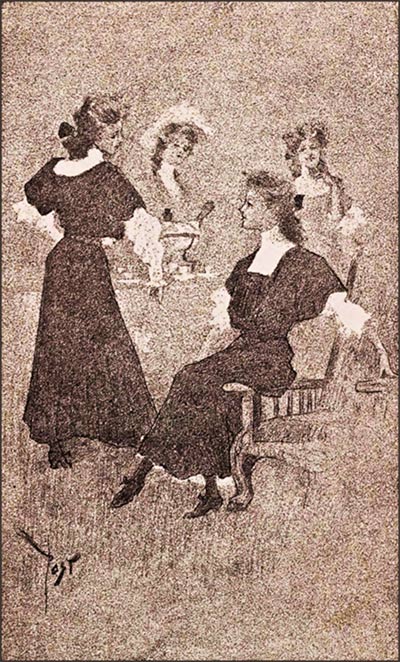
As she stood there in the warm September
sunshine, she found herself taking
notes of the silk and muslin gowns worn
by these new friends, and of the elaborate
styles of hair-dressing. One richly-dressed
girl, who had been introduced as Blanche
Gross, was describing a forty-dollar hat
that she had bought “just to wear in the
house, at teas and receptions.” Jacquette,
fresh from Brookdale, wondered what
Aunt Sula would say to that. She wished
Quis had told her that hats were not worn
outdoors in Channing. Not one of the
girls had any covering on her head.
The chatter about her went on merrily.
Now and then a new girl was brought into
the charmed circle, and passed around, just
as Jacquette had been, but no one seemed
to think of going into school. Jacquette
did not quite understand; she was only sure
that it was all fascinating, and that she
was glad to be a part of it.
“Don’t we go in to see about our classes,
pretty soon?” she asked, presently, of
Louise Markham, a jolly, stylish-looking
senior in a white linen suit, who seemed to
have taken her especially under her wing.
“Oh, no!”—Etta Brainerd, the talkative
girl of the crowd spoke before Louise
could answer—“Sorority girls never
register until second day.”
“But we may have to reform our ways
in that respect, girls,” laughed Louise.
“Did you know the Board of Education
took off five teachers from Marston faculty,
last year, because the enrollment of
pupils on the first day was only a thousand?
Next day, you know, after the rest
of us had registered, there were nearly fifteen
hundred, and the teachers didn’t like
it a bit. It made their work so much
harder.”
“Oh, they always fuss about something,”
said Etta, carelessly. “We have
to take care of the interests of our sorority,
first day. Guess we aren’t going to
let the Kappa Delts run off with the best
girls, while we’re registering!”
Etta was the tallest girl in the group.
Her brown hair was drawn to the top of
her head in a fluffy knot, and her skirts
almost touched the ground. As she spoke,
she was readjusting the sorority pin on
the front of her white lace waist. “It has
to be exactly over the heart,” she explained,
with a smile, as she saw Jacquette
watching her.
“We’re going to have a spread after
a while, and we want you to come,” Louise
murmured to Jacquette. “That’s what
‘rushing’ means. Quis said I should tell
you. We pick out the girls we think we
may want, and give them a good time—spreads
and so on—and then, if we find
they’re all right, we bid them Sigma Pi—ask
them to join, you know.”
But while Louise was speaking, Jacquette
had suddenly recognised a girl who
had spent the summer with an aunt in
Brookdale, a few years earlier.
“Margaret Howland!” she cried, darting
forward and catching her by the arm.
“Jacquette Willard! Where did you
drop down from?”
Jacquette wondered, as she explained, at
the curious expression which crossed Margaret’s face.
“I never dreamed you went
to this school,” Jacquette finished. “I was
going to look you up the first chance I
had, but now we’ll see each other every
day. Isn’t it splendid?”
“Yes, I’m awfully glad to see you,
but——” Margaret hesitated.
“‘But,’ you’re so big you can’t play
with a little freshy?”
“No, indeed! But I’m afraid, if Quis
Granville is your cousin——”
“Jack!” a surprised voice interrupted,
and, turning, Jacquette found Quis looking
down at her in unmistakable disapproval.
“Good morning, Miss Howland,”
he added, lifting his cap to Margaret.
“Excuse my cousin, will you? Some of
the girls want her.”
It was done in a twinkling. Margaret
was swallowed up in the bevy of girls who
had gathered about while she talked with
Jacquette, and Marquis carried off his
cousin in gleeful triumph.
“What in the world!” he began, as soon
as they were out of earshot. “How did
she ever get you?”
“Get me? What do you mean?” Jacquette
protested. “That’s Margaret Howland—a
darling girl I knew in Brookdale,
three years ago.”
“The mischief you did! She’s one of
the strongest workers in Kappa Delta, and
you mustn’t have a thing to do with her
at this stage of the game, or you’ll lose all
your chances with the Sigma Pi girls.
Now, mind, Jack, you’re new here. I know
the ground and you won’t be sorry if you
take my advice. My frat is Beta Sigma,
the best in school—hardest to get into,
finest frat house, highest dues, and all that.
The only sorority that ranks with it is
Sigma Pi Epsilon. I want you to have the
best. Understand?” And, as he ended,
he handed her over to Louise Markham,
whose laugh had rippled out gaily when
she saw them coming.
“I’ll not let her get away again,” she
told Marquis, her dark eyes twinkling as
she put one arm around Jacquette. “We
love her too much, already, to trust her
in the enemy’s camp.”
“Indeed we do!” chorussed half a dozen
girls, gathering about, and, before she
realised what was happening, Jacquette
had been bewitched into forgetting all
about Margaret.
The morning passed, and when the noon
hour came, the girls adjourned to the
Sigma Pi spread. It was given at Etta
Brainerd’s house, and Jacquette found
that it meant sandwiches and salads, hot
chocolate, olives, cake, ice-cream and
candy, all served picnic fashion, with sorority
songs, and laughter and chatter.
When the party dispersed, late in the afternoon,
some one whispered to Jacquette
that she was to stay, and, as soon as the
other guests had gone, the Sigma Pi girls
gathered about and told her that they had
decided to ask her to join their sorority.
Then Louise Markham, who had completely
won Jacquette’s heart, walked home
with her to tell Quis what a success she
had been with the girls, and to charge him
that he must help her with an important
letter which she was to write to her Aunt
Sula that evening.
Accordingly, after dinner, Marquis and
Jacquette retired to the library for consultation.
Jacquette took up a pen. “Tia Mia,”
were the first words she wrote.
“What’s that?” Quis demanded, looking
over her shoulder.
“Tee-ah mee-ah,” pronounced Jacquette.
“It’s Spanish for ‘my aunt.’ We
found it in a book, and I thought it was
cunning; so ‘Tia’ has been my pet name
for Aunt Sula ever since.”
“Oh! Well, go on,” Quis consented,
and after much re-writing, this was the
letter they sent:
“Tia Mia,
“The first day at school has been simply
glorious and now I have a great favour
to ask. Don’t refuse it! I have been
asked to join the nicest girls’ club in Marston
High School. May I do it? Of
course I’d rather wait till you are here
and could know the girls, too, but Quis
says I ought to accept when I’m asked,
as it’s a great compliment, and they may
never invite me again. It’s called a sorority—a
sisterhood, you know—and it
stands for the highest ideals in scholarship
and everything else.
“Darling, please, please don’t make me
lose this chance of being closely associated
with the very best girls, just because you’re
not here to judge for yourself. Trust
me.
“I don’t know what the dues will be, but
not large, Quis thinks, and I could pay
them out of the money set aside for my
education. It’s really a part of my high
school education, they seem to think, here.
“Please say yes, dearest, and by return
mail.
“Always the same love,
“Your Girl.”
CHAPTER II MADEMOISELLE
NEXT morning dawned bright and
clear—another day like midsummer—and,
when Jacquette began
to dress, a remark that Louise had made
on the way home from the spread the night
before, came into her mind.
“This is your travelling suit, isn’t it?”
Louise had said. “It’s so appropriate—plain
and dark! I love plain things for
travelling, don’t you?”
With this in her thoughts, Jacquette
discarded the simple shirt-waist suit she
had intended to wear, and took out, instead,
a fluffy rose-coloured mull, which
Aunt Sula had advised her to put on often
for dinner, while she was visiting at Uncle
Malcolm’s.
She felt repaid for the change when she
saw Aunt Fanny’s welcoming smile and
Quis’s glance of admiration, at breakfast.
Uncle Mac studied her without comment,
but, just as she was starting for school,
he put his arm around her and whispered,
tenderly,
“Your mother’s own daughter—that’s
what you are! Don’t let ’em spoil you with
their secret societies and things. Keep
your pretty head level.”
The pretty head, hatless this morning,
nodded confidently as Jacquette tripped
away at Marquis’s side.
Louise Markham joined them at the
corner, and, a block or two farther on,
Marquis excused himself to walk with a
boy who had met them at one of the cross-streets.
“We needn’t feel jealous,” Louise said,
with a smile, as Marquis left them. “It
isn’t because he prefers Clarence Mullen’s
company to ours.”
“What made him go, then?” Jacquette
asked.
“Oh, business! The Beta Sigs want to
pledge that little fellow, and two or three
other fraternities are after him, too, so
Quis couldn’t lose this chance of courting
him.”
“But, Louise, that boy has such a
queer, sly-looking face! I thought so the
minute I saw him. Is he nice?”
Louise shrugged her shoulders good-naturedly.
“His father has loads of
money and a ball-room in his house.”
“You don’t mean to say that Quis’s fraternity
would choose a boy for those
things?”
There was a scandalised note in Jacquette’s
voice, and Louise laughed.
“Not really,” she said. “I don’t actually
know anything against that Mullen
boy, but somehow, I feel just as you do
about him—creepy—and I can’t help
thinking that his father’s financial position
may have a little to do with all the fraternities
rushing him so hard. Maybe
that’s unjust. I don’t know—but I do
know, Jacquette, that when a girl can look
as much like a flower as you do in that pink
dress, she has no business ever to wear plain
things.”
“Oh, Louise!” Jacquette protested,
looking more like a flower than ever, as
they turned into the school entrance, and
walked up to the office to register.
When they came out into the hall again,
Louise said, “Well, you’re assigned to
room 17, I see. That means you’re going
to bloom in Mademoiselle’s rose-garden. I
’most wish I were a freshman or sophomore,
so I could be there with you. We
seniors have to go up on the top floor.”
“What is Mademoiselle’s rose garden?”
“Come in here and see,” was the answer,
as Louise led Jacquette into room
17 and straight to Mademoiselle Dubois’s
desk, where a half dozen pupils were standing
in line, waiting for the French teacher
to assign them seats in her study room.
Just as she was starting for school, Uncle Mac
put his arms around her
Mademoiselle, a slight figure dressed in
black, was writing busily, but, after a
moment, she lifted her head and fixed a
pair of searching eyes on Jacquette. Instantly,
the girl was conscious of a forceful
character, masked by a dimpling face,
which revealed nothing.
“Jacquette Willard,” Mademoiselle repeated
after Louise, in honeyed tones. “A
little French name, is it not? But it is not
a little French girl? No? Ah, a cousin
of Marquis Granville, did you say? My
cunning chicken, I am charmed to meet
you! You are going to be my child, for
I know your cousin well, and, indeed, I
am so fond of that little wretch!”
Jacquette gasped, and, before she could
stammer a word in reply, Louise’s laugh
had bubbled forth.
“Your old abominable laugh, my sweet
pet,” Mademoiselle chided, turning to
Louise and speaking in the same mellifluous
voice. “You have carried it through
high school, and you will carry it into
womanhood. It is scandalous, dearie.
You shall have that seat next the aisle, my
little plum-tree,” she added, addressing
Jacquette again. “The one in the second
row, honey, and Louise, the dear child,
shall help you make out your programme
for the quarter. You see that all the
classes and all the hours are plainly written
on the board, don’t you, dearie? Go
now, Louise, and help the little Willard,
before the bell rings.”
“There! How do you like Mademoiselle?”
Louise whispered, as soon as
they were seated. “All the other teachers
in high school call you ‘Miss’—but not
Mademoiselle! She makes you feel, just
at first, as if you’d dropped back into kindergarten,
but don’t deceive yourself—you
haven’t! There isn’t a more respected, better
obeyed teacher in Marston than Mademoiselle
Dubois, and, as for French, what
she doesn’t know about it isn’t worth learning.
Did you notice how she spoke about
my laugh? She’s just right. I can’t control
it to save my life. But isn’t she
great?”
“Great—I should think she was!” Jacquette
agreed, impulsively. “I’m afraid
of her and I like her at the same minute.
‘My cunning chicken’! Louise, I’ve had
one year of French at home; I hope I can
take my second year with her.”
“All right; let’s plan it that way.” And
the girls fell to work on Jacquette’s programme.
Tap, tap, tap, sounded on Mademoiselle’s
desk, when they had nearly
finished.
“Now, my little flock,” said the small
Frenchwoman, standing behind her desk
to address the roomful of fifty young people,
whose ages ranged from fifteen to
eighteen. “My sweet pets”—she paused
and dimpled—“at the beginning of the
year, I will explain to you the meaning of
the bells. You see, I never have the least
particle of trouble with the dear children
who study in my room—not the least particle—after
I have once explained the
meaning of the bells. It is this: First
bell, no walking; second bell, no talking;
and third bell”—her voice had dropped
almost to a whisper—“when the third bell
rings, in Mademoiselle’s room, it is always
as still as a little rose garden!”
“What did I tell you?” murmured
Louise. “See how they strain their ears
to catch every word she says.”
“If I hear any voice,” Mademoiselle’s
hushed tones went on, after she had cast
one keen glance at Louise, “if there is ever
any sound at all, I know it must be an echo
from that bad room across the hall, for
my children never give me the least particle
of trouble—the sweet pets!
“Very good. You are just as I knew
you would be, dear children. Now, Alice,
honey, when you registered yesterday, did
you not ask to be excused from drawing,
this quarter?”
“Yes, Mademoiselle Dubois,” answered
a tall, serious looking sophomore, who had
evidently met Mademoiselle, before.
“Well, sweet pet, did you bring your
note of excuse from mamma, to-day?”
“No, Mademoiselle, I forgot it.”
“I am so sorry, Alice, because you see,
dearie, you must go right home after it,
and that means you will miss the first and
second period—both recitations for you—and
that means”—lingeringly and lovingly—“that
means two—little—zeros!
And you see, Alice, that it always pays, in
Mademoiselle’s room, for her dear little
peacocks to do everything just at the right
little minute, because, if they don’t, it
means t-r-o-t, trot!”
She pointed a tiny finger at the door,
and, to Jacquette’s wondering amazement,
tall Alice meekly departed.
As the door closed behind her, Mademoiselle
assumed a meditative expression.
“There are three people talking in this
room at present,” she said softly, addressing
a distant spot on the ceiling. “I am
one of them; I wonder who the other two
could be! Chester!” she added, suddenly,
fixing her eyes on a corner of the room
where a sly whispering was in progress.
“Take your books, honey, and come to this
row at once. No, not there,” she demurred,
as the big, broad-shouldered fellow
sheepishly obeyed. “I reserve those
seats for my French class, and if you
should be studying there, and I should
imagine you were one of my French class
who was not paying attention, you might
get your sweet little ears boxed! Now, as
I was about to say, when I was so rudely
interrupted——”
But the things Mademoiselle wished to
say had to be postponed, for the bell
sounded, and the pupils of her second year
French class—some from her own room,
and some from other rooms—began to assemble
in the front rows. Louise gave
Jacquette’s hand a farewell squeeze, and
hurried away to a class of her own on the
upper floor, while Jacquette, left alone for
the first time, shyly took her place among
Mademoiselle’s pupils, wondering, as she
did so, whether she was likely to get her
“sweet little ears boxed” by sitting at
the wrong desk.
The French recitation proved to be a
taking of stock, by Mademoiselle, of her
class’s stage of advancement, but it served,
at the same time, to fix in the minds of
those who had not worked with her before,
the necessity of keeping eyes and ears
open.
Early in the hour, she called on Arline
Grant, a much be-curled young lady, to
give the rule under which a certain word
preceded the verb in a French sentence
they were discussing.
Arline was silent.
“Class,” said Mademoiselle, “We will
sing for Arline a little song that we learned
at the beginning of our first year in
French. All together, ready! First
verse” (chanting): “Pronoun objects
come before the verb! Second verse:
Pronoun objects come before the verb!
Third verse: Pronoun objects come before
the verb! Chorus: Pronoun objects come
before the verb! Now, Arline, do you
know the little rule, my pet?”
Arline gave it.
“Triumph No. 1!” Mademoiselle exclaimed
brightly. “We have taught Arline
something!” Then she looked
sharply at her book, and said in a surprised
tone, “I notice ‘mon amie’ printed in the
next sentence! ‘Mon’—a masculine pronoun—when
the ‘friend’ referred to is
feminine. A misprint, is it not? Scratch
it out, everyone of you, and write the
feminine ‘ma’ in its place.”
The pupils obediently made the change.
“Class, rise,” Mademoiselle commanded,
and the class rose.
“Now, all who scratched that out, sit
down,” she continued, and everyone except
Jacquette sat down.
“My little Willard!” said Mademoiselle,
in evident surprise. “What are
you walking around here for?”
“Because I didn’t scratch it out,” Jacquette
replied, blushing furiously.
“And why not?” The deep dimples
appeared in Mademoiselle’s cheeks.
“Because the pronoun ‘mon’ retains
the masculine form before a feminine noun
beginning with a vowel or h mute,” Jacquette
faltered, frightened almost out of
her voice at finding herself the only one
who knew it.
“Excellent, dearie! I am charmed!
You may be seated. And for the rest of
you—zero!” Mademoiselle pronounced,
dramatically. “I don’t wonder you look
chagrined, my pets,” she added, “but you
must remember that, in Mademoiselle Dubois’s
classes, it pays to keep your wits
about you.”
“Well, Mademoiselle,” one of the boys
protested, with a shamefaced grin, “it’s
mighty hard for us to keep track of all
those little things. Now, there’s another
point bothers me; the same word has so
many different meanings in French. How
are we going to tell them apart?”
“Honey, how can I bear to have you
ask me so many silly questions!” Mademoiselle
answered, instantly, folding her
arms high on her chest as she spoke.
“Now, listen: There is a big—black—animal,
with long—fuzzy—hair, which our
President loves to shoot—alas! Do you
know the two meanings I gave to the word
‘bear’ in that remark?”
“Why, y-yes,” Clarence stammered,
“The way you used it shows.”
Mademoiselle suddenly waved her hand
at him as one tosses farewell to a baby.
“Also in French, honey!” she told him,
brightly.
All this was very entertaining to Jacquette,
so much so that her algebra class,
which met in the next hour and was taught
by the dignified Mr. Pettingill, might have
seemed dull except for the fact that she
sat next to Etta Brainerd, who wrote her
note after note and slipped them into her
hand during the class period.
It seemed, Jacquette learned while Mr.
Pettingill imagined he was teaching her
algebra, that the Kappa Deltas were extremely
anxious to get her into their sorority,
on account of Margaret Howland’s
former friendship with her, and that they
were planning to ask her to their spread
that afternoon. To outwit them, the
Sigma Pi girls proposed to put their
colours—pale blue and gold—on Jacquette,
even before her Aunt Sula’s consent
should come. In that way she could
appear to be already pledged to them, and
could have a good reason for declining the
Kappa Delta’s invitation.
As soon as the half-hour for luncheon
came, the Sigma Pi girls gathered around
Jacquette.
“We’re not asking you to sign the
pledge without your guardian’s permission,
you understand, dear,” said Louise
Markham, holding the blue and gold ribbons
in one hand and the enamelled pledge
pin in the other. “You simply promise,
by wearing our colours this way, that if
you ever do go any sorority, it will be
Sigma Pi.”
And the end of it was that, when a delegation
of Kappa Deltas, headed by Margaret
Howland, came after Jacquette, a
few minutes later, they found her wearing
the blue and gold.
“I’m dreadfully sorry we can’t be in the
same sorority,” she told Margaret, honestly,
“but my cousin thinks——”
“That’s just why I want you to meet
our girls,” Margaret argued. “Your
cousin isn’t giving you a chance to judge
for yourself.”
“That will do, Margaret!” exclaimed
Etta Brainerd, stepping out of the close
background, where she had been lingering
to protect the Sigma Pi “pledge.” “I
hate to say anything, because I know Jacquette
used to think a great deal of you,
but you know as well as anyone that it
isn’t honourable to try to get another
sorority’s pledge to come to your spreads.”
Then, without giving Jacquette time to
do more than cast an apologetic backward
glance at Margaret, Etta carried her off
out of harm’s way.
Marquis was delighted, that night, when
he saw the Sigma Pi colours pinned over
Jacquette’s heart, and heard her story of
the day.
“You did exactly right,” he told her.
“It shows the Kappa Delts, once for all,
just where you stand, and another thing
I like about it is that it proves the Sigma
Pi girls are dead anxious to get you. Oh,
you’re all right, fairy princess!”
And Jacquette glowed with pleasure at
his words.
The hours dragged slowly for a few
days, after that, in spite of all the absorbing
new happenings. It was because
Aunt Sula’s answer was being waited for,
but it came, at last, and Jacquette waved
it wildly out of her bedroom window at
Louise Markham, who happened to be
passing.
“Louise! Louise! She says yes!” she
cried, joyfully.
“Hurrah!” Louise called back. “I
can’t stop, now, but I’m proper glad. A
delegation of us will be over to-night to
pledge you, dear.”
Then Jacquette sat down alone and read
Aunt Sula’s “yes” all through again.
“About the girls’ club you speak of,”
the letter said, “If it really must be decided
before I come, I am going to leave
it to you. You are almost a woman, now,
and must begin to make your own decisions.
“I am assuming, of course, that Uncle
Mac and Aunt Fanny approve, but, at the
same time, I want you to use your own
mind—not theirs—in forming your opinion.
Find out, definitely, about the expense
connected with it, and be sure, from
all standpoints, that you are not doing
anything you may regret later.
“Loving you always,
“Tia.”
CHAPTER III TIA
“WHO mended the rip in my
glove?” Jacquette demanded,
as she stood in her coat and
hat, ready to start for school. “Tia, you
angel! Stop hiding behind that paper!”
A pair of brown eyes laughed over the
top of the newspaper. Then a slight
woman in a dark red morning gown,
emerged into sight. “I do feel guilty,”
she admitted, roguishly. “I ought to have
trained you so well that you’d have mended
it yourself.”
“Oh, I think you’ve done pretty well,
considering the material you had to work
on,” was the light-hearted answer, and
Jacquette stopped to rearrange her hat
before the mantel mirror as she spoke.
“You don’t know how afraid I was all
day yesterday that some of the sorority
girls would call me to account for that
glove! They’re frightfully particular
about such things.”
“Do they mind little things like a button
missing from a shoe?” Aunt Sula
asked, demurely. “If they do, I think
I’ll petition them to labour with someone
I know.”
“Oh, dear, does that show? I didn’t
think it could with this long dress. It
seems to me I can’t get time to do the
things I ought to.”
Two months of school had gone, and
Jacquette was living, with her grandfather
and Aunt Sula, in a comfortable little
home only a few blocks from Malcolm
Granville’s large one. The pearl-set blue
and gold pin, worn over her heart, proclaimed
that she had been initiated into
her sorority, and her beautiful hair, tucked
up in the back of her neck, and thoroughly
hidden by the conventional big bow, was
witness to the fact that the Sigma Pi girls
considered long, curly braids too childish.
Not only had all the dresses brought
from Brookdale been lengthened, but Aunt
Fannie, prompted by Uncle Mac’s fondness
for his pretty niece, had amused herself
by buying several new gowns for her,
so that Aunt Sula, whose loving interest
had gone into every garment Jacquette
had worn since she was a tiny girl, felt an
odd pang as she gazed after the smart
young woman who started for school,
morning after morning, in unfamiliar costumes.
Sula Granville had not married, but her
heart was a mother heart, and the love she
felt for this child of her only sister was
mother love. Ever since she came to
Channing, she had been missing Jacquette’s
sunny presence about the house,
missing the spirit of helpful comradeship
which she had grown to depend on in the
Brookdale home, but, at the same time, she
had realised that Jacquette was breathlessly
busy from eight in the morning,
when she started for high school, until ten
and after, every night, and the more she
studied the condition, the more helpless
she found herself in coping with it.
“I know how full your time is,” she
sympathised, now; “couldn’t you plan to
come home right after school, to-day, and
do some of the left-overs?”
“Sorority meeting, Tia.”
“I thought that was last Monday.”
“That was a special. This is the regular
one, and it’s a matter of loyalty to go.
We have to pay a fine if we’re not there.
And, to-morrow, Tia, there’ll be rush doings—a
spread, you know—that will last
till dinner time. And oh, by the way, I
want Molly to iron my lace waist so that
I can wear it to-morrow. The Kappa
Delts are working awfully hard to get this
girl we’re after, and it’s understood that
we’re to sport up when we give a spread,
so the new girls will get the impression
that Sigma Pi is the nicest bunch there is.”
“Oh! A girl chooses her sorority by
the way its members dress, does she?”
“Tia, that’s teasing! First impressions
do count, you know.”
“I see. Well, this begins like a gay
week. See what the postman brought, just
now. Uncle Mac has sent us tickets for
the concert, Wednesday afternoon, because
he noticed that the orchestra was going to
play some of the Grieg music you worked
at so hard, last year. Wasn’t he good?”
A worried frown puckered Jacquette’s
forehead. “It was dear of him,” she
said. “But we Sigma Pi girls have promised
to go up and work in the new sorority
rooms after school, Wednesday and Thursday
both. There are pillows to make and
curtains to hem and no end of things
to do.”
“Oh! Well, we can change the tickets
to Friday.”
“That won’t do either.” Jacquette
looked a little shame-faced as she said it.
“Friday afternoon we all have to sew on
the new robes we are making for the initiation,
and Saturday, the initiation takes all
day, you know. So there it is, every afternoon
this week taken, and Wednesday
night Quis wants to bring a Beta Sig
friend of his over here, and then I told the
girls I’d make my pillow for the sorority
rooms before Saturday. That will take
at least two evenings, and you know, Tia,
I have to keep a little time for studying!”
The apologetic tone of this last statement
was too much for Aunt Sula. “Have
to keep time for studying besides doing all
that sorority work?” she asked, with an
air of gentle surprise.
Jacquette pouted, and then laughed.
“You make me think of Mademoiselle!
Yesterday, there was an announcement of
a basket-ball game on the blackboard, and
down at the foot it said, ‘Come, girls, and
help us yell!’ She looked at it; then she
said, in her sweet, soft voice. ‘Come—girls—and
help us—yell! So refined! So
suggestive of a lady! Come—girls—and
help us—yell!’ Not another word, and
wasn’t I glad I hadn’t written it! But
that gentle sarcasm belongs to her. It
doesn’t to you, Tia.”
“Doesn’t it?” Aunt Sula leaned forward
and took her girl’s hands in both of
hers. “Then I’ll say it in my own way.
Jacquette, I am making up my mind that
I’m sorry you joined the sorority.”
“Oh, you mustn’t speak like that to me,
Tia! It’s disloyalty to Sigma Pi to listen
to it. Say anything you want to about
me, but I can’t let you talk against my
sorority. There’s Louise!” Jacquette
added, brightening suddenly, as the Sigma
Pi whistle sounded outside. “I’ll have to
go, dearest. Good-bye.” And off she flew.
“Hurry!” Louise called, as Jacquette
came down the steps. “Quis was here, but
he couldn’t wait. The boys told him there
were things doing over at school.”
“What kind of things?” Jacquette
asked, half running to keep up.
“Oh, the senior boys are up to something
again. You know last week they
painted those big, white ‘Naughty-eights’
all over the side-walks and the juniors
worked all night, I guess, scrubbing them
off with turpentine, and putting ‘Naughty-nines’
in their place. Quis wanted to
drop it, then. He’s class president, you
know, and wants to keep things dignified,
but some of the boys wouldn’t stop,
and——”
“Look there!” Jacquette exclaimed,
suddenly, as, from two blocks away, both
girls beheld a monster Indian in war-paint
and feathers, limply hanging by his neck
to the flagstaff on the topmost peak of
the school building. A placard adorned
his chest, bearing, in huge letters, the
legend, “’09.”
“That’s what they’ve done! Hanged
the junior class in effigy. But how did
they ever get it up there?”
As the girls neared the school, a cluster
of their Sigma Pi sisters opened almost
silently to receive them. Everybody was
crowding around Mr. Branch, the principal,
to hear what he was saying. Marquis,
as class president, had just disavowed all
knowledge of the prank.
“That hung there all day yesterday, to
amuse people on their way to church,” said
Mr. Branch in a tone of annoyance. “It’s
a break-neck climb, but the one who put it
up knows how to get it down!”
A silence fell.
“Who did it?” he challenged, after a
pause, and then a boy who had just come
racing down the street, elbowed his way
through the crowd, and took off his hat
to the principal.
“I did, sir,” he said.
Mr. Branch looked into the frank, sunburned
face. “You ought to be past such
foolishness, Drake,” he replied, gravely,
but the sternness had suddenly gone from
his voice. “You’re a senior, this year, remember.
I shall expect you to take it
down at the noon hour.”
“Who is that boy, Louise?” Jacquette
asked, eagerly, as Mr. Branch strode into
the building and the pupils went trooping
after.
“That’s Bobs Drake, the captain of
the football team and idol of the school.
Didn’t you notice Mr. Branch when he
looked at him? That’s the way with all
the teachers. They can’t be cross with
Bobs more than a minute at a time.”
“Shouldn’t think they could! He’s
splendid. But how is he ever going to
bring that Indian down?”
“We’ll see how at noon. I’ll wait for
you at this door,” said Louise, as they
parted.
Promptly at twelve, the two girls hurried
out, just in time to see Bobs Drake
throwing off his coat and buttoning his
blue sweater close. The ring of boys and
girls around him was growing thicker
every minute.
“I know where there’s a ladder, Bobs,”
some one volunteered.
“No, thank you,” said Bobs, cheerfully,
and, without an instant’s hesitation,
he began shinning up an oak tree, whose
branches grazed the school windows. From
a perch in that, he swung himself lightly
to an addition which leaned against the
main building, and, safely landed there,
made a low bow to the admiring crowd
now gathered. After that, by the aid of
window ledges and cornices, he clambered
to the many-gabled roof and began to
climb—nimbly, cautiously.
The late October wind crackled with a
brittle sound through the yellow-brown
leaves of the oaks. It flapped sharply at
the girls’ gowns, as they stood there with
the cold autumn sunlight shining down
on their upturned faces. Suddenly, a gust
of it snatched Bobs’s cap from his head,
and swept it a block away before the best
runners in Marston could capture it, but
sure-footed Bobs, undisturbed, stood up
on the highest gable, in the midst of an
exultant shout from his spectators, and
calmly watched the race to the end, before
he knelt again, and crept carefully, slowly,
along the last ridge-pole, straight to the
Indian’s side!
“’Rah for Bobs! Bobs! Bobs! Bobs!”
came from below, and then a silence fell
while everyone watched to see what he
would do next. Before they had seen, it
was done. Whipping a ball of heavy twine
from his pocket, Bobs had tied one end
around the Indian’s neck, had cut the
cords which bound him to the flag-staff,
and was swiftly lowering him down the
front of the building.
With a whoop, seniors and juniors
closed upon the helpless dummy, but, in the
end, the seniors triumphed, and bore the
abject Indian, torn limb from limb, to a
vacant field near by, where they promptly
set fire to him.
It was a tame cremation, though, with
few spectators, for all the girls and most
of the boys had lingered to see that Bobs
got safely down. Everyone realised that
there was actual peril in the feat he had
undertaken so gaily, and each danger
point passed in the downward climb
brought forth a noisier cheering. Once
he missed his footing and slipped, the
length of his body, down the steep roof.
The crowd held its breath, but he stopped
himself somehow, and struggled back to
safety, amid a tremendous yelling. At
last, leaping down to the lowest roof, he
caught a branch of the tree, went hand
over hand into the boughs, and slid down
the trunk to the ground, where he found
himself looking straight into the rosy face
of a girl with golden hair, who was clapping
her hands and shouting “Hurrah!”
with the best of them.
Bobs had never seen her until that minute,
but, involuntarily, his hand went to
his capless head. “Thanks, I’m sure!”
he said, with a merry twinkle. Then his
admirers closed around him and carried
him off to the lunch-room.
“What was that he said to you, Jack?”
asked a resentful voice over her shoulder.
“Oh, Quis, are you there? He said
‘Thanks,’ that was all. I don’t know him,
you see. Wasn’t it great?”
“Great foolishness, yes! Don’t you
know you mustn’t let fellows speak to you
until they’ve been introduced?” Marquis
answered, in an undertone, and Jacquette,
turning away with the girls, felt, suddenly,
that the time might come when she
should outgrow her cousin’s leading-strings.
The week slipped away, after that, and
Saturday came. The Sigma Pi initiation,
fixed for that day, was to take place at
Nell Brewster’s, but early in the forenoon,
two girls came down the street, leading a
third, who was blindfolded, and deposited
her in the laundry at Jacquette’s home,
without a word to anyone. Jacquette had
already gone over to Nell’s and presumably
had offered the use of her house to
the sorority, for, a little later, Miss Granville
found another strange girl in the
pantry, taking a double handful of cookies
out of the jar, and, still later, two more
walked into the front door, without greeting
of any sort, seated themselves in the
living-room, and staid there, silent, for
an hour.
Aunt Sula had some difficulty in explaining
these “initiation stunts” to her
courtly old father, especially after he had
tried in vain to make polite conversation
with the two girls who had been rendered
deaf and dumb by their vow of silence.
“Nothing excuses such rudeness, daughter,”
he remonstrated, shaking his silvery
head. “I don’t like this sorosis Jacquette
is in.”
“Sorority, father,” Miss Granville
prompted, with a smile.
“Call it what you will; it’s just as bad,”
he persisted. “Those girls are too young
to run such a society. They’ve proved it,
to-day.”
At ten o’clock that evening, a telephone
inquiry brought back from Jacquette the
word that the initiation was over, but refreshments
were not, and that a crowd of
Beta Sigs, Quis among the number, had
discovered what was going on, and had
broken into Nell’s house, and insisted on being
served with some of the goodies. “Oh,
we’re having such fun, Tia!” Jacquette
concluded. “Don’t sit up for me, you
and grandpa. Quis will bring me home,
and I’ll come as soon as I possibly can.”
Old Mr. Granville went to rest, then,
shaking his head over the change since the
good old days in the country when his
daughters were young, but Aunt Sula sat
in her room and waited. It was after midnight
when she finally heard the careful
click of the front door latch and the creak
of the stairs as a much-subdued girl crept
up.
The feasting at Nell’s had lasted a little
too long, and had been a little too noisy.
Before the party had dispersed, Mr. Brewster,
a blunt, outspoken man, had come
down to the dining-room, where the boys
were pelting each other with cake, and had
given them a piece of his mind as to proper
hours and fitting behaviour. Most of the
girls had cried; the boys had gone home
insulted and angry; but, all the time, deep
in her heart, Jacquette had felt that Nell’s
father had just cause for his action, and
now, as she laid off her wraps in her own
room, she owned to herself that she was
ashamed of the Sigma Pi initiation.
Not since Brookdale had she needed, as
she did at that minute, to talk things over
with Aunt Sula, and when she saw the
light still burning at the end of the hall,
she went to the door, and peeped in.
Sula Granville, in a pale blue wrapper,
sat before the fire brushing out her long
dark hair. She looked extremely girlish
in the dim, flickering light, but Jacquette
was not thinking of this as she paused in
the doorway. Her heart was hungering
for the sympathy which had always been
hers, at need, from the only mother she
had ever known, and she hesitated, now,
because of a vague, unhappy feeling that
something had come between them. It was
a relief, then, when Aunt Sula, looking up,
held out her hands without a word, and the
next instant found Jacquette on her knees
with both arms round the blue wrapper.
Little by little the story of the evening
came out, and, when she had heard it all,
Aunt Sula said, “Come down here, girlie,
with your head on my knee—the old Brookdale
way.”
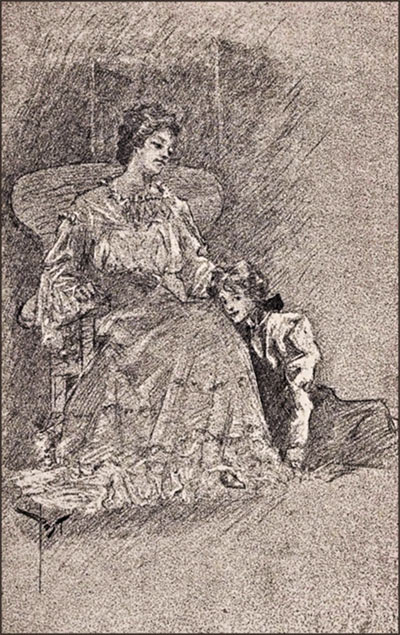
The tired girl slipped to the floor, and
a grateful, mothered feeling came to her
as she felt a gentle hand smoothing her
hair for a minute, before Aunt Sula began:
“You told me once, Jacquette, that
every girl who joined Sigma Pi was allowed
to except her mother, or guardian,
when she took her pledge of secrecy. Do
you remember?”
“Y-yes,” came the doubtful answer.
“The girls did say so before I joined, but
I’ve found out since that they won’t excuse
your doing it unless it’s absolutely
necessary.”
“And the result is, as you said the
other day, that no outsider can judge
sororities quite fairly, because the best
part is secret. Now, I want to judge
Sigma Pi fairly. I want you to tell me all
the good and beautiful things about it.”
There was a pause, while Jacquette
thought this over. Then she offered, tentatively:
“Surely you’ve noticed, Tia, how much
more careful I am of my personal appearance?
That’s sorority influence.”
“Good, too, unless it leads you to spend
more money than you can afford on your
wardrobe and to look down on the non-sorority
girls who can’t dress so well,”
Aunt Sula agreed. “It has occurred to
me, though, that when this elaborate attention
to dress crowds out time for the
care of one’s own bedroom, the sorority
hasn’t taught quite daintiness enough.”
Jacquette looked guilty, but she went
on, sturdily, “A sorority encourages a
spirit of sisterhood, Tia. We have to take
vows to love each other always, and help
each other, and accept criticism from each
other without getting angry.”
“Sisterhood.” The echo was gentle.
“What do you think, yourself, Jacquette,
of a sisterhood with twenty girls which
makes you unsisterly to all girls outside
that clique?”
“Well, at least, it trains us to be loyal
friends.”
“Perhaps; but if loyalty to Sigma Pi
makes you disloyal to duty at home or in
school, isn’t there something wrong with
it?”
Into Jacquette’s thoughts flashed the
memory that two of her Sigma Pi sisters
had deliberately missed their afternoon
recitations, the week before, because they
considered it necessary to take a girl they
were “rushing” to the matinee. “But,
Tia,” she hurried on, defensively, “you
forget its effect on scholarship. We’re
ashamed to fall below passing mark, because
our pin will be taken off if we do.”
Aunt Sula looked thoughtful. “I
wonder if a sorority can help scholarship
while it uses up so many study hours?”
“Oh, it does! And then, it’s good social
training for us, too.”
“Does it teach you to give the Sigma
Pi whistle to a girl a block away, when
I’m walking and talking with you on the
street?” Aunt Sula put in, quizzically.
“No; but that whistle is the accepted
way of hailing each other. All the girls
do it; haven’t you noticed? Here’s another
good point, though—a sorority interests
nice girls in each other instead of
their having their heads full of boys. And
then—well, isn’t that enough?”
“Not quite. Don’t you think that, as
long as your pledges are forced to do
things which make them a nuisance to outsiders,
you’re giving outsiders reason to
think you girls are too young and foolish
to have charge of a secret society?”
“You mean our making that girl steal
cookies!” Jacquette dimpled, in spite of
herself, at the recollection.
“Yes; everything of that sort. And
one more thing; I want to know, positively
that there is nothing in the Sigma Pi initiation
that could offend the delicacy of
any sensitive, modest girl.”
Jacquette recalled a certain rite at
which one of the pledges had balked in
the initiation the day before, and flushed
uncomfortably. Just then the bronze
clock on the mantel struck one with a
silvery note. Aunt Sula looked up, as if
answering.
“That’s so,” she said; “it’s too late.
An initiation that takes all day ought not
to run into the night like this. Jacquette,”
she concluded, “I’ll make this bargain with
you. I’ll be a friend to Sigma Pi, and
never criticise it except as I may suggest
something when we are all alone, if you’ll
try your best to change these points I’ve
spoken of.”
“Oh, Tia!” Jacquette protested, lifting
her head. “You forget that I’m one
insignificant little freshman. The girls
wouldn’t listen to me.”
“One insignificant little freshman with
the courage of her convictions can do
something. I only ask you to try your
best.”
The golden head dropped again, and
the little clock ticked away minute after
minute while the soft light of the fire
wavered over two still figures. At last the
tall girl stood up. “I’m going to try,”
she said, very gravely. “Give me your
hand, Tia. Put your fingers this way.
No, this way. There. It would be wrong
for me to tell this to anyone else in the
world outside of my sorority—and the
girls might not understand how it’s right
for me to tell even you—but that’s the
Sigma Pi grip on our bargain! Good-night,
darling.”
CHAPTER IV BOBS
IT was the noon half-hour at Marston
High, and boys and girls were
crowding into the little bakery
familiarly known among them as the “eat-house.”
Louise Markham and Jacquette had
been lucky enough to get a seat at one of
the three oilcloth-covered tables, but by
far the larger number, with their sandwiches
in their hands, were good-naturedly
jostling for standing-room.
Jacquette had decided that day, after
a few weeks of single-handed effort, to
take Louise into her confidence about the
bargain with Aunt Sula, and Louise’s
hearty response had been an immense relief.
“Your aunt’s exactly right!” she had
declared. “She’s gone straight to the
weak points of Sigma Pi. Talk about a
sorority helping scholarship! The only
thing that has saved my scholarship at
Marston is the fact that my mother
wouldn’t let me go Sigma Pi until I
was a junior, and, even since then, it has
been hard work to keep sorority business
from interfering with my school work. I
believe any girl that gets deep in sorority
doings the first year of high school will
have trouble straightening things out and
doing well with her studies the rest of the
time, and I want you to tell your Aunt
Sula, Jacquette, that I’ll stand by and
work for every reform she asked for. I
can propose things, being a senior, that
the girls wouldn’t take from you, and I
believe we can accomplish something.”
“Oh, Louise, you’re such a splendid——”
Jacquette began, but Louise
nudged her to be quiet. Two boys had
slipped into places which had been vacated
on the opposite side of the table, and, as
Jacquette looked up, she found herself
gazing into the blue eyes of Bobs Drake.
Bobs had scarcely seated himself and
ordered a glass of milk from the distracted
young waitress, who was answering wild
calls for “redhots!” and “soup!” from
all directions at once, before the boys and
girls began to swarm about him.
“I hear you’ve gone into training, now,
Bobs, just like a ’varsity man,” began one
of the boys. “They’re telling around
that you live on birdseed and mush, and
take long runs in the early morning. Is
that right?”
“He wouldn’t come over to the frat
house, last night, anyway,” put in Lawrence
Beach. “I understand he’s started
going to bed at six, now.”
“Then we’ll have to go around and
serenade him,” proposed Rex Morton.
“We’ll give him, ‘Oh, does it not seem
hard to you?’” He hummed the first
line, and the crowd of boys and girls took
it up:
“Oh, does it not seem hard to you,
When all the sky is clear and blue,
And I should like so much to play—
I have to go to bed by day?”
they sang plaintively, while Bobs sat sipping
his glass of milk with a good-humoured
smile on his sunburned face.
As the joking went on, Jacquette knew,
whether she looked at Bobs or not, that
his eyes were almost constantly on her.
She wondered why. It flattered and embarrassed
her at the same time, and she
was glad and sorry when Louise proposed
to go. A moment later, in brushing past
him on her way out, she was astonished to
have him slip a folded note into her hand.
“Louise, he’s written something to me!”
she exclaimed, as soon as they reached the
street. “Let’s see what it says.”
She unfolded the paper and together the
two girls read:
“Will you let me walk home with you
after school?
“Bobs.”
“Do I know him well enough? Say yes,
Louise!” Jacquette demanded. “Blanche
Gross introduced him to me the day after
that Indian performance and I’ve talked
with him in the halls some, since then, but
I never dreamed of his giving me a second
thought, when he’s so popular, and I’m
just a freshman. Blanche says he has the
dandiest morals of any boy she knows.
What do you think, Louise?”
“Oh, he’s nice. I’ve known him all my
life and his mother is one of our best
friends, but he’s not a Beta Sig, and Quis
isn’t going to like it if you choose friends
outside of his frat.”
“H’m! Quis doesn’t own me. Besides,
I have to treat all fraternities alike, according
to the bargain with Aunt Sula,”
Jacquette declared, virtuously, and immediately
began to compose her reply to
Bobs.
That reply consumed a large part of the
study-hour following. The momentous
questions involved were: first, how to begin;
second, what to say; third, how to
end.
If Bobs were any other boy, it would
be right to call him “Mr.,” but no
one in the school said “Mr. Drake.”
Everyone said “Bobs.” His real name
was Robin Sidney Drake, but that was
absurd for Bobs! Besides, he had signed
himself “Bobs.”
Meantime a procession of Aunt Sula’s
admonitions in regard to writing notes to
boys haunted Jacquette like ghosts, and
made her tear up effort after effort. When
the last was finally completed it read as
follows:
“Bobs:
“Yes.
“Jacquette Willard.”
She laid this circumspect epistle on
Bobs’s desk as she passed out of the study-room
to her English class, and two minutes
later Blanche Gross, acting the part
of a Sigma Pi guardian, came hurrying
after, and sitting down beside her, said
reprovingly:
“You shouldn’t write notes to Bobs
Drake, Jacquette. The minute you were
out of the room he showed it to Rex Morton,
and they both laughed.”
“Let them!” Jacquette returned, flushing.
“There was nothing in it that the
whole world mightn’t see. That’s the only
kind of note I ever write to boys, and I
didn’t learn the habit from Sigma Pi
Epsilon, either!”
Then, having heaped her secret vexation
with Bobs and Rex on the head of
Blanche, who was the most prolific writer
of notes in the whole sorority, Jacquette
proceeded to give conspicuous attention
to her English teacher.
It was an eventful moment when she
walked down the street from Marston with
the broad-shouldered captain of the football
team at her side, and Jacquette hugely
enjoyed the sensation she knew she was
causing among the girls. Then they
turned the corner, and, without giving
her time to puzzle longer, Bobs began
abruptly:
“I suppose you’re wondering what I
want, and I’ll tell you, to begin, that I
never would have written you that note
if I hadn’t believed that you’re absolutely
square.”
If Jacquette had heard herself called a
princess among women she could not have
felt more pleased—and her face showed it.
“Of course you know,” Bobs continued,
“that our team has won every game it
has played against any other school this
fall?”
“I think I do!” she flashed, saucily.
“And you know that the next game is
the last of the season—the one that decides
the championship for the year.” Bobs
cleared his throat, and Jacquette waited.
“Well, of course you know that, according
to the rules at Marston, if a football
man’s average for the week falls below
on the day before the game, he’s debarred
from playing. You knew that, didn’t
you?”
“Yes.”
She wondered what was coming.
“The point is this: I’ve had a hard
pull to keep above in my studies and keep
the team in shape, too, and I haven’t always
done it, either. You probably know
that I missed playing in two games this
season, because I was below, those two
weeks. But, such marks as I have had,
I’ve earned myself. I haven’t had credit
for a stroke of work that was done by anyone
else.”
“Of course not!”
He looked at her curiously. “It’s a
common thing, you know, for the fellows
on the team to have someone else do their
studying during the season,” he explained,
defensively. “But I’ve stood against it,
and they all know it. That’s the reason
I’m in such an awkward box, now. The
fact is, I’m below in my English this week,
and, besides all the rest of the work, there
are two themes lacking, and, to make it as
bad as it could be, one of those themes is
a sonnet!”
“But Bobs, a sonnet—that’s easy!”
“That’s what I’ve heard about you,” he
answered, hurriedly. “They say you can
write poetry as easy as breathing. Now,
you wouldn’t believe it could be done, but
I’ve managed, all through my high school
course, to steer clear of sonnets. I believe
it’s a put-up job, anyway, requiring so
much extra work this week. I have English
with Miss Breckinridge, you know,
and she’s down on football. She thinks
she can keep me out of the game by piling
on a sonnet, after everything else. Well,
she’s cute! I give up. I can’t write a
sonnet.”
“Oh, Bobs!” Jacquette stared at him
in blank dismay. “You’re captain! You
must play in the championship game!”
“Then will you write the sonnet?”
Jacquette stood still and met his honest
blue eyes. No one who knew Bobs could
help trusting him. As far as she could see,
he was not ashamed of having asked the
question.
She knew that it was a common thing
among the girls to prepare lessons for
their boy friends on the team, but, somehow,
it had never entered her mind that
she could do such a thing. Suddenly the
thought that she—Jacquette Willard—might
gain or lose Bobs Drake the chance
to play in the championship game, took
away her breath.
“But it wouldn’t be your work, Bobs,”
she uttered, mechanically, while the sweet
flattery of the situation tugged at her
principles.
“What do I care?” he protested. “I’m
not going to write sonnets for a living.
I’m going to be an engineer. Oh, I know
how you feel about it, because my principles
are just the same, but this case is an
exception. We wouldn’t be setting a bad
example, even, because no one except you
and me need ever know. That’s one reason
I asked you; I knew you’d never tell.”
They had reached Jacquette’s home
while he was speaking, and as she glanced
at an upper window, Aunt Sula’s face
leaned forward to smile a welcome.
“Oh, Bobs!” Jacquette cried, reproachfully,
then, “you said you thought I was
square!”
“I do!” he answered, stoutly, and after
that they argued for a full half hour,
standing there at the foot of the steps in
the chill November day.
The end of it was that Bobs went away
with several new ideas about the conscience
of a girl. Not only that; he had promised
to burn the midnight oil, before he slept,
over a sonnet which was to be addressed to
past football heroes of Marston High,
whose ghosts, Jacquette had hinted, might
be imagined as haunting the assembly-room
where their gloriously-won banners
still hung, and where the big mass-meetings
were always held.
It would have been far easier for
Jacquette to compose that sonnet on the
spot, than it had been to keep from doing
it, and, as she entered the house she was
feeling triumphant over the way she had
insisted on Bobs’s working out his own
scheme. Then, before she had laid down her
books, the bell sounded, and, turning, she
saw her cousin Marquis on the threshold.
“Come out and walk around the block
with me, Jack,” he demanded. “I want to
see you alone.”
“All right, Quis,” she answered, happily,
stopping to give her white-haired
grandfather a hug as he came out of the
library to meet her. “Just sit down a
minute, please, while I run upstairs to
speak to Tia. Then I’ll be à votre service.”
But, instead of accepting her suggestion,
Marquis excused himself to his
grandfather and went out on the steps,
where Jacquette found him a little later,
with Clarence Mullen. Marquis had just
loaded his own school-books on top of
those Clarence already carried, and was
giving a list of orders in a tone that a
master might use with a slave. “After
that,” he was finishing, as Jacquette appeared,
“take these books to my house and
wait there till I come, no matter how late
it is.”
Jacquette glanced at Clarence with
quick understanding. Far from seeming
humiliated, he had an air of new importance
as he touched his hat to her and
hurried away.
“So he’s pledged Beta Sig, is he?” she
asked, with a smile.
Marquis nodded without speaking, as
they went down the steps together.
“I’ve a small grudge against that boy,
because you deserted Louise and me to
walk to school with him one morning,”
Jacquette went on, lightly. “He’s been a
rival of mine since then. Every time I
want to speak to you, he’s right at your
heels. I think you have some sort of fascination
for him, Quis, the way he follows
you around.”
“But of course the fact that he has a
special admiration for your cousin doesn’t
win him any favour in your eyes,” Quis
said, stiffly.
“Of course it does! In fact that’s the
only reason I haven’t let myself take a
prejudice against him. Why, Quis!”—turning
a surprised face to him—“what’s
the matter?”
But Marquis met her questioning look
coldly. “I suppose you haven’t forgotten
that Bobs Drake is an Epsilon Lambda
Kappa,” he answered.
There was something irresistibly funny
to Jacquette in his solemn way of pronouncing
those three Greek letters, especially
as the members of Bobs’s fraternity
were universally known around
school as the “Elks.” In spite of herself,
she smiled mischievously as she answered,
“No; I haven’t forgotten.”
“Perhaps that doesn’t mean anything
to you,” Marquis went on, severely, noting
the smile. “I’ve heard, before, that girls
had no sense of honour, so probably the
fact that the Elks are recognised as good
friends of Kappa Delta, always working
to land the best girls in that sorority,
wouldn’t make any difference to you—a
Sigma Pi. Of course, my frat makes it a
point to help Sigma Pi, and, naturally, it
expects a little appreciation in return, but
that’s not my point, now. How do you
suppose it made me feel to have the other
fellows in the frat house, just now, see
you, my own cousin, walk past with a
fellow that has treated me the way Bobs
Drake has?”
“Quis, what on earth do you mean?”
“I mean that when he was elected captain
he put Ned Woodward on the team
instead of me, just because I’m a Beta Sig
and Ned’s an Elk. Yes, he did! Fraternity
prejudice isn’t supposed to rule in
the make-up of a football team, but it got
in its work that time. Ned’s no better
man than I am, and most of the fellows
will tell you he isn’t as good. Then Bobs
made me his sub. That means I have no
chance to play, ever, unless he falls below
in his marks or gets hurt in the game.
Haven’t you caught on to the fact that
the reason I could play in those two games,
early in the season, was because Bobs
Drake wasn’t above, those weeks? Do you
know that a fellow has to play at least
two games and a half, in order to win his
football emblem? Unless I play another
half-game with the team—and there’s
precious little hope of it, now—I won’t
have a right to wear the letters of my
school on my sweater, this year.”
“But Quis——”
“I tell you, Bobs Drake doesn’t intend
I shall have that right. He thinks I need
taking down because I’ve lived abroad, or
some such rot. But he’s hurting himself,
all right! Talk about his being the idol
of the school! You wouldn’t think so if
you could hear the fellows talk, down at
the Beta Sig house. They won’t get over
his slight to me in a hurry, and, for my
part, I never shall. You can choose between
Bobs Drake and me, right here and
now, Jacquette. You know the facts.
Are you going to have anything more to
do with him?”
Jacquette hesitated an instant, but that
instant was too much for Marquis’s hurt
pride. He said something that stung, and
she answered back as sharply as she could.
They went around the block, not once, but
five times, before Jacquette finally rushed
into the house and up to Aunt Sula’s room,
where she flung herself on the couch in a
tempest of tears.
“Oh, Tia, Tia! Quis is dreadfully angry
at me!” she sobbed out. “He has said
such awful things! He has even accused
me of coaching Bobs Drake to keep him
above this week, so that he can play in
the championship game and keep Quis
out!”
CHAPTER V THE GAME
“THIS is to certify that Robin Sidney
Drake is above in all his studies at
Marston High School, and qualified
to enter the football game on Saturday,
November 16, 1907.”
Those were the words on the paper
which Bobs fluttered in Jacquette’s face
when he met her in the hall between bells,
on Friday afternoon. The document was
signed by all his teachers, and, at the foot,
appeared the principal’s name, preceded
by the mystic letters, “O. K.”
“Hurrah!” she cried, her face pink
with gladness, in spite of an uncomfortable
thought of Marquis. “You did it
yourself, that’s the best of it! Now, you
may decide to write sonnets for a living,
after all.”
“Not much!” he denied, so fervently
that Jacquette laughed.
“How perfectly funny it looks to
see your name written, ‘Robin Sidney
Drake’!” she went on, still admiring the
paper.
“Why? Isn’t it a nice name?” he
asked, anxiously. Bobs had always cherished
a haunting doubt about the propriety
of naming a boy after a bird.
“Oh, yes, beautiful—only nothing
seems quite right for you but Bobs.”
“All right, say it then. By the way,
‘Miss Willard’ seems perfectly funny to
me.”
“Why? Isn’t it a nice name?” she
mocked.
“Oh, yes, beautiful—only not quite
right for you.”
“What is right for me?”
Bobs hesitated, but he knew what he
wanted. “Quis calls you, ‘Jack,’” it
came out at last.
“All right, say it, then!”
They were still laughing over this little
skirmish when Mademoiselle passed them
on the way to one of her French classes.
“Coming to the game, to-morrow,
Mademoiselle?” Bobs asked her.
“No, lambkin, I shall not come,” she
answered, sweetly. “I dearly love the
little boys who play football, but I would
so much rather go to see them in the hospital,
afterward!”
Bobs laughed, and before he could
speak, Mademoiselle hurried along, adding
over her shoulder:
“Honey, I know just one thing about
the little children who play football.
Sometimes—once in a long while—they
pass my examinations!”
The big fellow sent a smile of genuine
liking after her. “Can’t get ahead of
Mademoiselle,” he said, but, to his surprise,
as he turned back to Jacquette, she
met him with a serious, almost rebuking
gaze.
“Bobs,” she said, “Quis thinks there’s
no excuse for a football man’s having the
reputation Mademoiselle gave you just
now. He says a fellow can play football
and keep up his studies, too, if he tries
hard enough. He does it. He stands well
in everything, and you know he’s a good
football player.”
“Oh, yes,” Bobs assented, carelessly.
“Quis never has to work on his lessons,
though. He just looks at ’em. Most of
us have to peg.”
“Bobs,” said Jacquette, with a sudden
little tremble in her voice, “can’t you—couldn’t
you, possibly—Bobs, won’t you
please manage, somehow, to put Quis on
for the game, to-morrow?”
Bobs’s
face was blank with astonishment.
“What can I do?” he exclaimed. “He’s
my sub, you know. You wouldn’t have me
deliberately get smashed to give him a
chance?”
“Of course not! But Quis is as good
as any of the team. You know that. Why
couldn’t you put him on instead of one of
the others? The rest have all played
enough to win their emblems, haven’t
they?”
“Yes, but see here! I can’t pick a
fellow off the team and put another in his
place, as if they were so many ninepins.
They have feelings—and rights, too. A
girl can’t understand!”
“I understand this much,” she insisted,
her eyes filling with tears, “you’re the captain,
and the boys think whatever you do
is right, anyway, and you could manage it,
somehow! I stood up for you to Quis,
Bobs, but if you really did keep him off the
team just because he was a Beta Sig, and
now won’t even let him win his emblem, I
can’t help thinking you haven’t been
square!”
“It wasn’t all because he was a Beta
Sig,” Bobs protested, warmly. “But,
other things being equal, any fellow’d give
the preference to his own fraternity. Quis
would, himself. Why, the Beta Sigs ran
the team like tyrants, last year, and this
time we thought the Elks might have a
turn. ’Tisn’t right, though. I’ve been
sorry, ever since, that I didn’t put Quis on,
but I can’t help it, now. It’s too late.”
Jacquette listened unmoved. “You
could do it if you wanted to. I know you
could,” was all she said, as she hurried off
to her class.
They had been standing by the door of
an apparently empty recitation room, but,
as they turned away, the small, dark face
of Clarence Mullen peered at them curiously
from the doorway. He had been
putting some work on the blackboard, just
inside the room, and had heard every
word.
Long before two o’clock, the next afternoon,
twenty Sigma Pi girls, in gala attire,
were seated in the front row of the grand
stand, waiting for the championship game
to begin. Just behind them sat their
rivals, the Kappa Deltas, while less important
sororities—each a clan by itself—were
scattered through the crowd as near
to the front as they could find places. It
was Marston against the Daniel Webster
High School, and the contest would be the
closest of the season.
Gradually the seats filled until the stand
where the Marston pupils sat, and the
other on the opposite side of the field,
which was reserved for students from
Webster High, were both packed.
At last a gate at the end of the field
swung open, and the Webster team came
trotting out. Like one body, every person
on the Webster grand stand was on his
feet, and black and red banners fluttered
out from end to end of that mass of people,
while boys and girls together yelled:
“Webster! High!
Hi! Yi.
Sky! High!
Webster!”
Flutter—flutter—flutter—said the black
and red, and the roaring from the Webster
side waxed louder and louder, as the Daniel
Webster team began its signal practice on
the field, but all this time the Marston
stand remained a model of dignified silence.
A little longer. Then watches began to
be pulled out. What was the matter? It
was past time for the game to begin.
Where were the Marstons?
At last, just as everyone was asking this
question, the other gate opened—another
team was in the field! Presto! The Marston
grand stand was on its feet. Blue and
white!—blue and white!—blue and white!—rippling,
waving, flapping in the November
sunshine, while the new cry that
rent the air was:
“Osky! Wow! Wow!
Skinny! Wow! Wow!
Marston! Wow!”
“Skin Marston!
Wow! Wow! Wow!”
came back from the Websters in a deafening
screech, and of all the voices on both
sides, no two were used more vigorously
than those of Jacquette and Louise, who
stood in the front row of the Marston
stand, and “osky-wow-wowed” with all
their girlish might for the glory of their
school.
“I don’t see Bobs anywhere,” Jacquette
whispered, as she rested her lungs for a
minute. “I can usually pick him out first,
because he doesn’t wear any head guard,
and by his white sweater, too. Does he
wear a different colour from the rest because
he’s captain? It’s lots more effective
than the blue ones the other boys have.”
“I know,” Louise assented, with her
eyes on the field. “The blue ‘M. H.’ is
pretty on the white, isn’t it? Sh!—look!”
The whistle had blown and the teams
were lining up for the game. People had
settled down into their seats, and were
watching eagerly. “There’s Reddy!”
“Go it, Reddy!” “That’s Shorty!”
“Look at Ned!” “Come on, Chub!”
were the explosive cries that had taken the
place of continuous yelling as the game
began. Then—attention!
Quis it was, running the team in Bobs’s
place. What did it mean? Where was
Bobs? But the game had started.
Forward—and back! Forward—and
back! Forward—and back!—struggled
the two teams, now on Marston territory,
now almost to the Daniel Webster goal.
Two more evenly matched schools it would
have been hard to find. Each had behind
it that season an unbroken series of
triumphs; to both of them this game meant
more than the mere winning of the championship
banner—it meant the overcoming
of a hated rival.
Where was Bobs Drake? That question
was the undercurrent of all the perfunctory
cheering on the Marston stand, and
with Jacquette, it swept away every other
thought.
“It’s my fault!” she kept repeating in
a horrified tone, to Louise. “It’s all my
fault! Look! We’re losing ground! We
are! Louise, I made him let Quis play. If
Marston’s beaten, it’s all my fault!”
“Nonsense!” Louise insisted. “Do
you think Bobs Drake would desert the
team because a girl told him to? There’s
some other reason. But look! Oh——”
No one ever knew just what happened.
Two minutes of play were left. There was
a weak spot somewhere in the Marston
line; a trick play; a wildly struggling
mass. Then a red-clad form, the Webster
quarter-back, pursued in vain by the best
men on the Marston team, shot across the
field, and fell exhausted, with the ball in
his arms, just over the Marston line!
An attempt to kick goal failed; time was
called; the first half was done; the score
stood five to nothing in favor of Webster
High!
The Webster yelling was terrific, as the
tangle of human beings began to resolve
itself into individuals, and clear the field,
but among the Marstons arose a great
buzz of anxious questioning. Where was
Bobs? What had become of their captain?
Louise was trying to keep Jacquette in
her place until they could get some news.
“But I can’t sit here and wait!” Jacquette
refused, excitedly. “I must find somebody
and do something!”
“Well, I’m going with you, then,”
Louise gave up at last. “Keep our
places, girls,” she called to the rest of
the Sigma Pi crowd, as she followed Jacquette.
“Now, what can you do?” she demanded,
as she overtook her. “A girl
can’t go to training quarters.”
“I don’t know! Can’t I send a message
to Bobs, some way?”
“There goes Bud Banister! He’s
manager of the team,” cried Louise.
“Bud! Bud! Tell us what’s the matter!”
“Matter enough!” the tall, lanky fellow
flung back angrily, as he ran past. “Bobs
went off down-town on the two o’clock train
and sent us word to go on with the game
without him!”
“I told you, Louise!” Jacquette
gasped. “Bud, wait!” she called.
“Miss Willard! Look here!” put in a
breathless voice at Jacquette’s elbow, and,
turning, she saw Clarence Mullen, his
small, dark face the sickly colour of fear.
“What shall I do?” he demanded, as if
consulting a confidante. “I told ’em he
went down-town, but it wasn’t so. I’ve got
him locked in the gymnasium, over at
school, but I can’t let him out for the next
half, even if I want to, because the janitor
came out of the building when I did, and
he locked the outside door, and I haven’t
got a key to that!”
Jacquette whirled around, and towered
above the boy’s shrinking figure. “What
are you saying?” she cried out, seizing
him by both shoulders in her excitement.
“You locked Bobs in the gymnasium?”
“Yes!” He faltered under her wrathful
glance. “I—I heard you talking to
him yesterday, and I—I knew the Beta
Sigs all thought it was dirty work that
Granville couldn’t win his emblem, and—I
had the chance! He was late, and he ran
down to the gym alone to change his
clothes, and left the key in the outside of
the door, and while he was at his locker, I
shut it and turned the key, and then the
janitor came away when I did, so there
was no one to hear him and I told——”
“I believe it’s true!” Louise broke in.
“There goes Mr. Branch, now, with Bud
Banister! We must tell them—quick!”
The grey-haired principal of Marston
turned in surprise, as the girls, followed by
Clarence, dashed up behind him, but, before
their jumble of explanation was done,
he started for the school, racing like a boy
with Bud Banister. Mr. Branch had a key
to the building, and, as they came near,
they heard shouting and pounding, and
saw Bobs’s flushed face looking out
through the iron-barred basement windows
of the gymnasium.
“Everybody in the block has gone to
the game,” Bud panted, “or someone
would have heard him, sure!”
It was the work of one excited moment
to set Bobs free, and no time was wasted
in words. The case of Clarence Mullen
could wait; the game would not. All Bobs
asked was how the score stood, and
whether the second half had begun, and
even this information he took on the run.
Not one of them could keep up with him
on the way back to the field. Bud Banister
was at his heels; Jacquette and Louise
trailed after, and, last of all, came Mr.
Branch, with a stern hand on the shoulder
of Clarence Mullen, questioning him
sharply, as they hurried along.
The Sigma Pi girls on the grand stand
received Louise and Jacquette in a flutter
of curiosity, for only stray rumours of
Bobs’s desertion had been passed along to
them, but, before there was time for explanation,
the whistle blew, and all eyes
turned to the field.
Then a shout went up—bigger and
wilder than any shout that had gone before.
Bobs Drake was there! Marston
was safe!
As the teams faced each other, just before
he took his place as quarterback, Bobs
had passed along the line, murmuring a
personal word of encouragement to each
of the boys. Up to that instant, they had
been parts of a well-oiled machine; now
they crouched there, every man of them
ready to play that game with his head, his
heart, and his whole soul.
On the grand stand where the Sigma Pi
girls were sitting, a quick glance of intelligence
ran along. “Webster never would
have made that touchdown if Bobs had
been here!” was whispered from one to
the other.
“That’s not fair!” Louise murmured
to Jacquette. “I’m not saying anything
against Bobs, but my brother says there
isn’t a better quarterback on a high school
team anywhere than Quis.”
Meanwhile, down in the field, the struggle
of the first half was being repeated.
Marston was reinforced by Bobs’s presence,
but Webster played with the confidence
born of success, and, again, each
fought an obstinate foe.
If systematic cheering could have won
the game, Marston would have had it.
Over and over, the grand stand rose to its
feet and shouted as one man such heartening
yells as,
“Harum! Scarum! Wah Whoo!
Hear us! Cheer us! White and blue!
We play football! That’s no joke!
Marston High School! Hic! Haec! Hoc!”
Down below, Captain Bobs Drake,
dimly conscious of the support the school
was giving him, seemed, by sheer force of
will, to be driving his team toward the far
white goal line which meant victory. The
score still remained as at the end of the
first half. As the close of the game approached,
he realised, almost with desperation,
that no combined effort on the part
of the team could break down the defence
which confronted it. He, Bobs Drake,
must win that game.
“Seven rahs for the team!” roared the
man who was directing the cheering from
the Marston stand, and, “Rah! Rah!
Rah! Rah! Rah! Rah! Rah! Bobs!” was
exploded on the air.
But Bobs heard none of it. At that
moment, a fumble on the part of one of
his men, had placed the ball at his feet, and
like a flash, with the pig-skin in his arms,
he had broken loose, hurdled a crouching
player, flung two more out of his path—and
gained the line.
Five to five—said the score! Marston’s
one chance of winning depended, now, on
Bobs’s ability to gain an extra point by
kicking the ball over the cross-bar between
the goal-posts. There was a moment of
breathless suspense. Then the ball sailed
proudly over the bar—time was called—and
the Marston crowd went wild!
The game was won. The Marston stand
emptied itself like an avalanche into the
narrow space between it and the fenced-in
field. The wonder was that everyone got
down alive, for the leaping and scrambling
and pushing were terrific. Everyone
wanted to be first at the gate where the
team was coming out on its way back to
training-quarters.
From their seat in the front row, the
Sigma Pi girls had best chance, and
Jacquette and Louise stood close to the
entrance as the triumphal procession appeared.
First came Bobs, proudly borne aloft
by four of his team. There was mud
on his forehead, mud on one cheek, and a
long scratch on the other—but he was a
hero, every inch, in the hearts of his comrades,
and the ovation they gave him
proved it.
Close behind him rode Quis Granville,
and after him the rest of the eleven, each
lifted on the shoulders of three or four
fellows.
When they had all tramped by, the
crowd of schoolboys that always straggles
after the team fell into line behind them,
and the Sigma Pi girls began to chatter.
“What will they do to that wicked little
Clarence Mullen?” Blanche Gross demanded.
She had been gleaning the facts
from Louise and passing them on. “He’ll
surely be expelled!”
“I don’t know! But I could forgive
him, after that victory!” put in Mamie
Coolidge, who had been screaming, and
jumping up and down until her new red
velvet hat was flopping wildly over one
ear. “Jacquette Willard, you tell your
cousin for me that I never saw such a
tackle as that in all my life!”
“Yes, but think of
Bobs’s
kick!” Etta
Brainerd put in, soulfully. “Didn’t he
look happy when they carried him by?
He saw us—don’t you think so?”
“He looked straight at you, Jacquette,”
Louise whispered.
“I know it,” she whispered back, “and
I was so busy waving to him that I never
even saw Quis until he was away past!”
CHAPTER VI THE MASS-MEETING
“THERE!” said Jacquette, holding
up a huge yellow chrysanthemum
that she had just finished.
“Would anyone guess it was paper?
That’s my fiftieth, and I must go.”
A committee of Sigma Pi girls had met,
that afternoon, in the sorority rooms
which were on the third floor of Blanche
Gross’s house, to work on the decorations
for the annual dance.
“Aren’t they going to look lovely, nodding
around among yards and yards of
blue ribbon!” Blanche exclaimed, twirling
a duplicate of Jacquette’s flower above her
head. “Don’t go, Jacquette,” she added,
as a white-capped maid appeared with a
tray. “There are signs of hot chocolate
on the horizon. Besides, we faithfuls may
have to do more than fifty apiece unless
the rest of the girls come to time. We
must have a thousand chrysanthemums,
you know, or it won’t make any show, at
all.”
“Oh, well, I can’t resist the chocolate,”
Jacquette yielded, sitting down again,
“but I must skip, right after that. Truth
is, there’s been so much to do about the
dance that I’ve scarcely looked at a lesson
for a week, and I simply must get in a
little studying before my algebra exam,
to-morrow morning.”
“What a nuisance to have exams the
week of the dance!” Mamie Coolidge sympathised,
as the chocolate was being
handed around. “Oh, by the way,
Jacquette, what about your carriage for
the dance? I heard your aunt wouldn’t
let you have one.”
“What! Going to a formal dance without
a carriage?” cried Etta Brainerd, in
a scandalised tone. “Jacquette—you
poor girl!”
Jacquette flushed. “Pity’s wasted,
Etta,” she answered, rather curtly. “I
expect to have a carriage.”
“But since when?” Mamie persisted.
“Flo Burton told me you couldn’t.”
“If you want the whole story, it’s this,”
said Jacquette. “At first, Aunt Sula
didn’t like my asking a boy to take me to
the dance, but when she found it was the
sorority way, she let me invite Bobs. Then,
when she found that he was expected to
pay for a carriage, she did suggest that I
do without one. You see, she supposed,
because we’re young, the whole thing
would be simple—early hours and all that.
But when I told her how it really was, she
said she was going to hire the carriage for
me herself, and that I should invite Louise
and Bud Banister to go in it with Bobs
and me. So I did.”
“And a lovely plan, I call it!” Louise
chimed in. “You’d have laughed to see
the look of relief on Bud’s face when I
told him! It isn’t so easy for him to get
money from his father, I guess. You
know, girls, it is a sort of hold-up, the
way we invite the boys and expect them
to furnish carriages.”
“Oh, I don’t know,” Mamie objected,
while she dropped another lump of sugar
in her chocolate. “They get a chance to
come to a dance that costs us nearly three
hundred dollars. My mother thought
that was terribly extravagant until I told
her how much worse some other sororities
are. Did you know the Omikron Gammas
had to put up twenty dollars apiece for
their dance, besides the regular dues? I
say it’s pretty creditable to Sigma Pi, that
we draw all our funds out of the bank and
give our dance without any extra taxing,
when we may be needing that money any
time, to fight the Board of Education
with!”
“There are signs of hot chocolate on the horizon!”
Everybody, except Mamie, laughed.
She was the spoiled child of Sigma Pi, and
when she lifted her doll face to make a remark
it was always the signal for indulgent
smiles.
“I wouldn’t say that outside, Mame,”
Blanche advised. “It might not sound
well to the school authorities.”
“It’s true, just the same. Didn’t Sigma
Pi have to give a hundred dollars to the
inter-fraternal league, last year, when we
got the injunction to keep the Board from
enforcing that rule against secret societies?
And if the Board makes any more
silly old rules, the boys say we’ll have to
get a good lawyer, and fight the thing to
a finish.”
“Just think,—what if they should ever
succeed in shutting secret societies out of
high school, altogether!” Louise suggested.
“They never can. We’re too powerful
for them,” Blanche said, decidedly. “The
only result would be that we’d have to work
in the dark.”
“Well, in the meantime, yours truly is
going home to study,” Jacquette put in,
setting down her cup. “’Twas superfine
chocolate, Blanche,” she added, as she
stepped gingerly over the billows of tissue
paper that covered the floor.
“Wait for me, Jack,” called Louise.
“I’ve made sixty chrysanthemums; that’s
ten more than my share, and I’m needed at
home, myself. Mother isn’t well to-day.”
“Pretty sorority spirit you girls show!”
Etta grumbled, as she began crimping
yellow petals again. “You might stay
and help the rest of us, even if you did get
yours done first.”
No one echoed Etta, but there was a
subdued manner about the farewells that
seemed to give consent to her feeling, and,
as the two girls walked down the street together,
Jacquette said:
“Louise, sometimes it seems as if I
couldn’t do enough for Sigma Pi to suit
the girls. They call me a traitor every
time I speak of having to study, or to do
anything at home, and, truly, I’m so
rushed that I can’t get time to mend my
own stockings! There’s sorority business
on hand from morning till night.”
“I know; all you can do is to hang on
to your own judgment and not let the girls
put too much on you. They count on the
freshmen being flattered at the chance of
doing most of the work, you know. There
goes Quis around that corner, Jacquette.
By the way, I was glad to see you were
on speaking terms with him, this morning.”
“Yes; we had to make it up after a
fashion. But, oh, how angry he is with
Clarence Mullen!”
“I don’t wonder at that.”
“No; I don’t. He’s afraid people may
think he knew what Clarence was going to
do; so he’s making his disapproval as
public as he can. Of course he won’t let
Clarence into Beta Sig, now, and he’d like
to have him expelled from school, but Mr.
Branch takes the ground that Clarence is
less to blame than the big boys that talked
all this feeling into him. If that’s so, I’m
partly responsible, too; he overheard me
talking to Bobs about it, and that influenced
him, you see.”
“But that’s no excuse for what he
did!”
“No; Mr. Branch doesn’t excuse him,
but he says Clarence is so much younger,
and so easily influenced that he’s like one
of these anarchists that get all inflamed by
speeches they’ve heard and things they’ve
read, and imagine they’re doing a heroic
act when they go and shoot the President.
You ought to have heard him lecture the
Beta Sig fellows in the talk he gave yesterday.
He says Clarence actually expected
they would applaud him, and that
it reflects great discredit on them.”
“Well, there’s something in that, isn’t
there? But, if I were Clarence I’d sooner
be expelled than come back to Marston
and face the feeling there is.”
“He’s not coming back. His father is
going to send him to military school.
Louise, did you know that Bobs went to
Mr. Branch and told him that, as far as he
was concerned, he hoped Clarence would
get another chance?”
“No! What did Quis think of that?”
“Oh, Quis doesn’t like anything Bobs
does! Here he’s won his emblem, but he
says it’s no thanks to Bobs; that he never
would have got it if Bobs hadn’t been
locked up. I wish you’d talk to him. He’s
so jealous of my liking any boy outside
of his frat! This morning he accused me
of getting the girls to give our dance on
the same night the Beta Sigs have theirs,
so that he’d be tied up for that evening
and I could feel free to ask Bobs!”
“Foolishness!”
“He doesn’t know it’s foolishness,
though. Louise—” Jacquette lowered her
voice as if she knew she were uttering
heresy—“with Quis acting this way, and
the Sigma Pi girls calling me disloyal every
time I look at an old friend like Margaret
Howland—I sometimes wish there were no
such thing as a fraternity or sorority in
school!”
Louise turned and looked at the tired,
flushed face.
“That’s a mood, honey,” she answered,
sagely. “I’ve had it, myself, but it
comes back to this, every time. As long
as there are sororities, we want to be in
them. How would you like to go to a
dance and be told that, because you were
a non-sorority girl, you must stay in one
end of the hall and not dance beyond a
certain imaginary line on the floor?”
“They wouldn’t do it!”
“In some schools they do. Not here,
because non-sorority girls aren’t invited.
Do you know what would happen if you
had asked a non-fraternity fellow to the
dance? You’d dance with him and not
another soul, all the evening. ’Tisn’t fair,
of course, but we can’t reform the world
all at once, so you’d better comfort yourself
thinking how lovely you’re going to
look in that new gown. You’ll be in
sorority colours, won’t you?—your hair
the gold and your dress the blue.”
Jacquette smiled through her mood at
the thought. “I can hardly wait for Friday,”
she confessed, as they parted at the
corner. “But Louise, you try to talk a
little sense into Quis for me, won’t you?
Perhaps he’ll listen to you; he thinks
you’re the whole thing.”
“You mean he used to think so, before
a certain Miss Willard came to town!”
was the mischievous answer. “Yes, I’ll do
what I can. Good-night.”
The week moved slowly along, and the
Friday of the Sigma Pi dance had come.
That morning, in every classroom at
Marston, appeared the blackboard announcement
that a mass-meeting would be
held in the Assembly room, directly after
school, for the presentation of football
emblems to the team.
Marston Assembly Hall was shaped like
a great low half-dome, and ceiled everywhere
with varnished yellow pine. Seats
lined the curved sides of the room, running
down in steep tiers which left only a narrow
floor space in front, and, from windows
behind these seats, that afternoon,
the sunlight streamed down into the faces
of twelve self-conscious heroes who sat in
a stiff row of chairs—their backs against
the yellow wall—facing the audience.
Above their heads, plastered all over the
one straight side of the room, hung the
purple, red, blue, gold, and white banners
which had been won by Marston in former
victories, and on the piano, which stood
wedged in between the front row of seats
and the wall, rose a stack of suit-boxes,
each containing, as everyone knew, a handsome
dark blue sweater, with the white letters
“M. H.” emblazoned on its front.
Suddenly, the boys and girls, who were
not only packed into seats but standing on
every available inch in the room, began to
cheer. Tippie McGee, the “Marston
Mascot,” a red-headed little gamin from
nobody knew where, who was always on
hand for the Marston games, had been
perched on a chair by the piano, and Bud
Banister, as manager of the team, was announcing,
“An original song, composed for the
occasion by our mascot, Tippie, without
whom we probably never could have beaten
Webster. The school will please join in
the second singing.”
All along the low step in front of the
first tier of seats—only a few feet from the
football heroes, whom they faced—sat the
smiling Sigma Pi girls, and it was into
their eyes that Tippie looked as he began
singing shrilly, to the tune of “The Good
Old Summer-time”:
“In the good old football time!
In the good old football time!
Strolling down by Marston field,
You’ll see us buck the line!
Our captain kicks a goal from field,
And that’s a very good sign
That Marston’s got the championship
In the good old football time!”
That was all, but Patti in her palmiest
days might have envied Tippie the warmth
of his reception. Shrieks, whistles, applause
with hands and feet, cries of
“Good! Good for Tippie!” choked the
air, and it was long before the crowd could
calm itself to join uproariously in the
second singing.
Once started, though, it could not stop.
The second singing was followed by a third—the
third by a fourth! Then—the presentation.
“Captain Robin Sidney Drake,” was
the first name called. Bobs, arrayed in
his best black suit, stepped forward amid
a tremendous burst of cheering, and listened
uncomfortably to Mr. Branch’s
eulogy on his captainship of the Marston
eleven. But when the box containing the
precious sweater was handed to him, his
face beamed. Clasping it tenderly, as one
holds a baby, he stood smiling down at it
for a minute before he lifted his blue eyes
to the principal’s face. Then his lips
parted, and everyone leaned forward to listen.
“It’s a—pretty big box!” said Bobs,
and no eloquence could have pleased his
adoring schoolmates better. They screamed
with mirth, they laughed until they cried,
they hooted with glee, they hurrahed for
Bobs. Not until he swung around and
faced them with a determined air of getting
ready for a speech, did they subside.
Then Bobs, still hugging the big box,
threw back his head and addressed the galleries
which did not exist.
“Thank you!” he said. Just that, not
another word, but his eyes deserted the
imaginary galleries, and, with his own
merry smile, he looked straight into the
faces of the boys and girls who loved him.
After that, he sat down. Cheer? Of
course they cheered! What if he couldn’t
make a speech? He was—Bobs.
At last Bud’s voice was heard announcing
“the popular song entitled, ‘Old M.
H.’” Then Tippie, standing on the chair
by the old piano, which was tinkling out
the tune of “Tammany,” led off,
“Hold Hem Haitch!
Hold Hem Haitch!
Beat our captain if you can!
We’ll defend him to a man!
Hold Hem Haitch!” etc.
The more enthusiastic Tippie grew, the
more he aspirated his vowels, always, and
to-day the school, seeking an outlet for
pent-up feelings, seized on his.
“Hold Hem Haitch!
Hold Hem Haitch!”
they all shouted together, and not one more
fervently than Jacquette, who, from the
row of Sigma Pi girls, smiled straight into
Bobs’s face, as she sang
“Beat our captain if you can!
We’ll defend him to a man!”
Then, suddenly, she felt Quis looking
coldly at her, and, in spite of all she could
do, her voice weakened and her eyes fell.
A cloud had come over her gladness.
The meeting went on. One after another,
the members of the team stood up,
received their sweaters, acknowledged them
properly, were duly cheered, and sat down.
Marquis was last, the only substitute to
win an “M. H.” that year, and his little
speech of appreciation, as Mr. Branch
handed him the box, was perfectly turned.
Jacquette was proud of his appearance,
but she felt, through and through, the
contrast between his reception and the one
given to Bobs.
Marquis was admired; Bobs was loved.
As the mass-meeting broke up, with the
boys all crowding around their captain,
she realised, with a sense of girlish elation,
that she—Jacquette Willard—was going
to her first dance, that night, with the hero
of Marston High!
From that moment until the evening was
done, she forgot Marquis’s displeasure and
lived in a fairy tale. Her feet scarcely
staid on the floor while she dressed for the
dance. The filmy blue gown, the white
slippers, the long white gloves, even the
sparkle of her own eyes and the glint of
gold in her hair, as she saw herself in the
mirror—all seemed new and bewitching.
“Tia! Tia! Am I really that girl in
the glass, or is she a dream?” she cried,
the roses deepening in her cheeks, as she
caught her little aunt in her arms, just
before she started. Then she found herself
leaning back against the cushions of
the carriage, and she turned a wondering
glance on Louise, who sat beside her uttering
commonplaces to Bobs and Ned, as if
this were everyday life. After all, a girl
needed to have grown up in Brookdale,
Jacquette reflected, to understand the
thrill of grandeur she had felt when that
carriage door slammed.
She had the same thought again, a little
later, when they all stepped out into the
carpeted, covered way that led from the
carriage to the entrance of the Lakeside
Club. And, while she was thinking it, she
entered into a fairyland of lights, of
music, of gaiety, of excitement.
CHAPTER VII THE “FOOL-KILLER”
AS soon as Jacquette opened her eyes,
next morning, she closed them
again, and tried to bring back the
glittering scene of the evening before.
Bobs had proved a perfect cavalier, as
good a dancer as quarterback, and two
o’clock had come before anyone remembered
time. Yes, she could see the brilliant
hall, the blue and gold decorations,
the huge copy of the Sigma Pi pin done
in electric lights on the wall just over the
orchestra, the richly dressed mothers of
two of the girls presiding at frappé, as
chaperones of the occasion; she even heard
strains of music, and carriage numbers being
called, as they came out into the frosty
air—but, all the time, she knew that it was
past, and that nothing was left to happen.
For weeks she had been looking forward
to this dance. Now that it was over, the
year stretched ahead in grey monotony.
After a few days, however, she awoke
to the fact that another event, fully as
exciting, though very different in nature,
was looming in the near future. Two of
her teachers warned her that she would
have to do better work if she hoped to get
through her half-yearly examinations in
January.
Jacquette heard them in shocked astonishment.
In Brookdale she had been the
star of all her classes. It seemed unbelievable
that she could be facing utter
failure; yet the semi-final examinations,
she knew, counted as much in the year’s
standing as the dreaded June finals themselves.
As she started for home that day, she
was wondering, with a sick dread, how Tia
would feel when she told her, and whether,
if she really should fail, the Sigma Pi
girls would carry out that dreadful threat
of taking away her pin. At least, she made
up her mind, if hard study from now on
could avert the calamity, it should never
come, and she began her campaign by
resolutely refusing to join in a special
frolic which was coming off in the sorority
rooms that afternoon.
Her grandfather and Aunt Sula were
both out, when she reached home; so Jacquette
had the library to herself, and she
set at work with a will.
Half an hour passed. Then she saw
Rodney Fletcher, a grammar school boy,
dashing across the street to her door.
“Give me shelter, Miss Willard?” he
asked, breathlessly. “You know I’m coming
up to high school in February, and the
Beta Sigs and the Elks are both trying to
pledge me now, so as to be sure of me
when I get there. The Elks are bound to
clinch the thing to-day, but I don’t want
to give them an answer till I see what the
Beta Sigs are going to do, and they’ve
asked me down to their frat house to-night.
I’ve skipped out, so my mother can tell the
Elk boys I’m not at home. Oh, look!
They’re coming over here. Hide me somewhere!”
While he was speaking, Jacquette, entering
into the fun, had hurried him into
the dining-room, and had drawn the heavy
curtains.
“Don’t give me away, now! On your
honour,” was his parting injunction, as
she turned to admit the delegation of Elks—but
the whole affair took a different colour,
a minute later, when the first Elk to
walk in was Bobs Drake!
Playing a joke on Bobs was the last
thing she had thought of. She had never
before known him to take an active part in
fraternity contentions; yet here he was,
and there, in the dining-room, was Rodney,
trusting her to keep him hidden.
There was nothing to do but to carry it
through, and explain to Bobs, afterward.
“We just stopped to ask if you’d seen
Rod Fletcher to-day?” he was saying, as
she reached this decision.
“Why, yes; he was here a little while
ago,” she answered, cautiously.
“We can’t get track of him,” put in
another boy. “His mother says she
doesn’t know where he is.”
“Does she? Well, he isn’t at home,
then. Mrs. Fletcher would tell you if he
were,” Jacquette assured them, beginning
to enjoy the joke for its own sake, and
feeling certain that Bobs was going to
understand, later on.
“We won’t stay. I see you’re studying,”
Bobs said, considerately. “But
we’d appreciate it if you’d put in a good
word for the Elks with Rodney. We don’t
want the Beta Sigs to get him, because he’s
worth having.”
“I’m sorry, Bobs,” she answered, decidedly,
“but I’ve promised Aunt Sula
that I won’t take sides with any fraternity.
Besides, I doubt if Rodney would be influenced
by anything I could say.”
She had followed the boys to the door
while she spoke, and, as they went down
the walk, she heard them rallying Bobs on
his failure to secure her as an ally. That
bothered her, and she found it hard to get
back into the spirit of study after Rodney
had gone.
Next morning at school, the first thing
she heard was that the Beta Sigmas had
pledged Rodney at their fraternity house
the night before, and this, coupled with
the disturbing fact that Bobs was missing
from school, altogether, for the next three
days, had a demoralising effect on Jacquette’s
good resolutions about work.
On the fourth morning she stopped
Louise in the hall between bells to say,
“Wait a minute, Louise. Tell me what
you know about Bobs? I saw him going
upstairs, just now, but he wouldn’t give
me a chance to speak to him, even, and I
don’t understand why. Is it true that
he’s not coming back to school?”
There had been disturbing rumours
about Bobs. He was quoted as having said
that there was no special object in finishing
his senior year, now that the football season
was over. With his record as quarterback
to help him, the boys said, he could
easily get into college on the work he had
already done. Yet now, on the day before
the Christmas vacation, he had appeared
again, and seemed to be attending his
classes, as usual.
“Hush!” Louise answered. “Something
dreadful happened in chemistry
class, and Bobs has gone to the office, now.
I can’t stop, but I’ll tell you all about it
at noon.”
“Gone to the office,” meant an interview
with the principal, and, all through her
French recitation, Jacquette was wondering
what Bobs could have done. Over and
over again, Mademoiselle’s searching eyes
and sudden questions brought her back to
the subject, but, when the bell finally rang,
the amount of French she had absorbed
was very slight.
Then she and Louise flew together like
magnet and needle. “Never mind luncheon!”
said Jacquette. “Let’s walk down
the street where we can be alone. Now,
tell me!”
“’Twas just this,” Louise began obediently.
“Some of the boys have been
getting up an illustrated magazine called
the ‘Fool-killer’—just one copy, you
know, on fine paper, pen and ink work,
with illuminated initials—an awfully clever
thing. It has caricatures of all the faculty,
representing the teachers as saying
ridiculous things against secret societies
in high schools, and so on. The boys
meant to circulate it by passing it around
under desks until all the pupils had seen
it. So, this morning, just as Mr. Talbot
called the chemistry class to order, the
magazine was handed to Bobs Drake, and,
after a minute, he passed it over to me,
opened at a killing picture of Mr. Talbot,
talking against football with one side of
his mouth and against fraternities with
the other. I don’t believe Mr. Talbot
would have noticed Bobs handing me the
magazine, but, Jacquette, you know my
failing. The minute I saw that picture,
off went my laugh—right there in class!
I hadn’t the slightest warning that it was
going to happen. Never do have, you
know.”
“Louise—you poor girl!”
“Well, Mr. Talbot was down at my
desk in a flash, and, before I could do a
thing, he had the ‘Fool-killer’ in his hand,
looking it through. Wasn’t it dreadful?
There he stood, turning page after page,
and we waited. At last he looked up at
Quis, and said, ‘Mr. Granville, do you happen
to know who executed this masterpiece?’”
“Oh! Quis could have done it—but he
wouldn’t!”
“Well, there were two or three Beta
Sigs sitting near Quis, and they sat up
straight, but Quis held his head high, and
said, ‘Yes, sir, I do know.’”
“No!”
“Yes. Mr. Talbot was surprised, too.
Of course his next question was, ‘Who did
it?’ but Quis absolutely refused to answer.
Then Mr. Talbot asked why he
wouldn’t answer, and Quis gave one glance
over at the Elk boys, where Bobs was sitting,
and said, ‘Because I consider it dishonourable
to tell tales of anyone!’ And,
Jacquette, the class cheered!”
“But, Louise, you aren’t going to say
Bobs did it?”
“Wait till I get to that. Of course
Mr. Talbot was angry at the cheering,
and, next thing, turned on Bobs.”
“Well?”
“Bobs wouldn’t answer, either, but he
did look at Quis as much as to accuse him
of having given him away, I thought. We
all expected it would end in Mr. Talbot’s
sending them both to the office, but, instead,
he went back to his desk and began
the recitation. I guess he didn’t know that
Quis was starting for New York, right
after class, for he let him get away while
he was talking to Bobs, and the end
of it is that Bobs has gone to the office
alone.”
“And you think Bobs got up the magazine,
and Quis knows, and won’t tell?”
“I—don’t know. You see, it stands
against Bobs that he’s been out of school
for several days doing no one knows what.
There’s so much fine lettering in the magazine;
it would take a great deal of time.
And everyone knows how clever Bobs is
at drawing, and how he loves a joke. I’m
afraid.”
“And I don’t believe it! If Bobs had
done it, he’d have owned up.”
“But you don’t stop to think, Jacquette,
that owning up would have meant
bringing discredit on his whole fraternity.
The Beta Sigs would crow so if the Elks
got into disgrace. It isn’t a bit like owning
up alone.”
“I know; but I don’t believe it. If I
could only get hold of Quis, I’d make him
tell who did it. He said he knew. But his
train has started by now.”
“Yes, and you mustn’t worry, dear. I
dare say Bobs will come out of it all right.
Everybody likes him so—teachers and all.
I’m terribly sorry I laughed, but I just
can’t go without my luncheon on account
of it. I’m starving. Come and get a sandwich.
You’ll feel better.”
“No. I can’t eat a thing!” And Jacquette,
starting back toward the school
alone, turned the corner and met Bobs face
to face.
He would have passed, but she insisted
on speaking and almost with the first words
it came out that he had seen Rodney leaving
her house, just after he and the other
boys had been dismissed that day, and that
his faith in girls had vanished with the
sight. Of course the fellows had joked
him, but that was the least of it. The part
he could not get over was that he had believed
Jacquette to be “square,” and now
she had proved herself “just like all the
girls—tricky!”
Jacquette’s explanation had waited so
long that the words of it tumbled over each
other. She looked very sweet and sorry,
standing there, her face flushed with feeling,
and, as she talked, the winter wind
caught one of her curly yellow braids and
tossed it over her shoulder. Bobs remembered,
suddenly, that she had put her hair
down in braids the day after he had said
sorority girls were in too much of a hurry
to be grown-up. He stamped the snow
from his feet, irresolute—trying not to
forgive her. Then he looked straight into
her honest eyes, and, turning, walked back
to the school at her side.
“I see how it was, Jack, and I’d like to
shake hands on it,” he said, as they reached
the entrance. “I don’t know when I’ll see
you again; I may not come back to school
any more after vacation. I tried to quit,
right after this Rodney Fletcher business,
but my mother cried about it; so I couldn’t.
You know I haven’t any father to make me
do things, but when my mother cries it’s
the same thing. So I started in again, but
now there’s a new trouble, and I don’t know
what may come of it. I’m on my way
home, in disgrace for refusing to answer
questions in the office.”
“I know what you mean; Louise told
me,” Jacquette answered, giving him her
hand, “and I just want to say that I
don’t believe, for one minute, you ever
did it.”
Bobs looked at her with an expression
that she could not understand. Then, instead
of saying, as she had hoped he would,
that he had not done it, he merely repeated,
“You don’t believe it? I’m glad.”
All the way upstairs to Mademoiselle’s
room, Jacquette was asking herself what
Bobs had meant by that response, and the
question was still troubling her when the
closing hour came that afternoon, and
Mademoiselle began to distribute the
monthly report cards among the pupils in
her study room.
Jacquette walked to the desk slowly,
dreading to see hers, and she was not surprised
when Mademoiselle, in passing it
out, looked at her reproachfully.
“My little Willard, I am sorry,” she
said, gravely. “Will you stay and talk
with me after school, honey?”
Jacquette scanned the figures on the
card as she took her seat. She had fallen
below, for the month, in algebra and
physiography, and her standing, even in
English and French, was near the danger
mark.
“Sorry for you, dear,” Blanche Gross
whispered, as the pupils rose to file out of
the room. “Come up to the sorority rooms
when Mademoiselle’s done with you, and
tell us all about it.”
When Jacquette lifted her eyes, she
found herself alone with Mademoiselle.
“Come and sit here by me, dearie,” began
the French teacher, with one of those
searching glances from under her dark
eyebrows. “That is right. Now, chicken,
you were meant to be a good little child.
What can be the trouble?”
Her manner was gentleness itself, but it
compelled an answer, and before Jacquette
realised what she was doing, she found herself
pouring out her troubles.
“I know, honey, I know!” Mademoiselle
said, at the end. “I, too, have seen this
wonderful ‘Fool-killer.’ There is one page
with a very dreadful picture of a French
lady who says ‘lambkin’ to the big boys!”
She shrugged her shoulders ever so little.
“That is mere fun! The part that worries
me is, why did he not own up like a man
when he was questioned?”
“Oh, Mademoiselle!” Jacquette reproached
her. “You think he did it!”
“There is not one particle of doubt, my
child. When he was in my French class,
in this very room, two years ago, I took
from him this same picture of the French
lady saying ‘lambkin.’ No one else could
have reproduced it so perfectly. But he
was never a sneak in those days, and I cannot
believe now, that he realises how his
refusal to confess turns suspicion upon an
innocent party.”
“What innocent party? Not Quis?
Does anyone think Quis did it?”
Mademoiselle stared blankly. “Dearie!”
she said at last. “Honey! My little Willard!
Your cousin Marquis did it!”
“Quis did it! And then took credit for
keeping still because it would be dishonourable
to tell! And let the class cheer
him—and made Bobs all this trouble.
Mademoiselle! he couldn’t! He has too
much conscience.”
“Conscience; ah, but he was not using
Marquis Granville’s conscience when he did
this. He was governed by his fraternity
conscience—a vastly different thing from
the individual conscience, dearie. Whatever
happened, he must not bring discredit
on his Beta Sigma fraternity, don’t you
see? I, myself, know one dear little child
with golden braids who has been writing
English themes for another member of her
sorority, just because she has the mistaken
idea that her vow of sisterhood requires
that dishonest act. But she was governed
by her sorority conscience when she did it.”
Jacquette flushed scarlet. She had not
dreamed that anyone outside of the sorority
knew how much she was helping
Mamie Coolidge with her English. “Mademoiselle,
you know every single thing we
do!” she exclaimed.
“Not everything, honey, but more than
you guess. You can fool the pretty,
young teachers, but the little old French
ladies with green eyes, they know—they
know!” She shook her head solemnly, but
the dimples came in her cheeks, and her
eyes twinkled.
“You’re not old, and your eyes aren’t
green!” Jacquette cried, impulsively.
“You’re perfectly darling! And oh—I
do believe you’re right about Quis. I see
it all.”
“There’s no doubt of it, my chicken,”
Mademoiselle concluded, beginning to put
away the books and papers on her desk.
“Now you are to dismiss from your mind
all the little Quisses and all the little
Bobses, and not worry about them any
more. I, myself, will write to that dear
little wretch in New York. You shall give
me his address. He will be sorry, for I
know he has not meant to make so much
trouble, and he will confess at once. You
will see.
“For you, my sweet pet, it is certainly
trouble enough that you must take home
to dear auntie this abominable report card.
But yet, remember, that is in the past.
Your scholarship for the month of December
has been sacrificed, honey; laid on
the altar of—what? Shall we say, of a
Sigma Pi Epsilon dance? Think it over,
dearie, and see if I am right. And study
a few hours every day in the Christmas vacation
to make up back work. Then start
again with the new year, pass your semi-final
examinations, and begin the next half,
in February, with the spirit of work. That
is all, honey. You may go.”
CHAPTER VIII FEBRUARY RUSHING
MADEMOISELLE was a prophet.
Her letter to Marquis brought
back a prompt reply, addressed
to the principal of the Marston High
School, and confessing that the “Fool-killer,”
though it had been executed in the
Beta Sigma fraternity house, was every
stroke his work and entirely his fault. He
offered an apology to every teacher caricatured,
both for the personal affront and
for his own error as regarded influence and
example, and explained that, when he had
refused to answer Mr. Talbot on the
ground that it was dishonourable to tell
tales, he had been led by a desire to amuse
his Beta Sigma brothers—not in the least
by a wish to turn suspicion on any other
person. In fact, though he was ashamed
to confess it, he had not once thought of
that as a consequence of his act, until he
had received Mademoiselle’s letter.
The communication was frank and
manly; Marquis Granville was president of
the class which would be graduated from
Marston in June; his record as a student
had been exceptionally brilliant up to this
time; and he was the son of a wealthy, influential
citizen. One or all of these reasons
may have worked in his behalf. At
any rate, when he came back to school
after the holidays, the matter had been
hushed, and he and Bobs were both found
in their old places.
Meanwhile, the Christmas holiday had
been a merry, busy time for Jacquette.
There had been numerous sorority engagements,
the most important of which was
the annual luncheon, given at one of the
fashionable hotels for the entertainment of
out-of-town chapters of Sigma Pi; but she
had firmly declined invitations to three
alluring fraternity dances, and had not
only saved some hours for study, but had
gladdened the hearts of her grandfather
and Aunt Sula by finding time to show a
little of the old Brookdale interest in the
home Christmas celebration.
She had tried, too, to take Mademoiselle’s
advice about putting “the little
Quisses and Bobses” out of her thoughts,
and she came back to school in January
with her face set in the right direction. All
that month she studied hard, doing the best
work of her year, and, when the semi-finals
came, her marks averaged high enough to
pass her in everything. They were not
marks to be vain over, but at least they
gave her the chance to go on and do better
in the coming half.
Then came February, with its influx of
new girls from grammar-school.
“You’ll have to be easy with me this
month, Tia,” Jacquette said, as she was
starting for school one morning in the first
week of the new half. “February is the
great rush time of the whole year for sororities;
even more so than September.
You see, the girls that get through grammar
school in February instead of June
are the brightest ones. That’s the reason
we go after them so hard. Of course I’m
remembering our bargain, and I’m not going
to let Sigma Pi interfere with my
studies—not if I have to sit up all night
to do them—but you mustn’t expect me
home right after school for awhile, because
there’ll be spreads and pledging and all
kinds of things going on, every afternoon.”
“It won’t be keeping the bargain,
though, if you have to ‘sit up all night’
to do lessons,” Aunt Sula reminded.
“I know; I didn’t mean quite all
night!” Jacquette laughed, coaxingly.
“And truly, Tia, it’s a very special time,
different from all the rest of the year.
Explain it to grandpa, please, so he won’t
worry. Oh, by the way,” she called over
her shoulder, as she hurried down the walk,
“the girls were crazy over those sandwiches
I made for the spread yesterday.
They want me to bring thirty more just
like them, Friday.”
Aunt Sula smiled, and sighed, as she
closed the door; but she would have sighed
without the smile if she could have looked
into one of the halls at Marston, a half
hour later, where two semi-circles of excited,
angry girls were lined up opposite
each other, each with a spokesman in the
centre of its group.
Blanche Gross was acting for Sigma Pi,
with Jacquette Willard close at her elbow,
while on the other side, Margaret Howland
was peeping over the shoulder of
Bertha Maxwell, the Kappa Delta leader.
The quarrel was about the new girl who
had been pledged Sigma Pi the day before.
“We understand you stooped so low as
to go out to Winifred’s house, last night,
and actually try to get her mother to make
her take off her Sigma Pi ribbons!”
Blanche was saying, hotly.
“We certainly did talk to her mother,”
Bertha Maxwell answered for the Kappa
Deltas. “We intend that Winifred Pierce
and her mother shall have their eyes open
about Marston sororities. It’s not fair to
take possession of a girl and overwhelm
her without giving her a chance to see
other sororities and make up her own mind.
We want Winifred to come to our spread
this afternoon and meet our girls, and her
mother said she could do it, too.”
“Well, we say she can’t, and what we
say about our pledges counts just a little
more than what their mothers say, you’ll
soon find out!”
“Oh, does it! That will sound so pleasant
to her mother!”
“Go and tell her! Hurry! Take the
first car! We’ve understood, before now,
that Kappa Delta made a specialty of telling
tales.”
“Go right on, Blanche Gross!” Bertha
flung back. “You can’t trust your pledge
to stay with you if she finds out about
other sororities, that’s the trouble!”
“No such thing! We’d trust her anywhere,
but——”
“Never mind!” Bertha broke in, tragically.
“Remember one thing: By fair
means or foul, we’ll have your pledge at
our spread, this afternoon—see if we
don’t!”
A door opened. “My little children—my
little children!” said the soft voice of
Mademoiselle Dubois. “Tardy!—every
one of you! Scamper, pets!”
The girls scattered. It was an incongruous
sight, these tall, well-dressed young
ladies, quarrelling like children. As they
separated, with resentful glances at one
another, Bertha drew Margaret’s arm
through hers, but Margaret looked back
over her shoulder with a half ashamed expression,
and Jacquette, meeting her eyes,
remembered their happy friendship in
Brookdale, and felt suddenly foolish.
As she turned to go into the cloak-room,
Mademoiselle spoke to her. “My little
Willard,” she said, “in this school there
are twenty-five teachers, all trying to pump
knowledge of various kinds into the heads
of a thousand or more little children. This
is called getting a high-school education,
but I ask you, honey, if these little heads
are quite, quite full of something else, how
can the knowledge be put in?”
Jacquette felt the force of this appeal,
but, none the less, her strongest feeling, as
she took her seat, was lively curiosity to
know just what was being done to protect
that Sigma Pi pledge from the Kappa
Deltas.
At the beginning of second hour, she
hurried into the hall and met Mamie
Coolidge, who had all the news and told it
eagerly. One of the Sigma Pi girls, she
said, had gone to the principal and had him
excuse her from the first two hours of
school, on the plea that she must attend to
some necessary business, and two more of
the girls had secured the same kind of an
excuse from their room teachers. Then
they had gone out to the corner drugstore
and had telephoned, not only to
Winifred’s mother, warning her against
the dishonourable Kappa Deltas, but to
some of the Sigma Pi alumnæ, and to certain
mothers of Sigma Pi girls, who might
do something during the day to influence
Mrs. Pierce in favour of Sigma Pi.
“Did the girls cut two hours of school
to do that telephoning?” Jacquette asked,
uneasily.
“Oh, yes; ’twas nothing but study hours
for any of them,” Mamie answered, carelessly.
“They didn’t miss any recitations,
at all. Mercy, that’s the least they could
do for Sigma Pi, if they’re loyal, I should
say! Oh, and Jacquette, Mrs. Pierce
promised that Winifred shouldn’t go to the
Kappa Delt spread, and the girls have decided
to have a special initiation to-morrow
and take her in right away, just to
show the Kappa Delts. That is, they want
to if the rest of you agree. Blanche and
Etta are planning it now. It’s study
period for them; so they can.”
That was all Jacquette had time to hear,
and she was late at her algebra class, as
it was.
After school, the Sigma Pi girls met,
and parcelled out the work for the initiation,
next day. Blanche Gross offered her
entire house, because her family was away,
and Jacquette, besides bringing a cake,
was appointed to act on the committee escorting
Winifred to the place of her initiation.
Accordingly at half-past nine the
next morning, she went over to Mamie
Coolidge’s, where Winifred had been summoned
to appear.
Blanche lived only a few blocks from
Mamie’s home, but, as Winifred must be
made to believe that her initiation would
be in some mysterious quarter out at the
north end of the city, it was necessary to
blindfold her and give her a long street-car
ride. So Mamie Coolidge and Flo Burton,
both freshmen and both irrepressible
romps, were decking her for the journey,
as Jacquette came in.
They had braided her black hair in seven
tight pigtails, each of which was so stiffly
wired that they had been able to make it
stand out in wonderful spiral twists, giving
a Medusa effect that was quite startling.
On the top of her head they had pinned
a thimble-like opera bonnet of a fashion
long gone by, and, for dress, she had on
a long, bedraggled white petticoat, topped
by a man’s black coat, the tails of which
were pinned up across the back in two
large pockets. These pockets were filled
with faded roses and ferns, and Winifred
was to carry in both hands a large bunch
of wilted carnations.
The finishing touch was the bandage
over her eyes. It was a red bandana, padded
with cotton, to prevent a single ray of
light from getting in.
Jacquette had never seen a Sigma Pi
pledge taken out on the street looking quite
so much like a scarecrow, and, before they
started, she took Mamie and Flo aside to
remonstrate. But they declared, with
giggles of delight, that they had received
instructions from headquarters, and
weren’t going to have them interfered with
by a freshman. So the party set out.
As they were going down the front
steps, Winifred stumbled and nearly fell
headlong. “Now, girls!” Jacquette exclaimed,
speaking out before the pledge in
forgetfulness of sorority rules. “You
can’t take Winifred on the car with her
eyes bandaged like that. It’s dangerous.
It wouldn’t do a bit of harm to loosen it
just enough so that she could see the
ground she’s walking on.”
“It certainly would do harm, for it’s
against orders!” Flo Burton insisted, in
her most important manner, and, as she
spoke, she took Winifred by the arm and
turned her around several times. “Now,
Winifred, follow my voice,” she said.
Flo was chairman of the committee, and
evidently meant to have that fact remembered,
but there was one thing Jacquette
could do, and that was to keep a close hold
of Winifred’s hand. She did this faithfully,
telling her when to step up and
down, and which way to turn, until at last,
with a sigh of relief, she seated her safely
in the car.
So Mamie and Flo were decking her for the journey
Most of the people who saw them get
on, laughed at poor Winifred’s plight. A
few looked disgusted; everyone stared.
Two rakish-looking fellows took advantage
of the general merriment to attempt
a flirtation with Jacquette, who sat as close
to Winifred as she could without coming
in contact with the spiky braids which
stuck out dangerously in all directions.
The party rode to the end of the line
and got off without mishap. Winifred was
marched a little way in several directions,
turned round and round till she was
dizzy, to the amusement of a group of
spectators who had stopped to watch the
unusual sight, and then bundled on to the
homeward car, thoroughly convinced that
she was bound for the outskirts of the
city.
As they started back again, Jacquette,
still sitting by Winifred, caught a few
words of what Flo and Mamie were saying
in their seat across the aisle. They were
discussing a spicy, original plan for the
afternoon initiation, and they mentioned
the name of a senior Sigma Pi who, Mamie
was sure, would help them carry it through.
Jacquette knew enough of initiation
methods to guess pretty correctly at the
part she missed hearing, and into her
thoughts, as the car rolled along, came
that clause in her bargain with Aunt Sula,
“Nothing that could offend the delicacy
of a sensitive, modest girl.”
Only lately, Louise and some of the
other seniors had finished revising the
Sigma Pi constitution so that there was
nothing, now, in the written ceremony,
which violated this condition, but it was
evident that the girls intended to introduce
their “stunt” as a surprise, and put
it through before anyone had time to
object.
At last, cautioning Winifred not to
move until she came back, Jacquette
slipped into the vacant seat in front of the
other girls, and said,
“I couldn’t help hearing, girls, and I
just want to say, I wish you wouldn’t. It
seems to me it’s cruel—and not very
modest.”
“There you go, Jacquette Willard!”
Flo answered in an exasperated undertone.
“You’re nothing but a freshman, yourself,
but you try to run the whole sorority.
We know who’s been putting Louise Markham
up to spoil the Sigma Pi initiation!
It’s the tamest one in school, I do believe.
A person might as well join a church and
have done with it! It just makes me wish
I’d gone some other sorority, where the
girls believe in having a little fun!”
“But Flo,” Jacquette protested, determined
to keep her temper, “Winifred’s
so young, you know—only fourteen! And
her mother asked us especially to give her
an easy time, because she’s so delicate. Her
hands are cold as ice, now, and her heart’s
going like a trip-hammer.”
“Pooh! What of it?” Flo retorted,
and Mamie added, “What’s an initiation
good for, Jacquette, if it doesn’t frighten
them? You’re too soft-hearted, that’s the
trouble with you.”
Jacquette had intended to leave Winifred
for only a minute, but the discussion
held her, and block after block flew past
while they sat there arguing. Suddenly,
they all realised, with a start, that the car
was stopping at their corner. Jacquette
sprang to help Winifred, and the other
girls followed in a rush, but they were late,
and the conductor, either not noticing, or
not caring, that Winifred was blindfolded,
started the car with a jerk before she was
off the step.
She might have fallen, anyway, for her
foot had caught in the torn ruffle of the
long white petticoat, but, with the sudden
start, she lost her balance, pitched forward,
plunging through Jacquette’s arms
as if they had been paper, and fell, face
downward, with her head almost under the
wheels of a passing wagon.
There were shouts from the passengers;
the car stopped again, and nearly everyone
jumped off to crowd around the spot
where Winifred lay. Jacquette was down
on the ground, trying, with shaking
fingers, to untie the bandage that blinded
Winifred’s eyes, and shuddering at sight
of the blood that flowed from a cut on the
poor girl’s cheek. Winifred was not unconscious,
for she had groaned when they
turned her, and had cried out,
“Oh, my knee! It’s my knee, girls!”
The conductor was blustering about the
idiocy of parents who allowed their daughters
to do such things, when suddenly, a
stout, sandy-whiskered man who had been
engrossed with his newspaper in the rear
car, came pushing through the crowd, and
stopped in blank horror at sight of the
grotesque little figure stretched out on the
ground.
“Winifred!” he ejaculated, and Winifred—her
eyes uncovered, now, her face
bruised, her queer little bonnet tumbled off
and trampled on, but her dreadful Medusa
braids still rampant—reached out her hand
to him, and answered piteously,
“Oh, papa! Where did you come
from? Were you on this car? Don’t
worry, darling! It’s only—my initiation!”
Not one of the girls had ever seen Winifred’s
father, and not one of them could
think of a person who would have been
less welcome at that moment. He paid
scant attention to them, however. His
orders were quick and sharp, and a carriage
was there to take Winifred home
sooner than seemed possible. In the meantime,
he had been examining her injuries,
taking the conductor’s number, and listening,
now and then, to a fragment from the
jumble of versions offered by the passengers
who crowded about.
When he had Winifred safely in the
carriage, he turned to Jacquette, whose
murmured sympathy and offers of help
had gone unheeded.
“I should like your name and address,
young lady,” he said, without noticing the
other frightened girls who had withdrawn
into the background as soon as he appeared,
and, when Jacquette had told him
who she was, he added, with suppressed
indignation, “I will take care of my
daughter, now. As for you, I advise you
to go on to the initiation you were planning,
and tell your society that Winifred
Pierce will never become a member of it as
long as she has a father to take care of
her.”
“Papa! No!” came a pleading voice
from the carriage, but her father stepped
in and slammed the door, and they drove
away.
Twenty minutes later, three dejected-looking
girls presented themselves in the
library at Blanche Gross’s house, and told
their story.
In spite of the impromptu character of
the initiation planned for Winifred, the
girls had taken advantage of their unusual
freedom in Blanche’s beautiful, empty
home, to make the ceremonies even more
elaborate than usual. A dozen of them had
been flying around merrily, some making
chocolate and arranging the table in the
dining-room, while others, in the basement,
prepared for certain mysterious business
which was to take place there.
Now, they all sat, limp and speechless,
except for broken exclamations of dismay,
until at last, Mamie Coolidge broke the
spell by saying,
“As far as I’m concerned, I think Winifred
Pierce’s father owes us an apology!
Everybody knows, nowadays, that you
have a right to do anything you please at
initiations!”
This was too much for Jacquette.
Without stopping to consider whether she
was a freshman or a senior, she began to
speak her mind. She declared that, in her
opinion, it was the Sigma Pi girls who
owed the whole Pierce family an apology,
whether it turned out that Winifred was
seriously hurt or not, and, as she spoke the
last word, Louise Markham applauded.
But Louise was alone, and no one followed.
All around the room were resentful
faces, and, little by little, the truth
came out. Jacquette had made herself too
much of a leader from the start. She
wanted to manage everybody, and she had
an idea that the whole sorority ought to
bow down to her ideas. They weren’t going
to stand it any longer!
That was the substance of the complaint,
and that was how it happened that,
long before she was expected, Jacquette
astonished Aunt Sula by walking into the
house, and announcing dramatically,
“Tia, I’m done with Sigma Pi forever!”
CHAPTER IX JACQUETTE’S REBELLION
“DONE with Sigma Pi!” Aunt Sula
echoed, not able to believe her
ears.
But Jacquette, dropping into a chair
and covering her face with both hands,
had begun to sob. It was with an effort
that she quieted herself to begin telling the
troubles of the afternoon, but when she
came to the description of the accident,
her excitement dried her tears.
“And yet,” she declared, at the end, “I
would have stood by Sigma Pi through
everything, Tia—you know I would—if
the girls hadn’t all turned against me, but
everyone of them except Louise brought
up some criticism. They said, if I was
going to find fault with the sorority, I
might as well know that the sorority had
fault to find with me, and that, the truth
was, I’d acted set up ever since they were
so easy with me about letting me keep on
my pin after my flunk in December. Then
Mamie Coolidge showed out her jealousy
of Louise. She said it wasn’t sorority
spirit for me to go so much with one girl
to the exclusion of my other sisters. And
Blanche Gross put in that she wouldn’t say
anything if I’d confine my attentions to
Sigma Pi girls, but that I’d been seen bowing
to non-sorority and non-fraternity
people around school, and that I must
know it was against sorority principles to
do that.
“Oh, how angry that made me! I told
her it wasn’t against my principles, and I
wasn’t going to have my character all
made over by any bunch of girls—not even
my sorority—and that one thing I liked
about Louise was the way she always spoke
to everyone she knew around school,
whether they belonged to sororities or not.
Then Flo Burton said I might insist on
bowing to them but I surely ought not to
chum with non-sorority girls, and that she
had noticed my walking to school with
Fannie Brewster. And when I told them
Fannie was poor, and that you thought
she was lonely, Flo said, in the meanest
way, ‘Aunt Sula, again!’ and two or three
of the girls laughed, as if they had made a
joke of it before.
“Do you think I could stand that? I
came off and left them! And on the way
home, I decided I’d make you happy, no
matter how I felt myself, by telling you
that I had done with Sigma Pi forever.”
Jacquette had hardly stopped for
breath since the beginning of her story,
but now she lifted her tear-stained face to
meet Aunt Sula’s approval. To her surprise,
it was not there.
“What about the vows of loyalty,
sworn for life?” Aunt Sula asked her.
“Where is the friendship that was going
to bear criticism? This is its first test.”
Jacquette’s eyes dropped, but her voice
was unyielding. “I can’t help that,” she
murmured. “The girls were mean, and
I’ll show them there is such a thing as going
a step too far, even in a sorority. I’m
going to call up two or three of them this
very night, and tell them I’ve decided to
resign.”
In spite of her unhappiness, Jacquette
was getting a certain solace from imagining
the effect of this announcement, but,
before she had time to gloat over it, Aunt
Sula astonished her still further by saying
decidedly,
“Jacquette, I’m not willing you should
resign.”
“Not willing! When you’ve always
wished I wasn’t in it!”
“No; I’m not. If you break these vows
like threads, because you’re angry with
the girls, you make it that much easier for
yourself to break other promises and be
untrue to other obligations. No; I want
you to promise me, here and now, ‘on your
honour as a Sigma Pi’ not to say one word
about resigning, to any of the girls—not
even Louise—for at least a week, and not
then until we have talked it over again.”
But instead of answering, Jacquette,
who had risen to her feet in her amazement,
put both hands to her head and wavered
backward. “I’m so dizzy!” she said.
“Lie down on the couch. There; what
is it?”
“Oh, it’s nothing, I guess—only my
head aches! I’m—so—tired!” And the
worn-out girl, completely unstrung, buried
her face in the pillow and wept hysterically.
All that afternoon, Jacquette lay in a
darkened room, resting and thinking. Just
before dinner, Louise ran in to say how
remorseful the girls had been as soon as
they realised that they had hurt her.
“It came over them all at once that they
had gone too far,” she said. “As soon as
you left, they began to talk about the good
work you had done for Sigma Pi, and, first
we knew, it just turned into a meeting of
praise for you. Mamie Coolidge and Flo
Burton got one good lecture for the way
they spoke about your aunt, and they’re
dreadfully sorry.”
Jacquette felt her heart softening as she
listened. The promise to Aunt Sula had
been given, and, on the whole, she reflected,
it was not a bad idea to wait a week before
she acted.
As the evening passed, the telephone bell
began to ring, and apologies and messages
of love from the Sigma Pi girls came over
the wire. It was hard to believe it, but
Blanche Gross—proud, cold Blanche—was
actually crying when she told Jacquette
how sorry she was for what had happened
at her house that day. There was news
from Winifred, too. Some of the girls had
been to inquire, and, though her father had
all but shut the door in their faces, they
had learned that she was not dangerously
injured.
Then came a long, restful Sunday, and,
by the time Jacquette started for school
Monday morning, the world had begun to
wear its natural colour. The sorority
girls gathered around her effusively, and,
when she went to her desk, she found a
beautiful bunch of violets, bearing the
message, “With the love of your Sigma
Pi sisters.”
Up to that instant, Jacquette had been
secretly triumphing over the way she had
brought the girls to their knees, but those
words on the card went through her vanity
straight to her heart, and her eyes were
suspiciously shiny as she turned to smile
her thanks at two Sigma Pi sisters who
sat near. Then she heard the voice of
Mademoiselle, summoning her to the desk.
“Dearie,” said the little Frenchwoman,
in a sorry tone, “you are wanted in the
office, directly.”
“Why, Mademoiselle! I haven’t done
anything!” Jacquette protested, and her
head went up in a gesture that looked like
defiance, though Mademoiselle, who loved
her, knew that it was not.
“Wait, honey. Listen to me. Mr.
Pierce is there with Mr. Branch and he is
very angry about the way his little girl
was treated on Saturday. She might have
been crippled for life, or even killed, you
know. It is a mercy that she was not.
They will ask you questions, and, as I
tell you, he is very angry. People who
are angry do not choose their words. But
you—will you remember one little thing?
This: Between the extremes of servility
and impertinence, there lies a golden mean
called courtesy. Go, dearie.”
As Jacquette went up the stairs, she
knew that Sigma Pi was in trouble. The
message of the violets was warm in her
heart. Surely, this was no time to desert
the girls! Winifred Pierce’s father was
a detestable sort of man, anyway, that was
plain, and her head went up at the thought.
Then she remembered Mademoiselle’s warning.
It was a long interview. Jacquette was
pale when she came back to the study-room.
She took her books and went to her algebra
recitation without a glance at anyone. The
Sigma Pi girls were in a flutter of anxiety,
but there was nothing to do but wait.
Presently, Mademoiselle was called to
the office, herself. Then she came back
and sat at her desk in a brown study. At
last she looked up and asked Mamie
Coolidge and Flo Burton to step out into
the hall with her.
As the door closed behind the three, she
said, abruptly, “My chickens, tell me who
was with the little Pierce at the time of
her accident, Saturday?”
The girls looked at each other. Mamie
spoke first. “I was, for one,” she answered.
“I was, too,” Flo added, reluctantly.
“And Jacquette Willard.”
Mademoiselle’s face cleared, but she
shook her head. “How it has come about
I do not know,” she went on, gravely, “but
Mr. Pierce believes that the little Willard
was the only one of you who was with his
daughter, and he holds her accountable for
every disgraceful detail of that trouble.
He is very angry. He wishes to have her
publicly reprimanded and he would be glad
if Mr. Branch would even expel her from
school. And she knows all about it, but
she has not once mentioned your names!”
“Oh!” gasped both the girls together.
Then something that, until now, had been
asleep, woke within Mamie. “Is Mr.
Pierce in the office, yet?” she demanded.
“May we go straight up there and tell him
all about it?”
“At once, dearie,” Mademoiselle agreed,
with alacrity. “Say to Mr. Branch that
Mademoiselle Dubois gave you permission
to come.”
A minute later, two astonished men in
the office were listening to a joint recital
from two excited girls. Mr. Branch had
received them sternly as they entered, his
eye taking in the Sigma Pi pins they wore,
with a glance of disapproval. He had been
not only surprised, but shocked at the account
given him by Winifred’s father, and
he was not disposed to treat the matter
lightly. Mr. Pierce, his face flushed, his
sandy beard bristling with indignation, had
just risen, and was buttoning the coat of
his light grey business suit, but he sat
down again, and glared at the girls, while
he listened.
Bit by bit, in broken sentences, it all
came out. How Jacquette had tried to
restrain them at the start; how anxious she
had been to protect Winifred; how good
her influence had always been in the sorority;
how she had taken all the blame
on herself when she was perfectly innocent;
how dear and sweet she was; how
everybody loved her—oh!——
“There! there! there!” broke in Mr.
Pierce, his bluster all gone, as the girls began
to cry, and he actually pulled out his
own handkerchief to polish his glasses.
“This puts a new light on things, I declare!
Mr. Branch,” he said, turning to
the principal, who, from behind his desk,
was watching developments with keen eyes,
“will you let me see that Willard girl
again, now, right away?”
“Certainly,” was the answer, and, stepping
to the door, Mr. Branch sent a messenger
for Jacquette, while Mamie and
Flo sat wondering what was going to happen
next.
Mr. Pierce did not let them wonder long.
As soon as Jacquette appeared in the doorway,
he walked across the room with his
hand outstretched. “My girl, I want to
apologise,” he said bluntly. “I don’t like
your sororities, that’s true enough, and I
won’t send my daughter to any school
that’s in the clutch of such an octopus. As
soon as she’s able to walk I’m going to ship
her off to some place where secret societies
are tabooed. But I say, Mr. Branch,”—still
grasping Jacquette’s hand, he turned
to the principal—“bad as these societies
are, they can’t be all bad, or they couldn’t
turn out girls that would stand by each
other like this. I want to say that there’s
not a word of fault to be found with you,”
he declared to Jacquette, while the colour
rushed into her sensitive face. “You tried
to prevent the mischief, but you didn’t
shirk the blame, even when you had a right
to. You were respectful, you were sorry—and
the way you acted has brought the
best there was in these two girls right to
the surface. Mr. Branch, I withdraw my
complaint. They won’t do this thing
again, and they’ve won that much from me
by their loyalty to each other. As for
you, my girl, I wish I had a son like you!”
Altogether, it made an exciting story to
tell Aunt Sula after school, and it was a
story with a happy ending, too, for, when
Winifred’s father had finally gone, Mr.
Branch had dismissed the girls with nothing
worse than a serious warning as to
their manner of conducting future initiations.
The first thing Aunt Sula said was,
“What a friend Mademoiselle is!”
“Tia, she’s a wonder! She never pries
around to find out things; she just understands;
and she heads us away from trouble
every chance she can get. How did she
know I wasn’t going to be respectful to
Mr. Pierce? But I wouldn’t have been,
without her warning.”
“I’ve been wondering what she would
think of your determination to resign
from Sigma Pi. Suppose you ask her?”
Jacquette’s face grew warm, but she did
not drop her eyelids. “I’ve been thinking
that over, to-day,” she answered. “Tia,
do you realise that, in order to resign, I
should have to let the girls expel me? The
promise is; ‘Once a Sigma Pi always a
Sigma Pi,’ unless you’re put out.”
“Yes, I know. You told me.”
“And it wouldn’t be my own sorority
alone that would know about it. Of course
every chapter of Sigma Pi would be told,
but, besides that, an official notice would
be sent out to every fraternity and sorority
in Marston, stating that Jacquette Willard
had been ‘dishonourably expelled.’
No reason would be given—just the fact.”
Aunt Sula waited.
“I really haven’t any friends at school
outside of Sigma Pi,” Jacquette went on,
slowly. “If I should resign, all my friends
would be my enemies.”
“Suppose some of the girls should decide
to go out with you?”
“And break up Sigma Pi! and let the
Kappa Delts triumph over us! I couldn’t
bear it! And the girls wouldn’t go with
me, either. When it came to the point,
they couldn’t! I’d resign alone, and I’d
be alone. The other sororities wouldn’t
have anything to do with me, and, even if
there were any non-sorority girls worth
knowing, they wouldn’t want me, after I
had been expelled from Sigma Pi. That’s
true, Tia.”
“Oh, Jacquette! Among so many,
there must be some nice ones who haven’t
joined sororities because their parents
didn’t approve of them, or because they
couldn’t stand the extra expense, or some
such reason. You’d find them out before
long.”
“No. You can’t understand till you’ve
been there. The nice girls who aren’t allowed
to join some sorority are so unhappy
at Marston that their parents have
to send them somewhere else. You see Mr.
Pierce is going to take Winifred away.
Besides,” Jacquette ended, irrelevantly,
“Quis and Bobs would both despise me if
I deserted my sorority. They think girls
are always fighting, anyway. They say
we don’t know how to be real friends to
each other.”
“But had you forgotten all these things
when you said you wanted to resign, Jacquette?”
“No, I hadn’t. I counted the whole
cost on my way home, that day, and I
thought I could face it for the sake of
punishing the girls. And it isn’t remembering
these things that makes me feel differently,
now, Tia. It’s—it’s—oh, it’s
that bunch of violets, with its message,
don’t you see? They’re a darling bunch
of girls, after all. I love them, Tia. I—don’t
see how I could resign from Sigma
Pi!”
Jacquette looked as if she expected to
be laughed at for the confession, but there
was not a shadow of a smile on Aunt Sula’s
face as she answered,
“I’m not surprised, dear. I know you
love the girls, and I’m learning to feel the
net that closes about you when you consider
cutting loose from the sorority. But
I want you to think of everything. If
you stand firm for what you believe to be
right, you’ll have these same clashes of
opinion over and over, with each new set of
girls that comes into Sigma Pi. Then, another
thing: you will be expected, more
and more, to take your part in the delegations
that make out of town trips to
form new chapters, the way the juniors
and seniors have to do, now, and the
amount of money and time and strength
you’ll have to spend, is bound to increase,
instead of growing less. Now, is it all
worth while?”
“But I don’t understand, Tia! First,
you wouldn’t let me resign, and now——”
“I know; I couldn’t have you break
your vows in a fit of anger, but I do want
to say this: If the time ever comes when
you make up your mind deliberately,
without any personal pique, that the
sorority is a mistake—that you’re using
the best of your efforts to build up something
that really ought not to be—remember,
I’ll stand by you.”
Jacquette’s face was earnest, as she
leaned forward to answer. “That time
will never come, Tia,” she said. “I never
realised until to-day what an influence I
have over the girls, and I’m going to use
it in the best way. For one thing, I’m
going to begin new, next week, and show
everybody what a good student a sorority
girl can be. And I’m going to stand by
Sigma Pi, and help her grow into the best,
biggest high-school sorority in the whole
United States!”
CHAPTER X COMMENCEMENT
JUNE. The month when all the trees
in the city parks are waving soft
green arms and whispering secrets
about how beautiful it must be now, away
out in the real country.
Jacquette was thinking of Brookdale,
as she walked slowly home after school;
wondering if the birds were singing there,
this year, just as they always had before,
every year since she could remember.
Suddenly she quickened her steps.
Someone was coming behind her, and of all
things she did not want Bobs to think she
was loitering for the sake of having him
walk with her! She turned a corner and
set off at a brisk pace.
“Oh, Jack! Couldn’t you go a little
faster?” a voice called.
“Couldn’t you come a little slower?”
she laughed, turning and waiting until he
came up, breathless.
“I’ve raced five blocks while you were
going one,” he declared, as they fell into
step together. “Had to go over to Ned
Woodward’s first, and I was afraid you’d
get away. I have a lecture to give
you.”
“Proceed, honourable highness! Don’t
you see how meek I look?”
“No, I don’t. I see how pale and tired
you look. You’re not the same girl that
came here from Brookdale last fall.”
“A few still like me, though!” put in
Jacquette, with a mimic pout.
“A few, indeed! Yes; and my lecture’s
no sign I don’t.”
“Please, sir, where is the lecture?”
“Look here, Jack, I’m in earnest.
You’re four years younger than I am, and
I’ve been studying your case—you needn’t
laugh—and I’ve made up my mind that
you take your sorority too hard, for one
thing. You girls all do. You put it ahead
of everything else, and it wears you out.
Now, I’d like to see you make up your
mind that next year you’ll spend more
time in gym, and less on sorority business.
Why don’t you go in for basket-ball?”
“Dr. Bobs Drake!” Jacquette mocked,
but she liked the lecture, for all that.
“Look at Louise Markham! She’s a
sorority girl, and a splendid student and
a picture of radiant health, at the end of
her high-school course. Now, where’s
your argument?”
“Jack,” he answered, “I don’t know
what the sorority cause is going to do,
next year, when Louise goes off to college.
Have you ever noticed how she’s the
one girl that’s always pointed at, to prove
that sororities aren’t harmful? She’s a
stunning argument, but I don’t know another
girl anywhere who can carry all the
school work and all the social business she
can, and not get fagged. You know very
well that, with most of them, the school
work has to go under. Isn’t that so?
Honest, now.”
“What about fraternities?” Jacquette
evaded. “You’re a pretty one to preach,
with your pin right there in sight!”
“Oh, boys are different. We have a
lot of fun, but we don’t get tragic over
it and have hysterics and nervous prostration
the way the girls do. Do you suppose
my fraternity ever kept me from eating
three square meals a day? I don’t believe
it has interfered with my studies much,
either, for that matter.”
“If that isn’t just like a boy!”
Jacquette retorted. “Fraternities are all
right for them, but sororities are bad for
girls! You ask any of the teachers at
Marston, and I’ll wager they’ll tell you
there isn’t much choice between frats and
sororities! Anyway, Bobs Drake,” she
added, shifting base with feminine agility,
“so far as school work is concerned, my
sorority hasn’t interfered with mine one
bit more than football has with yours.”
“You can’t tell me anything about
that,” he admitted. “And I’ve played my
last football, too.”
“You’ve played—your last——?”
“That’s right. I’m going to college
on a new basis. The curriculum requires
enough athletics to keep a fellow in trim,
and that’s all I’m going to have, after
this. It’s no use pretending that a fellow
can do his best work on his studies when
he’s so tired that it’s all he can do to sit
up. I’m face to face with the business of
being a man, Jack.”
Jacquette walked a little way, dumb
with astonishment.
Bobs Drake forswearing football! She
was almost afraid of him! But at last
she turned.
“Robin Sidney Drake!” she said,
“You make me so proud of you, I don’t
know how to express it!”
To say that Bobs looked pleased, tells
nothing. His whole face beamed.
“My! You make me as happy as a
big sun-flower!” he answered, fervently.
They were almost home, now.
“Robin Sidney Drake,” he repeated,
presently. “That’s the way you’ll have to
address the envelopes when I’m at college,
next year.”
“What envelopes, sir?”
“Well, I was thinking of mailing you
some catalogues, and I hoped you might
acknowledge them.”
They both laughed, the laughter of
light-hearted comrades.
“Won’t you come in?” Jacquette
asked, holding out her hand for the books
he had been carrying.
“Can’t do it. Have to work on my class
prophecy. You got me into trouble last
November, when you made me write that
sonnet, young lady. I’m doing this
prophecy in rhyme, and it’s turning my
hair grey.”
“I’m wild to hear it! You and Quis
will be the only ones to represent the class,
Friday night, won’t you? What are you
going to prophesy for Quis, Bobs?”
“Oh, there was only one thing to do
for him. I’ve made him a diplomat, with
a strong prospect of becoming Secretary
of State.”
“Good! And Louise?”
“I had a time deciding about Louise.
She’s so versatile, she might turn out to
be anything. At first I couldn’t think of
one talent that was more conspicuous than
the rest, but I struck it at last. I’m not
going to tell, though. I want to keep it
for a surprise. Say, Jack,”—Bobs had
started, but he turned on his heel and came
back—“there’s one thing that bothers
me. Quis has never felt right toward me,
yet. I don’t believe anybody else at Marston
has anything against me, but he never
looks me in the eye if he can help it. And
I care. I want to quit friends.”
“It’s too bad, Bobs,” she sympathised.
“Why can’t he let bygones be bygones?
I think you had as much to forgive as
he, after that ‘Fool-killer’ performance.
But don’t worry. You’ve done all you
could. Good luck to the prophecy!”
The Assembly room at Marston High
School was far from being large enough
for the audience which always attended the
graduating exercises, and the custom was
to rent a neighbouring hall for the June
celebration. It was Friday evening, eight
o’clock, and every seat in the hall was
filled. On the stage, framed by garlands
of green stuff and roses, sat the principal,
the faculty, the graduating class, and the
boys’ and girls’ glee club. Through the
open window the soft June breeze crept in,
gently stirring fluffy locks and filmy
ruffles.
In the front seats, as usual, there was a
picturesque row of Sigma Pi girls, but
their ranks were thinned, that night. Five
of them were on the platform, saying
farewell to Marston High. Louise Markham
was one of the five, and, from her
seat with the class, she smiled straight
down into the adoring eyes of Jacquette
Willard who was almost hidden behind the
mammoth bunch of pink roses she had
brought for Louise, while Aunt Sula, sitting
with her white-haired father, watched
the loving looks exchanged between the
two girls, and thought regretfully how
much Jacquette would miss Louise’s companionship
in the year that was coming.
Then the piano sounded, and the glee
club stood up to sing.
Everything moved like clockwork. Mr.
Branch’s remarks were in an unusually
happy vein; the glee club outdid itself;
Marquis’s address as class president was a
gem—“worthy of a college graduate,”
his hearers declared—and, last of all, came
Robin Sidney Drake, class prophet.
The enthusiasm was uproarious as Bobs
took the front of the stage. Everybody
there knew what always happened when
Marston’s beloved Bobs tried to make a
speech, and it seemed as if the haunting
fear that his tongue might cleave to the
roof of his mouth when he tried to prophesy
kept his audience cheering and cheering
to put off the evil moment.
But if that was true, the fears were
wasted. Bobs had committed the prophecy
to memory—and he did not forget.
Perhaps it was because they were surprised
at his ability to speak, at all, that
his prophecy seemed so good; perhaps it
really was a wonderful piece of wit. In
either case, he kept his hearers convulsed
with merriment from the first word to the
last. All over the house, solemn faces
broadened into grins; tears rolled down the
cheeks of dignified teachers; and it was
only by the greatest effort that anyone
stopped laughing, after each sally, long
enough to let him pronounce the next.
The principal, the teachers, the members
of the class, had been told off in the
prophecy, until Louise Markham was the
only one left. Bobs paused abruptly and
glanced in her direction. Then he said to
the audience in a confidential tone:
“Wouldst know how future years shall celebrate Miss Markham’s name?
She’ll have to sell that laugh to phonographs;
Its rippling cadences must surely bring her endless fame,
For,—list a moment, while Louisa laughs!”
He turned, and flourished his hand
toward Louise, with the air of a showman.
There was a second of absolute silence.
Then, as the drollery of the situation
flashed upon her, the red lips parted, and
out bubbled the irresistible laugh!
Bobs made a low bow of gratitude to
her, another to the audience, and modestly
took his seat, amid shouts of laughter and
rounds of applause.
It was a long time before Mr. Branch
could quiet the audience, for it seemed as
if the event of the evening had taken place,
but when people finally caught a hint of
what he was trying to say, they leaned forward
and listened, eagerly enough.
He was about to present the University
scholarship, which was carried off each
year by the brightest star of the graduating
class, and he was explaining, as he
always did, that it was awarded, not only
in recognition of good scholarship, but of
exemplary deportment during all the four
years of high-school work.
Most of the pupils who knew the history
of Marquis Granville’s last year at
Marston thought they remembered one
good reason why he should not get that
scholarship, and yet, somehow, in spite
of this, they all expected that his name
would be the one pronounced. Instead, to
their surprise, they saw the principal, in
closing, step forward toward Bobs Drake,—no,
past Bobs Drake. He laid the
precious document in the small, white
hands of Louise Edwina Markham.
Nobody had expected it, and yet, as
soon as it had happened, everybody felt
that it was the right ending to the story—and
everybody proceeded to express that
feeling. The blood rushed to Louise’s
cheeks and her dark eyes shone, but she
kept a sweet composure through all the
long hand-clapping and until the last
word of the closing song was sung and the
end of the programme announced.
At that instant, Jacquette, her face
glowing with pride and gladness, made a
dash for Louise, but, oddly enough, before
she could reach her idol, she came
face to face with Quis and Bobs, who
happened to be crowded close together
in the confusion following dismissal.
Both boys saw her coming, and, each
taking it for granted that she was rushing
straight toward him, held out his
hand. Like a flash, before either could
feel his mistake, the quick-witted girl
caught both hands, one in her right and
the other in her left.
“Boys, you were splendid! You were
glorious!” she cried, straight from her
heart. “Quis, your address was great;
and Bobs——”
The words failed, for, suddenly, she felt
the barrier of constraint between the boys,
and, with a swift impulse, not stopping to
fear consequences, she drew their two right
hands together, and darted one appealing
glance at Quis.
This time he did not fail her.
“Yes, old man, you’re the one to be
congratulated,” he cried, grasping Bobs’s
hand so quickly that Jacquette’s part was
almost lost. “My speech was an everyday
oration, but that prophecy of yours
was a stroke of genius. We’re all proud
of it, I tell you!”
Bobs’s face lighted up. He tried to
speak, but, before the words could form,
his blue eyes had said it all, and Jacquette,
standing close to them both, murmured,
with a tremble in her voice,
“Oh, boys—I’m so glad!”
At that moment, the gentle fingers of
Mademoiselle Dubois were laid on the
clasped hands of the two young men.
“My little peacocks!” she said caressingly,
with a quick, understanding glance
from one to the other. “I am ravished to
see the heroes of the evening clasping
hands!”
“Bobs Drake, you sinner!” struck in a
merry voice from over Jacquette’s shoulder.
“How dared you? And to think
that I should help you to disgrace me in
my last moments at Marston! I acted
just like a trained animal!”
“Louise! Louise! That scholarship!”
Jacquette half-shrieked, whirling around
and venting her deferred congratulations
in a smothering embrace. “Here come
the Sigma Pi girls to hug you! Look out
for yourself!”
With the Sigma Pi girls came the fond
mothers and fathers, the grandfathers and
Aunt Sulas, the Uncle Macs and Aunt
Fannys, the brothers and sisters, and all
the rest of the proud, happy friends.
Everybody’s face was covered with
smiles; everybody’s voice was bright with
gladness; but, through all those blithesome
moments, in the depths of one girl’s heart,
was running an undercurrent of feeling
that no one guessed.
She kept it hidden until she and Aunt
Sula were quite alone at home. Then she
put both hands on the little woman’s
shoulders, and said, in a low voice.
“Tia, I saw you when they gave Louise
that scholarship. I saw the look on your
face. It was just a look of yearning envy,
and Tia—don’t deny it!—it was because
you knew my first year’s marks were so low
that I couldn’t get the scholarship, now,
no matter how I might try, the rest of the
time. There isn’t any chance to get it,
now, and oh—the reason I feel the worst
is because I can’t help knowing that my
sorority has lost me the chance!”
She hid her face on Aunt Sula’s shoulder.
“I don’t know how Louise ever
managed to be a sorority girl and a good
student, too,” she murmured. “The rest
of us can’t. Tia, I believe I’d give up anything
if I could only get back the chance
of winning that scholarship—for you!”
Aunt Sula patted her tenderly.
“There’s something I care for more than
scholarships, Jacquette,” she said, cheerily,
“and you haven’t lost your chance for
that. It’s the development of character;
learning to see things in their relative proportions—and
to choose the best things.
That stands before high marks, I think,
though high marks are almost sure to be
a part of it.”
There was silence for a minute; then
Jacquette lifted her face. “Do you
mean,” she asked, doubtfully, “that if I
were to try just as hard, in studies and
deportment, from now on, as if I were
working for that scholarship with a real
chance of winning, it would be worth as
much as the scholarship itself, to you?”
“More!”
Jacquette’s hand moved toward her
heart, and drew back, irresolute.
“Tia,” she begged, her voice breaking,
“do you believe it’s actually true, as the
girls say, that if I resign from Sigma Pi,
I won’t have any friends in school—not
one?”
She stood, in the white gown she had
worn that evening, all unconscious of the
commanding power of her youth and
sweetness, and the little woman who loved
her with a great love, looked up into her
face. “No,” she answered emphatically.
“It is not true!”
Slowly, Jacquette’s hand moved again
to the Sigma Pi pin on her breast, unclasped
it, and held it in her hand.
“I’ve made up my mind to do it,” she
said.
CHAPTER XI COMPROMISE
WHEN Jacquette came down to
breakfast the next morning,
looking pale in spite of her
fresh pink and white gown, her grandfather
stood at the foot of the stairs waiting,
and, as she paused on the last step,
he put both hands on her shoulders, and
kissed her.
Not a word was said about the missing
Sigma Pi pin, but Jacquette, glancing past
him, saw the tremulous smile on Aunt
Sula’s face, and knew that both these dearest
people on earth understood how hard
it had been for her to make the decision
of the night before, and were keeping back
the expression of their own gladness, for
her sake. It touched her deeply to realise
how much the gentle old man had really
cared, during all the months when he had
kept so silent, and the answering hug she
gave him spoke her feeling as plainly as
words.
After that they went to the table and
chatted about the graduating exercises,
Bobs’s prophecy, and Louise’s honours as
lightly as if no such thing as resignation
from a sorority had ever been thought of,
until, just as they were rising from breakfast,
Aunt Sula happened to say,
“Of course Uncle Malcolm and Aunt
Fanny were disappointed that Quis didn’t
take the scholarship, but it must have been
easier for them to see Louise carry it off
than anyone else. She’s such a pet with
them, they couldn’t help being glad.”
Then Jacquette’s grandfather, slipping
one arm around his little, dark-haired
daughter, and the other around the tall
girl he called “Goldilocks,” said slowly,
“I suppose the Markhams think they’re
the proudest, happiest family in town this
morning—but they’re not.”
He was looking into Jacquette’s eyes as
he spoke, and, in spite of a choking sensation
in her throat, she smiled back at him
bravely while she squeezed Aunt Sula’s
hand. It was a comfort to feel that they
all understood without words.
Before the morning was over, Jacquette
slipped away for a talk with Louise, and
when she came back, she went straight to
Aunt Sula’s room.
“Tia,” she said, “don’t think I’m
weakening, but Louise advises me not to
take off my pin yet and not to say a word
to any of the girls until they all come
together again at the beginning of the fall
term. There won’t be any sorority doings
in vacation, anyway, and some of the girls
have gone away for the summer already,
and several more start to-day, and she says
if I should tell the few that are left, they
would begin to write letters to the others
giving their versions of the matter, and
my reasons wouldn’t be half as well understood
as if I went to the first sorority meeting
of the year myself, and explained it
to them all at the same time.”
“That sounds sensible; perhaps she’s
right,” Aunt Sula agreed. “How does
she feel about what you’re going to do?”
“Oh, she’s the same trump as ever. At
first she felt that I couldn’t do it—that I
wouldn’t be able to stand the way the girls
would act, but after that, she praised me
until I felt foolish. But still——” Jacquette
stopped as if sorry she had begun
the sentence.
“Well?”
“She says, Tia, that if she were going
to be here in high school another year,
she’s afraid she couldn’t follow my lead.
It would be more than she could bear to
have all the Sigma Pi girls turn against
her.”
There was a silence before Aunt Sula
answered, “Never think, dear, that I don’t
appreciate how hard it is.”
“And don’t you ever think I’m going
back on it,” Jacquette cried, brushing
away a few tears that had come in spite
of her. “Will you explain to Grandpa
why I put this on again? I—I’d rather
not have to speak about it.” She walked
to the mantel where the Sigma Pi pin had
lain all night. “Tell him I’m just going
to wear it until school begins. Louise
says it would start questioning if I happened
to meet any of the girls without having
it on, and she thinks it will be so much
better to tell them all together, myself.”
“Yes, I’ll tell him,” Aunt Sula promised,
watching Jacquette’s tender glance
at the little pin. “Does it really mean so
much more to you than any other piece of
jewellery?”
“Oh, it does! It stands for so many
things—all my Marston good times—all
my friendships with the girls. Why, anybody
else but you would think it was perfectly
foolish if I should tell how it makes
me feel to think of leaving off that pin.
But there!—we’re not going to talk about
it all summer. Where’s that dimity you
said I could make into a waist? If I’m
going to be an accomplished dressmaker
before vacation’s over, I mustn’t lose any
time.”
So she plunged into the summer, determined
not to make her sacrifice unlovely,
and she succeeded, through all the busy
weeks that followed. In July there was a
visit to Brookdale, and after that, by her
sweetest wiles, she coaxed her stay-at-home
grandfather into a bracing trip on the
lakes with Aunt Sula and herself, and
brought him home feeling years younger
and happier.
Then came a series of farewell boat-rides
and picnics in the park, with Louise
and Marquis and Bobs, for the two boys
had honestly buried the high-school
hatchet on the night of their graduation,
and they and Louise were bent on making
the most of these last days with Jacquette
before starting away for their first year
of college work. There was no end to the
frolics they planned and carried out, until
suddenly, in the midst of all the hurry and
fun, came the opening day of school at
Marston High.
Except Louise, Marquis and Bobs were
the only ones outside of home who had been
told Jacquette’s intention in regard to her
sorority. Bobs had received the news very
quietly. “It’ll take sand,” was his one
comment, “and you have it.”
But telling Marquis had been another
matter.
“It’s a quixotic attitude, imported from
Brookdale, and you’ll find it doesn’t belong
in Channing,” he had declared. “Aunt
Sula and grandfather mean all right, I
know, but their ideas are old-fashioned
about some things and nobody will get
your point of view, at all. Everybody at
Marston will set you down as funny.
I’m going to have mother go over and
talk to Aunt Sula.”
The next day Aunt Fanny had come,
and had said a great deal in her own forceful
way about the pity of making Jacquette
a social outcast for the remaining
three years of her high-school life, especially
after Marquis had interested himself
so much to get her nicely started with the
right girls. It was only the course of
nature, she maintained, that, in a public
school where all classes were thrown together,
the carefully brought-up girls
should band together, and be separated
from the rabble.
Sula Granville’s answer had been that,
though she was glad of Jacquette’s decision,
she had never urged it, and, true
to the spirit of this, she told her every word
that Aunt Fanny had said. Apparently,
there was no result, but the warnings found
a sensitive spot, none the less, and they
were all surging through Jacquette’s mind
when she stood up at the first sorority meeting
of the year, and faced her Sigma Pi
sisters.
It was a sparse little gathering, compared
with the last one of the spring before.
Some of the girls had moved during
the summer; others had been graduated;
still others had broken off their course at
Marston to go away to a finishing school.
The Sigma Pi ranks would soon be filled
by new girls—in fact there were five or six
being rushed, even now—but, to-day, there
were less than a dozen at the meeting.
For a minute Jacquette’s words refused
to come. She remembered Bobs’s faith:
“It’ll take sand—and you have it.” At
the same instant, she met the loving eyes
of Louise, sitting there in all the dignity
of an alumna, among the other girls. She
knew very well why Louise had taken time,
in the hurry of preparation for her year
away from home, to come to that meeting,
and the knowledge helped. Then she
thought of Tia, and began.
It was a simple, straightforward story,
told with evident effort, and listened to in
breathless silence by the girls. As Jacquette
went on, a blank dismay grew on all
the faces, but to her relief there was not
a trace of the unfriendly resentment and
bitterness that she had dreaded. It
dawned upon her, while she stood there
speaking, that a very different feeling had
grown up between herself and the girls
since the quarrel of almost a year before,
and the thought added a new hurt to the
step she was taking, but it did not make
her falter.
She told them frankly how the first half
of her freshman year had been so filled to
overflowing with sorority business and sorority
fun that her studies had been a
farce; how she had often been actually
crowded into the necessity of preparing
one lesson during the recitation of another.
She reminded them of her failure
to pass for the month in two studies, just
before the semi-finals, and of her determination,
after that, to show everybody that
she could be a sorority girl and a student,
too, an undertaking which had proved too
much for her physical strength.
“But it isn’t only on account of scholarship
and health that I’m saying this,” she
finished, honestly. “The truth is, girls,
while I love you all as much as ever, I can’t
help knowing that I do owe something to
my home and the people in it. Last year,
it was just a place to rush into for eating
and sleeping. My interests were all somewhere
else. Another thing: I haven’t a
rich father, the way most of you have. I
haven’t any father living. There is a certain
sum of money set aside for my education,
but it isn’t large, and the proportion
of it that went into my first year at Marston
was so much more than it had any
right to be that the one reason of expense
is enough to make me feel that I ought to
give up being a Sigma Pi.”
Jacquette felt her knees begin to shake
as she reached this period, and she sat down
rather abruptly. For a minute no one
made a sound.
Then Mamie Coolie, leaning forward,
asked in a horrified tone,
“Jacquette, you can’t mean you’re going
to make us expel you?”
Jacquette’s face quivered, but she managed
to answer steadily, “I suppose it’s
the only way.”
“Oh!” “How dreadful!” “But we
can’t expel Jacquette.” “Tell her she’s
wild to think of it.” “Talk her out of it,
Louise,” were the whispers that flew round
the room. Flo Burton sprang to her feet
to protest, but she sat down again, sobbing,
and then handkerchief after handkerchief
went up as the girls saw that there were
tears in Jacquette’s own eyes.
Etta Brainerd, who was presiding, still
sat in dumb amazement, trying to grasp
the full significance of the thing, when
Louise Markham’s voice caught the attention
of everybody.
“I just want to remind you, girls,” she
was saying, quietly, “that inactive membership
excuses a member from all duties
connected with the sorority. She isn’t required
to help in the rushing, to go to
spreads or initiations, in fact to do anything.
She doesn’t have to pay dues. She
simply wears her pin and is just as much
one of us as ever in her spirit toward us
and ours toward her. She’s allowed to
know sorority secrets and she gets bids to
the dances and all that, just like an alumna,
and the best of it all is that no one outside
of the sorority has to be any the wiser.
There’s not a thing about inactive membership
that could possibly interfere with
one’s scholarship, or one’s health, or one’s
pocket-book, and if the time comes when
circumstances permit the inactive member
to become active again, all she has to do
is to say so. Of course I don’t want to
dictate, when I’m not going to be here myself,
but I just offer these remarks as a
suggestion.”
“That’s the thing!” Flo Burton exclaimed,
as Louise took her seat.
“That’s what we’ll do!” “Make her
inactive for a year.” “You needn’t do a
bit of work, Jacquette, but we can’t spare
you and we just couldn’t disgrace you before
the whole school. We love you too
much.”
“Oh, I’m so glad you spoke of that,
Louise!” cried all the girls together,
throwing the order of the meeting to the
winds as they crowded about the chair
where Jacquette sat, her face flooded with
sudden gladness.
Louise had not given her an inkling of
what she meant to do, and Jacquette had
never thought of hoping that the girls
might cling to her, regardless of her active
usefulness to the sorority. The whole
spirit of the meeting was so different from
the thing which she had braced herself to
endure that it swept her along, unresisting,
and it began to seem as if she had
created, in her own imagination, a bogy
which never existed. What harm could
there be in simply keeping the friendship
of the girls?
“Oh, Louise,” she whispered, eagerly,
catching the hand of her closest friend,
“do you think it’s all right? Would Tia
be just as well pleased?”
“Don’t see why not,” was the sturdy
answer. “It gives you back all your time
for study and home things, and just prevents
your losing the friendship of the
girls you like best. I think she’ll be glad,
or I shouldn’t have proposed it.”
As they crowded about Jacquette, her face
flooded with sudden gladness
So it was settled, and when Jacquette,
still wearing her pin, walked home with a
body-guard of devoted Sigma Pi girls following
to the door, it seemed as if a great
cloud had rolled out of her sky. Inactive
membership would have seemed impossible
before the moment when she had made up
her mind to endure actual expulsion, but
now, with its promise of comparative secrecy,
its assurance of continued friendship
from the girls, and its possibility of a
return to activity sometime in the future,
it glittered like a beautiful reward of virtue.
She was so sure of having done the right
thing, that it was hard to be patient and
explain, when Aunt Sula and her grandfather
seemed doubtful, but she succeeded,
and, when she finally went upstairs alone,
she smiled at a happy Jacquette in the
mirror, resolving that Tia should see,
from day to day, how truly inactive membership
would give all the benefits and none
of the drawbacks of the uncompromising
other plan.
Jacquette was early at school the next
morning, and Mademoiselle gave her an
approving nod. Then she asked her to
help two new pupils in making out their
programme.
It happened that they were both girls
who had been singled out the day before
as possible members of Sigma Pi,
and, though Jacquette fully intended to
keep out of the rushing, she was glad of
an innocent chance to lend a hand, and
proceeded to make herself as attractive as
possible. While doing so, she took such a
fancy to the younger of the two, a shy
little brown-eyed girl named Mary Elliott,
that at noon she found herself watching
for them to come out of their class so that
she might take them under her wing and
show them the best kind of sandwich to buy
at the “eat-house.”
As the three went out of the school
building together, they met a group of
Jacquette’s Sigma Pi sisters, with two
more new girls, and all fell in together.
“Isn’t that a Sigma Pi Epsilon pin you
have on?” Mary Elliott asked of Jacquette,
who nodded with an odd little ripple
of gladness over her face.
“Marion, that settles it for me?” said
Mary to the other girl.
“Settles what?” Jacquette inquired.
“Oh, nothing; only two sororities have
asked us to their spreads this afternoon,
and I want to go to the Sigma Pi Epsilon
one, if that’s what you belong to.”
“Well, I should say! So do I,” Marion
Crandall chimed in promptly, with a bold,
black-eyed glance at Jacquette, which,
though it was meant to be flattering, did
not altogether please her.
“Do all the girls that go to this school
belong to sororities?” Mary Elliott asked
Jacquette in a timid undertone.
“Mercy, no!”
The innocent question brought a smile
to Jacquette’s face.
“All the nicest ones, then?”
“Well, a nice girl that didn’t make a
sorority would have a pretty lonesome time
at Marston,” Jacquette was admitting,
when Blanche Gross suddenly whirled
around and offered them hot roasted peanuts
from the bag she carried.
“Jack, do you know about these four
Marys?” she asked, laughingly. “You
have two with you, and I have two more
here. Let me make you acquainted with
Mary Barnes from St. Paul and Marie
Stanwood from Omaha.”
“And here’s Marion Crandall and Mary
Elliott,” Jacquette responded. “Isn’t
that the funniest thing? They must be
the ‘Queen’s Maries’.”
“Oh, do you know that song?” said
Mary Elliott. “My mother used to sing
me to sleep with it.”
“Pretty sad going to sleep, wasn’t it?”
Jacquette asked, with a smile, and
hummed a little of the haunting old
melody:
“‘Yestreen the Queen had four Maries,
The night she’ll hae but three.
. . . . .
Oh, little did my mother ken,
The death I was to dee!’”
“You left out,
“‘There was Mary Seaton, and Mary Beaton,
And Mary Carmichael, and me.’
And oh, girls!—we are Mary B, and Mary
S. and Mary C. and me. I must be ‘me’—M. E.—Mary
Elliott.”
“Sure enough!” Jacquette answered,
gaily. “Now, all you girls have to do is
to fly around and catch your Queen.”
But, while the rest laughed, Mary
Elliott surprised her by nestling closer as
they passed into the restaurant, and whispering,
with an adoring upward glance,
“I’ve caught my Queen, now.”
This was how it happened that Jacquette
began to be called the “Queen”—a
nickname that clung to her from that
day; and, in spite of the fact that she was
never seen at spreads, and that she was
even absent from the triumphant initiation,
a few weeks later, when the “four
Maries” were all taken into Sigma Pi at
once, the new girls understood that she was
identified with the sorority they were joining,
and, for some reason—perhaps in the
start a fanciful idea of being the “Queen’s
Maries”—they insisted on choosing her as
their sorority “mother.”
It was she who furnished them with the
thousand and one little hints on high-school
dress and manners which were part
of the Sigma Pi education of new members,
and, in return, all the Maries, with the
exception perhaps of Marion Crandall,
whose effusive manner never seemed quite
real to Jacquette, gave their Queen the
confidence of devoted subjects.
But, of the four, it was Mary Elliott
who came closest. After a little, she fell
into the habit of bringing her books, day
after day, and studying at the “Palace,”
as the Queen’s modest home was immediately
dubbed, and both Mr. Granville
and his daughter found themselves growing
very fond of the gentle girl, at first
because of the love in her eyes whenever
she looked at Jacquette, but soon because
of her own dear, quiet little self.
CHAPTER XII THE REAL QUEEN
THE first weeks of Jacquette’s sophomore
year discouraged her. After
Louise and Bobs and Marquis had
gone, a blank fell into her days. All
around her the Sigma Pi good times were
going on, but, though she was allowed to
share the secrets whenever the girls remembered
to tell them to her, she constantly
felt herself just outside the circle
of fun. She had too much time to study,
and, without the excitement that had
urged and hurried her all the year before,
she dragged through her lessons listlessly.
The zest had gone from everything.
It was not long before Mademoiselle’s
keen eyes noticed the change, and one day,
with a few adroit questions, she learned the
facts.
“But is it a secret, dearie—this inactive
membership?” she asked, almost before
Jacquette realised that she had mentioned
it.
“No, not exactly. It’s all right for you
to know, Mademoiselle, but of course we
don’t care to have the other sororities making
capital of it. They’d tell all the new
girls there must be something wrong with
Sigma Pi, or my people wouldn’t have
wanted me to be inactive.”
“I see,” said Mademoiselle with an understanding
shake of the head. “At any
rate, I’m glad it’s right for me to know,
pet, because it makes me happy. Now,
about the lessons, did it ever occur to you,
honey, that, after a dear little girl has once
fallen into the habit of pinning her garments
together, it is very hard for her to
feel the necessity of sewing on buttons?”
Jacquette looked puzzled.
“This is what I mean,” Mademoiselle
went on, lifting her shoulders ever so little
and giving her head a sprightly toss which
Jacquette instantly recognised as her own.
“I’m a bright little girl! I’m a clever
little girl! It isn’t necessary for me to
spend time on my lessons. Oh, no, I never
look up the references! I don’t bother
with the grammar! My translation is so
good that it brings up my marks even if
I do fail on those stupid old rules. I’m
such a lucky little girl! I’ll get through.
“That’s pinning one’s clothing together
to keep it from falling off. Wait, dearie,
I haven’t done. Won’t you try, now that
you have more time, to form the habit of
sewing the buttons on your lessons?”
No one could resist Mademoiselle when
the pleading tone came into her voice, and,
from that moment, Jacquette’s inactive
membership became endurable. She had
begun to sew on the buttons; and gradually,
as the weeks went on, she won back
the old Brookdale sense of satisfaction in
making each lesson a finished piece of work—a
feeling which she had learned to regard
as childish during her freshman year
at Marston.
“Tia, what makes you look so young?”
she demanded, one evening, as she and
Aunt Sula finished playing a duet which
ended in a series of martial chords. “Is it
just that rose-coloured waist? You don’t
know what a dear little brown ringlet there
is, trickling down in front of this ear.”
“Trickling ringlet! Your English
teacher would call that a vicious misuse
of the verb,” Aunt Sula laughed as she
tucked the ringlet into place. “Perhaps
I look different because I’m so happy over
your finding time for the music again. I
feel as if somebody had given me back my
Brookdale girl.”
“Brookdale,” Jacquette repeated, with
an odd little smile, as she hunted through
a pile of music. “That makes me think
of Margaret Howland. She asked me
right out, this morning, why I wasn’t going
to spreads and things; so I had to tell
her in confidence, that I was inactive for
this year. Guess what she said.”
“‘Oh, how I do envy you!’” Aunt Sula
hazarded, roguishly.
“No, sir! She said for goodness’ sake
not to let her mother hear of it, or she’d
surely be made to do the same thing.”
“Oh! Mrs. Howland has her troubles,
then.”
“Troubles! If you think Sigma Pi
makes troubles, you ought to have a little
experience with the Kappa Delts. They’ve
been just over-reaching themselves in their
rushing this fall. It’s spreads every other
minute, and matinees and automobile rides
and bunches of violets for their pledges,
and everything else you can think of. The
worst of it, for Margaret, is that she’s
the kind of girl that tries to keep up her
studies besides, you know, and I can’t
help seeing, myself, that she’s just worn
out.”
“Too bad. Don’t you think you
might——”
“Coax her to be inactive? Never in the
world! You ought to have heard her pity
me, this morning! She’s a dandy girl,
though. I was thinking, to-day, that if
she’d only happened to be a Sigma Pi, she
and I would have had such fine times together
all through high school. Here’s
that duet I was looking for. We haven’t
played it for ages. Let’s try it.”
Next morning, when Jacquette reached
school she found an unusual buzz of excitement
outside the building. Newspapers
were fluttering everywhere, and knots of
boys and girls were standing about, each
group with heads close together over some
intensely interesting article that they were
reading.
The Sigma Pi girls were gathered near
the school entrance, and, as Jacquette came
up, Mamie Coolidge thrust a paper under
her eyes.
“See that,” she ordered, pointing to the
tall headlines,
“BOARD OF EDUCATION
SCORES AGAINST
SECRET SOCIETIES”
“They’ve got our injunction set aside,
Jack,” Blanche Gross hurried to explain,
without waiting for Jacquette to read the
rest. “So now they can enforce that horrid
rule against secret societies, and they’re
going to do it. And do you realise what
it means, right here in Sigma Pi? No
sorority girl can hold a class office any
more. That makes Etta give up the secretaryship
of the junior class!”
“And it takes Blanche out of the senior
dramatics; that’s worse,” Etta broke in.
“And Flo Burton off the basket-ball
team,” Blanche took it up again. “And
as for football, the Marston eleven will
simply go to smash. Nearly every fellow
on it is a fraternity man.”
“Oh, it will kill this school, that’s all!”
Mamie Coolidge declared. “It may not
make so much difference in schools where
there aren’t so many secret societies, and
of course we’ll get another injunction very
soon, but, in the meantime, Marston High
will suffer more than we will, that’s one
sure thing.”
“That’s the tardy bell, girls!” cried
somebody, just then, and, before Jacquette
could learn any more, the newspaper was
furled and they all went hurrying to their
places.
As she reached her desk she noticed
Mary Elliott looking at her with swollen
eyes, from across the aisle. A minute
later Mary reached over and laid a scrap
of paper on Jacquette’s desk. On it was
scrawled the two lines:
“Yestreen the Queen had four Maries,
The night she’ll hae but three.”
“What do you mean?” Jacquette scribbled
beneath the words, and handed the
paper back, but instead of answering,
Mary put her handkerchief to her eyes and
began to cry.
Jacquette watched her in bewilderment.
Had she offended her without knowing
it?
Then the soft, penetrating voice of
Mademoiselle, calling her name from the
roll, brought her back to duty, and she
faced about with a start.
As soon as the noon hour came, Jacquette
followed Mary into the hall.
“What is it, Mary? What do you
mean?” she asked.
“Haven’t you seen the morning
paper?”
“Why, yes, but——”
“Oh, it’s different with you! Your
family understands. But you ought to
have seen how angry my father was when
he read that article.”
“Angry? At the Board, do you
mean?”
“Oh, no! It was the first he had ever
heard about the secret societies getting
that injunction against the Board, and he
said it was an unheard-of piece of insolence,
and that he should think every boy
and girl connected with it would have been
expelled, and that he felt disgraced to see
me wearing this pin and he wasn’t going
to have a daughter of his belonging to an
organisation that was in antagonism to
the school authorities, and——”
“But, Mary, didn’t you tell him there
was no such thing as resigning from
Sigma Pi?”
“Oh, I did!” Mary had shrunk back
into a dark corner of the hall where she
could mop her eyes without being noticed.
“I told him I’d have to be expelled from
the sorority and that would disgrace me
before the whole school, and everything
else, but nothing made any difference. He
says the disgrace is in belonging to such
a society. He’s given me three days to
make up my mind to leave Sigma Pi of
my own accord and if I haven’t done it
then, I think he’s going to make me. Oh,
Jacquette!” Mary began to sob again.
“I haven’t any mother, you know. There’s
just a housekeeper.”
“You poor little thing!” said Jacquette,
drawing Mary’s arm through hers
protectingly. “Here, take my handkerchief.
Yours is soaking wet. There! Now,
come out in the air, and eat some luncheon.
I’m thinking of something that I
believe will comfort you, but I can’t tell
you about it just yet. I wouldn’t say
much to the other girls, until you’ve heard
my plan. Just stop worrying until to-morrow,
can’t you, please? You must,
you know, if the Queen says so.”
“Oh, but I can’t bear being expelled
and having the girls not like me! Jacquette,
will you have to turn against me?
Will I have to give up being one of the
Queen’s Maries?”
“I should say not!” Jacquette declared,
with a sudden sense of shame as she recognised
her own old fears in Mary’s panic.
“You leave the whole thing to me.”
“Oh, you don’t know my father!”
Mary protested, but she dried her tears
and smiled, in spite of herself, as she followed
the Queen into the bracing October
air.
“I hope to have that honour, some
day,” Jacquette answered, roguishly. She
felt very motherly and tender toward this
timid girl who seemed so easily influenced
by her. “In the meantime, I’m going to
take his daughter and get her something
to eat. Where’s Marion Crandall, to-day?”
“I don’t know. She didn’t come to
school.”
“Etta!” Jacquette called, just then, as
she and Mary overtook a buzzing group of
Sigma Pi girls, gathered under a tree.
“Let me see that paper, won’t you? I
didn’t get a chance to read it before
school.”
“This is the afternoon paper. There’s
something worse yet, now. Isn’t that perfectly
shameful?” Etta answered excitedly,
pointing to a column which was
headed,
“SIGMA PI EPSILON
SORORITY IN
DISGRACE.”
“Mercy!” Jacquette gasped. “What’s
this?”
Her eyes ran hurriedly through the sensational
account of a deception which had
been practised at Marston High School by
two members of the Sigma Pi Epsilon sorority.
For the sake of getting into a sorority
that she considered desirable, the article
said, a certain girl who lived outside of the
district had given as her own the address
of one of the members of the Marston
chapter of Sigma Pi Epsilon, and, by doing
so, had been admitted to the school.
The names of both girls were suppressed,
but it was stated that the one who had
allowed her address to be used had been
suspended, and the other expelled, from
school.
“And of course there’s not one word of
truth in it all!” Jacquette exclaimed.
“I wish there weren’t,” said Etta,
gloomily.
“What do you mean?”
“I mean that Marion Crandall is the
girl that gave Bessie Bartlett’s address for
hers so that she could come to Marston—and
Bess let her do it, too.”
“One of my Maries! And never told
me! You didn’t know it, did you, Mary?”
Jacquette asked, turning to the girl at her
side.
“I didn’t, Jacquette,” put in Mary
Barnes.
“Nor I, either. It’s a perfect shock
to me,” said Marie Stanwood.
But Jacquette was watching Mary
Elliott.
“Yes, I did,” Mary owned, miserable in
her honesty. “But it was before I knew
you, and Marion made me promise never
to tell. She said it was no harm; it was
just a technical rule that kept her from
coming to Marston because she lived a
block too far in a certain direction.”
“I knew it, too. I heard Marion ask
Bess if she could borrow her address,” put
in Mamie Coolidge, avoiding Jacquette’s
eyes, but determined not to let little Mary
Elliott take the blame alone. “It didn’t
seem wrong to me, at the time, either. It
looks different, now. Marion said her
father knew she was going to do it, and he
just laughed and thought it was cute. But
of course I never dreamed she was going
to sign her mother’s name to her report
card, and then tell those awful yarns to
Mr. Branch.”
Jacquette’s eyes looked black instead of
hazel, and she was every inch the “Queen”
as the girls fell into a semi-circle before
her and obediently answered her questions.
“Why, you see,” Blanche Gross took up
the story, “Marion cut a lot of her classes
the first few weeks after she was initiated
Sigma Pi. I suppose the sorority importance
went to her head a little, the way it
does, sometimes, you know, and at the end
of the month her report was so bad that
she got worried about it and signed her
mother’s name to it instead of taking it
home. But her room-teacher suspected
the signature, and Mr. Branch wrote a
letter to Marion’s mother at the address
she had given, and it was Bessie’s house,
of course, and she and Marion got the letter
from the postman, and tore it up, and
then Mr. Branch called them to the office,
and questioned them, and they got all muddled
up, and——”
“Do you mean they didn’t tell the
truth?” Jacquette demanded.
“Well, you know how Bess is, Jacquette.
She never had a bad intention in
her life, and she thought she was doing the
whole thing for the sake of Sigma Pi, don’t
you see? Marion was her Sigma Pi sister,
and in trouble, and she felt that she
just had to answer Mr. Branch in the way
that would help Marion out. But he saw
right through the story and now she’s suspended
for a month and Marion Crandall
is expelled and Sigma Pi is disgraced, and
the Kappa Delts will just be in clover!”
“Oh, it’s awful!” Jacquette exclaimed.
“It makes me wish——” She stopped
short, and closed her lips. “Come,
Mary,” she said, gently. “I don’t blame
you. You made a mistake, and we all do
that. I want you to eat something before
the bell rings. The rest of you girls had
better do the same, too,” she added over her
shoulder as she drew Mary along. “We
can’t live on excitement.”
From that moment until she hurried
away from school in the afternoon, carefully
avoiding the possibility of meeting
any of the girls, a busy undercurrent of
thinking was going on in Jacquette’s
mind. To her disappointment, when she
reached the house, she found it deserted,
but the first thing she did was to get the
morning paper and read all about the action
of the Board of Education. Then,
after walking back and forth through the
empty rooms, and standing at the window,
looking impatiently down the street, she
turned with a sudden impulse and going to
the telephone, called Flo Burton.
Ever since their memorable interview
with Mr. Pierce in the principal’s room,
Jacquette had been finding out good qualities
in this harum-scarum girl, and she
turned to her now in the hope of sympathy.
Flo had been missing from the
council of Sigma Pi sisters at noon and,
remembering that Flo’s classes were arranged,
this year, so that she went home
before luncheon, Jacquette thought there
might be a chance of finding her there now,
though she knew that most of the girls
had probably flocked to the sorority rooms
to talk things over.
Flo answered the telephone, and Jacquette
plunged into her subject with the
first words.
“I want to talk with you,” she said.
“Do you realise that we’re in disgrace with
the school authorities?”
“You mean on account of Marion and
Bess?”
“Of course, that; but I was thinking,
just now, about what the Board has done.
Seems to me all fraternities and sororities
are in disgrace from now on, with this rule
in force, shutting us out from all the
school honours and privileges.”
“But—Jacquette Willard!” came in a
scandalised tone. “Surely you can’t mean
you’d turn traitor to Sigma Pi for the
sake of holding a class office?”
“Turn traitor—no! I’m not thinking
about offices. But you know, yourself,
that the boys are planning to collect more
money and fight the Board again, and
doesn’t it seem to you, Flo, that it’s a
question, now, of deciding between our sorority
and our school?”
“But, Jack,” Flo answered, with tears
in her voice. “Surely you’ll decide
right!”
There was something so childishly one-sided
in this appeal that Jacquette smiled,
and, as she did so, she realised for the first
time that she herself had almost outgrown
Flo’s tragic view. But she understood that
view too well to make the mistake of laughing
at it.
“Aren’t there two sides, Florrie?” she
coaxed. “Oughtn’t we to have a little of
the same feeling toward Marston that college
students have when they talk about
their ‘Alma Mater’?”
“We aren’t hurting Marston!” came
the retort. “It’s that horrid old Board
that has spoiled the foot-ball team—and
everything! It’s just a case of persecution.”
“Oh, Flo! Why, I don’t see what else
the Board could do, if it wanted to discourage
secret societies. It can’t forbid
our joining them, you see, if our fathers
and mothers let us, but perhaps it can
manage to make them unpopular, by this
rule.”
“Make itself unpopular, I guess you
mean.”
“See here, Flo,” Jacquette asked, abruptly.
“I want you to tell me something.
If I should decide to give up Sigma Pi,
would it break our friendship?”
“What a question! It would have to,
of course. Do you suppose, if it really
came to choosing between Sigma Pi and
you, it would take me a minute to decide?
But you’ll never do such a thing. You’re
teasing me.”
“No, I’m not teasing,” Jacquette said,
in a disappointed voice, and, after a few
minutes more of fruitless discussion, she
hung up the receiver, and sat thinking.
“Miss Jacquette,” said Mollie, the
maid, putting her head in at the door,
“the woman that sews for your auntie
is here, and wants to speak to someone.”
“Bring her into the library, Mollie,”
Jacquette answered, and, with her thoughts
still on the talk with Flo, she listened to
the dressmaker’s errand, and asked her to
be seated until Miss Granville should
come in.
“Glad to do it, I’m sure,” Mrs. Waller
agreed, as she put back the floating brown
veil which covered her shabby turban, and
settled herself comfortably. “I’m glad of
the rest. I’ve walked about fifteen blocks
to see your aunt, and now she’s not here.
Just home from school, aren’t you, my
dear? Go to Marston? Say, there’s
plenty of excitement over there to-day, I
guess. One of those sororities got into
print, didn’t it? Well, I think they’re a
dreadful bad thing for girls, anyhow.”
“What’s that?” Jacquette’s wandering
attention was fixed in an instant. “I’m
a sorority girl myself, Mrs. Waller,” she
added rather coldly.
“You don’t say! Well, now, I didn’t
suppose your aunt would hear of such a
thing. She’s so sensible, as a general
rule! But, of course, they’re not all off
one piece, and yours may be better than
most. This one that’s in disgrace, now, is
about the worst, from what I hear. I sew
for one of the teachers over there, and
that’s how I come to know so much about
it. She’s good friends with the principal,
herself, so she gets things straight, and
she tells me those Sigma something girls—whatever
it is—had a pretty bad name with
the faculty before this thing happened.
They toss their heads at rules, and all that,
you know.”
“But that isn’t true, Mrs. Waller,”
Jacquette protested, her Sigma Pi spirit
bristling like a porcupine. “I’d like to
know which teacher made that remark.
The Sigma Pi girls are as nice a set as
there is in school. Any sorority is liable
to make a mistake and take in the wrong
kind of a member, once in a while, and
then trouble may come of it, of course,
but that’s no reason to think the rest are
all bad!”
“Well, there, now, my dear, don’t get
excited! I really couldn’t mention the
name of the teacher that told me.
’Twouldn’t be right. But she knows the
facts. I didn’t dream you had friends
among those girls. It’s real too bad for
them, isn’t it? I mean the nice ones—that
is, if there are any nice ones, as you say.
For of course ‘Poor Tray is known by
the company he keeps,’ don’t you know?”
The postman’s ring at the door just
then gave Jacquette an excuse to get away
without answering, and she walked out into
the hall, startled by the tumult of indignation
which Mrs. Waller’s words had roused
within her. “That’s the way it would
always be if I should give up Sigma Pi,”
she thought to herself. “At school, they
would think I was queer, and, outside of
school, people would just shake their heads
and say what a wicked set those sorority
girls must be—because Jacquette Willard
had to cut loose from them! Nobody
would ever understand.”
“It’s a letter for you, Miss; that’s all
he brought,” said Mollie, turning back
from the door which she had opened, and,
as Jacquette took the envelope, she recognised
the big, honest handwriting of Bobs
Drake.
For a minute, sorority troubles were forgotten,
and a pleased smile replaced the
worried look, while Jacquette, dropping
down on the hall bench, opened her letter
and began to read. The first few pages
were full of college news and nonsense, and
the dimples played in her cheeks. Then
the tone changed.
“Jack, I hope you won’t think I’m
turning preacher,” Bobs wrote, “but
there’s something on my chest that I
wanted to say before I came away, and I
didn’t have the sand. It’s about the way
you fell down on that sorority resolution.”
(Jacquette’s eyebrows lifted.) “I
say ‘fell down’ because inactive membership
isn’t the same as what you planned to
do, by a long sight. And here’s the point:
If it isn’t good for you to be an active
member of a sorority, why is it good for
other girls? Your health isn’t so much
more delicate—you don’t require so much
more time for your lessons—than the general
run of girls. Of course they can’t all
be inactive, as you are now, and escape the
bad effects of the thing, that way, and yet,
by wearing your pin and keeping your
position more or less of a secret, you’re all
the time influencing other girls to get into
the very things that you made up your
mind it was best for you to get out of.
What you write about the four Maries,
for instance, especially that little one you
like so much, makes it plain that you have
a great influence with some of the girls.
“I would have said all this before I left,
only I didn’t like to disturb you when you
were so happy about the arrangement you
had made with the girls. But I have a
teacher, here—the finest man I ever knew—and
talking with him about some other
things to-night, got me to feeling that I
was a coward unless I gave you straight
goods on this. The fact is, Jack, things
that seemed mighty important in high
school begin to dwindle when you get to
college, especially if you have the luck to
know a man like Prescott. I’ll tell you
more about him when I see you.
“Always the same old
“Bobs.”
“P. S.—I had a letter from Clarence
Mullen, to-day, the second since I’ve been
here. You’d be surprised to read it. That
military school is a fine thing for him.
“R. S. D.”
Jacquette’s hands, with the letter in
them, fell into her lap. Things were happening
strangely to-day.
“What—going, Mrs. Waller?” she
said, with a start, as the dressmaker appeared
in the hall, buttoning her coat
about her.
“Yes, my dear. I’m rested, now, and it
may be a long time before your aunt comes
in. I think I’ll just run along and ’phone
her this evening.”
As Mrs. Waller went down the steps,
old Mr. Granville came up, supporting
himself with his cane.
“Now, Grandpa Granville!” Jacquette
reproached him lovingly, as she drew him
to his easy chair, and sat down on a stool
at his side. “Didn’t you say I was your
gold-headed cane, and that you couldn’t
take walks without me? What made you
go before I got home?”
He smiled at her tenderly. “It wasn’t
fair,” he admitted, brushing back her soft,
bright hair. “And this ivory-headed cane
doesn’t compare with the gold one either.
But I was restless, my dear—I was restless.
Sula had to go out, and I got to
worrying.”
“I know why,” Jacquette murmured,
laying her cheek against his shoulder.
“You were bothered by those articles
about Sigma Pi in the paper to-day.”
“You’ve seen them, then?”
“Yes, indeed! It’s the only topic there
is, over at school. Did Tia feel bad?”
He nodded. Then he asked solemnly,
“Was it true, dear, that any of our sorosis
did those dishonest things?”
“‘Our sorosis!’ Oh, grandpa, you
darling!” Jacquette exclaimed, between
laughing and tears. “Who cares if you
do call it sorosis, as long as you say ‘our,’
that way! Yes, it was true, but it isn’t
quite so bad as it looks in the paper. You
see in the first place we made a mistake
when we initiated Marion Crandall. We
didn’t take time to know her well enough.
We were too anxious to get more new
members than the Kappa Delts—that was
the trouble. But she’s expelled from Marston,
so she’s out of Sigma Pi, and as for
Bess Bartlett, she just didn’t realise that
she was doing anything wrong, at all. I
know how she is. She’s a nice girl, but
thoughtless.”
Mr. Granville sighed, without answering.
“Here’s a letter from Bobs Drake,”
Jacquette went on with determined cheerfulness.
“I want you to hear something
he says.” And she read aloud what Bobs
had written about her inactive membership.
As she finished, her grandfather lifted
his white head and looked her straight in
the eyes. “Well?” he asked.
“Well,” she answered, steadily, “I was
trying to keep it to tell Tia first, but
you’re so blue, I think she’d want me
to——”
“Here they are, girls,” a bright voice
cried, just then, and Aunt Sula, still in her
outdoor wraps, walked into the library followed
by Mary Barnes and Marie Stanwood
and Mary Elliott. “I found three
forlorn girls outside, Jacquette, trying to
make up their minds whether they should
come in or not, so I brought them with
me.”
“I was afraid you wouldn’t want to see
us, because you didn’t wait for me to walk
home with you,” Mary Elliott explained,
crossing the room to Jacquette.
“Of course I want to see you,” Jacquette
answered, slipping one arm around
her. “Don’t I always want to see my
Maries? Sit down, girls,” she added, as
Aunt Sula, motioning them to chairs, took
one herself.
But the girls glanced at Mr. Granville
and his daughter. “It’s about Sigma
Pi,” Marie Stanwood hinted mysteriously.
“Talk it right out before Grandpa and
Aunt Sula,” said Mary Elliott, with unusual
decision, and she glanced lovingly
from one to the other of the relatives she
had adopted in the speech. “It’s all about
me, and I want to know what they think.”
So, while Jacquette stood by her grandfather’s
chair, with one arm round Mary’s
waist, Marie Stanwood told them of Mr.
Elliott’s stern decree, and went on to present
the reasons why it was too much to
expect that Mary should obey him.
“We’ve been to Miss Billings—my
Latin teacher,” she said, “and she thinks
no father would ask such a thing of his
daughter if he knew what it meant. She
belongs to a college sorority herself, but
she’s fair to both sides. She says a high
school sorority probably does sway a girl
away from study toward—society, and if
she had a daughter, she’d try to keep her
out of such things until she went to college,
but she thinks the getting out, after
you’re once in, is a different matter. A
girl that would turn against her sorority—this
is just what she said—would be
despised and boycotted by the whole school,
as much by the non-fraternity and non-sorority
crowds as by the others. And we
girls think, Jacquette,” she concluded,
“that you can talk the best of any of us,
and that if you’d just go to Mary’s father
and tell him how things are at Marston,
he’d feel differently. What do you say?”
Jacquette’s hand stole down into her
grandfather’s, and she drew Mary closer.
Then she spoke, with a sweet, womanly ring
in her voice.
“I’m glad you came, girls. I was just
going to tell my grandfather something
that I’d like to say before all of you. I’ve
made up my mind that the Board is right—that
we’d all be better off without sororities,
and I don’t think I ought to hide
that belief behind inactive membership another
day. To-morrow I’m going to tell
the girls, and give up my place in Sigma
Pi, once for all. Mary, will you be afraid
to come—with me?” she asked, smiling
down into the upturned face which had
suddenly grown luminous.
“Now, Tia, don’t you look sorry this
time, when you want to be glad!” she went
on, turning to Aunt Sula. “It isn’t tragic
the way it was before. Then, I was doing
it because you thought it was right, but
now I know it’s right myself, and I’m
happy about it, too. Why, even if the
girls decide that they’ll have to ‘dishonourably
expel’ Mary and me, I guess we
can stand it, as long as we know we’re
doing right!”
“Bravo!” cried old Mr. Granville,
bringing his cane down on the floor, while
Jacquette, with a shining face, caught
Aunt Sula in her arms for a hug and then
turned to the bewildered girls, with both
hands outstretched.
“Don’t think I’m breaking the vows
easily,” she said, reading the doubt in their
faces. “I’m not, girls. It’s only because
a ‘bad promise is better broken than kept!’
And, even if you can’t follow your Queen
in this, I know you’ll never make Mary and
me feel like outcasts when we see you at
Marston High.”
“Outcasts!” ejaculated quiet Mary
Barnes, opening her lips for the first time
during the interview, and speaking up
stoutly. “Why, Jacquette Willard, you’re
the splendidest girl I ever saw in my life!
Marie, I don’t know how you feel, but I’m
going to follow the Queen!”
A little later, as three loyal Maries
started down the steps together, Mary
Elliott lingered to throw her arms around
Jacquette’s neck and whisper happily,
“Remember what I wrote you this morning:
‘The night she’ll hae but three’? I
thought I was going to be the one left out,
and there it was poor Marion Crandall,
all the time!”
CHAPTER XIII CHRISTMAS
“ISN’T it pretty, Tia?” Jacquette demanded
with just as fresh and eager
a note as if she had not asked the
question a hundred times before.
“The prettiest one I ever saw,” Aunt
Sula agreed, entirely forgetting that she
had ever answered it until that minute.
“Very handsome, very handsome,” Mr.
Granville pronounced. Then, leaving the
enthusiastic couple in the doorway, he
walked toward the glittering Christmas
tree which loomed at the other end of the
brightly lighted room. “What’s this
queer-shaped bundle down here under the
branches, girls?” he asked, touching it
with his cane.
“Grandpa Granville, you’re as bad as a
little boy!” Jacquette cried out, darting
forward and drawing him away. “What
right have you to pry into that package,
I’d like to know, sir?”
“Oh, ho!” he laughed guiltily, casting
a furtive backward glance. “We might
open that one, now, Jacquette, and have it
over with.”
“No, indeed! Not till everyone is here.
The very idea!” she
exclaimed.
“You must come right in the other room, and
draw the curtains. That’s the only way
to keep you out of mischief. Doesn’t Tia
look beautiful in that creamy gown,
Grandpa? Isn’t her dark hair lovely with
it, and don’t you think it’s pretty, waved
that way? I’m the hair-dresser.”
Mr. Granville’s eyes rested first on his
smiling daughter, then on the tall girl at
her side, whose snowy muslin gown was
scarcely whiter than the pretty neck and
arms it bared. Around Jacquette’s throat
was a necklace of pearls which had belonged
to her mother, and, though she
wore no other ornament, she seemed aglow
with colour, for her lips were scarlet, her
cheeks were roses, her eyes had the sparkle
of jewels and her beautiful hair glittered
like gold under sunlight.
“I’m very proud of you both,” he said,
pausing in the doorway to attempt a gallant
bow, but, before it was half done, a
pair of soft arms caught him round the
neck.
“That’s what you get for standing under
the mistletoe,” Jacquette explained as
she let him go. “You’d better be more
cautious after the girls get here, grandpa!”
“I’d like to know how anyone’s going
to help getting under it in this house, to-night,”
he answered, pretending to look
injured, as he glanced up at the wreaths
and festoons of green overhead. “It looks
innocent enough—all that holly and red
Christmas bells dangling around—but the
mistletoe’s tucked in everywhere, I suspect.
It’s a trap. I’m going to warn Bobs about
it, the minute he gets here.”
“Warn Bobs, indeed!” Jacquette repeated,
laughing back into his face. “You
must remember, grandpa, that Bobs is terribly
grown up, this vacation. And I’m
a senior, too. You’d better be careful how
you joke.” Then she added, irrelevantly,
“I’ve just had an awful thought. What
if we’ve invited more people than we’ll have
room for?”
“No danger, child. Don’t you worry.
Your grandmother always said our house
was elastic when it came to taking in
friends, and I rather think Sula’s inherited
the knack of making it stretch.”
“It isn’t as if they were going to stay
all night,” said Aunt Sula, with a smile.
“Father, do you remember the winter we
lived in the little brown house, how Mac
had to sleep on the hall couch so often that
he threatened to put up a sign, ‘Malcolm’s
Guest-room,’ over his bedroom
door?”
“Do I?” Mr. Granville laughed softly.
“We gave house-parties in those days,
only we didn’t call them that, did we?”
“But aren’t times changed?” Jacquette
put in, greatly amused. “Think of Uncle
Mac now, giving up his splendid room and
sleeping on a hall couch! Or imagine Quis
doing it. Aunt Fanny would hold up her
hands in horror at the thought.”
“I’ve seen times since we came to Channing
when I thought it might do Quis good
to give up a few things,” said the old gentleman,
thoughtfully, “but I guess the
boy’s coming out all right, in spite of the
money. As for Malcolm, it hasn’t hurt
him a bit. He’s the same good boy at heart
that he always was.”
“Speaking of angels, there he is, now!”
Jacquette exclaimed. “No, it isn’t Uncle
Mac, either,” she added as she flung the
front door wide open and peered out into
the snowy night. “It’s someone in a
closed carriage. Why, Tia, it’s Mrs. Howland!
Would she come away and leave
Margaret? Probably Margaret made her
do it, but she told me yesterday that the
worst thing typhoid fever had done to her,
next to putting off her graduation, was
keeping her away from our Christmas
party. Why, look! Who’s that? Who
is it?”
“It’s a Christmas surprise for you,”
said Aunt Sula as Mrs. Howland led a
much-bundled little figure into the hall.
“It’s Margaret! It’s Margaret! Oh,
how beautiful!” Jacquette cried, on tip-toe
with joy as she tried to unwind the
veils and shawls that Margaret’s anxious
mother had wrapped her in. “I never
dreamed the doctor would let you come out
at night. I didn’t think you were strong
enough, yet. O-o-oh, Margaret!” she
broke off, as she actually found her friend
at last, inside all the muffling. “You look
like a doll! Your eyes are so big—and
that short curly hair—you darling! Oh,
why can’t we all look as sweet as that, and
go to parties in pink wrappers!”
“There! Let her go,” Aunt Sula interposed.
They were all laughing, but
the tears were near the surface, for each
one was remembering that Margaret had
been close to the gate of death in the long
hard weeks just past. “We’ll put her in
this easy-chair and have her mother stand
guard over her. The doctor said we
might keep her for an hour or two if we’d
be very careful of her.”
“Will he mind my hugging her every
few minutes?” Jacquette asked, anxiously.
“I’m so glad—so glad you’re
here, Margaret!” she whispered, making
sure of one more hug, on the instant.
“The evening couldn’t have been perfect
without you.”
There was no need for Margaret to answer
in words, even if she could have found
a chance. Her happiness was shining in her
face, while her mother and Aunt Sula and
Jacquette, generaled by old Mr. Granville,
all bustled about, lining the deep
chair with pillows, and tucking the little
convalescent in among them. When she
was seated, they spread a thick, fleecy
white shawl over her knees, like a laprobe.
“There! But we won’t cover up her
pretty pink slippers,” Jacquette declared,
slipping a hassock under Margaret’s feet.
“At least we must let the toes peep out—so!—or
I know she won’t have a bit good
time!”
“Jack, you tease!” Margaret protested,
but she gave a contented little ripple of
laughter as she leaned back among the pillows.
“Hark!” she added. “Isn’t that
your Uncle Mac’s voice?”
Jacquette flew out into the hall to see,
and, from that minute the bell kept ringing,
until the rooms were filled with happy,
laughing, chattering people. The atmosphere
seemed charged with secrets and surprises
that were in danger of going off at
any instant, and Jacquette’s eyes grew
bigger and brighter and darker with every
guest she greeted.
At last a peculiar series of rings brought
her dancing downstairs from the room
where she had just left a bevy of girls, removing
their wraps.
“That’s Quis! I know his ring!” she
cried, as she came. “I must be there to
open the door this time, Mollie.”
But, when she had opened it, she saw,
instead of Quis, a vision in a long, pale
blue party cloak, and, after one astonished
look at its laughing eyes and rosy red
cheeks, she opened both arms with a cry of
delight.
“Louise Markham! Oh, joy! Uncle
Mac said your train was ice-bound, and
you might not get in before morning.”
“So it was, but we made up time, and
wired again later,” Louise explained merrily,
as she emerged from Jacquette’s embrace.
“Your uncle was bound to make
a Christmas surprise of us, that’s all!”
“Us? We? Of course! Quis was on
the same train with you. Where’s he?”
“Freezing in a dark corner until you
remember to ask for me,” was the prompt
response, and a tall figure stepped into the
light of the doorway.
“Oh, Quis—Quis! Goody! Ask for
you! Didn’t I fly to the door because I
knew your ring? Never mind that snow
on your feet. Come in!” she cried, drawing
them both into the bright warm house.
“Uncle Mac, you sinner!” she added in
the next breath, as he came out into the
hall, his big face beaming. “You made
me think they couldn’t get here, but I’ll
forgive you, now! Tia, here’s this darling
Louise, after all, and only look at our
splendid Quis! You never can reach up to
kiss him! Come Louise—a lot of the girls
are upstairs!”
The white dress and blue cloak disappeared
up the stairway together, and the
lively sounds that floated down a minute
later faintly suggested the reception that
was going on above. Blanche and Etta
and Mamie and Flo had all rushed at
Louise together, while Jacquette hovered
round the edges, too happy for
words.
While the exclaiming and the hugging
were still at their height, something called
her away, and a little later, she appeared
on the threshold of the room just long
enough to say, “I’ll have to go down,
girls. Come whenever you’re ready,
please.”
“Sh!” Blanche Gross was whispering
to Louise, as Jacquette turned away.
“She’s so excited, she hasn’t noticed, yet.
Don’t say a word until she does. We
planned it for a Christmas surprise.”
At last a peculiar series of rings brought her
dancing downstairs
At the foot of the stairs Jacquette came
suddenly on the three Maries, trying to
conceal a bulky hatbox, as they caught
sight of her.
“What’s that, girls? Shan’t I take
it?” she inquired, with gleeful innocence.
“No, thank you!” Marie Stanwood answered,
emphatically, thrusting the box
behind her. “Where’s your Aunt Sula?”
“Oh! A thousand pardons!” Jacquette
apologised, with a mischievous
laugh. “Tia, you’re needed here.”
Then on she went in search of Quis,
beckoning him, as soon as she caught his
eye, to follow her into the empty dining-room.
“Quis,” she began, breathlessly, as soon
as they were alone together, “there’s one
thing I’m nervous about, to-night, because
I don’t know how you’ll take it. Please
promise that you’ll be all right before I
tell you. Please!”
“How could I help it, fairy princess?”
he answered, smiling, and, as he spoke, his
thoughts and hers flew back to the night
when he had met his Brookdale cousin at
the train, more than three years before.
“I’ll promise anything you say.”
“Oh, thank you! It’s—well, you know
little Mary Elliott—the girl I like so
much? She and her father moved here last
fall, and only lately I’ve found out the
most surprising thing! Clarence Mullen
is some sort of a cousin of hers.”
“Well?”
“Well—this,” she hurried on. “Clarence’s
father and mother are abroad this
year and he’s spending the holidays with
Mary and her father, and I just had to
invite him to-night, and, really, Quis, you
don’t know how that boy has improved.
He stands up as straight in his uniform,
and it’s just as becoming, and he acts so
gentlemanly! If you only could forgive
him, and be nice to him——”
Marquis’s laugh interrupted right there.
“Forgive!” he echoed. “Do you s’pose
I’m holding that baby grudge all this
time? Not much! Besides, I always knew,
in my heart, that Daddy Branch was right
in putting the blame for that thing on us
older fellows. Of course I’ll be nice to
him! By the way, Jack, has Bobs come?”
he broke off, cutting her thanks short with
the question.
“No, not yet.”
“Not yet! Won’t he be here this evening?”
“Oh, yes, of course! You meant had
he come to town? He came yesterday.
He’s been here nearly all day, helping me
trim the tree.”
“Oh, ho! Telephoned you from the
station, I suppose, as soon as his train
struck Channing?”
“How did you know?” she demanded,
and then the colour flew to her face, as
Marquis laughed delightedly.
“But you’re on the wrong track, Quis,”
she added, recovering herself in a flash.
“Just wait till you see who’s coming here
with him to-night, if you want to know the
one he really likes.”
“Pooh! Who is it?” he asked, his
laugh subsiding into an incredulous grin.
“Oh, the blindness of some people!
Why, he always admired her at Marston,
and they’ve been corresponding regularly
ever since he went to Tech. She thinks
the world of him; she told me so.”
Marquis was honestly curious by this
time. “Not Bess Bartlett?”
“And why not? You needn’t speak in
that disgusted tone. Bess has changed
since you saw her. That trouble she got
into just brought her to her senses, Quis.
You know she was always bright enough,
only she didn’t care, and when she found
herself suspended that time, things looked
serious for the first time in her life. You
ought to see the good work she’s been doing
this year. We call her ‘teacher’s pet’
nowadays!”
“Bess Bartlett teacher’s pet! Say, what
is this occasion, to-night, Jack? A round-up
of black sheep? Clarence Mullen and
Bess Bartlett! And I suppose Bess’s reform
has all come since she broke loose
from the iniquitous sorority?”
“Don’t tease about that, Quis—you
mustn’t! It was no joke for Bess to take
off her pin. I s’pose you think ’twas just
foolish?” There was a pleading note in
Jacquette’s voice, and Marquis met it
seriously.
“N—no; perhaps not, Jack. I’ve modified
my ideas about that. Of course I think
fraternities are all right, but—well, it may
turn out that sororities aren’t the best
thing in the world for girls. There, now,
calm yourself! Don’t you begin to argue
that!”
“But it’s so unreasonable! I tell you,
Quis——”
“Tell me not in mournful numbers!
I tell you it’s Christmas Eve. Say, what
do you think of Louise? Stunning?”
“Beautiful as ever. Have you just discovered
her?”
He shrugged his shoulders and tried to
look unconcerned.
“I’ve discovered that Bobs Drake has
less discrimination than I gave him credit
for. Bess Bartlett!”
The smiles broke out on Jacquette’s face
again.
“Don’t you worry about Bobs!” she
said. “You’ll see that he’s going to
bring the belle of the evening here, to-night.
Come on, Quis, we mustn’t stay out
here, alone.”
There was a mystified look on Marquis’s
face as he followed Jacquette back into the
jolly crowd, and just at that moment he
heard the shout, “Bobs! Here’s Bobs, at
last!”
Everybody tried to get into the hall at
once, while Bobs lingered at the door to
brush the snow from the slight figure at
his side, and Marquis, following the others,
drew himself to his full height and peered
over the heads and shoulders, trying to discover
who it really was that had come with
Bobs. When at last he did catch a glimpse,
a pleased smile broke over his face, and,
seeing a chance at another doorway he
managed to slip through to where Jacquette
was already welcoming her guests.
“Mademoiselle! This is fine!” he exclaimed,
in honest pleasure. “I didn’t
know you were coming! And Bobs, old
fellow, how are you? Isn’t it great to be
home?” Then—under his breath to Jacquette,
“I’ll get even with you, young
lady before the mistletoe’s down! Bess
Bartlett, indeed!”
“But look up at them, dearie!” Mademoiselle
was saying to Jacquette, in mimic
awe. “Isn’t it wonderful how big and
beautiful they grow in just a few years
at college?”
“Not so beautiful as they grow at
Marston in the same length of time,” Bobs
answered her gallantly, but Mademoiselle,
following his unconscious glance, gave a
teasing smile, as she whispered,
“Quite right, lambkin. A non-sorority
high-school course is a great beautifier.”
“Oh, Mademoiselle, at your old tricks!”
he laughed back. “Always knowing more
than you’ve been told!”
“Now, then! Now, then, Bobs and
Marquis!” came Uncle Mac’s big voice
from the parlour doorway. “No more
time for falling on each other’s necks. As
soon as Mademoiselle is ready, you’re to
follow me into this room. There’s important
business to transact.”
Margaret Howland, in the great easy
chair, had already been moved into the
room where the Christmas tree was waiting,
and in a few minutes more the rest
of the party had gathered there. It
seemed to old Mr. Granville, as he sat in
his comfortable corner near Margaret and
watched Jacquette flitting about, seating
the right ones together and making everyone
comfortable and happy, that somebody
else besides her Aunt Sula had inherited
the knack of making a small place elastic.
Nor were his the only pair of eyes that followed
the gracious little hostess admiringly,
for, while he was thinking it, practical
Aunt Fanny was whispering to her
husband’s sister,
“Sula, I may as well acknowledge that
you knew what you were doing. Giving
up her sorority hasn’t cost her one friend
worth having, and she certainly is a picture
of health. Besides, Malcolm heard
something about her last night——”
“Ladies and gentlemen! Attention,
please!” Uncle Mac’s jolly voice broke in
just then. The distribution of gifts from
the great, sparkling, glowing Christmas
tree had begun, and the first one to be presented
was a long, narrow package,
labelled,
“Merry Christmas to the best grandfather
in the world! Another gold-headed
cane, to be used when I’m at school.
“Jacquette.”
“Another?” Marquis questioned, as he
read the tag aloud. “I didn’t know you
had the first one, Grandpa.”
But, though Jacquette’s loving eyes
found her grandfather’s, and they two understood,
there was no chance to explain to
anyone else in the midst of the happy hubbub
that was waxing louder with every
minute.
Uncle Mac, as master of ceremonies,
was making a new hit with each new presentation
speech, and he kept Jacquette
and Marquis so busy delivering presents
to the others that Quis soon turned and
asked Clarence Mullen to come and help
them, winning a quick little glance of
thankfulness from Jacquette as he did so.
There were no great sums of money represented
in the surprises on that tree, but
there never was more Christmas fun tied
up in packages. For a steady hour the
room was ringing with laughter, and, all
the time, nobody seemed to care in the least
that scarcely any two in the crowd knew
what the next two were laughing about.
At the same time, behind the curtain of
the noise, there were tender, quiet moments
when eyes looked into eyes, and two people
were glad that no one else knew. One of
these was when Tia opened the locket Jacquette
had given her, and saw her girl’s
face laughing out; another was when Jacquette
drew back into the shadow of the
great tree to look at the little package
which Uncle Mac had slipped into her
hand.
It was labelled, “Your mother’s own
girl,” and the tears sprang to her eyes
when she found a beautiful miniature of
her own mother at seventeen.
Uncle Mac heard the little cry she gave,
and, looking over her shoulder, whispered,
“It was made from a picture I’ve had ever
since I was a boy. You’re very like her,
my dear—very like.”
Jacquette went farther into the shadow,
after that, and Uncle Mac understood.
Bobs found her there, presently, wiping
her eyes, and, for explanation, she laid the
miniature in his hand.
“It’s you,” he said. “No, not you,
either.”
“My mother, Bobs,” she told him, and
after that they looked at the picture together,
without a word.
Jacquette spoke first. “I’m going to
put it away here,” she said, turning to a
cabinet that stood in the corner. “I’ll
show it to Tia after everyone has gone.”
Then, as she closed the little drawer on the
precious keepsake, a sense of her duty as
hostess brought back the smile to her face.
“Just peep through these branches,
Bobs,” she said. “See what a pretty picture
it makes. How Mary Elliott hovers
over Margaret’s chair! She’s always trying
to do something for somebody. And
isn’t Margaret like a wax doll in that pink
gown? Poor girl! Wasn’t it hard she
had to break down again? When she had
that dreadful illness last winter, and had
to go away, she set her heart on finishing
in February this year, and then along
came typhoid fever, and spoiled that, too.”
“Was it too much sorority, Jack?”
Bobs asked, confidentially.
“I’m afraid so. But I tell Margaret
there’s one compensation; she and I can
be graduated together next June. Oh,
Bobs, look at Louise and Quis over there
by the door! They’ve forgotten that
there’s anyone else on earth. He seems to
appreciate her more than ever, Bobs.”
“That’s right,” Bobs agreed. “It’s
been mighty handy for him, having her
right over at Wells College while he was
at Cornell. That would go a long way
toward keeping a fellow from being homesick.”
“Don’t you wish you were at Cornell?”
she said.
Bobs looked down at her for a minute,
with the old smile. Then he answered
slowly, shaking his head. “Boston and
the United States mails are good enough
for me.”
“Oh, dear! I fished for that and now
I’ve caught it I don’t know what to do
with it!” she exclaimed, trying to laugh
away the queer little flutter that Bobs’s
words had thrown her into. “Don’t stay
behind that tree any longer,” she added
archly, over her shoulder, “you’ll be lonesome!”
“Jacquette, you’re wanted here,” called
Uncle Mac’s voice, as she appeared. “The
girls say you’re to present this to Mademoiselle.”
A silence fell in the room, as Jacquette
took the tiny box from her uncle and bending
before the French teacher, said,
simply,
“To our dear Mademoiselle, with the
love of her little peacocks, Blanche, Etta,
Mamie, Flo, Bess, the three Maries, and
Jacquette.”
“My chickens! My little chickens!”
Mademoiselle murmured, actually with
tears in her eyes, as Jacquette opened the
box and taking out an exquisite little necklace
clasped it round Mademoiselle’s
throat. But, the next minute, before the
tears were dried, she and everyone else had
begun to laugh together, for Uncle Mac
had just announced impressively, “To
Robin Sidney Drake, from his friend, Bud
Banister: A photographic study, entitled
‘Bobs’s Rest-cure’”—and the picture
which was being passed from one to the
other had proved to be nothing else than
a small snap-shot of the barred gymnasium
windows at Marston High.
Then, suddenly, when it was merriest,
the laugh faltered. There stood Clarence
Mullen, in the middle of the room, awkward
and uncomfortable. Bud had never
thought of such a thing as his being there,
when he had planned his little joke.
For an instant, no one made a sound.
Then Bobs clapped the younger boy on the
shoulder, and cried out, “Come on, Clarence—laugh
with us! That’s all past and
gone. Besides, the rest-cure did me a lot
of good, I tell you, boy!”
“I believe it, Bobs,” Marquis chimed
in, taking the cue. “We were all half
crazy that day. A quiet half hour alone
might have helped some of the rest of us.
Don’t you say so, Mademoiselle?”
“Not a doubt of it, my lambkin!” she
agreed, so emphatically that the laugh was
turned on Marquis, much to his own delight.
As soon as his voice could be heard,
he said,
“Once, that would have crushed me,
Mademoiselle. I never thought to live to
see the day when I shouldn’t be afraid of
you.”
“You haven’t lived to see it yet, sir,”
Louise Markham told him, saucily. “Not
one of us ever will. I’ve been trembling
all the evening for fear she’d say something
about my laugh.”
“Dearie, am I so ferocious?” Mademoiselle
reproached her with a soft, upward
glance.
“Oh, I know exactly how you feel,
Louise!” Jacquette cried, with a roguish
nod. “Haven’t you noticed the way I tip-toe
around? That’s all owing to something
Mademoiselle did, the first week I was at
Marston. I happened to come into the
study-room and walk across the floor after
everyone was seated, and she just shook
her head at me and said, very solemnly,
as if she were talking to herself, ‘And she
so fair—so blonde!’ Then she went to the
blackboard and wrote, ‘The light girl with
the heavy tread—alas!’”
Everybody laughed except Bobs. He
was glancing down at Jacquette’s white
slippers and whispering, “As if Cinderella
ever had a heavy tread!”
“That venomous little old French
lady!” Mademoiselle murmured, shaking
her head.
“Oh, I deserved it!” Jacquette went on
gaily, answering Bobs, but looking at
Mademoiselle. “That was mild, though,
compared with what you said to Flo the
time she complained in class that her
mother made her do too much housework
and didn’t leave her time to study her
French. Do you remember, Flo?”
“Do I!” said Flo expressively.
“Tell us, Flo,” Bud Banister put in,
grinning in advance.
“Oh, she just looked me over, calmly,
and then said in her sweetest tone, ‘Throw
her in the lake, honey—throw her in the
lake! That’s what mothers are for—to
throw in the lake!’”
“Mr. Granville! Mr. Granville!”
Mademoiselle raised her voice and appealed
to Uncle Mac out of the gale around her.
“Isn’t it time for something else to happen?”
“Yes, Mademoiselle,” he answered from
the other end of the room, lifting his head
from a whispered consultation with the
three Maries. “Something else is going
to happen right away. Jacquette, my dear,
will you stand here?” he added, stepping
forward and placing his niece directly in
front of the tree.
As she stood there surprised, expectant,
with the broad green branches spreading
behind her, Mary Elliott dropped a red silk
cushion on the floor at her feet, and Jacquette,
required to kneel on the cushion,
saw the other Maries coming toward her,
bearing a wonderful diadem of gold filagree,
set with sparkling rhinestones, and
suddenly found herself being crowned
Queen with all pomp and ceremony.
The room was absolutely still until the
glittering circlet was finally placed on the
fair bent head. Then came a burst of applause.
“Long live the Queen!” called somebody.
“Vive la Reine!” cried somebody
else, and as Jacquette rose to her feet,
everyone took up the words together.
For one instant, the startled Queen
looked at the doorway, but, before she
could fly, Uncle Mac had stepped forward
and slipped his arm around her.
“Friends,” he said, in a voice very different
from the rollicking one he had been
speaking in all the evening. Then he held
up his right hand until the cheering had
been silenced. “Friends,” he said again,
“this act of devotion to our little girl has
touched me deeply. I’m glad you all know
that she’s a brave little Queen, but I think
perhaps you don’t all know what I’m going
to tell you. I rode out from town last
night with Mr. Branch, your principal.
He said to me that there had been a wonderful
revolution of sentiment at Marston,
in regard to secret societies, and he says
he gives the credit for it almost entirely to
the personal influence of one girl.”
“Oh, Uncle Mac—please!” Jacquette
implored, but his arm held her close, and
he went on firmly,
“Mr. Branch says that when this girl
made up her mind it was right for her to
leave her sorority, she fully expected all
her friends to turn against her. They
didn’t. Instead of that, two or three of
them went out with her on the spot, and,
somehow, the respect for her motives
was such that, instead of dishonourably
expelling her and the others who withdrew,
as would naturally have been done
according to the rules of the organisation,
it was agreed to let them resign quietly.
That isn’t all. Right here in our own
little circle I want to tell you the whole
story. Mr. Branch says this girl has gone
on in her high-school work, making a
splendid record; she has kept all her old
friends, and made new ones; and the result
of her steadfast, womanly course is that,
yesterday, all the remaining members of
her old sorority came to Branch in his
office, and told him that they had decided
to disband the Marston chapter of Sigma
Pi Epsilon, on account of the example set
them by Jacquette Willard.”
“Oh!” came a little gasping cry from
Jacquette. Her face, under the glittering
crown, was white with excitement, as her
eyes flew from Blanche to Mamie—to Flo—to
Etta. Not a Sigma Pi pin in sight.
It was true!—it was true!
“Long live the Queen of us all!” cried
a happy little treble from the arm-chair,
and there sat Margaret Howland, too,
without a sign of a Kappa Delta pin on
her pink gown!
“Long live——” the rest began—but
Jacquette’s voice checked them.
“Please—please listen—all of you!”
she begged, with one white arm outstretched
before her uncle as if barring his
possible objection. “Let me tell you how
it was. I haven’t done it. If I’ve ever
helped anyone at all, it isn’t any credit to
me—truly it isn’t. It’s—it’s Tia—and it’s
Mademoiselle—it’s Louise and Bobs, and—little
Mary! It’s—oh, it’s all of you!”
Her voice broke suddenly, and without an
instant’s warning she flew across to her
little Aunt Sula, caught her in her arms,
and whirling her to the doorway where the
mistletoe hung thickest, kissed her again
and again. The next minute they had
both disappeared behind the portieres, and
Jacquette was whispering,
“Tia, you’re crying! That’s why I
brought you away. I saw you crying!”
“Yes, I know—but let me!” was the
answer. “I love to cry—this way.”
“Now, this won’t do!” put in a third
voice, and Bobs’s laughing face appeared
between the curtains. “Oh!” he added,
quickly, drawing back.
“It’s all right, Bobs,” whispered the
tall young Queen, smiling through her
tears, as she reached over Aunt Sula’s
shoulder to clasp his hand. “Just go back
and keep them laughing for a minute, can’t
you? We—we’re having the loveliest cry
you ever heard of!”
Finis.
Transcriber’s Note:
Changes to the original publication have been
made as follows:
Page 74
Bob’s desk as she passed changed to Bobs’s desk as she passed
Page 90
Bobs’ face was blank changed to Bobs’s face was blank
Page 107
but think of Bob’s kick changed to
but think of Bobs’s kick
Page 267
The very idea!” she exclaimel changed to
The very idea!” she exclaimed