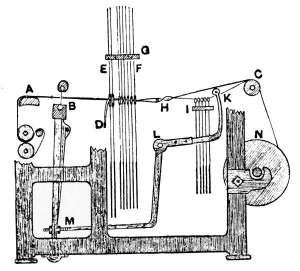
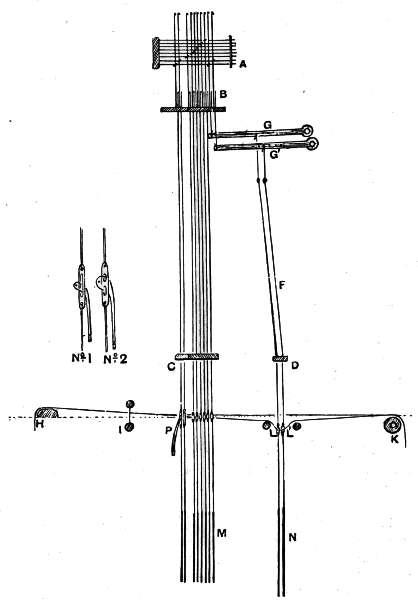
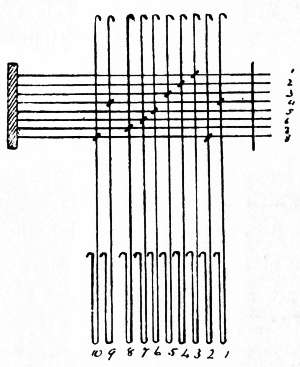
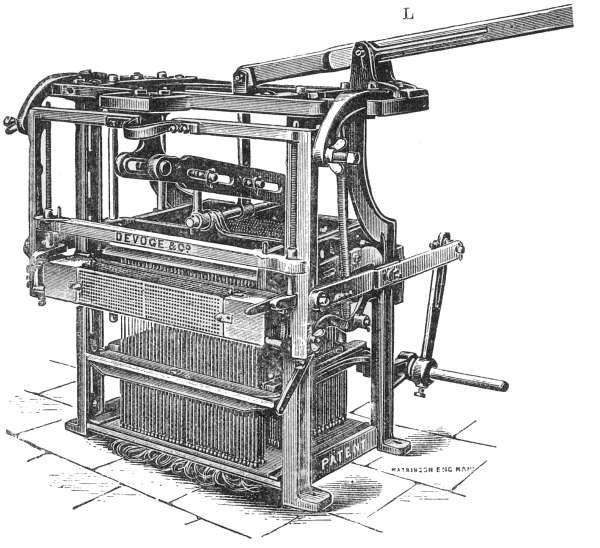
The manufacture of carpets has been in existence since the days
of the ancient Egyptians, who made rugs and carpets of various
kinds and ornamented them with animals and various devices.
The manufacture passed on to the East, and we find India, Turkey
and Persia celebrated for the richness of their carpets in early times.
The Moors of Spain introduced the Oriental floor coverings into
Western Europe, and the Belgians and French took up the manufacture
and produced excellent imitations of them. Even in the Middle Ages
carpets were only used as a luxury by the rich. Queen Elizabeth had
a carpet spread upon rushes, while Queen Mary had rushes only. These
rushes were the Acorus Calamus (sweet reed of Norfolk), which were
the usual floor coverings down to about this time.
Tapestry weaving was started in this country in the beginning of
the seventeenth century, but the first we hear of carpet manufacturing
in England was at Kidderminster about 1735, the carpets then made
being, no doubt, the Kidderminster or Scotch carpet. The making of
Brussels carpet was introduced about 1750; they were first made in
this country at Wilton, near Salisbury.
The Axminster carpets take their name from being first made in
the town of Axminster about 1755. They rivalled the work of the
Eastern looms for beauty, durability, and colour; but owing to the cost
of their manufacture, and the introduction of the cheaper Brussels and
patent tapestry carpets, the demand became very small, and the work
was removed to Wilton in 1835. The patent Axminster or chenille
carpet was brought out by Messrs. Templeton, of Glasgow, in 1839.
In the early ages carpets or rugs were used for spreading on the
floor or grass to lounge upon. It is recorded that in Babylon the guests
of despotic sovereigns lounged on rich carpets, and walked over priceless
works of textile art; also how figured carpets made of the finest wool
were strewed under golden couches, and rugs richly embroidered with
figures were spread over daïs, stool, and table.
The Egyptian carpets may have been tapestries and embroidered
fabrics. They also had a method of making tufted carpets by drawing
a portion of the weft threads out of a piece of coarse linen and sewing
tufts of coloured worsted to the warp threads, enough of the weft being
left in to bind the warp threads together.
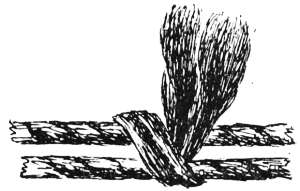
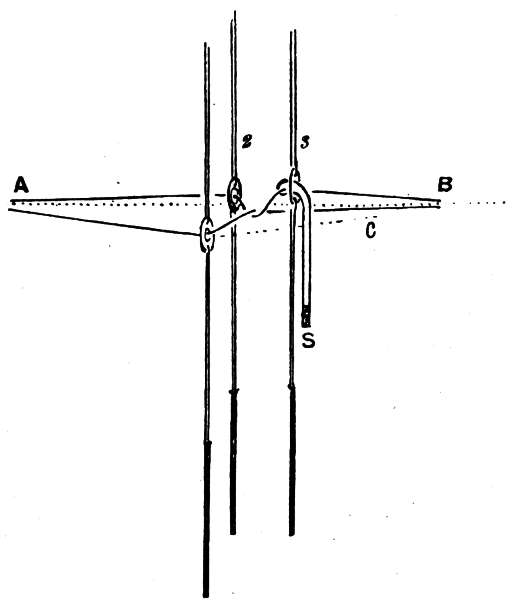
Fig. 175
Persian and Indian carpets were made of wool; the latter were
occasionally made of silk, and sometimes an inferior description of
carpet was made of cotton. These, as well as Turkey carpets, are
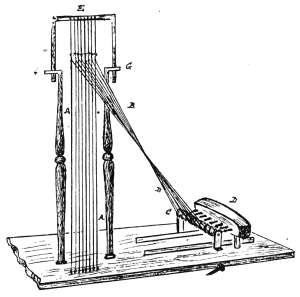
made on a very simple loom consisting of two posts fitted at a suitable
distance apart to form a vertical frame. There is a roller at the top
and another at the bottom between which the warp threads are stretched,
much in the same manner as in tapestry weaving. The weaver sits
in front of the loom with a design before him, and is provided with a
quantity of bobbins of the colours required for the pattern; he looks to
the design for the colour, and, taking a bobbin of the colour required,
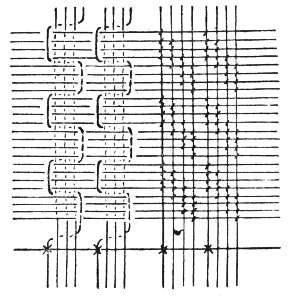
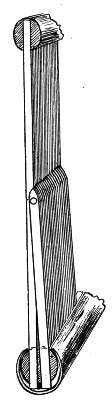
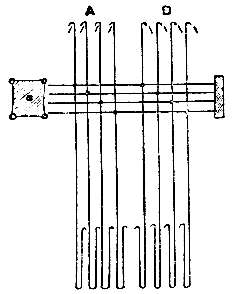
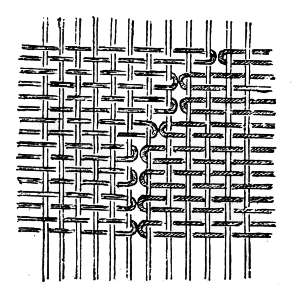
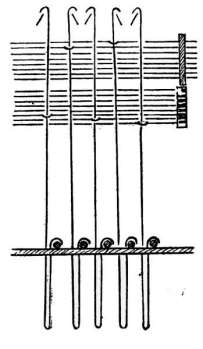
forms a loop round two of the warp threads with the weft, cutting it off
as shown in Fig. 175. After having completed
a row along the cloth forming one
weft line of the design, he opens a shed
and inserts a ground shot all across the
web, each ground shot going into a shed the
reverse of the preceding one, forming a plain
texture ground with a row of tufts between
the ground shots. The ground shots are beaten down with a comb.
Instead of going across in even rows of tufts, where there is a
patch of colour several rows of tufts may be put in at this place
with a ground thread between the rows, leaving the ends of these
threads projecting so that they can be carried across when the remaining
portions of the rows are completed. The ends of the tufts are cut
off roughly at first, and afterwards shorn level with a pair of shears.
Persian carpets are sometimes very costly, a small-sized carpet, when
made of fine cashmere wool, costing 500l. or 600l.
Axminster carpets are made on the same principle, and other art
carpets are being made similarly. There are about sixteen or twenty
warp threads per inch of strong cotton or linen thread; the weft is of
fine wool, three or four ply being put into each tuft; the ground weft
is soft hemp or flax, eight ply of yarn going to each shot. This makes
a full soft cloth. These carpets are about three-quarters of an inch
thick, and, like tapestries, there is no end to the variety of pattern or
colour that can be introduced.
Kidderminster or Scotch Carpet.—This carpet, also called ingrain
carpet, is the oldest machine-made carpet in this country; it was
originally made at Kidderminster, but the chief centre now is Scotland.
Originally it was a two-ply cloth, the pattern being formed by passing
the two cloths, which were of different colours, through each other.
Mr. Morton, of Kilmarnock, improved on this by making it a three-ply
cloth, which enabled it to be made a thicker cloth with a richer pattern.
It is now made both two-and three-ply, and when made of all-wool is
a rich and durable article, taking a position between the jute and felt
carpets and the tapestry and Brussels; it is, however, sometimes made
with cotton warps and woollen wefts, and is in this case an inferior
article.
Both two-and three-ply carpets may be woven with only one colour
of weft, in which case the pattern is formed by the warp threads, which
must be much thicker so as to close in over the weft and hide it as much
as possible; on the other hand, there may be two warps and four
colours of weft, two of which are the same colours as the warp, and in
this case the weft is much thicker than the warp. The best of these
carpets are made with as many colours of weft as warp, as, in order to
get a pure effect, it is necessary to have wefts traversing warps of their
own colour; but a variety of effects can be produced by using additional
colours in both warp and weft.
One advantage in this style of carpet is that it is reversible; for
when one cloth rises to the face the other passes to the back, making
the pattern on both back and face alike, but of different colours. This
is the case when the carpet is two-ply cloth woven in the ordinary way,
but sometimes the back has to a certain extent to be sacrificed to give
more ornamentation to the face, at least in the ordinary method of
weaving. Whether woven two- or three-ply, the principle of working
is the same. Take a two-ply carpet. The fabric is a double or two-ply
plain cloth, figured in the usual way by passing the two cloths
through each other, there being no binding between the cloths except
what is formed by the one passing through.
The warps are of different colours—as, say, scarlet and black, green
and black, &c.—and each warp should have a weft of its own colour if
pure effects in the cloth are required. Usually four sets of warp threads
are employed instead of two—that is, two colours, end-and-end, for each
warp—and each colour of warp has its own colour of weft. Say we
take red and black for the face or figuring warp, and white and olive for
the back or ground warp. Various effects can be produced from this arrangement—viz.
the effect of the figuring cloth, formed by weaving the
red and black warps and wefts together, which in plain texture with
one weft will produce a rich brown effect; the ground cloth produced by
the white and olive warps and the weft will be of a light olive colour;
then lined, or what are known as ‘shot-about’ effects can be produced
by throwing in a light and a dark shot alternately—as white and black,
olive and red—and binding them on the face by warps of the same
colour. All the weft on the face of the cloth should be bound by warp
of its own colour in order to give pure effects. When a thread of one
cloth is raised, the corresponding thread of the other cloth goes to the
back (white and red and olive and black correspond in this case), but
the red weft will be bound with black warp on the under side of the
cloth, and the black weft will be bound with red warp, and the same
with the others, as in the system of working the harness with journals
to form the texture, all the black warp is controlled by one of the
journals and must all rise with it. Therefore when the black shot is
being thrown in, the black warp must be raised to make the pattern
correct on the face of the cloth, and this will also cause it to be raised
for that portion of the cloth that goes to the back, and when the black
is up the red is down; therefore the black weft must be bound by red
warp on the under side of the cloth, and the same with the other
colours. It is easy to understand that if an end-and-end warp—black and
red—be wrought plain on two shafts or leaves of heddles, and shot pick
and pick of the same colours, when the black weft is bound with the
black warp on one side it must be bound with red (which is the other
half of the warp) on the other side, and if the red is bound with red on
one side it must also be bound with black on the reverse side. To
apply this to the double cloth or carpet weave it is only necessary to
consider this piece of cloth as passing up and down through another
one of a different colour. Had we the power of raising any portion of
the black or red warps required, we could bind a portion of the black
weft with black on one side, and any other portion of it with black on
the other side; to do this we require a full or thread harness.
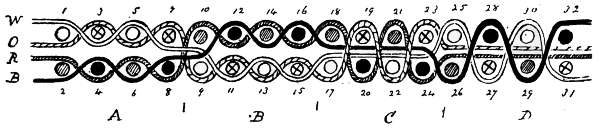
Fig. 176
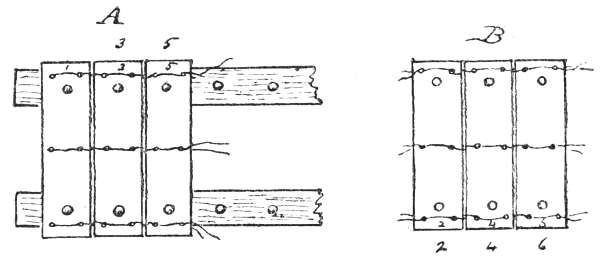
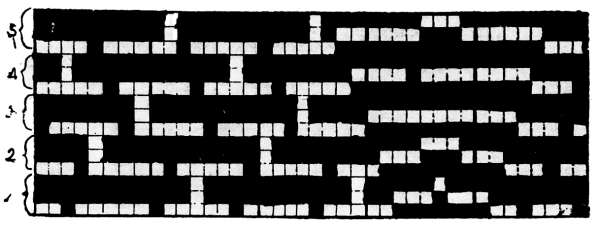
A section through the weft of a piece of two-ply carpeting is given
in Fig. 176, showing the position of the threads when arranged to give
the different effects of face cloth up as at A, back cloth up as at B, shot-about
effect of red and olive on the face as at C, and shot-about effect
of white and black on face as at D. The warp threads are marked W,
O, R, B, the initial letters of the colours; and the numbers 1 to 32 give
the order of picking. The shot-about effect is here produced with the
opposite threads—that is, the first thread of one warp and the second
thread of the other warp—as white and black; but it might be preferred
to produce the effect the corresponding or mate threads (white and red,
or olive and black) would give. In working with journals, two picks
face and two picks back would be required to obtain this, and the
needles of the jacquards would require to be acted upon by the cards
for each shot, thus requiring double the number of cards. With a full
harness any effect desired can be produced. Extra colours of weft may
also be used (as drab) in addition to the white and olive—to work, say,
white, olive, drab, olive, &c.; and dark green or blue in addition to the
red and black, which would come in as red, green, black, green, &c.,
a shot of the light and one of the dark colours following each other in
succession. Stripes of a bright colour may be introduced into the
warp or weft and kept in the back cloth, only being brought to the face
in small portions, at intervals, to sparkle up the centres of flowers, &c.
Ingrain carpets are made 36 in. wide, and with, say, 832 or 1088
threads of warp, according to quality. The former can be woven on a
200 jacquard (say 208=416), as the machine is double; and as there
are two repeats of the pattern in the width of the cloth, 416 × 2 = 832
threads of warp. For the latter 272 needles are required = 544 × 2
= 1088 hooks.
When woven with journals, the jacquards used for figuring these
carpets are similar to those explained under ‘Quilt Weaving’—that is,
double machines with trapboards and knot cords; and when the card
is pressed against the needles it is held in for two shots, one trapboard
raising the harness for the first shot, and the other reversing the shed
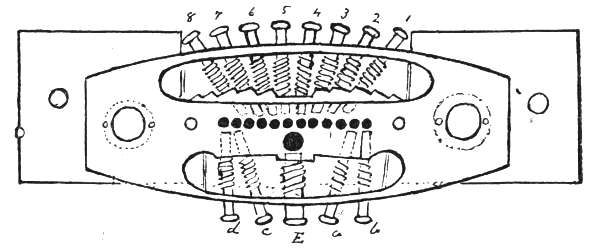
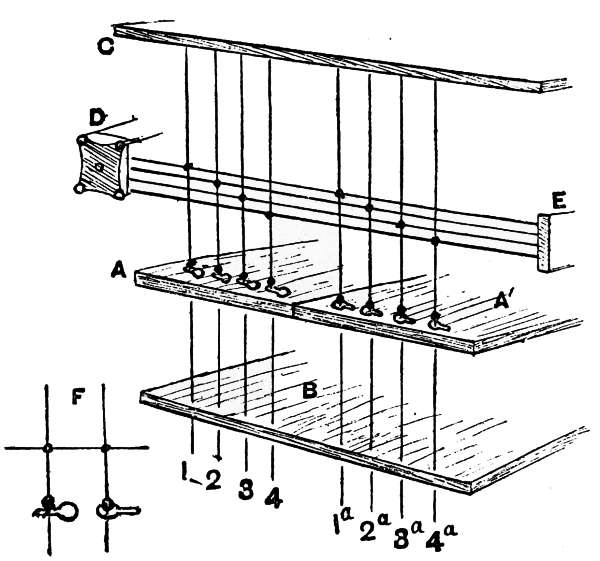
for the second shot. The journals are four sections of the cumber
board, as shown in Fig. 177; each section contains two rows of the
harness and one colour of warp. No. 1 journal controls the white
warp, No. 2 the olive, No. 3 the red, and No. 4 the black; the draft is
shown by the numbers 1 to 8 alongside the harness cords. These eight
cords only represent half a row from each machine, as there are eight
rows of hooks to the machine. One row of the two machines fills two
rows across the journals, or 16 holes. A represents the trapboard of
the machine for the ground or dark warp, and B that of the machine
for the figuring or light warp.
The harness twines are furnished with large knots above the
cumber board or journals, so that when one of the journals is raised
the harness will be lifted with it. The journals may be raised by
strong cords or wires from the machine, or by a tappet or shedding
motion working either above or below them. If the machine is divided
into two parts, four hooks in succession going to each colour of warp
for each cloth, the cords from these four hooks making two rows of
the journal, there will be no crossing of the harness in a straight or
Norwich tie.
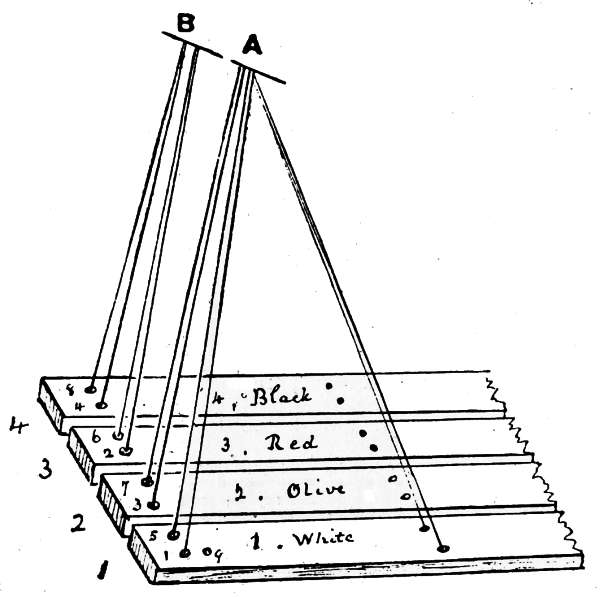
Fig. 177
The order of working for the section Fig. 176 would be as follows:—For
the first pick, which is white, raise the trapboard B and the first
journal; for the second pick, which is red, raise the trapboard A and
the third journal; for the third pick, raise the trapboard B and the
second journal; for the fourth pick, raise the trapboard A and the
fourth journal. This is the general order of lifting for a pattern; but
a simple lined effect across the cloth as the section could be wrought
with the journals without the machine, using them as heddle shafts.
It could also be wrought by the machine without the journals. The
use of the journals in conjunction with the machine is to pass the cloths
through each other and make a pattern. For figure work, when a card
is pressed in against the needles, all the warp for the figure on the
design paper is raised by the trapboard B, which clears this portion of
the red and black warps out of the way of the ground shed; and as the
first pick of the ground is white, the white journal is raised to bind the
white pick, leaving the olive warp down to bind it at the back. For
the next shot the same card acts, and the trapboard A is raised, which
lifts all the white and olive warp corresponding with the portion of the
red and black that was left down at the last shot, so as to clear this
portion out of the way of the face shed. As a red pick follows white,
the red journal (No. 3) is raised to bind the red on the face, leaving the
black warp down to bind it on the back. The other picks follow
similarly. This shows the defective binding common to journal weaving,
the white being bound with olive and the red with black at the
under side of the cloth. To have pure binding, instead of all the white
or red being raised by a journal as above, only as much of either should
be raised as is required to bind its own colour of weft on the face of
the cloth. The olive or black in respective cases should be raised for
the remainder of the shed, leaving the white and red down to bind their
own wefts where these colours come out on the back or under side of
the cloth, thus giving pure colours on both sides of the cloth, and letting
the mixed or impure binding be in the centre between the two cloths.
This, however, is beyond the range of journals, and requires a harness.
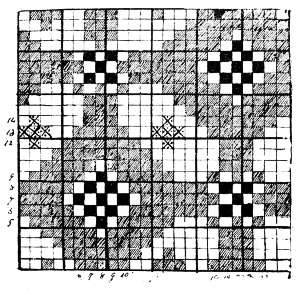
Fig. 178
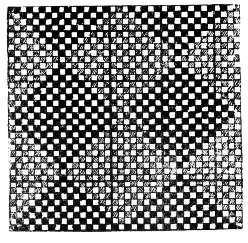
Fig. 178 gives a neat pattern on a small scale for a two-ply cloth
with, say, a red and a pale olive warp for ground and figure cloths
respectively, the shaded squares
being red and the ground or
white squares olive; the weft
for each cloth to be the same
colour as the warp, or sometimes
a tint one or two shades lighter
and brighter, or deeper and duller,
according to the colours or
shades of colours used, gives a
good effect. A further effect in
this can be produced by having
the 6th to 10th and 18th to
22nd threads black, brown,
or dark green, end-and-end with pale olive, for the back warp,
and picking similarly on the 5th to the 9th picks for the ground
cloth. This would, of course, make a striped effect on the under side
of the cloth, as where the additional colours do not show above they
must appear below. A still better effect can be produced by having an
additional weft lying between the two cloths which can be flushed on
the face in spots as at picks 12, 13, and 14, and of course a three-ply
cloth will be a step farther in advance; lined effects can then
be produced anywhere desirable, in portions to suit the nature of
the design, to vary and enrich it, at the same time the breadth of effect
is maintained by working the greater portion of the pattern in masses
of pure colour, whether they be large or small. For full-harness work
the harness is divided into two sections, four rows for the back cloth
and four rows for the face cloth, on an 8-row machine; no journals
are used, the machine doing all the work. The harness is tied up in
the usual way, the cord from the first hook passing through the first
hole of the cumber board, and the cord from the second hook passing
through the second hole, and so on.
The harness is nominally divided into two sections, the front four
rows being for the face cloth and the back four for the back cloth;
when drawing the warp into the harness the mails are taken in the
following order: 1, 5, 2, 6, 3, 7, 4, 8, the back or ground warp coming
on 1, 2, 3, 4 mails, and the face or figure warp on 5, 6, 7, 8.
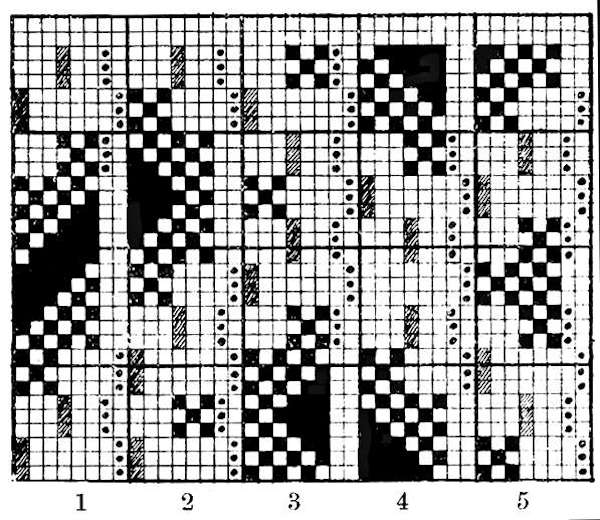
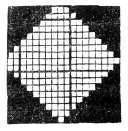
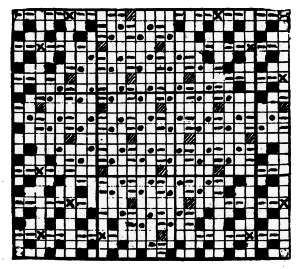
Suppose the pattern to be a dice, as Fig. 179, the warps to be
white and olive, and red and black, with the same colours of weft.
Each upright line of the design represents two threads of warp, one
of which will be drawn on the front half of the harness and the other
on the back half; and each horizontal line of the design represents
two weft shots, for which there must be two cards cut. Let the order
of drawing the warp into the harness be as Fig. 180. The white is on
the odd and the olive on the even numbers of the four back rows of
the harness, and the red is on the odd and the black on the even
numbers of the four front rows.
Now to cut the cards:—Take the first line of the design Fig. 179,
cut the odd numbers of holes (that is, the first and third) on the first
half, or first four holes, of the card, and cut the white and olive on
the second half of the card. For the second card, from the same line
of the design cut red and black on the first half of the card, and the
odd numbers of holes on the second half of the card. For the third
card, take the second line of the design and cut even numbers of holes
on the first half of the card, and white and olive on the second half
of the card. For the fourth card, from the second line of the design
cut red and black on the first half of the card, and the even numbers
of holes on the second half of the card. Of course when there is none
of a colour raised, as in the first line there is no black, no notice is
taken of it. For the pattern in Fig. 178 the cutting would be the
same, except that there are only two colours of warp to be dealt with
instead of four. No. 1 card: cut odd numbers of holes on the first
half of the card, and olive on the second half of the card. No. 2: cut
red on the first half of the card, and odd numbers of holes on the
second half of the card, &c.
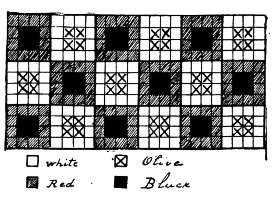
Fig. 179
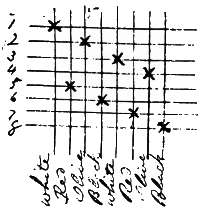
Fig. 180
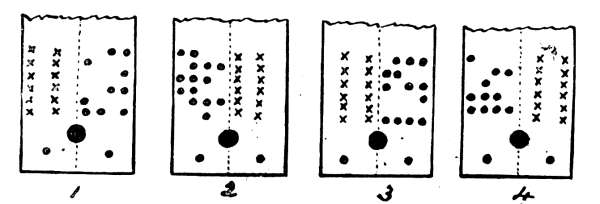
Fig. 181
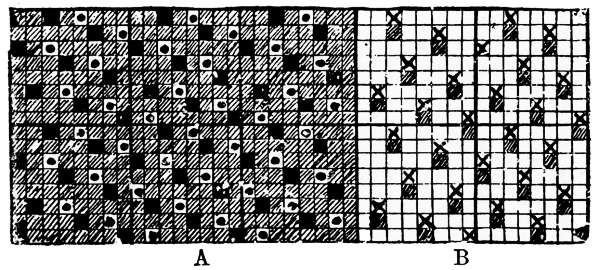
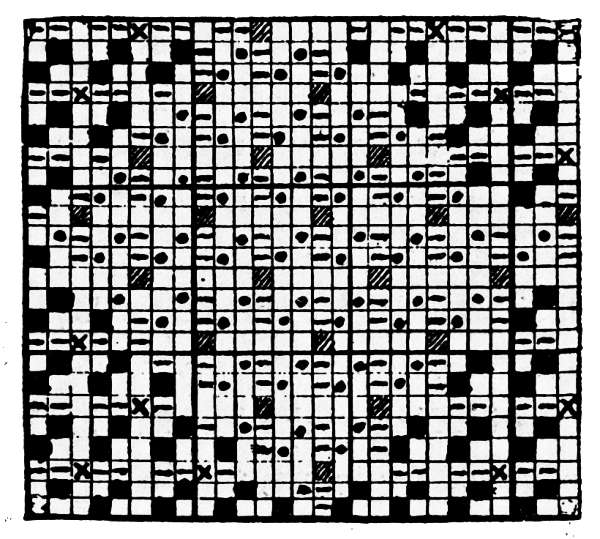
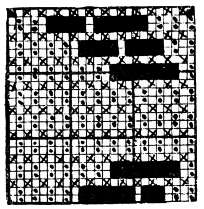
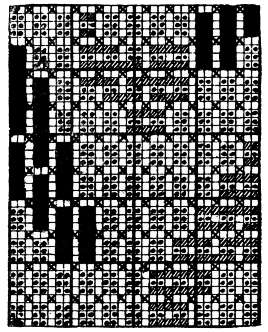
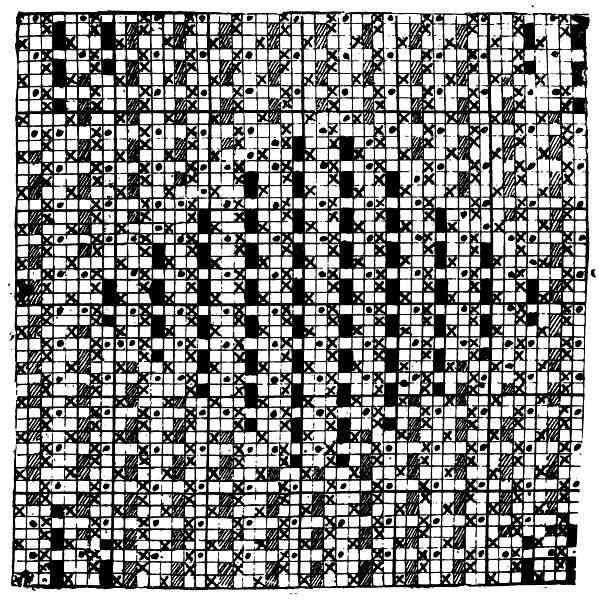
The cutting of four cards is given is Fig. 181. The crosses indicate
the cutting of the odd and even holes in the cards, and the dots are
the figure. It will be seen that the crosses in No. 3 card would reverse
the shed formed by those in No. 1 card, thus working plain texture on
the back cloth, and the same would take place with Nos. 2 and 4 cards
for the face cloth. This is simply the action of the journals included
in the harness, which it will be seen requires double the number of
needles in the machine, and double the quantity of cards; but an
ordinary machine and mounting will answer, instead of having to get
a double machine and journals.
The above cutting acts the same as journals, and is all right in
both cases when one warp with its own weft is used for each cloth;
but it has been pointed out that when each warp is end-and-end of
different colours with wefts to match, the under side of the cloth is
defective when wrought with journals, and so it would be with the full
harness if the cards were cut as above. To get each colour of weft
bound with its own colour of warp on both sides of the cloth, the
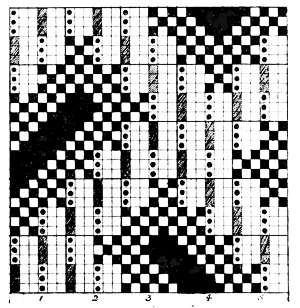
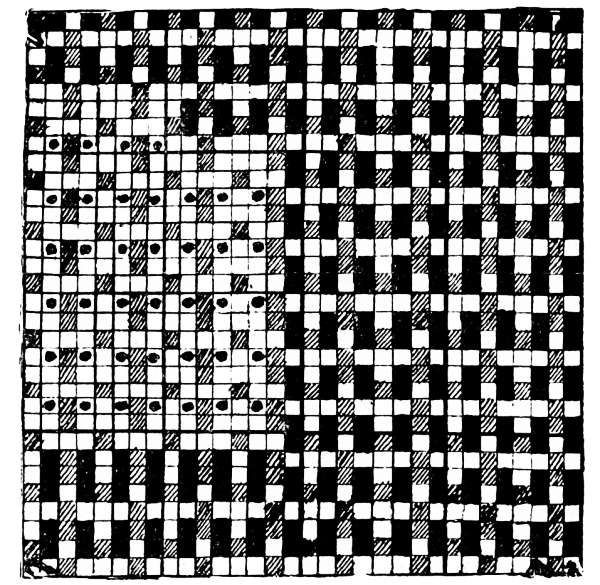
following change must be made:—Take the small piece of pattern
given in Fig. 182, and let the warps be as before—white and olive,
red and black. The card
cutting for this pattern will
be as follows, the warp being
drawn through the harness
as before:
For the first card, cut
odd numbers of red and even
numbers of white on the
first half, or first four holes,
of the card, and white solid
on the second half. This will form a shed for the red shot.
Second card: Cut from same line of the design red solid on the
first half of the card, and even numbers of white and odd numbers
of red on the second half of the card. This is for the white shot.
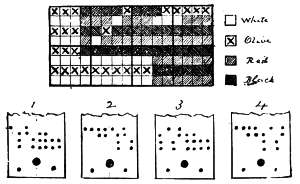
Fig. 182
Third card, for black shot: Cut from the second line of the design
even numbers of black and odd numbers of olive on the first half of
the card, and olive solid on the second half of the card.
Fourth card, for olive shot: From the same line cut black solid on
the first half, and odd numbers of olive and even numbers of black on
the second half of the card.
These four cards are shown in Fig. 182, from which the cutting
may be traced. It must not be supposed, however, that cutting odd
numbers of red and even numbers of white as on the first card, means
that these colours of threads are to be raised; the colour has no
reference to the threads—only to the coloured checks on the design paper.
For the first card the white checks on the design paper are cut
solid on the second half of the card; this raises the white and olive
warp corresponding to the white portion of the design. Then, to form
the plain shed in the other warp, the even numbers of the white checks
and the odd numbers of the red checks are cut on the first half of the
card, which acts on the other warp. As the black warp is drawn on
the even numbers of harness twines it will be raised for that portion
of the design that is white, and the red will remain down to bind the
red weft; but passing along the design till the red weft is above, it
will be seen that the red warp should here be up to bind it, and the
black should therefore be down, so, as the red warp is on the odd
numbers of the harness and on the second half of the card, the odd
numbers must be cut on the card for the red portion of the design.
This gives a pure binding on both sides: and the same applies to the
other colours. It will be seen that the first halves of the 1st and
3rd cards together work a broken plain texture, and the second
halves of the 2nd and 4th cards do the same.
In case the card-cutter cannot follow this method of cutting, and if
the design is so varied in order of weaving that a gamut or index for
cutting cannot be arranged, then it will be necessary to paint the full
texture of the pattern on the design paper in the same manner as is
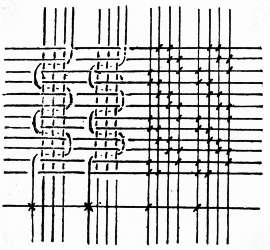
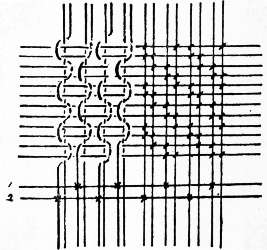
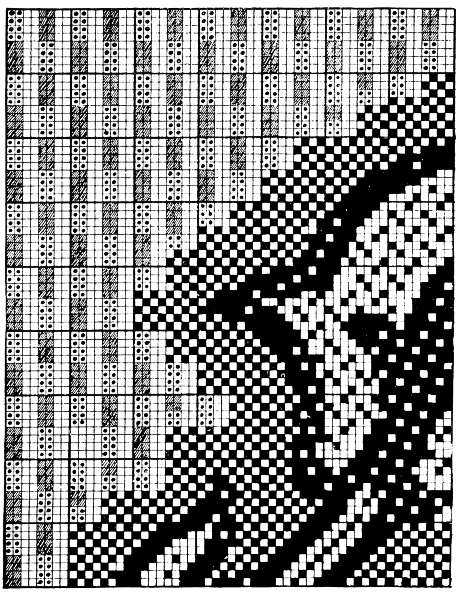
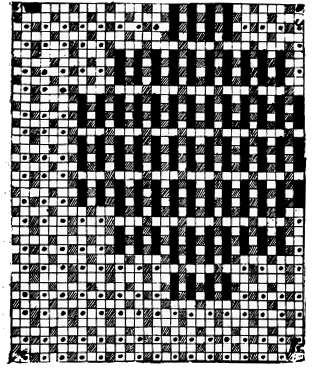
done for double cloth. The first row of designs of the pattern given
in Fig. 178 is painted out in full in Fig. 183. The shaded lines underneath
represent the back warp, and the white lines the face warp.
The black squares are the figure, and the large crosses the ground, or
the white squares in Fig. 178. The dots are the rising marks for the
texture of the back cloth, as would be formed by the back warp journals,
and the small crosses are the same for the face warp.
This method of weaving is not confined to carpets, but is equally
applicable to quilts, curtains, &c., and a plain texture need not be
adhered to; a twill or any simple fancy texture may be used. With
80 to a 100 threads per inch, one warp peacock green in satin texture
for the figure, and the other warp gold for the ground in a crêpe
or mottled texture, all shot peacock, a handsome curtain can be made.
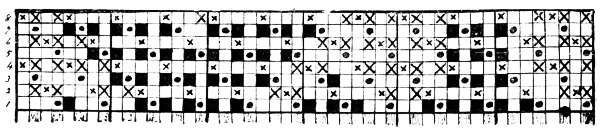
Fig. 183
Brussels Carpets.—Brussels carpets, with their less expensive allies,
the tapestries, are the commonest of the better class of carpets. They
are a loop-pile fabric, the pile being formed by the figuring warp,
which is wool, the ground warp and weft being hemp or flax. As the
pattern is formed by raising the figuring warp threads of the required
colours, and as any thread of any colour may require to be raised, it
follows that all the threads must be on separate spools or small warp
rolls, so that any one thread can be drawn forward without slackening
any of the others. Large frames are therefore made to hold the
number of spools of each colour, and these are placed one above the
other in a slanting position, at the back of the loom, and when filled
with spools the whole set of threads are brought forward to the
harness as if from a warping creel or bank. According to the number
of these frames used the carpet is styled a 3, 4, or 5-frame carpet, the
greater the number of frames the richer the carpet both in colour
(generally speaking) and in body of warp. Sometimes 6 frames are
used; but 4 or 5 are more frequent, 3 and 4 frame being the lower
qualities.
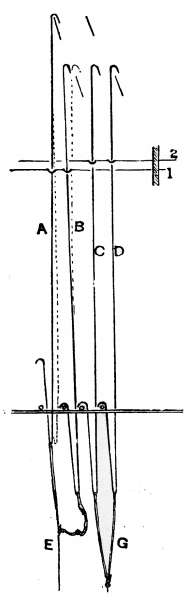
The texture of a Brussels carpet is shown in Fig. 184, which is a
section through the weft. A and B are two of the ground warp
threads, a pair of these coming between the rows of pile loops, a
portion of one row being shown in the section. The weft threads are
shown in section coming under the loops of the ground warp at the
top, and above them below. Both this warp and weft are of coarse
hemp, about 3’s: the weft is steeped in glue size before being
thrown into the cloth, which makes it stiff and firm when dry. The
pile warp threads are numbered, 1, 2, 3, 4, and 5; they are of soft-spun
worsted, about 2/24’s, 2 and sometimes 3 threads being drawn
in together as one through the mails and reed. These five warp
threads go to form one line of loops, being raised over the wires as is
required for the pattern, and lying straight between the weft threads
when not raised. By considering this it will easily be understood that
each thread must be on a separate bobbin so as to admit of being drawn
forward independently of any of the others. In low qualities of these
carpets one or two threads of hemp warp are used to each splitful or
row of pile threads; the hemp thread lies in a straight line below the
worsted threads in the same way that No. 5 thread is shown in the
section. These stuffing threads add to the weight and thickness when
the worsted is reduced in quantity, but make a harsher and stiffer
carpet. This warp, when used, is put on a beam or warp roll, as is
also the ground warp of the carpet.
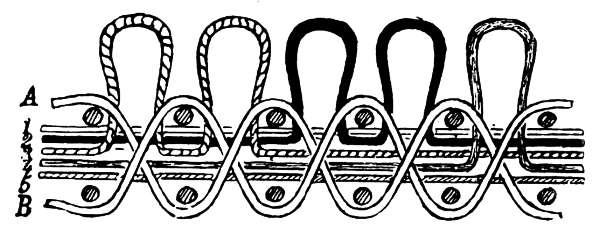
Fig. 184
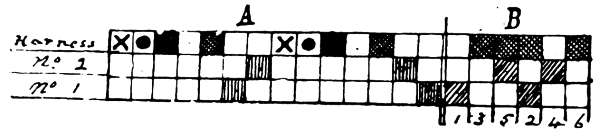
Fig. 185
Fig. 185 is the plan of drawing-in and weaving a carpet similar to
that shown in section in Fig. 184. The draft is given at A, and the
treading and cording for a hand loom at B. A 10-row jacquard should
be used for a 5-frame carpet, as twice over the 5 threads makes one
row of the cumber board. Five threads are drawn into the harness,
one from each frame, then two ground warp threads are brought
through and drawn on two leaves of heddles. In weaving, one ground
thread is raised and a shot thrown in; then all the pile warp and the
same ground thread are raised for the next shot; the third tread
raises the harness and a wire is inserted to draw up the pile; the
fourth tread crosses the ground warp threads; the fifth tread raises
this thread again, as well as all the pile warp, and the sixth tread
raises the harness for the insertion of the second wire; this completes,
the order of treading. For the second and fifth treads it will be observed
that all the warp in the harness must be raised; this was
usually done by having shafts through the harness or by raising the
cumber board to act as a journal in the manner explained for Scotch
carpet weaving; but now jacquards are made with bottom boards or
gratings that can be raised or lowered to form these sheds.
The pile wires are now commonly inserted at the time the adjoining
pick is being thrown in, a double shed being formed, and both the wire
and shuttle passed across at the same time, the former being uppermost;
in power looms the wires are both inserted and withdrawn by
machinery; about twenty-five are inserted before any are drawn
out, to prevent the loops from slipping. Jacquard machines are made
specially for the purpose of forming this double shed, the grating
raising the hooks from the bottom to the centre position, thus raising
the worsted or figuring warp above the shuttle, while the griffe carries
the figuring hooks on to the top, making a second or upper shed for
the wire. The old method was to form the lower shed by raising
the cumber board, and the upper one by the griffe. Jacquards with
cords instead of hooks are frequently used.
Brussels carpets are made 27 in. wide, with nominally 260 loops or
rows of pile in the width; but 256 rows are commonly used instead of
260 for the better classes of goods, and a further reduction of 30 or 40
loops is made for lower classes, the reduction going to cheapen the
goods or to the credit of the manufacturer. Although only 256 loops
are on the surface of the cloth, it must be remembered that for a 5-frame
carpet there are 5 times this number of threads, and that 1,280
cords will be required for the harness, and an equal number of needles
in the jacquard when the pattern is single, or not repeated on the
cloth; but the design only covers 256 spaces on the point paper, each
space or check across it representing 5 threads. In Scotland a reed with
350 splits on 37 in. is used, one row of pile warp with its ground warp
going into each split. A carpet known as Axminster Brussels is made
in Scotland. It is similar in structure to the common Brussels, but
has in addition a woollen weft, which is thrown in pick-and-pick with
the usual hemp weft. The addition of the wool weft adds to the softness
and thickness of the carpet, giving more elasticity or spring to it,
and making it wear better.
Designs for Brussels carpets are sketched out and coloured in the
usual way; the method of repeating the patterns is much the same as
is adopted for wall papers. Usually there is one repeat in the width of
the cloth (27 in.), and the length of the repeat may be shorter or longer
to suit the pattern, expense, &c.; 256 checks, = 3/4ths of a yard, is a
common length, and 1-1/2 yard for bolder effects. The number of colours
must be regulated to suit the frames to be employed in the weaving,
unless the frames can be made to suit the pattern. Say five frames
are to be used, this would suggest five colours; but it does not
follow that only five colours can be used. A clever designer may work
out most patterns so that six or more colours may be used on five
frames, by arranging the design so that two colours may be put to one
or more of the frames, which process is called ‘planting.’ But it may
be that an extra number of colours will not improve the design, in
which case they should not be used. The process of ‘planting’ or
striping the warp—which is on the same principle as ‘chintzing’ by
striping the weft in other makes of goods—will be best understood by
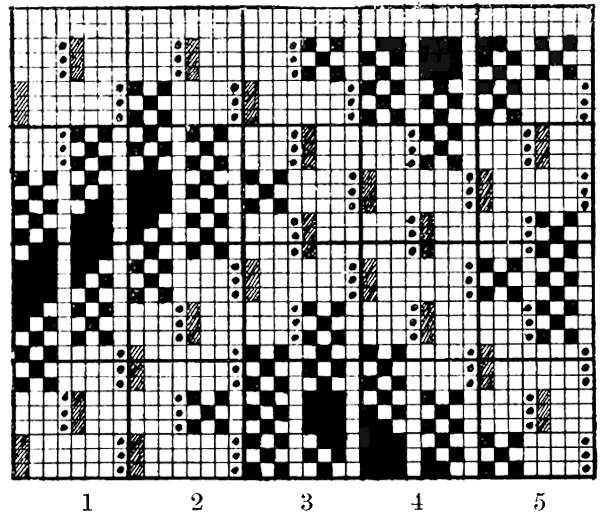
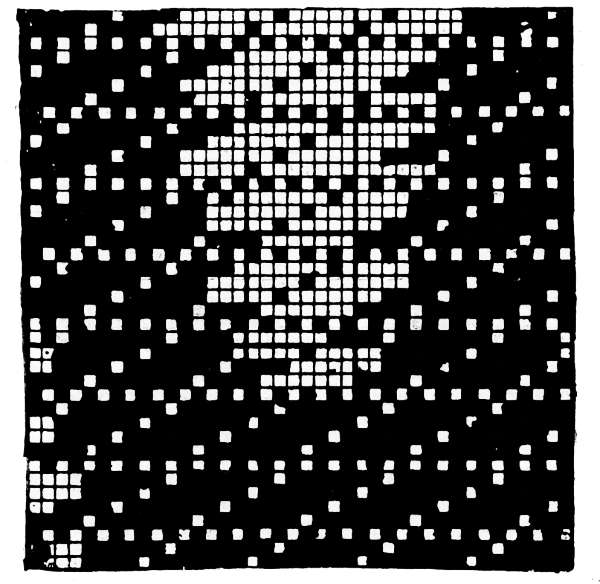
referring to Fig. 186, which is a Brussels carpet pattern on a small
scale for working with five frames. The colours are indicated by different
markings on the squares of the design-paper, as shown by the
index or gamut below the design. On the first line of the gamut there
are two varieties of markings, and as this line indicates reds, there are
two colours of red used on this frame. Following up the design above
these markings, it will be seen that one colour of red is used in one of
the sets or rows of octagonal figures, and the other colour on the intermediate
rows, and that the two colours of red are not required in the
same portions of the design, the gamut showing where each is required.
It is only necessary to arrange the spools on the frame in the loom and
draw the threads through the harness, as shown by the gamut, to make
this fall in correctly.
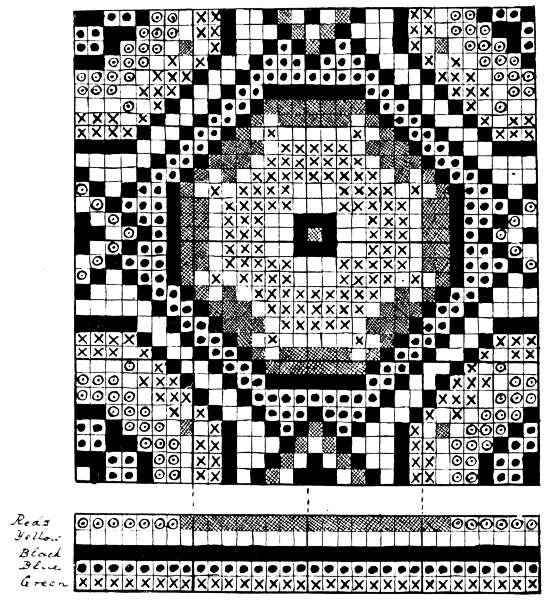
Fig. 186
What the designer must guard against is giving the pattern a
striped appearance, which would be the case if the planted colours
were brought to the surface too frequently; but if they are judiciously
brought up at intervals, the effect of a 5-frame can be made almost as
good as that of a 6-frame pattern, and this can be carried still further
if desired; every frame may contain two colours, or one frame may contain
several colours.
Carpet patterns are sometimes painted on small-sized design paper—that
is, the ordinary paper with, say, two designs per inch; but
before working it is more satisfactory to have them put on large-sized
paper, so as to show the exact effect they will have on the cloth, the
design-paper giving the pattern full-cloth size.
When painting patterns that are as large or larger on the cloth than
they are on the design-paper, much more care and skill are necessary
than when the pattern is one that is much larger on the design-paper
than it will be on the cloth, as is usually the case; and in consequence
of the large size of the checks required for carpet design-paper, it is
evident that representations of any small objects—unless those of a
very simple nature—cannot be put on it without being greatly enlarged.
After the sketch is made the forms should be carefully adapted to suit
the paper, so as to give a satisfactory effect on it, rather than be a
rigid adherence to the sketch. Natural floral forms should not be
attempted unless to satisfy the demands of trade, and when they must
be used they should be made on so large a scale as to be fairly represented
in a semi-conventional manner. Large wild-floral patterns are
frequently to be seen on carpets, but they are rarely, if ever, satisfactory.
Persian, Indian, and other geometric or conventional forms that
lend themselves readily to a harmonious admixture of colours so that
the carpet will, when on the floor, present a rich glow of colour instead
of obtrusive masses of floral misrepresentations, are much to be preferred.
Dull colouring is not essential to good taste—rather the
reverse; but it is less obtrusive and more easily managed, particularly
in the hands of an inferior artist. No matter how brilliant the colours
are, if properly blended and broken up into masses in proportion to
their intensities in the spectrum scale they need not be in the least
offensive; but it requires skilful hands to do this.
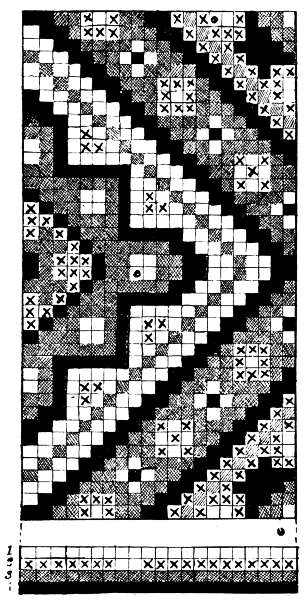
Fig. 187
The pattern given in our last figure (186) is a simple repeating pattern,
so that two pieces of the carpet laid side by side will join correctly
together. Another method of arranging patterns so that they will
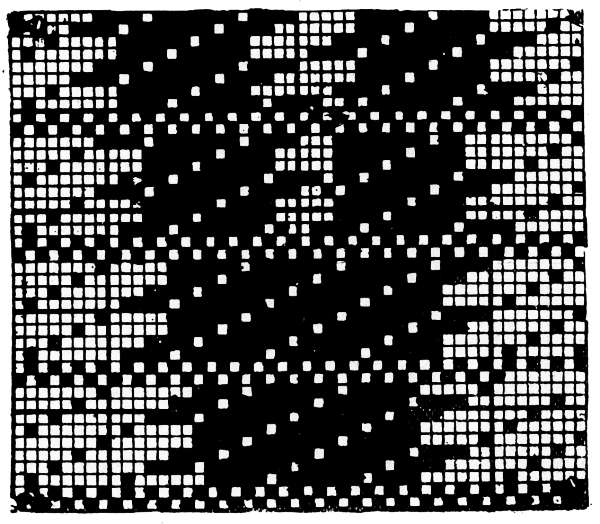
repeat is shown in Fig. 187. In this figure it will be seen that the
two sides will not join as an ordinary repeat, but if two pieces are
taken the right-hand side of
one will, if turned round, join
against the left-hand side of
the other, and two pieces thus
joined will form a repeat.
This is objectionable in the
case of cut pile, which usually
has a slope in one direction;
and when two pieces are
joined, one running one way
and the other the reverse, the
effect will be that of shaded
stripes, somewhat similar to
that of a grass field when
rolled. Another method of
forming repeating patterns is
by making what is known as
a ‘drop repeat,’ which is
shown in Fig. 188; though
the two sides will not join in
against each other, as in an
ordinary repeat, if two pieces
of the carpet be laid side by
side, and one of them drawn
a little down, the point A in
the figure of one piece will
fall in against B and B1 of the other piece, and repeat.
These show the usual principles on which repeats are based, and
of course it is for the ingenuity of the designer to form the best arrangements
of pattern he can to suit them, or any other method he
may think of.
When cutting cards for carpet patterns the usual method of picking
out the various colours for each cutting must be adopted by the card-cutter.
Refer to Fig. 186 for the pattern, and to Fig. 185 for the
draft. The order of drawing is green, blue, black, yellow, reds, which
gives five rows of holes on the card, and this twice over makes the ten
rows; therefore, green would be cut on the first and sixth rows;
blue on the second and seventh; black on the third and eighth; yellow
on the fourth and ninth; and reds
on the fifth and tenth rows. These
may be all cut when passing the
card once along the cutting
machine, giving more than one
tramp, if necessary, to each shift
of the card index; or the cutter,
if not accustomed to this, may
pass the card along once for each
colour, working two of the punches
at each passage of the card, and
of course remembering to select
the punches which correspond to
the colour being read.
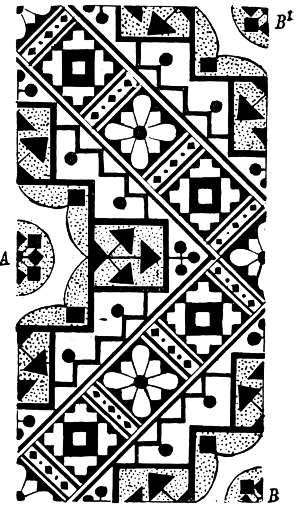
Fig. 188
It must be remembered that
two checks on the design-paper
correspond with a row of ten holes
on the cards, as each check may
have any of five colours on it in
the case of a 5-frame carpet pattern,
and there must be a space
for a hole in the card for any of these colours; therefore the designs
or large squares on the design-paper would consist of two checks each.
Suppose one of these checks—the first one—to be green, the first hole
in the card would be cut for it; if the second check is also green, the
sixth hole on the card would be cut; but if it is black, the eighth hole
in the card would be cut, not the third hole, as it, being the second
check, comes on the second half of the card. The first check stands
against the first five rows of holes in the card, and the second check
against the second five rows, each check on the design-paper representing
five threads, five mails and five needles, or five spaces on the
card; but only one hole is cut on the card for it, and that must suit the
colour the check is painted.
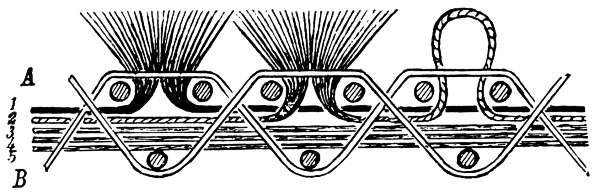
Fig. 189
Wilton Carpets.—These carpets are made much in the same manner
as Brussels, but the pile is cut, and they are of a better quality of
wool with a longer pile, and altogether a superior article. As the pile
is cut, the method of binding it into the ground is somewhat different
from that adopted for Brussels, in order to secure a firmer binding. A
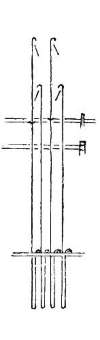
section of the cloth through the weft is given in Fig. 189, showing two
pile loops cut and one uncut, and also the method of binding the
pile warp threads Nos. 1, 2, 3, 4, and 5, with the ground warp A and
B, and the weft is shown in section, or end view.
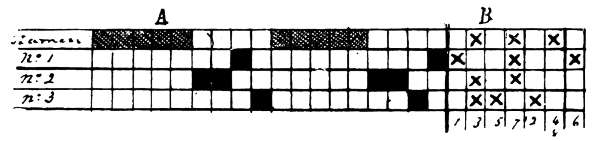
Fig. 190
The warp or pile threads are cut similarly to velvet by drawing the
wires out of the loops and having each wire furnished at its end with
a cutting edge. Fig. 190 shows the draft and treading of a Wilton
carpet arranged for a hand loom. The back is the harness, and Nos.
1, 2, and 3 the shafts. No 2 shaft is only required when an extra
or silent warp is used for the purpose of giving weight and thickening
the fabric. This warp, if used, lies straight between the weft, and
must be on a separate beam from the ground warp.
Tapestry Carpets.—These carpets, though they do not require a
jacquard to weave them, are so closely allied to Brussels, and patterns
so similar can be produced on them, that it is thought desirable to give
a short description of them. Though figured weaving, they are not so
in the strict sense of the term, as the pattern is printed on the warp
instead of being formed by various coloured warps; they are simply an
imitation of figured weaving in colours. Any pattern that can be put
on a Brussels carpet can also be put on a tapestry, and with further
variation if desired. The effect is not so sharp and rich on the tapestry,
as the colours, being printed on the warp, run into each other more or
less, and produce a slight blurring round the edges of the pattern;
whereas the pattern on the Brussels is so sharp and clear round the
edges as to make it harsh if two very contrasting colours come together,
so that in some cases the tapestry patterns are softer and more
pleasing.
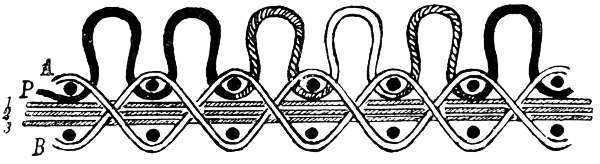
Fig. 191
Fig. 191 shows the texture of a tapestry carpet. A and B are the
ground warp threads which bind the weft, the same as in Brussels;
these threads go on one warp roll. 1, 2, and 3 are the lying or
filling warp threads of linen, hemp, or jute, used for giving weight
and thickness to the cloth; these threads go on a second roll. P is the
pile, which, it will be observed, is of various colours and looped all along
the cloth, or passes over every wire that is inserted, and the pattern is
formed entirely by the colours that these threads are printed. The
pile goes on a third warp roll. All the pile can go on the one roll, as
every thread is looped alike by each wire inserted. A pair of shafts
for the ground warp—one for the lying warp and one for the pile—is
all that is required for weaving the cloth. The pile consists of two or
three ends of two-fold worsted yarn, according to the quality of the
carpet. As the fabric is made up to a great extent with the three lying
ends of stiffened hemp or flax to each row of pile loops, the carpet is
of a harder and less pliable nature, with less spring in it than a Brussels
(which has the five pile worsted threads in it), and it is also less durable.
The number of pile loops in the width of the cloth is the same
as for a low-class Brussels carpet, say 216 to 225, and the width of the
cloth is the same—about 27 in. Five threads go to each split of the reed—viz.
one pile, two ground warp, and the three lying or filling ends.
In these carpets, as well as in Brussels, it will be seen from the
sections that one weft thread is above a lower one, with a straight
tightly-stretched warp between them. A method of weaving has been
adopted on the Continent in which both sheds are formed and both
wefts picked at the same time. One shed is raised above the centre
warp, and one is sunk below it, and both shuttles are driven through
simultaneously; then a pile shed is raised and a wire inserted; and
this repeated, reversing the ground sheds, makes the order of weaving
for tapestry carpets. Another method is to have double mails, one
mail above the other on the same harness cord or heald; the wool warp
goes to the upper mail, and the lying warp to the lower one. When
the mails are raised a double shed is formed, and a pile wire and a pick
can be inserted at the same time. The ground or binding warp is in
two additional leaves of healds. To apply the former method to Wilton
carpets, two picks are put in below to balance with the two above, instead
of one pick below, as shown in Fig. 189.
For tapestry carpets the pattern is prepared in the same way as for
Brussels. The repeat of the pattern may be of any length, but 27, 36,
or 54 in. are usual lengths. The pattern, though prepared as if for the
jacquard, is only a guide for the printer when printing the colours on
the warp.
The pattern is printed on the warp in an elongated form, the amount
of elongation coinciding exactly with the reduction the pile loops make
in the length of the warp when it is woven.
The pattern was originally printed on the woven cloth by means of
blocks; next it was printed on the warp in an elongated form in the
same manner; now it is printed by means of small rollers. The yarn
for each thread of the warp, or of a number of warps, is wound separately
on a large reel or drum, of such a size as will hold a suitable
quantity of yarn (about 18-3/4 feet in circumference). Six or eight threads
are wound on together, so as to lie closely together side by side and
not overlap each other, till the drum is full, or the required length is
wound on it. This has now to be printed with the pattern in an elongated
form.
The right-hand edge of the drum is divided into as many divisions
as a length of yarn equal to the circumference of the drum will make
loops on the cloth. This is called the index, and 648 is a common
number of divisions for it to have, or 864 for a larger size. Of course
the number of loops any length of yarn will make depends upon the
size of them, and the reduction in length from the yarn to the cloth
depends upon the height of the pile and the number of loops in a
given space. The number of loops per inch varies with the quality of
the cloth; 7 or 8 is usual for loop pile, and 9 or 10 for cut or velvet
pile. The design must contain such a number of checks in length as
will divide evenly into the index number, such as 108, 162, 216, 324.
When painted the design is cut into strips in the direction of its length,
one line or row of checks in each strip. When the yarn is wound on
the drum, and the printer is ready to begin work, he takes one of these
strips and pins it up before him to guide him in the colours he is to
print. The printing is done by means of a trough of colour with a
roller in it, set on a carriage beneath the drum, so that when passed
across the roller will press firmly on the yarn. The printer finds the
first colour on the design, and setting the drum to the first tooth of
the rack or index, he passes a trough of the proper colour across the
drum and back again; if the second check on the design is the same
colour, he turns the drum round a tooth of the index and passes the
same colour across; if the third check is a different colour, this requires
a second colour trough, and passing another tooth on the index
this colour is passed, and so on with the remainder; or, all one
colour is printed first, then the drum revolved again with the second
colour, and so on. When this is all printed the yarn is taken off
the drum and marked No. 1 thread, and the beginning and end of
the thread should be marked in some way as a guide for the setters.
A fresh lot of yarn is wound on for the second thread, which is printed
according to the second strip of the design. This must be continued
for all the threads in the warp. After being printed, the colours are
fixed by a steaming process, and afterwards wound on bobbins and
marked to their numbers. The design may be cut into strips of two
checks each, instead of one check, which will be less liable to get torn.
One side of the strip can then be printed first, and the other after.
The warp is made up by ‘setters,’ who arrange the threads together
in proper order in a frame for the purpose, and set them so that the
colours of each thread come together at the proper place to form on
the warp a correct elongated copy of the pattern; when correct it is
wound on the beam for the loom.
In printing and steaming, the colours are liable to run into each
other; some colours are worse in this respect than others, but it is
reduced to a minimum by the use of an absorbent in steaming; and
sometimes the designer makes a little allowance on the design-paper
for such colours as he knows will be liable to run and injure the pattern.
The pile of tapestry carpets is usually left uncut; but sometimes it is
cut, forming a velvet pile. In this case the carpet is made of a better
quality, and the pile is longer.
The present method of preparing tapestry warps was invented by
Richard Whytock, of Edinburgh, in 1832, and perfected by Messrs.
Crossley, of Halifax.
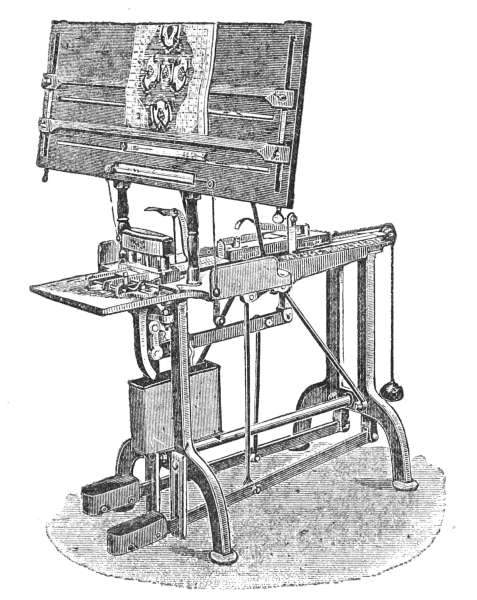
Axminster Carpets.—Real Axminster carpets, as already said, are
made by hand much in the same manner as Turkish or Persian carpets,
and attempts have also been made to produce them by machinery,
several patents having been taken out for the protection of the inventions.
These carpets, with other art carpets now being made, may be
classed with tapestry as works of art.
The Axminster carpets of commerce are the Royal Axminster or
Moquette carpets, and the patent Axminster or chenille carpets.
Royal Axminster carpets are made by a peculiar process of weaving
and tufting on a loom made specially for the purpose. A number of
little funnels carrying from spools threads of the different colours of
yarn required for the pattern are fixed on the loom above the reed, and
these threads, by suitable mechanism, are brought down and bound
into the backing cloth by the weft. These threads, which form the
pile, are cut off, and afterwards the surface of the carpet is shorn level.
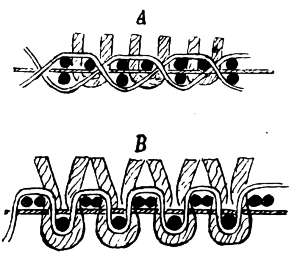
Fig. 192
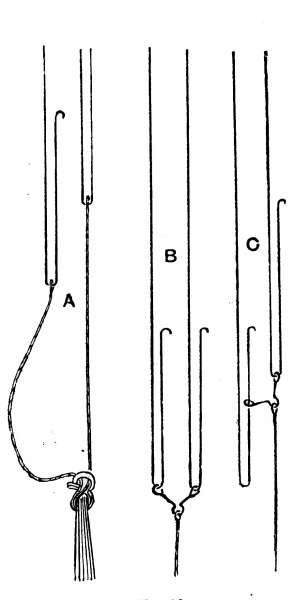
The texture of Moquette carpets
is shown in section in Fig. 192, two
varieties of texture being given, one at
A, the other at B. In both these textures
the pattern shows through on the
back of the cloth.
Another variety is given in Fig.
193. A is the section through the
weft, B the texture, C D E F shows the
interlacing of each of the four warp
threads in the pattern with the weft, and G shows the pile. Similar
numbers in these figures represent the same threads in the cloth.
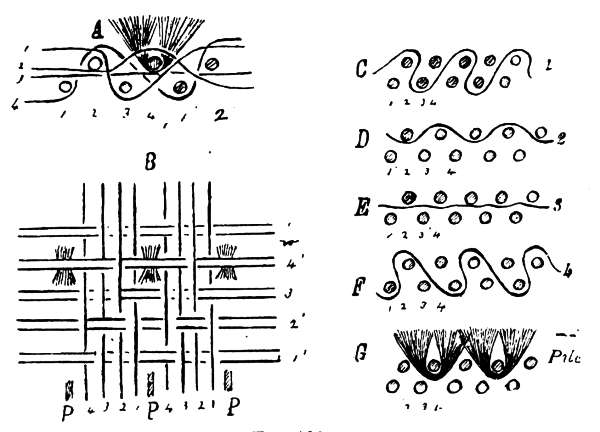
Fig. 193
Patent Axminster Carpets.—These were invented by Mr. Jas.
Templeton, of Glasgow, about 1839, and are a description of chenille
weaving. They do not require to be wrought by a jacquard any more
than the other Axminster carpets, but as the figures formed on them
are so similar to those produced by the jacquard, and as the method
of designing the patterns is the same for both them and other classes
of chenille as it is for jacquard work, it may not be considered out of
place to give a full description of chenille here.
Chenille is made by a double process of weaving. First the weft
or chenille thread is woven, if for a figured pattern in various colours,
which corresponds to the printing of the warp in tapestry carpet weaving,
which gives a warp figure, whereas chenille gives a weft figure.
When the weft is woven in a piece it is cut up into strips and twisted,
if for curtains or any fabric on which the chenille weft is to show on
both sides; but for carpets, where all the pile is raised to one side, the
weft is doubled up, bringing all the pile in one direction. Twisting
machines are now in use for making the weft for plain chenille fabrics,
but for figured ones it is still woven. If twisted for figured work it
would afterwards have to be printed somewhat similar to tapestry
carpet warps, but without elongating the pattern, and the uneven
surface is a difficulty in the way.
The method of weaving chenille weft is as follows:—A loom fixed
for working gauze is supplied with a thinly laid warp, which, according
to the class of chenille required, is drawn through the heddles either
as plain gauze, two threads working plain with one crossing them, or
this doubled, as is shown in Fig. 194. The two, three, or six threads
of the draft are drawn into one split of the reed, which is finer or
coarser to suit the fabric required. For shawls or curtains there would
be six to eight full splits of the reed per inch; say in a reed of thirty to
forty splits per inch, four splits empty to one full. For carpets there
would be two or three full splits per inch; say in a reed of ten to fifteen
splits per inch, four empty and one full, coarser or finer to suit the
length of pile required.
For plain work this is tied up and woven as gauze, the warp being
cotton of a dark colour, and the weft woollen, noil silk, or other fibre if
desired; but it should consist of several ends and be of such a nature
as will divide easily to form a rich pile. If for figured work, the pattern
must be woven in stripes across the piece, which will be explained
after the designing.
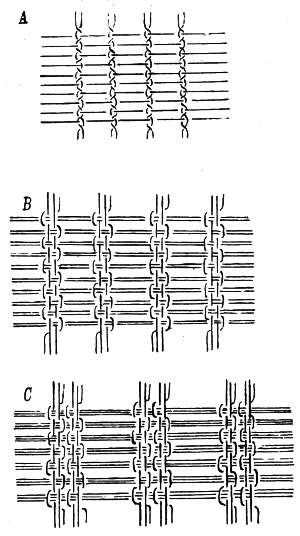
Fig. 194
When the piece is woven it will be as shown at A, B, or C (Fig. 194)
and must next be cut into strips midway between the ribs. Sometimes
this is done in the loom as the cloth is being woven, by having cutting
knives arranged to divide it as it passes over the breast beam; but it
is usually taken off in the
piece and cut afterwards in a
machine for the purpose. The
piece is fed through rollers in
the cutting machine over a
grooved roller, shown at B
(Fig. 195), the grooves being
at such a distance apart that
the ribs of the piece will fall
into them. Above this roller
is a set of cutting blades
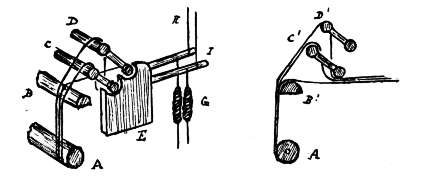
fixed in a spiral form round
a roller; one of these blades
is shown at A (Fig. 195), with
a section of the roller. The
blades are set at such a distance
apart that when revolving
they fall into the cuts in
the roller B, and running at a
high speed they sever the piece
into strips as it passes through
the machine.
So far the process is alike
for all classes of chenille work.
The weft is now in strips similar to that shown at A (Fig. 196) if for
carpets, and much smaller if for curtains or shawls. For ordinary
chenille the weft is next twisted so as to make the projecting fibres
stand out round the rib or core, and when finished it has the appearance
shown at B (Fig. 196). If for carpets, the fibres are turned up so
that all will project in one direction, as shown at C and in the cross-section
at d. This is done by running the strips over a grooved roller,
as C (Fig. 195), which is heated with steam, and as the projecting ends
are doubled up by the grooves in the roller the heat sets them in this
position. The weft is now prepared, and is wound on bobbins and
woven in large shuttles.
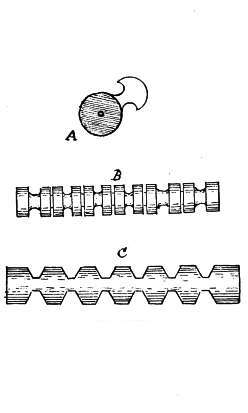
Fig. 195
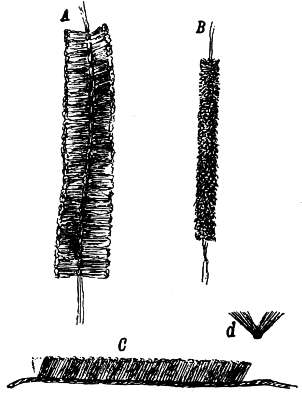
Fig. 196
The texture for chenille is the same as for plain cloth. A fine black
warp of cotton is used, with twenty to twenty-five threads per inch
(more or less, to suit the fabric required), and twelve to sixteen shots
per inch of the chenille weft are used, which must also be varied to
suit circumstances and the thickness of the weft used. The fibres or
points of the thread of weft project through the warp, and a pile fabric
is produced which should entirely conceal the warp on both sides of
the cloth. For carpets the pile is, as a rule, only allowed to project on
one side, though some rugs are made with a twisted chenille weft, and
the colours on it are shown partly through the backing as the fibres of
the thread get mixed up with the ground or backing in weaving, but
usually all the pile projects through to the face.
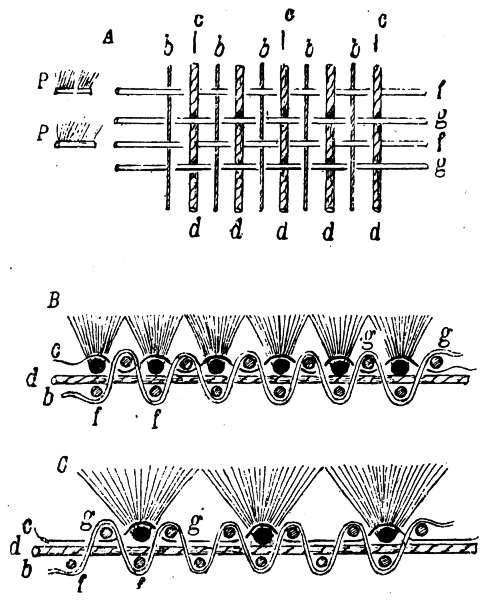
Fig. 197
The texture for patent Axminster carpets is shown at A (Fig. 197),
and sections of the cloth through the weft are shown at B and C in the
same figure, B is a section of the texture A with two picks between
the pile or chenille picks, and C is for a coarser description of work
with four ground picks between the pile picks. In A only the ground
texture is given complete; the pile weft P lies over the picks f f, and
is bound down by a fine black stitching thread C, which passes over it
and under the picks g g. The different thicknesses of the threads are
represented in the drawing: C are cotton, and the others hemp, flax, or
jute. There are about ten thick and ten fine warp threads per inch,
and five binding threads, and about seven chenille picks per inch, with
two ground picks between these. When there are four ground picks
between the pile picks the pile is coarse, and only about four picks per
inch are used. The chenille weft is wound on large wooden needles
like huge netting needles, about 4 ft. long, so that it may come off without
any twist in it, and the weaver pushes these through the shed, laying
the weft nicely in and combing it forward so as to get it straight
and even and have all the pile standing upright; he then knocks in two
ground picks and puts in another pile thread, as before.
This is all hand-loom work, but power looms are sometimes used
for the purpose. The ground of the fabric can be woven with heddles,
as before, but the binding warp threads are through needles, somewhat
like gauze dents inverted, and not through the heddles; and the beam
or spools containing them is above the loom in front. The chenille
weft is wound on a reel, and is through a guide or carrier. When the
chenille weft is to be laid in, the needles carrying the binders are raised
and the guide passed along, laying in the weft. The loom stands
stationary for a short time to give the weaver time to comb up the pile,
and then moves on and throws in the ground picks. Everything is
done automatically but the combing up of the pile.
The foregoing is a description of chenille weaving provided no
pattern has to be attended to; we must now consider the pattern.
The design paper used is the same as for ordinary work, with a
greater number of warp than weft threads, but it is ruled on a large
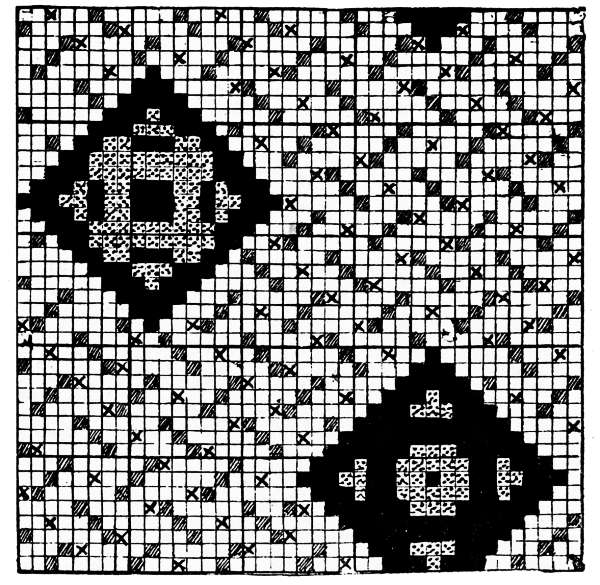
scale so that the pattern will be exactly cloth size. Fig. 198 is a sample
of this design-paper for seven picks per inch. The small checks, or
what in ordinary weaving would represent the warp threads, have here
no reference to them, nor do the warp threads require any consideration
when preparing the pattern. The narrow way of the checks is a guide
to the weaving of the weft threads. This paper might have been
square, seven by seven, and would thus suit for such a pattern as is
shown in Fig. 199—supposing seven shots of chenille weft per inch to
be correct; but there is an advantage in many cases to have it as it is,
or even more off the square, say seven by twenty, which is one of the
papers used. This will be most readily understood by following the
working out of the pattern.
The pattern given (Fig. 199) is necessarily very simple for want
of space. The different markings on the squares are to indicate
different colours. Here nine are used, but there may be any number—say
from eight to twenty—the only restriction on the number of
colours employed is that so many shades of yarn are required to match
them, and that the weaver has a greater number of shuttles to pass over
when weaving the weft. When the pattern is painted it is cut cross-ways
into strips, as A, B, two rows of checks in each strip; one row of
checks may be in each strip if desired; but this is unnecessary, and
besides, they are more easily torn. These strips are a guide to the
weaving of the weft, just in the same way as the pattern in tapestry
carpet work is a guide to the printer.
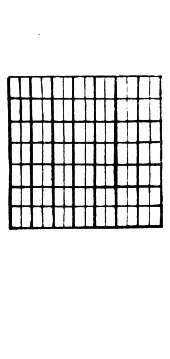
Fig. 198
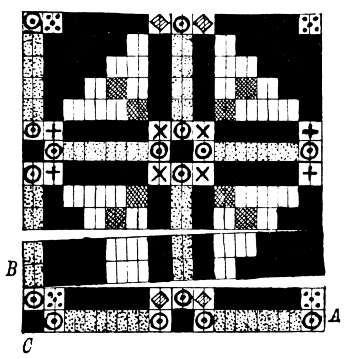
Fig. 199
The weaver takes a strip of the pattern and puts it through a widened
split in the reed and pins one end of it to the cloth; to the other end
he attaches a cord and light weight, which he hangs over the back rail
of the loom so that the strip of design will be held steady and move
forward as the cloth is drawn up. The strip must be pinned to the
cloth so that the first check of the design projects over the fell of the
cloth. Suppose the strip to be A, Fig. 199: C is the first check; the
weaver sees that this is black, and proceeds to weave the gauze with
black weft for the length of this check (one-seventh of an inch). The
next check, moving along the strip in the loom, or from left to right
on the design, is a different colour, say scarlet; the weaver changes his
shuttle and weaves as many checks as there are of this colour, which
in this case is only one. Another change of shuttle is made, and so on
till the end of the strip is reached; it is then turned, the other end of
it being brought to the fell of the cloth, and the checks on the second
line of the design are woven in order as before, only they must run from
right to left on the design instead of from left to right, as the first line
did, which will be caused by the turning of the strip of paper; for it
must be borne in mind that if the first shot of chenille weft is put into
the carpet from left to right, the next one will be put in from the
reverse side or from right to left, so that all the odd numbers of lines
on the design-paper should be begun by the weft weaver at the left-hand
side, and all the even numbers at the right-hand side, provided
the weaver works in this way; in any case one must be the reverse
of the other. When all the strips of the pattern are woven, each
rib of the piece of weft will be long enough to weave as many shots
as are in one repeat of the pattern, and if there be 40 ribs in the
piece, it would, when cut up, furnish weft for 40 repeats of the
pattern. For weaving this weft large needles are used, somewhat
similar to netting needles, which are about 4 ft. long for wide looms;
the chenille is wound on these, free from twist, and must be put on so
that it will come off correctly to suit the pattern. The strips of chenille
are marked to show which end is to be put on the needle first. These
needles are pushed through the shed by the weaver when weaving the
carpet—put in at one side and drawn out at the other. He lays in the
weft as correctly as possible, combing it up to the fell of the cloth, and
makes the colours fall in nicely together, drawing it tighter or leaving
it slacker as is necessary. Now the advantage of using the special
design-paper will be more readily understood. It is plain that if 14
by 7 design-paper be used, instead of 7 by 7, any of the colours may be
changed in 1/14 in. on the design; and also in the chenille weaving, when
it is desirable to do so, instead of in each 1/7 in. when 7 by 7 paper is used.
And if 20 by 7 paper were used, the changes might be still more frequent;
besides, in flowing patterns the advantage also comes in to
assist in getting the forms more correct, in the same way as paper over
square in either warp or weft assists in getting the form of the figure
in damask designing over that where only the coarser way of the paper
square is used; though the effect is not by any means so satisfactory
as if the paper were finer both ways, and square. Yet when one way
is fixed by circumstances it is in many cases preferable to alter it in
the other way than to leave both alike coarse; but not always so, as,
for example, the pattern given in Fig. 199. When these carpets are
woven they are passed through a shearing machine, which makes the
surface of the pile quite level. They are rich handsome carpets, as
well as very durable.

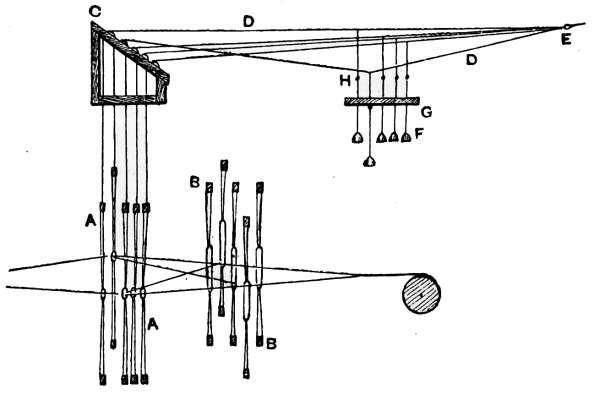
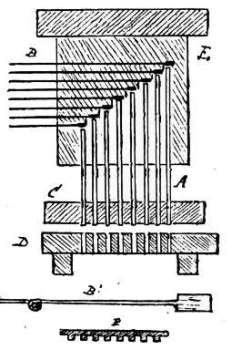
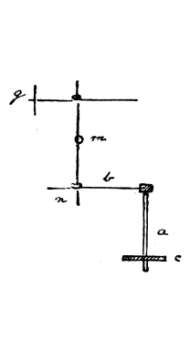
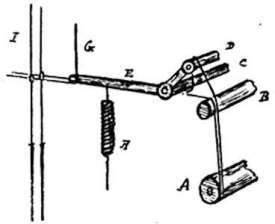
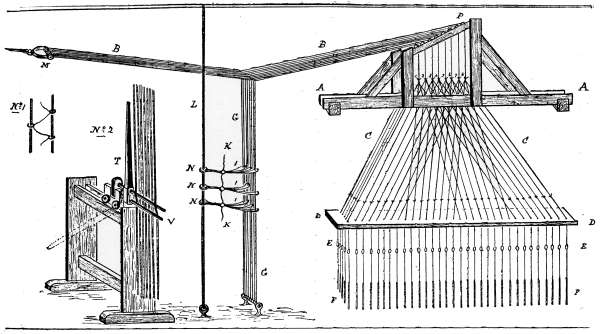
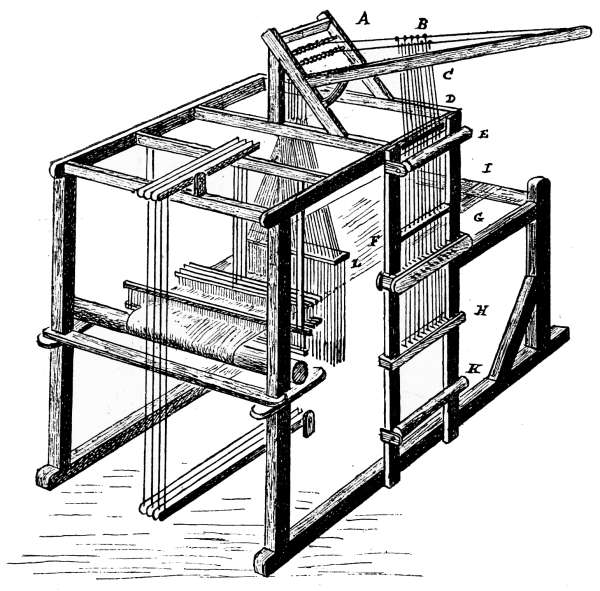
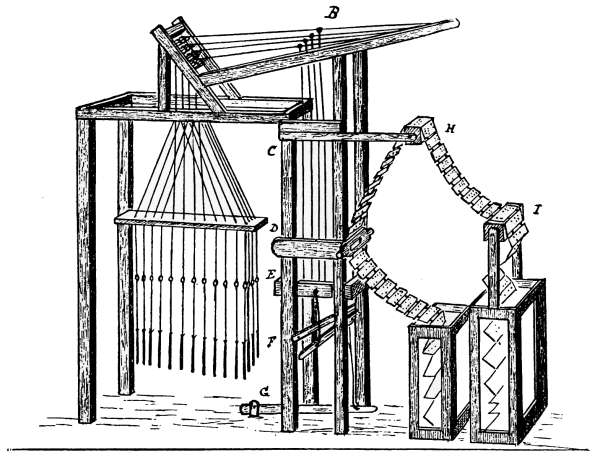
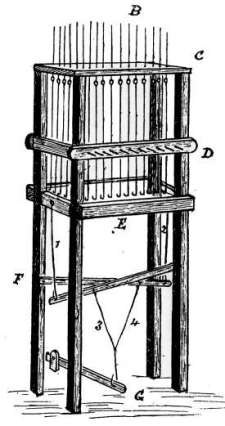
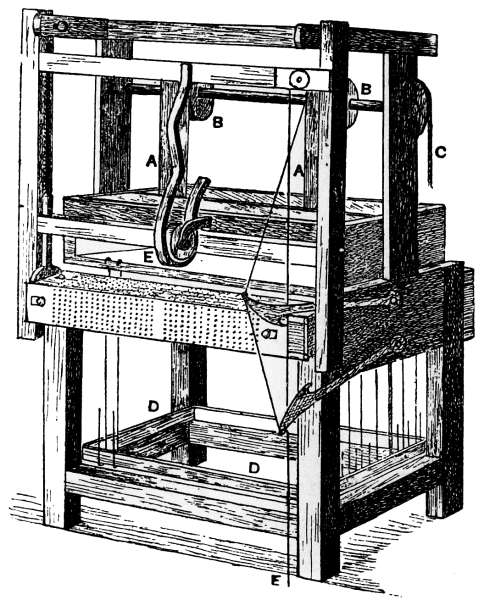
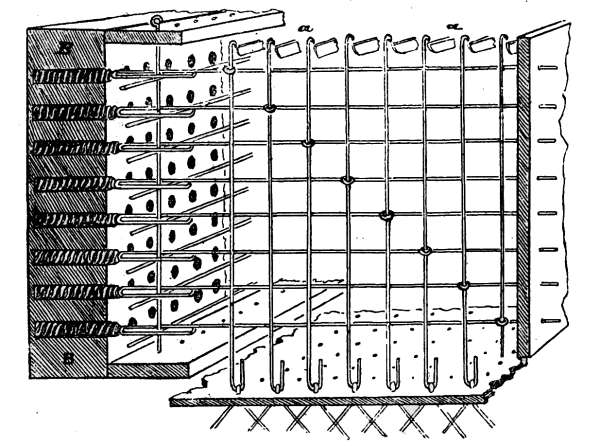
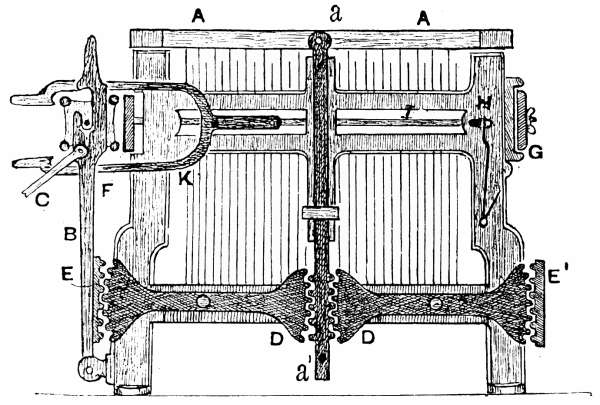
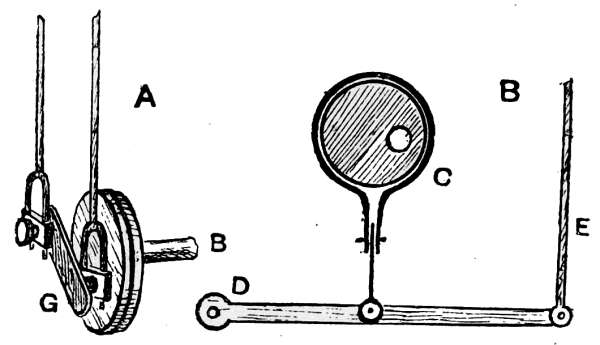
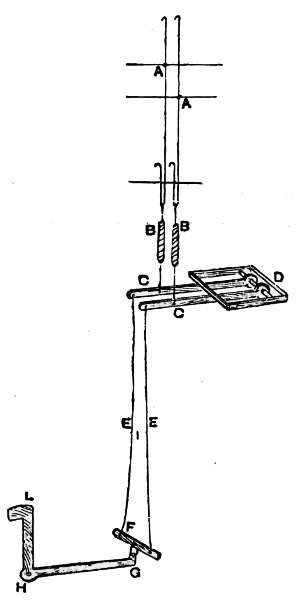
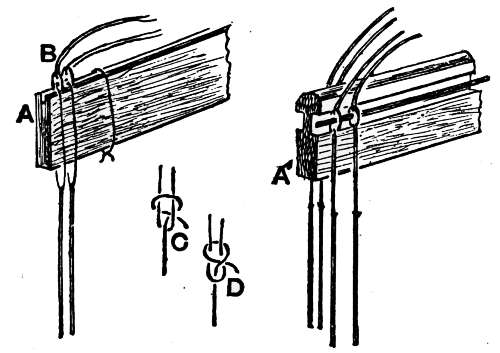
 ; so that when the weaver pulls down
a knob the bead can pass through the round hole, and the shaft or
shafts of the back mounting attached to it will be raised, and can be
kept in this position by drawing the cord into the notch or narrow
part of the hole, which the bead will not pass through. Any number
of shafts can be raised that are required to form the pattern, either by
pulling down the knob for each shaft, or by having the knots corded
to the shafts, so that each one will raise the proper number of shafts.
Thus, in the figure, each knob is only tied to one of the tail cords;
therefore a knob must be pulled down for each leaf of heddles to be
raised, but each knob might be attached to any number of the tail
cords according to the number of leaves of heddles it is required to
raise, so that pulling down each knob in succession will complete the
pattern. It might require too many knobs to do this, and then the
former method would have to be adopted. When the weaver begins
to work he draws the first figure shed with the back mounting by
pulling down one or more of the knobs as is required; he then works
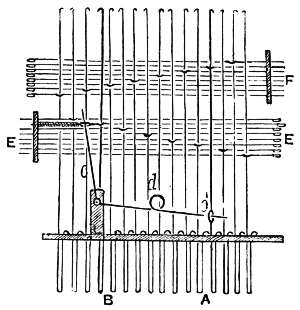
over the ground treadles, b, b, till a change of pattern is required. Next
he releases the drawn shed by pulling the cord out of the notch in the
hole board; draws another shed, and works over the ground treadles as
before. This gives the principle of how the draw loom works, but
the principle of forming the texture with the back and front mountings
combined will be fully explained under ‘Pressure Harness.’










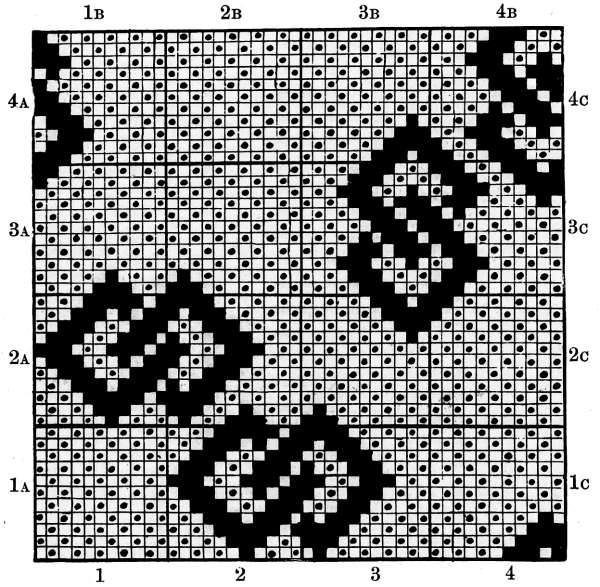
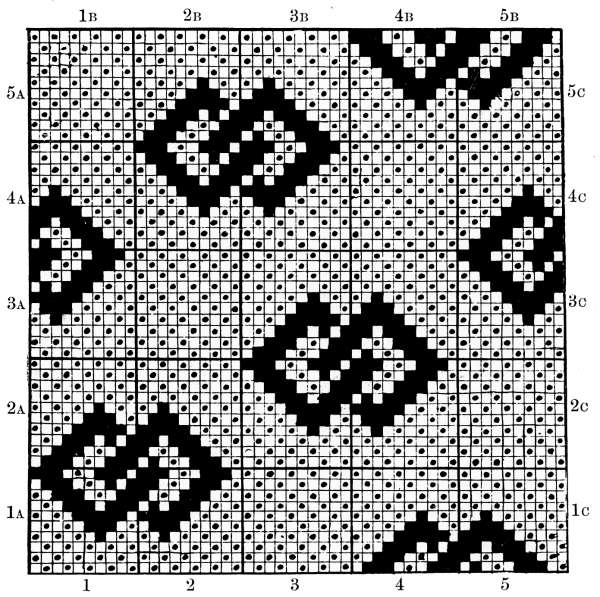
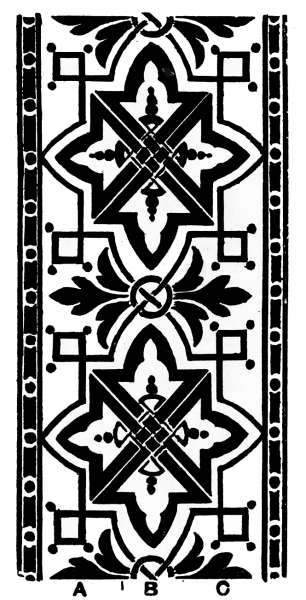
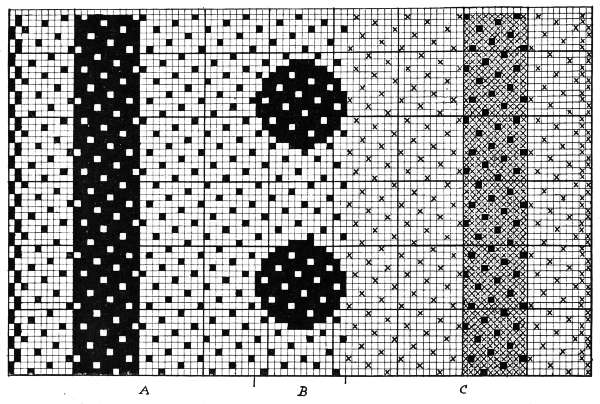
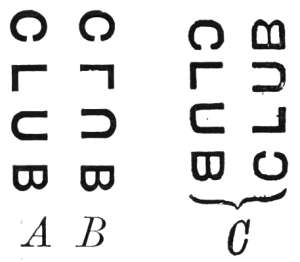
 to be put across
a cloth at one end, and it was required to have the same at the opposite
end to read similarly from that end of the cloth, it would require to be
painted thus,
 , or the cards might be cut from the painting of
the former, turned upside down. Provided it was required to make these
words read correctly on the under side of the cloth in the loom instead of
on the upper side, then the first border would be painted and cut as
 and the second border as
 . This
will be best understood by printing the letters on tracing paper and
turning it round into the position required. In case of a motto or
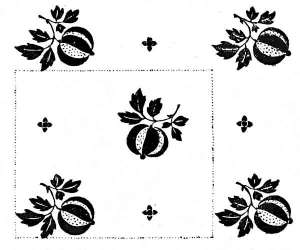
coat of arms wanted for a large cloth
with two centres in it, one centre to be
correct from one end of the cloth, and
the other from the opposite end, as
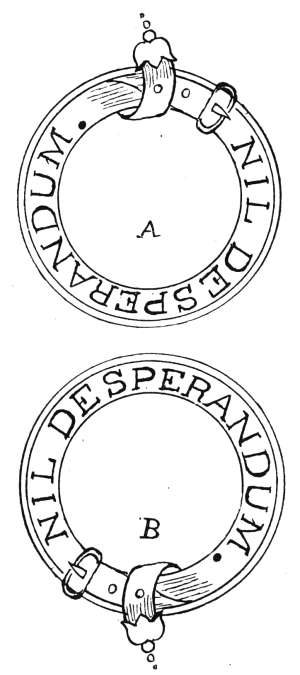
shown by the girdles at A and B, Fig.
87, the painting would be as in this
figure if the upper side of the cloth is
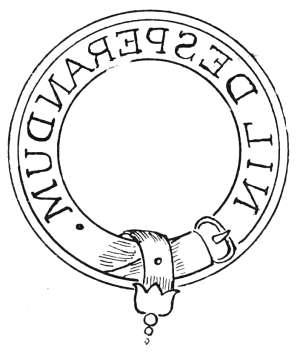
to be the right side, but if the under
side is to be the right side, the first
centre would require to be painted as
shown in