Brutally natural we may call the earlier
characters in English history, but attached to
the Stuart name there is always poetic romance.
And without romance what would our
lives be! So when we sit in our loved library or
dining-room at home, embellished by a few bits of
furniture such as the Stuarts lived among, those bits
are like consolidated stories, things to dream about in
the hours of ease.
James I and his son Charles cared about things
they lived with, and cared, too, about giving them as
much as possible a certain lightness of effect, in revolt
from Tudor bulk. Perhaps the necessity for
surpassing strength was waning. Men no longer
wore tons of armour, furniture in the seventeenth
century no longer journeyed from castle to castle.
Inigo Jones was at work also, with his marvellous
talent at classical architecture, setting a standard of
cheerful elegance in design that lightened the Tudor
magnificence.
When James I began to rule in 1603, Inigo Jones,
a lightsome young man of thirty, was employed by
the King as a composer of masques. After developing
his architect's talent he produced the palace at
Whitehall, Hatfield House and other residences.
His also was the invention that threw over the steps
to the Thames the noble water-gate, York Stairs,
that stands there now, a record of the merry days
when ladies and cavaliers, all gay as flowers, crossed
the greensward, filed under this richly carved arch,
and were handed into elegantly equipped barges on
the river.
While things of an artistic sort were progressing
in England, other events closely concerning us in
America were also active. The entire century runs
two parallel lines of history, one that of the gaiety
of the house in power, the other that of the struggle
of the people divided into religious sects. While
"'twas merry in the Hall, when beards wagged all,"
persecution was rife among religionists, and the
Puritans were finding it hard to stay in their own
loved land.
Thus came the sufferers to America to plant new
homes; and thus coming, brought with them such
furniture as was in vogue at the time of migrating.
And so it happens that our earliest bits of furniture,
chairs that supported grim Pilgrim fathers, tables
which were set out by provident Puritan mothers and
maids, are Jacobean in mode. The chair of Elder
Brewster which has asylum in Hartford, Conn., is a
fine example of the heavy turned work of the day,
and numerous oak chairs show the strap-work and
other low-relief carving so well known in early
Jacobean pieces.
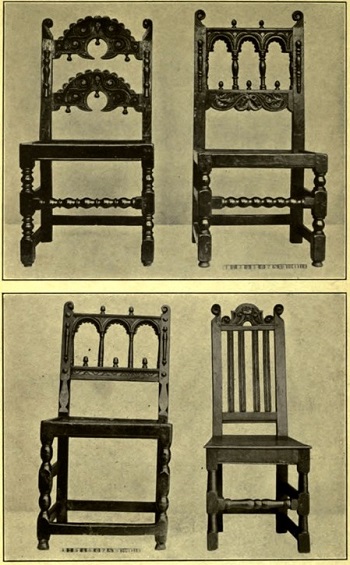
One especial class of chair (Plate 12) when found
in England is called for one of its shires, Yorkshire,
but when drawn from New England hiding places,
we name it a wainscote chair. The design of the
back easily gives reason for the name, for it is formed
from a bit of panelling similar to that in vogue for
walls. Stolid and strong are these chairs, square-built
and stayed with four strong stretchers, usually
near the floor.
The collector considers the charm irresistibly increased
when the front stretcher is well worn with
the friction of many feet, the resting feet of a long
procession that has walked down the centuries.
Even better is the smoothness of the chair-arms
which comes by contact with the human hand, that
restless member with a habit of idly rubbing an inviting
surface. Like all makers of chairs, the ancient
cabinet-maker left back-legs in utilitarian simplicity,
while he limited variety to the front-legs. In this
type of chair, turning gave the usual ornamentation.
This baluster effect had many varieties, but all united
in finishing with a square block at the bottom and
where the seat-frame met the leg, or where the front
stretcher crossed, if it was placed high.
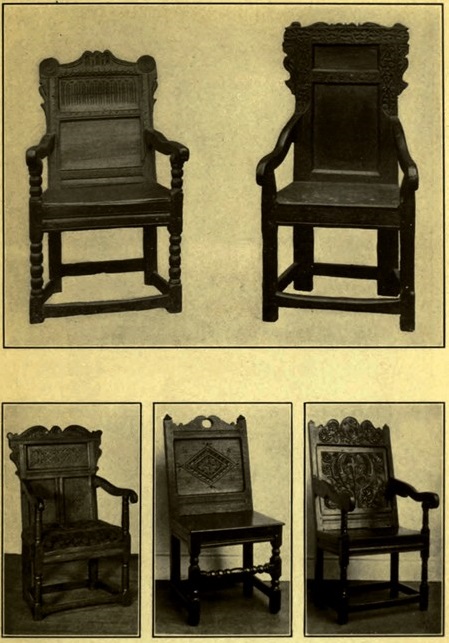
Plate XII—OAK CHAIRS
Called both Wainscote and Yorkshire chairs
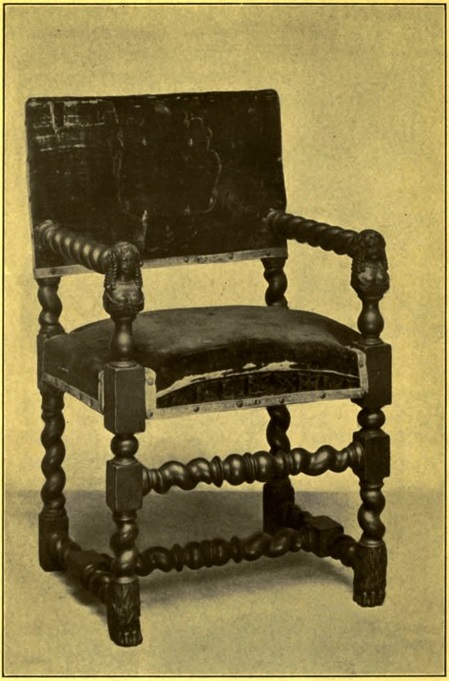
Plate XIII—SPIRAL TURNED CHAIR, CHARACTERISTIC OF FIRST HALF
OF CENTURY
The ornamentation of the back was done with the
light spirit that distinguished early Jacobean styles
from the preceding Italian models, yet without the
elegance that appeared later in the century. These
chairs undoubtedly have charm and interest, but as
works of art they are not comparable to those which
preceded, nor to those which followed. They were,
however, distinctly English, and as such, command
interest.
A close study of the motifs used by the wood-carver
shows all the favourite lines, the guilloche,
that ever interesting play upon circles, the S curve in
pairs, the rounded arch, the half-circle, the rose and
the tulip. Cushions were a part of the chair's equipment.
The tired ladies of the seventeenth century
were not asked to recuperate on a thick oak plank unsoftened
by padding. Loose cushions of velvet and
of embroidery were usual, for this was an age when
handsome fabrics were made all over Europe, and
freely used in flashing blue and ruby red against the
oak.
Nearly allied to the wainscote chair, yet infinitely
more refined, is the chair of spiral parts, with back
and seat upholstered. Without arms it was favoured
by ladies of voluminous petticoats who pattered about
the thrones of James I and Charles I. With arms it
is sometimes called Cromwellian, suggesting that the
doughty Dictator ruled therefrom. But the austerity
of the wainscote chair seems more fitting to his
resolute manner.
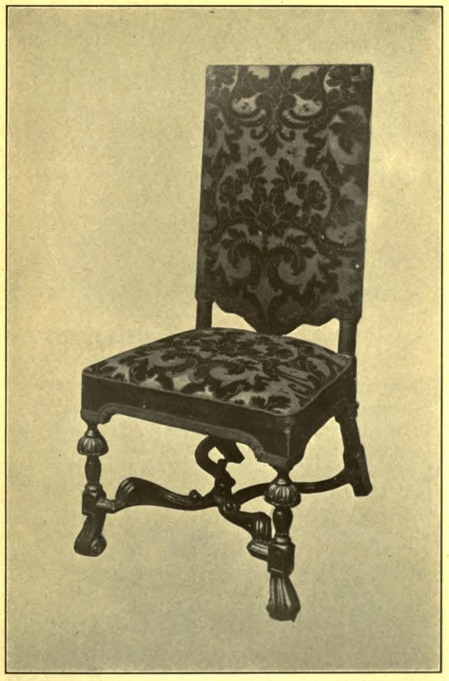
This turned chair with its padded back and seat,
so often dignifies our modern interiors that it is worth
our while to know about it. While the wainscote
chair belonged more especially to cottage furniture
which was made all over England according to varying
local taste, this chair was more or less of an
aristocrat, and furnished the halls of wealth. Its
origin is Italian. France used it freely, but she too
got her first model from the Italians. In the time
these chairs prevailed, England outside of London
was scant of luxury. The homes of all but the
wealthiest were short of the comforts that ameliorate
the jolt of life's car in these our modern days.
But the whole country was sprinkled with inns and
taverns wherein were gathered such luxuries as the
times afforded, and thither went the man of the
family, bored by the too rigid manner of the home.
Those who travelled, too, in the saddle or by lumbering
coach, fell happily into the warm embrace of the
chairs at the hospitable inn at each stop on the journey.
The post-road made the string, the inns the
pearls, and in this way the surface of England was
covered with a net for the delectation of the restless.
But old-time descriptions of the highways, their ruts
and sloughs, their highwaymen even, show how
laborious were the journeyings and how more than
glad were travellers to alight.
Ben Jonson declared a tavern chair to be the
throne of human felicity. Thus he spoke praise, not
only of the inn but of such furniture as pleases us in
these days. If, therefore, any husband of to-day
rebel against the stiffness of backs, or weakness
of legs, of the antique chairs at home, let him be
reminded of Jonson's opinion on these same
chairs.
The chair with spiral legs and other members runs
through the larger half of the century, and has significant
variations. One shown on Plate 13 has a
female head on the uprights of the arms, which represents
Mary of Modena. The figure is given at
full length in a model that our furniture manufacturers
have many times repeated.
While baluster legs for chairs and other furniture
were a product of the reign of the first James, we
may set down the more elegant spiral twist as an evidence
of a better developed taste for which a few
leaders were responsible. Such a man as Inigo
Jones must have influenced widely the public taste
in all liberal arts. Although his examples were set
in the larger art of architecture, the crowd swaggering
about the Banqueting Hall, which still excites
our delight at Whitehall, must have been inspired
to introduce a daintier style at home.
It was in 1625 that Charles I succeeded his father,
and soon after invited Van Dyck to be of those who
surrounded the royal person. It sometimes seems to
the art-seeking tourist, that Charles' patronage of art
had as motive the production of an infinity of portraits
of his own much-frizzed, much-dressed self.
But apart from painting portraits of the King, which
the model made a bit pathetic, through the attempt
to associate majesty with preciosity, Van Dyck had
a large part in improving England's taste. Another
name is that of Sir Francis Crane, he who helped his
royal master with the noble art of tapestry-making at
the Mortlake Works.
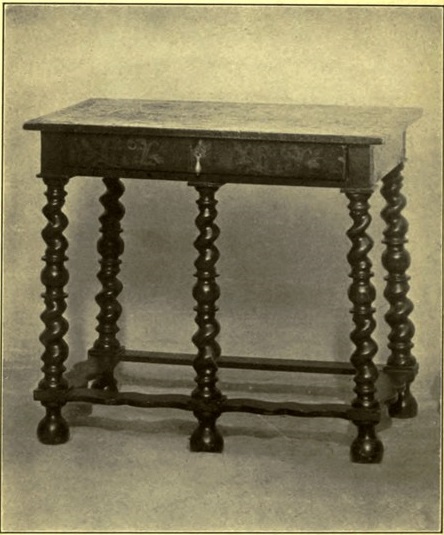
To continue with the use of the spiral leg—as its
modern use creates interest in the subject—it is found
as the support on those most enticing of tables, the
gate-leg. Not that all gate-leg tables are thus made.
Alas no, economy travels heavily in all ages, so the
less expensive baluster turning prevailed. But the
spiral is the favourite and gives great value to the old
tables. Rarely indeed are they to be found at bargains
since we in America have taken to collecting
Jacobean furnishings.
Gate-leg tables are labelled with the name of Cromwell
by those liking to fix a date by attaching to it a
ruler. Without doubt, the great Commoner leaned
his weary elbows on such a table when things went
wrong, or curved a smiling lip above it—if he could
smile—when the table was weighted with savoury
Puritan viands. But for many years before Cromwell,
English homes had found the gate-leg table a
mobile and convenient replacer of the massive refectory
tables of Tudor or Roman inspiration.
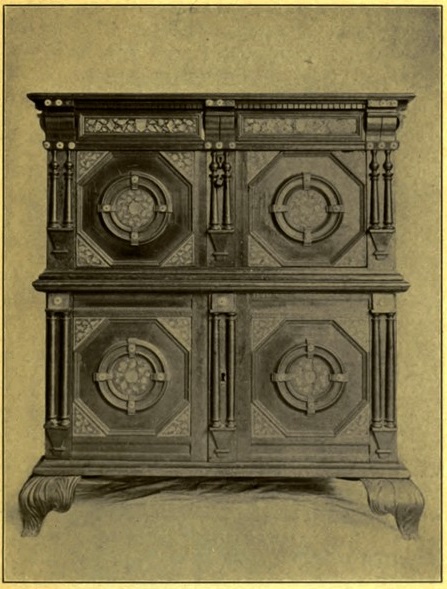
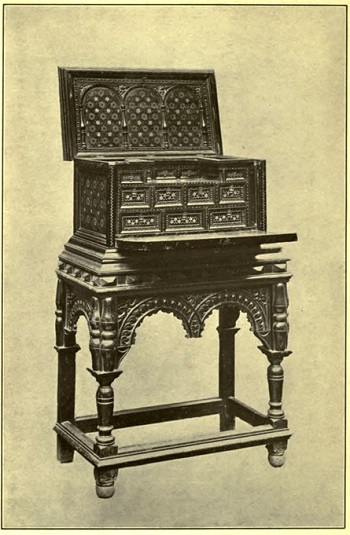
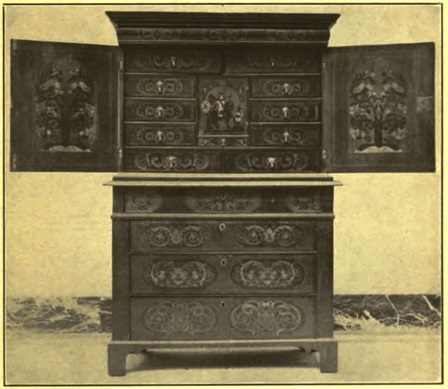
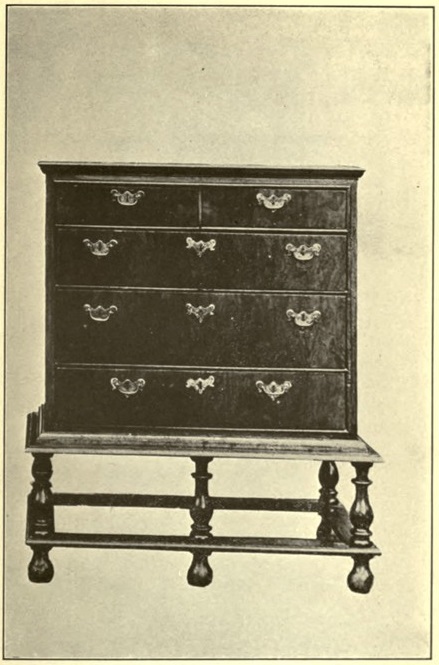
Plate XIV—OAK CABINET, DATED 1653
Decorated with split spindles, and with inlay mother-of-pearl, ivory and ebony.
The legs show tendencies not developed until the next century
under Queen Anne
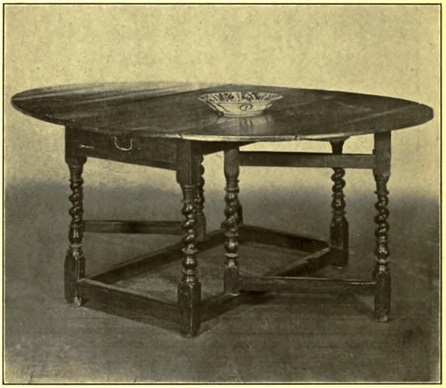
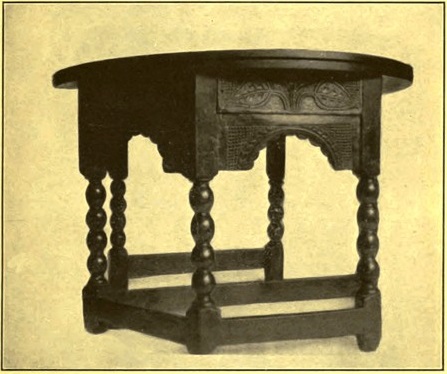
Plate XV—OAK GATE-LEG DINING TABLE
With oval top and rarely proportioned spiral legs. A drawer distinguishes the
piece
In large size these tables set a feast for the family,
in smaller drawing they held the evening light; or,
smaller yet, they assisted the house-mother at her
sewing. The wonder is not that we of to-day find
them invaluable, but that mankind ever let them go
out of fashion. Collect them if you have the purse,
but if you must buy a modern copy, remember that
mahogany was not in use for furniture in England
until the century after, for modern manufacturers
flout chronology and produce gate-leg tables in the
wood of which the originals were never made. They
even lacquer them, in defiance of history.
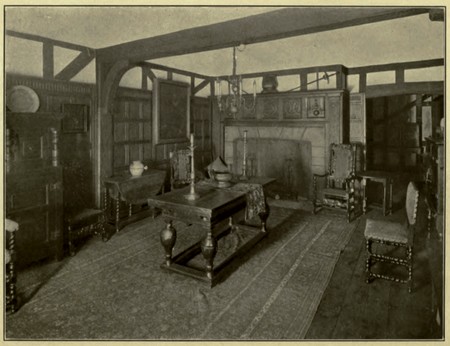
Since the fashion is for old tables in the dining-room,
these Jacobean gate-leg tables are found practical
as well as beautiful. The large size, about four
and a half feet wide by six feet long, accommodates
a moderate family and presents none of the inconveniences
that make certain antiques mere objects of
art or curios. I must confess to a thrill of delight
when sitting at such an old oak board set out with
old lace and silver, not only for its obvious beauty,
but by the thought of the groups who have gathered
there through three hundred years, groups of varying
customs, varying habits of thought, varying fashions
in dress, yet human like ourselves, and prone to make
of the dining-table a circle of joy.
The inlaid cabinet on Plate 11 is an aristocrat.
Though it is dated 1653 it exhibits the split spindles
of earlier years, and these are executed with such
nice feeling that they accord well with the Italian
look of the piece. In truth, its principal decoration
is Italian, an elaborate use of inlay in mother of
pearl, ivory and ebony. Its feet, too, are entirely
un-English, yet it remains a Jacobean piece of English
make. The influences always at work in England
left their mark on the development of English
styles. Always and always a monarch was marrying
a foreign wife, or importing a court painter or
architect, and these folk naturally brought with them
the fashions of their own countries. It seemed as
though the English knew that native art was not a
flower of the first order of beauty and so were modest
about it, and ever willing to adopt the art of other
countries.
It is the custom of the inexact to include in Jacobean
furniture all the styles of the seventeenth century
up to the time of William and Mary, and this
gives to such loose classification an extraordinary
variety. Furniture does not die with a monarch, nor
do new designs start up in a night; goods last after
the master has gone, and the new master uses the old
style until a later one has been evolved. James died
and Charles I took his place in the year 1625, but the
lightening and elaborating of furniture came not all
at once, and depended as much on mechanical invention
and the use of new woods as on the rise and fall
of monarchs.
And yet, as the first man to be pleased was the
king, and as the king in Charles' case had a lighter
nature than his forerunners and had moreover a Continental
encouraging of that lightness, we fancy we
see an evidence of gaiety, of jocundity, in the furniture
of his day. He was a king who intended to take
all the privileges of his state, and one of these was to
surround himself with beauty of the type that brought
no reminders of hard living nor serious thinking, no
hint of grim Puritan asceticism.
So the oak of England which had supplied austerity
was now carved into shapes hitherto unknown.
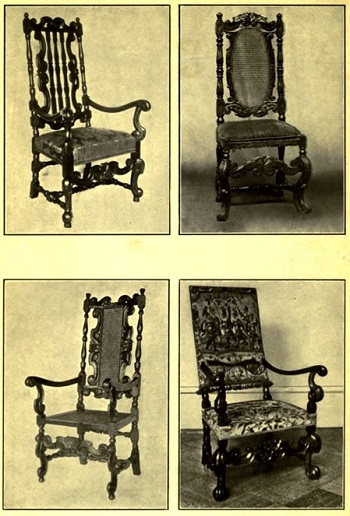
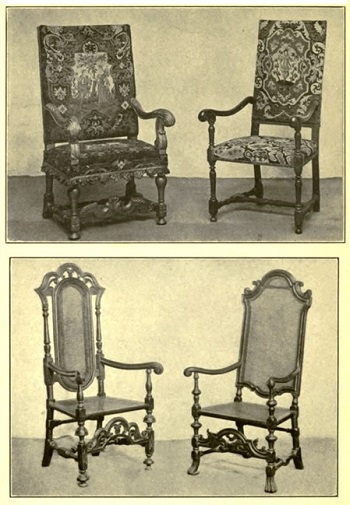
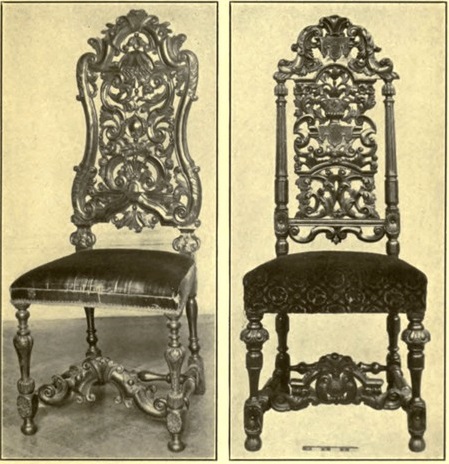
Typical of the results of elaborate oak carving are the
chairs in Plate 17. The arm-chair is a typical example
of a chair of the middle years of the century,
and later. Here the square construction of the
chair is not altered from Tudor days, but note how
every part has been lightened, until an elegance and
beauty have been attained which make it worthy of
the finest rooms of any time. The carver when given
free rein has left little of the chair untouched. Legs,
stretchers and uprights, are all made with a well proportioned
spiral, and at each square of joining a
rosette is carved.
Here also is seen an innovation in the ornamental
stretcher across the front which, instead of being
near the ground, is raised to a height out of reach of a
ruthless boot which might mar its elaboration. This
stretcher shows the use of the long curving palm in
place of the classic acanthus, and also introduces the
fat little cherubs which French designers affected.
Other points to notice are the very open back, composed
of spirals and three rows of carving. It was
at this time that pierced carving came into vogue, so
far surpassing in beauty the wainscote backs.
The incising of the seat-frame is another peculiarity
of the middle of the century. Perhaps the most
interesting matter of all is the caning. Wooden
seats were the only ones hitherto; although cushions
had been used to soften them, they lacked at best the
reciprocal quality that we call "giving." Springs
were far in the future, but a luxury-loving aristocracy
seized at once upon this amelioration.
There is more or less quibbling upon the subject of
caning, as to the date of its introduction. No one can
fix it exactly, which robs the enthusiast of the
pleasure of announcing with oracular precision, that
his chair is of certain year because of its caning.
The middle of the century saw it, the first part did
not, but it lasted through varying styles of furniture,
and is lasting still.
Its origin is undoubtedly Eastern, for the tenacious
splints from which it is woven are from warmer
climes than England's. And that brings us again to
one of those little facts in history of which our household
gods are ever reminding us, the trade that united
India with Portugal, Portugal with Flanders, and the
Flemish with England.
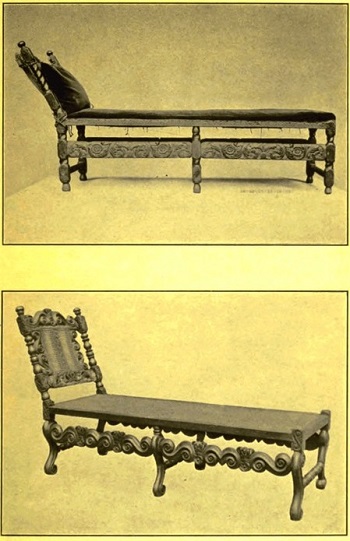
Plate XVI—OAK DAY BEDS
Carved after manner in vogue in second half of XVII Century
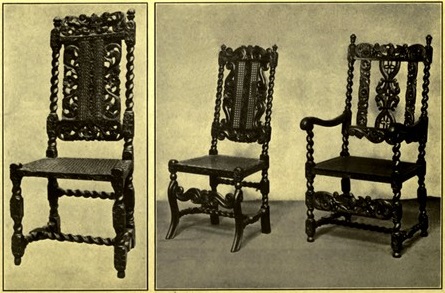
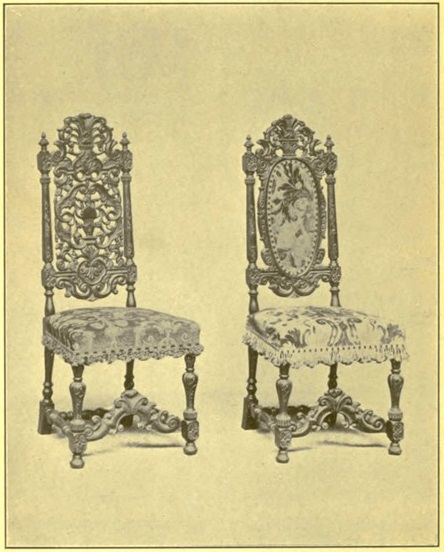
Plate XVII—STUART CHAIRS
Of lightened construction, open carving and incised seat frame
The small chair in the Plate is, to the careless eye,
a little sister to the larger, but the wise observer notes
at once the substitution of the S curve heavy in carving for the more elaborate pierced palm. Also the
cane panels in the back, and the very decided change
in the shape of the front legs. The heavy S curves
are the same which later on gain in thickness and
evolve into the ogee curve seen later, and which is
often mistakenly ascribed to William and Mary, although
originating earlier and receives the name of
James II. Arbitrary names are hard to make consistently
exact; dates are hard to place on every piece,
but is it not enough to know within a very few years
the time of making of one's valuable antiques?
To finish the scrutiny of the smaller chair, note the
curve of the front legs, the first attempt at deserting
the straight perpendicular line of construction. This
is the beginning of an insidious French influence
which prevailed throughout the last third of the century.
It beautified, of course, as the gift of France
to the world is the luxe of the eye, but from the time
of its introduction dates the end of the furniture
which was of solely English invention.
So comes the end of this early Jacobean mode, in
its best time of flowering when it was drowned in a
flood of foreign influence. It was in the styles prevailing
through the reigns of the first two Stuarts
and of Cromwell, that England expressed only herself
in her furniture. It is this which makes the
periods rich with originality and of peculiar interest.
When the Jacobean styles began Shakespeare was
living those sad years whose disillusion produced his
later plays, and Jacobean styles were at their height
at the Restoration when Charles II played the part
of king for his royal pleasure.
CHAPTER III