Obvious typographical errors have been silently corrected. Variations
in hyphenation have been standardised but all other spelling and
punctuation remains unchanged.
JACKSON’S GYMNASTICS FOR THE FINGERS AND WRIST,
In preparation.
A Hand-book of Bodily Exercises, based
upon A. Ravenstein’s “Volks-Turnbuch,” and edited by
E. G. Ravenstein, F.R.G.S., &c., President of the German
Gymnastic Society of London, and John Hulley, Director of
the Athletic Club, Liverpool. In one volume, 8vo, pp. 400,
and 700 woodcuts.
This will be the most complete work on Gymnastics and all
descriptions of bodily exercises ever published in the English
language.
Contents: History of Gymnastics—Constitutiom of Gymnastic
Societies—On the manner of conducting the Exercises—Distribution
into Squads—Training of Instructors—Gymnastic
Festivals and Competitions—Sanitary Rules—Exercises without
apparatus—(free exercises, walking, running, co-operative and
facto-gymnastical exercises, wrestling, boxing, &c.)—Exercises
with portable apparatus (wands, dumb-bells, clubs, bars, &c.)—Exercises
at fixed apparatus (rack, parallel bars, horse, buck,
climbing and escalading, leaping and vaulting, swings, &c.).
LONDON: N. TRÜBNER & CO., 60, PATERNOSTER ROW.
BEING
A SYSTEM OF GYMNASTICS,
BASED ON ANATOMICAL PRINCIPLES,—FOR DEVELOPING AND
STRENGTHENING THE MUSCLES OF THE HAND; FOR MUSICAL,
MECHANICAL, AND MEDICAL PURPOSES.
With thirty-seven Diagrams.
LONDON:
N. TRÜBNER & CO., 60, PATERNOSTER ROW.
1865.
[Right of Translation reserved.]
The whole of the Engravings contained in this work were executed for
the author by Berndt, in Berlin, July, 1864.
The apparatus referred to in this work may be had, price 3s. 6d., of Messrs
Metzler & Co., 36 to 38, Great Marlborough Street, W.
JOHN CHILDS AND SON, PRINTERS.
PREFACE.
The subject of this little work develops,
on anatomical and physiological principles, a
system of Gymnastics for the Fingers and
Wrist, the object of which is—, to lay a solid
and scientific foundation for the acquisition of
technical skill in the fingers and wrist, as applied
to the playing on musical instruments
and to finger-work generally.
For a detailed account of the circumstances
under which this system was discovered, I refer
to the Introductory Remarks, wherein I have
explained the process of reasoning and the series
of experiments, which enabled me to arrive at the
results I have now the pleasure of submitting
to the consideration of my countrymen; more
especially to all those among them who are
engaged in musical pursuits, or any other work
requiring the constant use of the fingers.
I may simply state that both the scientific
principles and the practical utility of this
system of Gymnastics—, after having been subjected
to the test of numerous experiments—,
have met with the approval of the highest
anatomical, musical, and gymnastic authorities
of Germany; at whose special solicitation I was
induced to make these discoveries known by
means of public and private lectures—, delivered
gratis in the German language in many German
cities—, during a journey undertaken at
my own expense, in the course of the summer
of 1864.
I gladly avail myself of this opportunity to
return my best thanks to Professors Hyrtl,
Virchow, Hermann Meyer, and Griesinger;
to Drs Richter, C. C. Carus, J. V. Carus,
Berend, and Angerstein; to Professors Moscheles,
Kullak, Stern, Geyer, Kittl, Joachim,
and Lauterbach; to Capellmeister Taubert,
Ferdinand Hiller, Lachner, Strauss, Abenheim,
Täglichsbeck, and Meyer; to Concertmeister
F. Schubert, Carl Baermann, Scholtz, Singer,
Grün, and many others whom space precludes
me from mentioning here,—for the assistance
they have given me, and for the kind and
favourable reception which they, the press, and
the public generally, gave to my lectures.
And I indulge the hope that this little
work may meet with the same approval from
the medical, musical, and gymnastic authorities
in this country, and be a means of practical
utility among those for whom it is more particularly
intended.
In all the gymnastic establishments
throughout Europe and the civilized world,
gymnastic exercises have been introduced for
every part of the body except for the Fingers,
notwithstanding that it is these important
members of the human frame—with the mental
organs—which chiefly distinguish Man from
the Brute creation.
Therefore I venture to dedicate to the
public—, “Gymnastics for the development of
the Muscles, Ligaments, and Joints of the
Fingers and Hand”—, specially adapted to
Musicians of all classes,
Authors, and all who are occupied much
in writing,
Artists and Draughtsmen,
Printers and Compositors,
Lithographers and Engravers on steel
and copper,
Workers in ivory and wood,
Watch-makers and fine Mechanicians.
Spinners and Weavers, for
All female handiwork, for
Surgical and anatomical processes, for the
treatment of rheumatism, contortions, and
other diseases of the Fingers and Hand,—and
for
All those who require a flexible Hand, or
who earn their bread with their Fingers.
EDWIN W. JACKSON.
September, 1865.
CONTENTS.
PAGE
PREFACE.
INTRODUCTORY REMARKS ON THE ORIGIN OF THIS
SYSTEM OF GYMNASTICS FOR THE FINGERS AND
WRIST
INTRODUCTORY REMARKS ON THE ORIGIN OF THIS SYSTEM OF GYMNASTICS FOR THE FINGERS AND WRIST.
If any one should desire to know how and
in what manner I, as a private individual, came
to hit upon these discoveries, I answer simply:
Six years ago I took my family, principally
consisting of daughters, to Germany, to have
them educated there, and especially to obtain
for them good instruction in music. I soon
found that the method of teaching the pianoforte
then in general use was very fatiguing
and trying to the nerves; at the same time, as
Germany stands at the head of the musical
world, that method, as a matter of course, must
be considered the best which we at present
know. In order to investigate that system more
minutely, I visited several musical schools and
conservatories for music in Germany, inquiring
what was the very best method known for
strengthening the fingers and wrist, for bringing
them into order and preparing them to
play the pianoforte? The answer I everywhere
received was as follows: “The chief difficulties
and impediments to be overcome in teaching
the piano, the violin, and almost all other musical
instruments, are muscular, and lie in the
joints of the fingers and wrists; and the very
best method of rendering them strong and
flexible is frequently and perseveringly to move
the fingers up and down on the instrument,
preserving the hand in the same position. This
movement, together with the usual finger-exercises,
if continued for five or six years, and
diligently carried out, is usually sufficient to
render the joints and muscles of the fingers
agile and flexible, and to bring the fingers
generally into order.”
I inquired further, “Are those exercises
not very fatiguing?” to which I was answered,
“They certainly are very trying to the muscles
and nerves;” and whether “the health of the
students, male and female, did not suffer thereby?”
to which the reply was, that it did, and
that, indeed, it was sometimes necessary for
them to discontinue playing for some months;
but then they added, “It must be remembered
that learning to play the piano was in itself at
all times attended with very considerable difficulties.”
I observed that this result was really
lamentable; and inquired whether there did
not exist any other method for obtaining the
same end and becoming proficient on the
piano? To this I received a negative answer,
and was again told, “After all possible experiments,
it is the opinion of all artists and
teachers at the present time, in all cities in
Europe, that the method alluded to is the most
effective of any we know for imparting quickness
and flexibility to the joints of the fingers
and wrist.”
Now on observing that my daughters
suffered in the same manner, I said to myself,
“There must surely be something wrong
here.” And here I would mention the fact
that when I was 12 or 13 years of age I
learnt the violin, and afterwards for upwards
of 35 years discontinued it. But later in life,
desiring to accompany my children, I was
induced to take up the violin again. I then
found that, although I was in all other respects
exceedingly strong and healthy and capable of
all athletic exercises, my fingers and hand in a
few minutes became painfully fatigued. The
same result followed whenever I took the violin
in hand,—in fact, I found that my fingers were
the only weak parts of my body. This happened
a few years ago, about the same time when the
above-mentioned inquiries took place, exciting
in me great surprise and an earnest desire to
search into the cause. I thought to myself,
“There must underlie some unknown hidden
cause to account for this phenomenon. I will
thoroughly probe the matter.” For this purpose
I now put myself in the way of those
individually who earn their bread by the sweat
of their brow, viz., the smith, the joiner, the
bricklayer, the labourer, the peasant, the
gardener, the wood-cutter, the miner, &c. &c.
I found that all these persons work with their
arms, and thereby acquire muscle like steel and
arms like giants; but that none of them work
with their fingers.
After this I visited boys’ and girls’ schools,
and also observed them in their families; and
there I found again that nearly all of them in
their work made no use of the fingers. The
same observation I made with the educated
classes, of every age and sex.
This discovered to me the fact that the
muscles of the fingers are extremely little exercised
in the ordinary occupations of life; and
must, therefore, on physiological ground, be
weak; a fact of much importance.
I then repaired to the most renowned gymnastic
establishments of the Continent, and
begged to be shown all the varied gymnastic
exercises practised on the body, from the
crown of the head to the sole of the foot, and
when all these various movements had been
exhibited before me, I inquired “But where
are your gymnastic exercises for the fingers?”
“We have none.” “Why?” “We never
thought of it.” “But they require them surely
as much or more than all!” “It has never
occurred to us; we did not know the fingers
required gymnastics, and they have been
entirely overlooked.” This disclosed to me
another great fact; namely, that the fingers
are the only active members of the human
body to which a properly constituted system of
gymnastic exercises has NOT been applied.
I thereupon visited houses and institutions
where men do work with their fingers, viz., where
carvers in wood and ivory, in steel, copper, and
stone, painters and draughtsmen, watchmakers
and fine mechanists, spinners and weavers, printers
and compositors, &c., drive their trade, and
after that, people who are in the habit of writing
much, and even the whole day, such as authors,
copyists, clerks, stenographers, lithographers,
as well as sempstresses and workwomen;—in
short, all those who have much finger-work, or
earn their living by their fingers. And here I
observed all kinds of finger diseases, such as
stiffness of the joints and limbs, writers’ cramp,
hands and forearms debilitated in the highest
degree, paralyzed limbs, nervous weakness, &c.
Then I said to myself, “A light begins to dawn
upon me. I find, first, that the fingers are the
least exercised, in the ordinary occupations of
life, of all the active members of the body;
secondly, that they are on that account relatively
and physiologically the weakest; and, thirdly,
that they are also the only active members which
are not gymnastically trained and treated. I
must consider the matter now ANATOMICALLY,
PHYSIOLOGICALLY, and GYMNASTICALLY.”
And I forthwith began to make all sorts
of artistic and mechanical experiments, for the
purpose of gymnastically exercising, stretching,
and developing the muscles, the ligaments, and
joints of the fingers and hands in all directions,
so as to strengthen and prepare them for playing
the piano and the violin, as well as other
instruments, and for all kinds of finger-work
and handicraft.
In doing so I studied the physiology of the
muscles and ligaments, and directed especial
attention to the transverse metacarpal ligament.
In comparing this anatomy with the
difficulties experienced, I sought to discover
a means more particularly of stretching the
ligaments or bands which run transversely
across the hands and knuckles. This I succeeded
in effecting, and then I discovered, to
my astonishment, that the moment I had applied
my gymnastic movements to these stout
and very obstinate elastic bands, the muscles
became instantaneously looser, and moved
with greatly increased freedom and agility.
In a word, the muscles were set free.
At the same time I tried on myself various
simple, natural, free movements with the joints
of the fingers, in order to examine them practically
and physiologically, and thus to found
a system on solid principles. And I may here
be permitted to state as the result, in my own
case, that though at that time 54 years of age,
after I had diligently practised the course of
gymnastic exercises herein described, a comparatively
short time, every day, my fingers
and wrists became so strong and flexible that I
was able to play, and can now play upon the
violin many hours daily in succession without
fatigue.
I caused the same to be tried by many
other persons also, of different ages. Then I
found, to my surprise, in each case that, in the
absence of proper gymnastic exercises, these
most important parts of the human frame,
owing to their being so unpractised in the
ordinary occupations of life, and being consequently
so weak, are not equal to the least
work or exertion beyond the usual movements
of daily life, and that whenever anything
beyond the ordinary routine is required of
them, they are found to be utterly incapable
of fulfilling the task.
Then I said to myself, “I now see as clear
as sunlight whence arise the extraordinary
difficulties of learning to play the piano and
violin. They arise from the very fact that an
art the most difficult, from a muscular point of
view, which we know of, has to be performed
with the least practised and, proportionately,
the weakest of muscles. The impediments and
difficulties in almost all cases can be referred to
the muscles; and it is this weakness which
must be overcome.”
Upon this I repaired to anatomical, chirurgical,
and medical institutions, in order to
study still further the anatomy of the hand, the
fingers, and the arm. I found that the muscles,
the ligaments, and the tendons of the fingers
and hands consist of elastic masses, intersecting
the hand, and running TRANSVERSELY as
well as LONGITUDINALLY; and I especially discovered,
after a number of experiments, that
the TRANSVERSE LIGAMENTS, unless they be exercised,
remain quiet and stiff, and impede to a
certain extent the movements and activity of the
muscles, when the latter are more than ordinarily
exerted; that in order practically to
exercise and stretch them, and particularly
the TRANSVERSE ligaments and tendons, and
to render them strong and supple, it is
necessary not only to move the fingers up
and down, but laterally also; that, in short,
both muscles and ligaments ought to be
practised gymnastically; and that the fatigue
and the danger to health, the nervous weakness
and the disgust often observed in musical
students, arise from the following causes:
Firstly, that the muscles, tendons, and ligaments
of the hand and fingers are, proportionately,
the least practised, and, consequently,
as stated before, the weakest;
Secondly, that they have never been gymnastically
trained or treated;
Thirdly, that the methods now in use for
strengthening those weak muscles and rendering
them flexible are insufficient and erroneous;
Fourthly, that the transverse ligaments have
never been stretched; thus on these several
grounds hampering the learning of music with
unnatural difficulties, and with exertions of the
muscular and nervous system injurious to
health;
Fifthly, that so soon as the muscles are
properly and gymnastically exercised, and
the ligaments and tendons stretched, the
fingers set at liberty move glibly and freely
over the instrument; and,
Sixthly, that all this is readily accounted
for on the simplest, though till now unexplained,
anatomical and physiological grounds.
And as regards the different persons and
classes already mentioned, who earn their living
with their fingers, it would have been
easy to prevent the various diseases of the
same to which they are exposed, if the joints
of their fingers and hands had previously been
daily practised, strengthened, and prepared by
transversal and longitudinal gymnastic exercises.
And more than this, those sad infirmities
might, in most cases, either have been entirely
cured or at any rate alleviated by the above
muscular treatment. Besides, a continuance of
the same diseases would be easily obviated, if
such treatment were resorted to.
Then I asked myself, “Is any one to blame
that the facts just mentioned have not been
previously known and acted upon?” No one.
It certainly is not the fault of the artist and
teacher, because their task, so great in itself,
did not necessarily lead them to direct their
attention to this speciality of gymnastics. Nor
could anatomists and physicians, nor other
learned men, in treating problems more nearly,
and perhaps more important in themselves, be
expected to have thought of it. As we are
frequently indebted to chance for the most
important discoveries, so it has been with this
one. For my part, I lay claim to very little.
The idea had taken hold of me that a hiatus
and a want in the method of learning and
practising music, also in finger-work of various
kinds, existed, and I set to work to fill up
the former and to satisfy the latter. For
several years I have indefatigably pursued this
work in Germany, and after multifarious trials,
experiments, and exercises, I have happily
achieved the following simple system of
gymnastics, whose aim and object, as regards
music, after full and complete proof, are; by
strengthening the muscles and stretching the
ligaments through careful training, to impart
to them flexibility and agility, to shorten considerably
the time of study, and facilitate the
work of both teachers and students; whilst
as regards all classes generally who work with
their fingers, it is calculated to a great extent
to render their work more easy, and in case of
disease of the fingers and hands, to prevent it,
to cure it, or at the least to diminish its injurious
consequences.
Having been requested by the highest anatomical
and artistic authorities in Germany to
give publicity to this method and to explain it
personally, I undertook, in 1864, at my own expense,
from love of the art, a journey through
many towns of the Continent, where, as already
stated, I delivered, in the German language, a
number of private and public lectures on the
subject. And here I desire specially to crave
the forgiveness of my kind German friends, if,
in delivering those lectures, I did not at all
times express myself in accents of the purest
German, since I only commenced the study of
that difficult language,—for the first time in my
life,—six years ago, after I had attained the
age of 52 years. The exposition of this method
having met with cordial approval, I now offer the
result of my labours to artists, musical students,
and to all friends of music, as well as to all those
who work much with their fingers, or who suffer
from finger disease; also to anatomists, physiologists,
surgeons, and gymnasts; indulging
the hope that, if applied correctly and carefully,
they will go far towards removing the
evils to which I have alluded, and be of much
practical usefulness and advantage.
CHAPTER I. ANATOMY OF THE HAND. ON LIGAMENTS, TENDONS, &c. &c. . — FOOTNOTES:
The skeleton of the hand, consisting of 27
bones and moved by 40 muscles, most ingeniously
combines firmness with pliant flexibility,
is equally fit for rough work and the most
subtle occupation, and corresponds in its well-balanced
mechanism with that mental superiority
through which man, amongst all creatures
the poorest in means of defence, becomes
the ruler of living and inanimate nature. The
hand, fixed to the end of a long articulated
column of bones, and, through its skin-covering,
particularly in the cavity, endowed with high
sensibility, raises itself to the importance of an
organ of feeling, which, moveable in all directions,
apprizes us of the extent of matter, and of
its physical qualities.
The most ancient forms of measurement
have, therefore, been taken from the length of
the several subdivisions of the hand. The
capability of the hand of assuming the hollow
shape of a spoon, and of being stretched like a
shovel, determines its use for gathering and
for turning up matter. The curvature of the
fingers forms a strong and broad hook, which
renders excellent service in climbing; and the
thumb, whose position enables it to be placed
opposite all the other fingers, acts in conjunction
with the latter like a pair of pincers,
capable of seizing and feeling smaller objects.
The thumb being easily moveable and strong
at the same time, is a privilege of the human
hand. It powerfully opposes itself against the
other fingers into the fist, for the seizing and
holding of heavy objects. In doing this the
thumb indeed performs almost as much as the
remaining fingers taken together; it represents
one half of a pair of pincers, wherefore Albin
has called it Manus parva.
The unequal length of the fingers is well
adapted for the taking hold of spherical forms,
and the fingers being bent towards the hollow
of the hand and held together, encloses an
empty space, which is shut by the thumb
serving as a lid. The wrist of the hand,
having a circular shape, and being composed of
several bones, is much less exposed to the
danger of being broken, than if one single
curved bone were to take its place. Its cavity,
which by strong transversal ligaments is transformed
into a ring, protects the bending tendons
of the fingers from pressure and friction. The
firm connection between the middle hand and
the wrist renders possible the actions of stemming
and hurling with the hands, and the
longitudinal curve of the separate bones of the
middle hand, as well as their lying one at the
side of the other, and convexly towards the
back of the hand, facilitates the forming of the
cavity of the hand. The great moveability of
the fingers, and the many possible combinations
of their relative positions, have made them the
instruments of language by signs. The deep
slits separating them allow of folding the
hands, in order to press with double force, and
the bending of the two last finger-joints, which
can only take place at an angle, imparts to the
clenched fist a force which once usurped the
place of right. How necessary the joint action
of both hands is for certain performances is
proved by the old proverb: Manus manum
lavat. In short, all the thousandfold occupations
of the hand which necessity commands
and the mind develops, and which are an exclusive
prerogative of man, become practicable
through the wonderful structure of this instrument.[1]
As regards the system of the gymnastic
training of the fingers in particular, which I
am now placing before the public, it is founded
on an important fact, namely, the action of the
LIGAMENTS AND TENDONS.
It has been acknowledged at all times, that
if a muscle is to be made both stronger and
quicker in its movements, it should be exercised;
that the ligaments and tendons play, in
these exercises, an indispensable part, has
hitherto (to use the words of a celebrated German
physiologist), hardly been sufficiently
acknowledged or explained. It is further
known, that the principal method now in use
of strengthening and rendering flexible the
joints and muscles of the fingers in playing the
piano, consists in alternately raising and dropping
the fingers, and that this method requires
very great exertion, and consumes very much
time. Now, I have found, by means of many
different experiments and exercises, which I
have made with the hand and the fingers, that
the tight ligaments and skin-folds, intersecting
the hand transversely, unless they be exercised,
and if they be allowed to remain firm, for this
very reason, impede the movements of the muscles
whenever they are more than ordinarily
exerted; while, on the contrary, the stretching
of the transversal ligaments produces a remarkable
influence on the moveability of the fingers
and the hand, facilitates the work of the muscles,
and imparts to them freedom, steadiness, and
precision.
By placing the cylinders to be used for this
purpose between the fingers for only a very short
time, and thereby exercising the ligaments of
the hand, both transversely and longitudinally,
the movement of the fingers is at once rendered
much easier and quicker. This result can
only be explained by the fact that the ligaments
and folds of the hand, having been
stretched by the cylinders, have become
loosened, and, therefore, as I said before, impede
less the muscles in their fatiguing work. If,
on the other hand, all the muscles, ligaments,
and tendons are put into motion in both
directions, longitudinally and transversely,
they soon become strong and flexible.
[1] Joseph Hyrtl: Lehrbuch der Anatomie. 4te Auflage.
Wien, 1855. Erasmus Wilson, F.R.S., System of Human
Anatomy. 8th Edition. London, 1862.
CHAPTER II. THE MUSCLES OF THE HAND AND OF THE FINGERS. — FOOTNOTES:
Leaving aside the vessels and nerves unconnected
with our subject, we may describe the
hand as being composed of three classes of
organs, 1. bones with joints, 2. ligaments,
3. muscles.
1. Bones with joints.
The hand is subdivided into five separate
limbs (fingers), lying one at the side of the
other, and being, at the lower end, firmly joined
together into one whole. Each of these five
limbs (fingers) is composed of a row of bones,
having the nature of long bones. The first of
these bones, next to the lower arm, is called
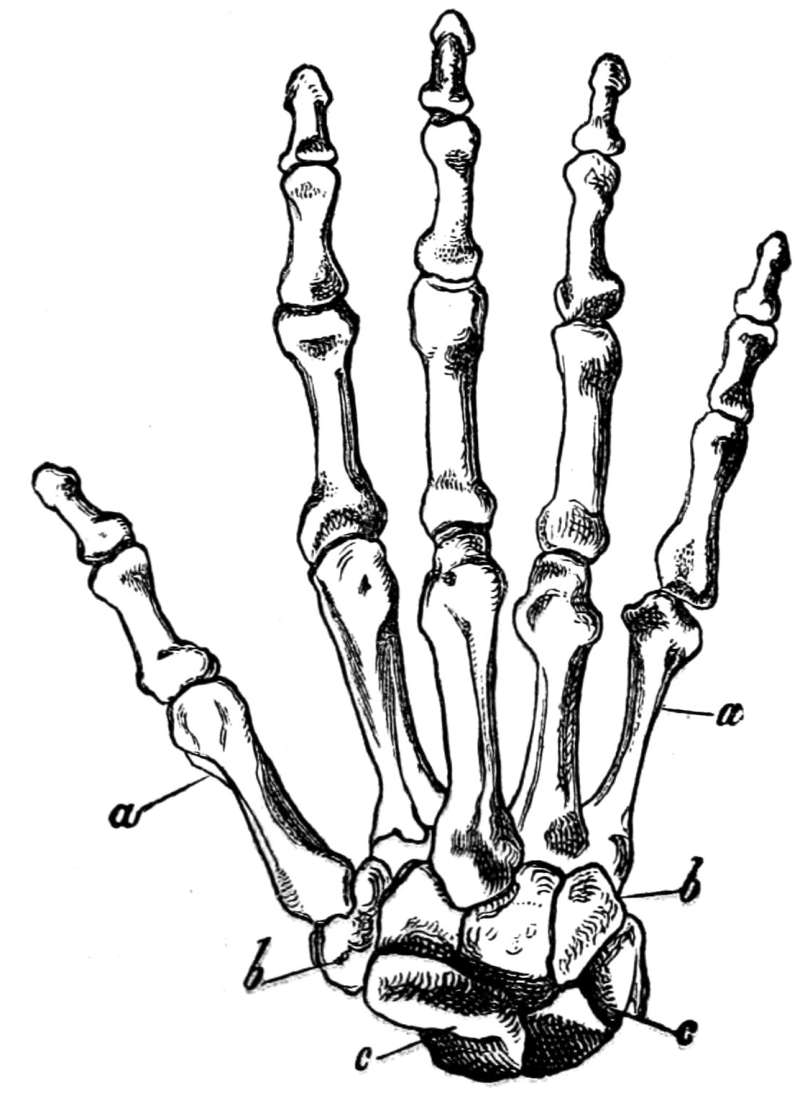
the metacarpal or middle-hand bone (Fig. 1 a);
the others are called finger-joints. The thumb
has only two finger-joints, the other fingers
three each. The fourth and fifth fingers are the
weakest of all.
Fig. 1.
The union of the five fingers into one whole
is effected by means of the extremities of
the middle-hand bones, commonly known as
knuckles, which are turned towards the forearm,
being connected with one another by
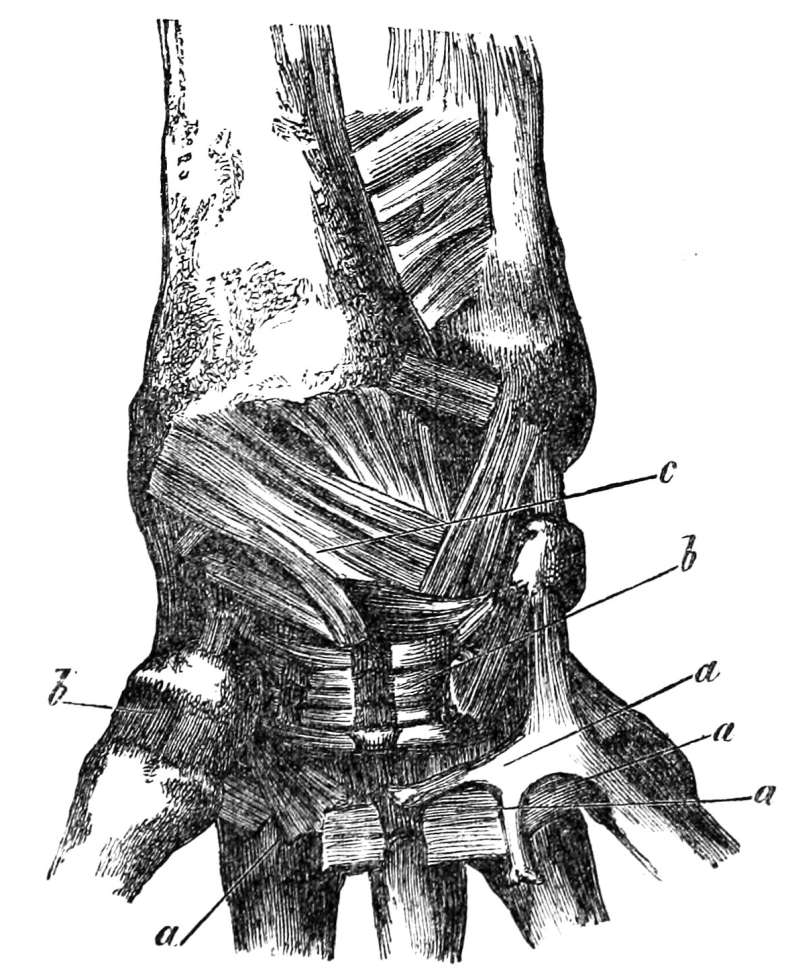
very tight transversal ligaments (Fig 2 aa and
Fig. 3 bb), and being thus connected, are
again fixed to a row of four roundish bones,
joined to one another in the same manner
(Fig. 1 b). Thus, the five middle-hand bones
and the four bones of the upper wrist form
one firm structure. In this structure the
middle-hand bone of the thumb and of the
little finger can be more easily moved than
the others.
Fig. 2.
On account of this moveability of the two
extreme middle-hand bones, it is possible to
move the two edges of the hand close to one
another, whereby the cavity of the hand
assumes the shape of a groove.
The structure here described (the hand, in
the narrower sense of the word) is joined to
the lower arm by means of three muscles, the
posterior row of the bones of the wrist (Fig.
1 c). The movement between these bones and
the hand is hardly anything but a hinge-movement;
that between them and the lower
arm, however, is a movement in almost all
directions. The bending and stretching of
the hand is, therefore, produced with the
participation of both joints, the side movement
of the hand, however, almost exclusively by the
joint situated between the posterior row of the
bones of the wrist and the lower arm.[2]
2. Ligaments.
All the finger-joints are provided with
capsules, which are woven out of strong
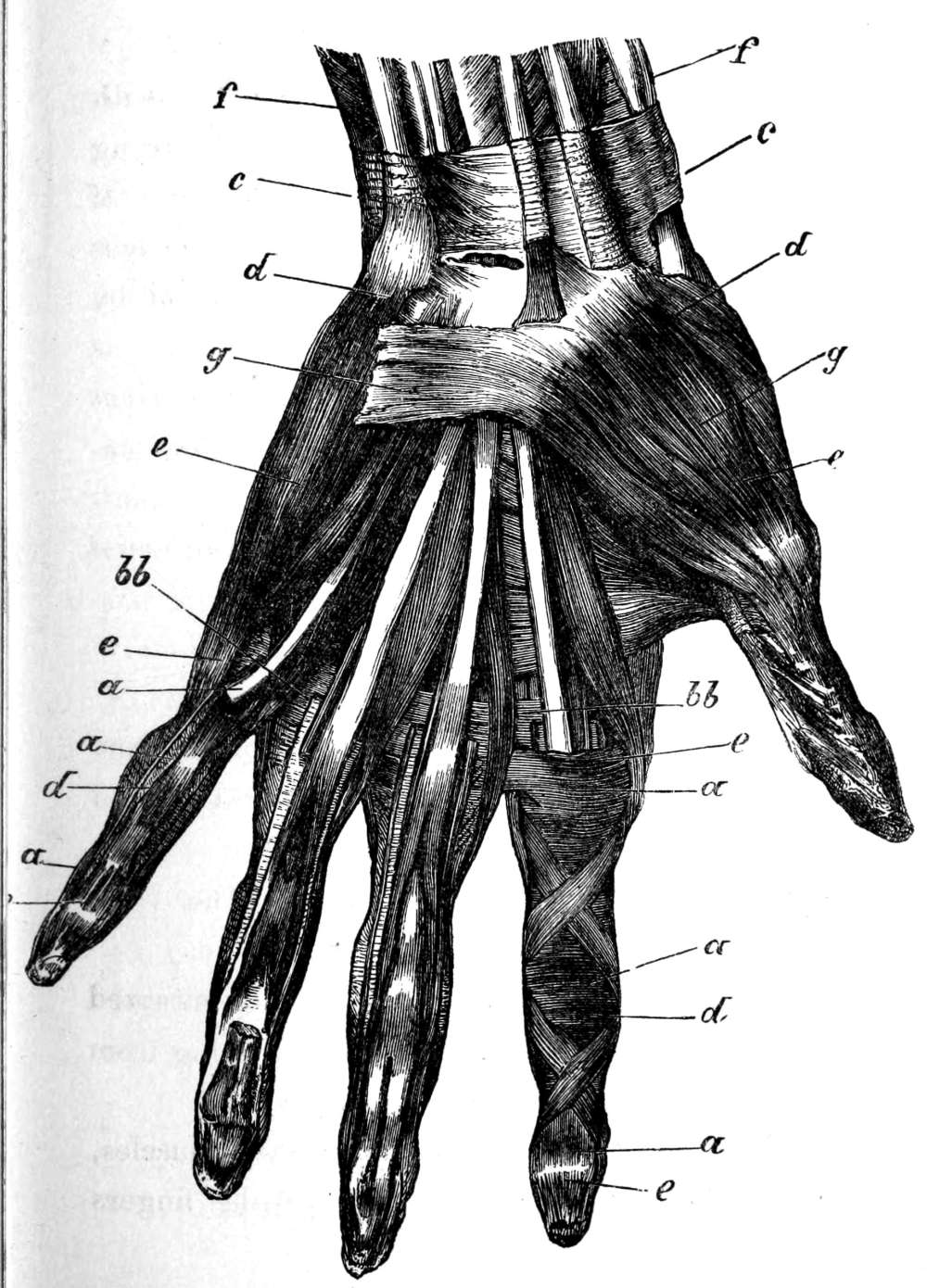
transversal fibres (Fig. 3 aa). The bones of
the wrist are connected between themselves
and with the bones of the middle-hand by
tight transversal and longitudinal ligaments, as
seen in Fig. 2 aa, bb. Lastly, the two ends
of the middle-hand bones, or knuckles, are connected
with one another and with the first joints
of the fingers by a separate strong, transversal
ligament (Fig. 2 aa, Fig. 3 bb).
3. The Muscles of the Hand consist
1. Of muscles (four in number) rising from
the lower arm and bending the wrist up and
down, right and left (Fig. 3 c, d, e).
2. Of muscles of the fingers. These are
subdivided into—
a. Extensors of the fingers, being situated
in the back part of the hand and rising from
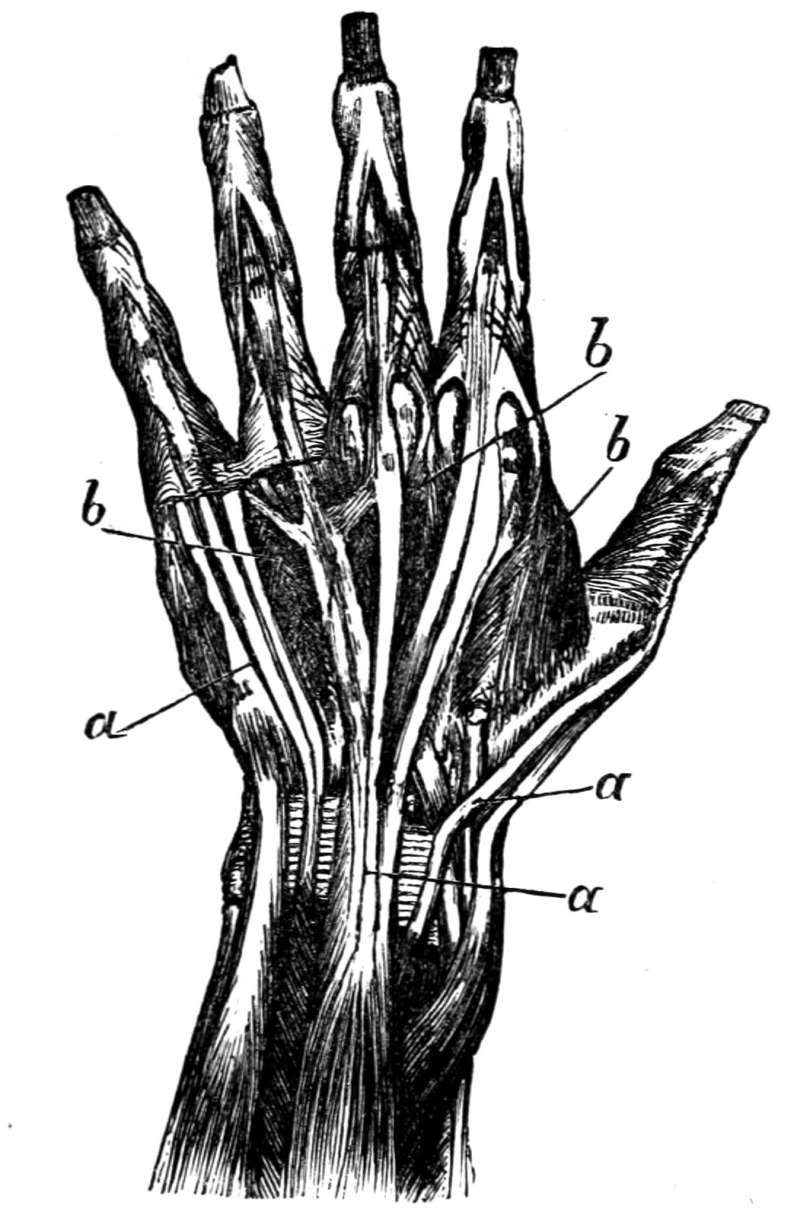
the bones of the lower arm (Fig. 4 a).
b. Benders of the fingers. Two muscles,
the one for the second joints of the fingers
(Fig. 3 d), the other for the first joints of the
fingers and the joints of the nails (Fig. 3 e)
also rising from the bones of the lower arm.
Fig. 3.
c. Contractors of the fingers, rising from
the hand itself, between the bones of the
middle-hand (Fig. 4 b), and extending as far as
the first finger-joint (Fig. 4 b).
d. Two muscles, also rising from the cavity
of the hand, and moving the little finger towards
the thumb (Fig. 3 g).
Lumbricales, or Flexores primi Internodii
Digitorum, are situated in the hollow of the
hand, and pass to their tendinous implantations
with the interossei at the first joint of
each finger, externally and laterally, next the
thumb (Fig. 4 a, b). These perform those
minute motions of the fingers when the second
and third internodes are curvated by the
muscles, and therefore are used in playing
musical instruments, whence they are named
Musculi Fidicinales, or fiddle-muscles.[3]
[2] Luther Holden, Manual of Anatomy (London, 1861),
Lecturer on Anatomy in Bartholomew’s Hospital. Hermann
Meyer: Lehrbuch der Physiologischen Anatomie. Leipzig, 1856.
[3] William Cowper, Myotomia reformata. London, 1724.
Richard Quain, Professor of Clinical Surgery, Surgeon
Extraordinary to the Queen.
CHAPTER III. EFFECTS OF THIS GYMNASTIC TREATMENT ON THE MUSCLES, LIGAMENTS, AND JOINTS OF THE FINGERS AND THE HAND. [4] — FOOTNOTES:
After the explanations just given, it may
readily be conceived what effects the cylinders
placed between the fingers and the gymnastic
staff must produce on the joints and ligaments
of the hand.
1. The ligaments connecting the bones of
the middle-hand amongst themselves and with
the fingers (Fig. 2 aa) are extended and
stretched (Fig. 3 bb), and thus those joints, so
important in playing on musical instruments,
are rendered more moveable.
2. The connecting links between the bones
of the middle-hand and the bones of the wrist
are loosened (Fig. 2 bb).
3. Almost all the ligaments of the cavity of
the hand are made flexible.
4. At the same time, all the muscles of the
hand, and particularly the muscles situated
between the bones (Fig. 4 b), generally so
little practised, are stirred into activity by the
cylinders, the stick, the staff, and the free
exercises.
From the diagrams (Fig. 2 and 3) it may be
plainly seen, what was mentioned before, viz.,
that the movement of the middle-hand and of
the bones of the wrist in general, unless
specially practised, is very inconsiderable;
while through the cylinder gymnastics prescribed
in this work, that limited movement
of the bones is rendered more easy. It may
also be seen from the diagrams that, if both the
great and the small tight transversal ligaments
remain still and firm, they impede and render
more difficult the free movement of the fingers
in every direction; and these ligaments will
always remain stiff and tight, unless they be
specially trained.
Fig. 4.
For this reason the cylinder exercise, just
mentioned, is particularly intended to loosen
the impeding transversal ligaments, as well as
to exercise and strengthen all the muscles of
the hand and fingers.
To convince yourself that this opinion is
correct, extend your fingers for two minutes
only with the cylinders alluded to, and you
will find that the fingers instantaneously move
much more easily, and that the muscles, liberated
from their tight, stiff neighbours, act
with much greater freedom.
In the same manner as with the cylinders,
the greatest advantage may be experienced
from the use of the gymnastic staff or stick.
The principle on which these movements
are founded is, that by them almost all the
muscles of the hand and the fingers, the
smallest as well as the largest, which in
playing musical instruments and all the other
occupations of the fingers bear the chief part,
are stirred into action. At the same time,
the extraordinary effect of the free exercises
on the large finger-joints and on the ligaments
and tendons is increased. And further—every
portion of the hand and fingers,
ligaments, tendons, joints, and particularly
the muscles, are well practised, strengthened,
and rendered flexible, by the fingers being
stretched and extended on, pressed and exercised
against, a solid body. Finally, while
imparting to the muscles of the fingers and
hand far greater strength and ease than the
continued quick movement on the musical
instrument is calculated to affect, all these
exercises affect the nerves in a lesser degree,
and prepare the fingers for all kinds of work.
These results, observed and tested by me
countless times, are of the greatest importance
to all those who work with their fingers,
but more particularly to those engaged in
musical pursuits, who, instead of being overwhelmed
with fatiguing work as before, will
find that by these exercises their studies are
facilitated and divested of much of their previous
trouble and vexation.
The Wrist.
This joint, which for players on the piano
and other instruments is of such great importance
(Fig. 2 c), should also be exercised
gymnastically; since, by means of the
gymnastic exercises here recommended, strength
and flexibility will be gained in a very short
time, and a great deal of trouble saved. Nor
ought it to be overlooked that for all those
who work with their fingers, a flexible, pliant
wrist is a great help, and that by it all the
joints of the hand are made to act harmoniously
together.
[4] Anatomists and physicians of great eminence have observed
to me, “Your anatomical researches have solved some
important questions long held in dispute by physiologists, and
are of great practical value.”
CHAPTER IV. NEGLECT HITHERTO OF THE HAND AND FINGERS. — FOOTNOTES:
Many books have been written on gymnastics,
but I am not acquainted with one
which treats of the gymnastical exercise of the
fingers. Why these important members of
the human body should until now have been
so much overlooked and neglected, it is difficult
to understand. For, as Professor Richter
in Dresden says, “Next to the more powerful
development of the brain, it is almost exclusively
the structure and skill of the fingers
and hand which raises man above the brute,
and has made him ruler of the earth.”
In order, therefore, to heighten the capacities
of the human hand, the joints of the
hand and fingers should, from early youth, be
exercised gymnastically, as much and in as
many various ways as possible, partly by free
exercises, partly by means of mechanical appliances.
Gymnastics, according to anatomists and
physicians, is the stretching, extending, pressing,
and training of the muscles, the ligaments,
and the limbs of the body.[5]
Flexibility, agility, and strength can be
acquired only by means of a regular exercise of
the muscles of the body.
Strength and power impart agility and
quickness. This every physician and every
sensible man knows.
A soldier only becomes fit for his work
after the muscles of his body have been gymnastically
attended to and developed. Any
man, having to perform hard physical labour,
must exercise his muscles gymnastically, and
every one ought to exercise those particular
limbs the use of which is most necessary for
his profession.
And more than any one else, the teachers of
music have to experience the consequences of
a want of skill and strength in the hands of
many learners, and they know how greatly
a systematic educational training of the fingers
and hands for the execution of the more delicate
movements is needed at all times.
Nevertheless, there are many arts besides
music for which the hand ought to be
also trained from early youth, in order to be
able permanently to accomplish, in later years,
what is excellent, e. g., many kinds of handicraft,
machine-work, needle-work, anatomy,
and surgery, writing and drawing, and all
fine manipulations.
An untrained hand will either remain
clumsy in these branches of work, or it will
soon fail through over-exertion, which causes
a peculiar kind of paralysis, connected with
cramp, and well known to writers (the so-called
writers’ cramp), but which also affects musicians,
artists, shoemakers, tailors, sempstresses,
and other working people. Certain it is,
that if this matter had been inquired into before,
and public attention directed to it, a
great deal of trouble and vexation in learning
music might have been saved; the labour of
many working people of all classes, who chiefly
have to use their fingers, have been greatly
facilitated; and, moreover, many diseases of
the joints of the fingers and hand might have
have been prevented.
[5] The following quotations from the works of some of
the leading authorities may be of interest to the reader:—
“Methodical gymnastic exercises of the hands and fingers
afford the very best means of overcoming the technical difficulties.”—Schmidt’s
“Annals of Medicine.”
“Technical difficulties will most safely and quickly be conquered
by proper gymnastic exercises of the hand and fingers.”—Dr Dietz,
Member of the Royal Council of Medicine.
“To obtain technical skill and muscular steadiness, a gymnastic
education is the best means.”—P. M. Link.
The gymnast exercises his limbs through preparatory
exercises; how, therefore, is it possible for the player of the
piano and violin to dispense with this gymnastic preparation of
the joints of the hand and fingers?”—Prof. Rector v. Schmidt,
President of the Royal Gymnasium.
“La souplesse et l’étendue des poignets dépendent du
développement gymnastique des forces. La gymnastique développe
l’aisance et la grâce.”—Dr M. Bally.
“For so great an art as piano or violin playing, the muscles
of the fingers are weak; they ought to be prepared by proper
gymnastic exercises.”—Ferguson.
CHAPTER V. THE FINGER-JOINTS ARE THE LEAST EXERCISED, AND THE WEAKEST.
To become a skilful musician is no small
matter. There is no art which demands more
labour, patience, and especially more time, than,
for instance, piano or violin playing; and at
least half of that time is for years required for
the particular purpose of strengthening the
muscles of the fingers, and rendering them
flexible. And why so many years? Because
the muscles, the ligaments, and the tendons of
the finger-joints and wrists have not previously
been gymnastically exercised and trained.
To prove in a practical manner that it is
particularly important to prepare the muscles
and ligaments of the fingers and hand, I
will cite a fact which may appear startling,
but which, nevertheless, is true, viz., that the
muscles and tendons of the fingers, in spite of
their great importance, are, proportionately
speaking, the least of all practised in daily life.
Take all sorts of people from amongst the
labouring classes, such as the smith, the
joiner, the gardener, the bricklayer, the stone-mason,
the husbandman, the day-labourer, &c.,
&c. They are at work the whole day, and acquire
arms like steel and muscle like giants;
but they very rarely use the fingers, which,
therefore, remain unexercised. And it is the
same with the educated classes, without difference
of age or sex.
This is the reason why the learning of
piano and violin playing is attended with such
great difficulties, and why the muscles and
ligaments of the hand ought to be trained by
proper gymnastic exercises. For their weakness
arises, for physiological reasons, from the
very fact of their inactivity.
This fact I will satisfactorily prove in the
sequel, for it forms the basis and key of my
discoveries.
CHAPTER VI. THE PRINCIPAL DIFFICULTY DOES NOT CONSIST IN THE READING OF MUSIC, BUT IN THE WEAKNESS OF THE FINGERS.
In the opinion of many, the chief difficulty
to be overcome in studying music consists in
learning to read it. But this is by no means
the case. The reading of music is learned in
the same manner as a child learns to read
letters. The first difficulties having been
mastered, the task is easy; as with a printed
book, so with music.
Consequently the paramount difficulty is
not in the notes, but in the weakness and
awkwardness of the fingers and wrists. From
this, again, it may be plainly seen how necessary
it is to train the fingers before commencing
the work of the head. In short, what is
wanted is a regular gymnastic training for the
muscles of the fingers, the joints, and the
wrists; and it will be found that the following
exercises, being as desirable as they are applicable
for every age, will strengthen and render
them flexible in a most surprising manner, will
materially shorten the time of study, and save
much labour; nevertheless, on that account
the ordinary finger-practice, scales, and studies
should of courseNOTbe omitted.
Suppose a boy from 10 to 14 years old,
who is strong and healthy by means of
gymnastics and other exercises, set to learn the
piano or violin. His body is strong with
gymnastic exercises, but his wrists and fingers
are weak and awkward. How is he, with the
method now in use, to succeed in playing an
instrument well, without very long and wearying
work? No wonder that the painful exertion
almost makes him despair, and that finally
he gives up the thing altogether. But if, on
the contrary, his fingers and joints have been
gymnastically trained and exercised beforehand,
he will get on easily and quickly, and
continue his studies with pleasure.
Many presidents and teachers of the most
celebrated gymnastic institutions have, therefore,
come to the determination to introduce
into their establishments these exercises in addition
to the other branches of gymnastic training.
Their practical utility for all those who
work with their fingers, for anatomists, surgeons,
sculptors, watchmakers, and many
others, is as evident as their salutary effect;—from
a medical point of view, in curvature and
paralysis of the hand and forearm, in weakness
of the muscles and nerves, writers’ cramp, and
similar complaints,—is undeniable.
CHAPTER VII. MUSIC IS THE ART WHICH MAKES THE HIGHEST DEMANDS ON THE MUSCLES OF THE FINGERS. MOVING THE FINGERS UP AND DOWN INSUFFICIENT.
These exercises for persons engaged in
musical pursuits can, least of all, be dispensed
with, because music is the art which makes
the highest demands on the muscles of the
fingers and wrists.
Eminent physiologists say, “Gymnastic exercises
for the fingers and joints ought to have
been commenced 150 years ago; they form
the real foundation of practical art.”
It is, indeed, incredible that so great an
art as piano and violin playing should have
arrived at so high a stage of perfection without
a previous training of the muscles. As a
matter of course, this is only to be ascribed
to the unremitting exertions and the indefatigable
zeal of the teachers, and to the unwearying
industry of the pupils. And how much
easier might this have been attained!
The muscles, ligaments, and tendons consist
of soft elastic matter, and, as has been
stated, run partly longitudinally, partly transversely.
This is a point to be borne in mind.
It is, therefore, one-sided and erroneous to believe
that the best means of strengthening the
muscles consists in simply raising and dropping
the fingers. All one-sided practice is hurtful;
and an exercise of the fingers limited to
an upward and downward movement, occasions
much severe work. If, on the other hand, the
muscles be moved according to physiological
principles, in all directions, both laterally and
up and down, and trained gymnastically, they
will become within a very short time strong
and flexible.
CHAPTER VIII. ARTISTS AND TEACHERS OF MUSIC.
If any one should say that he has diligently
studied the piano and violin after the
method used at present, and in course of time
has learned and taught it with the greatest
success, without having found it necessary to
trouble himself about any other system, my
reply is, that music is one of the most beautiful,
and with respect to muscular work, the
most difficult of arts, and that all the arts and
sciences, music not excepted, have made enormous
strides in advance during the present
century. But exactly because music has become
a universal boon for all classes of the
civilized world, one ought to be so much the
less disposed to shut out new ideas respecting
it, from whatever side they may come. The representatives
of this art, professional musicians
and teachers of music, are generally the most
active and often the most educated men, who
devote their lives to the art, and promote it in a
way which is hardly acknowledged sufficiently
by the musical world. The most highly honoured,
however, are those who have made the
greatest progress in theory and in practice, or
who have readily and generously acknowledged
such progress, from whatever direction it
might come.
It is, therefore, the duty of all to assist
teachers of music and proficients, as much as
possible, in promoting this beautiful accomplishment;
for this reason, encouraged by
persons of the highest distinction, and moved
by the love of the art and of mankind, I venture
to make known my “Gymnastics of the
Fingers and Wrist,” and to offer to all who
work with their fingers in general, and to
musicians in particular, a means which, based
on physiological principles, leads most surely
to the attainment of artistic execution, and
which is in itself so simple, that any child may
use it; a means, too, which will effect a great
saving of time and facilitate the work of both
teachers and students.
I have only to add that, as a matter of
course, these exercises, in order to have
the desired effect, should be performed
gymnastically and regularly, according to the
directions given, and not otherwise; whilst, on
the other hand, they ought not to be carried
to excess, nor are they intended to supersede the
usual finger-exercises, scales, and studies.
CHAPTER IX. FREE GYMNASTIC EXERCISES FOR THE FINGERS AND THUMB. — First movement. — Second movement. — Third movement. — Fourth movement.
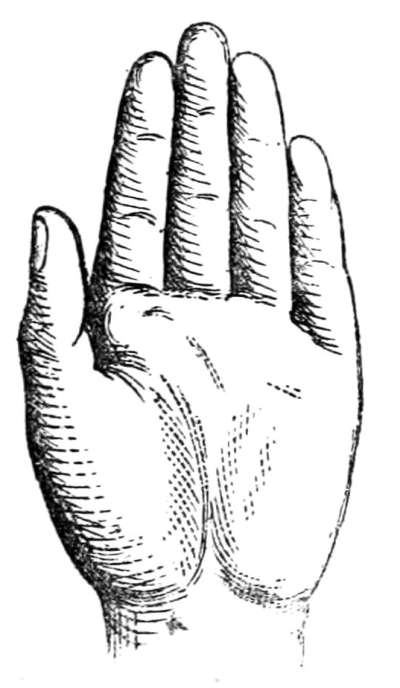
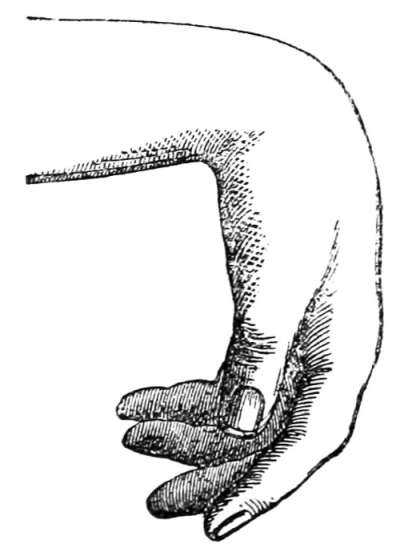
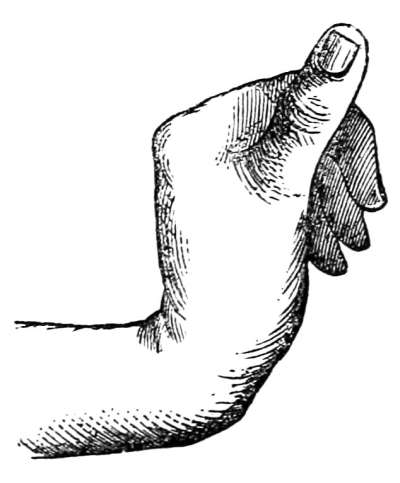
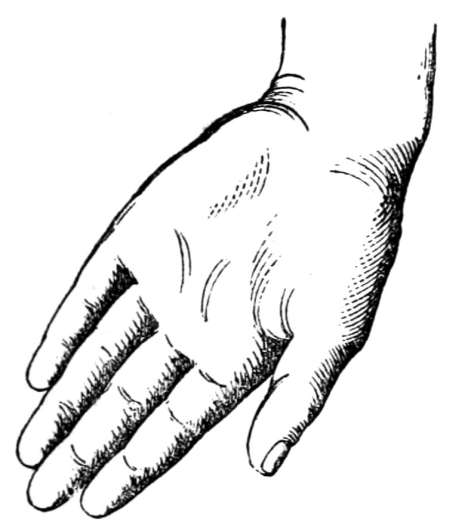
Fig. 5.
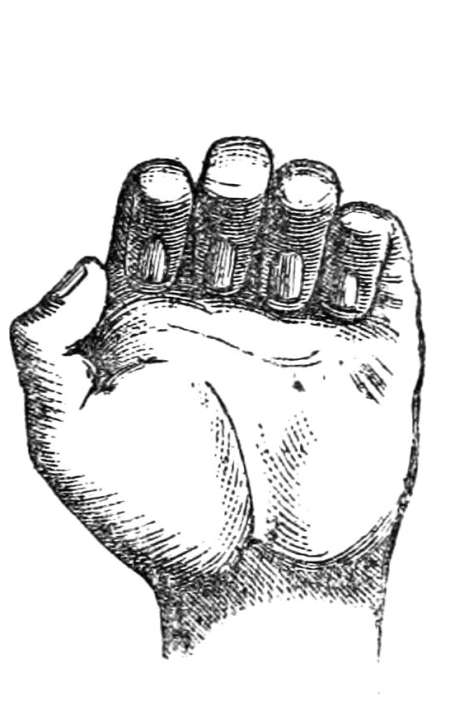
Fig. 6.
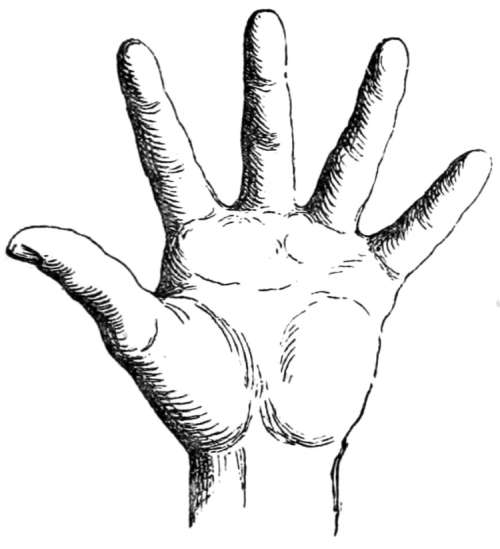
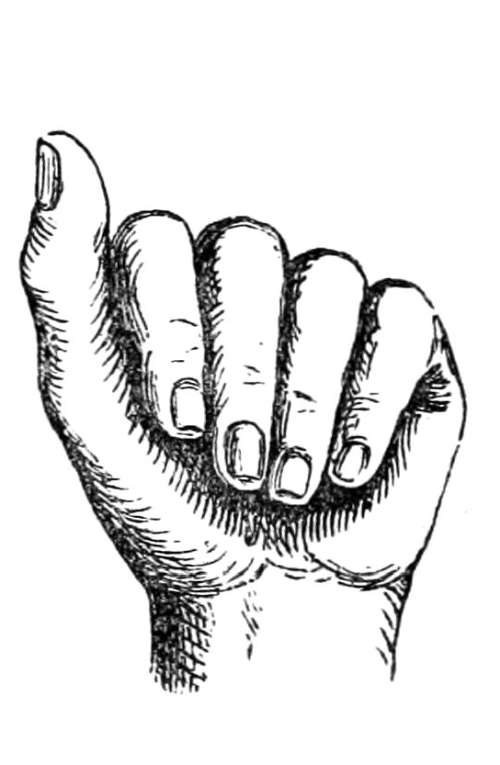
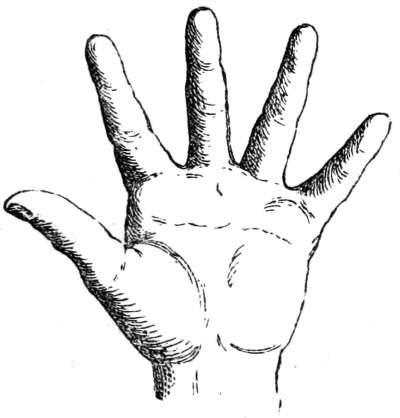
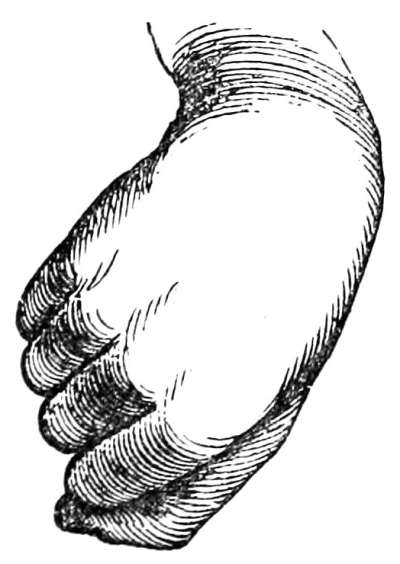
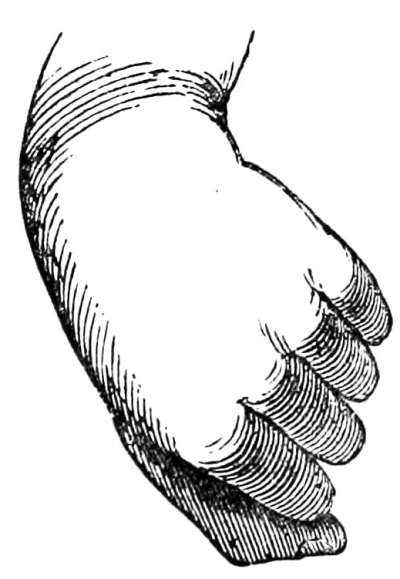
Stretch the fingers as much as possible
one from the other, let them fall on the large
muscle of the thumb (thumb-ball), and press
them firmly on it; remain for a moment in
this position, and bring the thumb against
the forefinger, 40 times up and down.
You will find that this exercise, as well as
several others, if vigorously continued for
three minutes only, is very fatiguing; a clear
proof that the muscles of the fingers, although
they may be quite fit for ordinary daily occupations,
are, nevertheless, very weak and incapable
when anything more is demanded
from them, and without proper gymnastical
training, they must remain so.
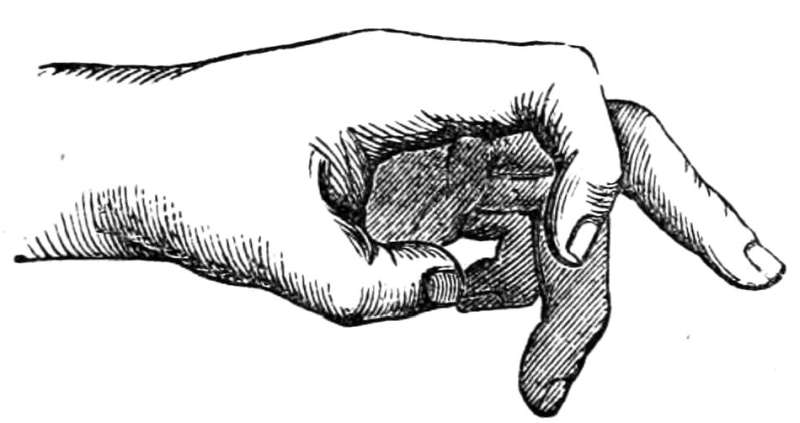
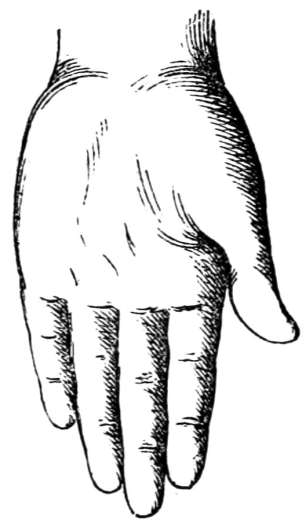
Fig. 7.
Fig. 8.
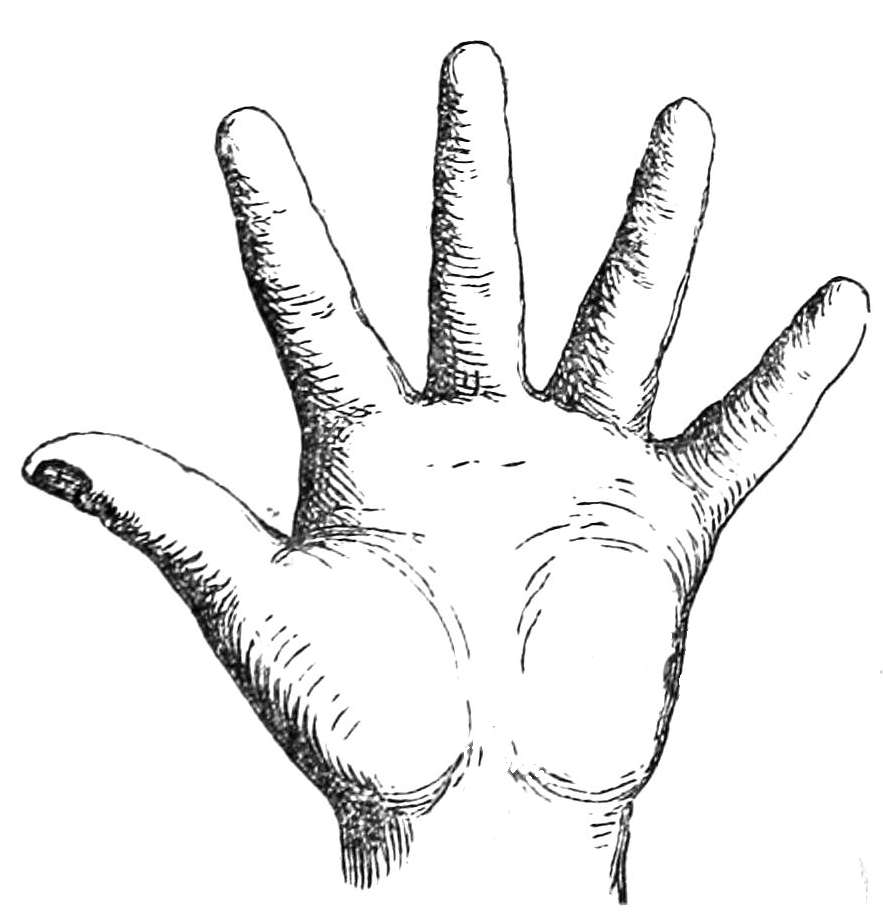
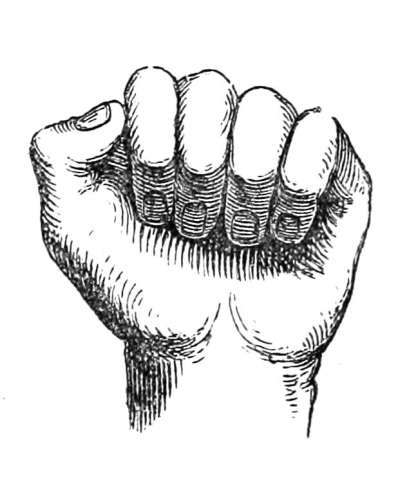
Stretch the fingers as before, but let the
finger-ends fall against the middle of the
cavity of the hand, instead of against the great
muscle of the thumb, and press them firmly.
To be repeated 40 times.
The following exercise (9 and 10) is intended
particularly for the small joints of the
fingers. It is effective, but difficult.
Fig. 9.
Fig. 10.
Do not stretch the fingers away from one
another, but hold them firmly and close together,
as this produces the effect particularly
desired. Bend the two first finger-joints of
the four fingers closely together; move them
vigorously up and down, and press them on
firmly, without, however, moving the large
joints. Repeat this movement until you are
tired, which will not be long, thus affording
another practical proof how weak the untrained
finger-joints are. This is also an excellent
exercise for the thumb, provided it
is made slowly and vigorously. It may also
be made with outstretched fingers.
I again repeat that no one who has not
already tried the above or similar exercises
of the fingers, will be able vigorously to continue
them for even so short a time as three
minutes without experiencing painful fatigue.
And why? Because, as I have demonstrated
before, the joints of the fingers and wrists
are, in the ordinary occupations of life, the
least of all exercised, and consequently the
weakest, in comparison with what they have
afterwards to perform.
After this experience people will, in future,
hardly venture to teach and to continue the
exercise of an art like music (which, from a
muscular point of view, is the most difficult
of all), with muscles the weakest and least
trained, without having previously prepared
them by proper gymnastic exercises.
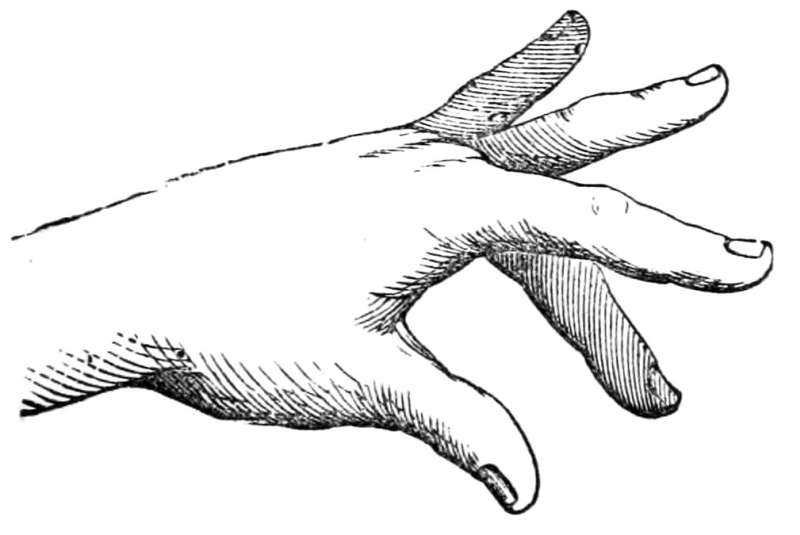
Fig. 11.
Fig. 12.
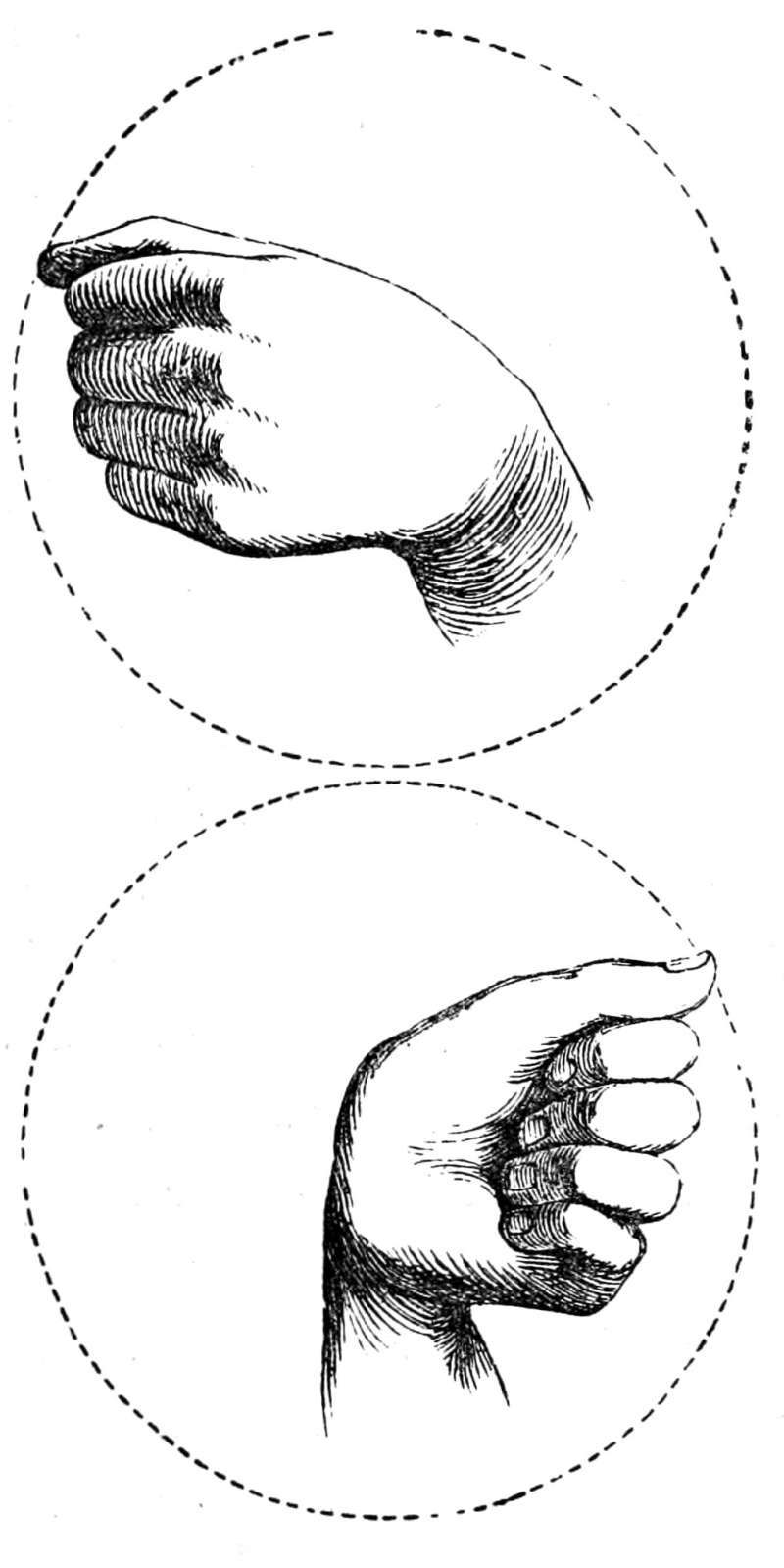
The last free exercise for the finger-joints,
which I will recommend here (11 and 12),
consists in moving all the fingers and the
thumb simultaneously together, that is to say,
in stretching them far away from one another,
like claws, and making all sorts of eccentric
movements in whatever direction you please,
and as long as you like or are able, but always
vigorously.
CHAPTER X. FREE GYMNASTIC EXERCISES FOR THE THUMB. — First movement. — Second movement. — Third movement.
Although it is not easy to prescribe complete
gymnastic exercises for the thumb, the
following, if made vigorously, will, nevertheless,
be found very effective.
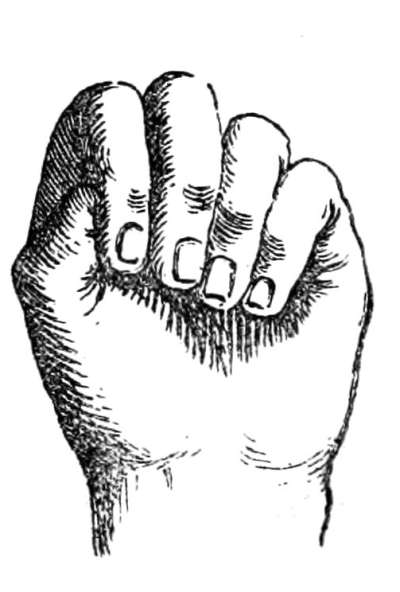
Fig. 13.
Fig. 14.
Stretch the fingers as far as possible away
from one another, then press the hand firmly
together, the thumb being held fast in the
cavity of the hand; continue for a moment in
this position, and then repeat the same movement,
alternately opening and closing the
hand.
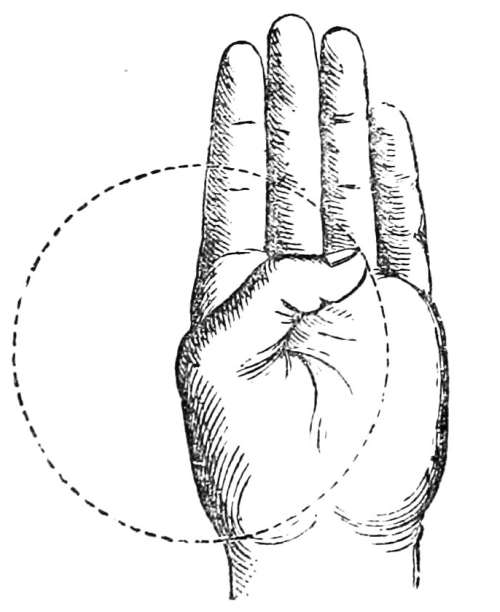
Fig. 15.
Hold the fingers close together, stretch
out the thumb, and then perform with the
latter a circular movement inside the hand,
first 20 times to the right, then 20 times to
the left: to be repeated again and again.
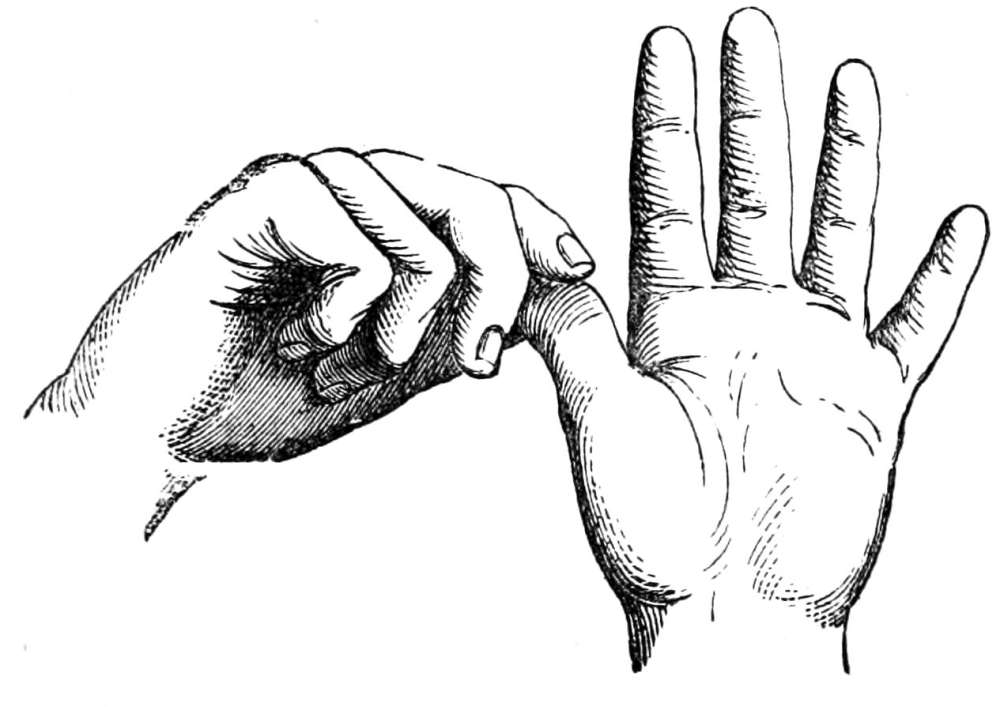
Fig. 16.
Take hold of the thumb of the one hand
with the fingers of the other, or with the whole
hand, and shake it or bend it to its root, without,
however, overdoing either.
In short, perform every day some exercise
with the thumb, whereby it will be sufficiently
brought into exercise.
CHAPTER XI. FREE GYMNASTIC EXERCISES FOR THE WRIST. [6] — First movement. — Second movement. — Third movement. — Fourth movement. — FOOTNOTES:
Fig. 17.
Fig. 18.
Move the wrist, without moving the arm or
elbow, vigorously up and down in a perpendicular
direction, from 20 to 40 times, first
slowly, then more quickly; finally, as quick
as possible. In doing so, let the elbows rest
close to the body, so as to bring both hands
and wrists into the proper position. As soon
as you are tired, leave off.
Fig. 19.
Fig. 20.
Move the hand horizontally or vertically
without moving the arm.
To understand the practical utility of this
exercise (19, 20), it ought to be borne in mind
that the entire action of the wrist is effected by
two principal joints, one of which, the smaller
of the two, lies at the root of the hand, and is
called the “joint of the hand,” by means of
which it becomes possible to move the hand,
independently of the arm, at its root. The
other joint, the larger of the two, rises from
the elbow, and is called the rotatory joint of
the forearm. Holding, then, all the five fingers
close together, move the smaller joint perpendicularly
or horizontally, as you please, without
in any way moving the arm, and at the same
time holding the elbow close to the body.
Fig. 21.
Fig. 22.
Move the wrist in a slanting direction right
and left, as above, first slowly, then quicker
and quicker. Hold the elbows as before. By
this movement, both the joints mentioned above
will be put into action, 21, 22.
Fig 23.
The young violinist, who generally finds the
sideways movement of the wrist of the right
hand so difficult, will derive great advantage
from all these wrist exercises.
Holding your arm quite still, move the free
hand or fist vigorously round in a circle,
20 times to the right, and 20 times to the
left, first slowly, then more quickly. By
this exercise all the muscles of the hand and
the arm will be put into motion, and though
the most difficult of all, this is at the same
time one of the most important exercises.
All these several free movements of the
hand and fingers may be repeated many times,
with advantage; still by simply performing
them, short though they be, daily and regularly,
the prescribed time only, the desired
end of strengthening the muscles of the fingers
and wrists, and rendering them vigorous
and flexible, will be surely attained.
I could mention some other free exercises
of the fingers; but since they are neither so
practical nor so effective as those I have already
described, I prefer to omit them.
[6] One or two of these exercises may possibly have been
mentioned in some former work.
CHAPTER XII. MECHANICAL FINGER-EXERCISES. — First movement. — Second movement.
Fig. 24.
Fig. 25.
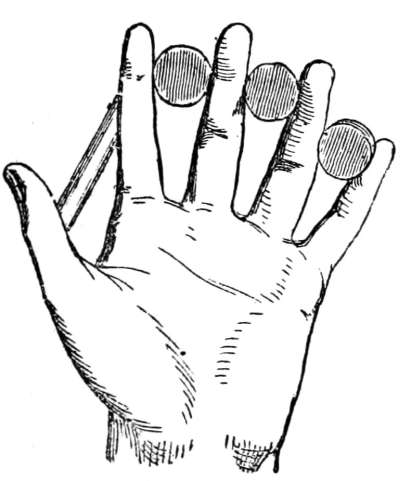
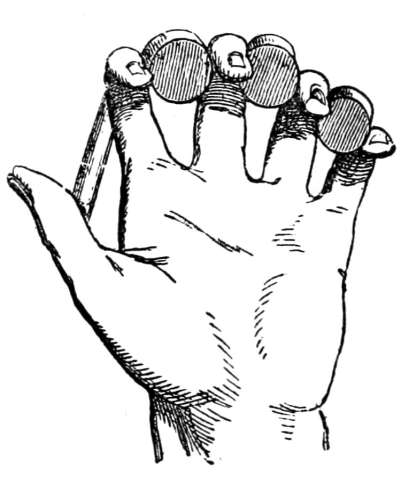
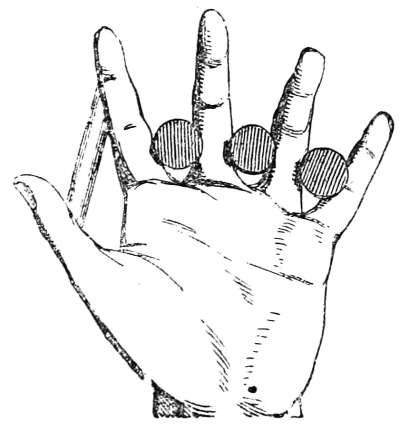
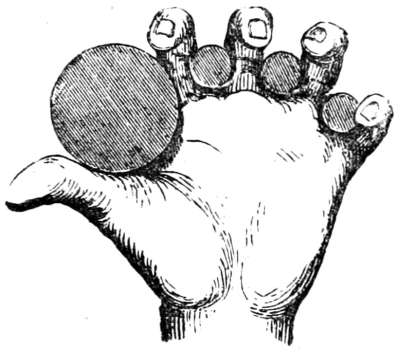
Take for each hand three cylinders, three
quarters of an inch long, and from half to one
inch in diameter, according to the size of the
fingers; place them between the upper ends
of the fingers, and while gradually and conveniently
extending the muscles, by bending the
fingers, move the latter as shown by the
above figures, 24 and 25.
Fig. 26.
Fig. 27.
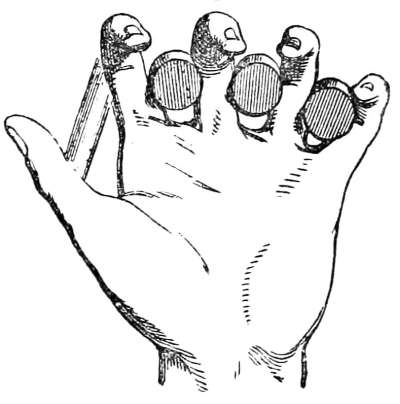
Move the cylinders further down, to the
roots of the fingers, and perform the exercises
according to Figs. 26 and 27. In doing this,
put a small round piece of wood between the
thumb and the forefinger, at a distance sufficient
to extend the former as much as possible.
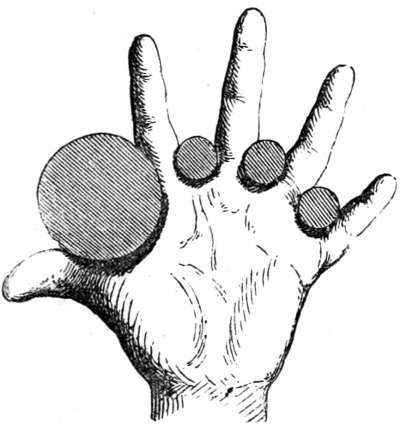
Leaving the other fingers as before, put a
large cylinder between the thumb and
forefinger (28 and 29), so as to entirely fill up the
intervening space. In doing this, be careful to
extend the thumb as much as possible. In case
the tension of the fingers is small, take smaller
cylinders: or if the latter should be too hard
for tender hands, cover them with some soft
substance, such as velvet, or the like.
Third movement.
Fig. 28.
Fig. 29.
Perform all these exercises vigorously, and,
if possible, just before practising the musical
instrument, twice or three times daily, each
time for a few minutes, especially in the morning,
on getting up. As a matter of course,
after eight or 10 hours rest, the muscles of
the fingers and wrist, like those of the rest of
the body, are somewhat stiff, and ought to be
prepared by proper gymnastic exercises, before
beginning to play. Besides, provided over-exertion
be avoided, there is not, according to
the best medical authorities, the least danger to
be apprehended, from these exercises, for the
joints and muscles of even the very smallest
hands.
If players of the piano and the violin should
object that, in the act of playing, the fingers
need not be as much extended as prescribed
here, or assert that the finger-exercises, scales,
and études as at present used are perfectly
sufficient, and that nothing more is wanted,
I can only repeat, that the fingers must be
prepared in order to render them strong and
flexible; that, for this purpose, it is necessary
to exercise them gymnastically, and that, as
I have explained before, these preparatory
exercises will save much time and trouble, and
facilitate the work of both teachers and pupils;
further—that, by the diligent practice of these
gymnastics, the fingers become elastic and
independent of each other; you acquire thereby
complete control over them, and when you have
done this, you can move them and do with
them as you will.
Another most effective mode of stretching
and loosening the tendons and ligaments which
encompass the large middle-hand bones, or
“knuckles,” may be performed as follows:
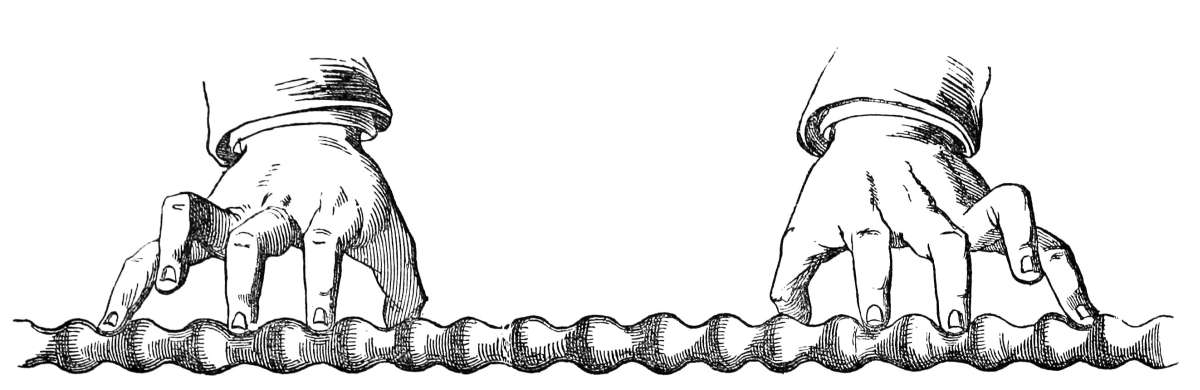
Place the forefinger of each hand, up to the
middle joint, firmly on the table, and in that
position press it up and down with a certain degree
of force, for a few seconds; then withdraw
it, and apply the next finger in a precisely
similar manner; then the two other fingers in
succession, each finger remaining on the table
alone, unaccompanied by any other.
Afterwards apply the 2nd and 4th together,
exactly in the same way, for a few seconds;
then the 3rd and 5th; lastly the thumb.
The pupil may do this many times a day
with great advantage; for by this process
the ligaments and tendons of the knuckles
are stretched and loosened, and the muscles
are set free.
Of course always with due moderation.
Another very important exercise, bearing
chiefly on the tendons and ligaments of the
large metacarpal joints or knuckles, is the
following:
With the thumb and forefinger of the one
hand take hold of one finger of the other hand,
and shake it up and down, for one minute, to
its root. Then take the other fingers in succession
in like manner. To be applied equally
to both hands, and to be done, especially with
the 4th and 5th fingers separately, as often as
leisure permits.
To this category belongs also ANOTHER
EXERCISE of the metacarpal joints or knuckles.
Into the palm of one outstretched hand place
the closed fingers or fist of the other: then
open and close the latter as fast and as long a
time as is agreeable, always continuing to press
upon the palm. Change hands and repeat.
Ever remember that the difficulties of bringing
the fingers into order lie, physiologically, almost
all in the middle-hand bones or knuckles; and
as the five preceding exercises,—and especially
the three last,—act in a very efficient and
special manner upon the ligaments, tendons,
and muscles of these and the other joints of the
fingers, they cannot be made too often.
CHAPTER XIII. MECHANICAL FINGER-EXERCISES (CONTINUED). — FOOTNOTES:
It is not sufficient to play the ordinary
finger-exercises and scales. As has been
shown in the opening chapters, and in the
anatomical representations of the hand, all the
fingers are not equally strong; for instance,
the 4th and 5th fingers are, by nature, much
weaker than the others, and it is necessary to
remedy this inequality.
Each finger ought, therefore, to have
gymnastic exercises for itself, and they ought
to be performed on some solid body, which can
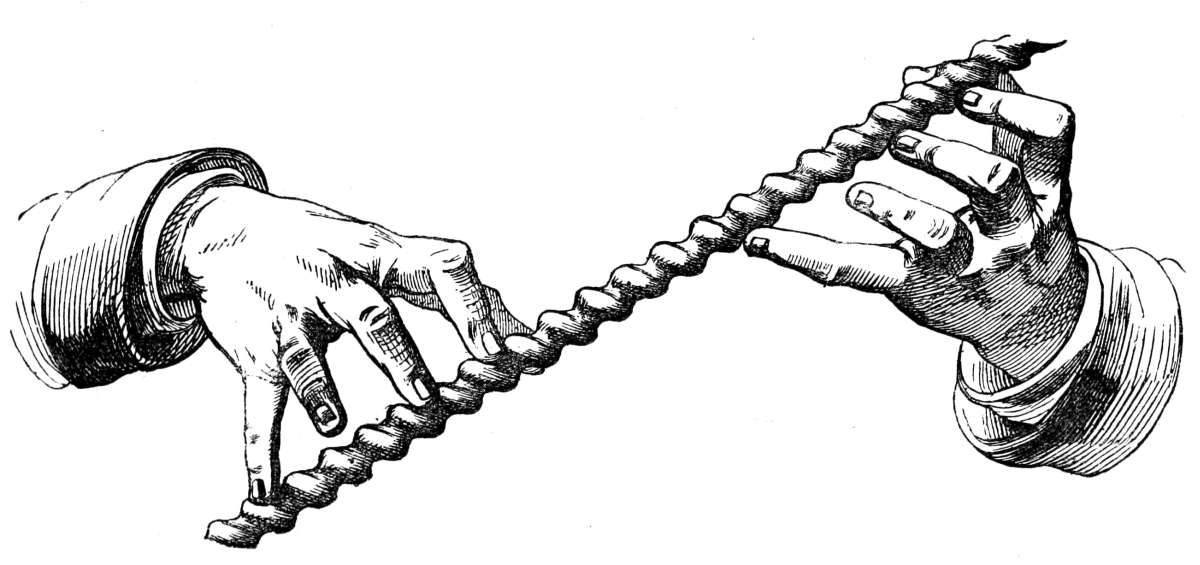
be firmly grasped. For this purpose take a
round staff, from 12 to 18 inches long, and half
to three quarters of an inch thick, on which, at
a proper distance from one another, round
indentations are made, and into which
the fingers are to be placed after the
manner illustrated in the adjoining and
following figures.
Directions.
Place the thumb of each hand on
one side, and the four fingers very
firmly fixed on the other side of the
staff; raise one finger as high as possible,
and let it fall down vigorously, like a
hammer, 20 times in succession, while
the three remaining fingers, stretched
out from one another, like claws, remain
immoveable. In the same way
exercise the other fingers; firmly,
slowly, vigorously, and immediately
after the cylinder exercises just described.
Repeat this three times
daily, each time for five minutes, altogether
for 15 minutes a day, but the
oftener it be done the better.
Those playing the piano need not
confine themselves to one particular
exercise, but may make use of all the
figures at pleasure.
Fig. 32. Fig. 31.
Fig. 33.
The fingers of the left hand may also be
trained for violin playing, as seen in Fig. 35.
Fig. 35.
Further upon the same. After the cylinders,
by far the most effective of all means
for imparting, gymnastically, strength and flexibility
to the fingers, together with evenness
of vigour, individuality, and independence, is,
daily, in the room, or while walking, to take
the above-named staff, or, indeed, a smooth
round stick of 18 inches long, and half to three
quarters of an inch thick, or an ordinary walking-stick,
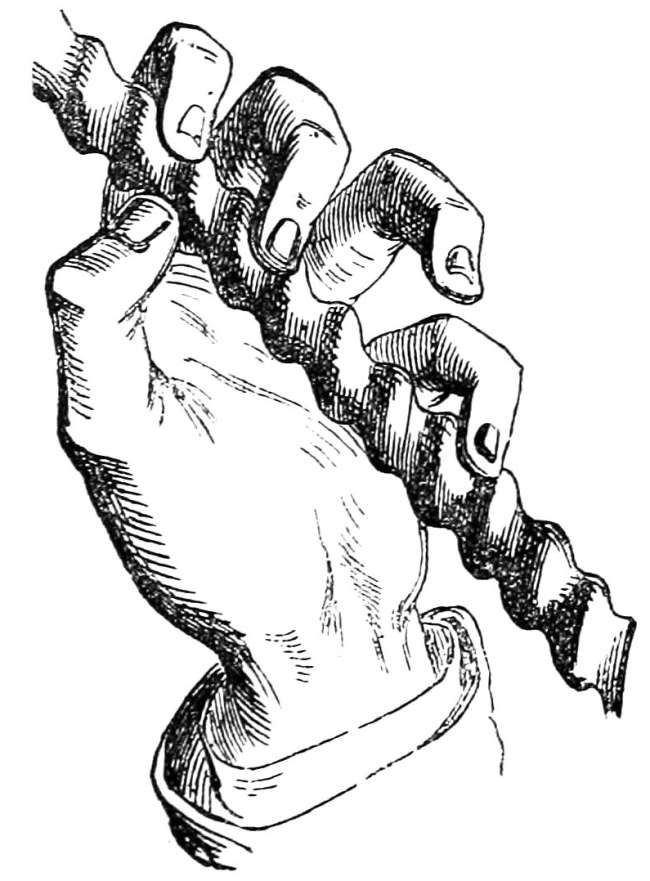
and to perform on it as follows—With
the four fingers of one or both hands
firmly pressed and stretched upon it, raise one
finger as high as possible, and, as above stated,
let it fall down upon it vigorously, like a hammer,
while the other fingers remain firmly
pressed on the stick, 20 to 30 times in succession,
then in couplets with the 5th and 4th
fingers, then with the 4th and 3rd, then with
the 3rd and 2nd, 20 times each, the two fingers,
in all cases, as stated, lifted as high as
possible, and the others remaining, stretched
at even distances, firm upon the staff; finally,
with the four fingers of each hand, 12 times
ascending, and 12 times descending, but always
SLOWLY, energetically, with firm pressure,
“and in time.” You may occasionally practise
a little faster, but it must be the exception.
Slow moving, pressing, and stretching should
from the chief gymnastic rule.[7]
In a similar manner you may practise,
slowly and with energy, with one or with both
hands, all sorts of difficult, muscular movements
and passages upon the staff, for example:—
First series. In couplets 20 to 30 times each
in succession, with the 2nd and 4th fingers,
alternating, afterwards, with the 4th and 2nd;
then with the 3rd and 5th fingers, alternating
with the 5th and 3rd; in each case the two
fingers stretched wide apart, and the other
fingers pressed upon the staff.
Second series. In couplets 20 to 30 times
each in succession, with the 2nd and 3rd fingers,
first close together, then wide apart, afterwards
alternating in the same way, with the 3rd and
2nd. With the 3rd and 4th fingers first close
together, then wide apart, afterwards alternating,
in the same way, with the 4th and 3rd.
With the 4th and 5th fingers, first close together,
then wide apart, afterwards alternating
in the same way, with the 5th and 4th. In
each case slowly, the two fingers lifted as high
as is convenient, 20 to 30 times in succession,
and the other fingers remaining firmly fixed
upon the staff. Lastly, all the four fingers
together, in each of these varied and different
directions.
The number of times of each movement,
and the duration of time, also whether all
should be made at the same hour, or otherwise,
is left to the discretion of the teacher and
pupil. I would recommend, at first, the selection
of three or four modes or exercises for
persistent practice, to last over a given period
of time, then to change to others.
But the regular exercise of the whole or part
of them, daily, will, in a comparatively short
time, most surely impart immense strength to,
and render flexible, the muscles and joints of
the fingers; will enable you, if the directions
be duly followed, to effect for yourself perfectly
equal and even fingering, and render the fingers
entirely independent one of another.
But let all be done with due moderation, and
not driven to excess.
This gymnastic staff, or walking-stick exercise,
however simple it may appear, should, on
no account, any single day be omitted. It
produces a most surprising effect if carefully
and vigorously made; an effect which will be
the more remarkable in proportion as the
fingers are pressed and stretched far away from
one another. By this means all the various
muscles, and even the tendons, joints, and
ligaments are put into motion, and both fingers
and nerves are rendered strong and firm. Besides,
no time need be lost; as in performing
these exercises you may converse or engage
in other occupations.[8]
In this manner, also, the 4th finger may
have a special training, and become equally
strong with the others. This finger is, on physiological
grounds, the weakest of all, and after
a number of vain attempts at remedying its
well-known weakness, some physiologists of
note in Germany, have gone so far as to suggest
the idea whether it would not be well to cut the
ligament joining the two fingers, in order to
set the 4th finger free.
But it is unnecessary to have recourse to
such rude and unnatural measures; the natural
weakness of the 4th finger may be effectually
remedied, and may be entirely overcome, by
the above exercises. The same exercises, if
performed strictly according to the directions given
above, are extremely useful for all the fingers,
which they will render both strong and
flexible.
These exercises may be partially performed
on musical instruments; but they are far more
effective if made gymnastically, as directed,
because the fingers, in having a resting point,
or lever, and having something firm to grasp,
are enabled to perform them gymnastically.
[7] The late Mr Clementi was celebrated for the perfect evenness
and beauty of his touch in playing rapid passages on the
piano. The means by which he attained this execution he was
unwilling to disclose. It is now known that he effected it by
playing his scales VERY SLOWLY, and with great pressure of each
individual finger (see page 96).
[8] The celebrated violinist, Bernard Molique, told me lately,
in London, that when he was called on to play difficult solo
pieces in public, he very often played them previously over upon
a stick.
CHAPTER XIV. MECHANICAL FINGER-EXERCISES (CONTINUED).
Moreover, beautiful works of art, like
pianofortes, violins, and other musical instruments,
ought not to be used as gymnastic
implements. They are destined for play, not
for gymnastic appliances. The fingers and
joints ought, therefore, first to be gymnastically
exercised; then play upon the instrument.
The head and the fingers ought to go together;
but how is this possible if the latter
remain behind? The mind strives forward,
the fingers keep it back. Why should this torture
be inflicted? No; let the fingers first be
properly trained; then head and fingers will go
harmoniously together.
Another great advantage attending the
above exercises is, that so long as they last,
the organs of hearing are spared. Many
persons, who zealously and with endurance
perform finger-exercises on musical instruments,
injure their health, through the irritation
of the auditory nerves, to such a degree,
as either to be prevented, on medical authority,
from continuing to practise, or otherwise to be
subjected to serious consequences; whereas,
if the exercises are preceded by the gymnastic
movements given above, the hearing organs
of the pupil will be greatly spared, and not
injured in any way.
The greatest technical art consists in controlling
alike the fingers, the joints, and the
nerves. Now, if the muscles and tendons are
exercised and strengthened by proper physical
work, the nerves will be invigorated at the
same time. This is a well-known fact, and for
those engaged in musical pursuits, an advantage
which it is impossible to overrate. The
fingers then will not be fatigued as easily as
before, and you learn at the same time by
habit, to acquire complete control over the
joints, the muscles, and nerves.
Nor ought another advantage to be overlooked;
viz., that in regard to artists and
persons who play well, when these travel, or
from any other cause are prevented from playing
for some time on a musical instrument,
they will be enabled, in the manner described
above, to exercise efficiently for a short time
daily their fingers and joints. Thus the fingers
and joints will not get stiff, and you will
always remain their master.
However, to attain this end, the exercises
on the stick ought not be performed carelessly,
but gymnastically, and STRICTLYaccording to
the directions given above.
The same exercises are very useful for persons
playing the violin, by promoting the
proper bending of the forefinger of the left
hand.
Generally speaking, the whole of the above
exercises are equally fit for all persons playing
the piano, the organ, the violin, the violoncello,
and other instruments; and they will find,
after having accustomed themselves to perform
them vigorously and gymnastically for a short
time daily, that they then come to the instrument
with a strength and individuality of
finger which will exceed their utmost expectations.
CHAPTER XV. BOARD FOR STRETCHING THE MUSCLES, ESPECIALLY THOSE OF THE THUMB AND THE LITTLE FINGER.
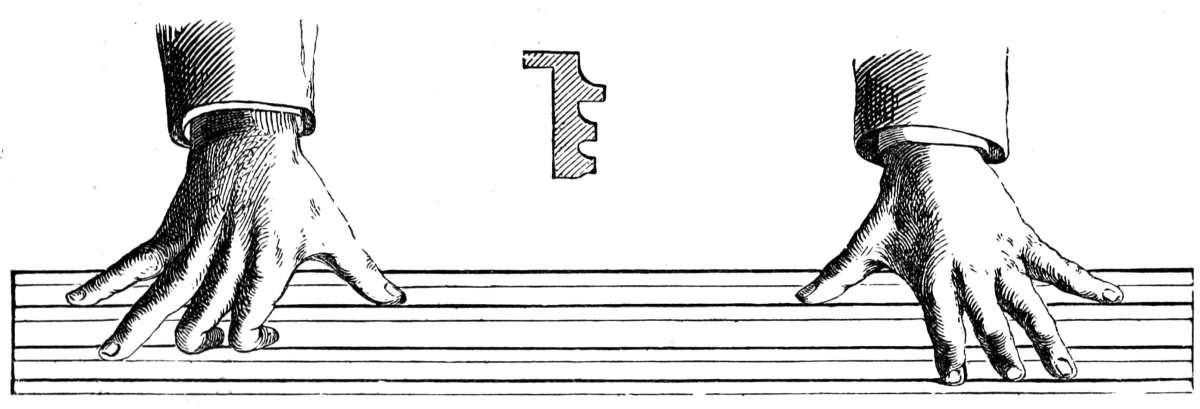
Take a board, about 22 inches long, four
to five inches wide, and three quarters of an
inch thick, and mark out on it four or five
grooves, about half an inch deep. To fix this
board on the table, have a little ledge glued
on to one of its sides, as in Fig. 36 and 37.
Place the outstretched hand on the board;
stretch the thumb and the little finger as far as
possible away from one another, into one of
the grooves, place the other fingers into one
of the other grooves, and set them in motion,
while holding the thumb and little finger
firmly in their places.
Fig. 36.Fig. 37.
CHAPTER XVI. ON STRINGED INSTRUMENTS IN PARTICULAR. THE WRIST OF THE RIGHT HAND.
The following mechanical gymnastic exercises
refer to the wrist of the right hand, and
are intended for players on stringed instruments.
Their chief purpose is to render the
wrist of the right hand and the forearm
strong and flexible. This all students find
very difficult; it will soon be evident for what
reason.
It is a fact acknowledged by the most celebrated
musicians, that the principal bowing
difficulties in playing the violin arise from the
wrist. This is chiefly owing to the circumstance
that, in playing the violin, the movement
sideways of the wrist is a peculiar one,
being, in fact, totally different from any other
movements taking place in the ordinary occupations
of life. If, therefore, it be desired to
diminish the painful work, as customary at
present, it is indispensable to prepare the
wrist and arm by exercises like those we are
about to describe.
Take three times daily, and particularly
early in the morning, a stick or cane exceeding
the length of a violin bow by 8-10 inches,
holding it in your right hand the same as a
bow; lay it on the left hand,—which is to be
raised to the same height as if playing the
violin or violoncello,—and move it vigorously
up and down as follows:
1. The entire length, 30 times;
2. The middle length; with the forearm
and wrist only, without moving the upper arm,
30-40 times;
3. At the nutt; with the wrist alone,—and
especially up-stroke,—with energy; without in
the least moving the arm, 30-40 times;
4. At the extreme head-end; with the
wrist alone, and with pressure; without in the
least moving the arm, 30-40 times.
Move the cane alternately up and down,
pressing it with the thumb and forefinger, and
look at the direction of the wrist and the stick
or cane. With this gymnastic cane you may
exercise gymnastically, at pleasure, up and
down strokes, triplets, and all sorts of bow-movements.
The effect you will find surprising.
These exercises are particularly useful for
the student. As a matter of course, they can
also be partially made with the bow, but not
with the same effect.
CHAPTER XVII. ( CONTINUED ).
There is another very effective gymnastic
exercise for strengthening and rendering
flexible the wrist of the right hand. A movement
resembling it has already been described
above, but to prevent any misconception, I
think it well to give explicit directions respecting
it here.
Take hold with your right hand of the extreme
end of a long and rather heavy Alpenstock,
and while continually keeping the hand
in the same place, move it upon the upheld left
hand vigorously up and down:
1. With the whole arm, 30 times;
2. The middle length, 25 times;
3. As near as possible to the lower end,
with the wrist alone, without in any way moving
the arm, 30 times;
4. As near as possible to the upper end,
with the wrist alone, and especially up-stroke,
without in any way moving the arm, 30 times.
This exercise, on anatomical grounds, produces
a considerable effect on the muscles and
sinews of the wrist and the forearm, in imparting
to them the wished-for strength and
flexibility.
Besides, it is a well-known fact that, having
handled a heavy object, it is more easy skilfully
to handle a lighter one.
If it should be objected that the last-mentioned
gymnastic exercises, being of rather
a rough kind, might spoil the elegant stroke,
my answer is, that those so-called rough exercises
only last a very short time daily, and
are undertaken for the special purpose of
rendering the arm and wrist strong, easy, even,
and flexible. Indeed, if these right-hand
exercises are made carefully and according to
the directions given, a short time every day,
they will strengthen the wrist of the right
hand and render it pliant and flexible to such
a degree, as to enable persons, in a comparatively
short time, to play with the wrist almost
as vigorously as with the arm.
There is, moreover, another advantage
attending these exercises, viz., that, if continued
for some weeks only, and for a few
minutes daily, they will soon give the proper
position to the student’s arm, which, consequently,
will not be required to be tied to the
body, as was often done in former times.
CHAPTER XVIII. CONTINUATION. STACCATO.
A famous German chamber violinist once
remarked to me, “I find that staccato playing
is the best exercise for bowing, but I
can’t say why.” The reason, however, lies
in the fact that, by frequently playing with
the end of the bow, or with the staccato-stroke,
the muscles of the wrist are put in
motion, thus undergoing a gymnastic training
by which strength and flexibility are acquired.
It is impossible to perform the staccato-stroke
well, unless the muscles of the wrist
have become strong and agile; and the reason
why the student finds this stroke in most cases
so difficult is, that the wrist has not been
specially trained and prepared, in consequence
of which it remains weak and stiff.
It ought to be remembered that in almost
all kinds of handiwork in daily life, the whole
arm is active and in motion, and very rarely
the wrist alone. With musical instruments,
on the contrary, and particularly in playing
the violin, it is necessary always to use the
wrist, and it is impossible to play well unless
the wrist has been rendered strong and elastic.
It is, therefore, absolutely indispensable that
proper gymnastic exercises should be made
with the wrist, in order to prepare it. The
wrist, indeed, ought to be accustomed, in other
words, to move of itself, and the student ought,
as often as possible, to perform all kinds of
movements calculated to impart to it pliancy
and strength. It will then soon become free
and easy, and the student will, in course of
time, acquire the strongest, most elegant, and
artistic stroke.
No single one of these practical gymnastic
exercises ought to be despised on account of
its simplicity. Only try them, and they will
be found very effective. All sensible artists
and teachers will do homage to every improvement,
and consider it their duty to welcome
any assistance calculated to diminish and render
lighter the arduous toil, and shorten the
valuable time required for becoming a proficient
in music.
CHAPTER XIX. CONCLUDING REMARKS.
I will only add in conclusion, that it would
be well not to continue too long with the same
gymnastic exercise, but to allow the muscles
and joints some change, which will be found
both agreeable and advantageous. If, therefore,
the student be tired of one exercise, he
should begin another. Besides, if the fingers
are fatigued and hot by playing, and the
nerves irritated, an exercise of some of the
different free or mechanical gymnastic appliances
will refresh the muscles, by imparting
to them a new and an easier movement. And
be it remembered, “these exercises are not
irksome, but recreative.”
It may also be recommended in such cases,
to dip the points of the fingers for half a
minute into half a glassful of cold water, and
let them get dry of themselves, thus cooling
by evaporation; or still better, wash the hands
with soap and water.
To sum up: No student ought to begin to
learn or to play the piano, violin, or other
musical instrument, or even to engage in any
work or occupation requiring a strong and
flexible hand, before having set the joints of
his fingers and hands in order, by means of
preparatory gymnastic exercises; and he ought
to continue the same from day to day.
Let it ever be borne in mind that much
rapid playing affects injuriously the muscles
and nerves; while, on the other hand, slow
exercises and studies invigorate them.
To borrow an illustration from the animal
world; take the race-horse, the fleetest animal
which we use in this country, whose
great task requires that his muscle should be
brought into the highest condition of strength
and flexibility. Do you suppose that, in training
and preparing him for the race,—a
process often extending over a considerable
period,—that he is, in the course of it, much
galloped? By no means! Galloping forms
the exception, and, during this long interval,
walking, trotting, and cantering form his
chief training paces; namely, four-fifths or
seven-eighths of the time; galloping only
one-fifth or one-eighth part! His skilful
trainer knows that much rapid exertion, such
as galloping long continued, weakens and wears
out his muscle. So, also, in the hunting-field
and on the road, it is “the pace that
kills.” Even so with the player upon a musical
instrument; long continued, rapid movements
wear out the muscle and shake the
nerves, while slow exercises, however vigorously
executed, invigorate and strengthen both
(see p. 75, note).
The exercises for stringed instruments will
be most satisfactorily performed before a looking-glass,
and I may here add that a little
work by the author, entitled “Gymnastic
Exercises for the Violin and Violoncello,”
having for its special object the exercise of the
wrist of the right hand on the instrument, will
be published in a short time.
And here I avail myself of this opportunity
to raise a question for consideration regarding
that part of the violin-bow which the right
thumb presses. Let me ask, first, why should
this little sharp projection be permitted to appear
on every bow, to the prejudice of the
placing firmly the thumb there, instead of being
rounded off? and secondly, why should there
not be placed, close to this point, especially for
students, a small piece of round gutta percha—a
gutta percha button—as a stay to the thumb?
Great facility would thus be afforded for holding
firmly the bow. Any one may put a piece
of gutta percha in the candle, and, when
softened, stick it fast on the place indicated.
Finally, I repeat that, in performing any of
these gymnastic exercises, the principal condition
to be adhered to is, that they should
always be made in the morning, also immediately
before playing; and that while great
vigour is imparted to them by following out
strictly the directions given, any over-exertion
should be avoided. As to the claims of
the author himself, they are limited to an
earnest desire, that his “Gymnastics of the
Fingers and Wrist,” founded as they are on
anatomical and physiological principles, may
find favour with the Public, and be instrumental
in promoting the best interests of
Art.
THE END.
JOHN CHILDS AND SON, PRINTERS.
TESTIMONIALS.
FromPrescott Hewett, F.R.C.S., Surgeon to St
George’s Hospital, late Professor of Anatomy to R.C.S.
Aug. 28th, 1865.
“Having carefully examined the gymnastic exercises
invented by Mr Edwin Ward Jackson for the due
working of the fingers and hand, I have great pleasure
in stating that I believe that such exercises will be of
the greatest use, not only to musicians, but to every
one who wishes to possess a perfectly free use of his
hands. The power and the freedom obtainable by
exercises such as these have been little thought of; but
from what I have seen, I feel confident that Mr Jackson’s
exercises, if rightly used, are destined to make
the hand much more perfect for all its purposes than it
really is.”
FromLuther Holden, F.R.C.S., Senior Lecturer on
Anatomy at Bartholomew’s Hospital.
Aug. 28th, 1865.
Since our last interview I have often thought and
talked about the practical effect of your ‘Gymnastic
exercises for the Fingers.’ On anatomical and physiological
grounds, it is quite certain that these exercises
are admirably calculated to liberate the ligaments of the
fingers, and to give a freer play and increased vigour to
those muscles upon which many of the varied and more
independent movements of the fingers depend.
“I have no doubt whatever that such exercises will
be of the greatest service in educating the fingers of
musicians, and thereby save them a great deal of time
and trouble.”
FromRichard Quain, F.R.S., Professor of Chemical
Surgery in University College; Surgeon Extraordinary
to the Queen.
August 2nd, 1865.
I write to you upon the important facts you were
good enough to communicate to me to-day, and to explain
how they may be accounted for scientifically. Your
proposal to exercise the hand and fingers, and your
plan of systematically carrying out the proposal so as to
be beneficial to musicians, are both new to me. Judging
on principle, and from a knowledge of what occurs
in other parts of the body, I have no doubt that the
system must be useful, for it will give increased mobility
to the fingers and increased development and power to
the small muscles—Lumbricales (the musculi fidicinales
of Cowper), and metacarpal interosseous, as well as indeed
to the general flexors and extensors of the hand.
In short, the exercises you propose will be to the hand
and fingers what the ordinary gymnastic exercises are
to the rest of the limbs. The result will be useful wherever
the free play and vigour of the fingers are needed;
would therefore, I anticipate, be especially advantageous
to musicians, and I am inclined to add to painters and
to writers also.” ...
FromErasmus Wilson, F.R.S.
“On carefully thinking over your demonstration of
gymnastic exercises as applied to the hand, I can see
in it only good; it is ingenious, practical, and physiological,
and eminently adapted for the purpose to which
you propose to adopt it; namely, the manipulation of
the strings and keys of musical instruments. I am glad
to hear that you intend to give your labours to the
public very shortly.... I see no possible inconvenience,
much less danger, in the process.”
FromDr Virchow, Professor of pathological Anatomy,
Berlin.
June 3rd.
Translation.
“The exposition of your proposed Gymnastics for
the regular exercise of those portions of the body which
are used most partially, namely, the fingers, deserves,
assuredly, a great and practical recognition. They are
addressed, according to my opinion, to a real want or
hiatus. Not only will they very naturally serve as a
special preparation for musical objects, but also for a
like participation of the muscle-groups of the forearm
and the hand, which, in all the usual labours of daily life,
are only very partially brought into action. In the case
of men who only write, and women who sew, or do other
fine work, the great disadvantages arising from the
special pressure in individual groups of muscles will be
altogether avoided; and I regard it as extremely probable
that your gymnastics will diminish or entirely
remove many disorders, such as writing-cramp, contortions,
&c.”
Official extract from the books of theSociety of Physicians
at Berlinof the Meeting held by them,
June 6th.
President—Dr Berend, Member of the Royal Privy
Council, and Director of the Gymnastic-orthopedic
Institution, Berlin.
Secretary—Dr Gumbinner.
“Mr Jackson from England delivered a lecture
upon gymnastics of the fingers and wrist. The fatigue
which immediately attended the playing on the violin
late in life, incident even to a person strong and athletic
in all other respects, led him to the discovery, after
lengthened investigations, first, that the fingers are the
least exercised of all the active muscles of the human
body; secondly, that they are thereby, on physiological
grounds, also the weakest; and thirdly, as he afterwards
on minute investigation found out, that the finger-muscles
are almost the only active muscles in the frame
to which a properly constituted system of gymnastics had
never been applied.
“He discovered that the cause of this fatigue lies in
the want of finger-training; and the lecturer explained,
and adduced proof, that the muscles, hitherto constrained
in their movements by tight transverse ligaments, are
instantaneously set free by gymnastic stretching applications
to those ligaments. The society expressed itself
entirely in accord with the theory as well as the
practice which the lecturer adduced; they desired to
add that both the one and the other are entirely new to
them, and to express a belief that the same will be
introduced into every school in Germany as soon as
they shall be made known.
“In expressing their best thanks to Mr Jackson for
his most interesting discourse, the society desire to
record the fact, which the lecturer in soliciting their
indulgence stated, that he had commenced the study
of the German language for the first time at a late
period of life, namely, at the age of 52 years, exactly
six years ago; nevertheless the lecturer seems to have
mastered its great difficulties, and has delivered gratuitously
this and many other lectures extempore in excellent
German, an achievement which the society
believes to be without precedent.”
Expressions of marked approval have also been
received from W. Fergusson, F.R.S., Surgeon Extraordinary
to the Queen, Professor R. Owen, F.R.S.,
D.C.L., British Museum, Dr Joseph Hirth, Professor
of Anatomy, Vienna, and other distinguished
persons.
FromJohn Hullah, Professor of Music in King’s
College and in Queen’s College; Organist of Charterhouse,
&c., &c.
July 27th, 1865.
“Mr Edwin W. Jackson has called attention to an
anatomical fact which is likely to prove of great importance
to students of instrumental music; and the apparatus
and course of exercises by which he proposes to
turn the knowledge of this fact to account seem well
calculated for the attainment of the object he has in
view—that of increasing the strength, pliability, and
expansiveness of the hand.”
FromE. F. Rimbault, LL.D., F.S.A., Member of
the Royal Academy of Music in Stockholm; Musical
Examiner in the Royal College of Preceptors,
London, &c., &c.
“Mr E. Ward Jackson’s discovery is of the highest
importance to all performers on musical instruments
requiring the use of the fingers. Several attempts have
been made, at different times, to construct apparatus
which would give strength and elasticity to these
important members of the hand; but they have all
signally failed. Mr Jackson has been the first to
consider the subject philosophically and anatomically.
His discovery will form an era in the progress of the
manipulation of the art.”
FromJules Benedict, Pianist.
July 22nd, 1865.
“I believe that Mr Jackson’s simple but ingenious
contrivance will be highly beneficial for the musical
student, and contribute to the clearness of touch and
independence of the fingers. Experiments on a large
scale, and in schools where music is taught, would still
more contribute to acquaint the public with his clever
and useful invention.”
FromProfessor Wyld, Mus. Doc., Cantab.; Professor
of Music in Gresham College.
July 23rd, 1865.
“Many thanks for sending me your pamphlet,
which I have read very carefully. It has interested me
very much, and I have no doubt of the practical excellence
of your discovery.”
FromProsper Sainton, Leader of the Royal Italian
Opera; of the Sacred Harmonic Society; of the
Musical Society of London; and of the New Philharmonic
Society.
Aug. 5th, 1865.
“I have great pleasure in adding my testimony to
that given to you by so many artists. I congratulate
you upon your invention, which I am certain will be of
great utility to pupils of the violin, in giving to their
fingers strength and elasticity.”
FromWalter Macfarren, Professor of Pianoforte
in the Royal Academy of Music.
July 28th, 1865.
“Mr. Edwin W. Jackson has done me the favour to
explain to me his new system of gymnastics for the
fingers, and I have no hesitation in stating that in my
opinion it is calculated to obtain, by the simplest means,
the independence of wrist and flexibility of finger
essential to the pianist, or indeed to the performer on
any keyed instrument. I consider that the introduction
of this system would be of great value to both professor
and pupil in schools and conservatories where music is
studied.”
FromJos. Joachim, Violinist.
“I must, on reflection, admit that the gymnastics
for the fingers which you suggest must, by proper
application of the same, contribute greatly to strengthen
and render pliant the finger-joints.”
FromProfessor Moscheles.
“Your very ingenious discovery that the necessary
strength and flexibility of the fingers for pianoforte and
violin-playing can be effected by means of cylinders
placed between the fingers and other appliances, must
prove to be of great use.”
FromDr H. H. Pierson, Professor of Music, Edinburgh.
Many thanks for your staff, which is an excellent
idea, and a very useful invention, as well as the cylinders.
The advice contained in your ‘Finger und
Handgelenk Gymnastik,’ together with the set of regulations
there laid down, is of eminent value, if properly
attended to, as a means of preparing the fingers and
wrists for playing the piano, violin, &c., and for rendering
them strong and flexible, the two indispensable
requisites. I particularly admire the extreme simplicity
of all your inventions, which really remind one
of the ‘Egg of Columbus,’ and I should not be surprised
if your ideas (so disinterestedly offered to the
public) were to introduce a new era in the study of the
pianoforte and stringed instruments. They must also
be of signal service to organists, to whom I should
specially recommend your apparatus.”
FromHerrn Lauterbach, Violinist.
“Being always very much in favour of gymnastics
of all kinds, I hasten to inform you that your discovery
relating thereto has interested me very much, and I am
satisfied that great good will arise from it.”
FromHenry Blagrove, Professor of the Royal Academy
of Music; Leader of the Philharmonic Society; of
the Musical Society of London., &c., &c.
July 22nd, 1865.
“On perusal of your MS. relative to the development
of the muscles of the hands, &c., as applied to
musicians, I have great pleasure in offering you my
testimony to its being a valuable adjunct to musical
tuition where mechanical action is required, such as for
the piano, or violin and violoncello. I think it shortens
the usual routine of practising to gain strength, and
will give at once freedom and force to the hand,
fingers, arm, &c.”
FromJ. T. Carrodus, Leader of Her Majesty’s
Theatre.
July 23rd, 1865.
“I am convinced that Mr Jackson’s invention for
the development of the muscles of the fingers and hand
will be of great value to musical students.”
FromE. Aguilar, Pianist.
July 22nd, 1865.
“I consider Mr Ward Jackson’s system for the
fingers remarkable for its simplicity, ingenuity, and
efficacy. I believe that its universal adoption must
materially benefit and assist all who cultivate instrumental
music.”
FromW. Geo. Cusins, Pianist, Organist to Her
Majesty.
July 27th, 1865.
“I beg you will permit me to say how much interested
I was this morning with the highly ingenious
method of developing the hand you were kind enough
to explain to me. I believe your discovery to be of
great importance to musicians who use their fingers.
For myself I intend trying your system, and shall likewise
make my pupils use it.”
FromLindsay Sloper, Pianist.
July 31st, 1865.
“Allow me to express to you the interest I felt in
your system of finger-gymnastics as shown to me by
you last week. Your inventions seem to me very likely
to produce the results you have sought, and I should
be very glad to see their utility tested in our music-schools.”
FromB. Molique, Pianist.
July 22nd, 1865.
“Mr Jackson’s gymnastic invention for the fingers
and wrists will be of great benefit to musical students.”
FromJ. Balsir Chatterton, Harpist to Her
Majesty the Queen.
July 31st, 1865.
“I have taken time to think over your ingenious
invention, and am of opinion that it will be of incalculable
service to harp players. I can only hope that
it will become extensively known, and shall be glad to
hear of the publication of your forthcoming work.”
FromJohn Thomas, Harpist, Professor of the Royal
Academy of Music; Pencerdd Gwalia.
July 25th, 1865.
“I have much pleasure in bearing testimony to the
importance of Mr Jackson’s simple but clever invention
for rendering the fingers independent of each other, and
in preparing them for execution upon any musical instrument,
thus greatly facilitating the attainment
of execution; and I sincerely hope that his invention
will be made public, in order that the world may derive
the full benefit of it.”
FromJacques Blumenthal, Pianist.
July 25th, 1865.
“I have great pleasure in stating that I consider
Mr Edwin W. Jackson’s new system of gymnastics for
the fingers a very ingenious invention, and as simple as
I believe it to be useful to the student; and if generally
adopted would prevent, no doubt, many a headache
engendered by the now prevailing system of exercises
for the pianoforte and violin.”
FromAdolf Pollitzer, Violinist, Royal Italian Opera.
July 24th, 1865.
“Mr Jackson deserves the thanks of every instrumentalist
for his clever invention for strengthening the
fingers; and those who follow his very ingenious system
must find great benefit from it.”
FromR. Sidney Pratten, Flautist, Royal Italian
Opera.
July 7th, 1865.
“I feel satisfied that your very ingenious yet simple
invention for the exercise and strengthening of the
fingers to the players of wind instruments will be of the
greatest value, as flexibility and strength can be obtained
even though the instrument may not be at
hand; and I shall have great pleasure in recommending
it to all my pupils, as well as professional brethren,
as a thing indispensable for the purpose for which it is
intended.”
FromHenry Lazarus, Clarionetist, Royal Italian
Opera.
August 9th, 1865.
“I was very pleased indeed this morning to hear
you explain your invention of ‘Gymnastics for the
Fingers.’ It is extremely clever, and I consider it will
be of the greatest service to all performers on wind
instruments, as well as to pianists and performers on
stringed instruments. I conceive it will give great
facility and lessen the labour.”
FromAlfred Nicholson, Oboist, Royal Italian
Opera.
July 24th, 1865.
“The system of gymnastics for the hand, invented
by Mr Edwin Jackson, is, in my opinion, calculated to
be of great service to musical professors and students,
from the increased strength and flexibility the fingers
must gain by practice under this method.”
FromH. C. Deacon, Pianist.
July 28th, 1865.
“I think your system of hand-exercise, as explained
to me the other morning, likely to be a useful adjunct
to the pianoforte, inasmuch as it tends to give increased
extensions to an important part of the hand.”
FromJames Howell, Contrebassist, Royal Italian
Opera.
August 25th, 1865.
“It is with great pleasure that I testify to the
soundness and excellence of your system of gymnastics
for the hand, as giving flexibility and power to the
fingers. It would prove of great advantage to any
member of the musical profession, if properly carried
out.”
The whole of the Orchestra of the Royal Opera-house
at Stuttgart in Wurtemberg, testified individually as
follows:
“That Mr Jackson’s discoveries and his gymnastics
for the fingers and wrist must certainly conduce to a
quick and sure attainment of a solid and a lasting
execution upon the pianoforte, as also upon stringed
and wind instruments, that they are new and eminently
practical, and deserve to be everywhere adopted.”
FromEdward J. Hopkins, Organist to the Hon.
Societies of the Inner and Middle Temple.
Sept. 13th, 1865.
“Mr Jackson has been so good as to explain to me
—and to exhibit, his apparatus and course of exercises for
developing and strengthening the muscles and powers
of the hand, which I firmly believe are calculated to be
of very considerable importance to all practitioners upon
musical instruments.”