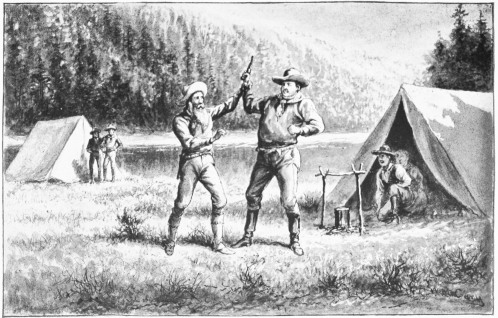
“WELL, son,” said Hugh, as the two pulled on their shoes in the gray
light of the next morning, “I slept mighty well last night and I reckon
your conscience didn’t trouble you much, did it?”
“No,” said Jack, “I didn’t know what was going on two minutes after I
rolled my blanket about me.”
“It’s mighty dark this morning,” said Hugh. “Either we got up early, or
else there’s a big fog;” and when they put their heads out of the tent,
sure enough, the mountains were covered with mist and a few flakes of
snow were falling.
“Well,” said Hugh, “it’s no time to climb the mountains to-day, unless
the weather clears, and it seems to me that it’s mighty cold. Maybe
we’re going to get snowed in here.”
“That wouldn’t be very nice,” said Jack. “I hope we won’t have a big
snowstorm.”
“Well,” said Hugh, “you boys go out and look after the horses. We’ve got
to keep our eyes on them; it would be pretty bad to be left afoot and,
if it does snow, the horses will be wanting to get down to the prairie
again.”
The boys went and did as they were told, and changed the two horses that
were picketed to fresh grass, saw that the others were all near at hand,
and then returned to the fire.
Meanwhile, the snow began to fall more and more thickly and, after
breakfast, Hugh said, “Now, boys, I believe we’re going to have a real
snowstorm. Let’s get these ropes, blankets and saddles covered up as
well as we can, and then we’ll go down to the point where we came out of
the timber and build some sort of a fence there, so as to keep the
horses from going back to the prairie. We’ll have to picket them all
to-day and they’re not likely to pull up their pins, but we’ll make it
as hard for them to get away as we can.”
The riding saddles and pack riggings were soon piled under a tree, where
they would be protected from the snow and covered with blankets and
mantas, and then Hugh began to cut and sharpen a number of pins, while
the boys collected lash ropes and lariats enough to tie all the horses.
After the animals had been securely picketed, the three men went down to
the end of the valley and, after Hugh had cut some tall, but slender,
dead pine and spruce trees, the boys dragged them out of the timber and
made a fence, which sufficiently barricaded the trail and one or two
open places, where the horses might have gone into the forest.
By this time the light snow was two or three inches deep and, when they
returned to camp, they found that all the horses were busily at work
pawing away the snow, in order to get at the grass beneath it.
“There,” said Hugh, “I guess they’re all right, and this thing is just a
flurry. As soon as the sun comes out again, this snow will all melt.”
Joe went into the tent, and covering himself with his blankets, went to
sleep, but Jack wanted to be doing something, yet there was not much
that he could do, unless he went out to hunt, and, as all the foliage
was covered with snow, he could not hunt without also getting wet.
Now and then he would walk out and look at the horses, which could not
be seen from the camp. They were all standing with their tails to the
storm, each with a crest of wet snow on his mane, a patch on the upper
hairs of his tail and, most of them, with a line of white running down
the backbone. They looked quite as miserable as Jack felt.
On one of Jack’s returns to the fire, Hugh looked up and said smilingly,
“You’re getting pretty tired of doing nothing, son?”
“Yes,” said Jack, “it’s pretty slow business, I confess. I’ve been
trying to think if there was anything that I could do and I can’t think
of anything, unless I go over and take down some of that meat and cut it
up for drying.”
“Well,” said Hugh, “that’s certainly not a bad idea. What do you say if
we go over there and get a quarter and work on it under a tree where the
snow doesn’t fall thick?”
“I’d like to, Hugh,” said Jack. “Of course, nothing would dry to-day and
maybe not to-morrow, but if we could have two or three days of bright
weather we could get it so it would keep.”
“We sure could,” said Hugh; “and even if we don’t have bright weather,
we can rig up some kind of a scaffold and half dry and half smoke it
with the fire. Come on, I’ll go with you and we’ll get down a piece of
meat and go to work on it.”
It was but a short distance to where the meat hung, and, before long,
one of the hind quarters of the elk was on the ground. Hugh stopped in
front of it and said, “Now, son, take hold of it and, when I get up,
raise it, and we’ll pack it into camp.”
The load was too heavy for an ordinary man to carry a great distance,
but this did not seem to trouble Hugh. He threw down the ham under a
spreading pine tree, that stood not far from the tent, and then Jack and
he removed the skin, and began the work of cutting the flesh into thin
flakes, which they piled up on the flesh side of the hide that had been
taken off the elk. They worked at this for some hours and before supper
time had cut out all the meat of the elk.
“Now, son,” said Hugh, “go and get me a sling-rope and we’ll hoist this
meat off the ground. If we leave it here, likely some animal will come
around to-night and want to carry it off.”
“Well, Hugh, I don’t believe I can climb the tree,” said Jack; for the
trunk was very large and without branches for twenty-five or thirty feet
above his head.
“No,” said Hugh, “I don’t believe you can and, what’s more, we haven’t
got any sling-rope that will reach from the ground to that lowest branch
and back again. We’ll tie it up to that little tree that stands close to
the tent. Of course, it won’t be safe there, but I reckon anything can’t
get at it without our hearing it.”
He made a bundle of the meat, lashing it with a sling-rope.
“There,” he said, “that’s all right for the present, and we’ll put it up
here in this spruce tree. Nothing can knock it down without its hitting
the tent and waking us, but if we should want to dry it to-morrow,
someone will have to stop here and look after it, if the others go off
on the mountains. Now let’s have supper.”
Hugh and Jack washed their hands in the snow, built up the fire, and
presently commenced to cook supper. After things were going well, Jack
called out, “Get up, Joe, you’ve been asleep all day, while other people
have been working. Supper is nearly ready.”
Joe grunted sleepily in response and, presently, his black shock of hair
was seen poking out of the tent door.
“I must have been asleep,” he said.
“Asleep?” said Jack “I should say so. It’s five or six hours since you
turned in and here Hugh and I have been working all that time to support
you.”
Joe was not wide enough awake to appreciate Jack’s joke, but after he
had walked a little way from the fire and given his face and hands a
good scrubbing with snow, he brightened up a good deal and seemed to
watch the progress of the meal with interest.
“I tell you what,” said Hugh, as they were eating, “let’s turn back the
flaps of the tent and build a small fire right close in front of it. Of
course, we’ll have to watch it pretty carefully and put it out when we
want to go to bed, but it will seem a heap more comfortable than to be
standing about the fire out here.”
“Good,” said Jack, “let’s do it. If you’ll wash the dishes I’ll cut some
small wood and we’ll get something as near like a lodge as we can.”
When the fire was built and when the three were sitting on their soft
blankets under the shelter of the tent, it seemed very comfortable.
“There,” said Hugh, “this is lots better than standing out there, boys,
ain’t it?”
“Yes,” said Joe, “it is.”
“Bully,” said Jack. “We couldn’t be more comfortable than this, unless
we had a lodge, and this is plenty good enough.”
“Yes,” said Hugh, “I would like to have brought a small lodge, but then
I knew we were coming into a stormy country and very likely often would
have to camp high up where we couldn’t get lodge poles, and so I thought
it was better to bring this little tent with the folding poles. Of
course, sleeping out on the prairie in this weather one doesn’t need a
tent, but in the mountains here, where you’re likely to have ten rain or
snow storms in a day, it’s good to keep your blankets dry.”
While he was speaking, Hugh was cutting tobacco, and when he had a
pipeful, after grinding it up between his palms, he filled the bowl of
the pipe and reaching out took a brand from the fire and lighting his
pipe sat there in great comfort, drawing in deep breaths of the fragrant
smoke.
“Well,” he remarked, when his pipe was going well, “I never would advise
a young man to begin to smoke, but I don’t know of anything in this
world that has given me more comfort than tobacco, and that is one thing
that the world has got to thank the Indians for.”
“Well, pretty nearly everybody smokes,” said Jack, “and I’ve often
thought that maybe I’d like to, especially when I see you sitting there
as you do now, Hugh. You seem to take such solid comfort in your pipe.”
“Yes,” assented Hugh, “I do; but then, suppose I’d never learned to
smoke; don’t you suppose I’d be just as comfortable as I am now? A man
don’t miss the things that he’s never enjoyed.”
“No, of course not,” replied Jack.
For a long time the three sat there, gazing at the little fire that
flickered before them, Joe occasionally reaching over and carefully
laying on it a stick of wood so that it constantly burned bright and
warm.
At length Jack spoke up again and said, “Hugh, where were you in 1876,
when the Custer massacre took place?”
“I was up camping with the Piegans, not far from the Sweet Grass Hills.
I had been trading the year before with the Piegans, and instead of
going into Benton and lying around there during the summer, I just
stayed out in camp with the people. But look here, son,” he went on,
“don’t make the mistake that pilgrims do and call that the Custer
massacre; call it if you like the Custer fight or the Custer battle. It
wasn’t what I understand a massacre to be; it was just a fair
up-and-down fight, and the white men got licked and all of them got
killed off. The white men went into that fight with their eyes wide open
and knew what they were doing. They just tackled a job that was too big
for them, that’s all. Now, you might call the Baker fight that I was
telling you about a few days ago a massacre, because it was a surprise
and because the troops attacked the camp, and killed off mostly women
and children and old men. That’s my idea of a massacre, but the Custer
fight was just a fight, and nothing else.”
“That’s so, Hugh,” said Jack, “I oughtn’t to have called it a massacre,
but that’s what a good many people do call it, you know.”
“I know they do,” said Hugh, “but it’s a wrong name to give it, at least
according to my idea.”
“Did you ever know General Custer?” asked Jack.
“Yes,” said Hugh, “I knew him some. I worked for him part of one summer
out from Lincoln; I was one of the scouts on the Yellowstone expedition
in ’73 and again in ’74, when he made his trip to the Black Hills.”
“What sort of a man was he?” asked Jack.
“Well,” said Hugh, “he was a nice man. Of course, I never knew him,
except in what you may call a business way, to take orders from him and
to report. He was always right pleasant, and his wife was an awful nice
lady. He was a good soldier, General Custer was, and a great hunter. He
was just crazy to be hunting all the time. He treated his men well, too;
worked them awful hard, breaking camp early in the morning and sometimes
marching away into the night, but they thought a heap of him. I remember
one time, going into the Black Hills, two of the men were caught
stealing canned goods out of one of the wagons. We camped early the
afternoon they were caught, and he had them each ride a cannon from the
time we went into camp until after dark. Then he had ’em cut loose and
brought to his tent, and he gave them a good talking to, and a day or
two afterward he appointed one of them, an old soldier and a pretty good
man, too, his orderly. The other man he gave permission to go hunting
the next day. He was pretty savage with his men when they did wrong, but
after he’d punished a man, he always did something to him to make him
feel that he did not hold the offense up against him. That made the men
have confidence in him, and it made a good many of them careful about
how they did anything wrong.
“I haven’t told you, have I,” he went on, “that Jackson, Billy Jackson,
you know, was along with that outfit in 1874.”
“Yes,” said Jack, “I think you told me that.”
“I didn’t know him then,” said Hugh. “He was just a schoolboy. We had
quite a bunch of schoolboys along. They were called scouts, and maybe
they thought they were scouts, but, of course, they were just boys out
of the Indian schools without experience, and not knowing anything. They
were mostly Santee Sioux.”
“Well,” said Jack, “but Billy is a Piegan, isn’t he?”
“Yes, a Piegan,” replied Hugh, “a grandson of old Hugh Monroe’s and on
his mother’s side a grandson of a great chief that died before my time
with the tribe, a man called Lone Walker. They said he was a great man.
An awful big man, brave and rich. He had nineteen wives, and old man
Monroe has told me that when he first came with the tribe—that must be
nearly seventy-five years ago—Lone Walker had two grizzly bears that he
used to keep tied up, one on either side of the door of his lodge. The
old man said that the first time he ever went into the lodge, both bears
got up and growled and started to attack him. He said he was scared
pretty near to death, but Lone Walker spoke to them and they became
quiet and went and lay down again. Old man Monroe lived in Lone Walker’s
lodge for two or three years after that and, of course, the bears got
used to him right away and never bothered him; in fact, I believe it
wasn’t very long after that before the bears ran away and were never
seen again.”
“But, Hugh, were they tame bears?” asked Jack.
“I don’t rightly know,” responded Hugh. “They were tame to the man that
owned them, I expect, and they say that during the day when the camp was
moving, the bears used to travel with it, walking along with the dogs.
They didn’t bother anybody or anything and nothing bothered them; but,
finally, I believe, they ran off, and although Lone Walker looked for
them he could not find them.”
“Well,” said Jack, “those seem to me like queer pets for a man to have,
but after all I don’t know that they are any queerer than poor old Swift
Foot that I used to have.”
“No,” said Hugh, “any tame wild animal may seem strange to a person who
never has seen a tame one before, but any wild animal can be tamed, and
if he’s taken young enough he won’t have any fear of man. The trouble
is, though, to make him stay tame. He’s naturally shy, and while he may
be all right when his owner’s around, if he gets among strange people,
the natural fear that he’s inherited from his ancestors will come back
to him, and he’ll run.”
“That’s what happened to poor old Swift Foot, I am afraid,” said Jack.
“What Swift Foot?” said Joe. “I never heard about that.”
“Why, haven’t I ever told you about him, Joe?” said Jack. “Four or five
years ago, the first year I was in the West, we dug out a den of wolves
and kept the puppies, and some of them became very tame. I took one back
East with me and had him two or three years. He was just like a dog
with me and felt at home with all the other people in the house, but I
never dared let him loose on the streets, for fear he would get lost. In
the country, when I went there, I’d turn him loose and he would
run—Great Scott! you never saw anything so wild to run as he was. Then,
when I’d bring him back to the city again I’d have to keep him chained
and give him what little exercise I could on a chain. Of course, he grew
awfully fat, and I think if I’d had him much longer he’d have gotten
cross, too; but finally, one unlucky day, I took him out walking, and
over near Third Avenue, a crowded street where there is a great deal of
noise and the elevated railroad trains are running all the time,
something frightened him and he dodged behind me and gave a pull on the
chain, and it pulled loose from his collar, and before I could grab him
he got frightened and ran. He ran like a deer, dodging among the trucks
and horses and cars, and though I called and whistled he never stopped,
and I never saw him again. Father advertised, and we tried our best to
hear something of him, but it was no use.”
“I don’t wonder he got scared,” said Joe. “I guess I’d be scared a whole
lot with so many people round me, and no place to get away.”
“You’re right,” said Hugh, “so would I. It must be something terrible in
those big cities.”
“Well,” said Jack, “it is terrible the way the people crowd about. Of
course, those who live there are used to it and don’t pay any attention,
but people that haven’t been used to hearing the noises and seeing the
crowds, could easily enough get scared.”
A little later Hugh rose to his feet and stepped out of the tent,
saying as he did so, “Boys, I believe we’re going to have a nice day
to-morrow. It’s stopped snowing, all the stars are out and the moon is
just rising. It feels mighty warm, too. Likely enough to-morrow the sun
will come out hot and take off the heft of this snow. Then we can get
round a bit and can dry this meat.”
“Well,” said Jack, “I’d like to be able to dry our meat. Of course,
there’s no trouble killing meat here, but one doesn’t want to kill a big
animal for a single meal.”
“No,” said Hugh, “you’re right about that. Meat is plenty here, but
that’s no reason why we should waste it. Now, let’s put this fire out
and cover it up with snow, so that there’ll be no danger of the tent’s
catching fire, and then we’ll go to bed. What do you say?”
At once the boys were on their feet, pulling the fire to pieces and
extinguishing the burning brands, by throwing them into the snow, and
then bringing a few double handfuls of snow they threw them on to the
ashes of the fire, and with much smoke and steam the last sparks were
extinguished. A little later the regular breathing of the three men in
the tent showed that all were asleep.
It must have been in the middle of the night or perhaps toward morning,
when Jack was half awakened by hearing a noise, something like
scratching, which he did not recognize, but a moment later he was
thoroughly aroused by hearing a loud thump on the ground just outside
the tent and then the sound of something galloping. His first thought
was that one of the horses had come up close to the tent and knocked
something down, but almost at once he recognized that this could not
have been the cause of the sound, because the footfalls were not heavy
enough to have been made by a horse. Rising on his elbow, he looked
about. It was quite light in the tent, for a brilliant moon was shining,
and he could plainly see Hugh get up, walk to the door and look out.
“What is it, Hugh?” asked Jack.
For a moment Hugh did not answer, and then said, “Why, something has
carried off that bundle of meat. No, he hasn’t either. Here’s the meat
lying in the snow and there is the thing that knocked it down over there
under the pine tree, where we were cutting up the elk. I can see it
plain in the snow, but I can’t make out what it is. It’s some animal,
because it’s moving.”
By this time Jack was on his feet and had his head out of the tent door.
He could plainly see some not very large animal crouched in the snow and
could hear faintly the scratching, tearing sound of an animal gnawing a
bone, and at once said, “Why, Hugh, whatever it is, he’s gnawing on the
bones of that elk we left over there.”
“So he is,” said Hugh. “Let’s see what it is,” and, reaching down, he
took his rifle and, stepping outside of the tent door, fired at the
creature. It paid no attention whatever, but went on eating. Then Hugh
fired another shot and then another, and after the fourth shot, the
animal sprang into the air and, turning about, bounded off into the
shadow and was not seen again. Hugh picked up the bundle of elk meat and
put it in among the branches of the tree, and then he and Jack went back
into the tent.
“What was it, Hugh?” asked Jack.
“Well,” said Hugh, “I don’t know. It was either a mountain lion or a
lynx or a bob-cat, but whatever it was, it wasn’t a bit afraid.”
“No,” said Jack, “I could see that. We ought to be glad that it didn’t
come into the tent with us.”
“Well,” said Hugh, “we’ll know what it is in the morning, when it gets
light.”
For the remainder of the night their rest was undisturbed. They rose
early, and while breakfast was being cooked Hugh walked over to where
the animal had been, and after looking about, came back and told the
boys that the disturber of their rest had not been a mountain lion.
“I wish after we get breakfast you would show me how you know that,
Hugh,” said Jack.
“I will,” said Hugh, “but I can tell you now. The place where it was
lying is too small for a mountain lion. There is no mark anywhere on the
snow of a long tail, such as a lion would have, and then out there I
picked up this,” and he took from his pocket a little tuft of hair,
gray, mixed with reddish. “Do you recognize that fur?” he said, as Jack
took it in his hand and looked at it.
“No,” said Jack, “I don’t. But then you know I don’t know many of the
mountain animals.”
“No,” said Hugh, “you don’t, and I don’t think Joe does, either. But
unless I’m mightily mistaken that came from a lynx, one of those big
animals like a bob-cat, only a good deal bigger, and gray instead of
red. They’ve got black tips to their ears and a kind of whiskers around
their necks, and they look awful fierce and savage, but it’s all looks.
Though they seem to be so big, a man can kill one with a stick and not
a very big stick, either.”
“Well,” said Jack, “let’s go over there as soon as we’ve eaten.”
After breakfast Hugh and Jack took their rifles and went over to the
place where the animal had been sitting, and Hugh pointed out the
animal’s tracks, which looked very large.
“Now, in this soft snow,” observed Hugh, “I can’t tell, and I don’t
believe anybody else can, whether this is a lynx’s track or a mountain
lion’s, but if it was a mountain lion’s, every little while as you
followed it you’d see some place where the lion’s tail had made a mark
in the snow. We don’t find anything of that sort here. Now, what do you
say to following up these tracks, and seeing where the critter’s gone?”
“Let’s do it,” said Jack, eagerly.
Quietly and slowly they followed the trail, which was very plain, and
found that only about twenty or thirty steps from the place where the
animal had been shot at, it had stopped and lain in the snow for some
time, and that in this bed was a drop or two of blood. Apparently one of
the shots that Hugh fired had grazed the skin somewhere.
“Well, Hugh,” said Jack, “that beast isn’t much frightened and it may be
anywhere about here. Let’s go ahead, as carefully and quietly as we
can.”
From here the trail led into thick willows, where it wound about, and
where, owing to the closeness of the willow stems, it was not easy to go
quietly. Every few moments Hugh stopped and looked carefully about, and
then went on a little farther. When he had followed the trail for a
little more than a hundred yards, the tracks turned sharply to the
right, and just as they turned to follow them, Hugh made a motion with
his hand and stopped. Jack looked under Hugh’s arm, and there, not
twenty yards away, saw the animal. A large spruce tree grew among the
willows and at its foot was a little open place. The lynx, for such it
was, was lying in the sun at the foot of this tree, and only its hips
were visible.
Hugh motioned to Jack to shoot, but before the lad could do so, he was
obliged to creep several yards to the left under the low-spreading
branches of a willow. At last he got far enough to one side to see the
animal’s body almost to the shoulders, and then fired, trying to send
his ball as close to the tree as possible. At the report the animal gave
a spring, and, falling back, stretched itself out in the snow. When Hugh
and Jack went up to it they could see that it was a Canada lynx of the
largest size, and as it lay there, its thick legs, and huge paws, armed
with long, strong claws, gave it a more ferocious appearance than it was
really entitled to.
Those paws were a marvel to Jack on account of their size, and the way
in which they were armed, but when he took hold of the animal to lift
it, he appreciated what Hugh had told him about its really small size,
and realized that a great deal of its bulk was due to its long, loose
fur.
Hugh took the lynx by the back of the neck and a few minutes brought
them to the camp.
Joe was delighted with their capture, and confessed that he had never
before seen an animal like this.
“Now, Hugh,” said Jack, “I want to skin this beast, that is, if you will
give me the skin.”
“Sure,” replied Hugh, “I’ll give you my share in the skin. You killed
it, and it seems to me it’s yours.”
“Yes,” said Jack, “I killed it, of course, since you gave me the shot,
but by hunter’s law the skin belongs to you. Isn’t it true that the
first shot that draws blood is entitled to half the meat and the hide?”
“That’s so,” said Hugh, “that’s the old-time law that I used to hear
down in Kentucky, before I got big enough to pack a gun. That’s what
they always said down there and I reckon that’s been the custom ever
since this country was a country. But you can have the hide and all the
meat. I’ll give ’em both to you. Keep them always.”
“Well,” said Jack, “I’m mightily obliged to you for the hide, but I
don’t feel as if I could rob you of the meat.”
“Well,” replied Hugh, “maybe you don’t know what you’re refusing. I
never did happen to eat bob-cat myself, but I’ve eaten mountain lion,
and that’s pretty good meat. A little dry maybe, and tastes a little too
much like dry roast pork to suit me, but it’s good all the same.”
“Well,” said Jack, “I’ll skin this bob-cat now, I think. How shall I do
it, Hugh, split it, or shall I case it?”
“Why,” said Hugh, “if I were you I’d case it. That’s the regular way to
skin a bob-cat, and while you’re skinning it, suppose Joe and I go down
and see how the horses are and look after our fence. I reckon we don’t
want to stay here much longer, but while we do stay we must watch the
horses.”
“Well,” said Jack, “that’s for you to say. I’m ready to stay or I’m
ready to go. I’d like to have a chance to climb up where you went the
other day to look down into Belly River. Maybe I can do that to-day or,
at least, this afternoon, if I start as soon as I get through my job of
skinning.”
“Yes,” said Hugh, “I reckon you could. Go ahead at it now, and Joe and
me will go and look at the horses.”