As they turned north again and paddled on up the
inlet the talk was naturally of the wonders that they
had just left.
"Surely," said Jack, "this is the most wonderful
place that I have ever seen."
"Yes, indeed," said Hugh, "it beats all the countries
that my eyes have ever rested on, and I never expect
to see anything so wonderful again."
"It was beautiful," said Fannin, "and how cold and
gloomy it was one moment and how bright and beautiful
the next."
"Yes," said Jack, "and yet when it was brightest
and most beautiful it seemed cold all the time. It
reminded me of what I've read about the Arctic
regions. There was not a thing but snow and ice and
just a few straggling stunted trees. I remember reading
somewhere about a point down at the other end of
South America where there is nothing to be seen but
rocks and a little timber and snow and icebergs. That
is the way Princess Louise seemed to me, but I do
wish that we had had time to land and follow up that
big river toward those heights."
"That would have been a nice trip," said Fannin;
"but I guess it would have been an awful hard one.
It looked to me as if those rocks were big and hard to
climb among. We'd have had to carry our beds and
our grub on our backs, and it might have taken us a
long time to get up even to the foot of that big peak
that stood up so high."
"Yet, I suppose there must be lots of life up there,"
said Jack; "birds and animals, and of course if there
are birds and animals there must be vegetation to
support them."
"Sure," said Fannin. "I don't doubt but that there
are goats and deer and ptarmigan, probably bears, and
possibly other animals. Of course the sheep don't get
down so close to the salt water, at least I have never
seen them there. I don't doubt, though, but there's
plenty of life up there."
"Anyhow," said Jack, "it looks as if the country
had not changed a bit since the glacier came pouring
down through those valleys and was working its way
toward the salt water."
"I don't believe it has," said Fannin, "except that
trees have grown; perhaps some little soil has been
made here and there; but except for that I suppose the
country is unchanged."
For a while they paddled on in silence, and then,
as they rounded a point, came a call from Fannin:
"Hello! there's an Indian village."
Three or four houses stood on the bank but a short
distance back from the water's edge, and near them
were a few people busy at different tasks. When they
saw the canoe they all stopped and began to stare at it.
Down on the beach, just above the water's edge was
an old man working over a canoe. Fannin said:
"Let's push in there and see if we can buy some
potatoes or other food." They pushed up to the beach,
and when close to it saluted the old man with the
usual phrase, "Kla-haw-ya tillicum?" (How are you,
friend?) The man gave an answering shout, and
Hamset turned to them and said: "I guess he can't
talk with us"; which was Fannin's translation into
English.
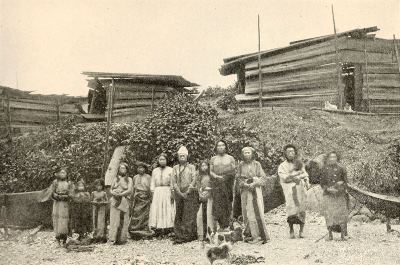
WHEN THEY SAW THE CANOE THEY ALL STOPPED AND BEGAN TO STARE AT IT—Page 190
They landed and found that the man was mending
some cracks in his canoe by fastening over them strips
of tin, seemingly cut from an old tin can, by means of
tacks and a primitive stone hammer—a cylinder of
stone with enlarged flat ends.
Hamset began to talk with him in Chinook, but the
man apparently did not understand, and replied by a
speech in some language which Hamset could not comprehend.
There was a long talk, in which each of the
two Indians made a speech, which was not understood
by the other. Fannin tried the old man in Canadian
French, and Hugh made signs to him, but there seemed
to be no common ground of communication. After
each remark by the old man, Hamset would hopelessly
reply after hearing him through: "Wake nika kumtux-mika
wahwah" (I don't understand your talk).
Within a rude fence near one of the houses was what
looked like a garden, in which were growing plants
that resembled potatoes. Presently a bright thought
came to Jack, and he walked down to the canoe, took
from the provision box a potato and handed it to the
old man. It was amusing to them all to see the expression
of perplexity clear away from the old Indian's
face and understanding and satisfaction appear. He
laughed delightedly and shouted to the women at the
house, and a little later two of them came down carrying
a large basket of potatoes—and very good ones
too. These were put into the canoe, and paid for by
"four bits." Then at Hugh's suggestion Jack gave
the old man a piece of tobacco. They wandered up to
the houses, looked into them, and presently returned
to the neighborhood of the canoe. Leaning against
one of the houses was a two-pronged salmon spear,
which Jack wanted and which the old man sold him
for half a dollar. Jack thought that the implement
might be useful a little later, as the salmon were now
beginning to run into the fresh water streams in considerable
numbers. Hamset said that these Indians
were called Hanéhtsin. He declared that most of the
people must be away fishing, and said that there must
be many of them who could speak Chinook, although
this man could not.
Next morning as they were eating breakfast a canoe
came in sight from the direction of the village, and
when it landed the paddlers proved to be their friends
of the night before, who brought them some more
potatoes and several salmon just from the water. These
having been duly paid for at the rate of twenty-five
cents each—for a twenty pound salmon—they
brought forth from the canoe a large basket of berries
which a small boy who was with them, and who had
some knowledge of the Chinook jargon, announced
was a "potlatch," or gift—very likely in return for
the bit of tobacco that Jack had given to the old man
the night before.
A little later, the canoe being loaded, the party
pushed off from the shore, and, leaving the Indians
sitting idly in their canoes, paddled back down the
inlet.
"What I can't understand, Mr. Fannin," said Jack,
"is how it is that these Indians don't understand one
another. Of course, I don't suppose that all the different
tribes on this coast speak the same language, any
more than our Indians out on the plains, but I should
suppose that there would be some common way of talking
to each other, just as the plains Indians all understand
the sign language."
"Well," said Fannin, "you'd think so, of course,
but that's one of the queer things about this country.
While often you'll find a great many villages that
speak the same language, and while you'll find in
most of the villages a number of people that can talk
Chinook, it's nevertheless the fact that stowed away
in bays and inlets all along this coast are little tribes
that speak a language that is not understood by any
other tribe. I have talked with a few people out here
who were regular Indian 'sharps,' and who had been
among Indians over most of the country, and they say
that there are a number of Indian languages spoken
here that are absolutely different from each other and
different from any other languages in North America.
This is a mighty queer thing, and I can't understand
it at all. I've always supposed that it was this fact
that obliged the Indians to get up this Chinook jargon,
which is a kind of a trade talk, used all up and down
the coast and a good way inland, too, to enable these
people to talk among themselves. I have never seen
any of these Indians here using the sign language, and
you can see for yourself that this old chap did not
understand what it was that Hugh was trying to say
to him with his hands. They do say that this Chinook
jargon was gotten up before the white men came here
to this country, and you can see how necessary it
would be to people coming in contact with others who
spoke a language different from their own. Now, I
suppose that in the old times there used to be considerable
travel along this coast, north and south, and
considerable intercourse between the different tribes of
Indians. And while we know that the northern Indians
could not talk with the southern ones, yet they
visited and traded, and made war and made peace
again. It must have been necessary for them to understand
each other in some way, and that's the way this
jargon came to be invented. Of course, it's changed
a lot, I fancy, and especially since the white people got
in here."
"But about this Indian here," said Hugh, "it seems
to me that he ought to be able to understand our
Indians. Their villages cannot be more than a hundred
miles from one another, and to an Indian a hundred
miles is nothing. These Ucletah must sometimes come
up to the head of this Inlet, and these people who live
up here, Hanéhtsin,—don't you call them,—must
go down the inlet and go up and down the shore. It
would seem as if they must have met sometimes, and
as if they would have some common speech."
"Yes," said Fannin. "They ought to, but I don't
believe they have. Of course I know no more about
them than you do, but you saw the experiments
that were tried upon that old chap that we've just
left."
"Yes," said Hugh, "there's no going back on that.
He didn't understand, no matter how much he ought
to have understood."
"Hugh," said Jack, "did you count the number of
people at the village?"
"Yes," said Hugh, "I did: three women, three
children, and the old man."
"Well," said Jack, "did you count the dogs?"
"No," said Hugh; "I reckon I forgot to count the
dogs. There were a lot of them, I know."
"Nineteen," said Jack. "I counted them. Three
or four times I had them all counted, and then a lot
more would show up. There were a lot lying down
sunning themselves when I got there, and after they
had got up and come round to threaten us, a lot more
came out of the house. This nineteen that I counted
didn't include the pups. I looked into a little pen
built of sticks, near one of the houses, and there
were nine puppies in there, just able to waddle, and
I saw some others not much older wandering about."
"Ah," said Charlie, "call it 'Dogtown'; we haven't
any better name for it."
"All right," laughed Jack. "I'll put it down."
"Mr. Fannin," said Jack, after a pause, "I was
thinking last night of the hammer that that old Siwash
was using to mend his canoe. That was a regular
primitive implement, wasn't it?"
"Yes," said Fannin; "you often see the Indians
still using these hammers. I suppose to an Indian they
are just as good, and maybe lots better, than a white
man's hammer."
"Yes," said Jack, "I don't see why they shouldn't
be; but while the hammer was old-fashioned and primitive,
the strip of tin which he was nailing over the
cracks in the bottom of the canoe and the tacks were
modern. Where do you suppose he got them?"
"Why, from a trading schooner, of course," said
Fannin. "There are three or four small schooners
that sail up and down the coast here, trading with the
Indians for oil and fish, and a little fur, and the chances
are that the tin came from some old tin can thrown
overboard by such a schooner, and that the tacks were
bought from it. Of course it may be that these people
have been to Comux or even to Nanaimo."
"That salmon spear is interesting, too," said Jack,
"and I hope we'll have a chance to get some food with
it."
"These spears," replied Fannin, "are very useful
to these people. This one, as you see, is about sixteen
feet long, the main shaft being about twelve feet and
the two prongs about four. It is a well finished tool
and rather attractive to the eye, wrapped as it is with
the neat strips of bark about the ends of the shaft. That
flat handle with the deep notches at the upper end, for
two of the fingers of the man who is to throw it, give
a good hold. Then the two prongs at the other end
bound firmly to the shaft, and tapering to a point
below, and slightly diverging, make a good implement
for throwing into a school of fish; but the interesting
part of the thing is the way the spear heads are fastened
on to make it effective. You see the line looped about
the shaft close above the point where the diverging
prongs leave it, that each end of the line is long enough
to reach clear to the end of the prongs, and that to
each extremity of this line is attached a spear point.
The socket which slips on the sharpened end of the
prong is made of the horn of the deer, or of the mountain
goat, or even of bone; and the piercing point is
either a sharpened nail or some other sharp bit of
iron lashed to the socket with a fishing line or a strand
of kelp. When the spear is to be used, the heads are
slipped on to the points of the prongs, and are held in
position by the tension of the cord, which is so short
that some little effort is needed to slip the socket on
to the point. When a salmon has been deeply pierced
by the iron point, his struggles slip the socket off the
prong and the fish struggles about for a few moments
at the end of the cord until he is so exhausted that
he can be brought to the surface of the water and
lifted into the canoe. If the point were firmly attached
to the prongs the attempt to haul a vigorous fish to the
surface might very well result in the pulling out of
the spear point and the loss of the fish."
All the day long the canoe moved slowly down the
Inlet, stemming the flood tide which at times made
them all work at their paddles with an energy that no
one of the crew greatly enjoyed. Before them the
snowy tops of the mountains and the blue glaciers
looked cool and inviting, but no breath of air ruffled
the smooth surface of the Inlet, and the fierce rays of
the sun, both direct and reflected from the water,
scorched them all day long. About the middle of
the afternoon, as they were passing a point opposite
Moorsam Bluffs, a level spot was found, covered with
forest. A pleasant brook ran down here, and the spot
looked like an attractive camping place. When they
landed they found evidences that it was one favored
by the Indians of the Inlet, for there were here relics
of many a camp. Piles of stone blackened by fire,
white heaps of the bones of the deer and mountain
goat, decayed vegetation and fragments of discarded
clothing and skins, worn-out implements, a tiny baby
basket or Indian cradle, and many other articles left
by former occupants were scattered about over the
ground, and showed that the Indians often stopped
there and sometimes remained for a considerable time.
In fact there were so many evidences of human occupancy
that it was agreed that some other spot which
had not been quite so much frequented by Indians
would be a better location for their camp; and moving
a few hundred yards further down the Inlet they found
such a place at the mouth of the boisterous brook which
here tumbled into the salt water.
Here Jack and Hugh and Fannin, finding a good
beach, took a plunge in the salt water, and while thus
engaged found that the little bay was alive with salmon.
On shouting this to the others the Indians put off in
the canoe, and for half an hour Hamset perseveringly
threw the salmon spear into the school of fish that were
breaking everywhere about the canoe. For a few
minutes Jack and Hugh watched him; but as he failed
to secure anything, they soon grew tired, and at length
went ashore into the camp. Half an hour later the
canoe returned to the shore, and the Indians had three
good-sized fish to show for their efforts.
"Well," said Hugh, "from the number of fish that
seemed to be out there in that little piece of water,
I should think these fellows might have loaded the
canoe with them in this time."
"Yes," said Fannin, "that's true; but it's wonderful
how much room there is in the water around a
salmon, and then you have got to hit the fish just right
or else you will not drive the spear into him. If you
are not used to seeing salmon you will think there's
an awful lot of fish out there; but you just ought to
see them in some of the rivers in the Province here.
Why, sometimes they are so thick that you literally
can't see the bottom for their backs. A good many
people, who have never been on a stream during the
salmon run, think that the stories about their abundance
must be lies; but they are not. You can't
exaggerate their numbers. I have seen people go down
to the stream with a pitchfork, and throw out the
fish they wanted onto the bank, just as you would lift
a load of turnips on a fork if you thrust it into a pile
of them. When the fish are running, of course, the
bears and eagles have no trouble at all in catching all
they want. Even the hogs go down to the stream and
take out the fish. In fact, during the salmon run, and
for some months after it, settlers who expect to kill
their hogs keep them shut up; because, if they are
allowed to feed on the salmon the flesh becomes
flavored with fish to a point where people can't eat
it. That sounds like a pretty good story too, but it's
true. Later in the season, when the dead fish are
in the streams,—and there are always many of them,—the
hens of the settlers eat them, and often eat
so many that their eggs can't be used on account of
the fishy taste. That's another good one, but it's
true."
"Well," said Hugh, "those stories sound pretty
hard to believe, but I guess they are true. Of course
we've always heard about buffaloes, and how many
there used to be, and I expect I've told stories to
people who had never seen them, about the numbers
of these animals that sounded just as hard to believe
as your stories do to me. It don't trouble me a little
bit to believe what you told me about the taste of the
flesh of these animals. Everybody knows, I reckon,
that the food that an animal eats gives its flesh good
flavor or bad flavor."
"Yes," said Jack, "that's so, of course. I have
heard my uncle tell a great many times about some
kinds of ducks living up on Long Island and eating
little clams and other shell-fish, and being strong and
fishy to the taste, while the same ducks, when they go
down South and live in water that is fresh or nearly so,
eating nothing but grass and roots, are as delicate and
fine flavored as can be."
"That's gospel truth, son," said Hugh, "and you
see the same thing out on the plains and in the mountains.
Take it early in the season, before the grass
begins to grow, and the first green thing that grows
out of the earth is a wild onion. If you kill, up at the
edge of the mountains, a buffalo or a mountain sheep,
just after these onions have sprung up, you can hardly
eat the meat."
"Yes," remarked Jack, "and I have heard, too,
that the milk of the cows is often flavored with these
onions."
"I know that's so," assented Fannin.
"But what gets me," said Hugh, "is the multitude
of these salmon that there must be. Of course we
haven't seen many of them; but from what you say,
Fannin, they just crowd every river that comes into the
salt water, and there are an awful lot of rivers along
this coast."
The camp had a great dinner that night. The
Indians transfixed a large fat salmon with a stick,
which was thrust into the ground so that it overhung
the fire at an angle. There the salmon roasted until
it was done, and then its bones were picked as clean
as any bear could have picked them. A smaller salmon,
slim and red fleshed, was cut into steaks and fried, and
there was unlimited deer meat. It was all very delicious;
and after the meal was over the party sat around
the fire for a little while, too lazy to talk, and then
went to bed.
The next morning, before the canoe was loaded,
Jack spent an hour or two leaning over its side, and
watching the movements of the different marine animals
at work in the shallow water near the shore.
There were hundreds of little crabs, the largest about
the size of a silver half-dollar, clambering over the
stones like so many goats, and apparently feeding on
the vegetable matter that grew on them. They walked
slowly here and there, plucking the food with their
curiously swollen white claws, using the right and left
claw alternately, so that while one was holding the food
to the mouth the other was gathering a fresh supply.
They seemed wholly absorbed in what they were doing.
Their jaws moved continuously, and they had a most
businesslike and methodical aspect. The larger crabs
were of a deep purple color, while the smaller ones
were mostly dull, grayish green, a protective color
which corresponded very closely with that of the stones
on which they fed. They seemed to get along peaceably;
though once in a while, if a small crab came
too near a large one, the latter would make a threatening
dash at the little fellow, which would at once retreat
with many defensive demonstrations of its claws.
Fixed to the sides of many of the stones were the
curved white tubes of marine worms; some of them
deserted and empty; while from the mouths of others
there protruded a cluster of deep crimson tentacles,
the whole looking like some beautiful white-stemmed
flower. If the red cluster was cautiously approached
and touched it instantly withdrew into the tube which
then appeared empty. But five minutes later a small
spot of red began slowly to appear, far down in the
tube; and gradually drawing nearer the aperture, the
arms would be gently thrust out, and the animal would
resume its flower-like appearance. On certain stones
and rocks were great numbers of barnacles, which were
not the least interesting of the living creatures Jack
saw. At those stages of the tide when the water did
not reach them their shells remained closed, and showed
no signs of life; but as soon as they were fairly covered
by the water, each little pair of valves opened, and the
tiny arms were extended and waved through the air
with a regular motion which ceased only when they
had grasped some morsel of food that was floating by.
When this took place the arms were quickly drawn into
the shell, and the valves closed; and for some little
time the animal remained quiet. On the beach and in
the water were many sea urchins and starfish, some
of which moved about over the bottom. Both progressed
slowly; the sea urchins by a continuous motion
of the long spines, with which their shells are covered;
and though the animal's rate of advance could hardly
be noticed if one kept looking at it, Jack found that
they did move, and seemed to be capable of quite long
journeys. Jack took up one of these sea urchins to
look at its under side, and found that it had a continuous
movement of the mouth and soft parts, as though
striving to obtain air. When he put it into the water
again he placed it on its back, on a flat stone, and was
interested in seeing it turn over and right itself by the
same quiet, but continuous, movement of the spines.
The starfish moved much more rapidly than the
sea urchins. They seemed to drag themselves along
by some slight up and down motion of their arms, and
also by hooking the ends of these arms around the
angles of the rocks, thus pulling themselves forward
for a short distance. Starfish were very common
along this coast, and were of all sizes and colors. Jack
had noticed them brown, black, yellow, orange, red,
and purple. They ranged in size from the diameter
of a five-cent piece up to ten inches across the arms.
They seemed most abundant on the shore just about
low water mark, but were by no means confined to this
situation.
Often they were seen clinging to the rocks where
they had been left bare by the tide; and sometimes a
great cluster of the large red or purple ones were collected
in an angle of the rock, showing against a background
of shining black mussels and brown seaweed
with very striking effect.
A light breeze blowing down the Inlet made it possible
to set the sail, and the canoe slipped rapidly along
over the water. The tide was ebbing, and their progress
was good; but at length a turn in the fiord shut
off the breeze, the paddles were called for, and they
had several hours of hard paddling. The canoe was
passing so close to the shore that the mountains on that
side were hidden from view, while on the other shore
the hills were low and not especially picturesque. Jack
kept looking at one point after another, hoping that
each would be the last, and that when the one ahead
was rounded he would see the broad waters of the
beautiful bay into which they had looked some days
before toward the Twin Falls. After several disappointments
he said to Hugh:
"Hugh, this reminds me of riding over the plains.
I have been watching these points, hoping that each
would be the last, just as when riding over the prairies
I always looked at the hill ahead of me and thought
that from that hill I should be able to see some distance;
but there was always another one just beyond."
"Yes," said Hugh, "I know just what the feeling is,
and I guess everybody does who has ever travelled the
prairies. Why, even the Indians tell about some man
who prophesied to them long ago, when dogs were
their only animals, about a time when they would get
horses. He said that when they got horses they would
always be on the move, and that they would ride up
on a hill and see another hill beyond; and then they
would want to get to that one to see what was beyond
it; and so would keep going all the time, and never
be quiet."
It was the middle of the afternoon when the last
point was rounded and they came in sight of the Twin
Falls. Even then an hour or two was needed to bring
the canoe to what looked like a good camping place,
near the falls. When they reached the shore they were
disappointed, for the timber was so thick and high, and
the cliff over which the water fell was so nearly straight
up and down, that it was impossible to obtain any view
of the cataract from the land. But by pushing out a
few hundred yards from the shore its whole majesty
was seen. Two wide streams of water flow on either
side of an island in the river, plunging over the cliffs,
and falling quite five hundred feet before they meet
with any check; then from here are two more leaps
of three hundred feet each, and then other lesser ones
of two hundred or one hundred and fifty feet. The
stream falls between dark green walls of Douglas firs
on either side; and the rocky face of the mountains is
entirely hidden. Before the water strikes the rocks it
has become spray, and from each little bench thin
clouds of white mist rise to the treetops and float off
with the wind. The dull roar of the Falls is almost
deafening. Sometimes it sinks to the muttering of
distant thunder, and then rises louder than before,
sounding like the boom of heavy guns in the distance.
Close over the tops of the trees they saw, as they first
approached the spot, a splendid white-headed eagle,
swinging about on motionless wing. Now and then,
as he turned, the bright sunlight flashed upon his head
and tail, and caused them to shine like silver, while
his dark body looked black against the sky. Unmoved
by the tumult below him, and unshaken by the blasts
that were now causing the mighty trees to bend their
heads, he floated to and fro in his broad eyrie, the
only living thing seen in all the wide landscape.
On landing, it took some time to fix the tent and
cut the fir and hemlock boughs which were needed to
make comfortable the uneven ground where the beds
were to be spread. But after this had been done Jack
took his rifle and declared that he was going up the
hill to see what he could see. Hugh said that he
would go too, and the two set off.
From the spot where the camp had been pitched a
broad, well-beaten trail led up to the mountains. But
this soon grew very steep. Great boulders had to be
climbed over or gone around. Great green leaves and
a slippery moss hid the ground and made it difficult
to know just where they were stepping. More than
once Jack, who was in the lead, narrowly escaped an
ugly fall. Presently the trail gave out or was lost, and
then the easiest mode of progress was to walk along
the fallen tree trunks, which in many places lay piled
high on one another, as a lot of jackstraws would
look if thrown down at random. Even such a road
presented some difficulty; for sometimes a span of
the bridge would be missing, and it would be necessary
to descend to the ground and clamber up among the
rocks.
At last the first leap of the falls was reached, but
from here very little could be seen, for the foliage and
mist entirely obscured the view. Further up, for a
hundred yards on either side of the stream, the ground
and the foliage were damp and dripping from the heavy
spray, and the wet moss which covered everything
made climbing difficult and even dangerous. The
forest along the stream was open, and Jack and Hugh
pursued their way, sometimes being obliged to climb
up walls that were almost vertical. Still higher up
the forest began to give way to little open parks, and
before very long the appearance of the sky above
them showed that the timber was either much lower
or entirely absent. They were not greatly surprised,
then, when after a little time they came out of the
forest into an open country, in the midst of which
was a high, naked, rocky hill.
At different points on the hill they saw a number
of white objects which they recognized as goats. They
did not feel that they needed any goats, but these
animals were still sufficiently new to Hugh and Jack
to make them wish to see them again at closer range.
A little manoeuvring took them out of the sight of the
goats, and they began to climb the hill. After they
had ascended some distance they crept out onto a rocky
point and could see, above, below, and on each side of
them, small groups of these animals feeding on the
ledges and steep slopes. Quite close to them was an
old goat, about which was playing a little kid, not a
beautiful or graceful object, but one very curious in
its clumsiness and its high spirits. It ran about its
mother before and behind, sometimes climbing a little
way up on a steep bank, and then throwing itself down
on its side, rolling over and over until a level place
was reached, when it would rise, and after a rest climb
up the slope and repeat the performance. The mother
paid little attention to her young one, but fed slowly
along, constantly approaching closer and closer to Jack
and Hugh, who commented on the goats' odd appearance
and their no less extraordinary actions.
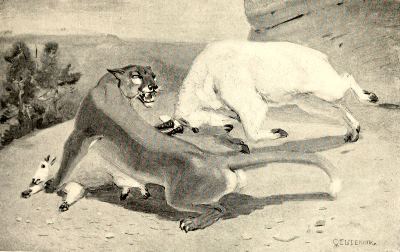
DROVE HER SHORT HORNS DEEP INTO HIS SIDE—Page 205
Suddenly Hugh stretched out his hand and caught
Jack's arm and whispered to him: "Look at that
lion!" Jack looked, but could see nothing, and before
he could ask the question "Where?" a great yellow
animal flashed out from the top of a bank close to the
old goat, flew through the air, and fell upon the back
of the kid, which sank to the ground with a low, whining
cry. Instantly the mother whirled on her hind legs,
and with a swiftness hardly to be believed of such a
clumsy-looking animal, plunged at the panther crouching
on the ground over the kid and drove her short
horns deep into his side back of the shoulder. The force
of the blow knocked the animal to the ground, but he
turned, bent the fore part of his body round and
grasped the goat by the back and side with both paws,
and seized her body with his teeth back of the fore
shoulder. The goat seemed to draw back a few inches,
and then made another plunge forward, driving her
horns into her enemy again. The panther loosened
his hold on the goat, struggled to his feet, and staggered
a half dozen steps away, and then fell over on
his side. The mother goat made no effort to pursue
him, but nosed at the dying kid, as if trying to induce
it to get on its feet again. On her side were a few
drops of blood, where the panther's claws had scratched
her, but on neither side of the ridge of the back where
he had clawed her with the other foot and had bitten
her was there to be seen any evidence of an injury.
This had all happened so quickly that the watchers
had no time to comment on it nor to shoot. When
it was over they sat up and looked at each other, no
longer thinking to hide from the goat.
"That's a wonderful thing to have seen, isn't it?"
said Jack.
"Yes," said Hugh. "I confess it beats me. It
reminds me a little bit of that story I was telling you
the other night about the buffalo bull that killed the
bear. Who'd have thought that that goat could have
killed that panther. I've always heard that these
mountain goats were great hands to fight, and that
they didn't know enough to be afraid of anything;
but I never expected to see it myself as we have seen
it."
"But where did that lion come from?" said Jack.
"I didn't see him until he jumped."
"He was lying right on that ledge over there when
I first saw him, crouched flat all except his head, which
was lifted high enough to just see over the bank.
As soon as I saw him I grabbed you, and a minute
after he jumped," explained Hugh.
"Well," said Jack, "we want to take his hide back
with us to camp. I expect he's dead, all right."
"Yes," said Hugh, "I guess he's dead, but what
about the old goat? She's going to stay with that
kid of hers, and I surely don't want to walk up any
too close to her. She's likely to treat us the way she
did the panther."
"Yes, I guess so," said Jack; "and, of course, we
don't want to kill her, though, to be sure, her head
would go mighty well with that panther skin."
"I'll tell you," said Hugh, "let's go round a little
bit and get above her and roll some rocks down, and
perhaps she will walk off."
This suggestion was carried out, and the old goat
at length was induced to leave her kid and slowly go
off, finally disappearing over a ledge at some distance.
Jack and Hugh went down to look at the panther.
They found in his side, just back of the shoulder, four
round perforations, and discovered that four of his
ribs had been broken where the goat's head had
struck him. After they had skinned him they found
that the beast's lungs had been pierced three times
by the goat's horns and the heart once. It was no
wonder that the cat had died.
"I suppose," said Hugh, "that we might as well
take that kid along with us. It's eatable, and the
Indians probably will like it just as well as deer meat."
"All right," said Jack. "If you will take the skin,
I will take the kid."
"Come on, then," said Hugh. "We had better
hurry, it's getting on toward dark; and the road
down this hill is a rough one."
By the time that they reached the trail below it was
quite dark, but they met with no accident. When they
reached camp again they had an interesting story for
Fannin. The Indians, too, gathered around and asked
the meaning of the holes in the panther's skin, remarking
that they did not look like bullet holes, and there
were no places where the balls had come out. Fannin
explained to them what had taken place. The Indians
nodded sagely, and Hamset said to Fannin: "Once
before I've heard of a thing like this. I have also
heard of a goat fighting a bear that had killed her kid,
and driving it away. These white sheep are great
fighters. I have seen them killed with many marks
on their skins, showing where they had been cut by
the horns of others they had been fighting with; and
I have seen two which had in their hams the horns
of other goats that had been broken off in the flesh.
They fight a good deal. One of my relations once told
me that he had crept up close to a goat, and rose up
to shoot the animal. When it saw him, it put all its
hair forward and rushed at him, but he killed it before
it reached him."
Jack, Hugh, and Fannin spent some time that night
over the panther skin, cleaned it and laced it over a
frame where it might dry. Whether it would dry or
spoil would, of course, depend upon the weather of the
next few days. Bright, dry weather with some wind
would surely cure the skin; but continued damp
weather, which would keep it moist, would as surely
spoil it.
The camp ground that they occupied to-night had
been used by Indians as a stopping place, and lying on
the beach were a number of bones. One of the most
oddly shaped ones was picked up by Fannin, who
asked Jimmie what animal it belonged to. The boy
did not hesitate, but answered in Chinook, "Tuicecolecou"
(porpoise neck). Jack and Hugh were mightily
astonished at this identification, but Fannin pointed
out to them that this bone, which is made up of all
of the vertebræ of the neck grown together so as to
form a single bone, is most characteristic, and could
scarcely have escaped the observation of the Indians,
who kill great numbers of these marine mammals.