“Say, ain’t this bully!” exclaimed Ferd, as the
procession which begins each circus performance
wound slowly around the arena. “It’s immense!
I wouldn’t ’a’ missed it fer a lot. I’m glad I met
you. Now I’ve got half a dollar more to spend
on stuff to eat. Besides, this is a better seat than
I would ’a’ got.”
“Yes, the seats are all right,” admitted Jack.
“Ain’t you hungry?” went on Ferd, though he
did not take his eyes off the procession of animals,
chariots and performers. “I am,” he continued,
not waiting for an answer. “Let’s have some hot
frankfurter sandwiches.”
A man with a basket of them was passing
among the audience. Jack eyed the brown sausages,
in between the white rolls, with a hungry
eye. The crackers, cheese, and pie had not been
very “filling.”
“Hey, there! Give us some of them,” called
Ferd to the man.
“How many? Speak quick. I’ve got to get out
of here in a hurry, before the performance begins,”
replied the vender.
“Four,” replied the farmer boy. “Ye can eat
two, can’t ye?” he inquired of Jack, who nodded
his head in assent.
“Say, these are all right,” remarked the runaway
lad, as he munched the meat and bread, on
which had been spread a liberal quantity of mustard.
“I’m glad I met you, Ferd.”
“Then we’re even. But here comes the acrobats.
I like to watch ’em,” he added, as the procession
came to an end, amid a blare of trumpets,
and the show proper began.
It was like any other traveling circus, better
than some, but not as good as the large ones, even
though the gaudy posters did announce that the
“Combined Bower & Brewster Aggregation of
Monster Menagerie, Hippodrome, Amphitheatre
and Colossal Exhibition challenged comparison
with any similar amusement enterprise in the entire
world.”
“Look at that clown!” exclaimed Ferd. “Why,
there’s a whole lot of ’em,” he added. “Gosh!
but this is great! I never saw such a good show!
I don’t know which way to look!”
In fact, so many things were going on at the
same time that it was difficult to select any particular
feature for observation.
There were men and women on high trapezes,
others doing balancing feats on elevated platforms,
still others performing on the backs of
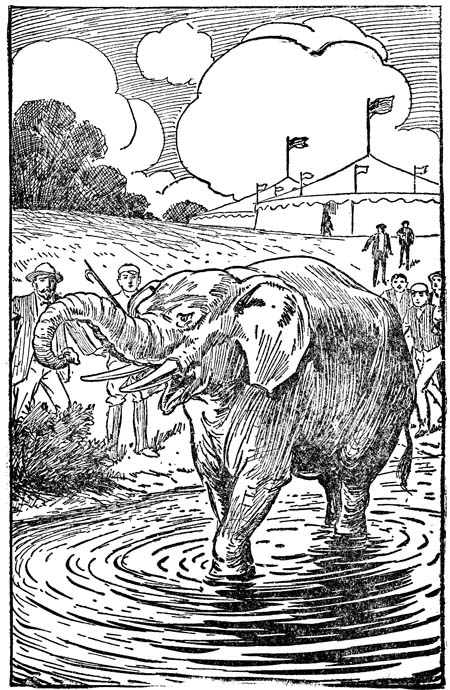
horses, while in a ring near the two boys ten elephants
were being put through their paces.
Jack had often been to a circus before, and now,
from a reason for which he could hardly account,
he paid particular attention to the antics of the
clowns.
“I believe I could do as good as some of them,
with a little practice,” he thought. “What is
needed is some sort of funny stunt to make the
people laugh. It doesn’t much matter what it is,
as long as it’s funny.”
The clowns did seem to cause considerable
laughter. Some of them had trained dogs, pigs or
roosters which they used in their act. Others had
a partner who aided them in provoking smiles or
shouts of glee. Some did acrobatic stunts, some
sang or danced, and one, with the help of a companion,
acted as a barber using a whitewash brush
to spread the lather on his partner’s face.
“This is the kind of life that would suit me for
a while,” said Jack to himself. “I’d like to travel
with a circus, and I believe I could do as good as
some of those clowns, if I had a chance. What’s
more, I’m going to try for a job here. I’ll ask the
boss canvasman if there isn’t a chance. I’d just
like to be with the show, and maybe I could earn
enough money in the season to pay my way to
China, and see what has happened to my folks.”
This thought so occupied Jack that he paid little
attention to the performance. He made up his
mind he would seek out one of the managers, as
soon as the show was over, and make his request.
“Say! Look at that! Did ye see it?” suddenly
exclaimed Ferd.
“See what?”
“Why, that man jumped over ten elephants in a
line!”
“That’s pretty good,” remarked Jack indifferently.
“Pretty good? I should say it was. I’d like
to see you do it.”
“I think I’ll do it,” spoke Jack, who had just
arrived at a certain decision.
“What? Jump over ten elephants?” asked his
companion, in astonishment. “Say, are you
dreamin’?”
“That’s right; I guess I was,” admitted Jack,
with a laugh. “I was thinking about something
else.”
“Guess you don’t care much about a circus,”
said Ferd.
“I’m thinking too much of getting a job,” replied
Jack.
Ferd shook his head as if he could not understand
Jack’s indifference. After the performance
the farm boy wanted to treat Jack to popcorn,
soda, and more frankfurters. Jack declined
everything but the sausage sandwiches.
“I can save them to eat when I’m hungry,” he
said in explanation. “I may need a meal to-night.”
“Why don’t you come home and stay with me
a few days?” suggested Ferd. “My folks
wouldn’t care, and maybe you could get a job
somewhere in the neighborhood.”
Jack thanked his new friend, but said he had
other plans. A little later he parted from Ferd,
and, by inquiring, he found the boss canvasman,
who was taking a rest after his labors in superintending
the erection of the tents.
Jack explained what he wanted—an introduction
to the manager, who had charge of hiring the
performers.
“Sure I’ll take you to him,” replied Ike Landon,
“only I don’t believe you can do anything he’d
want. Circus performers have to train for a good
while.”
“Well, maybe I can do something to earn a
little,” replied Jack. “Where will I find the manager?
What’s his name?”
“His name is Jim Paine, and he’s a strict manager,
let me tell you. But if you make good, why,
he’s all right. Come on over and I’ll introduce
you to him.”
Jack followed the canvasman across the circus
grounds, from which most of the audience had
gone. Preparations were already under way for
the evening performance.
“Mr. Paine, here’s a lad who wants to join our
circus,” remarked Landon, with a grin, as he presented
Jack. “He did me a good turn this morning,
and I’d like to help him if I could.”
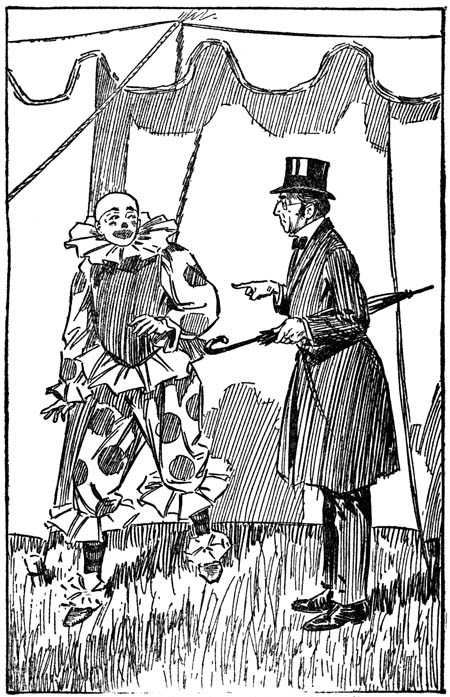
“Ha! Hum!” exclaimed the manager, looking
at Jack sharply. The runaway noticed that Mr.
Paine was a very pompous sort of person. He
wore a red vest, with yellow spots on it, a big red
tie, in which sparkled a large stone, and he had
an immense watch chain.
Jack wondered if the manager was not going
to say anything more than “Ha! Hum!” But
presently the big man made another remark.
“What can you do?” he asked.
“Well, not very much, perhaps,” replied Jack.
“I’d like to learn to be a clown, but I’d be willing
to knock around and do almost anything for a
while, until I learned the business.”
“Run away from home?” asked the manager
snappily.
“Yes,” replied Jack quickly, determined to tell
as much as was necessary of what had happened.
“Ha! Hum! First time I ever knew a boy
who had run away from home to admit it,” spoke
the manager. “You deserve credit for that, anyway.
What’s the trouble?”
Thereupon Jack told of the unjust accusation of
the old professor, and what had happened to him
since he had left Westville.
“So you want to be a clown, eh?” said the manager
when Jack’s story was finished. “Had any
training?”
“I used to take the part in amateur shows me
and my chums got up, and I did a stunt on a vaudeville
stage one night.”
“Let’s see what you can do?”
Jack’s heart beat fast. Here was the very
chance he wanted. Could he “make good?” So
much depended on the first impression.
“Is there a place where I can make-up?” he
asked.
“Make-up? Do you know how to make-up?”
“A little bit.”
“Well, if Ike Landon says you helped him, you
must be all right, for he’s a hard man to please.
If you’re going to have a try-out, you might as
well do it proper. You can go to the dressing-tent.”
“Where is it?”
“Right over there,” and the manager pointed.
“Ike will show you. Tell Sam Kyle to give him
a hand,” the manager called after the boss canvasman.
“I’ll wait here for him,” he added.
“Say, you’re in luck,” said Ike. “It ain’t many
he’d give such a chance to. Do you know what
you’re going to do?”
“A little.”
Jack was introduced to a small, fat man, who,
in the men’s dressing-tent, was busy washing the
red and white paint off his face.
“Sam is the head clown,” explained the canvasman.
“He’s been in the business—let’s see, how
long is it now, Sam?”
“Forty years this season. I was one of the first
clowns that Barnum ever hired. You’ll find some
grease paint over there,” he added to Jack; and
then he and the canvasman began to talk about
matters connected with the circus, paying no more
attention to the runaway lad.
Jack was quite nervous, but he made-up after
an original idea of his own. He turned his coat
and vest wrongside out, and, with the aid of Ike,
put them on backwards. Then, feeling rather
foolish over what he was about to do, he stepped
from the dressing-tent and walked over to where
the manager had said he would wait for him.
Several of the performers who saw Jack emerge
laughed at his curious costume and “make-up.”
“Well, I must look funny, no matter how I
feel,” he said. “I hope I can do my funny dance.”
“Ha! Hum!” exclaimed the manager, when he
saw Jack. “That’s not so bad. Let’s see what
you can do.”
A crowd of performers, and some of the circus
helpers, gathered in a ring about the boy.
Then Jack began. He repeated some of the
things he had done in the theatre at home, but
added to them. He sang, he danced, and cut all
sorts of capers, gaining more and more confidence
in himself as he heard the crowd laughing. He
even detected a smile on the rather grim face of
the manager.
Then, to cap his performance, Jack caught up a
couple of paper-covered hoops, or rings, similar
to those through which some of the performers
jumped from the backs of running horses. Holding
these under his arms, like a pair of wings, he
began to imitate a clumsy bird. He hopped up on
a board that rested across a saw-horse, and, from
that elevation, pretended to fly to the ground, but
doing it so grotesquely that he stepped through
both hoops and was all tangled up in them.
This produced some hearty laughs, and one or
two of the women performers applauded, for Ike
had whispered to them what Jack’s trial meant.
“Ha! Hum! Not so bad,” remarked the manager,
though his voice was not very cordial.
“That imitation flying was well done. That
might be worked up. I think we can use another
clown, as I’m one short. I’ll engage you, young
man. You’ll get ten dollars a week, and your
board, of course. Can you come right on the
road?”
“Yes, sir.”
“Ha! Hum! Well, perhaps we can work you
into shape. You need some practice, but it’s not
so bad; it’s not so bad. You can consider yourself
engaged. Report to Sam Kyle.”
Jack could hardly believe his good luck. An
hour before he had not known where his next meal
was coming from. Now he was engaged as a
clown in a large circus.