THE next morning when the firemen
were up and dressed, the
blind boy was still asleep. He
looked even paler by daylight
than he had the night before,
and his thin cheeks and the dark circles
under his eyes gave him a pathetic look.
“It would be a pity to send the blind kid
off while he looks like that. Let’s put some
flesh on his bones and some color into his
cheeks first,” said soft-hearted Reordan.
“How do you propose to manage? Taking
care of kids and running fire-engines
don’t go very well together,” said the
captain.
“The work sha’n’t suffer,” replied Reordan.
“A chap of his age, and blind at that, that
has looked after himself, won’t need much
tending, and the little he’ll need to eat won’t
lighten my pocket much.”
“Well, then, keep him for a day or so if
you like, I’ve no objections,” replied the
captain. “Here’s something toward his
keep;” and he placed a bill in Reordan’s
hand.
“We’ll all chip in,” said another. “Here,
Jack, pass around the hat for the blind kid.”
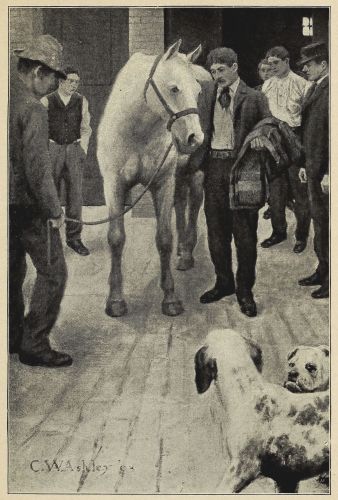
The Fire-Dog took the hat in his mouth
with great alacrity, and gravely went from
one to another of the men, each one of whom
put in some change.
“Reordan shall be treasurer of the blind
kid’s fund,” said one.
“There’s enough already to buy more
than he can eat in a week,” replied Reordan,
shaking up the hat to enjoy the jingling
sound of the coins.
“Please will you show me where I can
wash?” asked a gentle voice; and there stood
the blind kid, who had approached unnoticed.
“If you will show me once, I can find it for
myself afterwards.”
“Here you are, young man,” replied Reordan,
leading him to the sink where the men
washed. “Here’s the water-faucet, and
here’s the soap; and while you’re making
your toilet I’ll step out and fetch your
breakfast.”
“Why not take him along with us?”
asked one of the men.
“He isn’t in just the rig for a cold morning,”
replied Reordan. “The looks of the
thing, to say nothing of his own feelings, goes
against it. Wait till he has a hat and coat.
I’ll fetch his breakfast, and while he’s eating
it we’ll go for ours.”
“And when we come back we’ll hear his
story, and see what account he has to give of
himself,” said another.
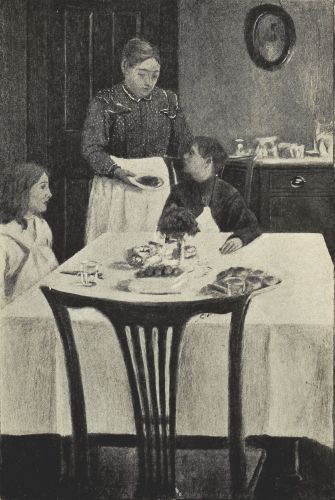
The boy made himself quite tidy, considering
the poor clothes he had on; and the men,
after seating him at the table with a good
breakfast before him, went out for theirs.
How good it did taste to the poor little
waif! Only hot coffee and buttered rolls,
but it was a feast for the poor child, who for
several weeks had eaten his meals whenever
he could get them, and little enough at
that.
As the boy sat contentedly eating his
breakfast, a slight sound near his feet attracted
his attention. “Is that you, Jack?”
he quickly asked.
Jack replied by licking his hand and pressing
closely to his side.
“Dear Jack!” said the blind boy, fondly
laying his cheek upon the faithful dog’s head.
“If you hadn’t nestled so closely to me last
night and kept me warm, I believe I should
have frozen to death. Here, you shall have
part of my breakfast, I don’t need it all;”
and he offered the Fire-Dog a generous piece
of his buttered roll.
Jack took the offering very reluctantly, as
if he would have preferred to have the blind
boy eat it himself, but accepted it in order
not to hurt his new friend’s feelings.
“You eat so slowly, I don’t believe it
tastes so good to you as it does to me,
Jack,” said the blind boy, as Jack slowly
chewed the soft roll, “and it has butter on
it too. I should think you would like that.”
Jack was trying hard to dispose of a
mouthful his kind little friend had just given
him when the firemen returned from their
breakfast. In fact, Jack did like the bread,
but he thought he ought not to take the
blind boy’s breakfast. He looked really
ashamed of himself when the men entered
and Reordan remarked,—
“Why, you mustn’t give your breakfast
away to Jack, young chap, you must eat it
yourself. We’ve brought him some leavings
from the place where we take our meals, that
he likes a great deal better than what you’ve
got. Aren’t you hungry, kid? Don’t you
like your breakfast?”
“Yes, indeed,” replied the boy, quickly.
“It tastes splendid; but Jack was so good
to me last night that I wanted to give him
some of it.”
“Don’t you worry about him, Sonny,”
replied one of the men. “We’ll look out
for Jack all right;” and he opened a package
of bones and scraps of meat which he set
before Jack.
“Now, if you’ve had all you want to eat,”
said the captain, who just then entered, “suppose
you give an account of yourself.”
“Yes, sir,” replied the boy.
“Well,” said the captain, after waiting a
moment in vain for the boy to begin his
story. “Where do you come from, and
what’s your name? Haven’t you got any
father and mother?”
“My name is William,” replied the boy,
“William Blake. I haven’t got any father.
He used to go to sea, and his ship got lost
and they were all drowned.”
“Haven’t you got any mother?” asked
the captain.
The boy hesitated a moment. Then his
lips began to tremble with emotion, and after
making several attempts to answer, he put
his hands before his sightless eyes and burst
into violent weeping.
The tender-hearted men were overcome at
the sight of the child’s grief. He tried to
stifle the sobs that shook his slender frame,
but his grief was too great for him to master.
The brave men who never hesitated to enter
a burning building to rescue those who were
in danger, who never thought of their own
lives when those of others were menaced,
broke down to see a little blind boy crying
for his mother.
“Is your mother dead too?” asked the
captain in a low voice, a great contrast to his
usual hearty tones.
“No, I don’t think she is. I don’t know,”
sobbed the boy.
“Don’t you know where she is?” asked
the captain, gently.
“No, sir,” replied the boy, trying hard to
speak distinctly. “She fell down, and she
couldn’t speak to me nor move, and then
they carried her off in a wagon.”
“Don’t you know where they took her?”
“No, sir, they didn’t say anything about
it.”
“Wasn’t there any one to look after
you?”
“No, sir. There wasn’t any one who
knew me.”
“What did you do then? Where did you
go?”
“I didn’t know where to go. Some children
came along and found me crying, and
they were real good to me. They said they
knew a place where I could stay until my
mother came back. So they took me home
with them, and put me in a little room there
was at the top of the house.”
“How did you manage to keep warm in
this cold weather?”
“The children found some things to put
over me. They got some hay from a stable
and made me a bed. It wasn’t very cold
after I got used to it.”
“They probably took his mother to a
hospital,” said the captain, “unless she
was—” He didn’t like to finish his sentence,
for he had not the heart to tell the poor boy
that his mother might be dead.
“Come, little chap,” he continued, “dry
your eyes and put a good face on the matter.
We will try to hunt up your mother, and
we’ll look out for you.”
“This is no place for a child,” said the
captain later to the men. “You can keep
him here a day or two, and then you must
turn him over to the charities. Perhaps
they’ll find his mother; at any rate, it is
their business to attend to such cases.”
The men thought this doctrine rather hard,
and grumbled at it somewhat among themselves.
When, however, the next day, the
captain brought in a large bundle, saying
briefly, as he laid it down, “Here is something
for the kid,” they changed their minds. The
bundle contained a warm overcoat, cap, and
mittens.
The blind boy began at once to show the
effects of the kind treatment he now received.
A better color came into his pale
face and he grew stronger every day. With
this improvement of his body, his mind, too,
underwent a change. His face became cheerful
and happy, and he was soon playing
about the engine-house with Jack.
“He begins to seem something like a
child,” remarked Reordan one evening, as
Jack and the blind boy were playing together
at “hide and seek,” and the boy’s
laugh rang out joyously whenever Jack
found out his hiding-place. “If he could
only see, he’d be all right.”
It was astonishing how much the blind
boy could do without the aid of eyes, and
in how many ways he succeeded in making
himself useful. He was never so happy as
when he found he could do something for
his kind friends, and they often called upon
him for little services that they could have
done much more quickly themselves, in
order that he might have the satisfaction of
thinking he was of some use to them.
William was too long a name for such a
small boy, in the opinion of the firemen, so
they used Billy instead. Several days passed,
and yet Billy was not turned over to the
charities. An engine-house seems a strange
place for a child’s home, but Billy soon
thought it the pleasantest place in the world.
Whenever the alarm sounded, Billy was as
excited even as Jack over it, and after the
engine had clattered out of the house, and
the last sound of wheels and horses’ hoofs
and Jack’s barking had died away in the
distance, Billy waited contentedly alone;
and every one, including Jack, was glad to
see Billy’s face light up with pleasure on
their return. It was a touch of home life
that was very pleasant to these sturdy men
who were denied the privilege of a home.
“You ought not to keep the boy cooped
up in this hot room all the time,” remarked
the captain one day. “Put on his things
and send him out on the sidewalk in the sun.
No harm can come to him if he keeps in
front of the engine-house.”
So Billy had on his new coat and cap and
mittens, and was led down to the sidewalk,
where the sun was shining brightly.
“Watch him, Jack!” was Reordan’s order,
as the Fire-Dog followed them.
So Billy and Jack walked up and down in
front of the engine-house, Billy with his
hand resting on Jack’s neck, and the intelligent
dog marching him back and forth with
the regularity of a sentinel on guard. The
fresh air brought the color into Billy’s
cheeks, and he looked very happy and bright.
When they had kept up this exercise for
about half an hour, two persons appeared,
at whose approach Jack showed decided
symptoms of pleasure. He wagged his tail
very fast, and whined with joy.
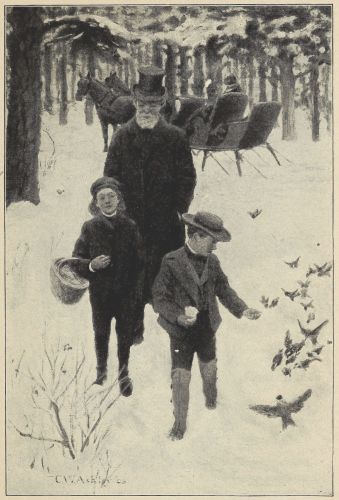
The new-comers were a middle-aged gentleman
and a little boy somewhat younger than
Billy,—a bright-eyed, rosy-cheeked boy, with
a very independent air, and he carried a
little basket in his hand. The gentleman
was the little boy’s grandfather. I wish I
could describe him as he really was, but the
nearest I can come to it is to say that he
was just the kind every boy and girl would
choose if they had a whole world full of
grandpapas to choose from. Such a pleasant
smile when he looked at you! And such a
pleasant voice when he spoke to you! Why,
you felt happier all the rest of the day after
meeting him if he only shook hands with
you and said, “How do you do?” His
laugh was even pleasanter still, and he
laughed very often; and when he was not
laughing his eyes were, they had such a
happy, cheerful expression.
Billy could not see the pleasant face, but
he could hear the pleasant voice, and those
who have not the use of their eyes have
something within them that tells them how
people look. So Billy formed a picture in
his mind of the little boy’s grandpapa, and
Billy smiled too when the little boy’s grandpapa
spoke, as everybody else did.
“Jack, Jack, I’ve brought something nice
for you, old fellow,” said the little boy, whose
name was Sam, and who had been eying
Billy very intently.
“What little boy is this?” asked Sam’s
grandpapa. “Seems to me this is a new face.”
“Yes, sir,” replied the blind boy. “I am
Billy.”
“Oh. You are Billy! Well, where did
you come from?”
“It’s a boy we found one night at the
North End, Mr. Ledwell, and he is blind,”
said Reordan, who stood in the door of the
engine-house and now approached, touching
his hat respectfully. “He didn’t have any
one to look after him, and some children
took him in tow and hid him in a kind
of closet at the top of the tenement-house
they lived in. When the house got on fire,
they cleared out so sudden that nobody
thought of the blind kid. If it hadn’t been
for Jack here, he’d ’a’ been smothered in a
short time, the smoke was so thick. It isn’t
the first life Jack has saved.”
“Good old boy,” said Mr. Ledwell, patting
the faithful dog’s head; while Jack wagged
his tail gently and looked modestly down, for
it always embarrassed him to be praised for
what he considered his duty.
Meanwhile Sam was unpacking his basket,
and Jack tried to be polite and not to stare
greedily at the tempting contents. He could
not resist the temptation, however, of looking
out of the corner of one eye. What he saw
fairly made his mouth water. There were
slices of cold meat, none of your thin delicate
ones, but nice thick slices, just the kind every
dog likes, and, most delicious of all, there
was a large bone with tender morsels of meat
on it, to say nothing of several mouthfuls
of gristle. Jack couldn’t help lapping his
chops, as he thought of the good time he
would have gnawing that bone and cracking
it to get at the rich tasting marrow
inside.
Sam handed Jack a slice of the meat, and
he gave it just one roll with his tongue and
then swallowed it whole. Meat tastes better
to dogs eaten in that way,—they think it
takes the taste out of it to chew it too much.
Another and still another slice followed, while
Sam looked contentedly on, enjoying the
operation as much as the dog did.
“I think you’d better save the rest for his
dinner, Reordan,” remarked Sam, with his
decided air. “He can have this bone, too,
then, and I have brought some of the cake
he likes so much. You had better keep that
for his dessert;” and Sam took out a package
of cake neatly wrapped in paper.
The crumbs that remained in the basket
were emptied upon the snow in front of the
engine-house, and the crumbs from a roll
added to them. Several sparrows seated on
the roof of the building peered anxiously
over, intending to seize the first opportunity
that presented itself to eat them.
“Don’t let the sparrows eat all of them,
Reordan,” said Sam, who had very strict
ideas of justice; “they must save some for the
pigeons. How’s the little lame pigeon?”
“He seemed to be all right the last time I
saw him,” replied Reordan.
“Does Dick the Scrapper fight him away
as much as ever?” asked Sam.
“Well, yes, he does hustle him around
considerable when they are feeding and he
gets in the way; but that’s always the way
with animals, you know. The strongest ones
get the first chance, and the others have to
take back seats.”
“I think it’s a very mean way,” said Sam.
“I should think you’d stand there with a
stick and keep the Scrapper off while the
lame one eats.”
“Oh, we’ll look after the little lame fellow,
never fear. He’s as fat as a partridge. He
gets tamer every day, too. Yesterday he lit
right on my hand and stayed there quite a
spell.”
“I wish he’d come around now,” said Sam.
“He will turn up very likely before you
go. They come around pretty often. The
sparrows get ahead of them, though, they are
so cute.”
Meanwhile Sam’s grandpapa was talking
to the captain about the little blind boy who
had been so suddenly thrown upon their hands.
Sam knew what they were talking about, and
he felt sure that his grandpapa would find
some way to make the blind boy happy, for
Grandpapa could do anything, he thought.
Sam felt very sorry that the little boy could
not see, and he looked at him a long time.
At last he said,—
“Hallo, Billy!”
“Hallo!” answered Billy in his soft voice;
and the acquaintance was begun.
“Here come the pigeons,” said Reordan,
as a flock of birds came sweeping around the
corner of the street, and alighted in front of
the children. They at once began gobbling
up the crumbs scattered for them, while the
sparrows flew down, and darting in among
them, seized upon the largest ones right from
under the pigeons’ very eyes, flying up to
the roof to eat them in safety.
Among the pigeons was a speckled black
and white one with very pink feet; but one
of his feet he kept drawn up against his soft
feathers and hopped about on the other one.
He did not have a very fair chance with the
other stronger pigeons, for they crowded him
out of the way, and even pecked him when
he attempted to seize upon a piece of bread.
The most quarrelsome of the pigeons was
a handsome dark blue one with rainbow
feathers on his neck that glistened in the
sunlight. This was Dick the Scrapper. He
had a very bold air, as if he had a better
right to the food than the others had. Sam
was very indignant at his treatment of the
lame pigeon, and suddenly drove them all
off except the little lame one. The little
speckled pigeon seemed to understand what
this was done for, and remained behind and
ate a hearty meal. The others were not
much afraid of Sam, for they were very
tame, but every time they attempted to
alight he would shoo them away. This he
kept up until he thought that the lame
pigeon had eaten all he wanted, and then he
allowed the others to return. He picked up
the lame pigeon and it nestled contentedly
in his arm. Billy caressed it too, and
the two children began to talk together,
while Jack stood near by, wagging his tail
approvingly.
At last Mr. Ledwell came back to where the
children were playing with the lame pigeon,
and they heard him say to the captain,—
“This will do very well for a little while,
but of course you can’t keep him here. We
must find some other place for him.”
These words made Billy feel very sad, for he
had become much attached to his new home,
and thought that if he were sent away, he
would be homeless and friendless again.
The little pigeon who was lying in his arms
heard it too, and his bright eyes saw the
look of disappointment that came over the
blind boy’s face. Jack, too, heard it, and
made up his mind that Billy should not leave
the engine-house unless he went too.
“I rather think that as I was the means
of saving the boy’s life, I have a right to say
something about the matter,” said Jack to
himself. “They all think a great deal of
me, and if I say he shall stay, I rather think
he will stay.”