By IRVING CRUMP
Author of “Jack Straw in Mexico,” etc.
ILLUSTRATIONS BY
LESLIE CRUMP
NEW YORK
ROBERT M. McBRIDE & COMPANY
1915
Copyright, 1915, by Robert M. McBride & Co.
Published October, 1915
To
A Tom-Boy
PEGGY
ACKNOWLEDGMENT
In presenting this account of Jack Straw’s
latest adventures it has been my good fortune
to have the friendly advice of Dr. Raymond
Haskell, Superintendent of the Third Light
House District, and William H. Moon of the
Lighthouse Service. I have also sought for
assistance the pages of Commissioner George
R. Putnam’s “Beacons of the Sea,” Talbot’s
“Light Ships and Lighthouses” and the “Lighthouse
Service Bulletin.”
Jack Straw was walking slowly down
the maple-lined avenue that led from the
campus to Phillip’s Hall, the largest of the two
dormitory buildings connected with Drueryville
Academy, and judging from his many
near collisions with the aforesaid maples, not to
mention hitching posts, stepping blocks and
pedestrians, it was evident that he was not looking
where he was going. Indeed his nose was
buried in the latest and final edition of The
Blue and White, the school’s weekly, and he
was devouring the contents of the page headed
“Track and Field” eagerly. The various individual
and team records for the year were set
forth there in black-face type, and Jack, having
been captain of the football team the previous
Fall and no mean performer on the school’s
track team during the Spring, was rather keen
to learn just how many times his name was
mentioned on that particular page.
But before he had consumed a quarter of the
reading matter, a real collision resulted. He
was just about to turn the northwest corner
of Phillip’s Hall when there was a scurry of
feet, and before he could look up some one
hurrying at top speed swept around the corner.
Instantly the air was full of arms and
legs, the copy of The Blue and White accompanied
by several school books, went speeding
down the graveled path and a moment later
Jack found himself seated on the ground and
feeling for the exact spot on the back of his
head where the west wall of the dormitory
building had hit him. Six feet away sat tiny
Tommy Todd, also feeling for injured places
and trying at the same time to regain his
breath.
“Jiminy—puff—puff—crickets, what’er you
gettin’ into a fellow’s—puff—puff—way like
that for, Jack?” demanded Tommy.
“Well, how on earth— Say, why don’t you
blow your horn when you are making a corner
at top speed? I didn’t know you were coming,”
returned Jack, scrutinizing the brick wall
for dents. “Jiminy, I think if I had hit just
a little harder, Phillip’s Hall would be minus a
few bricks.”
“Huh, that’s nothing to the amount of gravel
I’ll be carrying round with me for the rest of
my life. Bet there is a peck of it jammed into
my head,” returned Tommy, rubbing his head
solicitously.
“Well, why the hurry, anyway, Tommy?”
asked Jack, as they stood up and began to brush
themselves off.
“Why, I was looking for you, Jack—I—”
“Found me quicker than you expected, didn’t
you?”
“Yes and no; that is, when I discovered you
weren’t in your room I decided you might bob
up most any place—and you did—”
“Well, what’s wanted of me in such a
hurry?” demanded Jack.
“What is wanted? Oh, nothing, only there
are about a half dozen fellows over in your
room waiting for you. Did you forget that
there was a special meeting of the ‘D’ Club
called for this afternoon? The meeting is
in your room at three o’clock, you know.”
“No, I hadn’t forgotten only—say, it isn’t
three o’clock yet, is it?” asked Jack, somewhat
surprised.
“Oh, isn’t it?” demanded Tommy, as he exhibited
his watch.
“Jingo-netties, it’s half-past three. I was
so interested in The Blue and White that I forgot
to hurry. Come on back, Tommy, and
we’ll have the meeting started immediately,”
said Jack, and seizing the diminutive catcher
of the baseball team by the arm, he hurried
him at top speed back toward the broad entrance
of Phillip’s Hall.
Seven members of the “D” Club, the organization
composed of honor boys at Drueryville
Academy, were occupying Jack’s room when
he pushed open the door.
“Well, good evenin’, sir; did you call to tea?”
demanded Harvey Maston sarcastically as Jack
entered.
“Why didn’t you keep us waiting until midnight?”
called Cory, as he put down the book
he had been reading.
“What’s the matter—fall asleep in the physics
lab?” demanded Buck Miles.
“No, fellows, I plum forgot what time it—Hi,
quit.”
“O-o-o-o-o-h, forgot,” roared every boy, and
a moment later Jack was busy ducking sofa pillows
that were being hurled in his direction.
“Well, now that you have subsided,” said
Jack when the lads were out of ammunition,
“the meeting will come to order.” He rapped
on the top of the center table with his knuckles
for lack of a gavel and assumed an air of
dignity befitting the president of the school’s
most important society.
“As I understand it,” he said, “this is to be a
special meeting for a general summing up of
the athletic situation at Drueryville next year.
Am I right?”
“Right-o,” said Tommy Todd.
“Well, gentlemen, we will proceed. First,
the baseball situation claims our attention.
Tommy, how are things going to shape up next
year with your outfit?”
“The outlook never was better,” said
Tommy, cheerily. “Out of the nine regulars
on this year’s team, only two will be graduated
and they are both outfielders. I’ve men in the
substitute squad that will take their places all
right.”
“Fine,” said Jack. “How about the track
team, Harvey?”
“Well, I’m not complaining,” said the captain
of the cinder athletes. “The outlook
could be better. Graduation isn’t going to
knock a hole into my list of runners, but I do
wish that the freshmen who come in next Fall
would include a couple of good sprinters. We
need a good point winner for the dashes.
Also we need a shot putter. Hanson goes out
this year, as you know. He’s been our only
hope in the weight events for two years now.
Wish I could find another 170-pound sixteen-year-old
like him.”
“Huh, if he knocks a hole into your prospects,
think how he cripples me up,” said Jack,
who had been reelected to captain the football
team next year. “He’s been the only full-back
Drueryville has had in years. I don’t know
where I’m going to get a man like him. There
isn’t a fellow in the scrub squad that can play
in the full-back position and not stumble over
his own feet. The freshmen will surely have
to show up mighty well in big boys to make me
feel happy next year.”
“Jiminy, that does put a kink into your
eleven, doesn’t it?” exclaimed Tommy Todd.
“‘A kink?’ Why, man, it ties a regular
knot into our chances for the championship
trophy, let me tell you. We’ll never be able
to make it three in a row with Seaton without
another Hanson in the line-up,” insisted Jack.
“Aw, cheer up. Don’t be so down in the
mouth about it. Perhaps we can find one for
you this Summer. I’ll look for one among the
stone cutters down Bethel way, when I take
my job in the granite quarries this vacation,”
said Cory, who was eager to have the meeting
over with so that he could resume the book he
had been reading.
“Huh, you needn’t bother,” said Jack; “the
full-back you’d pick out would come onto the
field with a fiction book under his arm. Well,
Dink, how’s the hockey team going to shape
up?”
“Oh, we’ll be there with an A1 team next
year. Every man in the line-up. Pretty good,
eh?”
“Well, I’m in the same shape. The basketball
team will be composed of four of this
year’s regulars and Wefers, who played substitute
forward all this year. I’m not worrying,”
said Cory gruffly, without even looking
up from his book.
“That leaves me the only captain in want of
a good man, doesn’t it?” said Jack. “Well,
you fellows take Cory’s suggestion and keep
your eyes open during the Summer for a likely
full-back for me, will you?”
“You bet we will. I’m going to spend my
Summer working in a hotel over in the Green
Mountains. I may run into a good man there,
you can’t tell,” said Chris Gibson.
“That reminds me, Tommy,” said Harvey
Maston. “Did you accept that job with the
contractor? You said you were going to work
all Summer on the new hydro-electric plant
over in New York State.”
“Yes, I go over there the first of July for two
months. What are you going to do, Harvey?”
“Going to work for my father in his paper
mill. There’s room for another fellow over
there. How about you, Jack? Got a Summer
job yet?”
“No,” confessed Jack, “I haven’t. I thought
perhaps I might help out father in his marble
quarries. But I guess he won’t be ready to
open ’em up for three or four months.”
“Well, why not come over to Bordentown
and work in the paper mills? We could have
a corking time together and you would learn
a lot about paper manufacturing. Of course
if you can get a chance to go to Mexico again,
or something as interesting as that, I wouldn’t
advise you to accept my offer. A paper mill
isn’t as lively as a power plant besieged by
rebels, but then a job is a job, you know.”
“Well, perhaps I might accept your offer,
Harvey. I’ll think it over. You see, I—”
“Mis-ter John-n-n Monroe-e-e Strawbridge!
Strawbridge!” shouted some one down in the
street.
Jack’s head bobbed out of the open window
immediately.
“Here. Right here,” he called.
“Tele-gum fer Mis-ter Straw-bridge,” came
the sing-song answer.
“Telegram!” exclaimed Jack. Then he
shouted, “All right, bring it up! Third floor,
Room Thirty-two.”
“Huh, what’s this? Some more mystery?”
demanded Tommy Todd as Jack left the window.
“You know as much about it as I do,” said
Jack, somewhat disturbed.
A moment later the lazy tread of the messenger
boy could be heard on the creaking
stairs. Then came a knock.
“Come in,” shouted Jack and the door was
pushed open to admit a blue clad messenger
of diminutive proportions, whose hat was
cocked at a rakish angle on his head.
“Day letter. Sign on dis line here,” he said
laconically, as he handed Jack the stub of a
much-used pencil.
Jack signed hastily and the youth scuffled out
into the hall, forgetting entirely to close the
door. But the captain of the football team did
not notice this. With trembling fingers he
was tearing the end off the yellow envelope,
while the rest of the boys looked on in
wonder.
As Jack unfolded the telegraph blank his
face took on an expression of great concern.
But as he began to read, this expression
changed to a smile of delight. Finally after he
had finished, he exclaimed,
“Hi, fellows, listen to this. Talk about luck.
Guess I won’t accept your offer for a job in
the paper mill, Harvey. I have one that is almost
as good as a trip to Mexico. Here, I’ll
read all about it.”
Dear Jack:
On our way up from Mexico last Summer I told
you of certain work that I expected to do for the Lighthouse
Bureau. Part of that work is now to be undertaken.
I am to build a lighthouse on Cobra Reef,
Hood Island, Maine. I know that you are interested
in engineering and therefore I am holding open a job
as clerk in the building crew. If you want the position
wire me at once and report at Jefferson Hotel,
Portland, Maine, on Tuesday afternoon. This will
make a Summer vacation position in which you can
earn a little money and learn a great deal about marine
engineering. If you haven’t anything better to do be
sure and come along.
Yours truly, James Warner,
Lighthouse Bureau, Washington, D. C.
“If I haven’t anything better to do,” jeered
Jack. “Huh, could there be anything better to
do?”
“Talk about downright good luck,” said
Harvey Maston.
“When do you start? Next Tuesday. Eh!
Three days from now.”
“That’s going to be quick work. I’ll have to
get Dr. Moorland to excuse me several days
before school is officially closed for the Summer,
but I haven’t any more exams to keep
me here. I guess I’ll go over and see him now.
I may leave first thing to-morrow morning if
Dr. Moorland will let me off. I would like to
spend a day or two with my dad and talk the
matter over with him.”
And taking his hat, Jack left Phillip’s Hall
for a hasty visit to the principal’s cottage in
the maple grove across the campus.
CHAPTER II “HOOD ISLAND—HO!”
Of course Dr. Moorland was willing to excuse
Jack for the remaining week of
school. Indeed, after he had looked up the
lad’s term record and examination marks in
his little card index, which he always kept on
the top of his study desk, the old pedagogue
even urged Jack to telegraph his acceptance
to Mr. Warner immediately. He pointed out
that a Summer spent among the lighthouse
builders would be of great educational value,
and besides it would afford an excellent opportunity
for the youth to earn some extra
money. But first of all he suggested that Jack
call his father on the long-distance telephone
and secure permission to avail himself of the
opportunity.
Jack’s home was in Middlebury, about fifty
miles from Drueryville, and the rates on telephone
calls did not amount to a great deal.
He made the call on the principal’s telephone
while the old man listened to as much of the
conversation as he could gather. Jack’s father
saw the offer in identically the same light as
Dr. Moorland did and advised the boy to accept
the position immediately. He did say that
he hoped Jack would contrive to spend a day or
two at Middlebury before he left for Portland,
however.
When Jack repeated this to Dr. Moorland
the principal generously excused him from any
further work at Drueryville and suggested
that he return to Phillip’s Hall immediately and
pack his things, so that he would be ready to
leave on the first train Sunday morning, thus
giving the lad at least two days at home.
Needless to say Jack was thoroughly pleased
with this offer and he wrung the old gentleman’s
hand cordially as he said good-by.
Ten o’clock next morning found our young
friend swinging from the train as it rolled into
Middlebury station. Townsend Strawbridge,
his father, was there to greet him and drive
him home in the new red automobile which he
had acquired that Spring. Just at that particular
period Strawbridge senior was a very
busy man. During the past Winter he had
completed the organization of a stock company
to operate the abandoned marble quarries on
his property, and now he was engaged in the
work preliminary to actual quarrying, which
he assured Jack would begin some time in
the Fall or the following Spring. However,
he was not too busy to listen to all that Jack had
to say, and you may be sure the lad from
Drueryville Academy had a great deal to tell
his dad. He reviewed everything, from the
record of the baseball team to the bad outlook
for the football team next year, and his father
listened eagerly to every word.
Then after all the news was exhausted the
two began to plan for Jack’s stay with the lighthouse
builders. Rough, serviceable clothes,
warm sweaters, boots, oilskins and similar garments
were dug up and packed in an old
steamer chest which his father unearthed in the
garret of the Strawbridge homestead. Salt
water fishing tackle was put in shape, a compass,
and sailor’s clasp knife with a lanyard
attached, were added, and the entire outfit was
put in first-class shape for a two months’ stay
on the Maine Coast Island.
The preparations and the anticipation of the
trip kept the lad keyed up to a high pitch of excitement.
In this state he managed to accomplish
a remarkable number of things during the
two short days at home, and when it finally
came time to leave on Tuesday morning both
he and his father were of the opinion that
everything was “shipshape” for a very pleasant
Summer of work and play.
Jack lingered in the red automobile at the
Middlebury station until the train on which he
was to leave rolled in. Then a hasty good-by
was said and the lad swung aboard the last
Pullman car, to appear a few moments later
on the observation platform in the rear. From
this point of vantage he watched the man and
the red car until a sharp bend in the road shut
them from sight.
And as he stood there waving farewell, a
strange feeling of homesickness came over this
young adventurer and he realized fully how
much his old dad meant to him. In truth
a lump gathered in his throat, for it seemed to
him that his father looked pathetically lonesome
as he sat gazing after the disappearing
train. Was he selfish to deprive his father of
his company during the Summer vacation?
Was the trip going to be worth the sacrifice his
parent was making for him?
“Good old dad,” he murmured as he turned
back into the car. “Good old dad. How
lucky I am to have such a corking fine father.
I’ll bet there is many a chap who wishes that
he was as fortunate as I am.”
With such thoughts Jack rummaged in his
valise and brought forth a fountain pen and
some paper and for the next half hour he was
extremely occupied in writing an affectionate
letter to his paternal parent, which he
mailed at the first stop the train made.
The ride to Portland, though it occupied a
greater part of the day, was through very picturesque
country. The Green Mountains of
Vermont and later notches in the picturesque
White Mountains were traversed, until finally
the train entered the rich, thickly wooded country
of western Maine. A few hours later Jack
caught his first view of the coast, and he knew
that he was entering upon the last stage of his
long overland journey.
It was nearly sundown when he reached his
destination, and he was tired and hungry and
his clothes were somewhat soiled from his day
of travel when he jumped aboard the Portland
trolley car on his way to the Jefferson House.
He was not too tired, however, to make note of
the fact that the city was unusually cozy in appearance,
nor did he neglect to take a good look
at the quaint, old-fashioned houses and particularly
the one which the conductor pointed out to
him as the home of America’s greatest poet,
Henry Wadsworth Longfellow.
James Warner, the same enthusiastic, sun-browned
engineer whom Jack had met on
board the Yucatan just a year before, greeted
the lad from Drueryville Academy as he swung
up the front steps of the Jefferson House. Mr.
Warner was sitting in one of the long line of
chairs in the hotel lobby when he caught a
glimpse of Jack.
“Well, Jack Straw, how are you, anyway?
I’m mighty glad you decided to come along,”
he shouted, as he gripped the hand of the young
traveler.
“Huh, decided to come—why, there wasn’t
any alternative. I simply had to take advantage
of such a piece of good luck. I think I’m
the most fortunate boy in the world to get an
invitation to join your crew,” responded Jack,
just as enthusiastic as Mr. Warner.
“Tut, tut, my boy, don’t be too sure of your
luck. You’ll have to work mighty hard. It
won’t be all play, let me tell you. I know, because
I’ve been through it a dozen times,” replied
the engineer.
But Jack could not be convinced that a Summer
on a Maine island with a lighthouse construction
crew would not be about the most
delightful two months he had ever spent in his
life.
Mr. Warner changed the conversation completely
the next instant.
“You haven’t had dinner yet, have you, Jack?
I haven’t. I have been waiting for you and
I’ve been getting hungrier by the minute. I
spent most of my day down at the lighthouse
depot, seeing to the loading of the Blueflower
(that’s the lighthouse tender that will take us
to Hood Island to-morrow), and the sea air
has put a real edge on my appetite. Come on
into the dining-room and help me devour a good
big steak. You can arrange for your room
later.”
Traveling had certainly not dulled the keenness
of Jack’s appetite either, and he assured
Mr. Warner, as they entered the long dining-room,
that he would be able to do justice to the
steak in question. And he clearly demonstrated
this fact during the ensuing hour.
The evening was spent in Mr. Warner’s
room, for the engineer had a great deal to do
in the way of packing clothes, books, and bundles
of blueprints. At nine o’clock he called
for a bell boy and instructed that worthy to
bring two glasses of iced lemonade and a dish
of assorted crackers, to fortify themselves, as
Mr. Warner humorously explained, against a
night attack of hunger.
Jack was thoroughly in accord with this
strategic measure and fell to with a will. The
luncheon disposed of, Mr. Warner suggested
that they retire, since they would have to have
breakfast at sunrise the following morning in
order to report at the lighthouse depot at half-past
six.
Considering the importance of the day, it is
not at all surprising that Jack did not oversleep
next morning. Indeed, he was up and dressed
and ready to go down to the dining-room when
Mr. Warner knocked on his door to arouse
him. Breakfast was disposed of in short order,
and the engineer and his young companion
were on their way down to the waterfront before
the city was thoroughly awake.
But the men at the district lighthouse
depot were wide awake and working with a
vigor when they arrived. They were loading
tools and supplies on board the Blueflower, and
from the pile of barrels and boxes on the long
dock at which the tender was moored it was
evident that it would be some little time before
the engineer of the Hood Island expedition
would be ready to start.
The depot was an extremely interesting
place to Jack. It was a reservation on the edge
of Portland Harbor, surrounded by a high
brick wall. Part of this space was taken up by
long low buildings occupied as repair shops, and
the remainder was devoted to storeyard space.
Long docks reached out from the shore front
and at these a varied assortment of craft were
moored, ranging from tiny motor boats to the
businesslike looking Blueflower. There was a
frowning gray torpedo boat destroyer that had
put in there for some official reason or other,
and two weather-beaten lightships that were
undergoing repairs, not to mention a coal
barge and several other unimportant vessels.
On the docks and in the storeyard were huge
iron buoys that looked quite enormous out of
water. These were being painted and repaired,
and Mr. Warner explained that they
would soon be loaded aboard a tender and
taken out to the various bars and reefs in the
harbor to be planted as permanent channel
marks.
The lightships were curious looking vessels.
They were built of steel and painted red, with
their name marked in tall white letters the entire
length of the hull.
Each was equipped with two steel masts at
the top of which were the lanterns and the big
wickerwork day marks. The mast of one of
the boats had been taken out, and Mr. Warner
explained that she would later be equipped
with a new kind of mast like a miniature lighthouse,
which would be built of steel and large
enough to permit a man to climb up through its
center and not expose himself to the fury of
the elements.
“Service on board the lightships, Jack,” said
Mr. Warner as they walked through the yard,
“is not as dreary as it might seem. These vessels
are usually anchored out in the steamship
lanes and passing vessels steer dead on for
their light in order to keep into the deep channel.
Imagine how comfortable it must be on
a foggy night to be aboard one of these vessels
and know that every steamer coming that way
is headed straight for you. Oh, yes, they are
run down quite frequently, for you see that
they are without motive power in most cases
and cannot get away from danger. Then, too,
they are not allowed to slip their cable or leave
their anchorage under any circumstances, no
matter what the danger may be.
“There have been several serious accidents
since the United States established a lightship
service back in 1820, by putting a light vessel
at the entrance of Chesapeake Bay.”
“How many light vessels are there in the
Government Service?” queried Jack.
“There are now about fifty on duty, not including
the relief ships, some of which sail
under their own power and travel from place
to place, relieving vessels that are brought into
the stations to be repaired and overhauled,” replied
Mr. Warner.
By this time the two had made a complete
circuit of the yard and reached the dock at
which the Blueflower was moored. A tall,
good-looking man in uniform and smoking a
pipe was coming down the gang-plank. Mr.
Warner hurried ahead when he caught sight
of him and greeted him heartily.
“Jack,” he said, “this is Captain Wilmoth,
who will take us to Hood Island, and, Captain,
this is John Strawbridge, otherwise known as
Jack Straw. He is a young adventurer whom
I met on the way to Mexico last Summer. He
is going to Hood Island with me as clerk. Incidentally
he hopes to learn something about
the service and a great deal about lighthouse
construction work, for he intends one day to be
an engineer.”
“Well, you couldn’t have found a more competent
instructor, Jack,” said the captain, as
he shook the lad’s hand. Then turning to Mr.
Warner, he announced that the cargo had been
loaded and everything was ready for a start.
Mr. Warner made a last and hasty inspection
of everything about the dock, saw that all personal
luggage had been carried aboard, and
then all three climbed the steep gang-plank. A
few moments later the men on the dock cast
off, and with whistle shrieking the Blueflower
backed out of her berth and turned her sharp
prow toward the open sea.
The boy was left to his own devices for the
next few hours, for Mr. Warner had a mass
of plans and blueprints to look over. He did
not become lonesome, however, for he seized
this opportunity to inspect the tender. From
stem to stern he rambled, taking in every detail
of the vessel. He found that she was a roomy
and rather speedy craft built like an ocean-going
tug, only on a much larger scale. She was
rigged to withstand all sorts of weather and
accomplish all kinds of work, and her rugged
lines appealed to the lad immediately.
While he was on his tour of inspection he
ran across Captain Wilmoth, coming out of the
cabin. He was a very affable-looking man of
middle age, with sharp blue eyes and stiff
black hair liberally sprinkled with gray. In
his natty blue uniform, he was Jack’s idea of
a modern sea captain, and as he advanced
across the deck the lad could not help admiring
him.
“Well, son,” said the officer genially, “having
a good look at the old tub? Like her?”
“You bet I do. She looks as if she might
fight any kind of a storm.”
“Right, my boy, she can,” said the captain as
he filled his pipe from a leather tobacco pouch.
“The old Blueflower will take any kind of a
sea without a shiver. All the lighthouse tenders
are fine craft. They have to be mighty
stanch for they are traveling the high seas all
the year round, carrying provisions to lightships
and lighthouses, and seeing that everything
is kept in order along Uncle Sam’s forty
odd thousand miles of coast line.”
“How many tenders does the Government
have in service?” queried Jack.
“I think there are about forty-six on both
coasts. And you may be interested to know
that they are all named after some kind of a
flower, the same as battleships are named after
States. There is plenty of work for them to
do, too, for besides carrying the supplies, they
take care of all the buoy planting. That’s
tough work. In the Spring and Fall we have
to gather up all the old buoys that have been
in the water a long time and replace them
with new ones that have been overhauled in
the Portland yard. You see barnacles and
other submarine growths make it necessary to
take the buoys out every so often and scrape
and paint them. Then of course they have to
be returned to the water again. There are
all kinds of buoys in the service and they all
mark different types of danger points. There
are whistling buoys, bell buoys, light buoys,
unlighted buoys and spar buoys, and none of
them is particularly easy to handle, I can assure
you. Many a man has lost a leg or an
arm while trying to put one of the blooming
things over the side of a vessel.”
“I’d like to watch the operation some time,”
said Jack.
“Well, perhaps you’ll have an opportunity
to. But just now I’d forget about it and pay
more attention to the cook’s bell. He’s been
ding-a-linging all over the ship. Don’t you
want something to eat?”
“Eat, why I’m starved,” said the lad. And
together he and the captain went into the dining-room.
The marine engineer had finished his work
on the plans during the few hours before dinner
and was at liberty to spend the time on
deck with Jack and the captain during the
afternoon. The run to Hood Island took
about eight hours in all, and the captain had
estimated that they would not make their destination
much before four o’clock.
The vessel was well out to sea and running
due north when Jack came on deck and the boy
thrilled with pleasure when he viewed the vast
expanse of lonesome water. Astern was a
long trail of black smoke across the sky left
by a steamer that had disappeared below the
horizon, while north and off the port bow was
a distant sail almost directly in the path of the
tender. Jack watched this sail curiously, for
he was interested to know how soon the Blueflower
would overtake it. Gradually they
drew up on it until he could make out the rig
without difficulty. She appeared to be a very
swift sailing yawl and Mr. Warner confirmed
this when a few minutes later he brought his
binoculars from the cabin and had a good look
at her.
“She’s a trim little yawl and from the pulpit-like
affair on her bowsprit I take it she’s a
swordfisherman. These waters are full of
’em. I wish that they would locate a big fish,
then you’d see some fun.”
“From her lines,” he said after another inspection,
“I should say she was a mighty speedy
craft. She has a big patch in her main sail.
And her name is—F-i-s-h—H—it looks like
Fish Hawk, but I can’t be positive. Hang it,
I would like to— Say, fellows, get your
glasses. They are after a swordfish! There’s
a man with a harpoon climbing out onto her
bowsprit now! Hurry!”
Jack and the captain hustled into the cabin
and a moment later returned armed with binoculars.
Through his, Jack got an excellent
view of the little vessel. She had altered her
course so that she was running at a right angle
to the direction taken by the tender and the
huge patch in the mainsail was quite visible.
He could see the harpoon wielder climbing out
on her bowsprit, too, and he watched intently
as he saw him poise, spear aloft, ready to
strike.
For fully five minutes the man stood in this
attitude. Then suddenly he lunged forward
and hurled the shaft. Instantly there was a
mighty splash just under the yawl’s bow and
the next moment the craft shot forward with a
rush.
The fight was on! This way and that the
little ship zigzagged, jerked about like a nut
shell by the powerful fish it was hitched to.
It was a terrible struggle! Now and then
the monster would come more than half out of
the water in a frenzied effort to tear the harpoon
loose! Jack could see its long tusk cut
the waves and he shuddered when he thought
of the damage the sword would do to a dory or
any other small craft in its way. But these
tremendous rushes soon began to tell on the
captive and the struggle settled down to a
steady pulling match, in which the fish towed
the yawl at least three miles out of the tender’s
course. At this point Mr. Warner and the
rest put down their glasses. Jack, however,
watched longer than the rest for he was extremely
interested.
But before he saw the finish, his attention
was diverted by a shout from the bow:
“Hood Island—Ho!” came the cry of the
lookout.
There was something in the call that thrilled
the lad and instantly he turned his glasses toward
the north. In the dim distance he could
make out a long wooded island, the seaward
end of which was a high promontory. On this
was perched the black and white tower of the
old Hood Island light; the structure which was
soon to be replaced by a more modern building,
providing Mr. Warner and his men were able
to conquer the breakers that swept the head
of Cobra Reef.
“Well, Jack, there’s the scene of our future
triumphs,” said Mr. Warner, clapping the boy
on the shoulder.
“Fine; it certainly does look interesting from
here,” said the lad enthusiastically.
“In about an hour you’ll have a chance to see
the place at close range. Then perhaps you
won’t be so keen about it, my boy.”
“Oh, I’m sure I will,” insisted the lad from
Drueryville, as he took another look at the island
through his glasses.
CHAPTER III THE RUNAWAY
It was late afternoon when the Blueflower
came abreast of the southern end of the
long heavily wooded island which was to be
Jack’s home for several months and on which
the lighthouse crew was to remain until its
work was done. Jack scanned the place intently
through his glasses as the tender plowed
its way northward. The island was exactly
like a hundred others on the Maine coast, with
ugly granite boulders strewing its shores,
against which the breakers dashed madly, sending
plumes of spray high into the air. Jack
judged that it was at least three miles long.
Ahead, and about a quarter of a mile offshore,
he could see where the combers piled
upon a jagged line of rocks. This line traveled
due north, parallel with the island for
about two miles, until it ended in a peculiarly
shaped mass of rocks that reared above the
waves, and looked exactly like the hood and
head of the famous India snake. This was
Cobra Reef.
Midway in the line of rocks was an opening
about one hundred yards across. When the
Blueflower reached this point she slowed down
until she hardly more than drifted along.
Then began some strange maneuvering, for
Captain Wilmoth intended to run through this
channel and get the tender inside so that she
could land her cargo on the only strip of flat
beach in sight.
First the craft would go ahead a little, then
a jangle of bells in the engine room would call
for a quick reversal of the screw and she would
back away from a hidden rock. For five minutes
this kept up. Then suddenly the signal
bells called for full speed ahead and the vessel
shot through into the comparatively calm
water beyond the line of rocks, and plunged
away northward again until it was opposite the
little beach. Then with a rattle of chains the
anchors let go and the trip to Hood Island was
ended.
The high promontory with its black and
white lighthouse tower was less than a mile
away. In the cleared space around the tower
Jack could see several new sheds under construction
and a huge pile of granite blocks
stacked in an orderly array not far distant.
This, Mr. Warner informed him, was the construction
camp which the lighthouse crew was
to occupy. All during the past two weeks vessels
had been stopping at Hood Island, depositing
tools and machinery and huge blocks
of granite which were to be used to build
the new tower. The last of the crew of builders
had arrived the day before and were already
hard at work constructing their quarters.
These signs of activity stirred in Jack a desire
to be ashore and up there on the heights
where he could see all that was going on, but
unfortunately there was work to be done
aboard the vessel which Mr. Warner had to
oversee, and since Jack was in a way his assistant,
he had to remain with the engineer and
do a share of the work.
The Blueflower’s cargo consisted of surveying
instruments and numerous small barrels
and boxes of provisions, kegs of bolts, and
various other necessities which had been left
behind by the other vessels that had visited
Hood Island during the week. These supplies
Captain Wilmoth was eager to have landed
while the daylight hours lasted, for he did not
care to keep the tender inside the reef overnight.
“There would be trouble if a storm came up
while we were inside here. It would be too
dark to see our way out and with a high tide
the breakers would come clean over the reef,
and before we knew it we would be fast on
those granite boulders over there,” explained
the captain to Jack as they stood on the forward
deck and watched the men load the supplies
into the Blueflower’s launch.
Again and again this little vessel made trips
between the beach and the tender while Jack
checked off the contents of each load on a long
list that Mr. Warner had given him. The
marine engineer went ashore on the first trip
and talked with the foreman in charge of the
camp, who had been summoned to the beach
by the Blueflower’s whistle, and after he had
given instructions as to the care of the goods
brought ashore he returned and superintended
the unloading.
The cargo that the tender carried was far
larger than Jack had thought it to be, and the
launch was kept busy for nearly two hours
plying between the beach and the mother vessel.
The men in charge of the unloading
worked very hard to get everything ashore before
darkness set in, but in spite of their efforts
the sun had gone down and twilight was fast
coming on when the launch was finally hoisted
upon its davits and the Blueflower was ready
to maneuver toward the open sea again.
In the half light of evening this was no easy
task, and Jack and Mr. Warner watched with
interest the careful methods adopted by Captain
Wilmoth. But even with all his caution
the Blueflower’s steel sides scraped against the
hidden granite of Cobra Reef on two occasions
and it was only by the quickest kind of action
that the vessel was saved from having her hull
ripped open.
“Say, but that was as tough a job as I ever
want to undertake,” said the captain as he
came down from the pilot house after the Blueflower
had come to anchor outside the reef.
“Did you hear her scrape? That granite
would have ripped off a couple of our plates
if we had gone ahead six inches further.
I surely feel as if I had earned my supper to-night.
And I’m going to get it right now. I
trust you gentlemen are ready to eat.”
“We are,” was the unanimous reply, and
Jack and Mr. Warner accompanied the chief
officer down to the saloon, for, you see, it had
been decided that they stay aboard the tender
overnight and run ashore in the launch next
morning.
Day had disappeared entirely and night had
settled down by the time they finished supper
and came on deck again. Stars were
winking overhead and a great round yellow
moon was just appearing above the eastern
horizon. Over the island the white light from
the tower on the promontory flashed periodically,
and just below and to the left burned
a great bonfire, marking the location of the
construction camp. The Blueflower swayed
softly at its anchorage, and from the direction
of the shore came the deep-toned lullaby
of the breakers, softened by distance to a soothing
night song. It was a wonderfully calm
and clear evening, and it made a lasting impression
on Jack. It seemed to him as if the
world had not a trouble or a care on all its
broad breast, and he too felt singularly contented.
At half-past ten the watch fire on shore had
gone out completely, telling plainly that the
construction camp was asleep. This suggested
retiring to the three individuals on the
deck of the tender, which suggestion they were
not long in following, for they were all tired,
and besides they intended to be astir early the
following morning.
By three bells of the first dog watch all on
board the Blueflower were awake, and by six
o’clock Jack and Mr. Warner had breakfasted
and were on deck. Then since all their effects
had been moved ashore the night before, there
remained nothing for Jack and the engineer to
do but shake hands with Captain Wilmoth and
their friends among the Blueflower’s crew and
start in the launch for Hood Island.
Though the little boat was a sturdy craft,
the tide racing through the opening in the reef
threw her off her course several times during
the trip, and Jack gained a good idea of how
treacherous the water of Hood Island was and
he could also see, by glancing along the jagged
edge of rocks, how the eddies formed and
swirled about the Cobra Head. Indeed,
though there was practically no sea running,
the currents and cross-currents of the tide
created waves about the base of the big rock
that assumed the proportions of breakers, and
dashed spray high in the air as they crashed
against the immovable granite.
Mr. Warner saw what Jack was looking at
and remarked, “Cobra Head looks like a
mighty ugly place, eh, lad? We are not going
to have the easiest time in the world building
a lighthouse out there. Just think of surveying
the site for the tower! Why, in a storm a
man wouldn’t stand any more chance on the
top of that rock than a straw. The currents
are so nasty out there that the seals don’t even
attempt to land. They come inside the reef
and climb on shore to sun themselves.”
“Seals? Do they have ’em here?” queried
Jack, forgetting for a moment about the dangers
of Cobra Head.
“Yes, they have seals here. Not fur seals,
however. They are hair seals and quite useless.
You’ll see any number of them later in
the day. Just keep your eye out for a shiny
black head in the water or listen for them to
bark.”
A few moments later the launch grated on
the coarse sand of the tiny beach and the voyage
from Portland was finally ended. As the
engineer and Jack stepped out of the boat
a gang of men headed by a burly, good-natured
Irishman, whom Jack learned later was Shamas,
otherwise known as Big O’Brien, the
foreman of the camp, came down toward the
beach.
“Mornin’, chief,” he said to Mr. Warner.
“T’ camp’ll be ready for ye be t’ end o’ t’ forenoon.
In t’ meantime, these fellers are goin’
t’ move the rest o’ t’ dunnage up, which wuz
left here last night count o’ darkness. Git
busy, byes.”
“Fine work, O’Brien. Now come on back
with us and introduce us to our new home,”
said the engineer.
“Home, is it?” said O’Brien with a grin.
“Sure an’ I’m a-thinkin’ it’s another name we’ll
all be callin’ of it be t’ time our wor-r-k is finished
here.”
“Tut—tut—don’t be such a pessimist,” said
Jack’s companion good-naturedly.
The rap-rap-rap of many hammers and the
noise of falling lumber was Jack’s first impression
of the Hood Island camp. This was
gained even while he was at the foot of the
promontory.
When he finally arrived at the top he found
the camp a veritable beehive for busyness.
But before he could take in the details of the
very interesting place, Mr. Warner called his
attention to a prolonged whistle blast from the
tender. The Blueflower was saying good-by;
and of course both of its recent passengers
must needs signal back a farewell.
Jack watched the vessel until it grew quite
indistinct in the distance. Then he turned his
attention to the construction camp again. One
small building and one long one had been completed,
and the men were working on two other
structures of the larger type. Mr. Warner
explained that the tiny building was to be the
general office in which he would have his desk,
drawing-tables and the like. The completed
long building was to be the bunk-house for the
workmen, while the other two were mess-hall
and work-shed in the making.
“We will stay with Eli Whittaker, the lighthouse
keeper, for the present at least,” said the
engineer. “The Government allows the light
keepers to take men employed in the service as
boarders. How will you like sleeping in a
lighthouse?”
“Great!” exclaimed Jack, but he reserved the
details of that pleasure for future consideration
while he made himself acquainted with the
camp.
Over near the edge of the promontory was
a great pile of trimmed granite blocks, a huge
stack of cement bags covered over with tarpaulins,
two donkey engines, a cement mixer, a
steel tower, and myriads of tools, tool chests,
etc. Jack contemplated all this with sparkling
eyes.
“Jiminy, but this is going to be an interesting
place in a day or two,” exclaimed Jack.
Then—“Say, Mr. Warner, why are those
granite blocks all cut so peculiarly? They
look like sections of a great big jig-saw puzzle.”
“Why, that is a detail of lighthouse building
that is very interesting,” said Mr. Warner,
“and I will tell you about it just as soon as I
can. In the meantime you—Say, Jack,
there’s our swordfisherman again. It’s the
same yawl. See the patch in her sail and
there’s her name—Fish Hawk.”
Sure enough, there was the yawl Jack had
watched so intently from the deck of the Blueflower.
The little vessel was running across
the wind and had evidently just come out from
behind the southern end of Hood Island. She
was plowing along at fine speed about one hundred
yards off the reef.
Jack paused to admire her trim lines and he
felt that with a coat of white paint and a new
set of sails she would be a creditable yacht.
The way she covered the mile and a quarter
from the southern end of the jagged rocks to
the opening through which the tender had
sailed, was nothing less than remarkable.
“Jiminy, but she’s a swift sailing vessel,”
exclaimed Mr. Warner. “I wonder who—Look!
Jack! Quick! Some one has jumped
overboard! Look, he’s swimming ashore!
Look at him plow through the water! By
George, what strokes! He’s heading for the
inlet! He’ll be drowned! The currents there
will suck him under! He’ll get caught in the
undertow! The idiot!”
Jack had seen it all. When the swordfisherman
reached the inlet, there was a scramble
on deck and an instant later the figure of a boy
appeared on the gunwale. A moment he
paused there, balanced for a dive. Then with
a pretty spring he shot out and down and entered
the water without a splash. The next
instant his head appeared in view, and he
struck out with a powerful overhand stroke
straight for the inlet, while the yawl went racing
on ahead.
A great shout went up from the crew of the
fisherman when they saw the boy in the water,
and several men bawled orders and shifted
sails. Then, with loud creaking and squeaking
of blocks and tackle, the vessel started to
come about. But her headway was enough
to carry her several hundred feet past the inlet
and by the time she had turned completely
and headed back toward the swimmer, the lad
in the water was almost in the opening between
the rocks.
The fishermen saw in a moment that they
were baffled and being unfamiliar with the
channel through the opening they dared not try
to run through it with the yawl. Once again
the sailing vessel turned; this time to stand
away from the reef and out of the suction of
the dangerous eddies.
But the swimmer was undaunted. Indeed,
he seemed to welcome the current as an assistant,
for he redoubled his efforts, and with
his strong strokes and the speed of the water
he fairly shot along.
Could he stay afloat in that terrible mill-race?
Was it possible to battle the undertow?
How soon would he be sucked under or caught
in a cross-current and hurled violently against
the jagged rocks of the reef? Jack and Mr.
Warner stood there thoroughly awed at the
swimmer’s daring, while O’Brien and several
other men in the camp watched in open-mouthed
amazement.
In the meantime, the yawl had come up into
the wind and at a dead stop. Then an attempt
was made to launch the big dory from the stern
davits. It dropped to the water like a plummet
and almost before it touched the surface three
men leapt into it. But no sooner were they
in than they started to scramble out again, for
the little craft was sinking fast. Evidently
the swimmer had removed the plug before he
attempted his escape, thus cutting off one possibility
of being overtaken.
But in spite of the dangers of the current,
the lad in the water progressed famously. In
no time he had battled his way safely through
the opening. Then swimming madly he sped
on toward the rock lined shore! On he came!
The water fairly boiled about him and each
powerful stroke brought him nearer to the island.
“Bully!” shouted Mr. Warner excitedly, as
he watched the boy’s progress.
“Great! Oh, if he’ll only keep it up a little
longer. They are scurrying around looking
for a dory plug on board the yawl. I hope he
wins, though I don’t know what he’s running
away from,” cried Jack eagerly.
But the tremendous pace soon began to tell
on the swimmer. His strokes grew less powerful
and it was evident that he was getting
arm weary. Once he stopped and looked back
toward the yawl, and seeing no one in pursuit
he turned on his side and swam with a still
slower stroke.
The last few yards of the race were made
with evident effort, for the swimmer was completely
fagged. Indeed, when he finally pulled
himself out of the water, he sank down behind
a rock and rested for several minutes before
attempting to climb between the boulders toward
the beach.
On reaching the sand he paused as if undecided
where to go. Then after a moment he
selected the path that led up to the promontory,
and slowly made his way toward the construction
camp.
“Jiminy, but that was thrilling. Prettiest
bit of swimming I ever saw!” exclaimed Mr.
Warner when the suspense was over.
“Pretty!” cried Jack. “By jiminy, it was
wonderful, and—say, but that fellow is no little
boy either. Look at the size of him! Oh,
but what a full-back he would make! Why,
he’s bigger than Jim Hanson ever thought of
being. Guess I’ll go and meet him,” and Jack
started down the path to greet the dripping
figure, who came stumbling toward him.
CHAPTER IV BIG O’BRIEN GETS HIS BICEPS INTO ACTION
“By jiminy, old man, you certainly can
swim,” exclaimed Jack as he reached the
lad from the Fish Hawk. But the newcomer
to Hood Island made no reply. Instead, he
stood still and eyed Jack suspiciously.
“Oh, that’s all right. You needn’t mistrust
me. Here’s my hand on it. My name is John
Strawbridge—Jack Straw for short, you
know,” said the lad from Drueryville, extending
his hand toward the big fellow.
“Mine’s Raymond Carroll. Call me Ray; it
sounds better.”
“Glad to meet you, Ray. What’s all the fuss
about, anyway? What are you quitting the
fisherman for? Had trouble with the master?”
“Trouble? Huh, I never am out of trouble.
Yes, I’ve had a row with the captain. He’s
my uncle and I guess a day hasn’t passed in the
last ten years that we haven’t had some sort of
a run in. But I’ve left him for good this time.
I’d swim clean from here to the mainland before
I’d go back on board his old vessel. By
hookey, I’ve done nothing but fight with him
and his men ever since I started on this cruise.
He said he’d knock the inventive bug out of me
or crack my head trying. He’s thrashed me
with rope ends and even mauled me with a
belaying pin now and then when I got my dander
up. Look here.”
Ray threw back his wet shirt and exhibited
a deep, ragged wound across his shoulder.
“And you swam ashore with that!” cried
Jack incredulously.
“Yep, but if it had been fifty feet further I
guess I’d never have come out of the water
alive. My arm feels as if it was paralyzed.
I can’t raise it now.”
“Huh, I don’t wonder. Come on up to camp
and get it fixed up,” said Jack solicitously.
But just at this point Mr. Warner and Big
O’Brien joined them. Ray’s shirt was still
open and both men saw the ugly cut.
“By George, lad, that’s a bad slash you have
there. What have you been doing for it?”
said the marine engineer as he bent closer to
examine the laceration.
“Taking a salt water bath,” said the lad with
a plucky smile.
“Yes? Well, if you get it infected, you’ll
not smile about it. Come up to the lighthouse
and we’ll see if Eli Whittaker has anything in
his government medicine chest that will help
you. A good application of iodine is the thing
to chase away the poison germs and heal it up.
Come along, son.”
And together they climbed the steep path to
the camp. Here they were greeted by a group
of workmen who were eager to hear Ray’s
story, but Mr. Warner refused to allow the
boy to satisfy their curiosity until they had
reached the lighthouse and done some doctoring.
Old Eli Whittaker, the keeper of Hood Island
light for ten years past, was just getting
downstairs from his bedroom on the top floor
of the little dwelling attached to the lighthouse,
when Mr. Warner and his party arrived. The
old keeper had been able to get four hours’
sleep since five o’clock that morning, when he
put the light out, and he figured that he had
quite enough to last him until the following
morning.
“’Lo, Mister Warner. T’men told me you
was coming. I calc-late ye came ashore this
morning,” said Eli, shaking hands with the
engineer.
“Yes, Captain Whittaker,” said Mr. Warner.
“We came up on the Blueflower. Say,
Captain, how’s the ‘doctor’? We have a patient
here. We wanted to see if you had anything
in your medicine chest to take the pain
out of a nasty flesh wound. Some iodine perhaps.”
“Wall, I calc-late ye can have ’bout a pint o’
it. Hope ye ain’t goin’ t’ need moren that
’cause that all’s left in t’ bottle. My two
Manx cats ‘Port’ and ‘Sta’berd’ got fightin’ t’
other night an’ I used a heap o’ iodine t’ mend
up their plegid hides,” said the lighthouse
keeper, a smile playing about the corners of his
mouth.
“That will be quite enough,” said Mr. Warner.
“Where are your two famous tailless
cats? I guess every man in the service knows
about those cats.”
“Oh, they’re around somewheres, drat ’em,”
said Captain Eli. Then he added:
“All right, come in an’ make yerselfs t’hum,
gentlemen, while I consult t’ ‘doc.’”
They were ushered into the spick-and-span
living apartment of the tiny four-room cottage
adjoining the lighthouse tower, while Captain
Whittaker bustled into the kitchen and returned
with the portable medicine chest which
the Service furnishes to all lighthouse keepers.
This was the doctor referred to and Eli scrutinized
the various bottles carefully before he
brought out one labeled “Poison.”
“Here’s the consarn stuff. Now, let me see
this here cut, young feller,” he said. Then
when he had looked at the wound he began
bathing and bandaging with experienced fingers.
Of course Ray winced with pain when
the iodine was applied, but he realized that it
was the best thing for him.
“There,” said the light keeper after he had
finished, “I guess ye’ll pull through all right,
providin’ no complications sets in, es Old Doc
Chipman sez when he hed stitched up Buck
Longyear after t’ red bull hed carried him clear
’cross t’ pasture lot on t’ p’int o’ his horn. How
did you come to get beat up so? Been gettin’
fresh to t’ skipper?”
“Yes, tell us your troubles, Ray,” said Jack,
who was dreadfully curious to hear the boy’s
tale.
“Oh, it isn’t much of a story,” said Ray.
“Just a case of my usual luck. I’ve been living
with my Uncle Vance for the last ten years.
My dad died when I was five and mother followed
him a year after. I guess Uncle Vance
wasn’t keen on having me on his hands from
the first, leastwise he never showed that he
liked the idea at all, so I always took it for
granted that I was sort of in his way.
“He’s a man who believes that every one
including himself should work from dawn until
darkness. He says it’s the only way to get
along. Just slave like a horse at the work in
front of you. That is all he has ever done.
He don’t believe in progress and he won’t take
any stock in a single new idea. That’s why he
and I had most of our misunderstandings. I
like to potter with machinery and build things.
He called it all ‘durned nonsense’ and allowed
he’d thrash it all out of me if it was the only
thing he ever accomplished.
“Everything I built he broke up for kindling
wood or tossed overboard as useless. Then
he’d give me a flogging for not being hard at
work on something more useful. It made me
mighty mad. One time I made a corking fine
water wheel in the trout stream back of our
house in Ascog. I had the grindstone hitched
to it, and every time I wanted to grind the
ax or a knife or anything, all I had to do was
to slip the belt on the pulley and away she
went.
“But when Uncle Vance saw that he was
furious. He smashed the waterwheel and
flogged me good. Then he set to work and
gathered every knife and hatchet he could find
in Ascog and made me sharpen ’em on an old
foot stone just to teach me that laziness never
profited any one. I was only eight years old,
but I never forgot that. Always since then
I’ve taken particular pains to hide everything
I made.
“All this Spring I was working on a model
of a non-sinkable metal lifeboat. You see, I
had an idea I might have it patented and perhaps
make money enough out of it to go to
high school. Uncle Vance says my schooling
days are over and that any more learning would
make me lazier than I am. And I just simply
want to go to high school so that some day I
can go to college and study engineering. Well,
about the lifeboat.
“When we started off after swordfish on this
last cruise, I smuggled the model aboard the
yawl, because I thought I’d get a chance to do
some tinkering on it when Uncle Vance wasn’t
looking. That was the worst thing I could
have done. Last Monday he caught me working
on it and he was thundering mad. He just
rushed at me and tore it out of my hands.
Then he threw the thing overboard and got a
rope end. And when he whaled me so I
couldn’t stand it any longer and pulled away
from him, he threw a belaying pin at me and
hit me on the shoulder. Oh, he’s a fine uncle,
you can bet. Can’t blame me for being bitter,
can you?”
“I’m afraid I can’t,” said Mr. Warner.
“That’s sort of tough treatment,” said Jack
with sympathy.
“I guess it was. Well, I decided after that
I would quit Uncle Vance. Last night I took
the plugs out of all the dories after they had
been hoisted aboard and then made up my
mind to skip to the first land we sighted. And
here I am. I guess Uncle Vance will miss me
a little at that. He’ll miss flogging me with a
rope end. And he’ll miss me if Old Bart gets
seasick, as he often does. Old Bart is the
harpooner and next to him I was the best harpooner
of the—”
Ray stopped talking abruptly and looked
with horror toward the door. There stood a
big, burly, black-whiskered individual, who
fitted exactly Jack’s idea of an old-time buccaneer.
He was hatless and his shirt was open
at the throat and his great brawny arms were
bared to the elbow. In his hand he gripped
two knotted rope ends. For a moment he
paused there, glowering at Ray. Then with a
roar he lunged forward as if he intended to
tear the boy in two.
“Oh, it’s Uncle Vance!” screamed Ray, leaping
back in fear.
And as quickly as the lad jumped out of the
path of the fisherman, into his path stepped
Big O’Brien, the camp foreman. This rapid
change of principals seemed to disconcert the
intruder for a moment, for he stopped abruptly
and faced the big Irishman. Both were silent
and tense. Not a word did they exchange, but
as they stood there glaring at each other it was
evident that each was ready to crush the other
with a blow. The fisherman’s face was as
black as a thunder cloud.
“Let me at t’ whelp,” he hissed.
O’Brien swallowed hard. Then slowly
raised his hand and pointed toward the door.
“Git OUT! Git, or I’ll thrash ye! Ye don’t
know how t’ take care o’ a nephy!” he roared.
The fisherman did not move. Instead his
fist drew back for a blow. But the foreman
was too quick for him. Throwing self-control
to the wind, the Irishman reached out and
seized the big man around the waist. Then
with a superhuman effort he lifted him from
the floor and hurled him back through the
doorway, following after him like a panther.
Now it happened that just at this point one
of the fisherman’s followers, who had come
ashore with him, was entering the cottage.
The captain, as he plunged headlong through
the open, collided with this man and both fell
into a heap at the very doorstep. But they
were on their feet in an instant and O’Brien
had hardly stepped clear of the room before
his bearded adversary was on guard.
O’Brien’s eyes narrowed in anger. He
never paused or wavered a moment but
plunged forward like an enraged bull. It was
a vicious fight while it lasted. Strength and
brawn against strength and brawn. Two
masters fighting in almost fatal earnestness,
one to avenge an insult, the other to prove his
mastery. The grunts that accompanied each
trip hammer blow told the bitterness of the
encounter.
There were no preliminaries. O’Brien
rushed the bearded man and as he closed in
his arm shot up from his hip like a shaft of
darting lightning. Behind it was every ounce
of strength in his great powerful body. The
smack of flesh against flesh sounded and the
fisherman staggered. An instant he swayed,
then he lurched forward into a clinch before
the Irishman could deliver a second blow.
Desperately he clung on, swaying to the right
and left with the foreman, who tried his hardest
to shake him off.
Men came rushing from the camp. They
formed a circle about the two. They were big
burly men and every one of them loved a fight.
Jack and Ray and the engineer and even mild-tempered
old Eli Whittaker were among them,
and as they watched the swaying figures before
them their natural love of combat cropped
forth and they cheered lustily with the rest,
cheered lustily at each clever move, no matter
which one made it.
The fisherman held on to the clinch until
O’Brien was almost beside himself with rage.
He held on for his life until his head cleared
from the stinging hammer-like blow he had received
on the jaw. Then suddenly with a catlike
movement he broke, dropping low and slipping
away from two terrific blows aimed at his
head.
This agility called forth applause from the
men in the circle, which developed into a burst
of cheers when the black-bearded one stepped
back again and drove right, left and right
against O’Brien’s stomach and jumped away
before the Irishman could get in anything better
than a glancing punch on the head in return.
Once again he waded in. But this time
he was not so fortunate. O’Brien’s great ham-like
fist smashed squarely against his nose, and
before he could recover himself a left hook
shot up and snapped his head back between his
shoulders!
Once more he clinched and held, while
O’Brien squirmed and wriggled to free himself
for a final and finishing blow.
But the fisherman’s wits cleared again.
Then for a moment his head rested on the
shoulder of his opponent, his mouth temptingly
near the great corded neck of the foreman.
An instant later the mariner’s mouth opened
and his short tobacco-stained teeth sunk into
O’Brien’s flesh. He bit and bit deeply and
tiny streams of blood trickled out from between
his lips and stained the foreman’s
shirt.
With a howl of pain O’Brien hurled the man
from him and rained crushing blows onto his
face. The mariner was no match for the infuriated
foreman after that. He dodged this
way and that to avoid the terrible punishment,
only in the end to plunge headlong into a
mighty swing that O’Brien meant to be the
finishing blow! The fight ended there! The
impact was terrible! The bearded one’s body
snapped like a spring. He clutched blindly
for something to support him! Then he
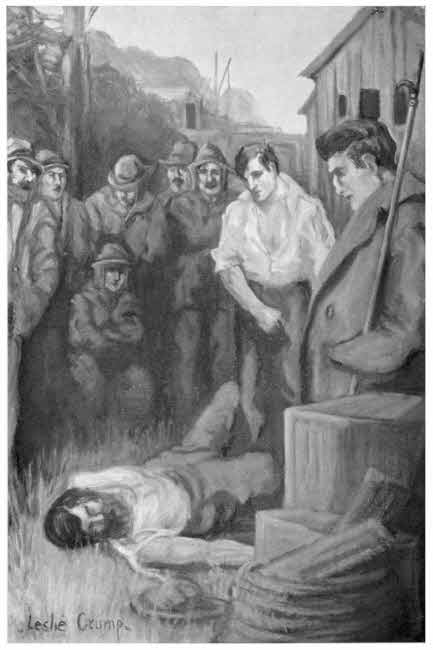
pitched forward into the grass!
A moment the great body quivered, then
slowly his knees drew upward almost to his
chin, and he lay perfectly still!
O’Brien stood over him, one fist clenched, the
other mopping the blood from his neck.
“There, blame him, I guess that finishes his
fightin’ fer t’day,” he said laconically. Then
to the other swordfisherman who stood near by
he said, “There’s yer captain. Lug him out o’
here es fast as ye kin. I don’t want t’ see his
ugly face ’round here any more ner yours
neither.” And still mopping the blood from
the wound in his neck, he elbowed his way
through the crowd and disregarding the shouts
of applause made his way into Eli Whittaker’s
cottage, where he sought the iodine bottle so
recently used on Ray’s shoulder.
For several minutes Ray’s Uncle Vance lay
unconscious on the grass while the other fisherman
worked over him. Finally with the aid
of a bucket of cold water, he was revived.
Slowly his eyes opened and he looked about.
Then without a word he struggled to his feet
and assisted by his companion walked slowly
down the steep path toward the beach where
his dory lay hauled up above the water line.
The crowd on the promontory watched him go;
in fact, they remained until they saw the small
boat reach the yawl. Then O’Brien appeared
on the scene again and sent them all back to
their task of building houses.
“Say, your uncle is some fighter, Ray. But
he wasn’t a match for O’Brien,” said Jack, as
the two boys watched the fishermen raise the
mainsail of the yawl.
“You bet he wasn’t. That was some of his
own medicine applied in a larger quantity. By
hookey, I’ll bet a copper he’s raving mad at me.
Mark my word, this isn’t the last we hear from
him,” said Ray.
“Well, it’s the last we’ll hear from him to-day,
for his boat is starting off toward the
south,” said Jack.
“That being the case,” said Mr. Warner,
“I’m going to look around and become familiar
with my working staff. I want to start a survey
of Cobra Head to-morrow if I can. You
boys can come along if you want to. In fact, I
rather think I’ll need you along to help me
take stock of materials and things.
“And, by the way there, son—ah—er—Ray,
I mean, what are we going to do with you?”
“I don’t know, sir,” said Ray, looking anxiously
at the engineer.
“Well, ah—er—hum, how’d you like a job
clerking here with Jack? Can’t pay you much,
but we’ll give you your board at least. There
will be enough work for the two of you to do,
I guess. How about it?”
“That would be slick,” exclaimed Ray, all
smiles now.
“All right. You’re hired. Come along
with me,” said Mr. Warner.
CHAPTER V MEN OF HONOR
As soon as the trio began their tour of inspection
of the construction camp Jack’s
curiosity about the big blocks of granite that
looked like sections of a jig-saw puzzle was revived,
and the first question he asked of Mr.
Warner was:
“What were you going to tell me about that
granite?”
“Oh, yes,” said the engineer; “I haven’t said
much about lighthouse building yet, have I?
Well, we’ll begin at the proper place, which is
the beginning, and I’ll outline to you and Ray
just what we hope to do here on Cobra Reef.
I don’t know whether you two have studied
that big boulder out there that looks like a
snake’s head, but if you have you’ve noticed
that it is about fifty feet across in either direction
and that at low tide it stands eighteen or
twenty feet out of water. Under those circumstances
it is not going to be as difficult to
build a lighthouse there as it would were the
rock submerged all day. As a matter of fact,
it is never totally under water, although sometimes
the seas break completely over it at high
tide.
“Last year when it was decided to supersede
the Hood Island light with a more modern
structure (you’ve noticed that the present
tower is quite antiquated in appearance) engineers
from the Bureau of Lighthouses came
here and after a great deal of trouble landed on
Cobra Head and ran a survey across the rock.
Their figures were taken to Washington and
studied, and the kind of a lighthouse necessary
to crown the reef was decided upon.
“The decision resulted in the adoption of the
most common form of light which is known as
a monolithic structure; a single shaft of stone.
Lighthouses of this character are usually built
of granite prepared as the granite you see over
there on the cliff’s edge. There are other good
lighthouse materials, however. Some structures
are built of reenforced concrete, some of
steel, and some are nothing more or less than
wooden buildings built on steel supports.
“But granite is considered superior material
where the light is wave swept, as this one will
be. In building a lighthouse of granite it is
very necessary that when the pile is completed
it shall be almost as solid as a single section of
rock. To make this possible a European
engineer, a long time ago, devised the plan of
making each block of stone lock into the other
by means of dove-tailing them. This is accomplished
by having the stonecutters in the
quarry yards chip projections on the top and
one side, and indentations on the bottom and
remaining side of the granite building blocks,
so that when the stone is put in place the two
projections fit into two indentions on the side
of the block next to it and the top of the one
it rests upon, and the indentions on the side
and top are ready to receive the projections of
the next stone.”
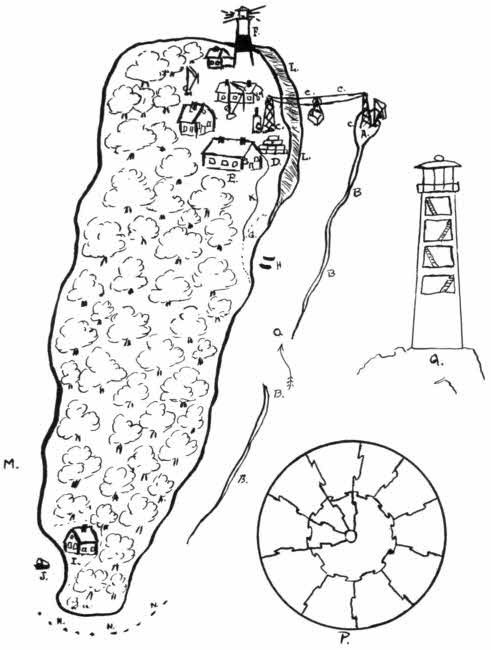
A, Cobra Head. B, Reef. C, Cable-Way Between Island and Reef.
D, Granite Blocks. E, Construction Camp. F, Captain Eli Whittaker’s
Light. G, Beach. H, Anchorage for Whale-Boats. I, Old Mitchell’s
House. J, Anchorage of the Betsy Ann. K, Path from Beach to Camp.
L, Cliffs. M, Mitchell’s Flounder Fishing Grounds. N, Mitchell’s Lobster
Traps. O, Opening in the Reef Through Which the Blueflower
Entered. P, Cross-section of Lighthouse Foundation. Q, Cross-section
of Lighthouse Tower.
“The work of shaping the stones is all done
at the quarries; indeed the entire lighthouse is
erected stone for stone in the quarry yard so
that every piece fits perfectly. The blocks are
then numbered and the structure is taken apart
and shipped here. If you’ll notice each of
those granite blocks is numbered according to
position and section. In that way there is no
delay in preparing materials while construction
work is under way.”
“My, but that’s interesting,” said Jack. “I
did notice that each block was marked, but I
had no idea that building a stone lighthouse
could be made as simple as all that.”
“Oh, it may sound simple,” said Mr.
Warner, “but you just wait until we begin
operations. Then it won’t seem so easy.”
“What gets me,” said Ray, “is how you are
going to get all of those big chunks of stone
over to the rock. Why, some of ’em look as
if they weighed five or six tons. Also, how on
earth did you get them up on top of this cliff?”
“I’ll answer both of those questions at once,”
said Mr. Warner. “You are quite right, Ray;
the blocks do weigh a great deal. In fact, some
of the larger ones to be used in the base of the
lighthouse weigh fully four tons. Under those
circumstances it must look like a tremendous
task to get them up to the top of the cliff and
later take them over to the rock. You see, if
Cobra Head had been larger and the water
in the vicinity less treacherous, the lighters
that brought the stone here from Portland
would have landed it on the rock. Under the
existing conditions, however, this could not be
done and the next best thing was to land the
material on Hood Island. To leave it at the
beach, where we came ashore, would have been
out of the question, for it would be necessary
later on to reload it on lighters, section by section,
and take it to the rock. Finally we decided
that we would adopt the same methods
as those used by the English engineers in
building several famous lights; that is, we
planned an aerial cableway between the top
of the cliff and Cobra Head rock, thus providing
a short and safe means of conveying men,
supplies and materials to the reef’s head.
That steel tower yonder, which the men are re-rigging,
and that donkey engine on the cliff’s
edge, were installed a month or so ago, and
every time a lighter with stone and supplies of
a cumbersome nature came in, a temporary
cableway was rigged from the tower to the
mast on board the boat and the supplies
brought ashore in that way.
“Our trip to the rock to-morrow will be to
carry a line out there with which to rig up a
temporary breeches-buoy outfit such as coastguards
use in case of a wreck. In this men
will be sent to the reef to drill holes and make
an anchorage for the aerial cableway which
will be built immediately. Then everything
will be ready for the real construction work.”
Mr. Warner paused again and sketched a
map of the reef and the island showing how
the cableway would be built between the island
and the head of the reef.
“What sort of a foundation will you have for
the light, Mr. Warner?” asked Ray.
“Oh, I was coming to that. Here’s how we
will proceed with the work. To-morrow we
will land on the rock, providing Neptune is
willing. Then while some men are drilling
holes in which to put the ringbolts to hold the
reef end of the cableway, other men will start
chipping away the humps and bumps on Cobra
Head. That lump that looks like a head itself
will have to be cut away and the top of the
hood will be made as flat as possible. It will
not be necessary to dig very deep into the rock
because the constant erosion of the sea for
centuries past has eaten away all the soft parts
of the rock, if there ever were any, and all that
you see above water now is as firm and as hard
as flint. As I said before, we’ll pare it down
somewhat in spots and we may be forced to use
a little dynamite in the work, though I’ll avoid
that if possible for explosives may shatter the
entire boulder if they are not used carefully.
Then where would we be?”
“I think if that should happen you would
have a mighty hard job on your hands,” said
Jack.
“You’re right, we would,” assured Mr.
Warner. Then he continued, “When the chipping
is all done and the cableway is in working
order, things will proceed as smoothly as the
elements will allow. The first blocks will be
sent down and put in place. They will be imbedded
in cement which will take hold of both
the rock and the building block. After the
cement is set a hole will be drilled through the
granite block and deep into the boulder. A
heavy steel bolt will be sunk through this hole
and anchored to the reef with hydraulic cement
which will be forced home under pressure.
When this cement has set the first tier of stones
will be as solid as man can make it.
“When the cableway is working we’ll start
to build a miniature construction camp out
there on the rock. There will be derricks, for
one thing, for no man, or group of men, could
handle one of those tremendous blocks without
some mechanical assistance. It is probable
that half a dozen derricks will be built during
the course of construction work, for storms
will sweep them away in a jiffy once the waves
get piling up on the Head. We’ll be lucky if
we don’t lose some of our workmen too.
There’s many a lighthouse along the coast the
building of which has cost more than one
human life. This sort of work, my boys, is not
the easiest in the—”
“Ow-w-w-w-ye-e-e-e-o! Ow-w-w-w-ye-e-e-o!”
“Good gracious, what’s that,” exclaimed
Jack, jumping as if he had been shot.
Ray smiled and turned around slowly.
“That’s a conch. Some one’s calling.”
“Yes, that’s Eli Whittaker’s dinner horn,”
said Mr. Warner, smiling at Jack’s surprise.
“Call to dinner, is it?” said Jack, smiling
too; “sounded to me as if a whole drove of
elephants was charging down upon us. Well,
if it means something to eat I’ll welcome it as
terrible as it sounds,” said the lad from Vermont.
“So’ll I,” assured Ray, “though I don’t know
how I’m going to handle a knife and fork with
my arm out of commission.”
“Pooh, don’t mind that as long as your
mouth isn’t in a sling,” said Jack. “I’ll cut up
your food and you can use the fork with your
good paw, can’t you?”
“Just watch me,” said Ray.
The sound of the conch was evidently the
camp’s signal for dinner too, for as Jack and
Ray and Mr. Warner walked back toward the
lighthouse they passed scores of men on their
way to the long, half-finished mess-hall where
Bongo, the dusky cook, was piling a board
table full of good wholesome victuals. The
men of the crew were of all nationalities, but
they were men every one of them. Jack
noted the fact that every eye was clear and
each moved with a stride that bespoke strength
and agility. They were big chested and
brawny and Jack did not know when or where
he had ever seen finer specimens of manhood,
a fact which he remarked to Ray and Mr. Warner.
Four seated about the tiny dining-room of
Eli Whittaker’s spick-and-span cottage made
the place seem crowded indeed. Eli was his
own cook and housekeeper and he was a past-master
at both, according to Jack’s way of
thinking. That he was an excellent housekeeper
was evident from a glance about the
neat cottage and the neater light tower. And
as for his cooking ability, well, great dishes full
of steamed clams, three fat lobsters split in
half, and generous portions of corned beef,
boiled potatoes and canned corn, all provided
eloquent testimony to this fact. The quartet
fell to with a will, and Ray, despite his handicap,
managed to consume as much as the rest.
After dinner the two lads helped Captain
Eli wash dishes, though Ray was of little assistance
because of his injured arm. And
while they were thus occupied Mr. Warner
came in from the camp with word that O’Brien
had assured him that all work on the buildings
would be completed by evening, and that the
next morning everything would be ready for
their first attempt to land on Cobra Head.
A little later the engineer took Jack and Ray
over to a two-roomed shanty in which he intended
to make his office and drafting-room.
Here they were shown to the rear apartment
where there were several high desks and a
number of books. This portion of the building,
Mr. Warner informed them, was to be
their domain, Jack being given one desk and
Ray another.
For half an hour Mr. Warner explained in
detail the clerical work that the boys would
have to attend to, and before he left he assured
them that their daily routine would not keep
them occupied more than a few hours each
morning and that the rest of the time they
would be at liberty to spend with the engineers,
or the crew, or do whatever else they saw fit to
occupy their time.
Their first duties, however, were enough to
keep the lads occupied for some time and Eli
Whittaker’s conch was sounding its evening
warning almost before they realized it.
“Jiminy,” said Jack, looking up from his
books, “it’s time to eat again. I’m hungrier
than a bear too. My, what an appetite I’ve developed
since I left Vermont.”
“I get sort of hungry myself now that I
don’t have to worry about Uncle Vance and his
disagreeable temper. If I only had the lifeboat
model he tossed overboard I’d be as happy
as any one could be. I’m going to get at a
new model as soon as my arm gets better, by
jiminy, and you can bet no one’s going to get
a chance to heave it overboard again. The
thing that is worrying me though is whether
I’ll be able to remember just how I had the first
one built,” said Ray, slipping down from his
high stool and joining Jack.
“Tut, tut,” said Jack, “don’t worry about it
now. Let’s go and get something to eat.”
When the two lads came out of the office
door they noticed immediately that although
it still lacked an hour or more of dusk Eli Whittaker
had already lighted the lamp in the tower.
Jack and Ray watched it shoot forth its single
ray of white light periodically as the big lens
revolved.
“I’m going up in the tower after supper and
learn something about lighthouse lamps, that
is if Captain Whittaker will let me,” said Jack,
as they walked up the path to the top of the
promontory.
“I’d like to have a peek inside of the lamp
too,” said Ray. “Let’s ask Captain Eli if he
won’t tell us something about the lighthouse
service too.”
“Good idea,” said Jack as they entered the
cottage.
The boys were not long in bringing up the
subject of conversation, for almost as soon as
the four of them were seated about the table
once more Jack turned to the light keeper and
spoke.
“Captain,” said he, “Ray and I are mighty
interested in the lighthouse service and we’d
like to know a lot about it. Also we’d like to
know something about the way the lighthouses
are lighted too.”
“Well, as fer t’ way lights is lit I can take
you up in the tower later and ye can have a
look at my light and I calc’ late I kin tell ye all
ab’ut haow ’tis run. But that hain’t ha’af
what’s t’ be told about lights. Mr. Warner
here knows more about lights than I do an’ like
es not he kin reel off them there jawbrakers like
‘equiangular prisms,’ ‘dioptics,’ ‘hyperradients,’
an’ what-not ’thout even stoppin’ t’ think on
’em. As fer me I cain’t never master ’em
an’ ’tain’t no use o’ my tryin’. Time an’ agin
I’ve clawed through big books on lights an’
such like, but I allus finished ’m ignoranter
than when I begun ’un.”
“Pshaw,” said Jack, “we don’t want any of
those big words either. What we want is plain
English about how lights are regulated.”
“Wall,” said Captain Eli, “I calc’late Mr.
Warner could give ye that a big sight better’n
I could too, but es fer t’ service; wall, I’ll have
a little t’ say on that if ye want t’ hear it.”
“Go ahead, Captain; we’re all ears,” said
Mr. Warner. “I’d like to get a good straight-from-the-shoulder
opinion from one on the inside.”
“Good,” said the keeper as he began to pour
another cup of tea for himself.
“T’ begin with, I kin say that the Lighthouse
Service is the finest an’ best regolated department
of the United States Government from
my p’int o’ view. An’ it has the finest lot of
healthy, big-minded, faithful men in it that kin
be scraped t’gether on t’ face o’ this earth. I
guess it is because these men are in it that the
service has been kept as sweet an’ clean as ’tis.
You hain’t never heard o’ no political scandals
or what-not in this here department, have ye?
No, siree, an’ they hain’t agoin’ t’ be none, not
while fellers like they got in it stick.
“T’ pay hain’t big an’ t’ hours is long and
tedious, but there hain’t a man of us that ’ud
shirk his duty in any respect. Just you look
over my file of the Lighthouse Service Bulletin
which is printed every month. There hain’t
an issue what goes by ’thout it has some mention
o’ some one doin’ a brave act. Tain’t
much of a mention t’ be sure, but we hain’t
hankering fer medals er praise. It’s aour
business t’ pertect property on t’ high seas an’
save lives when we can.
“Why, there’s some keepers as is so faithful
they won’t even take a day off. I read as haow
a lighthouse keeper over on t’ other coast in
t’ C’lumby River section has only taken two
days off duty in twenty-three years. An’ there
was the old man who kept the Van Weis Point
light down York way. Died when he was
ninety-three years old an’ he had been in t’
service fifty-two years. Peers t’ me like a man
jest natchelly gits faithful t’ minute he’s set t’
watching out fer some one else’s safety.
There’s wimmen in t’ service too, an’ they’re
jest t’ same; all Grace Darlings when it comes
t’ a p’int o’ nerve. Look at that air woman out
Frisco way who stood all night on the platform
outside t’ light in a thick fog strikin’ the
bell with a tack hammer because the machinery
had got out o’ order. An’ there was Ida
Lewis, who lived at the Lime Rock Lighthouse
near Newport fer fifty-seven years. She was
keeper fer thirty-two years after her father
died. ’Tis said she saved as many as thirteen
people from drownin’ during her life. Hain’t
that a record fer ye?”
“You bet it is,” said Ray and Jack, carried
away with the old man’s enthusiasm.
“Wall, from that ye can gather what I think
o’ t’ Lighthouse Service. No, siree, I hain’t
got many kicks agin it. There’s on’y one er
two things need regulatin’! There hain’t no
pension fer men who git too old fer the service
an’ fer men who are injured in the service, but
we’re all hopin’ that’ll be changed some day
an’ I guess ’twill. An’ in the meantime every
one o’ us is workin’ our hardest t’ keep t’ service
jest es clean es it can be.”
The two lads were thoroughly impressed by
the captain’s recital, and although they did not
express it each was of the opinion that if all
the men in the Lighthouse Service were as sincere
as he, the organization could not help but
be free from any taint.
“By George,” said Mr. Warner at the conclusion
of the captain’s remarks, “you surely
are enthusiastic, but I think you have every
reason to be so, for there isn’t a finer lot of
men in the world than the five thousand odd
who have to do with lighting Uncle Sam’s coast
lines. And now, Captain, if you have a couple
of amber goggles, which I believe the department
is furnishing you men with who have
charge of flashing lights, I’ll take the boys aloft
and tell them something about the lamp. That
will give you time to clean up around before
you get ready to go on watch.”
Captain Eli filled his pipe first, then rummaging
around in his bedroom produced two
sets of goggles which he gave to the boys.
“My goggles are hanging on a peg in the
lower light room,” he said to Mr. Warner.
The engineer led the way through the enclosed
passage that connected the cottage with
the light and presently the boys found themselves
in the base of the tower from where a
spiral staircase wound its way aloft.
“This is a mighty old light. I think it was
built nearly a century ago before lighthouse
construction was done as scientifically as it is
to-day,” said the engineer. “But, nevertheless,
it must have been built well to withstand
the elements so long. Although the promontory
on which it stands is nearly one hundred
feet high and the tower thirty feet tall, Captain
Eli has sent in a report on several occasions of
waves having broken panels in the lantern, so
you can see the old place has stood through
some storms.”
The trio were climbing the circular stairs
now and Jack noticed, as they wended their
way round and round the building, that a long
steel wire dangled down into the well of the
stairway from the very top of the tower. On
the end of the wire was a heavy weight. Of
course the boys sought a reason for this, and
when they reached the lower light room where
Mr. Warner found his goggles, Jack asked him
about it.
“That weight,” said the engineer as he adjusted
the amber glasses, “operates the clock
works in the lamp, which in turn drive the
lenses round and round the lamp and produce
the flash. Come aloft now and I’ll explain it
all in detail, only first put on your glasses because
your eyes will not stand the strain of
looking into the light.”
The boys did as requested and a moment
later they climbed up the last section of the
spiral stairs and entered the light. This was
a platform on the very top of the tower enclosed
by eight panels of glass. There in the
center, revolving slowly round and round an
incandescent oil vapor lamp was the big lens.
Mr. Warner began to explain immediately.
“To begin with, the first forms of light were,
of course, wood and coal fires which were
burned in braziers. These lights were used in
England and in the Mediterranean for a long
time. The next step was naturally the candle,
but no matter how big they made their tallows,
or how many of them they crowded into a
lantern, the result was a very weak light.
Then came the oil lamps of all varieties. Some
burned one kind of oil, some another; a few
had one kind of a wick, a few had another
type, and so on. Indeed, the experimenting
with marine lights has extended over a long
period and even to-day there is no universal
form of lighting for lighthouses. But that, of
course, is because conditions are not the same
at each light. Acetylene gas is used for light
buoys and similar purposes, and electricity is
used where a supply is available, or where it
can be manufactured conveniently; but the
most satisfactory illuminant, all things considered,
is kerosene oil. Indeed, the Lighthouse
Service consumes more than half a million
gallons of kerosene annually.
“For a long time lamps with from one to
five concentric wicks were used in the majority
of lighthouses, but these are gradually giving
way to incandescent oil lamps, such as the
one you see behind the lens there. It is a
small compact affair and it gives a most brilliant
light and at the same time consumes very
little oil. The kerosene, which is supplied
from a tank in the lower light room, is heated
and vaporized, the vapor mixing with air under
an incandescent mantle and burning as steadily
as an incandescent lamp in a city street, only
brighter.”
“That’s very interesting,” said Ray, who had
been watching the lamp for some time. “Now
tell us something about the lens, won’t you?
How did they come to invent such a complicated-looking
affair?”
“Yes, I’ll tell you about the lens. Old-time
lighthouse engineers were always experimenting
on how to improve the efficiency of a light
and when they got through changing the forms
of fuel they tried the use of reflectors of various
types. Their efforts were more or less
successful, but when a French physician by the
name of Fresnel came forward with an elaborate
system of lenses the science of coast lighting
was revolutionized. This lens you see
before you is the present-day result of his efforts.
It embodies his idea worked out to perfection.
You will notice that there is a central
lens, or bull’s-eye, and that around it are
grouped prisms of highly polished glass. The
idea is this: The light throws rays on every
side, back, front, top, bottom, and all over.
Well, these prisms of glass grasp, as it were,
each ray that shoots out at the side and top
and literally bend it and shoot it forward.
In that way all the light from the lamp is gathered
into one bundle and sent out in a given
direction, instead of radiating off on all sides.
The lens works exactly like a megaphone
which your football rooters use at Drueryville,
Jack. Do you get the idea?”
“Indeed I do and it is mighty interesting,”
assured the young Vermonter.
“Good, and now if you’ve seen all you want
up here we’ll go down in the lower light room,
for it is hot in the lantern here and besides even
with these goggles the bright light hurts my
eyes.”
“Mine too,” said Ray, leading the way
through the tiny trap door and down the stairway
to the lower light room.
“Why do they have some lights flashing and
some just a steady glare?” asked Jack when
they reached the next room.
“Well, lighthouses to-day can be made to
serve a double purpose. They warn mariners
of a dangerous coast and by means of flashes
they tell vessels which particular light they are
near so the seamen know their exact position
when they are traveling the coast. This light
shows steadily for one minute and then gives
a five-second flash. The next light down the
coast may give two or three flashes a minute
and so on.”
“Do sea captains have to know the flashes of
every light along the coast?” queried Jack.
“Indeed they do and a lot more too,” said
Mr. Warner.
“What is the candle-power of lighthouse
lamps?” asked Ray.
“They vary a great deal,” said Mr. Warner;
“this is very small compared with some of our
lights. The one on the Highlands, marking
the approach to New York Harbor, is said to
be of 25,000,000 candle-power. Not long ago
we sent one to the Hawaiian Island that had a
lens nearly nine feet tall and weighed four
tons. It is mounded, or floated rather, on a
bed of mercury and makes a complete revolution
every twenty seconds, sending out a double
flash of 240,000 candle-power. If it were not
for the curve of the earth it could be seen more
than forty miles.”
“Jiminy, what a light!” exclaimed Jack.
“Did you hear that, Captain Eli?” The keeper
was just coming up the spiral stairs to go on
watch when Mr. Warner completed his statement.
“Yes, that sort o’ makes my little pet up aloft
there seem like a taller candle, don’t it?”
“Well, Captain,” said Mr. Warner, “how’s
the weather for a clear day to-morrow?”
“Right’s a fiddle, sir,” said the old man.
“And what time is high tide?”
“Tide turns at seven to-morrow—it’ll be full
at two o’clock,” said the lightkeeper.
“Good, we’ve got to make a landing on the
reef, you know, and we want clear weather
for such a venture. I only hope we all come
out of it alive,” said Mr. Warner, showing
great concern. Then turning to the boys he
said: “Well, lads, if you are going to be up
to tussle with the waves to-morrow, you’d
do well to go to bed. You’ll probably have to
bunk together. Which room is theirs, Captain?”
“The little room in t’ so’est corner,” said the
captain, adjusting his goggles preparatory to a
visit to the light. Then before he climbed the
stairs he paused a moment and spoke. “Say,
have either of you a watch that keeps good
time? I dropped mine this mornin’ an’ now
she won’t tick any more. An’ ye know I feel
sort o’ lonesome up aloft here when I hain’t
got a timepiece about me. Sometimes my
watch’s face is t’ on’y friendly face I see fer
months, ’ception that o’ old Mitch, t’ lobsterman
who lives down t’other end o’ t’ island.
He’s the only one on this forsaken strip o’ land
except me.”
“Here, Captain, take my watch,” said Jack,
hastily handing over the gold timepiece that his
father had given him several years before.
“Thank ’e, when ye want it jest let me know.
I calc-late I’ll be able t’ fix mine in a day er
so.”
Then as he started up the spiral stairs he
said:
“Well, good night, boys. I’ll be abed when
ye start out fer t’ rock to-morrow, so here’s
luck an’ hopin’ ye’ll come back safe. Good
night.”
And Ray and Jack started downstairs, both
wondering what the next day would bring
forth.
CHAPTER VI WINNING THE ROCK
Thump, thump, thump.
“Hi, Jack! Hello, Ray! Come, wake
up. Think you can sleep all day? It’s half-past
five.”
Thus were the two lads aroused next morning
by Mr. Warner as he came from his room
across the hall.
“Come,” he added, “tumble out. The boat
will start for the rock before you are dressed.”
This was enough to stir both lads, for they
had set their hearts on taking part in the tussle
with the waves to gain the top of Cobra
Head. They were on their feet in a jiffy and
presently were whisking on their clothes with
little regard for sartorial effect. Jack managed
to get his undershirt on wrong side out, as boys
frequently do when they are in a hurry, and
Ray discovered that he was trying to get his
left foot into his right shoe. But in a remarkably
short time they had adjusted things,
dashed cold water in their faces, given their
hair a brief but effective brushing, and emerged
from their room.
Ray’s arm was a little stiff at first, but the
iodine that had been applied the day before had
taken most of the soreness out of the cut and
he positively refused to keep his hand in a sling
any longer.
“I’ll keep on the bandage, but I won’t wear
a sling. Makes me feel like an invalid,” he
told Jack as they descended the stairs and
joined Mr. Warner in front of the lighthouse
cottage.
Captain Eli was of course snugly tucked in
bed and snoring lustily at that unseemly hour,
and since the engineer and his young companions
were destined to be early risers during
their stay on the island it had been decided
that they take their breakfast with the crew
in the main mess-hall.
Bongo, the big negro cook of the outfit, was
just sounding his call to quarters on the bottom
of a big dishpan when the three entered
the long low building. There was little of a
decorative nature about the arrangement of
the tables in the hall. There were two, that
extended the full length of the room and were
flanked on either side by long backless benches.
In twos and threes and groups of half a
dozen the burly lighthouse builders came from
the bunk-house to the mess-hall. They were a
happy-go-lucky lot who could not resist a little
horse play by way of a morning’s greeting and
the fisticuffs and good-natured chaffing that resulted
made Bongo’s face shine with merriment
as he hustled about the room with big bowls of
steaming victuals.
Jack, Ray and Mr. Warner crowded in beside
the foreman, Big O’Brien, and fell to
with as much zest as the rest of the men. The
breakfast was of a rather coarse nature, to be
sure, consisting chiefly of baked beans, liberal
slices of salt pork, thick slices of bread, canned
peaches and coffee as strong and black as
Bongo could possibly brew it. But Jack ate
with a decided relish, nor did he pause to compare
the breakfast with those served at Drueryville.
During the entire meal Mr. Warner and
Big O’Brien were in earnest conversation, to
which Jack and Ray were very attentive. The
men were discussing the details of the expedition
to the rock, and as the lads listened to the
preparations that were being made they realized
more and more that they were about to
embark upon a hazardous undertaking.
By quarter of six the foreman and the
engineer had drained their cups and pushed
back their plates. Others of the crew were
doing the same thing when O’Brien stood up
and shouted, “Come, bhoys, ye have t’ sha-ake
a leg. In haf en hour-r we’ll man t’ bhoat and
r-run out on t’ last o’ the down tide. That’ll
give us an hour-r t’ fuss ar-round befer it
sthar-rts a-racin’ in agin. Come on, Mike,
and you, Sandy, and Lafe there, git a wiggle
on yez, yer all part of the boat crew.” And
presently there was the scuffle of many feet and
the rasp of the benches being pushed back, and
five minutes after O’Brien left the mess-hall
Bongo had the place to himself.
Before collecting his crew the foreman singled
out three sun-tanned workmen who were
among the last to leave the mess-hall and with
them at his heels the big Irishman went into
one of the tool sheds. Shortly all four reappeared,
one dragging a little brass cannon, such
as is used by coast guards, while the others
carried a big open box, into which hundreds
of feet of sail cord was coiled upon pegs.
The cannon was hauled to the cliff’s edge,
loaded and sighted by one of the weather-beaten
trio, so as to hurl a rocket-like projectile
over the ugly gray rock out there where
the breakers curled.
Of course Jack and Ray could not entirely
understand what it was all about, but, while
they were wondering, Mr. Warner, who had
gone to his office for his steel surveying tape
and plumb line, arrived on the scene and explained
that, when the men succeeded in landing
on Cobra Head, the projectile would be
fired so as to carry a rope to them. And when
they had all things fast, a breeches-buoy would
be rigged to carry more men from the cliff
to the rock.
Upon Mr. Warner’s return, O’Brien quickly
gathered his crew and, with Jack and Ray
among them, they started down the pathway
that led to the beach where the two whaleboats
were moored. Into these the men
swarmed and a few minutes later the craft shot
away from the strip of sand and headed north
inside the reef and toward the dangerous
Cobra Head.
It was low water and the long jagged reef,
exposed from end to end, looked exactly like a
giant of the species after which it had been
named. Outside, beyond the wicked rocks,
rolled the Atlantic; great ground swells heaving
in restlessly and thundering against the
granite barrier with a grumbling roar. Jack
and Ray, who sat in the stern of the whaleboat
with Mr. Warner and Big O’Brien, were fascinated
by the sight.
But, although the waves piled up outside, the
strip of water between the island and the beach
was unruffled, so far as the surface was concerned.
Under this calm exterior, however,
were currents and cross-currents that slipped
oilily over the granite-strewn bottom in spite
of the fact that it was the hour for slack water.
Jack could see from the way Big O’Brien
handled the tiller and the strength that the men
put in their tugs at the oars that the force of
these currents was tremendous, and he wondered
what that strip of water would be like
when the tide turned and began to come in.
As the whaleboat proceeded northward and
approached the big rock the currents became
more vicious. They ripped and swirled and
licked at the side of the sturdy vessel like the
advance guard of Neptune’s forces defending
the rock from the invaders. The men were
bending to the oars now and grunting with
each stroke, and Jack and Ray could see the
muscles in their knotted arms stand out under
the strain. Slowly but surely the boat drew
nearer the tremendous boulder, and as the lads
got a closer view of the pedestal on which the
new lighthouse was to be erected they realized
why Mr. Warner had cause to worry about the
outcome of the expedition.
For fifty feet about the great chunk of granite
the water fairly boiled with eddies and currents
and the force of the heaving swells of the
Atlantic. Here all these met and struggled
for supremacy, and the ugly sides of Cobra
Head were lashed and pounded by tons of
water hurled against them. It seemed folly
for a craft even as stanch as the big whaleboat
to venture into that turmoil and dare the
approach of the rock.
And to make the situation harder the head
presented a grim and foreboding surface to the
adventurers. Indeed, there did not appear to
be a crack, or crevice into which the men could
get a foothold when they attempted a landing,
and if there really were any they were well
covered with slippery brown rock weed and
kelp that draped the sides of the massive stone.
In truth, as Jack gazed upon the grim barrier,
it looked to him like the great shaggy head
of Medusa with her snaky locks tossed about in
the hissing breakers. And the thunder of the
tumbling water was almost deafening.
“Mighty ugly looking, isn’t it?” shouted Mr.
Warner, for a shout was necessary to make
his voice heard above the roar.
“I should say so,” cried the boys, trying to
suppress their excitement.
Big O’Brien cupped one hand about his
mouth and shouted to the boat crew:
“Row on, boys. Pull, an’ we’ll go ar-round
t’ blitherin’ thing t’ see if ther-re be a place fer
a fly t’ sthick on.” And the men bent to once
more and urged the craft forward, keeping
outside of the ring of troubled water as much
as possible.
Slowly they made their way round the circle,
the whaleboat pitching and rolling like a cork.
Foot by foot they moved through the boiling,
foam-flecked water and all the time Big O’Brien
and Mr. Warner scanned the great granite
crag for a place to attempt a landing.
And at last they found it. To be sure it
was not much of a landing place, but then it
was better than a sheer wall of granite covered
with slippery kelp. On the ocean side where
the great breakers dashed in with a roar the
rock weed had been all torn away by the force
of the water. Ages of erosion had worn soft
spots in the granite away, too, until there remained
a slopping trough into which the water
dashed with a hiss and fountained twenty feet
in the air.
The constant action on the sloping side had
worn the hard stone as smooth as glass and the
dashing of the wave plumes had pitted the rock
here and there above, so that a man of great
agility could hope to gain the top if he moved
fast enough and could beat these curling
tongues of water that shot against the rock and
licked it clean.
“Tiz there ’er no place, Chief,” shouted the
foreman to Mr. Warner. Then, as the engineer
studied the situation, he shouted again.
“May we be per-rtechted whin we tr-ry too;
fer if wan o’ thim waves hits yez a slap in t’
back ’twill be Davy Jones’ Locker t’ next stop.
They’ll suck yez under in a whink, an’ yez’ll
niver see daylight agin. No shwimmin’ yez
ivver learnt will save yez agin the undertow.”
“Well, the engineer who made the survey
last year did it, O’Brien, and I guess we can do
as much,” called Mr. Warner.
“Sure-re yez ’er a Kilkenny cat fer pluck,”
said the foreman, “but I’m wid yez. Hi,
bhoys, we’ll make a landin’. Tiz me an’ Mr.
Warner what does it an’ don’t anither wan o’
yez even think o’ thr-ryin’. Yez hear-r me
now. I’ll lick t’ life out o’ eny man who even
sthands up in t’ bhoat. Here, Lanky Sims,
yez ’er t’ bist sailor in t’ outfit; take t’ tiller and
mind yez kape her hull. Jist a shlip an’ she’ll
be smashed t’ kindlin’ agin t’ r-rock an’ we’ll
all be at t’ bhottom.”
Lanky Sims, a tall, raw-boned Yankee who
had been brought up on the high seas, came
from the bow and took O’Brien’s place. Mr.
Warner turned solemnly and shook hands with
Jack and Ray, and O’Brien did the same. Not
a word did they utter, but the lads understood,
and a lump as big as an apple came into Jack’s
throat.
The engineer and the foreman made their
way to the bow of the boat. Then Lanky Sims
took a fresh quid from a black plug of tobacco,
spat over the side and shouted:
“Yo-heave-ho, boys!”
And the men bent to the oars with a will.
Sims took the craft out toward the open ocean,
then turned her, and with the swells at her
stern started to ride in slowly, keeping his eyes
pinned on the sloping trough of rock into
which each big wave plunged and surged aloft
with a gurgling hiss. Nearer and nearer they
drew, the men rowing with short strokes and
keeping their great bodies alert and ready to
obey Sims’ orders. Mr. Warner had decided
to try first, in spite of the Irishman’s protests,
and he stood waiting in the bow, one foot on
the gunwale and his hand resting on Big
O’Brien’s shoulder to steady himself.
Sims watched the waves with calculating
eyes. Not a muscle in his face moved. Not a
nerve in his body quivered. Closer and closer
to certain destruction moved the pitching boat.
A great wave raised it, held it trembling aloft
for a moment, then slipped out from under it
and shot into the trough, spurting foam and
water aloft and drenching the entire crew.
And the moment its force had been spent and
the water began to suck backward Sims gave
the expected order.
“Yo-heave-ho!” he roared and bent his
body forward. The oars dug deep and the
whaleboat shot forward! Mr. Warner hesitated
a moment, then jumped! Into the
trough he dropped and up the slippery granite
he scrambled. He reached the first niche, the
second, the third. He was ten feet up, twelve,
and now fifteen. Then Sims shouted:
“Back, boys, back water quick. Here
comes another.”
The oak oars bent and creaked under the
strain. The whaleboat shot backward and full
into the oncoming wave. For a fraction of a
second it stopped dead and every timber quivered.
Then with a rush it shot backward
again and the wave slipped under it and hurled
itself into the trough, its great curling tongue
licking up the side of the rock as if seeking to
tear Mr. Warner from the little niches to which
he clung.
But the engineer was safe. He was
drenched with foam and spray, but he was well
out of the way of the dangerous water. Up
he climbed, slower now, feeling his way from
place to place; while the boat backed off to a
safe distance and the crew watched his progress.
Finally he gained the top and stood
erect. Then, what a shout went up from the
men in the whaler!
It was O’Brien’s turn now. The big Irishman
stood up in the bow while Sims began
maneuvering the boat once more. Again it
approached the rock slowly, riding in on the
long waves until it began to get dangerously
near the big boulder. Then the tall Yankee
at the tiller waited, tense and alert, watching
his chance to run in immediately after a big
wave had spent itself, and back the boat out
of danger before the next wave could hurl it
against the granite and shatter it into splinters.
The chance came. A big wave burst with a
roar against the rock, the spray splashing in all
directions. Then, as the tons of water slipped
back again, Sims roared his “Yo-heave-ho”
command.
In shot the boat against the curling, sucking
eddies. Big O’Brien balanced a moment
on the gunwale and leapt forward. Into the
trough he dropped. Then began the scramble
for the first niche before the next wave surged
in and seized him. Up he climbed over the
slippery stone. He reached the first of the
grooves and was trying to get a foothold in another
when—his hand slipped! The next moment
he shot down the trough and back to the
very spot upon which he had landed! Frantically
he struggled to his knees, then to his feet,
only to slip prone again. Then with a hiss
and a roar the next wave came curling in. He
was doomed!
The force of the water hurled him up the
slippery trough, raised him high in the air and
dropped him backward, helpless, into the spume
at the base of the rock.
Jack and Ray were numb with horror.
Big O’Brien had been whisked from the face
of the earth like a straw.
But before they could collect their scattered
wits Lanky Sims’ voice was heard again above
the roar of the water.
“Look! Quick! There he is! On the
port side! You boy, grab him! There! See
him!”
Ray saw a distorted mass of clothing and
legs rise to the surface just under him. It was
whirled round and round by the force of the
undercurrent for a brief instant before it
started to sink again. Blindly the lad reached
over the side and clutched. His fingers closed
upon a cold and clammy wrist, to which he
clung despite the surging and tearing of the
current.
Forgetful of the danger for the moment,
Lanky Sims let go the tiller and reaching a
long arm into the water seized hold of the big
foreman too. Then together they dragged
him over the gunwale and into the boat. And
while Jack and Ray took care of the all but
drowned foreman, Sims directed the whaleboat
out of the lashing water and toward the open
sea where there were only the long rollers to
combat.
The two boys worked manfully over Big
O’Brien. First they got all of the water out
of his lungs. Then with him lying prone in
the bottom of the boat they started artificial
respiration, as Jack had been taught it by the
football coach at Drueryville Academy. For
fully fifteen minutes the boys labored over the
foreman while Sims and the rest of the crew
looked on in silence. And gradually their efforts
told, for O’Brien’s eyelids quivered once
or twice and finally opened. Two red spots began
to show in his ashen cheeks, and after a
few moments he regained consciousness.
“Phwat happened?—ugh—O, shur-re I
know. The big wave caught me, huh?” he
said rather thickly as he sat up.
“It didn’t on’y ketch ye but it smashed t’ life
ha’af outen ye,” said Lanky Sims.
“How about Mr. War-rner,” demanded
O’Brien, turning and looking toward the big
rock. Then for the first time the men in the
boat thought of the engineer.
There on the top of Cobra Head stood the
lighthouse builder. He had seen the accident
and the rescue as well, and Jack could guess
what his feeling must have been as he waited
there for a signal to tell him whether his foreman
was alive or dead.
“Wave to him, O’Brien. Wave your hand
and show him that you are still alive,” cried
Jack. And the big Irishman struggled to his
feet and, holding on to Lanky Sims, waved and
shouted as loud as he could.
Mr. Warner answered the signal with a
warning wave, which told the men in the boat
quite plainly that he wanted them to keep off
and not attempt to land another man.
“Sur-r I’d like t’ thr-ry anither fling at it
jist t’ show meself that I can’t be bate be a
duckin’, but if the boss sez ‘No,’ thin ‘No’ ’tiz.
Come on, Lank, thur-rn t’ boat and we’ll go
back t’ th’ island.”
During the return journey Jack and Ray
kept their eye on Mr. Warner. They saw him
scrambling about on the rock, making measurements
and marking off various sections of the
rugged Head. Then they saw him send a signal
to the men on the cliff who waited to fire
a lifeline to him. They saw, too, the puff of
smoke from the little brass cannon and they
watched the rocket with the line trailing out behind
it describe a big arc over the rock and fall
into the sea beyond, dropping the rope almost
into Mr. Warner’s hands.
The engineer began to haul in immediately
and presently he dragged out of the surf a
heavier section of rope to which the line was
fastened. This was the cable upon which the
breeches-buoy was to be suspended, and Mr.
Warner spent some time in making the end
secure over the top of the big lump of granite
that formed the cobra’s head. The men on
shore worked quickly at rigging the buoy, too,
and by the time the boat crew had landed and
made its way up the promontory, stone cutters
were already being sent down to the rock to
level its surface and build the tower that was to
support the aerial cableway. And, when Jack
saw this, he realized that Cobra Reef had been
conquered and that the lighthouse was actually
under way.
CHAPTER VII UNDER ARREST
With the completion of the aerial cableway
and the clearing of the surface of
the rock the Hood Island construction camp
became a very busy place. A score or more
of men were to be seen on the big rock whenever
the waves were not piling up on top of it
(as always happened when a storm came in)
and the donkey engine that operated the cableway
was puffing and snorting from daylight
until darkness settled down.
Jack and Ray found that their duties increased
with the rush of work also, for besides
their tasks in Mr. Warner’s office there were
numerous other small jobs about the camp that
they could accomplish. But for all that they
had plenty of time on their hands to roam
about the rocky shores of the island, or take
short trips in the dory that belonged to Captain
Eli and was moored down off the sandy
beach near the whaleboats. The boys made
frequent trips to Cobra Head, also traveling
by way of the aerial cable of course. Indeed,
Jack and Big O’Brien were the first to ride
down to the rock, on a section of stone that
was conveyed to the lighthouse site. This was
more or less of a perilous trip and Big O’Brien
insisted on accompanying the lad when he
heard that he was going.
But with all these possibilities for a good
time Ray seemed to become less interested in
the construction work as the days went on.
In truth, he developed a certain melancholy
air which, after a time, became very noticeable.
This, of course, puzzled Jack, as it did the
engineer and the others of the camp who had
become friendly with him. More than once
Jack sought to gain his confidence and have
him tell his troubles, but the boy always appeared
to cheer up for the time and assure the
youth from Vermont that he had not a single
trouble in the world. Jack knew well that this
was not true, however, and to add to the mystery
of it all, Ray frequently strayed away
from the camp in the evening or when he had
no work to do and went wandering down along
the rocky shore of the island until he came to a
secluded spot where he would sit and brood
over his troubles for hours at a time.
It was after one of these mysterious disappearances
one afternoon that Jack went in
search of his companion, quite determined to
get at the bottom of all that was upsetting his
peace of mind. The lad from Drueryville had
seen Ray steal away and go down the path that
led to the little beach near where the whaleboats
were moored. He watched him as long as he
could, but when he saw Ray walk the entire
length of the sandy strip and start climbing
along the rock-strewn shore beyond, he decided
to follow.
But Jack soon discovered that his chum had
not gone far. Just on the other side of the
beach he saw the lonesome figure perched upon
a smooth chunk of granite, his back resting
against a large boulder just behind him. Ray’s
hat was off and the wind was playing with
his hair. He was staring off into space in a
most preoccupied manner, and the expression
on his face was that of a lad who was greatly
disappointed over something.
So absorbed was he with his troubles that
Jack managed to come up very close to him
before the young swordfisherman was aware
of his presence. When he did notice the Vermonter,
he seemed very much chagrined at being
discovered and a sheepish smile wrinkled
the corners of his mouth.
“Hello, Ray,” said Jack, sitting down upon
the rock beside him. “I hope you’ll excuse me
for following you, but—well, hang it all, you
looked so glum that I just naturally worry over
you. Something is on your mind, old chap,
and I do wish that you would spit it out. Tell
me all about it. Maybe I can help you or at
least give you some advice.”
“Pshaw, Jack, don’t mind me. My troubles
don’t amount to a row o’ pins to any one except
myself. Shucks, let’s forget about it.”
“No, siree, now, Ray, I want to know.
Look here; we’ve been pretty good friends
since you came to the island in that whirlwind
fashion, a couple of weeks ago, and I think that
I should know all about your difficulties.”
“Aw, I haven’t any real troubles. I’m just
disappointed, that’s all. You see—aw—er—let’s
forget about it, will you?”
“No, no, Ray, come on, shout it out,” insisted
Jack.
“I tell you it’s just disappointment, that’s all.
You see I had laid so much store by it that
I—”
“By what?” demanded Jack.
“Why, by my model—my non-sinkable lifeboat,
you know. The one that Uncle Vance
threw overboard.”
“Oh, I see, now I understand. I’d forgotten
all about it. Well, why don’t you build a
new model, old chap?”
“Why—er—well you see, Jack, I’ve been
trying to, but, hang it all, I haven’t the material,
for one thing, and—and—well, I’ve—you
see there are a lot of figures about it that
I’ve forgotten. I don’t know just how I did
build the first one. It was made of sheet metal
all soldered together and I can’t get a bit of
tin or sheet iron here. I tried to make one of
wood but that don’t go either. Gee, I am up
against it. And I wanted to see if I couldn’t
earn enough money with it—aw, shucks, let’s
quit talkin’ about it. There’s no use in worrying
you about it too, Jack.”
“Well, I’m mighty interested, Ray,” said
Jack encouragingly. “What was the principle
of the thing?”
“Why, just this, Jack. You remember
when the Titanic was wrecked about a year
ago? Sure you do. Well, when that happened
there was a lot of talk about not enough
lifeboats, and about the general unsafe condition
of the boats that were being used on board
the various steamers. That set me a-thinking
and I decided to try and build a boat that
wouldn’t sink and could not turn over, no matter
how hard a wave hit it. Then after
months of pottering around I worked out my
model which looked like a big pumpkin seed
roofed over. It was all fitted up, airtight
compartments in the bow and stern, and the
keel was so balanced, and the roof so well made,
that even if the boat should be launched upside
down, it would right itself and not ship
a drop of water. There was a little place for
a motor which, of course, could not be put in
the model, but could be put in a big boat of
regulation lifeboat size. It could also be propelled
by oars and it had a number of advantages
over the old-fashioned open lifeboat.”
“My, but that’s interesting,” said Jack; “I
sure would like to see it.”
“Well, I guess it’ll be a long time before I
can build another and, by George, I’m getting
older all the time. I’m nearly seventeen
now.”
“What of that?” said Jack.
“What of it? Why, I want to go to high
school some time, and college too. I sort of
hoped that I might make money enough out
of my invention to pay my way through school.
I can’t wait until I am a full-grown man to go
to ‘prep’ school, can I? And now that I’ve quit
Uncle Vance I haven’t a single person in the
world to help me. Not that I could ever expect
any real help from him. But then a fellow
needs a grown-up friend or two, no matter
how cussed mean they are to him at times.
But Uncle Vance was dead set against my ever
going to school again—said it would make me
even lazier than I am. I’m not lazy, am I,
Jack?”
“Indeed, you’re not,” said Jack, and then he
fell to thinking, for Ray’s remarks about school
brought Jack’s mind back to Drueryville Academy,
and, of course, the first thing that he
thought of in connection with the school was
the football situation for the next Fall.
“Jiminy, I certainly wish that you had
made money out of your invention,” he said
after a moment.
“Why?” queried Ray in surprise.
“Well, we need a full-back out at Drueryville
Academy and if you were going to go to ‘prep’
school I surely would see that you found your
way over to Vermont. You’d make a corking
full-back, Ray. Got the right build and all, and
you’re strong as a bull, too. Ever play football?”
“Ever play? No, but I’d like to. Hang it,
Jack, I haven’t ever been able to play at anything.
Never had the chance that other boys
get. All my life has been work and darned
hard work, too. And when I haven’t been
working, I’ve been quarreling with Uncle
Vance or trying to keep out of his way, either
one,” said Ray bitterly.
“Never mind,” said Jack solicitously, for he
saw how unhappy Ray really was. “Your
time will come, just you wait and see. I’m
going to speak to Mr. Warner about your
schooling, anyway. Perhaps he can help you
out with some good advice at least. Pshaw,
come on, let’s forget about your troubles. I’ll
tell you what we’ll do. Let’s go for a row in
Captain Eli’s dory. We’ve never been down
near the lower end of the island. I’d like to
explore. Are you game for a row, Ray? Mr.
Warner says that he will not have anything for
us to do until some time to-morrow. How
about it?”
“Sure enough,” said the unhappy youngster
and presently the two boys were climbing over
the rocks back toward the little strip of beach
where the boats waited, gently tugging at their
mooring lines.
It was a wonderful July afternoon, with
scarcely a cloud in the warm blue sky. Out
beyond the reef the broad Atlantic rolled on
lazily under the Summer sun, while inside even
the currents that usually raced between the
ledge of rocks and the island seemed to have
become sluggish.
“Let me take the oars,” said Ray, after the
two lads had waded out and climbed aboard
the dory, “I have the blues and there’s nothing
like some good husky exercise to work them
out of a fellow’s system.”
Jack consented and shortly the little craft
was slipping along through the water under
the young swordfisherman’s steady stroke. In
half an hour they had passed the southern end
of the reef and gone beyond the reach of the
currents into the open sea. Ray kept the boat
about half a mile off the shore of the island and
rowed steadily southward, apparently taking a
great deal of pleasure in working the stiffness
out of his muscular arms and back. As for
Jack, he lay off in the stern of the boat thinking
of nothing in particular.
Presently, however, Ray stopped rowing and
appeared to listen. Then turning, he looked
ahead and announced.
“Jack, there’s a school of mackerel ahead of
us. Look in the locker there under the stern
thwart, and see if Captain Eli has any fishing
tackle. Perhaps we can find a couple of jigs
in there.”
“Eh, how’s that? How do you know there’s
a school of mackerel ahead? I see some gulls
out there feeding on something but—”
“That’s just it. I heard ’em squealing like a
whole flock of cats. If you’d been around salt
water as long as I have you’d know they are
feeding on little menhaden and wherever
there’s a school of them you’ll be sure to find
mackerel—or pollock. If it’s a school of pollock
then we can have some fun, providing, of
course, we can find some fish lines. Pollock
are the gamiest fish in the sea.”
Jack became enthusiastic immediately and
quickly began a search under the stern seat.
In a moment he resurrected a dilapidated market
basket half full of coils of line, fish hooks,
jigs, and a double handful of clams.
“Fine!” exclaimed Ray, surveying the outfit.
“We’ll have fresh fish for supper all right.
Here, Jack, break open one of those clams and
cut out a chunk of the tough part. There,
that’s it. Now hook it onto that jig; just
double it over the hook so, it doesn’t make any
difference whether you have the point covered
or not. Now throw it over the stern, and let
out about sixty feet of line while I row.
You’ll feel ’em take hold in a minute; they’re
coming this way.”
Ray bent to the oars again and started the
boat toward the flock of gulls that were flying
close to the surface and diving in and out of the
water, squeaking and calling at a furious rate.
Jack had hardly got the jig overboard before
the dory was among the fish. They were big
fellows, according to Jack’s way of thinking,
but Ray said that they were only young pollock.
But Jack had no time to argue the matter, for
the next second something struck his jig savagely
and the heavy line shot through his fingers
and scorched a blister on the flesh before
the fish let go.
“Oh—wow,” howled Jack, shaking his hand.
“Ho, ho, that was funny,” laughed Ray.
“Loop the line around your hand next time
Jack, and snub him good. Then keep hauling
in as hard as you can, or you’ll lose him.”
Jack hooked another piece of clam onto the
jig and tossed it astern, and the moment he
had the line looped about his hand came another
savage jerk— Zipp-pp hissed the line
through the water, but Jack snubbed back and
started to haul away hand over hand, the fish
thrashing from side to side and even jumping
clear of the water in his mad effort to tear
free.
“Wow, what a corker,” cried Jack, as he
swung the struggling thing into the dory.
“Oh, he isn’t so big,” said Ray. “Pollock
grow sixty and seventy pounds and I’ve seen
’em even bigger than that. That’s only a
young one you caught. Weighs about five
pounds, I guess. This is a school of little
ones, I tell you. Try again.”
Jack hove the jig again and for the next fifteen
minutes he was busy as could be hauling
in the big silvery fish. They bit ravenously
and before he knew it he had caught at least
a score. Finally his fingers became so blistered
and chafed that he simply had to quit.
“Here,” he said, “you take the line, Ray.
I’m through.”
“All right,” said Ray. “Keep rowing
around in a big figure eight. Keep right in the
school. Follow the birds. I’ll see if I can’t
yank out a couple of big ones just for luck.
I wish I had a pair of nippers, though—those
are woolen gloves with the fingers cut. They
protect your hands. All fishermen use ’em up
here on the Maine coast.”
But before Ray had caught more than a
couple of fish, the surface of the water became
suddenly quiet again and the troop of gulls,
after a few farewell squeaks, dispersed and
flew off in different directions.
“Hang it, just when I started to get interested
the bloomin’ things disappear. That’s
my luck. Too bad. They’ll come to the surface
again somewhere else, but there’s no use
of our trying to follow them. They may come
up a mile or so out to sea. Guess we’re
through fishing for to-day. I don’t care
though, do you?”
“No, only for your sake,” said Jack. “I was
selfish to keep the line so long.”
“Oh, pshaw, don’t mind me. I’ve had more
fishing than a little. When a fellow has to do
it for a living it ceases to be fun,” said Ray
with a smile, as he sat down in the stern and
surveyed the catch.
“Jiminy,” he added, “we’ve enough fish to
feed the camp.”
“I guess we have, but say, I’ll bet that net
over there is filled with ’em,” answered Jack.
“Net? What net? Where?” asked Ray.
“Why, that net over there. See those buoys
in toward the island? They are fastened to a
net, aren’t they?”
Ray looked in the direction in which Jack
was pointing and saw a line of half a dozen
black and white buoys dancing on the surface.
“No, Jack, those aren’t net buoys. Those
are lobster pots. Some one has a line of traps
set along here. Looks like he’d picked out a
good place too. All rock bottom.”
“Are those lobster traps?” asked Jack, becoming
interested immediately.
“Sure they are. Net buoys are entirely different
looking affairs.”
“I never saw a lobster pot. What do they
look like?” queried the Vermonter.
“Pshaw, don’t you know what they are like.
Let’s row over and we’ll haul one. I don’t
believe it would make any difference so long
as we don’t take any of the lobsters. I know
it’s considered a terrible thing among lobstermen
for one man to haul another man’s trap,
but we won’t steal anything.”
“Oh, I have an idea what they look like.
Never mind about pulling it up,” said Jack.
“No, no, come on, we’ll row over. I’ll haul
it. ’Twon’t make a particle of difference.
And besides there’s no one around to see us.
I wonder who owns it?”
“Why, perhaps that old fellow Captain Eli
says lives on this end of the island. He’s
a lobsterman,” said Jack as he headed the boat
in the direction of the buoys.
“That’s right, perhaps they are his,” said
Ray.
It was only a matter of a hundred yards or
more to the buoy and soon Jack pulled the dory
around close to the bobbing thing. Then Ray
stood up and reaching the line attached to it
began to pull it in hand over hand. Presently
he reached a section of the line to which two
tightly corked bottles were attached. He held
them up for Jack to see, explaining in the
meantime that they were fastened to the warping,
which is the fisherman’s term for the line,
to keep it off the bottom so that it would not
foul with the rocks. The bottles, he said,
acted as floats which kept the warping
midway between the rocky bottom and the
surface.
Ray pulled some more and soon the big lobster
pot came dripping from the water. It
was a peculiar crate-like affair, shaped like half
of a cylinder, and at either end was a pocket-like
net with a hole in the very bottom through
which the lobsters crawled to get at the bait
suspended in a bag in the middle of the trap.
There were four big green lobsters in the trap
and innumerable brown rock crabs which
clicked their horny claws maliciously as Jack
and Ray took hold of the trap.
“Say, but they look ugly, don’t they?” exclaimed
Ray as he looked between the slats.
“Ugly? You bet they are. If that big
green fellow should get hold of your finger
you’d lose it (I mean your finger) mighty
quick.”
“What do they use for bait?” asked Jack.
“Dead fish—flounders mostly, although—”
“’I there, throw that air trap hoverboard!
Quick now! Look lively there, you bloomin’
lobster piruts. Hoverboard wi’ hit an’ put hup
yer ’ands er hi’ll blow yer bloody ’eds hoff,”
shouted some one. And turning, the two lads
found themselves facing a bewhiskered old
fisherman with a wooden leg, who stood in the
stern of a trim little sloop, the tiller in one hand
and a tremendously big but old-fashioned revolver
in the other.
“By George, it’s the owner of the lobster
traps,” said Ray, shoving the contrivance overboard
and putting his hands above his head.
Jack looked at the blunderbuss, then having
made up his mind that perhaps it would go off
if urged, he too held up his hands.
“I got ’e now, I ’ave. I been a layin’ fer
t’ two o’ ye fer a week past. Says I t’ myself
says I, Mitch, Hole Topper, they’ll show
hup agin an’ you can slip hout hin yer hole
Betsy Hanne an’ poak yer hole barker hunder
their noses and there you ’ave ’em. An’ hup
you showed, an’ ’ere I are wi’ me Betsy Hanne
and me hole barker, an’ ’ere you are jest es neat
en’ snug wi’ yer ’ands above yer ’ed and lookin’
t’ bloomin’ crookedest crooks as ever was. An’
now me an’ me Betsy Hanne is goin’ t’ take
both o’ ye t’ th’ warden at Haustin’s Pool an’
’e’ll jug ye as tight as ever was. Honely
which one o’ you is th’ lad as has t’ ’nitials
J. S.?”
The little sloop had come up in the wind in
the meantime and the fisherman, still keeping
the lads covered with the old revolver, had by
means of a short boathook pulled the dory
alongside.
“Come,” he said impatiently, “which o’ ye
is hit ’as ’is ’nitials J. S.?”
“Why—er—ah—why those are my initials,”
stuttered the amazed Jack Straw, “but—but—how
did you come to know them?”
“O-ho-ho-ho, Mister Innercent, ’ow did I
come t’ know? Why I got yer watch as you so
kindly left hin my traps, I did.”
“My watch?—in your traps?” exclaimed
Jack.
“I says a ’ow I found hit in my traps, ye
pirut. Yes.”
“Why—why—but how did it get there? It
wasn’t my watch you found. I’m sure of it.”
“O-ho-ho-ho, hit wasn’t ’is watch. O-ho-ho,
blow me ef ’e ain’t tryin’ t’ joke me. Looke
’er, young feller, you jest says a ’ow yer ’nitials
is J. S. an’ bein’s I found ’e a-’aulin’ o’ my
lobster traps hit ain’t no doubt as you’r t’
guilty party, ’specially as ’ow I found t’
watch hin my trap. Oh, I figgered hit hall
hout. You ’ad t’ trap hup on t’ side o’ t’ dory
an’ arter you ’ad got finished a-pinchin’ t’ lobsters
as belongs t’ me overboard you shoves t’
trap wi’ t’ chain o’ yer watch caught hin t’
net. Hout slips yer watch an’ you bein’
hexcited an’ hin a ’urry never misses hit till
you gets ’ome. Then you sez, ‘Where about
’ave I left my watch?’ an’ you don’t know, see?”
“Why, that’s all wrong,” said Jack. “I
never stole any of your lobsters and besides
my watch hasn’t disappeared.”
“Looke ’ere, you young pirut, hif this ain’t
your watch then show me your watch.” The
old lobsterman held up a big silver timepiece
attached to a silver chain.
“Pshaw, no; mine’s gold,” said Jack, feeling
in his watch pocket. Then suddenly the
expression on the lad’s face changed. “Why—why—it’s
gone; where on earth—what has
happened to my watch?”
“O-ho-ho. E-he-he, what’s ’appened to ’is
watch. T’ blomin’ pirut. Why ’ere hit his,
lad; ’ere hit his.”
“No, no. I know where it is. I loaned it
to Captain Eli and—”
“O-ho-ho, a likely story, but just t’ same
I’m goin’ t’ tike ’e both t’ th’ warden at Haustin’s
Pool. ’E’ll tike care o’ ye. Come, ’op
haboard t’ Betsy Hanne. Lively now ’er I’ll
blow yer bloomin’ ’eads hoff, blime me hif I
don’t.”
CHAPTER VIII LOBSTER PIRATES
There remained nothing for Jack and
Ray to do but climb aboard. With the
determined old fisherman standing there in the
stern of the Betsy Anne, looking coldly along
the barrel of the old “barker,” as he called his
pistol, the two lads felt that he had them at a
disadvantage. From the age and condition of
the revolver it did not look as if it could do
very much damage. But nevertheless the two
boys were not of a mind to experiment with its
shooting qualities by making themselves the
target. Therefore they made haste to obey the
old salt’s command, especially when he emphasized
it by waving the “barker” very close
to them. Also they moved forward into the
bow of the boat at his direction. Then, as he
tied the painter of Captain Eli’s dory to a stern
cleat and grasped the tiller of his own boat, he
muttered:
“Now, blime me, wi’ all things shipshape, an’
two o’ th’ bloominest lobster pirates as ever
was a-stowed awi in t’ bow, were hoff for
Haustin’s Pool, Miss Betsy Hanne.” He let
out the sheet and shoved over the tiller, and as
if in answer to his suggestion the little boat
filled her main sail and presently was scudding
merrily through the water.
All three occupants of the boat were silent
for some time after that, but the doughty captain
kept his eyes fastened on the two boys in
the bow and the “barker” within convenient
reach.
After a time, however, the little old one-legged
fisherman could stand the silence no
longer, and began to muse once more, apparently
addressing the Betsy Anne as before.
“Me bein’ a jest man as ’ow I are an’ me
bein’ a right-minded person as ’ow I ’opes I
are, ’ow can I g’ back on me bloomin’ senses?
’Ere I been a-findin’ o’ my traps robbed, these
weeks past, an’ ’ere I comes along hin me
hole Betsy Hanne an’ finds these ’ere two
a-robbin’ of ’em and then I says t’ one o’ ’em,
says I, ‘Whose ’nitials is J. S.?’ an’ ’e says, says
’e, ‘My ’nitials is J. S.,’ an’ I says, then,’ ’Ere’s
your watch as I found hin my lobster traps,’
says I, an’ then ’e ups an’ denies hit and says,
says ’e, ‘Hit ain’t my watch, ’ere’s my watch,’
an’ goes fer t’ find ’is watch, an’ then seems
surprised like ’cause it ain’t hin ’e’s pocket
which o’ course hit ain’t ’cause hit’s in my ’and
all t’ time, an’ then ’e says, says ’e, ‘Oh I left
hit ’ome wi’ Cap’n Eli,’ says ’e, an’ I ax ye, me
bein’ a jest man as ever was an’ a right-thinkin’
hole sea-dog as is, I ax ye, what for are I t’
think?”
“I tell you, we are not lobster thieves. We
are from the construction camp over on Hood
Island. We’re friends of Captain Eli’s—Captain
Eli Whittaker, the keeper of Hood Island
light,” asserted Jack, who had become very indignant
listening to the old man’s recital.
“O-ho-ho, ’ear ’im now. Blime me hif ’e
don’t talk back as is just what all crooked lobster
piruts does. Look ’ere, sonny, ’ow’s hit
you was a-raisin’ o’ my lobster pots then?”
asked the lobsterman.
“Why, I hauled it because Jack here never
saw a lobster pot before and he was just curious.
I wanted to show him. We didn’t take
a single fish and we didn’t intend to. I know
it was wrong for us to even haul it but then we
aren’t thieves. And we don’t know who’s been
taking your lobsters either,” said Ray, who had
also become irritated by the old salt.
“Keel ’aul me, listen at ’im. ’E says as ’ow
’e’s friend ’ere ain’t nuvver seen a lobster pot.
O-ho-ho, a likely story, young feller, O-ho-ho.”
“It’s true, though,” insisted Jack. “We are
friends of Captain Eli. Why, that’s his dory
we have been using.”
“Listen at ’im now, listen. ’E says as ’ow
that’s Cap’n Eli’s dory when Cap’n Eli’s dory
is brown painted,” mused the old tar.
“Pooh, you don’t use your eyes,” exploded
Ray in disgust. “Can’t you see that that dory
has just been repainted green.”
“As fer my a-usin’ my heyes, mebby I does
an’ then agin’ mebby I don’t. Me not bein’
a man give for to arger enny, I won’t say ‘Ay’
ner ‘Nay.’ But I say, say I, hif that air his
Cap’n Eli’s dory painted green, why t’ on’y way
as two o’ the bloomines’ lobster piruts as ever
was come by hit is they come by hit crooked,
same has they comes by ever’thing else. Cap’n
Eli ain’t goin’ for t’ lend his dory as is painted
brown to two o’ t’ crookedest lobster stealers
as was ever fit for to walk t’ plank, blime me.
Go for t’ conterdick that will ’e,” answered the
fisherman with finality.
“Oh, pshaw, what’s the use of arguing with
him,” said Jack in disgust.
“Right an’ so, right an’ so. Hit ain’t no use
for t’ argey wi’ me. Save hit all for t’ bloomin’
warden. ’Es paid for t’ argey, ’e is, an’ argey
’e will, that’s sartin’.”
“I hope he’s easier to convince than our
friend with the peg leg here. But I guess he
will. I’ve been to Austin’s Pool before with
Uncle Vance and they all seem civilized there
at least,” said Ray to Jack, under his breath.
Again the three lapsed into silence while the
Betsy Anne slipped away on a long port reach.
Hood Island dropped behind rapidly, and off
the starboard bow Jack and Ray could see a
thin gray speck on the horizon which they concluded
must be the mainland.
“How long does it take this craft of yours
to make Austin’s Pool or wherever it is you
are taking us?” demanded Jack of the skipper
a little later when the Betsy Anne had come
about and started on a starboard tack.
“Has soon’s any craft o’ ’er size kin make
hit,” was the lobsterman’s ambiguous reply.
“Huh, that’s definite,” muttered the lad from
Vermont.
“Well, then I shud say as ’ow she’d make hit
soon enough for Warden Williams to lock two
capital lobster piruts hup before supper,” added
the fisherman.
“Jiminy,” said Jack, quite disturbed. “That
means we won’t get back to Hood Island until
long after dark, Ray, even if we can convince
this warden fellow, whoever he is, that we are
not lobster thieves.”
“’Ood Hisland,” exclaimed the lobsterman.
“Ye ain’t expectin’ ever for t’ git back there
again, are ’e? Why, that warden jest goes
daft on lobster piruts like you. ’E’ll keep ’e
in ’is lockup for a year or two, mebby three,”
assured the lobsterman.
The thoughts of such a possibility really began
to worry Jack. He knew perfectly well
that he and Ray could convince any fair-minded
person that they were not lobster
pirates. In truth, if worse came to worse, they
could send for Mr. Warner and some of their
friends in the construction camp and in that
way prove their innocence. But at best that
would take a whole day and perhaps longer,
and he had visions of spending time in some
vile-smelling country jail until assistance arrived.
Such disturbing thoughts occupied them both
for most of the afternoon. They conversed
in undertones occasionally, but for the most
part they were silent, thinking of their strange
predicament and wondering what their friends
back on Hood Island would think when they
did not turn up at the sound of Bongo’s supper
call that evening.
As the sun dropped lower in the western sky
a stiffer breeze sprung up and the Betsy Anne
redoubled her speed. Already she had approached
so close to the mainland that Jack
and Ray could hear the grumble of the surf
that rolled in upon the rock-strewn beach, and
it was not long after that when the little boat
was headed into a big crescent-shaped bay
about four miles across where the beach was
broad and of the whitest sand. At one horn
of the crescent was a little hamlet and innumerable
docks, while far across on the other side
was a long low sandy point which stretched out
into the water and was capped with what appeared
at a distance to be a number of dilapidated
sheds. Jack learned later that this
sandy cape was called Frenchman’s Point, and
that the shanties he saw were the dwellings of
a horde of French Canadians, half-breed Indians
and other riffraff that lived on what they
could find or steal along the beach.
The Betsy Anne headed in for the docks at
the Pool. The long low piers were fairly
crowded with craft of all kinds, ranging from
tiny motor boats and fishing sloops to long
low-bank schooners and trim-looking trawlers.
This was Austin’s Pool, one of the best-known
fishing villages in that section of Maine, and
the point from which fish and lobsters were
sent to Portland, Boston, and New York.
Fishermen swarmed over the dock. Some
were loading their little vessels with tubs of
bait and butts of water, others were unloading
their day’s catch, while still others were just
sitting around on the string pieces or tie posts,
smoking and gossiping and waiting for the
time to put out for a night’s work on near-by
fishing grounds.
Old Mitchell took particular care to bring
the Betsy Anne alongside of the most popular
dock of all and as he came about and dropped
the main sail of his sloop he was greeted by a
chorus from the pier.
“How’s luck over Hood Island way, Mitch?”
“How many markers this time, English?”
“What’s the haul?”
To this last the lobsterman answered by
waving his “barker” and pointing to the two
lads in the bow.
“What’s t’ ’aul, say you? Why, ’ere’s t’ ’aul.
Two o’ t’ bloominest lobster piruts as ever was.
Found ’em a robbin’ o’ my traps right afore
my heyes,” he said with a grin.
Instantly Jack and Ray became the center of
attention. Seamen gathered from all quarters,
it seemed, and looked the lads over, as
Old Mitchell forced them to climb the landing
ladder.
Of course the two boys felt greatly humiliated
at all this, especially since the lobsterman
still insisted on flourishing his revolver.
“Aw, say, there’s no need of your parading
that revolver, is there?” demanded Jack, who
had become quite indignant. “We’re your
prisoners and we’ll go with you peaceably so
you can stick it back into your pocket. You
make us look like a couple of desperate characters
that way.”
“Desprut? Now blow me hif ye ain’t desprut.
I shed say I won’t put me ‘barker’ awi.
I ain’t tikin’ no chances of your a-runnin’ hoff,
I ain’t. Go on, walk hup a’ead o’ me now,”
said the old mariner with emphasis.
“Be keerful, Mitch,” said one of the fishermen.
“They looks t’ me like murderers. See
t’ willinus mug on that air one with t’ blue
jacket.”
“Been a-stealin’ yer lobsters, eh, Mitch?”
said another. “Wall, t’ last lobster pirut got
ten years. Like es not t’ judge’ll give these
’ere lads just es much.”
“Look a bad lot, they does,” remarked some
one else.
All this and a great deal more was said by
the fishermen as the lads walked up the dock
in front of Old Mitchell. Of course they felt
humiliated. Who could feel otherwise under
the circumstances?
From the pier the lads proceeded up the
board walk of a narrow street lined with low
sheds and dingy stores which reeked with the
odor of fish. Their alert guard stumped along
behind them still with the revolver at their
backs.
But presently as they went on the thumping
of Mitchell’s wooden leg suddenly ceased and
immediately the old man set up a great hue and
cry.
Jack and Ray stopped in surprise and turned
to look and what they saw almost convulsed
them with laughter.
There was the lobsterman in the middle of
the board walk struggling to release the end
of his peg leg from the grip of a knot hole into
which he had stepped, and at the same time
trying to keep the lads covered with his revolver.
It was extremely ludicrous and the boys
simply could not help laughing at the old man’s
plight.
“Ha, ha, ho, ho, he stepped in a knot hole,”
cried Jack in glee.
“Now’s our chance to run, he, he, ho, ho, ho.
He couldn’t shoot or run or do much of anything
now, could he? Look at him squirm,”
shouted Ray.
“What’s the use of running? That would
make us look guilty. Ha, ha, ha, this is funny.
Come on, let’s help the old duffer out of his
fix,” said Jack.
And much to the amazement of the lobsterman,
the two “desprut” lobster pirates returned
and pried his wooden appendage out
of the hole into which it had been wedged.
“Well, blow me, this is funny,” said Mitchell,
when he was again on a firm foundation. “I
thought as ’ow you’d run hoff when ye seed me
in such a pickle.”
“We told you we’d go along peaceably,
didn’t we?” said Jack, still giggling.
“Keel ’aul me, so ye did, so ye did,” said their
captor, and for the rest of the journey up the
narrow street he stumped along beside them
with the revolver concealed in his pocket.
The trio stopped, at Mitchell’s direction, before
a dingy building over the door of which
hung a faded notary’s sign, bearing the
name of William Williams. The lobsterman
pushed open the door and the two lads preceded
him into the dim interior. A cloud of
thick tobacco smoke filled the place, and the
lads were not long in discovering that it emanated
from a tremendous pipe being smoked
by an equally tremendous individual who sat
behind a desk in one corner of the room. He
was a giant of a man, but for all that he had
a good-natured face, and Ray and Jack liked
him immediately. There was another person
in the room also, a boy of about Ray’s age
and not unlike him in build and features. He
sat at a smaller desk against the opposite
wall and was evidently Warden Williams’ assistant.
“Well, ’ere I are, Warden, ’ere I are wi’ two
o’ t’ bloominest funniest lobster piruts as ever
I sees. ’Ere I finds ’em a-’aulin’ o’ my lobster
traps in broad daylight an’ one o’ ’em says as
’ow ’is ’nitials is t’ same es on ’is watch what I
found in my lobster traps t’ other day, an’ yet
’e’s all fer denyin’ as ’e is a thief, blime ’e.
Now hif—”
“What? What’s all this stuff you’re tryin’
t’ say?” demanded the warden, who was very
much puzzled by the jumble of words Old
Mitchell had just delivered.
“Why, it’s this way, sir,” said Jack, speaking
up. “Ray and I are from the Hood Island
lighthouse construction camp. This afternoon
we went out in Captain Eli’s dory for a
row. We caught some fish too, and by chance
ran across one of Mr. Mitchell’s lobster pots.
I come from Vermont and I never saw a lobster
trap in my life or knew how lobsters were
caught and I asked Ray here to tell me something
about them.
“Well, Ray volunteered to pull up one of the
traps to show me what they looked like and
just when we had hauled it and were looking
at it, along came the owner here and arrested
us for lobster stealing. We never took any of
his lobsters and never intended to. Then he
asked if my initials were J. S. and I said that
they were. My name is John Monroe Strawbridge.
Then he felt certain that he had
caught the men who had been robbing his lobster
pots. You see, a few days ago he had
found a watch and chain caught in one of his
lobster pots and the watch bore the initials
J. S. It was not my watch, however, for mine
has the initials J. M. S., and furthermore my
watch is now in the possession of Captain Eli
Whittaker, the keeper of Hood Island light.
I loaned it to him several weeks ago and never
thought to get it back. I told Mr. Mitchell all
this, but he would not believe me and arrested
us at the point of a revolver and brought us
here. Do I state the case right, Mr. Mitchell?”
“Right has ever was,” said the old lobsterman,
quite surprised to hear Jack make such a
confession. “Right an’ proper as ever was an’
’ere’s t’ watch, sir.”
Mitchell brought forth the big silver timepiece
and laid it on the table before the warden.
“That isn’t my watch,” asserted Jack.
“Mine’s gold.” He said the last with no little
pride.
But the warden was not listening to him.
He was examining the watch instead, and there
was a certain eagerness about him as he turned
the heavy timepiece over and over in his hand.
“You found this in your lobster pot?” he
demanded.
“Keel ’aul me hif I didn’t, sir, an’ I can tell
’e ’ow hit got there, too.”
“Pooh, don’t take t’ trouble. I know. I
lost a watch on a lobster pot once myself.
Chain caught in the net and when I shoved the
trap overboard it jerked the watch out of my
pocket and overboard it went. Lots of
watches have been lost that way.”
“Ay, ay, sir,” said Mitchell.
“Say, do you know who this belongs to?”
said the warden. “Do you really know who’s
been tampering with your lobster traps?”
“Why, ’im as says ’is ’nitials is J. S.,” said
the lobsterman, pointing with his thumb to Jack.
“Pshaw, no. That watch belongs to John
Salmon—Salmon Jack, you know him. The
cutthroat over at Frenchman’s Point. Why,
I’ve been trying to get some evidence on him
for the last six months and this is the best
we’ve found yet. This is his watch all right.
I’ve seen it before and so has many another
man.”
“Eh, what, blime me? Then ’e mean t’ say
these ’ere lads ain’t lobster piruts?” demanded
Mitchell incredulously.
“Why, I don’t believe they are. They look
like honest lads,” said the warden.
“Well, keel ’aul me, now I come t’ think on’t
they do that. My mistake, lads, axin’ yer
parding, my mistake,” said the old man, quite
put out at the turn affairs had taken. “I ’opes
ye’ll excuse an hole sea-dog as is on’y got one
leg. I ax yer parding, I does.”
“Tut, tut, don’t mention it,” said Jack and
Ray together, as they shook the old fellow’s
hand. “We only hope you’ll take us back to
Hood Island with you.”
“I’d be ’onored, lads, ’onored. I on’y wish I
’adn’t brung ’e awi.”
“I’m mighty glad you did,” said the warden,
“for you’ve brought the best piece of evidence
I’ve ever been able to get against the worst
lobster pirate on the Maine coast. The lobster
patrol has been looking to get something on
him for a long time and now, by George, if
you’ll help me get out a warrant against him,
we’ll arrest him. We’ll raid Frenchman’s
Point this very night and arrest him and two or
three others I have warrants for.”
“An’ hif ye git t’ beggar wi’ now, jest let me
’ave one crack at ’im wi’ a b’layin’ pin er such
like,” said Mitchell truculently.
“We’ll think about that afterward, but, by
hookey, we’ll get Salmon Jack to-night or I’ll
resign my job as chief of the lobster patrol.
Dave, you go get Steve Basset, Ben Emery,
Joe Milliken an’ whoever else you can find and
swear ’em all in as deputies. Tell ’em we’re
going to raid Frenchman’s Point to-night and
to meet me at the long dock at half-past eight.”
The lad in the corner of the room left the
dingy office immediately. Then the warden
turned to Mitchell and said, “You’d better come
along too, if you want to see some fun. You
can take care of our boats while we land on
the point. Then you’ll be able to get a good
look at the man who robbed your traps for
we’ll bring him back with us or I’ll quit being
an officer.”
“May we go too?” exclaimed Jack and Ray
in one breath. “We’re pretty husky.”
“Sure thing. I’ll swear you in as deputies
too. This will be a big night, you can bet.
We’re after the scalps of several men besides
Salmon Jack and they all hang out at the
point.”
“Whoop-e-e-e, great!” exclaimed Jack.
“I’m keen for excitement,” said Ray.
“All right, boys, you’ll get enough of it, I
guess. In the meantime you two and Mitchell
can come on up to my house and have supper.
We’ll start from the long dock at eight-thirty.”
CHAPTER IX THE RAID
With the setting of the sun a light mist
formed and hung above the surface of
the big crescent-shaped bay on which Austin’s
Pool was located. The shadowy blanket was
just heavy enough to dim the side lights of the
little vessels that were moving in and out of
the harbor, going to or returning from the
fishing grounds, and to make the craft themselves
phantom-like and ghostly as they flitted
by.
Jack and Ray, with Warden Williams and
Old Mitchell, were not the first to arrive at
the end of the long dock which was the appointed
place of meeting for the party that was
to raid Frenchman’s Point. Indeed, as they
made their way down the pier they could see a
group of shadowy figures standing about the
structure, the glowing openings of their pipe
bowls making dull red sparks in the grayed
darkness.
The matter of which kind of a boat would be
best to take the party across the bay was under
discussion when the warden and his three assistants
arrived. Some advised the use of sail
boats which would approach the Point in
silence, while others suggested motor boats because
of their superior speed. The chief of
the expedition soon settled the question, however,
by suggesting that Mitchell’s boat, the
Betsy Anne, which was known to be one of the
speediest of its size in that vicinity, be used
to convey part of the group. Joe Milliken’s
sloop was chartered to carry the remainder.
There were twenty men all told, which provided
ten to each boat, thus allowing all to
travel in comfort.
Before embarking, however, a council of
war was held, for every man of the twenty was
decidedly eager to have the expedition a success.
Not one of them had the slightest liking
for the riffraff of Frenchman’s Point and
they said so in rather crude but forceful language.
Indeed, almost every fisherman and
lobsterman at the Pool had some grudge
against Salmon Jack and other men of the notorious
settlement across the bay, and they
were more than eager to pay up old scores.
Nets had been cut or stolen, lobsters and even
lobster traps and lobster cars had disappeared,
and the fishermen were quite certain that the
honest old seamen who put in at the Pool were
not to blame for these outrages.
In truth, the fact that Old Mitchell had actually
secured evidence by means of which arrests
and convictions could be made pleased
every one in the fishing village who had heard
of it so far, and probably Warden Williams
could have had a hundred deputies if he had
wanted them. His assistant, June Emery,
whom Jack and Ray had seen in the warden’s
office that evening and whom Mr. Williams had
sent to organize the posse, had been discreet,
however, and had only told the news of the
proposed raid to the men whom he knew Mr.
Williams was anxious to have as members of
his party.
Every man of them had come armed in some
way or another. One or two had guns, but
most of them carried clubs or short-handled,
ugly looking mallets, which Ray informed Jack
were called “muckles” and were used by cod-fishermen
to kill the big fish as they were hauled
aboard the dories out on the banks.
The conference on the wharf’s end lasted
fully fifteen minutes and finally resulted in
Warden Williams outlining a plan of action.
“Look here, boys,” he said. “It’ll be about
half-past nine when we reach t’ P’int. By
that time ha’af of the population of the shanties
will be in Fred King’s hang-out, which is the
only social center those heathens have. I suggest
we land on the P’int as quickly as we can
and go up and surround the rum shop. Then
I’ll go inside and arrest whoever I want, and
if they try to scatter, we’ll buckle into ’em and
arrest every one we can lay hands on, even if
we can’t prove anything agin’ ’em. How’s
that?”
“Right’s a fiddle,” said several.
“Mighty smart figgerin’,” assured others.
“All right,” said Warden Williams. “Now,
boys, tumble aboard the boats. Mitchell, you
take your load, and when we land you stand
by your boat. Joe, you get your load and when
we reach there let June Emery stand by your
boat.”
“Aw, Mr. Williams, does that keep me out
of the fracas?” asked June, who had come
around by the side of Jack and Ray.
“Well, I don’t know,” said Mr. Williams,
slowly scratching his head. “Seems sort of
mean to keep you out of it. I guess Mitch,
here, can watch the two boats if you’re keen
to mix it up with the rest. All right, you can
be one of the fightin’ force.”
At this gratifying news, Jack and Ray could
see the lad’s face brighten and they were glad
for his sake that he was going to share whatever
excitement might attend the raid. All
three lads kept close together and found a place
in Mitchell’s boat during the scramble of embarking.
With the men aboard, the respective skippers
were not long in casting off and presently the
two boats were racing through the mist, the
swift little Betsy Anne taking the lead immediately.
To Jack and Ray there was a peculiar fascination
about the night’s work. A primitive
instinct seemed to work to the surface when
they realized that they were slipping along
silently through the black water, bent on surprising
the lobster pirates. Indeed, the spirit
of the expedition was so strong that before the
boats were half way to the Point men and boys
were talking in whispers and even the swish
and gurgle under the bow seemed to become
subdued.
“Say, but this is exciting,” whispered Jack
to June Emery, who sat at his elbow.
“You bet it is. We’re in for a rough time
too, I’m a-thinking. These Frenchmen ain’t
any children when it comes to scrapping, and
they’re liable to get their bad blood up before
the night’s over and knife a couple of us.
There’s been some wild doin’s over there at the
Point sometimes when the whole crew was
filled full of licker. Fred King sells licker
right out in the open, even though it’s agin’ the
law in Maine. They’re a bad lot, I tell you.”
“I know French Canadians and half-breeds,”
said Ray. “One got loose down in Ascog one
night after he’d been out getting tight, and before
they got him into the lockup he’d laid three
men up for repairs. They’ve bad blood in
them, I guess.”
“Jiminy, I wonder what will break loose to-night,
then?” asked Ray breathlessly.
“We’ll know in mighty short order now, for
I can see lights out ahead there in the mist and
I guess they come from the shanties on the
Point. Some of their houses are built pretty
well down on the beach,” said June.
Jack and Ray looked out past the bulging jib
and saw tiny specks of yellow through the gray
darkness. Others saw these pin points of light
too, for a murmur went ’round the boat and
the lads could hear the men gathering their
clubs and mallets together. As for Jack, he
had armed himself with a weighty cudgel which
he had found in Mr. Williams’ woodshed and
as the boat approached the beach he took a
firm grip upon this formidable weapon. Ray
had equipped himself in a similar manner, while
June carried a stout looking hickory ax-haft.
Fortunately the boats approached Frenchman’s
Point on the bay side and consequently
there were no breakers to make landing difficult.
Indeed, Old Mitchell ran the Betsy
Anne head on for the beach and grounded her
without making the slightest noise. Milliken’s
boat arrived a moment later and in less than
five minutes the entire posse was ashore and
ready for action.
But few moments were wasted in getting the
lay of the land, for most of the men knew
Frenchman’s Point well enough to make any
building there in any kind of a mist. That being
the case, Warden Williams took the lead
and in a jiffy the men were trudging through
the sands as silently as so many specters. As
they moved on up the beach the lights became
more numerous and now and then the little
band passed within a stone’s toss of one of the
many dilapidated shanties that made up the
colony.
Soon Jack found that they were proceeding
down what appeared to be a street. There
were shacks and shanties on either side and in
one place there were strips of bark and pieces
of old timber. This was evidently meant to
serve as a sidewalk, but sand had blown up
and covered it completely in many places. No
one appeared to be awake about the place, for
the men did not encounter a single person. Indeed,
the only signs of life were the sparks of
yellow light that glimmered through the mist
and the muffled voices in the distance.
It was toward the point from which the
voices sounded that Warden Williams led his
followers. The lights of Fred King’s hang-out
soon became discernible, and when they did
the men proceeded more cautiously, some of
them crouching low and moving along with
stealthy tread, although there was no reason
for such caution since the sand muffled their
footsteps.
Once more Jack thrilled with the primitive
instinct of the hunter. It did not take much of
an imagination to conjure up feathered head-dresses
instead of the so’westers the fishermen
wore, and tomahawks and spears instead of
clubs and mallets. Indeed, for the moment he
felt exactly as if he had been transported back
a century or more and was a member of an Indian
raiding party about to swoop down upon
a log cabin filled with settlers.
But he could not afford to give such thought
playroom in his mind very long, for presently
Mr. Williams halted the party and pointed out
a low building not fifty feet distant. Light
was glowing from its windows and above the
shouts of laughter and the loud talking could
be heard the discordant jangle of a dance hall
piano.
“There’s Fred King’s place and from the
noise I calc-late there’s a full house an’ plenty
doin’,” said Mr. Williams. “Now, boys, surround
the building and lie down in the sand
until you hear things begin to happen. I’m
goin’ to take four or five with me an’ kick my
way into the place. Who wants to come
along?”
Jack and Ray crowded forward with several
others while the rest of the party started to
surround the building.
“All right, boys, come on, an’ if a free fight
starts, the rest of you pile right in behin’ us
and crack as many heads as you see. I’m going
after Salmon Jack, Long Aleck, and whoever
else I see in there,” said the warden as he
started forward with his detachment of followers
at his heels.
On his way around to the front of the building
the warden drew a huge revolver from under
his coat and cocked the hammer. Then as
he reached the narrow porch that stretched in
front of the doorway he muttered under his
breath:
“Be ready, lads; here goes.”
The next instant there was the tramping of
many feet on the porch and a bang as Mr.
Williams threw open the door and leapt inside,
his revolver leveled.
“Hands up,” he roared as he advanced, followed
closely by the five men who had come to
help him make the arrests.
In the brief pause that followed Jack caught
a glimpse of a smoke-filled room furnished with
dirty, grimy-looking round tables and a big
flat piano. The place was crowded with disreputable
looking men. They were all swarthy
and ugly of feature and Jack appraised them as
about the worst looking lot of individuals he
had ever set eyes upon.
At the roared command of the warden,
every man turned and faced the doorway, and
when they saw the leveled revolver, backed up
by determined faces and heavy looking clubs,
they at once put their hands above their heads.
Then before they could recover from their
surprise Mr. Williams pointed out four of
them with a wave of his revolver, calling each
one of them by name.
“You, Salmon Jack, an’ Long Aleck, come
out here, an’ you Jean Bastian, and Paul Nez
there, come on. You’re all under arrest. I’ve
warrants for each one o’—”
Crash!
Jack heard the rattle of glass and tin and
the place was in total darkness! Some one
had thrown a chair and smashed the big swinging
oil lamp in the center of the room, putting
it completely out. And the next instant came
the cry:
“Da warden! Gatheem! Queek! Queek!—”
Things began to happen in earnest after that.
Indeed, events transpired so swiftly during the
next five minutes that Jack could hardly believe
that so much could happen in so short a time.
There was the rush of feet and the muttering
of the Frenchmen as they closed with the men
in the doorway. Then came another rush
from the rear as the rest of the posse came up.
Jack was quite undetermined what to do. He
could hear the voices of his friends and he
could hear the curses of the Frenchmen, but
for the life of him he could not tell which was
which, and indeed for a moment he was helplessly
jostled one way and the other by the
swaying fighters, and afraid to wield his club
for fear of hitting some one of his own party.
But presently a big fist shot out of the darkness
and landed a stinging blow on his cheek.
That settled the lad’s indecision. The club
came down with a whack on the spot where
the head behind that hand should have been.
And it must have found its mark, for it landed
solidly and was immediately followed by an
explosion of French oaths.
Again Jack struck and again the club landed.
But this time it was seized and wrenched from
his hand. The lad realized on the instant that
he would feel the club next unless he could
lay hand upon the man who had torn it from
his grasp. Like a bull dog he leapt forward
and grappled with his assailant. Then with a
thump and a grunt from the man on the bottom
they both landed upon the floor and began
rolling over and over, pummeling each other
with their fists.
It was no mean antagonist that Jack had
selected, as the lad realized when he felt the
weight of the Frenchman. Nor did he have a
soft fist or playful touch either. Indeed, every
time that fist landed, Jack felt dazed for the
moment. But he gave as much as he took.
Every time his arms were free he drove a solid
right at his enemy and each one brought forth
a grunt and a string of curses.
Over and over they rolled. Sometimes they
struggled to their feet, only to trip over tables
and chairs and go crashing down again, and
all the time they were working away from the
center of the turmoil which was about the door
and out upon the narrow porch. Indeed, as
they swayed backward and forward Jack suddenly
realized that they had fought their way
clear across the room, for presently they
brought up with a bang and a discordant jangle
against the piano, tripped over the stool and
crashed to the floor once more.
But this time the Frenchman was on top of
Jack and had one of the lad’s hands pinned fast
to the floor. The Vermonter struck with the
other at the ugly face which he felt, rather than
saw, close to his own. It was a stinging blow,
for the Frenchman roared with pain. Then
in his frenzy his big hand reached out and
clutched Jack about the throat. For a moment
the lobster thief did not seem to realize
his advantage, but when he did his grip tightened
about the boy’s windpipe.
Jack thrashed and punched as hard as he
could but the Frenchman had him pinned fast
and did not seem to mind the boy’s blows at all.
Jack was frantic! The grip seemed to tighten!
The veins in his neck burned under the pressure,
and his head swam with dizziness! His
lungs, too, seemed on the point of bursting
with the air that was pent up in them! He
grew sick and faint! Was this the end?
Would the Frenchman hold on forever!
Couldn’t he shake the big man off! Was
he—
Jack’s right hand had been groping about
on the floor for something to strike with.
Suddenly it closed upon the iron pivot of the
piano stool. Grasping it thus, the seat made
an excellent mallet and with all his might Jack
struck once, twice, three times, at the face that
bent above him!
Jack felt the grip on his throat relax and the
man who had pinned him down fell helplessly
across his body. The lad tried to throw him
off, but his strength was almost gone. Once
more he tried but this effort was weaker than
the last, and with a third attempt he fainted.
The sensation of a dipper of salt water being
dashed into his face aroused Jack to consciousness.
Never had cold seawater felt so pleasant.
In spite of the fact that it was all running
down his neck and into his shirt, Jack lay still
and let himself be deluged again before he
opened his eyes and sat up. He was lying in
the bottom of the Betsy Anne with Ray and
Warden Williams bending over him.
“What do you want to scare a fellow most
to death for? Are you all right now, Jack?”
asked Ray with great concern.
“Why, why—well, I guess I am— Say
give me a dipper full of real water—er—ah,
white water—aw, I mean fresh water. I’m
as thirsty as a horse and my throat—ugh.”
Jack felt tenderly of his neck as he spoke.
“Sure, here you are, son,” said the warden.
Jack drank gratefully. Then as he passed
the dipper back to Mr. Williams, he asked:
“Well, did you get Salmon Jack?”
“Did we get him?” exclaimed the warden.
“Why, lad, you laid him out so cold he hasn’t
come to yet. Though I calculate he will by the
time we reach the Pool. He’s over in Milliken’s
boat. They’re workin’ on him now.
What did you hit him with, son, he’s almost—”
“What did I hit him with? Why, was that
Salmon Jack I buckled into?” exclaimed the
boy from Drueryville in surprise.
“You bet it was. And it’s a wonder to me
he didn’t knife you. We thought he had when
we saw the two of you all in a heap on the floor.
Guess he didn’t have his dirk with him. What
did you hit him with?”
“Well, you see he was choking me and—I
guess I found the top of the piano stool,” said
Jack.
“I thinks as ’ow ’e’s lucky ye didn’t ’ave
a mind t’ ’it ’im wi’ t’ pianner hinstid. T’
seat made an’ hawful dint as ’twas,” said Old
Mitchell dryly, as he shifted the tiller a little
to draw the Betsy Anne into her course.
“Hello, Mr. Mitchell,” said Jack, turning
toward the lobsterman whom he could discern
but dimly through the mist which had thickened
considerably. “Say, are you going to take us
to Hood Island?”
“’Eavens no, leastwise not t’night,” said the
one-legged mariner as he spat over the side of
the boat. “Won’t t’morrer do jest as well?”
“No, no, you can’t go back to-night. T’
trip is too long and dangerous. Stay at my
house and let English here take you back in
the morning,” said Warden Williams.
“Thank ’e, Warden, but I ain’t ’customed t’
leave t’ Betsy Hanne hin a strange port. I’ll
stick by t’ craft, though t’ boys kin go ’ome wi’
ye. There ain’t beddin’ ’nough aboard fer
three, anyway,” said Mitchell.
“All right,” consented Jack, “only I’m very
much afraid Mr. Warner and our friends at
the camp will be worried about us. I really
don’t feel much like going back before I get
some sleep, though. I’m about all in.”
“So am I,” said Ray with a yawn.
“Well, we’ll raise t’ pier head-lights at t’
Pool in a few minutes now and then as soon as
we git our prisoners in t’ lockup we can all
tumble into bed. I calc-late that— Hi,
Mitchell, look out there— Them lights
there— Quick! It’s a boat—she’ll run us
down! Where’s that fish horn!”
Warden Williams grasped a long tin horn
and began to blow furiously.
Jack and Ray both looked and beheld the
dimmed lights of a sailing vessel coming out of
the mist and dead toward them. But Old
Mitchell had seen them too, and in a moment he
became a man of action. He saw that he could
not cross the on-coming vessel’s bow without
being run down, so he threw over the helm and
hauled in upon the sheet and in a jiffy the
Betsy Anne had come up into the wind and
almost to a full stop. At the same time the
old man shouted at the top of his voice:
“Ay, there, port yer ’elm, port ’er, ye bloody
lubbers. Why n’t ye look where yer goin’.
Blime ’e hif ’e ain’t awkkerd.”
The man at the wheel of the larger vessel
had acted as quickly as Mitchell, however, and
the next moment a big yawl slipped through
the fog not ten feet from the Betsy Anne.
And as the ghostly craft faded out of sight
again, Ray seized Jack by the arm and asked:
“Jack, did you get a good look at her?”
“No,” said the young Vermonter. “Why?”
“Well it was a yawl—and—and—oh, well, it
looked sort of familiar, that was all.”
CHAPTER X THE CHASE
Jack awoke with a start. He knew instinctively
that some one had been gazing
at him while he slept and his feeling was that
of impending trouble. He sat up quickly and
turned to find Ray’s eyes fastened upon him.
The erstwhile swordfisherman was sitting up
in bed, his back resting against the head board
and his arms clasped about his knees.
“Hi you, Ray! Why, you startled the life
out of me. What are you sitting there like a
stone idol for, cheating an honest fellow out
of his sleep, by staring at him with trouble in
your eyes. How long have you been awake?”
“Who? Me?” asked Ray absently.
“Yes, you. Who did you think I meant?
The bed post? Say, you’re worried, aren’t
you? What’s sticking in your crop now? I’ll
bet you’ve been sitting there half of the night.
Hang it, Ray, what is the matter, anyway?”
demanded Jack.
“Oh, nothing, I was just thinking, that’s
all.”
“Thinking? About what? I’ll bet it was
that blamed old model lifeboat of yours, wasn’t
it?”
“Well, something like that,” said Ray with a
sheepish grin.
“Now, I know you’re lying to me,” said Jack.
“You weren’t thinking about the model at all
or you wouldn’t have confessed so quickly.
You were worrying about something else.”
“No, no, Jack, the model was in my mind—a
little, anyway. Come on, let’s get up. I’ve
been awake a long time, waiting for you to
turn out. Mr. Williams has been up nearly an
hour. I heard his wife call him for breakfast.
Come on, get a wiggle on, for I think I smell
some good old fried clams. Um-m-m, ah—just
think how they’ll taste,” said Ray, smacking
his lips as he hopped out of bed and began
to pull on his trousers.
Jack tried to be equally agile, but when he
bounded to the floor he let out a whoop of distress,
for it seemed as if every muscle in his
body had been stretched out of shape. He was
sore from his violent exercise of the night before,
and there were bumps and bruises all
over him, not to mention a puffed-up lip which
felt about thrice its natural size.
“Jiminy, but I’m stiff,” he grunted as he sat
down on the edge of the bed and began to pull
on his stockings.
“I’m a little stiff myself,” confessed Ray,
stretching his strong arms above his head. “I
had a fracas last night with one of those
Frenchmen too, only I didn’t have to use a
piano stool. I just lammed him good with my
right hand. Say, but you did lay old Salmon
Jack out for fair. Did you notice how wobbly
he was when they took him into the lockup last
night? And did you see that long lanky fellow?
Some one treated him mighty rough.
He had two dandy shiners. I suppose they’ll
all be brought before the Justice of the Peace
to-day. If it wasn’t that Mr. Warner and the
rest might be worrying over us, I’d like to
stay.”
“I wonder what they’ll do with ’em?” said
Jack, crossing the room to the little old-fashioned
mirror on the wall and smoothing his
rumpled hair with a white comb he had found
on the highboy in the corner.
“Why, Mr. Williams said that they would
probably be taken to the County Seat and kept
there until the County Court meets next month.
Then they will likely be sent to jail for three or
four years or even longer. I guess they’re a
bad lot and the warden’s glad to get ’em under
lock and key.”
“Well, come on. Let’s get downstairs.
I’m nearly famished, and besides Old Mitchell
will be waiting for us. I suppose he’s wondering
now whether we’re going to sleep all
day or not. The mist seems to have thinned
out a little, but the sky looks mighty lowery,
doesn’t it?” said Jack.
“Yes, I guess we’re in for a spell o’ weather,”
answered his companion.
Ray’s sense of smell had not deceived him.
There were clams for breakfast, great stacks
of them, and hot biscuits and a pitcher of honey
and still another of cream. And there were
doughnuts, too, and coffee, and best of all the
smiling face of Mrs. Williams and the genial
countenance of the warden himself. He was
already seated at the table, a big napkin tucked
under his double chin, and Mrs. Williams, who
was as tiny as her husband was ponderous,
was heaping his plate with freshly fried clams.
“Good morning, boys,” she said with a smile,
but before they could reply, the warden’s deep
voice boomed out:
“Well, well, what do you fellers think this
place is, one o’ those city houses that don’t
wake up until nine o’clock? Jingonetties, why
didn’t you sleep all day?”
“There, there, Will, don’t scold them. Poor
lads, they’re tired. Here sit down in this comfortable
chair. I’ll bring you some hot clams
right away,” said Mrs. Williams, who was fond
of pretending that her husband’s assumed
gruffness frightened her when it really did not
at all.
Those clams were truly wonderful. They
fairly melted in Jack’s mouth and the honey
and cream was the best he had ever tasted.
Indeed, Jack could scarcely remember ever having
enjoyed a breakfast quite so thoroughly as
he did the one arranged by Mrs. Williams.
And as for Ray, well, he said absolutely nothing
at all, but the way he devoured the savory
brown morsels that the good lady set before
him was quite the best compliment he could
have offered her. The boys had the appetites
of young sharks, and since Mr. Williams was
as busy as they at the same occupation, there
was very little conversation. But the unfortunate
part of a good meal is that one finally
reaches the point where he can eat no more.
Jack and Ray reached this period disappointingly
soon. They were forced to suspend activities
for sheer lack of room.
“Oh, what a good breakfast,” said Ray, with
a sigh as he wiped his mouth on his napkin.
“Shucks, I’m sorry I can’t stow away any
more.”
“So am I,” assured Jack as he let his belt out
another hole.
“Well, now that you’ve got a full cargo, how
about goin’ over to the lock-up and havin’ a
look at our friends of last night?” asked Mr.
Williams, finding his hat and coat.
“Well, no, I’m afraid we can’t, though we’d
like to very much. You see, we’ve been away
from Hood Island a day and a night and goodness
knows what Mr. Warner thinks has happened
to us. Then, besides, Old Mitchell is
probably waiting for us. I think we’d better
go right down to the wharf,” said Jack.
“I’d rather get aboard the Betsy Anne. I
think I’d feel better,” said Ray, and his words
seemed to have a peculiar meaning.
“Well, all right, boys, go long. I’ll be over
to Hood Island to see you before the Summer’s
over,” said the warden as he shook hands and
hurried out.
Jack and Ray lingered long enough to say
good-by to Mrs. Williams and thank the little
woman for her kindness. Then they fared
forth into the old-fashioned street in which
Mr. Williams lived. The residential section
of the Pool was up a gentle slope from the bay
and some distance from the business section
where the fish markets and stalls were located.
This quarter of the community was quaintly
aristocratic in appearance. The streets were
lined with elms guarded by squared tree boxes
and the houses were all surrounded by little
lawns and flower gardens. In truth, the whole
section had an atmosphere of the early Sixties,
a fact which Jack remarked as the boys walked
toward the waterfront.
But soon they passed on into the busy part of
the town where merchants and fishermen were
dickering and bargaining over the morning’s
catch and where women with baskets on their
arms were marketing and shippers were trading
for their daily consignments for Boston or
New York.
The little community seemed to Jack to be
very lively and wide awake for a place of its
size and he watched with eager interest the
crowds of men who tramped up and down the
narrow streets, their big sea boots making a
tremendous thumping noise on the board sidewalks.
And presently as he was watching, there
moved into his line of vision on the opposite
side of the thoroughfare a ponderous man who
was clad in a pea jacket, blue cap and heavy
boots. His face was dark and weather-beaten
and he wore a black beard which helped to
give him a very stern appearance. Jack knew
that he had seen him before and he groped
about in his mind for a name to fit his countenance.
“Who is he?” he mused. “Where did I see
him before? Where—”
“Say, Ray,” he said aloud, “who is that big
man with a beard over there? See he’s looking
this way now—why—why— What’s the
matter, Ray?”
Ray had looked, at Jack’s request, and the
moment he set eyes upon the big man his face
paled and he became thoroughly frightened.
“Jack, that’s Uncle Vance,” he said in a
husky whisper. “I wonder if he saw us. I
was almost certain that was his yawl that
nearly ran us down last night. That’s what I
was worrying about this morning. Come on,
let’s— Oh, Jack, he’s recognized me! Here
he comes! Run! Run! Please run!”
Jack gave one glance across the street again
and saw the bearded giant headed for them
at top speed and the look on his face was
enough to make the boys run, whether they
wanted to or not. Like a flash Jack turned,
but Ray had already bolted and was twenty
feet away and running like the wind. Up the
center of the crowded street went the chase,
Ray in the lead and Jack right at his heels,
with the big man in full cry not thirty feet behind.
Ray dodged into the first cross street he came
to and this being comparatively free of pedestrians
he let out a burst of speed that astonished
the young Vermonter, who was no slow runner
himself. The lad from Drueryville had hard
work to keep up with his chum, and as he raced
along at Ray’s heels he could not help but picture
how Ray would look in moleskins with a
football tucked under one arm, going across a
gridiron at such a pace.
But he had no time to conjure up such pictures,
for presently Ray dodged around another
corner into a street that ran parallel to
the main street and led toward the wharves.
Jack risked a glance backward at this point
and saw that while they had not shaken the
uncle off their tracks they were outdistancing
him fast.
“Hit it up faster and dodge once more, Ray,
and we’ll shake him,” he panted to the young
swordfisherman. And hit it up Ray did until
Jack’s legs fairly ached with the pace. Down
to the docks ran the boys, upsetting a clam digger
with a basket on his head, and leaving
chaos and a crowd of angry looking natives in
their wake.
But in a moment the lads reached the long
dock at the end of which the Betsy Anne was
moored. At a distance they could see Old
Mitchell standing on the very end of the wharf,
looking in their direction. And when he saw
the boys racing down the pier at full speed his
eyes grew round with wonder.
Ray could not stop to explain, however:
“Quick, Mitchell, quick! Get us aboard the
Betsy Anne and get her out among the fishing
boats so he can’t find us. Oh, please, please
hurry.”
“’Urry, is hit? ’Urry, wit blow me, hif I
thought you lads wuz hin a ’urry, seeings ’ow
I been a-waitin’ fer a ’our.”
“Yes, yes, but we are in a hurry,” insisted
Jack as he followed Ray down the ladder and
into the cockpit of the Betsy Anne.
“So are I,” said Mitchell, and after casting
off the mooring he scrambled down on one foot.
“So are I, fer I likes t’ go hout on t’ tide, I
does.”
Just where or when Ray’s uncle had given
up the chase the boys could not tell, but in spite
of the wide trail of angry men and women, and
overturned carts the boys had left along the
water front, Vance Carroll had evidently lost
them. Leastwise, he did not put in his appearance
upon the long dock while the Betsy
Anne was getting under way, for which Ray
and Jack were truly thankful.
In ten minutes the little sloop, with Captain
Eli’s green dory still trailing on behind, was
scudding out toward the open sea, dodging
through the fleet of fishing boats and walking
away from every craft that tried to keep pace
with her. And when the boys had finally regained
their breath and were a little more at
ease, they related to the old lobsterman their
triumph in shaking the man whom Ray feared
so much.
But this triumph was short-lived, for even
while they were telling their story Ray paused
and shaded his eyes with his hands; for back
there, far across the harbor, he had caught
sight of the swordfisherman’s yawl.
“Mr. Mitchell, have you got a glass?
There’s his boat over yonder and I do believe
they’re making sail on her. Say, do you suppose
he’s found out that we are on the Betsy
Anne and is getting ready to chase us? If
he is, we’re lost, for the Fish Hawk can
overhaul anything that carries sail, seems to
me.”
“Huh, don’t be s’ sure o’ that, me ’arty,”
said Old Mitchell indignantly. “T’ Betsy
Hanne kin shake a leg ’erself. Which be t’
yawl ye want t’ know about. That one ower
there; way, way ower ’bout a mile?”
“Yes, that’s it, over there in a line with that
church steeple on shore. She’s—”
“Blow me hif she ain’t makin’ sail,” exclaimed
Mitchell.
“Good night, Jack!” said Ray with a startled
look. “Then it’s all up with me.”
“Hup, say ye, hall hup. Huh, blime ’e hif
t’ hole Betsy Hanne can’t make ’Ood Hisland
afore that air wessel, seein’ as ’ow we got a
mile start wi’ them, blime ’e I’ll sink ’er, that’s
what I’ll do.”
“Can you beat her, Mr. Mitchell? Can
you?” asked Ray almost tearfully, putting his
hand on the old man’s shoulder.
“I’ll go fer t’ show ’e hif ye want me
to,” said the lobsterman as he spat over the
side.
“Well, goodness help me if you don’t,” said
Ray, “for if Uncle Vance ever gets his hands
on me again he’ll certainly make me pay for
running away.”
“Why now, ’ow’s this? ’Tis yer uncle ye’re
a-runnin’ awi’ from?” queried Mitchell, as he
shifted the tiller and took in about a foot of
the sheet, to make the mainsail draw better.
“Yes, that’s who he is,” said Ray bitterly.
“He’s my uncle and a fine uncle he’s been to
me. Thrashed the life out of me as long as
I’ve known him and made things generally miserable
for me. Aw—hang it, I get so unhappy
thinking about the way he treated me that I
could almost be a baby over it, I guess,” said
Ray, swallowing hard.
“Tut, tut, don’t take hit s’ard, me lad; ye
don’t need t’ talk habout hit hif ’e don’t want
t’,” said the kind-hearted old lobsterman as he
cast a watchful eye aloft to see that there were
no wrinkles in the peak.
“I’m mighty glad I ran away from him,” said
Ray, “though sometimes I worry over whether
I did right or not. You see, he’s my only relative
and I’ve cut loose from him entirely.
Folks says that when a lad shifts around without
any grown folks to lean upon he’s liable to
become a ‘good-for-nothing,’ as my uncle says.
Yet, for all, I’ve been a heap more comfortable
since I ran away from him,” he concluded doggedly.
“’Ow came ’e fer t’ git on ’Ood Hisland?”
queried Mitchell.
“Why, I jumped overboard and swam
ashore,” said Ray.
“And it was some swim,” supplemented
Jack enthusiastically.
“Han’ ye crossed ’e’s bow t’ day over in
Haustin’s Pool?” queried Mitchell, looking
astern.
“Yes, and we had to run like the dickens to
shake him. Is his boat anywhere in sight— Gee,
he’s following us all right? That’s his
sail, way back there. Oh, Mr. Mitchell, please
get us to the island first. I can’t go back with
him. I can’t.”
“Tut, tut, lad, we’ve a flyin’ start hon ’im,
an’ hif we don’t out-run ’im, big as ’e is, wi—wi—well,
we’ll do hit. An’ as fer you bein’
aferd o’ turnin’ hout a ‘good-for-nothin’ es
you say, wi’ I think as ’ow ’e might o’ become
one o’ them air things hif ye’d stayed wi ’im.
Floggins an’ rope hend ain’t good hif a feller
gits ’em too hoften. Why, lads, look o’ me. I
ain’t a ‘good-fer-nothin’ no more are I a lofer
er a lobster pirut er a bloomin’ sea lawyer, an’
I ain’t ’ad no re-elatives t’ lean hupon since I
was passin’ ten.”
“Tell us about yourself,” said Jack, who had
always been curious to know the old seaman’s
past.
“Why, now they ain’t much t’ tell,” said the
lobsterman, after his usual preliminary of spitting
over the rail. “They ain’t much t’ tell,
seein’ as ’ow when I was but knee ’igh t’ a
water butt me daddy was lost wi’ a hull trawlin’
crew hin t’ North Sea. Then I became
an horphant an’ wi’hout one relative, seein’
as ’ow me mother ’ad died when I was a
toddler.
“The folks as I was livin’ wi’ didn’t hexpect
no more board money fer me as was paid by me
daddy when ’e was alivin’ an’ they jest turned
me hout t’ a free farm which ain’t no com’f’table
place fer a yonker.
“Seein’ as ’ow things was as they was I
hups an’ runs awi, sterin’ a course fer Lonnon.
But on me wi I finds an’ hole salt, naime o’ Jem
Banks, an’ ’e bein’ a ’arty hole salt as is hin
t’ sarvice, ’e takes a likin’ o’ me an’ says, says
’e, ‘’Ere, lad, they’re a needin’ of a cabin-boy
aboard t’ Bull’ark. Why don’t ’e come along
o’ me an’ sign pipers?’
“‘Aye, aye,’ says I, bein’ by natcher a sailor.
This ’ere tickles Jem Banks an’ ’e tikes me along
of ’im an’ next thing ’ere I are cabin boy aboard
the H.M.S. Bull’ark.”
“How long did you stay in the navy?” asked
Ray.
“Till I gits t’ be a real A.B. When I’m a
lad habout twenty I tikes hit hin me ’ead t’ try
an adwenture ’er two, so seein’ as ’ow I’d
served me time I hups an’ leaves an’ ships
aboard t’ Jenney Lee, what is a ship as is runnin’
hof t’ bloccade hin Caroliney durin’ t’
Civil War. But we ain’t run ’em more’n
twict when sinked we are be t’ U.S.S. New
’Ampshire an’ hin t’ fracus me laig’s shot hoff.
“Well, now, they ain’t much more to tell,
exceptin’ as ’ow I was taken pris’ner o’ war an’
such like an’ nigh got ’ung fer me bein’ a
bloccade runner, hafter I comes hout of the
’orspital wi’ me timber laig. Hafter t’ war
I gets hup north ’ere ’mongst t’ fishermen, an’
drifted from one thing to t’other till ’ere I are
’igh an’ dry hon ’Ood Hisland, makin’ of a
fair livin’ wi’ me lobster pots, where I been
t’ last twenty years.”
“You certainly have had an interesting time
of it,” said Jack enthusiastically.
“I guess he has,” added Ray. “I wonder
how I’ll come out without my uncle or any one
to—By George, I plum forgot we were running
away from him. Look, look, he’s picked
up a lot. Oh, Mr. Mitchell, can we make the
island ahead of him?”
In truth, all three had forgotten the chase
for the time and in the meanwhile the yawl had
been gaining at every mile.
“Blow me, hif I didn’t fergit habout hit, too.
My heye, but ’e’s got a sailboat fer ’e an’ a
sailor at ’er wheel too. Come, shake a leg,
Betsy Hanne. There’s t’ hisland ower there.
Bout four miles t’ go. Ye gotta ’op along, me
Betsy. An’ hit’s startin’ t’ rain an’ blow a
little, hin t’ bargain.”
From then on the boys were too much worried
about the swiftly flying yawl to think of
conversation. Ray’s uncle had every inch of
canvas set and the swift swordfisherman was
plowing through the water at top speed. But
the Betsy Anne was making time, too. With
the wind off her port quarter and all sails set,
she was heeling low and making the water boil
under her sharp little bow. On and on she
raced, dashing spray over her crew as she cut
her way through the big seas that were being
kicked up by the ever freshening wind.
But in spite of the little boat’s good time,
Old Mitchell was plainly worried over the outcome
of the race.
“Look ’ere, lads, even hif we do beat ’im to
t’ hisland, ’ow are I t’ prewent yer uncle from
comin’ ’longside an’ shanghain’ o’ ye hoff
aboard e’s own wessel what is such a nifty
sailin’ one?”
“Why—why—that’s right,” said Ray helplessly.
“Do the same as you did before, Ray,” said
Jack. “I mean, let Mr. Mitchell run the Betsy
Anne along the outside of the reef to the opening
and then slip through. He won’t dare follow
you then.”
“That’s right. Can you put the Betsy Anne
through that opening in Cobra Reef? You
know the place I mean. About half way up to
the lighthouse.”
“I put ’er through every time I pays a call
hon Cap’n Eli, which I admits ain’t been often
o’ late,” said the lobsterman.
“Good, then beat him to it and put her
through this time. He’ll never follow us ’cause
he don’t know the channel and he’ll never land
on that end of the island again, not after the
lamming he got from Big O’Brien, will he,
Jack?”
“No, siree,” said Jack.
“Aye, aye, sir, through t’ reef she goes,”
said Mitchell.
All attention was settled on the chase after
that. The yawl had cut the distance between
the two vessels down to half a mile and Hood
Island was still two miles off. On sped the
boats, the yawl breasting the waves in fine
fashion and heeling over to what seemed a
perilous angle.
“He keeps canvas on the Fish Hawk,” said
Ray. “Wind’s fresh enough to stand a reef.
Don’t you think so, Mr. Mitchell?”
“’E kin take a reef hif ’e want, but not fer
t’ Betsy Hanne,” said the old mariner. “My
boat kin stand weather, she can.”
Indeed, the Betsy Anne proved that she
could, for her big mainsail was as tight as a
drum and her jib as full. She was cutting the
water like a knife and eating up the distance
toward the island.
Now they were abreast of the lower end and
a mile off shore. The yawl was sliding down
on the same tack but still a half mile off the
Betsy’s starboard quarter.
“Oh, make it please! We must! We
must!” said Ray nervously as he looked toward
his uncle’s boat.
“Aye, aye, sir,” said the lobsterman and the
next moment the Betsy Anne came about and
started on the last reach toward the reef.
The Fish Hawk came about a moment
later and much to the chagrin of the boys she
seemed but half the distance behind.
“Jiminy, look at that boat come,” cried
Jack, now thoroughly excited.
“I should say she is coming,” said Ray, “and
by gracious if she can beat us out on this
stretch she can cut across our bow and head us
off from the opening in the reef for she’ll be
on our port side. Oh, make it, Mr. Mitchell,
make it, for goodness’ sakes.”
But Mitchell was all attention on the race
just then and did not even look at the lads.
With cool calculating eye he measured the distance
between his boat and the yawl and the
distance to the reef. For fully five minutes he
was as silent as a stone image, then he said
triumphantly:
“Hif we keep hit up, boys, we’ll crowd ’im
hin s’close to t’ reef that ’e’ll be huncom’f’table.
Then ’e’ll ’ave t’ come about and run astern
o’ us, which will lose ’im a ’undred yards;
either that er ’e’ll ’ave t’ run hus down,
which ’e won’t do fer fear o’ stovin’ hup ’es
own boat. We got ’im, lads, cause ’e won’t
run werry close hin fer t’ water’s bilin’ hup on
t’ rocks. Watch now. We’re edgin’ closer.
See ’im, ’es narvous! See ’im! See ’im now!
Ain’t ’e figity! ’E gettin’ hin clost! ’As ’e
got ’es nerve wi’ ’im? Nope—’o—’o—I knew
hit—’ere ’e comes about an’ on we goes a ’undred
yards further. Hoorah!”
True to the old man’s calculations, the little
boat crowded the big boat out of the inside
course. Ray’s uncle was afraid to venture as
close to the ugly water as Mitchell sailed his
boat and he was forced to come about and head
across the wake of the Betsy Anne. But the
lobsterman’s craft kept dead on for five minutes
longer and the yawl sheered off to keep
from running her down.
“Out-sailed, by George, out-sailed! I’ll bet
Uncle Vance is so mad he would sink us if he
had to do it over again,” screamed Ray in delight.
The two boats had crossed so close to
each other that he could see the bearded figure
of his uncle at the wheel. Indeed, the old
tyrant shook his fist at the lad and Ray grinned
in return.
The run up along the reef was made with the
Betsy Anne on the inside and the Fish Hawk
two hundred yards off the starboard quarter.
But the swordfisherman could see that the race
was lost and he was only keeping abreast while
he thought of a new plan of action. But even
while he was thinking it over the sloop came
even with the break between the rocks and although
the water raced through the opening at
express speed and lashed the boulders on either
side, Old Mitchell jammed down the helm,
hauled in on his sheet and with a swish of canvas
and the creaking of blocks, the Betsy Anne
came about and slipped through and into the
comparatively smooth water inside.
“Talk about a sailor!” cried Ray, as Mitchell
headed the Betsy Anne north again toward
the little beach. “Talk about a sailor! Why,
there isn’t a man along the Maine coast who
could have done it prettier, Mr. Mitchell.”
“Tut, tut, hit hall comes o’ my known t’ wies
o’ me Betsy Hanne, me boy,” said the lobsterman,
but he was plainly pleased with the compliment.
A few minutes later the little sloop came to
anchor and the crew of three rowed to the
beach in Captain Eli’s dory. And as the trio
stepped ashore, Ray turned and gazed at the
disappearing Fish Hawk.
“Well, we beat you, Uncle Vance, and I hope
I’ll never see your old boat again,” he said.
But he little knew under what circumstances
he would see his uncle’s vessel once more.
CHAPTER XI RAY’S FIND
For some time following their adventure
with Warden Williams’ lobster patrol and
their subsequent chase by the Fish Hawk, Ray
and Jack were kept rather busy about the construction
camp, for the lighthouse builders
were working at full speed and taking advantage
of the excellent August weather. Mr.
Warner was staying awake all hours of the
night, working out construction problems in
his little office, and of course the two lads had
to keep his place in order and do a great deal
of checking up after these sessions of activity.
They paid daily visits to Cobra Head, also,
to watch the progress of the work there, and
during each of their visits they learned something
new about the problems of erecting a
sea-swept lighthouse. In spite of the excellent
weather that the workmen had been blessed
with, it seemed to the two lads that they were
making unusually slow progress. In truth,
though they had been laboring a little more
than six weeks there were but four courses of
stone laid. Jack remarked about this to Mr.
Warner on one occasion when the engineer had
accompanied the boys to the rocks.
“Huh,” said Mr. Warner, “if you think that
is slow just look up the construction records
made on other lighthouses and you will understand
what slow work is. We’ve been particularly
fortunate here in being so well above
the water. Why, there are some jobs where
the tide and waves will only allow the men to
work a few hours every month, and then they
have to accomplish their task with one hand
on a life-line, so to speak.
“Look at the conditions that the workmen
were forced to contend with while building
Minot’s Ledge light, for instance. The old
rock was but three feet out of water at the
best tide and the engineers had to build a steel
structure over the ledge and attach life-lines
to it and station a lookout to watch for big
waves. When the lookout saw a large one
coming which he knew would curl over the
rock he shouted a warning and every man
grabbed his life-line and threw himself flat
upon the rock to keep from being washed overboard.
They always worked in wet clothes
and they were mighty lucky to have whole
legs and arms after a wave had passed. Why,
they didn’t get in but 130 hours’ work the first
year and it took five whole years to build the
beacon.”
“Jiminy, that must have been some job,”
said Jack.
“You bet it was,” assured Mr. Warner.
“Why, they had to think of all sorts of tricks
to keep old Neptune from beating them.
When they were building the foundation on
the ledge, they had to bring bags of sand out
and construct veritable cofferdams about the
spot that had been pared down to hold a building
block. Then every time they put cement
onto a block to hold the next one in place they
had to put cheese cloth over the cement to keep
stray waves from sneaking up and licking the
block clear before the new block could be put
in place.”
“Did they take the cheese cloth off before
they put the next stone in position?” asked
Ray.
“No, they let it stay. The cement oozed
through the mesh of the cloth and gripped the
block just the same,” said Mr. Warner.
“Hum, that’s a queer wrinkle,” said Jack.
“Well, we may do some of that work here
the early part of the Fall when the tides run
unusually high and the seas get to curling up
on us. Yes, we’re mighty lucky in having the
top of the Head so high above water. Also
we have been fortunate so far as weather conditions
are concerned. Goodness knows some
lighthouse builders have had to fight storms
almost all the time. Look at the crew that undertook
to build the famous Tillemook light
under Ballantyne. They fought the weather
incessantly, and they even stuck to the rock
during a blow that developed into a real tornado
which smashed and carried away the
storehouse in which their provisions were kept.
It was several weeks before more provisions
could be brought to them, and in the meantime
all they had left was some hard bread and coffee
and a little bacon. Those are conditions to
work under, lads. Why, this is like dallying
in the lap of luxury compared with Tillemook,
Minot’s Ledge, Eddystone and the rest of the
difficult marine engineering stunts that have
been undertaken.”
“Lighthouses have to be mighty strong structures,
don’t they?” said Ray, who had been examining
the way the heavy stones were interlocked,
cemented, and then double fastened
with iron “dogs.”
“Strong? I should say so,” assured the engineer.
“Why, some of them have to stand
wind and waves that tear solid stone to pieces.
I remember hearing once of a light over in
England, or Ireland, rather, on the Fastnet
Rock, the first light steamships sight on their
way to England. In a storm a big section of
the rock itself, three tons or more it weighed,
was torn loose, but before it could fall into the
sea, a second wave seized it and hurled it into
the air squarely against the lighthouse tower
on the top of the rock.”
“Did the tower stand up under that?” exclaimed
Jack in wide-eyed amazement.
“Yes, it did, and many another beating almost
as bad. Why, they say that storms are
so heavy over there that the tower trembles
and sways under the force of wind and water.
Cups have been jarred from the table to the
floor, glasses knocked down and broken, and
many other disagreeable things have happened.
Yet the tower stood up under it all and still
stands, although there has been a new tower
erected since. I think that one of the famous
Stevensons had something to do with it.”
“Stevensons?” said Jack. “Oh, I’ve heard
of them. They were related to the author,
Robert Louis Stevenson, weren’t they?”
“Yes,” said Mr. Warner, “the author of
Treasure Island came from a family of renowned
lighthouse builders. There are many
lights along the Scottish and English coast that
stand as monuments to the skill of the author’s
kinsmen. Among them are the Chicken Rock
light on the Isle of Man and Skerryvore.”
“Tell us, Mr. Warner, have many lights
been swept away into the sea by storms?”
asked Jack, as he and Ray started to climb into
the little cable-car that carried them over the
aerial railway back to shore.
“Indeed, there have been many. Some have
been swept away so completely that only a
twisted steel bar or two remained to tell that
a light once marked the spot. And always the
keepers disappear with them for they are too
brave to desert their posts even in the face of
death. Take the fate of the keepers of the
Grand Manan, which was located not so very
far north of here. The light and men disappeared
in a storm and never were heard of
again. The first Minot’s Ledge light in Boston
harbor went the same way and with it
went the keepers too. Oh, yes, many a brave
man has gone to his death in the Lighthouse
Service.”
Such little talks as these with the engineer
and the workmen added interest to the boys’
life on the island and the days passed as if
on wings. Captain Eli, the lighthouse keeper,
also told them tales of the service and the lads
spent many an hour in his company while he
was on watch in the tower or off duty in his
little cottage. Taking it all in all the boys
were having quite a delightful time, and if it
had not been for Ray’s periodical “blues” (as
Jack called them) over his inability to fit another
model of his non-sinkable lifeboat together,
neither lad would have had a single
thing to complain about.
As August wore on Ray’s blue spells occurred
more often, however, for he realized
that in a few weeks or a month at best Jack
would be leaving Hood Island to return to
school, while he—well, he didn’t know exactly
what he would do. From all appearances
there would be no school for him, as much as
he wanted to attend. Indeed, sometimes he
grew quite beside himself with his unhappiness
and it was all that Jack could do to change his
frame of mind.
His lonesomeness was emphasized frequently
too when a lighthouse tender put in
at the island to bring additional supplies and
any mail that was meant for the working men.
On every visit of the mail steamer Jack was
almost certain to have from two to a dozen
letters from his father and schoolboy friends
who were scattered over the country during
the vacation period. But the pleasure of receiving
letters was denied Ray simply because
he had no friends and relatives in the outside
world to communicate with him.
Aside from the visits of the lighthouse tender
no vessels touched at the island at all.
The lads, almost daily, saw the trails of black
smoke above the horizon, left by transatlantic
steamers traveling the water lanes across the
ocean, but usually these craft were hull down
by the time they reached Hood Island. Fishing
vessels bound for the banks were occasionally
sighted also, and once in a while a stray
swordfishing schooner or yawl would hover
about the island for several hours in search
of their elusive prey.
Once or twice the lads also sighted the trim
little Betsy Anne, Mitchell’s boat, dancing on
the waves far outside the reef. Since their
adventurous two days with the timber-legged
lobsterman the lads had always intended walking
across the island and locating his house,
but nearly two weeks passed before they could
find time to pay him a visit.
And strangely enough, on the very day they
had planned to cross the island (they had
cleared up all their work and Mr. Warner had
given them time off), the Betsy Anne came
scudding up inside the reef, towing a dory.
The small boat was piled high with lobster
traps as was the cockpit of the little sloop,
and the boys wondered what the old seaman
was about.
From the edge of the cliff they hailed him
while he was yet some distance off. And when
he saw them standing there he hallooed back,
and then quite suddenly brought the Betsy
Anne up into the wind and waved to them to
come down to the beach.
When the boys had made their way down
the winding path from the promontory to the
sandy strip, the old lobsterman was waiting for
them, having rowed ashore in his seemingly
overloaded dory.
“Why, blime me; blime me and blow me, say
I, where about are you younkers been a-keeping
of yersel’s? Blow me an’ sink me, hif ’e ain’t
t’ most onsociablest coves as ever was. Why’n’t
’e ever come fer t’ see Hole Mitch, I axe ye?”
“Why—well—you see—the truth is we were
going to walk across the island some time to-day—truly
we were—don’t grin like that as if
you doubted us.”
“I ain’t given’ for t’ doubt ’e, I ain’t. But
seein’ as ’ow I spends most o’ my days an’ considerable
o’ my nights a-tryin’ fer t’ make a
livin’ I ain’t t’ ’ome much. Like es not ye’d
never been findin’ o’ me ’ome hif ye ’ad a-come
’crost. I’m hup at four, I are, and hout hin
me hole Betsy Anne a-tendin’ o’ my traps ’till
hits too dark fer t’ see.”
“What are you doing up at this end of the
island? I never saw you come up this way
before,” said Jack.
“Right an’ so, right an’ so. Never does I
come hup ’ere fer t’ fish, me bein’ given t’
string my traps hout to t’ sow’east’ard. But
lobsterin’ been s’ poor hin my usu’l wisinity
that I guest I’d try hout a score o’ traps to t’
nor’west’ard, seein’ as ’ow t’ bottom’s likely
hout there. I’m goin’ fer t’ try hout these ’ere
traps. That’s where I’m bound. Want t’ ship
hon this ’ere cruis’, lads?”
“Do we? You bet we do. But—but, will
that dory hold all of us? She’s loaded down
now,” said Jack.
“Tut, tut, them traps is light. Come along,
we’ll make a day of hit, er we’ll make as much
o’ a day of hit as t’ weather ’ll let us, fer she’s
goin’ t’ blow some this a’ternoon,” said Old
Mitchell, making a place for the lads in the
dory.
Presently the boys tumbled aboard the
Betsy Anne and a few minutes later they were
under way. Up along the island coast they
sped, the tumultuous currents that slipped between
the reef and the land making the little
sloop dance and yaw in surprising manner.
As they sped past the promontory and plunged
tossing and pitching through the line of breakers
that marked the joining of the mill race of
water with the ocean just off the point of the
high promontory, Jack and Ray hallooed as
loud as they could to the workmen on Cobra
Head and waved a passing salute. Mr. Warner
was on the rock and when he saw the lobsterman’s
sloop go dancing by he took off his
hat and waved a farewell to them.
Beyond the breaker line were the long rolling
ground swells of the broad Atlantic, over
which the little craft scudded swiftly. Out,
out, oceanward they raced, the boys thoroughly
enjoying the sail. For two miles to the northwest
Old Mitchell kept a straight course and
watched the water with critical eye. Finally,
after he had prefaced his remarks by spitting
over the side, he said:
“Well, ’ere’s es good a place es any fer t’
try a trap. ’Ow say ’e t’ puttin’ one ower t’
side?” Then heading the sloop into the wind
he examined one of the traps in the stern of
the Betsy Anne, and after seeing that the little
mesh bag inside the slat-like prison was well
baited with dead fish he shoved it overboard.
Two stones in the trap caused it to sink immediately
and the lobsterman played out the
warping line until he reached the point where
a big stone jug was fastened. He examined
the stopper in the jug to see that it was airtight,
then tossed this over too, and a little later
the black and white buoy, to which the end
of the line was fastened. This floated away
from the sloop, bobbing and dancing in a fascinating
manner.
“There,” said Mitchell, “I ’opes as ’ow when
I comes t’ see ’e t-morrer er t’ next day ye’ll
’ave a ’alf dozen o’ t’ biggest lobsters es ever
was.”
“We hope the same,” said Ray with a grin.
“Thank ’e, lad, thank ’e,” said Mitchell.
Then he added, “’Eavens knows I need ’em.
This ’ere is t’ sheddin’ season and hits t’ blimdest
time o’ year ever fer hus lobster coves.”
“Shedding season?” said Jack. “Do lobsters
shed their shells too? I thought only
crabs did.”
“They’re t’ sheddinest fish as ever was,” said
the lobsterman. “I’ve ’ad ’em shed over night
on me. Put a lot o’ big uns in t’ lobster car
one day an’ when I comes t’ wisit ’em t’ next
day there’s ’alf o’ ’em just crawled hout o’ their
shells. An’ they ain’t no good arter they’re
shed neither. Just es soft es putty.”
“That’s mighty interesting,” said Jack.
“Tell us something about lobsters, will you,
Mr. Mitchell? How do they live? How fast
do they grow? What do they—?”
“Tut, tut, not s’ fast, lad,” said Mitchell,
holding up his hand. “Lobsters is pecooliar
fish, seein’ ’as ’ow their chise allus runs t’ livin
on rock bottom. Ye’ll never find a lobster as
is livin’ hin water wi’ a sand bottom. They
eats most heverythin’ too; that is heverythin’
what’s dead. Mostly they eats dead fish, an’
t’ best bait fer ’em is flounders. That’s what
I baits my traps wi’. They’re ’eathens too;
jest reg’lar cannibuls. I’m meanin’, by that,
hif I puts three or four lobsters as ain’t got a
little wooden plug stuck hin their nippers, hin
my car together, why the next mornin’ I finds
that they’ve chawed each other up in fine shape.
Bite each other t’ pieces jest like cannibuls does.
“As fer growin’, why, lobsters grows habout
a hinch er a hinch an’ a ’alf a year. When
they sheds as ’ow I tol ye, why then t’ new
shell as grows on ’em is habout a hinch too big
for ’em; like a pair o’ daddy’s pants as is on a
younker. Durin’ t’ year their body grows an’
fills hup t’ hinch o’ space, an’ next Summer
they’re ready fer t’ shed and grow another
hinch.
“When a lobster sheds ’e goes an’ crawls
down hin t’ kelp an’ lives there ’till ’es shell
grows hon agin. If ’e didn’t ’e’d get et hup
by fishes as is lookin’ fer soft lobsters. In
Maine ’ere we can’t take no lobsters what ain’t
growed ten hinches long. Them’s called ‘counters.’
Nine hinch lobsters, what is sold in
N’York and Bosting is called ‘Nippers’ and lobsters
less ’en nine hinches is called just plain
‘bugs.’ An’ hif a Maine cove as catches lobsters
’as heny bugs hin ’es lobster car when
Warden Williams come ’round ’e’s liable fer
t’ get fined a dollar fer every one o’ ’em as is
there.”
“Jiminy, is that so?” exclaimed Jack,
who had been listening eagerly to all Mitchell
had said. “How big do some lobsters
grow?”
“Well, lad, an huncommon lobster is one as
is seven or height pound, though I did see one
as weighted twenty-seven pounds down Portland
wi’ last time I went there. But when we
gets a three or four pound lobster ’ere we don’t
raise no ’oller habout bein’ cheated,” said the
old salt dryly.
“I think I remember reading somewhere
about how, when a lobster loses a leg or a claw
a new one begins to grow on immediately. Is
that so?” asked Jack.
“Right an’ so lad, right an’ so. I’ve ketched
’em as ’ad one claw which is a big one and
t’other which ain’t ’alf as big, en I’ve seen big
lobsters wi’ a couple of little small legs as looks
ri-dic’lus, too.”
“The Winter season is the best, isn’t it, Mr.
Mitchell?” said Ray.
“T’ best for ketchen ’em, but hit ain’t t’
best weather t’ be hout a-hauling hof t’ traps.
Why, lads, sometimes hits been s’ cold as me
nippers ud freeze fast t’ me ’ands and many’s
t’ time I’ve ’ad t’ hang me whiskers ower t’
back o’ a chair near the fireplace when I got
’ome so’s t’ git t’ hice outen ’em.”
The mental picture of the old lobsterman
sitting with his beard hanging over the back
of the chair tickled the lads, and they roared
with laughter, much to the amusement of the
one-legged fisherman.
“Lobstering is mighty good sport though,”
said Ray. “I’ve been out with the fellows
down Ascog way and had a heap of fun. The
lobstermen down that way are bad ones though,
and they are constantly getting into trouble
with one another. They have regular feuds
sometimes; the French Canadians and the
Yankees. I remember Uncle Vance telling a
story once of how one fellow planted a half
dozen lobster traps near an island and then
hid behind a rock until he saw one of his rivals,
a French Canadian, haul one of his traps. He
blazed away at him from shore with a rifle
he’d taken out there, and the Frenchman shot
back with a revolver. They had a hot time
until the Frenchman got hit in the knee.”
“Them ’air Cannucks is t’ natchralest lobster
piruts as ever was,” said Mitchell with
emphasis.
Thus did the crew of the Betsy Anne chat as
they sailed here and there in the water north
of Hood Island while Old Mitchell dropped his
twenty-odd lobster traps overboard. The lobsterman
explained, as he finished this task,
that these were merely by way of trying out
the new location, and that if it proved a good
fishing ground he would shift a hundred or
more traps north of the island. This amount
he said was about one-third of the total number
he owned. He also assured the lads that
three hundred lobster traps were about as
many as one could handle conveniently and
that some lobstermen limited their string to
half that number.
By high noon the old sailor had deposited
all of his traps and was headed back toward
the island. Past the northern end they sailed
and down the west coast. In the lee of the
island the ocean was a great deal calmer, for
the mighty currents that swept the other side
did not reach them. The shore did not seem
as rocky either, and sandy beaches were quite
numerous.
When they reached the extreme southern
end the lads saw a large cove, and on the shore,
above a short sandy beach, the neatest little
cottage they had ever set eyes upon.
“Wow,” said Jack, “what a corking little
place. That must be your home, Mr.
Mitchell.”
“Right an’ so, right an’ so. ’Tis t’ place I
built me when I first came ’ere nigh onto
twenty years ago. But we won’t stop now,
lads, even though ’tis dinner time. Ye see I
been heyein’ hof them air clouds off hin t’
nor’east there. Hits a settin’ fer t’ blow, an’
I want t’ git some bait afore t’ waves git s’
’igh es t’ make hit on’com’ft’bul fer t’ fish
outen t’ hole Betsy Hanne. I’m goin’ hoff that
air strip o’ sand there where t’ flounders ’angs
hout. Flounders is fish as likes t’ nose ’round
hin t’ mud fer their food an’ they honly lives
hon sandy bottoms. You, lads, kin ’andle a
line er two fer me, can’t ’e? Then, arter we
get hour bait we’ll go ’ome an’ git somethin’ t’
eat. ’Ow’s that strike ’e?”
“Fine,” said Ray.
“I’ll be ready for the eats,” assured Jack.
For an hour the three in the Betsy Anne
fished diligently. Each one handled two lines
and was kept busy, for the flounders bit
ravenously. But the fish were all small and it
took a great many of them to fill the big box
that Mitchell used to hold his trap bait. And
in the meantime great gray storm clouds were
gathering in the northeast and the wind was
becoming higher every minute. The long rolling
swell changed to choppy seas that made the
little sloop dance about like a cockleshell, and
the lads had difficulty in attending to their lines
and maintaining their places in the boat at the
same time.
Finally Old Mitchell announced that the seas
were running a little too high for comfort, and
since the bait box was nearly full he thought it
best to up anchor and set sail for the cove
where his cottage was located. This suggestion
pleased both Jack and Ray for, to tell the
truth, the bucking of the boat was getting
really uncomfortable. Mitchell put his main
sail up with a reef in it, which Ray helped him
tie, and without a jib ran for the shelter of the
little harbor in front of the cottage.
Inside the cove the wind seemed less fierce
and the water less violent, and in a few moments
the Betsy Anne reached the square
mooring buoy to which she was fastened. It
took but a few moments to make the little craft
snug in her berth with her sails furled, and
after this operation Mitchell and the lads
rowed ashore in the dory.
Although the wind was blowing hard and
rain occasionally spattered down, the lads
found time to pause and admire the cottage and
its surroundings before accepting Mitchell’s
invitation to enter.
The old mariner had spent a great deal of
time and labor about the place, from all appearances.
There was a little dooryard in
which had been cultivated the tiniest lawn the
boys had ever seen. In the center of this
was an old dory with bulging sides. This had
been filled with earth and converted into a big
flower box and over the gunwale flowers and
trailing vines dangled in profusion. The cottage
itself was painted white and looked
unusually inviting, considering the present
weather conditions.
Old Mitchell led the way into his little dwelling
and immediately set about preparing a dinner
from his well-stocked pantry shelves,
while the boys inspected his quarters. There
were but two rooms to the cottage, the largest
of which was kitchen, dining-room and living-room
all in one. But, though the apartment
served these many purposes, it was scrupulously
clean, and resembled very much Captain
Eli’s cottage over at the lighthouse.
It was apparent from the first that the place
was the dwelling of a seafaring man, for
painted yellow canvas covered the floor and
marine prints hung about the wall. There was
a picture of Farragut’s fleet in action, with the
intrepid commander clinging to the rigging as
he was supposed to have done during most of
his battles. Then there was a picture of the
burning of the frigate Golden Horn, a print of
the Shannon bringing the Chesapeake into
Halifax Harbor and a score of other decorations
of a similar nature.
But the section of the wall above the chimneypiece
was the most interesting to the boys,
for over the shining stovepipe hung a great
old-fashioned cutlass with its brass hand-guard
and its black leather scabbard, and there too
was Mitchell’s famous old “barker” sticking
from its holster. Besides these, a dirk and
several vicious-looking knives which the old
salt had gathered in the “Inges” were made to
serve a decorative purpose.
On the right hand side of the mantelpiece
itself was a model of a full-rigged ship bearing
in gilt letters the name “H.M.S. Bulwark.”
The tiny little craft looked very majestic with
all her sails set, and the boys were attracted
to it immediately. And to balance this on the
other side of the mantel was another craft of
very strange appearance. In fact, it was of
such a peculiar design that Jack was at a loss
to know just what to make of it when he saw it.
But the moment Ray caught sight of it he gave
a loud cry of delight.
“Jack, Jack, look. Jove, there’s my model;
my lifeboat, all safe and sound. Oh, Mr.
Mitchell, where did you get it? By George,
can it really be mine? How—where—?”
“’Ere, ’ere, what ’er ye jabberin’ habout,”
exclaimed Mitchell, who was cramming an
armful of wood into the stove preparatory to
making coffee.
“Why that, that over there—the model—the
little boat. Where did you get it? It’s
mine, mine. I made it. Oh, Mr. Mitchell,
how did you ever get hold of it?” cried the delighted
youth as he rushed across the room and
took the metal boat down from the pedestal
Mitchell had made for it.
“That air punkin seed—that air tin kettle
o’ a wessel; is that what ye’re a-meanin’?
Why now, blime ’e, ye say hit’s yours? Well,
mebby ’tis. Mebby ’tis, seein’ as ’ow hit ain’t
mine ’ceptin’ by right o’ salvage, which I ain’t
claimin’ hif ’tis yours. ’Ere’s a go fer ’e, ain’t
hit?” said the old fisherman as he scratched his
head in perplexity.
“Salvage? Do you mean you picked it up
in the water?”
“Right an’ so, lad, right an’ so. ’Ere I war
hout a-tendin’ of me traps one day when this
’ere thing comes a-bobbin’ an’ a skippin’ ower
t’ water, lookin’ queerer ’n all git hout. Says
I t’ myself, says I, ‘’Ere’s a strange craft,
Mitchell, what ain’t got no owner aboard; why
fer don’t ’e inwestigate hit.’ So I hup an’
salwages hit and blime me hif she ain’t t’
queerest looking wessel as ever I sot heyes on.
Says I t’ myself, says I, ‘Now, hif this ain’t t’
most pecooler tin punkin seed as ever I clapped
heyes hon, I’ll eat hit.’ An’ seein’ as ’ow she
war s’ queer I tikes ’er hinto port an’ stows ’er
hup longside o’ t’ hole Bulwark, I does.”
“Say, but that’s funny. Here I’ve been
longing for this all Summer and it’s been right
on the same island with me,” said Ray as he
turned the model over and over.
“’Ow’s that?” said Mitchell, as he stopped
in the act of putting the dishes on the table
and listened.
“Why, you see the Uncle I ran into over at
Austin’s Pool a few weeks ago—you know the
one who owned the Fish Hawk and—”
“T’ feller as was sech a good sailor as we
outsailed, ye mean?” asked Mitchell with a
grin, taking a big brown pie from the pantry
in one corner of the room.
“Yes, he’s t’ one. I told you that he had
always treated me mean. Well, you see, he
always thought I was lazy and he was bound
he’d flog it out of me. He called me lazy because
I always wanted to potter around with
new ideas and new inventions. He never believed
in anything that was progressive. All
he knew was hard work, wouldn’t send me to
school, wouldn’t help me with anything; just
made me work like sin. Treated me downright
nasty.
“Keeping me from school was what worried
me more than anything else, though. I wanted
to go to high school mighty badly because I
hoped some day to go to college and study engineering.
“Well, I knew the only way I could ever get
to school was to earn enough money all in a
lump to pay my way. About that time the
Titanic ran into an iceberg up off the banks
somewhere; you remember the time, don’t you?
Well, I got an idea out of that. Why not try
to invent an absolutely safe lifeboat that could
not sink or capsize? The idea was a corker
and I set to work on it. And, by jingoes, when
I got my model finished if my uncle didn’t get
hold of it and throw it overboard and flog
me besides. That’s what made me run away
from him.”
“Well, blow me, hif ye didn’t make a lifeboat
what won’t sink ner capsize, fer that air
wessel war right side hup and warn’t leakin’
neither when I got hit,” said Mitchell.
“Oh, you don’t know how tickled I am. I
was sure it would work. I knew I had the
right idea,” said Ray as he fondled the little
craft.
“Right an’ so, lad, right an’ so; but look ’ere,
hif ye stand there ravin’ habout yer boat ye
won’t git anythin’ t’ eat. Las’ call fer dinner,
fellers. Hits on t’ tible,” said the old seaman,
drawing up the chairs.
CHAPTER XII THE REEF’S TOLL
That dinner was one of the best the lads
had ever eaten, it seemed to them. Indeed,
Jack forgot about the howling of the
wind and the spattering of the rain outside,
and Ray even ceased talking of his precious
model, so intent were they both on satisfying
their ravenous appetites. There were sizzling
hot flounders, the finest flapjacks that ever
were cooked, cold boiled lobster, fine homemade
bread, steaming coffee and a generous apple
pie, which Jack assured the lobsterman was
quite the best of its kind he had ever tasted.
The old seaman took as much pride in his
cooking as any housewife and it pleased him to
watch the lads “git a full cargo,” as he expressed
it. In fact, he urged them to eat more,
even after they had announced that they could
not possibly hold another morsel, and finally
the boys simply had to push back their chairs
and cry “enough.”
It was fully half-past three when the dishes
were cleared away and washed, and by
that time the storm outside had worked up to a
furious pitch. The wind whistled about the
little cottage and down the chimney, blowing
great quantities of smoke into the room from
the wood fire that Mitchell kept burning to heat
his dish water. The rain was coming down
harder now, and spattering against the window
panes so furiously that Jack had difficulty
in seeing out across the cove in which the Betsy
Anne and Mitchell’s dories were moored.
“Say, Ray, this is a real storm,” he said to
his young chum. “How on earth are we to get
back to the lighthouse? We can’t go by way
of the Betsy Anne. I’d never take a chance
in any boat to-day no matter how seaworthy
she is.”
“Right an’ so, right an’ so, lad,” said the old
lobsterman as he took a squint at the weather
through the front window. “An’ ’e needn’t
be a fearin’ as I’d ask ’e to. Hit ud take a
’ull lot of coaxin’ for t’ git me t’ take t’ Betsy
Hanne hout hin weather like this ’ere even
though she’s t’ safest boat fer ’er size as ever
was. But must ’e go back t’day? Can’t ’e
stiy ’ere for t’ night, mebby?”
“Goodness, no. You remember how we got
a scolding for staying away over night at
Austin’s Pool, don’t you, Ray? Poor Mr.
Warner and Big O’Brien were worried to
death. Thought we’d been drowned, sure
enough. And he saw us go out in a sailboat
this morning too. Jiminy, I’ll bet they think
we were caught in this storm. They will sure
decide we are goners, if we don’t show up to-night.
We must get to the lighthouse, Ray.
Don’t you agree with me?”
“Yes,” said Ray firmly, “Mr. Warner has
been mighty good to both of us and I
don’t think we should cause him any more
worry than necessary. I was sorry that we
made it so unpleasant by staying at Frenchman’s
Point last time. We must get back to
the lighthouse. We can walk across the island.
I don’t mind getting wet, do you?
That’s about the worst that can happen to us.”
“Jest so, jest so,” said Mitchell with a pleased
smile. “I think as ’ow yer two boys ’as got
common sense and a bit o’ feelin’ fer t’ other
feller. Glad t’ ’ear ye speak es ye do. Go, by
hall means, an’ hif ye’ll take my advice ye’ll
start mighty soon fer there’s no tellin’ as t’
’ow long hit’ll tike ’e. An’ hif ye’re hout there
when night comes on—well hin t’ dark ye
might stumble over a cliff peraps er—er—.
Say, look ’ere, lads, I’ll go along wi’ ye. I
don’t mind gettin’ wet an’ besides I got ’ilers
an’ a so’wester. I’ll go long wi’ ye t’ show ’e
t’ wi, seein’ as ’ow ye never walked crost t’
hisland yit.”
“Great,” cried Jack.
“Finest ever,” said Ray, and the old seaman
looked delighted at their manifestations of
pleasure.
“Hall right, me ’arties, we’ll start right awiy.
You lads, just wait till I git on me ilers an’
I’ll go out hin t’ boat ’ouse an’ look hup some
old duds as I got stowed awi there agin jist
sech an adwersity.” And presently the lobsterman
donned his oilskins and plunged out
into the storm.
A few moments later he stumped into the
room again, puffing like a grampus and dripping
wet. In his arms he clutched a bundle
of weatherworn oilskins.
“Phew, blime ’e hif hit ain’t rainin’,” said he
as he deposited the bundle of clothing on the
floor. “’Ere’s a lot o’ cast-hoffs as I’ve ’ad a
’angin’ hin t’ boat ’ouse fer this long time.
Some o’ ’em is putty much worn, but they’ll
shed water in spots henywi’. Sort ’em hout,
lads.”
Jack and Ray began rummaging through the
bundle of yellowish gray garments and in no
time they were decked out in weatherproof
clothes. Of course they wore their regular
clothing underneath, as did Old Mitchell, but
even at that the lobsterman’s cast-offs were far
too large for them.
“Some fit,” said Jack as he waved a far too
long sleeve in the air.
“Huh, two of us could get into this jacket,
but just the same I’m glad to have ’em. I’m
ready to start—how about you?” said Ray, as
he gathered his precious model up under his
arms and started for the door. Jack followed
him and the lobsterman, after a glance about
the cottage and a last poke at the dying fire
in the stove, followed the two boys.
The moment they emerged, the lads had to
brace themselves to keep from being blown
down. The wind swooped around the corner
of the little cottage and tore at their garments
madly, while the big raindrops beat into their
faces.
“Jiminy, some storm”, growled Ray as he
forced his so’wester down over his eyes.
“Hit’s blowin’ some ’at,” assured the lobsterman
as he pulled his collar up higher and
stumped forward in the lead of the little
party.
Jack was on the point of making an appropriate
remark also, but the wind snatched the
words from between his teeth, it seemed, and
he decided after that to conserve his energies
for the fight against the storm.
Mitchell apparently followed some sort of a
path through the forest that clad the top of the
island, for he wound his way in and out among
the trees in a peculiar manner. But if there
was a path, the boys could not detect it. All
they did was follow the one-legged old man
who silently fought his way against the wind.
Although the pine trees were many and their
foliage thick, the wind seemed just as strong
in the woods as out in the little opening around
the lobsterman’s cottage. It blew a veritable
hurricane, it seemed to Jack, and the tall trees
bent and swayed in a most awe-inspiring manner.
In truth, branches were literally torn
from some of them and here and there the lads
found a big timber that had been uprooted and
flung aside by the elements exactly as if it had
been no heavier than a clump of bay berry
bushes.
On through this wind-lashed forest they
plodded, watching constantly to keep out of
harm’s way for they realized that to be in the
path of one of the falling trees would be the
end of them. On and on they forced their
way, backs bent and faces shielded as much as
possible against the stinging rain. Minutes
seemed like hours and hours eternal, so slow
was their progress. How long they fought the
elements the boys could not guess, but gradually
as they worked their way across the island a
new note was added to the terrible growl of
the storm and it gave the lads a better idea of
their location. It was the boom of the breakers
upon Cobra Reef.
They were nearing the ocean side of the island
now. Jack began to detect familiar sections
of the woods, in spite of the storm. He
also knew that they were approaching the top
of the promontory upon which the lighthouse
was located, for they had begun to climb a
rather steep slope. On they toiled, their way
growing harder as they advanced, until suddenly
they were struck by a gust of wind that
almost hurled them off their feet. Then Jack
knew that they had left the forest and entered
the clearing about the construction camp.
Past the blacksmith shop and the bunk-house
they trudged, until they came to the long mess-hall.
Along the lee wall of this building they
made their way until they came to the path
that led to the lighthouse. Here they paused
and before leaving the shelter of the building,
took a survey of the situation.
And as Jack looked toward the beacon he
caught sight of a big group of men huddled in
the shelter of the pile of granite blocks near
the steel tower of the cable-way. There must
have been fifty or more in the crowd and all
were dressed in oilskins or overcoats.
“Look, there’s the whole camp. What’s
wrong? What’s going on out there? Something’s
happened on the rock, I’ll bet. They
are looking out to sea!”
“Sure enough. What do you suppose is the
matter?” exclaimed Ray, as he too caught sight
of the men.
“Matter! matter! Why noo, lad, hit could
be something wrong on Cobra ’Ead, but t’ my
judgment hits like as not a wessel what’s comin’
ashore, like es ’ow t’ schooner Jessie Joy did
two years back. She came ashore down t’
sow’east hend o’ t’ hisland an’ was lifted ower
t’ reef an’ thirty feet hup onto t’ rocks an’
smashed t’ kindlin’ afore ’e could say scat.
Yes-siree, not a man ner a stick as was saved
an’—”
“Jiminy, do you suppose it’s a wreck?”
shouted Jack. Then pulling his hat down over
his eyes he shouted:
“Come on!”
And in a moment all three were fighting
their way up the slope toward the men in the
lee of the stone pile.
So loud was the roar of the storm and boom
of the surf and so intent were the men on
whatever they were watching out at sea that
none of them heard the three arrive. Indeed,
they did not know of the lads’ presence until
Jack stopped alongside of Mr. Warner, who
was on the outside of the group, and clutched
his arm.
“Why, Jack, thank goodness you’re here—and
here’s Ray, too. We thought sure you had
been caught in this storm. All safe? Good.
And here’s Mr. Mitchell again. Brought ’em
safely back once more, just as you did from
Frenchman’s Point. Fine—we were getting
worried but—”
“What’s going on, anyway? What’s the
trouble?” interrupted Jack, who had been peering
out into the storm.
“What’s the matter? Why there’s a vessel
out there fighting its last fight, I guess, and trying
to keep off the reef. Storm’s a little too
thick now. When it quiets for a few moments
you’ll be able to see her. Both masts are gone
and—There, there! See her! Look quick
before the storm shuts in again!”
The lads looked and, sure enough, out beyond
the reef they saw the battered hulk of a
vessel being tossed about on the big waves like
a cork. Only two stumps remained of the
masts and the wreckage of sails and spars
dragged over the sides and into the sea. The
bowsprit had been snapped, too, but on the
stump of what remained was the little pulpit-like
affair that characterized the vessel as a
swordfisherman.
“Why she’s a swordfisherman,” exclaimed
Jack.
“Right, by George, I hadn’t discovered that
before, and she looks mighty familiar in—”
“Good lands, it’s the Fish Hawk,” cried Ray
in distressed tones. “It’s Uncle Vance and
his crew. I—I—by hookey, he’s in a tight fix,
too. I guess it’s all up with him now! He’ll
be on the reef sure! Nothing to give him
steerage way! He’s helpless!”
“By George, it is your uncle, Ray. And he
sure is up against it, too. There’s nothing we
can do either,” said Mr. Warner unhappily.
“He’s too far out for us to get a line to him.
We have the cannon out. It’s tucked under
the stone pile here. We’re trying to keep it
dry. Maybe if he comes on to the reef and the
ship holds together long enough we can get a
breeches-buoy rigged. But it looks to me as
if the Fish Hawk will go to pieces the moment
it hits that line of rocks. Look at those breakers
pile up! Did you ever see anything like
it? A battleship couldn’t stand up under the
pounding those waves would give her. Everything
has been washed off Cobra Head except
the lighthouse foundation stones. The cableway
tower is bent and crippled and all the derricks
are gone. So are the tool boxes and all
the tools. We’re in a bad way out there. It
will take us two weeks to recover from this
storm.”
In truth, the jagged reef with the Cobra’s
Head at the end was terrible to look upon.
Waves thirty feet in height were hurling themselves
against the rugged granite boulders, as
if seeking to drive the stony barrier deep into
the ocean. But the reef resisted the onslaughts
and great towers of water shot aloft
as the breakers burst with a hiss and a roar
against the immovable stone. Jack realized
the terrible crushing power behind the tons of
water, and he knew that there was little hope
of the Fish Hawk staying whole once she
grounded on the reef.
Close and closer to its terrible fate drove
the helpless yawl while the men on the cliff
looked on in grim silence. Sometimes the rain
came down so hard and fast that the doomed
vessel was shut from view. But each time
the storm abated they could see that the sturdy
little craft had been driven nearer to the horrible
end that awaited it.
Yet with the fight almost lost the swordfishermen
had not surrendered. Both Jack and
Ray could see a man still clinging to the wheel
while several others crawled about the careening
decks and sought to build a jury rig on the
stump of the foremast. With but a few square
feet of canvas to give the vessel steerage way,
there was still the barest chance of saving her.
But no human beings could hope to work the
battered little craft in such an angry sea. Any
moment one of the ugly waves that swept the
decks might catch them off guard and sweep
them over the side like so many match
sticks.
Jack, and every other man on the promontory
for that matter, stood spellbound. Here
before their very eyes were a dozen human
beings going to certain death and no power on
earth could stop them. It was appalling.
Jack shuddered.
“Oh, can’t something be done? Can’t we
get a line to them?” he asked, clutching Mr.
Warner’s arm.
“I’m afraid not, son,” said Mr. Warner,
choking with emotion. “It’s terrible, but we’re
powerless. They are too far off. We’ll have
to wait until they strike and then perhaps we
may be able to do something.”
“Poor Uncle Vance. I feel mighty sorry
for him. And Bannerman too, poor fellow,
and Mack and Duncan. Heaven help ’em.
It’s the end of ’em all,” cried Ray as he watched
the storm-tossed Fish Hawk drive toward her
doom.
She was only fifty feet off the reef now—one
wave length separated her from eternity. The
angry water swirled about her. Great clots
of spume were hurled at her by the lashing
wind, and white water washed her deck from
end to end.
“Oh, it’s terrible, terrible!” sobbed Ray.
“If we could only help ’em. If—look, look!
They’ll strike. That big wave was too much
for ’em! The next wave will do it! There
they go—they’re on the reef—no, no, they
sheered off—they didn’t strike—but—but—Oh!
Great goodness, look—look—it’s horrible!”
Crash!
A great wave had seized the helpless vessel,
lifted it high aloft and hurled it down across
the jagged rocks. The sound of rending timbers
could be heard even above the roar of the
storm. The Fish Hawk had been cut completely
in half by the granite ridge and in a
fraction of a second the hull of the yawl had
been shattered to kindlings. Only a mass of
wave-tossed wreckage marked the place where
it had foundered.
For a moment the men on the promontory
seemed stunned by the hideous sight they had
witnessed. Then as they realized that the vessel
and the men had been blotted from existence
entirely, several of them groaned aloud and
turned away. But the next instant they were
startled by a cry.
“Look! Look! Jack, O’Brien, look, there’s
a head, there’s a man, two of ’em, three of ’em
inside the reef; struggling; swimming. They
are trying for the beach. Come on, we’ll save
’em. Come!” Ray bounded down the crooked
path that led to the narrow strip of beach and
Jack and Big O’Brien followed him, with the
rest of the men trailing out behind. Even Old
Mitchell stumped down the path, although he
could not keep pace with the rest of the
party.
Ray reached the sandy strip first and began
tugging at one of the two whaleboats
which had been tossed high and dry on the
beach by the storm. Others rushed to help
him, some manning the boat while others tried
to launch it. And meanwhile off toward the
reef the three men struggled desperately. On
they swam, battling with the stubborn, though
not so violent, waves inside. Sometimes their
heads were above the water and sometimes
great curling white caps dashed over them and
forced them under, but they were fighting for
their lives and they meant to keep afloat until
aid arrived.
Slowly but surely the horde of lighthouse
builders forced the heavy whaleboat, loaded
with the rescue party, toward the water. Inch
by inch, foot by foot until at last one of the
curling waves reached under its bow and gave
them assistance. Another wave and it was
launched. Then in a twinkle a dozen oars
were shipped and the boat was under way.
Ray was in the bow, looking anxiously out toward
the struggling swimmers, and Jack was
in the stern beside Big O’Brien, who clutched
the tiller.
Under the strokes of the brawny laborers
the heavy boat shot forward, bow on, into the
angry seas that curled shoreward. But for all
the strength behind those hickory timbers and
all the sturdiness of the vessel’s oaken sides,
it was a question whether it could live in even
the seas behind the reef. It tossed about like
an eggshell and the angry waves clutched at
either side and pulled it here and there in spite
of the efforts of the rowers.
But slowly they urged her forward toward
the swimmers. On and on it forged, each
stroke cutting down the distance between the
fighting fishermen and their rescuers. They
were fifty feet away, now forty, now thirty!
Only a little way farther. Only a few strokes
more!
“Pull! Pull!” cried Ray from the bow.
“Here’s one! Pull! It’s Duncan, good old
Duncan—he’s all in! Pull! Whoope-e-e—!
Saved!”
Ray reached over the side and seized the all
but unconscious man, and with what appeared
to be a superhuman effort, hauled him into the
boat and let him fall into a limp, soggy mass
in the bottom, just behind the forward oarsman.
“Pull! Pull! Don’t stop—here’s another.
It’s Beck—Beck Crawford. We’ve got to
save him! He has a wife and some kiddies!
Pull! Pull! Here! Some one help me! I
can’t lift him! Come quick!”
The forward oarsman dropped his blade and
climbing to Ray’s side helped to drag Beck
aboard.
“All right! Keep it up! Here’s another!
It’s—it’s—oh, it’s Uncle Vance. Pull!
Pull! He’s sinking, he’s sink—I’ve got
him! Help me here! Heave-o! Good!”
Then as Ray laid the limp form in the bottom
of the boat with the others, he said with a
peculiar catch in his voice:
“Poor Uncle Vance, he looks like he’s most
dead.”
CHAPTER XIII THE NEW FULL-BACK
For three days Beck, Duncan and Ray’s
Uncle Vance were in a precarious state.
The men had spent most of their energy in
battling for their lives after the wreck of the
Fish Hawk and it was very fortunate that
they possessed the fine strong bodies they did
or they would never have rallied at all. In
truth, all three were taken from the whaleboat
more dead than alive, and when they were
carried up to the lighthouse Captain Eli was
almost certain that none would live over night.
The three rooms in Captain Eli’s cottage
were devoted to hospital purposes and Jack and
Ray and Mr. Warner shared the bunk-house
with the rest of the crew for the time. Old
Mitchell, the lobsterman, and Captain Eli took
turns as physician and nurse to the unfortunate
swordfishermen and worked diligently to restore
them to normal health. Daily Jack and
either Mr. Warner or Big O’Brien visited the
cottage to learn how the patients fared, and on
several occasions they entered the sickrooms
and tried to cheer up the men. But Ray, for
reasons of his own, would not accompany them.
Indeed, since the day he saved his uncle from
drowning Ray had been acting very peculiarly.
He seemed undetermined what to do and Jack
and Mr. Warner could not help sympathizing
with him. Somehow, seeing his uncle close
to the point of death, had made the lad forgive
him for his past brutality. In truth, his heart
had softened to the point where he would have
been quite willing to do anything he could for
the old swordfisherman. But though his intentions
were good, he was quite timid in carrying
them out, for, as he explained to Jack,
he was not sure how his kinsman would receive
him. For that reason he refrained from
going near his uncle’s bedside or communicating
with him in any way. He satisfied himself
by visiting the cottage occasionally and
inquiring from Mitchell or Captain Eli as to
the state of his uncle’s health.
The lightkeeper and the fisherman proved
efficient physicians, however, for they rallied
the men gradually and by the end of the week
had them so that they could hobble downstairs
and sit out in front of the cottage in the sunshine.
Duncan and Beck seemed to regain
their strength faster than Ray’s uncle, and in
a short time after their first appearance downstairs
they were going about the camp as hale
and hearty as ever. Vance Carroll, however,
did not find his strength as rapidly as the
younger men, and for many a day he went
hobbling about with the assistance of a cane
which Captain Eli loaned him.
As soon as the storm had subsided the camp
turned its attention to repairing the damage
that the breakers had done out there on Cobra
Head. The steel tower of the cableway
needed repairing, new derricks had to be
erected, new tool boxes constructed, and tremendous
quantities of kelp and rockweed
cleared away before the men could begin their
building where they had left off before the
storm. Of course, with these added tasks to
be accomplished, Jack and Ray found that
their duties increased in proportion. They,
too, were very hard at work carrying out little
details that Mr. Warner entrusted to them.
By the end of the second week following the
storm, however, things were in excellent shape
to resume work on the lighthouse structure,
and after that there came a brief breathing
spell for Mr. Warner and his two young assistants.
This was just what Ray had hoped for. He
had been waiting all this time to show Mr.
Warner his precious lifeboat model which he
had brought through the storm from Mitchell’s
house that day the Fish Hawk struck. Before
taking part in the rescue he had shoved the
two-foot tin model between the big blocks of
granite on the top of the promontory and left
it there until he found time to get it out and
look it over. A few days after the storm he
had brought it to the office shanty, but he had
made no effort to show it to the engineer until
he was certain that the man had time enough
to go into every detail with him.
The first day that the rush of work let up
and Ray found Mr. Warner strolling through
the camp enjoying his early morning pipe, the
boy asked him if he would not spare a few
moments in the office with him.
Jack was already there doing some work that
he had left undone the day before, but when
Ray brought Mr. Warner in, and a few moments
later unearthed the lifeboat model from
beneath a dozen rolls of discarded blue prints
that had been tossed in one corner of the room,
the lad from Drueryville put his work aside
and stopped to listen.
Mr. Warner examined the curious little craft
from all angles and paid strict attention while
Ray explained the details of the idea. And
after he had ceased talking the engineer was
silent for some time while he scrutinized the
metal boat more closely. Then finally he put
the model on the table and exclaimed:
“By George, Ray, you’re a clever chap. I
believe you have a corking scheme here, too.
I’ll tell you what I’ll do. I’ll help you get
patents on it and then I’ll see that it gets into
the hands of a friend of mine who is in the
metallic boat building business. I’ve an idea
he might be able to do something with it.”
“Say, will you?” cried Ray enthusiastically,
“Great! Perhaps I’ll be able to go to school
after all. It—ah—”
“Tut, tut, son. Don’t get too excited about
the prospects. Remember, I didn’t say that
you would get rich. It may not be a success,
or—oh, a dozen things may happen to spoil the
possibility of your getting any money out of
it. Mighty few inventors ever get rich anyway.
It is even possible that you can’t get a
patent on it, for some one may have thought of
the idea long ago. You’ll find when you get
older that it is not an easy matter to get a device
through the patent office. Many a man
has spent a fortune and valuable time on an
idea only to have it knocked on the head by
some little detail.
“There’s the man who invented the periscope
of the submarine, for instance. He worked
out the contrivance and tried to have it
patented only to find, after two years of hard
work, that the Government would not allow a
patent on it because some Frenchman, a long
time before, had written a visionary story in
which a device, similar to the one he had invented,
had been suggested. The Frenchman
had never tried to build his instrument, but,
nevertheless, the Patent Office in Washington
would not allow a patent on the practical appliance
on the ground that it had been exploited
before, and the inventor died a poor man, when
he should have been wealthy.”
“That was hard luck,” said Ray; “but anyway,
I’m mighty glad to find some one who will
take enough interest in my work to try and
help me. I have always—”
At this point came a violent thump-thump-thumping
in the front room of the office, indicating
that some one with a wooden appendage
was approaching. All three looked up,
expecting Old Mitchell to come through the
door. They were not mistaken. The old lobsterman
hobbled into the room, a broad grin
wrinkling his face. But following immediately
behind him was Ray’s Uncle Vance!
For a moment every one was silent! The
situation was tense, for this was the first time
that Ray and his kinsman had come face to
face since the day, months before, when Big
O’Brien had administered a liberal trouncing
to the swordfisherman. Ray turned white and
became very nervous, and Jack, for the moment,
was breathless. But before either of
the lads could speak Vance Carroll strode
across the room and held out a big horny hand
toward his nephew.
“Ray,” he said in a rough voice, “Mitchell
here tells me you saved my life. Thank ye,
lad, thank ye. I don’t know as it was wo’th
savin’, but thank ye. Also I want to—ah—er—apologize
fer ah—” (the gruff voice faltered
for a moment)—“aw, shucks, I guess I wasn’t
all that an’ uncle an’ on’y kin should hev been
to ye, Ray, and I ax yer parding, Ray.”
“Pshaw, don’t mention it, Uncle Vance,” said
Ray, tears starting to his eyes. “I guess I
wasn’t such a very good boy either. I—”
“Oh, yes, you were. But I didn’t realize it
until Mitchell here opened my eyes. We got
a lot to thank him for, lad. He showed me
what kind of a boy you are; he nursed me back
on my feet again; and he tells me that he found
your lifeboat model, too, which I flung overboard.”
“So he did and here it is,” said Ray, holding
up the metal vessel.
“I’m mighty glad, Ray, fer I repented
throwin’ t’ thing away more than once lately,”
said the swordfisherman.
This made Ray fairly tremble with happiness,
for he had been hoping that his uncle
would not catch sight of the model for fear it
would bring back his old animosity. But it
had quite the opposite effect. Vance Carroll
picked the metal boat up and examined it.
Then turning to Mr. Warner he demanded:
“What do you think of it, Mr. Engineer?”
“Think? Why I think it’s bully,” said Mr.
Warner.
“An’ that’s what I been thinkin’ too. A
lifeboat what won’t sink ner turn over could
be a mighty handy thing. If we’d had one on
board t’ Fish Hawk instead o’ dories, which we
was afraid t’ trust, we could have left her
long before she struck, and perhaps saved all
o’ t’ crew.”
“By hookey, that’s right,” said Ray, whose
eyes were sparkling now. Then he added,
“This is going to be great, Uncle Vance, and
Mr. Warner is going to help me patent it, and
perhaps sell it for me so’s I can earn money
enough to go to school.”
“Well, he needn’t if he don’t want to, fer
I’m goin’ t’ send you to school on my own
money. I’ve got enough fer that, an’ besides
I guess I owe it to you.”
“What!” exclaimed the incredulous Ray.
“Yes, ye can go t’ school’s long es ye want.
I don’t set much store by schoolin’ usually, but
I’ve been so blasted mean to ye that I figger I
owe ye t’ right o’ lettin’ ye hev yer own way
fer a while. Sure, go to school wherever you
want an’ es long es ye want. I’ll foot t’ bill.
Guess ye earned enough money fer me t’ make
accounts square in the end.”
“Whoop-e-e, hear that, Jack!” cried Ray,
scarcely able to control his emotions. “I’m to
go to school anywhere I want and—”
“And, of course, you’ll come to Drueryville,
and be our full-back next year,” added the delighted
Jack.
“Will I? Well, you bet your boots I will!”
shouted Ray, and just because they did not
know of a better way to express their pleasure,
the two excited lads shook hands again and
again.
And while Jack and Ray were talking, Vance
Carroll picked up the model lifeboat and, beckoning
to Mr. Warner and Old Mitchell, left the
room for the outer office. There the three remained
for a good two hours, discussing the
feasibility of organizing a company to build
metal lifeboats, for each one of the three men
seemed eager to invest his money in Ray’s invention.
THE END
VAIL-BALLOU CO., BINGHAMTON AND NEW YORK
Transcriber’s Note:
Illustrations have been moved to paragraph breaks near where they are
mentioned.
Punctuation has been made consistent.
Variations in spelling and hyphenation were retained as they appear in
the original publication, except that obvious typographical errors
have been corrected.