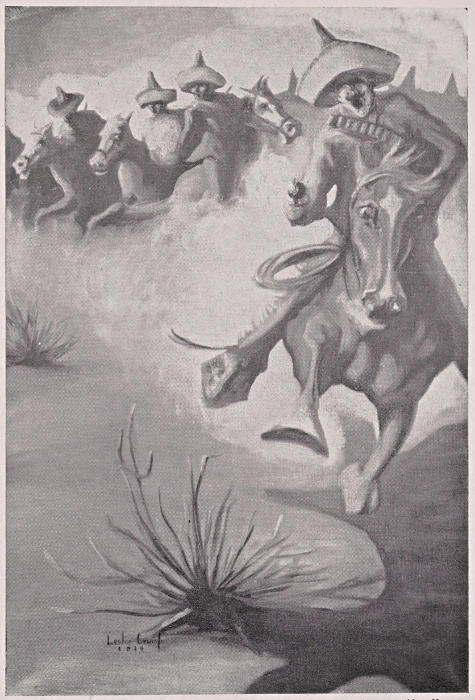
Five members of the “D” club had gathered
in Jack Straw’s room on the top floor
of Phillip’s Hall the last Saturday afternoon
before the end of the Spring term. They had
not assembled in official conclave, indeed they
had not intended to assemble at all. They had
merely gravitated there one by one in search
of something to take their minds off the worst
disappointment they had been compelled to
face that year. The Drueryville-Seaton baseball
game, the one that was to have settled the
preparatory school championship of Vermont,
had been scheduled for that Saturday afternoon,
and, lo and behold, in spite of the importance
of the day, Jupiter Pluvius or whoever
it was that controlled the rain supply,
had made the game impossible by deluging
everything in sight since early morning. And
there was no chance of postponing the contest
either as school closed the following Friday.
The championship would have to remain undecided.
And this was just the year Drueryville
stood a better chance than ever of adding the
“prep” cup to her trophy case. It was enough
to make anyone glum.
“They should have named this place Drearyville
instead of Drueryville,” muttered Toad
Fletcher, the stocky little catcher of the team,
as he looked across the deserted campus at the
dripping eves of Bradley Hall.
John Monroe Strawbridge, who was known
to every boy in school as Jack Straw, shifted
his position on the window seat so that he
could take another look at the weather.
“It is pretty gloomy on a day like this,” he
answered after searching the leaden sky for
some signs of a break in the low hanging
storm clouds.
Jack and Toad were too dejected in spirit for
conversation and since Bunny Baily was deeply
engrossed in a book of fiction and Dick Cory
and Harvey Maston were working out an absorbing
game of checkers silence reigned in the
room for some time. In fact a stranger passing
the door would never have suspected that
five perfectly normal, healthy boys were within.
But then the “D” club was composed of the
honor boys of Drueryville Academy and for
that reason if no other, they were bound to be
more dignified at times. You see the “D” club
was made up of the students who had won the
privilege of wearing a white and blue initial,
the insignia of the school, on their caps or
jersey; and in order to earn that distinction a
boy must needs work hard both in the class
room and on the athletic field. When a youth
successfully attained such laurels the crown
was apt to weigh heavily.
How long the clicking of checkers would
have remained the only sound is hard to tell
had not Tommy Todd happened to see Jack
Straw curled up in the window seat. He
paused a moment before Phillip’s Hall and
waved his hand in friendly greeting. Then he
splashed across the muddy road and came up
the stairs three steps at a time. Like a small
portion of the storm itself (for Tommy was by
no means a big boy) he burst into the room,
his yellow raincoat and rubber hat dripping
wet.
“Say, don’t flood the place!” shouted Jack
as he noted two growing pools of water on the
rug.
But Tommy only grinned as he removed his
wet garments and draped them over the back
of a chair so that they would drip on the
hearthstone.
“Sort of hard luck to have a day like this
happen along just when it isn’t wanted,” he
suggested to no one in particular. Then without
waiting for a response he looked at Jack
and spoke.
“Say old man, I can’t think what on earth
you’ve been up to recently, but there’s something
in the wind. Dr. Moorland wants to see
you as soon as possible. I just came from his
house and he asked me to look you up. I was
going on downtown first because the last place
on earth I ever expected to find you was in
your own room. What’s the trouble anyway?
You haven’t done something that will keep
you from getting through next week, have
you? It’s mighty close to the end of the term
and I hope you’ve been careful.”
At this Cory and Maston suspended their
game for a moment and Bunny Baily put down
his book. All eyes were turned on Jack Straw.
And as for Jack, it must be confessed he looked
startled and somewhat worried. Hastily he
ran through his mental diary, but so far as he
could see no one entry stood out above the rest
as warranting reprimand from the principal.
“I haven’t the slightest idea what he can
want of me,” he assured his guests as he
hastened into his bedroom and donned raincoat
and rubbers. A few moments later he
hurried out into the hall and down the broad
stairs toward the main entrance. As he
passed the mail rack in the hall he noticed a
letter waiting for him. Hastily he seized it
and crammed it into his pocket, noting as he
did so that the address was written in his
father’s hand.
Dr. Theodore Moorland, the principal, lived
in a modest little cottage on the north side of
the campus. It was almost hidden in a grove
of tall maples and, as if to make itself more
inconspicuous, it had permitted woodbine and
ivy to clothe its gray stone walls in a cloak
of soft green. A graveled road that wound
between fat old maples showed the way to the
front door, and it was up this much used path
that Jack Strawbridge hastened, his mind still
puzzled over the reason for such an unusual
command. The heavy old-fashioned door to
the cottage was equipped with a ponderous
brass knocker of quaint design which thumped
with such resonance as to spread consternation
in the soul of youngsters summoned
thither. Thus they were thoroughly disturbed
before they even faced the austere old master.
Such was not the attitude of Jack Straw,
however. He had not been able to remember
a single reason why he should expect to face a
scolding from Dr. Moorland. Every examination
paper had come back with excellent
markings and his conduct for some time past
had been beyond reproach. He thumped the
old door knocker twice in his eagerness to find
out just what the master wanted. Perhaps it
was news from home, he thought, and he comforted
himself by the fact that nothing serious
had happened to his father, for the letter in his
coat pocket attested to the fact that he was
still well enough to write. But while he was
speculating thus the door was opened by Dr.
Moorland himself.
The dignified pedagogue greeted the boy
with a broad smile and a hearty hand
shake.
“I didn’t know but what you and some of the
rest of the boys had about grieved yourselves
to death over your ill luck at having the championship
game broken up by the weather,” he
said as he ushered Jack into his study in a
secluded wing of the house.
“It is rather hard on us,” said Jack with a
smile. “Here we’ve been working since February
to get our team in shape for the trophy
contest and then a little thing like the weather
spoils it. Next year I think we will have to
arrange to have the championship game a little
earlier so there will be enough time to play it
in case of an emergency like this one.”
“Never mind, Jack, my boy,” said the principal,
“I have a mission for you that is calculated
to take your mind off baseball and
similar troubles for some time to come.”
The boy was plainly puzzled at this remark.
He looked curiously at the principal who was
striding the room nervously. Dr. Moorland
was a tall, broad shouldered man of sixty.
His hair was snow white and so long in back
that it curled down over his coat collar. A
pair of horn rimmed spectacles that were constantly
sliding forward on his nose made him
appear to be a testy individual, but in reality
he was a genial old gentleman who loved his
boys as much as if he was the father of every
one of them. The State of Vermont counted
him among the best of its educators and he was
famed throughout the country, indeed throughout
the world as a chemist.
“Jack,” he said after a long silence, “how
would you like to go to Mexico?”
“To Mexico!” gasped Jack.
“Yes, to Mexico. It will be an opportunity
for you to see a wonderful country and also
to make enough money to pay your tuition at
Drueryville next year. Do you care to go?”
“Why—why—Oh, I’d be delighted—but—well
I’d have to get father’s consent first, you
know.”
“Ah, Jack, you don’t suppose I would have
suggested the subject before consulting your
father about it, do you? I wrote him several
days ago and asked his permission to let you
go. I received word this morning that he was
perfectly willing to have you avail yourself of
the chance to see a little of the world providing
you cared to go. I wonder that he hasn’t
written to you about it.”
“Why, perhaps the letter I have in my pocket
now is about that very thing,” said Jack,
searching in his pocket for the envelope.
“Very likely,” said the principal, “but you
can read it after. Let me explain exactly what
I want you to do. When you have heard the
details you can decide better whether you want
to go.”
Dr. Moorland had ceased pacing the room
and settled deep in his comfortable study chair.
With what seemed exasperating deliberateness
to Jack, he removed his huge glasses and polished
them thoroughly on his handkerchief before
he was ready to talk. Then just as he
was about to begin he seemed to remember
something else of importance, for he began to
search drawer after drawer of his desk until
he finally brought to light a large yellow envelope
bulging with what appeared to be blueprints.
He tossed the package on the desk
before him and once again resumed his comfortable
attitude.
“Perhaps you never heard of my nephew,
Harry Ryder. In fact, I am quite certain you
haven’t, for he has never visited Drueryville
since you’ve been at school. Harry Ryder is
the chief engineer of the enormous hydro-electric
power plant at Necaxa where light and
power is supplied for Mexico City, the capital,
one hundred and twenty-five miles away. He
was appointed to that important position by
President Madero a year ago, and he has done
his best to keep Mexico City lighted in spite of
all the trouble in that turbulent republic, and
the recent change to the Huerta régime.
“Time and again rebels have tried to break
down the four transmission lines that carry
the current to the city but they have never yet
been successful and I judge from Harry’s letters
that he never intends they shall. But besides
rebels, Harry has other important things
to contend with. Up there in the mountains
where the plant is located, thunderstorms are
quite frequent and lightning is the troublesome
element. Lightning is electricity in its
most dangerous form, because of its very high
voltage. Voltage, you know, is the pressure
which causes it to travel. One of our scientists
once tried to measure lightning and
found that its voltage mounted well into the
millions. This is tremendous force when you
consider that the current used in lighting
houses and stores is supplied at one hundred
and ten volts.
“During thunderstorms the lightning plays
about the transmission lines, often causing a
great deal of trouble. If it should by any
chance get into the station it would raise havoc
with the generators and other machinery. To
prevent this, lightning arresters have been
constructed that will waylay the lightning, as
it were, and send it into the ground before it
reaches the vital machinery.”
Here Dr. Moorland paused and began to
sketch rapidly on a piece of paper while Jack
looked on, still very much mystified.
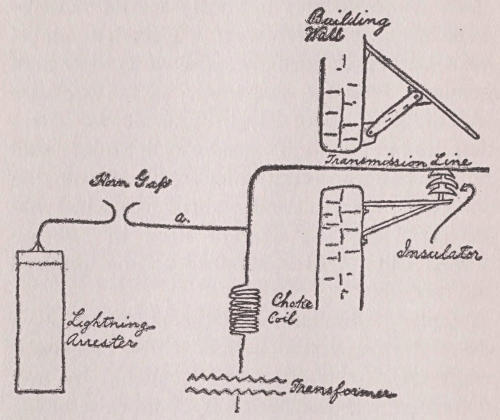
Dr. Moorland’s Sketch
“The usual transformer is arranged something
like this. First a choke coil is put in the
transmission line near the end. When the
lightning strikes this coil it piles up and is
forced back exactly like a flying wedge of
football players that suddenly tries to break
through an impregnable defense. The lightning
that is thus forced back rushes into line
‘A,’ which is the point of least resistance,
jumps the horn gap and plunges through the
arrester tank and into the ground. When the
excessive electricity has left the line and the
flow is normal, the current is checked at the
horn gap and arrested. This combination of
gap and arrester does not permit current to
flow into the ground during normal operation
and does not actually become active until lightning
gets into the line and there is danger of
the plant being wrecked by an overload of electricity.”
“My, but that is interesting,” said Jack
Straw as he fingered the master’s sketch. Indeed,
he had been so carried away with the
description of that interesting piece of engineering
work that for the moment he had completely
forgotten about Mexico. But Dr.
Moorland revived his interest with his next
sentence.
“And now for my reason for wanting you
to go to Mexico. The lightning arresters now
in use are not entirely satisfactory, and Harry
Ryder has been trying to build one on completely
new lines. Indeed, he has perfected
the contrivance, except for a neutral chemical
solution of a new nature for which he asked
me to construct a formula. He forwarded
his drawings for me to look over and now I
am ready to send them back. But a few
weeks ago, Harry communicated with me and
asked me to take particular care that the drawings
reach him safely. In fact, he suggested
that they be sent to him by messenger instead
of by the mails. You see, Mexico is in a state
of extended turmoil now with Villa, Carranza
and Zapata all carrying on campaigns against
Huerta, and under such conditions the mails
are not trustworthy. In fact, I understand
from Harry that three-quarters of the mail is
destroyed by revolutionary forces and that the
rest of it is left lying in almost any corner of
the republic until it can be distributed.
“These drawings,”—Dr. Moorland fingered
the bulky yellow envelope as he spoke,—“are
far too valuable to trust to such mail service
and since Harry is willing to meet the expenses
of a messenger and at the same time pay
him for his services, I can see no reason why
you should not be the one to take them safely
to Necaxa.”
“Why, I’d be delighted with the undertaking,
if you think I can do it satisfactorily,”
said Jack.
“And why can’t you do it satisfactorily?”
demanded the principal rather bruskly. “Any
boy whom the students of Drueryville honor
by electing captain of the football team for
two successive seasons certainly must have
some good qualities. You are strong and
healthy. You are not a coward and above all
you are reliable. These are qualifications that
I could not find in every man. Will you go,
Jack?”
“Yes, I will. When do I start?” asked the
boy enthusiastically, and from the expression
on his face it was evident that he was pleased
with the confidence the old master had in his
ability to carry out the mission.
“A steamer sails from New York on Saturday
next. I would like to have you be on
board when it leaves the dock for I am more
than eager to have the drawings back to their
owner and the responsibility off my mind.
Then, too, I am afraid the hostilities in Mexico
might become more serious. You will have a
week to prepare for the journey, and since I
have looked up all your examination papers
and found them above the proper rating I will
excuse you from school for the last week of
the term and you can spend that time with
your father, for I know he has many things to
say to you. You can leave Drueryville on the
ten o’clock train to-morrow morning after you
have called here to receive final instructions
and the precious drawings. And now you
must hurry back to your room and pack.
Good afternoon and good luck to you.”
It was a rather serious moment for Jack
when he shook hands with Dr. Moorland. He
realized that the old schoolmaster was putting
great trust in him. It was in truth a struggle
for him to hide his emotions as he bade the old
man good afternoon.