NOTE—This volume is copyrighted, as noted below. Parties are warned
against the unwarranted reproduction of photographs or articles from it. Application
for permission for such reproduction should be made to Manly F.
Miner, Kingsville, Ontario, Canada.
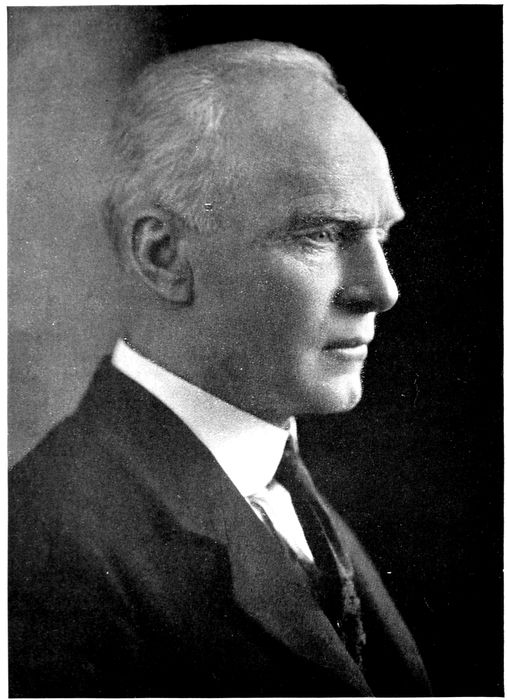
Long and intimate acquaintance with the author of this book
must be my apology for attempting to write a brief introduction.
Meeting Jack Miner for the first time in 1888, I was at once impressed
with his striking personality. I found myself instinctively
attracted to him, and a cordial friendship sprang up between us,
which grew in intimacy as the years passed. Although lacking in
academic culture, his manner was decidedly urbane, and it was not
long before I discerned beneath his rough exterior an enshrined soul.
Inheriting, as I did, a passion for dog and gun, I cultivated his
friendship, and many delightful days have we spent together afield.
I was a novice in woodcraft; he taught me to hunt and shoot. Many
a bird fell to his gun for which I took full credit in those early days,
until, on one occasion, when I had made, as I thought, a particularly
clever kill, I glanced over my shoulder as I heard him say: “Good
Shot, Doctor!” only to see him hurriedly slipping a shell into the
smoking breech of his gun. I said: “Did you shoot, Jack?” and
his face betrayed guilt as he replied: “Take more time, Doctor.
If you hit a bird fair at that distance, you will have nothing to
pick up!” I was shooting too soon, and of course missing. He had
got on to my time, and was now and then dropping a bird, apparently
to my gun, to give me confidence.
What impressed me most, perhaps, in the days of my novitiate
was the determination with which he pursued a wounded bird. He
would spend an hour ferreting out a cripple rather than leave it to
die in misery, or become the prey of its natural enemies, owls, hawks
or vermin. He invariably repiled the logs and brush he had dislodged
in his efforts to retrieve a wounded bird. And this is but
one evidence that a keen sense of justice, a full regard for the rights
of all living creatures, are conspicuous traits in Jack Miner’s
character.
Years passed. Until now he had held aloof from church and
social life in the community. Then trouble came. Trouble, that
so often floors the weak man, is the strong soul’s opportunity to
reveal itself. Thus it proved in Jack Miner’s case. Death robbed
his family circle of three of its members in a comparatively brief
period of time. Of an exceptionally emotional and sympathetic
nature, his grief was overwhelming. Something had to move, or
break. Gradually he came over to the allies, and became active in
social and Sunday school work. All his dormant virtues seemed
bursting with life, and latent genius sprang into activity. He pursued
his hobby of making friends with the birds with a zeal, as it
were, begotten of despair. Steadily he plodded on in the face of
financial burdens, in spite of the discouraging indifference of the
many, and in defiance of the more malignant opposition of the few.
Ultimately he secured possession of the entire Miner homestead.
He procured thousands of evergreen trees from the Government, and
using native trees as well, prosecuted his work of beautifying his
surroundings, until he had transformed what was an ordinary farm
of two hundred acres, without one attractive feature, into a place
which would arrest the attention of the passer-by, and which formed
a veritable paradise for birds and waterfowl. Inheriting a love of
the beautiful from his mother, he has developed his home surroundings
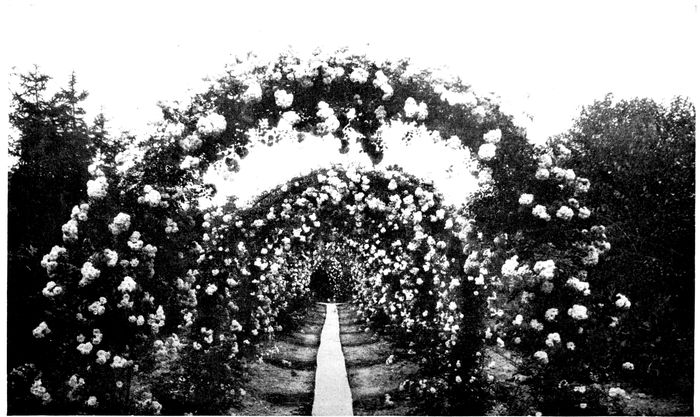
into a bower of lilacs and roses. I venture to say that there is
no spot in Western Ontario, if indeed in the entire Province, that
attracts to itself, season after season, the thousands of visitors—distinguished
men and women of Canada and the United States—that
come to see the Miner Bird Sanctuary.
As a lad, however, he did not see exactly eye to eye with his
mother. Of what use was an old, battered spoon, the sole surviving
member of a set of pewter, that had been in the family for generations?
He would convert it into smooth, round bullets, and make
it contribute to the upkeep of the table. So one night the spoon
went into the melting-pot, to appear in a few days on the table in
the form of savory venison steak, and Mrs. Miner was left guessing
what had become of her precious heirloom.
Jack Miner has built an enduring monument to his patient toil
and his unfaltering confidence in an over-ruling Providence, that
will stand for all time. That this untutored man of the woods is
able to entertain and interest vast concourses of people in our college
halls throughout Canada and the United States, being recalled
season after season to our educational centres as well as to our towns
and villages, to deliver his lectures, is convincing evidence that he
has a world message and can deliver it with compelling force.
I have read “Jack Miner and the Birds” in manuscript form. It
is a remarkable book, by a remarkable man. While it makes no
pretensions to literary excellence, it is free from faults of egotism
and verbiage, often present—almost laconic in style. It contains
much valuable information, expressed in trite and witty language,
and will prove a valuable addition to our works on bird lore.
Of more interest, perhaps, to the average reader will be a brief
narrative of a few episodes in the life of Jack Miner. With characteristic
self-effacement, he has refrained from incorporating in
his book any incident in which he might seem to figure as the hero.
Nevertheless his life has not been without tragic experience and
thrilling adventure.
No sketch of his career, however brief, will do him justice without
reference to his elder brother, Ted, whom Jack regarded with the
profoundest respect and reverence. They played together—if work
can be called play—hunted together, slept together, and lived with
and for each other. As boys they practised shooting with a rifle
at snowballs thrown into the air, at twenty-five yards rise, until they
became so expert that they could break forty-six out of fifty.
In 1898, when the brothers were hunting with a friend in Northern
Quebec, Ted was killed instantly, shot through the head by the
accidental discharge of his companion’s gun, as he was dropping on
one knee to dispatch a wounded and charging bull moose. Imagine
the situation, if you can! Jack came running down the ravine
through which he had driven the moose, confident that the boys
had made a kill, only to meet his friend running toward him, his
face pale as death, frantically shouting: “I have killed Ted!” Though
dazed by the shock, Jack nevertheless realized the necessity of submerging
his emotions, for the occasion demanded sane judgment
and prompt action, and the friend was helpless by reason of his grief.
They were twenty-five miles from the nearest railway station; help
must be procured promptly and—it was up to him. Washing the
blood from his dead brother’s face, and pressing a kiss on his pallid
brow, he covered his body with snow, lest the smell of fresh blood
might attract a band of prowling wolves before he could return, and,
leaving him within a dozen feet of the big bull moose he had shot
as he pulled the trigger for the last time, Jack set out for help. He
ran thirteen miles to the nearest settler’s cabin, where he procured
the aid of an old man and his boy. On returning to the scene of the
accident, a litter was improvised on which the body was placed, but
the absence of all trail, and the deep snow, made it impossible to
proceed except in single file, and so Jack took his brother, who
weighed 202 pounds, across his shoulders as he would a dead deer,
and carried him almost the entire distance of thirteen miles, while
the other three men cut brush and broke trail. Arriving at the
lake they placed Ted’s body in the bow of a home-made punt, and
Jack paddled twelve miles down the lake in the face of a blinding
snowstorm, making the entire distance in twenty-four hours. From
this terrible strain he has never fully recovered.
Many times he has rescued men lost in the woods. Indeed he
has never once failed to bring his man out alive, although in some
cases he had nothing human to guide him, all trail having been
obliterated by heavy snowfall. For this signal success he takes no
credit to himself, but attributes it to Divine Guidance in answer to
his petitions.
On one occasion he was gone from camp forty-eight consecutive
hours without sleep or rest, and with little food, tramping through
snow up to his knees, in search of two men who had strayed in
entirely opposite directions. He brought them both to camp, his
hands being frozen during his adventure.
On another occasion, when hunting moose in Northern Quebec,
at about three o’clock in the afternoon, he heard in the distance
signal shots of distress. It gets dark early and suddenly in the
North in November, but Jack immediately broke into a run, never
stopping until, just at dusk, he came up to a young guide, standing
guard over a man fallen in the snow. This was a well-to-do gentleman
who had joined a hunting party, but was overcome by the
strain of the unusual fatigue. His clothing had become saturated
with the wet snow, his limbs lost all sense of feeling, and he fell,
unable to move hand or foot. Jack Miner gave the rifles to the
guide, hoisted the man, who weighed 185 pounds, on his shoulders,
and carried him to an old lumber camp five miles distant in less
than two hours. Other members of the party arrived, a fire was
made, and hot coffee, hot flannels, and much rubbing, eventually
brought feeling into the benumbed limbs. By morning the man
was able to walk. As so often happens, the most solemn occasion
is not without its spark of humor. When all immediate danger
seemed to have passed and enquiry was made as to the whereabouts
of the rifles, the guide, with the utmost sangfroid, said: “I left them
stacked back in the woods at the scene of the tragedy!” Since no
one but Jack would brave the dangers of the dark and the swollen
river which had to be crossed on a fallen tree, it was up to him to
retrieve the guns, and he did it.
He was never so happy as when studying the lives and habits
of the wild creatures, whether it was the timid field mouse or the
lordly moose, the socially inclined Chickadee or the elusive Canada
goose. Thus did he lay the foundation of the success he has achieved
as a hunter and naturalist.
In traversing the forest his sense of location and direction is akin
to that of the denizens of the woods. When an Indian caches his
game, intending to return for it at some future time, he blazes trees
and breaks twigs to guide him back. Jack Miner was never known
to blaze a tree nor break a twig for the purpose of locating a dead
moose or a beaver-trap. He can follow a trail all day long to every
point of the compass, and at nightfall turn his face directly toward
camp. If on the following day he wishes to return to any spot
visited the day before he will go to it with a directness and accuracy
almost uncanny.
Years before he ever set foot in the northern woods he and Ted
planned annual hunting excursions. They were the pioneers of big
game hunting in Essex County, and while it is true that Jack Miner
has killed car loads more game than any other man in Western
Ontario, it must be remembered he never wasted a pound of meat,
nor kept more than perhaps ten per cent. of his kill for his own use,
but gave it away to rich and poor alike. He organized moose
dinners for charitable purposes, even buying meat on one occasion
when he had not enough of his own to supply the tables.
So did Jack Miner, the boy dreamer, become Jack Miner, noted
naturalist, popular lecturer, and Canada’s Famous Birdman.
—J. Earle Jenner, M.D.
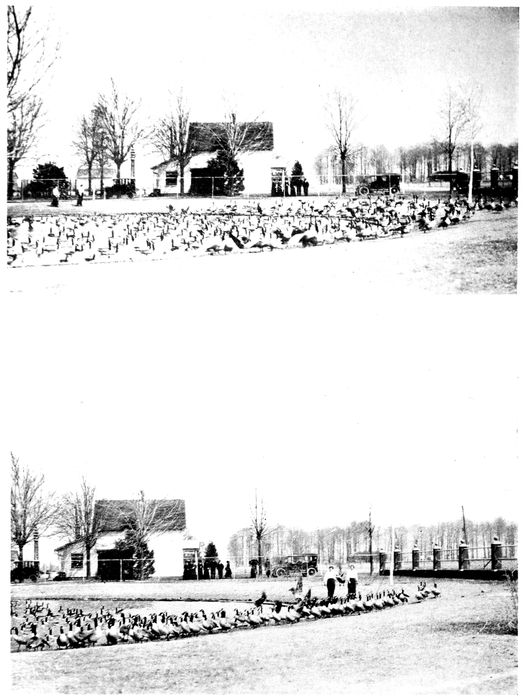
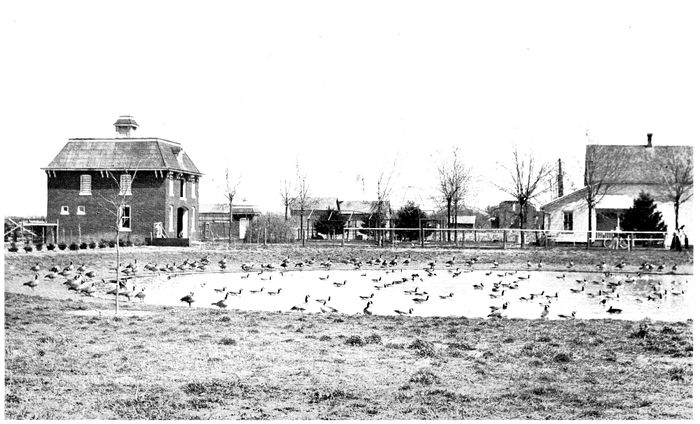
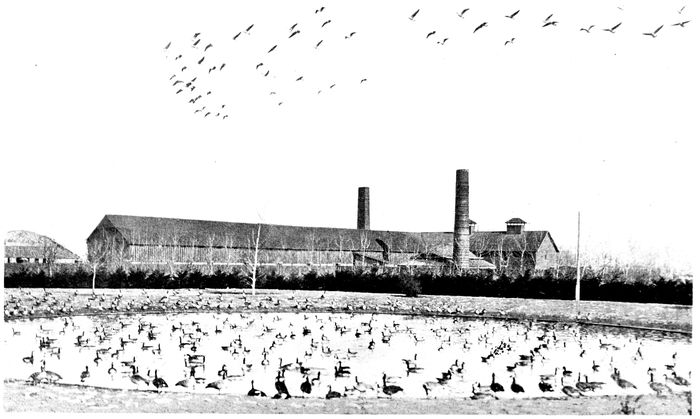
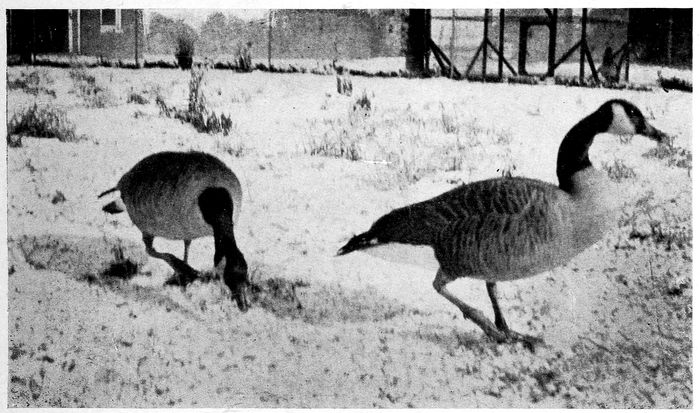
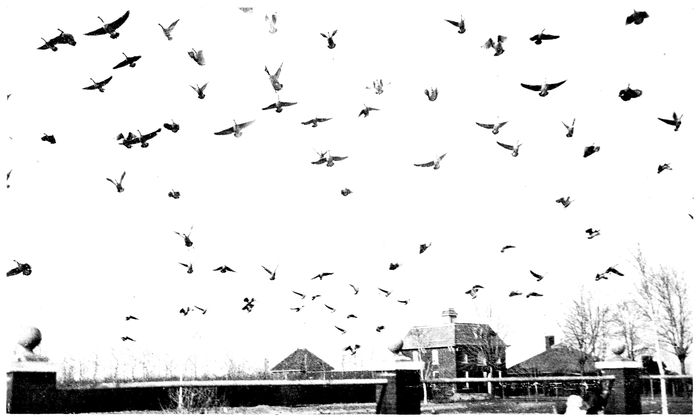
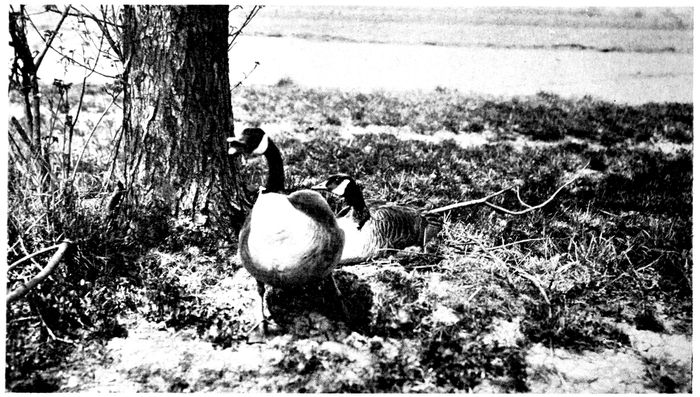
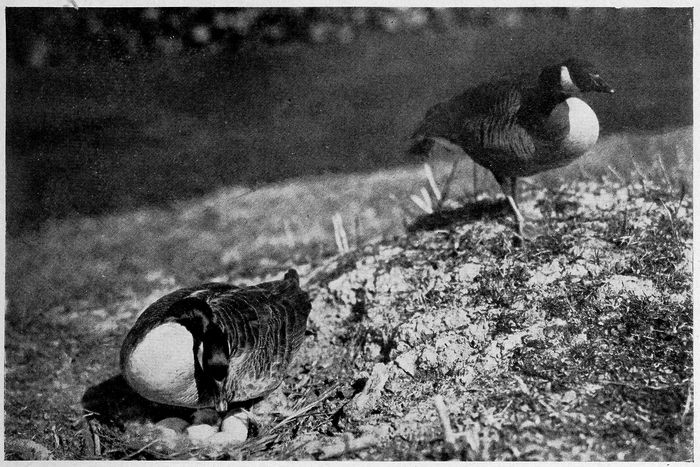
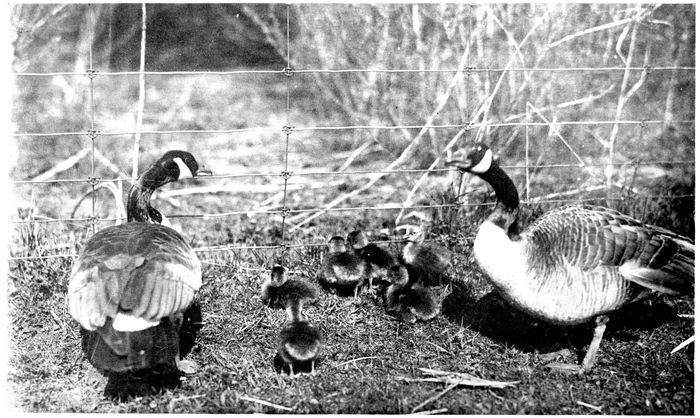
WILD GEESE AT MY HOME
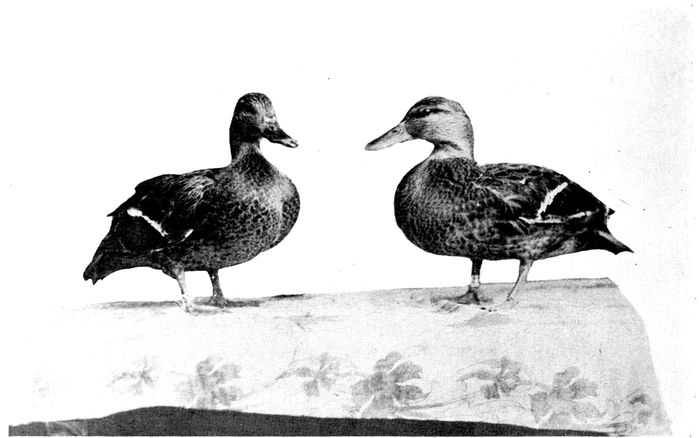
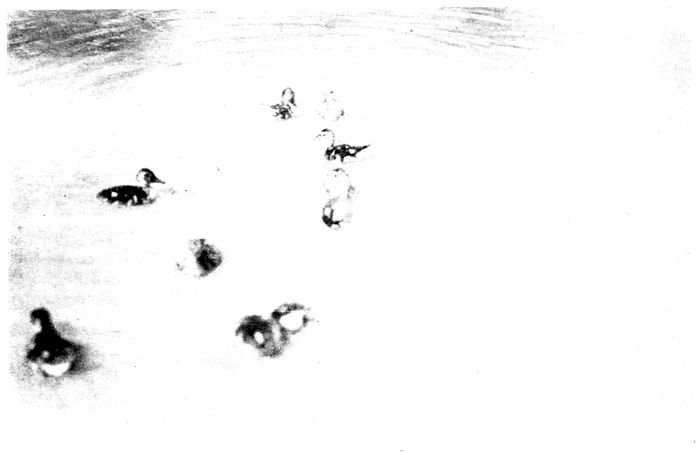
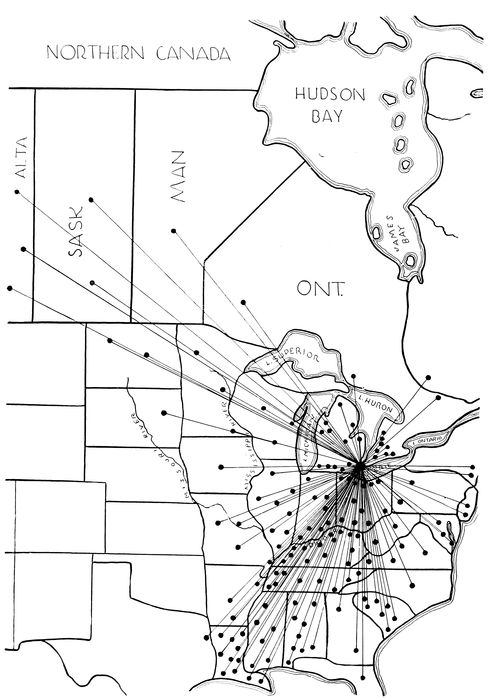
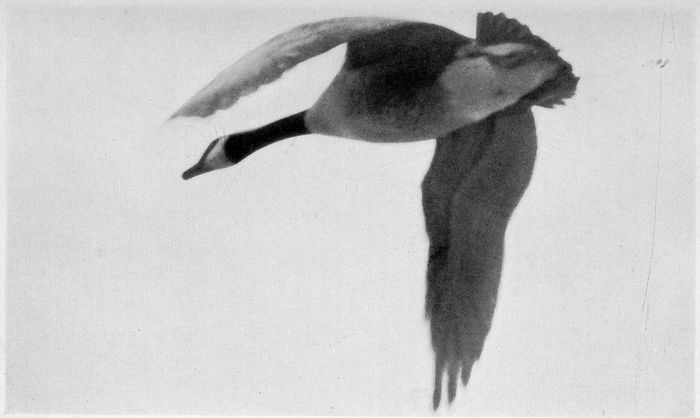
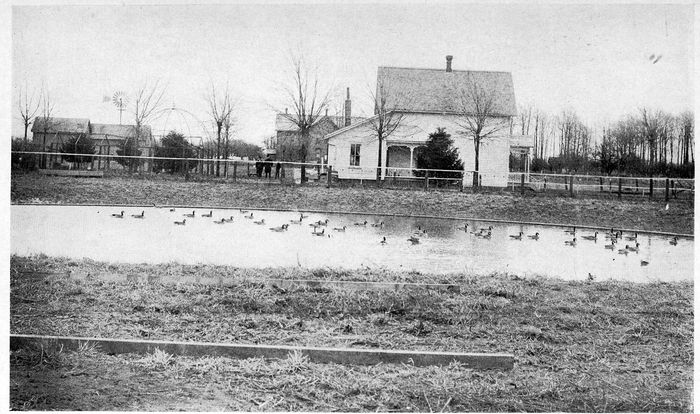
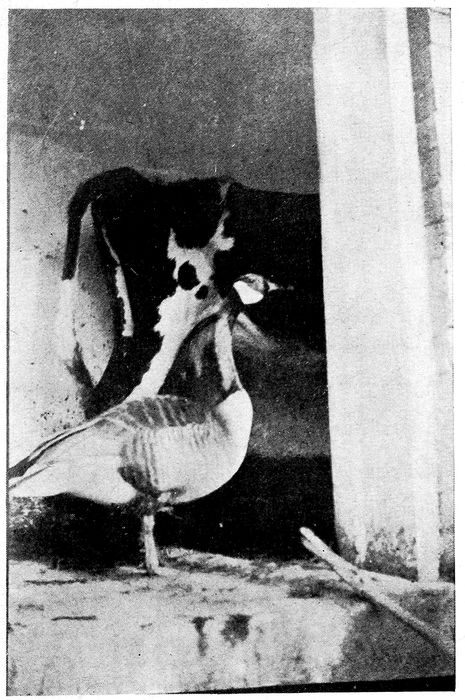
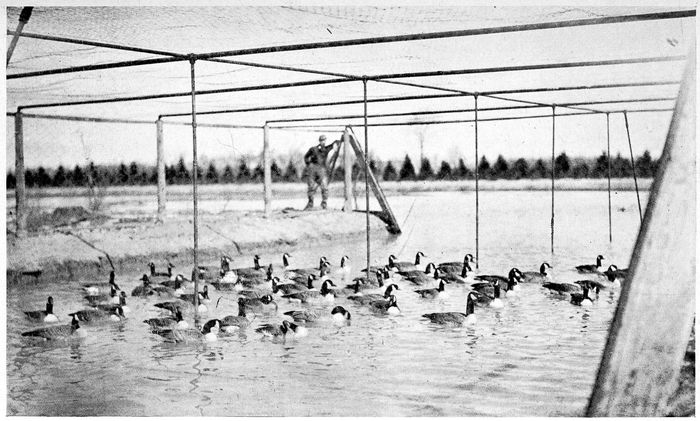
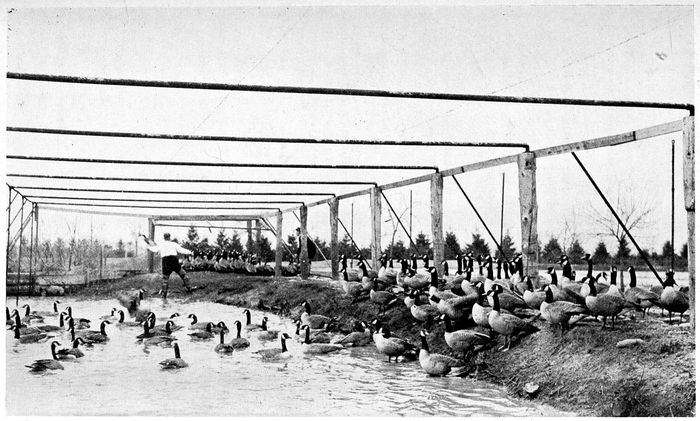
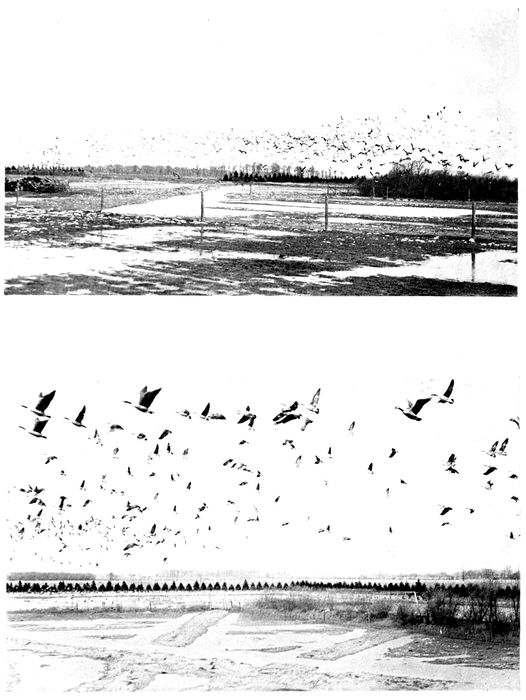
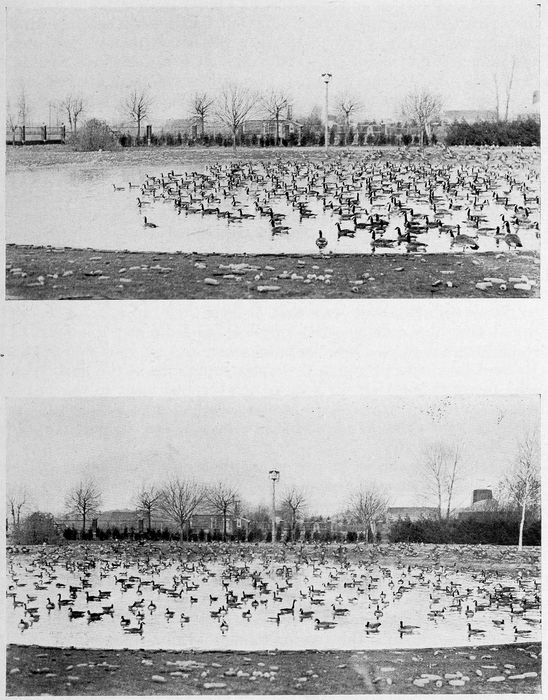
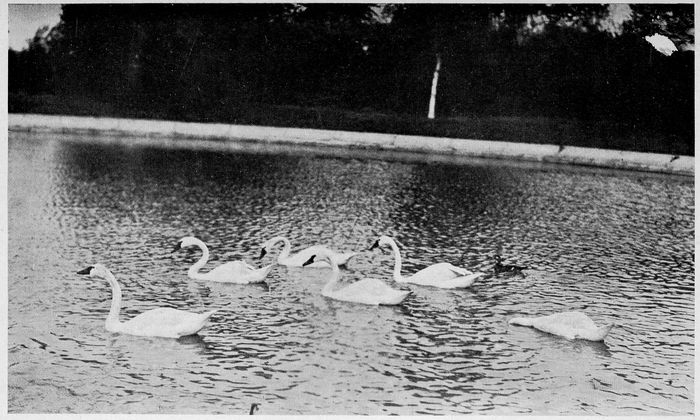
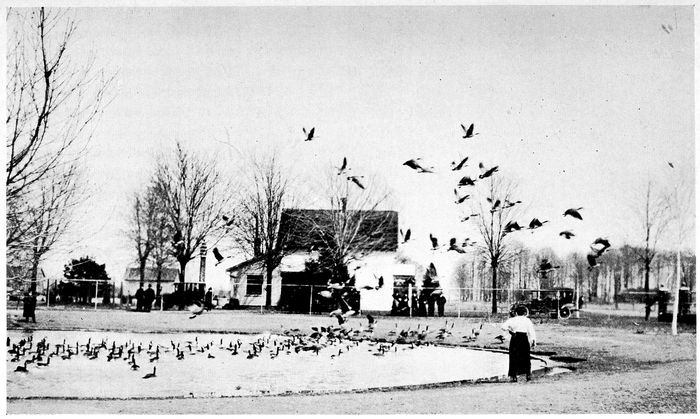
These birds belong to you as much as they do to me. They winter on the South-East Coast, and nest on Hudson Bay. In fact the only bird in this bunch that belongs to me is the lady to the left of the two in the lower photograph.
INTRODUCTION
My reason, dear reader, for writing this book, I will assure
you is not to expose my A, B, C education, but simply because
my many friends have requested me to put into book form at least
a portion of my interesting experiences.
For years I have simply ignored such requests; but the more I
thought about it, the more seriously it appealed to me. So this
morning I loaded up chair, stove, tent, etc., and made my way to
the woods, where I am at home, and away from the wires of communication
and the honk of the automobiles, and even the enquiring
voice of my little boy. I have run away from them all and have
pitched my tent in the woods.
As I was out gathering wood for the camp-fire I quietly looked
around, and a few remnants of old stumps are still visible where I
helped to cut the virgin timber, the forest that provided a home and
shelter for the raccoon that I once hunted by night, and the birds,
from quail to the wild turkey, that I hunted by day. About one
hundred yards to the east of where I am sitting is where I split my
big toe with a nine-pound broad-axe while hewing railroad ties when
I was but fourteen years of age. But Nature is helping me to
replace a little, and the second-growth trees are from thirty to
fifty feet high.
A hawk has disturbed the Bob-Whites that are increasing in numbers
very rapidly, and the sweet tones of their familiar voices are
making this old spot fairly ring. In fact the very atmosphere seems
so full of cheer that when I entered the tent and sat down to write,
I first whispered a few words of silent prayer of thankfulness, and
asked God to guide my untrained hand so that you will understand
my meaning.
Let me assure you I will be as brief as possible. And while I
am very thankful to my many friends who have offered to write it
for me if I would only dictate it, yet I firmly believe the majority of
readers will enjoy these facts right from the awkward hand of Jack
Miner better than if they were polished too much. While it may
read very unreasonable, yet please don’t forget that outside of a
little joke I may attempt to crack, the rest is all facts gathered from
personal experience and observation, and I assure you these views
are not second-hand, as I am a very poor reader and have never
read a book through in my life.
—J. M.
Jack Miner and the Birds
CHAPTER I. Who is Jack Miner?
1
Now, as you have this book in your hands and have looked at
the name of the writer, and possibly flipped over a few pages,
glancing at the interesting illustrations, etc., I imagine I can see
you raise your head, as your eyelids come down for an instant. “Who
is Jack Miner? Who is Jack Miner?” This thought repeatedly
flashes through your mind.
Well, let me assure you of this fact, that Jack Miner is not Old
Bill Miner, nor Jesse James, and although I have been raised in the
woods, that is no evidence that I have split feet and antlers. But
I will admit there has been many a time in my life that if you could
have seen me you would have thought you were looking over Esau’s
line fence.
However, just who I am is a question I am not prepared to
answer, as it is not a history of my life I am supposed to be writing;
but in a few brief words will say that my dear mother’s people that
are in America are a good, self-sacrificing, respectable, God-fearing
people. And my father never had but one full sister; yet, he said,
where he lacked in quantity he made up in quality. Father and
mother were both born in Leicestershire, England. As to my father,
I know he was a truthful, honest man, and, according to his own
story, he was raised on the toe of a step-father’s boot. A few years
after he graduated from this lofty position, he followed mother and
her people to America, and eventually overtook them in the good
old State of Ohio, and on the 10th day of April, 1865, I was born,
bare-foot. According to my oldest brother’s statement, father was
at that time quite down-hearted over the fact that his old favorite
yellow tom-cat had been coming home absent for about two weeks,
and he had given up all hope; but as soon as I arrived and he saw
my complexion, he took me out and laid me in brother’s arms, and
as he raised up he clapped his hands together, quite cheerful, and
said, “Ted, we’ll call him John Thomas.” John Thomas it really is.
Fortunately, my friends have shortened it down to just Jack.
2
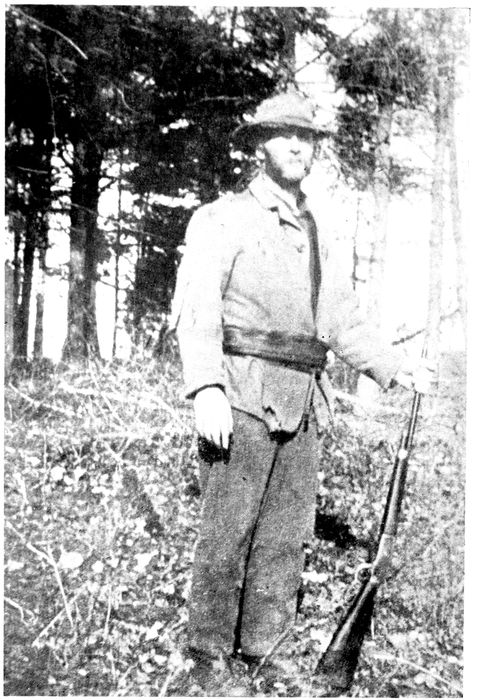
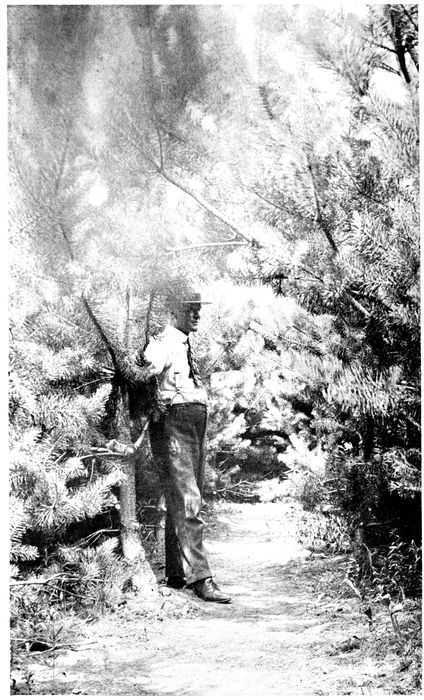
LOOKING OVER ESAU’S LINE FENCE AT THE WRITER
Photograph taken in 1907 while on a Moose Hunt.
We were very poor financially, and as I was second-oldest boy
in a family of ten children, I had to put a shoulder to the wheel and
help roll the bread-wagon. The result is I was educated for ditching,
cutting cord-wood, and splitting rails. In the spring of 1878 father
decided to migrate, and at the age of thirteen I was liberated here
in Canada, a sportman’s paradise. I took to the woods as naturally
as a park hare, and I know I was father’s favorite because he always
called me to build the fire in the morning, and when the other boys
3would lodge a tree I have often heard him shout, “Come out and
come away from it! You’ll get ’urt! Leave it w’ile Jack comes;
’e’ll go hunder and cut it down.” If we were splitting rails, father
always set the wedges, permitting me to handle the maul.
Father and mother enjoyed life together nearly sixty years and
put up with the mingled enjoyment and annoyance of us ten children.
How some of father’s teachings still ring in my ears! When I have
gone to him with complaints about others he has often said, “Shut
up; I don’t want to ’ear it. But if you have some of your own failings
to tell, let’s ’ear ’um.” Yes, he was always short but to the point.
One piece of advice that he gave us boys I have always tried to
practise; that was: whenever we grabbed hold of anything and found
it was red-hot, to drop it.
But now let me lay these smiling facts aside for a few seconds and
close my introduction to you in real earnest. For, outside of unavoidable
sadness, my life has been one continuous round of enjoyment
made up of failures and disappointments and dark, stormy
clouds, which have been completely trampled out of existence by
success that in every case exceeded my expectations, and has caused
the sun to shine so brightly that it has illumined my path clear up
to the Great Divide, and given me an imaginary glimpse of the
beautiful Beyond.
CHAPTER II. My First Pets.
4
Well, the first pet I can remember having was a young blue
jay. I was, of course, very anxious that he should live, so I
filled him to the top with fish worms. The next morning the blue
was there, but the jay was silent.
The next I have any recollection of was when father took our pet
’possum by the handle and wound it around the corner of the old
stable, to settle a quarrel which arose between my brother and myself
over its ownership.
I remember I started one spring with a pair of white rabbits, and
when fall came, I had every box on the premises full; even father’s
old wagon-box was turned up-side-down with a snarl of rabbits
under it, and when he used the box my troubles were many. As I
knew how to set traps around my rabbit pens I am strongly of the
opinion that some of the neighbors’ cats haven’t got home yet.
How well do I recollect seeing the wild geese, and hearing their
“Honk! Honk!” as I strained my young eyes to see them ’way
up there, often having to look twice before seeing them, as they
passed, in spring and fall, over the good old State of Ohio on their
migrating trips. Oh, how I used to stand with clenched hands and
wish I were a man so I could follow them somewhere and secure
one, but not until I got to Canada did the real fun begin.
All kinds of game, and such a variety of pets as I had; squirrels,
coons, foxes, crows and ravens, and I even got a nest of young hen
hawks and kept them until father found it out. You know in those
days there was one day in the week that we did not work, and I
made every minute count; and although I had miles and miles of
woods to roam through, night and day, yet my ambition was a little
higher. So I secured a pair of tree-climbers, and then there was no
tree high enough for Mrs. Crow or Mrs. Hawk to raise her young
so as to be out of my reach.
Well do I remember shooting my first deer, and how I burglarized
the top shelf of the pantry to get one of my mother’s old pewter
spoons. This spoon had a great handle to its history, being handed
down from somewhere this side of Noah. I pounded it, to remove
the ancient look, melted it and ran seven small bullets, while my unsuspicious
5mother looked on at the operation of melting and moulding.
By daylight the snow had ceased falling, and I put the seven
balls in the “thumb-hand” barrel of the old shotgun and started
on my first deer hunt. By noon I was back with a fine deer, and
if I had had a melted spoon in the other barrel I surely would have
killed two.
CHAPTER III. Market Hunting.
6
As quail and grouse were so very plentiful and good warm
clothes were scarce, the second fall we were here my brother and
I started to hunt for the market. This caused us to study the nature
of game. I soon found myself practising the call of Bob White.
I would call early in the morning, when the country was silent, and
listen to the echo come back from the woods, until I could call Bob
right up to me from as far as he could hear the faintest sound of my
imitative note. Yes, many a time during the nesting season have
I called five or six male birds up near where I was sitting, then see
them have a scrap. I tell you they are gamey little fellows. And
what fun it was to be back in the field, hid in a bunch of goldenrod,
with my old slouch hat tucked in my pants pocket, allowing my long
hair and freckles to blend with the surroundings, and watch these
plump little beauties come together in battle, sometimes striking
each other so hard they would go fully six feet in the air and come
down facing each other. I have had them so close I could almost
feel the breath of their wings; and possibly three or four rods away
was another one, picking the earth sidewise, apparently challenging
the fourth who was sitting on a stump as if he were refereeing.
I tell you, life in the country was so sweet to me I would have
agreed to stay here longer than it would take a raft of detectives to
find my great-grandmother’s pewter spoon.
But the grouse was a hard fellow to call. This, however, did
not prevent our success; for as soon as we got one we would examine
its crop and find out just what it was feeding on; if it contained buds,
then what kind they were, etc. And you could rest assured that
ninety per cent. of the grouse in that country were feeding on this
same variety of food. Then as we would walk through the woods
with the dogs at our heels and our faces as nearly on the tops of
our heads as possible, the grouse became very easy. I have shot
five out of the tiptop of a cotton-wood tree where nine out of ten
men would never think of looking. But if the crop contained seeds
from the ground, the dogs were put to work where these seeds grew.
As practice makes perfect, we soon became expert shots and the
result was we left a bloody trail behind us.
7We would walk miles away in the morning and start in so as to
be near home at night with our heavy loads. Once or twice a week
we would box our game up, and when the road was fit we would
wheel it on a wheel-barrow up to the old stage line.
For at least five miles around, these birds appeared to fear us, and
fly and scream as though Satan himself was after them. Brother
and I often remarked: “Why did they just fly over the fence from
the farmer, and ten minutes later, when we arrived, fly a mile or
more from us?”
During the summer months these same birds seemed quite
tame; in fact, they did not seem to be a bit more frightened of us
than they were of the other residents of the country.
However, we soon found that every grain of sport had vanished,
and we were in a financial business. So, speaking from actual experience,
I know that market hunting is not sport; that it is murder
in the first degree, and no principled sportsman will practise it.
For one successful market-hunter will deprive twenty-five real
sportsmen of their enjoyable recreation and outing.
I am pleased to say that we two boys soon outgrew this murderous
practice, and hunted for pleasure only. And as we kept two well-trained
dogs, many pleasant hours’ recreation have we enjoyed
with some of the best gentlemen this earth can produce, returning
home with an appetite for anything and stomachs that would almost
digest railroad iron; then about nine p.m. we would roll in and sleep
a hole right down through the bed.
Next morning, when you awake after such an experience, you
will usually find your eyes are open, and more in focus.
CHAPTER IV. Our Faithful Dogs.
8
While I would not advise any person to keep a dog unless he
needs one, yet one of the most faithful animal friends man
can have is an educated dog. Our two bird-dogs were full brothers,
and though my brother and I were always together, yet the dogs
knew us apart. If I went to the barn alone, my dog would follow
me; yet if we boys walked to the road together, both dogs would
follow us and would not come farther unless they were invited. If
we threw our coats down, each dog would lie on or near his master’s
coat.
I never knew Set (“Set” was my dog’s name) to disobey orders
but once; that was when he was about eighteen months old. Brother
and I had started from home before daylight to walk about eight
miles, to hunt deer. When daylight came we were about five miles
on our way, and I looked around and here was Set following. I at
once gave him a right down good scolding, and told him to start
for home, but he hesitated. That minute, a snarl of “just dogs”
came yelping out from a settler’s buildings, and Set took leg bail
for home with this bunch pow-wowing in pursuit. Just then brother
looked at his watch and it was fifteen minutes past seven. When we
arrived home at night my first question was “What time did Set
get home?” Mother looked over her glasses and said, “He got here
just seven o’clock.” Now I knew he was going some, by his
actions, but just where he gained the fifteen minutes still remains
a mystery.
On one occasion three sportsmen came and wanted a hunt, but
I could not go; so I introduced Set to them, and as they had guns he
eventually consented to go along. In about an hour he pointed a
large bevy of quail in a weed field. The three sportsmen lined up
and pressed forward, and as the birds buzzed up in front of them,
bangety-bang! went six shots, right out in the open. And not a
bird was touched. Dear old Set looked around in disgust, turned,
and came straight home.
Well, it wasn’t long before our faithful dogs were getting a year
older every twelve months, but still they clung to us, though life
had become a burden. Dear mother, unbeknown to us, got a man
9to chloroform them. When he started to dig their graves we caught
on, and both of us, men, stopped work and made a box and laid our
faithful friends—friends who had never deceived us—side by side
in one coffin and buried them under a shade tree on the old homestead.
As we pushed the earth on the box I felt ashamed to look
up at brother, but when I did I found there were tears in his eyes, too.
CHAPTER V. Bob White Quail.
10
Now as I had grown from boyhood to man and had become the
father in a little “home, sweet home,” my responsibilities
naturally caused me to take life a little more seriously. But, as a
boy loves to go bare-foot and play marbles in the spring of the year,
when fall came my whole body and soul seemed to reach out for
just one sup of pure, unadulterated nature, and many and many a
morning, after I have been over to the factory and built a fire under
the boiler, have I taken a stroll by twilight, before breakfast, and
stepped up into a fence corner, leaned against the old rails and stood
and breathed the pure air of a new-born day. Possibly the swish-sh-sh-sh
of a flock of small wild ducks might be heard overhead as
they darted their way southward; the note of the wood-thrush might
also be noticed, and the flutter of the dear old woodcock’s wings
have sometimes almost caused me to flinch. Then as the last stars
were closing their eyes for the day and the white frost of the early-October
morning became visible on the top rail, away to the east
would come the faint call of the quail. That voice would hardly
die out before the father of another family would start calling the
roll, right in the next field; then one to the south; another bevy, near
the woods, to the north; and again to the west would come these
cheerful notes; until the frosty air would fairly ring, all around me,
with the melody of Bob White’s roll call, the head of the family
calling and each member answering. And if all is well, and none is
missing, in about three minutes all is still and one would not know
there was a quail in the country, unless a hawk happened to dart
among them; then a shrill alarm is given, and all buzz for cover.
Now it is said that there never was a tribe of heathen discovered
that did not worship some kind of idol. This I am not prepared to
prove. But I will say this: That no intelligent man can live in
this great, great out-of-doors and study the creatures that occupy it
before man has any control over them, combined with the regularity
of the sun, moon and whispering stars, without being compelled to
believe that there is an over-ruling Power. And although I had
not read a word on the value of our quail, this thought often presented
itself to me: “What did God put them here for?” Yes, I can
11recall time, and time again, when, after I had emptied the quail out
of my hunting-coat pocket I have gone to the kitchen door and
thrown out by the handful the weed-seed that had worked out of
their bursted crops; and how often, in the summer, I have seen them
picking insects, as they strutted by my hiding place! Now, I am
proud to say, I have not shot a quail in nearly twenty years, and I
am still prouder to say that I have this much confidence in humanity,
that to-day there wouldn’t be one quail shot where there are five, if
these shooters would first consider their cheerfulness, beauty and
value while alive. For one Bob White sitting on the top rail,
sounding his beautiful note, brings more gladness and more cheer
to more people than twenty-five will in a bloody game-sack.
Now about the only argument the quail shooter has to put up is
that the wire fence has taken the place of the old rail and weedy
fence row, and has destroyed their cover, and that if he didn’t shoot
them the quail would only fight, one among the others, and would
not nest. I am not here to say that this man has no brains, but I
will say that the itching of his trigger-finger to shoot something has
got control of his brains; and when I hear him blowing off this stuff
I take father’s advice, and “drop it.” For the positive fact is that
the old fence row is, and always was, the worst death trap that quail
ever took shelter in. The height of a sportsman’s ambition is to
see them alight there; and the prowling house-cat has a great advantage
there; and when March comes, that is just the place to
look for a bunch of dead quail—quail that sought shelter there during
the winter months, were drifted under, and died. All thinking men
will admit that when quail are in real need of shelter, this old fence
row is nothing but a fence drift. The only drawback quail have in
Western Ontario, and in Ohio as well, is the disappearing of the
woods that sheltered them from the drifting snows. Not that he
gets any of his living there, but just flies there for shelter during the
severe storms of winter.
As to them becoming so numerous as to quarrel and not breed,
quail do not nest or breed in the woods. When we came to Canada
in 1878 there were twenty-five where there hasn’t been one during
the last ten years. I am sure I have seen one hundred and fifty
quail on an ordinary farm; and this change is not because the wire
fence has taken the place of the rail, etc. All these excuses are false
and without foundation.
Now here is the positive fact: The great mistake the sportsmen
have made is that they have directed all their attention on the death-dealing
weapons, as to how to destroy the quail. The breech-loader
has taken the place of the old muzzle-loader; the six-shot pump gun
has taken the place of the double-barrelled breech-loader; the quick,
12nitro-explosives have taken the place of the slow black powder; and
thus we have gone on and on for the last thirty-five years, to my
personal knowledge, thoughtless and ignorant of what we were
doing, not taking into consideration at all the increasing number of
shooters, year by year, until at last we have waked up to find that
our birds have decreased over ninety per cent. during that time.
Has the wire fence destroyed the ducks, the beautiful trumpeter
swans, our mourning doves, the woodcocks and meadow-larks?
These migratory birds have decreased the same as our Ontario quail
have, and God-given intelligence, wrongly directed, is responsible
for it all.
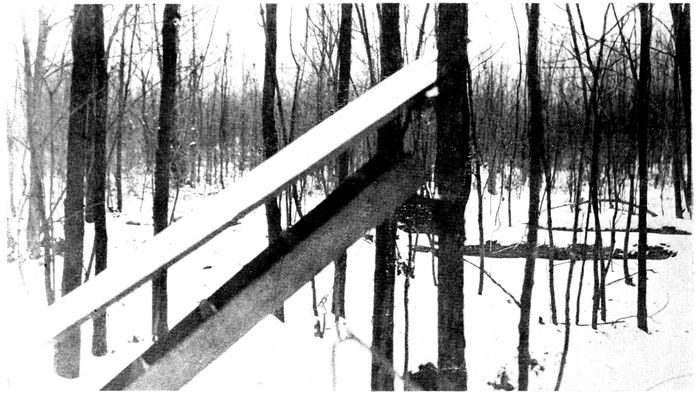
SELF-SERVING FEED-RACK FOR QUAIL THAT GAVE FAIRLY GOOD SATISFACTION
Now just picture North America if, during the last thirty-five
years, we had paid as much attention to the protection and increase
of our birds as we have to these death-dealing weapons. What a
cheerful difference it certainly would have made!
About ten years ago I started to protect the quail in earnest. I
made eight feed-racks, the same as shown in illustration.
The boxes are eight inches square and four inches deep. The
cover is about three feet wide and almost one foot from the feed. If
a little snow does drift in, it is very light and the birds will scratch
and get the feed, as no sleet or rain can reach it.
The quail soon found the food and I was agreeably surprised to
see the number of tracks around these racks the first time I went to
13visit them; but when I returned three or four days later there was
scarcely a quail to be seen. On investigation I found that the hawks
had apparently struck the Klondyke of their lives, and it was almost
sure death to Bob to go near the feed, as Mr. Hawk was always
watching.
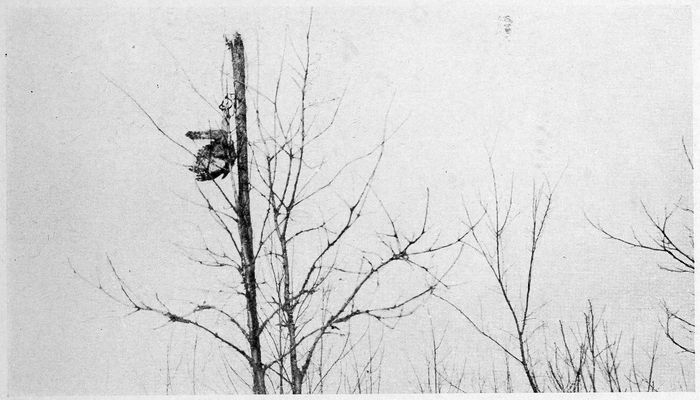
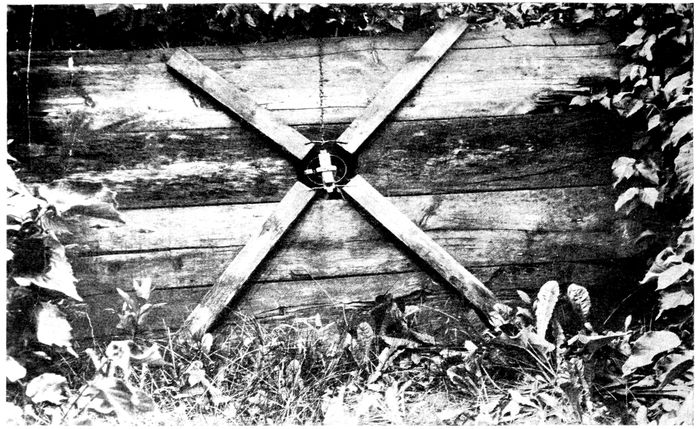
HAWK AND OWL TRAP
This photograph shows a mistake in that the Clog got fastened and is holding the Hawk up. This will scare other Hawks and make them shy of the place.
Then I bought a few No. 1 jump traps and cut three poles, fifteen
or twenty feet long and from four to five inches through at the butt.
I then drove three or four small nails in the butt-end of each pole,
to stay the trap and keep it from blowing off, but leaving it free
enough so that when it caught its victim he could fly up and raise
the trap off the top of the pole. A small brush-clog was fastened to
the end of the chain and a nail was driven in the side of the pole about
a foot from the trap, to hang the clog on. About six or eight small
staples were driven in around the pole, near the trap, to put fragments
of weed and grass in so as to disguise the trap, making it appear
like an old sparrow’s nest. Then I stood the pole, with the butt
up, beside another small tree so that the boughs of the tree would
project a foot or so above the trap; then wired the pole to the tree.
When a hawk or owl gets his toe in such a trap there is nothing solid
for him to jerk against, but he can fly down with the trap and clog,
and isn’t apt to jerk out. Moreover, when hawk number two comes
along, number one is not up there, flapping, to scare him and make
14him shy of this pole. I have known them, time and again, to alight
on the same pole and then fly down and kill and eat the hawk below
who was flapping around with the trap and clog.
In these three traps I caught seventeen quail-destroyers the
first month I put them up, and I also got the toe of another hawk,
and the following winter I got the rest of that hawk.
As proof that birds visit the same places, I will say that I haven’t
caught over fifteen hawks and owls down there in any one winter,
in those three traps, since.
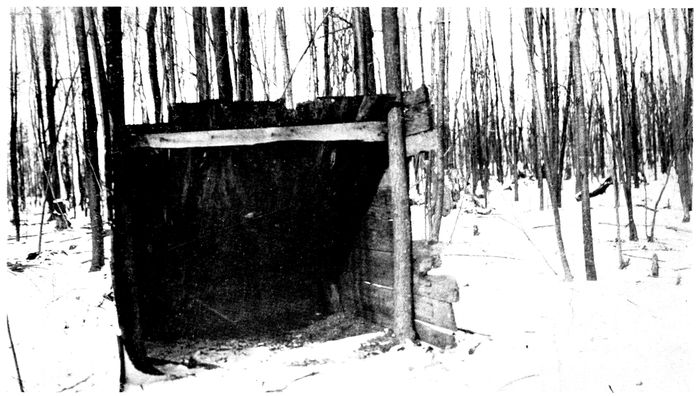
SHELTER AND FEEDING PLACE FOR QUAIL
Well, the feed-racks did not seem to fill the bill in every way, so
in a year or so I decided to try another scheme. I loaded up all the
old junk lumber I could find and hauled it to the woods, and in one
day another man and I completed ten little bungalows-in-the-rough.
They are about one foot high in the rear, and four to five feet high
in the front, with from five to six feet ground space, as shown in the
illustration herewith.
Then, to complete my experiment, I begged ten bags of weed-seed
from a neighbor who was hulling clover. I threw a bagful in each
house, and then threw in, on top of the weed-seed, corn, wheat and
buckwheat. In less than a week the birds visited every house, and
on a cold, zero day I believe I have seen as high as fifty quail buzz
out of one of these little, unpatented shacks. And best of all, they
scratched right down through the grain and ate the weed-seeds first.
I soon found I had made a hit, as the shacks furnished the birds
15shelter as well as food in the time of need, and a certain amount of
protection from their natural enemies.
But these birds down in the woods remained quite wild. So I
got several quiet bantam hens and kept them ready, and when any
neighbor farmer disturbed a quail’s nest I had a place for the eggs.
In this way I have had some enjoyable experiences.
I first set the hen in a small box on the ground, on a nice cushion
of soft grass, pet her lots and let her eat from my hand; I push her
feathers forward and pepper her just full of Prussian insect powder,
and sprinkle a little in the nest, also. Now I am all ready for some
one to phone that they have disturbed a quail’s nest.
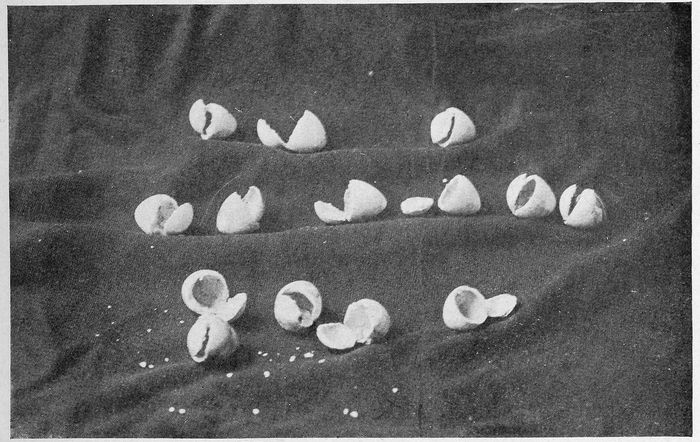
SHELLS OF QUAIL EGGS AFTER HATCHING
If you take eggs from a nest that is not disturbed, never, never
take them until the bird has finished laying and has started to set,
for if you take the eight or ten she will build another nest and finish
laying, then put in her valuable time with only half a brood, whereas
if she has started to set she will only lay off a few days, then will
build a new nest and raise a full brood. A quail will lay from fifteen
to twenty-two, and sometimes as high as twenty-five, eggs.
Quail eggs all hatch, and hatch very suddenly. One year I
looked at a nest at ten o’clock and there was nothing doing, and when
I came by at twelve o’clock the old hen scolded, so I took another
peep; all hands had apparently opened the door at once, and the
16cluster of pure white eggs had changed so that they resembled a live
bumble-bee’s nest.
Quail have no trouble hatching, like some of our domestic fowl;
they just simply open the door and jump out. See the illustration.
Pat once asked a little boy what he came for. The little chap
in his bashful way replied, “Oh, nothing.” Again Pat took his pipe
from between his teeth, as he said, “Well, you’ll find that in the jug
behind the door, where the whiskey was.” So we can say the same
about this illustration; it is where the little quail were. Notice the
neat, uniform way in which they opened the door from the inside.
When they are about to hatch, shut the door of the box so as to
keep the tiny pets in. When they are from twenty to thirty-six
hours old, move all hands to a dry coop near the garden, or in the
back yard near shrubbery. The coop should be from eighteen to
twenty-four inches square inside, built with a shed roof ten to twelve
inches high in the rear and eighteen to twenty inches high in the
front, with a board floor so that the old hen cannot scratch and
be on damp ground. Now take three boards about one foot wide
and two feet long, tack them in front of the old hen’s coop for a playground
for the quail. Leave the hen in the coop and she will put
her head out and talk to her family, who cannot get over two feet
away from her. Feed them a little custard (one egg to half a cup
of milk; no sugar). Feed tiny bits five times a day, always tapping
the tin with the spoon as you go near them. In three or four days
they will accept the hen as their stepmother, and you as their step-parent.
Now draw the two nails (which are only partly driven in)
and pull the three boards quietly away, leaving the hen in the permanent
coop, but giving the quail their liberty. See illustrations.
Now don’t run after them if they run away; just tap the tin a
little, as you drop a little custard in front of their mother so she can
call them.
Let me say right here: Never try to drive any bird. They can
hide where you can’t, and experience has proven to my entire satisfaction
that they can fly faster that I can run. Always throw feed
and kindness at them, and watch results.
In about a week, let the hen out a few minutes before sundown,
so she hasn’t time to stray far from home and will go back into the
roost. In about another week the hen can run all the time with her
family. Feed at the back door, or any place you want the quail to
come, and your pets will be there. Remember that it is the human
race that is wild, not the birds. Birds are wild because they have
to be, and we are wild because we prefer to be. Any creature that is
intelligent enough to fly or run from you for self-preservation, will
come to you for food and protection from all other enemies.
17
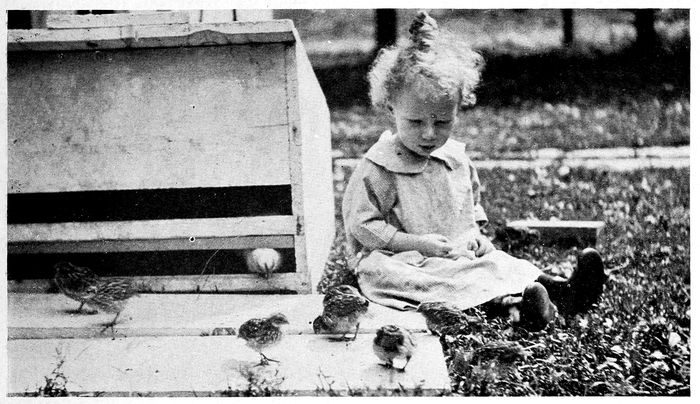
YOUNG QUAIL JUST FOUR WEEKS OLD
Notice one in Baby’s hair.
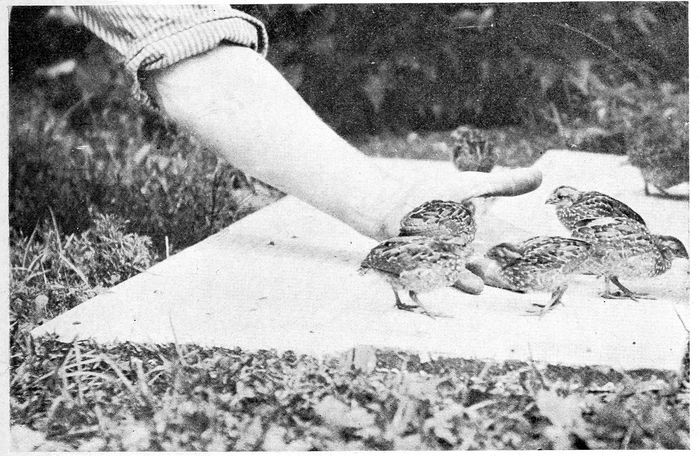
EATING FROM THE HAND THAT ONCE HELD THE GUN
18As to the value of quail, I know this, that they are the farmer’s
friends; that they cannot live in the dense wilderness and that they
do follow up the pioneer’s axe where climate will allow; and that
fully seventy-five per cent. of their diet consists of weed-seed and
insects that are injurious to the production of food stuffs for the
human race. The small amount of wheat they eat is ’most all
gathered from the stubble field, and as for the few kernels of corn,
this is mostly taken during the winter; and we all know that a farmer
who makes a practice of leaving his corn out, is an undesirable heavy
weight and possibly has no appreciation of Bob White’s beautiful
note ringing in the country, and the sooner he moves to town and
joins the “Retired Failures’ Association” the better for the country.
CHAPTER VI. Raising English or Ring-necked Pheasants in Canada.
19
Having often heard father speak of the English pheasant as a
beautiful game bird, and as I was overly anxious to pay Canada
back some of the birds I had murdered in my younger days, I decided
to try these pheasants.
In 1895 I sent to Pleasant Ridge, Ohio, for two or three settings
of English pheasants’ eggs. I felt sure this climate would agree
with them as they were exactly the same breed as I was, English
buck-eyes! However, I was smart enough not to ignore my mother’s
kind offer, and I let her have one setting to hatch for me. I paid
particular attention to the two hens I set, scarcely allowing them to
get off the nest; and here is where I now believe I made the mistake.
Not one egg hatched. But dear mother signalled me to come over
and I was right there. Her old hen had hatched eleven. Mother
smiled and gave them to me, hen and all, but told me to leave them
with her until the next day. Then I moved them, and raised nine
to the size of quail, when a dog killed four, leaving the old hen and
me with only five. Four of these proved to be males and a cat owl
killed the hen. March, 1896, found me with four beautiful male
birds only.
I had now learned that a gentleman in London, Ontario, had
English pheasants for sale, and as my experience had proved that an
English buck-eye hitched up to a Canadian was a joyous, satisfactory
cross, with the human race, I wrote this man and secured two
hens which were undoubtedly English-Canadians. I liberated three
of the four male birds and put the two hens in with the one male;
and from this trio we hatched sixty-two pheasants. Then I enclosed
four acres with a wire fence seven feet high. Along one side
I made several brood pens about two rods square, each. I put one
male bird with every five hens, putting plenty of gravel and grit in
each pen so as to secure good digesting powers. I also gave the
birds plenty of shade.
Our pheasant hens laid from thirty-five to fifty eggs each between
April the 15th and June the 15th. By giving the old birds lots of
grit, the egg shells were very hard. I used Wyandotte hens for
mothers, putting from twenty to twenty-five eggs under each hen
20and setting them on the damp ground as much as possible. The
eggs, like quail eggs, hatch in twenty-four days. I pursued the
same course, all through, as I have described for raising quail, only
the nest and coop are one-quarter larger. I used the insect powder
by the pound. I usually set four or five hens at a time; keeping a
record of the same, I knew when to prepare for a hatch. I penned
them in front of her for two or three days, the same as with the quail.
When raising pheasants, I never let hens out of the coops. When
birds are from six to eight weeks old I take the hen away but leave
the coop there. Coops may be set around like bee-hives, two or
three rods apart. I painted my coops, some white and some red;
the little fellows will know their own coops and will not forget them.
Remember, I have experimented with a great variety of pheasant
foods. I have raised flies by the tens of thousands to feed to them.
To do this I would take a piece of meat, say of beef’s liver, allow the
flies to blow it, and a few hours later throw the meat in a barrel; the
barrel would be partly filled with rotten sawdust and the top of it
would be covered with a screen, with a hole left about an inch in
diameter. In a few days the maggots would have the meat all
eaten up, and would have disappeared into the sawdust below. In
about two weeks the barrel would be simply full of flies. I would
now put a small flytrap over the hole, darkening the rest of the
screen; the flies would come to the light, get into the trap, and when
in the small trap could be either scalded or drowned. I have also
fed the pheasants the maggots. But to raise either flies or maggots
is not as desirable for the nose as it might look from the eye and both
are unnecessary. Feed a little custard, and when about two weeks
old, add corn-meal to it. Keep them hungry and let them hunt for
insects. Exercise is what they need and what they must have.
When birds are three months old, they should be caught and shipped.
The high fence for young is unnecessary, for your birds will know
you and will be just as tame as chickens. In this way I made my
pleasure self-sustaining, and I would often let an old hen and fifteen
or twenty go. The finest brood I ever saw was out of two poor
hatches. I put twenty-five with one hen and in about a week I
let hen and all out. They roamed all over the premises, but of
course like spiteful deeds and chickens, they came home to roost.
I fed them just enough to give them a sweet taste in their mouths,
and the hen raised twenty-three of them. How they did grow!
Finally she left them and they went to the woods about one-half
mile away.
In this way I stocked this township so I could have shot a two-bushel
bag full in half a day. Two miles north of my place there
were twenty-eight seen dusting in the road at one time. But to-day
21I doubt if there is one left in the township. Men came for miles and
miles around. Yes, I have seen them come twenty-five miles to
hunt rabbits in this neighborhood! Now I don’t want to insinuate
that all rabbit hunters were hunting pheasants, but what I really
want to say is that all pheasant hunters were hunting rabbits!
CHAPTER VII. The Natural Enemies of Our Birds.
22
Now we come to the most serious question that the bird-lovers
of America are up against; and until this great question is
settled, we shall continue to pull against each other.
At a sportsmen’s show in Michigan I once saw one-half dozen
mounted hawks in a glass case, and there were thousands of school
children looking at them. The label read: “These are all valuable
hawks.” Another man will say, “Protect the cat-owl, or great horned
owl,” and possibly this same man will advocate the destruction of
the wild house-cat, when the positive fact is that this owl is nothing
but a wild house-cat with the advantage of wings, and for cruel,
bloodthirsty, murderous depredations he has got the house-cat
chased right out of the slaughter-house, for he will kill and eat a
great variety of adult birds and animals I have never known a house-cat to destroy, such as turkeys, wild geese, peacocks, all kinds of
hawks and all other owls, and animals such as skunks, muskrats,
groundhogs, minks, weasels and hares. Now, although I have no
personal knowledge of this, yet a gentleman farmer who lived near
the woods told me (and I believe him, or I would not repeat it) that
his bunch of house cats which were about half grown, were in the
habit of climbing upon the roof of the house and sitting near the
chimney to keep warm during the winter months; these horned owls
came and took away every one of the cats. However, I have no
positive proof of this last statement. But this I do know: There
is nothing roosts high enough or sleeps low enough to be out of reach
of this heartless cannibal. One regrettable fact to me is that I
have never seen where another bird or animal ever killed a great
horned owl, although they have lived in the township with me all
my life.
A particular friend of mine was dissecting a shrike. This shrike
is a bird about the size and color of a blue jay, known to a great many
people as the butcher bird. I said to those standing by, “He is a
bad one; always shoot him on sight.” My friend stopped for a
moment and said, “Beg your pardon, Jack, but you are wrong; this
is not the big northern shrike you have reference to.” “No, no, my
dear fellow,” I replied; “I mean the very one you are skinning, and
again I say, shoot him on sight.” My friend smiled and replied in a
kind, cheerful manner, “Jack, I am surprised at you.” Now, dear
23reader, here were two natural born naturalists right opposite each
other, one advocating the protection, the other the destruction, of
the same bird. I had watched this shrike in Ohio when I was a kid.
I had often found his nest and knew what he fed his young upon.
I have caught dozens of them, right in the act, in Canada, and they
are always searching for birds, chiefly the small fly-catchers. Well,
we dissected this fellow, and found two little birds’ legs, and they
were not mates. Last fall I saw a shrike follow a snow bird fully
five hundred feet high, but the snow bird won out.
I said to another man, “The crow and bronze grackle take the
robin’s eggs.” “Why,” he said, “I don’t understand that; there is a
robin’s nest within a rod of my door, and the woods are full of crows.”
Why, bless your life, that is just the reason why the robin built
there, it simply came to him for protection.
Now first of all we must not lose sight of this fact: That there
never was but one perfect Manager stood on this earth, and He put
these creatures all here. So let us roll back the pages of time and
take a look at nature before man interfered. Likely you have read
the history of America; I haven’t; but I doubt if there is any account
known of the clouds of birds that once hovered over this continent.
The settlings in the bottom of the little artificial pond near my house,
caused from the wild goose and duck droppings, are exactly of the
same material that we find in our marshes, and which is from three
to ten feet deep in the average marsh. I will not attempt to mention
the number of birds I have seen in one day, because the average boy
of the present would not believe it; but I will say that I firmly believe
I have seen more birds in one day, before I was ten years of age,
than the average ten-year-old boy of the present day has seen in
all his life. Time and time again during my life have I seen a
wounded bird lag behind as the flock flew to cover; and often have
I seen a hawk dart at them, and he never failed to get the wounded
one. And some wounded quail have been stolen from me by hawks
before I got to where they lit, and if it were not for the snow I wouldn’t
have known what had happened as I did not always see the hawk.
Once in my life I had a flock of about thirty young wild ducks.
There were two little runts that appeared to want to die, but I
rebelled and kept patching them up. Finally one took with a sore
eye disease, and in a few days the other little scab had it, and both
died, but not until they had introduced these sore eyes to the rest
of the ducks and all my nice, healthy ducks started drooping. When
I eventually got this disease checked I had only seven ducks left.
Now, according to my own experience, if a hawk had come along
he would have picked up the weak ones and prevented this disease.
So, after all my life’s study I am fully convinced that these cannibal
24birds were put here to destroy the weak and sickly and prevent
contagious disease, letting the strong and healthy survive. But
man has interfered. He has paid all his attention to the destruction
of the food birds and has almost annihilated them and let what we
now call their enemies go; or, in other words, we human beings have
combined our forces with the food birds’ enemies.
Now Point Pelee marsh is about fifteen miles from where I am
sitting. Point Pelee is the most southerly part of mainland in
Canada, and the hawks cross there by the thousands every fall;
yet I never knew of a hunter going purposely to shoot them. But
if there were twenty-five ducks in a pond down there and twenty-five
men knew it to-night, there would likely be fifty guns there to-morrow
morning. Yes, I honestly believe there are as many hawks
and owls in America to-day as there were thirty years ago.
Last fall, when the hawks were migrating, in October, they
started roosting in our woods, and in less than a week there were
thousands upon thousands coming there. So I took a flash-light
and the .22 rifle and went down and I am sure as high as twenty-five
would fly out of one little tree every time I shot. It was a bright
moonlight night, and they soon took the hint, and I only killed
fifteen or twenty. But to hear their wings as they hovered around,
over the woods, would cause one to wonder where they came from
and where they were going. However, once was enough; the rest
took the hint for the next night not one was seen going there. So
don’t let us blame the Great Provider; it is man’s mistake, that is
all; we have gone wrong.
“Oh, but say, Jack Miner, do you pretend to say that there
were once birds enough in America that the old and the delicate,
crippled, maimed and diseased would supply all these hawks and
owls with food?” Yes, that is just exactly what I want to say, yet
I have no proof of it. I only know that the hawks will take a cripple
every time and let the strong and healthy go. “Well,” you say, “how
about a flock of little ducks? He could take any one of them.”
Not so easily. Wild ducks at six hours old will dive like a lot of
frogs, but a delicate one cannot; he will possibly just put his head
under, and his body will stick out like a bloated toad. Yes, I
believe that less than one hundred years ago there were more of
the above class of birds for the hawks, each year, in America, than
there are altogether, now. So, after having a lifetime of experience
raising birds, instead of doctoring the sickly ones and petting the
droopies and sore eyes, I just take the hawk’s plan and destroy them.
While I would not like to see these cannibal birds become extinct,
yet I would be pleased to see them decreased the same as our other
birds have become during the last forty years.
CHAPTER VIII. Some Things I have Known Cannibal Birds to Do.
25
Now, dear reader, I am well aware of the fact that my book
would be more popular if I left these questions out. I am like
yourself, I wish I had nothing to say but good about every bird,
for I love to see them. But remember, what I am telling in this
book is what I know about nature, so please don’t jump on me with
both feet for telling the truth.
First of all let me say that the larger the hawk, the more anxious
the majority are to shoot him. This is a mistake. It is the medium-sized
hawk that is the worst. The sparrow-hawk is the smallest,
and he is hard on fledglings such as bobolinks and song sparrows.
Yes, I know they will eat grasshoppers, but these are usually eaten
by the young birds; the adult sparrow-hawk lives chiefly on mice
and small birds.
When I raised pheasants I always made a “hide” where I could
lay for the little chicks’ enemies. One day I fed my chicks at one
p.m., when I returned at four-thirty I tapped the tin to call them
and only seven out of the seventeen little beauties came and they
were on their tiptoes, shy and frightened. My first thought was,
“a weasel,” but when I saw Mrs. Hen turn her head sidewise and
look up, I called to my boy to bring the shotgun and a couple of
loads of No. 6. I soon was in the “hide,” and the boy had scarcely
got to the house when I heard the old hen say “k-tt-tt-tt,” meaning
“lie low,” so I took her advice, and in about five seconds a sparrow-hawk
came down out of the heavens like a bullet—too fast for me.
Before I could get the gun on him he was on the ground. He saw
me and missed his bird; and when he was about four feet in the air
again I just lifted him with a load of shot. The next morning we
went over to the woods and destroyed the other old one and the
young, and found remnants of some of the young pheasants. Now
this hawk killed and carried away ten of these little chick pheasants
in less than four hours. These little pheasants were about ten
days old. After pheasants get to be the size of a small quail or
mourning dove, sparrow-hawks will not take them. Many a small
hawk have I fooled by taking a little dead pheasant and running a
wire through him, standing up in a natural position on a steel
26trap, letting Mr. Hawk come down out of the air and help himself.
I have often caught owls in this same way.
I could go on and on, relating such experiences until you got
hungry. But remember, the sparrow-hawk is only one. The
worst are yet to come, the Cooper’s, the sharp-shinned, and the
goshawk; these three are just like bullets in the air. But while the
pheasants are tiny the sparrow-hawk is the worst, because it is more
numerous. To any person who might think of raising pheasants
for profit let me say that unless you first study how to destroy
weasels, barn rats, stray house cats and cannibal birds you had
better give up the business a week or so before you start. Remember,
when hawks are driven to it by hunger they will kill and eat each
other, and owls will do the same; I have known dozens of cases of
this in my life.
There are two large hawks I never destroy, the Red Tail and the
Red Shoulder. They are too big and clumsy to be very destructive
on our birds. When these two varieties get in my traps I usually
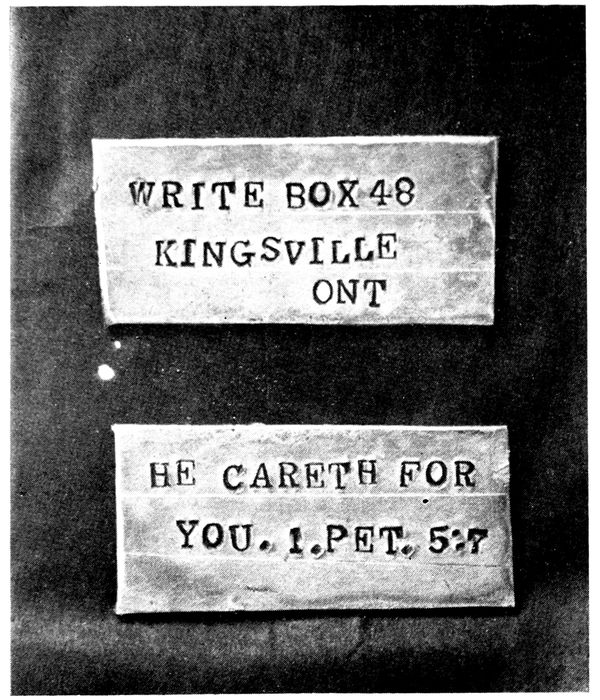
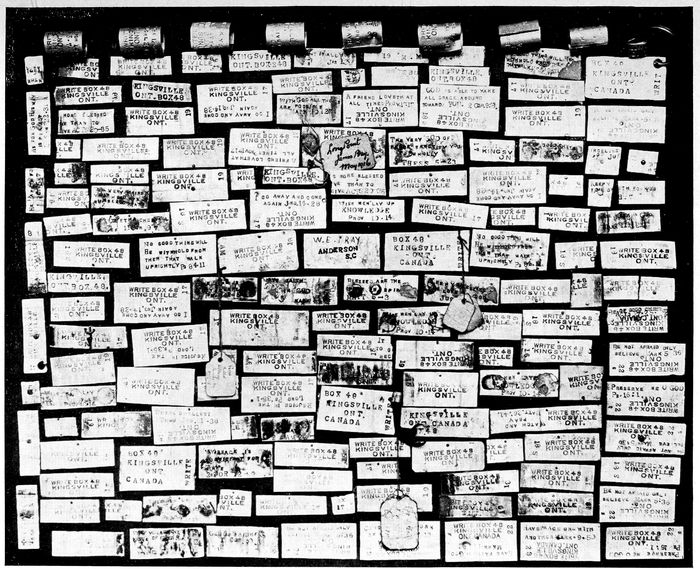
label them with an aluminum band and let them go; but, strange to
say, I have never heard from one of these in my life. I know they
will kill a clumsy barnyard fowl or so, and they will also kill snakes;
so I say of them as Pilate said, “I find no fault” with these fellows.
I spend a lot of my life burning brick and drain-tile at night, and
during the summer months it is very interesting to see the toads
come before the light of the fires and catch insects. The snakes that
these big hawks eat, kill the toads; and I don’t like snakes, even if
they are not in my boots.
Now this innocent-looking little screech-owl! Just last summer
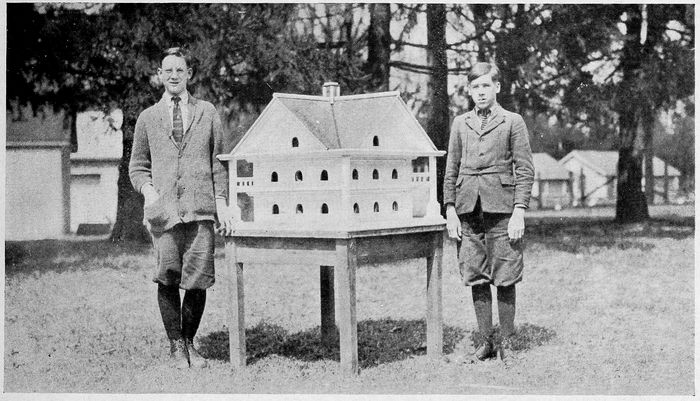
I went over to the martin house one morning to see what was wrong
with them, and here were three or four helpless fledglings flapping
on the ground, and the old ones hovering at the house as if it were a
bees’ nest. Well, to be brief, we killed nine screech-owls in less
than two weeks, but not until they had killed and driven all our
martins away for that year. At a screech-owl’s nest I once found
my hat-full of remnants of bluebirds’ wings, young robins’ wings and
feet, and quail, song-sparrow and English sparrow feathers. In
another case a screech-owl went through the two-inch mesh wire
netting and killed a golden pheasant hen for me and ate her throat
out. This owl only weighed three and one-half ounces. A doctor
in the town of Leamington once called me in to see what had killed
his golden pheasant hen that was setting on twelve eggs. The pen
was made of two-inch mesh netting. I at once said it was a screech-owl
and showed him how I knew. He then told me he harbored
screech-owls in and around his barns to kill the English sparrows.
27Another man I knew kept a screech-owl in his barn to kill the sparrows,
and he was puzzled to know what killed his tame pigeons.
The screech-owl is just a miniature horned owl, both in looks
and habits. But I have never had my wits tried more with any
bird than I have with the Great Horned Owl. On one occasion one
of these winged brutes came and apparently just got his toes pinched
in a trap; and night after night he sprung the traps and took a hen
pheasant. This went on until he had taken twelve. Then I put
on fur coat and made a bed of robes out in the “hide” which I
always kept ready in the enclosure; and there I lay in that bright
moonlit, stinging-cold, zero night. At last I saw an owl hovering
over the ground, and fortunately for me he got fooled; he came to
examine the decoys near me and while his attention was rivetted
on them I raised up and fired, and he never knew what hit him.
When I went to the house it was three a.m. I usually catch twelve
to fifteen of these owls every winter.
Remember, when he comes and gets a bird he will eat what he
wants of it, and come back the following night for a new one.
But how these cannibals locate other birds for miles and miles
across the country is a mystery. Yet if we go down in the field and
kill a beef on a hot summer’s day, the turkey buzzards will be here
in less than one-half hour. Where did these vultures come from?
You perhaps have not seen one for a month. How did they know
you were killing a beef? This question may be just as much in
place as: How do the hawks and owls find their prey?
The great horned owl nests in the winter or early, early spring,
building in a cavity of a tree or a crow’s or hawk’s nest. They lay
two pure white eggs, round like a turtle’s eggs, about the size of an
ordinary barnyard fowl’s or a shade smaller. I have got the nest
as early as the first day in February, when old Mrs. Owl was setting.
The female horned owl is larger than the male; she will weigh about
four pounds and has a wing-spread of fully fifty inches.
Now I know there are a lot of people who protect these cannibal birds
because they kill mice. Yes, they do kill mice. But it takes
dozens and dozens of our insectivorous and weed-destroying birds
to raise one owl. I claim that the good one robin or quail does, in
one day, overbalances the harm a dozen mice will do.
Now we come to the crow and bronze grackle, the largest blackbird.
These two birds raise their young chiefly on the eggs of
other birds. Why this is, I won’t pretend to say, nor will I attempt
to throw a ray of light upon it, but will frankly confess I do not
understand. Possibly it has come about through man’s interference
with their natural habits.
28The crow was the first bird I hunted in Canada, as we thought
they pulled our corn. I went to the woods and located their nests,
and soon I became wise enough to imitate the call of the young;
then I had Mr. Crow beaten. I would first destroy the young if
possible, then hide in the green bushes and caw quietly as I had
heard the young do, and dozens of crows have brought their food
to the wrong baby. Yes, I have even gone so far as to call them
right down into the small trees so as to make a very light load of
ammunition do the work, as it cost money to buy powder and shot
in those days. Now comes more of what we don’t want to hear.
What were these crows feeding their young on? Crawfish, pollywogs,
small frogs, grubs, etc.; but seventy-five per cent. of the food
that these old crows would vomit up as they struck the ground was
eggs. It was these old black rascals that taught me what to raise
fledglings on, and it is just as easy for me, now, to raise a young
bird on custard as it would be to raise a row during a political
campaign.
I am going to tell you some pitiful things. I have seen young,
unhatched robins spued out of a dying crow’s mouth, and the little
things were still alive. Whether the eggs were broken in her throat
before I shot her or not, I do not know, but they were broken when
thrown up. Yes, they will take blackbirds’ eggs just as quick as
they will the robins’, and other, weaker birds’ if they have the opportunity;
but the robin does seem to be their choice, possibly because
he does not conceal his nest better. Yet I was hunting the
crows because they pulled our corn! In all my life I never knew a
crow to bring corn to her young. Yes, I have shaken as high as
seven little, unhatched birds out of a gasping crow’s mouth, and any
one of these creatures, if left to mature, would do as much good as
a crow. If you want to trap a crow use hens’ eggs for bait, but bear
in mind he is cute, and you must conceal the trap very carefully.
The bronze grackle is nothing only a small crow; his habits are
exactly the same. He will drop on a tree and look around; seizing
an opportunity he will come down and go through a bush where
there is likely to be a song-sparrow’s nest just like a ferret will go
through a stone-pile after a rabbit. I have known him to take the
young birds after they were hatched. But so many men who know
the habits of these birds will say they think they do as much good
as they do harm! Why they make this statement I don’t understand.
And if you throw this book across the room and never pick
it up, I cannot help it, for I am telling you the truth: These crows
and grackles are the worst nest-robbers in America. They do ten
times more harm than good. Remember I am not writing just to
please the reader, but to give you facts gathered from personal experience
and observation, and my beliefs founded thereon; and I
29am sure that fifty per cent. of the eggs and young of our song, insectivorous
and game birds in Ontario are devoured by these cold-blooded,
nest-robbing cannibals, the crow being the worst of all.
He will take young mourning doves out of the nest when they are
as large as sparrows; the quail, and kildeer, and dozens of other such
beautiful mothers are perfectly helpless and can no more keep him
off than a human mother’s naked hands could keep a vicious lion
from tearing her baby into fragments.
By the way, I am now perfecting a trap whereby I can catch
crows by the hundreds during the winter months. These crows
will be handed over to gun clubs for trap-shooting purposes. And
although he is a black murderer we must treat him fair, and give
him a chance for his life; therefore, my request will be to shoot them
from five unknown traps at twenty-five to thirty yards rise. The
shooter will not be charged for the crows he kills, but will be fined
for every one he allows to escape; in addition to the above fine he
will be liable to any other punishment a good, cheerful bunch of
trap-shooters see fit to impose upon him, such as rail-riding him
around the club-house for allowing one of these black murderers
to get away. The shooters will be fined according to their shooting
ability. These fines will be used for buying up old, faithful horses
which will be humanely destroyed and used for bait to decoy more
of these old, black Pharaohs to their just doom. Thus what is now
the crow nuisance will be turned into a sport.
The hawks and owls are worst on the adult birds, the screech-owl
is not so innocent as he looks, but there is none can compare
with the great horned owl, and I just wish you knew the annoyance
he has caused me by taking my choicest pets. Yes, it seems he
delights in taking the nearest and dearest. But now let me give
my horn a toot: Never did a horned owl take a bird from me but
what paid the penalty.
About the only argument you hear in favor of the hawks and
owls is “mice.” But when a bunch of successful farmers meet at my
tile factory, never in my life have I heard them complain about
mice, and I know mice seldom bother clean, shrewd farmers. But
I have heard them complain about worms until I could almost feel
myself crawling. The cut-worms were cutting their corn, or the
wire-worms were destroying their oats, the army worm was working
north, and so forth. Personally I have never had any experience
with worms, but field mice I have often carried in my pockets, and
if it wasn’t for some youth practising the same sport, how I would
like to tell you some of the fun I have had with them when I was a
lad. For the death of each mouse by hawks and owls possibly we
lose several birds which would destroy thousands and thousands of
worms each year. I know there is a type of farmer who is much
30more easily annoyed by mice than others. You will usually find him
down town, sitting on a soap box, smoking in the time, now and
then getting up and moving his seat around and possibly turning it
end for end to keep it from getting tired; his stock at home are of
the rainbow variety, with long whiskers, and when they see him
coming they don’t know whether to come or go, and the one or two
razor-backed, South Carolina, thistle-digger hogs don’t care whether
or not they get out of the steaming manure heap, to be disappointed;
the remnant of scrubby apple trees in the field, which some one else
planted, have been fleece-grown with cut grass ever since he got
possession of the farm, that, of course, was handed down to him.
If your orchard is stubble or clover sod, go through it in the early
fall. By being careful you can determine whether there are any
fieldmice there by their little runways that criss-cross on the ground.
If so, take about one-half bushel of grain and thirty or forty bundles
of corn fodder; throw a handful or two of grain on the ground and
two bundles of fodder side by side over it, making a nice mouse cover.
Refuse hay, or clover chaff will do, but I prefer the corn fodder.
Fifteen or twenty of these little harbors are sufficient in an ordinary
orchard. In ten days or two weeks all the mice in the orchard will
be under these covers. Now take the six- or eight-pronged pitch-fork,
scratch around these little harbors to destroy their road of
retreat, then throw the cover off quickly; the light striking their
eyes so suddenly, they are apparently blinded for a second, giving
you just time enough to give them a side whack with your fork; if
you study what you are doing, you will kill seventy-five per cent. of
them the first time ’round, always placing the cover back ready for
next time. If you don’t care for this sport, just introduce a bunch
of school boys to your plan and you will soon find your annoyance
turned into sport and education for the neighbor boys.
In case you haven’t the above-mentioned material to make these
mouse covers, old junk lumber thrown on the ground will answer
the same purpose. But if you leave these mice and depend on the
hawks and owls to destroy them, some of your trees will be girdled,
as the mice seem to have a sort of human appetite, and appear to
like the apple tree bark equally as well as the human race likes the
apple tree juice.
The mouse question always reminds me of a story told on the
other fellow. It is said that he saw an advertisement: “How to kill
potato bugs! Full directions sent on receipt of one dollar.” This of
course was a cheap opportunity, and he enclosed a dollar at once.
In reply he received a small box containing a little block and mallet;
the directions were: “Put him on No. 1, and hit him with No. 2.”
CHAPTER IX. Weasels, and How to Destroy Them.
31
Now, as a field-mouse destroyer we have come to the king of
them all. I have found as high as twenty-seven adult field
mice stored in a weasel’s winter home. Yet of all the four-legged
enemies our birds have, I know of none to compare with the weasel.
But if I were to ask the experienced hunters of America if they know
the weasel all would be disgusted, because the weasel is so common
throughout this country. I was once in that class myself; I thought
I knew all there was to be known about them. I had shot them out
of the tops of trees, and dug them out of the ground; I had called
them into the tile shed and even into the engine room; I had sat here
in the woods and called them so they would come up and smell of
the ends of my fingers; I had seen dozens of the little rascals in
Northern Ontario when I had been hunting moose, and had sat down
and called them across the creek to me. Yes, I thought I was well
acquainted with them.
Now, when I come to think of it I am always reminded of a
middle-aged, corpulent gentleman who once came to our tile yard.
After he had his wagon loaded he climbed down over the wheel;
as he struck the earth, he took both hands and pulled his loose
trousers up over the dome of his constitution; then pushing his right
hand down into his pants pocket he pulled it out full of what looked
to be tobacco, Canada thistles and milk-weed chaff; after pouring
this from one hand to the other and blowing the coarse gravel out,
he tipped his mouth on top of his face, and raising his hand above,
he let this junk roll into the cavity, just like throwing garbage into
a skunk-hole. Then he turned and said, “Mr. Miner, do you know
Mr. ——?” calling his neighbor by name. “Yes,” I replied, “I am
well acquainted with him.” “Well,” he said, as he raised one hand
and came towards me, “that is just where you are mistaken. Now,
Mr. Miner, you think you know him, but you don’t.” Then raising
both hands, he continued, “Now let me tell you who he is, Mr.
Miner. He is a limb of the devil,” and he continued coming closer
and going from bad to worse, saying nasty, unclean things about his
neighbor until this combination in his mouth was all churned into
a dirty froth, with the over-splush slopping out the corners and running
32down his chin like tar boiling out of a hotbox on a manure-spreader.
So I excused myself: The engine in the factory needed
my attention.
So now, whenever I think of this man’s conversation, I always
think of the weasel, as I was sure I knew him. To prove I didn’t,
the third year I raised pheasants, these innocent-looking little vermin
took over two-thirds of what were hatched. You talk about worms
bothering the farmers’ crops; they weren’t in it. Really, these
weasels bothered me more than the heavy mortgage that held my
buildings down and took care of my insurance policy.
I watched them day and night. I shut the birds in so tight that
they smothered in their pens, and yet the weasels got them. I sat
on the fence and blew several into fragments with a load of shot,
and would go to the house quite light-hearted; next morning likely
I would find ten or fifteen more dead pheasants. I put traps everywhere
and caught as many pheasants as weasels. I used all kinds
of bait, and failed. I tried to call them, but no, no. I took young,
live birds and put them in a small mesh wire cage and set traps on
the outside, but nothing doing. At last I brought the pheasants
near the house and all hands watched them, and even then we lost
some. I studied weasels night and day, but I was beaten. Where
did they come from?
For there were weasels in the door-yard,
Weasels in the barn,
There were weasels in the hen-house,
Weasels all over the farm;
There were weasels in the engine-room,
Weasels in the shed,
And when I went to sleep at night
There were weasels in my head.
I could see weasels on the bare ground,
Weasels in the weeds;
I could see weasels in the pheasant-coops
Doing their bloody deeds;
I could see weasels coming across the road;
I could see weasels in the lane;
And in the morning when I awoke
I had weasels on the brain.
For in spite of all my determined efforts the weasels were increasing
by leaps and bounds. Not that they were getting more
numerous throughout the whole country, but they were simply attracted
33here by the pheasants, and it was no use, as there would be
more and more next season. I thought I would have to give in,
beaten. But Mr. Weasel had run up against a determined fellow
to kill, and I was dying hard; and while it is not my intention to
preach a sermon, yet I want to tell you what happened.
A few years previous to this, a dear little boy whom God lent to
me for a short time climbed upon my lap, and putting his little arms
around my neck with his sweet face looking into mine, pleaded with
me to go to Sunday school with him and mamma. I unclasped his
little arms one at a time, and told him to get down and go along as
it was all right; but he insisted, stating it looked lonesome to leave
me at home all alone. His sincere request took such a hold on me
that I could not resist, and the very next Sunday found him and
his father, hand in hand, on their way to the little old red schoolhouse.
And although against my will, as I had no schooling, but
finally to my delight, in about three months I was teaching a class
of boys. They, of course, did the reading, but I was general manager
and furnished the brute force if required. It took us several
Sundays to get acquainted, and when we read the 26th verse of first
Genesis we were very much encouraged to know that we were given
“Dominion over all.” Now, dear reader, lest I forget I want you to
know His promise in this verse is the foundation of a great percentage
of my success in taming and controlling these so-called wild creatures
during the last twenty years. Although the weasel had me beaten,
yet my mind kept drifting back on His words, “Let man have
dominion over all.”
Eventually I thought, “Why did the weasel take the remnants of
pheasants over to the rail pile, nearly one hundred yards away?”
Yes, it was plain enough he was over there and knew that hiding
place before he got the birds. Well then, if I had had a trap over
there I would have headed him off. So I would reverse my plans,
and instead of destroying their homes I would build them some as
perfect as I knew how. So with bright prospects and a light heart
I went at it again and built three weasels’ houses as follows:
For each one I took four pieces of two-by-four scantling, three
feet long, laid them down on the level ground, pointing these scantling
east, west, north and south, but leaving them about six inches
apart in the centre—just room enough to set a No. 1 or 1½ jump
trap. Then I covered the top with old lumber and nailed it fast,
leaving a hole in the centre about a foot square, right over the trap,
which I covered with a loose board. See illustration.
Now I had a weasel house, complete, six or seven feet square, the
cover just two inches from the ground, with all the runs leading to
the trap like the spokes lead to the hub.
34I placed these three platforms around in the most likely places,
two in the enclosure and one on the outside. I then threw pieces of
stumps, rails, or anything I could find, around to make a complete
weasel harbor. Then I scratched a hole out about an inch deep in
the centre and put in a handful of soft hen feathers, and placed a trap
down on them, setting the trigger of the trap very light. Then I
dropped two or three light feathers on top, making it appear like a
perfect mouse-nest. I now put the loose board cover over. I set
the traps early in the spring, but weasels did not come until I put
the pheasants out. Then the real fun began, for I caught three in
one trap in one day; this was in the trap on the outside of the enclosure.
To prove to your satisfaction that my weasel story is not
exaggerated, I caught fifty-seven weasels the first summer, and they
only got four pheasants; for three seasons in succession I got over
fifty weasels each year. But now they are so nearly exterminated
that we only keep one weasel platform, as we call them, and catch
two or three weasels a year.
UNDER SIDE OF WEASEL TRAP AND HARBOR
Please let me ask you to excuse me for writing so much to say a
little, but I want you to understand just how to head off this pest,
as one weasel will kill as high as twenty or thirty young fowl in
one night, and to know how to catch him the night before, instead of
the morning after, is worth the price of this book a good many times
a year if you have had a taste of my experience. And the great
35beauty of it is you cannot help yourself without helping your neighbor.
Previous to my exterminating over ninety per cent. of the
weasels in this neighborhood, some of my neighbors were almost
discouraged trying to raise young turkeys, and, in fact, any domestic
fowl, but to-day these complaints seem to be a thing of the past and
the weasel annoyance, ancient history.
CHAPTER X. Robins.
36
Now I have tested your staying qualities, giving you the worst
first, and we have come to the bright side of what the birds have
taught me. After all, I have a lot to thank the cannibal birds for,
as there are about thirty acres in this piece of second-growth woods
where I am now sitting, and during the summer months I take a
stroll down here at least once a week. This is the most perfect place
for robins to build that one could find in a day’s travel, yet the last
four or five years I haven’t seen five of their nests down here; but
just one-half mile away, at my home, there were seventeen nests
last summer, all within one hundred yards of the house, and outside
of the thirteen maples that shade our door-yard the shrubbery is
very young. All thinking humanity must admit that they come
there for protection from their natural enemies, as there is usually
a crow’s nest hidden away in this or the neighboring woods. But
remember a crow knows better than to venture near my house.
And the robins know it.
The chief reason the robins leave us early in the fall is because their
choice food, the worms, have gone into the ground for the winter;
but as soon as the worms start coming to the surface again the robins
come back; and the beauty of it is they come to the same homes,
and perch on the same limbs of our trees, sounding their cheerful
notes to brighten the dark spots in our paths. Between songs they
drop down on the lawn and hop and listen; all at once they start
pecking at a grub in the grass; as soon as they have pecked him out
and turned him into a robin they either listen for more, or jump up
and give us another song. By catching so many mothers of the
season’s grubs they render us tens of dollars worth of service.
Then about July the first the grubs that are not destroyed are
under the hard, dry soil, and the robin has its second family to
support; and Shame! Shame! Shame! on the man who claims to
be intelligent who will slip out and shoot him because he took two
cents’ worth of sour cherries that possibly were not worth picking.
Has this man got a heart? If so, let him go under the tree where the
little starving young robins are calling, “Mamma! mamma!
mamma!” That’s the exact interpretation of these three chirps that
37are getting fainter and fainter. Now, my brother, let me ask you
again: Have you got a heart? You love your little baby brother
or your darling baby boy, and the very though of King Pharaoh
makes you wicked within; but remember, as cruel as he was, he
never demanded that a baby boy should die a lingering death as
these dear little robins have to do through the fact that you shot
their mother. Personally, I hate to shoot a crow or a grackle, as
bad as they are, during the nesting season, on that account.
Now it would not be fair for me to pass the robin by without giving
you a taste of our enjoyable experience, as while I know that by
times robins will annoy fruit growers by congregating there in
hundreds, yet to be fair we must consider the most good for the
most people. So let us take the average farm, occupied by the
cleanest of farmers, with his corn, potatoes, tomatoes, cabbages, and
other crops too numerous to mention, all coming up through the
clean, fertile soil. And now, like a sneaking thief in the night, the
annoying cut-worm crawls out like a snail, cuts down the promising
plant and then passes on to another and repeats his destructive
doings. Then when he has gorged himself to the limit he will just
dig himself in under the soil near the stump of the last plant he has
destroyed. I have known fully one-fourth of the plants in a field
to be destroyed by cut-worms in less than five days. Not that there
are so many of them, but, like the weasel, each one is so destructive.
Now just think of the expense and drawback to this farmer, having
to replant. Moreover, the second planting never produces the
same crop as the original one would have done. Here is only one
of the valuable points I could explain for Robin Red Breast. For
long before the average farmer is out of bed, he is in the field, hopping
from one plant to another in search of these worms; and when he gets
two or three in his throat he flies across to his family, and in less
than three minutes he is back again.
Yes, I know there are men who will tell you the robin will not
eat cut-worms and that his song is no better than that of a warty
toad. One of these statements is just as true as the other. The
robin will eat about all kinds of worms I have ever seen excepting the
dirty tobacco worm, and we must give him credit for that. Last
summer I saw a young robin not over six weeks old, picking up ants
at the rate of sixty per minute. What does this mean to your lawn?
Some years ago a boy was passing my house carrying a .22 rifle.
I heard him shoot, so I went out to the road and investigated; went
and picked up the old robin that was fluttering, a few rods away,
and as she gasped her last, two cut-worms spued out of her mouth
and a third was squirming on the ground near where I picked her up.
After this boy and I had had a heart to heart talk about the matter
38we separated, but that afternoon I found another robin with a bullet
in its back. The next day was Sunday, and at ten a.m. I was sitting
near the window trying to read, and as I glanced out I saw a young
robin, dying, under the fir tree. I soon found a nest above it, and
two larger ones were still alive, but cold. We brought them in,
nest and all, and when they got warm I dropped a little custard in
the mouth of the larger one. This caused number two to realize
that there was some to be had and he, too, awoke from his slumber,
and apparently put all his strength into his neck and jaw bones,
for he opened his mouth so wide that it seemed to split his head
completely in two. The little bits they choked down them immediately
gave them strength to want more, and as soon as they
were satisfied, we covered them up with good warm flannel. When
we returned from church about an hour and a half later and uncovered
them, one hopped right up on the edge of the nest and just
squealed for more custard, and in two days they were out, hopping
around us for their feed. In fact I have never had robins accept us
as their step-parents so quickly as these two did. Possibly when they
were in their unconscious state they forgot their original parent to a
certain extent. In two weeks they were flying all over the premises,
but always came to the back door and chirped when they got hungry,
and would stay until some one fed them. Finally they would follow
us men over to the factory and often have I seen them sitting on
the mill, watching the stream of clay run out, now and then turning
their heads sidewise as if they doubted their best eye. Once or
twice I saw them alight on a hot gas pipe; this always made me
laugh, because they got off long before one had to tell them. The
next one might see of them they would be out at the clay bank,
watching the man dig clay, now and then picking out an earth worm.
But they never went near any stranger that happened around, and
this point alone brought us a lot of satisfaction, just to know that
these two innocent robins, that had scarcely been acquainted with
us a month, knew every person that worked around the premises.
These two stayed with us until October and disappeared. But
they taught me one good lesson: What a great mistake I had made,
through life, by keeping my pets shut up, as one bird having its
liberty to go and come at will is worth a hundred in a cage.
Well, that is some years ago, but we have had pet robins ever
since. The last seven or eight years, strangers have been coming
here by the thousands, and all want to feed our robins; we, of course,
let them, and sometimes I will not feed them myself for days. But
I often see them come flying when a bunch of strange people arrives.
Why? Just because they are fed so much by strangers; that is why.
A laughable thing happened last summer. I heard the lady of
39the house scolding and shooing with the broom; I found that little
Jasper had left the screen door open and three of his pet robins had
flown in and roosted on his mother’s choice picture that hangs in
the cold storage room, or parlor, as some call it. When Jasper
found what the noise was about he just took the feed tin and went
in, gave the pan a few taps with his spoon, and the birds at once
flew down into the pan, the boy walked out with it and ended all
confusion.
JASPER FEEDING THE ROBINS
In 1917 we had twenty-one pet robins, and I have often seen
little Jasper start for school and have to come back and feed his
pets to keep them from following him away.
The way we get them is when some neighbor gets afraid his cats
are going to kill the young robins around his place, we get them. If
you want to try it, keep them warm, in a small dry-goods box. When
you have had them about six hours, open their mouths and slip a
little custard in them. The second day they will open their own
mouths and in about three days they will accept you as their stepmother
and you can let them out. Be sure and keep them good
and warm, and feed often.
We put tags on some of our robins, and odd ones returned the
next spring, and they are always more wild; in fact when they return
they will not let you near them. This fact I do not understand.
40My last experiment was to take two robins out of a nest of four
where the parent birds were the tamest of any I knew; then I went
and got one out of a nest of two, with exceptionally wild parents.
The birds were all taken the same hour. But the two were tamer in
two days than the one was in four.
SNOWBALL
This reproduction of a photograph will introduce to you Miss
Snowball, our pure white robin with pink eyes and cream-colored
beak and feet. Snowball was hatched in a nest with three others, but,
like the parents, the other three were just common robins.
CHAPTER XI. The Bluebirds.
41
To the average middle-aged person of America, this bird needs
little or no introduction, but to the young people they are now
quite rare. In fact I was speaking to a young lady quite recently,
and she has camped out every summer for the longer part of her life
(but of course, like all other girls at her age, she has just passed
sixteen; passed it coming back, of course) and she told me she had
never seen a bluebird. They have decreased over ninety-five per
cent. the last forty years, but when I was a boy they were as common
as the robin is to-day. They usually arrive the same day in
the spring, bringing with them their beautiful note that no musician
has ever been able to imitate correctly.
In 1908 I put up three or four nests for them and in 1909 a pair
came and built in one. These nests were made of wood; so it occurred
to me possibly they would build in tile houses, and I set to
work and made six or eight different varieties of drain-tile, and to
my surprise and delight the wrens and bluebirds both took to the
tile houses and have never built in the frame one since. Last
summer I put a wren house up on Monday and the very next morning
Mrs. Wren had her nest half built; or in other words, the tile house
had hardly gotten cold before she started carrying in sticks.
I had one pair of bluebirds raise their first family for three successive
years in the same house. So last summer I made about two
hundred bluebird houses, taking this, their choice house, as a pattern.
This pair of birds I know raised three families one summer,
but they usually raise two. The same house does for both wrens
and bluebirds; if the wrens use it, they will stop the large hole up
with sticks so the English sparrows cannot get in, but of course
leaving door-room enough to get in themselves, as they are so much
smaller. This is my experience, but whether these birds will take
to tile houses away from here, where they are not accustomed to
seeing red tile and a red man, remains to be proven.
In case they do not, there are several remedies. The houses could
be painted any color in order to get them coming. But first of all,
leave it to the birds, as they seem to know whom it was put there
for. So, knowing that the birds prefer them, and as the tile house
42can be made for about one-fourth of the cost of the wood and, like
Pat said about the stone coffin “Sure it will last a lifetime,” I know
I have secured a home run for the birds.
TILE BIRD HOUSES
The house to the right is the old original that the birds picked out, and the one to the left is the duplicate I made with the removable top.
The removable top can be left off all winter if preferred. The wet
and frost will rid the house of mites and so forth, which sometimes
kill fledglings. By the use of these little fireproof bird dwellings
around our home, the wrens have become far more plentiful than
English sparrows, as the latter know they are not wanted. Although
we have four or five pairs of bluebirds each year, yet they do not
seem to multiply as rapidly as the wrens; I believe this is due to the
wrens’ cunningness in barring the door against these cruel “flying
rats.” This experience has compelled me to believe that the sparrows
are responsible for the decrease of our lovable bluebird. I say
“lovable,” and so will any person who is acquainted with the bluebird,
for they expose their love for humanity by preferring to build
their nests near our dwellings so they can rely on our protection.
We usually toe-nail their houses on top of the fence-posts around
our premises. I have never tagged the bluebirds, therefore I have
no positive proof the same one returns year after year; yet I am like
the Scotchman who said he was open to conviction but he would
43like to see the man who could convince him otherwise, for we have
several old birds any one of which will permit us to climb up the
fence post and remove the roof from her house, and when we peep
in she will sit there on her eggs, within eight inches of our eyebrows,
and, turning her head sidewise she will cover our whole face with
her one little eye as much as to say “Beg your pardon, sir, but you
should have rapped before you opened the door.” If a stranger is
permitted to do this, she will fly out, every time, though after I
have taken the top off she will permit him to look in and will not
fly out.
“WHY DIDN’T YOU KNOCK BEFORE YOU OPENED THE DOOR?”
The chief cause of the decrease of the bluebird is English sparrows.
One of man’s great mistakes was when he introduced this little,
domineering Bolshevik into America. Not that he doesn’t destroy
insects enough to counterbalance the amount of grain he takes, but
here is my charge against him: He is doing all in his power to exterminate
several varieties of birds that God put here, and any one
of these birds will destroy more insects in a day than he will in
a week.
Last summer when I awoke one Sunday morning I heard the
voices of sparrows and bluebirds fighting at the bluebird house, which
was about one hundred feet from my open window; but as I knew
the young bluebirds were hatched, I just rolled over and had another
44snooze. About an hour later I saw that the English sparrows had
possession. So I went over, and found five young bluebirds lying
dead at the foot of the post. Now I did not see the sparrows throw
them out. I only know that the old bluebirds were chirping and
hovering around the nest and were driven back by the sparrows,
and that the little dead birds were still warm. In fact, one was just
gasping its last when I picked them up, and each showed marks where
it had been pecked. I pinned the five little murdered babies to a
piece of cardboard and hung them out and took their picture, which
is shown herewith.
THE ENGLISH SPARROWS’ VICTIMS
CHAPTER XII. Woodpeckers.
45
Near where this tent is pitched is a soft maple tree with a
decayed limb in its top, and about one-half dozen downy woodpeckers
are making their home there. This morning there is about
four inches of snow, and the air is still, so that I could hear these
little God-given helpers at work. So I took the ax and went and
cut some samples to show you just what they are doing, cutting
these little trees off three inches above and below the gimlet holes
made by the birds; then I split the blocks and photographed them.
Of course I knew before I went what they were doing, as I have
noticed their valuable work for over twenty-five years. The illustration
shows gimlet holes made in the proper place by Mr. and Mrs.
Woodpecker; then with their long, sharp, bearded tongues which
they insert into the grub they gradually draw him out, either head
or tail first, I don’t know which. The life of the tree is thus saved.
Some years ago when I was cutting timber to secure lumber to
build my present home, we sawed down an oak tree over four feet in
diameter. The heart of this tree showed where the little woodpeckers
had taken the grubs out, over a hundred and fifty years ago,
as the marks were preserved there, in the heart of that tree, as plain
as they are in the photograph reproduced above. And through their
help, a hundred years before I was born, I am able to have nice
quarter-cut oak in my home to-day.
Wormhole.Gimlet-hole made by Woodpecker.
HOW THE WOODPECKER GETS THE WORM
Yes, the photograph makes me think more seriously of myself
than it does of you. Is it possible that Jack Miner was ever so ignorant
and cruel as to shoot one of these dear little forest-protectors
just for the fun of seeing him fall!
But there is an old proverb, familiar to all, “Misery likes company.”
A friend of mine was telling me just yesterday how he and
his man went to the back cornfield and shot the red-headed woodpecker
because they were pulling his corn. After they had killed
all the old birds in sight the man suggested that they cut the old
stub down and destroy the fledglings. When this stub fell, the rotten
nests broke up in dozens of pieces, killing the young. As the crop
of each of these little birds resembled a wart on a needle, they
decided to cut them open and see the amount of corn each contained;
46but to their surprise they were packed full of injurious worms and
bugs, and not one kernel of corn could be found.
Now these two incidents are only fair examples of the ignorance
of us human beings during the past, regarding bird life. I could go
on enumerating such convincing points for a week about our beautiful
bobolink, meadow-lark, and the song-sparrow family, and dozens
and dozens of other insectivorous birds. This is all outside their
song service, and the cheerful, clear note of such as the bobolink as he
flutters across the meadow, singing “Johnny why don’t you mend
your britches?” or of the cat-bird, who is perfectly willing to come
and sing in your back yard if you will plant just a little shrubbery.
This calls to mind a particular friend of mine, Mr. Angus Woodbridge,
whose summer home is about three miles from where I live,
located on the north shore of Lake Erie. He has less than two acres,
but the fifth year the shrubbery was planted there were over seventy
birds’ nests around this lovely home, twenty different varieties, a
pair of mourning doves being so bold as to build on the window-sill
and raise their young there. The brown thrasher, who has such a
beautiful imitating voice, could not resist the temptation and built
his home in the wild grape arbor that covers the path in the little
ravine that wends its way down to the sandy beach. My chief
reason for mentioning this fact is to make it plain that these beautiful
creatures will come clear across the continent to you, if you will
go a few steps towards them.
CHAPTER XIII The Swallow Family.
47
This is, to my notion, the most valuable family of birds we have
in America, as they live entirely on winged insects. And while
I am writing on their value, I want you to keep your eye on their
intelligence.
Over twenty-five years ago we built an extra large drying shed
at our tile factory. It is two hundred feet long, and two stories
high; then with the addition of one hundred feet of machine shed,
we have over three hundred feet of the very choicest place for the
old-fashioned, fork-tailed barn swallows.
Here it stood, with those windows continually open, for years;
but no swallows came near.
During that time I read the first game law I have any knowledge
of ever being published. I found it in Deuteronomy, twenty-second
chapter, verses six and seven, which reads as follows: “If a bird’s
nest chance to be before thee in the way in any tree, or on the ground,
whether they be young ones, or eggs, and the dam sitting upon the
young, or upon the eggs, thou shalt not take the dam with the
young: but thou shalt in any wise let the dam go, and take the young
to thee: that it may be well with thee, and that thou mayest prolong
thy days.” I read, and tried to analyze the meaning, but my eyes
were too weak to see the point.
Finally, to my delight, when I went over to the factory one
morning here was the pair of long-looked-for swallows darting around
near the south end of this shed. Now the machinery, where ninety
per cent. of the work is done, is at the extreme north end of the shed;
the south part is used for drying purposes only. And the next
morning this pair of birds had some mud stuck up at the points of
the third pair of rafters from the south end. They were building
just as far from us workmen as they possibly could and still be under
the same roof. How this pair of birds did keep those two verses of
Scripture fresh in my mind.
Well, they had no sooner completed their house and started
setting on five eggs, than along came their deadly enemy, the English
sparrow, and destroyed the nest. Then I went up in the air pretty
high and came down with a .22 rifle in my hand, and pointed a whole
48lot of my attention at this particular variety of sparrow. And I
had the pleasure of seeing those swallows rebuild and successfully
raise their second brood, which is four. Before they migrated, they
got quite tame and by times they apparently came closer to us than
necessary.
The next spring two pairs came back, one pair occupying the
old nest, but the others built about fifty feet closer to us. I watched
the sparrows closer than ever, and it seemed that the swallows
called to us as much as to say “Help! Help!” whenever their
enemies put in their appearance, and I always tried to be on hand
like a sore thumb. That summer each pair raised two broods,
making a total of eighteen young. Now we had just what we had
been looking for, and these birds apparently thought the same, for
every man in the factory had learned to love them and know their
call when a sparrow arrived. This, too, may sound a little fishy,
but I will go you one better: I know you could blindfold me and
I could tell you if there was a swallow’s enemy approaching them.
If they looked to us to help them why surely they knew we were
their friends.
The third spring they came back in goodly numbers and built
five nests, and the fifth year there were no less than twenty nests in
the shed. But the beauty of it all is, they simply discarded the
south end, and fifteen of the nests are within twenty feet of the
busiest spot on the premises where the men are all working and the
steam is sometimes blowing. This proves without a doubt that
these little, innocent, valuable birds came to us for protection.
I have seen three alight on the cart-horse’s back, at once. I have
also seen the clay digger put his hand upon the nest, and the old
mother bird would simply look over the side as much as to say,
“Do you like me?” But let a stranger go in the clay shed, and you
will hear their sweet, alarmed voices ring out by the dozens.
Another very interesting sight is when the parent of, say nest
number one, darts in at the window, fifty feet away from the nest,
the hungry mouths in that nest will go up, proving that each nest of
fledglings know their parents as soon as they see them at that
distance.
Another great satisfaction to me is that there are now swallows’
nests in about every horse-barn of this neighborhood. The great
question is: What good are they? We have made a careful study of
this point. I have time and again put a sheet of paper under the
nest, and when these five fledglings are at their best for consuming
flies there is about one-half cupful of droppings thrown overboard
every twenty-four hours. I have seen our cow and cart-horse and
our self-starter all three lying down in the shade of the shed, and
49comfortable as could be because here were a dozen swallows dipping
up and down after every fly that appeared.
Now scientists tell us that these typhoid flies will carry germs.
Such being the fact, when this bird catches and devours the fly that
is on its way to your house with that dreaded disease, then it has
prolonged your days. “That it may be well with thee, and that thou
mayest prolong thy days.”
There are six different varieties of swallows that visit this part
of Canada. The purple martin is by far the largest, and his warbling
voice should be heard around every country home in the greater
portion of America, because he is so easily attracted. Thirty-five
years ago there were a few in this country; they usually built their
nests in old, deserted woodpeckers’ holes. I knew a chestnut stub
that afforded several pairs a home for the summer. But the first
martin house I ever saw was on Mr. Jasperson’s building in the town
of Kingsville. Then a Mr. Elliott, who kept a summer hotel near
the lake, built houses and had good success. This gave me the
martin fever very bad, so I hooked up the self-starter and drove to
the lake and saw Mr. Elliott. The dear old gentleman’s voice
trembled as he said, “Jack, I had twenty-five or thirty pairs around
my houses, but the boys thought it fun to shoot them. They would
go up the lake shore for nothing else, only to hunt my pets; and
now I only have three birds left. I am going to pull the houses down
because I would rather not have them come than see them shot.”
The question was, how could I get them coming to my place?
I am three miles from the lake and seldom ever see a purple martin
out here. Finally I saw an advertisement in the little journal
known as Our Dumb Animals, published in Massachusetts: “J.
Warren Jacobs, Waynesburg, Pennsylvania, manufacturer of martin
houses, shipped three carloads last week.” Just then I caught myself
thinking that these birds would know his houses wherever they saw
them. I at once sent an order for a twenty-roomed dwelling, but
when the house arrived the wild geese were continually sitting where
I wanted to erect it, so to avoid frightening them I waited till they
left for the breeding grounds, still farther north. On the evening
of May the 2nd, 1913, I had all the boys in the neighborhood come
and we raised the house on a pole sixteen feet high. The questions
I was asked that evening would surely have puzzled a Philadelphia
lawyer, as to “How soon would the martins come?” and so on.
The next morning, before I had my working harness sufficiently
buttoned to avoid an embarrassing accident, I took a peep out the
window to see what the bird house looked like in daylight, and really
my breath was almost taken from me, for here was a pair of martins
hovering around the house, and when the schoolboys went by they
50shouted, “Uncle Jack,” and as they shook their little dinner pails
and laughed heartily they said, “there are two blackbirds around
your martin house.”
In less than a month there were thirteen rooms occupied. This,
of course, taught all of us children, old and young, what a purple
martin was. In August I counted sixty-three hovering around the
house at one time.
Now I have built two of what I call “martin castles,” but it took
me three years to induce the birds to come to them. To-day they
have almost discarded the frame house, and are in the “castles;”
the fact that the “castles” are warmer in the spring and cooler in
the summer possibly accounts for this. But the brick house is
altogether too expensive.
51
THE MARTIN “CASTLE”
Photograph taken during the absence of the birds.
CHAPTER XIV. Wild Duck Hunting.
52
The following, I know, will sound strange to most readers.
But the fact is, duck hunting is the one sport above all others
for me.
Yes, it is true I have hunted the swift, ruffed grouse, which is
sometimes called partridge, and as this beautiful bird darted through
the undergrowth I have downed eleven of them without a miss.
In northern Ontario I have time and again got the wind in my
face and slipped up and peeped over a hill at a doe and fawn that
were quietly feeding there. I have stood with the crisp breeze
cutting my eyes, watching Nature in all her beauty, and presently
a big fellow steps out from some concealed spot, nibbles a little
browse, or perhaps walks up to a sapling and rubs his antlers. There
he is, perfectly unconscious of the fact that a deadly enemy is unfolding
his arms from around a clean rifle; and in the midst of life
he is in death.
The lordly moose is another of our Canadian beauties (I said
“beauties” when I believe I should have said “homelies”) and more
than once have I had an ordinary carload of these noble animals at
the mercy of my rifle. There they have stood, watching their
leader die, apparently unconscious of what had taken place.
I have crawled, head-first, down into an old, deserted bear den,
and to my astonishment and surprise almost rubbed noses with
Mr. Bruin. Needless to say I didn’t require telling to back out.
This was in the winter, of course, when the bears were hibernating.
On another occasion, one still, frosty morning, I stood at the top
of a hill and answered the howl of a timber wolf, and to my delight
he replied. Then with my mouth close to the ground I again
imitated that lonesome, blood-curdling sound; and in about one
minute he answered back. Then in a few seconds I very carefully
let out another call, and while I was examining and cocking my rifle
he again answered. Now I was sure he was coming my way. There
I stood, waiting, for over five minutes, with the crispy air in my
favor, every nerve keyed up with anxiety. Just as I was about to
turn my face to call again, I saw this monstrous, shaggy wolf break
from the green cover out into a beaver-marsh about one hundred and
53fifty yards away, and as I pressed the rifle firmly to my shoulder a
low whistle from my lips brought him to a stand, and I had the
great satisfaction of seeing him give one tremendous leap in the
air as that two-hundred-grain bullet blew his heart into fragments.
I mention this incident because our timber wolf, the great red-deer
destroyer, may be poisoned or trapped, yet, owing to his keen smelling
powers, hearing, and sneaking ability, very few sportsmen—yes,
very few of even the most experienced trappers—have ever
had the satisfaction of stinging him with a bullet.
Yet in spite of all these experiences, which are the height of
thousands of sportsmen’s ambitions, I can recall no line of hunting
that afforded me more real pleasure than duck-shooting over a flock
of home-made decoys. And before I attempt to tell you some things
that the wild ducks have taught me I want to give you a glimpse of a
real duck-hunt my brother Ted and I had, way back in boyhood,
muzzle-loading days, when a dollar bill would blanket a horse.
Somehow or other we had gotten our duck-boat up at a place
on the north shore of Lake Erie called Cedar Creek, a distance of
about five miles south-west of our home. I had whittled in nearly
every night of the winter, making a flock of decoys, and brother Ted
did the painting. This particular spring we were splitting rails to
finish fencing in one hundred acres of bush; so one Monday morning
about the first of April, father gave us a stint, to put up so much fence
for the week, and at it we went. At half-past five Friday evening
we had our week’s work finished, ready for a duck-hunt on Saturday.
After supper we got everything ready for an early start, and as
we shook the powder in the flasks and sized up the amount of shot
we had in our leather pouches, the anticipation of the next day
worked on us until one said, “Let’s go up there to-night. We can
build a fire in the cedars and sleep under the boat.” Enough said;
here we go! Dear mother scoffed at the idea, but she seemed
powerless. “Well,” she said, “if you are bound to go, I will put you
up a basket of food.” “No, no; we are not going to carry a basket of
grub all the way up there. Just give us a small lunch to put in our
pockets for breakfast.”
Well, just about sunset found each of us with six wooden decoys,
some in our hunting-coat pockets, others strung around our necks,
and with each a pair of those old-fashioned cowhide boots on. We
started by hand over those soft, sticky, newly-built clay roads, a
great percentage of it running through the unfenced forest; and by
the time we got there I can assure you those twelve decoys were
heavier than they were when we started. It was a beautiful night;
the moon which was only a few days old, lay on its back in the south-west,
those two little, sharp, bright horns almost outlining the
54picture of a full moon. To think of it, even now, calls to my memory
a sweet little song my older sister sang to me when I was but a lad:
“Oh, Mama, how pretty the moon is to-night;
’Twas never so lovely before,
With its two little horns, so sharp and so bright—
I hope they don’t grow any more!
If I were up there with you and my friends
We’d rock in it nicely, you see;
We’d sit in the middle and hang on to both ends,
And what a nice cradle ’twould be!
We’d call to the stars to get out of our way
Or else we would rock on their toes,
And there we would sit till the dawn of the day
And see where the pretty moon goes.
Oh, there we would rock, in the beautiful skies,
And through the bright clouds we would roam;
We’d see the sunset, and see the sun rise,
And on the next rainbow come home.”
Soon we made our way into the cedars and found our boat just
as we had left it. Then we carried the decoys back to the lake shore
again, and as we put them down on the sand, Ted suggested we carry
old driftwood and build our “blind” ready for the morning’s sport.
Even with this we weren’t satisfied, but we also waded out in the
shallow water, threw out our decoys, and had the pleasure of seeing
the sinking moon glitter over the rippling waves of beautiful Lake
Erie on to the sides of our newly-painted decoys. Then we started
back into the cedars.
In those days there were about twenty acres of this red-cedar
jungle and in some places one could not see a man over twenty-five
feet away. The camping place we selected was about twenty feet
in diameter, partly surrounded on three sides with a bank of sand
fully six feet high, heavily capped with cedars. Here we gathered
dry twigs and built a fire. Then we dragged the boat over and
turned it on its side, thus filling the gap and making almost a complete
circle around our fire. After gathering armful after armful of
wood for our night’s fuel and cutting lots of cedar boughs for our
bed, we sat down to rest. The sand was dry, and as the night was
still, a very little fire kept us quite comfortable. Then we pulled
off our cowhide boots and set them back on the opposite side of our
fire. They made great reflectors, mine especially; for although I was
only sixteen years old, most of my growth had gone into foundation.
Ted allowed his boots were French kip; I said mine were cowhide.
55This caused brother to pick at his sprouting moustache as he remarked,
“Jack, to look at them from here, one would think they
were cows’ fathers’ hides.”
As I got up and dropped another stick or two on our fire, Ted
spoke up quite cheerfully, “Jack, let me tell you just what this made
me think of. You know the other night when I was down at that
country dance, I ran across one of the sweetest French dolls it has
ever been my pleasure to meet. She was a real little bird of life,
and the more I danced with her the more I wanted to, and really I
began to think I held a hand bigger than a foot. Finally as we were
standing on the corner, awaiting our turn to swing, she nudged me
and as I leaned over she whispered in my ear, ‘Mr. Miner, don’t you
think if you were to trade your cowhide boots off for a pair of light
shoes it would be easier on this man’s white ash floor?’”
About the next suggestion was to eat our lunch so as not to be
bothered with it in the morning. This piece of work was eagerly
accomplished, only the programme was altogether too short at the
one end, as I could almost feel the pieces of dead hog and hunks of
bread strike the log I was sitting on. However we were compelled
to be satisfied.
As we sat there watching the sparks disappear into the darkness
we could hear the lonely hoot of the owl in the distance; and the
swish-sh, swish-sh-sh-sh, of the small waves on the lake a few rods
to the south of us; and from the slough to the north came the faint
creak-k, creak-k-k-k, of the little spring frogs, as much as to say,
“Go to sleep. Go to sleep.” All at once Ted’s voice rang out,
“Wake up, Jack!” and really our surroundings were so completely
covered in with Nature she had closed my eyes and I did not know
it. Shortly the wind started moaning through the cedars, and we
imagined we could feel a change in the atmosphere, and brother
suggested we crawl in under our boat and have a sleep. So we
straightened the soft cedar boughs around as best we could on the
dry sand, crawled in, letting the boat down over us. We wrapped
ourselves around each other very closely. The next I knew I was
lying on my side with brother’s warm arms around me, but my eyes
were open and I imagined I could see light under the boat; so I
raised it up. Ted spoke first, “Jack, look at the snow!” And really
the sight almost caused one to doubt his own eyes, for everything
was hanging with snow; the only bare spot was the small pile of
smouldering ashes; those cowhide boots were simply snowed full.
To make bad matters worse the wind was in the north and it was
still snowing.
Well, we knocked it out of our boots the best we could and put
them on. While I was fixing and blowing smoke in my eyes out of
56the fire, trying to get it started, Ted knocked the snow off his gun
and went to see if the decoys were all right, and before I got the
blaze going I heard “Bang!” I only thought he was trying to dry his
gun out, but presently I heard “Bang!” again. Then I knocked the
snow off my shooting outfit and made fresh tracks toward him.
I found him quite excited. “Jack, hurry! The ducks are coming
by the thousands!” There were about fifty or more in the decoys when
I came. “Look! Here they come again! Get in the ‘blind’ and
keep your red head down!” and he continued pricking dry powder
in the tube of his gun with a pin. As about twenty-five ducks
hovered to alight we rose up and lit into them. That is, he did,
and down came three; but my old gun just went “Snap! Snap!”
Ted sprang to his feet and said, “Prick some dry powder in
the tubes of your gun while I go and get the boat,” and just as I
was in the middle of this operation brother shouted from the edge
of the cedars, “Jack, get ready; here they come again.” So I slipped
a cap on each tube, but none too quickly, for the ducks were upon
me. “Snap! Bang!” and down came a big red-headed drake.
Brother fairly ran with the boat on his shoulders, a paddle in one
hand; and then the real fun began, for it wasn’t a case of looking for
ducks, but how fast could we load those old soft coal burners and
get the fuse started. Although some of the decoys were half covered
with snow, yet the ducks would alight right among them while we
were standing up loading our guns; really the snowy air seemed full
of them, and we had the pleasure of seeing five tumble out of one
flock.
Soon our empty powder horns compelled us to stop shooting; but
this did not stop the sport by any means, for there we lay low in our
“blind” and watched and studied these migrating birds, as flock after
flock settled down among our decoys, until I firmly believe there
were over two hundred blue-bills, canvas-backs, red-heads, golden-eyes,
ruddies and so forth, within gunshot of our hiding place.
But like lots of other good times, it had to come to a close and
about eight o’clock the storm ceased, it cleared off and the ducks got
wise and scarce.
So we picked up the decoys and hid them in the dry sand, carried
our boat to its hiding place, and about 10 a.m. we shouldered our
thirty-seven ducks and started for home.
The snow was now nearly all melted on the road, leaving the clay
so sticky that we decided to go home through the woods and fields.
But our heavy load of ducks and the spongy fields made our travelling
real hard work, and our progress was of the very slowest character.
The farther we went, the slower our gait, for our steam was
gradually running down. And how we thought of the basket of
57grub dear mother wanted us to take! Finally we crossed the last
road and the next house to become visible was ours. How high
some of those old rail fences did seem, and how my stomach did
gnaw for just one bit of food! Talk about Esau selling his birthright
for a plate of porridge! really there was such an aching void in
me I would willingly have given my birthright, or birth-wrong, for
just one handful of corn-mush and pork grease.
As we neared the house mother came to meet us. Glancing over
her glasses, she said, “Are you hungry boys? Let me carry some of
your ducks. How many did you get? Aren’t they beauties!
Now sit down, boys, and I will have your lunch ready in a few
minutes.” Just then the old clock said “Three.” Here we had been
nearly five hours coming that many miles.
But just the same, this was a real outing for your life, and as I
went to bed I can remember mother and my younger sisters starting
to pick ducks. When I descended the old-fashioned stairway
again it was Sunday.
CHAPTER XV. Knowledge and Ways of the Wild Duck.
58
In the previous chapter I have just given you a faint taste of
some of the enjoyable hunts Providence has permitted me to
have. If it were possible I would like to throw in a whiff of the
home-grown savory dressing, when mother opened the old-fashioned
elevated-oven door. But as I grew older, ducks, like all migratory
birds, got scarcer until I seldom ever went to hunt them. Yet I
have always liked to see wild ducks, both on the table and in the air.
In April, 1902, I secured some wild duck eggs and succeeded in
raising three, two ducks and a drake. But it was several years
before I got a pond suitable, as artificial ponds cost more than duck
eggs. Then in 1905 Mr. Forest H. Conover of Leamington gave me
three young black mallards that were hatched from eggs direct from
the marsh. In 1907 I built my first real spring-water pond. I
always kept the wings of my old birds clipped or pinioned, and the
young we usually sold to sportsmen for decoys, but in 1908 I concluded
that it was worth more to me to see them flying around, and
that fall a bunch of the young went away. I naturally thought they
had gotten out to the lake and were decoyed before some pump gun.
The next spring several black mallards dropped in the pond and
acted and looked for all the world like the ones that had gone away
the previous fall, but the question was, these ducks came several
days apart, and if they were the same ones they would come back
together; so I just gave in, and said they were tame because they
were with my domesticated wild ducks, that was all. Another point
I argued with myself against their being the same ducks: These young
tame ones that had left the previous fall, would be shot by the first
man that ran across them, because they wouldn’t know an enemy.
However, about April the 20th all the wild ducks left. One
Sunday evening in June I was tapping the food tin and calling a few
young wild ducks in the park when my wife’s voice rang out from
the house, saying, “Here are your ducks outside.” As I looked up,
here was an old black mallard duck and eight young ones, about
one-half grown, working away to get in at the gate. For a few
minutes I stood perfectly bewildered, in thought. My ducks were
all around my feet; what duck was this, with eight young, trying and
59trying to get in at the gate? How did she know there was a gate
there? At length I went and opened the gate and she withdrew to
the north along the fence; the gate opened to the north but the
young were to the south a few feet, and as I stepped around them
they toddled, in single file, along the fence and worked their way
in through the opening. As soon as the mother saw they were all
through the wire netting, she just stepped back from the fence and
flew over, like a crow; dropping down she spoke to her family and
all walked into the water together. I then went and got my feed
tin and tapped it as I usually do to call all the ducks, and sure
enough, this strange duck came right up, but her family stood back;
in fact, they did not come out of the water. Again I tapped the tin
and she turned her head sidewise, looking at me with first one eye
and then the other, as much as to say, “How long will it take you
to tumble? Don’t you know I am one of the ducks you raised last
year, and that I returned here to my home last March, and went
away to my nest about the 20th of April; and now I have brought
my family here to Safety Inn.”
The fact was hard for me to believe, but I was compelled to,
for the very next week another black mallard, which was evidently
her sister, came home, and when I got up one morning she was
standing at the gate with a broken family of four ducklings as much
as to say, “Will you please let my babies in?” Useless to say her
request was soon granted.
In less than two weeks these old ducks and their young would
all eat out of the pan; in fact I would put feed in my pockets and
the old ones would climb up on my lap and put their heads in my
open pocket and scatter feed to their young.
This duck story I know is beginning to sound strange to you,
but remember, I have only just started telling you how they have
cornered me up and made me frankly confess I didn’t know anything
about them. Why do these old ducks, in every case when they
return with their young (that of course cannot fly) bring them around
to this gate to be let in? How do they know there is an opening
there? It is plain to be seen they have thinking ability enough to
know that that is where we human beings enter the park and that
there must be an opening there.
Another mystery is, where did they bring their young from;
where did they hatch them, and so forth? In answer to this, young
ducks, at three days old, can run as fast as adult Bob White quail.
Since this happened, we know of one old duck that hatched her
young over four miles away and was home with them inside of a
week. In another case a lady telephoned that the school children
were trying to catch some little wild ducks in the ditch, and that the
60old duck had a tag on her leg; this was after four o’clock, and these
ducks were over a mile away from here, but at six o’clock she and
her family were in our north pond, scudding over the water, catching
flies.
OLD DUCK AND YOUNG WAITING AT THE GATE
Note Aluminum tag on her leg.
But perhaps the most interesting case I had was when a farmer
phoned me to come over and help him catch a crippled wild duck
that went flapping out of the clover field in front of him. He said
that she could just get over the fence, but he couldn’t quite catch her.
I firmly believed him, because he was still out of breath when he
called me up. This story sounded good to me, so in a few hours I
took a stroll around, and this wise old pet that he thought crippled
was home with her family. What had she done? Why, outwitted
this intelligent man by leading him to believe she was crippled; then,
as soon as he disappeared, she flew back into the clover field, dropped
down and gave a few quacks that brought all her family out of the
grass, and they continued their journey homeward. But the fact
is that if there hadn’t been danger of this man stepping on some
of her babies, he would never have known she was there.
About the most touching duck scene I have ever witnessed was
in 1913. A wild house-cat robbed an old gray duck of her seven
young. I now and then heard her squawking, but I was looking for
61a hawk or weasel; some men that were making hay near by saw old
Mrs. Cat as she sprang upon the last ducklings. The way the old
duck carried on was pitiful. She flew and squawked around for
two or three days. Then one morning I missed her altogether and
concluded she had gone away to the lake. But on my way from the
factory to dinner I happened to think of the brood of ducks the old
Wyandotte hen was about to bring out, so I jumped the fence into
the park. As I neared the old hen she started scolding. I raised
her up, and all had hatched, and gone, but two. Where were they?
My first thought was “Weasels;” but just as I was backing away
from the coop I saw the eye of old Mrs. Duck. There she sat in
the weeds, about four feet in front of the coop, as still as a corpse, and
I was compelled to tumble, for here was the head of a sweet, tiny
duckling projecting out of her feathers near her wings. This dear
old, broken-hearted mother was sitting here, stealing this hen’s ducks
as fast as she hatched them, and surely she knew they were not hers,
for her ducklings were ten or twelve days old. As I looked at her
I thought of the times I had crossed the street to meet some curly-haired
little child that looked like my sweet little girl did. Well,
when I went back again the old hen was alone in the coop. The
other two had hatched, and Mrs. Duck was gone with the eight;
and she raised them all, for that cat never came back.
Another thing worthy of notice is that this is a well-settled farming
country. I am three miles north of Lake Erie and about five
miles north-east of Cedar Creek, which is the nearest natural duck
marsh, and some of these cute old ducks raise their families until
they are nearly full-grown before they bring them home, and are
seldom seen by any person, unless they happen to be in the big
ditches.
A very small sportsman who stood six feet in height sprinkled
corn in a living stream in order to get a shot at some of these ducks,
and on Good Friday morning, 1911, he succeeded in getting a crack
at a pair. As they flew up in front of him he killed the duck dead,
but the drake fell with a broken pinion and ran into some rushes.
After hunting for him for fully one-half hour he went for his bird dog,
thus giving the drake nearly an hour to make his escape. When the
dog arrived he took up the trail at once, but when he came to a
ploughed field he apparently lost the scent. One week from the
following Sunday Mr. Drake was at the park gate, trying to get in.
Here he had been about nine days coming one mile and a half,
dragging his broken wing. What handicapped him worst was a
shot that had entered at the hip joint. I caught him and examined
his wounds. As I let him down in the park he didn’t flap away, as
one would expect, but simply stood and looked for food. Fortunately
62for him only one of the bones was splintered and in less than six
weeks he was flying again. But it took over two years for all the
particulars regarding the shooting of him and the death of his mate
to reach my ears.
Another fact worthy of notice is that the park gate is only thirty
feet from our dining-room window, and in every case these ducks come
here to look for an entrance when it isn’t at all likely they ever passed
through this gate themselves. Only they see us enter there. Really
the way some of these birds expose their intelligence compels me to
believe what I heard a farmer say at one of our Corn Growers’ Conventions.
This man rose up, stroking his beard; then, raising his
right hand, he remarked, “I tell you, gentlemen, there are a lot of
things in this world we haven’t come to yet.”
Another interesting fact about wild mallard ducks is the extreme
difference between the faithful mother and the lazy drone of a father;
for as soon as the duck starts to set, the drake deserts her entirely
and he lives the life of a Brigham Young for the rest of the season.
In fact he hasn’t got a bit more principle than some of us men!
Hence the faithful mother has to be father and mother both to her
family, hatching and guarding them from their enemies, and leading
them to proper feed as well as supplying the necessary shelter and
warmth. Yes, she is just as faithful and true as a kind washerwoman
who is compelled to bring her nursing baby with her while she scrubs
the morning away and earns two dollars, but willingly takes fifty
cents, and on her way back to the place called home spends it all to
relieve the hunger of the three of four more darling tots that are
anxiously awaiting momma’s return, while the lazy, good-for-nothing
father is loafing around the smoky end of nowhere, swapping garbage
stories, and remarking about some lady who is passing the dirty
window that is corroded with smut.
CHAPTER XVI. Do Birds Return to Their Same Homes?
63
“Do birds return to their same homes, year after year?” This
is a question that has been put to me more than any one along
the bird line, and it is usually followed by: “How do you know?”
Then I have had to take father’s advice, “drop it,” and talk about
the weather or some other side line. For while I was sure of this
in my own mind, yet I had no proof.
On August 5th, 1909, a wild black duck lit with my ducks in the
north pond. I started cozening around her, not by me going closer
to her, but by letting her come closer to me. Finally she was eating
out of the long-handled spoon that I had previously used for throwing
little feed over to her. The spoon, of course, was on the ground,
gradually being drawn towards me until it came over my left hand
that was lying flat on the ground, and on September 10th of the same
year this duck actually ate out of my hand. We named her Katie.
In a few months Katie got so tame she would follow us in the barn
where we went after the feed. So I scraped around in my hunting-case
drawer and found a piece of sheet aluminum about three-quarters
of an inch wide and one and a half inches long; I then took my sweetheart’s
best pair of scissors, and with the pointed blade I managed
to scratch my post office address on it. Then I caught Katie and
wrapped it around one of her hind legs. She disappeared on December
10th, and in January I received the following letter:
Anderson,
South Carolina,
January 17th, 1910.
Box 48,
Kingsville, Ontario.
Dear Sir,—
On Friday evening, January the 14th, I was hunting on Rocky
River, near this city. I killed a wild duck with a band on his leg,
marked Box 48, Kingsville, Ontario. I suppose whoever sent him
out wanted to hear from him, so I am writing to let you know where
he came to his end. He was a very fine specimen. I must commend
him for his judgment, for he came to the best County in the best
64State in America. If you will let me hear from you I will return the
band I took from his leg. So hoping you will send me his pedigree
I will close until I hear from you. Send me your address in full.
Very respectfully,
W. E. Bray.
KATIE FEEDING OUT OF MY HAND
I at once wrote Mr. Bray and he kindly returned the tag, which
is the centre one in the photograph of my collection of tags. Mr.
Bray made two distinct mistakes; one was when he called Katie
“him” and another, equally as big, was when he stated that the
duck came to the best spot in America, for the fact is that Essex
County, Ontario, this duck’s summer home, is the best spot on this
beautiful earth; this, of course, will include all of North America.
In 1910 and 1911 I was so busy I didn’t take the pleasure of
tagging any more, but in the spring of 1912 I hatched four young
mallard. No, I didn’t hatch them; I stole the eggs from a black
65duck that had paired off with a gray, green-headed mallard drake
and set them under a domestic fowl; a few days after they were
hatched they accepted me as their step-father, and this old hen and
I succeeded in raising four. I always fed them in one spot on the
brick wall that surrounded the pond. The fish got so they came
regularly for the bits that the ducks pushed overboard; as I would
tap the tin to call the ducks, I also called the fishes. I was compelled
to believe this, for before I would drop a bit of food, the fishes
would be right there. They were what we call bull-heads, a little,
miniature cat-fish, about six inches long. To see them with their
whiskers up above the water all along the wall was quite interesting,
especially when I would go to the opposite side of the pond from
where I usually fed them, and tap the tin. This makes me think
of the Irishman who was asked the question “Do fish sleep?” He
replied, “I never caught any that way.”
At any rate the little ducks got all they wanted to eat, for they
grew like mushrooms. I took a day off for no other reason than to
go to Detroit and buy sheet aluminum and a set of stencils, and when
these four ducks had their growth, each was presented with a leg-band
stamped with the following inscription: “Write box 48, Kingsville,
Ontario.”
These four ducks’ names were Polly, Delilah, Susan and Helen.
On or about December 5th they left, and on the following day Dr.
Rutherford, Chatham, Ontario, shot Helen at Mitchell Bay, Lake
St. Clair, Ontario.
Well, I looked to hear from the other three, all winter. But to
my delight, on March 10th, 1913, Polly came home, and on the 18th,
Delilah came; and although badly crippled in the wing and leg,
Susan came squawking down out of the heavens on March 30th. I
caught each one and examined their tags; and for the next three
months I did all I could to induce people to ask me how I knew that
birds returned to their same homes, for I had double proof: First,
these ducks were mulattoes; they had a black duck’s breast, and
a grey duck’s wings. But the climax was the tags that I put on
their legs.
That summer, 1913, Polly and Delilah each raised a family, but
Susan remained in the hospital nearly all summer. That fall they
all three migrated again, and Noah Smith of Paris, Kentucky, shot
Susan, February 27th, 1914.
On March 14th, Polly came home. On March 21st Delilah
came; she was accompanied by a Yankee sweetheart and this spot
seemed too good to be real for him. When Delilah would come to
me, he would scour the heavens above, but finally he believed what
she said and he, too, came to me for food.
66That summer Delilah raised her family, but Polly came home
May 20th without any, and both ducks migrated again that fall.
On March 13th, 1915, Delilah came home, and on the 16th
Polly came, but Polly had had a narrow escape, as part of her beak
was shot off. The sight was pitiful. With a fragment of her beak
hanging down she could hardly eat, so I mixed up some corn-meal
and put it in piles for her. Finally I reached out and grabbed the
opportunity, then with the scissors in the other hand I clipped the
dead fragment of her beak off, and in a few days she appeared to eat
quite naturally. Later on I caught the two sisters, put them in a
twine sack, took them to town, stood them on a table and stroked
them until they became quite contented; then I stepped back and the
photographer took the photograph which is shown.
POLLY AND DELILAH
Wild ducks spending their third spring at my home. Notice where the piece has been shot off Polly’s beak.
My boy said Polly got her beak a little too far ahead. At any
rate she appeared to think that was a close enough call for her, and
the next winter she did not migrate, but stayed here with our domestic
fowls, and she was shot by a wild goose hunter in April, 1916.
But Delilah continued to migrate and returned for the sixth time
on March 25th, 1918. That summer she raised a family of twelve,
which is, by the way, the largest family of mallards I have ever
known to grow to maturity. The last I have any positive proof of
67seeing her was in September, 1918. During the six years she brought
to my home five families, two eights, two nines, and a twelve. In
1917 she came home without a family.
Providing all of her descendents multiply as she did, how many
ducks have you got in six years? Surely this is worth thinking over,
and when we see that it runs up into the thousands we cannot help
but be encouraged, and our confidence increased in His lovable,
truthful promise to us, His children; for He says “Let the mother go
that it may be well with thee, and that thou mayest prolong thy
days.” Who could ask for a plainer fulfilment of His promises?
Now in case the reader might think that possibly I am mistaken
in the ducks, and this was not the same bird, I will say that outside
of other proofs of her being the same duck (such as coming when we
would call her, and now and then eating from our hands, her peculiar
marking, and so forth), we caught her each year and examined the
tag. In the spring of 1917, after she had returned the fifth time,
Mrs. Miner and I caught her and gave her a new tag, as the old one
was so badly worn.
Now before I go farther I want you to stop and think. Remember,
these are just wild ducks that we are apt to think know so little.
Yet the fact is, these birds have shied out around thousands of
hunters who are hidden in the ambush with all kinds of decoys to
assist them. Yet these ducks have outwitted them all, year after
year. Then when they return they will almost eat from my hand
the first day they arrive, when if they had allowed themselves to
have ventured within two hundred feet of the hunters’ decoys it
would have been almost sure death to them. Can you blame me
for enjoying nature study? Do you wonder that I have hung up the
gun and am trying in my A, B, C fashion to tell you these unpolished
facts? Yet I doubt if the best writers on earth could give you a taste
of this grateful feeling in having your pets return to you year after
year for food and protection; really it almost makes you feel you
were personally present when He said, “How often would I have
gathered thee as a hen doth gather her brood under her wings.”
Another thing that interests me: These ducks always leave
here in flocks, and return singly, except those that have doubled by
bringing mates. I have never seen two with tags on return together.
In 1914 I tagged twelve. One was shot at Gueydan, Louisiana and
one at Cooksville, Tennessee. In the spring of 1915, day after day
added to the number until on March 28th there were six sitting on
the brick wall surrounding the pond with bright aluminum tags on
their legs. In the fall of 1915 I tagged fifty-three, and in the spring
of 1916 nearly half of them returned. In the fall of 1916 I caught
and tagged fifty-four, and in catching these fifty-four I caught
twenty-three that had been tagged previously.
CHAPTER XVII. Birds as Missionary Messengers.
68
Since 1915 I have more than doubled the interest of my bird-tracing
system by stamping a selected verse of Scripture on
what previously was the blank side of the tag. Now whoever is
lucky enough to get a bird with my tag on it also gets a personal
verse of Scripture, whether he needs it or not. Safety first! No
harm done. I said “personal,” but of course there are exceptions.
In case you are bald-headed and when out shooting you bring down
a good fat goose wearing a tag, and on investigation you find that
the message reads: “The very hairs of your head are all numbered.
Matthew 10:30,” if you don’t think this goose was intended for you
just place the tag back on its leg and hand it to the other fellow.
However, I do not feel that I should pass on without first giving
you an explanation of how this great advantage was handed to me.
One Saturday afternoon in the fall of 1914 I was standing in a
shoe store in the town of Kingsville, conversing with two gentlemen,
when a plainly dressed Salvation Army lassie approached us and
holding out a small roll remarked, “Buy a calendar, gentlemen; buy
a calendar?” I happened to be the last one to refuse, but as I shook
my head I glanced at the situation. We three men all wearing good
warm overcoats, and this girl, dressed in what I would call a summer
suit. I spoke just as she was turning away. She at once whirled,
her face beaming with smiles as she held out the paper roll towards
me, while I dropped a quarter in her other extended hand and
carelessly pushed what she had sold me down into my outside overcoat
pocket. I have never seen her since to my knowledge.
A few days later I noticed a beautiful picture hanging on our
dining-room wall; its outer cover appealed to me very much, so I
got up and walked to it and began asking a volume of questions,
Where did you get that? Who brought it here? Where did it come
from? and so forth. Mrs. Miner turned and said, “Why you brought
it home. We found it in your overcoat pocket.”
By this time I had lifted the outer cover and found it contained
a selected verse for me to consider each day in the year. This was
the first one I read: “From this day I will bless you.”
I then studied one after another of them until I had read and reread
69dozens and dozens of these encouraging promises that seemed
to fill the whole room with heavenly bread right from God’s own
oven of love.
The overflow of my heart was: How can I pass it on? I
decided to select a few of these verses that had hit me square in my
living room, and have them put in booklet form, then pass them on
to friends as my Christmas greetings.
That week we were burning our last kiln of drain-tile for the
season. It had been our custom that I start work at one o’clock,
a.m., my eldest son taking the first part of the night. I am on duty,
firing, every half hour, which takes me from ten to fifteen minutes;
then I withdraw from the heat and roar of the fires, and lean back in
our old chair with my feet upon a wheel-barrow. The clock is hung
where the glare of the light will shine on its face and I take things
quite comfortable for fifteen minutes at a time. I pull the blanket
up over my shoulders and lie right back.
It is a beautiful warm morning for the time of the year; in fact
the park pond is not frozen over, and the ducks and geese are still
here. The silence is broken now and then by the crowing of the
roosters, which is Nature’s introduction to the new day. The sky
above my face looks bluish-black, illuminated with thousands of
twinkling stars, and each is staring me right in the eyes. There I
am—alone. I pick out a space between four bright stars and try
to count the dimmer ones in that small area, until the whole heavens
seem to burst open with wireless messages, and my heart is the
central station.
I have said I am alone. Yes, I am alone in company with Him
who has been the foundation of all my success; alone with Him who,
time and again while in the northern wilderness, has heard my earnest,
awkwardly-worded request and has guided me to my lost companions
when my strength and ability had failed; yes, when the night has
been as black as ink, and the stormy gale was causing the trees to
fall all around us, He has guided me safely back to our tent that is
pitched in the second-growth timber beside some little stream or
lake. Yes, I am alone with the same great, loving Power who has
made millions of bare-foot boys into real men, even after fathers’
and mothers’ kind teachings had failed.
Just then I heard the swish of a flock of ducks’ wings and their
low quacking as they dropped into the pond about two hundred feet
away. At that moment one corner of my mind’s eye had apparently
drifted over to the three hundred and sixty-five blessings I had
bought of the Salvation Army lassie for twenty-five cents, and like
a star shooting across the heavens God’s radio said: “Stamp these
verses on what is now the blank side of your duck and goose tags.”
70I threw the blanket off my shoulders and jumped to my feet, for
I now had my tagging system completed!
In less than a week I had the fowls of the air carrying the word
of God, and in six months they were delivering it from the sunny side
of the Atlantic to the far-off Indians and Esquimaux of Hudson Bay.
And to-day I do not hesitate in saying that I have the most accurate
and most fascinating bird-tagging system of any man, or combination
of men, standing on the American continent, as the verse of
Scripture has more than doubled the interest.
SHOWING BOTH SIDES OF ALUMINUM TAGS AS I NOW STAMP THEM
This brought Rev. J. W. Walton to my home, here. Mr. Walton
has been an Anglican missionary on the east coast of Hudson
Bay for over thirty years. And when he and I grasped hands in
my door-yard we were compelled to believe that we were introduced
by the fowls of the air, for his letter of introduction was several goose-tags
which I had sent out in previous years. The geese were killed
by the Esquimaux, who took the tags to the reverend gentleman for
an interpretation.
This system also brought to me another letter from the far
North, which is of unusual interest. It reads as follows:
“I have to admit that I have delayed the sending of this tag to
you, longer than I should. Hope I have caused you no inconvenience.
71“The passage of Scripture on this tag is one which had I fully
realized God’s power, and the full extent of its meaning in the past,
how often would I have said ‘Get thee behind me, Satan,’ and would
have come out of it ‘more than conqueror;’ but, sorry to say, in
most cases the opposite has been the result. Rest assured your
message has done some good.”
One duck, killed in Louisiana, brought to my home thirty-nine
interesting letters of inquiry. Among them was a letter from the
Arkansas State Prison, reading as follows:
“My name is ——. My room-mate’s name is ——. I am in here
for overdraft on a bank; my room-mate, who is sitting at my elbow,
is in here for murder. We have a paper here giving an account of a
duck killed in Louisiana with a tag on its leg marked ‘Have faith in
God.’ We have looked this up in our Bible; we find that the reference
given is correct. We would be pleased to hear from you, to know
more about your interesting life with the birds. However, if you
do not see fit to write us, we trust you will not be offended at getting
a letter from here. We remain,
“Yours,
_________________
Arkansas State Prison”
Little did I think when I stamped this verse on the tag that the
duck carried away, that the message would ever find its way into a
prison cell, and lodge in the heart of a murderer.
CHAPTER XVIII. How Wild Ducks Conceal Their Nests.
72
Possibly there is none of our birds that can conceal its nest
better than the wild duck. This may be due to the fact that
she has to be father and mother both.
In the first place she selects a spot where the foliage, dry sticks or
weeds, are exactly the same color as herself. I once found a black
duck’s nest right beside an oak stump that was charred black by
being partly burned away, and really if you weren’t careful you might
look at her all day and not see her, as she was exactly the same color.
Yes, I know there are a lot of people who will say “Oh, that just
happened that way.” I tell you right here it did not happen that
way. This is a gift to help these creatures out, and there is no man
on earth can conceal anything better than a wild duck can her nest.
An intelligent man once asked me how I hid when I hunted wild
geese. I told him I covered myself with a blanket, and in a few
weeks I saw him returning from a hunt carrying a red horse blanket.
After the duck has the spot selected she gathers a few twigs and
so forth, but she lays the eggs right on the bare ground, going to
her nest late at night and leaving long before the stars disappear in
the morning. As soon as the crows start scouring the country, she
flies back to the vicinity of her nest. I have seen a duck give a
crow an aerial battle three or four times a day. But of course two
crows are one too many for her.
From the time she starts laying, she covers the eggs very carefully
with grass and sticks before she leaves the nest, therefore they
are absolutely out of sight and protected from a slight frost, such
as we sometimes have after the wild ducks have started laying.
When the eight to twelve eggs are laid she pulls down off her breast
and covers them. Now comes the question, how can she pack these
eggs in that down, and cover them with sticks and grass, and not
leave a sign of down to indicate that there is a duck’s nest within
a mile? This is certainly a piece of shrewd work.
73
PUZZLE: FIND THE DUCK’S NEST
WHERE THE DUCK’S NEST WAS
74Wild ducks seldom ever leave their nests in the daytime after
they start to set. I often go back to the north pond and watch
them come home to feed, just at dusk, and they are usually there
at twilight in the morning. This compels me to believe they sometimes stay off all night. However I found this duck’s nest, and
one extremely hot day I saw her in the pond, so I slipped away with
the kodak and got the two photographs. The lower one shows you
where the nest is, but I doubt if you could locate it in the top picture.
After I took one, I removed the down and got the lower
photograph, which of course reveals the mystery. The down keeps
the eggs warm until the old lady returns; you see the heat of her
body gets the ground good and warm; then she packs the down
carefully and firmly around the eggs, which holds the warmth there.
She then puts the thatch of grass and sticks over the down and all
is O.K., for she can stay away twenty-four hours if she sees fit.
DUCK, WITH YOUNG, CROSSING THE FIELD
Yes, we human beings invented a great thing when we produced
the thermos bottle, but to the fowls of the air the invention is as old
and as new as this beautiful earth.
Then when the young are hatched and old enough to catch insects,
the mother starts off with her little sweethearts toddling after
her in single file towards home, where she knows she will be helped
in raising her family.
Her feathers are slightly ruffled, but this is a wild duck’s way when
caring for its young. To me it is a beautiful sight, knowing she is
on her way to the park where she will receive food and protection
in time of need.
CHAPTER XIX. My Last Distinguished Family of Pet Ducks.
75
At the present time I have only one grey duck of my own.
She is pinioned and lives in the park. In the spring of 1919 she
paired off with one of the wild drakes that came here, built a nest
and laid eleven eggs.
I have a pair of Egyptian geese in the park, and of all the web-footed
devils I know of on earth, these Egyptian geese are the worst.
I knew full well I must not let this duck hatch her young there, so a
few days previous to their hatching I stole the eggs and put them
under a domestic fowl. She hatched the whole eleven and in about
twenty-four hours I moved them all to the north pond, shutting the
eleven pets in a playground about two feet square which I made in
front of their own stepmother. The third day I gave them their
liberty by quietly removing the three boards, but of course left the
hen in the permanent coop. I sat for a few minutes and watched
them as they saw water for the first time. Finally all apparently
lined up along the sloping bank of the pond, looking and peering
sidewise as they slowly advanced to the edge of the water, where
all stood still for a few seconds, then as suddenly as anything could
possibly be, they dove into the water, just like eleven frogs, and
equally as quick, some of them coming up fully ten feet from shore.
The first week I fed them a little custard, then gradually tapered
off to oatmeal, throwing the feed in the shallow water so they would
have to tip up to get it.
They grew quite rapidly, but the thirteenth was their unlucky day
for a snapping turtle took one. Fortunately three other wild ducks
were raising their families there, and these old ducks gave the alarm
and I arrived just in time to see this little duck’s finish; but the other
ten got along O.K., for that was the last meal that old mossback
ever required.
In about a week I heard these old ducks’ alarming cries again.
I hustled back and shortened the career of another snapping turtle,
but this time my nerve was not very steady and I missed his head,
but the ball split the roof of his house, causing it to leak, letting in
the water that gradually pushed his life out, leaving him just strength
enough to walk to shore.
76About a week later I again heard these old ducks’ call of distress,
saying “Help, help! Help, help!” and this cry continued until I
arrived with the glittering rifle in my hand; then it ceased. All were
standing on the shore, and, best of all, my ten had learned the alarm
and had also come out of the water; the forty or fifty ducks, young
and old, were on their tiptoes, each with one eye directed towards
the middle of the pond. So I hid myself in the growing rye surrounding
the pond. Finally the three old birds ventured in the water
about twenty feet in front of me, and just as I was about to give up
watching they all three raised their heads and said “Quack! Quack!
Quack!” and they swam quickly towards me and their young who
were preening their baby feathers on the bank. I could not see a
thing. Yet they continued the alarm, as much as to say, “There he
is!” Now what could it be? Finally I saw a little speck not much
larger than an ordinary bean projecting above the calm surface of
the water. I watched it closely and it still grew larger until I was
sure it was the periscope of one of these old four-legged submarines.
The ducks having my nerves keyed up to the highest tension, I
wanted to make a sure shot. When this speck was as large as my
two thumbs above the water I slowly cocked the high-powered
rifle, took a steady aim and pressed the button, and I have never
seen that turtle’s head since.
THE MULBERRY FAMILY
77But here is what is interesting: Of these three old ducks two
were tagged in 1916, and have migrated and returned three times to
my personal knowledge, and have undoubtedly been shot at, time
and again; one has part of her foot shot away. Yet when this rifle
cracked, right above the three, not one attempted to fly, but all
rushed right up to the muzzle of the gun. This was only a starter
of them exposing their knowledge; for ten minutes later each took
her family right out into the water. Whether they knew I had killed
the turtle, or if it was the calmness and safety brought about by the
crack of the rifle the two previous times that gave them confidence
to go out into the water, I do not know; only this, that they did go
out with the appearance of perfect safety. Moreover I had no proof
that I had killed the turtle. But time told that tale; the weather
was very hot and on the second day and about the eleventh hour
he arose, but minus a head.
Well, to return to the ten little ducks, I was trying to make
them grow as fast as the old ducks did their broods. In other words
I was racing with the old duck, but I was like Dad’s fast horse, just
fast enough to lose. Fortunately one day mine followed me towards
the house and found the mulberries. These trees were only five
years old and therefore hadn’t much fruit, but the ducks ate every
berry almost before it touched the ground. Now I had the old
ducks a-going some, for these Mulberry ducks outgrew theirs.
For three weeks they ignored me, but as the weather was dry and
hot the bulk of this fruit gave out and the Mulberry family, as we
called them, were glad to come back to their old step-father.
They were hatched on May 25th. The day they were eight
weeks old they arose and flew the full length of the pond, two hundred
and forty feet. At nine weeks old they were going over the top of
the whole premises including the seventy-five foot chimney at the
drain-tile factory. On July 14th we caught, tagged and named
each one. I put two tags on each duck so I could see how many
returned in the spring without catching them, the one being the
usual tag that I put on any duck; the other was a little narrower and
contained just the initials of the duck’s name. Their names were
as follows:
Agnes Mulberry
Ruth Mulberry
Mabel Mulberry
Flossie Mulberry
Nellie Mulberry
Joseph Mulberry
Woodrow Mulberry
John Mulberry
Theodore Mulberry
Peter Mulberry.
In August the pond dried up and most all of my ducks went away.
Mr. William Scratch, Kingsville, Ontario, shot Theodore Mulberry
78on September 1st, at Cedar Creek. Later on, in October, seven
of them were home again, and all migrated on December 2nd. On
December 13th, Joseph Mulberry was shot by Mr. August Holstein
of Columbus, Ohio. Mr. Holstein shot the drake near that city,
and on January 3rd, 1920, Mr. H. C. Leiding of Charlestown, South
Carolina, killed Mabel Mulberry near that city. In the spring at
least three of them returned, but strangely I haven’t any proof of
what happened to any of the rest; possibly some may be alive yet.
It may seem strange to you that I enjoy keeping a history of
different families of birds, but if you were to do the same I am sure
you would enjoy it far better than tracing your own family history,
for in tracing the history of the birds we are not so apt to find out
things we wish we had never known.
CHAPTER XX. Ducks’ Love Soon Ceases.
79
During the last few years I have received letters from different
men in America questioning about wild ducks’ ways, and I
have promised to answer in this book.
Yes, wild ducks, as well as geese, all go through an annual moult,
their wing feathers all dropping out within a few days, leaving them
unable to fly for from four to six weeks, according to the healthy
condition they are in to produce new wing feathers.
The drakes have nothing else to do for the summer months, and
they moult the latter part of June. Their wing feathers shoot out so
fast they usually are flying again in about a month. But the ducks,
as I have previously stated, are the most faithful mothers on earth,
and neglect themselves for their families, not moulting before the
young are full grown and have been flying at least two weeks. Then
her wing feathers drop out, and because she cannot fly with her
family they all desert her, and she sneaks away in the rushes and is
seldom seen until she is able to fly again. By this time her family
have completely forgotten all about her. I have never seen them
pay any particular attention to her afterwards; in fact they pay
just as much attention to a drake who possibly might have been
their father, and by the first of October the whole family may be
scattered and become comparative strangers to each other, seldom
two of them ever being together. This is pointed out plainly by the
ducks with tags on being dotted here and there among a flock of
hundreds. Further proof of this is that only two or three sportsmen
throughout America have ever reported killing over one; yet they will
often say, “a flock of ducks came into our decoys; we killed so many;
among them was this one with the tag on,” and so forth. And as I
have previously stated, we have never noticed two tagged ducks
return together.
We often hear sportsmen speak of seeing floppers in the marsh on
the first of September, apparently believing these are young ducks.
I have never seen a young duck in my life that could not fly on that
date. They usually all fly by July 20th. Sometimes an old duck
will lay a second setting if the first nest is destroyed; this will put her
back five or six weeks. The floppers that are seen in September are
80old ducks. We had a duck we called “Old Lamey;” she had part
of her foot shot away. After raising her family she did not moult
until August, and it was October 5th before I saw her flying.
One gentleman writes me, “If a duck loses her mate will she pair
off again that summer?”
This all depends on the variety of duck. Wood ducks pair off
and if one is killed the other is a failure for at least that season, but
black and grey ducks will pair off the very next day. I have known
a black duck to hatch some black and some half-grey ducks, all
from the one setting of her own eggs.
During the spring months one often sees three ducks flying here
and there all over the marsh. This is a pair of ducks and a strange
drake interfering. Now I have never seen a case of this rough and
ready Brighamy where the duck was the least bit to blame. The
drakes are all the same, like barn rats. The less said the better.
CHAPTER XXI. The Migration of Ducks.
81
Ever since I started tagging birds, my desire for this never-tiring
sport has been constantly increasing, and to-day I have
carloads of unsatisfied ambition flying all over America just because
I cannot get my tag on them all. Altogether, I have tagged four
hundred and forty ducks since starting, and I am well pleased with
the amount of interest the sportsmen have displayed in writing me
from different shooting grounds of America where these tagged
birds have fallen.
It is remarkable how these letters differ in tone, how men will
expose who they are by their hand-writing, stating how they captured
the bird, or how it got caught in a muskrat trap; this, of course,
is their Latin way of saying “I shot the duck out of season.” But
about the limit was when a gentleman wrote as follows: “I am an
officer of the law, and the other night while on duty I was in pursuit
of two whiskey smugglers crossing our river. I ordered them to
stop, but they did not heed, so I fired my revolver in the air, and
down came a wild duck with a tag on.”
I would like to match this “officer of the law” against a “detective”
we have in our town. This man had been duck hunting and
next day when asked “What luck?” replied, “Well, just middling;
good and bad both. You know I had the old muzzle-loader, and I
got up at Cedar Creek just daybreak; looked, and saw the largest
flock of ducks on earth coming right towards me. So I squatted in
the rushes, and when they came over I rose up, taking steady aim
where they were the thickest, pressed the trigger, and both barrels
snapped, but down came twenty-seven ducks. Really if the gun
had gone off I know I would have killed a thousand!”
Another letter states, “I wish I could get more of the ducks. I
was out all morning and got only twenty-four. The one with the
tag on was amongst them. How is the shooting down your way?”
Worst of all was a well-educated man who never wrote at all,
but the duck was seen by a friend of mine who reported it; then I
wrote the doctor the second time, enclosing a self-addressed postal
card before I got a short acknowledgment.
But like all other things in my life, the good that has been blown
82my way has completely drifted the undesirable under. I have
received some of the most beautiful letters that ever were written
by God-fearing and loving hands.
One man explains, “I received the message you put on the duck’s
leg, and it is so personal it makes me love you for sending it. Will
you please let me keep it?” His request was cheerfully granted, for
the message read: “He careth for you. Peter 5:7.”
A lady writes, “My boy shot the duck. Thank you for the
message; it makes us friends.”
A soldier boy writes, “Uncle Sam has called me to the colors and
I must respond. Should I live to return I will be pleased to come and
see you. You will find enclosed the tag I took from the duck’s leg.
Good-bye.” On looking at the tag which this duck had carried
for over a year and finally delivered to this young soldier, out for his
last day’s recreation before leaving for the battle-field, already soaked
with human blood, I found that the message read: “For me to live
is Christ, and to die is gain. Philippians 1:21.”
The following is a letter from Dr. Axby in reply to my printed
pamphlet requesting him to return the tag. I know the Doctor
will pardon my reproducing his letter, as I have dozens similar to
it, but his was the first I came to.
January 1st, 1919.
Mr. Jack Miner,
I am in receipt of your interesting letter, and assure you we are
glad there are such men as you in the world, and shall endeavor to
remember your interest in game life and govern ourselves in accord
with your wishes.
Here wishing you a Happy, Prosperous, Peaceful 1920, and more
to come.
Enclosed find your tag.
Yours truly,
(Dr.) J. L. Axby.
The following letter would cause one to believe that there are
States that have not yet been visited by Billy Sunday, particularly
as the entire Bible verse was stamped on the tag:
May 3, 1920.
Box 48,
Kingsville, Ont.
Dear Unseen Friend,—
On the aluminum plate bent around a wild duck’s leg bore these
words: Jude 1–21. I can’t make out the meaning.
Wishing to hear from you,
Yours truly,
C.... H.
83Holly Grove, Ark.,
Feby. 28th, 1920.
Box 48,
Kingsville, Ontario.
The mallard drake on which you placed the aluminum tag
bearing the following inscription on one side, “Write Box 48, Kingsville,
Ontario,” and on the other side, “With God all things are
possible, Mark 10:27,” was killed near this place a few days ago.
We had notice put in the Arks. Democrat, published in Little Rock,
Arks.
About the 1st of October of each year these ducks begin to come
into this country, and they feed on rice and acorns and other seeds.
Some years they are very numerous. We also have a few geese.
They begin to go away from now on to the latter part of March.
None remains except those which have been wounded too badly to
make the long flight.
Will you please write me when you put the tag on this duck,
and how old was he when you put it on? Do they stay in your
country during the summer months? Write me any information
concerning them.
Several years ago what we called the Sandhill Cranes came over
here in large flocks, passing further south. I never saw but one
light. It was about six feet tall, and was a brownish color. They
have not flown over for several years. Do they belong to your
country; if so, what has become of them?
Very truly,
T. G. Trice.
Then a lady from the South gives a laughable account of what
happened down there over one of the colored preachers getting a
message in this most unexpected way:
Dear Mr. Miner,—
I think you will be interested in knowing about some of your
geese and ducks. While I was in Mississippi last winter I visited
in Louisiana and Arkansas. Along the last of November some of the
negroes on the plantation went over on the sandbar to hunt for wild
geese, and they got several ducks and two big grey geese, and on one
of the legs was a tin tag with a Bible inscription on it. The old
darky that happened to get it was a great preacher; could not read
a word, but was gifted with lots of gab and exhorted quite a lot.
He thought the message came down from heaven and they had quite
a revival over it. I heard him one night and he said: “This am
the message of the Lord. I saw Him descending with this fowl in
His arms, and it flew right at me. And now am the Judgment
coming, and we are the elected, and am going straight to His arms.”
84I don’t remember just what verse it was, but I remember it was
your address and think perhaps this will interest you.
Yours truly,
..........
The following are the names and post office addresses given me
of each person who has killed or reported the ducks. And fully
seventy-five per cent. of the tags reported have been returned and
are in my possession.
IN CANADA
Alberta.—
Arch. S. Coutts, Earlie.
F. A. Rispler, Lac la Biche.
Manitoba.—
T. H. P. Lamb, Moose Lake.
Ontario.—
W. S. Falls, Amherstburg.
F. C. Clarkson, Toronto.
A. Chaphus, Windsor.
Henry Smith, Walpole Island.
Thomas Moore, Amherstburg.
Alexander Moore, Amherstburg.
Dr. Rutherford, Chatham.
John Harris, Kingsville.
E. O. Scratch, Kingsville.
William Scratch, Kingsville.
Franklin L. Warner, Fort Francis.
Quebec.—
Dr. L. P. Legendre, Ste. Croix.
Saskatchewan.—
H. J. Koep, Englefeld.
S. W. Brooks, Humboldt.
IN UNITED STATES
Alabama.—
Henry Grayson, Ararat.
Edward J. Bangle, Mobile.
J. N. Winn, Florence.
Dr. S. C. Frederic, Mobile.
Hennan Schnur, Decatur.
Herman Putman, Point Rock.
Mose Harris, Madison.
Ottis Denson, Cullman.
J. H. Clerkler, Clanton.
Arkansas.—
W. O. Sims, Manila.
Robert White, Holly Grove.
J. C. Cox, McGehee.
T. G. Trice, Holly Grove.
Florida.—
Walter Huff.
Georgia.—
T. H. Clark, Milledgeville.
Miles A. Dolphus, Oconee.
Illinois.—
E. G. Baxton, Pleasant, Pike Co.
R. R. Banta, Oquawka.
Jerry M. Lashbrook, Beardstown.
Edward Sholm, Peru.
Rev. Chas. Vandettum, Bushell.
James Walls, Elizabethtown.
Catharine Hobbs, Golconda.
Richard Hess, Elizabethtown.
Indiana.—
Dr. J. L. Axby, Lawrenceburg.
Clarence Carter, Memphis.
Percy R. Gordon, Shelbyville.
Mrs. Andrew Brauman, Leconia.
Roy Wellman, Michigan City.
E. R. Kemp, Evansville.
James Trautween, Evansville.
Charlie Frederick, Jeffersonville.
Iowa.—
James Jarvis, Redding.
Louisiana.—
R. C. Boisseau, Shreveport.
D. P. Hysnel, New Orleans.
Eli Guidry, Gueydan.
R. J. Leblans, Baton Rouge.
Fred Frontenot, Washington.
Mrs. L. DeJean, Opelousas.
Herman Hall, New Orleans.
H. W. Kofman, New Orleans.
Jack Sims, New Orleans.
Abras Sonnier, Holmwood.
Jos. Zaunbrecher, Branch.
Kentucky.—
Mary Smoot, Owentown.
Edward J. Volz, Louisville.
Clyde Spencer, Frankfort.
Noah Smith, Paris.
Leonard Carson, Lebanon.
Neal T. Brisin, Westport.
H. B. Ogden, Sanders.
Miss Ohal M. Jennings, Louisville.
J. J. Oerther, Frankfort.
Floyd Standfield, Cowan.
Harry Porter Hightown, Beneco.
Floid Standfield, Paris.
J. M. Grubbs, Danville.
Hollie Peavler, Harrodsburg.
Maryland.—
John L. Bradshaw, Tylerton.
George B. Fowler, Lower Martboro.
Henry B. Price, Betterton.
85
Michigan.—
Emory L. Ford, Detroit.
Geo. E. Bartlo, Detroit.
Charles LaPoint, Detroit.
Box 342, Grandy Ave., Detroit.
Vandes Gildersleeve, Rockwood.
D. M. Cummings, Rockwood.
James H. Quick, Rockwood.
J. C. Adams, Munich.
N. Rugee White, Grand Rapids.
Geo. W. Francisco, Newport.
Mr. Blank, Sault Ste. Marie.
James B. O’Donnell, St. James.
Minnesota.—
William Gibson, Breckenridge.
Mrs. B. E. Kocher, Brainerd.
M. H. Carstens, Glencoe.
Mississippi.—
J. C. Miller, Smithsville.
Chas. Dunlap, Rosedac.
Tom Galliday, Bew Springs.
Homer J. Williams, Jackson.
H. H. Peason, Cedar Bluff.
R. E. Ramsey, Ellisville.
Dr. W. Sumrall, Balzoni.
Missouri.—
D. B. Ashbrook, Carrollton.
G. E. Adcock, Boekerton.
Dorin F. Winters, Bragg City.
John W. Sawyer, Caruthersville.
Montana.—
J. L. Dellart, Helena.
New Jersey.—
Fred W. Meerbolt, Secaucus.
Willis T. Johnson, Lakewood.
New York.—
F. A. Haughey, Watkins.
W. de F. Hayes, Long Island.
North Carolina.—
A. B. Wallace, Belhmen.
North Dakota.—
Walter Shield, Carrington.
John B. Schneider, Fredonia.
E. G. Erbe, Bismarck.
Ohio.—
August Holstein, Columbus.
J. O. H. Denny, Fremont.
Lewis B. Erwin, Erwin.
Chas. Gibbs, Genoa.
Miss Flora Lambert, Orient.
E. H. Mack, Sandusky.
W. A. Beverley, Celina.
David Stout, Circleville.
Earle Moore, Seckiton.
Harry Smith, Greenville.
John H. Wright, Port Clinton.
K. B. Brown, Amanda.
Pennsylvania.—
Marleah Moulton, Frankhannock.
Clarence Hibber, Richie.
South Carolina.—
L. A. Beckman, Santee.
W. E. Bray, Anderson.
H. G. Leiding, Charleston.
W. F. Gaylord, Fountain Inn.
Bernard M. Baruch, Georgetown.
Eugene DuPont, Georgetown.
S. S. Owens, Hawthorne.
South Dakota.—
Ben Hilderbrant, Crandall.
Tennessee.—
John V. Thomas, Chattanooga.
R. E. Lewis, Sale Creek.
Lance McAllie, Birchwood.
Harry Stamps, Cooksville.
W. P. Ray, Cooksville.
G. H. Elrod, Shelbyville.
Mack Stewart, Martha.
John Fite Robertson, Lebanon.
Johnson Little, Gates.
Texas.—
J. Lewis Thompson, Houston.
Virginia.—
Rev. Albert P. Dixon, Williamsville.
C. S. Lawson, Saluda.
C. W. Waller, Martinsville.
Robt. J. Dunn, Sweet Hall.
West Virginia.—
Corporal John I. Smith, Ravenswood.
Howard Haddox, Mahone.
Wisconsin.—
E. P. Gallaway, Fond-du-Lac.
Miss Hedwig Hener, Larson.
Geo. F. Bishop, Elk Mound.
The foregoing names are written as correctly as I can give them,
as some of the signatures were quite a puzzle. However, the map
will explain to you the migration of these ducks, as the round dots on
the map, indicating where each duck was killed, will help you out.
The straight line leading from Kingsville to each of these dots
does not prove that the duck followed that course. For illustration,
the two ducks that were killed in Alberta and Saskatchewan in
the fall of 1917 left here with a flock of other ducks in the fall of 1916,
and some of the bunch were killed in Georgia, Alabama and Louisiana.
The lines are drawn simply to help you out; also to prove to your
entire satisfaction that Kingsville, Ontario, is the hub of America.
86
MAP SHOWING THE MIGRATION OF THE DUCKS
87I have only one request to make of the reader. That is: In case
you call one of these men up, or write him, and get no reply, do not
give up, but get after the other fellow, until you find out for yourself
that the above are all facts.
CHAPTER XXII. Can Birds Smell?
88
This is a thought that all bird lovers will come face to face with,
sooner or later, and though we may not be able to steal bases
like Ty Cobb, yet if we study the game and watch the fowls, balls
of interest are sure to fly our way. There are very few people living
in the country that haven’t seen crows make some queer manœuvres
when they are hunting food.
One hot July day, many years ago, as brother and I were nearing
the house for dinner, one of these old black murderers went quietly
flying across the road about two hundred feet east of my house.
When about three rods in the field he gave a very sudden right-about-face
curve, and hovered for about a second, then started stroking
the air back to the fence. Dropping on the top rail he did not even
take time to look around, but instantly jumped down among the
thick growth of goldenrod, which was nearly as high as the fence.
That instant my bare feet started throwing dust, and in less time
than it is taking me to write it I had the gun and was pushing two
loads of number six in the barrels as I ran to meet him. I got there
just in time to draw one long breath, and as he came flapping
up out of the weeds he uttered a gurgling “Caw!” at my red face
which was smiling all along the gun barrels, and his body dropped
beside the road, but a great portion of his feathers floated away on
the air. As we picked him up, four unhatched song sparrows spued
out of his mouth.
On investigation we found an old stump lying on its side in the
fence corner; two projecting roots and its top held the middle about
six inches off the ground; and right under there, nestled away in the
dry, and perfectly out of sight, was this empty song-sparrow’s nest.
As the old birds were chirping around near us a real loud argument
took place between brother and me as to how the crow located
this nest. Brother’s first question was, “Jack, didn’t you know
that birds could smell?” As I laughed he said, “What did you think
their nostrils were made for?”
He insisted that this old ground-bird, as we call them, had been
setting close all morning, and now, just at the heat of the day, the
eggs had become too warm and sweaty; the mother had just gotten
89off to air them as Mr. Crow came flying over, and that the crow did
smell the eggs.
I put up such an argument it apparently got on brother’s nerves.
He said, “Just you wait a minute,” and he stepped out into the field
and picked up a flat stone about eight inches in diameter, putting
it on the stump just above the nest. Then he took a small handful
of punk and placed it firmly on the stone. As the day was extremely
hot it only required the least touch of a match and he had a smudge
started; and sure enough, as the smoke rose in the air it floated to
the exact spot where the crow was when he turned so suddenly.
“Now,” said brother, “are you satisfied?” and he took the stone,
with the punk on it, away from the fence and put the fire out. But
still we have no proof that the crow smelled the eggs. Yet we were
absolutely sure that he could not, and did not, see them until after
he dropped off the fence into the weeds.
Since that I have time and again noticed crows and bronze grackles
locate birds’ eggs where I know they cannot see them.
But I think the turkey buzzard furnishes us the most convincing
proof of birds using their nostrils to locate their food, for we actually
know that they will come for miles and miles, not to carrion, but to
freshly killed beef.
Now here is a fact for you to analyze: One Sunday morning last
June I got up at the week-day hour and took a stroll back to the north
pond. For some unaccountable reason I forgot to take feed to the
family of young pet ducks that were about four weeks old. When I
arrived they all came scudding over the water to me. I had no
feed so I picked up a little coarse earth and threw it out into the
pond, and all went after it; as they rushed out I ran away and came,
by a roundabout way, back to the house, first coming about four
hundred feet across newly-cultivated earth where I had trees set
out six feet apart; then I came out on the ball-ground and made a
crooked path for fully three hundred feet in the dewy grass. As I
neared the house I stopped for a few minutes looking at the climbing
roses and listening to the birds, when I heard young ducks peeping.
Looking up, behold you! here were the little pets following the same
trail across the ball park. The sun was just high enough for me to
see the path very plainly in the dew, and these toddlers did not vary
a foot, but came, in single file, right up within twenty feet before
they saw me. I then got some food and they followed me back to
their old stepmother who was waiting in her coop for them. I then
went and found that these little hungry pets had knocked dust in
my tracks all though the cultivated grove. In other words, they
had followed every step of my trail to where they overtook me.
On another occasion I had two young pet silver pheasants, and in
90March, 1909, I went into the little park and forgot to shut the gate;
then, instead of coming back through it I jumped over the brick wall
to the north and went right on to my work which was at that time
laying drain tile at the extreme north side of the farm, fully three-quarters
of a mile from the park. In going there I had to pass
through thirty acres of woods, where I visited three weasel traps;
therefore I did not go in a straight course. I left home about seven
o’clock. At nine, as I was working with my head down, I heard
familiar sounds; looking up, here were my two pet silver pheasants
pecking the earth beside me. They stayed there until eleven thirty,
then both followed me back home just like two puppies, for their
wings were pinioned and they could not fly four feet, and never
could, as this was done when they were very small. They were about
ten months old. There was not a bit of snow on the ground and the
weather was quite warm.
Now these are only a few of the hundreds of convincing facts
I have personally observed which compel me to believe that birds
can smell. I have no positive proof that they can. But I know they
can smell, just as much as I know they can hear.
I will tell you how to prove it to your own satisfaction. When it
is snowing, take a piece of fresh meat that is cold, and lay it down in
the centre of a field. Let it snow under, and if there are crows around
see how quickly they will find it! Or if you are in the northern
country, throw a piece of meat into the snow and let it drift under;
the next morning watch the jay locate it. I refer to the snow because
it is the best natural cover on earth and will give the fairest test,
but if you are where there is no snow to try it out, just take some
chaff, straw, or sawdust and cover your bait with that.
Now I will not say that a crow or blackbird will smell cold birds’-eggs,
but if the eggs are warm and sweaty I know that these cannibal
birds will locate the nest by the use of their nostrils. “Well,” you
say, “that cannot be; there was a crow came right up to the barn
while I was in there.” Yes, but remember he was accustomed to
you being around there. Go to the woods where this same crow
has been shot at, and see how close you will get to him if the wind
is in his favor. The great trouble with the majority of us human
beings is that we are too slow to observe.
I once saw a man run bang into a stone wall; his excuse was that
he did not see it. When I was a boy in Ohio I went with an Englishman
to dig out a rabbit. When we got near the end of the hole Old
Jack, as we called him, dropped on his side and ran his arm right in,
clear up to his shoulder. I was of course peeking very closely, to
see the rabbit, but the instant I saw him pulling out black and white
fur I retreated backwards over a pile of loose sand, looking back just
91in time to see Old Jack get it right in the eyes. And say! he came
bounding out of that cavity without being urged, snorting, sneezing
and coughing, and with his long hair thoroughly powdered with
yellow sand—and something worse. He went here and there and
all over at the same moment, trying to gather all the snow in the
country in each hand to wash his eyes out with. I was of course all
alone and had to conceal my joy. My joy however did not last
long, for this poor fellow nearly strangled to death and it was fully
fifteen minutes before he could speak; but finally, looking up at me
with his eyes and face all apparently washed into one red blister,
he chokingly said, “Jack, Hi didn’t smell the beggar till hafter Hi
’ad ’im by the toyle.”
CHAPTER XXIII. The Canada Goose.
92
Now I have told you that by protecting the one swallow’s nest
at our tile shed there were twenty-five nests the fifth year:
and how the sweet bluebird became so well acquainted with the
members of our family as to permit us to remove the roof of her
house while she would sit there within eight inches of our eyebrows,
with her beautiful head turned sidewise looking us square in the
eyes, and then permit us to put the cover back on, and she would
not fly out. I have explained how the robins fairly swarmed around
our home when there was neither shrubbery nor fruit to attract them
there, and how the purple martins folded their wings and came down
out of the heavens, warbling their songs as they descended, the very
first day we had their home erected. But these truths are simple
compared with the facts contained in this chapter.
Some one has said “the silly old goose.” This, to my mind, is
one of the many demonstrations of how a man’s mouth can go off
empty. For the facts are that our Canada goose has a great amount
of knowledge, and many qualifications that the human race could
well afford to profit by; and although I was born under the protection
of the American eagle’s wings, and respect him in every way, never
shooting one in my life (though I scared one to death!) yet when you
speak of our Canada goose, this bird is one of the most intelligent,
self-sacrificing creatures on earth, and as for purity of character he
has gotten the human race backed right off the boulevard into the
slums, and no person on earth can study him without profiting by
it. Personally, there has been many a time during the last ten
years of my life when I have felt like raising my hat to the clean,
gentlemanly principles exposed by one of these old ganders.
Now the question is, how did I become so well acquainted with
them?
Well, about thirty years ago a few wild geese (as we call them)
were alighting on a sort of prairie then known as Cottam Plains,
which is about four miles due north of my home. As I was a noted
hunter several persons spoke to me about going out to shoot these
geese, as no one had apparently been able to kill one. At length one
hunter came to me in dead earnest. “Jack,” he said, “you want to
get out there and try them. They come nearly every day. They are
old lunkers; I believe the old ganders will weigh twenty-five pounds.”
I enquired how many there were and he said, “Fifteen; seven in one
flock and eight in another.” As I stood, thinking it over, I said to
this man. “If one flock is there, will the other bunch go and alight
with them?” “Yes,” he replied in a loud voice; “every time.”
93
THE CANADA GOOSE
To get the effect of this picture, hold the book above your head, as the Goose was, above mine, when I took the photograph.
94Well that day I went home, took the axe and chopped out the
bodies of three wooden wild geese decoys; then I used a drawing-knife
for the rest of the work; finally I had three geese standing on one leg
in our back yard—one leg each of course. And I had everybody who
saw them laughing at me. What color should I paint them, was the
puzzle. I had never been close enough to a wild goose to know
anything about his color; I couldn’t tell from hearing their faint
“Honk!” I finally decided to paint their breasts light and the rest a
slate color. The neighbors still kept laughing. Then when there
were no persons around I would practise the “Honk!” till the echoes
from the buildings sounded something like it.
One morning, about two o’clock, my brother-in-law and I hooked
up the Old Reliable and, believe me, we had some load in that old
phaeton buggy, the three blocks of wood, a spade, blanket and
lantern. Away we went. Fortunately when we got there the soft
ground was frozen just enough to hold us up, so we took the lantern
and scoured the fields for tracks. Finally we found goose-prints in
an old, partly drowned-out corn field which was adjoined by a field
of fall wheat, no fence in sight. It was evident that the geese lit
on the wheat and then walked into the corn stubbles. Here we
selected our site. Standing these three decoys on the wheat, I
dug myself in on the edge of the corn field. I say dug myself in,
but not much, as the water was close to the surface; so I dug a
coffin-like cavity about six inches deep and covered myself with a
blanket which was, of course, the exact color of the ground. Three
corners of the blanket were staked and tied fast, arranged to cover
this muddy coffin. Then I gathered weeds and so forth and lined
this grave to keep me out of the mud.
At the faintest sign of day the other fellow took the old horse and
all the rest of our junk and drove fully half a mile away. At last,
just before sunrise my eyes caught a dark streak in the sky, away to
the south. So I examined the old gun, which was loaded with
swanshot, lay down on my back in this bog hole, covering myself
with the blanket and holding it firmly with my left hand with the
gun in my right. There I lay with just my eyes out, my heart almost
beating the ground into a pulp. It seemed so long I thought I must
have been mistaken; they couldn’t have been wild geese. I quietly
called, twice, “A-honk! A-honk!” Just then I heard a low reply
95to the east of me. Rolling my eye in that direction, here were the
eight geese going quartering by. So I gave another low “A-honk!”
and to my delight they turned and saw the decoys, answering as
they bowed their wings to alight with them.
But the keen eyes of this old gander detected that they were
false. Fortunately for me when he shied from the decoys he swung
my way, and just when they got in the right place I threw the
blanket off with my left hand; raising the gun and my body at the
same time I fired, sitting down. At the first shot the leader crumpled
up with fourteen swanshot driven almost through him, and his mate
started to follow long before he struck the frozen earth, leaving
two distinct puffs of feathers floating away on the frosty air, the
six young screaming, and darting in all directions for their lives
away from their fallen parents. They went screaming back in the
direction from which they came.
As soon as my churn arrived we had a good laugh when we looked
at the decoys and the real geese. We soon loaded all up and could
hardly get home quick enough to repaint those blocks of wood.
Then they looked O.K., and fooled many a goose after that. But
the weight of these geese was far from twenty-five pounds, the gander
weighing exactly ten pounds and his mate one pound less.
I hunted geese every spring from then on, but they soon got wise
and moved their stopping place about eight miles west to what was
then called Walker’s Marsh. I even followed them up there and
secured an odd one now and then. I never killed over six in one
season. This will give you an idea of how scarce they were in
this part.
But it wasn’t until 1903 that I really tumbled to see the depth of
the Canada goose. In March I saw a family of six passing my house.
I felt sure they were feeding on Cottam Plains, so the next morning
found me out there with a lantern searching for their tracks, and
long before the last stars had closed their eyes I had five decoys out
and the blanket staked down, ready for action. But it seemed they
weren’t coming.
The sun is just high enough to be making golden windows in the
distant houses to the west of me when I look to the south and a short,
dark line appears in the sky. It is geese, sure; and they are coming
straight this way.
Just as I am crawling under I see, to my disgust, two men coming
out to ditch, right on the next farm; my heart sinks, as they will
scare them away. But on and on come the geese. I can now see
them plainly, and begin to hear their long-drawn-out safety notes,
“A-h-k! A-h-k!” Imagine my delight when I see them come right
on past these men, heading straight for me.
96As they come over the field that I am in, a call comes from under
the blanket, “A-honk!” and the old leader replies, turning my way.
Seeing the decoys, they all bow their wings and drop their black
feet to come down. But just before they get in range of my deadly
aim, this cunning old father’s voice suddenly rings out on the morning
air, “Khonk! Khonk! Khonk! Khonk!” These sharp, alarming
danger-cries are given in rapid succession, and every goose darts
for his life. Their terrified cries can hardly be described. They
finally fall in line again and fly back towards the lake.
That morning I was all alone and as I urged the driver along I
was doing some tall thinking. And really I felt like a one-cent piece
coming home from Klondyke! Here were my thoughts: Why did
he pass right over, within shooting range of these two men, and then
shy before he got that close to me? Moreover, why were they so
dreadfully frightened? Possibly because he saw one red hair of my
topknot projecting from under that blanket and, to his sorrow, he
had seen that fellow before. “That’s our deadly enemy! Everybody
get, for your lives!” were the cries he uttered.
Well, these thoughts presented themselves to me in this way:
He does know me. And these are some of the same geese that come
around here every spring, for they frequent the same places. To
be frank, I studied wild geese until I felt like flying. Surely they
must be the same geese. They do know me as their enemy. No
man on earth knows their cunningness and depth. If they know
me as their enemy, surely they would know a friend if they had one.
But what can I do? I own only ten acres of land, and it is very much
disfigured by taking about three feet of the surface off for making
drain-tile and brick. But I will try.
So I called the neighbors (mostly boys) together and told them
if they would not shoot at a wild goose around here I would bring
some right to that place and we would shoot a limited number when
the opportunity was right. This seemed too good to be true, as
only one of them had ever shot a wild goose, and all jumped at
the scheme.
I graded up a bank at the far side of this sore eye ten acres,
making, not a pond, but a mud-hole. Then I bought seven wing-clipped
Canada geese from an old gentleman who had trapped them
unlawfully, put them back in this cavity and fed them there. They
soon became quite tame and interesting. This was in the spring of
1904. The seven geese got so they roamed all over the ten acres,
making this mud-hole their home; but no wild ones ever came. In
1905 none came; 1906 brought the same result; and even 1907 came,
but no geese. And really I was the mark of the neighborhood;
97the questions I was asked would surely jar the cherries on Aunt
Sarah’s Sunday bonnet.
But April the second, 1908, was my innings, for the whole neighborhood
was aroused long before breakfast. “The geese have come!
the geese have come! Jack said they would come!” and everybody
had a gun.
Now I was face to face with another serious problem, but all
listened to me as I explained that if we did not shoot at them until
they got settled down and made this their spring home, the
ones we did not kill would return next spring and surely bring more
with them. Every hunter was very reasonable, and, after having a
quiet chat, each took his gun back home. In about three weeks
I hoisted the signal and every one was on deck. I believe I was the
biggest boy of the bunch. All of us went over to the tile factory and
watched these eleven geese from the upstairs window until the goose
fever got a few notches higher than our nerves. Then we all came
down and marched up behind the embankment. “Now,” I said,
“don’t shoot at them sitting, or you will hit my tame ones.” Then I
said, “Cock your guns,” and I gave an alarming “Honk!” and that
instant every one of the eleven geese was in the air, and “Bang!
Bangety! Bang!” went the eight guns into them. When the soft
coal smoke had finally cleared away, five geese lay dead on the
muddy water. The other six, screaming with fright, flew away
to the lake.
Now how fortunate this was for me: The eight guns came from
five homes, and thus each home had a good fat goose for the oven.
And all was going well so far.
I did not expect to see these geese come back until another
spring, but to my surprise in about two hours they were circling
high in the air and honking for their lost companions. Finally they
went away again, but the next morning they were back, bright and
early, and to my great satisfaction they lit and fed with mine, and
it was surprising how soon they quieted down. I asked the neighbors
not to shoot at them again that spring, and all kindly agreed.
Then came a whole lot more fun for the public. “Jack Miner is
not going to shoot those six geese; he says they will come back next
spring!” Really this furnished fun for a great percentage of the
community. One old gentleman told me how his great-uncle Dave
killed ’steen wild geese before breakfast; and this dear old gentleman’s
white hair just shook as he explained the points, how to clean right
up on this six, and not one could get away if his plans were carried
out. Why, bless your life, they had gotten so tame I honestly
believe I could have killed them with a fishing pole. Yet of course
98I respected his grey hairs enough not to interfere with his trembling
thoughts.
One morning about May 1st, they rose up and circled higher and
higher, and started straight north.
It was not until the next spring that the flood of sneering questions
poured in upon me! “Jack, when do you expect the six geese
to return?” And another smart fellow said, “Jack, which direction
will they come from?” But feeling confident I would be able to laugh
last I just gritted my teeth inwardly, and smiled from the outside,
and answered as kindly as I possibly could. I only remember
answering one fellow short. He said, “Jack, when are the geese
coming?” I said, “Likely they will come when they get ready.”
Sunday morning, March 18th, 1909, the ground was frozen as
hard as Pharaoh’s heart. I was out watering our self-starter. While
she was drinking out of the trough I was putting in the time talking
to my pet geese which were not over thirty yards away. All at once
they all started honking at the very top of their voices and acting
extremely strangely; but in spite of their chatter, when I pricked up
my ears I could hear strange geese honking, and looking over my
right shoulder I saw something that caused my heart to fairly jump.
Here was a string of Canada geese, with wings bowed, coming right
towards me. Finally they dropped their black feet and lit on the
ground, some of them not over twenty-five yards from where I was
standing, and I had the great pleasure of seeing these wild geese
dance and flap their wings with joy as they honked aloud to each
other, apparently introducing their families and friends. I fully
expected to see them fly away at any instant, but no. As they saw
me, the leader spoke quite sharply, and all was as still as night in a
graveyard, with their eyes rivetted right on me. But they were
quiet for only a few seconds; then they honked louder than ever, and
our geese flapped their wings and shouted, apparently for joy.
Well I finally withdrew, coming away as slowly as a pall-bearer
waiting to cross on the Detroit-Windsor bridge. I put the old nag
in the shafts and we went to church; but for all the good that sermon
did me, I might as well have stayed home. He evidently preached
from somewhere between “Generations and Revolutions” but you
could not prove it by me. All I could think about were these
twenty-six Canada geese that the six had brought back with them,
thirty-two all told. Best of all, it was my turn to laugh, and I
wanted to get back home to give vent to my feelings, and as soon as
the benediction was pronounced I was the first one out the door, got
into our machine, and, believe me, we went home in high.
On or about April 12th I had the photographer out and the accompanying
photograph taken.
99
THIS PHOTOGRAPH SHOWS THE TOTAL FLOCK OF GEESE IN 1909, INCLUDING TWELVE OR SIXTEEN OF OUR OWN, ALSO, A FEW DUCKS
100
THE FLOCK OF WILD GEESE, 1910
This photograph was taken after we had shot the twenty-six.
101A day or so later I gave the signal and the gunners all came.
We shot ten and let twenty-two go. And on May 1st they all circled
high and took the airline Hudson Bay Limited.
That year did not bring me quite so many inquiries. One interested
man asked how many I thought would come next spring;
I said, “Possibly sixty or seventy-five.” He said, “Is that so?” I
replied, “I don’t know.” But on March 4th, 1910, they started
coming again, and for two weeks the flock kept getting larger until
there were over four hundred. We shot twenty-six and allowed the
rest to go north, although we could just as easily have shot two
hundred. But before they left I was fortunate in getting this picture,
which gives you a glimpse of what game protection will do.
Do not kill all you can but “Let the mother go, that it may be well
with thee, and that thou mayest prolong thy days.”
The last contingent left April 27th. By the way, this is the
earliest we ever knew the last of them to leave.
Right here I wish to make an explanation, that although we shot
twenty-six, they were not all eaten by us shooters, but were given
around to our nearest neighbors.
On February 20th, 1911, they started coming from the South
again, and in less than three weeks there was a small cloud of them.
Really I did not know there were so many Canada geese on earth.
As I have previously stated, my home is three miles north of Lake
Erie, and these geese most always go to the lake for the night; and
by times when the first bunch would be alighting in and around the
ponds at my home, you could not see the south end of the string
of them, coming.
Now I faced another problem: Where was the feed coming from?
Very true, I have made a little park just west of my house and have
graded out a pond one hundred and ten feet in diameter; yet this
does not furnish them with feed. So I quit feeding them in what
we now call the north pond, and just fed in the park, thinking the
wilder ones would go on and that only the old acquaintances would
come to the house. But that did not work out very satisfactorily;
they were bound to make my home their home.
102
SPRING, 1911
The earth, the water and the heavens were literally alive with geese the fourth year. The photograph, of course, shows only part of the flock of geese. Drain tile and brick manufacturing plant is in the rear.
103One morning we neighbors were shooting a few at the north
pond. We shot into a family of five. I shouted “Don’t shoot,
boys, they are too far off,” but the words were too late. The bangs
of the guns were the only reply I heard, and two geese fell dead; one
extremely large gander fell with a broken pinion; the other two flew
away to the lake. At my request the boys gave me the big gander.
I took him to the house and performed a surgical operation on him,
myself. I first tied the severed arteries with strong linen thread,
then cut the end of the wing right off and let him go in the park. In
about an hour the other two geese came back, circling very high.
By this time there were fully one thousand geese around the premises;
all seemed to be honking to bring them down. Finally they circled
over the park and this big, broken-pinioned fellow gave a honk,
and instantly they answered and started to lower, making the air
fairly hum as they descended. They lit near the house, with their
wounded brother. To be brief, on May 2nd, the goose migrated
with the big flock, but the big gander never left his broken-pinioned
brother. Really it was one of the most self-sacrificing sights of my
life to see this big gander give up all his liberties of this North
American continent, and voluntarily live in captivity with his brother.
We named them David and Jonathan.
DAVID AND JONATHAN
Dear old Jonathan! How he would get David to back clear
across the pond, then run against the wind and try to fly! Yes I
have seen this happen fully twenty times a day; Jonathan would fly
across the pond, but when he saw his brother David was not coming
he would alight and swim back to him. This sight took the desire
to shoot out of most of my neighbors, and there has not been a goose
shot on my premises since.
When fall came we thought possibly Jonathan might go South,
but no; neither our cold zero winters, nor the extremely hot summers
could drive him from his brother.
Jonathan’s noble ways soon won the admiration of every visitor
that came on our premises. While David was one of the heaviest
104wild geese I have ever seen, Jonathan stood a little taller, but not
quite so heavy-set. He was very powerful and active; more so
than any goose we have on the premises. Having both wings to
defend himself with he always faced an approaching enemy. They
lived together in the park for seven years, but sad to say, in January,
1918, one morning when I looked out the window, here was dear
old Jonathan lying dead on the snow near the centre of the pond
where they always roosted. The hand-writing on the snow told
the story. A great horned owl had attacked them in the night.
The other eight or ten wing-clipped geese, including David, had run
under the evergreens and shrubs. Jonathan, having both wings,
gave the enemy battle, but being handicapped in the darkness, the
owl sunk his grappling-hooks into Jonathan’s head and put his eyes
out, killed him and ate his neck off right at the breast bone, drew
some of his entrails and ate them. Useless to say we all felt sad,
and the telephone rang time and again that day, “Is it true an owl
killed old Jonathan?” “Yes.” And with a sigh they would hang
the receiver up.
THE DEATH OF JONATHAN
But I was determined to avenge his death. The other geese did
not come out that day. When night came I concealed a trap in dead
Jonathan’s feathers, as I knew this murderer would come back.
And the next morning this bird-eating devil was fast. Really I
could have burned that owl at the stake with a good heart.
In 1912, owing to the weather being very cold and snowy, the
geese did not come until March 16th.
105In 1913 they came on March 10th. On Good Friday of the last-mentioned
year the wind blew a perfect gale, and there was a five-acre
field full of geese here, as thick as in any picture shown with the
exception of the one where the ladies have driven them into a huddle.
A piece of sheet iron blew off the engine room at the tile factory and
rolled end over end until it struck the wire fence that enclosed the
goose field. Every bird screamed and took flight, going with the
wind. When they were about a half mile away they turned to come
back, but this iron was bright on one side and they could see it.
There they stood, floating in the air. Only we older people that
have seen the clouds of passenger pigeons, back in the seventies, have
any idea of what this skyfull of geese looked like. I stood and
looked at them for a few minutes. Then I went and took the tin
and rolled it up. This took me two or three minutes, as the tin and
the wind were both stubborn. All at once I heard “Honk!” and
behold, here were these thousands of geese alighting in the field
again, some within one hundred feet of me. I finally took the roll
of tin or sheet iron back to the buildings. Stopping on my way to
rest and glancing back at the wild geese I was fully convinced that
they knew me from a piece of sheet iron, for by this time they were
all on the ground again, lying down facing the wind, and were
equally as thick over all that five-acre field as they are shown in
any one of the accompanying photographs.
Another advantage comes with the wild birds: There is always
something new cropping up.
In the winter of 1909–10 I had eleven of my own, pinioned, wild
geese. And as we youngsters wanted the ice good and clean in the
park for skating, I turned the geese out and they were living over
the fence, to the north. One stormy, cold day, as they were sitting
in the lee of the tile factory buildings, two big American eagles attacked
them. I ran in the house and grabbed my high-powered
rifle in one hand and three or four cartridges in the other; out and
down the road I went, just as fast as my moccasined feet would
carry me. Soon I had gotten into the south end of the shed without
being observed by the eagles. I at once ran upstairs, and went
quickly but quietly, and fortunately to help muffle the sound of my
moccasins, a little snow had drifted in on the shed floor. Soon I
was at the north end.
106
GEESE RISING FROM THE POND
Photograph taken from the public highway.
107Peeping through a crack in the side, I saw a sight that to me was
beautiful, and I only wish I could give you the picture. For here,
upon the crusty snow, were these two big, bald eagles, one about
ten feet in front of the geese, the other fully four rods away. But
where was the old gander that we called Tom Johnson, and his
opponent, whom I have seen fight for fully half an hour for supremacy
of the premises? Had they run under the shed, or flunked in any
way? No, no. The nine weaker geese had huddled together and
could have been covered with an ordinary wagon-box; but Tom
Johnson and this other powerful gander were standing shoulder to
shoulder, right in the face of this monstrous eagle. As the eagle
would walk a little, sidewise, on the crusty snow, the geese, with
eyes rivetted upon him, were doing likewise. There wasn’t a sound
uttered, but it was a great sight to see these faithful, self-sacrificing
old ganders at the head of their little bunch with their wings up,
ready to strike, saying by their actions, “You must cut us down
before you can have one of our loved ones.”
There I stood for fully five minutes, with my nerves just tingling,
at the highest tension. Finally I couldn’t stand it any longer, and
I slid the three cartridges into the magazine of the rifle and quietly
worked the lever which threw one cartridge into the barrel. As
the north slide door was about one inch open, I sneaked over there.
If those eagles had touched a goose I would have knocked a hole in
one big enough for a dog to jump through.
But good things always come to those who wait, and eventually
the eagle farthest away turned her head sidewise and began to
show signs of moving, which she did, but not towards the geese.
She just simply squatted, opened up her broad, powerful wings, and
with a few strokes she started straight west. In a few seconds the
other turned half around, rose up against the wind, and followed.
But the geese kept their eyes continually fixed on them as far as
they could be seen.
Yes, they apparently settled by arbitration. When I saw how it
turned out my heart bubbled over with more love than ever for
these two beautiful birds, and as I started for the house I couldn’t
help but thank Almighty God for the Canada goose and the American
eagle, and ask Him to hasten the day when this whole world mass of
humanity will settle their differences as these lovely birds did on
this occasion. As I took the cartridges out of the rifle and hung it
on the gunrack, I caught myself singing the chorus of an old song my
mother used to sing:
“If I were Queen of France,
Much more the Pope of Rome,
I would have no fighting men abroad
Nor weeping maids at home;
All this world would be at peace,
Every king should have his rights,
For I’d have them that make the quarrels
Be the only ones to fight.”
108Yes, such good lessons as this are continually darting at one who
is on speaking terms with the Canada goose.
Some time ago I purchased a pair of Egyptian geese from a
breeder in Illinois. As they have such beautiful plumage I thought
they would add to the attractions around my home, but they turned
out to be meaner and far more treacherous than stagnant ditch-water,
continually hunting trouble with any creature whom they can dominate.
November 14th, as I was out feeding the birds, they caught
a wild duck and both piled in, and would have killed her in less than
a minute only that a big wild Canada gander heard her squawk.
He left his family, who were feeding, flew across the pond and with
one blow from his powerful wings he knocked that Egyptian goose
all but cold; the other Egyptian took the hint, just in time, giving
the duck her liberty. And that Canada gentleman was back at his
post in less than twenty seconds.
CHAPTER XXIV. Nesting Canada Geese.
109
In 1907, the third year I had my clipped Canadas, one pair nested,
and every season since I have had one to three pairs raise young.
This is the very time these old ganders especially expose their incomparable,
clean, noble ways which even we human beings might
well envy them.
One spring I had a painter from town out here brightening things
up a little, so one day I told him to paint the cornice of the bird
house, which is about seven feet high. I paid no more attention to
him, but went on with my work at the tile factory, about three hundred
feet away. All at once I heard a scream that was joined with
language too loud to look well in print. I got out just in time to see
this scared man come rolling over the brick wall, his legs and arms
sticking up like odd sections in a Ferris-wheel. To see and hear him
wrinkled my red face into a broader position; he came towards me
with both torn shirt-sleeves fluttering in the wind and white paint
dabbled on one leg of his trousers, without either hat, paint, pail
or pipe. He began to reel it off. Then it all came to me in a flash
that I had forgotten to tell him about the goose nest that was concealed
in the weeds near that spot. And now it was too late to give
him any explanation for really he did not know whether he was
bitten or stung. While he was not hurt a particle, he was nearly
frightened into fits, and he could not, or would not, believe there
were only two geese there. I finally went and found his pipe, Christy
hat and paint pail, but he never would go back in that enclosure,
and worse still, I doubt if he has ever forgiven me as he thought I
put up a job on him.
One picture would do for all the pairs of Canada geese I ever
saw nesting. While the gander takes no part in building the nest
nor setting, turn about, on the eggs, as some birds do, yet he is
always guarding her and is never over two rods away, seeing all
enemies before they do him. He will usually lie flat on the ground,
his black neck and snake-like head straight out, and if any creature
goes right on by, all is well; but should one note him and stop then
he will suddenly jump on it from an unexpected quarter. His looks
and hissing honks will almost frighten any other creature into decline;
110and while frightening is his chief defence, yet I know from personal
experience how he can bite and hang on like a bull pup while he deals
unbelievably heavy blows with the first joint of his powerful wings.
The worst blow I ever got in my life was from an old gander that I
caught to tag; he struck me on the jaw with the first joint of his
doubled-up wings and believe me, I had the mumps for weeks.
ON GUARD
This photograph shows a faithful gander guarding his sweetheart while nesting. He is telling me in plain goose language: “I don’t care if you are Jack Miner. Don’t you come one foot nearer or I will break your camera.” And past experience caused me to take his word for it.
While I have seen the goose run at a domestic fowl or so, yet she
does not pretend to do much fighting. She usually leaves that
strenuous exercise for him, and depends on his protection; and well
she may, for he never fails her. He will even leave his family and
fight for her.
A pair once nested near the tile kiln and a collie dog attacked this
gander. The goose won out, but the dog bit the end of his backbone
right off. I saw the blood running down his legs and in a few days
I noticed he was always in the one place, lying down by his sweetheart.
I went over and found he was sick and so weak he let me
pick him up. I saw what was wrong, so I went and got the turpentine
bottle and poured some in this decaying cavity and fully a spoonful
of maggots rolled out. I then brought the dear old fellow water and
food, but it was fully a week before he could stand up. He finally
got well, and I still have him, but he was dying at his post. His
name is Tom Johnson.
111
A GALLANT VETERAN
This photograph shows Tom Johnson guarding his mate as she turns the eggs. Note the disfigured tail feathers, which never grew in properly after his fight with the collie dog.
I never saw the wild geese go near where one of these pairs was
nesting. So one spring I took fully ten bushels of corn and scattered
it around near a nest. And the thousands of geese that came here
would not combine their forces and go near, after the corn, or, interfere
with his preserve, but would prefer flying all over the country
to feed where some of them are continually getting shot. This will
explain to you how they respect each others’ rights.
112
WITH THE LITTLE ONES BETWEEN
As soon as the young are hatched, the gander always guards them from the opposite side. In other words, if the young are west of her, he will be west of them again, keeping the young between the parents. Note the roll of Tom Johnson’s eye.
CHAPTER XXV. Our Model Canada Goose.
113
While I am writing as plainly as I dare, yet I want you to keep
an eye between the lines.
For two springs in succession, two pairs of my geese nested on the
bank of the north pond, just one hundred and twenty feet apart,
each gander always guarding and never going thirty feet away.
An old goose I had in my flock apparently couldn’t control nature
and she went and built a nest on the bank right between these two
pairs of geese, or about sixty feet from each nest. These ganders
did not interfere with her in any way, shape, manner or form; but if
an enemy approached her, both these ganders would leave home
and would attack him with fury, while if you went near either of
their nests, only the one would fight you; the other would stay at
home. Both years every egg in their nests hatched, and the young
were hearty and strong. This odd, or single, goose set for five
weeks on four eggs the first year, and I let her set seven weeks on
five eggs the second year. I broke every egg, and not one showed
any sign of fertility. Remember, this is not almanac history; these
are the facts, as I know them.
Do these geese inbreed? This is a question that apparently
bothers a great percentage of us smart human beings, and often in
the spring of the year when the geese are sitting around by the
hundreds I hear this question asked by all sorts of visitors; I think
this is chiefly because of the extreme uniformity of these birds both
in size as well as in color.
I have tested this out sufficiently to satisfy all my curiosity.
I went so far as to keep four full brothers and sisters in an inclosure
by themselves for nearly three years, and they lived together as
brothers and sisters only. But March the third year I heard the
two geese giving love-sick cries and they kept fighting the wire
towards where some wing-clipped ganders were. So I opened the
gate and let them together, and inside of two weeks they paired off
with these strange ganders.
A young goose will lay four eggs the first year, and usually five
the second. After that I have had them lay as high as seven, but
in their wild state I know they must lay as high as eight for I quite
114often see an unbroken family here with ten in it, eight young and
the parents; but six is the average brood of young.
During my life I have often crept upon a deer or peeped over the
top of a hill at a moose, and with the frosty air in my favor I have
watched them fully three-quarters of an hour, or until I got froze
out, just drinking in pure nature. Time and again I have taken a
little twig in my fingers and cracked it, and I am sure the deer’s
hearing is at least three times as sharp as ours, or what I might hear
at twenty feet the deer would hear at sixty feet; but the hearing of
the moose is not as sharp as that of the deer, nor their eyes as quick
to locate one. Of all the creatures that carry the latest electric
equipment with them I know of none to compare with the Canada
goose. One bright, frosty day in January, when the snow was
about six inches deep, my wing-tipped geese were out of the wind
with their feet pulled up. There they sat on the crusty snow like
so many fireless cookers. I called them to dinner, but they replied
“Bring it to us.” When I would toss three kernels of wheat in the air
all would honk, but when I went through the same motion, empty-handed,
they would not answer. I stepped the distance and it was
over three hundred feet. I am sure these birds saw the three grains
of wheat that distance.
But there is no branch in my nature study that has caused me to
sit up and take a more bubbling-over, sympathetic interest than to
see these poor maimed birds come to me for protection when they
really need it. I have seen as high as six lying in front of my dining-room
window at once; in fact, I have picked up as high as seven in
one spring that came here and died of their wounds. What touches
my heartstrings more than ever is that the wounded ones always
come to the park pond and usually sit on the side nearest our house.
Possibly while we are eating dinner one will stand with his breast
toward us and dress the wound made by a buckshot in his breast;
then to get him closer we put the field-glasses on him, which show
the details; and here the feathers are all fallen out for fully a half
inch around the deadly, dark little hole that is causing him so much
inward pain and leaving his life hanging in the balance. I tell you
any humane being having a heart and actually knowing the facts
about these poor creatures needn’t be surprised to find his eyeballs
sweating.
And to see how they heal their broken legs is still more interesting.
On April 2nd, 1915, a leader of a family of eight came home with one
leg hanging down which was undoubtedly broken by a large buckshot.
He had no more control over it than he would have of a
stick tied to him. When he lit I noticed he hovered until he got
the right spot, then he lowered away and came straight down into
115the water. There he stayed with head up and watched until his
family went and fed. Then, while they watched, he rose straight
up and hovered until he located the ear of corn preferred; he then
carefully lowered, and turning the ends of his wings sidewise for
crutches, he let his body carefully down, leaving his broken leg
straight out beside his tail. Then reaching out with his long neck
he pulled the ear of corn under his breast and piggled the kernels off
until he had sufficient. He then put his wings out again, making
crutches of them, and with a peculiar spring he was in the air and
came down in the pond as before. On the third day he was standing
on the bank with his broken leg straightened around in place, and
from a distance he looked to be standing perfectly still, but a close
investigation showed there was a constant twitching in the broken
limb. We timed him, and this dear old father stood exactly in the
one spot and in this same position for over six hours at a time. In
less than three weeks it was evident that the bones had knit together,
for when he would alight on the ground he would just throw
himself a little to one side and let his weight down on the one leg;
as he walked he would put his game leg through the motion, just
touching the toes to the earth, taking the weight off with a short,
quick stroke of the wings. The fourth week he ceased to use his
wings for assistance, but would put his foot down and go limping
across the lawn. During all this time of his untold suffering and
agony, this admirable creature never ceased his duty, but kept a
constant watch over his loved ones and if the least thing happened
out of the ordinary around the premises he would speak quietly to
them about it. Exactly one month from the day he came here,
wounded, he led his family very high and they all floated away on
the air, headed for the North.
The above is only one out of dozens of cases that have come to my
observation. Out of the thousands of Canada geese I have closely
examined, I have never seen one with a leg or foot healed crosswise,
and there are always odd ones, here with broken legs. We have
seen one or two with one leg a little shorter than the other. In that
case the other leg is always a little the longer.
I know of no bird or animal that can equal them for getting well
after being wounded. It is said that a cat has nine lives; if that
be true, the Canada goose has at least eighteen, nine on each side of
the border.
In March, 1912, a wounded goose came to our park, rested a
while in the water, then walked quietly towards the house and finally
lay down, its feathers touching the park fence, just exactly thirty
feet from our dining room window. I went out to it. She would
not let me pick her up, but would allow me within four feet of her.
116That night it snowed fully six inches, and she drifted nearly all
under but her head. I looked and thought she was dead, so I went
up to her, upon the opposite side of the fence, and she did not move.
I opened the gate and approached, but before I got within ten feet
of her she awakened and would have flown but that I withdrew.
(Notice how she knew I was now inside the inclosure.) Well, that
goose did not move ten feet for three days, eating a little snow now
and then that had drifted there. I threw shelled corn beside her
and she ate a few kernels. As the bank of snow had all melted on
the fourth day, she walked to the water and drank, but came right
back and lay down. But in about three weeks she was going over
the top again. This goose had no limbs broken, but was shot through
the body.
One of the most encouraging facts that have been demonstrated
by my experiments with these most intelligent creatures is how
readily and gladly they will come to man for his protection, or how
easily this promise of our heritage is confirmed: “Let man have
dominion over all.”
Previous to 1919 our Canadian Government ignored all the
requests my friends and I made to help me feed these birds, which
belong to the people of America; and as I am not a man with means,
I just feed them enough to tickle their palates and give them a desire
to come back. The result is they scour the country for miles around,
getting the ears of corn that are mostly knocked off by the corn-binders.
This of course gives the shooter an opportunity, and one
day in April a neighbor who was ploughing near by saw a single
goose. He noticed it was going very slowly and showed signs of
weakness, so he stopped and watched it. Instead of rising over
the trees and dropping in the pond, it went under the boughs and
came to the ground near the house. Little Jasper, who was then
three years old, was outside playing. Running in the house he said
to his mother, “Mamma, goose out here; goose out here, mamma.”
His mother saw by his looks and actions there was something out of
the ordinary, so she went out with the little tot and he pointed under
a spruce tree, the boughs of which touched the house. And there
the goose, with her wings spread, lay dying. They called me from
the factory, but when I arrived it was stone dead. On examination
I found a buckshot hole under the wing, and it was evident that her
“powerhouse” was punctured. The clotted blood on one foot proved
to my satisfaction that she had been shot fully five minutes previous
to dropping. Then I traced the blood back from where I picked
her up and found that she lit within ten feet of our back door, for
there, on the brick walk, was a big splash of her blood. In a few
hours I found that this goose was shot over five miles away.
117Do you wonder at me loving them? Can you blame me for
feeding them beyond my means, when this is only a faint, roughly-written
picture of their trust and confidence in me?
The real home of love is the heart, but the brain is apparently
given power to educate the heart to either love or hate. But any
man who does not love those who first love him, I don’t think has
either heart or brains, and to say he even has a gizzard would be a
disgrace to these birds.
CHAPTER XXVI. Do Birds Have a Language?
118
This is a question I have to answer, and I am fully prepared to
say “Yes; yes, I know they do.” As proof of this statement, one
could shut me in and blindfold me, and if I can hear the wild geese
I will tell you a certain portion of their actions, while if I were to
hear a Chinaman talking I wouldn’t know whether it was cleaned
windows, dirty laundry, or ham and eggs he wanted me to have.
One evening last spring, after the wild geese had gone to the lake,
I strolled back to the north pond to visit a pair of my own geese, but
could not find them, nor would they answer my call. I came to the
conclusion they had gotten out, and as I have had this pair thirteen
years I became quite anxious. Daylight the next morning found
me over half a mile north of the pond, watching and listening, to find
trace of them. I finally saw hundreds of them coming from the
lake and alighting all around the premises, mostly in the pond mentioned,
and the air was continually echoing with their honks. Then
I heard the voice of the gander I was looking for. I knew the tone,
for I went straight to it, and found him guarding a nest with one
egg in it. This explained to me why he did not answer the night
before. Yes, I was over half a mile away when I heard and knew
his voice from the thousands of others. And before you doubt my
word, I want to ask you: If you were in a city of millions of people
and on going to the telephone a voice you had been acquainted with
for thirteen years or the voice of one of your own household came
tingling into your ear, would you not know this voice? This question
is just as reasonable.
On October 10th, 1917, as we were eating breakfast, six geese
dropped on the pond. I left my porridge and went to the door and
called “Chuckie! Chuckie! Chuckie!” The old gander raised his
head and answered loudly. So I went to the barn and got twelve
ears of corn, came back and went into the park where they were.
When within about fifty feet I stopped and had a good look at them.
Then, just to see what they would do, I threw an ear of corn at the
old gander. The four young at once jumped in the air, but he just
said “A-a-h! A-a-h!” and all dropped down again. So I threw
another ear, and they again jumped, and he spoke again in exactly
119the same tone, “A-a-h! A-a-h!” (All is well!) and they immediately
dropped on the ground as before. This was repeated several times.
He may have told them that that fellow was strong in the back and
weak in the mind and didn’t care to eat us wild geese; at any rate
when I threw the last few ears they took his word for it and did not
attempt to fly. My reason for throwing the corn at him was to
prove to my own satisfaction that he had seen me throw it before,
as, when taking a bag of corn out, I sometimes stand still and throw
it amongst them. This old fellow’s confidence in the safety of this
place will be fully explained to you when I say that he actually
dodged some of these ears. Yet it took him fully fifteen minutes to
convince his family that there was no danger. The goose, his mate
needed no introduction to an ear of corn; she started eating the very
first opportunity, but the four young were dreadfully shy of those
golden ears of corn, and it did amuse me to see him introducing them
to it. With one eye focused on me he would reach down and pick
up the ear in his beak, shake it until he got that grain loose, then
reach out and drop this kernel at the feet of one of these big babies.
But when he did get them started they cleaned off nearly every cob
before it came his turn to start in. Yes, as hungry as he evidently
was, he stood guard until the other five ravenous appetites were relieved,
then he willingly took the leavings. To prove they had come
over the top for a long way, these six geese ate every kernel of these
twelve small ears, at the one meal. Then after going in the pond
for a few minutes they came out on the green sod to rest and did not
fly around for a day or two.
In about ten days they were as tame as ours and I concluded we
could drive them under the net. So one day when all was quiet and
no strangers about, I asked my mother-in-law’s daughter to help
me and she cheerfully consented. We unrolled enough binding-twine
to go clear across the pond; then as she held one end and I the
other, stretching it about two feet above the water, we drove them
quietly towards the net. Finally ours, which are educated to
that purpose, led the way, the six followed them in and the trap-door
fell. I, being so confident of getting them, had six tags already
stamped, and they were in my pocket. So I opened the door and
let our geese walk out. The six others huddled together in the
corner of the pen, but as I approached the gander opened his wings
and faced me. I at once overpowered him and clamped a tag on
his hind leg, then took him to the door and let him go. Did he fly
away to the lake? No! He did not fly two rods, but lit about
twenty-five feet from the door, and his beautiful breast just heaved
as he called aloud for his loved ones, “A-honk! A-honk! A-honk!”
The interpretation is, “Come on! Come on! Come on!” As I was
120catching number two I heard a commotion at the door; I looked
around, and this lady who was holding it preferred being on the
inside looking out, for this old gander had come back and was fighting
the wire to get in at me. To be brief, he never left the door until
every one of his family was liberated.
Now remember, I am telling you about the same species of bird
that I once crawled all the buttons off my wishbone wishing to get
a shot at him with a high-powered rifle, fully three fields away; and,
like thousands of other men who have tried the same plan, I seldom
succeeded. But now he was trying to get where he could strike me
with his wings. Well, for his faithfulness I recaught him and put
a tag on each of his legs, making seven tags for the six geese. On each
of these seven tags we stamped the following verse of Scripture:
“No good thing will He withhold from them that walk uprightly.
Psalms 84:11.” We named this gander Sir John Moore, after a noted,
self-sacrificing General I have often heard father speak of.
They all migrated in December, and the first week in March I
received the following letter:
To whom it may concern:
Outside of tag “Write Box 48, Kingsville, Ontario.” Inside of
tag, “No good thing will he withhold from them that walk
uprightly.”
These words were found on a band on a wild male goose’s leg.
The gander was captured March 1st, 1918, and I am doing as the
words on the band requested.
He was certainly a nice one, weighing twelve pounds and as
fat as butter.
I certainly would be pleased to hear from you telling me how,
when, where and why the band was put on his leg, and I wish you
would please tell me all you can tell me about the habits of the wild
fowl up in your country.
They come down here in December, but the winter was so cold
this year that they went farther south; but they came back in
February and are still here. They feed in the rivers and creeks at
night, and at sunrise they fly out in the wheat fields for green wheat
until sundown, and then go back to the rivers. They leave here
for the far north about the middle of March.
I remain waiting for your reply,
Linden Archibald,
Kennedyville, Kent Co.,
Maryland, U.S.A.
I at once wrote Mr. Archibald and he kindly returned the tag.
On March 19th as we were eating dinner one of my boys spoke
up quickly and pointing out the window exclaimed, “Look, father!
121Look!” And sure enough, here was Sir John Moore and four out of
five of his family standing in front of the window eating corn, the
two bright tags glittering on his legs.
This Moore family stayed together nearly all the time they were
here, the five of them going to the lake at night and returning early
next morning. Fortunately it was one of the young that got killed,
hence the family was not broken up.
Now and then during the month of April the Johnson and Smith
youngsters, yes, and sometimes the McDonalds and Jones’ and other
young Canadians too numerous to mention, would call on these three
young Moores and all would go about the premises together, apparently
playing “Pussy wants a corner,” “Drop the handkerchief,”
“Coward, coward, can’t catch me,” and so forth. But I never knew
these, or any other young Canada geese, to be gone from their parents
over an hour at a time during their stay here in March and April,
and I am confident these families do not break up until they reach
the nesting ground.
Well, about the 25th of April, 1918, Sir John Moore and his
family disappeared, and in August I received the following letter:
Fort George, Hudson Bay,
June 26th, 1918.
Dear Mr. Miner,—
Enclosed find four tags which I received this morning from an
Indian; and as our boat is just leaving for the South, I am sending
them to you at once. He tells me an interesting thing about these
tags, as he says there was a flock of seven geese came to their decoys,
and this Indian and another got four of them, each of which had a
tag on it. One of the others killed by another hunter had two tags
on.
There was a good flight of geese this spring, but not very many
were killed.
The wavies, or snow geese, were very numerous this spring.
The Indians say that they have not seen so many for a long time.
Hoping the tags reach you safe, I remain,
Yours sincerely,
L. G. Maver,
Fort George, Hudson Bay.
The reader can scarcely imagine my feelings when I read the
message that each one of these tags contained: “No good thing will
he withhold from them that walk uprightly.” This was proof that
Sir John Moore’s family was exterminated. It was not that I am
opposed to the Indians getting the geese; no, no. It was only the
thought of my special pets all being killed. As for the Indians and
122Esquimaux getting these birds, I believe all honest, conscientious,
thinking men will agree with me that there are no people in America
who are more justified in shooting them than these natives up at
Icicle Junction with their backs to the wall trying to exist. Personally
I feel that the best missionary work I have ever done in my
life is the thousands of geese I have fattened up and permitted to go
back to that isolated country where they were hatched.
Although these tags were mailed from Fort George, Hudson Bay,
these Indians may have brought them for three or even five hundred
miles, Fort George being their trading post.
Now I have given you quite a collection of rough, unadulterated
and unpolished facts about the ways of our lovely Canada geese.
And when I call them lovely remember I do not mean because they
are so uniform in color; nor is it because they are mostly all Canadian
born. Not at all. It is on account of their winning ways and
I really want to say Godly principles that in many respects could point
the finger of shame at us human beings. This is why I call him
“our beautiful Canada goose;” and if five per cent. of us Canadians
really knew him, the other ninety-five per cent. could not, or would
not try to, keep him off one corner of our Union Jack.
CHAPTER XXVII. The Career of Jack Johnson.
123
In the spring of 1907, after I had had these seven wing-tipped
geese three years, this old gander and his sweetheart started
housekeeping near the west bank of the north pond, about two hundred
feet north of the north door in our factory. The nest was built
on the bare ground near the remnant of an old rail fence, giving me a
good, clear view of it from the door of the factory at an elevation of
about seven feet. It was evident she was an old goose, for she laid
six eggs. And many an interesting hour I put in watching this pair
of birds, as I could keep one eye on the machinery at the same time.
As this old gander would scrap any approaching enemy we called
him Jack Johnson. He would stand about a rod from her, with his
long, black, snake-like neck and head straight up for hours at a
time; one would hardly notice a move; he looked more like a fixture
than a living object. If a hawk or a crow was sighted, he would walk
up, right to her nest; but if a dog went galloping over the fields, he
would be lying flat, and any creature would almost touch him
before it would see what it was up against.
Remember, he sees everything before it sees him; and only those
who have seen one do it will believe how they can draw themselves
down on the ground without being detected. When in the water
it can bury its body under, leaving just the head and neck out and
a few of the feathers along the back, and with the neck slightly curved
one couldn’t believe it anything but a long, wicked-looking snake.
I never knew a creature that could put on a wickeder or more poisonous
look than these Canada geese can.
One day as I was standing in the factory door with an eye turned
towards the goose nest, I saw the old cart-horse, Charley, grazing
closer and closer to the nest, and a shudder came over me, fearing
he might put a clumsy foot in it. But where is Jack Johnson, the
fellow who is always watching; now an enemy is approaching and
he is gone! The goose is lying flat on the nest and I can see plainly
her black neck stretched out on the ground, and her head curved
towards this big horse that weighs over sixteen hundred pounds, and
feet on him like pancake griddles. All at once the sight grows doubly
interesting, for here is Jack Johnson stretched out flat, and pushing
124himself along with both hind feet until he is within four feet of
Charley’s heels. Charley is apparently unconscious of having an
enemy on earth as he is quietly grazing closer and closer to the nest,
his big knees bending forward for fully a second before he makes steps.
Finally when he gets within three feet of Mrs. Goose she slowly
rises up, spreading her wings at him. His big ears go forward at
once, and he gives a slight flinch backwards, with both eyes rivetted
on the goose. That instant Jack Johnson grabs him on the heels
with his beak, and strikes him with both wings at once, while both
geese seem to honk at the same time. Really I never saw a horse
so nearly scared into fits as he was. His tail went into the air as he
uttered a combination of loud snorts, and, with his four feet almost
jarring the earth, he ran because he could not fly. Judging from
his actions he did not know which end he got bit from, for he first
jumped sidewise away from the nest. When he got about a hundred
and fifty feet away he halted, and with his head erect and his tail
bowed up, it added fully one hundred dollars to his appearance.
But when he saw the geese flapping and rejoicing over their victory
he started again, and if it had not been for the barnyard fence possibly
he would have been going yet.
As the nest had no protection, the old goose of course had to set
in the sun, and she finally took sick and left the eggs. I believe she
was sunstruck. At any rate she nearly died. So one day we men
went and fought old Jack away and took the six eggs. I put them in
warm water and found each contained life, so I made a nest in an
old washtub and a Plymouth Rock hen volunteered to act as stepmother.
In four or five days all six of the eggs hatched, and I removed
the cover and let the light in, and the hen showed no signs
of pecking them, but on the contrary started to teach them some
chicken language. The next day we removed them in a pen near
our back door where there was a nice growth of young clover and so
forth. We fed them just a little custard as a coaxer, and these
goslings were really tamer than their stepmother. And how they did
grow! The rapid way in which young Canada goslings grow is almost
beyond human belief. At three days of age I have seen them
run through two-inch-mesh poultry netting, and at six or seven weeks
they are full grown and only experienced eyes will detect the young
from the old at one hundred feet distance.
Now this family of goslings never went five rods from our back
door, but were continually gorging themselves on this clover. And
of all the big babies I ever saw, young wild geese are the limit. After
they were larger than their stepmother, I have often seen them
huddle around her, putting their heads under her wings, each raising
125her a little higher until she would be completely off the ground,
making herself into a portable home for the heads of these six goslings.
But the sad thing was to see this old gander, and to hear him
continually giving those three searching, sad honks. We put
blocks of wood and pieces of fence-rail in the nest, but this broken-hearted
old fellow rolled them away. The sick goose stayed in the
pond near by the nest, but he strayed all about the premises, constantly
hunting for the six eggs or the goslings that he evidently
knew were in them, returning every few minutes to his sick sweetheart.
He would bow and talk to her and nip a few blades of grass;
then off again on the same beat, honking, east, west, north and
south. I never saw anything to equal it. If his honking was heard
by the six goslings it was of course all Latin to them, as they knew
no other parent but this old hen.
Well, the novelty of having these pets near the back door soon
grew a little unsanitary; and we found they were a week bigger every
seven days; and my brother-in-law’s oldest sister gave me to kindly
understand, in as pleasant a manner as the English language can
possibly be rubbed in, that our back doorstep was not a wild goose
roost, and that these geese had to be removed immediately if not a
little sooner. So I concluded to take her word for it. But at that
time I had only the one big field away from the house. So one
bright morning in June, as the sun was just high enough to be sparkling
on the dewdrops that were apparently hanging on every blade of
grass, I started from the house as usual to build a fire under the
boiler at the factory. I called to the goose family, and all followed
me through the gate, really quieter than domestic fowls. As I
passed through the barnyard I kept on dropping a little feed, and
they kept right after me until they came to nice, clean, dewy grass.
There I left them and started on. But I hadn’t got five rods away
before my whole body and nerves were all shaking at seeing and
hearing old Jack Johnson coming from the north pond, flapping
and honking like a creature that had gone completely mad.
I turned and ran back, fearing he would kill every one. But he
beat me there, and thank God he did. For instead of killing them
as I feared he might, when he got within about six feet of them he
stopped, and with his head and neck straight in the air, his beautiful
chest just heaved, and I am not exaggerating in the least when I say
that his honks could easily have been heard for a mile and a half.
What he said I don’t know, but each gosling lay flat on the ground
and he put his head on each, apparently caressing and loving them.
In turn each got up and flapped its baby wings.
Just then I cast one eye to the north and here was the old, sick
mother coming, falling down with weakness every rod she came.
126This was the first time I had seen her over the bank of the pond
since she left the nest, and the young were now over five weeks old.
Old Jack looked and saw her, and ran up and apparently told her
all, for she tried in her weak way to come faster. But this dear old
father really made several trips back and forth to the young before
she got there.
Now comes something worth while for me, and I don’t want any
reader to ask how it was that this old pair of beauties knew their
young. I only know they did know them; that is all. There I
stood, bare-headed and bare-footed at the most beautiful time of
the day. The whole earth seemed to be transformed into a rainbow
of God’s pure love, with both ends pouring out upon this one spot;
for to see this dear old, broken-hearted father and their sick mother
united and knowing their six loved ones which they had never seen,
or, in other words, standing and witnessing the reunion of this
broken family, caused my brain to fairly whirl in thought, until I
melted down, like a little child.
Finally the eight of them all started for the north pond. But
Jack looked and saw the hen following; so he just stepped back and
gave her one blow with his stub wing which sent her moulting and
screaming with terror towards the chicken house. But in about
fifteen minutes when I returned from the factory the goslings came
back after their stepmother, Jack following them. I succeeded
in coaxing her out and he saw her family salute and caress her, as
they uttered volumes of baby talk, apparently expressing their
sympathy. This old gander never touched her afterwards, and
the hen lived out at the pond with the eight geese until the snow
drove her in. No other fowl on the premises dared venture near
her, for the gander guarded her as one of his family from then on.
The old mother goose got a little better towards fall, but when
winter set in she took a change for the worse and one day in January
I went back and picked her up and decided to bring her to the house
and doctor her up. When I got to the cow-stable I turned the cow
out, leaving the goose there while I went to the house for dope.
When the cow passed out the door, old Jack Johnson, who was right
on my heels ever since I picked up his mate, flew into the cow like a
bull-dog and gave her a real trimming. On returning from the
house I found he had driven her around the corner, but was still
fighting and honking at this innocent old beast.
When I opened the cow-stable door I found the old goose’s
struggle was over. She was dead. And while her faithful old mate
was around out of sight, still busily engaged with the cow, I took
the goose out and buried her; therefore he never saw her afterwards.
To be brief, he fought the cow, on and off, for two or three weeks.
127Then he seemed to content himself by watching her. And for two
and a half years he kept constant guard over her, and never was
seen to be over three rods away from her head. On several occasions
she broke out, but he followed and was seen over a mile
from home. In fact she needed no bell to be located, as his honking
answered the purpose. During the summer months he slept at her
head in the pasture field, but when winter came and the cow was
stabled, he always slept on the doorstep. One morning in March
I snapped him there.
FAITHFUL AFTER DEATH
Photograph showing “Jack Johnson” standing at the cow-stable door watching the cow, two years and three months after the death of his sweetheart.
He apparently blamed her for his trouble, and paid no attention
whatever to any other goose, not even his own family. His sad
honking, however, became so dreadfully mournful to one and all that
I finally got rid of him.
On another occasion I kept a widowed goose for four years and
she still honked for her old love. Now, if anything happens to one
128of a pair around here, I will give you the other, as I cannot stand
to hear their deep, mournful cries, that to me make the whole place
gloomy.
I have heard good honest men say that their wild ganders when
turned with a flock of tame geese will mate with more than one goose.
But here at my home everything is as near the natural state as I
can possibly make it, and I haven’t seen these geese show any inclination
toward acting that way.
Here is a fact hard for you to believe, for it is beyond the human
power’s control. These wild geese come here from the south-east
Atlantic coast, arriving about March the first; if fed and protected
they will not leave here for Hudson Bay, where they nest, before
April the twentieth to May the first, living here under exactly the
same conditions as our wing-clipped or pinioned ones do. And ours
usually lay the last week in March.
This year six young were hatched on April the 27th, and it takes
twenty-eight or twenty-nine days for incubation alone.
Or to give you a better explanation I will say, take a pair of
these wild geese, clip their wings and keep them here. In about
three years they will nest, but will do so fully a month earlier than
if they had their wings and could go to their natural breeding ground.
Possibly their reason for nesting earlier when they are compelled to
stay here is to get their young well developed before the extremely
hot weather sets in, as I have had them die in dry, hot weather.
On the other hand, when they are three days old they will toddle
around among the white frost on the clover leaves and enjoy their
meal as if it were sugar-coated.
Now I am aware that I have been altogether too lengthy; but
I have so many of these interesting facts that I can’t, apparently,
ring off.
I know you educated people call it nature, or instinct; and really
I have heard such a variety of names for this goose-knowledge that
I don’t try to look up the meaning of these artificial words; for I
am sure if all their meanings were boiled down, and all the man-made,
artificial names were skimmed off, the real interpretation would be—
“GOD.”
Last summer, about the first of July, as I went from the factory
to the house, Mrs. Miner said to me, “What is the matter with
your geese? This old pair and the four young ones have come to the
house and honked two or three times. We have driven them back
to the north pond, time and again.” I said at once, “Were there only
four young that came up?” She assured me that was all. But the
looks and actions of the geese were enough; I knew there was something
wrong, for when the old pair saw me they honked aloud.
129I hustled through the shrubbery and these geese followed me.
On my arrival at the water’s edge the meaning of their mysterious
actions was revealed, for I saw the gosling lying dead upon the east
shore. I hurried along and picked it up. On examination I found
a small head of rye in its wind-pipe. The noise of the machinery
where I was working had prevented my hearing the alarmed cries
of the parent birds, or I would have gotten there in time to save its
life. However, it was then too late; the gosling had been dead at
least an hour.
So I took it by one foot and carried it in my hand; and the parents
and the four remaining young followed at my heels right back to the
house. I buried the gosling beside the rose-path, with the broken
family of geese standing within fifteen feet of me. We had to drive
them back several times before they would stay and it was fully a
week before they would content themselves back at their home where
they had lived all summer.
CHAPTER XXVIII. The Migration of Our Canada Geese.
130
As to the regularity of the migration of our Canada goose which
is pointed out on this map, I must say I am greatly indebted
to the kind assistance of the Hudson’s Bay Company’s agents and
those of the Revillon Fur Company, and I have a great ambition to
lay aside all home cares and enjoyments and in the near future treat
myself to a three months’ trip to the nesting grounds of our Canada
geese, where I will have the great pleasure of grasping the hands of
all classes of these men whom the geese have let me know are on earth.
As proof that these men are genuine I am reproducing some of
their letters. The following is the first one I received:
Hudson’s Bay Company,
Moose Factory, Ont.,
August 19th, 1915.
via Cochrane.
Box 48,
Kingsville, Ontario.
Dear Sir,—
I have an aluminum ring with the above address stamped on the
outside and number 15 on the inside. This was taken off the leg of
a Canada Grey Goose shot by an Indian last spring about the 15th
April a few miles south of the H.B. Post of Eastmain on James Bay.
The Indian who shot it said that it was in a band of about fifteen and
this particular goose appeared larger than the others and of a lighter
colored plumage. It was probably bound for the breeding grounds,
north, from the fact of its being in a flock. A good many geese
hatch all around the bay but these are generally seen flying around in
pairs before nesting. These birds are very easily tamed and I have
seen some here taken very young which, after they have grown up,
would continue staying around the place after being turned loose. I
would be interested to hear from you the particulars of this goose and
hope I have given you all the information you require about it.
I am,
Yours faithfully,
W. E. Camsell.
131
MAP SHOWING MIGRATION OF THE CANADA GOOSE
132Later, in January, 1916, I received another letter, as follows:
Hudson’s Bay Company,
Fort George, James Bay,
via Cochrane.
27th January, 1916.
Box 48,
Kingsville, Ont.
Dear Sir,—
This is to inform you that an Indian last week brought me a band,
bearing the above address, which was taken from the leg of a goose,
killed about the middle of October last at Comb Hills, a point on the
coast of James Bay about forty miles south of this Post.
As the Indian seemed to expect something for giving me the
band, I paid him a dollar and shall be glad if you will kindly refund
same to me.
Yours truly,
Owen Griffith.
I at once sent a few dollars to these agents requesting that they
pay the Indians and Esquimaux one dollar each for the tags. I
also requested them to give me all particulars about that country,
as to what the geese feed on, where they nest; in fact, that any information
would be acceptable.
The following letters of interest were written me:
Hudson’s Bay Company,
Moose Factory,
via Cochrane, Ont.
14th Nov., 1916.
My dear Jack,—
I was very glad to get your letter of August 30th, and must thank
you for your enclosure of $5.00. I am sure you will think I have
been a long while in answering your letter, but I have been over in
England this summer and only returned to this part of the country
about two weeks ago; it was only on my arrival here that I received
your letter, and as there will be a packet out as soon as the ice is
strong, I am taking the first opportunity to answer your letter.
I am now stationed here at Moose for the winter and shall be
going to Albany in the spring. This is a post on the opposite side
of James Bay to Fort George, but a very good place for game, especially
for those birds we call “wavies.” The correct name for
these birds, I believe, is “snow goose.” It is a strange thing that on
the west coast of James Bay we get almost nothing but white
“wavies,” with an occasional blue one in the flock, while on the
east coast it is just the opposite with almost nothing but blue (grey)
133with a few white ones in the flock, while a short distance farther
north (on the east coast) at Whale River the white reappear again
in large numbers, so that they evidently cross the bay on their annual
migrations.
There are lots of geese both on the east and west sides of the
bay, but I believe that more pass on the east (Fort George side) than
the other, as the coast is rocky with lots of islands where they can
breed. We have some islands out in the bay called the “Tioms,”
which are great breeding places.
The Indians who killed those tagged geese said that they seemed
to be tamer than the others and came out of large flocks and down
to the decoys when the rest of the band would not turn.
About three miles north of Fort George Post there is a big bay
(salt water) with lots of mud and grass at low tide, and in the spring
almost every flock of wavies and some geese feed in this bay on their
way north. The Indians never hunt them on their arrival in this
bay, but gather on a long hill on the other side and then shoot at the
birds as they are going off. They generally get up in small flocks;
as they have to rise considerably to clear the hill, they can be seen
getting up some time before they get to the hill, and then every one
runs along a path and tries to get right under where the flock is
going to pass. Of course if three or four flocks get up at the same
time there is shooting on different parts of the hill and the hunters
are apt to spoil one another’s sport. The Indians say that once
these birds leave this bay that they do not feed again till they get
far north (Hudson Straits or Baffin Land). In fact a wavies’ nest
is a great rarity. Strange to say they do not feed in this bay in
the fall.
We have no wild rice in the bay and the birds seem to feed mostly
on grass in the salt water, and in the fall they go out to the islands
to feed on berries; they fly out to the islands in the mornings and
back into the small bays for the nights.
I am staying with Mr. Camsell just now and he tells me to be
sure and remember him to you. He is going to walk out to the line
in March and will perhaps try to look you up.
I am enclosing you some photos which I think may interest you.
I have written on the backs what they represent.
The Indians get lots of fish in their nets but not much in winter
except with hooks.
Mr. Camsell showed me the photo of yourself. Please send me one.
Well, I will write you again, and in the meantime remain,
Your sincere friend,
Owen Griffith.
134The following four letters all explain themselves.
The Hudson’s Bay Company,
James’ Bay District Office,
Moose Factory,
June 15th, 1918.
Dear Mr. Miner,—
The enclosed metal band, No. 18 S, was brought here to-day by
an Indian, by name Andrew Butterfly, who killed the goose carrying
the band, while hunting in Hannah Bay, south-east of James Bay.
Andrew informs me that the goose was killed on April 28th, 1918.
We are all very much interested in your experiments down here,
and make a point of returning the bands we receive. If you require
any further particulars about the geese killed, please let me know,
and I will try to give you as much information as possible.
Yours faithfully,
Geo. Watson.
Mr. Jack Miner,
Box 48,
Kingsville, Ont.
The Hudson’s Bay Company,
Great Whale River Post,
via Cochrane, Ontario.
Dear Mr. Miner,—
I have delayed answering your letter of Sept. 4, until I saw some
of my hunters from the north, so as to get as much information as
I could about the nesting place of the geese, etc.
The Esquimaux tell me that a good many birds nest at some
large islands, about north-west of this Post. The islands are called
the north and south Belchers, and some of them are fairly large.
One of them has a large lake extending nearly the whole length of
the island and this is the place where a good many of the geese nest.
I have received two tags from the natives who stay on these islands,
and I enclose them herewith.
The hunters from the far north told me that quite a number of
geese nest about 300 miles north of this place; and I have let them
know that if they kill any geese with tags on, to bring them in to
the Post, so very likely I will be able to send you some next spring
when the natives again visit the Post.
I don’t know what has happened to the birds and animals this
season; I have never seen it so poor for all kinds of game since I have
been up in this direction, and I am hoping that we have an early
spring so that perhaps we may be able to get some of your geese or
other game.
I have been showing your pictures of the geese in the pond to
135some of my hunters, and they tell me that they wish they were only
eating some of them; and of course I have to tell them that the spring
will soon be here and that they may kill some of the geese they have
been looking at in the pictures.
Well, I see the war is now over, and every one up at this place
was very glad about it. The natives have some very funny ideas
about what the war was really about, and as each man held that
his idea was the correct one, there have been some lively discussions
about the matter, and this controversy has helped to pass the time
at this isolated place.
Well, trusting things are going all right with you and that your
geese are well and fat, I remain,
Yours sincerely,
L. G. Maver.
The Hudson’s Bay Company,
James Bay District,
Moose Factory, May 8th, 1919.
Refer to No. 303.
Subject: Two goose bands returned.
Jack Miner, Esq.,
Kingsville, Ont.
Dear Sir,—
Whilst making a trip last winter up the east coast of James’ Bay
as far as Great Whale River on Hudson Bay, two of your goose-bands
came into my possession, and I beg to return them herewith.
The band marked 17 was on a goose that was killed in October,
1918, about thirty miles north of Eastmain by Charles Shashawaskum,
a Cree Indian.
The goose that was carrying the band marked 18 was killed last
fall near Cape Jones by Richard Fleming, an Esquimaux.
One dollar has been forwarded to each of these men out of your
fund, held by Mr. Nicolson of Rupert’s House.
Yours faithfully,
Wm. C. Rackham,
District Manager.
Address:
C/o The Hudson’s Bay Company,
Moose Factory,
Clute Post Office, Ontario.
136Rupert’s House, Clute P.O., Ontario,
20th June, 1918.
Mr. J. Miner,
Box 48, Kingsville, Ontario.
Dear Sir,—
The enclosed tag No. 18 S was handed to me the other day by an
Indian who killed the goose to which it was attached about thirty
miles north of this Post. I believe two or three other tags were procured
by some Indians who do not deal with me, but no doubt they
will be forwarded by the trader to whom they were delivered. As
far as I can ascertain your interests seem to be pretty well looked
after around the bay generally.
Yours sincerely,
A. Nicolson.
THE INDIAN ACHIMAYA, who in the spring of 1915 shot a goose tagged the same year
During my correspondence with the Hudson’s Bay Company I
have received from them several interesting snapshots. This fellow
with the smiling face, I understand is the man who shot the first
wild goose I ever tagged.
The old lady whose photograph is shown with this is the grandmother,
and was reported as the oldest woman around Hudson Bay,
137but she actually did not know how old she was, and I think one
glance at the photograph will convince you that both statements
are apt to be true.
INDIAN WOMAN, FORT GEORGE
Reverend J. W. Walton, the missionary from that quarter who
visited me last winter, smiled all over his face when I showed him
her picture. “Why,” said he, “she was the dearest old lady you ever
met, always wanting to help others carry their load; but she died
about eighteen months ago.”
Now it is a fact that thirty-six of my returned goose tags have
come from Hudson Bay. Yet it would be well for us to remember
that over eighty per cent. of these birds were tagged in the spring,
and they went direct from this tame spot to James Bay, thus giving
the Indians and Esquimaux the tamest opportunity. We are quite
certain that two or three were killed by them within three days after
138they left here. One goose, tagged and liberated here on April 24th,
was killed at the Belcher Islands on the 28th; another, liberated on
April the 22nd, was killed at James Bay on the 25th.
On two different occasions when the geese were leaving here at
five p.m., I telegraphed the C.P.R. agent at Stralak, Ontario. Stralak
is about sixty miles north-west of Sudbury, Ontario, or about
four hundred and fifty miles north of my home. On both occasions
I got returns before nine o’clock the next morning. My first reply
was “Geese are crossing at Metagama.” The next year, under similar
conditions, the reply read, “Geese are passing at Spanish Forks and
at Pogmasing.” These three stations are on the main line of the
C.P.R., about seventy to ninety miles north-west of Sudbury. At
these three particular points the railroad is running nearly straight
north, and I doubt very much if the geese would be over four miles
out of their east and west lines on their northern trip the two different
years.
During the same period of time I have a lot reported from their
winter home along what I called the south-east Atlantic Coast.
The following are the names and addresses of the gentlemen in
the South who have reported the wild geese.
1.
Lewis L. Lewark, Nag Head, Dare County, N.C.
2.
Irvin Smith, Littleton, R. No. 4, N.C.
3.
C. S. Boomer, Swan Quarter, N.C.
4.
L. T. Johnson, Mamis, N.C.
5.
Dr. J. G. Baum, Pines Island Club, Currick Sound, N.C.
6.
E. W. Brumley, Woodligh, Currick County, N.C.
7.
C. E. Toppins, Jr., Box 76, R. I., Swan Quarters, N.C.
8.
J. C. Bristo, Richmond, Virginia.
9.
Linden Archibald, Kennedy, Maryland.
10.
Oliver T. Crammer, West Creek, Ocean County, N.J.
I have received odd letters that have become mislaid, but besides
what are quoted above, have had letters from the following addresses:
Gust F. Stunhs, Lacrosse, Ind.
W. F. Fherkildson, New Holland, N.C.
Geo. Cheechoo, James Bay.
Marshall I. Bradshaw, Tylerton, Md.
C. A. Ulmer, Rose Bay, N.C. (two tags).
Francis Clark, Pine Island Club, Poplar Branch, N.C.
L. O. Turford, Powell’s Point, NC.
William Solomon, Albany River, Hudson Bay.
Haywood Whitehead, Townsend, Va. (two tags).
Arch. Pardy, Hamilton Inlet, Labrador.
M. C. Britt, Elizabeth City, N.C.
Simon Alisaibe, Sr;, James Bay (two geese).
Peter Henlisty, James Bay (one goose).
James Oachigan, James Bay (one goose).
E. C. Hallman, Tangier, Va.
Harry P. Smith, Holland, Mich.
S. Archibald, Salt Water Lake, Near James Bay, Ontario.
(Hudson Bay Agent), Great Whale River, Ontario (two tags).
E. Renouf, Fort George Post, James Bay District (five tags).
I am here reproducing one letter from the South which gives us a
fair explanation as to when the geese come to, and leave, their
winter home.
139Swan Quarter, N.C.
Nov. 15th, 1917.
Dear Sir,—
I killed a goose yesterday, the 14th of Nov., on the Lake of Matmostuate,
Hyde Co., N.C., with a band on his left leg with your address
on it. It said “Write to Box 48, Kingsville, Ont.” So at your
request I am taking pleasure in doing so. Inside of metal band was
a Bible verse; it said: “Keep yourselves in the love of God. Jude
1:21.” You will please write me and tell me how you caught the
goose, and when you put same on him and all about the geese in
Canada, and their raising there. They come on our lakes about
Oct. 15th, and stay here until March 15th. Then they all leave
and go north to places unknown to us. Lake Matamoskeete is a
great place for hunting geese. There were about three hundred
killed the day that I killed this one. Will close. Write me soon
and a long letter, and tell me all you know about them.
With best wishes for you and yours, I am,
Yours very truly,
C. S. Boomer.
One of the most recent and interesting of the letters I have
received is the following:
Hudson’s Bay Service,
James Bay District, Canada,
Fort George Post,
July 25th, 1923.
via Mattice, Ontario.
Dear Mr. Miner,—
I am enclosing herewith five tags taken off geese killed by my
hunters in the vicinity of this post this year.
Should you ever desire further information I shall ever be glad
to assist you in the excellent work which you are doing, to the best
of my ability.
I am, however, rather afraid that some of the birds which recourse
to your sanctuary are lulled there into a greater trust in
mankind than is well for their continued well-being, as undoubtedly
some of these birds, on leaving the sanctuary you afford them, fall
very easy victims to gunners.
With great appreciation, I beg to remain,
Sincerely yours,
E. Renouf.
In 1919, Mr. Sainsbury of Toronto, one of our Canadian explorers,
was in Baffin Land. There he ran across some Esquimaux with a
140goose that had my tag on it. They were superstitious about the
goose, but when Mr. Sainsbury explained it to them, they tore its
skin off, and ate the goose, raw. This is away north of timber line,
where the Esquimaux eat their meat raw. The dot on the map
showing the migration of the geese, away to the north of Hudson
Bay, is where Mr. Sainsbury pointed out the place to me on his map.
141
RETURNED DUCK AND GOOSE TAGS
The rolled tags appear exactly as when taken from the legs of the geese.
CHAPTER XXIX. Catching and Tagging the Wild Goose.
142
This was a proposition that tested my staying qualities to a
standstill, although it is true I had tagged lots of smaller birds,
including the wild ducks; but that was like coaxing candy from a
baby, too easy to be interesting.
Yes, some one has said, “the silly old goose!” But bear in mind
that it is through this silly old goose’s ability to outwit the human
race that there is one living; we would have killed and eaten them
all, long ago, but they outwitted us and went over the top. So if
they are silly, what is our number, if you please?
Well, silly or not, it took my little, single-cylinder brain over
seven years to outwit them. Actually I studied them more than I
did my financial obligations, and that’s saying a whole lot. Very
true, they will allow me to walk among them, and odd, wounded
ones have eaten from my hand. But don’t hold him, or interfere
with his liberties, as one note from his beak will alarm all the geese
within a mile.
In November, 1919, there were fifty-five ducks feeding here and
when I pulled the trip-wire I caught fifty of them; but the “silly
old goose” would walk by and say “A-h-h! A-h-h!” and my family
would say “Ha! Ha!” The variety of contrivances I made during
these seven years! And the blisters there were on my hands during
that time, caused from cutting and fitting gas-pipe frames and trap-doors
and stretching poultry netting over the same, are blisters I
will long remember. Then to see the geese come, glance at it and
walk away, would make any human being feel small enough to pass
a ferret in a gun-barrel. In fact this got to be a family joke. Little
Jasper said, “Papa, how many goose nets are you going to make
this summer?” Yes, I am a firm believer in the words, “Let man have
dominion over all,” but in this case I have surely been a poor actor.
At last a thought germinated that proved a success. I dug a
canal forty feet wide and sixty feet long between two ponds. This
canal was made at the mouth of the drain tile that supplies the ponds
with spring water, the last water to freeze and the first to thaw out.
A high gas-pipe frame was built to cover the whole canal, with a
trap-door at each end. This was neatly covered with two-inch-mesh
poultry netting, stretched good and tight to prevent it bagging and
flapping in the wind. The trap-doors were left constantly up, and
our domesticated geese were educated to winter under this, in the
open water at the mouth of this drain tile. This contrivance is at
the north ponds, where the geese remain quite wild.
143
MY FIRST SUCCESSFUL CATCH OF WILD GEESE
144It was completed in December, 1921, and March, 1922, found me
away from home on a lecturing tour. When I opened a letter from
my boy saying, “Father, your goose-net is a success; we saw fully
twenty-five follow ours under, this morning,” can you really blame
me for reading it twice?
In a week or so I arrived home, and was greeted with these cheering
words, “Father, there were dozens of geese feeding under the
net last night. We are feeding shelled corn and wheat under there,
and the wild geese go under without ours leading the way.” Early
the next morning I was up and dressed, and quite excited, for I was
up in the little “oblookatory” long before the geese arrived from
the lake; but sure enough, when they came fully forty went under
to feed. And they were just as good as caught, for my previous
experiments have taught me how to make a trap-door that works to
perfection. Just picture, if possible, the way I was stepping around!
Here I had been seven years catching one hundred and nine geese,
and no two bunches were caught alike; in other words, every catch
was an experimental failure! But now I am going to catch them
by the hundreds. Yet I must not pull the trap-doors while the big
flock is here, to frighten them all.
On April 21st fully eighty per cent. of them had gone north. Sunday
morning, April 22nd, only about three hundred were here, and
it was now or never, for that spring.
I climbed up and watched them while Dr. Rob Sloan, of Leamington,
who is one of my greatest helpers, stood below to pull the
trip-wire. The opportunity arrived. I signalled the doctor, the
trap-door dropped in the twinkling of an eye—and sixty-one missionaries
were in captivity!
In catching the sixty-one we found a pair tagged in 1917; two
others had had their legs broken but were healed straight.
Well, now the big flock is gone, and they know nothing of this
disturbance, so now I will enlarge on this successful plan, I thought.
So in the summer of 1922 I completed my big net having over 5,000
feet of area in it. One trap-door is one hundred and twenty feet
long, one eighty feet, and another forty feet; all three are dropped
by the one trip-wire.
Even if I had the time I could not give you a detailed explanation
of how my goose-trap, trip, and trap-doors, and so forth, are arranged.
But if you want to catch wild geese for tagging purposes (and I hope
you do) come to my home the first fifteen days in July, when the
pond is dry, and get my plans, which have proved to be a success;
then you can go home and add to them.
145
A BIG CATCH IN THE BIG NET
Photograph shows the west wing of the big net. Note that the trap-doors are down on each side and we are driving a bunch into the catching-pen, which is a little corner at the end, only twelve feet square, with a trap-door to keep them in there. The trap-door can be seen hanging above, ready to fall.
146That fall, 1922, about 300 geese came back, but there was not
much water as the spring was very low. Yet on December 5th I
caught fifty-three, and on Saturday, April 21st, 1923, I caught two
hundred and seven. Some catch! “Let man have dominion over
all.” Now I have caught three hundred and twenty-one in one year.
While watching these last two hundred and seven gradually
working their way under the net, my field-glasses showed eleven
standing on the bank with bright aluminum tags on, but not a goose
in the two hundred and seven had been tagged before. In other
words, I have never caught a goose twice in the same net. “Silly
old goose!”
Mind you, it is a job to tag two hundred and seven wild geese!
And I had only one hundred and twenty tags made. When we got
these all on, Dr. Sloan wiped the perspiration off his face with his
goosey hands and said, “Jack, let’s let the rest of the bunch go
without any religion.”
It will be plainly seen that we haven’t had time to hear from
many of the three hundred and twenty-one that were caught during
the last year or so; but out of the one hundred and nine that I caught
between 1915 and 1921, sixty-two have been reported killed, and
forty-nine of the tags are back in my possession, thirty-six reported
at Hudson Bay; one from Hamilton Inlet, Labrador; fourteen from
North Carolina; two from Maryland; one from New Jersey; four
from Virginia; one from Illinois; one from Indiana; and one from the
Ottawa River, thirty miles north of Montreal, Quebec.
CHAPTER XXX. Game Protection.
147
This, a sportsmen’s problem, may appear to you as being
entirely out of place in a book like this; yet I want you to read,
for I feel fully qualified to discuss this matter in a conscientious, fair
and square, look-you-in-the-face manner, as I have the itching of my
own trigger-finger fairly well harnessed, and have no desire to shoot
any bird other than the cannibals; but on the other hand my boy,
Ted, who is twenty-three years of age, and for whom I would willingly
lie down and give up the ghost if it were actually necessary, likes to
shoot, and I sometimes think he is as crazy for a gun as I once was,
but that seems impossible.
Nearly twenty years ago I organized the South Essex County
Game Protective Association, which, by the way, now has advanced
into the hands of some of the best and most self-sacrificing sportsmen
this earth can produce. And let me say right here that they have
stood, and are still standing, right behind me, backing me up in
every just undertaking. If every county had an association of the
same material the question would all be solved, for when these men
asked our Dominion Government to proclaim a bird sanctuary
around Jack Miner’s home, in less than three months no shooting
was allowed within a mile of my house, and the game warden came
and declared it a Crown Lands’ Bird Sanctuary.
To be sure, I have tasted the insults one experiences when he
changes from a pull-down to a builder. An insulting doctor once
said to me, as he stood in the safety zone and shook his fists at my
red face, “Jack, you are just like old Uncle Joe; when he used to
dance he wanted everybody to dance, but when he got religion he
wanted everybody to pray.”
Now the first thing to consider is that over ninety per cent. of
the people in America don’t want to shoot. They want to see the
birds alive. They take nothing from the shooter, but the shooter
takes all from them. Which should control, the ninety per cent.
or the ten? I say there can be pleasure for both, if properly managed;
but the shooter must be considered last, for the fall of one bird out
of the air from his deadly aim gives pleasure to one only, while
thousands are deprived of the thrilling enjoyment of seeing that
148bird alive. God says, “In any wise let the mother go and take
the young to thee;” yet some of our people want to shoot the mother
before she lays the eggs to hatch the young that He says we can
have. Yes, a man may be a good, shrewd business fellow, but when
he gets a gun in his hands he appears to lose all self-control and does
not expose enough brains to give him a headache.
Government game wardens are usually a bunch of men appointed
by pull and favor, and don’t know a bit more about game protection
than I know about the price of pork grease in Jerusalem. If called
by its right name it would be “political protection,” and I don’t
have to lie to tell the truth about it. However the less said the
better, and it is of no use to us to look back at the past. We must
remember Lot’s wife stopped and looked back, and she turned into
a pillar of salt; Pat’s wife stopped and looked back, first over one
shoulder and then over the other, and she turned into a beer saloon.
Personally I don’t like to hear any one complain unless he has a
carefully thought out suggestion for improvements. Therefore I
will proceed to give you my plan, which is based on twenty years’
intense interest and careful study.
First of all, every county in America should organize a real live,
wild-life conserving association.
Delegates from each county should meet in annual State or
Provincial convention with our Parliament members present to hear
the discussion.
Appoint our game keepers by right, and not by favor.
Compel them to give an itemized account of every day’s
proceedings.
During the spring and early fall months let them go to the
schools and give half-hour talks to the rising generation on the
value and enjoyments of our out-of-door life. During the winter
months this same game keeper could often take a bunch of school
boys with him as he goes on his visits, carrying feed, and building
shelters for the birds in time of need. This would prevent a game
keeper from having to make an eagle out of a gnat fly in order to
hold his job. Yes, the fellow who dissected the baby hawk’s crop
and found it contained crickets and grasshoppers, he could attend
such a convention and demand the privilege of airing his views;
but hawks and owls that live in Canada during the months of December,
January and February do not live on grasshoppers during those
months, therefore such questions might open up something higher
than a grasshopper discussion.
Every gun should be licensed high enough to pay all expenditures,
but no State or Province in America should be allowed over one
month’s open season on migratory birds until they are more plentiful.
149No person or persons should be allowed to feed artificial grain
to birds for the sole purpose of slaughtering them. This would
encourage the replanting of more natural duck and goose foods, and
make our marshes more productive.
The bag limit should be kept down. Not that this bag limit law
is easily enforced, but for the steady education that it is wrong and
unsportsmanlike to slaughter. Any man who wants to shoot more
than five ducks in a day, or twenty-five in a season, is not considerate
of the other fellow’s North American rights and privileges.
But the whole proposition is hinged on better education, and
when the people of this continent wake up and find out that good,
sensible game protection pays two hundred per cent. annual dividends,
then we won’t lie back and yawn and say it is no use trying.
As proof that I know what I am writing about, I call your attention
to my own success, that you are compelled to believe. Now
if one man, with limited means and no natural advantages, but
backed up by good neighbors, can do what has been done here,
what can the wealth and effort of one hundred and twenty-five
millions of people do with our natural advantages?
Yes, I have demonstrated that the sanctuary plan is a sure
preventive of extermination. With plenty of such places where
neither rich nor poor dare molest them, bird lovers can have first
choice and the shooters the overflow. We can have more tagging
stations to enable us to trace the birds of different localities, as I
have done here. We can organize an international bird-lovers’ association.
In fact, we can have anything that will lead to deeper
interest and more education as to the value and enjoyment of our
birds. Personally I have more confidence in a thimbleful of education
than I have in a barrelful of bayonet-point compulsion.
Two years ago a gentleman in Peterborough, Ontario, engaged
me to come for two days; I went to each school and talked as best
I could. The following spring this dear man gave bird-house prizes
to the same children. The accompanying photograph shows the
results.
Now to those who think it not worth while: You are depriving
yourself of a pleasure that is knocking at every man’s door. God left
the wild life in our care, and it is not a question of what we can have,
but the question is, Will we have?
Just close your eyes and ears and abandon all of nature’s sights
and sounds; what extra attractions would spring have for you? On
the other hand, just multiply the present attractions tenfold. Can
it be done? Yes; “come over into Macedonia and help us,” is my
message to you.
150
Photo by Fred Roy, Peterborough
CHILDREN WITH BIRD HOUSES, PETERBOROUGH, ONTARIO
CHAPTER XXXI. Creating a Bird Sanctuary.
151
A bird sanctuary is a suitable area of ground set aside for the
birds to congregate in for shelter, food and protection, where
their natural enemies are destroyed, and where neither rich nor poor
dare molest them, “nor thieves break through and steal.”
Here the birds will congregate in countless numbers, especially
during their migration, and hold their great annual picnic and vocal
contest, which enables each to select the best sweetheart. As soon
as she consents to fly in a double harness with him and he says “I
will, so help me Sun, Moon and Stars,” they are off together, some
for life, others for one season only. Now as soon as God’s wireless
says to them “The weather is O.K. at your nesting grounds,” they
join in a sort of a God-be-with-you-till-we-meet-again chorus and rise
high on the evening air, and before the stars close their eyes again,
these winged creatures are one thousand miles farther on, and the
rising sun finds them singing on the same old perch of last year, right
near their nesting place. I said evening air, because most birds
migrate during the night.
The non-migratory birds will winter in this same sanctuary.
Last winter, the eighth winter my sanctuary was set out, I fed over
one-half bushel of wheat daily to the Bob White quail that wintered
in there. As soon as spring came, these quail all left, and are now
scattered over at least a two-mile area of the very best farming
country, breeding on nearly every farm. And best of all, I have
wheat ready to feed a bigger flock next winter.
The sanctuary plan is the only way I know of to control the
two-legged cannibal, he who apparently will not allow his heart nor
brain to act at all, but simply lets his murderous trigger-finger control
his whole carcass. It may sound strange to the reader that I
speak so harshly of this class of being, but it is personal knowledge
that causes it. Being in the woods so much through life, depending
as a hunter does, largely on my hearing, my ear drums have been
kept exceptionally active, and up until the last few years I could
almost hear a gnat-fly sneeze; the result is I have heard a whole lot
of things that would have sounded better had I been totally deaf.
152
The pictures above of geese in flight are taken at the North Pond. Notice the evergreens in the distance which run around the pond, forming a windbreak and a shelter during storms.
153
The pictures above show the birds at the South Pond, with houses and tile plant in the background. These four prints give a fair idea of the kind of pictures presented in the 1,500 feet of motion picture films of geese which have been taken on the property.
154One day a man came here with two or three younger fellows,
including one of his own boys. After showing them around, I came
to the park and called the pheasants, and three beautiful Golden
Pheasants came out and just spread their gorgeous plumage. As
they strutted across the green lawn, all fairly held their breath at
such an eye-feast. I turned to go to the house, made a few steps
and changed my mind. The boy said, “Oh father, just wouldn’t
they look nice in our woods?” The father switched his cud over
and said. “I’d like to see them in the woods when I had my old
No. 10 shotgun.”
Years ago I stocked this township with Ring-necked pheasants,
and all the power I had was “Please don’t shoot the pheasants.”
A hunter got on the street car three miles north of my house, and as
he quieted down he slapped his hand on his game-sack and remarked,
“I’ve got five of them in here the red-headed blank-blank will never
see again!” Now this man is hardly acquainted with me and I know
he has nothing particular against me; only he just wanted to curse
the man that had given him such a good day’s sport.
There is another man in this township that apparently sent word
to me in a roundabout way that he had three duck-tags, and if I
would give him a dollar each for them, as I did the Esquimaux, I
could have the tags. Now these tags were put on young ducks that
I raised here, and owing to the water drying up in the north pond
that summer, they left early in September and went to this nearby
water. But if this man lives until I give him a dollar each for the
three tags off these hand-raised pets, he will sure hold the world’s
record for longevity.
One of the common questions asked around my home is: “How
do you understand the birds so well?” Really, the birds are an open
book. The question is how to understand humanity. Seventy-five
per cent. of the hunters that shoot the overflow of birds from my bird
sanctuary can easily be called my enemies, while the fact remains
they would never see a goose, let alone shoot one, if I did not feed,
pet and harbor them here. But I have this consolation: If I met
with their approval—Well, ’nuff said!
This makes me think of Ikie and Jakie. Jakie had apparently
been imposed upon. Ikie, trying to console him, said, “Jakie, don’t
worry. Our Saviour had enemies.” “Yes,” replied Jakie, “but my
Got, look vat they done to him!”
A sanctuary where one expects to entertain water fowl should,
of course, be quite a large area of land and water; the reader can
plainly see this point; and a natural marsh is, of course, the proper
place. But a sanctuary for the non-water birds can be made anywhere
in the country or suburbs of a town; possibly a ravine with a
small stream running through it would be preferable. A great
155many sites can be chosen where the trees and shrubbery are already
grown. Personally, I prefer growing my own trees, it is such a
pleasure. Five acres makes a nice sanctuary. I would sooner have
two five-acre sanctuaries, a mile or a mile and a half apart, on three
thousand acres, than one fifteen-acre sanctuary, for the same area
of land. These sanctuaries should be on or near the public highway
so that the gamekeeper could drive to and from them, the same as the
mail carrier to the country mail box. This would enable him to
visit an almost unlimited number of them every three days. What
an enjoyable occupation this certainly would be for him, knowing
that during the severe storms every bird in the country was in there,
safely under his care. “I had rather be a doorkeeper in the house of
my God, than to dwell in the tents of wickedness.” Or I would sooner
be a gamekeeper, caring for the birds in these little sanctuaries, than
I would dwell in the Waldorf Astoria, free of charge.
If you contemplate planting one, first summer-fallow the land
for one year. Plant evergreen trees, seven feet apart, eight rods
wide all around the outside, leaving twelve to fifteen rods square in
the centre. Here you will build your feed-racks and feed-bungalows.
Set this out with all kinds of fruit-bearing shrubs and vines. Now,
with a dog-and-cat-proof fence around the outside, your eyes will
be opened as to what you can do with the birds.
I got my trees from the Ontario Forestry Department, costing
me less than one dollar per thousand; I cultivated them for five years.
The eighth year my trees were so thick you couldn’t see a box-car a
rod from you.
The fifth year one pair of mourning doves came and built; the
ninth year, doves nested by the hundreds, and their sweet, cooing
voices continue from early daybreak until the stars appear again.
Of course, to grow a sanctuary from seedlings—trees that are no
bigger than ordinary tomato-plants—takes time; but remember, the
Great Provider, Himself, couldn’t make a four-year-old jackass in
ten minutes. All of these things take a little time, but time well
spent. Every golf course in America should be a bird sanctuary;
just a small clump of shrubs here and there does the trick and brings
the songs that you golfers cannot afford to be without.
“Oh, but how can we get the birds to come?” is the great cry.
Please leave this to the birds. Don’t you worry about them, nor
don’t run all over America to take care of them. Just build the
sanctuary and let them come to you to be taken care of. My experiments
here have proven that they will come clear across the continent
to be cared for, and that the sanctuary plan is a sure preventive
of our birds becoming annihilated by their enemies. Just the other
day as I walked through my jungle four beautiful woodcocks flushed
from under the boughs that I pressed back. After an absence of
over forty years the dear old woodcock is back on the same soil!
156
SCOTCH PINES, PLANTED MAY, 1914
Photograph taken July, 1922.
157Yes, the sanctuary plan will permit us to have Bob White quail
all along southern Canada. Quail in such a place will stand almost
any kind of winter. It is simply up to us to take more pleasure in
doing such things. It is no longer a question of what can we have,
but a question of what will we have.
Remember, you can sit in your parlor with the best piano in
America, and if some one doesn’t reach out and touch the keys, that
instrument will remain, dormant, and you will be deprived of the
lovely music it is capable of producing.
CHAPTER XXXII. Our Native Swans.
158
The swans we usually see in our parks throughout America
are not natives of this country, and a great many people are
not acquainted with the fact that we still have hundreds of real,
beautiful, wild swans at large in this country.
Now in North America there are only two varieties of native
swans, the trumpeter and the whistling swans. They are both
pure white. Often we hear of a flock of swans being seen with some
dark ones among them; these are young birds; swans do not get
pure white the first year. The trumpeter swan is by far the larger
of the two varieties; this bird weighs between twenty-five and thirty-five
pounds, and is well-proportioned, not waddle-y like these European
swans that are in our parks. But unfortunately for this, the
largest migratory bird in America, it nested in what is now the
cultivated parts of our continent; the result is it is almost exterminated.
But the whistling swan, which is about one-third smaller
than the trumpeter, I am pleased to report is still here by the
thousands.
Shortly after I got the geese educated to come here the swans
started congregating along the shores of the lake, three miles south,
where, as I have previously stated, the geese usually go to roost,
and occasionally a flock will follow the geese here in the morning,
but I have never been able to induce them to alight, possibly on
account of the ponds being small and muddy. There seem to be
more of these white beauties every year, and one evening last April
when the geese went to the lake, the voices of the swans could be
heard at my home, apparently welcoming the geese back to the
calm bosom of Lake Erie. Before sunrise next morning I was out
to the lake, and as I looked over the bank, about one mile west of
Kingsville, here were over three hundred swans feeding in the shallow
water, all within a stone’s throw of shore; a little farther out was a
line of two hundred more; and the sandbar, which is from one-quarter
to one-half mile out, was simply white with them for fully half a
mile. While it was impossible to count them away out there, yet
I am sure there were over a thousand. Remember, I have a powerful
pair of glasses, and these birds were not gulls, they were swans; and
really the bunch of five hundred which I counted in the water did
not look one-half the size of the flock that was on the bar.
159
THESE WERE “WILD” SWANS. THE WILDNESS SEEMS TO HAVE DISAPPEARED.
160But the encouraging part of it all is that these birds nest still
farther north than the wild geese, therefore there is no danger at
that point.
The last few years I have become quite well acquainted with
the bird proposition around Niagara Falls, and it is sad to think
that so many of our choicest waterfowl are meeting death in this
rolling foam. Now I haven’t lived there, and there is a whole lot I
don’t understand about the situation, but it seems that early in the
spring these swans come to the open water above the Falls before
the rest of the lake is open. Night comes on and they put their
heads on their backs and drift, like so many white pillows. By
times a bunch ventures a little too far, its members are caught in
the rapid water, cannot rise and over the falls they go. Fully
seventy-five per cent. are either killed with the ice or are drowned;
those that have life enough left crawl upon the icebridge that is
formed just below the falls. Now with the iron bridge just below
them, and the hundred feet of a foaming falls in front of them, they
are apparently bewildered. Not having strength enough to rise
straight up they sit there, and gradually grow weaker and weaker, and
if the night is frosty, the spray from the Falls simply freezes them
into a helpless condition.
Mr. Wm. Hill, of Niagara Falls, told me that one morning last
spring there were over forty live swans on the icebridge. Mr. Hill
is a man well acquainted with the whole situation, and he got five
and expressed them to me, but they were so weak they could hardly
stand. One was bruised with the ice and died. Later on two other
gentlemen sent me two more. The photograph shows the six
swans in my park a few months later. Notice what beauties they are,
and they couldn’t look worse if they were paid for it, as they have
just moulted. The photo shows them on land as well as in the
water. Note what neat, trim beauties they are!
Now I am going to put them in my north pond and try to breed
them there.
161
WILD WING-TIPPED SWANS
Happily at home on one of our ponds.
CHAPTER XXXIII. The Line of Migration.
162
A great many writers that come here report this place as
being on the line of bird migration. That is a mistake, for
this is no more the migrating line for the birds than Chicago, Detroit
or Toronto.
Very true, I am only fifteen miles west of Point Pelee, the most
extreme southern part of mainland in Canada, and where thousands
of small birds come to cross Lake Erie. But what does a duck or a
goose care about hunting a short water flight across Lake Erie, when
the latter can rise up and go one thousand miles without alighting?
For thirty-five years of my bloodthirsty life it was my great
ambition to shoot a swan to mount with my collection. Did I do
it? No. Why? Because very seldom was one ever seen around
here. I only know of two being shot in this township, one shot over
forty years ago, and the other about twenty-five years ago. Yet
last spring when I went up to the lake to see them I could have shot
between five and ten at one volley. Not because this is in the line
of migration. No; no. But because it is all in the line of education!
The geese have been educated to come here for food and protection,
and the swans have educated themselves to know that
where the geese alight spells safety for them. And although the
wild swans have not lit in my pond yet, I have the satisfaction of
knowing that hundreds come within three miles of me, and it has
all been done through love and education; for when the wild geese
convinced me that they knew me as their deadly enemy, and afterwards
showed their love toward me by flying to me from all directions
for food and protection, they conquered and won one of the
most bloodthirsty and cruel, deadly enemies the birds of North
America ever had. And it is not because of the line of migration,
but because of that blessed peace, and education, whose doors stand
continually open. And if ever this dear old earth is made free from
devilish, revengeful fighting, it will be through this same dear love
and education, man towards the fowls of the air and the beasts of the
field, man towards man, family towards family, and nation towards
nation, as compulsory, bayonet-point heathenism always leaves a
crimson revenge in its wake.
CHAPTER XXXIV. Inquiries and Answers.
163
As I am a very poor writer and cannot afford a stenographer I am
answering, right now, a storm of questions so that I trust I will
prevent our female mail-sorters from overloading my mail box.
1. How can I get the wild geese to come to my pond?
If you can get them to alight within a mile, or any reasonable
distance away, feed them there, scattering the food while they are
absent. After they have been coming regularly for a week or so,
go sidling near them with a team of horses as if you were working
on the farm. Never drive straight at them, but go quartering past.
After you have tried this on a few times during the week and haven’t
frightened them away, try the same stunt without the team, watching
them very closely, and if they turn their breasts to the wind, withdraw,
very carefully, not by turning back, but by going quartering
away. Always wear the same clothes, and in two or three weeks
your birds will get to know you.
Then as you approach anywhere near them, call them, in any
way you see fit. They will learn to know your voice. Now you
can dress up and wear a stove-pipe hat for aught the geese care.
Your voice will quiet them, and by your actions they will know you.
Now gradually move your feed and attractions towards where
you want your birds to come, and they will come and will compel
you to believe they were glad of the opportunity.
2. Why do you put your full address on the goose and duck tags?
Because it has been a success, while a number is much harder to
trace. I have had dozens of rings and tags of different kinds sent
to me that were taken off pigeons and wild ducks, and the numbers
could be easily read. I advertised them time and again, and up to
date have not received one word of proof as to who put them on.
Moreover when you have the stamp made, one stroke of the hammer
on top of mother’s flat-iron completes the trick, and your post
office address is the only real way to do it right.
3. Where can I get a stamping outfit?
Almost any stencil manufacturer can fit you out. I have two
164stamps, one for the small birds, making letters about the size of
small newsprint, and for the ducks and geese the stamp is fully five
times as large. I also have a set of individual letters and figures for
stamping the Scripture text and so forth. I don’t think my whole
outfit cost me over twenty-five dollars.
4. I saw a bird the other day; it was about so big and from where
I stood it looked to be ringed, streaked and striped. What
was it?
The woods and fields are full of such beauties, and I am acquainted
with them all, but do not know them by their proper names.
Dear mother taught me the names of our commonest birds. That
was the only way I had of knowing them. I, of course, had a name
for every one. The Nuthatch I called the tree-creeper; the Wood-thrush
was called the brown linnet; the Flicker I called a fiddler;
and the buzz of a rattlesnake in the long grass automatically called
my bare feet upon a log.
5. What bird lays first in the spring?
Here in southern Ontario, the great horned owl is the first I
know of to nest in the trees, and the horned lark is the first to nest
on the ground. Of the latter, I have seen the young able to fly on
April 3rd.
6. What birds breed the fastest?
Bob White quail are the fastest breeding birds I know of. If
not molested they will beat the English sparrows more than double.
The quail raises two broods a year, and quite often three. I know
a pair of quail that reared thirty-eight young in their first two broods.
These were in charge of the old male bird on October the 10th, while
the female had a brood of tiny chicks that I could not count.
What handicaps this little potato-bug-destroyer has! She is
exposed to all kinds of enemies the whole year round, especially
during December, January and February, when nature is clothed in
her white robe (Bob cannot change his color) while the English
sparrow, or flying rat, has a hole prepared that he lines with feathers
and only has to come out an hour or two during the day for food.
7. What are the best trees and shrubs to attract birds?
This depends largely on the trees and vines your soil will produce.
My soil is clay loam, first class corn ground. I am planting
mulberries and elderberries, wild grapes and red cedars, and some
sumach which grows fairly well; but sumach will, of course, do
better in sandy soil.
I know of nothing to equal the mulberries. I have mulberry
165trees only five years old and it is hard to believe the amount of bird
food one tree will yield, starting to ripen about June 15th and continuing
all through the fruit season, or, in other words, from six
to ten weeks.
The red cedar is another tree we must have, as it affords shelter
as well as food, the berries, like the wild grapes, hanging all winter.
Where the climate will permit, by all means plant some mountain
ash. The big, crimson clusters of fruit hanging on the mountain ash
trees in northern Ontario are more beautiful to me than the great
Woolworth, or the General Motors office building of Detroit; and
what they look like to the hundreds of birds that feed on them during
the fall and winter months can only be imagined when we are returning
from a moose-hunt, late at night, cold, tired, and hungry.
But the two outstanding ones, to me, are mulberries and wild
grapes, the berries for summer, and the grapes for the winter.
8. How can I get the birds to come to my window in the winter?
Make two movable self-servers and nail each to a top of a barrel.
Feed cracked nuts, a little suet, etc.
Set your feed-racks a rod or two apart, back among your shrubbery.
As soon as you have a nice bunch of birds coming keep moving
your racks toward your house; this can be done by just moving the
farther one around in front of the other, each time.
9. How long does it take our common birds to hatch and fly from
the nest?
Robins set from thirteen to fourteen days, and fly in about two
weeks. But wild birds are not like our domestic fowls. If the
latter leaves the nest, or stays off one night, that brood is about sure
to all die. But if a robin is disturbed, such as staying off the nest
for six or eight hours at a time, the young are very apt to hatch.
I have known cases of this kind when the eggs didn’t hatch until the
fifteenth day.
I once set a hen on nine wild duck eggs. She started out fine,
and set steadily for two weeks. Then she changed her mind, so
I changed hens; but number two was no better. I then took the
eggs and put them under hen number three, who finished the job on
the thirty-second day, when seven out of the nine hatched, but they
were very weak. Yet I managed to raise five of them to mature
ducks. Duck eggs should hatch in twenty-eight days.
Barn swallows fly in about thirty-five days from the time the
first eggs are laid; yet it must be remembered that young swallows
must be able to float in the air before they leave the nest.
The chipping sparrow is about the fastest bird I know. On June
16th a female started building in a little cedar tree one rod from her
166other four babies that were still in the nest under the care of her
mate. At noon the 17th she had her nest completed and one egg
in it; June 18th, at 9 a.m. there were two eggs in the nest; and at
7 a.m., June 20th, she was setting on four eggs. At 3 p.m., July
1st, all four eggs had hatched, and on July 11th the four baby birds
flew out of the nest into the other trees.
The mourning doves only lay two eggs at a setting, but still they
breed fast as they raise four or five pairs each year. I have never
seen three eggs in a mourning dove’s nest; we quite often see one egg,
but this is a case where some nest-robbing bird stole the first egg.
On July 23rd two young doves flew from a nest; on the 25th and 26th
the mother laid two more eggs in the same nest; On August 9th the
two young were hatched, and on the 22nd both flew out. This
spring was very backward, but there were young doves larger than
sparrows in a nest right near my house on April the 19th. And they
keep on laying right into September. I have tagged the young doves,
but have only heard from one; that was killed in Georgia. Last
winter a few doves wintered here with us.
I might also say that I have tagged dozens of young robins but
have only heard from one; that was killed in Missouri.
But you can just rest assured where birds get peaceable treatment
and shelter, all that can return do so. This can be said of all species,
from the wren to the Canada goose.
10. What birds lay the largest eggs according to their size?
Killdeers and sand pipers lay the largest eggs according to their
size of any bird I am acquainted with.
11. What is the most powerful bird for its size?
The screech-owl. I have known a screech-owl that evidently
did not weigh over four ounces, to kill a domestic fowl that weighed
over six pounds, the owl alighting on the hen’s head at night, eating
her eyes out, and eventually killing her.
12. What do you mean by pinioning birds?
Clipping means just simply clipping the wing feathers to prevent
the bird from flying, but pinioning means to take the wing off, bone
and all, at the first joint. This is usually done when birds are young,
before the wings have developed. A sharp needle and thread is
used for tying the two arteries. Then with the scissors the wing is
snipped off. But remember, when this is once done, that bird can
never fly again, as the wing cannot grow on any more than an amputated
thumb upon your hand.
If a bird is slightly pinioned it may not be able to fly when it is
fat and heavy, yet this same bird may get thin and on a windy day
rise up and make fairly good headway in the air.
167This operation may look cruel to some, yet while birds are young,
before they can fly, their wings are apparently numb and they do
not mind the operation at all. If birds are to be kept in captivity
it is the proper thing to do.
But remember, one bird in the bush is worth ten in the hand;
so do not let us figure on keeping them in captivity more than we
can possibly help; for that is cruel.
13. How long do birds live?
This of course depends largely upon the variety of bird. Wild
geese will undoubtedly live to be as old as a human being. I have
two breeding pairs with their wings pinioned; three of these birds
were originally wild, but Tom Johnson (Jack Johnson’s son) was
hatched here on May 17th, 1907. He paired off in 1911 with a goose
that was wing-tipped in 1909, and old David and his sweetheart were
both wing-tipped in 1911. So you see the youngest one of these
four birds is at least thirteen, as they would be not less than a year
old when they came here, but I have absolute proof that Tom Johnson
is now over sixteen. And none of these pets shows any sign
of old age. In fact, they play and frolic about the premises with
their families as if they were the biggest boys and girls of the bunch.
Wild ducks will live to be over fifteen. Old Susan, the mother
of the Mulberry family, was hatched here in May, 1909. I pinioned
her. She raised a family every season until this year, but I have
noticed that the last two winters affected her very much; in fact,
now, when I go out to them, she acts as if she would like me to give
her a cane to help herself up the bank. Another fact about her is
that in 1921 she laid only seven eggs and raised six young, five of
them drakes; the last year she dropped one lower and laid only six
eggs; all hatched, but were very weak; one died in the nest but the
other five lived to migrate. But all were drakes. Therefore, ten
out of the last eleven ducks old Susan raised were drakes.
Another old black duck hatched in 1905 was killed by a great
horned owl in January, 1918; she was fat and healthy when killed.
I got the owl.
A greenhead drake came here in 1907. One wing was badly
shot so I took it off. This drake died in 1917.
But in every case they show signs of weakness first during the
winter; therefore it is plain to me that if they have the use of both
wings and can migrate to a warm climate, wild ducks will live for
fifteen and possibly twenty years.
However, this is a point that I don’t think we hunters need
worry a second about, as I am sure not one per cent. of our game
birds die of old age. Out of the four hundred and forty ducks I
have tagged, only three lived to carry the tag six years, to my knowledge,
168seventy-five per cent. of the tags being returned in less than
three years.
14. How shall I build a martin house?
A Martin house can be built almost any style desired, say on a
miniature scale of your own house; supposing your house is thirty
feet square, build your bird house on the inch scale, which will be
thirty inches square; or if you want to build a smaller house, build
it on the half-inch scale.
By all means have a system to build on. I once heard a colored
man say he didn’t fear the average human family near as much as he
did a yellowjackets’ nest, “’cos de hohnets am so doggone well
ohganized.”
The rooms in a martin house should be not less than six, and not
over eight, inches square. The door should be level with the floor,
same as our dwellings, the doorstep or verandah one-half inch lower
than the floor or door. Door should be one and one-half inches
wide made in any style desired.
White is the best color to paint, trimmed to suit your own taste.
To set house up, first put in two ordinary fence-posts, about four
to six inches apart, four feet in the ground and four out. Now put
the martin house pole between the two posts, with pole about three
inches from the ground. Bore half-inch holes right through all
three, one hole about three inches from the top of fence-posts, another
about six inches from the ground, and bolt all three together through
these holes. This leaves the pole high and dry, and by taking out
the top bolt and loosening the bottom one, it permits you to raise
and lower the house very easily when you want to clean it out or
paint it in the fall. If left up, stop the door to keep out the “flying
rats.”
Now don’t think it a difficult job to build a martin house. It is
a sunny pastime.
Some years ago I happened to be in Brantford, Ontario, when a
telephone call requested me to come over to the School for the
Blind and give them a talk on birds. A second thought caused me
to answer, Yes, and the accompanying plate will prove that these
dear children listened to me, and I can assure you I listened to them,
as several of these smart lads told me how and where they had
“seen” different things. At the close, a vote of thanks was moved;
the seconder, a youth of about sixteen, used some words I shall
never forget. He said, “It is a pleasure to me to second this motion,
but coupled with it I just wish to say, dear Uncle Jack Miner, that
although we have never seen the sun, we are not blind; we can
plainly see all you have been telling us. People often speak of the
night being dark. With us there is no darkness. It is all light.”
169In a few months the boys sent me the accompanying photograph
of a martin house constructed by their own hands.
This last June I visited a few towns on the Canadian side of the
St. Lawrence River. I took particular notice of the beautiful little
parks, the neat way in which they were kept, etc. Really, fifty
dollars put into a nice, neat martin house would add thousands of
dollars to the attractiveness of these grounds, for I never saw more
purple martins in my life where there were no bird houses than there
were around those quaint, ancient Canadian towns, but not a bird
house. The martins appeared to be building in the eave-troughs and
the cornices of some of the old buildings.
MARTIN HOUSE BUILT BY THE BOYS STANDING BESIDE IT, BOTH OF WHOM ARE TOTALLY BLIND
15. How fast do birds fly?
This is a question hard to answer and prove, and one upon which
we may differ. I have heard men say that geese migrate at the rate
of one hundred and twenty miles an hour. While this may be true,
I have no earthly reason to believe it.
My home is three miles north of the lake; these geese go to the
lake to roost and in the morning they rise high, and as they reach the
shore there is always some one with a high-power rifle to greet them;
these volleys of shot on a still morning will tell you the very second
the geese have reached shore and are coming our way; and in every
case, it will be over three minutes before the geese get to my home.
Moreover, when they start for Hudson Bay I have time and again
wired ahead of them, and on three different occasions I have got
170returns, and if they were the same geese I wired ahead of, they were
travelling between fifty and sixty miles an hour.
Capt. Eddie Rickenbacker, the aviator, tells me that he has often
overtaken geese in the air, and the only way they could travel one
hundred miles an hour was by dropping, which they did to avoid him.
Because a goose was killed at Hudson Bay three days after we
tagged it here, and because another one was killed at the Belcher
Islands, Hudson Bay, four days after being tagged here, at my home,
this does not prove anything, as we have no proof how long these
birds lingered here after being tagged, nor how long they were there
before being shot. But there is one thing I am quite certain of:
That the great majority of them make the flight from my home to
Hudson Bay without coming down, and I firmly believe they go
about fifty miles an hour, and not two miles a minute as some
report them to.
16. What became of the Passenger Pigeon?
This bird was about twice the size of the mourning dove, and so
much the same in looks, ways and habits, that the mourning dove
could be called a miniature pigeon.
In the early ’70’s these pigeons migrated through Ohio in countless
numbers, I might say in clouds. We came to Canada in ’78,
and I am sure I have not seen five hundred pigeons since.
Some people advance the theory that a storm blew them all into
the lake. Why, bless your life, there is no lake in America that would
hold them all!
I am firm in my belief that they were exterminated by a contagious
disease.
The last three pigeons I shot, I shot in the fall of 1884. I was
then nineteen years of age, and have a distinct recollection of what
they were like. These birds were all three diseased, and were not
over two-thirds the actual size of the healthy passenger pigeon.
I took them home, but mother said they were not fit for food.
In northern Canada the snowshoe hare, or native rabbit, becomes
so numerous about every seven or eight years that a disease
sets in and fully ninety-nine out of a hundred—yes, I might say
nine hundred and ninety-nine out of a thousand—of them die off.
I have seen the skeletons lie in the swamps by the dozens, and when
the snow came I hunted, three weeks later, and only saw the tracks
of two rabbits. This same exterminating-disease system has controlled
the native rabbit in Canada, and they have died off on an
average of every seven or eight years, as far back as man has any
knowledge of them.
Whether this is a correct explanation of the disappearance of
171the passenger pigeon, or not, I have heeded the warning, and have
arranged my ponds on the bathtub system, and during the late
summer months the water is all let out, and the ponds allowed to
dry up; then I sow wheat and rye extremely thick in the bottom to
purify the soil, as the sun, and the cropping of ground, will purify
the soil the same as circulation will purify water. The overflow
pipe is then closed, and when the fall rains come and raise the spring,
the underland drain, which is laid from the pond to the spring, floods
it over, and preserves the green food in the bottom of the pond for
the birds when they arrive, as this green food in the bottom of the
pond will not rot but will keep fresh so long as the water remains
icy cold.
17. Whereabouts in Canada is your home? And what can you
raise there?
My home is two miles north of Kingsville, Ontario. Kingsville
is a neat little beauty spot nestled on the north shore of Lake Erie,
due north of Sandusky, Ohio, and twenty-eight miles south-east of
Detroit, Michigan. Its population is about two thousand, with three
well-attended churches, and two first-class hotels.
By the way, Kingsville is the most southerly town in the Dominion
of Canada.
Now we can raise almost anything here, from a flagpole to a
boiling-hot political quarrel, but our chief crop is corn. We condense
it into hogs, and ship them just as they run. Then we bank
the money to buy more land to grow more corn to feed more hogs,
and so forth, and so forth.
CHAPTER XXXV. Sportsmanship.
172
My book would not be complete without giving you a handful
of the material that built the foundation for my enjoyable life.
Now, as I see it, there is a great difference between a sport and
a sportsman. As to the sport, I think the less said the better. But
the word Sportsman spells a great many great words; first of all it
spells others and self-sacrifice, for to be a real sportsman one cannot
stand alone.
When I was a lad eight years of age and slept with my two
brothers, I was awakened one morning by the touch of father’s
powerful hand, and he whispered, “Jack, do you want to go with
me for a pigeon hunt?” and my bare feet were soon on the floor.
About sunrise found father and me crouched in an old fencerow that
bordered a wheat stubble, and the pigeons alighting, or trying to
alight, on two dead-topped hickory trees that were in range of us.
As they would hover, father would give them both barrels; and really,
he made it rain pigeons for a while. Soon my little game-sack and
father’s hunting-coat pockets were filled to the limit and we were on
our way back home, all smiles, and anxious to get there to tell how
it all happened.
Father promised me when these pigeons were all eaten up he and
I would go again. About the fourth day (or morning, I should say),
we were off again; but to my disappointment father had invited
another Englishman to go along, Mr. Thomas Perkins. Father
called him Tommy. I was more disgusted than ever when we arrived
at the shooting grounds, for what did father do but put Tommy
in the same hiding and shooting place that we had occupied a few
mornings previous, right between the two hickory trees, while he
and I went across the field and watched by a big dead elm, where
we had only seen a few flocks alight the previous morning. You
see the pigeons would alight on these trees before flying down into
the stubble.
The fun soon started. I say “fun” but to me it was a clear
case of disgust, for every flock that came went to the two hickory
trees, and father would almost lose control of himself, laughing,
173and chuckling over the way Tommy was rolling them down. “There”
he said, “I am sure he killed eight that lick!”
Finally a flock or two came our way, and out of the four shots
father fired we got only twelve, and really the dear man did not
seem to be watching our side of the field, but got all his enjoyment
out of his friend’s success.
Finally Tommy waved his hand to us to go over, and as these
two met, each tried to talk the faster. But as for me, I was disgusted
right from my bare feet to my red hair; I did not have my little game-sack
half full! However, I helped pick up pigeons and soon we
were off for home. But every fence we came to, the morning’s shoot
was rehearsed by these two old English sportsmen. When we came
to the spot where each went his way, Tommy reached out his hand
and gripped father’s in a firm, heart-warming way, as he said, “John,
I want to thank you from the bottom of my ’eart. That’s been the
nicest bit of pigeon shooting, John, I hever ’ad.” Then as he turned
to go he stopped very suddenly. “Oh, ’ere,” he said; “I don’t want
more than a half dozen of these birds, and you have a big family;
’ere, Jack, put um in your bag.” And really the dear man loaded
me down with pigeons.
That morning’s sport did not stop there, but for the next forty-five
years I had the enjoyment of hearing father occasionally rehearse
the pleasure of seeing Tommy roll the pigeons down. And
thus I was raised to know that when one invites another on a hunt, he
is your guest, and the more pleasure your guest has, the greater
your accomplishment.
Now I am a man that stands five feet, ten inches, and weighs about
one hundred and eighty-five pounds; but this I am certain of: Any
sportsman would have to be a bigger man to hold a bigger and a
better time than I have had.
On the other hand, this earth does not produce bigger and better
men than it has been my privilege to hunt and sleep with in the
wilds of America, and I do not think there is a better place in this
world to find out who you are associating with than when on a
hunting expedition.
After my brother and I were accidentally separated I thought
very little of going to the wilds again; but a bunch of my friends came
to me and insisted that I go with them. As a result, a small party
was organized and I went along, as what I considered a guest, for
I was allowed to do anything I saw fit; they even carried the water,
did all the cooking and sawed the wood, allowing me to do the
splitting of it, as I understood the axe maybe a little the best. To
say the least, we had one of those enjoyable outings, a good desire
174to go, plenty of food and plenty of game, and a good desire to come
home.
After we were home and settled down with our loved ones again,
one evening a rap came to my door, and on turning the knob, who
should be there but my dear old hunting party, not loaded down with
moose-meat, but with oysters, and they surprised me by their
presence. But my surprise was still greater when one of them rose
up from the table, called me their leader, and read the following
address:
“Our dear Gorilla Chief”
This, in all probability, will be the last meeting of the Quebec
hunting party for 1901. If we should be permitted, in another year,
to go again to the wilds of Quebec, there will possibly be some
changes in our company—new members added, and some of our
present members unable to be with us.
We wish to express to you, our leader, the thanks which are your
due, for the kindness shown us all on our hunting excursion and ask
you to accept this present as a token of our appreciation. We know
that we could not have had a leader more thoughtful of our comfort
and pleasure.
It is with grateful hearts that we remember that each was the
equal of the others in your estimation, that no rough language was
allowed in camp, and that when Sunday came round, no guns were
shot off and the hymns of “home, sweet home” were sung and
enjoyed by all.
That you may be permitted to lead hunting parties into Quebec
for many years to come is the sincere wish of
Leonard Malott,
James Doan,
Wesley Ulch,
Elihu Scratch, Sec.
Actually, up till that minute I had had no thought of them looking
upon me as their leader. The words contained in the address filled
my living room, and I could hardly reply. But my thoughts drifted
back to that September morning of 1873; and if this address were
in its proper place, it would be engraved on the tombstones of those
two dear old men who set me such a self-sacrificing example of good
sportsmanship on that little pigeon hunt, so long ago.
175
I LOVE THE BIRDS AND THEY HAVE COME TO ME
176
I PLANT ROSES, AND THEY ARCH MY PATH WITH THEIR FRAGRANT BLOOM
177
BUT BEST OF ALL I LOVE BOYS, AND BOYS LOVE ME IN RETURN
This photograph is of my Sunday school class twenty years ago.
CHAPTER XXXVI. Conclusion.
178
In closing, I wish to say to my many friends that I have done
as you requested: I have written the book. And have made many
mistakes, often repeating myself when I had volumes of untouched
material; yet I have done the best I could.
And to the purchaser, don’t think your money is thrown away;
for if I get a profit it will surely go towards helping our migratory
birds over the top.
On going to the publisher I expect to order a few thousand copies.
If I see that these are appreciated by the public I may write a booklet
on Boys and Home, although I have nothing from which to write
but practical experience, being just a grown-up boy myself; mother
said I would never be of age. Yet I feel fully qualified to deal
briefly with this most important subject, knowing that H-o-u-s-e
does not spell Home.
I can sympathize with all classes, especially him who thinks
himself down and out, for I have had black and blue proof that a
good, swift kick in the right time and place will give a bare-foot boy
a good lift in
THE END.
180THIS BOOK IS A
PRODUCTION OF
TRANSCRIBER’S NOTE
Silently corrected typographical errors and variations in spelling.
Archaic, non-standard, and uncertain spellings retained as printed.